AU2017206246B2 - 8 - carbamoyl - 2 - (2 , 3 - disubstituted pyrid - 6 - yl) -1 , 2 , 3 , 4 - tetrahydroisoquinoline derivatives as apoptosis - inducing agents for the treatment of cancer and immune and autoimmune diseases - Google Patents
8 - carbamoyl - 2 - (2 , 3 - disubstituted pyrid - 6 - yl) -1 , 2 , 3 , 4 - tetrahydroisoquinoline derivatives as apoptosis - inducing agents for the treatment of cancer and immune and autoimmune diseases Download PDFInfo
- Publication number
- AU2017206246B2 AU2017206246B2 AU2017206246A AU2017206246A AU2017206246B2 AU 2017206246 B2 AU2017206246 B2 AU 2017206246B2 AU 2017206246 A AU2017206246 A AU 2017206246A AU 2017206246 A AU2017206246 A AU 2017206246A AU 2017206246 B2 AU2017206246 B2 AU 2017206246B2
- Authority
- AU
- Australia
- Prior art keywords
- methyl
- dec
- ylcarbamoyl
- benzothiazol
- dihydroisoquinolin
- Prior art date
- Legal status (The legal status is an assumption and is not a legal conclusion. Google has not performed a legal analysis and makes no representation as to the accuracy of the status listed.)
- Ceased
Links
- 0 ***c(cc1)c(*)nc1N(CCc1cc(CN)c2)Cc1c2C(**)=O Chemical compound ***c(cc1)c(*)nc1N(CCc1cc(CN)c2)Cc1c2C(**)=O 0.000 description 7
Classifications
-
- C—CHEMISTRY; METALLURGY
- C07—ORGANIC CHEMISTRY
- C07D—HETEROCYCLIC COMPOUNDS
- C07D401/00—Heterocyclic compounds containing two or more hetero rings, having nitrogen atoms as the only ring hetero atoms, at least one ring being a six-membered ring with only one nitrogen atom
- C07D401/14—Heterocyclic compounds containing two or more hetero rings, having nitrogen atoms as the only ring hetero atoms, at least one ring being a six-membered ring with only one nitrogen atom containing three or more hetero rings
-
- A—HUMAN NECESSITIES
- A61—MEDICAL OR VETERINARY SCIENCE; HYGIENE
- A61K—PREPARATIONS FOR MEDICAL, DENTAL OR TOILETRY PURPOSES
- A61K31/00—Medicinal preparations containing organic active ingredients
- A61K31/33—Heterocyclic compounds
- A61K31/395—Heterocyclic compounds having nitrogen as a ring hetero atom, e.g. guanethidine or rifamycins
- A61K31/41—Heterocyclic compounds having nitrogen as a ring hetero atom, e.g. guanethidine or rifamycins having five-membered rings with two or more ring hetero atoms, at least one of which being nitrogen, e.g. tetrazole
- A61K31/4164—1,3-Diazoles
- A61K31/4188—1,3-Diazoles condensed with other heterocyclic ring systems, e.g. biotin, sorbinil
-
- A—HUMAN NECESSITIES
- A61—MEDICAL OR VETERINARY SCIENCE; HYGIENE
- A61K—PREPARATIONS FOR MEDICAL, DENTAL OR TOILETRY PURPOSES
- A61K31/00—Medicinal preparations containing organic active ingredients
- A61K31/33—Heterocyclic compounds
- A61K31/395—Heterocyclic compounds having nitrogen as a ring hetero atom, e.g. guanethidine or rifamycins
- A61K31/435—Heterocyclic compounds having nitrogen as a ring hetero atom, e.g. guanethidine or rifamycins having six-membered rings with one nitrogen as the only ring hetero atom
- A61K31/47—Quinolines; Isoquinolines
- A61K31/472—Non-condensed isoquinolines, e.g. papaverine
- A61K31/4725—Non-condensed isoquinolines, e.g. papaverine containing further heterocyclic rings
-
- A—HUMAN NECESSITIES
- A61—MEDICAL OR VETERINARY SCIENCE; HYGIENE
- A61P—SPECIFIC THERAPEUTIC ACTIVITY OF CHEMICAL COMPOUNDS OR MEDICINAL PREPARATIONS
- A61P35/00—Antineoplastic agents
-
- A—HUMAN NECESSITIES
- A61—MEDICAL OR VETERINARY SCIENCE; HYGIENE
- A61P—SPECIFIC THERAPEUTIC ACTIVITY OF CHEMICAL COMPOUNDS OR MEDICINAL PREPARATIONS
- A61P35/00—Antineoplastic agents
- A61P35/02—Antineoplastic agents specific for leukemia
-
- A—HUMAN NECESSITIES
- A61—MEDICAL OR VETERINARY SCIENCE; HYGIENE
- A61P—SPECIFIC THERAPEUTIC ACTIVITY OF CHEMICAL COMPOUNDS OR MEDICINAL PREPARATIONS
- A61P37/00—Drugs for immunological or allergic disorders
-
- A—HUMAN NECESSITIES
- A61—MEDICAL OR VETERINARY SCIENCE; HYGIENE
- A61P—SPECIFIC THERAPEUTIC ACTIVITY OF CHEMICAL COMPOUNDS OR MEDICINAL PREPARATIONS
- A61P43/00—Drugs for specific purposes, not provided for in groups A61P1/00-A61P41/00
-
- C—CHEMISTRY; METALLURGY
- C07—ORGANIC CHEMISTRY
- C07D—HETEROCYCLIC COMPOUNDS
- C07D417/00—Heterocyclic compounds containing two or more hetero rings, at least one ring having nitrogen and sulfur atoms as the only ring hetero atoms, not provided for by group C07D415/00
- C07D417/14—Heterocyclic compounds containing two or more hetero rings, at least one ring having nitrogen and sulfur atoms as the only ring hetero atoms, not provided for by group C07D415/00 containing three or more hetero rings
-
- C—CHEMISTRY; METALLURGY
- C07—ORGANIC CHEMISTRY
- C07D—HETEROCYCLIC COMPOUNDS
- C07D471/00—Heterocyclic compounds containing nitrogen atoms as the only ring hetero atoms in the condensed system, at least one ring being a six-membered ring with one nitrogen atom, not provided for by groups C07D451/00 - C07D463/00
- C07D471/02—Heterocyclic compounds containing nitrogen atoms as the only ring hetero atoms in the condensed system, at least one ring being a six-membered ring with one nitrogen atom, not provided for by groups C07D451/00 - C07D463/00 in which the condensed system contains two hetero rings
- C07D471/04—Ortho-condensed systems
-
- C—CHEMISTRY; METALLURGY
- C07—ORGANIC CHEMISTRY
- C07D—HETEROCYCLIC COMPOUNDS
- C07D487/00—Heterocyclic compounds containing nitrogen atoms as the only ring hetero atoms in the condensed system, not provided for by groups C07D451/00 - C07D477/00
- C07D487/02—Heterocyclic compounds containing nitrogen atoms as the only ring hetero atoms in the condensed system, not provided for by groups C07D451/00 - C07D477/00 in which the condensed system contains two hetero rings
- C07D487/04—Ortho-condensed systems
-
- C—CHEMISTRY; METALLURGY
- C07—ORGANIC CHEMISTRY
- C07D—HETEROCYCLIC COMPOUNDS
- C07D513/00—Heterocyclic compounds containing in the condensed system at least one hetero ring having nitrogen and sulfur atoms as the only ring hetero atoms, not provided for in groups C07D463/00, C07D477/00 or C07D499/00 - C07D507/00
- C07D513/02—Heterocyclic compounds containing in the condensed system at least one hetero ring having nitrogen and sulfur atoms as the only ring hetero atoms, not provided for in groups C07D463/00, C07D477/00 or C07D499/00 - C07D507/00 in which the condensed system contains two hetero rings
- C07D513/04—Ortho-condensed systems
Landscapes
- Chemical & Material Sciences (AREA)
- Organic Chemistry (AREA)
- Health & Medical Sciences (AREA)
- Veterinary Medicine (AREA)
- Medicinal Chemistry (AREA)
- Pharmacology & Pharmacy (AREA)
- Life Sciences & Earth Sciences (AREA)
- Animal Behavior & Ethology (AREA)
- General Health & Medical Sciences (AREA)
- Public Health (AREA)
- Nuclear Medicine, Radiotherapy & Molecular Imaging (AREA)
- General Chemical & Material Sciences (AREA)
- Chemical Kinetics & Catalysis (AREA)
- Bioinformatics & Cheminformatics (AREA)
- Engineering & Computer Science (AREA)
- Epidemiology (AREA)
- Immunology (AREA)
- Hematology (AREA)
- Oncology (AREA)
- Pharmaceuticals Containing Other Organic And Inorganic Compounds (AREA)
- Nitrogen Condensed Heterocyclic Rings (AREA)
- Plural Heterocyclic Compounds (AREA)
- Medicines That Contain Protein Lipid Enzymes And Other Medicines (AREA)
- Nitrogen And Oxygen Or Sulfur-Condensed Heterocyclic Ring Systems (AREA)
Abstract
8 - CARBAMOYL - 2 - (2, 3 - DISUBSTITUTED PYRID - 6 - YL) -1 , 2 , 3, 4 - TETRAHYDROISOQUINOLINE DERIVATIVES AS APOPTOSIS INDUCING AGENTS FOR THE TREATMENT OF CANCER AND IMMUNE AND AUTOIMMUNE DISEASES Disclosed are compounds of formula (I) which inhibit the activity of anti-apoptotic Bcl-xL proteins, compositions containing the compounds and methods of treating diseases during which Bcl-xL proteins are expressed, eg cancer. X is heteroaryl; Y' is phenylene or heteroarylene; L' is a linker; Y2 is cycloalkyi, cycloalkenyl, heterocycloalkyl or heterocycloalkenyl; ZI is C(O)OR 9, C(O)NR 0R" , C(O)R", NR1 0C(O)R", etc.
Description
FIELD OF THE INVENTION
This invention pertains to compounds which inhibit the activity of Bcl-xL antiapoptotic proteins, compositions containing the compounds, and methods of treating diseases during which anti-apoptotic Bcl-xL proteins are expressed.
BACKGROUND OF THE INVENTION
Apoptosis is recognized as an essential biological process for tissue homeostasis of all living species. In mammals in particular, it has been shown to regulate early embryonic development. Later in life, cell death is a default mechanism by which potentially dangerous cells (e.g., cells carrying cancerous defects) are removed. Several apoptotic pathways have been uncovered, and one of the most important involves the Bcl-2 family of proteins, which are key regulators of the mitochondrial (also called intrinsic) pathway of apoptosis. See, Danial, N.N. and Korsmeyer, S.J. Cell (2004) 116, 205-219. The structural homology 20 domains BH1, BH2, BH3 and BH4 are characteristic of this family of proteins. The Bcl-2 family of proteins can be further classified into three subfamilies depending on how many of the homology domains each protein contains and on its biological activity (i.e., whether it has pro- or anti- apoptotic function).
The first subgroup contains proteins having all 4 homology domains, i.e., BH1, BH2, BH3 and BH4. Their general effect is anti-apoptotic, that is to preserve a cell from starting a cell death process. Proteins such as, for example, Bcl-2, Bcl-w, Bcl-xL, Mcl-1 and Bfl-l/Al re members of this first subgroup. Proteins belonging to the second subgroup contain the three homology domains BH1, BH2 and BH3, and have a pro-apoptotic effect. The two main representative proteins of this second subgroup are Bax and Bak. Finally, the third subgroup
2017206246 20 Jul2017 is composed of proteins containing only the BH3 domain and members of this subgroup are usually referred to as BH3-only proteins. Their biological effect on the cell is proapoptotic. Bim, Bid, Bad, Bik, Noxa, Hrk, Bmf, and Puma are examples of this third subfamily of proteins. The exact mechanism by which the Bcl-2 family proteins regulate cell death is still not entirely known and understanding this mechanism is an active area of research in the science community. In one hypothesis of regulation of cell death by Bcl-2 family proteins, the BH3-only proteins are further categorized as either activator (e.g., Bim la
2017206246 20 Jul2017 and Bid) or sensitizer (e.g., Bad, Bik, Noxa, Hrk, Bmf, and Puma) proteins depending on their regulatory function.
The key to tissue homeostasis is achieving the delicate balance in the interactions among the three subgroups of protein in cells. Recent studies have tried to elucidate the mechanisms by which pro-apoptotic and anti-apoptotic subgroups of Bcl-2 family proteins interact to allow a cell to undergo programmed cell death. After receiving intra- or extracellular signals in cells, post-translational or transcriptional activation of BH3-only proteins occurs. The BH3-only proteins are the primary inducers of an apoptotic cascade that includes, as one step, the activation of the pro-apoptotic proteins Bax and Bak on the mitochondrial membrane in cells. Upon activation of Bax and/or Bak that are either already anchored to the mitochondrial membrane or migrate to this membrane, Bax and/or Bak oligomerize to result in mitochondrial outer membrane permeabilization (MOMP), the release of cytochrome C, and downstream activation of effector caspases, to ultimately result in cell apoptosis. Some researchers hypothesize that certain BH3-only proteins (e.g., Puma, Bim,
Bid) are activators in that these proteins directly engage pro-apoptotic proteins Bax and Bak to initiate MOMP, while other BH3-only proteins (e.g., Bad, Bik and Noxa) are sensitizers and induce Bax and Bak oligomerization indirectly by binding anti-apoptotic proteins (e.g., Bcl-2, Bcl-xL, Bcl-w, Mcl-1) and displacing and freeing-up the activator BH3-only proteins, which subsequently bind to and activate pro-apoptotic proteins (e.g., Bax, Bak) to induce cell death. Other researchers suggest that anti-apoptotic proteins engage and seqeuester Bax and Bak directly and all BH3-only proteins regulates this interaction by binding to anti-apoptotic proteins (e.g., Bcl-2, Bcl-xL, Bcl-w, Mcl-1) which results in the release Bax and Bak . See, Adams, J.M. and Cory S. Oncogene (2007) 26, 1324-1337; Willis, S.N. et al. Science (2007) 315, 856-859. Although the exact interactions through which the anti- and pro-apoptotic Bcl-2 family proteins regulate apoptosis remain under debate, there is a large body of scientific evidence to show that compounds which inhibit the binding of BH3only proteins to anti-apoptotic Bcl-2 family proteins promote apoptosis in cells.
Dysregulated apoptotic pathways have been implicated in the pathology of many significant diseases such as neurodegenerative conditions (up-regulated apoptosis), such as for example, Alzheimer's disease; and proliferative diseases (down-regulated apoptosis) such as for example, cancer, autoimmune diseases and pro-thrombotic conditions.
In one aspect, the implication that down-regulated apoptosis (and more particularly the Bcl-2 family of proteins) is involved in the onset of cancerous malignancy has revealed a novel way of targeting this still elusive disease. Research has shown, for example, the anti35 apoptotic proteins, Bcl-2 and Bcl-xL, are over-expressed in many cancer cell types. See,
Zhang J.Y., Nature Reviews/'Drug Discovery, (2002) 1, 101; Kirkin, V. et al. Biochimica et Biophysica Acta (2004) 1644, 229-249; and Amundson, S.A. et al. Cancer Research (2000)
-22017206246 20 Jul2017
60, 6101-6110. The effect of this deregulation is the survival of altered cells which would otherwise have undergone apoptosis in normal conditions. The repetition of these defects associated with unregulated proliferation is thought to be the starting point of cancerous evolution. Additionally, research has shown that BH3-only proteins can act as tumor suppressors when expressed in diseased animals.
These findings as well as numerous others have made possible the emergence of new strategies in drug discovery for targeting cancer. If a small molecule that could mimic the effect of BH3-only proteins were able to enter the cell and overcome the anti-apoptotic protein over-expression, then it could be possible to reset the apoptotic process. This strategy can have the advantage that it can alleviate the problem of drug resistance which is usually a consequence of apoptotic deregulation (abnormal survival).
Researchers also have demonstrated that platelets also contain the necessary apoptotic machinery (e.g., Bax, Bak, Bcl-xL, Bcl-2, cytochrome c, caspase-9, caspase-3 and APAF-1) to execute programmed cell death through the intrinsic apoptotic pathway. Although circulating platelet production is a normal physiological process, a number of diseases are caused or exacerbated by excess of, or undesired activation of, platelets. The above suggests that therapeutic agents capable of inhibiting anti-apoptotic proteins in platelets and reducing the number of platelets in mammals maybe useful in treating pro-thrombotic conditions and diseases that are characterized by an excess of, or undesired activation of, platelets.
We have developed a class of small molecule BH3-only protein mimetics, i.e., ABT737 and ABT-263, that bind strongly to a subset of anti-apoptotic Bcl-2 proteins including Bcl-2, Bcl-w and Bcl-xL, but only weakly to Mcl-1 and Al, and exhibits mechanism-based cytotoxicity. These compounds were tested in animal studies and demonstrated cytotoxic activity in certain xenograft models as single agents, as well as enhanced the effects of a number of chemotherapeutic agents on other xenograft models when used in combination.
See, Tse, C. et al. Cancer Res (2008) 68, 3421-3428; and van Delft, M.F. et al. Cancer Cell (2006) 10, 389-399. These in vivo studies suggest the potential utility of inhibitors of antiapoptotic Bcl-2 family proteins for the treatment of diseases that involve a dysregulated apoptotic pathway.
The natural expression levels of anti-apoptotic Bcl-2 family proteins members vary in different cell types. For example, in young platelets, Bcl-xL protein is highly expressed and plays an important role in regulating cell death (life span) of platelets. Also, in certain cancer cell types, the cancer cell's survival is attributed to the dysregulation of the apoptotic pathway caused by the over-expression of one or more anti-apoptotic Bcl-2 protein family members.
In view of the important role for Bcl-2 family of proteins in regulating apoptosis in both cancerous and normal (i.e., non-cancerous) cells, and the recognized inter-cell type variability of Bcl-2 family protein expression, it is advantageous to have a small molecule inhibitor that
-3 2017206246 29 Jun2018 selectively targets and preferably binds to one type or a subset of anti-apoptotic Bcl-2 protein(s), for example, to an anti-apoptotic Bcl-2 family member that overexpressed in a certain cancer type. Such a selective compound also may confer certain advantages in the clinical setting, by providing, for example, the flexibility to select a dosing regimen, a reduced on-target toxic effect in normal cells, among others (e.g., lymphopenia has been observed in Bcl-2 deficient mice). See, Nakayama, K. et at. PNAS (1994) 91,3 700-3 704.
In view of the above, there is a need in the art for small molecules therapeutics that can selectively inhibit the activity of one type or a subset of anti-apoptotic Bcl-2 proteins, for example, of a Bcl-xL anti-apoptotic protein. The present invention fulfills at least this need.
SUMMARY OF THE INVENTION
One embodiment of this disclosure, therefore, pertains to compounds or therapeutically acceptable salts thereof, which are useful as inhibitors of anti-apoptotic Bcl-xL proteins, the compounds having Formula (I)

wherein
X is heteroaryl; wherein the heteroaryl represented by X is optionally substituted with one, two, three, or tour R4;
Y1 is phenylene or C^e heteroarylene; optionally fused to one or two rings selected from the group consisting of C^ cycloalkane, cycloalkene, benzene, C5^ heteroarene, C3. 8heterocycloalkane, and C3_8 heteiocyeloalkene; wherein Y1 is optionally substituted with one, two, three, or tour substituents independently selected from the group consisting of R5, OR5, SR5, S(O)R5, SO2R5, C(O)R5, CO[O)R5, OC(O)R5, OC(O)0R5, NH2, NHR5, N(R5h, NHC(O)R5, NR5C(O)R5, NHS(O)2R5, NR5S(OhR\ NHC(O)OR5, NR5C(O)OR5 NHC{O)NH2, NHC(O)NHR5, NHC(O)N('R5)2, NR5C(O)NHR5, NRSC(O jNfR5)^ C(O)NH2, C(O)NHR5, C(O)NfR5)2, C(O)NHOH, C(O)NHOR5, C(O)NHSO2R5, QO)NR5SO2Rs, SO2NH2, SO2NHR5, SO2N(R5)2, CO(O)H, C(O)H, OH, CN, N* NOj,F, Cl, Brand I;
L1 is selected from the group consisting of fCR6R\ (CR6R7)£-O-(CR6RT)r, (CR6R7)aCiOHCR^X, (CR6R7)i-S-{CR6R’)r, (CR6R7)rS(O)2-(CR6R7)f, (CR6R7)£-NR6AC(O)(CR6R\, (CR^h-CiOlNR^-fCR^RV {CR^k-NR^-fCR^k, (CR^k-StO^R6*(CR6R?k, and (CR6R7)s-NR6AS(Oh-(CR6R7)r;
(19307961_l):RTK
2017206246 20 Jul2017
Y2 is C8_i4 cycloalkyl, C8-i4 cycloalkenyl, C8_i4 heterocycloalkyl, or C8_i4 heterocycloalkenyl; optionally fused to one or two rings selected from the group consisting of C3.8 cycloalkane, C3.8 cycloalkene, benzene, C5.6 heteroarene, C3.8 heterocycloalkane, and C3.8 heterocycloalkene; wherein Y2 is optionally substituted with one, two, three, four, or five substituents independently selected from the group consisting of R8, OR8, SR8, S(O)R8,
SO2R8, C(O)R8, CO(O)R8, OC(O)R8, OC(O)OR8, NH2, NHR8, N(R8)2, NHC(O)R8, NR8C(O)R8, NHS(O)2R8, NR8S(O)2R8, NHC(O)OR8, NR8C(O)OR8, NHC(O)NH2, NHC(O)NHR8, NHC(O)N(R8)2, NR8C(O)NHR8, NR8C(O)N(R8)2, C(O)NH2, C(O)NHR8, C(O)N(R8)2, C(O)NHOH, C(O)NHOR8, C(O)NHSO2R8, C(O)NR8SO2R8, so2nh2,
SO2NHR8, SO2N(R8)2, CO(O)H, C(O)H, OH, CN, N3, NO2, F, Cl, Br and I;
Z1 is selected from the group consisting of C(O)OR9, C(O)NR10Rn, C(O)Rn, NR10C(O)Rn, NR10C(O)NR10Rn, OC(O)NR10Rn, NR10C(O)OR9, C(=NOR10)NR10Rn, NR10C(=NCN)NR10R11, NR10S(O)2NR10Rn, S(O)2R9, S(O)2NR10Rn, N(R10)S(O)2Rn, NR10C(=NR11)NR10R11, C(=S)NR10Rn, C(=NR10)NR10Rn, halogen, NO2, and CN; or
Z1 is selected from the group consisting of
-O.
LN _
Λ X°
X H .
O
X^OH
HN
-N ~N n-N ο HN'N
H
-N
O OH
-OH o o
A.A,
X o
., X -OH
V N
H ,
Rk ,OH 'OH X
Rk x//0
X N
O O
X V°
Y N'\k
H R and
Rk
O O I
X V v x^x% R
Η u · 'N N H
O . Il
1—S-OH < II o
R1, at each occurrence, is independently selected from the group consisting of halo, Ci_6 alkyl, C2.6 alkenyl, C2.6 alkynyl, and Ci_6 haloalkyl;
R2, at each occurrence, is independently selected from the group consisting of deuterium, halo, Ci_6 alkyl, C2.6 alkenyl, C2.6 alkynyl, and Ci_6 haloalkyl;
two R2 that are attached to the same carbon atom, together with said carbon atom, optionally form a ring selected from the group consisting of heterocycloalkyl, heterocycloalkenyl, cycloalkyl, and cycloalkenyl;
R3, at each occurrence, is independently selected from the group consisting of halo,
Ci_6 alkyl, C2.6 alkenyl, C2.6 alkynyl, and Ci_6 haloalkyl;
R4, at each occurrence, is independently selected from the group consisting of
NR12R13, OR12, CN, NO2, halogen, C(O)OR12, C(O)NR12R13, NR12C(O)R13, NR12S(O)2R14, NR12S(O)R14, S(O)2R14, S(O)R14 and R14;
-52017206246 20 Jul2017
R5, at each occurrence, is independently selected from the group consisting of Ci_6 alkyl, C2.6 alkenyl, C2.6 alkynyl, Ci_6 haloalkyl, Ci_6 hydroxyalkyl, aryl, heterocyclyl, cycloalkyl, and cycloalkenyl;
R6A is independently selected from the group consisting of hydrogen, Ci_6 alkyl, C2.6 5 alkenyl, C2_6 alkynyl, and Ci_6 haloalkyl;
R6 and R7, at each occurrence, are each independently selected from the group consisting of hydrogen, R15, OR15, SR15, S(O)R15, SO2R15, C(O)R15, CO(O)R15, OC(O)R15, OC(O)OR15, NH2, NHR15, N(R15)2, NHC(O)R15, NR15C(O)R15, NHS(O)2R15, NR15S(O)2R15, NHC(O)OR15, NR15C(O)OR15, NHC(O)NH2, NHC(O)NHR15, NHC(O)N(R15)2,
NR15C(O)NHR15, NR15C(O)N(R15)2, C(O)NH2, C(O)NHR15, C(O)N(R15)2, C(O)NHOH, C(O)NHOR15, C(O)NHSO2R15, C(O)NR15SO2R15, so2nh2, SO2NHR15, SO2N(R15)2, CO(O)H, C(O)H, OH, CN, N3, NO2, F, Cl, Br and I;
R8, at each occurrence, is independently selected from the group consisting of Ci_6 alkyl, C2_6 alkenyl, C2_6 alkynyl, Ci_6 haloalkyl, aryl, heterocyclyl, cycloalkyl, and cycloalkenyl; wherein the R8 Ci_6 alkyl, C2_6 alkenyl, C2_6 alkynyl, and Ci_6 haloalkyl are optionally substituted with one, two, three, four, five, or six substituents independently selected from the group consisting of R16, OR16, SR16, S(O)R16, SO2R16, C(O)R16, CO(O)R16 OC(O)R16, OC(O)OR16, NH2, NHR16, N(R16)2, NHC(O)R16, NR16C(O)R16, NHS(O)2R16, NR16S(O)2R16, NHC(O)OR16, NR16C(O)OR16, NHC(O)NH2, NHC(O)NHR16,
NHC(O)N(R16)2, NR16C(O)NHR16, NR16C(O)N(R16)2, C(O)NH2, C(O)NHR16, C(O)N(R16)2,
C(O)NHOH, C(O)NHOR16, C(O)NHSO2R16, C(O)NR16SO2R16, SO2NH2, SO2NHR16, SO2N(R16)2, CO(O)H, C(O)H, OH, CN, N3, NO2, F, Cl, Br and I; wherein the R8 aryl, heterocyclyl, cycloalkyl, and cycloalkenyl are optionally substituted with one, two, or three substituents independently selected from the group consisting of Ci_6 alkyl, C2.6 alkenyl, C2.6 alkynyl, Ci_6 haloalkyl, NH2, C(O)NH2, SO2NH2, C(O)H, (O), OH, CN, NO2, OCF3, OCF2CF3, F, Cl, Br and I;
R9 is selected from the group consisting of Ci_6 alkyl, C2.6 alkenyl, C2.6 alkynyl, Ci_6 haloalkyl, cycloalkyl, phenyl and (CH2)i_4 phenyl; and
R10 and R11, at each occurrence, are each independently selected from the group consisting of hydrogen, Ci_6 alkyl, C2.6 alkenyl, C2.6 alkynyl, C3.6 cycloalkyl, Ci_6 haloalkyl, phenyl and (CH2)i_4-phenyl; or
R10 and R11, or R10 and R9, together with the atom to which each is attached are combined to form a heterocyclyl;
Rk, at each occurrence, is independently selected from the group consisting of Ci_6 alkyl, C2_6 alkenyl, C2_6 alkynyl, C3.7 heterocycloalkyl, C3.7 cycloalkyl and Ci_6 haloalkyl;
-62017206246 20 Jul2017
R12 and R13, at each occurrence, are each independently selected from the group consisting of hydrogen, Cm alkyl, C2.4 alkenyl, C2.4 alkynyl, Cm haloalkyl and (CH2)i_4 phenyl;
R14, at each occurrence, is independently selected from the group consisting of Cm 5 alkyl, C2.4 alkenyl, C2.4 alkynyl and Cm haloalkyl;
R12 and R13, or R12 and R14, at each occurrence, together with the atom to which each is attached, are optionally combined to form a heterocyclyl;
R15, at each occurrence, is independently selected from the group consisting of Cm alkyl, C2.4 alkenyl, C2.4 alkynyl, Cm haloalkyl, Cm hydroxyalkyl, aryl, heterocyclyl, cycloalkyl, and cycloalkenyl; wherein the R15 Cm alkyl, C2m alkenyl, C2.4 alkynyl, Cm haloalkyl, and Cm hydroxyalkyl are optionally substituted with one, two, or three substituents independently selected from the group consisting of O-(Ci_4 alkyl), NH2, C(O)NH2, SO2NH2, C(O)H, C(O)OH, (O), OH, CN, NO2, OCF3, OCF2CF3, F, Cl, Br and I;
R16, at each occurrence, is independently selected from the group consisting of Cm alkyl, C2.4 alkenyl, C2.4 alkynyl, Cm haloalkyl, Cm hydroxyalkyl, aryl, heterocycloalkyl, heterocycloalkenyl, heteroaryl, cycloalkyl, and cycloalkenyl; wherein the R16 Cm alkyl, C2.4 alkenyl, C2.4 alkynyl, Cm haloalkyl, and Cm hydroxyalkyl are optionally substituted with one substituent independently selected from the group consisting of OCH3, OCH2CH2OCH3, and OCH2CH2NHCH3;
q is 1, 2, or 3;
s is 0, 1, 2, or 3; r is 0, 1, 2, or 3;
wherein the sum of s and r is 0, 1, or 2; m is 0, 1, 2, or 3;
n is 0, 1, 2, 3, 4, 5, or 6; and p is 0, 1, or 2.
In another embodiment of Formula (I), Y1 is pyrrolyl, pyrazolyl, or triazolyl.
In another embodiment of Formula (I), Y1 is pyridinyl or phenyl.
In another embodiment of Formula (I), X is X is benzo[djthiazolyl, thiazolo[5,430 b]pyridinyl, thiazolo[4,5-c]pyridinyl, imidazo[l,2-a]pyridinyl, thiazolo[5,4-c]pyridinyl, thiazolo[4,5-b]pyridinyl, imidazo[l,2-a]pyrazinyl, or imidazo[l,2-b]pyridazinyl, which are optionally substituted with one, two, three or four R4. In another embodiment of Formula (I), Y1 is pyrrolyl, pyrazolyl, or triazolyl, and X is benzo [d]thiazolyl, thiazolo[5,4-b]pyridinyl, thiazolo[4,5-c]pyridinyl, imidazo[l,2-a]pyridinyl, thiazolo[5,4-c]pyridinyl, thiazolo[4,535 bjpyridinyl, imidazo[l,2-a]pyrazinyl, or imidazo[l,2-b]pyridazinyl, which are optionally substituted with one, two, three or four R4. In another embodiment of Formula (I), Y1 is pyridinyl or phenyl, and X is benzo[d]thiazolyl, thiazolo[5,4-b]pyridinyl, thiazolo[4,5-72017206246 20 Jul2017
c]pyridinyl, imidazo[l,2-a]pyridinyl, thiazolo[5,4-c]pyridinyl, thiazolo[4,5-b]pyridinyl, imidazo[l,2-a]pyrazinyl, or imidazo[l,2-b]pyridazinyl, which are optionally substituted with one, two, three or four R4.
In another embodiment of Formula (I), Y1 is pyrrolyl, pyrazolyl, or triazolyl; and Z1 is
Λ Λ
V'oh
-N
N , and
O O
U V \AN'S'r1
H R · selected from the group consisting of “““ π · jn another embodiment of Formula (I), Y1 is pyridinyl or phenyl; and Z1 is selected from the
A “t
Χ 'ΉΙ
-N 'N , and
U O
X V°
RK group consisting of
In another embodiment of Formula (I), Y1 is pyridinyl or phenyl; L1 is (CR6R7)q; and Y2 is selected from the group consisting of Cg-u cycloalkyl, and Cg-i4 heterocycloalkyl; wherein R6 and R7, at each occurrence, are hydrogen; and q is 1 or 2. In another embodiment of Formula (I), Y1 is pyrrolyl, pyrazolyl, or triazolyl; L1 is (CR6R7)q; and Y2 is selected from the group consisting of Cg-u cycloalkyl, and Cg_i4 heterocycloalkyl; wherein R6 and R7, at each occurrence, are hydrogen; and q is 1 or 2.
In another embodiment of Formula (I), Y1 is pyrrolyl, pyrazolyl, or triazolyl; L1 is selected from the group consisting of (CR6R7)s-S(O)2-(CR6R7)r, (CR6R7)S-C(O)NR6A(CR6R7)r, and (CR6R7)s-S(O)2NR6A-(CR6R7)r; Y2 is selected from the group consisting of Cg_i4 cycloalkyl and Cg_i4 heterocycloalkyl; s is 0; r is 0 or 1; R6A is independently selected from the group consisting of hydrogen, and Ci_6 alkyl; and R6 and R7, at each occurrence, are hydrogen. In another embodiment of Formula (I), Y1 is pyridinyl or phenyl; L1 is selected from the group consisting of (CR6R7)s-O-(CR6R7)r, (CR6R7)s-S-(CR6R7)r, (CR6R7)s-S(O)2(CR6R7)r, (CR6R7)s-NR6AC(O)-(CR6R7)r, (CR6R7)s-C(O)NR6A-(CR6R7)r, (CR6R7)S-NR6A(CR6R7)r, and (CR6R7)s-S(O)2NR6A-(CR6R7)r; Y2 is selected from the group consisting of Cg_i4 cycloalkyl, and Cg_i4 heterocycloalkyl; s is 0; r is 0 or 1; R6A is independently selected from the group consisting of hydrogen, and Ci_6 alkyl; and R6 and R7, at each occurrence, are hydrogen.
Still another embodiment pertains to a compound having Formula (I), selected from the group consisting of
6-[8-( 1,3-benzothiazol-2-ylcarbamoyl)-3,4-dihydroisoquinolin-2(lH)-yl]-3- {1 [tricyclo [3.3.1.13,7]dec-1 -ylmethyl]-1 H-pyrazol-4-yl}pyridine-2-carboxylic acid;
6-[8-(l,3-benzothiazol-2-ylcarbamoyl)-3,4-dihydroisoquinolin-2(lH)-yl]-3-[3,5dimethyl-l-(tricyclo[3.3.1.13’7]dec-l-ylmethyl)-lH-pyrazol-4-yl]pyridine-2-carboxylic acid;
6-[8-(l,3-benzothiazol-2-ylcarbamoyl)-3,4-dihydroisoquinolin-2(lH)-yl]-3-[5methyl-1 -(tricyclo [3.3.1.13’7]dec-1 -ylmethyl)-1 H-pyrazol-4-yl]pyridine-2-carboxylic acid;
-82017206246 20 Jul2017
6-[8-(l,3-benzothiazol-2-ylcarbamoyl)-3,4-dihydroisoquinolin-2(lH)-yl]-3-[l(spiro[3.5]non-7-ylmethyl)-lH-pyrazol-4-yl]pyridine-2-carboxylic acid;
6-[8-(l,3-benzothiazol-2-ylcarbamoyl)-3,4-dihydroisoquinolin-2(lH)-yl]-3-(l-{[3,5dimethyltricyclo [3.3.1.13,7]dec-1 -yl]methyl} -1 H-pyrazol-4-yl)pyridine-2-carboxylic acid;
6-[8-(l,3-benzothiazol-2-ylcarbamoyl)-3,4-dihydroisoquinolin-2(lH)-yl]-3-(l-{[3hydroxytricyclo [3.3.1.13,7]dec-1 -yl]methyl} -1 H-pyrazol-4-yl)pyridine-2-carboxylic acid;
6-[8-(l,3-benzothiazol-2-ylcarbamoyl)-3,4-dihydroisoquinolin-2(lH)-yl]-3-(l-{[3methoxytricyclo[3.3.1.13’7]dec-1 -yl] methyl} -1 H-pyrazol-4-yl)pyridine-2-carboxylic acid;
6-[8-(l,3-benzothiazol-2-ylcarbamoyl)-3,4-dihydroisoquinolin-2(lH)-yl]-3-(l-{[3-(210 methoxy ethoxy )tri cyclo [3.3.1.13,7]dec-1 -yl]methyl} -1//-pyrazo 1-4-y 1 )pyridine-2-carboxy 1 ic acid;
6-[8-( 1,3-benzothiazol-2-ylcarbamoyl)-3,4-dihydroisoquinolin-2(lH)-yl]-3- {1 [(3,5,7-trimethyltricyclo[3.3.1.13’7]dec-l-yl)methyl]-lH-pyrazol-4-yl}pyridine-2-carboxylic acid;
6-[8-(l,3-benzothiazol-2-ylcarbamoyl)-3,4-dihydroisoquinolin-2(lH)-yl]-3-[l(tricyclo[3.3.1.13’7]dec-2-ylmethyl)-lH-pyrazol-4-yl]pyridine-2-carboxylic acid;
6-[8-(l,3-benzothiazol-2-ylcarbamoyl)-3,4-dihydroisoquinolin-2(lH)-yl]-3-(l-{[3bromotri cyclo [3.3.1.13,7]dec-1 -yl]methyl} -1 H-pyrazol-4-yl)pyridine-2-carboxylic acid;
6-[8-(l,3-benzothiazol-2-ylcarbamoyl)-3,4-dihydroisoquinolin-2(lH)-yl]-3-(l-{[320 (propan-2-yloxy)tri cyclo [3.3.1.13,7]dec-1 -yl]methyl} -1 H-pyrazol-4-yl)pyridine-2-carboxylic acid;
6-[8-(l,3-benzothiazol-2-ylcarbamoyl)-3,4-dihydroisoquinolin-2(lH)-yl]-3-[l-(2oxatricyclo[3.3.1.13’7]dec-l-ylmethyl)-lH-pyrazol-4-yl]pyridine-2-carboxylic acid;
6-[8-(l,3-benzothiazol-2-ylcarbamoyl)-4,4-dimethyl-3,4-dihydroisoquinolin-2(lH)25 yl] -3 - [5 -methyl-1 -(tri cyclo [3.3.1.13’7] dec-1 -y lmethyl)-1 H-pyrazol-4-yl]pyridine-2-carboxylic acid;
6-[8-(l,3-benzothiazol-2-ylcarbamoyl)-3,4-dihydroisoquinolin-2(lH)-yl]-3-(l-{[3(morpholin-4-yl)tri cyclo [3.3.1.13,7]dec-1 -yl]methyl} -1 H-pyrazol-4-yl)pyridine-2-carboxylic acid;
6-[8-(l,3-benzothiazol-2-ylcarbamoyl)-3,4-dihydroisoquinolin-2(lH)-yl]-3-(l-{[3methoxytri cyclo [3.3.1.13’7] dec-1 -yl] methyl} -5 -methyl-1 H-pyrazol-4-yl)pyridine-2 -carboxylic acid;
N-(l,3-benzothiazol-2-yl)-2-{6-[(methylsulfonyl)carbamoyl]-5-[5-methyl-l(tricyclo [3.3.1.13,7]dec-1 -y lmethyl)-1 H-pyrazol-4-yl]pyridin-2-yl} -1,2,3,43 5 tetrahydroisoquinoline-8-carboxamide;
-92017206246 20 Jul2017
N-( 1,3 -benzothiazol-2 -yl)-2 - {6- [(cy clopropy lsulfonyl)carbamoyl] -5 - [5 -methyl-1 (tricyclo [3.3.1.13,7]dec-1 -ylmethyl)-1 H-pyrazol-4-yl]pyridin-2-yl} -1,2,3,4tetrahydroisoquinoline-8-carboxamide;
N-(l, 3-benzothiazol-2-yl)-2-{5-[5-methyl-l-(tricyclo[3.3.1.13,7]dec-l -ylmethyl)-1H5 pyrazol-4-yl]-6-(2H-tetrazol-5-yl)pyridin-2-yl}-l,2,3,4-tetrahydroisoquinoline-8carboxamide;
6-[8-(l,3-benzothiazol-2-ylcarbamoyl)-3,4-dihydroisoquinolin-2(lH)-yl]-3-{2methyl-4-[tricyclo[3.3.1.13’7]dec-l-ylmethoxy]phenyl}pyridine-2-carboxylic acid;
6-[8-(l,3-benzothiazol-2-ylcarbamoyl)-3,4-dihydroisoquinolin-2(lH)-yl]-3-{210 methyl-3-[tri cyclo [3.3.1.13,7]dec-1 -y lmetho xy ] phenyl [pyridine-2-carboxy lie acid;
6-[8-(l,3-benzothiazol-2-ylcarbamoyl)-3,4-dihydroisoquinolin-2(lH)-yl]-3-{3[tricyclo[3.3.1.13,7]dec-1 -ylmethoxy]phenyl}pyridine-2-carboxylic acid;
6-[8-(l,3-benzothiazol-2-ylcarbamoyl)-3,4-dihydroisoquinolin-2(lH)-yl]-3-[5-cyano2-methyl-1 -(tricyclo [3.3.1.13,7]dec-1 -ylmethyl)-1 H-pyrrol-3 -yl]pyridine-2-carboxylic acid;
3 - [5 -methyl-1 -(tricyclo [3.3.1.13’7] dec-1 -ylmethyl)-1 H-pyrazol-4-yl] -6- [8([1,3 ] tli iazo lo [5,4-b]pyridin-2-ylcarbamoyl)-3,4-dihydroisoquinolin-2( 1 H)-yl]pyridine-2carboxylic acid;
6-[8-(l,3-benzothiazol-2-ylcarbamoyl)-3,4-dihydroisoquinolin-2(lH)-yl]-2'(tricyclo[3.3.1.13’7]dec-l-ylmethoxy)-3,4'-bipyridine-2-carboxylic acid;
6-[8-(l,3-benzothiazol-2-ylcarbamoyl)-3,4-dihydroisoquinolin-2(lH)-yl]-3-[l-({3-[2(morpholin-4-yl)ethoxy]tricyclo[3.3.1.13’7]dec-l-yl}methyl)-lH-pyrazol-4-yl]pyridine-2carboxylic acid;
6-[8-(l,3-benzothiazol-2-ylcarbamoyl)-3,4-dihydroisoquinolin-2(lH)-yl]-3'-methyl2'-(tricyclo[3.3.1.13,7]dec-1 -ylmethoxy)-3,4'-bipyridine-2-carboxylic acid;
6-[8-(l,3-benzothiazol-2-ylcarbamoyl)-3,4-dihydroisoquinolin-2(lH)-yl]-3-{2methyl-3 - [tricyclo [3.3.1.13’7] dec-1 -yloxy]phenyl} pyridine-2-carboxylic acid;
6-[8-(l,3-benzothiazol-2-ylcarbamoyl)-3,4-dihydroisoquinolin-2(lH)-yl]-3-{5-cyanol-[tricyclo[3.3.1.13’7]dec-l-ylmethyl]-lH-pyrazol-4-yl}pyridine-2-carboxylic acid;
- [5 -methyl-1 -(tricyclo [3.3.1.13’7] dec-1 -ylmethyl)-1 H-pyrazol-4-yl] -6- [8 30 ([1,3 ] tli iazo lo [4,5 -b]pyridin-2-ylcarbamoyl)-3,4-dihydroisoquinolin-2( 1 H)-yl]pyridine-2carboxylic acid;
- [5 -methyl-1 -(tricyclo [3.3.1.13’7] dec-1 -ylmethyl)-1 H-pyrazol-4-yl] -6-[8([l,3]thiazolo[4,5-c]pyridin-2-ylcarbamoyl)-3,4-dihydroisoquinolin-2(lH)-yl]pyridine-2carboxylic acid;
6-[8-(l,3-benzothiazol-2-ylcarbamoyl)-3,4-dihydroisoquinolin-2(lH)-yl]-3-(l-{[3,5dimethyltri cyclo [3.3.1.13,7]dec-1 -y I] methyl) -5 -methyl-1 H-pyrazol-4-yl)pyridine-2-carboxylic acid;
- 102017206246 20 Jul2017
6-[8-(l,3-benzothiazol-2-ylcarbamoyl)-3,4-dihydroisoquinolin-2(lH)-yl]-3-(l-{[3(1,1 -dioxidothiomorpholin-4-yl)tri cyclo [3.3.1.13 ’7] de c-1 -y l]methy I)-1 H-pyrazol-4yl)pyridine-2-carboxylic acid;
6-[8-(l,3-benzothiazol-2-ylcarbamoyl)-3,4-dihydroisoquinolin-2(lH)-yl]-3-{5-cyano
2-methyl-1 - [2-(tricyclo[3.3.1.13,7]dec-1 -yl)ethyl]-1 H-pyrrol-3-yl}pyridine-2-carboxylic acid;
N-(l,3-benzothiazol-2-yl)-2-{5-[5-cyano-2-methyl-l-(tricyclo[3.3. l.l3,7]dec-lylmethyl)-lH-pyrrol-3-yl]-6-[(methylsulfonyl)carbamoyl]pyridin-2-yl}-l,2,3,4tetrahydroisoquinoline-8-carboxamide;
N-(l, 3-benzothiazol-2-yl)-2-{5-[5-cyano-2-methyl-1-(tri cyclo [3.3.1. l3,7]dec-l10 ylmethyl)-1 H-pyrrol-3 -yl]-6-[(cyclopropylsulfonyl)carbamoyl]pyridin-2-yl} -1,2,3,4tetrahydroisoquinoline-8-carboxamide;
N-(l,3-benzothiazol-2-yl)-2-{5-(l-{[3-methoxytricyclo[3.3.1.13’7]dec-l-yl]methyl}5-methyl-lH-pyrazol-4-yl)-6-[(methylsulfonyl)carbamoyl]pyridin-2-yl}-1,2,3,4tetrahydroisoquinoline-8-carboxamide;
6-[8-(l,3-benzothiazol-2-ylcarbamoyl)-3,4-dihydroisoquinolin-2(lH)-yl]-3-(l-{[3methoxy-5,7-dimethyltricy clo [3.3.1.13’7] dec-1 - v I ] met liv I} -5 -methyl-1 H-pyrazol-4yl)pyridine-2-carboxylic acid;
N-(l,3-benzothiazol-2-yl)-2-{5-(l-{[3-methoxytricyclo[3.3.1.13’7]dec-l-yl]methyl}5-methyl-lH-pyrazol-4-yl)-6-[(morpholm-4-ylsulfonyl)carbamoyl]pyridin-2-yl}-l,2,3,420 tetrahydroisoquinoline-8-carboxamide;
N-(l,3-benzothiazol-2-yl)-2-[5-(l-{[3-methoxytricyclo[3.3.1.13’7]dec-l-yl]methyl}-5 methyl-lH-pyrazol-4-yl)-6-{[(trifluoromethyl)sulfonyl]carbamoyl}pyridin-2-yl]-l,2,3,4tetrahydroisoquinoline-8-carboxamide;
N-( 1,3-benzothiazol-2-y 1)-2- {6- [(cyclopropylsulfonyl)carbamoyl]-5 -(1 - {[3 25 methoxytricyclo[3.3.1.13’7]dec-l-yl]methyl}-5-methyl-lH-pyrazol-4-yl)pyridin-2-yl}-l,2,3,4· tetrahydroisoquinoline-8-carboxamide;
6-[8-(l,3-benzothiazol-2-ylcarbamoyl)-3,4-dihydroisoquinolin-2(lH)-yl]-3-{5chloro-1 - [tricyclo[3.3.1.13,7]dec-1 -ylmethyl] -1 H-pyrazol-4-yl}pyridine-2-carboxylic acid;
6-[8-( 1,3-benzothiazol-2-ylcarbamoyl)-1-methyl-3,4-dihydroisoquinolin-2( 1 H)-yl]-3
0 [5-methyl-1 -(tricyclo [3.3.1.13,7]dec-1 -ylmethyl)-1 H-pyrazol-4-yl]pyridine-2-carboxylic acid;
6-[8-(l,3-benzothiazol-2-ylcarbamoyl)(l,l-2H2)-3,4-dihydroisoquinolin-2(l//)-yl]-3[5-methyl-1 -(tricyclo [3.3.1.13,7]dec-1 -ylmethyl)-1 //-pyrazol-4-v 1]pyridine-2-carboxy 1 ic acid; 6-[8-(l,3-benzothiazol-2-ylcarbamoyl)-3,4-dihydroisoquinolin-2(lH)-yl]-3-(l-{[3-(2 methoxy ethoxy )tri cyclo [3.3.1.13,7]dec-1 -yl]methyl} -5 -methyl-1 H-pyrazol-4-yl)pyridine-235 carboxylic acid;
6- [8-( 1,3-benzothiazol-2-ylcarbamoyl)-3,4-dihydroisoquinolin-2( 1 H)-yl]-3 -(1 - {[ 1 -(2 methoxyethyl)cyclooctyl]methyl}-5-methyl-lH-pyrazol-4-yl)pyridine-2-carboxylic acid;
- 11 2017206246 20 Jul2017
6-[8-(l,3-benzothiazol-2-ylcarbamoyl)-3,4-dihydroisoquinolin-2(lH)-yl]-3-{2-cyano 3-[tricyclo[3.3.1. l3,7]dec-l -ylamino]phenyl}pyridine-2-carboxylic acid;
6-[8-(l,3-benzothiazol-2-ylcarbamoyl)-3,4-dihydroisoquinolin-2(lH)-yl]-3-{2-cyano 3-[tricyclo[3.3.1.l3,7]dec-l-ylsulfanyl]phenyl}pyridine-2-carboxylic acid;
6-[8-(imidazo[l,2-a]pyridin-2-ylcarbamoyl)-3,4-dihydroisoquinolin-2(lH)-yl]-3-[5methyl-1 -(tricyclo [3.3.1.13’7]dec-1 -y lmethyl)-1 H-pyrazol-4-yl]pyridine-2-carboxylic acid;
6-[8-(l,3-benzothiazol-2-ylcarbamoyl)-3,4-dihydroisoquinolin-2(lH)-yl]-3-(2methyl-3-{[tricyclo[3.3.1.13,7]dec-l-ylcarbonyl]amino}phenyl)pyridine-2-carboxylic acid;
6-[8-(l,3-benzothiazol-2-ylcarbamoyl)-3,4-dihydroisoquinolin-2(lH)-yl]-3-{210 methyl-3 - [tricy clo [3.3.1.13’7] dec-1 -ylsulfamoy l]phenyl} pyridine-2-carboxylic acid;
6-[8-(l,3-benzothiazol-2-ylcarbamoyl)-3,4-dihydroisoquinolin-2(lH)-yl]-3-(2methyl-3-{methyl[tricyclo[3.3.1.13,7]dec-l-ylcarbonyl]amino}phenyl)pyridine-2-carboxylic acid;
6-[8-(l,3-benzothiazol-2-ylcarbamoyl)-3,4-dihydroisoquinolin-2(lH)-yl]-3-(515 methyl-1 - {[3-(tetrahydro-2H-pyran-4-ylmethoxy)tricyclo[3.3.1.13,7]dec-1 -yl]methyl} -1Hpyrazol-4-yl)pyridine-2-carboxylic acid;
6-[8-(l,3-benzothiazol-2-ylcarbamoyl)-3,4-dihydroisoquinolin-2(lH)-yl]-3-{2methyl-3 - [tricy clo [3.3.1.13’7] dec-1 -ylcarbamoyl]phenyl} pyridine-2 -carboxylic acid;
6-[8-(l,3-benzothiazol-2-ylcarbamoyl)-3,4-dihydroisoquinolin-2(lH)-yl]-3-(220 methyl-3-{methyl[tricyclo[3.3. l.l3’7]dec-l-ylmethyl]amino}phenyl)pyridine-2-carboxylic acid;
6- [8-( 1,3-benzothiazol-2-ylcarbamoyl)-3,4-dihydroisoquinolin-2( 1 H)-yl]-3 -(1 - {[2-(2 methoxy ethyl)tricy clo [3.3.1.13,7]dec-2-yl]methyl} -1 H-pyrazol-4-yl)pyridine-2-carboxylic acid;
6-[8-(l,3-benzothiazol-2-ylcarbamoyl)-3,4-dihydroisoquinolin-2(lH)-yl]-3-[5methyl-1 -(tricy clo [3.3.1.13,7]dec-1 -y lmethyl)-1 Η-1,2,3 -triazol-4-yl]pyridine-2 -carboxylic acid;
6-[8-(l,3-benzothiazol-2-ylcarbamoyl)-3,4-dihydroisoquinolin-2(lH)-yl]-3-(5-cyano· 1 - {[3 -methoxytri cyclo [3.3.1.13’7] dec-1 -yl]methy 1} -2-methyl-1 H-pyrrol-3 -yl)pyridine-2 30 carboxylic acid;
6-[8-(l,3-benzothiazol-2-ylcarbamoyl)-3,4-dihydroisoquinolin-2(lH)-yl]-3-[5methyl-1 -(2-oxatri cyclo [3.3.1.13,7]dec-1 -y lmethyl)-1 H-pyrazol-4-yl]pyridine-2-carboxylic acid;
6-[8-(l,3-benzothiazol-2-ylcarbamoyl)-3,4-dihydroisoquinolin-2(lH)-yl]-3-[2-cyano· 35 3-(tricyclo[3.3.1.13’7]dec-l-ylsulfonyl)phenyl]pyridine-2-carboxylic acid;
6-[8-(l,3-benzothiazol-2-ylcarbamoyl)-3,4-dihydroisoquinolin-2(lH)-yl]-2'[cyclooctyl(methyl)amino]-3'-methyl-3,4'-bipyridine-2-carboxylic acid;
- 12 2017206246 20 Jul2017
6-[8-(l,3-benzothiazol-2-ylcarbamoyl)-3,4-dihydroisoquinolin-2(lH)-yl]-3-[5methyl-1 -(tricyclo [3.3.1.13,7]dec-2-ylmethyl)-1 H-pyrazol-4-yl]pyridine-2-carboxylic acid;
6- [8-( 1,3-benzothiazol-2-ylcarbamoyl)-3,4-dihydroisoquinolin-2( 1 H)-yl]-3 -[ 1 -({3- [2(2-methoxy ethoxy)ethoxy]tricyclo[3.3.1.13,7]dec-l -yl}methyl)-5-methyl-lH-pyrazol-45 yl]pyridine-2-carboxylic acid;
6-[8-(l,3-benzothiazol-2-ylcarbamoyl)-3,4-dihydroisoquinolin-2(lH)-yl]-3-(2methyl-3- {methyl[(tricy clo [3.3.1.13,7]dec-2 -yl]carbamoyl}phenyl)pyridine-2-carboxylic acid;
6-[8-(l,3-benzothiazol-2-ylcarbamoyl)-3,4-dihydroisoquinolin-2(lH)-yl]-3-[5methyl-1 -({1 - [2-(methylsulfonyl)ethoxy] cyclooctyl [methyl)-1 H-pyrazol-4-yl]pyridine-210 carboxylic acid;
6-[8-(l,3-benzothiazol-2-ylcarbamoyl)-3,4-dihydroisoquinolin-2(lH)-yl]-3-[5methyl-1-(2-oxatricyclo[3.3. l.l3,7]dec-l-ylmethyl)-1H-1,2,3-triazol-4-yl]pyridine-2carboxylic acid;
3-[5-methyl-l-(2-oxatricyclo[3.3. l.l3,7]dec-l-ylmethyl)-lH-pyrazol-4-yl]-6-[815 ([1,3 ]thiazolo [5,4-b]pyridin-2-ylcarbamoyl)-3,4-dihydroisoquinolin-2( 1 H)-yl]pyridine-2carboxylic acid;
6-[8-(l,3-benzothiazol-2-ylcarbamoyl)-3,4-dihydroisoquinolin-2(lH)-yl]-3-{2methyl-3-[methyl(2-oxatricyclo[3.3.1. l3,7]dec-l -ylcarbonyl)amino]phenyl}pyridine-2carboxylic acid;
6-[8-(l,3-benzothiazol-2-ylcarbamoyl)-3,4-dihydroisoquinolin-2(lH)-yl]-3-(2methyl-3-{methyl[tricyclo[3.3.1. l3,7]dec-2-yl]sulfamoyl}phenyl)pyridine-2-carboxylic acid;
6-[8-(l,3-benzothiazol-2-ylcarbamoyl)-3,4-dihydroisoquinolin-2(lH)-yl]-3'-methyl2'-(tricyclo[3.3.1.13,7]dec-1 -ylsulfonyl)-3,4'-bipyridine-2-carboxylic acid;
6-[8-(l,3-benzothiazol-2-ylcarbamoyl)-3,4-dihydroisoquinolin-2(lH)-yl]-3-[5-cyano25 2-methyl-1 -(2-oxatri cyclo [3.3.1.13,7]dec-1 -ylmethyl)-1 H-pyrrol-3 -yl]pyridine-2-carboxylic acid;
6-[8-(l,3-benzothiazol-2-ylcarbamoyl)-3,4-dihydroisoquinolin-2(lH)-yl]-3-{5-cyano 2-m ethyl-1 - [(3 -methyl-2-oxatri cyclo [3.3.1.13’7] dec-1 -yl)methyl] -1 H-pyrrol-3 -yl} pyridine-2 carboxylic acid;
6- [ 8-(imidazo [ 1,2-a]pyrazin-2 -ylcarbamoyl)-3,4-dihydroisoquinolin-2 (1 H)-yl] -3 - [5 methyl-1 -(tricyclo [3.3.1.13’7]dec-1 -ylmethyl)-1 H-pyrazol-4-yl]pyridine-2-carboxylic acid;
6-[8-(l,3-benzothiazol-2-ylcarbamoyl)-3,4-diliydroisoquinolin-2(lH)-yl]-3'-methyl2'-(tricyclo[3.3.1.13,7]dec-1 -ylsulfany 1)-3,4'-bipyridine-2-carboxylie acid;
2- {6- [(methylsulfonyl)carbamoyl]-5 -[5 -methyl-1 -(tricyclo[3.3.1.13,7]dec-1 -ylmethyl) 35 lH-pyrazol-4-yl]pyridin-2-yl}-N-([l,3]thiazolo[5,4-b]pyridin-2-yl)-l,2,3,4tetrahydroisoquinoline-8-carboxamide;
- 13 2017206246 20 Jul2017
6-[8-(l,3-benzothiazol-2-ylcarbamoyl)-3,4-dihydroisoquinolin-2(lH)-yl]-3'-methyl2'-(tricyclo[3.3.1.l3,7]dec-l-ylamino)-3,4'-bipyridine-2-carboxylic acid;
6-[8-(imidazo[l,2-b]pyridazin-2-ylcarbamoyl)-3,4-dihydroisoquinolin-2(lH)-yl]-3[5-methyl-1 -(tricyclo [3.3.1.13,7]dec-1 -ylmethyl)-1 H-pyrazol-4-yl]pyridine-2-carboxylic acid;
3 - [5 -methyl-1 -(tri cyclo [3.3.1.13’7] dec-1 -y lmethyl)-1 H-pyrazol-4-yl] -6-[8([l,3]thiazolo[5,4-c]pyridin-2-ylcarbamoyl)-3,4-dihydroisoquinolin-2(lH)-yl]pyridine-2carboxylic acid;
6-[8-( 1,3-benzothiazol-2-ylcarbamoyl)-3,4-dihydroisoquinolin-2(lH)-yl]-3- {1 -[(5methoxyspiro [2.5]oct-5 -yl)methyl] -5 -methyl-1 H-pyrazol-4-yl}pyridine-2-carboxylic acid;
6-[8-(l,3-benzothiazol-2-ylcarbamoyl)-3,4-dihydroisoquinolin-2(lH)-yl]-3-(l-{[3{2-[2-(2-methoxyethoxy)ethoxy]ethoxy}tricyclo[3.3.1.13,7]dec-1 -yl]methyl} -5-methyl-l Hpyrazol-4-yl)pyridine-2-carboxylic acid;
6-[8-(l,3-benzothiazol-2-ylcarbamoyl)-3,4-dihydroisoquinolin-2(lH)-yl]-3-(5methyl-1 - {[3 -(methylsulfonyl)tricyclo [3.3.1.13,7]dec-1 -yl]methyl} -1 H-pyrazol-4-yl)pyridine15 2-carboxylic acid;
6-[8-(l,3-benzothiazol-2-ylcarbamoyl)-3,4-dihydroisoquinolin-2(lH)-yl]-3-[l-({3,5dimethyl-7-[2-(methylamino)ethoxy]tricyclo[3.3.1.13’7]dec-l-yl}methyl)-5-methyl-lHpyrazol-4-yl]pyridine-2-carboxylic acid;
6-[8-(l,3-benzothiazol-2-ylcarbamoyl)-3,4-dihydroisoquinolin-2(lH)-yl]-3-(520 methyl-1 - {[3-(2- {2-[2-(methylamino)ethoxy]ethoxy} ethoxy )tricyclo[3.3.1.13,7]dec-l yl]methyl}-lH-pyrazol-4-yl)pyridine-2-carboxylic acid;
6-[8-(l,3-benzothiazol-2-ylcarbamoyl)-3,4-dihydroisoquinolin-2(lH)-yl]-3-[l-({8[(benzyloxy)carbonyl]-8-azabicyclo[3.2.1]oct-3-yl}methyl)-lH-pyrazol-4-yl]pyridine-2carboxylic acid;
6-[8-(l,3-benzothiazol-2-ylcarbamoyl)-3,4-dihydroisoquinolin-2(lH)-yl]-6'-oxo-T(tricyclo[3.3.1. l3,7]dec-l -y lmethyl)-T,6'-dihydro-3,3'-bipyridine-2-carboxy lie acid;
6-[8-(l,3-benzothiazol-2-ylcarbamoyl)-3,4-dihydroisoquinolin-2(lH)-yl]-3-(l-{[3,5dimethyl-7-(2- {2-[2-(methylamino)ethoxy]ethoxy} ethoxy )tri cyclo [3.3.1.13,7]dec-1 yl]methyl}-5-methyl-lH-pyrazol-4-yl)pyridine-2-carboxylic acid; and therapeutically acceptable salts, metabolites, prodrugs, salts of metabolites, and salts of prodrugs thereof.
Another embodiment pertains to a composition for treating bladder cancer, brain cancer, breast cancer, bone marrow cancer, cervical cancer, chronic lymphocytic leukemia, colorectal cancer, esophageal cancer, hepatocellular cancer, lymphoblastic leukemia, follicular lymphoma, lymphoid malignancies of T-cell or B-cell origin, melanoma, myelogenous leukemia, myeloma, oral cancer, ovarian cancer, non-small cell lung cancer, chronic lymphocytic leukemia, myeloma, prostate cancer, small cell lung cancer or spleen
- 142017206246 29 Jun2018 cancer, said composiiiun comprising an excipient and a therapeutically effective amount of a compound of Formula (I),
Another embodiment pertains lo a method of treating bladder cancer, brain cancer, breast cancer, bone marrow cancer, cervical cancer, chronic lymphocytic leukemia, colorectal cancer, esophageal cancer, hepatocellular cancer, lymphoblastic leukemia, follicular lymphoma, lymphoid malignancies of T-cell or B-celi origin, melanoma, myelogenous leukemia, myeloma, oral cancer, ovarian cancer, non-small ceil lung cancer, chronic lymphocytic leukemia, myeloma, prostate cancer, small celt lung cancer or spleen cancer in a patient, said method comprising administering lo the patient a therapeutically effective amount of a compound of Formula (I).
Another embodiment pertains to a method of treating bladder cancer, brain cancer, breast Cancer, bone marrow Cancer, cervical Cancer, chronic lymphocytic leukemia, Colorectal cancer, esophageal cancer, hepatocellular cancer, lymphoblastic leukemia, follicular lymphoma, lymphoid malignancies of T-cell or B-cell origin, melanoma, myelogenous leukemia, myeloma, oral cancer, ovarian cancer, non-small ceil lung cancer, chronic lymphocytic leukemia, myeloma, prostate cancer, small cell lung cancer or spleen cancer in a patient, said method comprising administering lo the patient therapeutically effective amount of ihe compound of Formula (I) and a therapeutically effective amount of one additional therapeutic agent or more than one additional therapeutic agent.
According lo a first aspect οΓ the present invention there is provided a compound having Formula 1

Formula (I), ]9?l)7Vlhl_l j:RTK
2017206246 29 Jun2018
15a tr a therapeutically acceptable salt thereof, wherein
X is heteroaryl; wherein the heteroaiyl represented by X Ls optionally substituted with one, two, three, or four R4;
Y1 is phenylene or C5.6 heteroarylene; optionally fused to one or two rings selected from the group consisting of C3.s cycloalkane, cycloalkene, benzene, Ctc heteroarene, C3. s heterocycloalkane, and C^ heterocycloalkene; wherein Y1 Ls optionally substituted with one, two, three, or four substituents independently selected from the group consisting of R5, OR5,
SR5, S(O)R5, SO2R5, C(O)R5, CO(O)RS, OC(O)R5, OC(O)OR5, NH2, NHR5, N(R5h,
NHC(O)R5, NR5C(O)R5, NHS(O)2R5, NR^SfO^R5, NHC(O)OR5, NRSC(O)OR5 NHC(O)NH2, NHC(O)NHR5, NHC(O)N(R5)2, NR5C(O)NHR5, NR5C(O)N(R5)2, C(O)NH2, QO)NHR5, C(O)N(R5)2, C(O)NHOH, C(O)NHOR5, C(O)NHSO2R5, C(O)NR5SO2Rs,
SO2NH2, SO2NHR5, SOiNiR'h, CQO)H, C(O)H, OH, CN, Ns, NOj, F, Cl, Br and I;
L1 Ls selected from the group consisting of (CR^R7^, (CR6^.7)i-O-{CR6R7)r, (CR^R7)^QOXCR^k, (CR^’i-S-fCR^V (CR6R7)£-S(O)2-(CR6R7k, (CR6rVnR6AC(O){CR6R\ (CR^L-CtOjNR^-fCR^’k, {CR6R7)£-NR6A-(CR6R7)r, {CR6R7)rS(O)2NR6A{CR^V and ;CR6R7)i-NR6AS(O)2-(CR£R7)t;
Y2 is Cg.M cycloalkyL, Cs.m cycloalkenyl, CS.M heterocycloalkyl, or Cg.M heterocycloalkenyl; optionally fused to one or two rings selected from the group consisting of C3.g cycloalkane, C3_g cycloalkene, benzene, Cs heteroarene, C3_g hetero cycloalkane, and C3_s heterocycloalkene; wherein Y2 Ls optionally substituted with one, two, three, four, or five substituents independently selected from the group consisting of R8, OR8, SR8, S(O)R8,
SO2R8, C(O)R8, CO(O)R8, OC(O)R8, OC(O)OR8, NH2, NHR8, NfR8^, NHC(O)R8, NR8C(O)R8, NHSfOER8, NR8S(O)2R8, NHC(O)OR*, NR8C(O)OR8, NHQO)NH2, NHC(O)NHR8, NHC(O)N(R8)2, NR8C(O)NHR8, NR8C(O)N(R8)2, C(O)NH2, CfO)NHR8, CCOJNfR’h, QO)NHOH, C(O)NHOR8, C(O)NHSO2R8, C(O)NR8SO2R8, SO2NH2,
SO2NHR8, SQzNfR’h,CO(O)H, C(O)H, OH, CN, N3, NO2, F,Cl, Brand I;
Z1 Ls selected from the group consisting of C{O)OR9, C(O)NRI0R11, C(O)Rn, NRl0C(O)Rn, NR10C(O)NRl0Rn, OC(O)NRl0Rn, NR10C(O)OR9, CXNOR^NR^R11, (19307961_l):RTK
2017206246 29 Jun2018
15b
NR10C(=NCN)NRl0R11, NRioS(O)jNR10R]1, S<O)2R’ StOfeNR10^1, N(Rl0)S(O)2R, NRlΰC(=NRll)NR,0RI,IC(=S)NR:'>Rl,IC(=NR,0)NR10R,l, halogen, NO?, and CN; or
Z1 is selected from the group consisting of

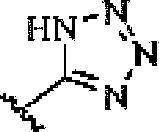
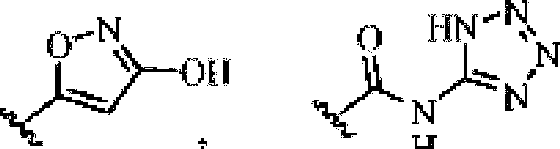
H

Rk

R1, at each occurrence, is independently selected from the group consisting of halo,
Cm alkyd, alkenyl, Cj.^ alkynyl, and Cm haloalkyl;
R2, at each occurrence, is independently selected from the group consisting of deuterium, halo, Cm alkyl, Cm alkenyl, C2^ alkynyl, and Cm haloalkyl;
two R2 that are attached to the same carbon atom, together with said, carbon atom, optionally form a ring selected from the group consisting of heterocycloalkyl, heterocycloalkenyl, cycloalkyl, and cycloalkenyl;
R\ at each occurrence, is independently selected from the group consisting of halo, Cm alkyl, Cm alkenyl, C2.e alkynyl, and Cm haloalkyl;
R4, at each occurrence, is independently selected from the group consisting of

NR12S(O)R14, S(OhR14, S(O)Rm and R14;
R5, at each occurrence, is independently selected from the group consisting of Cm alkyl, Cm alkenyl, C2^ alkynyl, Cm haloalkyl, Cmhydroxyalkyl, aryl, heterocyciyl, cycloalkyl, and cycloalkenyl;
RfA is independently selected from the group consisting of hydrogen, Cm alkyl, alkenyl, alkynyl, and Cm haloalkyl;
(19307961_l):RTK
2017206246 29 Jun2018
15c
R6 and R7, at each occurrence, are each independently selected from the group consisting of hydrogen, R15, OR1?, SRI?, S(O)R15, SO2R1?, C(O)R35, COiOlR15, OC(O)R15, OC(O)ORli, NHj, NHRIS, N(R15)2, NHC(O)RIS, NR15C(O)R,S, NHS(OhR15, NR1?S(O)iR'5, NHQOK>R15, NR’5QOX)R,,> NHC(O.)NH2, NHC(O)NHR1?, NHC(O)N(R]i}z, NR1?C(O)NHRli, NRl,C(O)N(Rl5)i. C{O)NH2, C(O)NHRt5, C(O)N(R]% C(O)NHOH, C(0)NHOR1S, C(O)NIISO2R,5,C(O)NRlsSO2R1\ SO2NII2, SO2NHR15, SO2N(Rls)2, CO(O)H, C(O)H, OH, CN, Nj, NO2, F, Cl, Br and I;
Rs, at each occuiTence, is independently selected from the group consisting of Cj^ alkyl, C2.& alkenyl, C2jg alkynyl, Ci_6 haloalkyl, aryl, heterocyclyl, cycloalkyl, and Cydoalkenyl; wherein the Rs Ci-e alkyl, Οιλ alkenyl, Cj^ alkynyl, and C14 haloalkyl are optionally substituted with one, two, three, four, five, or six substituents independently selected from the group consisting of Ru, OR16, SR16, S(O)Rl\ SO2RU, C(O)R1,S, CO(O)R16, OQO}R16, OC(O)OR16, NH2, NHR16, N(R%, NHC(O)R16, NRl6C(O)Rl€, NHS(O)2RL6, NRWS(O)2RW, NHC(O)OR]*, NR,6C(O}OR]6, NHC(O)NH2j NHC(O)NHRw, NHC<O)N(Ri6)z, NRi6C(O)NHR]6, NR]6C(O)N(Rlfr)2, C(O)NH2, C(O)NHR* C(O)N(R16)2, C(O)NHOH, C(O)NHORW, C(O)NHSO2RW, C(O)NRwSOjRw, SO2NH2, SO2NHRW, SO2N(RI<f>2, 00(O)H, C<O)H, OH, CN, N5, NO2, F, Cl, Br and I; wherein the R8 aryl, heterocyclyl, cycloalkyi, and cycloalkenyl are optionally substituted with one, two, or three substituents independently selected from the group consisting of C·^ alkyl, C2j6 alkenyl, C2^ alkynyl, C,_6 haloalkyl, NH2, C(O)NH2, SO2NH2, C(O)H, (O), OH, CN, NO2, OCFj, OCFiCFj, F, Cl, Br and I;
R9 is selected from the group consisting of Ci_$ alkyl, C2_6 alkenyl, C2^ alkynyl, Ci_$ haloalkyl, cycloalkyi, phenyl and (CH2)m phenyl; and
RIL* and R11 , at each occurrence, are each independently selected from the group consisting of hydrogen, Ci.$ alkyl, alkenyl, C2.* alkynyl, €3.$ cycloalkyi, haloalkyl, phenyl and (CHj)M-phenyl; or
R1l>and R11, or Rc* and Ry together with the atom to which each is attached are combined to form a heterocyclyl;
Rfc, at each occurrence, is independently selected from the group consisting of Cj^ alkyl, C2.& alkenyl, C;^ alkynyl, C3.7 heterocycloalkyl, Q.? cycloalkyi and Cm haloalkyl;
(19307961_l):RTK
2017206246 29 Jun2018
15d
R12 and R1\ at each occurrence, arc each independently selected from the group consisting of hydrogen, Cm alkyl, Cm alkenyl, CU alkynyl, Ci_4 haloalkyl and. (CHj)m phenyl;
R14, at each occurrence, is independently selected from the group consisting of Cm alkyl, Cm alkenyl, alkynyl and Cm haloalkyl;
11 1Ί I j
R and R , or R and R , at each occurrence, together with the atom to which each is attached, are optionally combined to form a heterocyclyl;
R1?, at each occurrence, is independently selected from the group consisting of Cm alkyl, C2.j alkenyl. Cm alkynyl, Cm haloalkyl, Cm hydroxyalkyl, aryl, heterocyclyl, cycloalkyl, and cycloalkenyl; wherein the R15 Cm alkyl, Cm alkenyl, Cm alkynyl. Cm haloalkyl, and Cm hydroxyalkyl are optionally substituted with one, two, or three substituents independently selected from the group consisting of O-(Cm alkyl), NH2, €(Ο)ΝΗζ, SOsNHi, C(O)H, C(O)OH, (O), OH, CN, NO2, OCF3, OCUCU, F, Cl, Br and I;
R16, at each occurrence, is independently selected from the group consisting of Cm alkyl, Cm alkenyl, C24 alkynyl, Cm haloalkyl, Cm hydroxyalkyl, aryl, heterocycloalkyl, heterocycloalkenyl, heteroaryl, cycloalkyl, and cydoalkenyl; wherein the R16 Cm alkyl, Cm alkenyl, Cm alkynyl, Cm haloalkyl, and Cm hydroxyalkyl are optionally substituted with one substituent independently selected from the group consisting of OCHa, OCHjCHjOCHj, and OCH2CH2NHCH3;
q is 1,2, or 3; s is 0, 1,2, or 3; r is 0,1,2, or 3;
wherein the sum of s and r is 0, 1, or 2; m is 0, 1, 2, or 3; n is 0, 1,2, 3, 4, 5, or 6; and p is 0, l,or2.
(19307961_l):RTK
2017206246 29 Jun2018
15e
According to a second aspect of the present invention there is provided a pharmaceutical composition for treating bladder cancer, brain cancer, breast cancer, bone marrow cancer, cervical cancer, chronic lymphocytic leukemia, colorectal cancer, esophageal cancer, hepatocellular cancer, lymphoblastic leukemia, follicular lymphoma, a lymphoid malignancy of T-cell or B-cell origin, melanoma, myelogenous leukemia, myeloma, oral cancer, ovarian cancer, non-small cell lung cancer, prostate cancer, small cell lung cancer or spleen cancer, said composition comprising an excipient and a therapeutically effective amount of the compound or therapeutically acceptable salt according to the first aspect.
According to a third aspect of the present invention there is provided a method of treating lymphoblastic leukemia in a patient, said method comprising administering to the patient a therapeutically effective amount of the compound or therapeutically acceptable salt according to the first aspect.
According to a fourth aspect of the present invention there is provided a method of promoting apoptosis in a cell by inhibiting Bcl-xL anti-apoptotic activity, the method comprising treating the cell with the compound or therapeutically acceptable salt according to the first aspect.
According to a fifth aspect of the present invention there is provided use of the compound or therapeutically acceptable salt according to the first aspect for the manufacture of a medicament for treating lymphoblastic leukemia.
DETAILED DESCRIPTION OF THE INVENTION
Abbreviations and Definitions
Unless otherwise defined herein, scientific and technical terms used in connection with the present invention shall have the meanings that are commonly understood by those of ordinary skill in the art. The meaning and scope of the terms should be clear, however, in the event of any latent ambiguity, definitions provided herein take precedent over any dictionary (19307961_l):RTK
2017206246 29 Jun2018
15f or extrinsic definition. In this application, the use of or means and/or unless stated otherwise. Furthermore, the use of the term including, as well as other forms, such as includes and included, is not limiting. With reference to the use of the words comprise or comprises or comprising in this patent application (including the claims), Applicants note that unless the context requires otherwise, those words are used on the basis and clear understanding that they are to be interpreted inclusively, rather than exclusively, and that Applicants intend each of those words to be so interpreted in construing this patent application, including the claims below. For a variable that occurs more than one time in any substituent or in the compound of the invention or any other formulae herein, its definition on each occurrence is independent of its definition at every other occurrence. Combinations of substituents are permissible only if such combinations result in stable compounds. Stable (19307961_l):RTK
2017206246 20 Jul2017 compounds are compounds which can be isolated in a useful degree of purity from a reaction mixture.
It is meant to be understood that proper valences are maintained for all combinations herein, that monovalent moieties having more than one atom are attached through their left ends, and that divalent moieties are drawn from left to right.
As used in the specification and the appended claims, unless specified to the contrary, the following terms have the meaning indicated:
The term alkyl (alone or in combination with another term(s)) means a straight-or branched-chain saturated hydrocarbyl substituent typically containing from 1 to about 10 carbon atoms; or in another embodiment, from 1 to about 8 carbon atoms; in another embodiment, from 1 to about 6 carbon atoms; and in another embodiment, from 1 to about 4 carbon atoms. Examples of such substituents include methyl, ethyl, n-propyl, isopropyl, nbutyl, isobutyl, sec-butyl, tert-butyl, pentyl, iso-amyl, and hexyl and the like.
The term alkenyl (alone or in combination with another term(s)) means a straight15 or branched-chain hydrocarbyl substituent containing one or more double bonds and typically from 2 to about 10 carbon atoms; or in another embodiment, from 2 to about 8 carbon atoms; in another embodiment, from 2 to about 6 carbon atoms; and in another embodiment, from 2 to about 4 carbon atoms. Examples of such substituents include ethenyl (vinyl), 2-propenyl, 3-propenyl, 1,4-pentadienyl, 1,4-butadienyl, 1-butenyl, 2-butenyl, and 3-butenyl and the like.
The term alkynyl (alone or in combination with another term(s)) means a straightor branched-chain hydrocarbyl substituent containing one or more triple bonds and typically from 2 to about 10 carbon atoms; or in another embodiment, from 2 to about 8 carbon atoms; in another embodiment, from 2 to about 6 carbon atoms; and in another embodiment, from 2 to about 4 carbon atoms. Examples of such substituents include ethynyl, 2-propynyl, 325 propynyl, 2-butynyl, and 3-butynyl and the like.
The term carbocyclyl (alone or in combination with another term(s)) means a saturated cyclic (i.e., cycloalkyl), partially saturated cyclic (i.e., cycloalkenyl), or completely unsaturated (i.e., aryl) hydrocarbyl substituent containing from 3 to 14 carbon ring atoms (ring atoms are the atoms bound together to form the ring or rings of a cyclic substituent). A carbocyclyl may be a single-ring (monocyclic) or polycyclic ring structure.
A carbocyclyl may be a single ring structure, which typically contains from 3 to 8 ring atoms, more typically from 3 to 6 ring atoms, and even more typically 5 to 6 ring atoms. Examples of such single-ring carbocyclyls include cyclopropyl (cyclopropanyl), cyclobutyl (cyclobutanyl), cyclopentyl (cyclopentanyl), cyclopentenyl, cyclopentadienyl, cyclohexyl (cyclohexanyl), cyclohexenyl, cyclohexadienyl, cyclooxtanyl, and phenyl. A carbocyclyl may alternatively be polycyclic (i.e., may contain more than one ring). Examples of polycyclic carbocyclyls include bridged, fused, and spirocyclic carbocyclyls. In a spirocyclic
- 162017206246 20 Jul2017 carbocyclyl, one atom is common to two different rings. Examples of spirocyclic carbocyclyls include spiropentanyl, spiro[3.5]nonanyl, and spiro[2.5]octanyl. In a bridged carbocyclyl, the rings share at least two common non-adjacent atoms. Examples of bridged carbocyclyls include bicyclo[2.2.1]heptanyl, bicyclo[2.2.1]hept-2-enyl, and adamantanyl (tricyclo[3.3.1.13,7]decanyl). In a fused-ring carbocyclyl system, two or more rings may be fused together, such that two rings share one common bond. Examples of two- or three-fused ring carbocyclyls include naphthalenyl, tetrahydronaphthalenyl (tetralinyl), indenyl, indanyl (dihydroindenyl), anthracenyl, phenanthrenyl, and decalinyl.
The term cycloalkyl (alone or in combination with another term(s)) means a 10 saturated cyclic hydrocarbyl substituent containing from 3 to 14 carbon ring atoms. A cycloalkyl may be a single carbon ring, which typically contains from 3 to 8 carbon ring atoms and more typically from 3 to 6 ring atoms. Examples of single-ring cycloalkyls include cyclopropyl, cyclobutyl, cyclopentyl, cyclohexyl, cycloheptanyl, and cyclooctanyl. A cycloalkyl may alternatively be polycyclic or contain more than one ring. Examples of polycyclic cycloalkyls include bridged, fused, and spirocyclic carbocyclyls. Examples of bridged cycloalkyls include adamantanyl (tricyclo[3.3.1.13’7]decanyl), and bicyclo [3.1.1 ]heptanyl.
The term Cx-Cy cycloalkyl means a cycloalkyl ring system containing from x to y carbon atoms. For example C3-C7 cycloalkyl means a cycloalkyl ring system containing from 3 to 7 carbon atoms.
The term cycloalkenyl (alone or in combination with another term(s)) means a partially saturated cyclic hydrocarbyl substituent containing from 3 to 14 carbon ring atoms.
A cycloalkenyl may be a single carbon ring, which typically contains from 3 to 8 carbon ring atoms and more typically from 4 to 6 ring atoms. Examples of single-ring cycloalkenyls include cyclopentenyl, and cyclohexenyl. A cycloalkenyl may alternatively be polycyclic or contain more than one ring. Examples of polycyclic cycloalkenyls include bridged, fused, and spirocyclic carbocyclyls. Examples of bridged cycloalkenyls include bicyclo[2.2.1]hept2-enyl.
The term Cx-Cy cycloalkenyl means a cycloalkenyl ring system containing from x to y carbon atoms. For example C4-C7 cycloalkenyl means a cycloalkenyl ring system containing from 4 to 7 carbon atoms.
The term aryl (alone or in combination with another term(s)) means an aromatic carbocyclyl containing from 6 to 14 carbon ring atoms. An aryl may be monocyclic or polycyclic (i.e., may contain more than one ring). In the case of polycyclic aromatic rings, only one ring the polycyclic system is required to be unsaturated while the remaining ring(s) may be saturated, partially saturated or unsaturated. Examples of aryls include phenyl, naphthalenyl, indenyl, indanyl, and tetrahydronapthyl.
- 17 2017206246 20 Jul2017
The term arylene means a divalent arene.
The term “phenylene” means a divalent benzene.
In some instances, the number of carbon atoms in a substituent (e.g., alkyl, alkenyl, alkynyl, cycloalkyl, heterocyclyl, heteroaryl, and aryl) is indicated by the prefix Cx-Cy-, wherein x is the minimum and y is the maximum number of carbon atoms. Thus, for example, Ci-C6-alkylrefers to an alkyl containing from 1 to 6 carbon atoms. Illustrating further, Cb-Cx-cycloalkyl means a saturated hydrocarbyl ring containing from 3 to 8 carbon ring atoms.
The term Cx.y branched chain alkyl means a saturated hydrocarbyl substituent 10 containing from x to y carbons wherein attachment occurs through a dialkyl trivalent- or trialkyl tetravalent- carbon radical. Examples of such substituents include isopentanyl (pentan-3-yl), neopentanyl (2,2-dimethylpropan-2-yl), heptan-4-yl, and 2,6-dimethylheptan-4yi.
The term, C3.11 branched chain alkyl means a saturated hydrocarbyl substituent 15 containing from 3 to 11 carbons wherein attachment occurs through a dialkyl trivalent- or trialkyl tetravalent- carbon radical.
The term hydrogen (alone or in combination with another term(s)) means a hydrogen radical, and may be depicted as -H.
The term hydroxy (alone or in combination with another term(s)) means -OH.
The term carboxy (alone or in combination with another term(s)) means -C(O)-OH.
The term amino (alone or in combination with another term(s)) means -NH2.
The term halogen or halo (alone or in combination with another term(s)) means a fluorine radical (which may be depicted as -F), chlorine radical (which may be depicted as Cl), bromine radical (which may be depicted as -Br), or iodine radical (which may be depicted as -I).
If a substituent is described as being substituted, a non-hydrogen radical is in the place of hydrogen radical on a carbon or nitrogen of the substituent. Thus, for example, a substituted alkyl substituent is an alkyl substituent in which at least one non-hydrogen radical is in the place of a hydrogen radical on the alkyl substituent. To illustrate, monofluoroalkyl is alkyl substituted with a fluoro radical, and difluoroalkyl is alkyl substituted with two fluoro radicals. It should be recognized that if there are more than one substitution on a substituent, each non-hydrogen radical may be identical or different (unless otherwise stated).
If a substituent is described as being optionally substituted, the substituent may be either (1) not substituted or (2) substituted. If a substituent is described as being optionally substituted with up to a particular number of non-hydrogen radicals, that substituent may be either (1) not substituted; or (2) substituted by up to that particular number of non-hydrogen radicals or by up to the maximum number of substitutable positions on the substituent,
- 18 2017206246 20 Jul2017 whichever is less. Thus, for example, if a substituent is described as a heteroaryl optionally substituted with up to 3 non-hydrogen radicals, then any heteroaryl with less than 3 substitutable positions would be optionally substituted by up to only as many non-hydrogen radicals as the heteroaryl has substitutable positions. To illustrate, tetrazolyl (which has only one substitutable position) would be optionally substituted with up to one non-hydrogen radical. To illustrate further, if an amino nitrogen is described as being optionally substituted with up to 2 non-hydrogen radicals, then a primary amino nitrogen will be optionally substituted with up to 2 non-hydrogen radicals, whereas a secondary amino nitrogen will be optionally substituted with up to only 1 non-hydrogen radical.
This patent application uses the terms substituent and radical interchangeably.
The prefix halo indicates that the substituent to which the prefix is attached is substituted with one or more independently selected halogen radicals. For example, haloalkyl means an alkyl substituent in which at least one hydrogen radical is replaced with a halogen radical. Examples of haloalkyls include chloromethyl, 1-bromoethyl, fluoromethyl, difluoromethyl, trifluoromethyl, and 1,1,1 -trifluoroethyl. It should be recognized that if a substituent is substituted by more than one halogen radical, those halogen radicals may be identical or different (unless otherwise stated).
The prefix perhalo indicates that every hydrogen radical on the substituent to which the prefix is attached is replaced with independently selected halogen radicals, i.e., each hydrogen radical on the substituent is replaced with a halogen radical. If all the halogen radicals are identical, the prefix typically will identify the halogen radical. Thus, for example, the term perfluoro means that every hydrogen radical on the substituent to which the prefix is attached is substituted with a fluorine radical. To illustrate, the term perfluoroalkyl means an alkyl substituent wherein a fluorine radical is in the place of each hydrogen radical.
The term carbonyl (alone or in combination with another term(s)) means -C(O)-.
The term aminocarbonyl (alone or in combination with another term(s)) means C(O)-NH2.
The term oxo (alone or in combination with another term(s)) means (=O).
The term oxy (alone or in combination with another term(s)) means an ether substituent, and may be depicted as -O-.
The term hydroxyalkyl (alone or in combination with another term(s)) means alkyl-OH.
The term alkylamino (alone or in combination with another term(s)) means -alkylNH2.
The term alkyloxy (alone or in combination with another term(s)) means an alkylether substituent, i.e., -O-alkyl. Examples of such a substituent include methoxy (-OCH3), ethoxy, n-propoxy, isopropoxy, n-butoxy, iso-butoxy, sec-butoxy, and tert-butoxy.
- 19 2017206246 20 Jul2017
The term alkylcarbonyl (alone or in combination with another term(s)) means C(O)-alkyl.
The term aminoalkylcarbonyl (alone or in combination with another term(s)) means
-C(O)-alkyl-NH2.
The term alkyloxycarbonyl (alone or in combination with another term(s)) means C(O)-O-alkyl.
The term carbocyclylcarbonyl (alone or in combination with another term(s)) means -C(O)-carbocyclyl.
Similarly, the term heterocyclylcarbonyl (alone or in combination with another term(s)) means -C(O)-heterocyclyl.
The term carbocyclylalkylcarbonyl (alone or in combination with another term(s)) means -C(O)-alkyl-carbocyclyl.
Similarly, the term heterocyclylalkylcarbonyl (alone or in combination with another term(s)) means -C(O)-alkyl-heterocyclyl.
The term carbocyclyloxycarbonyl (alone or in combination with another term(s)) means -C(O)-O-carbocyclyl.
The term carbocyclylalkyloxycarbonyl (alone or in combination with another term(s)) means -C(O)-O-alkyl-carbocyclyl.
The term thio or thia (alone or in combination with another term(s)) means replacement by a sulfur radical, i.e. a thiaether substituent means an ether substituent wherein a divalent sulfur atom is in the place of the ether oxygen atom. Such a substituent may be depicted as -S-. For example, alkyl-thio-alkyl means alkyl-S-alkyl (alkyl-sulfanyl-alkyl).
The term thiol or sulfhydryl (alone or in combination with another term(s)) means a sulfhydryl substituent, and may be depicted as -SH.
The term (thiocarbonyl) (alone or in combination with another term(s)) means a carbonyl wherein the oxygen atom has been replaced with a sulfur. Such a substituent may be depicted as -C(S)-.
The term sulfonyl (alone or in combination with another term(s)) means -S(O)2-. The term aminosulfonyl (alone or in combination with another term(s)) means 30 S(O)2-NH2.
The term sulfinyl or sulfoxido (alone or in combination with another term(s)) means -S(O)-.
The term heterocyclyl (alone or in combination with another term(s)) means a saturated (i.e., heterocycloalkyl), partially saturated (i.e., heterocycloalkenyl), or completely unsaturated (i.e., heteroaryl) ring structure containing a total of 3 to 14 ring atoms. At least one of the ring atoms is a heteroatom (i.e., oxygen, nitrogen, or sulfur), with the remaining ring atoms being independently selected from the group consisting of carbon,
-202017206246 20 Jul2017 oxygen, nitrogen, and sulfur. A heterocyclyl may be a single-ring (monocyclic) or polycyclic ring structure.
A heterocyclyl may be a single ring, which typically contains from 3 to 7 ring atoms, more typically from 3 to 6 ring atoms, and even more typically 5 to 6 ring atoms. Examples of single-ring heterocyclyls include furanyl, dihydrofuranyl, tetrahydrofuranyl, tetrahydropyranyl, thiophenyl (thiofuranyl), dihydrothiophenyl, tetrahydrothiophenyl, pyrrolyl, pyrrolinyl, pyrrolidinyl, imidazolyl, imidazolinyl, imidazolidinyl, pyrazolyl, pyrazolinyl, pyrazolidinyl, triazolyl, tetrazolyl, oxazolyl, oxazolidinyl, isoxazolidinyl, isoxazolyl, thiazolyl, isothiazolyl, thiazolinyl, isothiazolinyl, thiazolidinyl, isothiazolidinyl, thiodiazolyl, oxadiazolyl (including 1,2,3-oxadiazolyl, 1,2,4-oxadiazolyl, 1,2,5-oxadiazolyl (furazanyl), or 1,3,4-oxadiazolyl), oxatriazolyl (including 1,2,3,4-oxatriazolyl or 1,2,3,5oxatriazolyl), dioxazolyl (including 1,2,3-dioxazolyl, 1,2,4-dioxazolyl, 1,3,2-dioxazolyl, or 1,3,4-dioxazolyl), 1,4-dioxanyl, dioxothiomorpholinyl, oxathiazolyl, oxathiolyl, oxathiolanyl, pyranyl, dihydropyranyl, thiopyranyl, tetrahydrothiopyranyl, pyridinyl (azinyl), piperidinyl, diazinyl (including pyridazinyl (1,2-diazinyl), pyrimidinyl (1,3-diazinyl), or pyrazinyl (1,4diazinyl)), piperazinyl, triazinyl (including 1,3,5-triazinyl, 1,2,4-triazinyl, and 1,2,3triazinyl)), oxazinyl (including 1,2-oxazinyl, 1,3-oxazinyl, or 1,4-oxazinyl)), oxathiazinyl (including 1,2,3-oxathiazinyl, 1,2,4-oxathiazinyl, 1,2,5-oxathiazinyl, or 1,2,6-oxathiazinyl)), oxadiazinyl (including 1,2,3-oxadiazinyl, 1,2,4-oxadiazinyl, 1,4,2-oxadiazinyl, or 1,3,520 oxadiazinyl)), morpholinyl, azepinyl, oxepinyl, thiepinyl, diazepinyl, pyridonyl (including pvrid-2(l //)-onvl and pyrid-4(l//)-onvl), furan-2(5//)-onyl, pyrimidonyl (including pyramid2(1 //)-onyl and pyramid-4(3//)-onyl), oxazol-2(3//)-onyl, l//-imidazol-2(3//)-onyl, pyridazin-3(2//)-onyl, and pyrazin-2(lH)-onyl.
A heterocyclyl may alternatively be polycyclic (i.e., may contain more than one ring).
Examples of polycyclic heterocyclyls include bridged, fused, and spirocyclic heterocyclyls.
In a spirocyclic heterocyclyl, one atom is common to two different rings. In a bridged heterocyclyl, the rings share at least two common non-adjacent atoms. Examples of bridged heterocyclyls include 2-oxatricyclo[3.3.1.13,7]decane. In a fused-ring heterocyclyl, two or more rings may be fused together, such that two rings share one common bond. Examples of fused ring heterocyclyls containing two or three rings include imidazopyrazinyl (including imidazo[l,2-a]pyrazinyl), imidazopyridinyl (including imidazo[l,2-a]pyridinyl), imidazopyridazinyl (including imidazo[l,2-b]pyridazinyl), thiazolopyridinyl (including thiazolo[5,4-c]pyridinyl, thiazolo[5,4-b]pyridinyl, thiazolo[4,5-b]pyridinyl, andthiazolo[4,5c]pyridinyl), indolizinyl, pyranopyrrolyl, 4H-quinolizinyl, purinyl, naphthyridinyl, pyridopyridinyl (including pyrido[3,4-b]-pyridinyl, pyrido[3,2-b]-pyridinyl, or pyrido[4,3-b]pyridinyl), and pteridinyl. Other examples of fused-ring heterocyclyls include benzo-fused heterocyclyls, such as dihydrochromenyl, tetrahydroisoquinolinyl, indolyl, isoindolyl
-21 2017206246 20 Jul2017 (isobenzazolyl, pseudoisoindolyl), indoleninyl (pseudoindolyl), isoindazolyl (benzpyrazolyl), benzazinyl (including quinolinyl (1-benzazinyl) or isoquinolinyl (2-benzazinyl)), phthalazinyl, quinoxalinyl, quinazolinyl, benzodiazinyl (including cinnolinyl (1,2benzodiazinyl) or quinazolinyl (1,3-benzodiazinyl)), benzopyranyl (including chromanyl or isochromanyl), benzoxazinyl (including 1,3,2-benzoxazinyl, 1,4,2-benzoxazinyl, 2,3,1benzoxazinyl, or 3,1,4-benzoxazinyl), benzo[d]thiazolyl, and benzisoxazinyl (including 1,2benzisoxazinyl or 1,4-benzisoxazinyl).
The term heterocycloalkyl (alone or in combination with another term(s)) means a saturated heterocyclyl.
The term Cx-Cy heterocycloalkyl means a heterocycloalkyl ring system containing from x to y ring atoms. For example “C3-C7 heterocycloalkyl” means a heterocycloalkyl ring system containing 3 to 7 ring atoms.
The term heterocycloalkenyl (alone or in combination with another term(s)) means a partially saturated heterocyclyl.
The term Cx-Cy heterocycloalkenyl means a heterocycloalkenyl ring system containing from x to y ring atoms. For example C3-C7 heterocycloalkenyl means a heterocycloalkenyl ring system containing from 3 to 7 ring atoms.
The term heteroaryl (alone or in combination with another term(s)) means an aromatic heterocyclyl containing from 5 to 14 ring atoms. A heteroaryl may be a single ring or 2 or 3 fused rings. Examples of heteroaryls include 6-membered ring substituents such as pyridyl, pyrazyl, pyrimidinyl, pyridazinyl, and 1,3,5-, 1,2,4- or 1,2,3-triazinyl; 5-membered ring substituents such as triazolyl, pyrrolyl, imidazyl, furanyl, thiophenyl, pyrazolyl, oxazolyl, isoxazolyl, thiazolyl, 1,2,3-, 1,2,4-, 1,2,5-, or 1,3,4-oxadiazolyl and isothiazolyl; 6/5membered fused ring substituents such as imidazopyrazinyl (including imidazo[l,225 a]pyrazinyl) imidazopyridinyl (including imidazo[l,2-a]pyridinyl), imidazopyridazinyl (including imidazo[l,2-b]pyridazinyl), thiazolopyridinyl (including thiazolo[5,4-c]pyridinyl, thiazolo[5,4-b]pyridinyl, thiazolo[4,5-b]pyridinyl, and thiazolo[4,5-c]pyridinyl), benzo[d]thiazolyl, benzothiofuranyl, benzisoxazolyl, benzoxazolyl, purinyl, and anthranilyl; and 6/6-membered fused rings such as benzopyranyl, quinolinyl, isoquinolinyl, cinnolinyl, quinazolinyl, and benzoxazinyl. Heteroaryls may also be heterocyles having aromatic (4N+2 pi electron) resonance contributors such as pyridonyl (including pyrid-2(l//)-onvl and pyrid4(1 //)-ony 1), pyrimidonyl (including pyramid-2(l//)-onvl and pyramid-4(3//)-°nyl), pyridazin-3(2//)-onyl and pyrazin-2(lH)-onyl.
The term Cx-Cy heteroaryl means a heteroaryl ring system containing from x to y ring atoms. For example C5-C6 heteroaryl means a heteroaryl ring system containing from 5 to 6 ring atoms.
The term heteroarylene means a divalent heteroarene.
-22 2017206246 20 Jul2017
A prefix attached to a multi-component substituent only applies to the first component. To illustrate, the term alkylcycloalkyl contains two components: alkyl and cycloalkyl. Thus, the C1-C6- prefix on Ci-C6-alkylcycloalkyl means that the alkyl component of the alkylcycloalkyl contains from 1 to 6 carbon atoms; the Ci-C6-prefix does not describe the cycloalkyl component. To illustrate further, the prefix halo on haloalkyloxyalkyl indicates that only the alkyloxy component of the alkyloxyalkyl substituent is substituted with one or more halogen radicals. If halogen substitution may alternatively or additionally occur on the alkyl component, the substituent would instead be described as halogen-substituted alkyloxyalkyl rather than haloalkyloxyalkyl. And finally, if the halogen substitution may only occur on the alkyl component, the substituent would instead be described as alkyloxyhaloalkyl.
The terms treat, treating and treatment refer to a method of alleviating or abrogating a disease and/or its attendant symptoms.
The terms prevent, preventing and prevention refer to a method of preventing 15 the onset of a disease and/or its attendant symptoms or barring a subject from acquiring a disease. As used herein, prevent, preventing and prevention also include delaying the onset of a disease and/or its attendant symptoms and reducing a subject's risk of acquiring a disease.
The term therapeutically effective amount refers to that amount of the compound 20 being administered sufficient to prevent development of or alleviate to some extent one or more of the symptoms of the condition or disorder being treated.
The term modulate refers to the ability of a compound to increase or decrease the function, or activity, of a kinase. Modulation, as used herein in its various forms, is intended to encompass antagonism, agonism, partial antagonism and/or partial agonism of the activity associated with kinase. Kinase inhibitors are compounds that, e.g., bind to, partially or totally block stimulation, decrease, prevent, delay activation, inactivate, desensitize, or down regulate signal transduction. Kinase activators are compounds that, e.g., bind to, stimulate, increase, open, activate, facilitate, enhance activation, sensitize or up regulate signal transduction.
The term composition as used herein is intended to encompass a product comprising the specified ingredients in the specified amounts, as well as any product which results, directly or indirectly, from combination of the specified ingredients in the specified amounts. By pharmaceutically acceptable it is meant the carrier, diluent or excipient must be compatible with the other ingredients of the formulation and not deleterious to the recipient thereof.
-23 2017206246 20 Jul2017
The subject is defined herein to include animals such as mammals, including, but not limited to, primates (e.g., humans), cows, sheep, goats, horses, dogs, cats, rabbits, rats, mice and the like. In preferred embodiments, the subject is a human.
The term NH protecting group, as used herein, means trichloroethoxycarbonyl, tribromoethoxycarbonyl, benzyloxycarbonyl, para-nitrobenzylcarbonyl, ortho-bromobenzyloxycarbonyl, chloroacetyl, dichloroacetyl, trichloroacetyl, trifluoroacetyl, phenylacetyl, formyl, acetyl, benzoyl, tert-amyloxycarbonyl, tert-butoxycarbonyl, para-methoxybenzyloxycarbonyl, 3,4-dimethoxybenzyl-oxycarbonyl, 4-(phenylazo)benzyloxycarbonyl, 2-furfuryl-oxycarbonyl, diphenylmethoxycarbonyl, 1,110 dimethylpropoxy-carbonyl, isopropoxycarbonyl, phthaloyl, succinyl, alanyl, leucyl, 1adamantyloxycarbonyl, 8-quinolyloxy carbonyl, benzyl, diphenylmethyl, triphenylmethyl, 2nitrophenylthio, methanesulfonyl, para-toluenesulfonyl, N,N-dimethylaminomethylene, benzylidene, 2-hydroxybenzylidene, 2-hydroxy-5-chlorobenzylidene, 2-hydroxy-1 -naphthylmethylene, 3-hydroxy-4-pyridylmethylene, cyclohexylidene,
2-ethoxycarbonylcyclohexylidene, 2-ethoxycarbonylcyclopentylidene,
2- acetylcyclohexylidene, 3,3-dimethyl-5-oxycyclo-hexylidene, diphenylphosphoryl, dibenzylphosphoryl, 5-methyl-2-oxo-2H-l,3-dioxol-4-yl-methyl, trimethylsilyl, triethylsilyl, and triphenylsilyl.
The term C(O)OH protecting group, as used herein, means methyl, ethyl, n-propyl, isopropyl, 1,1-dimethylpropyl, n-butyl, tert-butyl, phenyl, naphthyl, benzyl, diphenylmethyl, triphenylmethyl, para-nitrobenzyl, para-methoxybenzyl, bis(para-methoxyphenyl)methyl, acetylmethyl, benzoylmethyl, para-nitrobenzoylmethyl, para-bromobenzoylmethyl, paramethanesulfonylbenzoylmethyl, 2-tetrahydropyranyl 2-tetrahydrofuranyl, 2,2,2-trichloroethyl, 2-(trimethylsilyl)ethyl, acetoxymethyl, propionyloxymethyl, pivaloyloxymethyl, phthalimidomethyl, succinimidomethyl, cyclopropyl, cyclobutyl, cyclopentyl, cyclohexyl, methoxymethyl, methoxyethoxymethyl, 2-(trimethylsilyl)ethoxymethyl, benzyloxymethyl, methylthiomethyl, 2-methylthioethyl, phenylthiomethyl, 1,1-dimethyl-2-propenyl, 3-methyl3- butenyl, allyl, trimethylsilyl, triethylsilyl, triisopropylsilyl, diethylisopropylsilyl, tertbutyldimethylsilyl, tert-butyldiphenylsilyl, diphenylmethylsilyl, and tert-butylmethoxyphenylsilyl.
The term OH or SH protecting group, as used herein, means benzyloxycarbonyl, 4nitrobenzyloxycarbonyl, 4-bromobenzyloxycarbonyl, 4-methoxybenzyloxycarbonyl,
3,4-dimethoxybenzyloxy carbonyl, methoxy carbonyl, ethoxy carbonyl, tert-butoxy carbonyl,
1,1 -dimethylpropoxy carbonyl, isopropoxy carbonyl, isobutyloxy carbonyl, diphenylmethoxycarbonyl, 2,2,2-trichloroethoxy carbonyl, 2,2,2-tribromo ethoxy carbonyl, 2(trimethylsilyl)ethoxycarbonyl, 2-(phenylsulfonyl)ethoxycarbonyl, 2(triphenylphosphonio)ethoxycarbonyl, 2-furfuryloxycarbonyl, 1 -adamantyloxycarbonyl,
-242017206246 20 Jul2017 vinyloxycarbonyl, allyloxycarbonyl, S-benzylthiocarbonyl, 4-ethoxy-l-naphthyloxy carbonyl, 8-quinolyloxycarbonyl, acetyl, formyl, chloroacetyl, dichloroacetyl, trichloroacetyl, trifluoroacetyl, methoxyacetyl, phenoxyacetyl, pivaloyl, benzoyl, methyl, tert-butyl, 2,2,2-trichloroethyl, 2-trimethylsilylethyl, 1,1-dimethyl-2-propenyl, 3-methyl-3-butenyl, allyl, benzyl (phenylmethyl), para-methoxybenzyl, 3,4-dimethoxybenzyl, diphenylmethyl, triphenylmethyl, tetrahydrofuryl, tetrahydropyranyl, tetrahydrothiopyranyl, methoxymethyl, methylthiomethyl, benzyloxymethyl, 2-methoxyethoxymethyl, 2,2,2-trichloro-ethoxymethyl, 2-(trimethylsilyl)ethoxymethyl, 1-ethoxyethyl, methanesulfonyl, para-toluenesulfonyl, trimethylsilyl, triethylsilyl, triisopropylsilyl, diethylisopropylsilyl, tert-butyldimethylsilyl, tert-butyldiphenylsilyl, diphenylmethylsilyl, and tert-butylmethoxyphenylsilyl.
Compounds
Geometric isomers may exist in the present compounds. Compounds of this invention may contain carbon-carbon double bonds or carbon-nitrogen double bonds in the E or Z configuration, wherein the term “E” represents higher order substituents on opposite sides of the carbon-carbon or carbon-nitrogen double bond and the term “Z” represents higher order substituents on the same side of the carbon-carbon or carbon-nitrogen double bond as determined by the Cahn-Ingold-Prelog Priority Rules. The compounds of this invention may also exist as a mixture of “E” and “Z” isomers. Substituents around a cycloalkyl or heterocycloalkyl are sometimes designated as being of cis or trans configuration.
Compounds of this invention may contain asymmetrically substituted carbon atoms in the R or S configuration, in which the terms R and S are as defined by the IUPAC 1974 Recommendations for Section E, Fundamental Stereochemistry, Pure Appl. Chem. (1976) 45, 13-10. Compounds having asymmetrically substituted carbon atoms with equal amounts of R and S configurations are racemic at those carbon atoms. Atoms with an excess of one configuration over the other are assigned the configuration present in the higher amount, preferably an excess of about 85%-90%, more preferably an excess of about 95%-99%, and still more preferably an excess greater than about 99%. Accordingly, this invention includes racemic mixtures, relative and absolute stereoisomers, and mixtures of relative and absolute stereoisomers.
Isotope Enriched or Labeled Compounds
Compounds of the invention can exist in isotope-labeled or -enriched form containing one or more atoms having an atomic mass or mass number different from the atomic mass or mass number most abundantly found in nature. Isotopes can be radioactive or non-radioactive isotopes. Isotopes of atoms such as hydrogen, carbon, phosphorous, sulfur, fluorine, chlorine, and iodine include, but are not limited to, 2H, 3H, 13C, 14C, 15N, 180, 32P, 35S, 1SF, 36C1, and 125I. Compounds that contain other isotopes of these and/or other atoms are within the scope of this invention.
-25 2017206246 20 Jul2017
In another embodiment, the isotope-labeled compounds contain deuterium (2H), tritium (3H) or 14C isotopes. Isotope-labeled compounds of this invention can be prepared by the general methods well known to persons having ordinary skill in the art. Such isotopelabeled compounds can be conveniently prepared by carrying out the procedures disclosed in the Examples disclosed herein and Schemes by substituting a readily available isotope-labeled reagent for a non-labeled reagent. In some instances, compounds may be treated with isotope-labeled reagents to exchange a normal atom with its isotope, for example, hydrogen for deuterium can be exchanged by the action of a deuteric acid such as D2SO4/D2O. In addition to the above, relevant procedures and intermediates are disclosed, for instance, in Lizondo, J et al., Drugs Fut, 21(11), 1116 (1996); Brickner, S J et al., J Med Chem, 39(3),
673 (1996); Mallesham, B et al., OrgLett, 5(7), 963 (2003); PCT publications
WO1997010223, W02005099353, WO1995007271, W02006008754; US Patent Nos. 7538189; 7534814; 7531685;7528131; 7521421;7514068; 7511013; and US Patent Application Publication Nos. 20090137457; 20090131485; 20090131363; 20090118238; 20090111840;20090105338; 20090105307; 20090105147; 20090093422; 20090088416; and
20090082471, the methods are hereby incorporated by reference.
The isotope-labeled compounds of the invention may be used as standards to determine the effectiveness of Bcl-xL inhibitors in binding assays. Isotope containing compounds have been used in pharmaceutical research to investigate the in vivo metabolic fate of the compounds by evaluation of the mechanism of action and metabolic pathway of the nonisotope-labeled parent compound (Blake et al. J. Pharm. Sci. 64, 3, 367-391 (1975)). Such metabolic studies are important in the design of safe, effective therapeutic drugs, either because the in vivo active compound administered to the patient or because the metabolites produced from the parent compound prove to be toxic or carcinogenic (Foster et al., Advances in Drug Research Vol. 14, pp. 2-36, Academic press, London, 1985; Kato et al., J. Labelled Comp. Radiopharmaceut., 36(10):927-932 (1995); Kushner et al., Can. J. Physiol. Pharmacol., 77, 79-88 (1999).
In addition, non-radio active isotope containing drugs, such as deuterated drugs called “heavy drugs,” can be used for the treatment of diseases and conditions related to Bcl-xL activity. Increasing the amount of an isotope present in a compound above its natural abundance is called enrichment. Examples of the amount of enrichment include from about
0.5, 1, 2, 3, 4, 5, 6, 7, 8, 9, 10, 12, 16, 21, 25, 29, 33, 37, 42, 46, 50, 54, 58, 63, 67, 71, 75, 79,
84, 88, 92, 96, to about 100 mol %. Replacement of up to about 15% of normal atom with a heavy isotope has been effected and maintained for a period of days to weeks in mammals, including rodents and dogs, with minimal observed adverse effects (Czajka D M and Finkel A J, Ann. N.Y. Acad. Sci. 1960 84: 770; Thomson J F, Ann. New York Acad. Sci 1960 84: 736; Czakja D M et al., Am. J. Physiol. 1961 201: 357). Acute replacement of as high as 15%-262017206246 20 Jul2017
23% in human fluids with deuterium was found not to cause toxicity (Blagojevic N et al. in Dosimetry & Treatment Planning for Neutron Capture Therapy, Zamenhof R, Solares G and Harling O Eds. 1994. Advanced Medical Publishing, Madison Wis. pp. 125-134; Diabetes Metab. 23:251 (1997)).
Stable isotope labeling of a drug can alter its physico-chemical properties such as pKa and lipid solubility. These effects and alterations can affect the pharmacodynamic response of the drug molecule if the isotopic substitution affects a region involved in a ligand-receptor interaction. While some of the physical properties of a stable isotope-labeled molecule are different from those of the unlabeled one, the chemical and biological properties are the same, with one important exception: because of the increased mass of the heavy isotope, any bond involving the heavy isotope and another atom will be stronger than the same bond between the light isotope and that atom. Accordingly, the incorporation of an isotope at a site of metabolism or enzymatic transformation will slow said reactions potentially altering the pharmacokinetic profile or efficacy relative to the non-isotopic compound.
Suitable groups for X, Y1, L1, Y2, Z1, R1, R2, R3, m, n, and p in compounds of
Formula (I) are independently selected. The described embodiments of the present invention may be combined. Such combination is contemplated and within the scope of the present invention. For example, it is contemplated that embodiments for any of X, Y1, L1, Y2, Z1, R1, R2, R3, m, n, and p can be combined with embodiments defined for any other of X, Y1, L1, Y2,
Z1, R1, R2, R3, m, n, andp.
One embodiment of this invention, therefore, pertains to compounds and therapeutically acceptable salts, metabolites, prodrugs, salts of metabolites, and salts of prodrugs thereof, which are useful as inhibitors of anti-apoptotic Bcl-xL proteins, the compounds having Formula (I)

wherein
X is heteroaryl; wherein the heteroaryl represented by X is optionally substituted with one, two, three, or four R4;
Y1 is phenylene or C5.6 heteroarylene; optionally fused to one or two rings selected from the group consisting of C3.8 cycloalkane, C3.8 cycloalkene, benzene, C5.6 heteroarene, C3_ 8 heterocycloalkane, and C3.8 heterocycloalkene; wherein Y1 is optionally substituted with one, two, three, or four substituents independently selected from the group consisting of R5, OR5,
-27 2017206246 20 Jul2017
SR5, S(O)R5, SO2R5, C(O)R5, CO(O)R5, OC(O)R5, OC(O)OR5, NH2, NHR5, N(R5)2, NHC(O)R5, NR5C(O)R5, NHS(O)2R5, NR5S(O)2R5, NHC(O)OR5, NR5C(O)OR5, NHC(O)NH2, NHC(O)NHR5, NHC(O)N(R5)2, NR5C(O)NHR5, NR5C(O)N(R5)2, C(O)NH2, C(O)NHR5, C(O)N(R5)2, C(O)NHOH, C(O)NHOR5, C(O)NHSO2R5, C(O)NR5SO2R5, SO2NH2, SO2NHR5, SO2N(R5)2, CO(O)H, C(O)H, OH, CN, N5, NO2, F, Cl, Br and I;
L1 is selected from the group consisting of (CR6R7)q, (CR6R7)s-O-(CR6R7)r, (CR6R7)SC(O)-(CR6R7)r, (CR6R7)s-S-(CR6R7)r, (CR6R7)s-S(O)2-(CR6R7)r, (CR6R7)S-NR6AC(O)(CR6R7)r, (CR6R7)s-C(O)NR6A-(CR6R7)r, (CR6R7)s-NR6A-(CR6R7)r, (CR6R7)s-S(O)2NR6A(CR6R7)r, and (CR6R7)s-NR6AS(O)2-(CR6R7)r;
Y2 is C8_i4 cycloalkyl, C8_i4 cycloalkenyl, C8_i4 heterocycloalkyl, or C8_i4 heterocycloalkenyl; optionally fused to one or two rings selected from the group consisting of
C3.8 cycloalkane, C3.8 cycloalkene, benzene, C5.6 heteroarene, C3.8 heterocycloalkane, and C3.8 heterocycloalkene; wherein Y2 is optionally substituted with one, two, three, four, or five substituents independently selected from the group consisting of R8, OR8, SR8, S(O)R8, SO2R8, C(O)R8, CO(O)R8, OC(O)R8, OC(O)OR8, NH2, NHR8, N(R8)2, NHC(O)R8, NR8C(O)R8, NHS(O)2R8, NR8S(O)2R8, NHC(O)OR8, NR8C(O)OR8, NHC(O)NH2, NHC(O)NHR8, NHC(O)N(R8)2, NR8C(O)NHR8, NR8C(O)N(R8)2, C(O)NH2, C(O)NHR8, C(O)N(R8)2, C(O)NHOH, C(O)NHOR8, C(O)NHSO2R8, C(O)NR8SO2R8, so2nh2, SO2NHR8, SO2N(R8)2, CO(O)H, C(O)H, OH, CN, N3, NO2, F, Cl, Br and I;
Z1 is selected from the group consisting of C(O)OR9, C(O)NR10Rn, C(O)Rn, NR10C(O)Rn, NR10C(O)NR10R11, OC(O)NR10Rn, NR10C(O)OR9, C(=NOR10)NR10Rn, NR10C(=NCN)NR10R11, NR10S(O)2NR10Rn, S(O)2R9, S(O)2NR10Rn, N(R10)S(O)2Rn, NR10C(=NR11)NR10R11, C(=S)NR10Rn, C(=NR10)NR10Rn, halogen, NO2, and CN; or
Z1 is selected from the group consisting of -O.
N'“\
Λ X° N
A· H .
O
X^OH
HN
-N
-N
H
-N
LX0H NS'n
N
OH
O OH
X o
c, X >)II NT n
O O
AN
H c hnX
Xxx
H
O ,, 11 ?—S-OH ? II
O
X
H ’

OH
X^X°'Rk H .
Ν' 'N , and
Rk
O O 1
X V v x^x% R
Η u ·
R , at each occurrence, is independently selected from the group consisting of halo,
Ci_6 alkyl, C2.6 alkenyl, C2.6 alkynyl, and Ci_6 haloalkyl;
-28 2017206246 20 Jul2017
R2, at each occurrence, is independently selected from the group consisting of deuterium, halo, Ci_6 alkyl, C2.6 alkenyl, C2.6 alkynyl, and Ci_6 haloalkyl;
two R2 that are attached to the same carbon atom, together with said carbon atom, optionally form a ring selected from the group consisting of heterocycloalkyl, heterocycloalkenyl, cycloalkyl, and cycloalkenyl;
R3, at each occurrence, is independently selected from the group consisting of halo,
Ci_6 alkyl, C2.6 alkenyl, C2.6 alkynyl, and Ci_6 haloalkyl;
R4, at each occurrence, is independently selected from the group consisting of
NR12R13, OR12, CN, NO2, halogen, C(O)OR12, C(O)NR12R13, NR12C(O)R13, NR12S(O)2R14,
NR12S(O)R14, S(O)2R14, S(O)R14 and R14;
R5, at each occurrence, is independently selected from the group consisting of Ci_6 alkyl, C2.6 alkenyl, C2.6 alkynyl, Ci_6 haloalkyl, Ci_6 hydroxyalkyl, aryl, heterocyclyl, cycloalkyl, and cycloalkenyl;
R6A is independently selected from the group consisting of hydrogen, Ci_6 alkyl, C2_6 alkenyl, C2_6 alkynyl, and Ci_6 haloalkyl;
R6 and R7, at each occurrence, are each independently selected from the group consisting of hydrogen, R15, OR15, SR15, S(O)R15, SO2R15, C(O)R15, CO(O)R15, OC(O)R15, OC(O)OR15, NH2, NHR15, N(R15)2, NHC(O)R15, NR15C(O)R15, NHS(O)2R15, NR15S(O)2R15, NHC(O)OR15, NR15C(O)OR15, NHC(O)NH2, NHC(O)NHR15, NHC(O)N(R15)2,
NR15C(O)NHR15, NR15C(O)N(R15)2, C(O)NH2, C(O)NHR15, C(O)N(R15)2, C(O)NHOH, C(O)NHOR15, C(O)NHSO2R15, C(O)NR15SO2R15, so2nh2, SO2NHR15, SO2N(R15)2, CO(O)H, C(O)H, OH, CN, N3, NO2, F, Cl, Br and I;
R8, at each occurrence, is independently selected from the group consisting of Ci_6 alkyl, C2.6 alkenyl, C2.6 alkynyl, Ci_6 haloalkyl, aryl, heterocyclyl, cycloalkyl, and cycloalkenyl; wherein the R8 Ci_6 alkyl, C2_6 alkenyl, C2_6 alkynyl, and Ci_6 haloalkyl are optionally substituted with one, two, three, four, five, or six substituents independently selected from the group consisting of R16, OR16, SR16, S(O)R16, SO2R16, C(O)R16, CO(O)R16 OC(O)R16, OC(O)OR16, NH2, NHR16, N(R16)2, NHC(O)R16, NR16C(O)R16, NHS(O)2R16, NR16S(O)2R16, NHC(O)OR16, NR16C(O)OR16, NHC(O)NH2, NHC(O)NHR16,
NHC(O)N(R16)2, NR16C(O)NHR16, NR16C(O)N(R16)2, C(O)NH2, C(O)NHR16, C(O)N(R16)2,
C(O)NHOH, C(O)NHOR16, C(O)NHSO2R16, C(O)NR16SO2R16, SO2NH2, SO2NHR16, SO2N(R16)2, CO(O)H, C(O)H, OH, CN, N3, NO2, F, Cl, Br and I; wherein the R8 aryl, heterocyclyl, cycloalkyl, and cycloalkenyl are optionally substituted with one, two, or three substituents independently selected from the group consisting of Ci_6 alkyl, C2.6 alkenyl, C2.6 alkynyl, Ci_6 haloalkyl, NH2, C(O)NH2, SO2NH2, C(O)H, (O), OH, CN, NO2, OCF3,
OCF2CF3, F, Cl, Br and I;
-29 2017206246 20 Jul2017
R9 is selected from the group consisting of Ci_6 alkyl, C2_6 alkenyl, C2_6 alkynyl, Ci_6 haloalkyl, cycloalkyl, phenyl and (CH2)i_4 phenyl; and
R10 and R11, at each occurrence, are each independently selected from the group consisting of hydrogen, Ci_6 alkyl, C2.6 alkenyl, C2.6 alkynyl, C3_6 cycloalkyl, Ci_6 haloalkyl, phenyl and (CH2)i_4-phenyl; or
R10 and R11, or R10 and R9, together with the atom to which each is attached are combined to form a heterocyclyl;
Rk, at each occurrence, is independently selected from the group consisting of Ci_6 alkyl, C2.6 alkenyl, C2.6 alkynyl, C3.7 heterocycloalkyl, C3.7 cycloalkyl and Ci_6 haloalkyl;
R12 and R13, at each occurrence, are each independently selected from the group consisting of hydrogen, Cm alkyl, C2.4 alkenyl, C2.4 alkynyl, Cm haloalkyl and (CH2)i_4 phenyl;
R14, at each occurrence, is independently selected from the group consisting of Cm alkyl, C2.4 alkenyl, C2.4 alkynyl and Ci_4 haloalkyl;
R12 and R13, or R12 and R14, at each occurrence, together with the atom to which each is attached, are optionally combined to form a heterocyclyl;
R15, at each occurrence, is independently selected from the group consisting of Cm alkyl, C2.4 alkenyl, C2.4 alkynyl, Cm haloalkyl, Cm hydroxyalkyl, aryl, heterocyclyl, cycloalkyl, and cycloalkenyl; wherein the R15 Cm alkyl, C2m alkenyl, C2.4 alkynyl, Cm haloalkyl, and Cm hydroxyalkyl are optionally substituted with one, two, or three substituents independently selected from the group consisting of O-(Ci_4 alkyl), NH2, C(O)NH2, SO2NH2, C(O)H, C(O)OH, (O), OH, CN, NO2, OCF3, OCF2CF3, F, Cl, Br and I;
R16, at each occurrence, is independently selected from the group consisting of Cm alkyl, C2.4 alkenyl, C2.4 alkynyl, Cm haloalkyl, Cm hydroxyalkyl, aryl, heterocycloalkyl, heterocycloalkenyl, heteroaryl, cycloalkyl, and cycloalkenyl; wherein the R16 Cm alkyl, C2.4 alkenyl, C2.4 alkynyl, Cm haloalkyl, and Cm hydroxyalkyl are optionally substituted with one substituent independently selected from the group consisting of OCH3, OCH2CH2OCH3, and OCH2CH2NHCH3;
q is 1, 2, or 3;
s is 0, 1, 2, or 3;
r is 0, 1, 2, or 3;
wherein the sum of s and r is 0, 1, or 2; m is 0, 1, 2, or 3; n is 0, 1, 2, 3, 4, 5, or 6; and p is 0, 1, or 2.
In one embodiment of Formula (I), m is 0, 1, 2, or 3; n is 0, 1, 2, 3, 4, 5, or 6; and p is 0, 1, or 2. In another embodiment of Formula (I), n is 0, 1, or 2. In another embodiment of
-302017206246 20 Jul2017
Formula (I), n is 0, 1, or 2; and each R2 is independently deuterium or Ci_6 alkyl. In another embodiment of Formula (I), m, n, and p are 0.
In one embodiment of Formula (I), X is heteroaryl, which is optionally substituted with one, two, three or four R4. In another embodiment of Formula (I), X is heteroaryl, which is unsubstituted. In another embodiment of Formula (I), X is heteroaryl, which is substituted with one R4. In another embodiment of Formula (I), X is heteroaryl, which is substituted with two R4. In another embodiment of Formula (I), X is heteroaryl, which is substituted with one R4, and R4 is OR12 or halogen. In another embodiment of Formula (I), X is heteroaryl, which is substituted with two R4, and each R4 is independently OR12 or halogen. In another embodiment of Formula (I), X is heteroaryl, which is substituted with one R4, and R4 is Cl, F, or methoxy. In another embodiment of Formula (I), X is heteroaryl, which is substituted with two R4, and each R4 is independently F.
In one embodiment of Formula (I), X benzo [d]thiazolyl, thiazolo[5,4-b]pyridinyl, thiazolo[4,5-c]pyridinyl, imidazo[l,2-a]pyridinyl, thiazolo[5,4-c]pyridinyl, thiazolo[4,515 b]pyridinyl, imidazo[l,2-a]pyrazinyl, or imidazo[l,2-b]pyridazinyl, which are optionally substituted with one, two, three or four R4. In another embodiment of Formula (I), X is benzo[d]thiazolyl, thiazolo[5,4-b]pyridinyl, thiazolo[4,5-c]pyridinyl, imidazo[l,2-a]pyridinyl, thiazolo[5,4-c]pyridinyl, thiazolo[4,5-b]pyridinyl, imidazo[l,2-a]pyrazinyl, or imidazo[l,2b]pyridazinyl, which are unsubstituted. In another embodiment of Formula (I), X is benzo[d]thiazolyl, thiazolo[5,4-b]pyridinyl, thiazolo[4,5-c]pyridinyl, imidazo[l,2-a]pyridinyl, thiazolo[5,4-c]pyridinyl, thiazolo[4,5-b]pyridinyl, imidazo[l,2-a]pyrazinyl, or imidazo[l,2b]pyridazinyl, which are substituted with one R4. In another embodiment of Formula (I), X is benzo[d]thiazolyl, thiazolo[5,4-b]pyridinyl, thiazolo[4,5-c]pyridinyl, imidazo[l,2-a]pyridinyl, thiazolo[5,4-c]pyridinyl, thiazolo[4,5-b]pyridinyl, imidazo[l,2-a]pyrazinyl, or imidazo[l,225 b]pyridazinyl, which are substituted with two R4. In another embodiment of Formula (I), X is benzo[d]thiazolyl, thiazolo[5,4-b]pyridinyl, thiazolo[4,5-c]pyridinyl, imidazo[l,2-a]pyridinyl, thiazolo[5,4-c]pyridinyl, thiazolo[4,5-b]pyridinyl, imidazo[l,2-a]pyrazinyl, or imidazo[l,2b] pyridazinyl, which are substituted with one R4, and R4 is OR12 or halogen. In another embodiment of Formula (I), X is benzo[d]thiazolyl, thiazolo[5,4-b]pyridinyl, thiazolo[4,530 c]pyridinyl, imidazo[l,2-a]pyridinyl, thiazolo[5,4-c]pyridinyl, thiazolo[4,5-b]pyridinyl, imidazo[l,2-a]pyrazinyl, or imidazo[l,2-b]pyridazinyl, which are substituted with two R4, and each R4 is independently OR12 or halogen. In another embodiment of Formula (I), X is benzo[d]thiazolyl, thiazolo[5,4-b]pyridinyl, thiazolo[4,5-c]pyridinyl, imidazo[l,2-a]pyridinyl, thiazolo[5,4-c]pyridinyl, thiazolo[4,5-b]pyridinyl, imidazo[l,2-a]pyrazinyl, or imidazo[l,235 b]pyridazinyl, which are substituted with one R4, and R4 is Cl, F, or methoxy. In another embodiment of Formula (I), X is benzo[d]thiazolyl, thiazolo[5,4-b]pyridinyl, thiazolo[4,5c] pyridinyl, imidazo[l,2-a]pyridinyl, thiazolo[5,4-c]pyridinyl, thiazolo[4,5-b]pyridinyl,
-31 2017206246 20 Jul2017 imidazo[l,2-a]pyrazinyl, or imidazo[l,2-b]pyridazinyl, which are substituted with two R , and each R4 is independently F.
In one embodiment of Formula (I), X is benzo[d]thiazolyl, which is optionally substituted with one, two, three or four R4. In another embodiment of Formula (I), X is benzo[d]thiazolyl, which is unsubstituted. In another embodiment of Formula (I), X is benzo[d]thiazolyl, which is substituted with one R4. In another embodiment of Formula (I), X is benzo[d]thiazolyl, which is substituted with two R4. In another embodiment of Formula (I), X is benzo [d]thiazolyl, which is substituted with one R4, and R4 is OR12 or halogen. In another embodiment of Formula (I), X is benzo[d]thiazolyl, which is substituted with two R4, and each R4 is independently OR12 or halogen. In another embodiment of Formula (I), X is benzo[d]thiazolyl, which is substituted with one R4, and R4 is Cl, F, or methoxy. In another embodiment of Formula (I), X is benzo [d]thiazolyl, which is substituted with two R4, and each R4 is independently F.
In one embodiment of Formula (I), Z1 is selected from the group consisting of C(O)OR9, C(O)NR10Rn, C(O)Rn, NR10C(O)Rn, NR10C(O)NR10Rn, OC(O)NR10Rn, NR10C(O)OR9, C(=NOR10)NR10R11, NR10C(=NCN)NR10Rn, NR10S(O)2NR10Rn, S(O)2R9, S(O)2NR10Rn, N(R10)S(O)2Rn, NR10C(=NR11)NR10R11, C(=S)NR10Rn, C(=NR10)NR10Rn, halogen, NO2, and CN; or Z1 is selected from the group consisting of
T-Q
O
X^OII
HN
-N
H
-N
-OH
X o
yX-oh
A A> o Xs' Jl
H R O
Ά
H ~N
O’
-N
OH
O OH
X
ΛΑ
Ό ,OH
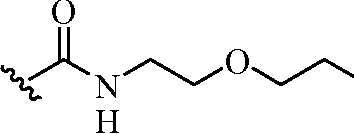
OH X
Rk
O O 1 %A AN'Rk
X N ''
Η u o hnΛ
X N
A
A'n N H
A V
X% 'Rk H R and
In another embodiment of Formula (I), Z1 is
HN
-N
OH ~N o o A A° x N V
H R or embodiment of Formula (I), Z1 is
O O
AN
H
O . II
1—S-OH < II
O .ο.
Rk
I
Αχ
Rk
In another
O HN
ΧΧΐΙ
-N Ο o
- -N AV
N X N ' k ’or H ' In another
-322017206246 20 Jul2017
O
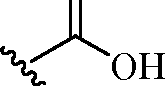
or
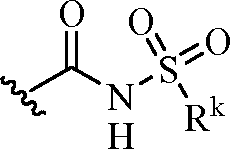
In another embodiment of Formula (I), Z1 is

In one embodiment of Formula (I), Y1 is phenylene or C5_6 heteroarylene; optionally fused to one or two rings selected from the group consisting of C3.8 cycloalkane, C3.8 cycloalkene, benzene, C5_6 heteroarene, C3.8 heterocycloalkane, and C3.8 heterocycloalkene; wherein Y1 is optionally substituted with one, two, three, or four substituents independently selected from the group consisting of R5, OR5, SR5, S(O)R5, SO2R5, C(O)R5, CO(O)R5, OC(O)R5, OC(O)OR5, NH2, NHR5, N(R5)2, NHC(O)R5, NR5C(O)R5, NHS(O)2R5, NR5S(O)2R5, NHC(O)OR5, NR5C(O)OR5, NHC(O)NH2, NHC(O)NHR5, NHC(O)N(R5)2, NR5C(O)NHR5, NR5C(O)N(R5)2, C(O)NH2, C(O)NHR5, C(O)N(R5)2, C(O)NHOH, C(O)NHOR5, C(O)NHSO2R5, C(O)NR5SO2R5, SO2NH2, SO2NHR5, SO2N(R5)2, CO(O)H, C(O)H, OH, CN, N5, NO2, F, Cl, Br and I. In another embodiment of Formula (I), Y1 is phenylene or C5_6 heteroarylene; wherein the phenylene and C5_6 heteroarylene represented by Y1 are optionally substituted with one or two substituents independently selected from the group consisting of R5, CN, F, Cl, Br and I. In another embodiment of Formula (I), Y1 is phenylene or C5_6 heteroarylene; wherein the phenylene and C5_6 heteroarylene represented by Y1 are optionally substituted with one or two substituents independently selected from the group consisting of R5, CN, F, Cl, Br and I; wherein R5 is Ci_6 alkyl.
In another embodiment of Formula (I), Y1 is pyrrolyl, pyrazolyl, triazolyl, pyridinyl, or phenyl. In another embodiment of Formula (I), Y1 is pyrrolyl, pyrazolyl, or triazolyl. In another embodiment of Formula (I), Y1 is pyridinyl or phenyl. In another embodiment of Formula (I), Y1 is pyrrolyl, pyrazolyl, triazolyl, pyridinyl, or phenyl; wherein the pyrrolyl, pyrazolyl, triazolyl, pyridinyl, and phenyl represented by Y1 are optionally substituted with one or two substituents independently selected from the group consisting of R5, CN, F, Cl, Br and I. In another embodiment of Formula (I), Y1 is pyrrolyl, pyrazolyl, triazolyl, pyridinyl, or phenyl; wherein the pyrrolyl, pyrazolyl, triazolyl, pyridinyl, and phenyl represented by Y1 are optionally substituted with one or two substituents independently selected from the group consisting of R5, CN, F, Cl, Br and I; wherein R5 is Ci_6 alkyl.
In one embodiment of Formula (I), L1 is selected from the group consisting of (CR6R7)q, (CR6R7)q, (CR6R7)s-O-(CR6R7)r, (CR6R7)s-C(O)-(CR6R7)r, (CR6R7)s-S-(CR6R7)r, (CR6R7)s-S(O)2-(CR6R7)r, (CR6R7)s-NR6AC(O)-(CR6R7)r, (CR6R7)s-C(O)NR6A-(CR6R7)r, (CR6R7)s-NR6A-(CR6R7)r, (CR6R7)s-S(O)2NR6A-(CR6R7)r, and (CR6R7)s-NR6AS(O)2-(CR6R7)r; and Y2 is C8_i4 cycloalkyl, C8_i4 cycloalkenyl, C8_i4 heterocycloalkyl, or C8_i4
-33 2017206246 20 Jul2017 heterocycloalkenyl; optionally fused to one or two rings selected from the group consisting of C3.8 cycloalkane, C3.8 cycloalkene, benzene, C5_6 heteroarene, C3.8 heterocycloalkane, and C3.8 heterocycloalkene; wherein Y2 is optionally substituted with one, two, three, four, or five substituents independently selected from the group consisting of R8, OR8, SR8, S(O)R8,
SO2R8, C(O)R8, CO(O)R8, OC(O)R8, OC(O)OR8, NH2, NHR8, N(R8)2, NHC(O)R8, NR8C(O)R8, NHS(O)2R8, NR8S(O)2R8, NHC(O)OR8, NR8C(O)OR8, NHC(O)NH2, NHC(O)NHR8, NHC(O)N(R8)2, NR8C(O)NHR8, NR8C(O)N(R8)2, C(O)NH2, C(O)NHR8, C(O)N(R8)2, C(O)NHOH, C(O)NHOR8, C(O)NHSO2R8, C(O)NR8SO2R8, so2nh2,
SO2NHR8, SO2N(R8)2, CO(O)H, C(O)H, OH, CN, N3, NO2, F, Cl, Br and I.
In another embodiment of Formula (I), L1 is (CR6R7)q; and Y2 is selected from the group consisting of Cg-u cycloalkyl and Cg-u heterocycloalkyl; wherein R6 and R7, at each occurrence, are hydrogen; and q is 1 or 2. In another embodiment of Formula (I), L1 is selected from the group consisting of (CR6R7)s-O-(CR6R7)r, (CR6R7)s-S-(CR6R7)r, (CR6R7)SS(O)2-(CR6R7)r, (CR6R7)s-NR6AC(O)-(CR6R7)r, (CR6R7)s-C(O)NR6A-(CR6R7)r, (CR6R7)SNR6A-(CR6R7)r, and (CR6R7)s-S(O)2NR6A-(CR6R7)r; Y2 is selected from the group consisting of Cs-i4 cycloalkyl, and Cg.14 heterocycloalkyl; s is 0; r is 0 or 1; R6A is independently selected from the group consisting of hydrogen, and Ci_6 alkyl; and R6 and R7, at each occurrence, are hydrogen.
In another embodiment of Formula (I),
X is heteroaryl;
Y1 is phenylene or C5.6 heteroarylene; wherein Y1 is optionally substituted with one, or two substituents independently selected from the group consisting of R5, CN, F, Cl, Br and i;
L1 is selected from the group consisting of (CR6R7)q, (CR6R7)s-O-(CR6R7)r, (CR6R7)SS-(CR6R7)r, (CR6R7)s-S(O)2-(CR6R7)r, (CR6R7)s-NR6AC(O)-(CR6R7)r, (CR6R7)S-C(O)NR6A(CR6R7)r, (CR6R7)s-NR6A-(CR6R7)r, and (CR6R7)s-S(O)2NR6A-(CR6R7)r;
Y2 is C8-i4 cycloalkyl, or Cg.14 heterocycloalkyl; wherein Y2 is optionally substituted with one, two, or three substituents independently selected from the group consisting of R8, OR8, SO2R8, CO(O)R8, OH, F, Cl, Br and I;
Z1 is selected from the group consisting of
HN
-N
OH
N , and
R2, at each occurrence, is independently Ci_6 alkyl;
R5, at each occurrence, is independently Ci_6 alkyl;
R6A is independently selected from the group consisting of hydrogen and Ci_6 alkyl; R6 and R7, at each occurrence, are each independently hydrogen;
-342017206246 20 Jul2017
R8, at each occurrence, is independently selected from the group consisting of Ci_6 alkyl and heterocyclyl; wherein the R8 CX alkyl is optionally substituted with one substituent independently selected from the group consisting of R16, OR16, SO2R16, and NHR16;
Rk, at each occurrence, is independently selected from the group consisting of Ci_6 5 alkyl, C3.7 heterocycloalkyl, C3.7 cycloalkyl and CX haloalkyl;
R16, at each occurrence, is independently selected from the group consisting of Cm alkyl, aryl, and heterocycloalkyl; wherein the R16 Cm alkyl is optionally substituted with one substituent independently selected from the group consisting of OCH3, OCH2CH2OCH3, and OCH2CH2NHCH3;
q is 1 or 2;
s is 0; r is 0 or 1;
wherein the sum of s and r is 0 or 1; m is 0;
n is 0, 1, or 2; and p is 0.
Still another embodiment pertains to a compound having Formula (I) selected from the group consisting of
6-[8-( 1,3-benzothiazol-2-ylcarbamoyl)-3,4-dihydroisoquinolin-2(lH)-yl]-3- {1 20 [tricyclo [3.3.1.13,7]dec-1 -ylmethyl]-1 H-pyrazol-4-yl}pyridine-2-carboxylic acid;
6-[8-(l,3-benzothiazol-2-ylcarbamoyl)-3,4-dihydroisoquinolin-2(lH)-yl]-3-[3,5dimethyl-l-(tricyclo[3.3.1.13’7]dec-l-ylmethyl)-lH-pyrazol-4-yl]pyridine-2-carboxylic acid; 6-[8-(l,3-benzothiazol-2-ylcarbamoyl)-3,4-dihydroisoquinolin-2(lH)-yl]-3-[5methyl-1 -(tricyclo [3.3.1.13’7]dec-1 -ylmethyl)-1 H-pyrazol-4-yl]pyridine-2-carboxylic acid;
6-[8-(l,3-benzothiazol-2-ylcarbamoyl)-3,4-dihydroisoquinolin-2(lH)-yl]-3-[l(spiro[3.5]non-7-ylmethyl)-lH-pyrazol-4-yl]pyridine-2-carboxylic acid;
6-[8-(l,3-benzothiazol-2-ylcarbamoyl)-3,4-dihydroisoquinolin-2(lH)-yl]-3-(l-{[3,5dimethyltricyclo [3.3.1.13,7]dec-1 -yl]methyl} -1 H-pyrazol-4-yl)pyridine-2-carboxylic acid;
6-[8-(l,3-benzothiazol-2-ylcarbamoyl)-3,4-dihydroisoquinolin-2(lH)-yl]-3-(l-{[330 hydroxytricyclo[3.3.1.13’7]dec-1 -yl]methyl}-1 H-pyrazol-4-yl)pyridine-2-carboxylic acid;
6-[8-(l,3-benzothiazol-2-ylcarbamoyl)-3,4-dihydroisoquinolin-2(lH)-yl]-3-(l-{[3methoxytricyclo[3.3.1.13’7]dec-1 -vI] methv I} -1 H-pyrazol-4-yl)pyridine-2-carboxylic acid;
6-[8-(l,3-benzothiazol-2-ylcarbamoyl)-3,4-dihydroisoquinolin-2(lH)-yl]-3-(l-{[3-(2methoxy ethoxy )tricyclo[3.3. l.l3’7]dec-l-yl]methyl}-177-pyrazol-4-yl)pyridine-2-carboxylic acid;
-35 2017206246 20 Jul2017
6-[8-( 1,3-benzothiazol-2-ylcarbamoyl)-3,4-dihydroisoquinolin-2(lH)-yl]-3- {1 [(3,5,7-trimethyltricyclo[3.3.1.13’7]dec-l-yl)methyl]-lH-pyrazol-4-yl}pyridine-2-carboxylic acid;
6-[8-(l,3-benzothiazol-2-ylcarbamoyl)-3,4-dihydroisoquinolin-2(lH)-yl]-3-[l5 (tricyclo[3.3.1.13’7]dec-2-ylmethyl)-lH-pyrazol-4-yl]pyridine-2-carboxylic acid;
6-[8-(l,3-benzothiazol-2-ylcarbamoyl)-3,4-dihydroisoquinolin-2(lH)-yl]-3-(l-{[3bromotri cyclo [3.3.1.13,7]dec-1 -yl]methyl} -1 H-pyrazol-4-yl)pyridine-2-carboxylic acid;
6-[8-(l,3-benzothiazol-2-ylcarbamoyl)-3,4-dihydroisoquinolin-2(lH)-yl]-3-(l-{[3(propan-2-yloxy)tri cyclo [3.3.1.13’7] dec-1 -yl]methy 1} -1 H-pyrazol-4-yl)pyridine-2 -carboxylic acid;
6-[8-(l,3-benzothiazol-2-ylcarbamoyl)-3,4-dihydroisoquinolin-2(lH)-yl]-3-[l-(2oxatricyclo[3.3.1.13’7]dec-l-ylmethyl)-lH-pyrazol-4-yl]pyridine-2-carboxylic acid;
6-[8-(l,3-benzothiazol-2-ylcarbamoyl)-4,4-dimethyl-3,4-dihydroisoquinolin-2(lH)yl] -3 - [5 -methyl-1 -(tri cyclo [3.3.1.13’7] dec-1 -y lmethyl)-1 H-pyrazol-4-yl]pyridine-2-carboxylic acid;
6-[8-(l,3-benzothiazol-2-ylcarbamoyl)-3,4-dihydroisoquinolin-2(lH)-yl]-3-(l-{[3(morpholin-4-yl)tri cyclo [3.3.1.13,7]dec-1 -yl]methyl} -1 H-pyrazol-4-yl)pyridine-2-carboxylic acid;
6-[8-(l,3-benzothiazol-2-ylcarbamoyl)-3,4-dihydroisoquinolin-2(lH)-yl]-3-(l-{[320 methoxytricyclo[3.3.1.13’7]dec-l-yl]methyl}-5-methyl-lH-pyrazol-4-yl)pyridine-2-carboxylic acid;
N-(l,3-benzothiazol-2-yl)-2-{6-[(methylsulfonyl)carbamoyl]-5-[5-methyl-l(tricyclo [3.3.1.13,7]dec-1 -y lmethyl)-1 H-pyrazol-4-yl]pyridin-2-yl} -1,2,3,4tetrahydroisoquinoline-8-carboxamide;
N-( 1,3 -benzothiazol-2 -yl)-2 - {6- [(cy clopropy lsulfonyl)carbamoyl] -5 - [5 -methyl-1 (tricyclo [3.3.1.13,7]dec-1 -y lmethyl)-1 H-pyrazol-4-yl]pyridin-2-yl} -1,2,3,4tetrahydroisoquinoline-8-carboxamide;
N-(l,3-benzothiazol-2-yl)-2-{5-[5-methyl-l-(tricyclo[3.3.1.13’7]dec-l-ylmethyl)-lHpyrazol-4-yl]-6-(2H-tetrazol-5-yl)pyridm-2-yl}-l,2,3,4-tetrahydroisoquinoline-830 carboxamide;
6-[8-(l,3-benzothiazol-2-ylcarbamoyl)-3,4-dihydroisoquinolin-2(lH)-yl]-3-{2methyl-4-[tricyclo[3.3.1.13’7]dec-l-ylmethoxy]phenyl}pyridine-2-carboxylic acid;
6-[8-(l,3-benzothiazol-2-ylcarbamoyl)-3,4-dihydroisoquinolin-2(lH)-yl]-3-{2methyl-3-[tricyclo[3.3.1.13’7]dec-l-ylmethoxy]phenyl}pyridine-2-carboxylic acid;
6-[8-(l,3-benzothiazol-2-ylcarbamoyl)-3,4-dihydroisoquinolin-2(lH)-yl]-3-{3[tricyclo[3.3.1.13,7]dec-1 -ylmethoxy]phenyl}pyridine-2-carboxylic acid;
-362017206246 20 Jul2017
6-[8-(l,3-benzothiazol-2-ylcarbamoyl)-3,4-diliydroisoquinolin-2(lH)-yl]-3-[5-cyano2-methyl-1 -(tricyclo [3.3.1.13,7]dec-1 -ylmethyl)-1 H-pyrrol-3 -yl]pyridine-2-carboxylic acid;
- [5 -methyl-1 -(tri cyclo [3.3.1.13’7] dec-1 -ylmethyl)-1 H-pyrazol-4-yl] -6- [8([1,3 ]thiazolo [5,4-b]pyridin-2-ylcarbamoyl)-3,4-dihydroisoquinolin-2( 1 H)-yl]pyridine-25 carboxylic acid;
6-[8-(l,3-benzothiazol-2-ylcarbamoyl)-3,4-dihydroisoquinolin-2(lH)-yl]-2'(tricyclo[3.3.1.13’7]dec-l-ylmethoxy)-3,4'-bipyridine-2-carboxylic acid;
6- [8-( 1,3-benzothiazol-2-ylcarbamoyl)-3,4-dihydroisoquinolin-2( 1 H)-yl]-3 -[ 1 -({3-[2(morpholin-4-yl)ethoxy]tricyclo[3.3.1.13’7]dec-l-yl}methyl)-lH-pyrazol-4-yl]pyridine-210 carboxylic acid;
6-[8-(l,3-benzothiazol-2-ylcarbamoyl)-3,4-dihydroisoquinolin-2(lH)-yl]-3'-methyl2'-(tricyclo[3.3.1.l3,7]dec-l-ylmethoxy)-3,4'-bipyridine-2-carboxylic acid;
6-[8-(l,3-benzothiazol-2-ylcarbamoyl)-3,4-dihydroisoquinolin-2(lH)-yl]-3-{2methyl-3 - [tricyclo [3.3.1.13’7] dec-1 -yloxy ]phenyl} pyridine-2-carboxylic acid;
6-[8-(l,3-benzothiazol-2-ylcarbamoyl)-3,4-dihydroisoquinolin-2(lH)-yl]-3-{5-cyanol-[tricyclo[3.3.1.13’7]dec-l-ylmethyl]-lH-pyrazol-4-yl}pyridine-2-carboxylic acid;
- [5 -methyl-1 -(tri cyclo [3.3.1.13’7] dec-1 -ylmethyl)-1 H-pyrazol-4-yl] -6- [8([1,3 ]thiazolo [4,5 -b]pyridin-2-ylcarbamoyl)-3,4-dihydroisoquinolin-2( 1 H)-yl]pyridine-2carboxylic acid;
3-[5-methyl-l-(tricyclo[3.3.1.13’7]dec-l-ylmethyl)-lH-pyrazol-4-yl]-6-[8([l,3]thiazolo[4,5-c]pyridin-2-ylcarbamoyl)-3,4-dihydroisoquinolin-2(lH)-yl]pyridine-2carboxylic acid;
6-[8-(l,3-benzothiazol-2-ylcarbamoyl)-3,4-dihydroisoquinolin-2(lH)-yl]-3-(l-{[3,5dimethyltri cyclo [3.3.1.13,7]dec-1 -yl]methyl} -5 -methyl-1 H-pyrazol-4-yl)pyridine-2-carboxylic acid;
6-[8-(l,3-benzothiazol-2-ylcarbamoyl)-3,4-dihydroisoquinolin-2(lH)-yl]-3-(l-{[3(1,1 -dioxidothiomorpholin-4-yl)tri cyclo [3.3.1.13,7]dec-1 -yl]methyl} -1 H-pyrazol-4yl)pyridine-2-carboxylic acid;
6-[8-(l,3-benzothiazol-2-ylcarbamoyl)-3,4-dihydroisoquinolin-2(lH)-yl]-3-{5-cyano3 0 2-methyl-1 - [2-(tricyclo [3.3.1.13,7]dec-1 -yl)ethyl]-1 H-pyrrol-3-yl}pyridine-2-carboxylic acid;
N-(l,3-benzothiazol-2-yl)-2-{5-[5-cyano-2-methyl-l-(tricyclo[3.3. l.l3,7]dec-lylmethyl)-lH-pyrrol-3-yl]-6-[(methylsulfonyl)carbamoyl]pyridin-2-yl}-l,2,3,4tetrahydroisoquinoline-8-carboxamide;
N-(l, 3-benzothiazol-2-yl)-2-{5-[5-cyano-2-methyl-1-(tri cyclo [3.3.1. l3,7]dec-l3 5 ylmethyl)-1 H-pyrrol-3 -yl]-6-[(cyclopropylsulfonyl)carbamoyl]pyridin-2-yl} -1,2,3,4tetrahydroisoquinoline-8-carboxamide;
-372017206246 20 Jul2017
N-(l,3-benzothiazol-2-yl)-2-{5-(l-{[3-methoxytricyclo[3.3.1.13’7]dec-l-yl]methyl}5-methyl-lH-pyrazol-4-yl)-6-[(methylsulfonyl)carbamoyl]pyridin-2-yl}-l,2,3,4tetrahydroisoquinoline-8-carboxamide;
6-[8-(l,3-benzothiazol-2-ylcarbamoyl)-3,4-dihydroisoquinolin-2(lH)-yl]-3-(l-{[35 methoxy-5,7-dimethyltricy clo [3.3.1.13’7] dec-1 -yl]methyl} -5 -methyl-1 H-pyrazol-4yl)pyridine-2-carboxylic acid;
N-(l,3-benzothiazol-2-yl)-2-{5-(l-{[3-methoxytricyclo[3.3.1.13’7]dec-l-yl]methyl}5-methyl-lH-pyrazol-4-yl)-6-[(morpholin-4-ylsulfonyl)carbamoyl]pyridin-2-yl}-l,2,3,4tetrahydroisoquinoline-8-carboxamide;
N-(l,3-benzothiazol-2-yl)-2-[5-(l-{[3-methoxytricyclo[3.3.1.13’7]dec-l-yl]methyl}-5 methyl-lH-pyrazol-4-y 1)-6- {[(trifluoromethyl)sulfonyl]carbamoyl}pyridin-2 -yl]-l, 2,3,4tetrahydroisoquinoline-8-carboxamide;
N-( 1,3-benzothiazol-2-y 1)-2- {6- [(cyclopropylsulfonyl)carbamoyl]-5 -(1 - {[3 methoxytricyclo[3.3.1.13’7]dec-l-yl]methyl}-5-methyl-lH-pyrazol-4-yl)pyridin-2-yl}-l,2,3,4· tetrahydroisoquinoline-8-carboxamide;
6-[8-(l,3-benzothiazol-2-ylcarbamoyl)-3,4-dihydroisoquinolin-2(lH)-yl]-3-{5chloro-1 - [tricyclo[3.3.1.13,7]dec-1 -ylmethyl] -1 H-pyrazol-4-yl}pyridine-2-carboxylic acid;
6-[8-( 1,3-benzothiazol-2-ylcarbamoyl)-1-methyl-3,4-dihydroisoquinolin-2( 1 H)-yl]-3 [5-methyl-1 -(tricyclo [3.3.1.13,7]dec-1 -ylmethyl)-1 H-pyrazol-4-yl]pyridine-2-carboxylic acid;
6-[8-(l,3-benzothiazol-2-ylcarbamoyl)(l,l-2H2)-3,4-dihydroisoquinolin-2(l//)-yl]-3[5-methyl-1 -(tricyclo [3.3.1.13,7]dec-1 -ylmethyl)-1 //-pvrazol-4-v 1]pyridine-2-carboxy 1 ic acid;
6-[8-(l,3-benzothiazol-2-ylcarbamoyl)-3,4-dihydroisoquinolin-2(lH)-yl]-3-(l-{[3-(2 methoxy ethoxy )tri cyclo [3.3.1.13,7]dec-1 -yl]methyl} -5 -methyl-1 H-pyrazol-4-yl)pyridine-2carboxylic acid;
6- [8-( 1,3-benzothiazol-2-ylcarbamoyl)-3,4-dihydroisoquinolin-2( 1 H)-yl]-3 -(1 - {[ 1 -(2 methoxyethyl)cyclooctyl]methyl}-5-methyl-lH-pyrazol-4-yl)pyridine-2-carboxylic acid;
6-[8-(l,3-benzothiazol-2-ylcarbamoyl)-3,4-dihydroisoquinolin-2(lH)-yl]-3-{2-cyano 3-[tricyclo[3.3.1. l3,7]dec-l -ylamino]phenyl}pyridine-2-carboxylic acid;
6-[8-(l,3-benzothiazol-2-ylcarbamoyl)-3,4-dihydroisoquinolin-2(lH)-yl]-3-{2-cyano 30 3-[tricyclo[3.3.1. l3,7]dec-l -ylsulfanyl]phenyl}pyridine-2-carboxylic acid;
6-[8-(imidazo[l,2-a]pyridin-2-ylcarbamoyl)-3,4-dihydroisoquinolin-2(lH)-yl]-3-[5methyl-1 -(tricyclo [3.3.1.13’7]dec-1 -ylmethyl)-1 H-pyrazol-4-yl]pyridine-2-carboxylic acid;
6-[8-(l,3-benzothiazol-2-ylcarbamoyl)-3,4-dihydroisoquinolin-2(lH)-yl]-3-(2methyl-3-{[tricyclo[3.3.1.13’7]dec-l-ylcarbonyl]amino}phenyl)pyridine-2-carboxylic acid;
6-[8-(l,3-benzothiazol-2-ylcarbamoyl)-3,4-dihydroisoquinolin-2(lH)-yl]-3-{2methyl-3 - [tricy clo [3.3.1.13’7] dec-1 -y lsulfamoyl]phenyl} pyridine-2 -carboxylic acid;
-382017206246 20 Jul2017
6-[8-(l,3-benzothiazol-2-ylcarbamoyl)-3,4-dihydroisoquinolin-2(lH)-yl]-3-(2methyl-3-{methyl[tricyclo[3.3.1.13’7]dec-l-ylcarbonyl]amino}phenyl)pyridine-2-carboxylic acid;
6-[8-(l,3-benzothiazol-2-ylcarbamoyl)-3,4-dihydroisoquinolin-2(lH)-yl]-3-(55 methyl-1 - {[3-(tetrahydro-2H-pyran-4-ylmethoxy)tricyclo[3.3.1.13,7]dec-1 -yl]methyl[ -1Hpyrazol-4-yl)pyridine-2-carboxylic acid;
6-[8-(l,3-benzothiazol-2-ylcarbamoyl)-3,4-dihydroisoquinolin-2(lH)-yl]-3-{2methyl-3 - [tri cyclo [3.3.1.13’7] dec-1 -ylcarbamoyl]phenyl} pyridine-2 -carboxylic acid;
6-[8-(l,3-benzothiazol-2-ylcarbamoyl)-3,4-dihydroisoquinolin-2(lH)-yl]-3-(210 methyl-3- {methyl[tricyclo[3.3.1. 13,7]dec-1 -ylmethyl]amino}phenyl)pyridine-2-carboxylic acid;
6- [8-( 1,3-benzothiazol-2-ylcarbamoyl)-3,4-dihydroisoquinolin-2( 1 H)-yl]-3 -(1 - {[2-(2methoxy ethyl)tricy clo [3.3.1.13,7]dec-2-yl]methyl} -1 H-pyrazol-4-yl)pyridine-2-carboxylic acid;
6-[8-(l,3-benzothiazol-2-ylcarbamoyl)-3,4-dihydroisoquinolin-2(lH)-yl]-3-[5methyl-1 -(tricy clo [3.3.1.13,7]dec-1 -ylmethyl)-1 Η-1,2,3 -triazol-4-yl]pyridine-2 -carboxylic acid;
6-[8-(l,3-benzothiazol-2-ylcarbamoyl)-3,4-dihydroisoquinolin-2(lH)-yl]-3-(5-cyano1 - {[3 -methoxytri cyclo [3.3.1.13’7] dec-1 -yl]methy 1} -2-methyl-1 H-pyrrol-3 -yl)pyridine-2 20 carboxylic acid;
6-[8-(l,3-benzothiazol-2-ylcarbamoyl)-3,4-dihydroisoquinolin-2(lH)-yl]-3-[5methyl-1 -(2-oxatri cyclo [3.3.1.13,7]dec-1 -ylmethyl)-1 H-pyrazol-4-yl]pyridine-2-carboxylic acid;
6-[8-(l,3-benzothiazol-2-ylcarbamoyl)-3,4-dihydroisoquinolin-2(lH)-yl]-3-[2-cyano25 3-(tricyclo[3.3.1.13,7]dec-1 -ylsulfonyl)phenyl]pyridine-2-carboxylic acid;
6-[8-(l,3-benzothiazol-2-ylcarbamoyl)-3,4-dihydroisoquinolin-2(lH)-yl]-2'[cyclooctyl(methyl)amino]-3'-methyl-3,4'-bipyridine-2-carboxylic acid;
6-[8-(l,3-benzothiazol-2-ylcarbamoyl)-3,4-dihydroisoquinolin-2(lH)-yl]-3-[5methyl-1 -(tricyclo [3.3.1.13,7]dec-2-ylmethyl)-1 H-pyrazol-4-yl]pyridine-2-carboxylic acid;
6- [8-( 1,3-benzothiazol-2-ylcarbamoyl)-3,4-dihydroisoquinolin-2( 1 H)-yl]-3 -[ 1 -({3- [2(2-methoxy ethoxy)ethoxy]tricyclo[3.3.1.13,7]dec-l -yl}methyl)-5-methyl-lH-pyrazol-4yl]pyridine-2-carboxylic acid;
6-[8-(l,3-benzothiazol-2-ylcarbamoyl)-3,4-dihydroisoquinolin-2(lH)-yl]-3-(2methyl-3 - {methyl [(tricyclo [3.3.1.13 7]dec-2 -yl] carbamoyl }phenyl)pyridine-2 -carboxylic acid;
6-[8-(l,3-benzothiazol-2-ylcarbamoyl)-3,4-dihydroisoquinolin-2(lH)-yl]-3-[5methyl-1 -({1 - [2-(methylsulfonyl)ethoxy] cyclooctyl [methyl)-1 H-pyrazol-4-yl]pyridine-2carboxylic acid;
-392017206246 20 Jul2017
6-[8-(l,3-benzothiazol-2-ylcarbamoyl)-3,4-dihydroisoquinolin-2(lH)-yl]-3-[5methyl-1-(2-oxatri cyclo [3.3.1.13,7]dec-1-ylm ethyl)-1 Η-1,2,3-triazol-4-yl]pyridine-2carboxylic acid;
3-[5-methyl-l-(2-oxatricyclo[3.3.1.13’7]dec-l-ylmethyl)-lH-pyrazol-4-yl]-6-[85 ([1,3 ]thiazolo [5,4-b]pyridin-2-ylcarbamoyl)-3,4-dihydroisoquinolin-2( 1 H)-yl]pyridine-2carboxylic acid;
6-[8-(l,3-benzothiazol-2-ylcarbamoyl)-3,4-dihydroisoquinolin-2(lH)-yl]-3-{2methyl-3-[methyl(2-oxatricyclo[3.3.1. l3,7]dec-l -ylcarbonyl)amino]phenyl}pyridine-2carboxylic acid;
6-[8-(l,3-benzothiazol-2-ylcarbamoyl)-3,4-dihydroisoquinolin-2(lH)-yl]-3-(2methyl-3-{methyl[tricyclo[3.3.1. l3,7]dec-2-yl]sulfamoyl}phenyl)pyridine-2-carboxylic acid;
6-[8-(l,3-benzothiazol-2-ylcarbamoyl)-3,4-diliydroisoquinolin-2(lH)-yl]-3'-methyl2'-(tricyclo[3.3.1. l3,7]dec-l -ylsulfonyl)-3,4'-bipyridine-2-carboxylic acid;
6-[8-(l,3-benzothiazol-2-ylcarbamoyl)-3,4-dihydroisoquinolin-2(lH)-yl]-3-[5-cyano· 15 2-methyl-1 -(2-oxatri cyclo [3.3.1.13,7]dec-1 -y lmethyl)-1 H-pyrrol-3 -yl]pyridine-2-carboxylic acid;
6-[8-(l,3-benzothiazol-2-ylcarbamoyl)-3,4-dihydroisoquinolin-2(lH)-yl]-3-{5-cyano 2-methyl-1 - [(3 -methyl-2-oxatri cyclo [3.3.1.13’7] dec-1 -yl)methyl] -1 H-pyrrol-3 -yl} pyridine-2 carboxylic acid;
6-[8-(imidazo[l,2-a]pyrazin-2-ylcarbamoyl)-3,4-dihydroisoquinolin-2(lH)-yl]-3-[5methyl-1 -(tricyclo [3.3.1.13’7]dec-1 -ylmethyl)-1 H-pyrazol-4-yl]pyridine-2-carboxylic acid;
6-[8-(l,3-benzothiazol-2-ylcarbamoyl)-3,4-diliydroisoquinolin-2(lH)-yl]-3'-methyl2'-(tricyclo[3.3.1.l3,7]dec-l-ylsulfany 1)-3,4'-bipyridine-2-carboxylie acid;
2- {6- [(methylsulfonyl)carbamoyl]-5 -[5 -methyl-1 -(tricyclo[3.3.1.13,7]dec-1 -y lmethyl) 25 lH-pyrazol-4-yl]pyridin-2-yl}-N-([l,3]thiazolo[5,4-b]pyridin-2-yl)-l,2,3,4tetrahydroisoquinoline-8-carboxamide;
6-[8-(l,3-benzothiazol-2-ylcarbamoyl)-3,4-diliydroisoquinolin-2(lH)-yl]-3'-methyl2'-(tricyclo[3.3.1.l3,7]dec-l-ylamino)-3,4'-bipyridine-2-carboxylic acid;
6-[8-(imidazo[l,2-b]pyridazin-2-ylcarbamoyl)-3,4-dihydroisoquinolin-2(lH)-yl]-33 0 [5-methyl-1 -(tricyclo [3.3.1.13,7]dec-1 -ylmethyl)-1 H-pyrazol-4-yl]pyridine-2-carboxylic acid;
- [5 -methyl-1 -(tricy clo [3.3.1.13’7] dec-1 -y lmethyl)-1 H-pyrazol-4-yl] -6-[8([l,3]thiazolo[5,4-c]pyridin-2-ylcarbamoyl)-3,4-dihydroisoquinolin-2(lH)-yl]pyridine-2carboxylic acid;
6-[8-( 1,3-benzothiazol-2-ylcarbamoyl)-3,4-dihydroisoquinolin-2(lH)-yl]-3- {1 -[(53 5 methoxy spiro [2.5 ]oct-5 -yl)m ethyl] -5 -methyl-1 H-pyrazol-4-yl} pyridine-2-carboxylic acid;
-402017206246 20 Jul2017
6-[8-(l,3-benzothiazol-2-ylcarbamoyl)-3,4-dihydroisoquinolin-2(lH)-yl]-3-(l-{[3{2-[2-(2-methoxyethoxy)ethoxy]ethoxy }tricyclo[3.3.1.13,7]dec-1 -yl] methyl} -5-methyl-l Hpyrazol-4-yl)pyridine-2-carboxylic acid;
6-[8-(l,3-benzothiazol-2-ylcarbamoyl)-3,4-dihydroisoquinolin-2(lH)-yl]-3-(55 methyl-1 - {[3 -(methylsulfonyl)tri cyclo [3.3.1.13 ’7] de c-1 -yl]methyl} -1 H-pyrazol-4-yl)pyridine
2-carboxylic acid;
6-[8-(l,3-benzothiazol-2-ylcarbamoyl)-3,4-dihydroisoquinolin-2(lH)-yl]-3-[l-({3,5· dimethyl-7-[2-(methylamino)ethoxy]tricyclo[3.3.1.13’7]dec-l-yl}methyl)-5-methyl-lHpyrazol-4-yl]pyridine-2-carboxylic acid;
6-[8-(l,3-benzothiazol-2-ylcarbamoyl)-3,4-dihydroisoquinolin-2(lH)-yl]-3-(5methyl-1 - {[3-(2- {2-[2-(methylamino)ethoxy]ethoxy} ethoxy)tricyclo[3.3.1.13,7]dec-l yl]methyl}-lH-pyrazol-4-yl)pyridine-2-carboxylic acid;
6-[8-(l,3-benzothiazol-2-ylcarbamoyl)-3,4-dihydroisoquinolin-2(lH)-yl]-3-[l-({8[(benzyloxy)carbonyl]-8-azabicyclo[3.2.1]oct-3-yl}methyl)-lH-pyrazol-4-yl]pyridine-215 carboxylic acid;
6-[8-(l,3-benzothiazol-2-ylcarbamoyl)-3,4-dihydroisoquinolin-2(lH)-yl]-6'-oxo-l'(tricyclo[3.3.1.13,7]dec-1 -ylmethyl)-l',6'-dihydro-3,3'-bipyridine-2-carboxylic acid;
6-[8-(l,3-benzothiazol-2-ylcarbamoyl)-3,4-dihydroisoquinolin-2(lH)-yl]-3-(l-{[3,5· dimethyl-7-(2- {2-[2-(methylamino)ethoxy]ethoxy} ethoxy )tri cyclo [3.3.1.13,7]dec-1 20 yl]methyl}-5-methyl-lH-pyrazol-4-yl)pyridine-2-carboxylic acid; and therapeutically acceptable salts, metabolites, prodrugs, salts of metabolites, and salts of prodrugs thereof.
In another aspect, the present invention provides compounds of Formula (II)

Formula (II) and therapeutically acceptable salts, metabolites, prodrugs, salts of metabolites, and salts of prodrugs thereof, wherein X, L1, Y2, Z1, R1, R2, R3, m, n, and p are as described herein for Formula (I); Rx is as described herein for substituents on Y1, and o is 0, 1, 2, or 3.
One embodiment of this invention pertains to compounds, and therapeutically acceptable salts thereof, which are useful as inhibitors of anti-apoptotic Bcl-xL proteins, the compounds having Formula (II)
-41 2017206246 20 Jul2017

Formula (II), wherein
X is heteroaryl; wherein the heteroaryl represented by X is optionally substituted with 5 one, two, three, or four R4;
Rx, at each occurrence, is independently selected from the group consisting of R5, OR5, SR5, S(O)R5, SO2R5, C(O)R5, CO(O)R5, OC(O)R5, OC(O)OR5, NH2, NHR5, N(R5)2, NHC(O)R5, NR5C(O)R5, NHS(O)2R5, NR5S(O)2R5, NHC(O)OR5, NR5C(O)OR5, NHC(O)NH2, NHC(O)NHR5, NHC(O)N(R5)2, NR5C(O)NHR5, NR5C(O)N(R5)2, C(O)NH2,
C(O)NHR5, C(O)N(R5)2, C(O)NHOH, C(O)NHOR5, C(O)NHSO2R5, C(O)NR5SO2R5,
SO2NH2, SO2NHR5, SO2N(R5)2, CO(O)H, C(O)H, OH, CN, N5, NO2, F, Cl, Br and I;
L1 is selected from the group consisting of (CR6R7)q, (CR6R7)s-O-(CR6R7)r, (CR6R7)SC(O)-(CR6R7)r, (CR6R7)s-S-(CR6R7)r, (CR6R7)s-S(O)2-(CR6R7)r, (CR6R7)S-NR6AC(O)(CR6R7)r, (CR6R7)s-C(O)NR6A-(CR6R7)r, (CR6R7)s-NR6A-(CR6R7)r, (CR6R7)s-S(O)2NR6A15 (CR6R7)r, and (CR6R7)s-NR6AS(O)2-(CR6R7)r;
Y2 is C8_i4 cycloalkyi, Cg.u cycloalkenyl, Cg-u heterocycloalkyl, or Cg.u heterocycloalkenyl; optionally fused to one or two rings selected from the group consisting of C3_g cycloalkane, C3.8 cycloalkene, benzene, C5.6 heteroarene, C3.8 heterocycloalkane, and C3.8 heterocycloalkene; wherein Y2 is optionally substituted with one, two, three, four, or five substituents independently selected from the group consisting of R8, OR8, SR8, S(O)R8,
SO2R8, C(O)R8, CO(O)R8, OC(O)R8, OC(O)OR8, NH2, NHR8, N(R8)2, NHC(O)R8, NR8C(O)R8, NHS(O)2R8, NR8S(O)2R8, NHC(O)OR8, NR8C(O)OR8, NHC(O)NH2, NHC(O)NHR8, NHC(O)N(R8)2, NR8C(O)NHR8, NR8C(O)N(R8)2, C(O)NH2, C(O)NHR8, C(O)N(R8)2, C(O)NHOH, C(O)NHOR8, C(O)NHSO2R8, C(O)NR8SO2R8, so2nh2,
SO2NHR8, SO2N(R8)2, CO(O)H, C(O)H, OH, CN, N3, NO2, F, Cl, Br and I;
Z1 is selected from the group consisting of C(O)OR9, C(O)NR10Rn, C(O)Rn,
NR10C(O)Rn, NR10C(O)NR10R11, OC(O)NR10Rn, NR10C(O)OR9, C(=NOR10)NR10Rn, NR10C(=NCN)NR10R11, NR10S(O)2NR10Rn, S(O)2R9, S(O)2NR10Rn, N(R10)S(O)2Rn, NR10C(=NR11)NR10R11, C(=S)NR10Rn, C(=NR10)NR10Rn, halogen, NO2, and CN; or
Z1 is selected from the group consisting of
-42 2017206246 20 Jul2017

Η
Jk .Ον k ΌΗ X N Rk
O O ^NA
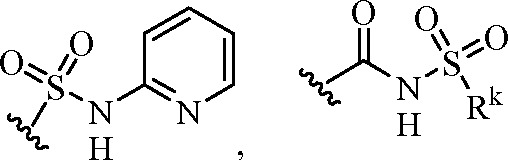
, and
Rk
I

H

!—S-OH
O
II
R1, at each occurrence, is independently selected from the group consisting of halo, Ci_6 alkyl, C2.6 alkenyl, C2.6 alkynyl, and Ci_6 haloalkyl;
R2, at each occurrence, is independently selected from the group consisting of deuterium, halo, Ci_6 alkyl, C2.6 alkenyl, C2.6 alkynyl, and Ci_6 haloalkyl;
two R2 that are attached to the same carbon atom, together with said carbon atom, optionally form a ring selected from the group consisting of heterocycloalkyl, heterocycloalkenyl, cycloalkyl, and cycloalkenyl;
R3, at each occurrence, is independently selected from the group consisting of halo, Ci_6 alkyl, C2.6 alkenyl, C2.6 alkynyl, and Ci_6 haloalkyl;
R4, at each occurrence, is independently selected from the group consisting of NR12R13, OR12, CN, NO2, halogen, C(O)OR12, C(O)NR12R13, NR12C(O)R13, NR12S(O)2R14, NR12S(O)R14, S(O)2R14, S(O)R14 and R14;
R5, at each occurrence, is independently selected from the group consisting of Ci_6 alkyl, C2.6 alkenyl, C2.6 alkynyl, Ci_6 haloalkyl, Ci_6 hydroxyalkyl, aryl, heterocyclyl, cycloalkyl, and cycloalkenyl;
R6A is independently selected from the group consisting of hydrogen, Ci_6 alkyl, C2.6 alkenyl, C2_6 alkynyl, and Ci_6 haloalkyl;
R6 and R7, at each occurrence, are each independently selected from the group consisting of hydrogen, R15, OR15, SR15, S(O)R15, SO2R15, C(O)R15, CO(O)R15, OC(O)R15, OC(O)OR15, NH2, NHR15, N(R15)2, NHC(O)R15, NR15C(O)R15, NHS(O)2R15, NR15S(O)2R15, NHC(O)OR15, NR15C(O)OR15, NHC(O)NH2, NHC(O)NHR15, NHC(O)N(R15)2, NR15C(O)NHR15, NR15C(O)N(R15)2, C(O)NH2, C(O)NHR15, C(O)N(R15)2, C(O)NHOH, C(O)NHOR15, C(O)NHSO2R15, C(O)NR15SO2R15, so2nh2, SO2NHR15, SO2N(R15)2, CO(O)H, C(O)H, OH, CN, N3, NO2, F, Cl, Br and I;
R8, at each occurrence, is independently selected from the group consisting of Ci_6 alkyl, C2.6 alkenyl, C2.6 alkynyl, Ci_6 haloalkyl, aryl, heterocyclyl, cycloalkyl, and cycloalkenyl; wherein the R8 Ci_6 alkyl, C2_6 alkenyl, C2_6 alkynyl, and Ci_6 haloalkyl are
II
-43 2017206246 20 Jul2017 optionally substituted with one, two, three, four, five, or six substituents independently selected from the group consisting of R16, OR16, SR16, S(O)R16, SO2R16, C(O)R16, CO(O)R16, OC(O)R16, OC(O)OR16, NH2, NHR16, N(R16)2, NHC(O)R16, NR16C(O)R16, NHS(O)2R16, NR16S(O)2R16, NHC(O)OR16, NR16C(O)OR16, NHC(O)NH2, NHC(O)NHR16,
NHC(O)N(R16)2, NR16C(O)NHR16, NR16C(O)N(R16)2, C(O)NH2, C(O)NHR16, C(O)N(R16)2,
C(O)NHOH, C(O)NHOR16, C(O)NHSO2R16, C(O)NR16SO2R16, SO2NH2, SO2NHR16, SO2N(R16)2, CO(O)H, C(O)H, OH, CN, N3, NO2, F, Cl, Br and I; wherein the R8 aryl, heterocyclyl, cycloalkyl, and cycloalkenyl are optionally substituted with one, two, or three substituents independently selected from the group consisting of Ci_6 alkyl, C2.6 alkenyl, C2.6 alkynyl, Ci_6 haloalkyl, NH2, C(O)NH2, SO2NH2, C(O)H, (O), OH, CN, NO2, OCF3,
OCF2CF3, F, Cl, Br and I;
R9 is selected from the group consisting of Ci_6 alkyl, C2.6 alkenyl, C2.6 alkynyl, Ci_6 haloalkyl, cycloalkyl, phenyl and (CH2)i_4 phenyl; and
R10 and R11, at each occurrence, are each independently selected from the group 15 consisting of hydrogen, Ci_6 alkyl, C2.6 alkenyl, C2.6 alkynyl, C3.6 cycloalkyl, Ci_6 haloalkyl, phenyl and (CH2)i_4-phenyl; or
R10 and R11, or R10 and R9, together with the atom to which each is attached are combined to form a heterocyclyl;
Rk, at each occurrence, is independently selected from the group consisting of Ci_6 20 alkyl, C2.6 alkenyl, C2.6 alkynyl, C3.7 heterocycloalkyl, C3.7 cycloalkyl and Ci_6 haloalkyl;
R12 and R13, at each occurrence, are each independently selected from the group consisting of hydrogen, Cm alkyl, C2.4 alkenyl, C2.4 alkynyl, Cm haloalkyl and (CH2)i_4 phenyl;
R14, at each occurrence, is independently selected from the group consisting of Cm 25 alkyl, C2.4 alkenyl, C2.4 alkynyl and Ci_4 haloalkyl;
R12 and R13, or R12 and R14, at each occurrence, together with the atom to which each is attached, are optionally combined to form a heterocyclyl;
R15, at each occurrence, is independently selected from the group consisting of Cm alkyl, C2.4 alkenyl, C2.4 alkynyl, Cm haloalkyl, Cm hydroxyalkyl, aryl, heterocyclyl, cycloalkyl, and cycloalkenyl; wherein the R15 Cm alkyl, C2m alkenyl, C2.4 alkynyl, Cm haloalkyl, and Cm hydroxyalkyl are optionally substituted with one, two, or three substituents independently selected from the group consisting of O-(Ci_4 alkyl), NH2, C(O)NH2, SO2NH2, C(O)H, C(O)OH, (O), OH, CN, NO2, OCF3, OCF2CF3, F, Cl, Br and I;
R16, at each occurrence, is independently selected from the group consisting of Cm alkyl, C2.4 alkenyl, C2.4 alkynyl, Ci_4 haloalkyl, Ci_4 hydroxyalkyl, aryl, heterocycloalkyl, heterocycloalkenyl, heteroaryl, cycloalkyl, and cycloalkenyl; wherein the R16 Cm alkyl, C2.4 alkenyl, C2.4 alkynyl, Cm haloalkyl, and Cm hydroxyalkyl are optionally substituted with one
-442017206246 20 Jul2017 substituent independently selected from the group consisting of OCH3, OCH2CH2OCH3, and OCH2CH2NHCH3;
q is 1, 2, or 3; s is 0, 1, 2, or 3;
r is 0, 1, 2, or 3;
wherein the sum of s and r is 0, 1, or 2; m is 0, 1, 2, or 3;
n is 0, 1, 2, 3, 4, 5, or 6;
is 0, 1, 2, or 3; and p is 0, 1, or 2.
In one embodiment of Formula (II), m is 0, 1, 2, or 3; n is 0, 1, 2, 3, 4, 5, or 6; and p is 0, 1, or 2. In another embodiment of Formula (II), n is 0, 1, or 2. In another embodiment of Formula (II), n is 0, 1, or 2; and each R2 is independently deuterium or Ci_6 alkyl. In another embodiment of Formula (II), m, n, and p are 0.
In one embodiment of Formula (II), X is heteroaryl, which is optionally substituted with one, two, three or four R4. In another embodiment of Formula (II), X is heteroaryl, which is unsubstituted. In another embodiment of Formula (II), X is heteroaryl, which is substituted with one R4. In another embodiment of Formula (II), X is heteroaryl, which is substituted with two R4. In another embodiment of Formula (II), X is heteroaryl, which is substituted with one R4, and R4 is OR12 or halogen. In another embodiment of Formula (II), X is heteroaryl, which is substituted with two R4, and each R4 is independently OR12 or halogen. In another embodiment of Formula (II), X is heteroaryl, which is substituted with one R4, and R4 is Cl, F, or methoxy. In another embodiment of Formula (II), X is heteroaryl, which is substituted with two R4, and each R4 is independently F.
In one embodiment of Formula (II), X benzo[d]thiazolyl, thiazolo[5,4-b]pyridinyl, thiazolo[4,5-c]pyridinyl, imidazo[l,2-a]pyridinyl, thiazolo[5,4-c]pyridinyl, thiazolo[4,5b]pyridinyl, imidazo[l,2-a]pyrazinyl, or imidazo[l,2-b]pyridazinyl, which are optionally substituted with one, two, three or four R4. In another embodiment of Formula (II), X is benzo[d]thiazolyl, thiazolo[5,4-b]pyridinyl, thiazolo[4,5-c]pyridinyl, imidazo[l,2-a]pyridinyl, thiazolo[5,4-c]pyridinyl, thiazolo[4,5-b]pyridinyl, imidazo[l,2-a]pyrazinyl, or imidazo[l,2b]pyridazinyl, which are unsubstituted. In another embodiment of Formula (II), X is benzo[d]thiazolyl, thiazolo[5,4-b]pyridinyl, thiazolo[4,5-c]pyridinyl, imidazo[l,2-a]pyridinyl, thiazolo[5,4-c]pyridinyl, thiazolo[4,5-b]pyridinyl, imidazo[l,2-a]pyrazinyl, or imidazo[l,2b]pyridazinyl, which are substituted with one R4. In another embodiment of Formula (II), X is benzo[d]thiazolyl, thiazolo[5,4-b]pyridinyl, thiazolo[4,5-c]pyridinyl, imidazo[l,2a]pyridinyl, thiazolo[5,4-c]pyridinyl, thiazolo[4,5-b]pyridinyl, imidazo[l,2-a]pyrazinyl, or imidazo[l,2-b]pyridazinyl, which are substituted with two R4. In another embodiment of
-45 2017206246 20 Jul2017
Formula (II), X is benzo[djthiazolvl, thiazolo[5,4-b]pyridinyl, thiazolo[4,5-c]pyridinyl, imidazo[l,2-a]pyridinyl, thiazolo[5,4-c]pyridinyl, thiazolo[4,5-b]pyridinyl, imidazo[l,2ajpyrazinyl, or imidazo[l,2-b]pyridazinyl, which are substituted with one R4, and R4 is OR12 or halogen. In another embodiment of Formula (II), X is benzo[d]thiazolyl, thiazolo[5,45 bjpyridinyl, thiazolo[4,5-c]pyridinyl, imidazo[l,2-a]pyridinyl, thiazolo[5,4-c]pyridinyl, thiazolo[4,5-b]pyridinyl, imidazo[l,2-a]pyrazinyl, or imidazo[l,2-b]pyridazinyl, which are substituted with two R4, and each R4 is independently OR12 or halogen. In another embodiment of Formula (II), X is benzo[djthiazolyl, thiazolo[5,4-b]pyridinyl, thiazolo[4,5cjpyridinyl, imidazo[l,2-a]pyridinyl, thiazolo[5,4-c]pyridinyl, thiazolo[4,5-b]pyridinyl, imidazo[ 1,2-a]pyrazinyl, or imidazo[ 1,2-b]pyridazinyl, which are substituted with one R4, and
R4 is Cl, F, or methoxy. In another embodiment of Formula (II), X is benzo[d]thiazolyl, thiazolo[5,4-b]pyridinyl, thiazolo[4,5-c]pyridinyl, imidazo[l,2-a]pyridinyl, thiazolo[5,4cjpyridinyl, thiazolo[4,5-b]pyridinyl, imidazo[l,2-a]pyrazinyl, or imidazo[l,2-b]pyridazinyl, which are substituted with two R4, and each R4 is independently F.
In one embodiment of Formula (II), X is benzo[d]thiazolyl, which is optionally substituted with one, two, three or four R4. In another embodiment of Formula (II), X is benzo[djthiazolyl, which is unsubstituted. In another embodiment of Formula (II), X is benzo[dc]thiazolyl, which is substituted with one R4. In another embodiment of Formula (II), X is benzo [djthiazolvl, which is substituted with two R4. In another embodiment of Formula (II), X is benzo[djthiazolyl, which is substituted with one R4, and R4 is OR12 or halogen. In another embodiment of Formula (II), X is benzo [djthiazolvl, which is substituted with two R4, and each R4 is independently OR12 or halogen. In another embodiment of Formula (II), X is benzo[djthiazoly I, which is substituted with one R4, and R4 is Cl, F, or methoxy. In another embodiment of Formula (II), X is benzo [djthiazolvl, which is substituted with two R4, and each R4 is independently F.
In one embodiment of Formula (II), Z1 is selected from the group consisting of C(O)OR9, C(O)NR10Rn, C(O)Rn, NR10C(O)Rn, NR10C(O)NR10Rn, OC(O)NR10Rn, NR10C(O)OR9, C(=NOR10)NR10R11, NR10C(=NCN)NR10Rn, NR10S(O)2NR10Rn, S(O)2R9, S(O)2NR10Rn, N(R10)S(O)2Rn, NR10C(=NR11)NR10R11, C(=S)NR10Rn, C(=NR10)NR10Rn, halogen, NO2, and CN; or Z1 is selected from the group consisting of
-462017206246 20 Jul2017
-Q
H >0 N
X H .
H
-N
I/>
-OH xOH
O
X^OH
X N,OH
HN'
-N ~N
O OH
ΛΛ, o
AH
O'
Ax °X°
V N >· H
Λ V
XX 'Rk
H R and
Rk
O O 1 %zX XXd
X N A Η υ
In another embodiment of Formula (II), Z1 is
O
XT^OH
HN
-N ~N o o
X V°
X N 'Rk
H R or embodiment of Formula (II), Z1 is embodiment of Formula (II), Z1 is n-N ο ΗνΆ
Au™ ΑΛ» o o
AA,
O . H
1—S-OH < II
O
O 'OH XT^N’ , H
Rk
O O 1
X vN' υνΛ
A Λ ν'πιι o
.A
Xf OH
Ox
Rk
In another
-N ~N , or
O O vV
H
Rk
In another or
O O
X V°
X N Rk H R
In another
O
XT^ OH embodiment of Formula (II), Z1 is '
In one embodiment of Formula (II), o is 0. In another embodiment of Formula (II), o is 0, 1, 2, or 3. In another embodiment of Formula (II), o is 1, 2, or 3; and Rx, at each occurrence, is independently selected from the group consisting of R5, OR5, SR5, S(O)R5, SO2R5, C(O)R5, CO(O)R5, OC(O)R5, OC(O)OR5, NH2, NHR5, N(R5)2, NHC(O)R5, NR5C(O)R5, NHS(O)2R5, NR5S(O)2R5, NHC(O)OR5, NR5C(O)OR5, NHC(O)NH2, NHC(O)NHR5, NHC(O)N(R5)2, NR5C(O)NHR5, NR5C(O)N(R5)2, C(O)NH2, C(O)NHR5, C(O)N(R5)2, C(O)NHOH, C(O)NHOR5, C(O)NHSO2R5, C(O)NR5SO2R5, SO2NH2, SO2NHR5, SO2N(R5)2, CO(O)H, C(O)H, OH, CN, N5, NO2, F, Cl, Br and I. In another embodiment of Formula (II), o is 1, 2, or 3; and Rx, at each occurrence, is independently selected from the group consisting of R5, CN, F, Cl, Br and I. In another embodiment of Formula (II), o is 1, 2, or 3; and Rx, at each occurrence, is independently selected from the group consisting of R5, CN, F, Cl, Br and I; wherein R5 is Ci_6 alkyl. In another embodiment of Formula (II), o is 1 or 2; Rx is R5 or CN; and R5 is CH3. In another embodiment of
-47 2017206246 20 Jul2017
Formula (II), o is 1; and Rx is CN. In another embodiment of Formula (II), o is 1; and Rx is Cl. In another embodiment of Formula (II), o is 1; Rx is R5; and R5 is CH3.
In one embodiment of Formula (II), L1 is selected from the group consisting of (CR6R7)q, (CR6R7)s-O-(CR6R7)r, (CR6R7)s-C(O)-(CR6R7)r, (CR6R7)s-S-(CR6R7)r, (CR6R7)SS(O)2-(CR6R7)r, (CR6R7)s-NR6AC(O)-(CR6R7)r, (CR6R7)s-C(O)NR6A-(CR6R7)r, (CR6R7)SNR6A-(CR6R7)r, (CR6R7)s-S(O)2NR6A-(CR6R7)r, and (CR6R7)s-NR6AS(O)2-(CR6R7)r; and Y2 is Cs-u cycloalkyl, Cg-u cycloalkenyl, Cg-u heterocycloalkyl, or C8_i4 heterocycloalkenyl; optionally fused to one or two rings selected from the group consisting of C3.8 cycloalkane, C3_g cycloalkene, benzene, C5.6 heteroarene, C3.8 heterocycloalkane, and C3.8 heterocycloalkene; wherein Y2 is optionally substituted with one, two, three, four, or five substituents independently selected from the group consisting of R8, OR8, SR8, S(O)R8,
SO2R8, C(O)R8, CO(O)R8, OC(O)R8, OC(O)OR8, NH2, NHR8, N(R8)2, NHC(O)R8, NR8C(O)R8, NHS(O)2R8, NR8S(O)2R8, NHC(O)OR8, NR8C(O)OR8, NHC(O)NH2, NHC(O)NHR8, NHC(O)N(R8)2, NR8C(O)NHR8, NR8C(O)N(R8)2, C(O)NH2, C(O)NHR8, C(O)N(R8)2, C(O)NHOH, C(O)NHOR8, C(O)NHSO2R8, C(O)NR8SO2R8, SO2NH2,
SO2NHR8, SO2N(R8)2, CO(O)H, C(O)H, OH, CN, N3, NO2, F, Cl, Br and I.
In another embodiment of Formula (II), L1 is (CR6R7)q; and Y2 is selected from the group consisting of C8_i4 cycloalkyl, and C8_i4 heterocycloalkyl; wherein R6 and R7, at each occurrence, are hydrogen; and q is 1 or 2. In another embodiment of Formula (II), L1 is selected from the group consisting of (CR6R7)s-S(O)2-(CR6R7)r, (CR6R7)S-C(O)NR6A(CR6R7)r, and (CR6R7)s-S(O)2NR6A-(CR6R7)r; Y2 is selected from the group consisting of C8_i4 cycloalkyl, and C8_i4 heterocycloalkyl; s is 0; r is 0 or 1; R6A is independently selected from the group consisting of hydrogen, and Ci_6 alkyl; and R6 and R7, at each occurrence, are hydrogen.
In another embodiment of Formula (II),
X is heteroaryl;
Rx, at each occurrence, is independently selected from the group consisting of R5, CN, F, Cl, Br and I;
L1 is selected from the group consisting of (CR6R7)q, (CR6R7)s-S(O)2-(CR6R7)r, (CR6R7)s-C(O)NR6A-(CR6R7)r, and (CR6R7)s-S(O)2NR6A-(CR6R7)r;
Y2 is Cg_i4 cycloalkyl, or C8_i4 heterocycloalkyl; wherein Y2 is optionally substituted with one, two, or three substituents independently selected from the group consisting of R8, OR8, SO2R8, CO(O)R8, OH, F, Cl, Br and I;
Z1 is selected from the group consisting of
O HN'N χΝοΗ Ά'Ν ,and
O O
U V° 'Rk H R
-48 2017206246 20 Jul2017
R2, at each occurrence, is independently Ci_6 alkyl;
R5, at each occurrence, is independently Ci_6 alkyl;
R6A is independently selected from the group consisting of hydrogen and Ci_6 alkyl; R6 and R7, at each occurrence, are each independently hydrogen;
R8, at each occurrence, is independently selected from the group consisting of Ci_6 alkyl and heterocyclyl; wherein the R8 Ci_6 alkyl is optionally substituted with one substituent independently selected from the group consisting of R16, OR16, SO2R16, andNHR16;
Rk, at each occurrence, is independently selected from the group consisting of Ci_6 alkyl, C3.7 heterocycloalkyl, C3.7 cycloalkyl and Ci_6 haloalkyl;
R16, at each occurrence, is independently selected from the group consisting of Cm alkyl, aryl, and heterocycloalkyl; wherein the R16 Cm alkyl is optionally substituted with one substituent independently selected from the group consisting of OCH3, OCH2CH2OCH3, and OCH2CH2NHCH3;
q is 1 or 2;
s is 0;
r is 0 or 1;
wherein the sum of s and r is 0 or 1; m is 0;
n is 0, 1, or 2;
0 is 0, 1, or 2; and p is 0.
Still another embodiment pertains to a compound having Formula (II) selected from the group consisting of
6-[8-(l,3-benzothiazol-2-ylcarbamoyl)-3,4-dihydroisoquinolin-2(lH)-yl]-3-[5-cyano25 2-m ethyl-1 -(tri cyclo [3.3.1.13,7]dec-1 -ylmethyl)-1 H-pyrrol-3 -yl]pyridine-2-carboxylic acid;
6-[8-(l,3-benzothiazol-2-ylcarbamoyl)-3,4-dihydroisoquinolin-2(lH)-yl]-3-{5-cyano·
2-m ethyl-1 - [2-(tri cyclo [3.3.1.13,7]dec-1 -yl)ethyl] -1 H-pyrrol-3-yl} pyridine-2-carboxylic acid; N-(l,3-benzothiazol-2-yl)-2-{5-[5-cyano-2-methyl-l-(tricyclo[3.3.1.13’7]dec-lylmethyl)-lH-pyrrol-3-yl]-6-[(methylsulfonyl)carbamoyl]pyridin-2-yl}-l,2,3,430 tetrahydroisoquinoline-8-carboxamide;
N-(l, 3-benzothiazol-2-yl)-2-{5-[5-cyano-2-methyl-1-(tri cyclo [3.3.1. l3,7]dec-lylmethyl)-1 H-pyrrol-3 -yl]-6-[(cyclopropylsulfonyl)carbamoyl]pyridin-2-yl} -1,2,3,4tetrahydroisoquinoline-8-carboxamide;
6-[8-( 1,3-benzothiazol-2-ylcarbamoyl)-3,4-diliydroisoquinolin-2( 1 H)-yl]-3-(5-cyano35 1 - {[3 -methoxytri cyclo [3.3.1.13’7] dec-1 -yl] methyl} -2-methyl-1 H-pyrrol-3 -yl)pyridine-2 carboxylic acid;
-49 2017206246 20 Jul2017
6-[8-( 1,3-benzothiazol-2-ylcarbamoyl)-3,4-dihydroisoquinolin-2( 1 H)-yl]-3-[5-cyano2-methyl-1 -(2-oxatri cyclo [3.3.1.13,7]dec-1 -ylmethyl)-1 H-pyrrol-3 -yl]pyridine-2-carboxylic acid;
6-[8-(l,3-benzothiazol-2-ylcarbamoyl)-3,4-dihydroisoquinolin-2(lH)-yl]-3-{5-cyano5 2-m ethyl-1 - [(3 -methyl-2-oxatri cyclo [3.3.1.13’7] dec-1 -yl)methyl] -1 H-pyrrol-3 -yl} pyridine-2 carboxylic acid; and therapeutically acceptable salts, metabolites, prodrugs, salts of metabolites, and salts of prodrugs thereof.
In another aspect, the present invention provides compounds of Formula (III)

Formula (III) and therapeutically acceptable salts, metabolites, prodrugs, salts of metabolites, and salts of prodrugs thereof, wherein X, L1, Y2, Z1, R1, R2, R3, m, n, and p are as described herein for Formula (I); Rx is as described herein for substituents on Y1, and o is 0, 1, or 2.
One embodiment of this invention pertains to compounds, and therapeutically acceptable salts thereof, which are useful as inhibitors of anti-apoptotic Bcl-xL proteins, the compounds having Formula (III)

wherein
X is heteroaryl; wherein the heteroaryl represented by X is optionally substituted with one, two, three, or four R4;
Rx, at each occurrence, is independently selected from the group consisting of R5, OR5, SR5, S(O)R5, SO2R5, C(O)R5, CO(O)R5, OC(O)R5, OC(O)OR5, NH2, NHR5, N(R5)2, NHC(O)R5, NR5C(O)R5, NHS(O)2R5, NR5S(O)2R5, NHC(O)OR5, NR5C(O)OR5,
NHC(O)NH2, NHC(O)NHR5, NHC(O)N(R5)2, NR5C(O)NHR5, NR5C(O)N(R5)2, C(O)NH2, C(O)NHR5, C(O)N(R5)2, C(O)NHOH, C(O)NHOR5, C(O)NHSO2R5, C(O)NR5SO2R5, SO2NH2, SO2NHR5, SO2N(R5)2, CO(O)H, C(O)H, OH, CN, N5, NO2, F, Cl, Br and I;
-502017206246 20 Jul2017
L1 is selected from the group consisting of (CR6R7)q, (CR6R7)s-O-(CR6R7)r, (CR6R7)SC(O)-(CR6R7)r, (CR6R7)s-S-(CR6R7)r, (CR6R7)s-S(O)2-(CR6R7)r, (CR6R7)S-NR6AC(O)(CR6R7)r, (CR6R7)s-C(O)NR6A-(CR6R7)r, (CR6R7)s-NR6A-(CR6R7)r, (CR6R7)s-S(O)2NR6A(CR6R7)r, and (CR6R7)s-NR6AS(O)2-(CR6R7)r;
Y2 is C8_i4 cycloalkyl, Cg.u cycloalkenyl, Cg-u heterocycloalkyl, or Cg.u heterocycloalkenyl; optionally fused to one or two rings selected from the group consisting of C3.8 cycloalkane, C3.8 cycloalkene, benzene, C5_6 heteroarene, C3.8 heterocycloalkane, and C3.8 heterocycloalkene; wherein Y2 is optionally substituted with one, two, three, four, or five substituents independently selected from the group consisting of R8, OR8, SR8, S(O)R8,
SO2R8, C(O)R8, CO(O)R8, OC(O)R8, OC(O)OR8, NH2, NHR8, N(R8)2, NHC(O)R8, NR8C(O)R8, NHS(O)2R8, NR8S(O)2R8, NHC(O)OR8, NR8C(O)OR8, NHC(O)NH2, NHC(O)NHR8, NHC(O)N(R8)2, NR8C(O)NHR8, NR8C(O)N(R8)2, C(O)NH2, C(O)NHR8, C(O)N(R8)2, C(O)NHOH, C(O)NHOR8, C(O)NHSO2R8, C(O)NR8SO2R8, so2nh2,
SO2NHR8, SO2N(R8)2, CO(O)H, C(O)H, OH, CN, N3, NO2, F, Cl, Br and I;
Z1 is selected from the group consisting of C(O)OR9, C(O)NR10Rn, C(O)Rn, NR10C(O)Rn, NR10C(O)NR10R11, OC(O)NR10Rn, NR10C(O)OR9, C(=NOR10)NR10Rn, NR10C(=NCN)NR10R11, NR10S(O)2NR10Rn, S(O)2R9, S(O)2NR10Rn, N(R10)S(O)2Rn, NR10C(=NR11)NR10R11, C(=S)NR10Rn, C(=NR10)NR10Rn, halogen, NO2, and CN; or
Z1 is selected from the group consisting of -Ο.
J \_
I >0 N
H ,
H
-N '/>
-OH ,011
X ·< N
OH
A z/O O
HN
-N
N n-N 0 HnX
Axh JA
O OH o o
ΛΑ
O . 11
I—S-OH 5 11
O

ΌΗ
Rk
O O 1 r
Η u ·
Rk , and
R , at each occurrence, is independently selected from the group consisting of halo, Ci_6 alkyl, C2.6 alkenyl, C2.6 alkynyl, and Ci_6 haloalkyl;
R2, at each occurrence, is independently selected from the group consisting of deuterium, halo, Ci_6 alkyl, C2.6 alkenyl, C2.6 alkynyl, and Ci_6 haloalkyl;
two R2 that are attached to the same carbon atom, together with said carbon atom, optionally form a ring selected from the group consisting of heterocycloalkyl, heterocycloalkenyl, cycloalkyl, and cycloalkenyl;
-51 2017206246 20 Jul2017
R3, at each occurrence, is independently selected from the group consisting of halo, Ci_6 alkyl, C2.6 alkenyl, C2.6 alkynyl, and Ci_6 haloalkyl;
R4, at each occurrence, is independently selected from the group consisting of NR12R13, OR12, CN, NO2, halogen, C(O)OR12, C(O)NR12R13, NR12C(O)R13, NR12S(O)2R14,
NR12S(O)R14, S(O)2R14, S(O)R14 and R14;
R5, at each occurrence, is independently selected from the group consisting of Ci_6 alkyl, C2.6 alkenyl, C2.6 alkynyl, Ci_6 haloalkyl, Ci_6 hydroxyalkyl, aryl, heterocyclyl, cycloalkyl, and cycloalkenyl;
R6A is independently selected from the group consisting of hydrogen, Ci_6 alkyl, C2.6 alkenyl, C2_6 alkynyl, and Ci_6 haloalkyl;
R6 and R7, at each occurrence, are each independently selected from the group consisting of hydrogen, R15, OR15, SR15, S(O)R15, SO2R15, C(O)R15, CO(O)R15, OC(O)R15, OC(O)OR15, NH2, NHR15, N(R15)2, NHC(O)R15, NR15C(O)R15, NHS(O)2R15, NR15S(O)2R15, NHC(O)OR15, NR15C(O)OR15, NHC(O)NH2, NHC(O)NHR15, NHC(O)N(R15)2,
NR15C(O)NHR15, NR15C(O)N(R15)2, C(O)NH2, C(O)NHR15, C(O)N(R15)2, C(O)NHOH,
C(O)NHOR15, C(O)NHSO2R15, C(O)NR15SO2R15, so2nh2, SO2NHR15, SO2N(R15)2, CO(O)H, C(O)H, OH, CN, N3, NO2, F, Cl, Br and I;
R8, at each occurrence, is independently selected from the group consisting of Ci_6 alkyl, C2.6 alkenyl, C2.6 alkynyl, Ci_6 haloalkyl, aryl, heterocyclyl, cycloalkyl, and cycloalkenyl; wherein the R8 Ci_6 alkyl, C2_6 alkenyl, C2_6 alkynyl, and Ci_6 haloalkyl are optionally substituted with one, two, three, four, five, or six substituents independently selected from the group consisting of R16, OR16, SR16, S(O)R16, SO2R16, C(O)R16, CO(O)R16 OC(O)R16, OC(O)OR16, NH2, NHR16, N(R16)2, NHC(O)R16, NR16C(O)R16, NHS(O)2R16, NR16S(O)2R16, NHC(O)OR16, NR16C(O)OR16, NHC(O)NH2, NHC(O)NHR16,
NHC(O)N(R16)2, NR16C(O)NHR16, NR16C(O)N(R16)2, C(O)NH2, C(O)NHR16, C(O)N(R16)2,
C(O)NHOH, C(O)NHOR16, C(O)NHSO2R16, C(O)NR16SO2R16, SO2NH2, SO2NHR16, SO2N(R16)2, CO(O)H, C(O)H, OH, CN, N3, NO2, F, Cl, Br and I; wherein the R8 aryl, heterocyclyl, cycloalkyl, and cycloalkenyl are optionally substituted with one, two, or three substituents independently selected from the group consisting of Ci_6 alkyl, C2.6 alkenyl, C2.6 alkynyl, Ci_6 haloalkyl, NH2, C(O)NH2, SO2NH2, C(O)H, (O), OH, CN, NO2, OCF3, OCF2CF3, F, Cl, Br and I;
R9 is selected from the group consisting of Ci_6 alkyl, C2.6 alkenyl, C2.6 alkynyl, Ci_6 haloalkyl, cycloalkyl, phenyl and (CH2)i_4 phenyl; and
R10 and R11, at each occurrence, are each independently selected from the group consisting of hydrogen, Ci_6 alkyl, C2_6 alkenyl, C2_6 alkynyl, C3_6 cycloalkyl, Ci_6 haloalkyl, phenyl and (CH2)i_4-phenyl; or
-522017206246 20 Jul2017
R10 and R11, or R10 and R9, together with the atom to which each is attached are combined to form a heterocyciyl;
Rk, at each occurrence, is independently selected from the group consisting of Ci_6 alkyl, C2.6 alkenyl, C2.6 alkynyl, C3.7 heterocycloalkyl, C3.7 cycloalkyl and Ci_6 haloalkyl;
R12 and R13, at each occurrence, are each independently selected from the group consisting of hydrogen, Cm alkyl, C2.4 alkenyl, C2.4 alkynyl, Cm haloalkyl and (CH2)i_4 phenyl;
R14, at each occurrence, is independently selected from the group consisting of Cm alkyl, C2.4 alkenyl, C2.4 alkynyl and Cm haloalkyl;
R12 and R13, or R12 and R14, at each occurrence, together with the atom to which each is attached, are optionally combined to form a heterocyciyl;
R15, at each occurrence, is independently selected from the group consisting of Cm alkyl, C2.4 alkenyl, C2.4 alkynyl, Cm haloalkyl, Cm hydroxyalkyl, aryl, heterocyciyl, cycloalkyl, and cycloalkenyl; wherein the R15 Cm alkyl, C2m alkenyl, C2.4 alkynyl, Cm haloalkyl, and Cm hydroxyalkyl are optionally substituted with one, two, or three substituents independently selected from the group consisting of O-(Ci_4 alkyl), NH2, C(O)NH2, SO2NH2, C(O)H, C(O)OH, (O), OH, CN, NO2, OCF3, OCF2CF3, F, Cl, Br and I;
R16, at each occurrence, is independently selected from the group consisting of Cm alkyl, C2.4 alkenyl, C2.4 alkynyl, Cm haloalkyl, Cm hydroxyalkyl, aryl, heterocycloalkyl, heterocycloalkenyl, heteroaryl, cycloalkyl, and cycloalkenyl; wherein the R16 Cm alkyl, C2.4 alkenyl, C2.4 alkynyl, Cm haloalkyl, and Cm hydroxyalkyl are optionally substituted with one substituent independently selected from the group consisting of OCH3, OCH2CH2OCH3, and OCH2CH2NHCH3;
q is 1, 2, or 3;
s is 0, 1, 2, or 3;
r is 0, 1, 2, or 3;
wherein the sum of s and r is 0, 1, or 2; m is 0, 1, 2, or 3; n is 0, 1, 2, 3, 4, 5, or 6;
o is 0, 1, or 2; and p is 0, 1, or 2.
In one embodiment of Formula (III), m is 0, 1, 2, or 3; n is 0, 1, 2, 3, 4, 5, or 6; and p is 0, 1, or 2. In another embodiment of Formula (III), n is 0, 1, or 2. In another embodiment of Formula (III), n is 0, 1, or 2; and each R2 is independently deuterium or Ci_6 alkyl. In another embodiment of Formula (III), m, n, and p are 0.
In one embodiment of Formula (III), X is heteroaryl, which is optionally substituted with one, two, three or four R4. In another embodiment of Formula (III), X is heteroaryl,
-53 2017206246 20 Jul2017 which is unsubstituted. In another embodiment of Formula (III), X is heteroaryl, which is substituted with one R4. In another embodiment of Formula (III), X is heteroaryl, which is substituted with two R4. In another embodiment of Formula (III), X is heteroaryl, which is substituted with one R4, and R4 is OR12 or halogen. In another embodiment of Formula (III),
X is heteroaryl, which is substituted with two R4, and each R4 is independently OR12 or halogen. In another embodiment of Formula (III), X is heteroaryl, which is substituted with one R4, and R4 is Cl, F, or methoxy. In another embodiment of Formula (III), X is heteroaryl, which is substituted with two R4, and each R4 is independently F.
In one embodiment of Formula (III), X benzo[djthiazolyl, thiazolo[5,4-b]pyridinyl, thiazolo[4,5-c]pyridinyl, imidazo[l,2-a]pyridinyl, thiazolo[5,4-c]pyridinyl, thiazolo[4,5bjpyridinyl, imidazo[l,2-a]pyrazinyl, or imidazo[l,2-b]pyridazinyl, which are optionally substituted with one, two, three or four R4. In another embodiment of Formula (III), X is benzo[djthiazolvl, thiazolo[5,4-b]pyridinyl, thiazolo[4,5-c]pyridinyl, imidazo[l,2-a]pyridinyl, thiazolo[5,4-c]pyridinyl, thiazolo[4,5-b]pyridinyl, imidazo[l,2-a]pyrazinyl, or imidazo[l,215 bjpyridazinyl, which are unsubstituted. In another embodiment of Formula (III), X is benzo[djthiazolvl, thiazolo[5,4-b]pyridinyl, thiazolo[4,5-c]pyridinyl, imidazo[l,2-a]pyridinyl, thiazolo[5,4-c]pyridinyl, thiazolo[4,5-b]pyridinyl, imidazo[l,2-a]pyrazinyl, or imidazo[l,2bjpyridazinyl, which are substituted with one R4. In another embodiment of Formula (III), X is benzo[djthiazolvl, thiazolo[5,4-b]pyridinyl, thiazolo[4,5-c]pyridinyl, imidazo[l,220 ajpyridinyl, thiazolo [5,4-c]pyridinyl, thiazolo [4,5 -bjpyridiny 1, imidazo [ 1,2-a]pyrazinyl, or imidazo[l,2-b]pyridazinyl, which are substituted with two R4. In another embodiment of Formula (III), X is benzo[djthiazolvl, thiazolo[5,4-b]pyridinyl, thiazolo[4,5-c]pyridinyl, imidazo[l,2-a]pyridinyl, thiazolo [5,4-c]pyridinyl, thiazolo[4,5-b]pyridinyl, imidazo[l,2ajpyrazinyl, or imidazo[l,2-b]pyridazinyl, which are substituted with one R4, and R4 is OR12 or halogen. In another embodiment of Formula (III), X is benzo[d]thiazolyl, thiazolo[5,4bjpyridinyl, thiazolo[4,5-c]pyridinyl, imidazo[l,2-a]pyridinyl, thiazolo[5,4-c]pyridinyl, thiazolo[4,5-b]pyridinyl, imidazo[l,2-a]pyrazinyl, or imidazo[l,2-b]pyridazinyl, which are substituted with two R4, and each R4 is independently OR12 or halogen. In another embodiment of Formula (III), X is benzo[d]thiazolyl, thiazolo[5,4-b]pyridinyl, thiazolo[4,530 cjpyridinyl, imidazo[l,2-a]pyridinyl, thiazolo[5,4-c]pyridinyl, thiazolo[4,5-b]pyridinyl, imidazo[l,2-a]pyrazinyl, or imidazo[l,2-b]pyridazinyl, which are substituted with one R4, and R4 is Cl, F, or methoxy. In another embodiment of Formula (III), X is benzo [djthiazolvl, thiazolo[5,4-b]pyridinyl, thiazolo [4,5-cjpyridinyl, imidazo [1,2-ajpyridinyl, thiazolo[5,4cjpyridinyl, thiazolo[4,5-bjpyridinyl, imidazo [1,2-ajpyrazinyl, or imidazo[l,2-b]pyridazinyl, which are substituted with two R4, and each R4 is independently F.
In one embodiment of Formula (III), X is benzo[d]thiazolyl, which is optionally substituted with one, two, three or four R4. In another embodiment of Formula (III), X is
-542017206246 20 Jul2017 benzo [d]thiazolyl, which is unsubstituted. In another embodiment of Formula (III), X is benzo [d]thiazolyl, which is substituted with one R4. In another embodiment of Formula (III), X is benzo [d]thiazolyl, which is substituted with two R4. In another embodiment of Formula (III), X is benzo[d]thiazolyl, which is substituted with one R4, and R4 is OR12 or halogen. In another embodiment of Formula (III), X is benzo[d]thiazolyl, which is substituted with two R4, and each R4 is independently OR12 or halogen. In another embodiment of Formula (III), X is benzo [d]thiazolyl, which is substituted with one R4, and R4 is Cl, F, or methoxy. In another embodiment of Formula (III), X is benzo[d]thiazolyl, which is substituted with two R4, and each R4 is independently F.
In one embodiment of Formula (III), Z1 is selected from the group consisting of C(O)OR9, C(O)NR10Rn, C(O)Rn, NR10C(O)Rn, NR10C(O)NR10Rn, OC(O)NR10Rn, NR10C(O)OR9, C(=NOR10)NR10R11, NR10C(=NCN)NR10Rn, NR10S(O)2NR10Rn, S(O)2R9, S(O)2NR10Rn, N(R10)S(O)2Rn, NR10C(=NR11)NR10R11, C(=S)NR10Rn, C(=NR10)NR10Rn, halogen, NO2, and CN; or Z1 is selected from the group consisting of
-Q M .N'
O
X^OH
HN
H
-N
-OH
N
O'
-N
OH o hn
Λ X
X^N
H
X ,, ,Χ xOH V N
H ,
X .
,,/ N N
X H
Rk
O OH
ΛΛ-»·
O O
AN
H
O
II
-S-OH
II
O
Λν^οη
H ’
Λ V°
X
O

OH X
Rk
O O 1 ?S(N'Rk
X N
Η υ , and
In another embodiment of Formula (III), Z1 is
-N
O
XT^OH
HN'
N o o
X v° xV'Rk
H R o o.
embodiment of Formula (III), Z1 is
O .A
X ·
OH
Rk
HN
H
-N ''-j ~N , or
In another
O O U V° \ΛΝ H
Rk ' In another
O
X^OH
Q O.
embodiment of Formula (III), Z1 is
O embodiment of Formula (III), Z1 is £N S'>< H R
In another
-55 2017206246 20 Jul2017
In one embodiment of Formula (III), o is 0. In another embodiment of Formula (III), o is 0, 1, or 2. In another embodiment of Formula (III), o is 1 or 2; and Rx, at each occurrence, is independently selected from the group consisting of R5, OR5, SR5, S(O)R5, SO2R5, C(O)R5, CO(O)R5, OC(O)R5, OC(O)OR5, NH2, NHR5, N(R5)2, NHC(O)R5,
NR5C(O)R5, NHS(O)2R5, NR5S(O)2R5, NHC(O)OR5, NR5C(O)OR5, NHC(O)NH2,
NHC(O)NHR5, NHC(O)N(R5)2, NR5C(O)NHR5, NR5C(O)N(R5)2, C(O)NH2, C(O)NHR5, C(O)N(R5)2, C(O)NHOH, C(O)NHOR5, C(O)NHSO2R5, C(O)NR5SO2R5, SO2NH2,
SO2NHR5, SO2N(R5)2, CO(O)H, C(O)H, OH, CN, N5, NO2, F, Cl, Br and I. In another embodiment of Formula (III), o is 1 or 2; and Rx, at each occurrence, is independently selected from the group consisting of R5, CN, F, Cl, Br and I. In another embodiment of
Formula (III), o is 1 or 2; and Rx, at each occurrence, is independently selected from the group consisting of R5, CN, F, Cl, Br and I; wherein R5 is Ci_6 alkyl. In another embodiment of Formula (III), o is 1 or 2; Rx is R5, Cl, or CN; and R5 is CH3. In another embodiment of Formula (III), o is 1; and Rx is CN. In another embodiment of Formula (III), o is 1; and Rx is
Cl. In another embodiment of Formula (III), o is 1; Rx is R5; and R5 is CH3.
In one embodiment of Formula (III), L1 is selected from the group consisting of (CR6R7)q, (CR6R7)q, (CR6R7)s-O-(CR6R7)r, (CR6R7)s-C(O)-(CR6R7)r, (CR6R7)s-S-(CR6R7)r, (CR6R7)s-S(O)2-(CR6R7)r, (CR6R7)s-NR6AC(O)-(CR6R7)r, (CR6R7)s-C(O)NR6A-(CR6R7)r, (CR6R7)s-NR6A-(CR6R7)r, (CR6R7)s-S(O)2NR6A-(CR6R7)r, and (CR6R7)s-NR6AS(O)2-(CR6R7)r;
and Y2 is Cg-u cycloalkyl, Cg-u cycloalkenyl, C8_i4 heterocycloalkyl, or Cg_i4 heterocycloalkenyl; optionally fused to one or two rings selected from the group consisting of C3_g cycloalkane, C3.8 cycloalkene, benzene, C5.6 heteroarene, C3.8 heterocycloalkane, and C3.8 heterocycloalkene; wherein Y2 is optionally substituted with one, two, three, four, or five substituents independently selected from the group consisting of R8, OR8, SR8, S(O)R8,
SO2R8, C(O)R8, CO(O)R8, OC(O)R8, OC(O)OR8, NH2, NHR8, N(R8)2, NHC(O)R8, NR8C(O)R8, NHS(O)2R8, NR8S(O)2R8, NHC(O)OR8, NR8C(O)OR8, NHC(O)NH2, NHC(O)NHR8, NHC(O)N(R8)2, NR8C(O)NHR8, NR8C(O)N(R8)2, C(O)NH2, C(O)NHR8, C(O)N(R8)2, C(O)NHOH, C(O)NHOR8, C(O)NHSO2R8, C(O)NR8SO2R8, SO2NH2,
SO2NHR8, SO2N(R8)2, CO(O)H, C(O)H, OH, CN, N3, NO2, F, Cl, Br and I.
In another embodiment of Formula (III), L1 is (CR6R7)q; and Y2 is selected from the group consisting of C8_i4 cycloalkyl, and C8_i4 heterocycloalkyl; wherein R6 and R7, at each occurrence, are hydrogen; and q is 1 or 2. In another embodiment of Formula (III), L1 is selected from the group consisting of (CR6R7)s-S(O)2-(CR6R7)r, (CR6R7)S-C(O)NR6A(CR6R7)r, and (CR6R7)s-S(O)2NR6A-(CR6R7)r; Y2 is selected from the group consisting of C8_i4 cycloalkyl, and Cg_i4 heterocycloalkyl; s is 0; r is 0 or 1; R6A is independently selected from the group consisting of hydrogen, and Ci_6 alkyl; and R6 and R7, at each occurrence, are hydrogen.
-562017206246 20 Jul2017
In another embodiment of Formula (III),
X is heteroaryl;
Rx, at each occurrence, is independently selected from the group consisting of R5, CN, F, Cl, Br and I;
L1 is selected from the group consisting of (CR6R7)q, (CR6R7)s-S(O)2-(CR6R7)r, (CR6R7)s-C(O)NR6A-(CR6R7)r, and (CR6R7)s-S(O)2NR6A-(CR6R7)r;
Y2 is C8_i4 cycloalkyl, or Cg-u heterocycloalkyl; wherein Y2 is optionally substituted with one, two, or three substituents independently selected from the group consisting of R8, OR8, SO2R8, CO(O)R8, OH, F, Cl, Br and I;
Z1 is selected from the group consisting of
O O
Ο V° 'Rk
H R ;
HN
-N
N . ‘, and
R2, at each occurrence, is independently Cm alkyl;
R5, at each occurrence, is independently Cm alkyl;
R6A is independently selected from the group consisting of hydrogen and Cm alkyl;
R6 and R7, at each occurrence, are each independently hydrogen;
R8, at each occurrence, is independently selected from the group consisting of Cm alkyl and heterocyclyl; wherein the R8 Cm alkyl is optionally substituted with one substituent independently selected from the group consisting of R16, OR16, SO2R16, andNHR16;
Rk, at each occurrence, is independently selected from the group consisting of Cm alkyl, C3.7 heterocycloalkyl, C3.7 cycloalkyl and Cm haloalkyl;
R16, at each occurrence, is independently selected from the group consisting of Cm alkyl, aryl, and heterocycloalkyl; wherein the R16 Cm alkyl is optionally substituted with one substituent independently selected from the group consisting of OCH3, OCH2CH2OCH3, and OCH2CH2NHCH3;
q is 1 or 2; s is 0; r is 0 or 1;
wherein the sum of s and r is 0 or 1; m is 0;
n is 0, 1, or 2;
is 0, 1, or 2; and p is 0.
Still another embodiment pertains to a compound having Formula (III) selected from the group consisting of
-572017206246 20 Jul2017
6-[8-( 1,3-benzothiazol-2-ylcarbamoyl)-3,4-dihydroisoquinolin-2(lH)-yl]-3- {1 [tricyclo[3.3.1.13,7]dec-1 -ylmethyl]-1 H-pyrazol-4-yl}pyridine-2-carboxylic acid;
6-[8-(l,3-benzothiazol-2-ylcarbamoyl)-3,4-dihydroisoquinolin-2(lH)-yl]-3-[3,5dimethyl-l-(tricyclo[3.3.1.13’7]dec-l-ylmethyl)-lH-pyrazol-4-yl]pyridine-2-carboxylic acid;
6-[8-(l,3-benzothiazol-2-ylcarbamoyl)-3,4-dihydroisoquinolin-2(lH)-yl]-3-[5methyl-1 -(tricyclo [3.3.1.13’7]dec-1 -ylmethyl)-1 H-pyrazol-4-yl]pyridine-2-carboxylic acid;
6-[8-(l,3-benzothiazol-2-ylcarbamoyl)-3,4-dihydroisoquinolin-2(lH)-yl]-3-[l(spiro[3.5]non-7-ylmethyl)-lH-pyrazol-4-yl]pyridine-2-carboxylic acid;
6-[8-(l,3-benzothiazol-2-ylcarbamoyl)-3,4-dihydroisoquinolin-2(lH)-yl]-3-(l-{[3,510 dimethyltricyclo [3.3.1.13,7]dec-1 -yl]methyl} -1 H-pyrazol-4-yl)pyridine-2-carboxylic acid;
6-[8-(l,3-benzothiazol-2-ylcarbamoyl)-3,4-dihydroisoquinolin-2(lH)-yl]-3-(l-{[3hydroxytricyclo[3.3.1.13’7]dec-1 -yl]methyl}-1 H-pyrazol-4-yl)pyridine-2-carboxylic acid;
6-[8-(l,3-benzothiazol-2-ylcarbamoyl)-3,4-dihydroisoquinolin-2(lH)-yl]-3-(l-{[3methoxytricyclo[3.3.1.13’7]dec-1 -yl]methy 1} -1 H-pyrazol-4-yl)pyridine-2-carboxylic acid;
6-[8-(l,3-benzothiazol-2-ylcarbamoyl)-3,4-dihydroisoquinolin-2(lH)-yl]-3-(l-{[3-(2 methoxy ethoxy )tricyclo[3.3. l.l3,7]dec-l-yl]methyl}-177-pyrazol-4-yl)pyridine-2-carboxylic acid;
6-[8-( 1,3-benzothiazol-2-ylcarbamoyl)-3,4-dihydroisoquinolin-2(lH)-yl]-3- {1 [(3,5,7-trimethyltricyclo[3.3.1.13’7]dec-l-yl)methyl]-lH-pyrazol-4-yl}pyridine-2-carboxylic acid;
6-[8-(l,3-benzothiazol-2-ylcarbamoyl)-3,4-dihydroisoquinolin-2(lH)-yl]-3-[l(tricyclo[3.3.1.13’7]dec-2-ylmethyl)-lH-pyrazol-4-yl]pyridine-2-carboxylic acid;
6-[8-(l,3-benzothiazol-2-ylcarbamoyl)-3,4-dihydroisoquinolin-2(lH)-yl]-3-(l-{[3bromotri cyclo [3.3.1.13,7]dec-1 -yl]methyl} -1 H-pyrazol-4-yl)pyridine-2-carboxylic acid;
6-[8-(l,3-benzothiazol-2-ylcarbamoyl)-3,4-dihydroisoquinolin-2(lH)-yl]-3-(l-{[3(propan-2-yloxy)tri cyclo [3.3.1.13’7] dec-1 -yl]methy 1} -1 H-pyrazol-4-yl)pyridine-2 -carboxylic acid;
6- [8-( 1,3-benzothiazol-2-ylcarbamoyl)-3,4-dihydroisoquinolin-2( 1 H)-yl] -3 - [ 1 -(2 oxatricyclo[3.3.1.13,7]dec-l-ylmethyl)-lH-pyrazol-4-yl]pyridine-2-carboxylic acid;
6-[8-(l,3-benzothiazol-2-ylcarbamoyl)-4,4-dimethyl-3,4-dihydroisoquinolin-2(lH)yl] -3 - [5 -methyl-1 -(tri cyclo [3.3.1.13’7] dec-1 -ylmethyl)-1 H-pyrazol-4-yl]pyridine-2-carboxylic acid;
6-[8-(l,3-benzothiazol-2-ylcarbamoyl)-3,4-dihydroisoquinolin-2(lH)-yl]-3-(l-{[3(morpholin-4-yl)tri cyclo [3.3.1.13,7]dec-1 -yl]methyl} -1 H-pyrazol-4-yl)pyridine-2-carboxylic acid;
-582017206246 20 Jul2017
6-[8-(l,3-benzothiazol-2-ylcarbamoyl)-3,4-dihydroisoquinolin-2(lH)-yl]-3-(l-{[3methoxytri cyclo [3.3.1.13’7] dec-1 -yl]methyl} -5 -methyl-1 H-pyrazol-4-yl)pyridine-2 -carboxylic acid;
N-(l,3-benzothiazol-2-yl)-2-{6-[(methylsulfonyl)carbamoyl]-5-[5-methyl-l5 (tricyclo [3.3.1.13,7]dec-1 -ylmethyl)-1 H-pyrazol-4-yl]pyridin-2-yl} -1,2,3,4tetrahydroisoquinoline-8-carboxamide;
N-( 1,3 -benzothiazol-2 -yl)-2 - {6- [(cy clopropy lsulfonyl)carbamoyl] -5 - [5 -methyl-1 (tricyclo [3.3.1.13,7]dec-1 -ylmethyl)-1 H-pyrazol-4-yl]pyridin-2-yl} -1,2,3,4tetrahydroisoquinoline-8-carboxamide;
N-(l,3-benzothiazol-2-yl)-2-{5-[5-methyl-l-(tricyclo[3.3.1.13’7]dec-l-ylmethyl)-lHpyrazol-4-yl]-6-(2H-tetrazol-5-yl)pyridin-2-yl}-l,2,3,4-tetrahydroisoquinoline-8carboxamide;
- [5 -methyl-1 -(tricyclo [3.3.1.13’7] dec-1 -ylmethyl)-1 H-pyrazol-4-yl] -6- [8([1,3 ]thiazolo [5,4-b]pyridin-2-ylcarbamoyl)-3,4-dihydroisoquinolin-2( 1 H)-yl]pyridine-215 carboxylic acid;
6- [8-( 1,3-benzothiazol-2-ylcarbamoyl)-3,4-dihydroisoquinolin-2( 1 H)-yl]-3 -[ 1 -({3-[2(morpholin-4-yl)ethoxy]tricyclo[3.3.1.13’7]dec-l-yl}methyl)-lH-pyrazol-4-yl]pyridine-2carboxylic acid;
6-[8-(l,3-benzothiazol-2-ylcarbamoyl)-3,4-dihydroisoquinolin-2(lH)-yl]-3-{5-cyano20 l-[tricyclo[3.3.1.13’7]dec-l-ylmethyl]-lH-pyrazol-4-yl}pyridine-2-carboxylic acid;
- [5 -methyl-1 -(tricyclo [3.3.1.13’7] dec-1 -ylmethyl)-1 H-pyrazol-4-yl] -6- [8([1,3 ]thiazolo [4,5 -b]pyridin-2-ylcarbamoyl)-3,4-dihydroisoquinolin-2( 1 H)-yl]pyridine-2carboxylic acid;
- [5 -methyl-1 -(tricyclo [3.3.1.13’7] dec-1 -ylmethyl)-1 H-pyrazol-4-yl] -6- [825 ([l,3]thiazolo[4,5-c]pyridin-2-ylcarbamoyl)-3,4-dihydroisoquinolin-2(lH)-yl]pyridine-2carboxylic acid;
6-[8-(l,3-benzothiazol-2-ylcarbamoyl)-3,4-dihydroisoquinolin-2(lH)-yl]-3-(l-{[3,5dimethyltri cyclo [3.3.1.13,7]dec-1 -yl]methyl} -5 -methyl-1 H-pyrazol-4-yl)pyridine-2-carboxylic acid;
6-[8-(l,3-benzothiazol-2-ylcarbamoyl)-3,4-dihydroisoquinolin-2(lH)-yl]-3-(l-{[3(1,1 -dioxidothiomorpholin-4-yl)tri cyclo [3.3.1.13,7]dec-1 -yl]methyl} -1 H-pyrazol-4yl)pyridine-2-carboxylic acid;
N-(l,3-benzothiazol-2-yl)-2-{5-(l-{[3-methoxytricyclo[3.3.1.13’7]dec-l-yl]methyl}5-methyl-lH-pyrazol-4-yl)-6-[(methylsulfonyl)carbamoyl]pyridin-2 -yl}-l, 2,3,43 5 tetrahydroisoquinoline-8-carboxamide;
-592017206246 20 Jul2017
6-[8-(l,3-benzothiazol-2-ylcarbamoyl)-3,4-dihydroisoquinolin-2(lH)-yl]-3-(l-{[3methoxy-5,7-dimethyltricy clo [3.3.1.13’7] dec-1 -yl]methyl} -5 -methyl-1 H-pyrazol-4yl)pyridine-2-carboxylic acid;
N-(l,3-benzothiazol-2-yl)-2-{5-(1- {[3-methoxytricyclo[3.3.1.13,7]dec-l -yl]methyl}5 5-methyl-lH-pyrazol-4-yl)-6-[(morpholm-4-ylsulfonyl)carbamoyl]pyridin-2-yl}-l,2,3,4tetrahydroisoquinoline-8-carboxamide;
N-(l ,3-benzotliiazol-2-yl)-2-[5-(l-{[3-methoxytricyclo[3.3.1. l3,7]dec-l-yl]methyl}-5 methyl-lH-pyrazol-4-yl)-6-{[(trifluoromethyl)sulfonyl]carbamoyl}pyridin-2-yl]-l,2,3,4tetrahydroisoquinoline-8-carboxamide;
N-( 1,3-benzothiazol-2-y 1)-2- {6- [(cyclopropylsulfonyl)carbamoyl]-5 -(1 - {[3 methoxytricyclo[3.3.1.13’7]dec-l-yl]methyl}-5-methyl-lH-pyrazol-4-yl)pyridin-2-yl}-l,2,3,4 tetrahydroisoquinoline-8-carboxamide;
6-[8-(l,3-benzothiazol-2-ylcarbamoyl)-3,4-dihydroisoquinolin-2(lH)-yl]-3-{5chloro-1 - [tricyclo[3.3.1.13,7]dec-1 -ylmethyl] -1 H-pyrazol-4-yl}pyridine-2-carboxylic acid;
6-[8-(l,3-benzothiazol-2-ylcarbamoyl)-l-methyl-3,4-dihydroisoquinolin-2(lH)-yl]-3 [5-methyl-1 -(tricyclo [3.3.1.13,7]dec-1 -ylmethyl)-1 H-pyrazol-4-yl]pyridine-2-carboxylic acid;
6-[8-(l,3-benzothiazol-2-ylcarbamoyl)(l,l-2H2)-3,4-dihydroisoquinolin-2(l//)-yl]-3[5-methyl-1 -(tricyclo [3.3.1.13,7]dec-1 -ylmethyl)-1 //-pvrazol-4-v 1]pyridine-2-carboxy 1 ic acid;
6-[8-(l,3-benzothiazol-2-ylcarbamoyl)-3,4-dihydroisoquinolin-2(lH)-yl]-3-(l-{[3-(2 methoxy ethoxy )tri cyclo [3.3.1.13,7]dec-1 -yl]methyl} -5 -methyl-1 H-pyrazol-4-yl)pyridine-2carboxylic acid;
6- [8-( 1,3-benzothiazol-2-ylcarbamoyl)-3,4-dihydroisoquinolin-2( 1 H)-yl]-3 -(1 - {[ 1 -(2 methoxyethyl)cyclooctyl]methyl}-5-methyl-lH-pyrazol-4-yl)pyridine-2-carboxylic acid;
6-[8-(imidazo[l,2-a]pyridin-2-ylcarbamoyl)-3,4-dihydroisoquinolin-2(lH)-yl]-3-[525 methyl-1 -(tricyclo [3.3.1.13’7]dec-1 -ylmethyl)-1 H-pyrazol-4-yl]pyridine-2-carboxylic acid;
6-[8-(l,3-benzothiazol-2-ylcarbamoyl)-3,4-dihydroisoquinolin-2(lH)-yl]-3-(5methyl-1 - {[3-(tetrahydro-2H-pyran-4-ylmethoxy)tricyclo[3.3.1.13,7]dec-1 -yl]methyl} -1Hpyrazol-4-yl)pyridine-2-carboxylic acid;
6- [8-( 1,3-benzothiazol-2-ylcarbamoyl)-3,4-dihydroisoquinolin-2( 1 H)-yl]-3 -(1 - {[2-(2
0 methoxy ethyl)tricy clo [3.3.1.13,7]dec-2-yl]methyl} -1 H-pyrazol-4-yl)pyridine-2-carboxylic acid;
6-[8-(l,3-benzothiazol-2-ylcarbamoyl)-3,4-dihydroisoquinolin-2(lH)-yl]-3-[5methyl-1 -(2-oxatri cyclo [3.3.1.13,7]dec-1 -ylmethyl)-1 H-pyrazol-4-yl]pyridine-2-carboxylic acid;
6-[8-(l,3-benzothiazol-2-ylcarbamoyl)-3,4-dihydroisoquinolin-2(lH)-yl]-3-[5methyl-1 -(tricyclo [3.3.1.13,7]dec-2-ylmethyl)-1 H-pyrazol-4-yl]pyridine-2-carboxylic acid;
-602017206246 20 Jul2017
6- [8-( 1,3-benzothiazol-2-ylcarbamoyl)-3,4-dihydroisoquinolin-2( 1 H)-yl]-3 -[ 1 -({3- [2 (2-methoxy ethoxy)ethoxy]tricyclo[3.3.1.13,7]dec-l-yl}methyl)-5-methyl-lH-pyrazol-4yl]pyridine-2-carboxylic acid;
6-[8-(l,3-benzothiazol-2-ylcarbamoyl)-3,4-dihydroisoquinolin-2(lH)-yl]-3-[55 methyl-1 -({1 - [2-(methylsulfonyl)ethoxy] cyclooctyl [methyl)-1 H-pyrazol-4-yl]pyridine-2carboxylic acid;
3-[5-methyl-l-(2-oxatricyclo[3.3.1.13’7]dec-l-ylmethyl)-lH-pyrazol-4-yl]-6-[8([1,3 ]thiazolo [5,4-b]pyridin-2-ylcarbamoyl)-3,4-dihydroisoquinolin-2( 1 H)-yl]pyridine-2carboxylic acid;
6- [ 8-(imidazo [ 1,2-a]pyrazin-2 -ylcarbamoyl)-3,4-dihydroisoquinolin-2 (1 H)-yl] -3 - [5 methyl-1 -(tricyclo [3.3.1.13’7]dec-1 -y lmethyl)-1 H-pyrazol-4-yl]pyridine-2-carboxylic acid;
2- {6- [(methylsulfonyl)carbamoyl]-5 -[5 -methyl-1 -(tricyclo[3.3.1.13,7]dec-1 -y lmethyl) lH-pyrazol-4-yl]pyridin-2-yl}-N-([l,3]tliiazolo[5,4-b]pyridin-2-yl)-l,2,3,4tetrahydroisoquinoline-8-carboxamide;
6-[8-(imidazo[l,2-b]pyridazin-2-ylcarbamoyl)-3,4-dihydroisoqumolin-2(lH)-yl]-3[5-methyl-1 -(tricyclo [3.3.1.13,7]dec-1 -ylmethyl)-1 H-pyrazol-4-yl]pyridine-2-carboxylic acid;
- [5 -methyl-1 -(tri cyclo [3.3.1.13’7] dec-1 -y lmethyl)-1 H-pyrazol-4-yl] -6-[8([l,3]thiazolo[5,4-c]pyridin-2-ylcarbamoyl)-3,4-dihydroisoquinolin-2(lH)-yl]pyridine-2carboxylic acid;
6- [8-( 1,3-benzothiazol-2-ylcarbamoyl)-3,4-dihydroisoquinolin-2(lH)-yl]-3- {1 -[(5methoxyspiro [2.5]oct-5 -yl)m ethyl] -5 -methyl-1 H-pyrazol-4-yl}pyridine-2-carboxylic acid;
6-[8-(l,3-benzothiazol-2-ylcarbamoyl)-3,4-dihydroisoquinolin-2(lH)-yl]-3-(l-{[3{2-[2-(2-methoxyethoxy)ethoxy]ethoxy}tricyclo[3.3.1.13,7]dec-1 -yl]methyl[ -5-methyl-1Hpyrazol-4-yl)pyridine-2-carboxylic acid;
6-[8-(l,3-benzothiazol-2-ylcarbamoyl)-3,4-dihydroisoquinolin-2(lH)-yl]-3-(5methyl-1 - {[3 -(methylsulfonyl)tri cyclo [3.3.1.13,7]dec-1 -yl]methyl[ -1 H-pyrazol-4-yl)pyridine2-carboxylic acid;
6-[8-(l,3-benzothiazol-2-ylcarbamoyl)-3,4-dihydroisoquinolin-2(lH)-yl]-3-[l-({3,5dimethyl-7-[2-(methylamino)ethoxy]tricyclo[3.3.1.13’7]dec-l-yl}methyl)-5-methyl-lH30 pyrazol-4-yl]pyridine-2-carboxylic acid;
6-[8-(l,3-benzothiazol-2-ylcarbamoyl)-3,4-dihydroisoquinolin-2(lH)-yl]-3-(5methyl-1 - {[3-(2- {2-[2-(methylamino)ethoxy]ethoxy[ ethoxy )tricyclo[3.3.1.13,7]dec-l yl]methyl}-lH-pyrazol-4-yl)pyridine-2-carboxylic acid;
6-[8-(l,3-benzothiazol-2-ylcarbamoyl)-3,4-dihydroisoquinolin-2(lH)-yl]-3-[l-({835 [(benzyloxy)carbonyl]-8-azabicyclo[3.2.1]oct-3-yl}methyl)-lH-pyrazol-4-yl]pyridine-2carboxylic acid;
-61 2017206246 20 Jul2017
6-[8-(l,3-benzothiazol-2-ylcarbamoyl)-3,4-dihydroisoquinolin-2(lH)-yl]-3-(l-{[3,5dimethyl-7-(2- {2-[2-(methylamino)ethoxy]ethoxy} ethoxy )tri cyclo [3.3.1.13,7]dec-1 yl]methyl}-5-methyl-lH-pyrazol-4-yl)pyridine-2-carboxylic acid; and therapeutically acceptable salts, metabolites, prodrugs, salts of metabolites, and salts of prodrugs thereof.
In another aspect, the present invention provides compounds of Formula (IV)
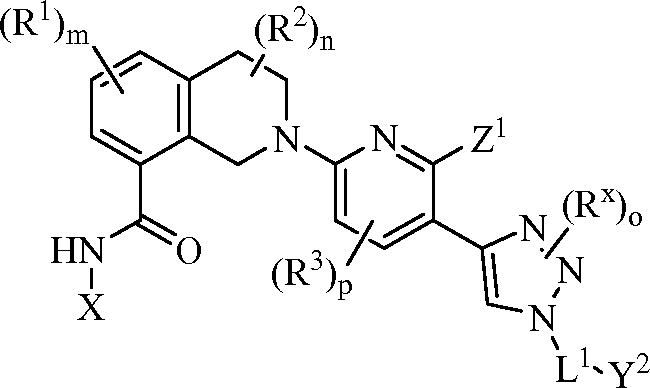
Formula (IV) and therapeutically acceptable salts, metabolites, prodrugs, salts of metabolites, and salts of prodrugs thereof, wherein X, L1, Y2, Z1, R1, R2, R3, m, n, and p are as described herein for
Formula (I); Rx is as described herein for substituents on Y1, and o is 0 or 1.
One embodiment of this invention pertains to compounds, and therapeutically acceptable salts thereof, which are useful as inhibitors of anti-apoptotic Bcl-xL proteins, the compounds having Formula (IV)

Formula (IV), wherein
X is heteroaryl; wherein the heteroaryl represented by X is optionally substituted with one, two, three, or four R4;
Rx is independently selected from the group consisting of R5, OR5, SR5, S(O)R5,
SO2R5, C(O)R5, CO(O)R5, OC(O)R5, OC(O)OR5, NH2, NHR5, N(R5)2, NHC(O)R5,
NR5C(O)R5, NHS(O)2R5, NR5S(O)2R5, NHC(O)OR5, NR5C(O)OR5, NHC(O)NH2, NHC(O)NHR5, NHC(O)N(R5)2, NR5C(O)NHR5, NR5C(O)N(R5)2, C(O)NH2, C(O)NHR5, C(O)N(R5)2, C(O)NHOH, C(O)NHOR5, C(O)NHSO2R5, C(O)NR5SO2R5, SO2NH2,
SO2NHR5, SO2N(R5)2, CO(O)H, C(O)H, OH, CN, N5, NO2, F, Cl, Br and I;
L1 is selected from the group consisting of (CR6R7)q, (CR6R7)s-O-(CR6R7)r, (CR6R7)SC(O)-(CR6R7)r, (CR6R7)s-S-(CR6R7)r, (CR6R7)s-S(O)2-(CR6R7)r, (CR6R7)S-NR6AC(O)-622017206246 20 Jul2017 (CR6R7)r, (CR6R7)s-C(O)NR6A-(CR6R7)r, (CR6R7)s-NR6A-(CR6R7)r, (CR6R7)s-S(O)2NR6A(CR6R7)r, and (CR6R7)s-NR6AS(O)2-(CR6R7)r;
Y2 is C8_i4 cycloalkyl, C8_i4 cycloalkenyl, C8_i4 heterocycloalkyl, or C8_i4 heterocycloalkenyl; optionally fused to one or two rings selected from the group consisting of C3.8 cycloalkane, C3.8 cycloalkene, benzene, C5.6 heteroarene, C3.8 heterocycloalkane, and C3.8 heterocycloalkene; wherein Y2 is optionally substituted with one, two, three, four, or five substituents independently selected from the group consisting of R8, OR8, SR8, S(O)R8,
SO2R8, C(O)R8, CO(O)R8, OC(O)R8, OC(O)OR8, NH2, NHR8, N(R8)2, NHC(O)R8, NR8C(O)R8, NHS(O)2R8, NR8S(O)2R8, NHC(O)OR8, NR8C(O)OR8, NHC(O)NH2, NHC(O)NHR8, NHC(O)N(R8)2, NR8C(O)NHR8, NR8C(O)N(R8)2, C(O)NH2, C(O)NHR8, C(O)N(R8)2, C(O)NHOH, C(O)NHOR8, C(O)NHSO2R8, C(O)NR8SO2R8, so2nh2,
SO2NHR8, SO2N(R8)2, CO(O)H, C(O)H, OH, CN, N3, NO2, F, Cl, Br and I;
Z1 is selected from the group consisting of C(O)OR9, C(O)NR10Rn, C(O)Rn, NR10C(O)Rn, NR10C(O)NR10Rn, OC(O)NR10Rn, NR10C(O)OR9, C(=NOR10)NR10Rn, NR10C(=NCN)NR10R11, NR10S(O)2NR10Rn, S(O)2R9, S(O)2NR10Rn, N(R10)S(O)2Rn, NR10C(=NR11)NR10R11, C(=S)NR10Rn, C(=NR10)NR10Rn, halogen, NO2, and CN; or
Z1 is selected from the group consisting of
N'°\
H >O
N H .
O
X^OH
HN
H
-N
-OH °X//0 .,/ Ν' N’ X H
-N
-N
N
OH
A zz° O
X Jl < N X
H 1 O
O OH xXN^on
X o
%A X N H
O O
AN
H
OH
-O.
Rk
Rk , and
Rk
O O 1 X VN'Rk
Η u · o hnX
AN
H
O . Ί
1—S-OH « II o
R1, at each occurrence, is independently selected from the group consisting of halo, Ci_6 alkyl, C2.6 alkenyl, C2.6 alkynyl, and CA haloalkyl;
R2, at each occurrence, is independently selected from the group consisting of deuterium, halo, Ci_6 alkyl, C2.6 alkenyl, C2.6 alkynyl, and Ci_6 haloalkyl;
two R2 that are attached to the same carbon atom, together with said carbon atom, optionally form a ring selected from the group consisting of heterocycloalkyl, heterocycloalkenyl, cycloalkyl, and cycloalkenyl;
R3, at each occurrence, is independently selected from the group consisting of halo,
CA alkyl, C2.6 alkenyl, C2.6 alkynyl, and Ci_6 haloalkyl;
-63 2017206246 20 Jul2017
R4, at each occurrence, is independently selected from the group consisting of NR12R13, OR12, CN, NO2, halogen, C(O)OR12, C(O)NR12R13, NR12C(O)R13, NR12S(O)2R14, NR12S(O)R14, S(O)2R14, S(O)R14 and R14;
R5, at each occurrence, is independently selected from the group consisting of Ci_6 5 alkyl, C2.6 alkenyl, C2.6 alkynyl, Ci_6 haloalkyl, Ci_6 hydroxyalkyl, aryl, heterocyclyl, cycloalkyl, and cycloalkenyl;
R6A is independently selected from the group consisting of hydrogen, Ci_6 alkyl, C2.6 alkenyl, C2_6 alkynyl, and Ci_6 haloalkyl;
R6 and R7, at each occurrence, are each independently selected from the group 10 consisting of hydrogen, R15, OR15, SR15, S(O)R15, SO2R15, C(O)R15, CO(O)R15, OC(O)R15,
OC(O)OR15, NH2, NHR15, N(R15)2, NHC(O)R15, NR15C(O)R15, NHS(O)2R15, NR15S(O)2R15, NHC(O)OR15, NR15C(O)OR15, NHC(O)NH2, NHC(O)NHR15, NHC(O)N(R15)2, NR15C(O)NHR15, NR15C(O)N(R15)2, C(O)NH2, C(O)NHR15, C(O)N(R15)2, C(O)NHOH, C(O)NHOR15, C(O)NHSO2R15, C(O)NR15SO2R15, so2nh2, SO2NHR15, SO2N(R15)2,
CO(O)H, C(O)H, OH, CN, N3, NO2, F, Cl, Br and I;
R8, at each occurrence, is independently selected from the group consisting of Ci_6 alkyl, C2.6 alkenyl, C2.6 alkynyl, Ci_6 haloalkyl, aryl, heterocyclyl, cycloalkyl, and cycloalkenyl; wherein the R8 Ci_6 alkyl, C2_6 alkenyl, C2_6 alkynyl, and Ci_6 haloalkyl are optionally substituted with one, two, three, four, five, or six substituents independently selected from the group consisting of R16, OR16, SR16, S(O)R16, SO2R16, C(O)R16, CO(O)R16 OC(O)R16, OC(O)OR16, NH2, NHR16, N(R16)2, NHC(O)R16, NR16C(O)R16, NHS(O)2R16, NR16S(O)2R16, NHC(O)OR16, NR16C(O)OR16, NHC(O)NH2, NHC(O)NHR16, NHC(O)N(R16)2, NR16C(O)NHR16, NR16C(O)N(R16)2, C(O)NH2, C(O)NHR16, C(O)N(R16)2, C(O)NHOH, C(O)NHOR16, C(O)NHSO2R16, C(O)NR16SO2R16, SO2NH2, SO2NHR16,
SO2N(R16)2, CO(O)H, C(O)H, OH, CN, N3, NO2, F, Cl, Br and I; wherein the R8 aryl, heterocyclyl, cycloalkyl, and cycloalkenyl are optionally substituted with one, two, or three substituents independently selected from the group consisting of Ci_6 alkyl, C2.6 alkenyl, C2.6 alkynyl, Ci_6 haloalkyl, NH2, C(O)NH2, SO2NH2, C(O)H, (O), OH, CN, NO2, OCF3, OCF2CF3, F, Cl, Br and I;
R9 is selected from the group consisting of Ci_6 alkyl, C2.6 alkenyl, C2.6 alkynyl, Ci_6 haloalkyl, cycloalkyl, phenyl and (CH2)i_4 phenyl; and
R10 and R11, at each occurrence, are each independently selected from the group consisting of hydrogen, Ci_6 alkyl, C2.6 alkenyl, C2.6 alkynyl, C3.6 cycloalkyl, Ci_6 haloalkyl, phenyl and (CH2)i_4-phenyl; or
R10 and R11, or R10 and R9, together with the atom to which each is attached are combined to form a heterocyclyl;
-642017206246 20 Jul2017
Rk, at each occurrence, is independently selected from the group consisting of Cm alkyl, C2.6 alkenyl, C2.6 alkynyl, C3.7 heterocycloalkyl, C3.7 cycloalkyl and Cm haloalkyl;
R12 and R13, at each occurrence, are each independently selected from the group consisting of hydrogen, Cu alkyl, C2.4 alkenyl, C2.4 alkynyl, Cu haloalkyl and (CH2)m phenyl;
R14, at each occurrence, is independently selected from the group consisting of Cm alkyl, C2.4 alkenyl, C2.4 alkynyl and Cm haloalkyl;
R12 and R13, or R12 and R14, at each occurrence, together with the atom to which each is attached, are optionally combined to form a heterocyclyl;
R15, at each occurrence, is independently selected from the group consisting of Cm alkyl, C2.4 alkenyl, C2.4 alkynyl, Cm haloalkyl, Cm hydroxyalkyl, aryl, heterocyclyl, cycloalkyl, and cycloalkenyl; wherein the R15 Cm alkyl, Cm alkenyl, C2.4 alkynyl, Cm haloalkyl, and Cm hydroxyalkyl are optionally substituted with one, two, or three substituents independently selected from the group consisting of O-(Cm alkyl), NH2, C(O)NH2, SO2NH2,
C(O)H, C(O)OH, (O), OH, CN, NO2, OCF3, OCF2CF3, F, Cl, Br and I;
R16, at each occurrence, is independently selected from the group consisting of Cm alkyl, C2.4 alkenyl, C2.4 alkynyl, Cm haloalkyl, Cm hydroxyalkyl, aryl, heterocycloalkyl, heterocycloalkenyl, heteroaryl, cycloalkyl, and cycloalkenyl; wherein the R16 Cm alkyl, C2.4 alkenyl, C2.4 alkynyl, Cm haloalkyl, and Cm hydroxyalkyl are optionally substituted with one substituent independently selected from the group consisting of OCH3, OCH2CH2OCH3, and OCH2CH2NHCH3;
q is 1, 2, or 3; s is 0, 1, 2, or 3; r is 0, 1, 2, or 3;
wherein the sum of s and r is 0, 1, or 2;
m is 0, 1, 2, or 3; n is 0, 1, 2, 3, 4, 5, or 6; o is 0 or 1; and p is 0, 1, or 2.
In one embodiment of Formula (IV), m is 0, 1, 2, or 3; n is 0, 1, 2, 3, 4, 5, or 6; and p is 0, 1, or 2. In another embodiment of Formula (IV), n is 0, 1, or 2. In another embodiment of Formula (IV), n is 0, 1, or 2; and each R2 is independently deuterium or Cm alkyl. In another embodiment of Formula (IV), m, n, and p are 0.
In one embodiment of Formula (IV), X is heteroaryl, which is optionally substituted with one, two, three or four R4. In another embodiment of Formula (IV), X is heteroaryl, which is unsubstituted. In another embodiment of Formula (IV), X is heteroaryl, which is substituted with one R4. In another embodiment of Formula (IV), X is heteroaryl, which is
-65 2017206246 20 Jul2017 substituted with two R4. In another embodiment of Formula (IV), X is heteroaryl, which is substituted with one R4, and R4 is OR12 or halogen. In another embodiment of Formula (IV), X is heteroaryl, which is substituted with two R4, and each R4 is independently OR12 or halogen. In another embodiment of Formula (IV), X is heteroaryl, which is substituted with one R4, and R4 is Cl, F, or methoxy. In another embodiment of Formula (IV), X is heteroaryl, which is substituted with two R4, and each R4 is independently F.
In one embodiment of Formula (IV), X benzo [d]thiazolyl, thiazolo[5,4-b]pyridinyl, thiazolo[4,5-c]pyridinyl, imidazo[l,2-a]pyridinyl, thiazolo[5,4-c]pyridinyl, thiazolo[4,5b]pyridinyl, imidazo[l,2-a]pyrazinyl, or imidazo[l,2-b]pyridazinyl, which are optionally substituted with one, two, three or four R4. In another embodiment of Formula (IV), X is benzo[d]thiazolyl, thiazolo[5,4-b]pyridinyl, thiazolo[4,5-c]pyridinyl, imidazo[l,2-a]pyridinyl, thiazolo[5,4-c]pyridinyl, thiazolo[4,5-b]pyridinyl, imidazo[l,2-a]pyrazinyl, or imidazo[l,2b]pyridazinyl, which are unsubstituted. In another embodiment of Formula (IV), X is benzo[d]thiazolyl, thiazolo[5,4-b]pyridinyl, thiazolo[4,5-c]pyridinyl, imidazo[l,2-a]pyridinyl, thiazolo[5,4-c]pyridinyl, thiazolo[4,5-b]pyridinyl, imidazo[l,2-a]pyrazinyl, or imidazo[l,2b]pyridazinyl, which are substituted with one R4. In another embodiment of Formula (IV), X is benzo[d]thiazolyl, thiazolo[5,4-b]pyridinyl, thiazolo[4,5-c]pyridinyl, imidazo[l,2a]pyridinyl, thiazolo[5,4-c]pyridinyl, thiazolo[4,5-b]pyridinyl, imidazo[l,2-a]pyrazinyl, or imidazo[l,2-b]pyridazinyl, which are substituted with two R4. In another embodiment of
Formula (IV), X is benzo[d]thiazolyl, thiazolo[5,4-b]pyridinyl, thiazolo[4,5-c]pyridinyl, imidazo[l,2-a]pyridinyl, thiazolo[5,4-c]pyridinyl, thiazolo[4,5-b]pyridinyl, imidazo[l,2a] pyrazinyl, or imidazo[l,2-b]pyridazinyl, which are substituted with one R4, and R4 is OR12 or halogen. In another embodiment of Formula (IV), X is benzo[d]thiazolyl, thiazolo[5,4b] pyridinyl, thiazolo[4,5-c]pyridinyl, imidazo[l,2-a]pyridinyl, thiazolo[5,4-c]pyridinyl, thiazolo[4,5-b]pyridinyl, imidazo[l,2-a]pyrazinyl, or imidazo[l,2-b]pyridazinyl, which are substituted with two R4, and each R4 is independently OR12 or halogen. In another embodiment of Formula (IV), X is benzo[d]thiazolyl, thiazolo[5,4-b]pyridinyl, thiazolo[4,5c] pyridinyl, imidazo[l,2-a]pyridinyl, thiazolo[5,4-c]pyridinyl, thiazolo[4,5-b]pyridinyl, imidazo[l,2-a]pyrazinyl, or imidazo[l,2-b]pyridazinyl, which are substituted with one R4, and
R4 is Cl, F, or methoxy. In another embodiment of Formula (IV), X is benzo[d]thiazolyl, thiazolo[5,4-b]pyridinyl, thiazolo[4,5-c]pyridinyl, imidazo[l,2-a]pyridinyl, thiazolo[5,4c]pyridinyl, thiazolo[4,5-b]pyridinyl, imidazo[l,2-a]pyrazinyl, or imidazo[l,2-b]pyridazinyl, which are substituted with two R4, and each R4 is independently F.
In one embodiment of Formula (IV), X is benzo [d]thiazolyl, which is optionally substituted with one, two, three or four R4. In another embodiment of Formula (IV), X is benzo[d]thiazolyl, which is unsubstituted. In another embodiment of Formula (IV), X is benzo[d]thiazolyl, which is substituted with one R4. In another embodiment of Formula (IV),
-662017206246 20 Jul2017
X is benzo [d]thiazolyl, which is substituted with two R4. In another embodiment of Formula (IV), X is benzo [d]thiazolyl, which is substituted with one R4, and R4 is OR12 or halogen. In another embodiment of Formula (IV), X is benzo [d]thiazolyl, which is substituted with two R4, and each R4 is independently OR12 or halogen. In another embodiment of Formula (IV), X is benzo [d]thiazolyl, which is substituted with one R4, and R4 is Cl, F, or methoxy. In another embodiment of Formula (IV), X is benzo[d]thiazolyl, which is substituted with two R4, and each R4 is independently F.
In one embodiment of Formula (IV), Z1 is selected from the group consisting of C(O)OR9, C(O)NR10Rn, C(O)Rn, NR10C(O)Rn, NR10C(O)NR10Rn, OC(O)NR10Rn, NR10C(O)OR9, C(=NOR10)NR10R11, NR10C(=NCN)NR10Rn, NR10S(O)2NR10Rn, S(O)2R9,
10nll
S(O)2NR R , N(R )S(O)2R , NR1UC(=NR11)NR1UR11, C(=S)NR1UR, C(=NR1U)NR1UR halogen, NO2, and CN; or Z1 is selected from the group consisting of τ-Ο. ,, .. .. ,„.^N
N'“\
H >O % H .
O χΑΐ
HN'
H
-N s;
-N
N
-N
X
HN
O OH
-OH
I X
X^N
H i /)-0H x n
X o
., A ,OH n
H ,
O
AX
ΛΑ
O' ,OH

OH X
Rk ο o i AVy
X N X
Η υ .,/ Ν' 'N' X H
Λ V° XX A
H R and
In another embodiment of Formula (IV), Z1 is
-N
HN'
OH
N
O O
AJV°
X N' embodiment of Formula (IV), Z1 is
H
O
Χ/Aqh or another embodiment of Formula (IV), Z1 is ί XT another embodiment of Formula (IV), Z is o o
AU
H
O
I—S-OH < II
O
N Rk H
Rk θ o 1 X KTXN'Rk
X N X
HN
H
-N c
]
X'
In another
O O
X V° XX 'Rk H R.
In
OH
OH
A V°
X N'
In
In one embodiment of Formula (IV), o is 0. In another embodiment of Formula (IV), o is 0 or 1. In another embodiment of Formula (IV), o is 1; and Rx is independently selected
-672017206246 20 Jul2017 from the group consisting of R5, OR5, SR5, S(O)R5, SO2R5, C(O)R5, CO(O)R5, OC(O)R5, OC(O)OR5, NH2, NHR5, N(R5)2, NHC(O)R5, NR5C(O)R5, NHS(O)2R5, NR5S(O)2R5, NHC(O)OR5, NR5C(O)OR5, NHC(O)NH2, NHC(O)NHR5, NHC(O)N(R5)2, NR5C(O)NHR5, NR5C(O)N(R5)2, C(O)NH2, C(O)NHR5, C(O)N(R5)2, C(O)NHOH, C(O)NHOR5,
C(O)NHSO2R5, C(O)NR5SO2R5, SO2NH2, SO2NHR5, SO2N(R5)2, CO(O)H, C(O)H, OH, CN, N5, NO2, F, Cl, Br and I. In another embodiment of Formula (IV), o is 1; and Rx is independently selected from the group consisting of R5, CN, F, Cl, Br and I. In another embodiment of Formula (IV), o is 1; and Rx is independently selected from the group consisting of R5, CN, F, Cl, Br and I; wherein R5 is Ci_6 alkyl. In another embodiment of
Formula (IV), o is 1; Rx is R5, Cl, or CN; and R5 is CH3. In another embodiment of Formula (IV), o is 1; and Rx is CN. In another embodiment of Formula (IV), o is 1; and Rx is Cl. In another embodiment of Formula (IV), o is 1; Rx is R5; and R5 is CH3.
In one embodiment of Formula (IV), L1 is selected from the group consisting of (CR6R7)q, (CR6R7)q, (CR6R7)s-O-(CR6R7)r, (CR6R7)s-C(O)-(CR6R7)r, (CR6R7)s-S-(CR6R7)r, (CR6R7)s-S(O)2-(CR6R7)r, (CR6R7)s-NR6AC(O)-(CR6R7)r, (CR6R7)s-C(O)NR6A-(CR6R7)r, (CR6R7)s-NR6A-(CR6R7)r, (CR6R7)s-S(O)2NR6A-(CR6R7)r, and (CR6R7)s-NR6AS(O)2-(CR6R7)r; and Y2 is Cg-u cycloalkyl, Cg-u cycloalkenyl, C8_i4 heterocycloalkyl, or C8_i4 heterocycloalkenyl; optionally fused to one or two rings selected from the group consisting of C3_g cycloalkane, C3.8 cycloalkene, benzene, C5.6 heteroarene, C3.8 heterocycloalkane, and C3.8 heterocycloalkene; wherein Y2 is optionally substituted with one, two, three, four, or five substituents independently selected from the group consisting of R8, OR8, SR8, S(O)R8,
SO2R8, C(O)R8, CO(O)R8, OC(O)R8, OC(O)OR8, NH2, NHR8, N(R8)2, NHC(O)R8, NR8C(O)R8, NHS(O)2R8, NR8S(O)2R8, NHC(O)OR8, NR8C(O)OR8, NHC(O)NH2, NHC(O)NHR8, NHC(O)N(R8)2, NR8C(O)NHR8, NR8C(O)N(R8)2, C(O)NH2, C(O)NHR8,
C(O)N(R8)2, C(O)NHOH, C(O)NHOR8, C(O)NHSO2R8, C(O)NR8SO2R8, so2nh2,
SO2NHR8, SO2N(R8)2, CO(O)H, C(O)H, OH, CN, N3, NO2, F, Cl, Br and I.
In another embodiment of Formula (IV), L1 is (CR6R7)q; and Y2 is selected from the group consisting of C8_i4 cycloalkyl and C8_i4 heterocycloalkyl; wherein R6 and R7, at each occurrence, are hydrogen; and q is 1 or 2. In another embodiment of Formula (IV), L1 is
0 selected from the group consisting of (CR6R7)s-S(O)2-(CR6R7)r, (CR6R7)S-C(O)NR6A(CR6R7)r, and (CR6R7)s-S(O)2NR6A-(CR6R7)r; Y2 is selected from the group consisting of C8_i4 cycloalkyl, and C8_i4 heterocycloalkyl; s is 0; r is 0 or 1; R6A is independently selected from the group consisting of hydrogen and Ci_6 alkyl; and R6 and R7, at each occurrence, are hydrogen.
In another embodiment of Formula (IV),
X is heteroaryl;
Rx is independently selected from the group consisting of R5, CN, F, Cl, Br and I;
-682017206246 20 Jul2017
L1 is selected from the group consisting of (CR6R7)q, (CR6R7)s-S(O)2-(CR6R7)r, (CR6R7)s-C(O)NR6A-(CR6R7)r, and (CR6R7)s-S(O)2NR6A-(CR6R7)r;
Y2 is C§_i4 cycloalkyl or Cg-i4 heterocycloalkyl; wherein Y2 is optionally substituted with one, two, or three substituents independently selected from the group consisting of R8, OR8, SO2R8, CO(O)R8, OH, F, Cl, Br and I;
Z1 is selected from the group consisting of
O HN'^
ΧΌΗ , , η. , and
R2, at each occurrence, is independently Ci_6 alkyl;
R5, at each occurrence, is independently Ci_6 alkyl;
R6A is independently selected from the group consisting of hydrogen and Ci_6 alkyl;
R6 and R7, at each occurrence, are each independently hydrogen;
R8, at each occurrence, is independently selected from the group consisting of Ci_6 alkyl and heterocyclyl; wherein the R8 Ci_6 alkyl is optionally substituted with one substituent independently selected from the group consisting of R16, OR16, SO2R16, and NHR16;
Rk, at each occurrence, is independently selected from the group consisting of Ci_6 alkyl, C3.7 heterocycloalkyl, C3.7 cycloalkyl and Ci_6 haloalkyl;
R16, at each occurrence, is independently selected from the group consisting of Cm alkyl, aryl, and heterocycloalkyl; wherein the R16 Cm alkyl is optionally substituted with one substituent independently selected from the group consisting of OCH3, OCH2CH2OCH3, and OCH2CH2NHCH3;
q is 1 or 2; s is 0; r is 0 or 1;
wherein the sum of s and r is 0 or 1; m is 0;
n is 0, 1, or 2;
is 0 or 1; and p is 0.
Still another embodiment pertains to a compound having Formula (IV) selected from the group consisting of
6-[8-(l,3-benzothiazol-2-ylcarbamoyl)-3,4-dihydroisoquinolin-2(lH)-yl]-3-[5methyl-1 -(tricy clo [3.3.1.13,7]dec-1 -y lmethyl)-1 Η-1,2,3 -triazol-4-yl]pyridine-2 -carboxylic acid;
6-[8-(l,3-benzothiazol-2-ylcarbamoyl)-3,4-dihydroisoquinolin-2(lH)-yl]-3-[5methyl-l-(2-oxatricyclo[3.3.1.13’7]dec-l-ylmethyl)-lH-l,2,3-triazol-4-yl]pyridine-2-692017206246 20 Jul2017 carboxylic acid; and therapeutically acceptable salts, metabolites, prodrugs, salts of metabolites, and salts of prodrugs thereof.
In another aspect, the present invention provides compounds of Formula (V)

and therapeutically acceptable salts, metabolites, prodrugs, salts of metabolites, and salts of prodrugs thereof, wherein X, L1, Y2, Z1, R1, R2, R3, m, n, and p are as described herein for Formula (I); Rx is as described herein for substituents on Y1, and o is 0, 1,2, 3, or 4.
One embodiment of this invention pertains to compounds, and therapeutically 10 acceptable salts thereof, which are useful as inhibitors of anti-apoptotic Bcl-xL proteins, the compounds having Formula (V)

wherein
X is heteroaryl; wherein the heteroaryl represented by X is optionally substituted with one, two, three, or four R4;
Rx, at each occurrence, is independently selected from the group consisting of R5, OR5, SR5, S(O)R5, SO2R5, C(O)R5, CO(O)R5, OC(O)R5, OC(O)OR5, NH2, NHR5, N(R5)2, NHC(O)R5, NR5C(O)R5, NHS(O)2R5, NR5S(O)2R5, NHC(O)OR5, NR5C(O)OR5,
NHC(O)NH2, NHC(O)NHR5, NHC(O)N(R5)2, NR5C(O)NHR5, NR5C(O)N(R5)2, C(O)NH2, C(O)NHR5, C(O)N(R5)2, C(O)NHOH, C(O)NHOR5, C(O)NHSO2R5, C(O)NR5SO2R5, SO2NH2, SO2NHR5, SO2N(R5)2, CO(O)H, C(O)H, OH, CN, N5, NO2, F, Cl, Br and I;
L1 is selected from the group consisting of (CR6R7)q, (CR6R7)s-O-(CR6R7)r, (CR6R7)SC(O)-(CR6R7)r, (CR6R7)s-S-(CR6R7)r, (CR6R7)s-S(O)2-(CR6R7)r, (CR6R7)S-NR6AC(O)25 (CR6R7)r, (CR6R7)s-C(O)NR6A-(CR6R7)r, (CR6R7)s-NR6A-(CR6R7)r, (CR6R7)s-S(O)2NR6A(CR6R7)r, and (CR6R7)s-NR6AS(O)2-(CR6R7)r;
-702017206246 20 Jul2017
Y2 is C8_i4 cycloalkyi, C8_i4 cycloalkenyl, C8_i4 heterocycloalkyl, or C8_i4 heterocycloalkenyl; optionally fused to one or two rings selected from the group consisting of C3_8 cycloalkane, C3.8 cycloalkene, benzene, C5.6 heteroarene, C3.8 heterocycloalkane, and C3.8 heterocycloalkene; wherein Y2 is optionally substituted with one, two, three, four, or five substituents independently selected from the group consisting of R8, OR8, SR8, S(O)R8,
SO2R8, C(O)R8, CO(O)R8, OC(O)R8, OC(O)OR8, NH2, NHR8, N(R8)2, NHC(O)R8, NR8C(O)R8, NHS(O)2R8, NR8S(O)2R8, NHC(O)OR8, NR8C(O)OR8, NHC(O)NH2, NHC(O)NHR8, NHC(O)N(R8)2, NR8C(O)NHR8, NR8C(O)N(R8)2, C(O)NH2, C(O)NHR8, C(O)N(R8)2, C(O)NHOH, C(O)NHOR8, C(O)NHSO2R8, C(O)NR8SO2R8, so2nh2,
SO2NHR8, SO2N(R8)2, CO(O)H, C(O)H, OH, CN, N3, NO2, F, Cl, Br and I;
Z1 is selected from the group consisting of C(O)OR9, C(O)NR10Rn, C(O)Rn, NR10C(O)Rn, NR10C(O)NR10Rn, OC(O)NR10Rn, NR10C(O)OR9, C(=NOR10)NR10Rn, NR10C(=NCN)NR10R11, NR10S(O)2NR10Rn, S(O)2R9, S(O)2NR10Rn, N(R10)S(O)2Rn, NR10C(=NR11)NR10R11, C(=S)NR10Rn, C(=NR10)NR10Rn, halogen, NO2, and CN; or
Z1 is selected from the group consisting of
-O.
IN \_
Λ X°
X H .
O
X^OH
HN
-N ~N n-N (-) ΗΝΆ
H
-N
-OH
A o «A
O OH o o
AA
X o
., X -OH
V N
H ,
Rk ,ΟΙΙ o
An'
H 'OH X <w°
N
O O
X V°
An 'Rk
H R and
Rk
O O I
X ’vNx \ΛΛ r
Η u · 'N N H
O , Il
1—S-OH < II o
R1, at each occurrence, is independently selected from the group consisting of halo, Ci_6 alkyl, C2.6 alkenyl, C2.6 alkynyl, and Ci_6 haloalkyl;
R2, at each occurrence, is independently selected from the group consisting of deuterium, halo, Ci_6 alkyl, C2.6 alkenyl, C2.6 alkynyl, and Ci_6 haloalkyl;
two R2 that are attached to the same carbon atom, together with said carbon atom, optionally form a ring selected from the group consisting of heterocycloalkyl, heterocycloalkenyl, cycloalkyi, and cycloalkenyl;
R3, at each occurrence, is independently selected from the group consisting of halo,
Ci_6 alkyl, C2.6 alkenyl, C2.6 alkynyl, and Ci_6 haloalkyl;
R4, at each occurrence, is independently selected from the group consisting of
NR12R13, OR12, CN, NO2, halogen, C(O)OR12, C(O)NR12R13, NR12C(O)R13, NR12S(O)2R14, NR12S(O)R14, S(O)2R14, S(O)R14 and R14;
-71 2017206246 20 Jul2017
R5, at each occurrence, is independently selected from the group consisting of Cm alkyl, C2.6 alkenyl, C2.6 alkynyl, Cm haloalkyl, Cm hydroxyalkyl, aryl, heterocyclyl, cycloalkyl, and cycloalkenyl;
R6A is independently selected from the group consisting of hydrogen, Cm alkyl, C2.6 5 alkenyl, C2_6 alkynyl, and Cm haloalkyl;
R6 and R7, at each occurrence, are each independently selected from the group consisting of hydrogen, R15, OR15, SR15, S(O)R15, SO2R15, C(O)R15, CO(O)R15, OC(O)R15, OC(O)OR15, NH2, NHR15, N(R15)2, NHC(O)R15, NR15C(O)R15, NHS(O)2R15, NR15S(O)2R15, NHC(O)OR15, NR15C(O)OR15, NHC(O)NH2, NHC(O)NHR15, NHC(O)N(R15)2,
NR15C(O)NHR15, NR15C(O)N(R15)2, C(O)NH2, C(O)NHR15, C(O)N(R15)2, C(O)NHOH, C(O)NHOR15, C(O)NHSO2R15, C(O)NR15SO2R15, so2nh2, SO2NHR15, SO2N(R15)2, CO(O)H, C(O)H, OH, CN, N3, NO2, F, Cl, Br and I;
R8, at each occurrence, is independently selected from the group consisting of Cm alkyl, C2_6 alkenyl, C2_6 alkynyl, Cm haloalkyl, aryl, heterocyclyl, cycloalkyl, and cycloalkenyl; wherein the R8 Cm alkyl, C2_6 alkenyl, C2_6 alkynyl, and Cm haloalkyl are optionally substituted with one, two, three, four, five, or six substituents independently selected from the group consisting of R16, OR16, SR16, S(O)R16, SO2R16, C(O)R16, CO(O)R16 OC(O)R16, OC(O)OR16, NH2, NHR16, N(R16)2, NHC(O)R16, NR16C(O)R16, NHS(O)2R16, NR16S(O)2R16, NHC(O)OR16, NR16C(O)OR16, NHC(O)NH2, NHC(O)NHR16,
NHC(O)N(R16)2, NR16C(O)NHR16, NR16C(O)N(R16)2, C(O)NH2, C(O)NHR16, C(O)N(R16)2,
C(O)NHOH, C(O)NHOR16, C(O)NHSO2R16, C(O)NR16SO2R16, SO2NH2, SO2NHR16, SO2N(R16)2, CO(O)H, C(O)H, OH, CN, N3, NO2, F, Cl, Br and I; wherein the R8 aryl, heterocyclyl, cycloalkyl, and cycloalkenyl are optionally substituted with one, two, or three substituents independently selected from the group consisting of Cm alkyl, C2.6 alkenyl, C2.6 alkynyl, Cm haloalkyl, NH2, C(O)NH2, SO2NH2, C(O)H, (O), OH, CN, NO2, OCF3, OCF2CF3, F, Cl, Br and I;
R9 is selected from the group consisting of Cm alkyl, C2.6 alkenyl, C2.6 alkynyl, Cm haloalkyl, cycloalkyl, phenyl and (CH2)i_4 phenyl; and
R10 and R11, at each occurrence, are each independently selected from the group consisting of hydrogen, Cm alkyl, C2.6 alkenyl, C2.6 alkynyl, C3.6 cycloalkyl, Cm haloalkyl, phenyl and (CH2)i_4-phenyl; or
R10 and R11, or R10 and R9, together with the atom to which each is attached are combined to form a heterocyclyl;
Rk, at each occurrence, is independently selected from the group consisting of Cm alkyl, C2_6 alkenyl, C2_6 alkynyl, C3.7 heterocycloalkyl, C3.7 cycloalkyl and Cm haloalkyl;
-722017206246 20 Jul2017
R12 and R13, at each occurrence, are each independently selected from the group consisting of hydrogen, Cm alkyl, C2.4 alkenyl, C2.4 alkynyl, Cm haloalkyl and (CH2)i_4 phenyl;
R14, at each occurrence, is independently selected from the group consisting of Cm 5 alkyl, C2.4 alkenyl, C2.4 alkynyl and Cm haloalkyl;
R12 and R13, or R12 and R14, at each occurrence, together with the atom to which each is attached, are optionally combined to form a heterocyclyl;
R15, at each occurrence, is independently selected from the group consisting of Cm alkyl, C2.4 alkenyl, C2.4 alkynyl, Cm haloalkyl, Cm hydroxyalkyl, aryl, heterocyclyl, cycloalkyl, and cycloalkenyl; wherein the R15 Cm alkyl, C2m alkenyl, C2.4 alkynyl, Cm haloalkyl, and Cm hydroxyalkyl are optionally substituted with one, two, or three substituents independently selected from the group consisting of O-(Ci_4 alkyl), NH2, C(O)NH2, SO2NH2, C(O)H, C(O)OH, (O), OH, CN, NO2, OCF3, OCF2CF3, F, Cl, Br and I;
R16, at each occurrence, is independently selected from the group consisting of Cm alkyl, C2.4 alkenyl, C2.4 alkynyl, Cm haloalkyl, Cm hydroxyalkyl, aryl, heterocycloalkyl, heterocycloalkenyl, heteroaryl, cycloalkyl, and cycloalkenyl; wherein the R16 Cm alkyl, C2.4 alkenyl, C2.4 alkynyl, Cm haloalkyl, and Cm hydroxyalkyl are optionally substituted with one substituent independently selected from the group consisting of OCH3, OCH2CH2OCH3, and OCH2CH2NHCH3;
q is 1, 2, or 3;
s is 0, 1, 2, or 3; r is 0, 1, 2, or 3;
wherein the sum of s and r is 0, 1, or 2; m is 0, 1, 2, or 3;
n is 0, 1, 2, 3, 4, 5, or 6;
o is 0, 1, 2, 3, or 4; and p is 0, 1, or 2.
In one embodiment of Formula (V), m is 0, 1, 2, or 3; n is 0, 1, 2, 3, 4, 5, or 6; and p is 0, 1, or 2. In another embodiment of Formula (V), n is 0, 1, or 2. In another embodiment of Formula (V), n is 0, 1, or 2; and each R2 is independently deuterium or Ci_6 alkyl. In another embodiment of Formula (V), m, n, and p are 0.
In one embodiment of Formula (V), X is heteroaryl, which is optionally substituted with one, two, three or four R4. In another embodiment of Formula (V), X is heteroaryl, which is unsubstituted. In another embodiment of Formula (V), X is heteroaryl, which is substituted with one R4. In another embodiment of Formula (V), X is heteroaryl, which is substituted with two R4. In another embodiment of Formula (V), X is heteroaryl, which is substituted with one R4, and R4 is OR12 or halogen. In another embodiment of Formula (V),
-73 2017206246 20 Jul2017
X is heteroaryl, which is substituted with two R4, and each R4 is independently OR12 or halogen. In another embodiment of Formula (V), X is heteroaryl, which is substituted with one R4, and R4 is Cl, F, or methoxy. In another embodiment of Formula (V), X is heteroaryl, which is substituted with two R4, and each R4 is independently F.
In one embodiment of Formula (V), X benzo[d]thiazolyl, thiazolo[5,4-b]pyridinyl, thiazolo[4,5-c]pyridinyl, imidazo[l,2-a]pyridinyl, thiazolo[5,4-c]pyridinyl, thiazolo[4,5b]pyridinyl, imidazo[l,2-a]pyrazinyl, or imidazo[l,2-b]pyridazinyl, which are optionally substituted with one, two, three or four R4. In another embodiment of Formula (V), X is benzo [d]thiazolyl, thiazolo[5,4-b]pyridinyl, thiazolo[4,5-c]pyridinyl, imidazo[l,2-a]pyridinyl, thiazolo[5,4-c]pyridinyl, thiazolo[4,5-b]pyridinyl, imidazo[l,2-a]pyrazinyl, or imidazo[l,2b]pyridazinyl, which are unsubstituted. In another embodiment of Formula (V), X is benzo [d]thiazolyl, thiazolo[5,4-b]pyridinyl, thiazolo[4,5-c]pyridinyl, imidazo[l,2-a]pyridinyl, thiazolo[5,4-c]pyridinyl, thiazolo[4,5-b]pyridinyl, imidazo[l,2-a]pyrazinyl, or imidazo[l,2b]pyridazinyl, which are substituted with one R4. In another embodiment of Formula (V), X is benzo[d]thiazolyl, thiazolo[5,4-b]pyridinyl, thiazolo[4,5-c]pyridinyl, imidazo[l,2a] pyridinyl, thiazolo[5,4-c]pyridinyl, thiazolo[4,5-b]pyridinyl, imidazo[l,2-a]pyrazinyl, or imidazo[l,2-b]pyridazinyl, which are substituted with two R4. In another embodiment of Formula (V), X is benzo [d]thiazolyl, thiazolo[5,4-b]pyridinyl, thiazolo[4,5-c]pyridinyl, imidazo[l,2-a]pyridinyl, thiazolo[5,4-c]pyridinyl, thiazolo[4,5-b]pyridinyl, imidazo[l,220 a]pyrazinyl, or imidazo[l,2-b]pyridazinyl, which are substituted with one R4, and R4 is OR12 or halogen. In another embodiment of Formula (V), X is benzo[d]thiazolyl, thiazolo[5,4b] pyridinyl, thiazolo[4,5-c]pyridinyl, imidazo[l,2-a]pyridinyl, thiazolo[5,4-c]pyridinyl, thiazolo[4,5-b]pyridinyl, imidazo[l,2-a]pyrazinyl, or imidazo[l,2-b]pyridazinyl, which are substituted with two R4, and each R4 is independently OR12 or halogen. In another embodiment of Formula (V), X is benzo[d]thiazolyl, thiazolo[5,4-b]pyridinyl, thiazolo[4,5c] pyridinyl, imidazo[l,2-a]pyridinyl, thiazolo[5,4-c]pyridinyl, thiazolo[4,5-b]pyridinyl, imidazo[l,2-a]pyrazinyl, or imidazo[l,2-b]pyridazinyl, which are substituted with one R4, and R4 is Cl, F, or methoxy. In another embodiment of Formula (V), X is benzo [d]thiazolyl, thiazolo[5,4-b]pyridinyl, thiazolo[4,5-c]pyridinyl, imidazo[l,2-a]pyridinyl, thiazolo[5,430 c]pyridinyl, thiazolo[4,5-b]pyridinyl, imidazo[l,2-a]pyrazinyl, or imidazo[l,2-b]pyridazinyl, which are substituted with two R4, and each R4 is independently F.
In one embodiment of Formula (V), X is benzo [d]thiazolyl, which is optionally substituted with one, two, three or four R4. In another embodiment of Formula (V), X is benzo[d]thiazolyl, which is unsubstituted. In another embodiment of Formula (V), X is benzo[d]thiazolyl, which is substituted with one R4. In another embodiment of Formula (V), X is benzo [d]thiazolyl, which is substituted with two R4. In another embodiment of Formula (V), X is benzo[d]thiazolyl, which is substituted with one R4, and R4 is OR12 or halogen. In
-742017206246 20 Jul2017 another embodiment of Formula (V), X is benzo[d]thiazolyl, which is substituted with two R4 and each R4 is independently OR12 or halogen. In another embodiment of Formula (V), X is benzo[d]thiazolyl, which is substituted with one R4, and R4 is Cl, F, or methoxy. In another embodiment of Formula (V), X is benzo[d]thiazolyl, which is substituted with two R4, and each R4 is independently F.
In one embodiment of Formula (V), Z1 is selected from the group consisting of C(O)OR9, C(O)NR10Rn, C(O)Rn, NR10C(O)Rn, NR10C(O)NR10Rn, OC(O)NR10Rn, NR10C(O)OR9, C(=NOR10)NR10R11, NR10C(=NCN)NR10Rn, NR10S(O)2NR10Rn, S(O)2R9, S(O)2NR10Rn, N(R10)S(O)2Rn, NR10C(=NR11)NR10R11, C(=S)NR10Rn, C(=NR10)NR10Rn, halogen, NO2, and CN; or Z1 is selected from the group consisting of
T-Q M .. .N'“\
H >O An +- H .
o
X^OII
HN'
-N
H
-N '/>
-OH
X N~N
O'
-N
OH
HN
O OH
AAa o o
Λ.Α,
X o
Y*Y0H
H ,
O
II
-S-OH
II
O o<·'' ty'N
N H
Q O.
.0
X ,OH

OH X .ο.
H , , and
In another embodiment of Formula (V), Z1 is
Rk o O 1 ,X V'Rk +C N %
Η u
O
XT^OH
HN
-N
O O,
N nAH \WO
Rk
Rk θ O 1
X VN'
Rk embodiment of Formula (V), Z1 is
O HN +i%II
-N 'N , or ’ In another O 0 x v°
X^N'S H
Rk ' In another embodiment of Formula (V), Z1 is
X; oh or
O O
X V° \A- xk
H R
In another η,. V
OH embodiment of Formula (V), Z is
In one embodiment of Formula (V), o is 0. In another embodiment of Formula (V), o is 0, 1, 2, 3, or 4. In another embodiment of Formula (V), o is 1, 2, 3, or 4; and Rx, at each occurrence, is independently selected from the group consisting of R5, OR5, SR5, S(O)R5, SO2R5, C(O)R5, CO(O)R5, OC(O)R5, OC(O)OR5, NH2, NHR5, N(R5)2, NHC(O)R5,
-75 2017206246 20 Jul2017
NR5C(O)R5, NHS(O)2R5, NR5S(O)2R5, NHC(O)OR5, NR5C(O)OR5, NHC(O)NH2, NHC(O)NHR5, NHC(O)N(R5)2, NR5C(O)NHR5, NR5C(O)N(R5)2, C(O)NH2, C(O)NHR5, C(O)N(R5)2, C(O)NHOH, C(O)NHOR5, C(O)NHSO2R5, C(O)NR5SO2R5, so2nh2,
SO2NHR5, SO2N(R5)2, CO(O)H, C(O)H, OH, CN, N5, NO2, F, Cl, Br and I. In another embodiment of Formula (V), o is 1, 2, 3, or 4; and Rx, at each occurrence, is independently selected from the group consisting of R5, CN, F, Cl, Br and I. In another embodiment of Formula (V), o is 1, 2, 3, or 4; and Rx, at each occurrence, is independently selected from the group consisting of R5, CN, F, Cl, Br and I; wherein R5 is Ci_6 alkyl. In another embodiment of Formula (V), o is 1 or 2; Rx is R5 or CN; and R5 is CH3. In another embodiment of
Formula (V), o is 1; and Rx is CN. In another embodiment of Formula (V), o is 1; and Rx is Cl. In another embodiment of Formula (V), o is 1; Rx is R5; and R5 is CH3.
In one embodiment of Formula (V), L1 is selected from the group consisting of (CR6R7)q, (CR6R7)q, (CR6R7)s-O-(CR6R7)r, (CR6R7)s-C(O)-(CR6R7)r, (CR6R7)s-S-(CR6R7)r, (CR6R7)s-S(O)2-(CR6R7)r, (CR6R7)s-NR6AC(O)-(CR6R7)r, (CR6R7)s-C(O)NR6A-(CR6R7)r, (CR6R7)s-NR6A-(CR6R7)r, (CR6R7)s-S(O)2NR6A-(CR6R7)r, and (CR6R7)s-NR6AS(O)2-(CR6R7)r;
and Y2 is Cg-u cycloalkyl, Cg-u cycloalkenyl, C8_i4 heterocycloalkyl, or C8_i4 heterocycloalkenyl; optionally fused to one or two rings selected from the group consisting of C3_g cycloalkane, C3.8 cycloalkene, benzene, C5.6 heteroarene, C3.8 heterocycloalkane, and C3.8 heterocycloalkene; wherein Y2 is optionally substituted with one, two, three, four, or five substituents independently selected from the group consisting of R8, OR8, SR8, S(O)R8,
SO2R8, C(O)R8, CO(O)R8, OC(O)R8, OC(O)OR8, NH2, NHR8, N(R8)2, NHC(O)R8, NR8C(O)R8, NHS(O)2R8, NR8S(O)2R8, NHC(O)OR8, NR8C(O)OR8, NHC(O)NH2, NHC(O)NHR8, NHC(O)N(R8)2, NR8C(O)NHR8, NR8C(O)N(R8)2, C(O)NH2, C(O)NHR8, C(O)N(R8)2, C(O)NHOH, C(O)NHOR8, C(O)NHSO2R8, C(O)NR8SO2R8, so2nh2,
SO2NHR8, SO2N(R8)2, CO(O)H, C(O)H, OH, CN, N3, NO2, F, Cl, Br and I.
In another embodiment of Formula (V), L1 is (CR6R7)q; and Y2 is selected from the group consisting of C8_i4 cycloalkyl, and C8_i4 heterocycloalkyl; wherein R6 and R7, at each occurrence, are hydrogen; and q is 1 or 2. In another embodiment of Formula (V), L1 is selected from the group consisting of (CR6R7)s-O-(CR6R7)r, (CR6R7)s-S-(CR6R7)r, (CR6R7)S30 S(O)2-(CR6R7)r, (CR6R7)s-NR6AC(O)-(CR6R7)r, (CR6R7)s-C(O)NR6A-(CR6R7)r, (CR6R7)SNR6A-(CR6R7)r, and (CR6R7)s-S(O)2NR6A-(CR6R7)r; Y2 is selected from the group consisting of C8_i4 cycloalkyl, and C8_i4 heterocycloalkyl; s is 0; r is 0 or 1; R6A is independently selected from the group consisting of hydrogen, and Ci_6 alkyl; and R6 and R7, at each occurrence, are hydrogen.
In another embodiment of Formula (V),
X is heteroaryl;
-762017206246 20 Jul2017
Rx, at each occurrence, is independently selected from the group consisting of R5, CN, F, Cl, Br and I;
L1 is selected from the group consisting of (CR6R7)q, (CR6R7)s-O-(CR6R7)r, (CR6R7)SS-(CR6R7)r, (CR6R7)s-S(O)2-(CR6R7)r, (CR6R7)s-NR6AC(O)-(CR6R7)r, (CR6R7)S-C(O)NR6A(CR6R7)r, (CR6R7)s-NR6A-(CR6R7)r, and (CR6R7)s-S(O)2NR6A-(CR6R7)r;
Y2 is C8_i4 cycloalkyl, or Cg-u heterocycloalkyl; wherein Y2 is optionally substituted with one, two, or three substituents independently selected from the group consisting of R8, OR8, SO2R8, CO(O)R8, OH, F, Cl, Br and I;
Z1 is selected from the group consisting of
O


R2, at each occurrence, is independently Ci_6 alkyl;
R5, at each occurrence, is independently Ci_6 alkyl;
R6A is independently selected from the group consisting of hydrogen and Ci_6 alkyl;
R6 and R7, at each occurrence, are each independently hydrogen;
R8, at each occurrence, is independently selected from the group consisting of Ci_6 alkyl and heterocyclyl; wherein the R8 Ci_6 alkyl is optionally substituted with one substituent independently selected from the group consisting of R16, OR16, SO2R16, and NHR16;
Rk, at each occurrence, is independently selected from the group consisting of Ci_6 alkyl, C3.7 heterocycloalkyl, C3.7 cycloalkyl and Ci_6 haloalkyl;
R16, at each occurrence, is independently selected from the group consisting of Cm alkyl, aryl, and heterocycloalkyl; wherein the R16 Cm alkyl is optionally substituted with one substituent independently selected from the group consisting of OCH3, OCH2CH2OCH3, and OCH2CH2NHCH3;
q is 1 or 2; s is 0; r is 0 or 1;
wherein the sum of s and r is 0 or 1; m is 0;
n is 0, 1, or 2;
is 0 or 1; and p is 0.
Still another embodiment pertains to a compound having Formula (V) selected from the group consisting of
6-[8-(l,3-benzothiazol-2-ylcarbamoyl)-3,4-dihydroisoquinolin-2(lH)-yl]-3-{2methyl-4-[tricyclo[3.3.1.13’7]dec-l-ylmethoxy]phenyl}pyridine-2-carboxylic acid;
-772017206246 20 Jul2017
6-[8-(l,3-benzothiazol-2-ylcarbamoyl)-3,4-dihydroisoquinolin-2(lH)-yl]-3-{2methyl-3-[tricyclo[3.3.1.13’7]dec-l-ylmethoxy]phenyl}pyridine-2-carboxy lie acid;
6-[8-(l,3-benzothiazol-2-ylcarbamoyl)-3,4-dihydroisoquinolin-2(lH)-yl]-3-{3[tricyclo[3.3.1. l3,7]dec-l -ylmethoxy]phenyl}pyridine-2-carboxylic acid;
6-[8-(l,3-benzothiazol-2-ylcarbamoyl)-3,4-dihydroisoquinolin-2(lH)-yl]-3-{2methyl-3 - [tricyclo [3.3.1.13’7] dec-1 -yloxy{phenyl} pyridine-2-carboxylic acid;
6-[8-(l,3-benzothiazol-2-ylcarbamoyl)-3,4-dihydroisoquinolin-2(lH)-yl]-3-{2-cyano 3-[tricyclo[3.3.1. l3,7]dec-l -ylamino]phenyl}pyridine-2-carboxylic acid;
6-[8-(l,3-benzothiazol-2-ylcarbamoyl)-3,4-dihydroisoquinolin-2(lH)-yl]-3-{2-cyano
3-[tricyclo[3.3.1.13’7]dec-l-ylsulfanyl]plienyl}pyridine-2-carboxylic acid;
6-[8-(l,3-benzothiazol-2-ylcarbamoyl)-3,4-dihydroisoquinolin-2(lH)-yl]-3-(2methyl-3-{[tricyclo[3.3.1.13’7]dec-l-ylcarbonyl]amino}phenyl)pyridine-2-carboxylic acid; 6-[8-(l,3-benzothiazol-2-ylcarbamoyl)-3,4-dihydroisoquinolin-2(lH)-yl]-3-{2m ethyl-3 - [tricyclo [3.3.1.13’7] dec-1 -y I su I famoy I ] p lieny I} pyridine-2 -carboxylic acid;
6-[8-(l,3-benzothiazol-2-ylcarbamoyl)-3,4-dihydroisoquinolin-2(lH)-yl]-3-(2methyl-3-{methyl[tricyclo[3.3.1.13’7]dec-l-ylcarbonyl]amino}phenyl)pyridine-2-carboxylic acid;
6-[8-(l,3-benzothiazol-2-ylcarbamoyl)-3,4-dihydroisoquinolin-2(lH)-yl]-3-{2methyl-3-[tricyclo[3.3.1.13’7]dec-l-ylcarbamoyl]phenyl}pyridine-2-carboxylic acid;
6-[8-(l,3-benzothiazol-2-ylcarbamoyl)-3,4-dihydroisoquinolin-2(lH)-yl]-3-(2methyl-3-{methyl[tricyclo[3.3.1.13’7]dec-l-ylmethyl]amino}phenyl)pyridine-2-carboxylic acid;
6-[8-(l,3-benzothiazol-2-ylcarbamoyl)-3,4-dihydroisoquinolin-2(lH)-yl]-3-[2-cyano3-(tricyclo[3.3.1. l3,7]dec-l -ylsulfonyl)phenyl]pyridine-2-carboxylic acid;
6-[8-(l,3-benzothiazol-2-ylcarbamoyl)-3,4-dihydroisoquinolin-2(lH)-yl]-3-(2methyl-3- {methyl[(tricy clo [3.3.1.13,7]dec-2 -yl]carbamoyl}phenyl)pyridine-2-carboxylic acid;
6-[8-(l,3-benzothiazol-2-ylcarbamoyl)-3,4-dihydroisoquinolin-2(lH)-yl]-3-{2methyl-3-[methyl(2-oxatricyclo[3.3.1. l3,7]dec-l -ylcarbonyl)amino]phenyl}pyridine-2carboxylic acid;
6-[8-(l,3-benzothiazol-2-ylcarbamoyl)-3,4-dihydroisoquinolin-2(lH)-yl]-3-(2methyl-3-{methyl[tricyclo[3.3.1.l3’7]dec-2-yl]sulfamoyl}phenyl)pyridine-2-carboxylic acid; and therapeutically acceptable salts, metabolites, prodrugs, salts of metabolites, and salts of prodrugs thereof.
In another aspect, the present invention provides compounds of Formula (VI)
-782017206246 20 Jul2017
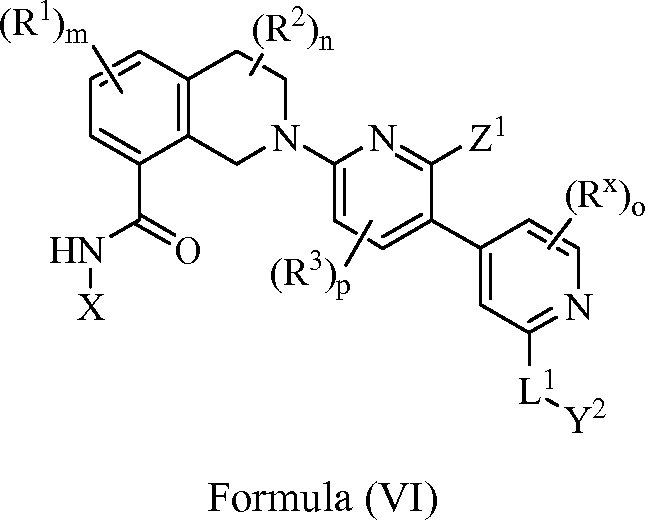
and therapeutically acceptable salts, metabolites, prodrugs, salts of metabolites, and salts of prodrugs thereof, wherein X, L1, Y2, Z1, R1, R2, R3, m, n, and p are as described herein for
Formula (I); Rx is as described herein for substituents on Y1, and o is 0, 1, 2, or 3.
One embodiment of this invention pertains to compounds, and therapeutically acceptable salts thereof, which are useful as inhibitors of anti-apoptotic Bcl-xL proteins, the compounds having Formula (VI)

wherein
X is heteroaryl; wherein the heteroaryl represented by X is optionally substituted with one, two, three, or four R4;
Rx, at each occurrence, is independently selected from the group consisting of R5,
OR5, SR5, S(O)R5, SO2R5, C(O)R5, CO(O)R5, OC(O)R5, OC(O)OR5, NH2, NHR5, N(R5)2,
NHC(O)R5, NR5C(O)R5, NHS(O)2R5, NR5S(O)2R5, NHC(O)OR5, NR5C(O)OR5, NHC(O)NH2, NHC(O)NHR5, NHC(O)N(R5)2, NR5C(O)NHR5, NR5C(O)N(R5)2, C(O)NH2, C(O)NHR5, C(O)N(R5)2, C(O)NHOH, C(O)NHOR5, C(O)NHSO2R5, C(O)NR5SO2R5, SO2NH2, SO2NHR5, SO2N(R5)2, CO(O)H, C(O)H, OH, CN, N5, NO2, F, Cl, Br and I;
L1 is selected from the group consisting of (CR6R7)q, (CR6R7)s-O-(CR6R7)r, (CR6R7)SC(O)-(CR6R7)r, (CR6R7)s-S-(CR6R7)r, (CR6R7)s-S(O)2-(CR6R7)r, (CR6R7)S-NR6AC(O)(CR6R7)r, (CR6R7)s-C(O)NR6A-(CR6R7)r, (CR6R7)s-NR6A-(CR6R7)r, (CR6R7)s-S(O)2NR6A(CR6R7)r, and (CR6R7)s-NR6AS(O)2-(CR6R7)r;
Y2 is C8_i4 cycloalkyl, C8_i4 cycloalkenyl, C8_i4 heterocycloalkyl, or C8_i4 heterocycloalkenyl; optionally fused to one or two rings selected from the group consisting of C3.8 cycloalkane, C3.8 cycloalkene, benzene, C5.6 heteroarene, C3.8 heterocycloalkane, and C3.8
-792017206246 20 Jul2017 heterocycloalkene; wherein Y2 is optionally substituted with one, two, three, four, or five substituents independently selected from the group consisting of R8, OR8, SR8, S(O)R8, SO2R8, C(O)R8, CO(O)R8, OC(O)R8, OC(O)OR8, NH2, NHR8, N(R8)2, NHC(O)R8, NR8C(O)R8, NHS(O)2R8, NR8S(O)2R8, NHC(O)OR8, NR8C(O)OR8, NHC(O)NH2, NHC(O)NHR8, NHC(O)N(R8)2, NR8C(O)NHR8, NR8C(O)N(R8)2, C(O)NH2, C(O)NHR8, C(O)N(R8)2, C(O)NHOH, C(O)NHOR8, C(O)NHSO2R8, C(O)NR8SO2R8, so2nh2, SO2NHR8, SO2N(R8)2, CO(O)H, C(O)H, OH, CN, N3, NO2, F, Cl, Br and I;
Z1 is selected from the group consisting of C(O)OR9, C(O)NR10Rn, C(O)Rn, NR10C(O)Rn, NR10C(O)NR10Rn, OC(O)NR10Rn, NR10C(O)OR9, C(=NOR10)NR10Rn, NR10C(=NCN)NR10R11, NR10S(O)2NR10Rn, S(O)2R9, S(O)2NR10Rn, N(R10)S(O)2Rn,
NR C(=NR )NR R , C(=S)NR1UR, C(=NR1U)NR1UR11, halogen, NO2, and CN; or Z1 is selected from the group consisting of -O.
N'
HN
-N
OH ~N
H
-N
-OH
A zz° O
X Jl < N E H 1
O OH ,OH
O aH ,OH
X o
An'
H
X o o
AN
H
N H
O
II
-S-OH
II
O
OH
Rk <w°
X N A- H , and
Rk
O O 1
Xn'V r
Η u ·
R1, at each occurrence, is independently selected from the group consisting of halo, Ci_6 alkyl, C2.6 alkenyl, C2.6 alkynyl, and Ci_6 haloalkyl;
R2, at each occurrence, is independently selected from the group consisting of deuterium, halo, Ci_6 alkyl, C2.6 alkenyl, C2.6 alkynyl, and Ci_6 haloalkyl;
two R2 that are attached to the same carbon atom, together with said carbon atom, optionally form a ring selected from the group consisting of heterocycloalkyl, heterocycloalkenyl, cycloalkyl, and cycloalkenyl;
R3, at each occurrence, is independently selected from the group consisting of halo, CA alkyl, C2.6 alkenyl, C2.6 alkynyl, and Ci_6 haloalkyl;
R4, at each occurrence, is independently selected from the group consisting of NR12R13, OR12, CN, NO2, halogen, C(O)OR12, C(O)NR12R13, NR12C(O)R13, NR12S(O)2R14, NR12S(O)R14, S(O)2R14, S(O)R14 and R14;
R5, at each occurrence, is independently selected from the group consisting of Ci_6 alkyl, C2.6 alkenyl, C2.6 alkynyl, Ci_6 haloalkyl, Ci_6 hydroxyalkyl, aryl, heterocyclyl, cycloalkyl, and cycloalkenyl;
-802017206246 20 Jul2017
R6A is independently selected from the group consisting of hydrogen, Ci_6 alkyl, C2_6 alkenyl, C2_6 alkynyl, and Ci_6 haloalkyl;
R6 and R7, at each occurrence, are each independently selected from the group consisting of hydrogen, R15, OR15, SR15, S(O)R15, SO2R15, C(O)R15, CO(O)R15, OC(O)R15,
OC(O)OR15, NH2, NHR15, N(R15)2, NHC(O)R15, NR15C(O)R15, NHS(O)2R15, NR15S(O)2R15, NHC(O)OR15, NR15C(O)OR15, NHC(O)NH2, NHC(O)NHR15, NHC(O)N(R15)2, NR15C(O)NHR15, NR15C(O)N(R15)2, C(O)NH2, C(O)NHR15, C(O)N(R15)2, C(O)NHOH, C(O)NHOR15, C(O)NHSO2R15, C(O)NR15SO2R15, so2nh2, SO2NHR15, SO2N(R15)2, CO(O)H, C(O)H, OH, CN, N3, NO2, F, Cl, Br and I;
R8, at each occurrence, is independently selected from the group consisting of Ci_6 alkyl, C2.6 alkenyl, C2.6 alkynyl, Ci_6 haloalkyl, aryl, heterocyclyl, cycloalkyl, and cycloalkenyl; wherein the R8 Ci_6 alkyl, C2_6 alkenyl, C2_6 alkynyl, and Ci_6 haloalkyl are optionally substituted with one, two, three, four, five, or six substituents independently selected from the group consisting of R16, OR16, SR16, S(O)R16, SO2R16, C(O)R16, CO(O)R16
OC(O)R16, OC(O)OR16, NH2, NHR16, N(R16)2, NHC(O)R16, NR16C(O)R16, NHS(O)2R16,
NR16S(O)2R16, NHC(O)OR16, NR16C(O)OR16, NHC(O)NH2, NHC(O)NHR16, NHC(O)N(R16)2, NR16C(O)NHR16, NR16C(O)N(R16)2, C(O)NH2, C(O)NHR16, C(O)N(R16)2, C(O)NHOH, C(O)NHOR16, C(O)NHSO2R16, C(O)NR16SO2R16, SO2NH2, SO2NHR16, SO2N(R16)2, CO(O)H, C(O)H, OH, CN, N3, NO2, F, Cl, Br and I; wherein the R8 aryl, heterocyclyl, cycloalkyl, and cycloalkenyl are optionally substituted with one, two, or three substituents independently selected from the group consisting of Ci_6 alkyl, C2.6 alkenyl, C2.6 alkynyl, Ci_6 haloalkyl, NH2, C(O)NH2, SO2NH2, C(O)H, (O), OH, CN, NO2, OCF3, OCF2CF3, F, Cl, Br and I;
R9 is selected from the group consisting of Ci_6 alkyl, C2.6 alkenyl, C2.6 alkynyl, Ci_6 haloalkyl, cycloalkyl, phenyl and (CH2)i_4 phenyl; and
R10 and R11, at each occurrence, are each independently selected from the group consisting of hydrogen, Ci_6 alkyl, C2.6 alkenyl, C2.6 alkynyl, C3.6 cycloalkyl, Ci_6 haloalkyl, phenyl and (CH2)i_4-phenyl; or
R10 and R11, or R10 and R9, together with the atom to which each is attached are combined to form a heterocyclyl;
Rk, at each occurrence, is independently selected from the group consisting of Ci_6 alkyl, C2.6 alkenyl, C2.6 alkynyl, C3.7 heterocycloalkyl, C3.7 cycloalkyl and Ci_6 haloalkyl;
R12 and R13, at each occurrence, are each independently selected from the group consisting of hydrogen, Cm alkyl, C2.4 alkenyl, C2.4 alkynyl, Cm haloalkyl and (CH2)i_4 phenyl;
R14, at each occurrence, is independently selected from the group consisting of Cm alkyl, C2.4 alkenyl, C2.4 alkynyl and Cm haloalkyl;
- 81 2017206246 20 Jul2017
R12 and R13, or R12 and R14, at each occurrence, together with the atom to which each is attached, are optionally combined to form a heterocyclyl;
R15, at each occurrence, is independently selected from the group consisting of Cm alkyl, C2.4 alkenyl, C2.4 alkynyl, Cm haloalkyl, Cm hydroxyalkyl, aryl, heterocyclyl, cycloalkyl, and cycloalkenyl; wherein the R15 Cm alkyl, C2m alkenyl, C2.4 alkynyl, Cm haloalkyl, and Cm hydroxyalkyl are optionally substituted with one, two, or three substituents independently selected from the group consisting of O-(Ci_4 alkyl), NH2, C(O)NH2, SO2NH2, C(O)H, C(O)OH, (O), OH, CN, NO2, OCF3, OCF2CF3, F, Cl, Br and I;
R16, at each occurrence, is independently selected from the group consisting of Cm 10 alkyl, C2.4 alkenyl, C2.4 alkynyl, Cm haloalkyl, Cm hydroxyalkyl, aryl, heterocycloalkyl, heterocycloalkenyl, heteroaryl, cycloalkyl, and cycloalkenyl; wherein the R16 Cm alkyl, C2.4 alkenyl, C2.4 alkynyl, Cm haloalkyl, and Cm hydroxyalkyl are optionally substituted with one substituent independently selected from the group consisting of OCH3, OCH2CH2OCH3, and OCH2CH2NHCH3;
q is 1, 2, or 3;
s is 0, 1, 2, or 3; r is 0, 1,2, or 3;
wherein the sum of s and r is 0, 1, or 2; m is 0, 1, 2, or 3;
n is 0, 1, 2, 3, 4, 5, or 6;
o is 0, 1, 2, or 3; and p is 0, 1, or 2.
In one embodiment of Formula (VI), m is 0, 1, 2, or 3; n is 0, 1, 2, 3, 4, 5, or 6; and p is 0, 1, or 2. In another embodiment of Formula (VI), n is 0, 1, or 2. In another embodiment of Formula (VI), n is 0, 1, or 2; and each R2 is independently deuterium or Cm alkyl. In another embodiment of Formula (VI), m, n, and p are 0.
In one embodiment of Formula (VI), X is heteroaryl, which is optionally substituted with one, two, three or four R4. In another embodiment of Formula (VI), X is heteroaryl, which is unsubstituted. In another embodiment of Formula (VI), X is heteroaryl, which is substituted with one R4. In another embodiment of Formula (VI), X is heteroaryl, which is substituted with two R4. In another embodiment of Formula (VI), X is heteroaryl, which is substituted with one R4, and R4 is OR12 or halogen. In another embodiment of Formula (VI), X is heteroaryl, which is substituted with two R4, and each R4 is independently OR12 or halogen. In another embodiment of Formula (VI), X is heteroaryl, which is substituted with one R4, and R4 is Cl, F, or methoxy. In another embodiment of Formula (VI), X is heteroaryl, which is substituted with two R4, and each R4 is independently F.
- 82 2017206246 20 Jul2017
In one embodiment of Formula (VI), X benzo [d]thiazolyl, thiazolo[5,4-b]pyridinyl, thiazolo[4,5-c]pyridinyl, imidazo[l,2-a]pyridinyl, thiazolo[5,4-c]pyridinyl, thiazolo[4,5b]pyridinyl, imidazo[l,2-a]pyrazinyl, or imidazo[l,2-b]pyridazinyl, which are optionally substituted with one, two, three or four R4. In another embodiment of Formula (VI), X is benzo[d]thiazolyl, thiazolo[5,4-b]pyridinyl, thiazolo[4,5-c]pyridinyl, imidazofl,2-a]pyridinyl, thiazolo[5,4-c]pyridinyl, thiazolo[4,5-b]pyridinyl, imidazo[l,2-a]pyrazinyl, or imidazo[l,2b]pyridazinyl, which are unsubstituted. In another embodiment of Formula (VI), X is benzo[d]thiazolyl, thiazolo[5,4-b]pyridinyl, thiazolo[4,5-c]pyridinyl, imidazo[l,2-a]pyridinyl, thiazolo[5,4-c]pyridinyl, thiazolo[4,5-b]pyridinyl, imidazo[l,2-a]pyrazinyl, or imidazo[l,210 b]pyridazinyl, which are substituted with one R4. In another embodiment of Formula (VI), X is benzo[d]thiazolyl, thiazolo[5,4-b]pyridinyl, thiazolo[4,5-c]pyridinyl, imidazo[l,2a]pyridinyl, thiazolo[5,4-c]pyridinyl, thiazolo[4,5-b]pyridinyl, imidazo[l,2-a]pyrazinyl, or imidazo[l,2-b]pyridazinyl, which are substituted with two R4. In another embodiment of Formula (VI), X is benzo[d]thiazolyl, thiazolo[5,4-b]pyridinyl, thiazolo[4,5-c]pyridinyl, imidazo[l,2-a]pyridinyl, thiazolo[5,4-c]pyridinyl, thiazolo[4,5-b]pyridinyl, imidazo[l,2a] pyrazinyl, or imidazo[l,2-b]pyridazinyl, which are substituted with one R4, and R4 is OR12 or halogen. In another embodiment of Formula (VI), X is benzo[d]thiazolyl, thiazolo[5,4b] pyridinyl, thiazolo[4,5-c]pyridinyl, imidazo[l,2-a]pyridinyl, thiazolo[5,4-c]pyridinyl, thiazolo[4,5-b]pyridinyl, imidazo[l,2-a]pyrazinyl, or imidazo[l,2-b]pyridazinyl, which are substituted with two R4, and each R4 is independently OR12 or halogen. In another embodiment of Formula (VI), X is benzo[d]thiazolyl, thiazolo[5,4-b]pyridinyl, thiazolo[4,5c] pyridinyl, imidazo[l,2-a]pyridinyl, thiazolo[5,4-c]pyridinyl, thiazolo[4,5-b]pyridinyl, imidazo[l,2-a]pyrazinyl, or imidazo[l,2-b]pyridazinyl, which are substituted with one R4, and R4 is Cl, F, or methoxy. In another embodiment of Formula (VI), X is benzo[d]thiazolyl, thiazolo[5,4-b]pyridinyl, thiazolo[4,5-c]pyridinyl, imidazo[l,2-a]pyridinyl, thiazolo[5,4c]pyridinyl, thiazolo[4,5-b]pyridinyl, imidazo[l,2-a]pyrazinyl, or imidazo[l,2-b]pyridazinyl, which are substituted with two R4, and each R4 is independently F.
In one embodiment of Formula (VI), X is benzo [d]thiazolyl, which is optionally substituted with one, two, three or four R4. In another embodiment of Formula (VI), X is benzo[d]thiazolyl, which is unsubstituted. In another embodiment of Formula (VI), X is benzo[d]thiazolyl, which is substituted with one R4. In another embodiment of Formula (VI), X is benzo [d]thiazolyl, which is substituted with two R4. In another embodiment of Formula (VI), X is benzo [d]thiazolyl, which is substituted with one R4, and R4 is OR12 or halogen. In another embodiment of Formula (VI), X is benzo[d]thiazolyl, which is substituted with two
R4, and each R4 is independently OR12 or halogen. In another embodiment of Formula (VI),
X is benzo [d]thiazolyl, which is substituted with one R4, and R4 is Cl, F, or methoxy. In
- 83 2017206246 20 Jul2017 another embodiment of Formula (VI), X is benzo [d]thiazolyl, which is substituted with two R4, and each R4 is independently F.
In one embodiment of Formula (VI), Z1 is selected from the group consisting of C(O)OR9, C(O)NR10Rn, C(O)Rn, NR10C(O)Rn, NR10C(O)NR10Rn, OC(O)NR10Rn, NR10C(O)OR9, C(=NOR10)NR10R11, NR10C(=NCN)NR10Rn, NR10S(O)2NR10Rn, S(O)2R9, S(O)2NR10Rn, N(R10)S(O)2Rn, NR10C(=NR11)NR10R11, C(=S)NR10Rn, C(=NR10)NR10Rn, halogen, NO2, and CN; or Z1 is selected from the group consisting of
T-Q rs . . „ ,„T.N
N'“\
H >O H .
O χΆϊ
HN'
-N
N
O'
-N
HN
OH
I
X^N
H
H .N
O OH o o
AU
X o
η X .OH
N .,/ Ν' 'Ν'
X H
O . H
1—S-OH < II
O
O
AH
X '0 .OH

OH X \'°Υ
H
JO XX , and
Rk ο o i
X VN'Rk
X^N'% R
Η υ
In another embodiment of Formula (VI), Z1 is
T-N
HN'
OH
N o o X v° XX A
H R or
Rk
O O 1 ,x AN'Rk
X N A embodiment of Formula (VI), Z1 is
Λ U
V^OH
H .N c
]
X
In another
O O
X V° Xx v
H R.
In another embodiment of Formula (VI), Z1 is
O \A)H
X V°
XX'
In
O
A.
X another embodiment of Formula (VI), Z is
OH
In one embodiment of Formula (VI), o is 0. In another embodiment of Formula (VI), o is 0, 1, 2, or 3. In another embodiment of Formula (VI), o is 1, 2, or 3; and Rx, at each occurrence, is independently selected from the group consisting of R5, OR5, SR5, S(O)R5, SO2R5, C(O)R5, CO(O)R5, OC(O)R5, OC(O)OR5, NH2, NHR5, N(R5)2, NHC(O)R5, NR5C(O)R5, NHS(O)2R5, NR5S(O)2R5, NHC(O)OR5, NR5C(O)OR5, NHC(O)NH2, NHC(O)NHR5, NHC(O)N(R5)2, NR5C(O)NHR5, NR5C(O)N(R5)2, C(O)NH2, C(O)NHR5, C(O)N(R5)2, C(O)NHOH, C(O)NHOR5, C(O)NHSO2R5, C(O)NR5SO2R5, SO2NH2,
-842017206246 20 Jul2017
SO2NHR5, SO2N(R5)2, CO(O)H, C(O)H, OH, CN, N5, NO2, F, Cl, Br and I. In another embodiment of Formula (VI), o is 1, 2, or 3; and Rx, at each occurrence, is independently selected from the group consisting of R5, CN, F, Cl, Br and I. In another embodiment of Formula (VI), o is 1, 2, or 3; and Rx, at each occurrence, is independently selected from the group consisting of R5, CN, F, Cl, Br and I; wherein R5 is Ci_6 alkyl. In another embodiment of Formula (VI), o is 1 or 2; Rx is R5 or CN; and R5 is CH3. In another embodiment of Formula (VI), o is 1; and Rx is CN. In another embodiment of Formula (VI), o is 1; and Rx is Cl. In another embodiment of Formula (VI), o is 1; Rx is R5; and R5 is CH3.
In one embodiment of Formula (VI), L1 is selected from the group consisting of 10 (CR6R7)q, (CR6R7)q, (CR6R7)s-O-(CR6R7)r, (CR6R7)s-C(O)-(CR6R7)r, (CR6R7)s-S-(CR6R7)r, (CR6R7)s-S(O)2-(CR6R7)r, (CR6R7)s-NR6AC(O)-(CR6R7)r, (CR6R7)s-C(O)NR6A-(CR6R7)r, (CR6R7)s-NR6A-(CR6R7)r, (CR6R7)s-S(O)2NR6A-(CR6R7)r, and (CR6R7)s-NR6AS(O)2-(CR6R7)r; and Y2 is Cg-u cycloalkyl, Cg-u cycloalkenyl, C8_i4 heterocycloalkyl, or C8_i4 heterocycloalkenyl; optionally fused to one or two rings selected from the group consisting of 15 C3_g cycloalkane, C3.8 cycloalkene, benzene, C5.6 heteroarene, C3.8 heterocycloalkane, and C3.8 heterocycloalkene; wherein Y2 is optionally substituted with one, two, three, four, or five substituents independently selected from the group consisting of R8, OR8, SR8, S(O)R8,
SO2R8, C(O)R8, CO(O)R8, OC(O)R8, OC(O)OR8, NH2, NHR8, N(R8)2, NHC(O)R8, NR8C(O)R8, NHS(O)2R8, NR8S(O)2R8, NHC(O)OR8, NR8C(O)OR8, NHC(O)NH2,
NHC(O)NHR8, NHC(O)N(R8)2, NR8C(O)NHR8, NR8C(O)N(R8)2, C(O)NH2, C(O)NHR8, C(O)N(R8)2, C(O)NHOH, C(O)NHOR8, C(O)NHSO2R8, C(O)NR8SO2R8, SO2NH2,
SO2NHR8, SO2N(R8)2, CO(O)H, C(O)H, OH, CN, N3, NO2, F, Cl, Br and I.
In another embodiment of Formula (VI), L1 is (CR6R7)q; and Y2 is selected from the group consisting of C8_i4 cycloalkyl, and C8_i4 heterocycloalkyl; wherein R6 and R7, at each occurrence, are hydrogen; and q is 1 or 2. In another embodiment of Formula (VI), L1 is selected from the group consisting of (CR6R7)s-O-(CR6R7)r, (CR6R7)s-S-(CR6R7)r, (CR6R7)SS(O)2-(CR6R7)r, (CR6R7)s-NR6AC(O)-(CR6R7)r, (CR6R7)s-C(O)NR6A-(CR6R7)r, (CR6R7)SNR6A-(CR6R7)r, and (CR6R7)s-S(O)2NR6A-(CR6R7)r; Y2 is selected from the group consisting of C8_i4 cycloalkyl, and C8_i4 heterocycloalkyl; s is 0; r is 0 or 1; R6A is independently selected from the group consisting of hydrogen, and Ci_6 alkyl; and R6 and R7, at each occurrence, are hydrogen.
In another embodiment of Formula (VI),
X is heteroaryl;
Rx, at each occurrence, is independently selected from the group consisting of R5, CN,
F, Cl, Brandi;
- 85 2017206246 20 Jul2017
L1 is selected from the group consisting of (CR6R7)q, (CR6R7)s-O-(CR6R7)r, (CR6R7)SS-(CR6R7)r, (CR6R7)s-S(O)2-(CR6R7)r, (CR6R7)s-NR6AC(O)-(CR6R7)r, (CR6R7)S-C(O)NR6A(CR6R7)r, (CR6R7)s-NR6A-(CR6R7)r, and (CR6R7)s-S(O)2NR6A-(CR6R7)r;
V2 is C§_i4 cycloalkyl, or Cg-u heterocycloalkyl; wherein Y2 is optionally substituted with one, two, or three substituents independently selected from the group consisting of R8, OR8, SO2R8, CO(O)R8, OH, F, Cl, Br and I;
Z1 is selected from the group consisting of
O HN'N>
Aoh A..
~N
O O
X V° vx 'S'Rk
H R
R2, at each occurrence, is independently Cm alkyl;
R5, at each occurrence, is independently Cm alkyl;
R6A is independently selected from the group consisting of hydrogen and Cm alkyl;
R6 and R7, at each occurrence, are each independently hydrogen;
R8, at each occurrence, is independently selected from the group consisting of Cm alkyl and heterocyclyl; wherein the R8 Cm alkyl is optionally substituted with one substituent independently selected from the group consisting of R16, OR16, SO2R16, and NHR16;
Rk, at each occurrence, is independently selected from the group consisting of Cm alkyl, C3.7 heterocycloalkyl, C3.7 cycloalkyl and Cm haloalkyl;
R16, at each occurrence, is independently selected from the group consisting of Cm alkyl, aryl, and heterocycloalkyl; wherein the R16 Cm alkyl is optionally substituted with one substituent independently selected from the group consisting of OCH3, OCH2CH2OCH3, and OCH2CH2NHCH3;
q is 1 or 2; s is 0; r is 0 or 1;
wherein the sum of s and r is 0 or 1; m is 0;
n is 0, 1, or 2;
is 0 or 1; and p is 0.
Still another embodiment pertains to a compound having Formula (VI) selected from the group consisting of
6-[8-(l,3-benzothiazol-2-ylcarbamoyl)-3,4-dihydroisoquinolin-2(lH)-yl]-2'(tricyclo[3.3.1.13’7]dec-l-ylmethoxy)-3,4'-bipyridine-2-carboxylic acid;
6-[8-(l,3-benzothiazol-2-ylcarbamoyl)-3,4-diliydroisoquinolin-2(lH)-yl]-3'-methyl2'-(tricyclo[3.3.1.l3,7]dec-l-ylmethoxy)-3,4'-bipyridine-2-carboxylic acid;
-862017206246 20 Jul2017
6-[8-(l,3-benzothiazol-2-ylcarbamoyl)-3,4-dihydroisoquinolin-2(lH)-yl]-2'[cyclooctyl(methyl)amino]-3'-methyl-3,4'-bipyridine-2-carboxylic acid;
6-[8-(l,3-benzothiazol-2-ylcarbamoyl)-3,4-dihydroisoquinolin-2(lH)-yl]-3'-methyl2'-(tricyclo[3.3.1.13,7]dec-1 -ylsulfonyl)-3,4'-bipyridine-2-carboxylic acid;
6-[8-(l,3-benzothiazol-2-ylcarbamoyl)-3,4-dihydroisoquinolin-2(lH)-yl]-3'-methyl2'-(tricyclo[3.3.1.13,7]dec-1 -ylsulfany 1)-3,4'-bipyridine-2-carboxylie acid;
6-[8-(l,3-benzothiazol-2-ylcarbamoyl)-3,4-dihydroisoquinolin-2(lH)-yl]-3'-methyl2'-(tricyclo[3.3.1.13’7]dec-l-ylamino)-3,4'-bipyridine-2-carboxylic acid; and therapeutically acceptable salts, metabolites, prodrugs, salts of metabolites, and salts of prodrugs thereof.
Pharmaceutical Compositions, Combination Therapies, Methods of Treatment, and Administration
Another embodiment comprises pharmaceutical compositions comprising a compound having Formula (I) and an excipient.
Still another embodiment comprises methods of treating cancer in a mammal 15 comprising administering thereto a therapeutically acceptable amount of a compound having
Formula (I).
Still another embodiment comprises methods of treating autoimmune disease in a mammal comprising administering thereto a therapeutically acceptable amount of a compound having Formula (I).
Still another embodiment pertains to compositions for treating diseases during which anti-apoptotic Bcl-xL proteins are expressed, said compositions comprising an excipient and a therapeutically effective amount of the compound having Formula (I).
Still another embodiment pertains to methods of treating disease in a patient during which anti-apoptotic Bcl-xL proteins are expressed, said methods comprising administering to the patient a therapeutically effective amount of a compound having Formula (I).
Still another embodiment pertains to compositions for treating bladder cancer, brain cancer, breast cancer, bone marrow cancer, cervical cancer, chronic lymphocytic leukemia, colorectal cancer, esophageal cancer, hepatocellular cancer, lymphoblastic leukemia, follicular lymphoma, lymphoid malignancies of T-cell or B-cell origin, melanoma, myelogenous leukemia, myeloma, oral cancer, ovarian cancer, non-small cell lung cancer, prostate cancer, small cell lung cancer or spleen cancer, said compositions comprising an excipient and a therapeutically effective amount of the compound having Formula (I).
Still another embodiment pertains to methods of treating bladder cancer, brain cancer, breast cancer, bone marrow cancer, cervical cancer, chronic lymphocytic leukemia, colorectal cancer, esophageal cancer, hepatocellular cancer, lymphoblastic leukemia, follicular lymphoma, lymphoid malignancies of T-cell or B-cell origin, melanoma, myelogenous leukemia, myeloma, oral cancer, ovarian cancer, non-small cell lung cancer, prostate cancer,
- 87 2017206246 20 Jul2017 small cell lung cancer or spleen cancer in a patient, said methods comprising administering to the patient a therapeutically effective amount of a compound having Formula (I).
Still another embodiment pertains to compositions for treating diseases during which are expressed anti-apoptotic Bcl-xL proteins, said compositions comprising an excipient and a therapeutically effective amount of the compound having Formula (I) and a therapeutically effective amount of one additional therapeutic agent or more than one additional therapeutic agent.
Still another embodiment pertains to methods of treating disease in a patient during which are expressed anti-apoptotic Bcl-xL proteins, said methods comprising administering to the patient a therapeutically effective amount of a compound having Formula (I) and a therapeutically effective amount of one additional therapeutic agent or more than one additional therapeutic agent.
Still another embodiment pertains to compositions for treating bladder cancer, brain cancer, breast cancer, bone marrow cancer, cervical cancer, chronic lymphocytic leukemia, colorectal cancer, esophageal cancer, hepatocellular cancer, lymphoblastic leukemia, follicular lymphoma, lymphoid malignancies of T-cell or B-cell origin, melanoma, myelogenous leukemia, myeloma, oral cancer, ovarian cancer, non-small cell lung cancer, chronic lymphocytic leukemia, myeloma, prostate cancer, small cell lung cancer or spleen cancer, said compositions comprising an excipient and a therapeutically effective amount of the compound having Formula (I) and a therapeutically effective amount of one additional therapeutic agent or more than one additional therapeutic agent.
Still another embodiment pertains to methods of treating bladder cancer, brain cancer, breast cancer, bone marrow cancer, cervical cancer, chronic lymphocytic leukemia, colorectal cancer, esophageal cancer, hepatocellular cancer, lymphoblastic leukemia, follicular lymphoma, lymphoid malignancies of T-cell or B-cell origin, melanoma, myelogenous leukemia, myeloma, oral cancer, ovarian cancer, non-small cell lung cancer, chronic lymphocytic leukemia, myeloma, prostate cancer, small cell lung cancer or spleen cancer in a patient, said methods comprising administering to the patient a therapeutically effective amount of the compound having Formula (I) and a therapeutically effective amount of one additional therapeutic agent or more than one additional therapeutic agent.
Metabolites of compounds having Formula (I), produced by in vitro or in vivo metabolic processes, may also have utility for treating diseases associated with anti-apoptotic Bcl-xL proteins.
Certain precursor compounds which may be metabolized in vitro or in vivo to form compounds having Formula (I) may also have utility for treating diseases associated with expression of anti-apoptotic Bcl-xL proteins.
- 88 2017206246 20 Jul2017
Compounds having Formula (I) may exist as acid addition salts, basic addition salts or zwitterions. Salts of the compounds are prepared during isolation or following purification of the compounds. Acid addition salts of the compounds are those derived from the reaction of the compounds with an acid. For example, the acetate, adipate, alginate, bicarbonate, citrate, aspartate, benzoate, benzenesulfonate, bisulfate, butyrate, camphorate, camphorsufonate, digluconate, formate, fumarate, glycerophosphate, glutamate, hemisulfate, heptanoate, hexanoate, hydrochloride, hydrobromide, hydroiodide, lactobionate, lactate, maleate, mesitylenesulfonate, methanesulfonate, naphthylenesulfonate, nicotinate, oxalate, pamoate, pectinate, persulfate, phosphate, picrate, propionate, succinate, tartrate, thiocyanate, trichloroacetic, trifluoroacetic, para-toluenesulfonate, and undecanoate salts of the compounds are contemplated as being embraced by this invention. Basic addition salts of the compounds are those derived from the reaction of the compounds with the hydroxide, carbonate or bicarbonate of cations such as lithium, sodium, potassium, calcium, and magnesium.
The compounds having Formula (I) may be administered, for example, bucally, ophthalmically, orally, osmotically, parenterally (intramuscularly, intraperitoneally intrastemally, intravenously, subcutaneously), rectally, topically, transdermally or vaginally.
Therapeutically effective amounts of compounds having Formula (I) depend on the recipient of the treatment, the disorder being treated and the severity thereof, the composition containing the compound, the time of administration, the route of administration, the duration of treatment, the compound potency, its rate of clearance and whether or not another drug is co-administered. The amount of a compound of this invention having Formula (I) used to make a composition to be administered daily to a patient in a single dose or in divided doses is from about 0.03 to about 200 mg/kg body weight. Single dose compositions contain these amounts or a combination of submultiples thereof.
Compounds having Formula (I) may be administered with or without an excipient.
Excipients include, for example, encapsulating materials or additives such as absorption accelerators, antioxidants, binders, buffers, coating agents, coloring agents, diluents, disintegrating agents, emulsifiers, extenders, fillers, flavoring agents, humectants, lubricants, perfumes, preservatives, propellants, releasing agents, sterilizing agents, sweeteners, solubilizers, wetting agents and mixtures thereof.
Excipients for preparation of compositions comprising a compound having Formula (I) to be administered orally in solid dosage form include, for example, agar, alginic acid, aluminum hydroxide, benzyl alcohol, benzyl benzoate, 1,3-butylene glycol, carbomers, castor oil, cellulose, cellulose acetate, cocoa butter, com starch, com oil, cottonseed oil, cross-povidone, diglycerides, ethanol, ethyl cellulose, ethyl laureate, ethyl oleate, fatty acid esters, gelatin, germ oil, glucose, glycerol, groundnut oil, hydroxypropylmethyl cellulose,
- 89 2017206246 20 Jul2017 isopropanol, isotonic saline, lactose, magnesium hydroxide, magnesium stearate, malt, mannitol, monoglycerides, olive oil, peanut oil, potassium phosphate salts, potato starch, povidone, propylene glycol, Ringer's solution, safflower oil, sesame oil, sodium carboxymethyl cellulose, sodium phosphate salts, sodium lauryl sulfate, sodium sorbitol, soybean oil, stearic acids, stearyl fumarate, sucrose, surfactants, talc, tragacanth, tetrahydro furfuryl alcohol, triglycerides, water, and mixtures thereof. Excipients for preparation of compositions comprising a compound of this invention having Formula (I) to be administered ophthalmically or orally in liquid dosage forms include, for example, 1,3-butylene glycol, castor oil, com oil, cottonseed oil, ethanol, fatty acid esters of sorbitan, germ oil, groundnut oil, glycerol, isopropanol, olive oil, polyethylene glycols, propylene glycol, sesame oil, water and mixtures thereof. Excipients for preparation of compositions comprising a compound of this invention having Formula (I) to be administered osmotically include, for example, chlorofluorohydrocarbons, ethanol, water and mixtures thereof. Excipients for preparation of compositions comprising a compound of this invention having
Formula (I) to be administered parenterally include, for example, 1,3-butanediol, castor oil, com oil, cottonseed oil, dextrose, germ oil, groundnut oil, liposomes, oleic acid, olive oil, peanut oil, Ringer's solution, safflower oil, sesame oil, soybean oil, U.S.P. or isotonic sodium chloride solution, water and mixtures thereof. Excipients for preparation of compositions comprising a compound of this invention having Formula (I) to be administered rectally or vaginally include, for example, cocoa butter, polyethylene glycol, wax and mixtures thereof.
Compounds having Formula (I) are expected to be useful when used with alkylating agents, angiogenesis inhibitors, antibodies, antimetabolites, antimitotics, antiproliferatives, antivirals, aurora kinase inhibitors, other apoptosis promoters (for example, Bcl-xL, Bcl-w and Bfl-1) inhibitors, activators of death receptor pathway, Bcr-Abl kinase inhibitors, BiTE (Bi-Specific T cell Engager) antibodies, antibody drug conjugates, biologic response modifiers, cyclin-dependent kinase inhibitors, cell cycle inhibitors, cyclooxygenase-2 inhibitors, DVDs, leukemia viral oncogene homolog (ErbB2) receptor inhibitors, growth factor inhibitors, heat shock protein (HSP)-90 inhibitors, histone deacetylase (HDAC) inhibitors, hormonal therapies, immunologicals, inhibitors of inhibitors of apoptosis proteins (IAPs), intercalating antibiotics, kinase inhibitors, kinesin inhibitors, Jak2 inhibitors, mammalian target of rapamycin inhibitors, microRNA’s, mitogen-activated extracellular signal-regulated kinase inhibitors, multivalent binding proteins, non-steroidal anti-inflammatory drugs (NSAIDs), poly ADP (adenosine diphosphate)-ribose polymerase (PARP) inhibitors, platinum chemotherapeutics, polo-like kinase (Plk) inhibitors, phosphoinositide-3 kinase (PI3K) inhibitors, proteosome inhibitors, purine analogs, pyrimidine analogs, receptor tyrosine kinase inhibitors, retinoids/deltoids plant alkaloids,
-902017206246 20 Jul2017 small inhibitory ribonucleic acids (siRNAs), topoisomerase inhibitors, ubiquitin ligase inhibitors, and the like, and in combination with one or more of these agents .
BiTE antibodies are bi-specific antibodies that direct T-cells to attack cancer cells by simultaneously binding the two cells. The T-cell then attacks the target cancer cell.
Examples of BiTE antibodies include adecatumumab (Micromet MT201), blinatumomab (Micromet MT103) and the like. Without being limited by theory, one of the mechanisms by which T-cells elicit apoptosis of the target cancer cell is by exocytosis of cytolytic granule components, which include perforin and granzyme B.
SiRNAs are molecules having endogenous RNA bases or chemically modified 10 nucleotides. The modifications do not abolish cellular activity, but rather impart increased stability and/or increased cellular potency. Examples of chemical modifications include phosphorothioate groups, 2'-deoxynucleotide, 2'-OCH3-containing ribonucleotides, 2'-Fribonucleotides, 2'-methoxyethyl ribonucleotides, combinations thereof and the like. The siRNA can have varying lengths (e.g., 10-200 bps) and structures (e.g., hairpins, single/double strands, bulges, nicks/gaps, mismatches) and are processed in cells to provide active gene silencing. A double-stranded siRNA (dsRNA) can have the same number of nucleotides on each strand (blunt ends) or asymmetric ends (overhangs). The overhang of 1-2 nucleotides can be present on the sense and/or the antisense strand, as well as present on the 5'- and/ or the 3'-ends of a given strand. For example, siRNAs targeting Mcl-1 have been shown to enhance the activity of ABT-263, (i.e., N-(4-(4-((2-(4-chlorophenyl)-5,5-dimethyl1 -cyclohex-1 -en-1 -yl)methyl)piperazin-1 -yl)benzoy 1)-4-((( 1 R)-3-(morpholin-4-yl)-1 ((phenylsulfanyl)methyl)propyl)amino)-3-((trifluoromethyl)sulfonyl)benzenesulfonamide) or ABT-737 (i.e., N-(4-(4-((4'-chloro( 1,1 '-biphenyl)-2-yl)methyl)piperazin-l -yl)benzoy 1)-4(((1 R)-3-(dimethylamino)-1 -((phenylsulfanyl)methyl)propyl)amino)-325 nitrobenzenesulfonamide) in multiple tumor cell lines (Tse et. al, Cancer Research 2008, 68(9), 3421 and references therein).
Multivalent binding proteins are binding proteins comprising two or more antigen binding sites. Multivalent binding proteins are engineered to have the three or more antigen binding sites and are generally not naturally occurring antibodies. The term “multispecific binding protein’’ means a binding protein capable of binding two or more related or unrelated targets. Dual variable domain (DVD) binding proteins are tetravalent or multivalent binding proteins binding proteins comprising two or more antigen binding sites. Such DVDs may be monospecific (i.e., capable of binding one antigen) or multispecific (i.e., capable of binding two or more antigens). DVD binding proteins comprising two heavy chain DVD polypeptides and two light chain DVD polypeptides are referred to as DVD Ig's. Each half of a DVD Ig comprises a heavy chain DVD polypeptide, a light chain DVD polypeptide, and two antigen binding sites. Each binding site comprises a heavy chain variable domain and a
-91 2017206246 20 Jul2017 light chain variable domain with a total of 6 CDRs involved in antigen binding per antigen binding site.
Alkylating agents include altretamine, AMD-473, AP-5280, apaziquone, bendamustine, brostallicin, busulfan, carboquone, carmustine (BCNU), chlorambucil,
CLORETAZINE® (laromustine, VNP 40101M), cyclophosphamide, decarbazine, estramustine, fotemustine, glufosfamide, ifosfamide, KW-2170, lomustine (CCNU), mafosfamide, melphalan, mitobronitol, mitolactol, nimustine, nitrogen mustard N-oxide, ranimustine, temozolomide, thiotepa, TREANDA® (bendamustine), treosulfan, rofosfamide and the like.
Angiogenesis inhibitors include endothelial-specific receptor tyrosine kinase (Tie-2) inhibitors, epidermal growth factor receptor (EGFR) inhibitors, insulin growth factor-2 receptor (IGFR-2) inhibitors, matrix metalloproteinase-2 (MMP-2) inhibitors, matrix metalloproteinase-9 (MMP-9) inhibitors, platelet-derived growth factor receptor (PDGFR) inhibitors, thrombospondin analogs, vascular endothelial growth factor receptor tyrosine kinase (VEGFR) inhibitors and the like.
Antimetabolites include ALIMTA® (pemetrexed disodium, LY231514, MTA),
5-azacitidine, XELODA® (capecitabine), carmofur, LEUSTAT® (cladribine), clofarabine, cytarabine, cytarabine ocfosfate, cytosine arabinoside, decitabine, deferoxamine, doxifluridine, eflomithine, EICAR (5-ethynyl-l -β -D-ribofuranosylimidazole-420 carboxamide), enocitabine, ethnylcytidine, fludarabine, 5-fluorouracil alone or in combination with leucovorin, GEMZAR® (gemcitabine), hydroxyurea, ALKERAN®(melphalan), mercaptopurine, 6-mercaptopurine riboside, methotrexate, mycophenolic acid, nelarabine, nolatrexed, ocfosfate, pelitrexol, pentostatin, raltitrexed, Ribavirin, triapine, trimetrexate, S-l, tiazofurin, tegafur, TS-1, vidarabine, UFT and the like.
Antivirals include ritonavir, hydroxychloroquine and the like.
Aurora kinase inhibitors include ABT-348, AZD-1152, MLN-8054, VX-680, Aurora
A-specific kinase inhibitors, Aurora B-specific kinase inhibitors and pan-Aurora kinase inhibitors and the like.
Bcl-2 protein inhibitors include AT-101 ((-)gossypol), GENASENSE® (G3139 or oblimersen (Bcl-2-targeting antisense oligonucleotide)), IPI-194, IPI-565, N-(4-(4-((4'chloro( 1,1 '-biphenyl)-2-yl)methyl)piperazin-1 -yl)benzoy 1)-4-((( 1 R)-3 -(dimethylamino)-1 ((phenylsulfanyl)methyl)propyl)amino)-3-nitrobenzenesulfonamide) (ABT-737), N-(4-(4-((2(4-chlorophenyl)-5,5 -dimethyl-1 -cyclohex-1 -en-1 -yl)methyl)piperazin-1 -yl)benzoy 1)-4(((1 R)-3-(morpholin-4-yl)-1 -((phenylsulfanyl)methyl)propyl)amino)-3 35 ((trifluoromethyl)sulfonyl)benzenesulfonamide (ABT-263), GX-070 (obatoclax) and the like. Bcr-Abl kinase inhibitors include DASATINIB® (BMS-354825), GLEEVEC® (imatinib) and the like.
-922017206246 20 Jul2017
CDK inhibitors include AZD-5438, BMI-1040, BMS-032, BMS-387, CVT-2584, flavopyridol, GPC-286199, MCS-5A, PD0332991, PHA-690509, seliciclib (CYC-202, R-roscovitine), ZK-304709 and the like.
COX-2 inhibitors include ABT-963, ARCOXIA® (etoricoxib), BEXTRA® (valdecoxib), BMS347070, CELEBREX® (celecoxib), COX-189 (lumiracoxib), CT-3,
DERAMAXX® (deracoxib), JTE-522, 4-methyl-2-(3,4-dimethylphenyl)-l-(4sulfamoylphenyl-lH-pyrrole), MK-663 (etoricoxib), NS-398, parecoxib, RS-57067, SC-58125, SD-8381, SVT-2016, S-2474, T-614, VIOXX® (rofecoxib) and the like.
EGFR inhibitors include ABX-EGF, anti-EGFR immunoliposomes, EGF-vaccine,
EMD-7200, ERBITUX® (cetuximab), HR3, IgA antibodies, IRESSA® (gefitinib),
TARCEVA® (erlotinib or OSI-774), TP-38, EGFR fusion protein, TYKERB® (lapatinib) and the like.
ErbB2 receptor inhibitors include CP-724-714, CI-1033 (canertinib), HERCEPTIN® (trastuzumab), TYKERB® (lapatinib), OMNITARG® (2C4, petuzumab), TAK-165,
GW-572016 (ionafamib), GW-282974, EKB-569, PI-166, dHER2 (HER2 vaccine),
APC-8024 (HER-2 vaccine), anti-HER/2neu bispecific antibody, B7.her2IgG3, AS HER2 trifunctional bispecfic antibodies, mAB AR-209, mAB 2B-1 and the like.
Histone deacetylase inhibitors include depsipeptide, LAQ-824, MS-275, trapoxin, suberoylanilide hydroxamic acid (SAHA), TSA, valproic acid and the like.
HSP-90 inhibitors include 17-AAG-nab, 17-AAG, CNF-101, CNF-1010, CNF-2024,
17-DMAG, geldanamycin, IPI-504, KOS-953, MYCOGRAB® (human recombinant antibody to HSP-90), NCS-683664, PU24FC1, PU-3, radicicol, SNX-2112, STA-9090 VER49009 and the like.
Inhibitors of inhibitors of apoptosis proteins include HGS1029, GDC-0145, GDC25 0152, LCL-161, LBW-242 and the like.
Antibody drug conjugates include anti-CD22-MC-MMAF, anti-CD22-MC-MMAE, anti-CD22-MCC-DMl, CR-011-vcMMAE, PSMA-ADC, MEDI-547, SGN-19Am SGN-35, SGN-75 and the like
Activators of death receptor pathway include TRAIL, antibodies or other agents that target TRAIL or death receptors (e.g., DR4 and DR5) such as Apomab, conatumumab, ETR2 ST01, GDC0145 (lexatumumab), HGS-1029, LBY-135, PRO-1762 and trastuzumab.
Kinesin inhibitors include Eg5 inhibitors such as AZD4877, ARRY-520; CENPE inhibitors such as GSK923295A and the like.
JAK-2 inhibitors include CEP-701 (lesaurtinib), XL019 and INCB018424 and the like.
MEK inhibitors include ARRY-142886, ARRY-438162 PD-325901, PD-98059 and the like.
-93 2017206246 20 Jul2017 mTOR inhibitors include AP-23573, CCI-779, everolimus, RAD-001, rapamycin, temsirolimus, ATP-competitive TORC1/TORC2 inhibitors, including PI-103, PP242, PP30, Torin 1 and the like.
Non-steroidal anti-inflammatory drugs include AMIGESIC® (salsalate), DOLOBID® 5 (diflunisal), MOTRIN® (ibuprofen), ORUDIS® (ketoprofen), RELAFEN® (nabumetone),
FELDENE® (piroxicam), ibuprofen cream, ALEVE® (naproxen) and NAPROSYN® (naproxen), VOLTAREN® (diclofenac), INDOCIN® (indomethacin), CLINORIL® (sulindac), TOLECTIN® (tolmetin), LODINE® (etodolac), TORADOL® (ketorolac), DAYPRO® (oxaprozin) and the like.
PDGFR inhibitors include C-451, CP-673, CP-868596 and the like.
Platinum chemotherapeutics include cisplatin, ELOXATIN® (oxaliplatin) eptaplatin, lobaplatin, nedaplatin, PARAPLATIN® (carboplatin), satraplatin, picoplatin and the like.
Polo-like kinase inhibitors include BI-2536 and the like.
Phosphoinositide-3 kinase (PI3K) inhibitors include wortmannin, LY294002, XL15 147, CAL-120, ONC-21, AEZS-127, ETP-45658, PX-866, GDC-0941, BGT226, BEZ235,
XL765 and the like.
Thrombospondin analogs include ABT-510, ABT-567, ABT-898, TSP-1 and the like.
VEGFR inhibitors include AVASTIN® (bevacizumab), ABT-869, AEE-788, ANGIOZYME™ (a ribozyme that inhibits angiogenesis (Ribozyme Pharmaceuticals (Boulder, CO.) and Chiron, (Emeryville, CA)), axitinib (AG-13 73 6), AZD-2171,
CP-547,632, IM-862, MACUGEN (pegaptamib), NEXAVAR® (sorafenib, BAY43-9006), pazopanib (GW-786034), vatalanib (PTK-787, ZK-222584), SUTENT® (sunitinib, SU11248), VEGF trap, ZACTIMA™ (vandetanib, ZD-6474) and the like.
Antibiotics include intercalating antibiotics aclarubicin, actinomycin D, amrubicin, annamycin, adriamycin, BLENOXANE® (bleomycin), daunorubicin, CAELYX® or
MYOCET® (liposomal doxorubicin), elsamitrucin, epirbucin, glarbuicin, ZAVEDOS® (idarubicin), mitomycin C, nemorubicin, neocarzinostatin, peplomycin, pirarubicin, rebeccamycin, stimalamer, streptozocin, VALSTAR® (valrubicin), zinostatin and the like.
Topoisomerase inhibitors include aclarubicin, 9-aminocamptothecin, amonafide, amsacrine, becatecarin, belotecan, BN-80915, CAMPTOSAR® (irinotecan hydrochloride), camptothecin, CARDIOXANE® (dexrazoxine), diflomotecan, edotecarin, ELLENCE® or PHARMORUBICIN® (epirubicin), etoposide, exatecan, 10-hydroxycamptothecin, gimatecan, lurtotecan, mitoxantrone, orathecin, pirarbucin, pixantrone, rubitecan, sobuzoxane, SN-38, tafluposide, topotecan and the like.
Antibodies include AVASTIN® (bevacizumab), CD40-specific antibodies, chTNT1/B, denosumab, ERBITUX® (cetuximab), HUMAX-CD4® (zanolimumab), IGFIR-specific
-942017206246 20 Jul2017 antibodies, lintuzumab, PANOREX® (edrecolomab), RENCAREX® (WX G250),
RITUXAN® (rituximab), ticilimumab, trastuzimab, CD20 antibodies types I and II and the like.
Hormonal therapies include ARIMIDEX® (anastrozole), AROMASIN® (exemestane), 5 arzoxifene, CASODEX® (bicalutamide), CETROTIDE® (cetrorelix), degarelix, deslorelin,
DESOPAN® (trilostane), dexamethasone, DROGENIL® (flutamide), EVISTA® (raloxifene), AFEMA™ (fadrozole), FARESTON® (toremifene), FASLODEX® (fulvestrant), FEMARA® (letrozole), formestane, glucocorticoids, HECTOROL® (doxercalciferol), RENAGEL® (sevelamer carbonate), lasofoxifene, leuprolide acetate, MEGACE® (megesterol),
MIFEPREX® (mifepristone), NILANDRON™ (nilutamide), NOLVADEX® (tamoxifen citrate), PLENAXIS™ (abarelix), prednisone, PROPECIA® (finasteride), rilostane, SUPREFACT® (buserelin), TRELSTAR® (luteinizing hormone releasing hormone (LHRH)), VANTAS® (Histrelin implant), VETORYL® (trilostane or modrastane), ZOLADEX® (fosrelin, goserelin) and the like.
Deltoids and retinoids include seocalcitol (EB1089, CB1093), lexacalcitrol (KH1060), fenretinide, PANRETIN® (aliretinoin), ATRAGEN® (liposomal tretinoin), TARGRETIN® (bexarotene), LGD-1550 and the like.
PARP inhibitors include ABT-888 (veliparib), olaparib, KU-59436, AZD-2281, AG014699, BSI-201, BGP-15, INO-1001, ONO-2231 and the like.
Plant alkaloids include, but are not limited to, vincristine, vinblastine, vindesine, vinorelbine and the like.
Proteasome inhibitors include VELCADE® (bortezomib), MG132, NPI-0052, PR-171 and the like.
Examples of immunologicals include interferons and other immune-enhancing agents. Interferons include interferon alpha, interferon alpha-2a, interferon alpha-2b, interferon beta, interferon gamma-la, ACTIMMUNE® (interferon gamma-lb) or interferon gamma-nl, combinations thereof and the like. Other agents include ALFAFERONE® ,(IFNα), BAM-002 (oxidized glutathione), BEROMUN® (tasonermin), BEXXAR® (tositumomab), CAMPATH® (alemtuzumab), CTLA4 (cytotoxic lymphocyte antigen 4), decarbazine, denileukin, epratuzumab, GRANOCYTE® (lenograstim), lentinan, leukocyte alpha interferon, imiquimod, MDX-010 (anti-CTLA-4), melanoma vaccine, mitumomab, molgramostim, MYLOTARG™ (gemtuzumab ozogamicin), NEUPOGEN® (filgrastim), OncoVAC-CL, OVAREX® (oregovomab), pemtumomab (Y-muHMFGl), PROVENGE® (sipuleucel-T), sargaramostim, sizofilan, teceleukin, THERACYS® (Bacillus Calmette-Guerin), ubenimex,
VIRULIZIN® (immunotherapeutic, Lorus Pharmaceuticals), Z-100 (Specific Substance of
Maruyama (SSM)), WF-10 (Tetrachlorodecaoxide (TCDO)), PROLEUKIN® (aldesleukin),
-95 2017206246 20 Jul2017
ZADAXIN® (thymalfasin), ZENAPAX® (daclizumab), ZEVALIN® (90Y-Ibritumomab tiuxetan) and the like.
Biological response modifiers are agents that modify defense mechanisms of living organisms or biological responses, such as survival, growth or differentiation of tissue cells to direct them to have anti-tumor activity and include krestin, lentinan, sizofiran, picibanil PF3512676 (CpG-8954), ubenimex and the like.
Pyrimidine analogs include cytarabine (ara C or Arabinoside C), cytosine arabinoside, doxifluridine, FLUDARA® (fludarabine), 5-FU (5-fluorouracil), floxuridine, GEMZAR® (gemcitabine), TOMUDEX® (ratitrexed), TROXATYL™ (triacetyluridine troxacitabine) and the like.
Purine analogs include LANVIS® (thioguanine) and PURI-NETHOL® (mercaptopurine).
Antimitotic agents include batabulin, epothilone D (KOS-862), N-(2-((4hydroxyphenyl)amino)pyridin-3-yl)-4-methoxybenzenesulfonamide, ixabepilone (BMS
247550), paclitaxel, TAXOTERE® (docetaxel), PNU100940 (109881), patupilone, XRP-9881 (larotaxel), vinflunine, ZK-EPO (synthetic epothilone) and the like.
Ubiquitin ligase inhibitors include MDM2 inhibitors, such as nutlins, NEDD8 inhibitors such as MLN4924 and the like.
Compounds of this invention can also be used as radiosensitizers that enhance the 20 efficacy of radiotherapy. Examples of radiotherapy include external beam radiotherapy, teletherapy, brachytherapy and sealed, unsealed source radiotherapy and the like.
Additionally, compounds having Formula (I) may be combined with other chemotherapeutic agents such as ABRAXANE™ (ABI-007), ABT-100 (famesyl transferase inhibitor), ADVEXIN® (Ad5CMV-p53 vaccine), ALTOCOR® or MEVACOR® (lovastatin),
AMPLIGEN® (poly I:poly C12U, a synthetic RNA), APTOSYN® (exisulind), AREDIA® (pamidronic acid), arglabin, L-asparaginase, atamestane (l-methyl-3,17-dione-androsta-l,4diene), AV AGE® (tazarotene), AVE-8062 (combreastatin derivative) BEC2 (mitumomab), cachectin or cachexin (tumor necrosis factor), canvaxin (vaccine), CEAVAC® (cancer vaccine), CELEUK® (celmoleukin), CEPLENE® (histamine dihydrochloride), CERVARIX® (human papillomavirus vaccine), CHOP® (C: CYTOXAN® (cyclophosphamide); H:
ADRIAMYCIN® (hydroxydoxorubicin); O: Vincristine (ONCOVIN®); P: prednisone), CYPAT™ (cyproterone acetate), combrestatin A4P, DAB(389)EGF (catalytic and translocation domains of diphtheria toxin fused via a His-Ala linker to human epidermal growth factor) or TransMID-107R™ (diphtheria toxins), dacarbazine, dactinomycin, 5,635 dimethylxanthenone-4-acetic acid (DMXAA), eniluracil, EVIZON™ (squalamine lactate), DIMERICINE® (T4N5 liposome lotion), discodermolide, DX-8951f (exatecan mesylate), enzastaurin, EPO906 (epithilone B), GARDASIL® (quadrivalent human papillomavirus
-962017206246 20 Jul2017 (Types 6, 11, 16, 18) recombinant vaccine), GASTRIMMUNE®, GENASENSE®, GMK (ganglioside conjugate vaccine), GVAX® (prostate cancer vaccine), halofuginone, histerelin, hydroxycarbamide, ibandronic acid, IGN-101, IL-13-PE38, IL-13-PE38QQR (cintredekin besudotox), IL-13-pseudomonas exotoxin, interferon-a, interferon-γ, JUNOVAN™ or
MEPACT™ (mifamurtide), lonafamib, 5,10-methylenetetrahydrofolate, miltefosine (hexadecylphosphocholine), NEOVASTAT®(AE-941), NEUTREXIN® (trimetrexate glucuronate), NIPENT® (pentostatin), ONCONASE® (a ribonuclease enzyme), ONCOPHAGE® (melanoma vaccine treatment), ONCOVAX® (IL-2 Vaccine), ORATHECIN™ (rubitecan), OSIDEM® (antibody-based cell drug), OVAREX® MAb (murine monoclonal antibody), paclitaxel, PANDIMEX™ (aglycone saponins from ginseng comprising 20(S)protopanaxadiol (aPPD) and 20(S)protopanaxatriol (aPPT)), panitumumab, PANVAC®-VF (investigational cancer vaccine), pegaspargase, PEG Interferon A, phenoxodiol, procarbazine, rebimastat, REMOVAB® (catumaxomab), REVLIMID® (lenalidomide), RSR13 (efaproxiral), SOMATULINE® LA (lanreotide), SORIATANE® (acitretin), staurosporine (Streptomyces staurospores), talabostat (PT100), TARGRETIN® (bexarotene), TAXOPREXIN® (DHA-paclitaxel), TELCYTA® (canfosfamide, TLK286), temilifene, TEMODAR® (temozolomide), tesmilifene, thalidomide, THERATOPE® (STnKLH), thymitaq (2-amino-3,4-dihydro-6-methyl-4-oxo-5-(4-pyridylthio)quinazoline dihydrochloride), TNFERADE™ (adenovector: DNA carrier containing the gene for tumor necrosis factor-α), TRACLEER® or ZAVESCA® (bosentan), tretinoin (Retin-A), tetrandrine, TRISENOX® (arsenic trioxide), VIRULIZIN®, ukrain (derivative of alkaloids from the greater celandine plant), vitaxin (anti-alphavbeta3 antibody), XCYTRIN® (motexafin gadolinium), XINLAY™ (atrasentan), XYOTAX™ (paclitaxel poliglumex), YONDELIS® (trabectedin), ZD-6126, ZINECARD® (dexrazoxane), ZOMETA® (zolendronic acid), zorubicin and the like.
Data
Determination of the utility of compounds having Formula (I) as binders to and inhibitors of anti-apoptotic Bcl-xL proteins was performed using the Time ResolvedFluorescence Resonance Energy Transfer (TR-FRET) Assay. Tb-anti-GST antibody was purchased from Invitrogen (Catalog No. PV4216).
Probe Synthesis
All reagents were used as obtained from the vendor unless otherwise specified. Peptide synthesis reagents including diisopropylethylamine (DIEA), dichloromethane (DCM), N-methylpyrrolidone (NMP), 2-(lH-benzotriazole-l-yl)-l,l,3,3-tetramethyluronium hexafluorophosphate (HBTU), N-hydroxybenzotriazole (HOBt) and piperidine were obtained from Applied Biosystems, Inc. (ABI), Foster City, CA or American Bioanalytical, Natick, MA. Preloaded 9-Fluorenylmethyloxycarbonyl (Fmoc) amino acid cartridges (Fmoc-Ala-972017206246 20 Jul2017
OH, Fmoc-Cys(Trt)-OH, Fmoc-Asp(tBu)-OH, Fmoc-Glu(tBu)-OH, Fmoc-Phe-OH, FmocGly-OH, Fmoc-His(Trt)-OH, Fmoc-Ile-OH, Fmoc-Leu-OH, Fmoc-Lys(Boc)-OH, Fmoc-MetOH, Fmoc-Asn(Trt)-OH, Fmoc-Pro-OH, Fmor-Gln(Trt)-OH, Fmoc-Arg(Pbf)-OH, FmocSer(tBu)-OH, Fmoc-Thr(tBu)-OH, Fmoc-Val-OH, Fmoc-Trp(Boc)-OH, Fmoc-Tyr(tBu)-OH) were obtained from ABI or Anaspec, San Jose, CA. The peptide synthesis resin (Fmoc-Rink amide MB HA resin) and Fmoc-Lys(Mtt)-OH were obtained from Novabiochem, San Diego, CA. Single-isomer 6-carboxyfluorescein succinimidyl ester (6-FAM-NHS) was obtained from Anaspec. Trifluoroacetic acid (TFA) was obtained from Oakwood Products, West Columbia, SC. Thioanisole, phenol, triisopropylsilane (TIS), 3,6-dioxa-l,8-octanedithiol (DODT) and isopropanol were obtained from Aldrich Chemical Co., Milwaukee, WI.
Matrix-assisted laser desorption ionization mass-spectra (MALDI-MS) were recorded on an Applied Biosystems Voyager DE-PRO MS). Electrospray mass-spectra (ESI-MS) were recorded on Finnigan SSQ7000 (Finnigan Corp., San Jose, CA) in both positive and negative ion mode.
General Procedure For Solid-Phase Peptide Synthesis (SPPS)
Peptides were synthesized with, at most, 250 μιηοΐ preloaded Wang resin/vessel on an ABI 433A peptide synthesizer using 250 μιηοΐ scale Fastmoc™ coupling cycles. Preloaded cartridges containing 1 mmol standard Fmoc-amino acids, except for the position of attachment of the fluorophore, where 1 mmol Fmoc-Lys(Mtt)-OH was placed in the cartridge, were used with conductivity feedback monitoring. N-terminal acetylation was accomplished by using 1 mmol acetic acid in a cartridge under standard coupling conditions.
Removal Of 4-Methyltrityl (Mtt) From Lysine The resin from the synthesizer was washed thrice with dichloromethane and kept wet.
150 mL of 95:4:1 di chloromethane Triisopropylsilane Trifluoroacetic acid was flowed through the resin bed over 30 minutes. The mixture turned deep yellow then faded to pale yellow. 100 mL of DMF was flowed through the bed over 15 minutes. The resin was then washed thrice with DMF and filtered. Ninhydrin tests showed a strong signal for primary amine.
Resin Labeling With 6-Carboxyfluorescein-NHS (6-FAM-NHS)
The resin was treated with 2 equivalents 6-FAM-NHS in 1% DIEA/DMF and stirred or shaken at ambient temperature overnight. When complete, the resin was drained, washed thrice with DMF, thrice with (lx di chloromethane and 1* methanol) and dried to provide an orange resin that was negative by ninhydrin test.
General Procedure For Cleavage And Deprotection Of Resin-Bound Peptide Peptides were cleaved from the resin by shaking for 3 hours at ambient temperature in a cleavage cocktail consisting of 80% TFA, 5% water, 5% thioanisole, 5% phenol, 2.5% TIS, and 2.5% EDT (1 mL/0.1 g resin). The resin was removed by filtration and rinsing twice with TFA. The TFA was evaporated from the filtrates, and product was precipitated with ether (10
-982017206246 20 Jul2017 mL/0.1 g resin), recovered by centrifugation, washed twice with ether (10 mL/0.1 g resin) and dried to give the crude peptide.
General Procedure For Purification Of Peptides The crude peptides were purified on a Gilson preparative HPLC system running
Unipoint® analysis software (Gilson, Inc., Middleton, WI) on a radial compression column containing two 25 x 100 mm segments packed with Delta-Pak™ C18 15 pm particles with 100 A pore size and eluted with one of the gradient methods listed below. One to two milliliters of crude peptide solution (10 mg/mL in 90% DMSO/water) was purified per injection. The peaks containing the product(s) from each run were pooled and lyophilized.
All preparative runs were run at 20 mL/min with eluents as buffer A: 0.1% TFA-water and buffer B: acetonitrile.
General Procedure For Analytical HPLC Analytical HPLC was performed on a Hewlett-Packard 1200 series system with a diode-array detector and a Hewlett-Packard 1046A fluorescence detector running HPLC 3D 15 ChemStation software version A.03.04 (Hewlett-Packard. Palo Alto, CA) on a 4.6 x 250 mm
YMC column packed with ODS-AQ 5 pm particles with a 120 A pore size and eluted with one of the gradient methods listed below after preequilibrating at the starting conditions for 7 minutes. Eluents were buffer A: 0.1% TF A-water and buffer B: acetonitrile. The flow rate for all gradients was 1 mL/min.
F-Bak: Peptide Probe Acetyl-(SEQ ID NO: 1)GQVGRQLAIIGDK(6-FAM)-(SEQ ID NO: 2)INR-NH2
Fmoc-Rink amide MB HA resin was extended using the general peptide synthesis procedure to provide the protected resin-bound peptide (1.020 g). The Mtt group was removed, labeled with 6-FAM-NHS and cleaved and deprotected as described hereinabove to provide the crude product as an orange solid (0.37 g). This product was purified by RPHPLC. Fractions across the main peak were tested by analytical RP-HPLC, and the pure fractions were isolated and lyophilized, with the major peak providing the title compound (0.0802 g) as a yellow solid; MALDI-MS m/z = 2137.1 [(M+H)+],
Alternative Synthesis of Peptide Probe F-Bak. Acetyl-(SEQ ID NO:
1)GQVGRQLAIIGDK(6-FAM)-(SEQ ID NO:2)INR-NH2
The protected peptide was assembled on 0.25 mmol Fmoc-Rink amide MB HA resin (Novabiochem) on an Applied Biosystems 43 3A automated peptide synthesizer running Fastmoc™ coupling cycles using pre-loaded 1 mmol amino acid cartridges, except for the fluorescein(6-FAM)-labeled lysine, where 1 mmol Fmoc-Lys(4-methyltrityl) was weighed into the cartridge. The N-terminal acetyl group was incorporated by putting 1 mmol acetic acid in a cartridge and coupling as described hereinabove. Selective removal of the 4-992017206246 20 Jul2017 methyltrityl group was accomplished with a solution of 95:4:1 DCM:TIS:TFA (v/v/v) flowed through the resin over 15 minutes, followed by quenching with a flow of dimethylformamide. Single-isomer 6-carboxyfluorescein-NHS was reacted with the lysine side-chain in 1% DIEA in DMF and confirmed complete by ninhydrin testing. The peptide was cleaved from the resin and side-chains deprotected by treating with 80:5:5:5:2.5:2.5 TFA/water/phenol/ thioanisole/triisopropylsilane: 3,6-dioxa-l,8-octanedithiol (v/v/v/v/v/v), and the crude peptide was recovered by precipitation with diethyl ether. The crude peptide was purified by reversephase high-performance liquid chromatography, and its purity and identity were confirmed by analytical reverse-phase high-performance liquid chromatography and matrix-assisted laser10 desorption mass-spectrometry (m/z = 2137.1 ((M+H)+).
Time Resolved-Fluorescence Resonance Energy Transfer (TR-FRET) Assay
The measurement of competition of compounds of the invention with F-Bak for a Bel- 2 family protein (Bcl-xL) binding site using a Time Resolved Fluorescence Resonance Energy Transfer (TR-FRET) binding assay:
Test compounds were serially diluted in DMSO starting at 50 μΜ (2x starting concentration; 10% DMSO) and 10 pL transferred into a 384-well plate. Then 10 pL of a protein/probe/antibody mix is added to each well at final concentrations listed in Table 1.
Table 1
| Protein | Probe | Protein (nM) | Probe (nM) | Antibody | Antibody (nM) |
| GST-Bcl- xL | F-Bak (GQVGRQLAIIGDK(6FAM)INR-amide) | 1 | 100 | Tb-anti- GST | 1 |
The samples are then mixed on a shaker for 1 minute then incubated for an additional
2 hours at room temperature. For each assay plate, a probe/antibody and protein/antibody/probe mixture were included as a negative and a positive control, respectively. Fluorescence was measured on the Envision (Perkin Elmer) using a 340/35 nm excitation filter and 520/525 (F-Bak) and 495/510 nm (Tb-labeled anti-his antibody) emission filters. Dissociation constants (Kj) were determined using Wang's equation (Wang, Z.X. An exact mathematical expression for describing competitive binding of two different ligands to a protein molecule. FEBS Lett. 1995 360:111-114). The TR-FRET assay can be performed in the presence of varying concentrations of human serum (HS) or fetal bovine serum (FBS). TR-FRET assay results (K; in nanomolar) for representative compounds of Formula (I) set forth in Table 2 are provided below in Table 2.
For comparison, the measurement of the competition of compounds of Formula (I) for other Bcl-2 family protein binding sites (e.g., Bcl-2) using the TR-FRET binding assay was accomplished by substituting GST-Bcl-xL in the TR-FRET assay with other GST-labeled protein, e.g., GST-Bcl-2, prepared in-house.
- 1002017206246 20 Jul2017
In one embodiment, compounds of Formula (I) selectively inhibit the Bcl-2 family protein, Bcl-xL, over other Bcl-2 family proteins, such as Bcl-2. For comparison, data (K; in micromolar) from the measurement of the competition by certain compounds of Formula (I) (z'.e., Examples 3, 23, 45, 52 and 59 in Table 3) with F-Bak for the Bcl-2 binding site using the TR-FRET binding assay are 0.007, 0.016, 0.010, 0.104, and 0.007 respectively.
FL5.12 Cellular Assay
The efficacy of compounds of Formula (I) can also be determined in cell-based killing assays using a variety of cell lines and mouse tumor models. For example, their activity on cell viability can be assessed on a panel of cultured tumorigenic and non10 tumorigenic cell lines, as well as primary mouse or human cell populations. In one exemplary set of conditions, mouse FL5.12 cells transfected with Bcl-xL were cultured under standard conditions in RPMI with 2 mM glutamine, 1% 100 mM sodium pyruvate, 2% 1 M HEPES, 4 pL/L of β-mercaptoethanol, 1% penicillin-streptomycin, 10% FBS, and 10% WEHI-3B conditioned media (for IL-3). For assaying the compound activity, the cells were exchanged into an IL-3-depleted deprivation media, which was identical to the growth media except for the absence of FBS and WEHI-3B conditional media, for 2 days. Then the cells were exchanged to 3% FBS assay media (RPMI with 2 mM glutamine, 1% 100 mM sodium pyruvate, 2% 1 M HEPES, 4 pL/L of β-mercaptoethanol, 1% penicillin-streptomycin, 3% FBS). Compounds in series dilutions were added, and the cells were cultured for 24 hours.
Compounds in series dilutions were added, and the cells were cultured for 24 hurs. Cell viability was assayed using the the CellTiter-Glo assay (Promega Corp., Madison, WI) according to the manufacturer instructions. Individual determinations were the result of duplicate values. Cell viability assay results (EC5o in nanomolar) for representative Examples are provided below in Table 2.
Table 2. In Vitro Data
| EX | TR-FRET binding Bcl-xL Ki (nM) | FL5.12 Bcl-xL, -IL3, EC50 (nM) | EX | TR-FRET binding Bcl-xL Ki (nM) | FL5.12 Bcl-xL, -IL3, EC50 (nM) |
| 1 | <0.1 | 39 | 43 | 0.2 | 9 |
| 2 | <0.1 | <1 | 44 | <0.1 | 0.3 |
| 3 | <0.1 | <1 | 45 | <0.1 | 0.9 |
| 4 | 0.5 | 918 | 46 | <0.1 | 1 |
| 5 | <0.1 | 2 | 47 | 0.2 | 54 |
- 101 2017206246 20 Jul2017
| 6 | <0.1 | 146 | 48 | 0.2 | 8 |
| 7 | <0.1 | 37 | 49 | <0.1 | 5 |
| 8 | <0.1 | 147 | 50 | 9 | >1000 |
| 9 | 0.2 | 3 | 51 | 0.3 | 164 |
| 10 | <0.1 | 29 | 52 | 0.2 | 3 |
| 11 | <0.1 | 11 | 53 | <0.1 | 4 |
| 12 | <0.1 | 24 | 54 | 2 | >1000 |
| 13 | <0.1 | 71 | 55 | 0.4 | 47 |
| 14 | 0.2 | <1 | 56 | <0.1 | 17 |
| 15 | <0.1 | 110 | 57 | <0.1 | 12 |
| 16 | <0.1 | <1 | 58 | <0.1 | 0.3 |
| 17 | <0.1 | 1 | 59 | <0.1 | 0.3 |
| 18 | <0.1 | 1 | 60 | <0.1 | 55 |
| 19 | 0.1 | 3 | 61 | <0.1 | 10 |
| 20 | 4 | >1000 | 62 | <0.1 | 0.8 |
| 21 | 0.6 | 343 | 63 | <0.1 | 3 |
| 22 | 1 | >1000 | 64 | <0.1 | 26 |
| 23 | <0.1 | <1 | 65 | <0.1 | 1 |
| 24 | <0.1 | <1 | 66 | <0.1 | 26 |
| 25 | 0.8 | >1000 | 67 | <0.1 | 9 |
| 26 | n.d. | 243 | 68 | <0.1 | 22 |
- 1022017206246 20 Jul2017
| 27 | 0.1 | 214 | 69 | 0.6 | 449 |
| 28 | 0.5 | 22 | 70 | <0.1 | 72 |
| 29 | <0.1 | 3 | 71 | <0.1 | 1 |
| 30 | <0.1 | 49 | 72 | <0.1 | 0.2 |
| 31 | <0.1 | 5 | 73 | <0.1 | n.d. |
| 32 | <0.1 | 1 | 74 | <0.1 | 7 |
| 33 | 0.1 | >1000 | 75 | <0.1 | 3 |
| 34 | 0.4 | 150 | 76 | <0.1 | 71 |
| 35 | <0.1 | 1 | 77 | <0.1 | 4 |
| 36 | 0.3 | 0.8 | 78 | <0.1 | 3 |
| 37 | <0.1 | 3 | 79 | <0.1 | 0.9 |
| 38 | <0.1 | 0.1 | 80 | <0.1 | 1 |
| 39 | 12 | 0.6 | 81 | <0.1 | n.d |
| 40 | 0.1 | 47 | 82 | <0.1 | n.d. |
| 41 | <0.1 | 0.4 | 83 | <0.1 | n.d. |
| 42 | 0.3 | 0.5 | 84 | 0.9 | >1000 |
| 43 | 0.2 | 9 | 85 | <0.1 | 111 |
| 44 | <0.1 | 0.3 |
n.d. = no data available Molt-4 Cellular Assay
Molt-4 (ATCC, Manassas, VA) human acute lymphoblastic leukemia cells were plated 50,000 cells per well in 96-well tissue culture plates in a total volume of 100 pL tissue culture medium supplemented with 10% human serum (Invitrogen, Carlsbad, CA) and treated with a 3-fold serial dilution of the compounds of interest from 5 μΜ to 0.020 pL. Each
- 103 2017206246 20 Jul2017 concentration was tested in duplicate at least 3 separate times. The number of viable cells following 48 hours of compound treatment was determined using the CellTiter 96® Aqueous non-radioactive cell proliferation MTS assay according to manufacturer's recommendations (Promega Corp., Madison, WI). Molt-4 cell viability results (i.e. EC5o in micromolar) for certain compounds of Formula (I), i.e., Examples 1, 3, 10, 18, 23, 28, 45, 52, 59, and 72 in Table 2, are 0.201, 0.006, 0.487, 0.024, 0.016, 0.526, 0.004, 0.029, 0.024, and 0.035 respectively.
Single Dose Pharmacokinetics
The single dose pharmacokinetics of select compounds were evaluated in 10 Sprague-Dawley rats (Charles River) after a 5 mg/kg oral dose (n = 3) (10% DMSO in PEG400) administered by gavage or by 5 mg/kg IV bolus dose (n = 3) (10% DMSO in PEG-400). Compound and the internal standard were separated from each other and coextracted contaminants on a 50 mm * 3 mm Keystone Betasil CN 5 pm column with an acetonitrile/0.1% trifluoroacetic acid mobile phase (50:50, by volume) at a flow rate of 0.7 mL/min. Analysis was performed on a Sciex API3000 biomolecular mass analyzer with a heated nebulizer interface. Compound and internal standard peak areas were determined using Sciex MacQuan software. The plasma drug concentration of each sample was calculated by least-squares linear regression analysis (nonweighted) of the peak area ratio (parent/intemal standard) of the spiked plasma standards versus concentration. The plasma concentration data were submitted to multiexponential curve fitting using WinNonlin.3. The area under the plasma concentration-time curve was calculated using the linear trapezoidal rule for the plasma concentration-time profiles.
In pharmacology, bioavailability (BA) is a subcategory of absorption and is used to describe the fraction of an administered dose of unchanged drug that reaches the systemic circulation, one of the principal pharmacokinetic properties of drugs. By definition, when a medication is administered intravenously, its bioavailability is 100 % (Griffin, J.P. The Textbook of Pharmaceutical Medicine (6th Ed.) New Jersey: BMJ Books). However, when a medication is administered via other routes (such as orally), its bioavailability generally decreases (due to incomplete absorption and first-pass metabolism) and may vary from patient to patient. Bioavailability is one of the essential tools in pharmacokinetics, as bioavailability must be considered when calculating dosages for non-intravenous routes of administration. One way to calculate bioavailability of a drug or agent is by dividing the plasma concentration following an oral dose by the concentration following an intravenous dose. The oral bioavailability (as represented by % F) in Sprague-Dawley rats for representative compounds of the invention are provided below in Table 3.
In the drug discovery setting, it is generally accepted that Lipinski’s “rule of 5” predicts that poor oral absorption or poor permeation for a drug is likely when two or more of
- 1042017206246 20 Jul2017 the following metrics are satisfied: i) there are more than 5 hydrogen bond donors, ii) the molecular weight is greater than 500, Hi) there are greater than 10 hydrogen bond acceptors (expressed as the sum of nitrogen and oxygen atoms), or iv) the calculated Log P (cLogP) is greater than 5 (Lipinski et al. Adv. Drug Del. Rev. 2001, 3-26). Indeed, the combination of high molecular weight (>500) and high cLogP (>5) is the best predictor of poor absorption or permeation. Compounds of the invention generally exceed the recommended ranges pertaining to molecular weight (>500) and cLogP (>5). It is notable, therefore, that compounds of Formula (I) have acceptable oral bioavailability in rats (as defined by % F >1 0, see Martin J. Med. Chem. 2005, 48, 3164.), as illustrated in Table 3.
Table 3. PK Data, Rat p.o. Dose
| EXAMPLE | Molecular weight g/mol | cLogP | F (%), dose |
| 3 | 658.8 | 9.0 | 13, 5 mpk |
| 7 | 674.8 | 6.4 | 21, 5 mpk |
| 13 | 646.8 | 5.9 | 10, 5 mpk |
| 16 | 688.8 | 6.6 | 20, 5 mpk |
| 17 | 735.9 | 8.3 | 13, 5 mpk |
| 18 | 762.0 | 8.7 | 31,5 mpk |
| 21 | 684.9 | 10.9 | 37, 5 mpk |
| 23 | 682.3 | 9.5 | 17, 5 mpk |
| 24 | 659.8 | 8.4 | 29, 5 mpk |
| 42 | 679.2 | 9.5 | 15, 1 mpk |
| 43 | 672.9 | 9.8 | 20, 1 mpk |
| 45 | 732.9 | 6.7 | 45, 1 mpk |
| 46 | 692.9 | 8.5 | 58, 1 mpk |
| 49 | 641.8 | 8.3 | 15, 1 mpk |
| 57 | 659.8 | 8.8 | 21, 1 mpk |
| 58 | 712.9 | 7.3 | 14, 1 mpk |
| 59 | 680.8 | 6.4 | 31,1 mpk |
Data in Table 2 and cited Molt-4 data show the utility of compounds of the invention to functionally inhibit anti-apoptotic Bcl-xL protein in a cellular context. The ability of compounds to kill FL5.12 cells over-expressing Bcl-xL or human tumor cell lines that are dependant upon Bcl-xL such as Molt-4 cells is a direct measure of the compound’s ability to inhibit anti-apoptotic Bcl-xL protein function. Compounds of the invention are very effective in killing FL5.12 cells over-expressing Bcl-xL or human tumor cell lines that are dependant upon Bcl-xL such as Molt-4 cells as demonstrated by low EC50 values. In addition, as
- 105 2017206246 20 Jul2017 demonstrated in Table 3, compounds of the invention have good oral bioavailability in preclinical rodent studies, and therefore may find utility as orally-dosed therapeutics in a clinical setting.
Overexpression of Bcl-xL proteins correlates with resistance to chemotherapy, clinical outcome, disease progression, overall prognosis or a combination thereof in various cancers and disorders of the immune system. Cancers include, but are not limited to, hematologic and solid tumor types such as acoustic neuroma, acute leukemia, acute lymphoblastic leukemia, acute myelogenous leukemia (monocytic, myeloblastic, adenocarcinoma, angiosarcoma, astrocytoma, myelomonocytic and promyelocytic), acute ΙΙΟ cell leukemia, basal cell carcinoma, bile duct carcinoma, bladder cancer, brain cancer, breast cancer (including estrogen-receptor positive breast cancer), bronchogenic carcinoma, Burkitt's lymphoma, cervical cancer, chondrosarcoma, chordoma, choriocarcinoma, chronic leukemia, chronic lymphocytic leukemia, chronic myelocytic (granulocytic) leukemia, chronic myelogenous leukemia, colon cancer, colorectal cancer, craniopharyngioma, cystadenocarcinoma, dysproliferative changes (dysplasias and metaplasias), embryonal carcinoma, endometrial cancer, endotheliosarcoma, ependymoma, epithelial carcinoma, erythroleukemia, esophageal cancer, estrogen-receptor positive breast cancer, essential thrombocythemia, Ewing’s tumor, fibrosarcoma, gastric carcinoma, germ cell testicular cancer, gestational trophobalstic disease, glioblastoma, head and neck cancer, heavy chain disease, hemangioblastoma, hepatoma, hepatocellular cancer, hormone insensitive prostate cancer, leiomyosarcoma, liposarcoma, lung cancer (including small cell lung cancer and nonsmall cell lung cancer), lymphangioendothelio-sarcoma, lymphangiosarcoma, lymphoblastic leukemia, lymphoma (lymphoma, including diffuse large B-cell lymphoma, follicular lymphoma, Hodgkin’s lymphoma and non-Hodgkin’s lymphoma), malignancies and hyperproliferative disorders of the bladder, breast, colon, lung, ovaries, pancreas, prostate, skin and uterus, lymphoid malignancies of T-cell or B-cell origin, leukemia, medullary carcinoma, medulloblastoma, melanoma, meningioma, mesothelioma, multiple myeloma, myelogenous leukemia, myeloma, myxosarcoma, neuroblastoma, oligodendroglioma, oral cancer, osteogenic sarcoma, ovarian cancer, pancreatic cancer, papillary adenocarcinomas, papillary carcinoma, peripheral T-cell lymphoma, pinealoma, polycythemia vera, prostate cancer (including hormone-insensitive (refractory) prostate cancer), rectal cancer, renal cell carcinoma, retinoblastoma, rhabdomyosarcoma, sarcoma, sebaceous gland carcinoma, seminoma, skin cancer, small cell lung carcinoma, solid tumors (carcinomas and sarcomas), stomach cancer, squamous cell carcinoma, synovioma, sweat gland carcinoma, testicular cancer (including germ cell testicular cancer), thyroid cancer, Waldenstrom’s macroglobulinemia, testicular tumors, uterine cancer, Wilms’ tumor and the like.
- 1062017206246 20 Jul2017
It is also expected that compounds having Formula (I) would inhibit growth of cells expressing Bcl-xL proteins derived from a pediatric cancer or neoplasm including embryonal rhabdomyosarcoma, pediatric acute lymphoblastic leukemia, pediatric acute myelogenous leukemia, pediatric alveolar rhabdomyosarcoma, pediatric anaplastic ependymoma, pediatric anaplastic large cell lymphoma, pediatric anaplastic medulloblastoma, pediatric atypical teratoid/rhabdoid tumor of the central nervous system, pediatric biphenotypic acute leukemia, pediatric Burkitts lymphoma, pediatric cancers of Ewing’s family of tumors such as primitive neuroectodermal rumors, pediatric diffuse anaplastic Wilm’s tumor, pediatric favorable histology Wilm’s tumor, pediatric glioblastoma, pediatric medulloblastoma, pediatric neuroblastoma, pediatric neuroblastoma-derived myelocytomatosis, pediatric pre-B-cell cancers (such as leukemia), pediatric psteosarcoma, pediatric rhabdoid kidney tumor, pediatric rhabdomyosarcoma, and pediatric T-cell cancers such as lymphoma and skin cancer and the like.
Autoimmune disorders include acquired immunodeficiency disease syndrome (AIDS), autoimmune lymphoproliferative syndrome, hemolytic anemia, inflammatory diseases, and thrombocytopenia, acute or chronic immune disease associated with organ transplantation, Addison's disease, allergic diseases, alopecia, alopecia areata, atheromatous disease/arteriosclerosis, atherosclerosis, arthritis (including osteoarthritis, juvenile chronic arthritis, septic arthritis, Lyme arthritis, psoriatic arthritis and reactive arthritis), autoimmune bullous disease, abetalipoprotemia, acquired immunodeficiency-related diseases, acute immune disease associated with organ transplantation, acquired acrocyanosis, acute and chronic parasitic or infectious processes, acute pancreatitis, acute renal failure, acute rheumatic fever, acute transverse myelitis, adenocarcinomas, aerial ectopic beats, adult (acute) respiratory distress syndrome, AIDS dementia complex, alcoholic cirrhosis, alcohol25 induced liver injury, alcohol-induced hepatitis, allergic conjunctivitis, allergic contact dermatitis, allergic rhinitis, allergy and asthma, allograft rejection, alpha-1- antitrypsin deficiency, Alzheimer's disease, amyotrophic lateral sclerosis, anemia, angina pectoris, ankylosing spondylitis associated lung disease, anterior horn cell degeneration, antibody mediated cytotoxicity, antiphospholipid syndrome, anti-receptor hypersensitivity reactions, aortic and peripheral aneurysms, aortic dissection, arterial hypertension, arteriosclerosis, arteriovenous fistula, arthropathy, asthenia, asthma, ataxia, atopic allergy, atrial fibrillation (sustained or paroxysmal), atrial flutter, atrioventricular block, atrophic autoimmune hypothyroidism, autoimmune haemolytic anaemia, autoimmune hepatitis, type-1 autoimmune hepatitis (classical autoimmune or lupoid hepatitis), autoimmune mediated hypoglycaemia, autoimmune neutropaenia, autoimmune thrombocytopaenia, autoimmune thyroid disease, B cell lymphoma, bone graft rejection, bone marrow transplant (BMT) rejection, bronchiolitis obliterans, bundle branch block, bums, cachexia, cardiac arrhythmias, cardiac stun syndrome,
- 1072017206246 20 Jul2017 cardiac tumors, cardiomyopathy, cardiopulmonary bypass inflammation response, cartilage transplant rejection, cerebellar cortical degenerations, cerebellar disorders, chaotic or multifocal atrial tachycardia, chemotherapy associated disorders, chlamydia, choleosatatis, chronic alcoholism, chronic active hepatitis, chronic fatigue syndrome, chronic immune disease associated with organ transplantation, chronic eosinophilic pneumonia, chronic inflammatory pathologies, chronic mucocutaneous candidiasis, chronic obstructive pulmonary disease (COPD), chronic salicylate intoxication, common varied immunodeficiency (common variable hypogammaglobulinaemia), conjunctivitis, connective tissue disease associated interstitial lung disease, contact dermatitis, Coombs positive haemolytic anaemia, cor pulmonale, Creutzfeldt-Jakob disease, cryptogenic autoimmune hepatitis, cryptogenic fibrosing alveolitis, culture negative sepsis, cystic fibrosis, cytokine therapy associated disorders, Crohn's disease, dementia pugilistica, demyelinating diseases, dengue hemorrhagic fever, dermatitis, scleroderma, dermatologic conditions, dermatomyositis/polymyositis associated lung disease, diabetes, diabetic arteriosclerotic disease, diabetes mellitus, Diffuse
Lewy body disease, dilated cardiomyopathy, dilated congestive cardiomyopathy, discoid lupus erythematosus, disorders of the basal ganglia, disseminated intravascular coagulation, Down's Syndrome in middle age, drug-induced interstitial lung disease, drug-induced hepatitis, drug-induced movement disorders induced by drugs which block CNS dopamine, receptors, drug sensitivity, eczema, encephalomyelitis, endocarditis, endocrinopathy, enteropathic synovitis, epiglottitis, Epstein-Barr virus infection, erythromelalgia, extrapyramidal and cerebellar disorders, familial hematophagocytic lymphohistiocytosis, fetal thymus implant rejection, Friedreich's ataxia, functional peripheral arterial disorders, female infertility, fibrosis, fibrotic lung disease, fungal sepsis, gas gangrene, gastric ulcer, giant cell arteritis, glomerular nephritis, glomerulonephritides, Goodpasture's syndrome, goitrous autoimmune hypothyroidism (Hashimoto's disease), gouty arthritis, graft rejection of any organ or tissue, graft versus host disease, gram negative sepsis, gram positive sepsis, granulomas due to intracellular organisms, group B streptococci (GBS) infection, Grave's disease, haemosiderosis associated lung disease, hairy cell leukemia, hairy cell leukemia, Hallerrorden-Spatz disease, Hashimoto's thyroiditis, hay fever, heart transplant rejection, hemachromatosis, hematopoietic malignancies (leukemia and lymphoma), hemolytic anemia, hemolytic uremic syndrome/thrombolytic thrombocytopenic purpura, hemorrhage, HenochSchoenlein purpurea, Hepatitis A, Hepatitis B, Hepatitis C, HIV infection/HIV neuropathy, Hodgkin's disease, hypoparathyroidism, Huntington's chorea, hyperkinetic movement disorders, hypersensitivity reactions, hypersensitivity pneumonitis, hyperthyroidism, hypokinetic movement disorders, hypothalamic-pituitary-adrenal axis evaluation, idiopathic Addison's disease, idiopathic leucopaenia, idiopathic pulmonary fibrosis, idiopathic thrombocytopaenia, idiosyncratic liver disease, infantile spinal muscular atrophy, infectious
- 1082017206246 20 Jul2017 diseases, inflammation of the aorta, inflammatory bowel disease, insulin dependent diabetes mellitus, interstitial pneumonitis, iridocyclitis/uveitis/optic neuritis, ischemia-reperfusion injury, ischemic stroke, juvenile pernicious anaemia, juvenile rheumatoid arthritis, juvenile spinal muscular atrophy, Kaposi's sarcoma, Kawasaki's disease, kidney transplant rejection, legionella, leishmaniasis, leprosy, lesions of the corticospinal system, linear IgA disease, lipidema, liver transplant rejection, Lyme disease, lymphederma, lymphocytic infiltrative lung disease, malaria, male infertility idiopathic or NOS, malignant histiocytosis, malignant melanoma, meningitis, meningococcemia, microscopic vasculitis of the kidneys, migraine headache, mitochondrial multisystem disorder, mixed connective tissue disease, mixed connective tissue disease associated lung disease, monoclonal gammopathy, multiple myeloma, multiple systems degenerations (Mencel Dejerine-Thomas Shi-Drager and Machado-Joseph), myalgic encephalitis/Royal Free Disease, myasthenia gravis, microscopic vasculitis of the kidneys, mycobacterium avium intracellulare, mycobacterium tuberculosis, myelodyplastic syndrome, myocardial infarction, myocardial ischemic disorders, nasopharyngeal carcinoma, neonatal chronic lung disease, nephritis, nephrosis, nephrotic syndrome, neurodegenerative diseases, neurogenic I muscular atrophies, neutropenic fever, Non-alcoholic Steatohepatitis, occlusion of the abdominal aorta and its branches, occlusive arterial disorders, organ transplant rejection, orchitis/epidydimitis, orchitis/vasectomy reversal procedures, organomegaly, osteoarthrosis, osteoporosis, ovarian failure, pancreas transplant rejection, parasitic diseases, parathyroid transplant rejection, Parkinson's disease, pelvic inflammatory disease, pemphigus vulgaris, pemphigus foliaceus, pemphigoid, perennial rhinitis, pericardial disease, peripheral atherlosclerotic disease, peripheral vascular disorders, peritonitis, pernicious anemia, phacogenic uveitis, pneumocystis carinii pneumonia, pneumonia, POEMS syndrome (polyneuropathy, organomegaly, endocrinopathy, monoclonal gammopathy, and skin changes syndrome), post perfusion syndrome, post pump syndrome, post-MI cardiotomy syndrome, postinfectious interstitial lung disease, premature ovarian failure, primary biliary cirrhosis, primary sclerosing hepatitis, primary myxoedema, primary pulmonary hypertension, primary sclerosing cholangitis, primary vasculitis, Progressive supranucleo Palsy, psoriasis, psoriasis type 1, psoriasis type 2, psoriatic arthropathy, pulmonary hypertension secondary to connective tissue disease, pulmonary manifestation of polyarteritis nodosa, post-inflammatory interstitial lung disease, radiation fibrosis, radiation therapy, Raynaud's phenomenon and disease, Raynoud's disease, Refsum's disease, regular narrow QRS tachycardia, Reiter's disease, renal disease NOS, renovascular hypertension, reperfusion injury, restrictive cardiomyopathy, rheumatoid arthritis associated interstitial lung disease, rheumatoid spondylitis, sarcoidosis, Schmidt's syndrome, scleroderma, senile chorea, Senile Dementia of Lewy body type, sepsis syndrome, septic shock, seronegative arthropathies, shock, sickle cell anemia, Sjogren's disease associated lung disease, Sjorgren's
- 1092017206246 20 Jul2017 syndrome, skin allograft rejection, skin changes syndrome, small bowel transplant rejection, sperm autoimmunity, multiple sclerosis (all subtypes), spinal ataxia, spinocerebellar degenerations, spondyloarthopathy, sporadic, polyglandular deficiency type I, sporadic polyglandular deficiency type II, Still's disease, streptococcal myositis, stroke, structural lesions of the cerebellum, Subacute sclerosing panencephalitis, sympathetic ophthalmia,
Syncope, syphilis of the cardiovascular system, systemic anaphylaxis, systemic inflammatory response syndrome, systemic onset juvenile rheumatoid arthritis, systemic lupus erythematosus, systemic lupus erythematosus-associated lung disease, systemic sclerosis, systemic sclerosis-associated interstitial lung disease, T-cell or FAB ALL, Takayasu's disease/arteritis, Telangiectasia, Th2 Type and Thl Type mediated diseases, thromboangitis obliterans, thrombocytopenia, thyroiditis, toxicity, toxic shock syndrome, transplants, trauma/hemorrhage, type-2 autoimmune hepatitis (anti-LKM antibody hepatitis), type B insulin resistance with acanthosis nigricans, type III hypersensitivity reactions, type IV hypersensitivity, ulcerative colitic arthropathy, ulcerative colitis, unstable angina, uremia, urosepsis, urticaria, uveitis, valvular heart diseases, varicose veins, vasculitis, vasculitic diffuse lung disease, venous diseases, venous thrombosis, ventricular fibrillation, vitiligo acute liver disease, viral and fungal infections, vital encephalitis/aseptic meningitis, vitalassociated hemaphagocytic syndrome, Wegener's granulomatosis, Wernicke-Korsakoff syndrome, Wilson's disease, xenograft rejection of any organ or tissue, yersinia and salmonella-associated arthropathy and the like.
Schemes and Experimentals
The following abbreviations have the meanings indicated. ADDP means l,l'-(azodicarbonyl)dipiperidine; AD-mix-β means a mixture of (DHQD)2PHAL, K3Fe(CN)6, K2CO3, and K2SO4; 9-BBN means 9-borabicyclo(3.3.1)nonane; Boc means tert-butoxycarbonyl; (DHQD)2PHAL means hydroquinidine 1,4-phthalazinediyl diethyl ether; DBU means l,8-diazabicyclo[5.4.0]undec-7-ene; DIBAL means diisobutylaluminum hydride; DIEA means diisopropylethylamine; DMAP means Ν,Ν-dimethylaminopyridine; DMF means Ν,Ν-dimethylformamide; dmpe means l,2-bis(dimethylphosphino)ethane; DMSO means dimethylsulfoxide; dppb means l,4-bis(diphenylphosphino)-butane; dppe means 1,230 bis(diphenylphosphino)ethane; dppf means l,l'-bis(diphenylphosphino)ferrocene; dppm means l,l-bis(diphenylphosphino)methane; EDAC-HC1 means l-(3-dimethylaminopropyl)-3ethylcarbodiimide hydrochloride; Fmoc means fluorenylmethoxycarbonyl; HATU means O-(7-azabenzotriazol-l -yl)-N,NrN'N'-tetrametliyluronium hexafluorophosphate; HMPA means hexamethylphosphoramide; IPA means isopropyl alcohol; MP-BH3 means macroporous triethylammonium methylpolystyrene cyanoborohydride; TEA means triethylamine; TFA means trifluoroacetic acid; THF means tetrahydrofuran; NCS means
-110N-chlorosuccinimide; NMM means N-methylmorpholine; NMP means N-methylpyrrolidine;
PPI13 means triphenylphosphine.
The following schemes are presented to provide what is believed to be the most useful and readily understood description of procedures and conceptual aspects of this invention. Compounds of this invention may be made by synthetic chemical processes, examples of which are shown herein. It is meant to be understood that the order of the steps in the processes may be varied, that reagents, solvents and reaction conditions may be substituted for those specifically mentioned, and that vulnerable moieties may be protected and deprotected, as necessary.
Schemes
Scheme 1
2017206246 20 Jul2017

As shown in Scheme 1, compounds of formula (1), wherein R1, R2, n, and m are as described herein, can be reacted with compounds of formula (2) wherein X is as described 15 herein, in the presence of a carboxyl activating agent such as but not limited to N-(3dimethylaminopropyl)-N’-ethylcarbodiimide hydrochloride, and a catalyst such but not limited to 4-dimethylaminopyridine, to provide compounds of formula (3). The reaction is typically performed at room temperature in a solvent such as but not limited to dichloromethane. Compounds of formula (4) can be prepared by reacting compounds of formula (3) with an acid such as but not limited to hydrochloric acid in a solvent such as but
- Ill 5
2017206246 20 Jul2017 not limited to 1,4-dioxane. Compounds of formula (4) can be reacted with compounds of formula (5), wherein Z1, R3 and p are as described herein and X3 is chloro or fluoro, in the presence of a base such as but not limited to cesium carbonate, to provide compounds of formula (6). The reaction is typically performed at an elevated temperature in a solvent such as but not limited to Ν,Ν-dimethylacetamide. Compounds of formula (7) can be prepared by reacting compounds of formula (6) with 4,4,5,5-tetramethyl-l,3,2-dioxaborolane in tetrahydro furan, in the presence of a base such as but not limited to triethylamine, and a catalyst such as but not limited to [1,1'bis(diphenylphosphino)ferrocene]dichloropalladium(II) dichloromethane. The reaction is typically performed at elevated temperature and with the addition of a solvent such as but not limited to acetonitrile. Additionally, the reaction may be performed in a microwave reactor.
Scheme 2

After preparation as described in Scheme 1, compounds of formula (6) can be reacted with a boronic acid (or the boronate equivalent) of formula (8) or an organotin or organozinc halide compound of formula (8a) wherein Y1, L1, and Y2 are as described herein, and M is tributyltin or a zince halide, under Suzuki, Stille, or Negishi coupling conditions known to those skilled in the art and readily available in the literature to provide compounds of formula (I). Alternatively, compounds of formula (7), which can be prepared from compounds of formula (6) as described in Scheme 1, can be reacted with compounds of formula (9) wherein X1 is a triflate or halide, and Y1, L1, and Y2 are as described herein, under Suzuki coupling conditions known to those skilled in the art and readily available in the literature to provide compounds of formula (I).
-1122017206246 20 Jul2017
Rx1

(10)
HO
L1-Y2 (11)
Rx1

Scheme 3
Rx2-X2 (13)
N rx2- 'N
L1'Y2 (14) (12) L1-Y2

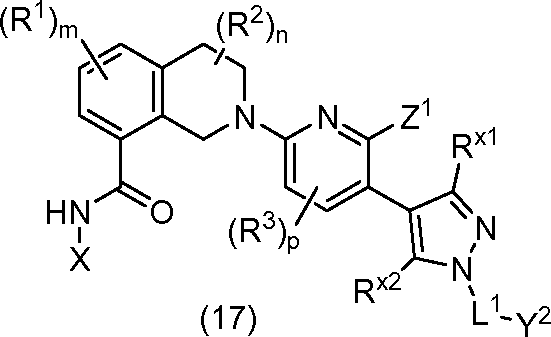
As shown in Scheme 3, pyrazoles of formula (10), wherein Rxl is hydrogen or a substituent on Y1 as described herein, can be reacted with alcohols of formula (11), wherein
L1 and Y2 are as described herein, and cyanomethylenetributylphosphorane, to provide compounds of formula (12). The reaction is typically performed at ambient temperature in a solvent such as but not limited to toluene. Compounds of formula (14) can be prepared by adding compounds of formula (13) wherein Rx2 is an appropriate substituent as described herein for substituents on Y1, and X2 is a halide, to a cold solution of compounds of formula (12) treated with n-butyllithium in hexanes. The reaction is typically performed in a solvent such as but not limited to tetrahydro furan. Compounds of formula (14) can be treated with Nbromosuccinimide or N-iodosuccinimide to provide compounds of formula (15), wherein X4 is bromo or iodo. The reaction is typically performed in a solvent such as N,Ndimethylformamide. Compounds of formula (15) can be reacted with compounds of formula (7) under Suzuki coupling conditions known to those skilled in the art and readily available in the literature to provide compounds of formula (17), which are representative of compounds of formula (I). Alternatively, compounds of formula (15) can be reacted with triisopropyl borate, in the presence of n-butyllithium in hexanes, followed by pinacol to provide compounds of formula (18). The additions are typically performed at low temperature in a solvent such as but not limited to tetrahydrofuran, toluene, or mixtures thereof. Alternatively, compounds of the formula (15) can be treated with 4,4,5,5-tetramethyl-l,3,2-dioxaborolane in the presence of a palladium catalyst system such as but not limited to
- 113 5
2017206246 20 Jul2017 bis(acetonitrile)palladium di chloride and SPhos in a solvent such as but not limited to 1,4dioxane to provide compounds of the formula 18. The reaction is typically performed at elevated temperature. Compounds of formula (18) can be reacted with compounds of formula (6) under Suzuki coupling conditions known to those skilled in the art and readily available in the literature to provide compounds of formula (17), which are representative of compounds of formula (I).
Scheme 4


Pyrroles of formula (21) wherein Rxl, Rx2, and Rx3 are hydrogen or are as described herein for substituents on Y1, can be reacted with alcohols of formula (11), wherein Y2 and L1 are as described herein, and cyanomethylenetributylphosphorane, to provide compounds of formula (22). The reaction is typically performed at ambient temperature in a solvent such as but not limited to toluene. Compounds of formula (22) can be treated with Nbromosuccinimide to provide compounds of formula (23). The reaction is typically performed in a solvent such as Ν,Ν-dimethylformamide. Compounds of formula (23) can be reacted with triisopropyl borate, in the presence of n-butyllithium in hexanes, followed by pinacol to provide compounds of formula (24). The additions are typically performed at low temperature in a solvent such as but not limited to tetrahydro furan, toluene, or mixtures thereof. Alternatively, compounds of the formula (23) can be treated with 4,4,5,5tetramethyl-l,3,2-dioxaborolane in the presence of a palladium catalyst system such as but not limited to bis(acetonitrile)palladium dichloride and SPhos in a solvent such as but not limited to 1,4-dioxane to provide compounds of the formula (24). The reaction is typically performed at an elevated temperature. Compounds of formula (24) can be reacted with compounds of formula (6) under Suzuki coupling conditions known to those skilled in the art and readily available in the literature to provide compounds of formula (25), which are representative of
-1145
2017206246 20 Jul2017 compounds of formula (I). Alternatively, compounds of formula (23) can be reacted with compounds of formula (7) under Suzuki coupling conditions known to those skilled in the art and readily available in the literature to provide compounds of formula (25), which are representative of compounds of formula (I).
Scheme 5

CO,Rx4

(23B)

(24B) (25A)
Compounds of formula (22A), wherein Z is O, a substituted or unsubstituted N, or a substituted or unsubstituted C; Rxl is hydrogen or is as described herein for substituents on Y2; Rx4 is alkyl; and n is 0, 1, or 2; can be added to a cooled solution of lithium diisopropylamide, followed by the addition of compounds of formula (23A); wherein Rx2 is an appropriate substituent as described herein for substituents on Y1, and X1 is a halide; to provide compounds of formula (23B). The reaction is typically performed at low temperature before warming to ambient temperature in a solvent such as but not limited to tetrahydro furan. Compounds of formula (23B) can be reacted with LiAlH4to provide compounds of formula (24B). The reaction is typically performed at an elevated temperature in a solvent such as but not limited to diethyl ether. Compounds of formula (25A) can be prepared by reacting compounds of formula (24B) with compounds of formula (24A) wherein Y1 is as described herein; and cyanomethylenetributylphosphorane. The reaction is typically performed at ambient temperature in a solvent such as but not limited to toluene. Compounds of formula (25A) can be processed in a manner similar to compounds of formula (12) in Scheme 3 and compounds of formula (22) in Scheme 4 to provide compounds of formula (I).
Scheme 6
O

(26)

As shown in Scheme 6, compounds of formula (27), wherein Rxl is hydrogen or a substituent on Y1 as described herein, can be prepared by reacting compounds of formula (26) with trimethylsulfonium iodide, in the presence of potassium tert-butoxide. The reaction is typically performed at ambient temperature in an anhydrous solvent such as but not limited to dimethylsulfoxide. Compounds of formula (27) can be added to a mixture of compounds of formula (24A) and a base such as but not limited to cesium carbonate, to provide compounds of formula (28). The reaction is typically performed at elevated temperature in a solvent such
- 115 5
2017206246 20 Jul2017 as but not limited to Ν,Ν-dimethylformamide, and may be performed in a microwave reactor. Compounds of formula (28) can be treated with sodium hydride, followed by the addition of compounds of formula (13) to provide compounds of formula (29). The reaction is typically performed at ambient temperature in a solvent such as but not limited to tetrahydrofuran, and may involve the use of hexamethylphosphoramide. Compounds of formula (29) can be processed in a manner similar to compounds of formula (12) in Scheme 3 and compounds of formula (22) in Scheme 4 to provide compounds of formula (I).
Scheme 7


Compounds of formula (33) wherein M is a boronic acid, boronate, or tributlytin attached to Y1 and Y1, L1, and Y2 are as described herein, and X3 is chloro or fluoro; can be reacted with compounds of formula (32) wherein Z1, R3, and p are as described herein, under Suzuki or Stille coupling conditions known to those skilled in the art and readily available in the literature to provide compounds of formula (34). Compounds of formula (34) can be reacted with compounds of formula (4), in the presence of a base such as but not limited to cesium carbonate, to provide compounds of formula (I). The reaction is typically performed at an elevated temperature in a solvent such as but not limited to N,N-dimethylacetamide.
- 1162017206246 20 Jul2017
Scheme 8
SnBu3
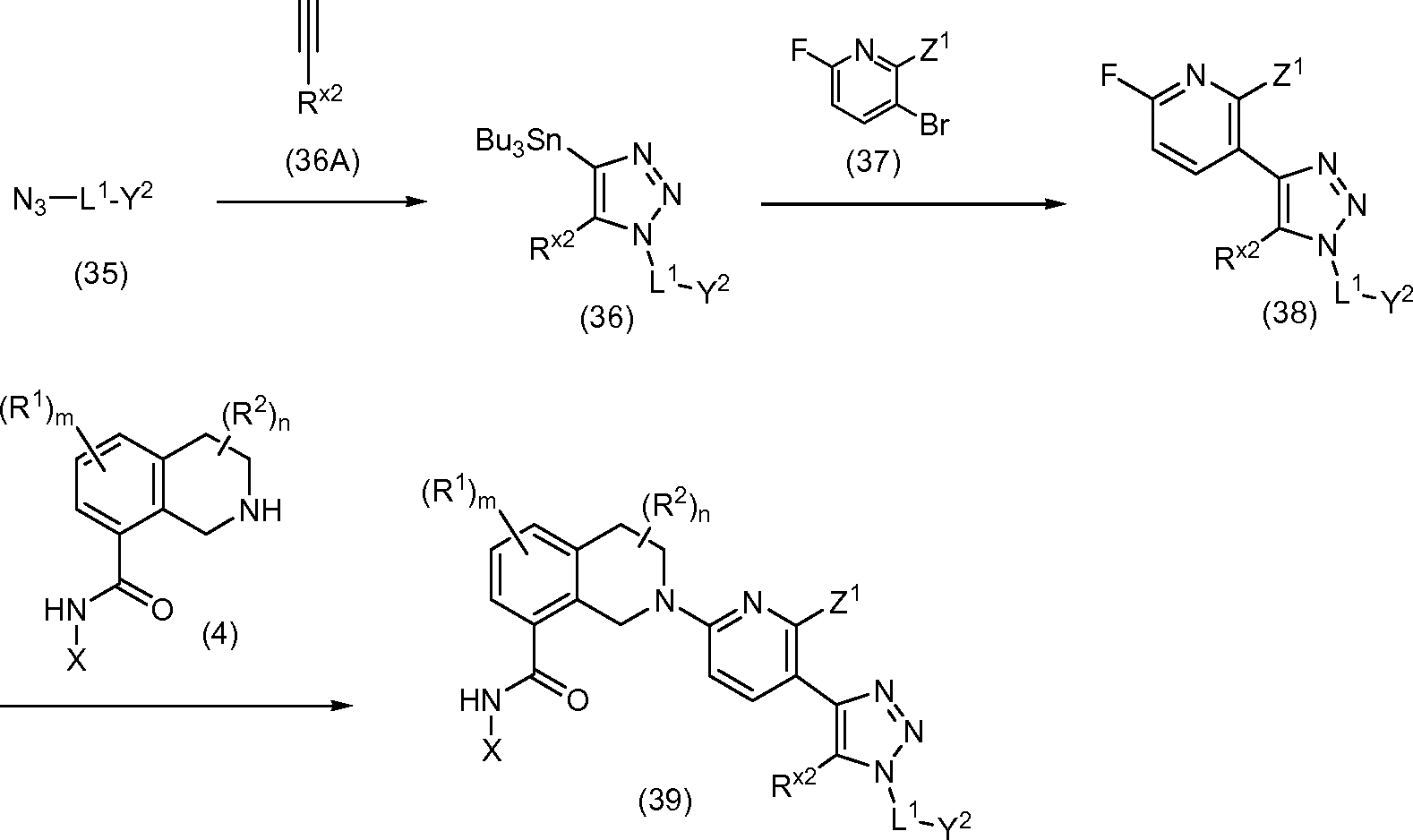
Triazoles of formula (36) can be prepared by reacting azides of formula (35), wherein L1 and Y2 are as described herein, with compounds of formula (36A) wherein Rx2 is alkyl, under conditions known to those skilled in the art and readily available in the literature. Compounds of formula (37), wherein Z1 is as described herein, can be reacted with compounds of formula (36) under Stille coupling conditions known to those skilled in the art and readily available in the literature to provide compounds of formula (38). Compounds of formula (4), wherein R1, R2, X, m and n are as described herein, can be reacted with compounds of formula (38), in the presence of a base such as but not limited to cesium carbonate, to provide compounds of formula (39), which are representative of compounds of formula (I). The reaction is typically performed at an elevated temperature in a solvent such as but not limited to N,N-dimethylacetamide.
Scheme 9

As shown in Scheme 9, l-bromo-3-(bromomethyl)-adamantane can be reacted with compounds of formula (30), wherein Y1 is as described herein, in the presence of sodium hydride to provide compounds of formula (31). The addition is typically performed in a solvent such as but not limited to Ν,Ν-dimethylformamide at low temperature, prior to warming to an elevated temperature. Compounds of formula (31) can be reacted with
- 1172017206246 20 Jul2017 compounds of formula (32), optionally in the presence of silver sulfate, wherein R8 is as described herein and Z2 is Ο, NH, or NR8, to provide compounds of formula (33) which are representative of compounds of formula (9). The reaction is typically performed at elevated temperature and may involve an additional solvent. Additionally, the reaction may be performed in a microwave reactor. Compounds of formula (33) can be processed in a manner similar to compounds of formula (12) in Scheme 3 and compounds of formula (22) in Scheme 4 to provide compounds of formula (I).
The following examples are presented to provide what is believed to be the most useful and readily understood description of procedures and conceptual aspects of this invention. The exemplified compounds were named using ACD/ChemSketch Version 5.06 (05 June 2001, Advanced Chemistry Development Inc., Toronto, Ontario), ACD/ChemSketch Version 12.01 (13 May 2009), Advanced Chemistry Development Inc., Toronto, Ontario), or ChemDraw® Ver. 9.0.5 (CambridgeSoft, Cambridge, MA). Intermediates were named using ChemDraw® Ver. 9.0.5 (CambridgeSoft, Cambridge, MA).
Examples
EXAMPLE 1
6-[8-(l,3-benzothiazol-2-ylcarbamoyl)-3,4-dihydroisoquinolin-2(lH)-yl]-3-{l[tricyclo[3.3.1.13,7]dec-1 -ylmethyl]-1 H-pyrazol-4-yl}pyridine-2-carboxylic acid
EXAMPLE 1A
4-(4,4,5,5-tetramethyl-1,3,2-dioxaborolan-2-yl)-l -(tricyclo[3.3.1.13,7]dec-1 -ylmethyl)- IHpyrazole
A mixture of 1-(bromomethyl)adamantane (0.458 g) and 4-(4,4,5,5-tetramethyl-1,3,2dioxaborolan-2-yl)-lH-pyrazole (0.377 g) in Ν,Ν-dimethylformamide (5 mL) was cooled to 0°C. To this solution was added 60% sodium hydride (0.096 g). The solution was heated at
70°C overnight. The reaction mixture was partitioned between water and ethyl acetate. The aqueous layer was extracted with additional ethyl acetate twice. The combined organic layers were washed with brine, dried over MgSO4, filtered, and concentrated. The residue was purified by flash column chromatography on silica gel eluting with 25% ethyl acetate in hexanes to provide the title compound.
EXAMPLE IB tert-butyl 8-(benzo[d]thiazol-2-ylcarbamoy 1)-3,4-dihydroisoquinoline-2(lH)-carboxylate
To a solution of 2-(terJ-butoxycarbonyl)-l,2,3,4-tetrahydroisoquinoline-8-carboxylic acid (6.8 g) and benzo[i/]thiazol-2-amine (5.52 g) in dichloromethane (80 mL) was added 1ethyl-3-[3-(dimethylamino)propyl]-carbodiimide hydrochloride (9.4 g) and 435 dimethylaminopyridine (6 g). The mixture was stirred at room temperature overnight. The reaction mixture was diluted with dichloromethane (400 mL), washed with 5% aqueous HC1,
- 1182017206246 20 Jul2017 water, and brine, and dried over Na2SO4. The mixture was filtered and the filtrate was concentrated under reduced pressure to provide the title compound.
EXAMPLE 1C lV-(benzo[i/]thiazol-2-yl)-l,2,3,4-tetrahydroisoquinoline-8-carboxamide dihydrochloride 5 To a solution of EXAMPLE IB (8.5 g) in dichloromethane (80 mL) was added 2N
HC1 in ether (80 mL). The reaction mixture was stirred at room temperature overnight and concentrated under reduced pressure to provide the title compound.
EXAMPLE ID tert-butyl 3 -bromo-6-chloropicolinate
Tosyl chloride (7.7 g) was added to a solution of 2-chloro-5-bromo picolinic acid (4
g) and pyridine (9.2 mL) in t-butanol (33 mL) at 0°C. The reaction was then stirred at room temperature for 12 hours. NaHCO3 (aqueous, saturated) was then added and the mixture was extracted three times with ethyl acetate. The combined organic phases were washed with brine and dried over Na2SO4. Filration and evaporation of the organic solvent provided the title compound which was used in the next step without further purification.
EXAMPLE IE tert-butyl 6-(8-(benzo[d]thiazol-2-ylcarbamoyl)-3,4-dihydroisoquinolin-2(lH)-yl)-3bromopicolinate
EXAMPLE ID (0.736 g), EXAMPLE 1C (1.62 g), and Cs2CO3 (4.1 g) were stirred in
12 mL of anhydrous Ν,Ν-dimethylacetamide at 120°C for 12 hours. The cooled reaction mixture was then diluted with ethyl acetate and 10% citric acid. The organic phase was washed three times with citric acid, once with water and brine, and dried over Na2SO4. Filtration and concentration afforded crude material, which was chromatographed on silica gel using 0-40% ethyl acetate in hexanes to provide the title compound.
EXAMPLE IF tert-butyl 3-{l-[tricyclo[3.3.1.13’7]dec-l-ylmethyl]-lH-pyrazol-4-yl}-6-[8-(l,3-benzothiazol2-ylcarbamoyl)-3,4-dihydroisoquinolin-2(lH)-yl]pyridine-2-carboxylate A mixture of EXAMPLE IE (0.100 g), EXAMPLE 1A (0.059 g), tetrakis(triphenylphosphine)palladium(0) (0.022 g) andCsF (0.090 g) in 1,2-dimethoxyethane (2 mL) and methanol (1 mL) was heated at 120“C for 30 minutes under microwave heating conditions (Biotage Initiator). The reaction mixture was partitioned between water and ethyl acetate. The aqueous layer was extracted with additional ethyl acetate twice. The combined organic layers were washed with brine, dried over MgSO4, filtered, and concentrated. The residue was purified by flash column chromatography on silica gel eluting with 25% ethyl acetate in hexanes to afford the title compound.
EXAMPLE 1G
- 1192017206246 20 Jul2017
6-[8-(l,3-benzothiazol-2-ylcarbamoyl)-3,4-dihydroisoquinolin-2(lH)-yl]-3-{l[tricyclo[3.3.1.13,7]dec-1 -ylmethyl]-1 H-pyrazol-4-yl }pyridine-2-carboxylic acid
EXAMPLE IF (90 mg) in dichloromethane (3 mL) was treated with trifluoroacetic acid (3 mL), and the reaction was stirred at room temperature for 24 hours. The volatiles were removed under reduced pressure. The residue was purified by Prep HPLC using Gilson system eluting with 20-80% acetonitrile in water containing 0.1% v/v trifluoroacetic acid.
The desired fractions were combined and freeze-dried to provide the title compound. 'Η NMR (500 MHz, dimethylsulfoxide-de) δ ppm 12.85 (s, 1H), 8.04 (d, 1H), 7.80 (d, 1H), 7.82 (d, 1H), 7.67 (s, 1H), 7.61 (d, 1H), 7.43 (s, 1H), 7.46-7.50 (m, 1H), 7.42-7.44 (m, 1H), 7.3410 7.38 (m, 2H), 6.94 (d, 1H), 4.94 (s, 2H), 3.85-3.88 (m, 2H), 3.77 (s, 2H), 3.00 (t, 2H), 1.92 (m, 3H), 1.52-1.65 (m, 6H), 1.45-1.46 (m, 6H).
EXAMPLE 2
6-[8-(l,3-benzothiazol-2-ylcarbamoyl)-3,4-dihydroisoquinolin-2(lH)-yl]-3-[3,5-dimethyl-l(tricyclo[3.3.1. l3,7]dec-l -ylmethyl)-lH-pyrazol-4-yl]pyridine-2-carboxy lie acid
EXAMPLE 2 A
3,5-dimethyl-4-(4,4,5,5-tetramethyl-l,3,2-dioxaborolan-2-yl)-l -(tricyclo[3.3.1. l3,7]dec-l ylmethyl)-1 //-pyrazole
To a solution of 1-adamantanemethanol (0.090 g), 3,5-dimethyl-4-(4,4,5,5tetramethyl-l,3,2-dioxaborolan-2-yl)-lH-pyrazole (0.160 g) and cyanomethylenetributylphosphorane (0.215 g) were added and stirred together in toluene (2 mL) at room temperature. After stirring overnight the reaction was loaded directly onto silica gel and eluted using a gradient of 2% to 20% ethyl acetate/hexanes to provide the title compound.
EXAMPLE 2B tert-butyl 6-[8-(l,3-benzothiazol-2-ylcarbamoyl)-3,4-dihydroisoquinolin-2(lH)-yl]-3-[3,5dimethyl-1 -(tricyclo[3.3.1.13,7]dec-1 -ylmethyl)-1 H-pyrazol-4-yl]pyridine-2-carboxylate
EXAMPLE IE (0.150 g), EXAMPLE 2A (0.121 g), tetrakis(triphenylphosphine)palladium(0) (14 mg) and cesium carbonate (0.260 g) were stirred together in Ν,Ν-dimethylformamide (1 mL), dioxane (0.7 mL), and water (0.4 mL) and the reaction degassed with nitrogen and heated at 100°C for 1 hour. The reaction was diluted with ethyl acetate (25 mL) and washed with water (25 mL) and brine (25 mL), dried over magnesium sulfate, filtered, and concentrated. Silica gel chromatography eluting with a gradient of 2% to 50% ethyl acetate/hexanes provided the title compound.
EXAMPLE 2C
6- [8-( 1,3-benzothiazol-2-ylcarbamoyl)-3,4-dihydroisoquinolin-2( 1 H)-yl] -3- [3,5 -dimethyl-1 (tricyclo[3.3.1.l3,7]dec-l-ylmethyl)-lH-pyrazol-4-yl]pyridine-2-carboxylie acid
- 1202017206246 20 Jul2017
To EXAMPLE 2B (0.070 g) in dichloromethane (1 mL) was added TFA (1 mL) and the reaction was stirred overnight. The reaction was concentrated, dissolved in dichloromethane and loaded onto silica gel and eluted using a gradient of 0.5% to 5% methanol/dichloromethane to provide the title compound. 'H NMR (300 MHz, dimethylsulfoxide-de) δ 13.04 (s, 1H), 12.84 (s, 1H), 8.04 (dd, 1H), 7.79 (d, 1H), 7.71 (d, 1H), 7.62 (t, 2H), 7.54 - 7.32 (m, 5H), 7.22 - 7.14 (m, 2H), 7.11 - 7.01 (m, 2H), 6.93 (d, 1H), 4.94 (s, 2H), 4.30 (t, 2H), 3.86 (t, 2H), 3.08 (t, 2H), 3.00 (t, 2H).
EXAMPLE 3
6-[8-(l,3-benzothiazol-2-ylcarbamoyl)-3,4-dihydroisoquinolin-2(lH)-yl]-3-[5-methyl-l10 (tricyclo[3.3.1.13,7]dec-1 -ylmethyl)-1 H-pyrazol-4-yl]pyridine-2-carboxylic acid
EXAMPLE 3A
-(tri cyclo [3.3.1.13,7]dec-1 -ylmethyl)-l H-pyrazole The title compound was prepared by substituting pyrazole for 3,5-dimethyl-4(4,4,5,5-tetramethyl-l,3,2-dioxaborolan-2-yl)-lH-pyrazole in EXAMPLE 2A.
EXAMPLE 3B
-(tricy clo[3.3.1.13,7]dec-1 -ylmethy 1)-5-methyl-1 H-pyrazole A solution of EXAMPLE 3A (869 mg) in tetrahydrofuran (10 mL) was chilled to 45°C. n-Butyllithium (2.3 M solution in hexanes, 2.10 mL) was added dropwise over 5 minutes. The reaction was stirred for 1.5 hours, during which time the temperature increased to -20°C. Iodomethane (0.305 mL) was added dropwise over 3 minutes. The reaction was stirred for 30 minutes between -20 and -15°C. Water (25 mL) was added and the mixture was extracted with ethyl acetate (3 x 25 mL). The extracts were dried (Na2SO4), filtered, and concentrated to provide the title compound.
EXAMPLE 3C
1 -(tri cyclo [3.3.1.13,7]dec-1 -ylmethyl)-4-bromo-5 -methyl-1 H-pyrazole
EXAMPLE 3B (865 mg) was dissolved in Ν,Ν-dimethylformamide (7 mL) and Nbromosuccinimide (334 mg) was added. The reaction was stirred at room temperature for 1 hour. Water (25 mL) was added and the product was obtained by filtration.
EXAMPLE 3D
1-( tricyclo[3.3.1.13’7]dec-l-ylmethyl)-5-methyl-4-(4,4,5,5-tetramethyl-l,3,2-dioxaborolan-2yl)-l H-pyrazole
EXAMPLE 3C (250 mg) was placed into a flask, and was degassed with N2. Tetrahydro furan (2.5 mL) and toluene (2.500 mL) were added and the solution was chilled to -78°C. Triisopropyl borate (0.243 mL) was added, followed by dropwise addition of n35 butyllithium (2.3 M in hexanes, 0.6 mL) over 5 minutes. The mixture was stirred for 15 minutes at -78°C and then a degassed solution of pinacol (143 mg) in tetrahydro furan (1 mL) was added over 2 minutes. After stirring for 10 minutes at -78°C, the reaction was warmed to
- 121 2017206246 20 Jul2017 room temperature and stirred for 45 minutes. Water (0.073 mL) was then added and the mixture was stirred for 2 hours. The crude reaction mixture was concentrated to dryness to provide the title compound.
EXAMPLE 3E tert-butyl 6-(8-(benzo[d]thiazol-2-ylcarbamoyl)-3,4-dihydroisoquinolin-2(lH)-yl)-3-[l(tri cyclo [3.3.1.13,7]dec-1-ylmetliy 1)-5-methyl-1 H-pyrazol-4-yl]picolinate
The title compound was prepared by substituting EXAMPLE 3D for EXAMPLE 2A in EXAMPLE 2B.
EXAMPLE 3F
6-[8-(l,3-benzothiazol-2-ylcarbamoyl)-3,4-dihydroisoquinolin-2(lH)-yl]-3-[5-methyl-l(tricyclo[3.3.1. l3,7]dec-l -ylmethy 1)-1 H-pyrazol-4-yl]pyridine-2-carboxy lie acid The title compound was prepared by substituting EXAMPLE 3E for EXAMPLE 2B in EXAMPLE 2C. 'Η NMR (300 MHz, dimethylsulfoxide-de) δ ppm 12.84 (s, 1H), 12.74 (s,
1H), 8.03 (d, 1H), 7.79 (d, 1H), 7.61 (d, 1H), 7.40 - 7.53 (m, 3H), 7.31 - 7.39 (m, 2H), 7.26 (s,
1H), 6.94 (d, 1H), 4.95 (s, 2H), 3.89 (t, 2H), 3.70 (s, 2H), 3.01 (t, 2H), 2.10 (s, 3H), 1.89 1.95 (m, 3H), 1.48 - 1.69 (m, 12H).
EXAMPLE 4
6-[8-(l,3-benzothiazol-2-ylcarbamoyl)-3,4-dihydroisoquinolin-2(lH)-yl]-3-[l-(spiro[3.5]non7-ylmethyl)-lH-pyrazol-4-yl]pyridine-2-carboxylic acid
EXAMPLE 4A
4-bromo-1 -(spiro [3.5 ]nonan-7-ylmethyl)-1 H-pyrazole
The title compound was prepared by substituting 4-bromo-1 H-pyrazole for 3,5-dimethyl-4 (4,4,5,5-tetramethyl-l,3,2-dioxaborolan-2-yl)-lH-pyrazole and 7-hydroxymethyl-spiro[3.5]nonane for 1 -adamantanemethanol in EXAMPLE 2A.
EXAMPLE 4B tert-butyl 6-(8-(benzo[d]thiazol-2-ylcarbamoyl)-3,4-dihydroisoquinolin-2(lH)-yl)-3-(4,4,5,5tetramethyl-1,3,2-dioxaborolan-2-yl)picolinate
A mixture of EXAMPLE IE (1.2 g), 1.0 M 4,4,5,5-tetramethyl-l,3,2-dioxaborolane in tetrahydro furan (4.24 mL), triethylamine (0.92 mL), and [1,1'30 bis(diphenylphosphino)ferrocene]dichloropalladium(II) dichloromethane (0.087 g) in CH3CN (15 mL) was heated at 100C under microwave conditions (Biotage) for 30 minutes. After cooling, the reaction mixture was partitioned between water and ethyl acetate. The organic layer was extracted with additional ethyl acetate twice. The combined organic layers were washed with brine, dried over MgSO4, filtered, and concentrated. The residue was purified by flash column chromatography on silica gel to provide the title compound.
- 1222017206246 20 Jul2017
EXAMPLE 4C tert-butyl 6-(8-(benzo[d]thiazol-2-ylcarbamoyl)-3,4-dihydroisoquinolin-2(lH)-yl)-3-(l(spiro[3.5]nonan-7-ylmethyl)-lH-pyrazol-4-yl)picolinate
A suspension of EXAMPLE 4B (50 mg), EXAMPLE 4A (23.12 mg), tris(dibenzylideneacetone)dipalladium(0) (7 mg), l,3,5,7-tetramethyl-6-phenyl-2,4,8-trioxa-6phosphaadamantane (12 mg) and potassium phosphate (52.0 mg) in tetrahydrofuran (1.5 mL) and water (0.5 mL) was heated under microwave conditions (Biotage) at 140°C for 5 minutes. The reaction mixture was diluted with ethyl acetate, separated, and purified by chromatography on silica gel using 10-60% ethyl acetate/hexanes as eluent to provide the title 10 compound.
EXAMPLE 4D
6-[8-(l,3-benzothiazol-2-ylcarbamoyl)-3,4-dihydroisoquinolin-2(lH)-yl]-3-[l-(spiro[3.5]non7-ylmethyl)-lH-pyrazol-4-yl]pyridine-2-carboxylic acid
The title compound was prepared by substituting EXAMPLE 4C for EXAMPLE 2B 15 in EXAMPLE 2C. 'H NMR (300 MHz, dimethylsulfoxide-de) δ ppm 12.85 (s, 1H), 8.04 (d,
1H), 7.79 (d, 1H), 7.74 (s, 1H), 7.69 (d, 1H), 7.61 (d, 1H), 7.52 (s, 1H), 7.45 - 7.51 (m, 1H), 7.40 - 7.44 (m, 1H), 7.36 (t, 2H), 6.94 (d, 1H), 4.94 (s, 2H), 3.83 - 3.93 (m, 3H), 3.00 (t, 2H), 1.73 - 1.85 (m, 2H), 1.55 - 1.75 (m, 8H), 1.35 (d, 2H), 1.09 - 1.23 (m, 2H), 0.88 - 1.04 (m, 2H).
EXAMPLE 5
6-[8-(l,3-benzothiazol-2-ylcarbamoyl)-3,4-dihydroisoquinolin-2(lH)-yl]-3-(l-{[3,5dimethyltricyclo [3.3.1.13,7]dec-1 -yl]methyl} -1 H-pyrazol-4-yl)pyridine-2-carboxylic acid EXAMPLE 5A
4-bromo-1 - {[3,5 -dimethyltricy clo [3.3.1.13’7] dec-1 -yl]methyl} -1//-pv razo 1 c 25 The title compound was prepared by substituting 4-bromo-lH-pyrazole for 3,5dimethyl-4-(4,4,5,5-tetramethyl-l,3,2-dioxaborolan-2-yl)-lH-pyrazole and 3,5-dimethyl-ladamantanemethanol for 1-adamantanemethanol in EXAMPLE 2A.
EXAMPLE 5B tert-butyl 6-[8-(l,3-benzothiazol-2-ylcarbamoyl)-3,4-dihydroisoquinolin-2(lH)-yl]-3-(l3 0 {[3,5 -dimethyltricy clo [3.3.1.13,7]dec-1 -yl]methyl} -1 H-pyrazol-4-yl)pyridine-2-carboxylate
The title compound was prepared by substituting EXAMPLE 5A for EXAMPLE 4A in EXAMPLE 4C.
EXAMPLE 5C
6-[8-(l,3-benzothiazol-2-ylcarbamoyl)-3,4-dihydroisoquinolin-2(lH)-yl]-3-(l-{[3,53 5 dimethyltricy clo [3.3.1.13,7]dec-1 -yl]methyl} -1 H-pyrazol-4-yl)pyridine-2-carboxylic acid
- 123 2017206246 20 Jul2017
The title compound was prepared by substituting EXAMPLE 5B for EXAMPLE 2B in EXAMPLE 2C. 'h NMR (300 MHz, dimethylsulfoxide-de) δ ppm 12.86 (s, 1H), 8.04 (d,
1H), 7.79 (d, 1H), 7.72 (d, 1H), 7.67 (s, 1H), 7.61 (d, 1H), 7.53 (s, 1H), 7.44 - 7.51 (m, 1H),
7.40 - 7.45 (m, 1H), 7.36 (t, 2H), 6.94 (d, 1H), 4.94 (s, 2H), 3.87 (t, 2H), 3.80 (s, 2H), 3.00 (t,
2H), 1.96 - 2.05 (m, 1H), 1.26 (d, 6H), 0.96 - 1.17 (m, 6H), 0.77 (s, 6H).
EXAMPLE 6
6- [8 -(1,3 -benzothiazol-2 -ylcarbamoyl)-3,4-dihydroisoquinolin-2 (1 H)-y 1] -3 -(1 - {[3 hydroxytricyclo [3.3.1.13,7]dec-1 -yl]methyl} -1 H-pyrazol-4-yl)pyridine-2-carboxylic acid
EXAMPLE 6A
3-[(4-bromo-l //-pyrazol-1 -yl)metliyl]tricyclo[3.3.1. l’jdecan-l-ol
The title compound was prepared by substituting 4-bromo-lH-pyrazole for 3,5dimethyl-4-(4,4,5,5-tetramethyl-1,3,2-dioxaborolan-2-yl)-1 H-pyrazole and 3-hydroxy-1 adamantanemethanol for 1-adamantylmethanol in EXAMPLE 2A.
EXAMPLE 6B tert-butyl 6-[8-(l,3-benzothiazol-2-ylcarbamoyl)-3,4-dihydroisoquinolin-2(lH)-yl]-3-(l-{[3hydro xytri cyclo[3.3.1.13,7dec-1 -yl]methyl} -1 H-pyrazol-4-yl)pyridine-2-carboxylate
The title compound was prepared by substituting EXAMPLE 6A for EXAMPLE 4A in EXAMPLE 4C.
EXAMPLE 6C
6-[8-(l,3-benzothiazol-2-ylcarbamoyl)-3,4-dihydroisoquinolin-2(lH)-yl]-3-(l-{[3hydro xytri cyclo [3.3.1.13,7dec-1 -yl]methyl} -1 H-pyrazol-4-yl)pyridine-2-carboxylic acid
The title compound was prepared by substituting EXAMPLE 6B for EXAMPLE 2B in EXAMPLE 2C. 'h NMR (300 MHz, dimethylsulfoxide-de) δ ppm 13.06 (s, 1H), 12.86 (s, 1H), 8.04 (d, 1H), 7.79 (d, 1H), 7.71 (d, 1H), 7.68 (s, 1H), 7.61 (d, 1H), 7.53 (s, 1H), 7.44 25 7.51 (m, 1H), 7.40 - 7.44 (m, 1H), 7.35 (t, 2H), 6.93 (d, 1H), 4.94 (s, 2H), 4.35 (s, 1H), 3.87 (t, 2H), 3.82 (s, 2H), 3.00 (t, 2H), 2.08 (s, 2H), 1.36 - 1.56 (m, 6H), 1.33 (s, 6H).
EXAMPLE 7
6- [8 -(1,3 -benzothiazol-2 -ylcarbamoyl)-3,4-dihydroisoquinolin-2 (1 H)-y 1] -3 -(1 - {[3 methoxytricyclo[3.3.1.13’7]dec-1 -yl]methyl} -1 H-pyrazol-4-yl)pyridine-2-carboxylic acid
EXAMPLE 7A l-[(3-bromotricyclo[3.3.1.13’7]dec-l-yl)methyl]-4-iodo-l/7-pyrazole
A mixture of l-bromo-3-(bromomethyl)-adamantane (1.0 g) and 4-iodopyrazole (0.63 g) in N,N-dimethylformamide (10 mL) was cooled to 0 °C. To this solution was added 60% sodium hydride (0.20 g). The solution was stirred at 65°C overnight. The reaction mixture was partitioned between water and ethyl acetate. The aqueous layer was extracted with additional ethyl acetate twice. The combined organic layers were washed three times with
- 1242017206246 20 Jul2017 water, washed with brine, dried over MgSO4, filtered, and concentrated. The residue was purified by flash column chromatography on silica gel eluting with 10% ethyl acetate in hexanes to provide the title compound.
EXAMPLE 7B
4-iodo-l -[(3-methoxytricyclo[3.3.1.13,7]dec-1 -yl)methyl]- 177-pyrazole
EXAMPLE 7A (5 g), silver sulfate (6 g) and methanol (15 mL) were heated at 110 °C under microwave conditions (Biotage, Initiator) for 60 minutes. After cooling to room temperature, the suspension was filtered. The solid residue was washed by ethyl acetate (3x 5mL) and filtered. The combined solution was dried under vacuum. The residue was taken up into dichloromethane and purified by flash chromatography (Varian, Superflash SF40-200 g column), eluting with 0-70% ethyl acetate/hexane, to provide the title compound.
EXAMPLE 7C tert-butyl 6-[8-(l,3-benzothiazol-2-ylcarbamoyl)-3,4-dihydroisoquinolin-2(lH)-yl]-3-(l-{[3methoxytri cyclo [3.3.1.13’7] dec-1 -yl]methyl} -1 H-pyrazol-4-yl)pyridine-2-carboxylate
The title compound was prepared by substituting EXAMPLE 7B for EXAMPLE 4A in EXAMPLE 4C.
EXAMPLE 7D
6- [8 -(1,3 -benzothiazol-2 -ylcarbamoyl)-3,4-dihydroisoquinolin-2 (1 H)-yl] -3 -(1 - {[3 methoxytricyclo[3.3.1.13’7]dec-1 -yl]methyl} -1 H-pyrazol-4-yl)pyridine-2-carboxylic acid
The title compound was prepared by substituting EXAMPLE 7C for EXAMPLE 2B in EXAMPLE 2C. 'H NMR (300 MHz, dimethylsulfoxide-de) δ ppm 12.85 (s, 1H), 8.04 (d, 1H), 7.79 (d, 1H), 7.71 (m, 2H), 7.61 (d, 1H), 7.54 (s, 1H), 7.41 (m, 4H), 6.94 (d, 1H), 4.94 (s, 2H), 3.87 (m, 4H), 3.07 (s, 3H), 3.00 (t, 2H), 2.14 (m, 2H), 1.46 (m, 12H).
EXAMPLE 8
6-[8-(l,3-benzothiazol-2-ylcarbamoyl)-3,4-dihydroisoquinolin-2(lH)-yl]-3-(l-{[3-(2methoxy ethoxy )tri cyclo [3.3.1.13,7]dec-1 -yl]methyl} - 177-pyrazol-4-yl)pyridine-2-carboxylic acid
EXAMPLE 8A
4-iodo-l - {[3-(2-methoxyethoxy)tricyclo[3.3.1. l3,7]dec-1 -yl]methyl}- 177-pyrazole
The title compound was prepared by substituting 2-methoxyethanol for methanol in
EXAMPLE 7B.
EXAMPLE 8B tert-butyl 6-[8-(l,3-benzothiazol-2-ylcarbamoyl)-3,4-dihydroisoquinolin-2(lH)-yl]-3-(l-{[3(2-methoxyethoxy)tricyclo[3.3.1.13,7]dec-1 -yl]methyl} -1 H-pyrazol-4-yl)pyridine-235 carboxy late
The title compound was prepared by substituting EXAMPLE 8A for EXAMPLE 4A in EXAMPLE 4C.
- 125 2017206246 20 Jul2017
EXAMPLE 8C
6-[8-(l,3-benzothiazol-2-ylcarbamoyl)-3,4-dihydroisoquinolin-2(lH)-yl]-3-(l-{[3-(2methoxy ethoxy )tri cyclo [3.3.1.13,7]dec-1 -yl]methyl} -1 //-pvrazol-4-v I )pvrid ine-2-carboxy I ic acid
The title compound was prepared by substituting EXAMPLE 8B for EXAMPLE 2B in EXAMPLE 2C. 'h NMR (300 MHz, dimethylsulfoxide-de) δ ppm 12.85 (s, 1H), 8.04 (s, 1H), 7.79 (s, 1H), 7.70 (m, 2H), 7.61 (d, 1H), 7.54 (s, 1H), 7.40 (m, 5H), 6.94 (d, 1H), 4.94 (s, 2H), 3.86 (m, 4H), 3.42 (m, 2H), 3.35 (m, 2H), 3.21 (s, 3H), 3.00 (t, 2H), 2.13 (m, 2H), 1.46 (m, 12H).
EXAMPLE 9
6-[8-(l,3-benzothiazol-2-ylcarbamoyl)-3,4-dihydroisoquinolin-2(lH)-yl]-3-{l-[(3,5,7trimethyltricyclo[3.3.1.13,7]dec-1 -yl)methyl]-lH-pyrazol-4-yl}pyridine-2-carboxylic acid EXAMPLE 9A
3,5,8-trimethyl-1 -adamantanemethanol
To a solution of 3,5,8-trimethyl-l-adamantane carboxylic acid (0.5 g) in tetrahydro furan (3 mL) was dropwise added BH3. tetrahydro furan (4.50 mL) and the mixture was stirred at room temperature for 14 hours. The reaction mixture was quenched with methanol (3 mL), concentrated and purified by chromatography on silica gel using 0-30% ethyl acetate/hexanes as eluent to provide the title compound.
EXAMPLE 9B
4-iodo-1 - {[3,5,7-trimethy ltricy clo [3.3.1.13’7] dec-1 -y ljmethyl} -1 //-pv razo I e
The title compound was prepared by substituting EXAMPLE 9A for 1adamantanemethanol and 4-iodopyrazole for 3,5-dimethyl-4-(4,4,5,5-tetramethyl-l,3,2dioxaborolan-2-yl)-lH-pyrazole in EXAMPLE 2A.
EXAMPLE 9C tert-butyl 6-[8-( 1,3-benzothiazol-2-ylcarbamoy 1)-3,4-dihydroisoquinolin-2( 1 H)-yl]-3- {1 [(3,5,7-trimethyltricyclo[3.3.1.13’7]dec-l-yl)methyl]-lH-pyrazol-4-yl}picolinate
The title compound was prepared by substituting EXAMPLE 9B for EXAMPLE 4A in EXAMPLE 4C.
EXAMPLE 9D
6-[8-(l,3-benzothiazol-2-ylcarbamoyl)-3,4-dihydroisoquinolin-2(lH)-yl]-3-{l-[(3,5,7trimethy ltricy clo [3.3.1.13,7]dec-1 -yl)methyl]-l H-pyrazol-4-yl}pyridine-2-carboxylic acid
The title compound was prepared by substituting EXAMPLE 9C for EXAMPLE 2B in EXAMPLE 2C. 'h NMR (300 MHz, dimethylsulfoxide-de) δ ppm 12.86 (s, 1H), 8.04 (d,
1H), 7.79 (d, 1H), 7.73 (d, 1H), 7.67 (s, 1H), 7.61 (d, 1H), 7.53 (s, 1H), 7.48 (t, 1H), 7.40 - 1262017206246 20 Jul2017
7.44 (m, 1H), 7.36 (t, 2H), 6.95 (d, 1H), 3.87 (t, 1H), 3.82 (s, 2H), 3.00 (t, 2H), 1.03 (s, 6H), 0.92-1.01 (m, 6H), 0.78 (s, 9H).
EXAMPLE 10
6-[8-(l,3-benzothiazol-2-ylcarbamoyl)-3,4-dihydroisoquinolin-2(lH)-yl]-3-[l5 (tricyclo[3.3.1.13’7]dec-2-ylmethyl)-lH-pyrazol-4-yl]pyridine-2-carboxylic acid
EXAMPLE 10A 2-adamantanemethanol
The title compound was prepared by substituting 2-adamantane carboxylic acid for 3,5,8-trimethyl-l-adamantane carboxylic acid in EXAMPLE 9A.
EXAMPLE 10B
-(tricy clo [3.3.1.13,7]dec-2 -ylmethyl)-4-iodo-1 H-pyrazole
The title compound was prepared by substituting EXAMPLE 10A for 1adamantanemethanol and 4-iodopyrazole for 3,5-dimethyl-4-(4,4,5,5-tetramethyl-l,3,2dioxaborolan-2-yl)-lH-pyrazole in EXAMPLE 2A.
EXAMPLE 10C tert-butyl 6-[8-(l,3-benzothiazol-2-ylcarbamoyl)-3,4-dihydroisoquinolin-2(lH)-yl]-3-[l(tricyclo[3.3.1.13’7]dec-2-ylmethyl)-lH-pyrazol-4-yl]pyridine-2-carboxylate
The title compound was prepared by substituting EXAMPLE 10B for EXAMPLE 4A in EXAMPLE 4C.
EXAMPLE 10D
6-[8-( 1,3-benzothiazol-2-ylcarbamoyl)-3,4-dihydroisoquinolin-2( 1 H)-yl]-3-[ 1 (tricyclo[3.3.1.13,7]dec-2-ylmethyl)-lH-pyrazol-4-yl]pyridine-2-carboxylic acid
The title compound was prepared by substituting EXAMPLE 10C for EXAMPLE 2B in EXAMPLE 2C. 'Η NMR (300 MHz, dimethylsulfoxide-de) δ ppm 12.84 (s, 1H), 8.04 (d,
1H), 7.74 - 7.84 (m, 2H), 7.69 (d, 1H), 7.61 (d, 1H), 7.52 (s, 1H), 7.40 - 7.51 (m, 2H), 7.36 (t,
2H), 6.94 (d, 1H), 4.94 (s, 2H), 4.21 (d, 2H), 3.86 (t, 2H), 3.17 (s, 2H), 3.00 (t, 2H), 2.13 2.24 (m, 1H), 1.98 (d, 2H), 1.44 - 1.89 (m, 12H), 1.07 (s, 1H).
EXAMPLE 11
6- [8 -(1,3 -benzothiazol-2 -ylcarbamoyl)-3,4-dihydroisoquinolin-2 (1 H)-yl] -3 -(1 - {[3 30 bromotricyclo[3.3.1.13’7]dec-1 -yl]methyl}-1 H-pyrazol-4-yl)pyridine-2-carboxylic acid
EXAMPLE UA tert-butyl 6-[8-(l,3-benzothiazol-2-ylcarbamoyl)-3,4-dihydroisoquinolin-2(lH)-yl]-3-(l-{[3bromotricyclo[3.3.1.13,7]dec-1 -yl]methyl}-1 H-pyrazol-4-yl)pyridine-2-carboxylate
The title compound was prepared by substituting EXAMPLE 7A for EXAMPLE 4A in EXAMPLE 4C.
- 1272017206246 20 Jul2017
EXAMPLE 11B
6- [8 -(1,3 -benzothiazol-2 -ylcarbamoyl)-3,4-dihydroisoquinolin-2 (1 H)-yl] -3 -(1 - {[3 bromotricyclo[3.3.1.13’7]dec-1 -yl]methyl}-1 H-pyrazol-4-yl)pyridine-2-carboxylic acid
The title compound was prepared by substituting EXAMPLE 11A for EXAMPLE 2B in EXAMPLE 2C. 'H NMR (300 MHz, dimethylsulfoxide-d6) δ ppm 12.84 (s, 1H), 8.04 (d,
1H), 7.79 (d, 1H), 7.71 (d, 2H), 7.61 (d, 1H), 7.56 (s, 1H), 7.45 (m, 2H), 7.35 (m, 2H), 6.95 (d, 1H), 4.94 (s, 2H), 3.87 (m, 4H), 3.00 (t, 2H), 2.25 (m, 2H), 2.12 (m, 6H), 1.54 (m, 6H).
EXAMPLE 12
6-[8-(l,3-benzothiazol-2-ylcarbamoyl)-3,4-dihydroisoquinolin-2(lH)-yl]-3-(l-{[3-(propan-210 yloxy)tricyclo[3.3.1.13’7]dec-1 -yl]methyl}-1 H-pyrazol-4-yl)pyridine-2-carboxylic acid
EXAMPLE 12A
4-iodo-1 - {[3-(propan-2-yloxy)tricyclo[3.3.1.13,7]dec-1 -yl]methyl} -1 //-pyrazole The title compound was prepared by substituting propan-2-ol for methanol in
EXAMPLE 7B.
EXAMPLE 12B tert-butyl 6-[8-(l,3-benzothiazol-2-ylcarbamoyl)-3,4-dihydroisoquinolin-2(lH)-yl]-3-(l-{[3(propan-2-yloxy)tricyclo[3.3.1.13’7]dec-l-yl]methyl}-lH-pyrazol-4-yl)pyridine-2-carboxylate
The title compound was prepared by substituting EXAMPLE 12A for EXAMPLE 4A in EXAMPLE 4C.
EXAMPLE 12C
6-[8-(l,3-benzothiazol-2-ylcarbamoyl)-3,4-dihydroisoquinolin-2(lH)-yl]-3-(l-{[3-(propan-2yloxy)tricyclo[3.3.1.13,7]dec-l-yl]methyl}-lH-pyrazol-4-yl)pyridine-2-carboxylic acid The title compound was prepared by substituting EXAMPLE 12B for EXAMPLE 2B in EXAMPLE 2C. 'H NMR (300 MHz, dimethylsulfoxide-d6) δ ppm 12.86 (s, 1H), 8.04 (d,
1H), 7.79 (d, 1H), 7.70 (m, 2H), 7.61 (d, 1H), 7.53 (s, 1H), 7.41 (m, 4H), 6.94 (d, 2H), 4.94 (s, 2H), 3.86 (m, 4H), 3.00 (t, 2H), 2.11 (m, 2H), 1.62 (m, 2H), 1.49 (m, 3H), 1.37 (m, 7H), 0.98 (d, 6H).
EXAMPLE 13
6-[8-(l,3-benzothiazol-2-ylcarbamoyl)-3,4-dihydroisoquinolin-2(lH)-yl]-3-[l-(230 oxatricyclo[3.3.1.l3,7]dec-l-ylmethyl)-lH-pyrazol-4-yl]pyridine-2-carboxylic acid
EXAMPLE 13A
2-oxatricyclo[3.3.1.13,7]dec-1 -ylmethanol
To a solution of (oxatricyclo[3.3.1.13,7]dec-l-yl)-2-carboxylic acid (0.32 g) in diethyl ether (5 mL) was added lithium aluminum hydride (1.0M in tetrahydrofuran, 2.1 mL) at 0°C.
The reaction was allowed to warm to room temperature and was stirred for 2 hours. The reaction was cooled to 0°C and quenched with water (0.24 mL). 15% Aqueous NaOH (0.24
- 1282017206246 20 Jul2017 mL) was added followed by more water (0.72 mL). The reaction was stirred for 1 hour, and magnesium sulfate was added. The mixture was filtered and concentrated to provide the title compound.
EXAMPLE 13B l-(2-oxatricyclo[3.3.1.13’7]dec-l-ylmethyl)-4-(4,4,5,5-tetramethyl-l,3,2-dioxaborolan-2-yl)177-pyrazole
The title compound was prepared by substituting EXAMPLE 13A for 1adamantanemethanol and 4-(4,4,5,5-tetramethyl-l,3,2-dioxaborolan-2-yl)-lH-pyrazole for 3,5-dimethyl-4-(4,4,5,5-tetramethyl-l,3,2-dioxaborolan-2-yl)-lH-pyrazole in EXAMPLE 2A.
EXAMPLE 13C tert-butyl 6-[8-(l,3-benzothiazol-2-ylcarbamoyl)-3,4-dihydroisoquinolin-2(lH)-yl]-3-[l-(2oxatricy clo[3.3.1.13,7]dec-1 -ylmethyl)-1 H-pyrazol-4-yl]pyridine-2-carboxylate
The title compound was prepared by substituting EXAMPLE 13B for EXAMPLE 2A in EXAMPLE 2B.
EXAMPLE 13D
6-[8-(l,3-benzothiazol-2-ylcarbamoyl)-3,4-dihydroisoquinolin-2(lH)-yl]-3-[l-(2oxatricyclo[3.3.1.13,7]dec-1 -ylmethyl)-lH-pyrazol-4-yl]pyridine-2-carboxylie acid
The title compound was prepared by substituting EXAMPLE 13C for EXAMPLE 2B in EXAMPLE 2C. 'Η NMR (300 MHz, dimethylsulfoxide-de) δ ppm 12.85 (s, 1H), 8.04 (d,
1H), 7.80 (d, 1H), 7.72 (t, 2H), 7.61 (d, 1H), 7.52 (s, 1H), 7.42 (m, 4H), 6.94 (d, 1H), 4.94 (s,
2H), 3.99 (s, 1H), 3.94 (s, 2H), 3.87 (t, 2H), 3.00 (t, 2H), 2.07 (s, 2H), 1.74 (m, 4H), 1.55 (m, 6H).
EXAMPLE 14
6-[8-(l,3-benzothiazol-2-ylcarbamoyl)-4,4-dimethyl-3,4-dihydroisoquinolin-2(lH)-yl]-3-[525 methyl-1 -(tricyclo[3.3.1.13,7]dec-1 -ylmethyl)-1 H-pyrazol-4-yl]pyridine-2-carboxylic acid
EXAMPLE 14A methyl 2-(5-bromo-6-(tert-butoxycarbonyl)pyridin-2-yl)-4,4-dimethyl-l,2,3,4tetrahydroisoquinoline-8-carboxylate
Methyl 4,4-dimethyl-l,2,3,4-tetrahydroisoquinoline-8-carboxylate (500 mg),
EXAMPLE ID (572 mg), and triethylamine (0.545 mL) in anhydrous dimethylsulfoxide (6.5 mL) was heated to 100°C overnight, and the mixture was then cooled to room temperature. The reaction was quenched by the addition of saturated aqueous sodium bicarbonate solution (15 mL) and ethyl acetate (15 mL). The layers were separated, and the aqueous layer was extracted with additional ethyl acetate (2x 15 mL). The combined organics were dried with anhydrous sodium sulfate, filtered and concentrated under reduced pressure. The residue was purified by chromatography on silica gel with 0-40% ethyl acetate/hexanes to provide the title product.
- 1292017206246 20 Jul2017
EXAMPLE 14B
2-(5-bromo-6-(tert-butoxycarbonyl)pyridin-2-yl)-4,4-dimethyl-l, 2,3,4tetrahydroisoquinoline-8-carboxylic acid
To an ambient solution of EXAMPLE 14A (245 mg) in tetrahydrofuran (2.1 mL) was 5 added a solution of LiOH (30.9 mg) in water (0.52 mL). The reaction was stirred overnight, diluted with 2 mL water and 2 mL ethyl acetate, and acidified to pH ~3 with 10% aqueous HC1 solution. The layers were separated, and the aqueous layer was extracted with additional ethyl acetate (2x8 mL). The combined organic layers were dried with anhydrous sodium sulfate, filtered and concentrated under reduced pressure to provide the title compound.
EXAMPLE 14C tert-butyl 6-(8-(benzo[d]thiazol-2-ylcarbamoyl)-4,4-dimethyl-3,4-dihydroisoquinolin2(1 H)-yl)-3 -bromopicolinate
An ambient solution of EXAMPLE 14B (182 mg), benzo[d]thiazol-2-amine (71.1 mg), l-ethyl-3-[3-(dimethylamino)propyl]-carbodiimide hydrochloride (113 mg),
1-hydroxybenzotriazole hydrate (91 mg), andN-methylmorpholine (0.065 mL) was stirred overnight. An additional 1 equivalent each of l-ethyl-3-[3-(dimethylamino)propyl]carbodiimide hydrochloride, N-methylmorpholine, 1-hydroxybenzotriazole hydrate, and 2aminobenzothiazole were added, and the reaction was heated to 40 °C for 4 hours. The reaction mixture was cooled to room temperature and quenched by the addition of saturated aqueous bicarbonate solution and ethyl acetate. The layers were separated, and the aqueous was extracted with additional 2x ethyl acetate. The combined organics were dried with anhydrous sodium sulfate, filtered and concentrated under reduced pressure. The residue was purified by chromatography on silica gel with 0-50% ethyl acetate/hexanes to provide the title product.
EXAMPLE 14D tert-butyl 6-(8-(benzo[d]thiazol-2-ylcarbamoyl)-4,4-dimethyl-3,4-dihydroisoquinolin2(1 H)-y 1)-3- [5 -methyl-1 -(tricyclo[3.3.1.13,7]dec-1 -ylmethyl)-1 H-pyrazol-4-yl]picolinate A mixture of EXAMPLE 14C (70 mg), EXAMPLE 3D (63 mg), K3PO4 (87 mg),
Pd2(dba)3 (2.7 mg), and l,3,5,7-tetramethyl-6-tetradecyl-2,4,8-trioxa-6-phosphaadamantane (4.9 mg) in a reaction vial equipped with a magnetic stir bar was degassed with nitrogen. In a separate vial aril mixture of 1,4-dioxane and water (0.2 M total concentration) was degassed by a stream of nitrogen for 20 min. The solvent was transferred by syringe to the reaction vial containing the solid reactants. The reaction was heated to 90 °C for 4 hours. The reaction was quenched by the addition of saturated aqueous bicarbonate solution (5 mL) and ethyl acetate (5 mL). The layers were separated, and the aqueous was extracted with additional ethyl acetate (2x 5 mL). The combined organics were dried with anhydrous sodium sulfate, filtered and concentrated under reduced pressure. The residue was purified by
- 1302017206246 20 Jul2017 chromatography on silica gel (12 g) with 0-50% ethyl acetate/hexanes to provide the title product.
EXAMPLE 14E
6-[8-(l,3-benzothiazol-2-ylcarbamoyl)-4,4-dimethyl-3,4-dihydroisoquinolin-2(lH)-yl]-3-[55 methyl-1 -(tricyclo[3.3.1.13,7]dec-1 -ylmethyl)-1 H-pyrazol-4-yl]pyridine-2-carboxylic acid
The title compound was prepared by substituting EXAMPLE 14D for EXAMPLE 2B in EXAMPLE 2C. 'h NMR (300 MHz, dimethylsulfoxide-de) δ ppm 12.82 (s, 1H), 8.04 (d, 1H), 7.79 (d, 1H), 7.69 (d, 1H), 7.58 (d, 1H), 7.42 (m, 5H), 7.27 (s, 1H), 7.00 (d, 1H), 4.93 (s, 2H), 3.71 (s, 2H), 2.11 (s, 2H), 1.93 (s, 3H), 1.60 (m, 15H), 1.34 (s, 6H).
EXAMPLE 15
6- [8 -(1,3 -benzothiazol-2 -ylcarbamoyl)-3,4-dihydroisoquinolin-2 (lH)-yl]-3-(l-{[3(morpholin-4-yl)tricyclo[3.3.1.13,7]dec-l-yl]methyl}-lH-pyrazol-4-yl)pyridine-2-carboxylic acid
EXAMPLE 15A
4-! 3-[(4-iodo-1 //-pyrazol-1 -yl )methyl]tricyclo[3.3.1. l3'7]dec-1-yl [morpholine
The title compound was prepared by substituting morpholine for methanol in EXAMPLE 7B.
EXAMPLE 15B tert-butyl 6-[8-(l,3-benzothiazol-2-ylcarbamoyl)-3,4-dihydroisoquinolin-2(lH)-yl]-3-(l-{[3(morpholin-4-yl)tricyclo[3.3.1.13’7]dec-1 -yl]methyl}-1 H-pyrazol-4-yl)pyridine-2-carboxylate
The title compound was prepared by substituting EXAMPLE 15A for EXAMPLE 4A in EXAMPLE 4C.
EXAMPLE 15C
6- [8 -(1,3 -benzothiazol-2 -ylcarbamoyl)-3,4-dihydroisoquinolin-2 (lH)-yl]-3-(l-{[3(morpholin-4-yl)tricyclo[3.3.1.13,7]dec-l-yl]methyl}-lH-pyrazol-4-yl)pyridine-2-carboxylic acid
The title compound was prepared by substituting EXAMPLE 15B for EXAMPLE 2B in EXAMPLE 2C. 'h NMR (300 MHz, dimethylsulfoxide-de) δ ppm 12.85 (s, 1H), 9.15 (s, 1H), 8.03 (d, 1H), 7.79 (d, 1H), 7.71 (m, 2H), 7.62 (d, 1H), 7.57 (s, 1H), 7.41 (m, 4H), 6.96 (d, 1H), 4.95 (s, 2H), 3.94 (m, 6H), 3.40 (m, 2H), 3.05 (m, 4H), 2.25 (m, 4H), 1.86 (m, 2H),
1.70 (m, 4H), 1.38 (m,6H).
EXAMPLE 16
6- [8 -(1,3 -benzothiazol-2 -ylcarbamoyl)-3,4-dihydroisoquinolin-2 (1 H)-yl] -3 -(1 - {[3 metho xytri cyclo [3.3.1.13,7]dec-1 -yl]methyl} -5 -methyl-1 H-pyrazol-4-yl)pyridine-2-carboxylic acid
EXAMPLE 16A (3 -bromotricy clo [3.3.1.13’7] dec-1 -yl)methanol
- 131 2017206246 20 Jul2017
In a 250 ml round-bottomed flask, 3-bromoadamantane-1-carboxylic acid (7.89 g) was dissolved in tetrahydrofuran (30 mL). Borane tetrahydro furan complex (1M in hexane, mL) was added slowly. The mixture was stirred at room temperature overnight. Methanol (20 mL) was added to the solution slowly. After removal of the solvents, methanol (5 mL) was added to the oily residue. Removal of the solvent provided the title compound.
EXAMPLE 16B l-[(3-bromotricyclo[3.3.1.13’7]dec-l-yl)methyl]-l/7-pyrazole
The title compound was prepared by substituting EXAMPLE 16A for 1adamantanemethanol and pyrazole for 3,5-dimethyl-4-(4,4,5,5-tetramethyl-l,3,210 dioxaborolan-2-yl)-lH-pyrazole in EXAMPLE 2A.
EXAMPLE 16C
-[(3-methoxytricyclo[3.3.1.13,7]dec-1 -yl)m ethyl]-1 //-pyrazole
The title compound was prepared by substituting EXAMPLE 16B for EXAMPLE 7A in EXAMPLE 7B.
EXAMPLE 16D l-[(3-methoxytricyclo[3.3.1.13’7]dec-l-yl)methyl]-5-methyl-l/7-pyrazole
The title compound was prepared by substituting EXAMPLE 16C for EXAMPLE 3 A in EXAMPLE 3B.
EXAMPLE 16E
4-iodo-l-[(3-methoxytricyclo[3.3.1.13’7]dec-l-yl)methyl]-5-methyl-l/7-pyrazole
A mixture of EXAMPLE 16D (0.116 g) andN-iodosuccinimide (0.11 g) in 1 mL DMF was stirred overnight. The mixture was taken up in ethyl acetate, and the resulting solution was washed three times with water, and brine, then dried with anhydrous sodium sulfate, filtered and concentrated under reduced pressure. The residue was purified by chromatography on silica gel with 0-50% ethyl acetate/hexanes to provide the title compound. EXAMPLE 16F tert-butyl 6-[8-( 1,3-benzothiazol-2-ylcarbamoyl)-3,4-dihydroisoquinolin-2(l H)-yl]-3-( 1 -{[3metho xytri cyclo [3.3.1.13,7]dec-1 -yl]methyl} -5 -methyl-1 H-pyrazol-4-yl)pyridine-2carboxylate
The title compound was prepared by substituting EXAMPLE 16E for EXAMPLE 4A in EXAMPLE 4C.
EXAMPLE 16G
6- [8 -(1,3 -benzothiazol-2 -ylcarbamoyl)-3,4-dihydroisoquinolin-2 (1 H)-y 1] -3 -(1 - {[3 metho xytri cyclo [3.3.1.13,7]dec-1 -yl]methyl} -5 -methyl-1 H-pyrazol-4-yl)pyridine-2-carboxylic acid
The title compound was prepared by substituting EXAMPLE 16F for EXAMPLE 2B in EXAMPLE 2C. 'h NMR (300 MHz, dimethylsulfoxide-de) δ ppm 12.85 (s, 1H), 8.03 (d,
- 1322017206246 20 Jul2017
1H), 7.79 (d, 1H), 7.61 (d, 1H), 7.42 (m, 5H), 7.27 (s, 1H), 6.94 (d, 1H), 4.95 (s, 2H), 3.89 (t,
2H), 3.79 (s, 2H), 3.08 (s, 3H), 3.01 (t, 2H), 2.12 (m, 5H), 1.49 (m, 12H).
EXAMPLE 17
N-(l,3-benzothiazol-2-yl)-2-{6-[(methylsulfonyl)carbamoyl]-5-[5-methyl-l5 (tricyclo[3.3.1. l3,7]dec-l -ylmethyl)-lH-pyrazol-4-yl]pyridin-2-yl}-l ,2,3,4tetrahydroisoquinoline-8-carboxamide
EXAMPLE 3F (220 mg), methanesulfonamide (40 mg), N-(3-dimethylaminopropyl)N-ethylcarbodiimide hydrochloride (100 mg), and 4-(dimethylamino)pyiridine (80 mg) were dissolved in dichloromethane (2.5 mL) and stirred at room temperature over the weekend.
The reaction mixture was concentrated and purified by Prep HPLC using Gilson system eluting with 20-80% acetonitrile in 0.1% water. 'H NMR (400MHz, dimethylsulfoxide-de) δ ppm 12.84 (br s, 1H), 11.83 (s, 1H), 8.01 (d, 1H), 7.77 (d, 1H), 7.61 (d, 1H), 7.52 (d, 1H), 7.44 (m, 2H), 7.36 (m, 2H), 7.26 (s, 1H), 6.96 (d, 1H), 4.95 (s, 2H), 3.92 (t, 2H), 3.69 (s, 2H), 3.10 (s, 3H), 3.02 (t, 2H), 2.10 (s, 3H), 1.90 (br s, 3H), 1.61 (brm, 3H), 1.50 (brm, 9H).
EXAMPLE 18
N-(l,3-benzothiazol-2-yl)-2-{6-[(cyclopropylsulfonyl)carbamoyl]-5-[5-methyl-l(tricyclo[3.3.1. l3,7]dec-l -ylmethyl)-lH-pyrazol-4-yl]pyridin-2-yl}-l ,2,3,4tetrahydroisoquinoline-8-carboxamide
The title compound was prepared by substituting cyclopropanesulfonamide for methanesulfonamide in EXAMPLE 17. 'H NMR (400MHz, dimethylsulfoxide-de) δ ppm
12.85 (br s, 1H), 11.74 (s, 1H), 8.02 (d, 1H), 7.79 (d, 1H), 7.62 (d, 1H), 7.53 (d, 1H), 7.46 (m, 2H), 7.36 (m, 2H), 7.28 (s, 1H), 7.00 (d, 1H), 4.98 (s, 2H), 3.92 (t, 2H), 3.70 (s, 2H), 3.02 (t, 2H), 2.77 (m, 1H), 2.11 (s, 3H), 1.91 (br s, 3H), 1.62 (brm, 3H), 1.51 (brm, 9H), 1.00 (m, 2H), 0.90 (m, 2H).
EXAMPLE 19
N-(l,3-benzothiazol-2-yl)-2-{5-[5-methyl-l-(tricyclo[3.3.1.13’7]dec-l-ylmethyl)-lH-pyrazol4-yl]-6-(2H-tetrazol-5-yl)pyridin-2-yl}-l,2,3,4-tetrahydroisoquinoline-8-carboxamide EXAMPLE 19A
N-(benzo[d]thiazol-2-yl)-2-(5-bromo-6-cyanopyridin-2-yl)-l,2,3,4-tetrahydroisoquinoline-830 carboxamide
The title compound was prepared by substituting 3-bromo-6-chloropicolinonitrile for
EXAMPLE ID in EXAMPLE IE.
EXAMPLE 19B
N-(l,3-benzothiazol-2-yl)-2-{5-[5-methyl-l-(tricyclo[3.3.1.13’7]dec-l-ylmethyl)-lH-pyrazol35 4-yl]-6-[(cyano)-pyridin-2-yl]-l,2,3,4-tetrahydroisoquinoline-8-carboxamide
- 133 2017206246 20 Jul2017
A mixture of EXAMPLE 19A (0.245 g), EXAMPLE 3D (0.220 g), 1,3,5,7tetramethyl-6-phenyl-2,4,8-trioxa-6-phosphaadamantane (0.021 g), potassium phosphate (0.375 g) and tris(dihenzylideneaeetone)dipalladium(0) (0.011 g) were added to dioxane (1.3 mL) and water (1.3 mL). The reaction was degassed with nitrogen, sealed and heated to
90°C. After 2 hours the reaction was cooled, diluted with chloroform (40 mL) and washed with brine (30 mL). The reaction was dried over sodium sulfate, filtered, and concentrated. Silica gel chromatography eluting with a gradient of 5% to 45% ethyl acetate/hexanes over 30 minutes provided the title compound.
EXAMPLE 19C
N-(l,3-benzothiazol-2-yl)-2-{5-[5-methyl-l-(tricyclo[3.3.1.13’7]dec-l-ylmethyl)-lH-pyrazol4-yl]-6-(2H-tetrazol-5-yl)pyridin-2-yl}-l,2,3,4-tetrahydroisoquinoline-8-carboxamide
EXAMPLE 19B (100 mg) was dissolved in Ν,Ν-dimethylformamide (1.5 mL), and sodium azide (96 mg) and triethylamine hydrochloride (196 mg) were added. The reaction was heated at 110°C overnight. The reaction mixture was cooled, filtered, and purified by
Prep HPLC using Gilson system eluting with 20-80% acetonitrile in water containing 0.1% trifluoroacetic acid. 'Η NMR (400 MHz, dimethylsulfoxide-de) δ ppm 12.84 (br s, 1H), 8.03 (d, 1H), 7.79 (d, 1H), 7.62 (m, 2H), 7.46 (m, 2H), 7.36 (m, 2H), 7.20 (s, 1H), 7.05 (d, 1H), 4.99 (s, 2H), 4.01 (t, 2H), 3.67 (s, 2H), 3.03 (t, 2H), 1.92 (br s, 3H), 1.83 (s, 3H), 1.60 (br m, 6H), 1.48 (br m, 6H).
EXAMPLE 20
6-[8-(l,3-benzothiazol-2-ylcarbamoyl)-3,4-dihydroisoquinolin-2(lH)-yl]-3-{2-methyl-4[tricyclo [3.3.1.13,7]dec-1 -ylmethoxy]phenyl}pyridine-2-carboxylic acid EXAMPLE 20A
-[(4-bromo-3-methylphenoxy)methyl]tricyclo[3.3.1.13,7]decane
The title compound was prepared by substituting 4-bromo-3-methylphenol for 3,5dimethyl-4-(4,4,5,5-tetramethyl-l,3,2-dioxaborolan-2-yl)-lH-pyrazole in EXAMPLE 2A.
EXAMPLE 20B
3- {2-methyl-4-[tricyclo[3.3.1.13,7]dec-1 -ylmethoxy]phenyl} -6-[8-( 1,3-benzothiazol-2ylcarbamoyl)-3,4-dihydroisoquinolin-2(lH)-yl]pyridine-2-carboxylic acid tert-butyl ester
EXAMPLE 4B (120 mg), EXAMPLE 20A (90 mg), transdichlorobis(triphenylphosphine)palladium (II) (30 mg), and cesium carbonate (280 mg) were added to a microwave vial. Ν,Ν-dimethylformamide (1.0 mL), 1,4-dioxane (0.7 mL), and water (0.4 mL) were added. The vial was placed in a microwave reactor and subjected to 120°C for 15 minutes. The solution was then added to water and extracted with 30% ethyl acetate in hexanes. The extract was washed with brine and dried over anhydrous sodium sulfate. The solution was filtered, concentrated and purified on silica gel using 30% ethyl acetate in hexanes.
- 1342017206246 20 Jul2017
EXAMPLE 20C
6-[8-(l,3-benzothiazol-2-ylcarbamoyl)-3,4-dihydroisoquinolin-2(lH)-yl]-3-{2-methyl-4[tri cyclo [3.3.1.13 ’7] dec -1 -ylmethoxy]phenyl}pyridine-2-carboxylic acid
The title compound was prepared by substituting EXAMPLE 20B for EXAMPLE 2B in EXAMPLE 2C. 'H NMR (400 MHz, dimethylsulfoxide-de) δ ppm 12.85 (bs, 1H), 8.03 (d,
1H), 7.79 (d, 1H), 7.62 (d, 1H), 7.51-7.31 (m, 5H), 6.95 (d, 1H), 6.91 (d, 1H), 6.79 (d, 1H), 6.70 (dd, 1H), 4.97 (s, 2H), 3.91 (t, 2H), 3.51 (s, 2H), 3.03 (t, 2H), 2.02 (s, 3H), 1.98 (bs, 3H),
1.78- 1.58 (m, 12H).
EXAMPLE 21
6-[8-(l,3-benzothiazol-2-ylcarbamoyl)-3,4-dihydroisoquinolin-2(lH)-yl]-3-{2-methyl-3[tri cyclo [3.3.1.13 ’7] dec -1 -ylmethoxy]phenyl}pyridine-2-carboxylic acid
EXAMPLE 21A
-[(3-bromo-2-methylphenoxy)methyl]tricyclo[3.3.1.13,7]decane The title compound was prepared by substituting 3-bromo-2-methylphenol for 3,515 dimethyl-4-(4,4,5,5-tetramethyl-l,3,2-dioxaborolan-2-yl)-lH-pyrazole in EXAMPLE 2A.
EXAMPLE 2IB
3-{2-methyl-3-[tricyclo[3.3.1.13,7]dec-1-ylmethoxyjphenyl}-6-[8-(l ,3-benzothiazol-2ylcarbamoyl)-3,4-dihydroisoquinolin-2(lH)-yl]pyridine-2-carboxylic acid tert-butyl ester
The title compound was prepared by substituting EXAMPLE 21A for EXAMPLE 20 20A in EXAMPLE 20B.
EXAMPLE 21C
6-[8-(l,3-benzothiazol-2-ylcarbamoyl)-3,4-dihydroisoquinolin-2(lH)-yl]-3-{2-methyl-3[tri cyclo [3.3.1.13 ’7] dec -1 -ylmethoxy]phenyl}pyridine-2-carboxylic acid
The title compound was prepared by substituting EXAMPLE 21B for EXAMPLE 2B 25 in EXAMPLE 2C. 'H NMR (400 MHz, dimethylsulfoxide-de) δ ppm 12.85 (bs, 1H), 8.04 (d,
1H), 7.79 (d, 1H), 7.62 (d, 1H), 7.51-7.31 (m, 5H), 7.08 (t, 1H), 6.98 (d, 1H), 6.84 (d, 1H), 6.62 (d, 1H), 4.98 (s, 2H), 3.92 (t, 2H), 3.52 (s, 2H), 3.03 (t, 2H), 1.99 (s, 3H), 1.92 (bs, 3H),
1.78- 1.59 (m, 12H).
EXAMPLE 22
6-[8-(l,3-benzothiazol-2-ylcarbamoyl)-3,4-dihydroisoquinolin-2(lH)-yl]-3-{3[tri cyclo [3.3.1.13 ’7] dec -1 -ylmethoxy]phenyl}pyridine-2-carboxylic acid
EXAMPLE 22A
-[(3-bromophenoxy)methyl]tricyclo[3.3.1. l3,7]decane The title compound was prepared by substituting 3-bromophenol for 3,5-dimethyl-435 (4,4,5,5-tetramethyl-l,3,2-dioxaborolan-2-yl)-lH-pyrazole in EXAMPLE 2A.
- 135 2017206246 20 Jul2017
EXAMPLE 22B
3-{3-[tricyclo[3.3.1.13’7]dec-l-ylmethoxy]phenyl}-6-[8-(l,3-benzothiazol-2-ylcarbamoyl)3,4-dihydroisoquinolin-2(lH)-yl]pyridine-2-carboxylic acid tert-butyl ester
The title compound was prepared by substituting EXAMPLE 22A for EXAMPLE 5 20A in EXAMPLE 20B.
EXAMPLE 22C
6-[8-(l,3-benzothiazol-2-ylcarbamoyl)-3,4-dihydroisoquinolin-2(lH)-yl]-3-{3[tricyclo [3.3.1.13 ’7] dec -1 -ylmethoxy]phenyl}pyridine-2-carboxylic acid
The title compound was prepared by substituting EXAMPLE 22B for EXAMPLE 2B 10 in EXAMPLE 2C. 'Η NMR (400 MHz, dimethylsulfoxide-d6) δ ppm 12.86 (bs, 1H), 8.04 (d, 1H), 7.80 (d, 1H), 7.67 (d, 1H), 7.62 (d, 1H), 7.50-7.43 (m, 2H), 7.39-7.33 (m, 2H), 7.29-7.23 (m, 1H), 6.97 (d, 1H), 6.90-6.83 (m, 3H), 4.98 (s, 2H), 3.90 (t, 2H), 3.52 (s, 2H), 3.02 (t, 2H),
1.98 (bs, 3H), 1.78-1.59 (m, 12H).
EXAMPLE 23
6-[8-(l,3-benzothiazol-2-ylcarbamoyl)-3,4-dihydroisoquinolin-2(lH)-yl]-3-[5-cyano-2methyl-1 -(tricyclo [3.3.1.13,7]dec-1 -y lmethyl)-1 H-pyrrol-3-yl]pyridine-2-carboxylic acid
EXAMPLE 23A ethyl 4-iodo-5 -methyl-1 H-pyrrole-2-carboxylate
The title compound was prepared by following the procedure described for 20 EXAMPLE 16E and replacing EXAMPLE 16D with ethyl 5-methyl-lH-pyrrole-2carboxylate.
EXAMPLE 23B
4-iodo-5-methyl-lH-pyrrole-2-carboxylic acid
EXAMPLE 23A (1 g) in tetrahydro furan (30 mL) and methanol (10 mL) was treated 25 with 2 N NaOH (20 mL) overnight. The reaction mixture was cooled to 0°C, acidified to pH
5, diluted with water (30 mL) and concentrated to remove the organic solvent. The precipitates were collected by filtration, washed with water and dried over sodium sulfate to provide the title compound.
EXAMPLE 23C
4-iodo-5-methyl-lH-pyrrole-2-carboxamide
To a solution of EXAMPLE 23B (7.7 g) in tetrahydrofuran (20 mL) at 0°C was added carbonyldiimidazole (14.9 g). The resulting mixture was stirred at room temperature for 2 hours. The reaction mixture was cooled to 0°C and ammonium hydroxide (3 mL) was added. The mixture was stirred at room temperature for 2 hours and concentrated. The residue was dissolved in ethyl acetate, washed with brine and concentrated to provide the title compound. EXAMPLE 23D
4-iodo-5 -methyl-1 H-pyrrole-2-carbonitrile
- 1362017206246 20 Jul2017
To a solution of EXAMPLE 23C (7.89 g) in DMF (80 mL) and pyridine (5 mL) at 0°C was added dropwise oxalyl chloride (5.52 mL). The mixture was stirred at 0°C for 30 minutes and ice-water was added to quench the reaction. The resulting mixture was diluted with ethyl acetate and washed with aqueous NaHCCf and water extensively. The organic layer was dried over Na2SO4, filtered, and concentrated. The residue was purified by flash column, eluting with dichloromethane to provide the title compound.
EXAMPLE 23E
5-cyano-2-methyl-3-iodo-l -(tricyclo[3.3.1. l3,7]dec-l -ylmethyl)-lH-pyrrole
EXAMPLE 23D (170 mg), 1-bromomethyladamantane (840 mg) and 10 tetrabutylammonium bromide (171 mg) in N,N-dimethylformamide (20 mL) was treated with sodium hydride (147 mg) at 80°C overnight. The reaction mixture was cooled, diluted with ethyl acetate and washed with brine. The organic layer was concentrated. The residue was purified by flash chromatography (40% dichloromethane in hexanes) to provide the title compound.
EXAMPLE 23F
3-[5-cyano-2-methyl-l-(tricyclo[3.3.1.13,7]dec-l-ylmethyl)-lH-pyrrol-3-yl]-6-[8(benzothiazol-2-ylcarbamoyl)-3,4-dihydro-lH-isoquinolin-2-yl]-pyridine-2-carboxylic acid tert-butyl ester
The title compound was prepared by substituting EXAMPLE 23E for EXAMPLE 20 20A in EXAMPLE 20B.
EXAMPLE 23G
6-[8-(l,3-benzothiazol-2-ylcarbamoyl)-3,4-dihydroisoquinolin-2(lH)-yl]-3-[5-cyano-2methyl-1 -(tricyclo [3.3.1.13,7]dec-1 -ylmethyl)-1 H-pyrrol-3-yl]pyridine-2-carboxylic acid
The title compound was prepared by substituting EXAMPLE 23F for EXAMPLE 2B 25 in EXAMPLE 2C. 'Η NMR (400 MHz, dimethylsulfoxide-de) δ ppm 12.86 (s, 2H), 8.04 (d,
1H), 7.79 (d, 1H), 7.62 (d, 1H), 7.42 - 7.53 (m, 3H), 7.33 - 7.39 (m, 2H), 6.95 (d, 1H), 6.82 (s, 1H), 4.96 (s, 2H), 3.89 (t, 2H), 3.74 (s, 2H), 3.01 (t, 2H), 2.09 (s, 3H), 1.96 (s, 3H), 1.62 1.69 (m, 3H), 1.53 - 1.60 (m, 9H).
EXAMPLE 24
3-[5-methyl-l-(tricyclo[3.3.1.13’7]dec-l-ylmethyl)-lH-pyrazol-4-yl]-6-[8-([l,3]thiazolo[5,4b]pyridin-2-ylcarbamoyl)-3,4-dihydroisoquinolin-2(lH)-yl]pyridine-2-carboxylic acid
EXAMPLE 24A
3-[5-methyl-l-(tricyclo[3.3.1.13’7]dec-l-ylmethyl)-lH-pyrazol-4-yl]-6-[8-([l,3]thiazolo[5,4b]pyridin-2-ylcarbamoyl)-3,4-dihydroisoquinolin-2(lH)-yl]pyridine-2-carboxylic acid tert35 butyl ester
The title compound was prepared by substituting thiazolo[5,4-b]pyridin-2-amine for thiazolo[4,5-Z>]pyridine-2-amine in EXAMPLE 30D.
- 1372017206246 20 Jul2017
EXAMPLE 24B
3-[5-methyl-l-(tricyclo[3.3.1.13’7]dec-l-ylmethyl)-lH-pyrazol-4-yl]-6-[8-([l,3]thiazolo[5,4b]pyridin-2-ylcarbamoyl)-3,4-dihydroisoquinolin-2(lH)-yl]pyridine-2-carboxylic acid
The title compound was prepared by substituting EXAMPLE 24A for EXAMPLE 2B in EXAMPLE 2C. 'H NMR (400 MHz, dimethylsulfoxide-de) δ ppm 12.98 (s, 2H), 8.57 8.47 (m, 1H), 8.16 (d, 1H), 7.63 (d, 1H), 7.56 - 7.47 (m, 2H), 7.45 (d, 1H), 7.38 (t, 1H), 7.27 (s, 1H), 6.96 (d, 1H), 4.96 (s, 2H), 3.88 (t, 2H), 3.70 (s, 2H), 3.02 (t, 2H), 2.10 (s, 3H), 1.92 (s, 3H), 1.71-142 (m, 12H).
EXAMPLE 25
6-[8-(l,3-benzothiazol-2-ylcarbamoyl)-3,4-dihydroisoquinolin-2(lH)-yl]-2'(tricyclo[3.3.1.13,7]dec-1 -ylmethoxy)-3,4'-bipyridine-2-carboxylic acid
EXAMPLE 25A
2-(tricyclo [3.3.1.13,7]dec-1 -ylmethoxy)-4-iodo-pyridine
1-Adamantanem ethanol (0.820 g) and 2-fluoro-4-iodopyridine (0.22 g) in tetrahydro furan (5 mL) was treated with sodium hydride (60% in mineral oil) (0.057) at room temperature for 6 hours. The reaction was quenched with ice-water and extracted with ethyl acetate (3x 10 mL). The organic layer was dried over MgSO4, filtered, and concentrated. The residue was purified by preparative TLC, eluting with petroleum ether/ethyl acetate (20/1) to provide the title compound.
EXAMPLE 25B
2'-(tricyclo[3.3.1.13,7]dec-l-ylmethoxy)-6-[8-(benzothiazol-2-ylcarbamoyl)-3,4-dihydro-lHisoquinolin-2-yl]-[3,4']bipyridinyl-2-carboxylic acid tert-butyl ester The title compound was prepared by substituting EXAMPLE 25A for EXAMPLE
20A in EXAMPLE 20B.
EXAMPLE 25C
6-[8-(l,3-benzothiazol-2-ylcarbamoyl)-3,4-dihydroisoquinolin-2(lH)-yl]-2'(tricyclo[3.3.1.13,7]dec-1 -ylmethoxy)-3,4'-bipyridine-2-carboxylic acid The title compound was synthesized by substituting EXAMPLE 25B for EXAMPLE
2B in EXAMPLE 2C. !H NMR (400 MHz, dimethylsulfoxide-d6) δ ppm 12.89 (s, 1H), 8.09 (d, 1H), 8.04 (d, 1H), 7.79 (d, 1H), 7.73 (d, 1H), 7.63 (d, 1H), 7.44-7.49 (m, 2H), 7.34-7.39 (m, 2H), 7.00 (d, 1H), 6.90 (dd, 1H), 6.72 (s, 1H), 5.01 (s, 2H), 3.92 (t, 2H), 3.86 (s, 2H), 3.02 (t, 2H), 1.97 (s, 3H), 1.61-1.72 (m, 12H).
EXAMPLE 26
6-[8-(l,3-benzothiazol-2-ylcarbamoyl)-3,4-dihydroisoquinolin-2(lH)-yl]-3-[l-({3-[235 (morpholin-4-yl)ethoxy]tricyclo[3.3.1.13,7]dec-l-yl}methyl)-lH-pyrazol-4-yl]pyridine-2carboxylic acid
- 1382017206246 20 Jul2017
EXAMPLE 26A
3-bromotricyclo[3.3.1. l3,7]dec-l -ylmethyl-1 H-pyrazole The title compound was prepared by substituting pyrazole for 3,5-dimethyl-4(4,4,5,5-tetramethyl-l,3,2-dioxaborolan-2-yl)-lH-pyrazole and 3-bromo-l5 adamantanemethanol for 1-adamantanemethanol in EXAMPLE 2A.
EXAMPLE 26B
3-[2-(morpholin-4-yl)ethoxy]tri cyclo [3.3.1.13,7]dec-1 -ylmethyl-1 H-pyrazole The title compound was prepared by substituting EXAMPLE 26A for EXAMPLE 7A and 2-morpholinoethanol for methanol in EXAMPLE 7B.
EXAMPLE 26C
4-iodo-3- {[2-(morpholin-4-yl)ethoxy]tri cyclo [3.3.1.13,7]dec-1 -ylmethyl} -1 H-pyrazole
The title compound was prepared by substituting EXAMPLE 26B for EXAMPLE 3B andN-iodosuccinimide for N-bromosuccinimide in EXAMPLE 3C.
EXAMPLE 26D tert-butyl 6-(8-(benzo[d]thiazol-2-ylcarbamoyl)-3,4-dihydroisoquinolin-2(lH)-yl)-3-(l-((3-[2(morpholin-4-yl)ethoxy]tricyclo[3.3.1.13,7]dec-1 -yl)methyl)-1 H-pyrazol-4-yl)picolinate
The title compound was prepared by substituting EXAMPLE 26C for EXAMPLE 4A in EXAMPLE 4C.
EXAMPLE 26E
6-[8-(l,3-benzothiazol-2-ylcarbamoyl)-3,4-dihydroisoquinolin-2(lH)-yl]-3-[l-({3-[2(morpholin-4-yl)ethoxy]tricyclo[3.3.1.13,7]dec-l -yl}methyl)-lH-pyrazol-4-yl]pyridine-2carboxylic acid
The title compound was prepared by substituting EXAMPLE 26D for EXAMPLE 2B in EXAMPLE 2C. 'H NMR (300 MHz, dimethylsulfoxide-de) δ ppm 12.86 (br. s, 1H), 8.04 (d, 1H), 7.80 (d, 1H), 7.71 (m, 2H), 7.61 (d, 1H), 7.55 (s, 1H), 7.41 (m, 4H), 6.95 (d, 1H),
4.95 (s, 2H), 3.90 (m, 6H), 3.66 (m, 4H), 3.09 (m, 8H), 2.17 (m, 2H), 1.69 (m, 2H), 1.47 (m, 10H).
EXAMPLE 27
6- [8 -(1,3 -benzothiazol-2 -ylcarbamoy 1)-3,4-dihydroisoquinolin-2 (1 H)-yl] -3 '-methyl-2 (tricyclo[3.3.1.l3,7]dec-l-ylmethoxy)-3,4'-bipyridine-2-carboxylic acid
EXAMPLE 27A
2-(tricyclo[3.3.1.13,7]dec-1 -ylmethoxy)-4-iodo-3-methyl-pyridine
1-Hydro xylmethyladamantane (249 mg) was dissolved in tetrahydro furan (3.5 mL) and NaH (24 mg) was added. After the gas evolution ceased, 2-fluoro-4-iodo-335 methylpyridine (237 mg) in tetrahydrofuran (1.5 mL) was added. The reaction mixture was stirred at room temperature for 0.5 hours, quenched with H2O and extracted with ethyl
- 1392017206246 20 Jul2017 acetate. The combined organic layers were washed with brine and concentrated. The residue was purified by preparative TLC, eluting with petroleum ether to provide the title compound.
EXAMPLE 27B
2'-(tricyclo[3.3.1.13,7]dec-l -ylmethoxy)-6-[8-(benzothiazol-2 -ylcarbamoy 1)-3,4-dihydro-lH5 isoquinolin-2-yl]-3'-methyl-[3,4']bipyridinyl-2-carboxylic acid tert-butyl ester
The title compound was synthesized by substituting EXAMPLE 27A for EXAMPLE 20A in EXAMPLE 20B.
EXAMPLE 27C
6-[8-(l,3-benzothiazol-2-ylcarbamoyl)-3,4-diliydroisoquinolin-2(lH)-yl]-3'-methyl-2'10 (tricyclo[3.3.1.l3,7]dec-l-ylmethoxy)-3,4'-bipyridine-2-carboxylic acid
The title compound was synthesized by substituting EXAMPLE 27B for EXAMPLE
2B in EXAMPLE 2C. ’H NMR (400 MHz, dimethylsulfoxide-d6) δ ppm 7.88 (d, 1H), 7.717.73 (m, 1H), 7.44-7.47 (m, 1H), 7.28-7.35 (m, 3H), 7.17-7.25 (m, 3H), 6.95 (d, 1H), 6.52 (d, 1H), 5.07-5.16 (m, 2H), 3.81-3.84 (m, 4H), 3.04-3.05 (m, 2H), 1.89-1.93 (m, 6H), 1.61-1.69 (m, 12H).
EXAMPLE 28
6-[8-(l,3-benzothiazol-2-ylcarbamoyl)-3,4-dihydroisoquinolin-2(lH)-yl]-3-{2-methyl-3[tricyclo[3.3.1.l3,7]dec-l-yloxy]phenyl}pyridine-2-carboxylic acid
EXAMPLE 28A
1 -(3-bromo-2-methylphenoxy)tricyclo[3.3.1.13,7]decane
3-Bromo-2-methylphenol (1000 mg) and 1-bromoadamantane (2013 mg) were added to hexamethylphosphoramide (8 mL) and the mixture was heated in a microwave reactor (Biotage) at 250 °C for 35 minutes. The solution was taken up in diethyl ether, washed with water two times, washed with brine, dried on anhydrous sodium sulfate, filtered, and concentrated. The crude material was purified by flash column chromatography on silica gel using 2% ethyl acetate (hexanes) increasing to 5% ethyl acetate (hexanes) to yield the title compound.
EXAMPLE 28B
6-[8-(l,3-benzothiazol-2-ylcarbamoyl)-3,4-dihydroisoquinolin-2(lH)-yl]-3-{2-methyl-330 [tricyclo[3.3.1.13’7]dec-l-yloxy]phenyl}pyridine-2-carboxylic acid tert-butyl ester
The title compound was prepared by substituting EXAMPLE 28A for EXAMPLE
20A in EXAMPLE 20B.
EXAMPLE 28C
6-[8-(l,3-benzothiazol-2-ylcarbamoyl)-3,4-dihydroisoquinolin-2(lH)-yl]-3-{2-methyl-335 [tricy clo [3.3.1.13,7]dec-1 -yloxy]phenyl}pyridine-2-carboxylic acid
The title compound was prepared by substituting EXAMPLE 28B for EXAMPLE 2B in EXAMPLE 2C. 'HNMR (400 MHz, dimethylsulfoxide-d6) δ ppm 12.85 (bs, 1H), 12.55
- 1402017206246 20 Jul2017 (bs, 1H), 8.03 (d, 1H), 7.79 (d, 1H), 7.62 (m, 2H), 7.50-7.32 (m, 4H), 7.08-6.95 (m, 3H), 6.73 (d, 1H), 4.98 (bs, 2H), 3.91 (m, 2H), 3.03 (t, 2H), 2.13 (bs, 3H), 1.93 (s, 3H), 1.86 (m, 6H), 1.59 (m, 6H).
EXAMPLE 29
6- [8 -(1,3 -benzothiazol-2 -ylcarbamoy 1)-3,4-dihydroisoquinolin-2 (1 H)-yl] -3 - {5 -cyano-1 [tricyclo[3.3.1.13 ’7] dec -1 -ylmethyl]-1 H-pyrazol-4-yl }pyridine-2-carboxylic acid
EXAMPLE 29A
4-bromo-5-cyano-l -[tricyclo[3.3.1.13,7]dec-l -ylmethyl]- lH-pyrazole The title compound was prepared by substituting 4-bromo-3-cyano-ΙΗ-pyrazole for
3,5-dimethyl-4-(4,4,5,5-tetramethyl-l,3,2-dioxaborolan-2-yl)-lH-pyrazole in EXAMPLE 2A. EXAMPLE 29B
6- [8 -(1,3 -benzothiazol-2 -ylcarbamoy 1)-3,4-dihydroisoquinolin-2 (1 H)-yl] -3 - {5 -cyano-1 [tricyclo[3.3.1.13,7]dec-1 -ylmethyl]-1 H-pyrazol-4-yl}pyridine-2-carboxylic acid tert-butyl ester
The title compound was prepared by substituting EXAMPLE 29A for EXAMPLE
20A in EXAMPLE 20B.
EXAMPLE 29C
6- [8 -(1,3 -benzothiazol-2 -ylcarbamoy 1)-3,4-dihydroisoquinolin-2 (1 H)-yl] -3 - {5 -cyano-1 [tricyclo[3.3.1.13 ’7] dec -1 -ylmethyl]-1 H-pyrazol-4-yl}pyridine-2-carboxylic acid
The title compound was prepared by substituting EXAMPLE 29B for EXAMPLE 2B in EXAMPLE 2C. 'H NMR (400 MHz, dimethylsulfoxide-de) δ ppm 12.86 (bs, 1H), 8.04 (d, 1H), 7.79 (d, 1H), 7.68 (t, 2H), 7.63 (d, 1H), 7.50-7.38 (m, 4H), 7.06 (d, 1H), 5.01 (bs, 2H), 3.97 (s, 2H), 3.93 (t, 2H), 3.02 (t, 2H), 1.95 (bs, 3H), 1.68-1.50 (m, 12H).
EXAMPLE 30
3-[5-methyl-l-(tricyclo[3.3.1.13’7]dec-l-ylmethyl)-lH-pyrazol-4-yl]-6-[8-([l,3]thiazolo[4,5b]pyridin-2-ylcarbamoyl)-3,4-dihydroisoquinolin-2(lH)-yl]pyridine-2-carboxylic acid
EXAMPLE 30A methyl 2-(5-bromo-6-(tert-butoxycarbonyl)pyridin-2-yl)-l,2,3,4-tetrahydroisoquinoline-8carboxylate
The title compound was prepared by substituting methyl 1,2,3,4tetrahydroisoquinoline-8-carboxylate for EXAMPLE 1C in EXAMPLE IE.
EXAMPLE 3 0B
2-[6-tert-butoxycarbonyl-5-( 1 -tricyclo[3.3.1.13,7]decan-l -y lmethyl-lpyrazol-4-y 1)pyridin-2-yl]-l,2,3,4-tetrahydro-isoquinoline-8-carboxylic acid methyl ester
The title compound was prepared by substituting EXAMPLE 30A for EXAMPLE
14C in EXAMPLE 14D.
- 141 2017206246 20 Jul2017
EXAMPLE 30C
2-[6-carboxy-5 -(1 -tri cyclo [3.3.1.13,7]decan-1 -ylmethyl- lpyrazol-4-yl)-pyridin-2-yl]l,2,3,4-tetrahydro-isoquinoline-8-carboxylic acid methyl ester
EXAMPLE 30B (2.3 g) was dissolved in tetrahydro furan (4.0 mL) and methanol (8.0 5 mL), and 1A LiOH (5.3 mL) was added. The mixture was stirred at room temperature for six days. The reaction mixture was diluted with water (50 mL), 2N aqueous HC1 (2.65 mL) was added, and the mixture was stirred for a few minutes. The mixture was filtered, and the solid was washed with water, and dried under high vacuum in the presence of P2O5 overnight to provide the title compound.
EXAMPLE 30D
3-(5-methyl-1-tri cyclo[3.3.1.13,7]decan-1-ylmetliyl-1 H-pyrazol-4-y 1)-6-[8-(thiazolo [4,5 b]pyridin-2-ylcarbamoyl)-3,4-dihydro-lH-isoquinolin-2-yl]-pyridine-2-carboxylic acid tertbutyl ester
To a solution of EXAMPLE 30C (80 mg) and thiazolo[4,5-h]pyridine-2-amine (21 mg) in di chloromethane (1.5 mL) was added 1 -ethyl-3 -[3-(dimethylamino)propyl] carbodiimide hydrochloride (40 mg) and 4-(dimethylamino)pyridine (26 mg). The mixture was stirred at room temperature overnight. The reaction mixture was then concentrated and purified by chromatography on silica gel using 1/4 hexanes/ethyl acetate to provide the title compound.
EXAMPLE 30E
3-[5-methyl-1 -(tricyclo[3.3.1. l3,7]decan-l -ylmethyl)- lH-pyrazol-4-yl]-6-[8-(thiazolo[4,5b] pyridin-2-ylcarbamoyl)-3,4-dihydroisoquinolin-2(lH)-yl]pyridine-2-carboxylic acid
EXAMPLE 30D (37 mg) was dissolved in dichloromethane (1.5 mL) and trifluoroacetic acid (1.5 mL). After stirring at room temperature overnight, the reaction mixture was concentrated and triturated with diethyl ether (5 mL) to provide the title compound. 'HNMR (500 MHz, dimethylsulfoxide-de) δ ppm 13.20 (br s, 1H), 8.61 (dd, 1H), 8.56 (dd, 1H), 7.65 (d, 1H), 7.51 (d, 1H), 7.45 (d, 1H), 7.39 (m, 2H), 7.27 (s, 1H), 6.96 (d,
1H), 4.97 (s, 2H), 3.89 (t, 2H), 3.70 (s, 2H), 3.02 (t, 2H), 2.10 (s, 3H), 1.92 (br s, 3H), 1.64 (br d, 3H), 1.54 (br m, 9H).
EXAMPLE 31
3-[5-methyl-l-(tricyclo[3.3.1.13’7]dec-l-ylmethyl)-lH-pyrazol-4-yl]-6-[8-([l,3]thiazolo[4,5c] pyridin-2-ylcarbamoyl)-3,4-dihydroisoquinolin-2(lH)-yl]pyridine-2-carboxylic acid
EXAMPLE 31A
3-(5-methyl-1-tri cyclo [3.3.1.13,7]decan-1-ylmethyl-1 H-pyrazol-4-y 1)-6-[8-(thiazolo [4,5 35 c]pyridin-2-ylcarbamoyl)-3,4-dihydro-lH-isoquinolin-2-yl]-pyridine-2-carboxylic acid tertbutyl ester
- 1422017206246 20 Jul2017
The title compound was prepared by substituting thiazolo[4,5-c]pyridine-2-amine for thiazolo[4,5-h]pyridine-2-amine in EXAMPLE 30D.
EXAMPLE 3IB
3-[5-methyl-1 -(tricyclo[3.3.1. l3,7]decan-l -ylmethyl)- lH-pyrazol-4-yl]-6-[8-(thiazolo[4,55 c]pyridin-2-ylcarbamoyl)-3,4-dihydroisoquinolin-2(lH)-yl]pyridine-2-carboxylic acid
The title compound was prepared by substituting EXAMPLE 31A for EXAMPLE 30D in EXAMPLE 30E. 'Η NMR (500 MHz, dimetliylsulfoxide-df,) δ ppm 13.34 (br s, 1H), 9.30 (s, 1H), 8.59 (d, 1H), 8.45 (d, 1H), 7.65 (d, 1H), 7.50 (d, 1H), 7.47 (d, 1H), 7.40 (t, 1H), 7.27 (s, 1H), 6.96 (d, 1H), 4.97 (s, 2H), 3.89 (t, 2H), 3.70 (s, 2H), 3.02 (t, 2H), 2.10 (s, 3H),
1.92 (br s, 3H), 1.64 (br d, 3H), 1.54 (br m, 9H).
EXAMPLE 32
6-[8-(l,3-benzothiazol-2-ylcarbamoyl)-3,4-dihydroisoquinolin-2(lH)-yl]-3-(l-{[3,5dimethyltri cyclo [3.3.1.13,7]dec-1 -yl]methyl} -5 -methyl-1 H-pyrazol-4-yl)pyridine-2-carboxylic acid
EXAMPLE 32A
-((3,5-dimethyltricyclo[3.3.1.13,7]dec-1 -yl)methyl)-1 H-pyrazole
The title compound was prepared by substituting (3,5-dimethyladamantan-lyl)methanol for 1-adamantanemethanol andpyrazole for 3,5-dimethyl-4-(4,4,5,5-tetramethyll,3,2-dioxaborolan-2-yl)-lH-pyrazole in EXAMPLE 2A.
EXAMPLE 32B
-((3,5-dimethyltricyclo[3.3.1. l3,7]dec-l -yl)methyl)-5-methyl-lH-pyrazole
To a solution of EXAMPLE 32A (2.44 g) in tetrahydrofuran (25 mL) / toluene (25 mL) was added n-butyllithium (7.49 mL) at -40 °C. The reaction mixture was stirred for 60 minutes when CH3I (1.873 mL) was added and the stirring was continued for 2 hours at -40 °C. The reaction mixture was quenched with saturated ammonium chloride solution, extracted with ethyl acetate, dried over magnesium sulfate, filtered, concentrated and purified by flash chromo tography (silica gel, 0% - 15% ethyl acetate/hexanes).
EXAMPLE 32C
3-bromo-l -((3,5-dimethyltricyclo[3.3.1. l3,7]dec-l -yl)methyl)-5-methyl-lH-pyrazole
The title compound was prepared by substituting EXAMPLE 32B for EXAMPLE 3B in EXAMPLE 3C.
EXAMPLE 32D tert-butyl 6-(8-(benzo[d]thiazol-2-ylcarbamoyl)-3,4-diliydroisoquinolin-2(lH)-yl)-3-(l-((3,5dimethyltricyclo[3.3.1.13,7]dec-1 -yl]methy 1)-5-methyl- lH-pyrazol-4-yl)picolinate
The title compound was prepared by substituting EXAMPLE 32C for EXAMPLE 4A in EXAMPLE 4C.
- 143 2017206246 20 Jul2017
EXAMPLE 32E
6-[8-(l,3-benzothiazol-2-ylcarbamoyl)-3,4-dihydroisoquinolin-2(lH)-yl]-3-(l-{[3,5dimethyltri cyclo [3.3.1.13,7]dec-1 -yl]methyl} -5 -methyl-1 H-pyrazol-4-yl)pyridine-2-carboxylic acid
The title compound was prepared by substituting EXAMPLE 32D for EXAMPLE 2B in EXAMPLE 2C. 'Η NMR (400 MHz, dimethylsulfoxide-de) δ ppm 12.85 (s, 1H), 8.04 (d, 1H), 7.79 (d, 1H), 7.62 (d, 1H), 7.48 (m, 3H), 7.40 - 7.31 (m, 2H), 7.27 (s, 1H), 6.95 (d, 1H), 4.95 (s, 2H), 3.88 (d, 2H), 3.74 (s, 2H), 3.01 (t, 2H), 2.09 (s, 3H), 2.04 - 1.97 (m, 1H), 1.33 (s, 2H), 1.24 (s, 4H), 1.21 - 0.98 (m, 6H), 0.78 (s, 7H).
EXAMPLE 33
6- [8-( 1,3-benzothiazol-2-ylcarbamoyl)-3,4-dihydroisoquinolin-2( 1 H)-yl] -3 -(1 - {[3-( 1,1 dioxidothiomorpholin-4-yl)tri cyclo [3.3.1.13 ’7] dec -1 -yl]methyl} -1 H-pyrazol-4-yl)pyridine-2carboxylic acid EXAMPLE 33A
4-(3-((4-iodo-1 H-pyrazol-1 -yl)methyl)tricy clo[3.3.1.13,7]dec-1 -yl)-1,1 -dioxidothiomorpholine
The title compound was prepared by substituting thiomorpholine-1,1-dioxide for methanol in EXAMPLE 7B.
EXAMPLE 33B tert-buytl 6- [ 8-( 1,3 -benzothiazol-2 -ylcarbamoyl)-3,4-dihydroisoquinolin-2( 1 H)-yl] -3 -(1 - {[3 20 (1,1 -dioxidothiomorpholin-4-yl)tricyclo [3.3.1.13,7]dec-1 -yl]methyl} -1 H-pyrazol-4yl)picolinate
The title compound was prepared by substituting EXAMPLE 33A for EXAMPLE 4A in EXAMPLE 4C.
EXAMPLE 33C
6-[8-(l,3-benzothiazol-2-ylcarbamoyl)-3,4-dihydroisoquinolin-2(lH)-yl]-3-(l-(3-(1,1dioxidothiomorpholin-4-yl)tri cyclo [3.3.1.13 ’7] dec -1 -yl]methyl} -1 H-pyrazol-4-yl)pyridine-2carboxylic acid
The title compound was prepared by substituting EXAMPLE 33B for EXAMPLE 2B in EXAMPLE 2C. 'H NMR (300 MHz, dimethylsiilfoxide-dq) δ ppm 12.85 (br.s, 1H), 8.04 (d, 1H), 7.80 (d, 1H), 7.71 (m, 2H), 7.59 (m, 2H), 7.41 (m, 4H), 6.95 (d, 1H), 4.95 (s, 2H),
3.88 (m, 4H), 3.01 (m, 2H), 2.72 (m, 2H), 2.43 (m, 2H), 2.21 (m, 4H), 1.61 (m, 12H)
EXAMPLE 34
6- [8 -(1,3 -benzothiazol-2 -ylcarbamoy 1)-3,4-dihydroisoquinolin-2 (1 H)-yl] -3 - {5 -cyano-2methyl-l-[2-(tricyclo[3.3.1.13’7]dec-l-yl)ethyl]-lH-pyrrol-3-yl}pyridine-2-carboxylic acid
EXAMPLE 34A
5-cyano-2-methyl-l-[2-(tricyclo[3.3.1.13’7]dec-l-yl)ethyl]-l/7-pyrrole
- 1442017206246 20 Jul2017
The title compound was synthesized by substituting EXAMPLE 23D for 3,5dimethyl-4-(4,4,5,5-tetramethyl-1,3,2-dioxaborolan-2-yl)-ΙΗ-pyrazole and adamantane-1 ethanol for 1 -adamantanemethanol in EXAMPLE 2A.
EXAMPLE 34B
3-[5-cyano-2-methyl-l-[2-(tricyclo[3.3.1.13’7]dec-l-yl)ethyl]-lH-pyrrol-3-yl]-6-[8(benzothiazol-2-ylcarbamoyl)-3,4-dihydro-lH-isoquinolin-2-yl]-pyridine-2-carboxylic acid tert-butyl ester
The title compound was prepared by substituting EXAMPLE 34A for EXAMPLE 20A in EXAMPLE 20B.
EXAMPLE 34C
6- [8 -(1,3 -benzothiazol-2 -ylcarbamoy 1)-3,4-dihydroisoquinolin-2 (1 H)-yl] -3 - {5 -cyano-2methyl-1 -[2-(tricyclo[3.3.1.13,7]dec-1 -yl)ethyl]-l H-pyrrol-3-yl}pyridine-2-carboxylic acid
The title compound was prepared by substituting EXAMPLE 34B for EXAMPLE 2B in EXAMPLE 2C. 'h NMR (400 MHz, dimethylsulfoxide-de) δ ppm 12.85 (s, 1H), 8.04 (d,
1H), 7.79 (d, 1H), 7.62 (d, 1H), 7.41 - 7.51 (m, 3H), 7.33 - 7.39 (m, 2H), 6.95 (d, 1H), 6.78 (s,
1H), 4.96 (s, 2H), 3.96 - 4.04 (m, 2H), 3.89 (t, 2H), 3.01 (t, 2H), 2.10 (s, 3H), 1.95 (s, 3H), 1.53 - 1.73 (m, 12H), 1.33 - 1.44 (m, 2H).
EXAMPLE 35
N-(l,3-benzothiazol-2-yl)-2-{5-[5-cyano-2-methyl-l-(tricyclo[3.3.1.13,7]dec-l-ylmethyl)-1H20 pyrrol-3-yl]-6-[(methylsulfonyl)carbamoyl]pyridin-2-yl}-l,2,3,4-tetrahydroisoquinoline-8carboxamide
The title compound was prepared by substituting EXAMPLE 23G for EXAMPLE 3F in EXAMPLE 17. 'h NMR (400 MHz, dimethylsulfoxide-de) δ ppm 12.86 (s, 1H), 11.82 (s, 1H), 8.03 (d, 1H), 7.79 (d, 1H), 7.62 (d, 1H), 7.54 (d, 1H), 7.42 - 7.50 (m, 2H), 7.32 - 7.40 (m, 2H), 7.00 (d, 1H), 6.82 (s, 1H), 4.96 (s, 2H), 3.94 (t, 2H), 3.73 (s, 2H), 3.13 (s, 3H), 3.03 (t, 2H), 2.10 (s, 3H), 1.95 (s, 3H), 1.50 - 1.70 (m, 12H).
EXAMPLE 36
N-(l,3-benzothiazol-2-yl)-2-{5-[5-cyano-2-methyl-l-(tricyclo[3.3.1.13’7]dec-l-ylmethyl)-lHpyrrol-3-yl]-6-[(cyclopropylsulfonyl)carbamoyl]pyridin-2-yl}-l,2,3,4-tetrahydroisoquinoline30 8-carboxamide
The title compound was prepared by substituting EXAMPLE 23G for EXAMPLE 3F and cyclopropanesulfonamide for methanesulfonamide in EXAMPLE 17. 'H NMR (400 MHz, dimethylsulfoxide-de) δ ppm 12.86 (s, 1H), 11.74 (s, 1H), 8.02 (d, 1H), 7.79 (d, 1H), 7.62 (d, 1H), 7.54 (d, 1H), 7.42 - 7.50 (m, 2H), 7.32 - 7.40 (m, 2H), 7.01 (d, 1H), 6.82 (s, 1H),
4.99 (s, 2H), 3.93 (t, 2H), 3.73 (s, 2H), 3.03 (t, 2H), 2.74 - 2.84 (m, 1H), 2.11 (s, 3H), 1.94 (s,
3H), 1.52 - 1.68 (m, 12H), 0.99 - 1.05 (m, 2H), 0.87 - 0.95 (m, 2H).
- 145 2017206246 20 Jul2017
EXAMPLE 37
N-(l,3-benzothiazol-2-yl)-2-{5-(l-{[3-methoxytricyclo[3.3.1.13’7]dec-l-yl]methyl}-5-methyllH-pyrazol-4-yl)-6-[(methylsulfonyl)carbamoyl]pyridin-2-yl}-1,2,3,4-tetrahydroisoquinoline8-carboxamide
The title compound was prepared by substituting EXAMPLE 16G for EXAMPLE 3F in EXAMPLE 17. 'Η NMR (300 MHz, dimethylsulfoxide-de) δ ppm 12.86 (br. s, 1H), 11.81 (s, 1H), 8.03 (d, 1H), 7.79 (d, 1H), 7.63 (d, 1H), 7.54 (d, 1H), 7.46 (m, 2H), 7.36 (m, 2H),
7.28 (s, 1H), 7.00 (d, 1H), 4.96 (s, 2H), 3.93 (m, 2H), 3.80 (s, 3H), 3.12 (s, 3H), 3.08 (s, 3H), 3.02 (m, 2H), 2.13 (m, 4H), 1.49 (m, 12H).
EXAMPLE 38
6-[8-( 1,3-benzothiazol-2-ylcarbamoy 1)-3,4-dihydroisoquinolin-2( 1 H)-yl]-3-( 1-{[3-methoxy5,7-dimethyltricyclo[3.3.1.13’7]dec-l-yl]methyl}-5-methyl-lH-pyrazol-4-yl)pyridine-2carboxylic acid EXAMPLE 38A
5-bromo-3,7-dimethyltricyclo[3.3.1.13,7]decane-1 -carboxylic acid
In a 50 mL round-bottomed flask, bromine (3 mL) was cooled to 0 °C and iron (0.56
g) was added. The mixture was stirred at 0 °C for 30 minutes. 3,5-dimethyladamantane-lcarboxylic acid (0.5 g) was added. The mixture was stirred at room temperature overnight. After adding ice and 6N aqueous HC1 (10 mL), ethyl acetate (20 mL), and saturated aqueous
Na2SO3 were added. The aqueous layer was extracted twice with ethyl acetate. The combined organic layers were washed with saturated Na2SO3 (50 mL, 3x) and dried over Na2SO4. After filtraion and removal of the solvent, the product was used directly in the next step.
EXAMPLE 38B
5-bromo-3,7-dimethy ltricy clo [3.3.1.13’7] dec-1 -y lmethanol
The title compound was prepared by substituting EXAMPLE 38A for 3,5,8-trimethyl1-adamantane carboxylic acid in EXAMPLE 9A.
EXAMPLE 38C
-(5-bromo-3,7-dimethyltricyclo[3.3.1.13,7]dec-1 -yl)-l H-pyrazole
The title compound was prepared by substituting pyrazole for 3,5-dimethyl-4(4,4,5,5-tetramethyl-l,3,2-dioxaborolan-2-yl)-lH-pyrazole and EXAMPLE 38B for 1adamantanemethanol in EXAMPLE 2A.
EXAMPLE 38D
-(5-methoxy-3,7-dimethy ltricy clo[3.3.1.13,7]dec-1 -yl)-1 H-pyrazole
The title compound was prepared by substituting EXAMPLE 38C for EXAMPLE 7A in EXAMPLE 7B.
- 1462017206246 20 Jul2017
EXAMPLE 38E
-(5-methoxy-3,7-dimethyltri cyclo [3.3.1.13 ’7] dec -1 -yl)-5 -methyl-1 H-pyrazole
The title compound was prepared by substituting EXAMPLE 38C for EXAMPLE 3A in EXAMPLE 3B.
EXAMPLE 38F
4-bromo-1 -(5 -m ethoxy-3,7-dimethyltri cyclo [3.3.1.13,7]dec-1 -yl)-5-methyl-1 H-pyrazole
The title compound was prepared by substituting EXAMPLE 38E for EXAMPLE 3B in EXAMPLE 3C.
EXAMPLE 38G tert-buytl 6-[8-(l,3-benzothiazol-2-ylcarbamoyl)-3,4-dihydroisoquinolin-2(lH)-yl]-3-(l-(5methoxy-3,7-dimethyltricyclo[3.3.1.13’7]dec-l-yl)-5-methyl-lH -pyrazol-4-yl)picolinate
The title compound was prepared by substituting EXAMPLE 38F for EXAMPLE 4A in EXAMPLE 4C.
EXAMPLE 38H
6-[8-(l,3-benzothiazol-2-ylcarbamoyl)-3,4-dihydroisoquinolin-2(lH)-yl]-3-(l-(5-methoxy3,7-dimethyltricyclo[3.3.1.13’7]dec-l-yl)-5-methyl-lH—pyrazol-4-yl)pyridine-2-carboxylic acid
The title compound was prepared by substituting EXAMPLE 38G for EXAMPLE 2B in EXAMPLE 2C. 'H NMR (300 MHz, dimethylsulfoxide-de) δ ppm 12.84 (br.s, 1H), 8.03 (d, 1H), 7.79 (d, 1H), 7.61 (d, 1H), 7.42 (m, 5H), 7.28 (s, 1H), 6.95 (d, 1H), 4.95 (s, 2H), 3.89 (t, 2H), 3.82 (s, 2H), 3.08 (s, 3H), 3.01 (t, 2H), 2.09 (s, 3H), 1.34 (s, 2H), 1.12 (m, 10H), 0.85 (s, 6H).
EXAMPLE 39
N-( l,3-benzothiazol-2-yl)-2-{5-(1-{[3-methoxytricyclo[3.3.1. l3,7]dec-l-yl]methyl}-5-methyl25 1 H-pyrazol-4-y 1)-6- [(morpholin-4-y lsulfonyl)carbamoyl]pyridin-2 -yl} -1,2,3,4tetrahydroisoquinoline-8-carboxamide
The title compound was prepared by substituting EXAMPLE 16G for EXAMPLE 3F and morpholine-4-sulfonamide for methanesulfonamide in EXAMPLE 17. 'H NMR (300 MHz, dimethylsulfoxide-de) δ ppm 12.85 (br.s, 1H), 11.64 (s, 1H), 8.02 (d, 1H), 7.79 (d, 1H),
7.63 (d, 1H), 7.44 (m, 5H), 7.27 (s, 1H), 7.01 (d, 1H), 4.99 (s, 2H), 3.91 (t, 2H), 3.79 (s, 2H),
3.12 (m, 4H), 3.08 (s, 3H), 3.02 (t, 2H), 2.12 (m, 5H), 1.48 (m, 12H).
EXAMPLE 40
N-(l,3-benzothiazol-2-yl)-2-[5-(l-{[3-methoxytricyclo[3.3.1.13’7]dec-l-yl]methyl}-5-methyllH-pyrazol-4-yl)-6-{[(trifluoromethyl)sulfonyl]carbamoyl}pyridin-2-yl]-l,2,3,43 5 tetrahydroisoquinoline-8-carboxamide
- 1472017206246 20 Jul2017
The title compound was prepared by substituting EXAMPLE 16G for EXAMPLE 3F and trifluoromethanesulfonamide for methanesulfonamide in EXAMPLE 17. 'Η NMR (300
MHz, dimethylsulfoxide-d6) δ ppm 12.84 (br.s, 1H), 8.03 (d, 1H), 7.79 (d, 1H), 7.64 (d, 1H),
7.57 (d, 1H), 7.47 (m, 2H), 7.35 (m, 3H), 6.98 (d, 1H), 4.95 (s, 2H), 3.92 (t, 2H), 3.05 (m,
5H), 2.13 (m, 5H), 1.48 (m, 12H).
EXAMPLE 41
N-(l,3-benzothiazol-2-yl)-2-{6-[(cyclopropylsulfonyl)carbamoyl]-5-(l-{[3methoxytricyclo[3.3.1. l3,7]dec-1 -yl]methyl} -5-methyl- lH-pyrazol-4-yl)pyridin-2-yl} -1,2,3,4tetrahydroisoquinoline-8-carboxamide
The title compound was prepared by substituting EXAMPLE 16G for EXAMPLE 3F and cyclopropanesulfonamide for methanesulfonamide in EXAMPLE 17. 'H NMR (300 MHz, dimethylsulfoxide-d6) δ ppm 12.86 (br.s, 1H), 11.74 (s, 1H), 8.03 (d, 1H), 7.79 (d, 1H), 7.62 (d, 1H), 7.53 (d, 1H), 7.46 (m, 2H), 7.36 (m, 2H), 7.29 (s, 1H), 7.01 (d, 1H), 4.98 (s,
2H), 3.93 (t, 2H), 3.79 (s, 3H), 3.08 (s, 3H), 3.03 (t, 2H), 2.11 (m, 5H), 1.50 (m, 12H), 0.96 (m,4H).
EXAMPLE 42
6-[8-(l,3-benzothiazol-2-ylcarbamoyl)-3,4-dihydroisoquinolin-2(lH)-yl]-3-{5-chloro-l[tricyclo[3.3.1.13,7]dec-1 -ylmethyl]-1 H-pyrazol-4-yl}pyridine-2-carboxylic acid
EXAMPLE 42A
5 -chloro-1 - [tricy clo [3.3.1.13,7]dec-1 -ylmethyl] -1 H-pyrazole
The title compound was prepared by substituting hexachloroethane for iodomethane in EXAMPLE 3B.
EXAMPLE 42B
4-bromo-5-chloro-l -[tricyclo[3.3.1. l3,7]dec-l -ylmethyl]-l H-pyrazole
The title compound was prepared by substituting EXAMPLE 42 A for EXAMPLE 3B in EXAMPLE 3C.
EXAMPLE 42C
6-[8-(l,3-benzothiazol-2-ylcarbamoyl)-3,4-dihydroisoquinolin-2(lH)-yl]-3-{5-chloro-l[tricyclo[3.3.1.13,7]dec-1 -ylmethyl]-1 H-pyrazol-4-yl}pyridine-2-carboxylic acid tert-butyl ester
The title compound was prepared by substituting EXAMPLE 42B for EXAMPLE
20A in EXAMPLE 20B.
EXAMPLE 42D
6-[8-(l,3-benzothiazol-2-ylcarbamoyl)-3,4-dihydroisoquinolin-2(lH)-yl]-3-{5-chloro-l35 [tricyclo[3.3.1.13,7]dec-1 -ylmethyl]-1 H-pyrazol-4-yl}pyridine-2-carboxylic acid
- 1482017206246 20 Jul2017
The title compound was prepared by substituting EXAMPLE 42C for EXAMPLE 2B in EXAMPLE 2C. 'h NMR (400 MHz, dimethylsulfoxide-d6) δ ppm 12.85 (bs, 1H), 8.04 (d,
1H), 7.79 (d, 1H), 7.62 (d, 1H), 7.59 (d, 1H), 7.51-7.43 (m, 3H), 7.37 (m, 2H), 7.00 (d, 1H),
4.98 (bs, 2H), 3.93 (t, 2H), 3.81 (s, 2H), 3.02 (t, 2H), 1.93 (bs, 3H), 1.68-1.50 (m, 12H).
EXAMPLE 43
6-[8-(l,3-benzothiazol-2-ylcarbamoyl)-l-methyl-3,4-dihydroisoquinolin-2(lH)-yl]-3-[5methyl-1 -(tricyclo[3.3.1.13,7]dec-1 -ylmethyl)-1 H-pyrazol-4-yl]pyridine-2-carboxylic acid
EXAMPLE 43A
2-(tert-butoxycarbonyl)-1 -methyl-1,2,3,4-tetrahydroisoquinoline-8-carboxylic acid 10 To a solution of 2-(tert-butoxycarbonyl)-l,2,3,4-tetrahydroisoquinoline-8-carboxylic acid (2.25 g) and tetramethylethylenediamine (1.347 mL) in tetrahydrofuran (40 mL) was added dropwise t-butyllithium (1.6M, 15.21 mL) at -78 °C. The mixture was stirred at -78 °C for 40 minutes. To the resulting mixture was added iodomethane (5.07 mL) dropwise and the mixture was stirred at -78 °C for 3 hours, followed by stirring at room temperature overnight.
The reaction mixture was quenched with saturated ammonium chloride. The reaction mixture was extracted with ethyl acetate (150 mL), washed with brine (40 mL x 3), dried over Na2SO4, filtered, and concentrated. The crude product was purified by flash chromatography (silica gel, 10% methanol / dichloromethane).
EXAMPLE 43B tert-butyl 8-(benzo[d]thiazol-2-ylcarbamoyl)-l-methyl-3,4-dihydroisoquinoline-2(lH)carboxylate
A mixture of EXAMPLE 43 A (400 mg), PyBOP (benzotriazol-1yloxytripyrrolidinophosphonium hexafluorophosphate, 714 mg), triethylamine (0.383 mL) and benzo[d]thiazol-2-amine (247 mg) in dichloromethane (10 mL) was stirred overnight at room temperature. The mixture was diluted with ethyl acetate (100 mL), washed with brine (30 mL x 3), dried over Na2SO4, filtered, concentrated and purified by flash chromatography (silica gel, petroleum ether/ethyl acetate=l/l).
EXAMPLE 43C
N-(benzo[d]thiazol-2-yl)-l-methyl-l,2,3,4-tetrahydroisoquinoline-8-carboxamide
A solution of EXAMPLE 43B (150mg) in dichloromethane (10 mL) was treated with
TFA (1 mL). The reaction mixture was stirred for 2 hours at 30 °C. The reaction mixture was diluted with ethyl acetate (100 mL), washed with saturated NaHCO3, brine, dried over Na2SO4, filtered and concentrated. The crude product was purified by flash chromotography (silica gel, dichloromethane/methanol=10/l).
EXAMPLE 43D methyl 6-(8-(benzo[d]thiazol-2-ylcarbamoy 1)-1-methyl-1,2,3,4-tetrahydroisoquinolin-2(lH)yl)-3-bromopicolinate
- 1492017206246 20 Jul2017
A solution of EXAMPLE 43C (1 g), methyl 3-bromo-6-fluoropicolinate (0.715 g) and triethylamine (0.775 mL) in 12 mL DMSO was heated at 70 °C overnight followed by heating at 105 °C for 4 hours. The reaction mixture was diluted with ethyl acetate, washed 3 times with water, washed with brine, dried over Na2SO4, filtered, and concentrated. The crude material was purified by flash chromotography (silica gel, 5-25% ethyl acetate/hexanes).
EXAMPLE 43E methyl 6-(8-(benzo[d]thiazol-2-ylcarbamoyl)-l-methyl-3,4-dihydroisoquinolin2( 17Z)-yl)-3-(1 -(tricyclo[3.3.1. l3,7]dec-l -ylmethy 1)-5-methyl-lH-pyrazol-4-yl)picolinate
The title compound was prepared by substituting EXAMPLE 43 D for EXAMPLE 4A and EXAMPLE 3D for EXAMPLE 4B in EXAMPLE 4C.
EXAMPLE 43F
6-[8-(l, 3-benzothiazol-2-ylcarbamoyl)-l -methyl-3,4-dihydroisoquinolin-2( lH)-yl]-3-[5methyl-1 -(tricyclo[3.3.1.13,7]dec-1 -ylmethyl)-1 H-pyrazol-4-yl]pyridine-2-carboxylic acid
The title compound was prepared by substituting EXAMPLE 43 E for EXAMPLE
14A in EXAMPLE 14B. 'Η NMR (dimethylsulfoxide-de) δ ppm 12.67 (s, 1H), 8.01 (d, 1H), 7.78 (d, 1H), 7.55 (d, 1H), 7.51 - 7.39 (m, 3H), 7.34 (dt, 3H), 6.77 (d, 1H), 6.13 (d, 1H), 4.11 - 3.96 (m, 1H), 3.70 (s, 2H), 3.66 - 3.54 (m, 2H), 3.06 (t, 2H), 2.13 (s, 3H), 1.93 (s, 3H), 1.67 (s, 1H), 1.63 (s, 2H), 1.58 (s, 2H), 1.53 (s, 6H), 1.41 (d, 3H).
EXAMPLE 44
6-[8-(l,3-benzothiazol-2-ylcarbamoyl)-l,l-dideutero-3,4-dihydroisoquinolin-2(lH)-yl]-3-[5methyl-1 -(tricyclo[3.3.1.13,7]dec-1 -ylmethyl)-1 H-pyrazol-4-yl]pyridine-2-carboxylic acid EXAMPLE 44A
2-(tert-butoxycarbonyl)-l,l-dideutero-l,2,3,4-tetrahydroisoquinoline-8-carboxylic acid
To a tetrahydro furan (40 mL) solution of 2-(tert-butoxycarbonyl)-l,2,3,4tetrahydroisoquinoline-8-carboxylic acid (5 g) and tetramethylethylenediamine (2.99 mL) was added dropwise t-butyllithium (1.7 M, 39.4 mL) at -78 °C. The mixture was stirred at -78 °C for 3 hours. To the resulting mixture, D2O (0.979 mL) was added dropwise and the reaction mixture was stirred at - 78 °C for 2 hours. The mixture was diluted with ethyl acetate (150 mL), washed with brine, dried over Na2SO4, filtered, and concentrated. The crude product was used in next step without further purification. This procedure was repeated on the same material 5 times.
EXAMPLE 44B tert-butyl 8-(benzo[d]thiazol-2-ylcarbamoyl)-l,l-dideutero-l,2,3,4-tetrahydroisoquinoline35 carboxy late
A mixture of triethylamine (1.753 g), (lH-benzo[d][l,2,3]triazol-lyloxy)tripyrrolidin-l-ylphosphonium hexafluorophosphate(V) (4.51 g), EXAMPLE 44A
- 1502017206246 20 Jul2017 (2.42 g) and benzo[d]thiazol-2-amine (1.952 g) in dichloromethane (50 mL) was stirred overnight at 30 °C. The reaction mixture was diluted with dichloromethane (200 mL), washed with brine, dried over Na2SO4, filtered, and concentrated. The crude product was purified by flash chromotography (silica gel, 30%—50% ethyl acetate / petroleum ether).
EXAMPLE 44C
N-(benzo[d]thiazol-2-yl)-1,1 -dideutero-1,2,3,4-tetrahydroisoquinoline-8-carboxamide
The title compound was prepared by substituting EXAMPLE 44B for EXAMPLE 43B in EXAMPLE 43C.
EXAMPLE 44D methyl 6-(8-(benzo[d]thiazol-2-ylcarbamoyl)-l,l-dideutero-l,2,3,4-tetrahydroisoquinolin-yl)3 -bromopicolinate
The title compound was prepared by substituting EXAMPLE 44C for EXAMPLE 43C in EXAMPLE 43D.
EXAMPLE 44E methyl 6-[8-(l,3-benzothiazol-2-ylcarbamoyl)(l,1 -diduetero-1,2,3,4-tetrahydroisoquinolin2( 1 H)-yl] -3 - [5 -methyl-1 -(tricy clo [3.3.1.13,7]dec-1 -y lmethyl)-1 H-pyrazol-4-y l]pyridine-2carboxylate
The title compound was prepared by substituting EXAMPLE 44D for EXAMPLE 4A and EXAMPLE 3D for EXAMPLE 4B in EXAMPLE 4C.
EXAMPLE 44F
6-[ 8-( 1,3-benzothiazol-2-ylcarbamoyl)( 1,1 -2H2)-3,4-dihydroisoquinolin-2( l//)-vl]-3[5-methyl-1 -(tricyclo[3.3.1.13,7]dec-1 -ylmethyl)-1 //-pyrazol-4-yl]pyridine-2-carboxyIic acid The title compound was prepared by substituting EXAMPLE 44E for EXAMPLE
14A in EXAMPLE 14B. 'Η NMR (400 MHz, dimetliylsulfoxide-df,) δ ppm 12.79 (s, 2H),
8.04 (d, 1H), 7.79 (d, 1H), 7.62 (d, 1H), 7.52 - 7.40 (m, 3H), 7.36 (m, 2H), 7.26 (s, 1H), 6.94 (d, 1H), 4.02 (s, 1H), 3.89 (dd, 2H), 3.70 (s, 2H), 3.01 (t, 2H), 2.10 (s, 3H), 1.92 (s, 3H), 1.67 (s, 1H), 1.63 (s, 2H), 1.57 (s, 2H), 1.52 (s, 6H).
EXAMPLE 45
6-[8-(l,3-benzothiazol-2-ylcarbamoyl)-3,4-dihydroisoquinolin-2(lH)-yl]-3-(l-{[3-(23 0 methoxy ethoxy )tri cyclo [3.3.1.13’7] dec-1 -yl]methyl} -5 -methyl-1 H-pyrazol-4-y l)pyridine-2 carboxylic acid EXAMPLE 45A
1-(5-(2-methoxy ethoxy)-3,7-dimethyltricyclo[3.3. l.l3,7]dec-l-yl)-lH-pyrazole The title compound was prepared by substituting EXAMPLE 26A for EXAMPLE 7A and 2-methoxyethanol for methanol in EXAMPLE 7B.
- 151 2017206246 20 Jul2017
EXAMPLE 45B l-((5-2-methoxyethoxy)-3,7-dimethyltricyclo[3.3.1.13’7]dec-l-yl)-5-methyl-lHpyrazole
The title compound was prepared by substituting EXAMPLE 45A for EXAMPLE 3A 5 in EXAMPLE 3B.
EXAMPLE 45C
4-bromo-1 -((5 -2-methoxyethoxy)-3,7-dimethy ltricy clo[3.3.1.13 ’7] dec -1 -yl)-5 -methyllH-pyrazole
The title compound was prepared by substituting EXAMPLE 45B for EXAMPLE 3B in EXAMPLE 3C.
EXAMPLE 45D tert-buytl 6-[8-(l,3-benzothiazol-2-ylcarbamoyl)-3,4-dihydroisoquinolin-2(lH)-yl]-3-(l-(5(2-methoxyethoxy)-3,7-dimethyltricyclo[3.3.1.13,7]dec-1 -yl)-5-methyl-1H -pyrazol-4yl)picolinate
The title compound was prepared by substituting EXAMPLE 45C for EXAMPLE 4A in EXAMPLE 4C.
EXAMPLE 45E
6-[8-(l,3-benzothiazol-2-ylcarbamoyl)-3,4-dihydroisoquinolin-2(lH)-yl]-3-(l-(5-(2methoxyethoxy)-3,7-dimethyltricyclo[3.3.1.13’7]dec-l-yl)-5-methyl-lH -pyrazol-420 yl)pyridine-2-carboxylic acid
The title compound was prepared by substituting EXAMPLE 45D for EXAMPLE 2B in EXAMPLE 2C. 'h NMR (300 MHz, dimethylsulfoxide-de) δ ppm 12.86 (br. s, 1H), 8.04 (d, 1H), 7.79 (d, 1H), 7.62 (d, 1H), 7.42 (m, 5H), 7.28 (s, 1H), 6.94 (d, 1H), 4.95 (s, 2H), 3.89 (t, 2H), 3.78 (s, 2H), 3.21 (s, 3H), 3.01 (t, 2H), 2.11 (m, 5H), 1.50 (m, 12H).
EXAMPLE 46
6- [8-( 1,3-benzothiazol-2-ylcarbamoyl)-3,4-dihydroisoquinolin-2( 1 H)-yl] -3 -(1 - {[ 1 -(2 methoxyethyl)cyclooctyl]methyl}-5-methyl-lH-pyrazol-4-yl)pyridine-2-carboxylic acid EXAMPLE 46A methyl cyclooctanecarboxylate
To a solution of cyclooctanecarbaldehyde (5.0 g) in methanol (300 mL) was added
Oxone (22 g). The mixture was stirred at room temperature for 18 hours. The reaction mixture was concentrated under vacuum and the residue was diluted with ethyl acetate (300 mL) and washed with IN aqueous HC1, water, and brine, dried over Na2SO4, filtered, and concentrated under reduced pressure to give the crude product.
EXAMPLE 46B methyl 1 -(2-methoxyethyl)cyclooctanecarboxylate
- 1522017206246 20 Jul2017
To a cooled (-78°C) solution of lithium diisopropylamide (2.0M, 20 mL) in tetrahydro furan (20 mL) was added EXAMPLE 46A (5.27 g) in tetrahydrofuran (20 mL).
The mixture was stirred at -78°C for 30 minutes and a solution of l-bromo-3-methoxypropane (4.3 g) in tetrahydrofuran (10 mL) was added to the mixture. The mixture was stirred overnight and the temperature was allowed to warm up to room temperature. The mixture was quenched with aqueous NH4C1 and extracted with ethyl acetate (300 mL) and washed with water (3x) and brine and dried over Na2SO4. Filtration and concentration of the solvent gave the crude product which was used in the next reaction without further purification.
EXAMPLE 46C (1 -(2-methoxy ethyl)cyclooctyl)methanol
A solution of EXAMPLE 46B (6.5 g) in ether (50 mL) was added dropwise to a suspension of LiAlH4 (1.2 g) in ether (60 mL). Once the addition was finished, the mixture was refluxed for 90 minutes, cooled to 0°C and 2N aqueous NaOH (50 mL) was added slowly. The mixture was then extracted with ethyl acetate (300 mL) and the organic layer was washed with brine and dried over Na2SO4. Filtration and evaporation of the solvent provided the title compound.
EXAMPLE 46D
1-((1 -(2-methoxy ethyl)cyclooctyl)methy 1)-1 H-pyrazole The title compound was prepared by substituting EXAMPLE 46C for 1 20 adamantanemethanol and ΙΗ-pyrazole for 3,5-dimethyl-4-(4,4,5,5-tetramethyl-l,3,2dioxaborolan-2-yl)-lH-pyrazole in EXAMPLE 2A.
EXAMPLE 46E
1-((1 -(2-metho xyethyl)cyclooctyl)methyl)-5-methyl-1 H-pyrazole The title compound was prepared by substituting EXAMPLE 46D for EXAMPLE 3A in EXAMPLE 3B.
EXAMPLE 46F
4-iodo-1 -((1 -(2-methoxyethyl)cyclooctyl)methyl)-5 -methyl-1 H-pyrazole The title compound was prepared by substituting EXAMPLE 46E for EXAMPLE
16D in EXAMPLE 16E.
EXAMPLE 46G
6- [8-( 1,3-benzothiazol-2-ylcarbamoyl)-3,4-dihydroisoquinolin-2( 1 H)-yl] -3 -(1 - {[ 1 -(2 methoxyethyl)cyclooctyl]methyl}-5-methyl-lH-pyrazol-4-yl)pyridine-2-carboxylic acid The title compound was prepared by substituting EXAMPLE 46F for EXAMPLE 4A in EXAMPLE 4B, then substituting that product for EXAMPLE 2B in EXAMPLE 2C. 'H 35 NMR (300 MHz, dimethylsulfoxide-de) δ: ppm 12.85 (s, 1H), 8.03 (d, 1H), 7.79 (d, 1H), 7.61 (d, 1H), 7.40 (m, 6 H), 7.29 (s, 1H), 6.95 (d, 1H), 4.95 (s, 2H), 3.89 (t, 2H), 3.80 (s, 3H), 3.44 (t, 2H), 3.21 (s, 3H), 3.00 (t, 2H), 2.10 (s, 3H), 1.34 (m, 16H).
- 153 2017206246 20 Jul2017
EXAMPLE 47
6- [8 -(1,3 -benzothiazol-2 -ylcarbamoy 1)-3,4-dihydroisoquinolin-2 (1 H)-yl] -3 - {2-cyano-3 [tricyclo[3.3.1.l3,7]dec-l-ylamino]phenyl}pyridine-2-carboxylic acid
EXAMPLE 47A
2-(tricyclo[3.3.1. l3,7]dec-l -ylamino)-6-bromo-benzonitrile
2-Bromo-6-fluorobenzonitrile (300 mg) and 1-adamantane (295 mg) were added to dimethyl sulfoxide (5 mL). The solution was stirred until reactants had dissolved. The solution was then heated in a microwave reactor (Biotage) at 180°C for 20 minutes. The solution was added to ethyl ether, and washed with 1 M aqueous HC1 three times, and washed with brine. The combined organic layers were dried on anhydrous sodium sulfate, filtered, and concentrated. The crude material was purified by flash column chromatography on silica gel using 5% ethyl acetate (hexanes) to yield the product.
EXAMPLE 47B
6- [8 -(1,3 -benzothiazol-2 -ylcarbamoy 1)-3,4-dihydroisoquinolin-2 (1 H)-yl] -3 - {2-cyano-3 15 [tricyclo[3.3.1.13’7]dec-l-ylamino]phenyl}pyridine-2-carboxylic acid tert-butyl ester
The title compound was prepared by substituting EXAMPLE 47A for EXAMPLE
20A in EXAMPLE 20B.
EXAMPLE 47C
6- [8 -(1,3 -benzothiazol-2 -ylcarbamoy 1)-3,4-dihydroisoquinolin-2 (1 H)-yl] -3 - {2-cyano-3 20 [tricyclo[3.3.1.l3,7]dec-l-ylamino]phenyl}pyridine-2-carboxylic acid
The title compound was prepared by substituting EXAMPLE 47B for EXAMPLE 2B in EXAMPLE 2C. 'h NMR (400 MHz, dimethylsulfoxide-de) δ ppm 8.03 (d, 1H), 7.79 (d, 1H), 7.64-7.58 (m, 2H), 7.49-7.29 (m, 6H), 7.06 (dd, 1H), 7.02 (d, 1H), 6.52 (d, 1H), 5.01 (bs, 2H), 3.91 (m, 2H), 3.03 (m, 2H), 2.10 (bs, 3H), 1.98 (bs, 6H), 1.68 (m, 6H).
EXAMPLE 48
6- [8 -(1,3 -benzothiazol-2 -ylcarbamoy 1)-3,4-dihydroisoquinolin-2 (1 H)-yl] -3 - {2-cyano-3 [tricyclo[3.3.1.l3,7]dec-l-ylsulfanyl]phenyl}pyridine-2-carboxylic acid EXAMPLE 48A
2-(tri cyclo [3.3.1.13,7]dec-1 -ylsulfanyl)-6-bromo-benzonitrile
1-Adamantanethiol (278 mg) was dissolved in dimethyl sulfoxide (10 mL). Sodium hydride (60% in mineral oil, 42 mg) was added, and the solution was stirred at room temperature for 20 minutes. 2-Bromo-6-fluorobenzonitrile (300 mg) was added and the solution was heated to 130 °C for 1 hour. The solution was cooled, added to diethyl ether, washed with 1 M aqueous HC1 three times, washed with brine, and dried over anhydrous sodium sulfate. After filtration, the solvent was removed under vacuum to yield the title compound.
- 1542017206246 20 Jul2017
EXAMPLE 48B
6- [8 -(1,3 -benzothiazol-2 -ylcarbamoy 1)-3,4-dihydroisoquinolin-2 (1 H)-yl] -3 - {2-cyano-3 [tricyclo[3.3.1.13’7]dec-l-ylsulfanyl]phenyl}pyridine-2-carboxylic acid tert-butyl ester
The title compound was prepared by substituting EXAMPLE 48A for EXAMPLE
20A in EXAMPLE 20B.
EXAMPLE 48C
6- [8 -(1,3 -benzothiazol-2 -ylcarbamoy 1)-3,4-dihydroisoquinolin-2 (1 H)-yl] -3 - {2-cyano-3 [tricyclo[3.3.1.13,7]dec-1 -ylsulfanyl]phenyl}pyridine-2-carboxylic acid
The title compound was prepared by substituting EXAMPLE 48B for EXAMPLE 2B in EXAMPLE 2C. 'H NMR (400 MHz, dimethylsulfoxide-de) δ ppm 12.86 (bs, 1H), 8.03 (d, 1H), 7.79 (d, 1H), 7.68-7.60 (m, 3H), 7.49-7.32 (m, 6H), 7.08 (d, 1H), 5.04 (bs, 2H), 3.98 (t, 2H), 3.05 (t, 2H), 2.00 (bs, 3H), 1.83 (bs, 4H), 1.79-1.72 (m, 2H), 1.60 (m, 6H).
EXAMPLE 49
6-[8-(imidazo[l,2-a]pyridin-2-ylcarbamoyl)-3,4-dihydroisoquinolin-2(lH)-yl]-3-[5-methyl-l15 (tricyclo[3.3.1.13,7]dec-1 -ylmethyl)-lH-pyrazol-4-yl]pyridine-2-carboxylic acid
EXAMPLE 49A
6-[8-(imidazo[l,2-a]pyridin-2-ylcarbamoyl)-3,4-dihydroisoquinolin-2(lH)-yl]-3-[5-methyl-l(tricyclo [3.3.1.13,7]dec-1 -ylmethyl)-1 H-pyrazol-4-yl]pyridine-2-carboxylic acid tert-butyl ester
The title compound was prepared by substituting imidazo[l,2-a]pyridine-2-amine for thiazolo[4,5-h]pyridine-2-amine in EXAMPLE 30D.
EXAMPLE 49B
6-[8-(imidazo[l,2-a]pyridin-2-ylcarbamoyl)-3,4-dihydroisoquinolin-2(lH)-yl]-3-[5-methyl-l(tricyclo[3.3.1.13,7]dec-1 -ylmethyl)-lH-pyrazol-4-yl]pyridine-2-carboxylic acid
The title compound was prepared by substituting EXAMPLE 49A for EXAMPLE IF in EXAMPLE 1G. 'H NMR (400 MHz, dimethylsulfoxide-de) δ ppm 11.66 (br s, 1H), 8.76 (d, 1H), 8.36 (s, 1H), 7.72 (d, 1H), 7.60 (dd, 1H), 7.55 (dd, 1H), 7.51 (d, 1H), 7.42 (d, 1H), 7.37 (t, 1H), 7.27 (s, 1H), 7.24 (t, 1H), 6.93 (d, 1H), 4.96 (s, 2H), 3.88 (t, 2H), 3.71 (s, 2H), 3.01 (t, 2H), 2.10 (s, 3H), 1.93 (br s, 3H), 1.65 (br d, 3H), 1.54 (br m, 9H).
EXAMPLE 50
6-[8-(l,3-benzothiazol-2-ylcarbamoyl)-3,4-dihydroisoquinolin-2(lH)-yl]-3-(2-methyl-3{[tricyclo[3.3.1.13’7]dec-l-ylcarbonyl]amino}phenyl)pyridine-2-carboxylic acid EXAMPLE 50A iV-(3-bromo-2-methylphenyl)tricyclo[3.3. l.l3,7]decane-l-carboxamide
3-Bromo-2-methylaniline (800 mg) and diisopropylethylamine (1667 mg) were added to di chloromethane (12 mL). 1-Adamantanecarbonyl chloride (940 mg) was added and the solution was stirred at room temperature for 16 hours. The solution was diluted with 50%
- 155 2017206246 20 Jul2017 ethyl acetate (hexanes), washed three times with 1 M aqueous HCI, washed with brine, dried over anhydrous sodium sulfate, and filtered. The solvent volume was partially reduced under vacuum, and the solid material precipitated out of solution, which was isolated by filtration to provide the title compound.
EXAMPLE 5 OB
6-[8-(l,3-benzothiazol-2-ylcarbamoyl)-3,4-dihydroisoquinolin-2(lH)-yl]-3-(2-methyl-3{[tricyclo[3.3.1.13,7]dec-l-ylcarbonyl]amino}phenyl)pyridine-2-carboxylic acid tert-butyl ester
The title compound was prepared by substituting EXAMPLE 50A for EXAMPLE 10 20A in EXAMPLE 20B.
EXAMPLE 50C
6-[8-(l,3-benzothiazol-2-ylcarbamoyl)-3,4-dihydroisoquinolin-2(lH)-yl]-3-(2-methyl-3{[tricyclo[3.3.1.13’7]dec-l-ylcarbonyl]amino}phenyl)pyridine-2-carboxylic acid The title compound was prepared by substituting EXAMPLE 50B for EXAMPLE 2B in EXAMPLE 2C. 'H NMR (400 MHz, dimethylsulfoxide-d6) δ ppm 12.86 (bs, 1H), 8.82 (s, 1H), 8.04 (d, 1H), 7.79 (d, 1H), 7.62 (d, 1H), 7.49-7.32 (m, 5H), 7.17-7.09 (m, 2H), 7.00 (d, 1H), 6.90 (dd, 1H), 4.99 (bs, 2H), 3.96 (t, 2H), 3.03 (t, 2H), 2.00 (bs, 3H), 1.90 (bs, 9H), 1.69 (bs, 6H).
EXAMPLE 51
6-[8-(l,3-benzothiazol-2-ylcarbamoyl)-3,4-dihydroisoquinolin-2(lH)-yl]-3-{2-methyl-3[tricyclo[3.3.1.l3,7]dec-l-ylsulfamoyl]phenyl}pyridine-2-carboxylic acid
EXAMPLE 51A
3-bromo-2-methyl-A-(tricyclo[3.3.1.13,7]dec-1 -yl)benzenesulfonamide
3-Bromo-2-methylbenzene-l-sulfonyl chloride (300 mg) and 1-adamantanamine (185 mg) were dissolved in dichloromethane (4 mL). Diisopropylethylamine (432 mg) was added, and the solution was stirred at room temperature for 16 hours. The solution was diluted with 70% ethyl acetate (hexanes), washed three times with 1 M aqueous HCI, washed with brine, and dried over anhydrous sodium sulfate. After filtration, the solvent was removed to yield the product.
EXAMPLE 5 IB
6-[8-(l,3-benzothiazol-2-ylcarbamoyl)-3,4-dihydroisoquinolin-2(lH)-yl]-3-(2-methyl-3{[tricyclo[3.3.1.13,7]dec-l-ylcarbonyl]amino}phenyl)pyridine-2-carboxylic acid tert-butyl ester
The title compound was prepared by substituting EXAMPLE 51A for EXAMPLE
20A in EXAMPLE 20B.
- 1562017206246 20 Jul2017
EXAMPLE 51C
6-[8-(l,3-benzothiazol-2-ylcarbamoyl)-3,4-dihydroisoquinolin-2(lH)-yl]-3-{2-methyl-3[tricyclo[3.3.1.l3,7]dec-l-ylsulfamoyl]phenyl}pyridine-2-carboxylic acid
The title compound was prepared by substituting EXAMPLE 5IB for EXAMPLE 2B in EXAMPLE 2C. 'Η NMR (400 MHz, dimethylsulfoxide-d6) δ ppm 12.86 (bs, 1H), 12.58 (bs, 1H), 8.03 (d, 1H), 7.89 (dd, 1H), 7.79 (d, 1H), 7.66-7.58 (m, 1H), 7.51-7.30 (m, 6H), 7.24 (dd, 1H), 7.03 (d, 1H), 5.01 (bs, 2H), 3.95 (t, 2H), 3.04 (t, 2H), 2.32 (bs, 3H), 1.91 (m, 3H), 1.70 (m, 6H), 1.58-1.44 (m, 6H).
EXAMPLE 52
6-[8-(l,3-benzothiazol-2-ylcarbamoyl)-3,4-dihydroisoquinolin-2(lH)-yl]-3-(2-methyl-3{methyl[tricyclo[3.3.1.13’7]dec-l-ylcarbonyl]amino}phenyl)pyridine-2-carboxylic acid
EXAMPLE 52A .V-(3-bromo-2-methylphenyl)-.V-methyltricyclo[3.3. l.l3,7]decane-l-carboxamide 3-Bromo-N,2-dimethylaniline (300 mg) and diisopropylethylamine (581 mg) were added to 1,2-di chloroethane (5 mL). 1-Adamantanecarbonyl chloride (328 mg) was added and the solution was heated at 50°C for three days. The solution was diluted with 70% ethyl acetate (hexanes), washed three times with 1M aqueous HC1, washed with brine, dried over anhydrous sodium sulfate, filtered, and concentrated. The crude material was purified by flash column chromatography on silica gel using 10% ethyl acetate (hexanes) to yield the title compound.
EXAMPLE 52B
6-[8-(l,3-benzothiazol-2-ylcarbamoyl)-3,4-dihydroisoquinolin-2(lH)-yl]-3-(2-methyl-3{methyl[tricyclo[3.3.1.13’7]dec-1 -ylcarbonyl]amino}phenyl)pyridine-2-carboxylic acid tertbutyl ester
The title compound was prepared by substituting EXAMPLE 52A for EXAMPLE
20A in EXAMPLE 20B.
EXAMPLE 52C
6-[8-(l,3-benzothiazol-2-ylcarbamoyl)-3,4-dihydroisoquinolin-2(lH)-yl]-3-(2-methyl-3{methyl[tricyclo[3.3.1.13’7]dec-l-ylcarbonyl]amino}phenyl)pyridine-2-carboxylic acid
The title compound was prepared by substituting EXAMPLE 52B for EXAMPLE 2B in EXAMPLE 2C. 'Η NMR (400 MHz, dimethylsulfoxide-d6) δ ppm 8.03 (d, 1H), 7.79 (d, 1H), 7.63 (d, 1H), 7.50-7.32 (m, 5H), 7.24-7.14 (m, 2H), 7.04 (dd, 1H), 7.01 (d, 1H), 5.00 (bs, 2H), 3.93 (t, 2H), 3.04 (t, 2H), 2.98 (s, 3H), 1.91 (s, 3H), 1.82-1.71 (m, 6H), 1.61-1.41 (m, 9H).
- 1572017206246 20 Jul2017
EXAMPLE 53
6-[8-( 1,3-benzothiazol-2-ylcarbamoyl)-3,4-dihydroisoquinolin-2(l H)-yl]-3-(5-methyl-1-{[3(tetrahydro-2H-pyran-4-ylmethoxy)tricyclo[3.3.1.13,7]dec-1 -yl]methyl} -1 H-pyrazol-4yl)pyridine-2-carboxylic acid
EXAMPLE 53A
1-(5 -(tetrahydropyran-4-ylmethoxy)-3,7-dimethyltri cyclo [3.3.1.13 ’7] dec -1 -yl)-1 H-pyrazole
The title compound was prepared by substituting EXAMPLE 26A for EXAMPLE 7A and (tetrahydro-2H-pyran-4-yl)methanol for methanol in EXAMPLE 7B.
EXAMPLE 53B
1 -(5-(tetrahydropyran-4-ylmethoxy)-3,7-dimethyltricyclo[3.3.1.13,7]dec-1 -yl)-5methyl-1 H-pyrazole
The title compound was prepared by substituting EXAMPLE 53A for EXAMPLE 3A in EXAMPLE 3B.
EXAMPLE 53C
4-bromo-1-(5 -(tetrahydropyran-4-ylmethoxy)-3,7-dimethyltri cyclo [3.3.1.13,7]dec-1 yl)-5 -methyl-1 H-pyrazole
The title compound was prepared by substituting EXAMPLE 53B for EXAMPLE 3B in EXAMPLE 3C.
EXAMPLE 53D tert-buytl 6-[8-(l,3-benzothiazol-2-ylcarbamoyl)-3,4-dihydroisoquinolin-2(lH)-yl]-3-(l-(5(tetrahydropyran-4-ylmethoxy)-3,7-dimethyltri cyclo [3.3.1.13,7]dec-1 -yl)-5-methyl-1Hpyrazol-4-yl)picolinate
The title compound was prepared by substituting EXAMPLE 53C for EXAMPLE 4A in EXAMPLE 4C.
EXAMPLE 53E
6-[8-( 1,3-benzothiazol-2-ylcarbamoyl)-3,4-dihydroisoquinolin-2(l H)-yl]-3-(5-methyl-1-{[3(tetrahydro-2H-pyran-4-ylmethoxy)tricyclo[3.3.1.13,7]dec-1 -yl]methyl} -1 H-pyrazol-4yl)pyridine-2-carboxylic acid
The title compound was prepared by substituting EXAMPLE 53D for EXAMPLE 2B 30 in EXAMPLE 2C. 'h NMR (300 MHz, dimethylsulfoxide-de) δ ppm 12.84 (br. s, 1H), 8.03 (d, 1H), 7.79 (d, 1H), 7.61 (d, 1H), 7.47 (m, 3H), 7.35 (m, 2H), 7.27 (s, 1H), 6.95 (d, 1H),
4.95 (s, 2H), 3.89 (t, 2H), 3.80 (m, 4H), 3.22 (m, 6H), 3.01 (t, 2H), 2.11 (m, 5H), 1.51 (m, 7=4.00 Hz, 15H).
EXAMPLE 54
6-[8-(l,3-benzothiazol-2-ylcarbamoyl)-3,4-dihydroisoquinolin-2(lH)-yl]-3-{2-methyl-3[tricyclo[3.3.1.13,7]dec-1 -ylcarbamoyl]phenyl}pyridine-2-carboxylic acid
- 1582017206246 20 Jul2017
EXAMPLE 54A
-bromo-2-methyl-benzoyl chloride
3-Bromo-2-methylbenzoic acid (2000 mg) was added to dichloromethane (50 mL) and Ν,Ν-dimethylformamide (1 mL). Oxalyl chloride (649 mg) was added and the solution was stirred for three minutes. The mixture was washed with 1 M aqueous HC1 three times, washed with brine, and dried on anhydrous sodium sulfate. After filtration, the solvent was removed under vacuum to yield the product.
EXAMPLE 54B
3-bromo-2-methyl-iV-(tricyclo [3.3.1.13,7]dec-1 -yl)benzamide 10 The title compound was prepared by substituting 1-adamananamine for 3-bromo-2methylaniline and EXAMPLE 54A for 1-adamantanecarbonyl chloride in EXAMPLE 50A. EXAMPLE 54C tert-butyl 6-[8-(l,3-benzothiazol-2-ylcarbamoyl)-3,4-dihydroisoquinolin-2(lH)-yl]-3-{2methyl-3-[tricyclo[3.3.1.13,7]dec-1 -ylcarbamoyl]phenyl}pyridine-2-carboxylate
The title compound was prepared by substituting EXAMPLE 54B for EXAMPLE
20A in EXAMPLE 20B.
EXAMPLE 54D
6-[8-(l,3-benzothiazol-2-ylcarbamoyl)-3,4-dihydroisoquinolin-2(lH)-yl]-3-{2-methyl-3[tricyclo[3.3.1.l3,7]dec-l-ylcarbamoyl]phenyl}pyridine-2-carboxylic acid
The title compound was prepared by substituting EXAMPLE 54C for EXAMPLE 2B in EXAMPLE 2C. 'Η NMR (400 MHz, dimethylsulfoxide-d6) δ ppm 8.03 (d, 1H), 7.79 (d, 1H), 7.69 (s, 1H), 7.63 (d, 1H), 7.50-7.32 (m, 5H), 7.17-7.14 (m, 2H), 7.05 (t, 1H), 6.99 (d, 1H), 4.99 (bs, 2H), 3.93 (t, 2H), 3.03 (t, 2H), 2.04 (bs, 12H), 1.64 (bs, 6H).
EXAMPLE 55
6-[8-(l,3-benzothiazol-2-ylcarbamoyl)-3,4-dihydroisoquinolin-2(lH)-yl]-3-(2-methyl-3{methyl[tricyclo[3.3.1. l3,7]dec-l -ylmethyl] amino} ph enyl)pyridine-2-carboxylic acid
EXAMPLE 55A
3-bromo-.V,2 -d i met hy I-.V-(tr i cy clo [3.3.1.13’7] dec-1 -ylmethyl)aniline EXAMPLE 52A (232 mg) was dissolved in tetrahydrofuran (3 mL) and borane (1 M in tetrahydrofuran, 2.6 mL) was added. The solution was stirred at room temperature for 16 hours and was quenched slowly with methanol. Aqueous HC1 (4M, 6 mL) was added and the solution was stirred at room temperature for four hours. The pH was adjusted to 9 using sodium carbonate and the solution was extracted with diethyl ether. The extract was washed with brine and dried on anhydrous sodium sulfate. After filtration the solvent was removed
5 under vacuum to yield the product.
- 1592017206246 20 Jul2017
EXAMPLE 55B
6-[8-(l,3-benzothiazol-2-ylcarbamoyl)-3,4-dihydroisoquinolin-2(lH)-yl]-3-(2-methyl-3{methyl[tricyclo[3.3.1.13,7]dec-1 -ylmethyl]amino}phenyl)pyridine-2-carboxylic acid tertbutyl ester
The title compound was prepared by substituting EXAMPLE 55A for EXAMPLE
20A in EXAMPLE 20B.
EXAMPLE 55C
6-[8-(l,3-benzothiazol-2-ylcarbamoyl)-3,4-dihydroisoquinolin-2(lH)-yl]-3-(2-methyl-3{methyl[tricyclo[3.3.1.13,7]dec-1 -ylmethyl] amino} ph enyl)pyridine-2-carboxylic acid
The title compound was prepared by substituting EXAMPLE 55B for EXAMPLE 2B in EXAMPLE 2C. 'Η NMR (400 MHz, dimethylsulfoxide-d6) δ ppm 12.89 (bs, 1H), 8.03 (d, 1H), 7.79 (d, 1H), 7.63 (d, 1H), 7.50-7.32 (m, 5H), 7.20-7.05 (m, 2H), 6.98 (d, 1H), 6.70 (d, 1H), 4.98 (bs, 2H), 3.92 (t, 2H), 3.03 (t, 2H), 2.77 (bs, 2H), 2.61 (bs, 3H), 2.07 (bs, 3H), 1.87 (bs, 3H), 1.66-1.50 (m, 6H), 1.43 (bs, 6H).
EXAMPLE 56
6- [8-( 1,3-benzothiazol-2-ylcarbamoyl)-3,4-dihydroisoquinolin-2( 1 H)-yl] -3-(l-{[2-(2methoxyethyl)tricyclo[3.3.1.13,7]dec-2-yl]methyl} -1 H-pyrazol-4-yl)pyridine-2-carboxylic acid
EXAMPLE 56A methyl tricyclo[3.3.1.13,7]decane-2-carboxylate
To a solution of adamantane-2-carboxylic acid 1 (0.486 g, 2.70 mmol) in ethyl acetate (10 mL) / methanol (5 mL) was dropwise added (trimethylsilyl)diazomethane (1.348 ml, 2.70 mmol) and the mixture was stirred at room temperature for 14 hours. The reaction mixture was concentrated and purified by flash chromotography (silica 40 g, 0% - 30% ethyl acetate/hexanes).
EXAMPLE 56B methyl 2-(2-methoxyethyl)tricyclo[3.3.1.l3,7]decane-2-carboxylate To a solution of EXAMPLE 56A (0.314 g) in tetrahydro furan (5 mL) was added dropwise lithium diisopropylamide (1.401 mL) at -78 °C. The reaction mixture was stirred for 60 minutes and 2-bromoethyl methyl ether (0.562 g) was added. The reaction mixture was slowly warmed up to room temperature, stirred at room temperature overnight, quenched with saturated aqueous NH4C1 solution (2 mL), and extracted with ether. The combined organic layer was dried over Na2SO4, filtered, concentrated and purified by flash chromotography (silica 40 g, 0% - 30% ethyl acetate/hexanes).
EXAMPLE 56C [2-(2-methoxy ethyl)tricyclo[3.3.1. l3,7]dec-2-yl]methanol
- 1602017206246 20 Jul2017
To a solution of EXAMPLE 56B (135 mg) in tetrahydro furan (5 mL) was added dropwise lithium aluminum hydride (0.535 mL) at room temperature. The reaction mixture was stirred for for 14 hours and sodium hydroxide (0.324 mL) was carefully added. The reaction mixture was stirred at room temperature for 60 minutes, filtered and concentrated.
EXAMPLE 56D
- {[2 -(2-methoxy ethyl)tri cyclo [3.3.1.13,7]dec-2-y l]methyl} -1 H-pyrazole
The title compound was prepared by substituting EXAMPLE 56C for 1adamantanemethanol and pyrazole for 3,5-dimethyl-4-(4,4,5,5-tetramethyl-l,3,2dioxaborolan-2-yl)-lH-pyrazole in EXAMPLE 2A.
EXAMPLE 56E
4-bromo-1 - {[2 -(2 -methoxy ethyl)tri cyclo [3.3.1.13,7]dec-2 -yl]methyl} -1 H-pyrazole
The title compound was prepared by substituting EXAMPLE 56D for EXAMPLE 3B in EXAMPLE 3C.
EXAMPLE 56F tert-butyl 6-(8-(benzo[d]thiazol-2-ylcarbamoyl)-3,4-dihydroisoquinolin-2(lH)-yl)-3-(l-{[2(2-methoxy ethyl)tri cyclo [3.3.1.13,7]dec-2-yl]methyl} -1 H-pyrazol-4-yl)picolinate
The title compound was prepared by substituting EXAMPLE 56E for EXAMPLE 4A in EXAMPLE 4C.
EXAMPLE 56G
6- [8-( 1,3-benzothiazol-2-ylcarbamoyl)-3,4-dihydroisoquinolin-2( 1 H)-yl] -3 -(1 - {[2-(2methoxyethyl)tricyclo[3.3.1.13,7]dec-2-yl]methyl} -1 H-pyrazol-4-yl)pyridine-2-carboxylic acid
The title compound was prepared by substituting EXAMPLE 56F for EXAMPLE 2B in EXAMPLE 2C. 'H NMR (400 MHz, dimethylsulfoxide-de) δ ppm 8.04 (d, 1H), 7.80 (d,
1H), 7.69 (d, 2H), 7.61 (d, 1H), 7.54 (s, 1H), 7.51 - 7.45 (m, 1H), 7.43 (d, 1H), 7.35 (dd, 2H),
6.94 (d, 1H), 4.94 (s, 2H), 4.33 (s, 2H), 3.86 (t, 2H), 3.47 (d, 2H), 3.29 - 3.22 (m, 2H), 3.19 (s, 3H), 3.00 (t, 2H), 2.33 -2.24 (m, 2H), 2.01 (d, 2H), 1.90 (s, 1H), 1.82 (s, 1H), 1.67 (s,
2H), 1.56 (dd, 8H).
EXAMPLE 57
6-[8-(l,3-benzothiazol-2-ylcarbamoyl)-3,4-dihydroisoquinolin-2(lH)-yl]-3-[5-methyl-l(tricyclo[3.3.1.13,7]dec-1 -ylmethyl)-1 Η-1,2,3-triazol-4-yl]pyridine-2-carboxylic acid
EXAMPLE 57A
-(azidomethyl)tricyclo[3.3.1.13,7]decane
1-Adamantanemethanol (500 mg) was dissolved in dichloromethane (15 mL). The solution was chilled in an ice bath and triethylamine (0.587 mL) was added, followed by methanesulfonyl chloride (0.258 mL). The reaction mixture was stirred for 4 hours at 0°C, then transferred to a separatory funnel and rinsed with IN aqueous HCI (15 mL), saturated
- 161 2017206246 20 Jul2017 aqueous NaHCO? (15 mL) and brine (15 mL). The organic extracts were dried (Na2SO4), filtered, and concentrated. A portion of the resulting crude mesylate (293 mg) and sodium azide (390 mg) were combined in Ν,Ν-dimethylformamide (1.2 mL) and the reaction mixture was heated to 120°C overnight, then cooled to room temperature and partitioned between ethyl acetate (3x15 mL) and water (20 mL). The organic extracts were dried (Na2SO4), filtered, and concentrated to provide the title compound, which was used in the next step without further purification.
EXAMPLE 57B
-(tricyclo [3.3.1.13’7] dec-1 -y lmethyl)-5 -methyl-4-(tributylstannyl)-1 Η-1,2,3 -triazole 10 EXAMPLE 57A (224 mg), tributyl-n-propynyltin (390 mg) and toluene (2 mL) were combined in a sealed reaction vessel and heated to 130°C overnight. The reaction mixture was placed atop a column and purified by flash chromatography on silica gel eluting with ΟΙ 5% ethyl acetate in hexanes to provide the title compound.
EXAMPLE 57C methyl 6-amino-3-bromopicolmate
To a solution of 6-amino-3-bromopicolinic acid (30 g) in ethyl acetate (300 mL) and methanol (300 mL) was added TMS-diazomethane (70 mL, 2M in hexanes) and the reaction mixture was stirred for 3 days. The mixture was concentrated, taken up in ether (500 mL) and washed with aqueous Na2CO3 solution (twice), then washed with brine, dried over sodium sulfate, filtered and concentrated to provide the title compound.
EXAMPLE 57D methyl 3-bromo-6-fluoropicolinate
To a solution of nitrosonium terafluoroborate (17.8 g) in dichloromethane (100 mL) at 5°C was added EXAMPLE 57C (26.1 g) in dichloromethane (250 mL) over 1 hour. The reaction mixture was stirred an additional 30 minutes at 5°C, and allowed to warm to room temperature overnight. The reaction mixture was quenched with pH 7 buffer (100 mL), and neutralized with solid potassium carbonate. The resulting mixture was extracted with ether (twice), and the combined organic extracts were washed with brine, dried over sodium sulfate, filtered and concentrated. The residue was chromatographed on silica gel using 1-10% ethyl acetate in hexanes to provide the title compound.
EXAMPLE 57E methyl 3-(tricyclo[3.3.1.l3,7]dec-l-ylmethyl)-5-methyl-lH-l,2,3-triazol-4-y 1)-6fluoropicolinate
EXAMPLE 57B (333 mg), EXAMPLE 57D (178 mg) and PdCl2(PPh3)2 (22 mg) were combined in a sealed tube with Ν,Ν-dimethylformamide (1.3 mL) and the mixture was sparged with nitrogen and then heated to 100°C overnight. Saturated aqueous KF (2 mL) and ethyl acetate (2 mL) were added and the mixture was stirred for 1 hour, and filtered through
- 1622017206246 20 Jul2017 diatomaceous earth, rinsing the filter cake with ethyl acetate (20 mL). The filtrate was placed into a separatory funnel and the layers were separated. The aqueous layer was extracted with ethyl acetate (2 x 25 mL). The combined organic extracts were dried (Na2SO4), filtered, concentrated, and purified by flash chromatography on silica gel using 0 to 50% ethyl acetate in hexanes to provide the title compound.
EXAMPLE 57F methyl 6-(8-(benzo[d]thiazol-2-ylcarbamoyl)-3,4-dihydroisoquinolin-2(lH)-yl)-3-(l(tricy clo [3.3.1.13,7]dec-1 -ylmethyl)-5 -methyl-1 Η-1,2,3 -triazol-4-yl)picolinate
EXAMPLE 1C (110 mg), EXAMPLE 57E (93 mg) and cesium carbonate (394 mg) were combined in DMSO (1.2 mL) and the mixture was heated to 65°C overnight. The reaction mixture was then partitioned between ethyl acetate (3x10 mL) and water (10 mL). The organic extracts were dried (Na2SO4), filtered, and concentrated, then purified by flash chromatography using 0 to 70% ethyl acetate in hexanes to provide the title compound.
EXAMPLE 57G
6-[8-(l,3-benzothiazol-2-ylcarbamoyl)-3,4-dihydroisoquinolin-2(lH)-yl]-3-[5-methyl-l(tricyclo[3.3.1.13,7]dec-1 -ylmethyl)-1 Η-1,2,3-triazol-4-yl]pyridine-2-carboxylic acid
EXAMPLE 57F (83 mg) was dissolved in dioxane (1 mL) and LiOH (1M in water, 0.616 mL) was added. The mixture was heated to 60°C for 3 hours, then cooled to room temperature and diluted with IN NaH2PO4 (25 mL) and extracted with ethyl acetate (three times). The organic extracts were dried (Na2SO4), filtered, and concentrated. The residue was purified by flash chromatography on silica gel eluting with 0 to 10% methanol in di chloromethane to provide the title compound. 'Η NMR (300 MHz, dimetliylsulfoxide-di,) δ ppm 12.68 - 12.90 (br m, 2H), 8.04 (d, 1H), 7.79 (d, 1H), 7.67 (d, 1H), 7.62 (d, 1H), 7.42 7.51 (m, 2H), 7.31 - 7.41 (m, 2H), 7.00 (d, 1H), 5.00 (s, 2H), 3.89 - 3.97 (m, 4H), 3.02 (t, 2H),
2.16 (s, 3H), 1.94 (s, 3H), 1.53 - 1.69 (m, 6H), 1.52 (s, 6H).
EXAMPLE 58
6-[8-(l,3-benzothiazol-2-ylcarbamoyl)-3,4-dihydroisoquinolin-2(lH)-yl]-3-(5-cyano-l-{[3methoxytricyclo[3.3.1.13,7]dec-l-yl]methyl}-2-methyl-lH-pyrrol-3-yl)pyridine-2-carboxylic acid
EXAMPLE 58A
3-iodo-5-cyano-l-{[3-methoxytricyclo[3.3.1.13,7]dec-l-yl]methyl}-2-methyl-lH-pyrrole
The title compound was prepared by substituting 3-methoxyadamantane-1-methanol for adamantane-1-ethanol and EXAMPLE 23D for 3,5-dimethyl-4-(4,4,5,5-tetramethyl-l,3,2dioxaborolan-2-yl)-lH-pyrazole in EXAMPLE 2A.
- 163 2017206246 20 Jul2017
EXAMPLE 58B
6-[8-(Benzothiazol-2-ylcarbamoyl)-3,4-dihydro-lH-isoquinolin-2-yl]-3-[5-cyano-l-(3methoxy-adamantan-l-ylmethyl)-2-methyl-lH-pyrrol-3-yl]-pyridine-2-carboxylic acid tertbutyl ester
The title compound was prepared by substituting EXAMPLE 58A for EXAMPLE
20A in EXAMPLE 20B.
EXAMPLE 58C
6-[8-(l,3-benzothiazol-2-ylcarbamoyl)-3,4-dihydroisoquinolin-2(lH)-yl]-3-(5-cyano-l-{[3methoxytricyclo[3.3.1.13’7]dec-l-yl]methyl}-2-methyl-lH-pyrrol-3-yl)pyridine-2-carboxylic acid
The title compound was prepared by substituting EXAMPLE 58B for EXAMPLE 2B in EXAMPLE 2C. 'h NMR (400 MHz, dimethylsulfoxide-de) δ ppm 12.86 (s, 1H), 8.04 (d, 1H), 7.79 (d, 1H), 7.62 (d, 1H), 7.51 (d, 1H), 7.42 - 7.50 (m, 2H), 7.33 - 7.39 (m, 2H), 6.95 (d, 1H), 6.83 (s, 1H), 4.96 (s, 2H), 3.89 (t, 2H), 3.82 (s, 2H), 3.10 (s, 3H), 3.01 (t, 2H), 2.18 (s, 2H), 2.09 (s, 3H), 1.40 - 1.65 (m, 12H).
EXAMPLE 59
6-[8-(l, 3-benzothiazol-2-ylcarbamoy 1)-3,4-dihydroisoquinolin-2(lH)-yl]-3-[5-methyl-l -(2oxatricyclo[3.3.1.l3,7]dec-l-ylmethyl)-lH-pyrazol-4-yl]pyridine-2-carboxylic acid
EXAMPLE 59A
1 -(2-oxatricyclo[3.3.1.13,7]dec-1 -y lmethyl )-4-chloro-1 //-pyrazole
The title compound was prepared by substituting EXAMPLE 13A for 1adamantanemethanol and 4-chloro-lH-pyrazole for 3,5-dimethyl-4-(4,4,5,5-tetramethyl-l,3,2 dioxaborolan-2-yl)-lH-pyrazole in EXAMPLE 2A.
EXAMPLE 59B
I -(2-oxatricvclo[3.3.1. l37]dec-1-y lmethyl )-4-chloro-5-methyl-1//-pyrazole
A solution of EXAMPLE 59A (0.25 g) in tetrahydro furan (3 mL) was cooled to 78°C butyllithium was (0.48 mL) added dropwise. Additional tetrahydrofuran (2 mL) was added and the reaction mixture was stirred for 1 hour at -78°C. To the reaction mixture was added iodomethane (0.08 mL) in one portion and the reaction was allowed to warm to 0°C.
After 30 minutes, the reaction was diluted with ether (50 mL), washed with water (30 mL) and brine (30 mL), dried over magnesium sulfate, filtered, and concentrated. Silica gel chromatography eluting with a gradient of 3% to 20% ethyl acetate/hexanes provided the title compound.
EXAMPLE 59C
1 -(2-oxatricyclo[3.3.1.13,7]dec-1 -ylmethyl)-4-(4,4,5,5-tetramethyl-l ,3,2-dioxaborolan-5methyl-2 -yl)-1 //-pyrazole
- 1642017206246 20 Jul2017
A solution of EXAMPLE 59B (0.13 g), 4,4,5,5-tetramethyl-l,3,2-dioxaborolane (0.13 mL), triethylamine (0.20 mL), dicyclohexyl(2',6'-dimethoxybiphenyl-2-yl)phosphine (0.04 g) and bis(benzonitrile)palladium(II) chloride (6 mg) was heated in dioxane (2.5 mL) at 105°C. After 2 hours, the reaction mixture was diluted with ethyl acetate and washed with water and dried over magnesium sulfate. After filtration and concentration, silica gel chromatography eluting with a gradient of 1.5% to 15% ethyl acetate/hexanes provided the title compound.
EXAMPLE 59D
6-[8-(l,3-benzothiazol-2-ylcarbamoy 1)-3,4-dihydroisoquinolin-2(l H)-yl]-3-[5-methyl-l-(2oxatricyclo[3.3.1.l3,7]dec-l-ylmethyl)-lH-pyrazol-4-yl]pyridine-2-carboxylie acid
A solution of a 1:1 ratio of dioxane and water was degassed with nitrogen for 45 minutes. This solution (5 mL) was added to EXAMPLE IE (0.31 g), EXAMPLE 59C (0.22 g), potassium phosphate (0.41 g), tris(dihenzylideneacetone)dipalladium(0) chloroform adduct (0.014 g) and l,3,5,7-tetramethyl-6-tetradecane-2,4,8-trioxa-6-phosphaadamantane (0.023 g). The mixture was degassed and heated to 90°C under nitrogen overnight. The reaction mixture was cooled, diluted with ethyl acetate (100 mL) and washed with water (three x 50 mL) and brine (50 mL), dried over magnesium sulfate, filtered and concentrated. Silica gel chromatography eluting with a gradient of 5% to 100% ethyl acetate/hexanes gave the desired ester. The ester was dissolved in dichloromethane (0.5 mL), and TFA (0.5 mL) was added and the mixture was stirred overnight. The reaction mixture was concentrated, loaded onto silica gel and eluted with a gradient of 1 % to 4% methanol/dichloromethane to provide the title compound. 'H NMR (300 MHz, dimethylsulfoxide-de) δ: ppm 12.84 (s, 1H), 8.07 - 7.99 (m, 1H), 7.79 (d, 1H), 7.61 (d, 1H), 7.53 - 7.40 (m, 3H), 7.40 - 7.31 (m, 2H), 7.26 (s, 1H), 6.95 (d, 1H), 4.95 (s, 2H), 3.96 (s, 1H), 3.93 - 3.82 (m, 4H), 3.01 (t, 2H), 2.14 (s, 3H), 2.08 (s, 2H), 1.86 - 1.65 (m, 4H), 1.56 (m, 6H).
EXAMPLE 60
6-[8-(l,3-benzothiazol-2-ylcarbamoyl)-3,4-dihydroisoquinolin-2(lH)-yl]-3-[2-cyano-3(tricyclo[3.3.1.13’7]dec-l-ylsulfonyl)phenyl]pyridine-2-carboxylic acid EXAMPLE 60A
2-bromo-6-(tricyclo[3.3.1.13,7]dec-1 -ylthio)benzonitrile
To a solution of adamantanethiol (1.01 g) in N,N-dimethylacetamide (20 mL) at room temperature was added NaH (0.24 g, 60% in mineral oil) and the reaction was stirred for 10 minutes. 2-Fluoro-6-bromobenzonitrile (1 g) was added and the mixture was heated to 80°C for 1 hour. The reaction mixture was cooled and diluted with ether (400 mL), and the mixture was washed three times with 1M NaOH solution and once with brine, then dried over sodium sulfate, filtered and concentrated to yield the crude product which was taken on to the next step without purification.
- 165 2017206246 20 Jul2017
EXAMPLE 60B
2-bromo-6-(tricyclo[3.3.1. l3,7]dec-l -ylsulfonyl)benzonitrile A mixture of EXAMPLE 60A (1.73 g) and m-chloroperoxybenzoic acid (2.46 g) in
1,2-di chloroethane (50 mL) was stirred overnight. The reaction was diluted with ether (300 5 mL), washed twice with Na2CO3 solution, and brine, then dried over sodium sulfate, filtered and concentrated. The residue was chromatographed on silica gel using 2-50% ethyl acetate in hexanes to give the desired product.
EXAMPLE 60C tert-butyl 6-(8-(benzo[d]thiazol-2-ylcarbamoyl)-3,4-dihydroisoquinolin-2(lH)-yl)-3-(210 cyano-3-( tricyclo[3.3.1.13,7]dec-1 -ylsulfonyl)phenyl)picolinate
The title compound was prepared by substituting EXAMPLE 60B for EXAMPLE
19A and EXAMPLE 4B for EXAMPLE 3D in EXAMPLE 19B.
EXAMPLE 60D
6-[8-(l,3-benzothiazol-2-ylcarbamoyl)-3,4-dihydroisoquinolin-2(lH)-yl]-3-[2-cyano-315 (tricyclo[3.3.1.13’7]dec-l-ylsulfonyl)phenyl]pyridine-2-carboxylic acid
The title compound was prepared by substituting EXAMPLE 60C for EXAMPLE 2B in EXAMPLE 2C. 'h NMR (300 MHz, dimethylsulfoxide-de) δ ppm 12.65 (br s, 1H), 8.03 (d, 1H), 7.94 (d, 2H), 7.77 (m, 2H), 7.70 (d, 1H), 7.62 (m, 1H), 7.44 (m, 2H), 7.30 (m, 2H), 7.12 (d, 1H), 5.06 (s, 2H), 4.02 (t, 2H), 3.05 (m, 2H), 2.10 (m, 3H), 1.88 (s, 6H), 1.61 (m,
6H).
EXAMPLE 61
6-[8-(l,3-benzothiazol-2-ylcarbamoyl)-3,4-dihydroisoquinolin-2(lH)-yl]-2'[cyclooctyl(methyl)amino]-3'-methyl-3,4'-bipyridine-2-carboxylic acid
EXAMPLE 61A
N-cyclooctyl-4-iodo-3-methylpyridin-2-amine
2-Fluoro-4-iodo-3-methylpyridine (700 mg) in cyclooctanamine (3.8 g) was heated at
130°C overnight, cooled and diluted with dichloromethane. The resulting mixture was loaded onto a silica gel cartridge, eluting with 0 - 100% dichloromethane in hexanes to provide the title compound.
EXAMPLE 6IB
N-cyclooctyl-4-iodo-N,3-dimethylpyridin-2-amine
EXAMPLE 61A (150 mg), Cs2CO3 (142 mg) and CH3I (0.027 mL) in N,Ndimethylacetamide (2 mL) was stirred at 38 °C overnight. More CH3I (0.5 mL) and sodium hydride (52.3 mg, 60% in mineral oil) were added. The resulting mixture was stirred at 39°C for 2 days, quenched with water and diluted with ethyl acetate. The organic layer was washed with brine and concentrated. The residue was purified by Prep HPLC using Gilson system eluting with 20-80% acetonitrile in 0.1% TFA/water to provide the title compound.
- 1662017206246 20 Jul2017
EXAMPLE 61C tert-butyl 6-(8-(benzo[d]thiazol-2-ylcarbamoyl)-3,4-dihydroisoquinolin-2(lH)-yl)-2'(cyclooctyl(methyl)amino)-3 '-methyl-3,4'-bipyridine-2-carboxylate
The title compound was prepared by substituting EXAMPLE 61B for EXAMPLE 5 20A in EXAMPLE 20B.
EXAMPLE 61D
6-(8-(benzo[d]thiazol-2-ylcarbamoyl)-3,4-dihydroisoquinolin-2(lH)-yl)-2'(cyclooctyl(methyl)amino)-3 '-methyl-3,4'-bipyridine-2-carboxylic acid
The title compound was prepared by substituting EXAMPLE 61C for EXAMPLE 2B in EXAMPLE 2C. 'Η NMR (400 MHz, dimethylsulfoxide-de) δ ppm 12.88 (s, 2H), 8.01 8.07 (m, 2H), 7.79 (d, 1H), 7.63 (d, 1H), 7.59 (d, 1H), 7.43 - 7.50 (m, 2H), 7.32 - 7.41 (m, 2H), 7.07 (d, 1H), 6.88 (s, 1H), 5.03 (s, 2H), 3.96 (t, 2H), 3.04 (t, 2H), 2.82 (s, 3H), 2.02 (s, 3H), 1.36 - 1.87 (m, 15 H).
EXAMPLE 62
6-[8-(l,3-benzothiazol-2-ylcarbamoyl)-3,4-dihydroisoquinolin-2(lH)-yl]-3-[5-methyl-l(tricyclo[3.3.1.13’7]dec-2-ylmethyl)-lH-pyrazol-4-yl]pyridine-2-carboxylic acid
EXAMPLE 62A
-(tri cyclo [3.3.1.1,7]dec-2-y Imctliy I)-1 //-pyrazole The title compound was prepared by substituting EXAMPLE 10A for 120 adamantanemethanol and pyrazole for 3,5-dimethyl-4-(4,4,5,5-tetramethyl-l,3,2dioxaborolan-2-yl)-lH-pyrazole in EXAMPLE 2A.
EXAMPLE 62B
-methyl-1 -(tri cyclo [3.3.1.13,7]dec-2-ylm ethyl)-I //-pyrazole To a solution of EXAMPLE 62A (0.192 g, 0.888 mmol) in tetrahydro furan (1 mL) / toluene (1 mL) was added n-butyllithium (1.6 M, 0.721 mL) at 0 °C. The reaction mixture was stirred for 60 minutes. Then CH3I (0.166 mL) was added and stirring continued for 3 hours at 0 °C. The reaction mixture was quenched with water, extracted with diethyl ether, dried over Na2SO4, filtered, and concentrated.
EXAMPLE 62C
4-bromo-5-methyl-1 -(tricyclo[3.3.1. l3,7]dec-2-ylmethyl)-lH-pyrazole
The title compound was prepared by substituting EXAMPLE 62B for EXAMPLE 3B in EXAMPLE 3C.
EXAMPLE 62D tert-butyl 6-[8-(l,3-benzothiazol-2-ylcarbamoyl)-3,4-diliydroisoquinolin-2(177)-yl]-3-[53 5 methyl-1 -(tri cyclo [3.3.1.13,7]dec-2-ylmethy 1)-I //-pyrazol-4-y 1] pyridine-2-carboxy late
The title compound was prepared by substituting EXAMPLE 62C for EXAMPLE 4A in EXAMPLE 4C.
- 1672017206246 20 Jul2017
EXAMPLE 62E
6-[8-(l,3-benzothiazol-2-ylcarbamoyl)-3,4-dihydroisoquinolin-2(lH)-yl]-3-[5-methyl-l(tricyclo[3.3.1.13’7]dec-2-ylmethyl)-lH-pyrazol-4-yl]pyridine-2-carboxylic acid The title compound was prepared by substituting EXAMPLE 62D for EXAMPLE 2B in EXAMPLE 2C. 'H NMR (400 MHz, dimethylsulfoxide-de) δ ppm 12.85 (s, 1H), 8.04 (d, 1H), 7.79 (d, 1H), 7.61 (d, 1H), 7.53 - 7.40 (m, 3H), 7.40 - 7.31 (m, 2H), 7.26 (s, 1H), 6.94 (d, 1H), 4.95 (s, 2H), 4.13 (d, 2H), 3.91 - 3.85 (m, 2H), 3.02 (t, 2H), 2.18 (t, 1H), 2.13 (s,
3H), 2.00 (d, 2H), 1.90 - 1.73 (m, 4H), 1.74 - 1.59 (m, 6H), 1.53 (d, 2H).
EXAMPLE 63
6 - [ 8 -(1,3 -benzothiazol-2 -ylcarbamoyl)-3,4-dihydroisoquinolin-2 (lH)-yl]-3-[l-({3-[2-(2methoxyethoxy)ethoxy]tricyclo[3.3.1.13,7]dec-1 -yl}methyl)-5 -methyl-1 H-pyrazol-4yl]pyridine-2-carboxylic acid EXAMPLE 63A l-({3-[2-(2-methoxy ethoxy)ethoxy]tricyclo[3.3. l.l3’7]dec-l-yl}methyl)-lH-pyrazole 15 The title compound was prepared by substituting EXAMPLE 26A for EXAMPLE 7A and 2-(2-methoxyethoxy)ethanol for methanol in EXAMPLE 7B.
EXAMPLE 63B
1-( {3-[2-(2-methoxy ethoxy)ethoxy]tricyclo[3.3.1.13,7]dec-l -yl}methy 1)-5-methyl- 1Hpyrazole
The title compound was prepared by substituting EXAMPLE 63A for EXAMPLE 3A in EXAMPLE 3B.
EXAMPLE 63C
4-bromo-1-( {3-[2-(2 -methoxy ethoxy)ethoxy]tricyclo[3.3.1. l3,7]dec-l -yl}methyl)-5methyl-1 H-pyrazole
The title compound was prepared by substituting EXAMPLE 63B for EXAMPLE 3B in EXAMPLE 3C, with the modification that the title compound was purified by RP-HPLC on a Gilson system, eluting with a gradient of 20% to 100% acetonitrile in water containing 0.1% v/v trifluoroacetic acid.
EXAMPLE 63D tert-butyl 6-(8-(benzo[d]thiazol-2-ylcarbamoyl)-3,4-dihydroisoquinolin-2(lH)-yl)-3[1-({3-[2-(2-methoxy ethoxy)ethoxy]tricyclo[3.3.1.13,7]dec-l-yl}methyl)-5-methyl-lHpyrazol-4-yl]picolinate
The title compound was prepared by substituting EXAMPLE 63C for EXAMPLE 4A in EXAMPLE 4C.
- 1682017206246 20 Jul2017
EXAMPLE 63E
6-[8-(l,3-benzothiazol-2-ylcarbamoyl)-3,4-dihydroisoquinolin-2(lH)-yl]-3-[l-({3-[2-(2methoxyethoxy)ethoxy]tricyclo[3.3.1.13,7]dec-1 -yl}methyl)-5 -methyl-1 H-pyrazol-4yl]pyridine-2-carboxylic acid
The title compound was prepared by substituting EXAMPLE 63D for EXAMPLE 2B in EXAMPLE 2C. 'Η NMR (300 MHz, dimethylsulfoxide-d6) δ ppm 12.84 (bs, 1H), 8.03 (d, 1H), 7.79 (d, 1H), 7.61 (d, 1H), 7.48 (m, 3H), 7.36 (m, 2H), 7.27 (s, 1H), 6.94 (d, 1H), 4.95 (s, 2H), 3.89 (t, 2H), 3.78 (s, 2H), 3.48 (m, 2H), 3.44 (s, 3H), 3.22 (s, 3H), 3.02 (t, 2H), 2.10 (m, 5H), 1.54 (m, 12H).
EXAMPLE 64
6-[8-(l,3-benzothiazol-2-ylcarbamoyl)-3,4-dihydroisoquinolin-2(lH)-yl]-3-(2-methyl-3{methyl[(tricyclo[3.3.1.l3,7]dec-2-yl]carbamoyl}phenyl)pyridine-2-carboxylic acid EXAMPLE 64A
3-bromo-A,2-dimethyl-A-(tricyclo[3.3.1. l3,7]dec-2-yl)benzamide 15 The title compound was prepared by substituting N-adamantan-2-yl-N-methyl-amine for 1-adamantanamine and 3-bromo-2-methylbenzolyl chloride for 1-adamantanecarbonyl chloride in EXAMPLE 50A.
EXAMPLE 64B
6-[8-(l,3-benzothiazol-2-ylcarbamoyl)-3,4-dihydroisoquinolin-2(lH)-yl]-3-(2-methyl-320 {methyl[tricyclo[3.3.1.13’7]dec-2-yl]carbamoyl}phenyl)pyridine-2-carboxylic acid tert-butyl ester
The title compound was prepared by substituting EXAMPLE 64A for EXAMPLE 20A in EXAMPLE 20B.
EXAMPLE 64C
6-[8-(l,3-benzothiazol-2-ylcarbamoyl)-3,4-dihydroisoquinolin-2(lH)-yl]-3-(2-methyl-3{methyl[tricyclo[3.3.1.13,7]dec-2-yl]carbamoyl}phenyl)pyridine-2-carboxylic acid
The title compound was prepared by substituting EXAMPLE 64B for EXAMPLE 2B in EXAMPLE 2C. 'h NMR (400 MHz, dimethylsulfoxide-d6) δ ppm 8.03 (d, 1H), 7.79 (d, 1H), 7.62 (d, 1H), 7.50-7.32 (m, 6H), 7.20 (t, 1H), 7.08-6.95 (m, 2H), 4.99 (bs, 2H), 3.92 (t,
2H), 3.03 (t, 2H), 2.94 (bs, 3H), 2.22 (bs, 3H), 2.05-1.60 (m, 15H).
EXAMPLE 65
6- [8 -(1,3 -benzothiazol-2 -ylcarbamoyl)-3,4-dihydroisoquinolin-2 (1 H)-yl] -3 - [5 -methyl-1 -({1 [2-(methylsulfonyl)ethoxy]cyclooctyl}methyl)-lH-pyrazol-4-yl]pyridine-2-carboxylic acid
EXAMPLE 65A
1-((5 -methyl-1 H-pyrazol-1 -yl)methyl)cyclooctanol
To a cold (-78°C) solution of n-butyllithium (10 mL, 2.5M) in tetrahydrofuran (20 mL) was added 1,5-dimethyl-lH-pyrazole (2.0 g) in tetrahydrofuran (10 mL) dropwise via
- 1692017206246 20 Jul2017 syringe. After 1 hour, cyclooctanone (2.63 g) in tetrahydro furan (5 mL) was added dropwise and the reaction mixture was allowed to warm to room temperature. The mixture was quenched by the addition of saturated ammonium chloride solution and ethyl acetate. The layers were separated and the aqueous layer was extracted twice with additional ethyl acetate.
The combined organics were dried over Na2SO4, filtered, and concentrated to provide the title compound.
EXAMPLE 65B
5-methyl-l-((l-(2-(methylsulfonyl)ethoxy)cyclooctyl)methyl)-lH-pyrazole Sodium hydride (60% dispersion in mineral oil, 200 mg) was added to a stirred solution of EXAMPLE 65 A (667 mg) in tetrahydro furan (10 mL) and the mixture was stirred at room temperature for 30 minutes before the addition of methyl vinyl sulfone (1.27 g). The mixture was stirred at room temperature for 3 hours. Aqueous NH4C1 was added to quench the reaction and the mixture was extracted with ethyl acetate (three times) and the combined organic layers were washed with water and brine, dried over Na2SO4, and filtered. The filtrate was concentrated to provide the crude product.
EXAMPLE 65C
4-iodo-5 -methyl-1-((1 -(2-(methylsulfonyl)ethoxy)cyclooctyl)methyl)-1 H-pyrazole The title compound was prepared by substituting EXAMPLE 65B for EXAMPLE
16D in EXAMPLE 16E.
EXAMPLE 65D
6- [8 -(1,3 -benzothiazol-2 -ylcarbamoyl)-3,4-dihydroisoquinolin-2 (1 H)-yl] -3 - [5 -methyl-1 -({1 [2-(methylsulfonyl)ethoxy]cyclooctyl}methyl)-lH-pyrazol-4-yl]pyridine-2-carboxylic acid The title compound was prepared by substituting EXAMPLE 65C for EXAMPLE 4A in EXAMPLE 4B, then substituting that product for EXAMPLE 2B in EXAMPLE 2C. 'H
NMR (300 MHz, dimethylsulfoxide-de) δ ppm 12.86 (s, 1H), 8.04 (d, 1H), 7.79 (d, 1H), 7.61 (d, 1H), 7.42 (m, 6 H), 7.31 (s, 1H), 6.95 (d, 1H), 4.95 (s, 2H), 4.07 (s, 3H), 3.89 (t, 2H), 3.74 (t, 2H), 3.26 (t, 2H), 3.02 (t, 2H), 2.90 (s, 3H), 2.15 (m, 3H), 1.58 (m, 14 H).
EXAMPLE 66
6-[8-(l,3-benzothiazol-2-ylcarbamoyl)-3,4-dihydroisoquinolin-2(lH)-yl]-3-[5-methyl-l-(230 oxatricyclo[3.3.1.13’7]dec-l-ylmethyl)-lH-l,2,3-triazol-4-yl]pyridine-2-carboxylic acid EXAMPLE 66A
-(azidomethyl)-2-oxatricyclo[3.3.1. l3,7]decane The title compound was prepared by substituting l-(2-oxatricyclo[3.3.1.13’7]decyl)methanol for 1-adamantanemethanol in EXAMPLE 57A.
EXAMPLE 66B
-(2-oxatricyclo[3.3.1.13,7]dec-1 -ylmethyl)-5-methyl-4-(tributylstannyl)- 1H-1,2,3-triazole
- 1702017206246 20 Jul2017
The title compound was prepared by substituting EXAMPLE 66A for EXAMPLE 57A in EXAMPLE 57B.
EXAMPLE 66C tert-butyl-3-bromo-6-fluoropicolinate
The title compound was prepared by substituting 3-bromo-6-fluoropicolinic acid for
3-bromo-6-chloropicolinic acid in EXAMPLE ID.
EXAMPLE 66D tert-butyl 3-(1 -(2-oxatricyclo [3.3.1.13,7]dec-1 -ylmethyl)-5-methyl-1 Η-1,2,3 -triazol-4-y 1)-6fluoropicolinate
The title compound was prepared by substituting EXAMPLE 66B for EXAMPLE
57B and EXAMPLE 66C for EXAMPLE 57D in EXAMPLE 57E.
EXAMPLE 66E tert-butyl 6-(8-(benzo[d]thiazol-2-ylcarbamoyl)-3,4-dihydroisoquinolin-2(lH)-yl)-3-(l-(2oxatricyclo[3.3.1.13,7]dec-1 -ylmethyl)-5-methyl-l H-l ,2,3-triazol-4-yl)picolinate
The title compound was prepared by substituting EXAMPLE 66D for EXAMPLE
57E in EXAMPLE 57F.
EXAMPLE 66F
6-(8-(benzo[d]thiazol-2-ylcarbamoyl)-3,4-dihydroisoquinolin-2(lH)-yl)-3-(l-(2oxatricyclo[3.3.1.13,7]dec-1 -ylmethyl)-5-methyl-l H-l ,2,3-triazol-4-yl)picolinate
The title compound was prepared by substituting EXAMPLE 66E for EXAMPLE 2B in EXAMPLE 2C. 'H NMR (300 MHz, dimethylsulfoxide-de) δ ppm 12.85 (s, 1H), 12.72 (s, 1H), 8.04 (d, 1H), 7.79 (d, 1H), 7.59 - 7.67 (m, 2H), 7.41 - 7.51 (m, 2H), 7.32 - 7.40 (m, 2H), 7.00 (d, 1H), 4.99 (s, 2H), 4.16 (s, 2H), 3.96 (s, 1H), 3.93 (t, 2H), 3.03 (t, 2H), 2.19 (s, 3H), 2.10 (s, 2H), 1.68 - 1.84 (m, 4H), 1.51-1.66 (m, 6H).
EXAMPLE 67
3- [5 -methyl-1 -(2-oxatricyclo [3.3.1.13,7]dec-1 -ylm ethyl)-1 H-pyrazol-4-yl]-6-[8([l,3]thiazolo[5,4-b]pyridin-2-ylcarbamoyl)-3,4-dihydroisoquinolin-2(lH)-yl]pyridine-2carboxylic acid EXAMPLE 67A
2-(5-bromo-6-(tert-butoxycarbonyl)pyridin-2-yl)-l,2,3,4-tetrahydroisoquinoline-8-carboxylic acid
A solution of methyl l,2,3,4-tetrahydroisoquinoline-8-carboxylate, hydrochloric acid (13.6 g), tert-butyl 3-bromo-6-chloropicolinate (17.4 g) and cesium carbonate (39 g) were stirred together in Ν,Ν-dimethylacetamide (110 mL) and heated at 120°C under nitrogen overnight. The reaction mixture was cooled, diluted with water and extracted with ethyl acetate. The organic layer was washed with brine and the combined aqueous layers were back-extracted with ethyl acetate. The combined organic layers were dried over sodium
- 171 2017206246 20 Jul2017 sulfate, filtered and concentrated. Silica gel chromatography using 20-100% ethyl acetate in hexanes provided the title compound.
EXAMPLE 67B tert-butyl 3-bromo-6-(8-(thiazolo[5,4-b]pyridin-2-ylcarbamoyl)-3,4-dihydroisoquinolin5 2(lH)-yl)picolinate
The title compound was prepared by substituting thiazolo[5,4-b]pyridin-2-amine for benzo[i/]thiazol-2-amine and EXAMPLE 67A for 2-(tert-butoxycarbonyl)-l,2,3,4tetrahydroisoquinoline-8-carboxylic acid in EXAMPLE IB.
EXAMPLE 67C
3-[5-methyl-l-(tricyclo[3.3.1.13’7]dec-l-ylmethyl)-lH-pyrazol-4-yl]-6-[8-([l,3]thiazolo[5,4c]pyridin-2-ylcarbamoyl)-3,4-dihydroisoquinolin-2(lH)-yl]pyridine-2-carboxylic acid
The title compound was prepared by substituting EXAMPLE 67B for EXAMPLE IE in EXAMPLE 59D. 'Η NMR (300 MHz, dimethylsulfoxide-de) δ ppm 12.98 (s, 1H), 12.76 (s, 1H), 8.52 (dd, 1H), 8.16 (d, 1H), 7.62 (d, 1H), 7.57 - 7.42 (m, 3H), 7.37 (t, 1H), 7.26 (s,
1H), 6.96 (d, 1H), 4.95 (s, 2H), 3.96 (s, 1H), 3.92 - 3.82 (m, 4H), 3.02 (t, 2H), 2.14 (s, 3H),
2.08 (s, 2H), 1.73 (m, 4H), 1.56 (m, 6H).
EXAMPLE 68
6-[8-(l,3-benzothiazol-2-ylcarbamoyl)-3,4-dihydroisoquinolin-2(lH)-yl]-3-{2-methyl-3[methyl(2-oxatricyclo[3.3.1.13’7]dec-l-ylcarbonyl)amino]phenyl}pyridine-2-carboxylic acid
EXAMPLE 68A
N-(3-bromo-2-methylphenyl)-N-methyl-2-oxatricyclo[3.3.1. l3,7]decyl-l -carboxamide
A mixture of oxatricyclo[3.3.1.13’7]dec-l-yl)-2-carboxylic acid (137 mg) and oxalyl chloride (0.132 mL) in dichloromethane (3 mL) was stirred for 4 days. 3-Bromo-N,2dimethylaniline (451 mg) and triethylamine (0.2 mL) were added, and the reaction mixture was stirred for 24 hours. The mixture was chromatographed on silica gel using 1-10% ethyl acetate in hexanes to give the desired product.
EXAMPLE 68B tert-butyl 6-(8-(benzo[d]thiazol-2-ylcarbamoyl)-3,4-dihydroisoquinolin-2(lH)-yl)-3-(2methyl-3-(N-methyl-2- oxatricyclo[33.3.1. l3,7]decyl-l -carboxamido)phenyl)picolinate
The title compound was prepared by substituting EXAMPLE 68A for EXAMPLE
20A in EXAMPLE 20B.
EXAMPLE 68C
6-[8-(l,3-benzothiazol-2-ylcarbamoyl)-3,4-dihydroisoquinolin-2(lH)-yl]-3-{2-methyl-3[methyl(2-oxatricyclo[3.3.1.13’7]dec-l-ylcarbonyl)amino]phenyl}pyridine-2-carboxylic acid
The title compound was prepared by substituting EXAMPLE 68B for EXAMPLE 2B in EXAMPLE 2C. 'h NMR (300 MHz, dimethylsulfoxide-de) δ ppm 12.65 (br s, 1H), 8.02 (d, 1H), 7.77 (d, 1H), 7.63 (d, 1H), 7.40 (m, 5H), 7.09 (m, 2H), 6.96 (m, 3H), 4.99 (s, 2H),
- 1722017206246 20 Jul2017
3.91 (t, 2H), 3.48 (m, 2H), 3.00 (s, 3H), 2.18 (m, 2H), 1.75-2.01 (m, 9H), 1.69 (m, 2H), 1.51 (m, 1H), 1.33 (m, 2H).
EXAMPLE 69
6-[8-(l,3-benzothiazol-2-ylcarbamoyl)-3,4-dihydroisoquinolin-2(lH)-yl]-3-(2-methyl-35 {methyl[tricyclo[3.3.1.13’7]dec-2-yl]sulfamoyl}phenyl)pyridine-2-carboxylic acid
EXAMPLE 69A
3-bromo-A,2-dimethyl-A-(tricyclo[3.3.1. l3’7]dec-2-yl)benzenesulfonamide The title compound was prepared by substituting N-methyladamant-2-ylamine for 1adamantanamine in EXAMPLE 51 A.
EXAMPLE 69B
6-[8-(l,3-benzothiazol-2-ylcarbamoyl)-3,4-dihydroisoquinolin-2(lH)-yl]-3-(2-methyl-3{methyl[tricyclo[3.3.1.13’7]dec-2-yl]sulfamoyl}phenyl)pyridine-2-carboxylic acid ter-butyl ester
The title compound was prepared by substituting EXAMPLE 69A for EXAMPLE
20A in EXAMPLE 20B.
EXAMPLE 69C
6-[8-(l,3-benzothiazol-2-ylcarbamoyl)-3,4-dihydroisoquinolin-2(lH)-yl]-3-(2-methyl-3{methyl[tricyclo[3.3.1.13’7]dec-2-yl]sulfamoyl}phenyl)pyridine-2-carboxylic acid
The title compound was prepared by substituting EXAMPLE 69B for EXAMPLE 2B in EXAMPLE 2C. 'H NMR (400 MHz, dimethylsulfoxide-de) δ ppm 12.85 (bs, 1H), 12.63 (bs, 1H), 8.03 (d, 1H), 7.78 (m, 2H), 7.63 (d, 1H), 7.49-7.34 (m, 6H), 7.31 (td, 1H), 7.03 (d, 1H), 5.01 (bs, 2H), 3.94 (t, 2H), 3.04 (t, 2H), 2.92 (s, 3H), 2.26 (s, 3H), 2.17 (bs, 2H), 1.811.69 (m, 9H), 1.63 (bs, 2H), 1.45 (d, 2H).
EXAMPLE 70
6- [ 8-(1,3 -benzothiazol-2 -ylcarbamoyl)-3,4-dihydroisoquinolin-2 (1 H)-yl] -3 '-methyl-2 '(tricyclo[3.3.1.13’7]dec-l-ylsulfonyl)-3,4'-bipyridine-2-carboxylic acid
To a cooled (0°C) solution of EXAMPLE 74B (150 mg) in dichloromethane (10 mL) was added m-chloroperoxybenzoic acid (100 mg, 77%). The mixture was stirred at 0° C for 30 minutes. The mixture was diluted with ethyl acetate (200 mL) and washed with aqueous
Na2S2O3, aqueous NaHCO3, water, and brine and dried over Na2SO4. After filtration, the mixture was concentrated and the crude product was loaded on a column and eluted with 20% ethyl acetate in dichloromethane to give the expected product. The pure ester was then dissolved in dichloromethane/TFA (1:1, 10 mL) and stirred at room temperature overnight. After filtration, the mixture was concentrated and the residue was dissolved in di chloromethane and loaded on a column and eluted with 5% methanol in di chloromethane to provide the title compound. !H NMR (300 MHz, dimethylsulfoxide-de) δ ppm 12.86 (s, 1H),
- 173 2017206246 20 Jul2017
8.56 (d, 1H), 8.03 (d, 1H), 7.79 (d, 1H), 7.63 (d, 1H), 7.57 (d, 1H), 7.40 (m, 6 H), 7.09 (d,
1H), 5.03 (s, 3H), 3.96 (t, 2H), 3.04 (t, 2H), 2.34 (s, 3H), 2.07 (m, 4H), 1.97 (m, 6 H), 1.60 (m, 6 H).
EXAMPLE 71
6-[8-(l,3-benzothiazol-2-ylcarbamoyl)-3,4-dihydroisoquinolin-2(lH)-yl]-3-[5-cyano-2methyl-1 -(2-oxatricyclo[3.3.1.13,7]dec-1 -ylmethyl)-1 H-pyrrol-3-yl]pyridine-2-carboxylic acid
EXAMPLE 71A
5-methyl-1 -(2-oxa-tricyclo[3.3.1. l3,7]dec-1 -ylmethyl)-l H-pyrrole-2-carbonitrile The title compound was prepared by substituting 1-hydroxymethyl-2-oxadamantane for 1-adamantanemethanol and 2-cyano-5-methylpyrrole for 3,5-dimethyl-4-(4,4,5,5tetramethyl-l,3,2-dioxaborolan-2-yl)-lH-pyrazole in EXAMPLE 2A.
EXAMPLE 7IB
4-bromo-5 -methyl-1 -(2-oxa-tricy clo[3.3.1.13,7]dec-1 -ylmethyl)-1 H-pyrrole-2-carbonitrile The title compound was prepared by substituting EXAMPLE 71A for EXAMPLE 3B in EXAMPLE 3C.
EXAMPLE 71C methyl 6-(8-(benzo[d]thiazol-2-ylcarbamoyl)-3,4-dihydroisoquinolin-2(lH)-yl)-3bromopicolinate
The title compound was prepared by substituting methyl 3-bromo-6-fluoropicolinate 20 for EXAMPLE 1D in EXAMPLE 1E.
EXAMPLE 71D methyl 6-(8-(benzo[d]thiazol-2-ylcarbamoyl)-3,4-dihydroisoquinolin-2(lH)-yl)-3-(4,4,5,5tetramethyl-1,3,2-dioxaborolan-2-yl)picolinate
To a solution of EXAMPLE 71C (500 mg), [1,1'25 bis(diphenylphosphino)ferrocene]dichloropalladium(II) dichloromethane (46.8 mg) and triethylamine (0.399 mL) in acetonitrile (7 mL) and tetrahydrofuran (3.5 mL) was added 4,4,5,5-tetramethyl-l,3,2-dioxaborolane (0.416 mL). The mixture was heated at 100°C in a Biotage Initiator microwave reactor for 30 minutes, cooled, diluted with ethyl acetate, and washed with brine. The organic layer was concentrated. The residue was purified by flash chromatography, eluting with 0 - 17% ethyl acetate in di chloromethane to provide the title compound.
EXAMPLE 7IE
6-[8-(Benzothiazol-2-ylcarbamoyl)-3,4-dihydro-lH-isoquinolin-2-yl]-3-[5-cyano-2-methyl-l(2-oxa-tricyclo[3.3.1.13,7]dec-1 -ylmethyl)-1 H-pyrrol-3-yl]-pyridine-2-carboxylic acid methyl ester
The title compound was prepared by substituting EXAMPLE 71D for EXAMPLE 4B and EXAMPLE 71B for EXAMPLE 20A in EXAMPLE 20B.
- 1742017206246 20 Jul2017
EXAMPLE 7IF
6-[8-(l,3-benzothiazol-2-ylcarbamoyl)-3,4-dihydroisoquinolin-2(lH)-yl]-3-[5-cyano-2methyl-1 -(2-oxatricyclo [3.3.1.13,7]dec-1 -ylmethyl)-1 H-pyrrol-3-yl]pyridine-2-carboxylic acid
The title compound was prepared by substituting EXAMPLE 71E for EXAMPLE
72C in EXAMPLE 72D. 'Η NMR (500 MHz, dimethylsulfoxide-d 6) δ ppm 12.86 (s, 2H),
8.04 (d, 1H), 7.79 (d, 1H), 7.62 (d, 1H), 7.42 - 7.50 (m, 3H), 7.33 - 7.39 (m, 2H), 6.95 (d,
1H), 6.78 (s, 1H), 4.96 (s, 2H), 3.97 (s, 1H), 3.85 - 3.92 (m, 4H), 3.01 (t, 2H), 2.12 (s, 5 H), 1.69 - 1.85 (m, 4H), 1.52 - 1.65 (m, 6 H).
EXAMPLE 72
6 - [ 8 -(1,3 -benzothiazol-2 -ylcarbamoy 1)-3,4-dihydroisoquinolin-2 (1 H)-yl] -3 - {5 -cyano-2methyl-1 - [(3 -methyl-2-oxatricy clo [3.3.1.13’7] dec-1 -yl)methyl] -1 H-pyrrol-3 -yl} pyridine-2carboxylic acid EXAMPLE 72A
-methyl-1-(3 -methyl-2 -oxa-tri cyclo [3.3.1.13’7] dec-1 -ylmethyl)-1 H-pyrrole-2 -carbonitrile 15 The title compound was prepared by substituting 1-hydroxymethyl-3-methyl-2oxadamantane for 1-adamantanemethanol and 2-cyano-5-methylpyrrole for 3,5-dimethyl-4(4,4,5,5-tetramethyl-l,3,2-dioxaborolan-2-yl)-lH-pyrazole in EXAMPLE 2A.
EXAMPLE 72B
4-bromo-5-methyl-1 -(3 -methyl-2-oxa-tricyclo[3.3.1.13,7]dec-1 -ylmethyl)-1 H-pyrrole-220 carbonitrile
The title compound was prepared by substituting EXAMPLE 72A for EXAMPLE 3B in EXAMPLE 3C.
EXAMPLE 72C
6- [8 -(benzothiazol-2 -ylcarbamoy 1)-3,4-dihydro-1 H-isoquinolin-2-yl] -3 - [5 -cyano-2 -methyl-1 25 (3 -m ethyl-2-oxa-tri cy clo [3.3.1.13’7] dec-1 -ylmethyl)-1 H-pyrrol-3 -yl] -pyridine-2 -carboxylic acid methyl ester
The title compound was prepared by substituting EXAMPLE 71D for EXAMPLE 4B and EXAMPLE 72B for EXAMPLE 20A in EXAMPLE 20B.
EXAMPLE 72D
0 6- [8 -(benzothiazol-2 -ylcarbamoy 1)-3,4-dihydro-1 H-isoquinolin-2-yl] -3 - [5 -cyano-2 -methyl-1 (3-methyl-2-oxa-tricyclo[3.3.1.13’7]dec-l-ylmethyl)-lH-pyrrol-3-yl]pyridine-2-carboxylic acid
EXAMPLE 72C (80 mg) in tetrahydro furan (8 mL) and methanol (3 mL) was treated with 2N aqueous NaOH (3 mL) overnight. The reaction mixture was concentrated and the residue was purified by reverse phase chromatography using a Gilson system, eluting with
40% - 100% acetonitrile in 0.1% TFA water solution to provide the title compound. 'H NMR
- 175 2017206246 20 Jul2017 (500 MHz, dimethylsulfoxide-d 6) δ ppm 12.86 (s, 1H), 8.04 (d, 1H), 7.79 (d, 1H), 7.62 (d, 1H), 7.42 - 7.49 (m, 3H), 7.36 (q, 2H), 6.95 (d, 1H), 6.77 (s, 1H), 4.96 (s, 2H), 3.87 - 3.91 (m, 4H), 3.01 (t, 2H), 2.11 - 2.17 (m, 5 H), 1.63 - 1.74 (m, 2H), 1.56 (d, 2H), 1.38 - 1.51 (m, 6 H),
l. 00 (s,3H).
EXAMPLE 73
6-[8-(imidazo[l,2-a]pyrazin-2-ylcarbamoyl)-3,4-dihydroisoquinolin-2(lH)-yl]-3-[5-methyl-l(tricyclo[3.3.1.13,7]dec-1 -ylmethyl)-lH-pyrazol-4-yl]pyridine-2-carboxylie acid EXAMPLE 73A imidazo[ 1,2-a]pyrazin-2-amine
2,2,2-Trifluoro-N-(imidazo[ 1,2-a]pyrazin-2-yl)acetamide (prepared as described in
W02004/058266A1, 520 mg) was dissolved in 7.Ύ NH3 in methanol (4.0 mL), and heated at 68 °C in a sealed tube for 6 hours. The reaction mixture was then cooled and concentrated to provide the title compound.
EXAMPLE 73B
6-[8-(imidazo[l,2-a]pyrazin-2-ylcarbamoyl)-3,4-dihydroisoquinolin-2(lH)-yl]-3-[5-methyl-l(tricyclo [3.3.1.13,7]dec-1 -ylmethyl)-1 H-pyrazol-4-yl]pyridine-2-carboxylic acid tert-butyl ester
The title compound was prepared by substituting EXAMPLE 73A for thiazolo[4,5h]pyridine-2-amine in EXAMPLE 30D, with the exception that 1/1 CH2Cl2/ethyl acetate, then
100% ethyl acetate were used for the eluents.
EXAMPLE 73C
6-[8-(imidazo[l,2-a]pyrazin-2-ylcarbamoyl)-3,4-dihydroisoquinolin-2(lH)-yl]-3-[5-methyl-l(tricyclo[3.3.1.13,7]dec-1 -ylmethyl)-lH-pyrazol-4-yl]pyridine-2-carboxylie acid EXAMPLE 73B (85 mg) was dissolved in dichloromethane (1.5 mL) and trifluoroacetic acid (1.5 mL). After stirring at room temperature overnight the reaction mixture was concentrated, then dissoved in CH2C12 (10 mL) and washed with water (5x15 mL). The organic layer was dried over Na2SC>4. After filtration and concentration, the residue was triturated with CH3CN (10 mL) to provide the title compound. 'H NMR (500 MHz, dimethylsulfoxide-de) δ ppm 11.49 (br s, 1H), 8.93 (s, 1H), 8.64 (dd, 1H), 8.55 (s, 1H),
7.92 (d, 1H), 7.51 (m, 2H), 7.37 (d, 1H), 7.33 (t, 1H), 7.27 (s, 1H), 6.90 (d, 1H), 4.92 (s, 2H),
3.88 (t, 2H), 3.70 (s, 2H), 3.02 (t, 2H), 2.10 (s, 3H), 1.92 (br s, 3H), 1.64 (br d, 3H), 1.54 (br m, 9H).
EXAMPLE 74
6- [8 -(1,3 -benzothiazol-2 -ylcarbamoyl)-3,4-dihydroisoquinolin-2 (1 H)-yl] -3 '-methyl-2 '35 (tricyclo[3.3.1.13,7]dec-1 -ylsulfanyl)-3,4'-bipyridine-2-carboxylic acid
EXAMPLE 74A
- 1762017206246 20 Jul2017 tert-butyl 6-(8-(benzo[d]thiazol-2-ylcarbamoyl)-3,4-dihydroisoquinolin-2(lH)-yl)-2'-fluoro3'-methyl-3,4'-bipyridine-2-carboxylate
The title compound was prepared by substituting 2-fluoro-4-iodo-3-methylpyridine for EXAMPLE 20A in EXAMPLE 20B.
EXAMPLE 74B tert-butyl 6-(8-(benzo[d]thiazol-2-ylcarbamoyl)-3,4-dihydroisoquinolin-2(lH)-yl)-2'(tricyclo[3.3.1. l3,7]dec-l -an-3-ylthio)-3'-methyl-3,4'-bipyridine-2-carboxylate To a solution of EXAMPLE 74A (130 mg) in Ν,Ν-dimethylacetamide (4 mL) was added 1-admantanethiol (111 mg) and Cs2CO3 (215 mg). The mixture was stirred at 120°C under microwave conditions (Biotage) for 2 hours. The mixture was diluted with ethyl acetate (200 mL) and washed with water and brine and dried over Na2SO4. After filtration and evaporation of the solvent, the crude material was loaded on a column and eluted with 20% ethyl acetate in dichloromethane to provide the title compound.
EXAMPLE 74C
6-[8-(l,3-benzothiazol-2-ylcarbamoyl)-3,4-diliydroisoquinolin-2(lH)-yl]-3'-methyl-2'(tricyclo[3.3.1.l3,7]dec-l-ylsulfanyl)-3,4'-bipyridine-2-carboxylic acid
The title compound was prepared by substituting EXAMPLE 74B for EXAMPLE 2B in EXAMPLE 2C. 'Η NMR (300 MHz, dimethylsulfoxide-d 6) δ ppm 12.85 (s, 1H), 8.25 (d, 1H), 8.03 (d, 1H), 7.79 (d, 1H), 7.62 (d, 1H), 7.43 (m, 5 H), 7.03 (d, 1H), 6.83 (d, 1H), 5.00 (s, 2H), 3.93 (t, 2H), 3.03 (t, 2H), 2.26 (m, 5 H), 2.01 (m, 3H), 1.95 (s, 3H), 1.71 (m, 6 H).
EXAMPLE 75
2-{6-[(methylsulfonyl)carbamoyl]-5-[5-methyl-l-(tricyclo[3.3.1.13’7]dec-l-ylmethyl)-lHpyrazol-4-yl]pyridin-2-yl} -N-( [ 1,3 ]thiazolo [5,4-b]pyridin-2-yl)-1,2,3,4tetrahydroisoquinoline-8-carboxamide
The title compound was prepared by substituting EXAMPLE 24B for EXAMPLE 3F in EXAMPLE 17, with the exception that chromatography on silica gel using 70/30/1 hexanes/ethyl acetate/acetic acid was used for the purification. 'H NMR (400 MHz, dimethylsulfoxide-de) δ ppm 11.82 (br s, 1H), 8.52 (dd, 1H), 8.15 (dd, 1H), 7.63 (d, 1H), 7.52 (m, 2H), 7.38 (t, 1H), 7.33 (t, 1H), 7.27 (s, 1H), 7.02 (d, 1H), 4.97 (s, 2H), 3.93 (t, 2H), 3.70 (s, 2H), 3.12 (s, 3H), 3.03 (t, 2H), 2.11 (s, 3H), 1.92 (br s, 3H), 1.64 (br d, 3H), 1.54 (br m,
9H).
EXAMPLE 76
6- [8 -(1,3 -benzothiazol-2 -ylcarbamoyl)-3,4-dihydroisoquinolin-2 (1 H)-yl] -3 '-methyl-2 '(tricy clo [3.3.1.13,7]dec-1 -ylamino)-3,4'-bipyridine-2 -carboxylic acid
EXAMPLE 76A
4-iodo-3-mcthy l-.V-(tri cyclo [3.3.1.13,7]dec-1 -yl)pyridin-2-amine
- 1772017206246 20 Jul2017
The title compound was prepared by substituting adamantine-1-amine for cyclooctanamine in EXAMPLE 61 A.
EXAMPLE 76B
2'-(adamantan-l-ylamino)-6-[8-(benzothiazol-2-ylcarbamoyl)-3,4-dihydro-lH-isoquinolin-25 yl]-3'-methyl-[3,4']bipyridinyl-2-carboxylic acid tert-butyl ester
The title compound was prepared by substituting EXAMPLE 76A for EXAMPLE 20A in EXAMPLE 20B.
EXAMPLE 76C
6-[8-(l,3-benzothiazol-2-ylcarbamoyl)-3,4-diliydroisoquinolin-2(lH)-yl]-3'-methyl-2'10 (tricyclo [3.3.1.13,7]dec-1 -ylamino)-3,4'-bipyridine-2 -carboxylic acid
EXAMPLE 76B (100 mg) in tetrahydro furan (8 mL) and methanol (5 mL) was treated with 2 N aqueous NaOH (5 mL) at 50°C for 5 days, cooled, and acidified to pH 1.
The mixture was concentrated and the residue was purified reverse phase chromatography using a Gilson system, eluting with 30% -70% acetonitrile in 0.1 TFA/water to provide the title compound. !H NMR (500 MHz, dimethylsulfoxide-de) δ ppm 12.87 (s, 2H), 8.03 (d,
1H), 7.83 (d, 1H), 7.79 (d, 1H), 7.64 (d, 1H), 7.44 - 7.52 (m, 3H), 7.33 - 7.40 (m, 2H), 7.07 (d, 1H), 6.63 (s, 1H), 5.03 (s, 2H), 3.95 (s, 2H), 3.03 (t, 2H), 1.93 (s, 3H), 1.71 - 1.81 (m, 3H), 1.63 - 1.70 (m,3H).
EXAMPLE 77
6-[8-(imidazo[l,2-b]pyridazin-2-ylcarbamoyl)-3,4-dihydroisoquinolin-2(lH)-yl]-3-[5-methyl1 -(tri cyclo [3.3.1.13,7]dec-1 -ylmethyl)-1 H-pyrazol-4-yl]pyridine-2-carboxylic acid
EXAMPLE 77A
6-[8-(imidazo[l,2-b]pyridazin-2-ylcarbamoyl)-3,4-dihydroisoquinolin-2(lH)-yl]-3-[5-methyl1 -(tricyclo[3.3.1. l3,7]dec-l -ylmethyl)-lH-pyrazol-4-yl]pyridine-2-carboxylic acid tert-butyl ester
The title compound was prepared by substituting imidazo[l,2-b]pyridazin-2-amine for thiazolo[4,5-h]pyridine-2-amine in EXAMPLE 30D, with the exception that 45-60% ethyl acetate in CHCI3 was used for the eluent.
EXAMPLE 77B
6-[8-(imidazo[l,2-b]pyridazin-2-ylcarbamoyl)-3,4-dihydroisoquinolin-2(lH)-yl]-3-[5-methyl1 -(tricyclo [3.3.1.13,7]dec-1 -ylmethyl)-1 H-pyrazol-4-yl]pyridine-2-carboxylic acid
The title compound was prepared by substituting EXAMPLE 77A for EXAMPLE IF in EXAMPLE 1G. !H NMR (400 MHz, dimethylsulfoxide-de) δ ppm 11.41 (br s, 1H), 8.50 (dd, 1H), 8.49 (s, 1H), 8.02 (d, 1H), 7.49 (m, 2H), 7.37 (d, 1H),7.33 (t, 1H), 7.27 (s, 1H),
7.25 (dd, 1H), 6.92 (d, 1H), 4.92 (s, 2H), 3.88 (t, 2H), 3.71 (s, 2H), 3.00 (t, 2H), 2.10 (s, 3H),
1.93 (br s, 3H), 1.64 (br d, 3H), 1.54 (br m, 9H).
- 1782017206246 20 Jul2017
EXAMPLE 78
3-[5-methyl-l-(tricyclo[3.3.1.13’7]dec-l-ylmethyl)-lH-pyrazol-4-yl]-6-[8-([l,3]thiazolo[5,4c]pyridin-2-ylcarbamoyl)-3,4-dihydroisoquinolin-2(lH)-yl]pyridine-2-carboxylic acid
EXAMPLE 78A
3-[5-methyl-l-(tricyclo[3.3.1.13’7]dec-l-ylmethyl)-lH-pyrazol-4-yl]-6-[8-([l,3]thiazolo[5,4c]pyridin-2-ylcarbamoyl)-3,4-diliydroisoquinolin-2(lH)-yl]pyridine-2-carboxylic acid tertbutyl ester
The title compound was prepared by substituting thiazolo[5,4-c]pyridin-2-amine for thiazolo[4,5-Z?]pyridine-2-amine in EXAMPLE 30D.
EXAMPLE 78B
3-[5-methyl-l-(tricyclo[3.3.1.13’7]dec-l-ylmethyl)-lH-pyrazol-4-yl]-6-[8-([l,3]thiazolo[5,4c]pyridin-2-ylcarbamoyl)-3,4-dihydroisoquinolin-2(lH)-yl]pyridine-2-carboxylic acid The title compound was prepared by substituting EXAMPLE 78A for EXAMPLE 2B in EXAMPLE 2C. 'h NMR (300 MHz, dimethylsulfoxide-de) δ ppm 13.77 - 13.39 (s, 1H),
12.75 (s, 1H), 9.46 (s, 1H), 8.70 (d, 1H), 8.03 (d, 1H), 7.71 - 7.64 (m, 1H), 7.55 - 7.45 (m,
2H), 7.40 (t, 1H), 7.26 (s, 1H), 6.97 (d, 1H), 4.98 (s, 2H), 3.89 (m, 2H), 3.70 (s, 2H), 3.02 (t, 2H), 2.10 (s, 3H), 1.92 (s, 3H), 1.60 (m, 12H).
EXAMPLE 79
6-[8-( 1,3 -benzothiazol-2-ylcarbamoy 1)-3,4-dihydroisoquinolin-2( 1 H)-yl]-3 - {1 - [(5 20 methoxyspiro [2.5 ]oct-5 -yl)methyl] -5-methyl-1 H-pyrazol-4-yl}pyridine-2-carboxylic acid
EXAMPLE 79A spiro[2.5]octan-5-one
3-Ethoxycyclohex-2-enone (25 g) was dissolved in diethyl ether (500 mL), and tetraisopropoxytitanium (55 mL) was added, followed by the addition of ethyl magnesium bromide (3.0.17 in diethyl ether, 180 mL) over 30 minutes. The reaction was stirred at room temperature for another two hours, and quenched by the careful addition of water (250 mL). The mixture was filtered through diatomaceous earth, and rinsed with diethyl ether. The filtrate was transferred to a separatory funnel, the aqueous layer was drawn off, andptoluenesulfonic acid monohydrate (2 g) was added to the organic layer, which was stirred at room temperature for two days. The reaction mixture was washed with saturated aqueous NaHCO3 and brine, then dried over Na2SO4. The mixture was filtered, and concentrated and chromatography on silica gel using 93/7 hexanes/ethyl acetate provided the title compound.
EXAMPLE 79B
5-((5 -methyl-1 H-pyrazol-1 -yl)methyl)spiro [2.5 ]octan-5 -ol
Tetrahydro furan (50 mL) was cooled to -76 °C, n-butyllithium (2.5.17 in tetrahydrofuran, 7.0 mL) was added, and the solution was cooled back to -76 °C. 1,5Dimethyl-lH-pyrazole (1.5 g) was added dropwise, and the reaction was stirred for 75
- 1792017206246 20 Jul2017 minutes. EXAMPLE 79A (2.15 g) was added dropwise, and the mixture was stirred for another 15-20 minutes. The reaction mixture was warmed to room temperature, and partitioned between saturated NH4C1 and ethyl acetate. The organic layer was washed with brine, dried over Na2SO4, filtered, and concentrated. Chromatography on silica gel using 4/1 hexanes/ethyl acetate provided the title compound.
EXAMPLE 79C
1-((5 -methoxy spiro [2.5] octan-5 -yl)methyl)-5 -methyl-1 H-pyrazole EXAMPLE 79B (1 g) was dissolved in N,N-dimethylformamide (15 mL), then iodomethane (0.85 mL) and 95% sodium hydride (340 mg) were added. The reaction was 10 stirred at room temperature for 2.5 hours, then diluted with water and extracted with ethyl acetate. The organic layer was washed with brine and dried over sodium sulfate. Filtration and concentration provided the title compound.
EXAMPLE 79D
4-bromo-l-((5-methoxyspiro[2.5]octan-5-yl)methyl)-5-methyl-lH-pyrazole 15 EXAMPLE 79C (1.1 g) was dissolved in N,N-dimethylformamide (12 mL), and Nbromosuccinimide (840 mg) was added. The reaction mixture was stirred at room temperature for 2.5 hours, and diluted with water and extracted with ethyl acetate. The organic layer was washed with 20% aqueous Na2SO3 and brine. The organic layer was dried over Na2SO4, filtered and concentrated to provide the title compound.
EXAMPLE 79E l-((5-methoxyspiro[2.5]octan-5-yl)methyl)-5-methyl-4-(4,4,5,5-tetramethyl-l,3,2dioxaborolan-2-yl)-1 H-pyrazole
The title compound was prepared by substituting EXAMPLE 79D for EXAMPLE 3C in EXAMPLE 3D.
EXAMPLE 79F
6-[8-( 1,3 -benzothiazol-2-ylcarbamoy 1)-3,4-dihydroisoquinolin-2( 1 H)-yl]-3 - {1 - [(5 methoxyspiro [2.5 ]oct-5 -yl)methyl] -5 -methyl-1 H-pyrazol-4-yl}pyridine-2-carboxylic acid tert-butyl ester
The title compound was prepared by substituting EXAMPLE 79E for EXAMPLE 3D 3 0 and EXAMPLE 1E for EXAMPLE 14C in EXAMPLE 14D.
EXAMPLE 79G
6-[8-( 1,3-benzothiazol-2-ylcarbamoyl)-3,4-dihydroisoquinolin-2(lH)-yl]-3- {1 -[(5methoxyspiro[2.5]oct-5-yl)methyl]-5-methyl-1 H-pyrazol-4-yl}pyridine-2-carboxylic acid
EXAMPLE 79F (40 mg) was dissolved in tetrahydrofuran (0.2 mL) and methanol 35 (0.3 mL). To the mixture was added IV LiOH (0.35 mL), and the reaction mixture was stirred at 60 °C overnight. After cooling to room temperature, the mixture was diluted with water (5 mL), 2N aqueous HCI (0.18 mL) was added, and the solution was extracted with
- 1802017206246 20 Jul2017 ethyl acetate and concentrated. The residue was purified by Prep HPLC using a Gilson system eluting with 20-80% acetonitrile in 0.1% water. The desired fractions were combined and freeze-dried to provide the title compound. 'H NMR (500 MHz, dimethylsulfoxide-de) δ ppm 12.85 (v br s, 1H), 8.04 (d, 1H), 7.79 (d, 1H), 7.62 (d, 1H), 7.48 (m, 2H), 7.43 (d, 1H),
7.36 (m, 2H), 7.28 (s, 1H), 6.95 (d, 1H), 4.96 (s, 2H), 4.19 (d, 1H), 4.09 (d, 1H), 3.89 (t, 2H),
3.09 (s, 3H), 3.01 (t, 2H), 2.12 (s, 3H), 1.58 (br m, 3H), 1.43 (brm, 3H), 1.20 (brm, 2H), 0.31 (br m, 2H), 0.23 (br m, 2H).
EXAMPLE 80
6-[8-(l,3-benzothiazol-2-ylcarbamoyl)-3,4-dihydroisoquinolin-2(lH)-yl]-3-(l-{[3-{2-[2-(210 methoxyethoxy)ethoxy]ethoxy}tricyclo[3.3.1.13,7]dec-l-yl]methyl}-5-methyl-lH-pyrazol-4yl)pyridine-2-carboxylic acid EXAMPLE 80A
-[(3-{2-[2-(2-methoxyethoxy)ethoxy]ethoxy }tricyclo[3.3.1.13,7]dec-1 -yl)methyl]-IHpyrazole
The title compound was prepared by substituting EXAMPLE 26A for EXAMPLE 7A and 2-(2-(2-methoxyethoxy)ethoxy)ethanol for methanol in EXAMPLE 7B.
EXAMPLE 80B l-l-{[3-{2-[2-(2-methoxyethoxy)ethoxy]ethoxy}tricyclo[3.3.1.13,7]dec-l-yl]methyl}-5methyl-1 H-pyrazole
The title compound was prepared by substituting EXAMPLE 80A for EXAMPLE 3A in EXAMPLE 3B.
EXAMPLE 80C l-{[3-{2-[2-(2-methoxyethoxy)ethoxy]ethoxy}tricyclo[3.3.1.13,7]dec-l-yl]methyl}-4bromo-5 -methyl-1 H-pyrazole
The title compound was prepared by substituting EXAMPLE 80B for EXAMPLE 3B in EXAMPLE 3C, with the modification that the title compound was purified by RP-HPLC on a Gilson system, eluting with a gradient of 20% to 100% acetonitrile in water containing 0.1% v/v trifluoroacetic acid.
EXAMPLE 80D tert-butyl 6-(8-(benzo[d]thiazol-2-ylcarbamoyl)-3,4-dihydroisoquinolin-2(lH)-yl)-3(l-{[3-{2-[2-(2-methoxyethoxy)ethoxy]ethoxy}tricyclo[3.3.1.13,7]dec-l-yl]methyl}-5-methyl1 H-pyrazol-4-yl)picolinate
The title compound was prepared by substituting EXAMPLE 80C for EXAMPLE 4A in EXAMPLE 4C.
EXAMPLE 80E
- 181 2017206246 20 Jul2017
6-[8-(l,3-benzothiazol-2-ylcarbamoyl)-3,4-dihydroisoquinolin-2(lH)-yl]-3-(l-{[3-{2-[2-(2methoxy ethoxy)ethoxy]ethoxy}tricyclo[3.3.1. l3,7]dec-l-yl]methyl}-5-methyl-lH-pyrazol-4yl)pyridine-2-carboxylic acid
The title compound was prepared by substituting EXAMPLE 80D for EXAMPLE 2B in EXAMPLE 2C. 'H NMR (300 MHz, dimethylsulfoxide-de) δ ppm 12.84 (bs, 1H), 8.03 (d,
1H), 7.79 (d, 1H), 7.61 (d, 1H), 7.41 (m, 5H), 7.27 (s, 1H), 6.94 (d, 1H), 4.95 (s, 2H), 3.89 (t, 2H), 3.78 (s, 1H), 3.49 (m, 6H), 3.43 (m, 6H), 3.22 (s, 3H), 3.02 (t, 2H), 2.11 (m, 5H), 1.53 (m, 12H).
EXAMPLE 81
6 - [ 8 -(1,3 -benzothiazol-2 -ylcarbamoy 1)-3,4-dihydroisoquinolin-2 (1 H)-yl] -3 -(5 -methyl-1 - {[3 (methylsulfonyl)tri cyclo [3.3.1.13,7]dec-1 -yl]methyl} -1 H-pyrazol-4-yl)pyridine-2-carboxylic acid
EXAMPLE 81A
3-(1 //-pvrazo 1-1 -ylmethyl)tricyclo [3.3.1.13,7]decane-1 -thiol 15 A solution of EXAMPLE 26A (2.0 g) and thiourea (2.0 g) in a solvent mixture of acetic acid (20 mL) and 48% aqueous HBr solution (10 mL) was heated to 100 °C for 24 hours. The reaction was concentrated to dryness, and the residue was dissolved in 20% v/v ethanol in water (100 mL). Solid sodium hydroxide (10 g) was added, and the mixture was stirred overnight. The solution was acidified to pH 1 with concentrated HC1 solution, and diluted with ethyl acetate (100 mL). The layers were separated, and the aqueous layer was extracted with additional ethyl acetate (2 x 100 mL). The combined organic layers were washed with water, dried over Na2SO4, filtered, and concentrated. The residue was purified by silica gel chromatography, eluting with a gradient of 10-50% ethyl acetate in hexane, to give the title product.
EXAMPLE 8IB
- {[3 -(methylsulfanyl)tricyclo[3.3.1.13,7]dec-1 -yl]methyl} -1 //-pvrazo le
To a solution of EXAMPLE 81A (300 mg) in methanol (2 mL) was added sodium methoxide (4 mL, 0.5 M in methanol). Iodomethane (0.5 mL) was added, and the reaction heated to reflux for 3 hours. The reaction was cooled to room temperature and concentrated to dryness. The residue war purified by reverse phase HPLC, eluting with a gradient of 30% to 100% acetonitrile in water containing 0.1% v/v trifluoroacetic acid, to give the title product.
EXAMPLE 81C
-methyl-1 - {[3-(methylsulfanyl)tricy clo [3.3.1.13,7]dec-1 -yl]methyl} -1 //-pvrazo le
The title compound was prepared by substituting EXAMPLE 81B for EXAMPLE 3A 35 in EXAMPLE 3B.
EXAMPLE 81D
- 1822017206246 20 Jul2017
4-bromo-5 -methyl-1 - {[3 -(methylsulfonyl)tricy clo [3.3.1.13’7] dec-1 -yl]methyl )-1//pyrazole
To a solution of EXAMPLE 81C (98 mg) in water (2 mL) was addedNbromosuccinimide (150 mg), and the reaction mixture was heated to reflux for 3 hours.
Additional N-bromosuccinimide (50 mg) was added, and the reaction was heated to reflux for 24 hours. The reaction mixture was cooled to room temperature and diluted with methylene chloride. The layers were separated, and the aqueous layer was extracted with additional methylene chloride (twice). The combined organic layers were washed with water, dried over Na2SO4, filtered, and concentrated. The residue was purified by flash chromatography, eluting with a gradient of 0 - 50% ethyl acetate in hexane, to provide the title compound.
EXAMPLE 81Etert-butyl 6-(8-(benzo[d]thiazol-2-ylcarbamoyl)-3,4-dihydroisoquinolin2(lH)-yl)-3-(5-methyl-l-{[3-(methylsulfonyl)tricyclo[3.3.1.13’7]dec-l-yl]methyl}-lHpyrazol-4-yl)picolinate
The title compound was prepared by substituting EXAMPLE 81D for EXAMPLE 4A 15 in EXAMPLE 4C.
EXAMPLE 8IF
6-[8-(1,3-benzothiazol-2-ylcarbamoyl)-3,4-dihydroisoquinolin-2(l H)-yl]-3-(5-methyl-1 - {[3(methylsulfonyl)tri cyclo [3.3.1.13,7]dec-1 -yl] methyl) -1 H-pyrazol-4-yl)pyridine-2-carboxylic acid
The title compound was prepared by substituting EXAMPLE 81E for EXAMPLE 2B in EXAMPLE 2C. 'Η NMR (300 MHz, dimethylsulfoxide-d6) δ ppm 12.85 (bs, 1H), 8.04 (d, 5, 1H), 7.79 (d, 1H), 7.61 (d, 1H), 7.48 (m, 3H), 7.36 (d, 2H), 7.30 (s, 1H), 6.95 (d, 1H), 4.95 (s, 2H), 3.89 (t, 2H), 3.80 (s, 2H), 3.02 (d, 2H), 2.19 (m, 11H), 1.57 (m, 6H).
EXAMPLE 82
6-[8-(l,3-benzothiazol-2-ylcarbamoyl)-3,4-dihydroisoquinolin-2(lH)-yl]-3-[l-({3,5dimethyl-7 - [2 -(methylamino)ethoxy ]tri cyclo [3.3.1.13 7 ] de c -1 -y 1} methyl)-5 -methyl-1Hpyrazol-4-yl]pyridine-2-carboxylic acid EXAMPLE 82A
- {[3,5 -dimethyl-7-(1//-py razo 1 -1 -ylmethyl)tri cyclo [3.3.1.13 7 ] de c-1 -y 1] oxy} ethanol
To a solution of EXAMPLE 38C (4.5 g) in ethane-1,2-diol (12 mL) was added triethylamine (3 mL) under nitrogen. The mixture was heated to 150 °C under microwave conditions (Biotage) for 45 minutes. The mixture was poured over water (100 mL) and extracted with ethyl acetate (3 x 200 mL). The combined organic layers were washed with water and brine, dried with Na2SO4, filtered and concentrated. The residue was purified by silica gel chromatography, eluting with 20% ethyl acetate in hexane (1 L) followed by 5% methanol in methylene chloride (1 L), to give the title product.
EXAMPLE 82B
- 183 2017206246 20 Jul2017
2-(! 3,5-dimcthyl-7-[(5-mcthyl-1 //-pvrazol-1 -yl )mcthyl]tricyclo[3.3.1. l3,7]dec-l yl}oxy)ethanol
To a cold (-78 °C) solution of the EXAMPLE 82A (3.69 g) in tetrahydro furan (50 mL) was added n-BuLi (20 mL, 2.5 M in hexane) under nitrogen. The mixture was stirred at
-78 °C for 1.5 hours. Iodomethane (10 mL) was added by syringe, and the mixture was stirred for an additional 3 hours. The reaction mixture was then quenched by the addition of aqueous ammonium chloride solution and extracted with ethyl acetate (2 x 200 mL). The combined organic layers were washed with water (60 mL) and brine (60 mL), dried with Na2SO4, filtered and concentrated. The residue was purified by silica gel column chromatography, eluting with 5% methanol in methylene chloride, to give the title compound. EXAMPLE 82C
1- ({3,5-dimethyl-7-[2-(hydroxy)ethoxy]tricyclo[3.3.1.13’7]dec-l-yl}methyl)-4-iodo-5· methyl-1 H-pyrazole
The title compound was prepared by substituting EXAMPLE 82B for EXAMPLE 15 16D in EXAMPLE 16E.
EXAMPLE 82D
2- (!3-[(4-iodo-5-methyl-l//-pvrazol-l -yl)methyl]-5,7-dimethyltricyclo[3.3.1. l3'7]decl-yl}oxy)ethyl methanesulfonate
To a cold (0 °C) solution of EXAMPLE 82C (2.1 g) in methylene chloride (30 mL) 20 was added triethylamine (1.42 g) followed by methanesulfonyl chloride (0.542 g). The mixture was stirred at room temperature for 1.5 hours and then was diluted with ethyl acetate (300 mL). The layers were separated, and the organic layer was washed with water (60 mL) and brine (60 mL), dried with Na2SO4, filtered and concentrated to give the title compound, which was used in the next step without further purification.
EXAMPLE 82E l-({3,5-dimethyl-7-[2-(methylamino)ethoxy]tricyclo[3.3.1.13’7]dec-l-yl}methyl)-4iodo-5-methyl-1 H-pyrazole
A solution of the EXAMPLE 82D (2.5 g) in 2 M methylamine in methanol (15 mL) was heated to 100 °C for 20 minutes under microwave conditions (Biotage). The reaction mixture was concentrated, and the residue was diluted with ethyl acetate (400 mL). The organic layer was washed with saturated aqueous NaHCO3 solution (60 mL), water (60 mL) and brine (60 mL). The organic layer was dried with Na2SO4, filtered and concentrated to give the title compound, which was used in the next reaction without further purification.
EXAMPLE 82F
5 tert-butyl [2-( {3 -[(4-iodo-5-methyl-1 //-pv razo I-1 -yl)methyl]-5,7dimethyltri cyclo [3 .3.1.13,7]dec-1 -yl}oxy)ethyl]methylcarbamate
- 1842017206246 20 Jul2017
To a solution of EXAMPLE 82E (2.2 g) in tetrahydrofuran (30 mL) was added Boc2O (1.26 g) and a catalytic amount of 4-dimethylaminopyridine. The mixture was stirred at room temperature for 1.5 hours and diluted with ethyl acetate (300 mL). The solution was washed with saturated aqueous NaHCCh, water (60 mL) and brine (60 mL). The organic layer was dried with Na2SO4, filtered and concentrated. The residue was purified by silica gel chromatography, eluting with 20% ethyl acetate in methylene chloride, to give the title compound.
EXAMPLE 82G tert-butyl {2-[(3,5-dimethyl-7-{[5-methyl-4-(4,4,5,5-tetramethyl-l,3,2-dioxaborolan10 2-yl)-1 //-pyrazol-1 -y ljmethyl jtricyclo[3.3.1.13,7]dec-l -yl)oxy]ethyl}methylcarbamate
The title compound was prepared by substituting EXAMPLE 82F for EXAMPLE 59B in EXAMPLE 59C.
EXAMPLE 82H tert-butyl 6-[8-(l,3-benzothiazol-2-ylcarbamoyl)-3,4-dihydroisoquinolin-2(l//)-yl]-315 {1 -[(3-{2-[(tert-butoxycarbonyl)(methyl)amino]ethoxy}-5,7-dimethyltricyclo[3.3.1 .l3,7]decl-yl)methyl]-5-methyl-l/7-pyrazol-4-yl}pyridine-2-carboxylate A solution of a 3:1 ratio of dioxane and water (40 mL) was degassed with nitrogen for minutes. This solution was added to EXAMPLE IE (01.5 g), EXAMPLE 82G (1.48 g), potassium phosphate (02.82 g), tris(dibenzylideneacetone)dipalladium(0) chloroform adduct (0.121 g) and 1,3,5,7-tetramethyl-6-tetradecane-2,4,8-trioxa-6-phosphaadamantane (0.194 g).
The mixture was degassed and heated to 90 °C under nitrogen overnight. The reaction mixture was cooled, diluted with ethyl acetate (100 mL), washed with water (three x 50 mL) and brine (50 mL), dried over magnesium sulfate, filtered and concentrated. The residue was purified by silica gel chromatography, eluting with a gradient of 20% to 40% ethyl acetate in methylene chloride, to give the title compound.
EXAMPLE 821
6-[8-(l,3-benzothiazol-2-ylcarbamoyl)-3,4-dihydroisoquinolin-2(lH)-yl]-3-[l-({3,5dimethyl-7 - [2 -(methylamino)ethoxy ]tri cyclo [3.3.1.13 7 ] de c -1 -y 1} methyl)-5 -methyl-1Hpyrazol-4-yl]pyridine-2-carboxylic acid
The title compound was prepared by substituting EXAMPLE 82H for EXAMPLE 2B in EXAMPLE 2C. 'Η NMR (300 MHz, dimethylsulfoxide-de) δ ppm 12.85 (s, 1H), 8.21 (s, 1H), 8.03 (d, 1H), 7.79 (d, 1H), 7.62 (d, 1H), 7.43 (m, 4H), 6.96 (d, 1H), 4.96 (s, 2H), 3.89 (m, 6H), 3.54 (m, 2H), 3.01 (t, 4 H), 2.55 (t, 3H), 2.10 (s, 3H), 1.42 (s, 2H), 1.31 (m, 4 H),
1.08 (m, 6 H), 0.87 (s, 6H).
EXAMPLE 83
- 185 2017206246 20 Jul2017
6-[8-( 1,3-benzothiazol-2-ylcarbamoyl)-3,4-dihydroisoquinolin-2(l H)-yl]-3-(5-methyl-1 - {[3(2- {2-[2-(methylamino)ethoxy]ethoxy} ethoxy)tricyclo[3.3.1. l3,7]dec-1 -yl]methyl} -1Hpyrazol-4-yl)pyridine-2-carboxylic acid
EXAMPLE 83A
2-[2-(2-{[3-(l//-pyrazol-l-ylmethyl)tricyclo[3.3.1.13’7]dec-lyl]oxy} ethoxy)ethoxy]ethanol
The title compound was prepared by substituting EXAMPLE 26A for EXAMPLE 7A and 2,2'-(ethane-l,2-diylbis(oxy))diethanol for methanol in EXAMPLE 7B., with the modification that the title compound was purified by RP-HPLC on a Gilson system, eluting with a gradient of 20% to 100% acetonitrile in water containing 0.1% v/v trifluoroacetic acid. EXAMPLE 83B
2-{2-[2-({3-[(5-methyl-l/7-pyrazol-l-yl)methyl]tricyclo[3.3.1.13’7]dec-lyl} oxy)ethoxy ] ethoxy} ethanol
To a cold (-78 °C) solution of EXAMPLE 83A (1.0 g) in tetrahydrofuran (10 mL) was added n-BuLi (5 mL, 2.5 M in hexane). The reaction mixture was stirred for 90 minutes, and iodomethane (1 mL) was added. The reaction mixture was stirred at -78 °C for 90 minutes and quenched by the addition of 1 drop of trifluoroacetic acid. The reaction mixture was warmed to room temperature and concentrated to dryness. The residue was used in the subsequent step without further purification.
EXAMPLE 83C
2-{2-[2-({3-[(4-iodo-5-methyl-l/7-pyrazol-l-yl)methyl]tricyclo[3.3.1.13’7]dec-lyl} oxy)ethoxy ] ethoxy} ethanol
To an ambient solution of EXAMPLE 83B (0.54 g) in Ν,Ν-dimethylformamide (5 mL) was added N-iodoosuccinimide (0.35 g). The reaction mixture was stirred for 2 hours, and the crude reaction solution was purified by RP-HPLC on a Gilson system, eluting with a gradient of 20% to 100% acetonitrile in water containing 0.1% v/v trifluoroacetic acid, to give the title compound.
EXAMPLE 83D
2-{2-[2-({3-[(4-iodo-5-methyl-l/7-pyrazol-l-yl)methyl]tricyclo[3.3.1.13’7]dec-l30 yl} oxy)ethoxy ] ethoxy} -TV-methy 1 e thanam i n e
To a cold (0 °C) solution of EXAMPLE 83C (0.445 g) and triethylamine (0.5 mL) in tetrahydro furan (10 mL) was added methanesulfonyl chloride (0.07 mL). The mixture was stirred for 3 hours and transferred to a 20-mL microwave reaction vessel. Methanamine (4 mL, 2 M in methanol) was added, and the mixture was heated to 100 °C for 20 minutes under microwave (Biotage) conditions. The reaction mixture was concentrated to dryness, and the residue was purified by reverse-phase chromatography (Analogix system, C18 SF40-300 g
- 1862017206246 20 Jul2017 column), eluting with a gradient of 40-100% acetonitrile in water containing 0.1% v/v trifluoroacetic acid, to give the title product.
EXAMPLE 83E tert-butyl (2- {2-[2-({3 -[(4-iodo-5-methyl-1 //-py razo I-1 5 yl)methyl]tricyclo[3.3.1.13,7]dec-l-yl}oxy)ethoxy]ethoxy}ethyl)methylcarbamate
The title compound was prepared by substituting EXAMPLE 83D for EXAMPLE 82E in EXAMPLE 82F.
EXAMPLE 83F /«-/-butyl methyl[2-(2-{2-[(3-{[5-methyl-4-(4,4,5,5-tetramethyl-l,3,2-dioxaborolan10 2-yl)-I //-pyrazol-1 -yl]methyl}tricy clo[3.3.1.13,7]dec-1 yl)oxy ] ethoxy} ethoxy)ethyl] carbamate
The title compound was prepared by substituting EXAMPLE 83E for EXAMPLE 59B in EXAMPLE 59C.
EXAMPLE 83G /«7-butyl 6-[8-(l,3-benzothiazol-2-ylcarbamoyl)-3,4-dihydroisoquinolin-2(l//)-yl]-3[5-methyl-l-({3-[(2,2,5-trimethyl-4-oxo-3,8,ll-trioxa-5-azatridecan-13yl )oxy]tricyclo[3.3.1. l 37]dec-1-yl [methyl)-1//-pyrazol-4-yl]pyridine-2-carboxylate The title compound was prepared by substituting EXAMPLE 83F for EXAMPLE 4A in EXAMPLE 4C.
EXAMPLE 83H
6-[8-(l,3-benzothiazol-2-ylcarbamoyl)-3,4-dihydroisoquinolin-2(lH)-yl]-3-(5-methyl-l-{[(3(2- {2-[2-(methylamino)ethoxy]ethoxy} ethoxy)tricyclo[3.3.1. l3,7]dec-1 -yl]methyl} -1Hpyrazol-4-yl)pyridine-2-carboxylic acid
The title compound was prepared by substituting EXAMPLE 83G for EXAMPLE 2B 25 in EXAMPLE 2C. 'Η NMR (300 MHz, dimethylsulfoxide-de) δ ppm 12.86 (bs, 1H), 8.37 (s,
1H), 8.04 (d, 1H), 7.79 (d, 1H), 7.62 (d, 1H), 7.47 (m, 2H), 7.36 (m, 2H), 7.28 (s, 1H), 6.95 (d, 1H), 4.96 (s, 1H), 3.88 (dd, 2H), 3.56 (m, 4H), 3.46 (m, 3H), 3.06 (m, 4H), 2.55 (m, 3H), 2.09 (m, 5H), 1.48 (m, 12H).
EXAMPLE 84
6- [ 8 -(1,3 -benzothiazol-2 -ylcarbamoyl)-3,4-dihydroisoquinolin-2 (1 H)-y 1] -3 - [ 1 -({8 [(benzyloxy)carbonyl]-8-azabicyclo[3.2.1]oct-3-yl}methyl)-lH-pyrazol-4-yl]pyridine-2carboxylic acid EXAMPLE 84A benzyl 8-azaspiro[bicyclo [3.2.1 ]octane-3,2’-oxirane] -8 -carboxylate 35 To a 500-mL, three-necked, round-bottomed flask equipped with a magnetic stirring bar, a thermometer, and a condenser was charged tetrahydro furan (163 mL), potassium tertbutoxide (6.6 g, 95% pure) and trimethylsulfoxonium iodide (13.0 g). The mixture was
- 1872017206246 20 Jul2017 heated to reflux and stirred for 3 hours. A solution of benzyl 3-oxo-8azabicyclo[3.2.1]octane-8-carboxylate (10.0 g) in tetrahydrofuran (37 mL) was added in one portion. The reaction mixture was refluxed for another 2 hours. The mixture was cooled to room temperature and diluted with toluene (100 mL) and water. The water layer was separated and extracted with toluene (2x 50 mL). The combined organic layers were washed with water (3x 40 mL) and concentrated under vacuum to provide the title compound.
EXAMPLE 84B benzyl 3-formyl-8-azabicyclo[3.2.1]octane-8-carboxylate
To a cold (0°C) solution of EXAMPLE 84A (3.5 g) in tetrahydro furan (40 mL) was added boron trifluoride diethyl ether complex (0.82 mL). The mixture was stirred at 3-5 °C for 3 hours. Aqueous saturated NaHCO3 was added, followed by ethyl acetate (200 mL).
The organic layer was separated, washed with water (twice) and concentrated to dryness. Toluene was added and the mixture was concentrated under vacuum to provide the title compound.
EXAMPLE 84C benzyl 3-(hydroxymethyl)-8-azabicyclo[3.2.1 ]octane-8-carboxylate To a solution of EXAMPLE 84B (3.4 g) in tetrahydro furan (40 mL) was added
NaBH4 (0.5 g). The mixture was stirred overnight. The solvent was evaporated and the residue was added to ethyl acetate (300 mL) and water (50 mL). The organic layer was washed with water and brine, dried over Na2SO4, and filtered. Evaporation of the solvent gave the crude title compound.
EXAMPLE 84D benzyl 3-((4-(4,4,5,5-tetramethyl-1,3,2-dioxaborolan-2-y 1)-1 H-pyrazol-l-yl)methyl)-825 azabicyclo[3.2.1 ]octane-8-carboxylate
The title compound was prepared by substituting EXAMPLE 84C for 1 adamantanemethanol and 4-(4,4,5,5-tetramethyl-l,3,2-dioxaborolan-2-yl)-lH-pyrazole for 3,5-dimethyl-4-(4,4,5,5-tetramethyl-l,3,2-dioxaborolan-2-yl)-lH-pyrazole in EXAMPLE 2A.
EXAMPLE 84E
6- [ 8 -(1,3 -benzothiazol-2 -ylcarbamoyl)-3,4-dihydroisoquinolin-2 (lH)-yl]-3-[l-({8[(benzyloxy)carbonyl]-8-azabicyclo[3.2.1]oct-3-yl}methyl)-lH-pyrazol-4-yl]pyridine-2carboxylic acid
The title compound was prepared by substituting EXAMPLE 84D for EXAMPLE 1A in EXAMPLE IF, and then substituting that product for EXAMPLE 2B in EXAMPLE 2C.
'Η NMR (300 MHz, dimethylsulfoxide-de) δ ppm 12.85 (s, 1H), 8.04 (d, 1H), 7.49 (m, 16 H), 6.94 (d, 1H), 5.06 (m, 2H), 4.94 (s, 2H), 3.89 (m, 3H), 3.00 (m, 2H), 1.84 (m, 3H), 1.59 (m, 2H), 1.29 (m, 6H).
- 1882017206246 20 Jul2017
EXAMPLE 85
6-[8-(l,3-benzothiazol-2-ylcarbamoyl)-3,4-dihydroisoquinolin-2(lH)-yl]-6'-oxo-l'(tricyclo[3.3.1.13’7] dec-1-ylmethyl)-l',6'-dihydro-3,3'-bipyridine-2-carboxylic acid
EXAMPLE 85A
1 -(tri cyclo [3.3.1.13,7]dec-1 -ylmethyl)-5-bromopyridin-2( 1 H)-one
To an ambient suspension ofNaH (185 mg, 4.63 mmol, 60% dispersion in mineral oil) in N,N-dimethylformamide (30 mL) was added 5-bromopyridin-2(lH)-one (700 mg, 4.02 mmol). The reaction mixture was stirred for 15 minutes, and 1 -(bromomethyl)adamantane (968 mg 4.22 mmol) was added. The mixture was heated to 120 °C overnight, cooled to room temperature, and quenched by the addition of water and ether. The layers were separated, and the aqueous extracted with additional ether (twice). The combined organics were washed with brine, dried over Na2SO4, and filtered. Chromatography on silica gel, eluting with a gradient of 5 to 30% ethyl acetate in hexanes, provided the title compound.
EXAMPLE 85B tert-butyl l'-(tricyclo[3.3.1.13’7]dec-l-ylmethyl)-6-(8-(benzo[d]thiazol-2ylcarbamoyl)-3,4-dihydroisoquinolin-2(lH)-yl)-6'-oxo-l',6'-dihydro-[3,3'-bipyridine]-2carboxylate
The title compound was prepared by substituting EXAMPLE 85A for EXAMPLE 4A in EXAMPLE 4C.
EXAMPLE 85C
6-[8-(l,3-benzothiazol-2-ylcarbamoyl)-3,4-dihydroisoquinolin-2(lH)-yl]-6'-oxo-l'(tricyclo[3.3.1.13’7]dec-1 -ylmethyl)-l',6'-dihydro-3,3'-bipyridine-2-carboxylic acid
The title compound was prepared by substituting EXAMPLE 85B for EXAMPLE 2B in EXAMPLE 2C. 'Η NMR (400 MHz, dimethylsulfoxide-d6) δ ppm 12.85 (bs, 1H), 8.04 (d,
1H), 7.80 (d, 1H), 7.66-7.54 (m, 3H), 7.50-7.31 (m, 5H), 7.01 (d, 1H), 6.39 (d, 1H), 4.98 (s,
2H), 3.90 (t, 2H), 3.66 (s, 2H), 3.01 (t, 2H), 1.92 (bs, 3H), 1.68-1.46 (m, 12H).
EXAMPLE 86
6-[8-(l,3-benzothiazol-2-ylcarbamoyl)-3,4-dihydroisoquinolin-2(lH)-yl]-3-(l-{[3,5dimethyl-7-(2- {2-[2-(methylamino)ethoxy]ethoxy} ethoxy )tricyclo[3.3.1.13,7]dec-1 30 yl]methyl}-5-methyl-lH-pyrazol-4-yl)pyridine-2-carboxylic acid
EXAMPLE 86A
1-{[3,5-dimethyl-7-(2-{2-[2-(hydroxy)ethoxy]ethoxy [ethoxy )tricyclo[3.3.1. l3,7]dec1 -yl] methyl} -1 H-pyrazole
The title compound was prepared by substituting EXAMPLE 38C for EXAMPLE 7A and 2,2'-(ethane-l,2-diylbis(oxy))diethanol for methanol in EXAMPLE 7B, with the modification that the title compound was purified by RP-HPLC on a Gilson system, eluting with a gradient of 20% to 100% acetonitrile in water containing 0.1% v/v trifluoroacetic acid.
- 1892017206246 20 Jul2017
EXAMPLE 86B
1-{[3,5-dimethyl-7-(2- {2-[2-(hydroxy)ethoxy]ethoxy [ethoxy )tricyclo[3.3.1. l3,7]dec1 -yl]methyl} -5 -methyl-1 H-pyrazole
The title compound was prepared by substituting EXAMPLE 86A for EXAMPLE
83A in EXAMPLE 83B.
EXAMPLE 86C
1-{[3,5-dimethyl-7-(2- {2-[2-(hydroxy)ethoxy]ethoxy [ethoxy )tricyclo[3.3.1. l3,7]dec10 1 -yl]methyl} -4-iodo-5-methyl-l H-pyrazole
The title compound was prepared by substituting EXAMPLE 86B for EXAMPLE
83B in EXAMPLE 83C.
EXAMPLE 86D l-{[3,5-dimethyl-7-(2-{2-[215 (methylamino)ethoxy ] ethoxy} ethoxy )tri cyclo [3.3.1.13’7] dec-1 -y l]methyl} -4-iodo-5 -methyl1 H-pyrazole
The title compound was prepared by substituting EXAMPLE 86C for EXAMPLE 83C in EXAMPLE 83D.
EXAMPLE 86E tert-butyl (2-{2-[2-({3-[(4-iodo-5-methyl-177-pyrazol-l-yl)metliyl]-5,7dimethyltricy clo [3.3.1.13’7] dec-1 -yl} oxy)ethoxy ] ethoxy} ethyl)methylcarbamate The title compound was prepared by substituting EXAMPLE 86D for EXAMPLE
82E in EXAMPLE 82F.
EXAMPLE 86F tert-butyl [2-(2-{2-[(3,5-dimethyl-7-{[5-methyl-4-(4,4,5,5-tetramethyl-l,3,2dioxaborolan-2-yl)-l/Z-pyrazol-l-yl]methyl}tricyclo[3.3.1.13’7]dec-lyl)oxy]ethoxy}ethoxy)ethyl]methylcarbamate The title compound was prepared by substituting EXAMPLE 86E for EXAMPLE
59B in EXAMPLE 59C.
EXAMPLE 86G tert-butyl 6-[8-(l,3-benzothiazol-2-ylcarbamoyl)-3,4-dihydroisoquinolin-2(l//)-yl]-3[ 1-({3,5-dimethyl-7-[(2,2,5-trimetliyl-4-oxo-3,8,11-trioxa-5-azatridecan-13 yl)oxy]tricyclo[3.3.1.13’7]dec-l-yl}methyl)-5-methyl-l/Z-pyrazol-4-yl]pyridine-2-carboxylate The title compound was prepared by substituting EXAMPLE 86F for EXAMPLE 4A in EXAMPLE 4C.
EXAMPLE 86H
- 1902017206246 20 Jul2017
6-[8-(l,3-benzothiazol-2-ylcarbamoyl)-3,4-dihydroisoquinolin-2(lH)-yl]-3-(l-{[3,5dimethyl-7-(2- {2-[2-(methylamino)ethoxy]ethoxy} ethoxy )tricyclo[3.3.1.13,7]dec-1 yl]methyl}-5-methyl-lH-pyrazol-4-yl)pyridine-2-carboxylic acid The title compound was prepared by substituting EXAMPLE 86G for EXAMPLE 2B in EXAMPLE 2C. 'H NMR (300 MHz, dimethylsulfoxide-d/) δ ppm 12.85 (bs, 1H), 8.33 (bs, 2H), 8.03 (d, 1H), 7.79 (d, 1H), 7.62 (d, 1H), 7.48 (m, 3H), 7.36 m, 2H), 7.28 (s, 1H), 6.95 (d, 1H), 4.95 (s, 2H), 3.86 (m, 4H), 3.63 (m, 2H), 3.55 (s, 4H), 3.05 (d, 4H), 2.56 (t, 2H), 2.10 (s, 3H), 1.27 (m, 6H), 1.06 (m, 6H), 0.85 (s, 6H).
- 191 192
2017206246 25 Aug 2017
Claims (18)
1. A compound having Formula (I) (R1)m
Formula (I),
HN
I
X or a therapeutically acceptable salt thereof, wherein
X is benzo[d]thiazolyl, thiazolo[5,4-b]pyridinyl, thiazolo[4,5-c]pyridinyl, imidazo[l,2 ajpyridinyl, thiazolo[5,4-c]pyridinyl, thiazolo[4,5-b]pyridinyl, imidazo[l,2-a]pyrazinyl, or imidazo[ 1,2-b]pyridazinyl;
Y1 is pyrrolyl, pyrazolyl, triazolyl or pyridinyl; wherein Y1 is optionally substituted with one, or two substituents independently selected from the group consisting of R5, CN, F,
Cl, Br and I;
L1 is selected from the group consisting of (CR6R7)t|, (CR6R7)s-O-(CR6R7)r, (CR6R7)SS-(CR6R7)r, (CR6R7)s-S(O)2-(CR6R7)r, (CR6R7)s-NR6AC(O)-(CR6R7)r, (CR6R7)S-C(O)NR6A(CR6R7)r, (CR6R7)s-NR6A-(CR6R7)r, and (CR6R7)s-S(O)2NR6A-(CR6R7)r;
Y is Cs-i4 cycloalkyl, or Cg_i4 heterocycloalkyl; wherein Y is optionally substituted o
with one, two, or three substituents independently selected from the group consisting of R , OR8, SO2R8, CO(O)R8, OH, F, Cl, Br and I;
Z1 is selected from the group consisting of
R1 is absent;
(13522587_1):GGG
193
2017206246 25 Aug 2017
R , at each occurrence, is independently deuterium or Cm alkyl;
R is absent;
R5, at each occurrence, is independently Cm alkyl;
R6A is independently selected from the group consisting of hydrogen and Ci-6 alkyl;
R and R , at each occurrence, are each independently hydrogen;
o
R , at each occurrence, is independently selected from the group consisting of C m o
alkyl, heterocyclyl and cycloalkyl; wherein the R Cm alkyl is optionally substituted with one substituent independently selected from the group consisting of R16, OR16, SO2R16, and NHR16;
Rk, at each occurrence, is independently selected from the group consisting of C 1.6 alkyl, C3-7 heterocycloalkyl, C3.7 cycloalkyl and Cm haloalkyl;
R16, at each occurrence, is independently selected from the group consisting of Cm alkyl, phenyl, and heterocycloalkyl; wherein the R16 Cm alkyl is optionally substituted with one substituent independently selected from the group consisting of OCH3, OCH2CH2OCH3, and OCH2CH2NHCH3;
q is 1 or 2; s is 0 or 1; r is 0 or 1;
wherein the sum of s and r is 0 or 1; m is 0;
n is 0, 1, or 2; and p is 0.
2, The compound or therapeutically acceptable salt of claim 1, wherein
Y1 is pyrrolyl, pyrazolyl, or triazolyl.
3, The compound or therapeutically acceptable salt of claim 1, wherein (13522587_1):GGG
194
2017206246 25 Aug 2017
Y1 is pyridinyl.
4, The compound or therapeutically acceptable salt of claim 1, wherein the compound has Formula (II)
Formula (II), wherein
Rx is Ci alkyl or CN; and o is 0, 1 or 2.
5. The compound or therapeutically acceptable salt of claim 1, wherein the compound has Formula (III) wherein
Rx is Ci alkyl, CN or Cl; and o is 0, 1 or 2.
(13522587_1):GGG
195
2017206246 25 Aug 2017
6. The compound or therapeutically acceptable salt of claim 1, wherein the compound has Formula (IV) wherein
Rx is Ci alkyl; and o is 0 or 1.
7. The compound or therapeutically acceptable salt of claim 1, wherein the compound has Formula (VI)
Formula (VI), wherein
Rx is Ci alkyl; and o is 0 or 1.
(13522587_1):GGG
196
2017206246 25 Aug 2017
8. The compound or therapeutically acceptable salt of claim 2, wherein
L1 is (CR6R7)q; and
Y is selected from the group consisting of Cs-i4 cycloalkyl, and Cs-i4 heterocycloalkyl; wherein
R and R , at each occurrence, are hydrogen; and q is 1 or 2.
9. The compound or therapeutically acceptable salt of claim 3, wherein
L1 is (CR6R7)q; and
Y is selected from the group consisting of Cg-i4 cycloalkyl, and Cg-i4 heterocycloalkyl; wherein
R and R , at each occurrence, are hydrogen; and q is 1 or 2.
10. The compound or therapeutically acceptable salt of claim 2, wherein
L1 is selected from the group consisting of (CR6R7)s-S(O)2-(CR6R7)r, (CR6R7)S C(O)NR6A-(CR6R7)r, and (CR6R7)s-S(O)2NR6A-(CR6R7)r;
Y is selected from the group consisting of Cg-i4 cycloalkyl, and Cg-i4 heterocycloalkyl;
s is 0; r is 0 or 1;
R6A is independently selected from the group consisting of hydrogen, and Ci_6 alkyl; and
R and R , at each occurrence, are hydrogen.
11. The compound or therapeutically acceptable salt of claim 3, wherein (13522587_1):GGG
197
2017206246 25 Aug 2017
L1 is selected from the group consisting of (CR6R7)s-O-(CR6R7)r, (CR6R7)s-S(CR6R7)r, (CR6R7)s-S(O)2-(CR6R7)r, (CR6R7)s-NR6AC(O)-(CR6R7)r, (CR6R7)S-C(O)NR6A(CR6R7)r, (CR6R7)s-NR6A-(CR6R7)r, and (CR6R7)s-S(O)2NR6A-(CR6R7)r;
Y is selected from the group consisting of Cs-i4 cycloalkyl, and Cs-i4 heterocycloalkyl;
s is 0; r is 0 or 1;
R6A is independently selected from the group consisting of hydrogen, and Ci-6 alkyl; and
R and R , at each occurrence, are hydrogen.
12. The compound or therapeutically acceptable salt of claim 1, wherein the compound is selected from the group consisting of
6-[8-(l,3-benzothiazol-2-ylcarbamoyl)-3,4-dihydroisoquinolin-2(lH)-yl]-3-{l[tricyclo[3.3.1.1 ’ ]dec-1-ylmethyl]-lH-pyrazol-4-yl}pyridine-2-carboxylic acid;
6-[8-(l,3-benzothiazol-2-ylcarbamoyl)-3,4-dihydroisoquinolin-2(lH)-yl]-3-[3,5-dimethyl-l(tricyclo[3.3.1.1 ’ ]dec-l-ylmethyl)-lH-pyrazol-4-yl]pyridine-2-carboxylic acid;
6-[8-(l,3-benzothiazol-2-ylcarbamoyl)-3,4-dihydroisoquinolin-2(lH)-yl]-3-[5-methyl-l(tricyclo[3.3.1.1 ’ ]dec-l-ylmethyl)-lH-pyrazol-4-yl]pyridine-2-carboxylic acid;
6-[8-(l,3-benzothiazol-2-ylcarbamoyl)-3,4-dihydroisoquinolin-2(lH)-yl]-3-[l-(spiro[3.5]non
7-ylmethyl)-lH-pyrazol-4-yl]pyridine-2-carboxylic acid;
6-[8-(l,3-benzothiazol-2-ylcarbamoyl)-3,4-dihydroisoquinolin-2(lH)-yl]-3-(l-{[3,5•7 -7 dimethyltricyclo[3.3.1.1 ’ ]dec-l-yl]methyl}-lH-pyrazol-4-yl)pyridine-2-carboxylic acid; 6-[8-(l,3-benzothiazol-2-ylcarbamoyl)-3,4-dihydroisoquinolin-2(lH)-yl]-3-(l-{[33 7 hydroxytricyclo[3.3.1.1 ’ ]dec-l-yl]methyl}-lH-pyrazol-4-yl)pyridine-2-carboxylic acid;
6-[8-(l,3-benzothiazol-2-ylcarbamoyl)-3,4-dihydroisoquinolin-2(lH)-yl]-3-(l-{[33 7 methoxytricyclo[3.3.1.1 ’ ]dec-l-yl]methyl}-lH-pyrazol-4-yl)pyridine-2-carboxylic acid;
(13522587_1):GGG
198
2017206246 25 Aug 2017
6-[8-(l,3-benzothiazol-2-ylcarbamoyl)-3,4-dihydroisoquinolin-2(lH)-yl]-3-(l-{[3-(2methoxyethoxy)tricyclo[3.3.1.1 ’ ]dec-1 -yljmethyl}-I //-pyrazol-4-yl)pyridinc-2carboxylic acid;
6-[8-(l,3-benzothiazol-2-ylcarbamoyl)-3,4-dihydroisoquinolin-2(lH)-yl]-3-{l-[(3,5,7·? ”7 trimethyltricyclo[3.3.1.1 ’ ]dec-l-yl)methyl]-lH-pyrazol-4-yl}pyridine-2-carboxylic acid;
6-[8-(l,3-benzothiazol-2-ylcarbamoyl)-3,4-dihydroisoquinolin-2(lH)-yl]-3-[l(tricyclo[3.3.1.1 ’ ]dec-2-ylmethyl)-lH-pyrazol-4-yl]pyridine-2-carboxylic acid;
6-[8-(l,3-benzothiazol-2-ylcarbamoyl)-3,4-dihydroisoquinolin-2(lH)-yl]-3-(l-{[33 7 bromotricyclo[3.3.1.1 ’ ]dec-l-yl]methyl}-lH-pyrazol-4-yl)pyridine-2-carboxylic acid;
6-[8-(l,3-benzothiazol-2-ylcarbamoyl)-3,4-dihydroisoquinolin-2(lH)-yl]-3-(l-{[3-(propan-23 7 yloxy)tricyclo[3.3.1.1 ’ ]dec-l-yl]methyl}-lH-pyrazol-4-yl)pyridine-2-carboxylic acid;
6-[8-(l,3-benzothiazol-2-ylcarbamoyl)-3,4-dihydroisoquinolin-2(lH)-yl]-3-[l-(23 7 oxatricyclo[3.3.1.1 ’ ]dec-l-ylmethyl)-lH-pyrazol-4-yl]pyridine-2-carboxylic acid;
6-[8-(l,3-benzothiazol-2-ylcarbamoyl)-4,4-dimethyl-3,4-dihydroisoquinolin-2(lH)-yl]-3-[5methyl-l-(tricyclo[3.3.1.1 ’ ]dec-1-ylmethyl)-lH-pyrazol-4-yl]pyridine-2-carboxylic acid;
6-[8-(l,3-benzothiazol-2-ylcarbamoyl)-3,4-dihydroisoquinolin-2(lH)-yl]-3-(l-{[3(morpholin-4-yl)tricyclo[3.3.1.1’ ]dec-1 -yl]methyl J -lH-pyrazol-4-yl)pyridine-2carboxylic acid;
6-[8-(l,3-benzothiazol-2-ylcarbamoyl)-3,4-dihydroisoquinolin-2(lH)-yl]-3-(l-{[3methoxytricyclo[3.3.1.1 ’ ]dec-1 -yl]methyl} -5-methyl-1 H-pyrazol-4-yl)pyridine-2carboxylic acid;
N-( 1,3-benzothiazol-2-yl)-2- {6-[(methylsulfonyl)carbamoyl]-5-[5-methyl-1 (tricyclo[3.3.1.13,7]dec-1 -ylmethyl)-1 H-pyrazol-4-yl]pyridin-2-yl} -1,2,3,4tetrahydroisoquinoline-8-carboxamide;
N-( 1,3 -benzothiazol-2-yl)-2- {6- [(cyclop ropylsulfonyl)carbamoyl] -5 - [5-methyl-1 (tricyclo[3.3.1.13,7]dec-1 -ylmethyl)-1 H-pyrazol-4-yl]pyridin-2-yl} -1,2,3,4tetrahydroisoquinoline-8-carboxamide;
(13522587_1):GGG
199
2017206246 25 Aug 2017
N-( 1,3-benzothiazol-2-yl)-2-{5 - [5-methyl-1-(tricyclo [3.3.1.13’7] dec-1-ylmethyl)-1 H-pyrazol4-yl]-6-(2H-tetrazol-5-yl)pyridin-2-yl}-l,2,3,4-tetrahydroisoquinoline-8-carboxamide;
6-[8-(l,3-benzothiazol-2-ylcarbamoyl)-3,4-dihydroisoquinolin-2(lH)-yl]-3-[5-cyano-27 η methyl-l-(tricyclo[3.3.1.1 ’ ]dec-1-ylmethyl)-lH-pyrrol-3-yl]pyridine-2-carboxylic acid;
3 -[5 -methyl-1 -(tricyclo [3.3.1.13,7] dec-1 -ylmethyl)-1 H-pyrazol-4-yl] -6- [8-( [ 1,3 ] thiazolo [5,4b]pyridin-2-ylcarbamoyl)-3,4-dihydroisoquinolin-2(lH)-yl]pyridine-2-carboxylic acid;
6-[8-(l,3-benzothiazol-2-ylcarbamoyl)-3,4-dihydroisoquinolin-2(lH)-yl]-2'•7 Ί (tricyclo[3.3.1.1 ’ ]dec-l-ylmethoxy)-3,4'-bipyridine-2-carboxylic acid;
6-[8-(l,3-benzothiazol-2-ylcarbamoyl)-3,4-dihydroisoquinolin-2(lH)-yl]-3-[l-({3-[2-7 n (morpholin-4-yl)ethoxy]tricyclo[3.3.1.1 ’ ]dec-1 -yl}methyl)-1 H-pyrazol-4-yl]pyridine-2carboxylic acid;
6-[8-(l,3-benzothiazol-2-ylcarbamoyl)-3,4-dihydroisoquinolin-2(lH)-yl]-3'-methyl-2'7 η (tricyclo[3.3.1.1 ’ ]dec-l-ylmethoxy)-3,4'-bipyridine-2-carboxylic acid;
6-[8-(l,3-benzothiazol-2-ylcarbamoyl)-3,4-dihydroisoquinolin-2(lH)-yl]-3-{5-cyano-l•7 «7 [tricyclo[3.3.1.1 ’ ]dec-1-ylmethyl]-lH-pyrazol-4-yl}pyridine-2-carboxylic acid;
3-[5-methyl-l-(tricyclo[3.3.1.13,7]dec-l-ylmethyl)-lH-pyrazol-4-yl]-6-[8-([l,3]thiazolo[4,5b] pyridin-2-ylcarbamoyl)-3,4-dihydroisoquinolin-2(lH)-yl]pyridine-2-carboxylic acid;
3-[5-methyl-l-(tricyclo[3.3.1.13,7]dec-l-ylmethyl)-lH-pyrazol-4-yl]-6-[8-([l,3]thiazolo[4,5c] pyridin-2-ylcarbamoyl)-3,4-dihydroisoquinolin-2(lH)-yl]pyridine-2-carboxylic acid;
6-[8-(l,3-benzothiazol-2-ylcarbamoyl)-3,4-dihydroisoquinolin-2(lH)-yl]-3-(l-{[3,5dimethyltricyclo[3.3.1.1 ’ ]dec-1 -yl]methyl}-5-methyl-1 H-pyrazol-4-yl)pyridine-2carboxylic acid;
6-[8-(l,3-benzothiazol-2-ylcarbamoyl)-3,4-dihydroisoquinolin-2(lH)-yl]-3-(l-{[3-(1,1dioxidothiomorpholin-4-yl)tricyclo[3.3.1.1 ’ ]dec-1 -yl]methyl}-lH-pyrazol-4-yl)pyridine2-carboxylic acid;
6-[8-(l,3-benzothiazol-2-ylcarbamoyl)-3,4-dihydroisoquinolin-2(lH)-yl]-3-{5-cyano-23 7 methyl-l-[2-(tricyclo[3.3.1.1 ’ ]dec-l-yl)ethyl]-lH-pyrrol-3-yl}pyridine-2-carboxylic acid;
(13522587_1):GGG
200
2017206246 25 Aug 2017
N-( 1,3 -benzothiazol-2-yl)-2- {5 - [5-cyano-2-methyl-1 -(tricyclo [3.3.1.13,7] dec-1 -ylmethyl)-1Hpyrrol-3-yl]-6-[(methylsulfonyl)carbamoyl]pyridin-2-yl}-l,2,3,4-tetrahydroisoquinoline-8 carboxamide;
N-( 1,3 -benzothiazol-2-yl)-2- {5 - [5 -cyano-2-methyl-1 -(tricyclo [3.3.1.13,7] dec-1 -ylmethyl)-1Hpyrrol-3-yl]-6-[(cyclopropylsulfonyl)carbamoyl]pyridin-2-yl}-l,2,3,4tetrahydroisoquinoline-8-carboxamide;
N-(l,3-benzothiazol-2-yl)-2-{5-(l-{[3-methoxytricyclo[3.3.1.13,7]dec-l-yl]methyl}-5-methyllH-pyrazol-4-yl)-6-[(methylsulfonyl)carbamoyl]pyridin-2-yl}-l,2,3,4tetrahydroisoquinoline-8-carboxamide;
6-[8-(l,3-benzothiazol-2-ylcarbamoyl)-3,4-dihydroisoquinolin-2(lH)-yl]-3-(l-{[3-methoxy5,7-dimethyltricyclo[3.3.1.1 ’ ]dec-1 -yl]methyl} -5-methyl-1 H-pyrazol-4-yl)pyridine-2carboxylic acid;
N-(l,3-benzothiazol-2-yl)-2-{5-(l-{[3-methoxytricyclo[3.3.1.13,7]dec-l-yl]methyl}-5-methyllH-pyrazol-4-yl)-6-[(morpholin-4-ylsulfonyl)carbamoyl]pyridin-2-yl}-l,2,3,4tetrahydroisoquinoline-8-carboxamide;
N-(l,3-benzothiazol-2-yl)-2-[5-(l-{[3-methoxytricyclo[3.3.1.13,7]dec-l-yl]methyl}-5-methyllH-pyrazol-4-yl)-6-{[(trifluoromethyl)sulfonyl]carbamoyl}pyridin-2-yl]-l,2,3,4tetrahydroisoquinoline-8-carboxamide;
N-( 1,3 -benzothiazol-2-yl)-2- {6- [(cyclop ropylsulfonyl)carbamoyl] -5 -(1 - {[3 methoxytricyclo[3.3.1.1 ’ ]dec-1 -yl]methyl} -5-methyl-1 H-pyrazol-4-yl)pyridin-2-yl} l,2,3,4-tetrahydroisoquinoline-8-carboxamide;
6-[8-(l,3-benzothiazol-2-ylcarbamoyl)-3,4-dihydroisoquinolin-2(lH)-yl]-3-{5-chloro-l[tricyclo[3.3.1.1 ’ ]dec-1-ylmethyl]-lH-pyrazol-4-yl}pyridine-2-carboxylic acid;
6-[8-(l, 3-benzothiazol-2-ylcarbamoyl)-l -methyl-3,4-dihydroisoquinolin-2(lH)-yl]-3-[5methyl-1-(tricyclo[3.3.1.1 ’ ]dec-1-ylmethyl)-lH-pyrazol-4-yl]pyridine-2-carboxylic acid;
6-[8-(l,3-benzothiazol-2-ylcarbamoyl)(l,l-2H2)-3,4-dihydroisoquinolin-2(177)-yl]-3-[5methyl-1-(tricyclo[3.3.1.1 ’ ]dec-l-ylmethyl)-1//-pyrazol-4-yl]pyridinc-2-carboxylic acid;
(13522587_1):GGG
201
2017206246 25 Aug 2017
6-[8-(l,3-benzothiazol-2-ylcarbamoyl)-3,4-dihydroisoquinolin-2(lH)-yl]-3-(l-{[3-(2-7 q methoxyethoxy)tricyclo[3.3.1.1’ ]dec-1 -yl]methyl}-5-methyl-lH-pyrazol-4-yl)pyridine-2 carboxylic acid;
6-[8-(l,3-benzothiazol-2-ylcarbamoyl)-3,4-dihydroisoquinolin-2(lH)-yl]-3-(l-{[1-(2methoxyethyl)cyclooctyl]methyl}-5-methyl-lH-pyrazol-4-yl)pyridine-2-carboxylic acid;
6-[8-(imidazo[l,2-a]pyridin-2-ylcarbamoyl)-3,4-dihydroisoquinolin-2(lH)-yl]-3-[5-methyl-l(tricyclo[3.3.1.1 ’ ]dec-l-ylmethyl)-lH-pyrazol-4-yl]pyridine-2-carboxylic acid;
6-[8-(l,3-benzothiazol-2-ylcarbamoyl)-3,4-dihydroisoquinolin-2(lH)-yl]-3-(5-methyl-l-{[3•7 7 (tetrahydro-2H-pyran-4-ylmethoxy)tricyclo[3.3.1.1 ’ ]dec-l-yl]methyl}-lH-pyrazol-4yl)pyridine-2-carboxylic acid;
6-[8-(l,3-benzothiazol-2-ylcarbamoyl)-3,4-dihydroisoquinolin-2(lH)-yl]-3-(l-{[2-(2methoxyethyl)tricyclo[3.3.1.1 ’ ]dec-2-yl]methyl}-lH-pyrazol-4-yl)pyridine-2-carboxylic acid;
6-[8-(l,3-benzothiazol-2-ylcarbamoyl)-3,4-dihydroisoquinolin-2(lH)-yl]-3-[5-methyl-l(tricyclo[3.3.1.1 ’ ]dec-l-ylmethyl)-lH-l,2,3-triazol-4-yl]pyridine-2-carboxylic acid;
6-[8-(l,3-benzothiazol-2-ylcarbamoyl)-3,4-dihydroisoquinolin-2(lH)-yl]-3-(5-cyano-l-{[3methoxytricyclo[3.3.1.1 ’ ]dec-1 -yl]methyl} -2-methyl-1 H-pyrrol-3 -yl)pyridine-2carboxylic acid;
6-[8-(l,3-benzothiazol-2-ylcarbamoyl)-3,4-dihydroisoquinolin-2(lH)-yl]-3-[5-methyl-l-(2oxatricyclo[3.3.1.1 ’ ]dec-l-ylmethyl)-lH-pyrazol-4-yl]pyridine-2-carboxylic acid;
6-[8-(l,3-benzothiazol-2-ylcarbamoyl)-3,4-dihydroisoquinolin-2(lH)-yl]-2'[cyclooctyl(methyl)amino]-3'-methyl-3,4'-bipyridine-2-carboxylic acid;
6-[8-(l,3-benzothiazol-2-ylcarbamoyl)-3,4-dihydroisoquinolin-2(lH)-yl]-3-[5-methyl-l(tricyclo[3.3.1.1 ’ ]dec-2-ylmethyl)-lH-pyrazol-4-yl]pyridine-2-carboxylic acid;
6-[8-(l,3-benzothiazol-2-ylcarbamoyl)-3,4-dihydroisoquinolin-2(lH)-yl]-3-[l-({3-[2-(23 7 methoxyethoxy)ethoxy]tricyclo[3.3.1.1 ’ ]dec-l-yl}methyl)-5-methyl-lH-pyrazol-4yl]pyridine-2-carboxylic acid;
(13522587_1):GGG
202
2017206246 25 Aug 2017
6-[8-(l,3-benzothiazol-2-ylcarbamoyl)-3,4-dihydroisoquinolin-2(lH)-yl]-3-[5-methyl-l-({l[2-(methylsulfonyl)ethoxy]cyclooctyl}methyl)-lH-pyrazol-4-yl]pyridine-2-carboxylic acid;
6-[8-(l,3-benzothiazol-2-ylcarbamoyl)-3,4-dihydroisoquinolin-2(lH)-yl]-3-[5-methyl-l-(2oxatricyclo[3.3.1.1 ’ ]dec-l-ylmethyl)-lH-l,2,3-triazol-4-yl]pyridine-2-carboxylic acid;
3-[5-methyl-l-(2-oxatricyclo[3.3.1.13,7]dec-l-ylmethyl)-lH-pyrazol-4-yl]-6-[8([l,3]thiazolo[5,4-b]pyridin-2-ylcarbamoyl)-3,4-dihydroisoquinolin-2(lH)-yl]pyridine-2carboxylic acid;
6-[8-(l,3-benzothiazol-2-ylcarbamoyl)-3,4-dihydroisoquinolin-2(lH)-yl]-3'-methyl-2'•7 -7 (tricyclo[3.3.1.1 ’ ]dec-l-ylsulfonyl)-3,4'-bipyridine-2-carboxylic acid;
6-[8-(l,3-benzothiazol-2-ylcarbamoyl)-3,4-dihydroisoquinolin-2(lH)-yl]-3-[5-cyano-2•7 «7 methyl-1 -(2-oxatricyclo[3.3.1.1’ ]dec-1 -ylmethyl)-lH-pyrrol-3-yl]pyridine-2-carboxylic acid;
6-[8-(l,3-benzothiazol-2-ylcarbamoyl)-3,4-dihydroisoquinolin-2(lH)-yl]-3-{5-cyano-2methyl-1 -[(3-methyl-2-oxatricyclo[3.3.1.1 ’ ]dec-1 -yl)methyl]-lH-pyrrol-3-yl}pyridine-2 carboxylic acid;
6-[8-(imidazo[l,2-a]pyrazin-2-ylcarbamoyl)-3,4-dihydroisoquinolin-2(lH)-yl]-3-[5-methyl-l
-7 «7 (tricyclo[3.3.1.1 ’ ]dec-l-ylmethyl)-lH-pyrazol-4-yl]pyridine-2-carboxylic acid;
6-[8-(l,3-benzothiazol-2-ylcarbamoyl)-3,4-dihydroisoquinolin-2(lH)-yl]-3'-methyl-2'(tricyclo[3.3.1.1 ’ ]dec-l-ylsulfanyl)-3,4'-bipyridine-2-carboxylic acid;
2-{6-[(methylsulfonyl)carbamoyl]-5-[5-methyl-l-(tricyclo[3.3.1.13’7]dec-l-ylmethyl)-lHpyrazol-4-yl]pyridin-2-yl}-N-([l,3]thiazolo[5,4-b]pyridin-2-yl)-l, 2,3,4tetrahydroisoquinoline-8-carboxamide;
6-[8-(l,3-benzothiazol-2-ylcarbamoyl)-3,4-dihydroisoquinolin-2(lH)-yl]-3'-methyl-2'7 «7 (tricyclo[3.3.1.1 ’ ]dec-l-ylamino)-3,4'-bipyridine-2-carboxylic acid;
6-[8-(imidazo[l,2-b]pyridazin-2-ylcarbamoyl)-3,4-dihydroisoquinolin-2(lH)-yl]-3-[5-methyl
-7 7 l-(tricyclo[3.3.1.1 ’ ]dec-1-ylmethyl)-lH-pyrazol-4-yl]pyridine-2-carboxylic acid;
(13522587_1):GGG
203
2017206246 25 Aug 2017
3-[5-methyl-l-(tricyclo[3.3.1.13’7]dec-l-ylmethyl)-lH-pyrazol-4-yl]-6-[8-([l,3]thiazolo[5,4c]pyridin-2-ylcarbamoyl)-3,4-dihydroisoquinolin-2(lH)-yl]pyridine-2-carboxylic acid;
6-[8-(l,3-benzothiazol-2-ylcarbamoyl)-3,4-dihydroisoquinolin-2(lH)-yl]-3-{l-[(5methoxyspiro[2.5]oct-5-yl)methyl]-5-methyl-1 H-pyrazol-4-yl}pyridine-2-carboxylic acid;
6-[8-(l,3-benzothiazol-2-ylcarbamoyl)-3,4-dihydroisoquinolin-2(lH)-yl]-3-(l-{[3-{2-[2-(2methoxyethoxy)ethoxy]ethoxy}tricyclo[3.3.1.1’ ]dec-1 -yl]methyl} -5-methyl-1 H-pyrazol4-yl)pyridine-2-carboxylic acid;
6-[8-(l,3-benzothiazol-2-ylcarbamoyl)-3,4-dihydroisoquinolin-2(lH)-yl]-3-(5-methyl-l-{[3(methylsulfonyl)tricyclo[3.3.1.1 ’ ]dec-1 -yl]methyl] -1 H-pyrazol-4-yl)pyridine-2carboxylic acid;
6-[8-(l,3-benzothiazol-2-ylcarbamoyl)-3,4-dihydroisoquinolin-2(lH)-yl]-3-[l-({3,5-dimethyl· •5 «Ύ
7-[2-(methylamino)ethoxy]tricyclo[3.3.1.1’ ]dec-1 -yl}methyl)-5-methyl-lH-pyrazol-4yl]pyridine-2-carboxylic acid;
6-[8-(l,3-benzothiazol-2-ylcarbamoyl)-3,4-dihydroisoquinolin-2(lH)-yl]-3-(5-methyl-l-{[3(2- {2-[2-(methylamino)ethoxy] ethoxy} ethoxy)tricyclo [3.3.1.13,7] dec-1 -yl] methyl} -1Hpyrazol-4-yl)pyridine-2-carboxylic acid;
6-[8-(l,3-benzothiazol-2-ylcarbamoyl)-3,4-dihydroisoquinolin-2(lH)-yl]-3-[l-({8[(benzyloxy)carbonyl]-8-azabicyclo[3.2.1]oct-3-yl}methyl)-lH-pyrazol-4-yl]pyridine-2carboxylic acid;_ and
6-[8-(l,3-benzothiazol-2-ylcarbamoyl)-3,4-dihydroisoquinolin-2(lH)-yl]-3-(l-{[3,5-dimethyl· 7-(2- {2- [2-(methylamino)ethoxy] ethoxy} ethoxy)tricyclo [3.3.1.13,7] dec-1 -yl] methyl} -5methyl-lH-pyrazol-4-yl)pyridine-2-carboxylic acid.
13. A compound or a therapeutically acceptable salt thereof, wherein the compound is selected from the group consisting of
6-[8-(l,3-benzothiazol-2-ylcarbamoyl)-3,4-dihydroisoquinolin-2(lH)-yl]-3-{2-methyl-4-5 η [tricyclo[3.3.1.1 ’ ]dec-l-ylmethoxy]phenyl}pyridine-2-carboxylic acid;
(13522587_1):GGG
204
2017206246 25 Aug 2017
6-[8-(l,3-benzothiazol-2-ylcarbamoyl)-3,4-dihydroisoquinolin-2(lH)-yl]-3-{2-methyl-37 n [tricyclo[3.3.1.1 ’ ]dec-l-ylmethoxy]phenyl}pyridine-2-carboxylic acid; 6-[8-(l,3-benzothiazol-2-ylcarbamoyl)-3,4-dihydroisoquinolin-2(lH)-yl]-3-{37 η [tricyclo[3.3.1.1 ’ ]dec-l-ylmethoxy]phenyl}pyridine-2-carboxylic acid; 6-[8-(l,3-benzothiazol-2-ylcarbamoyl)-3,4-dihydroisoquinolin-2(lH)-yl]-3-{2-methyl-3[tricyclo[3.3.1.1 ’ ]dec-l-yloxy]phenyl}pyridine-2-carboxylic acid; 6-[8-(l,3-benzothiazol-2-ylcarbamoyl)-3,4-dihydroisoquinolin-2(lH)-yl]-3-{2-cyano-37 Ί [tricyclo[3.3.1.1 ’ ]dec-l-ylamino]phenyl}pyridine-2-carboxylic acid; 6-[8-(l,3-benzothiazol-2-ylcarbamoyl)-3,4-dihydroisoquinolin-2(lH)-yl]-3-{2-cyano-37 «7 [tricyclo[3.3.1.1 ’ ]dec-l-ylsulfanyl]phenyl}pyridine-2-carboxylic acid; 6-[8-(l,3-benzothiazol-2-ylcarbamoyl)-3,4-dihydroisoquinolin-2(lH)-yl]-3-(2-methyl-37 «7 {[tricyclo[3.3.1.1 ’ ]dec-l-ylcarbonyl]amino}phenyl)pyridine-2-carboxylic acid; 6-[8-(l,3-benzothiazol-2-ylcarbamoyl)-3,4-dihydroisoquinolin-2(lH)-yl]-3-{2-methyl-37 «7 [tricyclo[3.3.1.1 ’ ]dec-l-ylsulfamoyl]phenyl}pyridine-2-carboxylic acid; 6-[8-(l,3-benzothiazol-2-ylcarbamoyl)-3,4-dihydroisoquinolin-2(lH)-yl]-3-(2-methyl-37 «7 {methyl[tricyclo[3.3.1.1 ’ ]dec-l-ylcarbonyl]amino}phenyl)pyridine-2-carboxylic acid; 6-[8-(l,3-benzothiazol-2-ylcarbamoyl)-3,4-dihydroisoquinolin-2(lH)-yl]-3-{2-methyl-37 «7 [tricyclo[3.3.1.1 ’ ]dec-l-ylcarbamoyl]phenyl}pyridine-2-carboxylic acid; 6-[8-(l,3-benzothiazol-2-ylcarbamoyl)-3,4-dihydroisoquinolin-2(lH)-yl]-3-(2-methyl-3{methyl[tricyclo[3.3.1.1 ’ ]dec-l-ylmethyl]amino}phenyl)pyridine-2-carboxylic acid; 6-[8-(l,3-benzothiazol-2-ylcarbamoyl)-3,4-dihydroisoquinolin-2(lH)-yl]-3-[2-cyano-37 *7 (tricyclo[3.3.1.1 ’ ]dec-l-ylsulfonyl)phenyl]pyridine-2-carboxylic acid; 6-[8-(l,3-benzothiazol-2-ylcarbamoyl)-3,4-dihydroisoquinolin-2(lH)-yl]-3-(2-methyl-3{methyl[(tricyclo[3.3.1.1 ’ ]dec-2-yl]carbamoyl}phenyl)pyridine-2-carboxylic acid; 6-[8-(l,3-benzothiazol-2-ylcarbamoyl)-3,4-dihydroisoquinolin-2(lH)-yl]-3-{2-methyl-37 *7 [methyl(2-oxatricyclo[3.3.1.1 ’ ]dec-l-ylcarbonyl)amino]phenyl}pyridine-2-carboxylic acid;
(13522587_1):GGG
2017206246 29 Jun2018
205
6-[8-(l,3-benzothiazol-2-ylcarbamoyl)-3,4-dihydroisoquinolin-2(lH)-yl]-3-(2-methyl-3{methyl[tricyclo[3.3.1.13’7]dec-2-yl]sulfamoyl}phenyl)pyridine-2-carboxylic acid; and
6-[8-(l,3-benzothiazol-2-ylcarbamoyl)-3,4-dihydroisoquinolin-2(lH)-yl]-6'-oxo-l'(tricyclo[3.3.1.13’7]dec-l-ylmethyl)-l',6'-dihydro-3,3'-bipyridine-2-carboxylic acid.
14. 6-[8-(l,3-benzothiazol-2-ylcarbamoyl)-3,4-dihydroisoquinolin-2(lH)-yl]-3-[5-methyll-(tricyclo[3.3.1.13’7]dec-l-ylmethyl)-lH-pyrazol-4-yl]pyridine-2-carboxylic acid or a therapeutically acceptable salt thereof.
15. A pharmaceutical composition for treating bladder cancer, brain cancer, breast cancer, bone marrow cancer, cervical cancer, chronic lymphocytic leukemia, colorectal cancer, esophageal cancer, hepatocellular cancer, lymphoblastic leukemia, follicular lymphoma, a lymphoid malignancy of T-cell or B-cell origin, melanoma, myelogenous leukemia, myeloma, oral cancer, ovarian cancer, non-small cell lung cancer, prostate cancer, small cell lung cancer or spleen cancer, said composition comprising an excipient and a therapeutically effective amount of the compound or therapeutically acceptable salt of any one of claims 114.
16. A method of treating lymphoblastic leukemia in a patient, said method comprising administering to the patient a therapeutically effective amount of the compound or therapeutically acceptable salt of any one of claims 1-14.
17. A method of promoting apoptosis in a cell by inhibiting Bcl-xL anti-apoptotic activity, the method comprising treating the cell with the compound or therapeutically acceptable salt of any one of claims 1-14.
18. Use of the compound or therapeutically acceptable salt of any one of claims 1-14 for the manufacture of a medicament for treating lymphoblastic leukemia.
AbbVie Inc.
Patent Attorneys for the Applicant/Nominated Person SPRUSON & FERGUSON (19307961_l):RTK
Priority Applications (1)
| Application Number | Priority Date | Filing Date | Title |
|---|---|---|---|
| AU2017206246A AU2017206246B2 (en) | 2011-10-14 | 2017-07-20 | 8 - carbamoyl - 2 - (2 , 3 - disubstituted pyrid - 6 - yl) -1 , 2 , 3 , 4 - tetrahydroisoquinoline derivatives as apoptosis - inducing agents for the treatment of cancer and immune and autoimmune diseases |
Applications Claiming Priority (7)
| Application Number | Priority Date | Filing Date | Title |
|---|---|---|---|
| US201161547162P | 2011-10-14 | 2011-10-14 | |
| US61/547,162 | 2011-10-14 | ||
| CNPCT/CN2012/079012 | 2012-07-23 | ||
| CN2012079012 | 2012-07-23 | ||
| AU2012322698A AU2012322698A1 (en) | 2011-10-14 | 2012-10-11 | 8 - carbamoyl - 2 - (2,3- di substituted pyrid - 6 - yl) -1,2,3,4 -tetrahydroisoquinoline derivatives as apoptosis - inducing agents for the treatment of cancer and immune and autoimmune diseases |
| PCT/US2012/059720 WO2013055897A1 (en) | 2011-10-14 | 2012-10-11 | 8 - carbamoyl - 2 - (2,3- di substituted pyrid - 6 - yl) -1,2,3,4 -tetrahydroisoquinoline derivatives as apoptosis - inducing agents for the treatment of cancer and immune and autoimmune diseases |
| AU2017206246A AU2017206246B2 (en) | 2011-10-14 | 2017-07-20 | 8 - carbamoyl - 2 - (2 , 3 - disubstituted pyrid - 6 - yl) -1 , 2 , 3 , 4 - tetrahydroisoquinoline derivatives as apoptosis - inducing agents for the treatment of cancer and immune and autoimmune diseases |
Related Parent Applications (1)
| Application Number | Title | Priority Date | Filing Date |
|---|---|---|---|
| AU2012322698A Division AU2012322698A1 (en) | 2011-10-14 | 2012-10-11 | 8 - carbamoyl - 2 - (2,3- di substituted pyrid - 6 - yl) -1,2,3,4 -tetrahydroisoquinoline derivatives as apoptosis - inducing agents for the treatment of cancer and immune and autoimmune diseases |
Publications (2)
| Publication Number | Publication Date |
|---|---|
| AU2017206246A1 AU2017206246A1 (en) | 2017-08-10 |
| AU2017206246B2 true AU2017206246B2 (en) | 2018-07-26 |
Family
ID=47116421
Family Applications (2)
| Application Number | Title | Priority Date | Filing Date |
|---|---|---|---|
| AU2012322698A Abandoned AU2012322698A1 (en) | 2011-10-14 | 2012-10-11 | 8 - carbamoyl - 2 - (2,3- di substituted pyrid - 6 - yl) -1,2,3,4 -tetrahydroisoquinoline derivatives as apoptosis - inducing agents for the treatment of cancer and immune and autoimmune diseases |
| AU2017206246A Ceased AU2017206246B2 (en) | 2011-10-14 | 2017-07-20 | 8 - carbamoyl - 2 - (2 , 3 - disubstituted pyrid - 6 - yl) -1 , 2 , 3 , 4 - tetrahydroisoquinoline derivatives as apoptosis - inducing agents for the treatment of cancer and immune and autoimmune diseases |
Family Applications Before (1)
| Application Number | Title | Priority Date | Filing Date |
|---|---|---|---|
| AU2012322698A Abandoned AU2012322698A1 (en) | 2011-10-14 | 2012-10-11 | 8 - carbamoyl - 2 - (2,3- di substituted pyrid - 6 - yl) -1,2,3,4 -tetrahydroisoquinoline derivatives as apoptosis - inducing agents for the treatment of cancer and immune and autoimmune diseases |
Country Status (36)
| Country | Link |
|---|---|
| EP (1) | EP2766361B1 (en) |
| JP (2) | JP6155270B2 (en) |
| KR (1) | KR102019643B1 (en) |
| AR (1) | AR088327A1 (en) |
| AU (2) | AU2012322698A1 (en) |
| BR (1) | BR112014009053B1 (en) |
| CA (1) | CA2851364C (en) |
| CL (1) | CL2014000905A1 (en) |
| CO (1) | CO6950476A2 (en) |
| CR (2) | CR20200097A (en) |
| CY (1) | CY1118224T1 (en) |
| DK (1) | DK2766361T3 (en) |
| DO (2) | DOP2014000070A (en) |
| EC (1) | ECSP14000357A (en) |
| ES (1) | ES2598877T3 (en) |
| GT (1) | GT201400064A (en) |
| HR (1) | HRP20161319T1 (en) |
| HU (1) | HUE030589T2 (en) |
| IL (1) | IL231856A (en) |
| LT (1) | LT2766361T (en) |
| ME (1) | ME02514B (en) |
| MX (1) | MX356031B (en) |
| MY (1) | MY172723A (en) |
| PE (1) | PE20141282A1 (en) |
| PH (2) | PH12014500729A1 (en) |
| PL (1) | PL2766361T3 (en) |
| PT (1) | PT2766361T (en) |
| RS (1) | RS55342B1 (en) |
| RU (1) | RU2625315C2 (en) |
| SG (1) | SG11201401279XA (en) |
| SI (1) | SI2766361T1 (en) |
| TW (1) | TWI571466B (en) |
| UA (1) | UA115042C2 (en) |
| UY (1) | UY34382A (en) |
| WO (1) | WO2013055897A1 (en) |
| ZA (1) | ZA201402556B (en) |
Families Citing this family (31)
| Publication number | Priority date | Publication date | Assignee | Title |
|---|---|---|---|---|
| TWI561521B (en) * | 2011-10-14 | 2016-12-11 | Abbvie Inc | Apoptosis-inducing agents for the treatment of cancer and immune and autoimmune diseases |
| CN103987711B (en) | 2011-10-14 | 2016-08-24 | 艾伯维公司 | 8-carbamoyl-2- (2, 3-disubstituted pyridin-6-yl) -1,2,3, 4-tetrahydroisoquinoline derivatives as apoptosis inducers for the treatment of cancer and immune and autoimmune diseases |
| BR112017012342A2 (en) * | 2014-12-09 | 2018-02-27 | Abbvie Inc | bcl-x1 inhibitory compounds and antibody-drug conjugates including the same |
| KR20170093943A (en) * | 2014-12-09 | 2017-08-16 | 애브비 인코포레이티드 | Bcl xl inhibitory compounds having low cell permeability and antibody drug conjugates including the same |
| JP2018506509A (en) * | 2014-12-09 | 2018-03-08 | アッヴィ・インコーポレイテッド | Antibody drug conjugates with cell permeable Bcl-xL inhibitors |
| CN104473923B (en) * | 2014-12-29 | 2016-08-17 | 巩春智 | A kind of pharmaceutical composition preventing and treating chronic heart failure and application thereof |
| WO2016131100A1 (en) * | 2015-02-18 | 2016-08-25 | The Walter And Eliza Hall Institute Of Medical Research | Methods of treating infectious diseases |
| US10195213B2 (en) | 2015-03-13 | 2019-02-05 | Unity Biotechnology, Inc. | Chemical entities that kill senescent cells for use in treating age-related disease |
| CN109641874A (en) | 2016-05-10 | 2019-04-16 | C4医药公司 | C for target protein degradation3The glutarimide degron body of carbon connection |
| CN109563168A (en) * | 2016-06-08 | 2019-04-02 | 艾伯维公司 | Anti-EGFR Antibody Drug Conjugates |
| CN116173232A (en) * | 2016-06-08 | 2023-05-30 | 艾伯维公司 | Anti-CD98 antibody and antibody drug conjugate |
| BR112018075630A2 (en) * | 2016-06-08 | 2019-03-19 | Abbvie Inc. | anti-cd98 antibodies and antibody drug conjugates |
| BR112018075639A2 (en) * | 2016-06-08 | 2019-04-09 | Abbvie Inc. | anti-egfr drug antibody conjugates |
| BR112018075644A2 (en) * | 2016-06-08 | 2019-04-09 | Abbvie Inc. | anti-cd98 antibodies and antibody and drug conjugates |
| EP3458479B1 (en) * | 2016-06-08 | 2020-11-04 | AbbVie Inc. | Anti-b7-h3 antibodies and antibody drug conjugates |
| JP2019521975A (en) * | 2016-06-08 | 2019-08-08 | アッヴィ・インコーポレイテッド | Anti-EGFR antibody drug conjugate |
| WO2018092064A1 (en) * | 2016-11-18 | 2018-05-24 | Novartis Ag | Combinations of mdm2 inhibitors and bcl-xl inhibitors |
| WO2019000236A1 (en) * | 2017-06-27 | 2019-01-03 | Merck Sharp & Dohme Corp. | 3-(1h-pyrazol-4-yl)pyridine allosteric modulators of m4 muscarinic acetylcholine receptor |
| WO2019178433A1 (en) | 2018-03-15 | 2019-09-19 | Abbvie Inc. | Abbv-621 in combination with anti-cancer agents for the treatment of pancreatic cancer |
| AR119494A1 (en) * | 2019-07-29 | 2021-12-22 | Servier Lab | 6,7-DIHYDRO-5H-PYRIDO[2,3-c]PYRIDAZIN-8-YL DERIVATIVES, PHARMACEUTICAL COMPOSITIONS CONTAINING THEM AND THEIR USES AS PROAPOPTOTIC AGENTS |
| AU2021386367A1 (en) | 2020-11-24 | 2023-06-22 | Les Laboratoires Servier | Bcl-xl inhibitor antibody-drug conjugates and methods of use thereof |
| UY39610A (en) | 2021-01-20 | 2022-08-31 | Abbvie Inc | ANTI-EGFR ANTIBODY-DRUG CONJUGATES |
| CN117794929A (en) | 2021-02-02 | 2024-03-29 | 法国施维雅药厂 | Selective BCL-XL PROTAC Compounds and Methods of Use |
| JP2025516359A (en) * | 2022-05-06 | 2025-05-27 | ツリーライン バイオサイエンシズ インコーポレイテッド | Tetrahydroisoquinoline heterobifunctional BCL-XL degrading agent |
| PE20250007A1 (en) * | 2022-05-06 | 2025-01-07 | Treeline Biosciences Inc | BCL-XL-HETEROBIFUNCTIONAL TETRAHYDROISOQUINOLINE DEGRADERS |
| CN120787162A (en) | 2022-05-20 | 2025-10-14 | 诺华股份有限公司 | Antibody-drug conjugates of antitumor compounds and methods of use thereof |
| US20250339547A1 (en) | 2022-05-20 | 2025-11-06 | Novartis Ag | Met bcl-xl inhibitor antibody-drug conjugates and methods of use thereof |
| IL317102A (en) | 2022-05-20 | 2025-01-01 | Novartis Ag | Epha2 bcl-xl inhibitor antibody-drug conjugates and methods of use thereof |
| EP4538273A1 (en) * | 2022-06-10 | 2025-04-16 | Hitgen Inc. | Compound and use thereof in preparation of bcl-xl inhibitor |
| TW202540186A (en) | 2023-11-22 | 2025-10-16 | 瑞士商諾華公司 | Anti-cd7 antibody-drug conjugates and methods of use thereof |
| PY24103486A (en) | 2023-11-22 | 2025-06-06 | Servier Lab | ANTI-CD74 ANTIBODY-DRUG CONJUGATES AND METHODS OF USE THEREOF |
Citations (1)
| Publication number | Priority date | Publication date | Assignee | Title |
|---|---|---|---|---|
| WO2010080503A1 (en) * | 2008-12-19 | 2010-07-15 | Genentech, Inc. | Heterocyclic compounds and methods of use |
Family Cites Families (26)
| Publication number | Priority date | Publication date | Assignee | Title |
|---|---|---|---|---|
| MY115155A (en) | 1993-09-09 | 2003-04-30 | Upjohn Co | Substituted oxazine and thiazine oxazolidinone antimicrobials. |
| PT1019385E (en) | 1995-09-15 | 2004-06-30 | Upjohn Co | AMINOARYL-OXAZOLIDINONE N-OXIDES |
| US20030220234A1 (en) | 1998-11-02 | 2003-11-27 | Selvaraj Naicker | Deuterated cyclosporine analogs and their use as immunodulating agents |
| GB9918037D0 (en) | 1999-07-30 | 1999-09-29 | Biochemie Gmbh | Organic compounds |
| AU8181701A (en) * | 2000-06-21 | 2002-01-02 | Hoffmann La Roche | Benzothiazole derivatives |
| WO2004058266A1 (en) | 2002-12-20 | 2004-07-15 | Merck & Co., Inc. | 3-amino-4-phenylbutanoic acid derivatives as dipeptidyl peptidase inhibitors for the treatment or prevention of diabetes |
| WO2005099353A2 (en) | 2004-04-19 | 2005-10-27 | Symed Labs Limited | A novel process for the preparation of linezolid and related compounds |
| EP1768967B1 (en) | 2004-07-20 | 2009-04-22 | Symed Labs Limited | Novel intermediates for linezolid and related compounds |
| WO2006039164A2 (en) | 2004-09-29 | 2006-04-13 | Amr Technology, Inc. | Novel cyclosporin analogues and their pharmaceutical uses |
| TW200716636A (en) | 2005-05-31 | 2007-05-01 | Speedel Experimenta Ag | Heterocyclic spiro-compounds |
| US7514068B2 (en) | 2005-09-14 | 2009-04-07 | Concert Pharmaceuticals Inc. | Biphenyl-pyrazolecarboxamide compounds |
| US8796267B2 (en) | 2006-10-23 | 2014-08-05 | Concert Pharmaceuticals, Inc. | Oxazolidinone derivatives and methods of use |
| CA2676944C (en) | 2007-02-15 | 2016-01-19 | F. Hoffmann-La Roche Ag | 2-aminooxazolines as taar1 ligands |
| JP2010524972A (en) | 2007-04-19 | 2010-07-22 | コンサート ファーマシューティカルズ インコーポレイテッド | Deuterated morpholinyl compounds |
| US7531685B2 (en) | 2007-06-01 | 2009-05-12 | Protia, Llc | Deuterium-enriched oxybutynin |
| US20090131485A1 (en) | 2007-09-10 | 2009-05-21 | Concert Pharmaceuticals, Inc. | Deuterated pirfenidone |
| US20090118238A1 (en) | 2007-09-17 | 2009-05-07 | Protia, Llc | Deuterium-enriched alendronate |
| US20090088416A1 (en) | 2007-09-26 | 2009-04-02 | Protia, Llc | Deuterium-enriched lapaquistat |
| US20090082471A1 (en) | 2007-09-26 | 2009-03-26 | Protia, Llc | Deuterium-enriched fingolimod |
| EP2209774A1 (en) | 2007-10-02 | 2010-07-28 | Concert Pharmaceuticals Inc. | Pyrimidinedione derivatives |
| US20090105338A1 (en) | 2007-10-18 | 2009-04-23 | Protia, Llc | Deuterium-enriched gabexate mesylate |
| WO2009051782A1 (en) | 2007-10-18 | 2009-04-23 | Concert Pharmaceuticals Inc. | Deuterated etravirine |
| AU2008317375B2 (en) | 2007-10-26 | 2013-02-28 | Concert Pharmaceuticals, Inc. | Deuterated darunavir |
| RU2561109C2 (en) * | 2008-12-19 | 2015-08-20 | Дженентек, Инк. | Compounds and methods for using |
| KR20110123657A (en) * | 2010-05-07 | 2011-11-15 | 에스케이케미칼주식회사 | Picolinamide and pyrimidine-4-carboxamide compounds, methods for their preparation and pharmaceutical compositions containing the same |
| TWI561521B (en) * | 2011-10-14 | 2016-12-11 | Abbvie Inc | Apoptosis-inducing agents for the treatment of cancer and immune and autoimmune diseases |
-
2012
- 2012-10-08 TW TW101137131A patent/TWI571466B/en not_active IP Right Cessation
- 2012-10-10 UY UY0001034382A patent/UY34382A/en unknown
- 2012-10-11 EP EP12780605.7A patent/EP2766361B1/en active Active
- 2012-10-11 AU AU2012322698A patent/AU2012322698A1/en not_active Abandoned
- 2012-10-11 PE PE2014000506A patent/PE20141282A1/en active IP Right Grant
- 2012-10-11 PT PT127806057T patent/PT2766361T/en unknown
- 2012-10-11 KR KR1020147012846A patent/KR102019643B1/en not_active Expired - Fee Related
- 2012-10-11 ME MEP-2016-227A patent/ME02514B/en unknown
- 2012-10-11 DK DK12780605.7T patent/DK2766361T3/en active
- 2012-10-11 RS RS20160954A patent/RS55342B1/en unknown
- 2012-10-11 UA UAA201405089A patent/UA115042C2/en unknown
- 2012-10-11 PL PL12780605T patent/PL2766361T3/en unknown
- 2012-10-11 MX MX2014004556A patent/MX356031B/en active IP Right Grant
- 2012-10-11 WO PCT/US2012/059720 patent/WO2013055897A1/en not_active Ceased
- 2012-10-11 SI SI201230730A patent/SI2766361T1/en unknown
- 2012-10-11 ES ES12780605.7T patent/ES2598877T3/en active Active
- 2012-10-11 BR BR112014009053-0A patent/BR112014009053B1/en not_active IP Right Cessation
- 2012-10-11 CR CR20200097A patent/CR20200097A/en unknown
- 2012-10-11 PH PH1/2014/500729A patent/PH12014500729A1/en unknown
- 2012-10-11 HU HUE12780605A patent/HUE030589T2/en unknown
- 2012-10-11 MY MYPI2014700867A patent/MY172723A/en unknown
- 2012-10-11 CA CA2851364A patent/CA2851364C/en active Active
- 2012-10-11 LT LTEP12780605.7T patent/LT2766361T/en unknown
- 2012-10-11 HR HRP20161319TT patent/HRP20161319T1/en unknown
- 2012-10-11 JP JP2014535869A patent/JP6155270B2/en active Active
- 2012-10-11 RU RU2014119250A patent/RU2625315C2/en active
- 2012-10-11 SG SG11201401279XA patent/SG11201401279XA/en unknown
- 2012-10-12 AR ARP120103811A patent/AR088327A1/en active IP Right Grant
-
2014
- 2014-04-01 IL IL231856A patent/IL231856A/en active IP Right Grant
- 2014-04-08 ZA ZA2014/02556A patent/ZA201402556B/en unknown
- 2014-04-09 DO DO2014000070A patent/DOP2014000070A/en unknown
- 2014-04-10 GT GT201400064A patent/GT201400064A/en unknown
- 2014-04-10 CL CL2014000905A patent/CL2014000905A1/en unknown
- 2014-05-06 CR CR20140205A patent/CR20140205A/en unknown
- 2014-05-07 CO CO14097093A patent/CO6950476A2/en unknown
- 2014-05-08 EC ECIEPI2014357A patent/ECSP14000357A/en unknown
-
2015
- 2015-06-30 PH PH12015501498A patent/PH12015501498B1/en unknown
-
2016
- 2016-10-27 CY CY20161101096T patent/CY1118224T1/en unknown
-
2017
- 2017-04-19 JP JP2017082912A patent/JP6395893B2/en active Active
- 2017-07-20 AU AU2017206246A patent/AU2017206246B2/en not_active Ceased
-
2019
- 2019-02-01 DO DO2019000022A patent/DOP2019000022A/en unknown
Patent Citations (1)
| Publication number | Priority date | Publication date | Assignee | Title |
|---|---|---|---|---|
| WO2010080503A1 (en) * | 2008-12-19 | 2010-07-15 | Genentech, Inc. | Heterocyclic compounds and methods of use |
Non-Patent Citations (2)
| Title |
|---|
| Almerico, A. M., et al, Journal of Molecular Modeling, 2009, 15(4), 349-55 * |
| Barelier, S., et al, Journal of Medicinal Chemistry, 2010, 53(6), 2577-88 * |
Also Published As
Similar Documents
| Publication | Publication Date | Title |
|---|---|---|
| US11786519B2 (en) | Apoptosis-inducing agents for the treatment of cancer and immune and autoimmune diseases | |
| AU2017206246B2 (en) | 8 - carbamoyl - 2 - (2 , 3 - disubstituted pyrid - 6 - yl) -1 , 2 , 3 , 4 - tetrahydroisoquinoline derivatives as apoptosis - inducing agents for the treatment of cancer and immune and autoimmune diseases | |
| TWI634118B (en) | Apoptosis inducer for treating cancer and immune and autoimmune diseases | |
| US9266877B2 (en) | Apoptosis-inducing agents for the treatment of cancer and immune and autoimmune diseases | |
| ES2699966T3 (en) | Inducers of apoptosis for the treatment of cancer and immune and autoimmune diseases | |
| HK1200167B (en) | 8-carbamoyl-2-(2,3-disubstituted pyrid-6-yl)-1,2,3,4-tetrahydroisoquinoline derivatives as apoptosis-inducing agents for the treatment of cancer and immune and autoimmune diseases | |
| NZ623100B2 (en) | 8 - carbamoyl - 2 - (2,3- di substituted pyrid - 6 - yl) -1,2,3,4 -tetrahydroisoquinoline derivatives as apoptosis - inducing agents for the treatment of cancer and immune and autoimmune diseases | |
| NZ623068B2 (en) | Apoptosis-inducing agents for the treatment of cancer and immune and autoimmune diseases |
Legal Events
| Date | Code | Title | Description |
|---|---|---|---|
| FGA | Letters patent sealed or granted (standard patent) | ||
| MK14 | Patent ceased section 143(a) (annual fees not paid) or expired |