BR112015013473B1 - FABRIC CONDITIONING COMPOSITION - Google Patents
FABRIC CONDITIONING COMPOSITION Download PDFInfo
- Publication number
- BR112015013473B1 BR112015013473B1 BR112015013473-4A BR112015013473A BR112015013473B1 BR 112015013473 B1 BR112015013473 B1 BR 112015013473B1 BR 112015013473 A BR112015013473 A BR 112015013473A BR 112015013473 B1 BR112015013473 B1 BR 112015013473B1
- Authority
- BR
- Brazil
- Prior art keywords
- composition
- weight
- cationic polymer
- water
- fatty acid
- Prior art date
Links
- 239000000203 mixture Substances 0.000 title claims abstract description 136
- 239000004744 fabric Substances 0.000 title claims abstract description 44
- 230000003750 conditioning effect Effects 0.000 title claims abstract description 28
- 229920006317 cationic polymer Polymers 0.000 claims abstract description 78
- UFTFJSFQGQCHQW-UHFFFAOYSA-N triformin Chemical compound O=COCC(OC=O)COC=O UFTFJSFQGQCHQW-UHFFFAOYSA-N 0.000 claims abstract description 72
- 235000014113 dietary fatty acids Nutrition 0.000 claims abstract description 65
- 229930195729 fatty acid Natural products 0.000 claims abstract description 65
- 239000000194 fatty acid Substances 0.000 claims abstract description 65
- 150000004665 fatty acids Chemical class 0.000 claims abstract description 58
- 239000002245 particle Substances 0.000 claims abstract description 53
- 239000000839 emulsion Substances 0.000 claims abstract description 48
- 239000008135 aqueous vehicle Substances 0.000 claims abstract description 4
- XLYOFNOQVPJJNP-UHFFFAOYSA-N water Substances O XLYOFNOQVPJJNP-UHFFFAOYSA-N 0.000 claims description 46
- 229920000642 polymer Polymers 0.000 claims description 26
- 239000003760 tallow Substances 0.000 claims description 26
- 238000006116 polymerization reaction Methods 0.000 claims description 22
- 150000003839 salts Chemical class 0.000 claims description 16
- 125000002091 cationic group Chemical group 0.000 claims description 15
- 239000002738 chelating agent Substances 0.000 claims description 14
- 229920003118 cationic copolymer Polymers 0.000 claims description 13
- HRPVXLWXLXDGHG-UHFFFAOYSA-N Acrylamide Chemical compound NC(=O)C=C HRPVXLWXLXDGHG-UHFFFAOYSA-N 0.000 claims description 12
- CERQOIWHTDAKMF-UHFFFAOYSA-N Methacrylic acid Chemical compound CC(=C)C(O)=O CERQOIWHTDAKMF-UHFFFAOYSA-N 0.000 claims description 12
- 229920006037 cross link polymer Polymers 0.000 claims description 11
- 150000003242 quaternary ammonium salts Chemical class 0.000 claims description 10
- ZCYVEMRRCGMTRW-UHFFFAOYSA-N 7553-56-2 Chemical compound [I] ZCYVEMRRCGMTRW-UHFFFAOYSA-N 0.000 claims description 8
- 229910052740 iodine Inorganic materials 0.000 claims description 8
- 239000011630 iodine Substances 0.000 claims description 8
- 239000003431 cross linking reagent Substances 0.000 claims description 7
- 239000000178 monomer Substances 0.000 claims description 7
- SMZOUWXMTYCWNB-UHFFFAOYSA-N 2-(2-methoxy-5-methylphenyl)ethanamine Chemical compound COC1=CC=C(C)C=C1CCN SMZOUWXMTYCWNB-UHFFFAOYSA-N 0.000 claims description 6
- NIXOWILDQLNWCW-UHFFFAOYSA-N 2-Propenoic acid Natural products OC(=O)C=C NIXOWILDQLNWCW-UHFFFAOYSA-N 0.000 claims description 6
- NIXOWILDQLNWCW-UHFFFAOYSA-M Acrylate Chemical compound [O-]C(=O)C=C NIXOWILDQLNWCW-UHFFFAOYSA-M 0.000 claims description 6
- CERQOIWHTDAKMF-UHFFFAOYSA-M Methacrylate Chemical compound CC(=C)C([O-])=O CERQOIWHTDAKMF-UHFFFAOYSA-M 0.000 claims description 6
- 238000004132 cross linking Methods 0.000 claims description 6
- 229920002554 vinyl polymer Polymers 0.000 claims description 6
- 230000000379 polymerizing effect Effects 0.000 claims description 5
- 239000002253 acid Substances 0.000 claims description 3
- 239000003795 chemical substances by application Substances 0.000 claims description 3
- 229920001577 copolymer Polymers 0.000 claims description 3
- FQPSGWSUVKBHSU-UHFFFAOYSA-N methacrylamide Chemical compound CC(=C)C(N)=O FQPSGWSUVKBHSU-UHFFFAOYSA-N 0.000 claims description 3
- ZIUHHBKFKCYYJD-UHFFFAOYSA-N n,n'-methylenebisacrylamide Chemical compound C=CC(=O)NCNC(=O)C=C ZIUHHBKFKCYYJD-UHFFFAOYSA-N 0.000 claims description 3
- 125000000391 vinyl group Chemical group [H]C([*])=C([H])[H] 0.000 claims description 3
- 239000004971 Cross linker Substances 0.000 claims 1
- 239000003205 fragrance Substances 0.000 description 59
- 230000000052 comparative effect Effects 0.000 description 22
- 238000000034 method Methods 0.000 description 16
- 239000004480 active ingredient Substances 0.000 description 15
- 239000003921 oil Substances 0.000 description 13
- 235000019198 oils Nutrition 0.000 description 13
- 238000012360 testing method Methods 0.000 description 13
- 239000012071 phase Substances 0.000 description 12
- 239000002775 capsule Substances 0.000 description 11
- 238000002156 mixing Methods 0.000 description 11
- 239000002979 fabric softener Substances 0.000 description 9
- -1 tri-ester amines Chemical class 0.000 description 9
- 238000000265 homogenisation Methods 0.000 description 8
- GSEJCLTVZPLZKY-UHFFFAOYSA-N Triethanolamine Chemical compound OCCN(CCO)CCO GSEJCLTVZPLZKY-UHFFFAOYSA-N 0.000 description 7
- 239000007788 liquid Substances 0.000 description 6
- 239000000463 material Substances 0.000 description 6
- YDONNITUKPKTIG-UHFFFAOYSA-N [Nitrilotris(methylene)]trisphosphonic acid Chemical compound OP(O)(=O)CN(CP(O)(O)=O)CP(O)(O)=O YDONNITUKPKTIG-UHFFFAOYSA-N 0.000 description 5
- JKNCOURZONDCGV-UHFFFAOYSA-N 2-(dimethylamino)ethyl 2-methylprop-2-enoate Chemical compound CN(C)CCOC(=O)C(C)=C JKNCOURZONDCGV-UHFFFAOYSA-N 0.000 description 4
- 150000001875 compounds Chemical class 0.000 description 4
- 230000008021 deposition Effects 0.000 description 4
- 239000006185 dispersion Substances 0.000 description 4
- 239000002304 perfume Substances 0.000 description 4
- 150000004671 saturated fatty acids Chemical class 0.000 description 4
- 150000003626 triacylglycerols Chemical class 0.000 description 4
- 239000008346 aqueous phase Substances 0.000 description 3
- 239000000872 buffer Substances 0.000 description 3
- 230000008569 process Effects 0.000 description 3
- 229920006395 saturated elastomer Polymers 0.000 description 3
- 235000003441 saturated fatty acids Nutrition 0.000 description 3
- 238000005406 washing Methods 0.000 description 3
- QGZKDVFQNNGYKY-UHFFFAOYSA-O Ammonium Chemical compound [NH4+] QGZKDVFQNNGYKY-UHFFFAOYSA-O 0.000 description 2
- KXDHJXZQYSOELW-UHFFFAOYSA-N Carbamic acid Chemical class NC(O)=O KXDHJXZQYSOELW-UHFFFAOYSA-N 0.000 description 2
- KCXVZYZYPLLWCC-UHFFFAOYSA-N EDTA Chemical compound OC(=O)CN(CC(O)=O)CCN(CC(O)=O)CC(O)=O KCXVZYZYPLLWCC-UHFFFAOYSA-N 0.000 description 2
- 241000196324 Embryophyta Species 0.000 description 2
- QPCDCPDFJACHGM-UHFFFAOYSA-N N,N-bis{2-[bis(carboxymethyl)amino]ethyl}glycine Chemical compound OC(=O)CN(CC(O)=O)CCN(CC(=O)O)CCN(CC(O)=O)CC(O)=O QPCDCPDFJACHGM-UHFFFAOYSA-N 0.000 description 2
- 230000002378 acidificating effect Effects 0.000 description 2
- 239000013530 defoamer Substances 0.000 description 2
- 239000003599 detergent Substances 0.000 description 2
- 150000002191 fatty alcohols Chemical class 0.000 description 2
- 238000009472 formulation Methods 0.000 description 2
- 238000005984 hydrogenation reaction Methods 0.000 description 2
- 238000004519 manufacturing process Methods 0.000 description 2
- 229960003330 pentetic acid Drugs 0.000 description 2
- 229920001296 polysiloxane Polymers 0.000 description 2
- 239000013641 positive control Substances 0.000 description 2
- 230000009467 reduction Effects 0.000 description 2
- 210000002374 sebum Anatomy 0.000 description 2
- 230000001953 sensory effect Effects 0.000 description 2
- URDCARMUOSMFFI-UHFFFAOYSA-N 2-[2-[bis(carboxymethyl)amino]ethyl-(2-hydroxyethyl)amino]acetic acid Chemical compound OCCN(CC(O)=O)CCN(CC(O)=O)CC(O)=O URDCARMUOSMFFI-UHFFFAOYSA-N 0.000 description 1
- 239000004667 Diesterquat Substances 0.000 description 1
- PIICEJLVQHRZGT-UHFFFAOYSA-N Ethylenediamine Chemical compound NCCN PIICEJLVQHRZGT-UHFFFAOYSA-N 0.000 description 1
- 239000004666 Monoesterquat Substances 0.000 description 1
- 235000019482 Palm oil Nutrition 0.000 description 1
- 235000019486 Sunflower oil Nutrition 0.000 description 1
- 239000011149 active material Substances 0.000 description 1
- 230000032683 aging Effects 0.000 description 1
- 150000001299 aldehydes Chemical class 0.000 description 1
- 229910001420 alkaline earth metal ion Inorganic materials 0.000 description 1
- 239000010775 animal oil Substances 0.000 description 1
- 125000000129 anionic group Chemical group 0.000 description 1
- 239000003945 anionic surfactant Substances 0.000 description 1
- 239000007864 aqueous solution Substances 0.000 description 1
- 239000006172 buffering agent Substances 0.000 description 1
- 230000008859 change Effects 0.000 description 1
- 239000002285 corn oil Substances 0.000 description 1
- 235000005687 corn oil Nutrition 0.000 description 1
- 230000003247 decreasing effect Effects 0.000 description 1
- 239000008367 deionised water Substances 0.000 description 1
- 229910021641 deionized water Inorganic materials 0.000 description 1
- 238000013461 design Methods 0.000 description 1
- 150000005690 diesters Chemical class 0.000 description 1
- 238000010790 dilution Methods 0.000 description 1
- 239000012895 dilution Substances 0.000 description 1
- VAYGXNSJCAHWJZ-UHFFFAOYSA-N dimethyl sulfate Chemical compound COS(=O)(=O)OC VAYGXNSJCAHWJZ-UHFFFAOYSA-N 0.000 description 1
- 239000000975 dye Substances 0.000 description 1
- 230000000694 effects Effects 0.000 description 1
- 150000002148 esters Chemical class 0.000 description 1
- 238000011156 evaluation Methods 0.000 description 1
- 238000002474 experimental method Methods 0.000 description 1
- 150000002194 fatty esters Chemical class 0.000 description 1
- XMBWDFGMSWQBCA-UHFFFAOYSA-N hydrogen iodide Chemical compound I XMBWDFGMSWQBCA-UHFFFAOYSA-N 0.000 description 1
- 239000004615 ingredient Substances 0.000 description 1
- 150000002576 ketones Chemical class 0.000 description 1
- JVTAAEKCZFNVCJ-UHFFFAOYSA-N lactic acid Chemical group CC(O)C(O)=O JVTAAEKCZFNVCJ-UHFFFAOYSA-N 0.000 description 1
- 238000005259 measurement Methods 0.000 description 1
- 229910021645 metal ion Inorganic materials 0.000 description 1
- 238000012986 modification Methods 0.000 description 1
- 230000004048 modification Effects 0.000 description 1
- MGFYIUFZLHCRTH-UHFFFAOYSA-N nitrilotriacetic acid Chemical compound OC(=O)CN(CC(O)=O)CC(O)=O MGFYIUFZLHCRTH-UHFFFAOYSA-N 0.000 description 1
- 239000002736 nonionic surfactant Substances 0.000 description 1
- NFHFRUOZVGFOOS-UHFFFAOYSA-N palladium;triphenylphosphane Chemical compound [Pd].C1=CC=CC=C1P(C=1C=CC=CC=1)C1=CC=CC=C1.C1=CC=CC=C1P(C=1C=CC=CC=1)C1=CC=CC=C1.C1=CC=CC=C1P(C=1C=CC=CC=1)C1=CC=CC=C1.C1=CC=CC=C1P(C=1C=CC=CC=1)C1=CC=CC=C1 NFHFRUOZVGFOOS-UHFFFAOYSA-N 0.000 description 1
- 239000003346 palm kernel oil Substances 0.000 description 1
- 235000019865 palm kernel oil Nutrition 0.000 description 1
- 239000002540 palm oil Substances 0.000 description 1
- 229920003023 plastic Polymers 0.000 description 1
- 239000004033 plastic Substances 0.000 description 1
- 239000002994 raw material Substances 0.000 description 1
- 238000012216 screening Methods 0.000 description 1
- 239000007787 solid Substances 0.000 description 1
- 239000003549 soybean oil Substances 0.000 description 1
- 235000012424 soybean oil Nutrition 0.000 description 1
- 230000000087 stabilizing effect Effects 0.000 description 1
- 239000000126 substance Substances 0.000 description 1
- 239000002600 sunflower oil Substances 0.000 description 1
- 239000004094 surface-active agent Substances 0.000 description 1
- 239000008399 tap water Substances 0.000 description 1
- 235000020679 tap water Nutrition 0.000 description 1
- 230000008719 thickening Effects 0.000 description 1
- 239000002562 thickening agent Substances 0.000 description 1
- 229960004418 trolamine Drugs 0.000 description 1
- 235000015112 vegetable and seed oil Nutrition 0.000 description 1
- 239000008158 vegetable oil Substances 0.000 description 1
Classifications
-
- C—CHEMISTRY; METALLURGY
- C11—ANIMAL OR VEGETABLE OILS, FATS, FATTY SUBSTANCES OR WAXES; FATTY ACIDS THEREFROM; DETERGENTS; CANDLES
- C11D—DETERGENT COMPOSITIONS; USE OF SINGLE SUBSTANCES AS DETERGENTS; SOAP OR SOAP-MAKING; RESIN SOAPS; RECOVERY OF GLYCEROL
- C11D3/00—Other compounding ingredients of detergent compositions covered in group C11D1/00
- C11D3/0005—Other compounding ingredients characterised by their effect
- C11D3/001—Softening compositions
-
- C—CHEMISTRY; METALLURGY
- C11—ANIMAL OR VEGETABLE OILS, FATS, FATTY SUBSTANCES OR WAXES; FATTY ACIDS THEREFROM; DETERGENTS; CANDLES
- C11D—DETERGENT COMPOSITIONS; USE OF SINGLE SUBSTANCES AS DETERGENTS; SOAP OR SOAP-MAKING; RESIN SOAPS; RECOVERY OF GLYCEROL
- C11D1/00—Detergent compositions based essentially on surface-active compounds; Use of these compounds as a detergent
- C11D1/38—Cationic compounds
- C11D1/52—Carboxylic amides, alkylolamides or imides or their condensation products with alkylene oxides
- C11D1/521—Carboxylic amides (R1-CO-NR2R3), where R1, R2 and R3 are alkyl or alkenyl groups
-
- C—CHEMISTRY; METALLURGY
- C11—ANIMAL OR VEGETABLE OILS, FATS, FATTY SUBSTANCES OR WAXES; FATTY ACIDS THEREFROM; DETERGENTS; CANDLES
- C11D—DETERGENT COMPOSITIONS; USE OF SINGLE SUBSTANCES AS DETERGENTS; SOAP OR SOAP-MAKING; RESIN SOAPS; RECOVERY OF GLYCEROL
- C11D17/00—Detergent materials or soaps characterised by their shape or physical properties
- C11D17/0008—Detergent materials or soaps characterised by their shape or physical properties aqueous liquid non soap compositions
- C11D17/0017—Multi-phase liquid compositions
-
- C—CHEMISTRY; METALLURGY
- C11—ANIMAL OR VEGETABLE OILS, FATS, FATTY SUBSTANCES OR WAXES; FATTY ACIDS THEREFROM; DETERGENTS; CANDLES
- C11D—DETERGENT COMPOSITIONS; USE OF SINGLE SUBSTANCES AS DETERGENTS; SOAP OR SOAP-MAKING; RESIN SOAPS; RECOVERY OF GLYCEROL
- C11D3/00—Other compounding ingredients of detergent compositions covered in group C11D1/00
- C11D3/0005—Other compounding ingredients characterised by their effect
- C11D3/001—Softening compositions
- C11D3/0015—Softening compositions liquid
-
- C—CHEMISTRY; METALLURGY
- C11—ANIMAL OR VEGETABLE OILS, FATS, FATTY SUBSTANCES OR WAXES; FATTY ACIDS THEREFROM; DETERGENTS; CANDLES
- C11D—DETERGENT COMPOSITIONS; USE OF SINGLE SUBSTANCES AS DETERGENTS; SOAP OR SOAP-MAKING; RESIN SOAPS; RECOVERY OF GLYCEROL
- C11D3/00—Other compounding ingredients of detergent compositions covered in group C11D1/00
- C11D3/16—Organic compounds
- C11D3/20—Organic compounds containing oxygen
- C11D3/2093—Esters; Carbonates
-
- C—CHEMISTRY; METALLURGY
- C11—ANIMAL OR VEGETABLE OILS, FATS, FATTY SUBSTANCES OR WAXES; FATTY ACIDS THEREFROM; DETERGENTS; CANDLES
- C11D—DETERGENT COMPOSITIONS; USE OF SINGLE SUBSTANCES AS DETERGENTS; SOAP OR SOAP-MAKING; RESIN SOAPS; RECOVERY OF GLYCEROL
- C11D3/00—Other compounding ingredients of detergent compositions covered in group C11D1/00
- C11D3/16—Organic compounds
- C11D3/37—Polymers
- C11D3/3746—Macromolecular compounds obtained by reactions only involving carbon-to-carbon unsaturated bonds
- C11D3/3769—(Co)polymerised monomers containing nitrogen, e.g. carbonamides, nitriles or amines
- C11D3/3773—(Co)polymerised monomers containing nitrogen, e.g. carbonamides, nitriles or amines in liquid compositions
Landscapes
- Chemical & Material Sciences (AREA)
- Life Sciences & Earth Sciences (AREA)
- Engineering & Computer Science (AREA)
- Chemical Kinetics & Catalysis (AREA)
- Oil, Petroleum & Natural Gas (AREA)
- Wood Science & Technology (AREA)
- Organic Chemistry (AREA)
- Health & Medical Sciences (AREA)
- Emergency Medicine (AREA)
- Treatments For Attaching Organic Compounds To Fibrous Goods (AREA)
- Compositions Of Macromolecular Compounds (AREA)
- Detergent Compositions (AREA)
Abstract
composição condicionadora de tecido uma composição condicionadora de tecido compreendendo uma emulsão de partículas em um veículo aquoso, as partículas compreendendo (a) triglicerídeo de ácido graxo, e (b) um polímero catiônico expansível em água.fabric conditioning composition a fabric conditioning composition comprising an emulsion of particles in an aqueous vehicle, the particles comprising (a) fatty acid triglyceride, and (b) a water-swellable cationic polymer.
Description
[001] Os custos das matérias-primas necessárias para a produção de esterquats baseados em trietanol amina tais como ácidos graxos e sulfato de dimetila estão aumentando significativamente em linha com os aumentos dos preços do petróleo. TEA esterquats são compostos de mono-, di-, e tri-esterquats e mono-, di-, e tri-éster aminas. Essa química complicada resulta em emulsões que contêm vários tipos de estruturas de emulsão, algumas das quais não contribuem eficazmente para a performance de amaciamento sob diluição em água durante o ciclo de enxaguamento de um processo de lavagem de tecidos por causa da sua alta solubilidade em água. Isso torna-se particularmente notável em composições de amaciamento de tecidos, em que os níveis de atividade do produto inicial são reduzidos, resultando em menos estrutura na emulsão inicial do produto.[001] The costs of raw materials required for the production of esterquats based on triethanol amine such as fatty acids and dimethyl sulphate are increasing significantly in line with increases in oil prices. TEA esterquats are composed of mono-, di-, and tri-esterquats and mono-, di-, and tri-ester amines. This complicated chemistry results in emulsions that contain several types of emulsion structures, some of which do not effectively contribute to the softening performance under water dilution during the rinse cycle of a fabric washing process because of their high water solubility. . This is particularly notable in fabric softening compositions, where activity levels of the initial product are reduced, resulting in less structure in the initial product emulsion.
[002] Outra dificuldade desse sistema de esterquat é que a química complicada também torna mais difícil para um formulador ajustar ou adicionar outros ingredientes para a formulação: cada estrutura da emulsão reage à sua maneira para a mudança da fórmula e torna muito difícil para o formulador equilibrar todas as diferentes modificações.[002] Another difficulty with this esterquat system is that the complicated chemistry also makes it more difficult for a formulator to adjust or add other ingredients to the formulation: each emulsion structure reacts in its own way to the formula change and makes it very difficult for the formulator balance all the different modifications.
[003] Existe, portanto, uma necessidade na técnica de uma composição condicionadora de tecido, em particular para uso como uma composição de amaciamento de tecido, que pode ter, pelo menos, uma formulação menos complexa, menos onerosa e/ou processo de fabricação, performance de liberação de fragrância e/ou de amaciamento maior ou equivalente, e performance e propriedades previsíveis e consistentes em comparação com composições de esterquat conhecidas.[003] There is therefore a need in the art for a fabric conditioning composition, in particular for use as a fabric softening composition, which can have at least a less complex, less costly formulation and/or manufacturing process , greater or equivalent fragrance release and/or softening performance, and predictable and consistent performance and properties compared to known esterquat compositions.
[004] Existe uma necessidade, em particular, na técnica de uma composição condicionadora de tecido para uso em um condicionador de tecido que pode ter um custo mais baixo, mas, pelo menos, uma performance de liberação de fragrância e amaciamento substancialmente equivalente em comparação com composições de esterquat conhecidas aos condicionadores de tecido.[004] There is a need, in particular, in the art for a fabric conditioning composition for use in a fabric conditioner that may have a lower cost, but at least substantially equivalent softening and fragrance release performance in comparison. with esterquat compositions known to fabric conditioners.
[005] A presente invenção fornece uma composição de condicionadora tecido que compreende uma emulsão de partículas em um veículo aquoso, as partículas compreendendo (a) triglicerídeo de ácido graxo, e (b) um polímero catiônico expansível em água.[005] The present invention provides a fabric conditioner composition comprising an emulsion of particles in an aqueous vehicle, the particles comprising (a) fatty acid triglyceride, and (b) a water-swellable cationic polymer.
[006] Em certas modalidades, o polímero catiônico expansível em água é pelo menos um de (i) um copolímero catiônico linear que é derivado da polimerização de ácido acrílico e/ou ácido metacrílico, ou um sal do ácido acrílico e/ou ácido metacrílico, e acrilamida ou metacrilamida, tendo o dito copolímero um peso molecular de cerca de 10.000 a cerca de 30 milhões; e (ii) um polímero catiônico reticulado que é derivado da polimerização de 5 a 100 por cento em mol de monômero da adição de vinila catiônico, de 0 a 95 por cento em mol de acrilamida, e de 70 ppm a 300 ppm de um agente de reticulação de monômero difuncional da adição de vinila; ou uma mistura de polímeros (i) e (i).[006] In certain embodiments, the water-swellable cationic polymer is at least one of (i) a linear cationic copolymer that is derived from the polymerization of acrylic acid and/or methacrylic acid, or a salt of acrylic acid and/or methacrylic acid , and acrylamide or methacrylamide, said copolymer having a molecular weight of from about 10,000 to about 30 million; and (ii) a cross-linked cationic polymer that is derived from polymerizing 5 to 100 mole percent cationic vinyl addition monomer, 0 to 95 mole percent acrylamide, and 70 ppm to 300 ppm of an agent crosslinking difunctional vinyl addition monomer; or a mixture of polymers (i) and (i).
[007] Opcionalmente, o triglicerídeo de ácido graxo tem um grau de saturação de 10 a 85%. Opcionalmente, o triglicerídeo de ácido graxo tem um valor de iodo de 20 e 140.[007] Optionally, the fatty acid triglyceride has a degree of saturation of 10 to 85%. Optionally, the fatty acid triglyceride has an iodine value of 20 and 140.
[008] Opcionalmente, o copolímero catiônico colinear (i) é derivado da polimerização de um sal de ácido metacrílico e acrilamida.[008] Optionally, the collinear cationic copolymer (i) is derived from the polymerization of a salt of methacrylic acid and acrylamide.
[009] Opcionalmente, na polimerização do copolímero catiônico linear (i) o sal compreende um sal de amônio quaternário de um acrilato ou metacrilato, ainda, opcionalmente, um sal de amônio quaternário de dimetil aminoetil metacrilato.[009] Optionally, in the polymerization of linear cationic copolymer (i) the salt comprises a quaternary ammonium salt of an acrylate or methacrylate, further, optionally, a quaternary ammonium salt of dimethyl aminoethyl methacrylate.
[0010] Opcionalmente, o copolímero catiônico linear (i) tem um peso molecular de cerca de 2.000.000 a cerca de 3.000.000.[0010] Optionally, the linear cationic copolymer (i) has a molecular weight of about 2,000,000 to about 3,000,000.
[0011] Opcionalmente, o polímero reticulado catiônico (ii) é derivado da polimerização utilizando 75 a 200 ppm do agente de reticulação, ainda, opcionalmente, usando 80 a 150 ppm do agente de reticulação.[0011] Optionally, the cross-linked cationic polymer (ii) is derived from polymerization using 75 to 200 ppm of the cross-linking agent, further optionally using 80 to 150 ppm of the cross-linking agent.
[0012] Opcionalmente, o polímero reticulado catiônico (ii) é derivado da polimerização de um sal de ácido metacrílico e acrilamida.[0012] Optionally, the crosslinked cationic polymer (ii) is derived from the polymerization of a salt of methacrylic acid and acrylamide.
[0013] Opcionalmente, na polimerização do polímero de reticulado catiônico (ii) o sal compreende um sal de amônio quaternário de um acrilato ou metacrilato, ainda, opcionalmente, um sal de amônio quaternário de dimetil aminoetil metacrilato.[0013] Optionally, in the polymerization of the cationic crosslinked polymer (ii) the salt comprises a quaternary ammonium salt of an acrylate or methacrylate, further optionally a quaternary ammonium salt of dimethyl aminoethyl methacrylate.
[0014] Opcionalmente, na polimerização do polímero reticulado catiônico (ii), o polímero, antes da reticulação, tem um peso molecular de cerca de 2.000.000 a cerca de 3.000.000.[0014] Optionally, in the polymerization of the crosslinked cationic polymer (ii), the polymer, prior to crosslinking, has a molecular weight of about 2,000,000 to about 3,000,000.
[0015] Opcionalmente, na polimerização do polímero reticulado catiônico(ii), o agente de reticulação compreende de metileno-bis-acrilamida.[0015] Optionally, in the polymerization of the crosslinked cationic polymer(ii), the crosslinking agent comprises of methylene-bis-acrylamide.
[0016] Opcionalmente, a composição compreende de 2,5 a 7,5% em peso de triglicerídeo de ácido graxo, ainda, opcionalmente, 4 a 5% em peso de triglicerídeo de ácido graxo, ainda mais opcionalmente, cerca de 4,5% em peso de triglicerídeo de ácido graxo, com base no peso da composição.[0016] Optionally, the composition comprises from 2.5 to 7.5% by weight of fatty acid triglyceride, further optionally 4 to 5% by weight of fatty acid triglyceride, even more optionally about 4.5 % by weight of fatty acid triglyceride, based on the weight of the composition.
[0017] Opcionalmente, a composição compreende de 0,05 a 0,5% em peso do polímero catiônico expansível em água, ainda, opcionalmente, de 0,1 a 0,5% em peso do polímero que catiônico expansível em água, ainda mais opcionalmente, 0,15 a 0,25% em peso ou 0,15 a 0,2% em peso do polímero catiônico expansível em água, com base no peso da composição.[0017] Optionally, the composition comprises from 0.05 to 0.5% by weight of the water-swellable cationic polymer, further optionally from 0.1 to 0.5% by weight of the water-swellable cationic polymer, further more optionally 0.15 to 0.25% by weight or 0.15 to 0.2% by weight of the water swellable cationic polymer, based on the weight of the composition.
[0018] Opcionalmente, a razão em peso de triglicerídeo de ácido graxo para polímero catiônico expansível em água é de 30:1 a 20:1.[0018] Optionally, the weight ratio of fatty acid triglyceride to water swellable cationic polymer is from 30:1 to 20:1.
[0019] Opcionalmente, a composição compreende adicionalmente uma fragrância, numa quantidade de 0,25 a 1% em peso de fragrância, ainda, opcionalmente, 0,4 a 0,6% em peso de fragrância, com base no peso da composição.[0019] Optionally, the composition further comprises a fragrance, in an amount of 0.25 to 1% by weight of fragrance, further optionally 0.4 to 0.6% by weight of fragrance, based on the weight of the composition.
[0020] Opcionalmente, a composição pode ainda compreender uma pluralidade de cápsulas que encapsulam parte da fragrância. Opcionalmente, as cápsulas são catiônicas.[0020] Optionally, the composition may further comprise a plurality of capsules that encapsulate part of the fragrance. Optionally, the capsules are cationic.
[0021] Opcionalmente, as cápsulas estão presentes em uma quantidade de 0,1 a 0,5% em peso, com base no peso da composição.[0021] Optionally, the capsules are present in an amount of 0.1 to 0.5% by weight, based on the weight of the composition.
[0022] Opcionalmente, a fragrância e as cápsulas estão presentes na razão em peso de 2:1 a 1:2.[0022] Optionally, the fragrance and capsules are present in a weight ratio of 2:1 to 1:2.
[0023] Opcionalmente, as partículas têm um tamanho médio de partícula de 3 a 10 microns, ainda, opcionalmente, 4 a 6 microns.[0023] Optionally, the particles have an average particle size of 3 to 10 microns, further optionally 4 to 6 microns.
[0024] Opcionalmente, as partículas têm um tamanho médio de partícula de 0,1 a 2 micrômetros, ainda, opcionalmente, de 0,5 a 1 micrômetro.[0024] Optionally, the particles have an average particle size of 0.1 to 2 micrometers, further optionally 0.5 to 1 micrometer.
[0025] Opcionalmente, as partículas da emulsão de triglicerídeo de ácido graxo e do polímero catiônico expansível em água constituem o único componente de condicionamento de tecido na composição.[0025] Optionally, the fatty acid triglyceride emulsion and water swellable cationic polymer particles constitute the only fabric conditioning component in the composition.
[0026] Opcionalmente, a composição não compreende qualquer composto quelante.[0026] Optionally, the composition does not comprise any chelating compound.
[0027] A presente invenção fornece ainda um método de produção de uma composição condicionadora de tecido de acordo com a invenção, o método compreendendo as etapas de: a) fornecer água a uma temperatura de 30 a 65°C; b) dispersar o triglicerídeo de ácido graxo e o polímero catiônico expansível em água, ou em conjunto ou independentemente em qualquer ordem, na água; e c) misturar a dispersão resultante para produzir a composição, em que o triglicerídeo de ácido graxo é disperso como uma emulsão aquosa, e a emulsão aquosa compreende partículas incluindo uma mistura de triglicerídeos de ácidos graxos e o polímero catiônico expansível em água.[0027] The present invention further provides a method of producing a fabric conditioning composition according to the invention, the method comprising the steps of: a) providing water at a temperature of 30 to 65°C; b) dispersing the fatty acid triglyceride and the swellable cationic polymer in water, or together or independently in any order, in the water; and c) mixing the resulting dispersion to produce the composition, wherein the fatty acid triglyceride is dispersed as an aqueous emulsion, and the aqueous emulsion comprises particles including a mixture of the fatty acid triglycerides and the water-swellable cationic polymer.
[0028] Opcionalmente, na etapa a) a água está a uma temperatura de 40 a 60°C.[0028] Optionally, in step a) the water is at a temperature of 40 to 60°C.
[0029] Opcionalmente, na etapa c) a mistura é realizada de modo a que as partículas têm um tamanho médio de partícula de 3 a 10 micrômetros, ainda, opcionalmente, 4 a 6 micrômetros.[0029] Optionally, in step c) the mixing is carried out so that the particles have an average particle size of 3 to 10 micrometers, further optionally 4 to 6 micrometers.
[0030] Opcionalmente, na etapa c) a mistura é realizada durante um período de 1 a 4 minutos utilizando um misturador de cisalhamento para formar a emulsão.[0030] Optionally, in step c) mixing is carried out for a period of 1 to 4 minutes using a shear mixer to form the emulsion.
[0031] Opcionalmente, na etapa b) uma fase oleosa compreendendo uma mistura de triglicerídeos de ácido graxo e polímero catiônico expansível em água é dispersa em água na forma de um líquido fundido.[0031] Optionally, in step b) an oil phase comprising a mixture of fatty acid triglycerides and water-swellable cationic polymer is dispersed in water in the form of a molten liquid.
[0032] Opcionalmente, o líquido fundido inclui fragrância.[0032] Optionally, the molten liquid includes fragrance.
[0033] Opcionalmente, o método compreende ainda a etapa de: d) homogeneizar a emulsão aquosa formada na etapa c) passando a emulsão através de um homogeneizador a uma pressão de 2,1 x 10⁷ a 1,03 x 10⁸ Pa (3.000 a 15.000 psi) para formar uma emulsão homogeneizada.[0033] Optionally, the method further comprises the step of: d) homogenizing the aqueous emulsion formed in step c) passing the emulsion through a homogenizer at a pressure of 2.1 x 10⁷ to 1.03 x 10⁸ Pa (3,000 to 15,000 psi) to form a homogenized emulsion.
[0034] Opcionalmente, a etapa homogeneizada d) é realizada a uma pressão desde a 3,4 x 10⁷ a 8,9 x 10⁷ Pa (5.000 a 13.000 psi), ainda, opcionalmente, de 6,9 x 10⁷ a 8,3 x 10⁷ Pa (10.000 a 12.000 psi).[0034] Optionally, the homogenized step d) is carried out at a pressure from 3.4 x 10⁷ to 8.9 x 10⁷ Pa (5,000 to 13,000 psi), optionally further from 6.9 x 10⁷ to 8.3 x 10⁷ Pa (10,000 to 12,000 psi).
[0035] Opcionalmente, a emulsão homogeneizada compreende partículas tendo um tamanho médio de partícula de 0,1 a 2 micrômetros, ainda opcionalmente 0,5 a 1 micrômetro.[0035] Optionally, the homogenized emulsion comprises particles having an average particle size of 0.1 to 2 micrometers, further optionally 0.5 to 1 micrometer.
[0036] Opcionalmente, na etapa de homogeneização d) a emulsão está a uma temperatura de 30 a 75°C, ainda, opcionalmente, de 40 a 60°C.[0036] Optionally, in the homogenization step d) the emulsion is at a temperature from 30 to 75°C, further optionally from 40 to 60°C.
[0037] A presente invenção também fornece um método de amaciamento de um tecido compreendendo o tratamento do tecido com uma composição condicionadora de tecido da invenção ou produzida por um método da invenção.The present invention also provides a method of softening a fabric comprising treating the fabric with a fabric conditioning composition of the invention or produced by a method of the invention.
[0038] Opcionalmente, a composição compreende ainda uma fragrância ao tecido.[0038] Optionally, the composition further comprises a fabric fragrance.
[0039] A presente invenção fornece ainda o uso de uma composição de acordo com a invenção ou produzida através de um método da invenção como um amaciante de tecidos.[0039] The present invention further provides the use of a composition according to the invention or produced by a method of the invention as a fabric softener.
[0040] A presente invenção é baseada pelo menos parcialmente na constatação pelos presentes inventores de que um polímero catiônico expansível em água que é formado por monômeros que são menos do que 100% quaternizados, tal como o copolímero catiônico linear (i), acima identificado, e/ou o polímero catiônico reticulado (ii), acima identificado, quando utilizado isoladamente ou como uma mistura, podem atuar como uma dispersão/auxiliar de deposição polimérica eficaz para triglicerídeo de ácido graxo para fornecer uma dispersão estável do triglicerídeo de ácido graxo em água, em particular para fornecer uma emulsão aquosa de partículas do triglicerídeo de ácido graxo e o polímero catiônico linear/reticulado que é eficaz na performance de amaciamento e liberação da fragrância.[0040] The present invention is based at least partially on the finding by the present inventors that a water-swellable cationic polymer that is formed by monomers that are less than 100% quaternized, such as the linear cationic copolymer (i), identified above , and/or the cationic crosslinked polymer (ii) identified above, when used alone or as a mixture, can act as an effective polymeric dispersion/deposition aid for fatty acid triglyceride to provide a stable dispersion of the fatty acid triglyceride in water, in particular to provide an aqueous emulsion of fatty acid triglyceride particles and the linear/crosslinked cationic polymer which is effective in softening performance and fragrance release.
[0041] Em particular, os inventores revelaram que os triglicerídeos de ácidos graxos de baixo custo de ambas as fontes animal e vegetal poderiam ser fornecidos que exibiram uma composição química menos complicada do que as misturas conhecidas de mono-, di- e tri-esterquats e reduzem a perda de potencial de ativos amaciantes durante o processo de enxaguamento de tecido.[0041] In particular, the inventors have revealed that low cost fatty acid triglycerides from both animal and plant sources could be supplied that exhibited a less complicated chemical composition than known mixtures of mono-, di- and tri-esterquats and reduce the potential loss of softening actives during the fabric rinsing process.
[0042] No entanto, através da combinação do triglicerídeo de ácido graxo com polímero catiônico expansível em água de acordo com as modalidades preferidas da invenção, a estabilidade e a performance do triglicerídeo de ácido graxo podem ser aumentadas para fornecer uma composição condicionadora de tecido que exibe uma performance substancialmente semelhante no amaciamento de tecido e intensidade de liberação da fragrância como composições de esterquat conhecidas.[0042] However, by combining the fatty acid triglyceride with water-swellable cationic polymer in accordance with preferred embodiments of the invention, the stability and performance of the fatty acid triglyceride can be increased to provide a tissue conditioning composition that exhibits substantially similar performance in fabric softening and fragrance release intensity as known esterquat compositions.
[0043] Outras áreas de aplicabilidade da presente invenção tornam-se evidentes a partir da descrição detalhada fornecida daqui em diante. Deve ser entendido que a descrição detalhada e os exemplos específicos, embora indicando a modalidade preferida da invenção, são destinados para fins de ilustração unicamente e não se destinam a limitar o escopo da invenção.[0043] Other areas of applicability of the present invention become evident from the detailed description provided hereinafter. It is to be understood that the detailed description and specific examples, while indicating the preferred embodiment of the invention, are intended for illustrative purposes only and are not intended to limit the scope of the invention.
[0044] A descrição a seguir da modalidade (s) preferida é meramente exemplar na natureza e é, de modo algum a intenção de limitar a invenção, a sua aplicação ou usos.[0044] The following description of the preferred embodiment(s) is merely exemplary in nature and is in no way intended to limit the invention, its application or uses.
[0045] AI refere-se ao peso do ativo das quantidades combinadas para monoesterquat, diesterquat, e triesterquat.[0045] AI refers to the active weight of the combined amounts for monoesterquat, diesterquat, and tristeerquat.
[0046] AI liberado refere-se a massa (em gramas) de esterquat utilizado em uma carga de roupa. Uma carga é 3,5 kg de tecido de peso. À medida que o tamanho de uma carga muda, por exemplo, utilizando um maior ou menor tamanho de carga em uma máquina de lavar, o AI liberado ajusta proporcionalmente.[0046] Released AI refers to the mass (in grams) of esterquat used in a load of laundry. One load is 3.5 kg of weight fabric. As the size of a load changes, for example using a larger or smaller load size in a washing machine, the released AI adjusts proportionally.
[0047] A presente invenção fornece uma composição condicionadora de tecido compreendendo uma emulsão de partículas em um veículo aquoso, as partículas compreendendo (a) triglicerídeo de ácido graxo, e (b) um polímero catiônico expansível em água.[0047] The present invention provides a fabric conditioning composition comprising an emulsion of particles in an aqueous vehicle, the particles comprising (a) fatty acid triglyceride, and (b) a water-swellable cationic polymer.
[0048] O triglicerídeo de ácido graxo pode ser qualquer triglicerídeo derivado de animal ou planta. Exemplos incluem, mas não estão limitados a, sebo, óleo de milho, óleo de girassol, óleo de soja, óleo de palma, ou óleo do caroço da palma. Em certas modalidades, o triglicerídeo de ácido graxo é triglicerídeo de sebo.[0048] The fatty acid triglyceride can be any animal or plant derived triglyceride. Examples include, but are not limited to, tallow, corn oil, sunflower oil, soybean oil, palm oil, or palm kernel oil. In certain embodiments, the fatty acid triglyceride is tallow triglyceride.
[0049] Em certas modalidades, o polímero catiônico expansível em água tem uma densidade de carga de 4 a 5 meq/g. Em outras modalidades, a densidade de carga é 4 a 4,5, 4 a menos de 4,5, cerca de 4,5, 4,5 a 5, ou maior do que 4,5 a 5 meq/g.[0049] In certain embodiments, the water-swellable cationic polymer has a charge density of 4 to 5 meq/g. In other embodiments, the charge density is 4 to 4.5, 4 to less than 4.5, about 4.5, 4.5 to 5, or greater than 4.5 to 5 meq/g.
[0050] Em uma modalidade, o polímero catiônico expansível em água é pelo menos um de (i) um copolímero catiônico linear que é derivado da polimerização de ácido acrílico e/ou ácido metacrílico, ou um sal do ácido acrílico e/ou ácido metacrílico, e acrilamida ou metacrilamida, tendo o dito copolímero um peso molecular de cerca de 10.000 a cerca de 30 milhões; e (ii) um polímero reticulado catiônico que é derivado da polimerização de 5 até 100 por cento em mole de monômero catiônico da adição de vinila, de 0 a 95 por cento em mol de acrilamida, e 70 ppm a 300 ppm de um agente de reticulação de monômero da adição de vinila difuncional; ou uma mistura de polímeros (i) e (i).[0050] In one embodiment, the water-swellable cationic polymer is at least one of (i) a linear cationic copolymer that is derived from the polymerization of acrylic acid and/or methacrylic acid, or a salt of acrylic acid and/or methacrylic acid , and acrylamide or methacrylamide, said copolymer having a molecular weight of from about 10,000 to about 30 million; and (ii) a cationic crosslinked polymer which is derived from the polymerization of 5 to 100 mole percent cationic vinyl addition monomer, 0 to 95 mole percent acrylamide, and 70 ppm to 300 ppm of a curing agent. crosslinking difunctional vinyl addition monomer; or a mixture of polymers (i) and (i).
[0051] Opcionalmente, o triglicerídeo de ácido graxo tem um grau de saturação de 20 a 85%. Opcionalmente, o triglicerídeo de ácido graxo tem um valor de iodo de 20 a 140.[0051] Optionally, the fatty acid triglyceride has a degree of saturation of 20 to 85%. Optionally, the fatty acid triglyceride has an iodine value of 20 to 140.
[0052] Em certas modalidades, o resíduo de ácido graxo do triglicerídeo de ácido graxo pode ser saturado para fornecer um triglicerídeo "duro" de ácido graxo, ou parcialmente insaturado, para fornecer um triglicerídeo de ácido graxo "mole". Tipicamente, o triglicerídeo de ácido graxo tem um grau de saturação de 20 a 85%. Opcionalmente, o triglicerídeo de ácido graxo tem um valor de iodo de 20 a 140.[0052] In certain embodiments, the fatty acid residue of the fatty acid triglyceride may be saturated to provide a "hard" fatty acid triglyceride, or partially unsaturated to provide a "soft" fatty acid triglyceride. Typically, the fatty acid triglyceride has a saturation degree of 20 to 85%. Optionally, the fatty acid triglyceride has an iodine value of 20 to 140.
[0053] Por duro, entende-se que o ácido graxo está perto da hidrogenação completa. Em certas modalidades, um ácido graxo totalmente hidrogenado tem um valor de iodo de 10 ou menos. Por mole, entende-se que o ácido graxo não é mais do que é parcialmente hidrogenado. Em certas modalidades, um ácido graxo não mais do que parcialmente hidrogenado tem um valor de iodo de pelo menos 40. Em certas modalidades, um ácido graxo parcialmente hidrogenado tem um valor de iodo de 40 a 55. O valor de iodo pode ser medido por ASTM D5554-95 (2006). Em certas modalidades, uma razão de ácido graxo duro para o ácido graxo mole é 70:30 a 40:60. Em outras modalidades, a razão é 60:40 a 40:60 ou 55:45 a 45:55. Em uma modalidade, a razão é cerca de 50:50. Porque nestas modalidades específicas, cada dos ácidos graxos duro e ácidos graxos moles cobrem faixas de diferentes níveis de saturação (hidrogenação), a percentagem efetiva de ácidos graxos que são totalmente saturados pode variar. Em certas modalidades, sebo mole contém cerca de 47% em peso de cadeias saturadas.[0053] By hard, it is meant that the fatty acid is close to complete hydrogenation. In certain embodiments, a fully hydrogenated fatty acid has an iodine value of 10 or less. By mole, it is meant that the fatty acid is no more than it is partially hydrogenated. In certain embodiments, a fatty acid no more than partially hydrogenated has an iodine value of at least 40. In certain embodiments, a partially hydrogenated fatty acid has an iodine value of 40 to 55. The iodine value can be measured by ASTM D5554-95 (2006). In certain embodiments, a ratio of hard fatty acid to soft fatty acid is 70:30 to 40:60. In other modes, the ratio is 60:40 to 40:60 or 55:45 to 45:55. In one modality, the ratio is about 50:50. Because in these specific modalities, each of the hard fatty acids and soft fatty acids cover different ranges of saturation (hydrogenation) levels, the effective percentage of fatty acids that are fully saturated can vary. In certain embodiments, soft tallow contains about 47% by weight of saturated chains.
[0054] A percentagem de ácidos graxos saturados pode ser obtida através de uma mistura de ácidos graxos para produzir o esterquat, ou a percentagem pode ser obtida por mistura de triglicerídeos de ácidos graxos com diferentes quantidades de ácidos graxos saturados.[0054] The percentage of saturated fatty acids can be obtained by mixing fatty acids to produce the esterquat, or the percentage can be obtained by mixing fatty acid triglycerides with different amounts of saturated fatty acids.
[0055] Em níveis mais altos de IA, maiores quantidades de ácidos graxos saturados fornecem resultados mais visíveis do que os níveis mais baixos de IA por causa da quantidade absoluta de ácido graxo saturado ser maior, o que fornece uma diferença notável. Apesar de ainda haver uma diferença na sequência em menos AI, o resultado é menos perceptível.[0055] At higher levels of AI, greater amounts of saturated fatty acids provide more visible results than lower levels of AI because the absolute amount of saturated fatty acid is greater, which provides a noticeable difference. Although there is still a difference in sequence in less AI, the result is less noticeable.
[0056] Em certas modalidades, o triglicerídeo de ácido graxo está presente em uma quantidade of0.01 a 35% em peso da composição, opcionalmente, 1 a 10%, 1 a 8%, 1 a 5%, 1,5 a 5%, ou 2 a 4%, em peso, de preferência 1,5 a 5% ou 2 a 4% em peso.[0056] In certain embodiments, the fatty acid triglyceride is present in an amount of 0.01 to 35% by weight of the composition, optionally 1 to 10%, 1 to 8%, 1 to 5%, 1.5 to 5 %, or 2 to 4% by weight, preferably 1.5 to 5% or 2 to 4% by weight.
[0057] Em certas modalidades, o AI liberado é 2,8 a 8 gramas por carga. Em outras modalidades, o AI liberado é 2,8 a 7, 2,8 a 6, 2,8 a 5, 3 a 8, 3 a 7, 3 a 6, 3 a 5, 4 a 8, 4 a 7, 4 a 6, ou 4 a 5 gramas por carga.[0057] In certain embodiments, the AI released is 2.8 to 8 grams per charge. In other modalities, the AI released is 2.8 to 7, 2.8 to 6, 2.8 to 5, 3 to 8, 3 to 7, 3 to 6, 3 to 5, 4 to 8, 4 to 7, 4 to 6, or 4 to 5 grams per charge.
[0058] Triglicerídeos de ácido graxo não é altamente solúvel em água. O polímero catiônico expansível em água é fornecido para aumentar a dispersibilidade do triglicerídeo de ácido graxo em água, de modo que os triglicerídeos de ácido graxo formem partículas de uma emulsão aquosa que tem uma estabilidade antes da utilização e pode ser liberada ao tecido durante a sua utilização para realizar o amaciamento de tecido. O polímero catiônico expansível em água também ajuda na deposição de triglicerídeo de ácido graxo no tecido porque o triglicerídeo não tem carga para promover a deposição no tecido.[0058] Fatty acid triglyceride is not highly soluble in water. The water swellable cationic polymer is provided to increase the dispersibility of the fatty acid triglyceride in water so that the fatty acid triglycerides form particles of an aqueous emulsion that has stability before use and can be released to the fabric during its use. use to perform fabric softening. The water-swellable cationic polymer also aids in fatty acid triglyceride deposition on tissue because the triglyceride has no charge to promote tissue deposition.
[0059] Em modalidades, a carga superficial catiônica da partícula da emulsão, fornecida pelo polímero catiônico expansível em água (i) e/ou (ii), garante que a emulsão de partículas pode exibir uma deposição eficaz no tecido durante o processo de enxaguamento.[0059] In embodiments, the cationic surface charge of the emulsion particle, provided by the water-swellable cationic polymer (i) and/or (ii), ensures that the particle emulsion can exhibit effective deposition on the fabric during the rinse process .
[0060] Polímeros catiônicos expansíveis em água (i) e (ii) empregados nas modalidades preferidas têm uma boa solubilidade em água e boa biodegradabilidade.[0060] Water-swellable cationic polymers (i) and (ii) employed in the preferred embodiments have good water solubility and good biodegradability.
[0061] Em certas modalidades, o copolímero catiônico linear (i) é derivado da polimerização de um sal de ácido metacrílico e acrilamida. Em certas modalidades, na polimerização do copolímero catiônico linear (i) o sal compreende um sal de amônio quaternário de um acrilato ou metacrilato, tipicamente um sal de amônio quaternário de dimetil aminoetil metacrilato. Em certas modalidades, o copolímero catiônico linear (i) tem um peso molecular de cerca de 2.000.000 a cerca de 3.000.000.[0061] In certain embodiments, the linear cationic copolymer (i) is derived from the polymerization of a salt of methacrylic acid and acrylamide. In certain embodiments, in polymerizing the linear cationic copolymer (i) the salt comprises a quaternary ammonium salt of an acrylate or methacrylate, typically a quaternary ammonium salt of dimethyl aminoethyl methacrylate. In certain embodiments, the linear cationic copolymer (i) has a molecular weight of from about 2,000,000 to about 3,000,000.
[0062] Em certas modalidades, o polímero catiônico reticulado (ii) é derivado da polimerização utilizando 75 a 200 ppm do agente de reticulação, ainda, opcionalmente, 80 a 150 ppm do agente de reticulação. Em certas modalidades, o polímero catiônico reticulado (ii) é derivado da polimerização de um sal de ácido metacrílico e acrilamida. Em certas modalidades, na polimerização do polímero reticulado catiônico (ii) o sal compreende um sal de amônio quaternário de um acrilato ou metacrilato, tipicamente um sal de amônio quaternário de dimetil aminoetil metacrilato. Em certas modalidades, na polimerização do polímero reticulado catiônico (ii), o polímero, antes da reticulação, tem um peso molecular de cerca de 2.000.000 a cerca de 3.000.000. Em certas modalidades, na polimerização do polímero reticulado catiônico (ii), o agente de reticulação compreende metileno bis acrilamida.[0062] In certain embodiments, the cross-linked cationic polymer (ii) is derived from polymerization using 75 to 200 ppm of the cross-linking agent, further optionally 80 to 150 ppm of the cross-linking agent. In certain embodiments, the cross-linked cationic polymer (ii) is derived from the polymerization of a salt of methacrylic acid and acrylamide. In certain embodiments, in polymerizing the cross-linked cationic polymer (ii) the salt comprises a quaternary ammonium salt of an acrylate or methacrylate, typically a quaternary ammonium salt of dimethyl aminoethyl methacrylate. In certain embodiments, in polymerizing the crosslinked cationic polymer (ii), the polymer, prior to crosslinking, has a molecular weight of from about 2,000,000 to about 3,000,000. In certain embodiments, in the polymerization of the crosslinked cationic polymer (ii), the crosslinking agent comprises methylene bis acrylamide.
[0063] Em certas modalidades, a composição compreende 2,5 a 7,5% em peso de triglicerídeos de ácido graxo, por exemplo, de 4 a 5% em peso de triglicerídeo de ácido graxo, tipicamente cerca de 4,5% em peso de triglicerídeo de ácido graxo, com base no peso da composição.[0063] In certain embodiments, the composition comprises 2.5 to 7.5% by weight of fatty acid triglycerides, for example 4 to 5% by weight of fatty acid triglyceride, typically about 4.5% by fatty acid triglyceride weight, based on the weight of the composition.
[0064] Em certas modalidades, a composição compreende de 0,05 a 0,5% em peso do polímero catiônico expansível em água, por exemplo, de 0,1 a 0,5% em peso, do polímero catiônico expansível em água, tipicamente 0,15 a 0,25% em peso ou 0,15 a 0,2 % em peso do polímero catiônico expansível em água, com base no peso da composição.[0064] In certain embodiments, the composition comprises from 0.05 to 0.5% by weight of the water-swellable cationic polymer, for example, from 0.1 to 0.5% by weight of the water-swellable cationic polymer, typically 0.15 to 0.25% by weight or 0.15 to 0.2% by weight of the water swellable cationic polymer, based on the weight of the composition.
[0065] Em certas modalidades, a razão em peso de triglicerídeo de ácido graxo para polímero catiônico expansível em água é de 30:1 a 20:1.[0065] In certain embodiments, the weight ratio of fatty acid triglyceride to water swellable cationic polymer is from 30:1 to 20:1.
[0066] A composição pode ser fornecida como uma composição livre de fragrância, ou pode conter uma fragrância. A quantidade de fragrância pode ser qualquer quantidade desejada, dependendo da preferência do usuário. Em certas modalidades, a composição compreende ainda 0,25 a 1% em peso de fragrância, tipicamente 0,4 a 0,6% em peso de fragrância, com base no peso da composição.[0066] The composition may be provided as a fragrance-free composition, or it may contain a fragrance. The amount of fragrance can be any amount desired, depending on user preference. In certain embodiments, the composition further comprises 0.25 to 1% by weight of fragrance, typically 0.4 to 0.6% by weight of fragrance, based on the weight of the composition.
[0067] A composição pode ainda compreender uma pluralidade de cápsulas que encapsulam parte da fragrância. Opcionalmente, as cápsulas são catiônicas, que foi revelada melhorar a estabilidade das fases da composição. Em certas modalidades, as cápsulas estão presentes em uma quantidade de 0,1 a 0,5% em peso, com base no peso da composição. Em certas modalidades, a fragrância e as cápsulas estão presentes na razão em peso de 2:1 a 1:2. Tipicamente, a carga da cápsula é de cerca de 45% em peso de óleo da fragrância.[0067] The composition may further comprise a plurality of capsules that encapsulate part of the fragrance. Optionally, the capsules are cationic, which has been shown to improve phase stability of the composition. In certain embodiments, capsules are present in an amount of 0.1 to 0.5% by weight, based on the weight of the composition. In certain embodiments, the fragrance and capsules are present in a 2:1 to 1:2 weight ratio. Typically, the capsule loading is about 45% by weight fragrance oil.
[0068] Fragrância ou perfume refere-se a materiais odoríferos que são capazes de proporcionar um aroma desejável aos tecidos, e incluem materiais convencionais vulgarmente utilizados em composições detergentes para fornecer um aroma agradável e/ou para neutralizar um mau odor. Os perfumes estão geralmente no estado líquido à temperatura ambiente, embora perfumes sólidos também possam ser utilizados. Materiais de fragrância incluem, mas não estão limitados a, materiais tais como aldeídos, cetonas, ésteres e o semelhante que são convencionalmente utilizados para conferir um aroma agradável a composições de lavandaria. Óleos animais e vegetais que ocorrem naturalmente são também vulgarmente utilizados como componentes de perfumes.[0068] Fragrance or perfume refers to odorous materials that are capable of providing a desirable aroma to fabrics, and include conventional materials commonly used in detergent compositions to provide a pleasant aroma and/or to neutralize a bad odor. Perfumes are generally in a liquid state at room temperature, although solid perfumes can also be used. Fragrance materials include, but are not limited to, materials such as aldehydes, ketones, esters and the like that are conventionally used to impart a pleasant aroma to laundry compositions. Naturally occurring animal and vegetable oils are also commonly used as perfume components.
[0069] Em certas modalidades, o triglicerídeo de ácido graxo é disperso como uma emulsão aquosa e a emulsão compreende partículas que inclui uma mistura de triglicerídeo de ácido graxo e o polímero catiônico expansível em água.[0069] In certain embodiments, the fatty acid triglyceride is dispersed as an aqueous emulsion and the emulsion comprises particles that include a mixture of the fatty acid triglyceride and the water-swellable cationic polymer.
[0070] Em algumas modalidades, as partículas têm um tamanho médio de partícula de 3 a 10 micrômetros, tipicamente 4 a 6 micrômetros.[0070] In some embodiments, the particles have an average particle size of 3 to 10 micrometers, typically 4 to 6 micrometers.
[0071] Em algumas modalidades, tipicamente, se a emulsão foi homogeneizada como discutido mais abaixo, as partículas têm um tamanho médio de partícula de 0,1 a 2 micrômetros, normalmente de 0,5 a 1 micrômetro.[0071] In some embodiments, typically if the emulsion has been homogenized as discussed further below, the particles have an average particle size of 0.1 to 2 micrometers, typically 0.5 to 1 micrometer.
[0072] Os condicionadores de tecido podem conter adicionalmente um espessante.[0072] Fabric conditioners may additionally contain a thickener.
[0073] Em algumas modalidades o condicionador de tecido pode ainda incluir um composto quelante. Compostos quelantes adequados são capazes de quelar íons metálicos e estão presentes em um nível de pelo menos 0,001% em peso, da composição condicionadora de tecido, de preferência de 0,001% a 0,5%, e mais preferivelmente 0,005% a 0,25%, em peso. Os compostos quelantes que são de natureza ácida podem estar presentes ou na forma ácida ou como um complexo/sal com um contra-cátion adequado, tal como um íon metálico alcalino ou alcalino-terroso, íon de amônio ou de amônio substituído, ou quaisquer misturas destes. Os compostos quelantes são selecionados dos compostos de ácido amino carboxílico e compostos de ácido organo aminofosfônicos, e misturas dos mesmos. Compostos de ácido amino carboxílico adequados incluem: ácido etilenodiaminotetracético (EDTA); ácido N- hidroxietilenodiamina triacético; ácido nitrilotriacético (NTA); e ácido dietilenotriamina penta-acético (DEPTA). Compostos de ácido organo aminofosfônico adequados incluem: tetraquis etilenodiamina (ácido metilenofosfônico); 1- hidroxietano-1,1-difosfónico (HEDP); e aminotri (ácido metilenofosfónico). Em certas modalidades, a composição pode incluir ácido de amino trimetileno fosfônico que está disponível como Dequest™ 2000 da Monsanto.[0073] In some embodiments the tissue conditioner may further include a chelating compound. Suitable chelating compounds are capable of chelating metal ions and are present at a level of at least 0.001% by weight of the fabric conditioning composition, preferably from 0.001% to 0.5%, and more preferably 0.005% to 0.25% , by weight. Chelating compounds that are acidic in nature may be present either in acidic form or as a complex/salt with a suitable counter-cation, such as an alkaline or alkaline earth metal ion, ammonium or substituted ammonium ion, or any mixtures of these. The chelating compounds are selected from amino carboxylic acid compounds and organoaminophosphonic acid compounds, and mixtures thereof. Suitable amino carboxylic acid compounds include: ethylenediaminetetraacetic acid (EDTA); N-hydroxyethylenediamine triacetic acid; nitrilotriacetic acid (NTA); and diethylenetriamine pentaacetic acid (DEPTA). Suitable organo aminophosphonic acid compounds include: tetrakis ethylenediamine (methylenephosphonic acid); 1-hydroxyethane-1,1-diphosphonic (HEDP); and aminotri (methylenephosphonic acid). In certain embodiments, the composition may include amino trimethylene phosphonic acid which is available as Dequest™ 2000 from Monsanto.
[0074] Em algumas outras modalidades, o condicionador não compreende composto quelante, que foi revelado reduzir o tamanho de partícula da emulsão, o que pode levar a uma estabilidade de fase melhorada.[0074] In some other embodiments, the conditioner does not comprise chelating compound, which has been shown to reduce the particle size of the emulsion, which can lead to improved phase stability.
[0075] Em certas modalidades, a composição pode incluir um álcool graxo C13-C15 EO 20:1, que é um tensoativo não iônico com uma média de 20 grupos etoxilato. Em certas modalidades, a quantidade é 0,05 a 0,5% em peso.[0075] In certain embodiments, the composition may include a C13-C15 fatty alcohol EO 20:1, which is a nonionic surfactant with an average of 20 ethoxylate groups. In certain embodiments, the amount is 0.05 to 0.5% by weight.
[0076] Em certas modalidades, a composição pode conter um silicone como um antiespumante, tal como antiespumante Dow Corning™ 1430. Em certas modalidades, a quantidade é de 0,05 a 0,8% em peso.In certain embodiments, the composition may contain a silicone as a defoamer, such as Dow Corning™ 1430 defoamer. In certain embodiments, the amount is from 0.05 to 0.8% by weight.
[0077] A composição pode ser utilizada para amaciar tecidos pelo tratamento do tecido com a composição. Isto pode ser feito durante o ciclo de enxaguamento de uma lavagem utilizando um amaciante de tecidos líquido.[0077] The composition can be used to soften fabrics by treating the fabric with the composition. This can be done during the rinse cycle of a wash using a liquid fabric softener.
[0078] A presente invenção também fornece um método de produção de uma composição de acordo com a invenção, o método compreendendo as etapas de: e) fornecer água a uma temperatura de 30 a 65°C; f) dispersar o triglicerídeo de ácido graxo e o polímero catiônico expansível em água, ou em conjunto ou independentemente em qualquer ordem, na água; e g) misturar a dispersão resultante para produzir a composição, em que o triglicerídeo de ácido graxo é disperso como uma emulsão aquosa, e a emulsão aquosa compreende partículas, incluindo uma mistura de triglicerídeos de ácido graxo e o polímero catiônico expansível em água.[0078] The present invention also provides a method of producing a composition according to the invention, the method comprising the steps of: e) providing water at a temperature of 30 to 65°C; f) dispersing the fatty acid triglyceride and the swellable cationic polymer in water, or together or independently in any order, in the water; and g) mixing the resulting dispersion to produce the composition, wherein the fatty acid triglyceride is dispersed as an aqueous emulsion, and the aqueous emulsion comprises particles including a mixture of the fatty acid triglycerides and the water-swellable cationic polymer.
[0079] Em certas modalidades, na etapa a) a água está a uma temperatura de 40 a 60°C.[0079] In certain embodiments, in step a) the water is at a temperature of 40 to 60°C.
[0080] Em certas modalidades, na etapa b) uma fase oleosa que compreende uma mistura de triglicerídeos de ácido graxo e polímero catiônico expansível em água é disperso em água na forma de um líquido fundido.[0080] In certain embodiments, in step b) an oil phase comprising a mixture of fatty acid triglycerides and water-swellable cationic polymer is dispersed in water in the form of a molten liquid.
[0081] Em certas modalidades, o líquido fundido inclui fragrância. Em certas modalidades, na etapa c) a mistura é realizada de modo a que as partículas têm um tamanho médio de partícula de 3 a 10 micrômetros, opcionalmente, 4 a 6 micrômetros.[0081] In certain embodiments, the molten liquid includes fragrance. In certain embodiments, in step c) mixing is carried out so that the particles have an average particle size of 3 to 10 micrometers, optionally 4 to 6 micrometers.
[0082] Em certas modalidades, na etapa c) a mistura é realizada durante um período de 1 a 4 minutos utilizando um misturador de cisalhamento para formar a emulsão.[0082] In certain embodiments, in step c) mixing is carried out for a period of 1 to 4 minutes using a shear mixer to form the emulsion.
[0083] Em certas modalidades, o método compreende ainda a etapa de: h) homogeneizar a emulsão aquosa formada na etapa c) pela passagem da emulsão através de um homogeneizador a uma pressão de 2,1 x 10⁷ a 1,03 x 10⁸ Pa (3.000 a 15.000 psi) para formar uma emulsão homogeneizada.[0083] In certain embodiments, the method further comprises the step of: h) homogenizing the aqueous emulsion formed in step c) by passing the emulsion through a homogenizer at a pressure of 2.1 x 10⁷ to 1.03 x 10⁸ Pa (3,000 to 15,000 psi) to form a homogenized emulsion.
[0084] Em certas modalidades, a etapa de homogeneização d) é realizada a uma pressão de 3,4 x 10⁷ a 8,9 x 10⁷ a Pa (5.000 a 13.000 psi), ainda, opcionalmente, de 6,9 x 10⁷ a 8,3 x 10⁷ Pa (10.000 a 12.000 psi).[0084] In certain modalities, the homogenization step d) is carried out at a pressure of 3.4 x 10⁷ to 8.9 x 10⁷ a Pa (5,000 to 13,000 psi), optionally still at 6.9 x 10⁷ to 8.3 x 10⁷ Pa (10,000 to 12,000 psi).
[0085] Em certas modalidades, as partículas homogeneizadas compreendem partículas tendo um tamanho médio de partícula de 0,1 a 2 micrômetros, ainda opcionalmente 0,5 a 1 micrômetro.[0085] In certain embodiments, the homogenized particles comprise particles having an average particle size of 0.1 to 2 micrometers, further optionally 0.5 to 1 micrometer.
[0086] Em certas modalidades, na etapa de homogeneização d) a emulsão está a uma temperatura de 30 a 75°C, ainda, opcionalmente, de 40 a 60°C.[0086] In certain embodiments, in the homogenization step d) the emulsion is at a temperature from 30 to 75°C, further optionally from 40 to 60°C.
[0087] Em certas modalidades, nenhum agente quelante é misturado com o triglicerídeo antes da adição de água.[0087] In certain embodiments, no chelating agent is mixed with the triglyceride prior to the addition of water.
[0088] A presente invenção também fornece um método de amaciamento de um tecido compreendendo o tratamento do tecido com uma composição da invenção ou produzida através de um método da invenção.[0088] The present invention also provides a method of softening a fabric comprising treating the fabric with a composition of the invention or produced by a method of the invention.
[0089] Em certas modalidades, a composição compreende adicionalmente uma fragrância e o método fornece a liberação da fragrância ao tecido.[0089] In certain embodiments, the composition additionally comprises a fragrance and the method provides release of the fragrance to the fabric.
[0090] A presente invenção também fornece o uso de uma composição da invenção ou produzida através de um método da invenção como um amaciante de tecido.[0090] The present invention also provides the use of a composition of the invention or produced by a method of the invention as a fabric softener.
[0091] A composição pode conter qualquer material que pode ser adicionado aos amaciantes de tecidos. Exemplos de materiais incluem, mas não estão limitados a, tensoativos, polímeros espessantes, corantes, argilas, tampões, silicones, álcoois graxos e ésteres graxos.[0091] The composition can contain any material that can be added to fabric softeners. Examples of materials include, but are not limited to, surfactants, thickening polymers, dyes, clays, buffers, silicones, fatty alcohols and fatty esters.
[0092] A invenção é ainda descrita nos exemplos a seguir. Os exemplos são meramente ilustrativos e não limitam de qualquer forma o escopo da invenção tal como descrita e reivindicada.[0092] The invention is further described in the examples below. The examples are merely illustrative and do not in any way limit the scope of the invention as described and claimed.
[0093] Nos Exemplos 1 e 2 uma composição condicionadora de tecido baseada em triglicerídeo de ácido graxo foi preparada.[0093] In Examples 1 and 2 a tissue conditioning composition based on fatty acid triglyceride was prepared.
[0094] Nos Exemplos 1 e 2, foi fornecida água deionizada a uma temperatura de 43°C. Um polímero catiônico expansível em água foi fornecido em cada Exemplo. No Exemplo 1, o polímero catiônico expansível em água era um polímero linear do tipo FS1OO de SNF tendo o nome comercial Flosoft DP100 disponível no comércio de SNF Floerger. No Exemplo 2 o polímero catiônico expansível em água era um polímero reticulado do tipo FS200 de SNF tendo o nome comercial Flosoft DP200 disponível no comércio de SNF Floerger. Um tampão em forma de ácido lático foi fornecido. Um composto quelante tendo a fórmula aminotri(ácido metilenofosfônico) sob a forma de um composto quelante disponível comercialmente conhecido com o nome comercial de Dequest 2000 de Monsanto foi também fornecido. Em cada Exemplo, o respectivo polímero catiônico expansível em água (0,3% em peso), tampão (0,071% em peso), e o composto quelante (0,1% em peso) foram adicionados à água (94,5% em peso), sendo todas as percentagens em relação à composição final, e misturados sob alto cisalhamento durante 2 minutos.[0094] In Examples 1 and 2, deionized water was provided at a temperature of 43°C. A water-swellable cationic polymer was provided in each Example. In Example 1, the water-swellable cationic polymer was a linear polymer of the SNF FS100 type having the trade name Flosoft DP100 commercially available from SNF Floerger. In Example 2 the water-swellable cationic polymer was a cross-linked polymer of the SNF FS200 type having the trade name Flosoft DP200 commercially available from SNF Floerger. A buffer in lactic acid form was provided. A chelating compound having the formula aminotri(methylenephosphonic acid) in the form of a commercially available chelating compound known under the trade name Dequest 2000 from Monsanto was also provided. In each Example, the respective water-swellable cationic polymer (0.3% by weight), buffer (0.071% by weight), and the chelating compound (0.1% by weight) were added to the water (94.5% by weight). weight), all percentages being relative to the final composition, and mixed under high shear for 2 minutes.
[0095] Em seguida, triglicerídeos de sebo mole fundido comestível, também a uma temperatura de 43°C, misturado com fragrância, foi adicionado à solução aquosa do polímero catiônico linear, tampão e agente quelante. O triglicerídeo de sebo tinha um valor de iodo (IV) de 47.[0095] Then edible molten soft tallow triglycerides, also at a temperature of 43°C, mixed with fragrance, was added to the aqueous solution of the linear cationic polymer, buffer and chelating agent. The tallow triglyceride had an iodine (IV) value of 47.
[0096] O triglicerídeo de sebo foi adicionado em uma quantidade de modo a compreender 4,5% em peso da composição final. A fragrância foi adicionada em uma quantidade de forma a compreender de 0,5% em peso da composição final. A mistura resultante foi misturada utilizando o misturador de alta resistência de cisalhamento durante um período adicional de 4 minutos.[0096] The tallow triglyceride was added in an amount such as to comprise 4.5% by weight of the final composition. The fragrance was added in an amount to comprise 0.5% by weight of the final composition. The resulting mixture was blended using the high shear blender for an additional period of 4 minutes.
[0097] Isso formou em cada dos Exemplos 1 e 2 uma emulsão aquosa estável de partículas da mistura de triglicerídeo de sebo e o polímero catiônico expansível em água.[0097] This formed in each of Examples 1 and 2 a stable aqueous emulsion of particles from the mixture of tallow triglyceride and the water-swellable cationic polymer.
[0098] A mistura de triglicerídeo com água sozinha não irá formar uma emulsão estável. O óleo e a água irão imediatamente voltar à fase separada de óleo e água.[0098] Mixing triglyceride with water alone will not form a stable emulsion. The oil and water will immediately return to the separate oil and water phase.
[0099] O produto do Exemplo 1 foi utilizado como uma composição de amaciamento de tecido que foi empregado em um teste de amaciamento de tecido no ciclo de lavagem/ enxaguamento. Em particular, dois litros de água da torneira foram adicionados a um béquer de plástico de 4 litros, em seguida, 2,4 gramas para Exemplo 3 ou 3,6 gramas para o Exemplo 4 da composição do Exemplo 1 foram adicionados e a mistura foi agitada com uma espátula. Uma toalha de mão felpudas limpa, cerca de 110 gramas em peso, foi adicionada e misturada com uma espátula durante 4 minutos. A toalha foi torcida seca e girada em um girador durante 6 minutos para atingir um peso constante de água. A toalha foi seca em linha. A intensidade de maciez e liberação da fragrância foram determinadas por um painel de analistas treinados para cada um dos Exemplos 3 e 4.The product of Example 1 was used as a fabric softening composition which was employed in a wash/rinse cycle fabric softening test. In particular, two liters of tap water was added to a 4 liter plastic beaker, then 2.4 grams for Example 3 or 3.6 grams for Example 4 of the composition of Example 1 was added and the mixture was added. stirred with a spatula. A clean terry hand towel, about 110 grams in weight, was added and mixed with a spatula for 4 minutes. The towel was wrung dry and spun on a spinner for 6 minutes to achieve a constant weight of water. Towel was dried in line. The intensity of softness and fragrance release was determined by a panel of trained analysts for each of Examples 3 and 4.
[00100] Como exemplos comparativos 1 e 2 uma composição condicionadora de tecido compreendendo 5,5% em peso de teor de ingrediente ativo (AI) de um TEA esterquat comercial foi empregada no mesmo teste, para o Exemplo Comparativo 1, usando 2,4 gramas da composição condicionadora de tecido e para Exemplo Comparativo 2, utilizando 1,2 gramas da composição condicionadora de tecido.[00100] As comparative examples 1 and 2 a fabric conditioning composition comprising 5.5% by weight of active ingredient (AI) content of a commercial TEA esterquat was employed in the same test, for Comparative Example 1, using 2.4 grams of the fabric conditioning composition and for Comparative Example 2 using 1.2 grams of the fabric conditioning composition.
[00101] As toalhas do Exemplo Comparativo 2 e Exemplos 3 e 4 foram comparadas com a de controle do Exemplo Comparativo 1 e classificadas na escala de -3 (menos do que a de controle) a +3 (melhor do que a de controle).[00101] The towels from Comparative Example 2 and Examples 3 and 4 were compared with the control from Comparative Example 1 and rated on a scale from -3 (less than the control) to +3 (better than the control) .
[00102] Os resultados estão apresentados na Tabela 1. Tabela 1
[00103] A composição condicionadora de tecido de triglicerídeo de sebo demonstrou eficácia de amaciamento e potencial muito significativo para a liberação de fragrância.[00103] The tissue conditioning composition of sebum triglyceride has demonstrated softening efficacy and very significant potential for fragrance release.
[00104] No Exemplo 5, a mesma composição condicionadora de tecido do Exemplo 3 foi utilizada em um teste semelhante como nos Exemplos precedentes. A composição compreendia 2,4 gramas de 4,5% em peso de AI de triglicerídeo de sebo e 0,3% em peso do polímero catiônico linear do tipo FS100, e o tamanho das partículas da emulsão era de 3 micrômetros.[00104] In Example 5, the same fabric conditioning composition as in Example 3 was used in a similar test as in the preceding Examples. The composition comprised 2.4 grams of 4.5% by weight tallow triglyceride AI and 0.3% by weight linear cationic polymer of the FS100 type, and the particle size of the emulsion was 3 micrometers.
[00105] No Exemplo 6, a mesma composição condicionadora tecidos do Exemplo 1 foi sujeita a homogeneização de alta pressão a uma pressão de 7,6 x 10⁷ Pa (11.000 psi) e a uma temperatura de 50°C para reduzir o tamanho de partícula da emulsão. A emulsão homogeneizada resultante foi dispersa em água como para os Exemplos 3 e 4 e, em seguida, utilizada em um teste semelhante como nos Exemplos precedentes. A composição compreendia 2,4 gramas de 4,5% em peso de AI de triglicerídeos de sebo e 0,3% em peso do polímero catiônico linear do tipo FS100, e o tamanho das partículas da emulsão era de 0,7 micrômetro.[00105] In Example 6, the same tissue conditioning composition as in Example 1 was subjected to high pressure homogenization at a pressure of 7.6 x 10⁷ Pa (11,000 psi) and at a temperature of 50°C to reduce particle size of the emulsion. The resulting homogenized emulsion was dispersed in water as for Examples 3 and 4 and then used in a similar test as for the preceding Examples. The composition comprised 2.4 grams of 4.5% by weight of AI tallow triglycerides and 0.3% by weight of the linear cationic polymer of type FS100, and the particle size of the emulsion was 0.7 micrometer.
[00106] No Exemplo 7, a composição condicionadora de tecidos do Exemplo 1 foi modificada através da utilização de um polímero reticulado catiônico do tipo FS200, em vez do polímero linear catiônico FS100. A emulsão resultante foi dispersa em água como para os Exemplos 3 e 4 e, em seguida, utilizada em um teste semelhante como nos Exemplos precedentes. A composição compreendia 2,4 gramas de 4,5% em peso de AI de triglicerídeos de sebo e 0,3% em peso do polímero reticulado catiônico do tipo FS200, e o tamanho das partículas da emulsão era 7 micrômetros.[00106] In Example 7, the fabric conditioning composition of Example 1 was modified by using a cationic crosslinked polymer of type FS200, instead of cationic linear polymer FS100. The resulting emulsion was dispersed in water as for Examples 3 and 4 and then used in a similar test as for the preceding Examples. The composition comprised 2.4 grams of 4.5% by weight of AI tallow triglycerides and 0.3% by weight of the cationic crosslinked polymer of type FS200, and the particle size of the emulsion was 7 micrometers.
[00107] Nos testes, a intensidade de liberação da fragrância e maciez foram novamente determinadas por um painel de analistas treinados na mesma maneira que para cada um dos Exemplos 3 e 4.[00107] In tests, fragrance release intensity and softness were again determined by a panel of trained analysts in the same manner as for each of Examples 3 and 4.
[00108] Como os Exemplos Comparativos 3 e 4, as mesmas composições condicionadoras de tecido respectivas dos Exemplos Comparativos 1 e 2 foram utilizadas e no Exemplo Comparativo 3 foi utilizado como uma de controle. Exemplos Comparativos 3 e 4, respectivamente, usaram 2,4 e 1,2 gramas da composição condicionadora de tecido que compreende 5,5% em peso de AI de TEA esterquat.[00108] As Comparative Examples 3 and 4, the same respective fabric conditioning compositions of Comparative Examples 1 and 2 were used and in Comparative Example 3 was used as a control. Comparative Examples 3 and 4, respectively, used 2.4 and 1.2 grams of the fabric conditioning composition comprising 5.5% by weight of AI of TEA esterquat.
[00109] As toalhas do Exemplo Comparativo 4 e Exemplos 5, 6 e 7 foram comparadas com uma de controle do Exemplo Comparativo 3 e classificada na escala de -3 (menos do que a de controle) a +3 (melhor do que a de controle).[00109] The towels from Comparative Example 4 and Examples 5, 6 and 7 were compared to a control from Comparative Example 3 and rated on a scale from -3 (less than the control) to +3 (better than the one in control).
[00110] Os resultados estão apresentados na Tabela 2. Tabela 2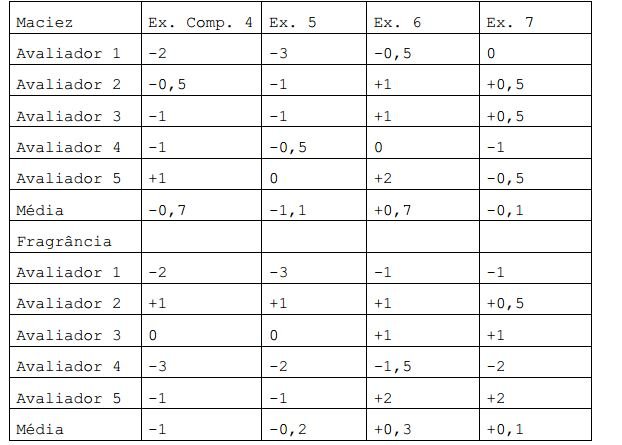
[00111] Os resultados mostram que foi observado um aumento significativo na performance da maciez e fragrância para o triglicerídeo de sebo/polímero catiônico linear FS100 após homogeneização de alta pressão no Exemplo 6.[00111] The results show that a significant increase in softness and fragrance performance was observed for the tallow triglyceride/linear cationic polymer FS100 after high pressure homogenization in Example 6.
[00112] O triglicerídeo de sebo/polímero catiônico expansível em água reticulado do tipo FS200 no Exemplo 7 forneceram liberação da fragrância e maciez eficazes após uma mistura de alto cisalhamento.[00112] The cross-linked tallow triglyceride/water swellable polymer of type FS200 in Example 7 provided effective fragrance release and softness after high shear mixing.
[00113] Um estudo de desenho do teste de lavagem de carga total foi realizado para testar o impacto do nível de polímero e homogeneização em alta pressão sobre a maciez e liberação da fragrância nas composições condicionadoras de tecido com polímero catiônico expansível em água/triglicerídeo de sebo.[00113] A full load wash test design study was performed to test the impact of polymer level and high pressure homogenization on softness and fragrance release in fabric conditioning compositions with water-swellable cationic polymer/triglyceride of tallow.
[00114] Nos Exemplos 8 a 15, as composições condicionadoras de tecido foram preparadas de acordo com o Exemplo 6, e foram sujeitas a homogeneização de alta pressão a uma pressão de 7,6 x 10⁷ Pa (11.000 psi) e a uma temperatura de 50°C para reduzir a partícula tamanho. Todas as composições condicionadoras de tecido homogeneizadas de alta pressão nestes Exemplos tinham um tamanho de partícula da emulsão de 0,7 micrômetros.In Examples 8 to 15, tissue conditioning compositions were prepared according to Example 6, and were subjected to high pressure homogenization at a pressure of 7.6 x 10⁷ Pa (11,000 psi) and a temperature of 50°C to reduce particle size. All of the high pressure homogenized tissue conditioning compositions in these Examples had an emulsion particle size of 0.7 micrometers.
[00115] Os produtos destes Exemplos e Exemplos Comparativos foram cada utilizado como uma composição de amaciamento de tecido que foi utilizada em um teste de amaciamento de tecido usando quatro quantidades diferentes de um ciclo de lavagem/enxaguamento. O protocolo para o teste é descrito abaixo. Protocolo Carga de lavagem completa em lavadora do tipo US[00115] The products of these Examples and Comparative Examples were each used as a fabric softening composition which was used in a fabric softening test using four different amounts of a wash/rinse cycle. The protocol for the test is described below. Protocol Complete wash load in US type washer
[00116] Cada experimento utilizou 79 gramas do produto adicionado ao enxaguamento após um ciclo de lavagem com 90 g de um detergente a base de tensoativo aniônico. A carga de tecido consistiu de 12 toalhas felpudas (aproximadamente 1,4 Kg) e uma carga de roupa mista (aproximadamente 1,6 Kg). Houve um ciclo de lavagem de 15 minutos e um ciclo de enxague de 4 minutos. Todas as toalhas felpudas foram secas em linha. Um subconjunto das toalhas foi cortado em pequenos pedaços e avaliado por um painel sensorial treinado para a sua intensidade da fragrância em uma escala de 1 a 10. Toalhas inteiras foram dobradas e avaliada por um painel sensorial treinado para a sua intensidade de maciez em uma escala de 1 a 10. Dois controles positivos, um produto amaciante de tecido de TEA esterquat em dois níveis diferentes de AI, como exemplos comparativos 5 e 6, foram usados nos testes de triagem. Todos os dados são expressos como relativo ao controle positivo do Exemplo Comparativo 5.[00116] Each experiment used 79 grams of the product added to the rinse after a washing cycle with 90 g of a detergent based on anionic surfactant. The fabric load consisted of 12 terry towels (approximately 1.4 kg) and a mixed laundry load (approximately 1.6 kg). There was a 15 minute wash cycle and a 4 minute rinse cycle. All terry towels were line dried. A subset of the towels was cut into small pieces and rated by a trained sensory panel for their fragrance intensity on a scale of 1 to 10. Whole towels were folded and rated by a trained sensory panel for their softness intensity on a scale from 1 to 10. Two positive controls, a fabric softener product of TEA esterquat at two different levels of AI, as comparative examples 5 and 6, were used in the screening tests. All data are expressed as relative to the positive control from Comparative Example 5.
[00117] Houve oito exemplos experimentais que abrangem alto e baixo nível de utilização do polímero, tipo de polímero, e emulsões homogeneizadas, utilizando um homogeneizador de alta pressão, ou emulsões não homogeneizadas, usando apenas um misturador de alto cisalhamento. Todas as medições de tamanho de partícula foram realizadas utilizando um Malvern Mastersizer 2000. O tamanho médio de partícula em volume é descrito.[00117] There were eight experimental examples covering high and low level of polymer utilization, polymer type, and homogenized emulsions, using a high pressure homogenizer, or non-homogenized emulsions, using only a high-shear mixer. All particle size measurements were performed using a Malvern Mastersizer 2000. The volume mean particle size is described.
[00118] A Tabela 3 mostra as composições utilizadas nos Exemplos 8 a 15 e Exemplos Comparativos 5 e 6. O triglicerídeo de sebo é representado por "TG", polímero catiônico expansível em água linear do tipo FS100 é representado por "FS100" e o polímero catiônico expansível em água linear do tipo FS200 é representado por "FS200". O tamanho das partículas da emulsão é indicado. Homogeneizado é representado pela letra "H" e alto cisalhamento/ não homogeneizado representado por "S". Cada composição também incluiu 0,18% em peso cápsulas de liberação de fragrância aniônica que são convencionalmente utilizadas em composições condicionadoras de tecido de esterquat. Tabela 3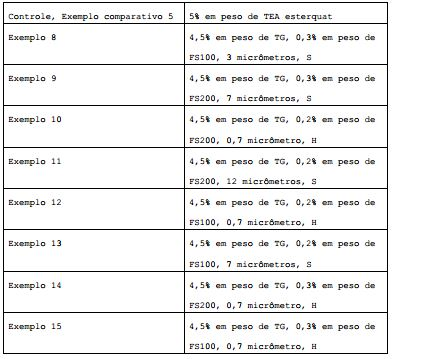

[00119] Na Tabela 4 acima, Exemplos 8 a 15 são comparados em relação ao Exemplo Comparativo 5 de acordo com a escala de -3 (menos do que a de controle) a +3 (melhor do que a de controle). Dentro de + ou -1, os valores são paridade. Um número dos Exemplos demonstrou composições de triglicerídeo de sebo/polímero catiônico expansível em água com performance em paridade ou direccionalmente melhor do que a controle com TEA esterquat do Exemplo Comparativo 5. A melhor performance total foi fornecida pelo Exemplo 12 com 0,2%''em peso de polímero linear do tipo FS100 e homogeneizado. Ambas as composições homogeneizadas e não homogeneizadas dos Exemplos 10 e 11 com 0,2% de polímero reticulado do tipo FS200 foram altamente eficazes para a liberação da fragrância, e mais eficazes do que as composições de controle e de polímero linear do tipo FS100.[00119] In Table 4 above, Examples 8 to 15 are compared against Comparative Example 5 according to the scale of -3 (less than the control) to +3 (better than the control). Within + or -1, values are parity. A number of the Examples demonstrated water swellable tallow triglyceride/cationic polymer compositions performing at parity or directionally better than the TEA esterquat control of Comparative Example 5. The best overall performance was provided by Example 12 at 0.2%' 'by weight of linear polymer of the FS100 type and homogenized. Both the homogenized and non-homogenized compositions of Examples 10 and 11 with 0.2% cross-linked polymer of type FS200 were highly effective for fragrance release, and more effective than the control and linear polymer compositions of type FS100.
[00120] Liberação da fragrância para as composições de polímero catiônico linear do tipo FS100 aumentou com a diminuição do tamanho de partícula da emulsão de um modo estatisticamente significativo enquanto que em contraste com as composições de polímero catiônico reticulado do tipo FS200 a liberação da fragrância mostrou um aumento direcional com o aumento do tamanho das partículas da emulsão.[00120] Fragrance release for linear cationic polymer compositions of type FS100 increased with decreasing particle size of the emulsion in a statistically significant manner while in contrast to crosslinked cationic polymer compositions of type FS200 fragrance release showed a directional increase with increasing particle size of the emulsion.
[00121] Embora ambos os polímeros lineares do tipo FS100 e os polímeros reticulados do tipo FS200 produziram emulsões condicionadoras de tecido com amaciamento e liberação de fragrância eficazes, o polímero linear do tipo FS100 tendia a requerer a homogeneização de alta pressão para produzir liberação de fragrância em paridade e amaciamento altamente eficazes. O sistema de polímero reticulado do tipo FS200 com apenas uma mistura em alto cisalhamento produziu produto com liberação de fragrância direccionalmente melhor e apenas uma eficácia ligeiramente menor de amaciamento. Uma vez que a aceitação do consumidor tende a ser mais influenciada pela boa liberação da fragrância, ambas as composições resolveram o problema de fornecer a liberação eficaz da fragrância em comparação com composições de esterquat, mas em um custo menor.[00121] Although both the FS100 type linear polymers and the FS200 type crosslinked polymers produced fabric conditioning emulsions with effective softening and fragrance release, the FS100 type linear polymer tended to require high pressure homogenization to produce fragrance release in highly effective parity and softening. The FS200 type cross-linked polymer system with only one blend at high shear produced product with directionally better fragrance release and only slightly lower softening effectiveness. Since consumer acceptance tends to be more influenced by good fragrance release, both compositions solved the problem of providing effective fragrance release compared to esterquat compositions, but at a lower cost.
[00122] Nos Exemplos 8 a 15 4,5% em peso de composições de triglicerídeo de sebo administradas na melhor maciez em paridade estatística com as composições de TEA Esterquat de controle. Assim, nestes Exemplos, uma composição de polímero catiônico expansível em água/triglicerídeo de sebo foi testada adicionalmente para avaliar o desempenho de maciez de uma quantidade maior do que 4,5% de triglicerídeo de sebo e uma menor quantidade do polímero catiônico expansível em água, uma vez que estabilizar o polímero catiônico expansível em água também adiciona custo significativo e, portanto, deve, idealmente, ser minimizado para a respectiva quantidade de sebo.[00122] In Examples 8 to 15 4.5% by weight of tallow triglyceride compositions administered in the best softness in statistical parity with the control TEA Esterquat compositions. Thus, in these Examples, a water swellable cationic polymer/tallow triglyceride composition was further tested to evaluate the softness performance of an amount greater than 4.5% of tallow triglyceride and a lesser amount of the water swellable cationic polymer , since stabilizing the swellable cationic polymer in water also adds significant cost and therefore should ideally be minimized for the respective amount of sebum.
[00123] Por conseguinte, nos Exemplos seguintes, a liberação da fragrância e maciez foram testadas para diferentes quantidades de triglicerídeos de sebo e quantidades de polímero catiônico expansível em água, utilizando um processo de mistura de alto cisalhamento, e todas as composições compreendidas utilizaram uma mistura de fragrância de 0,5% de fragrância e 0,2% de fragrância em óleo encapsulada para determinar se as intensidades globais com alta fragrância podem ser obtidas com um sistema de fragrância misturado. Fragrância e maciez foram ambas avaliadas em uma escala de 10 (melhor) a 1 (menos).[00123] Therefore, in the following Examples, fragrance release and softness were tested for different amounts of tallow triglycerides and amounts of water-swellable cationic polymer, using a high-shear mixing process, and all the compositions comprised used a fragrance blend of 0.5% fragrance and 0.2% fragrance in encapsulated oil to determine if overall high fragrance intensities can be achieved with a blended fragrance system. Fragrance and softness were both rated on a scale of 10 (best) to 1 (least).
[00124] Os resultados dos testes são mostrados nas Tabelas 5 e 6 abaixo. Todas as quantidades estão em % em peso.[00124] Test results are shown in Tables 5 and 6 below. All amounts are in % by weight.
[00125] Na Tabela 6, assim como usando uma quantidade maior de triglicerídeo de sebo, no Exemplo 20, a fragrância foi adicionada na fase oleosa de triglicerídeo de sebo, em vez de na fase aquosa como descrito acima para os Exemplos 1 e 2. Além disso, no Exemplo 21 nenhum agente quelante, na forma de Dequest 2000, como adicionado na fase aquosa como descrito acima para os Exemplos 1 e 2. Tabela 5

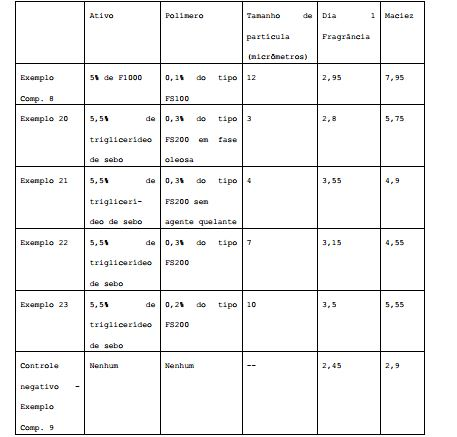
[00126] Os resultados da Tabela 5 mostram que o aumento da razão de polímero catiônico expansível em água:ativo de amaciamento resultou em uma redução de ambas liberação da fragrância e maciez. Com uma quantidade maior de polímero, a quantidade ativa de amaciamento aumentada não forneceu melhores fragrância e maciez. Surpreendentemente, como demonstrado no Exemplo 16, ambas maciez e fragrância foram maiores com menos quantidade de polímero catiônico expansível em água e menos quantidade de ativo de amaciamento.[00126] The results in Table 5 show that increasing the ratio of water swellable cationic polymer:softening active resulted in a reduction of both fragrance release and softness. With a higher amount of polymer, the increased active softening amount did not provide better fragrance and softness. Surprisingly, as demonstrated in Example 16, both softness and fragrance were higher with less amount of water-swellable cationic polymer and less amount of softening active.
[00127] Os resultados da Tabela 6 mostraram que o nível de polímero de 0,2% em peso do Exemplo 23 foi associado com a melhor combinação de liberação de maciez e fragrância. Verificou-se também que a adição do polímero na fase oleosa como fornecido no Exemplo 20 e remoção do agente quelante como fornecido no Exemplo 21 Dequest ambos mostraram potencial para uma redução significativa do tamanho das partículas da emulsão.[00127] The results of Table 6 showed that the 0.2% by weight polymer level of Example 23 was associated with the best combination of softness and fragrance release. It was also found that addition of polymer to the oil phase as provided in Example 20 and removal of the chelating agent as provided in Example 21 Dequest both showed potential for a significant reduction in the particle size of the emulsion.
[00128] Nestes Exemplos, a quantidade de ativa de amaciamento era de 4,5% de triglicerídeo de sebo e a quantidade de polímero catiônico expansível em água era de 0,2% de polímero catiônico expansível em água reticulado do tipo FS200 ou 0,2% do polímero catiônico linear do tipo FS100. Todas as composições foram misturadas utilizando um misturador de alto cisalhamento. As composições que compreendem o polímero catiônico linear de tipo FS100 foram adicionalmente homogeneizadas a 7,6 x 10⁷ Pa (11000 psi). As composições foram preparadas com e sem o agente quelante Dequest, e dispersando o polímero catiônico expansível em água ou para a fase aquosa inicial ou na fase oleosa de triglicerídeo de sebo-fragrância combinados. As composições resultantes foram avaliadas para liberação de fragrância e amaciamento.[00128] In these Examples, the amount of softening active was 4.5% tallow triglyceride and the amount of cationic water swellable polymer was 0.2% crosslinked cationic water swellable polymer of type FS200 or 0. 2% linear cationic polymer of type FS100. All compositions were blended using a high shear mixer. The compositions comprising the linear cationic polymer of type FS100 were further homogenized at 7.6 x 10⁷ Pa (11,000 psi). The compositions were prepared with and without the Dequest chelating agent, and dispersing the swellable cationic polymer in water or into the initial aqueous phase or oil phase of combined tallow-fragrance triglyceride. The resulting compositions were evaluated for fragrance release and softening.
[00129] Os resultados estão apresentados na Tabela 7. Todas as composições na Tabela 7 dos Exemplos 24 a 27 compreendiam 4,5% em peso de triglicerídeo de sebo e 0,2% em peso do polímero catiônico linear do tipo FS100. Tabela 7
[00130] Os exemplos mostram que a performance melhorada de liberação de fragrância e amaciamento foi alcançada através da utilização do polímero catiônico expansível em água sendo adicionado à fase oleosa e nenhum agente quelante Dequest, como no Exemplo 27.[00130] The examples show that improved fragrance release and softening performance was achieved through the use of the water swellable cationic polymer being added to the oil phase and no Dequest chelating agent, as in Example 27.
[00131] Testes correspondentes para os Exemplos 28 a 31 foram efetuados nas composições que compreendiam 4,5% em peso de triglicerídeo de sebo e 0,2% em peso do polímero catiônico expansível em água reticulado do tipo FS200. Os resultados são mostrados na Tabela 8. Tabela 8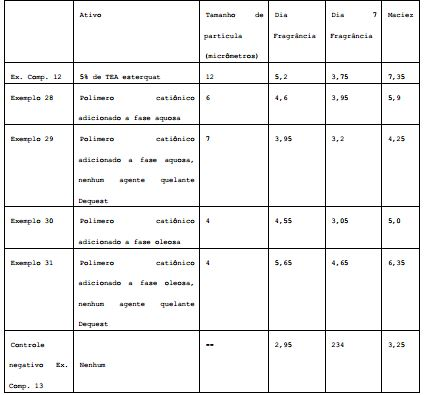
[00132] Estes exemplos mostram que a adição de polímero na fase oleosa produziu um produto com tamanho de partícula consistentemente menor. Novamente o melhor desempenho geral foi fornecido pelo Exemplo 31, quando o polímero foi misturado com a fase oleosa e nenhum agente quelante Dequest foi adicionado à fase aquosa. Além disso, a composição do Exemplo 31 mostrou uma boa estabilidade à temperatura ambiente após 8 semanas de envelhecimento.[00132] These examples show that the addition of polymer in the oil phase produced a product with consistently smaller particle size. Again the best overall performance was provided by Example 31 when the polymer was mixed with the oil phase and no Dequest chelating agent was added to the water phase. Furthermore, the composition of Example 31 showed good stability at room temperature after 8 weeks of aging.
[00133] Uma composição semelhante ao Exemplo 1 é preparada exceto que o polímero catiônico expansível em água utilizado seja o polímero catiônico Rheovis FRC da BASF. Exemplo 32 utiliza uma % em peso de triglicerídeo de sebo, 0,4% em peso de fragrância, 0,18% em peso cápsulas de fragrância e 0,3% em peso de polímero catiônico Rehovis FRC. Esse tipo de polímero catiônico expansível em água é também capaz de formar um amaciante eficaz. Os resultados das avaliações de maciez e fragrância para essa composição são apresentados na Tabela 9 abaixo.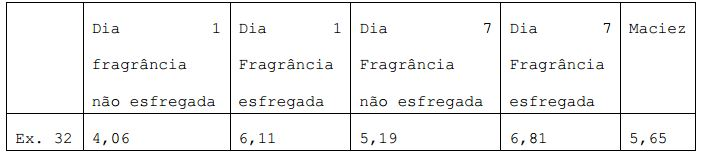
[00134] Como utilizado ao longo desse relatório, faixas são utilizadas como abreviatura para descrever cada e todos os valores que se encontram dentro da faixa. Qualquer valor dentro da faixa pode ser selecionado como o fim da faixa. Além disso, todas as referências aqui citadas são aqui incorporadas por referência na sua totalidade. Em caso de um conflito em uma definição na presente descrição e aquela de uma referência citada, a presente descrição prevalece.[00134] As used throughout this report, ranges are used as an abbreviation to describe each and every value that falls within the range. Any value within the range can be selected as the end of the range. Furthermore, all references cited herein are hereby incorporated by reference in their entirety. In the event of a conflict in a definition in the present description and that of a cited reference, the present description prevails.
[00135] Salvo indicação em contrário, todas as percentagens e quantidades aqui e em outros locais expressas no relatório devem ser entendidas como se referindo a percentagens em peso. As quantidades fornecidas são baseadas no peso do material ativo.[00135] Unless otherwise indicated, all percentages and quantities here and elsewhere expressed in the report are to be understood as referring to percentages by weight. The quantities provided are based on the weight of the active material.
Claims (10)
Applications Claiming Priority (1)
| Application Number | Priority Date | Filing Date | Title |
|---|---|---|---|
| PCT/US2012/068961 WO2014092690A1 (en) | 2012-12-11 | 2012-12-11 | Fabric conditioning composition |
Publications (2)
| Publication Number | Publication Date |
|---|---|
| BR112015013473A2 BR112015013473A2 (en) | 2017-07-11 |
| BR112015013473B1 true BR112015013473B1 (en) | 2021-08-17 |
Family
ID=47430124
Family Applications (1)
| Application Number | Title | Priority Date | Filing Date |
|---|---|---|---|
| BR112015013473-4A BR112015013473B1 (en) | 2012-12-11 | 2012-12-11 | FABRIC CONDITIONING COMPOSITION |
Country Status (8)
| Country | Link |
|---|---|
| US (1) | US9441188B2 (en) |
| EP (1) | EP2931860B1 (en) |
| CN (1) | CN104837977A (en) |
| AU (1) | AU2012396823B2 (en) |
| BR (1) | BR112015013473B1 (en) |
| CA (1) | CA2888966C (en) |
| MX (1) | MX360712B (en) |
| WO (1) | WO2014092690A1 (en) |
Families Citing this family (17)
| Publication number | Priority date | Publication date | Assignee | Title |
|---|---|---|---|---|
| CA2952985C (en) | 2014-07-23 | 2020-04-28 | The Procter & Gamble Company | Fabric and home care treatment compositions |
| WO2016014732A1 (en) | 2014-07-23 | 2016-01-28 | The Procter & Gamble Company | Fabric and home care treatment compositions |
| EP3172307A1 (en) | 2014-07-23 | 2017-05-31 | The Procter and Gamble Company | Treatment compositions |
| US20160024432A1 (en) | 2014-07-23 | 2016-01-28 | The Procter & Gamble Company | Treatment compositions |
| WO2016014734A1 (en) | 2014-07-23 | 2016-01-28 | The Procter & Gamble Company | Fabric and home care treatment composition |
| US10266792B2 (en) | 2014-07-23 | 2019-04-23 | The Procter & Gamble Company | Treatment compositions |
| MX2017000978A (en) | 2014-07-23 | 2017-04-27 | Procter & Gamble | Fabric and home care treatment compositions. |
| WO2016073727A1 (en) | 2014-11-06 | 2016-05-12 | The Procter & Gamble Company | Absorbent articles comprising garment-facing laminates |
| BR112017012522A2 (en) * | 2014-12-15 | 2018-02-27 | Unilever Nv | tissue conditioning fluid liquid composition and method of obtaining a tissue conditioning liquid |
| WO2016137804A1 (en) | 2015-02-25 | 2016-09-01 | The Procter & Gamble Company | Fibrous structures comprising a surface softening composition |
| WO2017132099A1 (en) | 2016-01-25 | 2017-08-03 | The Procter & Gamble Company | Treatment compositions |
| US10689600B2 (en) | 2016-01-25 | 2020-06-23 | The Procter & Gamble Company | Treatment compositions |
| MX2019001907A (en) * | 2016-08-18 | 2019-05-15 | Procter & Gamble | Fabric care composition comprising glyceride copolymers. |
| WO2018152272A1 (en) | 2017-02-16 | 2018-08-23 | The Procter & Gamble Company | Absorbent articles with substrates having repeating patterns of apertures comprising a plurality of repeat units |
| WO2019070838A1 (en) | 2017-10-03 | 2019-04-11 | Lubrizol Advanced Materials, Inc. | Esterquat free liquid fabric softener compositions |
| WO2019084375A1 (en) | 2017-10-26 | 2019-05-02 | Lubrizol Advanced Materials, Inc. | Esterquat free liquid fabric softener compositions containing unsaturated fatty acid soap |
| US12127925B2 (en) | 2018-04-17 | 2024-10-29 | The Procter & Gamble Company | Webs for absorbent articles and methods of making the same |
Family Cites Families (29)
| Publication number | Priority date | Publication date | Assignee | Title |
|---|---|---|---|---|
| US3920563A (en) | 1972-10-31 | 1975-11-18 | Colgate Palmolive Co | Soap-cationic combinations as rinse cycle softeners |
| DE2504888A1 (en) | 1974-02-08 | 1975-08-14 | Procter & Gamble | DEVICE FOR SOFTENING TEXTILES IN AN AUTOMATIC WASHING DRYER |
| US4127694A (en) | 1974-02-08 | 1978-11-28 | The Procter & Gamble Company | Fabric treatment compositions |
| US4308151A (en) | 1980-05-12 | 1981-12-29 | The Procter & Gamble Company | Detergent-compatible fabric softening and antistatic compositions |
| JP3181432B2 (en) * | 1993-06-18 | 2001-07-03 | 花王株式会社 | Liquid softener composition |
| FR2733417B1 (en) | 1995-04-25 | 1997-06-06 | Oreal | FOAMING OIL-IN-WATER EMULSION BASED ON NON-IONIC SURFACTANTS, A FATTY PHASE AND A CATIONIC OR ANIONIC POLYMER CROSS-LINKED AND USE IN TOPICAL APPLICATION |
| WO1997017419A1 (en) | 1995-11-07 | 1997-05-15 | Quest International | Fabric conditioning composition |
| US5919750A (en) | 1997-07-24 | 1999-07-06 | Akzo Nobel Nv | Fabric softener composition |
| GB9804283D0 (en) | 1998-02-27 | 1998-04-22 | Unilever Plc | Fabric conditioning concentrate |
| EP1002569A3 (en) * | 1998-11-19 | 2000-09-06 | Beiersdorf Aktiengesellschaft | Compositions from the water in oil emulsion type containing cationic polymers |
| JP2002541169A (en) | 1999-04-07 | 2002-12-03 | チバ スペシャルティ ケミカルズ ホールディング インコーポレーテッド | Liquid dispersion polymer composition, its preparation and its use |
| GB0118347D0 (en) | 2001-07-27 | 2001-09-19 | Unilever Plc | Fabric conditioning compositions |
| FR2833186B1 (en) | 2001-12-12 | 2004-01-23 | Rhodia Chimie Sa | USE OF CATIONIC BLOCK COPOLYMERS AS AID FOR DEPOSITION OF SINGLE OR MULTIPLE EMULSIONS |
| GB0200151D0 (en) | 2002-01-04 | 2002-02-20 | Unilever Plc | Fabric conditioning compositions |
| BR0314149A (en) | 2002-09-09 | 2005-07-12 | Rhodia Chimie Sa | Formulation intended for use during a textile rinsing operation, processes for treating textile fiber articles, to improve anti-creasing and / or ironing and / or anti-dirt and / or laundry aid properties or abrasion resistance of textile fiber articles and to improve the deposition of an active substance of at least one liquid or solid organic or organosilic material in particulate form on the surface of textile fiber articles and the use of at least one organic polymer |
| AU2003278263A1 (en) * | 2002-09-09 | 2004-03-29 | Rhodia Chimie | Polymer-based textile rinsing formulation |
| CA2547754A1 (en) * | 2003-12-09 | 2005-06-30 | Basf Aktiengesellschaft | Copolymers based on tert-butyl(meth)acrylate and use thereof |
| GB0416155D0 (en) * | 2004-07-20 | 2004-08-18 | Unilever Plc | Laundry product |
| US20070054835A1 (en) | 2005-08-31 | 2007-03-08 | The Procter & Gamble Company | Concentrated fabric softener active compositions |
| US20090069522A1 (en) * | 2007-09-11 | 2009-03-12 | Hessefort Yin Z | Hydrophobically modified polymers |
| FR2920977B1 (en) | 2007-09-14 | 2012-07-27 | Oreal | COSMETIC COMPOSITIONS CONTAINING A CATIONIC COPOLYMER AND A PARTICULAR TRIGLYCERIDE AND USES THEREOF. |
| EP2053119B1 (en) | 2007-10-26 | 2016-09-07 | The Procter and Gamble Company | Fabric softening compositions having improved stability upon storage |
| JP5368561B2 (en) | 2008-08-15 | 2013-12-18 | ザ プロクター アンド ギャンブル カンパニー | Beneficial composition comprising polyglycerol ester |
| WO2011075551A1 (en) | 2009-12-18 | 2011-06-23 | The Procter & Gamble Company | Perfumes and perfume encapsulates |
| MX2012011473A (en) | 2010-04-01 | 2012-11-16 | Procter & Gamble | Fabric softener. |
| PL2553067T3 (en) | 2010-04-01 | 2015-07-31 | Evonik Degussa Gmbh | Fabric softener active composition |
| FR2961816B1 (en) * | 2010-06-25 | 2012-07-06 | Coatex Sas | NON-SURFACTANT ALKALI ACRYLIC ACRYLIC EMULSIONS, THEIR USE IN AQUEOUS FORMULATIONS AND FORMULATIONS CONTAINING SAME. |
| US8603961B2 (en) * | 2010-12-01 | 2013-12-10 | The Procter & Gamble Company | Method of making a fabric care composition |
| US8603960B2 (en) | 2010-12-01 | 2013-12-10 | The Procter & Gamble Company | Fabric care composition |
-
2012
- 2012-12-11 WO PCT/US2012/068961 patent/WO2014092690A1/en not_active Ceased
- 2012-12-11 CA CA2888966A patent/CA2888966C/en active Active
- 2012-12-11 AU AU2012396823A patent/AU2012396823B2/en active Active
- 2012-12-11 US US14/649,981 patent/US9441188B2/en active Active
- 2012-12-11 BR BR112015013473-4A patent/BR112015013473B1/en active IP Right Grant
- 2012-12-11 MX MX2015007386A patent/MX360712B/en active IP Right Grant
- 2012-12-11 EP EP12806291.6A patent/EP2931860B1/en not_active Revoked
- 2012-12-11 CN CN201280077581.8A patent/CN104837977A/en active Pending
Also Published As
| Publication number | Publication date |
|---|---|
| MX2015007386A (en) | 2015-09-16 |
| CA2888966C (en) | 2020-09-15 |
| EP2931860A1 (en) | 2015-10-21 |
| US9441188B2 (en) | 2016-09-13 |
| EP2931860B1 (en) | 2017-02-22 |
| WO2014092690A1 (en) | 2014-06-19 |
| AU2012396823A1 (en) | 2015-05-14 |
| MX360712B (en) | 2018-11-14 |
| AU2012396823B2 (en) | 2015-07-30 |
| CA2888966A1 (en) | 2014-06-19 |
| BR112015013473A2 (en) | 2017-07-11 |
| CN104837977A (en) | 2015-08-12 |
| US20150337238A1 (en) | 2015-11-26 |
Similar Documents
| Publication | Publication Date | Title |
|---|---|---|
| BR112015013473B1 (en) | FABRIC CONDITIONING COMPOSITION | |
| US10563152B2 (en) | Fabric conditioning composition | |
| CN103748204B (en) | fabric wrinkle reduction composition | |
| BR112015014684B1 (en) | TISSUE SOFTENING COMPOSITION, METHOD FOR REDUCING THE TIME NECESSARY FOR DRYING TISSUE, METHOD OF REDUCING FOAM FORMATION DURING TISSUE WASHING AND USE OF SOFTENING COMPOSITIONS | |
| EP1883691A2 (en) | Low solids, high viscosity fabric softener compositions and process for making the same | |
| BR112020000026A2 (en) | composition for tissue treatment | |
| BR112014004547B1 (en) | method for providing quick drying to fabrics | |
| BR112015014664B1 (en) | fabric conditioner | |
| CN104837975B (en) | Ester quat compositions with high three ester quats content | |
| BR0114685B1 (en) | aqueous liquid composition for conditioning fabrics, and method for forming it. | |
| BR112014004874B1 (en) | method to reduce the force required to iron a fabric and use a linear polyether | |
| BR112021011725A2 (en) | HOME CARE COMPOSITIONS | |
| BR112014004690B1 (en) | method to increase fragrance release during ironing a fabric and using a linear polyether |
Legal Events
| Date | Code | Title | Description |
|---|---|---|---|
| B06U | Preliminary requirement: requests with searches performed by other patent offices: procedure suspended [chapter 6.21 patent gazette] | ||
| B06A | Patent application procedure suspended [chapter 6.1 patent gazette] | ||
| B09A | Decision: intention to grant [chapter 9.1 patent gazette] | ||
| B16A | Patent or certificate of addition of invention granted [chapter 16.1 patent gazette] |
Free format text: PRAZO DE VALIDADE: 20 (VINTE) ANOS CONTADOS A PARTIR DE 11/12/2012, OBSERVADAS AS CONDICOES LEGAIS. |