BRPI0808543B1 - Device capable of providing hemostatic effect in bleeding wound - Google Patents
Device capable of providing hemostatic effect in bleeding wound Download PDFInfo
- Publication number
- BRPI0808543B1 BRPI0808543B1 BRPI0808543-9A BRPI0808543A BRPI0808543B1 BR PI0808543 B1 BRPI0808543 B1 BR PI0808543B1 BR PI0808543 A BRPI0808543 A BR PI0808543A BR PI0808543 B1 BRPI0808543 B1 BR PI0808543B1
- Authority
- BR
- Brazil
- Prior art keywords
- device capable
- bleeding wound
- hemostatic effect
- substrate
- clay material
- Prior art date
Links
Images



Classifications
-
- A—HUMAN NECESSITIES
- A61—MEDICAL OR VETERINARY SCIENCE; HYGIENE
- A61L—METHODS OR APPARATUS FOR STERILISING MATERIALS OR OBJECTS IN GENERAL; DISINFECTION, STERILISATION OR DEODORISATION OF AIR; CHEMICAL ASPECTS OF BANDAGES, DRESSINGS, ABSORBENT PADS OR SURGICAL ARTICLES; MATERIALS FOR BANDAGES, DRESSINGS, ABSORBENT PADS OR SURGICAL ARTICLES
- A61L15/00—Chemical aspects of, or use of materials for, bandages, dressings or absorbent pads
- A61L15/16—Bandages, dressings or absorbent pads for physiological fluids such as urine or blood, e.g. sanitary towels, tampons
- A61L15/42—Use of materials characterised by their function or physical properties
- A61L15/425—Porous materials, e.g. foams or sponges
-
- A—HUMAN NECESSITIES
- A61—MEDICAL OR VETERINARY SCIENCE; HYGIENE
- A61F—FILTERS IMPLANTABLE INTO BLOOD VESSELS; PROSTHESES; DEVICES PROVIDING PATENCY TO, OR PREVENTING COLLAPSING OF, TUBULAR STRUCTURES OF THE BODY, e.g. STENTS; ORTHOPAEDIC, NURSING OR CONTRACEPTIVE DEVICES; FOMENTATION; TREATMENT OR PROTECTION OF EYES OR EARS; BANDAGES, DRESSINGS OR ABSORBENT PADS; FIRST-AID KITS
- A61F13/00—Bandages or dressings; Absorbent pads
- A61F13/00051—Accessories for dressings
- A61F13/00063—Accessories for dressings comprising medicaments or additives, e.g. odor control, PH control, debriding, antimicrobic
-
- A—HUMAN NECESSITIES
- A61—MEDICAL OR VETERINARY SCIENCE; HYGIENE
- A61F—FILTERS IMPLANTABLE INTO BLOOD VESSELS; PROSTHESES; DEVICES PROVIDING PATENCY TO, OR PREVENTING COLLAPSING OF, TUBULAR STRUCTURES OF THE BODY, e.g. STENTS; ORTHOPAEDIC, NURSING OR CONTRACEPTIVE DEVICES; FOMENTATION; TREATMENT OR PROTECTION OF EYES OR EARS; BANDAGES, DRESSINGS OR ABSORBENT PADS; FIRST-AID KITS
- A61F13/00—Bandages or dressings; Absorbent pads
- A61F13/01—Non-adhesive bandages or dressings
- A61F13/01008—Non-adhesive bandages or dressings characterised by the material
- A61F13/01012—Non-adhesive bandages or dressings characterised by the material being made of natural material, e.g. cellulose-, protein-, collagen-based
-
- A—HUMAN NECESSITIES
- A61—MEDICAL OR VETERINARY SCIENCE; HYGIENE
- A61L—METHODS OR APPARATUS FOR STERILISING MATERIALS OR OBJECTS IN GENERAL; DISINFECTION, STERILISATION OR DEODORISATION OF AIR; CHEMICAL ASPECTS OF BANDAGES, DRESSINGS, ABSORBENT PADS OR SURGICAL ARTICLES; MATERIALS FOR BANDAGES, DRESSINGS, ABSORBENT PADS OR SURGICAL ARTICLES
- A61L15/00—Chemical aspects of, or use of materials for, bandages, dressings or absorbent pads
- A61L15/16—Bandages, dressings or absorbent pads for physiological fluids such as urine or blood, e.g. sanitary towels, tampons
- A61L15/18—Bandages, dressings or absorbent pads for physiological fluids such as urine or blood, e.g. sanitary towels, tampons containing inorganic materials
-
- A—HUMAN NECESSITIES
- A61—MEDICAL OR VETERINARY SCIENCE; HYGIENE
- A61L—METHODS OR APPARATUS FOR STERILISING MATERIALS OR OBJECTS IN GENERAL; DISINFECTION, STERILISATION OR DEODORISATION OF AIR; CHEMICAL ASPECTS OF BANDAGES, DRESSINGS, ABSORBENT PADS OR SURGICAL ARTICLES; MATERIALS FOR BANDAGES, DRESSINGS, ABSORBENT PADS OR SURGICAL ARTICLES
- A61L15/00—Chemical aspects of, or use of materials for, bandages, dressings or absorbent pads
- A61L15/16—Bandages, dressings or absorbent pads for physiological fluids such as urine or blood, e.g. sanitary towels, tampons
- A61L15/22—Bandages, dressings or absorbent pads for physiological fluids such as urine or blood, e.g. sanitary towels, tampons containing macromolecular materials
- A61L15/28—Polysaccharides or their derivatives
-
- A—HUMAN NECESSITIES
- A61—MEDICAL OR VETERINARY SCIENCE; HYGIENE
- A61L—METHODS OR APPARATUS FOR STERILISING MATERIALS OR OBJECTS IN GENERAL; DISINFECTION, STERILISATION OR DEODORISATION OF AIR; CHEMICAL ASPECTS OF BANDAGES, DRESSINGS, ABSORBENT PADS OR SURGICAL ARTICLES; MATERIALS FOR BANDAGES, DRESSINGS, ABSORBENT PADS OR SURGICAL ARTICLES
- A61L15/00—Chemical aspects of, or use of materials for, bandages, dressings or absorbent pads
- A61L15/16—Bandages, dressings or absorbent pads for physiological fluids such as urine or blood, e.g. sanitary towels, tampons
- A61L15/42—Use of materials characterised by their function or physical properties
-
- A—HUMAN NECESSITIES
- A61—MEDICAL OR VETERINARY SCIENCE; HYGIENE
- A61L—METHODS OR APPARATUS FOR STERILISING MATERIALS OR OBJECTS IN GENERAL; DISINFECTION, STERILISATION OR DEODORISATION OF AIR; CHEMICAL ASPECTS OF BANDAGES, DRESSINGS, ABSORBENT PADS OR SURGICAL ARTICLES; MATERIALS FOR BANDAGES, DRESSINGS, ABSORBENT PADS OR SURGICAL ARTICLES
- A61L15/00—Chemical aspects of, or use of materials for, bandages, dressings or absorbent pads
- A61L15/16—Bandages, dressings or absorbent pads for physiological fluids such as urine or blood, e.g. sanitary towels, tampons
- A61L15/42—Use of materials characterised by their function or physical properties
- A61L15/44—Medicaments
-
- A—HUMAN NECESSITIES
- A61—MEDICAL OR VETERINARY SCIENCE; HYGIENE
- A61P—SPECIFIC THERAPEUTIC ACTIVITY OF CHEMICAL COMPOUNDS OR MEDICINAL PREPARATIONS
- A61P17/00—Drugs for dermatological disorders
- A61P17/02—Drugs for dermatological disorders for treating wounds, ulcers, burns, scars, keloids, or the like
-
- A—HUMAN NECESSITIES
- A61—MEDICAL OR VETERINARY SCIENCE; HYGIENE
- A61P—SPECIFIC THERAPEUTIC ACTIVITY OF CHEMICAL COMPOUNDS OR MEDICINAL PREPARATIONS
- A61P7/00—Drugs for disorders of the blood or the extracellular fluid
- A61P7/04—Antihaemorrhagics; Procoagulants; Haemostatic agents; Antifibrinolytic agents
-
- A—HUMAN NECESSITIES
- A61—MEDICAL OR VETERINARY SCIENCE; HYGIENE
- A61L—METHODS OR APPARATUS FOR STERILISING MATERIALS OR OBJECTS IN GENERAL; DISINFECTION, STERILISATION OR DEODORISATION OF AIR; CHEMICAL ASPECTS OF BANDAGES, DRESSINGS, ABSORBENT PADS OR SURGICAL ARTICLES; MATERIALS FOR BANDAGES, DRESSINGS, ABSORBENT PADS OR SURGICAL ARTICLES
- A61L2300/00—Biologically active materials used in bandages, wound dressings, absorbent pads or medical devices
- A61L2300/40—Biologically active materials used in bandages, wound dressings, absorbent pads or medical devices characterised by a specific therapeutic activity or mode of action
- A61L2300/404—Biocides, antimicrobial agents, antiseptic agents
-
- A—HUMAN NECESSITIES
- A61—MEDICAL OR VETERINARY SCIENCE; HYGIENE
- A61L—METHODS OR APPARATUS FOR STERILISING MATERIALS OR OBJECTS IN GENERAL; DISINFECTION, STERILISATION OR DEODORISATION OF AIR; CHEMICAL ASPECTS OF BANDAGES, DRESSINGS, ABSORBENT PADS OR SURGICAL ARTICLES; MATERIALS FOR BANDAGES, DRESSINGS, ABSORBENT PADS OR SURGICAL ARTICLES
- A61L2300/00—Biologically active materials used in bandages, wound dressings, absorbent pads or medical devices
- A61L2300/40—Biologically active materials used in bandages, wound dressings, absorbent pads or medical devices characterised by a specific therapeutic activity or mode of action
- A61L2300/404—Biocides, antimicrobial agents, antiseptic agents
- A61L2300/406—Antibiotics
-
- A—HUMAN NECESSITIES
- A61—MEDICAL OR VETERINARY SCIENCE; HYGIENE
- A61L—METHODS OR APPARATUS FOR STERILISING MATERIALS OR OBJECTS IN GENERAL; DISINFECTION, STERILISATION OR DEODORISATION OF AIR; CHEMICAL ASPECTS OF BANDAGES, DRESSINGS, ABSORBENT PADS OR SURGICAL ARTICLES; MATERIALS FOR BANDAGES, DRESSINGS, ABSORBENT PADS OR SURGICAL ARTICLES
- A61L2400/00—Materials characterised by their function or physical properties
- A61L2400/04—Materials for stopping bleeding
-
- A—HUMAN NECESSITIES
- A61—MEDICAL OR VETERINARY SCIENCE; HYGIENE
- A61L—METHODS OR APPARATUS FOR STERILISING MATERIALS OR OBJECTS IN GENERAL; DISINFECTION, STERILISATION OR DEODORISATION OF AIR; CHEMICAL ASPECTS OF BANDAGES, DRESSINGS, ABSORBENT PADS OR SURGICAL ARTICLES; MATERIALS FOR BANDAGES, DRESSINGS, ABSORBENT PADS OR SURGICAL ARTICLES
- A61L2400/00—Materials characterised by their function or physical properties
- A61L2400/16—Materials with shape-memory or superelastic properties
Landscapes
- Health & Medical Sciences (AREA)
- Chemical & Material Sciences (AREA)
- Veterinary Medicine (AREA)
- Engineering & Computer Science (AREA)
- Animal Behavior & Ethology (AREA)
- Life Sciences & Earth Sciences (AREA)
- General Health & Medical Sciences (AREA)
- Public Health (AREA)
- Hematology (AREA)
- Epidemiology (AREA)
- Materials Engineering (AREA)
- Medicinal Chemistry (AREA)
- Inorganic Chemistry (AREA)
- Biomedical Technology (AREA)
- Vascular Medicine (AREA)
- Dispersion Chemistry (AREA)
- Heart & Thoracic Surgery (AREA)
- Organic Chemistry (AREA)
- Nuclear Medicine, Radiotherapy & Molecular Imaging (AREA)
- Pharmacology & Pharmacy (AREA)
- General Chemical & Material Sciences (AREA)
- Chemical Kinetics & Catalysis (AREA)
- Bioinformatics & Cheminformatics (AREA)
- Dermatology (AREA)
- Diabetes (AREA)
- Materials For Medical Uses (AREA)
- Absorbent Articles And Supports Therefor (AREA)
- Medicinal Preparation (AREA)
Abstract
DISPOSITIVO CAPAZ DE PROPORCIONAR EFEITO HEMOSTÁTICO EM FERIMENTO DE HEMORRAGIA, ATADURA DE GAZE E ESPONJAS HEMOSTÁTICAS. Um dispositivo hemostático para promover a coagulação de sangue inclui um substrato de gaze, um material de argila disposto sobre o substrato de gaze e também um poliol tal como glicerol ou semelhante disposto sobre o substrato de gaze para ligar o material de argila. Quando o dispositivo é usado para tratar um ferimento de hemorragia, pelo menos uma parte do material de argila entra em contato com o sangue que emana do ferimento de forma a ocasionar a coagulação. Uma atadura de gaze que pode ser aplicada a um ferimento de hemorragia para promover a coagulação de sangue inclui um substrato flexível e um substrato de gaze montada sobre ele. O substrato de gaze inclui um material de argila e um poliol. Uma esponja hemostática inclui também um substrato de gaze e uma dispersão de material hemostático e um poliol sobre uma primeira superfície do substrato.DEVICE CAPABLE OF PROVIDING HEMOSTATIC EFFECT IN HEMORRHAGE WOUNDS, GAZE BANDAGE AND HEMOSTATIC SPONGES. A hemostatic device for promoting blood clotting includes a gauze substrate, a clay material disposed on the gauze substrate and also a polyol such as glycerol or the like disposed on the gauze substrate to bind the clay material. When the device is used to treat a bleeding wound, at least some of the clay material comes into contact with the blood emanating from the wound in order to cause clotting. A gauze bandage that can be applied to a bleeding wound to promote blood clotting includes a flexible substrate and a gauze substrate mounted thereon. The gauze substrate includes a clay material and a polyol. A hemostatic sponge also includes a gauze substrate and a dispersion of hemostatic material and a polyol on a first surface of the substrate.
Description
1. A presente invenção relaciona-se em geral com agentes e dispositivos para promover a hemostase e, mais particularmente, com agentes e dispositivos hemostáticos baseados em argila incorporando esses agentes para a liberação dos mesmos para ferimentos de hemorragia.1. The present invention relates generally to agents and devices for promoting hemostasis, and more particularly to clay-based hemostatic agents and devices incorporating such agents for delivery thereof to bleeding wounds.
2. O sangue é um tecido líquido que inclui células vermelhas, células brancas, corpúsculos e plaquetas dispersadas numa fase líquida. A fase líquida é o plasma, que inclui ácidos, lípidos, eletrólitos solublizados e proteínas. As proteínas são suspensas na fase líquida e podem ser separadas da fase líquida por qualquer dentre uma variedade de métodos tais como filtração, centrifugação, eletroforese e técnicas imunoquímicas. Uma proteína particular suspensa na fase líquida é o fibrinogeno. Quando ocorre a hemorragia, o fibrinogeno reage com a água e a trombina (uma enzima) para formar fibrina, que é insolúvel no sangue e polimeriza de maneira a formar coágulos.2. Blood is a liquid tissue that includes red cells, white cells, corpuscles and platelets dispersed in a liquid phase. The liquid phase is plasma, which includes acids, lipids, solubilized electrolytes and proteins. Proteins are suspended in the liquid phase and can be separated from the liquid phase by any of a variety of methods such as filtration, centrifugation, electrophoresis and immunochemical techniques. One particular protein suspended in the liquid phase is fibrinogen. When bleeding occurs, fibrinogen reacts with water and thrombin (an enzyme) to form fibrin, which is insoluble in blood and polymerizes to form clots.
3. Numa ampla variedade de circunstâncias, animais, incluindo as pessoas humanas, podem ser feridos. Freqüentemente, o sangramento é associado a esses ferimentos. Em algumas circunstâncias, o ferimento e a hemorragia são pequenos e a coagulação normal do sangue funciona além da aplicaçõa de primeiros socorros simples e são tudo o que é exigido. Infelizmente, porém, em outras circunstâncias, pode acontecer hemorragia substancial. Estas situações exigem normalmente equipamento e materiais especializados, assim como também pessoal treinado para administrar ajuda apropriada. Se essa ajuda não estiver prontamente disponível, pode acontecer perda de sangue excessiva. Quando a hemorragia é severa, algumas vezes, a disponibilidade imediata de equipamento e pessoal treinado é ainda insuficiente para estancar o fluxo de sangue de uma maneira oportuna.3. In a wide variety of circumstances, animals, including humans, can be injured. Bleeding is often associated with these injuries. In some circumstances, the wound and bleeding are minor and normal blood clotting goes beyond the application of simple first aid and is all that is required. Unfortunately, however, in other circumstances, substantial bleeding can occur. These situations usually require specialized equipment and materials, as well as trained personnel to administer appropriate help. If this help is not readily available, excessive blood loss can result. When hemorrhage is severe, sometimes the immediate availability of equipment and trained personnel is still insufficient to stop the flow of blood in a timely manner.
4. Além disso, ferimentos, severos podem ser freqüentemente infligidos em áreas remotas ou em situações, tais como num campo de batalha, onde ajuda médica adequada não está imediatamente disponível. Nestas instâncias, é importante parar a henmorragia, mesmo em ferimentos menos severos, durante um tempo suficiente para permitir à pessoa ou animal ferido receber atenção médica.4. In addition, severe injuries can often be inflicted in remote areas or in situations, such as on a battlefield, where adequate medical help is not immediately available. In these instances, it is important to stop bleeding, even in less severe injuries, for a time sufficient to allow the injured person or animal to receive medical attention.
5. Num esforço de resolver os problemas acima descritos, foram desenvolvidos materiais para controlar a hemorragia excessiva em situações onde a ajuda convencional é indisponível ou menos do que otimamente efetiva. Embora estes materiais tenham sido mostrados terem algum sucesso, às vezes, não são suficientemente efetivos para ferimentos traumáticos e tendem a ser caross. Além disso, estes materiais são, às vezes, ineficazes em algumas situações e podem ser difíceis de aplicar assim como também remover a partir de um ferimento.5. In an effort to solve the problems described above, materials have been developed to control excessive bleeding in situations where conventional help is unavailable or less than optimally effective. While these materials have been shown to have some success, they are sometimes not effective enough for traumatic injuries and tend to be expensive. Furthermore, these materials are sometimes ineffective in some situations and can be difficult to apply as well as remove from a wound.
6. Adicional ou alternativamente, os materiais previamente desenvolvidos podem produzir efeitos colaterais indesejáveis. Por exemplo, um tipo de material de coagulação de sangue do estado da técnica é geralmente um pó ou um particulado fino em que a área de superfície do material produz freqüentemente uma reação exotérmica após a aplicação do material no sangue. Frequentemente, é desnecessariamente despejado material em excesso sobre um ferimento, o que pode exacerbar os efeitos exotérmicos. Dependendo dos atributos específicos do material, a exotermia resultante pode ocasionar desconforto ou mesmo queimar o paciente. Embora algumas patentes do estado da técnica citem especificamente a exotermia resultante como sendo uma característica desejável que pode proporcionar efeitos de coagulação para o ferimento que são semelhantes à cauterização, existe possibilidade de que o tecido no local ferido local e em torno dele possa ser indesejavelmente impactado.6. Additionally or alternatively, previously developed materials may produce undesirable side effects. For example, one type of prior art blood clotting material is generally a powder or fine particulate where the surface area of the material often produces an exothermic reaction upon application of the material to the blood. Too often, excess material is unnecessarily poured over a wound, which can exacerbate exothermic effects. Depending on the specific attributes of the material, the resulting exothermy can cause discomfort or even burn the patient. Although some prior art patents specifically cite the resulting exothermy as being a desirable feature that can provide clotting effects to the wound that are similar to cauterization, the possibility exists that tissue at and around the injured site may be undesirably impacted. .
7. Além disso, para remover esses materiais a partir de ferimentos, é freqüentemente exigida a irrigação do ferimento. Se uma quantidade de material for administrada que ocasione desconforto ou queimadura, o ferimento pode exigir lavagem imediata. Em instâncias em que uma pessoa ou um animal ferido ainda não foi transportado para uma instalação capaz de proporcionar a irrigação necessária, podem resultar efeitos indesejáveis ou sobre-tratamento do ferimento.7. In addition, to remove these materials from wounds, irrigation of the wound is often required. If an amount of material is administered that causes discomfort or burns, the wound may require immediate washing. In instances where an injured person or animal has not yet been transported to a facility capable of providing the necessary irrigation, undesirable effects or over-treatment of the wound may result.
8. A hemorragia também pode ser um problema durante procedimentos cirúrgicos. Além de suturar ou grampear uma incisão ou área de sangramento interna, o sangramento é freqüentemente controlada usando uma esponja ou outro material usado para exercer pressão contra o local de sangramento e/ou absorver o sangue. Todavia, quando a hemorragia ficar excessiva, estas medidas podem não ser suficientes para parar o fluxo de sangue. Além disso, qualquer material de controle de sangramento altamente exotérmico pode danificar o tecido que circunda o local do sangramento e pode não ser configurado para remoção fácil depois de uso.8. Bleeding can also be a problem during surgical procedures. In addition to suturing or stapling an incision or internal bleeding area, bleeding is often controlled using a sponge or other material used to exert pressure against the bleeding site and/or absorb blood. However, when bleeding becomes excessive, these measures may not be enough to stop the flow of blood. In addition, any highly exothermic bleed control material can damage the tissue surrounding the bleed site and may not be configured for easy removal after use.
9. Baseado no anteriormente mencionado, é um objetivo geral da presente invenção proporcionar um agente hemostático que supere ou melhore em relação aos inconvenientes associados à técnica anterior. Também é um objetivo geral da presente invenção proporcionar dispositivos capazes de aplicar esses agentes hemostáticos.9. Based on the foregoing, it is a general objective of the present invention to provide a hemostatic agent that overcomes or improves upon the drawbacks associated with the prior art. It is also a general objective of the present invention to provide devices capable of delivering such hemostatic agents.
10. De acordo com um aspecto, a presente invenção reside num dispositivo para promover a coagulação, controlando, assim, a hemorragia. O dispositivo compreende um material de argila em forma de partícula e um receptáculo para conter o material de argila. Pelo menos uma parte do receptáculo é definida por uma malha tendo nela aberturas tais que, quando o dispositivo for aplicado a um local de sangramento, as partículas de argila entram em contatar com o sangue através da abertura.10. In one aspect, the present invention resides in a device for promoting clotting, thereby controlling bleeding. The device comprises a particulate clay material and a receptacle for containing the clay material. At least a portion of the receptacle is defined by a mesh having openings therein such that, when the device is applied to a bleeding site, clay particles come into contact with blood through the opening.
11. De acordo com outro aspecto, a presente invenção reside noutro dispositivo capaz de proporcionar um efeito hemostático sobre um ferimento de hemorragia para controlar o fluxo de sangue a partir do ferimento. O dispositivo compreende um substrato de gaze e um material de argila disposto sobre o substrato de gaze. Após a aplicação do dispositivo no ferimento de hemorragia, pelo menos uma parte do material de argila entra em contato com o sangue de forma a ocasionar o efeito hemostático.11. In another aspect, the present invention resides in another device capable of providing a hemostatic effect on a bleeding wound to control blood flow from the wound. The device comprises a gauze substrate and a clay material disposed on the gauze substrate. After application of the device to the bleeding wound, at least a part of the clay material comes into contact with the blood in order to bring about the hemostatic effect.
12. De acordo com outro aspecto, a presente invenção reside numa atadura de gaze que pode ser aplicada a um ferimento de hemorragia para promover a coagulação, controlando, assim, a hemorragia. A atadura de gaze compreende um substrato, uma malha montada sobre o substrato e partículas de um material de argila retidas na malha. A malha é definida por uma pluralidade de membros dispostos de modo a definir aberturas que permitem que o fluxo de sangue para dentro da malha e o material de argila, produzindo, assim, um efeito de coagulação.12. In another aspect, the present invention resides in a gauze bandage that can be applied to a bleeding wound to promote clotting, thereby controlling bleeding. The gauze bandage comprises a substrate, a mesh mounted on the substrate and particles of a clay material retained in the mesh. The mesh is defined by a plurality of members arranged to define openings that allow blood to flow into the mesh and clay material, thereby producing a clotting effect.
13. De acordo com outro aspecto, a presente invenção reside numa esponja hemostática que pode ser aplicada a um ferimento de hemorragia para coagular o sangue e controlar a hemorragia. Essa esponja compreende um substrato, um material hemostático disposto sobre uma primeira superfície do substrato e um agente de liberação disposto sobre uma segunda superfície do substrato. O agente de liberação é disposto sobre a superfície de contato do ferimento do substrato de forma a inibir a aderência da esponja ao tecido da ferida depois da formação de coágulo. Quando se trata um ferimento de hemorragia, a aplicação da esponja hemostática ocasiona que pelo menos uma parte do material hemostático entre em contato com o sangue através do agente de liberação e através do substrato.13. In another aspect, the present invention resides in a hemostatic sponge that can be applied to a bleeding wound to clot blood and control bleeding. Such a sponge comprises a substrate, a hemostatic material disposed on a first surface of the substrate and a release agent disposed on a second surface of the substrate. The release agent is disposed on the wound contact surface of the substrate so as to inhibit the sponge from adhering to the wound tissue after clot formation. When treating a bleeding wound, application of the hemostatic sponge causes at least some of the hemostatic material to come into contact with blood through the releasing agent and through the substrate.
14. De acordo ainda com outro aspecto, a presente invenção reside em outras formas de esponjas hemostáticas. Nessas formas, a esponja hemostática pode compreender um filme e um material hemostático incorporado no filme; um substrato, um material hemostático disposto sobre o substrato e um filme disposto sobre o material hemostático; ou um material hemostático sanduichado entre dois substratos.14. In yet another aspect, the present invention resides in other forms of hemostatic sponges. In such forms, the hemostatic sponge may comprise a film and a hemostatic material incorporated into the film; a substrate, a hemostatic material disposed on the substrate and a film disposed on the hemostatic material; or a hemostatic material sandwiched between two substrates.
15. De acordo ainda com outro aspecto, a presente invenção reside num dispositivo hemostático para promover a coagulação, controlando, assim, a hemorragia. O dispositivo tem um substrato de gaze, um material de argila disposto sobre o substrato de gaze e também um poliol tal como glicerol ou semelhante disposto sobre o substrato de gaze para ligar o material de argila. Quando o dispositivo é usado para tratar um ferimento de hemorragia, pelo menos uma parte do material de argila entra em contato com o sangue que emana da ferida de modo a causar a coagulação.15. In yet another aspect, the present invention resides in a hemostatic device for promoting clotting, thereby controlling bleeding. The device has a gauze substrate, a clay material disposed on the gauze substrate and also a polyol such as glycerol or the like disposed on the gauze substrate to bind the clay material. When the device is used to treat a bleeding wound, at least some of the clay material comes into contact with blood emanating from the wound to cause clotting.
16. Ainda de acordo com outro aspecto, a presente invenção reside numa atadura de gaze que pode ser aplicada a um ferimento de hemorragia para promover a coagulação, controlando, assim, a hemorragia. A atadura de gaze tem um substrato flexível e um substrato de gaze montada sobre ele. O substrato de gaze inclui um material de argila e um poliol. Quando a atadura de gaze é usada para tratar um ferimento de hemorragia, aplicar a atadura de gaze causa que pelo menos uma parte do material de argila entre em contate com o sangue que emana a partir do ferimento.16. In yet another aspect, the present invention resides in a gauze bandage that can be applied to a bleeding wound to promote clotting, thereby controlling bleeding. The gauze bandage has a flexible substrate and a gauze substrate mounted on top of it. The gauze substrate includes a clay material and a polyol. When the gauze bandage is used to treat a bleeding wound, applying the gauze bandage causes at least some of the clay material to come into contact with the blood emanating from the wound.
17. De acordo ainda com outro aspecto, a presente invenção reside em esponjas hemostáticas. Um tipo de esponja tem um substrato de gaze e uma dispersão de material hemostático e um poliol sobre uma primeira superfície do substrato. Quando esta esponja é usada para tratar um ferimento de hemorragia, a aplicação da esponja ocasiona que pelo menos uma parte do material hemostático entre em contato com o sangue. Outro tipo de esponja tem primeiro e segundo substratos. Um material hemostático é disperso no poliol e aplicado no primeiro substrato e o segundo substrato é colocado sobre o material hemostático disperso no poliol. Quando esta esponja é usada para tratar um ferimento de hemorragia, a aplicação da esponja ocasiona que pelo menos uma parte do material hemostático entre em contato com o sangue através de pelo menos um dos substratos.17. In yet another aspect, the present invention resides in hemostatic sponges. One type of sponge has a gauze substrate and a dispersion of hemostatic material and a polyol on a first surface of the substrate. When this sponge is used to treat a bleeding wound, application of the sponge causes at least some of the hemostatic material to come into contact with blood. Another type of sponge has first and second substrates. A hemostatic material is dispersed in the polyol and applied to the first substrate and the second substrate is placed over the hemostatic material dispersed in the polyol. When this sponge is used to treat a bleeding wound, application of the sponge causes at least some of the hemostatic material to come into contact with blood through at least one of the substrates.
18. Uma vantagem da presente invenção é que, diferentemente de outros materiais, tais como, por exemplo, zeólitos, o componente de argila não produz nenhuma reação exotérmica com o sangue. Eliminar a geração de calor num local do ferimento é útil para minimizar o desconforto e/ou dano adicional para um paciente e pode ser especialmente útil no tratamento de certos pacientes tais como pediátricos ou pacientes geriátricos ou quando o ferimento que está sendo tratado está numa área particularmente sensível ou delicada.18. An advantage of the present invention is that, unlike other materials, such as, for example, zeolites, the clay component does not produce any exothermic reaction with blood. Eliminating heat generation at a wound site is useful in minimizing additional discomfort and/or harm to a patient and may be especially useful in treating certain patients such as pediatric or geriatric patients or when the wound being treated is in an area particularly sensitive or delicate.
19. Outra vantagem é que a argila pode ser finamente dividida e depositada sobre uma multidão de superfícies, facilitando, assim, o seu uso como componente numa variedade de dispositivos de controle de sangue. Em particular, a argila pode ser usada na forma de partícula (por exemplo, retida numa malha ou num filme) ou pode ser usada na forma de pó (por exemplo, depositado sobre um substrato fibroso para formar uma gaze ou uma esponja). Em qualquer modalidade, a eficácia da argila em promover a hemostase num local do ferimento é melhorada em relação a agentes semelhantes que podem ser usados apenas numa forma (por exemplo, como partículas de um tamanho particular) para limitar efeitos colaterais indesejáveis tais como reações exotérmicas excessivas.19. Another advantage is that the clay can be finely divided and deposited on a multitude of surfaces, thus facilitating its use as a component in a variety of blood control devices. In particular, the clay may be used in particulate form (e.g. retained in a mesh or film) or may be used in powder form (e.g. deposited on a fibrous substrate to form a gauze or sponge). In either embodiment, the clay's effectiveness in promoting hemostasis at a wound site is improved over similar agents that can be used in only one form (e.g., as particles of a particular size) to limit undesirable side effects such as exothermic reactions. excessive.
20. Ainda outra vantagem da presente invenção é que os dispositivos e agentes da presente invenção são facilmente aplicados a ferimentos abertos. Particularmente, quando o agente hemostático é retido numa malha ou dispositivo semelhante ou quando for incorporado numa estrutura tecida para formar uma gaze, o dispositivo pode ser prontamente removido a partir de uma embalagem esterilizada e colocodo ou seguro diretamente nos pontos a partir dos quais o sangue emana de modo a causar a coagulação.20. Yet another advantage of the present invention is that the devices and agents of the present invention are easily applied to open wounds. Particularly, when the hemostatic agent is retained in a mesh or similar device or when it is incorporated into a woven structure to form a gauze, the device can be readily removed from a sterile package and placed or secured directly to points from which blood emanates so as to cause clotting.
21. Uma vantagem do uso de um poliol tal como glicerol junto com argila (ou qualquer outro agente hemostático) é que a poeira frequentemente associada à argila (ou outro agente hemostático) é suprimida. Em razão de sua baixa volatilidade, o glicerol, por exemplo, não evapora prontamente. Como ele não evapora prontamente, a geração de pó de argila, quando a argila é dispersada no glicerol, é mitigada. Mitigar ou suprimir o pó significa que mais material hemostático está disponível para propósitos de coagulação do sangue. Outra vantagem do uso de um poliol junto com argila (ou outros agentes hemostáticos) é é reduzida que a adesão indesejável da esponja ao ferimento. Conseqüentemente, a esponja ou outro dispositivo podem ser facilmente removidos a partir de um ferimento sem quebrar um coágulo de sangue recentemente formado.21. An advantage of using a polyol such as glycerol together with clay (or any other hemostatic agent) is that dust often associated with clay (or other hemostatic agent) is suppressed. Because of its low volatility, glycerol, for example, does not readily evaporate. As it does not readily evaporate, the generation of clay dust when clay is dispersed in glycerol is mitigated. Mitigating or suppressing dust means more hemostatic material is available for blood clotting purposes. Another advantage of using a polyol in conjunction with clay (or other hemostatic agents) is that the unwanted adhesion of the sponge to the wound is reduced. Consequently, the sponge or other device can be easily removed from a wound without breaking a newly formed blood clot.
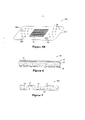
22. A Figura 1 é uma representação esquemática de uma estrutura de malha de um dispositivo de coagulção de sangue da presente invenção.22. Figure 1 is a schematic representation of a mesh structure of a blood clotting device of the present invention.
23. A Figura 2 é uma vista lateral do dispositivo de coagulação de sangue da Figura 1, que ilustra a retenção de partículas de argila na estrutura de malha.23. Figure 2 is a side view of the blood clotting device of Figure 1 illustrating the retention of clay particles in the mesh structure.
24. A Figura 3 é uma vista em perspectiva de um dispositivo de coagulação de sangue que incorpora um material de argila numa gaze.24. Figure 3 is a perspective view of a blood clotting device that incorporates a clay material in a gauze.
25. A Figura 4 é uma vista em perspectiva de um dispositivo de coagulação de sangue que incorpora um material de argila num pano.25. Figure 4 is a perspective view of a blood clotting device that incorporates a clay material in a cloth.
26. A Figura 5A é uma vista em perspectiva de uma atadura de gaze que incorpora as partículas de argila num recipiente de malha para aplicação a um ferimento de hemorragia.26. Figure 5A is a perspective view of a gauze bandage incorporating clay particles in a mesh container for application to a bleeding wound.
27. A Figura 5B é uma vista em perspectiva de uma atadura de gaze que incorpora o material hemostático e um poliol num substrato de gaze para aplicação a um ferimento de hemorragia.27. Figure 5B is a perspective view of a gauze bandage incorporating hemostatic material and a polyol in a gauze substrate for application to a bleeding wound.
28. A Figura 6 é uma representação esquemática de uma esponja tendo capacidades hemostáticas.28. Figure 6 is a schematic representation of a sponge having hemostatic capabilities.
29. A Figura 7 é uma representação esquemática de outra modalidade de uma esponja tendo capacidades hemostáticas.29. Figure 7 is a schematic representation of another embodiment of a sponge having hemostatic capabilities.
30. A Figura 8 é uma representação esquemática de outra modalidade de uma esponja tendo capacidades hemostáticas.30. Figure 8 is a schematic representation of another embodiment of a sponge having hemostatic capabilities.
31. A Figura 9 é uma representação esquemática de outra modalidade de uma esponja tendo capacidades hemostáticas.31. Figure 9 is a schematic representation of another embodiment of a sponge having hemostatic capabilities.
32. São aqui revelados dispositivos hemostáticos e agentes hemostáticos que são aplicáveis a ferimentos de hemorragia para promover a hemostase. Os agentes hemostáticos incluem em geral materiais de argila ou outros materiais baseados em sílica que, quando levados ao contato com um ferimento de hemorragia, podem minimizar ou parar o fluxo de sangue, absorvendo pelo menos partes das fases líquidas do sangue, facilitando, assim, a coagulação. A presente invenção não é limitada à argila, porém, visto que outros materiais tais como vidros bioativos, hemostatos biológicos, materiais de peneira molecular, terra de diatomáceas, combinações dos anteriormente mencionados e semelhantes estão dentro do escopo da presente invenção e podem ser usados em conjunto com a argila ou separadamente como agente hemostático.32. Disclosed herein are hemostatic devices and hemostatic agents that are applicable to bleeding wounds to promote hemostasis. Hemostatic agents generally include clay or other silica-based materials which, when brought into contact with a bleeding wound, can minimize or stop the flow of blood by absorbing at least parts of the liquid phases of the blood, thereby facilitating the clotting. The present invention is not limited to clay, however, as other materials such as bioactive glasses, biological hemostats, molecular sieve materials, diatomaceous earth, combinations of the aforementioned and the like are within the scope of the present invention and can be used in together with clay or separately as a hemostatic agent.
33. Conforme aqui usado, o termo “argila” refere-se a uma forma cristalina de silicato de alumínio hidratado. Os cristais de argila são irregularmente formados e insolúveis na água. A combinação de alguns tipos de argila com a água pode produzir uma massa tendo algum grau de plasticidade. Dependendo do tipo de argila, a combinação da mesma com a água pode produzir um gel coloidal tendo propriedades tixotrópicas.33. As used herein, the term "clay" refers to a crystalline form of hydrated aluminum silicate. Clay crystals are irregularly formed and insoluble in water. Combining some types of clay with water can produce a dough having some degree of plasticity. Depending on the type of clay, its combination with water can produce a colloidal gel having thixotropic properties.
34. Numa modalidade preferida da presente invenção, o material de argila é caulim, que inclui o mineral “caulinita”. Embora o termo “caulim” seja usado em seguida para descrever a presente invenção, deve ficar entendido que pode também ser usada a caulinita em conjunto ou em lugar do caulim. A presente invenção também não é limitada no que se relaciona a caulim ou caulinita, porém, como outros materiais, estão dentro do escopo da presente invenção. Esses materiais incluem, mas, sem limitação, atapulgita, bentonita, combinações do anteriormente mencionado, combinações do precedente com caulim e/ou terra de diatomáceas e semelhantes.34. In a preferred embodiment of the present invention, the clay material is kaolin, which includes the mineral "kaolinite". Although the term "kaolin" is used hereinafter to describe the present invention, it should be understood that kaolinite may also be used in conjunction with or in place of kaolin. The present invention is also not limited as it relates to kaolin or kaolinite, however, like other materials, they are within the scope of the present invention. Such materials include, but are not limited to, attapulgite, bentonite, combinations of the foregoing, combinations of the foregoing with kaolin and/or diatomaceous earth, and the like.
35. Conforme aqui usado, o termo “caulim” refere-se a uma argila de aluminossilicato mole, térrácea (e, mais especificamente, a uma argila de filossilicato dioctaédrica) tendo a fórmula química Al2Si2O5(OH)4. O caulim é um mineral de silicato em camadas de ocorrência natural tendo lâminas tetraédricas alternantes e lâminas octaédricas de alumina octaédrica ligadas via os átomos de oxigênio de grupos de hidroxi. O caulim compreende mais ou menos 50% alumina, mais ou menos 50% sílica e traços de impurezas.35. As used herein, the term "kaolin" refers to a soft, earthy aluminosilicate clay (and more specifically, a dioctahedral phyllosilicate clay) having the chemical formula Al2Si2O5(OH)4. Kaolin is a naturally occurring layered silicate mineral having alternating tetrahedral sheets and octahedral alumina octahedral sheets bonded via the oxygen atoms of hydroxy groups. Kaolin comprises about 50% alumina, about 50% silica and traces of impurities.
36. Com maior preferência, a argila é caulim de plástico de Edgar (em seguida “EPK”), que é uma argila de caulim lavada em água que é minado e processada em e próximo de Edgar, Flórida. O caulim de plástico de Edgar tem características de plasticidade desejáveis, é capaz de ser fundida e, quando misturada com água, produz uma pasta tixotrópica.36. Most preferably, the clay is Edgar's Plastic Kaolin (hereinafter “EPK”), which is a water-washed kaolin clay that is mined and processed in and near Edgar, Florida. Edgar's plastic kaolin has desirable plasticity characteristics, is capable of being melted and, when mixed with water, produces a thixotropic paste.
37. O material de caulim da presente invenção pode ser misturado ou de outra forma usado em conjunto com outros materiais para proporcionar funções de coagulação e/ou eficácia melhorada adicional. Esses materiais incluem, mas, sem limitação, sulfato de magnésio, metafosfato de sódio, cloreto de cálcio, dextrina, combinações dos materiais precedentes e hidratos dos materiais precedentes.37. The kaolin material of the present invention may be blended or otherwise used in conjunction with other materials to provide additional improved clotting functions and/or effectiveness. Such materials include, but are not limited to, magnesium sulfate, sodium metaphosphate, calcium chloride, dextrin, combinations of the foregoing materials, and hydrates of the foregoing materials.
38. Vários materiais podem ser misturados, associados ou incorporados no caulim para manter um ambiente antisséptico no local do ferimento ou proporcionar funções que sejam suplementares para as funções de coagulação da argila. Os materiais exemplificativos que podem ser usados incluem, mas, sem limitação, composições farmaceuticamente ativas tais como antibióticos, agentes antifúngicos, agentes antimicrobianos, agentes antiinflamatórios, analgésicos, anti- histamínicos (por exemplo, cimetidina, maleato de clorofeniramina, cloreto de difenidramina e cloreto de prometazina), compostos contendo prata ou íons de cobre, combinações dos anteriormente mencionados e semelhantes. Outros materiais que podem ser incorporados para proporcionar funções hemostáticas adicionais incluem ácido ascórbico, ácido tranexâmico, rutina e trombina. Podem também ser adicionados agentes botânicos tendo efeitos desejáveis no local do ferimento.38. Various materials can be mixed, blended or incorporated into kaolin to maintain an antiseptic environment at the wound site or provide functions that are supplementary to the clotting functions of the clay. Exemplary materials that may be used include, but are not limited to, pharmaceutically active compositions such as antibiotics, antifungal agents, antimicrobial agents, anti-inflammatory agents, analgesics, antihistamines (e.g., cimetidine, chlorpheniramine maleate, diphenhydramine chloride and promethazine), compounds containing silver or copper ions, combinations of the aforementioned and the like. Other materials that can be incorporated to provide additional hemostatic functions include ascorbic acid, tranexamic acid, rutin and thrombin. Botanical agents may also be added having desirable effects at the wound site.
39. Para uso na presente invenção, o caulim (ou outro material de argila ou terra de diatomáceas) está de preferência na forma de partícula. Conforme aqui usado, “partículas” incluem contas, pelotas, grânulos, barras ou qualquer outra morfologia de superfície ou combinação de morfologias de superfície. Independente da morfologia de superfície, as partículas são de mais ou menos 0,2 mm (milímetros) até cerca de 10 mm, de preferência aproximadamente de 0,5 mm até mais ou menos 5 mm e com maior preferência cerca de 1 mm até mais ou menos 2 mm de diâmetro efetivo. A presente invenção não é limitada a este respeito, porém, e outros tamanhos de partícula (por exemplo, menos do que cerca de 0,2 mm) estão também dentro do escopo da presente invenção. O tamanho de partícula do caulim (ou outro material de argila ou terra de diatomáceas) pode ser tão pequeno que seja considerado pó. Se o tamanho de partícula for considerado como pó, o pó pode ser impalpável (isto é, indetectável ao tato).39. For use in the present invention, the kaolin (or other clay or diatomaceous earth material) is preferably in particulate form. As used herein, "particles" include beads, pellets, granules, bars or any other surface morphology or combination of surface morphologies. Regardless of surface morphology, the particles are from about 0.2 mm (millimeters) to about 10 mm, preferably from about 0.5 mm to about 5 mm and more preferably about 1 mm to more or less than 2 mm in effective diameter. The present invention is not limited in this regard, however, and other particle sizes (e.g., less than about 0.2 mm) are also within the scope of the present invention. The particle size of kaolin (or other clay material or diatomaceous earth) can be so small that it is considered dust. If the particle size is considered to be dust, the dust may be impalpable (i.e., undetectable to the touch).
40. As partículas de argila podem ser produzidas por qualquer dentre vários vários métodos. Esses métodos incluem mistura, extrusão, esferonização e semelhantes. O equipamento que pode ser utilizado para a mistura, extrusão ou esferonização da argila está disponível a partir de Caleva Process Solutions Ltd., em Dorset, Reino Unido. Outros métodos incluem o uso de um equipamento de leito fluido ou um peletização. Os leitos fluidos para a produção de partículas de argila estão disponíveis a partir de Glatt Air Technologies em Ramsey, Nova Jersey. Os peletizadores de disco para a produção de partículas de argila estão disponíveis a partir de Feeco Internacional, Inc., em Green Bay, Wisconsin. De preferência, a argila é extrudida por um dispositivo de peletização apropriado. A presente invenção não é limitada a este respeito, porém, visto que outros dispositivos e métodos para a produção de argila particulada estão dentro do escopo da presente invenção.40. Clay particles can be produced by any of a number of methods. Such methods include mixing, extrusion, spheronization and the like. Equipment that can be used for mixing, extrusion or spheronization of clay is available from Caleva Process Solutions Ltd. in Dorset, UK. Other methods include the use of fluid bed equipment or pelleting. Fluid beds for producing clay particles are available from Glatt Air Technologies in Ramsey, New Jersey. Disc pelletizers for the production of clay particles are available from Feeco International, Inc., in Green Bay, Wisconsin. Preferably, the clay is extruded through a suitable pelletizing device. The present invention is not limited in this regard, however, as other devices and methods for producing particulate clay are within the scope of the present invention.
41. O EPK usado na presente invenção, é particulado, seco e aquecido a mais ou menos 600 graus C. A fim de conseguir que uma mistura adequadamente homogênea de EPK forme as partículas, um torque relativamente alto é aplicado a uma massa do EPK usando um equipamento de mistura apropriado. Antes do cisalhamento, o conteúdo de água da argila é medido e ajustado de forma a ser de mais ou menos 20% em peso para dar uma mistura suficientemente trabalhável para extrusão e manipulação subseqüentes.41. The EPK used in the present invention is particulate, dried and heated to about 600 degrees C. In order to get a properly homogeneous mixture of EPK to form the particles, relatively high torque is applied to a mass of EPK using appropriate mixing equipment. Prior to shearing, the water content of the clay is measured and adjusted to be plus or minus 20% by weight to give a sufficiently workable mixture for subsequent extrusion and handling.
42. Durante o aquecimento do EPK a aproximadamente 600 graus C, o material é vitrificado. A vitrificaçao é efetuada via repetidos ciclos de fusão e arrefecimento de modo a permitir que o EPK (ou outro material de argila) seja convertido numa substância vítrea. Com os números crescentes de ciclos, a estrutura cristalina é quebrada de maneira a resultar numa composição amorfa. A natureza amorfa do EPK permite que mantenha a sua integridade estrutural quando subseqüentemente molhada. Como resultado, o EPK mantém a sua integridade estrutural quando molhada durante o uso, por exemplo, quando aplicado ao sangue. A presente invenção não é limitada ao uso de argilas vitrificadas, porém, visto que o material de argila que não foi vitrificado está ainda dentro do escopo da presente invenção. Em particular, a argila não vitrificada pode ainda ser aplicada a um ferimento de hemorragia para proporcionar a hemostase.42. During heating of the EPK to approximately 600 degrees C, the material is vitrified. The vitrification is carried out via repeated melting and cooling cycles to allow the EPK (or other clay material) to be converted into a glassy substance. With increasing numbers of cycles, the crystal structure is broken down to an amorphous composition. The amorphous nature of EPK allows it to maintain its structural integrity when subsequently wetted. As a result, EPK retains its structural integrity when wet during use, for example when applied to blood. The present invention is not limited to the use of vitrified clays, however, as clay material that has not been vitrified is still within the scope of the present invention. In particular, the unglazed clay can still be applied to a bleeding wound to provide hemostasis.
43. Acredita-se que o mecanismo de coagulação celular da argila ativa certos fatores de contato, quando aplicado ao sangue. Mais especificamente, acredita-se que o caulim (particularmente, o EPK) inicia mecanismos pelos quais a água no sangue é absorvida para facilitar funções de coagulação.43. Clay's cell-clotting mechanism is believed to activate certain contact factors when applied to blood. More specifically, kaolin (particularly, EPK) is believed to initiate mechanisms by which water in the blood is absorbed to facilitate clotting functions.
44. Com referência, agora, à Figura 1, é mostrada uma modalidade de um dispositivo hemostático em que é incorporado o caulim em forma de partícula. O dispositivo é uma bolsa permeável que permite que o líquido entre para contatar as partículas de caulim nela retidas. A embalagem hermeticamente fechada (não mostrada) proporciona um ambiente estéril para armazenar o dispositivo hemostático até que possa ser usado. O dispositivo, que é geralmente mostrado em 10 e é em seguida chamado de “bolsa 10”, compreende uma tela ou malha 12 e o caulim particulado 14 nela retido pela tela ou malha. A malha 12 é fechada de todos os lados e define aberturas que são capazes de nela reter o caulim particulado 14, ao mesmo tempo em que permite que o líquido flua através dela. Conforme ilustrado, a malha 12 é mostrada como sendo achatada e, à guisa de exemplo, são mostradas apenas algumas partículas de caulim particulado 14. O caulim particulado 14 pode ser misturado com partículas de outros tipos de argila, terra de diatomáceas e semelhantes de maneira a formar uma mistura homogênea.44. Referring now to Figure 1, an embodiment of a hemostatic device in which kaolin is incorporated in particulate form is shown. The device is a permeable bag that allows liquid to enter to contact the kaolin particles trapped therein. The hermetically sealed package (not shown) provides a sterile environment to store the hemostatic device until it can be used. The device, which is generally shown at 10 and is hereinafter called "
45. A malha 12 é definida por filamentos interconectados, filamentos ou tiras de material. Os filamentos, ou tiras podem ser interconectados em qualquer uma ou uma combinação de modos, incluindo, mas, sem limitação, ser tecidos em gaze, entrelaçados, formados de modo maciço e semelhantes. De preferência, a interconexão é tal que a malha pode flexionar, ao mesmo tempo em que mantém substancialmente as dimensões da abertura assim definida. O material a partir do qual os filamentos ou tiras são fabricados pode ser um polímero (por exemplo, fibra sintética, polietileno, polipropileno, poliéster ou semelhantes), metal, fibra de vidro ou uma substância orgânica (por exemplo, algodão, lã, seda ou semelhantes).45.
46. Referindo, agora, à Figura 2, as aberturas definidas pela malha 12 são dimensionadas de forma a reter o caulim particulado 14, mas, permitem o fluxo de sangue através delas. Como a malha 12 pode ser puxada de modo apertado em torno do caulim particulado 14, as partículas podem estender-se através da abertura por uma distância d. Se as partículas se estenderem através das aberturas, elas contatarão diretamente o tecido contra o qual a bolsa 10 é aplicada. Deste modo, o sangue que emana a partir do tecido contata imediatamente o caulim particulado 14 e a fase aquosa do mesmo é mistura no caulim, facilitando, assim, a coagulação do sangue. Todavia, não é uma exigência da presente invenção que as partículas protraiam através da malha.46. Referring now to Figure 2, the openings defined by
47. Para aplicar a bolsa 10 a um ferimento de hemorragia, a bolsa é removida da embalagem e colocada no ferimento de hemorragia. O caulim particulado 14 na malha 12 contata o tecido do ferimento e/ou o sangue que emana do ferimento e, pelo menos uma parte da fase líquida do sangue é adsorvida pelo material de argila, promovenda, assim, a coagulação. A flexibilidade da malha 12 permite que a malha se ajuste à forma do ferimento de hemorragia e retenha que forma após a aplicação.47. To apply the
48. Referindo, agora, à Figura 3, outra modalidade de um dispositivo hemostático da presente invenção é uma gaze de caulim, que é geralmente mostrada em 20 e é em seguida chamada de “gaze 20”. O caulim é revestido sobre um substrato de gaze usando qualquer método apropriado para resultar na gaze 20. Um método exemplificativo de revestimento de caulim sobre o substrato de gaze é submergir o substrato numa pasta de caulim/água. O material de caulim usado para a pasta é pó de caulim de preferência finamente moído, embora a presente invenção não seja limitada a este respeito, visto que partículas de caulim, flocos, chips, contas, barras, grânulos ou semelhantes podem ser alternativa ou adicionalmente usados. O substrato de gaze pode ser qualquer material fibroso apropriado, tecido ou não tecido, incluindo, mas, sem limitação, algodão, seda, lã, plástico, celulose, rayon, poliéster, combinações dos anteriormente mencionados e semelhantes. A presente invenção não é limitada a materiais fibrosos tecidos ou não tecidos tais como os substratos de gaze, porém, visto que fletros e semelhantes estão também dentro do escopo da presente invenção.48. Referring now to Figure 3, another embodiment of a hemostatic device of the present invention is a kaolin gauze, which is generally shown at 20 and is hereinafter referred to as "
49. A gaze 20 da presente invenção não é limitada a caulim, porém, visto que outras argilas tais como atapulgita, bentonita e combinações das mesmas podem ser usadas em lugar ou além do caulim. Além disso, outros materiais baseados em sílica tais como vidros bioativos, terra de diatomáceas, combinações dos anteriormente mencionados e semelhantes podem também ser utilizados além ou em lugar de quaisquer dos materiais de argila precedentes.49. The
50. Uma vez que o caulim é seco sobre o substrato de gaze para formar a gaze 20, a gaze é suficientemente flexível para permitir que seja dobrada, enrolada ou manipulada de outra forma para embalagem.50. Once the kaolin is dried on the gauze substrate to form the
51. A flexibilidade do substrato da gaze 20 permite que a gaze assuma a forma do ferimento de hemorragia e retenha a forma do ferimento de hemorragia após aplicação.51. The flexibility of the
52. Uma maneira de depositar o revestimento de caulim (ou de outra argila) sobre o substrato de gaze inclui aquecer a pasta de caulim/água. De preferência, a pasta é aquecida à fervura, porque temperaturas mais altas tendem a facilitar a adesão do caulim ao substrato. A presente invenção não é limitada a este respeito, porém, visto que a pasta pode ser aquecida a uma temperatura mais baixa, dependendo das características desejadas do revestimento de caulim. Ferver a pasta também proporciona uma forma efetiva de agitação que dispersa uniformemente o caulim na fase líquida.52. One way to deposit the kaolin (or other clay) coating onto the gauze substrate includes heating the kaolin/water slurry. Preferably, the slurry is heated to boiling, as higher temperatures tend to facilitate the adhesion of the kaolin to the substrate. The present invention is not limited in this regard, however, as the pulp can be heated to a lower temperature, depending on the desired characteristics of the kaolin coating. Boiling the slurry also provides an effective form of agitation that evenly disperses the kaolin in the liquid phase.
53. O substrato é, então, submerso na pasta fervente durante uma quantidade suficiente de tempo para ocasionar que o caulim se deposite sobre o substrato. Dada a reologia do caulim molhado e o material a partir do qual a gaze ou o substrato é fabricado, o caulim pode aderir como um filme diretamente às superfícies do substrato ou ele pode aglomerar-se nos interstícios dos filamentos, assim como também ao longo dos prórpioos filamentos, ficando desse modo, capturado na matriz de fibra.53. The substrate is then submerged in the boiling slurry for a sufficient amount of time to cause the kaolin to settle on the substrate. Given the rheology of wet kaolin and the material from which the gauze or substrate is made, kaolin may adhere as a film directly to substrate surfaces or it may agglomerate in the interstices of the filaments as well as along the edges. the filaments themselves, thereby becoming trapped in the fiber matrix.
54. Outra maneira de depositar o revestimento de caulim sobre o substrato inclui aplicar o caulim na forma de pasta sobre um lado do substrato de gaze usando uma técnica de pulverização, uma técnica de matriz de fenda ou uma combinação das mesmas. Ao usar qualquer técnica, a quantidade de pasta aplicada ao substrato de gaze é limitada para evitar ou pelo menos minimizar a saturação do substrato. De preferência, é usada uma forma coloidal do caulim (ou outra argila) para proporcionar uma suspensão estável do material com viscosidade apropriada para aplicação usando a técnica de matriz de fenda.54. Another way of depositing the kaolin coating on the substrate includes applying the kaolin in paste form onto one side of the gauze substrate using a spray technique, a slit matrix technique, or a combination thereof. When using either technique, the amount of paste applied to the gauze substrate is limited to avoid or at least minimize saturation of the substrate. Preferably, a colloidal form of the kaolin (or other clay) is used to provide a stable suspension of the material with appropriate viscosity for application using the slit matrix technique.
55. Uma vez pulverizado ou aplicou usando a técnica de matriz de fenda, o substrato de gaze revestido é, então, enrolado ou raspado para embeber mais o caulim no material do substrato. O substrato de gaze é, então, seco.55. Once sprayed or applied using the slit matrix technique, the coated gauze substrate is then rolled or scraped to further embed the kaolin into the substrate material. The gauze substrate is then dried.
56. Em algumas modalidades, o caulim pode ser fixado ao substrato de gaze usando um ligante. Em modalidades em que é usado um ligante, o material do ligante é compatível com a gaze biológica. Os ligantes preferidos incluem poliols, quitosan e álcool polivinílico, todos os quais têm qualidades adesivas e são compatíveis com a gaze biológica. Pelo menos o quitosan exibe propriedades hemostáticas.56. In some embodiments, the kaolin may be attached to the gauze substrate using a binder. In embodiments where a binder is used, the binder material is compatible with the biological gauze. Preferred binders include polyols, chitosan and polyvinyl alcohol, all of which have adhesive qualities and are compatible with biological gauze. At least chitosan exhibits hemostatic properties.
57. Um método exemplificativo para a produção deste dispositivo pode compreender as etapas de desenrolar a gaze a partir de um rolete, submergir a gaze numa pasta de material hemostático e água, aplicar pressão na gaze rolando a gaze molhada sob pressão elevada para incorporar o material hemostático no material da gaze, secar a gaze enrolada, molhada, e remover o pó da gaze (por exemplo, via arranhamento com facas de ar ou bicos de ar, pelo uso de energia eletrostática, formar vácuo ou escovar com pincéis de contato direto). A seguir à remoção de pó da gaze, a parte de trás da gaze pode ser enrolada de volta sobre um rolete ou pode ser cortada em lâminas para embalagem individual.57. An exemplary method for producing this device may comprise the steps of unrolling the gauze from a roller, submerging the gauze in a slurry of hemostatic material and water, applying pressure to the gauze by rolling the wet gauze under high pressure to incorporate the material. hemostatic agent on the gauze material, dry the wet, rolled gauze, and remove dust from the gauze (e.g., via scratching with air knives or air nozzles, by using electrostatic energy, forming a vacuum, or brushing with direct contact brushes) . Following dust removal from the gauze, the back of the gauze can be rolled back over a roller or can be cut into sheets for individual packaging.
58. Uma ou mais variáveis podem ser manipuladas para otimizar a quantidade e a integridade do caulim retido na gaze. Estas variáveis incluem, mas, sem limitação, a temperatura da pasta, o tempo de imersão, o método de agitação da pasta e o tipo de líquido (da pasta). A elevação da temperatura de pasta, como indicado acima, ajuda na retenção do caulim na gaze. A agitação pode ser efetuada forçando ar ou outro gás através de bicos, agitando, borbulhando, fervendo ou por vibração ultrassônica.58. One or more variables can be manipulated to optimize the amount and integrity of kaolin retained in the gauze. These variables include, but are not limited to, slurry temperature, immersion time, slurry stirring method, and liquid (slurry) type. Raising the paste temperature, as indicated above, helps retain the kaolin in the gauze. Agitation can be effected by forcing air or other gas through nozzles, stirring, bubbling, boiling or by ultrasonic vibration.
59. O líquido usado para a pasta pode ser também algo diferente da água. Por exemplo, o líquido pode ser uma solução aquosa de amônia. A amônia aquosa foi constatada induzir a inchação em certos materiais fibrosos, tais como os materiais tipicamente utilizados para fabricar gaze.59. The liquid used for the paste can also be something other than water. For example, the liquid may be an aqueous solution of ammonia. Aqueous ammonia has been found to induce swelling in certain fibrous materials, such as materials typically used to make gauze.
60. Em modalidades em que é usado um poliol na gaze 20, o poliol pode ser glicerol (também conhecido como glicerina, gliceritol, álcool glicílico e por seu nome químico de propano-1,2,3 triol). O glicerol é um líquido escorregadio, higroscópico, solúvel em água que é compatível com a gaze biológica. O caulim é disperso no glicerol para formar uma dispersão ou de outra forma misturado com o glicerol e é depositado sobre o substrato de gaze usando qualquer método apropriado. Os métodos apropriados para depositar a dispersão de caulim/glicerol sobre o substrato de gaze incluem, mas, sem limitação, pulverizar a dispersão, embeber o substrato de gaze na dispersão, aplicação via técnicas de matriz de fenda, meios físicos tais como escovar ou rolar a dispersão sobre a gaze e semelhantes.60. In embodiments where a polyol is used in the
61. A presente invenção não é limitada ao uso de glicerol, porém, visto que outros compostos baseados em glicerol incluindo álcoois de glicerol (por exemplo, propileno glicol), ácidos graxos esterificados baseados em glicerol (por exemplo, gliceril triacetatos) e outros materiais tendo propriedades umectantes e semelhantes (assim como também combinações dos anteriormente mencionados) estão dentro do escopo da presente invenção. Além disso, outros poliois tais como sorbitol, xilitol, maltol, combinações dos anteriormente mencionados e semelhantes assim como também poliois poliméricos (por exemplo, polidextrose) também estão dentro do escopo da presente invenção.61. The present invention is not limited to the use of glycerol, however, since other glycerol-based compounds including glycerol alcohols (eg, propylene glycol), glycerol-based esterified fatty acids (eg, glyceryl triacetates) and other materials having wetting and similar properties (as well as combinations of the foregoing) are within the scope of the present invention. Furthermore, other polyols such as sorbitol, xylitol, maltol, combinations of the aforementioned and the like as well as polymeric polyols (e.g. polydextrose) are also within the scope of the present invention.
62. Referindo, agora, à Figura 4, outra modalidade de um dispositivo hemostático da presente invenção é um pano tendo propriedades hemostáticas, mostrado geralmente em 20 e que é em seguida chamado de “pano 30”. O pano 30 é um tecido que pode ser definido por filamentos tecidos ou não tecidos ou um feltro ou semelhante em que um material hemostático biológico é infundido ou impregnado. Os materiais hemostáticos que podem ser infundidos ou impregandos no tecido de pano 30 incluem, mas, sem limitação, argilas (tais como caulim) na forma de partículas 32, outro material baseado em sílica (como terra de diatomáceas, combinações dos mesmos ou semelhantes), quitosan, combinações dos anteriormente mencionados e semelhantes. Em modalidades em que esses materiais são infundidos ou impregnados num pano, o material é de preferência incorporado no pano num estado hidratado e subseqüentemente seco.62. Referring now to Figure 4, another embodiment of a hemostatic device of the present invention is a cloth having hemostatic properties, shown generally at 20 and which is hereinafter referred to as "
63. Em modalidades de gaze ou pano, a gaze ou o material de pano podem ser cruzados com um polissacarídeo ou material semelhante.63. In gauze or cloth embodiments, the gauze or cloth material may be crossed with a polysaccharide or similar material.
64. Referindo, agora, à Figura 5A, outra modalidade da presente invenção é uma atadura de gaze, mostrada em 50, que compreende caulim particulado 14 (ou algum outro material de argila ou terra de diatomáceas) retido na malha 12 e montado num substrato flexível 52 que pode ser aplicado a um ferimento (por exemplo, usando um adesivo sensível à pressão para aderir a atadura de gaze 50 à pele do usuário). A malha 12 é cozida, colada ou de outra forma montada num substrato 52 para formar a atadura de gaze 50.64. Referring now to Figure 5A, another embodiment of the present invention is a gauze bandage, shown at 50, comprising particulate kaolin 14 (or some other clay or diatomaceous earth material) retained in
65. O substrato 52 é um plástico ou um membro de pano que é condutivo para ficar retido na pele de uma pessoa ou animal ferido sobre ou próximo de um ferimento de hemorragia. Um adesivo 54 é disposto sobre uma superfície do substrato 52 que se liga à pele da pessoa ou animal ferido. Particularmente, se o substrato 52 for um material de plástico não respirável, o substrato pode incluir orifícios 56 para permitir a dissipação da umidade que se evapora da superfície de pele.65.
66. Referindo, agora, à Figura 5B, é mostrada outra modalidade da atadura de gaze em 150. A atadura de gaze 150 compreende caulim particulado (ou algum outro material de argila ou terra de diatomáceas capaz de conferir uma função hemostática) disperso em glicerol e aplicado a um substrato de gaze 112. O substrato de gaze 112 é montado num substrato flexível 152 que pode ser aplicado a um ferimento (por exemplo, usando um adesivo sensível à pressão 154 disposto sobre substancialmente toda uma superfície de contato da pele do substrato flexível 152 para aderir a atadura de gaze 150 à pele do usuário). O substrato de gaze 1 12 é cozido, colado ou de outra forma montado no substrato 152, que pode ser um plástico ou membro de pano que pode incluir orifícios 156. Um agente de liberação (por exemplo, álcool polivinílico, glicerol, carboximetil celulose ou semelhantes) pode ser disposto sobre a dispersão de caulim/glicerol sobre o substrato de gaze 112.66. Referring now to Figure 5B, another embodiment of the gauze bandage is shown at 150. The
67. Referindo, agora, à Figura 6, outra modalidade da presente invenção é uma esponja, mostrada em 60, que compreende um substrato 62, o caulim particulado 14 (ou algum outro material de argila ou terra de diatomáceas) disposto sobre uma face do substrato 62 e um agente de liberação 64 disposto sobre uma face oposta do substrato. A esponja 60 permite o contato suficiente do caulim particulado 14 com o sangue que emana a partir de um ferimento e através do agente de liberação 64 e o substrato 62, ao mesmo tempo em que minimiza a adesão da esponja à gaze ferida. A esponja 60 também é compatível com o tecido vivo. .67. Referring now to Figure 6, another embodiment of the present invention is a sponge, shown at 60, which comprises a
68. O substrato 62 é um material de gaze absorvente que define uma matriz. A presente invenção não fica limitada a isso, porém, visto que outros materiais tais como misturas de rayon/poliéster de celulose e semelhantes também estão dentro do escopo da presente invenção. Outros materiais de que o substrato 62 pode ser fabricado incluem material têxtil tecido, material têxtil não tecido, papel (por exemplo, papel kraft e semelhantes) e material de celulose (por exemplo, algodão nas formas de bolas, cotonetes e semelhantes). Qualquer material a partir de que o substrato 62 pode ser fabricado pode ter uma qualidade elástica. Quando são usados materiais elásticos como substrato 62, a esponja 60 torna-se tanto um dispositivo hemostático como uma atadura de gaze de pressão, particularmente em modalidades em que um agente de coesão de superfície ou prendedor mecânico é adicionado para fixar a esponja no lugar sobre um ferimento.68.
69. O agente hemostático usado na esponja 60 não é limitado a caulim particulado 14. Podem ser usados outros materiais tais como atapulgita, bentonita, combinações dos anteriormente mencionados ou uma combinação do precedente com caulim. A presente invenção também é não limitada a argilas, visto que outros materiais tais como vidro bioativo, hemostáticos biológicos, terra de diatomáceas, combinações dos mesmos, combinações dos mesmos com argila também estão dentro do escopo da presente invenção.69. The hemostatic agent used in
70. O caulim particulado 14 pode ser ligado ao substrato 62 via forças coulômbicas, impregnando ou de outra forma incorporando a argila ou outro material hemostático diretamente no material do substrato, usando um ligante, por captura do material hemostático dentro da matriz ou semelhantes.70. The
71. Quando se usa um ligante para ligar o caulim particulado 14 ao substrato 62, o material ligante pode proporcionar funcionalidade adicional à esponja 60. Os materiais de que o ligante pode ser fabricado incluem, mas, sem limitação, quitosan, álcool polivinílico, goma guar, amidos gelatinizados, polissacarídeos, celulose, alginato de cálcio e semelhantes, assim como também combinações dos anteriormente mencionados.71. When a binder is used to bond
72. Em modalidades em que o caulim particulado 14 é diretamente incorporado no substrato 62, o caulim particulado pode ser adicionado durante a fabricação de substrato. Se o substrato for um material de gaze não tecida contendo rayon e poliéster, então, o caulim particulado 14 pode ser incorporado em ou sobre as fibras de rayon e poliéster. Por exemplo, o caulim particulado 14 pode estar na forma de pó e ser aplicado a poliéster fundido e as fibras de poliéster podem ser tiradas do fundido de material de poliéster/hemostático. Se o substrato for uma gaze tecida (por exemplo, algodão), o caulim 14 na forma de pó pode ser incorporado nos fios de algodão durante a formação dos fios.72. In embodiments where
73. O caulim particulado 14 pode também ser disperso em glicerol e aplicado ao substrato 62 via uma técnica de spray, uma técnica de matriz de fenda, embebimento, escovação, rolagem ou semelhantes.73. The
74. O agente de liberação 64 é um material que é disposto no lado do substrato que contata o ferimento 62 para facilitar a remoção fácil da esponja 60 do tecido de gaze depois da formação de coágulos de sangue. O agente de liberação 64 pode ser um filme contínuo ou pode ser descontínuo sobre a superfície do substrato. Um material que pode ser usado como agente de liberação é álcool polivinílico, que é um material biocompatível que pode ser formado como filme fino e que não afeta significativamente a absorvência e a permeabillidade líquida da esponja 60. Outro material que pode ser usado como agente de liberação 64 é o glicerol, que pode ser aplicado em adicção ao caulim particulado 14 disperso em glicerol. Quando aplicado como agente de liberação 64, o glicerol forma um filme sobre a dispersão do caulim particulado 14 em glicerol. Outros materiais que podem ser utilizados como agentes de liberação incluem, mas, sem limitação, carboximetil celulose. Em qualquer configuração da esponja 60, o agente de liberação 64 pode ser diretamente aplicado na superfície de contato do ferimento do substrato 62.74.
75. Na alternativa, o agente de liberação 64 pode ser aplicado na superfície de contato do não ferimento do substrato 62 como uma pasta de argila e agente de liberação. Nessa modalidade, a concentração do álcool polivinílico ou glicerol é tal que pelo menos algum do componente de álcool da mesma vaza para a superfície de contato do ferimento do substrato 62, ao mesmo tempo em que o material de argila permanece sobre ou próximo da superfície de contato de não ferimento. Em qualquer modalidade, o álcool polivinílico ou o glicerol não serve apenas como agente de liberação, mas como agente que suprime o pó do caulim particulado 14.75. Alternatively,
76. Outros materiais que podem ser usados como agentes de liberação que estão dentro do escopo da presente invenção incluem, mas, sem limitação, silicone e amidos gelatinizados. Como com o álcool polivinílico e o glicerol, qualquer um poder ser aplicado na forma de filme.76. Other materials that can be used as release agents that are within the scope of the present invention include, but are not limited to, silicone and gelatinized starches. As with polyvinyl alcohol and glycerol, either can be applied in film form.
77. A esponja 60 pode incluir, além disso, um componente que confere uma característica radiopaca à esponja. Nessa modalidade, o sulfato de bário pode ser incorporado numa pasta que inclui o caulim particulado 14 e aplicado ao substrato 62.77. The
78. A esponja 60 pode ainda incluir água ou álcool, permitindo, assim, que a esponja seja usada como um enxugamento.78. The
79. Referindo, agora, à Figura 7, outra modalidade de uma esponja é geralmente mostrada em 160. A esponja 160 compreende um filme 162 em que o caulim particulado 14 é disperso. A integridade física da esponja 160 é mantida pelo filme 162. De preferência, o material de que o filme 162 é fabricado é álcool polivinílico. Ao fabricar a esponja 160, o caulim particulado 14 é disperso em álcool polivinílico, que é, então, formado numa lâmina. A esponja 160 é especialmente útil quando incorporado numa atadura de gaze.79. Referring now to Figure 7, another embodiment of a sponge is generally shown at 160. The
80. Referindo, agora, à Figura 8, outra modalidade de uma esponja é geralmente mostrada em 260. A esponja 260 compreende um substrato 262, caulim particulado 14 disposto sobre o substrato e um filme 266 disposto sobre o material hemostático. O caulim particulado 14 é um agente de coagulação de sangue desconectado (sem ligante) e é de preferência disposto sobre o substrato 262 em tiras para facilitar a dobradura da esponja 260. O filme 266 é álcool polivinílico, glicerol ou semelhantes e é aplicado tanto para conter o caulim particulado 14 como minimizar a geração de pó. Após aplicação a um ferimento de hemorragia, o sangue do ferimento é embebido no substrato 262 e contata o caulim particulado 14.80. Referring now to Figure 8, another embodiment of a sponge is generally shown at 260. The
81. Referindo, agora, à Figura 9, outra modalidade de uma esponja é geralmente mostrada em 360. A esponja 360 compreende caulim particulado 14 sanduichado entre dois substratos 362. Os substratos 362 podem ser juntos de qualquer maneira apropriada, tal como vedação de calor através de áreas seletivamente ausentes de caulim particulado 14, usando um adesivo ou ligante em áreas selecionadas, aplicando um filme de retenção de material (tal como álcool polivinílico) sobre a esponja inteira 360 ou uma combinação de quaisquer dos anteriormente mencionados. O caulim particulado 14 também pode ser usado em conjunto com glicerol, por exemplo, sendo disperso em glicerol e aplicado na esponja 360.81. Referring now to Figure 9, another embodiment of a sponge is generally shown at 360. The
82. A esponja 60 (assim como também as esponjas mostradas em 160, 260 e 360) pode ser dobrada e usada de vários modos. A esponja 60 pode ser dobrada de tal forma que as superfícies sobre que o caulim particulado 14 está disposto estão sobre as superfícies do lado de dentro da esponja dobrada, para minimizar problemas de empoeiramento e separação do material hemostático a partir do substrato 62. A esponja 60 (e as esponjas 160, 260 e 360) também podem ser dobradas numa forma pregueada ou numa configuração para produzir várias pregas distintas ligadas ao longo das extremidades. Configurando a esponja 60 dessea maneira, podem ser resolvidos os requisitos de complacência e absorvência de diferentes aplicações. A esponja 60 também pode ser cortada ou formada em tiras compridas para envolver os ferimentos de uma pessoa ou animal ferido ou para incorporação em cilindros ou cotonetes. A esponja 60 também pode ser cortada, aparada, moída ou formada de outra forma em pedaços pequenos para aplicações tais como recheio em recipientes de malha.82. The sponge 60 (as well as the sponges shown at 160, 260 and 360) can be folded and used in a variety of ways. The
83. Exemplo 1 - O efeito da temperatura da pasta sobre a capacidade da gaze de algodão de reter a argila do caulim.83. Example 1 - The effect of slurry temperature on the ability of cotton gauze to retain kaolin clay.
84. As temperaturas das pastas de caulim /água foram variadas para avaliar a capacidade da gaze de algodão de reter argila de caulim. Foram preparadas pastas de água e EPK em que o caulim era 40% do peso total da pasta. Foram feitas três esponjas (uma de cada pedaço de gaze) submergindo as gazes de algodão nas pastas de temperaturas variadas, rolando as esponjas molhadas sob pressão e secando. A Tabela abaixo indica os parâmetros para cada pasta e os resultados obtidos.
85. O peso ulterior da gaze é o peso da gaze depois de rolar e secar. Foi notado que a temperatura elevada da pasta aumentou a quantidade de caulim retido. Uma teoria para isto é que a estrutura da fibra de algodão da gaze é solta e inchada por sua imersão no líquido quente.85. The later weight of the gauze is the weight of the gauze after rolling and drying. It was noted that the high temperature of the slurry increased the amount of kaolin retained. One theory for this is that the cotton fiber structure of the gauze is loosened and swollen by its immersion in the hot liquid.
86. Exemplo 2 - Aplicação de caulim seco a gaze seca de algodão para formar um dispositivo hemostático.86. Example 2 - Application of dry kaolin to dry cotton gauze to form a hemostatic device.
87. Foi aplicado caulim seco a uma gaze seca de algodão. A gaze foi, então, rolada. A quantidade de caulim retido na gaze era visivel e significativamente menor do que a quantidade de caulim retido na gaze da Amostra 3 (Exemplo 1). Esta amostra, porém, acelerou o tempo de coágulo no sangue inteiro de ovelha em 70% acima do tempo não acelerado de coágulo do sangue.87. Dry kaolin was applied to dry cotton gauze. The gauze was then rolled. The amount of kaolin retained in the gauze was visible and significantly less than the amount of kaolin retained in the gauze of Sample 3 (Example 1). This sample, however, accelerated the clot time in sheep whole blood by 70% over the unaccelerated blood clot time.
88. Exemplo 3 - Redução do pó de caulim usando glicerol88. Example 3 - Reduction of Kaolin Powder Using Glycerol
89. Foi preparada uma pasta de 50 gramas (g) de água, 20 g de glicerol e 15 g de pó de caulim e usada para encher uma esponja de gaze (Kendall Curity 2733). A esponja de gaze cheia foi seca. A esponja foi segura e drenada com um lápis sobre uma superfície de vidro limpa. Uma determinação visual indicou que nenhum pó prontamente discernível foi removido da esponja como resultado da drenagem.89. A slurry of 50 grams (g) of water, 20 g of glycerol and 15 g of kaolin powder was prepared and used to fill a gauze sponge (Kendall Curity 2733). The filled gauze sponge was dried. The sponge was held and drained with a pencil onto a clean glass surface. A visual determination indicated that no readily discernible dust was removed from the sponge as a result of draining.
90. Foi preparada uma segunda esponja sem glicerol e seca. A segunda esponja foi segura e drenada com um lápis sobre uma superfície de vidro limpa. Uma determinação visual indicou que uma quantidade substancial de pó de caulim foi removida a partir da segunda esponja como resultado do vazamento.90. A second glycerol-free sponge was prepared and dried. The second sponge was held and drained with a pencil onto a clean glass surface. A visual determination indicated that a substantial amount of kaolin powder was removed from the second sponge as a result of the casting.
91. Embora esta invenção tenha sido mostrada e descrita com respeito a modalidades detalhadas da mesma, ficará entendido por aquelas pessoas de capacidade na técnica que várias mudanças podem ser feitas e equivalentes podem substituir elementos da mesma sem sair do escopo da invenção. Além disso, podem ser feitas modificações para adaptar uma situação ou material particular aos ensinamentos da invenção sem partir do escopo essencial da mesma. Portanto, pretende- se que a invenção não fique limitada às modalidades particulares descritas na descrição acima detalhada, mas que a invenção inclua todas as modalidades que caem dentro do escopo das Reivindicações anexas.91. While this invention has been shown and described with respect to detailed embodiments thereof, it will be understood by those of skill in the art that various changes may be made and equivalents may replace elements thereof without departing from the scope of the invention. Furthermore, modifications may be made to adapt a particular situation or material to the teachings of the invention without departing from the essential scope thereof. Therefore, it is intended that the invention not be limited to the particular embodiments described in the above detailed description, but that the invention include all embodiments that fall within the scope of the appended Claims.
Claims (41)
Applications Claiming Priority (4)
| Application Number | Priority Date | Filing Date | Title |
|---|---|---|---|
| US11/715,057 US7604819B2 (en) | 2006-05-26 | 2007-03-06 | Clay-based hemostatic agents and devices for the delivery thereof |
| US11/715,057 | 2007-03-06 | ||
| US117/715.057 | 2007-03-06 | ||
| PCT/US2008/003082 WO2008109160A2 (en) | 2007-03-06 | 2008-03-06 | Clay-based hemostatic agents and devices for the delivery thereof |
Publications (4)
| Publication Number | Publication Date |
|---|---|
| BRPI0808543A2 BRPI0808543A2 (en) | 2014-08-26 |
| BRPI0808543A8 BRPI0808543A8 (en) | 2019-01-15 |
| BRPI0808543B1 true BRPI0808543B1 (en) | 2022-06-07 |
| BRPI0808543B8 BRPI0808543B8 (en) | 2023-10-17 |
Family
ID=39531420
Family Applications (1)
| Application Number | Title | Priority Date | Filing Date |
|---|---|---|---|
| BRPI0808543A BRPI0808543B8 (en) | 2007-03-06 | 2008-03-06 | Device capable of providing hemostatic effect on bleeding wound |
Country Status (13)
| Country | Link |
|---|---|
| US (11) | US7604819B2 (en) |
| EP (2) | EP2142220B1 (en) |
| JP (2) | JP5327643B2 (en) |
| CN (2) | CN106110366B (en) |
| BR (1) | BRPI0808543B8 (en) |
| CA (1) | CA2677606C (en) |
| DK (1) | DK2142220T3 (en) |
| ES (1) | ES2394232T3 (en) |
| MX (1) | MX2009009453A (en) |
| PL (1) | PL2142220T3 (en) |
| PT (1) | PT2142220E (en) |
| RU (1) | RU2453339C2 (en) |
| WO (1) | WO2008109160A2 (en) |
Families Citing this family (63)
| Publication number | Priority date | Publication date | Assignee | Title |
|---|---|---|---|---|
| US10105259B2 (en) | 2000-09-15 | 2018-10-23 | Bruder Healthcare Company, Llc | Wound and therapy compress and dressing |
| US8524973B2 (en) | 2000-09-15 | 2013-09-03 | Bruder Healthcare Company | Wound and therapy compress and dressing |
| US9925087B2 (en) | 2000-09-15 | 2018-03-27 | Bruder Healthcare Company, Llc | Wound and therapy compress and dressing |
| ATE489062T1 (en) * | 2003-09-12 | 2010-12-15 | Z Medica Corp | PARTIALLY HYDROGENATED HEMOSTATIC AGENT |
| KR100561646B1 (en) * | 2003-10-23 | 2006-03-20 | 엘지.필립스 엘시디 주식회사 | Thin film transistor substrate for display element and manufacturing method thereof |
| US20060178609A1 (en) | 2005-02-09 | 2006-08-10 | Z-Medica, Llc | Devices and methods for the delivery of molecular sieve materials for the formation of blood clots |
| JP2008531498A (en) | 2005-02-15 | 2008-08-14 | バージニア コモンウェルス ユニバーシティ | Mineral technology (MT) for emergency hemostasis and treatment of acute wounds and chronic ulcers |
| US8938898B2 (en) | 2006-04-27 | 2015-01-27 | Z-Medica, Llc | Devices for the identification of medical products |
| US7604819B2 (en) | 2006-05-26 | 2009-10-20 | Z-Medica Corporation | Clay-based hemostatic agents and devices for the delivery thereof |
| US8202532B2 (en) | 2006-05-26 | 2012-06-19 | Z-Medica Corporation | Clay-based hemostatic agents and devices for the delivery thereof |
| US7968114B2 (en) | 2006-05-26 | 2011-06-28 | Z-Medica Corporation | Clay-based hemostatic agents and devices for the delivery thereof |
| WO2008153714A1 (en) * | 2007-05-22 | 2008-12-18 | Virginia Commonwealth University | Hemostatic mineral compositions and uses thereof |
| US20080317831A1 (en) * | 2007-06-21 | 2008-12-25 | Denny Lo | Hemostatic sponge and method of making the same |
| CA2750779C (en) | 2009-01-27 | 2016-11-08 | Alon Kushnir | Wound dressings, methods and apparatus for making same and storage and use thereof |
| CN101869721A (en) * | 2010-05-28 | 2010-10-27 | 张胜民 | Clay-enhanced cuttlefish bone meal hemostatic gauze and manufacturing method thereof |
| US8858969B2 (en) | 2010-09-22 | 2014-10-14 | Z-Medica, Llc | Hemostatic compositions, devices, and methods |
| CN102274541A (en) * | 2011-09-09 | 2011-12-14 | 天津禹王生物医药科技有限公司 | Hemostatic material |
| US9408913B2 (en) | 2011-09-12 | 2016-08-09 | Protege Biomedical, Llc | Composition and dressing for wound treatment |
| US9561300B2 (en) | 2011-09-26 | 2017-02-07 | Yes, Inc. | Hemostatic compositions and dressings for bleeding |
| WO2013052577A1 (en) * | 2011-10-04 | 2013-04-11 | Z-Medica, Llc | Hemostatic fibrous material |
| WO2013056116A1 (en) * | 2011-10-12 | 2013-04-18 | The Trustees Of Columbia University In The City Of New York | Hemostatic dressing for arterial bleeding |
| WO2013191836A1 (en) * | 2012-06-22 | 2013-12-27 | Z-Medica, Llc | Hemostatic devices |
| US10016527B2 (en) | 2012-10-23 | 2018-07-10 | Orthovita, Inc. | Materials and methods for repair of cartilage defects |
| US12318406B2 (en) | 2013-03-15 | 2025-06-03 | Cda Research Group, Inc. | Methods of treatment using topical copper ion formulations |
| WO2014143139A1 (en) | 2013-03-15 | 2014-09-18 | Bruder Healthcare Company | Wound and therapy compress and dressing |
| US11083750B2 (en) | 2013-03-15 | 2021-08-10 | Cda Research Group, Inc. | Methods of treatment using topical copper ion formulations |
| US11007143B2 (en) | 2013-03-15 | 2021-05-18 | Cda Research Group, Inc. | Topical copper ion treatments and methods of treatment using topical copper ion treatments in the oral-respiratory-otic areas of the body |
| US10398733B2 (en) | 2013-03-15 | 2019-09-03 | Cda Research Group, Inc. | Topical copper ion treatments and methods of treatment using topical copper ion treatments in the dermatological areas of the body |
| US11000545B2 (en) | 2013-03-15 | 2021-05-11 | Cda Research Group, Inc. | Copper ion compositions and methods of treatment for conditions caused by coronavirus and influenza |
| US11318089B2 (en) | 2013-03-15 | 2022-05-03 | Cda Research Group, Inc. | Topical copper ion treatments and methods of making topical copper ion treatments for use in various anatomical areas of the body |
| CN104469280A (en) * | 2013-09-23 | 2015-03-25 | 国家电网公司 | Video monitoring device |
| EP3169371B1 (en) * | 2014-05-21 | 2021-05-12 | Punyanitya, Sittiporn | Surgical hemostatic based rice starch |
| WO2016133483A1 (en) * | 2015-02-16 | 2016-08-25 | Manoryk Petro Andriyovych | Hemostatic composition and hemostatic device (variants) |
| CN106033038A (en) * | 2015-03-12 | 2016-10-19 | 青岛易邦生物工程有限公司 | A method of processing serum used for avian infectious bronchitis hemagglutination inhibition assays |
| JP2016198170A (en) * | 2015-04-08 | 2016-12-01 | 国立大学法人 鹿児島大学 | Wound covering material, and production method of wound covering material |
| CN106540305A (en) * | 2015-09-17 | 2017-03-29 | 珠海和凡医药股份有限公司 | A kind of preparation of Kaolin bamboo fibre gauze and its new application |
| US12011388B2 (en) | 2016-03-01 | 2024-06-18 | The Hilsinger Company Parent, Llc | Therapeutic thermal compress with phase-change material |
| US12029681B2 (en) | 2016-03-01 | 2024-07-09 | The Hilsinger Company Parent, Llc | Therapeutic eye mask system |
| US12156831B2 (en) | 2016-03-01 | 2024-12-03 | The Hilsinger Company Parent, Llc | Therapeutic eye compress system |
| USD844795S1 (en) | 2016-11-30 | 2019-04-02 | Bruder Healthcare Company, Llc | Therapeutic eye mask |
| USD871598S1 (en) | 2016-11-30 | 2019-12-31 | Bruder Healthcare Company, Llc | Therapeutic eye mask |
| US11254061B2 (en) | 2017-01-06 | 2022-02-22 | Ethicon, Inc. | Scaffolds for implanting absorbable hemostats in field conditions |
| BR112019017884A2 (en) * | 2017-03-08 | 2020-05-12 | Baxter International Inc. | DEVICE FOR THE ADMINISTRATION OF HEMOSTATIC AGENTS IN POWDER |
| JP6875170B2 (en) * | 2017-03-29 | 2021-05-19 | テルモ株式会社 | Hemostatic device |
| CN109381733A (en) * | 2017-08-04 | 2019-02-26 | 天津工业大学 | A kind of controllable kaolin of surface roughness/Calcium alginate film hemostatic and antibacterial dressing preparation method |
| CN111995798B (en) | 2018-06-18 | 2022-04-15 | 杭州沸创生命科技股份有限公司 | A kind of composite material comprising molecular sieve and fiber, its preparation method and use |
| CN109847092B (en) | 2018-06-18 | 2020-03-31 | 浙江大学 | Hemostatic compound and preparation method thereof |
| CN108837174A (en) * | 2018-07-22 | 2018-11-20 | 熊振 | A kind of preparation method of medical dressing |
| CN111249516B (en) | 2018-12-01 | 2020-12-22 | 浙江大学 | Trypsin-containing hemostatic fabric and preparation method thereof |
| CN111249518B (en) | 2018-12-01 | 2021-03-05 | 浙江大学 | A kind of hemostatic composition and preparation method thereof |
| CN109646707A (en) * | 2018-12-14 | 2019-04-19 | 广州润虹医药科技股份有限公司 | A kind of rapid hemostatic material and preparation method thereof |
| US11193184B2 (en) | 2019-02-22 | 2021-12-07 | Cda Research Group, Inc. | System for use in producing a metal ion suspension and process of using same |
| EP3930651B1 (en) * | 2019-02-27 | 2025-05-14 | Woolaid Limited | Breathable adhesive bandages |
| CN110897671A (en) * | 2019-12-20 | 2020-03-24 | 中国人民解放军陆军特色医学中心 | Ventilated nasal cavity hemostatic device |
| US20230158202A1 (en) * | 2019-12-26 | 2023-05-25 | Artisan Lab Co., Ltd. | Method for producing local hemostasis material, and local hemostasis material |
| CN111228562B (en) * | 2020-03-26 | 2022-03-15 | 江苏德威兰医疗器械股份有限公司 | Starch hemostatic sponge and preparation method and application thereof |
| CN111603605B (en) * | 2020-06-22 | 2022-06-21 | 湘潭大学 | Inorganic rapid hemostatic material and preparation method thereof |
| CN112451213B (en) * | 2020-11-24 | 2022-03-25 | 江西美宝利医用敷料有限公司 | Antibacterial hemostatic gauze |
| US20220211921A1 (en) | 2021-01-06 | 2022-07-07 | Medtronic Inc. | Surgical system and methods of use |
| CN112900095A (en) * | 2021-01-29 | 2021-06-04 | 明光市铭垚凹凸棒产业科技有限公司 | Composite gauze and preparation method and application thereof |
| US20220323634A1 (en) * | 2021-04-06 | 2022-10-13 | The United States Of America, As Represented By The Secretary Of Agriculture | Fabric compositions comprising attached zeolite and/or a zeolite/pectin complex |
| CN113908325B (en) * | 2021-09-24 | 2023-01-17 | 中山大学 | A hemostatic material with low adhesion and anti-blood loss, its preparation method and application |
| CN115463242B (en) * | 2022-09-27 | 2023-09-08 | 中国地质大学(武汉) | Kaolin hemostatic gauze and preparation method thereof |
Family Cites Families (295)
| Publication number | Priority date | Publication date | Assignee | Title |
|---|---|---|---|---|
| GB548046A (en) * | 1941-02-19 | 1942-09-23 | Walter Sim Harris | Improvements in or relating to lint, bandages, gauze, cotton wool and other surgicaldressings and bindings |
| US2688586A (en) | 1950-03-17 | 1954-09-07 | Johnson & Johnson | Improved hemostatic alginic surgical dressings and method of making |
| US2969145A (en) | 1956-05-07 | 1961-01-24 | Johnson & Johnson | Packaged adhesive bandage |
| US2922719A (en) | 1957-04-08 | 1960-01-26 | Zonolite Company | Structural clay products and method of making the same |
| US2989145A (en) * | 1957-12-20 | 1961-06-20 | Metal Textile Corp | Expanded sheet material |
| US3122140A (en) | 1962-03-29 | 1964-02-25 | Johnson & Johnson | Flexible absorbent sheet |
| US3189227A (en) * | 1962-12-07 | 1965-06-15 | American Home Prod | Fluid dispenser |
| US3181231A (en) | 1963-08-06 | 1965-05-04 | Union Carbide Corp | Molecular sieve-metal agglomerates and their preparation |
| US3366578A (en) | 1964-12-07 | 1968-01-30 | Universal Oil Prod Co | Zeolite and method for making the improved zeolite |
| GB1155440A (en) * | 1966-01-18 | 1969-06-18 | Herman Ferdinand Kamp | Therapeutic Composition for Treating Skin Injuries |
| US3550593A (en) | 1967-02-02 | 1970-12-29 | Jack W Kaufman | Therapeutic apparatus |
| US3386802A (en) * | 1967-07-28 | 1968-06-04 | Universal Oil Prod Co | Method for preparing spherically-shaped crystalline zeolite particles |
| US3538508A (en) | 1968-08-08 | 1970-11-10 | Samuel Young | Combination pillow and crash helmet |
| FR2047874A6 (en) | 1969-06-10 | 1971-03-19 | Nouvel Lucien | |
| US3723352A (en) | 1971-01-25 | 1973-03-27 | Air Prod & Chem | Supported silver catalysts |
| US3698392A (en) | 1971-04-21 | 1972-10-17 | Kewanee Oil Co | Topical dressing |
| US3763900A (en) | 1971-09-10 | 1973-10-09 | Milchwirlschaftliche Forschung | Process for sterilizing and filling aerosol containers |
| US3979335A (en) | 1974-12-27 | 1976-09-07 | Georgy Anatolievich Golovko | Process for the preparation of synthetic zeolites |
| JPS5792574A (en) * | 1980-11-28 | 1982-06-09 | Nippon Denso Co | Manufacture of cordierite ceramics |
| US4379143A (en) | 1980-12-05 | 1983-04-05 | Pq Corporation | Topical liquid or ointment |
| US4374044A (en) | 1981-01-19 | 1983-02-15 | General Motors Corporation | Cordierite bead catalyst support and method of preparation |
| US4373519A (en) | 1981-06-26 | 1983-02-15 | Minnesota Mining And Manufacturing Company | Composite wound dressing |
| US4460642A (en) | 1981-06-26 | 1984-07-17 | Minnesota Mining And Manufacturing Company | Water-swellable composite sheet of microfibers of PTFE and hydrophilic absorptive particles |
| JPS58206751A (en) * | 1982-05-26 | 1983-12-02 | 日石三菱株式会社 | Wound covering material |
| JPS5937956A (en) | 1982-08-24 | 1984-03-01 | カネボウ株式会社 | Particle filled fiber structure |
| JPS5962050A (en) | 1982-09-30 | 1984-04-09 | 日本バイリ−ン株式会社 | Skin adhering agent |
| JPS5962050U (en) | 1982-10-20 | 1984-04-23 | ナイルス部品株式会社 | Retractable headlamp control device |
| JPS59133235A (en) | 1983-01-21 | 1984-07-31 | Kanebo Ltd | Zeolite particle-containing polymer and its production |
| US4828832A (en) | 1983-09-07 | 1989-05-09 | Laboratorios Biochemie De Mexico | Method of manufacturing a composition for treating skin lesions |
| US4514510A (en) | 1983-09-08 | 1985-04-30 | American Colloid Company | Hydrogen enriched water swellable clay having reduced acid demand and stable at low pH |
| NZ209534A (en) | 1983-09-30 | 1987-01-23 | Surgikos Inc | Antimicrobial fabric for surgical drape |
| US4822349A (en) | 1984-04-25 | 1989-04-18 | Hursey Francis X | Method of treating wounds |
| DE3579404D1 (en) | 1984-09-27 | 1990-10-04 | Hermann Ferdinand Kamp | THERAPEUTIC BANDAGE AND METHOD FOR THEIR PRODUCTION. |
| DK158066C (en) | 1984-11-21 | 1990-08-20 | Moelnlycke Ab | FIXING BIND |
| JPH0245040Y2 (en) | 1984-11-21 | 1990-11-29 | ||
| US4651410A (en) * | 1984-12-18 | 1987-03-24 | Semiconductor Division Thomson-Csf Components Corporation | Method of fabricating regions of a bipolar microwave integratable transistor |
| JPS61145120A (en) | 1984-12-20 | 1986-07-02 | Sofuto Shirika Kk | Maturative for affected part of trauma |
| US4626550A (en) | 1985-01-14 | 1986-12-02 | Pq Corporation | Zeolite for personal care products |
| JPS61145120U (en) | 1985-02-28 | 1986-09-08 | ||
| JPS61240963A (en) * | 1985-04-18 | 1986-10-27 | ユニチカ株式会社 | Wound covering protective material |
| US4631845A (en) | 1985-05-17 | 1986-12-30 | Intermec Corporation | Luggage tag |
| GB2175889A (en) | 1985-05-23 | 1986-12-10 | Nat Res Dev | Clay films and applications |
| US4717735A (en) | 1986-04-10 | 1988-01-05 | European Body Wrap, Inc. | Composition for body wrap |
| US5599578A (en) | 1986-04-30 | 1997-02-04 | Butland; Charles L. | Technique for labeling an object for its identification and/or verification |
| US4728323A (en) | 1986-07-24 | 1988-03-01 | Minnesota Mining And Manufacturing Company | Antimicrobial wound dressings |
| US4938958A (en) | 1986-12-05 | 1990-07-03 | Shinagawa Fuel Co., Ltd. | Antibiotic zeolite |
| US4761324B1 (en) | 1987-06-24 | 1991-05-07 | Elastic,laminated,water-proof,moisture-permeable fabric | |
| JPH0618899B2 (en) | 1987-06-30 | 1994-03-16 | 品川燃料株式会社 | Film containing antibacterial zeolite |
| JP2532515B2 (en) | 1987-10-08 | 1996-09-11 | 水澤化学工業株式会社 | Blood coagulant |
| JPH0196558U (en) | 1987-12-18 | 1989-06-27 | ||
| US4828081A (en) | 1988-03-04 | 1989-05-09 | Samsonite Corporation | Luggage identification system |
| JPH0245040A (en) | 1988-08-03 | 1990-02-15 | Terumo Corp | Reduced pressure blood taking tube |
| US4956350A (en) * | 1988-08-18 | 1990-09-11 | Minnesota Mining And Manufacturing Company | Wound filling compositions |
| CN1047976A (en) * | 1989-06-12 | 1990-12-26 | 湖南省衡阳卫生材料厂 | A kind of improvement of hemostatic gauze production method |
| US5140949A (en) | 1989-09-19 | 1992-08-25 | Mobil Oil Corporation | Zeolite-clay composition and uses thereof |
| US5271943A (en) | 1989-10-27 | 1993-12-21 | Scott Health Care | Wound gel compositions containing sodium chloride and method of using them |
| NO171069C (en) | 1990-05-29 | 1993-01-20 | Protan Biopolymer As | COVALENT CIRCUIT, STRONGLY SWELLING ALKALIMETAL AND AMMONIUM ALGINATE GELS, AND PROCEDURES FOR PREPARING THEREOF |
| JP2777279B2 (en) | 1990-10-08 | 1998-07-16 | 工業技術院長 | Wound dressing and method for producing the same |
| US5146932A (en) | 1990-11-01 | 1992-09-15 | Mccabe Francis J | Elastic counterpressure garment |
| GB9109367D0 (en) | 1991-05-01 | 1991-06-26 | Merck Sharp & Dohme | Surgical dressing |
| US5575995A (en) | 1991-08-15 | 1996-11-19 | Giovanoni; Richard L. | Ferric subsulfate gel and methods of using same |
| GB2259858A (en) | 1991-08-21 | 1993-03-31 | Glanmor Thomas Williams | Odour adsorbing means |
| GB9212303D0 (en) | 1992-06-10 | 1992-07-22 | Johnson & Johnson Medical Ltd | Absorbent products |
| US5474545A (en) | 1992-12-07 | 1995-12-12 | Chikazawa; Osamu | Diaper and/or sanitary napkin |
| GB9218749D0 (en) | 1992-09-04 | 1992-10-21 | Courtaulds Plc | Alginate gels |
| DE4322956C2 (en) * | 1993-07-09 | 1995-12-21 | Haack Karl Werner An | Chitosan film for wound sealing |
| US5725551A (en) | 1993-07-26 | 1998-03-10 | Myers; Gene | Method and apparatus for arteriotomy closure |
| US5486195A (en) | 1993-07-26 | 1996-01-23 | Myers; Gene | Method and apparatus for arteriotomy closure |
| GB9317180D0 (en) | 1993-08-18 | 1993-10-06 | Unilever Plc | Granular detergent compositions containing zeolite and process for their preparation |
| AU1086795A (en) | 1993-11-03 | 1995-05-23 | Clarion Pharmaceuticals, Inc. | Hemostatic patch |
| US5502042A (en) | 1994-07-22 | 1996-03-26 | United States Surgical Corporation | Methods and compositions for treating wounds |
| JPH0877746A (en) | 1994-08-31 | 1996-03-22 | Sony Corp | Recording medium storage cassette, cassette storage case, and label attached to these |
| AU698090B2 (en) | 1994-09-19 | 1998-10-22 | Sekisui Kagaku Kogyo Kabushiki Kaisha | A blood component deposition-preventing agent, a blood coagulation accelerator, methods using them, and blood test ware and matrixes |
| AU4409696A (en) | 1994-11-28 | 1996-06-19 | Barry Scott Hinkle | A breathable non-woven composite fabric |
| US5826543A (en) | 1995-01-20 | 1998-10-27 | Ralston Purina Company | Clumpable animal litter containing a dust reducing agent |
| US5538500A (en) | 1995-02-08 | 1996-07-23 | Peterson; Donald A. | Postoperative wound dressing |
| US5801116A (en) * | 1995-04-07 | 1998-09-01 | Rhodia Inc. | Process for producing polysaccharides and their use as absorbent materials |
| FR2732585B1 (en) * | 1995-04-10 | 1997-10-17 | Garconnet Michel | COMPACT LOST PACKAGE FOR FIRST AID DRESSING |
| US5578022A (en) | 1995-04-12 | 1996-11-26 | Scherson; Daniel A. | Oxygen producing bandage and method |
| US5788682A (en) | 1995-04-28 | 1998-08-04 | Maget; Henri J.R. | Apparatus and method for controlling oxygen concentration in the vicinity of a wound |
| GB9510226D0 (en) | 1995-05-20 | 1995-07-19 | Smith & Nephew | Sterilisable cream or paste product for topical application |
| CA2218541A1 (en) | 1995-06-07 | 1996-12-19 | Imarx Pharmaceutical Corp. | Novel targeted compositions for diagnostic and therapeutic use |
| GB2305993A (en) | 1995-10-03 | 1997-04-23 | British Nuclear Fuels Plc | An energy storage rotor with axial length compensating means |
| AUPN851996A0 (en) * | 1996-03-07 | 1996-03-28 | John Patrick Gray | Improvements in wound care management |
| US5696101A (en) | 1996-04-16 | 1997-12-09 | Eastman Chemical Company | Oxidized cellulose and vitamin E blend for topical hemostatic applications |
| US8696362B2 (en) | 1996-05-08 | 2014-04-15 | Gaumard Scientific Company, Inc. | Interactive education system for teaching patient care |
| US5964239A (en) | 1996-05-23 | 1999-10-12 | Hewlett-Packard Company | Housing assembly for micromachined fluid handling structure |
| GB2314842B (en) | 1996-06-28 | 2001-01-17 | Johnson & Johnson Medical | Collagen-oxidized regenerated cellulose complexes |
| US5891074A (en) | 1996-08-22 | 1999-04-06 | Avitar, Inc. | Pressure wound dressing |
| CA2213936C (en) | 1996-08-27 | 2002-01-29 | Rengo Co., Ltd. | Inorganic porous crystals-hydrophilic macromolecule composite |
| US5834008A (en) | 1996-09-19 | 1998-11-10 | U.S. Biomaterials Corp. | Composition and method for acceleration of wound and burn healing |
| USD386002S (en) | 1996-10-01 | 1997-11-11 | Hinkle Gerald F | Combined pouch for first aid safety kit with instruction card |
| US8323305B2 (en) | 1997-02-11 | 2012-12-04 | Cardiva Medical, Inc. | Expansile device for use in blood vessels and tracts in the body and method |
| US6037280A (en) | 1997-03-21 | 2000-03-14 | Koala Konnection | Ultraviolet ray (UV) blocking textile containing particles |
| JPH10298824A (en) | 1997-04-22 | 1998-11-10 | Chisso Corp | Fiber and fibrous formed product using the same |
| US5941897A (en) | 1997-05-09 | 1999-08-24 | Myers; Gene E. | Energy activated fibrin plug |
| JPH10337302A (en) | 1997-06-06 | 1998-12-22 | Unitika Ltd | Tympanic membrane absence closure promoting material and manufacture thereof |
| GB2326827B (en) | 1997-06-30 | 2002-02-20 | Johnson & Johnson Medical | Use of molecular sieves to promote wound healing |
| JPH1171228A (en) | 1997-07-04 | 1999-03-16 | Shiseido Co Ltd | Water-in-oil emulsion composition |
| JP3311650B2 (en) * | 1997-08-19 | 2002-08-05 | 日本碍子株式会社 | Method for manufacturing cordierite-based ceramic honeycomb structure |
| WO1999013918A2 (en) | 1997-09-18 | 1999-03-25 | University Of Pittsburgh | Icam-1 selective echogenic microbubbles |
| US6159232A (en) * | 1997-12-16 | 2000-12-12 | Closys Corporation | Clotting cascade initiating apparatus and methods of use and methods of closing wounds |
| JPH11178912A (en) | 1997-12-22 | 1999-07-06 | Kyocera Corp | Bioprosthetic members |
| US6372333B1 (en) | 1998-02-25 | 2002-04-16 | Rengo Co., Ltd. | Composition containing inorganic porous crystals-hydrophilic macromolecule composite and product made therefrom |
| US6630140B1 (en) | 1998-03-10 | 2003-10-07 | The Children's Hospital Of Philadelphia | Compositions and methods for treatment of asthma |
| US7018392B2 (en) | 1998-04-08 | 2006-03-28 | Arthrocare Corporation | Hemostatic system for body cavities |
| US6086970A (en) * | 1998-04-28 | 2000-07-11 | Scimed Life Systems, Inc. | Lubricious surface extruded tubular members for medical devices |
| JPH11332909A (en) | 1998-05-22 | 1999-12-07 | Frontier:Kk | Absorbent for absorption of salt-containing solution |
| US6123925A (en) | 1998-07-27 | 2000-09-26 | Healthshield Technologies L.L.C. | Antibiotic toothpaste |
| RU2176822C2 (en) | 1998-07-27 | 2001-12-10 | Лутаенко Вячеслав Федорович | Trainer for taking of emergency medical care |
| US6475470B1 (en) | 1998-09-25 | 2002-11-05 | Kao Corporation | Compositions for oral cavity |
| US20020197302A1 (en) | 1998-11-12 | 2002-12-26 | Cochrum Kent C. | Hemostatic polymer useful for rapid blood coagulation and hemostasis |
| JP4558208B2 (en) | 1998-11-24 | 2010-10-06 | ジョンソン・アンド・ジョンソン・コンシューマー・カンパニーズ・インコーポレイテッド | Effective coating as an active ingredient distributor on absorbent bandages and bandages |
| JP4236751B2 (en) | 1999-01-27 | 2009-03-11 | 日東電工株式会社 | Medical adhesive tape or sheet, and emergency bandage |
| US6060461A (en) | 1999-02-08 | 2000-05-09 | Drake; James Franklin | Topically applied clotting material |
| JP2002543108A (en) | 1999-04-29 | 2002-12-17 | ユーエスバイオマテリアルズ コーポレイション | Anti-inflammatory bioactive glass particles |
| US6203512B1 (en) | 1999-06-28 | 2001-03-20 | The Procter & Gamble Company | Method for opening a packaging device and retrieving an interlabial absorbent article placed therein |
| WO2001002896A1 (en) | 1999-07-02 | 2001-01-11 | E-Vision, L.L.C. | System, apparatus, and method for reducing birefringence |
| JP3423261B2 (en) * | 1999-09-29 | 2003-07-07 | 三洋電機株式会社 | Display device |
| US6763373B2 (en) | 1999-10-13 | 2004-07-13 | Datahouse Labs, Inc. | Method and system for creating and sending handwritten or handdrawn messages |
| US6450537B2 (en) | 2000-01-24 | 2002-09-17 | Polaroid Corporation | Self-service postage stamp assemblage |
| KR100721752B1 (en) | 2000-01-24 | 2007-05-25 | 쿠라레 메디카루 가부시키가이샤 | Water-swellable polymer gel and process for preparing the same |
| US6187347B1 (en) | 2000-02-09 | 2001-02-13 | Ecosafe, Llc. | Composition for arresting the flow of blood and method |
| JP4436994B2 (en) | 2000-04-28 | 2010-03-24 | バイオライフ,リミティド ライアビリティー カンパニー | Hemostatic agent, blood coagulant application method, blood coagulant base |
| US20020141964A1 (en) | 2001-01-19 | 2002-10-03 | Patterson James A. | Composition for arresting the flow of blood and method |
| US6592888B1 (en) | 2000-05-31 | 2003-07-15 | Jentec, Inc. | Composition for wound dressings safely using metallic compounds to produce anti-microbial properties |
| WO2001097826A2 (en) | 2000-06-16 | 2001-12-27 | University Of Medicine And Dentistry Of New Jersey | Hemostatic compositions, devices and methods |
| US6523778B2 (en) * | 2000-06-29 | 2003-02-25 | The Night Fun Co., Llc | Illuminated emergency signaling device and flying balloon |
| AU5436301A (en) * | 2000-07-14 | 2002-01-17 | Safer Sleep Limited | A label, a label system and method |
| IL138099A0 (en) | 2000-08-25 | 2001-10-31 | Naimer Richard | Bandage |
| US20040013715A1 (en) | 2001-09-12 | 2004-01-22 | Gary Wnek | Treatment for high pressure bleeding |
| AU2001286220A1 (en) | 2000-09-14 | 2002-03-26 | Ssp Co., Ltd. | Preparations for coating wound |
| US8524973B2 (en) | 2000-09-15 | 2013-09-03 | Bruder Healthcare Company | Wound and therapy compress and dressing |
| WO2002030479A1 (en) | 2000-10-13 | 2002-04-18 | On Site Gas Systems, Inc. | Bandage using molecular sieves |
| RU2189256C2 (en) * | 2000-11-16 | 2002-09-20 | Закрытое акционерное общество "Оргполимерсинтез" | Plastic matrix for mechanical immobilization of medicinal substances and cosmetic agents |
| WO2002060367A1 (en) | 2001-01-31 | 2002-08-08 | Missak Kechichian | Absorbent product |
| CN1516595A (en) | 2001-03-19 | 2004-07-28 | Iomai公司 | Patches for transcutaneous immunization |
| US20040166172A1 (en) | 2001-03-27 | 2004-08-26 | Coni Rosati | Bioctive tissue abrasives |
| US6481134B1 (en) | 2001-04-02 | 2002-11-19 | Alicia Aledo | Tag for attaching to a garment having an attribute and identifying the attribute to a person unable to visually identify the attribute |
| US6622856B2 (en) | 2001-04-25 | 2003-09-23 | Johnson & Johnson Consumer Companies, Inc. | Relief kit |
| JP4853887B2 (en) | 2001-05-09 | 2012-01-11 | 日東電工株式会社 | Adhesives and adhesive bandages and emergency bandages |
| JP4289886B2 (en) | 2001-05-09 | 2009-07-01 | バイオインターラクションズ リミテッド | Wound closure system and method |
| US7371403B2 (en) | 2002-06-14 | 2008-05-13 | Providence Health System-Oregon | Wound dressing and method for controlling severe, life-threatening bleeding |
| US20050147656A1 (en) | 2001-06-14 | 2005-07-07 | Hemcon, Inc. | Tissue dressing assemblies, systems, and methods formed from hydrophilic polymer sponge structures such as chitosan |
| IL159156A0 (en) | 2001-06-22 | 2004-06-01 | Millard Marsden Mershon | A gel forming composition containing a polyacrylic acid |
| US20030073249A1 (en) | 2001-07-07 | 2003-04-17 | Lee Duen | Allergen detection chip |
| US7429252B2 (en) | 2001-12-12 | 2008-09-30 | Ogenix Corporation | Oxygen producing device for woundcare |
| EP1469865A4 (en) | 2001-12-31 | 2010-04-14 | Crosslink D Inc | Hemostatic compositions and methods for controlling bleeding |
| US20050119112A1 (en) * | 2002-01-22 | 2005-06-02 | Zeochem, Llc | Process for production of molecular sieve adsorbent blends |
| US7544177B2 (en) | 2002-01-24 | 2009-06-09 | The Regents Of The University Of California | Aerosol device to deliver bioactive agent |
| US6998510B2 (en) | 2002-02-04 | 2006-02-14 | Damage Control Surgical Technologies, Inc. | Method and apparatus for improved hemostasis and damage control operations |
| CA2478047C (en) | 2002-03-01 | 2014-01-21 | Immunomedics, Inc. | Rs7 antibodies |
| US20030175333A1 (en) | 2002-03-06 | 2003-09-18 | Adi Shefer | Invisible patch for the controlled delivery of cosmetic, dermatological, and pharmaceutical active ingredients onto the skin |
| JP2003305079A (en) | 2002-04-17 | 2003-10-28 | Sekisui Film Kk | Adhesive tape |
| US20030199922A1 (en) | 2002-04-22 | 2003-10-23 | Buckman James S. | Pneumatic pressure bandage for medical applications |
| US20030212357A1 (en) | 2002-05-10 | 2003-11-13 | Pace Edgar Alan | Method and apparatus for treating wounds with oxygen and reduced pressure |
| US20060193905A1 (en) | 2002-05-14 | 2006-08-31 | University Of Louisville Research Foundation, Inc. | Direct cellular energy delivery system |
| DK2311432T3 (en) * | 2002-06-07 | 2015-02-02 | Dyax Corp | Modified Kunitz domain polypeptides and their use in reducing ischemia or the onset of a systemic inflammatory response associated with a surgical procedure |
| US20050137512A1 (en) | 2003-12-23 | 2005-06-23 | Campbell Todd D. | Wound dressing and method for controlling severe, life-threatening bleeding |
| US8269058B2 (en) | 2002-06-14 | 2012-09-18 | Hemcon Medical Technologies, Inc. | Absorbable tissue dressing assemblies, systems, and methods formed from hydrophilic polymer sponge structures such as chitosan |
| US7279177B2 (en) | 2002-06-28 | 2007-10-09 | Ethicon, Inc. | Hemostatic wound dressings and methods of making same |
| US20040101546A1 (en) * | 2002-11-26 | 2004-05-27 | Gorman Anne Jessica | Hemostatic wound dressing containing aldehyde-modified polysaccharide and hemostatic agents |
| GB2393120A (en) | 2002-09-18 | 2004-03-24 | Johnson & Johnson Medical Ltd | Compositions for wound treatment |
| JP3794365B2 (en) | 2002-10-04 | 2006-07-05 | 憲司 中村 | Warming deodorant sterilizing compound and heat retaining deodorizing sterilizing material |
| US6745720B2 (en) | 2002-10-29 | 2004-06-08 | Cycle Group Limited Of Delaware | Clumping animal litter and method of making same |
| US6890177B2 (en) | 2002-12-02 | 2005-05-10 | Centrix, Inc. | Method and device for the retraction and hemostasis of tissue during crown and bridge procedures |
| US6701649B1 (en) * | 2002-12-12 | 2004-03-09 | Gunter Brosi | Combat identification marker |
| US7060795B2 (en) | 2002-12-19 | 2006-06-13 | Kimberly-Clark Worldwide, Inc. | Wound care compositions |
| WO2004056383A1 (en) | 2002-12-20 | 2004-07-08 | Council Of Scientific And Industrial Research | Herbal composition for cuts, burns and wounds |
| US7553532B2 (en) | 2002-12-20 | 2009-06-30 | The Procter & Gamble Company | Tufted fibrous web |
| US7994078B2 (en) | 2002-12-23 | 2011-08-09 | Kimberly-Clark Worldwide, Inc. | High strength nonwoven web from a biodegradable aliphatic polyester |
| JP3975944B2 (en) | 2003-02-27 | 2007-09-12 | 住友電気工業株式会社 | HOLDER FOR SEMICONDUCTOR OR LIQUID CRYSTAL MANUFACTURING DEVICE AND SEMICONDUCTOR OR LIQUID CRYSTAL MANUFACTURING DEVICE WITH THE SAME |
| US7322976B2 (en) | 2003-03-04 | 2008-01-29 | Cardiva Medical, Inc. | Apparatus and methods for closing vascular penetrations |
| JP4589608B2 (en) | 2003-06-24 | 2010-12-01 | ニプロパッチ株式会社 | Pressure sensitive adhesive tape |
| KR100544123B1 (en) * | 2003-07-29 | 2006-01-23 | 삼성에스디아이 주식회사 | Flat Panel Display |
| US7109304B2 (en) | 2003-07-31 | 2006-09-19 | Immunomedics, Inc. | Humanized anti-CD19 antibodies |
| US8012167B2 (en) * | 2003-08-14 | 2011-09-06 | Loma Linda University Medical Center | Vascular wound closure device and method |
| US20050143689A1 (en) | 2003-08-17 | 2005-06-30 | Ramsey Maynard Iii | Internal compression tourniquet catheter system and method for wound track navigation and hemorrhage control |
| US7125821B2 (en) | 2003-09-05 | 2006-10-24 | Exxonmobil Chemical Patents Inc. | Low metal content catalyst compositions and processes for making and using same |
| ATE489062T1 (en) | 2003-09-12 | 2010-12-15 | Z Medica Corp | PARTIALLY HYDROGENATED HEMOSTATIC AGENT |
| WO2005027808A1 (en) | 2003-09-12 | 2005-03-31 | Z-Medica Corporation | Calcium zeolite hemostatic agent |
| CA2443059A1 (en) * | 2003-09-29 | 2005-03-29 | Le Groupe Lysac Inc. | Polysaccharide-clay superabsorbent nanocomposites |
| NZ547140A (en) | 2003-10-22 | 2009-09-25 | Encelle Inc | Bioactive hydrogel compositions in dehydrated form for regenerating connective tissue |
| CA2545813C (en) | 2003-11-14 | 2011-01-04 | Shanghai Genomics, Inc. | The derivatives of pyridone and use thereof |
| EP1727569A1 (en) | 2004-03-11 | 2006-12-06 | Medtrade Products Ltd. | Compositions of alpha and beta chitosan and methods of preparing them |
| AU2005222719B2 (en) | 2004-03-19 | 2011-03-24 | Abbott Laboratories | Multiple drug delivery from a balloon and a prosthesis |
| GB0407502D0 (en) | 2004-04-02 | 2004-05-05 | Inotec Amd Ltd | Hyperbaric dressing |
| US7572274B2 (en) | 2004-05-27 | 2009-08-11 | Cardiva Medical, Inc. | Self-tensioning vascular occlusion device and method for its use |
| US7993366B2 (en) | 2004-05-27 | 2011-08-09 | Cardiva Medical, Inc. | Self-tensioning vascular occlusion device and method for its use |
| US20080154303A1 (en) | 2006-12-21 | 2008-06-26 | Cardiva Medical, Inc. | Hemostasis-enhancing device and method for its use |
| US9017374B2 (en) | 2004-04-09 | 2015-04-28 | Cardiva Medical, Inc. | Device and method for sealing blood vessels |
| US20050226911A1 (en) | 2004-04-13 | 2005-10-13 | Bringley Joseph F | Article for inhibiting microbial growth in physiological fluids |
| US20050248270A1 (en) | 2004-05-05 | 2005-11-10 | Eastman Kodak Company | Encapsulating OLED devices |
| US20050249899A1 (en) | 2004-05-06 | 2005-11-10 | Bonutti Peter M | Biodegradable packaging material |
| GB2415382A (en) | 2004-06-21 | 2005-12-28 | Johnson & Johnson Medical Ltd | Wound dressings for vacuum therapy |
| WO2006012218A1 (en) | 2004-06-24 | 2006-02-02 | California Institute Of Technology | Aluminophosphate-based materials for the treatment of wounds |
| US7326043B2 (en) | 2004-06-29 | 2008-02-05 | Cornell Research Foundation, Inc. | Apparatus and method for elevated temperature electrospinning |
| WO2006006140A1 (en) * | 2004-07-08 | 2006-01-19 | Alltracel Development Services Limited | A delivery system for control bleeding skin wounds |
| US20060034935A1 (en) * | 2004-07-22 | 2006-02-16 | Pronovost Allan D | Compositions and methods for treating excessive bleeding |
| US20060078628A1 (en) | 2004-10-09 | 2006-04-13 | Karl Koman | Wound treating agent |
| US20060116635A1 (en) | 2004-11-29 | 2006-06-01 | Med Enclosure L.L.C. | Arterial closure device |
| US20060121101A1 (en) * | 2004-12-08 | 2006-06-08 | Ladizinsky Daniel A | Method for oxygen treatment of intact skin |
| US20060127437A1 (en) | 2004-12-13 | 2006-06-15 | Misty Anderson Kennedy | Semisolid system and combination semisolid, multiparticulate system for sealing tissues and/or controlling biological fluids |
| US8535709B2 (en) | 2004-12-13 | 2013-09-17 | Southeastern Medical Technologies, Llc | Agents for controlling biological fluids and methods of use thereof |
| US20060141060A1 (en) | 2004-12-27 | 2006-06-29 | Z-Medica, Llc | Molecular sieve materials having increased particle size for the formation of blood clots |
| US20060178609A1 (en) | 2005-02-09 | 2006-08-10 | Z-Medica, Llc | Devices and methods for the delivery of molecular sieve materials for the formation of blood clots |
| JP2008531498A (en) | 2005-02-15 | 2008-08-14 | バージニア コモンウェルス ユニバーシティ | Mineral technology (MT) for emergency hemostasis and treatment of acute wounds and chronic ulcers |
| GB0504445D0 (en) * | 2005-03-03 | 2005-04-06 | Univ Cambridge Tech | Oxygen generation apparatus and method |
| US20060211965A1 (en) | 2005-03-16 | 2006-09-21 | Z-Medica, Llc | Device for the delivery of blood clotting materials to a wound site |
| US20060211971A1 (en) | 2005-03-16 | 2006-09-21 | Z-Medica, Llc | Pillow for the delivery of blood clotting materials to a wound site |
| EP1868621A1 (en) * | 2005-04-04 | 2007-12-26 | The Regents of the University of California | Inorganic materials for hemostatic modulation and therapeutic wound healing |
| US9326995B2 (en) | 2005-04-04 | 2016-05-03 | The Regents Of The University Of California | Oxides for wound healing and body repair |
| US20060282046A1 (en) | 2005-04-13 | 2006-12-14 | Horn Jeffrey L | Device and method for subcutaneous delivery of blood clotting agent |
| EP1714642A1 (en) | 2005-04-18 | 2006-10-25 | Bracco Research S.A. | Pharmaceutical composition comprising gas-filled microcapsules for ultrasound mediated delivery |
| JP4693522B2 (en) * | 2005-06-29 | 2011-06-01 | キヤノン株式会社 | Imaging device |
| US20070004995A1 (en) | 2005-06-30 | 2007-01-04 | Horn Jeffrey L | Swab device and kit for the delivery of blood clotting materials to a wound site |
| US7438705B2 (en) * | 2005-07-14 | 2008-10-21 | Boehringer Technologies, L.P. | System for treating a wound with suction and method detecting loss of suction |
| US8063264B2 (en) | 2005-08-26 | 2011-11-22 | Michael Spearman | Hemostatic media |
| WO2007033239A2 (en) * | 2005-09-13 | 2007-03-22 | Elan Pharma International, Limited | Nanoparticulate tadalafil formulations |
| EP1810697A3 (en) | 2005-11-07 | 2008-04-02 | Jeffrey L. Horn | Devices for the delivery of molecular sieve materials for the formation of blood clots |
| US20070104768A1 (en) | 2005-11-07 | 2007-05-10 | Z-Medica Corporation | Devices for the delivery of molecular sieve materials for the formation of blood clots |
| US20090076475A1 (en) | 2005-11-09 | 2009-03-19 | Oxysure Systems Inc. | Method and apparatus for delivering therapeutic oxygen treatments |
| US20100168767A1 (en) | 2008-06-30 | 2010-07-01 | Cardiva Medical, Inc. | Apparatus and methods for delivering hemostatic materials for blood vessel closure |
| US8911472B2 (en) | 2005-12-13 | 2014-12-16 | Cardiva Medical, Inc. | Apparatus and methods for delivering hemostatic materials for blood vessel closure |
| US9179897B2 (en) | 2005-12-13 | 2015-11-10 | Cardiva Medical, Inc. | Vascular closure devices and methods providing hemostatic enhancement |
| US7691127B2 (en) | 2005-12-13 | 2010-04-06 | Cardiva Medical, Inc. | Drug eluting vascular closure devices and methods |
| US20070142783A1 (en) * | 2005-12-16 | 2007-06-21 | Huey Raymond J | Devices and methods for promoting the formation of blood clots at dialysis access sites |
| US20070154510A1 (en) | 2005-12-30 | 2007-07-05 | Wilcher Steve A | Adsorbent-Containing Hemostatic Devices |
| US20070154509A1 (en) | 2005-12-30 | 2007-07-05 | Wilcher Steve A | Adsorbent-Containing Hemostatic Devices |
| US9474652B2 (en) | 2006-01-09 | 2016-10-25 | Jack Mentkow | Hemostatic agent delivery system |
| US8409629B2 (en) | 2006-01-09 | 2013-04-02 | Jack Mentkow | Hemostatic agent composition and method of delivery |
| US8277837B2 (en) | 2006-01-11 | 2012-10-02 | Entegrion, Inc. | Hemostatic textile |
| US20070167971A1 (en) * | 2006-01-17 | 2007-07-19 | Raymond Huey | Devices and methods for promoting the formation of blood clots in esophageal varices |
| KR101061675B1 (en) * | 2006-03-27 | 2011-09-01 | 도쿄엘렉트론가부시키가이샤 | Substrate processing method, semiconductor device manufacturing method, substrate processing apparatus, and recording medium |
| FR2899479B1 (en) | 2006-04-10 | 2009-07-24 | Agelys Lab | CICATRISANTE COMPOSITION |
| US20090011394A1 (en) | 2006-04-14 | 2009-01-08 | Simquest Llc | Limb hemorrhage trauma simulator |
| US8938898B2 (en) | 2006-04-27 | 2015-01-27 | Z-Medica, Llc | Devices for the identification of medical products |
| FR2900824A1 (en) | 2006-05-10 | 2007-11-16 | Prod Dentaires Pierre Rolland | PASTE FOR STOPPING BLEEDINGS, USES, AND SYRINGE CONTAINING SAME |
| US20240033398A1 (en) | 2006-05-26 | 2024-02-01 | Z-Medica, Llc | Hemostatic devices |
| US7604819B2 (en) | 2006-05-26 | 2009-10-20 | Z-Medica Corporation | Clay-based hemostatic agents and devices for the delivery thereof |
| US7968114B2 (en) * | 2006-05-26 | 2011-06-28 | Z-Medica Corporation | Clay-based hemostatic agents and devices for the delivery thereof |
| US20070276308A1 (en) | 2006-05-26 | 2007-11-29 | Huey Raymond J | Hemostatic agents and devices for the delivery thereof |
| US8202532B2 (en) | 2006-05-26 | 2012-06-19 | Z-Medica Corporation | Clay-based hemostatic agents and devices for the delivery thereof |
| CN101495096A (en) | 2006-05-30 | 2009-07-29 | 伊兰制药国际有限公司 | Nanoparticulate posaconazole formulations |
| US20080027365A1 (en) * | 2006-06-01 | 2008-01-31 | Huey Raymond J | Hemostatic device with oxidized cellulose pad |
| CN1970090B (en) | 2006-09-14 | 2015-11-25 | 华东理工大学 | Nanometer mesoporous silicon based xerogel hemostatic material and its preparation method and application |
| WO2008036225A2 (en) | 2006-09-20 | 2008-03-27 | Entek Manufacturing, Inc. | Conformable structured therapeutic dressing |
| US20080085300A1 (en) * | 2006-10-06 | 2008-04-10 | Z-Medica Corporation | Hemostatic compositions and method of manufacture |
| US20080097271A1 (en) * | 2006-10-20 | 2008-04-24 | Z-Medica Corporation | Devices and methods for the delivery of hemostatic agents to bleeding wounds |
| US20080125686A1 (en) * | 2006-11-29 | 2008-05-29 | Denny Lo | Heat mitigating hemostatic agent |
| US20080145455A1 (en) | 2006-12-13 | 2008-06-19 | Bedard Robert L | Combination of Inorganic Hemostatic Agents with Other Hemostatic Agents |
| US20100184348A1 (en) | 2006-12-20 | 2010-07-22 | Imerys Pigments, Inc. | Spunlaid Fibers Comprising Coated Calcium Carbonate, Processes For Their Production, and Nonwoven Products |
| WO2008127497A2 (en) | 2007-02-21 | 2008-10-23 | The Regents Of The University Of California | Hemostatic compositions and methods of use |
| US20080206134A1 (en) | 2007-02-22 | 2008-08-28 | Denny Lo | Radio-opaque hemostatic agents and devices and methods for the delivery thereof |
| US20080254147A1 (en) | 2007-04-13 | 2008-10-16 | Z-Medica Corporation | Method of providing hemostasis in anti-coagulated blood |
| TW200906421A (en) | 2007-04-13 | 2009-02-16 | Raymond J Huey | Method of providing hemostasis in anti-coagulated blood |
| CN101104080B (en) | 2007-04-24 | 2011-06-22 | 深圳市鸿华投资有限公司 | Zeolite hemostatic dressing and its preparation method and application |
| WO2008153714A1 (en) | 2007-05-22 | 2008-12-18 | Virginia Commonwealth University | Hemostatic mineral compositions and uses thereof |
| US20080317831A1 (en) | 2007-06-21 | 2008-12-25 | Denny Lo | Hemostatic sponge and method of making the same |
| US20090043268A1 (en) * | 2007-08-06 | 2009-02-12 | Eddy Patrick E | Wound treatment system and suction regulator for use therewith |
| US20090047366A1 (en) * | 2007-08-15 | 2009-02-19 | Bedard Robert L | Inorganic Coagulation Accelerators for Individuals taking Platelet Blockers or Anticoagulants |
| US20090053288A1 (en) | 2007-08-20 | 2009-02-26 | Eskridge Jr E Stan | Hemostatic woven fabric |
| WO2009032884A1 (en) * | 2007-09-05 | 2009-03-12 | Z-Medica Corporation | Wound healing with zeolite-based hemostatic devices |
| US8287506B2 (en) * | 2007-10-26 | 2012-10-16 | Electrochemical Oxygen Concepts, Inc. | Apparatus and methods for controlling tissue oxygenation for wound healing and promoting tissue viability |
| US8883194B2 (en) | 2007-11-09 | 2014-11-11 | Honeywell International, Inc. | Adsorbent-containing hemostatic devices |
| US8319002B2 (en) | 2007-12-06 | 2012-11-27 | Nanosys, Inc. | Nanostructure-enhanced platelet binding and hemostatic structures |
| US20100035045A1 (en) * | 2008-01-21 | 2010-02-11 | Imerys Pigments, Inc. | Fibers comprising at least one filler and processes for their production |
| US20110059287A1 (en) | 2008-01-21 | 2011-03-10 | Imerys Pigments, Inc. | Fibers comprising at least one filler, processes for their production, and uses thereof |
| US8563799B2 (en) | 2008-02-25 | 2013-10-22 | Teikoku Seiyaku Co., Ltd. | Wound-covering hydrogel material |
| WO2009109194A2 (en) | 2008-02-29 | 2009-09-11 | Ferrosan A/S | Device for promotion of hemostasis and/or wound healing |
| MX338212B (en) | 2008-04-11 | 2016-04-07 | Univ Virginia Commonwealth | Electrospun dextran fibers and devices formed therefrom. |
| GB2461019B (en) | 2008-04-25 | 2013-06-05 | Medtrade Products Ltd | Haemostatic material |
| CN102076364B (en) | 2008-05-02 | 2014-07-02 | 普罗维登斯医疗卫生系统-俄勒冈州D/B/A普罗维登斯圣文森特医疗中心 | Wound dressing devices and methods |
| CA2723183C (en) | 2008-05-06 | 2014-04-22 | Richard W. Ducharme | Apparatus and methods for delivering therapeutic agents |
| WO2010036050A2 (en) | 2008-09-26 | 2010-04-01 | Lg Electronics Inc. | Mobile terminal and control method thereof |
| US20100080791A1 (en) | 2008-09-26 | 2010-04-01 | Rousseau Robert A | Composition and Method For Treating Tissue Defects |
| EP2172167A1 (en) | 2008-10-02 | 2010-04-07 | 3M Innovative Properties Company | Dental retraction device and process of its production |
| BRPI0922584B1 (en) | 2008-12-18 | 2018-04-17 | Peroxychem Llc | WATER TREATMENT WATER TREATMENT COMPOSITION WITH BIOCIDATE WATER TREATMENT AND METHOD FOR PROVIDING BIOCIDATE WELL TREATMENT FLUID |
| US8361054B2 (en) | 2008-12-23 | 2013-01-29 | Cook Medical Technologies Llc | Apparatus and methods for containing and delivering therapeutic agents |
| WO2010102283A2 (en) | 2009-03-06 | 2010-09-10 | Jack Mentkow | Hemostatic agent composition, delivery system and method |
| US8118777B2 (en) | 2009-05-29 | 2012-02-21 | Cook Medical Technologies Llc | Systems and methods for delivering therapeutic agents |
| WO2010148078A2 (en) | 2009-06-16 | 2010-12-23 | Simquest Llc | Hemorrhage control simulator |
| US20110015565A1 (en) * | 2009-07-15 | 2011-01-20 | Hursey Francis X | Gas dispenser with therapeutic agent |
| US9370347B2 (en) | 2010-02-10 | 2016-06-21 | Cardiva Medical, Inc. | Bilateral vessel closure |
| US20110237994A1 (en) | 2010-03-25 | 2011-09-29 | Combat Medical Systems, Llc | Void-filling wound dressing |
| US20120004636A1 (en) | 2010-07-02 | 2012-01-05 | Denny Lo | Hemostatic fibrous material |
| US8858969B2 (en) | 2010-09-22 | 2014-10-14 | Z-Medica, Llc | Hemostatic compositions, devices, and methods |
| CN201920992U (en) | 2010-12-29 | 2011-08-10 | 稳健实业(深圳)有限公司 | Medical dressing |
| US20130060279A1 (en) | 2011-09-02 | 2013-03-07 | Cardiva Medical, Inc. | Catheter with sealed hydratable hemostatic occlusion element |
| CN102274541A (en) | 2011-09-09 | 2011-12-14 | 天津禹王生物医药科技有限公司 | Hemostatic material |
| WO2013191836A1 (en) | 2012-06-22 | 2013-12-27 | Z-Medica, Llc | Hemostatic devices |
| JP2015534119A (en) | 2012-09-21 | 2015-11-26 | ゼット−メディカ,エルエルシー | System and method for providing bleeding control training |
| US9867931B2 (en) | 2013-10-02 | 2018-01-16 | Cook Medical Technologies Llc | Therapeutic agents for delivery using a catheter and pressure source |
| US9502099B2 (en) | 2014-11-14 | 2016-11-22 | Cavium, Inc. | Managing skew in data signals with multiple modes |
| US10531868B2 (en) | 2017-12-01 | 2020-01-14 | Cardiva Medical, Inc. | Apparatus and methods for accessing and closing multiple penetrations on a blood vessel |
-
2007
- 2007-03-06 US US11/715,057 patent/US7604819B2/en active Active
-
2008
- 2008-03-06 CN CN201610509518.7A patent/CN106110366B/en active Active
- 2008-03-06 EP EP08726591A patent/EP2142220B1/en active Active
- 2008-03-06 JP JP2009552753A patent/JP5327643B2/en active Active
- 2008-03-06 WO PCT/US2008/003082 patent/WO2008109160A2/en not_active Ceased
- 2008-03-06 MX MX2009009453A patent/MX2009009453A/en active IP Right Grant
- 2008-03-06 CA CA2677606A patent/CA2677606C/en active Active
- 2008-03-06 EP EP12163455A patent/EP2508209A1/en not_active Withdrawn
- 2008-03-06 RU RU2009136576/15A patent/RU2453339C2/en active
- 2008-03-06 PT PT08726591T patent/PT2142220E/en unknown
- 2008-03-06 BR BRPI0808543A patent/BRPI0808543B8/en active IP Right Grant
- 2008-03-06 DK DK08726591.4T patent/DK2142220T3/en active
- 2008-03-06 ES ES08726591T patent/ES2394232T3/en active Active
- 2008-03-06 PL PL08726591T patent/PL2142220T3/en unknown
- 2008-03-06 CN CN200880005277.6A patent/CN101687056B/en active Active
-
2009
- 2009-10-19 US US12/581,782 patent/US8114433B2/en active Active
-
2012
- 2012-01-31 US US13/363,270 patent/US8343537B2/en active Active
- 2012-11-20 US US13/682,085 patent/US8846076B2/en active Active
-
2013
- 2013-02-05 US US13/759,963 patent/US9078782B2/en active Active
- 2013-07-10 JP JP2013144323A patent/JP5619967B2/en active Active
-
2014
- 2014-02-20 US US14/185,873 patent/US9333117B2/en active Active
-
2016
- 2016-04-04 US US15/090,072 patent/US9867898B2/en active Active
-
2017
- 2017-12-14 US US15/841,843 patent/US10960101B2/en active Active
-
2018
- 2018-04-11 US US15/950,832 patent/US10086106B2/en active Active
-
2021
- 2021-02-17 US US17/178,047 patent/US11123451B2/en active Active
- 2021-08-19 US US17/407,026 patent/US12076448B2/en active Active
Also Published As
Similar Documents
| Publication | Publication Date | Title |
|---|---|---|
| US12076448B2 (en) | Hemostatic devices | |
| US7968114B2 (en) | Clay-based hemostatic agents and devices for the delivery thereof | |
| US8202532B2 (en) | Clay-based hemostatic agents and devices for the delivery thereof | |
| US20240033398A1 (en) | Hemostatic devices | |
| HK1136227B (en) | Clay-based hemostatic agents and devices for the delivery thereof |
Legal Events
| Date | Code | Title | Description |
|---|---|---|---|
| B25C | Requirement related to requested transfer of rights |
Owner name: Z-MEDICA CORPORATION (US) Free format text: TENDO EM VISTA QUE O SOLICITADO ATRAVES DA PETICAO NO 20130085525, DE 30/10/2013, TRATA-SE DE UMA TRANSFERENCIA POR INCORPORACAO, E NECESSARIO COMPLEMENTAR AS DUAS GUIAS RECOLHIDAS ATE O VALOR DO ATO CORRESPONDENTE, BEM COMO RECOLHER A GUIA RELATIVA A ESTA EXIGENCIA. |
|
| B25A | Requested transfer of rights approved |
Owner name: Z-MEDICA, LLC (US) |
|
| B07D | Technical examination (opinion) related to article 229 of industrial property law [chapter 7.4 patent gazette] | ||
| B25F | Entry of change of name and/or headquarter and transfer of application, patent and certif. of addition of invention: change of name on requirement |
Owner name: Z-MEDICA, LLC (US) |
|
| B25E | Requested change of name of applicant rejected |
Owner name: Z-MEDICA, LLC (US) |
|
| B25L | Entry of change of name and/or headquarter and transfer of application, patent and certificate of addition of invention: publication cancelled |
Owner name: Z-MEDICA, LLC (US) |
|
| B25E | Requested change of name of applicant rejected |
Owner name: Z-MEDICA, LLC (US) Free format text: INDEFERIDO O PEDIDO DE ALTERACAO DE NOME CONTIDO NA PETICAO 020130085525 DE 30/10/2013, CONFORME DISPOSTO NO ART. 59 DA LEI 9279/96 DE 14/05/1996, PELO FATO DE TER SIDO CONTEMPLADO COM O DESPACHO 25.1 NA RPI 2358 DE 15/03/2016. Owner name: Z-MEDICA, LLC (US) |
|
| B07G | Grant request does not fulfill article 229-c lpi (prior consent of anvisa) [chapter 7.7 patent gazette] | ||
| B07A | Application suspended after technical examination (opinion) [chapter 7.1 patent gazette] | ||
| B06A | Patent application procedure suspended [chapter 6.1 patent gazette] | ||
| B07A | Application suspended after technical examination (opinion) [chapter 7.1 patent gazette] | ||
| B09B | Patent application refused [chapter 9.2 patent gazette] | ||
| B12B | Appeal against refusal [chapter 12.2 patent gazette] | ||
| B16A | Patent or certificate of addition of invention granted [chapter 16.1 patent gazette] |
Free format text: PRAZO DE VALIDADE: 20 (VINTE) ANOS CONTADOS A PARTIR DE 06/03/2008, OBSERVADAS AS CONDICOES LEGAIS. PATENTE CONCEDIDA CONFORME ADI 5.529/DF, QUE DETERMINA A ALTERACAO DO PRAZO DE CONCESSAO. |
|
| B25A | Requested transfer of rights approved |
Owner name: TELEFLEX LIFE SCIENCES LIMITED (MT) |
|
| B16C | Correction of notification of the grant [chapter 16.3 patent gazette] |
Free format text: REF. RPI 2683 DE 07/06/2022 QUANTO AO TITULAR (SEGUNDA VIA DA CARTA PATENTE) |
|
| B25A | Requested transfer of rights approved |
Owner name: TELEFLEX LIFE SCIENCES II LLC (US) |