BRPI0909542B1 - method of examining an individual in search of a special physiological condition using a technique that uses sounds generated by the individual and perceived at a pre-defined distance from the place where the individual's body is generated and equipment to examine an individual for a special physiological condition by means of a technique that uses sounds generated by the individual and perceived at a pre-defined distance from the location of the sound generation of the individual's body - Google Patents
method of examining an individual in search of a special physiological condition using a technique that uses sounds generated by the individual and perceived at a pre-defined distance from the place where the individual's body is generated and equipment to examine an individual for a special physiological condition by means of a technique that uses sounds generated by the individual and perceived at a pre-defined distance from the location of the sound generation of the individual's body Download PDFInfo
- Publication number
- BRPI0909542B1 BRPI0909542B1 BRPI0909542-0A BRPI0909542A BRPI0909542B1 BR PI0909542 B1 BRPI0909542 B1 BR PI0909542B1 BR PI0909542 A BRPI0909542 A BR PI0909542A BR PI0909542 B1 BRPI0909542 B1 BR PI0909542B1
- Authority
- BR
- Brazil
- Prior art keywords
- sound
- individual
- sensor
- result
- physiological condition
- Prior art date
Links
- 238000000034 method Methods 0.000 title claims abstract description 55
- 230000004962 physiological condition Effects 0.000 title claims abstract description 45
- 238000012546 transfer Methods 0.000 claims abstract description 35
- 230000033001 locomotion Effects 0.000 claims description 50
- 230000006870 function Effects 0.000 claims description 40
- 238000005259 measurement Methods 0.000 claims description 35
- 230000000694 effects Effects 0.000 claims description 20
- 206010041235 Snoring Diseases 0.000 claims description 16
- 230000007613 environmental effect Effects 0.000 claims description 13
- 238000012545 processing Methods 0.000 claims description 8
- 230000036772 blood pressure Effects 0.000 claims description 6
- 208000037656 Respiratory Sounds Diseases 0.000 claims description 5
- 208000037265 diseases, disorders, signs and symptoms Diseases 0.000 claims description 5
- 230000000241 respiratory effect Effects 0.000 claims description 5
- 210000005095 gastrointestinal system Anatomy 0.000 claims description 4
- 230000004308 accommodation Effects 0.000 claims description 3
- 230000009471 action Effects 0.000 claims description 3
- 201000010099 disease Diseases 0.000 claims description 3
- 230000002526 effect on cardiovascular system Effects 0.000 claims description 3
- 210000003709 heart valve Anatomy 0.000 claims description 3
- 238000012800 visualization Methods 0.000 claims description 3
- 238000012986 modification Methods 0.000 claims 1
- 230000004048 modification Effects 0.000 claims 1
- 230000029058 respiratory gaseous exchange Effects 0.000 description 9
- 230000008901 benefit Effects 0.000 description 7
- 210000002345 respiratory system Anatomy 0.000 description 7
- 238000010586 diagram Methods 0.000 description 6
- 239000003814 drug Substances 0.000 description 5
- 230000008569 process Effects 0.000 description 5
- 239000008280 blood Substances 0.000 description 4
- 210000004369 blood Anatomy 0.000 description 4
- 238000009530 blood pressure measurement Methods 0.000 description 4
- 238000003745 diagnosis Methods 0.000 description 4
- 230000005484 gravity Effects 0.000 description 4
- 210000000936 intestine Anatomy 0.000 description 4
- 230000001575 pathological effect Effects 0.000 description 4
- 230000008447 perception Effects 0.000 description 4
- 230000008859 change Effects 0.000 description 3
- 210000000038 chest Anatomy 0.000 description 3
- 238000001914 filtration Methods 0.000 description 3
- 208000001797 obstructive sleep apnea Diseases 0.000 description 3
- 201000002859 sleep apnea Diseases 0.000 description 3
- 230000009747 swallowing Effects 0.000 description 3
- 210000001765 aortic valve Anatomy 0.000 description 2
- 230000009286 beneficial effect Effects 0.000 description 2
- 238000001514 detection method Methods 0.000 description 2
- 230000035487 diastolic blood pressure Effects 0.000 description 2
- 208000035475 disorder Diseases 0.000 description 2
- 210000001503 joint Anatomy 0.000 description 2
- 230000035790 physiological processes and functions Effects 0.000 description 2
- 230000000750 progressive effect Effects 0.000 description 2
- 210000003102 pulmonary valve Anatomy 0.000 description 2
- 238000001228 spectrum Methods 0.000 description 2
- 238000012360 testing method Methods 0.000 description 2
- 210000001519 tissue Anatomy 0.000 description 2
- 208000000884 Airway Obstruction Diseases 0.000 description 1
- 229920002799 BoPET Polymers 0.000 description 1
- 206010011224 Cough Diseases 0.000 description 1
- 206010017943 Gastrointestinal conditions Diseases 0.000 description 1
- 208000035478 Interatrial communication Diseases 0.000 description 1
- 208000012659 Joint disease Diseases 0.000 description 1
- 239000005041 Mylar™ Substances 0.000 description 1
- 206010042241 Stridor Diseases 0.000 description 1
- 208000001910 Ventricular Heart Septal Defects Diseases 0.000 description 1
- 206010047924 Wheezing Diseases 0.000 description 1
- 210000001015 abdomen Anatomy 0.000 description 1
- 230000001133 acceleration Effects 0.000 description 1
- 230000003213 activating effect Effects 0.000 description 1
- 230000004913 activation Effects 0.000 description 1
- 239000000853 adhesive Substances 0.000 description 1
- 230000001070 adhesive effect Effects 0.000 description 1
- 210000001367 artery Anatomy 0.000 description 1
- 230000001746 atrial effect Effects 0.000 description 1
- 208000013914 atrial heart septal defect Diseases 0.000 description 1
- 206010003664 atrial septal defect Diseases 0.000 description 1
- 230000002238 attenuated effect Effects 0.000 description 1
- 230000017531 blood circulation Effects 0.000 description 1
- 210000002302 brachial artery Anatomy 0.000 description 1
- 210000000748 cardiovascular system Anatomy 0.000 description 1
- 238000006243 chemical reaction Methods 0.000 description 1
- 238000012937 correction Methods 0.000 description 1
- 238000011161 development Methods 0.000 description 1
- 230000018109 developmental process Effects 0.000 description 1
- 238000002405 diagnostic procedure Methods 0.000 description 1
- 230000008034 disappearance Effects 0.000 description 1
- 238000006073 displacement reaction Methods 0.000 description 1
- 238000011156 evaluation Methods 0.000 description 1
- 230000004217 heart function Effects 0.000 description 1
- 208000018578 heart valve disease Diseases 0.000 description 1
- 230000002706 hydrostatic effect Effects 0.000 description 1
- 230000000968 intestinal effect Effects 0.000 description 1
- 238000000691 measurement method Methods 0.000 description 1
- QSHDDOUJBYECFT-UHFFFAOYSA-N mercury Chemical compound [Hg] QSHDDOUJBYECFT-UHFFFAOYSA-N 0.000 description 1
- 229910052753 mercury Inorganic materials 0.000 description 1
- 238000012544 monitoring process Methods 0.000 description 1
- 210000004877 mucosa Anatomy 0.000 description 1
- 210000003205 muscle Anatomy 0.000 description 1
- 210000002346 musculoskeletal system Anatomy 0.000 description 1
- 230000002572 peristaltic effect Effects 0.000 description 1
- 238000002360 preparation method Methods 0.000 description 1
- 230000009467 reduction Effects 0.000 description 1
- 230000036387 respiratory rate Effects 0.000 description 1
- 208000023504 respiratory system disease Diseases 0.000 description 1
- 210000005241 right ventricle Anatomy 0.000 description 1
- 238000000926 separation method Methods 0.000 description 1
- 210000004872 soft tissue Anatomy 0.000 description 1
- 210000001562 sternum Anatomy 0.000 description 1
- 230000008961 swelling Effects 0.000 description 1
- 230000035488 systolic blood pressure Effects 0.000 description 1
- 210000000115 thoracic cavity Anatomy 0.000 description 1
- 210000000779 thoracic wall Anatomy 0.000 description 1
- 230000002861 ventricular Effects 0.000 description 1
- 201000003130 ventricular septal defect Diseases 0.000 description 1
Images

Classifications
-
- A—HUMAN NECESSITIES
- A61—MEDICAL OR VETERINARY SCIENCE; HYGIENE
- A61B—DIAGNOSIS; SURGERY; IDENTIFICATION
- A61B5/00—Measuring for diagnostic purposes; Identification of persons
- A61B5/08—Measuring devices for evaluating the respiratory organs
-
- A—HUMAN NECESSITIES
- A61—MEDICAL OR VETERINARY SCIENCE; HYGIENE
- A61B—DIAGNOSIS; SURGERY; IDENTIFICATION
- A61B7/00—Instruments for auscultation
- A61B7/003—Detecting lung or respiration noise
-
- A—HUMAN NECESSITIES
- A61—MEDICAL OR VETERINARY SCIENCE; HYGIENE
- A61B—DIAGNOSIS; SURGERY; IDENTIFICATION
- A61B2560/00—Constructional details of operational features of apparatus; Accessories for medical measuring apparatus
- A61B2560/02—Operational features
- A61B2560/0223—Operational features of calibration, e.g. protocols for calibrating sensors
-
- A—HUMAN NECESSITIES
- A61—MEDICAL OR VETERINARY SCIENCE; HYGIENE
- A61B—DIAGNOSIS; SURGERY; IDENTIFICATION
- A61B5/00—Measuring for diagnostic purposes; Identification of persons
- A61B5/48—Other medical applications
- A61B5/4806—Sleep evaluation
Landscapes
- Health & Medical Sciences (AREA)
- Life Sciences & Earth Sciences (AREA)
- Public Health (AREA)
- Molecular Biology (AREA)
- Pulmonology (AREA)
- Veterinary Medicine (AREA)
- General Health & Medical Sciences (AREA)
- Engineering & Computer Science (AREA)
- Biomedical Technology (AREA)
- Heart & Thoracic Surgery (AREA)
- Medical Informatics (AREA)
- Animal Behavior & Ethology (AREA)
- Surgery (AREA)
- Physics & Mathematics (AREA)
- Pathology (AREA)
- Physiology (AREA)
- Biophysics (AREA)
- Measurement Of The Respiration, Hearing Ability, Form, And Blood Characteristics Of Living Organisms (AREA)
- Measuring And Recording Apparatus For Diagnosis (AREA)
- Measuring Pulse, Heart Rate, Blood Pressure Or Blood Flow (AREA)
Abstract
MÉTODO DE EXAMINAR UM INDIVÍDUO EM BUSCA DE UMA CONDIÇÃO FISIOLÓGICA ESPECIAL POR MEIO DE UMA TÉCNICA QUE UTILIZA SONS GERADOS PELO INDIVÍDUO E PERCEBIDOS A UMA DISTÂNCIA PRÉ-DEFINIDA DO LOCAL DA GERAÇÃO DO SOM DO CORPO DO INDIVÍDUO E APARELHAGEM PARA EXAMINAR UM INDIVÍDUO EM BUSCA DE UMA CONDIÇÃO FISIOLÓGICA ESPECIAL POR MEIO DE UMA TÉCNICA QUE UTILIZA SONS GERADOS PELO INDIVÍDUO E PERCEBIDOS A UMA DISTÂNCIA PRÉ-DEFINIDA DO LOCAL DA GERAÇÃO DO SOM DO CORPO DO INDIVÍDUO, um método e aparelhagem para examinar um indivíduo em busca de uma condição fisiológica especial de acordo com uma técnica que utiliza sons gerados pelo indivíduo e percebidos a uma distância pré-definida do local da geração do som do indivíduo, situando um primeiro sensor sonoro, ex., um medidor do nível sonoro que mede os níveis sonoros em decibéis, em uma região particular do corpo do indivíduo para produzir um resultado correspondente ao nível sonoro percebido dessa forma; modificar o resultado do primeiro medidor de nível sonoro por meio de uma função de transferência pré-calculada equacionando seu resultado àquele de um segundo medidor de nível sonoro situado a uma distância pré-definida a partir do local da geração (...).METHOD OF EXAMINING AN INDIVIDUAL IN SEARCH OF A SPECIAL PHYSIOLOGICAL CONDITION THROUGH A TECHNIQUE THAT USES SOUNDS GENERATED BY THE INDIVIDUAL AND PERCEIVED AT A PRE-DEFINED DISTANCE FROM THE LOCATION OF THE UNION OF INDIVIDUAL DEPTH A SPECIAL PHYSIOLOGICAL CONDITION THROUGH A TECHNIQUE THAT USES SOUND GENERATED BY THE INDIVIDUAL AND PERCEIVED AT A PRE-DEFINED DISTANCE FROM THE LOCATION OF THE INDIVIDUAL BODY SOUND GENERATION, a method and apparatus for examining an individual in search of a physiological condition according to a technique that uses sounds generated by the individual and perceived at a pre-defined distance from the location of the individual's sound generation, placing a first sound sensor, eg, a sound level meter that measures sound levels in decibels, in a particular region of the individual's body to produce a result corresponding to the sound level perceived in this way; modify the result of the first sound level meter by means of a pre-calculated transfer function equating its result to that of a second sound level meter located at a pre-defined distance from the generation site (...).
Description
A presente aplicação inclui o objeto do Pedido Provisório americano N° 61/071.992 depositado em 29 de maio de 2008, cujo conteúdo é incorporado por referência ao presente documento e reivindica a data de prioridade desse pedido provisório.This application includes the object of American Provisional Application No. 61 / 071,992 filed on May 29, 2008, the content of which is incorporated by reference to this document and claims the priority date of that provisional application.
A presente invenção está relacionada a métodos e aparelhagem para examinar indivíduos em busca de condições fisiológicas especiais usando informações acústicas. A invenção é particularmente útil em técnicas conhecidas que utilizam sons gerados pelo indivíduo e percebidos a uma distância pré-definida do local da geração do som do corpo do indivíduo, ex., um metro, e é, portanto descrita abaixo com relação a tais técnicas.The present invention relates to methods and apparatus for examining individuals looking for special physiological conditions using acoustic information. The invention is particularly useful in known techniques that use sounds generated by the individual and perceived at a pre-defined distance from the location of the sound generation of the individual's body, e.g., one meter, and is therefore described below with respect to such techniques .
A medição das características acústicas de determinadas funções do corpo, particularmente aquelas relacionadas à respiração ou cessação da respiração ou cessação parcial da respiração fornece informações médicas valiosas. Bons exemplos incluem, entre outros, a medição da intensidade do ronco, que é um importante parâmetro médico particularmente no domínio da medicina do sono. Outros exemplos relacionados ao sistema respiratório incluem a intensidade do sibilo, estridor (sons estridentes), tosse, taxas respiratórias, etc., que são clinicamente importantes no diagnóstico de diversas condições do sistema respiratório. Além disso, sons relacionados ao sistema cardiovascular, tais como as conhecidas 'bulhas cardíacas', sons relacionados ao sistema musculoesquelético, sons relacionados ao sistema, gastrointestinal, é sons relacionados métodos de medição específicos, tais como medições de pressão sanguínea, também são clinicamente importantes.Measuring the acoustic characteristics of certain body functions, particularly those related to breathing or cessation of breathing or partial cessation of breathing, provides valuable medical information. Good examples include, among others, the measurement of snoring intensity, which is an important medical parameter particularly in the field of sleep medicine. Other examples related to the respiratory system include the intensity of wheezing, stridor (high-pitched sounds), cough, respiratory rates, etc., which are clinically important in the diagnosis of various conditions of the respiratory system. In addition, sounds related to the cardiovascular system, such as the known 'heart sounds', sounds related to the musculoskeletal system, sounds related to the gastrointestinal system, and sounds related to specific measurement methods, such as blood pressure measurements, are also clinically important .
A medição da intensidade do ronco é importante para fornecer um índice do estado da atividade respiratória de um indivíduo e o estado das vias respiratórias durante o sono. É afetada, entre outros fatores fisiológicos, pelo grau de patência das vias respiratórias do indivíduo, a tonicidade muscular da via respiratória superior, inchação da mucosa e o grau de impulso respiratório, particularmente durante o sono. A medição do espectro de frequência de sons do ronco também pode fornecer informações clínicas úteis, por éxemplo, na determinação do local principal da origem dos roncos no sistema respiratório do indivíduo.Measuring snoring intensity is important to provide an index of the state of an individual's respiratory activity and the state of the airway during sleep. It is affected, among other physiological factors, by the degree of patency of the individual's airway, the muscle tone of the upper airway, swelling of the mucosa and the degree of respiratory impulse, particularly during sleep. Measuring the frequency spectrum of snoring sounds can also provide useful clinical information, for example, in determining the primary location of the source of snoring in the individual's respiratory system.
A calibragem quantitativa de tal atividade acústica é essencial para possibilitar ao médico calibrar a significância clínica, por exemplo, da atividade do ronco de um indivíduo, como parte do processo de diagnóstico. Tradicionalmente, a intensidade dos-sons de ronco foi determinada como o nível de decibéis de tais sons a uma distância pré-determinada, normalmente um metro do local da geração do som. Critérios clínicos estabelecidos para quantificar a intensidade do ronco são definidos dessa forma.Quantitative calibration of such acoustic activity is essential to enable the physician to calibrate the clinical significance, for example, of an individual's snoring activity, as part of the diagnostic process. Traditionally, the intensity of snoring sounds has been determined as the decibel level of such sounds at a predetermined distance, usually one meter from the location of the sound generation. Clinical criteria established to quantify the intensity of snoring are defined in this way.
Na medicina baseada em laboratórios clínicos, e em especial no cenário clínico da medicina do sono, a gravação da atividade acústica de um indivíduo é tradicionalmente realizada colocando um gravador do nível de som, como também um microfone, a uma distância pré-definida (ex., um metro) do indivíduo. A preparação de tal ambiente de medição acústica requer considerável perícia técnica e é, assim, claramente não adequada para a realização de medições fora do âmbito de laboratórios especializados. Também é altamente susceptível à atividade acústica ambiental, tal como o ronco de outros colegas de quarto, dispositivos de áudio, etc., que podem confundir seriamente a medição precisa da atividade de respiração de um determinado indivíduo.In medicine based on clinical laboratories, and especially in the clinical setting of sleep medicine, the recording of an individual's acoustic activity is traditionally performed by placing a sound level recorder, as well as a microphone, at a pre-defined distance (eg ., one meter) of the individual. The preparation of such an acoustic measurement environment requires considerable technical expertise and is thus clearly not suitable for carrying out measurements outside the scope of specialized laboratories. It is also highly susceptible to environmental acoustic activity, such as the snoring of other roommates, audio devices, etc., which can seriously confuse the accurate measurement of an individual's breathing activity.
Na prática, medições fora do laboratório especializado estão sendo feitas cada vez mais. Em especial, incluem sistemas de medição ambulatória que assumem um papel importante na medicina clínica, e são particularmente valiosos na medicina do sono. As vantagens dos testes ambulatoriais são numerosas e bem conhecidas e incluem elevado conforto do indivíduo, acessibilidade e também uma considerável economia de gastos.In practice, measurements outside the specialized laboratory are being made more and more. In particular, they include ambulatory measurement systems that play an important role in clinical medicine, and are particularly valuable in sleep medicine. The advantages of outpatient testing are numerous and well known and include high individual comfort, accessibility and also considerable cost savings.
Uma grande vantagem, entre outras, é que, ao gravar a atividade sonora respiratória diretamente a partir da superfície do corpo do indivíduo, têm-se uma redução considerável do problema de interferência acústica devido à atividade de ruídos do ambiente, cujo problema é inerente à medição do nível sonoro a uma distância fixa do indivíduo.A great advantage, among others, is that, when recording the respiratory sound activity directly from the surface of the individual's body, there is a considerable reduction in the problem of acoustic interference due to the activity of ambient noise, whose problem is inherent to the sound level measurement at a fixed distance from the individual.
A qualidade acústica, associada a diversos sistemas fisiológicos, pode também ser influenciada pelo movimento do torpo no local do exame, e também pela posição, postura ou orientação, com relação à gravidade, do corpo no local do exame. Além disso, o diagnóstico de muitas condições fisiológicas utiliza não apenas informações acústicas, mas também informações similares de posição e/ou movimento.The acoustic quality, associated with several physiological systems, can also be influenced by the movement of the torso at the examination site, and also by the position, posture or orientation, with respect to gravity, of the body at the examination site. In addition, the diagnosis of many physiological conditions uses not only acoustic information, but also similar information about position and / or movement.
A determinação de múltiplos sinais fisiológicos, incluindo posição do corpo, movimento do corpo e medições acústicas relacionadas a processos fisiológicos do corpo, foi envolvida em uma série de publicações de patentes, inclusive as Patentes Norte- Americanas 4.784.162, 5.275.159, 6.171.258 e o Pedido de Patente Norte-Americana 2005/0113646 A1. Nessas aplicações de patentes anteriores, as medições da posição do corpo, movimento do corpo e/ou atividade acústica foram geralmente obtidas usando sensores separados na superfície do corpo. Esses sensores não foram projetados para possibilitar a medição a partir de um único local comum, nem foram configurados para permitir que sejam dispostos de tal forma a facilitar a medição a partir de um único local.The determination of multiple physiological signals, including body position, body movement and acoustic measurements related to body physiological processes, has been involved in a number of patent publications, including US Patents 4,784,162, 5,275,159, 6,171 .258 and US Patent Application 2005/0113646 A1. In these earlier patent applications, measurements of body position, body movement and / or acoustic activity were generally obtained using separate sensors on the body surface. These sensors were not designed to allow measurement from a single common location, nor were they configured to allow them to be arranged in such a way as to facilitate measurement from a single location.
Outras publicações de patentes relativas a esse campo são as Patentes Norte-Americanas 6.468.234, 7.077.810 e o Pedido Internacional de PCT da Publicação Internacional N° WO2005/120I67 . No entanto, os desenvolvimentos descritos no presente documento não utilizam sensores acústicos ou sonoros, mas, sim, sensores de vibração que percebem vibrações do corpo do indivíduo.Other patent publications related to this field are US Patents 6,468,234, 7,077,810 and the International PCT Application of International Publication No. WO2005 / 120I67. However, the developments described in this document do not use acoustic or audible sensors, but rather vibration sensors that perceive vibrations in the individual's body.
Há diversas razões do por que da obtenção de informações a respeito da posição do corpo, movimento do corpo e medições acústicas a partir de um local comum, caracterizado pelo fato de que os meios de obtenção dessas informações estão abrigados em um alojamento comum, serem benéficas para a avaliação de uma variedade de condições fisiológicas e patológicas, conforme ilustrado pelos exemplos a seguir:
Aplicação para o sistema respiratórioThere are several reasons why obtaining information about body position, body movement and acoustic measurements from a common location, characterized by the fact that the means of obtaining this information are housed in a common accommodation, are beneficial for the assessment of a variety of physiological and pathological conditions, as illustrated by the following examples:
Respiratory system application
A ocorrência de elevada resistência das vias respiratórias superiores, ou até mesmo colapso total, é uma marca da bem conhecida síndrome da apneia obstrutiva do sono (AOS). Um evento de obstrução em um paciente com AOS é geralmente precedido de uma considerável atividade acústica ou ronco, contudo, isso cessa quando o fluxo de ar é suficientemente atenuado devido à progressão do estreitamento das vias respiratórias.The occurrence of high resistance in the upper respiratory tract, or even total collapse, is a hallmark of the well-known obstructive sleep apnea syndrome (OSA). An obstruction event in an OSA patient is usually preceded by considerable acoustic or snoring activity, however, this ceases when the airflow is sufficiently attenuated due to the progression of the narrowing of the airways.
O desaparecimento do ronco pode, por outro lado, ser meramente devido a uma inversão da obstrução parcial das vias respiratórias que causou o ronco. A distinção entre essas duas situações extremas pode ser facilitada pela medição do movimento da superfície no local de medição. No caso de piora na obstrução, é provável que haja um elevado movimento da superfície, que é subacústico por natureza, através da vibração contínua dos tecidos devido a grandes perturbações de pressão no local da obstrução, ocasionada por um esforço de respiração ineficaz. Um sensor de movimentos apropriado possibilitará a percepção disso.The disappearance of snoring may, on the other hand, be merely due to an inversion of the partial airway obstruction that caused the snoring. The distinction between these two extreme situations can be facilitated by measuring the movement of the surface at the measurement site. In the event of worsening of the obstruction, there is likely to be a high movement of the surface, which is subacoustic in nature, through continuous vibration of the tissues due to major pressure disturbances at the site of the obstruction, caused by an inefficient breathing effort. An appropriate motion sensor will make it possible to see this.
Embora haja uma série de locais na superfície do corpo que podem ser apropriados para gravar a atividade acústica e/ou vibratória associada ao ronco e a condições de doenças respiratórias que afetam o sono, descobrimos que o melhor local para tais medições é a região extratorácica, que se estende do queixo ao esterno, e a região torácica que envolve a incisura supraesternal. Nesses locais, sinais do som e do movimento da superfície são melhor gravados devido à proximidade da origem das perturbações e devido ao fato de haver principalmente tecidos moles entre a superfície do corpo e o lúmen das vias respiratórias.Although there are a number of locations on the body surface that may be appropriate for recording the acoustic and / or vibratory activity associated with snoring and conditions of respiratory diseases that affect sleep, we have found that the best location for such measurements is the extrathoracic region, extending from the chin to the sternum, and the thoracic region that surrounds the suprasternal notch. In these places, signals from the sound and movement of the surface are best recorded due to the proximity of the origin of the disturbances and the fact that there are mainly soft tissues between the body surface and the lumen of the airways.
Para medir de forma eficiente os múltiplos parâmetros dessa região, é altamente aconselhável obter o conjunto completo de medições de posição do corpo, movimento do corpo e informações acústicas a partir de um único local. A presente invenção trata especificamente desse objetivo.In order to efficiently measure the multiple parameters of this region, it is highly advisable to obtain the complete set of measurements of body position, body movement and acoustic information from a single location. The present invention specifically addresses this objective.
Há uma série de métodos bem conhecidos para realizar medições de pressão sanguínea não invasivas. Dois dos mais comuns são os assim chamados métodos "Auscultatório" e "oscilométrico", respectivamente.There are a number of well-known methods for taking non-invasive blood pressure measurements. Two of the most common are the so-called "Auscultatory" and "oscillometric" methods, respectively.
No método auscultatório, informações acústicas detectadas pelo estetoscópio, associadas a graus variados de abertura arterial durante a deflação progressiva do medidor de pressão arterial, são percebidas, de acordo com a qualidade do som associado, os respectivos valores de pressão sistólica e diastólica podem ser determinados. Esse é o método normalmente mais usado na prática clinica, e os assim chamados sons "Korotkoff" são usados para definir os valores de pressão sanguínea. Dispositivos automáticos que analisam as informações acústicas também estão disponíveis.In the auscultatory method, acoustic information detected by the stethoscope, associated with varying degrees of arterial opening during the progressive deflation of the blood pressure meter, are perceived, according to the quality of the associated sound, the respective values of systolic and diastolic pressure can be determined . This is the method most commonly used in clinical practice, and so-called "Korotkoff" sounds are used to define blood pressure values. Automatic devices that analyze acoustic information are also available.
O segundo método de medição de pressão sanguínea normalmente usado é o assim chamado método "oscilométrico", que é baseado na detecção de flutuações no volume do segmento do membro medido associadas a variados graus de abertura arterial durante a deflação progressiva do medidor de pressão arterial. De acordo com a amplitude das alterações de volume associadas, podem ser determinados os respectivos valores de pressão sistólica, média e diastólica derivada. A percepção da alteração do volume é geralmente baseada na alteração de pressão no medidor ou na magnitude do movimento da pele nas proximidades da artéria medida.The second method of blood pressure measurement normally used is the so-called "oscillometric" method, which is based on detecting fluctuations in the volume of the segment of the measured limb associated with varying degrees of arterial opening during the progressive deflation of the blood pressure gauge. According to the amplitude of the associated volume changes, the respective values of systolic, mean and derived diastolic pressure can be determined. The perception of the change in volume is usually based on the change in pressure on the meter or the magnitude of the movement of the skin in the vicinity of the measured artery.
Em ambos os métodos supracitados, o dispositivo inventivo da aplicação atual poderia ter, sozinho, vantagens distintas sobre qualquer um dos métodos, já que seria capaz de fornecer as informações sobre a origem necessárias para a determinação da PS de acordo com ambos os métodos.In both of the aforementioned methods, the inventive device of the current application could, on its own, have distinct advantages over either method, since it would be able to provide the origin information necessary for the determination of the PS according to both methods.
Além disso, a adição de um meio de detecção de posição do corpo, por exemplo, na medição tradicional de PS a partir da artéria braquial do braço, poderia fornecer informações importantes a respeito da orientação do local de medição, que poderia, por exemplo, ser usado para determinar o deslocamento hidrostático do braço em um paciente sentado, com base no ângulo do braço com relação ao eixo longo do corpo.In addition, the addition of a means of detecting body position, for example, in the traditional measurement of PS from the brachial artery of the arm, could provide important information regarding the orientation of the measurement site, which could, for example, be used to determine the hydrostatic displacement of the arm in a seated patient, based on the angle of the arm with respect to the long axis of the body.
Por fim, na aplicação acima, o posicionamento preciso do sensor é fundamental para o sucesso da medição, uma vez que o local da área pulsante é bastante limitado. Somente uma aparelhagem contendo todos os sensores localizados no local exato poderia fornecer dados suficientemente confiáveis.Finally, in the application above, the precise positioning of the sensor is essential for the success of the measurement, since the location of the pulsating area is quite limited. Only an apparatus containing all sensors located at the exact location could provide sufficiently reliable data.
A aplicação de percepção acústica e de movimentos de superfícies, bem como a determinação da posição do corpo a partir de um único local comum, onde o meio para obter essas informações está abrigado em um alojamento comum, pode fornecer informações úteis acerca da função cardíaca, conforme ilustrado no exemplo a seguir.The application of acoustic perception and movement of surfaces, as well as the determination of the position of the body from a single common location, where the means to obtain this information is housed in a common housing, can provide useful information about cardiac function, as illustrated in the following example.
A detecção de bulhas cardíacas é uma prática clínica normalmente usada, que é particularmente de grande auxílio, entre outras coisas, na detecção de condições de cardiopatia valvular.Detection of heart sounds is a commonly used clinical practice, which is particularly helpful, among other things, in the detection of conditions of valvular heart disease.
A interpretação clínica do significado das bulhas cardíacas pode ser afetada pela respiração do paciente. Por exemplo, na assim chamada segunda bulha cardíaca (a qual é causada por reverberações no sangue e em tecidos próximos associadas ao bloqueio repentino do fluxo sanguíneo retrógrado devido ao fechamento da válvula aórtica e da válvula pulmonar, respectivamente, no final da sístole ventricular), o conhecimento da respiração do paciente pode permitir que seja feito um diagnóstico ajudando a determinar se a "divisão" da bulha cardíaca é de natureza patológica ou fisiológica.The clinical interpretation of the meaning of heart sounds can be affected by the patient's breathing. For example, in the so-called second heart sound (which is caused by reverberations in the blood and nearby tissues associated with a sudden blockage of retrograde blood flow due to the closing of the aortic valve and the pulmonary valve, respectively, at the end of the ventricular systole), knowledge of the patient's breathing can allow a diagnosis to be made helping to determine whether the "division" of heart sound is pathological or physiological in nature.
Em essência, isso está relacionado ao efeito da pressão intratoráxica no retorno do sangue para o lado direito do coração. Durante a inspiração, é gerada uma pressão intratoráxica negativa maior que aumenta o volume de sangue no ventrículo direito. Isso prolonga o tempo que a válvula pulmonar permanece aberta em relação à válvula aórtica.In essence, this is related to the effect of intrathoracic pressure on the return of blood to the right side of the heart. During inspiration, a greater negative intrathoracic pressure is generated which increases the volume of blood in the right ventricle. This prolongs the time that the pulmonary valve remains open in relation to the aortic valve.
Essa situação resulta, assim, em uma "divisão" fisiológica da segunda bulha cardíaca.This situation results, therefore, in a physiological "division" of the second heart sound.
Se, no entanto, essa divisão não variar com a inspiração, pode representar um estado patológico, possivelmente devido a um desvio do sangue da esquerda para a direita dentro do próprio coração. Isso desperta a preocupação com um defeito septal atrial ou ventricular.If, however, this division does not vary with inspiration, it may represent a pathological state, possibly due to a deviation of blood from left to right within the heart itself. This raises concerns about an atrial or ventricular septal defect.
Determinadas intervenções clínicas podem ser realizadas para aumentar o retorno venoso para o lado direito do coração, incluindo a adoção de uma postura em supino, o que pode aprimorar o diagnóstico descrito acima.Certain clinical interventions can be performed to increase venous return to the right side of the heart, including adopting a supine posture, which can improve the diagnosis described above.
No exemplo descrito acima, uma combinação de aparelhagem de medições acústicas, posição do corpo e movimento do corpo poderia ser bastante útel, já que facilitaria a gravação precisa das bulhas cardíacas através do meio de percepção acústica, o padrão de respiração através da combinação de sinais de posição do corpo e movimento do corpo, e a postura do paciente pelo sensor de posição do corpo, quando colocado apropriadamente na parede torácica do paciente.In the example described above, a combination of acoustic measurement equipment, body position and body movement could be quite useful, since it would facilitate the accurate recording of heart sounds through the acoustic perception, the breathing pattern through the combination of signals body position and body movement, and the patient's posture by the body position sensor, when properly placed on the patient's chest wall.
Além disso, vibrações relacionadas a perturbações mecânicas associadas ao fechamento da válvula cardíaca, e suas condições patológicas, que são subacústicas por natureza, podem estar presentes no local de medição do sinal . Um sensor de movimentos apropriado permitirá que isso seja percebido.In addition, vibrations related to mechanical disturbances associated with the closing of the heart valve, and its pathological conditions, which are subacoustic in nature, may be present at the signal measurement site. An appropriate motion sensor will allow this to be noticed.
Como era o caso nos exemplos citados anteriormente, aqui também o posicionamento preciso do sensor é fundamental para o sucesso da medição, já que o local das bulhas cardíacas, e particularmente a área de divisão da segunda bulha cardíaca, é bastante limitado.
Somente uma aparelhagem contendo todos os sensores situados no local exato poderia fornecer dados suficientemente confiáveis.As was the case in the examples mentioned above, here also the precise positioning of the sensor is fundamental for the success of the measurement, since the location of the heart sounds, and particularly the division area of the second heart sound, is quite limited.
Only an apparatus containing all sensors located in the exact location could provide sufficiently reliable data.
A combinação de aparelhagem de medições acústicas, posição do corpo e movimento do corpo também pode ser útil para detectar e analisar quantitativamente doenças nas articulações, medindo os movimentos das articulações relacionados a padrões sonoros.The combination of acoustic measurement apparatus, body position and body movement can also be useful for detecting and quantitatively analyzing joint diseases, measuring joint movements related to sound patterns.
Uma vez que a aparelhagem pode ser usada para mostrar a posição de um membro em um espaço 3D ao longo do tempo, e pode ser usada para caracterizar a dinâmica dos movimentos do membro, as informações sonoras associadas podem, portanto, oferecer uma avaliação quantitativa do grau de dano da articulação. Como foi o caso nos exemplos citados anteriormente, aqui também o posicionamento preciso do sensor é fundamental para o sucesso da medição. Claramente, dado o espaço limitado disponível para colocar a aparelhagem no local da articulação, somente uma aparelhagem contendo todos os sensores situados no local exato permitiria que as medições fossem feitas corretamente, a fim de fornecer dados suficientemente confiáveis.Since the apparatus can be used to show the position of a limb in 3D space over time, and can be used to characterize the dynamics of limb movements, the associated sound information can therefore offer a quantitative assessment of the degree of joint damage. As was the case in the examples cited above, the precise positioning of the sensor is also essential for the success of the measurement. Clearly, given the limited space available to place the apparatus at the joint site, only an apparatus containing all sensors located at the exact location would allow measurements to be made correctly, in order to provide sufficiently reliable data.
A avaliação de vários processos fisiológicos relacionados ao sistema gastrointestinal pode ser realizada de forma benéfica, usando uma combinação de aparelhagem de medição acústica, posição do corpo e movimento do corpo e a análise de sinais apropriada. Tais processos, como engolir (deglutição), peristáltica, ruídos intestinais, tempo de trânsito no intestino, podem ser analisados dessa forma. Além disso, a utilização de múltiplas unidades pode ser aplicada de forma benéfica em locais apropriados do corpo, para facilitar a avaliação. Por exemplo, aplicar múltiplas unidades sobre a superfície do abdome, sobrepondo os intestinos, pode ser útil na determinação do tempo de trânsito no intestino e a cinética da ação do intestino e seus transtornos. De forma similar, quando aplicadas nas regiões da garganta/pescoço e do tórax, tais unidades podem ser úteis na avaliação do engolir e transtornos relacionados.The evaluation of various physiological processes related to the gastrointestinal system can be performed in a beneficial way, using a combination of acoustic measurement apparatus, body position and body movement and the appropriate signal analysis. Such processes, such as swallowing (swallowing), peristaltic, intestinal noises, transit time in the intestine, can be analyzed in this way. In addition, the use of multiple units can be beneficially applied to appropriate locations on the body to facilitate assessment. For example, applying multiple units on the surface of the abdomen, overlapping the intestines, can be useful in determining the transit time in the intestine and the kinetics of the action of the intestine and its disorders. Similarly, when applied to the throat / neck and chest regions, such units can be useful in assessing swallowing and related disorders.
Um objetivo da presente invenção é fornecer um método, e também uma aparelhagem, para examinar um indivíduo em uma condição fisiológica especial por meio de uma técnica que utiliza a atividade acústica do indivíduo emitida em um local específico no corpo do indivíduo, e, portanto, contendo vantagens em um ou mais dos aspectos acima. Outro objetivo da presente invenção é fornecer um método e uma aparelhagem para medir um grande número de condições fisiológicas de um indivíduo utilizando não apenas as medições da atividade acústica, mas também as medições de posição e/ou movimento do indivíduo no local do exame.An object of the present invention is to provide a method, as well as an apparatus, for examining an individual in a special physiological condition using a technique that uses the individual's acoustic activity emitted at a specific location on the individual's body, and therefore containing advantages in one or more of the above aspects. Another objective of the present invention is to provide a method and apparatus for measuring a large number of an individual's physiological conditions using not only measurements of acoustic activity, but also measurements of the individual's position and / or movement at the examination site.
De acordo com um aspecto da presente invenção, é fornecido um método para examinar um indivíduo em uma condição fisiológica especial por meio de uma técnica que utiliza sons gerados pelo indivíduo e percebidos a uma distância pré-definida do. local da geração do som do corpo do indivíduo, compreendendo: situar um primeiro sensor sonoro em uma região específica do corpo do indivíduo para produzir um resultado correspondente aos sons percebidos pelo primeiro sensor sonoro; modificar o resultado do primeiro sensor sonoro por meio de uma Função de Transferência pré-calculada, equacionando o resultado do primeiro sensor sonoro com aquele de um segundo sensor sonoro, situado a uma distância pré-determinada do corpo do indivíduo; e utilizar o resultado modificado do primeiro sensor sonoro na determinação da existência da condição fisiológica especial.In accordance with an aspect of the present invention, a method is provided for examining an individual in a special physiological condition by means of a technique that uses sounds generated by the individual and perceived at a predefined distance from. location of the sound generation of the individual's body, comprising: placing a first sound sensor in a specific region of the individual's body to produce a result corresponding to the sounds perceived by the first sound sensor; modify the result of the first sound sensor by means of a pre-calculated Transfer Function, equating the result of the first sound sensor with that of a second sound sensor, located at a predetermined distance from the individual's body; and use the modified result of the first sound sensor to determine the existence of the special physiological condition.
Nas configurações preferidas descritas, a Função de Transferência é pré-calibrada: situando o primeiro sensor sonoro na região específica do corpo do indivíduo; situando o segundo sensor sonoro na distância pré-definida do local da geração do som do corpo do indivíduo; detectando simultaneamente os sons percebidos pelo primeiro e segundo sensores para produzir resultados correspondentes a isso; e processando os resultados do primeiro e segundo sensores sonoros para calcular a Função de Transferência, equacionando o resultado do primeiro sensor sonoro com aquele do segundo sensor sonoro.In the preferred configurations described, the Transfer Function is pre-calibrated: placing the first sound sensor in the specific region of the individual's body; placing the second sound sensor at the pre-defined distance from the place where the individual's body is generated; simultaneously detecting the sounds perceived by the first and second sensors to produce results corresponding to this; and processing the results of the first and second sound sensors to calculate the Transfer Function, equating the result of the first sound sensor with that of the second sound sensor.
O primeiro sensor sonoro, situado na região específica do corpo do indivíduo, pode ser pré-calibrado para compensar ruídos do ambiente no momento específico em que é usado para examinar o indivíduo em uma condição fisiológica especial, aplicando um gerador de som de referência na região do primeiro sensor sonoro; ativando o gerador de som de referência simultaneamente à ativação do primeiro e segundo sensores sonoros; processando os dois resultados do primeiro e segundo sensores sonoros para determinar a diferença entre os dois, cuja diferença representa um Fator de Ruído do Ambiente (ANF); e modificando a Função de Transferência calculada por meio do Fator de Ruído do Ambiente.The first sound sensor, located in the specific region of the individual's body, can be pre-calibrated to compensate for ambient noise at the specific moment when it is used to examine the individual in a special physiological condition, applying a reference sound generator in the region the first audible sensor; activating the reference sound generator simultaneously with the activation of the first and second audible sensors; processing the two results of the first and second audible sensors to determine the difference between the two, the difference of which represents an Environmental Noise Factor (ANF); and modifying the Transfer Function calculated using the Environmental Noise Factor.
De acordo com outro aspecto da presente invenção, é fornecido um método para examinar um indivíduo em uma condição fisiológica especial por meio de uma técnica que utiliza sons gerados pelo indivíduo e percebidos a uma distância pré- definida do indivíduo, compreendendo: situar um primeiro sensor sonoro em uma região específica do corpo do indivíduo para produzir um resultado correspondente ao som percebido pelo primeiro sensor sonoro; modificar o resultado do primeiro sensor sonoro por meio de um Fator de Ruído do Ambiente pré-calculado, equacionando o resultado do primeiro sensor sonoro com aquele de um segundo sensor sonoro situado a uma distância pré-determinada do corpo do indivíduo; e utilizar o resultado modificado do primeiro sensor sonoro para determinar a existência da condição fisiológica especial.In accordance with another aspect of the present invention, a method is provided for examining an individual in a special physiological condition by means of a technique that uses sounds generated by the individual and perceived at a pre-defined distance from the individual, comprising: locating a first sensor sound in a specific region of the individual's body to produce a result corresponding to the sound perceived by the first sound sensor; modify the result of the first sound sensor by means of a pre-calculated Environmental Noise Factor, equating the result of the first sound sensor with that of a second sound sensor located at a predetermined distance from the individual's body; and use the modified result of the first audible sensor to determine the existence of the special physiological condition.
De acordo com outras características da invenção, a posição e/ou movimento do corpo do indivíduo, no qual o primeiro sensor sonoro está situado, é também percebida por um sensor de posição e/ou movimento situado na região específica do corpo do indivíduo e produz um resultado que também é utilizado para determinar a existência de uma condição fisiológica especial. Fornecer o sensor de posição e/ou movimento adicional no corpo do paciente, no mesmo local do sensor sonoro, oferece as vantagens conforme discutidas acima, tornando o método particularmente útil para perceber ronco ou uma doença respiratória, perceber a pressão sanguínea ou outra condição cardiovascular do indivíduo, uma doença das articulações do indivíduo, envolvendo o movimento das articulações relacionado aos padrões sonoros, ou um parâmetro relacionado a condição gastrointestinal do indivíduo, conforme brevemente descrito acima.According to other characteristics of the invention, the position and / or movement of the individual's body, in which the first sound sensor is located, is also perceived by a position and / or movement sensor located in the specific region of the individual's body and produces a result that is also used to determine the existence of a special physiological condition. Providing the position sensor and / or additional movement in the patient's body, in the same location as the audible sensor, offers the advantages as discussed above, making the method particularly useful for perceiving snoring or a respiratory illness, perceiving blood pressure or other cardiovascular condition of the individual, a disease of the individual's joints, involving joint movement related to sound patterns, or a parameter related to the individual's gastrointestinal condition, as briefly described above.
Ainda de acordo com outro aspecto da invenção, é fornecida uma aparelhagem para examinar um indivíduo em uma condição fisiológica especial, por meio de uma técnica que utiliza sons gerados pelo indivíduo e percebidos a uma distância pré-definida do local da geração do som do corpo do indivíduo, compreendendo: um primeiro sensor construído para ser situado em uma região específica do corpo do indivíduo para produzir um resultado correspondente aos sons percebidos pelo primeiro sensor sonoro; um segundo sensor sonoro, construído para ser situado a uma distância pré-definida do corpo do indivíduo, e para produzir um resultado correspondente aos sons percebidos pelo segundo sensor sonoro; e um processador eficiente para receber simultaneamente os resultados dos dois sensores sonoros, para calcular, a partir disso, uma Função de Transferência, equacionando o resultado do primeiro sensor sonoro com aquele do segundo sensor sonoro para utilizar a Função de Transferência, a fim de modificar primeiramente o resultado do primeiro sensor sonoro e para utilizar o resultado modificado do primeiro sensor sonoro, para produzir informações úteis na determinação da existência da condição fisiológica especial.In accordance with yet another aspect of the invention, an apparatus is provided to examine an individual in a special physiological condition, by means of a technique that uses sounds generated by the individual and perceived at a pre-defined distance from the location of the body's sound generation the individual, comprising: a first sensor built to be located in a specific region of the individual's body to produce a result corresponding to the sounds perceived by the first sound sensor; a second sound sensor, built to be located at a pre-defined distance from the individual's body, and to produce a result corresponding to the sounds perceived by the second sound sensor; and an efficient processor to simultaneously receive the results of the two sound sensors, to calculate, from that, a Transfer Function, equating the result of the first sound sensor with that of the second sound sensor to use the Transfer Function, in order to modify first the result of the first sound sensor and to use the modified result of the first sound sensor, to produce information useful in determining the existence of the special physiological condition.
Outras características e vantagens da invenção ficarão aparentes a partir da descrição abaixo.Other features and advantages of the invention will be apparent from the description below.
A invenção é descrita, no presente documento, somente como forma de exemplo, com referência às ilustrações em anexo, caracterizado pelo fato de que:
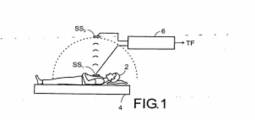
a figura 1 é uma visão diagramática que ilustra os componentes principais de uma forma da aparelhagem construída de acordo com a presente invenção;
a figura 2 é um fluxograma que ilustra as etapas principais na pré-calibragem da aparelhagem para determinar uma Função de Transferência, equacionando o resultado do sensor sonoro aplicado ao corpo do indivíduo com relação a um sensor sonoro situado a uma distância pré-definida do local da geração do som do corpo do indivíduo;
a figura 3 é um diagrama de blocos que ilustra os componentes principais de uma aparelhagem construída de acordo com a presente invenção para usar a Função de Transferência (TF) para modificar o resultado do sensor aplicado ao corpo do indivíduo, a fim de utilizar técnicas de atividade acústica atualmente aceitas para determinar a existência de uma a condição fisiológica especial;
a figura 4 ilustra o resultado de um sistema construído de acordo com a figura 3, utilizando um sensor sonoro situado no corpo do indivíduo e comparado a um situado a uma distância pré-definida do local da geração do som do corpo do indivíduo;
a figura 5 é um fluxograma que ilustra um método para determinar um Fator de Ruído do Ambiente (ANF), de acordo com a presente invenção, para compensar o resultado de um sensor sonoro situado no corpo do indivíduo com relação às condições de ruídos do ambiente existentes no momento em que o exame é feito;
a figura 6 ilustra esquematicamente um sistema construído de acordo com a presente invenção, incluindo um sensor sonoro do tipo microfone, um sensor de posição ou postura e um sensor de movimentos, todos a serem situados no mesmo local do exame no corpo do indivíduo, caracterizado pelo fato de que os elementos listados acima são abrigados em um alojamento comum;
a figura 7 é um diagrama de blocos que ilustra o uso da aparelhagem da figura 6 na determinação da existência de uma condição fisiológica especial no indivíduo;
a figura 8 ilustra esquematicamente um sistema de acordo com a figura 8, mas modificado para permitir que o sistema também seja usado para calcular um Fator de Ruído do Ambiente (ANF) para compensar ruídos existentes no momento em que a invenção é executada;
a figura 9 é um diagrama de blocos que ilustra o uso da aparelhagem da figura 8; e
a figura 10 é um diagrama de blocos que ilustra o sistema das Figuras 8 e 9, mas caracterizado pelo fato de que a atividade sonora fornecida pelo meio de calibragem é derivada do sensor de movimentos do corpo.The invention is described in this document only as an example, with reference to the attached illustrations, characterized by the fact that:
figure 1 is a diagrammatic view showing the main components of a shape of the apparatus constructed in accordance with the present invention;
figure 2 is a flow chart that illustrates the main steps in pre-calibrating the apparatus to determine a transfer function, equating the result of the sound sensor applied to the individual's body with respect to a sound sensor located at a pre-defined distance from the location the generation of sound from the individual's body;
Figure 3 is a block diagram illustrating the main components of an apparatus built in accordance with the present invention to use the Transfer Function (TF) to modify the result of the sensor applied to the individual's body, in order to use acoustic activity currently accepted to determine the existence of a special physiological condition;
figure 4 illustrates the result of a system built according to figure 3, using a sound sensor located on the individual's body and compared to one located at a pre-defined distance from the location of the sound generation of the individual's body;
Figure 5 is a flow chart illustrating a method for determining an Environmental Noise Factor (ANF), in accordance with the present invention, to compensate for the result of an audible sensor located on the individual's body with respect to ambient noise conditions existing at the time the exam is performed;
Figure 6 schematically illustrates a system built in accordance with the present invention, including a microphone-type sound sensor, a position or posture sensor and a movement sensor, all to be located at the same examination site on the individual's body, characterized the fact that the elements listed above are housed in a common accommodation;
figure 7 is a block diagram illustrating the use of the apparatus of figure 6 in determining the existence of a special physiological condition in the individual;
figure 8 schematically illustrates a system according to figure 8, but modified to allow the system to also be used to calculate an Environmental Noise Factor (ANF) to compensate for existing noise at the time the invention is performed;
figure 9 is a block diagram illustrating the use of the apparatus of figure 8; and
Figure 10 is a block diagram that illustrates the system of Figures 8 and 9, but characterized by the fact that the sound activity provided by the calibration medium is derived from the body's motion sensor.
Deve ser compreendido que as ilustrações precedentes e a descrição abaixo são fornecidas, primariamente, com o propósito de facilitar o entendimento dos aspectos conceituais da invenção e suas possíveis configurações, incluindo o que no momento é considerada uma configuração preferida. No interesse da clareza e da brevidade, não é feita nenhuma tentativa de fornecer mais detalhes do que o necessário para possibilitar a alguém com experiência na técnica usar concepções e habilidades rotineiras para compreender e praticar a invenção descrita. Deve ser compreendido, ainda, que as configurações descritas são somente para fins de exemplo e que a invenção é capaz de ser configurada e outras formas e aplicações além daquelas descritas no presente documento.It should be understood that the preceding illustrations and description below are provided primarily for the purpose of facilitating an understanding of the conceptual aspects of the invention and their possible configurations, including what is currently considered to be a preferred configuration. In the interests of clarity and brevity, no attempt is made to provide more details than necessary to enable someone with experience in the technique to use routine conceptions and skills to understand and practice the described invention. It should also be understood that the configurations described are for example purposes only and that the invention is capable of being configured and other forms and applications in addition to those described in this document.
As Figuras de 1 a 4 ilustram uma configuração preferida da invenção para examinar um indivíduo em uma condição fisiológica especial, monitorando a atividade acústica emanada pelo indivíduo.Figures 1 to 4 illustrate a preferred embodiment of the invention for examining an individual in a special physiological condition, monitoring the acoustic activity emanating from the individual.
Dessa forma, a figura 1 ilustra o indivíduo 2 sendo examinado deitado em uma cama, 4, ex. dormindo. Conforme mostrado na figura 1, um sensor sonoro SS1 é situado em uma região específica do corpo do indivíduo, nesse caso, no peito, para produzir um resultado correspondente aos sons percebidos pelo sensor SS1 . O resultado do sensor SS1 é encaminhado a um processador 6 para processamento, conforme descrito abaixo.Thus, figure 1 illustrates individual 2 being examined lying on a bed, 4, ex. sleeping. As shown in figure 1, an SS1 sound sensor is located in a specific region of the individual's body, in this case, in the chest, to produce a result corresponding to the sounds perceived by the SS1 sensor. The result of the SS1 sensor is sent to a processor 6 for processing, as described below.
A figura 1 ilustra, ainda, um segundo sensor SS2 situado a uma distância pré-definida do local da geração do som do corpo do indivíduo (conforme ilustrado pelo arco pontilhado), ex. um metro, de acordo com a técnica de análise de informações acústicas "Padrão Ouro" aceita atualmente.Figure 1 also illustrates a second SS2 sensor located at a pre-defined distance from the location of the sound generation of the individual's body (as illustrated by the dotted arc), ex. one meter, according to the acoustic information analysis technique "Gold Standard" currently accepted.
O processador 6 processa simultaneamente os resultados recebidos dos dois sensores SS1 e SS2 e produz um resultado chamado de Função de Transferência (TF) , a ser usado para equacionar o resultado do sensor sonoro SS1 aplicado ao corpo do indivíduo, com o resultado que seria produzido pelo segundo sensor SS2, situado a uma distância pré-definida do local da geração do som do corpo do indivíduo, conforme utilizado nos métodos aceitos de análise de informações acústicas do indivíduo em uma condição fisiológica especial.Processor 6 simultaneously processes the results received from the two sensors SS1 and SS2 and produces a result called the Transfer Function (TF), to be used to equate the result of the sound sensor SS1 applied to the individual's body, with the result that would be produced by the second SS2 sensor, located at a pre-defined distance from the location of the sound generation of the individual's body, as used in the accepted methods of analyzing the individual's acoustic information in a special physiological condition.
A figura 2 é um fluxograma que ilustra as etapas principais para produzir a Função de Transferência (TF). Dessa forma, conforme mostrado na figura 2, o primeiro sensor SS1 fica situado no corpo do paciente, enquanto o segundo sensor SS2 é situado a uma distância pré-definida (ex. um metro) do local da geração do som do corpo do paciente, conforme mostrado pelos blocos 10 e 11, respectivamente. Os resultados dos dois sensores sonoros, SS1 e SS2 são detectados simultaneamente (bloco 12) e encaminhados ao processador 6, que processa os dois resultados para determinar a Função de Transferência (TF), equacionando o resultado do sensor sonoro SS1 com aquele do sensor sonoro SS2 (bloco 13).Figure 2 is a flow chart that illustrates the main steps to produce the Transfer Function (TF). Thus, as shown in figure 2, the first SS1 sensor is located on the patient's body, while the second SS2 sensor is located at a pre-defined distance (eg one meter) from the location of the sound generation of the patient's body, as shown by
De preferência, as duas etapas indicadas pelos blocos 12 e 13 são repetidas uma série de vezes (bloco 14) , de tal forma que o processador 6 calcula a média da Função de Transferência (TF) para uso ao equacionar um resultado do sensor sonoro SS1, situado no corpo do indivíduo, com aquele que seria detectado pelo sensor sonoro SS2 situado a uma distância pré-definida do corpo do indivíduo.Preferably, the two steps indicated by
É possível que, em exames subsequentes do indivíduo, somente o primeiro sensor sonoro, aplicado ao corpo do indivíduo, precise ser utilizado, uma vez que seu resultado pode ser modificado pela Função de Transferência (TF) pré-determinada para equacionar esse resultado a um que seria produzido usando um sensor situado a uma distância pré-definida (um metro) do local da geração do som do corpo do indivíduo.It is possible that, in subsequent examinations of the individual, only the first audible sensor, applied to the individual's body, needs to be used, since its result can be modified by the predetermined Transfer Function (TF) to equate this result to a that would be produced using a sensor located at a pre-defined distance (one meter) from the location of the sound generation of the individual's body.
Na maioria dos casos, o primeiro e segundo sensores sonoros, SS1, SS2, poderiam ser medidores de nível sonoro que medem o nível sonoro em decibéis. Contudo, em algumas aplicações, pode ser aconselhável também analisar os resultados dos dois sensores sonoros de acordo com outros parâmetros percebidos, ex., seus respectivos espectros de frequência.In most cases, the first and second sound sensors, SS1, SS2, could be sound level meters that measure the sound level in decibels. However, in some applications, it may also be advisable to analyze the results of the two sound sensors according to other perceived parameters, eg, their respective frequency spectra.
Além disso, o primeiro sensor sonoro SS1, durante seu uso inicial para determinar a Função de Transferência (TF), e seu uso posterior durante o real exame do indivíduo, é preso ao corpo do indivíduo em uma região específica. A figura 1 ilustra essa região como sendo o peito do indivíduo.In addition, the first sound sensor SS1, during its initial use to determine the Transfer Function (TF), and its later use during the actual examination of the individual, is attached to the individual's body in a specific region. Figure 1 illustrates this region as being the individual's chest.
No entanto, podem ser usados muitos locais de medição, ex., a incisura supraesternal, a região submental, o lábio superior, os lados do pescoço. Além disso, os resultados dos dois sensores, SS1 e SS2, na etapa de pré-calibragem, ou apenas do SS1. na etapa do real exame, podem ser transmitidos ao processador 6 com ou sem fios.However, many measurement sites can be used, eg, the suprasternal notch, the submental region, the upper lip, the sides of the neck. In addition, the results of the two sensors, SS1 and SS2, in the pre-calibration stage, or only for SS1. in the real exam stage, they can be transmitted to processor 6 with or without wires.
Os sensores sonoros podem ser microfones omnidirecionais, bem como direcionais. São, de preferência, presos ao corpo do indivíduo no local do exame, ex., usando um adesivo entre o sensor e o corpo aderindo-o à superfície do corpo.The sound sensors can be omnidirectional as well as directional microphones. They are preferably attached to the individual's body at the examination site, eg, using an adhesive between the sensor and the body adhering it to the body surface.
A figura 3 é um diagrama de blocos esquemático que ilustra um sistema que utiliza um único sensor aplicado ao corpo SS1 após ser pré-calibrado para determinar na Função de Transferência TF, para examinar informações acústicas emanadas pelo indivíduo para fornecer informações úteis para indicar uma condição fisiológica especial. Dessa forma, a figura 3 ilustra o sensor sonoro na forma do microfone 20 a ser aplicado ao corpo do indivíduo e para produzir um resultado a ser aplicado ao processador 6 (A figura 1). O processador 6 realiza as funções de processamento e filtragem de hardware (bloco 21) e a função de conversão analógico - digital (bloco 22) . O processador 6 modifica o resultado do Conversor A/D 22 através da Função de Transferência TF, previamente determinada, de acordo com o fluxograma 2, para equacionar o resultado do microfone 20 com o resultado que seria obtido por um sensor sonoro (ex. microfone SS2, figura 1) situado a uma distância pré-definida do local da geração do som do corpo do indivíduo, de acordo com técnicas atuais para examinar a atividade acústica. O resultado do microfone 20, conforme modificado pela Função de Transferência (TF), é, então, convertido para informações analógicas pelo Conversor D/A 24, e é exibido como um resultado dB (bloco 25).Figure 3 is a schematic block diagram that illustrates a system that uses a single sensor applied to the SS1 body after being pre-calibrated to determine in the TF Transfer Function, to examine acoustic information emanating from the individual to provide useful information to indicate a condition special physiological. Thus, figure 3 illustrates the sound sensor in the form of microphone 20 to be applied to the individual's body and to produce a result to be applied to processor 6 (Figure 1). Processor 6 performs the hardware processing and filtering functions (block 21) and the analog-to-digital conversion function (block 22). Processor 6 modifies the result of A / D Converter 22 using the TF Transfer Function, previously determined, according to flowchart 2, to equate the result of microphone 20 with the result that would be obtained by a sound sensor (eg microphone SS2, figure 1) located at a pre-defined distance from the location of the sound generation of the individual's body, according to current techniques to examine acoustic activity. The result of the microphone 20, as modified by the Transfer Function (TF), is then converted to analog information by the D / A Converter 24, and is displayed as a dB result (block 25).
A figura 4 mostra o curso de tempo da amplitude acústica gravada a partir da superfície (superior) do corpo do paciente comparado ao sinal acústico gravado simultaneamente por um sistema remoto de gravação de som (inferior). A similaridade dos padrões é nítida.Figure 4 shows the time course of the acoustic amplitude recorded from the surface (upper) of the patient's body compared to the acoustic signal recorded simultaneously by a remote sound recording system (lower). The similarity of the patterns is clear.
O método descrito acima para converter o som percebido da superfície do corpo para valores equivalentes em decibéis usando uma Função de Transferência pré - calibrada foi subsequentemente validado, comparando valores em decibéis previstos aos valores em decibéis gravados de fato em um grupo de 19 pacientes. As comparações resultantes mostraram que o valor médio da diferença média em cada estudo foi de 0,7 dB, com um desvio padrão médio de 2dB dos desvios padrão do Estudo.The method described above for converting the perceived sound from the body surface to equivalent decibel values using a pre - calibrated Transfer Function has subsequently been validated, comparing predicted decibel values to actual recorded decibel values in a group of 19 patients. The resulting comparisons showed that the mean value of the mean difference in each study was 0.7 dB, with an average standard deviation of 2dB from the Study standard deviations.
Conforme explicado anteriormente, uma vantagem principal no meio ambulatório é obtida colocando o sistema de percepção sonora na superfície do corpo do paciente, ao invés de à distância do paciente, uma vez que ruídos do ambiente não podem ser evitados fora do ambiente controlado do laboratório do sono. Colocar o sensor sonoro no paciente dessa forma ajuda a melhorar a habilidade de distinguir sons derivados do paciente e sons irrelevantes do ambiente, uma vez que, à distância do local da geração do som do corpo do paciente, o sensor remoto é exposto a sons de todas as origens. Dessa forma, o detector de som montado no corpo ainda pode ser afetado por ruídos do ambiente, seja ocorrendo diretamente ou através de sons externos, sendo conduzidos através da superfície do corpo ou sobre ela, ruídos estes que podem variar consideravelmente de um ambiente de medição para outro. Isso é particularmente importante quando são necessárias medições quantitativas precisas para avaliações padronizadas, como por exemplo, na medição do ronco.As explained earlier, a main advantage in the outpatient setting is obtained by placing the sound perception system on the surface of the patient's body, rather than at a distance from the patient, since ambient noise cannot be avoided outside the controlled environment of the patient's laboratory. sleep. Placing the sound sensor on the patient in this way helps to improve the ability to distinguish sounds derived from the patient and irrelevant sounds from the environment, since, at a distance from the place where the sound is generated on the patient's body, the remote sensor is exposed to sounds from all origins. Thus, the sound detector mounted on the body can still be affected by ambient noise, either directly or through external sounds, being conducted through the body surface or on it, which can vary considerably from a measurement environment. to another. This is particularly important when accurate quantitative measurements are required for standardized assessments, such as snoring measurement.
Outra característica da presente invenção é, portanto, incluir um meio de autocalibragem que gere um sinal sonoro padronizado entre o sensor e a superfície do corpo dos pacientes. Isso permite a determinação precisa da contribuição de ruídos externos, e, dessa forma, torna possível medir com mais precisão a atividade sonora endógena que. emana do paciente. Isso também possibilita utilizar diferentes tipos de microfones no sistema, conforme necessário para atender as necessidades específicas da tarefa de medição. O nível de ruídos do ambiente pode ser determinado pela percepção da atividade sonora com e sem o sinal TF de autocalibragem, antes de realizar a avaliação do paciente e enquanto o dispositivo está preso ao paciente. Ao determinar a diferença no nível acústico geral com e sem o sinal TF de autocalibragem previamente determinado, o nível de ruídos do ambiente pode ser determinado e pode ser usado para a devida correção.Another feature of the present invention is, therefore, to include a means of self-calibration that generates a standardized audible signal between the sensor and the patient's body surface. This allows the precise determination of the contribution of external noise, and, in this way, makes it possible to measure more accurately the endogenous sound activity that. emanates from the patient. This also makes it possible to use different types of microphones in the system, as needed to meet the specific needs of the measurement task. The level of ambient noise can be determined by perceiving sound activity with and without the self-calibrating TF signal, before performing the patient assessment and while the device is attached to the patient. When determining the difference in the overall acoustic level with and without the previously determined TF self-calibration signal, the ambient noise level can be determined and can be used for proper correction.
A figura 5 é um fluxograma que ilustra um método de autocalibrar o sensor sonoro (SS1) a ser colocado no corpo do indivíduo, a fim de determinar uma Função de Ruído do Ambiente (ANF) para o respectivo sensor no momento específico em que o indivíduo deve ser examinado em busca da condição fisiológica de interesse.Figure 5 is a flowchart that illustrates a method of self-calibrating the sound sensor (SS1) to be placed on the individual's body, in order to determine an Environmental Noise Function (ANF) for the respective sensor at the specific moment when the individual should be examined for the physiological condition of interest.
No fluxograma ilustrado na figura 5, a Função de Transferência (TF) é primeiro determinada conforme o fluxograma da figura 2 (bloco 30). O resultado do sensor aplicado ao corpo SS1 é percebido (bloco 31), modificado pela Função de Transferência TF (bloco 32); e gravado no processador 6 (bloco 33).In the flowchart illustrated in figure 5, the Transfer Function (TF) is first determined according to the flowchart in figure 2 (block 30). The result of the sensor applied to the SS1 body is perceived (block 31), modified by the TF Transfer Function (block 32); and recorded in processor 6 (block 33).
O gerador de som (SG) situado no local do sensor sonoro SS1 é, então, ativado (bloco 34). O resultado do sensor SS1 é: percebido enquanto o gerador de som é atuado (bloco 35) ; modificado pela Função de Transferência TF (bloco 36), e gravado no processador (bloco 37) . O processador, então, processa os dois resultados, um produzido antes de o gerador de som ser ativado, e o outro produzido após o gerador de som ser ativado, a fim de determinar o Fator de Ruído do Ambiente (ANF). O ANF pode, depois, ser usado para corrigir o resultado do sensor aplicado ao corpo SS1 durante um exame subsequente, para determinar a existência da condição fisiológica especial.The sound generator (SG) located at the sound sensor SS1 is then activated (block 34). The result of the SS1 sensor is: perceived while the sound generator is activated (block 35); modified by the TF Transfer Function (block 36), and recorded in the processor (block 37). The processor then processes both results, one produced before the sound generator is activated, and the other produced after the sound generator is activated, in order to determine the Environmental Noise Factor (ANF). The ANF can then be used to correct the result of the sensor applied to the SS1 body during a subsequent examination, to determine the existence of the special physiological condition.
O gerador de som (SG) adicionado, usado para autocalibrar o sensor sonoro SS1 para determinar o ANC, pode tomar a forma de um elemento adicional no sistema, tal como uma folha piezelétrica geradora de som devidamente projetada (ex., Mylar), ou um dispositivo de falantes comum de um tamanho em miniatura apropriado.The added sound generator (SG), used to self-calibrate the SS1 sound sensor to determine the ANC, can take the form of an additional element in the system, such as a properly designed sound-generating piezoelectric sheet (eg, Mylar), or a common speaker device of an appropriate miniature size.
Como indicado anteriormente, uma característica particularmente importante da presente invenção é de também permitir que a posição ou postura do corpo, bem como os movimentos do corpo, sejam percebidas e a medição no momento e local nos quais as informações acústicas sejam percebidas. Tais informações adicionais são bastante úteis na determinação de condições fisiológicas, conforme descrito acima.As indicated earlier, a particularly important feature of the present invention is to also allow the position or posture of the body, as well as the movements of the body, to be perceived and the measurement at the time and place at which the acoustic information is perceived. Such additional information is very useful in determining physiological conditions, as described above.
Muitos sensores são conhecidos por perceberem a posição ou postura do corpo e o movimento do corpo. Por exemplo, sensores de posição do corpo são normalmente dispositivos que respondem à inclinação, que incluem uma esfera condutora de eletricidade, uma quantidade de mercúrio, uma bolha, etc., que assumem uma posição pré-determinada de acordo com sua inclinação. Dispositivos que respondem a movimentos são normalmente dispositivos do tipo acelerômetro, que produzem signais de resultados de acordo com alterações em sua velocidade.Many sensors are known to perceive the position or posture of the body and the movement of the body. For example, body position sensors are typically inclination-responsive devices, which include an electrically conductive sphere, an amount of mercury, a bubble, etc., which assume a predetermined position according to their inclination. Devices that respond to movements are usually accelerometer-type devices that produce results signals according to changes in their speed.
Um método alternativo é utilizar uma unidade de acelerômetro 3D para medir o ângulo da unidade do sensor com relação a direção da gravidade, Contanto que a aceleração do indivíduo durante a medição possa ser desprezada com relação à gravidade. Além disso, dois ace1erômetros 2D podem ser usados quando há uma dimensão comum sendo medida duas vezes para determinar a posição dos sensores com relação à gravidade, ou três acelerômetros 1D mutuamente ortogonais. Acelerômetros são preferíveis, uma vez que não são inerentemente limitados a gravar apenas um pequeno conjunto pré - determinado de orientações, mas pode, de fato, oferecer uma faixa contínua de orientações nas três dimensões, e, dessa forma, fornecer o curso de tempo da alteração contínua de orientação durante o teste.An alternative method is to use a 3D accelerometer unit to measure the angle of the sensor unit with respect to the direction of gravity, as long as the individual's acceleration during measurement can be neglected with respect to gravity. In addition, two 2D acerometers can be used when a common dimension is being measured twice to determine the position of the sensors with respect to gravity, or three mutually orthogonal 1D accelerometers. Accelerometers are preferable, as they are not inherently limited to recording only a small predetermined set of orientations, but can, in fact, offer a continuous range of orientations in the three dimensions, and thus provide the time course of the continuous change of orientation during the test.
A utilização de acelerômetros de múltiplas dimensões tanto como um detector da posição do corpo e como um detector de movimentos do paciente é bem conhecido da técnica, conforme divulgado, por exemplo, nas Patentes Norte-Americanas 5.593.431, 6.477.421 e 7.054.687.The use of multi-dimensional accelerometers both as a body position detector and as a patient motion detector is well known in the art, as disclosed, for example, in US Patents 5,593,431, 6,477,421 and 7,054. 687.
A separação das informações de posição e movimento é baseada na filtragem adequada de componentes de alta e baixa frequência dos sinais. Isto é, o componente de baixa frequência do sinal é- usado para determinar a posição do corpo e o componente de alta frequência é usado para determinar o movimento do corpo (para ajudar, por exemplo, na identificação do tipo de padrão respiratório) . Tal sensor pode ser usado para perceber tanto o movimento do paciente quanto a posição do corpo.The separation of position and movement information is based on adequate filtering of high and low frequency signal components. That is, the low frequency component of the signal is used to determine the position of the body and the high frequency component is used to determine the movement of the body (to assist, for example, in identifying the type of breathing pattern). Such a sensor can be used to perceive both the patient's movement and the position of the body.
A figura 6 ilustra esquematicamente uma forma de aparelhagem construída de acordo com a presente invenção, utilizando um sensor de postura e movimentos 40 situado no microfone 41 usado como o sensor sonoro aplicado ao corpo (SS1, figura 1) . A colocação relativa do microfone 41, com relação ao sensor de postura e movimentos 40, poderia ser invertida, ou esses elementos não poderiam ser dispostos in lado a lado. Conforme mostrado na FIG. 6, o resultado do microfone 41 é transportado via cabo 42 para o processador 43, correspondente ao processador 6 na figura 1, que processa as informações, conforme descrito acima, e as encaminha via cabo 44 ao conector de saída 45.Figure 6 schematically illustrates a form of apparatus constructed in accordance with the present invention, using a posture and movement sensor 40 located in microphone 41 used as the sound sensor applied to the body (SS1, figure 1). The relative placement of the microphone 41, with respect to the posture and movement sensor 40, could be inverted, or these elements could not be arranged side by side. As shown in FIG. 6, the result of microphone 41 is carried via cable 42 to processor 43, corresponding to processor 6 in figure 1, which processes the information, as described above, and forwards it via cable 44 to output connector 45.
A figura 7 é um diagrama de blocos da aparelhagem geral que ilustra, particularmente, as funções executadas pelo processador 43 na figura 6. Dessa forma, conforme mostrado na figura 7, o processador 43 executa as funções de: filtrar e processar os sinais recebidos (bloco 46); converter os sinais processados para o formato digital (bloco 47) ; determinar a Função de Transferência TF (bloco 48); reconverter o sinal anterior para o formato analógico (bloco 49); e, depois, produzir os diversos resultados ilustrados na figura 7, incluindo um resultado para postura 49a, um resultado para movimento 49b, e um resultado para dB 49c.Figure 7 is a block diagram of the general apparatus that particularly illustrates the functions performed by processor 43 in figure 6. Thus, as shown in figure 7, processor 43 performs the functions of: filtering and processing the received signals ( block 46); convert the processed signals to digital format (block 47); determine the TF Transfer Function (block 48); reconvert the previous signal to analog format (block 49); and then produce the various results illustrated in figure 7, including a result for posture 49a, a result for movement 49b, and a result for dB 49c.
Uma característica importante da presente invenção é a de que permite reproduzir novamente as informações de acústica, posição do corpo e movimento do corpo para subsequente análise e visualização após a realização de um estudo.An important feature of the present invention is that it allows to reproduce the information of acoustics, body position and body movement again for subsequent analysis and visualization after conducting a study.
No caso das informações acústicas, as informações reais gravadas podem ser usadas juntamente com qualquer meio conhecido da técnica para reproduzir os sons gravados durante o estudo real, ou podem ser representadas como uma exibição gráfica que descreve a magnitude do som e uma representação do conteúdo de frequência. Conforme mencionado anteriormente, essas informações podem, entre outras coisas, fornecer informações relevantes para ajudar a compreender a condição das vias aéreas no sistema respiratório e para definir a extensão e/ou local de uma obstrução específica nas vias respiratórias do sistema respiratório.In the case of acoustic information, the actual recorded information may be used in conjunction with any means known in the art to reproduce the sounds recorded during the actual study, or may be represented as a graphical display describing the magnitude of the sound and a representation of the content of frequency. As mentioned earlier, this information can, among other things, provide relevant information to help understand the condition of the airways in the respiratory system and to define the extent and / or location of a specific obstruction in the airways of the respiratory system.
Claims (20)
primeiro sensor sonoro com aquele do referido segundo sensor sonoro, para utilizar a referida Função de Transferência para modificar o resultado do referido primeiro sensor sonoro, e para utilizar o referido resultado modificado do referido primeiro sensor sonoro para produzir informações úteis na determinação da existência da referida condição fisiológica especial, sendo que o referido primeiro sensor sonoro é construído de maneira a poder ser preso à referida região específica do corpo do indivíduo.“APPLIANCE”, according to claim 9, characterized by the fact that the said position sensor (40) comprises an accelerometer and the accelerometer is operable to generate sound activity for use as reference sounds in determining an ambient noise factor to be used to pre-calibrate the apparatus for ambient noise at the time when the response of said first audible sensor (SS1) is used to produce information useful in determining the existence of said special physiological condition.
first sound sensor with that of said second sound sensor, to use said Transfer Function to modify the result of said first sound sensor, and to use said modified result of said first sound sensor to produce information useful in determining the existence of said special physiological condition, being that the first sound sensor is built in such a way that it can be attached to that specific region of the individual's body.
Applications Claiming Priority (3)
| Application Number | Priority Date | Filing Date | Title |
|---|---|---|---|
| US7199208P | 2008-05-29 | 2008-05-29 | |
| US61/071,992 | 2008-05-29 | ||
| PCT/IL2009/000528 WO2009144721A2 (en) | 2008-05-29 | 2009-05-26 | Method and apparatus for examining subjects for particular physiological conditions utilizing acoustic information |
Publications (3)
| Publication Number | Publication Date |
|---|---|
| BRPI0909542A2 BRPI0909542A2 (en) | 2020-03-10 |
| BRPI0909542B1 true BRPI0909542B1 (en) | 2020-11-24 |
| BRPI0909542B8 BRPI0909542B8 (en) | 2021-06-22 |
Family
ID=41377679
Family Applications (1)
| Application Number | Title | Priority Date | Filing Date |
|---|---|---|---|
| BRPI0909542A BRPI0909542B8 (en) | 2008-05-29 | 2009-05-26 | method of examining an individual in search of a special physiological condition through a technique that uses sounds generated by the individual and perceived at a pre-defined distance from the location of the individual's body sound generation and apparatus to examine an individual in search of a special physiological condition through a technique that uses sounds generated by the individual and perceived at a pre-defined distance from the location of the individual's body sound generation |
Country Status (8)
| Country | Link |
|---|---|
| US (1) | US9770190B2 (en) |
| EP (1) | EP2280639B1 (en) |
| JP (1) | JP5674646B2 (en) |
| CN (1) | CN102112049B (en) |
| BR (1) | BRPI0909542B8 (en) |
| CA (1) | CA2725320C (en) |
| RU (1) | RU2508044C2 (en) |
| WO (1) | WO2009144721A2 (en) |
Families Citing this family (25)
| Publication number | Priority date | Publication date | Assignee | Title |
|---|---|---|---|---|
| US9468378B2 (en) | 1997-01-27 | 2016-10-18 | Lawrence A. Lynn | Airway instability detection system and method |
| US8407028B2 (en) | 2003-12-31 | 2013-03-26 | Jeffrey M. Sieracki | Indirect monitoring of device usage and activities |
| RU2309668C1 (en) | 2006-02-20 | 2007-11-10 | Александр Сергеевич Парфенов | Method and device for non-invasive measurement of function of endothelium |
| US20080306355A1 (en) * | 2006-11-20 | 2008-12-11 | Smithkline Beecham Corporation | Method and System for Monitoring Gastrointestinal Function and Physiological Characteristics |
| RU2508044C2 (en) | 2008-05-29 | 2014-02-27 | Итамар Медикал Лтд. | Method and device for examining patients aimed at identification of particular physiological state |
| US8057400B2 (en) | 2009-05-12 | 2011-11-15 | Angiologix, Inc. | System and method of measuring changes in arterial volume of a limb segment |
| WO2011114669A1 (en) * | 2010-03-18 | 2011-09-22 | パナソニック株式会社 | Biometric sound testing device |
| US8753292B2 (en) * | 2010-10-01 | 2014-06-17 | Angiodynamics, Inc. | Method for locating a catheter tip using audio detection |
| JP5519778B2 (en) * | 2010-11-04 | 2014-06-11 | パナソニック株式会社 | Body sound inspection apparatus and body sound inspection method |
| CN103608854B (en) * | 2011-05-30 | 2016-12-28 | 皇家飞利浦有限公司 | Equipment and method for the detection body gesture when sleep |
| US9691395B1 (en) | 2011-12-31 | 2017-06-27 | Reality Analytics, Inc. | System and method for taxonomically distinguishing unconstrained signal data segments |
| DK3206586T3 (en) * | 2014-10-16 | 2021-06-14 | Viewcare Tech 1 A/S | METHOD FOR DETECTING DICROTIC CHICKEN |
| AU2016315947B2 (en) | 2015-08-31 | 2021-02-18 | Masimo Corporation | Wireless patient monitoring systems and methods |
| US10617302B2 (en) | 2016-07-07 | 2020-04-14 | Masimo Corporation | Wearable pulse oximeter and respiration monitor |
| JP7183564B2 (en) * | 2018-04-18 | 2022-12-06 | オムロンヘルスケア株式会社 | Body sound measuring device, method of operating body sound measuring device, operating program for body sound measuring device |
| WO2020028747A1 (en) * | 2018-08-02 | 2020-02-06 | The Johns Hopkins University | Safety feature for use with robotically manipulated endoscopes and other tools in otolaryngology and neurosurgery |
| US12495968B2 (en) | 2018-10-12 | 2025-12-16 | Masimo Corporation | System for transmission of sensor data using dual communication protocol |
| CA3115108A1 (en) | 2018-10-12 | 2020-04-16 | Masimo Corporation | System for transmission of sensor data using dual communication protocol |
| US20220022809A1 (en) * | 2018-12-19 | 2022-01-27 | Northwestern University | Systems and methods to detect and treat obstructive sleep apnea and upper airway obstruction |
| WO2020214866A1 (en) | 2019-04-16 | 2020-10-22 | Entac Medical, Inc. | Enhanced detection and analysis of biological acoustic signals |
| AU2020267599B2 (en) * | 2019-05-08 | 2025-06-26 | Baxter Healthcare Sa | Patch-based physiological sensor |
| US20240423579A1 (en) * | 2021-10-26 | 2024-12-26 | Sparrow Acoustics Inc. | Method and an electronic device for processing a waveform |
| WO2023132952A1 (en) | 2022-01-05 | 2023-07-13 | Masimo Corporation | Wrist and finger worn pulse oximetry system |
| JP7411717B2 (en) * | 2022-05-02 | 2024-01-11 | 文藏 田中 | Excretion signal advance detection device |
| WO2025085500A1 (en) * | 2023-10-17 | 2025-04-24 | Bairitone Health Inc. | Calibrating a machine learning model trained to determine a location and shape of a sound source |
Family Cites Families (20)
| Publication number | Priority date | Publication date | Assignee | Title |
|---|---|---|---|---|
| US4784162A (en) | 1986-09-23 | 1988-11-15 | Advanced Medical Technologies | Portable, multi-channel, physiological data monitoring system |
| DE4138702A1 (en) | 1991-03-22 | 1992-09-24 | Madaus Medizin Elektronik | METHOD AND DEVICE FOR THE DIAGNOSIS AND QUANTITATIVE ANALYSIS OF APNOE AND FOR THE SIMULTANEOUS DETERMINATION OF OTHER DISEASES |
| US5797852A (en) * | 1993-02-04 | 1998-08-25 | Local Silence, Inc. | Sleep apnea screening and/or detecting apparatus and method |
| US5853005A (en) * | 1996-05-02 | 1998-12-29 | The United States Of America As Represented By The Secretary Of The Army | Acoustic monitoring system |
| JP2000060846A (en) * | 1998-08-24 | 2000-02-29 | Nippon Colin Co Ltd | Biological sound detector |
| US6213955B1 (en) * | 1998-10-08 | 2001-04-10 | Sleep Solutions, Inc. | Apparatus and method for breath monitoring |
| US6171258B1 (en) | 1998-10-08 | 2001-01-09 | Sleep Solutions, Inc. | Multi-channel self-contained apparatus and method for diagnosis of sleep disorders |
| US7094206B2 (en) | 1999-04-23 | 2006-08-22 | The Trustees Of Tufts College | System for measuring respiratory function |
| JP2000316825A (en) * | 1999-05-12 | 2000-11-21 | Toshio Ochi | Device for constantly monitoring heart sound |
| US7708697B2 (en) | 2000-04-20 | 2010-05-04 | Pulmosonix Pty Ltd | Method and apparatus for determining conditions of biological tissues |
| US6468234B1 (en) | 2000-07-14 | 2002-10-22 | The Board Of Trustees Of The Leland Stanford Junior University | SleepSmart |
| EP1534115B1 (en) * | 2002-07-15 | 2018-10-31 | Itamar Medical Ltd | Body surface probe, apparatus and method for non-invasively detecting medical conditions |
| US20050113646A1 (en) | 2003-11-24 | 2005-05-26 | Sotos John G. | Method and apparatus for evaluation of sleep disorders |
| US20060155205A1 (en) * | 2003-11-24 | 2006-07-13 | Apneos Corp. | System and method for assessing breathing |
| US6733464B2 (en) | 2002-08-23 | 2004-05-11 | Hewlett-Packard Development Company, L.P. | Multi-function sensor device and methods for its use |
| US7077810B2 (en) | 2004-02-05 | 2006-07-18 | Earlysense Ltd. | Techniques for prediction and monitoring of respiration-manifested clinical episodes |
| JP4411384B2 (en) * | 2004-04-15 | 2010-02-10 | 独立行政法人放射線医学総合研究所 | Diagnostic system |
| IL164991A0 (en) | 2004-06-10 | 2005-12-18 | Nexense Ltd | High-sensitivity sensors, sensor assemblies, and sensor apparatus for sensing various parameters |
| WO2006033104A1 (en) | 2004-09-22 | 2006-03-30 | Shalon Ventures Research, Llc | Systems and methods for monitoring and modifying behavior |
| RU2508044C2 (en) | 2008-05-29 | 2014-02-27 | Итамар Медикал Лтд. | Method and device for examining patients aimed at identification of particular physiological state |
-
2009
- 2009-05-26 RU RU2010153388/14A patent/RU2508044C2/en active
- 2009-05-26 US US12/994,865 patent/US9770190B2/en active Active
- 2009-05-26 CN CN200980130922.1A patent/CN102112049B/en not_active Expired - Fee Related
- 2009-05-26 WO PCT/IL2009/000528 patent/WO2009144721A2/en not_active Ceased
- 2009-05-26 CA CA2725320A patent/CA2725320C/en active Active
- 2009-05-26 EP EP09754340.9A patent/EP2280639B1/en active Active
- 2009-05-26 BR BRPI0909542A patent/BRPI0909542B8/en not_active IP Right Cessation
- 2009-05-26 JP JP2011511161A patent/JP5674646B2/en active Active
Also Published As
| Publication number | Publication date |
|---|---|
| EP2280639B1 (en) | 2018-07-04 |
| US20110092857A1 (en) | 2011-04-21 |
| WO2009144721A3 (en) | 2010-01-21 |
| JP5674646B2 (en) | 2015-02-25 |
| CA2725320A1 (en) | 2009-12-03 |
| RU2010153388A (en) | 2012-07-10 |
| EP2280639A4 (en) | 2013-09-25 |
| BRPI0909542B8 (en) | 2021-06-22 |
| EP2280639A2 (en) | 2011-02-09 |
| CN102112049A (en) | 2011-06-29 |
| RU2508044C2 (en) | 2014-02-27 |
| CN102112049B (en) | 2014-10-22 |
| JP2011522582A (en) | 2011-08-04 |
| WO2009144721A2 (en) | 2009-12-03 |
| CA2725320C (en) | 2017-04-18 |
| US9770190B2 (en) | 2017-09-26 |
| BRPI0909542A2 (en) | 2020-03-10 |
Similar Documents
| Publication | Publication Date | Title |
|---|---|---|
| BRPI0909542B1 (en) | method of examining an individual in search of a special physiological condition using a technique that uses sounds generated by the individual and perceived at a pre-defined distance from the place where the individual's body is generated and equipment to examine an individual for a special physiological condition by means of a technique that uses sounds generated by the individual and perceived at a pre-defined distance from the location of the sound generation of the individual's body | |
| US6976963B2 (en) | Apparatus and method for precision vital signs determination | |
| JP6770527B2 (en) | Devices, systems, methods and computer programs to detect the disease of interest | |
| JP6093421B2 (en) | Electrical impedance tomography imaging instrument and electrical impedance tomography imaging method | |
| Dalmay et al. | Acoustic properties of the normal chest | |
| JP5508517B2 (en) | Body sound inspection apparatus, body sound inspection method, program, and integrated circuit | |
| JP6203197B2 (en) | Diagnosis of lung disease using transthoracic Doppler ultrasound during pulmonary vibration | |
| WO2018099427A1 (en) | Dynamic measurement device having function for determining blood pressure | |
| US10085653B2 (en) | Pulse transmit time measurement device and method | |
| US20150157217A1 (en) | Analysis System for Cardiac Information and Analyzing Method Thereof | |
| Sang et al. | A MEMS seismometer respiratory monitor for work of breathing assessment and adventitious lung sounds detection via deep learning | |
| Charlier et al. | AcCorps: A low-cost 3D printed stethoscope for fetal phonocardiography | |
| Lulich et al. | Semi-occluded vocal tract exercises in healthy young adults: Articulatory, acoustic, and aerodynamic measurements during phonation at threshold | |
| Richardson et al. | Bedside cardiac examination: constancy in a sea of change | |
| US20230404518A1 (en) | Earbud Based Auscultation System and Method Therefor | |
| Zhdanov et al. | Short review of devices for detection of human breath sounds and heart tones | |
| Skalicky et al. | Respiratory sounds as a source of information in asthma diagnosis | |
| RU2421140C2 (en) | Method of determining hemodynamic significance of celiac trunk stenoses in children | |
| Alamdari et al. | High frequency-low amplitude oscillometry: Continuous unobtrusive monitoring of respiratory function on PAP machines | |
| Sang | Detection of Adventitious Lung Sounds and Respiratory Distress from Pulmonary Induced Vibrations using a MEMS Seismometer Patch | |
| Bronda et al. | Experimental Analysis of Inferior Vena Cava Diameter Variations under Controlled Respiratory Load | |
| Bodhika et al. | Advancements in Body Sound Diagnostics: Exploring Acoustic Signals for Medical Applications and Future Research Directions | |
| Gupta | High precision accelerometer contact microphones for detection of mechano-acoustic cardiopulmonary signals | |
| Febrianti et al. | Pulmonary Sound Design Using Max 9814 Sensor with Nextion View |
Legal Events
| Date | Code | Title | Description |
|---|---|---|---|
| B15I | Others concerning applications: loss of priority |
Free format text: PERDA DA PRIORIDADE US 61/071,992 DE 29/05/2008, CONFORME AS DISPOSICOES PREVISTAS NA LEI 9.279 DE 14/05/1996 (LPI) ART. 16 7O, ITEM 28 DO ATO NORMATIVO 128/97 E NO ART. 29 DA RESOLUCAO INPI-PR 77/2013. ESTA PERDA SE DEU PELO FATO DE O DEPOSITANTE CONSTANTE DA PETICAO DE REQUERIMENTO DE ENTRADA NA FASE NACIONAL SER DISTINTO DAQUELE QUE DEPOSITOU O PEDIDO ANTERIOR CUJA PRIORIDADE E REIVINDICADA E APRESENTOU COPIA DO CORRESPONDENTE DOCUMENTO DE CESSAO EM 29/07/2019, CONTUDO O PRAZO PARA A APRESENTACAO DA CESSAO DO DIREITO DE PRIORIDADE EXPIRAVA EM 29/01/2011 (60 DIAS APOS A ENTRADA DA FASE NACIONAL DO BRASIL), CONFORME AS DISPOSICOES PREVISTAS NA LEI 9.279 DE 14/05/1996 (LPI) ART. 16 6O, I |
|
| B06F | Objections, documents and/or translations needed after an examination request according [chapter 6.6 patent gazette] | ||
| B06U | Preliminary requirement: requests with searches performed by other patent offices: procedure suspended [chapter 6.21 patent gazette] | ||
| B12F | Other appeals [chapter 12.6 patent gazette] | ||
| B09A | Decision: intention to grant [chapter 9.1 patent gazette] | ||
| B16A | Patent or certificate of addition of invention granted [chapter 16.1 patent gazette] |
Free format text: PRAZO DE VALIDADE: 10 (DEZ) ANOS CONTADOS A PARTIR DE 24/11/2020, OBSERVADAS AS CONDICOES LEGAIS. |
|
| B16C | Correction of notification of the grant [chapter 16.3 patent gazette] |
Free format text: PRAZO DE VALIDADE: 20 (VINTE) ANOS CONTADOS A PARTIR DE 26/05/2009, OBSERVADAS AS CONDICOES LEGAIS. PATENTE CONCEDIDA CONFORME ADI 5.529/DF, QUE DETERMINA A ALTERACAO DO PRAZO DE CONCESSAO |
|
| B21F | Lapse acc. art. 78, item iv - on non-payment of the annual fees in time |
Free format text: REFERENTE A 15A ANUIDADE. |
|
| B24J | Lapse because of non-payment of annual fees (definitively: art 78 iv lpi, resolution 113/2013 art. 12) |
Free format text: EM VIRTUDE DA EXTINCAO PUBLICADA NA RPI 2776 DE 19-03-2024 E CONSIDERANDO AUSENCIA DE MANIFESTACAO DENTRO DOS PRAZOS LEGAIS, INFORMO QUE CABE SER MANTIDA A EXTINCAO DA PATENTE E SEUS CERTIFICADOS, CONFORME O DISPOSTO NO ARTIGO 12, DA RESOLUCAO 113/2013. |