BRPI1013302B1 - NEW COMPOSITIONS FOR THE TREATMENT OF CMT AND RELATED DISEASES - Google Patents
NEW COMPOSITIONS FOR THE TREATMENT OF CMT AND RELATED DISEASES Download PDFInfo
- Publication number
- BRPI1013302B1 BRPI1013302B1 BRPI1013302-0A BRPI1013302A BRPI1013302B1 BR PI1013302 B1 BRPI1013302 B1 BR PI1013302B1 BR PI1013302 A BRPI1013302 A BR PI1013302A BR PI1013302 B1 BRPI1013302 B1 BR PI1013302B1
- Authority
- BR
- Brazil
- Prior art keywords
- prodrugs
- enantiomers
- cas
- derivatives
- possible salts
- Prior art date
Links
Images


Classifications
-
- A—HUMAN NECESSITIES
- A61—MEDICAL OR VETERINARY SCIENCE; HYGIENE
- A61K—PREPARATIONS FOR MEDICAL, DENTAL OR TOILETRY PURPOSES
- A61K31/00—Medicinal preparations containing organic active ingredients
- A61K31/33—Heterocyclic compounds
- A61K31/395—Heterocyclic compounds having nitrogen as a ring hetero atom, e.g. guanethidine or rifamycins
- A61K31/435—Heterocyclic compounds having nitrogen as a ring hetero atom, e.g. guanethidine or rifamycins having six-membered rings with one nitrogen as the only ring hetero atom
- A61K31/47—Quinolines; Isoquinolines
- A61K31/485—Morphinan derivatives, e.g. morphine, codeine
-
- A—HUMAN NECESSITIES
- A61—MEDICAL OR VETERINARY SCIENCE; HYGIENE
- A61K—PREPARATIONS FOR MEDICAL, DENTAL OR TOILETRY PURPOSES
- A61K31/00—Medicinal preparations containing organic active ingredients
- A61K31/045—Hydroxy compounds, e.g. alcohols; Salts thereof, e.g. alcoholates
- A61K31/047—Hydroxy compounds, e.g. alcohols; Salts thereof, e.g. alcoholates having two or more hydroxy groups, e.g. sorbitol
-
- A—HUMAN NECESSITIES
- A61—MEDICAL OR VETERINARY SCIENCE; HYGIENE
- A61K—PREPARATIONS FOR MEDICAL, DENTAL OR TOILETRY PURPOSES
- A61K31/00—Medicinal preparations containing organic active ingredients
- A61K31/185—Acids; Anhydrides, halides or salts thereof, e.g. sulfur acids, imidic, hydrazonic or hydroximic acids
- A61K31/19—Carboxylic acids, e.g. valproic acid
- A61K31/192—Carboxylic acids, e.g. valproic acid having aromatic groups, e.g. sulindac, 2-aryl-propionic acids, ethacrynic acid
-
- A—HUMAN NECESSITIES
- A61—MEDICAL OR VETERINARY SCIENCE; HYGIENE
- A61K—PREPARATIONS FOR MEDICAL, DENTAL OR TOILETRY PURPOSES
- A61K31/00—Medicinal preparations containing organic active ingredients
- A61K31/185—Acids; Anhydrides, halides or salts thereof, e.g. sulfur acids, imidic, hydrazonic or hydroximic acids
- A61K31/19—Carboxylic acids, e.g. valproic acid
- A61K31/195—Carboxylic acids, e.g. valproic acid having an amino group
-
- A—HUMAN NECESSITIES
- A61—MEDICAL OR VETERINARY SCIENCE; HYGIENE
- A61K—PREPARATIONS FOR MEDICAL, DENTAL OR TOILETRY PURPOSES
- A61K31/00—Medicinal preparations containing organic active ingredients
- A61K31/185—Acids; Anhydrides, halides or salts thereof, e.g. sulfur acids, imidic, hydrazonic or hydroximic acids
- A61K31/19—Carboxylic acids, e.g. valproic acid
- A61K31/195—Carboxylic acids, e.g. valproic acid having an amino group
- A61K31/197—Carboxylic acids, e.g. valproic acid having an amino group the amino and the carboxyl groups being attached to the same acyclic carbon chain, e.g. gamma-aminobutyric acid [GABA], beta-alanine, epsilon-aminocaproic acid or pantothenic acid
-
- A—HUMAN NECESSITIES
- A61—MEDICAL OR VETERINARY SCIENCE; HYGIENE
- A61K—PREPARATIONS FOR MEDICAL, DENTAL OR TOILETRY PURPOSES
- A61K31/00—Medicinal preparations containing organic active ingredients
- A61K31/33—Heterocyclic compounds
- A61K31/395—Heterocyclic compounds having nitrogen as a ring hetero atom, e.g. guanethidine or rifamycins
- A61K31/40—Heterocyclic compounds having nitrogen as a ring hetero atom, e.g. guanethidine or rifamycins having five-membered rings with one nitrogen as the only ring hetero atom, e.g. sulpiride, succinimide, tolmetin, buflomedil
- A61K31/407—Heterocyclic compounds having nitrogen as a ring hetero atom, e.g. guanethidine or rifamycins having five-membered rings with one nitrogen as the only ring hetero atom, e.g. sulpiride, succinimide, tolmetin, buflomedil condensed with other heterocyclic ring systems, e.g. ketorolac, physostigmine
-
- A—HUMAN NECESSITIES
- A61—MEDICAL OR VETERINARY SCIENCE; HYGIENE
- A61K—PREPARATIONS FOR MEDICAL, DENTAL OR TOILETRY PURPOSES
- A61K31/00—Medicinal preparations containing organic active ingredients
- A61K31/33—Heterocyclic compounds
- A61K31/395—Heterocyclic compounds having nitrogen as a ring hetero atom, e.g. guanethidine or rifamycins
- A61K31/41—Heterocyclic compounds having nitrogen as a ring hetero atom, e.g. guanethidine or rifamycins having five-membered rings with two or more ring hetero atoms, at least one of which being nitrogen, e.g. tetrazole
- A61K31/4164—1,3-Diazoles
-
- A—HUMAN NECESSITIES
- A61—MEDICAL OR VETERINARY SCIENCE; HYGIENE
- A61K—PREPARATIONS FOR MEDICAL, DENTAL OR TOILETRY PURPOSES
- A61K31/00—Medicinal preparations containing organic active ingredients
- A61K31/33—Heterocyclic compounds
- A61K31/395—Heterocyclic compounds having nitrogen as a ring hetero atom, e.g. guanethidine or rifamycins
- A61K31/41—Heterocyclic compounds having nitrogen as a ring hetero atom, e.g. guanethidine or rifamycins having five-membered rings with two or more ring hetero atoms, at least one of which being nitrogen, e.g. tetrazole
- A61K31/4164—1,3-Diazoles
- A61K31/4178—1,3-Diazoles not condensed 1,3-diazoles and containing further heterocyclic rings, e.g. pilocarpine, nitrofurantoin
-
- A—HUMAN NECESSITIES
- A61—MEDICAL OR VETERINARY SCIENCE; HYGIENE
- A61K—PREPARATIONS FOR MEDICAL, DENTAL OR TOILETRY PURPOSES
- A61K31/00—Medicinal preparations containing organic active ingredients
- A61K31/33—Heterocyclic compounds
- A61K31/395—Heterocyclic compounds having nitrogen as a ring hetero atom, e.g. guanethidine or rifamycins
- A61K31/435—Heterocyclic compounds having nitrogen as a ring hetero atom, e.g. guanethidine or rifamycins having six-membered rings with one nitrogen as the only ring hetero atom
- A61K31/4353—Heterocyclic compounds having nitrogen as a ring hetero atom, e.g. guanethidine or rifamycins having six-membered rings with one nitrogen as the only ring hetero atom ortho- or peri-condensed with heterocyclic ring systems
- A61K31/436—Heterocyclic compounds having nitrogen as a ring hetero atom, e.g. guanethidine or rifamycins having six-membered rings with one nitrogen as the only ring hetero atom ortho- or peri-condensed with heterocyclic ring systems the heterocyclic ring system containing a six-membered ring having oxygen as a ring hetero atom, e.g. rapamycin
-
- A—HUMAN NECESSITIES
- A61—MEDICAL OR VETERINARY SCIENCE; HYGIENE
- A61K—PREPARATIONS FOR MEDICAL, DENTAL OR TOILETRY PURPOSES
- A61K31/00—Medicinal preparations containing organic active ingredients
- A61K31/33—Heterocyclic compounds
- A61K31/395—Heterocyclic compounds having nitrogen as a ring hetero atom, e.g. guanethidine or rifamycins
- A61K31/435—Heterocyclic compounds having nitrogen as a ring hetero atom, e.g. guanethidine or rifamycins having six-membered rings with one nitrogen as the only ring hetero atom
- A61K31/439—Heterocyclic compounds having nitrogen as a ring hetero atom, e.g. guanethidine or rifamycins having six-membered rings with one nitrogen as the only ring hetero atom the ring forming part of a bridged ring system, e.g. quinuclidine
-
- A—HUMAN NECESSITIES
- A61—MEDICAL OR VETERINARY SCIENCE; HYGIENE
- A61K—PREPARATIONS FOR MEDICAL, DENTAL OR TOILETRY PURPOSES
- A61K31/00—Medicinal preparations containing organic active ingredients
- A61K31/33—Heterocyclic compounds
- A61K31/555—Heterocyclic compounds containing heavy metals, e.g. hemin, hematin, melarsoprol
-
- A—HUMAN NECESSITIES
- A61—MEDICAL OR VETERINARY SCIENCE; HYGIENE
- A61K—PREPARATIONS FOR MEDICAL, DENTAL OR TOILETRY PURPOSES
- A61K31/00—Medicinal preparations containing organic active ingredients
- A61K31/56—Compounds containing cyclopenta[a]hydrophenanthrene ring systems; Derivatives thereof, e.g. steroids
- A61K31/565—Compounds containing cyclopenta[a]hydrophenanthrene ring systems; Derivatives thereof, e.g. steroids not substituted in position 17 beta by a carbon atom, e.g. estrane, estradiol
- A61K31/567—Compounds containing cyclopenta[a]hydrophenanthrene ring systems; Derivatives thereof, e.g. steroids not substituted in position 17 beta by a carbon atom, e.g. estrane, estradiol substituted in position 17 alpha, e.g. mestranol, norethandrolone
-
- A—HUMAN NECESSITIES
- A61—MEDICAL OR VETERINARY SCIENCE; HYGIENE
- A61K—PREPARATIONS FOR MEDICAL, DENTAL OR TOILETRY PURPOSES
- A61K31/00—Medicinal preparations containing organic active ingredients
- A61K31/56—Compounds containing cyclopenta[a]hydrophenanthrene ring systems; Derivatives thereof, e.g. steroids
- A61K31/575—Compounds containing cyclopenta[a]hydrophenanthrene ring systems; Derivatives thereof, e.g. steroids substituted in position 17 beta by a chain of three or more carbon atoms, e.g. cholane, cholestane, ergosterol, sitosterol
-
- A—HUMAN NECESSITIES
- A61—MEDICAL OR VETERINARY SCIENCE; HYGIENE
- A61K—PREPARATIONS FOR MEDICAL, DENTAL OR TOILETRY PURPOSES
- A61K31/00—Medicinal preparations containing organic active ingredients
- A61K31/70—Carbohydrates; Sugars; Derivatives thereof
- A61K31/7004—Monosaccharides having only carbon, hydrogen and oxygen atoms
-
- A—HUMAN NECESSITIES
- A61—MEDICAL OR VETERINARY SCIENCE; HYGIENE
- A61K—PREPARATIONS FOR MEDICAL, DENTAL OR TOILETRY PURPOSES
- A61K45/00—Medicinal preparations containing active ingredients not provided for in groups A61K31/00 - A61K41/00
- A61K45/06—Mixtures of active ingredients without chemical characterisation, e.g. antiphlogistics and cardiaca
-
- A—HUMAN NECESSITIES
- A61—MEDICAL OR VETERINARY SCIENCE; HYGIENE
- A61K—PREPARATIONS FOR MEDICAL, DENTAL OR TOILETRY PURPOSES
- A61K47/00—Medicinal preparations characterised by the non-active ingredients used, e.g. carriers or inert additives; Targeting or modifying agents chemically bound to the active ingredient
-
- A—HUMAN NECESSITIES
- A61—MEDICAL OR VETERINARY SCIENCE; HYGIENE
- A61K—PREPARATIONS FOR MEDICAL, DENTAL OR TOILETRY PURPOSES
- A61K9/00—Medicinal preparations characterised by special physical form
- A61K9/0012—Galenical forms characterised by the site of application
- A61K9/0053—Mouth and digestive tract, i.e. intraoral and peroral administration
-
- A—HUMAN NECESSITIES
- A61—MEDICAL OR VETERINARY SCIENCE; HYGIENE
- A61P—SPECIFIC THERAPEUTIC ACTIVITY OF CHEMICAL COMPOUNDS OR MEDICINAL PREPARATIONS
- A61P25/00—Drugs for disorders of the nervous system
-
- A—HUMAN NECESSITIES
- A61—MEDICAL OR VETERINARY SCIENCE; HYGIENE
- A61P—SPECIFIC THERAPEUTIC ACTIVITY OF CHEMICAL COMPOUNDS OR MEDICINAL PREPARATIONS
- A61P25/00—Drugs for disorders of the nervous system
- A61P25/02—Drugs for disorders of the nervous system for peripheral neuropathies
-
- A—HUMAN NECESSITIES
- A61—MEDICAL OR VETERINARY SCIENCE; HYGIENE
- A61P—SPECIFIC THERAPEUTIC ACTIVITY OF CHEMICAL COMPOUNDS OR MEDICINAL PREPARATIONS
- A61P25/00—Drugs for disorders of the nervous system
- A61P25/28—Drugs for disorders of the nervous system for treating neurodegenerative disorders of the central nervous system, e.g. nootropic agents, cognition enhancers, drugs for treating Alzheimer's disease or other forms of dementia
Landscapes
- Health & Medical Sciences (AREA)
- Life Sciences & Earth Sciences (AREA)
- Animal Behavior & Ethology (AREA)
- Public Health (AREA)
- Veterinary Medicine (AREA)
- General Health & Medical Sciences (AREA)
- Medicinal Chemistry (AREA)
- Chemical & Material Sciences (AREA)
- Pharmacology & Pharmacy (AREA)
- Epidemiology (AREA)
- Neurosurgery (AREA)
- Neurology (AREA)
- Biomedical Technology (AREA)
- Bioinformatics & Cheminformatics (AREA)
- Engineering & Computer Science (AREA)
- Chemical Kinetics & Catalysis (AREA)
- Nuclear Medicine, Radiotherapy & Molecular Imaging (AREA)
- Organic Chemistry (AREA)
- General Chemical & Material Sciences (AREA)
- Emergency Medicine (AREA)
- Molecular Biology (AREA)
- Nutrition Science (AREA)
- Physiology (AREA)
- Psychiatry (AREA)
- Hospice & Palliative Care (AREA)
- Pharmaceuticals Containing Other Organic And Inorganic Compounds (AREA)
- Acyclic And Carbocyclic Compounds In Medicinal Compositions (AREA)
- Cosmetics (AREA)
- Organic Low-Molecular-Weight Compounds And Preparation Thereof (AREA)
Abstract
NOVAS COMPOSIÇÕES PARA TRATAMENTO DE CMT E ENFERMIDADES RELACIONADAS A presente invenção relaciona-se a composições e métodos para o tratamento da doença de Charcot-Marie-Tooth e enfermidades relacionadas.NEW COMPOSITIONS FOR TREATMENT OF CMT AND RELATED DISEASES The present invention relates to compositions and methods for treating Charcot-Marie-Tooth disease and related disorders.
Description
A presente invenção relaciona-se a composições e métodos para o tratamento da doença de Charcot-Marie-Tooth e enfermidades relacionadas.The present invention relates to compositions and methods for treating Charcot-Marie-Tooth disease and related disorders.
A doença de Charcot-Marie-Tooth (“CMT”) é uma polineuropatia periférica genética órfã. Afetando aproximadamente 1 em 2,500 indivíduos, esta doença é a doença hereditária mais comum do sistema nervoso periférico. Seu início tipicamente ocorre durante a primeira ou segunda década de vida, embora possa ser detectada na infância. O curso da doença é crônico com gradual degeneração neuromuscular. A doença é incapacitadoracom casos acompanhados de dor neurológica e incapacidade muscular extrema. CMT é uma das melhores estudadas patologias genéticas com aproximadamente 30000 casos na França. Enquanto uma maioria dos pacientes com CMT abriga uma duplicação de um fragmento do cromossomo 17 contendo um gene de mielina: PMP22 (forma CMT1A), duas dúzias de genes têm sido implicadas em diferentes formas de CMT. Consequentemente, embora monogênica na origem, esta patologia manifesta heterogeneidade clínica devido a possíveis genes moduladores. Os genes mutados em pacientes com CMT estão agrupados em torno de vias moleculares fortemente conectadas afetando a diferenciação das células de Schwann ou neurônios ou mudando a interação destas células nos nervos periféricos.Charcot-Marie-Tooth disease (“CMT”) is an orphan genetic peripheral polyneuropathy. Affecting approximately 1 in 2,500 individuals, this disease is the most common inherited disorder of the peripheral nervous system. Its onset typically occurs during the first or second decade of life, although it can be detected in childhood. The course of the disease is chronic with gradual neuromuscular degeneration. The disease is disabling with cases accompanied by neurological pain and extreme muscle disability. CMT is one of the best studied genetic pathologies with approximately 30000 cases in France. While a majority of CMT patients harbor a duplication of a fragment of chromosome 17 containing a myelin gene: PMP22 (CMT1A form), two dozen genes have been implicated in different forms of CMT. Consequently, although monogenic in origin, this pathology manifests clinical heterogeneity due to possible modulatory genes. The mutated genes in CMT patients are clustered around tightly connected molecular pathways affecting the differentiation of Schwann cells or neurons or changing the interaction of these cells in peripheral nerves.
Minerando dados públicos disponíveis, descrevendo mecanismos moleculares e manifestações patológicas da doença CMT1A, nos permitiu priorizar uns poucos módulos celulares funcionais - regulação da transcrição do gene PMP22, dobramento/degradação da proteína PMP22, célula de Schwann proliferação e apoptose, morte dos neurônios, deposição e remodelação da matriz extracelular, resposta imune - como potenciais alvos legítimos para intervenções terapêuticas relevantes de CMT. O impacto combinado desses módulos funcionais desregulados no início e na progressão das manifestações patológicas de Charcot-Marie-Tooth justifica uma eficácia potencial do tratamento combinatório de CMT.Mining publicly available data describing molecular mechanisms and pathological manifestations of CMT1A disease allowed us to prioritize a few functional cellular modules - regulation of PMP22 gene transcription, PMP22 protein folding/degradation, Schwann cell proliferation and apoptosis, neuron death, deposition and extracellular matrix remodeling, immune response - as legitimate potential targets for relevant CMT therapeutic interventions. The combined impact of these dysregulated functional modules on the onset and progression of the pathological manifestations of Charcot-Marie-Tooth justifies a potential efficacy of the combinatorial treatment of CMT.
O pedido de patente internacional n° PCT/EP2008/066457 descreve um método de identificação de fármacos candidatos para tratamento da doença de Charcot-Marie-Tooth pela construção de um modelo dinâmico da patologia e das vias celulares funcionais alvo que são relevantes na regulação da doença de CMT.International patent application No. PCT/EP2008/066457 describes a method of identifying candidate drugs for the treatment of Charcot-Marie-Tooth disease by building a dynamic model of the pathology and target functional cellular pathways that are relevant in regulating the CMT disease.
O pedido de patente internacional n° PCT/EP2008/066468 descreve composições do tratamento da doença de Charcot-Marie-Tooth que compreende pelo menos dois compostos selecionados do grupo de múltiplos fármacos candidatos.International patent application no. PCT/EP2008/066468 describes Charcot-Marie-Tooth disease treatment compositions comprising at least two compounds selected from the group of multiple drug candidates.
O objetivo da presente invenção é fornecer novas combinações terapêuticas para o tratamento da CMT e enfermidades relacionadas. A invenção, portanto, relaciona-se a composições e métodos para o tratamento da CMT e enfermidades relacionadas, em particular neuropatia tóxica e esclerose lateral amiotrófica, usando combinações de fármacos em particular.The aim of the present invention is to provide new therapeutic combinations for the treatment of CMT and related diseases. The invention therefore relates to compositions and methods for treating CMT and related diseases, in particular toxic neuropathy and amyotrophic lateral sclerosis, using combinations of drugs in particular.
Um objeto da presente invenção mais especificamente relaciona-se a uma composição compreendendo Baclofeno, Sorbitol e um composto selecionado de Pilocarpina, Metimazol, Mifepristone, Naltrexona, Rapamicina, Flurbiprofeno e Cetoprofeno, seus sais ou pró-drogas, para administração simultânea, separada ou sequencial em um objeto de mamífero.An object of the present invention more specifically relates to a composition comprising Baclofen, Sorbitol and a compound selected from Pilocarpine, Methimazole, Mifepristone, Naltrexone, Rapamycin, Flurbiprofen and Ketoprofen, their salts or prodrugs, for simultaneous, separate or sequential administration. on a mammalian object.
Um objeto particular da presente invenção relaciona-se a uma composição compreendendo Baclofeno, Sorbitol e Naltrexona para administração simultânea, separada ou sequencial em um objeto de mamífero.A particular object of the present invention relates to a composition comprising Baclofen, Sorbitol and Naltrexone for simultaneous, separate or sequential administration to a mammalian object.
Um outro objeto da invenção relaciona-se a uma composição compreendendo (a) rapamicina, (b) mifepristone ou naltrexona, e (c) um modulador PMP22 para administração simultânea, separada ou sequencial em um objeto de mamífero.Another object of the invention relates to a composition comprising (a) rapamycin, (b) mifepristone or naltrexone, and (c) a PMP22 modulator for simultaneous, separate or sequential administration to a mammalian object.
Em uma modalidade particular, o modulador PMP22 é selecionado de Acetazolamida, Albuterol, Amilorida, Aminoglutetimida, Amiodarona, Aztreonam, Baclofeno, Balsalazide, Betaína, Betanecol, Bicalutamida, Bromocriptina, Bumetanida, Buspirona, Carbacol, Carbamazepina, Carbimazole, Cevimelina, Ciprofloxacina, Clonidina, Curcumina, Ciclosporina A, Diazepam, Diclofenaco, Dinoprostona, Dissulfiram, D-Sorbitol, Dutasteride, Estradiol, Exemestano, Felbamato, Fenofibrato, Finasterida, Flumazenil, Flunitrazepam, Flurbiprofeno, Furosemida, Gabapentina, Galantamina, Haloperidol, Ibuprofeno, Isoproterenol, Cetoconazol, Cetoprofeno, L-carnitina, Liotironina (T3), Lítio, Losartan, Loxapina, Meloxicam, Metaproterenol, Metaraminol, Metformina, Metacolina, Metimazol, Metilergonovina, Metoprolol, Metirapona, Miconazol, Mifepristone, Nadolol, Naloxona, Naltrexona, Norfloxacina, Pentazocina, Fenoxibenzamina, Fenilbutirato Pilocarpina, Pioglitazona, Prazosina, Propiltiouracil, Raloxifeno, Rapamicina, Rifampicina, Sinvastatina, Espironolactona, Tacrolimus, Tamoxifeno, Trealose Trilostano, ácido Valpróico, seus sais ou pró-drogas.In a particular embodiment, the PMP22 modulator is selected from Acetazolamide, Albuterol, Amiloride, Aminoglutethimide, Amiodarone, Aztreonam, Baclofen, Balsalazide, Betaine, Bethanechol, Bicalutamide, Bromocriptine, Bumetanide, Buspirone, Carbachol, Carbamazepine, Carbimazole, Cevimeline, Ciprofloxacin, Clonidine , Curcumin, Cyclosporin A, Diazepam, Diclofenac, Dinoprostone, Disulfiram, D-Sorbitol, Dutasteride, Estradiol, Exemestane, Felbamate, Fenofibrate, Finasteride, Flumazenil, Flunitrazepam, Flurbiprofen, Furosemide, Gabapentin, Galanthamine, Haloperidol, Ibuprofen, Isoproterenol, Ketoconazole, Ketoprofen, L-carnitine, Liothyronine (T3), Lithium, Losartan, Loxapine, Meloxicam, Metaproterenol, Metaraminol, Metformin, Methacholine, Methimazole, Methylergonovine, Metoprolol, Metyrapone, Miconazole, Mifepristone, Nadolol, Naloxone, Naltrexone, Norfloxacin, Pentazocine, Phenoxybenzamine , Pilocarpine Phenylbutyrate, Pioglitazone, Prazosin, Propylthiouracil, Raloxifene, Rapamycin, Rifampici na, Simvastatin, Spironolactone, Tacrolimus, Tamoxifen, Trehalose, Trilostane, Valproic acid, its salts or prodrugs.
Um outro objeto da presente invenção é uma composição compreendendo Rapamicina e mifepristone para administração simultânea, separada ou sequencial em um objeto de mamífero.Another object of the present invention is a composition comprising Rapamycin and mifepristone for simultaneous, separate or sequential administration to a mammalian object.
Um objeto ainda da presente invenção é uma composição como revelada acima ainda compreendendo um ou vários excipientes farmaceuticamente aceitáveis ou veículoes (isto é, uma composição farmacêutica).A further object of the present invention is a composition as disclosed above further comprising one or more pharmaceutically acceptable excipients or carriers (i.e. a pharmaceutical composition).
Um outro objeto da presente invenção relaciona-se a uma composição como revelada acima para o tratamento da CMT ou uma enfermidade relacionada.Another object of the present invention relates to a composition as disclosed above for the treatment of CMT or a related disease.
Um objeto ainda da presente invenção relaciona-se ao uso de uma combinação de compostos como revelada acima para fabricação de um medicamento para o tratamento de CMT ou uma enfermidade relacionada.A further object of the present invention relates to the use of a combination of compounds as disclosed above for the manufacture of a medicament for the treatment of CMT or a related disorder.
Um objeto ainda da presente invenção é um método para tratar CMT ou uma enfermidade relacionada, o método compreendendo a administração em um sujeito necessitado uma quantidade efetiva de uma composição como definida acima.A further object of the present invention is a method of treating CMT or a related disorder, the method comprising administering to a subject in need an effective amount of a composition as defined above.
Um objeto ainda da presente invenção é um método de preparação de uma composição farmacêutica, o método compreendendo misturar os compostos acima em um excipiente ou veículo apropriado.A further object of the present invention is a method of preparing a pharmaceutical composition, the method comprising mixing the above compounds in an appropriate excipient or vehicle.
Um objeto mais específico da presente invenção é um método de tratamento de CMT1a em um sujeito, o método compreendendo a administração em um sujeito necessitado uma quantidade efetiva de um composto ou combinação de compostos como revelada acima.A more specific object of the present invention is a method of treating CMT1a in a subject, the method comprising administering to a subject in need an effective amount of a compound or combination of compounds as disclosed above.
Um objeto ainda específico da presente invenção é um método de tratamento de neuropatia tóxica em um sujeito, método compreendendo a administração em um sujeito necessitado uma quantidade efetiva de um composto ou combinação de compostos como revelada acima.A further specific object of the present invention is a method of treating toxic neuropathy in a subject, a method comprising administering to a subject in need an effective amount of a compound or combination of compounds as disclosed above.
Um objeto ainda específico da presente invenção é um método de tratamento de ALS em um sujeito, método compreendendo a administração em um sujeito necessitado uma quantidade efetiva de um composto ou combinação de compostos como revelada acima.A further specific object of the present invention is a method of treating ALS in a subject, a method comprising administering to a subject in need an effective amount of a compound or combination of compounds as disclosed above.
Qualquer um dos diversos usos ou métodos de tratamento revelados no presente documento também pode incluir uma etapa opcional de diagnóstico de um paciente como tendo CMT ou uma enfermidade relacionada, particularmente CMT1A, ou identificação de um indivíduo como em risco de desenvolver CMT ou uma enfermidade relacionada, particularmente CMT1 A.Any of the various uses or treatment methods disclosed herein may also include an optional step of diagnosing a patient as having CMT or a related disorder, particularly CMT1A, or identifying an individual as at risk of developing CMT or a related disorder. , particularly CMT1 A.
A este respeito, um objeto ainda da presente invenção é um método de tratamento de CMT, particularmente CMT1a, o método compreendendo (1) avaliar se um sujeito tem CMT, particularmente CMT1a e (2) tratar o sujeito tendo CMT, particularmente CMT1a com uma quantidade efetiva de uma combinação de compostos como descrito acima. Determinando se um sujeito tem CMT, particularmente CMT1a, pode ser feito por vários testes conhecidos por si na matéria, tais como ensaios de DNA.In this regard, a further object of the present invention is a method of treating CMT, particularly CMT1a, the method comprising (1) assessing whether a subject has CMT, particularly CMT1a, and (2) treating the subject having CMT, particularly CMT1a with a effective amount of a combination of compounds as described above. Determining whether a subject has CMT, particularly CMT1a, can be done by various tests known in the art, such as DNA assays.
A invenção pode ser usada para o tratamento da CMT ou uma enfermidade relacionada em qualquer objeto de mamífero, particularmente objetos de humanos, mais preferivelmente CMT1 a.The invention can be used for the treatment of CMT or a related disease in any mammalian object, particularly human objects, more preferably CMT1 a.
Figura 1. Efeito sinérgico da combinação de drogas, dose 1: efeito de A) Mix7 (dose 1, dia 10), B) d-Sorbitol (SRB, 500μM, dia 10), C) (RZS)-Baclofeno (BCL, 5μM, dia 10) e D) Naltrexona (NTX, 5μM, dia 10) na expressão de MBP. *: p<0,05: significativamente diferente do controle (=ácido ascórbico) (ANOVA com 1 fator seguido por teste post hoc de Fisher); ns: não estatisticamente diferenteFigure 1. Synergistic effect of drug combination, dose 1: effect of A) Mix7 (
Figura 2. Efeito sinérgico da combinação de drogas, dose 6 A) Mix7 (dose 6, dia 10), B) SRB (160 nM, dia 10), C) BCL (1.6 nM, dia 10) e D) NTX (1.6 nM, dia 10) na expressão MBP. *:p<0,05: significativamente diferente do controle (=ácido ascórbico) (ANOVA com 1 fator seguido por teste post-hoc de Fisher); ns: não estatisticamente diferenteFigure 2. Synergistic effect of drug combination, dose 6 A) Mix7 (
Figura 3. Efeito positivo de Mix7 (7 doses) A) no dia 10 e B) no dia 11 em co- incubação com ácido ascórbico em PMP22 TG co-culturas na expressão MBP em percentagem do controle (= ácido ascórbico). ANOVA com 1 fator seguido por teste post-hoc de Fisher.Figure 3. Positive effect of Mix7 (7 doses) A) on
Figura 4. Efeito positivo em ratos machos do tratamento de 3 e 6 semanas com Mix1 medidos usando testes de barra. Latências foram medidas como a média de dois primeiros ensaios dos testes (barras brancas representam o controle ratos tratados com placebo; barras pretas representam ratos transgênicos tratados com placebo; barras cinza representam ratos transgênicos tratados com Mix1. ** p<0,01. Estatísticas são realizadas com o teste de Student bilateral).Figure 4. Positive effect in male rats of 3 and 6 weeks treatment with Mix1 measured using bar tests. Latencies were measured as the mean of the first two trials of the tests (white bars represent placebo-treated control mice; black bars represent placebo-treated transgenic mice; gray bars represent Mix1-treated transgenic mice. **p<0.01. Statistics are performed with the bilateral Student test).
Figura 5. Efeito positivo no marcha dos ratos machos das 3 e 6 semanas (respectivamente gráfico da esquerda e direita, tratamento com composição Mix1 (barras brancas representam marcha fluido; barras cinza representam marcha não fluido ; barras pretas representam ratos com uma incapacidade severa para marcha. Estatísticas são realizadas com o teste de Student bilateral).Figure 5. Positive effect on gait of male rats at 3 and 6 weeks (left and right graph, respectively, treatment with Mix1 composition (white bars represent fluid gait; gray bars represent non-fluid gait; black bars represent rats with a severe inability to gait. Statistics are performed with the bilateral Student test).
Figura 6. Efeito positivo em ratos machos da composição Mix1 em ratos usando teste plano inclinado (25°). Os ratos foram examinados após 3, 6, 9 e 12 semanas de tratamento (barras brancas representam o controle dos ratos tratados com placebo; barras pretas representam ratos transgênicos tratados com placebo; barras cinza representam ratos transgênicos tratados com Mix1. *p<0,05. As estatísticas são realizadas com o teste de Student bilateral).Figure 6. Positive effect in male mice of the Mix1 composition in mice using inclined plane test (25°). Mice were examined after 3, 6, 9, and 12 weeks of treatment (white bars represent control placebo-treated mice; black bars represent transgenic mice treated with placebo; gray bars represent transgenic mice treated with Mix1. *p<0, 05. Statistics are performed using the bilateral Student test).
Figura 7. Efeito positivo nos ratos fêmeas das 3 semanas de tratamento com a composição Mix2 em ratos, usando teste plano inclinado (barras brancas representam o controle ratos tratados com placebo; barras pretas representam ratos transgênicos tratados com placebo; barras cinza representam ratos transgênicos tratados com Mix2. ** p<0,01. Estatísticas são realizadas com o teste de Student bilateral).Figure 7. Positive effect on female rats of 3 weeks of treatment with the Mix2 composition in rats, using an inclined plane test (white bars represent control placebo-treated rats; black bars represent transgenic placebo-treated rats; gray bars represent transgenic treated rats). with Mix2.** p<0.01. Statistics are performed with the bilateral Student test).
Figura 8. Efeito protetor em ratos machos de Mix1 na neuropatia induzida por oxaliplatina (barras brancas representam ratos tipo selvagem tratados com placebo; barras pretas representam ratos tipo selvagem tratados com produto de referência gabapentina; barras cinza representam ratos tipo selvagem tratados tratado com Mix1. * p<0,05; ** p<0,01. Estatísticas são realizadas com o teste de Student bilateral).Figure 8 . Protective effect in male mice of Mix1 on oxaliplatin-induced neuropathy (white bars represent wild type mice treated with placebo; black bars represent wild type mice treated with gabapentin reference product; gray bars represent wild type mice treated with Mix1. * p<0.05; ** p<0.01. Statistics are performed using the bilateral Student test).
Figura 9. Redução significativa da expressão de RNA pmp22 em animais transgênicos tratados comparados a ratos transgênicos PMP22, observados após 9 semanas de tratamento com o Mix7-dose 3 (MPZ como gene de referência, Sereda et al, 1996) (p=0,0015). A integração do transgene e a superexpressão do gene pmp22 têm sido também confirmada; RNA pmp22 em ratos transgênicos PMP22 foi 1,8 vezes superexpresso comparado a seus tipos selvagem companheiros de ninhada controles (p<1,10-4). A extração de RNA pmp22 foi realizada nos nervos ciáticos de ratos machos de 16 semanas (n=18 para o Tipo Selvagem, n=20 para os ratos transgênicos e n=18 para TG tratado com Mix7-dose 3). Análise estatística foi realizada usando o teste t de Welch.Figure 9. Significant reduction in pmp22 RNA expression in treated transgenic animals compared to PMP22 transgenic mice, observed after 9 weeks of treatment with Mix7-dose 3 (MPZ as reference gene, Sereda et al, 1996) (p=0, 0015). Transgene integration and pmp22 gene overexpression have also been confirmed; pmp22 RNA in PMP22 transgenic mice was 1.8-fold overexpressed compared to their wild-type littermate controls (p<1.10-4). Pmp22 RNA extraction was performed on the sciatic nerves of 16-week-old male rats (n=18 for Wild Type, n=20 for transgenic rats and n=18 for Mix7-
Figura 10. Uma análise de cluster foi realizada no teste plano inclinado a 35° (para distribuir pelas classes de performances pobre, intermediária e boa em todos os pontos da avaliação (3, 6 e 9 semanas de tratamento analisados juntos). Uma diferença significativa foi observada entre WT e placebo TG: 68% do WT pertenciam ao grupo de boa performance e somente 5% do placebo TG pertencia a este grupo (p=0,0003). Mix7-dose 2 e dose 3 melhoraram como performances dos ratos TG. Análises estatísticas foram realizadas aplicando um teste de tendência de nível de significância de 5% (n=18 para placebo de ratos WT, n=20 para placebo de ratos TG, n=17 para TG tratado com Mix7-dose 2, n=18 para TG tratado com Mix7-dose 3).Figure 10. A cluster analysis was performed on the 35° inclined plane test (to distribute poor, intermediate and good performance classes at all evaluation points (3, 6 and 9 weeks of treatment analyzed together). was observed between WT and TG placebo: 68% of the WT belonged to the good performance group and only 5% of the placebo TG belonged to this group (p=0.0003).Mix7-
Figura 11. A queda de latências dos ratos TG no teste de barra após 9 semanas de tratamento com Mix7-dose 3 foram analisados usando um modelo de Cox com um estimador de variância sanduíche, e comparados ao placebo TG referência aplicando um teste log rank de nível de significância de 5% . Mix7-dose 3 significativamente aumenta queda de latência dos ratos TG após 9 semanas de tratamento.Figure 11. The drop in latencies of TG rats in the bar test after 9 weeks of treatment with Mix7-
Figura 12. A força de aperto dos grupos do tipo selvagem, transgênicos placebo e animais transgênicos tratados com Mix7-dose 3 diariamente por 9 semanas foi modelada usando um modelo de Cox com um estimador de variância sanduíche durante todas como vezes depois do tratamento (3, 6 e 9 semanas) e comparados ao placebo TG referência aplicando um teste log rank -teste de nível de significância de 5% . Os valores p correspondentes foram apresentados nas curvas de Kaplan-Meier. A redução significativa da força de aperto das patas dianteira dos ratos transgênicos placebo foi observada (linha preta lisa, n=21) comparados a ratos WT (linha cinza lisa, p=1,45.10-5, n=19). O tratamento com Mix7-dose 3 significativamente aumentou a força das patas dianteira (linha preta tracejada; p=0,03, n=18).Figure 12. The grip strength of the wild-type, transgenic placebo groups, and transgenic animals treated with Mix7-
Figura 13. Um teste de correlação de Pearson mostrou uma correlação significativa entre o tempo de queda de latência no teste de barra (após 9 semanas de tratamento) e o nível de expressão do RNA pmp22: p=1,6.10'4 (WT, placebo TG e TG tratado com o Mix7- dose 3 analisados juntos); p=0,07 (placebo TG e TG tratado com o Mix7-dose 3 analisados juntos).Figure 13. A Pearson correlation test showed a significant correlation between the latency drop time in the slash test (after 9 weeks of treatment) and the pmp22 RNA expression level: p=1,6 x 10'4 (WT, placebo TG and TG treated with Mix7-
Quanto menor era a expressão do RNA pmp22, melhor eram como performances nos testes de barra. Os ratos machos eram de 16 semanas (n=18 para ratos WT, círculos brancos; n=20 para o placebo TG, círculos pretos e n=18 para TG tratado com o Mix7- dose3, triângulos brancos).The lower the pmp22 RNA expression, the better they performed on the bar tests. Male rats were 16 weeks old (n=18 for WT rats, white circles; n=20 for placebo TG, black circles and n=18 for Mix7-dose3 treated TG, white triangles).
Figura 14. Um teste de correlação de Pearson mostrou uma correlação significativa entre o tempo de queda de latência no teste de barra (após 9 semanas de tratamento) e a velocidade de condução do nervo sensitivo (NCV): p=1,34.10-6 (WT, placebo TG e TG tratado com Mix7- dose3 analisados juntos) e p=0,04 (placebo TG e TG tratado com Mix7- dose3 analisados juntos). Quanto maior era a velocidade de condução, melhor eram como performances nos testes de barra. Os ratos machos eram de 16 semanas (n=18 para ratos WT, círculos brancos; n=20 para o placebo TG, círculos pretos e n=18 para TG tratado com o Mix7-dose3, triângulos brancos).Figure 14. A Pearson correlation test showed a significant correlation between the latency fall time in the bar test (after 9 weeks of treatment) and the sensory nerve conduction velocity (NCV): p=1,34.10-6 (WT, placebo TG and TG treated with Mix7-dose3 analyzed together) and p=0.04 (placebo TG and TG treated with Mix7-dose3 analyzed together). The higher the driving speed, the better they performed in the bar tests. Male rats were 16 weeks old (n=18 for WT rats, white circles; n=20 for placebo TG, black circles and n=18 for Mix7-dose3 treated TG, white triangles).
A presente invenção fornece novas abordagens terapêuticas para o tratamento da CMT ou enfermidades relacionadas. A invenção revela novas combinações de drogas que permite uma efetiva correção de tais doenças e podem ser usadas em qualquer objeto de mamífero.The present invention provides new therapeutic approaches for the treatment of CMT or related disorders. The invention discloses new drug combinations that allow effective correction of such diseases and can be used on any mammalian object.
Dentro do contexto desta invenção, CMT inclui CMT1A, CMT1B, CMT1C, CMT1D, CMT1X, CMT2A, CMT2B, CMT2D, CMT2E, CMT2-P0, CMT4A, CMT4B1, CMT4B2, CMT4D, CMT4F, CMT4, ou AR-CMT2A, mais preferivelmente CMT1a.Within the context of this invention, CMT includes CMT1A, CMT1B, CMT1C, CMT1D, CMT1X, CMT2A, CMT2B, CMT2D, CMT2E, CMT2-P0, CMT4A, CMT4B1, CMT4B2, CMT4D, CMT4F, CMT4, or AR-CMT2A, more preferably CMT1a .
Dentro do contexto da presente invenção, o termo “enfermidade relacionada à CMT” designa outras doenças associadas com expressão anormal do PMP22 levando a anormal mielinização e perda de neurônios. O termo “enfermidade relacionada à CMT” mais particularmente inclui doença de Alzheimer (AD), demência senil do tipo AD (SDAT), doença de Parkinson, demência de corpos de Lewis, demência vascular, autismo, comprometimento cognitivo leve (MCI), perda de memória associada à idade (AAMI) e problema associado com o envelhecimento, parkinsonismo pós-encefalítico, esquizofrenia, depressão, doença bipolar e outros transtornos de humor, doença de Huntington, doença do neurônio motor incluindo esclerose lateral amiotrófica (ALS), esclerose múltipla, neuropatias idiopáticas, neuropatia diabética, neuropatia tóxica incluindo neuropatia induzida por tratamentos com drogas, neuropatias provocadas por HIV, radiação, metais pesados e estados de deficiência de vitamina, neurodegeneração com base em príon, incluindo doença de Creutzfeld-Jakob (CJD), encefalopatia espongiforme bovina (BSE), GSS, FFI, síndrome de Kura e Alper.Within the context of the present invention, the term "CMT-related illness" designates other diseases associated with abnormal expression of PMP22 leading to abnormal myelination and loss of neurons. The term "CMT-related illness" more particularly includes Alzheimer's disease (AD), senile dementia of the AD type (SDAT), Parkinson's disease, Lewis body dementia, vascular dementia, autism, mild cognitive impairment (MCI), loss of age-associated memory disorder (AAMI) and problem associated with aging, post-encephalitic parkinsonism, schizophrenia, depression, bipolar disorder and other mood disorders, Huntington's disease, motor neuron disease including amyotrophic lateral sclerosis (ALS), multiple sclerosis , idiopathic neuropathies, diabetic neuropathy, toxic neuropathy including neuropathy induced by drug treatments, neuropathies caused by HIV, radiation, heavy metals and vitamin deficiency states, prion-based neurodegeneration including Creutzfeld-Jakob disease (CJD), encephalopathy bovine spongiform (BSE), GSS, FFI, Kura and Alper syndrome.
Em uma modalidade preferida, “enfermidade relacionada à CMT” designa a neuropatia tóxica, particularmente neuropatias induzidas por drogas, ou ALS.In a preferred embodiment, "CMT-related illness" means toxic neuropathy, particularly drug-induced neuropathies, or ALS.
Como usado no presente documento, "tratamento" de uma enfermidade inclui a terapia, a prevenção, a profilaxia, o retardamento ou a redução da dor provocada pela enfermidade. O termo tratamento inclui em particular o controle da progressão da doença e sintomas associados.As used herein, "treatment" of a disease includes therapy, prevention, prophylaxis, delay or reduction of pain caused by the disease. The term treatment in particular includes controlling the progression of the disease and associated symptoms.
Além disso, o termo “composto” designa os compostos químicos como especificamente denominado no pedido, assim como qualquer composição farmacêutica com aceitável sal, hidrato, éster, éter, isômeros, racêmico, conjugados, suas pró-drogas aceitáveis. Os compostos listados neste pedido também podem ser identificados com seu número CAS correspondente.Furthermore, the term "compound" designates the chemical compounds as specifically named in the application, as well as any pharmaceutical composition with acceptable salt, hydrate, ester, ether, isomers, racemic, conjugates, acceptable prodrugs thereof. Compounds listed in this application can also be identified with their corresponding CAS number.
Portanto, os compostos preferidos usados na invenção são Baclofeno (CAS 1134- 47-0) e seus possíveis sais, enantiômeros, racêmicos, pró-drogas e derivados; Sorbitol (CAS 50-70-4) e seus possíveis sais, enantiômeros, racêmicos, pró-drogas e derivados; Naltrexona (CAS 16590-41-3) e seus possíveis sais, enantiômeros, racêmicos, pró-drogas e derivados; Mifepristone (CAS 84371-65-3) e seus possíveis sais, enantiômeros, racêmicos, pró-drogas e derivados; Pilocarpina (CAS 54-71-7) e seus possíveis sais, enantiômeros, racêmicos, pró-drogas e derivados; Metimazol (CAS 60-56-0) e seus possíveis sais, enantiômeros, racêmicos, pró-drogas e derivados; Cetoprofeno (CAS 22071-15-4) e seus possíveis sais, enantiômeros, racêmicos, pró-drogas e derivados; Flurbiprofeno (5104-49-4) e seus possíveis sais, enantiômeros, racêmicos, pró-drogas e derivados e Rapamicina (CAS 53123-88-9) e seus possíveis sais, enantiômeros, racêmicos, pró-drogas e derivados.Therefore, preferred compounds used in the invention are Baclofen (CAS 1134-47-0) and its possible salts, enantiomers, racemics, prodrugs and derivatives; Sorbitol (CAS 50-70-4) and its possible salts, enantiomers, racemics, prodrugs and derivatives; Naltrexone (CAS 16590-41-3) and its possible salts, enantiomers, racemics, prodrugs and derivatives; Mifepristone (CAS 84371-65-3) and its possible salts, enantiomers, racemics, prodrugs and derivatives; Pilocarpine (CAS 54-71-7) and its possible salts, enantiomers, racemics, prodrugs and derivatives; Methimazole (CAS 60-56-0) and its possible salts, enantiomers, racemics, prodrugs and derivatives; Ketoprofen (CAS 22071-15-4) and its possible salts, enantiomers, racemics, prodrugs and derivatives; Flurbiprofen (5104-49-4) and its possible salts, enantiomers, racemics, prodrugs and derivatives and Rapamycin (CAS 53123-88-9) and its possible salts, enantiomers, racemics, prodrugs and derivatives.
Compostos adicionais usados na invenção são Acetazolamida (CAS 59-66-5) e seus possíveis sais, enantiômeros, pró-drogas e derivados; Albuterol (CAS 18559-94-9) e seus possíveis sais, enantiômeros, pró-drogas e derivados; Amilorida (CAS 2016-88-8) e seus possíveis sais, enantiômeros, pró-drogas e derivados; Aminoglutetimida (CAS 125-84- 8) e seus possíveis sais, enantiômeros, pró-drogas e derivados; Amiodarona (CAS 1951-25- 3) e seus possíveis sais, enantiômeros, pró-drogas e derivados; Aztreonam (CAS 78110-38- 0) e seus possíveis sais, enantiômeros, pró-drogas e derivados; Baclofeno (CAS 1134-47-0) e seus possíveis sais, enantiômeros, pró-drogas e derivados; Balsalazide (CAS 80573-04-2) e seus possíveis sais, enantiômeros, pró-drogas e derivados; Betaína (CAS 107-43-7) e seus possíveis sais, enantiômeros, pró-drogas e derivados; Betanecol (CAS 674-38-4) e seus possíveis sais, enantiômeros, pró-drogas e derivados; Bicalutamida (CAS 90357-06-5) e seus possíveis sais, enantiômeros, pró-drogas e derivados; Bromocriptina (CAS 25614-03- 3) e seus possíveis sais, enantiômeros, pró-drogas e derivados; Bumetanida (CAS 28395- 03-1) e seus possíveis sais, enantiômeros, pró-drogas e derivados; Buspirona (CAS 36505- 84-7) e seus possíveis sais, enantiômeros, pró-drogas e derivados; Carbacol (CAS 51 - 83-2) e seus possíveis sais, enantiômeros, pró-drogas e derivados; Carbamazepina (CAS 298-46- 4) e seus possíveis sais, enantiômeros, pró-drogas e derivados; Carbimazole (CAS 22232- 54-8) e seus possíveis sais, enantiômeros, pró-drogas e derivados; Cevimelina (CAS 107233-08-9) e seus possíveis sais, enantiômeros, pró-drogas e derivados; Ciprofloxacina (CAS 85721-33-1) e seus possíveis sais, enantiômeros, pró-drogas e derivados; Clonidina (CAS 4205-90-7) e seus possíveis sais, enantiômeros, pró-drogas e derivados; Curcumina (CAS 458-37-7) e seus possíveis sais, enantiômeros, pró-drogas e derivados; Ciclosporina A (CAS 59865-13-3) e seus possíveis sais, enantiômeros, pró-drogas e derivados; Diazepam (CAS 439-14-5) e seus possíveis sais, enantiômeros, pró-drogas e derivados; Diclofenaco (CAS 15307-86-5) e seus possíveis sais, enantiômeros, pró-drogas e derivados; Dinoprostona (CAS 363-24-6) e seus possíveis sais, enantiômeros, pró-drogas e derivados; Disulfiram (CAS 97- 77-8) e seus possíveis sais, enantiômeros, pró-drogas e derivados; D- Sorbitol (CAS 50- 70-4) e seus possíveis sais, enantiômeros, pró-drogas e derivados; Dutasteride (CAS 164656-23-9) e seus possíveis sais, enantiômeros, pró-drogas e derivados; Estradiol (CAS 50-28-2) e seus possíveis sais, enantiômeros, pró-drogas e derivados; Exemestano (CAS 107868-30-4) e seus possíveis sais, enantiômeros, pró-drogas e derivados; Felbamato (CAS 25451-15-4) e seus possíveis sais, enantiômeros, pró-drogas e derivados; Fenofibrato (CAS 49562-28-9) e seus possíveis sais, enantiômeros, pró-drogas e derivados; Finasterida (CAS 98319-26-7) e seus possíveis sais, enantiômeros, pró-drogas e derivados; Flumazenil (CAS 78755-81-4) e seus possíveis sais, enantiômeros, pró-drogas e derivados; Flunitrazepam (CAS 1622-62-4) e seus possíveis sais, enantiômeros, pró- drogas e derivados; Flurbiprofeno (CAS 5104-49-4) e seus possíveis sais, enantiômeros, pró-drogas e derivados; Furosemida (CAS 54-31- 9) e seus possíveis sais, enantiômeros, pró-drogas e derivados; Gabapentina (CAS 60142-96-3) e seus possíveis sais, enantiômeros, pró-drogas e derivados; Galantamina (CAS 357-70-0) e seus possíveis sais, enantiômeros, pró-drogas e derivados; Haloperidol (CAS 52-86-8) e seus possíveis sais, enantiômeros, pró-drogas e derivados; Ibuprofeno (CAS 15687-27-1) e seus possíveis sais, enantiômeros, pró-drogas e derivados; Isoproterenol (CAS 7683-59-2) e seus possíveis sais, enantiômeros, pró-drogas e derivados; Cetoconazol (CAS 65277-42-1) e seus possíveis sais, enantiômeros, pró-drogas e derivados; Cetoprofeno (CAS 22071-15-4) e seus possíveis sais, enantiômeros, pró-drogas e derivados; L-carnitine (CAS 541-15-1) e seus possíveis sais, enantiômeros, pró-drogas e derivados; Liotironina (T3) (CAS 6893-02-3) e seus possíveis sais, enantiômeros, pró-drogas e derivados; Lítio (CAS 7439-93- 2) e seus possíveis sais, enantiômeros, pró-drogas e derivados; Losartan (CAS 114798- 26-4) e seus possíveis sais, enantiômeros, pró-drogas e derivados; Loxapina (CAS 1977-10-2) e seus possíveis sais, enantiômeros, pró-drogas e derivados; Meloxicam (CAS 71125-38-7) e seus possíveis sais, enantiômeros, pró-drogas e derivados; Metaproterenol (CAS 586-06-1) e seus possíveis sais, enantiômeros, pró-drogas e derivados; Metaraminol (CAS 54-49-9) e seus possíveis sais, enantiômeros, pró-drogas e derivados; Metformina (CAS 657-24-9) e seus possíveis sais, enantiômeros, pró-drogas e derivados; Metacolina (CAS 55-92-5) e seus possíveis sais, enantiômeros, pró-drogas e derivados; Metimazol (CAS 60-56-0) e seus possíveis sais, enantiômeros, pró-drogas e derivados; Metilergonovina (CAS 113-42-8) e seus possíveis sais, enantiômeros, pró-drogas e derivados; Metoprolol (CAS 37350-58-6) e seus possíveis sais, enantiômeros, pró-drogas e derivados; Metirapona (CAS 54-36-4) e seus possíveis sais, enantiômeros, pró-drogas e derivados; Miconazol (CAS 22916-47-8) e seus possíveis sais, enantiômeros, pró-drogas e derivados; Mifepristone (CAS 84371-65-3) e seus possíveis sais, enantiômeros, pró-drogas e derivados; Nadolol (CAS 42200-33-9) e seus possíveis sais, enantiômeros, pró-drogas e derivados; Naloxona (CAS 465-65-6) e seus possíveis sais, enantiômeros, pró-drogas e derivados; Naltrexona (CAS 16590-41-3) e seus possíveis sais, enantiômeros, pró-drogas e derivados; Norfloxacina (CAS 70458-96-7) e seus possíveis sais, enantiômeros, pró-drogas e derivados; Pentazocina (CAS 359-83-1) e seus possíveis sais, enantiômeros, pró-drogas e derivados; Fenoxibenzamina (CAS 59-96- 1) e seus possíveis sais, enantiômeros, pró-drogas e derivados; Fenilbutirato (CAS 1821-12- 1) e seus possíveis sais, enantiômeros, pró-drogas e derivados; Pilocarpina (CAS 54-71- 7) e seus possíveis sais, enantiômeros, pró-drogas e derivados; Pioglitazona (CAS 111025-46- 8) e seus possíveis sais, enantiômeros, pró-drogas e derivados; Prazosina (CAS 19216-56- 9) e seus possíveis sais, enantiômeros, pró-drogas e derivados; Propiltiouracil (CAS 51-52- 5) e seus possíveis sais, enantiômeros, pró-drogas e derivados; Raloxifeno (CAS 84449-90- 1) e seus possíveis sais, enantiômeros, pró-drogas e derivados; Rapamicina (CAS 53123- 88-9) e seus possíveis sais, enantiômeros, pró-drogas e derivados; Rifampina (CAS 13292- 46-1) e seus possíveis sais, enantiômeros, pró-drogas e derivados; Sinvastatina (CAS 79902-63-9) e seus possíveis sais, enantiômeros, pró-drogas e derivados; Espironolactona (CAS 52-01-7) e seus possíveis sais, enantiômeros, pró-drogas e derivados; Tacrolimus (CAS 104987-11-3) e seus possíveis sais, enantiômeros, pró-drogas e derivados; Tamoxifeno (CAS 10540- 29-1) e seus possíveis sais, enantiômeros, pró-drogas e derivados; Trealose (CAS 99- 20-7) e seus possíveis sais, enantiômeros, pró-drogas e derivados; Trilostano (CAS 13647-35-3) e seus possíveis sais, enantiômeros, pró-drogas e derivados; ácido Valpróico (CAS 99-66-1) e seus possíveis sais, enantiômeros, pró-drogas e derivados.Additional compounds used in the invention are Acetazolamide (CAS 59-66-5) and its possible salts, enantiomers, prodrugs and derivatives; Albuterol (CAS 18559-94-9) and its possible salts, enantiomers, prodrugs and derivatives; Amiloride (CAS 2016-88-8) and its possible salts, enantiomers, prodrugs and derivatives; Aminoglutethimide (CAS 125-84-8) and its possible salts, enantiomers, prodrugs and derivatives; Amiodarone (CAS 1951-25-3) and its possible salts, enantiomers, prodrugs and derivatives; Aztreonam (CAS 78110-38-0) and its possible salts, enantiomers, prodrugs and derivatives; Baclofen (CAS 1134-47-0) and its possible salts, enantiomers, prodrugs and derivatives; Balsalazide (CAS 80573-04-2) and its possible salts, enantiomers, prodrugs and derivatives; Betaine (CAS 107-43-7) and its possible salts, enantiomers, prodrugs and derivatives; Bethanechol (CAS 674-38-4) and its possible salts, enantiomers, prodrugs and derivatives; Bicalutamide (CAS 90357-06-5) and its possible salts, enantiomers, prodrugs and derivatives; Bromocriptine (CAS 25614-03-3) and its possible salts, enantiomers, prodrugs and derivatives; Bumetanide (CAS 28395-03-1) and its possible salts, enantiomers, prodrugs and derivatives; Buspirone (CAS 36505-84-7) and its possible salts, enantiomers, prodrugs and derivatives; Carbachol (CAS 51 - 83-2) and its possible salts, enantiomers, prodrugs and derivatives; Carbamazepine (CAS 298-46-4) and its possible salts, enantiomers, prodrugs and derivatives; Carbimazole (CAS 22232-54-8) and its possible salts, enantiomers, prodrugs and derivatives; Cevimeline (CAS 107233-08-9) and its possible salts, enantiomers, prodrugs and derivatives; Ciprofloxacin (CAS 85721-33-1) and its possible salts, enantiomers, prodrugs and derivatives; Clonidine (CAS 4205-90-7) and its possible salts, enantiomers, prodrugs and derivatives; Curcumin (CAS 458-37-7) and its possible salts, enantiomers, prodrugs and derivatives; Cyclosporin A (CAS 59865-13-3) and its possible salts, enantiomers, prodrugs and derivatives; Diazepam (CAS 439-14-5) and its possible salts, enantiomers, prodrugs and derivatives; Diclofenac (CAS 15307-86-5) and its possible salts, enantiomers, prodrugs and derivatives; Dinoprostone (CAS 363-24-6) and its possible salts, enantiomers, prodrugs and derivatives; Disulfiram (CAS 97-77-8) and its possible salts, enantiomers, prodrugs and derivatives; D- Sorbitol (CAS 50-70-4) and its possible salts, enantiomers, prodrugs and derivatives; Dutasteride (CAS 164656-23-9) and its possible salts, enantiomers, prodrugs and derivatives; Estradiol (CAS 50-28-2) and its possible salts, enantiomers, prodrugs and derivatives; Exemestane (CAS 107868-30-4) and its possible salts, enantiomers, prodrugs and derivatives; Felbamate (CAS 25451-15-4) and its possible salts, enantiomers, prodrugs and derivatives; Fenofibrate (CAS 49562-28-9) and its possible salts, enantiomers, prodrugs and derivatives; Finasteride (CAS 98319-26-7) and its possible salts, enantiomers, prodrugs and derivatives; Flumazenil (CAS 78755-81-4) and its possible salts, enantiomers, prodrugs and derivatives; Flunitrazepam (CAS 1622-62-4) and its possible salts, enantiomers, prodrugs and derivatives; Flurbiprofen (CAS 5104-49-4) and its possible salts, enantiomers, prodrugs and derivatives; Furosemide (CAS 54-31-9) and its possible salts, enantiomers, prodrugs and derivatives; Gabapentin (CAS 60142-96-3) and its possible salts, enantiomers, prodrugs and derivatives; Galantamine (CAS 357-70-0) and its possible salts, enantiomers, prodrugs and derivatives; Haloperidol (CAS 52-86-8) and its possible salts, enantiomers, prodrugs and derivatives; Ibuprofen (CAS 15687-27-1) and its possible salts, enantiomers, prodrugs and derivatives; Isoproterenol (CAS 7683-59-2) and its possible salts, enantiomers, prodrugs and derivatives; Ketoconazole (CAS 65277-42-1) and its possible salts, enantiomers, prodrugs and derivatives; Ketoprofen (CAS 22071-15-4) and its possible salts, enantiomers, prodrugs and derivatives; L-carnitine (CAS 541-15-1) and its possible salts, enantiomers, prodrugs and derivatives; Liothyronine (T3) (CAS 6893-02-3) and its possible salts, enantiomers, prodrugs and derivatives; Lithium (CAS 7439-93-2) and its possible salts, enantiomers, prodrugs and derivatives; Losartan (CAS 114798-26-4) and its possible salts, enantiomers, prodrugs and derivatives; Loxapine (CAS 1977-10-2) and its possible salts, enantiomers, prodrugs and derivatives; Meloxicam (CAS 71125-38-7) and its possible salts, enantiomers, prodrugs and derivatives; Metaproterenol (CAS 586-06-1) and its possible salts, enantiomers, prodrugs and derivatives; Metaraminol (CAS 54-49-9) and its possible salts, enantiomers, prodrugs and derivatives; Metformin (CAS 657-24-9) and its possible salts, enantiomers, prodrugs and derivatives; Methacholine (CAS 55-92-5) and its possible salts, enantiomers, prodrugs and derivatives; Methimazole (CAS 60-56-0) and its possible salts, enantiomers, prodrugs and derivatives; Methylergonovine (CAS 113-42-8) and its possible salts, enantiomers, prodrugs and derivatives; Metoprolol (CAS 37350-58-6) and its possible salts, enantiomers, prodrugs and derivatives; Metyrapone (CAS 54-36-4) and its possible salts, enantiomers, prodrugs and derivatives; Miconazole (CAS 22916-47-8) and its possible salts, enantiomers, prodrugs and derivatives; Mifepristone (CAS 84371-65-3) and its possible salts, enantiomers, prodrugs and derivatives; Nadolol (CAS 42200-33-9) and its possible salts, enantiomers, prodrugs and derivatives; Naloxone (CAS 465-65-6) and its possible salts, enantiomers, prodrugs and derivatives; Naltrexone (CAS 16590-41-3) and its possible salts, enantiomers, prodrugs and derivatives; Norfloxacin (CAS 70458-96-7) and its possible salts, enantiomers, prodrugs and derivatives; Pentazocine (CAS 359-83-1) and its possible salts, enantiomers, prodrugs and derivatives; Phenoxybenzamine (CAS 59-96-1) and its possible salts, enantiomers, prodrugs and derivatives; Phenylbutyrate (CAS 1821-12-1) and its possible salts, enantiomers, prodrugs and derivatives; Pilocarpine (CAS 54-71-7) and its possible salts, enantiomers, prodrugs and derivatives; Pioglitazone (CAS 111025-46-8) and its possible salts, enantiomers, prodrugs and derivatives; Prazosin (CAS 19216-56-9) and its possible salts, enantiomers, prodrugs and derivatives; Propylthiouracil (CAS 51-52-5) and its possible salts, enantiomers, prodrugs and derivatives; Raloxifene (CAS 84449-90-1) and its possible salts, enantiomers, prodrugs and derivatives; Rapamycin (CAS 53123-88-9) and its possible salts, enantiomers, prodrugs and derivatives; Rifampin (CAS 13292-46-1) and its possible salts, enantiomers, prodrugs and derivatives; Simvastatin (CAS 79902-63-9) and its possible salts, enantiomers, prodrugs and derivatives; Spironolactone (CAS 52-01-7) and its possible salts, enantiomers, prodrugs and derivatives; Tacrolimus (CAS 104987-11-3) and its possible salts, enantiomers, prodrugs and derivatives; Tamoxifen (CAS 10540-29-1) and its possible salts, enantiomers, prodrugs and derivatives; Trehalose (CAS 99-20-7) and its possible salts, enantiomers, prodrugs and derivatives; Trilostane (CAS 13647-35-3) and its possible salts, enantiomers, prodrugs and derivatives; Valproic acid (CAS 99-66-1) and its possible salts, enantiomers, prodrugs and derivatives.
O termo “combinação” designa a tratamento em que várias drogas são co- administradas em um objeto para causar um efeito biológico. Em uma terapia combinada, como drogas pode ser administradas juntas ou separadamente, ao mesmo tempo ou sequencialmente. Além disso, como drogas podem ser administradas através de diferentes rotas e protocolos.The term “combination” designates a treatment in which several drugs are co-administered into an object to cause a biological effect. In a combination therapy, such drugs can be administered together or separately, at the same time or sequentially. Also, how drugs can be administered through different routes and protocols.
A invenção agora revela a identificação e atividades de combinações de drogas em particular que fornece um tratamento eficiente para CMT. Mais especificamente, a invenção revela novas combinações ternárias que fornecem um efeito significante in vitro e in vivo na CMT ou enfermidades relacionadas.The invention now discloses the identification and activities of particular drug combinations that provide an efficient treatment for CMT. More specifically, the invention discloses novel ternary combinations that provide a significant in vitro and in vivo effect on CMT or related diseases.
A este respeito, a invenção relaciona-se a uma composição compreendendo Baclofeno, Sorbitol e um composto selecionado de Pilocarpina, Metimazol, Mifepristone, Naltrexona, Rapamicina, Flurbiprofeno e Cetoprofeno, sais, enantiômeros, racêmicos, ou suas pró-drogas.In this regard, the invention relates to a composition comprising Baclofen, Sorbitol and a compound selected from Pilocarpine, Methimazole, Mifepristone, Naltrexone, Rapamycin, Flurbiprofen and Ketoprofen, salts, enantiomers, racemics, or prodrugs thereof.
Mais preferivelmente, a invenção relaciona-se a uma composição compreendendo Baclofeno, Sorbitol e um composto selecionado de Pilocarpina, Metimazol, Mifepristone, Naltrexona, e Cetoprofeno.More preferably, the invention relates to a composition comprising Baclofen, Sorbitol and a compound selected from Pilocarpine, Methimazole, Mifepristone, Naltrexone, and Ketoprofen.
Na modalidade mais preferida, a presente invenção relaciona-se a uma composição compreendendo Naltrexona, Baclofeno e Sorbitol para administração simultânea, separada ou sequencial em um objeto de mamífero.In the most preferred embodiment, the present invention relates to a composition comprising Naltrexone, Baclofen and Sorbitol for simultaneous, separate or sequential administration to a mammalian object.
Preferivelmente, nas composições acima, Sorbitol é D-Sorbitol e Baclofeno é RS- Baclofeno ou S-Baclofeno, mais preferivelmente RS-Baclofeno.Preferably, in the above compositions, Sorbitol is D-Sorbitol and Baclofen is RS-Baclofen or S-Baclofen, more preferably RS-Baclofen.
Um outro objeto preferido da invenção relaciona-se a uma composição compreendendo: (a) rapamicina, (b) mifepristone ou naltrexona, e (c) um modulador PMP22, para administração simultânea, separada ou sequencial em um objeto de mamífero.Another preferred object of the invention relates to a composition comprising: (a) rapamycin, (b) mifepristone or naltrexone, and (c) a PMP22 modulator, for simultaneous, separate or sequential administration to a mammalian object.
Um outro objeto preferido da presente invenção é uma composição compreendendo: (a) rapamicina, (b) mifepristone, e (c) um modulador PMP22, para administração simultânea, separada ou sequencial em um objeto de mamífero.Another preferred object of the present invention is a composition comprising: (a) rapamycin, (b) mifepristone, and (c) a PMP22 modulator, for simultaneous, separate or sequential administration to a mammalian object.
O modulador PMP22 pode ser qualquer composto que modula a via PMP22 em uma célula e essencialmente causa ou contribui para normalização da organização da mielina e/ou inibição da perda de neurônio. O modulador PMP22 pode ser selecionado de Acetazolamida, Albuterol, Amilorida, Aminoglutetimida, Amiodarona, Aztreonam, Baclofeno, Balsalazide, Betaína, Betanecol, Bicalutamida, Bromocriptina, Bumetanida, Buspirona, Carbacol, Carbamazepina, Carbimazole, Cevimelina, Ciprofloxacina, Clonidina, Curcumina, Ciclosporina A, Diazepam, Diclofenaco, Dinoprostona, Dissulfiram, D-Sorbitol, Dutasteride, Estradiol, Exemestano, Felbamato, Fenofibrato, Finasterida, Flumazenil, Flunitrazepam, Flurbiprofeno, Furosemida, Gabapentina, Galantamina, Haloperidol, Ibuprofeno, Isoproterenol, Cetoconazol, Cetoprofeno, L- carnitine, Liotironina (T3), Lítio, Losartan, Loxapina, Meloxicam, Metaproterenol, Metaraminol, Metformina, Metacolina, Metimazol,The PMP22 modulator can be any compound that modulates the PMP22 pathway in a cell and essentially causes or contributes to normalization of myelin organization and/or inhibition of neuron loss. PMP22 modulator can be selected from Acetazolamide, Albuterol, Amiloride, Aminoglutethimide, Amiodarone, Aztreonam, Baclofen, Balsalazide, Betaine, Bethanechol, Bicalutamide, Bromocriptine, Bumetanide, Buspirone, Carbachol, Carbamazepine, Carbimazole, Cevimeline, Ciprofloxacin, Clonidine, Curcumin, Cyclosporine A, Diazepam, Diclofenac, Dinoprostone, Disulfiram, D-Sorbitol, Dutasteride, Estradiol, Exemestane, Felbamate, Fenofibrate, Finasteride, Flumazenil, Flunitrazepam, Flurbiprofen, Furosemide, Gabapentin, Galantamine, Haloperidol, Ibuprofen, Isoproterenol, Ketoconazole, Ketoprofen, L- Carnitine, Liothyronine (T3), Lithium, Losartan, Loxapine, Meloxicam, Metaproterenol, Metaraminol, Metformin, Methacholine, Methimazole,
Metilergonovina, Metoprolol, Metirapona, Miconazol, Mifepristone, Nadolol, Naloxona, Naltrexona, Norfloxacina, Pentazocina, Fenoxibenzamina, Fenilbutirato Pilocarpina, Pioglitazona, Prazosina, Propiltiouracil, Raloxifeno, Rapamicina, Rifampicina, Sinvastatina, Espironolactona, Tacrolimus, Tamoxifeno, Trealose Trilostano, ácido Valpróico seus sais ou suas pró-drogas.Methylergonovine, Metoprolol, Metyrapone, Miconazole, Mifepristone, Nadolol, Naloxone, Naltrexone, Norfloxacin, Pentazocine, Phenoxybenzamine, Pilocarpine Phenylbutyrate, Pioglitazone, Prazosin, Propylthiouracil, Raloxifene, Rapamycin, Rifampicin, Simvastatin, Spironolactone, Tacrolimus, Tamoxifen, Trehalose, Trilostane, Valproic acid their salts or their prodrugs.
Em uma modalidade preferida, composto (c) é selecionado de pilocarpina, metimazol e Baclofeno. A este respeito, uma composição mais preferida desta invenção compreende: (a) rapamicina, (b) mifepristone, e (c) um composto selecionado de pilocarpina, metimazol e Baclofeno para administração simultânea, separada ou sequencial em um objeto de mamífero.In a preferred embodiment, compound (c) is selected from pilocarpine, methimazole and baclofen. In this regard, a more preferred composition of this invention comprises: (a) rapamycin, (b) mifepristone, and (c) a compound selected from pilocarpine, methimazole and baclofen for simultaneous, separate or sequential administration to a mammalian object.
Exemplos específicos de tais composições incluem composições compreendendo: Rapamicina ; mifepristone e pilocarpina; Rapamicina ; mifepristone e Baclofeno; Rapamicina ; mifepristone e metimazol; ou Rapamicina ; Naltrexona e metimazol.Specific examples of such compositions include compositions comprising: Rapamycin; mifepristone and pilocarpine; Rapamycin; mifepristone and Baclofen; Rapamycin; mifepristone and methimazole; or Rapamycin; Naltrexone and methimazole.
A seção experimental mostra que estas combinações de drogas em particular são capazes de corrigir de forma eficiente expressão de PMP2 in vitro, para restaurar a mielinização normal e integridade do neurônio, e portanto, para melhorar a CMT em animais in vivo. Os resultados também mostram que estas combinações podem proteger os animais de neuropatia induzida por quimioterapia. Como um resultado, estas composições podem ser usadas para prevenir ou reduzir neuropatia induzida por quimioterapia, desse modo permitindo os pacientes receberem quimioterapia por períodos mais logos.The experimental section shows that these particular drug combinations are able to efficiently correct PMP2 expression in vitro, to restore normal myelination and neuron integrity, and therefore, to improve CMT in animals in vivo. The results also show that these combinations can protect animals from chemotherapy-induced neuropathy. As a result, these compositions can be used to prevent or reduce chemotherapy-induced neuropathy, thereby allowing patients to receive chemotherapy for longer periods.
Um outro objeto da presente invenção é uma composição compreendendo Naltrexona, Baclofeno e ainda inibidor PMP22 distinto como definida acima.Another object of the present invention is a composition comprising Naltrexone, Baclofen and yet another PMP22 inhibitor as defined above.
Um objeto ainda da presente invenção é uma composição como revelada acima ainda compreendendo um ou vários excipientes farmaceuticamente aceitáveis ou veículoes (isto é, uma composição farmacêutica).A further object of the present invention is a composition as disclosed above further comprising one or more pharmaceutically acceptable excipients or carriers (i.e. a pharmaceutical composition).
Um outro objeto da presente invenção relaciona-se a uma composição como revelada acima para o tratamento da CMT ou uma enfermidade relacionada.Another object of the present invention relates to a composition as disclosed above for the treatment of CMT or a related disease.
Um objeto ainda da presente invenção relaciona-se ao uso de uma combinação de compostos como revelada acima para fabricação de um medicamento para o tratamento de CMT ou uma enfermidade relacionada.A further object of the present invention relates to the use of a combination of compounds as disclosed above for the manufacture of a medicament for the treatment of CMT or a related disorder.
Um objeto ainda da presente invenção é um método para tratar CMT ou uma enfermidade relacionada, o método compreendendo a administração em um sujeito necessitado uma quantidade efetiva de uma composição como definida acima.A further object of the present invention is a method of treating CMT or a related disorder, the method comprising administering to a subject in need an effective amount of a composition as defined above.
Um objeto ainda da presente invenção é um método de preparação de uma composição farmacêutica, o método compreendendo misturar os compostos acima em um excipiente ou veículo apropriado.A further object of the present invention is a method of preparing a pharmaceutical composition, the method comprising mixing the above compounds in an appropriate excipient or vehicle.
Um objeto mais específico da presente invenção é um método de tratamento de CMT1a em um sujeito, o método compreendendo a administração em um sujeito necessitado uma quantidade efetiva de um composto ou combinação de compostos como revelada acima.A more specific object of the present invention is a method of treating CMT1a in a subject, the method comprising administering to a subject in need an effective amount of a compound or combination of compounds as disclosed above.
Um objeto ainda específico da presente invenção é um método de tratamento de neuropatia tóxica em um sujeito, método compreendendo a administração em um sujeito necessitado uma quantidade efetiva de um composto ou combinação de compostos como revelada acima.A further specific object of the present invention is a method of treating toxic neuropathy in a subject, a method comprising administering to a subject in need an effective amount of a compound or combination of compounds as disclosed above.
Um objeto ainda específico da presente invenção é um método de tratamento de ALS em um sujeito, método compreendendo a administração em um sujeito necessitado uma quantidade efetiva de um composto ou combinação de compostos como revelada acima.A further specific object of the present invention is a method of treating ALS in a subject, a method comprising administering to a subject in need an effective amount of a compound or combination of compounds as disclosed above.
A terapia de acordo com a invenção pode ser realizada como combinação de droga e/ou em conjunto com qualquer outra terapia. Isso pode ser fornecido em casa, no consultório médico, em uma clínica, em um departamento ambulatorial do hospital, ou em um hospital, de modo que o médico pode observar os efeitos da terapia de perto e fazer quaisquer ajustes que sejam necessários.The therapy according to the invention can be carried out as a drug combination and/or in conjunction with any other therapy. This can be provided at home, in the doctor's office, in a clinic, in an outpatient department of the hospital, or in a hospital, so that the doctor can observe the effects of the therapy closely and make any adjustments that are necessary.
A duração da terapia depende do estágio da doença que está sendo tratada, a idade e a condição do paciente, e como o paciente responde ao tratamento.The duration of therapy depends on the stage of the disease being treated, the age and condition of the patient, and how the patient responds to treatment.
Adicionalmente, uma pessoa que tenha um maior risco de desenvolver uma enfermidade neuropática adicional (por exemplo, uma pessoa que é geneticamente predisposto a ou tenha, por exemplo, diabetes, ou estando sob tratamento para condição oncológica, etc.) pode receber tratamento profilático para aliviar ou para atrasar uma eventual resposta neuropática.Additionally, a person who has a higher risk of developing an additional neuropathic disorder (e.g., a person who is genetically predisposed to or has, for example, diabetes, or is undergoing treatment for an oncological condition, etc.) may receive prophylactic treatment for alleviate or delay an eventual neuropathic response.
A dosagem, frequência e modo de administração de cada componente a combinação pode ser controlada independentemente. Por exemplo, uma droga pode ser administrada oralmente enquanto a segunda droga pode ser administrada por via intramuscular. A terapia combinada pode ser dada em ciclos de aplicação de não aplicação, que incluem períodos de descanso de modo que o copo do paciente tenha uma chance para a recuperação de quaisquer efeitos colaterais até agora imprevistos. Como drogas também podem ser formuladas juntas de tal forma que uma administração fornece ambas como drogas.The dosage, frequency and mode of administration of each component of the combination can be independently controlled. For example, one drug can be administered orally while the second drug can be administered intramuscularly. Combination therapy can be given in application-no-application cycles, which include rest periods so that the patient's cup has a chance to recover from any hitherto unforeseen side effects. As drugs they can also be formulated together in such a way that one administration provides both as drugs.
A administração de cada droga da combinação pode ser por qualquer meio adequado que resulte em uma concentração da droga que, combinada com o outro componente, é capaz de melhorar a condição do paciente (que pode ser determinada, por exemplo, in vitro por um efeito na elevada expressão de PMP22 ao atingir os nervos periféricos).Administration of each drug of the combination may be by any suitable means that results in a concentration of the drug which, combined with the other component, is capable of improving the patient's condition (which may be determined, for example, in vitro by an effect in the high expression of PMP22 when reaching the peripheral nerves).
Enquanto é possível para os ingredientes ativos da combinação serem •administrados como o químico puro é preferível apresentá-los como uma composição farmacêutica, também referida neste contexto como formulação farmacêutica. Composições possíveis incluem aquelas adequadas para administração oral, retal, tópica (incluindo transdérmico, bucal e sublingual), ou parenteral (incluindo subcutânea, intramuscular, intravenosa e intradérmica).While it is possible for the active ingredients of the combination to be administered as the pure chemical it is preferable to present them as a pharmaceutical composition, also referred to in this context as a pharmaceutical formulation. Possible compositions include those suitable for oral, rectal, topical (including transdermal, buccal and sublingual), or parenteral (including subcutaneous, intramuscular, intravenous and intradermal) administration.
Mais comumente estas formulações farmacêuticas são prescritas para o paciente em "pacotes para o paciente" contendo um número de unidades de dosagem ou outros meios para administração de doses unitárias medidas para uso durante um distinto período de tratamento em um único pacote, usualmente uma embalagem blister. Os pacotes para o paciente têm uma vantagem sobre como prescrições tradicionais, onde um farmacêutico divide um suprimento de um fármaco de um paciente a partir de um fornecimento a granel, em que o paciente sempre tem acesso à bula contida no pacote do paciente, normalmente perdida em prescrições tradicionais. A inclusão da bula tem sido mostrada para melhorar a complacência do paciente com como instruções do médico. Portanto, a invenção ainda inclui uma formulação farmacêutica, como descrita anteriormente no presente documento, em combinação com material embalado de modo adequado para como ditas formulações. Em tal pacote para o paciente o uso pretendido de uma formulação para o tratamento combinado pode ser inferido por instruções, instalações, provisões, adaptações e/ou outros meios para ajudar a usar a formulação mais adequada para o tratamento. Tais medidas faz um pacote para o paciente especificamente adequado e adaptado para o uso para o tratamento com a combinação da presente invenção.Most commonly these pharmaceutical formulations are prescribed to the patient in "patient packs" containing a number of dosage units or other means for administering metered unit doses for use over a distinct period of treatment in a single package, usually a blister pack. . Patient packs have an advantage over traditional prescriptions, where a pharmacist divides a patient's supply of a drug from a bulk supply, where the patient always has access to the package insert contained in the patient's package, which is normally lost. in traditional prescriptions. The inclusion of the package insert has been shown to improve patient compliance with the physician's instructions. Therefore, the invention further includes a pharmaceutical formulation, as described hereinbefore, in combination with material packaged in a manner suitable for such formulations. In such a patient package the intended use of a formulation for the combination treatment may be inferred by instructions, facilities, provisions, adaptations and/or other means to assist in using the most suitable formulation for the treatment. Such measures make a patient package specifically suitable and adapted for use for treatment with the combination of the present invention.
A droga pode estar contida em qualquer quantidade apropriada em qualquer substância veículoa adequada, e pode estar presente em uma quantidade de 1-99% por peso do peso total da composição. A composição pode ser fornecida em uma forma de dosagem que é adequada para a rota de administração oral, parenteral (por exemplo, por via intravenosa, por via intramuscular), retal, cutânea, nasal, vaginal, inalante, pele (emplastro), ou ocular. Portanto, a composição pode ser na forma de, por exemplo, comprimidos, cápsulas, comprimidos, pós, granulados, suspensões, emulsões, soluções, géis incluindo hidrogéis, pastas, pomadas, cremes, emplastros, remédio líquidos, dispositivos osmóticos de fornecimento, supositórios, enemas, injetáveis, implantes, sprays, ou aerossóis. Como composições farmacêuticas podem ser formuladas de acordo com a prática farmacêutica convencional (veja, por exemplo, Remington: The Science e Practice of Pharmacy (20th ed.), ed. A. R. Gennaro, Lippincott Williams & Wilkins, 2000 e Encyclopedia of Farmacêuticos Technology, eds. J. Swarbrick e J. C. Boylan, 1988-1999, Marcel Dekker, New York).The drug may be contained in any suitable amount in any suitable carrier substance, and may be present in an amount of 1-99% by weight of the total weight of the composition. The composition may be provided in a dosage form that is suitable for oral, parenteral (e.g., intravenously, intramuscularly), rectal, cutaneous, nasal, vaginal, inhalant, skin (patch), or eyepiece. Therefore, the composition may be in the form of, for example, tablets, capsules, tablets, powders, granules, suspensions, emulsions, solutions, gels including hydrogels, pastes, ointments, creams, patches, liquid remedies, osmotic delivery devices, suppositories , enemas, injectables, implants, sprays, or aerosols. As pharmaceutical compositions they may be formulated in accordance with conventional pharmaceutical practice (see, for example, Remington: The Science and Practice of Pharmacy (20th ed.), ed. A. R. Gennaro, Lippincott Williams & Wilkins, 2000 and Encyclopedia of Pharmaceutical Technology, eds. J. Swarbrick and J.C. Boylan, 1988-1999, Marcel Dekker, New York).
Composições farmacêuticas de acordo com a invenção podem ser formuladas para liberar a droga ativa substancialmente imediatamente após a administração ou a qualquer tempo predeterminado ou período de tempo após a administração.Pharmaceutical compositions according to the invention may be formulated to release the active drug substantially immediately after administration or at any predetermined time or period of time after administration.
Como formulações de liberação controlada Incluem (i) formulações que criam uma concentração substancialmente constante da droga dentro do corpo durante um prolongado período de tempo; (ii) formulações que após um predeterminado intervalo de tempo criam uma concentração substancialmente constante da droga dentro do corpo durante um prolongado período de tempo; (iii) formulações que sustentam a ação da droga durante um predeterminado período de tempo através de uma manutenção relativamente constante, efetivo do nível da droga no corpo com minimização concomitante dos indesejáveis efeitos colaterais associados com flutuações no nível do plasma da substância ativa da droga; (iv) formulações que concentre a ação da droga, por exemplo, por posicionamento espacial de uma de uma composição adjacente de liberação controlada ou no tecido ou órgão doente; e (v) formulações que visam a ação da droga pelo uso de veículoes ou derivados químicos para levar a droga para um tipo de célula alvo em particular.Controlled-release formulations include (i) formulations that create a substantially constant concentration of the drug within the body over an extended period of time; (ii) formulations which after a predetermined period of time create a substantially constant concentration of the drug within the body over an extended period of time; (iii) formulations that sustain the action of the drug over a predetermined period of time through a relatively constant, effective maintenance of the level of the drug in the body with concomitant minimization of the undesirable side effects associated with fluctuations in the plasma level of the active substance of the drug; (iv) formulations which concentrate the action of the drug, for example, by spatially positioning one of an adjacent controlled-release composition or in the diseased tissue or organ; and (v) formulations that target drug action by using carriers or chemical derivatives to deliver the drug to a particular target cell type.
A administração de drogas na forma de a formulação de liberação controlada é especialmente preferida em casos em que a droga em combinação tem (i) um estreito índice terapêutico (isto é, a diferença entre a concentração do plasma levando a efeitos colaterais nocivos ou a reações tóxicas e a concentração do plasma levando a um efeito terapêutico é pequena; em geral, o índice terapêutico, TI, é definido como a relação de dose letal (LD50) com a dose efetiva média (ED50)); (ii) uma janela estreita absorção no trato gastrointestinal; ou (iii) uma meia-vida biológica muito curta de modo que doses frequentes durante um dia são requeridas a fim de sustentar o nível do plasma em um nível terapêutico.Drug administration in the form of a controlled-release formulation is especially preferred in cases where the drug in combination has (i) a narrow therapeutic index (i.e., the difference in plasma concentration leading to harmful side effects or adverse reactions). toxic and the plasma concentration leading to a therapeutic effect is small; in general, the therapeutic index, TI, is defined as the ratio of lethal dose (LD50) to mean effective dose (ED50)); (ii) a narrow absorption window in the gastrointestinal tract; or (iii) a very short biological half-life such that frequent doses over a day are required in order to sustain the plasma level at a therapeutic level.
Qualquer número de estratégias pode ser adotado a fim de obter liberação controlada em que a taxa de liberação supere a taxa de metabolismo da droga em questão. A liberação controlada pode ser obtida pela seleção apropriada de vários parâmetros de formulação e ingredientes, incluindo, por exemplo, vários tipos de composições de liberação controlada e revestimentos. Portanto, a droga é formulada com excipientes apropriados em uma composição farmacêutica que, após a administração, libera a droga de uma maneira controlada (unidade de comprimido única ou múltipla ou composições cápsula, soluções de óleo, suspensões, emulsões, microcápsulas, microesferas, nanopartículas, emplastros, e lipossomas).Any number of strategies can be adopted in order to achieve controlled release where the rate of release exceeds the rate of metabolism of the drug in question. Controlled release can be achieved by appropriate selection of various formulation parameters and ingredients, including, for example, various types of controlled release compositions and coatings. Therefore, the drug is formulated with appropriate excipients into a pharmaceutical composition which, after administration, releases the drug in a controlled manner (single or multiple tablet unit or capsule compositions, oil solutions, suspensions, emulsions, microcapsules, microspheres, nanoparticles , patches, and liposomes).
Formulações para uso oral incluem comprimidos contendo os ingrediente(s) ativo(s) em uma mistura com não tóxicos excipientes farmaceuticamente aceitáveis. Estes excipientes podem ser, por exemplo, diluentes inertes ou preenchimentos (por exemplo, sacarose, celulose microcristalina, amidos incluindo amido de batata, carbonato de cálcio, cloreto de sódio, fosfato de cálcio, sulfato de cálcio ou fosfato de sódio); agentes de granulação e desintegração (por exemplo, derivados de celulose incluindo celulose microcristalina, amidos incluindo amido de batata, croscarmelose sódica, alginatos, ou ácido algínico); agentes de ligação (por exemplo, acácia, ácido algínico, alginato de sódio, gelatina, amido, amido pré-gelatinizado, celulose microcristalina, carboximetilcelulose de sódio, metilcelulose, hidroxipropil metilcelulose, etilcelulose, polivinilpirrolidona, ou polietilenoglicol); e agentes lubrificantes, deslizantes, e antiaderentes (por exemplo, ácido esteárico, sílicas, ou talco). Outros excipientes farmaceuticamente aceitáveis podem ser corantes, agentes aromatizantes, plastificantes, umectantes, agentes tamponantes, e afins.Formulations for oral use include tablets containing the active ingredient(s) in a mixture with non-toxic pharmaceutically acceptable excipients. These excipients can be, for example, inert diluents or fillers (e.g. sucrose, microcrystalline cellulose, starches including potato starch, calcium carbonate, sodium chloride, calcium phosphate, calcium sulfate or sodium phosphate); granulating and disintegrating agents (for example, cellulose derivatives including microcrystalline cellulose, starches including potato starch, croscarmellose sodium, alginates, or alginic acid); binding agents (for example, acacia, alginic acid, sodium alginate, gelatin, starch, pregelatinized starch, microcrystalline cellulose, sodium carboxymethyl cellulose, methyl cellulose, hydroxypropyl methyl cellulose, ethyl cellulose, polyvinylpyrrolidone, or polyethylene glycol); and lubricating, gliding, and non-sticking agents (eg, stearic acid, silicas, or talc). Other pharmaceutically acceptable excipients can be coloring agents, flavoring agents, plasticizers, wetting agents, buffering agents, and the like.
Os comprimidos podem ser não revestidos ou eles podem ser revestidos por meio de técnicas conhecidas, opcionalmente para adiar desintegração e absorção no trato gastrointestinal e assim fornecendo uma ação sustentada por um longo período. O revestimento pode ser adaptado para liberar a substância de droga ativa in um padrão predeterminado (por exemplo, a fim de alcançar uma formulação de liberação controlada) ou pode ser adaptado para não liberar a substância de droga ativa até depois da passagem pelo estômago (revestimento entérico). O revestimento pode ser um revestimento de açúcar, um revestimento de filme (por exemplo, com base em hidroxipropil metilcelulose, metilcelulose, metil hidroxietilcelulose, hidroxipropilcelulose, carboximetilcelulose, copolímeros de acrilato, polietilenoglicóis e/ou polivinilpirrolidona), ou um revestimento entérico (por exemplo, com base em copolímero de ácido metacrílico, ftalato de acetato de celulose, ftalato de hidroxipropil metilcelulose, acetato succinato de hidroxipropilmetilcelulose, ftalato acetato de polivinila, goma-laca, e/ou etilcelulose). Um material de atraso de tempo tal como, por exemplo, monoestearato de glicerila ou diestearato glicerila pode ser empregado.The tablets may be uncoated or they may be coated by known techniques, optionally to delay disintegration and absorption in the gastrointestinal tract and thus provide a sustained action over a long period. The coating may be adapted to release the active drug substance in a predetermined pattern (e.g., in order to achieve a controlled-release formulation) or it may be adapted not to release the active drug substance until after passage through the stomach (coating). enteric). The coating can be a sugar coating, a film coating (e.g. based on hydroxypropyl methyl cellulose, methyl cellulose, methyl hydroxyethyl cellulose, hydroxypropyl cellulose, carboxymethyl cellulose, acrylate copolymers, polyethylene glycols and/or polyvinylpyrrolidone), or an enteric coating (e.g. , based on methacrylic acid copolymer, cellulose acetate phthalate, hydroxypropyl methyl cellulose phthalate, hydroxypropyl methyl cellulose acetate succinate, polyvinyl acetate phthalate, shellac, and/or ethyl cellulose). A time delay material such as, for example, glyceryl monostearate or glyceryl distearate may be employed.
Como composições de comprimido sólido podem incluir um revestimento adaptado para proteger a composição de mudanças químicas indesejadas, (por exemplo, degradação química anterior a liberação da substância de droga ativa). O revestimento pode ser aplicado na forma de dosagem sólida de modo semelhante como descrito na Encyclopedia of Farmacêuticos Technology.Such solid tablet compositions may include a coating adapted to protect the composition from undesired chemical changes, (eg, chemical degradation prior to release of the active drug substance). The coating can be applied to the solid dosage form in a similar manner as described in the Encyclopedia of Pharmaceutical Technology.
Como drogas podem ser misturadas juntas no comprimido, ou podem ser particionadas. Por exemplo, uma primeira droga está contida no interior do comprimido, e uma segunda droga está do lado de fora, de tal forma que uma porção substancial da segunda droga é liberada antes da liberação da primeira droga.As drugs can be mixed together in the tablet, or can be partitioned. For example, a first drug is contained on the inside of the tablet, and a second drug is on the outside, such that a substantial portion of the second drug is released prior to the release of the first drug.
Formulações para uso oral também pode ser apresentadas como comprimidos mastigáveis, ou como cápsulas duras de gelatina em que o ingrediente ativo é misturado com um diluente sólido inerte (por exemplo, amido de batata, celulose microcristalina, carbonato de cálcio, fosfato de cálcio ou caulim), ou como cápsulas moles de gelatina em que o ingrediente ativo é misturado com água ou um óleo médio, por exemplo, parafina líquida, ou azeite. Pós e granulados podem ser preparados usando os ingredientes mencionados acima em comprimidos e cápsulas de um modo convencional.Formulations for oral use may also be presented as chewable tablets, or as hard gelatine capsules in which the active ingredient is mixed with an inert solid diluent (e.g. potato starch, microcrystalline cellulose, calcium carbonate, calcium phosphate or kaolin). ), or as soft gelatine capsules in which the active ingredient is mixed with water or a medium oil, e.g. liquid paraffin, or olive oil. Powders and granules can be prepared using the above mentioned ingredients into tablets and capsules in a conventional manner.
Composições de liberação controlada para uso oral podem, por exemplo, ser construídas para liberar a droga ativa pelo controle da dissolução e/ou da difusão da substância de droga ativa.Controlled release compositions for oral use can, for example, be constructed to release the active drug by controlling the dissolution and/or diffusion of the active drug substance.
A liberação controlada por dissolução ou difusão pode ser alcançada pelo revestimento apropriado de um comprimido, cápsula, pastilha, ou granulado da formulação de drogas, ou pela incorporação da droga em uma matriz apropriada. O revestimento de liberação controlada pode incluir uma ou mais substâncias de revestimento mencionadas acima e/ou, por exemplo, goma-laca, cera de abelha, glycowax, cera de mamona, cera de carnaúba, álcool estearílico, monoestearato de glicerila, diestearato glicerila, glicerol palmitoestearato, etilcelulose, resinas acrílicas, dl ácido polilático, butirato de acetato de celulose, cloreto de polivinila, acetato de polivinila, vinilpirrolidona, polietileno, polimetacrilato, metilmetacrilato, 2-hidroximetacrilato, hidrogéis de metacrilato, 1,3 butileno glicol, metacrilato de etileno glicol, e/ou polietilenoglicóis. Em uma formulação de matriz de liberação controlada, o material da matriz pode também incluir, por exemplo, metilcelulose hidratada, cera de carnaúba e álcool estearílico, carbopol 934, silicone, triestearato de glicerila, metil acrilato-metil metacrilato, cloreto de polivinila, polietileno, e/ou fluorocarbono halogenado.Dissolution- or diffusion-controlled release can be achieved by appropriately coating a tablet, capsule, lozenge, or granule of the drug formulation, or by incorporating the drug into an appropriate matrix. The controlled release coating may include one or more of the above-mentioned coating substances and/or, for example, shellac, beeswax, glycowax, castor wax, carnauba wax, stearyl alcohol, glyceryl monostearate, glyceryl distearate, glycerol palmitostearate, ethylcellulose, acrylic resins, dl polylactic acid, cellulose acetate butyrate, polyvinyl chloride, polyvinyl acetate, vinylpyrrolidone, polyethylene, polymethacrylate, methylmethacrylate, 2-hydroxymethacrylate, methacrylate hydrogels, 1,3-butylene glycol, methacrylate ethylene glycol, and/or polyethylene glycols. In a controlled release matrix formulation, the matrix material may also include, for example, hydrated methyl cellulose, carnauba wax and stearyl alcohol, carbopol 934, silicone, glyceryl tristearate, methyl acrylate-methyl methacrylate, polyvinyl chloride, polyethylene , and/or halogenated fluorocarbon.
Uma composição de liberação controlada contendo um ou mais das drogas das combinações reivindicadas também pode ser na forma de um comprimido ou cápsula flutuante (isto é, um comprimido ou cápsula que, sobre administração oral, flutua em cima do conteúdo gástrico por um certo período de tempo). Uma formulação da(s) droga(s) de um comprimido flutuante pode ser preparada pela granulação de uma mistura da(s) droga(s) com excipientes e 20-75% p/p de hidrocolóides, tais como hidroxietilcelulose, hidroxipropilcelulose, ou hidroxipropilmetilcelulose. Os grânulos obtidos podem então ser comprimidos em comprimidos. Em contato com o suco gástrico, o comprimido forma uma barreira em gel substancialmente impermeável a água em torno da sua superfície. Esta barreira em gel toma parte em manter uma densidade de menos de um, assim permitindo o comprimido permanecer flutuante no suco gástrico.A controlled-release composition containing one or more of the drugs of the claimed combinations may also be in the form of a floating tablet or capsule (i.e., a tablet or capsule which, upon oral administration, floats on top of the gastric contents for a certain period of time). time). A floating tablet drug(s) formulation can be prepared by granulating a mixture of the drug(s) with excipients and 20-75% w/w hydrocolloids, such as hydroxyethylcellulose, hydroxypropylcellulose, or hydroxypropylmethylcellulose. The granules obtained can then be compressed into tablets. Upon contact with gastric juice, the tablet forms a substantially water-impermeable gel barrier around its surface. This gel barrier takes part in maintaining a density of less than one, thus allowing the tablet to remain buoyant in gastric juice.
Pós, pós dispersível ou granulados adequados para a preparação de uma suspensão aquosa pela adição de água são convenientes formas de dosagens para administração oral. Formulação como uma suspensão fornece o ingrediente ativo em uma mistura com um agente umectante ou de dispersão, agente de suspensão, e um ou mais conservantes. Agentes de suspensão adequados são, por exemplo, carboximetilcelulose de sódio, meti Icei u lose, alginato de sódio, e afins.Powders, dispersible powders or granules suitable for preparation of an aqueous suspension by the addition of water are convenient dosage forms for oral administration. Formulation as a suspension provides the active ingredient in a mixture with a wetting or dispersing agent, suspending agent, and one or more preservatives. Suitable suspending agents are, for example, sodium carboxymethylcellulose, methylcellulose, sodium alginate, and the like.
A composição farmacêutica também pode ser administrada por via parentérica por injeção, infusão ou implante (intravenosa, intramuscular, subcutânea, ou afins) em formas de dosagens, formulações, ou via dispositivos de fornecimento adequados ou implantes contendo veículoes farmaceuticamente aceitáveis convencionais, não tóxicos e adjuvantes. The formulação e preparação de tais composições são bem conhecidas daqueles técnicos no assunto de formulação farmacêutica.The pharmaceutical composition may also be administered parenterally by injection, infusion or implantation (intravenous, intramuscular, subcutaneous, or the like) in dosage forms, formulations, or via suitable delivery devices or implants containing conventional, non-toxic and pharmaceutically acceptable carriers. adjuvants. The formulation and preparation of such compositions are well known to those skilled in the art of pharmaceutical formulation.
Composições para uso parenteral podem ser fornecidas em forma de dosagens unitárias (por exemplo, em ampolas de dose única), ou em frascos contendo várias doses e em que um conservante adequado pode ser adicionado (veja abaixo). A composição pode ser em forma de uma solução, uma suspensão, uma emulsão, um dispositivo de infusão, ou um dispositivo de administração por implante ou pode ser apresentada como um pó seco para ser reconstituído com água ou um outro veículo adequado antes do uso. Além da(s) droga(s) ativa(s), a composição pode incluir veículoes e/ou excipientes aceitáveis e adequados a via parentérica. A(s) droga(s) ativa(s) pode(m) ser incorporada(s) em microesferas, microcápsulas, nanopartículas, lipossomas, ou afins para liberação controlada. A composição pode incluir agentes de suspensão, de solubilização, de estabilizantes, de ajuste de pH, e/ou agentes de dispersão.Compositions for parenteral use may be supplied in unit dosage form (eg, in single-dose ampoules), or in vials containing multiple doses and to which a suitable preservative may be added (see below). The composition may be in the form of a solution, a suspension, an emulsion, an infusion device, or an implant delivery device, or it may be presented as a dry powder to be reconstituted with water or other suitable vehicle before use. In addition to the active drug(s), the composition may include parenterally acceptable carriers and/or excipients. The active drug(s) may be incorporated into microspheres, microcapsules, nanoparticles, liposomes, or the like for controlled release. The composition may include suspending, solubilizing, stabilizing, pH adjusting, and/or dispersing agents.
As composições farmacêuticas de acordo com a invenção podem ser em uma forma adequada para uma injeção esterilizada. Para preparar tal composição, a(s) adequada(s) droga(s) ativa(s) são dissolvidas ou suspensas em um veículo líquido parentérico aceitável. Entre veículos e solventes aceitáveis que podem ser empregados estão água, água ajustada a um pH adequado pela adição de uma quantidade apropriada de ácido clorídrico, hidróxido de sódio ou um tampão adequado, 1,3-butanediol, solução de Ringer e solução isotônica de cloreto de sódio. A formulação aquosa pode também conter um óu mais conservantes (por exemplo, metil, etil ou n-propil p-hidroxibenzoato). Em casos onde uma das drogas é somente moderadamente ou levemente solúvel em água, uma dissolução melhorada ou agente de solubilização pode ser adicionado, ou o solvente pode incluir 10-60% p/p de propilenoglicol ou afins.Pharmaceutical compositions according to the invention may be in a form suitable for sterile injection. To prepare such a composition, the suitable active drug(s) are dissolved or suspended in an acceptable liquid parenteral vehicle. Among acceptable vehicles and solvents that may be employed are water, water adjusted to a suitable pH by the addition of an appropriate amount of hydrochloric acid, sodium hydroxide or a suitable buffer, 1,3-butanediol, Ringer's solution and isotonic chloride solution. of sodium. The aqueous formulation may also contain one or more preservatives (e.g. methyl, ethyl or n-propyl p-hydroxybenzoate). In cases where one of the drugs is only sparingly or slightly soluble in water, an improved dissolution or solubilizing agent may be added, or the solvent may include 10-60% w/w propylene glycol or the like.
A liberação controlada de composições parenterais pode ser na forma de suspensões aquosas, microesferas, microcápsulas, microesferas magnéticas, soluções de óleo, suspensões oleosas, ou emulsões. Alternativamente, a(s) droga(s) ativa(s) pode(m) ser incorporada(s) em veículoes biocompatíveis, lipossomas, nanoparticulas, implantes ou dispositivos de infusão. Materiais para o uso na preparação de microesferas e/ou microcápsulas são, por exemplo, polímeros biodegradáveis/bioerodíveis tal como poligalactina, poli-(isobutil cianoacrilato), poli(2-hidroxietil-L- glutamina). Veículoes biocompatíveis que podem ser usados quando formulando uma formulação de liberação controlada parenteral são carbohidratos (por exemplo, dextranos), proteínas (por exemplo, albuminas), lipoproteínas ou anticorpos. Materiais para o uso em implantes podem ser não biodegradáveis (por exemplo, polidimetil siloxano) ou biodegradáveis (por exemplo, poli(caprolactona), poli(ácido glicólico) ou poli(orto ésteres)).Controlled release parenteral compositions can be in the form of aqueous suspensions, microspheres, microcapsules, magnetic microspheres, oil solutions, oily suspensions, or emulsions. Alternatively, the active drug(s) may be incorporated into biocompatible vehicles, liposomes, nanoparticles, implants or infusion devices. Materials for use in preparing microspheres and/or microcapsules are, for example, biodegradable/bioerodible polymers such as polygalactin, poly-(isobutyl cyanoacrylate), poly(2-hydroxyethyl-L-glutamine). Biocompatible carriers that can be used when formulating a parenteral controlled release formulation are carbohydrates (eg, dextrans), proteins (eg, albumins), lipoproteins, or antibodies. Materials for use in implants may be non-biodegradable (eg polydimethyl siloxane) or biodegradable (eg poly(caprolactone), poly(glycolic acid) or poly(ortho esters)).
Para aplicação retal, formas de dosagens adequadas para uma composição incluem supositórios (tipo emulsão ou suspensão), e cápsulas retais de gelatina (soluções ou suspensões). Em uma típica formulação de supositório, a(s) droga(s) ativa(s) é(são) combinada(s) com uma base de supositório farmaceuticamente apropriada e aceitável tal como manteiga de cacau, ácidos graxos esterificados, gelatina glicerinada, e várias bases solúveis ou dispersíveis em água como polietilenoglicóis. Vários aditivos, intensificadores ou surfactantes podem ser incorporados.For rectal application, suitable dosage forms for a composition include suppositories (emulsion or suspension type), and gelatin rectal capsules (solutions or suspensions). In a typical suppository formulation, the active drug(s) is(are) combined with a pharmaceutically appropriate and acceptable suppository base such as cocoa butter, esterified fatty acids, glycerinated gelatin, and various water soluble or dispersible bases such as polyethylene glycols. Various additives, enhancers or surfactants may be incorporated.
As composições farmacêuticas também podem ser administradas topicamente na pele para absorção percutânea em forma de dosagens ou formulações contendo convencionalmente veículoes e excipientes farmacêuticos não tóxicos aceitáveis incluindo microesferas e lipossomas. As formulações incluem cremes, pomadas, loções, linimentos, géis, hidrogéis, soluções, suspensões, bastões, sprays, pastas, emplastros, e outros tipos de sistemas transdérmico de administração da droga. Os veículoes ou excipientes farmaceuticamente aceitáveis podem incluir agentes emulsificantes, antioxidantes, agentes tamponantes, conservantes, umectantes, intensificadores de penetração, agentes quelantes, agentes formadores de gel, bases de pomada, perfumes, e agentes de proteção da pele.The pharmaceutical compositions may also be administered topically to the skin for percutaneous absorption in the form of dosages or formulations conventionally containing non-toxic pharmaceutically acceptable carriers and excipients including microspheres and liposomes. Formulations include creams, ointments, lotions, liniments, gels, hydrogels, solutions, suspensions, sticks, sprays, pastes, patches, and other types of transdermal drug delivery systems. Pharmaceutically acceptable carriers or excipients can include emulsifying agents, antioxidants, buffering agents, preservatives, wetting agents, penetration enhancers, chelating agents, gel-forming agents, ointment bases, perfumes, and skin protecting agents.
Os agentes emulsificantes podem ser gomas de ocorrência natural (por exemplo, goma acácia ou goma adragante)Emulsifying agents may be naturally occurring gums (e.g. acacia gum or tragacanth)
Os conservantes, umectantes, intensificadores de penetração podem ser parabenos, tal como metil ou propil p-hidroxibenzoato, e cloreto de benzalcônio, glicerina, propilenoglicol, ureia, etc.Preservatives, humectants, penetration enhancers can be parabens, such as methyl or propyl p-hydroxybenzoate, and benzalkonium chloride, glycerin, propylene glycol, urea, etc.
As composições farmacêuticas descritas acima para administração tópica na pele também pode ser usada em conexão com administração tópica na ou perto da parte do corpo que é para ser tratada. As composições podem ser adaptadas para aplicação direta ou para aplicação por meios de dispositivos de fornecimento de droga especiais tais como curativos ou alternativamente emplastros, acolchoados, esponjas, faixas, ou outras formas de material flexível adequado.The pharmaceutical compositions described above for topical administration to the skin may also be used in connection with topical administration to or near the part of the body that is to be treated. The compositions may be adapted for direct application or for application by means of special drug delivery devices such as dressings or alternatively plasters, pads, sponges, bandages, or other forms of suitable flexible material.
Será considerado que as drogas da combinação podem ser administradas concomitantemente, quer na mesma ou diferente formulação farmacêutica ou sequencialmente. Se existe administração sequencial, o adiamento em administrar um dos ingredientes ativos não deve ser tal que perca o benefício do eficaz efeito da combinação dos ingredientes ativos. Um requisito mínimo para uma combinação de acordo com esta descrição é que a combinação deve ser destinada ao uso combinado com o benefício do eficaz efeito da combinação dos ingredientes ativos. O uso pretendido de uma combinação pode ser inferido por instalações, provisões, adaptações e/ou outros meios para ajudar usar a combinação de acordo com a invenção.It will be appreciated that the drugs of the combination may be administered concomitantly, either in the same or different pharmaceutical formulations or sequentially. If sequential administration exists, the delay in administering one of the active ingredients should not be such as to lose the benefit of the effective combination effect of the active ingredients. A minimum requirement for a combination in accordance with this description is that the combination must be intended for combined use to benefit from the effective combination effect of the active ingredients. The intended use of a combination can be inferred by facilities, provisions, adaptations and/or other means to help use the combination in accordance with the invention.
Quantidades terapeuticamente efetivas das drogas que são matéria desta invenção podem ser usadas juntas para a preparação de um medicamento útil para reduzir o efeito do aumento da expressão do gene PMP22; restauração da mielinização normal e integridade do nervo, prevenindo ou reduzindo o risco de desenvolver a doença de CMT, parando ou retardando a progressão da doença de CMT uma vez que tenha torna-se clinicamente manifestada, e prevenindo ou reduzindo o risco de uma primeira ou subsequente ocorrência de um evento neuropático.Therapeutically effective amounts of the drugs that are the subject of this invention can be used together for the preparation of a medicament useful for reducing the effect of increased expression of the PMP22 gene; restoration of normal myelination and nerve integrity, preventing or reducing the risk of developing CMT disease, stopping or slowing the progression of CMT disease once it has become clinically manifest, and preventing or reducing the risk of a first or subsequent occurrence of a neuropathic event.
Embora as drogas ativas da presente invenção possam ser administradas em doses divididas, por exemplo duas ou três vezes diariamente, uma única dose diária de cada droga na combinação é preferida, com uma única dose diária de todas as drogas em uma única composição farmacêutica (unidade de forma de dosagem) sendo a mais preferida.Although the active drugs of the present invention may be administered in divided doses, for example two or three times daily, a single daily dose of each drug in the combination is preferred, with a single daily dose of all drugs in a single pharmaceutical composition (unit of dosage form) being most preferred.
A administração pode ser uma a várias vezes diariamente por vários dias a vários anos, e pode ainda ser para a vida do paciente. Crônica ou pelo menos periodicamente repetida, a administração por longa duração será indicada na maioria dos casos. • O termo “unidade de forma de dosagem” refere-se a unidades fisicamente discretas (tal como cápsulas, comprimidos, ou cilindros de seringa carregados) adequadas como dosagens unitárias para objetos humanos, cada unidade contendo uma predeterminada quantidade do material ou materiais ativos calculados para produzir o efeito terapêutico desejado, em associação com os veículoes farmacêuticos requeridos.Administration may be one to several times daily for several days to several years, and may even be for the life of the patient. Chronic or at least periodically repeated, long-term administration will be indicated in most cases. • The term “dosage form unit” refers to physically discrete units (such as capsules, tablets, or filled syringe barrels) suitable as unitary dosages for human objects, each unit containing a predetermined amount of the calculated active material or materials. to produce the desired therapeutic effect, in association with the required pharmaceutical carriers.
A quantidade de cada droga na combinação preferida para uma unidade de dosagem dependerá de vários fatores incluindo o método de administração, o peso do corpo e a idade do paciente, a gravidade do dano neuropático causado pela doença de CMT ou o risco dos potenciais efeitos colaterais considerando o estado de saúde geral da pessoa a ser tratada.The amount of each drug in the preferred combination for a dosage unit will depend on a number of factors including the method of administration, the patient's body weight and age, the severity of neuropathic damage caused by CMT disease, or the risk of potential side effects. considering the general health status of the person to be treated.
Adicionalmente, a farmacogenômica (o efeito do genótipo no perfil farmacocinético, farmacodinâmico ou de eficácia de um terapêutico) informação sobre um paciente em particular pode afetar a dosagem usada.Additionally, pharmacogenomics (the effect of genotype on the pharmacokinetic, pharmacodynamic or efficacy profile of a therapeutic) information about a particular patient can affect the dosage used.
Exceto quando respondendo a casos da doença de CMT especialmente comprometidos quando altas dosagens podem ser requeridas, ou quando tratando crianças quando baixas dosagens devem ser escolhidas, a dosagem preferida de cada droga na combinação usualmente se encontrarão dentro da faixa de doses não acima do usualmente prescrito para a manutenção do tratamento de longa duração ou provou ser seguro na grande fase 3 dos estudos clínicos. Por exemplo, • para Rapamicina, de cerca de 1 a cerca de 100 μg/kg por dia, tipicamente de 1 a 50 μg/kg, por exemplo, entre 5 e 30 μg/kg/dia. • para Mifepristone, de cerca de 1 a cerca de 300 μg/kg por dia, tipicamente de 10 a 200 μg/kg, por exemplo, entre 10 e 80 μg/kg/dia. • para Naltrexona, de cercã de 1 a cerca de 100 μg/kg por dia, tipicamente de 1 a 50 μg/Kg, por exemplo, entre 1 e 20 μg/kg/dia. • para Pilocarpina, de cerca de 1 a cerca de 100 μg/kg por dia, tipicamente de 1 a 50 μg/Kg, por exemplo, entre 1 e 20 μg/kg/dia. • para Baclofeno, de cerca de 1 a cerca de 300 μg/kg por dia, tipicamente de 10 a 200 μg/kg, por exemplo, entre 20 e 100 μg/kg/dia. • para Metimazol, de cerca de 1 a cerca de 100 μg/kg por dia, tipicamente de 1 a 50 μg/kg, por exemplo, entre 1 e 20 μg/kg/dia. • dosagem mais preferida corresponderá a quantidades de1% até a 10% daquelas usualmente prescritas para a manutenção do tratamento de longa duração .Except when responding to especially compromised cases of CMT disease when high dosages may be required, or when treating children when low dosages must be chosen, the preferred dosage of each drug in the combination will usually fall within the range of doses not above that usually prescribed. for long-term maintenance treatment or proved to be safe in
Será entendido que as quantidades da droga administradas na realidade serão determinadas por um médico, à luz de circunstâncias relevantes incluindo a condição ou condições a ser tratada, a exata composição a ser administrada, a idade, o peso, e a resposta individual do paciente, a gravidade dos sintomas do paciente, e a escolha da rota de administração. Por isso, as faixas de dosagem acima se destinam a fornecer orientações gerais e apoio para os ensinamentos no presente documento, mas não são destinadas a limitar o âmbito da invenção.It will be understood that the amounts of drug actually administered will be determined by a physician in light of relevant circumstances including the condition or conditions being treated, the exact composition to be administered, the age, weight, and individual response of the patient, the severity of the patient's symptoms, and the choice of route of administration. Therefore, the above dosage ranges are intended to provide general guidance and support for the teachings herein, but are not intended to limit the scope of the invention.
Os exemplos a seguir são dados para fins de ilustração e a título de limitação.The following examples are given for purposes of illustration and by way of limitation.
As seguintes combinações de drogas foram preparadas:

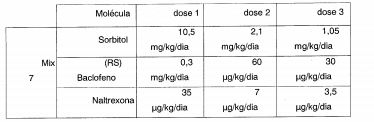
Frascos de cultura primária de células de Schwann (SC) de rato (Science11 # R1700) são descongeladas e semeadas na densidade de 10 000 células/cm2 em “Sciencel 1 meio de célula de Schwann” (meio basal de Sciencel 1 #R1701) em poli-L-lisina frascos 75 cm2 prerevestidos. O meio de cultura é composto de meio basal, 5% Soro fetal bovino (3H- Biomedical AB #1701-0025), 1% suplemento de crescimento de célula de Schwann (3H Biomedical AB #1701-1752), 1% Gentamicina (Sigma #G1397) e 10μM de Forscolina (Sigma # F6886) para promover sua proliferação.Rat Schwann cell (SC) primary culture flasks (Science11 # R1700) are thawed and seeded at a density of 10,000 cells/cm2 in "
Depois de atingir confluência (4 a 10 dias dependendo do lote de células), as células de Schwann são purificadas pela agitação suave ou por thy 1.1 immunopanning que permite o isolamento de SC dos fibroblastos aderentes, para produzir culturas que são pelo menos 95% pura. SC são então contadas (método Tryptan blue) e semeadas em poli-L- lisina frascos 75 cm2 prerevestidos no mesmo meio SC. Na confluência, as células são rinsadas, tripsinizadas (tripsina-EDTA 1x diluída de Invitrogen #1540054), diluída em PBS sem cálcio e magnésio) contadas e plaqueadas em placa 12 poços (140 000 células/ poço) em Sciencel 1 meio de célula Schwann com 5% de FBS, 1% de suplemento de crescimento de célula (CGS), 40μg/ml of gentamicina e 4μM Forscolina.After reaching confluence (4 to 10 days depending on cell batch), Schwann cells are purified by gentle shaking or by thy 1.1 immunopanning which allows for the isolation of SC from adherent fibroblasts, to produce cultures that are at least 95% pure. . SC are then counted (Tryptan blue method) and seeded in 75 cm2 poly-L-lysine flasks precoated in the same SC medium. At confluence, cells are rinsed, trypsinized (dilute 1x trypsin-EDTA from Invitrogen #1540054), diluted in PBS without calcium and magnesium), counted and plated in a 12-well plate (140,000 cells/well) in
Culturas primária de célula de Schwann (SC) são estabelecidas a partir de nervos ciáticos de ratos Sprague-Dawley (entre P0 e P2). Todos os ratos recém-nascidos são sacrificados e isolados em uma placa de Petri. A dissecção é realizada sob condições estéreis.Primary Schwann cell (SC) cultures are established from sciatic nerves of Sprague-Dawley rats (between P0 and P2). All newborn mice are sacrificed and isolated in a Petri dish. Dissection is performed under sterile conditions.
A pele dorsal é removida da pata posterior e do tronco inferior. O nervo ciático é isolado e transferido para uma placa de cultura contendo Leibovitz gelado (L15, Invitogen #11415) suplementado com solução 1% penicilina/estreptomicina (50UI/ml e 50μg/ml, respectivamente; Invitrogen #15070) e 1% de albuminas de soro bovino (BSA, Sigma A6003). Ambos os nervos por ratos são transferidos em um tubo de 15ml contendo LI5 gelado. O meio LI5 é então removido e trocado por 2,4ml de DMEM (Invitrogen #21969035) com 10mg/ml de colagenase (Sigma #A6003). Os nervos são incubados neste meio por 30 minutos a 37°C. O meio é então removido e ambos os nervos são dissociados por tripsina (10% tripsina EDTA 10x, Invitrogen #15400054) diluída em PBS sem cálcio e magnésio (Invitrogen # 2007-03) por 20min a 37°C. A reação é interrompida pela adição de DMEM contendo DNase I grade II (0,1 mg/ml Roche diagnostic #104159) e soro fetal bovino (FCS 10%, Invitrogen #10270). A suspensão de célula foi triturada com uma pipeta de 10ml e por um filtro em um tubo de 50ml (Swinnex 13mm unidades de filtro, Millipore, com filtro 20μm nylon-mesh, Fisher). A suspensão de células é centrifugada a 350g por 10min a temperatura ambiente (RT) e os pellets são suspensos em DMEM com 10% FCS e 1% penicilina/estreptomicina. As células são contadas (método Tryptan blue) e semeadas em tubo Falcon 100mm, a cultura de tecido primária plaqueia a densidade de 5.105 a 106 células/placa.Dorsal skin is removed from the hind leg and lower trunk. The sciatic nerve is isolated and transferred to a culture plate containing ice-cold Leibovitz (L15, Invitogen #11415) supplemented with 1% penicillin/streptomycin solution (50IU/ml and 50μg/ml, respectively; Invitrogen #15070) and 1% albumin of bovine serum (BSA, Sigma A6003). Both nerves by rats are transferred into a 15ml tube containing ice-cold LI5. LI5 medium is then removed and exchanged for 2.4ml DMEM (Invitrogen #21969035) with 10mg/ml collagenase (Sigma #A6003). Nerves are incubated in this medium for 30 minutes at 37°C. The medium is then removed and both nerves are dissociated by trypsin (10% trypsin EDTA 10x, Invitrogen #15400054) diluted in PBS without calcium and magnesium (Invitrogen # 2007-03) for 20min at 37°C. The reaction is stopped by the addition of DMEM containing DNase I grade II (0.1 mg/ml Roche diagnostic #104159) and fetal bovine serum (
Após um dia de cultura, o meio é mudado com DMEM, 10% FCS, 1% penicilina/estreptomicina e 10μM de citosina b-D-arabinofuranoside (Sigma #C1768). 48hrs depois, o meio é eliminado e as células são lavadas três vezes com DMEM. O meio de crescimento para SC é então adicionado, composto de DMEM, 10% FCS, 1% penicilina/estreptomicina, 2μM de Forscolina (Sigma #F6886), 10μg/ml of extrato de pituitária bovina (PEX, Invitrogen #13028). O meio é trocado a cada 2-3 dias.After one day of culture, the medium is changed with DMEM, 10% FCS, 1% penicillin/streptomycin and 10μM cytosine b-D-arabinofuranoside (Sigma #C1768). 48hrs later, the medium is discarded and the cells are washed three times with DMEM. Growth medium for SC is then added, composed of DMEM, 10% FCS, 1% penicillin/streptomycin, 2μM Forskolin (Sigma #F6886), 10μg/ml of bovine pituitary extract (PEX, Invitrogen #13028). The medium is changed every 2-3 days.
Após 8 dias de cultura (4 a 10 dias dependendo do lote de células), células de Schwann alcançam confluência e a cultura, contendo uma grande quantidade de contaminação de fibroblastos, é purificada pelo método thy 1.1 immunopanning. Após esta purificação, as células são suspensas em meio de crescimento a 10 000 células/cm2 em poli-L-lisina frascos 75 cm2 prerevestidos. Uma vez eles alcançam confluência, células são rinsadas, tripsinizadas (tripsina-EDTA), cotadas e plaqueadas em placa 12 poços (100 000 células/ poço).After 8 days of culture (4 to 10 days depending on cell batch), Schwann cells reach confluence and the culture, containing a large amount of fibroblast contamination, is purified by thy 1.1 immunopanning method. After this purification, the cells are suspended in growth medium at 10,000 cells/
Após células sendo plaqueadas em placa 12 poços, o meio é trocado por um meio definido consistindo em uma mistura de DMEM-F12 (Invitrogen # 21331020) complementado por 1% de suplemento N2 (Invitrogen # 17502), 1% L-Glutamina (Invitrogen #25030024) 2,5% FBS (Science11 #0025), 0,02μg/ml de corticosterona (Sigma # C2505), 4μM Forscolina e 50μg/ml of gentamicina. Fatores de crescimento não são adicionados a este meio, para promover SC diferenciação 24 horas depois, o meio é trocado por um meio definido (DMEM-F12) complementado com 1% Insulina-Transferrina-Selênio - X (ITS, Invitrogen # 51300), 16μg/ml de Putrescina (Sigma # P5780), 0,02 μg/ml de corticosterona e 50μg/ml de gentamicina. Nesta fase, nem progesterona ou Forscolina estão presente no meio.After cells are plated in a 12-well plate, the medium is exchanged for a defined medium consisting of a mixture of DMEM-F12 (Invitrogen # 21331020) supplemented by 1% N2 supplement (Invitrogen # 17502), 1% L-Glutamine (Invitrogen #25030024) 2.5% FBS (Science11 #0025), 0.02μg/ml corticosterone (Sigma # C2505), 4μM Forskolin and 50μg/ml gentamicin. Growth factors are not added to this medium, to promote SC differentiation 24 hours later, the medium is changed to a defined medium (DMEM-F12) supplemented with 1% Insulin-Transferrin-Selenium - X (ITS, Invitrogen # 51300), 16μg/ml Putrescine (Sigma # P5780), 0.02 μg/ml corticosterone and 50μg/ml gentamicin. At this stage, neither progesterone nor Forskolin is present in the medium.
Um dia depois, as células de Schwann são estimuladas pelas combinações de drogas durante 24hrs (3 poços/condição). A preparação de cada composto é realizada pouco antes de sua adição ao meio de cultura celular.One day later, Schwann cells are stimulated by the drug combinations for 24hrs (3 wells/condition). The preparation of each compound is carried out shortly before its addition to the cell culture medium.
As drogas são adicionados a um meio definido composto de DMEM-F12, com 1 % Insulina-Transferrina-Selênio - X (ITS, Invitrogen # 51300), 16μg/ml de Putrescina, 0,02 μg/ml de corticosterona, 10nM Progesterona e 50μg/ml de gentamicina. A ausência de Forscolina durante a estimulação com a droga evita adenilato ciclase saturação.Drugs are added to a defined medium composed of DMEM-F12, with 1% Insulin-Transferrin-Selenium - X (ITS, Invitrogen # 51300), 16μg/ml Putrescine, 0.02 μg/ml Corticosterone, 10nM Progesterone and 50μg/ml of gentamicin. The absence of Forskolin during stimulation with the drug prevents adenylate cyclase saturation.
Para prevenir contaminação da cultura por fibroblastos, células de Schwann são purificadas usando o clone Thy1.1 (ATCC TIB-103™) protocolo immunopanning.To prevent contamination of the culture by fibroblasts, Schwann cells are purified using the Thy1.1 clone (ATCC TIB-103™) immunopanning protocol.
Placas de Petri 100mm bactéria com anticorpos prerevestidos são preparadas como do seguinte modo: estas placas são lavadas três vezes com PBS e tratadas com 20ml de solução Tris HCI 50 mM, pH 9,5, com 10 μg/ml de IgM MU anticorpo de cabra Anti- camundongo (Jackson ImmunoResearch #115-005-020) de um dia para o outro a 4°C; então rinsado 3 vezes com PBS e tratada com uma solução de PBS com 0,02% de BSA e o sobrenadante é obtido da cultura de hibridoma T1 D7e2 (ATCC #TIB-103) contendo o Thy1.1 IgM anticorpo para 2 horas a temperatura ambiente. Finalmente, as placas são lavadas três vezes com PBS antes das suspensões de células serem adicionadas.Petri dishes 100mm bacteria with pre-coated antibodies are prepared as follows: these plates are washed three times with PBS and treated with 20ml of 50 mM Tris HCl solution, pH 9.5, with 10 μg/ml goat IgM MU antibody Anti-mouse (Jackson ImmunoResearch #115-005-020) overnight at 4°C; then rinsed 3 times with PBS and treated with a PBS solution with 0.02% BSA and the supernatant is obtained from the T1 D7e2 hybridoma culture (ATCC #TIB-103) containing the Thy1.1 IgM antibody for 2 hours at room temperature. environment. Finally, the plates are washed three times with PBS before the cell suspensions are added.
SC são destacadas com tripsina EDTA. Assim que a maioria das células está em suspensão, a tripsina é neutralizada com DMEM-10% FBS e as células são centrifugadas. O pellet das células dissociadas é ressuspenso em 15ml de meio com 0,02% BSA a densidade de 0,66xl06 células por ml (máximo) e transferido para a placa de Petri (cerca de 6,6 milhões de células/1 Oml/placa de 10Ornm).SC are highlighted with trypsin EDTA. Once most of the cells are in suspension, trypsin is neutralized with DMEM-10% FBS and the cells are centrifuged. The dissociated cell pellet is resuspended in 15ml of medium with 0.02% BSA at a density of 0.66x10⁶ cells per ml (maximum) and transferred to the Petri dish (about 6.6 million cells/1 Oml/dish). of 10Orm).
A suspensão de células é incubada na placa de Petri com Thy 1.1 revestidos durante 45 min a 37°C com agitação suave a cada 15 min para prevenir ligação não específica. A maioria das células de fibroblastos expressando Thy 1.1 adere na placa. No final da incubação, a suspensão de células é recuperada e centrifugada. Esta suspensão de células contém em teoria somente células de Schwann. As células são centrifugadas e o pellet de células é suspenso em meio de crescimento com 10μM de Forscolina a 16 000 células/cm2 em frasco T75 cm2 tratado com Poly-L-Lisina.The cell suspension is incubated in the Thy 1.1 coated petri dish for 45 min at 37°C with gentle shaking every 15 min to prevent non-specific binding. Most fibroblast cells expressing Thy 1.1 adhere to the plate. At the end of the incubation, the cell suspension is recovered and centrifuged. This cell suspension theoretically contains only Schwann cells. The cells are centrifuged and the cell pellet is suspended in growth medium with 10μM Forskolin at 16,000 cells/
RT-PCR quantitativo é usado para comparar os níveis de PMP22 mRNA após estimulação droga, em relação ao mRNA L13A Ribossomal de manutenção em célula de Schwann de cultura primária de rato.Quantitative RT-PCR is used to compare PMP22 mRNA levels after drug stimulation, against maintenance ribosomal L13A mRNA in rat primary cultured Schwann cell.
Após rinsado com PBS frio e esterilizado, o total de RNAs de cada amostra de célula é extraído e purificada de SC usando o Qiagen RNeasy micro kit (Qiagen #74004). Os ácidos nucleicos são quantificados pelo espectrofotômetro Nanodrop usando 1 μl de amostra de RNA. A integridade do RNA é determinada através de um aparelho BioAnalyzer (Agilent).After rinsing with cold sterilized PBS, the total RNAs from each cell sample are extracted and purified from SC using the Qiagen RNeasy micro kit (Qiagen #74004). Nucleic acids are quantified by the Nanodrop spectrophotometer using 1 μl of RNA sample. RNA integrity is determined using a BioAnalyzer device (Agilent).
RNAs são reverso transcritos em cDNA de acordo com protocolo padrão. Os moldes de cDNA para amplificação por PCR são sintetizados a partir 200ng de RNA total usando SuperScript II transcriptase reversa (Invitrogen # 18064-014) para 60 min a 42°C na presença de oligo(dT), em um volume final de 20μl. cDNAs são submetidos a amplificação por PCR usando o sistema «LightCycler® 480» (Roche Molecular Systems Inc.) Cada cDNA é diluído cinco vezes antes de ser usado para amplificação por PCR. 2,5μl destes cDNAs entra na solução de reação de PCR (volume final de 10μl). Experimentos preliminares assegurou que a quantificação foi feita na fase exponencial do processo de amplificação para ambas sequências e que a expressão do gene referência foi uniforme nas diferentes condições de cultura.RNAs are reverse transcribed into cDNA according to standard protocol. cDNA templates for PCR amplification are synthesized from 200ng of total RNA using SuperScript II reverse transcriptase (Invitrogen # 18064-014) for 60 min at 42°C in the presence of oligo(dT), in a final volume of 20μl. cDNAs are subjected to PCR amplification using the «LightCycler® 480» system (Roche Molecular Systems Inc.) Each cDNA is diluted five-fold before being used for PCR amplification. 2.5μl of these cDNAs enter the PCR reaction solution (final volume of 10μl). Preliminary experiments ensured that the quantification was done in the exponential phase of the amplification process for both sequences and that the expression of the reference gene was uniform under different culture conditions.
A reação PCR é realizada pela amplificação de 500nM do forward primer de rato PMP22 (NM_017037), 5-GGAAACGCGAATGAGGC-3 (SEQ ID NO: 1), e 500nM do reverse primer 5-GTTCTGTTTGGTTTGGCTT-3 (SEQ ID NO: 2) (amplificação de 148-bp). Um fragmento 152-bp do RNA(NM_173340) ribossomal RPL13A é amplificado em paralelo em reações separadas para normalização dos resultados pelo uso de 500nM de forward primer 5-CTGCCCTCAAGGTTGTG-3 (SEQ ID NO: 3), e de 500nM de reverse primer 5- CTTCTTCTTCCGGTAATGGAT-3 (SEQ ID NO: 4).The PCR reaction is performed by 500nM amplification of the mouse forward primer PMP22 (NM_017037), 5-GGAAACGCGAATGAGGC-3 (SEQ ID NO: 1), and 500nM of the reverse primer 5-GTTCTGTTTGGTTTGGCTT-3 (SEQ ID NO: 2) ( 148-bp amplification). A 152-bp fragment of RPL13A ribosomal RNA(NM_173340) is amplified in parallel in separate reactions to normalize the results using 500nM forward primer 5-CTGCCCTCAAGGTTGTG-3 (SEQ ID NO: 3), and 500nM reverse primer 5 - CTTCTTCTTCCGGTAATGGAT-3 (SEQ ID NO: 4).
Nós usamos FRET chemistry para realizar a análise RT-Q-PCR. As sondas FRET são compostas de 0,3μM de Pmp22-FL-5-GCTCTGAGCGTGCATAGGGTAC (SEQ ID NO: 5) ou Rp113A-FL- 5-TCGGGTGGAAGTACCAGCC (SEQ ID NO: 6), rotulados em sua extremidade 3’ como um doador fluoróforo corante (fluoresceína). 0,15μM de sondas Red640 são definidas como segue: Pmp22-red-5'-AGGGAGGGAGGAAGGAAACCAGAAA (SEQ ID NO: 7) ou Rp113A-red-5'-TGACAGCTACTCTGGAGGAGAAACGGAA (SEQ ID NO: 8), rotulados em sua extremidade 5’ com um aceptor fluoróforo corante (Rodamina Red 640).We use FRET chemistry to perform the RT-Q-PCR analysis. FRET probes are composed of 0.3μM Pmp22-FL-5-GCTCTGAGCGTGCATAGGGTAC (SEQ ID NO: 5) or Rp113A-FL-5-TCGGGTGGAAGTACCAGCC (SEQ ID NO: 6), labeled at its 3' end as a fluorophore donor. dye (fluorescein). 0.15μM Red640 probes are defined as follows: Pmp22-red-5'-AGGGAGGGAGGAAGGAAACCAGAAA (SEQ ID NO: 7) or Rp113A-red-5'-TGACAGCTACTCTGGAGGAGAAACGGAA (SEQ ID NO: 8), labeled at its 5' end with a dye fluorophore acceptor (Rhodamina Red 640).
Cada reação PCR continha 2,5μl de molde de cDNA em um volume final de 10μl do master mix kit (Roche #04-887301001).Each PCR reaction contained 2.5μl of cDNA template in a final volume of 10μl of the master mix kit (Roche #04-887301001).
As seguintes condições de PCR são usadas: 10seg a 95°C, 10seg a 63°C e 12seg a 72°C e 30seg a 40°C (quarenta ciclos de amplificação). Os relativos níveis de expressão do gene de PMP2 são medidos pela determinação da razão entre os produtos gerados a partir do gene alvo PMP22 e o padrão interno endógeno RPL13A.The following PCR conditions are used: 10sec at 95°C, 10sec at 63°C and 12sec at 72°C and 30sec at 40°C (forty cycles of amplification). Relative levels of PMP2 gene expression are measured by determining the ratio between products generated from the PMP22 target gene and the endogenous internal standard RPL13A.
8hrs, 24hrs e 48hrs após incubação das drogas, os sobrenadantes são recuperados, centrifugados e congelados. SC são destacadas com tripsina-EDTA. Assim que a maioria das células está em suspensão, a tripsina é neutralizada usando DMEM com 10% de FCS.8hrs, 24hrs and 48hrs after drug incubation, the supernatants are recovered, centrifuged and frozen. SC are highlighted with trypsin-EDTA. Once most cells are in suspension, trypsin is neutralized using DMEM with 10% FCS.
Os sobrenadantes com células são recuperados e centrifugados. Os pellets de células são transferidos em microtubos, lavados em PBS uma vez e fixados com uma solução específica (AbCys #Reagent A BUF09B). 10 minutos depois, as células são rinsadas uma vez com PBS e mantidas a 4°C.Supernatants with cells are recovered and centrifuged. Cell pellets are transferred into microtubes, washed in PBS once and fixed with a specific solution (AbCys #Reagent A BUF09B). 10 minutes later, the cells are rinsed once with PBS and kept at 4°C.
Cinco dias após a fixação da célula, todas as preparações de células com diferentes tempos de incubação são rotuladas usando o seguinte protocolo.Five days after cell fixation, all cell preparations with different incubation times are labeled using the following protocol.
As células são centrifugadas a 7000 rpm por 5 minutos e os pellets são suspensos em uma solução de permeabilização (AbCys #Reagent B BUF09B) e rotulados com PMP22 anticorpo primário (Abeam #ab61220, 1/50) para 1 hr a temperatura ambiente. A células são então centrifugadas a 7000 rpm para 5 minutos e pellets de células são rinsados uma vez em PBS. Um anticorpo secundário é adicionado, acoplado a Alexa Fluor 488 (IgG de cabra anti-coelho, Sondas Moleculares #A11008, 1/100), para uma hora a temperatura ambiente. As células são então centrifugadas a 7000 rpm para 5 minutos e pellets de células são rinsados uma vez em PBS. A rotulagem é aumentada adicionando um anticorpo terciário acoplado a Alexa Fluor 488 (IgG de galinha anti-cabra, Sondas Moleculares #A21467, 1/100) para uma hora incubação, a temperatura ambiente. As células são então rinsadas uma vez em PBS. O controle sem qualquer anticorpo (células não rotuladas) é realizado para determinar o nível de autofluorescência e adaptado a sensibilidade dos fotomultiplicadores. O controle com ambos os anticorpos secundário e terciário, mas sem anticorpo primário, é realizado para avaliar ligação não específica de anticorpos.Cells are centrifuged at 7000 rpm for 5 minutes and the pellets are suspended in a permeabilization solution (AbCys #Reagent B BUF09B) and labeled with PMP22 primary antibody (Abeam #ab61220, 1/50) for 1 hr at room temperature. The cells are then centrifuged at 7000 rpm for 5 minutes and cell pellets are rinsed once in PBS. A secondary antibody is added, coupled to Alexa Fluor 488 (Goat anti-rabbit IgG, Molecular Probes #A11008, 1/100), for one hour at room temperature. Cells are then centrifuged at 7000 rpm for 5 minutes and cell pellets are rinsed once in PBS. Labeling is increased by adding a tertiary antibody coupled to Alexa Fluor 488 (Chicken anti-goat IgG, Molecular Probes #A21467, 1/100) for one hour incubation at room temperature. Cells are then rinsed once in PBS. Control without any antibody (unlabeled cells) is performed to determine the level of autofluorescence and adapted to the sensitivity of the photomultipliers. Control with both secondary and tertiary antibodies, but no primary antibody, is performed to assess non-specific antibody binding.
A aquisição e a análise de dados são realizadas com uma matriz de citômetro FACS e software para matriz FACS (Becton Dickinson) em 5000 células. A Dispersão Dianteira (FSC) correlacionada com o volume da célula (tamanho) e Dispersão Lateral (SSC) dependendo da complexidade interna das células (granularidade) são analisados. Para expressão de PMP22, a análise é realizada no total de células e a percentagem de células positivas é calculada. As células positivas são células com intensidade de fluorescência maior do que o controle com anticorpo secundário.Data acquisition and analysis are performed with a FACS cytometer array and FACS array software (Becton Dickinson) on 5000 cells. The Forward Scatter (FSC) correlated with cell volume (size) and Side Scatter (SSC) depending on the internal complexity of the cells (granularity) are analyzed. For PMP22 expression, analysis is performed on total cells and the percentage of positive cells is calculated. Positive cells are cells with a higher fluorescence intensity than the secondary antibody control.
A fim de quantificar o número de SC, células no meio controle são analisadas usando anticorpos anti-S100 Protein.In order to quantify the number of SC, cells in the control medium are analyzed using anti-S100 Protein antibodies.
As células são preparadas de acordo com o seguinte protocolo: células de Schwann são marcadas com anticorpo anti-S100 Protein (Dako #S0311, 1/100) por 1 hr a temperatura ambiente. Este anticorpo é rotulado de acordo com protocolo descrito acima para imunomarcação de PMP22, mas sem incubação com anticorpo terciário.Cells are prepared according to the following protocol: Schwann cells are labeled with anti-S100 Protein antibody (Dako #S0311, 1/100) for 1 hr at room temperature. This antibody is labeled according to the protocol described above for immunolabeling PMP22, but without incubation with tertiary antibody.
As drogas são incubadas para 24hrs ou 48hrs no mesmo meio definido que descrito acima (3 poços/condição) na ausência de Forscolina para evitar saturação e estimulação de adenilato ciclase, mas na presença de 10nM de progesterona. Após incubação da droga, os sobrenadantes são recuperados e as células de Schwann são congeladas para análise RT- Q-PCR.Drugs are incubated for 24hrs or 48hrs in the same defined medium as described above (3 wells/condition) in the absence of Forskolin to avoid saturation and adenylate cyclase stimulation, but in the presence of 10nM progesterone. After drug incubation, supernatants are recovered and Schwann cells are frozen for RT-Q-PCR analysis.
Estes experimentos estão resumidos na Tabela 1. Tabela 1
Um modelo de co-cultura foi usado como um modelo in vitro de CMT1A. Este modelo de mielinização consiste em co-cultivar neurônios sensoriais e células de Schwann de machos PMP22 Transgênicos (TG) dissociadas Gânglios da Raiz Dorsal (DRG).A co-culture model was used as an in vitro model of CMT1A. This myelination model consists of co-cultivating sensory neurons and Schwann cells from male PMP22 Transgenic (TG) dissociated Dorsal Root Ganglia (DRG).
O objetivo deste estudo é avaliar o efeito de 3 compostos teste (+/-Baclofeno, Naltrexona e Sorbitol) e a Mix7 (uma mistura destas 3 drogas) no processo de mielinização. O efeito dos 3 compostos testes e sua mistura na mielinização são avaliados por meio da avaliação da expressão Proteína Básica da Mielina (MBP) na presença de ácido ascórbico.The aim of this study is to evaluate the effect of 3 test compounds (+/-Baclofen, Naltrexone and Sorbitol) and Mix7 (a mixture of these 3 drugs) on the myelination process. The effect of the 3 test compounds and their mixture on myelination are evaluated by evaluating Myelin Basic Protein (MBP) expression in the presence of ascorbic acid.
Fêmeas de ratos prenhes com 15 dias de gestação são mortas por deslocamento cervical. Os embriões são removidos do útero e estão em estágio similar de desenvolvimento fetal.Pregnant female rats at 15 days of gestation are killed by cervical dislocation. Embryos are removed from the uterus and are at a similar stage of fetal development.
Um pedaço de cada cabeça do embrião (3 mm ) é colocado em um tubo de 2 ml livre de DNase. O DNA é extraído com o SYBR Green Extract-N-Amp tissue PCR kit (Sigma, ref XNATG- 1KT). 120μl da solução de extração (Kit Sigma, ref XNATG-1KT) foi colocada em cada pedaço de cabeça do embrião. As cabeças são incubadas por 10 min a temperatura ambiente. No final desta incubação, as cabeças são incubadas por 5 min a 95 °C na solução de extração. Imediatamente após esta última incubação, 100 μl de solução neutralizante são adicionados, cada extrato de DNA é diluído em 1/40 com água estéril ultrapura (Biosolve, ref: 91589) e armazenado a +4°C até o uso. A genotipagem dos embriões de fêmeas (F) e de machos (M) é realizada durante a dissecção dos DRG, com o kit Fast SYBR Green Master Mix (Applied Biosystem, 4385612). O gênero de cada embrião é determinado usando o gene SRY do macho. Os primers SRY são fornecidos por Phamext (SRY-F (SEQ ID NO:9): 5'-GAGAGAGGCACAAGTTGGC-3'; SRY-R (SEQ ID NO: 10): 5'- GCCTCCTGGAAAAAGGGCC-31). Os primers SRY são diluídos em 3μM de água estéril ultrapura (Biosolve, ref: 91589). Uma mistura para PCR é preparada com água ultrapura (4μl por amostra), 3μM de primer (2μl por amostra) e Master Mix (10 μl por amostra). Em uma placa PCR 96 poços, 16 μl da mistura PCR é depositada em cada poço. 4μl de cada DNA diluído é adicionado de acordo com um plano de depósito. O PCR é executado usando o 7500 fast RT-PCR system (Applied Biosystem), com o seguinte programa: Início: 95°C - 20 seg 45 ciclos: 95°C -10 seg, 65°C -10 seg, 72°C - 30 seg (aquisição de dados).A piece of each embryo head (3 mm) is placed in a 2 ml DNase-free tube. DNA is extracted with the SYBR Green Extract-N-Amp tissue PCR kit (Sigma, ref XNATG-1KT). 120μl of the extraction solution (Sigma Kit, ref XNATG-1KT) was placed on each piece of embryo head. The heads are incubated for 10 min at room temperature. At the end of this incubation, the heads are incubated for 5 min at 95 °C in the extraction solution. Immediately after this last incubation, 100 μl of neutralizing solution are added, each DNA extract is diluted 1/40 with sterile ultrapure water (Biosolve, ref: 91589) and stored at +4°C until use. The genotyping of female (F) and male (M) embryos is performed during DRG dissection, with the Fast SYBR Green Master Mix kit (Applied Biosystem, 4385612). The gender of each embryo is determined using the male's SRY gene. SRY primers are provided by Phamext (SRY-F (SEQ ID NO:9): 5'-GAGAGAGGCACAAGTTGGC-3'; SRY-R (SEQ ID NO:10): 5'-GCCTCCTGGAAAAAGGGCC-31). SRY primers are diluted in 3μM sterile ultrapure water (Biosolve, ref: 91589). A PCR mix is prepared with ultrapure water (4μl per sample), 3μM primer (2μl per sample) and Master Mix (10 μl per sample). In a 96-well PCR plate, 16 μl of the PCR mixture is deposited in each well. 4μl of each diluted DNA is added according to a deposit schedule. PCR is performed using the 7500 fast RT-PCR system (Applied Biosystem), with the following program: Start: 95°C - 20
Curva de Fusão (Melt): 95°C - 15 seg, 64°C - 1min, 90°C - 30 seg (contínua aquisição de dados), 60°C 15 seg. Os gráficos de amplificação e curvas de fusão são analisados com o 7500 software (Applied Biosystems).Melt Curve (Melt): 95°C - 15 sec, 64°C - 1min, 90°C - 30 sec (continuous data acquisition), 60°
Os resultados para cada amostra são comparados ao controle negativo (água ultrapura) e ao controle positivo (TG/Machos e WT/Fêmea), para concluir sobre o genótipo de cada embrião.The results for each sample are compared to the negative control (ultrapure water) and the positive control (TG/Males and WT/Female), to conclude on the genotype of each embryo.
Gânglios da raiz dorsal de rato são cultivados como previamente descrito por Cosgaya et al., 2002 e Rangaraju et al., 2008.Rat dorsal root ganglia are cultured as previously described by Cosgaya et al., 2002 and Rangaraju et al., 2008.
Cada embrião é despachado em uma placa de petri numerada (35 mm de diâmetro). A cabeça do embrião é cortada e colocada em um tubo de 1,5 ml livre de DNAase; o DNA é extraído com o Extract-N-Amp Tissue Kit (Sigma Aldrich). A genotipagem (Machos (M) e fêmea (F), tipo selvagem e PMP22 transgênicos) é realizada com o kit Fast SYBR Green Master Mix (Applied Biosystem). Esta genotipagem é realizada em paralelo da dissecção de gânglios da raiz dorsal (DRG), de modo que ao final da dissecção, somente um tipo de cultura (DRG de transgênicos machos) é feito. DRG de cada embrião é coletado, colocado em meio de Leibovitz (L15, Invitrogen) gelado. No final de dissecção, DRG de TGM são agrupados e dissociados por tripsinização (tripsina EDTA, 0,05%; Invitrogen) por 20 min a 37°C. A reação é interrompida pela adição de DMEM contendo 10% de soro fetal bovino (FBS) na presença de DNAase I (Roche). A suspensão é triturada com uma pipeta de 10 ml. As células são então centrifugadas a 350 x g por 10 min a temperatura ambiente. O pellet das células dissociadas é ressuspenso em meio neurobasal (Invitrogen) contendo 2% de B27 (Invitrogen), 1% de penicilina-estreptomicina (Invitrogen), 1 % de L Glutamina e 50 ng/ml NGF (Sigma). Este meio é o meio neuronal. As células viáveis são contadas em um citômetro Neubauer usando o teste de exclusão trypan blue (Sigma) e semeadas na base de 10 000 células por poço em placas de 96 poços (Greiner) tratadas com poli-L-lisina.Each embryo is shipped in a numbered petri dish (35 mm in diameter). The embryo head is cut off and placed in a 1.5 ml DNAase-free tube; DNA is extracted with the Extract-N-Amp Tissue Kit (Sigma Aldrich). Genotyping (Males (M) and female (F), wild type and transgenic PMP22) is performed with the Fast SYBR Green Master Mix kit (Applied Biosystem). This genotyping is performed in parallel with the dorsal root ganglia (DRG) dissection, so that at the end of the dissection, only one type of culture (male transgenic DRG) is done. DRG from each embryo is collected, placed in ice-cold Leibovitz medium (L15, Invitrogen). At the end of dissection, TGM DRGs are pooled and dissociated by trypsinization (trypsin EDTA, 0.05%; Invitrogen) for 20 min at 37°C. The reaction is stopped by the addition of DMEM containing 10% fetal bovine serum (FBS) in the presence of DNAase I (Roche). The suspension is triturated with a 10 ml pipette. Cells are then centrifuged at 350 x g for 10 min at room temperature. The dissociated cell pellet is resuspended in neurobasal medium (Invitrogen) containing 2% B27 (Invitrogen), 1% penicillin-streptomycin (Invitrogen), 1% L-Glutamine and 50 ng/ml NGF (Sigma). This medium is the neuronal medium. Viable cells are counted on a Neubauer cytometer using the trypan blue exclusion test (Sigma) and seeded at the base of 10,000 cells per well in 96-well plates (Greiner) treated with poly-L-lysine.
As placas são mantidas a 37°C em uma incubadora umidificada, em uma atmosfera de ar (95%)-CO2 (5%). Metade do meio de cultura neuronal padrão é mudado a cada dois dias. As culturas são mantidas em meio neurobasal padrão por 7 dias para permitir as células de Schwann para preencher para preencher os neurites do neurônio sensorial. No dia 7, as culturas são alimentadas com meio neuronal padrão suplementado ou não com 50 μg/ml de ácido ascórbico a fim de iniciar formação de lâmina basal e mielinização.The plates are kept at 37°C in a humidified incubator, in an atmosphere of air (95%)-CO2 (5%). Half of the standard neuronal culture medium is changed every two days. Cultures are maintained in standard neurobasal medium for 7 days to allow Schwann cells to fill in to fill sensory neuron neurites. On
No dia 7, o seguinte compostos de teste (sozinhos ou em combinação) são adicionado no meio com 50 μg/ml ácido ascórbico: ■ (RS)-Baclofeno ■ Naltrexona d-Sorbitol ■ Mix7= a combinação dos 3 compostos individuais.On
Estes compostos ou combinação de composto são testado nas seguintes concentrações (Tabela 2):
The compostos teste são incubados em 5 diferente tempos: 5, 9,10,11 e 13 dias.The test compounds are incubated at 5 different times: 5, 9, 10, 11 and 13 days.
Três culturas separadas e independentes de DRG (de embriões ratos TG machos) são feitas. Estas condições são avaliadas na presença de ácido ascórbico, 6 poços por condição. A solução pronta para uso de todos os compostos teste é extemporaneamente preparada de uma solução estoque, armazenada a -20°C. Esta solução é preparada uma vez a semana. Metade do meio neuronal padrão suplementado com compostos teste e ácido ascórbico (cada na concentração 1X) são mudadas a cada dois dias.Three separate and independent cultures of DRG (from male TG mouse embryos) are made. These conditions are evaluated in the presence of ascorbic acid, 6 wells per condition. The ready-to-use solution of all test compounds is extemporaneously prepared from a stock solution stored at -20°C. This solution is prepared once a week. Half of the standard neuronal medium supplemented with test compounds and ascorbic acid (each at 1X concentration) is changed every other day.
Após 5, 9, 10, 11 e 13 dias de incubação, as células são fixadas em uma solução fria de etanol (95%) e ácido acético (5%) por 10min. As células são permeabilizadas e bloqueadas com PBS contendo 0,1% saponina e 10% soro de cabra por 15 min. Então, as células são incubadas com um marcador específico de mielina: anticorpo policlonal anti- proteína básica de mielina (MBP), anticorpo (Sigma 118K0431).After 5, 9, 10, 11 and 13 days of incubation, the cells are fixed in a cold solution of ethanol (95%) and acetic acid (5%) for 10min. Cells are permeabilized and blocked with PBS containing 0.1% saponin and 10% goat serum for 15 min. Then, the cells are incubated with a myelin-specific marker: polyclonal anti-myelin basic protein (MBP) antibody, antibody (Sigma 118K0431).
Este anticorpo é revelado com Alexa Fluor 568 IgG de cabra anti-coelho e Alexa Fluor 488 IgG de cabra anti-camundongo (Sonda Molecular 687621, 623962). Os núcleos dos neurônios são rotulados por um marcador fluorescente (Hoechst solução, SIGMA ref B1155).This antibody is developed with Alexa Fluor 568 goat anti-rabbit IgG and Alexa Fluor 488 goat anti-mouse IgG (Molecular Probe 687621, 623962). Neuron nuclei are labeled by a fluorescent marker (Hoechst solution, SIGMA ref B1155).
Por poço, 20 fotos são tiradas usando InCell AnalyzerTM 1000 (GE Healthcare) com aumento de 20x. Todas as imagens são tiradas nas mesmas condições. Análises do comprimento total dos axônios mielinizados foram automaticamente feitos (comprimento e área ao redor dos axônios) usando Developer software (GE Healthcare). Todos os valores serão expressos como meio +/- meio s.e. Análises estatísticas são feitas nas diferentes condições (ANOVA seguida por teste PLSD de Fisher quando permitido).Per well, 20 photos are taken using InCell AnalyzerTM 1000 (GE Healthcare) at 20x magnification. All images are taken under the same conditions. Analyzes of the total length of the myelinated axons were automatically done (length and area around the axons) using Developer software (GE Healthcare). All values will be expressed as half +/- half s.e. Statistical analyzes are performed under different conditions (ANOVA followed by Fisher's PLSD test when allowed).
Um importante efeito sinergético das drogas que compõem a combinação do Mix7 é observado na expressão de MBP. De fato, no dia 10 (=17 dias de cultura), a combinação de (RS)- Baclofeno, Naltrexona e d-Sorbitol significativamente aumenta a expressão de MBP nas doses 1 e 6 como mostrado nas Figuras 1A e 2A. Por outro lado, as drogas acima usadas individualmente não têm efeito substancial comparadas ao controle (Figuras 1B-D e 2B-D).An important synergistic effect of the drugs that make up the Mix7 combination is observed in the expression of MBP. Indeed, at day 10 (=17 days of culture), the combination of (RS)-Baclofen, Naltrexone and d-Sorbitol significantly increases MBP expression at
Um efeito significante na expressão MBP é também registrado após 10 dias de incubação nas doses 2, 3, 4, 5 e 7 do Mix7 (Figura 3A).A significant effect on MBP expression is also recorded after 10 days of incubation at
Este efeito é ainda observado no dia 11 com as doses 2-7 (Figura 3B) na forma de uma curva clara em forma sino.This effect is still seen at
Nós testamos os compostos para efeito terapêutico em um rato modelo.We tested the compounds for therapeutic effect in a mouse model.
Os grupos experimentais são formados com ratos jovens de ambos os gêneros separadamente. Os ratos são designados para os grupos seguindo a programação de randomização com base no peso do corpo. Em alguns experimentos a randomização é com base nas performances dos ratos nos testes de barra. Ambos os gêneros são representados por grupos controle separados que são numericamente iguais ou maiores que os grupos do tratamento.The experimental groups are formed with young rats of both genders separately. Rats are assigned to groups following the randomization schedule based on body weight. In some experiments the randomization is based on the performance of the rats in the bar tests. Both genders are represented by separate control groups that are numerically equal to or greater than the treatment groups.
Os ratos são tratados cronicamente com drogas - alimentados à força ou injetados por Alzet bomba osmótica subcutânea (DURECT Corporation Cupertino, CA), dependendo da biodisponibilidade de cada droga durante 3 ou 6 semanas. Em todos os experimentos in vivo realizados, o Mix7 é administrado por gavagem.Rats are chronically treated with drugs - either force-fed or injected by Alzet subcutaneous osmotic pump (DURECT Corporation Cupertino, CA) depending on the bioavailability of each drug for 3 or 6 weeks. In all in vivo experiments performed, Mix7 is administered by gavage.
Os animais são pesados por duas vezes por semana a fim de ajustar as doses ao crescente peso do corpo. Se a bomba osmótica e escolhida para a administração do tratamento, as doses da droga são calculadas com base na média estimada do peso do corpo dos animais esperado para sua idade no período da duração da bomba (6 semanas). As bombas são reimplantadas se necessário, com o protocolo de anestesia apropriado.Animals are weighed twice a week to adjust doses to increasing body weight. If the osmotic pump is chosen for administration of treatment, drug doses are calculated based on the estimated average of the animals' expected body weight for their age over the duration of the pump (6 weeks). Pumps are reimplanted if necessary, with the appropriate anesthesia protocol.
Cada três ou quatro semanas os animais são submetidos a um teste de comportamento. Cada teste é conduzido pelo mesmo pesquisador na mesma sala e ao mesmo período do dia; essa homogeneidade é mantida durante todo o experimento. Todos os tratamentos e determinação de genótipo são desconhecidos para o pesquisador. “Teste de barra” e “Força de aperto” tem sido principalmente usado para acessar a performance ao longo estudo. O programa dos testes de barra pode mudar como o crescimento do animal (a fim de evitar a influencia devido a aprendizagem, por exemplo).Every three or four weeks the animals undergo a behavior test. Each test is conducted by the same researcher in the same room and at the same time of day; this homogeneity is maintained throughout the experiment. All treatments and genotyping are unknown to the researcher. “Bar test” and “Grip strength” have mainly been used to assess performance throughout the study. The bar test program can change as the animal grows (in order to avoid influence due to learning, for example).
O ensaio da força de aperto permite detecção de diferenças sutis na performance de aperto que parece ser composto da força muscular, estado de sensibilidade (por exemplo, sensações táteis dolorosas podem mudar os valores medidos da força), componente comportamental (“motivação”). Os valores diferem entre os membros dianteiros e posteriores e depender muito da idade dos animais.The grip strength assay allows detection of subtle differences in grip performance that appear to be composed of muscle strength, state of sensitivity (eg, painful tactile sensations can change measured strength values), behavioral component (“motivation”). The values differ between the forelimbs and hindlimbs and depend a lot on the age of the animals.
O teste de força de aperto mede a força com que um animal segura em aperto com suas patas dianteiras ou suas patas traseiras separadamente. Um dinamômetro é colocado com um punho para medir a força (Força Gauge FG-5000A). O rato é mantido pelo experimentador de uma forma que ele agarra o punho seja com suas patas dianteiras ou com suas patas traseiras e puxa gentilmente o rato para trás ate que ele libera o punho. A força medida quando o animal libera o punho é registrada.The grip strength test measures how tightly an animal grips with its front paws or its hind paws separately. A dynamometer is placed with a handle to measure force (Force Gauge FG-5000A). The rat is held by the experimenter in such a way that he grasps the wrist with either his front paws or his hind paws and gently pulls the rat backwards until he releases the wrist. The force measured when the animal releases the fist is recorded.
Dois testes sucessivos medindo a força das patas dianteiras e dois testes sucessivos medindo a força das patas traseiras por animal são processados; somente a pontuação máxima (uma para patas dianteiras e uma para patas traseiras) é notada (em N).Two successive tests measuring the strength of the front paws and two successive tests measuring the strength of the hind paws per animal are processed; only the maximum score (one for front paws and one for hind paws) is scored (in N).
Os testes de barra avaliam a capacidade dos ratos de segurar em uma barra fixa. Os ratos Pmp22 que exibem fraqueza muscular apresentam um déficit de performance neste teste (Sereda et al, 1996). O rato é colocado sobre suas quatro patas no meio da barra (diâmetro: 2,5cm; comprimento: 50cm; 30cm acima da mesa). Os testes são realizados consecutivamente; o número e a duração dos testes nos nossos experimentos dependeram dos lotes dos animais. Esta variabilidade nos testes tem sido introduzida a fim de determinar a programação apropriada para a melhor detecção da deficiência motora nos ratos com CMT no curso dos experimentos. índices de performance são registrados em cada sessão: - O número de testes necessários para segurar por 60 seg (ou 30 seg para o lote 1, sessão 1 e 2) na vara. - O tempo gasto na barra (isto é, a latência de queda) em cada teste e a média na sessão. Nos procedimentos experimentais onde a sessão termina após o rato ter ficado por um tempo de corte, isto é, 30 ou 60s, na barra, uma performance do tempo de corte (30 s ou 60 s) é atribuído aos testes não completados (por exemplo, para o lote 8, para um animal que permanece na barra menos que 10 seg nos testes 1, 2 e 3, então por 60seg nos testes 4 e 5, 60s é atribuído para os testes 6 a 10). - O número de quedas.Barbell tests assess rats' ability to hold on to a fixed bar. Pmp22 mice that exhibit muscle weakness show a performance deficit in this test (Sereda et al, 1996). The rat is placed on its four paws in the middle of the bar (diameter: 2.5cm; length: 50cm; 30cm above the table). The tests are performed consecutively; the number and duration of tests in our experiments depended on the batches of animals. This variability in testing has been introduced in order to determine the appropriate schedule for better detection of motor impairment in CMT mice over the course of the experiments. Performance indices are recorded at each session: - The number of tests required to hold for 60 sec (or 30 sec for
Peso do corpo, sinais evidentes (aparência da pelagem, postura do corpo, marcha, tremor etc.) dos animais são monitorados em todo o experimento. A escala de classificação é utilizada para registrar: 0= normal, 1= anormal.Body weight, overt signs (coat appearance, body posture, gait, tremor etc.) of the animals are monitored throughout the experiment. The rating scale is used to record: 0=normal, 1=abnormal.
Cada rato é observado em uma nova gaiola de rato (dimensões 55x33x18cm) sem palha por cinco minutos. A marcha dos ratos é avaliada com 4 parâmetros: - Pontuação 0: marcha normal (fluida) - Pontuação 1: marcha anormal (não fluida ou o rato tem um leve coxear) - Pontuação 2: incapacidade moderada (o rato arrasta uma perna e é capaz de endireita-la e andar) - Pontuação 3: incapacidade grave (o rato arrasta uma ou ambas suas patas traseiras e é incapaz de endireita-las).Each rat is observed in a new rat cage (dimensions 55x33x18cm) without straw for five minutes. The gait of rats is evaluated with 4 parameters: - Score 0: normal (fluid) gait - Score 1: abnormal gait (not fluid or the rat has a slight limp) - Score 2: moderate disability (the rat drags one leg and is able to straighten and walk) - Score 3: severe disability (the rat drags one or both of its hind legs and is unable to straighten them).
O aparelho deslizante tinha um plano Plexiglass 30x50cm que pode ser inclinado em um ângulo de 0o (horizontal) a 60°. Cada rato foi inicialmente colocado no plano inclinado de ângulo 25° em uma posição de cabeça para cima (orientado para cima); dois testes separados por 1min são realizadas. 30 min depois, o mesmo experimento e realizado no plano inclinado de ângulo 35°, e então no plano inclinado de ângulo 40°. Durante este tempo o rato foi devolvido à sua gaiola. O plano é limpo após cada teste.The slider had a 30x50cm Plexiglass plane that could be tilted at an angle from 0° (horizontal) to 60°. Each mouse was initially placed on the 25° inclined plane in a head-up (upward-oriented) position; two tests separated by 1min are performed. 30 min later, the same experiment is performed on the 35° inclined plane, and then on the 40° inclined plane. During this time the mouse was returned to its cage. The plan is cleared after each test.
As performances dos ratos são avaliadas por 4 pontuações diferentes: - Pontuação 0: sem escorregamento - Pontuação 1: um pequeno escorregamento (uma ou duas patas) -Pontuação 2: um escorregamento moderado (4 patas), mas não até o fim do plano -Pontuação 3: o rato escorrega até bem a parte inferior do plano.The rats' performances are evaluated by 4 different scores: - Score 0: no slipping - Score 1: a small slip (one or two paws) -Score 2: a moderate slip (4 paws), but not to the end of the plane - Score 3: The mouse slides to the very bottom of the plane.
Quando apropriado, os ratos são submetidos a uma avaliação eletrofisiológica, medição histológica e o nível de expressão do RNA pmp22 no nervo ciático é quantificado.When appropriate, mice are subjected to electrophysiological assessment, histological measurement and the level of pmp22 RNA expression in the sciatic nerve is quantified.
O RNA total foi isolado dos nervos ciáticos esquerdos usando Qiazol (ref N°79306, Qiagen Gmbh, Germany) seguido pelo método de purificação de etapa única com RNeasy Mini Kit (ref N° 74106, Qiagen Gmbh, Germany) descrito pelo protocolo do fabricante (Qiagen-RNeasy Fibrous tissue Handbook). A contaminação de DNA foi removida pela digestão com DNase I livre de RNase pelo uso do DNA-free kit (Qiagen-Rnase-free DNase set 1500 Kunits, ref N° 1023460).Total RNA was isolated from left sciatic nerves using Qiazol (ref N°79306, Qiagen Gmbh, Germany) followed by the one-step purification method with RNeasy Mini Kit (ref N° 74106, Qiagen Gmbh, Germany) described by the manufacturer's protocol (Qiagen-RNeasy Fibrous tissue Handbook). DNA contamination was removed by RNase-free DNase I digestion using the DNA-free kit (Qiagen-Rnase-free DNase set 1500 Kunits, ref No. 1023460).
As concentrações de RNA são estimadas por NanoDrop ND-1000 e um teste de controle de qualidade foi feito por Agilent RNA 6000 nano chips em um Agilent 2100 Bioanalyzer.RNA concentrations are estimated by NanoDrop ND-1000 and a quality control test was performed by Agilent RNA 6000 nano chips in an Agilent 2100 Bioanalyzer.
A transcrição reversa e o PCR em tempo real: RT-PCR quantitativo (RT-Q-PCR) foi realizada da seguinte forma: 80ng do RNA total foi reverso transcrito usando Superscript™ II Transcriptase Reversa (Invitrogen, Carlsbad, CA) com Oligo(dT)12-18 (Invitrogen, Carlsbad, CA) em um volume de reação de 20μl. PCR em tempo real foi realizada com um sistema térmico ciclador rápido (LightCycler® 480 II, 384-Poço, Roche, Switzerland). As amplificações são realizadas em um volume total de 10μl com a concentração de primers otimizada entre 130nM e 1μM. Primers e moldes são suplementados com LightCycler® 480 SYBR Green I Master (2x conc. Roche,Cat. Ref N° 04 887 352 001). Nucleotídeos, MgCI2, Taq DNA polimerase e tampão estão incluídos na mistura. Um protocolo de amplificação incorporou uma incubação inicial a 95°C por 10min para a ativação da Taq DNA polimerase seguido de 45 ciclos, com uma desnaturação a 95°C por 10s, anelamento a 60°C por 40s e extensão a 72°C por 10s (a detecção do produto fluorescente foi realizada ao final do período extensão a 72°C por um único modo de aquisição) e finalizado por um ciclo de curva de fusão com desnaturação a 95°C por 5s, anelamento a 63°C por 60s e 95°C (de 63°C a 95°C a taxa de rampa é 0,11 °C/s e a detecção do produto fluorescente foi contínua). Para confirmar a especificidade da amplificação, o produto da PCR de cada par de primer foi submetido a uma análise da curva de fusão. Uma quantificação relativa foi realizada com base no crossing point (valor Cp) para cada uma das amostras de PCR. O ponto em que a fluorescência de uma amostra aumenta acima da fluorescência do plano de fundo é chamado de "crossing point” (Cp) da amostra. O gene Proteína Zero da Mielina (MPZ) de Rattus norvegicus foi usado para normalização (Sereda et al, 2006). As sequências dos primers (sintetizados por Eurofins MWG Operon, Germany) usadas para a análise RT-Q-PCR são: PMP22 - forward: 5’-TGTACCACATCCGCCTTGG-3’ (SEQ ID NO: 11) e PMP22 - reverse: 5’-GAGCTGGCAGAAGAACAGGAAC-3’ (SEQ ID NO: 12). MPZ-forward: 5’ -TGTTGCTGCTGTTGCTCTTC-3’ (SEQ ID NO: 13) e MPZ-reverse: 5’-TTGTGAAATTTCCCCTTCTCC-3’ (SEQ ID NO: 14).Reverse transcription and real-time PCR: Quantitative RT-PCR (RT-Q-PCR) was performed as follows: 80ng of the total RNA was reverse transcribed using Superscript™ II Reverse Transcriptase (Invitrogen, Carlsbad, CA) with Oligo( dT)12-18 (Invitrogen, Carlsbad, CA) in a reaction volume of 20μl. Real-time PCR was performed with a rapid thermal cycler system (LightCycler® 480 II, 384-Well, Roche, Switzerland). Amplifications are performed in a total volume of 10μl with the optimized primer concentration between 130nM and 1μM. Primers and molds are supplemented with LightCycler® 480 SYBR Green I Master (2x Roche conc. Cat. Ref No. 04 887 352 001). Nucleotides, MgCl2, Taq DNA polymerase and buffer are included in the mix. An amplification protocol incorporated an initial incubation at 95°C for 10min for the activation of Taq DNA polymerase followed by 45 cycles, with a denaturation at 95°C for 10s, annealing at 60°C for 40s and extension at 72°C for 10s (detection of the fluorescent product was performed at the end of the extension period at 72°C by a single acquisition mode) and ended by a melting curve cycle with denaturation at 95°C for 5s, annealing at 63°C for 60s and 95°C (from 63°C to 95°C the ramp rate is 0.11°C/s and the detection of the fluorescent product was continuous). To confirm the specificity of the amplification, the PCR product of each primer pair was subjected to melting curve analysis. A relative quantification was performed based on the crossing point (Cp value) for each of the PCR samples. The point at which the fluorescence of a sample rises above the fluorescence of the background is called the "crossing point" (Cp) of the sample. The Myelin Protein Zero (MPZ) gene from Rattus norvegicus was used for normalization (Sereda et al. , 2006). The sequences of the primers (synthesized by Eurofins MWG Operon, Germany) used for the RT-Q-PCR analysis are: PMP22 - forward: 5'-TGTACCACATCCGCCTTGG-3' (SEQ ID NO: 11) and PMP22 - reverse : 5'-GAGCTGGCAGAAGAACAGGAAC-3' (SEQ ID NO: 12) MPZ-forward: 5'-TGTTGCTGCTGTTGCTCTTC-3' (SEQ ID NO: 13) and MPZ-reverse: 5'-TTGTGAAATTTCCCCTTCTCC-3' (SEQ ID NO : 14).
A composição Mix1 melhora as performances nos testes de barra em todo procedimento do tratamento (Fig. 4).The Mix1 composition improves the performances in the bar tests in the whole treatment procedure (Fig. 4).
Mix1 melhora a pontuação da marcha de ratos transgênicos após 3 e 6 semanas de tratamento como mostrado na Figura 5.Mix1 improves the gait score of transgenic mice after 3 and 6 weeks of treatment as shown in Figure 5.
Mix1 aumenta as performances de ratos transgênicos após 3, 6, 9 e 12 semanas de tratamento no teste de plano inclinado a 25° descrito na Figura 6. Figura 7 ilustra o efeito positivo do Mix2 na pontuação da marcha de ratos transgênicos a 25, 35 e 40° no teste de plano inclinado .Mix1 enhances the performances of transgenic mice after 3, 6, 9 and 12 weeks of treatment in the 25° inclined plane test described in Figure 6. Figure 7 illustrates the positive effect of Mix2 on the gait score of transgenic mice at 25, 35 and 40° in the inclined plane test.
Mix7 (dose 3) reduz significativamente a expressão do gene RNA pmp22 no nervo ciático de ratos transgênicos pmp22 (Figura 9).Mix7 (dose 3) significantly reduces pmp22 RNA gene expression in the sciatic nerve of pmp22 transgenic mice (Figure 9).
As performances dos ratos pmp22 tratados com Mix7 (dose 2 e dose 3) são melhoradas no teste de plano inclinado a 35° (Figura 10). Mais especificamente, 29 e 33% dos ratos pertencem ao grupo de boa performance, comparados a 5% para o grupo placebo TG, e 29 e 11% dos ratos pertencem ao grupo de performance pobre comparados a 60% para o grupo placebo TG. O valor p (contra o placebo TG) é igual a 0,0152 para o ratos TG tratados com Mix7-dose 2 e o valor p é igual a 0,002 para o ratos TG tratados com Mix7- dose 3 (contra o placebo TG).The performances of Mix7 treated pmp22 mice (
Mix7-dose 3 aumenta significativamente o tempo de latência de queda dos ratos pmp22 nos testes de barra após 9 semanas de tratamento (Figura 11): linha tracejada preta, p=4,56.10-2, n=18. Diferença significativa entre placebo de ratos TG (linha preta lisa, n=20) e placebo de ratos WT (linha cinza lisa, p=3,82.10-7, n=18) é também observada.Mix7-
A Figura 12 ilustra a melhora da força de aperto dos ratos pmp22 tratados com o Mix7-dose 3.Figure 12 illustrates the improvement in grip strength of pmp22 mice treated with Mix7-
A Figura 13 mostra a correlação significativa entre os tempo de latência dos testes de barra (após 9 semanas de tratamento com o Mix7-dose 3) e o nível de expressão de RNA pmp22.Figure 13 shows the significant correlation between slash test latency times (after 9 weeks of treatment with Mix7-dose 3) and pmp22 RNA expression level.
A Figura 14 exibe a correlação significativa entre os tempo de latência dos testes de barra após 9 semanas de tratamento com Mix7-dose 3 e a velocidade de condução do nervo sensitivo (cauda).Figure 14 shows the significant correlation between the latency times of the bar tests after 9 weeks of treatment with Mix7-
Resultados semelhantes são obtidos para outras combinações (veja Tabela 3). Tabela 3
Estes dados mostram que, in vivo, as combinações e regimes desta invenção permitem efetivo tratamento de CMT.These data show that, in vivo, the combinations and regimens of this invention allow effective treatment of CMT.
Os tratamentos ou regimes da droga são oralmente administrados do dia antes da primeira injeção intraperitoneal de Oxaliplatina 3mg/kg (D -1) até o dia antes do último dia de teste (D16). Os animais que pertencem ao grupo tratado com Oxaliplatina são dosados diariamente com água destilada (10 ml/kg). Os animais são dosados com o tratamento teste e água destilada diariamente durante as manhãs enquanto que a Oxaliplatina é administrada à tarde.Treatments or drug regimens are orally administered from the day before the first intraperitoneal injection of Oxaliplatin 3mg/kg (D -1) to the day before the last test day (D16). Animals belonging to the Oxaliplatin treated group are dosed daily with distilled water (10 ml/kg). Animals are dosed with the test treatment and distilled water daily in the mornings while Oxaliplatin is administered in the afternoon.
Durante os dias de teste (isto é, D1, D4, D10), o tratamento e a água destilada são administrados após o teste. Em relação ao dia de teste (D4), incluindo a administração de compostos e veículos e injeção de Oxaliplatina, o tratamento e água destilada são administrados antes da injeção de Oxaliplatina após o teste. Os animais do grupo de tratamento de referência são dosados somente durante os dias de teste (isto é, D1, D4, D10 eD17).During test days (i.e. D1, D4, D10), treatment and distilled water are administered after the test. Regarding the test day (D4), including the administration of compounds and vehicles and injection of Oxaliplatin, the treatment and distilled water are administered before the injection of Oxaliplatin after the test. Animals in the reference treatment group are dosed only during test days (ie, D1, D4, D10 and D17).
A alodinia ao frio é avaliada medindo as respostas a estimulação térmica não nociceptiva (teste de acetona) no D1 (em torno de 24h após a primeira injeção de Oxaliplatina 3 mg/kg (efeito agudo de Oxaliplatina), no D4 e D10 (efeito crônico de Oxaliplatina) e no D17 (efeito residual de Oxaliplatina um semana após de conclusão do tratamento).Cold allodynia is assessed by measuring responses to non-nociceptive thermal stimulation (acetone test) on D1 (around 24 h after the first injection of
O teste é feito usando o teste de acetona 2h após a administração da referência. A substância referência é Gabapentina, 100 mg/kg por os (uma vez ao dia x 4 dias de teste).Testing is done using the acetone test 2h after administration of the reference. The reference substance is Gabapentin, 100 mg/kg per os (once daily x 4 day trial).
A alodinia ao frio é avaliada usando o teste de acetona. Neste teste, a latência da retratação da pata traseira é medidas após aplicação de uma gota de acetona na superfície plantar de ambas as patas traseiras (tempo de reação) e a intensidade da resposta é marcada (pontuação do frio).Cold allodynia is assessed using the acetone test. In this test, the latency of hind paw retraction is measured after application of a drop of acetone to the plantar surface of both hind paws (reaction time) and the intensity of the response is scored (cold score).
O tempo de reação do efeito de o resfriamento da acetona é medido com 20seg (corte) após a aplicação da acetona. As respostas a acetona são também classificados na seguinte escala de 4 pontos: 0 (sem resposta); 1 (retratação rápida, sacudida da pata); 2 (retratação demorada ou sacudida acentuada da pata); 3 (sacudida repetida da pata com lambida ou mordida).The reaction time of the cooling effect of acetone is measured with 20sec (cut) after application of acetone. Responses to acetone are also rated on the following 4-point scale: 0 (no response); 1 (rapid retraction, paw flick); 2 (delayed retraction or accentuated paw shaking); 3 (repeated flick of the paw with licking or biting).
Seis testes por rato são realizados. Para cada grupo experimental, os resultados são expressos como a cumulativa pontuação do frio definida como a soma das pontuações 6 para cada rato junto ± SEM. A pontuação mínima sendo 0 (sem response a qualquer um dos 6 testes) e a pontuação máxima possível sendo 18 (sacudida repetida da pata com lambida ou mordida em cada dos seis testes). Fonte de Gabapentina: Zhejiang Chiral Medicine Chemicals, China Fonte de Oxaliplatina: Sigma, France Os resultados estão representados na Figura 8. Eles mostram claramente um efeito protetivo da composição desta invenção na neuropatia induzida por oxaliplatina.Six tests per mouse are performed. For each experimental group, results are expressed as the cumulative cold score defined as the sum of the 6 scores for each mouse together ± SEM. The minimum score being 0 (no response to any of the 6 tests) and the maximum possible score being 18 (repeated flick of the paw with licking or biting on each of the six tests). Source of Gabapentin: Zhejiang Chiral Medicine Chemicals, China Source of Oxaliplatin: Sigma, France The results are depicted in Figure 8. They clearly show a protective effect of the composition of this invention on oxaliplatin-induced neuropathy.
Nós escolhemos o rato modelo SOD1G93A (gerado por Howland et al) para imitar a patologia Esclerose Lateral Amiotrófica. Este modelo superexpressa o gene mutado SOD1 na medula espinhal, muitas regiões do cérebro bem como tecidos periféricos. O início da doença neuromotora deste modelo é de cerca de 115 dias; aparece como a marcha anormal do membro traseiro. Em poucos dias, surge a paralisia do membro traseiro.We chose the mouse model SOD1G93A (generated by Howland et al) to mimic Amyotrophic Lateral Sclerosis pathology. This model overexpresses the mutated gene SOD1 in the spinal cord, many brain regions as well as peripheral tissues. The onset of neuromotor disease in this model is about 115 days; appears as the abnormal gait of the hind limb. In a few days, hind limb paralysis appears.
Nós obtivemos colônias pelo cruzamento de ratos SOD1G93A com fêmeas de ratos Sprague Dawley. Os ratos SOD1G93A heterozigotos são identificados com reação de cadeia polimerase (PCR) do DNA da cauda com primers específicos para hSOD1 [1]. Os animais são mantidas em uma sala com controle de iluminação (luzes acesas 0500-1900 h) e temperatura (23+1 °C), e é dado livre acesso a comida e água. Todo os procedimentos com animais no presente estudo são realizadas de acordo com o orientações padrão de cuidados com animais.We obtained colonies by crossing SOD1G93A mice with female Sprague Dawley mice. Heterozygous SOD1G93A mice are identified with tail DNA polymerase chain reaction (PCR) with hSOD1-specific primers [1]. Animals are kept in a room with controlled lighting (lights on 0500-1900 h) and temperature (23+1 °C), and given free access to food and water. All animal procedures in the present study are performed according to standard animal care guidelines.
A medição do peso do corpo foi realizada toda semana e testes de comportamento começaram em uma idade de 60 dias e continuou até o ponto final. Os tratamentos são administradas todos os dias por via oral ou subcutânea a partir da idade de 5 semanas.Body weight measurement was performed every week and behavior tests started at an age of 60 days and continued until the end point. Treatments are administered daily orally or subcutaneously from the age of 5 weeks.
Cada rato foi observado em uma nova gaiola de rato (dimensões 55x33x18cm) sem palha por cinco minutos. 5 diferentes parâmetros são registrados:Each rat was observed in a new rat cage (dimensions 55x33x18cm) without straw for five minutes. 5 different parameters are registered:
A marcha - Pontuação 0 : marcha normal (fluida) - Pontuação 1 : marcha anormal (não fluida ou o rato tem um leve coxear) - Pontuação 2 : incapacidade moderada (o rato arrasta uma perna e é capaz de endireita-la e andar) - Pontuação 3 : incapacidade grave (o rato arrasta uma ou ambas suas patas traseiras e é incapaz de endireita-las)The gait - Score 0: normal (fluid) gait - Score 1: abnormal gait (not fluid or the rat has a slight limp) - Score 2: moderate disability (the rat drags one leg and is able to straighten it and walk) - Score 3 : severe disability (the mouse drags one or both of its hind legs and is unable to straighten them)
O aspecto da pelagem - Pontuação 0 : pelagem sedosa e limpa - Pontuação 1 : piloereção ou pelagem sujaThe appearance of the coat - Score 0: silky, clean coat - Score 1: piloerection or dirty coat
O tremor - Pontuação 0 : sem tremor - Pontuação 1 : tremorThe tremor - Score 0: no tremor - Score 1: tremor
A posição do corpo - Pontuação 0 : normal - Pontuação 1: anormal (achatadas ou dorso arqueado)Body position - Score 0: normal - Score 1: abnormal (flattened or arched back)
A posição das patas traseiras - Pontuação 0 : normal - Pontuação 1 : patas traseiras espalhadasThe position of the hind legs - Score 0: normal - Score 1: hind legs spread
Este teste avalia a capacidade dos ratos de se endireitarem em 30 seg de ser virado em qualquer lado (reflexo de endireitamento) (Gale et a/) .This test assesses the ability of rats to straighten up within 30 sec of being turned to either side (righting reflex) (Gale et al.).
Um sistema de pontuação não paramétrica foi usado seguindo estes critérios (Matsumoto et al, Thonhoff et at): - Pontuação 0: o rato é incapaz de se endireitar de qualquer lado em 30 seg - Pontuação 1: o rato é incapaz de se endireitar de somente um lado em 30 seg - Pontuação 2: o rato é capaz de se endireitar de ambos lados em 30 seg mas é incapaz de levantar na gaiola; está sempre arrastando algumas partes do corpo - Pontuação 3: o rato é capaz de se endireitar de ambos lados em 30 seg, é incapaz de levantar na gaiola mas não está arrastando algumas partes do corpo - Pontuação 4: o rato é capaz de se endireitar de ambos lados em 30 seg, é capaz de levantar na gaiola mas tem visíveis déficits funcionais - Pontuação 5: o rato é capaz de se endireitar de ambos lados em 30 seg, é capaz de levantar na gaiola e não tem visíveis déficits funcionais.A nonparametric scoring system was used following these criteria (Matsumoto et al, Thonhoff et at): - Score 0: the mouse is unable to straighten up from either side within 30 sec - Score 1: the mouse is unable to straighten from either side only one side in 30 sec - Score 2: the mouse is able to straighten up from either side in 30 sec but is unable to stand up in the cage; is always dragging some parts of the body - Score 3: the mouse is able to straighten up from either side in 30 sec, is unable to get up in the cage but is not dragging some parts of the body - Score 4: the mouse is able to straighten up on both sides in 30 sec, able to stand up in the cage but has visible functional deficits - Score 5: The rat is able to straighten up on both sides in 30 sec, is able to stand up in the cage and has no visible functional deficits.
O ponto final da doença é fixado na Pontuação 0; o rato é então sacrificado.The disease endpoint is fixed at
O aparelho deslizante tinha um plano Plexiglass 30x50cm que pode ser inclinado em um ângulo de 0o (horizontal) a 60°. Cada rato foi inicialmente colocado no plano inclinado de ângulo 25° em uma posição de cabeça para cima (orientado para cima); dois testes separados por 1min são realizadas. 30 min depois, o mesmo experimento é realizado no plano inclinado de ângulo 35°, e então no plano inclinado de ângulo 40°. Durante este tempo o rato foi devolvido à sua gaiola. O plano é limpo após cada teste.The slider had a 30x50cm Plexiglass plane that could be tilted at an angle from 0° (horizontal) to 60°. Each mouse was initially placed on the 25° inclined plane in a head-up (upward-oriented) position; two tests separated by 1min are performed. 30 min later, the same experiment is performed on the 35° inclined plane, and then on the 40° inclined plane. During this time the mouse was returned to its cage. The plan is cleared after each test.
As performances dos ratos são avaliadas por 4 pontuações diferentes: - Pontuação 0: sem escorregamento - Pontuação 1: um pequeno escorregamento (uma ou duas patas) - Pontuação 2: um escorregamento moderado (4 patas), mas não até o fim do plano -Pontuação 3: o rato escorrega até bem a parte inferior do plano.The rats' performances are evaluated by 4 different scores: - Score 0: no slipping - Score 1: a small slip (one or two paws) - Score 2: a moderate slip (4 paws), but not all the way to the end of the plane - Score 3: The mouse slides to the very bottom of the plane.
Uma tela de arame foi colocada em contato com uma caixa no topo (em um ângulo de 70°) e a borda de uma mesa na parte inferior. Cada rato foi colocado na parte inferior da tela de arame e ele foi motivado a subir, colocando a seus companheiros de ninhada no topo da caixa. Cada rato foi treinado uma vez por semana (3 testes).A wire mesh was placed in contact with a box at the top (at a 70° angle) and the edge of a table at the bottom. Each mouse was placed at the bottom of the wire mesh and he was encouraged to climb up, placing his littermates on top of the box. Each mouse was trained once a week (3 trials).
O parâmetro registrado foi o tempo de latência para chegar ao topo da tela de arame.The parameter recorded was the latency time to reach the top of the wire mesh.
A atividade locomotora foi medida em uma caixa Plexiglass (45x45x30 cm, Acti- Track por BIOSEB, Lyon, France) com 16 feixes de fotocélula seguindo os dois eixos, 1 e 5 cm acima do chão.Locomotor activity was measured in a Plexiglass box (45x45x30 cm, Acti-Track by BIOSEB, Lyon, France) with 16 photocell beams following the two axes, 1 and 5 cm above the floor.
A atividade espontânea e exploratória de cada rato foi avaliada durante 3 horas. 4 parâmetros são registrados (a distância total percorrida, o número da criação, a percentagem da distância percorrida e a percentagem do tempo gasto no centro do campo aberto).The spontaneous and exploratory activity of each rat was evaluated for 3 hours. 4 parameters are recorded (total distance traveled, creation number, percentage of distance traveled and percentage of time spent in the center of the open field).
Amici SA, Dunn WA Jr, Murphy AJ, Adams NC, Gale NW, Valenzuela DM, Yancopoulos GD, Notterpek L. Peripheral myelin protein 22 is in complex with alpha6beta4 integrin, and its absence alters the Schwann cell basal lamina. J Neurosci. 2006; 26(4):1179- 1189.Amici SA, Dunn WA Jr, Murphy AJ, Adams NC, Gale NW, Valenzuela DM, Yancopoulos GD, Notterpek L.
Amici SA, Dunn WA Jr, Notterpek L. Developmental abnormalities in the nerves of peripheral myelin protein 22-deficient mice. J Neurosci Res. 2007; 85(2): 238-249.Amici SA, Dunn WA Jr, Notterpek L. Developmental abnormalities in the nerves of peripheral myelin protein 22-deficient mice. J Neurosci Res. 2007; 85(2): 238-249.
Atanasoski S, Scherer SS, Nave K-A, Suter U. Proliferation of Schwann Cells and Regulation of Cyclin D1 Expression in an Animal Model of Charcot-Marie-Tooth Disease Type 1A. J Neurosci Res. 2002; 67(4):443-449.Atanasoski S, Scherer SS, Nave K-A, Suter U. Proliferation of Schwann Cells and Regulation of Cyclin D1 Expression in an Animal Model of Charcot-Marie-Tooth Disease Type 1A. J Neurosci Res. 2002; 67(4):443-449.
Basta-Kaim A, Budziszewska B, Jaworska-Feil L, Tetich M, Leskiewicz M, Kubera M, Lason W. Chlorpromazine inhibits the glucocorticoid receptor-mediated gene transcription in a calcium-dependent manner. Neuropharmacology. 2002;43(6): 1035-1043Basta-Kaim A, Budziszewska B, Jaworska-Feil L, Tetich M, Leskiewicz M, Kubera M, Lason W. Chlorpromazine inhibits the glucocorticoid receptor-mediated gene transcription in a calcium-dependent manner. Neuropharmacology. 2002;43(6): 1035-1043
Batty IH, Fleming IN, Downes CP. Muscarinic-receptor-mediated inhibition of insulinlike growth factor-1 receptor-stimulated phosphoinositide 3-kinase signalling in 1321N1 astrocytoma cells. Biochem J. 2004; 379(Pt 3):641-651.Batty IH, Fleming IN, Downes CP. Muscarinic-receptor-mediated inhibition of insulinlike growth factor-1 receptor-stimulated phosphoinositide 3-kinase signaling in 1321N1 astrocytoma cells. Biochem J. 2004; 379(Pt 3):641-651.
Bogoyevitch MA, Ketterman AJ, Sugden PH. Cellular stresses differentially activate c-Jun N-terminal protein kinases and extracellular signal-regulated protein kinases in cultured ventricular myocytes. J Biol Chem. 1995;270(50):29710-29717.Bogoyevitch MA, Ketterman AJ, Sugden PH. Cellular stresses differentially activate c-Jun N-terminal protein kinases and extracellular signal-regulated protein kinases in cultured ventricular myocytes. J Biol Chem. 1995;270(50):29710-29717.
Brancolini C, Marzinotto S, Edomi P, Agostoni E, Fiorentini C, Muller HW, Schneider C. Rho-dependent regulation of cell spreading by the tetraspan membrane protein Gas3/PMP22. Mol. Biol. Cell 1999; 10: 2441-2459.Brancolini C, Marzinotto S, Edomi P, Agostoni E, Fiorentini C, Muller HW, Schneider C. Rho-dependent regulation of cell spreading by the tetraspan membrane protein Gas3/PMP22. Mol. Biol. Cell 1999; 10: 2441-2459.
Castellone MD, Teramoto H, Gutkind JS. Cyclooxygenase-2 and Colorectal Cancer Chemoprevention: The P-Catenin Connection. Cancer Res. 2006; 66(23):11085-11088.Castellone MD, Teramoto H, Gutkind JS. Cyclooxygenase-2 and Colorectal Cancer Chemoprevention: The P-Catenin Connection. Cancer Res. 2006; 66(23):11085-11088.
Chen XR, Besson VC, Palmier B, Garcia Y, Plotkine M, Marchand-Leroux C. Neurological recovery-promoting, anti-inflammatory, and anti-oxidative effects afforded by fenofibrate, a PPAR alpha agonist, in traumatic brain injury. J Neurotrauma 2007; 24 (7): 1119-1131.Chen XR, Besson VC, Palmier B, Garcia Y, Plotkine M, Marchand-Leroux C. Neurological recovery-promoting, anti-inflammatory, and anti-oxidative effects afforded by fenofibrate, a PPAR alpha agonist, in traumatic brain injury. J Neurotrauma 2007; 24(7): 1119-1131.
Chies R, Nobbio L, Edomi P, Schenone A, Schneider C, Brancolini C. Alterations in the Arf6-regulated plasma membrane endosomal recycling pathway in cells overexpressing the tetraspan protein Gas3/PMP22. J Cell Sci. 2003; 116(Pt 6): 987-999.Chies R, Nobbio L, Edomi P, Schenone A, Schneider C, Brancolini C. Alterations in the Arf6-regulated plasma membrane endosomal recycling pathway in cells overexpressing the tetraspan protein Gas3/PMP22. J Cell Sci. 2003; 116(Pt 6): 987-999.
Constable AL, Armati PJ. DMSO induction of the leukotriene LTC4 by Lewis rat Schwann cells. J Neurol Sci 1999; 162(2): 120-126.Constable AL, Armati PJ. DMSO induction of the leukotriene LTC4 by Lewis rat Schwann cells. J Neurol Sci 1999; 162(2): 120-126.
Cosgaya J. M., Chan J. R., Shooter E. M. The Neurotrophin Receptor p75NTR as a Positive Modulator of Myelination. Science. 2002; 298; 1245-1248.Cosgaya J.M., Chan J.R., Shooter E.M. The Neurotrophin Receptor p75NTR as a Positive Modulator of Myelination. Science. 2002; 298; 1245-1248.
Devaux JJ, Scherer SS. Altered ion channels in an animal model of Charcot-Marie- Tooth disease type IA. J Neurosci. 2005; 25(6): 1470-1480.Devaux JJ, Scherer SS. Altered ion channels in an animal model of Charcot-Marie-Tooth disease type IA. J Neurosci. 2005; 25(6): 1470-1480.
Diep QN, Benkirane K, Amiri F, Cohn JS, Endemann D, Schiffrin EL. PPAR alpha activator fenofibrate inhibits myocardial inflammation and fibrosis in angiotensin II- infused rats. J Mol Cell Cardiol. 2004; 36 (2): 295-304.Diep QN, Benkirane K, Amiri F, Cohn JS, Endemann D, Schiffrin EL. PPAR alpha activator fenofibrate inhibits myocardial inflammation and fibrosis in angiotensin II-infused rats. J Mol Cell Cardiol. 2004; 36(2): 295-304.
Dracheva S, Davis KL, Chin B, Woo DA, Schmeidler J, Haroutunian V. Myelin- associated mRNA and protein expression deficits in the anterior cingulate cortex and hippocampus in elderly schizophrenia patients. Neurobiol Dis. 2006 Mar;21 (3):531- 540.Dracheva S, Davis KL, Chin B, Woo DA, Schmeidler J, Haroutunian V. Myelin-associated mRNA and protein expression deficits in the anterior cingulate cortex and hippocampus in elderly schizophrenia patients. Neurobiol Dis. 2006 Mar;21 (3):531-540.
D'Urso D, Ehrhardt P, Muller HW. Peripheral myelin protein 22 and protein zero: a novel association in peripheral nervous system myelin. J Neurosci. 1999; 19(9):3396- 3403.D'Urso D, Ehrhardt P, Muller HW.
Fortun J, Dunn WA Jr, Joy S, Li J, Notterpek L. Emerging role for autophagy in the removal of aggresomes in Schwann cells. J Neurosci. 2003; 23(33): 10672-10680.Fortun J, Dunn WA Jr, Joy S, Li J, Notterpek L. Emerging role for autophagy in the removal of aggresomes in Schwann cells. J Neurosci. 2003; 23(33): 10672-10680.
Fortun J, Li J, Go J, Fenstermaker A, Fletcher BS, Notterpek L. Impaired proteasome activity and accumulation of ubiquitinated substrates in a hereditary neuropathy model. J Neurochem 2005; 92:1531-1541.Fortun J, Li J, Go J, Fenstermaker A, Fletcher BS, Notterpek L. Impaired proteasome activity and accumulation of ubiquitinated substrates in a hereditary neuropathy model. J Neurochem 2005; 92:1531-1541.
Fortun J, Go JC, Li J, Amici SA, Dunn WA Jr, Notterpek L. Alterations in degradative pathways and protein aggregation in a neuropathy model based on PMP22 overexpression. Neurobiol Dis. 2006; 22(1 ):153-164.Fortun J, Go JC, Li J, Amici SA, Dunn WA Jr, Notterpek L. Alterations in degradative pathways and protein aggregation in a neuropathy model based on PMP22 overexpression. Neurobiol Dis. 2006; 22(1):153-164.
Fortun J, Verrier JD, Go JC, Madorsky I, Dunn WA, Notterpek L. The formation of peripheral myelin protein 22 aggregates is hindered by the enhancement of autophagy and expression of cytoplasmic chaperones. Neurobiol Dis. 2007; 25(2): 252-265.Fortun J, Verrier JD, Go JC, Madorsky I, Dunn WA, Notterpek L. The formation of
Gale K, Kerasidis H, Wrathall JR. Spinal cord contusion in the rat: behavioral analysis of functional neurologic impairment. Exp Neurol. 1985 Apr; 88(l):123-34.Gale K, Kerasidis H, Wrathall JR. Spinal cord contusion in the rat: behavioral analysis of functional neurologic impairment. Neurol Exp. 1985 Apr; 88(1):123-34.
Galvez AS, Ulloa JA, Chiong M, Criollo A, Eisner V, Barros LF, Lavandero S. Aldose reductase induced by hyperosmotic stress mediates cardiomyocyte apoptosis: differential effects of sorbitol and mannitol. J Biol Chem. 2003; 278(40):38484-38494.Galvez AS, Ulloa JA, Chiong M, Criollo A, Eisner V, Barros LF, Lavandero S. Aldose reductase induced by hyperosmotic stress mediates cardiomyocyte apoptosis: differential effects of sorbitol and mannitol. J Biol Chem. 2003; 278(40):38484-38494.
Groyer G, Eychenne B, Girard C, Rajkowski K, Schumacher M, Cadepond F. Expression and functional state of the corticosteroid receptors and 11 beta- hydroxysteroid dehydrogenase type 2 in Schwann cells. Endocrinology. 2006; 147(9):4339-4350.Groyer G, Eychenne B, Girard C, Rajkowski K, Schumacher M, Cadepond F. Expression and functional state of the corticosteroid receptors and 11 beta-
Howland DS, Liu J, She Y, Goad B, Maragakis NJ, Kim B, Erickson J, Kulik J, DeVito L, Psaltis G, DeGennaro LJ, Cleveland DW, Rothstein JD. Focal loss of the glutamate transporter EAAT2 in a transgenic rat model of SOD1 mutant-mediated amyotrophic lateral sclerosis (ALS). Proc Natl Acad Sci USA. 2002 Feb 5; 99(3): 1604-9. Epub 2002 Jan 29.Howland DS, Liu J, She Y, Goad B, Maragakis NJ, Kim B, Erickson J, Kulik J, DeVito L, Psaltis G, DeGennaro LJ, Cleveland DW, Rothstein JD. Focal loss of the glutamate transporter EAAT2 in a transgenic rat model of SOD1 mutant-mediated amyotrophic lateral sclerosis (ALS). Proc Natl Acad Sci USA. 2002
Kantamneni S, Correa SA, Hodgkinson GK, Meyer G, Vinh NN, Henley JM, Nishimune A. GISP: a novel brain-specific protein that promotes surface expression and function of GABA(B) receptors. J Neurochem. 2007;100(4):1003-17.Kantamneni S, Correa SA, Hodgkinson GK, Meyer G, Vinh NN, Henley JM, Nishimune A. GISP: a novel brain-specific protein that promotes surface expression and function of GABA(B) receptors. J Neurochem. 2007;100(4):1003-17.
Khajavi M, Shiga K, Wiszniewski W, He F, Shaw CA, Yan J, Wensel TG, Snipes GJ, Lupski JR. Oral curcumin mitigates the clinical and neuropathologic phenotype of the Trembler-J mouse: a potential therapy for inherited neuropathy. Am J Hum Genet. 2007; 81(3): 438-453.Khajavi M, Shiga K, Wiszniewski W, He F, Shaw CA, Yan J, Wensel TG, Snipes GJ, Lupski JR. Oral curcumin mitigates the clinical and neuropathologic phenotype of the Trembler-J mouse: a potential therapy for inherited neuropathy. Am J Hum Genet. 2007; 81(3): 438-453.
Kobsar I, Hasenpusch-Theil K, Wessig C, Muller HW, Martini R. Evidence for Macrophage-Mediated Myelin Disruption in an Animal Model for Charcot-Marie-Tooth Neuropathy Type 1A. J. Neurosci Res 2005; 81:857-864.Kobsar I, Hasenpusch-Theil K, Wessig C, Muller HW, Martini R. Evidence for Macrophage-Mediated Myelin Disruption in an Animal Model for Charcot-Marie-Tooth Neuropathy Type 1A. J. Neurosci Res 2005; 81:857-864.
Lange CA, Shen T et al. Phosphorylation of human progesterone receptors at serine-294 by mitogen-activated protein kinase signals their degradation by the 26S proteasome. PNAS USA. 2000; 97: 1032-1037.Lange CA, Shen T et al. Phosphorylation of human progesterone receptors at serine-294 by mitogen-activated protein kinase signals their degradation by the 26S proteasome. PNAS USA. 2000; 97: 1032-1037.
Le-Niculescu H, Kurian SM, Yehyawi N, Dike C, Patel SD, Edenberg HJ, Tsuang MT, Salomon DR, Numberger JI Jr, Niculescu AB. Identifying blood biomarkers for mood disorders using convergent functional genomics. Mol Psychiatry. 2008 Feb 26. [Epub ahead of print].Le-Niculescu H, Kurian SM, Yehyawi N, Dike C, Patel SD, Edenberg HJ, Tsuang MT, Salomon DR, Numberger JI Jr, Niculescu AB. Identifying blood biomarkers for mood disorders using convergent functional genomics. Mol Psychiatry. 2008 Feb 26. [Epub ahead of print].
Li WW, Le Goascogne C, Ramauge M, Schumacher M, Pierre M, Courtin F. Induction of type 3 iodothyronine deiodinase by nerve injury in the rat peripheral nervous system. Endocrinology. 2001; 142(12):5190-5197.Li WW, Le Goascogne C, Ramauge M, Schumacher M, Pierre M, Courtin F. Induction of
Lupski JR, Wise CA, Kuwano A, Pentao L, Parke JT, Glaze DG, Ledbetter DH, Greenberg F, Patel PI. Gene dosage is a mechanism for Charcot-Marie-Tooth disease type 1A. Nat Genet. 1992 ;1(1): 29-33.Lupski JR, Wise CA, Kuwano A, Pentao L, Parke JT, Glaze DG, Ledbetter DH, Greenberg F, Patel PI. Gene dosage is a mechanism for Charcot-Marie-Tooth disease type 1A. Nat Genet. 1992 ;1(1): 29-33.
Matsumoto A, Okada Y, Nakamichi M, Nakamura M, Toyama Y, Sobue G, Nagai M, Aoki M, Itoyama Y, Okano H. Disease progression of human SOD1 (G93A) transgenic ALS model rats. J Neurosci Res. 2006 Jan; 83(1): 119-33.Matsumoto A, Okada Y, Nakamichi M, Nakamura M, Toyama Y, Sobue G, Nagai M, Aoki M, Itoyama Y, Okano H. Disease progression of human SOD1 (G93A) transgenic ALS model rats. J Neurosci Res. 2006 Jan; 83(1): 119-33.
Maurer M, Kobsar I, Berghoff M, Schmid CD, Carenini S, Martini R.Role of immune cells in animal models for inherited neuropathies: facts and visions. J Anat. 2002; 200(4): 405-414.Maurer M, Kobsar I, Berghoff M, Schmid CD, Carenini S, Martini R. Role of immune cells in animal models for inherited neuropathies: facts and visions. J Anat. 2002; 200(4): 405-414.
Melcangi RC, Cavarretta IT, Ballabio M, Leonelli E, Schenone A, Azcoitia I, Miguel Garcia-Segura L, Magnaghi V. Peripheral nerves: a target for the action of neuroactive steroids. Brain Res Rev. 2005; 48(2): 328-338.Melcangi RC, Cavarretta IT, Ballabio M, Leonelli E, Schenone A, Azcoitia I, Miguel Garcia-Segura L, Magnaghi V. Peripheral nerves: a target for the action of neuroactive steroids. Brain Res Rev. 2005; 48(2): 328-338.
Mercier G, Turque N, Schumacher M. Rapid effects of triiodothyronine on immediate-early gene expression in Schwann cells. Glia. 2001; 35(2):81-89.Mercier G, Turque N, Schumacher M. Rapid effects of triiodothyronine on immediate-early gene expression in Schwann cells. glia. 2001; 35(2):81-89.
Meyer Zu Horste G., Nave K-A. Animal models of inherited neuropathies. Curr. Opin. Neurol. 2006; 19(5): 464-473.Meyer Zu Horste G., Nave K-A. Animal models of inherited neuropathies. Curr. opinion Neurol. 2006; 19(5): 464-473.
Meyer zu Horste G, Prukop T, Liebetanz D, Mobius W, Nave KA, Sereda MW. Antiprogesterone therapy uncouples axonal loss from demyelination in a transgenic rat model of CMT1A neuropathy. Ann Neurol. 2007; 61 (1): 61-72.Meyer zu Horste G, Prukop T, Liebetanz D, Mobius W, Nave KA, Sereda MW. Antiprogesterone therapy uncouples axonal loss from demyelination in a transgenic rat model of CMT1A neuropathy. Ann Neurol. 2007; 61(1): 61-72.
Miller AL, Garza AS, Johnson BH, Thompson EB. Pathway interactions between MAPKs, mTOR, PKA, and the glucocorticoid receptor in lymphoid cells. Cancer Cell Int. 2007; 28:7:3 Muja N, Blackman SC, Le Breton GC, DeVries GH. Identification and functional characterization of thromboxane A2 receptors in Schwann cells. J Neurochem. 2001; 78(3):446-456.Miller AL, Garza AS, Johnson BH, Thompson EB. Pathway interactions between MAPKs, mTOR, PKA, and the glucocorticoid receptor in lymphoid cells. Cancer Cell Int. 2007; 28:7:3 Muja N, Blackman SC, Le Breton GC, DeVries GH. Identification and functional characterization of thromboxane A2 receptors in Schwann cells. J Neurochem. 2001; 78(3):446-456.
Muller DL, Unterwald EM. In Vivo Regulation of Extracellular Signal-Regulated Protein Kinase (ERK) and Protein Kinase B (Akt) Phosphorylation by Acute and Chronic Morphine. JPET 2004; 310:774-782.Muller DL, Unterwald EM. In Vivo Regulation of Extracellular Signal-Regulated Protein Kinase (ERK) and Protein Kinase B (Akt) Phosphorylation by Acute and Chronic Morphine. JPET 2004; 310:774-782.
Nambu H, Kubo E, Takamura Y, Tsuzuki S, Tamura M, Akagi Y. Attenuation of aldose reductase gene suppresses high-glucose-induced apoptosis and oxidative stress in rat lens epithelial cells. Diabetes Res Clin Pract. 2008; 82(l):18-24.Nambu H, Kubo E, Takamura Y, Tsuzuki S, Tamura M, Akagi Y. Attenuation of aldose reductase gene suppresses high-glucose-induced apoptosis and oxidative stress in rat lens epithelial cells. Diabetes Res Clin Pract. 2008; 82(1):18-24.
Nave KA, Sereda MW, Ehrenreich H. Mechanisms of disease: inherited demyelinating neuropathies—from basic to clinical research. Nat Clin Pract Neurol. 2007; 3(8): 453-464.Nave KA, Sereda MW, Ehrenreich H. Mechanisms of disease: inherited demyelination neuropathies—from basic to clinical research. Nat Clin Pract Neurol. 2007; 3(8): 453-464.
Niemann S., Sereda M.W., Rossner M., Stewart H., Suter U., Meinck H.M., Griffiths I.R., Nave K-A. The "CMT rat": peripheral neuropathy and dysmyelination caused by transgenic overexpression of PMP22. Ann. N.- Y. Acad. Sci. 1999; 883:254- 261.Niemann S., Sereda M.W., Rossner M., Stewart H., Suter U., Meinck H.M., Griffiths I.R., Nave K-A. The "CMT rat": peripheral neuropathy and dysmyelination caused by transgenic overexpression of PMP22. Ann. N.- Y. Acad. Sci. 1999; 883:254-261.
Notterpek L, Shooter EM, Snipes GJ. Upregulation of the endosomal-lysosomal pathway in the trembler-J neuropathy. J Neurosci. 1997;17(11): 4190-4200.Notterpek L, Shooter EM, Snipes GJ. Upregulation of the endosomal-lysosomal pathway in the trembler-J neuropathy. J Neurosci. 1997;17(11): 4190-4200.
Obrietan K, van den Pol AN. GABAB receptor-mediated inhibition of GABAA receptor calcium elevations in developing hypothalamic neurons. J Neurophysiol. 1998; 79(3) :1360-1370.Obrietan K, van den Pol AN. GABAB receptor-mediated inhibition of GABAA receptor calcium elevations in developing hypothalamic neurons. J Neurophysiol. 1998; 79(3):1360-1370.
Ogata T, lijima S, Hoshikawa S, Miura T, Yamamoto S, Oda H, Nakamura K, Tanaka S Opposing extracellular signal-regulated kinase and Akt pathways control Schwann cell myelination. J Neurosci. 2004; 24(30):6724-6732.Ogata T, lijima S, Hoshikawa S, Miura T, Yamamoto S, Oda H, Nakamura K, Tanaka S Opposing extracellular signal-regulated kinase and Akt pathways control Schwann cell myelination. J Neurosci. 2004; 24(30):6724-6732.
Ohsawa Y, Murakami T, Miyazaki Y, Shirabe T, Sunada Y. Peripheral myelin protein 22 is expressed in human central nervous system. J Neurol Sci. 2006; 247(1 ):11-15.Ohsawa Y, Murakami T, Miyazaki Y, Shirabe T, Sunada Y.
Passage E, Norreel JC, Noack-Fraissignes P, Sanguedolce V, Pizant J, Thirion X, Robaglia-Schlupp A, Pellissier JF, Fontes M. Ascorbic acid treatment corrects the phenotype of a mouse model of Charcot-Marie-Tooth disease. Nature Med. 2004; 10(4): 396-401.Passage E, Norreel JC, Noack-Fraissignes P, Sanguedolce V, Pizant J, Thirion X, Robaglia-Schlupp A, Pellissier JF, Fontes M. Ascorbic acid treatment corrects the phenotype of a mouse model of Charcot-Marie-Tooth disease. Nature Med. 2004; 10(4): 396-401.
Perea J, Robertson A, Tolmachova T, Muddle J, King RH, Ponsford S, Thomas PK, Huxley C. Induced myelination and demyelination in a conditional mouse model of Charcot- Marie-Tooth disease type 1 A. Hum Mol Genet. 2001; 10(10): 1007-1018.Perea J, Robertson A, Tolmachova T, Muddle J, King RH, Ponsford S, Thomas PK, Huxley C. Induced myelination and demyelination in a conditional mouse model of Charcot-Marie-
Rangaraju S, Madorsky I, Pileggi JG, Kamal A, Notterpek L. Pharmacological induction of the heat shock response improves myelination in a neuropathic model. Neurobiology of Disease. 2008; 32(105-115).Rangaraju S, Madorsky I, Pileggi JG, Kamal A, Notterpek L. Pharmacological induction of the heat shock response improves myelination in a neuropathic model. Neurobiology of Disease. 2008; 32(105-115).
Roa BB, Garcia CA, Suter U, Kulpa DA, Wise CA, Mueller J, Welcher AA, Snipes GJ, Shooter EM, Patel PI, Lupski JR. Charcot-Marie-Tooth disease type 1 A. Association with a spontaneous point mutation in the PMP22 gene. N Engl J Med. 1993; 329(2): 96-101.Roa BB, Garcia CA, Suter U, Kulpa DA, Wise CA, Mueller J, Welcher AA, Snipes GJ, Shooter EM, Patel PI, Lupski JR. Charcot-Marie-
Robaglia-Schlupp A, Pizant J, Norreel JC, Passage E, Saberan-Djoneidi D, Ansaldi JL, Vinay L, Figarella-Branger D, Levy N, Clarac F, Cau P, Pellissier JF, Fontes M. PMP22 overexpression causes dysmyelination in mice. Brain 2002; 125(Pt 10): 2213- 2221.Robaglia-Schlupp A, Pizant J, Norreel JC, Passage E, Saberan-Djoneidi D, Ansaldi JL, Vinay L, Figarella-Branger D, Levy N, Clarac F, Cau P, Pellissier JF, Fontes M. PMP22 overexpression causes dysmyelination in mice. Brain 2002; 125(Pt 10): 2213-2221.
Robert F, Guennoun R, Desarnaud F, Do-Thi A, Benmessahel Y, Baulieu EE, Schumacher M. Synthesis of progesterone in Schwann cells: regulation by sensory neurons. Eur J Neurosci. 2001; 13(5): 916-924.Robert F, Guennoun R, Desarnaud F, Do-Thi A, Benmessahel Y, Baulieu EE, Schumacher M. Synthesis of progesterone in Schwann cells: regulation by sensory neurons. Eur J Neurosci. 2001; 13(5): 916-924.
Roux KJ, Amici SA, Notterpek L. The temporospatial expression of peripheral myelin protein 22 at the developing blood-nerve and blood-brain barriers. J Comp Neurol. 2004; 474(4):578-588.Roux KJ, Amici SA, Notterpek L. The temporospatial expression of
Sancho S, Young P, Suter U. Regulation of Schwann cell proliferation and apoptosis in PMP22-deficient mice and mouse models of Charcot-Marie-Tooth disease type 1A. Brain 2001; 124(Pt 11): 2177-2187.Sancho S, Young P, Suter U. Regulation of Schwann cell proliferation and apoptosis in PMP22-deficient mice and mouse models of Charcot-Marie-Tooth disease type 1A. Brain 2001; 124(Pt 11): 2177-2187.
Schumacher M, Guennoun R, Mercier G, Desarnaud F, Lacor P, Benavides J, Ferzaz B, Robert F, Baulieu EE. Progesterone synthesis and myelin formation in peripheral nerves. Brain Res Rev. 2001; 37(1-3): 343-359.Schumacher M, Guennoun R, Mercier G, Desarnaud F, Lacor P, Benavides J, Ferzaz B, Robert F, Baulieu EE. Progesterone synthesis and myelin formation in peripheral nerves. Brain Res Rev. 2001; 37(1-3): 343-359.
Sereda MW, Meyer zu Horste G, Suter U, et al. Therapeutic administration of progesterone antagonist in a model of Charcot-Marie-Tooth disease (CMT-1A). Nat Med 2003; 9: 1533-1537.Sereda MW, Meyer zu Horste G, Suter U, et al. Therapeutic administration of progesterone antagonist in a model of Charcot-Marie-Tooth disease (CMT-1A). Nat Med 2003; 9: 1533-1537.
Sereda MW, Nave KA. Animal models of Charcot-Marie-Tooth disease type 1A (CMT1A). Neuromol Med 2006; 8: 205-215.Sereda MW, Nave KA. Animal models of Charcot-Marie-Tooth disease type 1A (CMT1A). Neuromol Med 2006; 8: 205-215.
Stirnweiss J, Valkova C, Ziesche E, Drube S, Liebmann C. Muscarinic M2 receptors mediate transactivation of EGF receptor through Fyn kinase and without matrix metalloproteases. Cell Signal. 2006; 18(8):1338-1349.Stirnweiss J, Valkova C, Ziesche E, Drube S, Liebmann C. Muscarinic M2 receptors mediate transactivation of EGF receptor through Fyn kinase and without matrix metalloproteases. Cell Signal. 2006; 18(8):1338-1349.
Suter U, Scherer SS. Disease mechanisms in inherited neuropathies. Nat. Rev. Neurosci. 2003; 4: 714-726.Suter U, Scherer SS. Disease mechanisms in inherited neuropathies. nat. Rev. Neuroscience 2003; 4: 714-726.
Suter U, Welcher AA, Ozcelik T, Snipes GJ, Kosaras B, Francke U, Billings- Gagliardi S, Sidman RL, Shooter EM. Trembler mouse carries a point mutation in a myelin gene. Nature. 1992; 356(6366): 241-244.Suter U, Welcher AA, Ozcelik T, Snipes GJ, Kosaras B, Francke U, Billings-Gagliardi S, Sidman RL, Shooter EM. Trembler mouse carries a point mutation in a myelin gene. Nature. 1992; 356(6366): 241-244.
Thonhoff JR, Jordan PM, Karam JR, Bassett BL, Wu P. Identification of early disease progression in an ALS rat model. Neurosci Lett. 2007 Mar 30; 415(3):264-8. Epub 2007 Jan 14.Thonhoff JR, Jordan PM, Karam JR, Bassett BL, Wu P. Identification of early disease progression in an ALS rat model. Neurosci Lett. 2007
Thomas PK, Marques W Jr, Davis MB, Sweeney MG, King RH, Bradley JL, Muddle JR, Tyson J, Malcolm S, Harding AE. The phenotypic manifestations of chromosome 17pll.2 duplication. Brain 1997; 120 ( Pt 3): 465-478.Thomas PK, Marques W Jr, Davis MB, Sweeney MG, King RH, Bradley JL, Muddle JR, Tyson J, Malcolm S, Harding AE. The phenotypic manifestations of chromosome 17pll.2 duplication. Brain 1997; 120 (Pt 3): 465-478.
Tobler AR, Liu N, Mueller L, Shooter EM. Differential aggregation of the Trembler and Trembler J mutants of peripheral myelin protein 22. PNAS USA. 2002; 99(l):483-488.Tobler AR, Liu N, Mueller L, Shooter EM. Differential aggregation of the Trembler and Trembler J mutants of
Tu H, Rondard P, Xu C, Bertaso F, Cao F, Zhang X, Pin JP, Liu J. Dominant role of GABAB2 and Gbetagamma for GABAB receptor-mediated-ERKI/2/CREB pathway in cerebellar neurons. Cell Signal. 2007; 19(9): 1996-2002.Tu H, Rondard P, Xu C, Bertaso F, Cao F, Zhang X, Pin JP, Liu J. Dominant role of GABAB2 and Gbetagamma for GABAB receptor-mediated-ERKI/2/CREB pathway in cerebellar neurons. Cell Signal. 2007; 19(9): 1996-2002.
Uht RM, Anderson CM, Webb P, Kushner PJ. Transcriptional activities of estrogen and glucocorticoid receptors are functionally integrated at the AP-1 response element. Endocrinology. 1997 Jul;138(7):2900-2908.Uht RM, Anderson CM, Webb P, Kushner PJ. Transcriptional activities of estrogen and glucocorticoid receptors are functionally integrated into the AP-1 response element. Endocrinology. 1997 Jul;138(7):2900-2908.
Ulzheimer JC, Peles E, Levinson SR, Martini R. Altered expression of ion channel isoforms at the node of Ranvier in PO-deficient myelin mutants. Mol Cell Neurosci. 2004; 25(1): 83-94.Ulzheimer JC, Peles E, Levinson SR, Martini R. Altered expression of ion channel isoforms at the node of Ranvier in PO-deficient myelin mutants. Mol Cell Neurosci. 2004; 25(1): 83-94.
Vallat JM, Sindou P, Preux PM, Tabaraud F, Milor AM, Couratier P, LeGuern E, Brice A. Ultrastructural PMP22 expression in inherited demyelinating neuropathies. Ann Neurol. 1996; 39(6): 813-817.Vallat JM, Sindou P, Preux PM, Tabaraud F, Milor AM, Couratier P, LeGuern E, Brice A. Ultrastructural PMP22 expression in inherited demyelinating neuropathies. Ann Neurol. 1996; 39(6): 813-817.
Walter IB. Nuclear triiodothyronine receptor expression is regulated by axon- Schwann cell contact. Neuroreport. 1993; 5(2): 137-140.Walter IB. Nuclear triiodothyronine receptor expression is regulated by axon-Schwann cell contact. Neuroreport. 1993; 5(2): 137-140.
Walter IB, Deruaz JP, de Tribolet N. Differential expression of triiodothyronine receptors in schwannoma and neurofibroma: role of Schwann cell-axon interaction. Acta Neuropathol (Berl). 1995; 90(2):142-149.Walter IB, Deruaz JP, de Tribolet N. Differential expression of triiodothyronine receptors in schwannoma and neurofibroma: role of Schwann cell-axon interaction. Acta Neuropathol (Berl). 1995; 90(2):142-149.
Welch WJ, Brown CR. Influence of molecular and chemical chaperones on protein folding. Cell Stress Chaperones. 1996;1 (2): 109-115.Welch WJ, Brown CR. Influence of molecular and chemical chaperones on protein folding. Cell Stress Chaperones. 1996;1(2): 109-115.
Woodhams PL, MacDonald RE, Collins SD, Chessell IP, Day NC. Localisation and modulation of prostanoid receptors EP1 and EP4 in the rat chronic constriction injury model of neuropathic pain. Eur J Pain. 2007; 11 (6):605-613.Woodhams PL, MacDonald RE, Collins SD, Chessell IP, Day NC. Localization and modulation of prostanoid receptors EP1 and EP4 in the rat chronic constriction injury model of neuropathic pain. Eur J Pain. 2007; 11(6):605-613.
Claims (7)
Applications Claiming Priority (3)
| Application Number | Priority Date | Filing Date | Title |
|---|---|---|---|
| EP09305506A EP2263665A1 (en) | 2009-06-02 | 2009-06-02 | New compositions for treating CMT and related disorders |
| EP09305506.9 | 2009-06-02 | ||
| PCT/EP2010/057438 WO2010139627A1 (en) | 2009-06-02 | 2010-05-28 | New compositions for treating cmt and related disorders |
Publications (2)
| Publication Number | Publication Date |
|---|---|
| BRPI1013302A2 BRPI1013302A2 (en) | 2018-01-09 |
| BRPI1013302B1 true BRPI1013302B1 (en) | 2022-07-12 |
Family
ID=41168603
Family Applications (1)
| Application Number | Title | Priority Date | Filing Date |
|---|---|---|---|
| BRPI1013302-0A BRPI1013302B1 (en) | 2009-06-02 | 2010-05-28 | NEW COMPOSITIONS FOR THE TREATMENT OF CMT AND RELATED DISEASES |
Country Status (25)
| Country | Link |
|---|---|
| US (4) | US20120088744A1 (en) |
| EP (4) | EP2263665A1 (en) |
| JP (1) | JP5875191B2 (en) |
| KR (1) | KR101740336B1 (en) |
| CN (2) | CN102458387B (en) |
| AR (1) | AR077540A1 (en) |
| AU (1) | AU2010255802B2 (en) |
| BR (1) | BRPI1013302B1 (en) |
| CA (1) | CA2763495C (en) |
| CY (1) | CY1115736T1 (en) |
| DK (1) | DK2437742T3 (en) |
| EA (1) | EA024523B1 (en) |
| ES (2) | ES2523268T3 (en) |
| HR (1) | HRP20141009T1 (en) |
| IL (1) | IL216621A (en) |
| MX (1) | MX345287B (en) |
| NZ (1) | NZ596656A (en) |
| PL (1) | PL2437742T3 (en) |
| PT (1) | PT2437742E (en) |
| SG (1) | SG176275A1 (en) |
| SI (1) | SI2437742T1 (en) |
| SM (1) | SMT201400160B (en) |
| UA (1) | UA110013C2 (en) |
| WO (1) | WO2010139627A1 (en) |
| ZA (1) | ZA201109423B (en) |
Families Citing this family (17)
| Publication number | Priority date | Publication date | Assignee | Title |
|---|---|---|---|---|
| EP2065038A1 (en) | 2007-11-30 | 2009-06-03 | Pharnext | New therapeutic approaches for treating Charcot-Marie-Tooth disease |
| EP2135607A1 (en) | 2008-06-18 | 2009-12-23 | Pharnext | Combination of pilocarpin and methimazol for treating Charcot-MarieTooth disease and related disorders |
| EP2263665A1 (en) | 2009-06-02 | 2010-12-22 | Pharnext | New compositions for treating CMT and related disorders |
| US9393241B2 (en) | 2009-06-02 | 2016-07-19 | Pharnext | Compositions for treating CMT and related disorders |
| US9248111B2 (en) | 2011-03-01 | 2016-02-02 | Pharnext | Therapeutic approaches for treating parkinson's disease |
| KR101937782B1 (en) | 2011-03-01 | 2019-01-11 | 파넥스트 | Baclofen and acamprosate based therapy of neurogical disorders |
| US9867837B2 (en) * | 2011-03-01 | 2018-01-16 | Pharnext | Compositions for treating neurological disorders |
| US9931326B2 (en) | 2011-03-29 | 2018-04-03 | Pharnext | Composition comprising torasemide and baclofen for treating neurological disorders |
| FR2987271B1 (en) * | 2012-02-28 | 2017-08-18 | Hra Pharma Lab | COMBINATION OF SELECTIVE PROGESTERONE RECEPTOR MODULATORS AND NON-STEROID ANTI-INFLAMMATORY DRUGS |
| WO2014163380A1 (en) * | 2013-04-02 | 2014-10-09 | 사회복지법인 삼성생명공익재단 | Screening method for therapeutic agents for charcot-marie-tooth disease and self-differentiation motor neurons used therefor |
| DK3003268T3 (en) | 2013-06-05 | 2018-11-05 | Pharnext | STABLE ORAL SOLUTIONS FOR COMBINED API |
| RU2019104946A (en) * | 2013-12-13 | 2019-04-01 | Пьер Фабр Медикамент | APPLICATION OF A DERIVATIVE CHROMON AS AN ANTAGONIST OF DOPHAMINE D3 RECEPTOR FOR THE TREATMENT OF DISORDERS OF THE AUTISTIC SPECTRUM |
| MX2016010409A (en) | 2014-02-11 | 2016-11-30 | Pharnext | COMBINATION OF BACLOFEN, ACAMPROSATE AND MEDIUM CHAIN TRIGLICERIDS FOR THE TREATMENT OF NEUROLOGICAL DISORDERS. |
| MX373808B (en) * | 2014-02-24 | 2020-03-24 | Pharnext | New compositions for treating mechanical neuronal injuries |
| WO2016191241A1 (en) * | 2015-05-27 | 2016-12-01 | Mmc & Company Llc | Dual target mitochondrial impinging pharmaceutical compositions affecting mitochondrial redox state and methods of treatment |
| US10383870B2 (en) | 2016-06-10 | 2019-08-20 | Pharnext | Early treatment of CMT disease |
| CN111658643B (en) * | 2020-07-31 | 2021-12-07 | 西安交通大学医学院第一附属医院 | Pharmaceutical application of rapamycin in refractory Graves disease |
Family Cites Families (32)
| Publication number | Priority date | Publication date | Assignee | Title |
|---|---|---|---|---|
| TW427904B (en) * | 1995-12-07 | 2001-04-01 | American Home Prod | Neuroprotective agents |
| RU2184570C2 (en) * | 1997-09-30 | 2002-07-10 | Дайити Фармасьютикал Ко., Лтд. | Preparations for oral administration |
| EP1117425A2 (en) | 1998-10-02 | 2001-07-25 | Celtrix Pharmaceuticals, Inc. | Methods for the treatment of non-thyroid disorders |
| WO2002049607A2 (en) | 2000-12-20 | 2002-06-27 | Firmenich Sa | Flavoured oral drug delivery system |
| JP3805646B2 (en) * | 2001-05-25 | 2006-08-02 | 久光メディカル株式会社 | Pharmaceutical solution |
| KR20040098660A (en) | 2002-03-14 | 2004-11-20 | 유로-셀티크 소시에떼 아노뉨 | Naltrexone hydrochloride compositions |
| FR2842422B1 (en) | 2002-07-16 | 2006-06-30 | Univ Aix Marseille Ii | COMPOSITIONS FOR THE TREATMENT OF PERIPHERAL NEUROPATHIES, PREPARATION AND USES |
| CA2495917A1 (en) | 2002-08-28 | 2004-03-11 | Merck Frosst Canada & Co. | Oxazolidin-2-one and thiazolidin-2-one derivatives for use as ep4 receptor agonists in the treatment of glaucoma |
| EP1613324A2 (en) | 2003-04-14 | 2006-01-11 | Pain Therapeutics, Inc. | Methods for the treatment of pain comprising opioid antagonists |
| WO2004103263A2 (en) | 2003-05-22 | 2004-12-02 | Yeda Research And Development Co. Ltd. | Dopamine and agonists and antagonists thereof for treatment of neurodegenerative diseases |
| MXPA06003392A (en) | 2003-09-25 | 2006-06-08 | Euro Celtique Sa | Pharmaceutical combinations of hydrocodone and naltrexone. |
| JP4994039B2 (en) * | 2003-11-26 | 2012-08-08 | スパーナス ファーマシューティカルズ インコーポレイテッド | Micellar system useful for delivery of lipophilic or hydrophobic compounds |
| FR2865648B1 (en) | 2004-02-03 | 2006-06-30 | Philippe Perovitch | METHOD FOR DIFFUSION OF INSOLUBLE MOLECULES IN AQUEOUS MEDIUM AND COMPOSITION IMPLEMENTING SAID METHOD |
| US20050220863A1 (en) * | 2004-04-02 | 2005-10-06 | Chien-Hsuan Han | Pharmaceutical dosage forms having controlled release properties that contain a GABAB receptor agonist |
| JP2006131545A (en) | 2004-11-05 | 2006-05-25 | Japan Science & Technology Agency | Neuropathic pain treatment |
| GB0509052D0 (en) * | 2005-05-04 | 2005-06-08 | Aimsco Ltd | Combination therapy |
| US20070099947A1 (en) * | 2005-11-03 | 2007-05-03 | Alkermes, Inc. | Methods and compositions for the treatment of brain reward system disorders by combination therapy |
| DE102006016990A1 (en) | 2006-04-11 | 2007-10-18 | Hermann, Holger Lars, Dr. | Use of baclofen and baclofen derivatives for withdrawal and / or substitution treatment in response to GHB and / or GHB analogs |
| JP2009536667A (en) | 2006-05-09 | 2009-10-15 | ブレインセルス,インコーポレイティド | 5HT receptor-mediated neurogenesis |
| EP2382975A3 (en) | 2006-05-09 | 2012-02-29 | Braincells, Inc. | Neurogenesis by modulating angiotensin |
| TWI369982B (en) | 2007-01-11 | 2012-08-11 | Xenoport Inc | Sustained release oral dosage forms of a prodrug of r-baclofen and methods of treatment |
| US20080255062A1 (en) | 2007-02-13 | 2008-10-16 | University Of Manitoba | Axon regeneration from adult sensory neurons |
| EP2065821A1 (en) | 2007-11-30 | 2009-06-03 | Pharnext | Novel disease treatment by predicting drug association |
| EP2065038A1 (en) | 2007-11-30 | 2009-06-03 | Pharnext | New therapeutic approaches for treating Charcot-Marie-Tooth disease |
| EP2135607A1 (en) * | 2008-06-18 | 2009-12-23 | Pharnext | Combination of pilocarpin and methimazol for treating Charcot-MarieTooth disease and related disorders |
| US9393241B2 (en) | 2009-06-02 | 2016-07-19 | Pharnext | Compositions for treating CMT and related disorders |
| EP2263665A1 (en) | 2009-06-02 | 2010-12-22 | Pharnext | New compositions for treating CMT and related disorders |
| EP2322163A1 (en) | 2009-11-03 | 2011-05-18 | Pharnext | New therapeutics approaches for treating alzheimer disease |
| IT1400067B1 (en) | 2010-05-21 | 2013-05-17 | Molteni & C | LIQUID NASAL SPRAY CONTAINING NALTREXONE WITH LOW DOSAGE. |
| KR101937782B1 (en) | 2011-03-01 | 2019-01-11 | 파넥스트 | Baclofen and acamprosate based therapy of neurogical disorders |
| DK3003268T3 (en) | 2013-06-05 | 2018-11-05 | Pharnext | STABLE ORAL SOLUTIONS FOR COMBINED API |
| US10383870B2 (en) | 2016-06-10 | 2019-08-20 | Pharnext | Early treatment of CMT disease |
-
2009
- 2009-06-02 EP EP09305506A patent/EP2263665A1/en not_active Withdrawn
-
2010
- 2010-05-28 US US13/375,288 patent/US20120088744A1/en not_active Abandoned
- 2010-05-28 EA EA201101686A patent/EA024523B1/en not_active IP Right Cessation
- 2010-05-28 MX MX2011012817A patent/MX345287B/en active IP Right Grant
- 2010-05-28 SG SG2011087889A patent/SG176275A1/en unknown
- 2010-05-28 ES ES10724399.0T patent/ES2523268T3/en active Active
- 2010-05-28 CA CA2763495A patent/CA2763495C/en active Active
- 2010-05-28 SI SI201030781T patent/SI2437742T1/en unknown
- 2010-05-28 EP EP14176796.2A patent/EP2823817B1/en not_active Not-in-force
- 2010-05-28 CN CN201080024444.9A patent/CN102458387B/en active Active
- 2010-05-28 PT PT107243990T patent/PT2437742E/en unknown
- 2010-05-28 CN CN201510024891.9A patent/CN104688737B/en active Active
- 2010-05-28 HR HRP20141009AT patent/HRP20141009T1/en unknown
- 2010-05-28 WO PCT/EP2010/057438 patent/WO2010139627A1/en not_active Ceased
- 2010-05-28 PL PL10724399T patent/PL2437742T3/en unknown
- 2010-05-28 NZ NZ596656A patent/NZ596656A/en not_active IP Right Cessation
- 2010-05-28 ES ES14176796.2T patent/ES2641191T3/en active Active
- 2010-05-28 JP JP2012513558A patent/JP5875191B2/en not_active Expired - Fee Related
- 2010-05-28 UA UAA201115274A patent/UA110013C2/en unknown
- 2010-05-28 AU AU2010255802A patent/AU2010255802B2/en not_active Ceased
- 2010-05-28 BR BRPI1013302-0A patent/BRPI1013302B1/en not_active IP Right Cessation
- 2010-05-28 KR KR1020117029978A patent/KR101740336B1/en not_active Expired - Fee Related
- 2010-05-28 EP EP17177004.3A patent/EP3246025A1/en not_active Withdrawn
- 2010-05-28 DK DK10724399.0T patent/DK2437742T3/en active
- 2010-05-28 EP EP10724399.0A patent/EP2437742B1/en active Active
- 2010-06-02 AR ARP100101934A patent/AR077540A1/en not_active Application Discontinuation
-
2011
- 2011-11-27 IL IL216621A patent/IL216621A/en active IP Right Grant
- 2011-12-21 ZA ZA2011/09423A patent/ZA201109423B/en unknown
-
2014
- 2014-10-30 SM SM201400160T patent/SMT201400160B/en unknown
- 2014-11-04 CY CY20141100914T patent/CY1115736T1/en unknown
-
2016
- 2016-04-25 US US15/137,801 patent/US9427436B1/en active Active
-
2018
- 2018-05-02 US US15/969,568 patent/US10905686B2/en active Active
-
2020
- 2020-12-23 US US17/132,547 patent/US11672796B2/en active Active
Also Published As
Similar Documents
| Publication | Publication Date | Title |
|---|---|---|
| US11672796B2 (en) | Compositions for treating CMT and related disorders | |
| US20230233552A1 (en) | Compositions for treating cmt and related disorders | |
| PT2211846E (en) | New therapeutic approaches for treating cmt and related disorders | |
| ES2774373T3 (en) | New compositions to treat mechanical neuronal injuries | |
| AU2014256372A1 (en) | New compositions for treating CMT and related disorders | |
| HK1170150B (en) | New compositions for treating cmt and related disorders | |
| HK1206590B (en) | New compositions for treating cmt and related disorders |
Legal Events
| Date | Code | Title | Description |
|---|---|---|---|
| B07D | Technical examination (opinion) related to article 229 of industrial property law [chapter 7.4 patent gazette] | ||
| B06F | Objections, documents and/or translations needed after an examination request according [chapter 6.6 patent gazette] | ||
| B07G | Grant request does not fulfill article 229-c lpi (prior consent of anvisa) [chapter 7.7 patent gazette] |
Free format text: NOTIFICACAO DE DEVOLUCAO DO PEDIDO EM FUNCAO DA REVOGACAO DO ART. 229-C DA LEI NO 9.279, DE 1996, POR FORCA DA LEI NO 14.195, DE 2021 |
|
| B06U | Preliminary requirement: requests with searches performed by other patent offices: procedure suspended [chapter 6.21 patent gazette] | ||
| B07A | Application suspended after technical examination (opinion) [chapter 7.1 patent gazette] | ||
| B09A | Decision: intention to grant [chapter 9.1 patent gazette] | ||
| B16A | Patent or certificate of addition of invention granted [chapter 16.1 patent gazette] |
Free format text: PRAZO DE VALIDADE: 20 (VINTE) ANOS CONTADOS A PARTIR DE 28/05/2010, OBSERVADAS AS CONDICOES LEGAIS. PATENTE CONCEDIDA CONFORME ADI 5.529/DF, QUE DETERMINA A ALTERACAO DO PRAZO DE CONCESSAO. |
|
| B21F | Lapse acc. art. 78, item iv - on non-payment of the annual fees in time |
Free format text: REFERENTE A 16A ANUIDADE. |