BRPI1016228B1 - compatibilized aqueous pesticide formulation, method of inhibiting at least one pest in a harvest area and method of forming said aqueous formulation - Google Patents
compatibilized aqueous pesticide formulation, method of inhibiting at least one pest in a harvest area and method of forming said aqueous formulation Download PDFInfo
- Publication number
- BRPI1016228B1 BRPI1016228B1 BRPI1016228-3A BRPI1016228A BRPI1016228B1 BR PI1016228 B1 BRPI1016228 B1 BR PI1016228B1 BR PI1016228 A BRPI1016228 A BR PI1016228A BR PI1016228 B1 BRPI1016228 B1 BR PI1016228B1
- Authority
- BR
- Brazil
- Prior art keywords
- salt
- formulation
- glyphosate
- epm
- herbicide
- Prior art date
Links
Classifications
-
- A—HUMAN NECESSITIES
- A01—AGRICULTURE; FORESTRY; ANIMAL HUSBANDRY; HUNTING; TRAPPING; FISHING
- A01N—PRESERVATION OF BODIES OF HUMANS OR ANIMALS OR PLANTS OR PARTS THEREOF; BIOCIDES, e.g. AS DISINFECTANTS, AS PESTICIDES OR AS HERBICIDES; PEST REPELLANTS OR ATTRACTANTS; PLANT GROWTH REGULATORS
- A01N25/00—Biocides, pest repellants or attractants, or plant growth regulators, characterised by their forms, or by their non-active ingredients or by their methods of application, e.g. seed treatment or sequential application; Substances for reducing the noxious effect of the active ingredients to organisms other than pests
- A01N25/02—Biocides, pest repellants or attractants, or plant growth regulators, characterised by their forms, or by their non-active ingredients or by their methods of application, e.g. seed treatment or sequential application; Substances for reducing the noxious effect of the active ingredients to organisms other than pests containing liquids as carriers, diluents or solvents
-
- A—HUMAN NECESSITIES
- A01—AGRICULTURE; FORESTRY; ANIMAL HUSBANDRY; HUNTING; TRAPPING; FISHING
- A01N—PRESERVATION OF BODIES OF HUMANS OR ANIMALS OR PLANTS OR PARTS THEREOF; BIOCIDES, e.g. AS DISINFECTANTS, AS PESTICIDES OR AS HERBICIDES; PEST REPELLANTS OR ATTRACTANTS; PLANT GROWTH REGULATORS
- A01N25/00—Biocides, pest repellants or attractants, or plant growth regulators, characterised by their forms, or by their non-active ingredients or by their methods of application, e.g. seed treatment or sequential application; Substances for reducing the noxious effect of the active ingredients to organisms other than pests
- A01N25/30—Biocides, pest repellants or attractants, or plant growth regulators, characterised by their forms, or by their non-active ingredients or by their methods of application, e.g. seed treatment or sequential application; Substances for reducing the noxious effect of the active ingredients to organisms other than pests characterised by the surfactants
-
- A—HUMAN NECESSITIES
- A01—AGRICULTURE; FORESTRY; ANIMAL HUSBANDRY; HUNTING; TRAPPING; FISHING
- A01N—PRESERVATION OF BODIES OF HUMANS OR ANIMALS OR PLANTS OR PARTS THEREOF; BIOCIDES, e.g. AS DISINFECTANTS, AS PESTICIDES OR AS HERBICIDES; PEST REPELLANTS OR ATTRACTANTS; PLANT GROWTH REGULATORS
- A01N57/00—Biocides, pest repellants or attractants, or plant growth regulators containing organic phosphorus compounds
- A01N57/18—Biocides, pest repellants or attractants, or plant growth regulators containing organic phosphorus compounds having phosphorus-to-carbon bonds
- A01N57/20—Biocides, pest repellants or attractants, or plant growth regulators containing organic phosphorus compounds having phosphorus-to-carbon bonds containing acyclic or cycloaliphatic radicals
-
- A—HUMAN NECESSITIES
- A61—MEDICAL OR VETERINARY SCIENCE; HYGIENE
- A61K—PREPARATIONS FOR MEDICAL, DENTAL OR TOILETRY PURPOSES
- A61K47/00—Medicinal preparations characterised by the non-active ingredients used, e.g. carriers or inert additives; Targeting or modifying agents chemically bound to the active ingredient
Landscapes
- Life Sciences & Earth Sciences (AREA)
- Health & Medical Sciences (AREA)
- General Health & Medical Sciences (AREA)
- Zoology (AREA)
- Pest Control & Pesticides (AREA)
- Plant Pathology (AREA)
- Engineering & Computer Science (AREA)
- Dentistry (AREA)
- Wood Science & Technology (AREA)
- Agronomy & Crop Science (AREA)
- Environmental Sciences (AREA)
- Toxicology (AREA)
- Chemical & Material Sciences (AREA)
- Medicinal Chemistry (AREA)
- Pharmacology & Pharmacy (AREA)
- Epidemiology (AREA)
- Animal Behavior & Ethology (AREA)
- Public Health (AREA)
- Veterinary Medicine (AREA)
- Agricultural Chemicals And Associated Chemicals (AREA)
- Catching Or Destruction (AREA)
Abstract
FORMULAÇÕES DE ELETRÓLITO COIMPATIBILIZADAS. A presente invenção refere-se a formulações pesticidas compatibilizadas aquosas e métodos de prepará-las. Em modalidades tipicas, as formulações compreendem um primeiro pesticida eletrólitico , e cerca de 30 a cerca de 300 g/L de peso pelo menos um alqui poliglicosideo. A invenção também inclui métodos de preparar formulações pesticidas para aumentar a concentração dos pesticidas eletróliticos. A invenção também inclui sistemas de armazenagem e transporte contendo modalidades de formulação. A invenção também inclui métodos de inibir pestesCOIMPATIBILIZED ELECTROLYTE FORMULATIONS. The present invention relates to aqueous compatibilized pesticidal formulations and methods of preparing them. In typical embodiments, the formulations comprise a first electrolytic pesticide, and from about 30 to about 300 g / L of weight at least one polyglycoside here. The invention also includes methods of preparing pesticidal formulations to increase the concentration of electrolytic pesticides. The invention also includes storage and transportation systems containing formulation modalities. The invention also includes methods of inhibiting pests
Description
A presente invenção refere-se a formulações aquosas compre-endendo pelo menos dois pesticidas eletrolíticos solúveis em água em uma concentração aumentada, à preparação de tais formulações usando pelo menos um alquil poliglicosídeo, e aos métodos de uso de tais formulações para controlar pestes indesejáveis.The present invention relates to aqueous formulations comprising at least two water-soluble electrolytic pesticides in an increased concentration, to the preparation of such formulations using at least one polyglycoside alkyl, and to methods of using such formulations to control undesirable pests.
Os agentes de proteção de colheita são frequentemente admi-nistrados na forma de sistemas aquosos. Por exemplo, as formulações solúveis em água podem ser obtidas dissolvendo-se, emulsificando-se e/ou suspendendo-se os ingredientes pesticidamente ativos em água antes da aplicação. Para aumentar sua solubilidade em água, os ingredientes ativos são frequentemente convertidos em sais solúveis em água reagindo com uma base adequada tal como metais de álcali ou alcalinoterrosos ou aminas solúveis em água, por exemplo.Crop protection agents are often administered in the form of aqueous systems. For example, water-soluble formulations can be obtained by dissolving, emulsifying and / or suspending pesticide-active ingredients in water prior to application. To increase their water solubility, the active ingredients are often converted to water-soluble salts by reacting with a suitable base such as alkali or alkaline earth metals or water-soluble amines, for example.
As misturas de dois ou mais pesticidas são geralmente preparadas pelo produtor em um processo conhecido como mistura em tanque para tirar proveito das propriedades de cada ingrediente ativo. Na mistura em tanque, tipicamente, duas ou mais formulações concentradas são dissolvidas, emulsificadas e/ou suspensas em um volume maior de um veículo adequado, por exemplo, água. Por exemplo, pelo menos dois fungicidas, pelo menos dois herbicidas, ou pelo menos dois inseticidas podem ser misturados em tanque. Em algumas situações, pode também ser desejável misturar em tanque misturas de fungicidas, herbicidas, e/ou inseticidas. As misturas em tanque são úteis, por exemplo, para controle ou supressão de um amplo espectro de patógenos de planta e para controle ou supressão de patógenos de planta apresentando resistência ou tolerância a uma pesticida particular. A mistura em tanque, entretanto, pode frequentemente ser problemática.Mixtures of two or more pesticides are generally prepared by the producer in a process known as tank mixing to take advantage of the properties of each active ingredient. In the tank mix, typically, two or more concentrated formulations are dissolved, emulsified and / or suspended in a larger volume of a suitable vehicle, for example, water. For example, at least two fungicides, at least two herbicides, or at least two insecticides can be mixed in a tank. In some situations, it may also be desirable to tank mixtures of fungicides, herbicides, and / or insecticides. Tank mixtures are useful, for example, for controlling or suppressing a wide spectrum of plant pathogens and for controlling or suppressing plant pathogens showing resistance or tolerance to a particular pesticide. Tank mixing, however, can often be problematic.
Por exemplo, os concentrados de pesticida comercialmente dis- poníveis frequentemente contêm sistemas adjuvantes que são cuidadosamente dosados e/ou específicos para ingredientes ativos particulares. A mistura em tanque pode aumentar a quantidade de adjuvantes presentes no tanque, e/ou pode aumentar os efeitos que o adjuvante de um produto pode ter sobre a atividade do ingrediente ativo de outro produto. Como tais, as misturas em tanque de concentrados de pesticida diferentes podem levar a resultados de desempenho, tal como fitotoxicidade aumentada para a vegetação não alvo, por exemplo, colheitas, grama ou outras plantas.For example, commercially available pesticide concentrates often contain adjuvant systems that are carefully dosed and / or specific to particular active ingredients. Tank mixing can increase the amount of adjuvants present in the tank, and / or it can increase the effects that a product's adjuvant may have on the activity of another product's active ingredient. As such, tank mixtures of different pesticide concentrates can lead to performance results, such as increased phytotoxicity to non-target vegetation, for example, crops, grass or other plants.
Além disso, a mistura em tanque pode levar a problemas de compatibilidade. Por exemplo, mesmo em baixas concentrações, as misturas em tanque de dois ou mais pesticidas eletrolíticos solúveis em água podem resultar em problemas de compatibilidade.In addition, tank mixing can lead to compatibility problems. For example, even at low concentrations, tank mixtures of two or more water-soluble electrolytic pesticides can result in compatibility problems.
Quando as misturas concentradas de pesticidas eletrolíticos são preparadas, a compatibilidade de formulação é ainda mais provável ser ne-gativamente impactada. Por exemplo, ao tentar preparar misturas concen-tradas de dois ou mais pesticidas eletrolíticos para venda comercial, separa-ção de fase, formação de precipitados sólidos, ou outras características de formulação podem ocorrer. Similarmente, em alguns exemplos, ao se tentar preparar misturas concentradas em tanque contendo dois ou mais pesticidas eletrolíticos para aplicação, separação de fase, formação de precipitados sólidos, ou outros problemas de mistura podem ocorrer. Adicionalmente, em alguns exemplos, a mistura em tanque pode resultar em fitotoxicidade de colheita e/ou antagonismo de pesticida ou eficácia reduzida. Além disso, al-gumas misturas comerciais podem ser formuladas inicialmente, porém não são adequadas para armazenagem e transporte.When concentrated mixtures of electrolytic pesticides are prepared, formulation compatibility is even more likely to be negatively impacted. For example, when trying to prepare concentrated mixtures of two or more electrolytic pesticides for commercial sale, phase separation, formation of solid precipitates, or other formulation characteristics may occur. Similarly, in some examples, when attempting to prepare tank-concentrated mixtures containing two or more electrolytic pesticides for application, phase separation, formation of solid precipitates, or other mixing problems may occur. Additionally, in some instances, the tank mix may result in crop phytotoxicity and / or pesticide antagonism or reduced efficacy. In addition, some commercial mixes can be formulated initially, but are not suitable for storage and transportation.
Várias modalidades da invenção são direcionadas a várias com-binações destes problemas, e adicionais.Various embodiments of the invention are directed to various combinations of these problems, and additional ones.
Os requerentes, para sua surpresa, descobriram que as formulações compatibilizadas compreendendo pelo menos dois pesticidas eletrolí- ticos e pelo menos um poliglicosídeo de alquila ("APG") podem ser preparadas em concentrações significativamente maiores do que era possível ante- riormente. As formulações da presente invenção são desse modo úteis como pré-misturas ou formulações configuradas para serem diluídas para criar outras concentrações de aplicação. As formulações da presente invenção são particularmente úteis como pré-misturas concentradas. As pré-misturas podem ser facilmente formuladas com risco mínimo de compatibilidade ou antagonismo de ingrediente ativo, fornecendo melhorias em armazenagem, transporte, e aplicação. As formulações da invenção são também particularmenteúteis como componentes em sistemas de armazenagem e transporte. Um tanto similarmente, as concentrações de aplicação diluídas formadas a partir de formulações de pré-mistura da invenção são facilmente preparadas com risco mínimo de separação de fase, precipitação, ou antagonismo. Além de melhorias na segurança da colheita em relação às misturas em tanque ao mesmo tempo em que mantendo a peste, por exemplo, erva daninha, o controleé apresentado.Applicants, to their surprise, found that compatibilized formulations comprising at least two electrolytic pesticides and at least one alkyl polyglycoside ("APG") can be prepared in significantly higher concentrations than was previously possible. The formulations of the present invention are thus useful as premixes or formulations configured to be diluted to create other application concentrations. The formulations of the present invention are particularly useful as concentrated premixes. Pre-mixes can be easily formulated with minimal risk of compatibility or antagonism of the active ingredient, providing improvements in storage, transport, and application. The formulations of the invention are also particularly useful as components in storage and transport systems. Somewhat similarly, diluted application concentrations formed from premix formulations of the invention are easily prepared with minimal risk of phase separation, precipitation, or antagonism. In addition to improvements in crop safety in relation to tank mixtures while maintaining pestilence, for example, weed, control is presented.
Por meio de resumo, em algumas modalidades, a invenção inclui métodos de aumentar a concentração compatibilizada de uma mistura pesti-cidaeletrolítica (EPM) em uma solução aquosa. Uma EPM compreende pelo menos um primeiro pesticida eletrolítico e um segundo pesticida eletrolítico. Em uma tal modalidade, o método compreende adicionar cerca de 30 a cerca de 300 g/L de pelo menos um poliglicosídeo de alquila (APG). Tipicamente, os métodos da invenção permitem que as concentrações de EPM sejam aumentadas para pelo menos cerca de 85 g de a.e./L. Mais tipicamente, as concentrações de EPM serão aumentadas para cerca de 100 g de a.e./L a cerca de 600 g de a.e./L ou mais. Em toda a especificação, a menos que de outro modo observado, as quantidades de EPM são fornecidas em uma base aquivalente a ácido (a.e.). A concentração é determinada em % em pe- so/volume, tipicamente como g de a.e./L ou g/L.By way of summary, in some embodiments, the invention includes methods of increasing the compatibilized concentration of a pesticide-electrolyte mixture (EPM) in an aqueous solution. An EPM comprises at least a first electrolytic pesticide and a second electrolytic pesticide. In such an embodiment, the method comprises adding about 30 to about 300 g / L of at least one alkyl polyglycoside (APG). Typically, the methods of the invention allow EPM concentrations to be increased to at least about 85 g a.e./L. More typically, EPM concentrations will be increased to about 100 g a.e./L to about 600 g a.e./L or more. Throughout the specification, unless otherwise noted, quantities of EPM are provided in an acid-based (a.e.) base. The concentration is determined in% by weight / volume, typically as g of a.e./L or g / L.
Em outras modalidades, a invenção inclui métodos de formar uma concentração compatibilizada de uma EPM em uma solução aquosa. Em uma tal modalidade, o método compreende adicionar a um volume de água, cerca de 30 a cerca de 300 g/L de pelo menos um APG; cerca de 75 a cerca de 500 g de a.e./L de um primeiro pesticida eletrolítico; e cerca de 10 a cerca de 400 g de a.e./L de um segundo pesticida eletrolítico.In other embodiments, the invention includes methods of forming a compatible concentration of an EPM in an aqueous solution. In such an embodiment, the method comprises adding to a volume of water, about 30 to about 300 g / L of at least one APG; about 75 to about 500 g a.e./L of a first electrolytic pesticide; and about 10 to about 400 g a.e./L of a second electrolytic pesticide.
Em outras modalidades, a invenção inclui formulações pesticidas aquosas compatibilizadas. Em tal modalidade, a formulação compreende cerca de 30 a cerca de 300 de pelo menos um APG, e cerca de 85 a cerca de 600 g de a.e./L de uma mistura pesticida eletrolítica (EPM) compreendendo pelo menos um primeiro pesticida eletrolítico e um segundo pesticida eletrolítico.In other embodiments, the invention includes aqueous compatible pesticide formulations. In such an embodiment, the formulation comprises about 30 to about 300 of at least one APG, and about 85 to about 600 g ae / L of an electrolytic pesticide mixture (EPM) comprising at least one first electrolytic pesticide and one second electrolytic pesticide.
Em outras modalidades, a invenção inclui formulações compati-bilizadas que são evidentes com base em seu aumento de concentração compatibilizada em relação a uma mistura de referência. Em uma tal modalidade, a formulação compatibilizada compreende cerca de 30 a cerca de 300 g/L de pelo menos um poliglicosídeo de alquila e cerca de 85 a cerca de 600 g de a.e./L de uma EPM em uma determinada relação. A concentração de EPM da formulação em uma determinada relação é maior do que a concentração compatibilizada máxima de uma mistura de referência similarmente formulada consistindo em uma EPM e todos os outros componentes de formulação com a excessão de que o APG em uma formulação da invenção é substituído com uma quantidade igual de água na mistura de referência. Em uma modalidade típica, a concentração de EPM da invenção é pelo menos 5% maior do que a concentração compatível máxima da mistura de referência. Um teste para determinar a concentração compatibilizada máxima da mistura de referência é apresentado na descrição detalhada abaixo.In other embodiments, the invention includes compatible formulations that are evident based on their increase in the compatible concentration in relation to a reference mixture. In such an embodiment, the compatibilized formulation comprises about 30 to about 300 g / L of at least one alkyl polyglycoside and about 85 to about 600 g of a.e./L of an EPM in a given ratio. The EPM concentration of the formulation in a given ratio is greater than the maximum compatible concentration of a similarly formulated reference mixture consisting of an EPM and all other formulation components with the exception that the APG in a formulation of the invention is replaced with an equal amount of water in the reference mixture. In a typical embodiment, the EPM concentration of the invention is at least 5% higher than the maximum compatible concentration of the reference mixture. A test to determine the maximum compatible concentration of the reference mixture is presented in the detailed description below.
Em outras modalidades, a invenção inclui sistemas de armazenagem e remessa. Em uma tal modalidade, o sistema compreende um recipiente tendo uma capacidade de cerca de 0,1 L a cerca de 200 L. Uma formulação pesticida compatibilizada de acordo com a invenção é substancialmente a carga do recipiente.In other embodiments, the invention includes storage and shipping systems. In such an embodiment, the system comprises a container having a capacity of about 0.1 L to about 200 L. A compatible pesticidal formulation according to the invention is substantially the load of the container.
Em outras modalidades, a invenção inclui métodos de inibição de pelo menos uma peste em uma área de colheita. Em uma tal modalidade, o método compreende aplicar uma formulação compatibilizada de acordo com a invenção à área de colheita.In other embodiments, the invention includes methods of inhibiting at least one pest in a harvest area. In such an embodiment, the method comprises applying a formulation compatible according to the invention to the harvest area.
O sumário acima foi destinado a resumir certas modalidades da presente invenção. As formulações, sistemas, e métodos da presente invenção, incluindo modalidades adicionais, serão apresentados com mais detalhes, juntamente com exemplos demonstrando a eficácia, nas figuras e descrição detalhada abaixo. Será evidente, entretanto, que a descrição detalhadanão é destinada a limitar a presente invenção, o escopo da qual deve ser propriamente determinado pelas reivindicações anexadas.The above summary was intended to summarize certain embodiments of the present invention. The formulations, systems, and methods of the present invention, including additional modalities, will be presented in more detail, along with examples demonstrating effectiveness, in the figures and detailed description below. It will be evident, however, that the detailed description is not intended to limit the present invention, the scope of which must be properly determined by the appended claims.
Os inventores surpreendentemente descobriram que a adição de um alquil poliglicosídeo às formulações compreendendo pelo menos dois pesticidas eletrolíticos, permite um aumento significante na concentração de formulação compatibilizada. Como tais, as formulações da presente invenção são particularmente úteis como pré-misturas a serem diluídas para criar outras concentrações de aplicação. Os métodos da invenção são também particular-mente úteis à preparação de formulações pesticidas compatibilizadas.The inventors surprisingly found that the addition of an alkyl polyglycoside to formulations comprising at least two electrolytic pesticides, allows for a significant increase in the concentration of compatibilized formulation. As such, the formulations of the present invention are particularly useful as premixes to be diluted to create other application concentrations. The methods of the invention are also particularly useful for the preparation of compatible pesticidal formulations.
"Equivalente de ácido" ou "a.e.", como usado aqui, significa a produção teórica de ácido origem de um ingrediente ativo pesticida que foi formulado como um derivado (por exemplo, um sal, e ésteres, ou uma amina)."Acid equivalent" or "a.e.", as used here, means the theoretical production of acid originating from a pesticidal active ingredient that has been formulated as a derivative (for example, a salt, and esters, or an amine).
"APG", como usado aqui, refere-se a pelo menos um alquil poli- glicosídeo."APG", as used herein, refers to at least one alkyl polyglycoside.
"EPM", como usado aqui, refere-se a uma mistura pesticida ele- trolítica."EPM", as used here, refers to an electrolytic pesticide mixture.
"Compatibilizado", como usado aqui, significa composições que não apresentam separação de fase sob certas condições. Por exemplo, as composições não apresentando separação de fase quando armazenadas a 25°C durante uma semana. Preferivelmente as composições não apresentam separação de fase quando armazenadas a 25°C durante uma semana e não formam cristais do ingrediente herbicida ativo quando armazenadas a - 5°C durante 24 horas. Ponto de Turvação, como descrito aqui, pode também ser usado para demonstrar estabilidade de armazenagem em alta temperatura."Compatibilized", as used here, means compositions that do not exhibit phase separation under certain conditions. For example, compositions showing no phase separation when stored at 25 ° C for one week. Preferably the compositions do not show phase separation when stored at 25 ° C for one week and do not form crystals of the active herbicidal ingredient when stored at - 5 ° C for 24 hours. Cloud Point, as described here, can also be used to demonstrate high temperature storage stability.
"Eletrolítico", como usado aqui, significa capaz de criar uma solução aquosa contendo íons livres que se comportam como um meio eletri- camente condutor."Electrolytic", as used here, means capable of creating an aqueous solution containing free ions that behave as an electrically conductive medium.
"Solúvel em água", como usado aqui, significa tendo uma solubi-lidade em água desionizada a 20°C suficiente para permitir que o eletrólito agroquímico solúvel em água seja dissolvido completamente na fase aquosa de uma composição da invenção na concentração desejada. Os ingredientes ativos solúveis em água preferidos úteis na presente invenção têm uma solubilidade em água desionizada a 20°C de não menos do que cerca de 10.000 mg/1, mais preferivelmente não menos do que cerca de 100.000 mg/1. Onde um composto de ingrediente ativo é referido aqui como sendo solúvel em água, porém o próprio composto é conhecido não ser solúvel em água, será entendido que a referência aplica-se a derivados solúveis em água, mais particularmente sais solúveis em água, do composto."Water-soluble", as used herein, means having a deionized water solubility at 20 ° C sufficient to allow the water-soluble agrochemical electrolyte to be completely dissolved in the aqueous phase of a composition of the invention at the desired concentration. The preferred water-soluble active ingredients useful in the present invention have a deionized water solubility at 20 ° C of not less than about 10,000 mg / 1, more preferably not less than about 100,000 mg / 1. Where an active ingredient compound is referred to here as being water-soluble, but the compound itself is known to not be water-soluble, it will be understood that the reference applies to water-soluble derivatives, more particularly water-soluble salts, of the compound .
Em algumas modalidades, a invenção inclui métodos de aumentar a concentração compatibilizada de uma mistura pesticida eletrolítica (EPM) em uma solução aquosa. Uma EPM geralmente compreende pelo menos um primeiro pesticida eletrolítico e um segundo pesticida eletrolítico, e em algumas modalidades, pode incluir pesticidas eletrolíticos adicionais, por exemplo, um terceiro, quarto, quinto ou sexto, por exemplo.In some embodiments, the invention includes methods of increasing the compatible concentration of an electrolytic pesticide mixture (EPM) in an aqueous solution. An EPM generally comprises at least one first electrolytic pesticide and a second electrolytic pesticide, and in some embodiments, it may include additional electrolytic pesticides, for example, a third, fourth, fifth or sixth, for example.
O método compreende adicionar pelo menos um APG em uma quantidade suficiente para aumentar a concentração compatibilizada da EPM. As quantidades de APG típicas úteis para aumentar a concentração compatibilizada são cerca de 30 a cerca de 300 g/L. Mais tipicamente, o APG é adicionado em cerca de 4% a cerca de 20%.The method comprises adding at least one APG in an amount sufficient to increase the compatible concentration of EPM. The typical amounts of APG useful for increasing the compatibilized concentration are about 30 to about 300 g / L. More typically, APG is added by about 4% to about 20%.
Em modalidades típicas, a concentração de EPM é aumentada para pelo menos cerca de 10 g de a.e./L, preferivelmente para pelo menos 50 g de a.e./L acima da concentração de EPM de uma mistura de referência não contendo APG. Em muitas modalidades, o aumento em concentração de EPM é muito maior, por exemplo, em algumas modalidades, a concentração de EPM é pelo menos duas vezes a concentração de EPM da mistura de referência.In typical embodiments, the EPM concentration is increased to at least about 10 g a.e./L, preferably to at least 50 g a.e./L above the EPM concentration of a reference mixture containing no APG. In many embodiments, the increase in EPM concentration is much greater, for example, in some embodiments, the EPM concentration is at least twice the EPM concentration of the reference mixture.
Os pesticidas eletrolíticos em uma EPM são inclusivos de herbi-cidaseletrolíticos, fungicidas eletrolíticos, e inseticidas eletrolíticos. Tipica- mente, os pesticidas em uma EPM incluirão pesticidas escolhidos de um sal solúvel em água de acifluorfeno, acroleína, aminopiralide, amitrol, asulam, benazolina, bentazona, bialafos, bromacil, bromoxinil-potássio, clorambeno, ácido cloroacético, clopiralida, 2,4-D, 2,4-DB, dalapon, dicamba diclorprop difenzoquat, endotal, fenac, fenoxaprop, flamprop, flumiclorac, fluoroglicofe- no, flupropanato, fomesafeno, fosamina, glufosinato, glifosato, imidazolino- nas tais como imazameth, imazamethabenz, imazamox, imazapic, imazapir, imazaquin e imazetapir, ioxinil, MCPA, MCPB, mecoprop, ácido metilarsôni- co, naptalam, ácido nonanoico, herbicidas do tipo fenóxi, picloram, quinclo- rac, ácido sulfâmico, 2, 3,6-TB A, triclopir, e um composto da formula
Herbicidas tipo fenóxi, como usados aqui, são herbicidas de formação de sal tendo um modo de ação e/ou seletividade com respeito à espécie de planta de folha ampla que é característica de herbicidas de fenóxi ou similares a estes e inclui herbicidas de fenóxi. As herbicidas de fenóxi são herbicidas de formação de sal que incluem, sem limitação, ácidos fenoxiacé- ticos tais como 4-CPA; 2,4-D; 3,4-DA; MCPA e 2,4,5-T; ácidos fenoxipropa- noicos tais como cloprop; 4-CPP; diclorprop; 3,4-DP; fenoprop e mecoprop; e ácidos fenoxibutanoicos tais como 4-CPB; 2,4-DB; 3,4-DB; MCPB e 2,4,5- TB; incluindo enantiômeros (por exemplo, diclorprop-P e mecoprop-P) bem como racematos dos mesmos.Phenoxy-type herbicides, as used herein, are salt-forming herbicides having a mode of action and / or selectivity with respect to the broad-leaved plant species that is characteristic of phenoxy herbicides or the like and includes phenoxy herbicides. Phenoxy herbicides are salt-forming herbicides that include, without limitation, phenoxyacetic acids such as 4-CPA; 2,4-D; 3,4-DA; MCPA and 2,4,5-T; phenoxypropaenoic acids such as cloprop; 4-CPP; dichlorprop; 3,4-DP; fenoprop and mecoprop; and phenoxybutanoic acids such as 4-CPB; 2,4-DB; 3,4-DB; MCPB and 2,4,5-TB; including enantiomers (for example, dichlorprop-P and mecoprop-P) as well as racemates thereof.
Os herbicidas de formação de sal que não são herbicidas de fe- nóxi em um sentido estrito, porém incluem-se na definição acima de herbicidas'tipo fenóxi', incluem, sem limitação, ácidos benzoicos tais como chlo- ramben; dicamba; 2,3,6-TBA e tricamba; ácidos picolínicos tais como ami- nopiralida; clopiralida e picloram; e ácidos piridiniloxiacéticos tais como tri- clopir; incluindo enantiômeros bem como racematos dos mesmos.Salt-forming herbicides that are not phoenix herbicides in a strict sense, but are included in the above definition of 'phenoxy type' herbicides, include, without limitation, benzoic acids such as chlambamben; dicamba; 2,3,6-TBA and tricamba; picolinic acids such as aminopyralide; clopyralide and picloram; and pyridinyloxyacetic acids such as triclopyr; including enantiomers as well as racemates thereof.
Os herbicidas tipo fenóxi na forma de qualquer sal agricolamente aceitável dos mesmos, incluindo sais de potássio, sódio, amônio e amônio orgânico (mais particularmente amônio orgânico de baixo peso molecular) podem ser usados na presente invenção. Os sais de amônio orgânico de baixo peso molecular incluem sem limitação sais de metilamônio, dimetila- mônio, diglicolamônio, propilamônio (n-propilamônio e isopropilamônio), mono-, di- e trietanolamônio.Phenoxy-type herbicides in the form of any agriculturally acceptable salt thereof, including potassium, sodium, ammonium and organic ammonium salts (more particularly low molecular weight organic ammonium) can be used in the present invention. Low molecular weight organic ammonium salts include, without limitation, methylammonium, dimethylammonium, diglycolammonium, propylammonium (n-propylammonium and isopropylammonium), mono-, di- and triethanolammonium salts.
Os eletrólitos típicos incluem glifosato (N-fosfonometilglicina), que é geralmente usado na forma de seus sais solúveis em água tais como sais de potássio, trimetilsulfônio, isopropilamina, sódio, amônio, diamônio, dimetilamina e trietanolamina incluindo misturas de dois ou mais destes sais, fomesafeno que é geralmente usado na forma de seu sal de sódio solúvel em água, glufosinato que é geralmente usado na forma de seu sal de amô- nio solúvel em água, dicamba que é geralmente usado na forma de seus sais de diglicolamina, dimetilamônio, isopropilamina, potássio ou sódio, e bentazona que é geralmente usada na forma de seu sal de sódio.Typical electrolytes include glyphosate (N-phosphonomethylglycine), which is generally used in the form of its water-soluble salts such as potassium, trimethylsulfonium, isopropylamine, sodium, ammonium, diamonium, dimethylamine and triethanolamine salts including mixtures of two or more of these salts , fomesafen which is generally used in the form of its water-soluble sodium salt, glufosinate which is generally used in the form of its water-soluble ammonium salt, dicamba which is generally used in the form of its diglycolamine, dimethylammonium salts, isopropylamine, potassium or sodium, and bentazone which is generally used in the form of its sodium salt.
Quando necessário, os pesticidas podem ser convertidos em sais solúveis em água reagindo-os com reagindo-os com uma base adequada tais como metais de álcali ou alcalinoterrosos ou aminas solúveis em água. Os sais dos ingredientes pesticidamente ativos são relativamente fáceis de fabricar, geralmente requerendo apenas mistura do ácido ativo apropriado e uma base escolhida. As formas de sal típicas incluem potássio, tri- metilsulfônio, isopropilamina, sódio, dimetilamina, trietanolamina, diamônio e amônio. Os sais exemplares incluem, por exemplo, glifosato-diamônio, glifo- sato-potássio, glifosato-isopropilamina, glufosinato-amônio, dicamba-diglico- lamina, dicamba-sódio, dicamba-potássio, dicamba-dimetilamônio, bentazo- na-sódio, e fomesafen-sódio.When necessary, pesticides can be converted to water-soluble salts by reacting them with reacting them with a suitable base such as alkali or alkaline earth metals or water-soluble amines. The salts of pesticide-active ingredients are relatively easy to manufacture, usually requiring only a mixture of the appropriate active acid and a chosen base. Typical salt forms include potassium, tri-methylsulfonium, isopropylamine, sodium, dimethylamine, triethanolamine, diamonium and ammonium. Exemplary salts include, for example, glyphosate-diamonium, glyphosate-potassium, glyphosate-isopropylamine, glufosinate-ammonium, dicamba-diglico-lamina, dicamba-sodium, dicamba-potassium, dicamba-dimethylammonium, bentazo-na-sodium, and fomesafen-sodium.
O alquil poliglicosídeo (APG) tem fórmula (I): R1O(R2O)b(Z)a (I) R1 é um grupo alquila ou alquenila de cadeia linear ou ramificada tendo de cerca de 4 a cerca de 30 átomos de carbono. R1 é tipicamente um grupo C4-22 alquila ou alquenila de cadeia linear ou ramificada, mais tipicamente um grupo C 8-11 alquila. R2 é um alquileno tendo de cerca de 2 a cerca de 4 átomos de carbono. R2 é tipicamente etileno ou propileno, mais preferi- velmente etileno, b é de 0 a cerca de 100. b é preferivelmente de 0 a cerca de 12, mais preferivelmente 0. Z é um resíduo de sacarídeo tendo de cerca de 5 a cerca de 6 átomos de carbono. Z pode ser glicose, manose, fructose, galasctose, talose, gulose, altrose, alose, apiose, galose, idose, ribose, arabinose, xilose, lixose, ou uma mistura dos mesmos. Z é tipicamente glicose, 'a'é um número de 1 a cerca de 6, preferivelmente de 1 a cerca de 3, mais preferivelmente de 1 a cerca de 2.The alkyl polyglycoside (APG) has formula (I): R10 (R2O) b (Z) to (I) R1 is a straight or branched chain alkyl or alkenyl group having from about 4 to about 30 carbon atoms. R1 is typically a straight or branched C4-22 alkyl or alkenyl group, more typically a C 8-11 alkyl group. R2 is an alkylene having from about 2 to about 4 carbon atoms. R2 is typically ethylene or propylene, more preferably ethylene, b is 0 to about 100. b is preferably 0 to about 12, more preferably 0. Z is a saccharide residue having from about 5 to about 6 carbon atoms. Z can be glucose, mannose, fructose, galasctosis, thalose, gulose, altrose, alose, apiosis, galose, idose, ribose, arabinose, xylose, lixose, or a mixture thereof. Z is typically glucose, 'a' is a number from 1 to about 6, preferably from 1 to about 3, more preferably from 1 to about 2.
Os compostos típicos de fórmula (I) são compostos de fórmula (II):
onde n é o grau de polimerização e é de 1 a 3, preferivelmente cerca de 1 a cerca de 2, e R5é um grupo alquila de cadeia linear ou ramificada tendo de 4 a 18 átomos de carbono ou uma mistura de grupos alquila tendo de 4 a 18 átomos de carbono. Mais tipicamente, o alquil poliglicosídeo compreende um grupo alquila contendo de 8 a 10 átomos de carbono e tem um grau médio de polimerização de 1,7; um grupo alquila contendo 9 a 11 átomos de carbono e tem um grau médio de polimerização de 1,3 a 1,6; ou uma mistura dos mesmos. O APG também inclui modalidades, tais como aquelas descritas acima, que foram anionicamente ou cationicamente modificadas.where n is the degree of polymerization and is 1 to 3, preferably about 1 to about 2, and R 5 is a straight or branched chain alkyl group having 4 to 18 carbon atoms or a mixture of alkyl groups having 4 to 18 carbon atoms. More typically, the polyglycoside alkyl comprises an alkyl group containing 8 to 10 carbon atoms and has an average degree of polymerization of 1.7; an alkyl group containing 9 to 11 carbon atoms and has an average degree of polymerization of 1.3 to 1.6; or a mixture of them. The APG also includes modalities, such as those described above, that have been anionically or cationically modified.
Os alquil poliglicosídeos exemplares incluem APG® 325 (Cognis Corporation, Cincinnati, OH) (um alquil poliglicosídeo em que o grupo alquila contém 9 a 11 átomos de carbono e tem um grau médio de polimerização de 1,6), PLANT AREN® 2000 (Cognis Corporation, Cincinnati, OH) (um alquil poliglicosídeo em que o grupo alquila contém de 8 a 16 átomos de carbono e tem um grau médio de polimerização de 1,4), PLANT AREN® 1300 (Cognis Corporation, Cincinnati, OH) (um alquil poliglicosídeo em que o grupo alquila contém de 12 a 16 átomos de carbono e tem um grau médio de polimeriza- ção de 1,6), AGNIQUE® PG 8107 (Cognis Corporation, Cincinnati, OH) (um alquil poliglicosídeo em que o grupo alquila contém de 8 a 10 átomos de carbono e tem um grau médio de polimerização de 1,7), AGNIQUE® PG 9116 (Cognis Corporation, Cincinnati, OH) (um alquil poliglicosídeo em que o grupo alquila contém de 9 a 11 átomos de carbono e tem um grau médio de polimerização de 1,6) e AGNIQUE® PG 8105 (Cognis Corporation, Cincinnati, OH) (um alquil poliglicosídeo em que o grupo alquila contém de 8 a 10 átomos de carbono e tem um grau médio de polimerização de 1,5).Exemplary alkyl polyglycosides include APG® 325 (Cognis Corporation, Cincinnati, OH) (an alkyl polyglycoside in which the alkyl group contains 9 to 11 carbon atoms and has an average degree of polymerization of 1.6), PLANT AREN® 2000 ( Cognis Corporation, Cincinnati, OH) (an alkyl polyglycoside in which the alkyl group contains 8 to 16 carbon atoms and has an average degree of polymerization of 1.4), PLANT AREN® 1300 (Cognis Corporation, Cincinnati, OH) ( an alkyl polyglycoside in which the alkyl group contains 12 to 16 carbon atoms and has an average degree of polymerization of 1.6), AGNIQUE® PG 8107 (Cognis Corporation, Cincinnati, OH) (an alkyl polyglycoside in which the alkyl group contains 8 to 10 carbon atoms and has an average degree of polymerization of 1.7), AGNIQUE® PG 9116 (Cognis Corporation, Cincinnati, OH) (an alkyl polyglycoside in which the alkyl group contains 9 to 11 atoms carbon and has an average degree of polymerization of 1.6) and AGNIQUE® PG 8105 (Cognis Corporation, Cinc innati, OH) (an alkyl polyglycoside in which the alkyl group contains 8 to 10 carbon atoms and has an average degree of polymerization of 1.5).
O método pode também compreender adicionar, em % em massa / volume, cerca de 1% a cerca de 15% de um hidrótropo, os hidrótropos típicos incluem sais de ácido xileno sulfônico, sais de ácido cumeno sulfôni- co ou sais de ácido tolueno sulfônico. Mais tipicamente, o hidrótropo será sulfonato de xileno de sódio (SXS). Em algumas modalidades, os hidrótro- pos podem ser desejáveis para também aumentar o carregamento de concentração. Adicionalmente, os hidrótropos podem também ser desejáveis para reduzir a viscosidade para manipulação, diluição e aplicação melhoradas.The method may also comprise adding, in wt% / volume, from about 1% to about 15% of a hydrotrope, typical hydrotropes include xylene sulfonic acid salts, cumene sulfonic acid salts or toluene sulfonic acid salts . More typically, the hydrotrope will be sodium xylene sulfonate (SXS). In some embodiments, hydrotropes may be desirable to also increase the concentration loading. In addition, hydrotropes may also be desirable to reduce viscosity for improved handling, dilution and application.
As formulações podem incluir outros componentes tais como ad-juvantes, tensoativos, solventes, agentes antissedimentação, agentes anti-congelantes, agentes antiespumantes, preservativos e sequestrantes.The formulations can include other components such as adjuvants, surfactants, solvents, anti-sedimentation agents, antifreeze agents, antifoaming agents, preservatives and sequestrants.
Os tensoativos adequados incluem aqueles conhecidos na técnica, por exemplo, tensoativos aniônicos tais como sulfonatos de alquilben- zeno, sulfonatos de alquil naftaleno, sulfonatos de álcool, sulfatos de éter, sulfossucinatos de alquila, condensados de naftaleno/formaldeído sulfona- dos, lignossulfonatos, policarboxilados, sulfonatos de olefina, etoxilados de fosfato, fosfatos de tristirilfenol e sulfatos e tauratos; tensoativos não iônicos tais como etoxilados de alquilfenol, etoxilados de tristirilfenol, etoxilados álcool, etoxilados de alquil éster, etoxilados de ácido alifáticos, ésteres e etoxi- lados de sorbitano, etoxilados de óleo de rícino, etoxilados de amina, tensoa- tivos poliméricos, por exemplo, copolímeros de bloqueio e copolímeros de pente/enxerto, organossilicones e diois catilênicos; tensoativos catiônicos tais como compostos de amônio quaternário, sais de amina, óxidos de amina e etoxilados de amina; e tensoativos anfotéricos. Em uma modalidade, a presença do APG permite um aumento na quantidade de tensoativo que pode ser incorporada na composição concentrada compatibilizada em relação a uma composição similarmente formulada exceto onde a quantidade de APG foi substituída com água.Suitable surfactants include those known in the art, for example, anionic surfactants such as alkylbenzene sulfonates, alkyl naphthalene sulfonates, alcohol sulfonates, ether sulfates, alkyl sulfosuccinates, sulfonate naphthalene / formaldehyde condensates, lignosulfonates, polycarboxylates, olefin sulfonates, phosphate ethoxylates, tristyrylphenol phosphates and sulphates and taurates; nonionic surfactants such as alkylphenol ethoxylates, tristyrylphenol ethoxylates, alcohol ethoxylates, alkyl ester ethoxylates, aliphatic acid ethoxylates, sorbitan esters and ethoxylates, castor oil ethoxylates, amine ethoxylates, polymeric surfactants, polymers. example, block copolymers and comb / graft copolymers, organosilicones and catilenic diols; cationic surfactants such as quaternary ammonium compounds, amine salts, amine oxides and amine ethoxylates; and amphoteric surfactants. In one embodiment, the presence of APG allows an increase in the amount of surfactant that can be incorporated into the compatible concentrated composition in relation to a similarly formulated composition except where the amount of APG has been replaced with water.
Outras modalidades da invenção incluem métodos de formar uma concentração compatibilizada de uma EPM em uma solução aquosa. Em uma tal modalidade, o método compreende adicionar a um volume de água cerca de 30 a cerca de 300 g/L de pelo menos um APG; cerca de 75 a cerca de 500 g a.e/L de um primeiro pesticida eletrolítico; e cerca de 10 a cerca de 400 g de a.e./L de um segundo pesticida eletrolítico. Mais tipicamente, o primeiro pesticida eletrolítico é adicionado em uma quantidade escolhida de cerca de 100, 125, 150, 175, 200, 225, 250, 275 e 300 g de a.e./L a cerca de 500 g de a.e./L. O segundo pesticida eletrolítico é tipicamente adicionado em uma quantidade escolhida de cerca de 10, 25, 50, 75, 100, 125 e 150 g de a.e./L a cerca de 400 g de a.e./L. Mais tipicamente, o primeiro pesticida eletrolítico é adicionado a cerca de 125 a cerca de 400 g de a.e./L e o segundo pesticida eletrolítico é adicionado a cerca de 25 a cerca de 400 g de a.e./L.Other embodiments of the invention include methods of forming a compatible concentration of an EPM in an aqueous solution. In such an embodiment, the method comprises adding to a volume of water about 30 to about 300 g / L of at least one APG; about 75 to about 500 g a.e / L of a first electrolytic pesticide; and about 10 to about 400 g a.e./L of a second electrolytic pesticide. More typically, the first electrolytic pesticide is added in a chosen amount of about 100, 125, 150, 175, 200, 225, 250, 275 and 300 g a.e./L to about 500 g a.e./L. The second electrolytic pesticide is typically added in a chosen amount of about 10, 25, 50, 75, 100, 125 and 150 g a.e./L to about 400 g a.e./L. More typically, the first electrolytic pesticide is added to about 125 to about 400 g a.e./L and the second electrolytic pesticide is added to about 25 to about 400 g a.e./L.
Para as várias modalidades de formulação e métodos de fazer formulações, a EPM e APG são como descrito acima.For the various formulation modalities and methods of making formulations, EPM and APG are as described above.
As modalidades adicionais da invenção incluem formulações pesticidas aquosas compatibilizadas. Em uma tal modalidade, a formulação compreende cerca de 30 a cerca de 300 g/L de pelo menos um APG, e cerca de 85 a cerca de 600 g de a.e./L de uma EPM compreendendo pelo menos um primeiro pesticida eletrolítico e um segundo pesticida eletrolítico. Em modalidades típicas, a EPM está presente em cerca de 125 a cerca de 500 g de a.e./L, em cerca de 150 a cerca de 500 g de a.e./L, em cerca de 175 a cerca de 500 g de a.e./L, em cerca de 200 a cerca de 500 g de a.e./L, e em cerca de 250 a cerca de 500 g de a.e./L.Additional embodiments of the invention include compatible aqueous pesticidal formulations. In such an embodiment, the formulation comprises about 30 to about 300 g / L of at least one APG, and about 85 to about 600 g of ae / L of an EPM comprising at least one first electrolytic pesticide and a second electrolytic pesticide. In typical embodiments, EPM is present in about 125 to about 500 g ae / L, in about 150 to about 500 g ae / L, in about 175 to about 500 g ae / L, about 200 to about 500 g ae / L, and about 250 to about 500 g ae / L.
Em algumas modalidades, as formulações da invenção são fa- cilmente descritas pela melhora que elas fornecem na técnica. Por exemplo, em uma modalidade, a invenção inclui uma formulação pesticida aquosa compatibilizada compreendendo cerca de 50 a cerca de 300 g/L de pelo menos um alquil poliglicosídeo, e cerca de 50 a cerca de 500 g de a.e./L de uma EPM em uma determinada relação. As relações de EPM comuns incluem, por exemplo, 9:1, 6:1, 3:1, 2:1, 1 :1, 1 :2, 1 :3, 1 :6 e 9:1.In some embodiments, the formulations of the invention are easily described by the improvement they provide in the art. For example, in one embodiment, the invention includes a compatible aqueous pesticidal formulation comprising about 50 to about 300 g / L of at least one polyglycoside alkyl, and about 50 to about 500 g of ae / L of an EPM in a certain relationship. Common EPM ratios include, for example, 9: 1, 6: 1, 3: 1, 2: 1, 1: 1, 1: 2, 1: 3, 1: 6 and 9: 1.
Em uma modalidade, o primeiro pesticida eletrolítico compreende sais de glifosato ou glufosinato. Em outra modalidade, o primeiro pesticidaeletrolítico compreende sais de glifosato ou glufosinato e o segundo pesticidaeletrolítico compreende pelo menos um membro selecionado do grupo consistindo em sais de 2,4-D; dicamba e fomesafen. Em uma modalidade, o primeiro pesticida eletrolítico compreende sais de glifosato, preferivelmente diamônio, isopropilamina ou sais de potássio de glifosato; e o segundo pesticidaeletrolítico compreende pelo menos um membro selecionado de sais de isopropilamina ou diglicolamina de dicamba e sais de sódio de fomesafen.In one embodiment, the first electrolytic pesticide comprises glyphosate or glufosinate salts. In another embodiment, the first electrolytic pesticide comprises glyphosate or glufosinate salts and the second electrolytic pesticide comprises at least one member selected from the group consisting of 2,4-D salts; dicamba and fomesafen. In one embodiment, the first electrolytic pesticide comprises glyphosate salts, preferably diamonium, isopropylamine or glyphosate potassium salts; and the second electrolytic pesticide comprises at least one member selected from isopropylamine or digicolamine salts of dicamba and sodium salts of fomesafen.
Em uma modalidade, a concentração de EPM na relação deter-minadaé maior do que a concentração compatibilizada máxima de uma mistura de referência consistindo em uma EPM e água. A EPM da mistura de referência tem a mesma relação de pesticida que a EPM da formulação da invenção. A formulação compatibilizada da invenção pode ser significante- mente maior do que da mistura de referência. Por exemplo, a invenção inclui melhorias de concentração de EPM de pelo menos 10 g de a.e./L; pelo menos 20 g de a.e./L; pelo menos 30 g de a.e./L; pelo menos 40 g de a.e./L; pelo menos 50 g de a.e./L; pelo menos 60 g de a.e./L; pelo menos 70 g de a.e./L; pelo menos 80 g de a.e./L; pelo menos 90 g de a.e./L; pelo menos 100 g de a.e./L; pelo menos 110 g de a.e./L; pelo menos 120 g de a.e./L; pelo menos 130 g de a.e./L; pelo menos 140 g de a.e./L; pelo menos 150 g de a.e./L; pelo menos 160 g de a.e./L; pelo menos 170 g de a.e./L; pelo menos 180 g de a.e./L; pelo menos 190 g de a.e./L; e pelo menos 200 g de a.e./L em relação à concentração compatibilizada máxima de uma mistura de referência similarmente formulada consistindo em uma EPM e todos os outros componentes de formulação com a excessão de que o APG na for- mulação da invenção é substituído com uma quantidade igual de água na mistura de referência. Tipicamente, a concentração de EPM da invenção é pelo menos 10 g de a.e./L, preferivelmente pelo menos 50 g de a.e./L maior do que a concentração compatibilizada máxima da mistura de referência, e em algumas modalidades, a concentração de EPM da invenção é pelo menos 100 g de a.e./L maior do que a concentração compatibilizada máxima da mistura de referência.In one embodiment, the concentration of EPM in the given ratio is greater than the maximum compatible concentration of a reference mixture consisting of an EPM and water. The EPM of the reference mixture has the same pesticide ratio as the EPM of the formulation of the invention. The compatible formulation of the invention can be significantly larger than that of the reference mixture. For example, the invention includes improvements in EPM concentration of at least 10 g a.e./L; at least 20 g a.e./L; at least 30 g a.e./L; at least 40 g a.e./L; at least 50 g a.e./L; at least 60 g a.e./L; at least 70 g a.e./L; at least 80 g a.e./L; at least 90 g a.e./L; at least 100 g a.e./L; at least 110 g a.e./L; at least 120 g a.e./L; at least 130 g a.e./L; at least 140 g a.e./L; at least 150 g a.e./L; at least 160 g a.e./L; at least 170 g a.e./L; at least 180 g a.e./L; at least 190 g a.e./L; and at least 200 g ae / L relative to the maximum compatible concentration of a similarly formulated reference mixture consisting of an EPM and all other formulation components with the exception that the APG in the formulation of the invention is replaced with a equal amount of water in the reference mixture. Typically, the EPM concentration of the invention is at least 10 g ae / L, preferably at least 50 g ae / L greater than the maximum compatible concentration of the reference mixture, and in some embodiments, the EPM concentration of the invention it is at least 100 g ae / L greater than the maximum compatible concentration of the reference mixture.
O teste seguinte é um meio de determinar a concentração com-patibilizadamáxima da mistura de referência, consistindo em uma EPM e água.The following test is a means of determining the maximum compatible concentration of the reference mixture, consisting of an EPM and water.
Uma massa de teste arbitrária da EPM, na relação determinada, é adicionada a aproximadamente 0,5 L de água com agitação constante em temperatura ambiente. A solução é conduzida para 1 L e agitada mais 30 minutos para criar uma solução de teste.An arbitrary test mass of EPM, in the given ratio, is added to approximately 0.5 L of water with constant stirring at room temperature. The solution is brought to 1 L and stirred an additional 30 minutes to create a test solution.
Aqueles versados na técnica reconhecerão que a seleção da massa de teste arbitrária será com base na concentração da formulação da invenção. Por exemplo, se a formulação da invenção compatibilizada tiver uma concentração de EPM de 400 g de a.e./L em uma relação de 3:1 (300 g/L de pesticida A + 100 g/L de pesticida B), uma massa de teste arbitrária pode incluir: (1) 150 g de pesticida A + 50 g de pesticida B; (2) 180 g de pesticida A + 60 g de pesticida B; ou (3) 210 g de pesticida A + 70 g de pesticida B.Those skilled in the art will recognize that the selection of the arbitrary test mass will be based on the concentration of the formulation of the invention. For example, if the compatible formulation of the invention has an EPM concentration of 400 g ae / L in a 3: 1 ratio (300 g / L pesticide A + 100 g / L pesticide B), a test mass arbitrary may include: (1) 150 g of pesticide A + 50 g of pesticide B; (2) 180 g of pesticide A + 60 g of pesticide B; or (3) 210 g of pesticide A + 70 g of pesticide B.
A solução de teste é revestida e armazenada em temperatura ambiente durante uma semana e em seguida movida para -5°C durante 24 horas (o período de teste). Se qualquer separação ou cristalização de fase for observada durante o período de teste, a solução de teste é considerada incompatível. Se nenhuma separação ou cristalização de fase for observada durante o período de teste, a solução de teste é considerada compatível.The test solution is coated and stored at room temperature for one week and then moved to -5 ° C for 24 hours (the test period). If any phase separation or crystallization is observed during the test period, the test solution is considered incompatible. If no phase separation or crystallization is observed during the test period, the test solution is considered compatible.
Se a primeira solução de teste for considerada compatível, uma nova solução de teste é formada com uma concentração de EPM aumentada e avaliada como acima quanto à compatibilidade. Se a primeira solução de teste for considerada incompatível, uma nova solução de teste é preparada com uma concentração de EPM diminuída e avaliada como acima quanto à compatibilidade. Certamente, estes testes podem ser realizados sequencialmente ou simultaneamente.If the first test solution is found to be compatible, a new test solution is formed with an increased EPM concentration and assessed as above for compatibility. If the first test solution is found to be incompatible, a new test solution is prepared with a decreased EPM concentration and assessed as above for compatibility. Certainly, these tests can be performed sequentially or simultaneously.
Novas soluções de teste são preparadas são preparadas até a concentração compatibilizada máxima de ± 5 g/1 da mistura de referência ser determinada. Por meio de exemplo, se a Solução de Teste #1 for consi-deradacompatível em uma concentração de 160 g de a.e./L EPM (120 g/L Pesticida A + 40 g/L Pesticida B) e a Solução de Teste #2 for considerada incompatível em uma concentração de 164 g de a.e./L EPM (123 g/L Pesticida A + 41 g/L Pesticida B), em seguida a concentração compatibilizada máxima da mistura de referência pode ser 160 g de a.e./L.New test solutions are prepared and prepared until the maximum compatible concentration of ± 5 g / 1 of the reference mixture is determined. For example, if Test Solution # 1 is considered compatible at a concentration of 160 g ae / L EPM (120 g / L Pesticide A + 40 g / L Pesticide B) and Test Solution # 2 is considered incompatible at a concentration of 164 g ae / L EPM (123 g / L Pesticide A + 41 g / L Pesticide B), then the maximum compatible concentration of the reference mixture can be 160 g ae / L.
Para concentrados de solução aquosa, a estabilidade de arma-zenagem em alta temperatura é frequentemente um ponto de turvação de cerca de 50°C ou mais. O ponto de turvação de uma composição é normalmente determinado aquecendo-se uma composição de 25°C, com agitação, ao mesmo tempo em que sua temperatura é continuamente monitorada, e registrando a temperatura em que a turvação é detectada. Uma leitura da temperatura tomada quando a solução clarea é uma medida de ponto de turvação. Um ponto de turvação de 50°C ou mais é aceitável para a maioria dos propósitos comerciais para um concentrado aquoso. Idealmente o ponto de turvação deve ser 60°C ou mais, e a composição deve resistir a temperaturastão baixo quanto cerca de -10°C durante até cerca de 7 dias sem desenvolvimento de cristal.For aqueous solution concentrates, high temperature storage stability is often a cloud point of around 50 ° C or more. The turbidity point of a composition is usually determined by heating a composition to 25 ° C, with stirring, while its temperature is continuously monitored, and recording the temperature at which the turbidity is detected. A temperature reading taken when the solution clears is a measurement of the cloud point. A cloud point of 50 ° C or more is acceptable for most commercial purposes for an aqueous concentrate. Ideally, the cloud point should be 60 ° C or more, and the composition should withstand the temperature as low as about -10 ° C for up to about 7 days without crystal development.
Em outras modalidades, a invenção inclui sistemas de armazenagem e remessa. Os sistemas de armazenagem e remessa típicos compreendem um recipiente variando em capacidade de cerca de 0.1 L a cerca de 200 L e uma formulação pesticida aquosa compatibilizada localizada no recipiente. Tipicamente a formulação será concentrada. O recipiente pode incluir os recipientes de 2,5 galões padrões (9,46 L) amplamente usados nos Estados Unidos, que tipicamente assumem a forma de jarros ou frascos com uma tampa de rosca substituível. Estes recipientes são geralmente planeja- dos para uso único e tipicamente não são devolvidos ao fornecedor quando vazios, em vez disso são descartados pelo usuário final, de acordo com normas, procedimentos, regulações ou leis de descarte de recipiente químicoagrícola locais. Geralmente, uma pluralidade destes pequenos recipientes é embalada dentro de uma única caixa e uma pluralidade de tais caixas é enviada em uma palheta. Durante o embarque, os pequenos recipientes (geralmente dentro das caixas em palhetas) podem ser dispostos em um volume fechado tal como fornecido por um vagão ferroviário ou caminhão de estrada, o porão de um navio ou aeronave, ou um recipiente de caixa modular adaptado para transporte por estrada, ferrovia e água. Os recipientes de uso único maiores, variando em capacidade até cerca de 200 L, por exemplo, cerca de 50 L a cerca de 200 L, são geralmente na forma de tambores, e podem ser enviados em um volume fechado como descrito acima, um ou mais por palheta ou não palhetados.In other embodiments, the invention includes storage and shipping systems. Typical storage and shipping systems comprise a container ranging in capacity from about 0.1 L to about 200 L and a compatible aqueous pesticide formulation located in the container. Typically the formulation will be concentrated. The container may include standard 2.5-gallon (9.46 L) containers widely used in the United States, which typically take the form of jars or bottles with a replaceable screw cap. These containers are generally intended for single use and are typically not returned to the supplier when empty, instead they are discarded by the end user, in accordance with local rules, procedures, regulations or laws on the disposal of agricultural chemical container. Generally, a plurality of these small containers is packaged within a single box and a plurality of such boxes is shipped in a pallet. During shipment, small containers (usually inside reed boxes) can be arranged in a closed volume as supplied by a railroad car or road truck, the hold of a ship or aircraft, or a modular box container adapted for road, rail and water transport. Larger single-use containers, ranging in capacity up to about 200 L, for example, about 50 L to about 200 L, are generally in the form of drums, and can be shipped in a closed volume as described above, one or more more by reed or not.
As formulações da invenção também podem ser distribuídas em um recipiente recarregável grande à vezes conhecido como um tanque de carga ou minicarga, que tipicamente tem uma bomba integral ou conector para uma bomba externa para permitir a transfência de líquido. Os tanques de carga ou minicarga tendo uma capacidade de cerca de 200 a cerca de 2000 litros ou mais são tipicamente devolvidos ao fornecedor quando vazios e são geralmente enviados em uma palheta.The formulations of the invention can also be delivered in a large refillable container sometimes known as a cargo or mini-tank, which typically has an integral pump or connector for an external pump to allow the transfer of liquid. Cargo or mini-cargo tanks having a capacity of about 200 to about 2000 liters or more are typically returned to the supplier when empty and are usually shipped in a pallet.
Uma formulação pesticida compatibilizada de acordo com a invenção é substancialmente a carga do recipiente.A compatible pesticidal formulation according to the invention is substantially the container load.
Os concentrados de pesticida comercialmente disponíveis fre-quentementecontêm sistemas de adjuvante que são cuidadosamente dosados e/ou específicos a ingredientes ativos particulares. A mistura em tanque pode aumentar a quantidade de adjuvantes presentes no tanque, e/ou pode aumentar os efeitos do adjuvante que um produto pode ter sobre a atividade do ingrediente ativo de outro produto. Como tais, as misturas em tanque de concentrados de pesticida diferentes podem levar a resultados de desempenho, tal como fitotoxicidade aumentada na vegetação não alvo, por exemplo, colheitas, grama ou outras plantas indesejáveis. Em outras modalidades, a invenção inclui métodos de melhorar a segurança da colheita em relação às misturas em tanque de formulações, por exemplo, formulações comercial-mentedisponíveis, dos ingredientes ativos individuais, preferivelmente ao mesmo tempo em que mantendo os níveis similares de peste, por exemplo, erva daninha, controle.Commercially available pesticide concentrates often contain adjuvant systems that are carefully dosed and / or specific to particular active ingredients. Tank mixing can increase the amount of adjuvants present in the tank, and / or it can increase the effects of the adjuvant that a product may have on the activity of another product's active ingredient. As such, tank mixtures of different pesticide concentrates can lead to performance results, such as increased phytotoxicity in non-target vegetation, for example, crops, grass or other undesirable plants. In other embodiments, the invention includes methods of improving crop safety in relation to tank mixtures of formulations, for example, commercially available formulations, of the individual active ingredients, preferably while maintaining similar levels of pest, for example example, weed, control.
Em outras modalidades, a invenção inclui métodos de inibir pelo menos uma peste em uma área de colheita. Os exemplos de pestes incluem insetos, fungos, e ervas daninha. Mais tipicamente, os exemplos de pestes incluem insetos, fungos, e ervas daninha que diminuem a produção da colheita. A inibição inclui supressão, e/ou prevenção, e/ou qualquer impacto negativo sobre a aptidão da peste.In other embodiments, the invention includes methods of inhibiting at least one pest in a harvest area. Examples of pests include insects, fungi, and weeds. More typically, examples of pests include insects, fungi, and weeds that decrease crop production. Inhibition includes suppression, and / or prevention, and / or any negative impact on the fitness of the plague.
As colheitas preferidas de plantas úteis incluem canola, cereais tais como cevada, aveia, centeio e trigo, algodão, milho, soja, beterrabas açucareira, cana-de-açúcar, frutas, bagas, nozes, vegetais, flores, árvores, arbustos e grama.Preferred crops of useful plants include canola, cereals such as barley, oats, rye and wheat, cotton, corn, soybeans, sugar beets, sugar cane, fruits, berries, nuts, vegetables, flowers, trees, shrubs and grass .
As colheitas devem ser entendidas como também incluindo aquelas colheitas que foram tornadas tolerantes a herbicidas ou classes de herbicidas (por exemplo, inibidores de ALS, GS, EPSPS, PPO, ACCase, Auxin e HPPD) por métodos convencionais de criação ou por engenharia genética. Um exemplo de uma colheita que foi tornada tolerante a imidazolinonas, por exemplo, imazamox, por métodos convencionais de criação é colza de verão Clearfield® (canola)(BASF). Os exemplos de colheitas que foram tornadas tolerantes a herbicidas por métodos de engenharia genética incluem, por exemplo, variedades de milho resistentes a lifosato e glufosinato comercialmente disponíveis sob os nomes comerciais RoundupReady® (Monsanto) e LibertyLink® (Bayer CropScience).Crops should be understood as also including those crops that have been made tolerant to herbicides or classes of herbicides (for example, ALS, GS, EPSPS, PPO, ACCase, Auxin and HPPD inhibitors) by conventional breeding methods or by genetic engineering. An example of a crop that has been made tolerant to imidazolinones, for example, imazamox, by conventional farming methods is Clearfield® (canola) summer rape (BASF). Examples of crops that have been made tolerant to herbicides by genetic engineering methods include, for example, corn varieties resistant to lifosate and glufosinate commercially available under the trade names RoundupReady® (Monsanto) and LibertyLink® (Bayer CropScience).
As colheitas devem também ser entendidas como sendo aquelas que foram tornadas tolerantes a insetos nocivos por métodos de engenharia genética, por exemplo, milho Bt (resistente à broca do milho europeu), algodão Bt (resistente ao gorgulho do algodão) e também batatas Bt (resistentes ao escaravelho da batata).Crops should also be understood as those that have been made tolerant of harmful insects by genetic engineering methods, for example, Bt maize (resistant to European corn borer), Bt cotton (resistant to cotton weevil) and also Bt potatoes ( resistant to potato beetles).
Os exemplos de milho Bt são os híbridos de milho Bt 176 de NK® (Syngenta Seeds). A toxina Bt é uma proteína que é formada naturalmente por bactérias de solo Bacillus thuringiensis. Os exemplos de toxinas, ou plantas trans- gênicas capazes sintetizar tais toxinas, são descritos em EP-A-451 878, EP- A-374 753, WO 93/07278, WO 95/34656, WO 03/052073 e EP-A-427 529. As colheitas de planta ou material de semente das mesmas podem ser tanto resistentes a herbicidas quanto, ao mesmo tempo, resistentes à alimentação de insetos (eventos transgênicos "empilhados"). Por exemplo, a semente pode ter a capacidade de expressar uma proteína Cry3 inseticida enquanto ao mesmo tempo sendo tolerante a glifosato.Examples of Bt maize are NK® Bt 176 hybrids (Syngenta Seeds). Bt toxin is a protein that is naturally formed by soil bacteria Bacillus thuringiensis. Examples of toxins, or transgenic plants capable of synthesizing such toxins, are described in EP-A-451 878, EP-A-374 753, WO 93/07278, WO 95/34656, WO 03/052073 and EP-A -427 529. Plant crops or seed material from them can be both resistant to herbicides and, at the same time, resistant to insect feeding ("stacked" transgenic events). For example, the seed may have the ability to express an insecticidal Cry3 protein while at the same time being tolerant to glyphosate.
As colheitas devem também ser entendidas incluir aquelas que são obtidas por métodos convencionais de criação ou engenharia genética e conter as assim chamadas características de produção (por exemplo, estabilidade de armazenagem melhorada, maior valor nutricional e sabor melhorado).Crops should also be understood to include those that are obtained by conventional breeding methods or genetic engineering and contain so-called production characteristics (for example, improved storage stability, greater nutritional value and improved taste).
Outras plantas úteis incluem grama do revaldo, por exemplo, em campos de golfe, gramados, parques e margens de estrada, ou cultivadas comercialmente para gramar, e plantas ornamentais tais como flores ou arbusto.Other useful plants include backgrass grass, for example, on golf courses, lawns, parks and roadsides, or commercially grown for grass, and ornamental plants such as flowers or shrubs.
As áreas de colheita são áreas de terra sobre as quais as plantas cultivadas estão já crescendo ou em que as sementes daquelas plantas cultivadas foram semeadas, e também áreas de terra sobre as quais é entendido desenvolver-se aquelas plantas cultivadas.Harvest areas are areas of land on which cultivated plants are already growing or where the seeds of those cultivated plants have been sown, and also areas of land on which it is intended to grow those cultivated plants.
Em uma tal modalidade, o método compreende aplicar uma for-mulação compatibilizada de acordo com a invenção à área de colheita. O método pode também incluir diluir a formulação antes da aplicação. Em uma modalidade, as composições são aplicadas após o surgimento às colheitas.In such an embodiment, the method comprises applying a formulation compatible according to the invention to the harvest area. The method may also include diluting the formulation before application. In one embodiment, the compositions are applied after crop emergence.
Em uma modalidade, a composição compreende pelo menos um sal de glifosato, pelo menos um sal de fomesafeno e APG e é aplicada após o surgimento às colheitas tolerantes a glifosato, preferivelmente algodão ou sojas tolerantes a glifosato.In one embodiment, the composition comprises at least one glyphosate salt, at least one fomesafen salt and APG and is applied after the appearance of glyphosate-tolerant crops, preferably cotton or glyphosate-tolerant soybeans.
Em uma modalidade, a composição compreende pelo menos um sal de glifosato, pelo menos um sal de dicamba e APG e é aplicada após o surgimento às colheitas tolerantes a glifosato, preferivelmente milho tolerante a glifosato ou às colheitas que foram transgenicamente modificadas para serem tolerantes a glifosato e dicamba, preferivelmente sojas e algodão.In one embodiment, the composition comprises at least one glyphosate salt, at least one dicamba salt and APG and is applied after appearance to glyphosate-tolerant crops, preferably glyphosate-tolerant corn or crops that have been transgenically modified to be tolerant to glyphosate and dicamba, preferably soybeans and cotton.
As vantagens da invenção são também ilustradas nos exemplos 5 abaixo.The advantages of the invention are also illustrated in examples 5 below.
Para que aqueles versados na técnica sejam mais capazes de praticar a invenção, os seguintes exemplos são fornecidos por meio de ilus-tração e não por meio de limitação. Nos exemplos seguintes, bem como emoutras partes na especificação e reivindicações, as temperaturas são em graus Celsius, a pressão é atmosférica e todas as partes são % em peso, ou % em peso/volume, a menos que outro modo claramente indicado.In order for those skilled in the art to be better able to practice the invention, the following examples are provided by way of illustration and not by way of limitation. In the following examples, as well as elsewhere in the specification and claims, temperatures are in degrees Celsius, pressure is atmospheric and all parts are% by weight, or% by weight / volume, unless otherwise clearly indicated.
A Tabela 1 ilustra o perfil de compatibilidade normal de glifosato de diamônio com fomesafeno de sódio.

A Tabela 1 também ilustra as faixas de concentração para rela-ções de mistura diferentes sobre as quais a incompatibilidade surge. Para a relação de 9:1, a mistura torna-se incompatível em uma concentração de glifosato em algum lugar entre algum ponto entre 137 g de a.e./L e 155 g dea.e./L. Para a relação de 6:1, a mistura torna-se incompatível em uma concentração de glifosato algum ponto entre 133 g de a.e./L e 150 g de a.e./L. Para a relação de 3:1, a mistura torna-se incompatível em uma concentração de glifosato algum ponto entre 135 g de a.e./L e 155 g de a.e./L. Para a rela-ção de 1 : 1, a mistura torna-se incompatível em uma concentração de glifo- sato algum ponto entre 117 g de a.e./L e 14O g de a.e./L.Table 1 also illustrates the concentration ranges for different mixing ratios over which the incompatibility arises. For the 9: 1 ratio, the mixture becomes incompatible at a glyphosate concentration somewhere between somewhere between 137 g a.e./L and 155 g dea.e./L. For the 6: 1 ratio, the mixture becomes incompatible at a glyphosate concentration somewhere between 133 g a.e./L and 150 g a.e./L. For the 3: 1 ratio, the mixture becomes incompatible at a glyphosate concentration somewhere between 135 g a.e./L and 155 g a.e./L. For the 1: 1 ratio, the mixture becomes incompatible at a glyphosate concentration somewhere between 117 g a.e./L and 140 g a.e./L.
A Tabela 2 ilustra a compatibilidade de fomesafeno de glifosato-sódio de diamônio obtida pelo uso de APG.
Surpreendentemente, para cada relação de mistura, concentra-ções de glifosato compatibilizadas significantemente maiores foram formula- das em relação às formulações na Tabela 1.Surprisingly, for each mixing ratio, significantly higher compatible glyphosate concentrations were formulated compared to the formulations in Table 1.
A Tabela 3 ilustra as formulações compatíveis adicionais apósquatro semanas em temperatura ambiente.
A tabela 4 ilustra formulações compatíveis adicionais após as quatro semanas a - 5°C.
A Tabela 5 ilustra incompatibilidade do glifosato de amônio comfomesafeno de sódio na ausência de um alquil poliglicosídeo, e um exemplo da compatibilidade concentrada obtenível pela presente invenção.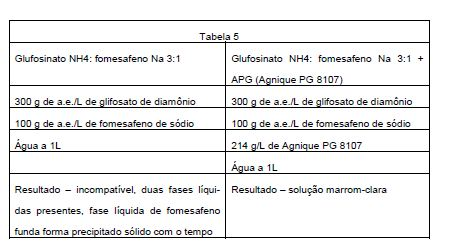
As composições contendo sais de Dicamba-IPA e Glifosato-IPAforam preparadas com e sem alquilpoliglicosídeos (APG's). A preparação de amostra n° 4 é descrita abaixo. A preparação de todas as amostras na Tabela 6 seguiu uma metodologia similar.Compositions containing salts of Dicamba-IPA and Glyphosate-IPA were prepared with and without alkyl polyglycosides (APG's). Sample preparation No. 4 is described below. The preparation of all samples in Table 6 followed a similar methodology.
Água (18,20g, água de torneira) foi adicionada a um vaso sob agitação seguida por adição de uma solução aquosa de IPA-glifosato (34,78g, 46%ae) e uma solução aquosa de IPA-Dicamba (34,92 g, 22,9% ae). A solução resultante foi agitada até se tornar homogênea e foi seguida por adição de propileno glicol (PG) (5,71 g), antiespuma (Agnique DFM114S, 0,114 g), alquilpoliglicosídeo Agnique PG8107 (APG) (6,86g) e final-mente Toximul TA20 (13,71 g). A solução final foi agitada até uma solução homogênea transparente ser obtida.Water (18.20g, tap water) was added to a vessel under stirring followed by the addition of an aqueous solution of IPA-glyphosate (34.78g, 46% ae) and an aqueous solution of IPA-Dicamba (34.92 g , 22.9% ae). The resulting solution was stirred until it became homogeneous and was followed by the addition of propylene glycol (PG) (5.71 g), antifoam (Agnique DFM114S, 0.114 g), alkyl polyglycoside Agnique PG8107 (APG) (6.86 g) and final- Toximul TA20 (13.71 g). The final solution was stirred until a clear, homogeneous solution was obtained.
O ponto de turvação desta amostra foi em seguida medida sub-mergindo-se parcialmente o jarro de vidro contendo a amostra em um recipi-ente de água que foi em seguida submetido a aquecimento controlado (~1°C/minuto) usando uma placa quente (Fisher Scientific Isotemp). Um agi-tador magnético foi usado para agitar a amostra durante o processo de aquecimento e um termômetro colocado em contato com a amostra mediu a temperatura de amostra. A temperatura em que a amostra tornou-se turva foi em seguida registrada como o ponto de turvação. Tipicamente uma faixa de temperatura melhor descreveu o aparecimento de turvação.

Estes exemplos claramente ilustram que a adição de alquilpoli- glicosídeo permite geralmente que os pontos de turvação sejam obtidos até como a % total de aumentos de carga de ingrediente ativo. A separação de fase nestes exemplos significa que duas camadas líquidas separadas foram claramente visíveis (uma em cima da outra) quando o produto foi deixado agitar a 25°C sem agitação durante >24 horas.These examples clearly illustrate that the addition of alkyl polyglycosides generally allows cloud points to be obtained up to the total% of active ingredient charge increases. The phase separation in these examples means that two separate liquid layers were clearly visible (one on top of the other) when the product was allowed to stir at 25 ° C without stirring for> 24 hours.
Embora apenas algumas modalidades exemplares desta inven-ção tenham sido descritas em detalhe acima, aqueles versados na técnica facilmente apreciarão que muitas modificações são possíveis nas modalida-des exemplares sem materialmente afastamento das novas instruções e vantagens desta invenção. Consequentemente, todas as tais modificações são destinadas a serem incluídas dentro do escopo desta invenção como definido nas reivindicações seguinte.Although only a few exemplary modalities of this invention have been described in detail above, those skilled in the art will easily appreciate that many modifications are possible in the exemplary modalities without materially departing from the new instructions and advantages of this invention. Consequently, all such modifications are intended to be included within the scope of this invention as defined in the following claims.
Várias características e vantagens foram apresentadas na des-crição anterior, junto com detalhes de estrutura e função. Os novos aspectos são salientados nas reivindicações anexadas. A descrição, entretanto, é ilustrativa apenas, e as permutas podem ser feitas em detalhe, especialmente em questão de forma, tamanho, e disposição de partes, dentro do princípio da invenção, em toda a extensão indicada pelo significado geral amplo dos termos em que as reivindicações gerais são expressas.Several features and advantages were presented in the previous description, along with details of structure and function. The new aspects are highlighted in the attached claims. The description, however, is illustrative only, and the exchanges can be made in detail, especially in terms of shape, size, and arrangement of parts, within the principle of the invention, to the full extent indicated by the broad general meaning of the terms in which general claims are expressed.
Apesar das faixas numéricas e parâmetros apresentando o am-plo escopo da invenção serem aproximações, os valores numéricos apre-sentados nos exemplos específicos são relatados tão precisamente quanto possível. Qualquer valor numérico, entretanto, inerentemente contém certos erros que necessariamente resultam do desvio padrão encontrado em suas respectivas medições de teste. Os requerentes tipicamente são responsáveis por tal variação usando-se o termo "cerca" para modificar um número ou faixa particular. Além disso, todas as faixas descritas aqui devem ser entendidas abranger qualquer e todas as subfaixas incluídas aqui, e cada número entre os pontos finais. Por exemplo, uma faixa estabelecida de "1 a 10 g/L" ou pode ser considerada incluir qualquer e todas as subfaixas entre (e inclusive de) o valor de mínimo de 1 g/L e o valor máximo de 10 g/L; isto é, todas as subfaixas começando com um valor mínimo de 1 g/L ou mais, por exemplo, 1 g/L a 6,1 g/L, e terminando com um valor máximo de 10 g/L ou menos, por exemplo, 5,5 g/L a 10 g/L, bem como todas as faixas começando e terminando dentro dos pontos finais, por exemplo, 2 a 9 g/L, 3 a 85 g/L, 3 a 9 g/L, 4 a 7 g/L, e finalmente a cada número 1 g/L, 2 g/L, 3 g/L, 4 g/L, 5 g/L, 6 g/L, 7 g/L, 8 g/L, 9 g/L e 10 g/L contido dentro da faixa.Although the numerical ranges and parameters presenting the broad scope of the invention are approximations, the numerical values presented in the specific examples are reported as precisely as possible. Any numerical value, however, inherently contains certain errors that necessarily result from the standard deviation found in their respective test measurements. Applicants are typically responsible for such variation using the term "fence" to modify a particular number or range. In addition, all of the ranges described here must be understood to encompass any and all of the sub-ranges included here, and each number between the end points. For example, an established range of "1 to 10 g / L" or can be considered to include any and all sub-ranges between (and including) the minimum value of 1 g / L and the maximum value of 10 g / L; that is, all sub-bands starting with a minimum value of 1 g / L or more, for example, 1 g / L to 6.1 g / L, and ending with a maximum value of 10 g / L or less, for example , 5.5 g / L to 10 g / L, as well as all ranges starting and ending within the end points, for example, 2 to 9 g / L, 3 to 85 g / L, 3 to 9 g / L, 4 to 7 g / L, and finally to each number 1 g / L, 2 g / L, 3 g / L, 4 g / L, 5 g / L, 6 g / L, 7 g / L, 8 g / L, 9 g / L and 10 g / L contained within the range.
É também observado que, como usadas neste relatório descrito- vo, as formas singulares "um(a)" e "o, a" incluem referentes plurais a menos que expressamente e inequivocadamente limitadas a um referente.It is also noted that, as used in this report, the singular forms "one (a)" and "o, a" include plural referents unless expressly and unequivocally limited to one referent.
Além disso, as limitações das várias modalidades da invençãonão são destinadas a serem mutuamente exclusivas, e são consideradas intercambiáveis a menos que de outro modo observado.In addition, the limitations of the various embodiments of the invention are not intended to be mutually exclusive, and are considered interchangeable unless otherwise noted.
Claims (18)
Applications Claiming Priority (3)
| Application Number | Priority Date | Filing Date | Title |
|---|---|---|---|
| US15810009P | 2009-03-06 | 2009-03-06 | |
| US61/158,100 | 2009-03-06 | ||
| PCT/US2010/026202 WO2010102102A1 (en) | 2009-03-06 | 2010-03-04 | Compatibilized electrolyte formulations |
Publications (3)
| Publication Number | Publication Date |
|---|---|
| BRPI1016228A2 BRPI1016228A2 (en) | 2016-04-26 |
| BRPI1016228A8 BRPI1016228A8 (en) | 2020-11-17 |
| BRPI1016228B1 true BRPI1016228B1 (en) | 2021-02-09 |
Family
ID=42710002
Family Applications (1)
| Application Number | Title | Priority Date | Filing Date |
|---|---|---|---|
| BRPI1016228-3A BRPI1016228B1 (en) | 2009-03-06 | 2010-03-04 | compatibilized aqueous pesticide formulation, method of inhibiting at least one pest in a harvest area and method of forming said aqueous formulation |
Country Status (14)
| Country | Link |
|---|---|
| US (1) | US9743668B2 (en) |
| EP (1) | EP2403535A4 (en) |
| JP (1) | JP2012519699A (en) |
| KR (1) | KR20140014349A (en) |
| CN (1) | CN102770160B (en) |
| AR (1) | AR076091A1 (en) |
| AU (1) | AU2010221301B2 (en) |
| BR (1) | BRPI1016228B1 (en) |
| CA (1) | CA2754770C (en) |
| MX (1) | MX2011009317A (en) |
| PY (1) | PY1007884A (en) |
| RU (1) | RU2550656C2 (en) |
| UA (1) | UA107658C2 (en) |
| WO (1) | WO2010102102A1 (en) |
Families Citing this family (23)
| Publication number | Priority date | Publication date | Assignee | Title |
|---|---|---|---|---|
| PL1722634T3 (en) | 2004-03-10 | 2011-12-30 | Monsanto Technology Llc | Herbicidal compositions containing n-phosphonomethyl glycine and an auxin herbicide |
| DK2337452T3 (en) | 2008-07-03 | 2014-12-15 | Monsanto Technology Llc | COMBINATION OF derivatized SACCHARIDSURFAKTANTER AND ETHERAMINOXIDSURFAKTANTER AS HERBICIDADJUVANTER |
| BRPI1016156B8 (en) | 2009-04-22 | 2022-06-28 | Dow Agrosciences Llc | COMPOSITIONS OF GLYPHOSATE AND SALTS OF 2,4-D WITH HIGH HERBICIDAL POWER, AND METHOD FOR CONTROL OF UNDESIRABLE VEGETATION IN PLANTATIONS |
| ES2670370T3 (en) | 2009-06-25 | 2018-05-30 | Dow Agrosciences Llc | Compositions of concentrated herbicide product containing glyphosate and dicamba salts |
| US20120142532A1 (en) | 2009-08-10 | 2012-06-07 | Monsanto Technology Llc | Low volatility auxin herbicide formulations |
| AU2012328638B2 (en) | 2011-10-26 | 2016-11-17 | Monsanto Technology Llc | Salts of carboxylic acid herbicides |
| DE102012002272A1 (en) | 2012-02-04 | 2013-08-08 | Clariant International Ltd. | Pesticidal compositions |
| UY34845A (en) | 2012-06-04 | 2014-01-31 | Monsanto Technology Llc | ? WATER CONCENTRATED HERBICIDE COMPOSITIONS CONTAINING GLIFOSATE SALTS AND DICAMBA SALTS |
| ES2787352T3 (en) * | 2012-09-04 | 2020-10-15 | Dow Agrosciences Llc | Compositions and methods to improve the compatibility of salts of water-soluble herbicides |
| RU2629254C2 (en) * | 2012-09-04 | 2017-08-28 | ДАУ АГРОСАЙЕНСИЗ ЭлЭлСи | Compositions and methods to improve compatibility of soluble harbicides soluble in water |
| MX355884B (en) | 2012-11-05 | 2018-05-02 | Monsanto Technology Llc | Auxin herbicidal mixtures. |
| US10412964B2 (en) | 2012-12-14 | 2019-09-17 | Dow Agrosciences Llc | Synergistic weed control from applications of aminopyralid and clopyralid |
| AU2013360195B2 (en) | 2012-12-14 | 2017-05-04 | Corteva Agriscience Llc | Synergistic weed control from applications of aminopyralid and clopyralid |
| US9603363B2 (en) | 2012-12-21 | 2017-03-28 | Dow Agrosciences Llc | Weed control from applications of aminopyralid, triclopyr, and an organosilicone surfactant |
| CA3123572A1 (en) | 2013-02-27 | 2014-09-04 | Monsanto Technology Llc | Glyphosate composition for dicamba tank mixtures with improved volatility |
| CN104621115B (en) * | 2013-11-15 | 2016-05-04 | 南京华洲药业有限公司 | The mixed herbicide of a kind of chloride Fampridine acid and n-nonanoic acid |
| CN108135160A (en) * | 2015-07-21 | 2018-06-08 | 瑟拉迪斯有限公司 | Stable agriculturally useful compositions |
| US12052993B2 (en) * | 2018-05-25 | 2024-08-06 | Upl Ltd | Aqueous herbicidal intermixtures |
| US10506811B1 (en) | 2018-11-21 | 2019-12-17 | Pur Products LLC | Anti-microbial solution for seeds, crops, livestock and processed foods |
| BR112022014955A2 (en) | 2020-01-31 | 2022-09-20 | Basf Se | HERBICIDE COMBINATION, COMPOSITION, METHODS TO PRODUCE A HERBICIDE COMBINATION, TO CONTROL UNDESIRABLE PLANTS GROWTH AND/OR CONTROL HARMFUL PLANTS, TO TREAT OR PROTECT IN-LINE CROPS AND TO TREAT OR PROTECT SPECIAL CROPS AND HERBICIDE COMBINATION USE |
| BR112022019528A2 (en) * | 2020-03-31 | 2022-11-16 | Basf Corp | AGROCHEMICAL AQUEOUS FORMULATIONS, PROCESS FOR MAKING FORMULATIONS, USE OF FORMULATIONS AND METHOD FOR CONTROLLING UNDESIRED VEGETATION |
| CN111636078B (en) * | 2020-07-24 | 2023-11-10 | 宁波革创新材料科技有限公司 | Method for electroplating porous aluminum in water |
| AU2023360053A1 (en) * | 2022-10-12 | 2025-05-29 | Nontox Pty Ltd | Herbicide composition |
Family Cites Families (21)
| Publication number | Priority date | Publication date | Assignee | Title |
|---|---|---|---|---|
| US2003A (en) * | 1841-03-12 | Improvement in horizontal windivhlls | ||
| EP0498145B1 (en) * | 1991-02-08 | 1995-11-15 | Monsanto Europe S.A./N.V. | Solid glyphosate compositions and their use |
| US5565409A (en) | 1993-04-02 | 1996-10-15 | Monsanto Company | Liquid concentrated herbicidal microemulsion compositions comprising glyphosate and either oxyfluorfen or acifluorfen |
| US5356861A (en) * | 1993-11-19 | 1994-10-18 | Cenex/Land O'lakes Agronomy Company | Homogenous herbicidal adjuvant blend comprising glyphosate, ammonium sulfate, and alkyl polysaccharide |
| GB9412722D0 (en) | 1994-06-24 | 1994-08-17 | Zeneca Ltd | Herbicidal composition |
| EP0929222B1 (en) * | 1996-10-07 | 2002-05-15 | Syngenta Limited | Glyphosate formulations |
| WO1998033385A1 (en) * | 1997-01-31 | 1998-08-06 | Monsanto Company | Process and compositions for enhancing reliability of exogenous chemical substances applied to plants |
| GB9718139D0 (en) | 1997-08-27 | 1997-10-29 | Zeneca Ltd | Agrochemical Formulation |
| US6383984B1 (en) * | 1999-01-29 | 2002-05-07 | Basf Aktiengesellschaft | Aqueous suspension concentrate |
| GB9904012D0 (en) * | 1999-02-22 | 1999-04-14 | Zeneca Ltd | Agrochemical formulation |
| GB9917976D0 (en) * | 1999-07-31 | 1999-09-29 | Albright & Wilson Uk Ltd | Herbicidal compositions |
| GT200100090A (en) * | 2000-05-19 | 2002-01-18 | POTASSIUM GLYPHOSATE FORMULA | |
| MY158895A (en) * | 2000-05-19 | 2016-11-30 | Monsanto Technology Llc | Potassium glyphosate formulations |
| US20030096708A1 (en) * | 2001-03-02 | 2003-05-22 | Monsanto Technology Llc | Pesticide concentrates containing etheramine surfactants |
| US6746988B2 (en) * | 2001-09-07 | 2004-06-08 | Syngenta Crop Protection, Inc. | Surfactant systems for agriculturally active compounds |
| AUPS219502A0 (en) | 2002-05-07 | 2002-06-06 | DMRJ Consultants | Organic compostions |
| WO2004019684A2 (en) * | 2002-08-31 | 2004-03-11 | Monsanto Technology Llc | Process for the preparation of a dry pesticidal composition containing a dicarbodylate component |
| EP2292095A2 (en) * | 2002-08-31 | 2011-03-09 | Monsanto Technology LLC | Pesticide compositions containing a dicarboxylic acid or derivative thereof |
| WO2004021790A1 (en) | 2002-09-04 | 2004-03-18 | Basf Corporation | Diphenyl ether and n-(phosphonomethyl)glycine herbicidal compositions and methods of use |
| FR2867196A1 (en) * | 2004-02-10 | 2005-09-09 | Procter & Gamble | LIQUID DETERGENT COMPOSITION FOR USE WITH A FOAM GENERATING DISPENSER |
| DE602005011618D1 (en) * | 2004-07-15 | 2009-01-22 | Akzo Nobel Nv | PHOSPHATED ALKANOL, ITS USE AS HYDROTROP AND CLEANING COMPOSITION WITH THE COMPOUND |
-
2010
- 2010-03-04 BR BRPI1016228-3A patent/BRPI1016228B1/en active IP Right Grant
- 2010-03-04 CA CA2754770A patent/CA2754770C/en active Active
- 2010-03-04 JP JP2011553106A patent/JP2012519699A/en active Pending
- 2010-03-04 US US13/254,329 patent/US9743668B2/en active Active
- 2010-03-04 EP EP10749323A patent/EP2403535A4/en not_active Withdrawn
- 2010-03-04 AU AU2010221301A patent/AU2010221301B2/en active Active
- 2010-03-04 KR KR1020117023533A patent/KR20140014349A/en not_active Withdrawn
- 2010-03-04 RU RU2011140402/13A patent/RU2550656C2/en active
- 2010-03-04 WO PCT/US2010/026202 patent/WO2010102102A1/en not_active Ceased
- 2010-03-04 CN CN201080016389.9A patent/CN102770160B/en active Active
- 2010-03-04 MX MX2011009317A patent/MX2011009317A/en active IP Right Grant
- 2010-03-05 AR ARP100100679A patent/AR076091A1/en active IP Right Grant
- 2010-03-05 PY PY201001007884A patent/PY1007884A/en unknown
- 2010-04-03 UA UAA201111472A patent/UA107658C2/en unknown
Also Published As
| Publication number | Publication date |
|---|---|
| CA2754770C (en) | 2017-11-28 |
| CA2754770A1 (en) | 2010-09-10 |
| AU2010221301B2 (en) | 2015-03-19 |
| MX2011009317A (en) | 2012-02-23 |
| WO2010102102A1 (en) | 2010-09-10 |
| US20120115816A1 (en) | 2012-05-10 |
| AU2010221301A1 (en) | 2011-09-22 |
| UA107658C2 (en) | 2015-02-10 |
| EP2403535A4 (en) | 2012-10-10 |
| RU2011140402A (en) | 2013-04-20 |
| PY1007884A (en) | 2015-05-01 |
| EP2403535A1 (en) | 2012-01-11 |
| CN102770160B (en) | 2016-02-10 |
| CN102770160A (en) | 2012-11-07 |
| RU2550656C2 (en) | 2015-05-10 |
| JP2012519699A (en) | 2012-08-30 |
| AR076091A1 (en) | 2011-05-18 |
| BRPI1016228A2 (en) | 2016-04-26 |
| KR20140014349A (en) | 2014-02-06 |
| BRPI1016228A8 (en) | 2020-11-17 |
| US9743668B2 (en) | 2017-08-29 |
Similar Documents
| Publication | Publication Date | Title |
|---|---|---|
| BRPI1016228B1 (en) | compatibilized aqueous pesticide formulation, method of inhibiting at least one pest in a harvest area and method of forming said aqueous formulation | |
| US11864558B2 (en) | Herbicidal compositions containing N-phosphonomethyl glycine and an auxin herbicide | |
| CA2322522C (en) | Herbicidal suspoemulsion concentrate | |
| EP0734207B1 (en) | Aqueous concentrate formulations having reduced eye irritancy | |
| RU2297143C2 (en) | Aqueous herbicide composition (versions) and herbicide method (versions) | |
| CN103561574B (en) | The New Application of Choline Chloride in Agrochemical Preparations | |
| HU226964B1 (en) | Liquid, concentrate microemulsion composition containing a graminicide and a water-soluble herbicide as active ingredient and its use | |
| AU2002259275A1 (en) | Stable liquid pesticide compositions | |
| EP1395116A2 (en) | Stable liquid pesticide compositions | |
| US9072305B2 (en) | Herbicidal formulations | |
| US11666054B2 (en) | High-load glyphosate herbicidal composition, ready-to-use formulation obtained from the composition and method to control various weed species in agricultural crops |
Legal Events
| Date | Code | Title | Description |
|---|---|---|---|
| B06F | Objections, documents and/or translations needed after an examination request according [chapter 6.6 patent gazette] | ||
| B07D | Technical examination (opinion) related to article 229 of industrial property law [chapter 7.4 patent gazette] |
Free format text: DE ACORDO COM O ARTIGO 229-C DA LEI NO 10196/2001, QUE MODIFICOU A LEI NO 9279/96, A CONCESSAO DA PATENTE ESTA CONDICIONADA A ANUENCIA PREVIA DA ANVISA. CONSIDERANDO A APROVACAO DOS TERMOS DO PARECER NO 337/PGF/EA/2010, BEM COMO A PORTARIA INTERMINISTERIAL NO 1065 DE 24/05/2012, ENCAMINHA-SE O PRESENTE PEDIDO PARA AS PROVIDENCIAS CABIVEIS. |
|
| B07G | Grant request does not fulfill article 229-c lpi (prior consent of anvisa) [chapter 7.7 patent gazette] | ||
| B06U | Preliminary requirement: requests with searches performed by other patent offices: procedure suspended [chapter 6.21 patent gazette] | ||
| B09A | Decision: intention to grant [chapter 9.1 patent gazette] | ||
| B16A | Patent or certificate of addition of invention granted [chapter 16.1 patent gazette] |
Free format text: PRAZO DE VALIDADE: 10 (DEZ) ANOS CONTADOS A PARTIR DE 09/02/2021, OBSERVADAS AS CONDICOES LEGAIS. |
|
| B25G | Requested change of headquarter approved |
Owner name: SYNGENTA LIMITED (GB) ; SYNGENTA PARTICIPATIONS AG (CH) |
|
| B25A | Requested transfer of rights approved |
Owner name: SYNGENTA LIMITED (GB) ; SYNGENTA CROP PROTECTION AG (CH) |