CN100361973C - Benzyloxy-substituted tryptophan derivative, preparation method and application - Google Patents
Benzyloxy-substituted tryptophan derivative, preparation method and application Download PDFInfo
- Publication number
- CN100361973C CN100361973C CNB2006100244105A CN200610024410A CN100361973C CN 100361973 C CN100361973 C CN 100361973C CN B2006100244105 A CNB2006100244105 A CN B2006100244105A CN 200610024410 A CN200610024410 A CN 200610024410A CN 100361973 C CN100361973 C CN 100361973C
- Authority
- CN
- China
- Prior art keywords
- benzyloxy
- indole
- compound
- tryptophan derivative
- replaces
- Prior art date
- Legal status (The legal status is an assumption and is not a legal conclusion. Google has not performed a legal analysis and makes no representation as to the accuracy of the status listed.)
- Expired - Fee Related
Links
Landscapes
- Indole Compounds (AREA)
- Pharmaceuticals Containing Other Organic And Inorganic Compounds (AREA)
Abstract
The present invention relates to a tryptophan derivant substituted by benzyloxy with a general formula (I) structure and analogs thereof, a preparation method and the applications of the protein binding activity of PPAR gamma, which belongs to the pharmaceutical synthesis field. The result obtained from the protein binding model experiment of the PPAR gamma in pharmacodynamics indicates that the tryptophan derivant has excellent binding activity; therefore, the compound can be developed into a novel PPAR gamma excitant used as a therapeutic drug for non-insulin dependent diabetes, etc., wherein Ar is phenyl, R<1> is benzoyl or benzoyl substituted by chlorine or phenylacetyl or propionyl, and R<2> is hydrogen or carboxyl.
Description
Technical field
The invention belongs to the synthetic field of medicine, be specifically related to a kind of 6 tryptophan derivative and analogues thereof that have benzyloxy to replace, preparation method and in pharmaceutically application.
Background technology
Along with living standards of the people raising, life pattern modernization and aging population, diabetes have become the main killer of human health.The sickness rate of diabetes is increasing year by year, nineteen ninety-five, the whole world made a definite diagnosis diabetic subject about 1.35 hundred million, about 1.51 hundred million grownups in 2000 suffer from diabetes (accounting for the whole world adult 5%), predicts that world's trouble diabetes in 2010 are about 2.39 hundred million, will reach 300,000,000 to diabetic subject in 2025.China's diabetes prevalence increases very fast, estimates that present diabetic subject's sum surpasses 3,000 ten thousand people, ranks the second in the world, and with millesimal speed increase in every year, will reach present 4 times to Chinese diabetic subject in 2010.And this wherein is non insulin dependent diabetes more than 95%, i.e. type ii diabetes.Threaten type ii diabetes patient life and the factor that influences its life quality to transfer chronic complicating diseases to by its acute complications, the multiple diabetic vascular complications that produces on capillary blood vessel and macroangiopathy basis becomes the deadly major cause of morbidity of diabetic subject, and its mortality ratio has risen to the 3rd after tumour, cardiovascular disorder.Therefore, prevent and treat diabetes especially type ii diabetes be an extremely urgent hot job.
Mainly be to adopt pharmacotherapy to the treatment of type ii diabetes clinically at present.Main medicine is divided into five big class, i.e. sulfonylurea, non-sulfonylurea, biguanides, alpha-glucosidase inhibitor and thiazolidinedioneses.Sulfonylureas such as tolbutamide, Glyburide etc. are widely used always, but only have patient's blood sugar of 60%~70% to be controlled preferably, and continue the hyperglycemia level and serious born of the same parents' pancreas patient can not produce a desired effect.Non-sulfonylurea medicine such as repaglinide, Nateglinide etc. are mainly at the liver intracellular metabolite, and are through bile excretion, therefore bigger to the side effect of liver and gall-bladder.Biguanides such as N1,N1-Dimethylbiguanide can improve insulin sensitivity and lower hyperinsulinemia, thereby should be as a line antidiabetic medicine for the diabetic subject of obesity.Because N1,N1-Dimethylbiguanide is discharged from urine with prototype, so can cause kidney function damage, hepatic insufficiency person is forbidden in addition.Alpha-glucosidase inhibitor can postpone and reduce the consumption of carbohydrate and the absorption of glucose, thereby reaches the purpose of controlling blood sugar, represents medicine that acarbose, voglibose etc. are arranged, and this type of medicine has the untoward reaction of gastrointestinal discomfort mostly.
The thiazolidinediones medicine (thiazolidinediones, TZDs) be newly develop in recent years up-and-coming euglycemic agent, it is reported that it can strengthen the susceptibility of tissue to Regular Insulin, improve the utilization of cell to glucose; Improve the insulin resistant state, it is unusual to correct sugar and metabolism of fat; The glycolated hemoglobin level also there is the reduction effect.Represent medicine that troglitazone (troglitazone), rosiglitazone (rosiglitazone) and the pioglitazone (pioglitazone) of following structure are arranged.

Along with to peroxisome proliferation activated receptor γ (peroxisome proliferator-activatedreceptor, PPAR γ) research gos deep into, up to the mid-90 in last century, find that just the thiazolidinediones medicine troglitazone, rosiglitazone and the pioglitazone that are used for the treatment of diabetes B that have gone on the market are the agonists of PPAR γ.Peroxisome proliferation activated receptor γ (PPAR γ) be a class by part activated nuclear factor, be a kind of hypotype of peroxisome proliferation activated receptor PPAR.After being activated, can play good regulating and controlling effect to storage, transhipment and the katabolism of fat by regulation and control to genetic expression by specific small molecules.Dark one the step discover that the PPAR γ that is activated can also increase the insulin sensitivity of peripheral tissues, thereby improve insulin resistant, lowering blood glucose concentration.
Known synthetic PPAR gamma agonist structurally can be divided into three parts at present: plane aromatic ring, polar head and hydrophobic tail.Researched and developed at present the PPAR gamma agonist of number of different types, as alpha-substitution phenylpropionic acid, L-tyrosine class and 1,3-omega-dicarboxylic acids compound.The following BRL48482 of representative compounds, SB213068, compound a etc.

Ge Lansu company discovers that in 1996 the NSAID (non-steroidal anti-inflammatory drug) indomethacin can and produce agonist activity with PPAR γ combination, 10
-4Under the mol/L concentration, can induce PPAR γ to produce 40 times activity; 10
-5Under the concentration, the EC of its agonist activity
50Value approximately reaches 4 * 10
-5Mol/L is close with the PPAR gamma agonist rosiglitazone that has gone on the market; Indomethacin and rosiglitazone suppress in the experiment in the competition of PPAR γ protein receptor in addition, IC
50Value reaches 1 * 10
-4Mol/L.The experimental data explanation is that female indomethacin that encircles is an effectively PPAR gamma agonist with the indoles.

1999, scholars such as Henke found a compound (b) again on the basis of indomethacin, and PPAR γ is also had good agonist activity.In combine experiment with PPAR γ receptor protein, its pKi value is 7.32 ± 0.07, and the positive control rosiglitazone is 7.33 ± 0.02; Its pEC50 value is 7.36 ± 0.21, and rosiglitazone is 7.05 ± 0.07.These data declarations, same is that middle female compound that encircles also is a PPAR gamma agonist that activity is very strong with the indoles.In addition, some derivatives of this compound have also shown PPAR gamma activity agonist activity preferably.
Summary of the invention:
The purpose of this invention is to provide and have good PPAR γ, be specifically related to a kind of 6 tryptophan derivative and analogues thereof that have benzyloxy to replace in conjunction with active benzyloxy-substituted tryptophan derivative and analogue thereof.
Another object of the present invention provides above-mentioned the have tryptophan derivative of benzyloxy replacement and the preparation method of analogue thereof.
The The compounds of this invention tryptophan derivative has the structure of following general formula (I):

Wherein
The Ar=phenyl;
R
1=benzoyl or chlorine substituted benzoyl or phenylacetyl or propionyl;
R
2=hydrogen or carboxyl;
The preliminary pharmacodynamic study of novel cpd of the present invention by testing with PPAR γ protein binding, has shown good activity, can develop to having the novel anti type ii diabetes medicine of PPAR γ agonist activity.
Preferred compound of the present invention has the structure of following compound 1,2,3,4,5 or 6:

The tryptophan derivative that benzyloxy of the present invention replaces adopts benzyloxy phenyl aldehyde and α-ethyl triazoacetate to obtain the 6-benzyloxy indole through condensation, cyclization, hydrolysis, decarboxylation, obtains with the condensation of acyl substituted diethyl malonate, hydrolysis, decarboxylation after aminomethylation again.Reaction formula is:

R
1As defined above.
The compounds of this invention 1 or 2 preparation process are as follows:

Compound 1 or 2 preparation technology comprise: 6-benzyloxy indole and formaldehyde, dimethylamine obtain compound 1 through aminomethylation reaction back and the condensation of p-chlorobenzamido diethyl malonate, sodium hydroxide hydrolysis, add thermal decarboxylation at last and obtain compound 2.
The compounds of this invention 3 or 4 preparation process are as follows:

Compound 3 or 4 preparation technologies comprise: 6-benzyloxy indole and formaldehyde, dimethylamine obtain compound 3 with the condensation of benzamido diethyl malonate, sodium hydroxide hydrolysis after the aminomethylation reaction, add thermal decarboxylation at last and obtain compound 4.
The preparation process of The compounds of this invention 5 is as follows:

Compound is 5 preparation technologies comprise: 6-benzyloxy indole and formaldehyde, dimethylamine through aminomethylation reaction back and the condensation of propionamido diethyl malonate, sodium hydroxide hydrolysis, add thermal decarboxylation and obtain compound 5.
The preparation process of The compounds of this invention 6 is as follows:

Compound is 6 preparation technologies comprise: 6-benzyloxy indole and formaldehyde, dimethylamine through aminomethylation reaction back and the condensation of phenylacetylamino diethyl malonate, sodium hydroxide hydrolysis, add thermal decarboxylation and obtain compound 6.
The The compounds of this invention tryptophan derivative can activate PPAR γ, and then produces pharmacological action, as increasing the insulin sensitivity of peripheral tissues; Improve insulin resistant; Lowering blood glucose concentration; Improve and reduce inflammatory reaction; Prevent atherosclerosis etc.
The The compounds of this invention tryptophan derivative is by preliminary pharmacodynamic study (experiment of PPAR γ protein binding), and the result shows that this compounds has certain PPAR γ protein binding activity.Wherein compound 1 is 8.69 * 10 in conjunction with the Kd value
-6Mol/L; Compound 2 be 6.86 * 10 in conjunction with the Kd value
-6The positive control rosiglitazone is 4.98 * 10 in conjunction with the Kd value
-6Mol/L.Experimental result illustrates that designed compound can further develop novel anti type ii diabetes medicine.
Embodiment:
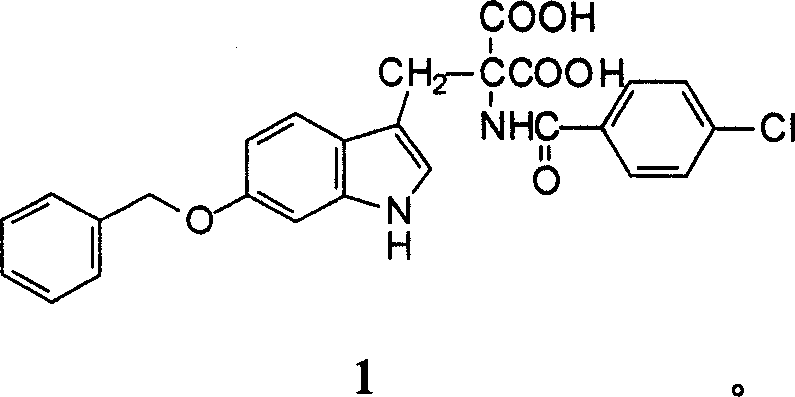
Embodiment 1: synthetic compound 1,2-p-chlorobenzamido-2-[(6-benzyloxy indole-3)-methyl]-propanedioic acid
1) Synthetic 2-azido--3-(4-benzyloxy phenyl) ethyl propenoate
The 2000ml three-necked round bottom flask connects prolong, drying tube, adds dehydrated alcohol 400ml, takes by weighing sodium Metal 99.5 15.6g, makes sodium ethylate, is cooled to below-8 ℃.4-benzyloxy phenyl aldehyde 48.2g (0.227mol) and α-ethyl triazoacetate 88.0g (0.682mol) are dissolved in the 350ml ethanol.Slowly be added dropwise to flask under nitrogen protection, temperature is controlled at below-5 ℃ all the time.Dropwise, continue-5 ℃ of reaction 1h under nitrogen protection.Back TLC check (developping agent: chloroform: methyl alcohol=10: 1), show that reaction finishes.After with in a large amount of frozen water of reaction solution impouring, stir, have a large amount of faint yellow solids to separate out, suction filtration, with frozen water washing solid to neutral.Final vacuum black out drying gets m.p.96-98 ℃ of product faint yellow solid 66.1g (85.0%).
1H-NMR(CDCl
3)δ:1.39(t,3H,-CH
2-C
H 3,J=7.15),4.35(q,2H,-C
H 2-CH
3,J=7.15),5.10(s,2H,Ar-C
H 2-O-),6.88(s,1H),6.96~7.00(m,2H,phenyl-H),7.32~7.45(m,5H,phenyl-H),7.78~7.82(m,2H,phenyl-H)。
2) Synthetic 2-ethoxycarbonyl-6-benzyloxy indole
In the 1000ml three-necked round bottom flask, add dimethylbenzene 300ml, be heated to backflow.2-azido--3-(4-benzyloxy phenyl) ethyl propenoate 30.2g (0.099mol) is dissolved in the 300ml dimethylbenzene, under the state that nitrogen protection refluxes, dropwise slowly joins in the flask.Dropwise the back and continue under nitrogen protection, to reflux 1.5h, back TLC check (developping agent: chloroform), show that reaction finishes.Naturally cooling to the room temperature placement spends the night.There are a large amount of crystal to separate out suction filtration.The filtrate water pump is evaporated to small volume, has crystal to separate out after being cooled to room temperature, and suction filtration is with a small amount of dimethylbenzene washing.Twice crystal in back merges, and vacuum-drying gets m.p.132-134 ℃ of product white crystal 23.4g (80.1%) (document m.p.135 ℃).
1H-NMR(CDCl
3)δ:1.40(t,3H,-CH
2-C
H 3,J=7.24),4.38(q,2H,-C
H 2-CH
3,J=7.24),5.11(s,2H,Ar-C
H 2-O-),6.89~6.92(m,2H,indole-3,7-H),7.16(dd,1H,J=0.58,1.95,indole-5-H),7.32~7.48(m,5H,phenyl-H),7.56(dd,1H,J=0.58,9.98,indole-4-H),8.76(s,1H,indole-N
H)。
MS?m/e:295(M
+)91(100%)91,204,295,158,130,176,65,102。
3) synthetic 6-benzyloxy indole-2-formic acid
In the 500ml round-bottomed flask, add 2-ethoxycarbonyl-6-benzyloxy indole 3.9g (0.0132mol), 2mol/L sodium hydroxide solution 200ml, dehydrated alcohol 150ml, reflux 1h, TLC check (developping agent: chloroform: methyl alcohol: formic acid=10: 1: 0.1), show that reaction finishes.Ethanol is fallen in back underpressure distillation, is cooled to room temperature, has crystal to separate out.Suction filtration, crystal are drained after washing with an amount of chloroform, are transferred in the 250ml beaker.Add distilled water and each 80ml of ethyl acetate, the back that stirs slowly drips 10% hydrochloric acid, regulates pH to acid 2-3, leaves standstill the back separatory.An amount of new ethyl acetate extraction three times of separating ethyl acetate layer and water layer, water layer.Back combined ethyl acetate layer, to neutral, anhydrous magnesium sulfate drying spends the night with the saturated common salt water washing.Folding filters sal epsom, the ethyl acetate evaporated under reduced pressure, and the back gets m.p.199-201 ℃ of product white solid 3.2g (90.8%) (document m.p.203-205 ℃) with re-crystallizing in ethyl acetate.
1H-NMR(DMSO-d
6)δ:5.10(s,2H,Ar-C
H 2-O-),6.78(dd,1H,J=2.55,8.74,indole-5-H),6.93(d,1H,J=1.82,indole-3-H),6.99(d,1H,J=1.46,indole-7-H),7.29~7.46(m,5H,phenyl-H),7.50(d,1H,J=8.74,indole-4-H),11.55(s,1H,-COO
H),12.69(s,1H,indole-N
H)。
MS?m/e:267(M
+)91(100%)91,267,65,158,92,130,176,102。
4) synthetic 6-benzyloxy indole
In the 500ml round-bottomed flask, add 6-benzyloxy indole-2-formic acid 17.8g (0.066mol), copper powder 5.0g, quinoline 200ml, reflux 1.5h under nitrogen protection.TLC check (developping agent: chloroform), show that reaction finishes.Quinoline is fallen in underpressure distillation after being cooled to room temperature, and the cooling back adds the 200ml ethyl acetate, and the stirring and dissolving after-filtration falls insoluble copper powder.The back is washed to neutrality with saturated common salt again with an amount of 10% salt acid elution, with an amount of saturated sodium bicarbonate solution washing, is washed to neutrality with saturated common salt more then, spends the night with an amount of anhydrous magnesium sulfate drying.Folding filters sal epsom, and evaporated under reduced pressure gets brown solid.(eluent: chloroform) purifying gets m.p.112-114 ℃ of product white solid 12.1g (82.2%) (document m.p.111-112 ℃) with silica gel column chromatography in the back.
1H-NMR(CDCl
3)δ:5.12(s,2H,Ar-C
H 2-O-),6.49(brs,1H,indole-2-H),6.89(dd,1H,J=2.20,8.52,indole-5-H),6.95(d,1H,J=1.92,indole-7-H),7.10(t,1H,J=3.30,2.47,indole-3-H),7.31~7.34(m,1H,phenyl-4-H),7.37~7.41(m,2H,phenyl-2,6-H),7.46~7.48(m,2H,phenyl-3,5-H),7.52(d,1H,J=8.52,indole-4-H),8.02(s,1H,indole-N
H)。
5) synthetic 3-dimethylamino methyl-6-benzyloxy indole
Add 33% dimethylamine agueous solution 6.5ml in the 500ml round-bottomed flask, below the postcooling to 5 ℃, slowly add Glacial acetic acid 20ml, the back adds formalin 3.4ml, and then adds tetrahydrofuran (THF) 120ml, stirs.After 6-benzyloxy indole 9.1g (0.0408mol) is dissolved in the 100ml tetrahydrofuran (THF), under condition of ice bath, slowly be added dropwise to flask.The back is under nitrogen protection, and (developping agent: chloroform), the demonstration reaction is basic to be finished in TLC check behind the room temperature reaction 2h.The back adds 5% aqueous sulfuric acid 200ml, and the after-filtration that stirs is collected filtrate.Filtrate is slowly regulated more than the pH to 12 with the aqueous sodium hydroxide solution of 2N then, has the cotton-shaped solid of a large amount of whites to separate out.Back suction filtration, solid with a large amount of distilled water washs after drying under reduced pressure, product white solid 10.8g (91.0%) m.p.177~178 ℃.
1H-NMR(DMSO-d
6)δ:2.12(s,6H,-N(C
H 3)
2),3.47(s,2H,-C
H 2-N-),5.10(s,2H,Ar-C
H 2-O-),6.71(dd,1H,indole-5-H,J=1.92,8.52),6.91(d,1H,indole-7-H,J=1.92),7.05(s,1H,indole-2-H),7.30~7.33(m,1H,phenyl-4-H),7.37~7.41(m,2H,phenyl-2,6-H),7.45~7.47(m,3H,phenyl-3,5-H,indole-4-H),10.69(s,1H,indole-N
H)。
6) Synthetic 2-p-chlorobenzamido-2-[(6-benzyloxy indole-3)-methyl]-diethyl malonate
Add 3-dimethylamino methyl-6-benzyloxy indole 1.77 grams (6.32mmol), p-chlorobenzamido diethyl malonate 2.18 grams (6.95mmol), sodium hydroxide 0.38 gram (9.48mmol), toluene 25mL in the 100mL flask, reflux 8 hours, suction filtration while hot after TLC check no longer changes, solid washs with the 10mL hot toluene, the combining methylbenzene phase, separate out white solid after 0 ℃ of cooling, behind the suction filtration filtrate evaporate to dryness is got crude product 2.2 grams, (eluent: ethyl acetate/petroleum ether=1/3) purifying gets product white solid 1 gram (30.4%) to silica gel column chromatography.
1H-NMR(CDCl
3)δ:1.26~1.32(t,6H,-CH
2-C
H 3),3.91(s,2H,indole-C
H 2-),4.18~4.32(m,4H,-C
H 2-CH
3),5.04(s,2H,phenyl-C
H 2-O),6.69~6.72(dd,1H,indole-5-H),6.77(s,1H,-N
H-CO-),6.87(d,1H,indole-7-H),7.27~7.44(m,9H,Ar-H),7.63~7.67(d,2H,Ar-H),7.98(s,1H,indole-N
H)。MS-ESI(-):549.6(M+1),571.6(M+Na,100)。
7) Synthetic 2-p-chlorobenzamido-2-[(6-benzyloxy indole-3)-methyl]-propanedioic acid
Add 2-p-chlorobenzamido-2-[(6-benzyloxy indole-3 in the 100mL flask)-methyl]-diethyl malonate 0.48 gram (0.875mmol), 10% aqueous sodium hydroxide solution 3mL, nitrogen protection 60-70 ℃ of heating 3 hours down, TLC shows that reaction finishes.Add behind a small amount of decolorizing with activated carbon suction filtration while hot, ice bath is regulated PH to 2 with 10% hydrochloric acid down after adding less water, separates out a large amount of white solids, suction filtration after 0 ℃ of cooling, solid washs with a small amount of frozen water, gets rice white solid chemical compound 1 0.36 grams (83.5%) after the vacuum-drying.
1H-NMR(DMSO-d
6)δ:3.62(s,2H,indole-C
H 2-),5.05(s,2H,phenyl-C
H 2-O),6.54~6.58(dd,1H,indole-5-H),6.78(d,1H,indole-7-H),6.84(d,1H,indole-4-H),7.20(d,1H,indole-2-H),7.27~7.32(t,1H,phenyl-H),7.34~7.38(t,2H,phenyl-H),7.40~7.44(d,2H,phenyl-H),7.49~7.55(d,2H,phenyl-H),7.69~7.74(d,3H,phenyl-H,-N
H-CO-),10.66(s,1H,indole-N
H),1?3.68(brs,2H,COO
H)。
Embodiment 2: synthetic compound 2 N-(4-chlorobenzene formacyl)-6-benzyloxy tryptophane
Add 2-p-chlorobenzamido-2-[(6-benzyloxy indole-3 in the 50mL flask)-methyl]-propanedioic acid 0.2 gram (0.406mmol), water 3mL, reflux is TLC demonstration reaction end after 2.5 hours.Adding a small amount of 10% sodium hydroxide solution makes solid molten entirely, add behind a small amount of decolorizing with activated carbon suction filtration while hot, the filtrate ice bath is regulated PH to 4-5 with 10% hydrochloric acid down, separate out a large amount of white solids, suction filtration after 0 ℃ of cooling, solid washs with a small amount of frozen water, rice white solid chemical compound 2 0.13 grams (71.5%) after the vacuum-drying.
1H-NMR(DMSO-d
6)δ:3.08~3.16(dd,1H,indole-C
H 2-),3.20~3.28(dd,1H,indole-C
H 2-),4.60(m,1H,-CH
2-C
H-),5.07(s,2H,phenyl-C
H 2-O),6.70~6.73(dd,1H,indole-5-H),6.88(d,1H,indole-7-H),7.03(d,1H,indole-2-H),7.28~7.32(m,1H,phenyl-H),7.34~7.39(m,2H,phenyl-H),7.42~7.46(m,3H,Ar-H),7.50~7.54(d,2H,phenyl-H),7.80~7.84(d,2H,phenyl-H),8.75(d,1H,-N
H-CO-),10.60(s,1H,indole-N
H),12.75(brs,1H,COO
H)。MS-ESI(-):448.4(M),447.4(M-1,100)。
Embodiment 3 synthetic compounds 3 2-benzamido-2-[(6-benzyloxy indole-3)-methyl]-propanedioic acid
1) Synthetic 2-benzamido-2-[(6-benzyloxy indole-3)-methyl]-add 3-dimethylamino methyl-6-benzyloxy indole 3 grams (0.0107mol) in the diethyl malonate 250mL flask, benzamido diethyl malonate 3.3 grams (0.0118mol), sodium hydroxide 0.66 gram (0.0165mol), toluene 45mL, reflux 8 hours, suction filtration while hot after TLC check no longer changes, solid washs with the 15mL hot toluene, the combining methylbenzene phase, separate out white solid after 0 ℃ of cooling, behind the suction filtration filtrate evaporate to dryness is got crude product 2.8 grams, (eluent: ethyl acetate/petroleum ether=1/3) purifying gets product white solid 1.5 grams (28%) to silica gel column chromatography.
1H-NMR(CDCl
3)δ:1.26~1.30(t,6H,-CH
2-C
H 3),3.93(s,2H,indole-C
H 2-),4.16~4.33(m,4H,-C
H 2-CH
3),5.05(s,2H,phenyl-C
H 2-O),6.70~6.74(dd,1H,indole-5-H),6.78(d,1H,indole-7-H),6.86(d,1H,indole-4-H),7.30~7.44(m,8H,Ar-H),7.48~7.52(t,1H,Ar-H),7.72~7.76(d,2H,Ar-H),7.90(brs,1H,indole-N
H)。
2) Synthetic 2-benzamido-2-[(6-benzyloxy indole-3)-methyl]-propanedioic acid
Add 2-benzamido-2-[(6-benzyloxy indole-3 in the 100mL flask)-methyl]-diethyl malonate 0.48 gram (0.934mmol), 10% aqueous sodium hydroxide solution 3mL, nitrogen protection 60-70 ℃ of heating 1 hour down, TLC shows that reaction finishes.Add behind a small amount of decolorizing with activated carbon suction filtration while hot, ice bath is regulated PH to 2 with 10% hydrochloric acid down after adding less water, separates out a large amount of white solids, suction filtration after 0 ℃ of cooling, solid washs with a small amount of frozen water, gets rice white solid chemical compound 30.31 grams (72.5%) after the vacuum-drying.
1H-NMR(DMSO-d
6)δ:3.66(s,2H,indole-C
H 2-),5.05(s,2H,phenyl-C
H 2-O),6.52~6.56(dd,1H,indole-5-H),6.78(d,1H,indole-7-H),6.85(d,1H,indole-4-H),7.20(d,1H,indole-2-H),7.27~7.32(m,1H,phenyl-H),7.34~7.39(m,2H,phenyl-H),7.40~7.47(m,4H,phenyl-H),7.52~7.57(m,2H,phenyl-H,-N
H-CO-),7.66~7.70(d,2H,phenyl-H),10.70(s,1H,indole-N
H),13.70(brs,2H,COO
H)。
Embodiment 4: synthetic compound 4 N-benzoyl-6-benzyloxy tryptophane
Add 2-benzamido-2-[(6-benzyloxy indole-3 in the 50mL flask)-methyl]-propanedioic acid 0.2 gram (0.437mmol), water 3mL, reflux is TLC demonstration reaction end after 1.5 hours.Adding a small amount of 10% sodium hydroxide solution makes solid molten entirely, add behind a small amount of decolorizing with activated carbon suction filtration while hot, the filtrate ice bath is regulated PH to 4-5 with 10% hydrochloric acid down, separate out a large amount of white solids, suction filtration after 0 ℃ of cooling, solid washs with a small amount of frozen water, gets rice white solid chemical compound 4 0.14 grams (77.5%) after the vacuum-drying.
1H-NMR(DMSO-d
6)δ:3.10~3.20(dd,1H,indole-C
H 2-),3.22~3.32(dd,1H,indole-C
H 2-),4.60(m,1H,-CH
2-C
H-),5.08(s,2H,phenyl-C
H 2-O),6.70~6.74(dd,1H,indole-5-H),6.88(d,1H,indole-7-H),7.05(d,1H,indole-2-H),7.30(m,1H,phenyl-H),7.34~7.39(m,2H,phenyl-H),7.41~7.53(m,6H,phenyl-H),7.80(d,2H,Ar-H),8.56~8.59(d,1H,-N
H-CO-),10.60(s,1H,indole-N
H),12.70(brs,1H,COOH)。MS-ESI(-):414.2(M),413.2(M-1,100)。
Embodiment 5: synthetic compound 5 N-propionyl-6-benzyloxy tryptophane
1) Synthetic 2-propionamido-2-[(6-benzyloxy indole-3)-methyl]-diethyl malonate
Add 3-dimethylamino methyl-6-benzyloxy indole 1.5 grams (5.36mmol), propionamido diethyl malonate 1.36 grams (5.89mmol), sodium hydroxide 0.33 gram (8.03mmol), toluene 17mL in the 100mL flask, reflux 8 hours, suction filtration while hot after TLC check no longer changes, solid washs with the 10mL hot toluene, the combining methylbenzene phase, separate out white solid after 0 ℃ of cooling, behind the suction filtration filtrate evaporate to dryness is got crude product 1.8 grams, (eluent: ethyl acetate/petroleum ether=1/3) purifying gets product white solid 0.91 gram (36.5%) to silica gel column chromatography.
1H-NMR(CDCl
3)δ:1.13(t,3H,COCH
2C
H 3),1.28(t,6H,COO-CH
2-C
H 3),2.20(m,2H,COC
H 2CH
3),3.80(s,2H,indole-C
H 2-),4.16~4.30(m,4H,?COO-C
H 2-CH
3),5.08(s,2H,phenyl-C
H 2-O),6.61(s,1H,-N
H-CO-),6.76(d,1H,indole-7-H),6.83(dd,1H,indole-5-H),6.88(d,1H,indole-4-H),7.30~7.40(m,4H,phenyl-H),7.43~7.46(d,2H,Ar-H),7.97(s,1H,indole-N
H)。
2) Synthetic 2-propionamido-2-[(6-benzyloxy indole-3)-methyl]-propanedioic acid
Add 2-propionamido-2-[(6-benzyloxy indole-3 in the 100mL flask)-methyl]-diethyl malonate 0.48 gram (1.03mmol), 10% aqueous sodium hydroxide solution 3mL, nitrogen protection 60-70 ℃ of heating 1 hour down, TLC shows that reaction finishes.Add behind a small amount of decolorizing with activated carbon suction filtration while hot, ice bath is regulated PH to 2 with 10% hydrochloric acid down after adding less water, separates out a large amount of white solids, suction filtration after 0 ℃ of cooling, solid washs with a small amount of frozen water, gets rice white solid product 0.32 gram (75.8%) after the vacuum-drying.
1H-NMR(DMSO-d
6)δ:0.95(t,3H.COCH
2C
H 3),2.12(m,2H,COC
H 2CH
3),3.42(s,2H,indole-C
H 2-),5.08(s,2H,phenyl-C
H 2-O),6.64~6.68(dd,1H,indole-5-H),6.80(d,1H,indole-7-H),6.85(d,1H,indole-4-H),7.22(d,1H,indole-2-H),7.30(t,1H,phenyl-H),7.35~7.40(t,2H,phenyl-H),7.42~7.46(d,2H,phenyl-H),7.56(s,1H,-N
H-CO-),10.65(s,1H,indole-N
H),13.14(brs,2H,COO
H)。
3) synthetic N-propionyl-6-benzyloxy tryptophane
Add 2-propionamido-2-[(6-benzyloxy indole-3 in the 50mL flask)-methyl]-propanedioic acid 0.18 gram (0.439mmol), water 3mL, reflux is TLC demonstration reaction end after 2 hours.Adding a small amount of 10% sodium hydroxide solution makes solid molten entirely, add behind a small amount of decolorizing with activated carbon suction filtration while hot, the filtrate ice bath is regulated PH to 4-5 with 10% hydrochloric acid down, separate out a large amount of white solids, suction filtration after 0 ℃ of cooling, solid washs with a small amount of frozen water, gets rice white solid chemical compound 50.12 grams (74.7%) after the vacuum-drying.
1H-NMR(DMSO-d
6)δ:0.92(t,3H,COCH
2C
H 3),2.06(m,2H,COC
H 2CH
3),2.93(dd,1H,indole-C
H 2-),3.10(dd,1H,indole-C
H 2-),4.40(m,1H,-CH
2-C
H-),5.09(s,2H,phenyl-C
H 2-O),6.70~6.73(dd,1H,indole-5-H),6.88(d,1H,indole-7-H),6.97(d,1H,indole-2-H),7.28~7.33(m,1H,phenyl-H),7.35~7.40(m,3H,Ar-H),7.43~7.47(d,2H,Ar-H),8.01(d,1H,-N
H-CO-),10.60(s,1H,indole-N
H),12.58(brs,2H,COO
H)。
MS-ESI(-):366.4(M),365.4(M-1,100)。
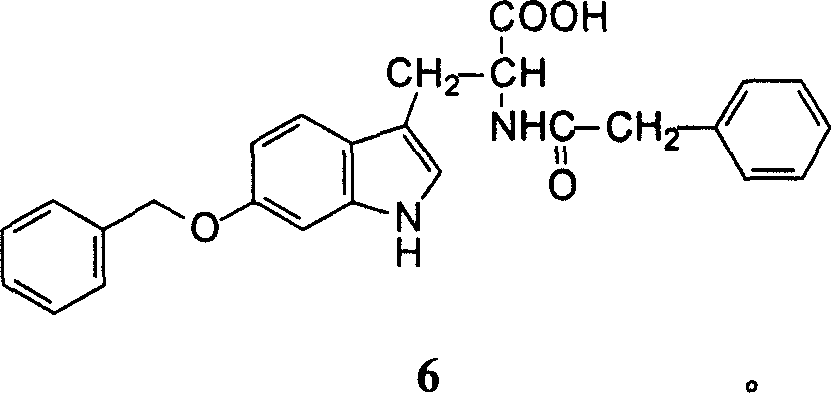
Embodiment 6: synthetic compound 6 N-phenylacetyl-6-benzyloxy tryptophane
1) Synthetic 2-phenylacetylamino-2-[(6-benzyloxy indole-3)-methyl]-diethyl malonate
Add 3-dimethylamino methyl-6-benzyloxy indole 1.5 grams (5.36mmol), phenylacetylamino diethyl malonate 1.73 grams (5.89mmol), sodium hydroxide 0.33 gram (8.03mmol), toluene 18mL in the 100mL flask, reflux 8 hours, suction filtration while hot after TLC check no longer changes, solid washs with the 10mL hot toluene, the combining methylbenzene phase, separate out white solid after 0 ℃ of cooling, behind the suction filtration filtrate evaporate to dryness is got crude product 1.5 grams, (eluent: ethyl acetate/petroleum ether=1/3) purifying gets product white solid 0.87 gram (31%) to silica gel column chromatography.
1H-NMR(CDCl
3)δ:1.23(t,6H,-CH
2-C
H 3),3.52(s,2H,phenyl-C
H 2-CO),3.79(s,2H,indole-C
H 2-),4.11~4.24(m,4H,-C
H 2-CH
3),5.10(s,2H,phenyl-C
H 2-O),6.48(s,1H,-N
H-CO-),6.65(d,1H,indole-7-H),6.83(dd,1H,indole-5-H),6.87(d,1H,indole-4-H),7.12(d,2H,Ar-H),7.24~7.27(m,3H,Ar-H),7.31~7.40(m,4H,Ar-H),7.44~7.48(d,2H,Ar-H),7.95(brs,1H,indole-N
H)。
2) Synthetic 2-phenylacetylamino-2-[(6-benzyloxy indole-3)-methyl]-propanedioic acid
Add 2-phenylacetylamino-2-[(6-benzyloxy indole-3 in the 50mL flask)-methyl]-diethyl malonate 0.48 gram (0.909mmol), 10% aqueous sodium hydroxide solution 3mL, nitrogen protection 60-70 ℃ of heating 1.5 hours down, TLC shows that reaction finishes.Add behind a small amount of decolorizing with activated carbon suction filtration while hot, ice bath is regulated PH to 2 with 10% hydrochloric acid down after adding less water, separates out a large amount of white solids, suction filtration after 0 ℃ of cooling, solid washs with a small amount of frozen water, gets rice white solid product 0.35 gram (81.6%) after the vacuum-drying.
1H-NMR(DMSO-d
6)δ:3.48(s,2H,phenyl-C
H 2-CO),3.78(s,2H,indole-C
H 2-),5.08(s,2H,phenyl-C
H 2-O),6.64~6.68(m,2H,indole-5-H、indole-7-H),6.86(dd,1H,indole-4-H),7.18~7.33(m,7H,Ar-H),7.35~7.40(m,2H,Ar-H),7.43~7.65(m,2H,Ar-H),7.80(s,1H,-N
H-CO-),10.65(s,1H,indole-N
H),13.25(brs,2H,COO
H)。
3) synthetic N-phenylacetyl-6-benzyloxy tryptophane
Add 2-phenylacetylamino-2-[(6-benzyloxy indole-3 in the 50mL flask)-methyl]-propanedioic acid 0.2 gram (0.423mmol), water 3mL, reflux is TLC demonstration reaction end after 3 hours.Adding a small amount of 10% sodium hydroxide solution makes solid molten entirely, add behind a small amount of decolorizing with activated carbon suction filtration while hot, the filtrate ice bath is regulated PH to 4-5 with 10% hydrochloric acid down, separate out a large amount of white solids, suction filtration after 0 ℃ of cooling, solid washs with a small amount of frozen water, gets rice white solid chemical compound 60.15 grams (82.9%) after the vacuum-drying.
1H-NMR(DMSO-d
6)δ:2.86~3.00(dd,1H,indole-C
H 2-),3.08~3.14(dd,1H,indole-C
H 2-),3.41(s,2H,phenyl-C
H 2-CO),4.40~4.47(m,1H,-CH
2-C
H-),5.08(s,2H,phenyl-C
H 2-O),6.70(dd,1H,indole-5-H),6.89(d,1H,indole-7-H),6.94(d,1H,indole-2-H),7.10~7.24(m,5H,Ar-H),7.28~7.33(m,1H,Ar-H),7.35~7.40(m,3H,Ar-H),7.43~7.47(d,2H,Ar-H),8.31(d,1H,-N
H-CO-),10.63(s,1H,indole-N
H),12.63(brs,2H,COO
H)。MS-ESI(-):428.3(M),427.3(M-1,100)。
The experiment of embodiment 7.PPAR γ protein binding
Experimental principle:
Can obtain the PPAR γ-LBD (PPAR γ ligand binding domain) of transcriptional expression through cultivation with BL21 (DE3) cell and pET15b-hPPAR γ-LBD plasmid.The purified back of this albumen dissolved dilution is in sodium acetate buffer solution.Make this buffered soln at 25 ℃, flow velocity is to enter surface plasma resonance biological sensor under the 20 μ L/min situations.Be associated with the dextran that the wetting ability carboxymethyl replaces on the biochip of this transmitter.When PPAR γ-LBD protein stream during through chip, albumen just can be by amino coupled reaction and dextran with the coupling of covalent linkage form, thereby makes PPAR γ-LBD proteopexy to this biochip.When PPAR γ aglucon in buffered soln when being fixed on PPAR γ on the chip-LBD protein binding, the signal that transmitter can be experienced on the chip changes, obtain in conjunction with response value RU (response unit), (promptly this association reaction speed reaches the sample concentration of top speed one half further also can to obtain estimating the equilibrium constant KD of albumen-aglucon association reaction, this numerical value is more little, illustrates that the binding ability of albumen and aglucon is strong more).
(A:PPARγ-LBD,B:ligand,AB:complex)

Laboratory apparatus and reagent:
Surface plasma resonance biological sensor (the Biacore3000 type is purchased the company in Biacore); PET15b-hPPAR γ-LBD plasmid (purchase Chemistry in Department of Structural, Pharmacia andUpjohn, Stockholm, Sweden);
LB substratum, BL21 (DE3) cell, isopropyl-(IPTG); Nickel-nitrilotriacetic acid(NTA) separator column;
DMSO, Hepes (N-(2-hydroxyethyl)-piperazine-N '-2 ethane sulfonic aicd sodium), sodium-acetate, imidazoles, NaCl, EDTA, surfactant P20 (being homemade analytical pure);
Positive control rosiglitazone (purchasing Chem.Co.USA) in CAYMAN.
Experimental procedure:
1. in the LB substratum that contains 50 μ g/mL penbritins, add BL21 (DE3) cell and pET15b-hPPAR γ-LBD plasmid, under 37 ℃, cultivate.Add 0.2mM sec.-propyl B-D-thiogalactoside (IPTG) again, cultivated 5 hours, and made PPAR γ-LBD obtain transcriptional expression for 20 ℃.Adding NaCl/Pi buffered soln then transcribes by the ultrasonic degradation blocking-up.Centrifugal back separation of supernatant is carried out column chromatography with supernatant liquor by a nickel-nitrilotriacetic acid(NTA) separator column then, eluent successively use respectively buffered soln A (NaCl/Pi contains the 10mM imidazoles, pH8.8) and B (NaCl/Pi contains the 25mM imidazoles, pH8.8).(NaCl/Pi contains the 500mM imidazoles, and pH8.8) wash-out separates the concentrated mixture that can obtain PPAR γ-LBD albumen and imidazoles to the buffered soln C that obtains to use buffered soln C at last again.(10mM Hepes, 150mM NaCl, 3.4mM EDTA, 0.005% surfactant P20 pH7.4) dialyse to this mixture, can obtain purified PPAR γ-LBD albumen to use HBS-EP buffered soln at last.
2. prepare the sodium acetate buffer solution of the 10nM of pH4.3, add the PPAR γ-LBD of expression and purification, mix.After make this buffered soln enter surface plasma resonance biological sensor, 25 ℃, flow velocity is the chip probe of flowing through under the 20 μ L/min situations, to this biochip, makes baseline reach stable until PPAR γ-LBD proteopexy.
3. testing sample and positive control are dissolved in respectively among the DMSO, are mixed with 10
-2Mol/L solution.The back is diluted to 10 respectively with HBS-EP solution
-5Mol/L, 10
-6Mol/L concentration.
With the testing sample sample introduction to biosensor, 25 ℃, flow velocity is to flow through under the 20 μ L/min situations to be fixed on upward PPAR γ-LBD albumen of chip probe, variation by the detecting sensor received signal, obtain in conjunction with response value RU, further also can obtain estimating the equilibrium constant KD of albumen-aglucon association reaction.
Table 1 is the PPAR γ protein binding experimental result of compound 1,2,3,4,5,6.
Table 1
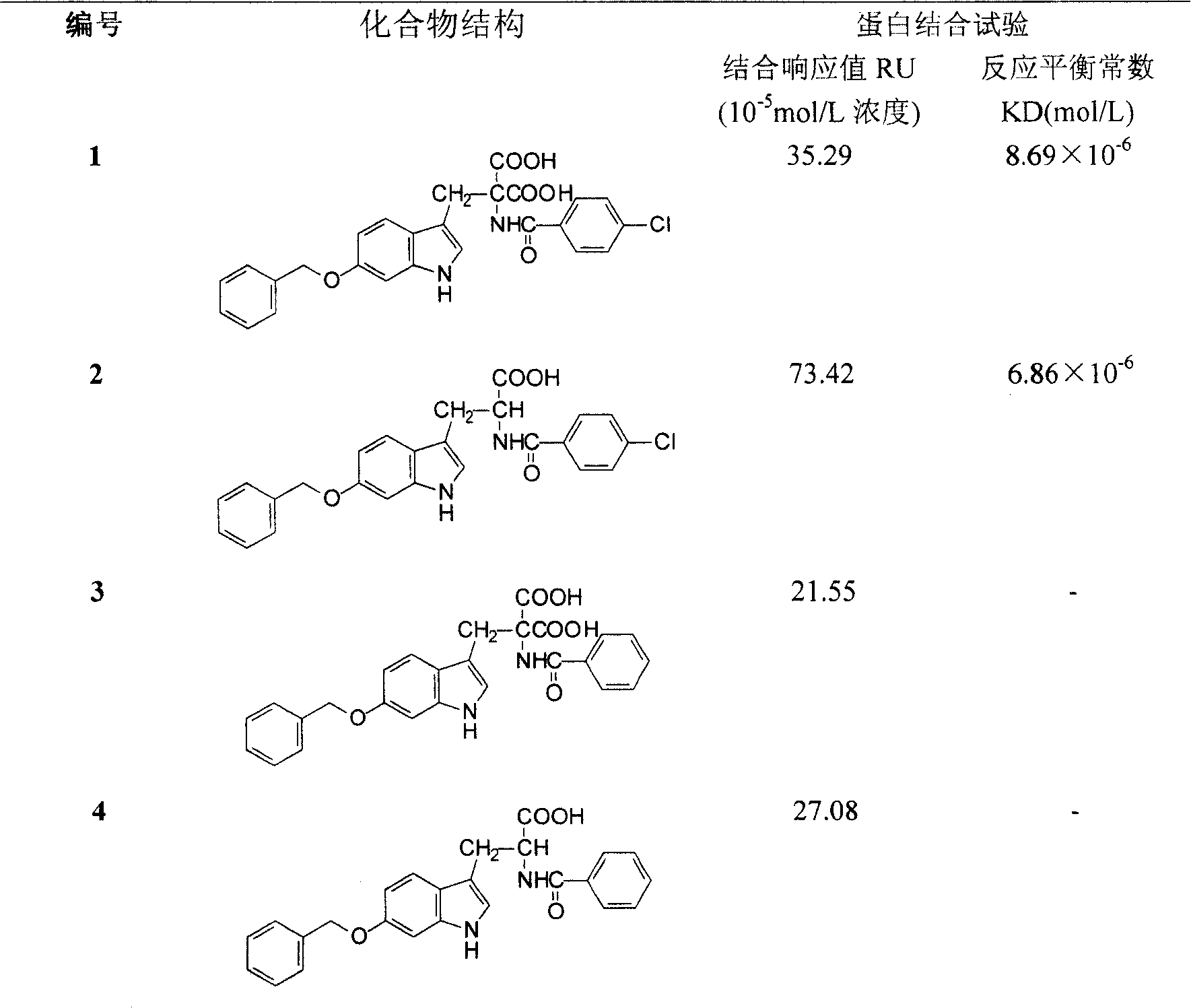

The result shows, The compounds of this invention 10
-5All combine with PPAR γ albumen under the mol/L concentration.Wherein, compound 1 and compound 2 binding abilities are outstanding, further measure the equilibrium constant KD value of its albumen-aglucon association reaction, are respectively 8.69 * 10
-6With 6.86 * 10
-6, with positive control rosiglitazone (4.98 * 10
-6Mol/L) combination is active similar.
Claims (10)
1. the tryptophan derivative that replaces of benzyloxy, it is characterized in that the having general formula structure of (I),

Wherein
R
1=benzoyl or chlorine substituted benzoyl or phenylacetyl or propionyl;
R
2=hydrogen or carboxyl.
2. the tryptophan derivative that benzyloxy according to claim 1 replaces, the compound 1 that it is characterized in that having following structure,
3. the tryptophan derivative that benzyloxy according to claim 1 replaces, the compound 2 that it is characterized in that having following structure,

4. the tryptophan derivative that benzyloxy according to claim 1 replaces, the compound 3 that it is characterized in that having following structure,

5. the tryptophan derivative that benzyloxy according to claim 1 replaces, the compound 4 that it is characterized in that having following structure,

6. the tryptophan derivative that benzyloxy according to claim 1 replaces, the compound 5 that it is characterized in that having following structure,

7. the tryptophan derivative that benzyloxy according to claim 1 replaces, the compound 6 that it is characterized in that having following structure,
8. the preparation method of the tryptophan derivative that replaces according to the described benzyloxy of claim 1, it is characterized in that adopting benzyloxy phenyl aldehyde and α-ethyl triazoacetate to obtain the 6-benzyloxy indole by condensation, cyclization, hydrolysis, decarboxylation, with acetic acid and tetrahydrofuran (THF) is solvent, introduces dimethylamino methyl with formalin and dimethylamine agueous solution reaction; Then in sodium hydroxide, toluene with different amido substituted diethyl malonate condensation, alkaline condition under hydrolysis, add thermal decarboxylation and obtain target compound.
9. the purposes of tryptophan derivative in preparation peroxisome proliferation activated receptor gamma agonist that replace of the benzyloxy of claim 1.
10. the purposes of tryptophan derivative in the anti-diabetes B medicine of preparation that replace of the benzyloxy of claim 1.
Priority Applications (1)
| Application Number | Priority Date | Filing Date | Title |
|---|---|---|---|
| CNB2006100244105A CN100361973C (en) | 2006-03-06 | 2006-03-06 | Benzyloxy-substituted tryptophan derivative, preparation method and application |
Applications Claiming Priority (1)
| Application Number | Priority Date | Filing Date | Title |
|---|---|---|---|
| CNB2006100244105A CN100361973C (en) | 2006-03-06 | 2006-03-06 | Benzyloxy-substituted tryptophan derivative, preparation method and application |
Publications (2)
| Publication Number | Publication Date |
|---|---|
| CN1817861A CN1817861A (en) | 2006-08-16 |
| CN100361973C true CN100361973C (en) | 2008-01-16 |
Family
ID=36918091
Family Applications (1)
| Application Number | Title | Priority Date | Filing Date |
|---|---|---|---|
| CNB2006100244105A Expired - Fee Related CN100361973C (en) | 2006-03-06 | 2006-03-06 | Benzyloxy-substituted tryptophan derivative, preparation method and application |
Country Status (1)
| Country | Link |
|---|---|
| CN (1) | CN100361973C (en) |
Families Citing this family (1)
| Publication number | Priority date | Publication date | Assignee | Title |
|---|---|---|---|---|
| CN103804270B (en) * | 2014-01-23 | 2016-06-22 | 中国药科大学 | 5-(4-amidino benzyloxy) tryptophan derivative, its method for making and application |
Citations (5)
| Publication number | Priority date | Publication date | Assignee | Title |
|---|---|---|---|---|
| WO2003000253A1 (en) * | 2001-06-20 | 2003-01-03 | Wyeth | Substituted indole acid derivatives as inhibitors of plasminogen activator inhibitor-1 (pai-1) |
| US20030149029A1 (en) * | 2001-12-03 | 2003-08-07 | Wyeth | Methods for treating asthmatic conditions |
| CN1505613A (en) * | 2000-10-10 | 2004-06-16 | ʷ��˿�������ȳ�ķ����˾ | Substituted indoles, pharmaceutical compositions containing such indoles and their use as PPAR-gamma binding agents |
| WO2004052856A1 (en) * | 2002-12-10 | 2004-06-24 | Wyeth | Substituted indole oxo-acetyl amino acetic acid derivatives as inhibitors of plasminogen activator inhibitor-1 (pai-1) |
| CN1569834A (en) * | 2004-05-14 | 2005-01-26 | 复旦大学 | Benzyloxy substituted indole compound and its analog and their production method and application |
-
2006
- 2006-03-06 CN CNB2006100244105A patent/CN100361973C/en not_active Expired - Fee Related
Patent Citations (5)
| Publication number | Priority date | Publication date | Assignee | Title |
|---|---|---|---|---|
| CN1505613A (en) * | 2000-10-10 | 2004-06-16 | ʷ��˿�������ȳ�ķ����˾ | Substituted indoles, pharmaceutical compositions containing such indoles and their use as PPAR-gamma binding agents |
| WO2003000253A1 (en) * | 2001-06-20 | 2003-01-03 | Wyeth | Substituted indole acid derivatives as inhibitors of plasminogen activator inhibitor-1 (pai-1) |
| US20030149029A1 (en) * | 2001-12-03 | 2003-08-07 | Wyeth | Methods for treating asthmatic conditions |
| WO2004052856A1 (en) * | 2002-12-10 | 2004-06-24 | Wyeth | Substituted indole oxo-acetyl amino acetic acid derivatives as inhibitors of plasminogen activator inhibitor-1 (pai-1) |
| CN1569834A (en) * | 2004-05-14 | 2005-01-26 | 复旦大学 | Benzyloxy substituted indole compound and its analog and their production method and application |
Also Published As
| Publication number | Publication date |
|---|---|
| CN1817861A (en) | 2006-08-16 |
Similar Documents
| Publication | Publication Date | Title |
|---|---|---|
| TWI262185B (en) | Carboxylic acid derivatives having anti-hyperglycemia and anti-hyperlipemia action, and pharmaceutical composition containing the derivatives | |
| CN104803891B (en) | Glucagon antagonist | |
| KR20090118055A (en) | PPC active compound | |
| KR20090118958A (en) | PPC active compound | |
| CN113563319B (en) | Indazole heterocyclic compounds with phosphodiesterase 4B inhibitory activity | |
| WO2003002533A1 (en) | Triamide-substituted indoles, benzofuranes and benzothiophenes as inhibitors of microsomal triglyceride transfer protein (mtp) and/or apolipoprotein b (apo b) secretion | |
| CN109071567B (en) | Anti-influenza small molecule compound and preparation method and use thereof | |
| CN102558061A (en) | Synthetic method of ozagrel | |
| CN115836050A (en) | Sulfonylurea derivatives and their medicinal uses | |
| JP4527665B2 (en) | Glucagon-like peptide-1 receptor agonist and production method and use thereof | |
| CN100441570C (en) | A kind of preparation and quality control method of mitiglinide calcium | |
| CN101704807A (en) | Two fluoric dianhydride monomers and preparation method thereof | |
| CN1817861A (en) | Benzyloxy-substituted tryptophan derivative, its analogs, production and use thereof | |
| CN101863854A (en) | Synthesis of 2-(3-cyano-4-isobutoxy)phenyl-4-methyl-5-thiazolecarboxylic acid | |
| CN114591300A (en) | Heterocyclic compounds as THR beta agonists and uses thereof | |
| CN1365354A (en) | Novel naphthalenesulfonic acids and related compounds as glucose uptake agonists | |
| CN101735286A (en) | Amino acid modified glucosamine as well as preparation method and application thereof | |
| CN101768149B (en) | Beta- aminoketone (alkamine) derivatives and use thereof | |
| CN101541780A (en) | Fibrate carboxylate compound and preparation method and application thereof | |
| CN111499616A (en) | A kind of aromatic heterocyclic substituted quinazolinone derivative and its synthesis method and application | |
| CN111793066B (en) | Benzo five-membered heterocyclic sulfonamide compound, preparation method thereof, pharmaceutical composition and application | |
| CN1275942C (en) | Benzyloxy substituted indole compound and its analog and their production method and application | |
| CN108239068B (en) | Nicotinamide derivative and preparation method and application thereof | |
| CN101735222B (en) | Pyrroloazepine compounds and their use as protein tyrosine phosphatase 1B inhibitors | |
| CN115869303A (en) | Use of sulfonylureas derivatives for treating diseases |
Legal Events
| Date | Code | Title | Description |
|---|---|---|---|
| C06 | Publication | ||
| PB01 | Publication | ||
| C10 | Entry into substantive examination | ||
| SE01 | Entry into force of request for substantive examination | ||
| C14 | Grant of patent or utility model | ||
| GR01 | Patent grant | ||
| C17 | Cessation of patent right | ||
| CF01 | Termination of patent right due to non-payment of annual fee |
Granted publication date: 20080116 Termination date: 20110306 |