Summary of the invention
The present invention is in order to solve the problem of the acid silicon sol poor stability of known high density, and it is simple disclose a kind of production technique, the preparation method of the high density acidity silicon sol that stability is high.
The present invention is achieved through the following technical solutions:
A kind of stabilising method of Nano silica sol dedicated for super large scale integration is characterized in that may further comprise the steps:
(1) at first the hydrochloric acid soln of 3%-10% being injected Zeo-karb stirs, make Zeo-karb regeneration fully, wherein the volume-exchange capacity of hydrochloric acid and wet Zeo-karb is 1.4-1.8 milligramequivalent/milliliter, behind the standing demix upper solution is removed, again with deionized water rinsing remaining Zeo-karb to its pH value in the 2-4 scope, must acidic cation-exchange resin;
(2) alkaline silica sol that then metal ion content is higher than 100ppm joins under the situation of continuously stirring in the acidic cation-exchange resin that makes in the above-mentioned steps (1), wherein, alkaline silica sol is 1 with the ratio of the amount of substance of acidic cation-exchange resin: 2-1: 5, under condition of stirring, exchange 10-60min, measure the Zeta potential of exchange solution simultaneously, make its absolute value stop to stir behind 30mv-60mv, discharging must show the tart silicon sol behind the standing demix;
(3) the sodium hydroxide solution injection anionite-exchange resin with 3%-10% stirs, make anionite-exchange resin regeneration fully, wherein the volume-exchange capacity of sodium hydroxide and wet anionite-exchange resin is 1.2-1.6 milligramequivalent/milliliter, behind the standing demix upper solution is removed, with the remaining anionite-exchange resin of deionized water rinsing to its pH value between 9-10, obtain basic anion exchange resin;
(4) then the acidic silicasol that makes in the above-mentioned steps (2) is joined in the basic anion exchange resin that makes in the above-mentioned steps (3), wherein, acidic silicasol is 1 with the ratio of the amount of substance of basic anion exchange resin: 2-1: 5, under condition of stirring, exchange 10-60min, measure the Zeta potential of exchange solution simultaneously, make its absolute value stop to stir behind 30mv-60mv, discharging obtains showing the silicon sol of alkalescence behind the standing demix;
(5) again the alkaline silica sol after the exchange that makes in the step (4) is joined under condition of stirring in the acidic cation-exchange resin that makes in the step (1), wherein, alkaline silica sol is 1 with the ratio of the amount of substance of acidic cation-exchange resin: 2-1: 5, under condition of stirring, exchange 10-60min, measure the Zeta potential of exchange solution simultaneously, make its absolute value behind 30mv-60mv, stop to stir, discharging behind the standing demix obtains the apparent tart silicon sol that metal ion reaches several ppm levels;
(6) will add the polyether-type nonionic tensio-active agent in the silicon sol after the exchange in the step (5), wherein, the volume ratio of silicon sol and promoting agent is 1000: 1-1000: 10;
(7) in the silicon sol solution for preparing, add acid again and adjust the pH value, just obtain the acid silicon sol of high density of purity height, good stability.When adjusting the pH value, can be 1000 according to the volume ratio of silicon sol and acid: 1-1000: 15 determine the volume of used acid, select the concentration of acid to get final product according to the requirement of pH value more afterwards.
Used Zeo-karb is a storng-acid cation exchange resin, and used anionite-exchange resin is strongly basic anion exchange resin.
Used promoting agent for can and water with any ratio dissolve each other, can be in water fully disperse, that adsorptive power is strong, that can effectively reduce gravitational potential energy between the silicon sol micelle, molecular weight is the polyether-type nonionic type tensio-active agent of 100-300.
Used acid is adsorptive type but also is the acid of chelating type for not only having the pH of adjusting value function.
The concentration of acidic silicasol is 30-42%, and particle size range is 20nm-60nm.
Action principle of the present invention is as follows:
1. the present invention is according to the electric double layer structure of the exchange mechanism and the silicon sol itself of ion exchange resin, and utilization sun-male-female ion exchange resin is the method for exchange alternately, to reduce the content of silicon sol metal ion neutralization product, improves the wafer quality.The silicon sol metal ion content that present method obtains can reach several ppm levels, can satisfy the purity requirement of super large-scale integration complete processing CMP to abrasive, makes the chip operation reliability height of production, the long service life of device.
The micelle structure of silicon sol and synoptic diagram thereof as shown in Figure 1, the double electrical layers of silicon sol as shown in Figure 2, the micelle of silicon sol is by a unbodied mSiO
2Be core, surface adsorption silicic acid and silicic acid negative ion (H
2SiO
4, H
3SiO
4 -), a part of zNa of gegenion
+Be adsorbed in the fixed layer another part (y-z) Na
+Be distributed in the diffusion layer, constitute double electrical layers.Electric charge y is called combined potential, and electric charge (y-z) is called electro kinetic potential or claims Zeta potential, zeta-potential.Owing to there is solvation, the ion around the micelle all exists with the solvation form, so that forms one deck high viscosity aquation film, and the thickness of its thickness and diffusion double layer is suitable.
Adopt the cationic exchange initial stage, the metal ion of the outer aqueous phase of micelle is the free ion of unbound state, and the metal ion of micelle diffusion layer periphery and the electrostatic force between the micelle are very weak, very easily being adsorbed the stronger material of power catches, so storng-acid cation exchange resin can adsorb and exchange this two-part metal ion rapidly, and the H of electric charge such as release simultaneously
+, and then in and the whole OH of aqueous phase
-, because H
+Amount much larger than OH
-, excessive H
+Make the pH value of solution cross the neutral zone rapidly and enter acidic region, thereby make exchange back silicon sol be acid, metal ion content reduces, and the Zeta potential absolute value increases.
After silicon sol carries out cationic exchange, the Na of silicon sol diffusion layer periphery
+And other metallic cation is removed remaining Na
+With other metallic cation mainly be present in enclose in the diffusion layer and fixed layer in, it is strong that ion is subjected to glue nuclear sucking action in this scope, and the micelle surface is with the hydration shell of one deck viscosity higher, this layer hydration shell slowed down H
+Diffuse into and replace Na in the fixed layer
+Speed with other metallic cation.H
+Slowly enter fixed layer, the micelle surface pH value is changed slowly, a large amount of Na in the silicon sol
+With other metallic cation by H
+Replace H
+Hydratability compare Na
+Deng strong, these H
+Cause micelle hydration shell on every side to thicken, seriously hindered Na
+And H
+Mutual metathetical speed.
So must adopt anionite-exchange resin to exchange, anionite-exchange resin exchange the water middle reaches from negatively charged ion (Cl
-, the silicic acid negative ion), discharge OH
-And with the original H of water
+Neutralization generates water, and pH value is risen gradually, makes the silicon sol after the exchange be alkaline, and after the ion-exchange equilibrium, mainly there is the H that is not neutralized in aqueous phase
+, electrolyte concentration descends greatly in the solution.And colloidal electrostatic double layer thickness and electrolytical concentration are inverse ratio, so after the resin anion(R.A) exchange, colloidal electrostatic double layer thickness becomes original tens of times, constitutes the positively charged ion (Na of double electrical layers in a large number
+, H
+) be pushed to position away from glue nuclear, and the magnetism between the glue nuclear weakens greatly, and the viscosity of hydration shell is also corresponding to be reduced, Na in diffusion layer and the fixed layer
+Diffuse into water in a large number, and then the employing cationic exchange can continue to reduce the metal ion content in the silicon sol.So circulation, hydration shell is effectively removed the control of ion diffusion effect, can obtain the few silicon sol of foreign matter content.But because repeatedly repeat to increase cost, reduce production efficiency, take all factors into consideration every factor, select sun-male-female three secondary ions to exchange purifying silicon colloidal sol.
2. add the nonionogenic tenside of not introducing metal ion in the acidic silicasol solution behind purifying, can effectively reduce the gravitational potential energy between the silicon sol micelle, form the specific adsorption layer, thereby strengthen colloidal grinding material stability on glue nuclear surface.
The nonionogenic tenside of absorption has two to the influence of colloidal stability: the existence of first nonionogenic tenside, can reduce the gravitational potential energy between micelle usually; Nonionogenic tenside forms adsorption layer on the micelle surface, make between micelle gravitational potential energy may greater than, also may be less than the gravitational potential energy between the micelle that does not have adsorption layer, that is to say, the nonionogenic tenside of some kind might make silicon sol stability increase, but the nonionogenic tenside of some kind also may make silicon sol flocculation take place and unstability, and this will depend on that the promoting agent that is added makes the gravitational potential energy between micelle be increase or reduce.The growth and decline that the variation of gravitational potential energy will be subjected between promoting agent-water-promoting agent, water-promoting agent-micelle, the micelle-promoting agent-micelle three avidity are regulated, have only the nonionogenic tenside of selecting effectively to reduce the gravitational potential energy between the silicon sol micelle, colloidal stability is increased.Its two be micelle absorption nonionogenic tenside after, can produce a kind of new repulsion potential energy-----space repulsion potential energy.When two micelles that have nonionogenic tenside are drawn close mutually when adsorption layer is in contact with one another, two kinds of situations as shown in Figure 3 can appear: situation (a) can occur when selecting molecular chain to have the inflexible nonionogenic tenside, adsorption layer is compressed and does not interpenetrate, and produces elasticity repulsion potential energy and molecular chain and loses structural and generation entropy repulsion potential energy; Situation (b) can occur when selecting the nonionogenic tenside of flexible molecule chain, this moment, the adsorption layer of two micelles overlapped, in the overlap, because of corresponding generation infiltration repulsion potential energy of the increase of superpolymer concentration and enthalpy repulsion potential energy.Wherein, selection can be in water abundant dispersive nonionogenic tenside, it is stable to be beneficial to silicon sol; The promoting agent adsorptive power of selecting is strong more, helps increasing the stability of silicon sol more; The adsorption layer of promoting agent is thick more, and silicon sol is stable more; The promoting agent of selecting heat release when dilution, then be on the occasion of, also can improve the stability of silicon sol.Therefore, add original electrostatic repulsion between micelle, adsorbed that potential energy will be easy to colloid-stabilised between the micelle of nonionogenic tenside.Comprehensive above-mentioned principle, the present invention select can and water with any ratio dissolve each other, can be in water fully disperse, that adsorptive power is strong, that can effectively reduce gravitational potential energy between the silicon sol micelle, molecular weight is 100-300, do not introduce the polyether-type nonionic tensio-active agent of metal ion.
In addition, the consumption of promoting agent is also influential to the stability of silicon sol, after in slurry, adding promoting agent, micelle absorption non-ionic (polymeric surfactant) in the slurry, distance between the micelle is increased, reduced interparticle reactive force, do not have the chance of direct impact between micelle and micelle, therefore particle is difficult for producing reunion, thereby reaches stable purpose.The volume ratio of silicon sol and promoting agent is 1000: 1-1000: 10.Cross when hanging down, tensio-active agent can not cover particle surface fully, make the particle surface present the spot structure, the particle surface exists blank in other words, be adsorbed on the lip-deep polymer long-chain of a certain particle like this and will adhere to the blank space of another particle simultaneously, mode by bridging is pulled in two or more particles together, causes flocculation.Add excessive tensio-active agent, the viscosity because of tensio-active agent itself increases the viscosity of slip on the one hand, and too much on the other hand tensio-active agent is easy to form micelle in solution, causes adsorption layer to thicken, and reduces Zeta potential, makes the system stability decreases.
The present invention has following technique effect:
1. the present invention is according to the electric double layer structure of the exchange mechanism and the silicon sol itself of ion exchange resin, utilization sun-male-female ion exchange resin is the method purifying silicon colloidal sol of exchange alternately, again the silicon sol of purifying is carried out stabilization treatment afterwards, improved the stability of high density silicon sol under acidic conditions, and, the product purity height.The-inferior cationic exchange has been removed the metal ion of the outer aqueous phase of silicon sol micelle and the metal ion of micelle diffusion layer periphery.Introduce anionite-exchange resin then and exchange, effectively remove the control of hydration shell, make Na in diffusion layer and the fixed layer the ion diffusion effect
+Diffuse into water in a large number with other metallic cation, and then adopt cationic exchange, the Na of absorption aqueous phase
+With other metallic cation, greatly improved the exchange effect of Zeo-karb, greatly reduce the content of silicon sol metal ion neutralization product, purification effect is remarkable, has improved the quality of wafer.The silicon sol metal ion content that present method obtains can reach several ppm levels, can satisfy the purity requirement of super large-scale integration complete processing CMP to abrasive, makes the chip operation reliability height of production, the long service life of device.
2. the present invention is by the selection to nonionogenic tenside and consumption thereof, acidic silicasol solution in high density adds the nonionogenic tenside of not introducing metal ion, can form the specific adsorption layer on glue nuclear surface, thereby improve the stability of high density silicon sol under acidic conditions greatly.
3.Zeta current potential is greater than 30mv, solution is stable more.Swap time is long more, and metal ion content is more little.The present invention controls swap time by Zeta potential monitoring and ion-exchange time two aspects, both guaranteed the requirement of metal ion content, consider the influence of metal ion content again to Zeta potential, guaranteed the stability of silicon sol, provide necessary monitoring condition for carrying out industrialization, guarantee the repeatability of the stable and product of silicon sol quality in the actual production, make production can realize automatization.Take all factors into consideration the requirement and the production efficiency of quality, the selection Zeta potential is 30-60mv, and be 10-60min swap time.
4. the adding of acid medium both can have been regulated the pH value to required value, the metal ion that produces in again can the chelating polishing process, thereby, use silicon sol of the present invention can improve the effect of polishing.
5. method of the present invention both purifying silicon sol, ensured the stability of silicon sol under acidic conditions again, simplified production technique, improved production efficiency.
6. adopt that method equipment cost of the present invention is low, the production time is short, energy consumption is low.
Embodiment
Below in conjunction with specific embodiment to the detailed description of the invention.
Used Zeo-karb is a storng-acid cation exchange resin among the present invention, as Nankai's board 001 * 7 type, U.S. Amberjet 1200Na, German Lewatit-100, Japanese Diaion SK-1 etc., used anionite-exchange resin is strongly basic anion exchange resin, as Nankai's board 201 * 7 types, U.S. Amberlite IRA-400, West Germany: Lewatit M500, Britain Eerolite FF etc., ion-exchange time will be considered the Zeta potential factor of silicon sol.Used acid has been adopted and has both been had the pH of adjusting value function when regulating silicon sol pH value, is adsorptive type, has the acid of chelated metal ions function again, as citric acid, polypropylene acid, polymaleic acid, propanedioic acid etc.Used promoting agent is a polyether-type nonionic type tensio-active agent, can and water with any ratio dissolve each other, can be in water fully disperse, that adsorptive power is strong, that can effectively reduce gravitational potential energy between the silicon sol micelle and molecular weight is lower, be about about 100-300, do not introduce metal ion, as PEG150, PEG200, JFC etc.
Embodiment 1
1752ml, 3% hydrochloric acid soln are injected the ion exchange column that 800ml Nankai board 001 * 7 type Zeo-karb is housed to be stirred, standing demix behind the stirring 3min, upper solution is removed, with the remaining Zeo-karb of deionized water rinsing to its pH value between 2-2.5, acidic cation-exchange resin.
Be 30% with concentration then, particle diameter is 22nm, the alkaline silica sol 536g that metal ion content is higher than 100ppm joins under the situation of continuously stirring in the above-mentioned acidic cation-exchange resin of 400ml, under condition of stirring, exchange 15min, measure the Zeta potential of exchange solution simultaneously, make its absolute value stop to stir after more than the 30mv, discharging must show the tart silicon sol behind the standing demix.
Get 834ml then, 3% sodium hydroxide solution injects the ion exchange column that the wet anionite-exchange resin of 400ml Nankai board 201 * 7 types is housed and stirs, standing demix behind the stirring 3min, upper solution is removed, with the remaining anionite-exchange resin of deionized water rinsing to its pH value between 9-9.5, obtain basic anion exchange resin.Then the acidic silicasol 536g after the above-mentioned resin cation exchange is joined in the above-mentioned 400ml basic anion exchange resin, under condition of stirring, exchange 15min, measure the Zeta potential of exchange solution simultaneously, its absolute value stops to stir after more than the 30mv, and discharging obtains showing the silicon sol of alkalescence behind the standing demix.
Again the alkaline silica sol 536g after the above-mentioned resin anion(R.A) exchange is joined under condition of stirring in the above-mentioned 400ml acidic cation-exchange resin, under condition of stirring, exchange 15min, measure the Zeta potential of exchange solution simultaneously, its absolute value stops to stir after more than the 30mv, discharging behind the standing demix obtains the apparent tart silicon sol that metal ion reaches several ppm.
With adding the PEG150 that 1.5ml has osmosis, can reduce solution surface tension in the silicon sol after the above-mentioned exchange, improve its stability.
In the above-mentioned silicon sol solution for preparing, add 7.5ml concentration again and be 10% citric acid, just obtain the pH value after fully stirring and be acidic silicasol 1.97, high density, good stability.
Embodiment 2
2102.2ml, 5% hydrochloric acid soln are injected the ion exchange column that 1600ml U.S. Amberjet 1200Na type Zeo-karb is housed to be stirred, standing demix behind the stirring 5min, upper solution is removed, with the remaining Zeo-karb of deionized water rinsing to its pH value between 2.5-3, acidic cation-exchange resin.
Be 37% with concentration then, particle diameter is 47nm, the alkaline silica sol 536g that metal ion content is higher than 100ppm joins under the situation of continuously stirring in the above-mentioned acidic cation-exchange resin of 800ml, under condition of stirring, exchange 30min, measure the Zeta potential of exchange solution simultaneously, make its absolute value stop to stir after more than the 40mv, discharging must show the tart silicon sol behind the standing demix.
Get 1000ml then, 5% sodium hydroxide solution injects the ion exchange column that the wet anionite-exchange resin of 800ml U.S. AmberliteIRA-400 type is housed and stirs, standing demix behind the stirring 5min, upper solution is removed, with the remaining anionite-exchange resin of deionized water rinsing to its pH value between 9.5-10, obtain basic anion exchange resin.Then the acidic silicasol 536g after the above-mentioned resin cation exchange is joined in the above-mentioned 800ml basic anion exchange resin, under condition of stirring, exchange 30min, measure the Zeta potential of exchange solution simultaneously, its absolute value stops to stir after more than the 40mv, and discharging obtains showing the silicon sol of alkalescence behind the standing demix.
Again the alkaline silica sol 536g after the above-mentioned resin anion(R.A) exchange is joined under condition of stirring in the above-mentioned 800ml acidic cation-exchange resin, under condition of stirring, exchange 30min, measure the Zeta potential of exchange solution simultaneously, its absolute value stops to stir after more than the 40mv, discharging behind the standing demix obtains the apparent tart silicon sol that metal ion reaches several ppm.
2.5ml has osmosis with adding in the silicon sol after the exchange, the PEG200 that can reduce solution surface tension improves its stability.
In the silicon sol solution for preparing, add 0.5ml concentration again and be 10% propanedioic acid, just obtain the pH value after fully stirring and be acidic silicasol 3.10, high density, good stability.
Embodiment 3
1325ml, 10% hydrochloric acid soln are injected the ion exchange column that 2000ml Germany Lewatit-100 type Zeo-karb is housed to be stirred, standing demix behind the stirring 10min, upper solution is removed, with the remaining Zeo-karb of deionized water rinsing to its pH value between 3-3.5, acidic cation-exchange resin.
Be 42% with concentration then, particle diameter is 60nm, the alkaline silica sol 536g that metal ion content is higher than 100ppm joins under the situation of continuously stirring in the above-mentioned acidic cation-exchange resin of 1000ml, under condition of stirring, exchange 60min, measure the Zeta potential of exchange solution simultaneously, make its absolute value stop to stir after more than the 60mv, discharging must show the tart silicon sol behind the standing demix.
Get 625ml then, 10% sodium hydroxide solution injects the ion exchange column that the wet anionite-exchange resin of 1000ml Germany Lewatit M500 type is housed and stirs, standing demix behind the stirring 10min, upper solution is removed, with the remaining anionite-exchange resin of deionized water rinsing to its pH value between 9.5-10, obtain basic anion exchange resin.Then the acidic silicasol 536g after the above-mentioned resin cation exchange is joined in the above-mentioned 1000ml basic anion exchange resin, under condition of stirring, exchange 60min, measure the Zeta potential of exchange solution simultaneously, its absolute value stops to stir after more than the 60mv, and discharging obtains showing the silicon sol of alkalescence behind the standing demix.
Again the alkaline silica sol 536g after the above-mentioned resin anion(R.A) exchange is joined under condition of stirring in the above-mentioned 1000ml acidic cation-exchange resin, under condition of stirring, exchange 60min, measure the Zeta potential of exchange solution simultaneously, its absolute value stops to stir after more than the 60mv, discharging behind the standing demix obtains the apparent tart silicon sol that metal ion reaches several ppm.
With adding the tensio-active agent JFC that 0.5ml has osmosis, can reduce solution surface tension in the silicon sol after the exchange, improve its stability;
In the silicon sol solution for preparing, add 2.5ml concentration again and be 10% polypropylene acid, just obtain the acidic silicasol that the pH value is a good stability 2.17, high density after fully stirring.
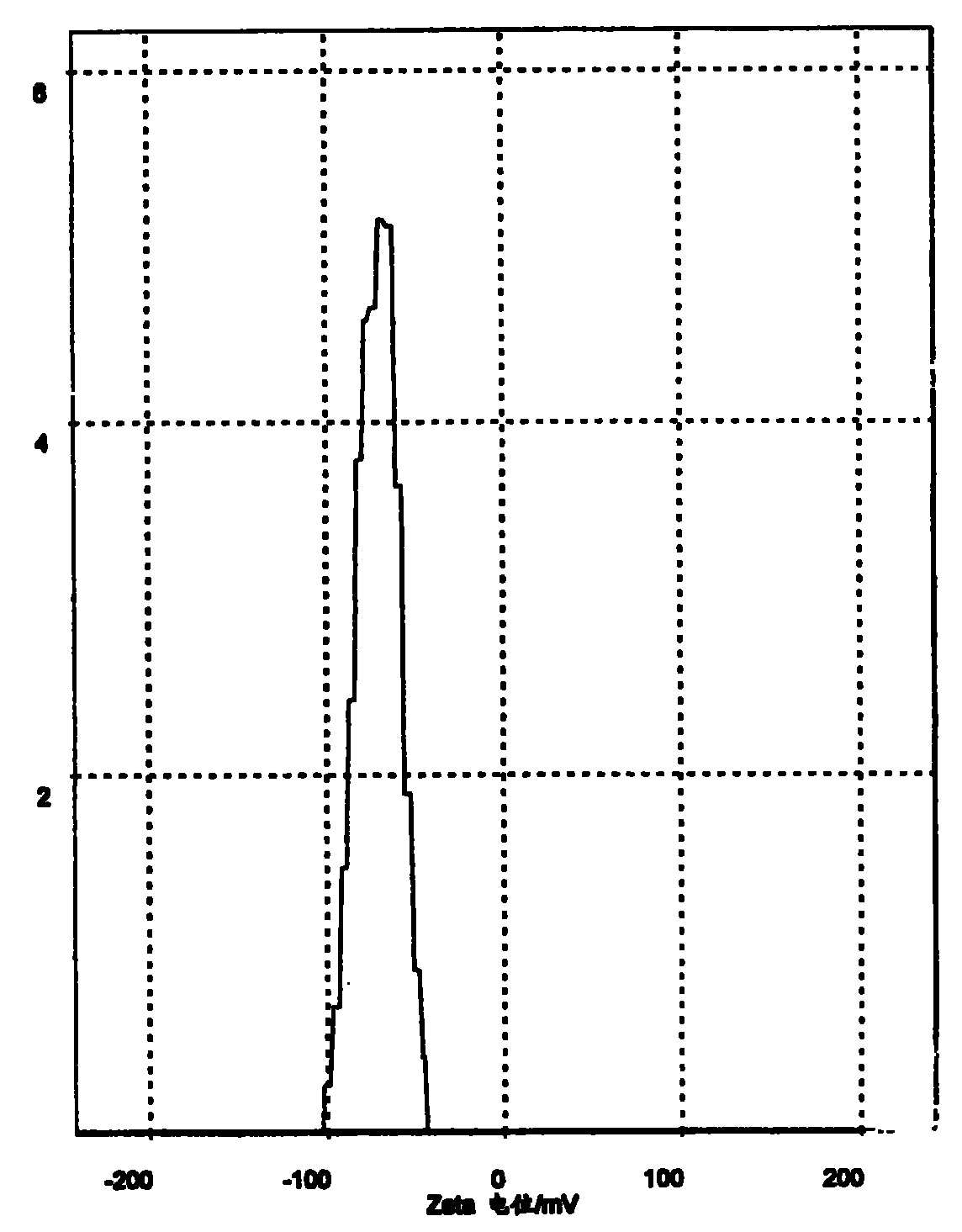
Accompanying drawing 4 is the Zeta potential test result, and X-coordinate is the Zeta potential value, and ordinate zou is %Intensity.From test result, the absolute value of Zeta potential is all greater than 30mv, is in to make the stable potential range of depositing of silicon sol.
The detected result of silicon sol metal ion content is as shown in the table:
A: before the exchange:
| The metallic element kind |
The self-control product |
External product |
Home products |
| Na(mg/L) Al(mg/L) K(mg/L) Cu(mg/L) Fe(mg/L) |
371535 321.2 60 80 90 |
3175 348.0 - - <0.01 |
2774 321.2 - - <0.01 |
B: exchange back metal ion content:
| The metallic element kind |
Corresponding content/mg/L after the ion exchange treatment |
| Na Al K Cu Fe |
3.4<0.01 do not detect<0.01 do not detect 0.023<0.01 and do not detect |
Adopt and place the stability that the way of observing is examined silicon sol, the result is as follows:
Do not take the silicon sol of stabilizing treatment to stablize and deposit about one month, can stablize through the silicon sol of stabilization treatment and deposit more than half a year.
Although the disclosed stabilising method that relate to a kind of Nano silica sol dedicated for super large scale integration have been carried out special description with reference to embodiment, embodiment described above is illustrative and not restrictive, under the situation that does not break away from the spirit and scope of the present invention, all variations and modification are all within the scope of the present invention.