CN100439309C - preparation 3 - Google Patents
preparation 3 Download PDFInfo
- Publication number
- CN100439309C CN100439309C CNB028273567A CN02827356A CN100439309C CN 100439309 C CN100439309 C CN 100439309C CN B028273567 A CNB028273567 A CN B028273567A CN 02827356 A CN02827356 A CN 02827356A CN 100439309 C CN100439309 C CN 100439309C
- Authority
- CN
- China
- Prior art keywords
- compound
- formula
- generate
- biphenol
- oxidative coupling
- Prior art date
- Legal status (The legal status is an assumption and is not a legal conclusion. Google has not performed a legal analysis and makes no representation as to the accuracy of the status listed.)
- Expired - Lifetime
Links
Classifications
-
- C—CHEMISTRY; METALLURGY
- C07—ORGANIC CHEMISTRY
- C07C—ACYCLIC OR CARBOCYCLIC COMPOUNDS
- C07C37/00—Preparation of compounds having hydroxy or O-metal groups bound to a carbon atom of a six-membered aromatic ring
- C07C37/11—Preparation of compounds having hydroxy or O-metal groups bound to a carbon atom of a six-membered aromatic ring by reactions increasing the number of carbon atoms
- C07C37/18—Preparation of compounds having hydroxy or O-metal groups bound to a carbon atom of a six-membered aromatic ring by reactions increasing the number of carbon atoms by condensation involving halogen atoms of halogenated compounds
-
- C—CHEMISTRY; METALLURGY
- C07—ORGANIC CHEMISTRY
- C07C—ACYCLIC OR CARBOCYCLIC COMPOUNDS
- C07C37/00—Preparation of compounds having hydroxy or O-metal groups bound to a carbon atom of a six-membered aromatic ring
-
- C—CHEMISTRY; METALLURGY
- C07—ORGANIC CHEMISTRY
- C07C—ACYCLIC OR CARBOCYCLIC COMPOUNDS
- C07C37/00—Preparation of compounds having hydroxy or O-metal groups bound to a carbon atom of a six-membered aromatic ring
- C07C37/11—Preparation of compounds having hydroxy or O-metal groups bound to a carbon atom of a six-membered aromatic ring by reactions increasing the number of carbon atoms
-
- C—CHEMISTRY; METALLURGY
- C07—ORGANIC CHEMISTRY
- C07C—ACYCLIC OR CARBOCYCLIC COMPOUNDS
- C07C37/00—Preparation of compounds having hydroxy or O-metal groups bound to a carbon atom of a six-membered aromatic ring
- C07C37/11—Preparation of compounds having hydroxy or O-metal groups bound to a carbon atom of a six-membered aromatic ring by reactions increasing the number of carbon atoms
- C07C37/14—Preparation of compounds having hydroxy or O-metal groups bound to a carbon atom of a six-membered aromatic ring by reactions increasing the number of carbon atoms by addition reactions, i.e. reactions involving at least one carbon-to-carbon unsaturated bond
-
- C—CHEMISTRY; METALLURGY
- C07—ORGANIC CHEMISTRY
- C07C—ACYCLIC OR CARBOCYCLIC COMPOUNDS
- C07C37/00—Preparation of compounds having hydroxy or O-metal groups bound to a carbon atom of a six-membered aromatic ring
- C07C37/50—Preparation of compounds having hydroxy or O-metal groups bound to a carbon atom of a six-membered aromatic ring by reactions decreasing the number of carbon atoms
-
- C—CHEMISTRY; METALLURGY
- C07—ORGANIC CHEMISTRY
- C07C—ACYCLIC OR CARBOCYCLIC COMPOUNDS
- C07C37/00—Preparation of compounds having hydroxy or O-metal groups bound to a carbon atom of a six-membered aromatic ring
- C07C37/62—Preparation of compounds having hydroxy or O-metal groups bound to a carbon atom of a six-membered aromatic ring by introduction of halogen; by substitution of halogen atoms by other halogen atoms
-
- C—CHEMISTRY; METALLURGY
- C07—ORGANIC CHEMISTRY
- C07C—ACYCLIC OR CARBOCYCLIC COMPOUNDS
- C07C39/00—Compounds having at least one hydroxy or O-metal group bound to a carbon atom of a six-membered aromatic ring
- C07C39/12—Compounds having at least one hydroxy or O-metal group bound to a carbon atom of a six-membered aromatic ring polycyclic with no unsaturation outside the aromatic rings
- C07C39/15—Compounds having at least one hydroxy or O-metal group bound to a carbon atom of a six-membered aromatic ring polycyclic with no unsaturation outside the aromatic rings with all hydroxy groups on non-condensed rings, e.g. phenylphenol
-
- C—CHEMISTRY; METALLURGY
- C07—ORGANIC CHEMISTRY
- C07C—ACYCLIC OR CARBOCYCLIC COMPOUNDS
- C07C39/00—Compounds having at least one hydroxy or O-metal group bound to a carbon atom of a six-membered aromatic ring
- C07C39/12—Compounds having at least one hydroxy or O-metal group bound to a carbon atom of a six-membered aromatic ring polycyclic with no unsaturation outside the aromatic rings
- C07C39/15—Compounds having at least one hydroxy or O-metal group bound to a carbon atom of a six-membered aromatic ring polycyclic with no unsaturation outside the aromatic rings with all hydroxy groups on non-condensed rings, e.g. phenylphenol
- C07C39/16—Bis-(hydroxyphenyl) alkanes; Tris-(hydroxyphenyl)alkanes
Landscapes
- Chemical & Material Sciences (AREA)
- Organic Chemistry (AREA)
- Chemical Kinetics & Catalysis (AREA)
- Organic Low-Molecular-Weight Compounds And Preparation Thereof (AREA)
- Low-Molecular Organic Synthesis Reactions Using Catalysts (AREA)
- Nitrogen And Oxygen Or Sulfur-Condensed Heterocyclic Ring Systems (AREA)
- Steroid Compounds (AREA)
- Fertilizers (AREA)
Abstract
Description
本发明领域Field of the invention
本发明涉及制备3,3’,6,6’-四烷基-2,2’-联苯酚及3,3’,6,6’-四烷基-5,5’-二卤基-2,2’-联苯酚的方法。The present invention relates to the preparation of 3,3',6,6'-tetraalkyl-2,2'-biphenol and 3,3',6,6'-tetraalkyl-5,5'-dihalo-2 , 2'-biphenol method.
本发明背景Background of the invention
取代联苯酚化合物,例如3,3’,6,6’-四烷基-2,2’-联苯酚、3,3’,4,4’,5,5’-六烷基-2,2’-联苯酚、3,3’,4,4’,5,5’,6,6’-八烷基-2,2’-联苯酚、3,3′,5,5’,6,6’-六烷基-2,2’-联苯酚、3,3’,5,5’-四烷基-2,2’-联苯酚、3-烷基-5,5’,6,6’7,7’,8,8’-八氢-2,2’-联萘酚、3,3’-二烷基-5,5’,6,6’,7,7’,8,8’-八氢-2,2’-联萘酚和3,3’,6,6’-四烷基-5,5’-二卤基-2,2’-联苯酚,可用于制备以磷为基础的催化剂配体。这类配体包括膦、次亚膦酸酯(phosphinites)、亚膦酸酯以及亚磷酸酯。单(磷)配体为含单个磷原子的化合物,所述磷原子作为过渡金属的供体。而双(磷)配体通常含有两个磷供体原子,而且通常与过渡金属形成环状螯合物结构。Substituted biphenol compounds such as 3,3',6,6'-tetraalkyl-2,2'-biphenol, 3,3',4,4',5,5'-hexaalkyl-2,2 '-Biphenol, 3,3', 4,4', 5,5', 6,6'-octaalkyl-2,2'-biphenol, 3,3', 5,5', 6,6 '-hexaalkyl-2,2'-biphenol, 3,3',5,5'-tetraalkyl-2,2'-biphenol, 3-alkyl-5,5',6,6' 7,7',8,8'-octahydro-2,2'-binaphthol, 3,3'-dialkyl-5,5',6,6',7,7',8,8' -Octahydro-2,2'-binaphthol and 3,3',6,6'-tetraalkyl-5,5'-dihalo-2,2'-biphenol, which can be used to prepare Basic catalyst ligands. Such ligands include phosphines, phosphinites, phosphonites and phosphites. Mono(phosphorous) ligands are compounds containing a single phosphorus atom which acts as a donor for the transition metal. On the other hand, double (phosphorus) ligands usually contain two phosphorus donor atoms, and usually form a ring chelate structure with a transition metal.
一般来说,联苯酚可通过氧化偶合(单)酚制备,但常常同时得到其它类型产物如酮,和/或因为不同原因而整体收率低。In general, biphenols can be prepared by oxidative coupling of (mono)phenols, but often other types of products such as ketones are obtained simultaneously and/or in low overall yields for different reasons.
可通过使用多种氧化剂如硝酸、氯化铁、铁氰化钾、铬酸、2,3-二氯-5,6-二氰基苯醌和二叔丁基过氧化物,将酚氧化偶合制成相应的联苯酚。2,2’-二羟基-3,3’-二-异丙基-6,6’-二甲基联苯可用2-异丙基-5-甲基-酚与2,3-二氯-5,6-二氰基苯醌或二-t-丁基过氧化物制备。参见Tetrahedron,1875,1971;J.Chem.Soc.,Perkin Trans.II,587,1983。部分所述氧化剂和/或助催化剂涉及到使用相对昂贵和/或爆炸性(过氧化物)的化合物,其妨碍大规模商业化使用。Phenols can be oxidatively coupled by using a variety of oxidizing agents such as nitric acid, ferric chloride, potassium ferricyanide, chromic acid, 2,3-dichloro-5,6-dicyanobenzoquinone, and di-tert-butyl peroxide Made of the corresponding biphenol. 2,2'-dihydroxy-3,3'-di-isopropyl-6,6'-dimethylbiphenyl can be used with 2-isopropyl-5-methyl-phenol and 2,3-dichloro- 5,6-dicyanobenzoquinone or di-t-butyl peroxide preparation. See Tetrahedron, 1875, 1971; J. Chem. Soc., Perkin Trans. II, 587, 1983. Some of these oxidizing agents and/or co-catalysts involve the use of relatively expensive and/or explosive (peroxide) compounds which prevent large-scale commercial use.
利用过渡金属催化剂和氧化剂组合,如过硫酸阴离子或氧,酚也可被氧化偶合。参见美国专利6,077,979、4139,544、4,132,722、4,354,048和4,108,908;J.Org.Chem.1984,49,4456和J.Org.Chem.1983,48,4948。所引用的专利公开了作为氧化剂的氧与各种催化性铜络合物如亚铬酸铜、乙酸铜和巯基乙酸钠、乙酸铜和二亚乙基三胺五乙酸五钠、以及乙酸铜与1,3-二氨基-2-羟基丙烷-四乙酸的用法。所述专利的实施例公开了使用2,6-二取代酚或2,4-二-叔-丁基酚。Phenols can also be oxidatively coupled using combinations of transition metal catalysts and oxidizing agents, such as persulfate anion or oxygen. See US Patents 6,077,979, 4139,544, 4,132,722, 4,354,048 and 4,108,908; J.Org.Chem. The cited patents disclose oxygen as oxidants with various catalytic copper complexes such as copper chromite, copper acetate and sodium thioglycolate, copper acetate and pentasodium diethylenetriaminepentaacetate, and copper acetate and 1,3-Diamino-2-hydroxypropane-tetraacetic acid usage. The examples of said patent disclose the use of 2,6-disubstituted phenols or 2,4-di-tert-butylphenol.
铜胺催化剂与氧化剂氧在与2,4-二-叔-丁基酚、2-甲基-4-叔-丁基酚、2-氯-4-叔-丁基酚和4-叔-丁基酚有关的氧化偶合中的用途已有介绍,参见J.Org.Chem.1984,49,4456和J.Org.Chem.1983,48,4948。Copper amine catalyst and oxidant oxygen in the reaction with 2,4-di-tert-butylphenol, 2-methyl-4-tert-butylphenol, 2-chloro-4-tert-butylphenol and 4-tert-butylphenol The use in oxidative couplings related to phenols has been described, see J.Org.Chem.1984, 49, 4456 and J.Org.Chem.1983, 48, 4948.
本领域一直需要以适当产率制备取代联苯酚的方法,所述联苯酚适用于制备以磷为基础的催化剂配体。There remains a need in the art for methods of preparing substituted biphenols in suitable yields suitable for the preparation of phosphorus-based catalyst ligands.
本发明概述SUMMARY OF THE INVENTION
在第一方面,本发明为制备下式I化合物的方法:In a first aspect, the present invention is a process for the preparation of a compound of formula I:

其中in
R1为C1-C10伯烷基或仲烷基、或环烷基;R 1 is C 1 -C 10 primary or secondary alkyl, or cycloalkyl;
R2为C1-C10伯烷基或仲烷基、或环烷基;以及R 2 is C 1 -C 10 primary or secondary alkyl, or cycloalkyl; and
X为H、Cl、Br或I,X is H, Cl, Br or I,
所述方法包括以下步骤:The method comprises the steps of:
(1)当X为Cl时,(1) When X is Cl,
(a)将下式II化合物的4位氯化,(a) chlorination of the 4-position of the compound of the following formula II,

生成下式III化合物,其中X为Cl;Generate the following compound of formula III, wherein X is Cl;

(b)将X为Cl的式III化合物氧化偶合,生成X为Cl的式I的化合物;(b) Oxidative coupling of the compound of formula III whose X is Cl produces the compound of formula I whose X is Cl;
(2)当X为H时,(2) When X is H,
(a)将式II化合物的4位氯化,生成式III化合物,其中X为Cl;(a) chlorinating the 4-position of the compound of formula II to generate a compound of formula III, wherein X is Cl;
(b)将X为Cl的式III化合物氧化偶合,生成X为Cl的式I化合物;(b) Oxidative coupling of the compound of formula III where X is Cl to generate the compound of formula I where X is Cl;
(c)将X为Cl的式I化合物脱氯,生成X为H的式I化合物;(c) dechlorinating the compound of formula I in which X is Cl to generate the compound of formula I in which X is H;
或or
(3)当X为Br或I时,(3) When X is Br or I,
(a)将式II化合物的4位氯化,生成式III化合物,其中X为Cl;(a) chlorinating the 4-position of the compound of formula II to generate a compound of formula III, wherein X is Cl;
(b)将X为Cl的式III化合物氧化偶合,生成X为Cl的式I化合物;(b) Oxidative coupling of the compound of formula III where X is Cl to generate the compound of formula I where X is Cl;
(c)将X为Cl的式I化合物脱氯,生成X为H的式I的化合物;(c) dechlorinating the compound of formula I in which X is Cl to generate the compound of formula I in which X is H;
以及as well as
(d)用Br或I分别取代X为H的式I化合物5位和5’位上的H。(d) replace the H on the 5-position and the 5'-position of the formula I compound whose X is H with Br or I respectively.
在第二方面,本发明为制备下式IV化合物的方法:In a second aspect, the invention is a process for the preparation of a compound of formula IV:
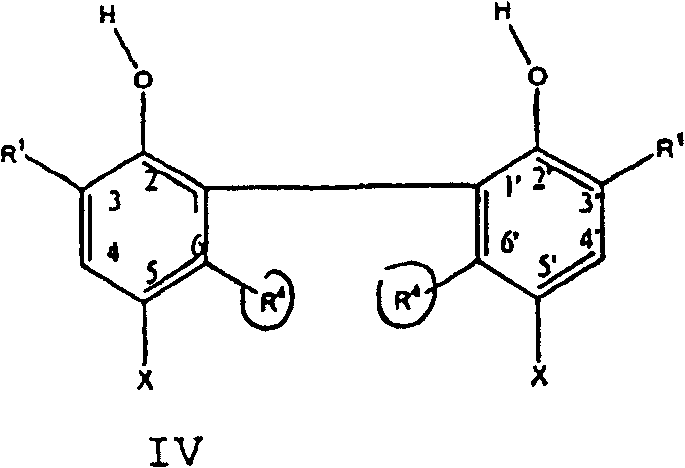
其中in
R1为C1-C10伯烷基或仲烷基、或环烷基;R 1 is C 1 -C 10 primary or secondary alkyl, or cycloalkyl;
R4为C1-C10伯烷基或仲烷基、或环烷基,及R 4 is C 1 -C 10 primary or secondary alkyl, or cycloalkyl, and
X为H、Cl、Br或IX is H, Cl, Br or I
所述方法包括以下步骤:The method comprises the steps of:
(1)当X为H时,(1) When X is H,
(a)将下式V化合物的4位烷基化,(a) Alkylation of the 4-position of the compound of the following formula V,

生成下式VI化合物,The following compound of formula VI is generated,

其中R3为C4-C20叔烷基,Wherein R 3 is a C 4 -C 20 tertiary alkyl group,
(b)将式VI化合物氧化偶合,生成下式VII化合物;(b) Oxidative coupling of the compound of formula VI to generate the compound of the following formula VII;
(c)将式VII化合物脱烷基,生成式IV化合物,其中X为H;或(c) dealkylating a compound of formula VII to a compound of formula IV, wherein X is H; or
(2)当X为Cl,Br或I时,(2) When X is Cl, Br or I,
(a)将式V化合物的4位烷基化,生成式VI化合物;(a) Alkylation of the 4-position of the compound of formula V to generate a compound of formula VI;
(b)将式VI化合物氧化偶合,生成式VII化合物;(b) oxidative coupling of the compound of formula VI to generate the compound of formula VII;
(c)将式VII化合物脱烷基,生成式IV化合物,其中X为H;及(c) dealkylating a compound of formula VII to produce a compound of formula IV, wherein X is H; and
(d)用Cl、Br或I分别取代X为H的式IV化合物5位和5’位上的H。(d) Substituting Cl, Br or I for the H on the 5-position and the 5'-position of the compound of formula IV in which X is H, respectively.
在第三方面,本发明为制备下式I化合物的方法:In a third aspect, the present invention is a process for the preparation of a compound of formula I:
其中in
R1为C1-C10伯烷基或仲烷基、或环烷基;R 1 is C 1 -C 10 primary or secondary alkyl, or cycloalkyl;
R2为C1-C10伯烷基或仲烷基、或环烷基;及R 2 is C 1 -C 10 primary or secondary alkyl, or cycloalkyl; and
X为H,X is H,
所述方法包括以下步骤:The method comprises the steps of:
(a)将X为Cl的下式III化合物氧化偶合,生成X为Cl的式I化合物,(a) X is the following formula III compound of Cl oxidative coupling, generates X to be the formula I compound of Cl,
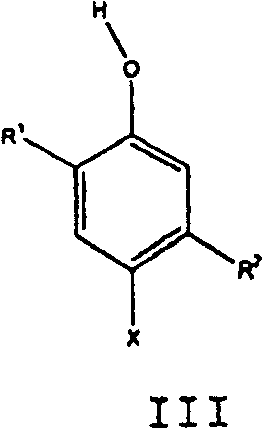
及and
(b)将X为Cl的式I化合物脱氯,生成X为H的式I的化合物。(b) dechlorinating the compound of formula I wherein X is Cl to form the compound of formula I wherein X is H.
在另一方面,本发明为选自以下的化合物:3,3’,6,6’-四甲基-2,2’-联苯酚和3,3’-二异丙基-6,6’-二甲基(dimentyl)-2,2’-联苯酚。In another aspect, the invention is a compound selected from the group consisting of 3,3',6,6'-tetramethyl-2,2'-biphenol and 3,3'-diisopropyl-6,6' -Dimentyl-2,2'-biphenol.
本发明详述Detailed description of the invention
本发明的第一方面提供制备3,3’,6,6’-四烷基-2,2’-联苯酚的方法,包括(1)将2,5-二烷基苯酚4位上的氢用氯取代;(2)将生成的2,5-二烷基-4-氯苯酚氧化偶合;及(3)除去生成化合物的氯。第二步按类似Sartori等(Tetrahedron,1992,48,9483)报道的方法进行,但使用游离酚,而不是其二氯铝酸酯衍生物。所述方法的三个步骤表示如下:The first aspect of the present invention provides a method for preparing 3,3',6,6'-tetraalkyl-2,2'-biphenol, comprising (1) converting the hydrogen at the 4-position of 2,5-dialkylphenol into Substitution with chlorine; (2) oxidative coupling of the resulting 2,5-dialkyl-4-chlorophenol; and (3) removal of chlorine from the resulting compound. The second step was carried out similarly to the method reported by Sartori et al. (Tetrahedron, 1992, 48, 9483), but using free phenol instead of its dichloroaluminate derivative. The three steps of the method are represented as follows:

其中R1为C1-C10伯烷基或仲烷基、或环烷基;及R2为C1-C10伯烷基或仲烷基、或环烷基。Wherein R 1 is C 1 -C 10 primary or secondary alkyl, or cycloalkyl; and R 2 is C 1 -C 10 primary or secondary alkyl, or cycloalkyl.
优选R1为甲基、乙基、正丙基、异丙基、正丁基、仲丁基、环己基及环戊基。优选R2为甲基和乙基。在2位和5位的烷基可以相同或不同。Preferably R 1 is methyl, ethyl, n-propyl, i-propyl, n-butyl, sec-butyl, cyclohexyl and cyclopentyl. Preferred R2 are methyl and ethyl. The alkyl groups at the 2- and 5-positions may be the same or different.
在本方法的第一步,优选在1-10mol%的催化剂(例如氯化铝或二芳基硫醚如苯硫醚,或它们的混合物)存在下,2,5-二烷基苯酚可以和氯化剂如氯气或磺酰氯反应。参见Watson,J.Org.Chem.,1985,50,2145。在温度为-30℃到60℃,优选在约25℃下,该反应可以在无溶剂或介质例如二氯甲烷、氯苯或其它惰性溶剂中进行。为了便于操作反应一般在常压或大致常压下进行。In the first step of the process, preferably in the presence of 1-10mol% catalyst (such as aluminum chloride or diaryl sulfide such as phenylene sulfide, or their mixture), 2,5-dialkylphenol can be mixed with Chlorinating agents such as chlorine or sulfuryl chloride react. See Watson, J. Org. Chem., 1985, 50, 2145. The reaction can be carried out without a solvent or in a medium such as dichloromethane, chlorobenzene or other inert solvents at a temperature of -30°C to 60°C, preferably at about 25°C. In order to facilitate the operation, the reaction is generally carried out under normal pressure or approximately normal pressure.
在本方法的第二步,可将生成的2,5-二烷基-4-氯酚氧化偶合得到相应的二聚氯酚(5,5’-二氯-3,3’,6,6’-四烷基-2,2’-联苯酚)。所述氯化酚氧化偶合的优选方法是在温度为0℃-60℃,优选约35℃下,使用溶于合适的极性非质子溶剂的三价铁盐,优选氯化铁;所述极性非质子溶剂为二氯甲烷或硝基甲烷,优选硝基甲烷。用水稀释并过滤分离产物。In the second step of the method, the resulting 2,5-dialkyl-4-chlorophenols can be oxidatively coupled to obtain the corresponding dichlorophenols (5,5'-dichloro-3,3',6,6 '-tetraalkyl-2,2'-biphenol). A preferred method for the oxidative coupling of the chlorinated phenols is to use a ferric salt, preferably ferric chloride, dissolved in a suitable polar aprotic solvent at a temperature between 0°C and 60°C, preferably about 35°C; The non-protic solvent is dichloromethane or nitromethane, preferably nitromethane. Dilute with water and isolate the product by filtration.
在本方法的第三步,通过氢解还原可完成5,5’-二氯-3,3’,6,6’-四烷基-2,2’-联苯酚的脱氯,得到需要的3,3’,6,6’-四烷基-2,2’-联苯酚。所述还原反应在氢气、优选压力为1-50个大气压、甲酸盐例如甲酸钠及
本发明的第二方面提供制备式IV化合物的方法,包括(1)将2,5-二烷基苯酚4位上的氢用叔烷基取代;(2)将生成的2,5-二烷基-4-叔烷基苯酚氧化偶合;及(3)除去生成化合物的叔烷基。所述方法的三个步骤如下所示:The second aspect of the present invention provides a method for preparing a compound of formula IV, comprising (1) replacing the hydrogen at the 4-position of 2,5-dialkylphenol with a tertiary alkyl group; (2) replacing the generated 2,5-dioxane Oxidative coupling of base-4-tert-alkylphenol; and (3) removal of the tert-alkyl group of the resulting compound. The three steps of the described method are as follows:

其中R1为C1-C10伯烷基或仲烷基、或环烷基;R4为C1-C10伯烷基或仲烷基、或环烷基;及R3为C4-C20叔烷基。Wherein R 1 is C 1 -C 10 primary or secondary alkyl, or cycloalkyl; R 4 is C 1 -C 10 primary or secondary alkyl, or cycloalkyl; and R 3 is C 4 - C 20 tertiary alkyl.
在本方法的第一步,在路易斯酸催化剂(例如氯化锌或氯化铝)存在下,2,5-二烷基苯酚可与叔烷基卤反应,生成2,5-二烷基-4-叔烷基苯酚。另一种方法为在酸催化剂存在下可将2,5-二烷基苯酚与2,2-二烷基乙烯接触制备2,5-二烷基-4-叔烷基苯酚。另一种方法的实例是在硫酸存在下,通过2,5-二烷基酚和异丁烯反应,将叔丁基连接到2,5-二烷基苯酚的四位上。In the first step of the process, 2,5-dialkylphenols can be reacted with tertiary alkyl halides in the presence of a Lewis acid catalyst such as zinc chloride or aluminum chloride to form 2,5-dialkyl- 4-tert-Alkylphenol. Another method is to prepare 2,5-dialkyl-4-tert-alkylphenol by contacting 2,5-dialkylphenol with 2,2-dialkylethylene in the presence of an acid catalyst. An example of another method is to attach a tert-butyl group to the four-position of 2,5-dialkylphenol by reacting 2,5-dialkylphenol with isobutene in the presence of sulfuric acid.
在本方法的第二步,使用二胺合铜催化剂和作为氧化剂的氧气将2,5-二烷基-4-叔烷基苯酚氧化偶合。In the second step of the process, 2,5-dialkyl-4-tert-alkylphenols are oxidatively coupled using a copper diamine catalyst and oxygen as oxidizing agent.
二胺合铜催化剂可以采用Tetrahedron Letters,1994,35,7983中介绍的方法制备。将卤化铜如CuCl、CuBr、CuI或CuCl2加入到醇(例如甲醇)和水的混合物中,然后缓慢加入二胺。加入二胺后,在剧烈搅拌下鼓入空气。过滤所得催化剂。通过浓缩滤液和过滤需要的催化剂可以得到更多的催化剂。所述催化剂还可以通过在用于偶合反应的溶剂中,将卤化铜和二胺接触原位制备。适合用于三或四取代酚氧化偶合的溶剂为二氯甲烷和芳族溶剂如二甲苯、苯及甲苯。二胺的实例包括但不限于以下化合物:N,N,N’,N’,-四乙基乙二胺、N,N,N’,N’,-四乙基-1,3-丙二胺、N,N,N’,N’,-四乙基甲二胺、N,N,N’,N’,-四甲基-1,6-己二胺、N,N,N’,N’,-四甲基-1,3-丙二胺、二哌啶子基甲烷、N,N,N’,N’,-四甲基乙二胺以及1,4-二氮杂二环-(2,2,2)辛烷。优选所述二胺为N,N,N’,N’,-四甲基乙二胺。The diamine copper catalyst can be prepared by the method introduced in Tetrahedron Letters, 1994, 35, 7983. A copper halide such as CuCl, CuBr, CuI or CuCl2 is added to a mixture of alcohol (e.g. methanol) and water, followed by the diamine slowly. After the diamine was added, air was bubbled in with vigorous stirring. The resulting catalyst was filtered. More catalyst can be obtained by concentrating the filtrate and filtering the desired catalyst. The catalyst can also be prepared in situ by contacting a copper halide and a diamine in the solvent used for the coupling reaction. Solvents suitable for the oxidative coupling of tri- or tetra-substituted phenols are dichloromethane and aromatic solvents such as xylene, benzene and toluene. Examples of diamines include, but are not limited to, the following compounds: N,N,N',N',-tetraethylethylenediamine, N,N,N',N',-tetraethyl-1,3-propanediamine Amine, N,N,N',N',-Tetraethylmethylenediamine, N,N,N',N',-Tetramethyl-1,6-hexanediamine, N,N,N', N',-tetramethyl-1,3-propanediamine, dipiperidinomethane, N,N,N',N',-tetramethylethylenediamine and 1,4-diazabicyclo - (2,2,2) octane. Preferably, the diamine is N,N,N',N',-tetramethylethylenediamine.
在本方法的第三步,一般在温度为10℃-150℃,任选在溶剂如甲苯、氯苯、硝基甲烷或二甲苯存在下,采用3,3’,6,6’-四烷基-5,5’-二叔烷基-2,2’-联苯酚和强酸性催化剂如烷基或芳基磺酸、硫酸、磷酸、氯化铝等接触除去烷基。In the third step of the process, 3,3',6,6'-tetradecane is used, typically at a temperature of 10°C to 150°C, optionally in the presence of a solvent such as toluene, chlorobenzene, nitromethane or xylene The base-5,5'-di-tert-alkyl-2,2'-biphenol is contacted with a strong acid catalyst such as alkyl or aryl sulfonic acid, sulfuric acid, phosphoric acid, aluminum chloride, etc. to remove the alkyl group.
氧化偶合可以无溶剂或在一种或多种难以被氧化的溶剂包括二氯甲烷、氯苯、甲苯、二甲苯、硝基甲烷、石蜡等中进行。静态空气、空气流或氧气都可以用做氧化偶合反应的氧化剂。The oxidative coupling can be carried out without solvent or in one or more solvents which are difficult to be oxidized including dichloromethane, chlorobenzene, toluene, xylene, nitromethane, paraffin and the like. Static air, air flow or oxygen can be used as the oxidizing agent for the oxidative coupling reaction.
本发明的第三方面提供制备下式I化合物的方法,A third aspect of the present invention provides a process for the preparation of compounds of the following formula I,

其中in
R1为C1-C10伯烷基或仲烷基、或环烷基;R 1 is C 1 -C 10 primary or secondary alkyl, or cycloalkyl;
R2为C1-C10伯烷基或仲烷基、或环烷基;及R 2 is C 1 -C 10 primary or secondary alkyl, or cycloalkyl; and
X为H,X is H,
所述方法包括以下步骤:The method comprises the steps of:
(a)将下式III化合物氧化偶合,其中X为Cl,(a) oxidative coupling of a compound of formula III wherein X is Cl,

生成式I化合物,其中X为Cl;及generating a compound of formula I, wherein X is Cl; and
(b)将X为Cl的式I化合物脱氯,生成X为H的式I化合物。(b) dechlorinating the compound of formula I wherein X is Cl to produce the compound of formula I wherein X is H.
在本方法的第一步,可以将生成的2,5-二烷基-4-氯酚氧化偶合得到相应的二聚氯酚(5,5’-二氯-3,3’,6,6’-四烷基-2,2’-联苯酚)。氧化偶合所述氯化酚的优选方法为在0℃-60℃,优选大约35℃下,使用溶于合适的极性非质子溶剂(如二氯甲烷或硝基甲烷,优选硝基甲烷)的三价铁盐优选氯化铁。用水稀释并过滤分离反应产物。In the first step of the method, the resulting 2,5-dialkyl-4-chlorophenols can be oxidatively coupled to the corresponding dichlorophenols (5,5'-dichloro-3,3',6,6 '-tetraalkyl-2,2'-biphenol). A preferred method for oxidative coupling of the chlorinated phenols is at 0°C to 60°C, preferably at about 35°C, using a The ferric salt is preferably ferric chloride. Dilute with water and isolate the reaction product by filtration.
在本方法的第二步,采用氢解还原完成5,5’-二氯-3,3’,6,6’-四烷基-2,2’-联苯酚的脱氯,提供需要的3,3’,6,6’-四烷基-2,2’-联苯酚。该还原反应在氢气(优选压力为1-50个大气压),甲酸盐例如甲酸钠,以及
在本发明的第一、第二和第三方面,可以将3,3’,6,6’-四烷基-2,2’-联苯酚的对位卤化,生成3,3’,6,6’-四烷基-5,5’-二卤基-2,2’-联苯酚,如下所示:In the first, second and third aspects of the invention, the para-halogenation of 3,3',6,6'-tetraalkyl-2,2'-biphenols can be performed to generate 3,3',6, 6'-Tetraalkyl-5,5'-dihalo-2,2'-biphenol as follows:

其中R1为C1-C10伯烷基或仲烷基、或环烷基;R2为C1-C10伯烷基或仲烷基、或环烷基;X为Cl、Br或I。Wherein R 1 is C 1 -C 10 primary or secondary alkyl, or cycloalkyl; R 2 is C 1 -C 10 primary or secondary alkyl, or cycloalkyl; X is Cl, Br or I .
3,3’,6,6’-四烷基-2,2’-联苯酚可以在适合的溶剂中和Br2反应完成溴化。溴化反应的典型溶剂为弱极性的溶剂,如氯仿、二氯甲烷、四氯化碳以及二硫化碳。在某些情况下可以使用溴水。优选在弱极性溶剂中进行。该反应可在-10℃至50℃完成,优选在室温下完成。3,3',6,6'-tetraalkyl-2,2'-biphenol can be brominated by reacting with Br 2 in a suitable solvent. Typical solvents for bromination reactions are weakly polar solvents such as chloroform, methylene chloride, carbon tetrachloride, and carbon disulfide. Bromine water can be used in some cases. Preference is given to carrying out in weakly polar solvents. The reaction can be carried out at -10°C to 50°C, preferably at room temperature.
由本发明的方法制备的化合物可以用做制备含磷配体的反应物,所述含磷配体可用于制备氢氰化反应和加氢甲酰基化反应所需要的催化剂。二齿亚磷酸酯配体特别有用。The compounds prepared by the method of the present invention can be used as reactants for the preparation of phosphorus-containing ligands, which can be used for the preparation of catalysts required for hydrocyanation and hydroformylation reactions. Bidentate phosphite ligands are particularly useful.
可采用美国专利第5,235,113中介绍的方法,将氯亚磷酸酯(phosphorochlorodite)和由本发明的方法制备的联苯酚接触来制备二齿亚磷酸酯配体。更新的美国专利6,031,120及6,069,267介绍了二齿亚磷酸酯配体的选择性合成方法,其中氯亚磷酸酯由三氯化磷和酚(如邻甲苯酚)原位制备,然后在同一反应容器中用芳族二酚处理得到二齿亚磷酸酯配体,所述专利通过引用结合到本文中。本发明的联苯酚替代了芳族二酚。The bidentate phosphite ligand can be prepared by contacting phosphorochlorodite with biphenol prepared by the method of the present invention as described in US Pat. No. 5,235,113. More recent U.S. Patents 6,031,120 and 6,069,267 describe the selective synthesis of bidentate phosphite ligands, in which chlorophosphite is prepared in situ from phosphorus trichloride and a phenol (e.g. o-cresol), and then in the same reaction vessel Treatment with aromatic diphenols yields bidentate phosphite ligands, which are hereby incorporated by reference. The biphenols of the present invention replace aromatic diphenols.
通过本发明的方法制得的化合物可以聚合,然后用作制备含磷配体的反应物,所述含磷配体可用来制备在氢氰化反应和加氢甲酰基化反应中的催化剂。The compounds produced by the process of the present invention can be polymerized and then used as reactants for the preparation of phosphorus-containing ligands which can be used to prepare catalysts in hydrocyanation and hydroformylation reactions.
由本发明的方法制备的X为H的化合物可以通过下面的方法用于制备聚合配体,包括:(1)在路易斯酸催化剂存在下,将由本发明的方法制备的X为H的化合物和包含至少两个苄基氯基团的化合物反应,(2)在有机碱存在下,将步骤1的产物和至少一种氯亚磷酸酯化合物反应。优选所述路易斯酸催化剂为氯化锌或氯化铝,所述有机碱为三烷基胺。The compound X that is H prepared by the method of the present invention can be used to prepare a polyligand by the following method, including: (1) in the presence of a Lewis acid catalyst, the compound X that is H prepared by the method of the present invention and comprising at least The compound reaction of two benzyl chloride groups, (2) in the presence of an organic base, the product of step 1 is reacted with at least one chlorophosphite compound. Preferably, the Lewis acid catalyst is zinc chloride or aluminum chloride, and the organic base is trialkylamine.
可通过以下方法将由本发明的方法制备的X为Cl、Br或I的化合物用于制备聚合配体,包括:Compounds wherein X is Cl, Br or I prepared by the method of the present invention can be used to prepare polyligands by the following methods, including:
(1)用低烷基保护基团取代OH上的H,制得OH被保护的化合物。(1) Substituting the H on OH with a lower alkyl protecting group to obtain a compound in which OH is protected.
(2)在第VIII族过渡金属催化剂存在下,用包含至少两个硼基的化合物处理所述被保护的化合物,(2) treating said protected compound with a compound comprising at least two boron groups in the presence of a Group VIII transition metal catalyst,
(3)将步骤(2)得到的产物的保护基团用氢取代,及(3) replacing the protective group of the product obtained in step (2) with hydrogen, and
(4)在有机碱存在下,将步骤(3)的产物和至少一种氯亚磷酸酯化合物反应。(4) reacting the product of step (3) with at least one phosphorochloridite compound in the presence of an organic base.
优选,第VIII族过渡金属为钯、镍或铜,而有机碱为三烷基胺化合物,其中的烷基为C1-C12支链或直链烷基。更优选有机碱为三乙胺。Preferably, the Group VIII transition metal is palladium, nickel or copper, and the organic base is a trialkylamine compound, wherein the alkyl group is a C 1 -C 12 branched or straight chain alkyl. More preferably the organic base is triethylamine.
使用含磷配体的两个特别重要的工业化的催化反应为烯烃氢氰化反应以及支链腈转化为直链腈的异构化反应。例如参见美国专利第5,512,695号和5,512,696号以及国际专利申请WO9514659。亚磷酸酯配体在这两种反应中非常有用。用单齿和二齿亚磷酸酯配体的过渡金属络合物对未活化和活化的不饱和烯键化合物(烯烃)进行氰氢化是众所周知的。二齿次亚膦酸酯和亚膦酸酯配体可用作不饱和烯键化合物的氰氢化催化剂系统中的一部分。二齿次亚磷酸酯配体也可用作芳香乙烯基化合物氰氢化的催化剂系统中的一部分。Two particularly important industrially catalyzed reactions using phosphorus-containing ligands are the hydrocyanation of olefins and the isomerization of branched to linear nitriles. See, eg, US Patent Nos. 5,512,695 and 5,512,696 and International Patent Application WO9514659. Phosphite ligands are very useful in both reactions. The hydrocyanation of unactivated and activated ethylenically unsaturated compounds (alkenes) with transition metal complexes of monodentate and bidentate phosphite ligands is well known. Bidentate phosphinate and phosphonite ligands can be used as part of a catalyst system for the hydrocyanation of ethylenically unsaturated compounds. Bidentate hypophosphite ligands can also be used as part of a catalyst system for the hydrocyanation of aromatic vinyl compounds.
加氢甲酰基化是另一种将含磷配体制备的催化剂用于工业生产的方法。已知膦配体,包括二膦用于上述用途。由亚磷酸酯配体制备的催化剂的用途也已知晓。这类催化剂通常包含第VIII族金属。参见例如美国专利5,235,113。Hydroformylation is another method for industrial production of catalysts prepared with phosphorus-containing ligands. Phosphine ligands, including diphosphines, are known for the above-mentioned uses. The use of catalysts prepared from phosphite ligands is also known. Such catalysts typically comprise a Group VIII metal. See, eg, US Patent 5,235,113.
按本发明方法制备的两个特别有用的化合物为3,3’,6,6’-四烷基-2,2’-联苯酚和3,3’,-二异丙基-6,6’-二甲基(dimentyl)-2,2’-联苯酚。Two particularly useful compounds prepared by the process of the invention are 3,3',6,6'-tetraalkyl-2,2'-biphenol and 3,3',-diisopropyl-6,6' -Dimentyl-2,2'-biphenol.
实施例Example
用以下非限制性实施例阐述本发明。除另有说明外,所有的份数、比例和百分率均以重量计。The invention is illustrated by the following non-limiting examples. All parts, ratios and percentages are by weight unless otherwise indicated.
实施例1Example 1
本发明第一方面制备3,3’,6,6’-四烷基-2,2’-联苯酚的方法The method for preparing 3,3',6,6'-tetraalkyl-2,2'-biphenol in the first aspect of the present invention
第一步:制备4-氯-2,5-二甲苯酚The first step: preparation of 4-chloro-2,5-xylenol
在100g(0.82mol)2,5-二甲苯酚和0.9g苯硫醚的700mL二氯甲烷溶液中,加入106g(0.79mol)磺酰氯的100mL二氯甲烷溶液,保持温度在5-15℃。将该混合物搅拌1小时,然后倾入含有5g亚硫酸氢钠的400g冰水中。将各层分离,有机相用水洗涤,经硫酸镁干燥,浓缩至干。将所得粗固体和最少量的己烷拌浆、过滤、抽干得到均一的121g(94%)的产物,经薄层色谱(TLC)、GC和1H-NMR分析鉴定。1H-NMR(CDCl3)δ2.18(s,3H),2.27(s,3H),4.61(s,1H),6.63(s,1H),7.07(s,1H)。文献值(Blackstock,Aust.J.Chem.1973,26,775):mp74-75℃。In 100g (0.82mol) of 2,5-xylenol and 0.9g of phenylene sulfide in 700mL of dichloromethane solution, add 106g (0.79mol) of sulfonyl chloride in 100mL of dichloromethane solution, keeping the temperature at 5-15°C. The mixture was stirred for 1 hour, then poured into 400 g of ice water containing 5 g of sodium bisulfite. The layers were separated and the organic phase was washed with water, dried over magnesium sulfate and concentrated to dryness. The resulting crude solid was slurried with a minimum amount of hexane, filtered, and sucked dry to obtain 121 g (94%) of a homogeneous product, which was identified by thin-layer chromatography (TLC), GC and 1 H-NMR analyses. 1 H-NMR (CDCl 3 ) δ 2.18 (s, 3H), 2.27 (s, 3H), 4.61 (s, 1H), 6.63 (s, 1H), 7.07 (s, 1H). Literature value (Blackstock, Aust. J. Chem. 1973, 26, 775): mp 74-75°C.
第二步:制备5,5’-二氯-3,3’,6,6’-四甲基-2,2’-联苯酚:The second step: preparation of 5,5'-dichloro-3,3',6,6'-tetramethyl-2,2'-biphenol:
在约20分钟内,在用机械搅拌的71.4g(0.458mol)4-氯-2,5-二甲苯酚和120mL硝基甲烷的混合物中分批加入94g(0.59mol)无水氯化铁,同时冷却,使温度保持在35℃以下。将混合物搅拌3小时,然后加入含50mL浓盐酸的300mL冰水,并冷却使温度保持在35℃以下,再加入300mL己烷。过滤混合物,用水和己烷洗涤所得固体,真空干燥得到51.0g产物。将有机相从滤液中分离,水洗并浓缩;所得残余物用己烷拌浆,过滤得到另11g的产物。因此褐色固体的总产率为62g(87%)(mp 148-155℃)。再进行纯化除去微量的铁,有利于后续的还原脱氯反应。纯化可通过以下方法完成:用乙酸乙酯溶解粗品,然后用乙二胺四乙酸二钠盐(EDTA-2Na,EDTa=乙二胺四乙酸)的水溶液洗涤所得溶液,经硫酸镁干燥、浓缩、用己烷洗涤,得到mp为164℃的灰白色物质。1H-NMR(CDCl3)δ1.98(s,3H),2.25(s,3H),4.60(s,1H),7.25(s,1H)。In about 20 minutes, 94 g (0.59 mol) of anhydrous ferric chloride were added in batches to a mixture of 71.4 g (0.458 mol) of 4-chloro-2,5-xylenol and 120 mL of nitromethane stirred mechanically, While cooling, keep the temperature below 35°C. The mixture was stirred for 3 hours, then 300 mL of ice water containing 50 mL of concentrated hydrochloric acid was added, cooled to keep the temperature below 35°C, and 300 mL of hexane was added. The mixture was filtered and the resulting solid was washed with water and hexanes and dried in vacuo to yield 51.0 g of product. The organic phase was separated from the filtrate, washed with water and concentrated; the resulting residue was slurried with hexane and filtered to give another 11 g of product. The overall yield of brown solid was thus 62 g (87%) (mp 148-155° C.). Purification is then carried out to remove trace amounts of iron, which is beneficial to the subsequent reductive dechlorination reaction. Purification can be accomplished by dissolving the crude product in ethyl acetate, then washing the resulting solution with an aqueous solution of ethylenediaminetetraacetic acid disodium salt (EDTA-2Na, EDTa = ethylenediaminetetraacetic acid), drying over magnesium sulfate, concentrating, Washing with hexane gave an off-white material with mp 164°C. 1 H-NMR (CDCl 3 ) δ 1.98 (s, 3H), 2.25 (s, 3H), 4.60 (s, 1H), 7.25 (s, 1H).
第三步:制备3,3’,6,6’-四甲基-2,2’-联苯酚The third step: preparation of 3,3',6,6'-tetramethyl-2,2'-biphenol
将纯化后的5,5’-二氯-3,3’,6,6’-四甲基-2,2’-联苯酚试样(15.0g,48.4mmol)溶解在含有10mL水和20mL三乙胺的100mL乙醇中。将所述溶液加入到1.0g(以干重计)含水20%的Pd(OH)2/C(Pearlman’s催化剂)中,在50磅/平方英寸的压力和室温下氢化2小时。经过滤催化剂、浓缩、将残余物溶解在EtOAc中、水洗、浓缩至干,分离得到11.0g(94%)产物,mp 110-113℃。1H-NMR(CDCl3)δ1.95(s,3H),2.25(s,3H),4.71(s,1H),6.81(d,1H,J=7.5Hz),7.10(d,1H,J=7.5Hz)。The purified 5,5'-dichloro-3,3',6,6'-tetramethyl-2,2'-biphenol sample (15.0 g, 48.4 mmol) was dissolved in 10 mL of water and 20 mL of tris ethylamine in 100 mL of ethanol. The solution was added to 1.0 g (by dry weight) of 20% aqueous Pd(OH) 2 /C (Pearlman's catalyst) and hydrogenated at 50 psi at room temperature for 2 hours. After filtering the catalyst, concentrating, dissolving the residue in EtOAc, washing with water and concentrating to dryness, 11.0 g (94%) of product were isolated, mp 110-113°C. 1 H-NMR (CDCl 3 ) δ1.95(s, 3H), 2.25(s, 3H), 4.71(s, 1H), 6.81(d, 1H, J=7.5Hz), 7.10(d, 1H, J = 7.5Hz).
上述实施例的第二和第三步也阐明了本发明的第三方面。The second and third steps of the above embodiment also illustrate the third aspect of the present invention.
实施例2Example 2
本发明第三方面制备3,3’-二异丙基-6,6’-二甲基-2,2’-联苯酚的方The third aspect of the present invention prepares 3,3'-diisopropyl-6,6'-dimethyl-2,2'-biphenol 法Law
第一步:制备5,5’-二氯-3,3’-二异丙基-6,6’-二甲基-2,2’-联苯酚The first step: preparation of 5,5'-dichloro-3,3'-diisopropyl-6,6'-dimethyl-2,2'-biphenol
将充分搅拌的36.0g(0.195mol)氯代百里酚和50mL硝基甲烷的混合物冷却到5℃,在20分钟内加入40g(0.25mol)无水氯化铁。使该混合物自然升至室温,并保持1小时。一次性加入冰水(300mL),然后减压将该混合物浓缩,除去约100mL的硝基甲烷-水共沸物。过滤所得固体,将该固体在含水的异丙醇中重结晶,第一次收得固体23.3g,第二次收得固体3.9g,mp 98℃。1H-NMR(CDCl3)δ1.24(2d,6H,J=7Hz),1.98(s,3H),3.26(七重峰,1H,J=7Hz),4.63(s,1H),7.30(s,1H)。A well-stirred mixture of 36.0 g (0.195 mol) of chlorothymol and 50 mL of nitromethane was cooled to 5° C., and 40 g (0.25 mol) of anhydrous ferric chloride were added within 20 minutes. The mixture was allowed to warm to room temperature naturally for 1 hour. Ice water (300 mL) was added in one portion, then the mixture was concentrated under reduced pressure to remove about 100 mL of the nitromethane-water azeotrope. The resulting solid was filtered and recrystallized in aqueous isopropanol. The first yield was 23.3 g, and the second yield was 3.9 g, mp 98°C. 1 H-NMR (CDCl 3 ) δ1.24(2d, 6H, J=7Hz), 1.98(s, 3H), 3.26(septet, 1H, J=7Hz), 4.63(s, 1H), 7.30(s , 1H).
第二步:3,3’-二异丙基-6,6’-二甲基-2,2’-联苯酚The second step: 3,3'-diisopropyl-6,6'-dimethyl-2,2'-biphenol
除用5,5’-二氯-3,3’-二异丙基-6,6’-二甲基-2,2’-联苯酚代替5,5’-二氯-3,3’,6,6’-四甲基-2,2’-联苯酚外,所述取代联苯酚的制备和实施例1的第三步相似,mp 89-92℃。1H-NMR(CDCl3)δ1.25(d,6H),1.95(s,3H),3.28(七重峰,1H),4.76(s,1H),6.88(d,1H,J=7.5Hz),7.18(d,1H,J=7.5Hz)。Except for 5,5'-dichloro-3,3'-diisopropyl-6,6'-dimethyl-2,2'-biphenol instead of 5,5'-dichloro-3,3', Except for 6,6'-tetramethyl-2,2'-biphenol, the preparation of the substituted biphenol is similar to the third step of Example 1, mp 89-92°C. 1 H-NMR (CDCl 3 ) δ1.25(d, 6H), 1.95(s, 3H), 3.28(septet, 1H), 4.76(s, 1H), 6.88(d, 1H, J=7.5Hz) , 7.18 (d, 1H, J = 7.5 Hz).
实施例3Example 3
本发明第二方面制备3,3’,6,6’-四甲基-2,2’-联苯酚的方法The method for preparing 3,3',6,6'-tetramethyl-2,2'-biphenol in the second aspect of the present invention
第一步:制备4-叔丁基-2,5-二甲苯酚Step 1: Preparation of 4-tert-butyl-2,5-xylenol
制备4-叔丁基-2,5-二甲苯酚:在80℃下将2,5-二甲苯酚(90g,0.73mol)熔融,加入1mL浓硫酸,液面下通入异丁烯气体,将该混合物在90℃下加热4小时。反应在约80%转化后基本停止。将反应物用水稀释并用NaHCO3中和,经水蒸汽蒸馏除去一些起始的二甲苯酚。因为水蒸汽蒸馏不能完全除去原料,所以将残余物溶解在热己烷中,与水相中分离,用冰浴冷却。过滤、用冷己烷洗涤沉淀产物,得到64g(49%)4-叔丁基-2,5-二甲苯酚;文献值(Stevens,Ind.Eng.Chem.1943,655;Parc,Rev.Inst.Fr.Pet.1960,680)mp 70-72℃。1H-NMR(CDCl3)δ1.37(s,9H),2.20(s,3H),2.43(s,3H),4.85(s,1H),6.53(s,1H),7.08(s,1H)。Preparation of 4-tert-butyl-2,5-xylenol: Melt 2,5-xylenol (90 g, 0.73 mol) at 80°C, add 1 mL of concentrated sulfuric acid, pass isobutene gas under the liquid surface, and The mixture was heated at 90°C for 4 hours. The reaction essentially stopped after about 80% conversion. The reaction was diluted with water and neutralized with NaHCO 3 , some starting xylenol was removed by steam distillation. Since the starting material could not be completely removed by steam distillation, the residue was dissolved in hot hexane, separated from the aqueous phase and cooled in an ice bath. Filtration, washing the precipitated product with cold hexane gave 64 g (49%) of 4-tert-butyl-2,5-xylenol; literature value (Stevens, Ind. Eng. Chem. 1943, 655; Parc, Rev. Inst . Fr. Pet. 1960, 680) mp 70-72°C. 1 H-NMR (CDCl 3 ) δ1.37(s, 9H), 2.20(s, 3H), 2.43(s, 3H), 4.85(s, 1H), 6.53(s, 1H), 7.08(s, 1H ).
第二步:制备5,5’-二叔丁基-3,3’,6,6’-四甲基-2,2’-联苯酚The second step: preparation of 5,5'-di-tert-butyl-3,3',6,6'-tetramethyl-2,2'-biphenol
在18.6g(0.104mol)4-叔丁基-2,5-二甲苯酚的20mL二氯甲烷溶液中加入0.6g(3mmol)碱式氯化铜-TMEDA络合物(TMEDA=四甲基乙二胺)。在环境空气下,将该深紫色混合物搅拌过夜。气相色谱(GC)分析表明转化率仅为25%,因此将所述混合物用二氯甲烷稀释、经硫酸镁干燥,浓缩至干。在粗残余物中加入20mL环己烷和1.2g(6mmol)上述碱式氯化铜-TMEDA催化剂,在室温下通入空气并将混合物搅拌3天(转化率85%)。将所得紫色溶液浓缩至干,并将残余物用硅胶色谱分离得到10.2g(55%)纯的5,5’-二叔丁基-3,3’,6,6’-四甲基-2,2’-联苯酚,mp 103-105℃。1H-NMR(CDCL3)δ1.42(s,9H),2.06(s,3H),2.25(s,3H),4.54(s,1H),6.51(s,1H),7.24(s,1H)。In 18.6g (0.104mol) of 4-tert-butyl-2,5-xylenol in 20mL of dichloromethane solution, add 0.6g (3mmol) of basic copper chloride-TMEDA complex (TMEDA=tetramethylethane diamine). The dark purple mixture was stirred overnight under ambient air. Gas chromatography (GC) analysis showed only 25% conversion, so the mixture was diluted with dichloromethane, dried over magnesium sulfate and concentrated to dryness. 20 mL of cyclohexane and 1.2 g (6 mmol) of the above basic copper chloride-TMEDA catalyst were added to the crude residue, air was blown at room temperature and the mixture was stirred for 3 days (85% conversion). The resulting purple solution was concentrated to dryness and the residue was chromatographed on silica gel to give 10.2 g (55%) of pure 5,5'-di-tert-butyl-3,3',6,6'-tetramethyl-2 , 2'-biphenol, mp 103-105°C. 1 H-NMR (CDCL 3 ) δ1.42(s, 9H), 2.06(s, 3H), 2.25(s, 3H), 4.54(s, 1H), 6.51(s, 1H), 7.24(s, 1H ).
第三步:制备3,3’,6,6’-四甲基-2,2’-联苯酚The third step: preparation of 3,3',6,6'-tetramethyl-2,2'-biphenol
在50mL烧瓶中加入0.5g 5,5’-二叔丁基-3,3’,6,6’-四甲基-2,2’-联苯酚、5mL二甲苯和0.05g对甲苯磺酸。将该混合物回流约2小时。冷却混合物,然后加入水。用己烷抽提该混合物、取有机相用水洗洗涤,经硫酸镁干燥。除去溶剂后,将残余物在石油醚中重结晶。Add 0.5 g of 5,5'-di-tert-butyl-3,3',6,6'-tetramethyl-2,2'-biphenol, 5 mL of xylene and 0.05 g of p-toluenesulfonic acid in a 50 mL flask. The mixture was refluxed for about 2 hours. The mixture was cooled, then water was added. The mixture was extracted with hexane, the organic phase was washed with water and dried over magnesium sulfate. After removal of the solvent, the residue was recrystallized from petroleum ether.
实施例4Example 4
本发明第二方面制备5,5’-二叔丁基-3,3’-二异丙基,6,6’-二甲基-The second aspect of the present invention prepares 5,5'-di-tert-butyl-3,3'-diisopropyl, 6,6'-dimethyl- 2,2’-联苯酚的方法2,2'-biphenol method
第一步:制备4-叔丁基百里酚:The first step: preparation of 4-tert-butylthymol:
在氮气保护下,在60℃加热的30g(0.20mol)百里酚中加入1g浓硫酸。加热至90℃后,缓慢通入异丁烯气流约2小时。反应在转化率约为50%时停止,因此再加入硫酸,反应经GC分析监测,直达转化率达至约70-80%。所得反应物用实施例1的方法进行后处理,将所得粗残余物在己烷中重结晶,得到20g 4-叔丁基百里酚,mp 68-69℃,文献值(美国专利第4,880,775号)mp 76-77℃。1H-NMR(CDCl3)δ1.25(d,6H,J=7Hz),1.38(s,9H),2.44(s,3H),3.15(七重峰,1H),4.49(s,1H),6.51(s,1H),7.18(s,1H)。Under nitrogen protection, 1 g of concentrated sulfuric acid was added to 30 g (0.20 mol) of thymol heated at 60°C. After heating to 90°C, a stream of isobutylene was slowly introduced for about 2 hours. The reaction was stopped at about 50% conversion, so additional sulfuric acid was added and the reaction monitored by GC analysis until conversion reached about 70-80%. The obtained reactant is post-treated with the method of Example 1, and the resulting thick residue is recrystallized in hexane to obtain 20 g of 4-tert-butylthymol, mp 68-69 ° C, literature value (US Patent No. 4,880,775 ) mp 76-77°C. 1 H-NMR (CDCl 3 ) δ1.25 (d, 6H, J=7Hz), 1.38 (s, 9H), 2.44 (s, 3H), 3.15 (septet, 1H), 4.49 (s, 1H), 6.51(s, 1H), 7.18(s, 1H).
第二步:制备5,5’-二叔丁基-3,3’-二异丙基,6,6’-二甲基-2,2’-联The second step: preparation of 5,5'-di-tert-butyl-3,3'-diisopropyl, 6,6'-dimethyl-2,2'-linked 苯酚phenol
在20g(0.104mol)4-叔丁基百里酚的50mL二氯甲烷溶液中加入1.0g(5mmol)碱式氯化铜-TMEDA络合物。在环境空气下,将深紫色混合物搅拌三天(转化率50%)。将所述混合物用己烷稀释,用EDTA水溶液洗涤,经硫酸镁干燥,浓缩至干。所得残余物用硅胶色谱分离得到3.6g(转化率34%)纯二聚物5,5’-二叔丁基-3,3’-二异丙基,6,6’-二甲基-2,2’-联苯酚,mp 105-108℃。1H-NMR(CDCl3)δ1.26(d,6H),1.43(s,9H),3.25(七重峰,1H),4.58(s,1H),7.30(s,1H)。Add 1.0 g (5 mmol) basic copper chloride-TMEDA complex to 20 g (0.104 mol) of 4-tert-butylthymol in 50 mL of dichloromethane solution. Under ambient air, the dark purple mixture was stirred for three days (50% conversion). The mixture was diluted with hexanes, washed with aqueous EDTA, dried over magnesium sulfate and concentrated to dryness. The resulting residue was chromatographed on silica gel to obtain 3.6 g (34% conversion) of pure dimers 5,5'-di-tert-butyl-3,3'-diisopropyl, 6,6'-dimethyl-2 , 2'-biphenol, mp 105-108°C. 1 H-NMR (CDCl 3 ) δ 1.26 (d, 6H), 1.43 (s, 9H), 3.25 (septet, 1H), 4.58 (s, 1H), 7.30 (s, 1H).
5,5’-二叔丁基-3,3’-二异丙基,6,6’-二甲基-2,2’-联苯酚脱丁基5,5'-di-tert-butyl-3,3'-diisopropyl, 6,6'-dimethyl-2,2'-biphenol debutyl
将装有机械搅拌和冷凝器的500mL树脂罐置于油浴中,并加入153g 5,5’-二叔丁基-3,3’-二异丙基,6,6’-二甲基-2,2’-联苯酚和烃溶剂的混合物。经气相色谱分析,混合物中含15.0%5,5’-二叔丁基-3,3’-二异丙基,6,6’-二甲基-2,2’-联苯酚。加入1.5g对甲苯磺酸,将该混合物加热到130℃。7.5小时后,气相色谱分析表明混合物含11.6%完全脱丁基的产物(3,3’-二异丙基-6,6’-二甲基-2,2’-联苯酚);2.7%单脱丁基产物(5-叔丁基-3,3’-二异丙基-6,6’-二甲基-2,2’-联苯酚);及0.3%未反应的原料。Put a 500mL resin tank equipped with a mechanical stirrer and a condenser in an oil bath, and add 153g of 5,5'-di-tert-butyl-3,3'-diisopropyl, 6,6'-dimethyl- Mixture of 2,2'-biphenol and hydrocarbon solvents. According to gas chromatography analysis, the mixture contained 15.0% 5,5'-di-tert-butyl-3,3'-diisopropyl, 6,6'-dimethyl-2,2'-biphenol. 1.5 g of p-toluenesulfonic acid were added and the mixture was heated to 130°C. After 7.5 hours, gas chromatographic analysis of the mixture showed 11.6% of the fully debutylated product (3,3'-diisopropyl-6,6'-dimethyl-2,2'-biphenol); 2.7% of mono Debutylated product (5-tert-butyl-3,3'-diisopropyl-6,6'-dimethyl-2,2'-biphenol); and 0.3% unreacted starting material.
实施例5Example 5
2,2’-二羟基-3,3’-二异丙基-5,5’-二甲基联苯的溴化Bromination of 2,2'-dihydroxy-3,3'-diisopropyl-5,5'-dimethylbiphenyl
在氮气保护下,将Br2(3.36mL,0.0652mol)的二氯甲烷(5mL)溶液滴加到2,2’-二羟基-3,3’-二异丙基-5,5’-二甲基联苯(6.488g,0.0217mol)的二氯甲烷(200mL)溶液中。在室温下将该混合物搅拌过夜。反应完成后,将混合物用10%的NaHSO3溶液(3×50mL)洗涤,然后用盐水(2×50mL)洗涤,经硫酸镁干燥。真空下除去溶剂,得到橙色的油,将其用色谱柱纯化(硅胶,10%乙酸乙酯/己烷)。得到浅棕色固体3.95g(40%)。1H NMR(C6D6):1.07(d,6H),1.89(s,3H),3.17(m,1H),4.30(br s,1H),7.52(s,1H)。Under nitrogen protection, a solution of Br 2 (3.36 mL, 0.0652 mol) in dichloromethane (5 mL) was added dropwise to 2,2'-dihydroxy-3,3'-diisopropyl-5,5'-di In a solution of methylbiphenyl (6.488g, 0.0217mol) in dichloromethane (200mL). The mixture was stirred overnight at room temperature. After the reaction was complete, the mixture was washed with 10% NaHSO 3 solution (3×50 mL), then brine (2×50 mL), and dried over magnesium sulfate. The solvent was removed in vacuo to give an orange oil which was purified by column chromatography (silica gel, 10% ethyl acetate/hexanes). Obtained 3.95 g (40%) of a light brown solid. 1 H NMR (C 6 D 6 ): 1.07 (d, 6H), 1.89 (s, 3H), 3.17 (m, 1H), 4.30 (br s, 1H), 7.52 (s, 1H).
Claims (11)


Applications Claiming Priority (2)
| Application Number | Priority Date | Filing Date | Title |
|---|---|---|---|
| US09/994,098 US6489517B1 (en) | 2001-11-26 | 2001-11-26 | Process for preparing 3,3′,6,6′-tetraalkyl-2,2′-biphenols and 3,3′,6,6′-tetraalkyl-5,5′-dihalo-2,2′-biphenols |
| US09/994,098 | 2001-11-26 |
Related Child Applications (1)
| Application Number | Title | Priority Date | Filing Date |
|---|---|---|---|
| CNB2006100054384A Division CN100368367C (en) | 2001-11-26 | 2002-11-07 | Preparation of 3,3′,6,6′-tetraalkyl-2,2′-biphenol and 3,3′,6,6′-tetraalkyl-5,5′-dihalo-2,2′ -Biphenol method |
Publications (2)
| Publication Number | Publication Date |
|---|---|
| CN1615288A CN1615288A (en) | 2005-05-11 |
| CN100439309C true CN100439309C (en) | 2008-12-03 |
Family
ID=25540274
Family Applications (2)
| Application Number | Title | Priority Date | Filing Date |
|---|---|---|---|
| CNB2006100054384A Expired - Lifetime CN100368367C (en) | 2001-11-26 | 2002-11-07 | Preparation of 3,3′,6,6′-tetraalkyl-2,2′-biphenol and 3,3′,6,6′-tetraalkyl-5,5′-dihalo-2,2′ -Biphenol method |
| CNB028273567A Expired - Lifetime CN100439309C (en) | 2001-11-26 | 2002-11-07 | preparation 3 |
Family Applications Before (1)
| Application Number | Title | Priority Date | Filing Date |
|---|---|---|---|
| CNB2006100054384A Expired - Lifetime CN100368367C (en) | 2001-11-26 | 2002-11-07 | Preparation of 3,3′,6,6′-tetraalkyl-2,2′-biphenol and 3,3′,6,6′-tetraalkyl-5,5′-dihalo-2,2′ -Biphenol method |
Country Status (16)
| Country | Link |
|---|---|
| US (2) | US6489517B1 (en) |
| EP (1) | EP1448503B1 (en) |
| JP (1) | JP4354819B2 (en) |
| KR (1) | KR100913466B1 (en) |
| CN (2) | CN100368367C (en) |
| AT (1) | ATE385232T1 (en) |
| AU (1) | AU2002365378A1 (en) |
| BR (1) | BR0214445B1 (en) |
| CA (1) | CA2468109A1 (en) |
| DE (1) | DE60224884T2 (en) |
| ES (1) | ES2299636T3 (en) |
| MX (1) | MXPA04004937A (en) |
| MY (1) | MY130488A (en) |
| PL (1) | PL371124A1 (en) |
| TW (1) | TW593255B (en) |
| WO (1) | WO2003045884A1 (en) |
Families Citing this family (9)
| Publication number | Priority date | Publication date | Assignee | Title |
|---|---|---|---|---|
| FR2849027B1 (en) * | 2002-12-23 | 2005-01-21 | Rhodia Polyamide Intermediates | PROCESS FOR THE SYNTHESIS OF COMPOUNDS COMPRISING NITRIL FUNCTIONS FROM ETHYLENE-UNSATURATED COMPOUNDS |
| FR2850966B1 (en) | 2003-02-10 | 2005-03-18 | Rhodia Polyamide Intermediates | PROCESS FOR PRODUCING DINITRIL COMPOUNDS |
| FR2854892B1 (en) | 2003-05-12 | 2005-06-24 | Rhodia Polyamide Intermediates | PROCESS FOR PRODUCING DINITRILES |
| FR2854891B1 (en) | 2003-05-12 | 2006-07-07 | Rhodia Polyamide Intermediates | PROCESS FOR PREPARING DINITRILES |
| US7002046B2 (en) * | 2003-10-07 | 2006-02-21 | General Electric Company | Process for the recovery of dihydroxybiaryl compounds |
| EP1996598B1 (en) | 2006-03-17 | 2013-10-16 | Invista Technologies S.à.r.l. | Method for the purification of triorganophosphites by treatment with a basic additive |
| US7709674B2 (en) | 2006-07-14 | 2010-05-04 | Invista North America S.A R.L | Hydrocyanation process with reduced yield losses |
| WO2009087959A1 (en) | 2008-01-08 | 2009-07-16 | Nippon Soda Co., Ltd. | Optically active 2,2'-biphenol derivative and method for producing the same |
| JP2016510072A (en) * | 2013-03-13 | 2016-04-04 | ヴィンタースハル ホールディング ゲゼルシャフト ミット ベシュレンクテル ハフツングWintershall Holding GmbH | Process for producing substituted tris (2-hydroxyphenyl) methane |
Citations (1)
| Publication number | Priority date | Publication date | Assignee | Title |
|---|---|---|---|---|
| US6069267A (en) * | 1997-07-29 | 2000-05-30 | E. I. Du Pont De Nemours And Company | Selective synthesis of organodiphosphite compounds |
Family Cites Families (19)
| Publication number | Priority date | Publication date | Assignee | Title |
|---|---|---|---|---|
| US2041593A (en) * | 1934-10-11 | 1936-05-19 | Pennsylvania Coal Products Com | Process of hydrolyzing chlor alkyl phenols |
| GB1037548A (en) * | 1963-08-30 | 1966-07-27 | Coalite Chem Prod Ltd | Chlorinated phenols |
| US3839469A (en) * | 1967-11-13 | 1974-10-01 | Continental Oil Co | Reductive chlorination of certain alkylphenols |
| US3920757A (en) * | 1971-08-25 | 1975-11-18 | Dow Chemical Co | Chlorination with sulfuryl chloride |
| US3931340A (en) * | 1972-08-03 | 1976-01-06 | Asahi Denka Kogyo K.K. | Chlorination of aromatic compounds |
| JPS5257131A (en) * | 1975-10-31 | 1977-05-11 | Seitetsu Kagaku Co Ltd | Chlorination process for xylenols |
| US4139544A (en) | 1976-11-26 | 1979-02-13 | Ici Americas Inc. | Oxidative coupling of alkylphenols catalyzed by metal complexes of polyimino acids |
| US4132722A (en) | 1976-11-26 | 1979-01-02 | Ici Americas Inc. | Oxidative coupling of alkylphenols catalyzed by metal complexes of diimino acid |
| US4108908A (en) | 1977-02-18 | 1978-08-22 | Ici Americas Inc. | Oxidative coupling of alkylphenols or 1-naphthols catalyzed by metal complexes of thio-acid compounds |
| US4354048A (en) | 1981-05-22 | 1982-10-12 | The Dow Chemical Company | Copper chromite catalysts for oxidative coupling of phenols |
| JPH0742240B2 (en) * | 1985-09-30 | 1995-05-10 | 三井石油化学工業株式会社 | Method for producing biphenols |
| TW213465B (en) | 1991-06-11 | 1993-09-21 | Mitsubishi Chemicals Co Ltd | |
| DK0730574T3 (en) | 1993-11-23 | 1999-05-25 | Du Pont | Methods and catalyst compositions for hydrocyanation of monoolefins |
| US5512695A (en) | 1994-04-14 | 1996-04-30 | E. I. Du Pont De Nemours And Company | Bidentate phosphite and nickel catalyst compositions for hydrocyanation of monoolefins |
| US5512596A (en) | 1994-09-02 | 1996-04-30 | Gilead Sciences, Inc. | Aromatic compounds |
| IN187044B (en) * | 1995-01-27 | 2002-01-05 | Du Pont | |
| JP3493266B2 (en) * | 1996-08-27 | 2004-02-03 | 高砂香料工業株式会社 | Novel optically active diphosphine compound, method for producing the compound, transition metal complex having the compound as ligand, and method for producing optically active substance using the complex |
| MY124170A (en) * | 1997-07-29 | 2006-06-30 | Invista Tech Sarl | Hydrocyanation processes and multidentate phosphite ligand and nickel catalyst compositions therefor |
| US6077979A (en) | 1999-02-18 | 2000-06-20 | E. I. Du Pont De Nemours And Company | Manufacture of 3,3',5,5'-tetramethyl-2,2'-biphenol |
-
2001
- 2001-11-26 US US09/994,098 patent/US6489517B1/en not_active Expired - Lifetime
-
2002
- 2002-08-26 TW TW091119252A patent/TW593255B/en not_active IP Right Cessation
- 2002-09-05 US US10/235,413 patent/US6555718B1/en not_active Expired - Lifetime
- 2002-11-07 KR KR1020047007920A patent/KR100913466B1/en not_active Expired - Fee Related
- 2002-11-07 EP EP02803972A patent/EP1448503B1/en not_active Expired - Lifetime
- 2002-11-07 DE DE60224884T patent/DE60224884T2/en not_active Expired - Lifetime
- 2002-11-07 CA CA002468109A patent/CA2468109A1/en not_active Abandoned
- 2002-11-07 AT AT02803972T patent/ATE385232T1/en not_active IP Right Cessation
- 2002-11-07 MX MXPA04004937A patent/MXPA04004937A/en unknown
- 2002-11-07 JP JP2003547342A patent/JP4354819B2/en not_active Expired - Fee Related
- 2002-11-07 BR BRPI0214445-0A patent/BR0214445B1/en not_active IP Right Cessation
- 2002-11-07 CN CNB2006100054384A patent/CN100368367C/en not_active Expired - Lifetime
- 2002-11-07 CN CNB028273567A patent/CN100439309C/en not_active Expired - Lifetime
- 2002-11-07 WO PCT/US2002/035781 patent/WO2003045884A1/en not_active Ceased
- 2002-11-07 PL PL02371124A patent/PL371124A1/en not_active IP Right Cessation
- 2002-11-07 ES ES02803972T patent/ES2299636T3/en not_active Expired - Lifetime
- 2002-11-07 AU AU2002365378A patent/AU2002365378A1/en not_active Abandoned
- 2002-11-26 MY MYPI20024422A patent/MY130488A/en unknown
Patent Citations (1)
| Publication number | Priority date | Publication date | Assignee | Title |
|---|---|---|---|---|
| US6069267A (en) * | 1997-07-29 | 2000-05-30 | E. I. Du Pont De Nemours And Company | Selective synthesis of organodiphosphite compounds |
Non-Patent Citations (1)
| Title |
|---|
| Oxidative Coupling of Phenols. DAVID R. ARMSTRONG.J. CHEM. SOC. PERKIN TRANS. II,No.5. 1983 * |
Also Published As
| Publication number | Publication date |
|---|---|
| DE60224884D1 (en) | 2008-03-20 |
| MXPA04004937A (en) | 2004-08-11 |
| CN100368367C (en) | 2008-02-13 |
| CN1800127A (en) | 2006-07-12 |
| US6555718B1 (en) | 2003-04-29 |
| ATE385232T1 (en) | 2008-02-15 |
| BR0214445A (en) | 2004-09-14 |
| BR0214445B1 (en) | 2012-07-10 |
| PL371124A1 (en) | 2005-06-13 |
| TW593255B (en) | 2004-06-21 |
| ES2299636T3 (en) | 2008-06-01 |
| CN1615288A (en) | 2005-05-11 |
| KR20040055817A (en) | 2004-06-29 |
| MY130488A (en) | 2007-06-29 |
| CA2468109A1 (en) | 2003-06-05 |
| EP1448503B1 (en) | 2008-01-30 |
| WO2003045884A1 (en) | 2003-06-05 |
| JP4354819B2 (en) | 2009-10-28 |
| EP1448503A1 (en) | 2004-08-25 |
| JP2005510551A (en) | 2005-04-21 |
| AU2002365378A1 (en) | 2003-06-10 |
| KR100913466B1 (en) | 2009-08-25 |
| US6489517B1 (en) | 2002-12-03 |
| DE60224884T2 (en) | 2009-01-22 |
Similar Documents
| Publication | Publication Date | Title |
|---|---|---|
| KR100880787B1 (en) | 3,3 ', 5,5', 6,6'-hexaalkyl-2,2'-biphenol, 3,3 ', 4,4', 5,5'-hexaalkyl-2,2'-ratio Process for preparing phenol and 3,3 ', 4,4', 5,5 ', 6,6'-octaalkyl-2,2'-biphenol | |
| JP4425981B2 (en) | 3,3'-Dialkylated-5,5 ', 6,6', 7,7 ', 8,8'-octahydro-2,2'-binaphthol and process for their preparation | |
| US6399534B2 (en) | Bidentate organic phosphite ligands and compositions | |
| KR100851101B1 (en) | Ligands for pnicogen chelate complexes with a metal of subgroup viii and use of the complexes as catalysts for hydroformylation, carbonylation, hydrocyanation or hydrogenation | |
| CN100368367C (en) | Preparation of 3,3′,6,6′-tetraalkyl-2,2′-biphenol and 3,3′,6,6′-tetraalkyl-5,5′-dihalo-2,2′ -Biphenol method | |
| US4482755A (en) | High yield process for preparing 4,4'-biphenol and para-alkylbenzenes | |
| US4487978A (en) | High yield process for preparing 4,4'-biphenol and tert-alkylated-alkylbenzenes | |
| US20040049087A1 (en) | Process for preparing 3,3',6,6'-tetraalkyl-2,2'-biphenols and 3,3',6,6'-tetraalkyl-5,5'-dihalo-2,2'-biphenols | |
| CN113877635B (en) | Iridium-based catalyst, preparation method thereof and hydroformylation method | |
| EP0131897B1 (en) | High yield process for preparing 3,3',5,5'-tetraalkyl-4,4'-biphenol | |
| WO2024214743A1 (en) | Dihydroxybiphenyl compound, bisphosphite compound, catalyst, catalyst composition, method for producing aldehyde, and method for producing alcohol | |
| WO2005090369A1 (en) | Bisphosphite and process for producing aldehyde compound with the bisphosphite |
Legal Events
| Date | Code | Title | Description |
|---|---|---|---|
| C06 | Publication | ||
| PB01 | Publication | ||
| C10 | Entry into substantive examination | ||
| SE01 | Entry into force of request for substantive examination | ||
| ASS | Succession or assignment of patent right |
Owner name: INVISTA TECH SARL Free format text: FORMER OWNER: E. I. DU PONT DE NEMOURS AND CO. Effective date: 20051230 |
|
| C41 | Transfer of patent application or patent right or utility model | ||
| TA01 | Transfer of patent application right |
Effective date of registration: 20051230 Address after: Zurich Switzerland Applicant after: INVISTA TECHNOLOGIES S.A.R.L. Address before: Wilmington, Delaware, USA Applicant before: E. I. du Pont de Nemours and Co. |
|
| C14 | Grant of patent or utility model | ||
| GR01 | Patent grant | ||
| CX01 | Expiry of patent term |
Granted publication date: 20081203 |
|
| CX01 | Expiry of patent term |