CN100547503C - Astronomical escapement for timepieces - Google Patents
Astronomical escapement for timepieces Download PDFInfo
- Publication number
- CN100547503C CN100547503C CNB2006100659902A CN200610065990A CN100547503C CN 100547503 C CN100547503 C CN 100547503C CN B2006100659902 A CNB2006100659902 A CN B2006100659902A CN 200610065990 A CN200610065990 A CN 200610065990A CN 100547503 C CN100547503 C CN 100547503C
- Authority
- CN
- China
- Prior art keywords
- locking
- tooth
- disc
- actuating
- fork
- Prior art date
- Legal status (The legal status is an assumption and is not a legal conclusion. Google has not performed a legal analysis and makes no representation as to the accuracy of the status listed.)
- Expired - Fee Related
Links
- 210000003323 beak Anatomy 0.000 claims abstract description 33
- 230000000630 rising effect Effects 0.000 claims description 19
- 210000000078 claw Anatomy 0.000 claims description 16
- 230000007246 mechanism Effects 0.000 claims description 15
- 241000009328 Perro Species 0.000 claims 18
- 230000010355 oscillation Effects 0.000 description 18
- 241000282472 Canis lupus familiaris Species 0.000 description 10
- 230000009471 action Effects 0.000 description 7
- 238000004519 manufacturing process Methods 0.000 description 3
- 230000035939 shock Effects 0.000 description 3
- 230000008901 benefit Effects 0.000 description 2
- 230000008859 change Effects 0.000 description 2
- 238000000034 method Methods 0.000 description 2
- 230000005540 biological transmission Effects 0.000 description 1
- 238000010276 construction Methods 0.000 description 1
- 230000008569 process Effects 0.000 description 1
- 230000000717 retained effect Effects 0.000 description 1
Images




Classifications
-
- G—PHYSICS
- G04—HOROLOGY
- G04B—MECHANICALLY-DRIVEN CLOCKS OR WATCHES; MECHANICAL PARTS OF CLOCKS OR WATCHES IN GENERAL; TIME PIECES USING THE POSITION OF THE SUN, MOON OR STARS
- G04B15/00—Escapements
- G04B15/06—Free escapements
Landscapes
- Physics & Mathematics (AREA)
- General Physics & Mathematics (AREA)
- Transmission Devices (AREA)
- Micromachines (AREA)
- Adornments (AREA)
- Electric Clocks (AREA)
- Thermotherapy And Cooling Therapy Devices (AREA)
- Finger-Pressure Massage (AREA)
- Measuring Volume Flow (AREA)
- Inorganic Insulating Materials (AREA)
- Compounds Of Unknown Constitution (AREA)
- Mechanical Operated Clutches (AREA)
Abstract
Description
技术领域 technical field
本发明涉及一种用于钟表的天文钟擒纵机构(detent escapement),包括具有齿的擒纵轮、其摆轴上固定有圆盘的摆轮以及采取铰接在销上的杆的形式的锁止件,其中,该圆盘包括设置有冲击叉瓦并在上部安装有第一致动拨爪的大圆盘和在圆形外周内形成有凹口的小圆盘,所述锁止件带有用于锁止擒纵轮的装置、第二致动拨爪和端部为喙状部的从动件,该喙状部设置成与小圆盘的凹口的上升沿(rising edge)配合。The invention relates to a detent escapement for a timepiece, comprising a detent wheel with teeth, a balance wheel on which a disk is fixed on its balance shaft, and a lock in the form of a lever hinged on a pin The stopper, wherein the disc includes a large disc with an impact fork and a first actuating claw installed on the upper part and a small disc with a notch formed in the outer circumference of the circle, the locking part has There are means for locking the escape wheel, a second actuating dog and a follower ending in a beak arranged to cooperate with the rising edge of the notch of the small disc.
背景技术 Background technique
在2003年12月4日提交的欧洲专利申请No.03027929.3中已提出符合以上描述的天文钟擒纵机构。但是,在该专利申请中,一弹性件作用在其中一个致动拨爪上——在该示例中作用在形成摆轮圆盘的一部分的第一拨爪上——从而当圆盘沿第一方向旋转时该拨爪起作用以释放锁止件,并且当圆盘沿与第一方向相反的第二方向旋转时该拨爪保持所述锁止件与擒纵轮接合。在该第二旋转方向上,弹性地连接在圆盘上的拨爪在面对固定在锁止件上的拨爪时缩回。还应提到,除了使用上述弹性件外,上述专利申请的擒纵机构还需使用止动销,以便在圆盘进行振荡的剩余圆弧时,限制锁止件的游隙并使锁止件保持一定的形状。A detent escapement conforming to the above description has been proposed in European Patent Application No. 03027929.3, filed 4 December 2003. However, in this patent application an elastic member acts on one of the actuating fingers - in this example the first finger forming part of the balance disc - so that when the disc moves along the first The detent acts to release the lock when the first direction is rotated, and keeps the detent engaged with the escape wheel when the disc is rotated in a second direction opposite to the first direction. In this second direction of rotation, the finger elastically connected to the disc is retracted facing the finger fixed to the locking element. It should also be mentioned that, in addition to using the above-mentioned elastic member, the escapement mechanism of the above-mentioned patent application also needs to use a stop pin, so as to limit the play of the locking member and keep the locking member a certain shape.
应理解,如果可以省略弹性件以及安装在上一段落中提到的擒纵机构上的止动销,则可大大地简化组件的结构,这正是本发明的目的。It will be appreciated that the construction of the assembly can be greatly simplified if the elastic member and the stop pin mounted on the escapement mentioned in the previous paragraph can be omitted, which is the object of the present invention.
2003年1月16日提交的欧洲专利申请No.03028877.3提出了不具有任何弹性件和止动销的天文钟擒纵机构。在此专利申请中,擒纵机构包括带有第一拨爪的大圆盘以及带有第二拨爪和锁止叉瓦的锁止件。第一和第二拨爪的形状使得当大圆盘沿第一方向旋转时第一拨爪驱动第二拨爪,第二拨爪通过所述第一拨爪的第一侧,从而将锁止叉瓦从擒纵轮中释放。当第二拨爪爬升到在小圆盘内形成的凹口的上升沿时,发生再次接合。当大圆盘沿与第一方向相反的第二方向旋转时,第一拨爪驱动第二拨爪,第二拨爪通过所述第一拨爪的与第一侧相对的第二侧,从而将锁止叉瓦保持在擒纵轮中。European Patent Application No. 03028877.3 filed on 16.01.2003 proposes a detent escapement without any spring and stop pin. In this patent application, the escapement consists of a large disc with a first finger and a locking member with a second finger and a locking shoe. The shape of the first and second fingers is such that when the large disc rotates in the first direction, the first finger drives the second finger, the second finger passes the first side of the first finger, thereby turning the locking The fork stones are released from the escape wheel. Reengagement occurs when the second finger climbs to the rising edge of the notch formed in the small disc. When the large disc rotates in a second direction opposite to the first direction, the first finger drives the second finger, and the second finger passes the second side of the first finger opposite the first side, thereby Keep the locking fork in the escape wheel.
在此应理解,当第一和第二拨爪碰触时所产生的震动会对锁止件的旋转轴线施加一个垂直力。此外,所述拨爪由边缘形成,如果机构没有被正确调整,则这些边缘可能在机构中碰撞并折断。因此,本发明的另一目的是提高可靠性。It should be understood here that the vibration generated when the first and second claws touch will exert a vertical force on the rotation axis of the locking member. Furthermore, the fingers are formed by edges which can bump and break off in the mechanism if the mechanism is not adjusted correctly. Therefore, another object of the present invention is to improve reliability.
发明内容 Contents of the invention
为了达到上述标准和目的,除了符合本说明书的第一段之外,本发明的特征在于,第一致动拨爪和第二致动拨爪分别刚性地固定到大圆盘和锁止件上并设置成相互配合,使得当圆盘沿第一方向旋转时第一拨爪驱动第二拨爪以释放擒纵轮的锁止装置,然后凹口的上升沿驱动从动件的喙状部从而使锁止装置与擒纵轮再次接合,并且使得当圆盘沿与第一方向相反的第二方向旋转时,第一拨爪驱动第二拨爪从而保持锁止装置接合在擒纵轮中。To achieve the above criteria and objects, and in addition to complying with the first paragraph of this specification, the invention is characterized in that the first and second actuating dogs are rigidly fixed to the large disc and the locking member respectively and are arranged to cooperate with each other so that when the disc rotates in a first direction the first finger drives the second finger to release the locking device of the escape wheel and then the rising edge of the notch drives the beak of the follower so that reengaging the locking device with the escape wheel, and such that when the disc rotates in a second direction opposite to the first direction, the first finger drives the second finger to keep the locking device engaged in the escape wheel.
附图说明 Description of drawings
下面通过对由附图示出的作为示例的几个实施例来详细说明本发明,其中:The present invention is described in detail below by illustrating several embodiments shown in the drawings as examples, wherein:
-图1是根据本发明的擒纵机构的一个实施例的透视图;- Figure 1 is a perspective view of an embodiment of an escapement mechanism according to the invention;
-图2是根据本发明的擒纵机构的第二实施例的透视图;- Figure 2 is a perspective view of a second embodiment of the escapement mechanism according to the invention;
-图3是根据本发明的擒纵机构的第三实施例的平面图;- Figure 3 is a plan view of a third embodiment of the escapement mechanism according to the invention;
-图4是根据本发明的擒纵机构的第四实施例的平面图;- Figure 4 is a plan view of a fourth embodiment of the escapement mechanism according to the invention;
-图5是根据本发明的擒纵机构的第五实施例的平面图;- Figure 5 is a plan view of a fifth embodiment of the escapement mechanism according to the invention;
-图6-17是说明根据本发明的第一实施例的擒纵机构的工作阶段的平面图,这些阶段包括摆轮的一次振荡的第一次和第二次摆动,以及- Figures 6-17 are plan views illustrating the working phases of the escapement according to the first embodiment of the invention, these phases comprising the first and second oscillations of one oscillation of the balance wheel, and
-图18-21是说明根据本发明的第二实施例的擒纵机构的工作阶段的平面图,这些阶段包括摆轮的一次振荡的第二次摆动;- Figures 18-21 are plan views illustrating the working phases of the escapement according to the second embodiment of the invention, these phases comprising a second oscillation of a primary oscillation of the balance wheel;
-图18a是图18的XVIII区域的放大图。- Figure 18a is an enlarged view of area XVIII of Figure 18 .
具体实施方式 Detailed ways
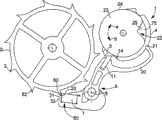
附图示出构成本发明的主题的天文钟擒纵机构。该天文钟擒纵机构包括具有齿3的擒纵轮2。尽管没有示出,但是擒纵轮2是由从发条盒接收驱动力的钟表的传动轮系来驱动的。圆盘1安装在图中未示出的摆轴16上。圆盘1包括安装有冲击叉瓦5的大圆盘4和具有圆形外周24的小圆盘23,在该圆形外周24内形成有一具有上升沿25的凹口22。第一致动拨爪14安装在大圆盘4上部。附图示出该拨爪14从夹在圆盘4和23之间的盘75伸出。该擒纵机构还包括采取铰接在销8上的杆的形式的锁止件6。锁止件6包括通过销8固定地连接的第一部分和第二部分。附图示出,第一部分包括与擒纵轮2的齿3配合的锁止装置80,第二部分包括设置成与第一拨爪14配合的第二致动拨爪11和端部为喙状部21的从动件20,该喙状部21设置成与形成在小圆盘23中的凹口22的上升沿25配合。The accompanying drawings show the detent escapement forming the subject of the invention. The detent escapement comprises an
从以上说明可以看出,已经具备形成天文钟擒纵机构所必需的所有部件。在此擒纵机构中,当圆盘沿一个方向旋转时擒纵轮被释放,而当圆盘沿另一个方向旋转时擒纵轮保持被锁止。因此,每一次振荡只给摆轮一次冲击,在一次振荡期间擒纵轮旋转一个角步长,而在叉瓦式擒纵机构中每摆动一次擒纵轮前进半个步长。因为由擒纵轮的惯性造成的能量浪费仅仅每次振荡发生一次而不是每次摆动发生一次,所以这构成天文钟擒纵机构的优点之一。From the above description it can be seen that all the parts necessary to form the detent escapement are present. In this escapement, the escape wheel is released when the disc rotates in one direction and remains locked when the disc rotates in the other direction. Thus, only one shock is given to the balance wheel per oscillation, during which the escape wheel rotates by one angular step, whereas in the pallet escapement the escape wheel advances by half an angular step per oscillation. This constitutes one of the advantages of the detent escapement since the energy wasted due to the inertia of the escape wheel occurs only once per oscillation rather than once per oscillation.
相对于上面引用的第一个欧洲专利申请No.03027929.3,本发明的显著之处在于,第一和第二致动拨爪14和11分别刚性地固定在大圆盘4和锁止件6上,而在上述第一个申请中,弹性件作用在其中一个致动拨爪上,从而使得当圆盘沿第一方向旋转时该拨爪能够驱动锁止件,并且当所述圆盘沿第二方向旋转时该拨爪能够缩回。因此,本发明没有弹性件,同时还使止动销的使用是多余的。With respect to the first European Patent Application No. 03027929.3 cited above, the present invention is notable in that the first and second actuating
相对于上面引用的第二个欧洲专利申请No.03028877.3,本发明的显著之处在于,第一和第二致动拨爪14和11设置成相互配合,使得当圆盘1沿第一方向旋转时第一拨爪14驱动第二拨爪11从而为擒纵轮2解锁该锁止装置80,然后凹口22的上升沿25驱动从动件20的喙状部21从而使锁止装置与擒纵轮再次接合,并且使得当圆盘1沿与第一方向相反的第二方向旋转时,第一拨爪14驱动第二拨爪11从而保持锁止装置80与擒纵轮2接合。应指出,在上述第二个专利申请中,负责使锁止装置与擒纵轮再次接合的是第二致动拨爪11,而未使用端部为喙状部的从动件。因此两个驱动拨爪的相对位置和本发明中采用的位置有很大的不同。从而,在本发明中,无论在圆盘的一个旋转方向或另一个旋转方向上,两个拨爪的任何触碰都在锁止件的销上产生自然的旋转力,并且这种触碰不产生任何损坏机构的危险。With respect to the second European Patent Application No. 03028877.3 cited above, the present invention is notable in that the first and second actuating
下面说明本发明的几个实施例,它们的主要区别在于所采用的锁止装置80。Several embodiments of the present invention are described below, the main difference of which is the
图1和6-17示出第一实施例。锁止装置80具有设置成一个在另一个旁边的第一和第二叉瓦50和51。这些叉瓦分别具有第一和第二锁面34和35。这些锁面相对于彼此倾斜而形成锁线36。从下文对该擒纵机构的工作阶段的详细分析可见,当凹口22的上升沿25驱动从动件20并且圆盘1沿第一方向旋转时,第一锁面34截止擒纵轮2的齿62。此后,齿62停靠在锁线36上。然后,当第一拨爪14驱动第二拨爪11并且圆盘1沿第二方向旋转时,齿62爬升到第二锁面35上。最后,当第二拨爪离开第一拨爪时,齿62返回到锁线36。1 and 6-17 show a first embodiment. The
图6-17示出摆轮的一个完整振荡过程。下面分析不同的工作阶段。Figure 6-17 shows a complete oscillation process of the balance wheel. The different stages of work are analyzed below.
在图6中,圆盘4和23沿箭头a的方向旋转。安装在大圆盘4上部的第一拨爪14与锁止件6的第二拨爪11进入接触。锁止叉瓦50和51与被锁止的擒纵轮2的齿60完全接合。由于这是圆盘与锁止件之间接触的开始,所以这也是解锁的开始。In FIG. 6, the
图7示出解锁的结束。当圆盘4和23仍沿箭头a的方向旋转时,拨爪14驱动拨爪11,同时使锁止件6沿箭头f的方向倾斜,这使得锁止叉瓦50和51从齿60解锁,同时使擒纵轮2沿箭头g的方向有微小的向后移动。从动件20的喙状部21开始进入小圆盘23的凹口22。Figure 7 shows the end of unlocking. When the
图8示出冲击的开始。从锁止叉瓦50和51释放的擒纵轮2在发条盒传递给齿轮系的驱动力的驱动下开始沿箭头e的方向旋转。擒纵轮2的齿61触到安装在大圆盘4上的冲击叉瓦5并使圆盘1沿箭头a的方向往回运动。Figure 8 shows the onset of impact. The
图9示出正在进行的冲击。圆盘1和擒纵轮2继续分别沿箭头a和e的方向旋转。当圆盘和锁止件之间的接触结束时,拨爪14将越过齿/拨爪11的末端。沿箭头f的方向倾斜的锁止件6将沿另一方向(箭头h)倾斜。Figure 9 shows the impact in progress.
在图10中,擒纵轮2继续沿箭头e的方向旋转并继续通过齿61对冲击叉瓦5的作用驱动圆盘1,直到从动件20的喙状部21与小圆盘23的上升沿25进入接触。此后,沿箭头h的方向驱动锁止件6。In Fig. 10, the
图11示出齿61对叉瓦5的冲击的结束。在此情况下并且随着圆盘1沿箭头a的方向旋转,喙状部21已越过形成在小圆盘23中的凹口22的上升沿25,然后抵靠在小圆盘的圆形外周24上。锁止件6已沿箭头h的方向被持续驱动并到达它的返回行程末端。可以看出,沿箭头e的方向被驱动的齿62将被锁止装置80截止。FIG. 11 shows the end of the impact of the
图12示出锁止位置。齿62抵靠在第一锁止叉瓦50的第一锁面34上。Figure 12 shows the locked position. The
图13示出齿62被由第一和第二锁止叉瓦50和51形成的锁止装置完全锁止。由擒纵轮2的动能推动的齿62的末端容纳在由分别属于第一和第二锁止叉瓦50和51的第一和第二锁面34和35的倾斜角形成的锁线36上。这就是手表制造商公知的牵引作用,这种作用使得可以省略止动销,该止动销对于欧洲专利No.03027929.3中公开的擒纵机构的正常工作是必须的。因此,齿62容纳在锁线36上,而第二锁面35位于该齿的前面并阻止该齿继续在它的轨迹上前进。图13还示出从动件20的喙状部21已经从小圆盘23的圆形外周24释放出来,从而使得摆轮完全自由地继续它的剩余圆弧并结束它沿箭头a所示的方向的第一次摆动。还应指出,从这时开始擒纵机构能够抵抗任何可能影响钟表的震动。实际上,由于通过上述牵引作用齿62会立刻返回到锁线36,所以震动可能导致喙状部21抵靠在小圆盘23的外周24上,但不会使叉瓦50和51被解锁。一旦第一次摆动完成,摆轮就反转方向并沿箭头b的方向旋转。FIG. 13 shows that the
图14示出在反向剩余圆弧结束时,即第二次摆动将要结束时的擒纵机构。圆盘1沿箭头b的方向旋转。该图示出当安装在大圆盘4上部的第二拨爪14与安装在锁止件6上的第一拨爪11进入接触时的情形。第一拨爪11仍然保持不动并且擒纵轮2的齿62仍然容纳在叉瓦50和51的锁线36上。FIG. 14 shows the escapement at the end of the reverse residual arc, ie when the second oscillation is about to end.
在图15中,圆盘1继续沿箭头b的方向行进,并且第二拨爪14已经滑过形成在第一拨爪11的端部的斜面90,使得锁止件6沿箭头h的方向旋转。因此,擒纵轮2的齿62爬升到第二锁止叉瓦51的第二锁面35上,从而驱动擒纵轮2沿箭头g所示的方向稍微往后移动。In Fig. 15, the
在图16中,第一和第二拨爪11和14已经分离,圆盘1仍然沿箭头b的方向旋转。此后,由沿箭头e的方向旋转的擒纵轮2的动能推动的齿62的末端再次从叉瓦51的第二锁面35下移从而容纳在锁线36上,如图17所示。这就是与参照图13所述相同的牵引作用,但是作用在叉瓦51的锁面35上。该作用可被称为“反向牵引”。In FIG. 16, the first and
从图17中所示的情形,摆轮和圆盘1结束它们沿箭头b的方向的剩余圆弧,然后改变方向(箭头a),以重新开始新的振荡,第二次摆动完成。From the situation shown in Figure 17, the balance wheel and
上述的所有细节清楚地表明,拨爪11和14的碰触产生围绕锁止件6的旋转轴线的转矩,从而使锁止件产生自然旋转运动。这与前面提到的欧洲专利申请No.03028877.3不同,在该申请中这种碰触会产生垂直于锁止件的轴线的力。All the details described above clearly show that the contact of the
图2和18、18a-21中示出本发明的第二实施例。这里,锁止装置80只有单独一个锁止叉瓦52,该叉瓦52具有喙状部40和第一锁面37。擒纵轮2的每个齿3、60、62包括第二锁面38,进而具有锁线39。当凹口22的上升沿25驱动从动件20的喙状部21并且圆盘1沿第一方向a旋转时,叉瓦52的第一锁面37截止擒纵轮2的齿62。此后,叉瓦52的喙状部40锁止在锁线39上。然后,当第一拨爪14驱动第二拨爪11并且圆盘1沿第二方向b旋转时,该喙状部40爬升到第二锁面38上。最后,当第二拨爪离开第一拨爪时,叉瓦52的喙状部40返回到锁线39。A second embodiment of the invention is shown in Figures 2 and 18, 18a-21. Here, the locking
下面参照图18、18a-21说明本发明的第二实施例的不同工作阶段,并局限于摆轮振荡中的第二次摆动。The different phases of operation of the second embodiment of the invention are described below with reference to Figures 18, 18a-21, and are limited to the second oscillation in the oscillation of the balance wheel.
图18和18a示出在剩余反向圆弧结束时,即第二次摆动将要结束时的擒纵机构。圆盘1沿箭头b的方向旋转。该图示出当安装在大圆盘4上部的第二拨爪14与安装在锁止件6上的第一拨爪11进入接触时的情形。第一拨爪11仍然保持不动并且叉瓦52的喙状部40停靠在锁面38的锁线39上。Figures 18 and 18a show the escapement at the end of the remaining reverse arc, ie at the end of the second oscillation.
在图19中,圆盘1继续沿箭头b的方向行进,并且第二拨爪14已经滑过形成在第一拨爪11的端部的斜面90,使得锁止件6沿箭头h的方向旋转。因此,叉瓦52的喙状部40爬升到第二锁面38上,从而驱动擒纵轮2沿箭头g所示的方向稍微向后移动。In Fig. 19, the
在图20中,第一和第二拨爪11和14已经分离,圆盘1仍然沿箭头b的方向旋转。此后,由沿箭头e的方向旋转的擒纵轮2的动能推动的叉瓦52的喙状部40从第二锁面38下移从而容纳在锁线39上,如图21所示。这就是参考图17所述的反向牵引作用。In FIG. 20, the first and
从图21中所示的情形,摆轮和圆盘1结束它们沿箭头b的方向的剩余圆弧,然后改变方向(箭头a),以开始新的振荡,第二次摆动完成。From the situation shown in FIG. 21 , the balance wheel and
应指出,本发明的此第二实施例具有使用单独一个形状简单并且容易制造的叉瓦52的优点。受锁面38影响的擒纵轮2也不存在任何制造困难。It should be noted that this second embodiment of the invention has the advantage of using a
下面参照图3说明本发明的第三实施例。这里,锁止装置80包括第一和第二叉瓦53和54,这两个叉瓦设置成一个在另一个之上并分别具有第一和第二锁面42和43。这两个锁面相对于彼此倾斜而形成锁线44。当凹口22的上升沿25驱动从动件20的喙状部21并且圆盘1沿第一方向a旋转时,第一锁面42截止擒纵轮2的齿62。然后,由于牵引作用齿62停靠在锁线39上。此后,当第一拨爪14驱动第二拨爪11并且圆盘1沿第二方向b旋转时,齿62爬升到第二锁面43上。最后,当第二拨爪离开第一拨爪时,齿62通过反向牵引作用而返回到锁线44。Next, a third embodiment of the present invention will be described with reference to FIG. 3 . Here, the locking
图4示出本发明的第四实施例。锁止装置80包括单独一个锁止叉瓦7。该叉瓦具有位于叉瓦前部的第一锁面31和位于所述叉瓦后部的第二锁面32。第一和第二锁面相对于彼此倾斜而形成锁线33。当凹口22的上升沿25驱动从动件20的喙状部21并且圆盘1沿第一方向a旋转时,第一锁面31截止擒纵轮2的齿62。然后,齿62停靠在锁线33上。此后,当第一拨爪14驱动第二拨爪11并且圆盘1沿第二方向b旋转时,齿62爬升到第二锁面32上。最后,当第二拨爪离开第一拨爪时,齿62返回到锁线3。Fig. 4 shows a fourth embodiment of the invention. The locking
除了叉瓦7制成单个部件外,上述的锁止装置80与图1中所述的装置类似。但是,应指出,这种单件式叉瓦不容易制造,在此说明书中提及这种叉瓦仅仅是为了给出锁止装置的一份详尽列表。The locking
图5示出本发明的第五实施例。锁止装置80包括第一和第二锁止叉瓦55和56。这些叉瓦分别与擒纵轮2的第一和第二齿62和63配合。该第一和第二叉瓦55和56分别具有第一和第二锁面70和71。当凹口22的上升沿25驱动从动件20的喙状部21并且圆盘1沿第一方向a旋转时,第一锁面70截止擒纵轮2的第一齿62。然后,当第一拨爪14驱动第二拨爪11并且圆盘1沿第二方向b旋转时,擒纵轮2的第二齿63爬升到叉瓦56的第二锁面71上。所述第一和第二锁面70和71相对于彼此倾斜,从而在第一叉瓦55已经截止第一齿62之后以及第一拨爪14已经驱动第二拨爪11之后,第二齿63停靠在位于第二叉瓦56的第二锁面71上的锁线72上。Fig. 5 shows a fifth embodiment of the invention. The locking
以上就是能够确保根据本发明的天文钟擒纵机构正常工作的锁止装置的列表。已经指出,该擒纵机构没有使用任何弹簧,这一点与欧洲专利申请No.03028877.3中公开的擒纵机构相似,但是在以上说明中还提出了重大改进。当然,如果保留上述专利申请中所公开的擒纵机构,则所述擒纵机构也可装配本发明中所述的各种锁止装置。The above is a list of locking devices capable of ensuring the normal operation of the detent escapement according to the invention. It has been pointed out that this escapement does not use any spring, which is similar to the escapement disclosed in European Patent Application No. 03028877.3, but with significant improvements also proposed in the above description. Of course, if the escapement mechanism disclosed in the above-mentioned patent application is retained, said escapement mechanism can also be equipped with the various locking devices described in the present invention.
Claims (6)
Applications Claiming Priority (2)
| Application Number | Priority Date | Filing Date | Title |
|---|---|---|---|
| EP05006851A EP1708047B1 (en) | 2005-03-30 | 2005-03-30 | Detent escapement for timepieces |
| EP05006851.9 | 2005-03-30 |
Publications (2)
| Publication Number | Publication Date |
|---|---|
| CN1841241A CN1841241A (en) | 2006-10-04 |
| CN100547503C true CN100547503C (en) | 2009-10-07 |
Family
ID=35511723
Family Applications (1)
| Application Number | Title | Priority Date | Filing Date |
|---|---|---|---|
| CNB2006100659902A Expired - Fee Related CN100547503C (en) | 2005-03-30 | 2006-03-29 | Astronomical escapement for timepieces |
Country Status (7)
| Country | Link |
|---|---|
| US (1) | US7494268B2 (en) |
| EP (1) | EP1708047B1 (en) |
| JP (1) | JP4896559B2 (en) |
| CN (1) | CN100547503C (en) |
| AT (1) | ATE390653T1 (en) |
| DE (1) | DE602005005633T2 (en) |
| SG (1) | SG126106A1 (en) |
Families Citing this family (15)
| Publication number | Priority date | Publication date | Assignee | Title |
|---|---|---|---|---|
| DE602007003445D1 (en) | 2007-04-18 | 2010-01-07 | Eta Sa Mft Horlogere Suisse | Inhibition, which includes two escapement wheels |
| DE602007004446D1 (en) | 2007-04-18 | 2010-03-11 | Eta Sa Mft Horlogere Suisse | Direct impulse inhibition for watches |
| DE602007003075D1 (en) | 2007-04-18 | 2009-12-17 | Eta Sa Mft Horlogere Suisse | Anchor escapement comprising two escapement gears |
| EP1983391B1 (en) | 2007-04-18 | 2010-01-20 | ETA SA Manufacture Horlogère Suisse | Lever escapement for timepiece |
| JP5366319B2 (en) * | 2009-09-14 | 2013-12-11 | セイコーインスツル株式会社 | Detent escapement and mechanical watch having the same |
| EP2450755B1 (en) | 2010-11-04 | 2015-01-21 | Nivarox-FAR S.A. | Synchronous escapement for clockwork |
| EP2450756B1 (en) | 2010-11-04 | 2015-01-07 | Nivarox-FAR S.A. | Anti-tripping device for escapement mechanism |
| EP2450757B1 (en) | 2010-11-04 | 2014-10-15 | Nivarox-FAR S.A. | Anti-tripping device for escapement mechanism |
| JP5961753B2 (en) * | 2012-06-07 | 2016-08-02 | デトラ ソシエテ アノニム | Watch escapement |
| EP2730980B1 (en) * | 2012-11-09 | 2018-08-29 | Nivarox-FAR S.A. | Clockwork limitation or transmission mechanism |
| EP2863273B1 (en) * | 2013-10-16 | 2016-01-13 | Montres Breguet SA | Escapement mechanism for watch movement |
| JP6661543B2 (en) * | 2014-01-13 | 2020-03-11 | エコール・ポリテクニーク・フェデラル・ドゥ・ローザンヌ (ウ・ペ・エフ・エル)Ecole Polytechnique Federale De Lausanne (Epfl) | General two-degree-of-freedom isotropic harmonic oscillator without escapement or with simple escapement and associated time base |
| EP3121660B1 (en) * | 2015-07-21 | 2018-02-14 | Cartier International AG | Detent escapement mechanism and timepiece comprising such a mechanism |
| EP3179316B1 (en) * | 2015-12-10 | 2021-09-15 | Nivarox-FAR S.A. | Contactless cylinder escapement |
| EP3907566B1 (en) * | 2020-05-05 | 2025-07-16 | Montres Breguet S.A. | Detent escapement for timepiece |
Family Cites Families (18)
| Publication number | Priority date | Publication date | Assignee | Title |
|---|---|---|---|---|
| CH3299A (en) * | 1891-03-05 | 1891-08-31 | Emile James | Improvement in trigger exhausts |
| US1105062A (en) * | 1912-06-25 | 1914-07-28 | Joe Steiner | Equalizing unlock and impulse action escapement. |
| CH64175A (en) | 1913-05-20 | 1914-03-16 | Bernhard Pitzing | shovel |
| US1359005A (en) * | 1920-07-26 | 1920-11-16 | Verner Clarence | Triple roller for watches |
| US2362836A (en) * | 1942-04-11 | 1944-11-14 | Joseph Pavelka | Clock balance wheel |
| DE1244665B (en) * | 1962-11-03 | 1967-07-13 | United States Time Corp | Pointer mechanism drive |
| US3538705A (en) * | 1968-11-07 | 1970-11-10 | Hamilton Watch Co | Escapement |
| CH1290772A4 (en) * | 1972-09-01 | 1975-06-30 | ||
| SU479075A1 (en) * | 1973-12-28 | 1975-07-30 | Научно-исследовательский институт часовой промышленности | Motion transducer for balance electronic mechanical watches |
| CH1020375A4 (en) * | 1975-08-05 | 1977-06-30 | ||
| SU723491A1 (en) * | 1978-09-01 | 1980-03-25 | Предприятие П/Я Г-4257 | Device for automatic electric winding-up of time-piece spring |
| DE69902990T2 (en) * | 1999-03-31 | 2003-05-22 | Ulysse Nardin S.A., Le Locle | Inhibition for timepieces |
| ES2303518T3 (en) * | 2001-01-09 | 2008-08-16 | Ulysse Nardin S.A. | ESCAPE FOR TIME REGULATOR OR TIMER. |
| DE50307083D1 (en) * | 2003-09-22 | 2007-05-31 | Paul Gerber | Inhibition for clock |
| ATE363673T1 (en) * | 2003-12-04 | 2007-06-15 | Montres Breguet Sa | CHRONOMETER ESCAPEMENT FOR WRISTWATCHES |
| ATE487963T1 (en) * | 2003-12-04 | 2010-11-15 | Montres Breguet Sa | CHRONOMETER ESCAPEMENT FOR WATCHES |
| EP1544689B1 (en) * | 2003-12-16 | 2010-02-24 | Montres Breguet S.A. | Detent escapement for watches |
| DE602005005632T2 (en) * | 2005-03-30 | 2009-04-16 | Montres Breguet S.A. | Chronometer escapement for watches |
-
2005
- 2005-03-30 DE DE602005005633T patent/DE602005005633T2/en not_active Expired - Lifetime
- 2005-03-30 EP EP05006851A patent/EP1708047B1/en not_active Expired - Lifetime
- 2005-03-30 AT AT05006851T patent/ATE390653T1/en not_active IP Right Cessation
-
2006
- 2006-03-24 SG SG200601993A patent/SG126106A1/en unknown
- 2006-03-28 US US11/277,652 patent/US7494268B2/en not_active Expired - Fee Related
- 2006-03-29 CN CNB2006100659902A patent/CN100547503C/en not_active Expired - Fee Related
- 2006-03-30 JP JP2006093882A patent/JP4896559B2/en not_active Expired - Fee Related
Also Published As
| Publication number | Publication date |
|---|---|
| US20060221774A1 (en) | 2006-10-05 |
| SG126106A1 (en) | 2006-10-30 |
| DE602005005633T2 (en) | 2009-04-16 |
| US7494268B2 (en) | 2009-02-24 |
| CN1841241A (en) | 2006-10-04 |
| DE602005005633D1 (en) | 2008-05-08 |
| JP2006284580A (en) | 2006-10-19 |
| EP1708047B1 (en) | 2008-03-26 |
| ATE390653T1 (en) | 2008-04-15 |
| HK1091558A1 (en) | 2007-01-19 |
| JP4896559B2 (en) | 2012-03-14 |
| EP1708047A1 (en) | 2006-10-04 |
Similar Documents
| Publication | Publication Date | Title |
|---|---|---|
| CN100527019C (en) | Detent escapement for timepieces | |
| CN101711378B (en) | Lever escapement for timepiece | |
| CN100549873C (en) | The escapement of clock and watch | |
| JP4896559B2 (en) | Watch detent escapement | |
| JP5443579B2 (en) | Column wheel and chronograph mechanism including the same | |
| US20080259739A1 (en) | Lever escapement for a timepiece | |
| CN1624607A (en) | escapement for clocks | |
| JP2005164596A (en) | Watch detent escapement | |
| JP2008268208A (en) | An escapement with two escape wheels | |
| EP3096189B1 (en) | Safety mechanism for selecting and/or triggering timepiece striking-work | |
| JP7458460B2 (en) | Natural escapes for timepiece movements and timepiece movements equipped with such natural escapes | |
| JP5508509B2 (en) | Chronograph mechanism with column wheel and watch movement including the same | |
| JP7397950B2 (en) | Natural escapements for watch movements and watch movements equipped with such escapements | |
| EP4060428B1 (en) | Driving mechanism for timepiece movement, in particular a chronograph mechanism comprising such a driving mechanism | |
| HK1091558B (en) | Detent escapement for timepiece | |
| EP3475765B1 (en) | Clock escapement | |
| HK1091560B (en) | Detent escapement for timepiece | |
| CN115494716A (en) | Natural escapement for a timepiece movement and timepiece movement including such an escapement | |
| US20110149695A1 (en) | Single push-piece chronograph | |
| EP3475763B1 (en) | Clock escapement | |
| EP4250019A1 (en) | Timepiece oscillator for extra-flat movement | |
| HK1144020B (en) | Lever escapement for timepiece | |
| HK1159263B (en) | Single push-piece chronograph | |
| HK1073698B (en) | Detent escapement for timepiece | |
| HK1073699B (en) | Detent escapement for a timepiece |
Legal Events
| Date | Code | Title | Description |
|---|---|---|---|
| C06 | Publication | ||
| PB01 | Publication | ||
| REG | Reference to a national code |
Ref country code: HK Ref legal event code: DE Ref document number: 1091558 Country of ref document: HK |
|
| C10 | Entry into substantive examination | ||
| SE01 | Entry into force of request for substantive examination | ||
| C14 | Grant of patent or utility model | ||
| GR01 | Patent grant | ||
| REG | Reference to a national code |
Ref country code: HK Ref legal event code: GR Ref document number: 1091558 Country of ref document: HK |
|
| CF01 | Termination of patent right due to non-payment of annual fee | ||
| CF01 | Termination of patent right due to non-payment of annual fee |
Granted publication date: 20091007 Termination date: 20200329 |