CN100554309C - Method and apparatus for preparing high molecular weight melt polycarbonate - Google Patents

Method and apparatus for preparing high molecular weight melt polycarbonate Download PDF

Info

Publication number
CN100554309C
CN100554309C CNB03825011XA CN03825011A CN100554309C CN 100554309 C CN100554309 C CN 100554309C CN B03825011X A CNB03825011X A CN B03825011XA CN 03825011 A CN03825011 A CN 03825011A CN 100554309 C CN100554309 C CN 100554309C
Authority
CN
China
Prior art keywords
polymerization
mist
product
polycarbonate
droplets
Prior art date
Legal status (The legal status is an assumption and is not a legal conclusion. Google has not performed a legal analysis and makes no representation as to the accuracy of the status listed.)
Expired - Fee Related
Application number
CNB03825011XA
Other languages
Chinese (zh)
Other versions
CN1694914A (en
Inventor
詹姆斯·戴
帕特里克·J·麦克洛斯基
小保罗·M·斯米格尔斯基
Current Assignee (The listed assignees may be inaccurate. Google has not performed a legal analysis and makes no representation or warranty as to the accuracy of the list.)
SABIC Global Technologies BV
Original Assignee
SABIC Innovative Plastics IP BV
General Electric Co
Priority date (The priority date is an assumption and is not a legal conclusion. Google has not performed a legal analysis and makes no representation as to the accuracy of the date listed.)
Filing date
Publication date
Application filed by SABIC Innovative Plastics IP BV, General Electric Co filed Critical SABIC Innovative Plastics IP BV
Publication of CN1694914A publication Critical patent/CN1694914A/en
Application granted granted Critical
Publication of CN100554309C publication Critical patent/CN100554309C/en
Anticipated expiration legal-status Critical
Expired - Fee Related legal-status Critical Current

Links

Images

Classifications

    • CCHEMISTRY; METALLURGY
    • C08ORGANIC MACROMOLECULAR COMPOUNDS; THEIR PREPARATION OR CHEMICAL WORKING-UP; COMPOSITIONS BASED THEREON
    • C08GMACROMOLECULAR COMPOUNDS OBTAINED OTHERWISE THAN BY REACTIONS ONLY INVOLVING UNSATURATED CARBON-TO-CARBON BONDS
    • C08G64/00Macromolecular compounds obtained by reactions forming a carbonic ester link in the main chain of the macromolecule
    • C08G64/20General preparatory processes
    • CCHEMISTRY; METALLURGY
    • C08ORGANIC MACROMOLECULAR COMPOUNDS; THEIR PREPARATION OR CHEMICAL WORKING-UP; COMPOSITIONS BASED THEREON
    • C08GMACROMOLECULAR COMPOUNDS OBTAINED OTHERWISE THAN BY REACTIONS ONLY INVOLVING UNSATURATED CARBON-TO-CARBON BONDS
    • C08G64/00Macromolecular compounds obtained by reactions forming a carbonic ester link in the main chain of the macromolecule
    • C08G64/04Aromatic polycarbonates
    • C08G64/06Aromatic polycarbonates not containing aliphatic unsaturation
    • C08G64/14Aromatic polycarbonates not containing aliphatic unsaturation containing a chain-terminating or -crosslinking agent
    • CCHEMISTRY; METALLURGY
    • C08ORGANIC MACROMOLECULAR COMPOUNDS; THEIR PREPARATION OR CHEMICAL WORKING-UP; COMPOSITIONS BASED THEREON
    • C08GMACROMOLECULAR COMPOUNDS OBTAINED OTHERWISE THAN BY REACTIONS ONLY INVOLVING UNSATURATED CARBON-TO-CARBON BONDS
    • C08G64/00Macromolecular compounds obtained by reactions forming a carbonic ester link in the main chain of the macromolecule
    • C08G64/20General preparatory processes
    • C08G64/205General preparatory processes characterised by the apparatus used
    • CCHEMISTRY; METALLURGY
    • C08ORGANIC MACROMOLECULAR COMPOUNDS; THEIR PREPARATION OR CHEMICAL WORKING-UP; COMPOSITIONS BASED THEREON
    • C08GMACROMOLECULAR COMPOUNDS OBTAINED OTHERWISE THAN BY REACTIONS ONLY INVOLVING UNSATURATED CARBON-TO-CARBON BONDS
    • C08G64/00Macromolecular compounds obtained by reactions forming a carbonic ester link in the main chain of the macromolecule
    • C08G64/20General preparatory processes
    • C08G64/30General preparatory processes using carbonates
    • C08G64/307General preparatory processes using carbonates and phenols
    • CCHEMISTRY; METALLURGY
    • C08ORGANIC MACROMOLECULAR COMPOUNDS; THEIR PREPARATION OR CHEMICAL WORKING-UP; COMPOSITIONS BASED THEREON
    • C08GMACROMOLECULAR COMPOUNDS OBTAINED OTHERWISE THAN BY REACTIONS ONLY INVOLVING UNSATURATED CARBON-TO-CARBON BONDS
    • C08G64/00Macromolecular compounds obtained by reactions forming a carbonic ester link in the main chain of the macromolecule
    • C08G64/40Post-polymerisation treatment
    • CCHEMISTRY; METALLURGY
    • C08ORGANIC MACROMOLECULAR COMPOUNDS; THEIR PREPARATION OR CHEMICAL WORKING-UP; COMPOSITIONS BASED THEREON
    • C08JWORKING-UP; GENERAL PROCESSES OF COMPOUNDING; AFTER-TREATMENT NOT COVERED BY SUBCLASSES C08B, C08C, C08F, C08G or C08H
    • C08J3/00Processes of treating or compounding macromolecular substances
    • C08J3/12Powdering or granulating
    • C08J3/122Pulverisation by spraying
    • CCHEMISTRY; METALLURGY
    • C08ORGANIC MACROMOLECULAR COMPOUNDS; THEIR PREPARATION OR CHEMICAL WORKING-UP; COMPOSITIONS BASED THEREON
    • C08JWORKING-UP; GENERAL PROCESSES OF COMPOUNDING; AFTER-TREATMENT NOT COVERED BY SUBCLASSES C08B, C08C, C08F, C08G or C08H
    • C08J3/00Processes of treating or compounding macromolecular substances
    • C08J3/24Crosslinking, e.g. vulcanising, of macromolecules
    • CCHEMISTRY; METALLURGY
    • C08ORGANIC MACROMOLECULAR COMPOUNDS; THEIR PREPARATION OR CHEMICAL WORKING-UP; COMPOSITIONS BASED THEREON
    • C08JWORKING-UP; GENERAL PROCESSES OF COMPOUNDING; AFTER-TREATMENT NOT COVERED BY SUBCLASSES C08B, C08C, C08F, C08G or C08H
    • C08J3/00Processes of treating or compounding macromolecular substances
    • C08J3/24Crosslinking, e.g. vulcanising, of macromolecules
    • C08J3/242Applying crosslinking or accelerating agent onto compounding ingredients such as fillers, reinforcements
    • CCHEMISTRY; METALLURGY
    • C08ORGANIC MACROMOLECULAR COMPOUNDS; THEIR PREPARATION OR CHEMICAL WORKING-UP; COMPOSITIONS BASED THEREON
    • C08LCOMPOSITIONS OF MACROMOLECULAR COMPOUNDS
    • C08L69/00Compositions of polycarbonates; Compositions of derivatives of polycarbonates

Landscapes

  • Chemical & Material Sciences (AREA)
  • Health & Medical Sciences (AREA)
  • Chemical Kinetics & Catalysis (AREA)
  • Medicinal Chemistry (AREA)
  • Polymers & Plastics (AREA)
  • Organic Chemistry (AREA)
  • Polyesters Or Polycarbonates (AREA)

Abstract

In general, the polymerization of polycarbonates is limited by the rate at which inhibitory by-products such as phenols and salicylates can be removed from the reaction. To facilitate the removal of volatile reaction by-products from the reaction as the polymerization proceeds, the present invention provides a spray reactor (90). The formation of the spray polymerization reaction (90) can create a large surface area for exchange of volatile byproducts. The invention is suitable for the polymerization of polycarbonates and copolymers thereof starting from monomers or oligomers (25). For a given melt process, especially a fast reacting bis (methyl salicylate) carbonate process, the present invention can be used to increase throughput and minimize initial investment.

Description

The method and apparatus of preparation high molecular melt polycarbonate
Background of invention
The present invention relates to by the melt polymerization process polycarbonate synthesis.More particularly, the invention describes the method and system that is used for as spraying (spray mist) polymerization polycarbonate and be described as spraying, the volatilization with the byproduct of reaction that promotes inhibition increases rate of polymerization thus.
Usually, perhaps prepare polycarbonate such as bisphenol-a polycarbonate by interfacial polymerization or by melt polymerization process.Bis-phenol such as dihydroxyphenyl propane (BPA) are the typical cases of interfacial with the reaction of phosgene in the presence of water, solvent (as methylene dichloride), acid acceptor (as sodium hydroxide) and phase-transfer catalyst (as triethylamine).Phase-transfer catalyst has improved the solubleness of phenates in organic phase, has therefore improved speed of reaction widely.In addition, polycarbonate can prepare by the transesterify as methylcarbonate or diphenyl carbonate.Under the high temperature, in the presence of catalyzer such as sodium hydroxide, the source of dihydroxyphenyl propane and carbonate unit such as the reaction of diphenyl carbonate are the typical cases of the present melt polymerization process that adopts.Each method is all in commercial extensive operation, and each method all has obvious defects.
The interfacial of preparation polycarbonate has several intrinsic shortcomings.At first, the manipulation require phosgene as the method for reactant because known safety factors is a shortcoming.The second, because this method need use a large amount of organic solvents, therefore must take expensive preventive measures to prevent any negative impact to environment.The 3rd, interfacial needs higher equipment and fund input.The 4th, the polycarbonate of interfacial preparation is easy to form inconsistent color, higher fraction of particle and higher chloride content, and they can cause corrosion.
Although scorification does not need to use phosgene or solvent such as methylene dichloride, require high temperature and long reaction times.As a result, may form by product under the high temperature, for example reset the product that produces by Fries in the polymerization process.Fries resets and produces unwanted and uncontrolled polymkeric substance branching, and it is with the mobile and performance of negative impact polymkeric substance.Scorification also needs to use complicated processing unit, and it can be operated under high-temperature low-pressure, and can stir high adhesive aggregation compound melt effectively in obtaining the needed long reaction process of high molecular.
Utilize the carbonic acid salicyl ester can obviously improve speed of reaction, and more help the balance in the melt polymerization as the surrogate of diphenyl carbonate.For example, there is report to say that melt polycarbonate can be under relatively mild condition, reaction by bis-phenol such as BPA and diaryl carbonate forms, described diaryl carbonate is (United States Patent (USP) 4,323,668 and WO99/47580) that forms by the reaction between phosgene and the wintergreen oil.Also have, the polycarbonate that comprises salicylic acid ester derivative can make and have excellent photochromic accent and/or color (for example referring to WO00/63274, WO98/45246, JP10036497, JP10101786, JP10101787 and JP11302228) and thermostability (JP2001158821).Yet, utilize the method for being reported to need the transesterification catalyst of high level usually with the preparation high-molecular-weight polycarbonate.Another obvious defects is to have suppressed the carrying out of reaction as the salicylate that byproduct of reaction forms.
People are needed to be a kind of simple method, and the formation that utilize to allow diaryl carbonate such as carbonic acid two (methyl salicyl) ester at mild conditions to promote polycarbonate promotes the removing of by product of inhibition simultaneously.Ideally, this method can utilize existing device and scheme to be attached in commercial suitable polycarbonate preparation processes.Equally ideally, this method can allow to use the condition of gentle (promptly being lower than 400 ℃), and polymerization time is short, with the formation that minimizes the Fries by product and/or the fracture of polycarbonate product, the salicylate by product of the inhibition that still can volatilize effectively simultaneously.
The invention summary
The invention describes the method and the novel reactor design that are used for spray polymerization (spray polymeriazation) polycarbonate and its multipolymer.The volatile byproducts that produces when promoting to remove polymerization, the present invention can increase any given melting method, especially the output of rapid reaction carbonic acid two (methyl salicyl) ester (BSMC) method and minimize front-end investment.
On the one hand, the invention provides the method for preparing high-molecular-weight polycarbonate, comprising:
(a) will comprise the diaryl carbonate of ester replacement and the molten monomer of dihydroxy aromatic compounds, and mix, generate the prepolymerization reaction melt with at least a melt polymerization catalyst;
(b) reaction mixture is to form the mist (mist) of regulation drop size (droplet size);
(c) decompression is exposed in the hot environment mist so that monomer polymerization down; With
(d) collect the polymeric polycarbonate product.
On the other hand, the present invention includes the equipment of preparation high-molecular-weight polycarbonate, comprising:
(a) will comprise the diaryl carbonate of at least a ester replacement and the molten monomer of at least a dihydroxy aromatic compounds, and described monomer will be mixed with at least a melt polymerization catalyst, generate the device of prepolymerization reaction mixture;
(b) form the device of the mist of predetermined drop size by the prepolymerization reaction mixture;
(c) decompression is exposed to mist in the hot environment so that described monomer polymerization down, and from described drop the reactor of at least a portion of separating at least one volatile reaction by product;
(d) from drop, remove the venting port of the described volatile byproducts of at least a portion; With
(e) device of collection polymeric polycarbonate product from reactor.
The accompanying drawing summary
Fig. 1 schematic representation the equipment of spray polymerization polycarbonate according to embodiments of the present invention, wherein: 10-adds monomeric inlet; 20-mixing feeder; The 25-monomer; 30-fusion jar; The 40-well heater; The pump of 50-heating; The line of pipes of 55-heating; The 60-reactor; The 70-well heater; The 80-nozzle; The 90-droplet; The 100-polymer beads; The 110-screen cloth; The 120-vaccum exhaust outlet; The 130-evacuated tube; The 140-cold-trap; The 150-condenser; The 155-vacuum pump; The 160-vented extruder; The 170-cooling tank; The 180-tablets press; With 190-polycarbonate product particle.
Detailed Description Of The Invention
By with reference to the preferred embodiment of the invention described in detail below and comprising embodiment, will be more readily understood the present invention. In the description and claim of back, with reference to being defined as in a large number the term with following implication:
Singulative " one ", " a kind of " and " being somebody's turn to do " comprise the plural form reference, unless specification has clearly been made regulation in addition.
Situation or situation that " optional " or " randomly " expression is described later may occur or may not occur, and described content comprises that situation occurs and the situation of situation when not occuring.
Used term " Merlon " expression herein combines the Merlon of the construction unit that comes from one or more dihydroxy aromatic compounds, and comprises Copolycarbonate and polyestercarbonate.
Used term " melt polycarbonate " expression herein is by the Merlon of the ester exchange preparation of diaryl carbonate and dihydroxy aromatic compounds.
" BPA " is defined as bisphenol-A or 2,2-two (4-hydroxyphenyl) propane herein.
Used " antigravity system " is illustrated in the melting method herein, the catalyst of ester exchange between catalysis bis-phenol and the diaryl carbonate.
" catalytically effective amount " expression demonstrates the catalyst content of catalytic effect.
Used term " cp " is defined as centipoise herein, the measuring of viscosity.
Used term " Fries product " is defined as the construction unit of following product Merlon herein, when the hydrolysate Merlon, the dihydroxy aromatic compounds of carboxyl substituted is provided, and this compound is with the carboxyl of one or two hydroxyl of the dihydroxy aromatic compounds of contiguous described carboxyl substituted. For example, occur therein in the bisphenol-a polycarbonate of melt reaction method preparation of Fries reaction, the Fries product comprises following structure VII, and when complete hydrolysis product Merlon, this structure VII provides 2-carboxyl bisphenol-A.
Term " Fries product " and " Fries group " can exchange in this article.
Term " Fries reaction " and " Fries rearrangement " can be exchanged in this article.
Used herein term " mono-functional phenols " expression comprises the phenol of a reactive hydroxyl.
Term " venting port " and " air outlet " can exchange in this article.
The related compound of used herein term " volatility " expression has appreciable vapour pressure under room temperature and normal atmosphere.Especially, volatile compound evaporates under the temperature of the melt polymerization that carries out polycarbonate usually.
Used herein term " volatilization " expression promotes that a kind of compound evaporates from non-volatile mixture.
Used herein term " aliphatic group " expression valency is at least 1 group, comprises the atom that straight or branched is arranged, and it is not a cyclic.Arrangement can comprise heteroatoms such as nitrogen, sulphur and oxygen, perhaps can only be made up of carbon and hydrogen.The example of aliphatic group comprises methyl, methylene radical, ethyl, ethylidene, hexyl, hexa-methylene etc.
Used herein term " aryl " expression compound is at least 1, and comprises the group of at least one aryl.The example of aryl comprises phenyl, pyridyl, furyl, thienyl, naphthyl, phenylene and xenyl.This term comprises the group that not only contains aromatic hydrocarbons but also contain aliphatic hydrocarbon moiety, as benzyl.
Used herein term " cycloaliphatic alkyl " expression valency is at least 1 group, is included as ring-type but is not the atomic arrangement of aromatics.This arrangement can comprise heteroatoms such as nitrogen, sulphur and oxygen, perhaps can only be made up of carbon and hydrogen.The example of cycloaliphatic alkyl comprises cyclopropyl, cyclopentyl, cyclohexyl, tetrahydrofuran base etc.
The speed of reaction for preparing polycarbonate by melt polymerization process is subject to the speed that can remove the by product of inhibitory removal from melt, and described by product for example but is not limited to salicylate and phenol.In order to promote the speed of removing of volatile byproducts, the invention describes the reactor that allows polymerization to carry out along with spraying.Spraying has produced big swap table area, has promoted byproduct of reaction and other volatile matter removing from polyreaction thus.Under 200 to 350 ℃, less by the big interfacial area that forms the small droplets generation diffuses out salicylate (or other volatile byproducts) from drop distance, polyreaction is carried out fast.The residence time of drop is according to " activity " of DESIGN OF REACTOR and catalyzer, at several seconds to the order of magnitude of several minutes.Further advantage is to adopt the temperature higher than conventional polymeric reaction temperature, so the thermal history of material experience will shorten.
On the one hand, the invention provides the method for preparing high-molecular-weight polycarbonate, comprising:
(a) will comprise the diaryl carbonate of ester replacement and the molten monomer of dihydroxy aromatic compounds, and mix, generate the prepolymerization reaction mixture with at least a melt polymerization catalyst;
(b) reaction mixture is to form the mist of regulation drop size;
(c) decompression makes under the condition of monomer polymerization down, and mist is exposed in the hot environment; With
(d) collect the polymeric polycarbonate product.
On the other hand, the present invention includes the method for preparing polycarbonate, comprising:
(a) will comprise the molten monomer of dihydroxy aromatic compounds and carbonic acid two (methyl salicyl) ester, and mix, generate the prepolymerization reaction mixture with transesterification catalyst;
(b) reaction mixture is to form the mist of predetermined drop size;
(c) decompression makes monomer polymerization and at least a portion at least a volatile reaction by product under the isolating condition, is exposed to mist in the hot environment from described drop down;
(d) from drop, remove the described volatile byproducts of at least a portion; With
(e) collect the polymeric polycarbonate product.
Therefore in the embodiment, this method comprises at least a portion separation steps from drop at least a volatile reaction by product.Simultaneously in embodiments, with monomer dividually, but before forming mist, add catalyzer.Preferably, the inventive method can be removed them continuously along with the formation of volatile byproducts.For example, in embodiments, the salicylate by product is evaporated from the polymerization nozzle, and steam is removed by venting port.With the salicylate condensation, discharge then with liquid form.
Preferably, polymerization is to carry out under the vacuum of 0.1 to 700 holder.More preferably, polymerization is to carry out under the vacuum of 0.1 to 50 holder.Even more preferably, polymerization is to carry out under the vacuum of 0.1 to 5 holder.
Simultaneously, preferably, the temperature of described molten monomer is in 125 ℃ to 250 ℃ scopes.Even more preferably, the temperature of described molten monomer is in 140 ℃ to 200 ℃ scopes.In the embodiment, the temperature of described molten monomer is about 150 ℃.
In the embodiment, most of drop has the size of regulation to promote the exchange of volatile reaction by product.Preferably, the size of most of drop is 1-1 in the mist, 000 micron.More preferably, the size of most of drop is the 1-400 micron in the mist.Even more preferably, the size of most of drop is the 5-50 micron in the mist.
Equally, in the embodiment, the drop in the mist will have preferred range of viscosities, to promote exchange of volatile byproducts.Preferably, drop viscosity is in 0.5 to 500cp scope.More preferably, drop viscosity is in 1 to 200cp scope, even more preferably in 5 to 90cp scopes.
In the embodiment, the device that generates mist comprises nozzle or atomizer.Preferably, the device of generation mist comprises that no air nozzle, atomizer, rotating sprayer maybe can increase long-pending any other device of flow surface.
The unique distinction of the inventive method is that it can make polymerization carry out very apace.Therefore, polymkeric substance can be exposed under the quite high temperature, and at high temperature only stops short " residence time ".Preferably, being used for the polymeric temperature is 200 to 400 ℃.More preferably, being used for the polymeric temperature is 250 to 350 ℃.Even more preferably, being used for the polymeric temperature is 280 to 320 ℃.
The unique distinction of the inventive method is that high-molecular-weight polycarbonate in the several minutes, produces in preferred several seconds usually under being exposed to the high-temperature fusion condition.In the embodiment, the polymerization of prepolymerization reaction mixture monomer segment is to comprise to the small part oligopolymer.Equally, in the embodiment, utilize higher polymerization temperature, can generate product quickly.Therefore, the invention has the advantages that polymkeric substance is exposed to the time very short under the typical melt polymerization high temperature.
In the embodiment, polymerization is generated the needed time of subject polymer.Preferably, polymerization comprised 5 minutes or the shorter time limit (time period).More preferably, polymerization comprises 3 minutes or the shorter time limit.Even more preferably, polymerization comprises 1 minute or the shorter time limit.
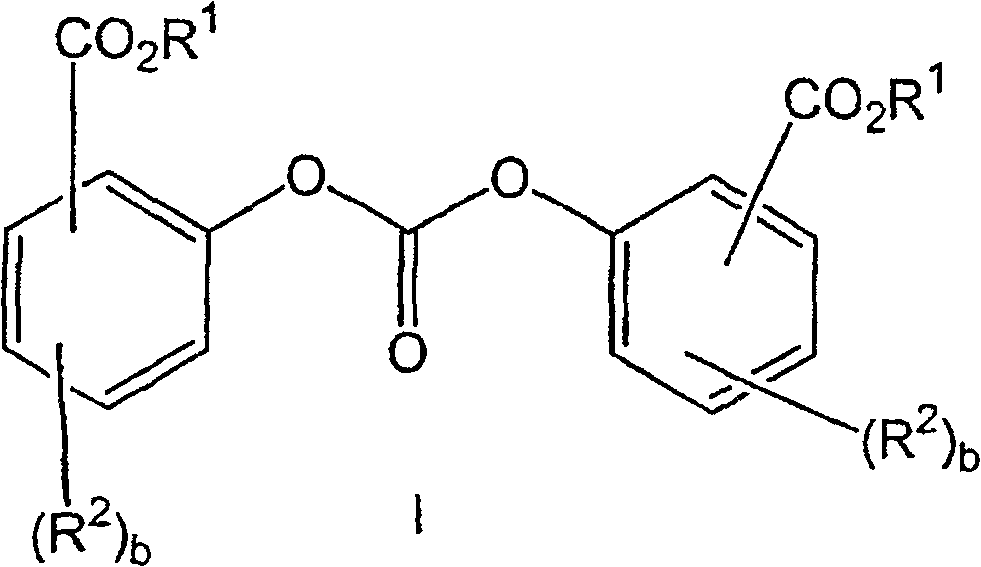
The diaryl carbonate that comprises structure I according to the diaryl carbonate of ester replacement of the present invention.
Figure C0382501100131
Wherein, R 1When occurring each time, be C independently 1-C 30Alkyl, C 4-C 30Cycloalkyl, or C 4-C 30Aryl, C 1-C 30Alkoxyl group, C 6-C 30Aryloxy, C 6-C 30Aralkyl, C 6-C 30Aralkoxy; R 2When occurring each time, be halogen atom, cyano group, nitro, C independently 1-C 20Alkyl, C 4-C 20Cycloalkyl, C 4-C 20Aryl, C 1-C 20Alkoxyl group, C 4-C 20Cycloalkyloxy, C 4-C 20Aryloxy, C 1-C 20Alkylthio, C 4-C 20Cycloalkylthio, C 4-C 20Arylthio, C 1-C 20Alkyl sulfinyl, C 4-C 20The cycloalkanes sulfinyl, C 4-C 20The virtue sulfinyl, C 1-C 20The alkane alkylsulfonyl, C 4-C 20The cycloalkanes alkylsulfonyl, C 4-C 20Arylsulfonyl, C 1-C 20Carbalkoxy, C 4-C 20Cycloalkoxycarbonyl, C 4-C 20Aryloxy carbonyl, C 2-C 60Alkylamino, C 6-C 60Naphthene amino, C 5-C 60Virtue is amino, C 1-C 40Alkyl amino-carbonyl, C 4-C 40The naphthene amino carbonyl, C 4-C 40Aromatic aminocarbonyl, and C 1-C 20Amido; B is 0 to 4 integer independently when occurring each time.In the embodiment, used the bifunctional carbonyl compound described in WO99/47580.
The specific examples of the diaryl carbonate I that ester replaces has carbonic acid two (methyl salicyl) ester (CAS registration number 82091-12-1), carbonic acid two (ethyl salicyl) ester, carbonic acid two (propyl group salicyl) ester, carbonic acid two (butyl salicyl) ester, carbonic acid two (benzyl salicyl) ester, carbonic acid two (methyl 4-chloro salicyl) ester etc.Preferred typical carbonic acid two (methyl salicyl) ester.
Dihydroxy aromatic compounds according to the present invention comprises the bis-phenol with structure I I.
Wherein, R 3-R 10Be hydrogen atom, halogen atom, nitro, cyano group, C independently 1-C 30Alkyl, C 4-C 30Cycloalkyl or C 6-C 30Aryl, C 1-C 30Alkoxyl group, C 4-C 30Cycloalkyloxy or C 6-C 30Aryloxy; W is key, Sauerstoffatom, sulphur atom, SO 2, C 1-C 20Aliphatic group, C 6-C 20Aryl, C 6-C 20Cycloaliphatic alkyl or following radicals
Figure C0382501100142
Wherein, R 11And R 12Be hydrogen atom, C independently 1-C 20Alkyl, C 4-C 20Cycloalkyl or C 4-C 20Aryl; Perhaps R 11And R 12Form C together 4-C 20Cycloaliphatic hydrocarbon ring, this encircles randomly by one or more C 1-C 20Alkyl, C 6-C 20Aryl, C 5-C 21Aralkyl, C 5-C 20Cycloalkyl or their combination replace.In the embodiment, dihydroxy aromatic compounds comprises alkyl or alkylene ester.
Suitable bis-phenol II illustrates by following compound: 2, and 2-two (4-hydroxyphenyl) propane (dihydroxyphenyl propane); 2,2-two (3-chloro-4-hydroxyphenyl) propane; 2,2-two (3-bromo-4-hydroxyphenyl) propane; 2,2-two (4-hydroxyl-3-tolyl) propane; 2,2-two (4-hydroxyl-3-isopropyl phenyl) propane; 2,2-two (the 3-tertiary butyl-4-hydroxyphenyl) propane; 2,2-two (3-phenyl-4-hydroxyphenyl) propane; 2,2-two (3,5-two chloro-4-hydroxyphenyl) propane; 2,2-two (3,5-two bromo-4-hydroxyphenyl) propane; 2,2-two (3,5-dimethyl-4-hydroxyphenyl) propane; 2,2-two (3-chloro-4-hydroxy-5-methyl phenyl) propane; 2,2-two (3-bromo-4-hydroxy-5-methyl phenyl) propane; 2,2-two (3-chloro-4-hydroxyl-5-isopropyl phenyl) propane; 2,2-two (3-bromo-4-hydroxyl-5-isopropyl phenyl) propane; 2,2-two (the 3-tertiary butyl-5-chloro-4-hydroxyphenyl) propane; 2,2-two (the 3-bromo-5-tertiary butyl-4-hydroxyphenyl) propane; 2,2-two (3-chloro-5-phenyl-4-hydroxyphenyl) propane; 2,2-two (3-bromo-5-phenyl-4-hydroxyphenyl) propane; 2,2-two (3,5-di-isopropyl-4-hydroxyphenyl) propane; 2,2-two (3,5-di-t-butyl-4-hydroxyphenyl) propane; 2,2-two (3,5-phenylbenzene-4-hydroxyphenyl) propane; 2,2-two (4-hydroxyl-2,3,5,6-tetrachloro phenyl) propane; 2,2-two (4-hydroxyl-2,3,5,6-tetrabromo phenyl) propane; 2,2-two (4-hydroxyl-2) propane; 2,2-two (2,6-two chloro-3,5-dimethyl-4-hydroxyphenyl) propane; 2,2-two (2,6-two bromo-3,5-dimethyl-4-hydroxyphenyl) propane; 1,1-two (4-hydroxyphenyl) hexanaphthene; 1,1-two (3-chloro-4-hydroxyphenyl) hexanaphthene; 1,1-two (3-bromo-4-hydroxyphenyl) hexanaphthene; 1,1-two (4-hydroxyl-3-tolyl) hexanaphthene; 1,1-two (4-hydroxyl-3-isopropyl phenyl) hexanaphthene; 1,1-two (the 3-tertiary butyl-4-hydroxyphenyl) hexanaphthene; 1,1-two (3-phenyl-4-hydroxyphenyl) hexanaphthene; 1,1-two (3,5-two chloro-4-hydroxyphenyl) hexanaphthene; 1,1-two (3,5-two bromo-4-hydroxyphenyl) hexanaphthene; 1,1-two (3,5-dimethyl-4-hydroxyphenyl) hexanaphthene; 1,1-two (3-chloro-4-hydroxy-5-methyl phenyl) hexanaphthene; 1,1-two (3-bromo-4-hydroxy-5-methyl phenyl) hexanaphthene; 1,1-two (3-chloro-4-hydroxyl-5-isopropyl phenyl) hexanaphthene; 1,1-two (3-bromo-4-hydroxyl-5-isopropyl phenyl) hexanaphthene; 1,1-two (the 3-tertiary butyl-5-chloro-4-hydroxyphenyl) hexanaphthene; 1,1-two (the 3-bromo-5-tertiary butyl-4-hydroxyphenyl) hexanaphthene; 1,1-two (3-chloro-5-phenyl-4-hydroxyphenyl) hexanaphthene; 1,1-two (3-bromo-5-phenyl-4-hydroxyphenyl) hexanaphthene; 1,1-two (3,5-di-isopropyl-4-hydroxyphenyl) hexanaphthene; 1,1-two (3,5-di-t-butyl-4-hydroxyphenyl) hexanaphthene; 1,1-two (3,5-phenylbenzene-4-hydroxyphenyl) hexanaphthene; 1,1-two (4-hydroxyl-2,3,5,6-tetrachloro phenyl) hexanaphthene; 1,1-two (4-hydroxyl-2,3,5,6-tetrabromo phenyl) hexanaphthene; 1,1-two (4-hydroxyl-2) hexanaphthene; 1,1-two (2,6-two chloro-3,5-dimethyl-4-hydroxyphenyl) hexanaphthene; 1,1-two (2,6-two bromo-3,5-dimethyl-4-hydroxyphenyl) hexanaphthene; 1,1-two (4-hydroxyphenyl)-3,3,5-trimethyl-cyclohexane; 1,1-two (3-chloro-4-hydroxyphenyl)-3,3,5-trimethyl-cyclohexane; 1,1-two (3-bromo-4-hydroxyphenyl)-3,3,5-trimethyl-cyclohexane; 1,1-two (4-hydroxyl-3-tolyl)-3,3,5-trimethyl-cyclohexane; 1,1-two (4-hydroxyl-3-isopropyl phenyl)-3,3,5-trimethyl-cyclohexane; 1,1-two (the 3-tertiary butyl-4-hydroxyphenyl)-3,3,5-trimethyl-cyclohexane; 1,1-two (3-phenyl-4-hydroxyphenyl)-3,3,5-trimethyl-cyclohexane; 1,1-two (3,5-two chloro-4-hydroxyphenyl)-3,3,5-trimethyl-cyclohexane; 1,1-two (3,5-two bromo-4-hydroxyphenyl)-3,3,5-trimethyl-cyclohexane; 1,1-two (3,5-dimethyl-4-hydroxyphenyl)-3,3,5-trimethyl-cyclohexane; 1,1-two (3-chloro-4-hydroxy-5-methyl phenyl)-3,3,5-trimethyl-cyclohexane; 1,1-two (3-bromo-4-hydroxy-5-methyl phenyl)-3,3,5-trimethyl-cyclohexane; 1,1-two (3-chloro-4-hydroxyl-5-isopropyl phenyl)-3,3,5-trimethyl-cyclohexane; 1,1-two (3-bromo-4-hydroxyl-5-isopropyl phenyl)-3,3,5-trimethyl-cyclohexane; 1,1-two (the 3-tertiary butyl-5-chloro-4-hydroxyphenyl)-3,3,5-trimethyl-cyclohexane; 1,1-two (the 3-bromo-5-tertiary butyl-4-hydroxyphenyl)-3,3,5-trimethyl-cyclohexane; Two (3-chloro-5-phenyl-4-hydroxyphenyl)-3,3, the 5-trimethyl-cyclohexane; 1,1-two (3-bromo-5-phenyl-4-hydroxyphenyl)-3,3,5-trimethyl-cyclohexane; 1,1-two (3,5-di-isopropyl-4-hydroxyphenyl)-3,3,5-trimethyl-cyclohexane; 1,1-two (3,5-di-t-butyl-4-hydroxyphenyl)-3,3,5-trimethyl-cyclohexane; 1,1-two (3,5-phenylbenzene-4-hydroxyphenyl)-3,3,5-trimethyl-cyclohexane; 1,1-two (4-hydroxyl-2,3,5,6-tetrachloro phenyl)-3,3,5-trimethyl-cyclohexane; 1,1-two (4-hydroxyl-2,3,5,6-tetrabromo phenyl)-3,3,5-trimethyl-cyclohexane; 1,1-two (4-hydroxyl-2)-3,3,5-trimethyl-cyclohexane; 1,1-two (2,6-two chloro-3,5-dimethyl-4-hydroxyphenyl)-3,3,5-trimethyl-cyclohexane; 1,1-two (2,6-two bromo-3,5-dimethyl-4-hydroxyphenyl)-3,3,5-trimethyl-cyclohexane; 4,4 '-dihydroxyl-1,1-biphenyl; 4,4 '-dihydroxyl-3,3 '-dimethyl-1,1-biphenyl; 4,4 '-dihydroxyl-3,3 '-dioctyl-1,1-biphenyl; 4,4 '-dihydroxy diphenyl ether; 4,4 '-the dihydroxyl diphenyl sulfide; 1,3-two (2-(4-hydroxyphenyl)-2-propyl group) benzene; 1,3-two (2-(4-hydroxyl-3-tolyl)-2-propyl group) benzene; 1,4-two (2-(4-hydroxyphenyl)-2-propyl group) benzene; With 1,4-two (2-(4-hydroxyl-3-tolyl)-2-propyl group) benzene.Preferred dihydroxyphenyl propane.
Polycarbonate prepared according to the methods of the invention comprises the ester substituted benzene oxygen end group with structure III,
Wherein, R 1And R 2Definition isostructure I, b is 0 to 4 integer; Or by structure III deutero-end group, for example by the end group of monofunctional phenol as the ester substituted benzene oxygen end group of cumyl phenol displacement structure III is introduced.In the one embodiment of this invention, structure III is methyl salicyl IV.Preferable methyl salicyl end group IV.
Figure C0382501100162
Transesterification catalyst can be before forming mist adding whenever.Therefore, in the embodiment, catalyzer added before molten monomer, and along with fusion is carried out mixing with monomer.Selectively, catalyzer can add behind molten monomer in melting process or just.The present invention also comprises following embodiment, and wherein catalyzer (or several catalyzer) can add when molten monomer is pumped to the container that forms droplet.For example, catalyzer can join in the molten monomer before just forming mist.
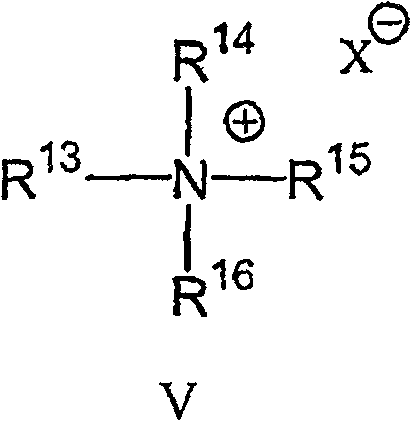
According to the inventive method, suitable transesterification catalyst comprises alkaline earth salt, an alkali metal salt, quaternary ammonium compound, quaternary phosphonium ion and their mixture.Suitable transesterification catalyst comprises the quaternary ammonium compound that contains structure V:
Figure C0382501100171
Wherein, R 13-R 16Be C independently 1-C 20Alkyl, C 4-C 20Cycloalkyl or C 4-C 20Aryl, X -It is the organic or inorganic negatively charged ion.Negatively charged ion X -Comprise hydroxide radical, halogenide, acetate moiety, carboxylate radical, phenates, sulfonate radical, sulfate radical, carbonate and bicarbonate radical.In the one embodiment of this invention, transesterification catalyst comprises tetramethyl ammonium hydroxide.
Suitable transesterification catalyst comprises and contains structure VI De quaternary phosphonium compound,
Figure C0382501100172
Wherein, R 17-R 20Be C independently 1-C 20Alkyl, C 4-C 20Cycloalkyl or C 4-C 20Aryl, X -It is organic or inorganic negatively charged ion as defining among the structure V.In the one embodiment of this invention, transesterification catalyst comprises the acetate 4-butyl-phosphonium.
Work as X -When being multivalent anions such as carbonate or sulfate radical, should be appreciated that the positive and negative charge balance just in time among structure V and the VI.For example, R in structure VI 17-R 20Be respectively methyl and X -When being carbonate, should be appreciated that X -Expression 1/2 (CO 3 -2).
According to the inventive method, transesterification catalyst can comprise at least a alkali metal hydroxide, alkaline earth metal hydroxides or their mixture.In the embodiment, except quaternary ammonium compound such as V, quaternary phosphonium compound such as VI or their mixture, also add oxyhydroxide.Sodium hydroxide and acetate four uncle Ding Ji Phosphonium are for example understood this hybrid catalyst system.Comprise season " " compound such as V or the catalyst system of VI together with metal hydroxides such as sodium hydroxide in, often preferred, the amount of " " compound is in excess in metal hydroxides, preferably is equivalent to about 10 times to about 250 times of content of used metal hydroxides.
In the embodiment of the present invention, transesterification catalyst comprises at least a an alkali metal salt of carboxylic acid, the alkaline earth salt of carboxylic acid or their mixture.The salt of ethylenediamine tetraacetic carboxylic acid (EDTA) is found effective especially, wherein as Na 2MgEDTA.
In yet another embodiment of the invention, transesterification catalyst comprises the salt of non-volatile mineral acid." non-volatile " expression, related compound does not have perceptible vapour pressure under room temperature and normal atmosphere.Especially, these compounds do not have volatility under the temperature of the melt polymerization that carries out polycarbonate usually.According to the present invention, the salt of non-volatile acid is alkali-metal phosphite, alkaline-earth metal phosphite, alkali metal phosphate, alkali earth metal phosphate.The salt of suitable non-volatile acid comprises NaH 2PO 3, NaH 2PO 4, Na 2H 2PO 3, K 2H 2PO 3, KH 2PO 4, CsH 2PO 4, Cs 2H 2PO 4, and their mixture.In one embodiment, the salt of non-volatile acid is CsH 2PO 4In the one embodiment of this invention, transesterification catalyst not only comprises the salt of non-volatile acid but also comprises alkaline promoter such as alkali metal hydroxide.This notion will be by being used in combination NaH 2PO 4Illustrate as transesterification catalyst with sodium hydroxide.
According to the present invention, the content of transesterification catalyst is about 1 * 10 -8To about 1 * 10 -3, preferably about 1 * 10 -7To about 1 * 10 -3, even more preferably about 1 * 10 -6To about 5 * 10 -5In the scope of every mole of dihydroxy aromatic compounds of mol catalyst.
In the embodiment, in the low viscosity melt, sneak into a small amount of branching agent.Therefore, in the embodiment, the present invention can comprise at least a branching agent such as trifunctional or higher functional alcohol, trifunctional or higher functional carboxylic acid or trifunctional or higher functional phenol.Suitable branching agent comprises, for example trifunctional or higher functional acyl chlorides, and trimesic acid trichloride, cyanuric acid trichloride, 3,3 ', 4,4 '-benzophenone tetracarboxylic acid tetrachloride, 1,4,5,8-naphthalenetetracarbacidic acidic tetrachloride or pyromellitic acid tetrachloride; With trifunctional or higher functional phenol such as Phloroglucinol, 4,6-dimethyl-2,4,6-three-(4-hydroxyphenyl)-2-heptene, 4,6-dimethyl-2,4,6-three-(4-hydroxyphenyl) heptane, 1,3,5-three-(4-hydroxyphenyl)-benzene, 1,1,1-three-(4-hydroxyphenyl)-ethane, three-(4-hydroxyphenyl)-phenylmethane, 2,2-two-[4,4-two-(4-hydroxyphenyl)-cyclohexyl]-propane, 2,4-two-(4-hydroxyphenyl sec.-propyl)-phenol, four-(4-hydroxyphenyl)-methane, 2,6-two-(2-hydroxy-5-methyl base benzyl)-4-methylphenol, 2-(4-hydroxyphenyl)-2-(2, the 4-dihydroxyphenyl)-propane, four-(4-[4-hydroxyphenyl sec.-propyl]-phenoxy group)-methane, 1,4-two-[(4,4-dihydroxyl triphenyl) methyl]-benzene.
In the one embodiment of this invention, treat that the polymeric mixture also comprises the stopping of chain agent.The stopping of chain agent can be used to limit the molecular weight of product polymkeric substance, perhaps changes its physicals such as second-order transition temperature or carries the static charge performance.Suitable stopping of chain agent comprises the phenol of simple function, as to cumyl phenol, 2, and 6-xylenol, 4-tert.-butyl phenol, p-cresol, 1-naphthols, beta naphthal, cardanol, 3,5-DI-tert-butylphenol compounds, to nonylphenol, to octadecyl phenol and phenol.In the alternative embodiment of the present invention, can: (1) begin the reaction before; (2) the polymerization intermediate stage; Or (3) finish the agent of reaction back adding stopping of chain.In this alternative embodiment, the stopping of chain agent will produce control action kou to the molecular weight of product polycarbonate, and with the identity (identity) of controlling polymers end group.
The invention provides very quick, high yield polymerization process.By allowing to remove in a continuous manner the by product of inhibitory removal, the invention provides the method for utilizing flow reactor system polymerization polycarbonate.
Feed composition: ester replaces diaryl carbonate, at least a dihydroxy aromatic compounds, transesterification catalyst and optional monofunctional phenol stopping of chain agent, can join mixing section by feed(raw material)inlet same or that separate.Can change the adding speed (introduction rate) of described component and described optional mono-functional phenols, control the mol ratio of reactant, and control physicals such as the molecular weight and the end group identity of product polycarbonate in this way.Therefore, the inventive method can be adjusted the molecular weight of product polycarbonate on the basis of continuation method.
In the embodiment, the molecular weight of product polycarbonate is to control by the relative quantity of adjusting described dihydroxy aromatic compounds and described diaryl carbonate.Preferably, in the mixture, with respect to every mole of dihydroxy aromatic compounds, raw material comprises about 0.8 to about 1.2, and preferred about 0.95 to about 1.05, even the diaryl carbonate that replaces of 1.01 to 1.04 moles ester more preferably from about.
In the embodiment, the ratio of control catalyst and raw material in addition.With respect to whenever the amount bis-phenol, preferably include 25 to 500 microequivalent (microequivalent) catalyzer, more preferably 100 to 250 microequivalent catalyzer, even 150 microequivalent catalyzer more preferably from about.
Therefore, in one preferred embodiment, with respect to every mole of dihydroxyphenyl propane, mixture comprises about 0.95 to about 1.05 moles of carbonic acid two (methyl salicyl) esters and about 100 micromoles (150ppm) acetate 4-butyl-phosphoniums (TPBA) catalyzer, with difference, obtain having the polycarbonate product of 16k to 105k molecular weight (Mw) according to polymerization temperature.
Also have, speed of reaction is regulated by removing the salicylate by product.Usually, salicylate inhibited reaction.Therefore, the salicylate by product removes the molecular weight that has influenced prepared polymkeric substance greatly.Preferably, the by product speed of inhibition further increases along with drop contact reacts wall, and flows to the collection tube of handling polymerisate.
In addition, speed of reaction also is subjected to the influence of drop size.Usually, less drop will increase the diffusion of the salicylate by product of inhibition, so the bigger drop of speed of reaction is fast.Therefore, in the inventive method, drop is micron order preferably.
Preferably, the product polycarbonate comprise be lower than about 1000, more preferably less than about 500, even more preferably less than the Fries product of about 100 parts/1,000,000 (ppm).Following structure VII has illustrated the structure of the Fries product that exists in the polycarbonate that is prepared by dihydroxyphenyl propane.Shown in this structure, the Fries product can be used as the point of polymkeric substance branching, the curve representation polymer chain structure among the structure VII.
Figure C0382501100201
The resulting product polycarbonate of the present invention, the weight-average molecular weight of measuring according to gel permeation chromatography are about 10,000 to about 150,000 dalton, and preferred about 15,000 to about 120,000 dalton, even more preferably from about 18,000 to about 50,000 dalton.
The present invention also provides the reactor assembly as the mist melt polymerization.On the other hand, the present invention includes the equipment that generates high-molecular-weight polycarbonate, comprising:
(a) make and comprise the diaryl carbonate that at least a ester replaces and the molten monomer of at least a dihydroxy aromatic compounds, and described monomer is mixed with at least a melt polymerization catalyst, the device of generation prepolymerization reaction mixture;
(b) form the device of the mist of predetermined drop size by the prepolymerization reaction mixture;
(c) decompression is exposed to mist in the hot environment so that described monomer polymerization down, and from drop the reactor of at least a portion in the separating at least one volatile reaction by product;
(d) from drop, remove the venting port of the described volatile byproducts of at least a portion; With
(e) device of collection polymeric polycarbonate product from reactor.
Monomer can fusion in a container such as heating tank.In addition, monomer fusion in advance also is transported to and is used for the blended jar, and/or mixes with transesterification catalyst.Perhaps, monomer can mix when transporting to (in the transfer lime of heating) reactor, need not to use independent jar.
In the embodiment, reactor assembly of the present invention also is included in and forms before the mist, adds the device of at least a catalyzer dividually with monomer.Therefore, in the embodiment, catalyzer is to add before molten monomer, and along with fused carries out mixing with monomer.Selectively, catalyzer can add in melting process or after the monomer fusion just.The present invention also comprises the embodiment that catalyzer (or several catalyzer) wherein adds during toward the container that forms drop along with the molten monomer pump.For example, catalyzer can just inject before molten monomer forms mist.Therefore, the present invention considered molten monomer and before forming mist with the variety of way of catalyst mix.
In the embodiment, provide reactor assembly of the present invention to be used for along with the formation of volatile byproducts is removed them continuously.For example, in the embodiment, from drop, evaporate the salicylate by product and remove devaporation by venting port.Discharge with the salicylate condensation and with liquid form then.
Preferably, polymerization is to carry out under the vacuum of 0.1 to 700 holder.More preferably, polymerization is to carry out under the vacuum of 0.1 to 50 holder.Even more preferably, polymerization is to carry out under the vacuum of 0.1 to 5 holder.
Simultaneously, preferably, the temperature of described molten monomer is in 125 ℃ to 250 ℃ scopes.Even more preferably, the temperature of described molten monomer is in 140 ℃ to 200 ℃ scopes.In the embodiment, the temperature of described molten monomer is about 150 ℃.
Preferably, most of drop has the size of regulation to promote the exchange of volatile reaction by product.Preferably, the size of most of drop is 1-1 in the mist, 000 micron.More preferably, the size of most of drop is the 1-400 micron in the mist.Even more preferably, the size of most of drop is the 5-50 micron in the mist.
Equally, in the embodiment, drop will have preferred range of viscosities in the mist, to promote exchange of volatile byproducts.Preferably, drop viscosity is in 0.5 to 500cp scope.More preferably, drop viscosity is in 1 to 200cp scope, even more preferably in 5 to 90cp scopes.
In the embodiment, the device that generates mist comprises nozzle or atomizer.Preferably, the device of generation mist comprises that no air nozzle, atomizer, rotating sprayer maybe can increase long-pending any other device of flow surface.
The unique distinction of the inventive method is that it can make polymerization carry out very apace.Therefore, polymkeric substance can be exposed under the quite high temperature, and when at high temperature only stopping short " residence time ".Preferably, being used for the polymeric temperature is 200 to 400 ℃.More preferably, be used for the polymeric temperature at 250 to 350 ℃.Even more preferably, be used for the polymeric temperature at 280 to 320 ℃.
The unique distinction of the inventive method is that high-molecular-weight polycarbonate in the several minutes, produces in preferred several seconds usually under being exposed to the high-temperature fusion condition.In the embodiment, utilize higher polymerization temperature, can generate product quickly.Therefore, the invention has the advantages that polymkeric substance is exposed to the time very short under the typical melt polymerization high temperature.Attendant advantages of the present invention is, polymerization is further along with drop contact reacts wall and fall the reactor bottom that is used to collect and increase.
In the embodiment, polymerization is generated the needed time of subject polymer.Preferably, polymerization comprises 5 minutes or the shorter time limit.More preferably, polymerization comprises 3 minutes or the shorter time limit.Even more preferably, polymerization comprises 1 minute or the shorter time limit.
In the embodiment, the molecular weight of product polycarbonate is to control by the relative quantity of adjusting described dihydroxy aromatic compounds and described diaryl carbonate.Preferably, in the mixture, with respect to every mole of dihydroxy aromatic compounds, raw material comprises about 0.8 to about 1.2, and preferred about 0.95 to about 1.05, even the diaryl carbonate that replaces of 1.01 to 1.04 moles ester more preferably from about.In addition, as described herein, the preferred amounts of catalyzer is, with respect to whenever the amount bis-phenol, uses 25 to 500 microequivalent catalyzer, more preferably 100 to 250 microequivalent catalyzer, even 150 microequivalent catalyzer more preferably from about.
In addition, speed of reaction is regulated by removing volatile byproducts.In the embodiment, the by product of evaporation is collected with liquid form.Usually, volatile byproducts such as salicylate and phenol inhibited reaction.Therefore, when using carbonic acid two (methyl salicyl) ester, removing the salicylate by product obviously influences rate of polymerization.For example, salicylate removes speed and can increase by reducing the surface-area that vapour pressure in the reactor or increase be exposed to venting port.
In addition, speed of reaction also can be subjected to the influence of drop size.Usually, compare with bigger drop, less drop will increase the diffusion of the salicylate by product of inhibition, and therefore reaction is faster.Therefore, in the inventive method, drop is micron order preferably.
In the embodiment, the used ester of reactor of the present invention replaces diaryl carbonate and has structure I as herein described.Preferably, the diaryl carbonate of ester replacement is selected from carbonic acid two (methyl salicyl) ester, carbonic acid two (propyl group salicyl ester) and carbonic acid two (benzyl salicyl) ester.
In the embodiment, the used dihydroxy aromatic compounds of reactor of the present invention is the bis-phenol with structure I I as herein described in addition.Preferably, bis-phenol is a dihydroxyphenyl propane.
Equally preferably, equipment of the present invention is fit to use transesterification catalyst as herein described.Also comprise other additive that branching agent as herein described, stopping of chain agent and polycarbonate polymerization field are general in the present device.
The invention provides very quick, high yield polymerization.By removing the by product of inhibitory removal in a continuous manner, the invention provides the polycarbonate polymerization method of utilizing the flow reactor system.Therefore, the invention describes reactor: the above heating of (1) fusing point monomer with following characteristics; (2) form with mist adds reactor with fused pre-polymerization mixture; (3) make melt polymerization with the form of mist and on the reactor wall under the vacuum high-temperature, undertaken by predetermined reaction time is provided; (4), from polyreaction, remove the volatile byproducts of inhibitory removal along with polymeric carries out; (5) carry and discharge resulting polymers in a continuous manner.Preferably, fast and effeciently from melt, remove the volatile reaction by product.
For example, with obviously faster speed of reaction and the utilization temperature lower than other melt polymerization process, polymerization dihydroxyphenyl propane and carbonic acid two (methyl salicyl) ester (BMSC) generate high-molecular-weight polycarbonate.Yet, the by product of the inhibition that generates when salicylate is polymerization, and if do not remove salicylate, reaction can not be carried out.Therefore, reactor of the present invention has improved the efficient that is prepared polycarbonate by dihydroxyphenyl propane and BMSC greatly.Selectively, reactor can be used for removing phenol, melt polymerization other volatile byproducts of appearance usually.Therefore, the inventive method can be used for other polycarbonate polymerization outside the polymerization of BMSC mesomeric.
By removing the by product of inhibitory removal with polymerization, reactor of the present invention has reduced polymkeric substance must be exposed to time under the hot conditions, has therefore increased speed of reaction and has reduced unfavorable content of by-products.This has also reduced non-volatile by-products such as Fries by product.
The present invention has a plurality of advantages with respect to prior art.When low and discharge reaction product of viscosity was easy, the scorification polymerization was usually directed to the tank reactor (CSTR) of continuously stirring when the beginning polyreaction.Along with polymeric carries out, it is big that viscosity becomes, and needs to produce big interfacial area.Sometimes, big interfacial area realizes by comprise mixing tank in mixture.Keep low film thickness on the surface-area that these mixing tanks can obtain in reactor.Selectively, reactor is designed to utilize melts to drip technology (melt drop technology) and produces interfacial area, and this melts technology of dripping is that low-molecular weight polymer is flowed down along wire, perhaps flows through porous plate with the thread form.Bigger interfacial area helps to be provided for the path length that phenol diffuses out from polymkeric substance.
Compare with other known reactor, reactor of the present invention has utilized the advantage of low viscosity molten monomer so that carry out polymerization with Sprayable.Reactor of the present invention can be extruded needs the polymer beads processed hardly.Reactor of the present invention has reduced process cost, and this is owing in the bigger reason of the preparation productive rate of polycarbonate.Utilize identical reactor, change parameter a little, can also prepare the multipolymer of polycarbonate.
Sketch chart of the present invention is illustrated among Fig. 1.Monomer 25 is introduced into as dihydroxyphenyl propane (BPA) and carbonic acid two (methyl salicyl) ester (BMSC) and suitable catalyzer and optional other comonomer such as hexanodioic acid, dodecanedioic acid (DDDA) etc. and enters the mouth 10, and be carried in the fusion jar 30 by mixing feeder 20, this fusion jar 30 is heated by well heater 40.Then, (about 150 ℃) fusion under the pre-polymerization mixture low temperature, and utilize the pump 50 of heating and the pipeline 55 of heating to pump into reaction chamber 60, and produce mist 90 by nozzle or atomizer 80.Reaction chamber is made by glass or to being used for stable any other material of polymeric chemical and reaction conditions (high temperature, decompression).Preferably, reaction chamber comprises well heater 70 as oil jacket or electric heater, comes the reacting by heating chamber to suitable polymerization temperature.
Equally preferably, reactor 60 has been installed one or more vaccum exhaust outlets 120.Vaccum exhaust outlet 120 is connected on cold-trap 140 and the vacuum pump 155 by pipeline 130.Vaccum exhaust outlet 120 is under reduced pressure to work, and works to about 700mm Hg scope about 1 usually, preferably works to about 50mm Hg scope about 10.Venting port can make the by product volatilization and remove from polyblend.Therefore, this equipment provides with condenses liquid 150 forms and has collected by product to be used for the device of processing subsequently.In preferred embodiments, utilize screen cloth 110 aromatic ester polymer anti-mist to reflux and enter vaccum exhaust outlet 120.
Nozzle/atomizer 80 is designed to generate the mist of micron order drop size.Preferably, drop comprises very large surface-area and about viscosity of 5 to 90cp.Equally preferably, optionally, in initial low viscosity melt, can sneak into a small amount of branching agent and/or stopping of chain agent.In case formed mist, just made to be aggregated in the reaction chamber 60 and carry out the scheduled time.
Usually, make polymkeric substance in reaction chamber 60, produce the needed time of subject polymer.Shown in this paper embodiment part, the polymkeric substance that 3 minutes or shorter polymerization time obtain has the Mw (table 1) more than the 16k to 100k.
Behind the polymerization time of setting, polymer melt 100 flows in the vented extruder 160 of heating, and is transported to cooling tank 170.Polymer product obtains the final polycarbonate 190 of particle form with tablets press 180 granulations then.Certainly, the present invention also comprises the product (for example extruding with large stretch of form) of other form.
Therefore, the invention provides the method and the reaction system of quick and effective high productivity polycarbonate synthesis.Because the by product of inhibition is removed continuously, so the inventive method and system provide at several seconds to being less than the ability that obtains the high-molecular weight polycarbonate in 10 minutes the polymerization time.In addition, because in reaction process, stably migrate out polycarbonate pellets, therefore avoided problem such as a large amount of high-viscosity products of processing.The processing of the volatile byproducts of separating from polycarbonate product in addition, is also simplified greatly.
Utilize the polycarbonate of the inventive method preparation to mix, and be shaped to multiple moulded product such as CD, optical lens, auto lamp assembly etc. with conventional additives such as thermo-stabilizer, releasing agent and UV stablizer.In addition, utilize the polycarbonate of the inventive method preparation to mix with other polymkeric substance such as other polycarbonate, polyestercarbonate, polyester and olefin polymer.
Embodiment
Embodiment 1
Fig. 1 illustrates the reactor of spraying melt polymerization.Therefore as shown in the figure, utilize funnel type mouth (10) with in the component introducing system.Utilize feeder (20) that monomer and catalyzer are transported to mixing tank (30) from mouth (10).Mixing tank of the present invention (30) is the 1000cc glass flask (or glass still) that has agitator and end mouth, and utilizes softish Omega heater coil (40) heating that is wrapped on the still.Then, molten monomer and mixture of catalysts action of gravity join in the Zenith toothed gear pump (50), and the pump speed of this toothed gear pump is 24 Pounds Per Hours.Utilize the temperature of Wattlow temperature regulator control pump and pipeline, make melt temperature maintain about 150 ℃.
The fused pre-reaction mixture pumps into reactor (60) by the flexible ripple line of pipes of stainless steel (1/4 inch of internal diameter (ID)) (55) down at pressure (150PSI), and produces spraying (90) by nozzle (80).Used nozzle is HAGO Precision Nozzle (under the 100PSI, speed is 2 gallons per hours) in the equipment.Reactor is the 2000cc glass reactor that can keep vacuum.In addition, reactor comprises two venting port top covers and a base bleed mouth.In the polymerization process, reactor is compeled wind baking oven (forced airoven) (1ft by constant temperature 3) (70) be heated to 280 ℃ to 320 ℃.Reactor comprises that screen cloth flow deflector (110) enters venting port (120) to prevent polymkeric substance.Venting port (120) is connected to vacuum pump (155) and goes up to remove volatile constituent (be by ID 3/4 inch vacuum pipeline (130)) from reaction.This allows to utilize cold-trap (140) to reclaim the by product (being salicylate) (150) of condensation.In this system, cold-trap is the still that remains on freezing point or 0 ℃.Glass reactor bottom have an outlet, this outlet be connected to heating, on vented extruder (160) and the cooling tank (170).Therefore, the polymerisate of collection (100) flows down along reactor wall, and enters in the 16mm twin screw PRISM forcing machine (160) by the base bleed mouth of reaction beaker.At 280 ℃ to the 320 ℃ forcing machines of operating down any residual wintergreen oil is carried out last devolatilization, and polymer beads is sent in the PRISM tablets press (180) by cooling bath (170), under room temperature, be cut into the small powder grain at this.
Embodiment 2
Carrying out three experiments, wherein is that the dihydroxyphenyl propane (BPA) of 1.0000/1.4735 and carbonic acid two (methyl salicyl) ester (BMSC) (228.3gBPA and 330.6gBMSC) and 150ppm acetate 4-butyl-phosphonium (TBPA) catalyzer join in " fusion jar " with weight ratio.Pump from the fusion jar to nozzle and pipeline maintain 150 ℃.Utilize pump speed be 24 Pounds Per Hours volume Zenith toothed gear pump with melt Conveying to the nozzle of glass reactor that is positioned at 5 holder vacuum.Cold-trap has been installed on vacuum pipeline has been caught the free salicylate.Compel in the wind baking oven reactor to be remained under the steady temperature at large vol.
Find, the polymerization time scope at 3 minutes to 24 seconds, having prepared Mw is the polymkeric substance of 16k to 105k.Especially, increase polymerization temperature and be accompanied by the reduction needed time of polymerization.Therefore, under 280 ℃, preparation Mw is that the polymerization time of the product of 16.6k is 3 minutes, and under 300 ℃, preparation Mw is that the needed time of product of 23.7k only is 24 seconds, and under 320 ℃, the needed time of product that preparation Mw surpasses 100k only is 30 seconds.
Table 1
Experiment Oven temperature (℃) Emitted dose The cycle of operation The salicylate that reclaims Mn Mw Mw/Mn
1 280 50g 3 minutes 21g 7.9k 16.6k 2.25
2 300 67g 24 seconds 27g 11.5k 23.7k 2.3
3 320 50g 30 seconds 27g 36k 105k 2.9
Although illustrate and described the present invention, on the details,, can make multiple change and replacement shown in never being intended to the present invention is limited to because under the premise without departing from the spirit of the present invention with typical embodiments.Therefore, those skilled in the art only utilize routine test, can further change and of equal value the replacement invention described herein, and think, all these change and of equal value the replacement all in the spirit and scope that claim of the present invention limited.

Claims (54)

1.制备高分子量聚碳酸酯的方法,包括:1. A method for preparing high molecular weight polycarbonate, comprising: (a)将包括酯取代的碳酸二芳酯和二羟基芳族化合物的单体(25)熔融,并与至少一种熔融聚合催化剂混合,生成预聚合反应混合物;(a) melting a monomer (25) comprising an ester-substituted diaryl carbonate and a dihydroxyaromatic compound and mixing with at least one melt polymerization catalyst to form a prepolymerization reaction mixture; (b)处理反应混合物以形成雾,其中雾中大部分液滴的大小为1至1,000微米;(b) treating the reaction mixture to form a mist, wherein the majority of the droplets in the mist are 1 to 1,000 microns in size; (c)减压下,在使单体聚合的条件下,将雾暴露于200-400℃;和(c) exposing the mist to 200-400° C. under reduced pressure under conditions to polymerize the monomer; and (d)收集聚合的聚碳酸酯产物(100)。(d) Collecting the polymerized polycarbonate product (100). 2.根据权利要求1的方法,其中与单体分开地、但在形成雾之前加入至少一种催化剂。2. The method according to claim 1, wherein at least one catalyst is added separately from the monomers but before the mist is formed. 3.根据权利要求1的方法,其中从液滴中分离至少一种挥发性反应副产物的至少一部分。3. The method according to claim 1, wherein at least a portion of at least one volatile reaction by-product is separated from the liquid droplets. 4.根据权利要求3的方法,还包括连续除去该至少一种挥发性副产物。4. The method according to claim 3, further comprising continuously removing the at least one volatile by-product. 5.根据权利要求1的方法,其中减压为0.1至700托。5. The method according to claim 1, wherein the reduced pressure is from 0.1 to 700 Torr. 6.根据权利要求1的方法,其中减压为0.1至50托。6. The method according to claim 1, wherein the reduced pressure is 0.1 to 50 Torr. 7.根据权利要求1的方法,其中预聚合混合物熔融的温度在125℃至250℃范围内。7. The method according to claim 1, wherein the temperature at which the prepolymerized mixture is melted is in the range of 125°C to 250°C. 8.根据权利要求1的方法,其中雾中大部分液滴的大小为1至400微米。8. The method according to claim 1, wherein the size of the majority of the droplets in the mist is from 1 to 400 microns. 9.根据权利要求1的方法,其中雾中大部分液滴的大小为5至50微米。9. The method according to claim 1, wherein the size of the majority of the droplets in the mist is between 5 and 50 microns. 10.根据权利要求1的方法,其中液滴的粘度在0.5至500cp范围内。10. The method according to claim 1, wherein the viscosity of the liquid droplets is in the range of 0.5 to 500 cp. 11.根据权利要求1的方法,其中液滴的粘度在1至200cp范围内。11. The method according to claim 1, wherein the viscosity of the liquid droplets is in the range of 1 to 200 cp. 12.根据权利要求1的方法,其中利用喷嘴或喷雾器(80)产生雾。12. The method according to claim 1, wherein the mist is generated using a nozzle or sprayer (80). 13.根据权利要求1的方法,其中聚合所用温度为250℃至350℃。13. The method according to claim 1, wherein the temperature used for polymerization is from 250°C to 350°C. 14.根据权利要求1的方法,其中聚合所用温度为280℃至320℃。14. The method according to claim 1, wherein the temperature used for polymerization is from 280°C to 320°C. 15.根据权利要求1的方法,其中生成聚碳酸酯产物(100)的聚合进行了少于5分钟。15. The method according to claim 1, wherein the polymerization to form the polycarbonate product (100) is carried out for less than 5 minutes. 16.根据权利要求1的方法,其中生成聚碳酸酯产物(100)的聚合进行了少于3分钟。16. The method according to claim 1, wherein the polymerization to form the polycarbonate product (100) is carried out for less than 3 minutes. 17.根据权利要求1的方法,其中所述酯取代的碳酸二芳酯具有结构I,17. The method according to claim 1, wherein the ester-substituted diaryl carbonate has the structure I, 其中,R1在每一次出现时独立地为C1-C30烷基,C4-C30环烷基,或C4-C30芳基,C1-C30烷氧基,C6-C30芳氧基,C6-C30芳烷基,C6-C30芳烷氧基;R2在每一次出现时独立地为卤原子,氰基,硝基,C1-C20烷基,C4-C20环烷基,C4-C20芳基,C1-C20烷氧基,C4-C20环烷氧基,C4-C20芳氧基,C1-C20烷硫基,C4-C20环烷硫基,C4-C20芳硫基,C1-C20烷亚磺酰基,C4-C20环烷亚磺酰基,C4-C20芳亚磺酰基,C1-C20烷磺酰基,C4-C20环烷磺酰基,C4-C20芳磺酰基,C1-C20烷氧羰基,C4-C20环烷氧羰基,C4-C20芳氧羰基,C2-C60烷氨基,C6-C60环烷氨基,C5-C60芳氨基,C1-C40烷氨基羰基,C4-C40环烷氨基羰基,C4-C40芳氨基羰基,和C1-C20酰氨基;b在每一次出现时独立地为0至4的整数。Wherein, R 1 is independently C 1 -C 30 alkyl, C 4 -C 30 cycloalkyl, or C 4 -C 30 aryl, C 1 -C 30 alkoxy, C 6 - C 30 aryloxy, C 6 -C 30 aralkyl, C 6 -C 30 aralkyloxy; R 2 is independently a halogen atom, cyano, nitro, C 1 -C 20 alkane at each occurrence base, C 4 -C 20 cycloalkyl, C 4 -C 20 aryl, C 1 -C 20 alkoxy, C 4 -C 20 cycloalkoxy, C 4 -C 20 aryloxy, C 1 - C 20 alkylthio, C 4 -C 20 cycloalkylthio, C 4 -C 20 arylthio, C 1 -C 20 alkylsulfinyl, C 4 -C 20 cycloalkylsulfinyl, C 4 -C 20 arylsulfinyl, C 1 -C 20 alkanesulfonyl, C 4 -C 20 cycloalkanesulfonyl, C 4 -C 20 arylsulfonyl, C 1 -C 20 alkoxycarbonyl, C 4 -C 20 cycloalkane Oxycarbonyl, C 4 -C 20 aryloxycarbonyl, C 2 -C 60 alkylamino, C 6 -C 60 cycloalkylamino, C 5 -C 60 arylamino, C 1 -C 40 alkylaminocarbonyl, C 4 -C 40 cycloalkylaminocarbonyl, C 4 -C 40 arylaminocarbonyl, and C 1 -C 20 amido; b is independently an integer from 0 to 4 at each occurrence. 18.根据权利要求17的方法,其中酯取代的碳酸二芳酯包括碳酸二(甲基水杨基)酯、碳酸二(丙基水杨基)酯、或碳酸二(苄基水杨基)酯。18. The method according to claim 17, wherein the ester-substituted diaryl carbonate comprises bis(methylsalicyl)carbonate, bis(propylsalicyl)carbonate, or bis(benzylsalicyl)carbonate ester. 19.根据权利要求1的方法,其中二羟基芳族化合物是具有结构II的双酚,19. The method according to claim 1, wherein the dihydroxyaromatic compound is a bisphenol having structure II,
Figure C038250110003C2
其中,R3-R10独立地为氢原子、卤原子、硝基、氰基、C1-C30烷基、C4-C30环烷基、或C6-C30芳基、C1-C30烷氧基,C4-C30环烷氧基、或C6-C30芳氧基;W是键、氧原子、硫原子、SO2、C1-C20脂肪烃基、C6-C20芳烃基、C6-C20环脂肪烃基或下述基团Wherein, R 3 -R 10 are independently hydrogen atom, halogen atom, nitro, cyano, C 1 -C 30 alkyl, C 4 -C 30 cycloalkyl, or C 6 -C 30 aryl, C 1 -C 30 alkoxy, C 4 -C 30 cycloalkoxy, or C 6 -C 30 aryloxy; W is a bond, oxygen atom, sulfur atom, SO 2 , C 1 -C 20 aliphatic hydrocarbon group, C 6 -C 20 aromatic hydrocarbon group, C 6 -C 20 cycloaliphatic hydrocarbon group or the following groups
Figure C038250110004C1
其中,R11和R12独立地为氢原子、C1-C20烷基、C4-C20环烷基、或C4-C20芳基;或者R11和R12一起形成C4-C20环脂肪烃环,该环任选地被一个或多个C1-C20烷基、C6-C20芳基、C5-C21芳烷基、C5-C20环烷基或它们的组合取代。Wherein, R 11 and R 12 are independently a hydrogen atom, a C 1 -C 20 alkyl group, a C 4 -C 20 cycloalkyl group, or a C 4 -C 20 aryl group; or R 11 and R 12 together form a C 4 - C 20 cycloaliphatic hydrocarbon ring, the ring is optionally replaced by one or more C 1 -C 20 alkyl, C 6 -C 20 aryl, C 5 -C 21 aralkyl, C 5 -C 20 cycloalkyl or a combination of them instead.
20.根据权利要求19的方法,其中双酚是双酚A。20. The method according to claim 19, wherein the bisphenol is bisphenol-A. 21.根据权利要求1的方法,其中催化剂包括季铵化合物、季磷鎓化合物或它们的混合物。21. The method of claim 1, wherein the catalyst comprises a quaternary ammonium compound, a quaternary phosphonium compound, or a mixture thereof. 22.根据权利要求21的方法,其中季铵化合物具有结构V,22. The method according to claim 21, wherein the quaternary ammonium compound has the structure V,
Figure C038250110004C2
其中,R13-R16独立地为C1-C20烷基、C4-C20环烷基或C4-C20芳基,且X-是有机或无机阴离子。Wherein, R 13 -R 16 are independently C 1 -C 20 alkyl, C 4 -C 20 cycloalkyl or C 4 -C 20 aryl, and X - is an organic or inorganic anion.
23.根据权利要求21的方法,其中季铵化合物是氢氧化四甲基铵。23. The method according to claim 21, wherein the quaternary ammonium compound is tetramethylammonium hydroxide. 24.根据权利要求21的方法,其中所述季磷鎓化合物具有结构VI,24. The method according to claim 21, wherein said quaternary phosphonium compound has structure VI, 其中,R17-R20独立地为C1-C20烷基、C4-C20环烷基或C4-C20芳基,且X-是有机或无机阴离子。Wherein, R 17 -R 20 are independently C 1 -C 20 alkyl, C 4 -C 20 cycloalkyl or C 4 -C 20 aryl, and X - is an organic or inorganic anion. 25.根据权利要求21的方法,其中季磷鎓化合物是乙酸四丁基鏻。25. The method according to claim 21, wherein the quaternary phosphonium compound is tetrabutylphosphonium acetate. 26.根据权利要求1的方法,其中催化剂包括至少一种碱金属氢氧化物、碱土金属氢氧化物或它们的混合物。26. The method of claim 1, wherein the catalyst comprises at least one alkali metal hydroxide, alkaline earth metal hydroxide, or mixtures thereof. 27.根据权利要求26的方法,其中碱金属氢氧化物是氢氧化钠。27. A method according to claim 26, wherein the alkali metal hydroxide is sodium hydroxide. 28.根据权利要求1的方法,其中催化剂包括羧酸的至少一种碱金属盐、或羧酸的碱土金属盐、或它们的混合物。28. The method according to claim 1, wherein the catalyst comprises at least one alkali metal salt of a carboxylic acid, or an alkaline earth metal salt of a carboxylic acid, or a mixture thereof. 29.根据权利要求28的方法,其中羧酸的碱金属盐是Na2MgEDTA。29. The method according to claim 28, wherein the alkali metal salt of the carboxylic acid is Na2MgEDTA . 30.根据权利要求1的方法,其中所述催化剂包括非挥发性无机酸的至少一种盐。30. The method according to claim 1, wherein said catalyst comprises at least one salt of a non-volatile inorganic acid. 31.根据权利要求30的方法,其中非挥发性酸的盐包括NaH2PO3、NaH2PO4、Na2H2PO3、KH2PO4、CsH2PO4或Cs2H2PO4 31. The method according to claim 30, wherein the salt of the non-volatile acid comprises NaH2PO3 , NaH2PO4 , Na2H2PO3 , KH2PO4 , CsH2PO4 , or Cs2H2PO4 . 32.根据权利要求1的方法,还包括在反应混合物中混入至少一种支化剂。32. The method according to claim 1, further comprising mixing at least one branching agent in the reaction mixture. 33.根据权利要求1的方法,还包括在反应混合物中混入至少一种链终止剂。33. The method according to claim 1, further comprising mixing at least one chain terminator in the reaction mixture. 34.根据权利要求1的方法,其中通过调整聚合反应混合物中存在的二羟基芳族化合物和碳酸二芳酯的相对量而控制产物聚碳酸酯(100)的分子量。34. The method according to claim 1, wherein the molecular weight of the product polycarbonate (100) is controlled by adjusting the relative amounts of dihydroxyaromatic compound and diaryl carbonate present in the polymerization reaction mixture. 35.根据权利要求1的方法,其中聚合速率是通过调整所形成的喷雾液滴的大小控制的。35. The method of claim 1, wherein the rate of polymerization is controlled by adjusting the size of the spray droplets formed. 36.根据权利要求1的方法,其中聚合速率是通过从液滴中除去副产物的速率控制的。36. The method of claim 1, wherein the rate of polymerization is controlled by the rate of removal of by-products from the droplets. 37.制备聚碳酸酯的方法,包括:37. A method of preparing polycarbonate comprising: (a)将包括二羟基芳族化合物和碳酸二(甲基水杨基)酯的单体(25)熔融,并与至少一种酯交换催化剂混合,生成预聚合反应混合物;(a) melting a monomer (25) comprising a dihydroxyaromatic compound and bis(methylsalicyl) carbonate and mixing with at least one transesterification catalyst to form a prepolymerization reaction mixture; (b)处理该混合物以形成细的雾,其中雾中大部分液滴的大小为1至1,000微米;(b) treating the mixture to form a fine mist in which the majority of the droplets in the mist are 1 to 1,000 microns in size; (c)减压下,在使单体聚合、并将至少一种挥发性反应副产物中的至少一部分从所述液滴中分离的条件下,将雾暴露于200-400℃;(c) exposing the mist to 200-400° C. under reduced pressure under conditions to polymerize the monomers and separate at least a portion of at least one volatile reaction by-product from the droplets; (d)从液滴中除去该至少一种挥发性副产物的至少一部分;和(d) removing at least a portion of the at least one volatile by-product from the droplets; and (e)收集聚合的聚碳酸酯产物(100)。(e) Collecting the polymerized polycarbonate product (100). 38.根据权利要求37的方法,其中与单体分开地、但在形成雾之前加入至少一种催化剂。38. A method according to claim 37, wherein at least one catalyst is added separately from the monomer but before the mist is formed. 39.根据权利要求37的方法,其中所述二羟基芳族化合物是具有结构II的双酚,39. The method according to claim 37, wherein the dihydroxyaromatic compound is a bisphenol having structure II, 其中,R3-R10独立地为氢原子、卤原子、硝基、氰基、C1-C30烷基、C4-C30环烷基、或C6-C30芳基、C1-C30烷氧基,C4-C30环烷氧基、或C6-C30芳氧基;W是键、氧原子、硫原子、SO2基团、C1-C20脂肪烃基、C6-C20芳烃基、C6-C20环脂肪烃基或下述基团Wherein, R 3 -R 10 are independently hydrogen atom, halogen atom, nitro, cyano, C 1 -C 30 alkyl, C 4 -C 30 cycloalkyl, or C 6 -C 30 aryl, C 1 -C 30 alkoxy, C 4 -C 30 cycloalkoxy, or C 6 -C 30 aryloxy; W is a bond, oxygen atom, sulfur atom, SO 2 group, C 1 -C 20 aliphatic hydrocarbon group, C 6 -C 20 aromatic hydrocarbon group, C 6 -C 20 cycloaliphatic hydrocarbon group or the following groups
Figure C038250110006C2
其中,R11和R12独立地为氢原子、C1-C20烷基、C4-C20环烷基、或C4-C20芳基;或者R11和R12一起形成C4-C20环脂肪烃环,该环任选地被一个或多个C1-C20烷基、C6-C20芳基、C5-C21芳烷基、C5-C20环烷基或它们的组合取代。Wherein, R 11 and R 12 are independently a hydrogen atom, a C 1 -C 20 alkyl group, a C 4 -C 20 cycloalkyl group, or a C 4 -C 20 aryl group; or R 11 and R 12 together form a C 4 - C 20 cycloaliphatic hydrocarbon ring, the ring is optionally replaced by one or more C 1 -C 20 alkyl, C 6 -C 20 aryl, C 5 -C 21 aralkyl, C 5 -C 20 cycloalkyl or a combination of them instead.
40.根据权利要求39的方法,其中双酚是双酚A。40. The method according to claim 39, wherein the bisphenol is bisphenol-A. 41.根据权利要求37的方法,还包括随着聚合的进行,从液滴中连续除去挥发性水杨酸酯产物。41. The method of claim 37, further comprising continuously removing volatile salicylate product from the droplets as polymerization proceeds. 42.根据权利要求37的方法,其中减压为0.1至700托。42. The method according to claim 37, wherein the reduced pressure is from 0.1 to 700 Torr. 43.根据权利要求37的方法,其中减压为0.1至50托的真空。43. The method according to claim 37, wherein the reduced pressure is a vacuum of 0.1 to 50 Torr. 44.根据权利要求37的方法,其中预聚合混合物熔融的温度在125℃至250℃范围内。44. The method according to claim 37, wherein the temperature at which the prepolymerized mixture melts is in the range of 125°C to 250°C. 45.根据权利要求37的方法,其中雾中大部分液滴的大小为1至400微米。45. A method according to claim 37, wherein the size of the majority of the droplets in the mist is from 1 to 400 microns. 46.根据权利要求37的方法,其中雾中大部分液滴的大小为5至50微米。46. A method according to claim 37, wherein the majority of the droplets in the mist are 5 to 50 microns in size. 47.根据权利要求37的方法,其中液滴的粘度在0.5至500cp范围内。47. The method according to claim 37, wherein the viscosity of the liquid droplets is in the range of 0.5 to 500 cp. 48.根据权利要求37的方法,其中液滴的粘度在1至200cp范围内。48. The method according to claim 37, wherein the viscosity of the liquid droplets is in the range of 1 to 200 cp. 49.根据权利要求37的方法,其中利用喷嘴或喷雾器(80)产生雾。49. The method according to claim 37, wherein the mist is generated using a nozzle or sprayer (80). 50.根据权利要求37的方法,其中生成聚碳酸酯产物(100)的聚合进行了少于5分钟。50. The method according to claim 37, wherein the polymerization to form the polycarbonate product (100) is carried out for less than 5 minutes. 51.根据权利要求37的方法,其中生成聚碳酸酯产物(100)的聚合进行了少于3分钟。51. The method according to claim 37, wherein the polymerization to form the polycarbonate product (100) is carried out for less than 3 minutes. 52.根据权利要求37的方法,其中通过控制聚合反应混合物中二羟基芳族化合物和碳酸二(甲基水杨基)酯的相对量而控制产物聚碳酸酯(100)的分子量。52. The method of claim 37, wherein the molecular weight of the product polycarbonate (100) is controlled by controlling the relative amounts of dihydroxyaromatic compound and bis(methylsalicyl) carbonate in the polymerization reaction mixture. 53.根据权利要求37的方法,其中聚合速率是通过控制喷雾液滴的大小控制的。53. The method of claim 37, wherein the rate of polymerization is controlled by controlling the size of the spray droplets. 54.根据权利要求37的方法,其中聚合速率是通过从液滴中除去副产物的速率控制的。54. The method of claim 37, wherein the rate of polymerization is controlled by the rate of removal of by-products from the droplets.
CNB03825011XA 2002-10-04 2003-07-17 Method and apparatus for preparing high molecular weight melt polycarbonate Expired - Fee Related CN100554309C (en)

Applications Claiming Priority (2)

Application Number Priority Date Filing Date Title
US10/264,640 2002-10-04
US10/264,640 US6887969B2 (en) 2002-10-04 2002-10-04 Method and apparatus to make high molecular weight melt polycarbonate

Related Child Applications (1)

Application Number Title Priority Date Filing Date
CN2007101042891A Division CN101050275B (en) 2002-10-04 2003-07-17 Method and apparatus for preparing high molecular weight molten polycarbonate

Publications (2)

Publication Number Publication Date
CN1694914A CN1694914A (en) 2005-11-09
CN100554309C true CN100554309C (en) 2009-10-28

Family

ID=32042282

Family Applications (2)

Application Number Title Priority Date Filing Date
CNB03825011XA Expired - Fee Related CN100554309C (en) 2002-10-04 2003-07-17 Method and apparatus for preparing high molecular weight melt polycarbonate
CN2007101042891A Expired - Fee Related CN101050275B (en) 2002-10-04 2003-07-17 Method and apparatus for preparing high molecular weight molten polycarbonate

Family Applications After (1)

Application Number Title Priority Date Filing Date
CN2007101042891A Expired - Fee Related CN101050275B (en) 2002-10-04 2003-07-17 Method and apparatus for preparing high molecular weight molten polycarbonate

Country Status (10)

Country Link
US (1) US6887969B2 (en)
EP (1) EP1554333B1 (en)
JP (1) JP2006502278A (en)
KR (1) KR20050083754A (en)
CN (2) CN100554309C (en)
AT (1) ATE360041T1 (en)
AU (1) AU2003261287A1 (en)
DE (1) DE60313351T2 (en)
TW (1) TWI326694B (en)
WO (1) WO2004033531A1 (en)

Families Citing this family (31)

* Cited by examiner, † Cited by third party
Publication number Priority date Publication date Assignee Title
US6870025B2 (en) * 2001-07-24 2005-03-22 General Electric Company Method of polycarbonate preparation
US7041775B2 (en) * 2004-04-20 2006-05-09 General Electric Company Method for preparing a polycarbonate oligomer mixture at low temperature for manufacturing polycarbonate
US7312352B2 (en) * 2004-08-02 2007-12-25 Paul William Buckley Method of preparing ester-substituted diaryl carbonates
US7105626B2 (en) * 2004-09-10 2006-09-12 General Electric Company Method for incorporating alkyl ester endgroups to improve the release properties of melt polycarbonate
US7132498B2 (en) * 2004-09-27 2006-11-07 General Electric Company Process to make polycarbonate from bismethylsalicylcarbonate (BMSC)
US7230066B2 (en) * 2004-12-16 2007-06-12 General Electric Company Polycarbonate—ultem block copolymers
US7365149B2 (en) * 2005-12-12 2008-04-29 Hans-Peter Brack Equipment cleaning in the manufacture of polycarbonates
US7485694B2 (en) * 2005-12-21 2009-02-03 Sabic Innovative Plastics Ip B.V. Polycarbonates containing low levels of methyl salicylate prepared by a melt polymerization in a reactive extruder
US7485695B2 (en) * 2005-12-21 2009-02-03 Sabic Innovative Plastics Ip B.V Polycarbonates containing low levels of methyl salicylate prepared by a melt polymerization in a reactive extruder
US7498399B2 (en) * 2006-05-31 2009-03-03 Sabic Innovative Plastics Ip B.V. Method of preparing ester-substituted diaryl carbonates
US7495064B2 (en) * 2006-06-26 2009-02-24 Sabic Innovative Plastics Ip Bv Manufacture of polycarbonates
US7645851B2 (en) * 2006-06-30 2010-01-12 Sabic Innovative Plastics Ip B.V. Polycarbonate with reduced color
US7482423B2 (en) * 2006-06-30 2009-01-27 Sabic Innovative Plastics Ip B.V. Polycarbonates and method of preparing same
US7541420B2 (en) * 2006-06-30 2009-06-02 Sabic Innovative Plastics Ip B.V. Method for making molded polycarbonate articles with improved color
US7498400B2 (en) * 2006-06-30 2009-03-03 Sabic Innovative Plastics Ip B.V. Method of preparing polycarbonate
US20080287640A1 (en) * 2007-05-15 2008-11-20 General Electric Company Process for the production of polycarbonate using an ester substituted diaryl carbonate
US7632913B2 (en) * 2007-09-28 2009-12-15 Sabic Innovative Plastics Ip B.V. Method of producing polycarbonate in a flash devolatilization system
US7619053B2 (en) * 2007-09-28 2009-11-17 Sabic Innovative Plastics Ip B.V. Monomer solution for producing polycarbonate
US7601794B2 (en) * 2007-09-28 2009-10-13 Sabic Innovative Plastics Ip B.V. Monomer solution for producing polycarbonate
US7615605B2 (en) * 2008-03-26 2009-11-10 Sabic Innovative Plastics Ip B.V. Monomer solution for producing polycarbonate
US7671165B2 (en) * 2008-05-16 2010-03-02 Sabic Innovative Plastics Ip B.V. Method of forming polycarbonate
US7674872B2 (en) * 2008-06-17 2010-03-09 Sabic Innovative Plastics Ip B.V. Method of producing high molecular weight polymer
US7547799B1 (en) 2008-06-20 2009-06-16 Sabic Innovative Plastics Ip B.V. Method for producing phenolic compound
US7977447B2 (en) * 2008-11-18 2011-07-12 Sabic Innovative Plastics Ip B.V. Method for making carbonates and esters
AT508199B1 (en) * 2008-12-16 2011-05-15 Erema DEVICE FOR HOT SPILL GRANULATION
JP5857744B2 (en) 2009-11-20 2016-02-10 三菱瓦斯化学株式会社 Method for producing high molecular weight aromatic polycarbonate resin
US8343608B2 (en) 2010-08-31 2013-01-01 General Electric Company Use of appended dyes in optical data storage media
CN103102486B (en) * 2011-11-15 2016-07-13 上海杰事杰新材料(集团)股份有限公司 A kind of nylon and preparation method thereof
EP2883899B1 (en) * 2012-08-10 2016-12-28 Mitsubishi Gas Chemical Company, Inc. Method for producing branched aromatic polycarbonate resin
CN110577633B (en) * 2019-09-11 2023-12-19 利华益维远化学股份有限公司 Pretreatment system and method for polycarbonate production raw materials
WO2025221994A1 (en) * 2024-04-17 2025-10-23 Caladan Bio Inc. Off-gas and condensation management for bioreactors

Citations (2)

* Cited by examiner, † Cited by third party
Publication number Priority date Publication date Assignee Title
GB1182393A (en) * 1967-05-05 1970-02-25 Bayer Ag Process for the production of Polycondensation Products
US4323668A (en) * 1980-12-03 1982-04-06 General Electric Company (Ortho-alkoxycarbonyaryl)-carbonate transesterification

Family Cites Families (12)

* Cited by examiner, † Cited by third party
Publication number Priority date Publication date Assignee Title
EP0764673B1 (en) 1995-09-19 1999-11-17 Teijin Limited Process for the production of polycarbonate
JP3533297B2 (en) 1995-09-19 2004-05-31 帝人株式会社 Method for producing polycarbonate
JPH10101787A (en) 1996-09-30 1998-04-21 Teijin Ltd Polycarbonate and method for producing the same
JPH10101786A (en) 1996-09-30 1998-04-21 Teijin Ltd Polycarbonate copolymer and method for producing the same
WO1998045246A1 (en) 1997-04-04 1998-10-15 Teijin Limited Salicylic ester derivatives and process for producing the same
WO1999026995A1 (en) * 1997-11-26 1999-06-03 Idemitsu Petrochemical Co., Ltd. Process for producing polycarbonate
EP0982340A4 (en) 1998-03-17 2001-09-26 Teijin Ltd Process for producing aromatic polycarbonate
JPH11302228A (en) 1998-04-20 1999-11-02 Teijin Ltd Salicylic acid ester derivative and method for producing the same
DE60005779T2 (en) 1999-04-20 2004-08-05 Teijin Ltd. METHOD FOR PRODUCING POLYARYLATES
DE19918728A1 (en) * 1999-04-24 2000-12-14 Bayer Ag Method and device for evaporating polymer solutions of thermoplastic polymers
JP4712150B2 (en) 1999-09-21 2011-06-29 帝人株式会社 Aromatic polycarbonate with excellent heat stability
US6414178B1 (en) 2000-07-25 2002-07-02 General Electric Company Method for the continuous preparation of chloroformate products of halogenated dihdroxy compounds

Patent Citations (2)

* Cited by examiner, † Cited by third party
Publication number Priority date Publication date Assignee Title
GB1182393A (en) * 1967-05-05 1970-02-25 Bayer Ag Process for the production of Polycondensation Products
US4323668A (en) * 1980-12-03 1982-04-06 General Electric Company (Ortho-alkoxycarbonyaryl)-carbonate transesterification

Also Published As

Publication number Publication date
CN101050275A (en) 2007-10-10
AU2003261287A1 (en) 2004-05-04
TWI326694B (en) 2010-07-01
ATE360041T1 (en) 2007-05-15
DE60313351D1 (en) 2007-05-31
WO2004033531A1 (en) 2004-04-22
KR20050083754A (en) 2005-08-26
US6887969B2 (en) 2005-05-03
JP2006502278A (en) 2006-01-19
DE60313351T2 (en) 2008-01-03
TW200420609A (en) 2004-10-16
EP1554333A1 (en) 2005-07-20
US20040068086A1 (en) 2004-04-08
CN101050275B (en) 2010-12-08
CN1694914A (en) 2005-11-09
EP1554333B1 (en) 2007-04-18

Similar Documents

Publication Publication Date Title
CN100554309C (en) Method and apparatus for preparing high molecular weight melt polycarbonate
CN1556826B (en) Extrusion process for preparing polycarbonate
TWI387610B (en) Method for preparing a polycarbonate oligomer mixture at low temperature for manufacturing polycarbonate
US6420512B1 (en) Extrusion method for making polycarbonate
TW533125B (en) Aromatic polycarbonate kneading apparatus and method
US5525701A (en) Method for the manufacture of aromatic polycarbonate
CN101873891B (en) Method of producing polycarbonate in flash devolatilization system
CN1286711A (en) Copolycarbonate and process for producing same
CN107428927A (en) Melt polymerization process and makrolon prepared therefrom
WO2001021681A1 (en) Method of crystallizing low-molecular polycarbonate and process for producing polycarbonate resin from the same
CN101346411B (en) Polycarbonates containing low levels of methyl salicylate prepared by a melt polymerization in a reactive extruder
RU2854972C2 (en) Reactors and their special design suitable for polycarbonate production plant with high operational flexibility and reliability, in particular, using pre-esterification technology
CN120021416A (en) Suitable for highly flexible and robust polycarbonate plants, especially reactors with pre-esterification technology and their special design
JP2009507677A (en) Polycarbonates useful for the production of solvent casting films
CN102812069A (en) Method of making polycarbonate
JPWO2001021681A1 (en) Method for crystallizing low molecular weight polycarbonate and method for producing polycarbonate resin using the same

Legal Events

Date Code Title Description
C06 Publication
PB01 Publication
C10 Entry into substantive examination
SE01 Entry into force of request for substantive examination
ASS Succession or assignment of patent right

Owner name: SHABO BASE CREATION PLASTICS INTELLECTUAL PROPERT

Free format text: FORMER OWNER: GENERAL ELECTRIC CO.

Effective date: 20081107

C41 Transfer of patent application or patent right or utility model
TA01 Transfer of patent application right

Effective date of registration: 20081107

Address after: Bergen Op Zoom Holland

Applicant after: Sabic Innovative Plastics Ip

Address before: American New York

Applicant before: General Electric Company

C14 Grant of patent or utility model
GR01 Patent grant
C56 Change in the name or address of the patentee
CP01 Change in the name or title of a patent holder

Address after: Bergen Op Zoom Holland

Patentee after: Sabic Innovative Plastics IP

Address before: Bergen Op Zoom Holland

Patentee before: Sabic Innovative Plastics Ip

CF01 Termination of patent right due to non-payment of annual fee

Granted publication date: 20091028

Termination date: 20200717