CN100558024C - Communication method of multirate multicarrier multicode division system - Google Patents
Communication method of multirate multicarrier multicode division system Download PDFInfo
- Publication number
- CN100558024C CN100558024C CNB2004100286077A CN200410028607A CN100558024C CN 100558024 C CN100558024 C CN 100558024C CN B2004100286077 A CNB2004100286077 A CN B2004100286077A CN 200410028607 A CN200410028607 A CN 200410028607A CN 100558024 C CN100558024 C CN 100558024C
- Authority
- CN
- China
- Prior art keywords
- matrix
- code
- index
- spreading
- spreading code
- Prior art date
- Legal status (The legal status is an assumption and is not a legal conclusion. Google has not performed a legal analysis and makes no representation as to the accuracy of the status listed.)
- Expired - Fee Related
Links
- 230000006854 communication Effects 0.000 title claims abstract description 25
- 238000004891 communication Methods 0.000 title claims abstract description 24
- 238000000034 method Methods 0.000 title claims description 33
- 239000011159 matrix material Substances 0.000 claims abstract description 138
- 238000003892 spreading Methods 0.000 claims abstract description 114
- 230000007480 spreading Effects 0.000 claims abstract description 114
- 230000005540 biological transmission Effects 0.000 claims abstract description 22
- 239000000969 carrier Substances 0.000 claims description 16
- 238000010295 mobile communication Methods 0.000 claims description 7
- 238000001228 spectrum Methods 0.000 description 30
- 238000010586 diagram Methods 0.000 description 19
- 238000005516 engineering process Methods 0.000 description 17
- 108010003272 Hyaluronate lyase Proteins 0.000 description 7
- 238000010276 construction Methods 0.000 description 6
- 238000004519 manufacturing process Methods 0.000 description 4
- 230000000295 complement effect Effects 0.000 description 3
- 238000011161 development Methods 0.000 description 3
- 230000002452 interceptive effect Effects 0.000 description 3
- 238000012986 modification Methods 0.000 description 2
- 230000004048 modification Effects 0.000 description 2
- 238000012827 research and development Methods 0.000 description 2
- 238000003860 storage Methods 0.000 description 2
- 239000013598 vector Substances 0.000 description 2
- 238000013459 approach Methods 0.000 description 1
- 238000004364 calculation method Methods 0.000 description 1
- 230000008859 change Effects 0.000 description 1
- 238000006243 chemical reaction Methods 0.000 description 1
- 230000007812 deficiency Effects 0.000 description 1
- 238000009826 distribution Methods 0.000 description 1
- 230000000694 effects Effects 0.000 description 1
- 239000000284 extract Substances 0.000 description 1
- 238000005562 fading Methods 0.000 description 1
- 230000008569 process Effects 0.000 description 1
- 230000001629 suppression Effects 0.000 description 1
- 230000001360 synchronised effect Effects 0.000 description 1
Images




Landscapes
- Mobile Radio Communication Systems (AREA)
Abstract
Description
【技术领域】 【Technical field】
本发明是关于一种展频通信方法,且特别关于一种产生展频码的展频通信方法。The present invention relates to a spread spectrum communication method, and in particular to a spread spectrum communication method for generating spread spectrum codes.
【背景技术】 【Background technique】
行动电话在全球各地的应用及市场的快速发展,促进了无线通信技术的突飞猛进。目前广泛使用的第二代(2G)行动通信系统之成功不仅影响了现代人的生活,也加速了第三代行动通信系统(3G)的发展。目前蓬勃发展的第三代无线通信中,较重要者包括以码分多址(Code Division Multiple Access,CDMA)技术为基础的CDMA2000、与现行2.5代GSM网路兼容的Wideband-CDMA(W-CDMA)以及中国大陆提出TD-SCDMA技术等。The rapid development of mobile phone applications and markets around the world has promoted the rapid development of wireless communication technology. The success of the widely used second generation (2G) mobile communication system not only affects the life of modern people, but also accelerates the development of the third generation mobile communication system (3G). Among the booming third-generation wireless communications, the more important ones include CDMA2000 based on Code Division Multiple Access (CDMA) technology, and Wideband-CDMA (W-CDMA) compatible with the current 2.5-generation GSM network. ) and China's proposed TD-SCDMA technology.
然而,人们并不满足所谓的3G技术,随着对于无线通信科技的需求与日俱增,为了以更新的技术提供更优质的服务,已经有许多国际大厂开始投入比3G更为先进的技术研发,这些研发通称为后第三代行动通信(Beyond 3G)技术。这些技术将加强3G不足之处,例如提高频谱的使用效率、增加传输的频宽、提高传输速率、分时双工(Time Division Duplex,TDD)、全球漫游服务以及高服务品质等等。However, people are not satisfied with the so-called 3G technology. With the increasing demand for wireless communication technology, in order to provide better services with newer technology, many international manufacturers have begun to invest in research and development of more advanced technology than 3G. These R&D is commonly known as Beyond 3G technology. These technologies will strengthen the deficiencies of 3G, such as improving spectrum utilization efficiency, increasing transmission bandwidth, increasing transmission rate, time division duplex (Time Division Duplex, TDD), global roaming services and high service quality, etc.
例如,在3G系统中,高速率和多速率传输的特性是2G所不能达到的。然而,为了有更高的位元传送能力,多载波调变的方式已经被提出来,此系因为多载波技术有抗多路径衰减和抑制窄频带干扰等等优点。将多载波调变技术容纳到CDMA的技术中,便是后第三代行动通信的重要一环。For example, in the 3G system, the characteristics of high-speed and multi-speed transmission cannot be achieved by 2G. However, in order to have a higher bit transmission capability, a multi-carrier modulation method has been proposed, because the multi-carrier technology has the advantages of anti-multipath fading and suppression of narrow-band interference. Integrating multi-carrier modulation technology into CDMA technology is an important part of the post-third generation mobile communication.
必须面对的课题是,当多载波调变的技术与CDMA技术结合时,如何与原先的CDMA技术予以有效地整合,将成为后第三代行动通信能否成功的重要关键之一。The problem that must be faced is that when multi-carrier modulation technology is combined with CDMA technology, how to effectively integrate with the original CDMA technology will become one of the important keys to the success of the post-third generation mobile communication.
举例来说,在基地台(Base Station)对多个用户端(Mobile Station)的展频应用中,为了同时使用多个载波来进行展频数据传输,一个用户需要使用多个展频码以在多个载波中编译及解译数据。此时,为了达成多速率的传输需求,基地台将配置不同长度的展频码给不同传输速度需求的用户或对于同一用户配给多个展频码。为了避免这些不同长度的展频码彼此间发生干扰,理想的方法是所有用户使用彼此间在各载波正交的展频码。然而,如何有效地配置并将展频码传输给各个用户,则决定整个通信系统建构的成本。For example, in the spread spectrum application of the base station (Base Station) to multiple user terminals (Mobile Station), in order to use multiple carriers for spread spectrum data transmission at the same time, a user needs to use multiple spread spectrum codes to Compile and interpret data in each carrier. At this time, in order to meet the multi-rate transmission requirements, the base station will configure spreading codes of different lengths to users with different transmission speed requirements or assign multiple spreading codes to the same user. In order to prevent these spreading codes of different lengths from interfering with each other, it is ideal that all users use spreading codes that are orthogonal to each other on each carrier. However, how to effectively configure and transmit the spreading code to each user determines the cost of constructing the entire communication system.
由于通信频宽非常珍贵,因此在通信过程才将数据量相当大的展频码直接传输给用户端将不是一件符合成本效益的事。相对地,如果在用户端直接储存所有可用的展频码表格,例如储存一整个码树,则将造成整体设备的成本提升,无法有效地普及运用在市场上。Since the communication bandwidth is very precious, it is not cost-effective to directly transmit the spreading code with a large amount of data to the user terminal during the communication process. In contrast, if all available spreading code tables are directly stored at the user end, such as storing an entire code tree, the cost of the overall equipment will increase, and it cannot be effectively popularized and used in the market.
综上所述,如何找出一种展频码的产生与传输方法,使用于多载波多速率的码分多址系统,便成为一件非常具有价值的工作。To sum up, how to find out a method for generating and transmitting spreading codes for use in a multi-carrier multi-rate CDMA system has become a very valuable task.
【发明内容】 【Content of invention】
因此,本发明目的之一系在于提供一种能够用在多速率、多载波的通信方法,使展频码能够有效地在基地台跟用户端之间进行传递。Therefore, one of the objectives of the present invention is to provide a multi-rate, multi-carrier communication method, so that the spreading code can be effectively transmitted between the base station and the user terminal.
依据本发明之一较佳实施例,此种通信方法,系用于一码分多址多速率通信系统,并至少包括下列步骤。According to a preferred embodiment of the present invention, the communication method is used in a code division multiple access multi-rate communication system, and at least includes the following steps.
首先,传送一索引标签给用户端,此索引标签之长度决定一传输速率。用户端依据该索引标签建构一索引标签矩阵。用户端则依据该索引标签矩阵及一产生矩阵以产生一展频码矩阵,使索引标签矩阵之每一列对应至该展频码矩阵之一对应列,而展频码矩阵之每一列则个别对应至一个载波。并且,展频码矩阵之各列间系保持正交,以避免用户端间信号互相干扰。接着,用户端使用展频码矩阵之这些列,以解译分别承载在多个载波之一展频数据。Firstly, an index tag is sent to the UE, and the length of the index tag determines a transmission rate. The UE constructs an index label matrix according to the index label. The user terminal generates a spreading code matrix according to the index label matrix and a generation matrix, so that each column of the index label matrix corresponds to a corresponding column of the spreading code matrix, and each column of the spreading code matrix corresponds individually to a carrier. Moreover, each column of the spreading code matrix is kept orthogonal to avoid mutual interference of signals between user terminals. Then, the UE uses the columns of the spreading code matrix to decode the spreading data carried on one of the carriers respectively.
这些索引标签能够以格雷码序列实作成码树,换言之,基地台只要传送一个格雷码给用户端,然后用户端便可依据此格雷码产生对应的索引标签矩阵。在格雷码的码树建构例子中,所有用户端皆储存相同的产生矩阵。对于不同大小的索引标签矩阵,使用产生矩阵的子矩阵即可,因为这些产生矩阵皆重叠在同一矩阵中。These index labels can be implemented as a code tree with Gray code sequences. In other words, the base station only needs to transmit a Gray code to the UE, and then the UE can generate a corresponding index label matrix according to the Gray code. In the code tree construction example of Gray codes, all UEs store the same generation matrix. For index label matrices of different sizes, it is sufficient to use sub-matrices of the generation matrix, since these generation matrices are all overlapped in the same matrix.
因此,本发明至少具有下列优点。首先,基地台能够快速传递展频码给用户端,在此同时,用户端也只需存放一产生矩阵。其次,经由本发明之方法所提供的装置,其电路简单,但亦同时能够支援多速率、多载波的码分多址通信系统的需求。此外,通过索引标签在码树的位置,即能判断索引标签之间彼此是否为会发生干扰,因此基地台亦能用有效的电路来有效地分配展频码。Therefore, the present invention has at least the following advantages. First, the base station can quickly transmit the spreading code to the user terminal, and at the same time, the user terminal only needs to store a generation matrix. Secondly, the device provided by the method of the present invention has a simple circuit, but can also support the requirements of a multi-rate, multi-carrier code division multiple access communication system. In addition, through the position of the index tags in the code tree, it can be determined whether the index tags interfere with each other, so the base station can also use effective circuits to effectively allocate the spreading codes.
【附图说明】 【Description of drawings】
图1系例示一通信系统示意图;FIG. 1 is a schematic diagram illustrating a communication system;
图2系例示多载波展频系统示意图;FIG. 2 is a schematic diagram illustrating a multi-carrier spread spectrum system;
图3系例示一码树结构;Figure 3 is an example of a code tree structure;
图4系例示另一码树结构;Figure 4 illustrates another code tree structure;
图5系例示另一码树结构;Figure 5 illustrates another code tree structure;
图6系例示在码树中互相干扰的节点;Fig. 6 illustrates the nodes interfering with each other in the code tree;
图7系例示依据实施例之流程图;FIG. 7 illustrates a flowchart according to an embodiment;
图8系例示一组格雷码序列;Figure 8 illustrates a set of Gray code sequences;
图9系例示用格雷码序列建构的码树;Figure 9 is an example of a code tree constructed with a Gray code sequence;
图10系例示一码树结构;Figure 10 is an example of a code tree structure;
图11系例示单体电路示意图;Fig. 11 is a schematic diagram illustrating a single circuit;
图12系例示单体电路逻辑示意图;Figure 12 is a schematic diagram illustrating the logic of a single circuit;
图13系例示电路示意图;Figure 13 is a schematic diagram of an exemplary circuit;
图14系例示电路逻辑示意图;Fig. 14 is a schematic diagram illustrating circuit logic;
图15系例示用户端装置示意图;FIG. 15 is a schematic diagram illustrating a user terminal device;
图16系例示基地台示意图;以及FIG. 16 is a schematic diagram of an exemplary base station; and
图17系例示另一码树示意图。FIG. 17 is a schematic diagram illustrating another code tree.
【具体实施方式】 【Detailed ways】
较佳实施例preferred embodiment
以下将以多速率多载波的CDMA通信系统为例,由此说明本发明的特征。The features of the present invention will be described below by taking a multi-rate multi-carrier CDMA communication system as an example.
图1系示意在一个区域内,由一个基地台100服务多个用户端102。在行动通信的应用中,用户端102有时会在不同的区域内移动,因此同一基地台100未必一直都连接到相同的用户端102。此外,这些用户端102则通过展频技术,每一个用户端使用不同的展频码,以重叠使用相同的多个载波。FIG. 1 shows a
举例来说,假如要传送给A用户端102的待传位元为a(值为+1或-1),A用户端102在第一个载波展频用的展频码为(+1,-1);要传送给B用户端102的待传位元为b(值为+1或-1),B用户端102在第一个载波展频用的展频码为(+1,+1)。此例中的展频因子数目为2,a经过展频后在第一个载波传送的片码(chip code)为(+a,-a),b经过展频后在第一个载波传送的片码为(+b,+b)。当a与b的片码加总后成为(a+b,-a+b),也就是基地台100通过第一个载波以无线方式传播出来的展频数据。For example, if the bit to be transmitted to the A client terminal 102 is a (value +1 or -1), the spreading code used by the A client terminal 102 for spreading the first carrier is (+1, -1); The bit to be transmitted to be transmitted to the B user terminal 102 is b (value +1 or -1), and the spreading code used by the B user terminal 102 at the first carrier frequency spreading is (+1, + 1). The number of spreading factors in this example is 2, the chip code (chip code) transmitted on the first carrier after a is spread is (+a, -a), and the chip code transmitted on the first carrier after b is spread The slice code is (+b, +b). When the chip codes of a and b are added together, it becomes (a+b, -a+b), that is, the spread spectrum data wirelessly transmitted by the
接着,当A用户端102在第一个载波收到这个展频数据,并将其乘上A用户端102专属的展频码(+1,-1),将得到a+b+a-b也就是2a的值。相对地,B用户端102在第一个载波收到这个展频数据并乘上B用户端102专属的展频码(+1,+1)后,将得到a+b-a+b也就是2b的值。因此,即使在空中传播的是混杂有要传给不同用户端102的数据,各用户端102只要有对应的展频码,即能将其所需要的数据取回。Then, when client A 102 receives the spread spectrum data on the first carrier, and multiplies it by the spread spectrum code (+1, -1) exclusive to client A 102, a+b+a-b will be obtained. The value of 2a. Correspondingly, after B client 102 receives the spreading data on the first carrier and multiplies the spreading code (+1, +1) exclusive to B client 102, it will obtain a+b-a+b, that is, The value of 2b. Therefore, even if there are mixed data to be transmitted to different user terminals 102 in the air, each user terminal 102 can retrieve the required data as long as it has the corresponding spreading code.
依此类推,如果有四个相关系数低的展频码,可以同时容纳四个用户端102使用相同的频段传送数据a,b,c,d而不会互相干扰。如过这四个展频码又是正交的话,接收端解码后将分别得到4a、4b、4c、4d。然而,如果是其他的第三者,将因为欠缺展频码,解出的数据将在四个维度互相干扰,而无法接近4a,4b,4c,4d的程度,反而将获得类似乱数数据的结果。换言之,经由适当的展频码之选定,多个用户可共用频段同时传送数据,只要接收端有对应的展频码,便能将数据还原回来。By analogy, if there are four spreading codes with low correlation coefficients, four user terminals 102 can simultaneously use the same frequency band to transmit data a, b, c, d without interfering with each other. If these four spreading codes are orthogonal, the receiving end will obtain 4a, 4b, 4c, and 4d respectively after decoding. However, if it is another third party, due to the lack of spreading codes, the decoded data will interfere with each other in four dimensions, and cannot approach the level of 4a, 4b, 4c, 4d, and will instead obtain results similar to random data . In other words, through the selection of appropriate spreading codes, multiple users can share the frequency band and transmit data at the same time. As long as the receiving end has the corresponding spreading codes, the data can be restored.
图2例示使用四个载波传送给某一用户端102的展频方法示意图。需要展频的数据202,204,206,208分别乘上对应四个载波的展频码212,214,216,218,再分别传送到四个载波222,224,226,228。这四个载波系以部分重叠但正交的方式,分割原先的波段,这样以增加数据的传输容量,此系多频段调变的技术,例如OFDM,在此不赘。FIG. 2 illustrates a schematic diagram of a spread spectrum method for transmitting to a certain UE 102 using four carriers. The
依据图2,要使用四个载波来进行展频,需要有四组展频码212,214,216,218,也就是一个具有四列的展频码矩阵,每一列为对应到一个载波的展频码。相同道理,要使用十六个载波来进行展频,则需要十六组展频码,亦即列为16的展频码矩阵,每一列为对应到一个载波的展频码。According to Figure 2, to use four carriers for spreading, four sets of spreading
为了避免不同用户端102间的信号互相干扰,因理想状况下,共用同一载波的展频码彼此间互相正交。此外,当展频因子越小,也就是展频码的长度越短时,其能够用来支援较快的传输率,例如多媒体视讯。反之,当展频因子越大,也就是展频码的长度越长时,其能够用来支援较低的传输率,例如文字简讯。In order to avoid mutual interference of signals between different UEs 102, ideally, the spreading codes sharing the same carrier are orthogonal to each other. In addition, when the spreading factor is smaller, that is, the length of the spreading code is shorter, it can be used to support faster transmission rates, such as multimedia video. Conversely, when the spreading factor is larger, that is, the length of the spreading code is longer, it can be used to support lower transmission rates, such as text messages.
为了支援多速率的传输,不同传输速率的用户端102给定不同长度的展频码。由于不同长度展频码的分配相当复杂,因此为了使指定展频码的效率提升,使用码树来整理不同长度之展频码。以下说明如何建构码树。In order to support multi-rate transmission, the UEs 102 with different transmission rates are given spreading codes of different lengths. Since the allocation of spreading codes of different lengths is quite complicated, in order to improve the efficiency of specifying spreading codes, a code tree is used to organize spreading codes of different lengths. The following describes how to construct a code tree.
产生矩阵大小为N×N和基数为N的二维正交可变展频码AN×N (i)(i∈{1,2,…,N})要从两个正交矩阵A2×2 (1)和A2×2 (2)开始:To generate a two-dimensional orthogonal variable spreading code A N×N (i) (i∈{1,2,…,N}) with a matrix size of N×N and a base of N, two orthogonal matrices A 2 ×2 (1) and A 2×2 (2) to start:
其中,N=2k,k为正整数,“+”表示“+1”和“-”表示“-1”。Wherein, N=2 k , k is a positive integer, "+" means "+1" and "-" means "-1".
然而欲产生N=22(也就是k=2)的二维正交码的步骤可表示如下:However, the steps to generate a two-dimensional orthogonal code of N=2 2 (that is, k=2) can be expressed as follows:
其中,表示两个矩阵
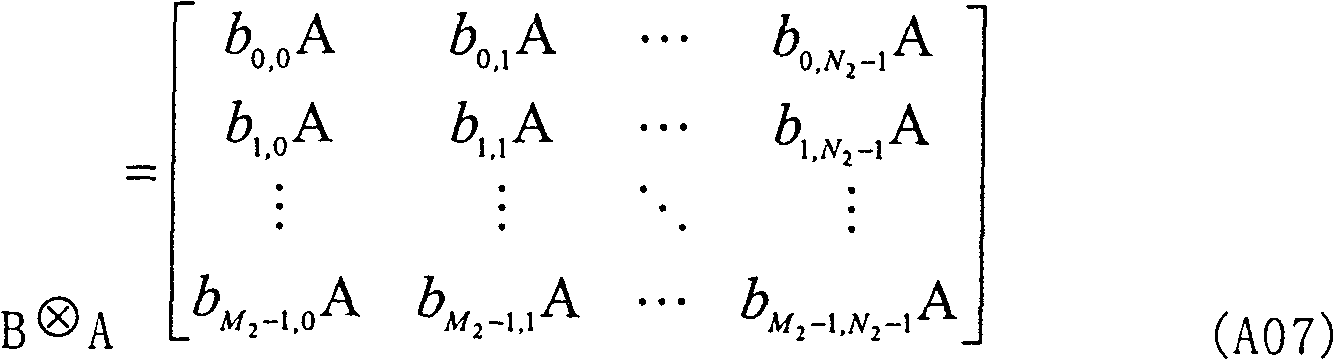
因此,要产生码长为N=2k的二维正交展频码可以写成下列的通式:Therefore, to generate a two-dimensional orthogonal spread spectrum code with a code length of N=2 k can be written as the following general formula:
必须指出的是,此处使用上述之A2×2 (1)及A2×2 (2)系作为说明之用。熟悉该领域的技术人员应该知道,如果将A2×2 (1)及A2×2 (2)之行列互换或提供其他的转换,只要符合了上述的递回产生方式,仍然能够维持上述的性质。举例来说,将A2×2 (1)及A2×2 (2)的”+”改成”-“,“-“改成”+”。并且,Kronecker乘积亦可替代以其他的运算,提供递回产生上述矩阵的能力。It must be pointed out that the above-mentioned A 2×2 (1) and A 2×2 (2) are used here for illustration purposes. Those skilled in this field should know that if the rows and columns of A 2×2 (1) and A 2×2 (2) are exchanged or other conversions are provided, as long as the above-mentioned recursive generation method is met, the above-mentioned nature. For example, change "+" in A 2×2 (1) and A 2×2 (2) to "-" and "-" to "+". Moreover, the Kronecker product can also be replaced by other operations, providing the ability to recursively generate the above matrix.
图3所示为M=N=2k的二维正交可变展频码使用树状结构被反复地产生直到第三层(k=3)的码树(code tree)图,而其树状结构的根(root)为A2×2 (1)和A2×2 (2)。此外,任一的二维正交码的自相关波瓣为零,亦即将同一列进行移动(shift)彼此间正交,且任两个不同二维正交展频码的互相关亦为零。Fig. 3 shows the code tree (code tree) graph that the two-dimensional orthogonal variable spreading code of M=N=2 k is repeatedly generated until the third layer (k=3) using a tree structure, and its tree The roots of the structure are A 2×2 (1) and A 2×2 (2) . In addition, the autocorrelation lobe of any two-dimensional orthogonal code is zero, that is, the same column is shifted to be orthogonal to each other, and the cross-correlation of any two different two-dimensional orthogonal spreading codes is also zero .
上述的展频码矩阵的列数代表其所使用的载波数目,而行数则代表展频因子。展频因子亦未必要等同于载波数目,以下说明当M不等于N的情况,如何建构码树。The number of columns of the above-mentioned spreading code matrix represents the number of carriers used, and the number of rows represents the spreading factor. The spreading factor is not necessarily equal to the number of carriers. The following describes how to construct a code tree when M is not equal to N.
产生矩阵大小为M×N和基数为N的二维正交展频码AM×N (i)(i∈{1,2,…,M})亦可从(A01)和(A02)两个正交矩阵A2×2 (1)和A2×2 (2)开始:The two-dimensional orthogonal spreading code A M×N (i) (i∈{1,2,…,M}) with a matrix size of M×N and base number N can also be obtained from (A01) and (A02) Orthogonal matrices A 2×2 (1) and A 2×2 (2) start:
其中,M=2k,N=2k+α,k和α为正整数。Wherein, M=2 k , N=2 k+α , k and α are positive integers.
用M=2和N=21+α(α≥1)根据下式(A12)和(A13)的递回规则可产生二维正交码的码树的根(k=1):M=2 and N=2 1+α (α≥1) can produce the root (k=1) of the code tree of two-dimensional orthogonal code according to the recursive rule of following formula (A12) and (A13):
若把2k+1×2k+1替换成2k+1×2k+1+α,这种递回的步骤很类似于(A08)和(A09)。通常,

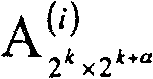
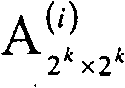

当然,上述的A2×2 (1)和A2×2 (2)仅作为说明之用,亦可寻找正交的矩阵来替代A2×2 (1)和A2×2 (2),通过递回的方式亦可建构同样效果的码树。Of course, the above-mentioned A 2×2 (1) and A 2×2 (2) are only used for illustration, and an orthogonal matrix can also be found to replace A 2×2 (1) and A 2×2 (2) , A code tree with the same effect can also be constructed in a recursive manner.
图3所示为M=2k,N=2k+α(α=1)的二维正交可变展频码使用树状结构被反复地产生直到第三层(k=3)之码树图,而其树状结构的根为A2×4 (1)和A2×4 (2)。此外,任一的二维正交码之自相关波瓣为零,且任两个不同二维正交展频码之互相关亦为零。M和N为2的任意次方,所以二维正交码可被建构成完整的树状结构,如图4所示。Figure 3 shows that the two-dimensional orthogonal variable spreading code of M=2 k , N=2 k+α (α=1) is repeatedly generated until the code of the third layer (k=3) using a tree structure tree diagram, and the roots of its tree structure are A 2×4 (1) and A 2×4 (2) . In addition, the autocorrelation lobe of any two-dimensional orthogonal code is zero, and the cross-correlation between any two different two-dimensional orthogonal spreading codes is also zero. M and N are arbitrary powers of 2, so two-dimensional orthogonal codes can be constructed into a complete tree structure, as shown in Figure 4.
图3(M=N)和图5(M<N)说明了二维正交码的码树中,不同的码序列间彼此保持正交。而二维正交码
换句话说,这些二维码不能在同一个通道同时被使用。当一个二维码被分配时,其他的二维码被分配不能是这个二维码的母码或是这个二维码的子码,然而才能维持码之间的正交性。因此,若随意地将较大的展频因子码指定给需要低速率的使用者时,则可能会对较小的展频因子码之分配造成阻碍。假设A8×8 (2)被分配给一个使用者,由A8×8 (2)所产生的子码{A16×16 (3),A16×16 (4),A32×32 (5),…,A32×32 (8)}就都不能被分配给其他需要较低速率的使用者。此外,A8×8 (2)的母码{A2×2 (1),A4×4 (1)}亦不能被分配给其他需要较高速率的使用者。换句话说,可被其他使用者使用之码的个数不仅要视在码树中所被分配的码而定,而且也要视这些被分配的码之母码和子码的关系而定。In other words, these QR codes cannot be used in the same channel at the same time. When a two-dimensional code is assigned, the other two-dimensional codes assigned cannot be the mother code of this two-dimensional code or the sub-code of this two-dimensional code, but the orthogonality between the codes can be maintained. Therefore, if a code with a larger spreading factor is randomly assigned to a user who needs a low rate, it may hinder the allocation of a code with a smaller spreading factor. Suppose A 8×8 ( 2 ) is distributed to a user, the subcode {A 16×16 (3) , A 16×16 (4) , A 32×32 ( 5) ,..., A 32×32 (8) } cannot be allocated to other users who need a lower rate. In addition, the mother code {A 2×2 (1) , A 4×4 (1) } of A 8×8 (2) cannot be distributed to other users who require a higher rate. In other words, the number of codes that can be used by other users depends not only on the codes allocated in the code tree, but also on the relationship between the mother codes and sub-codes of these allocated codes.
上述之码树在建构上没有问题,也确实提供了多速率、多载波的码分多址通信系统展频码建构的需求。然而,如果将整个码树存在用户端102,将会造成用户端102的电路制作上的成本问题。相对地,如果每次皆将所需展频码直接传给用户端102,则亦浪费宝贵的频宽。There is no problem in the construction of the above-mentioned code tree, and it does meet the requirements for the construction of spreading codes in a multi-rate, multi-carrier CDMA communication system. However, if the entire code tree is stored in the UE 102, it will cause cost problems in circuit fabrication of the UE 102. In contrast, if the required spreading codes are directly transmitted to the UE 102 each time, precious bandwidth is also wasted.
以下的方法仅需在用户端102存放产生矩阵,而不用存放整个码树,即可通过将索引标签传给用户端102而达成指定展频码的工作。The following method only needs to store the generating matrix in the UE 102 instead of storing the entire code tree, and can achieve the work of specifying the spreading code by passing the index label to the UE 102 .
图7例示使用索引标签技巧的方法,以在多速率、多载波的码分多址通信系统中,指定用户端102所需的展频码。FIG. 7 illustrates a method using the index tag technique to specify the spreading code required by the UE 102 in a multi-rate, multi-carrier CDMA communication system.
首先,将索引标签传给用户端102(步骤702),该索引标签的长度系对应该用户端102所需的传输速率。接着,该用户端102依据该索引标签建构索引标签矩阵(步骤704)。然后,该用户端依据该索引标签矩阵及存于内部之一产生矩阵以产生一展频码矩阵(步骤706),使该索引标签矩阵之每一列对应至该展频码矩阵之一对应列,该展频码矩阵之每一列则个别对应至一个载波,且该展频码矩阵的各列间系保持正交。在完成上述的步骤后,该用户端使用该展频码矩阵的这些列,以解译分别承载在多个载波之一展频加码数据(步骤708)。Firstly, the index tag is transmitted to the UE 102 (step 702 ), the length of the index tag corresponds to the transmission rate required by the UE 102 . Next, the client 102 constructs an index label matrix according to the index label (step 704 ). Then, the UE generates a spreading code matrix according to the index label matrix and an internal generation matrix (step 706), so that each column of the index label matrix corresponds to a corresponding column of the spreading code matrix, Each column of the spreading code matrix is individually corresponding to a carrier, and the columns of the spreading code matrix are kept orthogonal. After completing the above steps, the UE uses the columns of the spreading code matrix to decode the spreading coded data respectively carried on one of the carriers (step 708).
换言之,通过上述的方法,用户端102要存放的是产生矩阵,而基地台100在指定用户端102的展频码时,亦无需将整个展频码矩阵传给用户端102,乃系通过传送一个索引标签,以有效的方法完成展频码的指定。In other words, through the above method, what the user terminal 102 needs to store is the generation matrix, and when the
通过下列的技巧,可将索引标签对应到整个码树,并进一步使所有用户端102只需存放一个最大的产生矩阵,因为码树其他阶层所需的产生矩阵,系该存放之产生矩阵的子矩阵。Through the following techniques, the index label can be mapped to the entire code tree, and further all the client terminals 102 only need to store the largest generation matrix, because the generation matrix required by other levels of the code tree is a sub-generation of the stored generation matrix matrix.
建构索引标签的方法之一是使用格雷码(Gray code)序列。格雷码系二位元序列,此序列相邻二数仅有一个位元不同。基本上,一组格雷码可以想象成一个超方块(Cube)的一个汉弥尔顿路径(Hamilton Path)。因此,格雷码并非指一组固定的序列,图8例示一个格雷码的范例。One of the ways to construct index labels is to use Gray code (Gray code) sequences. Gray code is a two-bit sequence in which only one bit is different between adjacent two numbers in this sequence. Basically, a set of Gray codes can be imagined as a Hamiltonian path of a Cube. Therefore, the Gray code does not refer to a set of fixed sequences. FIG. 8 illustrates an example of the Gray code.
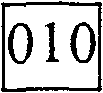
图9例示如何将格雷码序列的索引标签嵌入到一个前述的码树。在码树的第一层(LV=1)中的一条汉弥尔顿路径为0->1。在第二层(LV=2)中的一条汉弥尔顿路径为00->01->11->10。扣除每个码最左边的位元,剩下的位元顺序刚好为上一层(LV=1)由左边走到右边,再从右边走回左边的次序(0->1=>1->0)。同理,第三层(LV=3)中的一条汉弥尔顿路径为(排版)000->001->011->010=>110->111->101->100,亦通过扣除最左边的位元后,剩下的位元序列为上一层(LV=2)中由左边走到右边再从右边走回左边的次序(00->01->11->10=>10->11->01->00)。同理,对于第四层以后的码树也可依据此种方式予以配置。Fig. 9 exemplifies how to embed the index labels of the Gray code sequence into an aforementioned code tree. A Hamilton path in the first level (LV=1) of the code tree is 0->1. A Hamiltonian path in the second level (LV=2) is 0 0 -> 0 1 -> 1 1 -> 1 0. Deduct the leftmost bit of each code, and the remaining bit sequence is just the order of the upper layer (LV=1) going from the left to the right, and then going back to the left from the right (0->1=>1-> 0). Similarly, a Hamilton path in the third layer (LV=3) is (typesetting) 0 00-> 0 01-> 0 11-> 0 10 => 1 10-> 1 11-> 1 01- > 1 00, after deducting the leftmost bit, the remaining bit sequence is the sequence from left to right in the upper layer (LV=2) and then back to the left from the right (00->01->11->10=>10->11->01->00). Similarly, the code tree after the fourth layer can also be configured according to this method.
在图9及上面所描述的配置方法下,此码树具有一个非常特别的性质,就是只要从索引标签的开头就可以辨识出两个码是否为母节点与子节点的关系。举例来说,00的两个子节点为000与001。当然,如果两个码的长度一样,则表示其在码树的同一阶层中。In Fig. 9 and the configuration method described above, this code tree has a very special property, that is, as long as the beginning of the index label can identify whether the two codes are the relationship between the parent node and the child node. For example, the two child nodes of 00 are 000 and 001. Certainly, if the lengths of the two codes are the same, it means that they are in the same level of the code tree.
接下来说明如何把码树的索引标签对应到最后的展频码矩阵。Next, how to map the index label of the code tree to the final spreading code matrix is described.
在码树其根为M=N的二维正交展频码,也就是,二维的华许码(Walsh code)可表示如下:Its root is the two-dimensional orthogonal spread spectrum code of M=N in the code tree, that is, the two-dimensional Walsh code (Walsh code) can be expressed as follows:
其中,下标为矩阵的大小,(0)和(1)分别表示第一层中两个码的编号,而(A14)和(A15)的“0”和“1”则分别表示(A01)和(A02)的“+”和“-”。Among them, the subscript is the size of the matrix, (0) and (1) respectively represent the numbers of the two codes in the first layer, and "0" and "1" of (A14) and (A15) respectively represent (A01) and "+" and "-" of (A02).
所以通过通过上述的对应方式,(A14)的第一列为00可被标成格瑞码为0,第二列为01则被标成格瑞码为1。同理,(A15)的第一列为01可被标成格瑞码为1,第二列为00则被标成格瑞码为0。因此,(A14)和(A15)的索引标签矩阵可表示如下:Therefore, through the above corresponding method, the first column of (A14) 00 can be marked as 0 in Gray code, and the second column of 01 can be marked as 1 in Gray code. Similarly, 01 in the first column of (A15) can be marked as 1 in Gray code, and 00 in the second column can be marked as 0 in Gray code. Therefore, the index label matrices of (A14) and (A15) can be expressed as follows:
,其中,下标为第一层,上标(0)和(1)分别表示第一层中两个码的编号。, where the subscript is the first layer, and the superscripts (0) and (1) respectively represent the numbers of the two codes in the first layer.
所以在二维正交展频码的码树中,可标上所有二维正交码所对应的索引标Therefore, in the code tree of the two-dimensional orthogonal spreading code, the index marks corresponding to all the two-dimensional orthogonal codes can be marked
签矩阵,且亦可标上一维的格瑞码标签,以便判别两个码之间是否为母码或子码的关系,如图10所示。图中,
图10例示一码树以及其索引标签、索引标签矩阵与展频码。例如,格瑞码标签为

其中,Tk (0)和Tk+1 (0)分别表示第k层和第k+1层格瑞码标签全为0的二维正交展频码之格瑞索引矩阵,而和则分别表示2k-1个全为0和全为1的向量。因此,通过(A18)可得到各层索引标签全为0的索引标签矩阵。然而再利用一维索引标签就可分别得到该层的所有二维正交展频码的索引标签矩阵。Among them, T k (0) and T k+1 (0) respectively represent the Gray index matrix of the two-dimensional orthogonal spreading code whose Gray code labels of the k-th layer and the k+1-th layer are all 0, and and Then represent 2 k-1 vectors which are all 0 and all 1 respectively. Therefore, through (A18), the index label matrix in which all the index labels of each layer are 0 can be obtained. However, by using the one-dimensional index labels, the index label matrices of all the two-dimensional orthogonal spreading codes of the layer can be respectively obtained.
例如,欲求第二层(k=2)格瑞码标签为


可知D4×4(0)和D4×4(1)的格瑞码标签分别为

又可知D4×4(2)的索引标签为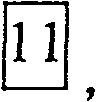

在每一层中,索引标签矩阵是依每个索引标签不同而不同。在本处所揭示的例子中,只要决定或存放每一层的最左方的第一个索引标签矩阵,该层的其他索引标签矩阵可以将索引标签分别加到第一个索引标签矩阵的各列而获得。也就是说,每个索引标签有自己的索引标签矩阵。此外,索引标签矩阵的每一列系对应一个用于某载波的展频码。In each layer, the index label matrix is different for each index label. In the example disclosed here, as long as the leftmost first index label matrix of each layer is determined or stored, the other index label matrices of this layer can add index labels to the columns of the first index label matrix respectively And get. That is, each index label has its own index label matrix. In addition, each column of the index label matrix corresponds to a spreading code for a certain carrier.
在有了索引标签矩阵后,为了快速取得展频码,可存放一生产矩阵,使得索引标签矩阵在乘上该生产矩阵后即能得出展频码。在此例中,任意相邻两层(k≥1)间的产生矩阵之关系式可以表示如下:After having the index label matrix, in order to quickly obtain the spreading code, a production matrix can be stored, so that the spreading code can be obtained after the index label matrix is multiplied by the production matrix. In this example, the relational expression of the generation matrix between any two adjacent layers (k≥1) can be expressed as follows:

其中,Gk和Gk+1分别为第k层和第k+1层的产生矩阵,Gk是Gk的二位元补数,
每一层的产生矩阵是可以通过(A22)反复地产生。也就是说,第二层的产生矩阵G2可从第一层的产生矩阵G1得到,而第三层的产生矩阵G3可以由第二层的产生矩阵G2得到,以此类推。The generation matrix of each layer can be generated repeatedly through (A22). That is, the generation matrix G2 of the second layer can be obtained from the generation matrix G1 of the first layer, the generation matrix G3 of the third layer can be obtained from the generation matrix G2 of the second layer, and so on.
G1=[0 1](A23)G 1 =[0 1] (A23)


说明至此,以解释如何产生索引标签、索引标签矩阵,以及生产矩阵。接着,将说明如何用真实的电路来完成上述概念。The instructions have come here to explain how to generate index labels, index label matrices, and production matrices. Next, it will be shown how to implement the above concept with a real circuit.
假设(N,K)的区段码(block code)代表一组数目为2K且长度为N的码字(code word)。任何(N,K)的线性码(linear code)可以用一个K×N的产生矩阵G来产生。位于一维正交展频码中,第k层中之2k个码是一组(2k,k)的线性码所产生。可利用这个观念将一维正交展频码扩展二维正交展频码。因此,位于第k层中的第j个二维正交展频码可利用下列的关系式所产生:Assume that (N, K) block codes represent a group of 2 K code words with length N. Any (N, K) linear code (linear code) can be generated by a K×N generation matrix G. In the one-dimensional orthogonal spread spectrum code, the 2 k codes in the kth layer are generated by a set of (2 k , k) linear codes. This concept can be used to extend the one-dimensional orthogonal spreading code to the two-dimensional orthogonal spreading code. Therefore, the jth two-dimensional orthogonal spreading code located in the kth layer can be generated using the following relational formula:
也就是,That is,

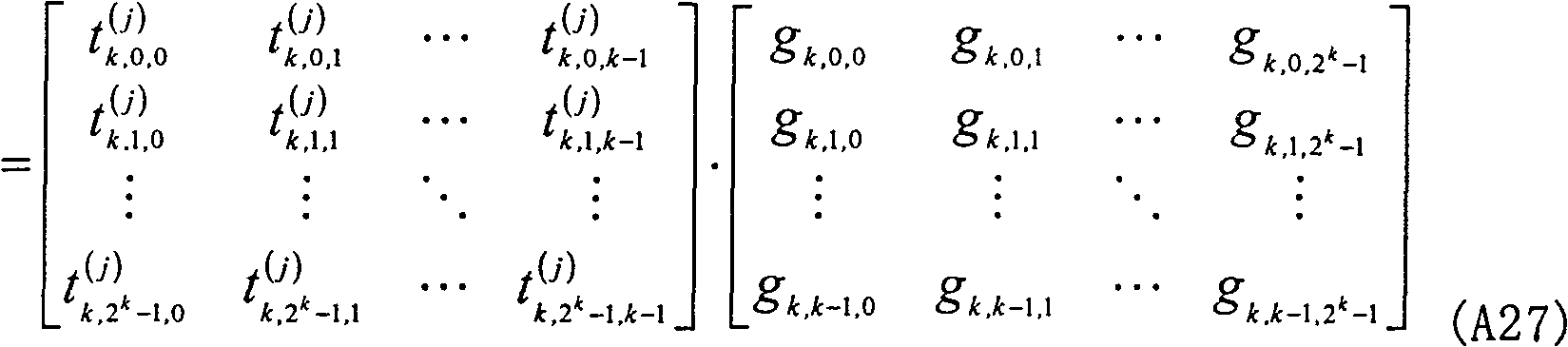
其中,0≤j≤2k-1,0≤m≤2k-1和0≤n≤2k-1。Among them, 0≤j≤2k -1, 0≤m≤2k -1 and 0≤n≤2k -1.
如,欲产生第二层(k=2)格瑞码标签为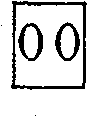
又(A24)为第二层(k=2)的产生矩阵,所以该码的格瑞索引矩阵乘上该层的产生矩阵就可得到所需之二维华许码。And (A24) is the generation matrix of the second layer (k=2), so the required two-dimensional Walsh code can be obtained by multiplying the Gray index matrix of the code by the generation matrix of this layer.
图11与图12所示为根据(A26)或(A27)的关系式所产生第k层第j个二维正交可变展频码的第m列第n行元素之编码器示意图与电路图。其中,0≤j≤2k-1,0≤l≤k-1,0≤m≤2k-1和0≤n≤2k-1。此示意图中,假如gk,l,n=1,则“→○→”代表电路有连接,相反的,若gk,l,n=0,则代表没有连接,而

图15例示用户端之展频通信接收装置15,例如手机,的电路示意图。此展频通信接收装置15系用于多速率之一码分多址通信系统,并具有存储电路151、接收电路153、计算电路155,及解码电路157。存储电路151供存放上述的产生矩阵,而接收电路153则接收一展频数据及上述的索引标签,该展频数据系承载于多个载波上。计算电路155以该索引标签为参数计算索引标签矩阵,并将该索引标签矩阵与该产生矩阵进行一运算以产生展频码矩阵,该展频码矩阵的各列分别对应一个该载波。此外,解码电路155则分别利用该展频码矩阵的各列分别解译该展频加码数据。FIG. 15 illustrates a schematic circuit diagram of a spread spectrum
图16例示与用户端相对的基地台的装置示意图。此基地台16系用于一码分多址通信系统,以对应多个接收装置,且至少具有产生电路162、分派电路164与传送电路166。产生电路162纪录可使用之多个索引标签,每一索引标签对应一码树上的一节点,每一索引标签对应一索引矩阵,以该索引矩阵参照一产生矩阵后进行一运算以获得一展频码矩阵,该展频码矩阵之每一列则供于一载波上进行展频传输,并且该码树之母节点跟子节点间以及该码树之同一阶层之节点间,所对应之这些展频码矩阵在各载波彼此正交。分派电路164将不同长度之该索引标签传分别送给需要不同传输速率之这些接收装置。至于传送电路166则依据这些接收装置所使用之该索引标签所对应之该展频码矩阵,以多个载波以码分多址方法传送数据。FIG. 16 illustrates a schematic diagram of a base station opposite to a UE. The
此外,当载波数目小于展频因子,也就是M不等于N的时候,为了使编码器能够产生所有M≠N的二维正交可变展频码之标签索引矩阵,则必须改变码树(α=0)中的根。而所改变的根又可以通过(A12)和(A13)得到码树(α≠0)中的根,然而再利用上述的建构方式仍然可以产生此码树中所有的二维正交展频码。基于此种方法所产生的二维正交展频码,只要在同步的系统中,仍可正确使用。In addition, when the number of carriers is smaller than the spreading factor, that is, when M is not equal to N, in order to enable the encoder to generate the label index matrix of all M≠N two-dimensional orthogonal variable spreading codes, the code tree must be changed ( α=0). And the changed root can get the root in the code tree (α≠0) through (A12) and (A13), however, all the two-dimensional orthogonal spreading codes in the code tree can still be generated by using the above construction method . The two-dimensional orthogonal spread spectrum code generated based on this method can still be used correctly as long as it is in a synchronous system.
例如,在α=0的码树中,原来的根(A14)和(A15)可改变为(A30)和(A31)的二维正交展频码来作为此码树中的新根。然而根据(A12)和(A13)可得到码树(α=1)中的根(A32)和(A33)。For example, in the code tree with α=0, the original roots (A14) and (A15) can be changed to two-dimensional orthogonal spread spectrum codes of (A30) and (A31) as the new roots in the code tree. However, the roots (A32) and (A33) in the code tree (α=1) can be obtained according to (A12) and (A13).
此外,如同上述的建构方式,可将(A32)和(A33)分别与(A14)、(A15)作Kronecker乘积来产生第二层4×8的二维正交展频码,其运算过程如下:In addition, like the above-mentioned construction method, (A32) and (A33) can be Kronecker multiplied with (A14) and (A15) respectively to generate the second-
所以利用此建构的方式可反复地产生第三层8×16、第四层16×32、...等等所有的二维正交展频码。因此,上述产生M≠N的二维正交展频码之索引标签矩阵皆可被编码器所产生。Therefore, all the two-dimensional orthogonal spread spectrum codes of the
欲使用编码器产生M≠N的二维正交展频码,如2×4、2×8、4×8、4×16...等等,必须要先知道每个码所对应的索引标签矩阵与每一层所对应的产生矩阵。其索引标签矩阵可利用之前叙述的二维华许码之索引标签矩阵得之,也就是说,想要得到M≠N的二维正交展频码之索引标签矩阵,可从M=N的二维华许码之索引标签矩阵取出奇数列的序列,然而所形成的矩阵即为所对应的二维正交展频码之索引标签矩阵。例如,在α=1的码树中,2×4的二维正交展频码之索引标签矩阵可从4×4的二维华许码之索引标签矩阵取第一列与第三列的序列所形成的矩阵即是2×4的二维正交展频码之索引标签矩阵;4×8的二维正交展频码之索引标签矩阵则可从8×8的二维华许码之索引标签矩阵取第一列、第三列、第五列及第七列的序列所形成的矩阵即是4×8的二维正交展频码之索引标签矩阵,以此类推则可取得该码树中所有码所对应之索引标签矩阵。同理,在α=2的码树中,取8×8的二维华许码之索引标签矩阵的第一列和第五列序列可得到2×8的二维正交展频码之索引标签矩阵;4×16、8×32...等等的二维正交展频码之索引标签矩阵亦可用相同的方式得之。此外,亦可利用根(即为2×21+α的二维正交展频码)之索引标签矩阵与(A38)或(A39)的关系式,则可产生码树中所有的索引标签矩阵。If you want to use the encoder to generate two-dimensional orthogonal spreading codes with M≠N, such as 2×4, 2×8, 4×8, 4×16, etc., you must first know the index corresponding to each code Label matrix and corresponding generation matrix for each layer. Its index label matrix can be obtained by using the index label matrix of the previously described two-dimensional Walsh code, that is to say, if you want to obtain the index label matrix of the two-dimensional orthogonal spreading code with M≠N, you can obtain it from M=N The index label matrix of the two-dimensional Walsh code extracts the sequence of odd columns, but the formed matrix is the corresponding index label matrix of the two-dimensional orthogonal spreading code. For example, in the code tree of α=1, the index label matrix of the 2×4 two-dimensional orthogonal spreading code can be obtained from the index label matrix of the 4×4 two-dimensional Walsh code in the first column and the third column The matrix formed by the sequence is the index label matrix of the 2×4 two-dimensional orthogonal spreading code; the index label matrix of the 4×8 two-dimensional orthogonal spreading code can be obtained from the 8×8 two-dimensional Walsh code The matrix formed by taking the sequence of the first column, the third column, the fifth column and the seventh column of the index label matrix is the index label matrix of the 4×8 two-dimensional orthogonal spreading code, and so on, it can be obtained The index label matrix corresponding to all the codes in the code tree. Similarly, in the code tree of α=2, the index of the 2×8 two-dimensional orthogonal spread spectrum code can be obtained by taking the first column and the fifth column sequence of the index label matrix of the 8×8 two-dimensional Walsh code The label matrix; the index label matrix of 4*16, 8*32...etc. two-dimensional orthogonal spreading codes can also be obtained in the same way. In addition, the relationship between the index label matrix and (A38) or (A39) of the root (that is, the two-dimensional orthogonal spreading code of 2×2 1+α ) can also be used to generate all the index labels in the code tree matrix.


其中,j为二维正交展频码的编号,0≤j≤2k-1。Wherein, j is the serial number of the two-dimensional orthogonal spreading code, 0≤j≤2 k -1.
至于产生矩阵则必须选择行数与欲产生的二维正交展频码之码长相同的矩阵。例如,要产生4×8的二维正交展频码,则要选择(A25)矩阵大小为3×8的产生矩阵。As for generating the matrix, a matrix having the same number of rows as the code length of the two-dimensional orthogonal spreading code to be generated must be selected. For example, to generate a 4×8 two-dimensional orthogonal spread spectrum code, it is necessary to select (A25) a generation matrix whose matrix size is 3×8.
图17所示为α=1的二维正交展频码之码树图。第一层(k=1)的产生矩阵为(A24),可通过(A22)反复地产生每一层的产生矩阵。然而欲产生第二层(k=2)索引标签
该层的产生矩阵为The generation matrix of this layer is
所以此二维正交展频码为So the two-dimensional orthogonal spreading code is
虽然本发明已以一较佳实施例揭露如上,然其并非用以限定本发明,任何熟悉该领域的技术人员,在不脱离本发明的精神和范围内,当可作各种的更动与润饰,因此本发明之保护范围应根据权利要求书的范围所界定为准。Although the present invention has been disclosed above with a preferred embodiment, it is not intended to limit the present invention. Any person skilled in the art can make various modifications and changes without departing from the spirit and scope of the present invention. Modification, therefore, the protection scope of the present invention should be defined according to the scope of the claims.
Claims (9)
Priority Applications (1)
| Application Number | Priority Date | Filing Date | Title |
|---|---|---|---|
| CNB2004100286077A CN100558024C (en) | 2004-03-04 | 2004-03-04 | Communication method of multirate multicarrier multicode division system |
Applications Claiming Priority (1)
| Application Number | Priority Date | Filing Date | Title |
|---|---|---|---|
| CNB2004100286077A CN100558024C (en) | 2004-03-04 | 2004-03-04 | Communication method of multirate multicarrier multicode division system |
Publications (2)
| Publication Number | Publication Date |
|---|---|
| CN1702991A CN1702991A (en) | 2005-11-30 |
| CN100558024C true CN100558024C (en) | 2009-11-04 |
Family
ID=35632534
Family Applications (1)
| Application Number | Title | Priority Date | Filing Date |
|---|---|---|---|
| CNB2004100286077A Expired - Fee Related CN100558024C (en) | 2004-03-04 | 2004-03-04 | Communication method of multirate multicarrier multicode division system |
Country Status (1)
| Country | Link |
|---|---|
| CN (1) | CN100558024C (en) |
Families Citing this family (1)
| Publication number | Priority date | Publication date | Assignee | Title |
|---|---|---|---|---|
| CN111198670B (en) | 2018-11-20 | 2021-01-29 | 华为技术有限公司 | Method, circuit and SOC for performing matrix multiplication |
Citations (2)
| Publication number | Priority date | Publication date | Assignee | Title |
|---|---|---|---|---|
| CN1363145A (en) * | 2000-01-17 | 2002-08-07 | 印菲内奥技术股份有限公司 | CDMA receiver |
| CN1374772A (en) * | 2001-03-14 | 2002-10-16 | 上海大唐移动通信设备有限公司 | Bandspread distributing method in wideband CDMA system |
-
2004
- 2004-03-04 CN CNB2004100286077A patent/CN100558024C/en not_active Expired - Fee Related
Patent Citations (2)
| Publication number | Priority date | Publication date | Assignee | Title |
|---|---|---|---|---|
| CN1363145A (en) * | 2000-01-17 | 2002-08-07 | 印菲内奥技术股份有限公司 | CDMA receiver |
| CN1374772A (en) * | 2001-03-14 | 2002-10-16 | 上海大唐移动通信设备有限公司 | Bandspread distributing method in wideband CDMA system |
Also Published As
| Publication number | Publication date |
|---|---|
| CN1702991A (en) | 2005-11-30 |
Similar Documents
| Publication | Publication Date | Title |
|---|---|---|
| JP3895721B2 (en) | Quasi-orthogonal code generation method for mobile communication system and band spreading apparatus using quasi-orthogonal code | |
| EP1763934B1 (en) | Non-contiguous variable length orthogonal codes | |
| TWI363518B (en) | Systems and methods for using code space in spread-spectrum communications | |
| CN1193528C (en) | Apparatus for incorporating multiple data rates in an orthogonal direct sequence code division multiple access (ODS-CDMA) communications system | |
| EP1092287A1 (en) | Non-recursively generated orthogonal pn codes for variable rate cdma | |
| EP1317086A1 (en) | Data transmission apparatus and data transmission method | |
| JP2005533429A (en) | Time-frequency interleaved MC-CDMA for quasi-synchronous systems | |
| AU2001244764B2 (en) | Encoding apparatus and method in CDMA communication system | |
| US6907060B2 (en) | Method for generating OVSF codes in CDMA multi-rate system | |
| CN100385840C (en) | Device and method for generating quaternary complex quasi-orthogonal codes and spreading transmitted signals with quasi-orthogonal codes in code division multiple access communication system | |
| US7894792B2 (en) | Multicarrier and multirate CDMA system | |
| JP3681335B2 (en) | Method of generating quaternary quasi-orthogonal code for CDMA communication system and channel spreading apparatus and method using the same | |
| CN1781273B (en) | Method, transmitter and receiver for transmitting data in CDMA system | |
| CN1197284C (en) | Method and device for transmission and construction of quasi orthogonal vectors | |
| US7346038B2 (en) | Method for generating 2D OVSF codes in multicarrier DS-CDMA systems | |
| CN100558024C (en) | Communication method of multirate multicarrier multicode division system | |
| CN100466500C (en) | Method for Generating Orthogonal Spread Spectrum Codes in Mobile Communication System | |
| KR20010073120A (en) | A method and apparatus for the reflection and transmission of quasi orthogonal vectors | |
| TWI276312B (en) | Apparatus for generating 2D spreading code and method for the same | |
| US7197007B2 (en) | Method for generating 2D OVSF codes in multicarrier DS-CDMA systems | |
| Matsushima et al. | Complex orthogonal variable spreading factor codes based on polyphase sequences | |
| RU2233540C2 (en) | Device and method for converting tfci indicator bits into characters for fixed division mode in cdma mobile communication system | |
| CN1251435C (en) | Method for Generating Two-Dimensional Orthogonal Variable Spreading Factor Codes in Multi-Carrier Direct Sequence Code Division Multiple Access Communication System | |
| CN103988457A (en) | Method and apparatus for generating pair of orthogonal sets with wide range of spreading factors | |
| CN100438386C (en) | Method for generating two-dimensional orthogonal variable spread spectrum system code |
Legal Events
| Date | Code | Title | Description |
|---|---|---|---|
| C06 | Publication | ||
| PB01 | Publication | ||
| C10 | Entry into substantive examination | ||
| SE01 | Entry into force of request for substantive examination | ||
| C14 | Grant of patent or utility model | ||
| GR01 | Patent grant | ||
| CF01 | Termination of patent right due to non-payment of annual fee |
Granted publication date: 20091104 Termination date: 20160304 |
|
| CF01 | Termination of patent right due to non-payment of annual fee |