CN1012175B - Preparation method of perfluoropolyether and its derivatives containing perfluoroepoxy group along the main chain without peroxygen - Google Patents
Preparation method of perfluoropolyether and its derivatives containing perfluoroepoxy group along the main chain without peroxygenInfo
- Publication number
- CN1012175B CN1012175B CN87104043A CN87104043A CN1012175B CN 1012175 B CN1012175 B CN 1012175B CN 87104043 A CN87104043 A CN 87104043A CN 87104043 A CN87104043 A CN 87104043A CN 1012175 B CN1012175 B CN 1012175B
- Authority
- CN
- China
- Prior art keywords
- ultraviolet light
- peroxy
- product
- ing
- group
- Prior art date
- Legal status (The legal status is an assumption and is not a legal conclusion. Google has not performed a legal analysis and makes no representation as to the accuracy of the status listed.)
- Expired
Links
Classifications
-
- C—CHEMISTRY; METALLURGY
- C08—ORGANIC MACROMOLECULAR COMPOUNDS; THEIR PREPARATION OR CHEMICAL WORKING-UP; COMPOSITIONS BASED THEREON
- C08G—MACROMOLECULAR COMPOUNDS OBTAINED OTHERWISE THAN BY REACTIONS ONLY INVOLVING UNSATURATED CARBON-TO-CARBON BONDS
- C08G65/00—Macromolecular compounds obtained by reactions forming an ether link in the main chain of the macromolecule
-
- C—CHEMISTRY; METALLURGY
- C08—ORGANIC MACROMOLECULAR COMPOUNDS; THEIR PREPARATION OR CHEMICAL WORKING-UP; COMPOSITIONS BASED THEREON
- C08G—MACROMOLECULAR COMPOUNDS OBTAINED OTHERWISE THAN BY REACTIONS ONLY INVOLVING UNSATURATED CARBON-TO-CARBON BONDS
- C08G59/00—Polycondensates containing more than one epoxy group per molecule; Macromolecules obtained by polymerising compounds containing more than one epoxy group per molecule using curing agents or catalysts which react with the epoxy groups
- C08G59/02—Polycondensates containing more than one epoxy group per molecule
- C08G59/027—Polycondensates containing more than one epoxy group per molecule obtained by epoxidation of unsaturated precursor, e.g. polymer or monomer
-
- C—CHEMISTRY; METALLURGY
- C07—ORGANIC CHEMISTRY
- C07D—HETEROCYCLIC COMPOUNDS
- C07D303/00—Compounds containing three-membered rings having one oxygen atom as the only ring hetero atom
- C07D303/02—Compounds containing oxirane rings
- C07D303/08—Compounds containing oxirane rings with hydrocarbon radicals, substituted by halogen atoms, nitro radicals or nitroso radicals
-
- C—CHEMISTRY; METALLURGY
- C08—ORGANIC MACROMOLECULAR COMPOUNDS; THEIR PREPARATION OR CHEMICAL WORKING-UP; COMPOSITIONS BASED THEREON
- C08G—MACROMOLECULAR COMPOUNDS OBTAINED OTHERWISE THAN BY REACTIONS ONLY INVOLVING UNSATURATED CARBON-TO-CARBON BONDS
- C08G59/00—Polycondensates containing more than one epoxy group per molecule; Macromolecules obtained by polymerising compounds containing more than one epoxy group per molecule using curing agents or catalysts which react with the epoxy groups
- C08G59/14—Polycondensates modified by chemical after-treatment
-
- C—CHEMISTRY; METALLURGY
- C08—ORGANIC MACROMOLECULAR COMPOUNDS; THEIR PREPARATION OR CHEMICAL WORKING-UP; COMPOSITIONS BASED THEREON
- C08G—MACROMOLECULAR COMPOUNDS OBTAINED OTHERWISE THAN BY REACTIONS ONLY INVOLVING UNSATURATED CARBON-TO-CARBON BONDS
- C08G59/00—Polycondensates containing more than one epoxy group per molecule; Macromolecules obtained by polymerising compounds containing more than one epoxy group per molecule using curing agents or catalysts which react with the epoxy groups
- C08G59/18—Macromolecules obtained by polymerising compounds containing more than one epoxy group per molecule using curing agents or catalysts which react with the epoxy groups ; e.g. general methods of curing
- C08G59/20—Macromolecules obtained by polymerising compounds containing more than one epoxy group per molecule using curing agents or catalysts which react with the epoxy groups ; e.g. general methods of curing characterised by the epoxy compounds used
- C08G59/32—Epoxy compounds containing three or more epoxy groups
- C08G59/34—Epoxy compounds containing three or more epoxy groups obtained by epoxidation of an unsaturated polymer
-
- C—CHEMISTRY; METALLURGY
- C08—ORGANIC MACROMOLECULAR COMPOUNDS; THEIR PREPARATION OR CHEMICAL WORKING-UP; COMPOSITIONS BASED THEREON
- C08G—MACROMOLECULAR COMPOUNDS OBTAINED OTHERWISE THAN BY REACTIONS ONLY INVOLVING UNSATURATED CARBON-TO-CARBON BONDS
- C08G65/00—Macromolecular compounds obtained by reactions forming an ether link in the main chain of the macromolecule
- C08G65/002—Macromolecular compounds obtained by reactions forming an ether link in the main chain of the macromolecule from unsaturated compounds
- C08G65/005—Macromolecular compounds obtained by reactions forming an ether link in the main chain of the macromolecule from unsaturated compounds containing halogens
- C08G65/007—Macromolecular compounds obtained by reactions forming an ether link in the main chain of the macromolecule from unsaturated compounds containing halogens containing fluorine
Landscapes
- Chemical & Material Sciences (AREA)
- Organic Chemistry (AREA)
- Chemical Kinetics & Catalysis (AREA)
- Health & Medical Sciences (AREA)
- Medicinal Chemistry (AREA)
- Polymers & Plastics (AREA)
- General Chemical & Material Sciences (AREA)
- Organic Low-Molecular-Weight Compounds And Preparation Thereof (AREA)
- Polyethers (AREA)
- Epoxy Compounds (AREA)
- Detergent Compositions (AREA)
- Epoxy Resins (AREA)
- Addition Polymer Or Copolymer, Post-Treatments, Or Chemical Modifications (AREA)
Abstract
沿主链含有全氟环氧基而无过氧基氧的全氟聚醚,由全氟单烯与共轭全氟双烯的混合物经低温氧化(液相,使用分子氧,在紫外线存在下),随后将光氧化产物中的过氧基进行光化学分解(在0℃~160℃的温度范围内,用紫外光处理含过氧基的产品)而制得。所说的含环氧基全氟聚醚衍生物,其环氧基已被转化为官能团。Perfluoropolyether containing perfluoroepoxy groups along the main chain without peroxy oxygen, low-temperature oxidation (liquid phase, using molecular oxygen, in the presence of ultraviolet light) from a mixture of perfluoromonoene and conjugated perfluorodiene , and then photochemically decompose the peroxy group in the photooxidized product (in the temperature range of 0°C to 160°C, treat the product containing peroxyl group with ultraviolet light). In the perfluoropolyether derivatives containing epoxy groups, the epoxy groups have been transformed into functional groups.
Description
The present invention relevant contains the PFPE of fluoro epoxy group(ing) along its main chain, and it begins preparation from the mixture of perfluoroolefine and perfluor diolefin.
As everyone knows, the low temperature that perfluoroolefine carries out with molecular oxygen in the presence of UV-light (30 ℃~-60 ℃) photooxidation, that initial reaction product is made up of the oxygen perfluor silane supporting unit of a graded and contain the not PFPE of determined number peroxy (the visual response condition is decided).Remove peroxy so that obtain stable PFPE, this can adopt type of heating to realize, i.e. long-time heating under the high temperature.See U.S. Pat 3,715,378 and US3,665,041.
From U.S. Pat 3,451, learn in 907: perfluorobutadiene, the mixture of its single thing or it and perfluoroolefine in low temperature, liquid phase with when having UV-light to exist, carries out oxygenizement with molecular oxygen, generates the photoxidation polymkeric substance.Its feature is to have peroxy, fluoro epoxy group(ing) simultaneously
And tart-COF base.Eliminate peroxy in the photo-oxidation product type of heating in can be according to known technique fully and realize, be i.e. heating (some hrs) for a long time under at least 200 ℃ temperature.Epoxy group(ing) is inevitable decomposes simultaneously, and major part is converted into tart-COF base.
The objective of the invention is to prepare new PFPE, it is made of the oxygen perfluor alkylene structural unit of arranging in certain sequence, is characterized in containing the perfluor epoxy group(ing) along main chain
And there is not peroxy.
For obtaining such product, can carry out the photoxidation of the mixture of perfluoroolefine and perfluor conjugated dienes earlier, subsequently peroxy is carried out photochemistry and decompose, or subsequently peroxy is carried out special chemical reduction reaction and decompose, will be introduced below.
Because use perfluoroolefine as raw material, four oxygen ethene and perfluoro propylene are specially suitable.In the perfluor diene, perfluorobutadiene is suitable especially.
Use C
2F
4And C
4F
6When making raw material, the PFPE that obtains has following structure:
(Ⅰ)
When adopting photochemical reaction to come the peroxynitrite decomposition base, end group Rf and Rf ' are-CF
2COF or-CF
3, have at least one to be-CF among them
2COF.And the chemical reduction reaction of working as peroxy is at alcohol roh (R=C
1~C
6When carrying out with HI alkyl), then end group Rf and Rf ' are-CF
2COOR.
M, n and p are the integers of non-zero, and the scope of m/n ratio is between 0.5~2, and oxygen perfluor alkylene structural unit is along the main chain stochastic distribution.(m+n)/(p) scope of ratio can be from 3 up to very high value, even up to 40.Comparatively desirable molecular weight ranges is 500~15, between 000.When using C
3F
6And C
4F
6The time, the molecular formula of the PFPE that obtains is:
(Ⅱ)
In the formula, X=F or CF
3, m, n and p are the integer of non-zero, Rf ' and Rf are the top end group that has defined.The scope of m/n ratio is between 5~40, and the scope of m/p ratio is between 2~50, and comparatively desirable molecular weight ranges is 500~8, between 000.
If desired, the preparation PFPE also can be used the perfluoroolefine that occupies the majority (C for example
2F
4+ C
3F
6) with the mixture of one or more conjugated dieness.
The first step of preparation is photoxidation, comes down to be undertaken by known technology.The mixture of perfluoroolefine and perfluor diene is dissolved in particularly cfc (CCl for example of suitable inert solvent
2F
2) in the solvent, carry out photoxidation with gaseous molecular oxygen, temperature is-80 ℃~+ 50 ℃, comparatively preferably-60 ℃-0 ℃, there is ultraviolet ray to exist, photo-oxidation product contains peroxy and perfluor epoxy group(ing).
We are surprised to find, and carry out photochemistry decomposition at following said peroxy of temperature of control, and peroxy can be eliminated and stay epoxy group(ing) and remain unchanged.The conditions suitable that obtains no peroxy and keep the product that does not become epoxy group(ing) is: adopting wavelength is the UV-light of 248~334nm, and temperature is controlled at 0 ℃~150 ℃ (the most preferably 20 ℃~50 ℃).
It also is possible eliminating peroxy and keep the epoxy group(ing) that does not become by chemical reduction reaction, for example at alcohol roh (R=C
1~C
6Alkyl) in react with it with HI.
The occurrence rate of the epoxy group(ing) on the PFPE main chain be with starting mixt in the ratio of diene/monoene be directly proportional.
As diolefin, except that perfluorobutadiene, also can be the perfluor pentadiene.
Another object of the present invention is preparation two br-derivatives, and Rf and R ' f are-CF in the formula
2Br.
In the presence of UV-light and temperature when being approximately 100 ℃, allow bromine react with it, can obtain these compounds, the photochemical oxidation reaction product contains peroxy and epoxy group(ing): bromine imports on the position of peroxy, and epoxy group(ing) remains unchanged, as European patent EP O145, described in 946.
A further object of the invention prepares the derivative of product defined above exactly: the epoxy group(ing) in the product and/or end group Rf and R ' f are transformed, so that obtain multifunctional derivative.Give earlier when epoxy group(ing) and to be converted into
Or-COOR, for example be respectively-CF
2C-F or-CF
2COOR(R=C
1~C
6Alkyl), then the derivative obtained of the conversion by two end group Rf and R ' f and epoxy group(ing) can be the functional group of all same type.Otherwise, generally be different from from epoxy group(ing) deutero-functional group from Rf and R ' f deutero-functional group.
Said functional group is the sort of functional group that is suitable for preparing by polycondensation or polyaddition reaction polymkeric substance, perhaps the sort of functional group that resin or polymer materials are played the linking agent effect.The characteristics of gained polymerisate are to have following character:
The thermostability of-Gao,
-low secondary ordering transition temperature,
-hydrophobic nature and oil repellency,
-low refractive index.
As more interested by know the reaction obtainable functional group, we can list following these:
-CONHR(R=H or C
1~C
6Alkyl or epoxy group(ing))
-CN
-CHR ' OH(R '=H or-CF
3)
-CH
2NH
2
From top main functional group, can obtain many other functional groups by known response, for example U.S. Pat 3810874; 3847978; Functional group described in the European patent 165649 and 165650.The product that obtains like this has same purposes, it is characterized in that having the character of the polymeric derivative of saying previously, also has good lubricating property.
It is possible not changing end group Rf and R ' f and transforming epoxy group(ing), for example by following reaction:
A) heat-treat at 180 ℃~200 ℃, the form that each epoxy group(ing) is paid product by following formula with gaseous state (becomes C
2F
4; C
3F
6Or higher fluoroolefins) eliminates a CF
2,
Initial product can be that (m, n, p are any value, R for the material of formula I and general formula II representative
fAnd R '
fAlso can be-CF
2Br).
B) in polar aprotic solvent (for example diethylene glycol dimethyl ether), handle with KF at 50 ℃, epoxy group(ing)
Be converted into
Base, initial product can be formula I and general formula II representative material (m, n, p are any value, Rf and R ' f also can be-CF
2Br).
C) with stoichiometric Grignard reagent RMgHal reaction, epoxy group(ing)-CF-CF
2Be converted into
(Hal is the halogen beyond the defluorination).
Initial compounds is the material of formula I and general formula II, and Rf and R ' f are-CF in the formula
2COOR.
Rf and R ' f representative
 , or a) according to reaction, b) and c) transform by epoxy group(ing) and to obtain
Base can with alcohol roh (R=C
1~C
3Alkyl) reaction is easy to change into ester group-COOR, and these ester groups are applicable to and carry out many further reactions, and some shortcoming of the acyl fluorides base that do not dissociate simultaneously.
, or a) according to reaction, b) and c) transform by epoxy group(ing) and to obtain
Base can with alcohol roh (R=C
1~C
3Alkyl) reaction is easy to change into ester group-COOR, and these ester groups are applicable to and carry out many further reactions, and some shortcoming of the acyl fluorides base that do not dissociate simultaneously.
D) initial compounds is the material of formula I and II, and wherein Rf and R ' f are-CF
2During COOR, epoxy group(ing)
 Be converted into ketone group-COCF
3AlF is being arranged
3Just can realize this reaction in 100 ℃ of heating when existing.Next step interesting reaction of this ketone group is this material H
2(catalyzer is the palladium on the charcoal) reduces, and ketone group is converted into-CHOHCF
3Base, and end group-CF
2COOR remains unchanged.In the crosslinking reaction that the hydroxyl-OH that introduces along main chain like this can be used to carry out with suitable crosslinking agent (di-epoxy compounds for example, vulcabond, or the like).
Be converted into ketone group-COCF
3AlF is being arranged
3Just can realize this reaction in 100 ℃ of heating when existing.Next step interesting reaction of this ketone group is this material H
2(catalyzer is the palladium on the charcoal) reduces, and ketone group is converted into-CHOHCF
3Base, and end group-CF
2COOR remains unchanged.In the crosslinking reaction that the hydroxyl-OH that introduces along main chain like this can be used to carry out with suitable crosslinking agent (di-epoxy compounds for example, vulcabond, or the like).
E) Rf and R ' f are-CF
2Br or-CF
2The formula I of COOR and carrying in the compound of general formula II, the further reaction of epoxy group(ing) are them when CSF or tetramethyl-urea exist, in the polar aprotic solvent, and the epoxy group(ing) polymerization reaction take place.The polymkeric substance that obtains has perfluoropolyether structures, is line style or cross-linking type, and has numerous active group-CF
2COOR or-CF
2Br.
By above-mentioned conversion by epoxy group(ing) become-COCF
3,
 Base can further be transformed into the perfluoro-ethylene ether.This compound is suitable for preparation and contains-CF
2Br or-CF
2This class end group of COOR R
fAnd R
f' addition polymer.By adding alkaline metal fluoride cpd CSF and/or KF, in the polar aprotic solvent, add again subsequently
, can realize this conversion.The derivative that contains an acyl fluorides base that so obtains at 120 °~220 ℃, when having alkaline matter to exist, generates the perfluoro-ethylene ether derivant.
Base can further be transformed into the perfluoro-ethylene ether.This compound is suitable for preparation and contains-CF
2Br or-CF
2This class end group of COOR R
fAnd R
f' addition polymer.By adding alkaline metal fluoride cpd CSF and/or KF, in the polar aprotic solvent, add again subsequently
, can realize this conversion.The derivative that contains an acyl fluorides base that so obtains at 120 °~220 ℃, when having alkaline matter to exist, generates the perfluoro-ethylene ether derivant.
More than said initial compounds be in formula I and the II, R
fAnd R
f' be-CF
2Br or-CF
2COOR, and epoxy group(ing) has wherein been given earlier and being converted into
The compound of acyl fluorides base.
The feature of the perfluoroalkyl vinyl ether of gained is to contain group-CF respectively like this
2CF
2OCF=CF
2Or-CF
2OCF=CF
2
F) the significant conversion of another of epoxy group(ing) is to become-Br by following formula:
Said that multifunctional perfluoro-polyether of the present invention can be used to prepare cross-linked polymer, perhaps as the linking agent of condensation polymer.
On each PFPE, only have in the compound of the formula I of an epoxy group(ing) and II, can obtain simple linear polymer by the nucleophilic polymerization.
These simple linear polymers can be used as the liquid film that serves many purposes, this depend on the functional group on the polymer lateral chain type (for example-COOH or-SO
3H has ion-exchange character).
General formula is that the compound or derivatives thereof of I and II generally is used as coating, quality lubricant and boundary lubricant.
The following examples are used as illustration of the present invention, but are not limited to this.
Embodiment 1
A) preparation of peralcohol
Adopt the photochemical reactor of a 600ml, light path 0.5mm loads onto the reflux exchanger that a temperature remains on-80 ℃, with thermopair detected temperatures with well.Reactor is furnished with the FC75 of using
(R)Refrigerative quartz socket tube system is so that insert ultraviolet lamp (HANAU, TQ150 type), and its wavelength region is 248~334nm.
Reactor is added 460mlCF with dry ice-propanone cooling back
2Cl
2, then its is incubated at~50 ℃, in 4.3 hours, add 96 gram O
2(3.0 moles), 100 gram C
2F
4(1.0 moles) and 14.1 gram C
4F
6(0.087 mole), the gaseous substance that enters reactor all will pass through CaCl
2Trap.After reaction was reached home, solvent evaporated got 46 gram oily matter.The oily product contains 3.96%(weight) activity (peroxide) oxygen.According to
19The data of F-N.M.R spectrum and I.R. spectrum, the structure of this product can be characterized by by ether chain and/or peroxide bridge chain bar structure unit-CF
2-,-CF
2-CF
2-couple together in certain sequence and be characterized by only by ether chain bar structure unit
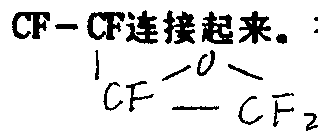
Viscosity in the time of 20 ℃ is 4, the 300CSt(centistoke), molecular weight is measured by G.P.C., examines through N.M.R.) be 7,200.The content of epoxy group(ing) (by
19F-N.M.R. calculate) 2.7 units are arranged for each polymeric chain.
B) oxidation capacity is the preparation of zero compound
The product that 23 grams are made from light compositing is dissolved in the CFCl of 230ml
2CF
2Among the Cl, be placed in the 300ml reactor.The light path of reactor is 0.5mm, is furnished with the reflux exchanger that remains on-10 ℃ and casing thermocouple with detected temperatures.This system is furnished with FC75
(R)The refrigerative quartz socket tube is so that insert ultraviolet lamp (HANAU, TQ150 type) (FC75
(R)Be the fluorocarbon that 3M company produces), photoreduction carried out when temperature is 30 ℃ 30 hours.Draw 13.9 gram products after the reaction,, prove that (peroxide) active o content is zero through iodimetric analysis.According to
19F-N.M.R. compose and the I.R. spectrum analysis, the structure of this product can be expressed as: structural unit-CF
2O-,-CF
2-CF
2O-,
 Connect in sequence, end group is-CF
2The COF-type.(b)-CF in the main intrachain that may exist-CF-base and the epoxy group(ing)
2It is constant that the mole ratio of-part keeps.In fact,
19F-N.M.R, do not detect in the main chain and have
Connect in sequence, end group is-CF
2The COF-type.(b)-CF in the main intrachain that may exist-CF-base and the epoxy group(ing)
2It is constant that the mole ratio of-part keeps.In fact,
19F-N.M.R, do not detect in the main chain and have

It is 5,400 that the molecular weight of product records.The content of the interior epoxy group(ing) of main chain contains 2.65 units for each polymeric chain behind the photoreduction.
Embodiment 1A(comparing embodiment)
The O.P.(oxidation capacity of the resulting product of A step reaction among the embodiment 1)=and 3.96%(weight), get the one aliquots containig and heat-treat, so that reduce its oxidation capacity.20 gram polymkeric substance are packed into one and are furnished with in the 50ml flask of thermometer and agitator, and temperature is raised to 230 ℃ in two hours, then reactant is incubated 6 hours again at 230~240 ℃.Obtain 12.1 gram products at reaction end,, prove that oxidation capacity is zero through iodometric determination.
19F-N.M.R. spectrum analysis does not have to confirm that the existence of epoxy group(ing) is arranged, but has occurred
The typical peak value of base.
〔δ(b)〕=+26.4,δ(a)=-130,-131.5〕
Embodiment 1B(comparing embodiment)
Get the oxidation capacity O.P.=3.96%(weight of the step reaction of A among 1 part of embodiment 1 gained) oily matter heat-treat.20 gram oily matter are put into the 50ml flask that thermometer and agitator are housed.Flask is placed in the heating bath, and all reactants are constant in 160 ℃.After heating in 52 hours, product is analyzed through N.M.R., knows that its oxidation capacity is a 2.7%(weight), epoxy content is 80% of initial epoxy content.
Embodiment 2
A) preparation of superoxide
In the device identical with embodiment 1, the CF of the 460ml that packs into
2Cl
2, then it is maintained-47 ℃.101.2 gram O in 6 hours, have been added
2(3.16 moles), 74.6 gram C
2F
4(0.74 mole) and 25.4 gram C
4F
6After (0.16 mole) arrived reaction end, evaporation was desolvated, and got 59.8 gram oily matter.The oily matter that this method for making obtains contains active oxygen 3.64%(weight).According to
19F-N.M.R. spectrum and I.R. spectrum analysis confirm that the structure of this compound is made up of repeated structural unit similarly to Example 1.Epoxy content (by
19F-N.M.R. spectrum calculating) contain 10.4 units for each polymeric chain.Molecular weight is 7,500.
B) oxidation capacity is the preparation of zero compound
Peroxidation product 25 grams that light compositing is obtained are dissolved in 230ml CF
2ClCFCl
2In, add in the embodiment 1 described 300ml reactor.In temperature is 30 ℃ of photoreductions that carry out 28 hours.At reaction end, obtaining 15.9 gram oxidation capacities from reactor is zero product.Analysis revealed existence-the CF of product
2O-,-CF
2-CF
2O-,
(a)
The structure of type.End group is-CF
2The structure of COF type.
19F-N.M.R. analyze (δ (b)=-110 ,-113; δ (a)=-132.8 ,-136.5; δ (c)=-147.7) and I.R. analyze ((
=1540cm
-1) confirmed the stability of epoxy group(ing) in this treating processes.The molecular weight of product is 6200.
Embodiment 2A(comparing embodiment)
Getting the oxidation capacity that the step of A among the embodiment 2 makes is 3.64%(weight) oily matter 20 grams, handle with reference to the similar fashion of embodiment 1.In two hours, temperature is risen to 230 ℃, and be incubated more than 6 hours at 230~240 ℃.At reaction end, obtaining 12.7 gram oxidation capacities is zero product.
19F-N.M.R. stave is bright:
 Base has occurred, and epoxy group(ing) has been replaced.
Embodiment 3
A) preparation of peralcohol
In the same sampling device of embodiment 1,460mlCF packs into
2Cl
2Reactor maintains-40 ℃, under UV-light, adds 95.6 gram (3 moles) O in 4.4 hours
2, 117.2 gram (1.17 moles) C
2F
4With 9.4 gram (0.058 mole) C
4F
6, at reaction end, solvent evaporated gets 40.2 gram oily products.This oily matter is to contain 3.17%(weight) polymkeric substance of active oxygen.Process
19F-N.M.R and I.R. measure, and confirm that it forms existence-CF in certain sequence by the structural unit identical with the product of embodiment 1
3With-CF
2The end group of COF type, the ratio of the two is 0.5: 1.Product viscosity is 3000CSt, and molecular weight is 5700.Epoxy group content is that every main chain contains 2.1 units.
B) oxidation capacity is the preparation of zero compound
Get the 20 peroxidation products that make of gram light compositings and be dissolved in 230mlCF
2ClCFCl
2In, and in the 300ml photochemical reactor of in embodiment 1, having described of packing into.At 30 ℃ of photoreductions that carry out 28 hours.At reaction end, obtaining 13.7 gram oxidation capacities from reactor is zero product.By analysis, prove existence-CF
2O-,-CF
2-CF
2-O-,
 , end group is-CF
2COF and-CF
3Type.Ratio between these end groups is the same with the ratio of pointing out previously.The molecular weight of product is 4250.
, end group is-CF
2COF and-CF
3Type.Ratio between these end groups is the same with the ratio of pointing out previously.The molecular weight of product is 4250.
Embodiment 3A(comparing embodiment)
Getting 15 gram light compositings resulting oxide compound abilities is 3.17%(weight) sample, handle according to the mode of embodiment 1.In two hours reactant is heated to 230 ℃, continues insulation 6 hours again at 230~240 ℃.Get the no peroxy product of 10.2 grams at reaction end.Analysis revealed, epoxy group(ing) disappears,
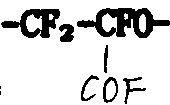 Base occurs.
Embodiment 4
Toward 20ml57%HF, in the mixture that 50ml methyl alcohol and 150ml.1.1.2-three fluoro-trichloroethane are made, drip the product that 100 gram embodiment 2A obtain.Reaction mixture was kept 8 hours at boiling temperature.Reaction mixture being poured in the frozen water, isolated the heavy-fluid layer, is methyl alcohol/36% hydrochloric acid mixture washing of 1: 1 then with heavy-fluid layer weight ratio.Heavy-fluid layer Na
2SO
4Drying boils off the cfc solvent then.Residual 82 gram oily matter.Specific absorption band (the 1800cm that ester group is arranged through the I.R. analysis revealed
-1).Know ratio m/n=0.9 through the N.M.R. analysis.After measured, molecular weight is 730, and acid equivalent is 355, and the structure of compound is equivalent to formula I (P=1 in the formula).
Embodiment 5
The product of getting 10 gram embodiment 4 installs in the 50ml glass flask.
Add 1 gram a-AlF
3℃ also stirring of this mixture heating up to 100.
React after 8 hours,, filter, reclaim the total overall reaction product the mixture cooling of gained.N, M, R, analysis revealed have
Base (δ (CF
3-
The 75ppm of)=-is to CF-CO-CF
3), and do not have epoxy group(ing) fully.
Embodiment 6
In a 100ml glass flask, 0.3 gram anhydrous K F is distributed to 50ml diethylene glycol dimethyl ether (CH
3O-CH
2CH
2-O-CH
2CH
2-OCH
3) in.
Get the product that 20 gram embodiment 4 obtain, dropwise be added in the above-mentioned dispersion liquid at 50 ℃.Whole mixture was stirred 4 hours, and cooling is then filtered.
Then separate diethylene glycol dimethyl ether, residue N, M, R, right with vacuum distilling
19F analyzes, and shows the epoxy group(ing) completely dissolve ,-CF
2-COF base occurs.
Handle with methyl alcohol, products obtained therefrom transforms into corresponding three esters.Acid equivalent is 240, and molecular formula is

Embodiment 7
The suspension of the 4.5 gram anhydrous K F of preparation earlier in the anhydrous diethylene glycol dimethyl ether of 150ml.The 50 gram products of getting embodiment 5 preparations are added in the suspension under anhydrous atmosphere in room temperature; Stirred the similar completely dissolve of solid-state during this period KF two hours.
20 gram R 1216 epoxide are fed in the mixture with air bubble-shaped.
Salt is precipitated out at once, and its amount becomes many with the increase of epoxide add-on.
Excessive perfluoro propylene epoxide is removed in the mixture degassing, filters under anhydrous atmosphere; Tell the heaviest liquid layer, remove diethylene glycol dimethyl ether after, the I.R. analysis revealed, have the acyl fluorides base (
 ) bands of a spectrum (1884cm
-1) there is no ketonic bond bands of a spectrum (1803cm
-1) exist.In diethylene glycol dimethyl ether with excessive anhydrous Na
1CO
3Product to gained carries out twice processing, once is 80 ℃, 60 minutes; Another time is 120~140 ℃, 60 minutes.
) bands of a spectrum (1884cm
-1) there is no ketonic bond bands of a spectrum (1803cm
-1) exist.In diethylene glycol dimethyl ether with excessive anhydrous Na
1CO
3Product to gained carries out twice processing, once is 80 ℃, 60 minutes; Another time is 120~140 ℃, 60 minutes.
Filter, separated products shows the typical infrared band (1840cm that contains perfluorovinyl ether
-1) and the typical infrared band (1800cm of ester group
-1)
N.M.R. analyze and confirmed time array structure:
Embodiment 8
In four neck flasks of 1 liter of capacity, put into 16 gram LiAlH
4With the 500ml anhydrous diethyl ether, 50 grams, three esters that in 1 hour embodiment 6 obtained down that reflux drop by drop add.
React after 4 hours, add the 15ml water be dissolved in the 60ml tetrahydrofuran (THF) so that the LiAlH of decomposing excessive
4
Stir after two hours, add mixture (volume ratio the is 1/4) 150ml of hydrochloric acid (33%) and water.
Isolate the ether layer then, use Na
2SO
4Dehydration boils off ether again, and remaining liquid product is analyzed through I.R., and knowing in-OH district has strong absorption, and in the nothing absorption of C=O district.
Recording hydroxyl equivalent with acetylation method is 235.
The N.M.R. analysis revealed of ' H, methylene radical CH
2Be present in-CF
2And-OH between (chemical shift approximately is 4ppm), therefore corresponding to molecular formula:
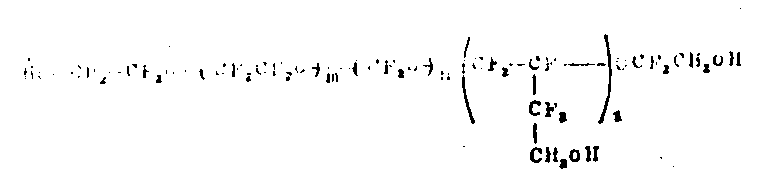
N.M.R.
19F analyzes and has confirmed this structure.
Embodiment 9
Three esters of embodiment 6 gained are got 50 grams to be dissolved in the 1.1.2-three chloro-1.2.2-Halothane.
In in one hour, adding 10 gram isobutylamines under the room temperature.
Sampling boils off solvent after one hour, drying, and products obtained therefrom shows the conclusive absorption (1800cm that has ester group through infrared analysis
-1), near it amide group bands of a spectrum (1712cm
-1).
Confirmed to have excessive isobutylamine to exist, therefore reaction will be carried out three hours again.
After this reaction times, reaction no longer shows the infrared absorption of any trace of ester group.
Remove desolvate and excessive amine after, isolate the oily matter of viscosity.
With excessive P
2O
5In 150~170 ℃ oily matter was handled 3~5 hours, again Tripyrophosphoric acid is successfully separated.Observed at 2277cm
-1The place has the characteristic infrared of CN base to absorb, and has also observed the disappearance of amide group bands of a spectrum.
Embodiment 10
The 500ml photochemical reactor, light path 0.5cm loads onto coaxial quartz socket tube (so that inserting HANAU, TQ150 type mercury vapor light), magnetic stirring apparatus, reflux cooler, the system of dry ice trap and a cover energy while controlling reactor and bushing temperature.The product that obtains among the embodiment 2A is got 400 grams put into reactor.
Add 10 gram bromines continuously, system is heated to 100 ℃.
After ultraviolet lamp is bright, in 15 hours test, add 50 gram bromines again.
At reaction end, reactant is poured into flask, bromine is removed in distillation under the vacuum.
The gains molecular-weight average is 700, and almost the non-oxidation ability weighs 300 grams, and its end group is-CF
2Br, a PFPE chain has two bromo end groups and an epoxy group(ing)
Claims (5)
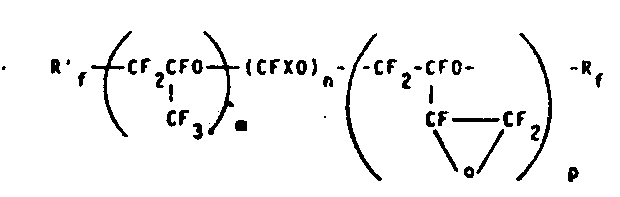
Applications Claiming Priority (2)
| Application Number | Priority Date | Filing Date | Title |
|---|---|---|---|
| IT20346A/86 | 1986-05-07 | ||
| IT8620346A IT1213071B (en) | 1986-05-07 | 1986-05-07 | PERFLUOROPOLYETERS FREE OF PEROXIDE OXYGEN AND CONTAINING PERFLUOROEPOXID GROUPS ARRANGED ALONG THE PERFLUOROPOLYETHER CHAIN. |
Publications (2)
| Publication Number | Publication Date |
|---|---|
| CN87104043A CN87104043A (en) | 1988-01-13 |
| CN1012175B true CN1012175B (en) | 1991-03-27 |
Family
ID=11165912
Family Applications (1)
| Application Number | Title | Priority Date | Filing Date |
|---|---|---|---|
| CN87104043A Expired CN1012175B (en) | 1986-05-07 | 1987-05-07 | Preparation method of perfluoropolyether and its derivatives containing perfluoroepoxy group along the main chain without peroxygen |
Country Status (18)
| Country | Link |
|---|---|
| US (2) | US4853097A (en) |
| EP (1) | EP0244839B1 (en) |
| JP (1) | JPH0822911B2 (en) |
| KR (1) | KR960009686B1 (en) |
| CN (1) | CN1012175B (en) |
| AT (1) | ATE114686T1 (en) |
| AU (1) | AU596176B2 (en) |
| CA (1) | CA1339316C (en) |
| CS (1) | CS272774B2 (en) |
| DD (1) | DD263769A5 (en) |
| DE (1) | DE3750786T2 (en) |
| ES (1) | ES2065316T3 (en) |
| FI (1) | FI871983L (en) |
| IL (1) | IL82423A (en) |
| IT (1) | IT1213071B (en) |
| NO (1) | NO167928C (en) |
| RU (1) | RU1807991C (en) |
| ZA (1) | ZA873178B (en) |
Families Citing this family (35)
| Publication number | Priority date | Publication date | Assignee | Title |
|---|---|---|---|---|
| JPS62297478A (en) * | 1986-06-18 | 1987-12-24 | Nippon Soda Co Ltd | Surface treating agent and its production |
| IT1218206B (en) * | 1988-04-08 | 1990-04-12 | Ausimont Spa | USE OF PERFLUOROPOLYETER EMULSIONS FOR THE PROTECTION OF STONE MATERIALS FROM ATMOSPHERIC AGENTS |
| IT1218205B (en) * | 1988-04-08 | 1990-04-12 | Ausimont Spa | USE OF FLUOROPOLYETER DERIVATIVES IN THE FORM OF AQUEOUS MICROEMULSION FOR THE PROTECTION OF STONE MATERIALS FROM ATMOSPHERIC AGENTS |
| IT1216565B (en) * | 1988-04-08 | 1990-03-08 | Ausimont Spa | USE OF AQUEOUS MICROEMULSION FLUOROPOLYETERS FOR THE PROTECTION OF STONE MATERIALS FROM ATMOSPHERIC AGENTS. |
| IT1218215B (en) * | 1988-04-11 | 1990-04-12 | Ausimont Spa | STRUCTURE CROSS-LINKED PRODUCTS OF PERFLUOROPOLITERS WITH FUNCTIONAL GROUPS |
| IT1217838B (en) * | 1988-06-17 | 1990-03-30 | Ausimont Spa | MICROEMULSIONS FOR ELECTRICALLY CONDUCTIVE WATER IN OIL TYPE, BASED ON FLUORINATED COMPOUNDS USED AS CATHOLITES IN ELECTROCHEMICAL PROCESSES |
| IT1217839B (en) * | 1988-06-17 | 1990-03-30 | Ausimont Spa | MICROEMULSIONS OF THE ELECTRICALLY CONDUCTIVE OIL TYPE IN WATER, BASED ON FLUORINATED COMPOUNDS, USED AS A CATHOLITE IN ELECTROCHEMICAL PROCESSES |
| IT1229845B (en) * | 1989-04-20 | 1991-09-13 | Ausimont Srl | PROCEDURE FOR THE PREPARATION OF PEROXIDE PERFLUOROPOLYETERS. |
| JPH04122412A (en) * | 1990-09-12 | 1992-04-22 | Hitachi Ltd | Method and equipment for dissolving oxygen |
| IT1265068B1 (en) * | 1993-05-18 | 1996-10-30 | Ausimont Spa | PROCESS OF (CO) RADICAL POLYMERIZATION OF FLUORINATED OLEFINIC MONOMERS IN WATER EMULSION |
| IT1264977B1 (en) * | 1993-11-17 | 1996-10-17 | Ausimont Spa | PROCESS FOR PREPARING PERFLUOROPOLYSTERS |
| FR2717450B1 (en) * | 1994-03-21 | 1996-05-15 | Oreal | Packaging in composite plastic material with a soft touch effect. |
| IT1270703B (en) * | 1994-11-17 | 1997-05-07 | Ausimont Spa | MICROEMULSIONS OF FLUOROPOLYXIALKYLENES IN A MIXTURE WITH HYDROCARBONS, AND THEIR USE IN PROCESSES OF (CO) POLYMERIZATION OF FLUORINATED MONOMERS |
| IT1271075B (en) | 1994-11-21 | 1997-05-26 | Ausimont Spa | TERNARY SOLVENT MIXTURES, AND THEIR USE FOR THE REMOVAL OF OIL SUBSTANCES |
| IT1276072B1 (en) | 1995-10-31 | 1997-10-24 | Ausimont Spa | PROCESS OF (CO) POLYMERIZATION OF FLUORINATED MONOMERS TO OBTAIN HYDROGEN CONTAINING POLYMERS |
| IT1284005B1 (en) * | 1996-04-23 | 1998-05-08 | Ausimont Spa | PROCESS FOR THE PREPARATION OF PERFLUOROPOLIETERS WITH BROMINATED OR IODURED TERMINALS |
| IT1286027B1 (en) * | 1996-06-10 | 1998-07-07 | Ausimont Spa | FUNCTIONALIZED PROTECTIVE FLOOR POLYESTER COATINGS |
| IT1290462B1 (en) * | 1997-04-08 | 1998-12-03 | Ausimont Spa | MODIFIED HYDROGENATED POLYMERS |
| AU4458797A (en) | 1997-09-15 | 1999-04-05 | Sofitech N.V. | Electrically conductive non-aqueous wellbore fluids |
| US6793025B2 (en) * | 1998-01-08 | 2004-09-21 | M-I L. L. C. | Double emulsion based drilling fluids |
| US6405809B2 (en) | 1998-01-08 | 2002-06-18 | M-I Llc | Conductive medium for openhold logging and logging while drilling |
| US7320829B2 (en) * | 1998-03-05 | 2008-01-22 | Omnova Solutions Inc. | Fluorinated polymer and amine resin compositions and products formed therefrom |
| IT1313597B1 (en) | 1999-08-04 | 2002-09-09 | Ausimont Spa | FLUOROPOLYEREOUS LUBRICANTS CONTAINING SULPHONYLFLUORIDE GROUPS |
| US6558803B1 (en) | 2000-07-03 | 2003-05-06 | Adhesives Research Inc. | Ambifunctional perfluorinated polyethers |
| ITMI20010008A1 (en) | 2001-01-03 | 2002-07-03 | Ausimont Spa | ADDITIVES FOR FLUOROPOLIETEREI FOR ELECTROMAGNETIC APPLICATIONS |
| US7288619B2 (en) * | 2004-05-07 | 2007-10-30 | 3M Innovative Properties Company | Fluorinated polyether polyamine and method of making the same |
| US7342080B2 (en) * | 2004-05-07 | 2008-03-11 | 3M Innovative Properties Company | Polymerizable compositions, methods of making the same, and composite articles therefrom |
| KR101632762B1 (en) * | 2008-08-11 | 2016-06-22 | 솔베이 스페셜티 폴리머스 이태리 에스.피.에이. | Hydrofluoroalcohols with improved thermal and chemical stability |
| EP3679074B1 (en) | 2017-09-08 | 2021-09-01 | Solvay Specialty Polymers Italy S.p.A. | Method for making fluoropolymers |
| EP3861063A1 (en) | 2018-10-01 | 2021-08-11 | Solvay Specialty Polymers Italy S.p.A. | Fluoroelastomer composition |
| JP2024547081A (en) | 2021-12-21 | 2024-12-26 | ソルベイ スペシャルティ ポリマーズ イタリー エス.ピー.エー. | Perfluoropolyether polymers containing pendant functional groups |
| WO2024068675A1 (en) | 2022-09-28 | 2024-04-04 | Solvay Specialty Polymers Italy S.P.A. | Perfluoropolyether polymers |
| WO2024068677A1 (en) | 2022-09-28 | 2024-04-04 | Solvay Specialty Polymers Italy S.P.A. | Perfluoropolyether polymers |
| TW202413464A (en) | 2022-09-28 | 2024-04-01 | 義大利商首威專業聚合物義大利公司 | Perfluoropolyether polymers |
| EP4649105A1 (en) | 2023-01-12 | 2025-11-19 | Syensqo Specialty Polymers Italy S.p.A. | Perfluoropolyether polymers |
Family Cites Families (14)
| Publication number | Priority date | Publication date | Assignee | Title |
|---|---|---|---|---|
| US3442942A (en) * | 1964-04-09 | 1969-05-06 | Montedison Spa | Fluorinated oxygen containing acyl fluorides |
| NL6709067A (en) * | 1964-04-09 | 1968-01-08 | ||
| FR1499094A (en) * | 1965-11-18 | 1968-01-11 | ||
| US3715378A (en) * | 1967-02-09 | 1973-02-06 | Montedison Spa | Fluorinated peroxy polyether copolymers and method for preparing them from tetrafluoroethylene |
| US3665041A (en) * | 1967-04-04 | 1972-05-23 | Montedison Spa | Perfluorinated polyethers and process for their preparation |
| US3847978A (en) * | 1968-07-01 | 1974-11-12 | Montedison Spa | Perfluorinated linear polyethers having reactive terminal groups at both ends of the chain and process for the preparation thereof |
| US3810874A (en) * | 1969-03-10 | 1974-05-14 | Minnesota Mining & Mfg | Polymers prepared from poly(perfluoro-alkylene oxide) compounds |
| SE411763B (en) * | 1971-08-05 | 1980-02-04 | Montedison Spa | AMORF, HIGHLY VISCOS POLYMER COOLPOLY WEIGHT POLYMER WEIGHT MAKROMOLECYLES ARE MADE BY THE MONOMER UNITS -CF? 712CF? 712O- AND -CF? 712O- AND SET FOR ITS PREPARATION |
| IT1150705B (en) * | 1982-03-19 | 1986-12-17 | Montedison Spa | PERFLUOROOLEFINE INSERTION PROCESS ON PERFLUOROPOLYETERS AND RELATED PRODUCTS |
| IT1174205B (en) * | 1984-06-19 | 1987-07-01 | Montedison Spa | FLUOROPLIETERI CONTAINING TERMINAL GROUPS EQUIPPED WITH ANCHORS |
| US4664766A (en) * | 1985-02-13 | 1987-05-12 | Montedison S.P.A. | Photochemical process for neutralizing perfluoropolyethers |
| IT1185518B (en) * | 1985-02-22 | 1987-11-12 | Montefluos Spa | OBTAINMENT OF MOLECULAR WEIGHT PERFLUOROPOLYTERS CONTROLLED BY THE PHOTOCHEMICAL OXIDATION PRODUCT OF C2F4 |
| KR900007874B1 (en) * | 1985-02-26 | 1990-10-22 | 몬테디손 에스. 페. 아. | Process for the preparation of difunctional and monofunctional perfluoropolyether having brominated terminal group and regulated molecular weight |
| IT1200604B (en) * | 1985-04-04 | 1989-01-27 | Montefluos Spa | FLUORURATION PROCESS IN LIQUID PHASE OF UNSATURATED COMPOUNDS |
-
1986
- 1986-05-07 IT IT8620346A patent/IT1213071B/en active
-
1987
- 1987-05-04 ZA ZA873178A patent/ZA873178B/en unknown
- 1987-05-04 US US07/045,541 patent/US4853097A/en not_active Expired - Lifetime
- 1987-05-04 AU AU72475/87A patent/AU596176B2/en not_active Ceased
- 1987-05-05 IL IL82423A patent/IL82423A/en unknown
- 1987-05-05 CS CS315887A patent/CS272774B2/en unknown
- 1987-05-05 FI FI871983A patent/FI871983L/en not_active IP Right Cessation
- 1987-05-06 EP EP87106529A patent/EP0244839B1/en not_active Expired - Lifetime
- 1987-05-06 ES ES87106529T patent/ES2065316T3/en not_active Expired - Lifetime
- 1987-05-06 RU SU874202565A patent/RU1807991C/en active
- 1987-05-06 JP JP62109058A patent/JPH0822911B2/en not_active Expired - Lifetime
- 1987-05-06 NO NO871882A patent/NO167928C/en unknown
- 1987-05-06 DD DD87302504A patent/DD263769A5/en not_active IP Right Cessation
- 1987-05-06 CA CA000536523A patent/CA1339316C/en not_active Expired - Lifetime
- 1987-05-06 DE DE3750786T patent/DE3750786T2/en not_active Expired - Lifetime
- 1987-05-06 AT AT87106529T patent/ATE114686T1/en active
- 1987-05-07 CN CN87104043A patent/CN1012175B/en not_active Expired
- 1987-05-07 KR KR87004477A patent/KR960009686B1/en not_active Expired - Lifetime
-
1990
- 1990-07-30 US US07/561,251 patent/US5059700A/en not_active Expired - Lifetime
Also Published As
| Publication number | Publication date |
|---|---|
| DE3750786D1 (en) | 1995-01-12 |
| DE3750786T2 (en) | 1995-04-13 |
| NO871882L (en) | 1987-11-09 |
| CN87104043A (en) | 1988-01-13 |
| AU7247587A (en) | 1987-11-12 |
| ES2065316T3 (en) | 1995-02-16 |
| US5059700A (en) | 1991-10-22 |
| IL82423A0 (en) | 1987-11-30 |
| ATE114686T1 (en) | 1994-12-15 |
| IT1213071B (en) | 1989-12-07 |
| KR870011166A (en) | 1987-12-21 |
| CS272774B2 (en) | 1991-02-12 |
| FI871983A7 (en) | 1987-11-08 |
| RU1807991C (en) | 1993-04-07 |
| NO167928B (en) | 1991-09-16 |
| JPH0822911B2 (en) | 1996-03-06 |
| IT8620346A0 (en) | 1986-05-07 |
| NO871882D0 (en) | 1987-05-06 |
| CS315887A2 (en) | 1990-04-11 |
| NO167928C (en) | 1991-12-27 |
| AU596176B2 (en) | 1990-04-26 |
| IL82423A (en) | 1991-06-10 |
| US4853097A (en) | 1989-08-01 |
| JPS6322828A (en) | 1988-01-30 |
| EP0244839A3 (en) | 1988-11-17 |
| CA1339316C (en) | 1997-08-19 |
| KR960009686B1 (en) | 1996-07-23 |
| FI871983A0 (en) | 1987-05-05 |
| FI871983L (en) | 1987-11-08 |
| DD263769A5 (en) | 1989-01-11 |
| EP0244839B1 (en) | 1994-11-30 |
| EP0244839A2 (en) | 1987-11-11 |
| ZA873178B (en) | 1987-10-28 |
Similar Documents
| Publication | Publication Date | Title |
|---|---|---|
| CN1012175B (en) | Preparation method of perfluoropolyether and its derivatives containing perfluoroepoxy group along the main chain without peroxygen | |
| JP3073497B2 (en) | Perfluoropolyether containing an acid end group containing a halogen different from fluorine | |
| CN1180018C (en) | Fluorine containing elastomer composition | |
| RU2144044C1 (en) | Fluorinated derivatives of bis-vinyloximemetane (versions), and based on them polymers and copolymers | |
| CN1224620C (en) | Polyfluorinated epoxides and associated polymers and processes | |
| CN1031064C (en) | The method for preparing peroxidized perfluoropolyether | |
| US5539059A (en) | Perfluorinated polyethers | |
| CN86108018A (en) | New functionalized perfluoropolyethers and preparation method thereof | |
| CN1703442A (en) | Perfluoropolyether Derivatives | |
| JPH0222326A (en) | Production of perfluoropolyether controlled in its molecular weight having perfluoroalkyl or perfluoroalkyl terminal group | |
| CN1192043C (en) | Non-aqueous process for the preparation of polymers, copolymers, oligomers and telomers of vinyl monomers | |
| CN1569787A (en) | Process for preparing hydrofluoroethers | |
| CN1088071C (en) | Process for preparing perfluoropolyethers with bromo- or iodo-containing end groups | |
| US5506309A (en) | Perfluorinates polyethers | |
| KR0164217B1 (en) | Perhalogenated polyether | |
| CN1225359A (en) | Bis(dialkylmaleimide) derivatives and polyetherimides for optical communications | |
| JP4794320B2 (en) | Method for producing perfluoropolyether peroxide | |
| CN1226572A (en) | Bis(trialkylbenzenetrilic anhydride) derivatives and polyesterimides for optical communications | |
| CN1431985A (en) | Method for producing unsaturated compounds by thermal decomposition reaction | |
| US5220076A (en) | Perfluoropolyethers and processes for their preparation | |
| US5177226A (en) | Perfluoropolyethers free from peroxidic oxygen and containing perfluoroepoxy groups positioned along the perfluoropolyether chain, and their derivatives | |
| CN1660740A (en) | Process for preparing fluorohalogenethers | |
| US5672767A (en) | Process for preparing polyether compounds | |
| CN1420132A (en) | Cross-linkable functional polymer capable of producing photoconductive material | |
| US5210233A (en) | Cyclic perfluoropolyether |
Legal Events
| Date | Code | Title | Description |
|---|---|---|---|
| C06 | Publication | ||
| C10 | Entry into substantive examination | ||
| PB01 | Publication | ||
| SE01 | Entry into force of request for substantive examination | ||
| C13 | Decision | ||
| GR02 | Examined patent application | ||
| C14 | Grant of patent or utility model | ||
| GR01 | Patent grant | ||
| C15 | Extension of patent right duration from 15 to 20 years for appl. with date before 31.12.1992 and still valid on 11.12.2001 (patent law change 1993) | ||
| OR01 | Other related matters | ||
| C17 | Cessation of patent right | ||
| CX01 | Expiry of patent term |