CN101242594B - Uplink frames at the transcoder-base station interface in radiocommunication cellular networks using mobile systems - Google Patents
Uplink frames at the transcoder-base station interface in radiocommunication cellular networks using mobile systems Download PDFInfo
- Publication number
- CN101242594B CN101242594B CN2008100867764A CN200810086776A CN101242594B CN 101242594 B CN101242594 B CN 101242594B CN 2008100867764 A CN2008100867764 A CN 2008100867764A CN 200810086776 A CN200810086776 A CN 200810086776A CN 101242594 B CN101242594 B CN 101242594B
- Authority
- CN
- China
- Prior art keywords
- frame
- field
- data
- transcoder
- base station
- Prior art date
- Legal status (The legal status is an assumption and is not a legal conclusion. Google has not performed a legal analysis and makes no representation as to the accuracy of the status listed.)
- Expired - Lifetime
Links
- 230000001413 cellular effect Effects 0.000 title claims abstract description 10
- 238000004891 communication Methods 0.000 claims abstract description 10
- 230000005540 biological transmission Effects 0.000 claims abstract description 8
- 238000000034 method Methods 0.000 claims description 10
- 238000000926 separation method Methods 0.000 description 5
- 230000007704 transition Effects 0.000 description 5
- 230000008859 change Effects 0.000 description 3
- 238000006243 chemical reaction Methods 0.000 description 3
- 238000011144 upstream manufacturing Methods 0.000 description 3
- 230000002123 temporal effect Effects 0.000 description 2
- 230000005856 abnormality Effects 0.000 description 1
- 230000006978 adaptation Effects 0.000 description 1
- 230000007547 defect Effects 0.000 description 1
- 238000010586 diagram Methods 0.000 description 1
- 238000003780 insertion Methods 0.000 description 1
- 230000037431 insertion Effects 0.000 description 1
- 238000010295 mobile communication Methods 0.000 description 1
- 230000000737 periodic effect Effects 0.000 description 1
- 230000008569 process Effects 0.000 description 1
- 230000004044 response Effects 0.000 description 1
- 230000002441 reversible effect Effects 0.000 description 1
- 230000001360 synchronised effect Effects 0.000 description 1
- 230000009466 transformation Effects 0.000 description 1
Images


Classifications
-
- H—ELECTRICITY
- H04—ELECTRIC COMMUNICATION TECHNIQUE
- H04W—WIRELESS COMMUNICATION NETWORKS
- H04W88/00—Devices specially adapted for wireless communication networks, e.g. terminals, base stations or access point devices
- H04W88/18—Service support devices; Network management devices
- H04W88/181—Transcoding devices; Rate adaptation devices
Landscapes
- Engineering & Computer Science (AREA)
- Computer Networks & Wireless Communication (AREA)
- Signal Processing (AREA)
- Mobile Radio Communication Systems (AREA)
- Communication Control (AREA)
Abstract
本发明提供的是在采用移动系统的无线电通信蜂窝网中从基站传送到换码器中的上行帧的结构。帧(TR)通常有一个分成至少一个数据字段(CD)和至少一个控制字段(CC1,CC2)的信息区,所述至少一个控制字段包括一个表示所述至少一个数据字段(CD)中传送的数据(DATA)有效性的辅助字段(C12)。其特征在于所述辅助字段大体设置在所述信息区的始端。这种帧结构避免了通信过程中当移动站的网孔转换时把错误的语言信号从蜂窝网传送到固定网中,这种固定网例如是电话转换网络。
The present invention provides the structure of the uplink frame transmitted from the base station to the transcoder in the radio communication cellular network using the mobile system. A frame (TR) usually has an information area divided into at least one data field (CD) and at least one control field (CC1, CC2), said at least one control field including a Auxiliary field (C12) for data (DATA) validity. It is characterized in that the auxiliary field is generally set at the beginning of the information area. This frame structure avoids the transmission of erroneous speech signals from the cellular network to a fixed network, such as a telephone switching network, when the cell of the mobile station is switched during communication.
Description
本申请是中国专利申请95115005.7的分案申请。This application is a divisional application of Chinese patent application 95115005.7.
技术领域 technical field
本发明一般来讲涉及的是在采用移动系统中的无线电通信蜂窝网中换码器-基站接口的上行帧。由基站把该上行帧传送到该网络中的换码器,本发明还涉及到用于产生这种帧的基站。The present invention relates generally to uplink frames of transcoder-base station interfaces in radiocommunication cellular networks employing mobile systems. The uplink frame is transmitted by the base station to a transcoder in the network. The invention also relates to a base station for generating such a frame.
背景技术 Background technique
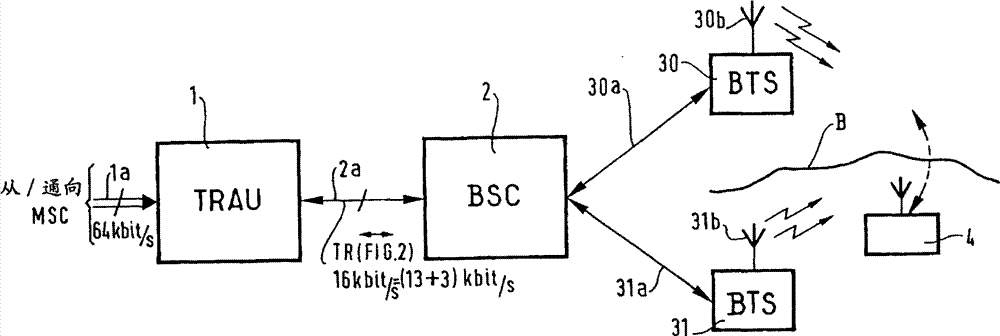
在所述移动网络中,以无线电传送形式可任意使用的有限频带宽度要求对语言信号进行处理或编码,以使这些信号的数字速率相对小一些。在所述固定网络中,例如在电话转换网络中,由多路系统MIC建立的信道中的速率主要为64千比特/秒(kbit/s)。为把该速率减少到一个小速率,G.S.M(全球移动通信系统)移动网络规定语言信号主要由RPE-LTP(原英文术语Regular Pulse Excitation,Long Term Prediction)型语言编码器处理成260个取样(样值)的处理段,该段与20ms的语言相配合,并规定速率为13千比特/秒。因而以速率为64千比特/秒接收电话转换网络信号的语言信道由GSM网络进行处理,以便提供速率为13千比特/秒的语言信道,反之,由移动站接收的速率为13千比特/秒的语言信道在移动网络GSM中得到处理,从而提供一个传送到电话转换网络中的速率为64千比特/秒的信道。在这种GSM网络中,确保将64千比特/秒的语言信道处理成13千比特/秒及其反向处理的语言信道的功能实体是一个换码器(英文术语为TRAU即,Transcoder Rate Adaptation Unit)。In said mobile networks, the limited frequency bandwidth freely available in the form of radio transmission requires processing or encoding of speech signals so that the digital rate of these signals is relatively low. In said fixed networks, for example in switched telephone networks, the rate in the channels established by the multiplex system MIC is mainly 64 kilobits per second (kbit/s). In order to reduce this rate to a small rate, the G.S.M (Global System for Mobile Communications) mobile network stipulates that the language signal is mainly processed into 260 samples (sample value) of the processing segment, which is compatible with 20ms language and specifies a rate of 13 kbit/s. Thus the speech channel receiving the telephone switching network signal at a rate of 64 kbit/s is processed by the GSM network in order to provide a speech channel at a rate of 13 kbit/s, and conversely received by a mobile station at a rate of 13 kbit/s The speech channel is processed in the mobile network GSM, thus providing a channel with a rate of 64 kbit/s transmitted to the telephony switching network. In this GSM network, the functional entity that ensures that the 64 kbit/s speech channel is processed into a 13 kbit/s speech channel and its reverse processing is a transcoder (the English term is TRAU, Transcoder Rate Adaptation Unit).
图1表示的是GSM移动网络结构中的传输链。该传输链以串接形式包括:一台移动电台转换器MSC,一个换码器1,一个基站控制器2,两个基站30和31以及一些移动系统4。换码器1由连路2a与控制器2相连,分别用两根连路30a和31a将控制器2与两个基站30和31相连。换码器1如前面所详述的那样确保了将64千比特/秒的数据信道,例如语言信道处理成13千比特/秒的信道,反之亦然。该换码器通过移动电台转换器MSC对电话转换网接收和传送64千比特/秒多路编排数据信道,该信道由传送线1a进行传输。此外,该换码器通过基站控制器2对基站30和31传送和接收64千比特/秒的帧TR。What Fig. 1 shows is the transmission chain in the GSM mobile network structure. The transmission chain comprises in series: a mobile station converter MSC, a
在帧TR中,有效数据,例如与移动系统4所形成的通信语言信号,对于所述帧中的16千比特/秒总速率确定了一个13千比特/秒的速率,而所剩下的3千比特/秒作为基站30、31和换码器1之间的同步控制数据的传送。In frame TR, useful data, such as communication speech signals formed with the
在上行方向,即从移动系统4通向电话转换网络的方向,由基站30或31把所接收到的来自移动系统的13千比特/秒语言数据制成这些帧TR(就是所述的上行帧)。基站30或31保证将相当于3千比特/秒的同步和控制数据插入,以便从相当于13千比特/秒的语言数据组成各个16千比特/秒的上行帧TR。这些上行帧TR被换码器1接收,该换码器去掉由基站30、31插入的同步及控制数据,并把所产生的13千比特/秒的语言信号处理成传送到电话转换网络中的64千比特/秒的信号。In the uplink direction, that is, the direction leading to the telephone switching network from the
在从电话转换网络到移动系统4的下行方向中,换码器1确保插入同步及控制数据,从而由13千比特/秒的有效数据通量形成所述的16千比特/秒的下行帧,该通量是通过换码器1对来自电话转换网络的64千比特/秒的语言信号进行处理后得到的。这些下行帧TR被相关的基站30、31接收,该基站去掉由换码器1插入的同步及控制数据,并且通过天线30b,31b只把语言数据传播到由移动系统4设立的通讯信道中。In the downstream direction from the telephone switching network to the
如图2所示,从基站30或31传送到换码器1的各个上行帧TR都包含确定20ms语言的(8×40)=320比特。正如在GSM-08.60的介绍中由ETSI(European Digital Cellular Telecommunications System/InbandControl of Remote Transcoders and Rate Adaptators,10,1993)所规定的那样,一方面上行帧包括一个分成第一控制字段CC1、若干数据字段CD以及第二控制字段CC2的有效信息区(字段),另一方面又包括一个帧同步单元MST和19个把两个相连数据字段分开的周期同步单元MSP1至MSP19。As shown in FIG. 2 , each uplink frame TR transmitted from the
在图2表中,上面的行和左侧的列对于帧中给定的一个比特来说标出了包括该比特在内的从1到40的字节行和在该字节中所述比特的列。In the table of Figure 2, the upper row and left column identify, for a given bit in the frame, the byte row from 1 to 40 that includes that bit and the bit in that byte column.
帧同步单元MST占据了帧TR的1和2两行的前两个字节,并由“0”状态(所谓的第一状态)的(2×8)=16比特构成。周期同步单元MSP1到MSP19每个都是由“1”状态(所谓第二状态)的一个比特构成,而且在帧中各周期同步单元从第3行算起占据单数行字节的各自的第一比特。这样,同步单元MSP1占据第3行字节的第一比特,同步单元MSP2占据第5行字节的第一比特,下面以此类推直至同步单元MSP19,该单元占据第39行的第一比特。控制字段CC1包括15个比特(C1至C15),并占据该帧TR的第三和第四字节。这里应当除去传送MSP1单元的第三字节的第一比特即第三行字节的第一比特。The frame synchronization unit MST occupies the first two bytes of the two
控制字段CC2包括6个比特(C16至C21),它们分别占据第39行字节的最后两个比特和第40行字节的头四个比特。在控制字段CC1和CC2中所包括的比特主要用来确定帧的(类型)(语言)、信道的模式(速率…)以及时间调准信息等等。The control field CC2 includes 6 bits (C16 to C21), which respectively occupy the last two bits of the 39th row byte and the first four bits of the 40th row byte. The bits included in the control fields CC1 and CC2 are mainly used to determine the (type) of the frame (language), the mode of the channel (rate...) and time alignment information and so on.
在本发明的范围内,重点在于传送到控制字段CC1的辅助字段中的控制比特C12,并将该控制比特标注在该字段CC1中加影线的区域中。根据已有技术,该比特为(错误帧)的显示(英文术语为Bad Frame Indication)也就是表示数据字段(数据区)CD中传送的数据DATA(标注为D)的有效性。Within the scope of the invention, the focus is on the control bit C12 which is transferred into the auxiliary field of the control field CC1 and is marked in this field CC1 in the hatched area. According to the prior art, this bit is the display (English term is Bad Frame Indication) of (error frame) that is to represent the validity of the data DATA (marked as D) transmitted in the data field (data area) CD.
在一个上行帧TR中,基站30或31把该比特C12定在状态“1”或“0”,以便向换码器1指出所述传送该比特C12的帧TR分别是错误的帧或正确的帧。换码器1附有在上行帧TR被显示为错误时而进行专门处理的设备,这样就防止了在20ms时期间内产生错误的语言信号,否则该错误信号会以64千比特/秒的速率传送到无线电转换网络中。用信道的编码译码单元(CCU英文术语表示为Channel Codec Unit)把该比特C12擂入上行帧TR中,信道编码译码单元处于基站30或31中,基站用于产生该帧。In an uplink frame TR, the
再参照图1,当由于响应移动系统4越过假设边界B而网孔内部变换(或hand-Over)发生时,则可发现,根据已有技术,表示错误帧的C12的定位并不是最佳的,而且有可能被换码器1错误地显示出数据比特,上述假设边界是把两个分别与基站30和31相配合的网孔分隔开的。为对上述现象进行解释,例如假设当该网孔转换前,把移动系统4与产生送往换码器1的上行帧TR的基站30相连,并假设在该网孔转换以后,移动系统4与基站31相连,此次轮到该基站产生与移动系统确立的无线电通信有关的上行帧,该上行帧送往换码器1。基站30(也就是所谓的源)和基站31(所谓的靶)常常都不同步,而相对于所发射的帧来讲它们之间的不同步则是暂时的。在网孔变换期间,则换码器1接收由源基站30发射的第一帧TR的一部分和由靶基站31所发射的第二帧TR的一部分。如果在同步单元MST后并在比特C12之前(在由源基站30发射时相对第一帧而言)发生变换,由靶基站31发射的并由换码器1当作第一帧的比特C12的第二帧的一个比特很有可能为状态“0”,因此就使换码器1认为所接收的帧为正确帧,而其实该帧是错误帧。相反,由源基站30传送并表明错误帧的比特C12并没被换码器1接收。Referring to Fig. 1 again, when due to the response
因此,根据已有技术,鉴于使用同一换码器的两个基站之间的内部转换,在换码器-基站接口处所确定的上行帧结构并不显得最佳。事实上当变换时就会因帧的这种结构引起这样的结果:当帧不正确时,向换码器显示的却是正确帧。Therefore, according to the prior art, the uplink frame structure determined at the transcoder-base station interface does not appear to be optimal in view of the internal switching between two base stations using the same transcoder. In fact, this structure of the frame causes the result when converting that the correct frame is shown to the transcoder when the frame is not correct.
发明内容 Contents of the invention
本发明的目的在于在基站换码器接口处提供一个上行帧以克服上述缺陷,因此基本不会出现因不正常而使换码器产生错误的判断。The purpose of the present invention is to provide an uplink frame at the interface of the transcoder of the base station to overcome the above defects, so that the transcoder will not make wrong judgments due to abnormality.
为此,本发明的帧有一个信息区,该信息区有至少一个数据字段和至少一个控制字段,所述的至少一个控制字段有一个辅助字段,该辅助字段表示所述至少一个数据字段中传送的数据的有效性,该帧的特征在于所述辅助字段基本设置在所述信息区的始端。For this purpose, the frame of the present invention has an information area, the information area has at least one data field and at least one control field, said at least one control field has an auxiliary field, and this auxiliary field indicates The validity of the data, the frame is characterized in that the auxiliary field is basically set at the beginning of the information area.
在该帧中最好是帧的同步单元在信息区的前部。In the frame it is preferable that the sync unit of the frame is at the front of the information area.
此外,在该帧中还可以有若干周期出现的同步单元。In addition, there may be several sync units occurring periodically in the frame.
根据以上述推荐的GSM-08.60为基础的第一种实施变型,表示所述至少一个数据字段中传送的数据有效性的辅助字段为单一的处于两个状态中的一个状态的比特,而该所述比特是所述信息区的第一比特。According to a first implementation variant based on the above-mentioned recommended GSM-08.60, the auxiliary field indicating the validity of the data transmitted in said at least one data field is a single bit in one of two states, and the said The first bit is the first bit of the information field.
按照第二个实施变型,表示所述至少一个数据字段中传送的数据有效性的辅助字段由所述信息区的前n个比特构成,所述前几个比特的两个预定组合状态各自表示了所述至少一个数据字段中传送的数据有效和无效。According to a second implementation variant, the auxiliary field indicating the validity of the data transmitted in the at least one data field is formed by the first n bits of the information area, and the two predetermined combination states of the first few bits each represent Data conveyed in the at least one data field are valid and invalid.
从典型的情况来看,所述帧是采用移动系统的无线电通信蜂窝网中由基站向换码器传送的上行帧。Typically, the frame is an uplink frame transmitted by the base station to the transcoder in a radio communication cellular network using a mobile system.
本发明还在采用移动系统的无线电通信蜂窝网中提供一台发射机来产生本发明的帧。该发射机包括将所述至少一个数据字段和至少一个控制字段进行多路传送(多路解码、多路转换)的设备,其特征在于所述设备将所述帧端部的所述辅助字段进行多路传送。The invention also provides a transmitter in a radiocommunication cellular network using a mobile system to generate the inventive frame. The transmitter comprises means for multiplexing (demultiplexing, demultiplexing) said at least one data field and at least one control field, characterized in that said means demultiplexes said auxiliary field at the end of said frame multiplex.
本发明还在采用移动系统的无线电通信网中设有一台接收机,以便接收该发射帧。该接收机包括对所述至少一个数据字段及至少一个控制字段进行信息分离(解编)的设备,其特征在于所述设备用以对所述帧端部的所述辅助字段进行信息分离。The invention also provides a receiver in the radio communication network using the mobile system in order to receive the transmitted frames. The receiver comprises a device for information separation (decoding) of said at least one data field and at least one control field, characterized in that said device is used for information separation of said auxiliary field at the end of said frame.
附图说明 Description of drawings
下面将结合相关的附图进行描述,在阅读了该描述以后本发明的其他特征和优点将会更清楚,其中:The following will be described in conjunction with the relevant drawings, and other features and advantages of the present invention will be clearer after reading the description, wherein:
-图1已经进行过描述,该图示意性地说明了采用移动系统的无线电通信蜂窝网结构中的基本传送链;- already described in Figure 1, which schematically illustrates the basic transmission chain in the structure of a radiocommunication cellular network using mobile systems;
-图2也已作过描述,它是根据已有技术在图1蜂窝网中换码器基站-接口处限定的帧的结构;-Fig. 2 has also been described, and it is the structure of the frame defined at the transcoder base station-interface place in Fig. 1 cellular network according to prior art;
-图3表示第一和第二帧的各自的两部分,这些帧为根据已有技术的换码器在转换时接收到的帧,以便说明图2的帧结构可能造成的同步错误;- Figure 3 shows two respective parts of the first and second frames, which are frames received by a transcoder according to the prior art when converting, in order to illustrate possible synchronization errors caused by the frame structure of Figure 2;
-图4表示根据本发明对图2上所表示的帧作过修正的部分。- Fig. 4 shows the part of the frame represented in Fig. 2 modified according to the invention.
具体实施方式 Detailed ways
为了仍然保持与图2中所选择的临时约定保持一致,根据下面的方式阅读图3,这里的图2与帧结构相关。如该图3右边的标记t所示的那样,时间变化从左向右从上向下地增加。图3的时间图表显示根据已有技术在假定tHO时刻进行转换的前后由换码器1接收到的连续比特。与该转换相关的源基站和靶基站分别为站30和31。当前四个连续的时间-比特出现时,换码器1接收第一上行帧TR(图2)第3行字节的前四个比特1,C1,C2和C3,该帧是由源基站30传送来的。在tHO时转换发生随即换码器1接收由靶基站31发射的第二上行帧TR第五行字节的后四个比特,并接收该同一第二上行帧第6行、7行……等的后面字节。To still remain consistent with the temporal convention chosen in Figure 2, Figure 3 is read in the following manner, where Figure 2 relates to the frame structure. As indicated by the mark t on the right side of FIG. 3 , the temporal change increases from left to right and from top to bottom. The time diagram of Fig. 3 shows the successive bits received by the
假定第二帧中传送的第6行字节的第五比特D为状态“0”,换码器1认为该D=“0”的比特为第一帧的正确帧指示比特C12,因为该换码器并未探测到源基站传送的第一帧已转换成靶基站传送的第二帧。此外,作为说明换码器1所犯同步错误的特意选择的方案中,第二帧中传送的周期同步单元MSP3-MSP19与换码器所期待的与第一帧相关的同步单元相吻合,所述的换码器探测不到在这些同步单元MSP基础上的同步损失。该同步损失只是在靶基站31发射后面的帧同步单元MST时才被换码器1探测到。Assuming that the fifth bit D of the 6th row byte transmitted in the second frame is state "0", the
为了克服这一点,本发明提供了图2所示的那种帧结构,该帧结构一方面有一个分成第一控制字段CC1、若干数据字段CD和一个第二控制字段CC2的有效信息区;另一方面有一个帧同步单元MST和19个周期同步单元MSP1至MSP19,而且在这种帧中,本发明建议把传递指示错误帧BFI的一个辅助字段大体定位在控制字段CC1的始端,也就是说在有效信息区的始端,如同图4所示的那样。根据第一个实施变型,该辅助字段可以由信息区的前N个比特构成。例如N=3,由这三个比特所取状态的两个组合,比如“111”和“000”,它们分别表示该帧中传送的数据有效和数据无效,这些N=3比特的其他组合状态则构成控制词,每个控制词都有其他意思,例如-全速率-为“010”,-半速率-为“011”。实际上,表示该帧中传送的数据有效或数据无效的状态组合数可以大于1。根据第二种实施变型,该辅助字段BFI为信息区的第一比特,在这种情况下它传送根据已有技术传送的比特C12中的二进制信息。此外,本领域的技术人员将同意的是本发明并不严格地局限于图2所示的帧结构。因为帧可以不含有周期同步单元MSP和/或帧同步单元MST,这并未超出本发明的范围。In order to overcome this point, the present invention provides the kind of frame structure shown in Figure 2, and this frame structure has on the one hand and is divided into the effective information area of first control field CC1, several data fields CD and a second control field CC2; On the one hand there is a frame synchronization unit MST and 19 cycle synchronization units MSP1 to MSP19, and in such a frame, the invention proposes to position an auxiliary field which conveys an error indication frame BFI roughly at the beginning of the control field CC1, that is to say At the beginning of the effective information area, as shown in FIG. 4 . According to a first variant, the auxiliary field can consist of the first N bits of the information field. For example N=3, two combinations of the states taken by these three bits, such as "111" and "000", they respectively represent that the data transmitted in the frame is valid and the data is invalid, and other combination states of these N=3 bits Control words are then formed, and each control word has other meanings, for example-full rate-is "010", -half rate-is "011". In practice, the number of combinations of states indicating valid or invalid data transmitted in the frame may be greater than one. According to a second implementation variant, this auxiliary field BFI is the first bit of the information field, in which case it conveys the binary information in the bit C12 transmitted according to the prior art. Furthermore, those skilled in the art will agree that the present invention is not strictly limited to the frame structure shown in FIG. 2 . Since a frame may not contain a period synchronization unit MSP and/or a frame synchronization unit MST, this does not go beyond the scope of the invention.
根据本发明,由于表示错误帧的辅助字段BFI基本位于帧的始端,或者如果该帧含有帧同步单元MST和/或周期同步单元MSP时则可位于有效信息区的始端,基本不可能在单元MST的末尾和辅助字段BFI的起始之间产生转换。事实上,例如在图2所示帧结构的情况下,并根据图4对该帧进行修改后,最可能交替出现下面两种情况:According to the present invention, since the auxiliary field BFI representing the error frame is basically located at the beginning of the frame, or if the frame contains a frame synchronization unit MST and/or a period synchronization unit MSP, it can be located at the beginning of the valid information area, it is basically impossible to locate the unit MST A transition occurs between the end of and the start of the auxiliary field BFI. In fact, for example, in the case of the frame structure shown in Figure 2, and after modifying the frame according to Figure 4, the following two situations are most likely to occur alternately:
或是在源基站传递的第一帧中,在转换之前,换码器1接收辅助字段BFI向它示意是错误帧的内容(数据),Or in the first frame transmitted by the source base station, before the conversion, the
或是在转换以后所述换码器1接收至少一个由靶基站传送的第二帧中的状态为“1”的比特,它与第一帧中的帧同步单元MST的一个比特相吻合(同步),在此情况下换码器1探测到同步损失。Or after conversion, said
唯一可能引起换码器1中同步错误的情况包括在第一帧辅助字段BFI始端瞬间以前进行转换,以及从此刻起第二帧中传送的数据,一方面与换码器1所期待的第一帧的帧同步单元MST的最后部分相吻合,其中的数据为状态“0”,另一方面与显示正确帧的第一帧的字段BFI中传送的信息相吻合。The only situation that can cause a synchronization error in the
本发明还在采用移动系统的无线电通信网络中提供一种基站30、31或发射器,以便产生适于本发明的帧。通常,基站包括多路传送数据字段CD,控制字段CC1和CC2以及同步单元MST和MSP1-MSP19的设备。根据本发明,建议用多路传送设备对帧TR中的信息区始端的辅助字段BFI进行多路传送。本发明还备有一个用于接收适于本发明帧的换码器或接收器。换码器通常包括对数据字段CD,控制字段CC1和CC2以及同步单元MST和MSP1-MSP19进行信息分离的设备。本发明建议换码器中的信息分离(多路解编)设备对帧TR中信息区始端的辅助字段BFI进行信息分离。The invention also provides a
虽然上面的描述限于上行帧,只是按照GSM-08.60的推荐对显示错误帧的信号进行传送,但对于本领域的技术人员来讲,本发明的帧显然也可以是移动网络中的下行帧,该移动网络可以承担下行帧中的这种显示。在这种情况下,相对于GSM网络结构来讲,换码器为各下行帧的发射器,而基站是所述各下行帧的接收器。Although the above description is limited to the uplink frame, the signal showing the error frame is only transmitted according to the recommendation of GSM-08.60, but for those skilled in the art, the frame of the present invention can obviously also be the downlink frame in the mobile network, the The mobile network can undertake this display in downlink frames. In this case, relative to the GSM network structure, the transcoder is the transmitter of each downlink frame, and the base station is the receiver of each downlink frame.
虽然在上面的描述中,假定的是将辅助字段BFI设置于信息区的第一或前几个比特,本领域的技术人员很清楚,如果信息区的前几个比特给与别的控制词,则该辅助字段BFI就可以占据上面行(或上面几行)的一个或多个比特。然而根据本发明,辅助字段BFI的第一比特的行小于12。在这种情况下,在单元MST结束和辅助字段BFI开始之间不可能一点也不发生转换,但与已有技术相比较,转换的可能性明显小了。Although in the above description, it is assumed that the auxiliary field BFI is set to the first or first few bits of the information area, it is clear to those skilled in the art that if the first few bits of the information area are assigned to other control words, Then the auxiliary field BFI can occupy one or more bits of the upper row (or upper several rows). According to the invention, however, the rows of the first bit of the auxiliary field BFI are smaller than 12. In this case, it is not possible that no transition at all takes place between the end of the cell MST and the start of the auxiliary field BFI, but it is significantly less likely than in the prior art.
Claims (7)
Applications Claiming Priority (2)
| Application Number | Priority Date | Filing Date | Title |
|---|---|---|---|
| FR9408544 | 1994-07-11 | ||
| FR9408544A FR2722353B1 (en) | 1994-07-11 | 1994-07-11 | 1 UPLINKING FRAME AT THE TRANSC2 INTERFACE IN A CELLULAR RADIOC3MOBILES NETWORK |
Related Parent Applications (1)
| Application Number | Title | Priority Date | Filing Date |
|---|---|---|---|
| CN95115005A Division CN1128933A (en) | 1994-07-11 | 1995-07-10 | Transcoder-base station interface uplink frames in radiocommunication cellular networks using mobile systems |
Publications (2)
| Publication Number | Publication Date |
|---|---|
| CN101242594A CN101242594A (en) | 2008-08-13 |
| CN101242594B true CN101242594B (en) | 2012-10-31 |
Family
ID=9465228
Family Applications (2)
| Application Number | Title | Priority Date | Filing Date |
|---|---|---|---|
| CN2008100867764A Expired - Lifetime CN101242594B (en) | 1994-07-11 | 1995-07-10 | Uplink frames at the transcoder-base station interface in radiocommunication cellular networks using mobile systems |
| CN95115005A Pending CN1128933A (en) | 1994-07-11 | 1995-07-10 | Transcoder-base station interface uplink frames in radiocommunication cellular networks using mobile systems |
Family Applications After (1)
| Application Number | Title | Priority Date | Filing Date |
|---|---|---|---|
| CN95115005A Pending CN1128933A (en) | 1994-07-11 | 1995-07-10 | Transcoder-base station interface uplink frames in radiocommunication cellular networks using mobile systems |
Country Status (10)
| Country | Link |
|---|---|
| US (1) | US7460562B2 (en) |
| EP (2) | EP1617690A3 (en) |
| CN (2) | CN101242594B (en) |
| AT (1) | ATE313223T1 (en) |
| AU (1) | AU698691B2 (en) |
| DE (1) | DE69534682T2 (en) |
| ES (1) | ES2255057T3 (en) |
| FI (1) | FI953345A7 (en) |
| FR (1) | FR2722353B1 (en) |
| NZ (1) | NZ272491A (en) |
Families Citing this family (13)
| Publication number | Priority date | Publication date | Assignee | Title |
|---|---|---|---|---|
| EP1005176A1 (en) * | 1998-11-06 | 2000-05-31 | ICO Services Ltd. | Data transmission for a mobile telecommunication system comprising a signal carrier modulated to provide a modified V.110 frame of format used in GSM |
| WO2001084744A1 (en) * | 2000-04-28 | 2001-11-08 | Ico Services Ltd. | Data transmission for a mobile telecommunication system comprising a signal carrier modulated to provide a modified v.110 frame of format used in gsm |
| JP3540782B2 (en) | 2001-08-06 | 2004-07-07 | 三洋電機株式会社 | Wireless base device, wireless terminal device, mobile communication system, and reception operation control program |
| US7177658B2 (en) | 2002-05-06 | 2007-02-13 | Qualcomm, Incorporated | Multi-media broadcast and multicast service (MBMS) in a wireless communications system |
| US7016327B2 (en) * | 2002-08-21 | 2006-03-21 | Qualcomm Incorporated | Method and system for communicating content on a broadcast services communication system |
| US7020109B2 (en) * | 2002-08-21 | 2006-03-28 | Qualcomm Incorporated | Method and system for communicating content on a broadcast services communication system |
| CN1293712C (en) * | 2002-09-28 | 2007-01-03 | 华为技术有限公司 | Transmission method of control message in monitoring system |
| US7318187B2 (en) | 2003-08-21 | 2008-01-08 | Qualcomm Incorporated | Outer coding methods for broadcast/multicast content and related apparatus |
| US8804761B2 (en) | 2003-08-21 | 2014-08-12 | Qualcomm Incorporated | Methods for seamless delivery of broadcast and multicast content across cell borders and/or between different transmission schemes and related apparatus |
| US8694869B2 (en) | 2003-08-21 | 2014-04-08 | QUALCIMM Incorporated | Methods for forward error correction coding above a radio link control layer and related apparatus |
| CA2510034A1 (en) * | 2003-11-14 | 2005-05-26 | Nokia Corp | Generic trau frame structure |
| US8286067B2 (en) * | 2009-02-05 | 2012-10-09 | Analog Devices, Inc. | Method for transmitting sampled data and control information between a DSP and an RF/analog front-end |
| CN101814230A (en) * | 2010-04-01 | 2010-08-25 | 青岛海信电器股份有限公司 | Serial data communication transmitting method and device |
Citations (2)
| Publication number | Priority date | Publication date | Assignee | Title |
|---|---|---|---|---|
| US4964122A (en) * | 1988-05-09 | 1990-10-16 | Gec-Plessey Telecommunications Limited | TDM data transmission system |
| CN1086645A (en) * | 1992-06-30 | 1994-05-11 | 莫托罗拉公司 | Dual mode communication network |
Family Cites Families (8)
| Publication number | Priority date | Publication date | Assignee | Title |
|---|---|---|---|---|
| US5260987A (en) * | 1990-06-18 | 1993-11-09 | Northern Telecom Limited | Mobile communications |
| SE467856B (en) * | 1991-01-31 | 1992-09-21 | Ericsson Telefon Ab L M | TRANSCODER FOR A MOBILE RADIO SYSTEM |
| GB2273024B (en) * | 1992-11-28 | 1996-10-09 | Motorola Ltd | A transcoder |
| FR2698744B1 (en) * | 1992-11-30 | 1995-01-13 | Alcatel Radiotelephone | Method for optimal adjustment of speech frames and base transceiver station implementing this method. |
| US5475686A (en) * | 1992-12-28 | 1995-12-12 | Motorola, Inc. | Method and apparatus for transferring data in a communication system |
| FR2700088A1 (en) * | 1992-12-30 | 1994-07-01 | Alcatel Radiotelephone | Transcoder synchronisation for radio telephones |
| US5457701A (en) * | 1994-01-06 | 1995-10-10 | Scientific-Atlanta, Inc. | Method for indicating packet errors in a packet-based multi-hop communications system |
| FR2723279B1 (en) * | 1994-07-29 | 1996-09-06 | Europ Agence Spatiale | DIGITAL SATELLITE TRANSMISSION SYSTEM |
-
1994
- 1994-07-11 FR FR9408544A patent/FR2722353B1/en not_active Expired - Fee Related
-
1995
- 1995-06-30 AU AU23340/95A patent/AU698691B2/en not_active Expired
- 1995-07-03 NZ NZ272491A patent/NZ272491A/en unknown
- 1995-07-06 US US08/498,749 patent/US7460562B2/en not_active Expired - Fee Related
- 1995-07-06 EP EP05109608A patent/EP1617690A3/en not_active Withdrawn
- 1995-07-06 EP EP95401628A patent/EP0692919B1/en not_active Expired - Lifetime
- 1995-07-06 ES ES95401628T patent/ES2255057T3/en not_active Expired - Lifetime
- 1995-07-06 DE DE69534682T patent/DE69534682T2/en not_active Expired - Lifetime
- 1995-07-06 AT AT95401628T patent/ATE313223T1/en not_active IP Right Cessation
- 1995-07-07 FI FI953345A patent/FI953345A7/en unknown
- 1995-07-10 CN CN2008100867764A patent/CN101242594B/en not_active Expired - Lifetime
- 1995-07-10 CN CN95115005A patent/CN1128933A/en active Pending
Patent Citations (2)
| Publication number | Priority date | Publication date | Assignee | Title |
|---|---|---|---|---|
| US4964122A (en) * | 1988-05-09 | 1990-10-16 | Gec-Plessey Telecommunications Limited | TDM data transmission system |
| CN1086645A (en) * | 1992-06-30 | 1994-05-11 | 莫托罗拉公司 | Dual mode communication network |
Also Published As
| Publication number | Publication date |
|---|---|
| FR2722353B1 (en) | 1996-08-23 |
| AU2334095A (en) | 1996-01-25 |
| US7460562B2 (en) | 2008-12-02 |
| ATE313223T1 (en) | 2005-12-15 |
| DE69534682T2 (en) | 2006-08-31 |
| US20030067893A1 (en) | 2003-04-10 |
| EP1617690A2 (en) | 2006-01-18 |
| FI953345A7 (en) | 1996-01-12 |
| NZ272491A (en) | 1997-02-24 |
| ES2255057T3 (en) | 2006-06-16 |
| EP0692919B1 (en) | 2005-12-14 |
| DE69534682D1 (en) | 2006-01-19 |
| EP0692919A1 (en) | 1996-01-17 |
| CN101242594A (en) | 2008-08-13 |
| FI953345A0 (en) | 1995-07-07 |
| EP1617690A3 (en) | 2006-05-31 |
| AU698691B2 (en) | 1998-11-05 |
| CN1128933A (en) | 1996-08-14 |
| FR2722353A1 (en) | 1996-01-12 |
Similar Documents
| Publication | Publication Date | Title |
|---|---|---|
| JPH01272330A (en) | Codec and its operation and communication system | |
| CN101242594A (en) | Upstream frame of a transcoder-base station interface in a cellular radio communication network using a mobile system | |
| WO1999059364A2 (en) | Handover and interworking in radio system | |
| KR100283490B1 (en) | Base station host device | |
| EP0938797B1 (en) | Method and equipment for transmitting terminal interface user data and status information | |
| US5123014A (en) | Data link with an imbedded channel | |
| KR0158056B1 (en) | Wacs-type mobile communication with a unified frame format | |
| US7420948B2 (en) | Data transmission method | |
| EP1005767B1 (en) | High-speed data transmission in a mobile communications system | |
| US6483857B1 (en) | Method and apparatus for transmitting control information over an audio data stream | |
| EP0510364B1 (en) | Repeater station wherein input frame data are accessible | |
| FI102931B (en) | Net dependent clock in a telecommunications system | |
| US6320880B1 (en) | Method for synchronization | |
| CA2237568A1 (en) | Synchronous data transmission method and arrangement | |
| US6985470B1 (en) | Data transmission in a telecommunication system | |
| WO2000010347A1 (en) | Data transmission in a telecommunication system | |
| CN1282474A (en) | Method for constructing digital signal frame, and radio communication base station implementing said method | |
| JPH11243579A (en) | Transmission method between wireless base stations | |
| EP0937350A1 (en) | Method for synchronization | |
| JPH114203A (en) | Multidirection/time-divisional multiplex radio data communication system | |
| CN1189072A (en) | Method of reverting to tanden operation between transcoders of communication system | |
| JP2000228663A (en) | Method for transferring q bit to line in echo canceller system and its network terminating equipment | |
| KR20020011762A (en) | Method for checking logical transmission error | |
| HK1022579B (en) | Method and equipment for transmitting terminal interface user data and status information | |
| JPH0998491A (en) | Communication device, base station and mobile communication system |
Legal Events
| Date | Code | Title | Description |
|---|---|---|---|
| C06 | Publication | ||
| PB01 | Publication | ||
| C10 | Entry into substantive examination | ||
| SE01 | Entry into force of request for substantive examination | ||
| C14 | Grant of patent or utility model | ||
| GR01 | Patent grant | ||
| CX01 | Expiry of patent term |
Expiration termination date: 20150710 Granted publication date: 20121031 |
|
| EXPY | Termination of patent right or utility model |