Fabric for a papermaking machine and method of forming the same
Technical Field
The present invention relates to the papermaking art. In particular, the present invention relates to through-air-drying (TAD) fabrics used in the manufacture of bulk tissue and towel, and in the manufacture of nonwoven articles and fabrics.
Background
Soft, absorbent disposable paper products such as facial tissue, toilet tissue and paper towels are common items of modern life in contemporary industrialized societies. While there are many ways to make such articles, in general terms, the manufacture of such articles begins with the formation of a cellulosic fibrous web in the forming section of a paper machine. A cellulosic fibrous web is formed by depositing a fibrous slurry, that is, an aqueous dispersion of cellulose fibers, onto a moving forming fabric in a forming section. A large amount of water is drained from the slurry through the forming fabric, leaving the cellulosic fibrous web on the surface of the forming fabric.
The cellulosic fibrous web is then transferred to a through-air-drying (TAD) fabric or belt by means of an air flow, brought about by vacuum or suction, which deflects the cellulosic fibrous web and forces it to conform, at least in part, to the surface topography of the TAD fabric or belt. Downstream of the transfer point, the cellulosic fibrous web, as carried by the TAD fabric or belt, passes through a through-air dryer, where a stream of heated air is directed against the cellulosic fibrous web, through the TAD fabric or belt, and dries the cellulosic fibrous web to a desired degree. Finally, downstream of the through-air dryer, the cellulosic fibrous web may be adhered to a surface of a Yankee dryer (Yankee dryer) and imprinted thereon by a surface of a TAD fabric or belt for further and complete drying. The fully dried cellulosic fibrous web is then removed from the surface of the yankee dryer with a doctor blade, which shortens or crepes the cellulosic fibrous web and increases the bulk of the cellulosic fibrous web. The foreshortened cellulosic fibrous web is then wound onto rolls for subsequent processing, including packaging into a form suitable for shipment to and purchase by consumers.
As mentioned above, there are a variety of methods for manufacturing bulk tissue products, and it should be understood that the above description is an overview of the general steps common to some methods. For example, it may not always be necessary to use a yankee dryer, in a given situation, the foreshortening step may not be required, or other methods such as "wet creping" may be employed prior to foreshortening the cellulosic fibrous web.
It should be appreciated that a TAD fabric may take the form of an endless loop belt in a papermaking machine and function in the manner of a transfer belt. It should further be appreciated that paper manufacture is a continuous process that proceeds at considerable speeds. That is, the fiber slurry is continuously deposited onto the forming fabric in the forming section and the newly manufactured paper sheet is continuously wound onto rolls after it is dried.
Those skilled in the art will appreciate that fabrics are made by weaving and that a weave pattern is obtained that repeats in both the warp or Machine Direction (MD) and the weft or cross-machine direction (CD). Woven fabrics take many different forms. For example, they may be circular braids, or flat braids and then formed into a circular form with a suture. It will also be appreciated that the resulting fabric must be consistent in appearance; that is, there is no abrupt change in the weave pattern such that the resulting paper has undesirable characteristics. Furthermore, any pattern marks embossed onto the formed tissue will affect the properties of the paper.
Modern papermaking fabrics are manufactured in a variety of styles designed to meet the requirements of the paper machines in which they are installed for the paper grades being manufactured. Typically, papermaker's fabrics include a base fabric woven from monofilaments and may be single-layered or multi-layered. The yarns are typically extruded from any one of several synthetic polymeric resins, such as polyamide and polyester resins, which are employed for this purpose by those of ordinary skill in the paper machine clothing arts.
The present invention relates at least in part to TAD fabrics or belts for use on through-air dryers of bulk tissue paper making machines, but has other applications in addition thereto. However, the present invention is primarily concerned with TAD fabrics.
Such fabrics may also be applied in the forming section of a bulk tissue or towel making machine to form a cellulosic fibrous web: there are discrete regions of relatively low basis weight in a continuous base of relatively high basis weight. Such fabrics may also be used in the manufacture of such nonwovens and fabrics using processes such as hydroentanglement (hydroentanglement): the discontinuous regions have a lower fiber density than adjacent regions, thereby causing the surface topography of the nonwoven article to be altered.
The properties of absorbency, strength, softness, and aesthetic appearance are important for many articles used for their intended purpose, especially when the fibrous cellulosic article is a facial or toilet tissue, a paper towel, a sanitary napkin, or a diaper.
Bulk, cross direction tension, absorbency and softness are particularly important characteristics when making tissue, napkin and towel paper. To produce paper products with these characteristics, fabrics are typically constructed with surface topography variations on the upper surface. Typically, these surface topography variations are measured as the plane difference between the strands on the surface of the fabric. For example, plane difference is typically measured using the following parameters: the height difference between raised weft or warp strands, or between MD knuckles (knuckle) and CD knuckles in the plane of the fabric surface. Typically, the fabric surface will have a pocket structure (pocket), in which case the plane difference is measured in pocket depth.
Furthermore, the drying capacity of an industrial fabric is crucial for its application in processes such as TAD. Typically, the standard TAD fabric design used in the paper industry for making paper towels is a 5 shed, 3 x 2 weave pattern. The design exhibits higher sheet caliper and absorbency, which allows for a lower basis weight of the sheet. Another design commonly used in sanitary tissue products is a 5 shed, 4 x 1 weave pattern, which has been shown to produce higher paper softness. Both designs have proven to be durable and have good sheet properties in a hot and humid TAD environment. Fabric designers have recognized that pocket depth formed by the weave pattern is also important, and have attempted to make multiple layers of thicker fabric. However, these multi-layer designs have some serious drawbacks, for example, because the fabric typically contains more water, and thus the moisture content of the fabric is higher, which results in longer drying times. The primary mechanism for producing a low density, high caliper tissue web with a TAD process is the pocket depth of the fabric. Thus, the thickness of the tissue web is dictated by the pocket depth of the fabric. Extensive research on the above design has shown that both warp and weft yarns are the primary cause of pocket depth and thus limit sheet thickness. Specifically, in a single layer design, the weft yarns exhibit better control over pocket depth than the warp yarns. Thus, it is noted that changing the profile of the weft yarns to a triangular or substantially triangular cross-section rather than the conventional round yarns will result in an increased pocket depth, resulting in a greater sheet thickness and other desirable sheet characteristics.
The present invention provides an improved TAD fabric having good properties for forming tissue and related products.
Disclosure of Invention
The present invention is therefore directed to TAD fabrics, but may find application in the forming, pressing and drying sections of a paper machine. Accordingly, the present invention is a papermaker's fabric comprising a plurality of warp yarns interwoven with a plurality of weft yarns.
The present invention preferably relates to a TAD fabric comprising a plurality of warp yarns interwoven with a plurality of weft yarns to produce a paper side surface pattern, said pattern being characterized by: the depth and volume of the pocket structure is greater for the same mesh count. In the fabric according to the invention, the weft yarns have a triangular or substantially triangular cross-section and are oriented with their flat surfaces facing the machine side surface of the fabric. The pocket depth and volume in a TAD fabric increases at the point where the weft yarns interweave with the warp yarns as they pass over and under the triangular weft yarns.
It is therefore an object of the present invention to increase the pocket depth and pocket volume of an industrial fabric to improve sheet properties such as sheet caliper, bulk and absorbency in a TAD or other sheet forming type process that utilizes a TAD or structured fabric to imprint a pattern into the sheet.
Another object of the present invention is to increase the breathability of the fabric and thereby increase the efficiency of the operation.
Another object of the invention is to improve the paper drying rate and thereby reduce energy consumption.
Another object of the invention is to improve the cleanability of the fabric.
The invention is described in more detail below with reference to the following figures.
Drawings
For a more complete understanding of the present invention, reference is made to the following description and accompanying drawings, in which:
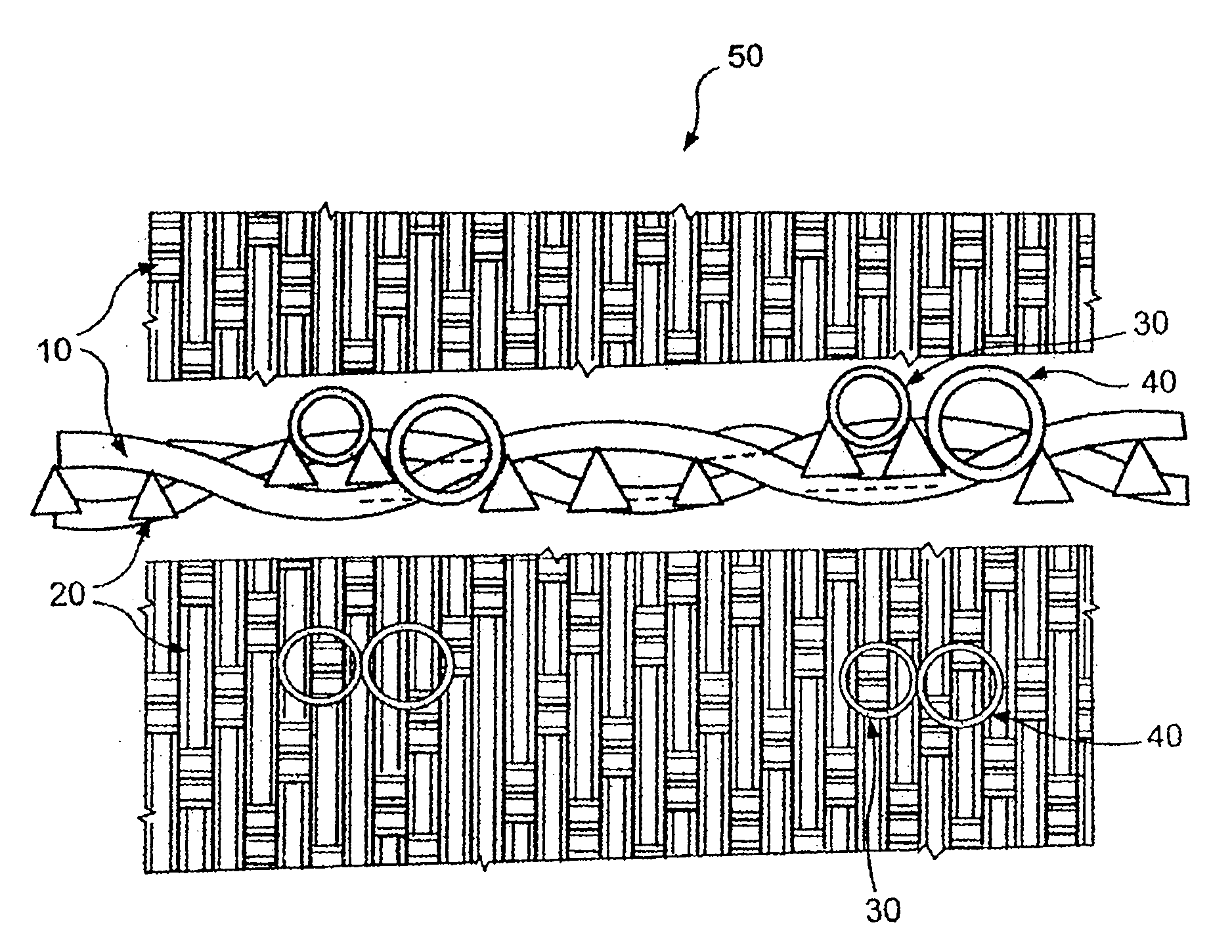
FIG. 1A shows a paper side view and a surface depth map highlighting the relative pocket structure sizes on the paper side surface of a preferred embodiment of the present invention;
FIGS. 1B and 1C show cross-sectional views of a fabric incorporating the teachings of the present invention;
FIG. 1D shows a cross-sectional view of a standard TAD fabric; and
figure 2 shows a "house" shaped cross-section of the yarn.
Detailed Description
The present invention is preferably a TAD fabric having improved pocket depth and pocket volume on the paper side surface of the fabric. The bag structure size is a function of the weave pattern, mesh count and yarn used for the pattern. Pocket dimensions may be characterized by MD/CD dimensions and/or pocket depth. The pocket structure is formed/defined by weft and warp yarns that rise from a base plane of the fabric surface created by the weave pattern used. The pocket size and depth affect the resulting paper properties such as absorbency.
FIG. 1A shows a paper side view and a surface depth map highlighting the relative pocket structure sizes on the paper side surface of a preferred embodiment of the present invention. Weft yarns 20 having a triangular cross-section may be used to form a fabric 50 according to the present embodiment as shown in figure 1A. Although we refer to the weft yarns as having a triangular cross-section, in practice their cross-section may be shaped as shown in figure 1B. As can be seen from the figure, the weft yarn 20 has a somewhat or substantially triangular cross-section with slightly rounded edges 22. Although illustrated as an equilateral triangle with sides 24, other triangular shapes suitable for the present purpose may provide the desired results. In FIG. 1A, the triangular weft yarns 20 are shown extending horizontally, while the warp yarns 10 extend vertically. Weft yarns 20 may be oriented in fabric 50 such that the flat surface or side 24 of the triangle faces the machine side of fabric 50 and the pointed side of the triangle faces the paper or surface side of fabric 50, creating a pocket structure of increased depth at the point where the weft yarns interweave with warp yarns 10 as warp yarns 10 pass over and under triangular weft yarns 20. Figure 1C also shows the profile of the warp yarns 10 for the fabric pattern according to this embodiment. Note that warp yarns 10 are shown as having a circular cross-section. Other shapes of cross-section are also possible which are suitable for this purpose. As can be seen from this outline, the fabric 50 has deeper pocket structures 30, 40, which are correspondingly highlighted on the paper side surface of the fabric 50. It can be observed that the raised weft yarns 20 and the raised warp yarns 10 indicated on the paper side surface of the fabric 50 form pockets 30, 40 at the points where they interweave with each other or at the points where the weft yarns interweave with the warp yarns as they pass over and under the triangular weft yarns 20, resulting in an increased pocket depth.
This orientation of the triangular weft yarns (flat surface facing the machine side) will also greatly change the bottleneck profile of the two 5-shed weave designs discussed in the background of the invention. This means that for a given mesh count, the air permeability of the fabric will also be increased. Thus, by maintaining the same mesh count, the fabric according to the invention will maintain durability in a hot and humid TAD environment and result in increased sheet caliper and absorbency or softness, overcoming the disadvantages of the prior art.
For comparison, a standard TAD fabric woven with yarns having a circular cross-section in the same weave pattern as shown in fig. 1B is shown in fig. 1D. The weft yarns are labeled 20 'and the warp yarns are labeled 10'. If the pocket structure regions 30 'and 40' formed in FIG. 1D are compared to the pocket structures 30 and 40 in FIG. 1B, it can be seen that: the resulting bag structure is larger in fig. 1B because the yarns have a generally triangular cross-section. This can be seen, for example, by the open areas between adjacent yarns, labeled "X" in fig. 1B and "Y" in fig. 1D. Accordingly, the pocket structure formed in the fabric shown in FIG. 1B is larger for yarns having the same linear density, thereby providing advantages.
It is noted that the fabric according to the invention may be formed with any weave pattern, such as plain, twill, paper surface with floats weft or warp dominant, or combinations thereof. The present invention is intended to cover other fabric patterns that vary in the size and shape of the pockets, the depth of the pockets, and the yarn contours. Therefore, it should be understood that the invention is not limited to the preferred embodiments disclosed above.
The fabric according to the invention preferably comprises only monofilament yarns, preferably made of polyester, nylon, polyamide or other polymers. One of ordinary skill in the art will appreciate that any combination of polymers may be used for any yarn. The CD yarns of the fabric may have triangular cross-section yarns of different sizes and may alternate with yarns having different non-triangular cross-sections, such as circular or other shapes. Such alternation may be single alternation, or pair alternation, or other combinations of even or odd yarns in a manner suitable for the purpose. Similarly, the MD yarns may have a circular cross-section with one or more different diameters. Furthermore, in addition to triangular and circular cross-sectional shapes, other shapes such as the "house" shaped yarn 60 shown in FIG. 2 may be desirable. Further, some of the yarns, including the MD yarns, may have other cross-sectional shapes, such as a rectangular cross-sectional shape, or non-circular cross-sectional shapes, such as triangular or substantially triangular.
It will be readily apparent to those skilled in the art that modifications may be made to the invention as described without departing from the scope of the invention. The following claims should be construed to cover such situations.