CN101596191B - Method for treatment of disease using malonyl-coa decarboxylase inhibitor - Google Patents
Method for treatment of disease using malonyl-coa decarboxylase inhibitor Download PDFInfo
- Publication number
- CN101596191B CN101596191B CN2009101395587A CN200910139558A CN101596191B CN 101596191 B CN101596191 B CN 101596191B CN 2009101395587 A CN2009101395587 A CN 2009101395587A CN 200910139558 A CN200910139558 A CN 200910139558A CN 101596191 B CN101596191 B CN 101596191B
- Authority
- CN
- China
- Prior art keywords
- mmol
- malonyl
- compounds
- coa
- compound
- Prior art date
- Legal status (The legal status is an assumption and is not a legal conclusion. Google has not performed a legal analysis and makes no representation as to the accuracy of the status listed.)
- Expired - Fee Related
Links
- 0 *C(C1)=NOC1C(C(F)(F)F)(C(F)(F)F)O Chemical compound *C(C1)=NOC1C(C(F)(F)F)(C(F)(F)F)O 0.000 description 4
- NQRYJNQNLNOLGT-UHFFFAOYSA-N C1CCNCC1 Chemical compound C1CCNCC1 NQRYJNQNLNOLGT-UHFFFAOYSA-N 0.000 description 1
Classifications
-
- C—CHEMISTRY; METALLURGY
- C07—ORGANIC CHEMISTRY
- C07D—HETEROCYCLIC COMPOUNDS
- C07D233/00—Heterocyclic compounds containing 1,3-diazole or hydrogenated 1,3-diazole rings, not condensed with other rings
- C07D233/54—Heterocyclic compounds containing 1,3-diazole or hydrogenated 1,3-diazole rings, not condensed with other rings having two double bonds between ring members or between ring members and non-ring members
- C07D233/64—Heterocyclic compounds containing 1,3-diazole or hydrogenated 1,3-diazole rings, not condensed with other rings having two double bonds between ring members or between ring members and non-ring members with substituted hydrocarbon radicals attached to ring carbon atoms, e.g. histidine
-
- A—HUMAN NECESSITIES
- A61—MEDICAL OR VETERINARY SCIENCE; HYGIENE
- A61K—PREPARATIONS FOR MEDICAL, DENTAL OR TOILETRY PURPOSES
- A61K31/00—Medicinal preparations containing organic active ingredients
- A61K31/16—Amides, e.g. hydroxamic acids
-
- A—HUMAN NECESSITIES
- A61—MEDICAL OR VETERINARY SCIENCE; HYGIENE
- A61K—PREPARATIONS FOR MEDICAL, DENTAL OR TOILETRY PURPOSES
- A61K31/00—Medicinal preparations containing organic active ingredients
- A61K31/33—Heterocyclic compounds
- A61K31/395—Heterocyclic compounds having nitrogen as a ring hetero atom, e.g. guanethidine or rifamycins
- A61K31/41—Heterocyclic compounds having nitrogen as a ring hetero atom, e.g. guanethidine or rifamycins having five-membered rings with two or more ring hetero atoms, at least one of which being nitrogen, e.g. tetrazole
-
- A—HUMAN NECESSITIES
- A61—MEDICAL OR VETERINARY SCIENCE; HYGIENE
- A61K—PREPARATIONS FOR MEDICAL, DENTAL OR TOILETRY PURPOSES
- A61K31/00—Medicinal preparations containing organic active ingredients
- A61K31/33—Heterocyclic compounds
- A61K31/395—Heterocyclic compounds having nitrogen as a ring hetero atom, e.g. guanethidine or rifamycins
- A61K31/41—Heterocyclic compounds having nitrogen as a ring hetero atom, e.g. guanethidine or rifamycins having five-membered rings with two or more ring hetero atoms, at least one of which being nitrogen, e.g. tetrazole
- A61K31/415—1,2-Diazoles
-
- A—HUMAN NECESSITIES
- A61—MEDICAL OR VETERINARY SCIENCE; HYGIENE
- A61K—PREPARATIONS FOR MEDICAL, DENTAL OR TOILETRY PURPOSES
- A61K31/00—Medicinal preparations containing organic active ingredients
- A61K31/33—Heterocyclic compounds
- A61K31/395—Heterocyclic compounds having nitrogen as a ring hetero atom, e.g. guanethidine or rifamycins
- A61K31/41—Heterocyclic compounds having nitrogen as a ring hetero atom, e.g. guanethidine or rifamycins having five-membered rings with two or more ring hetero atoms, at least one of which being nitrogen, e.g. tetrazole
- A61K31/4164—1,3-Diazoles
-
- A—HUMAN NECESSITIES
- A61—MEDICAL OR VETERINARY SCIENCE; HYGIENE
- A61K—PREPARATIONS FOR MEDICAL, DENTAL OR TOILETRY PURPOSES
- A61K31/00—Medicinal preparations containing organic active ingredients
- A61K31/33—Heterocyclic compounds
- A61K31/395—Heterocyclic compounds having nitrogen as a ring hetero atom, e.g. guanethidine or rifamycins
- A61K31/41—Heterocyclic compounds having nitrogen as a ring hetero atom, e.g. guanethidine or rifamycins having five-membered rings with two or more ring hetero atoms, at least one of which being nitrogen, e.g. tetrazole
- A61K31/42—Oxazoles
-
- A—HUMAN NECESSITIES
- A61—MEDICAL OR VETERINARY SCIENCE; HYGIENE
- A61K—PREPARATIONS FOR MEDICAL, DENTAL OR TOILETRY PURPOSES
- A61K31/00—Medicinal preparations containing organic active ingredients
- A61K31/33—Heterocyclic compounds
- A61K31/395—Heterocyclic compounds having nitrogen as a ring hetero atom, e.g. guanethidine or rifamycins
- A61K31/435—Heterocyclic compounds having nitrogen as a ring hetero atom, e.g. guanethidine or rifamycins having six-membered rings with one nitrogen as the only ring hetero atom
- A61K31/44—Non condensed pyridines; Hydrogenated derivatives thereof
-
- A—HUMAN NECESSITIES
- A61—MEDICAL OR VETERINARY SCIENCE; HYGIENE
- A61K—PREPARATIONS FOR MEDICAL, DENTAL OR TOILETRY PURPOSES
- A61K31/00—Medicinal preparations containing organic active ingredients
- A61K31/33—Heterocyclic compounds
- A61K31/395—Heterocyclic compounds having nitrogen as a ring hetero atom, e.g. guanethidine or rifamycins
- A61K31/535—Heterocyclic compounds having nitrogen as a ring hetero atom, e.g. guanethidine or rifamycins having six-membered rings with at least one nitrogen and one oxygen as the ring hetero atoms, e.g. 1,2-oxazines
- A61K31/5375—1,4-Oxazines, e.g. morpholine
-
- A—HUMAN NECESSITIES
- A61—MEDICAL OR VETERINARY SCIENCE; HYGIENE
- A61P—SPECIFIC THERAPEUTIC ACTIVITY OF CHEMICAL COMPOUNDS OR MEDICINAL PREPARATIONS
- A61P3/00—Drugs for disorders of the metabolism
-
- A—HUMAN NECESSITIES
- A61—MEDICAL OR VETERINARY SCIENCE; HYGIENE
- A61P—SPECIFIC THERAPEUTIC ACTIVITY OF CHEMICAL COMPOUNDS OR MEDICINAL PREPARATIONS
- A61P3/00—Drugs for disorders of the metabolism
- A61P3/04—Anorexiants; Antiobesity agents
-
- A—HUMAN NECESSITIES
- A61—MEDICAL OR VETERINARY SCIENCE; HYGIENE
- A61P—SPECIFIC THERAPEUTIC ACTIVITY OF CHEMICAL COMPOUNDS OR MEDICINAL PREPARATIONS
- A61P3/00—Drugs for disorders of the metabolism
- A61P3/08—Drugs for disorders of the metabolism for glucose homeostasis
- A61P3/10—Drugs for disorders of the metabolism for glucose homeostasis for hyperglycaemia, e.g. antidiabetics
-
- A—HUMAN NECESSITIES
- A61—MEDICAL OR VETERINARY SCIENCE; HYGIENE
- A61P—SPECIFIC THERAPEUTIC ACTIVITY OF CHEMICAL COMPOUNDS OR MEDICINAL PREPARATIONS
- A61P3/00—Drugs for disorders of the metabolism
- A61P3/12—Drugs for disorders of the metabolism for electrolyte homeostasis
-
- A—HUMAN NECESSITIES
- A61—MEDICAL OR VETERINARY SCIENCE; HYGIENE
- A61P—SPECIFIC THERAPEUTIC ACTIVITY OF CHEMICAL COMPOUNDS OR MEDICINAL PREPARATIONS
- A61P35/00—Antineoplastic agents
-
- A—HUMAN NECESSITIES
- A61—MEDICAL OR VETERINARY SCIENCE; HYGIENE
- A61P—SPECIFIC THERAPEUTIC ACTIVITY OF CHEMICAL COMPOUNDS OR MEDICINAL PREPARATIONS
- A61P39/00—General protective or antinoxious agents
- A61P39/02—Antidotes
-
- A—HUMAN NECESSITIES
- A61—MEDICAL OR VETERINARY SCIENCE; HYGIENE
- A61P—SPECIFIC THERAPEUTIC ACTIVITY OF CHEMICAL COMPOUNDS OR MEDICINAL PREPARATIONS
- A61P43/00—Drugs for specific purposes, not provided for in groups A61P1/00-A61P41/00
-
- A—HUMAN NECESSITIES
- A61—MEDICAL OR VETERINARY SCIENCE; HYGIENE
- A61P—SPECIFIC THERAPEUTIC ACTIVITY OF CHEMICAL COMPOUNDS OR MEDICINAL PREPARATIONS
- A61P5/00—Drugs for disorders of the endocrine system
-
- A—HUMAN NECESSITIES
- A61—MEDICAL OR VETERINARY SCIENCE; HYGIENE
- A61P—SPECIFIC THERAPEUTIC ACTIVITY OF CHEMICAL COMPOUNDS OR MEDICINAL PREPARATIONS
- A61P9/00—Drugs for disorders of the cardiovascular system
-
- A—HUMAN NECESSITIES
- A61—MEDICAL OR VETERINARY SCIENCE; HYGIENE
- A61P—SPECIFIC THERAPEUTIC ACTIVITY OF CHEMICAL COMPOUNDS OR MEDICINAL PREPARATIONS
- A61P9/00—Drugs for disorders of the cardiovascular system
- A61P9/04—Inotropic agents, i.e. stimulants of cardiac contraction; Drugs for heart failure
-
- A—HUMAN NECESSITIES
- A61—MEDICAL OR VETERINARY SCIENCE; HYGIENE
- A61P—SPECIFIC THERAPEUTIC ACTIVITY OF CHEMICAL COMPOUNDS OR MEDICINAL PREPARATIONS
- A61P9/00—Drugs for disorders of the cardiovascular system
- A61P9/10—Drugs for disorders of the cardiovascular system for treating ischaemic or atherosclerotic diseases, e.g. antianginal drugs, coronary vasodilators, drugs for myocardial infarction, retinopathy, cerebrovascula insufficiency, renal arteriosclerosis
-
- C—CHEMISTRY; METALLURGY
- C07—ORGANIC CHEMISTRY
- C07C—ACYCLIC OR CARBOCYCLIC COMPOUNDS
- C07C215/00—Compounds containing amino and hydroxy groups bound to the same carbon skeleton
- C07C215/02—Compounds containing amino and hydroxy groups bound to the same carbon skeleton having hydroxy groups and amino groups bound to acyclic carbon atoms of the same carbon skeleton
- C07C215/22—Compounds containing amino and hydroxy groups bound to the same carbon skeleton having hydroxy groups and amino groups bound to acyclic carbon atoms of the same carbon skeleton the carbon skeleton being unsaturated
- C07C215/24—Compounds containing amino and hydroxy groups bound to the same carbon skeleton having hydroxy groups and amino groups bound to acyclic carbon atoms of the same carbon skeleton the carbon skeleton being unsaturated and acyclic
-
- C—CHEMISTRY; METALLURGY
- C07—ORGANIC CHEMISTRY
- C07C—ACYCLIC OR CARBOCYCLIC COMPOUNDS
- C07C233/00—Carboxylic acid amides
- C07C233/01—Carboxylic acid amides having carbon atoms of carboxamide groups bound to hydrogen atoms or to acyclic carbon atoms
- C07C233/16—Carboxylic acid amides having carbon atoms of carboxamide groups bound to hydrogen atoms or to acyclic carbon atoms having the nitrogen atom of at least one of the carboxamide groups bound to a carbon atom of a hydrocarbon radical substituted by singly-bound oxygen atoms
- C07C233/17—Carboxylic acid amides having carbon atoms of carboxamide groups bound to hydrogen atoms or to acyclic carbon atoms having the nitrogen atom of at least one of the carboxamide groups bound to a carbon atom of a hydrocarbon radical substituted by singly-bound oxygen atoms with the substituted hydrocarbon radical bound to the nitrogen atom of the carboxamide group by an acyclic carbon atom
- C07C233/22—Carboxylic acid amides having carbon atoms of carboxamide groups bound to hydrogen atoms or to acyclic carbon atoms having the nitrogen atom of at least one of the carboxamide groups bound to a carbon atom of a hydrocarbon radical substituted by singly-bound oxygen atoms with the substituted hydrocarbon radical bound to the nitrogen atom of the carboxamide group by an acyclic carbon atom having the carbon atom of the carboxamide group bound to an acyclic carbon atom of a carbon skeleton containing six-membered aromatic rings
-
- C—CHEMISTRY; METALLURGY
- C07—ORGANIC CHEMISTRY
- C07C—ACYCLIC OR CARBOCYCLIC COMPOUNDS
- C07C307/00—Amides of sulfuric acids, i.e. compounds having singly-bound oxygen atoms of sulfate groups replaced by nitrogen atoms, not being part of nitro or nitroso groups
- C07C307/04—Diamides of sulfuric acids
- C07C307/10—Diamides of sulfuric acids having nitrogen atoms of the sulfamide groups bound to carbon atoms of six-membered aromatic rings
-
- C—CHEMISTRY; METALLURGY
- C07—ORGANIC CHEMISTRY
- C07C—ACYCLIC OR CARBOCYCLIC COMPOUNDS
- C07C323/00—Thiols, sulfides, hydropolysulfides or polysulfides substituted by halogen, oxygen or nitrogen atoms, or by sulfur atoms not being part of thio groups
- C07C323/10—Thiols, sulfides, hydropolysulfides or polysulfides substituted by halogen, oxygen or nitrogen atoms, or by sulfur atoms not being part of thio groups containing thio groups and singly-bound oxygen atoms bound to the same carbon skeleton
- C07C323/11—Thiols, sulfides, hydropolysulfides or polysulfides substituted by halogen, oxygen or nitrogen atoms, or by sulfur atoms not being part of thio groups containing thio groups and singly-bound oxygen atoms bound to the same carbon skeleton having the sulfur atoms of the thio groups bound to acyclic carbon atoms of the carbon skeleton
- C07C323/14—Thiols, sulfides, hydropolysulfides or polysulfides substituted by halogen, oxygen or nitrogen atoms, or by sulfur atoms not being part of thio groups containing thio groups and singly-bound oxygen atoms bound to the same carbon skeleton having the sulfur atoms of the thio groups bound to acyclic carbon atoms of the carbon skeleton the carbon skeleton being acyclic and unsaturated
-
- C—CHEMISTRY; METALLURGY
- C07—ORGANIC CHEMISTRY
- C07C—ACYCLIC OR CARBOCYCLIC COMPOUNDS
- C07C33/00—Unsaturated compounds having hydroxy or O-metal groups bound to acyclic carbon atoms
- C07C33/40—Halogenated unsaturated alcohols
- C07C33/46—Halogenated unsaturated alcohols containing only six-membered aromatic rings as cyclic parts
- C07C33/48—Halogenated unsaturated alcohols containing only six-membered aromatic rings as cyclic parts with unsaturation outside the aromatic rings
-
- C—CHEMISTRY; METALLURGY
- C07—ORGANIC CHEMISTRY
- C07D—HETEROCYCLIC COMPOUNDS
- C07D239/00—Heterocyclic compounds containing 1,3-diazine or hydrogenated 1,3-diazine rings
- C07D239/02—Heterocyclic compounds containing 1,3-diazine or hydrogenated 1,3-diazine rings not condensed with other rings
- C07D239/24—Heterocyclic compounds containing 1,3-diazine or hydrogenated 1,3-diazine rings not condensed with other rings having three or more double bonds between ring members or between ring members and non-ring members
- C07D239/28—Heterocyclic compounds containing 1,3-diazine or hydrogenated 1,3-diazine rings not condensed with other rings having three or more double bonds between ring members or between ring members and non-ring members with hetero atoms or with carbon atoms having three bonds to hetero atoms with at the most one bond to halogen, directly attached to ring carbon atoms
- C07D239/32—One oxygen, sulfur or nitrogen atom
- C07D239/42—One nitrogen atom
-
- C—CHEMISTRY; METALLURGY
- C07—ORGANIC CHEMISTRY
- C07D—HETEROCYCLIC COMPOUNDS
- C07D261/00—Heterocyclic compounds containing 1,2-oxazole or hydrogenated 1,2-oxazole rings
- C07D261/02—Heterocyclic compounds containing 1,2-oxazole or hydrogenated 1,2-oxazole rings not condensed with other rings
- C07D261/04—Heterocyclic compounds containing 1,2-oxazole or hydrogenated 1,2-oxazole rings not condensed with other rings having one double bond between ring members or between a ring member and a non-ring member
-
- C—CHEMISTRY; METALLURGY
- C07—ORGANIC CHEMISTRY
- C07D—HETEROCYCLIC COMPOUNDS
- C07D261/00—Heterocyclic compounds containing 1,2-oxazole or hydrogenated 1,2-oxazole rings
- C07D261/02—Heterocyclic compounds containing 1,2-oxazole or hydrogenated 1,2-oxazole rings not condensed with other rings
- C07D261/06—Heterocyclic compounds containing 1,2-oxazole or hydrogenated 1,2-oxazole rings not condensed with other rings having two or more double bonds between ring members or between ring members and non-ring members
- C07D261/08—Heterocyclic compounds containing 1,2-oxazole or hydrogenated 1,2-oxazole rings not condensed with other rings having two or more double bonds between ring members or between ring members and non-ring members with only hydrogen atoms, hydrocarbon or substituted hydrocarbon radicals, directly attached to ring carbon atoms
-
- C—CHEMISTRY; METALLURGY
- C07—ORGANIC CHEMISTRY
- C07D—HETEROCYCLIC COMPOUNDS
- C07D277/00—Heterocyclic compounds containing 1,3-thiazole or hydrogenated 1,3-thiazole rings
- C07D277/02—Heterocyclic compounds containing 1,3-thiazole or hydrogenated 1,3-thiazole rings not condensed with other rings
- C07D277/20—Heterocyclic compounds containing 1,3-thiazole or hydrogenated 1,3-thiazole rings not condensed with other rings having two or three double bonds between ring members or between ring members and non-ring members
- C07D277/32—Heterocyclic compounds containing 1,3-thiazole or hydrogenated 1,3-thiazole rings not condensed with other rings having two or three double bonds between ring members or between ring members and non-ring members with hetero atoms or with carbon atoms having three bonds to hetero atoms with at the most one bond to halogen, e.g. ester or nitrile radicals, directly attached to ring carbon atoms
- C07D277/38—Nitrogen atoms
- C07D277/44—Acylated amino or imino radicals
- C07D277/46—Acylated amino or imino radicals by carboxylic acids, or sulfur or nitrogen analogues thereof
-
- C—CHEMISTRY; METALLURGY
- C07—ORGANIC CHEMISTRY
- C07D—HETEROCYCLIC COMPOUNDS
- C07D277/00—Heterocyclic compounds containing 1,3-thiazole or hydrogenated 1,3-thiazole rings
- C07D277/02—Heterocyclic compounds containing 1,3-thiazole or hydrogenated 1,3-thiazole rings not condensed with other rings
- C07D277/20—Heterocyclic compounds containing 1,3-thiazole or hydrogenated 1,3-thiazole rings not condensed with other rings having two or three double bonds between ring members or between ring members and non-ring members
- C07D277/32—Heterocyclic compounds containing 1,3-thiazole or hydrogenated 1,3-thiazole rings not condensed with other rings having two or three double bonds between ring members or between ring members and non-ring members with hetero atoms or with carbon atoms having three bonds to hetero atoms with at the most one bond to halogen, e.g. ester or nitrile radicals, directly attached to ring carbon atoms
- C07D277/38—Nitrogen atoms
- C07D277/44—Acylated amino or imino radicals
- C07D277/48—Acylated amino or imino radicals by radicals derived from carbonic acid, or sulfur or nitrogen analogues thereof, e.g. carbonylguanidines
-
- C—CHEMISTRY; METALLURGY
- C07—ORGANIC CHEMISTRY
- C07D—HETEROCYCLIC COMPOUNDS
- C07D277/00—Heterocyclic compounds containing 1,3-thiazole or hydrogenated 1,3-thiazole rings
- C07D277/02—Heterocyclic compounds containing 1,3-thiazole or hydrogenated 1,3-thiazole rings not condensed with other rings
- C07D277/20—Heterocyclic compounds containing 1,3-thiazole or hydrogenated 1,3-thiazole rings not condensed with other rings having two or three double bonds between ring members or between ring members and non-ring members
- C07D277/32—Heterocyclic compounds containing 1,3-thiazole or hydrogenated 1,3-thiazole rings not condensed with other rings having two or three double bonds between ring members or between ring members and non-ring members with hetero atoms or with carbon atoms having three bonds to hetero atoms with at the most one bond to halogen, e.g. ester or nitrile radicals, directly attached to ring carbon atoms
- C07D277/38—Nitrogen atoms
- C07D277/50—Nitrogen atoms bound to hetero atoms
- C07D277/52—Nitrogen atoms bound to hetero atoms to sulfur atoms, e.g. sulfonamides
-
- C—CHEMISTRY; METALLURGY
- C07—ORGANIC CHEMISTRY
- C07D—HETEROCYCLIC COMPOUNDS
- C07D285/00—Heterocyclic compounds containing rings having nitrogen and sulfur atoms as the only ring hetero atoms, not provided for by groups C07D275/00 - C07D283/00
- C07D285/01—Five-membered rings
- C07D285/02—Thiadiazoles; Hydrogenated thiadiazoles
- C07D285/04—Thiadiazoles; Hydrogenated thiadiazoles not condensed with other rings
- C07D285/12—1,3,4-Thiadiazoles; Hydrogenated 1,3,4-thiadiazoles
- C07D285/125—1,3,4-Thiadiazoles; Hydrogenated 1,3,4-thiadiazoles with oxygen, sulfur or nitrogen atoms, directly attached to ring carbon atoms, the nitrogen atoms not forming part of a nitro radical
- C07D285/135—Nitrogen atoms
-
- C—CHEMISTRY; METALLURGY
- C07—ORGANIC CHEMISTRY
- C07D—HETEROCYCLIC COMPOUNDS
- C07D307/00—Heterocyclic compounds containing five-membered rings having one oxygen atom as the only ring hetero atom
- C07D307/02—Heterocyclic compounds containing five-membered rings having one oxygen atom as the only ring hetero atom not condensed with other rings
- C07D307/34—Heterocyclic compounds containing five-membered rings having one oxygen atom as the only ring hetero atom not condensed with other rings having two or three double bonds between ring members or between ring members and non-ring members
- C07D307/38—Heterocyclic compounds containing five-membered rings having one oxygen atom as the only ring hetero atom not condensed with other rings having two or three double bonds between ring members or between ring members and non-ring members with substituted hydrocarbon radicals attached to ring carbon atoms
- C07D307/40—Radicals substituted by oxygen atoms
- C07D307/46—Doubly bound oxygen atoms, or two oxygen atoms singly bound to the same carbon atom
-
- C—CHEMISTRY; METALLURGY
- C07—ORGANIC CHEMISTRY
- C07D—HETEROCYCLIC COMPOUNDS
- C07D401/00—Heterocyclic compounds containing two or more hetero rings, having nitrogen atoms as the only ring hetero atoms, at least one ring being a six-membered ring with only one nitrogen atom
- C07D401/02—Heterocyclic compounds containing two or more hetero rings, having nitrogen atoms as the only ring hetero atoms, at least one ring being a six-membered ring with only one nitrogen atom containing two hetero rings
- C07D401/12—Heterocyclic compounds containing two or more hetero rings, having nitrogen atoms as the only ring hetero atoms, at least one ring being a six-membered ring with only one nitrogen atom containing two hetero rings linked by a chain containing hetero atoms as chain links
-
- C—CHEMISTRY; METALLURGY
- C07—ORGANIC CHEMISTRY
- C07D—HETEROCYCLIC COMPOUNDS
- C07D413/00—Heterocyclic compounds containing two or more hetero rings, at least one ring having nitrogen and oxygen atoms as the only ring hetero atoms
- C07D413/02—Heterocyclic compounds containing two or more hetero rings, at least one ring having nitrogen and oxygen atoms as the only ring hetero atoms containing two hetero rings
- C07D413/06—Heterocyclic compounds containing two or more hetero rings, at least one ring having nitrogen and oxygen atoms as the only ring hetero atoms containing two hetero rings linked by a carbon chain containing only aliphatic carbon atoms
-
- C—CHEMISTRY; METALLURGY
- C07—ORGANIC CHEMISTRY
- C07D—HETEROCYCLIC COMPOUNDS
- C07D413/00—Heterocyclic compounds containing two or more hetero rings, at least one ring having nitrogen and oxygen atoms as the only ring hetero atoms
- C07D413/02—Heterocyclic compounds containing two or more hetero rings, at least one ring having nitrogen and oxygen atoms as the only ring hetero atoms containing two hetero rings
- C07D413/12—Heterocyclic compounds containing two or more hetero rings, at least one ring having nitrogen and oxygen atoms as the only ring hetero atoms containing two hetero rings linked by a chain containing hetero atoms as chain links
-
- C—CHEMISTRY; METALLURGY
- C07—ORGANIC CHEMISTRY
- C07D—HETEROCYCLIC COMPOUNDS
- C07D417/00—Heterocyclic compounds containing two or more hetero rings, at least one ring having nitrogen and sulfur atoms as the only ring hetero atoms, not provided for by group C07D415/00
- C07D417/02—Heterocyclic compounds containing two or more hetero rings, at least one ring having nitrogen and sulfur atoms as the only ring hetero atoms, not provided for by group C07D415/00 containing two hetero rings
- C07D417/12—Heterocyclic compounds containing two or more hetero rings, at least one ring having nitrogen and sulfur atoms as the only ring hetero atoms, not provided for by group C07D415/00 containing two hetero rings linked by a chain containing hetero atoms as chain links
-
- C—CHEMISTRY; METALLURGY
- C07—ORGANIC CHEMISTRY
- C07D—HETEROCYCLIC COMPOUNDS
- C07D417/00—Heterocyclic compounds containing two or more hetero rings, at least one ring having nitrogen and sulfur atoms as the only ring hetero atoms, not provided for by group C07D415/00
- C07D417/14—Heterocyclic compounds containing two or more hetero rings, at least one ring having nitrogen and sulfur atoms as the only ring hetero atoms, not provided for by group C07D415/00 containing three or more hetero rings
-
- C—CHEMISTRY; METALLURGY
- C07—ORGANIC CHEMISTRY
- C07D—HETEROCYCLIC COMPOUNDS
- C07D487/00—Heterocyclic compounds containing nitrogen atoms as the only ring hetero atoms in the condensed system, not provided for by groups C07D451/00 - C07D477/00
- C07D487/02—Heterocyclic compounds containing nitrogen atoms as the only ring hetero atoms in the condensed system, not provided for by groups C07D451/00 - C07D477/00 in which the condensed system contains two hetero rings
- C07D487/08—Bridged systems
-
- C—CHEMISTRY; METALLURGY
- C07—ORGANIC CHEMISTRY
- C07F—ACYCLIC, CARBOCYCLIC OR HETEROCYCLIC COMPOUNDS CONTAINING ELEMENTS OTHER THAN CARBON, HYDROGEN, HALOGEN, OXYGEN, NITROGEN, SULFUR, SELENIUM OR TELLURIUM
- C07F9/00—Compounds containing elements of Groups 5 or 15 of the Periodic Table
- C07F9/02—Phosphorus compounds
- C07F9/547—Heterocyclic compounds, e.g. containing phosphorus as a ring hetero atom
- C07F9/6536—Heterocyclic compounds, e.g. containing phosphorus as a ring hetero atom having nitrogen and sulfur atoms with or without oxygen atoms, as the only ring hetero atoms
- C07F9/6539—Five-membered rings
Landscapes
- Chemical & Material Sciences (AREA)
- Organic Chemistry (AREA)
- Health & Medical Sciences (AREA)
- General Health & Medical Sciences (AREA)
- Life Sciences & Earth Sciences (AREA)
- Public Health (AREA)
- Medicinal Chemistry (AREA)
- Pharmacology & Pharmacy (AREA)
- Animal Behavior & Ethology (AREA)
- Veterinary Medicine (AREA)
- Epidemiology (AREA)
- Nuclear Medicine, Radiotherapy & Molecular Imaging (AREA)
- Bioinformatics & Cheminformatics (AREA)
- General Chemical & Material Sciences (AREA)
- Engineering & Computer Science (AREA)
- Chemical Kinetics & Catalysis (AREA)
- Diabetes (AREA)
- Hematology (AREA)
- Obesity (AREA)
- Cardiology (AREA)
- Heart & Thoracic Surgery (AREA)
- Biochemistry (AREA)
- Molecular Biology (AREA)
- Endocrinology (AREA)
- Toxicology (AREA)
- Emergency Medicine (AREA)
- Child & Adolescent Psychology (AREA)
- Urology & Nephrology (AREA)
- Hospice & Palliative Care (AREA)
- Vascular Medicine (AREA)
- Pharmaceuticals Containing Other Organic And Inorganic Compounds (AREA)
- Acyclic And Carbocyclic Compounds In Medicinal Compositions (AREA)
- Organic Low-Molecular-Weight Compounds And Preparation Thereof (AREA)
- Plural Heterocyclic Compounds (AREA)
- Furan Compounds (AREA)
- Nitrogen Condensed Heterocyclic Rings (AREA)
- Heterocyclic Carbon Compounds Containing A Hetero Ring Having Nitrogen And Oxygen As The Only Ring Hetero Atoms (AREA)
- Thiazole And Isothizaole Compounds (AREA)
- Nitrogen- Or Sulfur-Containing Heterocyclic Ring Compounds With Rings Of Six Or More Members (AREA)
Abstract
Description
本申请是中国发明申请(发明名称:用作代谢调节剂的丙二酰基辅酶A脱羧酶抑制剂;申请号:02803537.2;申请日:2002年01月22日)的分案申请。This application is a divisional application of the Chinese invention application (invention name: malonyl-CoA decarboxylase inhibitor used as a metabolic regulator; application number: 02803537.2; application date: January 22, 2002).
本申请要求享有2000年1月26日提交的美国临时申请60/264552的优先权。全部的公开在此引入作为参考。This application claims priority to US Provisional Application 60/264552, filed January 26,2000. The entire disclosure is incorporated herein by reference.
发明领域field of invention
本发明涉及新的化合物,它们的前体药物,和药学可接受盐以及包含这种化合物的药物组合物,可用于治疗某些代谢疾病和通过丙二酰基辅酶A脱羧酶(丙二酰基-CoA脱羧酶,MCD)的抑制作用而调节的疾病。具体地说,本发明涉及化合物和组合物和通过丙二酰基辅酶A脱羧酶的抑制作用来预防、控制和治疗心血管疾病、糖尿病、酸中毒、癌症和肥胖的方法。The present invention relates to novel compounds, their prodrugs, and pharmaceutically acceptable salts as well as pharmaceutical compositions containing such compounds, useful for the treatment of certain metabolic diseases and for the transfer of malonyl-CoA decarboxylase (malonyl-CoA Decarboxylase, MCD) inhibition of the disease. In particular, the present invention relates to compounds and compositions and methods for the prevention, control and treatment of cardiovascular disease, diabetes, acidosis, cancer and obesity by inhibition of malonyl-CoA decarboxylase.
背景技术Background technique
丙二酰基辅酶A为一种由乙酰辅酶A羧化酶(ACC)在体内制造的重要代谢中间体。在肝、脂肪细胞及其它组织中,丙二酰基辅酶A为脂肪酸合酶(FAS)的底物。在脂肪酸合酶水平较低的骨骼肌和心肌组织中发现了ACC和丙二酰基辅酶A。丙二酰基辅酶A脱羧酶(MCD,EC 4.1.1.9)催化丙二酰基辅酶A向乙酰辅酶A的转化,并由此调节丙二酰基辅酶A的水平。人们已经在一大批生物体,包括原核生物、鸟、和哺乳动物中描述了MCD活性。人们已经从细菌车轴草根瘤菌(Rhizobium trifolii)(An等人,J.Biochem.Mol.Biol.32:414-418(1999)),水鸟尾脂腺(Buckner等人,Arch.Biochem.Biophys177:539(1976);Kim和Kolattukudy,Arch.Biochem.Biophys 190:585(1978)),大鼠的肝线粒体(Kim和Kolattukudy,Arch.Biochem.Biophys.190:234(1978)),大鼠的乳腺(Kim和Kolattukudy,Biochim.Biophys,Acta 531:187(1978)),大鼠的胰腺β-细胞(Voilley等人,Biochem.J.340:213(1999))和鹅(Anser anser)(Jang等人,J.Biol.Chem.264:3500(1989))中提纯出MCD。通过确定MCD不足的病人,实现了与鹅和大鼠MCD基因同源的人基因克隆。(Gao等人,J.Lipid.Res.40:178(1999);Sacksteder等人,J.Biol.Chem.274:24461(1999);FitzPatrick等人,Am.J.Hum.Genet.65:318(1999))。单独人MCDmRNA可通过Northern印迹分析观察。mRNA表达水平在肌肉和心脏组织中最高,其次为肝,肾和胰腺,在所有被检测的其它组织中都有可检测的量。Malonyl-CoA is an important metabolic intermediate produced in vivo by acetyl-CoA carboxylase (ACC). In liver, adipocytes, and other tissues, malonyl-CoA is a substrate for fatty acid synthase (FAS). ACC and malonyl-CoA were found in skeletal and cardiac muscle tissues with low levels of fatty acid synthase. Malonyl-CoA decarboxylase (MCD, EC 4.1.1.9) catalyzes the conversion of malonyl-CoA to acetyl-CoA and thereby regulates malonyl-CoA levels. MCD activity has been described in a wide range of organisms, including prokaryotes, birds, and mammals. People have obtained from the bacteria Trifolium rhizobium (Rhizobium trifolii) (An et al., J.Biochem.Mol.Biol.32:414-418 (1999)), water bird tail fat gland (Buckner et al., Arch.Biochem.Biophys177: 539 (1976); Kim and Kolattukudy, Arch. Biochem. Biophys 190:585 (1978)), liver mitochondria of rats (Kim and Kolattukudy, Arch. Biochem. Biophys. 190:234 (1978)), mammary glands of rats (Kim and Kolattukudy, Biochim.Biophys, Acta 531:187 (1978)), rat pancreatic β-cells (Voilley et al., Biochem.J.340:213 (1999)) and goose (Anser anser) (Jang et al. MCD was purified in J. Biol. Chem. 264:3500 (1989)). Cloning of human genes homologous to goose and rat MCD genes was achieved by identifying MCD-deficient patients. (Gao et al., J.Lipid.Res.40:178 (1999); Sacksteder et al., J.Biol.Chem.274:24461 (1999); FitzPatrick et al., Am.J.Hum.Genet.65:318 (1999)). Human MCD mRNA alone can be visualized by Northern blot analysis. mRNA expression levels were highest in muscle and heart tissues, followed by liver, kidney and pancreas, with detectable amounts in all other tissues examined.
丙二酰基辅酶A为一种强效的肉碱棕榈酰转移酶-I(CPT-I)的内源性抑制物,其为一种对于长链脂肪酸的代谢不可缺少的酶。CPT-I为脂肪酸氧化的限速酶和催化酰基肉碱的形成,其是由酰基肉碱移位酶从细胞溶质转移穿过线粒体膜运输的。在线粒体内部,长链脂肪酸被互补酶CPT-II转移回辅酶A形式,而在线粒体中,酰基辅酶A进入β-氧化途径产生乙酰辅酶A。在肝脏中,乙酰辅酶A的高水平是在例如饭后发生的,这引起丙二酰基辅酶A水平升高,而抑制CPT-I,由此阻止了脂肪代谢并有利于脂肪合成。相反地,低丙二酰基辅酶A水平通过将长链脂肪酸运输到线粒体中而有利于脂肪酸的代谢。因此,丙二酰基辅酶A是一种中心代谢物,在平衡脂肪酸合成和脂肪酸氧化中起到关键的作用(Zammit,Biochem.J.343:5050-515(1999))。新近的工作表明MCD能够调节细胞质以及线粒体的丙二酰基辅酶A水平[Alam和Saggerson,Biochem J.334:233-241(1998);Dyck等人,Am J Physiology 275:H2 122-2129(1998)]。Malonyl-CoA is a potent endogenous inhibitor of carnitine palmitoyltransferase-I (CPT-I), an enzyme essential for the metabolism of long-chain fatty acids. CPT-1 is the rate-limiting enzyme for fatty acid oxidation and catalyzes the formation of acylcarnitines, which are transported by acylcarnitine translocases from the cytosol across the mitochondrial membrane. Inside the mitochondria, long-chain fatty acids are transferred back to the CoA form by the complementary enzyme CPT-II, while in the mitochondria, acyl-CoA enters the β-oxidation pathway to produce acetyl-CoA. In the liver, high levels of acetyl-CoA occur, for example, after a meal, which causes an increase in malonyl-CoA levels, which inhibits CPT-I, thereby preventing fat metabolism and favoring fat synthesis. Conversely, low malonyl-CoA levels favor fatty acid metabolism by transporting long-chain fatty acids into mitochondria. Thus, malonyl-CoA is a central metabolite that plays a key role in balancing fatty acid synthesis and fatty acid oxidation (Zammit, Biochem. J. 343:5050-515 (1999)). Recent work has shown that MCD can regulate cytoplasmic as well as mitochondrial malonyl-CoA levels [Alam and Saggerson, Biochem J. 334:233-241 (1998); Dyck et al., Am J Physiology 275: H 2 122-2129 (1998 )].
尽管丙二酰基辅酶A存在于肌肉和心脏组织中,但在这些组织中仅仅检测到低水平的FAS。人们相信这些组织中的丙二酰基辅酶A和MCD的作用是调节脂肪酸代谢。这可通过丙二酰基辅酶A对CPTI的肌肉(M)和肝(L)同工型(isoform)的抑制作用而获得,同工型酶是通过不同的基因编码的(McGarry和Brown,Eur.J.Biochem.244:1-14(1997))。肌肉同工型(IC500.03μM)对丙二酰基辅酶A抑制作用比肝脏同工型(IC50 2.5μL)更敏感。已经有人描述了在肝脏,心脏,骨骼肌和胰腺β-细胞中丙二酰基辅酶A对CPT-I调节的现象。另外,已经有人描述存在于微粒体可能是向内质网中递送酰基基团的部分体系中丙二酰基辅酶A敏感的酰基辅酶A转移酶的活性(Fraser等人,FEBS Left.446:69-74(1999))。Although malonyl-CoA is present in muscle and heart tissue, only low levels of FAS were detected in these tissues. Malonyl-CoA and MCD in these tissues are believed to function to regulate fatty acid metabolism. This is achieved by malonyl-CoA inhibition of the muscle (M) and liver (L) isoforms of CPTI, which are encoded by separate genes (McGarry and Brown, Eur. J. Biochem. 244:1-14 (1997)). The muscle isoform (IC 50 0.03 μM) is more sensitive to malonyl-CoA inhibition than the liver isoform (IC 50 2.5 μL). Malonyl-CoA regulation of CPT-I has been described in liver, heart, skeletal muscle and pancreatic β-cells. In addition, the activity of malonyl-CoA-sensitive acyl-CoA transferases present in microsomes that may be part of the system that delivers acyl groups to the endoplasmic reticulum has been described (Fraser et al., FEBS Left. 446:69- 74 (1999)).
心血管疾病:健康人的心脏能够利用已有的代谢底物。当血糖水平高时,葡萄糖的摄取和代谢给心脏提供主要的能源。在禁食状态下,脂质是由脂肪组织提供的,而心脏中脂肪酸的摄取和代谢下调葡萄糖代谢。由脂肪酸和葡萄糖的血清水平来调节的中间代谢包括葡萄糖-脂肪酸循环(Randle等人,Lancet,1:785-789(1963))。在缺血性条件下,有限的供氧既减少了脂肪酸和葡萄糖的氧化又减少了由心脏组织中的氧化磷酸化制造的ATP的量。在没有足够氧的情况下,糖酵解增加以维持ATP水平,并导致乳酸盐的累积和胞内pH值的下降。需要能量以维持离子平衡,而异常低的ATP水平和被破坏的细胞同渗容摩(osmolarity)导致肌细胞的死亡。另外,在局部缺血期间被激活的AMPK发生磷酸化并由此使ACC失去活性。心脏丙二酰基辅酶A的总水平下降,因此CPT-I活性增加,且脂肪酸氧化优于葡萄糖氧化。心脏组织中的代谢调节剂的有益效果是与脂肪酸相比增加了对于葡萄糖的ATP/摩尔氧的效率,且更重要地是增加了糖酵解与葡萄糖氧化的结合,从而导致缺血性组织中的质子负荷的净减少。Cardiovascular disease: The heart of a healthy person is able to utilize existing metabolic substrates. When blood sugar levels are high, the uptake and metabolism of glucose provides the heart with its main energy source. In the fasted state, lipids are provided by adipose tissue, and fatty acid uptake and metabolism in the heart downregulate glucose metabolism. Intermediary metabolism regulated by serum levels of fatty acids and glucose includes the glucose-fatty acid cycle (Randle et al., Lancet, 1:785-789 (1963)). Under ischemic conditions, limited oxygen supply reduces both fatty acid and glucose oxidation and the amount of ATP produced by oxidative phosphorylation in cardiac tissue. In the absence of sufficient oxygen, glycolysis increases to maintain ATP levels, leading to the accumulation of lactate and a drop in intracellular pH. Energy is required to maintain ionic balance, and abnormally low ATP levels and disrupted cellular osmolarity lead to the death of muscle cells. In addition, AMPK, which is activated during ischemia, phosphorylates and thereby inactivates ACC. Total levels of cardiac malonyl-CoA are decreased, thus CPT-I activity is increased, and fatty acid oxidation is preferred over glucose oxidation. The beneficial effect of metabolic modulators in cardiac tissue is to increase the efficiency of ATP/mole of oxygen for glucose compared to fatty acids, and more importantly to increase the coupling of glycolysis and glucose oxidation, resulting in The net reduction in proton load.
许多临床和实验研究表明,心脏中针对葡萄糖氧化而变化的能量代谢是减少与心血管疾病有关的症状,例如但不局限于,心肌缺血的有效手段(Hearse,“Metabolic approaches to ischemic heart disease and its management”,Science Press)。一些临床证明的抗绞痛药物包括冠心宁(perhexiline)和乙胺碘呋酮(amiodarone)是通过CPT-I的抑制来抑制脂肪酸氧化的(Kennedy等人,Biochem.Pharmacology,52:273(1996))。抗心绞痛药拉洛来静(ranolazine),目前正处于III期临床试验阶段,和三甲氧苄嗪显示出可抑制脂肪酸β-氧化(McCormack等人,Genet.Pharmac.30:639(1998),Pepine等人,Am.J.Cardiology 84:46(1999))。已经证明三甲氧苄嗪能特定地抑制长链3-酮乙酰基辅酶A硫解酶,这是脂肪酸氧化中的必要步骤。(Kantor等人,Circ.Res.86:580588(2000))。二氯乙酸盐通过刺激丙酮酸脱氢酶复合物来增加葡萄糖氧化作用,并改善患有冠状动脉疾病的病人的心脏功能(Wargovich等人,Am.J.Cardiol.61:65-70(1996))。通过用MCD抑制剂增加丙二酰基辅酶A水平来抑制CPT-I活性将得到不仅是一种新的,而且还是一种与其它已知的小分子CPT-I抑制剂相比更安全的,用于预防和治疗心血管疾病的方法。Numerous clinical and experimental studies have shown that altered energy metabolism in the heart in response to glucose oxidation is an effective means of reducing symptoms associated with cardiovascular disease, such as, but not limited to, myocardial ischemia (Hearse, “Metabolic approaches to ischemic heart disease and its management”, Science Press). Some clinically proven anti-colic drugs, including perhexiline and amiodarone, inhibit fatty acid oxidation through the inhibition of CPT-1 (Kennedy et al., Biochem.Pharmacology, 52:273 (1996 )). The antianginal drugs ranolazine, currently in Phase III clinical trials, and trimetazine have been shown to inhibit fatty acid β-oxidation (McCormack et al., Genet.Pharmac. 30:639 (1998), Pepine et al., Am. J. Cardiology 84:46 (1999)). Trimethazine has been shown to specifically inhibit long-chain 3-ketoacetyl-CoA thiolase, an essential step in fatty acid oxidation. (Kantor et al., Circ. Res. 86:580588 (2000)). Dichloroacetate increases glucose oxidation by stimulating the pyruvate dehydrogenase complex and improves cardiac function in patients with coronary artery disease (Wargovich et al., Am.J.Cardiol.61:65-70 (1996 )). Inhibition of CPT-I activity by increasing malonyl-CoA levels with MCD inhibitors would result in not only a new, but also a safer approach compared to other known small molecule CPT-I inhibitors, with methods for the prevention and treatment of cardiovascular disease.
在甘油-脂质合成中的大部分步骤发生在肝脏内质网(ER)膜的细胞溶质的(cytosolic)侧面上。针对ER内部的分泌,由二酰基甘油(DAG)和酰基辅酶A进行的三酰基甘油(TAG)合成依赖于穿过ER膜的酰基辅酶A的运输。该运输依赖于丙二酰基辅酶A敏感的酰基辅酶A转移酶活性(Zammit,Biochem.J.343:505(1999)Abo-Hashema,Biochem.38:15840(1999)和Abo-Hashema,J.Biol.Chem.274:35577(1999))。用MCD抑制剂来抑制TAG的生物合成可以改善血脂曲线(profile),因此减少冠状动脉病病人的危险指数。Most of the steps in glycerol-lipid synthesis occur on the cytosolic side of the endoplasmic reticulum (ER) membrane of the liver. For secretion inside the ER, triacylglycerol (TAG) synthesis from diacylglycerol (DAG) and acyl-CoA depends on the transport of acyl-CoA across the ER membrane. This trafficking is dependent on malonyl-CoA-sensitive acyl-CoA transferase activity (Zammit, Biochem. J. 343:505 (1999) Abo-Hashema, Biochem. 38: 15840 (1999) and Abo-Hashema, J. Biol . Chem. 274:35577 (1999)). Inhibition of TAG biosynthesis with MCD inhibitors can improve the lipid profile, thereby reducing the risk index of patients with coronary artery disease.
糖尿病:与糖尿病有关的最常见的两种代谢并发症是酮体(在NIDDM中)的肝性生产过剩和与持续升高的葡萄糖水平有关的器官毒性。抑制脂肪酸氧化可以调节血液-葡萄糖水平和改善一些II型糖尿病的症状。CPT-I的丙二酰基辅酶A抑制作用是在胰岛素分泌过少(hypoinsalinemic)-血糖素增高(hyperglucagonemic)症发病期间控制脂肪酸氧化率的最重要的调节机制。人们已经对几种不可逆和可逆的CPT-I抑制剂控制血糖水平的能力进行了评价,它们全部都是低血糖症的抑制剂(Anderson,Current PharmaceuticalDesign 4:1(1998))。一种肝脏特异的和可逆的CPT-抑制剂,SDZ-CPI-975,能显著地降低正常禁食18小时的非人的灵长类动物和大鼠的葡萄糖水平,而没有引起心脏肥大(Deems等人,Am.J.Physiology 274:R524(1998))。丙二酰基辅酶A起到一种作为胰腺β-细胞中的葡萄糖和脂肪酸的相对量的传感器的重要的作用,并因而使葡萄糖代谢作用与细胞能量状态和胰岛素分泌联系起来。已经表明胰岛素促分泌素可提高β-细胞中的丙二酰基辅酶A浓度(Prentki等人,Diabetes 45:273(1996))。然而,用CPT-I抑制剂直接治疗糖尿病导致基于机制的肝和心肌毒性的。因而通过增加其内源性抑制物,丙二酰基辅酶A,而抑制CPT-I的MCD抑制剂是与CPT-I抑制剂相比更安全和更优良的用于治疗糖尿病的抑制剂。Diabetes: The two most common metabolic complications associated with diabetes are hepatic overproduction of ketone bodies (in NIDDM) and organ toxicity associated with persistently elevated glucose levels. Inhibition of fatty acid oxidation can regulate blood-glucose levels and improve some symptoms of type 2 diabetes. Malonyl-CoA inhibition of CPT-I is the most important regulatory mechanism controlling the rate of fatty acid oxidation during the onset of hypoinsulinemic-hyperglucagonemic disease. Several irreversible and reversible CPT-I inhibitors have been evaluated for their ability to control blood glucose levels, all of which are inhibitors of hypoglycemia (Anderson, Current Pharmaceutical Design 4:1 (1998)). A liver-specific and reversible CPT-inhibitor, SDZ-CPI-975, significantly reduces glucose levels in nonhuman primates and rats normally fasted for 18 hours without causing cardiac hypertrophy (Deems et al., Am. J. Physiology 274:R524 (1998)). Malonyl-CoA plays an important role as a sensor of the relative amounts of glucose and fatty acids in pancreatic β-cells, and thus links glucose metabolism with cellular energy status and insulin secretion. Insulin secretagogues have been shown to increase malonyl-CoA concentrations in β-cells (Prentki et al., Diabetes 45:273 (1996)). However, direct treatment of diabetes with CPT-I inhibitors results in mechanism-based hepatic and myocardial toxicity. Therefore, MCD inhibitors that inhibit CPT-I by increasing its endogenous inhibitor, malonyl-CoA, are safer and better inhibitors for treating diabetes than CPT-I inhibitors.
癌症:已经有人提出丙二酰基辅酶A是一种在人的乳腺癌细胞和异种移植中通过脂肪酸合酶抑制而诱导细胞毒性的潜在调节剂(Pizer等人,Cancer Res.60:213(2000))。人们发现用抗肿瘤抗生素浅蓝菌素(cerulenin)或合成类似物C75抑制脂肪酸合酶可显著地增加乳房癌细胞中的丙二酰基辅酶A水平。另一方面,只抑制乙酰辅酶A羧化酶(ACC)水平的脂肪酸合成抑制剂,TOFA(5-(十四烷氧基)-2-呋喃甲酸),没有显示出任何抗癌活性,然而丙二酰基辅酶A水平却减少到对照组的60%。人们相信增加丙二酰基辅酶A水平是这些脂肪酸合酶抑制剂抗肿瘤活性的关键。因此用MCD抑制剂调节丙二酰基辅酶A水平构成了治疗癌症的一种有价值的治疗策略。Cancer: Malonyl-CoA has been proposed as a potential regulator of cytotoxicity induced by fatty acid synthase inhibition in human breast cancer cells and xenografts (Pizer et al., Cancer Res. 60:213 (2000) ). Inhibition of fatty acid synthase with the antitumor antibiotic cerulenin or the synthetic analog C75 was found to significantly increase malonyl-CoA levels in breast cancer cells. On the other hand, an inhibitor of fatty acid synthesis, TOFA (5-(tetradecyloxy)-2-furanoic acid), which inhibited only acetyl-CoA carboxylase (ACC) levels, did not show any anticancer activity, whereas propane Diacyl-CoA levels were reduced to 60% of the control group. Increased malonyl-CoA levels are believed to be key to the antitumor activity of these fatty acid synthase inhibitors. Modulation of malonyl-CoA levels with MCD inhibitors therefore constitutes a valuable therapeutic strategy for the treatment of cancer.
肥胖:有人提出丙二酰基辅酶A可以通过抑制神经肽Y通道在脑中起食欲信号中发挥关键作用(Loftus等人,Science 288:2379(2000))。用脂肪酸合酶(FAS)抑制剂浅蓝菌素或C75对小鼠进行全身的或脑室内(intracerebroventricular)的治疗导致进食的抑制和体重的显著下降。人们发现C75抑制了下丘脑中原噬原体(prophagic)信号神经肽Y的表达,并以leptin-无关的方式起作用,其似乎是通过丙二酰基辅酶A调解的。因此通过抑制MCD而控制丙二酰基辅酶A水平可提供一种预防和治疗肥胖的新方法。Obesity: Malonyl-CoA has been proposed to play a key role in appetite signaling in the brain by inhibiting neuropeptide Y channels (Loftus et al., Science 288:2379 (2000)). Systemic or intracerebroventricular treatment of mice with fatty acid synthase (FAS) inhibitors cerulenin or C75 resulted in inhibition of feeding and a significant decrease in body weight. C75 was found to repress the expression of the prophagic signaling neuropeptide Y in the hypothalamus, acting in a leptin-independent manner, which appears to be mediated through malonyl-CoA. Therefore, controlling malonyl-CoA levels by inhibiting MCD may provide a new method for preventing and treating obesity.
现在文献中还没有任何关于治疗心血管疾病,糖尿病,癌症或肥胖的MCD抑制剂的设计的报道。我们现在发现新的一系列包含六氟异丙醇或三氟甲基酮或相似成分的化合物,其成员是强效的MCD抑制剂。对这些化合物进行体外和体内的测试,表明它们可抑制丙二酰基辅酶A脱羧酶活性和增加体内丙二酰基辅酶A浓度。另外,举例来说,经过挑选的化合物在隔离灌注大鼠心脏试验中可引起葡萄糖氧化作用与对照组相比显著增加(McNeill,Measurement of Cardiovascular Function,CRC Press,1997)。非常有利地是,优选的化合物例如本发明的化合物1a在代谢转移中比已知的代谢调节剂例如来洛拉静或三甲氧苄嗪具有更好的效果。因此本发明的化合物和包含这些化合物的药物组合物是有用的药物,特别地有用于预防、控制和治疗各种心血管疾病、糖尿病、酸中毒、癌症和肥胖。There is currently no report in the literature on the design of MCD inhibitors for the treatment of cardiovascular disease, diabetes, cancer or obesity. We have now discovered a new series of compounds containing hexafluoroisopropanol or trifluoromethyl ketone or similar components, members of which are potent MCD inhibitors. These compounds were tested in vitro and in vivo, showing that they inhibit malonyl-CoA decarboxylase activity and increase malonyl-CoA concentrations in vivo. Also, for example, selected compounds caused a significant increase in glucose oxidation compared to controls in an isolated perfused rat heart assay (McNeill, Measurement of Cardiovascular Function, CRC Press, 1997). Very advantageously, preferred compounds such as compound 1a of the present invention have a better effect in metabolic shift than known metabolic modulators such as leroprazine or trimetazine. The compounds of the present invention and pharmaceutical compositions comprising these compounds are therefore useful drugs, especially for the prevention, control and treatment of various cardiovascular diseases, diabetes, acidosis, cancer and obesity.
另外,这些化合物也可用作与MCD不足或机能紊乱有关的疾病诊断工具。In addition, these compounds are also useful as diagnostic tools for diseases associated with MCD insufficiency or dysfunction.
发明概述Summary of the invention
本发明提供新的式(I)化合物,包含这种化合物的新的药物组合物和预防、控制和治疗代谢性疾病和由MCD抑制作用调节的疾病的方法。本发明的化合物可用于预防、控制和治疗与丙二酰基辅酶A调节的葡萄糖/脂肪酸代谢途径有关的疾病。特别地,这些化合物和包含这些化合物的药物组合物适合于预防、控制和治疗心血管疾病,糖尿病,酸中毒,癌症和肥胖。除本发明的新化合物和组合物之外,本发明还包括用于本发明化合物制备的中间体和方法。The present invention provides novel compounds of formula (I), novel pharmaceutical compositions comprising such compounds and methods of preventing, controlling and treating metabolic diseases and diseases modulated by MCD inhibition. The compounds of the present invention can be used for prevention, control and treatment of diseases related to malonyl-CoA regulated glucose/fatty acid metabolism pathway. In particular, these compounds and pharmaceutical compositions comprising these compounds are suitable for the prevention, control and treatment of cardiovascular diseases, diabetes, acidosis, cancer and obesity. In addition to the novel compounds and compositions of the invention, the invention also includes intermediates and methods for the preparation of the compounds of the invention.
本发明在其范围之内也包括用于检测与MCD不足或机能失调有关的疾病的诊断方法。The present invention also includes within its scope diagnostic methods for detecting diseases associated with MCD insufficiency or dysfunction.
本发明的化合物由下面的通式结构(I)表示:Compounds of the present invention are represented by the following general formula structure (I):

以及其前体药物,和药学可接受盐,其中A,W,X,Y,和Z如下面所定义。本发明的其它方面将在本发明的说明书中继续表述。因此,上述仅仅概括了本发明的某些方面,并不作为也不应用来以任何方式限制本发明。and prodrugs thereof, and pharmaceutically acceptable salts thereof, wherein A, W, X, Y, and Z are as defined below. Other aspects of the invention will continue to appear in the description of the invention. Accordingly, the foregoing merely summarizes certain aspects of the present invention and is not intended and should not be used to limit the present invention in any way.
发明的详细说明Detailed Description of the Invention
本发明随后的详细说明并不用来指本发明全部或限制本发明为所公开的精确内容。选择和描述的目的是为了向其它本领域技术人员更好地说明本发明的详细内容。The following detailed description of the invention is not intended to be exhaustive or to limit the invention to the precise content disclosed. The purpose of selection and description is to better explain the details of the present invention to others skilled in the art.
本发明的新化合物是由下面的通式结构(I)表示的:Novel compound of the present invention is represented by following general formula structure (I):

其中in
W独立地选自:W is independently selected from:
具有下面的式(Ia)或(Ib)结构的包含一个双键的取代的五元非芳香杂环:A substituted five-membered non-aromatic heterocyclic ring containing a double bond having the structure of the following formula (Ia) or (Ib):

其中B,D和E代表选自C,N,O或S的原子;Wherein B, D and E represent atoms selected from C, N, O or S;
具有下面的式(Ic)或(Id)结构的包含零到两个双键的取代的六元非芳香杂环:A substituted six-membered non-aromatic heterocyclic ring containing zero to two double bonds having the structure of the following formula (Ic) or (Id):

其中B,D,E和G代表选自C,N,O或S的原子;wherein B, D, E and G represent atoms selected from C, N, O or S;
具有下面式(Ie)的结构的炔基基团:Alkynyl groups having the structure of the following formula (Ie):

具有下面的式(IIa)或(IIb)结构的具有一个杂原子的取代的五或六元芳香杂环:A substituted five- or six-membered aromatic heterocycle with one heteroatom having the structure of the following formula (IIa) or (IIb):

具有下面的式(IIc),(IId),(IIe)和(IIf)结构的具有至少两个杂原子的取代的五或六元芳香杂环,条件是(IIc)和(IId)不包括吡唑环:Substituted five- or six-membered aromatic heterocyclic rings having at least two heteroatoms having structures of the following formulas (IIc), (IId), (IIe) and (IIf), provided that (IIc) and (IId) do not include pyrene Azole ring:

其中D,E和B代表选自C,N,O或S的原子,而G代表选自C或N的原子;wherein D, E and B represent atoms selected from C, N, O or S, and G represents atoms selected from C or N;
R1独立地选自卤素,卤代烷基,羟基,硫羟,取代的硫羟,磺酰基,亚磺酰基,硝基,氰基,氨基,取代的氨基,C1-C6烷基和C1-C6烷氧基;且当R1为羟基,C1-C6烷氧基,硫羟,取代的硫羟,氨基,取代的氨基,或C1-C6烷基时,并当R1处于紧挨着R2或R14的位置时这种基团可以与R2或R14相结合形成5-7员环; R1 is independently selected from halogen, haloalkyl, hydroxyl, thiol, substituted thiol, sulfonyl, sulfinyl, nitro, cyano, amino, substituted amino, C1 - C6 alkyl and C1 -C 6 alkoxy; and when R 1 is hydroxyl, C 1 -C 6 alkoxy, thiol, substituted thiol, amino, substituted amino, or C 1 -C 6 alkyl, and when R 1 When the position is next to R 2 or R 14 , this group can combine with R 2 or R 14 to form a 5-7 membered ring;
R2选自-N(R3)C(O)R4,-C(O)NR4R5,-N(R3)C(O)NR4R5,N(R3)SO2R7,-N(R3)SO2NR4R3,-N(R3)C(O)OR4,-C(O)OR4,-C(S)OR4,-SR3,苯基,-N(R3)C(S)NR4R5,-NR3R4,-N(R3)C(=NR3)NR4R5,-N(R3)C(=NCN)NR4R5,-N(R3)C(=CHNO2)NR4R5,-NR3P(O)R4R5,-NR3P(O)(OR4)(OR5),-NR3P(O)(OR4)(NR5),-N(R3)P(O)(NR4)(NR5),-N(R3)C(=NR3)R6,-COR6,-C(R6)(OH)R7,-C(R8)=NOR4,-C(R8)=NR3,-C(R8)=NNR4R5,-SOR7,-SO2R7,-P(O)(OR4)(OR5),-P(O)(R4)(R5),-P(O)(OR4)(OR5)-P(O)(NR3)(OR4),-P(O)(NR4)(NR5),可以被R9,R10,R11,R12或R13取代的包含零到三个选自O,N或S的杂原子的3-7元环,或当R1位于紧挨着R2的位置时可以与R1相结合形成5-7员环;R 2 is selected from -N(R 3 )C(O)R 4 , -C(O)NR 4 R 5 , -N(R 3 )C(O)NR 4 R 5 , N(R 3 )SO 2 R 7 , -N(R 3 )SO 2 NR 4 R 3 , -N(R 3 )C(O)OR 4 , -C(O)OR 4 , -C(S)OR 4 , -SR 3 , phenyl ,-N(R 3 )C(S)NR 4 R 5 ,-NR 3 R 4 ,-N(R 3 )C(=NR 3 )NR 4 R 5 ,-N(R 3 )C(=NCN) NR 4 R 5 , -N(R 3 )C(=CHNO 2 )NR 4 R 5 , -NR 3 P(O)R 4 R 5 , -NR 3 P(O)(OR 4 )(OR 5 ), -NR 3 P(O)(OR 4 )(NR 5 ), -N(R 3 )P(O)(NR 4 )(NR 5 ), -N(R 3 )C(=NR 3 )R 6 , -COR 6 , -C(R 6 )(OH)R 7 , -C(R 8 )=NOR 4 , -C(R 8 )=NR 3 , -C(R 8 )=NNR 4 R 5 , -SOR 7 ,-SO 2 R 7 ,-P(O)(OR 4 )(OR 5 ),-P(O)(R 4 )(R 5 ),-P(O)(OR 4 )(OR 5 )- P(O)(NR 3 )(OR 4 ), -P(O)(NR 4 )(NR 5 ), which may be substituted by R 9 , R 10 , R 11 , R 12 or R 13 contains zero to three A 3-7 membered ring of a heteroatom selected from O, N or S, or a 5-7 membered ring that may be combined with R when R is located next to R ;
R3为氢,烷基,芳基,芳烷基,杂环基,杂环基烷基,酰基,或可以与R4或R5一起形成5-7元环; R is hydrogen, alkyl, aryl, aralkyl, heterocyclyl, heterocyclylalkyl, acyl, or can form a 5-7 membered ring together with R or R;
R4为氢,烷基,芳基,杂环基,酰基,或可以与R5或R3形成5-7元环;R 4 is hydrogen, alkyl, aryl, heterocyclyl, acyl, or can form a 5-7 membered ring with R 5 or R 3 ;
R5为氢,烷基,芳基,或杂环基,酰基,或可以与R3或R4形成5-7元环;R 5 is hydrogen, alkyl, aryl, or heterocyclyl, acyl, or can form a 5-7 membered ring with R 3 or R 4 ;
R6和R7可以相同或不同,选自氢,烷基,芳基,或杂环基;R 6 and R 7 can be the same or different, selected from hydrogen, alkyl, aryl, or heterocyclyl;
R8为氢,烷基,芳基,杂环基,氨基或取代的氨基;R is hydrogen , alkyl, aryl, heterocyclyl, amino or substituted amino;
R9,R10,R11和R12可以相同或不同,选自氢,烷基,芳基,杂环基,硝基,氰基,羧酸,酯,酰胺,卤素,羟基,氨基,取代的氨基,烷氧基,酰基,脲基,亚磺酰氨基(sulfonamido),磺酰胺基(sulfamido),磺酰基,亚磺酰基,或胍基(guanadinyl);R 9 , R 10 , R 11 and R 12 may be the same or different, selected from hydrogen, alkyl, aryl, heterocyclyl, nitro, cyano, carboxylic acid, ester, amide, halogen, hydroxyl, amino, substituted Amino, alkoxy, acyl, ureido, sulfonamido, sulfamido, sulfonyl, sulfinyl, or guanadinyl;
R13为氢,烷基,芳基,酯,杂环基,酰基,磺酰基,脲基,或胍基;R 13 is hydrogen, alkyl, aryl, ester, heterocyclyl, acyl, sulfonyl, ureido, or guanidine;
R14选自-NR3C(S)NR4R5,-NR3C(=NR3)NR4R5,-NR3C(=NCN)NR4R5,-NR3C(=CHNO2)NR4R5,-NR3P(O)R4R5,-NR3P(O)(OR4)(OR5),-NR3P(O)(OR4)(NR5),-NR3P(O)(NR4)(NR5),-NR3C(=NR3)R6,-COR6,-C(R6)(OH)R7,-C(R8)=NOR4,-C(R8)=NR3,-C(R8)=NNR4R5,SOR7,-SO2R7,-P(O)(OR4)(OR5),-P(O)(R4)(R5),-P(O)(OR4)(OR5),-P(O)(NR3)(OR4),-P(O)(NR4)(NR5),可以被R9,R10,R11,R12或R13取代的包含零到三个选自O,N或S的杂原子的3-7元环,或当R1位于紧挨着R14的位置时可以与R1相结合形成5-7员环;R 14 is selected from -NR 3 C(S)NR 4 R 5 , -NR 3 C(=NR 3 )NR 4 R 5 , -NR 3 C(=NCN)NR 4 R 5 , -NR 3 C(=CHNO 2 ) NR 4 R 5 ,-NR 3 P(O)R 4 R 5 ,-NR 3 P(O)(OR 4 )(OR 5 ),-NR 3 P(O)(OR 4 )(NR 5 ) , -NR 3 P(O)(NR 4 )(NR 5 ), -NR 3 C(=NR 3 )R 6 , -COR 6 , -C(R 6 )(OH)R 7 , -C(R 8 ) = NOR 4 , -C(R 8 ) = NR 3 , -C(R 8 ) = NNR 4 R 5 , SOR 7 , -SO 2 R 7 , -P(O)(OR 4 )(OR 5 ), -P(O)(R 4 )(R 5 ), -P(O)(OR 4 )(OR 5 ), -P(O)(NR 3 )(OR 4 ), -P(O)(NR 4 )(NR 5 ), a 3-7 membered ring containing zero to three heteroatoms selected from O, N or S which may be substituted by R 9 , R 10 , R 11 , R 12 or R 13 , or when R 1 When located next to R 14 , it can combine with R 1 to form a 5-7-membered ring;
A为O,S,或NR3;A is O, S, or NR 3 ;
m为0~3;m is 0~3;
X为H,CF2Z,或CF3,或当A为O时与Y一起形成双键;X is H, CF 2 Z, or CF 3 , or forms a double bond with Y when A is O;
Y是氢,或当A是O时与X一起形成双键;Y is hydrogen, or forms a double bond with X when A is O;
Z为F,Br,Cl,I或CF3;Z is F, Br, Cl, I or CF3 ;
相应的对映体,非对映异构体或互变异构体,或药学可接受盐,或其在药学可接受载体中的前体药物。The corresponding enantiomers, diastereomers or tautomers, or pharmaceutically acceptable salts, or prodrugs thereof in a pharmaceutically acceptable carrier.
根据本发明,存在几种优选的实施方案,如下将更详细地描述。According to the present invention, there are several preferred embodiments, which will be described in more detail below.
本发明的一种优选实施方案涉及其中X为CF3;Y为氢和Z为F的化合物(I)。A preferred embodiment of the present invention relates to compounds (I) wherein X is CF3 ; Y is hydrogen and Z is F.
本发明的另一个优选实施方案涉及其中R1为氢的化合物(I)。Another preferred embodiment of the present invention relates to compounds (I), wherein R 1 is hydrogen.
本发明的另一个优选实施方案涉及化合物(I),其中W选自包含一个杂原子的取代的五或六元芳香杂环,并具有下面的通式:Another preferred embodiment of the present invention relates to compound (I), wherein W is selected from substituted five- or six-membered aromatic heterocycles containing one heteroatom, and has the following general formula:

其中B选自N,O或S,且R14如以上所定义。wherein B is selected from N, O or S, and R 14 is as defined above.
在化合物(IIg),(IIh),(IIi),(IIj)和(IIk)中,最优选下式的吡啶基:Among compounds (IIg), (IIh), (IIi), (IIj) and (IIk), pyridyl of the following formula is most preferred:

本发明又一个优选方案涉及化合物(IIg),(IIh),(IIi),(IIj)和(IIk),其中R14选自以下基团:Another preferred version of the present invention relates to compounds (IIg), (IIh), (IIi), (IIj) and (IIk), wherein R is selected from the following groups:

其中R3,R4,R5,R6,R7,R8,R9,R10,R11,R12和R13如以上所定义。wherein R 3 , R 4 , R 5 , R 6 , R 7 , R 8 , R 9 , R 10 , R 11 , R 12 and R 13 are as defined above.
本发明的另一个优选方案涉及化合物(I),其中W是包含至少两个杂原子的取代的五或六元芳香杂环,条件是不包括吡唑环,且所有以下通式(IIm),(IIn)和(IIo):Another preferred version of the present invention relates to compound (I), wherein W is a substituted five- or six-membered aromatic heterocycle containing at least two heteroatoms, provided that the pyrazole ring is not included, and all of the following general formula (IIm), (IIn) and (IIo):

其中R2如以上所定义,且D,E和B代表选自C,N,O或S的原子,而G代表选自C或N的原子;Wherein R is as defined above, and D, E and B represent an atom selected from C, N, O or S, and G represents an atom selected from C or N;
本发明的又一个优选方案涉及化合物(IIm),(IIn)和(IIo),其中R2选自以下基团:Another preferred version of the present invention relates to compounds (IIm), (IIn) and (IIo), wherein R is selected from the following groups:


其中R3,R4,R5,R6,R7,R8,R9,R10,R11,R12和R13如以上所定义。wherein R 3 , R 4 , R 5 , R 6 , R 7 , R 8 , R 9 , R 10 , R 11 , R 12 and R 13 are as defined above.
在包含至少两个杂原子的五或六元取代的芳香杂环化合物(IIm),(IIn)和(IIo)中,最优选W是式(IIp)的取代噻唑:Among the five- or six-membered substituted aromatic heterocycles (IIm), (IIn) and (IIo) comprising at least two heteroatoms, most preferably W is a substituted thiazole of formula (IIp):

其中R2更优选选自下列基团:Wherein R is more preferably selected from the following groups:
其中最优选R4选自取代芳基而R3选自取代芳烷基;Wherein most preferably R 4 is selected from substituted aryl and R 3 is selected from substituted aralkyl;
本发明的另一个优选方案涉及化合物(I),其中W选自包含一个双键的取代的五元非芳香杂环,并具有下面的通式:Another preferred version of the present invention relates to compound (I), wherein W is selected from a substituted five-membered non-aromatic heterocycle containing a double bond, and has the following general formula:

其中B,D和E中至少一个代表选自O,S和N的杂原子;Wherein B, at least one of D and E represents a heteroatom selected from O, S and N;
在化合物(If)中,优选具有下式的取代的五元非芳香杂环:In compound (If), preferred are substituted five-membered non-aromatic heterocycles of the formula:

在上面的化合物(Ig),(Ih),(Ii)和(Ij)中,更优选具有下式的非芳香杂环,其中E代表选自O,S或N的杂原子:In the above compounds (Ig), (Ih), (Ii) and (Ij), more preferred are non-aromatic heterocyclic rings having the following formula, wherein E represents a heteroatom selected from O, S or N:

最优选下式的非芳香杂环:Most preferred are non-aromatic heterocycles of the formula:
其中R2优选选自下列基团:Wherein R is preferably selected from the following groups:
其中R3,R4,R5,R6,R7,R8,R9,R10,R11,R12和R13如以上所定义。wherein R 3 , R 4 , R 5 , R 6 , R 7 , R 8 , R 9 , R 10 , R 11 , R 12 and R 13 are as defined above.
在以上化合物(Im)的R2基团中,最优选下列基团:Among the R groups of the above compound (Im), the following groups are most preferred:

其中R3,R4,R5,和R7如以上所定义。wherein R 3 , R 4 , R 5 , and R 7 are as defined above.
本发明化合物(I)的实例是:Examples of compounds (I) of the present invention are:
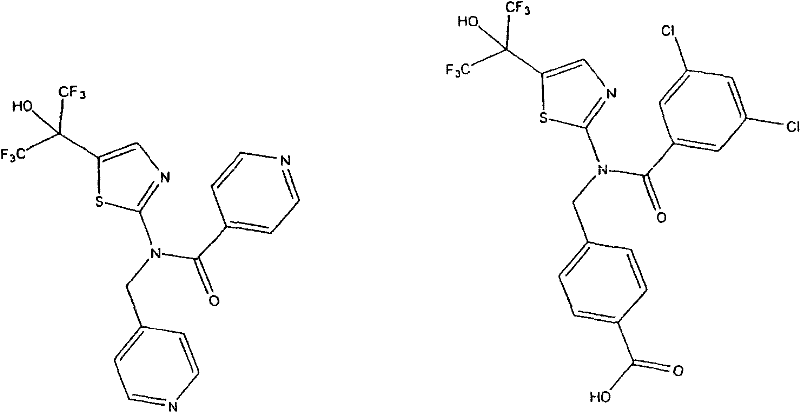
定义definition
在这里使用的“烷基”表示只包含碳和氢的环状的,分枝的,或直链的化学基团,例如甲基,戊基,和金刚烷基。烷基可以是未取代的或被一或多个下面取代基取代的,例如,卤素,烷氧基,酰氧基,氨基,酰胺基,氰基,硝基,羟基,巯基,羧基,羰基,苄氧基,芳基,杂芳基,或其它的官能团,为了本发明的目的如果有必要可以被适当地用保护基保护。烷基可以是饱和的或在一个或数个位置上是不饱和的(例如,包含-C=C-或-C≡C-子单元)。典型地,烷基将包含1到12个碳原子,优选1到10个,且更优选1到8个碳原子或包含3到8个碳原子的环状基团。"Alkyl" as used herein means a cyclic, branched, or straight chain chemical group containing only carbon and hydrogen, such as methyl, pentyl, and adamantyl. Alkyl can be unsubstituted or substituted with one or more of the following substituents, for example, halogen, alkoxy, acyloxy, amino, amido, cyano, nitro, hydroxyl, mercapto, carboxyl, carbonyl, Benzyloxy, aryl, heteroaryl, or other functional groups may be appropriately protected with protecting groups if necessary for the purpose of the present invention. Alkyl groups may be saturated or unsaturated in one or several positions (for example, containing -C=C- or -C≡C- subunits). Typically, the alkyl group will contain 1 to 12 carbon atoms, preferably 1 to 10, and more preferably 1 to 8 carbon atoms or a cyclic group containing 3 to 8 carbon atoms.
在这里使用的“低级烷基”表示烷基的子集,因此是直线型的,环状的或分枝的烃类取代基。优选的低级烷基具有1到约6个碳原子,且可以是支链的或直链的,并可以包括环状取代基,可作为部分也可作为其全部的结构。低级烷基的例子包括丁基,丙基,异丙基,乙基,和甲基。同样地,使用术语“低级”基团是指优选在基团的烷基部分具有1到约6个碳的基团。"Lower alkyl" as used herein denotes a subset of alkyl, thus linear, cyclic or branched hydrocarbon substituents. Preferred lower alkyl groups have from 1 to about 6 carbon atoms and may be branched or straight chain and may include cyclic substituents, as part or all of the structure. Examples of lower alkyl groups include butyl, propyl, isopropyl, ethyl, and methyl. Likewise, use of the term "lower" group refers to groups preferably having from 1 to about 6 carbons in the alkyl portion of the group.
在这里使用的“酰胺基”表示H-CON-或烷基-CON-,芳基-CON-或杂环基-CON基团,其中烷基、芳基或杂环基基团如这里所描述。"Amido" as used herein means a H-CON- or alkyl-CON-, aryl-CON- or heterocyclyl-CON group, wherein the alkyl, aryl or heterocyclyl group is as described herein .
在这里使用的“芳基”表示具有单环(例如,苯基)或多元稠环(例如,萘基或蒽基)的取代的或未取代的芳香基,可任选地为未取代的或被氨基,氰基,羟基,低级烷基,卤代烷基,烷氧基,硝基,卤素,巯基,及其他取代基取代,且可以包括或不包括一或多个杂原子。优选的碳环芳基是苯基。很显然术语“杂芳基”是包括在术语“芳基”中的。优选在术语芳基代表杂环的情况下,称其为“杂芳基”,指具有一或多个杂原子。优选5或6元的单环杂环。因此优选的杂芳基是具有单环和在环内部具有至少一个杂原子,例如N,O或S的单价的不饱和芳香基团,所述基团可以任选地是未取代的或被氨基,氰基,硝基,羟基,烷基,卤代烷基,烷氧基,芳基,卤素,巯基,氧代(因此形成羰基)及其他取代基取代的。杂芳基的例子包括噻吩基,吡啶基,呋喃基,噁唑基,噁二唑基,吡咯基(pyrollyl),咪唑基,三唑基,二氢噻二唑基(thiodiazolyl),吡唑基,异噁唑基,噻二唑基,吡喃基,吡嗪基,嘧啶基,哒嗪基,三嗪基,噻唑基等等。"Aryl" as used herein means a substituted or unsubstituted aromatic group having a single ring (e.g., phenyl) or multiple fused rings (e.g., naphthyl or anthracenyl), optionally unsubstituted or Substituted by amino, cyano, hydroxy, lower alkyl, haloalkyl, alkoxy, nitro, halogen, mercapto, and other substituents, and may or may not include one or more heteroatoms. A preferred carbocyclic aryl is phenyl. It is obvious that the term "heteroaryl" is included in the term "aryl". Preferably, where the term aryl represents a heterocyclic ring, it is referred to as "heteroaryl", meaning having one or more heteroatoms. A 5- or 6-membered monocyclic heterocycle is preferred. Preferred heteroaryl groups are therefore monovalent unsaturated aromatic groups having a single ring and at least one heteroatom inside the ring, such as N, O or S, which groups may optionally be unsubstituted or replaced by amino , cyano, nitro, hydroxyl, alkyl, haloalkyl, alkoxy, aryl, halogen, mercapto, oxo (thus forming carbonyl) and other substituents substituted. Examples of heteroaryl groups include thienyl, pyridyl, furyl, oxazolyl, oxadiazolyl, pyrrolyl, imidazolyl, triazolyl, thiodiazolyl, pyrazolyl , Isoxazolyl, thiadiazolyl, pyranyl, pyrazinyl, pyrimidinyl, pyridazinyl, triazinyl, thiazolyl, etc.
在这些定义中很显然芳基环上的取代是包括在本发明的范围内的。当存在取代基时,基团被称作取代的芳基。在芳基环上优选存在一到三个,更优选一或二个,且最优选一个取代基。在五元环中优选的取代型是在相对于所声称的分子的连接处的2位被取代。尽管可使用许多取代基,但优选的取代基包括通常在芳基化合物中的取代基,例如烷基,羟基,烷氧基,氰基,硝基,卤素,卤代烷基,巯基等等。In these definitions it is evident that substitutions on the aryl ring are included within the scope of the invention. When substituents are present, the group is referred to as a substituted aryl. There are preferably one to three, more preferably one or two, and most preferably one substituent on the aryl ring. The preferred substitution pattern in the five membered ring is substituted at the 2 position relative to the junction of the claimed molecule. While many substituents may be used, preferred substituents include those commonly found in aryl compounds such as alkyl, hydroxy, alkoxy, cyano, nitro, halo, haloalkyl, mercapto, and the like.
在这里使用的“酰胺”既包括RNR′CO-(R=烷基,烷氨基羰基的情况)也包括RCONR-(R=烷基,烷基羰基氨基的情况)。As used herein, "amide" includes both RNR'CO- (R = alkyl, in the case of alkylaminocarbonyl) and RCONR- (R = alkyl, in the case of alkylcarbonylamino).
在这里使用的术语“酯”既包括ROCO-(R=烷基,烷氧羰基的情况)也包括RCOO-(R=烷基,烷基羰基氧基的情况)。The term "ester" as used herein includes both ROCO- (R = alkyl, in the case of alkoxycarbonyl) and RCOO- (R = alkyl, in the case of alkylcarbonyloxy).
在这里使用的“酰基”表示H-CO-或烷基-CO-,芳基-CO-或杂环基-CO-基团,其中烷基,芳基或杂环基基团如这里所描述。优选的酰基包含低级烷基。典型的烷基酰基基团包括甲酰基,乙酰基,丙酰基,2-甲基丙酰基,叔丁基乙酰基,丁酰基和十六烷酰基。"Acyl" as used herein means an H-CO- or an alkyl-CO-, aryl-CO- or heterocyclyl-CO- group, wherein the alkyl, aryl or heterocyclyl group is as described herein . Preferred acyl groups contain lower alkyl groups. Typical alkylacyl groups include formyl, acetyl, propionyl, 2-methylpropionyl, tert-butylacetyl, butyryl and hexadecanoyl.
在这里使用的“卤”是氯,溴,氟或碘原子基团。氯,溴和氟是优选的卤化物。很显然术语“卤”也包括在术语“卤素”中有时被称为“卤素”或“卤化物”。"Halo" as used herein is a chlorine, bromine, fluorine or iodine atom group. Chlorine, bromine and fluorine are preferred halides. Obviously the term "halogen" is also included in the term "halogen" which is sometimes referred to as "halogen" or "halide".
在这里使用的“卤代烷基”表示烃类取代基,可以是被氯,溴,氟或碘原子取代的直链的,支链的或环状的烷基,烯基或炔基。最优选的是氟代烷基,其中一个或多个氢原子被氟取代。优选的卤代烷基具有1到约5个碳原子的长度,且更优选的卤代烷基具有1到约4个碳的长度,最优选的具有1到约3个碳的长度。于是本领域技术人员将认识到在这里使用的“卤代亚烷基”表示一种卤代烷基的双基变体,这样的双基在基团,其它原子之间,或在母体环和另一个官能团之间起间隔基的作用。例如,连接基团CHF-CHF是一种卤代亚烷基双基。"Haloalkyl" as used herein means a hydrocarbon substituent, which may be a straight chain, branched or cyclic alkyl, alkenyl or alkynyl group substituted with chlorine, bromine, fluorine or iodine atoms. Most preferred are fluoroalkyl groups in which one or more hydrogen atoms are replaced by fluorine. Preferred haloalkyl groups have a length of 1 to about 5 carbon atoms, and more preferred haloalkyl groups have a length of 1 to about 4 carbons, and most preferably have a length of 1 to about 3 carbons. Those skilled in the art will then recognize that "haloalkylene" as used herein denotes a diradical variation of a haloalkyl group, such that the diradical is between the group, other atoms, or between a parent ring and another Functional groups act as spacers. For example, the linking group CHF-CHF is a haloalkylene diradical.
在这里使用的“杂环基”表示饱和或不饱和的杂环基团。这些基团可以是取代或未取代的,且通过任何可用的价键,优选任何可用的碳或氮与其它基团相连。更优选5或6元的杂环。在六元非芳香单环杂环中,杂原子选自一到至多三个O,N或S,且其中当杂环是五元非芳香杂环时,优选它具有一或二个选自O,N或S的杂原子。"Heterocyclic group" as used herein means a saturated or unsaturated heterocyclic group. These groups may be substituted or unsubstituted and are linked to other groups by any available bond, preferably any available carbon or nitrogen. A 5- or 6-membered heterocycle is more preferred. In a six-membered non-aromatic monocyclic heterocycle, the heteroatoms are selected from one to up to three O, N or S, and wherein when the heterocycle is a five-membered non-aromatic heterocycle, it preferably has one or two atoms selected from O , N or S heteroatoms.
在这里使用的“取代的氨基”表示被一或两个烷基,芳基或杂环基基团取代的氨基基团,其中烷基,芳基或杂环基如以上所定义。"Substituted amino" as used herein means an amino group substituted with one or two alkyl, aryl or heterocyclyl groups, wherein alkyl, aryl or heterocyclyl are as defined above.
在这里使用的“取代的硫羟(thiol)”表示RS-基团,其中R是烷基,芳基或杂环基,其中烷基,芳基或杂环基如以上所定义。"Substituted thiol" as used herein means an RS-group wherein R is alkyl, aryl or heterocyclyl, wherein alkyl, aryl or heterocyclyl is as defined above.
在这里使用的“磺酰基”表示烷基SO2,芳基SO2或杂环基-SO2基团,其中烷基,芳基或杂环基如以上所定义。As used herein, "sulfonyl" means an alkylSO2 , arylSO2 or heterocyclyl- SO2 group, wherein alkyl, aryl or heterocyclyl is as defined above.
在这里使用的“磺酰胺基(sulfamido)”表示烷基-N-S(O)2N-,芳基-NS(O)2N-或杂环基-NS(O)2N-基团,其中烷基,芳基或杂环基基团如这里所描述。"Sulfamido" as used herein means an alkyl-NS(O) 2 N-, aryl-NS(O) 2 N- or heterocyclyl-NS(O) 2 N- group in which Alkyl, aryl or heterocyclyl groups are as described herein.
在这里使用的“亚磺酰氨基(sulfonamido)”表示烷基-S(O)2N-,芳基-S(O)2N-或杂环基-S(O)2N-基团,其中烷基,芳基或杂环基基团如这里所描述。"Sulfonamido" as used herein means an alkyl-S(O) 2N- , aryl-S(O) 2N- or heterocyclyl-S(O) 2N- group, wherein the alkyl, aryl or heterocyclyl group is as described herein.
在这里使用的“脲基”表示烷基-NCON-,芳基-NCON-或杂环基-NCON-基团,其中烷基,芳基或杂环基基团如这里所描述。As used herein, "ureido" means an alkyl-NCON-, aryl-NCON- or heterocyclyl-NCON- group, wherein the alkyl, aryl or heterocyclyl group is as described herein.
在此使用的“基团”可以与另一个在此所描述的基团形成一个环。当这样的基团被结合时,本领域技术人员将理解在这种情况下不会存在不合理(unsatisfied)的原子价,但是可以有特定的取代,例如用价键取代氢原子。因此某些基团可以被称作共同形成环。技术人员将意识到这样的环可以并容易地通过常规化学反应形成,且这样环的预见和它们的形成方法在本领域技术人员的知识范围之内。优选具有3-7元的环,更优选5或6元环。在此使用的术语“坏”,当由两个基团结合形成时,表示杂环的或碳环的基团,且这样的基团可以是饱和的,不饱和的或芳香的。例如,优选的杂环体系包括杂环,例如吗啉基,哌啶基,咪唑基,吡咯烷基,和吡啶基。A "group" as used herein may form a ring with another group described herein. When such groups are incorporated, those skilled in the art will understand that in this case there will be no unsatisfied valences, but specific substitutions, such as replacement of hydrogen atoms with valence bonds, are possible. Certain groups may thus be said to collectively form a ring. The skilled artisan will appreciate that such rings can and are readily formed by conventional chemical reactions, and that the prediction of such rings and methods of their formation are within the knowledge of those skilled in the art. A ring having 3-7 members is preferred, and a 5- or 6-membered ring is more preferred. The term "bad", as used herein, when formed by the combination of two groups, means a heterocyclic or carbocyclic group, and such groups may be saturated, unsaturated or aromatic. For example, preferred heterocyclic ring systems include heterocyclic rings such as morpholinyl, piperidinyl, imidazolyl, pyrrolidinyl, and pyridinyl.
本领域普通技术人员会意识到在此描述的一些结构可能是化合物的共振形式或互变异构体,它们完全可以通过其它的化学结构表示,甚至从动力学上讲,技术人员将意识到这样的结构仅仅是所述化合物样品中的非常小的一部分。这样的化合物很显然都是在本发明的范围内的,尽管这样的共振形式或互变异构体在此没有表示。例如,Those of ordinary skill in the art will recognize that some of the structures described herein may be resonance forms or tautomers of compounds that may be represented by other chemical structures, and even kinetically, the skilled person will realize that such The structure of is only a very small part of the compound sample. Such compounds are clearly within the scope of the invention, although such resonance forms or tautomers are not represented herein. For example,
上述亚结构清楚地代表相同的基团且参考其中一个也清楚地预料到另一个。另外,当R可以通过生物方法原位去除时下列化合物可以代表前体药物:The above substructures clearly represent the same group and reference to one is also clearly contemplated for the other. Additionally, the following compounds may represent prodrugs when R can be removed in situ by biological means:

在此化合物和组合物也具体地包括药学可接受的盐,无论是阳离子的或阴离子的。“药学可接受盐”是在任何酸性基团(例如,羧基)处形成的阴离子盐,或在任何碱性的基团(例如,氨基)处形成的阳离子盐。本领域已知许多这样的盐,如世界专利公开87/05297中所描述,Johnston等人,公开于1987年9月11日(在此引入作为参考)。优选的在酸性基团处形成的反离子盐可以包括阳离子盐,例如碱金属盐(例如钠和钾),和碱土金属盐(例如镁和钙)和有机盐。优选在碱性的位置形成的盐包括阴离子例如卤化物盐(例如氯化物盐)。当然,本领域普通技术人员知道可以使用大量的和各种各样的盐,且在文献中存在许多以此方式使用的有机的或无机的盐的例子。Compounds and compositions herein also specifically include pharmaceutically acceptable salts, whether cationic or anionic. A "pharmaceutically acceptable salt" is an anionic salt formed at any acidic group (eg, carboxyl), or a cationic salt formed at any basic group (eg, amino). Many such salts are known in the art, as described in World Patent Publication 87/05297, Johnston et al., published September 11, 1987 (incorporated herein by reference). Preferred counterion salts formed at acidic groups may include cationic salts, such as alkali metal salts such as sodium and potassium, and alkaline earth metal salts such as magnesium and calcium, and organic salts. Salts preferably formed at basic sites include anions such as halide salts (eg chloride salts). Of course, those of ordinary skill in the art know that a large and wide variety of salts can be used, and there are many examples in the literature of organic or inorganic salts used in this way.
很显然本发明的化合物可以被生物水解的前体药物的形式被提供,这在本领域是可以理解的。在此使用的“前体药物”是指当暴露于有机体中的生物过程中被水解,代谢,衍生等,以得到具有所要求的活性的活性物质的任何化合物。本领域普通技术人员将意识到前体药物可以具有或不具有前体药物的任何活性。很显然在此描述的前体药物当以安全和有效量服药时对所治疗的患者没有有害作用的。这些包括例如,可生物水解的酰胺和酯。“可生物水解的酰胺”是一种本质上不防碍化合物活性的酰胺化合物,或者这种化合物可以容易地在体内通过细胞,组织,或人,哺乳动物,或动物使其转化得到本发明的活性物质。“可生物水解的酯”是指一种本质上不防碍化合物活性的本发明的酯化合物,或者这些种化合物可以容易地通过动物转化得到活性的式(I)化合物。这样的可生物水解的前体药物是本领域普通的技术人员可以理解的并具体表现在规章原则中。It will be apparent that the compounds of the present invention may be provided in the form of biohydrolyzed prodrugs, as is understood in the art. As used herein, "prodrug" refers to any compound that is hydrolyzed, metabolized, derivatized, etc. when exposed to biological processes in an organism to yield an active substance having the desired activity. Those of ordinary skill in the art will appreciate that a prodrug may or may not have any of the activities of a prodrug. It is apparent that the prodrugs described herein, when administered in safe and effective amounts, have no deleterious effect on the patient being treated. These include, for example, biohydrolyzable amides and esters. A "biohydrolyzable amide" is an amide compound which does not substantially interfere with the activity of the compound, or which can be easily transformed in vivo by cells, tissues, or humans, mammals, or animals to obtain the compounds of the present invention. active substance. "Biohydrolyzable ester" means an ester compound of the present invention which does not substantially interfere with the activity of the compound, or which can be easily transformed by animals to obtain an active compound of formula (I). Such biohydrolyzable prodrugs are understood by those of ordinary skill in the art and are embodied in regulatory principles.
由于本发明的化合物可以包含光学中心,“旋光异构体”,“立体异构体”,“对映体”,“非对映体”,在此具有标准技术认可的含义(参见HawleysCondensed Chemical Dictionary,第11版)并包括在所要求保护的化合物中,无论是以消旋物,或它们的旋光异构体,立体异构体,对映体,非对映体的形式。Since the compounds of the present invention may contain optical centers, "optical isomers", "stereoisomers", "enantiomers", and "diastereomers" have standard art-recognized meanings herein (see Hawleys Condensed Chemical Dictionary , 11th Edition) and are included in the claimed compounds, whether in the form of racemates, or their optical isomers, stereoisomers, enantiomers, diastereomers.
在此使用的“心血管的疾病”包括心律不齐,心房纤维性颤动,充血性心力衰竭,冠状动脉病,高血压,心肌梗死,中风,心室纤维性颤动,其他的疾病中,特别包括心血管的局部缺血例如心绞痛,以及在心血管系统内部通过改变代谢可治疗的那些状况。"Cardiovascular disease" as used herein includes arrhythmia, atrial fibrillation, congestive heart failure, coronary artery disease, hypertension, myocardial infarction, stroke, ventricular fibrillation, among other diseases, especially including cardiac Ischemia of blood vessels such as angina pectoris, as well as those conditions within the cardiovascular system treatable by altering metabolism.
在此使用的术语“代谢疾病”,表示哺乳动物中发生代谢偏离,代谢不平衡,或代谢亚最佳状况的病症。在此使用的代谢性疾病也包括可以通过代谢调整而被治疗的疾病,虽然该疾病本身可能是或不是由特异的代谢障碍引起的。特别地,这样的代谢疾病涉及葡萄糖和脂肪酸氧化途径。更特别地,这样的代谢疾病涉及MCD或由丙二酰CoA的水平所调整。所有这些状况在此统称“与MCD或MCA相关病症”。The term "metabolic disease", as used herein, means a condition in which a metabolic deviation, metabolic imbalance, or suboptimal metabolism occurs in a mammal. Metabolic disease as used herein also includes diseases that can be treated by metabolic regulation, although the disease itself may or may not be caused by a specific metabolic disorder. In particular, such metabolic diseases involve glucose and fatty acid oxidation pathways. More particularly, such metabolic diseases involve MCD or are modulated by malonyl-CoA levels. All of these conditions are collectively referred to herein as "disorders associated with MCD or MCA".
组合物combination
本发明的组合物包含:The composition of the present invention comprises:
(a)安全和有效量的MCD抑制化合物(I),其前体药物或可药用盐;和(a) a safe and effective amount of MCD inhibitory compound (I), a prodrug or a pharmaceutically acceptable salt thereof; and
(b)药学可接受载体。(b) A pharmaceutically acceptable carrier.
正如以上的讨论,许多疾病可以通过与MCD有关的治疗被治愈。因此,本发明的化合物可用于治疗与涉及这些MCD活性的健康状况有关的治疗。As discussed above, many diseases can be cured with treatments related to MCD. Accordingly, the compounds of the present invention are useful in the treatment of health conditions related to the activity of these MCDs.
因此,本发明的化合物可以被配制成药用组合物用于预防、控制和治疗这些状况。可使用标准的药用制剂技术,例如在Remington′s PharmaceuticalSciences,Mack Publishing Company,Easton,PA中公开的那些技术。Accordingly, the compounds of the present invention can be formulated into pharmaceutical compositions for the prevention, control and treatment of these conditions. Standard pharmaceutical formulation techniques, such as those disclosed in Remington's Pharmaceutical Sciences, Mack Publishing Company, Easton, PA, can be used.
本发明的化合物的“安全和有效的量”是指当以本发明的方式使用时,在患者,组织,或细胞中,优选在动物中,更优选在哺乳动物中在活性部位具有有效抑制MCD的活性,而没有不适当的不良副作用(例如毒性,刺激或变态反应),具有合理的受益/风险比率的量。具体的“安全和有效的量”将明显地随各种因素而改变,所要治疗的特殊状况,病人的身体状况,治疗的疗程,并存的治疗的性质(如果有的话),所使用的具体剂型,所用的载体,化合物在其中的可溶性,以及组合物的给药方案。The "safe and effective amount" of the compound of the present invention means that when used in the manner of the present invention, it has the effect of inhibiting MCD at the active site in patients, tissues, or cells, preferably in animals, more preferably in mammals. activity without undue adverse side effects (such as toxicity, irritation or allergic reaction), in an amount with a reasonable benefit/risk ratio. The specific "safe and effective amount" will obviously vary with various factors, the particular condition being treated, the physical condition of the patient, the duration of treatment, the nature of concomitant treatments (if any), the specific The dosage form, the carrier employed, the solubility of the compound therein, and the dosing regimen of the composition.
除主题化合物之外,本发明的化合物的组合物还包含药学可接受载体。在此使用的术语“药学可接受载体”,表示一或多种适合于对哺乳动物给药的兼容的固体或液体填充稀释剂或形成胶囊的物质。在此使用的术语“兼容的”,表示组合物的组分能够与标题化合物以一种不产生相互作用的方式互相混合,在普通使用的情况下不会实质上地减少组合物的药用效果。当然,药学可接受的载体必须具有足够高的纯度和足够低的毒性,以适于对要被治疗的动物,优选对哺乳动物给药。Compositions of compounds of the present invention include, in addition to the subject compound, a pharmaceutically acceptable carrier. The term "pharmaceutically acceptable carrier", as used herein, means one or more compatible solid or liquid filling diluents or encapsulating substances suitable for administration to mammals. The term "compatible", as used herein, means that the components of the composition are capable of being mixed with the title compound in a non-interactive manner that would not substantially reduce the medicinal effect of the composition under ordinary use . A pharmaceutically acceptable carrier must, of course, be of sufficiently high purity and sufficiently low toxicity to be suitable for administration to the animal to be treated, preferably a mammal.
可以作为药学可接受载体或其中组分的物质的一些例子是糖,例如乳糖,葡萄糖和蔗糖;淀粉,例如玉米淀粉和马铃薯淀粉;纤维素及其衍生物,例如羧甲基纤维素钠盐,乙基纤维素,和甲基纤维素;粉末黄芪胶;麦芽;凝胶;滑石;固体润滑剂,例如硬脂酸和硬脂酸镁;硫酸钙;植物油,例如花生油,棉籽油,芝麻油,橄榄油,玉米油和可可油脂;多元醇例如丙二醇,甘油,山梨糖醇,甘露糖醇,和聚乙二醇;褐藻酸;乳化剂,例如TWEENS;润湿剂,例如十二烷基硫酸钠;着色剂;增香剂;制片剂,稳定剂;抗氧化剂;防腐剂;无热原水;等渗盐水;和磷酸盐缓冲液。Some examples of substances that may serve as pharmaceutically acceptable carriers or components thereof are sugars such as lactose, glucose and sucrose; starches such as corn starch and potato starch; cellulose and its derivatives such as carboxymethylcellulose sodium salt, Ethylcellulose, and methylcellulose; powdered tragacanth; malt; gelatin; talc; solid lubricants such as stearic acid and magnesium stearate; calcium sulfate; vegetable oils such as peanut oil, cottonseed oil, sesame oil, olive oils, corn oil, and cocoa butter; polyols such as propylene glycol, glycerin, sorbitol, mannitol, and polyethylene glycol; alginic acid; emulsifiers, such as TWEENS; wetting agents, such as sodium lauryl sulfate; Colorants; flavor enhancers; tabletting agents, stabilizers; antioxidants; preservatives; pyrogen-free water; isotonic saline; and phosphate buffer.
与标题化合物联合使用的药学可接受载体的选择基本上通过化合物的给药方式来决定。The choice of pharmaceutically acceptable carrier to be used in combination with the title compound is basically determined by the mode of administration of the compound.
如果标题是注射给药的,优选的药学可接受载体是无菌的,生理盐水,与血液-兼容的混悬剂,其中pH已经调节到约7.4。特别地,对于全身性给药的药学可接受载体包括糖,淀粉,纤维素及其衍生物,麦芽,凝胶,滑石,硫酸钙,植物油,合成油,多元醇,褐藻酸,磷酸盐缓冲液,乳化剂,等渗盐水,和无热原的水。对于肠胃外给药优选的载体包括丙二醇,油酸乙酯,吡咯烷酮,乙醇和芝麻油。优选,在肠胃外给药的组合物中药学可接受载体,包括全部组合物的至少约90%(按重量计算)。If the subject is to be administered by injection, the preferred pharmaceutically acceptable carrier is a sterile, physiological saline, blood-compatible suspension wherein the pH has been adjusted to about 7.4. In particular, pharmaceutically acceptable carriers for systemic administration include sugar, starch, cellulose and its derivatives, malt, gelatin, talc, calcium sulfate, vegetable oil, synthetic oil, polyol, alginic acid, phosphate buffer , emulsifiers, isotonic saline, and pyrogen-free water. Preferred carriers for parenteral administration include propylene glycol, ethyl oleate, pyrrolidone, ethanol and sesame oil. Preferably, pharmaceutically acceptable carriers in compositions for parenteral administration comprise at least about 90% by weight of the total composition.
本发明的组合物优选以单位剂型提供。在此使用的“单位剂型”是根据良好的医疗实践以包括一定量化合物的本发明组合物,适合于对动物,优选哺乳动物患者以单一剂量给药。(然而单一或单元剂型的制剂,并非暗示该剂型是以每天一次或每个治疗过程一次给药的。这样的剂型包括每天用药一次,两次,三次或以上,且在治疗期间不止给药一次,尽管单一给药没有被明确地排除。本领域普通技术人员将意识到制剂不会具体地包括治疗的整个过程,而这样的决定将留给治疗领域的技术人员而不是制剂领域的技术人员来进行。)这些组合物优选包含约5mg(毫克),更优选约10毫克到约1000毫克,更优选到约500毫克,最优选到约300毫克的所选择化合物。The compositions of the invention are preferably presented in unit dosage form. A "unit dosage form" as used herein is a composition of the invention comprising an amount of a compound suitable for administration in a single dosage to an animal, preferably a mammalian patient, in accordance with good medical practice. (A single or unit dosage form, however, does not imply that the dosage form is administered once a day or once per course of treatment. Such dosage forms include administration once, twice, three times or more per day, and more than once during a treatment period , although a single administration is not expressly excluded. Those of ordinary skill in the art will appreciate that the formulation does not specifically encompass the entire course of treatment, and such a decision will be left to those skilled in the therapeutic art rather than the formulation art Do.) These compositions preferably contain from about 5 mg (milligrams), more preferably from about 10 mg to about 1000 mg, more preferably up to about 500 mg, most preferably up to about 300 mg of the selected compound.
本发明的组合物可以是以任何适合于(例如)口服的,鼻的,直肠的,局部的(包括透皮),眼睛的,大脑内的,静脉内的,肌肉的,或肠胃外给药的形式存在。(本领域普通技术人员将意识到口服的和鼻的组合物包含通过吸入给药的组合物,并可使用已有的方法制造。)取决于所要求的具体的给药途径,可以使用本领域已知的各种药学可接受载体。这些包括固体或液态填充剂,稀释剂,水溶助长剂(hydrotropies),表面活性剂,和形成胶囊的物质。可选择的药用活性物质可以包括实质上不干扰化合物的抑制活性药用活性物质。用于与化合物配伍的载体的量为对于化合物的单位剂量给药提供足够物质的实际量。有用于本发明的方法的制造剂型的技术和组合物在下面的参考文献中有描述,所有参考文献在此引入作为参考:现代制药学(ModernPharmaceutics),第9和10章(Banker & Rhodes编,1979);Lieberman等人,药用剂型:片剂(Pharmaceutical Dosage Forms:Tablets)(1981);和Ansel,Introduction to Pharmaceutical Dosage Forms,第2版(1976)。The compositions of the present invention may be in any form suitable for, for example, oral, nasal, rectal, topical (including transdermal), ophthalmic, intracerebral, intravenous, intramuscular, or parenteral administration. form exists. (Those of ordinary skill in the art will recognize that oral and nasal compositions, including compositions for administration by inhalation, can be manufactured using established methods.) Depending on the particular route of administration desired, the art. Various known pharmaceutically acceptable carriers. These include solid or liquid fillers, diluents, hydrotropes, surfactants, and encapsulating substances. Alternative pharmaceutically active substances may include pharmaceutically active substances that do not substantially interfere with the activity of the compound. The amount of carrier used to be compatible with a compound is that practical to provide sufficient material for a unit dosage administration of the compound. Techniques and compositions for the manufacture of dosage forms useful in the methods of the invention are described in the following references, all of which are hereby incorporated by reference: Modern Pharmaceutics, Chapters 9 and 10 (Banker & Rhodes eds. 1979); Lieberman et al., Pharmaceutical Dosage Forms: Tablets (1981); and Ansel, Introduction to Pharmaceutical Dosage Forms, 2nd Ed. (1976).
可以使用各种口服的剂型,包括固体形式例如片剂,胶囊,颗粒和散装的粉末。这些口服的形式包含安全和有效量的化合物,通常至少约5%,优选约25%到约50%。片剂可以是被压制的,研制的片剂,肠包衣的,糖衣的,薄膜包衣的,或多层-压制的,包含适合的粘合剂,润滑剂,稀释剂,崩解剂,着色剂,调味剂,流动-诱导剂,和熔化剂。液体口服剂型包括水溶液,乳剂,混悬液,溶液和/或由非泡腾颗粒泡发的悬浮液,和由泡腾颗粒泡发的泡腾制剂,包含适合的溶剂,防腐剂,乳化剂,悬浮剂,稀释剂,甜味剂,熔化剂,着色剂和调味剂。Various oral dosage forms can be used including solid forms such as tablets, capsules, granules and bulk powders. These oral forms contain a safe and effective amount of the compound, usually at least about 5%, preferably about 25% to about 50%. Tablets may be compressed, triturated, enteric-coated, sugar-coated, film-coated, or multi-compressed, containing suitable binders, lubricants, diluents, disintegrants, Coloring agents, flavoring agents, flow-inducing agents, and melting agents. Liquid oral dosage forms include aqueous solutions, emulsions, suspensions, solutions and/or suspensions effervescent from non-effervescent granules, and effervescent preparations effervescent from effervescent granules, containing suitable solvents, preservatives, emulsifiers, Suspending agent, diluent, sweetener, melting agent, coloring agent and flavoring agent.
适合于口服给药的单剂量制剂的药学可接受载体是本技术领域众所周知的。片剂典型地包含常规的药学-兼容的助剂例如惰性稀释剂,例如碳酸钙,碳酸钠,甘露醇,乳糖和纤维素;粘合剂例如淀粉,凝胶和蔗糖;崩解剂例如淀粉,褐藻酸和croscarmelose;润滑剂例如硬脂酸镁,硬脂酸和滑石。助流剂(glidant)例如二氧化硅可用于改善粉末混合物的流动特性。可以加入着色剂,例如FD & C染料来改善外观。甜味剂和调味剂,例如天冬苯丙二肽酯,糖精,薄荷醇,胡椒薄荷,和水果香料,可用作咀嚼药片的助剂。胶囊典型地包含一或多种上述的固体稀释剂。载体组分的选择取决于次要的考虑,例如味道,成本,和保存稳定性,这些对于本发明的目的不是关键性的,并且可以容易地由所属技术领域的专业人员确定。Pharmaceutically acceptable carriers suitable for single dosage formulations for oral administration are well known in the art. Tablets typically contain conventional pharmaceutically-compatible auxiliaries such as inert diluents, such as calcium carbonate, sodium carbonate, mannitol, lactose and cellulose; binders such as starch, gelatin and sucrose; disintegrants such as starch, alginic acid and croscarmelose; lubricants such as magnesium stearate, stearic acid and talc. Glidants such as silicon dioxide can be used to improve the flow characteristics of the powder mixture. Colorants such as FD&C dyes can be added to improve appearance. Sweeteners and flavoring agents, such as aspartame, saccharin, menthol, peppermint, and fruit flavors, may be used as aids in chewing tablets. Capsules typically contain one or more solid diluents as described above. The choice of carrier components depends on minor considerations such as taste, cost, and storage stability, which are not critical for the purposes of the present invention and can be readily determined by one skilled in the art.
口服的组合物也包括液体溶液,乳剂,悬浮液,等等。适合于制备这些组合物的药学可接受载体是本领域众所周知的。对于糖浆,酏剂,乳剂和悬浮液的典型的载体组分包括乙醇,甘油,丙二醇,聚乙二醇,液态蔗糖,山梨糖醇和水。对于悬浮液,典型的悬浮剂包括甲基纤维素,羧甲基纤维素钠盐,AVICEL RC-591,黄芪胶和海藻酸钠;典型的润湿剂包括卵磷脂和聚山梨醇酯85;而典型的防腐剂包括羟苯甲酸甲酯和苯甲酸钠。口服的液体组合物也可以包含一或多种以上公开的组分例如甜味剂,调味剂和着色剂。Oral compositions also include liquid solutions, emulsions, suspensions, and the like. Pharmaceutically acceptable carriers suitable for the preparation of these compositions are well known in the art. Typical carrier components for syrups, elixirs, emulsions and suspensions include ethanol, glycerol, propylene glycol, polyethylene glycol, liquid sucrose, sorbitol and water. For suspensions, typical suspending agents include methylcellulose, carboxymethylcellulose sodium salt, AVICEL RC-591, tragacanth, and sodium alginate; typical wetting agents include lecithin and polysorbate 85; and Typical preservatives include methyl paraben and sodium benzoate. Liquid compositions for oral administration may also contain one or more of the above disclosed ingredients such as sweetening, flavoring and coloring agents.
所述组合物也可以常规方法包衣,典型地用pH值或时间-依赖的包衣,以使标题化合物在胃肠道中在所需要的局部施用位置附近释放出来,或在不同的时间释放出来以延长所希望的作用。这样的剂型典型地包括,但不局限于,一或多种醋酞纤维素(cellulose acetate phthalate),聚乙酸乙烯酯酞酸盐(polyvinglacetate phthalate),羟丙基甲基纤维素酞酸酯,乙基纤维素,Eudragit包衣,石蜡和紫胶。The composition may also be coated in conventional manner, typically with a pH or time-dependent coating, so that the title compound is released in the gastrointestinal tract near the desired site of topical administration, or at different times. to prolong the desired effect. Such dosage forms typically include, but are not limited to, one or more of cellulose acetate phthalate, polyvinyl acetate phthalate, hydroxypropyl methylcellulose phthalate, ethyl Base cellulose, Eudragit coating, paraffin and shellac.
本发明的组合物可以任选地包括其它的药物活性物。The compositions of the present invention may optionally include other pharmaceutical actives.
可用于实现标题化合物全身性传送的其它组合物包括舌下的,口腔和鼻腔的剂型。这些的组合物典型地包含一或多种可溶的填料物质例如蔗糖,山梨糖醇和甘露醇;和粘合剂例如阿拉伯胶,微晶纤维素,羧甲基纤维素和羟丙基甲基纤维素。也可以包括以上公开的助流剂,润滑剂,甜味剂,着色剂,抗氧化剂和调味剂。Other compositions which may be used to effectuate systemic delivery of the title compounds include sublingual, buccal and nasal dosage forms. These compositions typically contain one or more soluble filler substances such as sucrose, sorbitol and mannitol; and binders such as acacia, microcrystalline cellulose, carboxymethylcellulose and hydroxypropylmethylcellulose white. Glidants, lubricants, sweeteners, colorants, antioxidants and flavoring agents disclosed above may also be included.
本发明的组合物也可用于对患者局部地给药,例如,通过将组合物直接敷贴或涂抹在患者的表皮或上皮组织上,或通过一种“贴片(patch)”经皮给药。这样的组合物包括,例如,洗液,乳膏剂,溶液,凝胶剂和固体。这些局部的组合物优选包含安全和有效量的化合物,通常包含至少约0.1%,优选包含约1%到约5%。对于局部给药适合的载体优选可以连续膜的形式保持在皮肤上适当的位置,且可防止出汗或水浸中造成脱落。通常,载体是有机性质的,并能将化合物分散或溶解在其中。载体可以包括药学可接受的软化剂(emolients),乳化剂,增稠剂,溶剂等等。The compositions of the present invention may also be used for topical administration to a patient, for example, by applying or smearing the composition directly to the patient's epidermis or epithelial tissue, or via a "patch" for transdermal administration. . Such compositions include, for example, lotions, creams, solutions, gels and solids. These topical compositions preferably contain a safe and effective amount of the compound, usually at least about 0.1%, preferably from about 1% to about 5%. Carriers suitable for topical administration preferably remain in place on the skin in the form of a continuous film that resists exfoliation by perspiration or immersion in water. Typically, the carrier is organic in nature and capable of dispersing or dissolving the compound therein. The carrier may include pharmaceutically acceptable emolents, emulsifiers, thickeners, solvents and the like.
给药方法Method of administration
本发明的化合物和组合物可以局部地或全身地给药。全身性用药包括任何将化合物引入到身体各组织的方法,例如,关节内的,鞘内的,硬膜外的,肌肉的,经皮的,静脉内的,腹膜内的,皮下的,舌下的给药,吸入,直肠的,或口服给药。本发明的化合物优选口服给药。The compounds and compositions of the invention may be administered topically or systemically. Systemic administration includes any method of introducing a compound into various tissues of the body, e.g., intra-articular, intrathecal, epidural, intramuscular, transdermal, intravenous, intraperitoneal, subcutaneous, sublingual administration by inhalation, rectal, or oral administration. The compounds of the invention are preferably administered orally.
给药的化合物的具体剂量以及治疗的时间是由治疗的临床医生个别考虑的。典型地,对于成人(大约重70公斤),可每天给予从约5毫克,优选从约10毫克到约3000毫克,更优选到约1000毫克,最优选到约300毫克所选择的化合物。可以理解这些剂量范围只不过是举例来说,而日常的给药可以根据以上所列的因素加以调整。The specific dosage of compound administered and the duration of treatment are at the discretion of the treating clinician. Typically, from about 5 mg, preferably from about 10 mg to about 3000 mg, more preferably up to about 1000 mg, most preferably up to about 300 mg of the selected compound per day will be administered to an adult human (approximately weighing 70 kg). It is understood that these dosage ranges are by way of example only and that daily administration may be adjusted according to the factors listed above.
在上文中,当然,本发明的化合物可以单独给药或以混合物的形式给药,且组合物可以视适应症的情况进一步地包括其他的药物或赋形剂。例如,在心血管的疾病的治疗中,很显然本发明可能与β-阻断剂,钙拮抗剂,ACE抑制剂,利尿剂,血管紧张素受体抑制剂,或已知的心血管药物或治疗法结合使用。因此,在此例子中,本发明的新化合物或组合物当与另一种活性的化合物一起给药时是有效的,且可以以单一剂型或组合物的形式结合。In the above, of course, the compound of the present invention may be administered alone or in the form of a mixture, and the composition may further include other drugs or excipients depending on the indication. For example, in the treatment of cardiovascular diseases, it is clear that the present invention may be combined with beta-blockers, calcium antagonists, ACE inhibitors, diuretics, angiotensin receptor inhibitors, or known cardiovascular drugs or treatments method in combination. Thus, in this instance, the novel compound or composition of the invention is effective when administered with another active compound, and may be combined in a single dosage form or composition.
组合物还可以以脂质体传送体系,例如小单层脂质体囊(vesicle),大单层脂质体囊,和多层脂质体囊的形式给药。脂质体可以由各种磷脂,例如胆固醇,十八胺,或卵磷脂组成。The compositions can also be administered in the form of liposomal delivery systems, such as small unilamellar vesicles, large unilamellar vesicles, and multilamellar vesicles. Liposomes can be composed of various phospholipids, such as cholesterol, stearylamine, or lecithin.
本发明的化合物的制备Preparation of Compounds of the Invention
制备本发明的化合物所使用的原料是已知的,通过已知的方法制备的,或市场上可买到的。制备与在此所要求保护的化合物有关的前体及修饰化合物的方法对熟练的技术人员是显而易见的,且通常已经在文献中进行了描述。The starting materials used in the preparation of the compounds of the present invention are known, prepared by known methods, or are commercially available. Methods of preparing precursors and modified compounds related to the compounds claimed herein will be apparent to the skilled artisan and are generally described in the literature.
对于给予文献和此说明书的熟练的技术人员来说,可以制备出任何要求保护的化合物。Any of the claimed compounds can be prepared by the skilled artisan given the literature and this specification.
应理解有机化学领域的技术人员可以方便地进行操作而无需进一步指示,即这是在本领域技术人员进行这些操作的范围和实践范围内。这些包括还原羰基化合物至相应的醇,氧化,酰化,亲电的和亲核的芳香族取代,醚化,酯化和皂化等等。在标准的讲义例如March Advanced OrganicChemistry(Wiley),Carey和Sundberg,Advanced Organic Chemistry等中论述了这些操作。It is understood that one skilled in the art of organic chemistry can readily perform manipulations without further indications, ie, it is within the purview and practice of those skilled in the art to perform such manipulations. These include reduction of carbonyl compounds to the corresponding alcohols, oxidation, acylation, electrophilic and nucleophilic aromatic substitution, etherification, esterification and saponification, among others. These operations are discussed in standard lectures such as March Advanced Organic Chemistry (Wiley), Carey and Sundberg, Advanced Organic Chemistry, etc.
技术人员应很易理解某些反应在分子中的其它官能团被屏蔽或保护时可以进行得最好,由此可避免任何非期望的副反应和/或增加反应的产率。本领域的普通技术人员经常使用保护基以达到提高产率或避免非期望的反应的目的。这些反应可在文献中找到且也是在本领域普通的技术人员的知识范围内。这些操作的例子可以在例如T.Greene和P.Wuts,有机合成中的保护基(Protecting Groups in Organic Synthesis),第二版,John Wiley & Sons(1991)中找到。The skilled artisan will readily appreciate that certain reactions proceed best when other functional groups in the molecule are shielded or protected, thereby avoiding any undesired side reactions and/or increasing the yield of the reaction. Those of ordinary skill in the art often use protecting groups for the purpose of increasing yields or avoiding undesired reactions. Such reactions can be found in the literature and are within the purview of one of ordinary skill in the art. Examples of these manipulations can be found, for example, in T. Greene and P. Wuts, Protecting Groups in Organic Synthesis, 2nd edition, John Wiley & Sons (1991).
下面的典型反应路线,为读者提供引导并代表制备举例说明的化合物的优选方法。这些方法不是限制性的,很显然可使用其它的路线制备这些化合物。这样的方法具体地包括基于固相的化学反应,包括组合化学。本领域的普通的技术人员将可以根据文献和本说明书所给出的方法制备这些化合物。The following typical reaction schemes are provided to guide the reader and represent preferred methods for preparing the exemplified compounds. These methods are not limiting and it is apparent that other routes can be used to prepare these compounds. Such methods specifically include solid-phase based chemistry, including combinatorial chemistry. Those of ordinary skill in the art will be able to prepare these compounds according to the methods given in the literature and this specification.
反应路线1aReaction Scheme 1a

反应路线1bReaction scheme 1b

如反应路线1a所示,偶极子(III)与1,1,1-三氟-2-三氟甲基-丁-3-炔-2-醇或1,1,1-三氟-2-三氟甲基-丁-2-烯-2-醇的1,3-偶极环加成作用可以得到相应的五元杂环(IV)或(V)的六氟异丙醇衍生物。As shown in Scheme 1a, dipole (III) reacts with 1,1,1-trifluoro-2-trifluoromethyl-but-3-yn-2-ol or 1,1,1-trifluoro-2 - 1,3-dipolar cycloaddition of trifluoromethyl-but-2-en-2-ol can give the corresponding hexafluoroisopropanol derivatives of the five-membered heterocycle (IV) or (V).
或者,五元杂环(IX)或(X)的六氟异丙醇衍生物可以由包含六氟异丙醇(VI)的偶极子与炔(VII)或链烯(VIII)的环加成合成。Alternatively, the hexafluoroisopropanol derivatives of the five-membered heterocyclic ring (IX) or (X) can be formed by ring addition of a dipole comprising hexafluoroisopropanol (VI) to an alkyne (VII) or alkene (VIII). into synthesis.
例如(反应路线1b),腈氧化物(XII)与1,1,1-三氟-2-三氟甲基-丁-3-炔-2-醇或1,1,1-三氟-2-三氟甲基-丁-2-烯-2-醇的环加成作用分别提供了异噁唑(XIII)或异噁唑啉(XIV)的六氟异丙醇衍生物。腈氧化物(XII)可以在原位由醛肟(XI)形成,醛肟(XI)是由醛与羟氨缩合制备的并通过用氯化或溴化剂和弱碱处理形成。然而溴化肟基-乙酸(XV)得到羟基-碳亚胺酸二溴化物(XVI),(XVI)与(II)反应提供2-(3-溴-4,5-二氢-异噁唑-5-基)-1,1,1,3,3,3-六氟-丙-2-醇(XVII)。(XVII)与烷基胺反应,产生相应的烷基氨基衍生物(XXIV)b。For example (Scheme 1b), nitrile oxide (XII) with 1,1,1-trifluoro-2-trifluoromethyl-but-3-yn-2-ol or 1,1,1-trifluoro-2 - Cycloaddition of trifluoromethyl-but-2-en-2-ol affords hexafluoroisopropanol derivatives of isoxazole (XIII) or isoxazoline (XIV), respectively. Nitrile oxides (XII) can be formed in situ from aldoximes (XI) prepared by condensation of aldehydes with hydroxylamine and formed by treatment with chlorinating or brominating agents and weak bases. Whereas bromination of the oximino-acetic acid (XV) affords the hydroxy-carbimidic acid dibromide (XVI), reaction of (XVI) with (II) affords 2-(3-bromo-4,5-dihydro-isoxazole -5-yl)-1,1,1,3,3,3-hexafluoro-propan-2-ol (XVII). Reaction of (XVII) with alkylamines yields the corresponding alkylamino derivatives (XXIV)b.
反应路线2Reaction Scheme 2

反应路线2描述了通过芳香杂环(XVIII)与六氟丙酮反应制备六氟异丙醇衍生物(XIX)的方法。例如,2-烷基氨基-1,3-噻唑或氨基-1,3-噻唑(XX)与六氟丙酮水合物在加热条件下反应,得到1,3-噻唑的六氟异丙醇衍生物(XXI)。Scheme 2 describes the preparation of hexafluoroisopropanol derivatives (XIX) by reacting aromatic heterocycles (XVIII) with hexafluoroacetone. For example, 2-alkylamino-1,3-thiazole or amino-1,3-thiazole (XX) reacts with hexafluoroacetone hydrate under heating conditions to obtain the hexafluoroisopropanol derivative of 1,3-thiazole (XXI).
反应路线3Reaction scheme 3

将五元的芳香或非芳香杂环的六氟异丙醇衍生物(XXIV),例如2-N-烷基噻唑基-六氟异丙醇(XXIV)a,或1,1,1,3,3,3-六氟-2-(3-烷基氨基-4,5-二氢异噁唑-5-基)-丙-2-醇(XXIV)b,在反应路线3中所述的条件下转变为相应的酰胺(XXV),酰氨基磷酸酯(XXVI),氨磺酰(XXVII),脲(XXVIII),氨基甲酸盐(XXV,R4=OR3)和硫脲(XXIX)。Five-membered aromatic or non-aromatic heterocyclic hexafluoroisopropanol derivatives (XXIV), such as 2-N-alkylthiazolyl-hexafluoroisopropanol (XXIV) a, or 1, 1, 1, 3 , 3,3-hexafluoro-2-(3-alkylamino-4,5-dihydroisoxazol-5-yl)-propan-2-ol (XXIV)b, described in Scheme 3 conversion to the corresponding amides (XXV), amidophosphoramidates (XXVI), sulfonamides (XXVII), ureas (XXVIII), carbamates (XXV, R 4 =OR 3 ) and thioureas (XXIX) .
反应路线4Reaction Scheme 4

如反应路线4所示,异噁唑啉或异噁唑的酰胺衍生物(XXXI)由酸的衍生物(XXX)与胺在偶合试剂例如(苯并三唑-1-基-氧基)三(二甲基氨基)磷鎓六氟代磷酸盐(Bop)和碱的存在下偶合制备。As shown in Scheme 4, isoxazoline or amide derivatives of isoxazole (XXXI) are synthesized from acid derivatives (XXX) and amines in a coupling reagent such as (benzotriazol-1-yl-oxy)tris (Dimethylamino) phosphonium hexafluorophosphate (Bop) and base coupling preparation.
反应路线5Reaction scheme 5

如反应路线5所示,在所述的反应条件下,异噁唑啉或异噁唑的醇(XXXIV),腙(XXXV),和肟(XXXVI)衍生物可以通过普通的酮/醛中间体(XXXIII)制备,(XXXIII)是用有关的腈氧化物(XXXII)与1,1,1-三氟-2-三氟甲基-丁-3-炔-2-醇或1,1,1-三氟-2-三氟甲基-丁-2-烯-2-醇进行1,3-偶极反应制备。As shown in Scheme 5, under the described reaction conditions, alcohol (XXXIV), hydrazone (XXXV), and oxime (XXXVI) derivatives of isoxazoline or isoxazole can pass through common ketone/aldehyde intermediates (XXXIII) is prepared from the related nitrile oxide (XXXII) with 1,1,1-trifluoro-2-trifluoromethyl-but-3-yn-2-ol or 1,1,1 - Trifluoro-2-trifluoromethyl-but-2-en-2-ol prepared by 1,3-dipole reaction.
反应路线6Reaction Scheme 6

反应路线6为另一种制备五元的芳香杂环的六氟异丙醇衍生物(XXXVIII)的方法,涉及六氟丙酮与有机金属化合物的反应,后者可由(XXXVII)形成。因此将由市场上可买到的2-烷基氨基-噻二唑与酰氯反应,制备锂化的中间体(XXXIX),接着加入六氟丙酮得到所需要的六氟异丙醇衍生物(XXXX)。另一方面,5-溴-2-呋喃甲酸(XXXXI)与过量的正丁基锂反应,接着用六氟丙酮处理可提供1-{5-[2,2,2-三氟-1-羟基-1-(三氟甲基)乙基]呋喃-2-基}戊-1-酮(XXXXII)。Scheme 6 is another method for preparing five-membered aromatic heterocyclic hexafluoroisopropanol derivatives (XXXVIII), which involves the reaction of hexafluoroacetone with organometallic compounds, which can be formed from (XXXVII). Thus the lithiated intermediate (XXXIX) was prepared by reacting a commercially available 2-alkylamino-thiadiazole with an acid chloride, followed by addition of hexafluoroacetone to give the desired hexafluoroisopropanol derivative (XXXX) . On the other hand, reaction of 5-bromo-2-furancarboxylic acid (XXXXI) with excess n-butyllithium followed by treatment with hexafluoroacetone affords 1-{5-[2,2,2-trifluoro-1-hydroxy -1-(Trifluoromethyl)ethyl]furan-2-yl}pentan-1-one (XXXXII).
反应路线7Reaction Scheme 7

可以通过反应路线7的方法制备包含一到四个氮原子的六元杂环的六氟异丙醇衍生物(XXXXIV)。这样用正丁基锂处理5-溴-2-氨基嘧啶衍生物(XXXXV)产生卤素-锂的交换,接着使相应的锂中间体与六氟丙酮反应得到六氟异丙醇嘧啶衍生物(XXXXVI)。The hexafluoroisopropanol derivative (XXXXIV) of a six-membered heterocyclic ring containing one to four nitrogen atoms can be prepared by the method of Reaction Scheme 7. Such treatment of a 5-bromo-2-aminopyrimidine derivative (XXXXV) with n-butyllithium produces a halogen-lithium exchange, followed by reaction of the corresponding lithium intermediate with hexafluoroacetone to give the hexafluoroisopropanol pyrimidine derivative (XXXXVI ).
反应路线8Reaction Scheme 8
反应路线8描述了合成炔基六氟异丙醇衍生物的方法。例如,将六氟丙酮与通过用正丁基锂处理炔制备的炔基锂(XXXXVII)反应,得到炔基六氟异丙醇衍生物(XXXXVIII)。Scheme 8 describes the synthesis of alkynyl hexafluoroisopropanol derivatives. For example, reaction of hexafluoroacetone with alkynyllithium (XXXXVII) prepared by treatment of alkynes with n-butyllithium affords alkynylhexafluoroisopropanol derivatives (XXXXVIII).
生物活性biological activity
体外MCD抑制试验:In vitro MCD inhibition test:
将文献中描述的测定丙二酰基辅酶A脱羧酶活性试验的分光光度法加以改造和修改以适于高通量形式的MCD抑制活性试验(Kolattukudy等人,Methods in Enzymology 71:150(1981))。将下列试剂加入到96孔滴定板中:Tris-HCl缓冲剂,20μL;DTE,10μL;I-苹果酸盐,20μL;NAD,10μL;NADH,25μL;水,80μL;苹果酸脱氢酶,5μL。将这些成分混合,孵化2分钟,接着加入5μL柠檬酸合酶。加入化合物,接着加入5μL由大鼠心脏制取的丙二酰基辅酶A脱羧酶和20μL丙二酰基辅酶A。将这些成分孵化并在460nM处测定吸收率。The spectrophotometric method described in the literature for measuring malonyl-CoA decarboxylase activity was adapted and adapted for a high-throughput format of the MCD inhibitory activity assay (Kolattukudy et al., Methods in Enzymology 71:150 (1981)) . Add the following reagents to a 96-well titer plate: Tris-HCl buffer, 20 μL; DTE, 10 μL; I-malate, 20 μL; NAD, 10 μL; NADH, 25 μL; water, 80 μL; malate dehydrogenase, 5 μL . The components were mixed and incubated for 2 minutes, followed by the addition of 5 μL of citrate synthase. Compounds were added followed by 5 μL of malonyl-CoA decarboxylase prepared from rat heart and 20 μL of malonyl-CoA. The fractions were incubated and the absorbance was measured at 460 nM.
活性化合物的特征由可导致MCD活性50%抑制的浓度(IC50)表征。优选的化合物具有小于10μM的IC50值。最优选的化合物具有小于100nM的IC50值。Active compounds were characterized by the concentration that resulted in 50% inhibition of MCD activity ( IC50 ). Preferred compounds have IC50 values of less than 10 [mu]M. Most preferred compounds have IC50 values of less than 100 nM.
表1.MCD抑制剂的IC50值Table 1. IC50 values of MCD inhibitors
在灌注大鼠心脏中葡萄糖氧化和脂肪酸氧化的测定:Determination of Glucose Oxidation and Fatty Acid Oxidation in Perfused Rat Heart:
将从雄性Sprague-Dawley大鼠分离的工作心脏用改性的Krebs-Henseleit溶液进行60分钟的有氧灌注,溶液中包含5mmol/L葡萄糖;100μU/mL胰岛素;3%BAS;和1.2mmol/L棕榈酸盐。在这些研究中使用的工作心脏以接近体内心脏的代谢要求。(Kantor等人,Circulation Research 86:580588(2000))。将被试验的化合物用5分钟加入到灌注周期中。Working hearts isolated from male Sprague-Dawley rats were perfused aerobically for 60 minutes with a modified Krebs-Henseleit solution containing 5 mmol/L glucose; 100 μU/mL insulin; 3% BAS; and 1.2 mmol/L Palmitate. The working heart used in these studies approximates the metabolic requirements of the in vivo heart. (Kantor et al., Circulation Research 86:580588 (2000)). The compound to be tested was added to the perfusion cycle over 5 minutes.
通过定量收集由包含[U14]-葡萄糖缓冲剂灌注的心脏产生的14CO2测定葡萄糖氧化速度。通过定量收集由包含[14C]棕榈酸盐缓冲剂灌注的心脏产生的14CO2测定脂肪酸氧化速度(McNeill,J.H.“Measurement of cardiovascularfunction”,第2章,CRC press,New York(1997))。Glucose oxidation rates were determined by quantitative collection of 14 CO 2 produced by hearts perfused with [U14]-glucose buffer. The rate of fatty acid oxidation was determined by quantitative collection of 14 CO 2 generated from hearts perfused with a buffer containing [ 14 C]palmitate (McNeill, JH "Measurement of cardiovascular function", Chapter 2, CRC press, New York (1997)).
活性化合物表现为与对照实验(DMSO)相比葡萄糖氧化作用增加。可引起葡萄糖氧化作用在统计上显著增加的化合物被认为是活性的。优选的化合物可在20μM下引起葡萄糖氧化作用具有统计上的显著增加。统计显著性使用斯氏t检验法对适当的成对或不成对样本进行计算的。P<0.05的结果认为统计上显著。The active compound exhibits increased glucose oxidation compared to the control experiment (DMSO). Compounds that caused a statistically significant increase in glucose oxidation were considered active. Preferred compounds cause a statistically significant increase in glucose oxidation at 20 [mu]M. Statistical significance was calculated using Student's t-test for appropriate paired or unpaired samples. A result of P<0.05 was considered statistically significant.
实施例Example
用包括以下的实施例进一步地说明本发明。当然这些实施例将不会被认为是具体地限制本发明。这些实施例在权利要求范围内的各种变化都是在本领域技术人员的认识范围内的,且被认为是属于在此描述的和要求保护的发明范围内。读者将认识到阅读了本说明书的本领域普通技术人员和本领域技术人员无需详尽的实施例也能制备和使用本发明。The invention is further illustrated by the following examples included. Of course these examples are not to be construed as specifically limiting the invention. Variations of these embodiments within the scope of the claims are within the purview of those skilled in the art and are considered to be within the scope of the invention described and claimed herein. The reader will recognize that those of ordinary skill in the art and those skilled in the art who read this specification can make and use the present invention without the exhaustive examples.
在此使用的商标只是举例性的,且说明性地反映本发明所使用的材料。本领域普通技术人员将认识到在批次,制造工艺等的变化是可以预料的。因此实施例和在其中使用的商标是非限制性的,且它们不是意欲限制本发明,而仅仅是例证说明本领域普通技术人员如何选择以完成本发明的一个或多个具体实施方案。Trademarks used herein are exemplary only and descriptively reflect materials used with the invention. Those of ordinary skill in the art will recognize that variations in batches, manufacturing processes, etc. are to be expected. The examples and the trademarks used therein are therefore non-limiting, and they are not intended to limit the invention, but merely to illustrate how one of ordinary skill in the art may choose to implement one or more specific embodiments of the invention.
1H核磁共振波谱(NMR),除非另有陈述,是在CDCl3或其它标明的溶剂中在Varian核磁共振波谱仪(Unity Plus400,对于1H谱400MHz)上测定的,峰位置用相对于四甲基硅烷的百万分之一低场表示(ppm)。峰的多重性如下表示:s,单峰;d,双峰;t,三重峰;m,多重峰。 1 H nuclear magnetic resonance spectra (NMR), unless otherwise stated, were measured on a Varian NMR spectrometer (Unity Plus400, 400 MHz for 1 H spectra) in CDCl 3 or other indicated solvents, peak positions were measured relative to the four Parts per million downfield (ppm) of methylsilane. The multiplicity of peaks is indicated as follows: s, singlet; d, doublet; t, triplet; m, multiplet.
下列缩写具有所指示的含义:The following abbreviations have the meaning indicated:
Bn=苄基Bn = benzyl
DMAP=4-(二甲基氨基)-吡啶DMAP = 4-(dimethylamino)-pyridine
DMF=N,N-二甲基甲酰胺DMF=N,N-Dimethylformamide
DMSO=二甲亚砜DMSO = dimethyl sulfoxide
ESIMS=电喷雾质谱ESIMS = electrospray mass spectrometry
Et3N=三乙胺Et 3 N = Triethylamine
EtOAc=乙酸乙酯EtOAc = ethyl acetate
拉韦松试剂(Lawesson′s reagent)=2,4-双(4-甲基苯基)-1,3,2,4-dithiadiphosphetane-2,4-二硫化物Lawesson's reagent = 2,4-bis(4-methylphenyl)-1,3,2,4-dithiadiphosphetane-2,4-disulfide
MgSO4=硫酸镁MgSO 4 = magnesium sulfate
NaHCO3=碳酸氢钠NaHCO 3 = sodium bicarbonate
NBS=N-溴代琥珀酰亚胺NBS = N-bromosuccinimide
NCS=N-氯代琥珀酰亚胺NCS = N-chlorosuccinimide
NH4Cl=氯化铵NH 4 Cl = ammonium chloride
Ph=苯基Ph = phenyl
Py=吡啶基Py = pyridyl
r.t.=室温r.t. = room temperature
THF=四氢呋喃THF = Tetrahydrofuran
TLC=薄层色谱法TLC = Thin Layer Chromatography
烷基缩写alkyl abbreviation
Me=甲基Me = methyl
Et=乙基Et = ethyl
n-Pr=正丙基n-Pr = n-propyl
i-Pr=异丙基i-Pr = isopropyl
c-Pr=环丙基c-Pr = cyclopropyl
n-Bu=正丁基n-Bu = n-butyl
i-Bu=异丁基i-Bu = isobutyl
t-Bu=叔丁基t-Bu = tert-butyl
s-Bu=仲丁基s-Bu = sec-butyl
c-Hex=环己基c-Hex = cyclohexyl
实施例1-1-1Example 1-1-1
2-甲基-N-{5-[2,2,2-三氟-1-羟基-1-(三氟甲基)乙基]-1,3-噻唑-2-基}丙酰胺的制备Preparation of 2-methyl-N-{5-[2,2,2-trifluoro-1-hydroxyl-1-(trifluoromethyl)ethyl]-1,3-thiazol-2-yl}propanamide
步骤1step 1
2-(2-氨基-1,3-噻唑-5-基)-1,1,1,3,3,3-六氟丙-2-醇的制备Preparation of 2-(2-amino-1,3-thiazol-5-yl)-1,1,1,3,3,3-hexafluoropropan-2-ol
向2-氨基噻唑200毫克(2mmol)和三水六氟丙酮(880毫克,4mmol)的混合物中加入催化量的分子筛粉末(4A)。将混合物在100℃加热8小时。加入乙酸乙酯并将混合物过滤。减压蒸干有机溶剂。将残余物在THF和己烷中重结晶,得到白色固体的标题产品(389毫克)。To a mixture of 2-aminothiazole 200 mg (2 mmol) and hexafluoroacetone trihydrate (880 mg, 4 mmol) was added a catalytic amount of molecular sieve powder (4A). The mixture was heated at 100°C for 8 hours. Ethyl acetate was added and the mixture was filtered. The organic solvent was evaporated to dryness under reduced pressure. The residue was recrystallized from THF and hexanes to give the title product (389 mg) as a white solid.
1H NMR(DMSO-d6)δ7.12(s,1H),7.45(brs,2H),8.85(s,1H);ESIMS:m/z 267(M+H)。 1 H NMR (DMSO-d6) δ 7.12 (s, 1H), 7.45 (brs, 2H), 8.85 (s, 1H); ESIMS: m/z 267 (M+H).
步骤2step 2
在室温下向以上获得的2-(2-氨基-1,3-噻唑-5-基)-1,1,1,3,3,3-六氟丙-2-醇(267毫克,1mmol)的三乙胺(150毫克,1.49mmol)和四氢呋喃(10毫升)溶液中加入异丁酰氯(110毫克1.03mmol)。将反应混合物搅拌30分钟。减压除去溶剂并将残余物溶于EtOAc。用水和盐水洗涤有机层,干燥(MgSO4)并浓缩。将残余物在THF和己烷中重结晶,得到白色固体标题化合物(282毫克)。To 2-(2-amino-1,3-thiazol-5-yl)-1,1,1,3,3,3-hexafluoropropan-2-ol (267 mg, 1 mmol) obtained above at room temperature To a solution of triethylamine (150 mg, 1.49 mmol) and tetrahydrofuran (10 mL) was added isobutyryl chloride (110 mg, 1.03 mmol). The reaction mixture was stirred for 30 minutes. The solvent was removed under reduced pressure and the residue was dissolved in EtOAc. The organic layer was washed with water and brine, dried ( MgSO4 ) and concentrated. The residue was recrystallized from THF and hexane to give the title compound (282 mg) as a white solid.
1H NMR(DMSO-d6)δ1.08(d,6H),2.72(m,1H),7.60(s,1H),9.10(brs,1H),12.3(brs,1H);ESIMS:319(M-OH)。 1 H NMR (DMSO-d6) δ1.08 (d, 6H), 2.72 (m, 1H), 7.60 (s, 1H), 9.10 (brs, 1H), 12.3 (brs, 1H); ESIMS: 319 (M -OH).
表2.下列化合物依照实施例1-1-1的过程制备。Table 2. The following compounds were prepared according to the procedure of Example 1-1-1.

实施例1-2-1Example 1-2-1
N-(吡啶-4-基甲基)-N-{5-[2,2,2-三氟-1-羟基1-(三氟甲基)乙基]-1,3-噻唑-2-基}吡啶-4-甲酰胺的制备N-(pyridin-4-ylmethyl)-N-{5-[2,2,2-trifluoro-1-hydroxyl 1-(trifluoromethyl)ethyl]-1,3-thiazole-2- The preparation of base}pyridine-4-carboxamide

步骤1step 1
1,1,1,3,3,3-六氟-2-{2-[(吡啶-4-基甲基)氨基]-1,3-噻唑-5-基}丙-2-醇的制备Preparation of 1,1,1,3,3,3-hexafluoro-2-{2-[(pyridin-4-ylmethyl)amino]-1,3-thiazol-5-yl}propan-2-ol
将2-氨基噻唑(3克,30mmol)和4-吡啶甲醛(3.21克,30mmol)与甲苯(50毫升)的混合物用Dean-Stark分水器回流3小时。减压除去溶剂并将得到的黄色固体溶于CH3OH(80毫升)。将溶液小心地用硼氢化钠(1.8克)处理并搅拌20分钟。将反应混合物用1N NaOH中止并蒸干。将残余物溶于EtOAc,用盐水洗涤并干燥(MgSO4)。蒸干溶剂,得到粗制的中间体N-(吡啶-4-基甲基)-1,3-噻唑-2-胺的褐色固体(4.2克)。A mixture of 2-aminothiazole (3 g, 30 mmol) and 4-pyridinecarbaldehyde (3.21 g, 30 mmol) in toluene (50 mL) was refluxed for 3 hours using a Dean-Stark trap. The solvent was removed under reduced pressure and the resulting yellow solid was dissolved in CH3OH (80 mL). The solution was carefully treated with sodium borohydride (1.8 g) and stirred for 20 minutes. The reaction mixture was quenched with 1N NaOH and evaporated to dryness. The residue was dissolved in EtOAc, washed with brine and dried ( MgSO4 ). The solvent was evaporated to dryness to give the crude intermediate N-(pyridin-4-ylmethyl)-1,3-thiazol-2-amine as a brown solid (4.2 g).
向以上制备的粗制的中间体N-(吡啶-4-基甲基)-1,3-噻唑-2-胺(2.5克13mmol)和三水六氟丙酮(4克,18.1mmol)在苯(3ml)中的混合物中加入分子筛粉末(4A)(1克)。将混合物在80℃下加热24小时。加入乙腈并将混合物过滤。减压蒸发溶剂。将残余物在硅胶上色谱分离,用95∶5的CHCl3和CH3OH的混合物洗脱,得到橙色固体的标题化合物(1.1克)。To the crude intermediate N-(pyridin-4-ylmethyl)-1,3-thiazol-2-amine (2.5 g, 13 mmol) prepared above and hexafluoroacetone trihydrate (4 g, 18.1 mmol) in benzene Molecular sieve powder (4A) (1 g) was added to the mixture in (3 ml). The mixture was heated at 80°C for 24 hours. Acetonitrile was added and the mixture was filtered. The solvent was evaporated under reduced pressure. The residue was chromatographed on silica gel, eluting with a 95:5 mixture of CHCl3 and CH3OH , to afford the title compound as an orange solid (1.1 g).
1H NMR(DMSO-d6)δ4.3(d,2H),7.10(s,1H),7.42(d,2H);7.78(d,2H),8.45(brs,1H),8.82(brs,1H);ESIMS:m/z 356(M-H)。 1 H NMR (DMSO-d6) δ 4.3 (d, 2H), 7.10 (s, 1H), 7.42 (d, 2H); 7.78 (d, 2H), 8.45 (brs, 1H), 8.82 (brs, 1H) ); ESIMS: m/z 356 (MH).
步骤2step 2
向步骤1中获得的1,1,3,3,3-六氟-2-{2-[(吡啶-4-基-甲基)氨基]-1,3-噻唑-5-基}丙-2-醇(714.5毫克,2mmol)的二噁烷(8毫升)溶液中加入异烟酸酐(912毫克,4mmol)。将反应混合物在100℃下回流2小时,然后在减压下浓缩。将残余物用EtOAc(3×100ml)提取。将有机层用H2O(3×40ml)洗涤并用MgSO4干燥。蒸发溶剂,得到残余物,将其用乙酸乙酯和己烷重结晶纯化,得到浅黄色固体的标题化合物(528毫克)。To the 1,1,3,3,3-hexafluoro-2-{2-[(pyridin-4-yl-methyl)amino]-1,3-thiazol-5-yl}propane- To a solution of 2-alcohol (714.5 mg, 2 mmol) in dioxane (8 mL) was added isonicotinic anhydride (912 mg, 4 mmol). The reaction mixture was refluxed at 100°C for 2 hours, then concentrated under reduced pressure. The residue was extracted with EtOAc (3 x 100ml). The organic layer was washed with H2O (3 x 40ml) and dried over MgSO4 . Evaporation of the solvent gave a residue which was purified by recrystallization from ethyl acetate and hexane to give the title compound (528 mg) as a pale yellow solid.
1HNMR(DMSO-d6)δ5.28(s,2H),7.12(d,2H),7.49(d,2H),7.72(s,1H),8.42(d,2H)8.65(d,2H);9.3(brs,1H);ESIMS:m/z 461(M-H)。 1 H NMR (DMSO-d6) δ5.28 (s, 2H), 7.12 (d, 2H), 7.49 (d, 2H), 7.72 (s, 1H), 8.42 (d, 2H) 8.65 (d, 2H); 9.3 (brs, 1H); ESIMS: m/z 461 (MH).
表3.下列化合物按照上述实施例1-2-1的过程制备。Table 3. The following compounds were prepared according to the procedure of the above-mentioned Example 1-2-1.

实施例1-3-1Example 1-3-1
N-丁基-N′-乙基-N-{5-[2,2,2-三氟-1-羟基-1-(三氟甲基)乙基]-1,3-噻唑-2-基}脲的制备N-butyl-N'-ethyl-N-{5-[2,2,2-trifluoro-1-hydroxyl-1-(trifluoromethyl)ethyl]-1,3-thiazole-2- Preparation of urea
步骤1step 1
2-[2-(丁基氨基)-1,3-噻唑-5-基]-1,1,1,3,3,3-六氟丙-2-醇的制备Preparation of 2-[2-(butylamino)-1,3-thiazol-5-yl]-1,1,1,3,3,3-hexafluoropropan-2-ol
将2-氨基噻唑(1克,10mmol)和丁醛(1.44克,20mmol)在二氯乙烷(45毫升)中混合,然后用三乙酰氧基硼氢化钠(6克,28mmol)和乙酸(3.6克60mmol)处理。将反应混合物在室温在氮气氛下搅拌过夜。然后将反应混合物用1N NaOH中止,并用EtOAc提取。用饱和NaHCO3、盐水洗涤有机层,并用MgSO4干燥。蒸发溶剂,得到2-丁基氨基噻唑的褐色残余物(1.02克)。2-Aminothiazole (1 g, 10 mmol) and butyraldehyde (1.44 g, 20 mmol) were mixed in dichloroethane (45 mL), then sodium triacetoxyborohydride (6 g, 28 mmol) and acetic acid ( 3.6 g (60 mmol) were treated. The reaction mixture was stirred overnight at room temperature under nitrogen atmosphere. The reaction mixture was then quenched with 1N NaOH and extracted with EtOAc. The organic layer was washed with saturated NaHCO 3 , brine, and dried over MgSO 4 . The solvent was evaporated to give a brown residue of 2-butylaminothiazole (1.02 g).
向以上制备的2-丁基氨基噻唑(1克6.41mmol)和三水六氟丙酮(2.86克13mmol)的混合物中加入催化量的分子筛粉末(4A)。将混合物在100℃下温和地加热回流过夜。加入EtOAc并将混合物过滤。减压蒸发溶剂。将残余物在THF和己烷中重结晶,得到白色固体的标题化合物(1.68克)。To the mixture of 2-butylaminothiazole (1 g 6.41 mmol) prepared above and hexafluoroacetone trihydrate (2.86 g 13 mmol) was added a catalytic amount of molecular sieve powder (4A). The mixture was gently heated to reflux at 100 °C overnight. EtOAc was added and the mixture was filtered. The solvent was evaporated under reduced pressure. The residue was recrystallized from THF and hexane to give the title compound (1.68 g) as a white solid.
1H NMRδ0.95(t,3H),1.40(m,2H),1.6(m,2H),3.20(t,2H),7.3(s,1H);ESIMS:m/z 323(M+H)。 1 H NMRδ0.95(t, 3H), 1.40(m, 2H), 1.6(m, 2H), 3.20(t, 2H), 7.3(s, 1H); ESIMS: m/z 323(M+H) .
步骤2step 2
在氮气氛下向步骤1中获得的2-[2-(丁基氨基)-1,3-噻唑-5-基]-1,1,1,3,3,3-六氟丙-2-醇(65毫克,0.202mmol)与苯(2毫升)的混合物中加入异氰酸乙酯(24L,0.3mmol)。将反应混合物回流4小时。减压除去溶剂,得到油,将其溶于EtOAc中。用H2O,饱和NaHCO3和盐水洗涤得到的溶液,并用MgSO4干燥。蒸发溶剂,得到粗制品,将其用制备TLC(EtOAC∶己烷,1∶3)纯化,得到相应产品的白色固体(31毫克)。To the 2-[2-(butylamino)-1,3-thiazol-5-yl]-1,1,1,3,3,3-hexafluoropropane-2- To a mixture of alcohol (65 mg, 0.202 mmol) and benzene (2 mL) was added ethyl isocyanate (24 L, 0.3 mmol). The reaction mixture was refluxed for 4 hours. The solvent was removed under reduced pressure to give an oil which was dissolved in EtOAc. The resulting solution was washed with H2O , saturated NaHCO3 and brine, and dried over MgSO4 . Evaporation of the solvent gave a crude product which was purified by preparative TLC (EtOAC:hexane, 1:3) to give the corresponding product as a white solid (31 mg).
1H NMR δ0.92(t,3H),1.20(t,3H),1.37(m,2H),1.67(m,2H),3.37(q,2H),3.83(t,2H),4.24(brs,1H),7.50(s,1H),8.60(brs,1H);ESIMS:m/z 392(M-H)。 1 H NMR δ0.92(t, 3H), 1.20(t, 3H), 1.37(m, 2H), 1.67(m, 2H), 3.37(q, 2H), 3.83(t, 2H), 4.24(brs , 1H), 7.50 (s, 1H), 8.60 (brs, 1H); ESIMS: m/z 392 (MH).
表4.下列化合物按照上述实施例1-3-1的过程制备。Table 4. The following compounds were prepared according to the procedure of the above-mentioned Example 1-3-1.

实施例1-4Example 1-4
吡啶-4-基甲基{5-[2,2,2-三氟-1-羟基-1-(三氟甲基)乙基]-1,3-噻唑-2-基}甲酰胺的制备Preparation of pyridin-4-ylmethyl{5-[2,2,2-trifluoro-1-hydroxyl-1-(trifluoromethyl)ethyl]-1,3-thiazol-2-yl}formamide

将实施例1-2-1的步骤1中获得的1,1,3,3,3-六氟-2-{2-[(吡啶-4-基甲基)氨基]-1,3-噻唑-5-基}丙-2-醇(72毫克,2mmol)加入到醋酸-甲酸酐(1.5毫升)中。将反应混合物在室温下搅拌过夜,然后减压浓缩。将残余物溶于EtOAc中,并用H2O、饱和NaHCO3和盐水洗涤,然后用MgSO4干燥。蒸发溶剂,得到残余物,将其用制备TLC(CHCl3∶CH3OH,95∶5)纯化,得到标题化合物的白色固体(38毫克)。1,1,3,3,3-hexafluoro-2-{2-[(pyridin-4-ylmethyl)amino]-1,3-thiazole obtained in step 1 of Example 1-2-1 -5-yl}propan-2-ol (72 mg, 2 mmol) was added to acetic acid-formic anhydride (1.5 mL). The reaction mixture was stirred overnight at room temperature, then concentrated under reduced pressure. The residue was dissolved in EtOAc and washed with H2O , saturated NaHCO3 and brine, then dried over MgSO4 . Evaporation of the solvent gave a residue which was purified by preparative TLC ( CHCl3 : CH3OH , 95:5) to afford the title compound as a white solid (38 mg).
1HNMR(DMSO-d6)δ5.28(s,2H),7.26(d,2H),7.65(s,1H);8.48(d,2H)8.98(s,1H);9.31(brs,1H);ESIMS:m/z 384(M-H)。 1 H NMR (DMSO-d6) δ5.28 (s, 2H), 7.26 (d, 2H), 7.65 (s, 1H); 8.48 (d, 2H) 8.98 (s, 1H); 9.31 (brs, 1H); ESIMS: m/z 384 (MH).
实施例2Example 2
5-[2,2,2-三氟-1-羟基-1-(三氟甲基)乙基]-1,3-噻唑-2-基-酰胺基磷酸二乙酯的制备Preparation of 5-[2,2,2-trifluoro-1-hydroxy-1-(trifluoromethyl)ethyl]-1,3-thiazol-2-yl-amidophosphate diethyl ester

向由实施例1-1-1步骤1中得到的(2-氨基-1,3-噻唑-5-基)-1,1,1,3,3,3-六氟丙-2-醇(133mg 0.5mmol),DMAP(61毫克,0.5mmol),Et3N(100μL,0.72mmol)和CH2Cl2(5毫升)的溶液中加入氯代磷酸二乙酯(87μL,06mmol)。将反应混合物在室温下搅拌96小时。除去溶剂并加入EtOAc。将溶液用水洗涤。除去溶剂后,将残余物用短的离子交换柱(Dowex-50W,乙醇)纯化,得到白色固体的标题化合物(43毫克)。To (2-amino-1,3-thiazol-5-yl)-1,1,1,3,3,3-hexafluoropropan-2-ol ( To a solution of 133 mg (0.5 mmol), DMAP (61 mg, 0.5 mmol), Et 3 N (100 μL, 0.72 mmol) and CH 2 Cl 2 (5 mL) was added diethyl chlorophosphate (87 μL, 06 mmol). The reaction mixture was stirred at room temperature for 96 hours. Solvent was removed and EtOAc was added. The solution was washed with water. After removing the solvent, the residue was purified with a short ion exchange column (Dowex-50W, ethanol) to obtain the title compound (43 mg) as a white solid.
1H NMR(DMSO-d6)δ1.20(t,6H),3.89(m,4H),7.46(s,1H),9.18(s,1H);ESIMS:m/z401(M-H)。 1 H NMR (DMSO-d6) δ 1.20 (t, 6H), 3.89 (m, 4H), 7.46 (s, 1H), 9.18 (s, 1H); ESIMS: m/z 401 (MH).
实施例3Example 3
4-氯-N-{5-[2,2,2-三氟-1-羟基-1-(三氟甲基)乙基]-1,3-噻唑-2-基}苯磺酰胺的制备Preparation of 4-chloro-N-{5-[2,2,2-trifluoro-1-hydroxyl-1-(trifluoromethyl)ethyl]-1,3-thiazol-2-yl}benzenesulfonamide

向由实施例1-1-1步骤1中得到的(2-氨基-1,3-噻唑-5-基)-1,1,1,3,3,3-六氟丙-2-醇(79.8mg 0.3mmol)的吡啶(1毫升)溶液中加入4-氯代苯磺酰氯63.3mg(0.3mmol)。将反应混合物在室温下搅拌24小时。减压除去吡啶,得到残余物,将其用1N HCl洗涤得到浅棕色固体。用水,饱和NaHCO3和盐水洗涤得到的固体,并真空干燥。进一步用制备TLC(CHCl3∶CH3OH,90∶10)纯化,得到白色固体的标题化合物(38.2毫克)。To (2-amino-1,3-thiazol-5-yl)-1,1,1,3,3,3-hexafluoropropan-2-ol ( To a solution of 79.8 mg (0.3 mmol) in pyridine (1 ml) was added 63.3 mg (0.3 mmol) of 4-chlorobenzenesulfonyl chloride. The reaction mixture was stirred at room temperature for 24 hours. Pyridine was removed under reduced pressure to give a residue which was washed with 1N HCl to give a light brown solid. The resulting solid was washed with water, saturated NaHCO 3 and brine, and dried in vacuo. Further purification by preparative TLC ( CHCl3 : CH3OH , 90:10) afforded the title compound (38.2 mg) as a white solid.
1H NMR(DMSO-d6)δ7.55(s,1H),7.60(d,2H),7.78(d,2H),9.50(s,1H),13.2(brs,1H);ESIMS:m/z 439(M-H)。 1 H NMR (DMSO-d6) δ7.55 (s, 1H), 7.60 (d, 2H), 7.78 (d, 2H), 9.50 (s, 1H), 13.2 (brs, 1H); ESIMS: m/z 439 (MH).
实施例4Example 4
N-乙基-2-甲基-N-{5-[2,2,2-三氟-1-羟基-1-(三氟甲基)乙基]-1,2,4-噻二唑-3-基}丙酰胺的制备N-ethyl-2-methyl-N-{5-[2,2,2-trifluoro-1-hydroxyl-1-(trifluoromethyl)ethyl]-1,2,4-thiadiazole Preparation of -3-yl}propanamide

步骤1step 1
在0℃下向2-(乙基氨基)-1,3,4-噻二唑(1.29克,10mmol)的吡啶(5毫升)溶液中加入异丁酰氯(1.06克,10mmol)。将反应混合物在室温下搅拌过夜。减压除去溶剂并加入乙酸乙酯。用H2O和盐水洗涤有机层,并用MgSO4干燥。蒸发溶剂,将残余物用CHCl3和己烷重结晶,得到橙色固体中间体(1.05克)。To a solution of 2-(ethylamino)-1,3,4-thiadiazole (1.29 g, 10 mmol) in pyridine (5 mL) was added isobutyryl chloride (1.06 g, 10 mmol) at 0°C. The reaction mixture was stirred overnight at room temperature. The solvent was removed under reduced pressure and ethyl acetate was added. The organic layer was washed with H2O and brine, and dried over MgSO4 . The solvent was evaporated and the residue was recrystallized from CHCl3 and hexanes to give the intermediate as an orange solid (1.05 g).
步骤2step 2
在氮气氛下在-78℃下向以上制备的中间体(400毫克2.0mmol)的四氢呋喃(12毫升)溶液中加入正丁基锂的己烷溶液(2.5M,1.2毫升,3.0mmol),并将得到的溶液在-78℃下搅拌30分钟。向此溶液中吹入六氟丙酮(890毫克,5.36mmol),并将得到的混合物在-78℃下另外搅拌30分钟。将反应混合物用H2O中止并温热。除去溶剂并加入乙酸乙酯。用NH4Cl水溶液,H2O和盐水洗涤有机层,然后干燥(MgSO4)并蒸发。用制备TLC(己烷∶乙酸乙酯,50∶50)纯化,得到白色固体的标题化合物(186毫克)。To a solution of the above-prepared intermediate (400 mg, 2.0 mmol) in THF (12 mL) was added n-butyllithium in hexane (2.5M, 1.2 mL, 3.0 mmol) at -78 °C under a nitrogen atmosphere, and The resulting solution was stirred at -78°C for 30 minutes. Into this solution was bubbled hexafluoroacetone (890 mg, 5.36 mmol), and the resulting mixture was stirred at -78°C for an additional 30 minutes. The reaction mixture was quenched with H2O and warmed. The solvent was removed and ethyl acetate was added. The organic layer was washed with aqueous NH4Cl , H2O and brine, then dried ( MgSO4 ) and evaporated. Purification by preparative TLC (hexane:ethyl acetate, 50:50) afforded the title compound (186 mg) as a white solid.
1H NMR(DMSO4-d6)δ1.10(d,6H),1.28(t,3H),3.1(m,1H),4.25(q,2H),9.90(brs,1H);ESIMS:m/z 364(M-H)。 1 H NMR (DMSO 4 -d6) δ1.10 (d, 6H), 1.28 (t, 3H), 3.1 (m, 1H), 4.25 (q, 2H), 9.90 (brs, 1H); ESIMS: m/ z 364 (MH).
实施例5Example 5
1-{5-[2,2,2-三氟-1-羟基-1-(三氟甲基)乙基]呋喃-2-基}戊-1-酮的制备Preparation of 1-{5-[2,2,2-trifluoro-1-hydroxy-1-(trifluoromethyl)ethyl]furan-2-yl}pentan-1-one

在氮气氛下在-78℃下向5-溴-2-呋喃甲酸(191毫克1mmol)的四氢呋喃(8毫升)溶液中,加入正丁基锂的己烷溶液(2.5M,1.2毫升,3mmol)。将得到的混合物在-78℃下搅拌30分钟。向反应混合物中吹入六氟丙酮(1.2克,7.3mmol),并将得到的溶液在-78℃下另外搅拌30分钟。将反应混合物温热至室温然后用H2O中止。蒸发溶剂,并将残余物溶于EtOAc中。用H2O和盐水洗涤有机层,干燥(MgSO4)并蒸发。将残余物用制备TLC(己烷∶乙酸乙酯,2∶1)纯化,得到黄色油的标题化合物(109毫克)。To a solution of 5-bromo-2-furancarboxylic acid (191 mg 1 mmol) in THF (8 mL) was added n-butyllithium in hexane (2.5M, 1.2 mL, 3 mmol) at -78°C under nitrogen atmosphere . The resulting mixture was stirred at -78°C for 30 minutes. Hexafluoroacetone (1.2 g, 7.3 mmol) was bubbled into the reaction mixture, and the resulting solution was stirred at -78°C for an additional 30 minutes. The reaction mixture was warmed to room temperature and then quenched with H2O . The solvent was evaporated and the residue was dissolved in EtOAc. The organic layer was washed with H2O and brine, dried ( MgSO4 ) and evaporated. The residue was purified by preparative TLC (hexane:ethyl acetate, 2:1) to give the title compound (109 mg) as a yellow oil.
1H NMR δ0.93(t,3H),1.38(m,2H),1.68(m,2H),2.80(t,2H),7.19(d,1H),7.80(d,1H);ESIMS:m/z 319(M+H)。 1 H NMR δ0.93(t, 3H), 1.38(m, 2H), 1.68(m, 2H), 2.80(t, 2H), 7.19(d, 1H), 7.80(d, 1H); ESIMS: m /z 319(M+H).
实施例6Example 6
1,1-二甲基乙基5-[2,2,2-三氟-1-羟基-1-(三氟甲基)乙基]嘧啶-2-基-氨基甲酸酯的制备Preparation of 1,1-dimethylethyl 5-[2,2,2-trifluoro-1-hydroxy-1-(trifluoromethyl)ethyl]pyrimidin-2-yl-carbamate

步骤1step 1
向2-氨基-5-溴吡啶(3.48克20mmol),三乙胺6.1ml(43.7mmol)和4-(二甲基氨基)-吡啶(244毫克2mmol)在四氢呋喃(60毫升)中的混合物中加入二叔丁基二碳酸酯(9.82克,45mmol)。将反应混合物在室温下搅拌3天。减压除去溶剂,并将残余物在THF和己烷中重结晶。进一步地用快速(flash)色谱法(硅胶,乙酸乙酯∶己烷,1∶4)纯化,得到二(叔丁基)5-溴代嘧啶基二碳酸酯的白色固体(6.1克)。To a mixture of 2-amino-5-bromopyridine (3.48 g 20 mmol), triethylamine 6.1 ml (43.7 mmol) and 4-(dimethylamino)-pyridine (244 mg 2 mmol) in tetrahydrofuran (60 ml) Di-tert-butyl dicarbonate (9.82 g, 45 mmol) was added. The reaction mixture was stirred at room temperature for 3 days. The solvent was removed under reduced pressure, and the residue was recrystallized from THF and hexane. Further purification by flash chromatography (silica gel, ethyl acetate:hexane, 1:4) afforded bis(tert-butyl) 5-bromopyrimidinyl dicarbonate as a white solid (6.1 g).
步骤2step 2
在氮气氛下在-100℃下向上面描述的中间体(190毫克,0.51mmol)的THF(8毫升)溶液中加入正丁基锂的己烷溶液(2.5M,0.8毫升,2mmol),并将得到的反应混合物在-100℃下搅拌30分钟。向此混合物中吹入六氟丙酮(540毫克,3.35mmol),并将得到的溶液在-100℃下另外搅拌30分钟。将反应混合物用H2O中止然后温热至室温。除去溶剂并加入乙酸乙酯。用H2O和盐水洗涤有机层,干燥(MgSO4)并蒸发。用制备TLC(己烷∶乙酸乙酯,3∶1)纯化,得到相应化合物的白色固体(18.6毫克)。To a solution of the intermediate described above (190 mg, 0.51 mmol) in THF (8 mL) was added n-butyllithium in hexane (2.5M, 0.8 mL, 2 mmol) at -100 °C under nitrogen atmosphere, and The resulting reaction mixture was stirred at -100°C for 30 minutes. Into this mixture was bubbled hexafluoroacetone (540 mg, 3.35 mmol), and the resulting solution was stirred at -100°C for another 30 minutes. The reaction mixture was quenched with H2O and then allowed to warm to room temperature. The solvent was removed and ethyl acetate was added. The organic layer was washed with H2O and brine, dried ( MgSO4 ) and evaporated. Purification by preparative TLC (hexane:ethyl acetate, 3:1) afforded the corresponding compound as a white solid (18.6 mg).
1H NMR(DMSO4-d6)δ1.40(s,9H),8.86(s,2H),9.2(brs,1H),10.40(brs,1H);ESIMS:m/z 360(M-H)。 1 H NMR (DMSO 4 -d6) δ 1.40 (s, 9H), 8.86 (s, 2H), 9.2 (brs, 1H), 10.40 (brs, 1H); ESIMS: m/z 360 (MH).
实施例7-1Example 7-1
N-甲基-3-苯基-N-[5,5,5-三氟-4-羟基-4-(三氟甲基)戊2-炔基]丙酰胺的制备Preparation of N-methyl-3-phenyl-N-[5,5,5-trifluoro-4-hydroxy-4-(trifluoromethyl)penta-2-ynyl]propionamide
步骤1step 1
在常温下向N-甲基炔丙基胺(N-methyl proparglyamine)(691毫克,10mmol)和三乙胺(1.21克,12mmol)在CH2Cl2(40毫升)的溶液中,滴加苯丙酰氯(1.68克,10mmol)的CH2Cl2(10毫升)溶液。将反应混合物在室温下搅拌2小时。减压除去溶剂并将残余物溶于EtOAc中。用水、盐水洗涤有机层,并用MgSO4干燥。浓缩得到棕色油状的中间体(1.72克),将其进一步真空干燥几天。To a solution of N-methyl proparglyamine (691 mg, 10 mmol) and triethylamine (1.21 g, 12 mmol) in CH 2 Cl 2 (40 mL) at room temperature, benzene was added dropwise Propionyl chloride (1.68 g, 10 mmol) in CH2Cl2 ( 10 mL). The reaction mixture was stirred at room temperature for 2 hours. The solvent was removed under reduced pressure and the residue was dissolved in EtOAc. The organic layer was washed with water, brine, and dried over MgSO 4 . Concentration gave the intermediate as a brown oil (1.72 g), which was further dried under vacuum for several days.
步骤2step 2
在氮气氛下向以上制备的中间体(402毫克,2mmol)的乙醚(8毫升)溶液中,在-78℃下加入丁基锂的己烷溶液(2.5M,1.2毫升,3mmol)。将得到的混合物在-78℃下搅拌90分钟。向反应混合物中吹入六氟丙酮(780毫克,4.7mmol),并将得到的溶液在-78℃下另外搅拌30分钟。将反应混合物温热至室温然后用H2O中止。将混合物在乙醚和水之间分配。用H2O和盐水洗涤有机层,干燥(MgSO4)并蒸发。将残余物在乙醚和己烷中重结晶,得到标题化合物的白色固体(123毫克)。To a solution of the above prepared intermediate (402 mg, 2 mmol) in diethyl ether (8 mL) was added butyllithium in hexane (2.5M, 1.2 mL, 3 mmol) at -78°C under nitrogen atmosphere. The resulting mixture was stirred at -78°C for 90 minutes. Hexafluoroacetone (780 mg, 4.7 mmol) was bubbled into the reaction mixture, and the resulting solution was stirred at -78°C for an additional 30 minutes. The reaction mixture was warmed to room temperature and then quenched with H2O . The mixture was partitioned between ether and water. The organic layer was washed with H2O and brine, dried ( MgSO4 ) and evaporated. The residue was recrystallized from ether and hexane to give the title compound as a white solid (123 mg).
1H NMR δ2.62(t,2H),2.92(t,2H),2.95(s,3H),4.26(s,2H),7.02-7.30(m,5H)ESIMS:m/z 366(M-H)。 1 H NMR δ2.62(t, 2H), 2.92(t, 2H), 2.95(s, 3H), 4.26(s, 2H), 7.02-7.30(m, 5H) ESIMS: m/z 366(MH) .
表5.下列化合物依照实施例7-1的过程制备。Table 5. The following compounds were prepared according to the procedure of Example 7-1.

实施例8-1Example 8-1
5-[2,2,2-三氟-1-羟基-1-(三氟甲基)乙基]-4,5-二氢异噁唑-3-羧酸乙酯的制备Preparation of ethyl 5-[2,2,2-trifluoro-1-hydroxy-1-(trifluoromethyl)ethyl]-4,5-dihydroisoxazole-3-carboxylate

步骤1step 1
1,1,1-三氟-2-三氟甲基-丁-3-烯-2-醇的制备Preparation of 1,1,1-trifluoro-2-trifluoromethyl-but-3-en-2-ol
在-78℃下向1.6M乙烯基氯化镁的四氢呋喃(200毫升,0.32摩尔)溶液中,用3小时的时间通过套管在搅拌下加入六氟丙酮(50克,0.31摩尔)。将反应混合物温热至室温,并再搅拌2小时,然后加热到40℃再搅拌1小时。将反应混合物用NH4Cl水溶液中止。用戊烷稀释混合物,过滤,并将有机相用MgSO4干燥。在100-103℃分馏(12英寸维格罗(Vigreux)分馏柱),得到产物1,1,1-三氟-2-三氟甲基-丁-3-烯-2-醇(包含约66%(摩尔)四氢呋喃的混合物)的澄清液体(50克)。To a 1.6M solution of vinylmagnesium chloride in tetrahydrofuran (200 mL, 0.32 mol) was added hexafluoroacetone (50 g, 0.31 mol) via cannula with stirring over a period of 3 hours at -78°C. The reaction mixture was warmed to room temperature and stirred for an additional 2 hours, then heated to 40°C and stirred for an additional 1 hour. The reaction mixture was quenched with aqueous NH4Cl . The mixture was diluted with pentane, filtered, and the organic phase was dried over MgSO4 . Fractional distillation (12-inch Vigreux column) at 100-103°C gave the product 1,1,1-trifluoro-2-trifluoromethyl-but-3-en-2-ol (containing about 66 % (mol) tetrahydrofuran) as a clear liquid (50 g).
1H NMRδ5.20(br,1H),5.70(d,1H),5.92(m,2H)。 1 H NMR δ 5.20 (br, 1H), 5.70 (d, 1H), 5.92 (m, 2H).
步骤2step 2
5-[2,2,2-三氟-1-羟基-1(三氟甲基)乙基]-4,5-二氢异噁唑-3-羧酸乙酯的制备Preparation of 5-[2,2,2-trifluoro-1-hydroxyl-1(trifluoromethyl)ethyl]-4,5-dihydroisoxazole-3-carboxylic acid ethyl ester
在室温下向商购的氯肟基乙酸乙酯(3.03克,20mmol)与步骤1制备的1,1,1-三氟-2-三氟甲基-丁-3-烯-2-醇(约90mmol)的溶液中,在搅拌下用68小时通过注射泵(pump)加入三乙胺(2.23克,22mmol)的四氢呋喃(10毫升)溶液。过滤反应混合物,并将滤饼用乙醚和戊烷洗涤。将滤液用稀酸和水洗涤。常压除去溶剂,将残余物用柱色谱法(EtOAC∶己烷,2∶1)纯化,得到白色固体的乙酯(3.06克,50%)。Add commercially available ethyl chloroxime diacetate (3.03 g, 20 mmol) and 1,1,1-trifluoro-2-trifluoromethyl-but-3-en-2-ol prepared in step 1 at room temperature ( To a solution of about 90 mmol), triethylamine (2.23 g, 22 mmol) in tetrahydrofuran (10 mL) was added under stirring over 68 hours via a syringe pump (pump). The reaction mixture was filtered, and the filter cake was washed with ether and pentane. The filtrate was washed with dilute acid and water. The solvent was removed under atmospheric pressure and the residue was purified by column chromatography (EtOAC:hexane, 2:1) to give the ethyl ester as a white solid (3.06 g, 50%).
1H NMRδ1.38(t,3H),3.40(dd,1H),3.60(dd,1H),4.34(q,2H),5.16(t,1H)。 1 H NMR δ 1.38(t, 3H), 3.40(dd, 1H), 3.60(dd, 1H), 4.34(q, 2H), 5.16(t, 1H).
实施例8-2Example 8-2
5-[2,2,2-三氟-1-羟基-1-(三氟甲基)乙基]-4,5-二氢异噁唑-3-羧酸的制备Preparation of 5-[2,2,2-trifluoro-1-hydroxy-1-(trifluoromethyl)ethyl]-4,5-dihydroisoxazole-3-carboxylic acid
向由实施例8-1中得到的5-[2,2,2-三氟-1-羟基-1-(三氟甲基)乙基]-4,5-二氢异噁唑-3-羧酸乙酯(2.58克,8.34mmol)的乙醇(5毫升)溶液中加入1NNaOH(16.7毫升)。将反应混合物在室温下搅拌1小时。减压除去乙醇,并向水溶液中加入浓HCl(1.5毫升)。将产物用EtOAc提取3次并用异丙醚提取2次,将合并的有机层用MgSO4干燥。减压除去溶剂,得到白色固态的羧酸中间体(2.30克,98%)。To 5-[2,2,2-trifluoro-1-hydroxy-1-(trifluoromethyl)ethyl]-4,5-dihydroisoxazole-3- To a solution of ethyl carboxylate (2.58 g, 8.34 mmol) in ethanol (5 mL) was added 1N NaOH (16.7 mL). The reaction mixture was stirred at room temperature for 1 hour. Ethanol was removed under reduced pressure, and concentrated HCl (1.5 mL) was added to the aqueous solution. The product was extracted 3 times with EtOAc and 2 times with isopropyl ether, and the combined organic layers were dried over MgSO 4 . The solvent was removed under reduced pressure to give the carboxylic acid intermediate as a white solid (2.30 g, 98%).
1H NMR(DMSO-d6)δ3.2-3.4(m,2H),5.12(t,3H),8.6(br,1H);ESIMS:m/z 280(M-H)。 1 H NMR (DMSO-d6) δ 3.2-3.4 (m, 2H), 5.12 (t, 3H), 8.6 (br, 1H); ESIMS: m/z 280 (MH).
实施例8-3-1Embodiment 8-3-1
N-(1-甲基己基)-5-[2,2,2-三氟-1-羟基-1-(三氟甲基)乙基]-4,5-二氢异噁唑-3-甲酰胺的制备N-(1-methylhexyl)-5-[2,2,2-trifluoro-1-hydroxyl-1-(trifluoromethyl)ethyl]-4,5-dihydroisoxazole-3- Preparation of formamide
将从实施例8-2得到的5-[2,2,2-三氟-1-羟基-1-(三氟甲基)乙基)-4,5-二氢异噁唑-3-羧酸(84毫克,0.3mmol),2-氨基庚烷(69毫克,0.6mmol),4-甲基吗啉(121毫克,1.2mmol),和(苯并三唑-1-基氧基)三(二甲基氨基)磷鎓六氟代磷酸盐(BOP)(265毫克,0.6mmol)溶于二甲基甲酰胺(0.5毫升)的溶液在室温下搅拌17小时。将反应混合物用EtOAc稀释,用水、1M柠檬酸和盐水洗涤,然后用MgSO4干燥。减压除去溶剂,并将残余物用制备TLC(EtOAc∶己烷,2∶1)纯化,得到澄清油状标题化合物(74毫克,65%)。The 5-[2,2,2-trifluoro-1-hydroxyl-1-(trifluoromethyl)ethyl)-4,5-dihydroisoxazole-3-carboxylate obtained from Example 8-2 acid (84 mg, 0.3 mmol), 2-aminoheptane (69 mg, 0.6 mmol), 4-methylmorpholine (121 mg, 1.2 mmol), and (benzotriazol-1-yloxy)tri A solution of (dimethylamino)phosphonium hexafluorophosphate (BOP) (265 mg, 0.6 mmol) in dimethylformamide (0.5 mL) was stirred at room temperature for 17 hours. The reaction mixture was diluted with EtOAc, washed with water, 1M citric acid and brine, then dried over MgSO4 . The solvent was removed under reduced pressure and the residue was purified by preparative TLC (EtOAc:hexanes, 2:1) to give the title compound (74 mg, 65%) as a clear oil.
1H NMRδ0.86(t,3H),1.16(d,3H),1.27-1.45(m,8H),3.39(dd,1H),3.65(dd,1H),3.99(m,1H),5.11(t,1H),6.36(d,1H)。ESIMS:m/z377(M-H)。 1 H NMRδ0.86(t, 3H), 1.16(d, 3H), 1.27-1.45(m, 8H), 3.39(dd, 1H), 3.65(dd, 1H), 3.99(m, 1H), 5.11( t, 1H), 6.36 (d, 1H). ESIMS: m/z 377 (MH).
表6.下列化合物按照实施例8-3所描述的方法制备。Table 6. The following compounds were prepared as described in Example 8-3.

实施例9-1Example 9-1
2-(3-溴-4,5-二氢异噁唑-5-基)-1,1,1,3,3,3-六氟丙-2-醇的制备Preparation of 2-(3-bromo-4,5-dihydroisoxazol-5-yl)-1,1,1,3,3,3-hexafluoropropan-2-ol

向水合乙醛酸(1.11克15mmol)与1.2毫升H2O的溶液中加入羟胺(0.5克15mmol)与1ml水的溶液。将溶液在室温下搅拌18小时,然后与10毫升乙二醇二甲醚混合。在0℃下用0.5小时向搅拌的溶液中加入NBS(5.16克,29mmol)。将反应混合物温热至室温,并再搅拌0.5小时。分出有机层,将水层用乙醚提取。向搅拌的由1,1,1-三氟-2-三氟甲基-丁-3-烯-2-醇(30mmol,得自实施例8-1,步骤1),碳酸氢钾(6克,60mmol)和1毫升水组成的混合物中,在室温下用4天的时间通过注射泵滴加合并和浓缩的有机层(约10毫升)。将反应混合物用5N HCl中和并在乙醚和水之间分配。分出有机层,用盐水洗涤,用MgSO4干燥并蒸干。通过Kugelrohr蒸馏获得白色的固体,产率13%(烘箱温度,80-100℃/15-30mτ)。To a solution of glyoxylic acid hydrate (1.11 g 15 mmol) in 1.2 ml H2O was added a solution of hydroxylamine (0.5 g 15 mmol) in 1 ml water. The solution was stirred at room temperature for 18 hours, then mixed with 10 mL of ethylene glycol dimethyl ether. To the stirred solution was added NBS (5.16 g, 29 mmol) at 0 °C over 0.5 h. The reaction mixture was warmed to room temperature and stirred for an additional 0.5 h. The organic layer was separated, and the aqueous layer was extracted with ether. To stirred 1,1,1-trifluoro-2-trifluoromethyl-but-3-en-2-ol (30 mmol, obtained from Example 8-1, step 1), potassium bicarbonate (6 g , 60 mmol) and 1 mL of water, the combined and concentrated organic layer (about 10 mL) was added dropwise via a syringe pump at room temperature over 4 days. The reaction mixture was neutralized with 5N HCl and partitioned between ether and water. The organic layer was separated, washed with brine, dried over MgSO4 and evaporated to dryness. A white solid was obtained by Kugelrohr distillation in 13% yield (oven temperature, 80-100° C./15-30 mτ).
1H NMR(DMSO-d6)δ3.40(dd,1H),3.50(dd,1H),5.20(t,1H),8.70(s,1H)ESIMS:m/z 315(M-H)。 1 H NMR (DMSO-d6) δ 3.40 (dd, 1H), 3.50 (dd, 1H), 5.20 (t, 1H), 8.70 (s, 1H) ESIMS: m/z 315 (MH).
实施例9-2Example 9-2
1,1,1,3,3,3-六氟-2-(3-吡咯烷-1-4,5-二氢异噁唑-5-基)丙-2-醇的制备Preparation of 1,1,1,3,3,3-hexafluoro-2-(3-pyrrolidin-1-4,5-dihydroisoxazol-5-yl)propan-2-ol

将得自于实施例9-1的2-(3-溴-4,5-二氢异噁唑-5-基)-1,1,1,3,3,3-六氟丙-2-醇(31.6毫克,0.1mmol)和吡咯烷(28.2毫克,0.4mmol)与二噁烷(0.5毫升)的混合物在85℃下加热48小时。减压浓缩混合物,并用EtOAc稀释。用盐水洗涤有机层,并用MgSO4干燥。减压蒸发溶剂,将残余物用CHCl3和己烷重结晶,得到标题化合物的浅棕色固体(17.8毫克)。2-(3-Bromo-4,5-dihydroisoxazol-5-yl)-1,1,1,3,3,3-hexafluoropropane-2- A mixture of alcohol (31.6 mg, 0.1 mmol) and pyrrolidine (28.2 mg, 0.4 mmol) with dioxane (0.5 mL) was heated at 85°C for 48 hours. The mixture was concentrated under reduced pressure and diluted with EtOAc. The organic layer was washed with brine and dried over MgSO4 . The solvent was evaporated under reduced pressure, and the residue was recrystallized from CHCl 3 and hexane to give the title compound as a light brown solid (17.8 mg).
1H NMR δ1.94(m,4H),3.10(dd,1H),3.28(m,4H),3.90(dd,1H),4.0(br,1H),4.86(t,3H);ESIMS:m/z 337(M+H)。 1 H NMR δ1.94(m, 4H), 3.10(dd, 1H), 3.28(m, 4H), 3.90(dd, 1H), 4.0(br, 1H), 4.86(t, 3H); ESIMS: m /z 337(M+H).
实施例10Example 10
3-异丙基-1-戊基)-1-[5-(2,2,2-三氟-1-羟基-1-三氟甲基-乙基)-4,5-二氢异噁唑-3-基]-脲的制备3-isopropyl-1-pentyl)-1-[5-(2,2,2-trifluoro-1-hydroxyl-1-trifluoromethyl-ethyl)-4,5-dihydroisoxane Preparation of azole-3-yl]-urea

步骤1step 1
将得自于实施例9-1的2-(3-溴-4,5-二氢异噁唑-5-基)-1,1,1,3,3,3-六氟丙-2-醇(31.6毫克,0.1mmol)和戊胺(26.1毫克,0.3mmol)与0.5毫升三乙胺的混合物在压力管中在110℃下加热过夜。将反应混合物在真空下浓缩5小时至干燥。残余物直接被用作下一步的原材料。2-(3-Bromo-4,5-dihydroisoxazol-5-yl)-1,1,1,3,3,3-hexafluoropropane-2- A mixture of alcohol (31.6 mg, 0.1 mmol) and pentylamine (26.1 mg, 0.3 mmol) with 0.5 mL of triethylamine was heated at 110° C. overnight in a pressure tube. The reaction mixture was concentrated to dryness under vacuum for 5 hours. The residue was directly used as raw material for the next step.
步骤2step 2
向步骤1的残余物与0.5毫升甲苯的混合物中加入异氰酸异丙酯(30μL,0.3mmol)。将反应混合物在压力管中在100℃下加热过夜。减压除去有机溶剂并将残余物在EtOAc和水之间分配。用水和盐水洗涤有机层,干燥(MgSO4)并浓缩至干。将粗品用制备TLC(硅胶,CHCl3∶CH3OH,10∶1)纯化,得到油状的标题化合物(22.2毫克)。To a mixture of the residue from Step 1 and 0.5 mL of toluene was added isopropyl isocyanate (30 μL, 0.3 mmol). The reaction mixture was heated overnight at 100 °C in a pressure tube. The organic solvent was removed under reduced pressure and the residue was partitioned between EtOAc and water. The organic layer was washed with water and brine, dried ( MgSO4 ) and concentrated to dryness. The crude product was purified by preparative TLC (silica gel, CHCl3 : CH3OH , 10:1) to afford the title compound (22.2 mg) as an oil.
1H NMR δ0.83(t,3H),1.15(d,3H),1.17(d,3H),1.30(m,4H),1.57(m,2H),3.25(d,d,1H),3.57(m,2H),3.64(d,d,1H),3.95(m,1H),4.36(br,1H),4.96(t,1H),7.65(d,1H);ESIMS:m/z 408(M+H)。 1 H NMR δ0.83(t, 3H), 1.15(d, 3H), 1.17(d, 3H), 1.30(m, 4H), 1.57(m, 2H), 3.25(d, d, 1H), 3.57 (m, 2H), 3.64(d, d, 1H), 3.95(m, 1H), 4.36(br, 1H), 4.96(t, 1H), 7.65(d, 1H); ESIMS: m/z 408( M+H).
实施例11-1Example 11-1
1,1,1,3,3,3-六氟-2-[3-(4-甲基苯基)-4,5-二氢异噁唑-5-基]丙-2-醇的制备Preparation of 1,1,1,3,3,3-hexafluoro-2-[3-(4-methylphenyl)-4,5-dihydroisoxazol-5-yl]propan-2-ol

步骤1step 1
向对甲基苯甲醛(1.2g克10mmol)和盐酸羟胺(700毫克10mmol)与30毫升乙醇的混合物中加入甲醇钠(540毫克,10mmol)。将反应混合物在室温下搅拌8小时。过滤混合物并蒸干。用30毫升CH2Cl2稀释得到的白色固体,向其中加入NCS(1.33克,10mmol)。将反应混合物在室温下搅拌过夜。过滤混合物。除去溶剂,将残余物用快速层析法在硅胶上纯化(己烷∶乙酸乙酯,3∶1),得到固体,产率44%。To a mixture of p-tolualdehyde (1.2 g 10 mmol) and hydroxylamine hydrochloride (700 mg 10 mmol) in 30 mL of ethanol was added sodium methoxide (540 mg, 10 mmol). The reaction mixture was stirred at room temperature for 8 hours. The mixture was filtered and evaporated to dryness. The resulting white solid was diluted with 30 mL CH2Cl2 , to which NCS ( 1.33 g, 10 mmol) was added. The reaction mixture was stirred overnight at room temperature. Filter the mixture. The solvent was removed and the residue was purified by flash chromatography on silica gel (hexane:ethyl acetate, 3:1) to give a solid in 44% yield.
步骤2step 2
在室温下向搅拌的上述化合物(170毫克,20mmol)与1,1,1-三氟-2-三氟甲基-丁-3-烯-2-醇(2mmol)的溶液中,用30小时的时间通过注射泵滴加三乙胺(121毫克,1.2mmol)的四氢呋喃(10毫升)溶液。减压浓缩混合物,并用EtOAc稀释。用1N HCl、H2O洗涤有机层,并用MgSO4干燥。减压蒸发溶剂,并将残余物用制备TLC(己烷∶EtOAc,5∶1)纯化,得到白色固体的标题化合物(89.2毫克)。To a stirred solution of the above compound (170 mg, 20 mmol) and 1,1,1-trifluoro-2-trifluoromethyl-but-3-en-2-ol (2 mmol) at room temperature for 30 hours Over time a solution of triethylamine (121 mg, 1.2 mmol) in tetrahydrofuran (10 mL) was added dropwise via a syringe pump. The mixture was concentrated under reduced pressure and diluted with EtOAc. The organic layer was washed with 1N HCl, H2O , and dried over MgSO4 . The solvent was evaporated under reduced pressure, and the residue was purified by preparative TLC (hexane:EtOAc, 5:1) to give the title compound (89.2 mg) as a white solid.
1H NMR δ2.38(s,3H),3.50(d,d,2H),3.64(br,1H),3.69(dd,2H),5.08(t,1H),7.20(d,2H),7.60(d,2H);ESIMS:m/z 342(M-H)。 1 H NMR δ2.38(s, 3H), 3.50(d, d, 2H), 3.64(br, 1H), 3.69(dd, 2H), 5.08(t, 1H), 7.20(d, 2H), 7.60 (d, 2H); ESIMS: m/z 342 (MH).
表7.下列化合物按照实施例11-1所描述的方法制备。Table 7. The following compounds were prepared according to the method described in Example 11-1.
实施例12Example 12
(4-氯苯基)-[5-(2,2,2-三氟-1-羟基-1-三氟甲基乙基)-4,5-二氢异噁唑-3-基]甲酮的制备(4-chlorophenyl)-[5-(2,2,2-trifluoro-1-hydroxyl-1-trifluoromethylethyl)-4,5-dihydroisoxazol-3-yl]methanol Preparation of ketones
在室温下向市售的4-氯苯基乙醛酰羟戊基氯化物(glyoxylohydroxamylchloride)(218毫克,1mmol)与1,1,1-三氟-2-三氟甲基-丁-3-烯-2-醇(2mmol)的溶液中,用30小时的时间通过注射泵滴加三乙胺(111毫克,1.1mmol)的四氢呋喃(10毫升)溶液。减压浓缩混合物,并用EtOAc稀释。用1N HCl、H2O洗涤有机层,并用MgSO4干燥。减压蒸发溶剂,并将残余物用制备TLC(己烷∶EtOAc,4∶1)纯化,得到白色固体的标题化合物(107.3毫克)。To commercially available 4-chlorophenylglyoxylohydroxamyl chloride (glyoxylohydroxamylchloride) (218 mg, 1 mmol) and 1,1,1-trifluoro-2-trifluoromethyl-butan-3- To a solution of en-2-ol (2 mmol), a solution of triethylamine (111 mg, 1.1 mmol) in tetrahydrofuran (10 mL) was added dropwise via a syringe pump over a period of 30 hours. The mixture was concentrated under reduced pressure and diluted with EtOAc. The organic layer was washed with 1N HCl, H2O , and dried over MgSO4 . The solvent was evaporated under reduced pressure, and the residue was purified by preparative TLC (hexane:EtOAc, 4:1) to give the title compound (107.3 mg) as a white solid.
1H NMR δ3.54(s,1H),3.60(dd,1H),3.76(dd,1H),5.12(t,1H),7.45(d,2H),8.14(d,2H);ESIMS:m/z 374(M-H)。 1 H NMR δ 3.54(s, 1H), 3.60(dd, 1H), 3.76(dd, 1H), 5.12(t, 1H), 7.45(d, 2H), 8.14(d, 2H); ESIMS: m /z 374(MH).
实施例13Example 13
(4-氯苯基)-[5-(2,2,2-三氟-1-羟基-1-三氟甲基乙基)-异噁唑-3-基]甲酮的制备Preparation of (4-chlorophenyl)-[5-(2,2,2-trifluoro-1-hydroxyl-1-trifluoromethylethyl)-isoxazol-3-yl]methanone

步骤1step 1
1,1,1-三氟-2-三氟甲基-丁-3-炔-2-醇的制备Preparation of 1,1,1-trifluoro-2-trifluoromethyl-but-3-yn-2-ol
在丙酮-乙醇干冰浴中向100ml乙炔基溴化镁(0.5M的四氢呋喃溶液)中用2小时的时间鼓泡吹入六氟代丙酮气体(6.1克,36.7mmol)。将反应混合物温热至室温,然后回流0.5小时。将反应混合物用NH4Cl水溶液中止,并用乙醚提取。用盐水洗涤合并的有机相,并用MgSO4干燥。通过蒸馏(12英寸维格罗分馏柱(Vigreux column))获得沸点为100-103℃的1,1,1-三氟-2-三氟甲基-丁-3-炔-2-醇与四氢呋喃的液体混合物(4.7克,包含约68%(摩尔)四氢呋喃)。Hexafluoroacetone gas (6.1 g, 36.7 mmol) was bubbled in 100 mL of ethynylmagnesium bromide (0.5 M in THF) over a period of 2 hours in an acetone-ethanol dry ice bath. The reaction mixture was warmed to room temperature, then refluxed for 0.5 hours. The reaction mixture was quenched with aqueous NH4Cl and extracted with ether. The combined organic phases were washed with brine and dried over MgSO4 . 1,1,1-Trifluoro-2-trifluoromethyl-but-3-yn-2-ol and THF having a boiling point of 100-103° C. were obtained by distillation (12 inch Vigreux column) (4.7 g, containing about 68 mol% tetrahydrofuran).
步骤2step 2
在室温下向市售4-氯苯基乙醛酰羟戊基氯化物(glyoxylohydroxamylchloride)(109毫克,0.5mmol)与得自于步骤1的1,1,1-三氟-2-三氟甲基-丁-3-炔-2-醇(约1mmol)的溶液中,用30小时的时间通过注射泵滴加三乙胺(60毫克,0.6mmol)的四氢呋喃(10毫升)溶液。减压浓缩混合物,并用EtOAc稀释。用1N HCl、H2O洗涤有机层,并用MgSO4干燥。减压蒸发溶剂,并将残余物用制备TLC(己烷∶EtOAc,5∶1)纯化,得到白色固体的标题化合物(87.2毫克)。Add commercially available 4-chlorophenylglyoxylohydroxamylchloride (109 mg, 0.5 mmol) with 1,1,1-trifluoro-2-trifluoromethane from Step 1 at room temperature A solution of triethylamine (60 mg, 0.6 mmol) in tetrahydrofuran (10 mL) was added dropwise via a syringe pump to a solution of phenyl-but-3-yn-2-ol (about 1 mmol) over a period of 30 hours. The mixture was concentrated under reduced pressure and diluted with EtOAc. The organic layer was washed with 1N HCl, H2O , and dried over MgSO4 . The solvent was evaporated under reduced pressure, and the residue was purified by preparative TLC (hexane:EtOAc, 5:1) to give the title compound (87.2 mg) as a white solid.
1H NMR(DMSO-d6)δ7.37(s,1H),7.60(d,2H),8.14(d,2H),9.92(s,1H);ESIMS:m/z 372(M-H)。 1 H NMR (DMSO-d6) δ 7.37 (s, 1H), 7.60 (d, 2H), 8.14 (d, 2H), 9.92 (s, 1H); ESIMS: m/z 372 (MH).
Claims (3)


Applications Claiming Priority (2)
| Application Number | Priority Date | Filing Date | Title |
|---|---|---|---|
| US26455201P | 2001-01-26 | 2001-01-26 | |
| US60/264,552 | 2001-01-26 |
Related Parent Applications (1)
| Application Number | Title | Priority Date | Filing Date |
|---|---|---|---|
| CNB028035372A Division CN100528154C (en) | 2001-01-26 | 2002-01-26 | Malonyl-COA decarboxylase inhibitors useful as metabolic modulators |
Publications (2)
| Publication Number | Publication Date |
|---|---|
| CN101596191A CN101596191A (en) | 2009-12-09 |
| CN101596191B true CN101596191B (en) | 2011-06-15 |
Family
ID=23006564
Family Applications (2)
| Application Number | Title | Priority Date | Filing Date |
|---|---|---|---|
| CN2009101395587A Expired - Fee Related CN101596191B (en) | 2001-01-26 | 2002-01-22 | Method for treatment of disease using malonyl-coa decarboxylase inhibitor |
| CNB028035372A Expired - Fee Related CN100528154C (en) | 2001-01-26 | 2002-01-26 | Malonyl-COA decarboxylase inhibitors useful as metabolic modulators |
Family Applications After (1)
| Application Number | Title | Priority Date | Filing Date |
|---|---|---|---|
| CNB028035372A Expired - Fee Related CN100528154C (en) | 2001-01-26 | 2002-01-26 | Malonyl-COA decarboxylase inhibitors useful as metabolic modulators |
Country Status (10)
| Country | Link |
|---|---|
| US (2) | US7524969B2 (en) |
| EP (1) | EP1411929B1 (en) |
| JP (3) | JP2004527475A (en) |
| KR (1) | KR100637564B1 (en) |
| CN (2) | CN101596191B (en) |
| AT (1) | ATE509014T1 (en) |
| AU (1) | AU2002245294B2 (en) |
| CA (3) | CA2735267C (en) |
| ES (1) | ES2362270T3 (en) |
| WO (1) | WO2002058698A2 (en) |
Families Citing this family (32)
| Publication number | Priority date | Publication date | Assignee | Title |
|---|---|---|---|---|
| AU2002236830A1 (en) * | 2001-01-26 | 2002-08-06 | Chugai Seiyaku Kabushiki Kaisha | Methods for the treatment of diseases using malonyl-coa decarbox ylase inhibitors |
| CA2437409C (en) | 2001-02-20 | 2010-10-19 | Chugai Seiyaku Kabushiki Kaisha | Azoles as malonyl-coa decarboxylase inhibitors useful as metabolic modulators |
| US7709510B2 (en) | 2001-02-20 | 2010-05-04 | Chugai Seiyaku Kabushiki Kaisha | Azoles as malonyl-CoA decarboxylase inhibitors useful as metabolic modulators |
| WO2003090869A1 (en) * | 2002-04-23 | 2003-11-06 | Chugai Seiyaku Kabushiki Kaisha | Lxr modulators |
| GB0302094D0 (en) | 2003-01-29 | 2003-02-26 | Pharmagene Lab Ltd | EP4 receptor antagonists |
| CN1964630A (en) * | 2003-02-13 | 2007-05-16 | 耶希瓦大学艾伯塔·爱恩斯坦医学院 | Regulation of food intake and glucose production by modulation of long-chain fatty acyl-coa levels in the hypothalamus |
| US7285562B2 (en) | 2003-08-01 | 2007-10-23 | Chugai Seiyaku Kabushiki Kaisha | Cyanoamide compounds useful as malonyl-CoA decarboxylase inhibitors |
| US7786145B2 (en) | 2003-08-01 | 2010-08-31 | Chugai Seiyaku Kabushiki Kaisha | Cyanoguanidine-based azole compounds useful as malonyl-CoA decarboxylase inhibitors |
| CA2533747C (en) | 2003-08-01 | 2012-11-13 | Chugai Seiyaku Kabushiki Kaisha | Heterocyclic compounds useful as malonyl-coa decarboxylase inhibitors |
| CA2533749C (en) | 2003-08-01 | 2012-07-10 | Chugai Seiyaku Kabushiki Kaisha | Piperidine compounds useful as malonyl-coa decarboxylase inhibitors |
| GB0324269D0 (en) | 2003-10-16 | 2003-11-19 | Pharmagene Lab Ltd | EP4 receptor antagonists |
| CA2547804A1 (en) * | 2003-12-08 | 2005-06-30 | F. Hoffmann-La Roche Ag | Novel thiazole derivatives |
| FR2870742B1 (en) * | 2004-05-28 | 2008-03-14 | Expanscience Laboratoires Sa | USE OF ALKYL FURANS FOR THE PREPARATION OF A MEDICAMENT FOR THE TREATMENT OF DIABETES, OBESITY AND FOR THE COSMETIC TREATMENT OF CELLULITE AND OVERLOAD |
| ATE462431T1 (en) * | 2004-05-28 | 2010-04-15 | Expanscience Lab | USE OF FURANALKYLENE FOR THE PRODUCTION OF A MEDICINAL PRODUCT FOR THE TREATMENT OF OBESITY AND COSMETIC TREATMENT OF OBESITY |
| WO2005117827A1 (en) | 2004-05-28 | 2005-12-15 | Laboratoires Expanscience | Use of furan alkyls for a cellulite cosmetic treatment |
| FR2870743B1 (en) * | 2005-03-21 | 2012-03-09 | Expanscience Lab | USE OF ALKYL FURANS FOR THE PREPARATION OF A MEDICAMENT FOR THE TREATMENT OF OBESITY AND FOR THE COSMETIC TREATMENT OF THE WEST OVERLOAD |
| EP1768984B1 (en) | 2004-07-16 | 2010-10-20 | Sunesis Pharmaceuticals, Inc. | Thienopyrimidines useful as aurora kinase inhibitors |
| WO2006041922A2 (en) * | 2004-10-08 | 2006-04-20 | Dara Biosciences, Inc. | Agents and methods for administration to the central nervous system |
| US20070026079A1 (en) * | 2005-02-14 | 2007-02-01 | Louis Herlands | Intranasal administration of modulators of hypothalamic ATP-sensitive potassium channels |
| US9808544B2 (en) | 2005-08-31 | 2017-11-07 | Ultraviolet Sciences, Inc. | Ultraviolet light treatment chamber |
| US10251396B2 (en) | 2014-07-28 | 2019-04-09 | Sumitomo Chemical Company, Limited | Amide compound and use of same for noxious arthropod control |
| TWI664905B (en) * | 2014-07-29 | 2019-07-11 | 日商住友化學股份有限公司 | Noxious arthropod controlling agent containing amide compound |
| CA2965467A1 (en) | 2014-10-24 | 2016-04-28 | Ono Pharmaceutical Co., Ltd. | Kcnq2-5 channel activator |
| TWI773657B (en) | 2015-12-18 | 2022-08-11 | 美商亞德利克斯公司 | Substituted 4-phenyl pyridine compounds as non-systemic tgr5 agonists |
| US12084472B2 (en) | 2015-12-18 | 2024-09-10 | Ardelyx, Inc. | Substituted 4-phenyl pyridine compounds as non-systemic TGR5 agonists |
| EP4092013A1 (en) | 2017-06-20 | 2022-11-23 | Imbria Pharmaceuticals, Inc. | Compositions and methods for increasing efficiency of cardiac metabolism |
| WO2020081361A1 (en) | 2018-10-17 | 2020-04-23 | Imbria Pharmaceuticals, Inc. | Methods of treating rheumatic diseases using trimetazidine-based compounds |
| WO2020243120A1 (en) | 2019-05-31 | 2020-12-03 | Imbria Pharmaceuticals, Inc. | Methods of treating fibrosis using compounds that promote glucose oxidation |
| US11780811B2 (en) | 2020-06-30 | 2023-10-10 | Imbria Pharmaceuticals, Inc. | Methods of synthesizing 2-[4-[(2,3,4-trimethoxyphenyl)methyl]piperazin-1-yl]ethyl pyridine-3-carboxylate |
| US11530184B2 (en) | 2020-06-30 | 2022-12-20 | Imbria Pharmaceuticals, Inc. | Crystal forms of 2-[4-[(2,3,4-trimethoxyphenyl)methyl]piperazin-1-yl]ethyl pyridine-3-carboxylate |
| US11883396B2 (en) | 2021-05-03 | 2024-01-30 | Imbria Pharmaceuticals, Inc. | Methods of treating kidney conditions using modified forms of trimetazidine |
| JP7726272B2 (en) * | 2021-05-17 | 2025-08-20 | 住友ゴム工業株式会社 | Nitrile oxide compounds and polymers containing ionic functional groups |
Family Cites Families (69)
| Publication number | Priority date | Publication date | Assignee | Title |
|---|---|---|---|---|
| US3666769A (en) * | 1969-10-09 | 1972-05-30 | Du Pont | Thermally stable 2-perfluoro-substituted benzothiazoles |
| JPS57134480A (en) | 1980-12-29 | 1982-08-19 | Du Pont | Antiinflammatory 4,5-diaryl-alpha- (polyhalomethyl)-2-thiophene methanols |
| US4381311A (en) * | 1980-12-29 | 1983-04-26 | E. I. Du Pont De Nemours And Company | Antiinflammatory 4,5-diaryl-α-(polyhalomethyl)-2-thiophenemethanols |
| US4632930A (en) | 1984-11-30 | 1986-12-30 | E. I. Du Pont De Nemours And Company | Antihypertensive alkyl-arylimidazole, thiazole and oxazole derivatives |
| US4783443A (en) | 1986-03-03 | 1988-11-08 | The University Of Chicago | Amino acyl cephalosporin derivatives |
| GB8714537D0 (en) | 1987-06-22 | 1987-07-29 | Ici Plc | Pyrazine derivatives |
| EP0733366B1 (en) | 1988-01-07 | 1998-04-01 | E.I. Du Pont De Nemours And Company | Pharmaceutical compositions comprising angiotensin II receptor blocking imidazoles and diuretics |
| US4832930A (en) * | 1988-05-02 | 1989-05-23 | Tekatch William M | Decomposition of ammonium thiocyanate |
| EP0479903B1 (en) | 1989-06-30 | 1996-02-21 | E.I. Du Pont De Nemours And Company | Substituted imidazoles useful as angiotensin ii blockers |
| WO1991000281A2 (en) | 1989-06-30 | 1991-01-10 | E.I. Du Pont De Nemours And Company | Fused-ring aryl substituted imidazoles |
| US5117097A (en) * | 1990-02-27 | 1992-05-26 | Kabushiki Kaisha Tokai Rika Denki Seisakusho | Key system for a vehicle |
| RU1743153C (en) | 1990-06-04 | 1995-02-27 | ВНИИ химических средств защиты растений | N-[4-2'-(hydroxyhexafluoroisopropyl)phenyl]-n- ethyl-n'-phenylurea showing growth- regulating and antidote action |
| JPH05509086A (en) | 1990-06-22 | 1993-12-16 | イー・アイ・デュポン・ドゥ・ヌムール・アンド・カンパニー | Treatment of chronic renal failure with imidazole angiotensin-2 receptor antagonists |
| CA2053216C (en) * | 1990-10-12 | 2003-04-08 | Michel L. Belley | Saturated hydroxyalkylquinoline acids as leukotriene antagonists |
| US5470975A (en) * | 1990-10-16 | 1995-11-28 | E.R. Squibb & Sons, Inc. | Dihydropyrimidine derivatives |
| CA2053148A1 (en) | 1990-10-16 | 1992-04-17 | Karnail Atwal | Dihydropyrimidine derivatives |
| US5374615A (en) * | 1990-10-31 | 1994-12-20 | E. R. Squibb & Sons, Inc. | Indole- and benzimidazole-substituted imidazole and benzimidazole derivatives |
| SU1825496A3 (en) | 1991-04-04 | 1994-12-30 | Всесоюзный научно-исследовательский институт химических средств защиты растений | Derivatives of n-[4-(1-hydroxy-1-trifluoromethyl-2,2,2-trifluoroethyl)phenyl- ]urea showing antidote activity to 2-chloro-n-[(4-methoxy-6-methyl-1,3,5-triazine-2-yl)aminocarb- onyl]benzene sulfamide in flax sowing |
| US5190942A (en) * | 1991-04-22 | 1993-03-02 | E. R. Squibb & Sons, Inc. | Benzoxazole and related heterocyclic substituted imidazole and benzimidazole derivatives |
| US5256695A (en) * | 1991-07-24 | 1993-10-26 | E. R. Squibb & Sons, Inc. | Acyl amidine and acyl guanidine substituted biphenyl derivatives |
| US5177097A (en) * | 1991-07-24 | 1993-01-05 | E. R. Squibb & Sons, Inc. | Acyl amidine and acyl, guanidine substituted biphenyl derivatives |
| CA2115990A1 (en) * | 1991-08-19 | 1993-03-04 | George Albert Boswell | Angiotensin ii receptor blocking imidazolinone derivatives |
| US5212177A (en) * | 1991-12-16 | 1993-05-18 | E. R. Squibb & Sons, Inc. | Indole and benzimidazole-substituted dihydropyrimidine derivatives |
| US5350752A (en) | 1991-12-16 | 1994-09-27 | E. R. Squibb & Sons, Inc. | Dihydropyrimidine derivatives |
| US5225408A (en) * | 1991-12-20 | 1993-07-06 | E. R. Squibb & Sons, Inc. | Biphenyl oxadiazinone angiotensin II inhibitors |
| TW297025B (en) | 1992-02-14 | 1997-02-01 | Squibb & Sons Inc | |
| US5208235A (en) * | 1992-03-10 | 1993-05-04 | E. R. Squibb & Sons, Inc. | Indole- and benzimidazole-substituted imidazole derivatives |
| US5208234A (en) * | 1992-03-10 | 1993-05-04 | E. R. Squibb & Sons, Inc. | Substituted imidazole phosphonic and phosphinic acid derivatives |
| WO1993021168A1 (en) | 1992-04-10 | 1993-10-28 | Merck Frosst Canada Inc. | Thiazole-substituted benzyl alcohols as leukotriene antagonists |
| US5506227A (en) | 1992-04-13 | 1996-04-09 | Merck Frosst Canada, Inc. | Pyridine-substituted benzyl alcohols as leukotriene antagonists |
| US5378704A (en) * | 1992-04-15 | 1995-01-03 | E. R. Squibb & Sons, Inc. | Non-peptidic angiotensin-II-receptor-antagonists |
| US5534347A (en) * | 1992-09-04 | 1996-07-09 | Eastman Kodak Company | Fusing roll having a fluorocarbon-silicone barrier layer |
| WO1994010692A1 (en) | 1992-10-30 | 1994-05-11 | Lord Corporation | Low viscosity magnetorheological materials |
| GB9226860D0 (en) | 1992-12-23 | 1993-02-17 | Leo Pharm Prod Ltd | Novel treatment |
| EP0764644A1 (en) | 1993-01-15 | 1997-03-26 | G.D. Searle & Co. | Use of medicaments containing 3,4-diaryl furans and analogs thereof for treating a gastrointestinal condition |
| DE4302681A1 (en) | 1993-02-01 | 1994-08-04 | Hoechst Ag | Sulfonic acid esters, radiation-sensitive mixtures produced therewith and their use |
| DE4306152A1 (en) * | 1993-02-27 | 1994-09-01 | Hoechst Ag | Positive-working radiation-sensitive mixture, and recording material produced therewith |
| GB9408577D0 (en) | 1994-04-29 | 1994-06-22 | Fujisawa Pharmaceutical Co | New compound |
| US5637599A (en) | 1994-06-17 | 1997-06-10 | Corvas International, Inc. | Arginine mimic derivatives as enzyme inhibitors |
| US5932733A (en) | 1994-06-17 | 1999-08-03 | Corvas International, Inc. | 3-amino-2-oxo-1-piperidineacetic derivatives containing an arginine mimic as enzyme inhibitors |
| WO1995035311A1 (en) | 1994-06-17 | 1995-12-28 | Corvas International, Inc. | 3-amino-2-oxo-1-piperidineacetic derivatives as enzyme inhibitors |
| US5519143A (en) * | 1994-09-19 | 1996-05-21 | The Du Pont Merck Pharmaceutical Company | Process for the isolation and purification of an imidazole stereoisomer from a mixture of stereoisomers by selective precipitation |
| US5552437A (en) | 1994-10-27 | 1996-09-03 | Merck Frosst Canada, Inc. | Bisarylcarbinol derivatives as inhibitors of leukotriene biosynthesis |
| US5527827A (en) | 1994-10-27 | 1996-06-18 | Merck Frosst Canada, Inc. | Bisarylcarbinol cinnamic acids as inhibitors of leukotriene biosynthesis |
| JPH08311036A (en) | 1995-03-14 | 1996-11-26 | Takeda Chem Ind Ltd | Pyrazole derivative, its use |
| IL117534A0 (en) | 1995-03-24 | 1996-07-23 | Rhone Poulenc Agrochimie | Reagent and process which are useful for grafting a substituted difluoromethyl group onto a compound containing at least one electrophilic function |
| JPH0912585A (en) | 1995-06-30 | 1997-01-14 | Ube Ind Ltd | High coordination main element complex |
| JPH0912795A (en) | 1995-06-30 | 1997-01-14 | Sumitomo Chem Co Ltd | Ethylene resin composition for extrusion molding and extrusion molded body |
| GB2321244B (en) | 1997-01-20 | 2000-11-22 | Pharmacia & Upjohn Spa | Vitamin D3 analogues,process for preparing them,and their use as antiproliferative and antitumour agents |
| DE19716231A1 (en) | 1997-04-18 | 1998-10-22 | Studiengesellschaft Kohle Mbh | Olefin metathesis in compressed carbon di:oxide |
| DE19722952A1 (en) | 1997-05-31 | 1998-12-03 | Huels Chemische Werke Ag | Use of polymers comprising units of fluorine atom(s) on carbon atom |
| US5895771A (en) * | 1997-06-05 | 1999-04-20 | Akzo Nobel Nv | Fluorinated alkoxy and/or aryloxy aluminates as cocatalysts for metallocene-catalyzed olefin polymerizations |
| US5977413A (en) * | 1997-08-04 | 1999-11-02 | Nippon Kayaku Kabushiki Kaisha | Method for producing bis(3-amino-4-hydroxyphenyl) compounds |
| WO1999012894A1 (en) * | 1997-09-08 | 1999-03-18 | F. Hoffmann-La Roche Ag | 1,3-dihydroxy-20,20-dialkyl-vitamin d3 analogs |
| US6221941B1 (en) | 1997-09-11 | 2001-04-24 | Colorado State University Research Foundation | Weakly coordinating anions containing polyfluoroalkoxide ligands |
| EP1071648A2 (en) | 1998-03-13 | 2001-01-31 | Merck Frosst Canada & Co. | Carboxylic acids and acylsulfonamides, compositions containing such compounds and methods of treatment |
| GB2337701A (en) | 1998-05-26 | 1999-12-01 | United Medical And Dental Schools Of Guys St Thomas Hospitals | Treatment of ischemia with an angiotensin II antagonist |
| CA2332325A1 (en) | 1998-06-18 | 1999-12-23 | Bristol-Myers Squibb Company | Carbon substituted aminothiazole inhibitors of cyclin dependent kinases |
| FR2784114B1 (en) | 1998-09-18 | 2001-02-02 | Thomson Csf | POLYMERIC MATERIALS ABSORBING ORGANOPHOSPHORUS COMPOUNDS. PROCESS FOR THE SYNTHESIS OF THESE MATERIALS. CHEMICAL SENSORS COMPRISING SUCH MATERIALS |
| ATE286923T1 (en) | 1998-10-05 | 2005-01-15 | Promerus Llc | CATALYST AND PROCESS FOR POLYMERIZING CYCLOOLEFINES |
| ID30159A (en) | 1998-12-09 | 2001-11-08 | Goodrich Co B F | ADMISSION POLYMERIZATION IN MOLD FROM TYPE-NORBENE MONOMERS USING THE 10-METAL GROUP COMPLEXION |
| JP2002533318A (en) | 1998-12-22 | 2002-10-08 | ニューロサーチ、アクティーゼルスカブ | Ion channel regulator |
| WO2000046203A2 (en) | 1999-02-04 | 2000-08-10 | Millennium Pharmaceuticals, Inc. | G-protein coupled heptahelical receptor binding compounds and methods of use thereof |
| GB9904933D0 (en) | 1999-03-04 | 1999-04-28 | Glaxo Group Ltd | Compounds |
| US6316503B1 (en) * | 1999-03-15 | 2001-11-13 | Tularik Inc. | LXR modulators |
| JP2004500332A (en) * | 1999-07-08 | 2004-01-08 | テュラリク インコーポレイテッド | Compositions and methods for increasing HDL cholesterol levels |
| WO2002064136A2 (en) | 2001-01-26 | 2002-08-22 | Chugai Seiyaku Kabushiki Kaisha | Malonyl-coa decarboxylase inhibitors useful as metabolic modulators |
| AU2002236830A1 (en) | 2001-01-26 | 2002-08-06 | Chugai Seiyaku Kabushiki Kaisha | Methods for the treatment of diseases using malonyl-coa decarbox ylase inhibitors |
| JP4539565B2 (en) | 2006-01-13 | 2010-09-08 | 株式会社ジェイ・エム・エス | Blood purification circuit |
-
2002
- 2002-01-22 ES ES02713444T patent/ES2362270T3/en not_active Expired - Lifetime
- 2002-01-22 CA CA2735267A patent/CA2735267C/en not_active Expired - Fee Related
- 2002-01-22 CA CA2435067A patent/CA2435067C/en not_active Expired - Fee Related
- 2002-01-22 AU AU2002245294A patent/AU2002245294B2/en not_active Ceased
- 2002-01-22 AT AT02713444T patent/ATE509014T1/en not_active IP Right Cessation
- 2002-01-22 CN CN2009101395587A patent/CN101596191B/en not_active Expired - Fee Related
- 2002-01-22 EP EP02713444A patent/EP1411929B1/en not_active Expired - Lifetime
- 2002-01-22 KR KR1020037009424A patent/KR100637564B1/en not_active Expired - Fee Related
- 2002-01-22 WO PCT/US2002/001789 patent/WO2002058698A2/en not_active Ceased
- 2002-01-22 US US10/466,923 patent/US7524969B2/en not_active Expired - Fee Related
- 2002-01-22 CA CA2735478A patent/CA2735478C/en not_active Expired - Fee Related
- 2002-01-26 CN CNB028035372A patent/CN100528154C/en not_active Expired - Fee Related
- 2002-01-26 JP JP2002559032A patent/JP2004527475A/en not_active Withdrawn
-
2007
- 2007-07-17 JP JP2007185377A patent/JP2008007510A/en active Pending
-
2009
- 2009-04-28 US US12/431,720 patent/US8119819B2/en not_active Expired - Fee Related
- 2009-11-17 JP JP2009261692A patent/JP5113823B2/en not_active Expired - Fee Related
Also Published As
| Publication number | Publication date |
|---|---|
| ES2362270T3 (en) | 2011-06-30 |
| CA2735478C (en) | 2014-07-08 |
| US8119819B2 (en) | 2012-02-21 |
| KR100637564B1 (en) | 2006-10-20 |
| JP2004527475A (en) | 2004-09-09 |
| WO2002058698A2 (en) | 2002-08-01 |
| US7524969B2 (en) | 2009-04-28 |
| CA2735267A1 (en) | 2002-08-01 |
| JP5113823B2 (en) | 2013-01-09 |
| CN100528154C (en) | 2009-08-19 |
| HK1068285A1 (en) | 2005-04-29 |
| CA2435067C (en) | 2011-11-15 |
| WO2002058698A3 (en) | 2004-02-12 |
| CN1537001A (en) | 2004-10-13 |
| US20100016259A1 (en) | 2010-01-21 |
| JP2008007510A (en) | 2008-01-17 |
| CA2435067A1 (en) | 2002-08-01 |
| KR20030070609A (en) | 2003-08-30 |
| ATE509014T1 (en) | 2011-05-15 |
| CA2735267C (en) | 2013-05-07 |
| WO2002058698A8 (en) | 2005-06-30 |
| CN101596191A (en) | 2009-12-09 |
| AU2002245294B2 (en) | 2005-09-22 |
| CA2735478A1 (en) | 2002-08-01 |
| HK1138521A1 (en) | 2010-08-27 |
| US20040082576A1 (en) | 2004-04-29 |
| JP2010065054A (en) | 2010-03-25 |
| EP1411929A2 (en) | 2004-04-28 |
| EP1411929B1 (en) | 2011-05-11 |
Similar Documents
| Publication | Publication Date | Title |
|---|---|---|
| CN101596191B (en) | Method for treatment of disease using malonyl-coa decarboxylase inhibitor | |
| JP4503232B2 (en) | Treatment of disease using malonyl-CoA decarboxylase inhibitor | |
| JP4879152B2 (en) | Azoles as malonyl-CoA decarboxylase inhibitors useful as metabolic regulators | |
| JP4855368B2 (en) | Malonyl-CoA decarboxylase inhibitor useful as a metabolic regulator | |
| AU2002245294A1 (en) | Malonyl-CoA Decarboxylase Inhibitors Useful as Metabolic Modulators | |
| JP4727579B2 (en) | Cyanamide compounds useful as malonyl-CoA decarboxylase inhibitors | |
| WO2003090869A1 (en) | Lxr modulators | |
| JP4773960B2 (en) | Cyanoguanidine-type azole compounds useful as malonyl-CoA decarboxylase inhibitors | |
| HK1138521B (en) | Malonyl-coa decarboxylase inhibitors useful as metabolic modulators | |
| HK1068285B (en) | Malonyl-coa decarboxylase inhibitors useful as metabolic modulators |
Legal Events
| Date | Code | Title | Description |
|---|---|---|---|
| C06 | Publication | ||
| PB01 | Publication | ||
| C10 | Entry into substantive examination | ||
| SE01 | Entry into force of request for substantive examination | ||
| REG | Reference to a national code |
Ref country code: HK Ref legal event code: DE Ref document number: 1138521 Country of ref document: HK |
|
| C14 | Grant of patent or utility model | ||
| GR01 | Patent grant | ||
| REG | Reference to a national code |
Ref country code: HK Ref legal event code: GR Ref document number: 1138521 Country of ref document: HK |
|
| CF01 | Termination of patent right due to non-payment of annual fee |
Granted publication date: 20110615 Termination date: 20180122 |
|
| CF01 | Termination of patent right due to non-payment of annual fee |