CN101754759B - Quinoline derivatives as PI3 kinase inhibitors - Google Patents
Quinoline derivatives as PI3 kinase inhibitors Download PDFInfo
- Publication number
- CN101754759B CN101754759B CN2008800249784A CN200880024978A CN101754759B CN 101754759 B CN101754759 B CN 101754759B CN 2008800249784 A CN2008800249784 A CN 2008800249784A CN 200880024978 A CN200880024978 A CN 200880024978A CN 101754759 B CN101754759 B CN 101754759B
- Authority
- CN
- China
- Prior art keywords
- pyridyl
- quinolyl
- substituted
- amino
- quinoline
- Prior art date
- Legal status (The legal status is an assumption and is not a legal conclusion. Google has not performed a legal analysis and makes no representation as to the accuracy of the status listed.)
- Expired - Fee Related
Links
- 0 CC(C)c1****2*1***2 Chemical compound CC(C)c1****2*1***2 0.000 description 8
- KJILYZMXTLCPDQ-UHFFFAOYSA-N Clc1ccnc(cc2)c1cc2Br Chemical compound Clc1ccnc(cc2)c1cc2Br KJILYZMXTLCPDQ-UHFFFAOYSA-N 0.000 description 2
- MWWLMHIMIVZWQG-UHFFFAOYSA-N O=Cc1ccc2nccc(-c3ccncc3)c2c1 Chemical compound O=Cc1ccc2nccc(-c3ccncc3)c2c1 MWWLMHIMIVZWQG-UHFFFAOYSA-N 0.000 description 2
- HCYNYTFWABXHAC-UHFFFAOYSA-N C(CC1)CCN1c(c1c2)ccnc1ccc2-c1cc(cn[nH]2)c2nc1 Chemical compound C(CC1)CCN1c(c1c2)ccnc1ccc2-c1cc(cn[nH]2)c2nc1 HCYNYTFWABXHAC-UHFFFAOYSA-N 0.000 description 1
- USHUYFAJDWRMFL-UHFFFAOYSA-N C=Cc(cc1)cc2c1nccc2Cl Chemical compound C=Cc(cc1)cc2c1nccc2Cl USHUYFAJDWRMFL-UHFFFAOYSA-N 0.000 description 1
- RAUVFJKLKMJWGN-UHFFFAOYSA-N CCCCCCCNc(c1c2)ccnc1ccc2Br Chemical compound CCCCCCCNc(c1c2)ccnc1ccc2Br RAUVFJKLKMJWGN-UHFFFAOYSA-N 0.000 description 1
- GUTGEMORYRGQDD-UHFFFAOYSA-N CN(C)S(c1c(N)ncc(-c(ccc2ncc3)cc2c3-c2cccc(S(N)(=O)=O)c2)c1)(=O)=O Chemical compound CN(C)S(c1c(N)ncc(-c(ccc2ncc3)cc2c3-c2cccc(S(N)(=O)=O)c2)c1)(=O)=O GUTGEMORYRGQDD-UHFFFAOYSA-N 0.000 description 1
- AHMLZYGNJYLNJQ-UHFFFAOYSA-N COc(ncc([Br]=C)c1)c1NS(c(ccc(F)c1)c1F)(=O)=O Chemical compound COc(ncc([Br]=C)c1)c1NS(c(ccc(F)c1)c1F)(=O)=O AHMLZYGNJYLNJQ-UHFFFAOYSA-N 0.000 description 1
- FLRGXIDFVYOCLP-UHFFFAOYSA-N N#Cc(ccc1ncc2)cc1c2Cl Chemical compound N#Cc(ccc1ncc2)cc1c2Cl FLRGXIDFVYOCLP-UHFFFAOYSA-N 0.000 description 1
- INLPDPKYJXJJMT-UHFFFAOYSA-N O=Cc(cc1)cc2c1nccc2Cl Chemical compound O=Cc(cc1)cc2c1nccc2Cl INLPDPKYJXJJMT-UHFFFAOYSA-N 0.000 description 1
Classifications
-
- A—HUMAN NECESSITIES
- A61—MEDICAL OR VETERINARY SCIENCE; HYGIENE
- A61K—PREPARATIONS FOR MEDICAL, DENTAL OR TOILETRY PURPOSES
- A61K31/00—Medicinal preparations containing organic active ingredients
- A61K31/33—Heterocyclic compounds
- A61K31/395—Heterocyclic compounds having nitrogen as a ring hetero atom, e.g. guanethidine or rifamycins
- A61K31/435—Heterocyclic compounds having nitrogen as a ring hetero atom, e.g. guanethidine or rifamycins having six-membered rings with one nitrogen as the only ring hetero atom
- A61K31/47—Quinolines; Isoquinolines
- A61K31/4709—Non-condensed quinolines and containing further heterocyclic rings
-
- C—CHEMISTRY; METALLURGY
- C07—ORGANIC CHEMISTRY
- C07D—HETEROCYCLIC COMPOUNDS
- C07D215/00—Heterocyclic compounds containing quinoline or hydrogenated quinoline ring systems
- C07D215/02—Heterocyclic compounds containing quinoline or hydrogenated quinoline ring systems having no bond between the ring nitrogen atom and a non-ring member or having only hydrogen atoms or carbon atoms directly attached to the ring nitrogen atom
- C07D215/16—Heterocyclic compounds containing quinoline or hydrogenated quinoline ring systems having no bond between the ring nitrogen atom and a non-ring member or having only hydrogen atoms or carbon atoms directly attached to the ring nitrogen atom with hetero atoms or with carbon atoms having three bonds to hetero atoms with at the most one bond to halogen, e.g. ester or nitrile radicals, directly attached to ring carbon atoms
- C07D215/20—Oxygen atoms
- C07D215/22—Oxygen atoms attached in position 2 or 4
-
- A—HUMAN NECESSITIES
- A61—MEDICAL OR VETERINARY SCIENCE; HYGIENE
- A61K—PREPARATIONS FOR MEDICAL, DENTAL OR TOILETRY PURPOSES
- A61K31/00—Medicinal preparations containing organic active ingredients
- A61K31/33—Heterocyclic compounds
- A61K31/395—Heterocyclic compounds having nitrogen as a ring hetero atom, e.g. guanethidine or rifamycins
- A61K31/435—Heterocyclic compounds having nitrogen as a ring hetero atom, e.g. guanethidine or rifamycins having six-membered rings with one nitrogen as the only ring hetero atom
- A61K31/47—Quinolines; Isoquinolines
-
- A—HUMAN NECESSITIES
- A61—MEDICAL OR VETERINARY SCIENCE; HYGIENE
- A61K—PREPARATIONS FOR MEDICAL, DENTAL OR TOILETRY PURPOSES
- A61K31/00—Medicinal preparations containing organic active ingredients
- A61K31/33—Heterocyclic compounds
- A61K31/395—Heterocyclic compounds having nitrogen as a ring hetero atom, e.g. guanethidine or rifamycins
- A61K31/495—Heterocyclic compounds having nitrogen as a ring hetero atom, e.g. guanethidine or rifamycins having six-membered rings with two or more nitrogen atoms as the only ring heteroatoms, e.g. piperazine or tetrazines
- A61K31/496—Non-condensed piperazines containing further heterocyclic rings, e.g. rifampin, thiothixene or sparfloxacin
-
- A—HUMAN NECESSITIES
- A61—MEDICAL OR VETERINARY SCIENCE; HYGIENE
- A61K—PREPARATIONS FOR MEDICAL, DENTAL OR TOILETRY PURPOSES
- A61K31/00—Medicinal preparations containing organic active ingredients
- A61K31/33—Heterocyclic compounds
- A61K31/395—Heterocyclic compounds having nitrogen as a ring hetero atom, e.g. guanethidine or rifamycins
- A61K31/535—Heterocyclic compounds having nitrogen as a ring hetero atom, e.g. guanethidine or rifamycins having six-membered rings with at least one nitrogen and one oxygen as the ring hetero atoms, e.g. 1,2-oxazines
- A61K31/5375—1,4-Oxazines, e.g. morpholine
- A61K31/5377—1,4-Oxazines, e.g. morpholine not condensed and containing further heterocyclic rings, e.g. timolol
-
- A—HUMAN NECESSITIES
- A61—MEDICAL OR VETERINARY SCIENCE; HYGIENE
- A61K—PREPARATIONS FOR MEDICAL, DENTAL OR TOILETRY PURPOSES
- A61K31/00—Medicinal preparations containing organic active ingredients
- A61K31/33—Heterocyclic compounds
- A61K31/395—Heterocyclic compounds having nitrogen as a ring hetero atom, e.g. guanethidine or rifamycins
- A61K31/535—Heterocyclic compounds having nitrogen as a ring hetero atom, e.g. guanethidine or rifamycins having six-membered rings with at least one nitrogen and one oxygen as the ring hetero atoms, e.g. 1,2-oxazines
- A61K31/5375—1,4-Oxazines, e.g. morpholine
- A61K31/5383—1,4-Oxazines, e.g. morpholine ortho- or peri-condensed with heterocyclic ring systems
-
- A—HUMAN NECESSITIES
- A61—MEDICAL OR VETERINARY SCIENCE; HYGIENE
- A61K—PREPARATIONS FOR MEDICAL, DENTAL OR TOILETRY PURPOSES
- A61K31/00—Medicinal preparations containing organic active ingredients
- A61K31/33—Heterocyclic compounds
- A61K31/395—Heterocyclic compounds having nitrogen as a ring hetero atom, e.g. guanethidine or rifamycins
- A61K31/54—Heterocyclic compounds having nitrogen as a ring hetero atom, e.g. guanethidine or rifamycins having six-membered rings with at least one nitrogen and one sulfur as the ring hetero atoms, e.g. sulthiame
- A61K31/549—Heterocyclic compounds having nitrogen as a ring hetero atom, e.g. guanethidine or rifamycins having six-membered rings with at least one nitrogen and one sulfur as the ring hetero atoms, e.g. sulthiame having two or more nitrogen atoms in the same ring, e.g. hydrochlorothiazide
-
- A—HUMAN NECESSITIES
- A61—MEDICAL OR VETERINARY SCIENCE; HYGIENE
- A61K—PREPARATIONS FOR MEDICAL, DENTAL OR TOILETRY PURPOSES
- A61K45/00—Medicinal preparations containing active ingredients not provided for in groups A61K31/00 - A61K41/00
- A61K45/06—Mixtures of active ingredients without chemical characterisation, e.g. antiphlogistics and cardiaca
-
- A—HUMAN NECESSITIES
- A61—MEDICAL OR VETERINARY SCIENCE; HYGIENE
- A61P—SPECIFIC THERAPEUTIC ACTIVITY OF CHEMICAL COMPOUNDS OR MEDICINAL PREPARATIONS
- A61P1/00—Drugs for disorders of the alimentary tract or the digestive system
-
- A—HUMAN NECESSITIES
- A61—MEDICAL OR VETERINARY SCIENCE; HYGIENE
- A61P—SPECIFIC THERAPEUTIC ACTIVITY OF CHEMICAL COMPOUNDS OR MEDICINAL PREPARATIONS
- A61P1/00—Drugs for disorders of the alimentary tract or the digestive system
- A61P1/04—Drugs for disorders of the alimentary tract or the digestive system for ulcers, gastritis or reflux esophagitis, e.g. antacids, inhibitors of acid secretion, mucosal protectants
-
- A—HUMAN NECESSITIES
- A61—MEDICAL OR VETERINARY SCIENCE; HYGIENE
- A61P—SPECIFIC THERAPEUTIC ACTIVITY OF CHEMICAL COMPOUNDS OR MEDICINAL PREPARATIONS
- A61P1/00—Drugs for disorders of the alimentary tract or the digestive system
- A61P1/18—Drugs for disorders of the alimentary tract or the digestive system for pancreatic disorders, e.g. pancreatic enzymes
-
- A—HUMAN NECESSITIES
- A61—MEDICAL OR VETERINARY SCIENCE; HYGIENE
- A61P—SPECIFIC THERAPEUTIC ACTIVITY OF CHEMICAL COMPOUNDS OR MEDICINAL PREPARATIONS
- A61P11/00—Drugs for disorders of the respiratory system
-
- A—HUMAN NECESSITIES
- A61—MEDICAL OR VETERINARY SCIENCE; HYGIENE
- A61P—SPECIFIC THERAPEUTIC ACTIVITY OF CHEMICAL COMPOUNDS OR MEDICINAL PREPARATIONS
- A61P11/00—Drugs for disorders of the respiratory system
- A61P11/06—Antiasthmatics
-
- A—HUMAN NECESSITIES
- A61—MEDICAL OR VETERINARY SCIENCE; HYGIENE
- A61P—SPECIFIC THERAPEUTIC ACTIVITY OF CHEMICAL COMPOUNDS OR MEDICINAL PREPARATIONS
- A61P13/00—Drugs for disorders of the urinary system
- A61P13/12—Drugs for disorders of the urinary system of the kidneys
-
- A—HUMAN NECESSITIES
- A61—MEDICAL OR VETERINARY SCIENCE; HYGIENE
- A61P—SPECIFIC THERAPEUTIC ACTIVITY OF CHEMICAL COMPOUNDS OR MEDICINAL PREPARATIONS
- A61P15/00—Drugs for genital or sexual disorders; Contraceptives
- A61P15/08—Drugs for genital or sexual disorders; Contraceptives for gonadal disorders or for enhancing fertility, e.g. inducers of ovulation or of spermatogenesis
-
- A—HUMAN NECESSITIES
- A61—MEDICAL OR VETERINARY SCIENCE; HYGIENE
- A61P—SPECIFIC THERAPEUTIC ACTIVITY OF CHEMICAL COMPOUNDS OR MEDICINAL PREPARATIONS
- A61P17/00—Drugs for dermatological disorders
- A61P17/06—Antipsoriatics
-
- A—HUMAN NECESSITIES
- A61—MEDICAL OR VETERINARY SCIENCE; HYGIENE
- A61P—SPECIFIC THERAPEUTIC ACTIVITY OF CHEMICAL COMPOUNDS OR MEDICINAL PREPARATIONS
- A61P19/00—Drugs for skeletal disorders
- A61P19/02—Drugs for skeletal disorders for joint disorders, e.g. arthritis, arthrosis
-
- A—HUMAN NECESSITIES
- A61—MEDICAL OR VETERINARY SCIENCE; HYGIENE
- A61P—SPECIFIC THERAPEUTIC ACTIVITY OF CHEMICAL COMPOUNDS OR MEDICINAL PREPARATIONS
- A61P19/00—Drugs for skeletal disorders
- A61P19/04—Drugs for skeletal disorders for non-specific disorders of the connective tissue
-
- A—HUMAN NECESSITIES
- A61—MEDICAL OR VETERINARY SCIENCE; HYGIENE
- A61P—SPECIFIC THERAPEUTIC ACTIVITY OF CHEMICAL COMPOUNDS OR MEDICINAL PREPARATIONS
- A61P21/00—Drugs for disorders of the muscular or neuromuscular system
-
- A—HUMAN NECESSITIES
- A61—MEDICAL OR VETERINARY SCIENCE; HYGIENE
- A61P—SPECIFIC THERAPEUTIC ACTIVITY OF CHEMICAL COMPOUNDS OR MEDICINAL PREPARATIONS
- A61P25/00—Drugs for disorders of the nervous system
-
- A—HUMAN NECESSITIES
- A61—MEDICAL OR VETERINARY SCIENCE; HYGIENE
- A61P—SPECIFIC THERAPEUTIC ACTIVITY OF CHEMICAL COMPOUNDS OR MEDICINAL PREPARATIONS
- A61P25/00—Drugs for disorders of the nervous system
- A61P25/14—Drugs for disorders of the nervous system for treating abnormal movements, e.g. chorea, dyskinesia
-
- A—HUMAN NECESSITIES
- A61—MEDICAL OR VETERINARY SCIENCE; HYGIENE
- A61P—SPECIFIC THERAPEUTIC ACTIVITY OF CHEMICAL COMPOUNDS OR MEDICINAL PREPARATIONS
- A61P25/00—Drugs for disorders of the nervous system
- A61P25/28—Drugs for disorders of the nervous system for treating neurodegenerative disorders of the central nervous system, e.g. nootropic agents, cognition enhancers, drugs for treating Alzheimer's disease or other forms of dementia
-
- A—HUMAN NECESSITIES
- A61—MEDICAL OR VETERINARY SCIENCE; HYGIENE
- A61P—SPECIFIC THERAPEUTIC ACTIVITY OF CHEMICAL COMPOUNDS OR MEDICINAL PREPARATIONS
- A61P29/00—Non-central analgesic, antipyretic or antiinflammatory agents, e.g. antirheumatic agents; Non-steroidal antiinflammatory drugs [NSAID]
-
- A—HUMAN NECESSITIES
- A61—MEDICAL OR VETERINARY SCIENCE; HYGIENE
- A61P—SPECIFIC THERAPEUTIC ACTIVITY OF CHEMICAL COMPOUNDS OR MEDICINAL PREPARATIONS
- A61P31/00—Antiinfectives, i.e. antibiotics, antiseptics, chemotherapeutics
-
- A—HUMAN NECESSITIES
- A61—MEDICAL OR VETERINARY SCIENCE; HYGIENE
- A61P—SPECIFIC THERAPEUTIC ACTIVITY OF CHEMICAL COMPOUNDS OR MEDICINAL PREPARATIONS
- A61P31/00—Antiinfectives, i.e. antibiotics, antiseptics, chemotherapeutics
- A61P31/04—Antibacterial agents
-
- A—HUMAN NECESSITIES
- A61—MEDICAL OR VETERINARY SCIENCE; HYGIENE
- A61P—SPECIFIC THERAPEUTIC ACTIVITY OF CHEMICAL COMPOUNDS OR MEDICINAL PREPARATIONS
- A61P31/00—Antiinfectives, i.e. antibiotics, antiseptics, chemotherapeutics
- A61P31/12—Antivirals
-
- A—HUMAN NECESSITIES
- A61—MEDICAL OR VETERINARY SCIENCE; HYGIENE
- A61P—SPECIFIC THERAPEUTIC ACTIVITY OF CHEMICAL COMPOUNDS OR MEDICINAL PREPARATIONS
- A61P35/00—Antineoplastic agents
-
- A—HUMAN NECESSITIES
- A61—MEDICAL OR VETERINARY SCIENCE; HYGIENE
- A61P—SPECIFIC THERAPEUTIC ACTIVITY OF CHEMICAL COMPOUNDS OR MEDICINAL PREPARATIONS
- A61P35/00—Antineoplastic agents
- A61P35/02—Antineoplastic agents specific for leukemia
-
- A—HUMAN NECESSITIES
- A61—MEDICAL OR VETERINARY SCIENCE; HYGIENE
- A61P—SPECIFIC THERAPEUTIC ACTIVITY OF CHEMICAL COMPOUNDS OR MEDICINAL PREPARATIONS
- A61P35/00—Antineoplastic agents
- A61P35/04—Antineoplastic agents specific for metastasis
-
- A—HUMAN NECESSITIES
- A61—MEDICAL OR VETERINARY SCIENCE; HYGIENE
- A61P—SPECIFIC THERAPEUTIC ACTIVITY OF CHEMICAL COMPOUNDS OR MEDICINAL PREPARATIONS
- A61P37/00—Drugs for immunological or allergic disorders
-
- A—HUMAN NECESSITIES
- A61—MEDICAL OR VETERINARY SCIENCE; HYGIENE
- A61P—SPECIFIC THERAPEUTIC ACTIVITY OF CHEMICAL COMPOUNDS OR MEDICINAL PREPARATIONS
- A61P37/00—Drugs for immunological or allergic disorders
- A61P37/02—Immunomodulators
-
- A—HUMAN NECESSITIES
- A61—MEDICAL OR VETERINARY SCIENCE; HYGIENE
- A61P—SPECIFIC THERAPEUTIC ACTIVITY OF CHEMICAL COMPOUNDS OR MEDICINAL PREPARATIONS
- A61P37/00—Drugs for immunological or allergic disorders
- A61P37/02—Immunomodulators
- A61P37/06—Immunosuppressants, e.g. drugs for graft rejection
-
- A—HUMAN NECESSITIES
- A61—MEDICAL OR VETERINARY SCIENCE; HYGIENE
- A61P—SPECIFIC THERAPEUTIC ACTIVITY OF CHEMICAL COMPOUNDS OR MEDICINAL PREPARATIONS
- A61P37/00—Drugs for immunological or allergic disorders
- A61P37/08—Antiallergic agents
-
- A—HUMAN NECESSITIES
- A61—MEDICAL OR VETERINARY SCIENCE; HYGIENE
- A61P—SPECIFIC THERAPEUTIC ACTIVITY OF CHEMICAL COMPOUNDS OR MEDICINAL PREPARATIONS
- A61P43/00—Drugs for specific purposes, not provided for in groups A61P1/00-A61P41/00
-
- A—HUMAN NECESSITIES
- A61—MEDICAL OR VETERINARY SCIENCE; HYGIENE
- A61P—SPECIFIC THERAPEUTIC ACTIVITY OF CHEMICAL COMPOUNDS OR MEDICINAL PREPARATIONS
- A61P7/00—Drugs for disorders of the blood or the extracellular fluid
- A61P7/02—Antithrombotic agents; Anticoagulants; Platelet aggregation inhibitors
-
- A—HUMAN NECESSITIES
- A61—MEDICAL OR VETERINARY SCIENCE; HYGIENE
- A61P—SPECIFIC THERAPEUTIC ACTIVITY OF CHEMICAL COMPOUNDS OR MEDICINAL PREPARATIONS
- A61P9/00—Drugs for disorders of the cardiovascular system
-
- A—HUMAN NECESSITIES
- A61—MEDICAL OR VETERINARY SCIENCE; HYGIENE
- A61P—SPECIFIC THERAPEUTIC ACTIVITY OF CHEMICAL COMPOUNDS OR MEDICINAL PREPARATIONS
- A61P9/00—Drugs for disorders of the cardiovascular system
- A61P9/04—Inotropic agents, i.e. stimulants of cardiac contraction; Drugs for heart failure
-
- A—HUMAN NECESSITIES
- A61—MEDICAL OR VETERINARY SCIENCE; HYGIENE
- A61P—SPECIFIC THERAPEUTIC ACTIVITY OF CHEMICAL COMPOUNDS OR MEDICINAL PREPARATIONS
- A61P9/00—Drugs for disorders of the cardiovascular system
- A61P9/08—Vasodilators for multiple indications
-
- A—HUMAN NECESSITIES
- A61—MEDICAL OR VETERINARY SCIENCE; HYGIENE
- A61P—SPECIFIC THERAPEUTIC ACTIVITY OF CHEMICAL COMPOUNDS OR MEDICINAL PREPARATIONS
- A61P9/00—Drugs for disorders of the cardiovascular system
- A61P9/10—Drugs for disorders of the cardiovascular system for treating ischaemic or atherosclerotic diseases, e.g. antianginal drugs, coronary vasodilators, drugs for myocardial infarction, retinopathy, cerebrovascula insufficiency, renal arteriosclerosis
-
- A—HUMAN NECESSITIES
- A61—MEDICAL OR VETERINARY SCIENCE; HYGIENE
- A61P—SPECIFIC THERAPEUTIC ACTIVITY OF CHEMICAL COMPOUNDS OR MEDICINAL PREPARATIONS
- A61P9/00—Drugs for disorders of the cardiovascular system
- A61P9/12—Antihypertensives
-
- C—CHEMISTRY; METALLURGY
- C07—ORGANIC CHEMISTRY
- C07D—HETEROCYCLIC COMPOUNDS
- C07D285/00—Heterocyclic compounds containing rings having nitrogen and sulfur atoms as the only ring hetero atoms, not provided for by groups C07D275/00 - C07D283/00
- C07D285/15—Six-membered rings
- C07D285/16—Thiadiazines; Hydrogenated thiadiazines
- C07D285/18—1,2,4-Thiadiazines; Hydrogenated 1,2,4-thiadiazines
- C07D285/20—1,2,4-Thiadiazines; Hydrogenated 1,2,4-thiadiazines condensed with carbocyclic rings or ring systems
- C07D285/22—1,2,4-Thiadiazines; Hydrogenated 1,2,4-thiadiazines condensed with carbocyclic rings or ring systems condensed with one six-membered ring
- C07D285/24—1,2,4-Thiadiazines; Hydrogenated 1,2,4-thiadiazines condensed with carbocyclic rings or ring systems condensed with one six-membered ring with oxygen atoms directly attached to the ring sulfur atom
-
- C—CHEMISTRY; METALLURGY
- C07—ORGANIC CHEMISTRY
- C07D—HETEROCYCLIC COMPOUNDS
- C07D401/00—Heterocyclic compounds containing two or more hetero rings, having nitrogen atoms as the only ring hetero atoms, at least one ring being a six-membered ring with only one nitrogen atom
- C07D401/02—Heterocyclic compounds containing two or more hetero rings, having nitrogen atoms as the only ring hetero atoms, at least one ring being a six-membered ring with only one nitrogen atom containing two hetero rings
- C07D401/04—Heterocyclic compounds containing two or more hetero rings, having nitrogen atoms as the only ring hetero atoms, at least one ring being a six-membered ring with only one nitrogen atom containing two hetero rings directly linked by a ring-member-to-ring-member bond
-
- C—CHEMISTRY; METALLURGY
- C07—ORGANIC CHEMISTRY
- C07D—HETEROCYCLIC COMPOUNDS
- C07D401/00—Heterocyclic compounds containing two or more hetero rings, having nitrogen atoms as the only ring hetero atoms, at least one ring being a six-membered ring with only one nitrogen atom
- C07D401/14—Heterocyclic compounds containing two or more hetero rings, having nitrogen atoms as the only ring hetero atoms, at least one ring being a six-membered ring with only one nitrogen atom containing three or more hetero rings
-
- C—CHEMISTRY; METALLURGY
- C07—ORGANIC CHEMISTRY
- C07D—HETEROCYCLIC COMPOUNDS
- C07D413/00—Heterocyclic compounds containing two or more hetero rings, at least one ring having nitrogen and oxygen atoms as the only ring hetero atoms
- C07D413/14—Heterocyclic compounds containing two or more hetero rings, at least one ring having nitrogen and oxygen atoms as the only ring hetero atoms containing three or more hetero rings
-
- C—CHEMISTRY; METALLURGY
- C07—ORGANIC CHEMISTRY
- C07D—HETEROCYCLIC COMPOUNDS
- C07D417/00—Heterocyclic compounds containing two or more hetero rings, at least one ring having nitrogen and sulfur atoms as the only ring hetero atoms, not provided for by group C07D415/00
- C07D417/14—Heterocyclic compounds containing two or more hetero rings, at least one ring having nitrogen and sulfur atoms as the only ring hetero atoms, not provided for by group C07D415/00 containing three or more hetero rings
-
- C—CHEMISTRY; METALLURGY
- C07—ORGANIC CHEMISTRY
- C07D—HETEROCYCLIC COMPOUNDS
- C07D471/00—Heterocyclic compounds containing nitrogen atoms as the only ring hetero atoms in the condensed system, at least one ring being a six-membered ring with one nitrogen atom, not provided for by groups C07D451/00 - C07D463/00
- C07D471/02—Heterocyclic compounds containing nitrogen atoms as the only ring hetero atoms in the condensed system, at least one ring being a six-membered ring with one nitrogen atom, not provided for by groups C07D451/00 - C07D463/00 in which the condensed system contains two hetero rings
- C07D471/04—Ortho-condensed systems
-
- C—CHEMISTRY; METALLURGY
- C07—ORGANIC CHEMISTRY
- C07D—HETEROCYCLIC COMPOUNDS
- C07D487/00—Heterocyclic compounds containing nitrogen atoms as the only ring hetero atoms in the condensed system, not provided for by groups C07D451/00 - C07D477/00
- C07D487/02—Heterocyclic compounds containing nitrogen atoms as the only ring hetero atoms in the condensed system, not provided for by groups C07D451/00 - C07D477/00 in which the condensed system contains two hetero rings
- C07D487/04—Ortho-condensed systems
-
- C—CHEMISTRY; METALLURGY
- C07—ORGANIC CHEMISTRY
- C07D—HETEROCYCLIC COMPOUNDS
- C07D495/00—Heterocyclic compounds containing in the condensed system at least one hetero ring having sulfur atoms as the only ring hetero atoms
- C07D495/02—Heterocyclic compounds containing in the condensed system at least one hetero ring having sulfur atoms as the only ring hetero atoms in which the condensed system contains two hetero rings
- C07D495/04—Ortho-condensed systems
-
- C—CHEMISTRY; METALLURGY
- C07—ORGANIC CHEMISTRY
- C07D—HETEROCYCLIC COMPOUNDS
- C07D498/00—Heterocyclic compounds containing in the condensed system at least one hetero ring having nitrogen and oxygen atoms as the only ring hetero atoms
- C07D498/02—Heterocyclic compounds containing in the condensed system at least one hetero ring having nitrogen and oxygen atoms as the only ring hetero atoms in which the condensed system contains two hetero rings
- C07D498/04—Ortho-condensed systems
Landscapes
- Health & Medical Sciences (AREA)
- Chemical & Material Sciences (AREA)
- Organic Chemistry (AREA)
- Life Sciences & Earth Sciences (AREA)
- Veterinary Medicine (AREA)
- Public Health (AREA)
- General Health & Medical Sciences (AREA)
- Animal Behavior & Ethology (AREA)
- Medicinal Chemistry (AREA)
- Pharmacology & Pharmacy (AREA)
- Chemical Kinetics & Catalysis (AREA)
- Nuclear Medicine, Radiotherapy & Molecular Imaging (AREA)
- General Chemical & Material Sciences (AREA)
- Engineering & Computer Science (AREA)
- Bioinformatics & Cheminformatics (AREA)
- Epidemiology (AREA)
- Immunology (AREA)
- Cardiology (AREA)
- Heart & Thoracic Surgery (AREA)
- Biomedical Technology (AREA)
- Oncology (AREA)
- Neurology (AREA)
- Pulmonology (AREA)
- Neurosurgery (AREA)
- Physical Education & Sports Medicine (AREA)
- Communicable Diseases (AREA)
- Orthopedic Medicine & Surgery (AREA)
- Hospice & Palliative Care (AREA)
- Reproductive Health (AREA)
- Hematology (AREA)
- Urology & Nephrology (AREA)
- Rheumatology (AREA)
- Gynecology & Obstetrics (AREA)
- Dermatology (AREA)
- Psychology (AREA)
- Virology (AREA)
- Pain & Pain Management (AREA)
- Vascular Medicine (AREA)
- Pregnancy & Childbirth (AREA)
- Transplantation (AREA)
Abstract
本发明涉及使用喹啉衍生物抑制PI3激酶的活性/功能的方法。本发明还涉及通过给药喹啉衍生物治疗一种或多种选自下列疾病状态的方法:自身免疫性疾病、炎性疾病、心血管疾病、神经变性疾病、变态反应、哮喘、胰腺炎、多器官衰竭、肾脏疾病、血小板聚集、癌症、精子活动力、移植排斥、移植物排斥和肺损伤。This invention relates to a method for inhibiting the activity/function of PI3 kinase using quinoline derivatives. The invention also relates to a method for treating one or more disease states selected from the following by administering a quinoline derivative: autoimmune diseases, inflammatory diseases, cardiovascular diseases, neurodegenerative diseases, allergic reactions, asthma, pancreatitis, multiple organ failure, kidney disease, platelet aggregation, cancer, sperm motility, transplant rejection, graft rejection, and lung injury.
Description
技术领域 technical field
本发明涉及喹啉衍生物的用途,其用于调节,特别是抑制磷脂酰肌醇3’OH(phosphoinositides 3’OH)激酶家族(下文中称作PI3激酶),适宜地为PI3Kα、PI3Kδ、PI3Kβ和/或PI3Kγ(特别是PI3Kα)的活性或功能。适宜地,本发明涉及喹啉衍生物在治疗一种或多种选自下述疾病状态的用途:自身免疫性疾病、炎性疾病、心血管疾病、神经变性疾病、变态反应、哮喘、胰腺炎、多器官衰竭、肾脏疾病、血小板聚集、癌症、精子活动力、移植排斥、移植物排斥和肺损伤,特别是癌症。The present invention relates to the use of quinoline derivatives for the regulation, in particular inhibition, of the phosphoinositides 3'OH (phosphoinositides 3'OH) family of kinases (hereinafter referred to as PI3 kinases), suitably PI3Kα, PI3Kδ, PI3Kβ And/or the activity or function of PI3Kγ (especially PI3Kα). Suitably, the present invention relates to the use of quinoline derivatives in the treatment of one or more disease states selected from: autoimmune diseases, inflammatory diseases, cardiovascular diseases, neurodegenerative diseases, allergies, asthma, pancreatitis , multiple organ failure, kidney disease, platelet aggregation, cancer, sperm motility, transplant rejection, graft rejection, and lung injury, especially cancer.
发明背景Background of the invention
细胞膜代表了可以参与各种信号转导途径的第二信使的大仓库(largestore)。在关注效应酶在磷脂信号传导途径(signaling pathway)中的功能和调节时,这些酶由膜磷脂群(I类PI3激酶(例如PI3Kα))生成第二信使,属于二元特异性激酶,这意味着它们可以同时显示出:脂质激酶(磷脂酰肌醇的磷酸化)和蛋白质激酶活性,显示能够将作为底物的蛋白质磷酸化,包括将自磷酸化作用作为分子内调节机制。磷脂信号传导(signaling)的这些酶受各种细胞外信号,例如生长因子、丝裂原、整联蛋白(细胞-细胞间相互作用)、激素、细胞因子、病毒和神经递质激活,例如下文方案I中所述的,同时还受其它信号传导分子的细胞内调节(串话,其中原始信号可以激活通过细胞内信号传导事件向PI3K传导信号的第二步骤中的某些平行途径),例如小GTP酶、激酶或磷酸酯酶。细胞内调节还可以通过细胞癌基因或肿瘤抑制基因的异常表达或者缺乏表达而进行。肌醇磷脂(磷脂酰肌醇)细胞内信号传导途径首先是激活信号传导分子(细胞外配体、刺激、受体二聚化、异源受体(如受体酪氨酸激酶)反式激活以及复原和激活PI3K,包括将G-蛋白偶联跨膜受体整合入质膜内。The cell membrane represents a large store of second messengers that can participate in various signal transduction pathways. When focusing on the function and regulation of effector enzymes in the phospholipid signaling pathway, these enzymes generate second messengers from membrane phospholipid populations (class I PI3 kinases (e.g. PI3Kα)) and belong to the class of dual specificity kinases, which means This means that they can simultaneously exhibit: lipid kinase (phosphorylation of phosphatidylinositol) and protein kinase activity, showing the ability to phosphorylate proteins as substrates, including autophosphorylation as an intramolecular regulatory mechanism. These enzymes of phospholipid signaling are activated by various extracellular signals such as growth factors, mitogens, integrins (cell-cell interactions), hormones, cytokines, viruses and neurotransmitters, for example below As described in Scheme I, while also being subject to intracellular regulation of other signaling molecules (crosstalk, where the original signal can activate certain parallel pathways in the second step of signaling to PI3K through an intracellular signaling event), e.g. Small GTPases, kinases or phosphatases. Intracellular regulation can also be by aberrant expression or lack of expression of cellular oncogenes or tumor suppressor genes. Inositol phospholipids (phosphatidylinositol) intracellular signaling pathways begin with the activation of signaling molecules (extracellular ligands, stimuli, receptor dimerization, transactivation of heterologous receptors such as receptor tyrosine kinases) As well as restoration and activation of PI3K, including the integration of G-protein coupled transmembrane receptors into the plasma membrane.
PI3K可以将该膜磷脂PI(4,5)P2转化为PI(3,4,5)P3,后者具有第二信使功能。PI和PI(4)P也是PI3K的底物,可以被磷酸化并分别转化为PI3P和PI(3,4)P2。此外,这些磷脂酰肌醇可以通过5’-特异性和3’-特异性磷酸酶转化为其它磷脂酰肌醇,因此PI3K酶活性直接或间接导致生成两种3’-磷脂酰肌醇亚型,后者具有在细胞内信号转导途径中第二信使的功能(TrendsBiochem.Sci.22(7)p.267-72(1997),Vanhaesebroeck等人;Chem.Rev.101(8)p.2365-80(2001),Leslie等人(2001);Annu.Rev.Cell.Dev.Biol.17p,615-75(2001),Katso等人以及Cell.Mol.Life Sci.59(5)p.761-79(2002),Toker等人)。多个PI3K同工型按照完成上述酶促反应的催化亚基、受相应调节亚基的调节、表达模式和信号特异性功能来分类(p110α,β,δ和γ)(Exp.Cell.Res.25(1)p.239-54(1999),Vanhaesebroeck以及Katso等人,2001,同上)。PI3K can convert the membrane phospholipid PI(4,5) P2 to PI(3,4,5) P3 , which has a second messenger function. PI and PI(4)P are also substrates of PI3K and can be phosphorylated and converted to PI3P and PI(3,4)P 2 , respectively. Furthermore, these phosphatidylinositols can be converted to other phosphatidylinositols by 5'-specific and 3'-specific phosphatases, so PI3K enzymatic activity leads directly or indirectly to the production of both 3'-phosphatidylinositol isoforms , the latter has the function of a second messenger in the intracellular signal transduction pathway (TrendsBiochem.Sci.22(7)p.267-72(1997), Vanhaesebroeck et al; Chem.Rev.101(8)p.2365 -80 (2001), Leslie et al. (2001); Annu.Rev.Cell.Dev.Biol.17p, 615-75 (2001), Katso et al. and Cell.Mol.Life Sci.59(5)p.761 -79 (2002), Toker et al.). Multiple PI3K isoforms are classified according to the catalytic subunits that accomplish the above enzymatic reactions, regulation by corresponding regulatory subunits, expression patterns, and signaling-specific functions (p110α, β, δ, and γ) (Exp.Cell.Res. 25(1) p.239-54 (1999), Vanhaesebroeck and Katso et al., 2001, supra).
紧密相关的同工型p110α和β的表达无处不在,而δ和γ更特别是表达在造血细胞体系、平滑肌细胞、肌细胞和上皮细胞中(Trends Biochem.Sci.22(7)p.267-72(1997),Vanhaesebroeck等人)。它们的表达还可能以可诱导的方式调节,这取决于细胞、组织类型和刺激以及具体疾病。蛋白表达的诱导性包括蛋白质合成和蛋白质稳定化,后者与调节亚基部分相关。The closely related isoforms p110α and β are expressed ubiquitously, while δ and γ are expressed more specifically in the hematopoietic cell system, smooth muscle cells, myocytes and epithelial cells (Trends Biochem.Sci.22(7)p.267 -72 (1997), Vanhaesebroeck et al). Their expression may also be regulated in an inducible manner, depending on the cell, tissue type and stimulus, and the specific disease. Inducibility of protein expression involves protein synthesis and protein stabilization, the latter being associated in part with regulatory subunits.
迄今为止,已经鉴定出八种哺乳动物PI3K,按照序列同源性、结构、结合伙伴、激活模式和底物选择,分为三大类(I、II和III)。在体外,I类PI3K可以磷酸化磷脂酰肌醇(PI)、磷脂酰肌醇-4-磷酸(PI4P)和磷脂酰肌醇-4,5-二磷酸(PI(4,5)P2),分别生成磷脂酰肌醇-3-磷酸(PI3P)、磷脂酰肌醇-3,4-二磷酸(PI(3,4)P2和磷脂酰肌醇-3,4,5-三磷酸(PI(3,4,5)P3。II类PI3K可以磷酸化PI和磷脂酰肌醇-4-磷酸。III类PI3K仅可以磷酸化PI(Vanhaesebrokeck等人,1997,同上;Vanhaesebroeck等人,1999,同上以及Leslie等人,2001,同上)。To date, eight mammalian PI3Ks have been identified, grouped into three major classes (I, II, and III) based on sequence homology, structure, binding partners, mode of activation, and substrate choice. In vitro, class I PI3Ks can phosphorylate phosphatidylinositol (PI), phosphatidylinositol-4-phosphate (PI4P), and phosphatidylinositol-4,5-bisphosphate (PI(4,5) P2 ) , generate phosphatidylinositol-3-phosphate (PI3P), phosphatidylinositol-3,4-bisphosphate (PI(3,4)P 2 and phosphatidylinositol-3,4,5-triphosphate ( PI(3,4,5)P 3 . Class II PI3Ks can phosphorylate both PI and phosphatidylinositol-4-phosphate. Class III PI3Ks can only phosphorylate PI (Vanhaesebrokeck et al., 1997, supra; Vanhaesebroeck et al., 1999 , supra and Leslie et al., 2001, supra).
方案I:PI(4,5)P2向PIP3的转化Scheme I: Conversion of PI(4,5)P2 to PIP3

如前面方案I说明的那样,磷脂酰肌醇3-激酶(PI3K)磷酸化肌醇环第三个碳上的羟基。磷脂酰肌醇磷酸化可以使PtdIn生成3,4,5-三磷酸(PtdIns(3,4,5)P3)、PtdIns(3,4)P2和PtdIns(3)P,同时也为各种信号转导途径提供了第二信使,包括那些对于细胞增殖、细胞分化、细胞生长、细胞大小、细胞存活、细胞凋亡、吸附、细胞运动性、细胞迁移、趋化性、侵入、细胞骨架重组、细胞形状变化、小泡运输和代谢途径而言起关键作用的信号转导途径(Katso等人,2001,同上,以及Mol.Med.Today 6(9)p.347-57(2000),Stein)。G-蛋白偶联受体通过小GTP酶例如Gβγ和Ras介导磷脂酰肌醇3’OH-激酶的活化,因此PI3K信号传导在建立和协调细胞极性以及动态组织细胞骨架中具有重要作用,后者一起为细胞运动提供驱动力。As previously illustrated in Scheme I, phosphatidylinositol 3-kinase (PI3K) phosphorylates the hydroxyl group on the third carbon of the inositol ring. Phosphatidylinositol phosphorylation can make PtdIn generate 3,4,5-triphosphate (PtdIns(3,4,5)P3), PtdIns(3,4)P2 and PtdIns(3)P, and also contribute to various signal Transduction pathways provide second messengers, including those for cell proliferation, cell differentiation, cell growth, cell size, cell survival, apoptosis, attachment, cell motility, cell migration, chemotaxis, invasion, cytoskeletal reorganization, Signal transduction pathways that play key roles in cell shape changes, vesicle trafficking and metabolic pathways (Katso et al., 2001, supra, and Mol. Med. Today 6(9) p.347-57 (2000), Stein) . G-protein-coupled receptors mediate the activation of phosphatidylinositol 3'OH-kinases through small GTPases such as Gβγ and Ras, so PI3K signaling has an important role in establishing and coordinating cell polarity and dynamically organizing the cytoskeleton, Together, the latter provide the driving force for cell movement.
趋化性是指细胞向梯度浓度的化学引诱剂直接运动,化学引诱剂也称趋化因子,它与很多重要疾病有关,例如炎症/自身免疫、神经变性、血管生成、侵入/转移和伤口愈合(Immunol.Today 21(6)p.260-4(2000),Wyman等人;Science 287(5455)p.1049-53(2000),Hirsch等人;FASEB J.15(11)p.2019-21(2001),Hirsch等人;以及Nat.Immunol.2(2)p.108-15(2001),Gerard等人)。Chemotaxis is the direct movement of cells towards gradient concentrations of chemoattractants, also known as chemokines, which are associated with many important diseases such as inflammation/autoimmunity, neurodegeneration, angiogenesis, invasion/metastasis, and wound healing (Immunol.Today 21(6)p.260-4(2000), Wyman et al; Science 287(5455)p.1049-53(2000), Hirsch et al; FASEB J.15(11)p.2019- 21 (2001), Hirsch et al; and Nat. Immunol. 2(2) p.108-15 (2001), Gerard et al).
利用遗传手段和药学工具的进展提供了对根据化学引诱剂激活的G-蛋白偶联受体介导趋化性的信号传导和分子途径的了解。PI3-激酶负责生成磷酸化信号传导产物,最初被认为与病毒癌蛋白和生长因子受体酪氨酸激酶有关的活性,酪氨酸激酶磷酸化磷脂酰肌醇(PI)及其在肌醇环3’-羟基上的磷酸化衍生物(Panayotou等人,Trends Cell Biol.2p.358-60(1992))。然而,最近的生物化学研究表明,I类PI3激酶(例如IB类同工型PI3Kγ)为二元特异性激酶,是指它们同时显示脂质激酶和蛋白质激酶活性,显示它们能够磷酸化其它蛋白质底物,以及将自磷酸化作为分子内调节机理。Advances utilizing genetic and pharmaceutical tools have provided insight into the signaling and molecular pathways that mediate chemotaxis based on chemoattractant-activated G-protein coupled receptors. PI3-kinase is responsible for the generation of phosphorylated signaling products, originally thought to be associated with the activity of viral oncoproteins and growth factor receptor tyrosine kinases, which phosphorylate phosphatidylinositol (PI) and its inositol ring Phosphorylated derivatives on the 3'-hydroxyl group (Panayotou et al., Trends Cell Biol. 2p. 358-60 (1992)). However, recent biochemical studies have shown that class I PI3 kinases (such as the class IB isoform PI3Kγ) are dual-specificity kinases, meaning that they display both lipid kinase and protein kinase activities, showing their ability to phosphorylate other protein substrates. substances, and autophosphorylation as an intramolecular regulatory mechanism.
因此,认为激活PI3-激酶涉及各种细胞响应,包括细胞生长、分化和凋亡(Parker等人,Current Biology,5p.577-99(1995);Yao等人,Science,267p.2003-05(1995))。PI3-激酶似乎涉及白细胞激活的很多方面。与p85有关的PI3-激酶活性在物理上说明与CD28的胞浆区有关,后者是响应抗原激活T-细胞的重要共刺激分子(Pages等人,Nature,369 p.327-29(1994);Rudd,Immunity 4p.527-34(1996))。通过CD28激活T细胞降低了通过抗原激活的阈值,同时增加了增殖响应的大小和持续时间。上述效应与多种基因包括白介素-2(IL2)(一种重要的T细胞生长因子)的转录增加有关(Fraser等人,Science 251p.313-16(1991))。CD28的突变使其不再可能作用于PI3-激酶,导致其不能启动IL2的生成,认为后者对于PI3-激酶在T细胞的激活中具有关键作用。PI3Kγ已被鉴定为JNK活性G β-γ-依赖型调节的介体,而G β-γ是异源三聚G蛋白的亚基(Lopez-Ilasaca等人,J.Biol.Chem.273(5)p.2505-8(1998))。其中PI3K起关键作用的细胞过程包括细胞凋亡抑制、肌动蛋白重组、心肌细胞生长、受胰岛素刺激的糖原合成酶、TNFα-介导的嗜中性粒细胞启动和超氧化物生成以及白细胞迁移并粘附于上皮细胞。Therefore, activation of PI3-kinase is considered to be involved in various cellular responses, including cell growth, differentiation and apoptosis (Parker et al., Current Biology, 5p.577-99 (1995); Yao et al., Science, 267p.2003-05( 1995)). PI3-kinase appears to be involved in many aspects of leukocyte activation. PI3-kinase activity associated with p85 is physically implicated in association with the cytoplasmic domain of CD28, an important co-stimulatory molecule for activation of T-cells in response to antigen (Pages et al., Nature, 369 p.327-29 (1994) ; Rudd, Immunity 4 p. 527-34 (1996)). Activation of T cells by CD28 lowers the threshold for activation by antigen while increasing the magnitude and duration of the proliferative response. The above effects are associated with increased transcription of various genes including interleukin-2 (IL2), an important T cell growth factor (Fraser et al., Science 251 p. 313-16 (1991)). Mutations in CD28 make it impossible to act on PI3-kinase, resulting in its inability to initiate the production of IL2, which is thought to be critical for PI3-kinase in the activation of T cells. PI3Kγ has been identified as a mediator of the Gβ-γ-dependent regulation of JNK activity, a subunit of heterotrimeric G proteins (Lopez-Ilasaca et al., J. Biol. Chem. 273 (5 ) p.2505-8 (1998)). Cellular processes in which PI3K plays a key role include apoptosis inhibition, actin reorganization, cardiomyocyte growth, insulin-stimulated glycogen synthase, TNFα-mediated neutrophil priming and superoxide production, and leukocyte Migrate and adhere to epithelial cells.
最近(Laffargue等人,Immunity 16(3)p.441-51(2002))说明,PI3Kγ通过各种G(i)-偶联受体及其中枢向肥大细胞功能传输(relay)炎性信号,免疫学上白细胞刺激物在上下文中包括例如细胞因子、趋化因子、腺苷、抗体、整联蛋白、凝集因子、生长因子、病毒或激素(J.Cell.Sci.114(Pt 16)p.2903-10(2001),Lawlor等人;Laffargue等人,2002,同上,和Curr.Opinion Cell Biol.14(2)p.203-13(2002),Stephens等人)。Recently (Laffargue et al., Immunity 16(3) p.441-51 (2002)) demonstrated that PI3Kγ relays inflammatory signals to mast cell function through various G(i)-coupled receptors and their hubs, Immunologically leukocyte stimulators include in this context e.g. cytokines, chemokines, adenosine, antibodies, integrins, clotting factors, growth factors, viruses or hormones (J. Cell. Sci. 114 (Pt 16) p. 2903-10 (2001), Lawlor et al; Laffargue et al, 2002, supra, and Curr. Opinion Cell Biol. 14(2) p.203-13 (2002), Stephens et al).
对抗酶家族中各个成员的特异性抑制剂为解密每种酶的功能提供了有用工具。有两种化合物LY294002和渥曼青霉素(参见下文)已被广泛用作PI3-激酶抑制剂。这些化合物因为不能区分开I类PI3-激酶的四个成员,因此是非特异性PI3K抑制剂。例如,渥曼青霉素对抗各种I类PI3-激酶的IC50值为1-10nM。类似地,LY294002对抗各种上述PI3-激酶的IC50值为大约15-20μM(Fruman等人,Ann.Rev.Biochem.,67,p.481-507(1998)),另外对抗CK2蛋白激酶为5-10mM,对磷酸酯酶存在一定抑制活性。渥曼青霉素为真菌代谢物,通过共价结合PI3K酶的催化区而不可逆地抑制PI3K活性。渥曼青霉素对PI3K活性的抑制消除了随后对细胞外因子的细胞响应。例如,嗜中性粒细胞通过刺激PI3K和合成PtdIn(3,4,5)P3,受趋化因子fMet-Leu-Phe(fMLP)的响应。上述合成与呼吸爆发激活有关,后者涉及侵入微生物的嗜中性粒细胞破坏。使用渥曼青霉素处理嗜中性粒细胞可以防止由fMLP-诱导的呼吸爆发响应(Thelen等人,Proc.Natl.Acad.Sci.USA,91,p.4960-64(1994))。实际上,使用渥曼青霉素的这些试验以及其它试验证据表明了PI3K在造血系统特别是嗜中性粒细胞、单核细胞和其它类型的白细胞中的活性,且涉及很多与急性或慢性炎症有关的非记忆免疫响应。Specific inhibitors against individual members of the enzyme family provide useful tools for deciphering the function of each enzyme. Two compounds, LY294002 and wortmannin (see below) have been widely used as PI3-kinase inhibitors. These compounds are non-specific PI3K inhibitors because they cannot distinguish between the four members of class I PI3-kinases. For example, wortmannin has IC50 values of 1-10 nM against various class I PI3-kinases. Similarly, LY294002 has an IC50 value of approximately 15-20 μM against various of the aforementioned PI3-kinases (Fruman et al., Ann. Rev. Biochem., 67, p. 481-507 (1998)), and an additional 5 against the CK2 protein kinase. -10mM, there is a certain inhibitory activity on phosphatase. Wortmannin is a fungal metabolite that irreversibly inhibits PI3K activity by covalently binding to the catalytic domain of the PI3K enzyme. Inhibition of PI3K activity by wortmannin abolishes subsequent cellular responses to extracellular factors. For example, neutrophils respond to the chemokine fMet-Leu-Phe (fMLP) by stimulating PI3K and synthesizing PtdIn(3,4,5)P3. The aforementioned synthesis is associated with respiratory burst activation, which involves neutrophil destruction of invading microorganisms. Treatment of neutrophils with wortmannin prevented the fMLP-induced respiratory burst response (Thelen et al., Proc. Natl. Acad. Sci. USA, 91, p. 4960-64 (1994)). Indeed, these and other experimental evidence using wortmannin indicate that PI3K activity in the hematopoietic system, particularly in neutrophils, monocytes, and other types of white blood cells, is involved in many processes involved in acute or chronic inflammation. Non-memory immune response.

基于使用渥曼青霉素的研究证实,PI3-激酶功能同样需要借助G-蛋白偶联受体的白细胞信号传导的某些方面(Thelen等人,1994,同上)。此外,已表明渥曼青霉素和LY294002阻断了嗜中性粒细胞迁移和超氧化物释放。抑制环氧合酶的苯并呋喃衍生物由John M.Janusz等人公开在J.Med.Chem.1998;Vol.41,No.18中。Some aspects of leukocyte signaling via G-protein coupled receptors are also required for PI3-kinase function based on studies using wortmannin (Thelen et al., 1994, supra). Furthermore, wortmannin and LY294002 have been shown to block neutrophil migration and superoxide release. Benzofuran derivatives that inhibit cyclooxygenase are disclosed by John M. Janusz et al. in J. Med. Chem. 1998; Vol. 41, No. 18.
现在众所周知的是,通过例如增加细胞生长和增殖或者增加细胞存活,致癌基因和肿瘤抑制基因的失调导致形成恶性肿瘤。另外目前还已知,由PI3K家族介导的信号传导途径在很多细胞过程包括增殖和存活中具有重要作用,上述途径的失调是各种人类癌症和其它疾病的诱发因素(Katso等人,Annual Rev.Cell Dev.Biol.,2001,17:615-617和Foster等人,J.Cell Science,2003,116:3037-3040)。It is now well known that dysregulation of oncogenes and tumor suppressor genes leads to the formation of malignancies by, for example, increasing cell growth and proliferation or increasing cell survival. It is also known that signaling pathways mediated by the PI3K family play an important role in many cellular processes, including proliferation and survival, and that dysregulation of these pathways is a predisposing factor for various human cancers and other diseases (Katso et al., Annual Rev. . Cell Dev. Biol. , 2001, 17: 615-617 and Foster et al., J. Cell Science , 2003, 116 : 3037-3040).
I类PI3K作为异源二聚体,由p110催化亚基和调节亚基组成,并且该家族根据调节伙伴和调节机理进一步分为Ia类和Ib类酶。Ia类酶由三种不同的催化亚基(p110α、p110β和p110δ)组成,与5种不同调节亚基(p85α、p55α、p50α、p85β和p55γ)二聚化,具有能够与所有调节亚基作用形成各种异源二聚体的所有催化亚基。通过调节亚基SH2区与激活受体或衔接蛋白例如IRS-1的特异性磷-酪氨酸残基之间的相互作用,Ia类PI3K通常根据生长因子对受体酪氨酸激酶的刺激而被激活。小GTP酶(例如ras)还涉及与受体酪氨酸激酶活化相关的PI3K激活。p110α和p110β均共同表达于各种细胞类型中,而p110δ表达更是受到白细胞群落和某些上皮细胞的限制。与此相反,单个Ib类酶由与p101调节亚基相互作用的p110γ催化亚基组成。此外,Ib类酶随G-蛋白偶联受体(GPCR)体系激活,且其表达似乎受到粒细胞的限制。Class I PI3Ks, as heterodimers, consist of a p110 catalytic subunit and a regulatory subunit, and this family is further divided into class Ia and class Ib enzymes according to regulatory partners and regulatory mechanisms. Class Ia enzymes are composed of three different catalytic subunits (p110α, p110β, and p110δ), which dimerize with five different regulatory subunits (p85α, p55α, p50α, p85β, and p55γ), with the ability to interact with all regulatory subunits All catalytic subunits that form various heterodimers. Class Ia PI3Ks normally respond to growth factor stimulation of receptor tyrosine kinases by modulating the interaction between the subunit SH2 domain and specific phospho-tyrosine residues that activate receptors or adapter proteins such as IRS-1. Activated. Small GTPases such as ras have also been implicated in PI3K activation associated with receptor tyrosine kinase activation. Both p110α and p110β are co-expressed in various cell types, while p110δ expression is restricted to leukocyte populations and certain epithelial cells. In contrast, a single class Ib enzyme consists of a p110γ catalytic subunit interacting with a p101 regulatory subunit. In addition, class Ib enzymes are activated by the G-protein coupled receptor (GPCR) system and their expression appears to be restricted to granulocytes.
目前,已有大量证据表明Ia类PI3K酶在各种人类癌症中可以直接或间接导致肿瘤发生(Vivanco和Sawyers,Nature Reviews Cancer,2002,2,489-501)。例如,p110α亚基在某些肿瘤例如卵巢肿瘤(Shayesteh等人,Nature Genetics,1999,21:99-102)和子宫颈肿瘤(Ma等人,Oncogene,2000,19:2739-2744)中被扩增。最近,已经将p110α中的激活突变(PIK3CA基因)与各种其它肿瘤相关联起来,例如直肠肿瘤与乳房和肺部肿瘤(Samuels等人,Science,2004,304,554)。在癌症例如卵巢和结肠癌中已经鉴定出与肿瘤相关的p85α突变(Philp等人,Cancer Research,2001,61,7426-7429)。除了直接作用以外,例如通过依赖于配体或非依赖于配体的方式激活受体酪氨酸激酶、GPCR体系或整联蛋白,认为激活Ia类PI3K可以引起发生在信号传导途径上游中的肿瘤发生事件(Vara等人,Cancer Treatment Reviews,2004,30,193-204)。这种上游信号传导途径的实例包括在各种导致PI3K介导途径被激活的肿瘤中过度表达受体酪氨酸激酶Erb2(Harari等人,Oncogene,2000,19,6102-6114)以及过度表达致癌基因Ras(Kauffmann-Zeh等人,Nature,1997,385,544-548)。此外,Ia类PI3K可以间接引起由各种下游信号传导事件导致的肿瘤发生。例如,失去催化PI(3,4,5)P3反转化为PI(4,5)P2的PTEN肿瘤抑制磷酸酶功能由于对PI3K介导的PI(3,4,5)P3生成失调,因而与各种各样的肿瘤有关(Simpson和Parsons,Exp.Cell Res.,2001,264,29-41)。此外,认为增大其它受PI3K介导的信号传导事件的影响可以引起各种癌症,例如通过激活AKT(Nicholson和Andeson,Cellular Signaling,2002,14,381-395)。At present, a large amount of evidence has shown that class Ia PI3K enzymes can directly or indirectly cause tumorigenesis in various human cancers (Vivanco and Sawyers, Nature Reviews Cancer , 2002, 2, 489-501). For example, the p110α subunit is amplified in certain tumors such as ovarian tumors (Shayesteh et al., Nature Genetics , 1999, 21:99-102) and cervical tumors (Ma et al., Oncogene, 2000, 19:2739-2744) . Recently, activating mutations in p110α (the PIK3CA gene) have been associated with various other tumors, such as rectal and breast and lung tumors (Samuels et al., Science , 2004, 304 , 554). Tumor-associated p85α mutations have been identified in cancers such as ovarian and colon cancers (Philp et al., Cancer Research , 2001, 61 , 7426-7429). In addition to direct effects, such as activation of receptor tyrosine kinases, GPCR systems, or integrins in a ligand-dependent or ligand-independent manner, activation of class Ia PI3Ks is thought to cause tumorigenesis in upstream signaling pathways events (Vara et al., Cancer Treatment Reviews , 2004, 30 , 193-204). Examples of such upstream signaling pathways include overexpression of the receptor tyrosine kinase Erb2 in various tumors leading to activation of PI3K-mediated pathways (Harari et al., Oncogene , 2000, 19 , 6102-6114) and overexpression of the oncogenic Gene Ras (Kauffmann-Zeh et al., Nature , 1997, 385 , 544-548). Furthermore, class Ia PI3Ks can indirectly cause tumorigenesis resulting from various downstream signaling events. For example, loss of the PTEN tumor suppressor phosphatase function that catalyzes the reverse conversion of PI(3,4,5)P3 to PI(4,5)P2 is due to dysregulation of PI3K-mediated PI(3,4,5)P3 production, thus Associated with various tumors (Simpson and Parsons, Exp. Cell Res. , 2001, 264 , 29-41). Furthermore, it is thought that various cancers can be caused by increasing the influence of other PI3K-mediated signaling events, for example by activation of AKT (Nicholson and Andeson, Cellular Signaling , 2002, 14 , 381-395).
除了具有在肿瘤细胞中调节增殖和存活信号的作用以外,另外还有很好证据表明Ia类PI3K酶通过其在与肿瘤相关的基质细胞中的功能,还可以导致肿瘤生成。例如,已知PI3K信号传导根据血管生成因子例如VEGF在上皮细胞中介导血管生成事件中具有重要作用(abid等人,Arterioscler,Thromb. Vasc.Biol.,2004,24,294-300)。由于I类PI3K酶还涉及运动和迁移(Sawyer,Expert Opinion investing.Drugs,2004,13,1-19),因此预期PI3K抑制剂可以通过抑制肿瘤细胞侵入和转移而提供治疗效益。In addition to their role in modulating proliferation and survival signals in tumor cells, there is also good evidence that class Ia PI3K enzymes, through their function in tumor-associated stromal cells, can also contribute to tumorigenesis. For example, PI3K signaling is known to play an important role in mediating angiogenic events in epithelial cells according to angiogenic factors such as VEGF (abid et al ., Arterioscler, Thromb. Vasc. Biol. , 2004, 24 , 294-300). Since class I PI3K enzymes are also involved in motility and migration (Sawyer, Expert Opinion investing. Drugs, 2004, 13 , 1-19), PI3K inhibitors are expected to provide therapeutic benefit by inhibiting tumor cell invasion and metastasis.
发明概述Summary of the invention
本发明涉及新的式(I)化合物:The present invention relates to novel formula (I) compound:

其中in
R2为任选取代的选自式(II)、(III)、(IV)、(V)、(VI)、(VII)、(VIII)、(IX)和(X)的环体系:R is an optionally substituted ring system selected from formulas (II), (III), (IV), (V), (VI), (VII), (VIII), (IX) and (X):

R1选自:杂环烷基、取代的杂环烷基、芳基、取代的芳基、杂芳基和取代的杂芳基;R1 is selected from: heterocycloalkyl, substituted heterocycloalkyl, aryl, substituted aryl, heteroaryl and substituted heteroaryl;
R3和R4各自独立地选自:氢、卤素、酰基、氨基、取代的氨基、C1-6烷基、取代的C1-6烷基、C3-7环烷基、取代的C3-7环烷基、C3-7杂环烷基、取代的C3-7杂环烷基、羧基烷基(alkyl carboxy)、氨基烷基、芳基、取代的芳基、杂芳基、取代的杂芳基、芳基烷基、取代的芳基烷基、芳基环烷基、取代的芳基环烷基、杂芳基烷基、取代的杂芳基烷基、氰基、羟基、烷氧基、硝基、酰氧基和芳氧基;R3 and R4 are each independently selected from: hydrogen, halogen, acyl, amino, substituted amino, C1-6 alkyl, substituted C1-6 alkyl, C3-7 cycloalkyl, substituted C3-7 cycloalkyl , C3-7 heterocycloalkyl, substituted C3-7 heterocycloalkyl, alkyl carboxy, aminoalkyl, aryl, substituted aryl, heteroaryl, substituted heteroaryl, aryl arylalkyl, substituted arylalkyl, arylcycloalkyl, substituted arylcycloalkyl, heteroarylalkyl, substituted heteroarylalkyl, cyano, hydroxy, alkoxy, nitro , acyloxy and aryloxy;
n为1-2;n is 1-2;
X为C或N;Y为C、O、N或S;X is C or N; Y is C, O, N or S;
和/或其可药用盐;and/or a pharmaceutically acceptable salt thereof;
条件是在每个式(V)至(X)中,至少一个X或Y不为碳;with the proviso that in each of formulas (V) to (X), at least one of X or Y is not carbon;
其它条件是R2不为喹啉或取代的喹啉。Other provisos are that R2 is not quinoline or substituted quinoline.
R3可连接至1-4个开放碳位置(open carbon position)的任一处。R3 can be attached to any of 1-4 open carbon positions.
适宜地,本发明涉及式(I)化合物或其可药用盐。Suitably, the invention relates to a compound of formula (I) or a pharmaceutically acceptable salt thereof.
适宜地,本发明涉及治疗癌症的方法,该方法包括向有此需要的患者给药有效量的式(I)化合物。Suitably, the invention relates to a method of treating cancer comprising administering to a patient in need thereof an effective amount of a compound of formula (I).
适宜地,本发明涉及治疗一种或多种选自下列疾病状态的方法:自身免疫性疾病、炎性疾病、心血管疾病、神经变性疾病、变态反应、哮喘、胰腺炎、多器官衰竭、肾脏疾病、血小板聚集、精子活动力、移植排斥、移植物排斥和肺损伤,该方法包括向有此需要的患者给药有效量的式(I)化合物。Suitably, the invention relates to a method of treating one or more disease states selected from the group consisting of autoimmune disease, inflammatory disease, cardiovascular disease, neurodegenerative disease, allergy, asthma, pancreatitis, multiple organ failure, renal disease, platelet aggregation, sperm motility, transplant rejection, graft rejection and lung injury, the method comprising administering to a patient in need thereof an effective amount of a compound of formula (I).
共同给药本发明的PI3激酶抑制化合物与其它活性组分的方法也包括在本发明中。A method of co-administering the PI3 kinase inhibitory compound of the present invention with other active ingredients is also included in the present invention.
发明详述Detailed description of the invention
本发明的式(I)化合物抑制一种或多种PI3激酶。适宜地,式(I)化合物抑制PI3Kα。同样,本发明范围内的化合物抑制一种或多种选自下列的PI3激酶:PI3Kδ、PI3Kβ和PI3Kγ。The compounds of formula (I) according to the invention inhibit one or more PI3 kinases. Suitably, the compound of formula (I) inhibits PI3Kα. Likewise, compounds within the scope of the present invention inhibit one or more PI3 kinases selected from the group consisting of PI3Kdelta, PI3Kbeta and PI3Kgamma.
适宜地,本发明涉及新的式(I)(A)化合物:Suitably, the present invention relates to novel compounds of formula (I)(A):

其中in
R2为任选取代的选自下列如上定义的环体系:式(II)、(III)和(IV);R2 is an optionally substituted ring system selected from the following ring systems as defined above: formulas (II), (III) and (IV);
R1选自:杂环烷基、取代的杂环烷基、芳基、取代的芳基、杂芳基和取代的杂芳基;R1 is selected from: heterocycloalkyl, substituted heterocycloalkyl, aryl, substituted aryl, heteroaryl and substituted heteroaryl;
R3和R4各自独立地选自:氢、卤素、酰基、氨基、取代的氨基、C1-6烷基、取代的C1-6烷基、C3-7环烷基、取代的C3-7环烷基、C3-7杂环烷基、取代的C3-7杂环烷基、羧基烷基、氨基烷基、芳基、取代的芳基、杂芳基、取代的杂芳基、芳基烷基、取代的芳基烷基、芳基环烷基、取代的芳基环烷基、杂芳基烷基、取代的杂芳基烷基、氰基、羟基、烷氧基、硝基、酰氧基和芳氧基;R3 and R4 are each independently selected from: hydrogen, halogen, acyl, amino, substituted amino, C1-6 alkyl, substituted C1-6 alkyl, C3-7 cycloalkyl, substituted C3-7 cycloalkyl , C3-7 heterocycloalkyl, substituted C3-7 heterocycloalkyl, carboxyalkyl, aminoalkyl, aryl, substituted aryl, heteroaryl, substituted heteroaryl, arylalkyl, Substituted arylalkyl, arylcycloalkyl, substituted arylcycloalkyl, heteroarylalkyl, substituted heteroarylalkyl, cyano, hydroxy, alkoxy, nitro, acyloxy and aryloxy;
n为1-2;n is 1-2;
X为C或N;Y为C、O、N或S;X is C or N; Y is C, O, N or S;
和/或其可药用盐;and/or a pharmaceutically acceptable salt thereof;
适宜地,式(I)(B)的化合物包括在本发明式(I)化合物中,Suitably, compounds of formula (I)(B) are included in compounds of formula (I) according to the invention,

其中R2选自:如上定义的式(V)、(VI)和(IX);wherein R2 is selected from: formulas (V), (VI) and (IX) as defined above;
R1选自:杂环烷基、取代的杂环烷基、芳基、取代的芳基、杂芳基和取代的杂芳基;R1 is selected from: heterocycloalkyl, substituted heterocycloalkyl, aryl, substituted aryl, heteroaryl and substituted heteroaryl;
R3和R4各自独立地选自:氢、卤素、酰基、氨基、取代的氨基、C1-6烷基、取代的C1-6烷基、C3-7环烷基、取代的C3-7环烷基、C3-7杂环烷基、取代的C3-7杂环烷基、羧基烷基、氨基烷基、芳基、取代的芳基、杂芳基、取代的杂芳基、芳基烷基、取代的芳基烷基、芳基环烷基、取代的芳基环烷基、杂芳基烷基、取代的杂芳基烷基、氰基、羟基、烷氧基、硝基、酰氧基和芳氧基;R3 and R4 are each independently selected from: hydrogen, halogen, acyl, amino, substituted amino, C1-6 alkyl, substituted C1-6 alkyl, C3-7 cycloalkyl, substituted C3-7 cycloalkyl , C3-7 heterocycloalkyl, substituted C3-7 heterocycloalkyl, carboxyalkyl, aminoalkyl, aryl, substituted aryl, heteroaryl, substituted heteroaryl, arylalkyl, Substituted arylalkyl, arylcycloalkyl, substituted arylcycloalkyl, heteroarylalkyl, substituted heteroarylalkyl, cyano, hydroxy, alkoxy, nitro, acyloxy and aryloxy;
n为1-2;n is 1-2;
X为C或N;Y为C、O、N或S;X is C or N; Y is C, O, N or S;
和/或其可药用盐;and/or a pharmaceutically acceptable salt thereof;
条件是在每个式(V)、(VI)和(IX)中,至少一个X或Y不为碳。Provided that in each of formulas (V), (VI) and (IX), at least one of X or Y is other than carbon.
适宜地,式(I)(C)的化合物包括在本发明式(I)化合物中,Suitably, compounds of formula (I)(C) are included in compounds of formula (I) according to the invention,

其中R2选自:如上定义的式(VII)、(VIII)和(X);wherein R2 is selected from: formulas (VII), (VIII) and (X) as defined above;
R1选自:杂环烷基、取代的杂环烷基、芳基、取代的芳基、杂芳基和取代的杂芳基;R1 is selected from: heterocycloalkyl, substituted heterocycloalkyl, aryl, substituted aryl, heteroaryl and substituted heteroaryl;
R3和R4各自独立地选自:氢、卤素、酰基、氨基、取代的氨基、C1-6烷基、取代的C1-6烷基、C3-7环烷基、取代的C3-7环烷基、C3-7杂环烷基、取代的C3-7杂环烷基、羧基烷基、氨基烷基、芳基、取代的芳基、杂芳基、取代的杂芳基、芳基烷基、取代的芳基烷基、芳基环烷基、取代的芳基环烷基、杂芳基烷基、取代的杂芳基烷基、氰基、羟基、烷氧基、硝基、酰氧基和芳氧基;R3 and R4 are each independently selected from: hydrogen, halogen, acyl, amino, substituted amino, C1-6 alkyl, substituted C1-6 alkyl, C3-7 cycloalkyl, substituted C3-7 cycloalkyl , C3-7 heterocycloalkyl, substituted C3-7 heterocycloalkyl, carboxyalkyl, aminoalkyl, aryl, substituted aryl, heteroaryl, substituted heteroaryl, arylalkyl, Substituted arylalkyl, arylcycloalkyl, substituted arylcycloalkyl, heteroarylalkyl, substituted heteroarylalkyl, cyano, hydroxy, alkoxy, nitro, acyloxy and aryloxy;
n为1-2;n is 1-2;
X为C或N;Y为C、O、N或S;X is C or N; Y is C, O, N or S;
和/或其可药用盐;and/or a pharmaceutically acceptable salt thereof;
条件为在每个式(VII)、(VIII)和(X)中,至少一个X或Y不为碳。Provided that in each of formulas (VII), (VIII) and (X), at least one of X or Y is other than carbon.
适宜地,式(I)(D)化合物包括在本发明式(I)化合物中:Suitably, compounds of formula (I)(D) are included in compounds of formula (I) of the present invention:

其中in
R2为任选取代的选自式(II)、(III)、(IV)、(V)、(VI)和(VIII)的环体系:R is an optionally substituted ring system selected from formulas (II), (III), (IV), (V), (VI) and (VIII):

R1选自:杂环烷基、取代的杂环烷基、芳基、取代的芳基、杂芳基和取代的杂芳基;R1 is selected from: heterocycloalkyl, substituted heterocycloalkyl, aryl, substituted aryl, heteroaryl and substituted heteroaryl;
R3和R4各自独立地选自:氢、卤素、酰基、氨基、取代的氨基、C1-6烷基、取代的C1-6烷基、C3-7环烷基、取代的C3-7环烷基、C3-7杂环烷基、取代的C3-7杂环烷基、羧基烷基、氨基烷基、芳基、取代的芳基、杂芳基、取代的杂芳基、芳基烷基、取代的芳基烷基、芳基环烷基、取代的芳基环烷基、杂芳基烷基、取代的杂芳基烷基、氰基、羟基、烷氧基、硝基、酰氧基和芳氧基;R3 and R4 are each independently selected from: hydrogen, halogen, acyl, amino, substituted amino, C1-6 alkyl, substituted C1-6 alkyl, C3-7 cycloalkyl, substituted C3-7 cycloalkyl , C3-7 heterocycloalkyl, substituted C3-7 heterocycloalkyl, carboxyalkyl, aminoalkyl, aryl, substituted aryl, heteroaryl, substituted heteroaryl, arylalkyl, Substituted arylalkyl, arylcycloalkyl, substituted arylcycloalkyl, heteroarylalkyl, substituted heteroarylalkyl, cyano, hydroxy, alkoxy, nitro, acyloxy and aryloxy;
n为1-2;n is 1-2;
X为C或N;Y为C、O、N或S;X is C or N; Y is C, O, N or S;
和/或其可药用盐;and/or a pharmaceutically acceptable salt thereof;
条件为在每个式(V)、(VI)和(VIII)中,至少一个X或Y不为碳。Provided that in each of formulas (V), (VI) and (VIII), at least one of X or Y is other than carbon.
适宜地,本发明的化合物包括式(I)(D)化合物,其中R1为杂芳基或取代的杂芳基;R2选自式(III)和式(VI)。Suitably, compounds of the invention include compounds of formula (I)(D) wherein R1 is heteroaryl or substituted heteroaryl; R2 is selected from formula (III) and formula (VI).
适宜地,本发明的化合物包括式(I)、(I)(A)、(I)(B)、(I)(C)和(I)(D)的化合物,其中R2为吡啶基或取代的吡啶基。Suitably, compounds of the invention include compounds of formula (I), (I)(A), (I)(B), (I)(C) and (I)(D), wherein R2 is pyridyl or substituted The pyridyl.
适宜地,本发明的化合物包括式(I)、(I)(A)、(I)(B)、(I)(C)和(I)(D)的化合物,其中R2不为吡啶基或取代的吡啶基。Suitably, compounds of the invention include compounds of formula (I), (I)(A), (I)(B), (I)(C) and (I)(D), wherein R is not pyridyl or Substituted pyridyl.
适宜地,本发明的化合物包括式(I)化合物,其中R2为任选取代的选自式(V)(A)、(VI)(A)、(VI)(B)和(IX)(A)的环体系:Suitably, compounds of the invention include compounds of formula (I), wherein R is optionally substituted selected from formulas (V)(A), (VI)(A), (VI)(B) and (IX)(A ) ring system:

其中X为C或N;Y为C、O、N或S;Where X is C or N; Y is C, O, N or S;
适宜地,本发明的化合物包括式(I)化合物,其中R2为任选取代的选自式(VII)(A)、(VIII)(A)和(X)(A)的环体系:Suitably, compounds of the invention include compounds of formula (I), wherein R is an optionally substituted ring system selected from formulas (VII)(A), (VIII)(A) and (X)(A):

其中X为C或N;Y为C、O、N或S;条件是至少一个Y不为碳。wherein X is C or N; Y is C, O, N or S; with the proviso that at least one Y is not carbon.
适宜地,本发明涉及新的式(I)(G)化合物:Suitably, the present invention relates to novel compounds of formula (I)(G):

其中in
R1、R3、R4和R5各自独立地选自:氢、卤素、酰基、氨基、取代的氨基、芳基氨基、酰基氨基、杂环烷基氨基、C1-6烷基、取代的C1-6烷基、C3-7环烷基、取代的C3-7环烷基、C3-7杂环烷基、取代的C3-7杂环烷基、羧基烷基、氨基烷基、芳基、取代的芳基、杂芳基、取代的杂芳基、芳基烷基、取代的芳基烷基、芳基环烷基、取代的芳基环烷基、杂芳基烷基、取代的杂芳基烷基、氰基、羟基、烷氧基、酰氧基和芳氧基;R1, R3, R4 and R5 are each independently selected from: hydrogen, halogen, acyl, amino, substituted amino, arylamino, acylamino, heterocycloalkylamino, C1-6 alkyl, substituted C1-6 alkane Base, C3-7 cycloalkyl, substituted C3-7 cycloalkyl, C3-7 heterocycloalkyl, substituted C3-7 heterocycloalkyl, carboxyalkyl, aminoalkyl, aryl, substituted aryl radical, heteroaryl, substituted heteroaryl, arylalkyl, substituted arylalkyl, arylcycloalkyl, substituted arylcycloalkyl, heteroarylalkyl, substituted heteroarylalkyl group, cyano group, hydroxyl group, alkoxy group, acyloxy group and aryloxy group;
或R5为R6,其中R6为-SO2NR80或-NSO2R80,其中R80选自:C1-C6烷基、C1-C6环烷基、C1-C6杂环烷基、取代的C1-C6烷基、取代的C1-C6环烷基、取代的C1-C6杂环烷基、芳基,该芳基任选与5-元环稠合或任选被1-5个选自下列的基团所取代:C1-C6烷基、C1-C6环烷基、卤素、氨基、取代的氨基、三氟甲基、氰基、羟基、烷氧基、氧代基团或-(CH2)nCOOH,或杂芳基,该杂芳基任选与5-元环稠合或任选被1-5个选自下列的基团所取代:C1-C6烷基、C1-C6环烷基、卤素、氨基、三氟甲基、氰基、羟基、烷氧基、氧代基团或-(CH2)nCOOH,其中n为0-2,Or R5 is R6, wherein R6 is -SO 2 NR80 or -NSO 2 R80, wherein R80 is selected from: C1-C6 alkyl, C1-C6 cycloalkyl, C1-C6 heterocycloalkyl, substituted C1-C6 alkane A group, a substituted C1-C6 cycloalkyl group, a substituted C1-C6 heterocycloalkyl group, an aryl group, the aryl group is optionally fused with a 5-membered ring or optionally replaced by 1-5 groups selected from the following groups Substituted: C1-C6 alkyl, C1-C6 cycloalkyl, halogen, amino, substituted amino, trifluoromethyl, cyano, hydroxyl, alkoxy, oxo group or -(CH 2 ) n COOH , or heteroaryl, which is optionally fused to a 5-membered ring or optionally substituted with 1-5 groups selected from the group consisting of C1-C6 alkyl, C1-C6 cycloalkyl, halogen , amino, trifluoromethyl, cyano, hydroxyl, alkoxy, oxo or -(CH 2 ) n COOH, where n is 0-2,
n为0-2,m为0-3;n is 0-2, m is 0-3;
或其可药用盐;or a pharmaceutically acceptable salt thereof;
适宜地,本发明涉及新的式(I)(H)化合物:Suitably, the present invention relates to novel compounds of formula (I)(H):

其中in
R1选自:杂芳基、取代的杂芳基、杂环烷基、取代的杂环烷基、氨基、取代的氨基、芳基氨基、酰基氨基、杂环烷基氨基、烷氧基、C1-6烷基和取代的C1-6烷基;R1 is selected from: heteroaryl, substituted heteroaryl, heterocycloalkyl, substituted heterocycloalkyl, amino, substituted amino, arylamino, acylamino, heterocycloalkylamino, alkoxy, C1 -6 alkyl and substituted C1-6 alkyl;
R3和R4各自独立地选自:氢、卤素、酰基、氨基、取代的氨基、C1-6烷基、取代的C1-6烷基、C3-7环烷基、取代的C3-7环烷基、C3-7杂环烷基、取代的C3-7杂环烷基、氰基、羟基和烷氧基;R3 and R4 are each independently selected from: hydrogen, halogen, acyl, amino, substituted amino, C1-6 alkyl, substituted C1-6 alkyl, C3-7 cycloalkyl, substituted C3-7 cycloalkyl , C3-7 heterocycloalkyl, substituted C3-7 heterocycloalkyl, cyano, hydroxyl and alkoxy;
R5各自独立地选自:氢、卤素、酰基、氨基、取代的氨基、C1-6烷基、取代的C1-6烷基、C3-7环烷基、取代的C3-7环烷基、C3-7杂环烷基、取代的C3-7杂环烷基、氰基、羟基和烷氧基;R5 are each independently selected from: hydrogen, halogen, acyl, amino, substituted amino, C1-6 alkyl, substituted C1-6 alkyl, C3-7 cycloalkyl, substituted C3-7 cycloalkyl, C3 -7 heterocycloalkyl, substituted C3-7 heterocycloalkyl, cyano, hydroxyl and alkoxy;
或R5为R6,其中R6为-SO2NR80或-NSO2R80,其中R80选自:C1-C6烷基、C1-C6环烷基、C1-C6杂环烷基、取代的C1-C6烷基、取代的C1-C6环烷基、取代的C1-C6杂环烷基、芳基,该芳基任选与5-元环稠合或任选被1-5个选自下列的基团所取代:C1-C6烷基、C1-C6环烷基、卤素、氨基、取代的氨基、三氟甲基、氰基、羟基、烷氧基、氧代基团或-(CH2)nCOOH,或杂芳基,该杂芳基任选与5-元环稠合或任选被1-5个选自下列的基团所取代:C1-C6烷基、C1-C6环烷基、卤素、氨基、三氟甲基、氰基、羟基、烷氧基、氧代基团或-(CH2)nCOOH,其中n为0-2,Or R5 is R6, wherein R6 is -SO 2 NR80 or -NSO 2 R80, wherein R80 is selected from: C1-C6 alkyl, C1-C6 cycloalkyl, C1-C6 heterocycloalkyl, substituted C1-C6 alkane A group, a substituted C1-C6 cycloalkyl group, a substituted C1-C6 heterocycloalkyl group, an aryl group, the aryl group is optionally fused with a 5-membered ring or optionally replaced by 1-5 groups selected from the following groups Substituted: C1-C6 alkyl, C1-C6 cycloalkyl, halogen, amino, substituted amino, trifluoromethyl, cyano, hydroxyl, alkoxy, oxo or -(CH 2 ) n COOH , or heteroaryl, which is optionally fused to a 5-membered ring or optionally substituted with 1-5 groups selected from the group consisting of C1-C6 alkyl, C1-C6 cycloalkyl, halogen , amino, trifluoromethyl, cyano, hydroxyl, alkoxy, oxo or -(CH 2 ) n COOH, where n is 0-2,
n为0-2,m为0-2;n is 0-2, m is 0-2;
或其可药用盐;or a pharmaceutically acceptable salt thereof;
适宜地,本发明涉及新的式(I)(J)化合物:Suitably, the present invention relates to novel compounds of formula (I)(J):

其中in
R1选自:杂芳基、取代的杂芳基、杂环烷基、取代的杂环烷基、氨基、取代的氨基、芳基氨基、酰基氨基、杂环烷基氨基、烷氧基、C1-6烷基和取代的C1-6烷基;R1 is selected from: heteroaryl, substituted heteroaryl, heterocycloalkyl, substituted heterocycloalkyl, amino, substituted amino, arylamino, acylamino, heterocycloalkylamino, alkoxy, C1 -6 alkyl and substituted C1-6 alkyl;
R3和R4各自独立地选自:氢、卤素、酰基、氨基、取代的氨基、C1-6烷基、取代的C1-6烷基、C3-7环烷基、取代的C3-7环烷基、C3-7杂环烷基、取代的C3-7杂环烷基、氰基、羟基和烷氧基;R3 and R4 are each independently selected from: hydrogen, halogen, acyl, amino, substituted amino, C1-6 alkyl, substituted C1-6 alkyl, C3-7 cycloalkyl, substituted C3-7 cycloalkyl , C3-7 heterocycloalkyl, substituted C3-7 heterocycloalkyl, cyano, hydroxyl and alkoxy;
R5各自独立地选自:氢、卤素、酰基、氨基、取代的氨基、C1-6烷基、取代的C1-6烷基、C3-7环烷基、取代的C3-7环烷基、C3-7杂环烷基、取代的C3-7杂环烷基、氰基、羟基、烷氧基、硝基;R5 are each independently selected from: hydrogen, halogen, acyl, amino, substituted amino, C1-6 alkyl, substituted C1-6 alkyl, C3-7 cycloalkyl, substituted C3-7 cycloalkyl, C3 -7 heterocycloalkyl, substituted C3-7 heterocycloalkyl, cyano, hydroxyl, alkoxy, nitro;
R6为-SO2NR80或-NSO2R80,其中R80选自:C1-C6烷基、C1-C6环烷基、C1-C6杂环烷基、取代的C1-C6烷基、取代的C1-C6环烷基、取代的C1-C6杂环烷基、芳基,该芳基任选与5-元环稠合或任选被1-5个选自下列的基团所取代:C1-C6烷基、C1-C6环烷基、卤素、氨基、取代的氨基、三氟甲基、氰基、羟基、烷氧基、氧代基团或-(CH2)nCOOH,或杂芳基,该杂芳基任选与5-元环稠合或任选被1-5个选自下列的基团所取代:C1-C6烷基、C1-C6环烷基、卤素、氨基、三氟甲基、氰基、羟基、烷氧基、氧代基团或-(CH2)nCOOH,其中n为0-2;R6 is -SO 2 NR80 or -NSO 2 R80, wherein R80 is selected from: C1-C6 alkyl, C1-C6 cycloalkyl, C1-C6 heterocycloalkyl, substituted C1-C6 alkyl, substituted C1- C6 cycloalkyl, substituted C1-C6 heterocycloalkyl, aryl, the aryl is optionally fused to a 5-membered ring or optionally substituted by 1-5 groups selected from: C1-C6 Alkyl, C1-C6 cycloalkyl, halogen, amino, substituted amino, trifluoromethyl, cyano, hydroxyl, alkoxy, oxo group or -(CH 2 ) n COOH, or heteroaryl, The heteroaryl is optionally fused to a 5-membered ring or optionally substituted by 1-5 groups selected from the group consisting of C1-C6 alkyl, C1-C6 cycloalkyl, halogen, amino, trifluoromethane group, cyano group, hydroxyl group, alkoxy group, oxo group or -(CH 2 ) n COOH, where n is 0-2;
n为0-2,m为0-2;n is 0-2, m is 0-2;
或其可药用盐。or a pharmaceutically acceptable salt thereof.
适宜地,本发明涉及新的式(I)(K)化合物:Suitably, the present invention relates to novel compounds of formula (I)(K):

其中in
R1选自:杂芳基、取代的杂芳基、杂环烷基、取代的杂环烷基、氨基、取代的氨基、芳基氨基、酰基氨基、杂环烷基氨基、烷氧基、C1-6烷基和取代的C1-6烷基;R1 is selected from: heteroaryl, substituted heteroaryl, heterocycloalkyl, substituted heterocycloalkyl, amino, substituted amino, arylamino, acylamino, heterocycloalkylamino, alkoxy, C1 -6 alkyl and substituted C1-6 alkyl;
R5各自独立地选自:氢、卤素、酰基、氨基、取代的氨基、C1-6烷基、取代的C1-6烷基、氰基、羟基、烷氧基;R5 are each independently selected from: hydrogen, halogen, acyl, amino, substituted amino, C1-6 alkyl, substituted C1-6 alkyl, cyano, hydroxyl, alkoxy;
n为0-2、m为0-1;n is 0-2, m is 0-1;
R6为-SO2NR80或-NSO2R80,其中R80选自:C1-C6烷基、C1-C6环烷基、C1-C6杂环烷基、取代的C1-C6烷基、取代的C1-C6环烷基、取代的C1-C6杂环烷基、芳基,该芳基任选与5-元环稠合或任选被1-5个选自下列的基团所取代:C1-C6烷基、C1-C6环烷基、卤素、氨基、取代的氨基、三氟甲基、氰基、羟基、烷氧基、氧代基团或-(CH2)nCOOH,或杂芳基,该杂芳基任选与5-元环稠合或任选被1-5个选自下列的基团所取代:C1-C6烷基、C1-C6环烷基、卤素、氨基、三氟甲基、氰基、羟基、烷氧基、氧代基团或-(CH2)nCOOH,其中n为0-2;R6 is -SO 2 NR80 or -NSO 2 R80, wherein R80 is selected from: C1-C6 alkyl, C1-C6 cycloalkyl, C1-C6 heterocycloalkyl, substituted C1-C6 alkyl, substituted C1- C6 cycloalkyl, substituted C1-C6 heterocycloalkyl, aryl, the aryl is optionally fused to a 5-membered ring or optionally substituted by 1-5 groups selected from: C1-C6 Alkyl, C1-C6 cycloalkyl, halogen, amino, substituted amino, trifluoromethyl, cyano, hydroxyl, alkoxy, oxo group or -(CH 2 ) n COOH, or heteroaryl, The heteroaryl is optionally fused to a 5-membered ring or optionally substituted by 1-5 groups selected from the group consisting of C1-C6 alkyl, C1-C6 cycloalkyl, halogen, amino, trifluoromethane group, cyano group, hydroxyl group, alkoxy group, oxo group or -(CH 2 ) n COOH, where n is 0-2;
或其可药用盐。or a pharmaceutically acceptable salt thereof.
适宜地,本发明涉及新的式(I)(L)化合物:Suitably, the present invention relates to novel compounds of formula (I)(L):
其中in
R1选自:杂芳基、取代的杂芳基、杂环烷基、取代的杂环烷基、氨基、取代的氨基、芳基氨基、酰基氨基、杂环烷基氨基、烷氧基、C1-6烷基和取代的C1-6烷基;R1 is selected from: heteroaryl, substituted heteroaryl, heterocycloalkyl, substituted heterocycloalkyl, amino, substituted amino, arylamino, acylamino, heterocycloalkylamino, alkoxy, C1 -6 alkyl and substituted C1-6 alkyl;
R5各自独立地选自:氢、卤素、酰基、氨基、取代的氨基、C1-6烷基、取代的C1-6烷基、氰基、羟基、烷氧基;R5 are each independently selected from: hydrogen, halogen, acyl, amino, substituted amino, C1-6 alkyl, substituted C1-6 alkyl, cyano, hydroxyl, alkoxy;
R6为-SO2NR80或-NSO2R80,其中R80选自:C1-C6烷基、C1-C6环烷基、C1-C6杂环烷基、取代的C1-C6烷基、取代的C1-C6环烷基、取代的C1-C6杂环烷基、芳基,该芳基任选与5-元环稠合或任选被1-5个选自下列的基团所取代:C1-C6烷基、C1-C6环烷基、卤素、氨基、取代的氨基、三氟甲基、氰基、羟基、烷氧基、氧代基团或-(CH2)nCOOH,或杂芳基,该杂芳基任选与5-元环稠合或任选被1-5个选自下列的基团所取代:C1-C6烷基、C1-C6环烷基、卤素、氨基、三氟甲基、氰基、羟基、烷氧基、氧代基团或-(CH2)nCOOH;R6 is -SO 2 NR80 or -NSO 2 R80, wherein R80 is selected from: C1-C6 alkyl, C1-C6 cycloalkyl, C1-C6 heterocycloalkyl, substituted C1-C6 alkyl, substituted C1- C6 cycloalkyl, substituted C1-C6 heterocycloalkyl, aryl, the aryl is optionally fused to a 5-membered ring or optionally substituted by 1-5 groups selected from: C1-C6 Alkyl, C1-C6 cycloalkyl, halogen, amino, substituted amino, trifluoromethyl, cyano, hydroxyl, alkoxy, oxo group or -(CH 2 ) n COOH, or heteroaryl, The heteroaryl is optionally fused to a 5-membered ring or optionally substituted by 1-5 groups selected from the group consisting of C1-C6 alkyl, C1-C6 cycloalkyl, halogen, amino, trifluoromethane group, cyano group, hydroxyl group, alkoxy group, oxo group or -(CH 2 ) n COOH;
n为0-2,m为0-1;n is 0-2, m is 0-1;
或其可药用盐。or a pharmaceutically acceptable salt thereof.
适宜地,本发明涉及新的式(I)(M)化合物:Suitably, the present invention relates to novel compounds of formula (I)(M):

其中in
R1选自:杂芳基、取代的杂芳基、杂环烷基、取代的杂环烷基、氨基、取代的氨基、芳基氨基、酰基氨基、杂环烷基氨基、烷氧基、C1-6烷基和取代的C1-6烷基;R1 is selected from: heteroaryl, substituted heteroaryl, heterocycloalkyl, substituted heterocycloalkyl, amino, substituted amino, arylamino, acylamino, heterocycloalkylamino, alkoxy, C1 -6 alkyl and substituted C1-6 alkyl;
R5各自独立地选自:氢、卤素、酰基、氨基、取代的氨基、C1-6烷基、取代的C1-6烷基、氰基、羟基、烷氧基;R5 are each independently selected from: hydrogen, halogen, acyl, amino, substituted amino, C1-6 alkyl, substituted C1-6 alkyl, cyano, hydroxyl, alkoxy;
R6为-NSO2R80,其中R80选自:C1-C6烷基、C1-C6环烷基、C1-C6杂环烷基、取代的C1-C6烷基、取代的C1-C6环烷基、取代的C1-C6杂环烷基、芳基,该芳基任选与5-元环稠合或任选被1-5个选自下列的基团所取代:C1-C6烷基、C1-C6环烷基、卤素、氨基、取代的氨基、三氟甲基、氰基、羟基、烷氧基、氧代基团或-(CH2)nCOOH,或杂芳基,该杂芳基任选与5-元环稠合或任选被1-5个选自下列的基团所取代:C1-C6烷基、C1-C6环烷基、卤素、氨基、三氟甲基、氰基、羟基、烷氧基、氧代基团或-(CH2)nCOOH;n为0-2,m为0-1;R6 is -NSO 2 R80, wherein R80 is selected from: C1-C6 alkyl, C1-C6 cycloalkyl, C1-C6 heterocycloalkyl, substituted C1-C6 alkyl, substituted C1-C6 cycloalkyl, Substituted C1-C6 heterocycloalkyl, aryl, the aryl is optionally fused to a 5-membered ring or optionally substituted by 1-5 groups selected from the group consisting of: C1-C6 alkyl, C1- C6 cycloalkyl, halogen, amino, substituted amino, trifluoromethyl, cyano, hydroxyl, alkoxy, oxo group or -(CH 2 ) n COOH, or heteroaryl, the heteroaryl is any Optionally fused to a 5-membered ring or optionally substituted by 1-5 groups selected from the group consisting of C1-C6 alkyl, C1-C6 cycloalkyl, halogen, amino, trifluoromethyl, cyano, Hydroxy, alkoxy, oxo or -(CH 2 ) n COOH; n is 0-2, m is 0-1;
或其可药用盐。or a pharmaceutically acceptable salt thereof.
适宜地,本发明涉及新的式(I)(N)化合物:Suitably, the present invention relates to novel compounds of formula (I)(N):

其中in
R1选自:杂芳基、取代的杂芳基、杂环烷基、取代的杂环烷基、氨基、取代的氨基、芳基氨基、酰基氨基、杂环烷基氨基、烷氧基、C1-6烷基和取代的C1-6烷基;R1 is selected from: heteroaryl, substituted heteroaryl, heterocycloalkyl, substituted heterocycloalkyl, amino, substituted amino, arylamino, acylamino, heterocycloalkylamino, alkoxy, C1 -6 alkyl and substituted C1-6 alkyl;
R5各自独立地选自:氢、卤素、酰基、氨基、取代的氨基、C1-6烷基、取代的C1-6烷基、氰基、羟基、烷氧基;R5 are each independently selected from: hydrogen, halogen, acyl, amino, substituted amino, C1-6 alkyl, substituted C1-6 alkyl, cyano, hydroxyl, alkoxy;
R6为-SO2NR80,其中R80选自:C1-C6烷基、C1-C6环烷基、C1-C6杂环烷基、取代的C1-C6烷基、取代的C1-C6环烷基、取代的C1-C6杂环烷基、芳基,该芳基任选与5-元环稠合或任选被1-5个选自下列的基团所取代:C1-C6烷基、C1-C6环烷基、卤素、氨基、取代的氨基、三氟甲基、氰基、羟基、烷氧基、氧代基团或-(CH2)nCOOH,或杂芳基,该杂芳基任选与5-元环稠合或任选被1-5个选自下列的基团所取代:C1-C6烷基、C1-C6环烷基、卤素、氨基、三氟甲基、氰基、羟基、烷氧基、氧代基团或-(CH2)nCOOH;R6 is -SO 2 NR80, wherein R80 is selected from: C1-C6 alkyl, C1-C6 cycloalkyl, C1-C6 heterocycloalkyl, substituted C1-C6 alkyl, substituted C1-C6 cycloalkyl, Substituted C1-C6 heterocycloalkyl, aryl, the aryl is optionally fused to a 5-membered ring or optionally substituted by 1-5 groups selected from the group consisting of: C1-C6 alkyl, C1- C6 cycloalkyl, halogen, amino, substituted amino, trifluoromethyl, cyano, hydroxyl, alkoxy, oxo group or -(CH 2 ) n COOH, or heteroaryl, the heteroaryl is any Optionally fused to a 5-membered ring or optionally substituted by 1-5 groups selected from the group consisting of C1-C6 alkyl, C1-C6 cycloalkyl, halogen, amino, trifluoromethyl, cyano, Hydroxy, alkoxy, oxo or -(CH 2 ) n COOH;
n为0-2,m为0-1;n is 0-2, m is 0-1;
或其可药用盐。or a pharmaceutically acceptable salt thereof.
适宜地,本发明涉及式(I)(M)和(I)(N)的化合物,其中R1选自:任选取代的哌嗪、任选取代的哒嗪、任选取代的吗啉、任选取代的吡唑、取代的氨基和任选取代的哌啶。Suitably, the present invention relates to compounds of formula (I)(M) and (I)(N), wherein R1 is selected from: optionally substituted piperazine, optionally substituted pyridazine, optionally substituted morpholine, any A substituted pyrazole, a substituted amino and an optionally substituted piperidine are selected.
适宜地,本发明涉及式(I)(M)和(I)(N)的化合物,其中R1选自:任选取代的哌嗪、任选取代的哒嗪、任选取代的吗啉、任选取代的吡唑、取代的氨基和任选取代的哌啶;Suitably, the present invention relates to compounds of formula (I)(M) and (I)(N), wherein R1 is selected from: optionally substituted piperazine, optionally substituted pyridazine, optionally substituted morpholine, any Select substituted pyrazole, substituted amino and optionally substituted piperidine;
R80选自:C1-C6烷基、C1-C6环烷基、C1-C6杂环烷基、取代的C1-C6烷基、取代的C1-C6环烷基、取代的C1-C6杂环烷基、芳基和取代的芳基。R80 is selected from: C1-C6 alkyl, C1-C6 cycloalkyl, C1-C6 heterocycloalkyl, substituted C1-C6 alkyl, substituted C1-C6 cycloalkyl, substituted C1-C6 heterocycloalkane radical, aryl and substituted aryl.
适宜地,本发明涉及式(I)(M)和(I)(N)的化合物,其中R1选自:任选取代的哌嗪、任选取代的哒嗪、任选取代的吗啉、任选取代的吡唑、取代的氨基和任选取代的哌啶;Suitably, the present invention relates to compounds of formula (I)(M) and (I)(N), wherein R1 is selected from: optionally substituted piperazine, optionally substituted pyridazine, optionally substituted morpholine, any Select substituted pyrazole, substituted amino and optionally substituted piperidine;
R80选自:芳基,其任选被1-5个选自下列的基团所取代:C1-C6烷基、C1-C6环烷基、卤素、氨基、取代的氨基、三氟甲基、氰基、羟基、烷氧基、氧代基团或-(CH2)nCOOH,或杂芳基,其任选被1-5个选自下列的基团所取代:C1-C6烷基、C1-C6环烷基、卤素、氨基、三氟甲基、氰基、羟基、烷氧基、氧代基团或-(CH2)nCOOH;n为0-2。R80 is selected from: aryl, which is optionally substituted by 1-5 groups selected from: C1-C6 alkyl, C1-C6 cycloalkyl, halogen, amino, substituted amino, trifluoromethyl, A cyano group, a hydroxyl group, an alkoxy group, an oxo group or -(CH 2 ) n COOH, or a heteroaryl group, which is optionally substituted by 1-5 groups selected from the group consisting of C1-C6 alkyl, C1-C6 cycloalkyl, halogen, amino, trifluoromethyl, cyano, hydroxyl, alkoxy, oxo or -(CH 2 ) n COOH; n is 0-2.
适宜地,本发明涉及式(I)、(I)(A)、(I)(B)、(I)(C)、(I)D)、(I)(E)、(I)(F)、(I)(G)、(I)(H)、(I)(J)、(I)(K)、(I)(M)或(I)(N)中定义的化合物。Suitably, the invention relates to formulas (I), (I)(A), (I)(B), (I)(C), (I)D), (I)(E), (I)(F ), (I)(G), (I)(H), (I)(J), (I)(K), (I)(M) or (I)(N).
适宜地,本发明的化合物包括选自下列的化合物:Suitably, compounds of the invention include compounds selected from the group consisting of:
5-[4-(4-吡啶基)-6-喹啉基]-1H-吲唑-3-胺;5-[4-(4-pyridyl)-6-quinolinyl]-1H-indazol-3-amine;
4,4′-二-4-吡啶基-6,6′-联喹啉;4,4'-di-4-pyridyl-6,6'-biquinoline;
3-(4-吗啉基磺酰基)-5-[4-(4-吡啶基)-6-喹啉基]-2-吡啶胺;3-(4-morpholinylsulfonyl)-5-[4-(4-pyridyl)-6-quinolinyl]-2-pyridinylamine;
2-氨基-N-甲基-5-[4-(4-吡啶基)-6-喹啉基]-3-吡啶磺酰胺;2-Amino-N-methyl-5-[4-(4-pyridyl)-6-quinolyl]-3-pyridinesulfonamide;
2-氨基-N,N-二甲基-5-[4-(4-吡啶基)-6-喹啉基]-3-吡啶磺酰胺;2-Amino-N,N-dimethyl-5-[4-(4-pyridyl)-6-quinolyl]-3-pyridinesulfonamide;
2-氨基-5-[4-(4-吡啶基)-6-喹啉基]-3-吡啶磺酰胺;2-Amino-5-[4-(4-pyridyl)-6-quinolyl]-3-pyridinesulfonamide;
5-[4-(4-吡啶基)-6-喹啉基]-3-(1H-四唑-5-基)-2-吡啶胺;5-[4-(4-pyridyl)-6-quinolinyl]-3-(1H-tetrazol-5-yl)-2-pyridylamine;
6-(3-甲基-3H-咪唑并[4,5-b]吡啶-6-基)-4-(4-吡啶基)喹啉;6-(3-Methyl-3H-imidazo[4,5-b]pyridin-6-yl)-4-(4-pyridyl)quinoline;
6-(1-甲基-1H-咪唑并[4,5-b]吡啶-6-基)-4-(4-吡啶基)喹啉;6-(1-methyl-1H-imidazo[4,5-b]pyridin-6-yl)-4-(4-pyridyl)quinoline;
3-(1-哌啶基磺酰基)-5-[4-(4-吡啶基)-6-喹啉基]-2-吡啶胺;3-(1-piperidinylsulfonyl)-5-[4-(4-pyridyl)-6-quinolinyl]-2-pyridinylamine;
2-氨基-N-乙基-5-[4-(4-吡啶基)-6-喹啉基]-3-吡啶磺酰胺;2-Amino-N-ethyl-5-[4-(4-pyridyl)-6-quinolyl]-3-pyridinesulfonamide;
2-氨基-N-[2-(二甲基氨基)乙基]-N-甲基-5-[4-(4-吡啶基)-6-喹啉基]-3-吡啶磺酰胺;2-Amino-N-[2-(dimethylamino)ethyl]-N-methyl-5-[4-(4-pyridyl)-6-quinolyl]-3-pyridinesulfonamide;
2-氨基-N-(3-吡啶基甲基)-5-[4-(4-吡啶基)-6-喹啉基]-3-吡啶磺酰胺;2-Amino-N-(3-pyridylmethyl)-5-[4-(4-pyridyl)-6-quinolyl]-3-pyridinesulfonamide;
2-氨基-N-3-吡啶基-5-[4-(4-吡啶基)-6-喹啉基]-3-吡啶磺酰胺;2-Amino-N-3-pyridyl-5-[4-(4-pyridyl)-6-quinolyl]-3-pyridinesulfonamide;
2-氨基-N-苯基-5-[4-(4-吡啶基)-6-喹啉基]-3-吡啶磺酰胺;2-Amino-N-phenyl-5-[4-(4-pyridyl)-6-quinolyl]-3-pyridinesulfonamide;
2-氨基-N-(3-羟基丙基)-5-[4-(4-吡啶基)-6-喹啉基]-3-吡啶磺酰胺;2-Amino-N-(3-hydroxypropyl)-5-[4-(4-pyridyl)-6-quinolyl]-3-pyridinesulfonamide;
3-(1-哌嗪基磺酰基)-5-[4-(4-吡啶基)-6-喹啉基]-2-吡啶胺;3-(1-piperazinylsulfonyl)-5-[4-(4-pyridyl)-6-quinolyl]-2-pyridinylamine;
3-{[4-(甲基磺酰基)-1-哌嗪基]磺酰基}-5-[4-(4-吡啶基)-6-喹啉基]-2-吡啶胺;3-{[4-(methylsulfonyl)-1-piperazinyl]sulfonyl}-5-[4-(4-pyridyl)-6-quinolyl]-2-pyridinylamine;
2-氨基-5-[4-(4-吡啶基)-6-喹啉基]-N-[3-(1-吡咯烷基)丙基]-3-吡啶磺酰胺;2-Amino-5-[4-(4-pyridyl)-6-quinolinyl]-N-[3-(1-pyrrolidinyl)propyl]-3-pyridinesulfonamide;
3-[(3-氨基-1H-吡唑-1-基)磺酰基]-5-[4-(4-吡啶基)-6-喹啉基]-2-吡啶胺;3-[(3-Amino-1H-pyrazol-1-yl)sulfonyl]-5-[4-(4-pyridyl)-6-quinolyl]-2-pyridinylamine;
3-[(4-甲基-1-哌嗪基)磺酰基]-5-[4-(4-吡啶基)-6-喹啉基]-2-吡啶胺;3-[(4-methyl-1-piperazinyl)sulfonyl]-5-[4-(4-pyridyl)-6-quinolyl]-2-pyridinylamine;
2-[4-({2-氨基-5-[4-(4-吡啶基)-6-喹啉基]-3-吡啶基}磺酰基)-1-哌嗪基]乙醇;2-[4-({2-amino-5-[4-(4-pyridyl)-6-quinolyl]-3-pyridyl}sulfonyl)-1-piperazinyl]ethanol;
2-氨基-N-(2,4-二氟苯基)-5-[4-(4-吡啶基)-6-喹啉基]-3-吡啶磺酰胺;2-Amino-N-(2,4-difluorophenyl)-5-[4-(4-pyridyl)-6-quinolyl]-3-pyridinesulfonamide;
2-氨基-N-[3-(2-氧代-1-吡咯烷基)丙基]-5-[4-(4-吡啶基)-6-喹啉基]-3-吡啶磺酰胺;2-Amino-N-[3-(2-oxo-1-pyrrolidinyl)propyl]-5-[4-(4-pyridyl)-6-quinolyl]-3-pyridinesulfonamide;
2-氨基-N-2-吡啶基-5-[4-(4-吡啶基)-6-喹啉基]-3-吡啶磺酰胺;2-Amino-N-2-pyridyl-5-[4-(4-pyridyl)-6-quinolyl]-3-pyridinesulfonamide;
2-氨基-N-4-吡啶基-5-[4-(4-吡啶基)-6-喹啉基]-3-吡啶磺酰胺;2-Amino-N-4-pyridyl-5-[4-(4-pyridyl)-6-quinolyl]-3-pyridinesulfonamide;
3-{[4-(2-氯苯基)-1-哌嗪基]磺酰基}-5-[4-(4-吡啶基)-6-喹啉基]-2-吡啶胺;3-{[4-(2-Chlorophenyl)-1-piperazinyl]sulfonyl}-5-[4-(4-pyridyl)-6-quinolyl]-2-pyridinylamine;
2-氨基-N-[2-(甲氧基)乙基]-5-[4-(4-吡啶基)-6-喹啉基]-3-吡啶磺酰胺;2-Amino-N-[2-(methoxy)ethyl]-5-[4-(4-pyridyl)-6-quinolyl]-3-pyridinesulfonamide;
N,N-二甲基-3-(4-吗啉基磺酰基)-5-[4-(4-吡啶基)-6-喹啉基]-2-吡啶胺;N,N-Dimethyl-3-(4-morpholinylsulfonyl)-5-[4-(4-pyridyl)-6-quinolyl]-2-pyridinylamine;
N-甲基-3-(4-吗啉基磺酰基)-5-[4-(4-吡啶基)-6-喹啉基]-2-吡啶胺;N-Methyl-3-(4-morpholinylsulfonyl)-5-[4-(4-pyridyl)-6-quinolyl]-2-pyridinylamine;
N-乙基-3-(4-吗啉基磺酰基)-5-[4-(4-吡啶基)-6-喹啉基]-2-吡啶胺;N-ethyl-3-(4-morpholinylsulfonyl)-5-[4-(4-pyridyl)-6-quinolinyl]-2-pyridinylamine;
N,N-二乙基-3-(4-吗啉基磺酰基)-5-[4-(4-吡啶基)-6-喹啉基]-2-吡啶胺;N, N-diethyl-3-(4-morpholinylsulfonyl)-5-[4-(4-pyridyl)-6-quinolyl]-2-pyridinylamine;
6-[6-(乙氧基)-5-(4-吗啉基磺酰基)-3-吡啶基]-4-(4-吡啶基)喹啉;6-[6-(ethoxy)-5-(4-morpholinylsulfonyl)-3-pyridyl]-4-(4-pyridyl)quinoline;
6-[6-(甲氧基)-5-(4-吗啉基磺酰基)-3-吡啶基]-4-(4-吡啶基)喹啉;6-[6-(methoxy)-5-(4-morpholinylsulfonyl)-3-pyridyl]-4-(4-pyridyl)quinoline;
3-甲基-7-[4-(4-吡啶基)-6-喹啉基]-2H-1,2,4-苯并噻二嗪1,1-二氧化物;3-methyl-7-[4-(4-pyridyl)-6-quinolinyl]-2H-1,2,4-benzothiadiazine 1,1-dioxide;
6-[4-(4-吡啶基)-6-喹啉基]-3,4-二氢-1(2H)-异喹啉酮;6-[4-(4-pyridyl)-6-quinolinyl]-3,4-dihydro-1(2H)-isoquinolinone;
4-(4-吡啶基)-6-(1H-吡咯并[2,3-b]吡啶-5-基)喹啉;4-(4-pyridyl)-6-(1H-pyrrolo[2,3-b]pyridin-5-yl)quinoline;
6-(1H-吲唑-5-基)-4-(4-吡啶基)喹啉;6-(1H-indazol-5-yl)-4-(4-pyridyl)quinoline;
6-[4-(4-吡啶基)-6-喹啉基]-1H-吲唑-3-胺;6-[4-(4-pyridyl)-6-quinolinyl]-1H-indazol-3-amine;
4-(4-吡啶基)-6-(1H-吡咯并[2,3-b]吡啶-4-基)喹啉;4-(4-pyridyl)-6-(1H-pyrrolo[2,3-b]pyridin-4-yl)quinoline;
6-(1H-吲唑-6-基)-4-(4-吡啶基)喹啉;6-(1H-indazol-6-yl)-4-(4-pyridyl)quinoline;
{3-氧代-6-[4-(4-吡啶基)-6-喹啉基]-2,3-二氢-1H-异吲哚-1-基}乙酸;{3-oxo-6-[4-(4-pyridyl)-6-quinolinyl]-2,3-dihydro-1H-isoindol-1-yl}acetic acid;
4-(4-吡啶基)-6-(7H-吡咯并[2,3-d]嘧啶-4-基)喹啉;4-(4-pyridyl)-6-(7H-pyrrolo[2,3-d]pyrimidin-4-yl)quinoline;
6-[4-(4-吡啶基)-6-喹啉基]-1,3-二氢-2H-咪唑并[4,5-b]吡啶-2-酮;6-[4-(4-pyridyl)-6-quinolinyl]-1,3-dihydro-2H-imidazo[4,5-b]pyridin-2-one;
6-[4-(4-吡啶基)-6-喹啉基][1,3]噁唑并[4,5-b]吡啶-2(3H)-酮;6-[4-(4-pyridyl)-6-quinolinyl][1,3]oxazolo[4,5-b]pyridin-2(3H)-one;
6-(1H-吡唑并[3,4-b]吡啶-5-基)-4-(4-吡啶基)喹啉;6-(1H-pyrazolo[3,4-b]pyridin-5-yl)-4-(4-pyridyl)quinoline;
4-(4-吡啶基)-6-(1H-[1,2,3]三唑并[4,5-b]吡啶-6-基)喹啉;4-(4-pyridyl)-6-(1H-[1,2,3]triazolo[4,5-b]pyridin-6-yl)quinoline;
6-(1H-咪唑并[4,5-b]吡啶-6-基)-4-(4-吡啶基)喹啉;6-(1H-imidazo[4,5-b]pyridin-6-yl)-4-(4-pyridyl)quinoline;
6-(1-氧化(oxido)-3-吡啶基)-4-(4-吡啶基)喹啉;6-(1-oxido (oxido)-3-pyridyl)-4-(4-pyridyl)quinoline;
4-(4-吡啶基)-6-(1H-吡咯并[3,2-b]吡啶-6-基)喹啉;4-(4-pyridyl)-6-(1H-pyrrolo[3,2-b]pyridin-6-yl)quinoline;
5-[4-(4-吡啶基)-6-喹啉基]-1H-吡唑并[3,4-b]吡啶-3-胺;5-[4-(4-pyridyl)-6-quinolinyl]-1H-pyrazolo[3,4-b]pyridin-3-amine;
6-(3-甲基-1H-吡唑并[3,4-b]吡嗪-5-基)-4-(4-吡啶基)喹啉;6-(3-methyl-1H-pyrazolo[3,4-b]pyrazin-5-yl)-4-(4-pyridyl)quinoline;
2-甲基-N-{5-[4-(4-吡啶基)-6-喹啉基]-1H-吡唑并[3,4-b]吡啶-3-基}丙酰胺;2-Methyl-N-{5-[4-(4-pyridyl)-6-quinolinyl]-1H-pyrazolo[3,4-b]pyridin-3-yl}propanamide;
N-{5-[4-(4-吡啶基)-6-喹啉基]-1H-吡唑并[3,4-b]吡啶-3-基}乙酰胺;N-{5-[4-(4-pyridyl)-6-quinolyl]-1H-pyrazolo[3,4-b]pyridin-3-yl}acetamide;
N-{5-[4-(4-吡啶基)-6-喹啉基]-1H-吡唑并[3,4-b]吡啶-3-基}甲磺酰胺;N-{5-[4-(4-pyridyl)-6-quinolinyl]-1H-pyrazolo[3,4-b]pyridin-3-yl}methanesulfonamide;
2-(甲氧基)-N-{5-[4-(4-吡啶基)-6-喹啉基]-1H-吡唑并[3,4-b]吡啶-3-基}乙酰胺;2-(Methoxy)-N-{5-[4-(4-pyridyl)-6-quinolyl]-1H-pyrazolo[3,4-b]pyridin-3-yl}acetamide ;
6-吡唑并[1,5-a]嘧啶-6-基-4-(4-吡啶基)喹啉;6-pyrazolo[1,5-a]pyrimidin-6-yl-4-(4-pyridyl)quinoline;
5-[4-(4-吡啶基)-6-喹啉基]-1,2-二氢-3H-吡唑并[3,4-b]吡啶-3-酮;5-[4-(4-pyridyl)-6-quinolinyl]-1,2-dihydro-3H-pyrazolo[3,4-b]pyridin-3-one;
6-(1-甲基-1H-吡咯并[3,2-b]吡啶-6-基)-4-(4-吡啶基)喹啉;6-(1-methyl-1H-pyrrolo[3,2-b]pyridin-6-yl)-4-(4-pyridyl)quinoline;
6-(3-甲基-1H-吡唑并[3,4-b]吡啶-5-基)-4-(4-吡啶基)喹啉;6-(3-Methyl-1H-pyrazolo[3,4-b]pyridin-5-yl)-4-(4-pyridyl)quinoline;
3-[6-(1H-吡唑并[3,4-b]吡啶-5-基)-4-喹啉基]苯磺酰胺;3-[6-(1H-pyrazolo[3,4-b]pyridin-5-yl)-4-quinolyl]benzenesulfonamide;
7-[4-(4-吡啶基)-6-喹啉基]-2H-吡啶并[3,2-b][1,4]噁嗪-3(4H)-酮;7-[4-(4-pyridyl)-6-quinolinyl]-2H-pyrido[3,2-b][1,4]oxazin-3(4H)-one;
4-[4-(4-吡啶基)-6-喹啉基]-1,3-二氢-2H-吡咯并[2,3-b]吡啶-2-酮;4-[4-(4-pyridyl)-6-quinolinyl]-1,3-dihydro-2H-pyrrolo[2,3-b]pyridin-2-one;
2-氨基-N,N-二甲基-5-[2-甲基-4-(4-吡啶基)-6-喹啉基]-3-吡啶磺酰胺;2-amino-N,N-dimethyl-5-[2-methyl-4-(4-pyridyl)-6-quinolyl]-3-pyridinesulfonamide;
2-氨基-5-[8-氟-4-(4-吡啶基)-6-喹啉基]-N,N-二甲基-3-吡啶磺酰胺;2-Amino-5-[8-fluoro-4-(4-pyridyl)-6-quinolyl]-N,N-dimethyl-3-pyridinesulfonamide;
2-氨基-N,N-二甲基-5-[8-甲基-4-(4-吡啶基)-6-喹啉基]-3-吡啶磺酰胺;2-Amino-N,N-dimethyl-5-[8-methyl-4-(4-pyridyl)-6-quinolyl]-3-pyridinesulfonamide;
2-氨基-5-[7-氟-4-(4-吡啶基)-6-喹啉基]-N,N-二甲基-3-吡啶磺酰胺;2-Amino-5-[7-fluoro-4-(4-pyridyl)-6-quinolyl]-N,N-dimethyl-3-pyridinesulfonamide;
5-[5-氟-4-(4-吡啶基)-6-喹啉基]-3-吡啶磺酰胺;5-[5-fluoro-4-(4-pyridyl)-6-quinolyl]-3-pyridinesulfonamide;
5-[7-甲基-4-(4-吡啶基)-6-喹啉基]-3-吡啶磺酰胺;5-[7-Methyl-4-(4-pyridyl)-6-quinolyl]-3-pyridinesulfonamide;
5-[5-甲基-4-(4-吡啶基)-6-喹啉基]-3-吡啶磺酰胺;5-[5-Methyl-4-(4-pyridyl)-6-quinolyl]-3-pyridinesulfonamide;
4-(4-吡啶基)-6-[5-(三氟甲基)-3-吡啶基]喹啉;4-(4-pyridyl)-6-[5-(trifluoromethyl)-3-pyridyl]quinoline;
(4,6-二-4-吡啶基喹啉;(4,6-di-4-pyridylquinoline;
6-(3-吡啶基)-4-(4-吡啶基)喹啉;6-(3-pyridyl)-4-(4-pyridyl)quinoline;
6-(2-吡啶基)-4-(4-吡啶基)喹啉;6-(2-pyridyl)-4-(4-pyridyl)quinoline;
6-(2,1,3-苯并噁二唑-5-基)-4-(4-吡啶基)喹啉;6-(2,1,3-Benzoxadiazol-5-yl)-4-(4-pyridyl)quinoline;
6-(2,1,3-苯并噻二唑-5-基)-4-(4-吡啶基)喹啉;6-(2,1,3-benzothiadiazol-5-yl)-4-(4-pyridyl)quinoline;
5-[4-(4-吡啶基)-6-喹啉基]-1,2-二氢-3H-吡唑-3-酮;5-[4-(4-pyridyl)-6-quinolinyl]-1,2-dihydro-3H-pyrazol-3-one;
2-乙基-6-[4-(4-吡啶基)-6-喹啉基]-4(1H)-嘧啶酮;2-Ethyl-6-[4-(4-pyridyl)-6-quinolinyl]-4(1H)-pyrimidinone;
7-[4-(4-吡啶基)-6-喹啉基]-2-羟基喹喔啉(quinoxalinol);7-[4-(4-pyridyl)-6-quinolyl]-2-hydroxyquinoxalinol (quinoxalinol);
2-(4-吗啉基)-7-[4-(4-吡啶基)-6-喹啉基]喹喔啉;2-(4-morpholinyl)-7-[4-(4-pyridyl)-6-quinolinyl]quinoxaline;
4-(4-吗啉基)-6-[4-(4-吡啶基)-6-喹啉基]喹唑啉;4-(4-morpholinyl)-6-[4-(4-pyridyl)-6-quinolinyl]quinazoline;
1-苯基-5-[4-(4-吡啶基)-6-喹啉基]-1,2-二氢-3H-吡唑-3-酮;1-phenyl-5-[4-(4-pyridyl)-6-quinolinyl]-1,2-dihydro-3H-pyrazol-3-one;
1-(3-甲基苯基)-5-[4-(4-吡啶基)-6-喹啉基]-1,2-二氢-3H-吡唑-3-酮;1-(3-methylphenyl)-5-[4-(4-pyridyl)-6-quinolinyl]-1,2-dihydro-3H-pyrazol-3-one;
1-(3-氯苯基)-5-[4-(4-吡啶基)-6-喹啉基]-1,2-二氢-3H-吡唑-3-酮;1-(3-chlorophenyl)-5-[4-(4-pyridyl)-6-quinolinyl]-1,2-dihydro-3H-pyrazol-3-one;
1-甲基-5-[4-(4-吡啶基)-6-喹啉基]-1,2-二氢-3H-吡唑-3-酮;1-methyl-5-[4-(4-pyridyl)-6-quinolinyl]-1,2-dihydro-3H-pyrazol-3-one;
N-(2,4-二氟苯基)-5-[4-(4-吡啶基)-6-喹啉基]-3-吡啶磺酰胺;N-(2,4-difluorophenyl)-5-[4-(4-pyridyl)-6-quinolyl]-3-pyridinesulfonamide;
6-(1H-吲哚-5-基)-4-(4-吡啶基)喹啉;6-(1H-indol-5-yl)-4-(4-pyridyl)quinoline;
6-(1H-吲哚-6-基)-4-(4-吡啶基)喹啉;6-(1H-indol-6-yl)-4-(4-pyridyl)quinoline;
5-[4-(4-吡啶基)-6-喹啉基]-1,3-二氢-2H-吲哚-2-酮;5-[4-(4-pyridyl)-6-quinolinyl]-1,3-dihydro-2H-indol-2-one;
6-[4-(4-吡啶基)-6-喹啉基]-1,3-二氢-2H-吲哚-2-酮;6-[4-(4-pyridyl)-6-quinolinyl]-1,3-dihydro-2H-indol-2-one;
7-[4-(4-吡啶基)-6-喹啉基]-4(1H)-喹唑啉酮;7-[4-(4-pyridyl)-6-quinolinyl]-4(1H)-quinazolinone;
6-[4-(4-吡啶基)-6-喹啉基]-4(1H)-喹唑啉酮;6-[4-(4-pyridyl)-6-quinolinyl]-4(1H)-quinazolinone;
6-[4-(4-吡啶基)-6-喹啉基]-1,2-苯并异噻唑-3(2H)-酮1,1-二氧化物;6-[4-(4-pyridyl)-6-quinolinyl]-1,2-benzisothiazol-3(2H)-one 1,1-dioxide;
6-[4-(4-吡啶基)-6-喹啉基]-1,8-二氮杂萘-2(1H)-酮;6-[4-(4-pyridyl)-6-quinolinyl]-1,8-naphthyridine-2(1H)-one;
6-(1,3-苯并噁唑-5-基)-4-(4-吡啶基)喹啉;6-(1,3-Benzoxazol-5-yl)-4-(4-pyridyl)quinoline;
7-[4-(4-吡啶基)-6-喹啉基]-1,4-二氢吡啶并[2,3-b]吡嗪-2,3-二酮;7-[4-(4-pyridyl)-6-quinolinyl]-1,4-dihydropyrido[2,3-b]pyrazine-2,3-dione;
3-氨基-5-[4-(4-吡啶基)-6-喹啉基]-2-吡啶甲酰胺;3-amino-5-[4-(4-pyridyl)-6-quinolyl]-2-pyridinecarboxamide;
5-[4-(4-吡啶基)-6-喹啉基]-3-吡啶胺;5-[4-(4-pyridyl)-6-quinolyl]-3-pyridylamine;
4-[4-(4-吡啶基)-6-喹啉基]噻吩并[2,3-c]吡啶-2-甲酰胺;4-[4-(4-pyridyl)-6-quinolyl]thieno[2,3-c]pyridine-2-carboxamide;
4-[4-(4-吡啶基)-6-喹啉基]-1H-吡咯并[2,3-c]吡啶-2-甲酸甲基酯;4-[4-(4-pyridyl)-6-quinolinyl]-1H-pyrrolo[2,3-c]pyridine-2-carboxylic acid methyl ester;
4-[4-(4-吡啶基)-6-喹啉基]-1H-吡咯并[2,3-c]吡啶-2-甲酰胺;4-[4-(4-pyridyl)-6-quinolinyl]-1H-pyrrolo[2,3-c]pyridine-2-carboxamide;
6-(1H-苯并咪唑-2-基)-4-(4-吡啶基)喹啉;6-(1H-benzimidazol-2-yl)-4-(4-pyridyl)quinoline;
6-(1H-咪唑并[4,5-c]吡啶-2-基)-4-(4-吡啶基)喹啉;6-(1H-imidazo[4,5-c]pyridin-2-yl)-4-(4-pyridyl)quinoline;
6-(1H-咪唑并[4,5-b]吡啶-2-基)-4-(4-吡啶基)喹啉;6-(1H-imidazo[4,5-b]pyridin-2-yl)-4-(4-pyridyl)quinoline;
6-(1H-嘌呤-8-基)-4-(4-吡啶基)喹啉;6-(1H-purin-8-yl)-4-(4-pyridyl)quinoline;
6-咪唑并[1,2-a]吡啶-6-基-4-(4-吡啶基)喹啉;6-imidazo[1,2-a]pyridin-6-yl-4-(4-pyridyl)quinoline;
6-咪唑并[1,2-a]嘧啶-6-基-4-(4-吡啶基)喹啉;6-imidazo[1,2-a]pyrimidin-6-yl-4-(4-pyridyl)quinoline;
1-{6-[4-(4-吡啶基)-6-喹啉基]咪唑并[1,2-a]吡啶-3-基}-1-丙酮;1-{6-[4-(4-pyridyl)-6-quinolyl]imidazo[1,2-a]pyridin-3-yl}-1-propanone;
6-(4-哒嗪基)-4-(4-吡啶基)喹啉;6-(4-pyridazinyl)-4-(4-pyridyl)quinoline;
1-{6-[4-(4-吡啶基)-6-喹啉基]咪唑并[1,2-a]吡啶-3-基}-1-丙醇;1-{6-[4-(4-pyridyl)-6-quinolyl]imidazo[1,2-a]pyridin-3-yl}-1-propanol;
4-(1-哌啶基)-6-(1H-吡唑并[3,4-b]吡啶-5-基)喹啉;4-(1-piperidinyl)-6-(1H-pyrazolo[3,4-b]pyridin-5-yl)quinoline;
4-(4-吗啉基)-6-(1H-吡唑并[3,4-b]吡啶-5-基)喹啉;4-(4-morpholinyl)-6-(1H-pyrazolo[3,4-b]pyridin-5-yl)quinoline;
4-(4-甲基-1-哌嗪基)-6-(1H-吡唑并[3,4-b]吡啶-5-基)喹啉;4-(4-methyl-1-piperazinyl)-6-(1H-pyrazolo[3,4-b]pyridin-5-yl)quinoline;
4-(4-哒嗪基)-6-(1H-吡咯并[2,3-b]吡啶-5-基)喹啉;4-(4-pyridazinyl)-6-(1H-pyrrolo[2,3-b]pyridin-5-yl)quinoline;
6-(1H-咪唑并[4,5-b]吡啶-6-基)-4-(1-哌啶基)喹啉;6-(1H-imidazo[4,5-b]pyridin-6-yl)-4-(1-piperidinyl)quinoline;
6-(1H-咪唑并[4,5-b]吡啶-6-基)-4-(4-吗啉基)喹啉;6-(1H-imidazo[4,5-b]pyridin-6-yl)-4-(4-morpholinyl)quinoline;
2-氨基-5-{4-[3-(氨基磺酰基)苯基]-6-喹啉基}-N,N-二甲基-3-吡啶磺酰胺;2-Amino-5-{4-[3-(aminosulfonyl)phenyl]-6-quinolyl}-N,N-dimethyl-3-pyridinesulfonamide;
2-氨基-N,N-二甲基-5-[4-(2-甲基-4-吡啶基)-6-喹啉基]-3-吡啶磺酰胺;2-Amino-N,N-dimethyl-5-[4-(2-methyl-4-pyridyl)-6-quinolyl]-3-pyridinesulfonamide;
2-氨基-5-(4-{3-[(二甲基氨基)磺酰基]苯基}-6-喹啉基)-N,N-二甲基-3-吡啶磺酰胺;2-Amino-5-(4-{3-[(dimethylamino)sulfonyl]phenyl}-6-quinolyl)-N,N-dimethyl-3-pyridinesulfonamide;
2-氨基-N,N-二甲基-5-[4-(4-哒嗪基)-6-喹啉基]-3-吡啶磺酰胺;2-Amino-N,N-dimethyl-5-[4-(4-pyridazinyl)-6-quinolinyl]-3-pyridinesulfonamide;
2-氨基-N,N-二甲基-5-[4-(1H-吡唑-4-基)-6-喹啉基]-3-吡啶磺酰胺;2-Amino-N,N-dimethyl-5-[4-(1H-pyrazol-4-yl)-6-quinolinyl]-3-pyridinesulfonamide;
2-氨基-N,N-二甲基-5-(4-苯基-6-喹啉基)-3-吡啶磺酰胺;2-Amino-N,N-dimethyl-5-(4-phenyl-6-quinolyl)-3-pyridinesulfonamide;
2-氨基-N,N-二甲基-5-[4-(1H-吡唑-3-基)-6-喹啉基]-3-吡啶磺酰胺;2-Amino-N,N-dimethyl-5-[4-(1H-pyrazol-3-yl)-6-quinolinyl]-3-pyridinesulfonamide;
2-氨基-5-[4-(2,6-二甲基-4-吡啶基)-6-喹啉基]-N,N-二甲基-3-吡啶磺酰胺;2-amino-5-[4-(2,6-dimethyl-4-pyridyl)-6-quinolyl]-N,N-dimethyl-3-pyridinesulfonamide;
2-氨基-5-(4-{3-[(氨基磺酰基)甲基]苯基}-6-喹啉基)-N,N-二甲基-3-吡啶磺酰胺;2-Amino-5-(4-{3-[(aminosulfonyl)methyl]phenyl}-6-quinolyl)-N,N-dimethyl-3-pyridinesulfonamide;
2-氨基-5-[4-(3-氰基苯基)-6-喹啉基]-N,N-二甲基-3-吡啶磺酰胺;2-Amino-5-[4-(3-cyanophenyl)-6-quinolinyl]-N,N-dimethyl-3-pyridinesulfonamide;
2-氨基-5-{4-[5-(氨基磺酰基)-3-吡啶基]-6-喹啉基}-N,N-二甲基-3-吡啶磺酰胺;2-Amino-5-{4-[5-(aminosulfonyl)-3-pyridyl]-6-quinolyl}-N,N-dimethyl-3-pyridinesulfonamide;
5,5′-(4,6-喹啉二基)二(3-吡啶磺酰胺);5,5'-(4,6-quinolinediyl)bis(3-pyridinesulfonamide);
2-氨基-N,N-二甲基-5-[4-(3-{[(1-甲基乙基)氨基]磺酰基}苯基)-6-喹啉基]-3-吡啶磺酰胺;2-amino-N,N-dimethyl-5-[4-(3-{[(1-methylethyl)amino]sulfonyl}phenyl)-6-quinolinyl]-3-pyridinesulfonyl amides;
2-氨基-N,N-二甲基-5-(4-{3-[(甲基氨基)磺酰基]苯基}-6-喹啉基)-3-吡啶磺酰胺;2-Amino-N,N-dimethyl-5-(4-{3-[(methylamino)sulfonyl]phenyl}-6-quinolyl)-3-pyridinesulfonamide;
2-氨基-N,N-二甲基-5-{4-[6-(4-甲基-1-哌嗪基)-3-吡啶基]-6-喹啉基}-3-吡啶磺酰胺;2-Amino-N, N-dimethyl-5-{4-[6-(4-methyl-1-piperazinyl)-3-pyridyl]-6-quinolinyl}-3-pyridinesulfonyl amides;
5-[4-(3-氰基苯基)-6-喹啉基]-3-吡啶磺酰胺;5-[4-(3-cyanophenyl)-6-quinolinyl]-3-pyridinesulfonamide;
5-[4-(2-甲基-4-吡啶基)-6-喹啉基]-3-吡啶磺酰胺;5-[4-(2-Methyl-4-pyridyl)-6-quinolyl]-3-pyridinesulfonamide;
5-[4-(4-哒嗪基)-6-喹啉基]-3-吡啶磺酰胺;5-[4-(4-pyridazinyl)-6-quinolinyl]-3-pyridinesulfonamide;
5-{4-[6-(4-甲基-1-哌嗪基)-3-吡啶基]-6-喹啉基}-3-吡啶磺酰胺;5-{4-[6-(4-Methyl-1-piperazinyl)-3-pyridyl]-6-quinolinyl}-3-pyridinesulfonamide;
5-[4-(2,6-二甲基-4-吡啶基)-6-喹啉基]-3-吡啶磺酰胺;5-[4-(2,6-Dimethyl-4-pyridyl)-6-quinolyl]-3-pyridinesulfonamide;
5-[4-(1H-吡唑-4-基)-6-喹啉基]-3-吡啶磺酰胺;5-[4-(1H-pyrazol-4-yl)-6-quinolinyl]-3-pyridinesulfonamide;
5-(4-{3-[(二甲基氨基)磺酰基]苯基}-6-喹啉基)-3-吡啶磺酰胺;5-(4-{3-[(Dimethylamino)sulfonyl]phenyl}-6-quinolyl)-3-pyridinesulfonamide;
5-[4-(1-甲基-1H-吡唑-4-基)-6-喹啉基]-3-吡啶磺酰胺;5-[4-(1-Methyl-1H-pyrazol-4-yl)-6-quinolinyl]-3-pyridinesulfonamide;
5-{4-[2-(4-吗啉基甲基)苯基]-6-喹啉基}-3-吡啶磺酰胺;5-{4-[2-(4-morpholinylmethyl)phenyl]-6-quinolinyl}-3-pyridinesulfonamide;
5-{4-[2-(4-吗啉基羰基)苯基]-6-喹啉基}-3-吡啶磺酰胺;5-{4-[2-(4-morpholinylcarbonyl)phenyl]-6-quinolinyl}-3-pyridinesulfonamide;
5-{4-[2-(4-吗啉基)苯基]-6-喹啉基}-3-吡啶磺酰胺;5-{4-[2-(4-morpholinyl)phenyl]-6-quinolinyl}-3-pyridinesulfonamide;
4′-(4-吡啶基)-3,4-二氢-6,6′-联喹啉-2(1H)-酮;4'-(4-pyridyl)-3,4-dihydro-6,6'-biquinolin-2(1H)-one;
6-[4-(4-吡啶基)-6-喹啉基]-3,4-二氢-1,8-二氮杂萘-2(1H)-酮;6-[4-(4-pyridyl)-6-quinolinyl]-3,4-dihydro-1,8-naphthyridine-2(1H)-one;
2-氨基-5-[4-(4-吡啶基)-6-喹啉基]-3-吡啶甲醛;2-Amino-5-[4-(4-pyridyl)-6-quinolyl]-3-pyridinecarbaldehyde;
乙酸{2-氨基-5-[4-(4-吡啶基)-6-喹啉基]-3-吡啶基}甲基酯;{2-Amino-5-[4-(4-pyridyl)-6-quinolyl]-3-pyridyl}methyl acetate;
5-[4-(4-吡啶基)-6-喹啉基]-2,3-吡啶二胺;5-[4-(4-pyridyl)-6-quinolyl]-2,3-pyridinediamine;
2-氨基-5-[4-(4-吡啶基)-6-喹啉基]-3-吡啶甲酰胺;2-amino-5-[4-(4-pyridyl)-6-quinolyl]-3-pyridinecarboxamide;
6-[4-(4-吡啶基)-6-喹啉基]吡啶并[2,3-d]嘧啶-4(1H)-酮;6-[4-(4-pyridyl)-6-quinolinyl]pyrido[2,3-d]pyrimidin-4(1H)-one;
5-{5-[4-(4-吡啶基)-6-喹啉基]-3-吡啶基}-1,2-二氢-3H-吡唑-3-酮;5-{5-[4-(4-pyridyl)-6-quinolinyl]-3-pyridyl}-1,2-dihydro-3H-pyrazol-3-one;
7-[4-(4-吡啶基)-6-喹啉基]吡啶并[3,2-d]嘧啶-4(1H)-酮;7-[4-(4-pyridyl)-6-quinolinyl]pyrido[3,2-d]pyrimidin-4(1H)-one;
6-[5-(1H-吡唑-5-基)-3-吡啶基]-4-(4-吡啶基)喹啉;6-[5-(1H-pyrazol-5-yl)-3-pyridyl]-4-(4-pyridyl)quinoline;
N-(2,4-二氟苯基)-5-[4-(4-吡啶基)-6-喹啉基]-3-吡啶甲酰胺;N-(2,4-difluorophenyl)-5-[4-(4-pyridyl)-6-quinolyl]-3-pyridinecarboxamide;
6-[2-(甲氧基)-4-吡啶基]-4-(4-吡啶基)喹啉;6-[2-(Methoxy)-4-pyridyl]-4-(4-pyridyl)quinoline;
6-[6-(甲氧基)-3-吡啶基]-4-(4-吡啶基)喹啉;6-[6-(methoxy)-3-pyridyl]-4-(4-pyridyl)quinoline;
4-[4-(4-吡啶基)-6-喹啉基]-2-吡啶醇;4-[4-(4-pyridyl)-6-quinolinyl]-2-pyridinol;
6-[2-(甲氧基)-5-嘧啶基]-4-(4-吡啶基)喹啉;6-[2-(Methoxy)-5-pyrimidinyl]-4-(4-pyridyl)quinoline;
{6-[4-(4-吡啶基)-6-喹啉基]-2-吡啶基}甲醇;{6-[4-(4-pyridyl)-6-quinolyl]-2-pyridyl}methanol;
6-(2-氯-4-吡啶基)-4-(4-吡啶基)喹啉;6-(2-Chloro-4-pyridyl)-4-(4-pyridyl)quinoline;
4-(4-吡啶基)-6-(5-嘧啶基)喹啉;4-(4-pyridyl)-6-(5-pyrimidinyl)quinoline;
5-[4-(4-吡啶基)-6-喹啉基]-2(1H)-嘧啶酮;5-[4-(4-pyridyl)-6-quinolinyl]-2(1H)-pyrimidinone;
6-[2,6-双(甲氧基)-3-吡啶基]-4-(4-吡啶基)喹啉;6-[2,6-bis(methoxy)-3-pyridyl]-4-(4-pyridyl)quinoline;
6-[6-(4-甲基-1-哌嗪基)-3-吡啶基]-4-(4-吡啶基)喹啉;6-[6-(4-methyl-1-piperazinyl)-3-pyridyl]-4-(4-pyridyl)quinoline;
6-[6-(4-吗啉基)-3-吡啶基]-4-(4-吡啶基)喹啉;6-[6-(4-morpholinyl)-3-pyridyl]-4-(4-pyridyl)quinoline;
6-(6-氯-3-吡啶基)-4-(4-吡啶基)喹啉;6-(6-chloro-3-pyridyl)-4-(4-pyridyl)quinoline;
6-[6-(乙氧基)-3-吡啶基]-4-(4-吡啶基)喹啉;6-[6-(ethoxy)-3-pyridyl]-4-(4-pyridyl)quinoline;
N,N-二甲基-3-({5-[4-(4-吡啶基)-6-喹啉基]-2-吡啶基}氧基)-1-丙胺;N,N-Dimethyl-3-({5-[4-(4-pyridyl)-6-quinolyl]-2-pyridyl}oxy)-1-propanamine;
5-[4-(4-吡啶基)-6-喹啉基]-3-吡啶甲酰胺;5-[4-(4-pyridyl)-6-quinolyl]-3-pyridinecarboxamide;
5-[4-(4-吡啶基)-6-喹啉基]-2-吡啶甲酸甲基酯;5-[4-(4-pyridyl)-6-quinolinyl]-2-pyridinecarboxylic acid methyl ester;
N-{5-[4-(4-吡啶基)-6-喹啉基]-2-吡啶基}乙酰胺;N-{5-[4-(4-pyridyl)-6-quinolyl]-2-pyridyl}acetamide;
N-[2-(4-吗啉基)乙基]-5-[4-(4-吡啶基)-6-喹啉基]-2-吡啶胺;N-[2-(4-morpholinyl)ethyl]-5-[4-(4-pyridyl)-6-quinolinyl]-2-pyridinylamine;
6-[6-(1-哌嗪基)-3-吡啶基]-4-(4-吡啶基)喹啉;6-[6-(1-piperazinyl)-3-pyridyl]-4-(4-pyridyl)quinoline;
6-[5-(甲氧基)-3-吡啶基]-4-(4-吡啶基)喹啉;6-[5-(methoxy)-3-pyridyl]-4-(4-pyridyl)quinoline;
6-(6-氟-3-吡啶基)-4-(4-吡啶基)喹啉;6-(6-fluoro-3-pyridyl)-4-(4-pyridyl)quinoline;
5-[4-(4-吡啶基)-6-喹啉基]-2-嘧啶甲腈;5-[4-(4-pyridyl)-6-quinolyl]-2-pyrimidinecarbonitrile;
6-[2-(甲氧基)-3-吡啶基]-4-(4-吡啶基)喹啉;6-[2-(methoxy)-3-pyridyl]-4-(4-pyridyl)quinoline;
5-[4-(4-吡啶基)-6-喹啉基]-3-吡啶甲腈;5-[4-(4-pyridyl)-6-quinolyl]-3-pyridinecarbonitrile;
6-[6-(甲氧基)-2-吡啶基]-4-(4-吡啶基)喹啉;6-[6-(methoxy)-2-pyridyl]-4-(4-pyridyl)quinoline;
6-[5-(4-吗啉基羰基)-3-吡啶基]-4-(4-吡啶基)喹啉;6-[5-(4-morpholinocarbonyl)-3-pyridyl]-4-(4-pyridyl)quinoline;
6-[4-(甲氧基)-3-吡啶基]-4-(4-吡啶基)喹啉;6-[4-(methoxy)-3-pyridyl]-4-(4-pyridyl)quinoline;
6-[5-(4-吗啉基磺酰基)-3-吡啶基]-4-(4-吡啶基)喹啉;6-[5-(4-morpholinosulfonyl)-3-pyridyl]-4-(4-pyridyl)quinoline;
7-[4-(4-吡啶基)-6-喹啉基]-2,3-二氢[1,4]二氧杂环己二烯并[2,3-b]吡啶;7-[4-(4-pyridyl)-6-quinolinyl]-2,3-dihydro[1,4]dioxino[2,3-b]pyridine;
5-[4-(4-吡啶基)-6-喹啉基]-3-吡啶磺酰胺;5-[4-(4-pyridyl)-6-quinolyl]-3-pyridinesulfonamide;
2-(甲氧基)-5-[4-(4-吡啶基)-6-喹啉基]-3-吡啶甲醛;2-(methoxy)-5-[4-(4-pyridyl)-6-quinolyl]-3-pyridinecarbaldehyde;
6-(4-氯-3-吡啶基)-4-(4-吡啶基)喹啉;6-(4-Chloro-3-pyridyl)-4-(4-pyridyl)quinoline;
4-(4-吡啶基)-6-[5-(1H-四唑-5-基)-3-吡啶基]喹啉;4-(4-pyridyl)-6-[5-(1H-tetrazol-5-yl)-3-pyridyl]quinoline;
N-甲基-5-[4-(4-吡啶基)-6-喹啉基]-3-吡啶磺酰胺;N-Methyl-5-[4-(4-pyridyl)-6-quinolyl]-3-pyridinesulfonamide;
N,N-二甲基-5-[4-(4-吡啶基)-6-喹啉基]-3-吡啶磺酰胺;N,N-Dimethyl-5-[4-(4-pyridyl)-6-quinolyl]-3-pyridinesulfonamide;
6-[4-甲基-6-(甲氧基)-3-吡啶基]-4-(4-吡啶基)喹啉;6-[4-Methyl-6-(methoxy)-3-pyridyl]-4-(4-pyridyl)quinoline;
N-{4-甲基-5-[4-(4-吡啶基)-6-喹啉基]-2-吡啶基}乙酰胺;N-{4-methyl-5-[4-(4-pyridyl)-6-quinolyl]-2-pyridyl}acetamide;
6-(4-甲基-3-吡啶基)-4-(4-吡啶基)喹啉;6-(4-methyl-3-pyridyl)-4-(4-pyridyl)quinoline;
6-[5-(1,3,4-噁二唑-2-基)-3-吡啶基]-4-(4-吡啶基)喹啉;6-[5-(1,3,4-oxadiazol-2-yl)-3-pyridyl]-4-(4-pyridyl)quinoline;
2-氨基-N-(4-吡啶基甲基)-5-[4-(4-吡啶基)-6-喹啉基]-3-吡啶磺酰胺;2-Amino-N-(4-pyridylmethyl)-5-[4-(4-pyridyl)-6-quinolyl]-3-pyridinesulfonamide;
2-氨基-N,N-二乙基-5-[4-(4-吡啶基)-6-喹啉基]-3-吡啶磺酰胺;2-Amino-N,N-diethyl-5-[4-(4-pyridyl)-6-quinolyl]-3-pyridinesulfonamide;
5-[4-(4-吡啶基)-6-喹啉基]-3-(1-吡咯烷基磺酰基)-2-吡啶胺;5-[4-(4-pyridyl)-6-quinolinyl]-3-(1-pyrrolidinylsulfonyl)-2-pyridylamine;
2-氨基-5-[4-(4-吡啶基)-6-喹啉基]-N-[2-(1-吡咯烷基)乙基]-3-吡啶磺酰胺;2-Amino-5-[4-(4-pyridyl)-6-quinolinyl]-N-[2-(1-pyrrolidinyl)ethyl]-3-pyridinesulfonamide;
6-[6-(甲基磺酰基)-3-吡啶基]-4-(4-吡啶基)喹啉;6-[6-(methylsulfonyl)-3-pyridyl]-4-(4-pyridyl)quinoline;
2-氨基-N-(苯基甲基)-5-[4-(4-吡啶基)-6-喹啉基]-3-吡啶磺酰胺;2-Amino-N-(phenylmethyl)-5-[4-(4-pyridyl)-6-quinolyl]-3-pyridinesulfonamide;
2-氨基-N-(2-羟基乙基)-5-[4-(4-吡啶基)-6-喹啉基]-3-吡啶磺酰胺;2-Amino-N-(2-hydroxyethyl)-5-[4-(4-pyridyl)-6-quinolyl]-3-pyridinesulfonamide;
1-({2-氨基-5-[4-(4-吡啶基)-6-喹啉基]-3-吡啶基}磺酰基)-4-哌啶醇;1-({2-amino-5-[4-(4-pyridyl)-6-quinolinyl]-3-pyridyl}sulfonyl)-4-piperidinol;
2-氨基-N-(2-氨基乙基)-5-[4-(4-吡啶基)-6-喹啉基]-3-吡啶磺酰胺;2-Amino-N-(2-aminoethyl)-5-[4-(4-pyridyl)-6-quinolyl]-3-pyridinesulfonamide;
6-[5-(甲硫基)-3-吡啶基]-4-(4-吡啶基)喹啉;6-[5-(methylthio)-3-pyridyl]-4-(4-pyridyl)quinoline;
6-[5-(甲基磺酰基)-3-吡啶基]-4-(4-吡啶基)喹啉;6-[5-(methylsulfonyl)-3-pyridyl]-4-(4-pyridyl)quinoline;
2-氨基-N-(2-羟基乙基)-N-甲基-5-[4-(4-吡啶基)-6-喹啉基]-3-吡啶磺酰胺;2-Amino-N-(2-hydroxyethyl)-N-methyl-5-[4-(4-pyridyl)-6-quinolyl]-3-pyridinesulfonamide;
2-氨基-N-环丙基-5-[4-(4-吡啶基)-6-喹啉基]-3-吡啶磺酰胺;2-Amino-N-cyclopropyl-5-[4-(4-pyridyl)-6-quinolyl]-3-pyridinesulfonamide;
2-氨基-N-1,3-苯并二氧杂环戊烯-5-基-5-[4-(4-吡啶基)-6-喹啉基]-3-吡啶磺酰胺;2-amino-N-1,3-benzodioxol-5-yl-5-[4-(4-pyridyl)-6-quinolyl]-3-pyridinesulfonamide;
N,N-二乙基-5-[4-(4-吡啶基)-6-喹啉基]-3-吡啶磺酰胺;N, N-diethyl-5-[4-(4-pyridyl)-6-quinolyl]-3-pyridinesulfonamide;
1-({5-[4-(4-吡啶基)-6-喹啉基]-3-吡啶基}磺酰基)-4-哌啶醇;1-({5-[4-(4-pyridyl)-6-quinolinyl]-3-pyridyl}sulfonyl)-4-piperidinol;
4-(4-吡啶基)-6-[5-(1-吡咯烷基磺酰基)-3-吡啶基]喹啉;4-(4-pyridyl)-6-[5-(1-pyrrolidinylsulfonyl)-3-pyridyl]quinoline;
N-(2-羟基乙基)-5-[4-(4-吡啶基)-6-喹啉基]-3-吡啶磺酰胺;N-(2-hydroxyethyl)-5-[4-(4-pyridyl)-6-quinolyl]-3-pyridinesulfonamide;
N-(苯基甲基)-5-[4-(4-吡啶基)-6-喹啉基]-3-吡啶磺酰胺;N-(phenylmethyl)-5-[4-(4-pyridyl)-6-quinolyl]-3-pyridinesulfonamide;
5-[4-(4-吡啶基)-6-喹啉基]-N-[2-(1-吡咯烷基)乙基]-3-吡啶磺酰胺;5-[4-(4-pyridyl)-6-quinolinyl]-N-[2-(1-pyrrolidinyl)ethyl]-3-pyridinesulfonamide;
6-{5-[(4-甲基-1-哌嗪基)磺酰基]-3-吡啶基}-4-(4-吡啶基)喹啉;6-{5-[(4-methyl-1-piperazinyl)sulfonyl]-3-pyridyl}-4-(4-pyridyl)quinoline;
N-环丙基-5-[4-(4-吡啶基)-6-喹啉基]-3-吡啶磺酰胺;N-cyclopropyl-5-[4-(4-pyridyl)-6-quinolyl]-3-pyridinesulfonamide;
N-[2-(甲氧基)乙基]-5-[4-(4-吡啶基)-6-喹啉基]-3-吡啶磺酰胺;N-[2-(methoxy)ethyl]-5-[4-(4-pyridyl)-6-quinolyl]-3-pyridinesulfonamide;
N-苯基-5-[4-(4-吡啶基)-6-喹啉基]-3-吡啶磺酰胺;N-phenyl-5-[4-(4-pyridyl)-6-quinolyl]-3-pyridinesulfonamide;
N-1,3-苯并二氧杂环戊烯-5-基-5-[4-(4-吡啶基)-6-喹啉基]-3-吡啶磺酰胺;N-1,3-benzodioxol-5-yl-5-[4-(4-pyridyl)-6-quinolyl]-3-pyridinesulfonamide;
N-(3-吡啶基甲基)-5-[4-(4-吡啶基)-6-喹啉基]-3-吡啶磺酰胺;N-(3-pyridylmethyl)-5-[4-(4-pyridyl)-6-quinolyl]-3-pyridinesulfonamide;
N-2-吡啶基-5-[4-(4-吡啶基)-6-喹啉基]-3-吡啶磺酰胺;N-2-pyridyl-5-[4-(4-pyridyl)-6-quinolyl]-3-pyridinesulfonamide;
N-(2-氯苯基)-5-[4-(4-吡啶基)-6-喹啉基]-3-吡啶磺酰胺;N-(2-chlorophenyl)-5-[4-(4-pyridyl)-6-quinolyl]-3-pyridinesulfonamide;
N-环己基-5-[4-(4-吡啶基)-6-喹啉基]-3-吡啶磺酰胺;N-cyclohexyl-5-[4-(4-pyridyl)-6-quinolyl]-3-pyridinesulfonamide;
N-[2-(甲氧基)苯基]-5-[4-(4-吡啶基)-6-喹啉基]-3-吡啶磺酰胺;N-[2-(methoxy)phenyl]-5-[4-(4-pyridyl)-6-quinolyl]-3-pyridinesulfonamide;
2,4-二氟-N-{5-[4-(4-吡啶基)-6-喹啉基]-3-吡啶基}苯磺酰胺;2,4-Difluoro-N-{5-[4-(4-pyridyl)-6-quinolyl]-3-pyridyl}benzenesulfonamide;
1-甲基-N-{5-[4-(4-吡啶基)-6-喹啉基]-3-吡啶基}-1H-咪唑-4-磺酰胺;1-Methyl-N-{5-[4-(4-pyridyl)-6-quinolyl]-3-pyridyl}-1H-imidazole-4-sulfonamide;
N-{5-[4-(4-吡啶基)-6-喹啉基]-3-吡啶基}-2-噻吩磺酰胺;N-{5-[4-(4-pyridyl)-6-quinolyl]-3-pyridyl}-2-thiophenesulfonamide;
3,5-二甲基-N-{5-[4-(4-吡啶基)-6-喹啉基]-3-吡啶基}-4-异噁唑磺酰胺;3,5-Dimethyl-N-{5-[4-(4-pyridyl)-6-quinolyl]-3-pyridyl}-4-isoxazolesulfonamide;
3,4-双(甲氧基)-N-{5-[4-(4-吡啶基)-6-喹啉基]-3-吡啶基}苯磺酰胺;3,4-bis(methoxy)-N-{5-[4-(4-pyridyl)-6-quinolyl]-3-pyridyl}benzenesulfonamide;
2-甲基-N-{5-[4-(4-吡啶基)-6-喹啉基]-3-吡啶基}-1-丙磺酰胺;2-Methyl-N-{5-[4-(4-pyridyl)-6-quinolyl]-3-pyridyl}-1-propanesulfonamide;
N-{5-[4-(4-吡啶基)-6-喹啉基]-3-吡啶基}环丙烷磺酰胺;N-{5-[4-(4-pyridyl)-6-quinolyl]-3-pyridyl}cyclopropanesulfonamide;
N-{5-[4-(4-吡啶基)-6-喹啉基]-3-吡啶基}苯磺酰胺;N-{5-[4-(4-pyridyl)-6-quinolyl]-3-pyridyl}benzenesulfonamide;
N-{2-氯-5-[4-(4-吡啶基)-6-喹啉基]-3-吡啶基}苯磺酰胺;和N-{2-chloro-5-[4-(4-pyridyl)-6-quinolinyl]-3-pyridyl}benzenesulfonamide; and
1-苯基-N-{5-[4-(4-吡啶基)-6-喹啉基]-3-吡啶基}甲磺酰胺;1-phenyl-N-{5-[4-(4-pyridyl)-6-quinolyl]-3-pyridyl}methanesulfonamide;
5-{4-[3-氯-4-(甲氧基)苯基]-6-喹啉基}-3-吡啶磺酰胺;5-{4-[3-Chloro-4-(methoxy)phenyl]-6-quinolyl}-3-pyridinesulfonamide;
5-{4-[3-(氨基磺酰基)苯基]-6-喹啉基}-3-吡啶磺酰胺;5-{4-[3-(Aminosulfonyl)phenyl]-6-quinolyl}-3-pyridinesulfonamide;
5-{4-[1-(2-羟基乙基)-1H-吡唑-4-基]-6-喹啉基}-3-吡啶磺酰胺;5-{4-[1-(2-Hydroxyethyl)-1H-pyrazol-4-yl]-6-quinolyl}-3-pyridinesulfonamide;
N-(环丙基磺酰基)-N-{5-[4-(4-吡啶基)-6-喹啉基]-3-吡啶基}环丙烷磺酰胺;N-(cyclopropylsulfonyl)-N-{5-[4-(4-pyridyl)-6-quinolyl]-3-pyridyl}cyclopropanesulfonamide;
N-(2,4-二氟苯基)-5-[4-(1-乙基-1H-吡唑-4-基)-6-喹啉基]-3-吡啶磺酰胺;N-(2,4-difluorophenyl)-5-[4-(1-ethyl-1H-pyrazol-4-yl)-6-quinolyl]-3-pyridinesulfonamide;
N-甲基-N-苯基-5-[4-(4-吡啶基)-6-喹啉基]-3-吡啶磺酰胺;N-Methyl-N-phenyl-5-[4-(4-pyridyl)-6-quinolyl]-3-pyridinesulfonamide;
N-(2,4-二氟苯基)-5-(4-{1-[2-(二甲基氨基)乙基]-1H-吡唑-4-基}-6-喹啉基)-3-吡啶磺酰胺;N-(2,4-difluorophenyl)-5-(4-{1-[2-(dimethylamino)ethyl]-1H-pyrazol-4-yl}-6-quinolinyl) -3-pyridinesulfonamide;
N-(2,4-二氟苯基)-5-[4-(4-异喹啉基)-6-喹啉基]-3-吡啶磺酰胺;N-(2,4-Difluorophenyl)-5-[4-(4-isoquinolyl)-6-quinolyl]-3-pyridinesulfonamide;
N-苯基-N′-{5-[4-(4-吡啶基)-6-喹啉基]-3-吡啶基}脲;N-phenyl-N'-{5-[4-(4-pyridyl)-6-quinolyl]-3-pyridyl}urea;
2-{4-[6-(5-{[(2,4-二氟苯基)氨基]磺酰基}-3-吡啶基)-4-喹啉基]-1H-吡唑-1-基}乙酰胺;2-{4-[6-(5-{[(2,4-difluorophenyl)amino]sulfonyl}-3-pyridyl)-4-quinolinyl]-1H-pyrazol-1-yl } acetamide;
N-{5-[4-(1-甲基-1H-吡唑-4-基)-6-喹啉基]-3-吡啶基}苯磺酰胺;N-{5-[4-(1-methyl-1H-pyrazol-4-yl)-6-quinolinyl]-3-pyridyl}benzenesulfonamide;
4′-(4-吡啶基)-3,6′-联喹啉;4'-(4-pyridyl)-3,6'-biquinoline;
N-{5-[4-(4-吡啶基)-6-喹啉基]-3-吡啶基}苯甲酰胺;N-{5-[4-(4-pyridyl)-6-quinolyl]-3-pyridyl}benzamide;
5-[4-(1-苯并呋喃-2-基)-6-喹啉基]-N-(2,4-二氟苯基)-3-吡啶磺酰胺;5-[4-(1-benzofuran-2-yl)-6-quinolinyl]-N-(2,4-difluorophenyl)-3-pyridinesulfonamide;
6-[5-(1H-吡唑-4-基)-3-吡啶基]-4-(4-吡啶基)喹啉;6-[5-(1H-pyrazol-4-yl)-3-pyridyl]-4-(4-pyridyl)quinoline;
N,N-二乙基-2-氧代-5-[4-(4-吡啶基)-6-喹啉基]-1,2-二氢-3-吡啶磺酰胺;N, N-diethyl-2-oxo-5-[4-(4-pyridyl)-6-quinolyl]-1,2-dihydro-3-pyridinesulfonamide;
4-氰基-N-{5-[4-(4-吡啶基)-6-喹啉基]-3-吡啶基}苯磺酰胺;4-cyano-N-{5-[4-(4-pyridyl)-6-quinolyl]-3-pyridyl}benzenesulfonamide;
N-甲基-N-苯基-5-[4-(4-吡啶基)-6-喹啉基]-3-吡啶甲酰胺;N-methyl-N-phenyl-5-[4-(4-pyridyl)-6-quinolyl]-3-pyridinecarboxamide;
N-{5-[4-(4-吡啶基)-6-喹啉基]-3-吡啶基}乙磺酰胺;N-{5-[4-(4-pyridyl)-6-quinolyl]-3-pyridyl}ethanesulfonamide;
4-(甲氧基)-N-{5-[4-(4-吡啶基)-6-喹啉基]-3-吡啶基}苯磺酰胺;4-(methoxy)-N-{5-[4-(4-pyridyl)-6-quinolyl]-3-pyridyl}benzenesulfonamide;
4-(1-甲基乙基)-N-{5-[4-(4-吡啶基)-6-喹啉基]-3-吡啶基}苯磺酰胺;4-(1-methylethyl)-N-{5-[4-(4-pyridyl)-6-quinolyl]-3-pyridyl}benzenesulfonamide;
2-氯-5-[4-(4-吡啶基)-6-喹啉基]-3-吡啶胺;2-Chloro-5-[4-(4-pyridyl)-6-quinolyl]-3-pyridinylamine;
4-氟-N-{5-[4-(4-吡啶基)-6-喹啉基]-3-吡啶基}苯磺酰胺;4-fluoro-N-{5-[4-(4-pyridyl)-6-quinolyl]-3-pyridyl}benzenesulfonamide;
N-{5-[4-(1-乙基-1H-吡唑-4-基)-6-喹啉基]-3-吡啶基}-2,4-二氟苯磺酰胺;N-{5-[4-(1-ethyl-1H-pyrazol-4-yl)-6-quinolinyl]-3-pyridyl}-2,4-difluorobenzenesulfonamide;
1-甲基-N-{5-[4-(4-吡啶基)-6-喹啉基]-3-吡啶基}-1H-吡唑-3-磺酰胺;1-methyl-N-{5-[4-(4-pyridyl)-6-quinolyl]-3-pyridyl}-1H-pyrazole-3-sulfonamide;
2-氟-N-{5-[4-(4-吡啶基)-6-喹啉基]-3-吡啶基}苯磺酰胺;2-fluoro-N-{5-[4-(4-pyridyl)-6-quinolyl]-3-pyridyl}benzenesulfonamide;
N-{2-氨基-5-[4-(4-吡啶基)-6-喹啉基]-3-吡啶基}苯磺酰胺;N-{2-amino-5-[4-(4-pyridyl)-6-quinolyl]-3-pyridyl}benzenesulfonamide;
N-{2-甲基-5-[4-(4-吡啶基)-6-喹啉基]-3-吡啶基}苯磺酰胺;N-{2-methyl-5-[4-(4-pyridyl)-6-quinolyl]-3-pyridyl}benzenesulfonamide;
N-{2-氰基-5-[4-(4-吡啶基)-6-喹啉基]-3-吡啶基}苯磺酰胺;N-{2-cyano-5-[4-(4-pyridyl)-6-quinolyl]-3-pyridyl}benzenesulfonamide;
2-甲基-5-硝基-N-{5-[4-(4-吡啶基)-6-喹啉基]-3-吡啶基}苯磺酰胺;2-Methyl-5-nitro-N-{5-[4-(4-pyridyl)-6-quinolyl]-3-pyridyl}benzenesulfonamide;
N-{5-[4-(4-吡啶基)-6-喹啉基]-3-吡啶基}-1H-吡唑-4-磺酰胺;N-{5-[4-(4-pyridyl)-6-quinolyl]-3-pyridyl}-1H-pyrazole-4-sulfonamide;
N-{2-氯-5-[4-(4-吡啶基)-6-喹啉基]-3-吡啶基}-2-甲基-5-硝基苯磺酰胺;N-{2-chloro-5-[4-(4-pyridyl)-6-quinolyl]-3-pyridyl}-2-methyl-5-nitrobenzenesulfonamide;
N-{2-氯-5-[4-(1-乙基-1H-吡唑-4-基)-6-喹啉基]-3-吡啶基}苯磺酰胺;N-{2-chloro-5-[4-(1-ethyl-1H-pyrazol-4-yl)-6-quinolinyl]-3-pyridyl}benzenesulfonamide;
N-{2-氯-5-[4-(4-哒嗪基)-6-喹啉基]-3-吡啶基}苯磺酰胺;N-{2-chloro-5-[4-(4-pyridazinyl)-6-quinolinyl]-3-pyridyl}benzenesulfonamide;
3-硝基-N-{5-[4-(4-吡啶基)-6-喹啉基]-2-吡啶基}苯磺酰胺;3-nitro-N-{5-[4-(4-pyridyl)-6-quinolyl]-2-pyridyl}benzenesulfonamide;
2-甲基-N-{5-[4-(4-吡啶基)-6-喹啉基]-3-吡啶基}苯磺酰胺;2-Methyl-N-{5-[4-(4-pyridyl)-6-quinolyl]-3-pyridyl}benzenesulfonamide;
2,4-二氟-N-{5-[4-(4-哒嗪基)-6-喹啉基]-3-吡啶基}苯磺酰胺;2,4-Difluoro-N-{5-[4-(4-pyridazinyl)-6-quinolinyl]-3-pyridyl}benzenesulfonamide;
5-氟-2-甲基-N-{5-[4-(4-吡啶基)-6-喹啉基]-3-吡啶基}苯磺酰胺;5-fluoro-2-methyl-N-{5-[4-(4-pyridyl)-6-quinolyl]-3-pyridyl}benzenesulfonamide;
N-{2-氯-5-[4-(4-吡啶基)-6-喹啉基]-3-吡啶基}-3-硝基苯磺酰胺;N-{2-chloro-5-[4-(4-pyridyl)-6-quinolyl]-3-pyridyl}-3-nitrobenzenesulfonamide;
N-{2-氯-5-[4-(2-甲基-4-吡啶基)-6-喹啉基]-3-吡啶基}苯磺酰胺;N-{2-chloro-5-[4-(2-methyl-4-pyridyl)-6-quinolyl]-3-pyridyl}benzenesulfonamide;
N-{2-氯-5-[4-(4-吡啶基)-6-喹啉基]-3-吡啶基}-2-甲基苯磺酰胺;N-{2-chloro-5-[4-(4-pyridyl)-6-quinolyl]-3-pyridyl}-2-methylbenzenesulfonamide;
N-{2-氯-5-[4-(4-吡啶基)-6-喹啉基]-3-吡啶基}-3-氟苯磺酰胺;N-{2-chloro-5-[4-(4-pyridyl)-6-quinolyl]-3-pyridyl}-3-fluorobenzenesulfonamide;
N-{2-氯-5-[4-(4-吡啶基)-6-喹啉基]-3-吡啶基}-2-噻吩磺酰胺;N-{2-Chloro-5-[4-(4-pyridyl)-6-quinolyl]-3-pyridyl}-2-thiophenesulfonamide;
N-{2-氯-5-[4-(4-吡啶基)-6-喹啉基]-3-吡啶基}环丙烷磺酰胺;N-{2-chloro-5-[4-(4-pyridyl)-6-quinolyl]-3-pyridyl}cyclopropanesulfonamide;
N-{2-氯-5-[4-(4-吡啶基)-6-喹啉基]-3-吡啶基}-5-氟-2-甲基苯磺酰胺;N-{2-chloro-5-[4-(4-pyridyl)-6-quinolinyl]-3-pyridyl}-5-fluoro-2-methylbenzenesulfonamide;
N-(2-氯-5-{4-[3-(甲基磺酰基)苯基]-6-喹啉基}-3-吡啶基)苯磺酰胺;N-(2-Chloro-5-{4-[3-(methylsulfonyl)phenyl]-6-quinolyl}-3-pyridyl)benzenesulfonamide;
N-{2-氯-5-[4-(4-吡啶基)-6-喹啉基]-3-吡啶基}-3,5-二甲基-4-异噁唑磺酰胺;N-{2-chloro-5-[4-(4-pyridyl)-6-quinolyl]-3-pyridyl}-3,5-dimethyl-4-isoxazolesulfonamide;
2,4-二氟-N-(5-{4-[3-(甲基磺酰基)苯基]-6-喹啉基}-3-吡啶基)苯磺酰胺;2,4-Difluoro-N-(5-{4-[3-(methylsulfonyl)phenyl]-6-quinolyl}-3-pyridyl)benzenesulfonamide;
2,4-二氟-N-{5-[4-(2-甲基-4-吡啶基)-6-喹啉基]-3-吡啶基}苯磺酰胺;2,4-Difluoro-N-{5-[4-(2-methyl-4-pyridyl)-6-quinolyl]-3-pyridyl}benzenesulfonamide;
3-(甲氧基)-N-{5-[4-(4-吡啶基)-6-喹啉基]-3-吡啶基}苯磺酰胺;3-(methoxy)-N-{5-[4-(4-pyridyl)-6-quinolyl]-3-pyridyl}benzenesulfonamide;
N-[4-(氰基甲基)苯基]-5-[4-(4-吡啶基)-6-喹啉基]-3-吡啶磺酰胺;N-[4-(cyanomethyl)phenyl]-5-[4-(4-pyridyl)-6-quinolyl]-3-pyridinesulfonamide;
3-氟-N-{5-[4-(4-吡啶基)-6-喹啉基]-3-吡啶基}苯磺酰胺;3-Fluoro-N-{5-[4-(4-pyridyl)-6-quinolyl]-3-pyridyl}benzenesulfonamide;
N-{2-(甲氧基)-5-[4-(4-吡啶基)-6-喹啉基]-3-吡啶基}苯磺酰胺;N-{2-(methoxy)-5-[4-(4-pyridyl)-6-quinolyl]-3-pyridyl}benzenesulfonamide;
N-{2-氯-5-[4-(4-吡啶基)-6-喹啉基]-3-吡啶基}-2,4-二氟苯磺酰胺;N-{2-chloro-5-[4-(4-pyridyl)-6-quinolyl]-3-pyridyl}-2,4-difluorobenzenesulfonamide;
3-硝基-N-{5-[4-(4-吡啶基)-6-喹啉基]-3-吡啶基}苯磺酰胺;3-nitro-N-{5-[4-(4-pyridyl)-6-quinolyl]-3-pyridyl}benzenesulfonamide;
N-{5-[4-(1-苯并呋喃-2-基)-6-喹啉基]-3-吡啶基}-2,4-二氟苯磺酰胺;N-{5-[4-(1-benzofuran-2-yl)-6-quinolinyl]-3-pyridyl}-2,4-difluorobenzenesulfonamide;
3-氰基-N-{5-[4-(4-吡啶基)-6-喹啉基]-3-吡啶基}苯磺酰胺;3-cyano-N-{5-[4-(4-pyridyl)-6-quinolyl]-3-pyridyl}benzenesulfonamide;
N-{5-[4-(4-吡啶基)-6-喹啉基]-3-吡啶基}-4-(三氟甲基)苯磺酰胺;N-{5-[4-(4-pyridyl)-6-quinolyl]-3-pyridyl}-4-(trifluoromethyl)benzenesulfonamide;
N-{2-羟基-5-[4-(4-吡啶基)-6-喹啉基]-3-吡啶基}苯磺酰胺;N-{2-hydroxy-5-[4-(4-pyridyl)-6-quinolyl]-3-pyridyl}benzenesulfonamide;
N-{5-[4-(4-吡啶基)-6-喹啉基]-3-吡啶基}-3-(三氟甲基)苯磺酰胺;N-{5-[4-(4-pyridyl)-6-quinolyl]-3-pyridyl}-3-(trifluoromethyl)benzenesulfonamide;
N-{5-[4-(1-苯并呋喃-2-基)-6-喹啉基]-2-氯-3-吡啶基}苯磺酰胺;N-{5-[4-(1-benzofuran-2-yl)-6-quinolinyl]-2-chloro-3-pyridyl}benzenesulfonamide;
N-甲基-N-{5-[4-(4-吡啶基)-6-喹啉基]-3-吡啶基}苯甲酰胺;N-Methyl-N-{5-[4-(4-pyridyl)-6-quinolyl]-3-pyridyl}benzamide;
2,4-二氟-N-{5-[4-(4-氟苯基)-6-喹啉基]-3-吡啶基}苯磺酰胺;2,4-Difluoro-N-{5-[4-(4-fluorophenyl)-6-quinolyl]-3-pyridyl}benzenesulfonamide;
N-甲基-N-{5-[4-(4-吡啶基)-6-喹啉基]-3-吡啶基}苯磺酰胺;N-Methyl-N-{5-[4-(4-pyridyl)-6-quinolyl]-3-pyridyl}benzenesulfonamide;
2,4-二氟-N-[5-(4-吡唑并[1,5-a]吡啶-3-基-6-喹啉基)-3-吡啶基]苯磺酰胺;2,4-Difluoro-N-[5-(4-pyrazolo[1,5-a]pyridin-3-yl-6-quinolyl)-3-pyridyl]benzenesulfonamide;
2,4-二氟-N-{5-[4-(2-氟苯基)-6-喹啉基]-3-吡啶基}苯磺酰胺;2,4-Difluoro-N-{5-[4-(2-fluorophenyl)-6-quinolyl]-3-pyridyl}benzenesulfonamide;
2,4-二氟-N-(5-{4-[4-(三氟甲基)苯基]-6-喹啉基}-3-吡啶基)苯磺酰胺;2,4-Difluoro-N-(5-{4-[4-(trifluoromethyl)phenyl]-6-quinolyl}-3-pyridyl)benzenesulfonamide;
2,4-二氟-N-(5-{4-[4-(甲基磺酰基)苯基]-6-喹啉基}-3-吡啶基)苯磺酰胺;2,4-Difluoro-N-(5-{4-[4-(methylsulfonyl)phenyl]-6-quinolyl}-3-pyridyl)benzenesulfonamide;
1-甲基-5-[({5-[4-(4-吡啶基)-6-喹啉基]-3-吡啶基}氨基)磺酰基]-1H-吡咯-2-甲酸甲基酯;1-Methyl-5-[({5-[4-(4-pyridyl)-6-quinolyl]-3-pyridyl}amino)sulfonyl]-1H-pyrrole-2-carboxylic acid methyl ester ;
5-溴-2-(甲氧基)-N-{5-[4-(4-吡啶基)-6-喹啉基]-3-吡啶基}苯磺酰胺;5-Bromo-2-(methoxy)-N-{5-[4-(4-pyridyl)-6-quinolyl]-3-pyridyl}benzenesulfonamide;
5-(5-异噁唑基)-N-{5-[4-(4-吡啶基)-6-喹啉基]-3-吡啶基}-2-噻吩磺酰胺;5-(5-isoxazolyl)-N-{5-[4-(4-pyridyl)-6-quinolyl]-3-pyridyl}-2-thiophenesulfonamide;
2,4-二氟-N-{5-[4-(3-氟苯基)-6-喹啉基]-3-吡啶基}苯磺酰胺;2,4-Difluoro-N-{5-[4-(3-fluorophenyl)-6-quinolyl]-3-pyridyl}benzenesulfonamide;
2,4-二氟-N-(5-{4-[3-(三氟甲基)苯基]-6-喹啉基}-3-吡啶基)苯磺酰胺;2,4-Difluoro-N-(5-{4-[3-(trifluoromethyl)phenyl]-6-quinolyl}-3-pyridyl)benzenesulfonamide;
2-氯-4-氰基-N-{5-[4-(4-吡啶基)-6-喹啉基]-3-吡啶基}苯磺酰胺;2-Chloro-4-cyano-N-{5-[4-(4-pyridyl)-6-quinolyl]-3-pyridyl}benzenesulfonamide;
N-[5-(4-{3-[(二甲基氨基)磺酰基]苯基}-6-喹啉基)-3-吡啶基]-2,4-二氟苯磺酰胺;N-[5-(4-{3-[(dimethylamino)sulfonyl]phenyl}-6-quinolyl)-3-pyridyl]-2,4-difluorobenzenesulfonamide;
N-[5-(4-{4-[(二甲基氨基)磺酰基]苯基}-6-喹啉基)-3-吡啶基]-2,4-二氟苯磺酰胺;N-[5-(4-{4-[(dimethylamino)sulfonyl]phenyl}-6-quinolyl)-3-pyridyl]-2,4-difluorobenzenesulfonamide;
1,2-二甲基-N-{5-[4-(4-吡啶基)-6-喹啉基]-3-吡啶基}-1H-咪唑-4-磺酰胺;1,2-Dimethyl-N-{5-[4-(4-pyridyl)-6-quinolyl]-3-pyridyl}-1H-imidazole-4-sulfonamide;
3-[6-(5-{[(2,4-二氟苯基)磺酰基]氨基}-3-吡啶基)-4-喹啉基]苯甲酰胺;3-[6-(5-{[(2,4-difluorophenyl)sulfonyl]amino}-3-pyridyl)-4-quinolyl]benzamide;
4-[6-(5-{[(2,4-二氟苯基)磺酰基]氨基}-3-吡啶基)-4-喹啉基]苯甲酰胺;4-[6-(5-{[(2,4-difluorophenyl)sulfonyl]amino}-3-pyridyl)-4-quinolyl]benzamide;
N-{4-[6-(5-{[(2,4-二氟苯基)磺酰基]氨基}-3-吡啶基)-4-喹啉基]苯基}乙酰胺;N-{4-[6-(5-{[(2,4-difluorophenyl)sulfonyl]amino}-3-pyridyl)-4-quinolyl]phenyl}acetamide;
N-{3-[6-(5-{[(2,4-二氟苯基)磺酰基]氨基}-3-吡啶基)-4-喹啉基]苯基}乙酰胺;N-{3-[6-(5-{[(2,4-difluorophenyl)sulfonyl]amino}-3-pyridyl)-4-quinolyl]phenyl}acetamide;
6-(4-吗啉基)-N-{5-[4-(4-吡啶基)-6-喹啉基]-3-吡啶基}-3-吡啶磺酰胺;6-(4-morpholinyl)-N-{5-[4-(4-pyridyl)-6-quinolinyl]-3-pyridyl}-3-pyridinesulfonamide;
2-氟-4-甲基-N-{5-[4-(4-吡啶基)-6-喹啉基]-3-吡啶基}苯磺酰胺;2-fluoro-4-methyl-N-{5-[4-(4-pyridyl)-6-quinolyl]-3-pyridyl}benzenesulfonamide;
N-{5-[4-(4-吡啶基)-6-喹啉基]-3-吡啶基}-2-呋喃磺酰胺;N-{5-[4-(4-pyridyl)-6-quinolyl]-3-pyridyl}-2-furansulfonamide;
1,3-二甲基-N-{5-[4-(4-吡啶基)-6-喹啉基]-3-吡啶基}-1H-吡唑-4-磺酰胺;1,3-Dimethyl-N-{5-[4-(4-pyridyl)-6-quinolyl]-3-pyridyl}-1H-pyrazole-4-sulfonamide;
N-{5-[4-(4-吡啶基)-6-喹啉基]-3-吡啶基}-2-(三氟甲基)苯磺酰胺;N-{5-[4-(4-pyridyl)-6-quinolyl]-3-pyridyl}-2-(trifluoromethyl)benzenesulfonamide;
N-{2-(甲氧基)-5-[4-(4-吡啶基)-6-喹啉基]-3-吡啶基}环己烷磺酰胺;N-{2-(methoxy)-5-[4-(4-pyridyl)-6-quinolyl]-3-pyridyl}cyclohexanesulfonamide;
N-[5-(4-环戊基-6-喹啉基)-2-(甲氧基)-3-吡啶基]苯磺酰胺;N-[5-(4-cyclopentyl-6-quinolyl)-2-(methoxy)-3-pyridyl]benzenesulfonamide;
2,5-二氯-N-{5-[4-(4-吡啶基)-6-喹啉基]-3-吡啶基}苯磺酰胺;2,5-dichloro-N-{5-[4-(4-pyridyl)-6-quinolyl]-3-pyridyl}benzenesulfonamide;
3-氰基-4-氟-N-{5-[4-(4-吡啶基)-6-喹啉基]-3-吡啶基}苯磺酰胺;3-cyano-4-fluoro-N-{5-[4-(4-pyridyl)-6-quinolyl]-3-pyridyl}benzenesulfonamide;
N-{5-[4-(4-吡啶基)-6-喹啉基]-3-吡啶基}-1-吡咯烷磺酰胺;N-{5-[4-(4-pyridyl)-6-quinolinyl]-3-pyridyl}-1-pyrrolidinesulfonamide;
(5Z)-5-({5-[4-(4-吡啶基)-6-喹啉基]-3-吡啶基}亚甲基)-1,3-噻唑烷-2,4-二酮;(5Z)-5-({5-[4-(4-pyridyl)-6-quinolinyl]-3-pyridyl}methylene)-1,3-thiazolidine-2,4-dione ;
N-{2-(甲氧基)-5-[4-(4-吡啶基)-6-喹啉基]-3-吡啶基}环丙烷磺酰胺;N-{2-(methoxy)-5-[4-(4-pyridyl)-6-quinolyl]-3-pyridyl}cyclopropanesulfonamide;
N-{5-[4-(4-吡啶基)-6-喹啉基]-3-吡啶基}-2-吡啶磺酰胺;N-{5-[4-(4-pyridyl)-6-quinolyl]-3-pyridyl}-2-pyridinesulfonamide;
1,2-二甲基-N-{5-[4-(4-吡啶基)-6-喹啉基]-3-吡啶基}-1H-咪唑-5-磺酰胺;1,2-Dimethyl-N-{5-[4-(4-pyridyl)-6-quinolyl]-3-pyridyl}-1H-imidazole-5-sulfonamide;
1-甲基-N-{5-[4-(4-吡啶基)-6-喹啉基]-3-吡啶基}-3-(三氟甲基)-1H-吡唑-4-磺酰胺;1-Methyl-N-{5-[4-(4-pyridyl)-6-quinolyl]-3-pyridyl}-3-(trifluoromethyl)-1H-pyrazole-4-sulfonate amides;
1,3,5-三甲基-N-{5-[4-(4-吡啶基)-6-喹啉基]-3-吡啶基}-1H-吡唑-4-磺酰胺;1,3,5-Trimethyl-N-{5-[4-(4-pyridyl)-6-quinolyl]-3-pyridyl}-1H-pyrazole-4-sulfonamide;
N-{2-(乙氧基)-5-[4-(4-吡啶基)-6-喹啉基]-3-吡啶基}苯磺酰胺;N-{2-(ethoxy)-5-[4-(4-pyridyl)-6-quinolyl]-3-pyridyl}benzenesulfonamide;
N,N-二甲基-N′-{5-[4-(4-吡啶基)-6-喹啉基]-3-吡啶基}氨磺酰胺(sulfamide);N, N-Dimethyl-N'-{5-[4-(4-pyridyl)-6-quinolyl]-3-pyridyl}sulfamide (sulfamide);
N-{2-氯-5-[4-(4-哒嗪基)-6-喹啉基]-3-吡啶基}-2,4-二氟苯磺酰胺;N-{2-chloro-5-[4-(4-pyridazinyl)-6-quinolinyl]-3-pyridyl}-2,4-difluorobenzenesulfonamide;
N-{2-氯-1-氧化-5-[4-(4-吡啶基)-6-喹啉基]-3-吡啶基}苯磺酰胺;N-{2-chloro-1-oxide-5-[4-(4-pyridyl)-6-quinolyl]-3-pyridyl}benzenesulfonamide;
N-{6-甲基-5-[4-(4-吡啶基)-6-喹啉基]-3-吡啶基}苯磺酰胺;N-{6-methyl-5-[4-(4-pyridyl)-6-quinolyl]-3-pyridyl}benzenesulfonamide;
N-{2-(甲氧基)-5-[4-(4-吡啶基)-6-喹啉基]-3-吡啶基}甲磺酰胺;N-{2-(methoxy)-5-[4-(4-pyridyl)-6-quinolyl]-3-pyridyl}methanesulfonamide;
N-{2-氯-5-[4-(4-吡啶基)-6-喹啉基]-3-吡啶基}甲磺酰胺;N-{2-chloro-5-[4-(4-pyridyl)-6-quinolyl]-3-pyridyl}methanesulfonamide;
2,4-二氟-N-{2-(甲氧基)-5-[4-(4-哒嗪基)-6-喹啉基]-3-吡啶基}苯磺酰胺;2,4-Difluoro-N-{2-(methoxy)-5-[4-(4-pyridazinyl)-6-quinolyl]-3-pyridyl}benzenesulfonamide;
和/或其可药用盐。and/or a pharmaceutically acceptable salt thereof.
本发明还涉及治疗癌症的方法,所述方法包括向有该需要的患者共同给药有效量的式(I)化合物和/或其可药用盐;和至少一种例如选自下列的抗肿瘤药(anti-neopastic agent):抗微管剂(anti-microtubule agent)、铂配位络合物、烷化剂、抗生素(antibiotic agent)、拓扑异构酶II抑制剂、抗代谢剂、拓扑异构酶I抑制剂、激素和激素类似物、信号转导途径抑制剂、非受体酪氨酸激酶血管生成抑制剂、免疫治疗剂、促细胞凋亡剂和细胞周期信号传导抑制剂。The present invention also relates to a method for treating cancer, said method comprising co-administering an effective amount of a compound of formula (I) and/or a pharmaceutically acceptable salt thereof to a patient in need; and at least one antitumor agent selected from, for example, Anti-neopastic agent: anti-microtubule agent, platinum coordination complex, alkylating agent, antibiotic agent, topoisomerase II inhibitor, antimetabolite, topoisomerase Constructase I inhibitors, hormones and hormone analogs, signal transduction pathway inhibitors, non-receptor tyrosine kinase angiogenesis inhibitors, immunotherapeutics, proapoptotic agents and cell cycle signaling inhibitors.
本发明还涉及治疗癌症的方法,所述方法包括向有该需要的患者共同给药有效量的式(I)化合物和/或其可药用盐;和至少一种例如选自下述的信号转导途径抑制剂:受体酪氨酸激酶抑制剂、非受体酪氨酸激酶抑制剂、SH2/SH3结构域阻断剂(domain blocker)、丝氨酸/苏氨酸激酶抑制剂、磷脂酰肌醇-3激酶抑制剂、肌醇信号传导抑制剂和Ras致癌基因抑制剂。The present invention also relates to a method of treating cancer, said method comprising co-administering to a patient in need thereof an effective amount of a compound of formula (I) and/or a pharmaceutically acceptable salt thereof; and at least one signal such as selected from Transduction pathway inhibitors: receptor tyrosine kinase inhibitors, non-receptor tyrosine kinase inhibitors, SH2/SH3 domain blockers (domain blockers), serine/threonine kinase inhibitors, phosphatidyl muscle Alcohol-3 Kinase Inhibitors, Inositol Signaling Inhibitors, and Ras Oncogene Inhibitors.
本文中使用的术语″有效量″是指引起正在接受例如研究人员或监床医生寻找的组织、系统、动物或人出现生理学或医学响应的药物或药剂的用量。此外,术语“治疗有效量”是指相对于没有接受这类用量的相应患者而言,最终导致治疗得到改善,疾病、病症或副作用得到痊愈、预防或缓解或者疾病或病症发展的速度减慢的任何用量。该术语还包括在增强正常生理功能的有效量的范围内。As used herein, the term "effective amount" refers to an amount of a drug or agent that elicits a physiological or medical response in a tissue, system, animal or human being sought, eg, by a researcher or clinician. In addition, the term "therapeutically effective amount" refers to an amount that ultimately results in improved treatment, cure, prevention or alleviation of a disease, disorder or side effect, or a slowing of the progression of a disease or disorder relative to a corresponding patient who does not receive such an amount. any amount. The term also includes within the range amounts effective to enhance normal physiological function.
式(I)化合物包括在本发明的药物组合物中。Compounds of formula (I) are included in the pharmaceutical compositions of the present invention.
定义definition
本文中使用的术语“取代的氨基”是指-NR30R40,其中R30和R40各自独立地选自氢、C1-6烷基、酰基、C3-C7环烷基,其中至少一个R30和R40不为氢。The term "substituted amino" as used herein refers to -NR30R40, wherein R30 and R40 are each independently selected from hydrogen, C1-6 alkyl, acyl, C3-C7 cycloalkyl, wherein at least one of R30 and R40 is not hydrogen .
本文中使用的术语“酰基”,除非另有定义,是指-C(O)(烷基)、-C(O)(环烷基)、-C(O)(芳基)或-C(O)(杂芳基),其中杂芳基和芳基为任选取代的。As used herein, the term "acyl", unless otherwise defined, refers to -C(O)(alkyl), -C(O)(cycloalkyl), -C(O)(aryl), or -C( O) (heteroaryl), wherein heteroaryl and aryl are optionally substituted.
本文中使用的术语“芳基”,除非另有定义,是指芳香性烃环体系。该环体系可以是单环或稠合多环(例如二环、三环等)。在各种实施方案中,单环芳环为C5-C10或C5-C7或C5-C6,其中这些碳数目是指形成环体系的碳原子数目。C6环体系即苯环是适合的芳基。在各种实施方案中,多环为二环芳基,其中适宜的二环芳基为C8-C12或C9-C10。具有10个碳原子的萘环是适合的多环芳基。As used herein, the term "aryl", unless otherwise defined, refers to an aromatic hydrocarbon ring system. The ring system can be monocyclic or fused polycyclic (eg, bicyclic, tricyclic, etc.). In various embodiments, the monocyclic aromatic ring is C5-C10 or C5-C7 or C5-C6, wherein these carbon numbers refer to the number of carbon atoms forming the ring system. A C6 ring system, ie a benzene ring, is a suitable aryl group. In various embodiments, the polycyclic ring is a bicyclic aryl, where suitable bicyclic aryls are C8-C12 or C9-C10. A naphthalene ring having 10 carbon atoms is a suitable polycyclic aryl group.
本文中使用的术语“杂芳基”,除非另有定义,是指含有一个或多个碳原子和至少一个杂原子的芳香环体系。杂芳基可为单环或多环。单环杂芳基可在环中具有1至4个杂原子,而多环杂芳基可含有1至10个杂原子。多环杂芳基环可包括稠合、螺合或桥连(junctions)的,例如,双环杂芳基为多环杂芳基。双环杂芳基环可含有8至12个原子。单环杂芳基环可含有5至8个原子(碳和杂原子)。示例性的杂芳基包括但不限于:苯并呋喃、苯并噻吩、呋喃、咪唑、吲哚、异噻唑、噁唑、吡嗪、吡唑、哒嗪、吡啶、嘧啶、吡咯、喹啉、喹唑啉、喹喔啉、噻唑和噻吩。As used herein, the term "heteroaryl", unless otherwise defined, refers to an aromatic ring system containing one or more carbon atoms and at least one heteroatom. Heteroaryl groups can be monocyclic or polycyclic. Monocyclic heteroaryl groups can have 1 to 4 heteroatoms in the ring, while polycyclic heteroaryl groups can contain 1 to 10 heteroatoms. Polycyclic heteroaryl rings may include fused, spiro, or junctions, eg, a bicyclic heteroaryl is a polycyclic heteroaryl. Bicyclic heteroaryl rings can contain 8 to 12 atoms. Monocyclic heteroaryl rings can contain 5 to 8 atoms (carbon and heteroatoms). Exemplary heteroaryl groups include, but are not limited to: benzofuran, benzothiophene, furan, imidazole, indole, isothiazole, oxazole, pyrazine, pyrazole, pyridazine, pyridine, pyrimidine, pyrrole, quinoline, Quinazoline, quinoxaline, thiazole and thiophene.
本文中使用的术语“单环杂芳基”,除非另有定义,是指含有1-5个碳原子和1-4个杂原子的单环杂芳基环。As used herein, the term "monocyclic heteroaryl", unless otherwise defined, refers to a monocyclic heteroaryl ring containing 1-5 carbon atoms and 1-4 heteroatoms.
本文中使用的术语“羧基烷基(alkyl carboxy)”,除非另有定义,是指-(CH2)nCOOR80,其中R80为氢或C1-C6烷基,n为0-6。The term "alkyl carboxy" used herein, unless otherwise defined, refers to -(CH 2 ) n COOR 80 , wherein R80 is hydrogen or C1-C6 alkyl, and n is 0-6.
本文中使用的术语“烷氧基”是指-O(烷基),包括-OCH3、-OCH2CH3和-OC(CH3)3,其中烷基如本文所描述。As used herein, the term "alkoxy" refers to -O(alkyl), including -OCH3 , -OCH2CH3 and -OC( CH3 ) 3 , wherein alkyl is as described herein .
本文中使用的术语“烷硫基”是指-S(烷基),包括-SCH3、-SCH2CH3,其中烷基如本文所描述。As used herein, the term "alkylthio" refers to -S(alkyl), including -SCH3 , -SCH2CH3 , wherein alkyl is as described herein .
本文中使用的术语“环烷基”,除非另有定义,是指非芳香的、不饱和的或饱和的单环(cyclic)或多环C3-C12。The term "cycloalkyl" as used herein, unless otherwise defined, refers to non-aromatic, unsaturated or saturated cyclic or polycyclic C3 - C12 .
本文中使用的环烷基和取代的环烷基的实例包括:环己基、氨基环己基、环丁基、氨基环丁基、4-羟基-环己基、2-乙基环己基、丙基4-甲氧基环己基、4-甲氧基环己基、4-羧基环己基、环丙基、氨基环戊基和环戊基。Examples of cycloalkyl and substituted cycloalkyl as used herein include: cyclohexyl, aminocyclohexyl, cyclobutyl, aminocyclobutyl, 4-hydroxy-cyclohexyl, 2-ethylcyclohexyl, propyl4 - methoxycyclohexyl, 4-methoxycyclohexyl, 4-carboxycyclohexyl, cyclopropyl, aminocyclopentyl and cyclopentyl.
本文中使用的术语“杂环烷基”是指含有至少一个碳和至少一个杂原子的非芳香的、不饱和的或饱和的、单环或多环杂环。示例性的单环杂环包括:哌啶、哌嗪、吡咯烷和吗啉。示例性的多环杂环包括奎宁环。The term "heterocycloalkyl" as used herein refers to a non-aromatic, unsaturated or saturated, monocyclic or polycyclic heterocycle containing at least one carbon and at least one heteroatom. Exemplary monocyclic heterocycles include: piperidine, piperazine, pyrrolidine and morpholine. Exemplary polycyclic heterocycles include quinucidine.
本文中使用的术语“取代的”,除非另有定义,是指主题化学部分具有1-5个取代基,适宜地1-3个取代基,选自:氢、卤素、C1-C6烷基、氨基、脲、三氟甲基、-(CH2)nCOOH、C3-C7环烷基、取代的氨基、芳基、杂芳基、芳基烷基、芳基环烷基、杂芳基烷基、杂环烷基、氰基、羟基、烷氧基、烷硫基、芳氧基、酰氧基、酰基、酰基氨基、氨基酰基、芳基氨基、硝基、氧代基团、-CO2R50、-SO2R70、-NR50SO2R70、NR50C(O)R75和-CONR55R60,其中R50和R55各自独立地选自:氢、烷基和C3-C7环烷基;R55和R60可任选形成杂环烷基环;n为0至6;R75选自:C1-C6烷基、C3-7环烷基、取代的C3-7环烷基、芳基、取代的芳基、杂芳基、取代的杂芳基、氨基、取代的氨基、芳基氨基、C1-C6杂环烷基、烷氧基、芳氧基和取代的C1-C6杂环烷基;R60和R70各自独立地选自:C1-C6烷基、C3-C7环烷基、取代的C1-C6杂环烷基、C1-C6杂环烷基、卤素、氨基、取代的氨基、芳基氨基、三氟甲基、氰基、羟基、烷氧基、氧代基团、-(CH2)nCOOH、芳基,该芳基任选与5-元环稠合或任选被1-5个选自下列的基团所取代:C1-C6烷基、C3-C7环烷基、卤素、氨基、取代的氨基、三氟甲基、氰基、羟基、烷氧基、氧代基团或-(CH2)nCOOH,或杂芳基,该杂芳基任选与5-元环稠合或任选被1-5个选自下列的基团所取代:C1-C6烷基、C3-C7环烷基、卤素、氨基、三氟甲基、氰基、羟基、烷氧基、氧代基团或-(CH2)nCOOH。As used herein, the term "substituted", unless otherwise defined, means that the subject chemical moiety has 1-5 substituents, suitably 1-3 substituents, selected from the group consisting of: hydrogen, halogen, C1-C6 alkyl, Amino, urea, trifluoromethyl, -(CH 2 ) n COOH, C3-C7 cycloalkyl, substituted amino, aryl, heteroaryl, arylalkyl, arylcycloalkyl, heteroarylalkane radical, heterocycloalkyl, cyano, hydroxyl, alkoxy, alkylthio, aryloxy, acyloxy, acyl, acylamino, aminoacyl, arylamino, nitro, oxo, -CO 2 R 50 , -SO 2 R 70 , -NR 50 SO 2 R 70 , NR 50 C(O)R 75 and -CONR 55 R 60 , wherein R50 and R55 are each independently selected from: hydrogen, alkyl and C3- C7 cycloalkyl; R55 and R60 can optionally form a heterocycloalkyl ring; n is 0 to 6; R75 is selected from: C1-C6 alkyl, C3-7 cycloalkyl, substituted C3-7 cycloalkyl, Aryl, substituted aryl, heteroaryl, substituted heteroaryl, amino, substituted amino, arylamino, C1-C6 heterocycloalkyl, alkoxy, aryloxy and substituted C1-C6 hetero Cycloalkyl; R60 and R70 are each independently selected from: C1-C6 alkyl, C3-C7 cycloalkyl, substituted C1-C6 heterocycloalkyl, C1-C6 heterocycloalkyl, halogen, amino, substituted Amino, arylamino, trifluoromethyl, cyano, hydroxy, alkoxy, oxo , -( CH2 )nCOOH, aryl optionally fused to a 5-membered ring or optionally is optionally substituted by 1-5 groups selected from the group consisting of: C1-C6 alkyl, C3-C7 cycloalkyl, halogen, amino, substituted amino, trifluoromethyl, cyano, hydroxyl, alkoxy, Oxo group or -(CH 2 ) n COOH, or heteroaryl, which is optionally fused to a 5-membered ring or optionally substituted by 1-5 groups selected from the group consisting of: C1- C6 alkyl group, C3-C7 cycloalkyl group, halogen, amino group, trifluoromethyl group, cyano group, hydroxyl group, alkoxy group, oxo group or -(CH 2 ) n COOH.
术语“取代的”,当在R60、R70、R75、“芳基氨基”和“芳氧基”的定义中涉及时,是指主题化学部分具有1-5个取代基,适宜地1-3个取代基,所述取代基选自:氢、C1-C6烷基、卤素、三氟甲基、-(CH2)nCOOH、氨基、取代的氨基、氰基、羟基、烷氧基、烷硫基、芳氧基、酰氧基、酰基、酰基氨基和硝基,n为0-6。The term "substituted", when referred to in the definition of R60, R70, R75, "arylamino" and "aryloxy", means that the subject chemical moiety has 1-5 substituents, suitably 1-3 Substituents selected from the group consisting of: hydrogen, C1-C6 alkyl, halogen, trifluoromethyl, -(CH 2 ) n COOH, amino, substituted amino, cyano, hydroxyl, alkoxy, alkylthio group, aryloxy group, acyloxy group, acyl group, acylamino group and nitro group, n is 0-6.
本文中使用的术语“酰氧基(acyloxy)”是指-OC(O)烷基,其中烷基如本文所述。酰氧基的实例包括:-OC(O)CH3、-OC(O)CH(CH3)2和-OC(O)(CH2)3CH3。As used herein, the term "acyloxy" refers to -OC(O)alkyl, wherein alkyl is as described herein. Examples of acyloxy groups include: -OC(O) CH3 , -OC(O)CH( CH3 ) 2 and -OC(O)( CH2 ) 3CH3 .
本文中使用的术语“酰基氨基(acylamino)”是指-N(H)C(O)烷基,-N(H)C(O)(环烷基),其中烷基如本文所述。本文中使用的N-酰基氨基的实例包括:-N(H)C(O)CH3、-N(H)C(O)CH(CH3)2和-N(H)C(O)(CH2)3CH3。As used herein, the term "acylamino" refers to -N(H)C(O)alkyl, -N(H)C(O)(cycloalkyl), wherein alkyl is as described herein. Examples of N-acylamino as used herein include: -N(H)C(O)CH 3 , -N(H)C(O)CH(CH 3 ) 2 and -N(H)C(O)( CH 2 ) 3 CH 3 .
本文中使用的术语“氨基酰基”是指-C(O)N(烷基)n,-C(O)N(环烷基)n,其中烷基如上描述,n为1-2。The term "aminoacyl" as used herein refers to -C(O)N(alkyl) n , -C(O)N(cycloalkyl) n , wherein alkyl is as described above and n is 1-2.
本文中使用的术语“芳基氧基”是指-O(芳基)、-O(取代的芳基)、-O(杂芳基)或-O(取代的杂芳基)。As used herein, the term "aryloxy" refers to -O(aryl), -O(substituted aryl), -O(heteroaryl), or -O(substituted heteroaryl).
本文中使用的术语“芳基氨基”是指-NR80(芳基)、-NR80(取代的芳基)、-NR80(杂芳基)或-NR80(取代的杂芳基),其中R80为H、C1-6烷基或C3-C7环烷基。The term "arylamino" as used herein refers to -NR 80 (aryl), -NR 80 (substituted aryl), -NR 80 (heteroaryl) or -NR 80 (substituted heteroaryl), Wherein R80 is H, C1-6 alkyl or C3-C7 cycloalkyl.
本文中使用的术语“杂原子”是指氧、氮或硫。The term "heteroatom" as used herein refers to oxygen, nitrogen or sulfur.
本文中使用的术语“卤素”是指选自溴、碘、氯和氟中的取代基。The term "halogen" as used herein refers to a substituent selected from bromine, iodine, chlorine and fluorine.
本文使用的所有碳链中的术语“烷基”及其衍生物包括由术语“-(CH2)n”、“-(CH2)m”等定义的烷基链,是指直链或支链、饱和或不饱和烃链,除非另有定义,碳链可以含有1-12个碳原子。The term "alkyl" and its derivatives in all carbon chains used herein include alkyl chains defined by the terms "-(CH 2 ) n ", "-(CH 2 ) m ", etc., and mean straight or branched Chains, saturated or unsaturated hydrocarbon chains, unless otherwise defined, carbon chains may contain 1-12 carbon atoms.
本文中使用的术语“取代的烷基”是指被1-6个选自下列的取代基所取代的烷基:卤素、三氟甲基、羧基烷基、氨基、取代的氨基、氰基、羟基、烷氧基、烷硫基、芳氧基、酰氧基、酰基、酰基氨基、氨基甲酸酯、脲、氨基磺酸酯(sulfonamate)、C3-7杂环烷基、C3-7环烷基和硝基。As used herein, the term "substituted alkyl" refers to an alkyl group substituted with 1-6 substituents selected from the group consisting of halogen, trifluoromethyl, carboxyalkyl, amino, substituted amino, cyano, Hydroxy, alkoxy, alkylthio, aryloxy, acyloxy, acyl, acylamino, carbamate, urea, sulfonamate, C3-7 heterocycloalkyl, C3-7 ring Alkyl and nitro.
本文中使用的烷基和取代的烷基的实例包括:Examples of alkyl and substituted alkyl groups used herein include:
-CH3、-CH2-CH3、-CH2-CH2-CH3、-CH(CH3)2、-CH2-CH2-C(CH3)3、-CH2-CF3、-C≡C-C(CH3)3、-C≡C-CH2-OH、环丙基甲基、-CH2-C(CH3)2-CH2-NH2、-C≡C-C6H5、-C≡C-C(CH3)2-OH、-CH2-CH(OH)-CH(OH)-CH(OH)-CH(OH)-CH2-OH、哌啶基甲基、甲氧基苯乙基、-C(CH3)3、-(CH2)3-CH3、-CH2-CH(CH3)2、-CH(CH3)-CH2-CH3、-CH=CH2和-C≡C-CH3。-CH 3 , -CH 2 -CH 3 , -CH 2 -CH 2 -CH 3 , -CH(CH 3 ) 2 , -CH 2 -CH 2 -C(CH 3 ) 3 , -CH 2 -CF 3 , -C≡CC(CH 3 ) 3 , -C≡C-CH 2 -OH, cyclopropylmethyl, -CH 2 -C(CH 3 ) 2 -CH 2 -NH 2 , -C≡CC 6 H 5 , -C≡CC(CH 3 ) 2 -OH, -CH 2 -CH(OH)-CH(OH)-CH(OH)-CH(OH)-CH 2 -OH, piperidinylmethyl, methoxy phenylethyl, -C(CH 3 ) 3 , -(CH 2 ) 3 -CH 3 , -CH 2 -CH(CH 3 ) 2 , -CH(CH 3 )-CH 2 -CH 3 , -CH= CH 2 and -C≡C-CH 3 .
本文中使用的术语“治疗”及其衍生词是指预防性和治疗性治疗。预防性治疗是指建立措施以使个体免于其已经接触的疾病或可能接触的疾病。也称为预防性处理。As used herein, the term "treatment" and its derivatives refer to both prophylactic and therapeutic treatment. Preventive treatment refers to measures established to protect an individual from a disease to which they have been exposed or to which they may be exposed. Also called preventive treatment.
本文中使用的术语“共同给药(co-administering)”及其衍生词是指同时给药或者以任何方式的单独依次(separate sequential)给药本文所述的抑制PI3激酶的化合物和一种或多种其它活性成分。本文中使用的术语“其它活性成分”包括在向有治疗需要的患者给药时已知或者显示出有利特性的任何化合物或治疗剂。适宜地,如果不是同时给药的话,则将这些化合物在彼此接近的有限时间内给药。此外,这些化合物是否以同一剂型给药也是无关紧要的,例如一种化合物可以局部给药,而另一种化合物可以口服给药。As used herein, the term "co-administering" and its derivatives refer to simultaneous administration or separate sequential administration in any manner of a PI3 kinase inhibiting compound described herein and one or Various other active ingredients. The term "other active ingredient" as used herein includes any compound or therapeutic agent which is known or exhibits favorable properties when administered to a patient in need of treatment. Suitably, the compounds are administered within a limited period of time, if not simultaneously, within close proximity to each other. Furthermore, it is also immaterial whether the compounds are administered in the same dosage form, eg one compound may be administered topically and the other may be administered orally.
本文中使用的术语“化合物”包括所述化合物的所有异构体。这些异构体的实例包括:对映异构体、互变异构体和旋转异构体。The term "compound" as used herein includes all isomers of said compound. Examples of such isomers include: enantiomers, tautomers and rotamers.
在式(V)至(X)中,当在两个原子之间画有“点”键时,这是指此类键可为单键或双键。包含该键的环体系可为芳香的或非-芳香的。In formulas (V) to (X), when a "dot" bond is drawn between two atoms, this means that such bond can be a single bond or a double bond. The ring system containing this bond can be aromatic or non-aromatic.
本文所述的某些化合物可以具有一个或多个手性原子,或者以其它方式能够以两种对映异构体或两种或多种非对映异构体形式存在。因此,本发明化合物包括对映异构体/非对映异构体的混合物以及纯化的对映异构体/非对映异构体或者对映异构体/非对映异构体富集的混合物。另外包括在本发明范围内的还有上式I或II所示化合物的单个异构体以及它们的全部或部分平衡混合物。本发明还包括上式所示化合物的单个异构体,其为其中一个或多个手性中心倒置的异构体的混合物形式。另外,可能的互变异构体的实例为氧代取代基替代羟基取代基。另外如上所述,应该理解所有的互变异构体及互变异构体的混合物包括在式I或II化合物范围内。Certain compounds described herein may possess one or more chiral atoms, or otherwise be capable of existing as two enantiomers or as two or more diastereoisomers. Accordingly, the compounds of the present invention include mixtures of enantiomers/diastereomers as well as purified enantiomers/diastereomers or enantiomers/diastereomers enriched mixture. Also included within the scope of this invention are the individual isomers of the compounds represented by formula I or II above as well as all or partial equilibrated mixtures thereof. The present invention also includes individual isomers of the compounds represented by the above formulas as mixtures of isomers in which one or more chiral centers are inverted. Additionally, examples of possible tautomers are oxo substituents in place of hydroxy substituents. Also as noted above, it should be understood that all tautomers and mixtures of tautomers are included within the scope of the compounds of formula I or II.
式(I)化合物包括在本发明的药物组合物中。当存在-COOH或-OH基团时,可以使用可药用酯,例如对于-COOH而言为甲基、乙基、新戊酰氧基甲基酯等,对于-OH而言为乙酸酯、马来酸酯等,以及本领域已知用于改良溶解性或水解性或者用作缓释或前药制剂的酯。Compounds of formula (I) are included in the pharmaceutical compositions of the present invention. When a -COOH or -OH group is present, pharmaceutically acceptable esters can be used, such as methyl, ethyl, pivaloyloxymethyl ester, etc. for -COOH, acetate for -OH , maleate, etc., and esters known in the art for improving solubility or hydrolysis or for use as sustained release or prodrug formulations.
现在已发现本发明化合物是磷脂酰肌醇3-激酶(PI3K)(尤其是PI3Kα)的抑制剂。当磷脂酰肌醇3-激酶(PI3K)被本发明化合物抑制时,PI3K不能发挥出其酶促、生理学和/或药理学效应。因此,本发明化合物可用于治疗自身免疫性疾病、炎性疾病、心血管疾病、神经变性疾病、变态反应、哮喘、胰腺炎、多器官衰竭、肾脏疾病、血小板聚集、癌症、精子活动力(sperm motlity)、移植排斥、移植物排斥和肺损伤,特别是癌症。It has now been found that the compounds of the present invention are inhibitors of phosphatidylinositol 3-kinase (PI3K), especially PI3Kα. When phosphatidylinositol 3-kinase (PI3K) is inhibited by the compounds of the present invention, PI3K cannot exert its enzymatic, physiological and/or pharmacological effects. Thus, the compounds of the present invention are useful in the treatment of autoimmune diseases, inflammatory diseases, cardiovascular diseases, neurodegenerative diseases, allergies, asthma, pancreatitis, multiple organ failure, kidney disease, platelet aggregation, cancer, sperm motility (sperm motility) motlity), transplant rejection, graft rejection, and lung injury, especially cancer.
式(I)化合物适合调节、特别是抑制磷脂酰肌醇3-激酶(PI3K)、适宜的是磷脂酰肌醇3-激酶(PI3Kα)的活性。因此,本发明化合物还可以用于治疗通过PI3K介导的疾病。所述治疗包括调节,特别是抑制或者向下调节(downregulation)磷脂酰肌醇3-激酶。The compounds of formula (I) are suitable for modulating, in particular inhibiting, the activity of phosphatidylinositol 3-kinase (PI3K), suitably phosphatidylinositol 3-kinase (PI3Kα). Therefore, the compounds of the present invention are also useful in the treatment of diseases mediated through PI3K. Said treatment involves modulation, especially inhibition or downregulation of phosphatidylinositol 3-kinase.
适宜地,本发明化合物用于制备治疗选自下述的疾病的药物:多发性硬化、牛皮癣、类风湿性关节炎、全身性红斑狼疮、炎性肠病、肺部炎症(lunginflammation)、血栓形成或脑感染/炎症例如脑膜炎或脑炎、阿尔茨海默氏病、亨廷顿舞蹈病、中枢神经系统(CNS)创伤、中风或缺血性病症、心血管疾病例如动脉粥样硬化、心脏肥大(heart hypertrophy)、心肌细胞异常(cardiacmyocyte dysfunction)、高血压(elevated blood pressure)或血管收缩(vasoconstriction)。Suitably, the compounds of the invention are used in the preparation of a medicament for the treatment of a disease selected from the group consisting of multiple sclerosis, psoriasis, rheumatoid arthritis, systemic lupus erythematosus, inflammatory bowel disease, lung inflammation, thrombosis or brain infection/inflammation such as meningitis or encephalitis, Alzheimer's disease, Huntington's disease, central nervous system (CNS) trauma, stroke or ischemic disorder, cardiovascular disease such as atherosclerosis, cardiac hypertrophy ( heart hypertrophy, cardiac myocyte dysfunction, elevated blood pressure, or vasoconstriction.
适宜地,式(I)化合物用于治疗自身免疫性疾病或炎性疾病,例如多发性硬化、牛皮癣、类风湿性关节炎、全身性红斑狼疮、炎性肠病、肺部炎症、血栓形成或脑感染/炎症例如脑膜炎或脑炎。Suitably, the compound of formula (I) is used in the treatment of autoimmune or inflammatory diseases, such as multiple sclerosis, psoriasis, rheumatoid arthritis, systemic lupus erythematosus, inflammatory bowel disease, pulmonary inflammation, thrombosis or Brain infection/inflammation such as meningitis or encephalitis.
适宜地,式(I)化合物用于治疗神经变性疾病包括多发性硬化、阿尔茨海默氏病、亨廷顿舞蹈病、CNS创伤、中风或缺血性病症。Suitably, compounds of formula (I) are used in the treatment of neurodegenerative diseases including multiple sclerosis, Alzheimer's disease, Huntington's disease, CNS trauma, stroke or ischemic disorders.
适宜地,式(I)化合物用于治疗心血管疾病例如动脉粥样硬化、心脏肥大、心肌细胞异常、高血压或血管收缩。Suitably, the compound of formula (I) is used in the treatment of cardiovascular diseases such as atherosclerosis, cardiac hypertrophy, cardiomyocyte abnormalities, hypertension or vasoconstriction.
适宜地,式(I)化合物用于治疗慢性阻塞性肺病、过敏性休克、纤维化、牛皮癣、变应性疾病、哮喘、中风、缺血性病症、缺血性再灌注、血小板聚集/激活、骨骼肌萎缩/肥大、癌组织中的白细胞募集(leukocyte recruitment)、血管生成、侵入转移(invasion metastasis),特别是黑素瘤、卡波氏肉瘤、急性和慢性细菌性和病毒性感染、脓毒症、移植排斥、移植物排斥、肾小球硬化、肾小球肾炎、进行性肾纤维化、肺部内皮和上皮损伤和肺气道炎症。Suitably, the compound of formula (I) is used in the treatment of chronic obstructive pulmonary disease, anaphylactic shock, fibrosis, psoriasis, allergic diseases, asthma, stroke, ischemic disorders, ischemic reperfusion, platelet aggregation/activation, Skeletal muscle atrophy/hypertrophy, leukocyte recruitment in cancerous tissue, angiogenesis, invasion metastasis, especially melanoma, Kaposi's sarcoma, acute and chronic bacterial and viral infections, sepsis disease, transplant rejection, graft rejection, glomerulosclerosis, glomerulonephritis, progressive renal fibrosis, pulmonary endothelial and epithelial injury, and pulmonary airway inflammation.
由于本发明的药学活性化合物具有用作PI3激酶抑制剂的活性,特别是该化合物可以抑制PI3Kα,既可以选择性地抑制也可以同时抑制一种或多种PI3Kδ、PI3Kβ和/或PI3Kγ,因此它们在癌症的治疗中具有治疗用途。Since the pharmaceutically active compound of the present invention has activity as a PI3 kinase inhibitor, especially the compound can inhibit PI3Kα, either selectively or simultaneously inhibiting one or more of PI3Kδ, PI3Kβ and/or PI3Kγ, so they It has therapeutic use in the treatment of cancer.
适宜地,本发明涉及治疗哺乳动物包括人的癌症的方法,其中所述癌症选自:脑癌(神经胶质瘤)、成胶质细胞瘤、白血病、Bannayan-Zonana综合征、考登病、Lhermitte-Duclos病、乳腺癌、炎性乳腺癌、维尔姆斯瘤(Wilm’sdisease)、尤因肉瘤、横纹肌肉瘤、室管膜细胞瘤、成神经管细胞瘤、结肠癌、头颈癌、肾癌、肺癌、肝癌、黑素瘤、卵巢癌、胰腺癌、前列腺癌、肉瘤、骨肉瘤、骨巨细胞瘤和甲状腺癌。Suitably, the present invention relates to a method of treating cancer in mammals, including humans, wherein said cancer is selected from the group consisting of: brain cancer (glioma), glioblastoma, leukemia, Bannayan-Zonana syndrome, Cowden's disease, Lhermitte-Duclos disease, breast cancer, inflammatory breast cancer, Wilm's disease, Ewing sarcoma, rhabdomyosarcoma, ependymal tumor, medulloblastoma, colon cancer, head and neck cancer, kidney cancer , lung cancer, liver cancer, melanoma, ovarian cancer, pancreatic cancer, prostate cancer, sarcoma, osteosarcoma, giant cell tumor of bone, and thyroid cancer.
适宜地,本发明涉及治疗哺乳动物包括人中癌症的方法,其中所述癌症选自:成淋巴细胞T细胞白血病、慢性髓细胞性白血病、慢性淋巴细胞性白血病、毛细胞性白血病、急性成淋巴细胞性白血病、急性骨髓性白血病、慢性中性粒细胞性白血病、急性成淋巴细胞T细胞性白血病、浆细胞瘤、成免疫细胞大细胞白血病、套细胞白血病、多发性骨髓瘤巨核母细胞白血病、多发性骨髓瘤、急性巨核母细胞白血病、前髓细胞性白血病和红白血病。Suitably, the present invention relates to a method of treating cancer in mammals, including humans, wherein said cancer is selected from the group consisting of: lymphoblastic T-cell leukemia, chronic myeloid leukemia, chronic lymphocytic leukemia, hairy cell leukemia, acute lymphoblastic leukemia Cellular leukemia, acute myelogenous leukemia, chronic neutrophil leukemia, acute lymphoblastic T-cell leukemia, plasmacytoma, immunoblastic large cell leukemia, mantle cell leukemia, multiple myeloma megakaryoblastic leukemia, Multiple myeloma, acute megakaryoblastic leukemia, promyelocytic leukemia, and erythroleukemia.
适宜地,本发明涉及治疗哺乳动物包括人中癌症的方法,其中所述癌症选自:恶性淋巴瘤、霍杰金淋巴瘤、非霍杰金淋巴瘤、成淋巴细胞T细胞淋巴瘤、伯基特淋巴瘤(Burkitt’s lymphoma)和滤泡性淋巴瘤。Suitably, the present invention relates to a method of treating cancer in mammals, including humans, wherein said cancer is selected from the group consisting of: malignant lymphoma, Hodgkin's lymphoma, non-Hodgkin's lymphoma, lymphoblastic T-cell lymphoma, Burky Lymphoma (Burkitt's lymphoma) and follicular lymphoma.
适宜地,本发明涉及治疗哺乳动物包括人中癌症的方法,其中所述癌症选自:神经母细胞瘤、膀胱癌、泌尿道上皮癌、肺癌、外阴癌、子宫颈癌、子宫内膜癌、肾癌、间皮瘤、食管癌、唾液腺癌、肝细胞癌、胃癌、鼻咽癌、面颊癌(buccal cancer)、口腔癌(cancer ofthe mouth)、GIST(胃肠道间质瘤)和睾丸癌。Suitably, the present invention relates to a method of treating cancer in mammals, including humans, wherein said cancer is selected from the group consisting of neuroblastoma, bladder cancer, urothelial cancer, lung cancer, vulvar cancer, cervical cancer, endometrial cancer, Kidney cancer, mesothelioma, esophageal cancer, salivary gland cancer, hepatocellular carcinoma, stomach cancer, nasopharyngeal cancer, buccal cancer, cancer of the mouth, GIST (gastrointestinal stromal tumor) and testicular cancer .
当给药式(I)化合物用于治疗癌症时,本文中使用的术语″共同给药″及其衍生词是指同时给药或者以任何方式单独依次给药本文所述的抑制PI3激酶的化合物和已知可用于癌症治疗(包括化学治疗和放射治疗)的一种或多种其它活性成分。本文中使用的术语“其它活性成分”包括在向有癌症治疗需要的患者给药时已知或者显示出有利特性的任意化合物或治疗剂。优选如果不是同时给药的话,则将这些化合物在彼此接近的有限时间内给药。此外,这些化合物是否以同一剂型给药是无关紧要的,例如一种化合物可以局部给药,而另一种化合物可以口服给药。When administering a compound of formula (I) for the treatment of cancer, the term "co-administration" and its derivatives as used herein refer to simultaneous administration or separate sequential administration of the PI3 kinase-inhibiting compounds described herein in any manner and one or more other active ingredients known to be useful in the treatment of cancer, including chemotherapy and radiation therapy. The term "other active ingredient" as used herein includes any compound or therapeutic agent which is known or exhibits favorable properties when administered to a patient in need of cancer treatment. Preferably, the compounds are administered within a limited period of time, if not simultaneously, within close proximity to each other. Furthermore, it is immaterial whether the compounds are administered in the same dosage form, eg one compound may be administered topically and the other may be administered orally.
在本发明中,对正在治疗的易感肿瘤具有活性的任何抗肿瘤药,通常于癌症治疗中可以共同给药。这些药的实例可参见Cancer Principles andPractice of Oncology by V.T.Devita and S.Hellman(editors),6thedition(February 15,2001),Lippincott Williams & Wilkins Publishers。本领域的普通技术人员会根据相关药物和癌症的具体特性,识别何种药物组合是有用的。可用于本发明的典型抗肿瘤药包括但不限于,抗微管剂(anti-microtubuleagent)如二萜类化合物和长春花生物碱(vinca alkaloid);铂配位络合物;烷化剂如氮芥,氧氮磷杂环己烷(oxazaphosphorine),烷基磺酸酯(alkylsulfonates),亚硝基脲和三氮烯;抗生素如茴环霉素(anthracyclins),放线菌素和博来霉素;拓扑异构酶II抑制剂如表鬼臼毒素(epipodophyllotoxins);抗代谢物,如嘌呤和嘧啶类似物及抗叶酸化合物;拓扑异构酶I抑制剂如喜树碱;激素和激素类似物;信号转导途径抑制剂;非受体酪氨酸激酶血管生成抑制剂;免疫治疗剂;促细胞凋亡剂(proapoptotic agent);以及细胞周期信号传导抑制剂(cellcycle signaling inhibitors)。In the present invention, any antitumor drug active against the susceptible tumor being treated, usually in cancer therapy, can be co-administered. Examples of these agents can be found in Cancer Principles and Practice of Oncology by VT Devita and S. Hellman (editors), 6th edition (February 15, 2001), Lippincott Williams & Wilkins Publishers. Those of ordinary skill in the art will recognize which combinations of drugs are useful based on the specific characteristics of the drugs involved and the cancer. Typical antineoplastic agents that can be used in the present invention include, but are not limited to, anti-microtubule agents such as diterpenoids and vinca alkaloids; platinum coordination complexes; alkylating agents such as nitrogen mustard, oxazaphosphorine, alkylsulfonates, nitrosoureas and triazenes; antibiotics such as anthracyclins, actinomycin and bleomycin; Topoisomerase II inhibitors such as epipodophyllotoxins; antimetabolites such as purine and pyrimidine analogs and antifolate compounds; topoisomerase I inhibitors such as camptothecin; hormones and hormone analogs; signaling transduction pathway inhibitors; non-receptor tyrosine kinase angiogenesis inhibitors; immunotherapeutic agents; proapoptotic agents; and cell cycle signaling inhibitors.
与本发明的AKT抑制化合物组合(combination)或共同给药的一种或多种其它活性成分(抗肿瘤药)的实例是化学治疗剂。Examples of one or more other active ingredients (antineoplastic agents) that are combined or co-administered with the AKT inhibitory compounds of the invention are chemotherapeutic agents.
抗微管或抗有丝分裂剂是相位特异性药物,其在细胞周期中的M期或分裂期对肿瘤细胞的微管是活性的。抗微管剂的实例包括但不限于二萜类化合物和长春花生物碱。Anti-microtubule or anti-mitotic agents are phase-specific drugs that are active on the microtubules of tumor cells during the M phase or division phase of the cell cycle. Examples of anti-microtubule agents include, but are not limited to, diterpenoids and vinca alkaloids.
来源于天然的二萜类化合物是相位特异性的抗癌剂,其在细胞周期中的G2/M期起作用。认为二萜类化合物通过与该蛋白结合,使微管的β-微管蛋白亚基稳定化。然后使蛋白质的分解受到抑制,有丝分裂停止,接着发生细胞死亡。二萜类化合物的实例包括但不限于紫杉醇及其类似物多西紫杉醇(docetaxel)。Naturally derived diterpenoids are phase-specific anticancer agents that act in the G2 /M phase of the cell cycle. Diterpenoids are thought to stabilize the β-tubulin subunit of microtubules by binding to this protein. The breakdown of proteins is then inhibited, mitosis is arrested, and cell death ensues. Examples of diterpenoids include, but are not limited to, paclitaxel and its analog docetaxel.
紫杉醇,5β,20-环氧-1,2α,4,7β,10β,13α-六羟基紫衫(tax)-11-烯-9-酮4,10-二乙酸酯2-苯甲酸酯13-(2R,3S)-N-苯甲酰基-3-苯基异丝氨酸酯,其是从太平洋紫杉树(Taxus brevifolia)中分离出来的天然二萜产物,且在商业上可得到可注射的溶液
在美国,已经批准紫杉醇的临床使用,用于治疗难治的卵巢癌(Markman等人,Yale Journal of Biology and Medicine,64:583,1991;McGuire等人,Ann.Lntem,Med.,111:273,1989)和用于治疗乳腺癌(Holmes等人,J.Nat.CancerInst.,83:1797,1991)。其为治疗皮肤癌(Einzig等人,Proc.Am.Soc.Clin.Oncol.,20:46)及头颈癌(Forastire等人,Sem.Oncol.,20:56,1990)的可能的候选物。该化合物还具有治疗多囊性肾病(Woo等人,Nature,368:750,1994)、肺癌和疟疾的潜力。采用紫杉醇治疗患者,导致骨髓抑制(多重细胞谱系(multiple celllineages),Ignoff,R.J.等人,Caner Chemotherapy Pocket Guide,1998),这与高于阈浓度(50nM)的给药(dosing)的持续时间有关(Kearns,C.M.等人,Seminarsin Oncology,3(6)p.16-23,1995)。In the United States, the clinical use of paclitaxel has been approved for the treatment of refractory ovarian cancer (Markman et al., Yale Journal of Biology and Medicine, 64:583, 1991; McGuire et al., Ann.Lntem, Med., 111:273 , 1989) and for the treatment of breast cancer (Holmes et al., J. Nat. Cancer Inst., 83:1797, 1991). It is a possible candidate for the treatment of skin cancer (Einzig et al., Proc. Am. Soc. Clin. Oncol., 20:46) and head and neck cancer (Forastire et al., Sem. Oncol., 20:56, 1990). The compound also has the potential to treat polycystic kidney disease (Woo et al., Nature, 368:750, 1994), lung cancer and malaria. Treatment of patients with paclitaxel resulted in myelosuppression (multiple celllineages, Ignoff, R.J. et al., Caner Chemotherapy Pocket Guide, 1998), which was related to the duration of dosing above the threshold concentration (50nM) (Kearns, C.M. et al., Seminarsin Oncology, 3(6) p.16-23, 1995).
多西紫杉醇,5β-20-环氧-1,2α,4,7β,10β,13α-六羟基紫杉-11-烯-9-酮,13-(2R,3S)-N-羧基-3-苯基异丝氨酸酯,N-叔丁基酯,4-乙酸酯2-苯甲酸酯,三水合物,在商业上可得到可注射的溶液
长春花生物碱是来源于长春花属植物的相位特异性的抗肿瘤药剂。长春花生物碱通过特异性地结合微管蛋白而在细胞周期的M期(有丝分裂)起作用。因此,被结合的微管蛋白分子不能聚合成微管(microtubules)。认为有丝分裂在中期被停止,随后细胞死亡。长春花生物碱的实例包括但不限于长春碱,长春新碱,及长春瑞滨。Vinca alkaloids are phase-specific antineoplastic agents derived from plants of the genus Vinca. Vinca alkaloids act in the M phase (mitosis) of the cell cycle by binding specifically to tubulin. Therefore, bound tubulin molecules cannot polymerize into microtubules. Mitosis is thought to be arrested in metaphase, followed by cell death. Examples of vinca alkaloids include, but are not limited to, vinblastine, vincristine, and vinorelbine.
长春碱,长春碱硫酸盐,在商业上可以
长春新碱,长春碱22-氧代-硫酸盐(sulfate),在商业上可以
长春瑞滨,3′,4′-二脱氢-4′-脱氧-C′-去甲长春碱(norvincaleukoblastine)[R-(R*,R*)-2,3-二羟基丁二酸酯(1∶2)(盐)],商业上可以长春瑞滨酒石酸盐注射液(
铂配位络合物是非相位特异性的抗癌剂,其与DNA相互作用。铂络合物进入肿瘤细胞,进行水合作用,并与DNA形成链内部和相互间的交叉连接,导致对肿瘤不利的生物学作用。铂配位络合物的实例包括但不限于顺铂和卡铂。Platinum coordination complexes are non-phase-specific anticancer agents that interact with DNA. Platinum complexes enter tumor cells, undergo hydration, and form intra-strand and inter-strand cross-links with DNA, leading to adverse biological effects on tumors. Examples of platinum coordination complexes include, but are not limited to, cisplatin and carboplatin.
顺铂,顺式-二氨二氯合铂,商业上可以注射液得到。顺铂最初用于治疗转移性睾丸癌和卵巢癌以及晚期的膀胱癌。顺铂的主要剂量限制性副作用是肾毒性和耳毒性,所述肾毒性可通过水合和利尿来控制。Cisplatin, cis-diamminedichloroplatinum, commercially available Injection is obtained. Cisplatin is initially used to treat metastatic testicular and ovarian cancer and advanced bladder cancer. The main dose-limiting side effects of cisplatin are nephrotoxicity and ototoxicity, which can be managed by hydration and diuresis.
卡铂,二氨[1,1-环丁烷-二羧酸根(2-)-O,O′]合铂,在商业上可以
烷化剂是非相位抗癌的特异性药剂和强的亲电试剂。通常,烷化剂借助于烷基化作用,通过DNA分子的亲核部分如磷酸基(phosphate)、氨基、巯基、羟基、羧基和咪唑基,与DNA形成共价连接。这种烷基化作用破坏核酸功能,导致细胞死亡。烷化剂的实例包括但不限于氮芥如环磷酰胺、美法仑和苯丁酸氮芥,烷基磺酸酯如白消安,亚硝基脲如卡莫司汀,及三氮烯如达卡巴嗪。Alkylating agents are non-phase anticancer specific agents and strong electrophiles. Typically, alkylating agents form covalent linkages to DNA through nucleophilic moieties of the DNA molecule, such as phosphate, amino, sulfhydryl, hydroxyl, carboxyl, and imidazole groups, by means of alkylation. This alkylation disrupts nucleic acid function, leading to cell death. Examples of alkylating agents include, but are not limited to, nitrogen mustards such as cyclophosphamide, melphalan, and chlorambucil, alkyl sulfonates such as busulfan, nitrosoureas such as carmustine, and triazenes Such as dacarbazine.
环磷酰胺,2-[双(2-氯乙基)氨基]四氢-2H-1,3,2-氧氮磷杂环环己烷(oxazaphosphorine)2-氧化物一水合物,商业上可以
美法仑,4-[双(2-氯乙基)氨基]-L-苯基丙氨酸,商业上可以
苯丁酸氮芥,4-[双(2-氯乙基)氨基]苯丁酸,商业上可以
白消安,1,4-丁二醇二甲磺酸酯,商业上可以
卡莫司汀,1,3-[双(2-氯乙基)-1-亚硝基脲,商业上可以
达卡巴嗪,5-(3,3-二甲基-1-三氮烯基)-咪唑-4-甲酰胺(甲酰胺),商业上可以
抗生素类抗肿瘤剂是非相位特异性的药物,其结合DNA或嵌入DNA中。通常,这种作用导致稳定的DNA络合物或链断裂,中断破坏(disrupt)核酸的正常功能,导致细胞死亡。抗生素类抗肿瘤药剂的实例包括但不限于放线菌素如放线菌素D;茴环霉素(anthrocyclins)如柔红霉素和多柔比星;及博来霉素。Antibiotic antineoplastic agents are non-phase-specific drugs that bind to or intercalate in DNA. Typically, this action results in stable DNA complexes or strand breaks, interrupting the normal function of disrupted nucleic acids, leading to cell death. Examples of antibiotic antineoplastic agents include, but are not limited to, actinomycins such as actinomycin D; anthrocyclins such as daunorubicin and doxorubicin; and bleomycin.
更生菌素(dactinomycin),也称之为放线菌素D(actinomycin D),商业上可以注射剂得到。更生菌素可用于维尔姆斯瘤和横纹肌肉瘤的治疗。恶心、呕吐和厌食是更生菌素最常见的剂量限制性副作用。Dactinomycin, also known as actinomycin D, is commercially available Injections are obtained. Dactinomycin can be used in the treatment of Wilms tumor and rhabdomyosarcoma. Nausea, vomiting, and anorexia were the most common dose-limiting side effects of dactinomycin.
柔红霉素,(8S-顺-)-8-乙酰基-10-[(3-氨基-2,3,6-三脱氧-α-L-来苏-己吡喃糖基(hexopyranosyl))氧基]-7,8,9,10-四氢-6,8,11-三羟基-1-甲氧基-5,12-丁省二酮(naphthacenedione)盐酸盐,商业上可以

多柔比星,(8S,10S)-10-[(3-氨基-2,3,6-三脱氧-α-L-来苏-己吡喃糖基)氧基]-8-乙醇酰基-7,8,9,10-四氢-6,8,11-三羟基-1-甲氧基-5,12-丁省二酮盐酸盐,商业上可以

博来霉素,是从轮丝链霉菌(streptomyces verticilus)菌株中分离出来的细胞毒素糖肽类抗生素的混合物,商业上可以
拓扑异构酶II抑制剂包括但不限于表鬼臼毒素。Topoisomerase II inhibitors include, but are not limited to, epipodophyllotoxin.
表鬼臼毒素是来源于曼德拉草(mandrake)植物的相位特异性的抗肿瘤药剂。表鬼臼毒素通常通过与拓扑异构酶II和DNA形成三元复合物,导致DNA链断裂来影响处于细胞周期的S和G2期的细胞。链断裂积聚,接着细胞死亡。表鬼臼毒素的实例包括但不限于依托泊苷和替尼泊苷。Epipodophyllotoxins are phase-specific antineoplastic agents derived from the mandrake plant. Epipodophyllotoxin normally affects cells in the S and G2 phases of the cell cycle by forming a ternary complex with topoisomerase II and DNA, resulting in DNA strand breaks. Strand breaks accumulate, followed by cell death. Examples of epipodophyllotoxins include, but are not limited to, etoposide and teniposide.
依托泊苷,4′-去甲基-表鬼臼毒素9[4,6-0-(R)-亚乙基-β-D-葡糖吡喃糖苷],商业上可以注射液或胶囊得到,并且常称之为VP-16。依托泊苷可作为单独的药剂或与其它化疗剂组合,用于治疗睾丸癌和非小细胞肺癌。骨髓抑制是依托泊苷最常见的副作用。白细胞减少症的发生率往往比血小板减少症的发生率更严重。Etoposide, 4′-desmethyl-epipodophyllotoxin 9 [4,6-O-(R)-ethylidene-β-D-glucopyranoside], commercially available It is available as an injection or capsule, and is often called VP-16. Etoposide is used as a single agent or in combination with other chemotherapeutic agents in the treatment of testicular cancer and non-small cell lung cancer. Myelosuppression is the most common side effect of etoposide. The incidence of leukopenia tends to be more severe than the incidence of thrombocytopenia.
替尼泊苷,4′-去甲基-表鬼臼毒素9[4,6-0-(R)-噻吩亚甲基-β-D-葡糖吡喃糖苷],商业上可以注射液得到,并且常称之为VM-26。替尼泊苷可作为单独的药剂或与其它化疗剂组合,用于治疗儿童急性白血病。骨髓抑制是替尼泊苷最常见的剂量限制性副作用。替尼泊苷可引起白细胞减少症和血小板减少症。Teniposide, 4'-desmethyl-epipodophyllotoxin 9 [4,6-O-(R)-thiophenylidene-β-D-glucopyranoside], commercially available It is available as an injection and is often referred to as VM-26. Teniposide is used alone or in combination with other chemotherapy agents in the treatment of acute leukemia in children. Myelosuppression is the most common dose-limiting side effect of teniposide. Teniposide can cause leukopenia and thrombocytopenia.
抗代谢抗肿瘤药剂是相位特异性的抗肿瘤药剂,其作用于细胞周期的S期(DNA合成),抑制DNA的合成,或者通过抑制嘌呤或嘧啶碱基的合成进而限制DNA的合成。因此,S期不能继续下去,接着发生细胞死亡。抗代谢类抗肿瘤药剂的实例包括但不限于氟尿嘧啶,甲氨蝶呤,阿糖胞苷,巯嘌呤(mecaptopurine),硫鸟嘌呤,及吉西他滨。Antimetabolite antineoplastic agents are phase-specific antineoplastic agents that act on the S phase of the cell cycle (DNA synthesis), inhibit DNA synthesis, or limit DNA synthesis by inhibiting the synthesis of purine or pyrimidine bases. Consequently, S phase cannot continue and cell death ensues. Examples of antimetabolite antineoplastic agents include, but are not limited to, fluorouracil, methotrexate, cytarabine, mecaptopurine, thioguanine, and gemcitabine.
5-氟尿嘧啶,5-氟-2,4-(1H,3H)嘧啶二酮,商业上可以氟尿嘧啶得到。5-氟尿嘧啶的给药导致胸苷酸合成的抑制,并且还掺入到RNA和DNA中。结果通常是细胞死亡。5-氟尿嘧啶可作为单独的药剂或与其它化疗剂组合,用于治疗乳腺癌、结肠癌、直肠癌、胃癌和胰腺癌。骨髓抑制和粘膜炎是5-氟尿嘧啶的剂量限制性副作用。其它的氟嘧啶类似物包括5-氟脱氧尿嘧啶核苷(氟尿苷)和5-氟脱氧尿苷一磷酸。5-fluorouracil, 5-fluoro-2,4-(1H,3H)pyrimidinedione, is commercially available as fluorouracil. Administration of 5-fluorouracil leads to inhibition of thymidylate synthesis and is also incorporated into RNA and DNA. The result is usually cell death. 5-Fluorouracil can be used as a single agent or in combination with other chemotherapeutic agents in the treatment of breast, colon, rectal, gastric and pancreatic cancers. Myelosuppression and mucositis are dose-limiting side effects of 5-fluorouracil. Other fluoropyrimidine analogs include 5-fluorodeoxyuridine (fluorouridine) and 5-fluorodeoxyuridine monophosphate.
阿糖胞苷,4-氨基-1-β-D-阿糖呋喃基(arabinofuranosyl)-2(1H)-嘧啶酮,商业上可以
巯嘌呤,1,7-二氢-6H-嘌呤-6-硫酮一水合物,商业上可以
硫鸟嘌呤,2-氨基-1,7-二氢-6H-嘌呤-6-硫酮,商业上可以
吉西他滨,2′-脱氧-2′,2′-二氟胞苷一盐酸盐(β-异构体),商业上可以
甲氨蝶呤,N-[4[[(2,4-二氨基-6-蝶啶基)甲基]甲基氨基]苯甲酰基]-L-谷氨酸,商业上可以甲氨蝶呤钠得到。甲氨蝶呤在S-期具有细胞时相专一性作用,其通过抑制合成嘌呤核苷酸和胸苷酸所需的脱氢叶酸还原酶(dyhydrofolicacid reductase)来抑制DNA的合成、修复和/或复制。甲氨蝶呤可作为单独的药剂或与其它化疗剂组合,用于治疗绒毛膜癌,脑膜白血病,非何杰金氏淋巴瘤,以及乳腺癌、头癌、颈癌、卵巢癌和膀胱癌。预期骨髓抑制(白细胞减少症、血小板减少症和贫血)及粘膜炎是给药甲氨蝶呤的副作用。Methotrexate, N-[4[[(2,4-diamino-6-pteridinyl)methyl]methylamino]benzoyl]-L-glutamic acid, commercially available as Methotrexate Sodium gets. Methotrexate has a cell-phase-specific effect in S-phase, which inhibits DNA synthesis, repair and/or or copy. Methotrexate is used as a single agent or in combination with other chemotherapeutic agents in the treatment of choriocarcinoma, meningeal leukemia, non-Hodgkin's lymphoma, and cancers of the breast, head, neck, ovary, and bladder. Myelosuppression (leukopenia, thrombocytopenia and anemia) and mucositis are expected to be side effects of the administration of methotrexate.
喜树碱,包括喜树碱和喜树碱衍生物,其可作为拓扑异构酶I抑制剂来使用或开发。认为喜树碱细胞毒素活性与其拓扑异构酶I抑制活性相关。喜树碱的实例包括但不限于伊立替康,托泊替康,及下述7-(4-甲基哌嗪基(piperazino)-亚甲基)-10,11-亚乙二氧基-20-喜树碱的各种旋光体。Camptothecins, including camptothecins and camptothecin derivatives, can be used or developed as topoisomerase I inhibitors. Camptothecin cytotoxic activity is believed to be related to its topoisomerase I inhibitory activity. Examples of camptothecins include, but are not limited to, irinotecan, topotecan, and the following 7-(4-methylpiperazino-methylene)-10,11-ethylenedioxy- Various optical forms of 20-camptothecin.
伊立替康HCl,(4S)-4,11-二乙基-4-羟基-9-[(4-哌啶子基哌啶子基)羰基氧基]-1H-吡喃并[3′,4′,6,7]中氮茚并[1,2-b]喹啉-3,14(4H,12H)-二酮盐酸盐,商业上可以
伊立替康是喜树碱的衍生物,其与其活性代谢物SN-38一起结合在拓扑异构酶I-DNA络合物上。认为由于双链不可修复的(irreparable)断裂,导致出现细胞毒性,所述断裂是由拓扑异构酶I:DNA:伊立替康或SN-38三元络合物与复制酶之间的相互作用引起的。伊立替康可用于治疗结肠或直肠的转移癌。伊立替康HCl的剂量限制性副作用是骨髓抑制,包括嗜中性白细胞减少症,以及包括腹泻的GI效应。Irinotecan is a derivative of camptothecin that binds to the topoisomerase I-DNA complex together with its active metabolite SN-38. Cytotoxicity is thought to occur due to double-strand irreparable breaks resulting from the interaction between topoisomerase I:DNA:irinotecan or SN-38 ternary complexes and replicase caused. Irinotecan is used to treat metastatic cancer of the colon or rectum. The dose-limiting side effects of irinotecan HCl are myelosuppression, including neutropenia, and GI effects, including diarrhea.
托泊替康HCl,(S)-10-[(二甲基氨基)甲基]-4-乙基-4,9-二羟基-1H-吡喃并[3′,4′,6,7]中氮茚并[1,2-b]喹啉-3,14-(4H,12H)-二酮一盐酸盐,商业上可以
还有意义的是具有下面式A的喜树碱衍生物,其目前正在开发之中,包括外消旋混合物(R,S)形式,以及R和S对映异构体:Also of interest are camptothecin derivatives of the following formula A, which are currently under development, including the form of the racemic mixture (R,S), as well as the R and S enantiomers:

已知的化学名称是“7-(4-甲基哌嗪子基(piperazino)-亚甲基)-10,11-亚乙二氧基-20(R,S)-喜树碱(外消旋混合物)或者“7-(4-甲基哌嗪子基-亚甲基)-10,11-亚乙二氧基-20(R)-喜树碱(R对映异构体)或者“7-(4-甲基哌嗪子基-亚甲基)-10,11-亚乙二氧基-20(S)-喜树碱(S对映异构体)。所述化合物和相关的化合物及其制备方法,参见US 6063923,5342947,5559235,5491237,及1997年11月24日提交的待审美国专利申请第08/977217号。The known chemical name is "7-(4-methylpiperazino-methylene)-10,11-ethylenedioxy-20(R,S)-camptothecin (race spin mixture) or "7-(4-methylpiperazino-methylene)-10,11-ethylenedioxy-20(R)-camptothecin (R enantiomer) or " 7-(4-Methylpiperazino-methylene)-10,11-ethylenedioxy-20(S)-camptothecin (S enantiomer). Said compound and related Compounds and methods for their preparation are described in US 6,063,923, 5,342,947, 5,559,235, 5,491,237, and pending US Patent Application No. 08/977,217, filed November 24, 1997.
激素和激素类似物是治疗癌症有用的化合物,其中在激素与癌的生长和/或缺乏生长之间存在关联。可用于治疗癌症的激素和激素类似物的实例包括但不限于肾上腺皮质类固醇如泼尼松和泼尼松龙,其可用于治疗恶性淋巴瘤和儿童急性白血病;氨鲁米特和其它芳香酶抑制剂如阿那曲唑、来曲唑(letrazole)、伏罗唑(vorazole)、及依西美坦,其可用于治疗肾上腺皮质癌和包含雌激素受体的激素依赖性乳腺癌;黄体酮如乙酸甲地孕酮,其可用于治疗激素依赖性乳腺癌和子宫内膜癌;雌激素类,雄激素类,及抗雄激素类如氟他胺,尼鲁米特,比卡鲁胺,乙酸环丙孕酮(cyproterone acetate)和5α-还原酶如非那雄胺和度他雄胺,其可用于治疗前列腺癌和良性前列腺肥大;抗雌激素类如他莫昔芬,托瑞米芬,雷洛昔芬,屈洛昔芬,iodoxyfene,以及选择性雌激素受体调节剂(SERMS),如US 5681835、5877219和6207716中所述的那些,其可用于治疗激素依赖性乳腺癌及其它的易感癌症;及促性腺激素释放激素(GnRH)及其类似物,其刺激用于治疗前列腺癌的促黄体生成激素(leutinizing hormone)(LH)和/或促卵泡激素(FSH)的释放,例如LHRH激动剂和拮抗剂,如乙酸戈舍瑞林(goserelin acetate)和亮丙瑞林(luprolide)。Hormones and hormone analogs are compounds useful in the treatment of cancer where there is a link between hormones and the growth and/or lack of growth of the cancer. Examples of hormones and hormone analogs useful in the treatment of cancer include, but are not limited to, adrenocorticosteroids such as prednisone and prednisolone, which are useful in the treatment of malignant lymphoma and childhood acute leukemia; aminoglutethimide and other aromatase inhibitors agents such as anastrozole, letrazole, vorazole, and exemestane, which are useful in the treatment of adrenocortical carcinoma and hormone-dependent breast cancer containing estrogen receptors; progesterone such as acetate Megestrol, which is used in the treatment of hormone-dependent breast and endometrial cancer; estrogens, androgens, and antiandrogens such as flutamide, nilutamide, bicalutamide, cycloacetate Cyproterone acetate and 5α-reductase such as finasteride and dutasteride, which can be used in the treatment of prostate cancer and benign prostatic hypertrophy; antiestrogens such as tamoxifen, toremifene, ray Loxifene, droloxifene, iodoxyfene, and selective estrogen receptor modulators (SERMS), such as those described in US 5681835, 5877219 and 6207716, are useful in the treatment of hormone-dependent breast cancer and other susceptible and gonadotropin-releasing hormone (GnRH) and its analogs, which stimulate the release of luteinizing hormone (leutinizing hormone) (LH) and/or follicle-stimulating hormone (FSH) used in the treatment of prostate cancer, such as LHRH Agonists and antagonists such as goserelin acetate and luprolide.
信号转导途径抑制剂是阻断或抑制引起细胞内变化的化学过程的抑制剂。这里所述的变化是指细胞的增殖或分化。可用于本发明的信号转导抑制剂包括受体酪氨酸激酶、非受体酪氨酸激酶、SH2/SH3域阻断剂、丝氨酸/苏氨酸激酶、磷酯酰肌醇(phosphotidyl inositol)-3激酶、肌醇信号和Ras致癌基因的抑制剂。Signal transduction pathway inhibitors are inhibitors that block or inhibit chemical processes that cause changes in cells. The changes mentioned here refer to proliferation or differentiation of cells. Signal transduction inhibitors useful in the present invention include receptor tyrosine kinases, non-receptor tyrosine kinases, SH2/SH3 domain blockers, serine/threonine kinases, phosphotidyl inositol Inhibitor of -3 kinase, inositol signaling, and the Ras oncogene.
若干蛋白质酪氨酸激酶催化细胞生长的调节中所涉及的各种蛋白质中的特定酪氨酰残基的磷酸化。这种蛋白质酪氨酸激酶可以广义地分为受体或非受体激酶。Several protein tyrosine kinases catalyze the phosphorylation of specific tyrosyl residues in various proteins involved in the regulation of cell growth. Such protein tyrosine kinases can be broadly classified as receptor or non-receptor kinases.
受体酪氨酸激酶是跨膜蛋白,其具有细胞外配体结合域、跨膜域和酪氨酸激酶域。受体酪氨酸激酶与细胞生长的调节有关,并且通常称为生长因子受体。已经表明,这些激酶中很多的不适当和非受控活化,即异常的激酶生长因子受体活性,例如由过度表达或突变引起的上述活化,会导致非受控的细胞生长。因此,这种激酶的异常活性已经和恶性组织生长联系在一起。因此,这种激酶的抑制剂可提供癌症治疗方法。举例来说,生长因子受体包括表皮生长因子受体(EGFr),血小板来源的生长因子(PDGFr),erbB2,erbB4,血管内皮生长因子受体(VEGFr),具有类免疫球蛋白和表皮生长因子同源域(homology domains)(TIE-2)的酪氨酸激酶,胰岛素生长因子-I(IGFI)受体,巨噬细胞集落刺激因子(cfms),BTK,ckit,cmet,成纤维细胞生长因子(FGF)受体,Trk受体(TrkA、TrkB和TrkC),ephrin(eph)受体,及RET原癌基因。正在开发若干生长因子受体的抑制剂,其包括配体拮抗剂、抗体、酪氨酸激酶抑制剂和反义寡核苷酸。有关生长因子受体以及抑制生长因子受体功能的药剂的描述,参见例如Kath,John C.,Exp.Opin.Ther.Patents(2000)10(6):803-818;Shawver等DDT Vol 2,No.2 February 1997;及Lofts,F.J.等,“Growth factor receptors as targets”,New Molecular Targets for CancerChemotherapy,ed.Workman,Paul and Kerr,David,CRC press 1994,London。Receptor tyrosine kinases are transmembrane proteins that have an extracellular ligand-binding domain, a transmembrane domain, and a tyrosine kinase domain. Receptor tyrosine kinases are involved in the regulation of cell growth and are commonly referred to as growth factor receptors. It has been shown that inappropriate and uncontrolled activation of many of these kinases, ie aberrant kinase growth factor receptor activity, such as that caused by overexpression or mutation, leads to uncontrolled cell growth. Thus, aberrant activity of this kinase has been linked to malignant tissue growth. Therefore, inhibitors of this kinase may provide cancer therapeutics. Growth factor receptors include, for example, epidermal growth factor receptor (EGFr), platelet-derived growth factor (PDGFr), erbB2, erbB4, vascular endothelial growth factor receptor (VEGFr), immunoglobulin-like and epidermal growth factor Tyrosine kinase of homology domains (TIE-2), insulin growth factor-I (IGFI) receptor, macrophage colony-stimulating factor (cfms), BTK, ckit, cmet, fibroblast growth factor (FGF) receptor, Trk receptors (TrkA, TrkB, and TrkC), ephrin (eph) receptor, and RET proto-oncogene. Inhibitors of several growth factor receptors are under development, including ligand antagonists, antibodies, tyrosine kinase inhibitors and antisense oligonucleotides. For a description of growth factor receptors and agents that inhibit growth factor receptor function, see, for example, Kath, John C., Exp. Opin. Ther. Patents (2000) 10(6): 803-818; Shawver et al. DDT Vol 2, No.2 February 1997; and Lofts, F.J. et al., "Growth factor receptors as targets", New Molecular Targets for Cancer Chemotherapy, ed. Workman, Paul and Kerr, David, CRC press 1994, London.
酪氨酸激酶,其不是生长因子受体激酶,称为非受体酪氨酸激酶。可用于本发明的作为抗癌药物靶标(target)或潜在靶标的非受体酪氨酸激酶包括cSrc,Lck,Fyn,Yes,Jak,cAbl,FAK(黏着斑激酶),Brutons酪氨酸激酶,及Bcr-Abl。有关这种非受体激酶和抑制非受体酪氨酸激酶功能的药物的描述,参见Sinh,S.and Corey,S.J.,(1999)Journal of Hematotherapy and Stem CellResearch 8(5):465-80;及Bolen,J.B.,Brugge,J.S.,(1997)Annual review ofImmunology.15:371-404。Tyrosine kinases, which are not growth factor receptor kinases, are called non-receptor tyrosine kinases. Non-receptor tyrosine kinases that can be used in the present invention as targets or potential targets of anticancer drugs include cSrc, Lck, Fyn, Yes, Jak, cAbl, FAK (focal adhesion kinase), Brutons tyrosine kinase, and Bcr-Abl. For a description of this non-receptor kinase and drugs that inhibit the function of non-receptor tyrosine kinases, see Sinh, S. and Corey, S.J., (1999) Journal of Hematotherapy and Stem Cell Research 8(5): 465-80; and Bolen, J.B., Brugge, J.S., (1997) Annual review of Immunology. 15:371-404.
SH2/SH3结构域阻断剂是破坏结合于各种酶或衔接(adaptor)蛋白中的SH2或SH3域的药剂,所述酶或衔接蛋白包括PI3-K p85亚单元、Src家族激酶、衔接头分子(Shc、Crk、Nck、Grb2)、及Ras-GAP。有关SH2/SH3域作为抗癌药物靶标的论述,参见Smithgall,T.E.(1995),Journal ofPharmacological and Toxicological Methods 34(3)125-32。SH2/SH3 domain blockers are agents that disrupt SH2 or SH3 domains bound to various enzymes or adapter proteins, including PI3-K p85 subunits, Src family kinases, adapters molecules (Shc, Crk, Nck, Grb2), and Ras-GAP. For a discussion of SH2/SH3 domains as targets for anticancer drugs, see Smithgall, T.E. (1995), Journal of Pharmacological and Toxicological Methods 34(3) 125-32.
丝氨酸/苏氨酸激酶的抑制剂包括MAP激酶级联阻断剂(其包括Raf激酶(rafk)的阻断剂),促细胞分裂原或细胞外调节激酶(MEK),及细胞外调节激酶(ERK);及蛋白激酶C家族成员阻断剂包括各PKC(α、β、γ、ε、μ、λ、ι、ζ)的阻断剂,IkB激酶家族(IKKa、IKKb),PKB家族激酶,akt激酶家族成员,及TGF β受体激酶。有关这种丝氨酸/苏氨酸激酶及其抑制剂的描述,参见Yamamoto,T.,Taya,S.,Kaibuchi,K.,(1999),Journal of Biochemistry,126(5)799-803;Brodt,P,Samani,A.,and Navab,R.(2000),BiochemicalPharmacology,60.1101-1107;Massague,J.,Weis-Garcia,F.(1996)CancerSurveys.27:41-64;Philip,P.A.,and Harris,A.L.(1995),Cancer Treatment andResearch.78:3-27,Lackey,K.et al Bioorganic and Medicinal Chemistry Letters,(10),2000,223-226;U.S.Patent No.6,268,391;及Martinez-Iacaci,L.,et al,Int.J.Cancer(2000),88(1),44-52。Inhibitors of serine/threonine kinases include MAP kinase cascade blockers (which include blockers of Raf kinase (rafk), mitogens or extracellularly regulated kinases (MEK), and extracellularly regulated kinases ( ERK); and protein kinase C family member blockers include blockers of each PKC (α, β, γ, ε, μ, λ, ι, ζ), IkB kinase family (IKKa, IKKb), PKB family kinases, Member of the akt kinase family, and TGF β receptor kinase. For a description of this serine/threonine kinase and its inhibitors, see Yamamoto, T., Taya, S., Kaibuchi, K., (1999), Journal of Biochemistry, 126(5) 799-803; Brodt, P, Samani, A., and Navab, R. (2000), Biochemical Pharmacology, 60. 1101-1107; Massague, J., Weis-Garcia, F. (1996) Cancer Surveys. 27:41-64; Philip, P.A., and Harris , A.L. (1995), Cancer Treatment and Research. 78:3-27, Lackey, K. et al Bioorganic and Medicinal Chemistry Letters, (10), 2000, 223-226; U.S. Patent No. 6,268,391; and Martinez-Iacaci, L. ., et al, Int. J. Cancer (2000), 88(1), 44-52.
本发明中还可以使用磷酯酰肌醇-3激酶家族成员的抑制剂,包括PI3-激酶、ATM、DNA-PK和Ku的阻断剂。有关这类激酶的讨论,参见Abraham,R.T.(1996),Current Opinion in Immunology.8(3)412-8;Canman,C.E.,Lim,D.S.(1998),Oncogene 17(25)3301-3308;Jackson,S.P.(1997),InternationalJournal of Biochemistry and Cell Biology.29(7):935-8;及Zhong,H.等人,Cancer res,(2000)60(6),1541-1545。Inhibitors of members of the phosphatidylinositol-3 kinase family, including blockers of PI3-kinase, ATM, DNA-PK, and Ku, may also be used in the present invention. For a discussion of this class of kinases, see Abraham, R.T. (1996), Current Opinion in Immunology.8(3) 412-8; Canman, C.E., Lim, D.S. (1998), Oncogene 17(25) 3301-3308; Jackson, S.P. (1997), International Journal of Biochemistry and Cell Biology. 29(7):935-8; and Zhong, H. et al., Cancer res, (2000) 60(6), 1541-1545.
本发明中还有意义的是肌醇信号传导抑制剂(Myo-inositol signalinginhibitors),如磷脂酶C阻断剂和肌醇类似物。这种信号抑制剂参见Powis,G.,and Kozikowski A.,(1994)New Molecular Targets for Cancer Chemotherapy ed.,Paul Workman and David Kerr,CRC press 1994,London。Also of interest in the context of the invention are Myo-inositol signaling inhibitors, such as phospholipase C blockers and Myo-inositol analogues. Such signaling inhibitors are described in Powis, G., and Kozikowski A., (1994) New Molecular Targets for Cancer Chemotherapy ed., Paul Workman and David Kerr, CRC press 1994, London.
另一组信号转导途径抑制剂为Ras癌基因的抑制剂。这类抑制剂包括法尼基转移酶、

由上所述,受体激酶配体结合的抗体拮抗剂同样可以充当信号转导抑制剂。该类信号转导途径抑制剂包括将人化的抗体用于受体酪氨酸激酶的细胞外配体结合域。例如,Imclone C225 EGFR特异性抗体(参见Green,M.C.et al,Monoclonal Antibody Therapy for Solid Tumors,Cancer Treat.Rev.,(2000),26(4),269-286);
非受体激酶血管生成抑制剂也可用于本发明。与血管生成有关的VEGFR和TIE2抑制剂,已在上面关于信号转导抑制剂中讨论过(二者的受体均为受体酪氨酸激酶)。血管生成通常与erbB2/EGFR发送信号相关联,因为已经表明erbB2和EGFR的抑制剂抑制血管生成,主要是VEGF的表达。因此,非受体酪氨酸激酶抑制剂可与本发明的化合物组合。例如,抗-VEGF抗体不能识别VEGFR(受体酪氨酸激酶),但却与配体结合;整联蛋白(αv β3)的小分子抑制剂将抑制血管生成;也证实了内皮抑制素和血管生成抑制素(非-RTK)可与公开的化合物组合(参见Bruns CJ et al(2000),Cancer Res.,60:2926-2935;Schreiber AB,Winkler ME,and Derynck R.(1986),Science,232:1250-1253;Yen L等人(2000),Oncogene 19:3460-3469)。Non-receptor kinase angiogenesis inhibitors are also useful in the present invention. VEGFR and TIE2 inhibitors, which are involved in angiogenesis, have been discussed above for signal transduction inhibitors (both receptors are receptor tyrosine kinases). Angiogenesis is often associated with erbB2/EGFR signaling, as inhibitors of erbB2 and EGFR have been shown to inhibit angiogenesis, primarily VEGF expression. Accordingly, non-receptor tyrosine kinase inhibitors may be combined with the compounds of the invention. For example, anti-VEGF antibodies do not recognize VEGFR (receptor tyrosine kinase), but bind to ligands; small molecule inhibitors of integrins (αv β3) will inhibit angiogenesis; endostatin and vascular Inhibin (non-RTK) can be combined with disclosed compounds (see Bruns CJ et al (2000), Cancer Res., 60:2926-2935; Schreiber AB, Winkler ME, and Derynck R. (1986), Science, 232:1250-1253; Yen L et al. (2000), Oncogene 19:3460-3469).
免疫治疗方案中使用的药物也可与式(I)化合物组合使用。存在大量的免疫对策,以产生免疫反应。这些策略一般属于肿瘤疫苗接种领域。通过用小分子抑制剂组合(combined)抑制信号途径,可以大大地增强免疫方法的疗效。有关抗erbB2/EGFR的免疫/肿瘤疫苗方法的讨论,参见Reilly RT等人(2000),Cancer Res.60:3569-3576;及Chen Y,Hu D,Eling DJ,Robbins J,and Kipps TJ.(1998),Cancer Res.58:1965-1971。Drugs used in immunotherapy regimens may also be used in combination with compounds of formula (I). A number of immune countermeasures exist to generate an immune response. These strategies generally belong to the field of tumor vaccination. The efficacy of immunological approaches can be greatly enhanced by combined inhibition of signaling pathways with small molecule inhibitors. For a discussion of immune/tumor vaccine approaches against erbB2/EGFR, see Reilly RT et al. (2000), Cancer Res. 60:3569-3576; and Chen Y, Hu D, Eling DJ, Robbins J, and Kipps TJ.( 1998), Cancer Res. 58:1965-1971.
用于促细胞凋亡疗法的药剂(例如bcl-2的反义寡核苷酸)也可与本发明组合。蛋白质的Bcl-2家族的成员阻断细胞凋亡。因此,bcl-2的增量调节(upregulation)与药物抗性相联系。研究表明,表皮生长因子(EGF)刺激bcl-2家族的抗细胞凋亡成员(即mcl-1)。因此,计划减量调节(downregulate)bcl-2在肿瘤中的表达的策略已经证实在临床上是有益的,现在正处于II/III期试验中,即Genta′s G3139 bcl-2反义寡核苷酸。有关这种利用bcl-2的反义寡核苷酸促细胞凋亡的策略的讨论,参见Water JS等人(2000),J.Clin.Oncol.18:1812-1823;及Kitada S等人(1994),Antisense Res.Dev.4:71-79。Agents for pro-apoptotic therapy (eg, antisense oligonucleotides to bcl-2) may also be combined with the present invention. Members of the Bcl-2 family of proteins block apoptosis. Thus, upregulation of bcl-2 is linked to drug resistance. Studies have shown that epidermal growth factor (EGF) stimulates an anti-apoptotic member of the bcl-2 family (ie mcl-1). Therefore, a planned strategy to downregulate bcl-2 expression in tumors has proven clinically beneficial and is now in Phase II/III trials, Genta's G3139 bcl-2 antisense oligo glycosides. For a discussion of this pro-apoptotic strategy using antisense oligonucleotides to bcl-2, see Water JS et al. (2000), J.Clin.Oncol.18:1812-1823; and Kitada S et al. ( 1994), Antisense Res. Dev. 4:71-79.
细胞周期信号传导抑制剂,抑制细胞周期控制中所涉及的分子。称作依赖于细胞周期蛋白的激酶(CDK)的蛋白激酶族,及其与称作细胞周期蛋白的蛋白质家族的相互作用,通过真核的细胞周期控制细胞发展。对于通过细胞周期的正常细胞发展而言,不同细胞周期蛋白/CDK复合物的配位活化和钝化是必要的。若干细胞周期信号抑制剂正在开发中。例如,包括CDK2、CDK4和CDK6的依赖于细胞周期蛋白的激酶的实例及其抑制剂,可参见Rosania etal,Exp.Opin.Ther.Patents(2000)10(2):215-230。Cell cycle signaling inhibitors that inhibit molecules involved in cell cycle control. A family of protein kinases called cyclin-dependent kinases (CDKs), and their interaction with a family of proteins called cyclins, control cell development through the eukaryotic cell cycle. Coordinated activation and inactivation of different cyclin/CDK complexes is essential for normal cell progression through the cell cycle. Several inhibitors of cell cycle signaling are in development. For example, examples of cyclin-dependent kinases including CDK2, CDK4, and CDK6, and inhibitors thereof, can be found in Rosania et al, Exp. Opin. Ther. Patents (2000) 10(2):215-230.
在一个实施方案中,所要求保护的本发明的癌症治疗方法包括共同给药式I化合物和/或其可药用盐和至少一种例如选自下列的抗肿瘤药:抗微管剂、铂配位络合物、烷化剂、抗生素、拓扑异构酶II抑制剂、抗代谢剂、拓扑异构酶I抑制剂、激素和激素类似物、信号转导途径抑制剂、非受体酪氨酸激酶血管生成抑制剂、免疫治疗剂、促细胞凋亡剂和细胞周期信号传导抑制剂。In one embodiment, the claimed cancer treatment method of the present invention comprises the co-administration of a compound of formula I and/or a pharmaceutically acceptable salt thereof and at least one antineoplastic agent, for example selected from the group consisting of antimicrotubule agents, platinum Coordination complexes, alkylating agents, antibiotics, topoisomerase II inhibitors, antimetabolites, topoisomerase I inhibitors, hormones and hormone analogs, signal transduction pathway inhibitors, non-receptor tyrosine Acid kinase angiogenesis inhibitors, immunotherapeutics, pro-apoptotic agents and inhibitors of cell cycle signaling.
由于本发明药物活性的化合物具有作为PI3激酶抑制剂的活性,特别是调节/抑制PI3Kα的化合物可用于治疗癌症。由于本发明的药物活性化合物也对PI3Kδ、PI3Kβ,和/或PI3Kγ的一种或多种具有活性,因此它们在治疗选自下列疾病状态中显示治疗效用:自身免疫性疾病、炎性疾病、心血管疾病、神经变性疾病、变态反应、哮喘、胰腺炎、多器官衰竭、肾脏疾病、血小板聚集、精子活动力、移植排斥、移植物排斥和肺损伤。Since the pharmaceutically active compounds of the present invention have activity as PI3 kinase inhibitors, especially compounds that modulate/inhibit PI3Kα are useful in the treatment of cancer. Since the pharmaceutically active compounds of the present invention are also active against one or more of PI3Kδ, PI3Kβ, and/or PI3Kγ, they exhibit therapeutic utility in the treatment of disease states selected from the group consisting of: autoimmune disease, inflammatory disease, cardiac Vascular disease, neurodegenerative disease, allergy, asthma, pancreatitis, multiorgan failure, renal disease, platelet aggregation, sperm motility, transplant rejection, graft rejection, and lung injury.
当将式(I)化合物给药用于治疗选自下述的疾病状态时:自身免疫性疾病、炎性疾病、心血管疾病、神经变性疾病、变态反应、癌症、哮喘、胰腺炎、多器官衰竭、肾脏疾病、血小板聚集、精子活动力、移植排斥、移植物排斥或肺损伤,本文中使用的术语″共同给药″及其衍生术语是指同时给药或者以单独的依次给药的任何方式给药本文所述的PI3激酶抑制化合物和已知可用于治疗自身免疫性疾病、癌症、炎性疾病、心血管疾病、神经变性疾病、变态反应、癌症、哮喘、胰腺炎、多器官衰竭、肾脏疾病、血小板聚集、精子活动力、移植排斥、移植物排斥和/或肺损伤的其它活性成分。When a compound of formula (I) is administered for the treatment of a disease state selected from the group consisting of: autoimmune disease, inflammatory disease, cardiovascular disease, neurodegenerative disease, allergy, cancer, asthma, pancreatitis, multiorgan failure, kidney disease, platelet aggregation, sperm motility, transplant rejection, graft rejection, or lung injury, the term "co-administration" and its derivatives as used herein refers to any Mode of administration of PI3 kinase inhibitory compounds described herein and known to be useful in the treatment of autoimmune diseases, cancer, inflammatory diseases, cardiovascular diseases, neurodegenerative diseases, allergies, cancer, asthma, pancreatitis, multiple organ failure, Other active ingredients in kidney disease, platelet aggregation, sperm motility, transplant rejection, graft rejection and/or lung injury.
生物测定biometrics
PI3KαLeadseeker SPA试验PI3Kα Leadseeker SPA test
按照下述试验对本发明化合物进行测试,并发现其为PI3激酶的抑制剂,特别是PI3Kα的抑制剂。对实施例化合物进行测试,并发现其对PI3Kα有活性。IC50范围在约1nM至10μM。大部分的化合物在500nM以下;最活性的化合物在10nM以下。The compounds of the present invention were tested according to the assay described below and were found to be inhibitors of PI3 kinases, in particular PI3Kα. Compounds of the Examples were tested and found to be active against PI3Kα. IC50 ranges from about 1 nM to 10 μM. Most of the compounds were below 500 nM; the most active compounds were below 10 nM.
实施例249的化合物根据本文中描述的试验进行了通常的测试,并在至少一个实验中显示出对PI3Kα的IC50值等于1.6nM。The compound of Example 249 was generally tested according to the assays described herein and exhibited an IC50 for PI3Kα equal to 1.6 nM in at least one experiment.
实施例252的化合物根据本文中描述的试验进行了通常的测试,并在至少一个实验中显示出对PI3Kα的IC50值等于0.8nM。The compound of Example 252 was generally tested according to the assays described herein and exhibited an IC50 value for PI3Kα equal to 0.8 nM in at least one experiment.
实施例263的化合物根据本文中描述的试验进行了通常的测试,并在至少一个实验中显示出对PI3Kα的IC50值等于7.9nM。The compound of Example 263 was generally tested according to the assays described herein and exhibited an IC50 value for PI3Kα equal to 7.9 nM in at least one experiment.
实施例289的化合物根据本文中描述的试验进行了通常的测试,并在至少一个实验中显示出对PI3Kα的IC50值等于2.5nM。The compound of Example 289 was generally tested according to the assays described herein and exhibited an IC50 value equal to 2.5 nM for PI3Kα in at least one experiment.
实施例154的化合物根据本文中描述的试验进行了通常的测试,并在至少一个实验中显示出对PI3Kα的IC50值等于316nM。The compound of Example 154 was generally tested according to the assay described herein and showed an IC50 value for PI3Kα equal to 316 nM in at least one experiment.
实施例156的化合物根据本文中描述的试验进行了通常的测试,并在至少一个实验中显示出对PI3Kα的IC50值等于79nM。The compound of Example 156 was generally tested according to the assays described herein and exhibited an IC50 value equal to 79 nM for PI3Kα in at least one experiment.
实施例224的化合物根据本文中描述的试验进行了通常的测试,并在至少一个实验中显示出对PI3Kα的IC50值等于1000nM。The compound of Example 224 was generally tested according to the assays described herein and exhibited an IC50 value equal to 1000 nM for PI3Kα in at least one experiment.
试验原理Test Principle
SPA成像珠为含有闪烁体的微球,其发出位于可见光谱中红色区域的光。因此,这类成像珠理想地适合用于CCD成像器例如Viewlux。用于该系统中的Leadseeker珠为已与聚乙烯亚胺偶联的聚苯乙烯珠。当加入至试验混合物中时,这些成像珠同时吸收底物(PIP2)和产品(PIP3)。吸收的P33-PIP3会引起信号增强,其以ADU(模拟数字单位)测量。本方案详细阐述了PEI-PSLeadseeker珠在使用His-p110/p85 PI3Kα的试验中的用途。SPA imaging beads are microspheres containing scintillators that emit light in the red region of the visible spectrum. Thus, such imaging beads are ideally suited for use in CCD imagers such as Viewlux. The Leadseeker beads used in this system are polystyrene beads that have been coupled to polyethyleneimine. These imaging beads absorb both substrate (PIP2) and product (PIP3) when added to the assay mixture. Absorbed P33 -PIP3 causes a signal enhancement, which is measured in ADU (Analog Digital Units). This protocol details the use of PEI-PSLeadseeker beads in an assay using His-p110/p85 PI3Kα.
试验方案Experimental protocol
通常将固体化合物使用0.1μl 100%DMSO点板在384-孔平底、小体积培养板(Greiner 784075)的所有孔(除了第6和18列以外)中。上述化合物沿着培养板从第1列至第12列和第13列到第24列连续稀释(在100%DMSO中稀释3倍),剩下仅含DMSO的第6列和第18列,得到每种测试化合物的11种浓度。Solid compounds were typically spotted using 0.1 μl of 100% DMSO in all wells (except columns 6 and 18) of a 384-well flat bottom, low volume culture plate (Greiner 784075). The above compounds were serially diluted along the culture plate from column 1 to column 12 and column 13 to column 24 (diluted 3 times in 100% DMSO), leaving columns 6 and 18 containing only DMSO to obtain 11 concentrations of each test compound.
试验缓冲液中含有MOPS(pH 6.5)、CHAPS和DTT。将PI3Kα和PIP2(L-α-D-肌-磷脂酰肌醇4,5-二磷酸[PI(4,5)P2]3-O-磷连接的D(+)-sn-1,2-二-O-辛酰基甘油基,CellSignals#901)混合后,在培养板中与化合物一起培养30分钟,然后加入P33-ATP和MgCl2开始反应(试剂使用Zoom加入)。通常需要准备无酶孔(第18列)以测定低对照。加入在PBS/EDTA/CHAPS中的PEI-PS Leadseeker珠(通过Multidrop)来猝灭反应,将培养板培养至少1小时(通常是过夜),然后离心。使用Viewlux检测器测量信号,然后输入曲线拟合软件(Activity Base)构建浓度响应曲线。使用100*(1-(U1-C2)/(C1-C2))计算相对于高对照(C1,0.1μl DMSO,第6列,A-P行))和低对照(C2,5μl,40μMPIP2的缓冲液溶液,第18列,A-P行)的活性抑制作用百分比。使用方程式y=((Vmax*x)/(K+x))+Y2,求出获得50%抑制作用的测试化合物浓度,其中″K″等于IC50。将IC50值转化为pIC50值,即-log IC50,单位为摩尔浓度。The assay buffer contained MOPS (pH 6.5), CHAPS and DTT. D(+)-sn-1,2- Di-O-octanoylglyceryl, CellSignals #901) was mixed and incubated with the compound in the culture plate for 30 minutes, then P 33 -ATP and MgCl 2 were added to start the reaction (reagents were added using Zoom). Usually no enzyme wells (column 18) need to be prepared to measure the low control. The reaction was quenched by adding PEI-PS Leadseeker beads in PBS/EDTA/CHAPS (by Multidrop), and the plate was incubated for at least 1 hour (usually overnight), then centrifuged. The signal was measured using a Viewlux detector, and then input into a curve fitting software (Activity Base) to construct a concentration response curve. Use 100*(1-(U1-C2)/(C1-C2)) to calculate buffer relative to high control (C1, 0.1 μl DMSO, column 6, row AP)) and low control (C2, 5 μl, 40 μl of M PIP2 solution, column 18, row AP) activity percent inhibition. The concentration of test compound to obtain 50% inhibition was found using the equation y=((Vmax*x)/(K+x))+Y2, where "K" equals the IC50. IC50 values were converted to pIC50 values, ie -log IC50 in molar concentration.
细胞试验:Cell test:
第1天Day 1
·午前铺板细胞· Plating cells before noon
○10K细胞/孔,在透明平底96-孔板中(f.v.(最终体积)105μl)○ 10K cells/well in clear flat bottom 96-well plate (f.v. (final volume) 105 μl)
○最后一列中的最后4个孔仅接受培养基○ The last 4 wells in the last column received medium only
○置于37℃培养箱中过夜○Place in a 37°C incubator overnight
·化合物培养板·Compound culture plate
○在聚丙烯圆底96-孔板中制备;每板8种化合物,每种化合物11-点滴定(3x连续稀释)。最后一列中为DMSO(0.15%f.c.(最终浓度),在细胞上)o Prepared in polypropylene round bottom 96-well plates; 8 compounds per plate, 11-point titrations per compound (3x serial dilutions). DMSO (0.15% f.c. (final concentration) on cells) in the last column
○第一孔中15μl,其余孔中10μl DMSO;由第一孔取出5μl,在第二孔中混合,沿培养板连续进行(除了最后一列);用箔盖密封,置于4℃下○ 15 μl in the first well, 10 μl DMSO in the remaining wells; take 5 μl from the first well, mix in the second well, and proceed continuously along the culture plate (except the last column); seal with a foil lid and place at 4°C
第2天day 2
·取出裂解缓冲液抑制剂(4d℃/-20℃)和化合物培养板(4℃),在工作台表面解冻;制备1x Tris洗涤缓冲液(WB)装满培养板洗涤器上的贮存器,并终止工作台供给(bench supply)(使用MiliQ),打开离心机将其冷却Remove lysis buffer inhibitor (4d°C/-20°C) and compound plate (4°C) and thaw on bench surface; prepare 1x Tris wash buffer (WB) to fill reservoir on plate washer, And stop the bench supply (bench supply) (using MiliQ), open the centrifuge to cool it down
·阻断MSD培养板· Block MSD culture plate
○制备20ml 3%阻断溶液/培养板(600mg阻断剂A,于20ml WB中),加入150μl/孔,在室温下培养至少1小时○Prepare 20ml 3% blocking solution/culture plate (600mg blocker A in 20ml WB), add 150μl/well, incubate at room temperature for at least 1 hour
·加入化合物(同时阻断)Adding compounds (simultaneous blocking)
○向每个化合物培养板中加入300μl生长培养基(RPMI w/Q,10%FBS)/孔(682x化合物的稀释溶液)○ Add 300 μl growth medium (RPMI w/Q, 10% FBS)/well to each compound plate (682x compound dilution)
○向复制培养板的各孔中加入5μl化合物稀释液(f.v.(最终体积)110μl)○ Add 5 μl of compound dilution to each well of a replica plate (f.v. (final volume) 110 μl)
○置于37℃培养箱中30分钟○ Place in a 37°C incubator for 30 minutes
·制备裂解液· Preparation of lysate
○制备MSD裂解缓冲液;对于10ml加入200μl蛋白酶抑制剂溶液,磷酸酶抑制剂I&II各100μl(保存在冰上直到准备使用)○ Prepare MSD lysis buffer; for 10ml add 200μl protease inhibitor solution, 100μl each of phosphatase inhibitors I & II (keep on ice until ready to use)
○培养后除去培养板,用培养板洗涤器抽吸出培养基,用冷PBS洗涤1x,每孔加入80μl MSD裂解缓冲液;在4℃振荡器上培养≥30分钟○Remove the culture plate after culture, aspirate the medium with a culture plate washer, wash 1x with cold PBS, add 80μl MSD lysis buffer to each well; incubate on a shaker at 4°C for ≥30 minutes
○在2500rpm下旋转冷却10分钟;培养板放置在4℃离心机中备用○Rotate and cool at 2500rpm for 10 minutes; place the culture plate in a centrifuge at 4°C for later use
·AKT二重试验· AKT double test
○洗涤培养板(用200μl/孔WB在培养板洗涤器中洗涤4x);在纸巾上轻扣培养板以吸干○ Wash plate (4x with 200 μl/well WB in plate washer); tap plate on paper towel to blot dry
○加入60μl裂解液/孔,在室温下的振荡器上培养1小时○ Add 60 μl lysate/well and incubate on a shaker at room temperature for 1 hour
○培养期间准备检测Ab(3ml/培养板;2ml WB和1ml阻断溶液w/Ab,10nM);重复上述洗涤步骤○ Prepare detection Ab during incubation (3ml/plate; 2ml WB and 1ml blocking solution w/Ab, 10nM); repeat above washing steps
○加入25μl Ab/孔,在室温下的振荡器上培养1小时;重复上述洗涤步骤○Add 25μl Ab/well and incubate on a shaker at room temperature for 1 hour; repeat the above washing steps
○加入150μl/孔1x读数缓冲液(在ddH2O中稀释贮存液4x,20ml/培养板),立即读数○ Add 150μl/well 1x read buffer (dilute stock solution 4x in ddH2O, 20ml/plate), read immediately
·分析·analyze
○在每个化合物浓度下观察所有的数据点。o Observe all data points at each compound concentration.
○来自最高抑制剂浓度的数据点必须等于或大于DMSO对照的70%。o Data points from the highest inhibitor concentration must be equal to or greater than 70% of the DMSO control.
○重复试验操作的IC50必须在其各自的2-倍之内(在总模板中不标记(flagged))。o IC50s of replicate assays must be within 2-fold of their respective ones (not flagged in total template).
○Y min必须大于0;如果min均为红色标记(>35),则将化合物列为无活性(IC50=>最高剂量)。如果仅有一处min为红色标记,但是仍然≤50,则列出其IC50。○ Y min must be greater than 0; if min is all marked in red (>35), the compound is listed as inactive (IC50 => highest dose). If only one min is marked in red, but still ≤50, list its IC50.
○可以不考虑偏离曲线30%或更多的任何数据点。o Any data points that deviate from the curve by 30% or more may be disregarded.
细胞生长/死亡试验:Cell Growth/Death Assay:
将BT474、HCC1954和T-47D(人乳腺)在含有10%胎牛血清的RPMI-1640中在37℃下和5%CO2培养箱中培养。将细胞在试验前2-3天分至T75烧瓶(Falcon #353136)中,将密度设定为在试验的收获时可产生约70-80%融合。细胞使用0.25%胰蛋白酶-EDTA(Sigma #4049)收获。细胞计数在细胞悬浮液中使用锥虫蓝(Trypan Blue)排除染色法进行。随后将细胞按照1,000细胞/孔点样在384孔黑色平底聚苯乙烯(Greiner #781086)板中的48μl培养基/孔中。所有培养板置于5%CO2,37℃下过夜,第二天加入试验化合物。一块培养板使用CellTiter-Glo(Promega #G7573)处理,作为第0天(t=0)测量,按照下述方法读数。试验化合物在透明底部的聚苯乙烯384孔培养板(Greiner#781280)中以连续两倍稀释制备。将4μl上述稀释液加入至105μl培养基中,溶液混合后,向细胞培养板的每个孔中加入2μl上述稀释液。DMSO在所有孔中的最终浓度为0.15%。细胞在37℃,5%CO2下培养72小时。与化合物一起培养72小时后,将每块培养板显影后读数。向试验培养板中加入CellTiter-Glo试剂,其体积相当于孔中细胞培养物的体积。培养板振摇大约2分钟,在室温下培养大约30分钟,然后在Analyst GT(MolecularDevices)读数器上读取化学荧光信号。将结果表示为t=0的百分数,相对于化合物的浓度作图。通过使用XLfit软件用4或6参数曲线拟合来拟合剂量响应,并使用t=0时的Y min和作为DMSO对照的Y max来测出抑制50%细胞生长时的浓度(gIC50),由此测定每种化合物的细胞生长抑制作用。将所有样本的数值减去无细胞孔的数值进行本底校正。BT474, HCC1954 and T-47D (human mammary gland) were cultured in RPMI-1640 containing 10% fetal calf serum at 37°C and 5% CO 2 incubator. Cells were split into T75 flasks (Falcon #353136) 2-3 days prior to the assay at a density set to yield approximately 70-80% confluency at harvest for the assay. Cells were harvested using 0.25% Trypsin-EDTA (Sigma #4049). Cell counts were performed in cell suspensions using Trypan Blue exclusion staining. Cells were then spotted at 1,000 cells/well in 48 [mu]l medium/well in 384-well black flat bottom polystyrene (Greiner #781086) plates. All plates were placed at 5% CO2 at 37°C overnight and test compounds were added the next day. One plate was treated with CellTiter-Glo (Promega #G7573), measured as day 0 (t=0), and read as follows. Test compounds were prepared in serial two-fold dilutions in clear bottom polystyrene 384 well culture plates (Greiner #781280). 4 μl of the above dilution was added to 105 μl of medium, and after the solution was mixed, 2 μl of the above dilution was added to each well of the cell culture plate. The final concentration of DMSO in all wells was 0.15%. Cells were incubated for 72 h at 37 °C, 5% CO2 . After 72 hours of incubation with compounds, each plate was developed and read. Add CellTiter-Glo Reagent to the assay plate in a volume equivalent to the volume of cell culture in the wells. Plates were shaken for approximately 2 minutes, incubated at room temperature for approximately 30 minutes, and then the chemiluminescent signal was read on an Analyst GT (Molecular Devices) reader. Results are expressed as percentage of t=0, plotted against compound concentration. The dose-response was fitted by using XLfit software with 4 or 6 parameter curve fitting, and using Y min at t=0 and Y max as DMSO contrast to measure the concentration (gIC50) when inhibiting 50% cell growth, determined by This assays the cytostatic effect of each compound. Background correction was performed by subtracting the value of cell-free wells from the values of all samples.
其它参考文献:Other references:
还可以按照下述参考文献中的试验测试本发明化合物以确定它们对PI3Kα、PI3Kδ、PI3Kβ和PI3Kγ的抑制活性:Compounds of the invention may also be tested for their inhibitory activity against PI3Kα, PI3Kδ, PI3Kβ and PI3Kγ according to the assays in the following references:
对于所有PI3K同工型:For all PI3K isoforms:
1.Cloning,expression,purification,and characterization of the humanClass Ia phosphoinositide 3-kinase isoforms:Meier,T.I.;Cook,J.A.;Thomas,J.E.;Radding,J.A.;Horn,C.;Lingaraj,T.;Smith,M.C.ProteinExpr.Purif.,2004,35(2),218。1. Cloning, expression, purification, and characterization of the humanClass Ia phosphoinositide 3-kinase isoforms: Meier, T.I.; Cook, J.A.; Thomas, J.E.; Radding, J.A.; Horn, C.; Lingaraj, T.; Smith, M.C. Protein Expr . Purif., 2004, 35(2), 218.
2.Competitive fluorescence polarization assays for the detection ofphosphoinositide kinase and phosphatase activity:Drees,B.E.;Weipert,A.;Hudson,H.;Ferguson,C.G.;Chakravarty,L.;Prestwich,G.D.Comb.Chem.High Throughput.Screen.,2003,6(4),321。2. Competitive fluorescence polarization assays for the detection of phosphoinositide kinase and phosphatase activity: Drees, B.E.; Weipert, A.; Hudson, H.; Ferguson, C.G.; Chakravarty, L.; , 2003, 6(4), 321.
对于PI3Kγ:WO 2005/011686A1For PI3K gamma: WO 2005/011686A1
在本发明范围内的药学活性化合物可用作需要的哺乳动物特别是人中的PI3激酶抑制剂。Pharmaceutically active compounds within the scope of the present invention are useful as PI3 kinase inhibitors in mammals, especially humans, in need thereof.
因此,本发明提供了治疗与PI3激酶抑制有关的疾病,特别是:自身免疫性疾病、炎性疾病、心血管疾病、神经变性疾病、变态反应、哮喘、胰腺炎、多器官衰竭、肾脏疾病、血小板聚集、癌、精子活动力、移植排斥、移植物排斥和肺损伤,以及需要PI3激酶调节/抑制的其它病症的方法,所述方法包括给药有效量的式(I)化合物或其可药用盐。式(I)化合物由于可以用作PI3抑制剂,因此还提供了治疗上述疾病状态的方法。该药物可以通过任何常规的给药途径给药至有该需要的患者,所述给药途径包括但不限于静脉内、肌内、口服、皮下、皮内和肠胃外给药。Accordingly, the present invention provides for the treatment of diseases associated with PI3 kinase inhibition, in particular: autoimmune diseases, inflammatory diseases, cardiovascular diseases, neurodegenerative diseases, allergies, asthma, pancreatitis, multiple organ failure, renal diseases, A method for platelet aggregation, cancer, sperm motility, transplant rejection, graft rejection and lung injury, and other conditions requiring PI3 kinase modulation/inhibition, said method comprising administering an effective amount of a compound of formula (I) or a pharmaceutically acceptable Use salt. Compounds of formula (I) also provide methods of treating the above-mentioned disease states due to their usefulness as PI3 inhibitors. The drug may be administered to a patient in need thereof by any conventional route of administration including, but not limited to, intravenous, intramuscular, oral, subcutaneous, intradermal, and parenteral.
将具有药学活性的本发明化合物混入常规剂型例如胶囊剂、片剂或注射制剂中。使用固体或液体药学载体。固体载体包括淀粉、乳糖、硫酸钙二水合物、石膏粉、蔗糖、滑石、明胶、琼脂、果胶、阿拉伯胶、硬脂酸镁和硬脂酸。液体载体包括糖浆、花生油、橄榄油、盐水和水。类似地,载体或稀释剂可以包括任何延长释放的材料,例如单独的或者与蜡混合的甘油单硬脂酸酯或甘油二硬脂酸酯。固体载体的用量可以很大程度不同,但是优选为大约25mg至大约1g/剂量单位。当使用液体载体时,制剂可以为糖浆剂、酏剂、乳剂、软明胶胶囊剂、无菌注射液例如安瓿或者含水或非水液体混悬剂。A pharmaceutically active compound of the present invention is incorporated into conventional dosage forms such as capsules, tablets or injection preparations. Solid or liquid pharmaceutical carriers are used. Solid carriers include starch, lactose, calcium sulfate dihydrate, terra alba, sucrose, talc, gelatin, agar, pectin, acacia, magnesium stearate and stearic acid. Liquid carriers include syrup, peanut oil, olive oil, saline and water. Similarly, the carrier or diluent may include any prolonged release material, such as glyceryl monostearate or glyceryl distearate, alone or with a wax. The amount of solid carrier used will vary widely but will preferably be from about 25 mg to about 1 g per dosage unit. When a liquid carrier is used, the preparation can be a syrup, elixir, emulsion, soft gelatin capsule, sterile injectable solution such as an ampoule, or an aqueous or non-aqueous liquid suspension.
药物制剂按照药剂师的常规技术制备,包括混合、制粒和压制,如果需要的话,对于片剂而言,包括混合、填充和溶解各种成分,视需要得到所希望的口服或肠胃外产品。The pharmaceutical preparations are prepared according to the usual techniques of the pharmacist, including mixing, granulating and compressing, and, if necessary, for tablets, mixing, filling and dissolving the ingredients, as necessary, to obtain the desired oral or parenteral product.
本发明具有药学活性的化合物在上述药物剂量单位中的剂量应该是有效的且无毒性,优选选自0.001-100mg/kg活性化合物,优选为0.001-50mg/kg。当治疗需要PI3K抑制剂的人患者时,给药的所选剂量优选为口服或肠胃外给药1-6次/天。肠胃外给药的优选形式包括局部、直肠、经皮、注射和连续输注给药。用于人给药的口服剂量单位优选含有0.05-3500mg活性化合物。优选使用更低剂量的口服给药。然而,高剂量的肠道外给药在对患者安全和方便时,也是可以使用的。The dose of the pharmaceutically active compound of the present invention in the above-mentioned pharmaceutical dosage unit should be effective and non-toxic, preferably selected from 0.001-100 mg/kg active compound, preferably 0.001-50 mg/kg. When treating a human patient in need of a PI3K inhibitor, the selected dose administered is preferably oral or parenteral administration 1-6 times/day. Preferred forms of parenteral administration include topical, rectal, transdermal, injection and continuous infusion administration. Oral dosage units for human administration preferably contain 0.05-3500 mg of active compound. Oral administration using lower doses is preferred. However, parenteral administration of higher doses can be used when it is safe and convenient for the patient.
给药的最佳剂量可以方便地由本领域熟练技术人员确定,随所使用的特定PI3激酶抑制剂、制剂强度、给药模式和疾病进展而变化。依赖于待治疗的特定患者的其它因素,包括患者年龄、体重、饮食和给药时间,需要对剂量进行调节。Optimal dosages to be administered can be readily determined by those skilled in the art and will vary with the particular PI3 kinase inhibitor used, the strength of the preparation, the mode of administration and the progression of the disease. Dosage adjustments will be required, depending on other factors of the particular patient being treated, including patient age, body weight, diet and time of administration.
本发明诱导哺乳动物包括人中PI3激酶抑制活性的方法包括向需要该活性的患者给药有效调节/抑制PI3激酶的用量的具有药学活性的本发明化合物。The method of the present invention for inducing PI3 kinase inhibitory activity in mammals including humans comprises administering a pharmaceutically active compound of the present invention in an amount effective to modulate/inhibit PI3 kinase to a patient in need of such activity.
本发明还提供了式(I)化合物在制备用作PI3激酶抑制剂的药物中的用途。The present invention also provides the use of the compound of formula (I) in the preparation of a medicament used as a PI3 kinase inhibitor.
本发明还提供了式(I)化合物在制备用于治疗的药物中的用途。The present invention also provides the use of the compound of formula (I) in the preparation of a medicament for treatment.
本发明还提供了式(I)化合物在制备用于治疗自身免疫性疾病、炎性疾病、心血管疾病、神经变性疾病、变态反应、哮喘、胰腺炎、多器官衰竭、肾脏疾病、血小板聚集、癌、精子活动力、移植排斥、移植物排斥和肺损伤的药物中的用途。The present invention also provides the compound of formula (I) used in the preparation for the treatment of autoimmune diseases, inflammatory diseases, cardiovascular diseases, neurodegenerative diseases, allergies, asthma, pancreatitis, multiple organ failure, kidney diseases, platelet aggregation, Use in drugs for cancer, sperm motility, transplant rejection, graft rejection and lung injury.
本发明还提供了用作PI3抑制剂的药物组合物,其含有式(I)化合物或可药用载体。The present invention also provides a pharmaceutical composition for use as a PI3 inhibitor, which contains the compound of formula (I) or a pharmaceutically acceptable carrier.
本发明还提供了用于治疗自身免疫性疾病、炎性疾病、心血管疾病、神经变性疾病、变态反应、哮喘、胰腺炎、多器官衰竭、肾脏疾病、血小板聚集、癌、精子活动力、移植排斥、移植物排斥和肺损伤的药物组合物,其含有式(I)化合物或可药用载体。The present invention also provides for the treatment of autoimmune disease, inflammatory disease, cardiovascular disease, neurodegenerative disease, allergy, asthma, pancreatitis, multiple organ failure, kidney disease, platelet aggregation, cancer, sperm motility, transplantation A pharmaceutical composition for rejection, graft rejection and lung injury, comprising a compound of formula (I) or a pharmaceutically acceptable carrier.
此外,具有药学活性的本发明化合物可以与其它活性成分共同给药,包括已知可与PI3激酶抑制剂组合使用时具有活性(utility)的化合物。In addition, pharmaceutically active compounds of the invention may be co-administered with other active ingredients, including compounds known to have utility when used in combination with PI3 kinase inhibitors.
不需进一步详细说明,认为本领域熟练技术人员借助前面的描述,可以最大程度地利用本发明。因此,下面的实施例仅仅是示例性说明而已,并不意味着以任何方式限制本发明范围。Without further elaboration, it is believed that one skilled in the art can, using the preceding description, utilize the present invention to its fullest extent. Therefore, the following examples are illustrative only and are not meant to limit the scope of the present invention in any way.
实验详细说明Experiment details
下列实施例的化合物根据方案1或通过相似方法方便地制备。The compounds of the following examples are conveniently prepared according to Scheme 1 or by analogous methods.
方案1:plan 1:

条件:a)2M HCl的乙醚溶液,THF,室温;然后碘化钠,丙腈,回流;b)芳基(R1)溴,钯催化剂,2M K2CO3,二噁烷,加热;c)联硼酸二频哪醇酯,乙酸钾,钯催化剂,二噁烷,加热;d)杂芳基(R2)溴,钯催化剂,饱和NaHCO3水溶液,二噁烷,加热。Conditions: a) 2M HCl in ether, THF, room temperature; then sodium iodide, propionitrile, reflux; b) aryl (R1) bromide, palladium catalyst, 2M K 2 CO 3 , dioxane, heating; c) Dipinacol diboronate, potassium acetate, palladium catalyst, dioxane, heating; d) heteroaryl (R2) bromide, palladium catalyst, saturated aqueous NaHCO 3 , dioxane, heating.
实施例1Example 1
5-[4-(4-吡啶基)-6-喹啉基]-3-吡啶磺酰胺5-[4-(4-pyridyl)-6-quinolyl]-3-pyridinesulfonamide

a)6-溴-4-碘喹啉a) 6-bromo-4-iodoquinoline
按照Wolf,Christian等人(SynLett 2003 12,1801-1804)的一般方法,向6-溴-4-氯喹啉(30g,0.124mol)于无水THF(500mL)中的溶液中加入2M HCl的乙醚溶液(74mL,0.148mol)。立即形成白色沉淀。搅拌30分钟后,将悬浮液在真空下浓缩,并在真空下干燥,得到6-溴-4-氯喹啉盐酸盐,为灰白色固体(34.6g,定量产率)。To a solution of 6-bromo-4-chloroquinoline (30 g, 0.124 mol) in anhydrous THF (500 mL) was added 2M HCl in diethyl ether following the general procedure of Wolf, Christian et al. (SynLett 2003 12, 1801-1804) solution (74 mL, 0.148 mol). A white precipitate formed immediately. After stirring for 30 minutes, the suspension was concentrated in vacuo and dried in vacuo to afford 6-bromo-4-chloroquinoline hydrochloride as an off-white solid (34.6 g, quantitative yield).
向装配有回流冷凝管和机械搅拌器的3-颈圆底烧瓶中加入6-溴-4-氯喹啉盐酸盐(34.6g,0.124mol),无水碘化钠(92.93g,0.62mol)和丙腈(1L)。将得到的浆液在回流下剧烈搅拌96小时。溶液冷却至室温,并加入500mL的10%K2CO3溶液,接着加入200mL的5%亚硫酸钠溶液。反应混合物用CH2Cl2(600mL x 4)萃取。将合并的有机萃取物干燥(Na2SO4),过滤并在真空下浓缩,得到标题化合物,为灰白色固体(41.8g,>定量产率),其直接使用而不用进一步纯化。LCMS[M]+=333.8,334.8,336.0和337.0;H1NMR(400MHz,d-DMSO)δ(ppm)=7.98-7.96(2H,m),8.14-8.16(1H,m),8.23(1H,d),8.53(1H,d)。To a 3-neck round bottom flask equipped with a reflux condenser and a mechanical stirrer was added 6-bromo-4-chloroquinoline hydrochloride (34.6 g, 0.124 mol), anhydrous sodium iodide (92.93 g, 0.62 mol) and propionitrile (1 L). The resulting slurry was stirred vigorously at reflux for 96 hours. The solution was cooled to room temperature, and 500 mL of 10% K2CO3 solution was added, followed by 200 mL of 5% sodium sulfite solution. The reaction mixture was extracted with CH2Cl2 (600 mL x 4). The combined organic extracts were dried ( Na2SO4 ), filtered and concentrated in vacuo to afford the title compound as an off-white solid (41.8 g, >quantitative yield) which was used without further purification. LCMS [M] + = 333.8, 334.8, 336.0 and 337.0; H 1 NMR (400 MHz, d-DMSO) δ (ppm) = 7.98-7.96 (2H, m), 8.14-8.16 (1H, m), 8.23 (1H , d), 8.53 (1H, d).
b)6-溴-4-(4-吡啶基)喹啉b) 6-bromo-4-(4-pyridyl)quinoline
向1L密封管中加入6-溴-4-碘喹啉(11.58g,0.0347mol),4-吡啶硼酸(5.97g,0.0486mol),四(三苯基膦)合钯[0](2.0g,0.00173mol),2M碳酸钾水溶液(152mL)和1,4-二噁烷(152mL),在100℃搅拌28小时。冷却至室温后,分离有机层,且水相部分用EtOAc(200mL x 3)萃取。将合并的有机萃取物干燥(Na2SO4),过滤并在真空下部分浓缩。将得到的混合物过滤,得到标题化合物(9.13g),为黄褐色固体。将残余的上清液浓缩至干,并通过硅胶色谱法(100%乙酸乙酯至2%甲醇的乙酸乙酯溶液)纯化,得到另外0.036g标题化合物,为黄褐色固体(共9.166g,92%产率)。Add 6-bromo-4-iodoquinoline (11.58 g, 0.0347 mol), 4-pyridineboronic acid (5.97 g, 0.0486 mol), tetrakis(triphenylphosphine)palladium[0] (2.0 g , 0.00173mol), 2M potassium carbonate aqueous solution (152mL) and 1,4-dioxane (152mL), stirred at 100°C for 28 hours. After cooling to room temperature, the organic layer was separated, and the aqueous portion was extracted with EtOAc (200 mL x 3). The combined organic extracts were dried ( Na2SO4 ), filtered and partially concentrated under vacuum. The resulting mixture was filtered to give the title compound (9.13 g) as a tan solid. The residual supernatant was concentrated to dryness and purified by silica gel chromatography (100% ethyl acetate to 2% methanol in ethyl acetate) to afford an additional 0.036 g of the title compound as a tan solid (9.166 g total, 92 %Yield).
LCMS[M]+=285.9;287.8。H1NMR(400MHz,d-DMSO)δ(
c)4-(4-吡啶基)-6-(4,4,5,5-四甲基-1,3,2-二氧杂硼杂环戊烷(dioxaborolan)-2-基)喹啉c) 4-(4-pyridyl)-6-(4,4,5,5-tetramethyl-1,3,2-dioxaborolan (dioxaborolan)-2-yl)quinoline
将(6-溴-4-(4-吡啶基)喹啉(5.0g,17.5mmol),联硼酸二频哪醇酯(bis(pinacolato)diboron)(4.9g,19.3mmole),乙酸钾(5.2g,52.6mmol)和二氯-[1,1’双(二苯基膦)二茂铁]合钯(II)二氯甲烷加合物(430mg,0.53mmol)于二噁烷(30mL)中的混合物在130℃加热4小时,并冷却至室温。将反应冷却,并通过Na2SO4和Celite(赛力特硅藻土)过滤至硅胶上。混合物通过硅胶色谱法纯化,使用EtOAc/乙醇(0-20%甲醇梯度液)洗脱,得到标题化合物,为半-纯固体。硼酸和酯的混合物(2.14g,64%),不用进一步纯化直接使用。(6-bromo-4-(4-pyridyl) quinoline (5.0g, 17.5mmol), bis(pinacolato)diboron) (4.9g, 19.3mmol), potassium acetate (5.2 g, 52.6mmol) and dichloro-[1,1'bis(diphenylphosphino)ferrocene]palladium(II) dichloromethane adduct (430mg, 0.53mmol) in dioxane (30mL) The mixture was heated at 130° C. for 4 hours and cooled to room temperature. The reaction was cooled and filtered through Na2SO4 and Celite (celite) onto silica gel. The mixture was purified by silica gel chromatography using EtOAc/ethanol (0- 20% methanol gradient) gave the title compound as a semi-pure solid. A mixture of boronic acid and ester (2.14 g, 64%) was used without further purification.
d)5-[4-(4-吡啶基)-6-喹啉基]-3-吡啶磺酰胺d) 5-[4-(4-pyridyl)-6-quinolyl]-3-pyridinesulfonamide
将4-(4-吡啶基)-6-(4,4,5,5-四甲基-1,3,2-二氧杂硼杂环戊烷-2-基)喹啉(250mg,0.75mmol),5-溴吡啶-3-磺酰胺(213mg,0.9mmol),四(三苯基膦)合钯(O)(95mg,0.08mmol)和饱和NaHCO3水溶液(2.5mL)和二噁烷(5mL)的混合物在120℃加热1小时,并冷却至室温。反应混合物通过Celite过滤,溶剂在减压下除去。粗产物通过Gilson反相HPLC(8-25%,6分钟,0.1%TFA的H2O/CH3CN的梯度溶液)纯化,接着使用饱和NaHCO3水溶液中和,并萃取至EtOAc中。蒸发,得到标题化合物,为灰白色固体(85mg,31%)。ESMS[M+H]+=363.1。4-(4-pyridyl)-6-(4,4,5,5-tetramethyl-1,3,2-dioxaborolan-2-yl)quinoline (250mg, 0.75 mmol), 5-bromopyridine-3-sulfonamide (213 mg, 0.9 mmol), tetrakis(triphenylphosphine)palladium(O) (95 mg, 0.08 mmol) and saturated aqueous NaHCO 3 (2.5 mL) and dioxane (5 mL) of the mixture was heated at 120 °C for 1 h and cooled to room temperature. The reaction mixture was filtered through Celite and the solvent was removed under reduced pressure. The crude product was purified by Gilson reverse phase HPLC (8-25%, 6 min, gradient of 0.1% TFA in H2O / CH3CN ), followed by neutralization with saturated aqueous NaHCO3 and extraction into EtOAc. Evaporation gave the title compound as an off-white solid (85 mg, 31%). ESMS [M+H] + = 363.1.
下列化合物通过或可通过用于制备实施例1化合物的一般方法制备:The following compounds were or could be prepared by the general methods used to prepare the compound of Example 1:


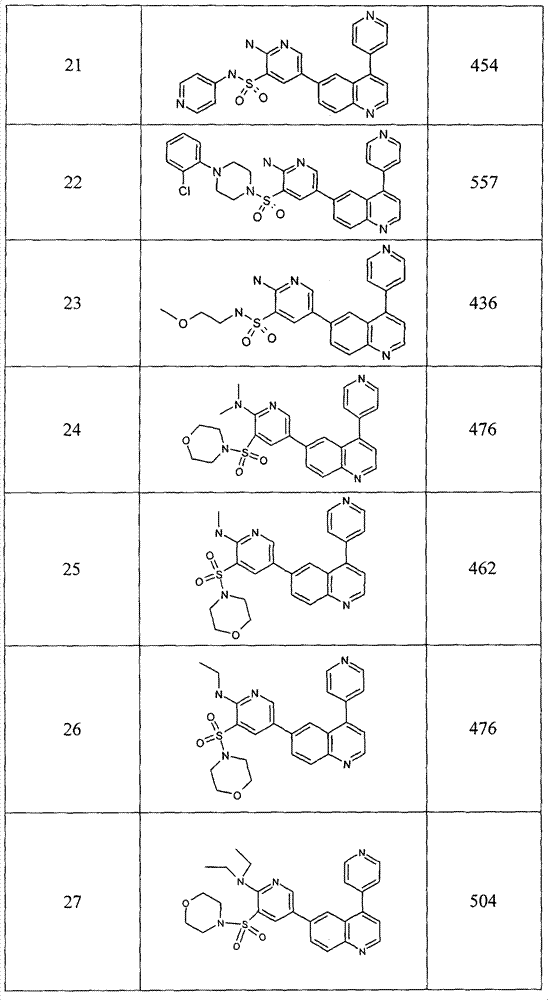


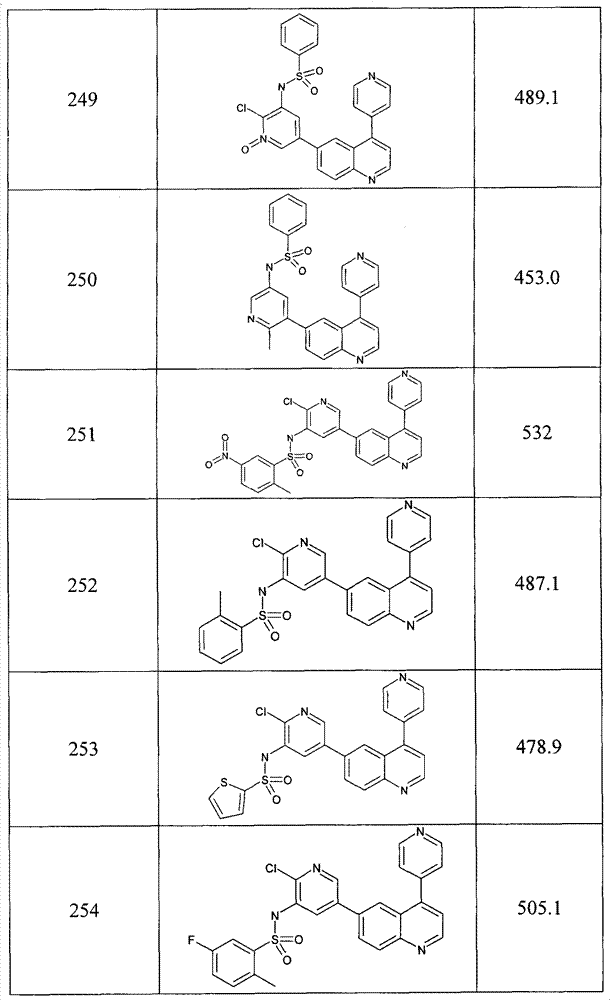


方案2:Scenario 2:
条件:a)杂芳基(R2)硼酸或杂芳基(R2)硼酸酯,钯催化剂,2M碳酸钾,加热;或杂芳基(R2)锡烷,钯催化剂,二噁烷,加热。Conditions: a) Heteroaryl(R2)boronic acid or heteroaryl(R2)boronate, palladium catalyst, 2M potassium carbonate, heating; or heteroaryl(R2)stannane, palladium catalyst, dioxane, heating.
实施例107Example 107
6-[5-(甲基磺酰基)-3-吡啶基]-4-(4-吡啶基)喹啉6-[5-(Methylsulfonyl)-3-pyridyl]-4-(4-pyridyl)quinoline
将(6-溴-4-(4-吡啶基)喹啉(250mg,0.88mmol),5-甲基磺酰基吡啶-3-硼酸(201mg,1.0mmol),四(三苯基膦)合钯(0)(104mg,0.09mmol)和饱和NaHCO3水溶液(1.75mL)于二噁烷(5mL)中的混合物在110℃加热1小时,然后冷却至室温。混合物通过Celite和Na2SO4过滤至硅胶上,粗产物通过柱色谱法(5%EtOAc/Hex-10%乙醇/EtOAc;30分钟,梯度)纯化。蒸发并从MeOH/水(2/98)中沉淀,得到标题化合物,为黄色固体。(160mg,50%)。ESMS[M+H]+=362.1。(6-Bromo-4-(4-pyridyl)quinoline (250mg, 0.88mmol), 5-methylsulfonylpyridine-3-boronic acid (201mg, 1.0mmol), tetrakis(triphenylphosphine)palladium A mixture of (0) (104 mg, 0.09 mmol) and saturated aqueous NaHCO 3 (1.75 mL) in dioxane (5 mL) was heated at 110° C. for 1 hour, then cooled to room temperature. The mixture was filtered through Celite and Na 2 SO 4 to On silica gel, the crude product was purified by column chromatography (5% EtOAc/Hex - 10% EtOAc/EtOAc; 30 min, gradient). Evaporation and precipitation from MeOH/water (2/98) afforded the title compound as a yellow solid .(160 mg, 50%). ESMS [M+H] + = 362.1.
下列化合物通过或可通过用于制备实施例107化合物的一般方法制备:The following compounds were or could be prepared by the general methods used to prepare the compound of Example 107:

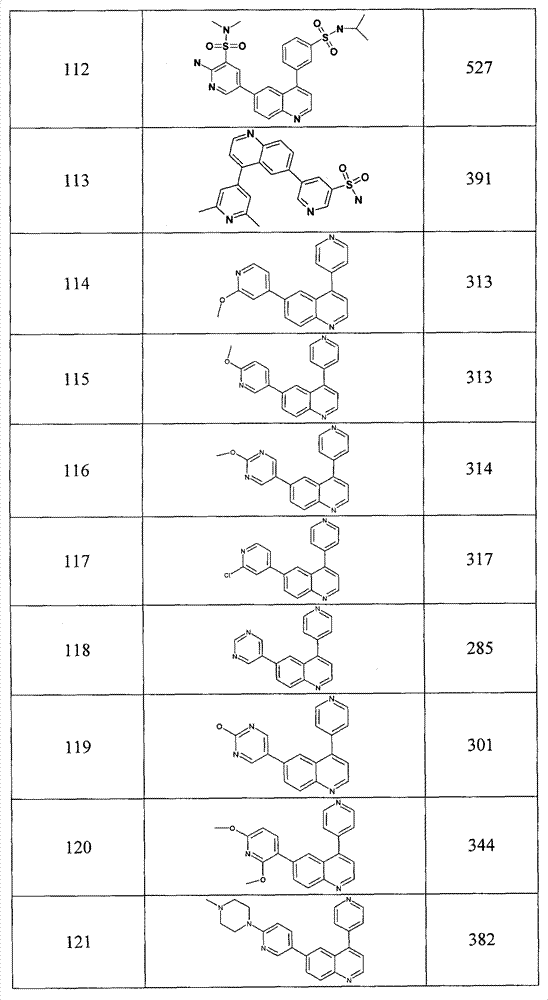

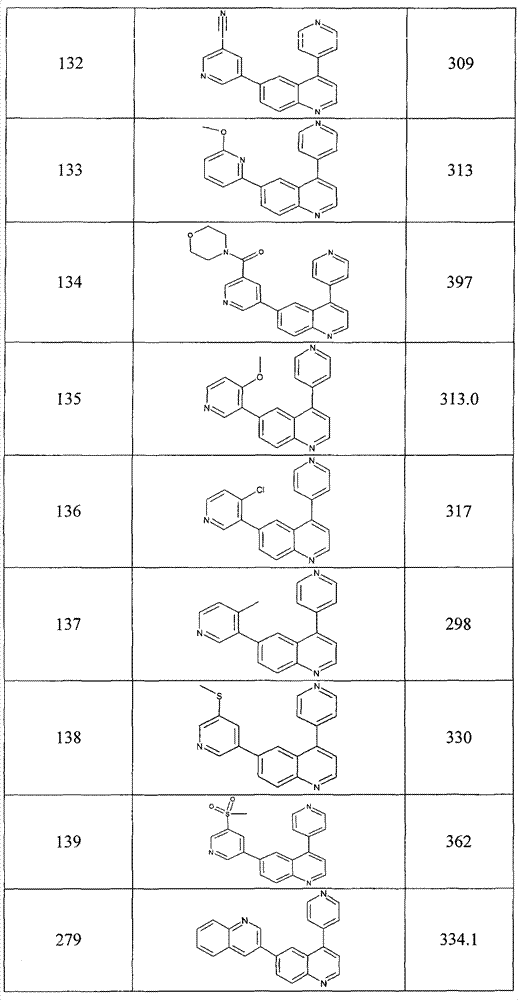
方案3:Option 3:

条件:a)芳基(R1)硼酸或芳基(R1)硼酸酯,钯催化剂,2M碳酸钾,二噁烷,加热;然后杂芳基(R2)硼酸或杂芳基(R2)硼酸酯,钯催化剂,2M碳酸钾,加热。Conditions: a) aryl(R1)boronic acid or aryl(R1)boronic acid ester, palladium catalyst, 2M potassium carbonate, dioxane, heating; then heteroaryl(R2)boronic acid or heteroaryl(R2)boronic acid Esters, palladium catalyst, 2M potassium carbonate, heated.
实施例139Example 139
2-氨基-5-{4-[3-(氨基磺酰基)苯基]-6-喹啉基}-3-吡啶磺酰胺2-Amino-5-{4-[3-(aminosulfonyl)phenyl]-6-quinolyl}-3-pyridinesulfonamide

将4-碘-6-溴喹啉(1.18g,3.53mmol),3-(4,4,5,5-四甲基-1,3,2-二氧杂硼杂环戊烷-2-基)苯磺酰胺(1g,3.53mmol),二氯-[1,1’双(二苯基膦)二茂铁]合钯(II)二氯甲烷加合物(177mg,0.176mmol),2M碳酸钾(5mL)于二噁烷(15mL)中的混合物在100℃加热1.5小时,并冷却至室温。LCMS显示反应完成。向完成的反应中加入2-氨基-5-(4,4,5,5-四甲基-1,3,2-二氧杂硼杂环戊烷-2-基)-3-吡啶磺酰胺(1.2g,4mmol),二氯-[1,1’双(二苯基膦)二茂铁]合钯(II)二氯甲烷加合物(177mg,0.176mmol)和2M碳酸钾(5mL)。将反应在100℃加热3小时,并冷却至室温。分离二噁烷和水,并蒸发二噁烷,得到粗产物,将其在硅胶上纯化,使用乙酸乙酯/甲醇、0-3%甲醇洗脱。从乙酸乙酯中结晶的产物含有乙酸乙酯。乙酸乙酯通过将该产物溶解在过量的丙酮中并蒸发而除去。然后将残余的丙酮通过使用蒸馏水在60℃研磨接着过滤并在真空下干燥而除去。得到标题化合物(540mg,31%)。MS(ES)+m/e 484[M+H]+。4-iodo-6-bromoquinoline (1.18g, 3.53mmol), 3-(4,4,5,5-tetramethyl-1,3,2-dioxaborolane-2- Dichloro-[1,1'bis(diphenylphosphino)ferrocene]palladium(II) dichloromethane adduct (177mg, 0.176mmol), 2M A mixture of potassium carbonate (5 mL) in dioxane (15 mL) was heated at 100°C for 1.5 hours and cooled to room temperature. LCMS showed the reaction was complete. To the completed reaction was added 2-amino-5-(4,4,5,5-tetramethyl-1,3,2-dioxaborolan-2-yl)-3-pyridinesulfonamide (1.2g, 4mmol), dichloro-[1,1'bis(diphenylphosphino)ferrocene]palladium(II) dichloromethane adduct (177mg, 0.176mmol) and 2M potassium carbonate (5mL) . The reaction was heated at 100 °C for 3 hours and cooled to room temperature. The dioxane and water were separated and the dioxane was evaporated to give the crude product which was purified on silica gel using ethyl acetate/methanol, 0-3% methanol. The product crystallized from ethyl acetate contained ethyl acetate. Ethyl acetate was removed by dissolving the product in excess acetone and evaporating. Residual acetone was then removed by trituration with distilled water at 60°C followed by filtration and drying under vacuum. The title compound (540 mg, 31%) was obtained. MS(ES)+m/e 484[M+H] + .
下列化合物通过或可通过用于制备实施例139化合物的一般方法制备:The following compounds were or could be prepared by the general methods used to prepare the compound of Example 139:


方案4:Option 4:

条件:a)芳基(R1)硼酸或芳基(R1)硼酸酯,钯催化剂,2M碳酸钾,二噁烷,加热;b)联硼酸二频哪醇酯,乙酸钾,钯催化剂,二噁烷,加热;然后杂芳基(R2)溴,钯催化剂,2M碳酸钾,加热。Conditions: a) aryl (R1) boronic acid or aryl (R1) borate ester, palladium catalyst, 2M potassium carbonate, dioxane, heating; b) dipinacol diboronate, potassium acetate, palladium catalyst, di Oxane, heated; then heteroaryl(R2) bromide, palladium catalyst, 2M potassium carbonate, heated.
实施例153Example 153
2-氨基-5-[4-(1H-吡唑-4-基)-6-喹啉基]-3-吡啶磺酰胺2-Amino-5-[4-(1H-pyrazol-4-yl)-6-quinolinyl]-3-pyridinesulfonamide

a)6-溴-4-(1H-吡唑-4-基)喹啉a) 6-bromo-4-(1H-pyrazol-4-yl)quinoline
将6-溴-4-碘喹啉(1.37g,4mmol)和4-(4,4,5,5-四甲基-1,3,2-二氧杂硼杂环戊烷-2-基)-1H-吡唑(852mg,4mmol),二氯-[1,1’双(二苯基膦)二茂铁]合钯(II)二氯甲烷加合物(162mg,0.2mmol),2M碳酸钾(6mL)于二噁烷(25mL)中的混合物在100℃加热1.5小时,并冷却至室温。分离二噁烷和水,蒸发二噁烷,得到粗产物,将其在硅胶上纯化,使用乙酸乙酯/甲醇,0-3%甲醇洗脱。得到标题化合物(340mg,34%)。MS(ES)+m/e 275[M+H]+。6-Bromo-4-iodoquinoline (1.37g, 4mmol) and 4-(4,4,5,5-tetramethyl-1,3,2-dioxaborolan-2-yl )-1H-pyrazole (852mg, 4mmol), dichloro-[1,1'bis(diphenylphosphino)ferrocene]palladium(II) dichloromethane adduct (162mg, 0.2mmol), 2M A mixture of potassium carbonate (6 mL) in dioxane (25 mL) was heated at 100°C for 1.5 hours and cooled to room temperature. The dioxane and water were separated and the dioxane was evaporated to give the crude product which was purified on silica gel using ethyl acetate/methanol, 0-3% methanol. The title compound (340 mg, 34%) was obtained. MS(ES)+m/e 275[M+H] + .
b)2-氨基-5-[4-(1H-吡唑-4-基)-6-喹啉基]-3-吡啶磺酰胺b) 2-amino-5-[4-(1H-pyrazol-4-yl)-6-quinolyl]-3-pyridinesulfonamide
将6-溴-4-(1H-吡唑-4-基)喹啉(330mg,1.2mmol),4,4,4′,4′,5,5,5′,5′-八甲基-2,2′-联-1,3,2-二氧杂硼杂环戊烷(304mg,1.2mmol),二氯-[1,1’双(二苯基膦)二茂铁]合钯(II)二氯甲烷加合物(48mg,0.06mmol),乙酸钾(352mg,3.6mmol)于二噁烷(5mL)中在100℃加热1.5小时,并冷却至室温。LCMS显示反应完全(形成4-(1H-吡唑-4-基)-6-(4,4,5,5-四甲基-1,3,2-二氧杂硼杂环戊烷-2-基)喹啉)。6-Bromo-4-(1H-pyrazol-4-yl)quinoline (330mg, 1.2mmol), 4,4,4',4',5,5,5',5'-octamethyl- 2,2'-bis-1,3,2-dioxaborolane (304mg, 1.2mmol), dichloro-[1,1'bis(diphenylphosphino)ferrocene]palladium ( II) Dichloromethane adduct (48mg, 0.06mmol), potassium acetate (352mg, 3.6mmol) in dioxane (5mL) was heated at 100°C for 1.5 hours and cooled to room temperature. LCMS showed complete reaction (formation of 4-(1H-pyrazol-4-yl)-6-(4,4,5,5-tetramethyl-1,3,2-dioxaborolane-2 -yl) quinoline).
向该同一反应混合物中加入二氯-[1,1’双(二苯基膦)二茂铁]合钯(II)二氯甲烷加合物(48mg,0.06mmol),2-氨基-5-溴-3-吡啶磺酰胺(280mg,1mmol)和2M碳酸钾(1.5mL)。将反应混合物再次加热至115℃,持续18小时。分离二噁烷和水,并蒸发二噁烷。粗产物使用二氯甲烷研磨(不溶),然后溶于DMF,并通过玻璃纤维过滤介质过滤。蒸发DMF,产物使用甲醇研磨,过滤并干燥。得到标题化合物(108mg,22%,两步)。MS(ES)+m/e 395[M+H]+。To the same reaction mixture was added dichloro-[1,1'bis(diphenylphosphino)ferrocene]palladium(II) dichloromethane adduct (48 mg, 0.06 mmol), 2-amino-5- Bromo-3-pyridinesulfonamide (280 mg, 1 mmol) and 2M potassium carbonate (1.5 mL). The reaction mixture was reheated to 115 °C for 18 hours. Dioxane and water were separated, and dioxane was evaporated. The crude product was triturated with dichloromethane (insoluble), then dissolved in DMF and filtered through a glass fiber filter medium. DMF was evaporated and the product was triturated with methanol, filtered and dried. The title compound was obtained (108 mg, 22%, two steps). MS(ES)+m/e 395[M+H] + .
下列化合物通过或可通过用于制备实施例153化合物的一般方法制备:The following compounds were or could be prepared by the general methods used to prepare the compound of Example 153:


方案5:Option 5:
条件:a)联硼酸二频哪醇酯,钯催化剂,乙酸钾,二噁烷,加热;然后杂芳基(R2)溴,钯催化剂,2M碳酸钾,加热;然后芳基(R1)硼酸或芳基(R1)硼酸酯,钯催化剂,2M碳酸钾,加热。Conditions: a) dipinacol diboronate, palladium catalyst, potassium acetate, dioxane, heating; then heteroaryl (R2) bromine, palladium catalyst, 2M potassium carbonate, heating; then aryl (R1) boronic acid or Aryl (R1) borate, palladium catalyst, 2M potassium carbonate, heated.
实施例189Example 189
2-氨基-5-{4-[3-(氨基磺酰基)苯基]-6-喹啉基}-3-吡啶磺酰胺2-Amino-5-{4-[3-(aminosulfonyl)phenyl]-6-quinolyl}-3-pyridinesulfonamide

该化合物以一锅法(三步)制备,其中在各步之间不用后处理。将6-溴-4-氯喹啉(484mg,2mmol),联硼酸二频哪醇酯(506mg,2mmol),二氯-[1,1’双(二苯基膦)二茂铁]合钯(II)二氯甲烷加合物(81.5mg,0.1mmol)和乙酸钾(588mg,6mmol)于二噁烷(6mL)中的混合物在100℃加热4小时。向该反应中加入2-氨基-5-溴-3-吡啶磺酰胺(560mg 2mmol),等量的上面使用的钯催化剂(0.1mmol)和2M碳酸钾(3mL)。将反应在95℃加热1小时。向该反应中加入3-(4,4,5,5-四甲基-1,3,2-二氧杂硼杂环戊烷-2-基)苯磺酰胺(566mg 2mmol),二氯-[1,1’双(二苯基膦)二茂铁]合钯(II)二氯甲烷加合物(81.5mg,0.1mmol)和2M碳酸钾(3mL)。将反应在95℃加热3小时。蒸发溶剂,粗物质通过硅胶色谱法纯化,使用乙酸乙酯洗脱。产物再通过从热乙酸乙酯中结晶而纯化。得到181mg(18.7%),三步。MS(ES)+m/e 484[M+H]+。The compound was prepared in a one-pot procedure (three steps) with no work-up between the steps. 6-bromo-4-chloroquinoline (484mg, 2mmol), bis-pinacol ester of borate (506mg, 2mmol), dichloro-[1,1'bis(diphenylphosphino)ferrocene]palladium ( II) A mixture of dichloromethane adduct (81.5 mg, 0.1 mmol) and potassium acetate (588 mg, 6 mmol) in dioxane (6 mL) was heated at 100°C for 4 hours. To the reaction was added 2-amino-5-bromo-3-pyridinesulfonamide (560 mg 2 mmol), an equivalent of the palladium catalyst used above (0.1 mmol) and 2M potassium carbonate (3 mL). The reaction was heated at 95°C for 1 hour. To the reaction was added 3-(4,4,5,5-tetramethyl-1,3,2-dioxaborolan-2-yl)benzenesulfonamide (566 mg 2 mmol), dichloro- [1,1'bis(diphenylphosphino)ferrocene]palladium(II) dichloromethane adduct (81.5 mg, 0.1 mmol) and 2M potassium carbonate (3 mL). The reaction was heated at 95°C for 3 hours. The solvent was evaporated and the crude material was purified by silica gel chromatography, eluting with ethyl acetate. The product was then purified by crystallization from hot ethyl acetate. Yield 181 mg (18.7%) in three steps. MS(ES)+m/e 484[M+H] + .
下列化合物通过或可通过用于制备实施例189化合物的一般方法制备:The following compounds were or could be prepared by the general methods used to prepare the compound of Example 189:


方案6:Option 6:

条件:a)六甲基二锡烷,四(三苯基膦)合钯(0),氯化锂,四氢呋喃,加热;b)杂芳基(R2)溴,钯催化剂,二噁烷,加热。Conditions: a) hexamethyldistannane, tetrakis(triphenylphosphine)palladium(0), lithium chloride, tetrahydrofuran, heating; b) heteroaryl(R2) bromide, palladium catalyst, dioxane, heating .
实施例197Example 197
4-(4-吡啶基)-6-(1H-[1,2,3]三唑并[4,5-b]吡啶-6-基)喹啉4-(4-pyridyl)-6-(1H-[1,2,3]triazolo[4,5-b]pyridin-6-yl)quinoline

a)4-(4-吡啶基)-6-(三甲基锡烷基)喹啉a) 4-(4-pyridyl)-6-(trimethylstannyl)quinoline
将4-(4-吡啶基)-6-溴喹啉(15g,53mmol),六甲基二锡烷(19g,59mmol),氯化锂(16g,370mmol),四(三苯基膦)合钯(0)(3g,2.7mmol)于四氢呋喃(400mL)中的混合物加热回流16小时,此时将反应冷却至室温,并在减压下浓缩。将二氯甲烷(500mL)加至残余物中,并将混合物搅拌2小时以破碎固体。然后将混合物过滤,并在减压下浓缩。得到的残余物通过硅胶色谱法(梯度:CH2Cl2至2%MeOH/CH2Cl2)纯化,得到标题化合物(11g,56%),为米色固体。MS(ES)+m/e 370[M+H]+。4-(4-pyridyl)-6-bromoquinoline (15g, 53mmol), hexamethyldistannane (19g, 59mmol), lithium chloride (16g, 370mmol), tetrakis(triphenylphosphine) A mixture of palladium(0) (3 g, 2.7 mmol) in tetrahydrofuran (400 mL) was heated to reflux for 16 h at which time the reaction was cooled to room temperature and concentrated under reduced pressure. Dichloromethane (500 mL) was added to the residue, and the mixture was stirred for 2 hours to break up the solid. The mixture was then filtered and concentrated under reduced pressure. The resulting residue was purified by silica gel chromatography (Gradient: CH2Cl2 to 2% MeOH / CH2Cl2 ) to afford the title compound (11 g, 56%) as a beige solid. MS(ES)+m/e 370[M+H] + .
b)4-(4-吡啶基)-6-(1H-[1,2,3]三唑并[4,5-b]吡啶-6-基)喹啉b) 4-(4-pyridyl)-6-(1H-[1,2,3]triazolo[4,5-b]pyridin-6-yl)quinoline
将6-溴-1H-[1,2,3]三唑并[4,5-b]吡啶(100mg,0.5mmol),4-(4-吡啶基)-6-(三甲基锡烷基)喹啉(204mg,0.55mmol)和四(三苯基膦)合钯(0)(29mg,0.025mmol)于1,4-二噁烷(3.0mL)中的混合物在100℃加热18小时。将反应过滤以收集沉淀。将固体在热乙醇中研磨,得到灰白色固体,其仍然含有一些次要的杂质。灰白色固体在热乙醇中研磨,得到标题产物,为米色固体(22mg,14%)。MS(ES)+m/e 325.1[M+H]+。6-Bromo-1H-[1,2,3]triazolo[4,5-b]pyridine (100mg, 0.5mmol), 4-(4-pyridyl)-6-(trimethylstannyl ) quinoline (204 mg, 0.55 mmol) and tetrakis(triphenylphosphine)palladium(0) (29 mg, 0.025 mmol) in 1,4-dioxane (3.0 mL) was heated at 100° C. for 18 hours. The reaction was filtered to collect the precipitate. The solid was triturated in hot ethanol to give an off-white solid which still contained some minor impurities. The off-white solid was triturated in hot ethanol to give the title product as a beige solid (22 mg, 14%). MS(ES)+m/e 325.1 [M+H] + .
下列化合物通过或可通过用于制备实施例197化合物的一般方法制备:The following compounds were or could be prepared by the general methods used to prepare the compound of Example 197:

方案7:Option 7:

条件:a)乙氧亚甲基丙二酸二乙酯(diethylethoxymethylene malonate),140℃,然后Dowtherm A(道氏载热体A,联苯与联苯醚的混合物),260℃;b)6N氢氧化钠,乙醇,回流;c)Dowtherm A,260℃;d)磷酰氯,回流;e)联硼酸二频哪醇酯,钯催化剂,乙酸钾,二噁烷,加热;然后杂芳基(R2)溴,钯催化剂,2M碳酸钾水溶液,加热;然后芳基(R1)硼酸/酯,钯催化剂,2M碳酸钾水溶液,二噁烷,加热。Conditions: a) Diethylethoxymethylene malonate (diethylethoxymethylene malonate), 140°C, then Dowtherm A (Dowtherm A, a mixture of biphenyl and diphenyl ether), 260°C; b) 6N Sodium hydroxide, ethanol, reflux; c) Dowtherm A, 260 ℃; d) phosphorus oxychloride, reflux; e) dipinacol diboronate, palladium catalyst, potassium acetate, dioxane, heating; then heteroaryl ( R2) bromine, palladium catalyst, 2M aqueous potassium carbonate, heated; then aryl (R1) boronic acid/ester, palladium catalyst, 2M aqueous potassium carbonate, dioxane, heated.
实施例204Example 204
2-氨基-N,N-二甲基-5-[8-甲基-4-(4-吡啶基)-6-喹啉基]-3-吡啶磺酰胺2-amino-N,N-dimethyl-5-[8-methyl-4-(4-pyridyl)-6-quinolyl]-3-pyridinesulfonamide

a)6-溴-4-羟基-8-甲基-3-喹啉甲酸乙酯a) ethyl 6-bromo-4-hydroxy-8-methyl-3-quinolinecarboxylate
将4-溴-2-甲基苯胺(1.50g,8.04mmol)和乙氧亚甲基丙二酸二乙酯(diethylethoxymethylene malonate)(1.74g,8.04mmol)的混合物于油浴中在140℃加热并同时搅拌5.0小时。将反应混合物转移至加热套中,使用Dowtherm A(4mL)稀释,并在260℃加热1小时。将反应冷却,使用己烷稀释,并将悬浮液在室温搅拌过夜。将悬浮液过滤,且过滤出的固体使用己烷洗涤,并在布氏漏斗中干燥,得到标题化合物(1.90g,76%),为黄褐色固体。MS(ES)+m/e 310[M+H]。A mixture of 4-bromo-2-methylaniline (1.50 g, 8.04 mmol) and diethylethoxymethylene malonate (1.74 g, 8.04 mmol) was heated at 140° C. in an oil bath while stirring for 5.0 hours. The reaction mixture was transferred to a heating mantle, diluted with Dowtherm A (4 mL), and heated at 260° C. for 1 hour. The reaction was cooled, diluted with hexanes, and the suspension was stirred at room temperature overnight. The suspension was filtered and the filtered solid was washed with hexanes and dried in a Buchner funnel to afford the title compound (1.90 g, 76%) as a tan solid. MS(ES) + m/e 310 [M+H].
b)6-溴-4-羟基-8-甲基-3-喹啉甲酸b) 6-bromo-4-hydroxy-8-methyl-3-quinolinecarboxylic acid
将6-溴-4-羟基-8-甲基-3-喹啉甲酸乙酯(1.89g,6.09mmol)和6N NaOH(1.22g,30.45mmol,5.1mL)于乙醇(30mL)中的混合物加热回流2.0小时,并在真空下浓缩。残余物使用水稀释,并使用6N HCl酸化至pH 4。将得到的固体过滤,使用水和乙醚洗涤,并在布氏漏斗中干燥过夜,得到标题化合物(1.72g,99%),为黄褐色固体。MS(ES)+m/e 282[M+H]。A mixture of ethyl 6-bromo-4-hydroxy-8-methyl-3-quinolinecarboxylate (1.89 g, 6.09 mmol) and 6N NaOH (1.22 g, 30.45 mmol, 5.1 mL) in ethanol (30 mL) was heated Reflux for 2.0 hours and concentrate in vacuo. The residue was diluted with water and acidified to pH 4 with 6N HCl. The resulting solid was filtered, washed with water and diethyl ether, and dried overnight in a Buchner funnel to afford the title compound (1.72 g, 99%) as a tan solid. MS(ES) + m/e 282 [M+H].
c)6-溴-8-甲基-4-羟基喹啉c) 6-bromo-8-methyl-4-hydroxyquinoline
将6-溴-4-羟基-8-甲基-3-喹啉甲酸(1.80g,6.36mmol)和Dowtherm A(10mL)的混合物在260℃加热1.0小时。将反应冷却,使用己烷研磨,过滤并在布氏漏斗中干燥,得到标题化合物(1.43g,95%),为黄褐色固体。MS(ES)+m/e 238[M+H]。A mixture of 6-bromo-4-hydroxy-8-methyl-3-quinolinecarboxylic acid (1.80 g, 6.36 mmol) and Dowtherm A (10 mL) was heated at 260 °C for 1.0 h. The reaction was cooled, triturated with hexanes, filtered and dried in a Buchner funnel to give the title compound (1.43 g, 95%) as a tan solid. MS(ES) + m/e 238 [M+H].
d)6-溴-4-氯-8-甲基喹啉d) 6-bromo-4-chloro-8-methylquinoline
将6-溴-8-甲基-4-羟基喹啉(1.42g,5.95mmol)和磷酰氯(10.95g,71.40mmol)的混合物加热回流1小时,冷却,倾倒至冰上,并通过添加30%氢氧化铵中和。将得到的固体过滤,并在真空烘箱中干燥,得到标题化合物(1.45g,95%),为黄褐色固体。MS(ES)+m/e 256[M+H]。A mixture of 6-bromo-8-methyl-4-hydroxyquinoline (1.42g, 5.95mmol) and phosphorus oxychloride (10.95g, 71.40mmol) was heated to reflux for 1 hour, cooled, poured onto ice, and % ammonium hydroxide neutralization. The resulting solid was filtered and dried in a vacuum oven to give the title compound (1.45 g, 95%) as a tan solid. MS(ES) + m/e 256 [M+H].
e)2-氨基-N,N-二甲基-5-[8-甲基-4-(4-吡啶基)-6-喹啉基]-3-吡啶磺酰胺e) 2-amino-N, N-dimethyl-5-[8-methyl-4-(4-pyridyl)-6-quinolyl]-3-pyridinesulfonamide
将6-溴-4-氯-8-甲基喹啉(0.300g,1.170mmol),联硼酸二频哪醇酯(0.297g,1.170mmol),二氯[1,1’-双(二苯基膦)二茂铁]合钯(II)二氯甲烷加合物(0.029g,0.035mmol)和固体无水乙酸钾(0.459g,4.676mmol)于无水1,4-二噁烷(8mL)中的混合物加热回流70分钟。将油浴暂时撤去,并向反应中加入2-氨基-5-溴-N,N-二甲基-3-吡啶磺酰胺(0.327g,1.17mmol),二氯[1,1’-双(二苯基膦)二茂铁]合钯(II)二氯甲烷加合物(0.047g,0.058mmol)和2M碳酸钾水溶液(0.646g,4.676mmol,2.34mL)。将反应加热回流80分钟。将油浴暂时撤去,并向反应中加入4-(4,4,5,5-四甲基-1,3,2-二氧杂硼杂环戊烷-2-基)吡啶(0.240g,1.17mmol),二氯[1,1’-双(二苯基膦)二茂铁]合钯(II)二氯甲烷加合物(0.047g,0.058mmol),2M碳酸钾水溶液(0.485g,3.51mmol,1.76mL)和1,4-二噁烷(6mL)。将反应加热回流17小时,并在真空下浓缩。残余物使用10%MeOH:EtOAc(45mL)研磨,通过滤纸过滤,并将滤液在真空下浓缩。残余物通过快速硅胶色谱法(7%MeOH:EtOAc)纯化,得到标题化合物(0.135g,28%),为黄色粉末。MS(ES)+m/e 420[M+H]。6-bromo-4-chloro-8-methylquinoline (0.300g, 1.170mmol), bis-pinacol ester of borate (0.297g, 1.170mmol), dichloro[1,1'-bis(diphenyl Phosphine) ferrocene] palladium (II) dichloromethane adduct (0.029g, 0.035mmol) and solid anhydrous potassium acetate (0.459g, 4.676mmol) in anhydrous 1,4-dioxane (8mL ) was heated to reflux for 70 minutes. The oil bath was temporarily removed, and 2-amino-5-bromo-N,N-dimethyl-3-pyridinesulfonamide (0.327 g, 1.17 mmol), dichloro[1,1'-bis( Diphenylphosphino)ferrocene]palladium(II) dichloromethane adduct (0.047g, 0.058mmol) and 2M aqueous potassium carbonate (0.646g, 4.676mmol, 2.34mL). The reaction was heated to reflux for 80 minutes. The oil bath was temporarily removed, and 4-(4,4,5,5-tetramethyl-1,3,2-dioxaborolan-2-yl)pyridine (0.240 g, 1.17mmol), dichloro[1,1'-bis(diphenylphosphino)ferrocene]palladium(II) dichloromethane adduct (0.047g, 0.058mmol), 2M potassium carbonate aqueous solution (0.485g, 3.51 mmol, 1.76 mL) and 1,4-dioxane (6 mL). The reaction was heated to reflux for 17 hours and concentrated under vacuum. The residue was triturated with 10% MeOH:EtOAc (45 mL), filtered through filter paper, and the filtrate was concentrated in vacuo. The residue was purified by flash silica gel chromatography (7% MeOH:EtOAc) to afford the title compound (0.135 g, 28%) as a yellow powder. MS(ES) + m/e 420 [M+H].
下列化合物通过或可通过用于制备实施例204化合物的一般方法制备:The following compounds were or could be prepared by the general methods used to prepare the compound of Example 204:


方案8:Option 8:

条件:a)联硼酸二频哪醇酯,乙酸钾,钯催化剂,二噁烷,加热;然后5-溴-2-吡啶胺,钯催化剂,2M碳酸钾,二噁烷,加热;b)氯磺酸,0℃至回流;c)R6R7NH,吡啶,二噁烷,室温至50℃。Conditions: a) dipinacol diboronate, potassium acetate, palladium catalyst, dioxane, heating; then 5-bromo-2-pyridinamine, palladium catalyst, 2M potassium carbonate, dioxane, heating; b) chlorine Sulfonic acid, 0°C to reflux; c) R 6 R 7 NH, pyridine, dioxane, room temperature to 50°C.
实施例211Example 211
3-(1-哌啶基磺酰基)-5-[4-(4-吡啶基)-6-喹啉基]-2-吡啶胺3-(1-piperidinylsulfonyl)-5-[4-(4-pyridyl)-6-quinolinyl]-2-pyridinylamine
a)5-[4-(4-吡啶基)-6-喹啉基]-2-吡啶胺a) 5-[4-(4-pyridyl)-6-quinolyl]-2-pyridylamine
向1L加压容器中加入6-溴-4-(4-吡啶基)喹啉(12g,42.08mmol),联硼酸二频哪醇酯(12.8g,50.5mmol),无水乙酸钾(8.24g,84.16mmol),[1,1’-双(二苯基膦)-二茂铁]二氯合钯(II)-二氯甲烷(1∶1)络合物(1.372g,1.68mmol)和无水二噁烷(420mL)。将该反应器用氮气除气,盖上盖子,并在100℃加热15小时。LCMS显示96%转化,得到所需硼酸酯MS(ES)+m/e 333.2[M+H]+和硼酸MS(ES)+m/e 250.9[M+H]+的混合物。Add 6-bromo-4-(4-pyridyl)quinoline (12g, 42.08mmol), dipinacol diboronate (12.8g, 50.5mmol), anhydrous potassium acetate (8.24g , 84.16mmol), [1,1'-bis(diphenylphosphine)-ferrocene]dichloropalladium(II)-dichloromethane (1:1) complex (1.372g, 1.68mmol) and Anhydrous dioxane (420 mL). The reactor was purged with nitrogen, covered, and heated at 100°C for 15 hours. LCMS showed 96% conversion to give a mixture of the desired boronate MS(ES)+m/e 333.2 [M+H] + and boronic acid MS(ES)+m/e 250.9[M+H] + .
向上述反应混合物中加入5-溴-2-吡啶胺(7.28g,42.08mmol),[1,1’-双(二苯基膦)-二茂铁]二氯合钯(II)-二氯甲烷(1∶1)络合物(1.718g,2.1mmol),2MK2CO3水溶液(300mL)。将反应在100℃加热21小时。冷却至室温后,分离有机层,并在真空下浓缩。残余物使用水研磨,并溶于二氯甲烷。将该溶液通过硅胶填料过滤,连续使用二氯甲烷和乙醇洗涤。在真空下浓缩,得到标题化合物,为黄色粉末(8.767g,70%产率)。MS(ES)+m/e 299.0[M+H]+。To the above reaction mixture was added 5-bromo-2-pyridinamine (7.28 g, 42.08 mmol), [1,1'-bis(diphenylphosphine)-ferrocene]dichloropalladium(II)-dichloro Methane (1:1) complex (1.718 g, 2.1 mmol), 2M K 2 CO 3 in water (300 mL). The reaction was heated at 100°C for 21 hours. After cooling to room temperature, the organic layer was separated and concentrated under vacuum. The residue was triturated with water and dissolved in dichloromethane. The solution was filtered through a plug of silica gel, washing successively with dichloromethane and ethanol. Concentration under vacuum afforded the title compound as a yellow powder (8.767 g, 70% yield). MS(ES)+m/e 299.0 [M+H] + .
b)2-氨基-5-[4-(4-吡啶基)-6-喹啉基]-3-吡啶磺酰氯b) 2-amino-5-[4-(4-pyridyl)-6-quinolyl]-3-pyridinesulfonyl chloride
在剧烈搅拌下,向冷却(0℃)的氯磺酸(15mL)中分批加入5-[4-(4-吡啶基)-6-喹啉基]-2-吡啶胺(4.348g,14.57mmol)。反应混合物然后加热回流16小时。冷却至室温后,LCMS显示47%的标题化合物MS(ES)+m/e 396.9[M+]+和37%的磺酸副产物MS(ES)+m/e 379.1[M+]+。将2mL该0.456M标题化合物溶液在下一反应中使用,而不用进一步后处理。Under vigorous stirring, 5-[4-(4-pyridyl)-6-quinolinyl]-2-pyridinylamine (4.348 g, 14.57 mmol). The reaction mixture was then heated to reflux for 16 hours. After cooling to room temperature, LCMS showed 47% of the title compound MS(ES)+m/e 396.9[M+] + and 37% of the sulfonic acid by-product MS(ES)+m/e 379.1[M+] + . 2 mL of this 0.456M solution of the title compound was used in the next reaction without further workup.
c)3-(1-哌啶基磺酰基)-5-[4-(4-吡啶基)-6-喹啉基]-2-吡啶胺c) 3-(1-piperidinylsulfonyl)-5-[4-(4-pyridyl)-6-quinolyl]-2-pyridylamine
向冷却(5℃)的上述0.456M的2-氨基-5-[4-(4-吡啶基)-6-喹啉基]-3-吡啶磺酰氯(2mL,0.912mmol)于氯磺酸中的溶液中加入无水二噁烷(1mL)和哌啶(1.8mL,18.24mmol)。搅拌30分钟后,加入吡啶(1mL,12.3mmol),并将反应混合物在室温再搅拌1小时。反应混合物在真空下浓缩,将残余物溶于CH2Cl2,并使用6N NaOH(水溶液)将pH调节至14。该溶液用CH2Cl2(x4)萃取,并将合并的有机层干燥(Na2SO4),过滤并在真空下浓缩。得到的残余物通过硅胶色谱法(0-5%MeOH的EtOAC溶液)纯化两次,得到标题化合物,为浅黄色固体(269mg,66%产率)。MS(ES)+m/e 446.3[M+H]+。To the cooled (5 °C) above 0.456M 2-amino-5-[4-(4-pyridyl)-6-quinolyl]-3-pyridinesulfonyl chloride (2 mL, 0.912 mmol) in chlorosulfonic acid A solution of dry dioxane (1 mL) and piperidine (1.8 mL, 18.24 mmol) were added. After stirring for 30 minutes, pyridine (1 mL, 12.3 mmol) was added, and the reaction mixture was stirred at room temperature for an additional 1 hour. The reaction mixture was concentrated under vacuum, the residue was dissolved in CH2Cl2 , and the pH was adjusted to 14 using 6N NaOH(aq). The solution was extracted with CH2Cl2 (x4), and the combined organic layers were dried ( Na2SO4 ), filtered and concentrated in vacuo . The resulting residue was purified twice by silica gel chromatography (0-5% MeOH in EtOAC) to afford the title compound as a pale yellow solid (269 mg, 66% yield). MS(ES)+m/e 446.3[M+H] + .
下列化合物通过或可通过用于制备实施例211化合物的一般方法制备:The following compounds were or could be prepared by the general methods used to prepare the compound of Example 211:


方案9:Option 9:

条件:a)芳基(R1)硼酸或芳基(R1)硼酸酯,钯催化剂,2M碳酸钾,二噁烷,加热;b)联硼酸二频哪醇酯,乙酸钾,钯催化剂,二噁烷,加热;然后杂芳基(R2)溴,钯催化剂,2M碳酸钾,加热。Conditions: a) aryl (R1) boronic acid or aryl (R1) borate ester, palladium catalyst, 2M potassium carbonate, dioxane, heating; b) dipinacol diboronate, potassium acetate, palladium catalyst, di Oxane, heated; then heteroaryl(R2) bromide, palladium catalyst, 2M potassium carbonate, heated.
实施例220Example 220
6-(1H-苯并咪唑-2-基)-4-(4-吡啶基)喹啉的制备Preparation of 6-(1H-benzimidazol-2-yl)-4-(4-pyridyl)quinoline

a)4-(4-吡啶基)-6-喹啉甲腈a) 4-(4-pyridyl)-6-quinolinecarbonitrile
将4-氯-6-喹啉甲腈(8.7g,46.2mmol),4-吡啶硼酸(8.52g,69.3mmol),四(三苯基膦)合钯(0)(2.67g,2.31mmol)和2M碳酸钾(69.3mL,3eq)于1,4-二噁烷(380mL)中的混合物加热回流3.5小时。蒸发二噁烷,粗产物通过硅胶色谱法纯化,使用二氯甲烷/甲醇0-4%洗脱。得到10.23g(95%)标题化合物。4-Chloro-6-quinolinecarbonitrile (8.7g, 46.2mmol), 4-pyridineboronic acid (8.52g, 69.3mmol), tetrakis (triphenylphosphine) palladium (0) (2.67g, 2.31mmol) and a mixture of 2M potassium carbonate (69.3 mL, 3 eq) in 1,4-dioxane (380 mL) was heated at reflux for 3.5 hours. Dioxane was evaporated and the crude product was purified by silica gel chromatography eluting with dichloromethane/methanol 0-4%. 10.23 g (95%) of the title compound were obtained.
b)6-(1H-苯并咪唑-2-基)-4-(4-吡啶基)喹啉b) 6-(1H-benzimidazol-2-yl)-4-(4-pyridyl)quinoline
将4-(4-吡啶基)-6-喹啉甲腈(231mg,1mmol),1,2-二氨基苯(108mg,1mmol)和多磷酸(1.4g)的混合物于微波中在250℃加热1.5小时。将反应倾倒至水中,其用碳酸氢盐中和。将产物过滤,使用水洗涤,并干燥。产物再通过溶于热甲醇,过滤并冷却得到结晶而纯化。产量47.7mg,30%。MS(ES)+m/e 323[M+H]+。A mixture of 4-(4-pyridyl)-6-quinolinecarbonitrile (231mg, 1mmol), 1,2-diaminobenzene (108mg, 1mmol) and polyphosphoric acid (1.4g) was heated in a microwave at 250°C 1.5 hours. The reaction was poured into water, which was neutralized with bicarbonate. The product was filtered, washed with water, and dried. The product was further purified by dissolving in hot methanol, filtering and cooling to give crystals. Yield 47.7 mg, 30%. MS(ES)+m/e 323[M+H] + .
下列化合物通过或可通过用于制备实施例220化合物的一般方法制备:The following compounds were or could be prepared by the general methods used to prepare the compound of Example 220:

方案10:Option 10:

条件:a)环状仲胺,二甲基甲酰胺,加热;b)联硼酸二频哪醇酯,乙酸钾,钯催化剂,二噁烷,加热;然后杂芳基(R2)溴,钯催化剂,2M碳酸钾,加热。Conditions: a) cyclic secondary amine, dimethylformamide, heating; b) dipinacol diboronate, potassium acetate, palladium catalyst, dioxane, heating; then heteroaryl (R2) bromide, palladium catalyst , 2M potassium carbonate, heated.
实施例225Example 225
4-(1-哌啶基)-6-(1H-吡唑并[3,4-b]吡啶-5-基)喹啉4-(1-piperidinyl)-6-(1H-pyrazolo[3,4-b]pyridin-5-yl)quinoline

a)6-溴-4-(1-哌啶基)喹啉a) 6-bromo-4-(1-piperidinyl)quinoline
向4-氯-6-溴喹啉(726mg,3mmol)于3mL的1-甲基-2-吡咯烷酮中的溶液中加入哌啶(510mg,6mmol)。将反应加热至150℃,持续5小时。溶剂在真空下在100℃除去,并将残余物溶于二氯甲烷,并使用水洗涤。二氯甲烷使用硫酸钠干燥,并浓缩。残余物使用己烷研磨,并将固体滤出,得到6-溴-4-(1-哌啶基)喹啉(877mg,73%)。To a solution of 4-chloro-6-bromoquinoline (726 mg, 3 mmol) in 3 mL of 1-methyl-2-pyrrolidinone was added piperidine (510 mg, 6 mmol). The reaction was heated to 150 °C for 5 hours. The solvent was removed under vacuum at 100°C, and the residue was dissolved in dichloromethane and washed with water. Dichloromethane was dried over sodium sulfate and concentrated. The residue was triturated with hexanes and the solid was filtered off to give 6-bromo-4-(1-piperidinyl)quinoline (877 mg, 73%).
b)4-(1-哌啶基)-6-(1H-吡唑并[3,4-b]吡啶-5-基)喹啉b) 4-(1-piperidinyl)-6-(1H-pyrazolo[3,4-b]pyridin-5-yl)quinoline
向6-溴-4-(1-哌啶基)喹啉(429mg,1.47mmol)于二噁烷(4mL)中的溶液中加入4,4,4′,4′,5,5,5′,5′-八甲基-2,2′-联-1,3,2-二氧杂硼杂环戊烷(373mg,1.76mmol),乙酸钾(441mg,4.5mmol)和PdCl2(dppf)2(36mg,0.045mmol)。将反应加热至150℃,持续30分钟,得到粗产物4-(1-哌啶基)-6-(4,4,5,5-四甲基-1,3,2-二氧杂硼杂环戊烷-2-基)喹啉。然后将反应冷却,并加入5-溴-1H-吡唑并[3,4-b]吡啶(348mg,1.76mmol),接着加入PdCl2(dppf)2(36mg,0.045mmol)和2M碳酸钾(2.25mL)。将反应在150℃加热30分钟,此时蒸发二噁烷,并将粗产物用水研磨,并通过过滤收集。粗产物通过HPLC色谱部分纯化,使用乙腈/水/0.1%TFA洗脱。此时产物纯度为85%。其使用碳酸钠游离碱化,并再通过硅胶色谱法纯化,使用二氯甲烷/0-2%(甲醇/浓氢氧化铵溶液9/1)洗脱,得到标题化合物(29mg,6%)。MS(ES)+m/e 330[M+H]+。To a solution of 6-bromo-4-(1-piperidinyl)quinoline (429 mg, 1.47 mmol) in dioxane (4 mL) was added 4,4,4',4',5,5,5' , 5'-octamethyl-2,2'-bi-1,3,2-dioxaborolane (373mg, 1.76mmol), potassium acetate (441mg, 4.5mmol) and PdCl 2 (dppf) 2 (36 mg, 0.045 mmol). The reaction was heated to 150 °C for 30 minutes to give the crude product 4-(1-piperidinyl)-6-(4,4,5,5-tetramethyl-1,3,2-dioxaborin Cyclopentan-2-yl) quinoline. The reaction was then cooled and 5 -bromo-1H-pyrazolo[3,4-b]pyridine (348 mg, 1.76 mmol) was added, followed by PdCl2(dppf)2 ( 36 mg, 0.045 mmol) and 2M potassium carbonate ( 2.25mL). The reaction was heated at 150 °C for 30 min, at which time the dioxane was evaporated and the crude product was triturated with water and collected by filtration. The crude product was partially purified by HPLC chromatography, eluting with acetonitrile/water/0.1% TFA. At this point the product was 85% pure. It was free based using sodium carbonate and purified by silica gel chromatography eluting with dichloromethane/0-2% (methanol/conc. ammonium hydroxide solution 9/1 ) to afford the title compound (29mg, 6%). MS(ES)+m/e 330[M+H] + .
下列化合物通过或可通过用于制备实施例225化合物的一般方法制备:The following compounds were or could be prepared by the general methods used to prepare the compound of Example 225:


方案11:Option 11:

条件:a)R-磺酰氯,吡啶,二氯甲烷。Conditions: a) R-sulfonyl chloride, pyridine, dichloromethane.
实施例230Example 230
2,4-二氟-N-{5-[4-(4-吡啶基)-6-喹啉基]-3-吡啶基}苯磺酰胺2,4-Difluoro-N-{5-[4-(4-pyridyl)-6-quinolyl]-3-pyridyl}benzenesulfonamide

a)2,4-二氟-N-{5-[4-(4-吡啶基)-6-喹啉基]-3-吡啶基}苯磺酰胺a) 2,4-difluoro-N-{5-[4-(4-pyridyl)-6-quinolyl]-3-pyridyl}benzenesulfonamide
将5-[4-(4-吡啶基)-6-喹啉基]-3-吡啶胺(82mg,0.27mmol)于无水吡啶(2.0ml)中的溶液使用纯的2,4-二氟苯磺酰氯一次性处理。将反应在室温搅拌30分钟,然后通过制备-HPLC直接纯化。合并的所需的级分在减压下蒸发以除去有机溶剂,然后使用少量盐水和饱和碳酸氢钠水溶液稀释。碱性溶液用乙酸乙酯萃取,然后将萃取液用无水硫酸钠干燥,并在减压下蒸发。得到的无色薄膜从二氯甲烷和乙醚中结晶。固体通过过滤收集,并用乙醚淋洗,然后真空干燥,得到标题化合物(219mg,48%),为白色固体。MS(ES)+m/e475[M+H]+。A solution of 5-[4-(4-pyridyl)-6-quinolyl]-3-pyridinamine (82mg, 0.27mmol) in anhydrous pyridine (2.0ml) was treated with pure 2,4-difluoro Benzenesulfonyl chloride is disposable. The reaction was stirred at room temperature for 30 minutes, then directly purified by prep-HPLC. The combined desired fractions were evaporated under reduced pressure to remove the organic solvent, then diluted with a small amount of brine and saturated aqueous sodium bicarbonate. The basic solution was extracted with ethyl acetate, and the extract was dried over anhydrous sodium sulfate and evaporated under reduced pressure. The resulting colorless film was crystallized from dichloromethane and ether. The solid was collected by filtration, rinsed with ether, and dried in vacuo to afford the title compound (219 mg, 48%) as a white solid. MS(ES)+m/e475[M+H] + .
下列化合物通过或可通过用于制备实施例230化合物的一般方法制备:The following compounds were or could be prepared by the general methods used to prepare the compound of Example 230:


制备一些非商购的杂芳基(R1)溴并与相应的硼酸酯或硼酸偶联(如上所述)。Some non-commercially available heteroaryl (R1) bromides were prepared and coupled with the corresponding boronic esters or boronic acids (as described above).
方案12:Option 12:
条件:a)氯磺酸,0℃-回流;b)吗啉,吡啶,二噁烷,5℃-室温-50℃。Conditions: a) chlorosulfonic acid, 0°C-reflux; b) morpholine, pyridine, dioxane, 5°C-room temperature-50°C.
实施例239Example 239
3-(4-吗啉基磺酰基)-5-[4-(4-吡啶基)-6-喹啉基]-2-吡啶胺3-(4-Morpholinylsulfonyl)-5-[4-(4-pyridyl)-6-quinolyl]-2-pyridinylamine

a)2-氨基-5-溴-3-吡啶磺酰氯a) 2-Amino-5-bromo-3-pyridinesulfonyl chloride
在剧烈搅拌下,向冷却(0℃)的氯磺酸(58mL)的溶液中分批加入5-溴-2-吡啶胺(15g,86.7mmol)。反应混合物然后加热回流3小时。冷却至室温后,将反应混合物倾倒至冰(~100g)上,并剧烈搅拌。得到的黄色沉淀通过抽滤收集,使用冷水和石油醚洗涤,得到标题化合物,为橙-黄色固体(18.1g,77%产率)。MS(ES)+m/e 272.8[M+H]+。To a cooled (0° C.) solution of chlorosulfonic acid (58 mL) was added portionwise 5-bromo-2-pyridinamine (15 g, 86.7 mmol) under vigorous stirring. The reaction mixture was then heated to reflux for 3 hours. After cooling to room temperature, the reaction mixture was poured onto ice (-100 g) and stirred vigorously. The resulting yellow precipitate was collected by suction filtration, washed with cold water and petroleum ether to afford the title compound as an orange-yellow solid (18.1 g, 77% yield). MS (ES)+m/e 272.8 [M+H] + .
b)5-溴-3-(4-吗啉基磺酰基)-2-吡啶胺b) 5-bromo-3-(4-morpholinosulfonyl)-2-pyridinamine
向冷却至5℃的2-氨基-5-溴-3-吡啶磺酰氯(0.50g,1.84mmol)于无水二噁烷(2mL)中的溶液中加入吗啉(0.16mL,1.84mmol),接着加入吡啶(0.174mL,2.15mmol)。将反应混合物在室温搅拌2小时,然后在50℃加热l小时。冷却至室温后,形成的白色沉淀通过抽滤收集,用水和石油醚洗涤,得到标题化合物,为灰白色固体(0.539g,91%产率)。MS(ES)+m/e 323.9[M+H]+。To a solution of 2-amino-5-bromo-3-pyridinesulfonyl chloride (0.50 g, 1.84 mmol) in anhydrous dioxane (2 mL) cooled to 5 °C was added morpholine (0.16 mL, 1.84 mmol), Then pyridine (0.174 mL, 2.15 mmol) was added. The reaction mixture was stirred at room temperature for 2 hours, then heated at 50 °C for 1 hour. After cooling to room temperature, the white precipitate formed was collected by suction filtration, washed with water and petroleum ether to afford the title compound as an off-white solid (0.539 g, 91% yield). MS(ES)+m/e 323.9[M+H] + .
c)3-(4-吗啉基磺酰基)-5-[4-(4-吡啶基)-6-喹啉基]-2-吡啶胺c) 3-(4-morpholinylsulfonyl)-5-[4-(4-pyridyl)-6-quinolinyl]-2-pyridylamine
将5-溴-3-(4-吗啉基磺酰基)-2-吡啶胺(0.296g,0.92mmol),4-(4-吡啶基)-6-(4,4,5,5-四甲基-1,3,2-二氧杂硼杂环戊烷-2-基)喹啉(0.306mg,0.92mmol),[1,1’-双(二苯基膦)-二茂铁]二氯合钯(II)-二氯甲烷络合物(1∶1)(37.6mg,0.046mmol),2M K2CO3水溶液(5mL)和二噁烷(5mL)的混合物在100℃加热18小时。冷却至室温后,分离有机层,水层部分用EtOAc萃取三次。将合并的有机层干燥(Na2SO4),过滤并在真空下浓缩。残余物通过硅胶色谱法(洗脱液:i)1-5%MeOH的CH2Cl2溶液,和ii)0-20%MeOH的CH2Cl2溶液)纯化,得到标题化合物,为白色固体(150mg,37%产率)。MS(ES)+m/e448.0[M+H]+。5-Bromo-3-(4-morpholinosulfonyl)-2-pyridinamine (0.296g, 0.92mmol), 4-(4-pyridyl)-6-(4,4,5,5-tetra Methyl-1,3,2-dioxaborolan-2-yl)quinoline (0.306 mg, 0.92 mmol), [1,1'-bis(diphenylphosphine)-ferrocene] A mixture of dichloropalladium(II)-dichloromethane complex (1:1) (37.6 mg, 0.046 mmol), 2M aqueous K 2 CO 3 (5 mL) and dioxane (5 mL) was heated at 100° C. for 18 Hour. After cooling to room temperature, the organic layer was separated and the aqueous portion was extracted three times with EtOAc. The combined organic layers were dried ( Na2SO4 ), filtered and concentrated under vacuum. The residue was purified by silica gel chromatography ( eluent: i) 1-5% MeOH in CH2Cl2 , and ii) 0-20% MeOH in CH2Cl2 ) to afford the title compound as a white solid ( 150 mg, 37% yield). MS(ES)+m/e 448.0 [M+H] + .
方案13:Option 13:

条件:a)i)LDA,THF,-78℃;ii)N-甲酰基哌啶,-78℃;b)i)频哪醇,p-TsOH,苯,回流;Conditions: a) i) LDA, THF, -78°C; ii) N-formylpiperidine, -78°C; b) i) pinacol, p-TsOH, benzene, reflux;
ii)无水肼,DIPEA,EtOH,回流;c)浓HCl水溶液(36.5%-38%),EtOH,H2O,60℃至室温。ii) anhydrous hydrazine, DIPEA, EtOH, reflux; c) concentrated aqueous HCl (36.5%-38%), EtOH, H2O , 60°C to room temperature.
实施例240Example 240
5-溴-1H-吡唑并[3,4-b]吡啶5-Bromo-1H-pyrazolo[3,4-b]pyridine

a)5-溴-2-氟-3-吡啶甲醛a) 5-bromo-2-fluoro-3-pyridinecarbaldehyde
按照描述于WO2006015124中的方法,将粗产物在己烷中研磨来代替从环己烷中结晶,得到标题化合物,为灰白色固体(68%)。MS(ES)+m/e 203.8,205.7[M+H]+。Following the procedure described in WO2006015124, trituration of the crude product in hexane instead of crystallization from cyclohexane afforded the title compound as an off-white solid (68%). MS (ES)+ m/e 203.8, 205.7 [M+H] + .
b)5-溴-3-(4,4,5,5-四甲基-1,3-二氧杂环戊烷-2-基)-2(1H)-肼基吡啶(pyridinone hydrazone)b) 5-bromo-3-(4,4,5,5-tetramethyl-1,3-dioxolane-2-yl)-2(1H)-hydrazinopyridine (pyridinone hydrazone)
按照描述于WO2006015124中的方法,而不添加氯化氢,得到标题化合物,为黄色固体。MS(ES)+m/e 317.9[M+H]+。将该粗物质直接在下一步中使用。Following the procedure described in WO2006015124 without addition of hydrogen chloride gave the title compound as a yellow solid. MS(ES)+m/e 317.9[M+H] + . This crude material was used directly in the next step.
c)5-溴-1H-吡唑并[3,4-b]吡啶c) 5-bromo-1H-pyrazolo[3,4-b]pyridine
按照描述于WO2006015124中的步骤,得到标题化合物,为黄色固体(94%,2步)。MS(ES)+m/e 197.7,199.7[M+H]+。Following the procedure described in WO2006015124, the title compound was obtained as a yellow solid (94%, 2 steps). MS (ES)+ m/e 197.7, 199.7 [M+H] + .
方案14:Option 14:

条件:a)二氯化锡(II),浓HCl,室温;b)R-磺酰氯,吡啶,二氯甲烷。Conditions: a) tin(II) chloride, concentrated HCl, room temperature; b) R-sulfonyl chloride, pyridine, dichloromethane.
实施例241Example 241
N-(5-溴-2-氯-3-吡啶基)苯磺酰胺N-(5-Bromo-2-chloro-3-pyridyl)benzenesulfonamide

a)3-氨基-5-溴-2-氯吡啶a) 3-amino-5-bromo-2-chloropyridine
经2小时,向搅拌下的5-溴-2-氯-3-硝基吡啶(20.0g,84.2mMol)于浓HCl(90mL)中的悬浮液中分批加入SnCl2·2H2O(60.0g,266mMol)。(反应摸起来非常热)。反应在室温搅拌18小时,倾倒至冰上,并使用6N NaOH水溶液(300mL)碱化。将得到的浆液过滤,使用H2O洗涤,并在真空下干燥,得到标题化合物(15.53g,89%),为灰白色固体:1H NMR(400MHz,DMSO-d6)δppm 7.66(d,J=2.3Hz,1H),7.30(d,J=2.3Hz,1H),5.90(br.s.,2H);MS(ES)m/e 206.7(M+H)+。To a stirred suspension of 5-bromo-2-chloro-3-nitropyridine (20.0 g, 84.2 mMol) in concentrated HCl (90 mL) was added SnCl 2 ·2H 2 O (60.0 g, 266mMol). (The reaction is very hot to the touch). The reaction was stirred at room temperature for 18 hours, poured onto ice, and basified with 6N aqueous NaOH (300 mL). The resulting slurry was filtered, washed with H2O , and dried under vacuum to afford the title compound (15.53 g, 89%) as an off-white solid: 1H NMR (400 MHz, DMSO-d6) δ ppm 7.66 (d, J = 2.3 Hz, 1H), 7.30 (d, J = 2.3 Hz, 1H), 5.90 (br.s., 2H); MS (ES) m/e 206.7 (M+H) + .
b)N-(5-溴-2-氯-3-吡啶基)苯磺酰胺b) N-(5-bromo-2-chloro-3-pyridyl)benzenesulfonamide
向搅拌的3-氨基-5-溴-2-氯吡啶(5.0g,24mMol)于CH2Cl2(50mL)中的溶液中加入吡啶(3.0mL,37mMol),接着经5分钟滴加苯磺酰氯(4.5mL,35mMol)。将反应在室温搅拌18小时,并在真空下蒸发至干。通过快速硅胶色谱法(15%己烷的CH2Cl2溶液,然后0至5%EtOAc于15%己烷的CH2Cl2溶液)纯化。在蒸发溶剂期间,产物析出(crush out)。得到的浆液使用己烷稀释,过滤并在真空下干燥,得到标题化合物(2.89g,34%),为白色固体。[也得到含有30%起始胺的重叠的级分(2.60g)]:1H NMR(400MHz,DMSO-d6)δppm 10.61(br.s.,1H),8.41(d,J=2.27Hz,1H),7.91(d,J=2.27Hz,1H),7.73-7.77(m,2H),7.67-7.72(m,1H),7.56-7.64(m,2H);MS(ES)m/e346.7(M+H)+。To a stirred solution of 3-amino-5-bromo-2-chloropyridine (5.0 g, 24 mMol) in CH2Cl2 (50 mL ) was added pyridine (3.0 mL, 37 mMol) followed by dropwise addition of benzenesulfonate over 5 minutes Acid chloride (4.5 mL, 35 mMol). The reaction was stirred at room temperature for 18 hours and evaporated to dryness under vacuum. Purified by flash silica gel chromatography (15% hexanes in CH2Cl2 , then 0 to 5% EtOAc in 15% hexanes in CH2Cl2 ). The product crushed out during evaporation of the solvent. The resulting slurry was diluted with hexanes, filtered and dried under vacuum to afford the title compound (2.89 g, 34%) as a white solid. [Overlapping fraction (2.60 g) containing 30% starting amine was also obtained]: 1H NMR (400 MHz, DMSO-d6) δ ppm 10.61 (br.s., 1H), 8.41 (d, J = 2.27 Hz, 1H ), 7.91(d, J=2.27Hz, 1H), 7.73-7.77(m, 2H), 7.67-7.72(m, 1H), 7.56-7.64(m, 2H); MS(ES) m/e346.7 (M+H) + .
其它的非-商购的杂芳基(R1)溴根据下列文献方法制备并与相应的硼酸酯偶联(如上所述):Other non-commercially available heteroaryl(R1) bromides were prepared according to the following literature procedure and coupled with the corresponding boronic esters (as above):
WO2005110410用于制备中间体A-C。WO2005110410 for the preparation of Intermediates A-C.
方案15:Option 15:
条件:a)(三苯基膦)乙酸甲基酯,甲醇,室温;b)溴,二氯甲烷,室温;c)i]氢氧化钾,乙醇,95℃;ii]硫酸,乙醇,95℃;d)叔丁醇钾,(R8)-肼,四氢呋喃,室温-65℃。Conditions: a) methyl (triphenylphosphine) acetate, methanol, room temperature; b) bromine, dichloromethane, room temperature; c) i] potassium hydroxide, ethanol, 95°C; ii] sulfuric acid, ethanol, 95°C ; d) Potassium tert-butoxide, (R8)-hydrazine, tetrahydrofuran, room temperature -65°C.
实施例242Example 242
1-苯基-5-[4-(4-吡啶基)-6-喹啉基]-1,2-二氢-3H-吡唑-3-酮1-Phenyl-5-[4-(4-pyridyl)-6-quinolinyl]-1,2-dihydro-3H-pyrazol-3-one

a)3-[4-(4-吡啶基)-6-喹啉基]-2-丙烯酸甲基酯a) 3-[4-(4-pyridyl)-6-quinolyl]-2-propenoic acid methyl ester
将4-(4-吡啶基)-6-喹啉甲醛(2.29g,9.78mmol),(三苯基膦)乙酸甲基酯(methyl(triphenylphosphoranylidene)acetate)(3.30g,9.78mmol)于MeOH(75mL)中的混合物在室温搅拌1小时。反应在减压下蒸发,得到的残余物通过硅胶色谱法(1%MeOH的EtOAc溶液)纯化,得到标题化合物(2.71g,95%),为白色固体。MS(ES)+m/e 291[M+H]+。4-(4-Pyridyl)-6-quinolinecarbaldehyde (2.29g, 9.78mmol), methyl(triphenylphosphoranylidene)acetate (3.30g, 9.78mmol) in MeOH ( 75 mL) was stirred at room temperature for 1 hour. The reaction was evaporated under reduced pressure and the resulting residue was purified by silica gel chromatography (1% MeOH in EtOAc) to afford the title compound (2.71 g, 95%) as a white solid. MS(ES)+m/e 291[M+H] + .
b)2,3-二溴-3-[4-(4-吡啶基)-6-喹啉基]丙酸甲基酯b) Methyl 2,3-dibromo-3-[4-(4-pyridyl)-6-quinolyl]propanoate
将3-[4-(4-吡啶基)-6-喹啉基]-2-丙烯酸甲基酯(2.71g,9.33mmol)于二氯甲烷(90ml)中的溶液用纯溴(4.80ml,9.33mmol)处理,然后在室温搅拌4小时。在减压下蒸发,得到标题化合物(4.20g,100%),为黄色固体。MS(ES)+m/e 451[M+H]+。A solution of 3-[4-(4-pyridyl)-6-quinolyl]-2-propenoic acid methyl ester (2.71g, 9.33mmol) in dichloromethane (90ml) was washed with pure bromine (4.80ml, 9.33 mmol) and then stirred at room temperature for 4 hours. Evaporation under reduced pressure gave the title compound (4.20 g, 100%) as a yellow solid. MS(ES)+m/e 451[M+H] + .
c)3-[4-(4-吡啶基)-6-喹啉基]-2-丙炔酸乙酯c) 3-[4-(4-pyridyl)-6-quinolyl]-2-propiolic acid ethyl ester
将2,3-二溴-3-[4-(4-吡啶基)-6-喹啉基]丙酸甲基酯(4.20g,9.33mmol)于乙醇(120ml)中的浆液用固体氢氧化钾片一次性处理,然后在95℃加热2小时。将反应冷却至室温,然后在减压下蒸发。得到的残余物使用乙醇(90ml)和浓H2SO4(3ml)稀释,然后在95℃加热3.5小时。冷却至室温,然后在减压下浓缩。得到的湿残余物溶于最少量的水中,然后通过添加饱和NaHCO3水溶液调节为中性。该溶液用EtOAc萃取,萃取液用无水硫酸钠干燥,过滤并在减压下蒸发。得到的残余物通过硅胶色谱法(EtOAc)纯化,得到标题化合物(1.68g,60%),为浅黄色固体。MS(ES)+m/e 303[M+H]+。A slurry of methyl 2,3-dibromo-3-[4-(4-pyridyl)-6-quinolyl]propanoate (4.20 g, 9.33 mmol) in ethanol (120 mL) was oxidized with solid hydrogen Potassium tablets were processed once and then heated at 95°C for 2 hours. The reaction was cooled to room temperature, then evaporated under reduced pressure. The resulting residue was diluted with ethanol (90ml) and concentrated H2SO4 (3ml), then heated at 95°C for 3.5 hours. Cool to room temperature, then concentrate under reduced pressure. The resulting wet residue was dissolved in a minimum amount of water and then made neutral by the addition of saturated aqueous NaHCO 3 . The solution was extracted with EtOAc, the extract was dried over anhydrous sodium sulfate, filtered and evaporated under reduced pressure. The resulting residue was purified by silica gel chromatography (EtOAc) to afford the title compound (1.68 g, 60%) as a pale yellow solid. MS(ES)+m/e 303[M+H] + .
d)1-苯基-5-[4-(4-吡啶基)-6-喹啉基]-1,2-二氢-3H-吡唑-3-酮d) 1-phenyl-5-[4-(4-pyridyl)-6-quinolyl]-1,2-dihydro-3H-pyrazol-3-one
将苯基肼(0.093ml,0.95mmol)于无水THF(4.0ml)中的溶液用1M的叔丁醇钾于THF(1.89ml,1.89mmol)中的溶液处理。将得到的溶液加至3-[4-(4-吡啶基)-6-喹啉基]-2-丙炔酸乙酯(0.268g,0.95mmol)于THF(10ml)中的溶液中。得到的棕色溶液在室温搅拌1小时,然后在65℃搅拌1小时。将得到的橙色浆液冷却至室温,然后在减压下浓缩。将得到的残余物溶于饱和NaHCO3水溶液中,然后萃取至二氯甲烷中,萃取液用硫酸钠干燥,然后在减压下蒸发。得到的油状物通过HPLC(乙腈/水,5-80%梯度溶液)纯化。将产物浓缩得到残余物,然后从乙醇中重结晶,得到标题化合物(0.020g,6%),为白色固体。MS(ES)+m/e 365[M+H]+。A solution of phenylhydrazine (0.093ml, 0.95mmol) in anhydrous THF (4.0ml) was treated with a 1M solution of potassium tert-butoxide in THF (1.89ml, 1.89mmol). The resulting solution was added to a solution of ethyl 3-[4-(4-pyridyl)-6-quinolinyl]-2-propiolate (0.268 g, 0.95 mmol) in THF (10 ml). The resulting brown solution was stirred at room temperature for 1 hour, then at 65°C for 1 hour. The resulting orange slurry was cooled to room temperature, then concentrated under reduced pressure. The resulting residue was dissolved in saturated aqueous NaHCO 3 and extracted into dichloromethane, the extract was dried over sodium sulfate and evaporated under reduced pressure. The resulting oil was purified by HPLC (acetonitrile/water, 5-80% gradient). The product was concentrated to give a residue which was then recrystallized from ethanol to give the title compound (0.020 g, 6%) as a white solid. MS(ES)+m/e 365[M+H] + .
下列化合物通过或可通过用于制备实施例242化合物的一般方法制备:The following compounds were or could be prepared by the general methods used to prepare the compound of Example 242:

按照用于制备实施例242的方法,2-乙基-6-[4-(4-吡啶基)-6-喹啉基]-4(1H)-嘧啶酮通过或可通过用乙脒盐酸盐代替肼来制备。MS(ES)+m/e329[M+H]+。According to the method used for the preparation of Example 242, 2-ethyl-6-[4-(4-pyridyl)-6-quinolyl]-4(1H)-pyrimidinone was obtained by or can be obtained by using acetamidine hydrochloride Salts are prepared instead of hydrazine. MS(ES)+m/e329[M+H] + .

按照用于制备实施例242的方法,2-苯基-5-[4-(4-吡啶基)-6-喹啉基]-1,2-二氢-3H-吡唑-3-酮通过或可通过用炔基甲基酯代替炔基乙酯来制备。MS(ES)+m/e 365[M+H]+。Following the method used to prepare Example 242, 2-phenyl-5-[4-(4-pyridyl)-6-quinolinyl]-1,2-dihydro-3H-pyrazol-3-one was obtained by Alternatively, it can be prepared by substituting an alkynyl methyl ester for an alkynyl ethyl ester. MS(ES)+m/e 365[M+H] + .

方案16:Option 16:
条件:a)芳基(R1)锡烷,钯催化剂,二噁烷,加热;b)联硼酸二频哪醇酯,乙酸钾,钯催化剂,二噁烷,加热;然后杂芳基(R2)溴,钯催化剂,饱和Na2CO3水溶液,二噁烷,加热。Conditions: a) aryl (R1) stannane, palladium catalyst, dioxane, heating; b) dipinacol diboronate, potassium acetate, palladium catalyst, dioxane, heating; then heteroaryl (R2) Bromine , palladium catalyst, saturated aqueous Na2CO3 , dioxane, heating.
实施例345Example 345
2,4-二氟-N-{2-(甲氧基)-5-[4-(4-哒嗪基)-6-喹啉基]-3-吡啶基}苯磺酰胺2,4-Difluoro-N-{2-(methoxy)-5-[4-(4-pyridazinyl)-6-quinolinyl]-3-pyridyl}benzenesulfonamide

a)6-溴-4-(4-哒嗪基)喹啉a) 6-bromo-4-(4-pyridazinyl) quinoline
将6-溴-4-碘喹啉(17.43g,52.2mmol),4-(三丁基锡烷基)哒嗪(19.27g,52.2mmol)和PdCl2(dppf)-CH2Cl2(2.132g,2.61mmol)溶于1,4-二噁烷(200mL),并加热至105℃。3小时后,加入另外的钯催化剂,并加热6小时。浓缩,并溶于二氯甲烷/甲醇。通过柱色谱法(combiflash)纯化,使用2%MeOH/EtOAc至5%MeOH/EtOAc洗脱,得到粗标题化合物。使用EtOAc研磨,得到6-溴-4-(4-哒嗪基)喹啉(5.8g,20.27mmol,38.8%产率)。MS(ES)+m/e 285.9,287.9[M+H]+。6-Bromo-4-iodoquinoline (17.43g, 52.2mmol), 4-(tributylstannyl)pyridazine (19.27g, 52.2mmol) and PdCl2 (dppf) -CH2Cl2 ( 2.132g , 2.61 mmol) was dissolved in 1,4-dioxane (200 mL) and heated to 105 °C. After 3 hours, additional palladium catalyst was added and heated for 6 hours. Concentrate and dissolve in dichloromethane/methanol. Purification by column chromatography (combiflash) eluting with 2% MeOH/EtOAc to 5% MeOH/EtOAc afforded the crude title compound. Trituration with EtOAc gave 6-bromo-4-(4-pyridazinyl)quinoline (5.8 g, 20.27 mmol, 38.8% yield). MS (ES)+m/e 285.9, 287.9 [M+H] + .
b)2,4-二氟-N-{2-(甲氧基)-5-[4-(4-哒嗪基)-6-喹啉基]-3-吡啶基}苯磺酰胺b) 2,4-difluoro-N-{2-(methoxy)-5-[4-(4-pyridazinyl)-6-quinolyl]-3-pyridyl}benzenesulfonamide
将6-溴-4-(4-哒嗪基)喹啉(4.8g,16.78mmol),联硼酸二频哪醇酯(4.69g,18.45mmol),PdCl2(dppf)-CH2Cl2(530mg,0.649mmol)和乙酸钾(3.29g,33.6mmol)于无水1,4-二噁烷(120ml)中的浆液在100℃加热3小时。通过LCMS观察到起始溴化物完全消失。反应然后用N-[5-溴-2-(甲氧基)-3-吡啶基]-2,4-二氟苯磺酰胺(6.68g,17.61mmol)和另一份的PdCl2(dppf)-CH2Cl2(550mg,0.673mmol)处理,然后在110℃加热16小时。将反应冷却至室温,过滤并浓缩。残余物通过色谱法(Analogix;5%MeOH/5%CH2Cl2/90%EtOAC)纯化,得到6.5g(76%)所需产物。MS(ES)+m/e 505.9[M+H]+。6-Bromo-4-(4-pyridazinyl)quinoline (4.8 g, 16.78 mmol), dipinacol diboronate (4.69 g, 18.45 mmol), PdCl 2 (dppf)-CH 2 Cl 2 ( A slurry of 530 mg, 0.649 mmol) and potassium acetate (3.29 g, 33.6 mmol) in anhydrous 1,4-dioxane (120 mL) was heated at 100°C for 3 hours. Complete disappearance of the starting bromide was observed by LCMS. The reaction was then treated with N-[5-bromo-2-(methoxy)-3-pyridyl]-2,4-difluorobenzenesulfonamide (6.68 g, 17.61 mmol) and another portion of PdCl 2 (dppf) -CH 2 Cl 2 (550 mg, 0.673 mmol), then heated at 110° C. for 16 hours. The reaction was cooled to room temperature, filtered and concentrated. The residue was purified by chromatography (Analogix; 5% MeOH/5% CH2Cl2/90% EtOAC) to afford 6.5 g (76%) of the desired product. MS(ES)+m/e 505.9[M+H] + .
下列实施例通过或可通过在实施例345中使用的一般方法制备。The following examples were or could be prepared by the general methods used in Example 345.
中间体:Intermediates:
中间体1Intermediate 1
方案A:Option A:

条件:a)三丁基(乙烯基)锡,Pd(PPh3)4,二噁烷,回流;b)OsO4,NaIO4,2,6-二甲基吡啶,t-BuOH,二噁烷,H2O,室温;c)(4-吡啶基)硼酸,Pd(PPh3)4,2M K2CO3,DMF,100℃。Conditions: a) tributyl(vinyl)tin, Pd(PPh 3 ) 4 , dioxane, reflux; b) OsO 4 , NaIO 4 , 2,6-lutidine, t-BuOH, dioxane , H 2 O, room temperature; c) (4-pyridyl)boronic acid, Pd(PPh 3 ) 4 , 2M K 2 CO 3 , DMF, 100°C.
4-(4-吡啶基)-6-喹啉甲醛4-(4-pyridyl)-6-quinolinecarbaldehyde

a)4-氯-6-乙烯基喹啉a) 4-chloro-6-vinylquinoline
将6-溴-4-氯喹啉(6.52g,26.88mmol;参见J.Med.Chem.,21,268(1978)),三丁基(乙烯基)锡(8.95g,28.22mmol)和四(三苯基膦)合钯(O)(0.62g,0.54mmol)于1,4-二噁烷(150mL)中的混合物回流2.0小时,冷却至室温,并在真空下浓缩。残余物通过快速硅胶色谱法(0-4%MeOH∶CH2Cl2)纯化,得到标题化合物(5.1g),为浅黄色固体。MS(ES)+m/e 190[M+H]+。该物质在下一步直接使用。6-bromo-4-chloroquinoline (6.52g, 26.88mmol; see J.Med.Chem., 21, 268 (1978)), tributyl (vinyl) tin (8.95g, 28.22mmol) and tetra( A mixture of triphenylphosphine)palladium(0) (0.62 g, 0.54 mmol) in 1,4-dioxane (150 mL) was refluxed for 2.0 hours, cooled to room temperature, and concentrated in vacuo. The residue was purified by flash silica gel chromatography (0-4% MeOH: CH2Cl2 ) to afford the title compound (5.1 g) as a pale yellow solid. MS(ES)+m/e 190[M+H] + . This material was used directly in the next step.
b)4-氯-6-喹啉甲醛b) 4-Chloro-6-quinolinecarbaldehyde
将4-氯-6-乙烯基喹啉(5.1g,26.88mmol),2,6-二甲基吡啶(5.76g,53.75mmol),(偏)高碘酸钠(sodium(meta)periodate)(22.99g,107.51mmol)和四氧化饿(5.48g,2.5%的叔丁醇溶液,0.538mmol)于1,4-二噁烷∶H2O(350mL的3∶1混合物)中的混合物在室温搅拌3.5小时,并在真空下浓缩。残余物通过快速硅胶色谱法(CH2Cl2)纯化,得到标题化合物(4.26g,83%,2步),为浅黄色固体。MS(ES)+m/e 192[M+H]+。With 4-chloro-6-vinylquinoline (5.1g, 26.88mmol), 2,6-lutidine (5.76g, 53.75mmol), (partial) sodium periodate (sodium (meta) periodate) ( 22.99g, 107.51mmol) and H2O4 (5.48g, 2.5% in tert-butanol, 0.538mmol) in 1,4-dioxane: H2O (350mL of a 3:1 mixture) at room temperature Stir for 3.5 hours and concentrate in vacuo. The residue was purified by flash silica gel chromatography ( CH2Cl2 ) to afford the title compound (4.26 g, 83%, 2 steps) as a pale yellow solid. MS(ES)+m/e 192[M+H] + .
c)4-(4-吡啶基)-6-喹啉甲醛c) 4-(4-pyridyl)-6-quinoline formaldehyde
将4-氯-6-喹啉甲醛(3.24g,16.92mmol),4-吡啶基硼酸(3.12g,25.38mmol),四(三苯基膦)合钯(0)(0.978g,0.846mmol)和2M K2CO3水溶液(7.02g,50.76mmol,25.4ml的2M溶液)于DMF(100mL)中的混合物在100℃加热3.0小时,并冷却至室温。混合物通过Celite过滤,且Celite使用EtOAc洗涤。将滤液转移至分液漏斗中,使用水和饱和NaCl洗涤,干燥(Na2SO4),过滤并在真空下浓缩。残余物通过快速硅胶色谱法(5%MeOH∶CH2Cl2)纯化,得到标题化合物(2.03g,51%),为黄褐色固体。MS(ES)+m/e 235[M+H]+。4-Chloro-6-quinolinecarbaldehyde (3.24g, 16.92mmol), 4-pyridylboronic acid (3.12g, 25.38mmol), tetrakis (triphenylphosphine) palladium (0) (0.978g, 0.846mmol) and 2M aqueous K2CO3 (7.02 g, 50.76 mmol, 25.4 ml of a 2M solution) in DMF (100 mL) was heated at 100 ° C for 3.0 h and cooled to room temperature. The mixture was filtered through Celite, and the Celite was washed with EtOAc. The filtrate was transferred to a separatory funnel, washed with water and saturated NaCl, dried ( Na2SO4 ), filtered and concentrated in vacuo. The residue was purified by flash silica gel chromatography (5% MeOH: CH2Cl2 ) to afford the title compound (2.03 g, 51%) as a tan solid. MS(ES)+m/e 235[M+H] + .
中间体2Intermediate 2
2-氨基-5-溴-N,N-二甲基-3-吡啶磺酰胺的制备Preparation of 2-amino-5-bromo-N,N-dimethyl-3-pyridinesulfonamide
a)2-氨基-5-溴-3-吡啶磺酰氯a) 2-Amino-5-bromo-3-pyridinesulfonyl chloride
在剧烈搅拌下,向冷却(0℃)的氯磺酸(58mL)的溶液中分批加入5-溴-2-吡啶胺(86.7mmol)。反应混合物然后加热回流3小时。冷却至室温后,将反应混合物倾倒至冰(~100g)上,同时剧烈搅拌。得到的黄色沉淀通过抽滤收集,使用冷水和石油醚洗涤,得到标题化合物,为橙-黄色固体(18.1g,77%产率)。MS(ES)+m/e 272.8[M+H]+。To a cooled (0° C.) solution of chlorosulfonic acid (58 mL) was added portionwise 5-bromo-2-pyridinamine (86.7 mmol) under vigorous stirring. The reaction mixture was then heated to reflux for 3 hours. After cooling to room temperature, the reaction mixture was poured onto ice (-100 g) with vigorous stirring. The resulting yellow precipitate was collected by suction filtration, washed with cold water and petroleum ether to afford the title compound as an orange-yellow solid (18.1 g, 77% yield). MS (ES)+m/e 272.8 [M+H] + .
*其它的磺酰氯可利用该方法通过改变取代的芳基或杂芳基的选择而制备。*Other sulfonyl chlorides can be prepared using this method by varying the choice of substituted aryl or heteroaryl.
b)2-氨基-5-溴-N,N-二甲基-3-吡啶磺酰胺b) 2-Amino-5-bromo-N, N-dimethyl-3-pyridinesulfonamide
向冷却(0℃)的2-氨基-5-溴-3-吡啶磺酰氯(92.1mmol)于无水1,4-二噁烷(92mL)中的悬浮液中加入吡啶(101.3mmol),接着加入2M二甲基胺于THF(101.3mmol)中的溶液。反应温热至室温,持续2小时,加热至50℃,持续1小时,然后冷却至室温。静置2小时后,沉淀通过过滤收集,并使用最少量的冷水淋洗。将沉淀在高真空下干燥至恒重,得到14.1g(55%)标题化合物,为白色固体。MS(ES)+m/e 279.8,282.0[M+H]+。To a cooled (0 °C) suspension of 2-amino-5-bromo-3-pyridinesulfonyl chloride (92.1 mmol) in anhydrous 1,4-dioxane (92 mL) was added pyridine (101.3 mmol), followed by A 2M solution of dimethylamine in THF (101.3 mmol) was added. The reaction was warmed to room temperature for 2 hours, heated to 50 °C for 1 hour, then cooled to room temperature. After standing for 2 hours, the precipitate was collected by filtration and rinsed with a minimum amount of cold water. The precipitate was dried under high vacuum to constant weight to afford 14.1 g (55%) of the title compound as a white solid. MS (ES)+m/e 279.8, 282.0 [M+H] + .
*其它的磺酰胺利用该方法通过或可通过改变磺酰氯和胺的选择而制备。*Other sulfonamides are prepared using this method by or can be prepared by varying the choice of sulfonyl chloride and amine.


中间体3Intermediate 3
2-氨基-N,N-二甲基-5-(4,4,5,5-四甲基-1,3,2-二氧杂硼杂环戊烷-2-基)-3-吡啶磺酰胺的制备2-Amino-N,N-dimethyl-5-(4,4,5,5-tetramethyl-1,3,2-dioxaborolan-2-yl)-3-pyridine Preparation of sulfonamide

c)向2-氨基-5-溴-N,N-二甲基-3-吡啶磺酰胺(7.14mmol)于1,4-二噁烷(35mL)中的溶液中加入4,4,4′,4′,5,5,5′,5′-八甲基-2,2′-联-1,3,2-二氧杂硼杂环戊烷(7.86mmol),乙酸钾(28.56mmol)和[1,1’-双(二苯基膦)-二茂铁]二氯合钯(II)二氯甲烷络合物(1∶1)(0.571mmol)。反应混合物在100℃搅拌18小时。反应在真空下浓缩,再溶于乙酸乙酯(50mL),并在硅胶上利用60%乙酸乙酯/己烷纯化,得到标题化合物,为黄褐色固体(86%)。1H NMR(400MHz,DMSO-d6)δppm 8.41(d,1H,J=1.52),7.92(d,1H,J=1.77),2.68(s,6H),1.28(s,12H)。c) To a solution of 2-amino-5-bromo-N,N-dimethyl-3-pyridinesulfonamide (7.14 mmol) in 1,4-dioxane (35 mL) was added 4,4,4' , 4',5,5,5',5'-octamethyl-2,2'-bi-1,3,2-dioxaborolane (7.86mmol), potassium acetate (28.56mmol) and [1,1'-bis(diphenylphosphine)-ferrocene]dichloropalladium(II) dichloromethane complex (1:1) (0.571 mmol). The reaction mixture was stirred at 100°C for 18 hours. The reaction was concentrated in vacuo, redissolved in ethyl acetate (50 mL), and purified on silica gel using 60% ethyl acetate/hexanes to afford the title compound as a tan solid (86%). 1H NMR (400 MHz, DMSO-d 6 ) δppm 8.41 (d, 1H, J=1.52), 7.92 (d, 1H, J=1.77), 2.68 (s, 6H), 1.28 (s, 12H).
*其它的硼酸酯或硼酸可利用该方法通过改变芳基或杂芳基溴的选择而制备。*Other boronic esters or boronic acids can be prepared using this method by varying the choice of aryl or heteroaryl bromide.
方案17:Scheme 17:

条件:a)NaO(R1),(R1)OH,0℃至室温;b)SnCl2·2H2O,乙酸乙酯,回流;c)(R2)SO2Cl,吡啶,0℃至室温。Conditions: a) NaO(R1), (R1)OH, 0°C to room temperature; b) SnCl 2 ·2H 2 O, ethyl acetate, reflux; c) (R2)SO 2 Cl, pyridine, 0°C to room temperature.
中间体4Intermediate 4
N-[5-溴-2-(甲氧基)-3-吡啶基]-2,4-二氟苯磺酰胺的制备Preparation of N-[5-bromo-2-(methoxy)-3-pyridyl]-2,4-difluorobenzenesulfonamide

a)5-溴-2-(甲氧基)-3-硝基吡啶a) 5-bromo-2-(methoxy)-3-nitropyridine
经10分钟,向冷却(0℃)的5-溴-2-氯-3-硝基吡啶(50g,211mmol)于甲醇(200mL)中的溶液中滴加20%甲醇钠(50mL,211mmol)溶液。将该反应(其快速变为多相)温热至环境温度,并搅拌16小时。将反应过滤,且沉淀使用水(200mL)稀释,并搅拌1小时。将固体过滤,使用水(3x 100mL)洗涤,并在真空烘箱(40℃)中干燥,得到5-溴-2-(甲氧基)-3-硝基吡啶(36g,154mmol,73.4%产率),为浅黄色粉末。初始滤液在真空下浓缩,并用水(150mL)稀释。加入饱和氯化铵(25mL),并将混合物搅拌1小时。将固体过滤,使用水洗涤,并在真空烘箱(40℃)中干燥,得到第二批5-溴-2-(甲氧基)-3-硝基吡啶(9g,38.6mmol,18.34%产率)。总产率=90%。MS(ES)+m/e 232.8,234.7[M+H]+。To a cooled (0° C.) solution of 5-bromo-2-chloro-3-nitropyridine (50 g, 211 mmol) in methanol (200 mL) was added a solution of 20% sodium methoxide (50 mL, 211 mmol) dropwise over 10 min . The reaction, which rapidly became heterogeneous, was warmed to ambient temperature and stirred for 16 hours. The reaction was filtered and the precipitate was diluted with water (200 mL) and stirred for 1 h. The solid was filtered, washed with water (3 x 100 mL), and dried in a vacuum oven (40 °C) to give 5-bromo-2-(methoxy)-3-nitropyridine (36 g, 154 mmol, 73.4% yield ), as light yellow powder. The initial filtrate was concentrated under vacuum and diluted with water (150 mL). Saturated ammonium chloride (25 mL) was added, and the mixture was stirred for 1 hr. The solid was filtered, washed with water, and dried in a vacuum oven (40 °C) to obtain a second crop of 5-bromo-2-(methoxy)-3-nitropyridine (9 g, 38.6 mmol, 18.34% yield ). Overall yield = 90%. MS (ES)+m/e 232.8, 234.7 [M+H] + .
b)5-溴-2-(甲氧基)-3-吡啶胺b) 5-bromo-2-(methoxy)-3-pyridinamine
向5-溴-2-(甲氧基)-3-硝基吡啶(45g,193mmol)于乙酸乙酯(1L)中的溶液中加入氯化亚锡(II)二水合物(174g,772mmol)。将反应混合物加热回流4小时。LC/MS显示存在一些起始物料,因此加入20mol%氯化亚锡(II)二水合物,并继续加热回流。2小时后,将反应冷却至环境温度,并在真空下浓缩。残余物使用2N氢氧化钠处理,并将混合物搅拌1小时。混合物然后用二氯甲烷(1L)处理,通过Celite过滤,并使用二氯甲烷(500mL)洗涤。分离各层,且有机相用硫酸镁干燥,并浓缩,得到5-溴-2-(甲氧基)-3-吡啶胺(pyridinamine)(23g,113mmol,58.7%产率)。粗产物在随后反应中使用。MS(ES)+m/e 201.9,203.9[M+H]+。To a solution of 5-bromo-2-(methoxy)-3-nitropyridine (45 g, 193 mmol) in ethyl acetate (1 L) was added stannous(II) chloride dihydrate (174 g, 772 mmol) . The reaction mixture was heated to reflux for 4 hours. LC/MS indicated some starting material was present, so 20 mol% stannous(II) chloride dihydrate was added and heating to reflux continued. After 2 hours, the reaction was cooled to ambient temperature and concentrated in vacuo. The residue was treated with 2N sodium hydroxide, and the mixture was stirred for 1 hour. The mixture was then treated with dichloromethane (1 L), filtered through Celite, and washed with dichloromethane (500 mL). The layers were separated and the organic phase was dried over magnesium sulfate and concentrated to give 5-bromo-2-(methoxy)-3-pyridinamine (23 g, 113 mmol, 58.7% yield). The crude product was used in subsequent reactions. MS (ES)+ m/e 201.9, 203.9 [M+H] + .
c)N-[5-溴-2-(甲氧基)-3-吡啶基]-2,4-二氟苯磺酰胺c) N-[5-bromo-2-(methoxy)-3-pyridyl]-2,4-difluorobenzenesulfonamide
经15分钟,向冷却(0℃)的5-溴-2-(甲氧基)-3-吡啶胺(20.3g,100mmol)于吡啶(200mL)中的溶液中缓慢加入2,4-二氟苯磺酰氯(21.3g,100mmol)(反应变为多相)。撤去冰浴,并将反应在环境温度搅拌16小时,此时反应使用水(500mL)稀释,并将固体滤出,使用大量水洗涤。沉淀于真空烘箱中在50℃干燥,得到N-[5-溴-2-(甲氧基)-3-吡啶基]-2,4-二氟苯磺酰胺(12g,31.6mmol,31.7%产率)。MS(ES)+m/e 379.0,380.9[M+H]+。To a cooled (0 °C) solution of 5-bromo-2-(methoxy)-3-pyridinamine (20.3 g, 100 mmol) in pyridine (200 mL) was slowly added 2,4-difluoro over 15 minutes Benzenesulfonyl chloride (21.3 g, 100 mmol) (reaction became heterogeneous). The ice bath was removed and the reaction was stirred at ambient temperature for 16 hours at which time the reaction was diluted with water (500 mL) and the solid was filtered off, washing with copious amounts of water. The precipitate was dried in a vacuum oven at 50°C to give N-[5-bromo-2-(methoxy)-3-pyridyl]-2,4-difluorobenzenesulfonamide (12 g, 31.6 mmol, 31.7% yield Rate). MS (ES)+m/e 379.0, 380.9 [M+H] + .
*其它的N-[5-溴-2-(烷氧基)-3-吡啶基]磺酰胺利用该方法通过或可通过变化选择的磺酰氯和烷氧化物而制备。*Other N-[5-bromo-2-(alkoxy)-3-pyridyl]sulfonamides were prepared using this method by or by varying the choice of sulfonyl chloride and alkoxide.

示例性的胶囊组合物Exemplary Capsule Compositions
用于给药本发明的口服剂型通过使用下表I中所示的成分以所示比例填充到标准的两片硬明胶胶囊中而制备。Oral dosage forms for administration of the present invention are prepared by filling standard two hard gelatin capsules with the ingredients shown in Table I below in the proportions indicated.
表ITable I
成分 量 Ingredients _
实施例1的化合物 25mgThe compound of Example 1 25mg
乳糖 55mgLactose 55mg
滑石 16mgTalc 16mg
硬脂酸镁 4mgMagnesium Stearate 4mg
示例性的可注射肠胃外组合物Exemplary Injectable Parenteral Compositions
用于给药本发明的注射剂是通过将1.5重量%的实施例1的化合物在10体积%的丙二醇的水溶液中搅拌制备的。The injection for administration of the present invention was prepared by stirring 1.5% by weight of the compound of Example 1 in an aqueous solution of 10% by volume of propylene glycol.
示例性的片剂组合物Exemplary Tablet Compositions
将下表II中所示的蔗糖、硫酸钙二水合物和PI3K抑制剂以所示比例混合并使用10%凝胶溶液制粒。将湿颗粒过筛,干燥,与淀粉、滑石和硬脂酸混合,过筛并压制成片剂。Sucrose, calcium sulfate dihydrate, and PI3K inhibitors shown in Table II below were mixed in the ratios indicated and granulated using a 10% gel solution. The wet granules are sieved, dried, mixed with starch, talc and stearic acid, sieved and compressed into tablets.
表IITable II
成分 量 Ingredients _
实施例1的化合物 20mgCompound of Example 1 20mg
硫酸钙二水合物 30mgCalcium Sulfate Dihydrate 30mg
蔗糖 4mgSucrose 4mg
淀粉 2mgStarch 2mg
滑石 1mgTalc 1mg
硬脂酸 0.5mgStearic acid 0.5mg
尽管前面示例性地说明了本发明的优选实施方案,但是应该理解本发明并不局限于本文所公开的明确说明,在此保留对其进行落入所附权利要求书范围内的各种改变的权利。While the foregoing has illustrated a preferred embodiment of the invention, it is to be understood that the invention is not limited to the explicit descriptions disclosed herein and that various changes falling within the scope of the appended claims are hereby reserved. right.
Claims (5)

Applications Claiming Priority (3)
| Application Number | Priority Date | Filing Date | Title |
|---|---|---|---|
| US93876107P | 2007-05-18 | 2007-05-18 | |
| US60/938,761 | 2007-05-18 | ||
| PCT/US2008/063819 WO2008144463A1 (en) | 2007-05-18 | 2008-05-16 | Quinoline derivatives as pi3 kinase inhibitors |
Publications (2)
| Publication Number | Publication Date |
|---|---|
| CN101754759A CN101754759A (en) | 2010-06-23 |
| CN101754759B true CN101754759B (en) | 2013-10-09 |
Family
ID=40088996
Family Applications (1)
| Application Number | Title | Priority Date | Filing Date |
|---|---|---|---|
| CN2008800249784A Expired - Fee Related CN101754759B (en) | 2007-05-18 | 2008-05-16 | Quinoline derivatives as PI3 kinase inhibitors |
Country Status (31)
| Country | Link |
|---|---|
| US (6) | US8404837B2 (en) |
| EP (3) | EP2162131B1 (en) |
| JP (3) | JP2010528027A (en) |
| KR (1) | KR101458660B1 (en) |
| CN (1) | CN101754759B (en) |
| AR (1) | AR066614A1 (en) |
| AU (1) | AU2008254915B2 (en) |
| BR (1) | BRPI0811761A2 (en) |
| CA (1) | CA2686016C (en) |
| CL (1) | CL2008001457A1 (en) |
| CO (1) | CO6241101A2 (en) |
| CR (1) | CR11165A (en) |
| CY (1) | CY1114070T1 (en) |
| DK (1) | DK2162131T3 (en) |
| EA (1) | EA019540B1 (en) |
| ES (2) | ES2404557T3 (en) |
| HR (1) | HRP20130252T1 (en) |
| IL (1) | IL202018A (en) |
| JO (1) | JO2891B1 (en) |
| MA (1) | MA31443B1 (en) |
| MX (2) | MX342959B (en) |
| MY (1) | MY158843A (en) |
| NZ (1) | NZ580979A (en) |
| PE (1) | PE20090717A1 (en) |
| PL (1) | PL2162131T3 (en) |
| PT (1) | PT2162131E (en) |
| SI (1) | SI2162131T1 (en) |
| TW (1) | TWI410417B (en) |
| UA (1) | UA104408C2 (en) |
| WO (2) | WO2008144463A1 (en) |
| ZA (1) | ZA200907777B (en) |
Families Citing this family (269)
| Publication number | Priority date | Publication date | Assignee | Title |
|---|---|---|---|---|
| PE20090717A1 (en) * | 2007-05-18 | 2009-07-18 | Smithkline Beecham Corp | QUINOLINE DERIVATIVES AS PI3 KINASE INHIBITORS |
| US7928140B2 (en) | 2007-08-02 | 2011-04-19 | Amgen Inc. | Benzothiazole PI3 kinase modulators for cancer treatment |
| JP2011500823A (en) * | 2007-10-22 | 2011-01-06 | グラクソスミスクライン・リミテッド・ライアビリティ・カンパニー | Pyridosulfonamide derivatives as PI3 kinase inhibitors |
| PE20091268A1 (en) | 2007-12-19 | 2009-09-19 | Amgen Inc | HETEROCYCLIC DERIVATIVES AS PI3 KINASE INHIBITORS |
| JP5599783B2 (en) | 2008-05-30 | 2014-10-01 | アムジエン・インコーポレーテツド | Inhibitors of PI3 kinase |
| EP2298731A4 (en) * | 2008-06-25 | 2011-09-21 | Takeda Pharmaceutical | amide |
| JP5564045B2 (en) | 2008-09-02 | 2014-07-30 | ノバルティス アーゲー | Bicyclic kinase inhibitor |
| JP5702293B2 (en) | 2008-11-10 | 2015-04-15 | バーテックス ファーマシューティカルズ インコーポレイテッドVertex Pharmaceuticals Incorporated | Compounds useful as inhibitors of ATR kinase |
| WO2010059549A1 (en) * | 2008-11-18 | 2010-05-27 | Glaxosmithkline Llc | Prolyl hydroxylase inhibitors |
| BRPI0924084B1 (en) | 2008-12-19 | 2021-12-21 | Vertex Pharmaceuticals Incorporated | PYRAZINE DERIVATIVES AND PHARMACEUTICAL COMPOSITION INCLUDING THEM |
| WO2010075380A1 (en) | 2008-12-23 | 2010-07-01 | Abbott Laboratories | Anti-viral compounds |
| WO2010075376A2 (en) | 2008-12-23 | 2010-07-01 | Abbott Laboratories | Anti-viral compounds |
| US8741917B2 (en) | 2009-01-15 | 2014-06-03 | Rutgers, The State University Of New Jersey | Benzo [C] phenanthridines as antimicrobial agents |
| ES2548571T3 (en) | 2009-04-02 | 2015-10-19 | Fundación Centro Nacional De Investigaciones Oncológicas Carlos Iii | Imidazo derivatives [2,1-b] [1,3,4] thiadiazole |
| EP2419404B1 (en) | 2009-04-15 | 2015-11-04 | AbbVie Inc. | Anti-viral compounds |
| US20120059026A1 (en) | 2009-04-30 | 2012-03-08 | University Of Medicine And Dentistry Of New Jersey | Antimicrobial agents |
| BRPI1010600A2 (en) | 2009-05-15 | 2016-03-15 | Novartis Ag | aryl pyridine as aldosterone synthase inhibitors |
| WO2010135568A1 (en) | 2009-05-22 | 2010-11-25 | Exelixis, Inc. | Benzoxazepines as inhibitors of mtor and their use to treat cancer |
| MX2011013667A (en) * | 2009-06-25 | 2012-03-06 | Amgen Inc | Heterocyclic compounds and their uses as inhibitors of pi3 k activity. |
| MY162604A (en) | 2009-08-17 | 2017-06-30 | Intellikine Llc | Heterocyclic compounds and uses thereof |
| WO2011021678A1 (en) * | 2009-08-21 | 2011-02-24 | 武田薬品工業株式会社 | Fused heterocyclic compound |
| ES2900504T3 (en) | 2009-09-03 | 2022-03-17 | Bristol Myers Squibb Co | Quinazolines as inhibitors of potassium ion channels |
| RU2595718C2 (en) * | 2009-09-09 | 2016-08-27 | Селджен Авиломикс Рисерч,Инк. | Pi3-kinase inhibitors and use thereof |
| US9556426B2 (en) | 2009-09-16 | 2017-01-31 | Celgene Avilomics Research, Inc. | Protein kinase conjugates and inhibitors |
| AU2010298020B8 (en) * | 2009-09-28 | 2013-10-10 | Glaxosmithkline Llc | Combination |
| AU2010307043C1 (en) * | 2009-10-12 | 2014-03-13 | Glaxosmithkline Llc | Combination |
| WO2011051958A1 (en) | 2009-10-30 | 2011-05-05 | E.I. Du Pont De Nemours And Company | Fungicidal pyrazolones |
| AU2010339456A1 (en) | 2009-12-30 | 2012-07-05 | Celgene Avilomics Research, Inc. | Ligand-directed covalent modification of protein |
| US8962631B2 (en) | 2010-05-12 | 2015-02-24 | Vertex Pharmaceuticals Incorporated | Compounds useful as inhibitors of ATR kinase |
| US9062008B2 (en) | 2010-05-12 | 2015-06-23 | Vertex Pharmaceuticals Incorporated | Compounds useful as inhibitors of ATR kinase |
| JP2013526538A (en) | 2010-05-12 | 2013-06-24 | バーテックス ファーマシューティカルズ インコーポレイテッド | Compounds useful as ATR kinase inhibitors |
| EP2569287B1 (en) | 2010-05-12 | 2014-07-09 | Vertex Pharmaceuticals Inc. | Compounds useful as inhibitors of atr kinase |
| WO2011143422A1 (en) | 2010-05-12 | 2011-11-17 | Vertex Pharmaceuticals Incorporated | 2 -aminopyridine derivatives useful as inhibitors of atr kinase |
| AU2011253025A1 (en) | 2010-05-12 | 2012-11-29 | Vertex Pharmaceuticals Incorporated | Compounds useful as inhibitors of ATR kinase |
| WO2011156626A1 (en) | 2010-06-09 | 2011-12-15 | Rutgers, The State University Of New Jersey | Antimicrobial agents |
| WO2011163527A1 (en) | 2010-06-23 | 2011-12-29 | Vertex Pharmaceuticals Incorporated | Pyrrolo- pyrazine derivatives useful as inhibitors of atr kinase |
| CA2803890A1 (en) | 2010-06-25 | 2011-12-29 | Rutgers, The State University Of New Jersey | Antimicrobial agents |
| WO2012016082A1 (en) * | 2010-07-30 | 2012-02-02 | Oncotherapy Science, Inc. | Quinoline derivatives and melk inhibitors containing the same |
| JP2013536192A (en) * | 2010-08-09 | 2013-09-19 | グラクソスミスクライン・リミテッド・ライアビリティ・カンパニー | combination |
| WO2012068468A1 (en) * | 2010-11-19 | 2012-05-24 | Glaxosmithkline Llc | Method of treatment with braf inhibitor |
| EP2640366A2 (en) | 2010-11-15 | 2013-09-25 | Exelixis, Inc. | Benzoxazepines as inhibitors of pi3k/mtor and methods of their use and manufacture |
| WO2012068106A2 (en) | 2010-11-15 | 2012-05-24 | Exelixis, Inc. | Benzoxazepines as inhibitors of pi3k/mtor and methods of their use and manufacture |
| US20130317037A1 (en) * | 2010-11-16 | 2013-11-28 | Glaxosmithkline Intellectual Property Development Limited | Method of administration and treatment |
| US20140378436A9 (en) | 2010-11-24 | 2014-12-25 | Exelixis, Inc. | Benzoxazepines as Inhibitors of PI3K/mTOR and Methods of Their use and Manufacture |
| EP2678016B1 (en) | 2011-02-23 | 2016-08-10 | Intellikine, LLC | Heterocyclic compounds and uses thereof |
| WO2012122011A2 (en) | 2011-03-04 | 2012-09-13 | Glaxosmithkline Llc | Amino-quinolines as kinase inhibitors |
| WO2012122370A2 (en) * | 2011-03-08 | 2012-09-13 | Eutropics Pharmaceuticals, Inc. | Compositions and methods useful for treating diseases |
| CN102718745A (en) * | 2011-03-30 | 2012-10-10 | 中国科学院上海药物研究所 | Novel amino pyridine compound, its preparation method, pharmaceutical composition containing compound and application thereof |
| WO2012138938A1 (en) | 2011-04-05 | 2012-10-11 | Vertex Pharmaceuticals Incorporated | Aminopyrazine compounds useful as inhibitors of tra kinase |
| UY34044A (en) * | 2011-04-29 | 2012-11-30 | Sanofi Sa | TREATMENT METHOD AGAINST LYMPHOMA WITH P13K / MTOR PYRIDOPIRIMIDINONE INHIBITORS |
| JP2014522818A (en) | 2011-06-22 | 2014-09-08 | バーテックス ファーマシューティカルズ インコーポレイテッド | Compounds useful as ATR kinase inhibitors |
| JP2014517079A (en) | 2011-06-22 | 2014-07-17 | バーテックス ファーマシューティカルズ インコーポレイテッド | Compounds useful as ATR kinase inhibitors |
| EP2723745A1 (en) | 2011-06-22 | 2014-04-30 | Vertex Pharmaceuticals Inc. | Compounds useful as inhibitors of atr kinase |
| TWI547494B (en) | 2011-08-18 | 2016-09-01 | 葛蘭素史克智慧財產發展有限公司 | Aminoquinazolines as kinase inhibitors |
| MX2014003796A (en) | 2011-09-30 | 2015-01-16 | Vertex Pharma | Compounds useful as inhibitors of atr kinase. |
| WO2013049719A1 (en) | 2011-09-30 | 2013-04-04 | Vertex Pharmaceuticals Incorporated | Compounds useful as inhibitors of atr kinase |
| IN2014CN02501A (en) | 2011-09-30 | 2015-06-26 | Vertex Pharma | |
| SG10201606774UA (en) | 2011-09-30 | 2016-10-28 | Vertex Pharma | Processes for making compounds useful as inhibitors of atr kinase |
| WO2013049720A1 (en) | 2011-09-30 | 2013-04-04 | Vertex Pharmaceuticals Incorporated | Compounds useful as inhibitors of atr kinase |
| JP6170060B2 (en) | 2011-11-04 | 2017-07-26 | エフ.ホフマン−ラ ロシュ アーゲーF. Hoffmann−La Roche Aktiengesellschaft | Novel aryl-quinoline derivatives |
| EP2776421A1 (en) | 2011-11-09 | 2014-09-17 | Vertex Pharmaceuticals Incorporated | Compounds useful as inhibitors of atr kinase |
| US8841449B2 (en) | 2011-11-09 | 2014-09-23 | Vertex Pharmaceuticals Incorporated | Compounds useful as inhibitors of ATR kinase |
| WO2013071093A1 (en) | 2011-11-09 | 2013-05-16 | Vertex Pharmaceuticals Incorporated | Pyrazine compounds useful as inhibitors of atr kinase |
| EP2776422A1 (en) | 2011-11-09 | 2014-09-17 | Vertex Pharmaceuticals Incorporated | Compounds useful as inhibitors of atr kinase |
| EP2776429A1 (en) | 2011-11-09 | 2014-09-17 | Vertex Pharmaceuticals Incorporated | Compounds useful as inhibitors of atr kinase |
| JP6117235B2 (en) | 2011-12-15 | 2017-04-19 | ノバルティス アーゲー | Use of inhibitors of PI3K activity or function |
| WO2013106756A2 (en) | 2012-01-13 | 2013-07-18 | Rutgers, The State University Of New Jersey | Antimicrobial agents |
| AU2013218149A1 (en) | 2012-02-06 | 2014-07-24 | Glaxosmithkline Intellectual Property (No.2) Limited | PI3K inhibitors for treating cough |
| BR112014018106A2 (en) * | 2012-02-06 | 2017-06-27 | Glaxosmithkline Ip No 2 Ltd | compound, use of a compound, and method for treating fibrotic disease |
| AU2013235038A1 (en) | 2012-03-21 | 2014-10-09 | Malvika Kaul | Antimicrobial agents |
| US20140044802A1 (en) | 2012-04-05 | 2014-02-13 | Vertex Pharmaceuticals Incorporated | Compounds useful as inhibitors of atr kinase and combination therapies thereof |
| IN2014DN11205A (en) | 2012-06-20 | 2015-10-02 | Eutropics Pharmaceuticals Inc | |
| TW201425307A (en) | 2012-09-13 | 2014-07-01 | Glaxosmithkline Llc | Amino-quinolines as kinase inhibitors |
| TWI592417B (en) | 2012-09-13 | 2017-07-21 | 葛蘭素史克智慧財產發展有限公司 | Aminoquinazoline kinase inhibitor prodrug |
| CN103497177B (en) * | 2012-09-29 | 2017-03-22 | 天津滨江药物研发有限公司 | Amino heterocyclic aromatic compound serving as c-Met inhibitor, and preparation method thereof |
| DK2904406T3 (en) | 2012-10-04 | 2018-06-18 | Vertex Pharma | METHOD OF DETERMINING THE ATR INHIBITION, INCREASED DNA DAMAGE |
| US8912198B2 (en) | 2012-10-16 | 2014-12-16 | Vertex Pharmaceuticals Incorporated | Compounds useful as inhibitors of ATR kinase |
| CN103788071A (en) * | 2012-11-01 | 2014-05-14 | 中国人民解放军第二军医大学 | N-(5-(quinolyl-6-yl) pyridyl-3-yl)benzsulfamide derivatives, and preparation method and treatment use thereof |
| US20160038503A1 (en) | 2012-11-21 | 2016-02-11 | David Richard | Methods and compositions useful for treating diseases involving bcl-2 family proteins with isoquinoline and quinoline derivatives |
| SMT202000713T1 (en) | 2012-12-07 | 2021-03-15 | Vertex Pharma | Pyrazolo[1,5-a]pyrimidines useful as inhibitors of atr kinase for the treatment of cancer diseases |
| TWI630203B (en) | 2013-02-21 | 2018-07-21 | 葛蘭素史克智慧財產發展有限公司 | Quinazolines as kinase inhibitors |
| JP2016512815A (en) | 2013-03-15 | 2016-05-09 | バーテックス ファーマシューティカルズ インコーポレイテッドVertex Pharmaceuticals Incorporated | Condensed pyrazolopyrimidine derivatives useful as inhibitors of ATR kinase |
| CN104098542A (en) * | 2013-04-11 | 2014-10-15 | 苏州朗信医药科技有限公司 | 6-bromo-4-( 4-pyrazinyl) quinoline preparation method |
| US10732182B2 (en) | 2013-08-01 | 2020-08-04 | Eutropics Pharmaceuticals, Inc. | Method for predicting cancer sensitivity |
| CN104418858B (en) | 2013-08-30 | 2018-12-11 | 浙江医药股份有限公司新昌制药厂 | Nitrogenous substituted purine derivative of 2,6- bis- and preparation method thereof and its pharmaceutical composition and application |
| EP3046921A4 (en) | 2013-09-22 | 2017-02-22 | Calitor Sciences, LLC | Substituted aminopyrimidine compounds and methods of use |
| CN104557955B (en) * | 2013-10-23 | 2017-05-03 | 上海汇伦生命科技有限公司 | Tricyclic compound as PI3K/mTOR inhibitor as well as preparation method and application of tricyclic compound |
| US10640803B2 (en) | 2013-10-30 | 2020-05-05 | Eutropics Pharmaceuticals, Inc. | Methods for determining chemosensitivity and chemotoxicity |
| US9458150B2 (en) | 2013-11-08 | 2016-10-04 | Rutgers, The State University Of New Jersey | Antimicrobial agents |
| CN105764514B (en) * | 2013-11-27 | 2019-07-12 | 圣诺康生命科学公司 | Aminopyridine derivatives as TAM family kinase inhibitors |
| HUE046727T2 (en) | 2013-12-06 | 2020-03-30 | Vertex Pharma | 2-amino-6-fluoro-n-[5-fluoro-pyridin-3-yl]pyrazolo[1,5-a]pyrimidin-3-carboxamide compound useful as atr kinase inhibitor, its preparation, different solid forms and radiolabelled derivatives thereof |
| EP4019518A1 (en) | 2014-02-28 | 2022-06-29 | Nimbus Lakshmi, Inc. | Tyk2 inhibitors and uses thereof |
| CN104922116B (en) * | 2014-03-23 | 2020-08-11 | 上海诗丹德生物技术有限公司 | Use of methacryloyl benzimidazolone derivatives |
| NO2714752T3 (en) * | 2014-05-08 | 2018-04-21 | ||
| CN107074863B (en) | 2014-06-05 | 2019-12-03 | 沃泰克斯药物股份有限公司 | Methods of making ATR kinase inhibitors and their different solid forms |
| PL3157566T3 (en) | 2014-06-17 | 2019-10-31 | Vertex Pharma | Method for treating cancer using a combination of chk1 and atr inhibitors |
| BR112016029825B1 (en) | 2014-06-17 | 2020-10-27 | Cisen Pharmaceutical Co., Ltd. | compound |
| CN117164657A (en) | 2014-08-12 | 2023-12-05 | 莫纳什大学 | Prodrugs of directed lymphatics |
| CN105330699B (en) * | 2014-08-13 | 2018-12-04 | 山东汇睿迪生物技术有限公司 | A kind of phosphorous pyrido [2,3-d] pyrimidin-7-ones class compound or its pharmaceutically acceptable salt, pharmaceutical composition and its application |
| WO2016025918A1 (en) | 2014-08-15 | 2016-02-18 | Janssen Pharmaceuticals, Inc. | Pyrazoles |
| US9981950B2 (en) | 2014-08-15 | 2018-05-29 | Janssen Pharmaceuticals, Inc. | Triazoles as NR2B receptor inhibitors |
| KR102754019B1 (en) | 2014-10-29 | 2025-01-14 | 바이시클러드 리미티드 | Bicyclic peptide ligands specific for mt1-mmp |
| ES2930585T3 (en) | 2015-02-27 | 2022-12-19 | Nimbus Lakshmi Inc | TYK2 inhibitors and uses thereof |
| FR3033499A1 (en) | 2015-03-11 | 2016-09-16 | Centre Leon-Berard | COMPOSITION FOR THE TREATMENT OF PANCREATIC NEUROENDOCRINE TUMORS |
| CN104961725B (en) * | 2015-06-18 | 2017-04-19 | 浙江大学 | 4-alpha, beta-unsaturated carboxamidoquinoline compounds and preparation and application |
| WO2017004134A1 (en) | 2015-06-29 | 2017-01-05 | Nimbus Iris, Inc. | Irak inhibitors and uses thereof |
| BR112018000468A2 (en) * | 2015-07-09 | 2018-09-18 | Janssen Pharmaceutica Nv | Substituted 4-azaindoles and their use as glun2b receptor modulators |
| KR20180030913A (en) * | 2015-07-30 | 2018-03-26 | 브리스톨-마이어스 스큅 컴퍼니 | Aryl-substituted bicyclic heteroaryl compounds |
| US10329257B2 (en) * | 2015-08-13 | 2019-06-25 | The Broad Institute, Inc. | Compositions and methods for treating tuberculosis |
| JP6802263B2 (en) | 2015-09-02 | 2020-12-16 | ニンバス ラクシュミ, インコーポレイテッド | TYK2 inhibitor and its use |
| EP3347340A4 (en) | 2015-09-08 | 2019-01-23 | Monash University | PROMOTERS TARGETING THE LYMPH |
| US10683308B2 (en) | 2015-09-11 | 2020-06-16 | Navitor Pharmaceuticals, Inc. | Rapamycin analogs and uses thereof |
| GB201516504D0 (en) | 2015-09-17 | 2015-11-04 | Astrazeneca Ab | Imadazo(4,5-c)quinolin-2-one Compounds and their use in treating cancer |
| KR102678021B1 (en) | 2015-09-30 | 2024-06-26 | 버텍스 파마슈티칼스 인코포레이티드 | Pharmaceutical composition for cancer treatment comprising an ATR inhibitor, used in combination with a DNA damaging agent |
| AU2016342027B2 (en) | 2015-10-23 | 2021-05-13 | Navitor Pharmaceuticals, Inc. | Modulators of Sestrin-GATOR2 interaction and uses thereof |
| EP3389664A4 (en) | 2015-12-14 | 2020-01-08 | Raze Therapeutics Inc. | MTHFD2 CAFFEIN INHIBITORS AND USES THEREOF |
| TWI713655B (en) * | 2015-12-16 | 2020-12-21 | 大陸商上海嘉坦醫藥科技有限公司 | CRYSTALLINE FORMS OF PYRIDO[1,2-a]PYRIMIDINONES AND MANUFACTURE PROCESSES THEREFOR AND INTERMEDIATES |
| MA44008A (en) | 2016-02-10 | 2018-12-19 | Janssen Pharmaceutica Nv | SUBSTITUTED 1,2,3-TRIAZOLES USED AS SELECTIVE NMDA MODULATORS OF NR2B |
| CN109195957A (en) | 2016-02-25 | 2019-01-11 | 塔克西斯医药股份有限公司 | Synthetic method and intermediate |
| PT3426243T (en) | 2016-03-09 | 2021-08-19 | Raze Therapeutics Inc | 3-phosphoglycerate dehydrogenase inhibitors and uses thereof |
| EP3426244B1 (en) | 2016-03-09 | 2023-06-07 | Raze Therapeutics, Inc. | 3-phosphoglycerate dehydrogenase inhibitors and uses thereof |
| WO2017177230A1 (en) | 2016-04-08 | 2017-10-12 | X4 Pharmaceuticals, Inc. | Methods for treating cancer |
| WO2017223229A1 (en) | 2016-06-21 | 2017-12-28 | X4 Pharmaceuticals, Inc. | Cxcr4 inhibitors and uses thereof |
| CA3027500A1 (en) | 2016-06-21 | 2017-12-28 | X4 Pharmaceuticals, Inc. | Cxcr4 inhibitors and uses thereof |
| JP7054529B2 (en) | 2016-06-21 | 2022-04-14 | エックス4 ファーマシューティカルズ, インコーポレイテッド | CXCR4 inhibitor and its use |
| US10154992B2 (en) * | 2016-07-12 | 2018-12-18 | The Regents Of The University Of California | Compounds and methods for treating HIV infection |
| AU2017312970B2 (en) * | 2016-08-16 | 2021-08-12 | Merck Patent Gmbh | 2-oxo-imidazopyridines as reversible BTK inhibitors and uses thereof |
| TW201819376A (en) | 2016-10-06 | 2018-06-01 | 比利時商健生藥品公司 | Substituted 1H-imidazo[4,5-b]pyridin-2(3H)-ones and their use as GLUN2B receptor modulators |
| CN115448916B (en) | 2016-10-14 | 2026-04-28 | 武田药品工业株式会社 | TYK2 inhibitors and their uses |
| JP7082120B2 (en) | 2016-10-21 | 2022-06-07 | ニンバス ラクシュミ, インコーポレイテッド | TYK2 inhibitors and their use |
| WO2018089499A1 (en) | 2016-11-08 | 2018-05-17 | Navitor Pharmaceuticals, Inc. | PHENYL AMINO PIPERIDINE mTORC INHIBITORS AND USES THEREOF |
| CN106580986B (en) * | 2016-11-28 | 2017-09-15 | 王保亮 | A kind of pharmaceutical composition for treating teen bra |
| AU2017368050A1 (en) | 2016-11-29 | 2019-06-20 | Puretech Lyt, Inc. | Exosomes for delivery of therapeutic agents |
| US11091451B2 (en) | 2016-12-05 | 2021-08-17 | Raze Therapeutics, Inc. | SHMT inhibitors and uses thereof |
| US20180153922A1 (en) | 2016-12-06 | 2018-06-07 | New York Society For The Ruptured And Crippled Maintaining The Hospital For Special Surgery | Inhibition of expansion and function of pathogenic age-associated b cells and use for the prevention and treatment of autoimmune disease |
| US11730819B2 (en) | 2016-12-23 | 2023-08-22 | Bicycletx Limited | Peptide derivatives having novel linkage structures |
| AU2017389818B2 (en) * | 2016-12-26 | 2022-04-07 | Institute Of Materia Medica, Chinese Academy Of Medical Sciences | Quinazoline compound and preparation method, application, and pharmaceutical compostion thereof |
| WO2018127699A1 (en) | 2017-01-06 | 2018-07-12 | Bicyclerd Limited | Compounds for treating cancer |
| TWI868528B (en) | 2017-03-08 | 2025-01-01 | 日商武田藥品工業股份有限公司 | Methods for production of tyk2 inhibitors |
| EP3375778A1 (en) | 2017-03-14 | 2018-09-19 | Artax Biopharma Inc. | Aryl-piperidine derivatives |
| EP3375784A1 (en) | 2017-03-14 | 2018-09-19 | Artax Biopharma Inc. | Aza-dihydro-acridone derivatives |
| CA3058183A1 (en) | 2017-03-30 | 2018-10-04 | Taxis Pharmaceuticals, Inc. | Synthetic processes and synthetic intermediates towardthe production of txa709 |
| WO2018191146A1 (en) | 2017-04-10 | 2018-10-18 | Navitor Pharmaceuticals, Inc. | Heteroaryl rheb inhibitors and uses thereof |
| TWI776886B (en) | 2017-04-26 | 2022-09-11 | 美商奈維特製藥公司 | Modulators of sestrin-gator2 interaction and uses thereof |
| US10857196B2 (en) | 2017-04-27 | 2020-12-08 | Bicycletx Limited | Bicyclic peptide ligands and uses thereof |
| AU2018269947B2 (en) * | 2017-05-15 | 2021-10-14 | The Regents Of The University Of Michigan | Pyrrolo(2,3-c)pyridines and related analogs as LSD-1 inhibitors |
| CN111032678A (en) | 2017-06-26 | 2020-04-17 | 拜西克尔德有限公司 | Bicyclic peptide ligands with detectable moieties and uses thereof |
| WO2019023468A1 (en) | 2017-07-28 | 2019-01-31 | Nimbus Lakshmi, Inc. | Tyk2 inhibitors and uses thereof |
| ES2926195T3 (en) | 2017-08-04 | 2022-10-24 | Bicycletx Ltd | CD137-specific bicyclic peptide ligands |
| EP3668550A1 (en) | 2017-08-14 | 2020-06-24 | Bicyclerd Limited | Bicyclic peptide ligand prr-a conjugates and uses thereof |
| WO2019034866A1 (en) | 2017-08-14 | 2019-02-21 | Bicyclerd Limited | Bicyclic peptide ligand sting conjugates and uses thereof |
| WO2019046491A1 (en) | 2017-08-29 | 2019-03-07 | Ariya Therapeutics, Inc. | Lymphatic system-directing lipid prodrugs |
| US11883497B2 (en) | 2017-08-29 | 2024-01-30 | Puretech Lyt, Inc. | Lymphatic system-directing lipid prodrugs |
| WO2019060693A1 (en) | 2017-09-22 | 2019-03-28 | Kymera Therapeutics, Inc. | Crbn ligands and uses thereof |
| JP7366031B2 (en) | 2017-09-22 | 2023-10-20 | カイメラ セラピューティクス, インコーポレイテッド | Proteolytic agents and their use |
| CN107793404A (en) * | 2017-11-07 | 2018-03-13 | 全椒先奇医药科技有限公司 | One kind treats ischemic brain damage pharmaceutical composition and its application |
| US11608345B1 (en) | 2017-12-19 | 2023-03-21 | Puretech Lyt, Inc. | Lipid prodrugs of rapamycin and its analogs and uses thereof |
| WO2019126378A1 (en) | 2017-12-19 | 2019-06-27 | Ariya Therapeutics, Inc. | Lipid prodrugs of mycophenolic acid and uses thereof |
| TWI825046B (en) | 2017-12-19 | 2023-12-11 | 英商拜西可泰克斯有限公司 | Bicyclic peptide ligands specific for epha2 |
| US11304954B2 (en) | 2017-12-19 | 2022-04-19 | Puretech Lyt, Inc. | Lipid prodrugs of mycophenolic acid and uses thereof |
| GB201721265D0 (en) | 2017-12-19 | 2018-01-31 | Bicyclerd Ltd | Bicyclic peptide ligands specific for EphA2 |
| IL315310A (en) | 2017-12-26 | 2024-10-01 | Kymera Therapeutics Inc | IRAK joints and used in them |
| EP3737666A4 (en) | 2018-01-12 | 2022-01-05 | Kymera Therapeutics, Inc. | Protein degraders and uses thereof |
| US11512080B2 (en) | 2018-01-12 | 2022-11-29 | Kymera Therapeutics, Inc. | CRBN ligands and uses thereof |
| EP4616913A3 (en) | 2018-01-29 | 2025-12-10 | Merck Patent GmbH | Gcn2 inhibitors and uses thereof |
| JP7377207B2 (en) | 2018-01-29 | 2023-11-09 | メルク パテント ゲーエムベーハー | GCN2 inhibitors and their uses |
| AU2019224659A1 (en) | 2018-02-23 | 2020-10-15 | Bicycletx Limited | Multimeric bicyclic peptide ligands |
| EP3759086A1 (en) | 2018-02-27 | 2021-01-06 | Artax Biopharma Inc. | Chromene derivatives as inhibitors of tcr-nck interaction |
| MD3762368T2 (en) | 2018-03-08 | 2022-07-31 | Incyte Corp | Aminopyrazine diol compounds as pi3k-y inhibitors |
| EP3774732A4 (en) | 2018-04-04 | 2022-02-09 | Janssen Pharmaceutica NV | Substituted pyridine and pyrimidines and their use as glun2b receptor modulators |
| HUE067936T2 (en) | 2018-04-24 | 2024-11-28 | Merck Patent Gmbh | Antiproliferation compounds and uses thereof |
| WO2019209757A1 (en) | 2018-04-24 | 2019-10-31 | Vertex Pharmaceuticals Incorporated | Pteridinone compounds and uses thereof |
| EP3807248A4 (en) * | 2018-05-29 | 2021-10-27 | Council of Scientific and Industrial Research | BICYCLIC TOPOISOMERASE-I INHIBITING COMPOUNDS, METHOD OF MANUFACTURING AND USING THEREOF |
| EP3575305A1 (en) * | 2018-05-31 | 2019-12-04 | Biocidal Alternative Solutions | Method for producing compounds comprising an oxazolopyridinone functional group |
| CN113194752A (en) | 2018-06-01 | 2021-07-30 | 康奈尔大学 | Combination therapy for PI3K related diseases or disorders |
| IL314362A (en) | 2018-06-15 | 2024-09-01 | Janssen Pharmaceutica Nv | Rapamycin analogs and uses thereof |
| US11180531B2 (en) | 2018-06-22 | 2021-11-23 | Bicycletx Limited | Bicyclic peptide ligands specific for Nectin-4 |
| GB201810316D0 (en) | 2018-06-22 | 2018-08-08 | Bicyclerd Ltd | Peptide ligands for binding to EphA2 |
| KR102595520B1 (en) * | 2018-07-05 | 2023-10-30 | 엘지디스플레이 주식회사 | Benzazole derivative having heteroaryl group and organic light emitting diode device including the same |
| EP3817822A4 (en) | 2018-07-06 | 2022-07-27 | Kymera Therapeutics, Inc. | PROTEIN DEGRADING AGENTS AND THEIR USES |
| WO2020010177A1 (en) | 2018-07-06 | 2020-01-09 | Kymera Therapeutics, Inc. | Tricyclic crbn ligands and uses thereof |
| US10548889B1 (en) | 2018-08-31 | 2020-02-04 | X4 Pharmaceuticals, Inc. | Compositions of CXCR4 inhibitors and methods of preparation and use |
| EP3846793B1 (en) | 2018-09-07 | 2024-01-24 | PIC Therapeutics, Inc. | Eif4e inhibitors and uses thereof |
| CA3115088A1 (en) | 2018-10-15 | 2020-04-23 | Nimbus Lakshmi, Inc. | Tyk2 inhibitors and uses thereof |
| US10919937B2 (en) | 2018-10-23 | 2021-02-16 | Bicycletx Limited | Bicyclic peptide ligands and uses thereof |
| JP7644002B2 (en) | 2018-10-24 | 2025-03-11 | ナビター ファーマシューティカルズ, インコーポレイテッド | Polymorphic Compounds and Uses Thereof |
| CN113271938A (en) | 2018-11-30 | 2021-08-17 | 林伯士拉克许米公司 | TYK2 inhibitors and uses thereof |
| JP7623943B2 (en) | 2018-11-30 | 2025-01-29 | カイメラ セラピューティクス, インコーポレイテッド | IRAK degraders and their uses |
| GB201820325D0 (en) | 2018-12-13 | 2019-01-30 | Bicyclerd Ltd | Bicyclic peptide ligands specific for psma |
| GB201820288D0 (en) | 2018-12-13 | 2019-01-30 | Bicycle Tx Ltd | Bicycle peptide ligaands specific for MT1-MMP |
| GB201820295D0 (en) | 2018-12-13 | 2019-01-30 | Bicyclerd Ltd | Bicyclic peptide ligands specific for MT1-MMP |
| EP3670659A1 (en) | 2018-12-20 | 2020-06-24 | Abivax | Biomarkers, and uses in treatment of viral infections, inflammations, or cancer |
| CN113474045A (en) | 2018-12-21 | 2021-10-01 | 拜斯科技术开发有限公司 | PD-L1 specific bicyclic peptide ligands |
| US12551567B2 (en) | 2018-12-21 | 2026-02-17 | Bicyclerd Limited | Bicyclic peptide ligands specific for PD-L1 |
| AU2020212001A1 (en) | 2019-01-23 | 2021-07-22 | Takeda Pharmaceutical Company Limited | TYK2 inhibitors and uses thereof |
| WO2020165600A1 (en) | 2019-02-14 | 2020-08-20 | Bicycletx Limited | Bicyclic peptide ligand sting conjugates and uses thereof |
| JP2022528887A (en) | 2019-04-02 | 2022-06-16 | バイスクルテクス・リミテッド | Bicycle toxin conjugates and their use |
| US11485750B1 (en) | 2019-04-05 | 2022-11-01 | Kymera Therapeutics, Inc. | STAT degraders and uses thereof |
| WO2020243049A1 (en) * | 2019-05-30 | 2020-12-03 | Merck Sharp & Dohme Corp. | Factor xi activation inhibitors |
| WO2020243423A1 (en) | 2019-05-31 | 2020-12-03 | Ikena Oncology, Inc. | Tead inhibitors and uses thereof |
| WO2020251971A1 (en) | 2019-06-10 | 2020-12-17 | Kymera Therapeutics, Inc. | Smarca degraders and uses thereof |
| WO2020251972A1 (en) | 2019-06-10 | 2020-12-17 | Kymera Therapeutics, Inc. | Smarca degraders and uses thereof |
| JP2022536773A (en) | 2019-06-14 | 2022-08-18 | ヤンセン ファーマシューティカ エヌ.ベー. | Substituted pyrazolopyrazines and their use as GLUN2B receptor modulators |
| MX2021015511A (en) | 2019-06-14 | 2022-01-31 | Janssen Pharmaceutica Nv | Pyrazine carbamates and their use as glun2b receptor modulators. |
| EP3982958A1 (en) | 2019-06-14 | 2022-04-20 | Janssen Pharmaceutica NV | Substituted heteroaromatic pyrazolo-pyridines and their use as glun2b receptor modulators |
| CN113993583A (en) | 2019-06-14 | 2022-01-28 | 詹森药业有限公司 | Substituted pyrazolo [4,3-b ] pyridines and their use as modulators of the GLUN2B receptor |
| PH12021552839A1 (en) | 2019-06-14 | 2022-10-03 | Janssen Pharmaceutica Nv | Substituted pyrazolo-pyridine amides and their use as glun2b receptor modulators |
| CR20210580A (en) | 2019-06-14 | 2022-01-31 | Janssen Pharmaceutica Nv | Substituted pyrazolo-pyridine amides and their use as glun2b receptor modulators |
| BR112021025132A2 (en) | 2019-06-14 | 2022-01-25 | Janssen Pharmaceutica Nv | Pyridine carbamates and their use as glun2b receptor modulators |
| BR112021026517A2 (en) | 2019-06-28 | 2022-05-10 | Kymera Therapeutics Inc | Irak degraders and uses thereof |
| WO2021011868A1 (en) | 2019-07-17 | 2021-01-21 | Kymera Therapeutics, Inc. | Irak degraders and uses thereof |
| TWI860386B (en) | 2019-07-30 | 2024-11-01 | 英商拜西可泰克斯有限公司 | Heterotandem bicyclic peptide complex |
| CN115038688A (en) | 2019-09-11 | 2022-09-09 | 文森雷生物科学股份有限公司 | USP30 inhibitors and uses thereof |
| PH12022550605A1 (en) | 2019-09-13 | 2023-09-25 | Nimbus Saturn Inc | Hpk1 antagonists and uses thereof |
| EP4051259A4 (en) | 2019-11-01 | 2023-11-22 | Navitor Pharmaceuticals, Inc. | Methods of treatment using an mtorc1 modulator |
| BR112022010754A2 (en) | 2019-12-05 | 2022-08-23 | Anakuria Therapeutics Inc | RAPAMICIN ANALOGS AND USES THEREOF |
| EP4072591A4 (en) | 2019-12-10 | 2024-06-05 | Kymera Therapeutics, Inc. | IRAQ DEGRADATION AGENTS AND THEIR USES |
| JP2023509366A (en) | 2019-12-17 | 2023-03-08 | カイメラ セラピューティクス, インコーポレイテッド | IRAK dissolving agents and their uses |
| WO2021127283A2 (en) | 2019-12-17 | 2021-06-24 | Kymera Therapeutics, Inc. | Irak degraders and uses thereof |
| CN115297931A (en) | 2019-12-23 | 2022-11-04 | 凯麦拉医疗公司 | SMARCA degrading agents and uses thereof |
| US12569485B2 (en) | 2019-12-23 | 2026-03-10 | Kymera Therapeutics, Inc. | SMARCA inhibitors and uses thereof |
| AU2021217172A1 (en) | 2020-02-05 | 2022-09-22 | Monash University | Lipid prodrugs of neurosteroids |
| MX2022010944A (en) | 2020-03-03 | 2022-11-09 | Pic Therapeutics Inc | Eif4e inhibitors and uses thereof. |
| IL296451B2 (en) | 2020-03-19 | 2026-05-01 | Kymera Therapeutics Inc | Mdm2 degraders and uses thereof |
| TWI904146B (en) | 2020-03-31 | 2025-11-11 | 美商卡默森屈有限公司 | Compositions and methods for treating inflammatory bowel disease using ccr9 inhibitor and anti-il-23 blocking antibodies |
| WO2021247897A1 (en) | 2020-06-03 | 2021-12-09 | Kymera Therapeutics, Inc. | Deuterated irak degraders and uses thereof |
| TW202210483A (en) | 2020-06-03 | 2022-03-16 | 美商凱麥拉醫療公司 | Crystalline forms of irak degraders |
| CA3189761A1 (en) | 2020-08-03 | 2022-02-10 | Gemma Mudd | Peptide-based linkers |
| KR20230074721A (en) | 2020-08-17 | 2023-05-31 | 바이사이클티엑스 리미티드 | NECTIN-4 Specific Bicyclic Conjugates and Uses Thereof |
| JP2023546996A (en) | 2020-10-23 | 2023-11-08 | ニンバス クロソー, インコーポレイテッド | CTPS1 inhibitors and their uses |
| WO2022120353A1 (en) | 2020-12-02 | 2022-06-09 | Ikena Oncology, Inc. | Tead inhibitors and uses thereof |
| IL303376A (en) | 2020-12-02 | 2023-08-01 | Ikena Oncology Inc | TEAD inhibitors and their uses |
| EP4259144A4 (en) | 2020-12-09 | 2025-08-20 | Kymera Therapeutics Inc | SMARCA DECORATORS AND USES THEREOF |
| WO2022147465A1 (en) | 2020-12-30 | 2022-07-07 | Kymera Therapeutics, Inc. | Irak degraders and uses thereof |
| KR20230153387A (en) | 2021-02-02 | 2023-11-06 | 리미널 바이오사이언시스 리미티드 | GPR84 antagonists and their uses |
| JP2024506858A (en) | 2021-02-02 | 2024-02-15 | リミナル・バイオサイエンシーズ・リミテッド | GPR84 antagonists and their uses |
| WO2022174253A1 (en) | 2021-02-12 | 2022-08-18 | Nimbus Saturn, Inc. | Hpk1 antagonists and uses thereof |
| TW202245788A (en) | 2021-02-15 | 2022-12-01 | 美商凱麥拉醫療公司 | Irak4 degraders and uses thereof |
| CN116867494A (en) | 2021-02-15 | 2023-10-10 | 凯麦拉医疗公司 | IRAK4 degraders and their uses |
| US20240156805A1 (en) | 2021-02-16 | 2024-05-16 | Ribotech Co., Ltd. | Compound for inhibiting nonsense-mediated mrna decay |
| CN117295737A (en) | 2021-03-05 | 2023-12-26 | 林伯士萨顿公司 | HPK1 antagonists and their uses |
| JP7710756B2 (en) * | 2021-03-18 | 2025-07-22 | 蘇州国匡医葯科技有限公司 | CTLA-4 small molecule degrader and uses thereof |
| WO2022213062A1 (en) | 2021-03-29 | 2022-10-06 | Nimbus Saturn, Inc. | Hpk1 antagonists and uses thereof |
| EP4319756A4 (en) | 2021-04-09 | 2025-02-26 | Nimbus Clio, Inc. | CBL-B MODULATORS AND THEIR USES |
| WO2022221866A1 (en) | 2021-04-16 | 2022-10-20 | Ikena Oncology, Inc. | Mek inhibitors and uses thereof |
| AU2022271290A1 (en) | 2021-05-07 | 2023-11-23 | Kymera Therapeutics, Inc. | Cdk2 degraders and uses thereof |
| CN115353512B (en) * | 2021-07-30 | 2025-07-08 | 上海翊石医药科技有限公司 | Heterocyclic urea compound and preparation method and application thereof |
| CN113416181B (en) * | 2021-08-02 | 2022-05-03 | 四川大学 | Quinazoline derivatives and their uses |
| TW202315621A (en) | 2021-08-25 | 2023-04-16 | 美商皮克醫療公司 | Eif4e inhibitors and uses thereof |
| JP2024532276A (en) | 2021-08-25 | 2024-09-05 | ピク セラピューティクス, インコーポレイテッド | eIF4E inhibitors and uses thereof |
| WO2023046182A1 (en) * | 2021-09-27 | 2023-03-30 | 广州嘉越医药科技有限公司 | Application of pyrido[1,2-a]pyrimidone compound |
| EP4422635A4 (en) | 2021-10-29 | 2025-11-26 | Kymera Therapeutics Inc | IRAQ-4 DEGRADER AND SYNTHESIS OF IT |
| WO2023114984A1 (en) | 2021-12-17 | 2023-06-22 | Ikena Oncology, Inc. | Tead inhibitors and uses thereof |
| IL314437A (en) | 2022-01-31 | 2024-09-01 | Kymera Therapeutics Inc | Irak degraders and uses thereof |
| WO2023173053A1 (en) | 2022-03-10 | 2023-09-14 | Ikena Oncology, Inc. | Mek inhibitors and uses thereof |
| WO2023173057A1 (en) | 2022-03-10 | 2023-09-14 | Ikena Oncology, Inc. | Mek inhibitors and uses thereof |
| WO2023211889A1 (en) | 2022-04-25 | 2023-11-02 | Ikena Oncology, Inc. | Polymorphic compounds and uses thereof |
| KR20250040894A (en) | 2022-05-25 | 2025-03-25 | 이케나 온콜로지, 인코포레이티드 | MEK inhibitors and uses thereof |
| CN117402146A (en) * | 2022-07-13 | 2024-01-16 | 武汉人福创新药物研发中心有限公司 | Heterocyclic acene compounds and their preparation methods and uses |
| JP2025527248A (en) | 2022-08-02 | 2025-08-20 | リミナル・バイオサイエンシーズ・リミテッド | Substituted pyridone gpr84 antagonists and uses thereof |
| JP2025527247A (en) | 2022-08-02 | 2025-08-20 | リミナル・バイオサイエンシーズ・リミテッド | Aryl-triazolyl and related gpr84 antagonists and their uses |
| JP2025527250A (en) | 2022-08-02 | 2025-08-20 | リミナル・バイオサイエンシーズ・リミテッド | Heteroarylcarboxamides and related gpr84 antagonists and their uses |
| EP4605089A1 (en) * | 2022-10-20 | 2025-08-27 | Mekanistic Therapeutics LLC | Compounds useful in modulating egfr and pi3k |
| TW202430148A (en) | 2022-11-22 | 2024-08-01 | 美商皮克醫療公司 | Eif4e inhibitors and uses thereof |
| CN116239594B (en) * | 2023-03-05 | 2023-09-22 | 贵州省中国科学院天然产物化学重点实验室(贵州医科大学天然产物化学重点实验室) | 6-(Imidazo[1,2-a]pyridin-6-yl)quinazoline derivatives and their uses |
| EP4615455A2 (en) | 2023-06-23 | 2025-09-17 | Kymera Therapeutics, Inc. | Irak degraders and uses thereof |
| WO2025045915A1 (en) * | 2023-08-29 | 2025-03-06 | Institut National de la Santé et de la Recherche Médicale | Methods for inducing muscle hypertrophy |
| AU2024344754A1 (en) | 2023-09-21 | 2026-04-02 | Takeda Pharmaceutical Company Limited | Tyk2 inhibitors for use in the treatment of inflammatory bowel disease |
| CN118126038B (en) * | 2024-05-08 | 2024-07-12 | 烟台大学 | Pyrazolopyridine derivatives and preparation methods and applications thereof |
Family Cites Families (56)
| Publication number | Priority date | Publication date | Assignee | Title |
|---|---|---|---|---|
| DE533691C (en) * | 1929-06-10 | 1931-09-23 | I G Farbenindustrie Akt Ges | Process for the preparation of quinoline and acridine compounds which contain in the core a benzthiazolyl, benzoxazolyl or benzimidazolyl group and a primary, secondary or tertiary amino group |
| US5559235A (en) | 1991-10-29 | 1996-09-24 | Glaxo Wellcome Inc. | Water soluble camptothecin derivatives |
| US5342947A (en) | 1992-10-09 | 1994-08-30 | Glaxo Inc. | Preparation of water soluble camptothecin derivatives |
| US5681835A (en) | 1994-04-25 | 1997-10-28 | Glaxo Wellcome Inc. | Non-steroidal ligands for the estrogen receptor |
| US5491237A (en) | 1994-05-03 | 1996-02-13 | Glaxo Wellcome Inc. | Intermediates in pharmaceutical camptothecin preparation |
| DE69530094T2 (en) * | 1994-08-10 | 2004-01-29 | Takeda Chemical Industries Ltd | THIAZOLIDINDIONE DERIVATIVES, THEIR PRODUCTION AND USE |
| US5925656A (en) * | 1995-04-10 | 1999-07-20 | Dr. Reddy's Research Foundation | Compounds having antidiabetic, hypolipidemic, antihypertensive properties, process for their preparation and pharmaceutical compositions containing them |
| EP0801063B1 (en) | 1996-04-09 | 2003-01-15 | Dr. Reddy's Laboratories Ltd. | Thiazolidinedione derivatives having antidiabetic, hypolipidaemic, antihypertensive properties, process for their preparation and pharmaceutical compositions containing them |
| GB9716557D0 (en) | 1997-08-06 | 1997-10-08 | Glaxo Group Ltd | Benzylidene-1,3-dihydro-indol-2-one derivatives having anti-cancer activity |
| US6268363B1 (en) | 1997-11-28 | 2001-07-31 | Lg Chemical Ltd. | Imidazole derivatives having an inhibitory activity for farnesyl transferase and process for preparation thereof |
| WO1999059586A1 (en) | 1998-05-19 | 1999-11-25 | Regents Of The University Of California | Thiazolidine and oxazolidine derivatives for the treatment of acute myocardial infarction and inhibition of cardiomyocyte apoptosis |
| AU5261001A (en) | 2000-04-27 | 2001-11-12 | Imperial Cancer Research Technology Ltd | Condensed heteroaryl derivatives |
| US7343348B2 (en) * | 2000-05-19 | 2008-03-11 | First American Residential Group, Inc. | System for performing real-estate transactions over a computer network using participant templates |
| US6900226B2 (en) * | 2000-09-06 | 2005-05-31 | Hoffman-La Roche Inc. | Neuropeptide Y antagonists |
| US6452014B1 (en) | 2000-12-22 | 2002-09-17 | Geron Corporation | Telomerase inhibitors and methods of their use |
| WO2002072009A2 (en) | 2001-03-07 | 2002-09-19 | Maxia Pharmaceuticals, Inc. | Heterocyclic derivatives for the treatment of cancer and other proliferative diseases |
| TWI223807B (en) * | 2001-03-28 | 2004-11-11 | Bayer Ag | Optical data carrier comprising a merocyanine dye as light-absorbent compound in the information layer |
| WO2002092076A1 (en) | 2001-05-16 | 2002-11-21 | Cytovia, Inc. | Substituted coumarins and quinolines as caspases activators |
| HRP20030961B1 (en) * | 2001-05-24 | 2012-01-31 | Eli Lilly And Company | Novel pyrrole derivatives as pharmaceutical agents |
| AUPR688101A0 (en) | 2001-08-08 | 2001-08-30 | Luminis Pty Limited | Protein domains and their ligands |
| JP2005519915A (en) | 2002-01-18 | 2005-07-07 | セレテック・リミテッド・ライアビリティ・カンパニー | Method for treating symptoms associated with Edg receptors |
| AR038703A1 (en) * | 2002-02-28 | 2005-01-26 | Novartis Ag | DERIVATIVES OF 5-PHENYLTIAZOL AND USE AS AN INHIBITOR OF QUINASA P I 3 |
| US20050019825A9 (en) * | 2002-03-15 | 2005-01-27 | Qing Dong | Common ligand mimics: pseudothiohydantoins |
| AU2003291613B2 (en) * | 2002-04-30 | 2007-09-27 | Merck & Co., Inc. | Aryl-link-aryl substituted thiazolidine-dione and oxazolidine-dione as sodium channel blockers |
| JP2006500327A (en) * | 2002-07-10 | 2006-01-05 | アプライド リサーチ システムズ エーアールエス ホールディング ナームロゼ フェンノートシャップ | Use of compounds to increase sperm motility |
| EA011807B1 (en) * | 2002-07-10 | 2009-06-30 | Лаборатуар Сероно Са | Azolidinone-vinyl fused-benzene derivatives |
| US20040092561A1 (en) * | 2002-11-07 | 2004-05-13 | Thomas Ruckle | Azolidinone-vinyl fused -benzene derivatives |
| WO2004017950A2 (en) | 2002-08-22 | 2004-03-04 | Piramed Limited | Phosphadidylinositol 3,5-biphosphate inhibitors as anti-viral agents |
| AU2003291024A1 (en) | 2002-11-13 | 2004-06-03 | Rigel Pharmaceuticals, Inc. | Rhodanine derivatives and pharmaceutical compositions containing them |
| HUP0203985A3 (en) | 2002-11-18 | 2005-04-28 | Gene Res Lab Inc New York N | Use of a pharmaceutical composition for alleviating side effect |
| GB0302882D0 (en) | 2003-02-07 | 2003-03-12 | Univ Cardiff | Improvements in or relating to agents for the treatment of cardiovascular dysfunction and weight loss |
| CA2518398A1 (en) * | 2003-03-10 | 2004-09-23 | Schering Corporation | Heterocyclic kinase inhibitors: methods of use and synthesis |
| US20070037848A1 (en) | 2003-04-03 | 2007-02-15 | Masters Colin L | Treatment of neurological conditions |
| JP2006523237A (en) * | 2003-04-03 | 2006-10-12 | セマフォア ファーマシューティカルズ, インコーポレイテッド | PI-3 kinase inhibitor prodrug |
| WO2005007123A2 (en) * | 2003-07-18 | 2005-01-27 | Pintex Pharmaceuticals, Inc. | Pin1-modulating compounds and methods of use thereof |
| JP4908210B2 (en) | 2003-07-28 | 2012-04-04 | メルク セローノ ソシエテ アノニム | 2-Imino-4- (thio) oxo-5-polycyclovinylazolines for use as PI3 kinase inhibitors |
| EP1654380A4 (en) | 2003-08-14 | 2009-09-09 | Insight Biopharmaceuticals Ltd | Methods and pharmaceutical compositions for modulating heparanase activation and uses thereof |
| CA2553729A1 (en) | 2004-01-16 | 2005-08-04 | Wyeth | Quinoline intermediates of receptor tyrosine kinase inhibitors and the synthesis thereof |
| WO2005085277A1 (en) * | 2004-02-06 | 2005-09-15 | Concepcion Gisela P | Cyclic hexapeptides, process and use thereof |
| JP2007526324A (en) * | 2004-03-02 | 2007-09-13 | スミスクライン・ビーチャム・コーポレイション | Inhibitors with AKT activity |
| JP2007537296A (en) | 2004-05-14 | 2007-12-20 | アボット・ラボラトリーズ | Kinase inhibitors as therapeutic agents |
| MXPA06015026A (en) * | 2004-07-01 | 2007-02-08 | Hoffmann La Roche | Quinoline thiazolinones with cdk1 antiproliferative activity. |
| BRPI0513899A (en) | 2004-07-27 | 2008-05-20 | Sgx Pharmaceuticals Inc | fused ring heterocyclic kinase modulators |
| GB0509224D0 (en) | 2005-05-05 | 2005-06-15 | Chroma Therapeutics Ltd | Inhibitors of intracellular enzymatic activity |
| US20060249289A1 (en) | 2005-05-05 | 2006-11-09 | Halliburton Energy Services, Inc. | Set-delayed cement compositions comprising hydrated lime and silica and methods of cementing in subterranean formations |
| US20070004763A1 (en) | 2005-06-10 | 2007-01-04 | Nand Baindur | Aminoquinoline and aminoquinazoline kinase modulators |
| US7449571B2 (en) * | 2005-06-14 | 2008-11-11 | Board Of Regents Of The University Of Nebraska | Halogenated aminoquinolines and oligonucleotides containing the same |
| MX2007015679A (en) * | 2005-06-30 | 2008-02-21 | Amgen Inc | Bis-aryl kinase inhibitors and their use in the treatment of inflammation, angiogenesis and cancer. |
| MX2008002363A (en) * | 2005-08-17 | 2008-03-18 | Schering Corp | Novel high affinity quinoline-based kinase ligands. |
| WO2007103756A2 (en) * | 2006-03-02 | 2007-09-13 | Smithkline Beecham Corporation | Thiazolones for use as pi3 kinase inhibitors |
| US7667043B2 (en) | 2006-03-20 | 2010-02-23 | E.I. Du Pont De Nemours And Company | Molecular structures with controllable electron conducting properties |
| TW200815429A (en) * | 2006-04-11 | 2008-04-01 | Smithkline Beecham Corp | Thiazolidinedione derivatives as PI3 kinase inhibitors |
| WO2007139496A1 (en) | 2006-05-30 | 2007-12-06 | Clanotech Ab | Quinoline derivatives acting as tyrosine kinase inhibitors |
| RU2009106722A (en) * | 2006-07-28 | 2010-09-10 | Новартис АГ (CH) | 2,4-SUBSTITUTED QUINAZOLES AS LIPID KINASE INHIBITORS |
| PE20090288A1 (en) * | 2007-05-10 | 2009-04-03 | Smithkline Beecham Corp | QUINOXALINE DERIVATIVES AS PI3 KINASE INHIBITORS |
| PE20090717A1 (en) | 2007-05-18 | 2009-07-18 | Smithkline Beecham Corp | QUINOLINE DERIVATIVES AS PI3 KINASE INHIBITORS |
-
2008
- 2008-05-14 PE PE2008000854A patent/PE20090717A1/en not_active Application Discontinuation
- 2008-05-15 JO JO2008222A patent/JO2891B1/en active
- 2008-05-16 UA UAA200913251A patent/UA104408C2/en unknown
- 2008-05-16 WO PCT/US2008/063819 patent/WO2008144463A1/en not_active Ceased
- 2008-05-16 JP JP2010509463A patent/JP2010528027A/en active Pending
- 2008-05-16 AU AU2008254915A patent/AU2008254915B2/en not_active Ceased
- 2008-05-16 US US12/600,745 patent/US8404837B2/en not_active Expired - Fee Related
- 2008-05-16 ES ES08755632T patent/ES2404557T3/en active Active
- 2008-05-16 TW TW097117926A patent/TWI410417B/en not_active IP Right Cessation
- 2008-05-16 DK DK08755632.0T patent/DK2162131T3/en active
- 2008-05-16 EP EP08755632A patent/EP2162131B1/en not_active Not-in-force
- 2008-05-16 JP JP2010509462A patent/JP4814396B2/en not_active Expired - Fee Related
- 2008-05-16 ES ES13156120.1T patent/ES2547256T3/en active Active
- 2008-05-16 MY MYPI20094867A patent/MY158843A/en unknown
- 2008-05-16 CN CN2008800249784A patent/CN101754759B/en not_active Expired - Fee Related
- 2008-05-16 SI SI200830965T patent/SI2162131T1/en unknown
- 2008-05-16 PT PT87556320T patent/PT2162131E/en unknown
- 2008-05-16 EP EP13156120.1A patent/EP2596793B1/en not_active Not-in-force
- 2008-05-16 BR BRPI0811761-6A2A patent/BRPI0811761A2/en not_active IP Right Cessation
- 2008-05-16 CL CL2008001457A patent/CL2008001457A1/en unknown
- 2008-05-16 US US12/121,891 patent/US8138347B2/en not_active Expired - Fee Related
- 2008-05-16 PL PL08755632T patent/PL2162131T3/en unknown
- 2008-05-16 AR ARP080102096A patent/AR066614A1/en unknown
- 2008-05-16 EA EA200971072A patent/EA019540B1/en not_active IP Right Cessation
- 2008-05-16 EP EP08755633A patent/EP2192902A4/en not_active Withdrawn
- 2008-05-16 HR HRP20130252AT patent/HRP20130252T1/en unknown
- 2008-05-16 NZ NZ580979A patent/NZ580979A/en not_active IP Right Cessation
- 2008-05-16 CA CA2686016A patent/CA2686016C/en not_active Expired - Fee Related
- 2008-05-16 WO PCT/US2008/063821 patent/WO2008144464A1/en not_active Ceased
- 2008-05-16 KR KR1020097026354A patent/KR101458660B1/en not_active Expired - Fee Related
- 2008-05-16 US US12/600,752 patent/US20100168100A1/en not_active Abandoned
- 2008-05-16 MX MX2012009210A patent/MX342959B/en unknown
- 2008-05-16 MX MX2009012479A patent/MX2009012479A/en active IP Right Grant
-
2009
- 2009-11-05 ZA ZA200907777A patent/ZA200907777B/en unknown
- 2009-11-09 IL IL202018A patent/IL202018A/en not_active IP Right Cessation
- 2009-11-17 CO CO09130508A patent/CO6241101A2/en active IP Right Grant
- 2009-12-14 MA MA32417A patent/MA31443B1/en unknown
- 2009-12-15 CR CR11165A patent/CR11165A/en unknown
-
2011
- 2011-03-17 JP JP2011059612A patent/JP2011126913A/en active Pending
-
2012
- 2012-03-05 US US13/411,887 patent/US8633187B2/en not_active Expired - Fee Related
-
2013
- 2013-04-19 CY CY20131100321T patent/CY1114070T1/en unknown
- 2013-12-12 US US14/103,968 patent/US8785433B2/en not_active Expired - Fee Related
-
2014
- 2014-06-17 US US14/306,471 patent/US20140296224A1/en not_active Abandoned
Also Published As
Similar Documents
| Publication | Publication Date | Title |
|---|---|---|
| JP4814396B2 (en) | Quinoline derivatives as PI3 kinase inhibitors | |
| US7592342B2 (en) | Quinoxaline derivatives as PI3 kinase inhibitors | |
| US20090018131A1 (en) | Quinazoline derivatives as p13 kinase inhibitors | |
| US20100179143A1 (en) | Naphthyridine, derivatives as p13 kinase inhibitors | |
| US20090215818A1 (en) | Thiozolidinedione derivatives as pi3 kinase inhibitors | |
| EP2173354A1 (en) | Quinoxaline derivatives as pi3 kinase inhibitors | |
| CN101466377A (en) | Thiazolidinedione derivatives as PI3 kinase inhibitors | |
| HK1181657A (en) | Quinoline derivatives as pi3 kinase inhibitors |
Legal Events
| Date | Code | Title | Description |
|---|---|---|---|
| C06 | Publication | ||
| PB01 | Publication | ||
| C10 | Entry into substantive examination | ||
| SE01 | Entry into force of request for substantive examination | ||
| C14 | Grant of patent or utility model | ||
| GR01 | Patent grant | ||
| CF01 | Termination of patent right due to non-payment of annual fee | ||
| CF01 | Termination of patent right due to non-payment of annual fee |
Granted publication date: 20131009 Termination date: 20180516 |