CN101773473A - Preparation method of supercritical antisolvent of nano-insulin powder - Google Patents
Preparation method of supercritical antisolvent of nano-insulin powder Download PDFInfo
- Publication number
- CN101773473A CN101773473A CN201010105952A CN201010105952A CN101773473A CN 101773473 A CN101773473 A CN 101773473A CN 201010105952 A CN201010105952 A CN 201010105952A CN 201010105952 A CN201010105952 A CN 201010105952A CN 101773473 A CN101773473 A CN 101773473A
- Authority
- CN
- China
- Prior art keywords
- pressure
- solvent
- insulin
- dmso
- insulin powder
- Prior art date
- Legal status (The legal status is an assumption and is not a legal conclusion. Google has not performed a legal analysis and makes no representation as to the accuracy of the status listed.)
- Pending
Links
Images
Landscapes
- Medicines That Contain Protein Lipid Enzymes And Other Medicines (AREA)
Abstract
一种纳米化胰岛素粉体的超临界反溶剂制备方法,其特征在于:启动CO2高压泵,将CO2以10~25L/h的流速注入高压结晶釜,使高压结晶釜的温度稳定在35℃~45℃,压力稳定在10~25MPa,达到超临界状态;将胰岛素浓度为1~8mg/ml的DMSO或DMF溶液,通过孔径为100~300um的喷嘴以1~20ml/min的流速喷入高压结晶釜内,析出平均粒径低于400nm的纳米化胰岛素粉体,CO2在高压结晶釜内继续运行至少半小时以干燥所形成纳米化胰岛素粉体;溶剂DMSO或DMF与CO2在压力为5~6.5MPa和温度为25~50℃的分离釜内分离,DMSO或DMF回收后再利用,CO2气体直接循环使用。本方法所得纳米化胰岛素粉体表面光滑,粒度分布均匀,水溶性好,无溶剂残留,生产工艺无污染,成本低,得率高,易产业化。A supercritical anti-solvent preparation method for nano-sized insulin powder, characterized in that: start the CO2 high-pressure pump, inject CO2 into the high-pressure crystallization kettle at a flow rate of 10-25L/h, and stabilize the temperature of the high-pressure crystallization kettle at 35 ℃~45℃, the pressure is stable at 10~25MPa, reaching the supercritical state; the DMSO or DMF solution with the insulin concentration of 1~8mg/ml is sprayed at the flow rate of 1~20ml/min through the nozzle with the aperture of 100~300um In the high-pressure crystallization kettle, the nano-sized insulin powder with an average particle size of less than 400nm is precipitated, and CO 2 continues to run in the high-pressure crystallization kettle for at least half an hour to dry the formed nano-sized insulin powder; the solvent DMSO or DMF and CO 2 under pressure 5~6.5MPa and temperature of 25~50℃ in the separation tank for separation, DMSO or DMF is recycled for reuse, and CO 2 gas is directly recycled. The nanometerized insulin powder obtained by the method has a smooth surface, uniform particle size distribution, good water solubility, no solvent residue, no pollution in the production process, low cost, high yield and easy industrialization.
Description
技术领域technical field
本发明涉及一种药物纳米化粉体制备的方法,特别涉及一种糖尿病治疗药物胰岛素的超临界反溶剂制备方法。The invention relates to a method for preparing drug nano-powder, in particular to a method for preparing a supercritical anti-solvent of insulin, a medicine for treating diabetes.
技术背景technical background
胰岛素是胰腺β细胞分泌的一种蛋白质类激素,具有降血糖的作用,自1923年开始应用于治疗糖尿病以来,已有70多年的历史。胰岛素由A、B两个肽链组成(图1),其中A链有11种21个氨基酸,B链有15种30个氨基酸,共由26种51个氨基酸组成,分子量约为6000。它是机体内唯一降低血糖的激素,也是唯一同时促进糖原、脂肪、蛋白质合成的激素,作用机理属于受体酪氨酸激酶机制。胰岛素的等电点为5.35-5.45,在水、乙醇、氯仿或乙醚中几乎不溶。根据给药途径划分,胰岛素制剂可分为注射剂、肺部吸入给药制剂、植入剂、口服或口腔黏膜吸收给药制剂、透皮制剂等,其中目前使用最为广泛是肌肉注射剂(包含无针注射剂)。并且肌肉注射剂一般为白色或类白色的混悬液,静置后分层,振摇后沉淀均匀分散,制剂中使用了较大量的添加剂助悬,并且药物体内生物利用度较低。Insulin is a protein hormone secreted by pancreatic β cells, which has the effect of lowering blood sugar. It has been used in the treatment of diabetes since 1923 and has a history of more than 70 years. Insulin is composed of two peptide chains, A and B (Figure 1), of which the A chain has 11 kinds of 21 amino acids, and the B chain has 15 kinds of 30 amino acids, consisting of 26 kinds of 51 amino acids, with a molecular weight of about 6000. It is the only hormone that lowers blood sugar in the body, and it is also the only hormone that simultaneously promotes the synthesis of glycogen, fat, and protein. The mechanism of action belongs to the receptor tyrosine kinase mechanism. Insulin has an isoelectric point of 5.35-5.45 and is almost insoluble in water, ethanol, chloroform or ether. According to the route of administration, insulin preparations can be divided into injections, pulmonary inhalation preparations, implants, oral or oral mucosal absorption preparations, transdermal preparations, etc. Among them, intramuscular injections (including needle-free preparations) are the most widely used at present. injection). In addition, intramuscular injections are generally white or off-white suspensions, which are layered after standing, and the precipitate is uniformly dispersed after shaking. A large amount of additives are used in the preparation to suspend, and the bioavailability of the drug in vivo is low.
常规药物纳米粉体制备方法一般是球磨法和气流粉碎法,虽然可以达到药物的粒度,但能耗大,效率低,颗粒分布宽,易污染,不安全,易降解和破坏药物结构等缺点,难以制药。而超临界CO2反溶剂法可以克服上述缺点,尤其适合易降解和破坏药物的纳米化。超临界CO2流体反溶剂方法的工作原理是将要制成超细粉体的固体溶质溶于一种有机溶剂配成溶液,选择超临界CO2流体作为反溶剂,一般不能溶解溶液中的溶质,但能与溶剂互溶,当反溶剂与溶液接触时,反溶剂迅速扩散至该溶液,使其体积迅速膨胀,溶质在溶剂中溶解度瞬间下降至过饱和度,促使溶质结晶析出。该过程瞬间完成,形成纯度高、粒径分布均匀的超细粉体。通过选择合适的压力、温度、喷嘴孔径和流速等操作条件,可以控制析出的纳米化粉体的粒径与形状,具有无污染,成本低,得率高,易产业化的优点。Conventional drug nanopowder preparation methods are generally ball milling and jet milling. Although the particle size of the drug can be achieved, it has the disadvantages of high energy consumption, low efficiency, wide particle distribution, easy pollution, unsafe, easy to degrade and destroy the structure of the drug, etc. Difficult to drug. The supercritical CO2 anti-solvent method can overcome the above-mentioned shortcomings, and is especially suitable for the nanometerization of easily degraded and destroyed drugs. The working principle of the supercritical CO2 fluid anti-solvent method is to dissolve the solid solute to be made into an ultrafine powder into an organic solvent to form a solution. The supercritical CO2 fluid is selected as the anti-solvent, which generally cannot dissolve the solute in the solution. However, it can be miscible with the solvent. When the anti-solvent is in contact with the solution, the anti-solvent rapidly diffuses into the solution, causing its volume to expand rapidly, and the solubility of the solute in the solvent instantly drops to supersaturation, prompting the crystallization of the solute. The process is completed in an instant, forming an ultrafine powder with high purity and uniform particle size distribution. By selecting appropriate operating conditions such as pressure, temperature, nozzle aperture, and flow rate, the particle size and shape of the precipitated nanopowder can be controlled, which has the advantages of no pollution, low cost, high yield, and easy industrialization.
发明内容Contents of the invention
本发明的目的在于提供一种药物纳米化粉体制备的方法,特别涉及一种糖尿病治疗药物胰岛素的超临界反溶剂制备方法。The purpose of the present invention is to provide a method for preparing drug nano-powder, in particular to a method for preparing a supercritical anti-solvent of diabetes drug insulin.
本发明所采用的技术方案是:启动CO2高压泵,将CO2以10~25L/h的流速注入高压结晶釜,使高压结晶釜的温度稳定在35℃~45℃,压力稳定在10~25MPa,达到超临界状态;将胰岛素浓度为1~8mg/ml的DMSO或DMF溶液,通过孔径为100~300um的喷嘴以1~20ml/min的流速喷入高压结晶釜内,析出平均粒径低于400nm的纳米化胰岛素粉体,CO2在高压结晶釜内继续运行至少半小时以干燥所形成纳米化胰岛素粉体;溶剂DMSO或DMF与CO2在压力为5~6.5MPa和温度为25~50℃的分离釜内分离,DMSO或DMF回收后再利用,CO2气体直接循环使用。The technical solution adopted in the present invention is: start the CO2 high-pressure pump, inject CO2 into the high-pressure crystallization kettle at a flow rate of 10-25L/h, stabilize the temperature of the high-pressure crystallization kettle at 35°C-45°C, and stabilize the pressure at 10-25L/h. 25MPa, reaching the supercritical state; spray DMSO or DMF solution with an insulin concentration of 1-8mg/ml into the high-pressure crystallization kettle at a flow rate of 1-20ml/min through a nozzle with an aperture of 100-300um, and the average particle size of the precipitate is low For the nano-sized insulin powder at 400nm, CO 2 continues to run in the high-pressure crystallizer for at least half an hour to dry the formed nano-sized insulin powder; the solvent DMSO or DMF and CO 2 are mixed at a pressure of 5-6.5MPa and a temperature of 25- Separation in a separation tank at 50°C, DMSO or DMF is recovered for reuse, and CO 2 gas is directly recycled.
本发明的优点:Advantages of the present invention:
1本发明工艺流程简单,操作简便,重现性好,易于产业化生产。1. The process of the present invention is simple, easy to operate, good in reproducibility, and easy for industrialized production.
2本发明所得纳米化胰岛素粉体平均粒径小、粒度分布窄且粒径和形状可控,无溶剂残留,表面光滑,流动性好,粉体品质高。2. The nanometerized insulin powder obtained in the present invention has a small average particle size, narrow particle size distribution, controllable particle size and shape, no solvent residue, smooth surface, good fluidity, and high powder quality.
3本发明CO2可直接循环使用,溶剂回收后可再循环使用,生产成本低,得率高,对环境无污染。3. The CO2 of the present invention can be directly recycled, and can be recycled after the solvent is recovered. The production cost is low, the yield is high, and there is no pollution to the environment.
附图说明Description of drawings
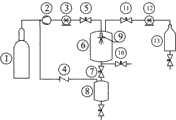
附图1纳米化胰岛素粉体的超临界反溶剂的制备工艺流程示意图。Accompanying
具体实施方案specific implementation plan
下面对本发明的实施例作进一步详细描述:启动CO2高压泵,将CO2以恒定的流速注入高压结晶釜,使高压结晶釜的温度和压力稳定在超临界状态之上,用高压柱塞泵将胰岛素的DMSO或DMF溶液,通过孔径为100~300μm的喷嘴以1~20ml/min的流速喷入高压结晶釜内,析出平均粒径低于400nm的纳米化胰岛素粉体,CO2在高压结晶釜内继续运行至少半小时以干燥所形成纳米化胰岛素粉体;溶剂DMSO或DMF与CO2在分离釜内分离,DMSO或DMF回收后再利用,CO2气体直接循环使用。The embodiments of the present invention are described in further detail below: start the CO2 high-pressure pump, inject CO2 into the high-pressure crystallizer at a constant flow rate, stabilize the temperature and pressure of the high-pressure crystallizer above the supercritical state, and use a high-pressure plunger pump The DMSO or DMF solution of insulin is sprayed into the high-pressure crystallization kettle through a nozzle with a hole diameter of 100-300 μm at a flow rate of 1-20ml/min, and nano-sized insulin powder with an average particle size of less than 400nm is precipitated, and CO2 is crystallized under high pressure. The kettle continues to run for at least half an hour to dry the formed nano-insulin powder; the solvent DMSO or DMF is separated from CO 2 in the separation kettle, DMSO or DMF is recovered and reused, and CO 2 gas is directly recycled.
所述的CO2注入高压结晶釜的流速为10~25L/h。The flow rate of the CO injected into the autoclave is 10-25 L/h.
所述高压结晶釜的温度为35℃~45℃,压力为10~25MPa。The temperature of the high-pressure crystallization kettle is 35°C-45°C, and the pressure is 10-25MPa.
所述胰岛素的DMSO或DMF溶液的浓度为1~8mg/ml。The concentration of the DMSO or DMF solution of the insulin is 1-8 mg/ml.
所述的喷嘴孔径为100~300um。The hole diameter of the nozzle is 100-300um.
所述胰岛素的DMSO或DMF溶液喷入结晶釜的流速为1~20ml/min。The flow rate of the DMSO or DMF solution of insulin sprayed into the crystallization kettle is 1-20ml/min.
所述的分离釜5~6.5MPa,温度为25~50℃。The separation kettle is 5-6.5MPa, and the temperature is 25-50°C.
实例1:Example 1:
准确称取胰岛素0.1g,溶于100ml DMSO,注入溶液料筒13。打开CO2阀门5,启动高压CO2泵3,高压结晶釜6内加压至25Mpa,升温至45℃,打开分离阀门7和溶液阀门11,启动高压液体泵12,通过孔径为200um喷嘴9,将胰岛素的DMSO溶液喷入高压结晶釜6。继续通入CO2运行50分钟,关闭CO2阀门5和分离阀门7,打开卸压阀门10卸压,得到平均粒径为200nm的纳米化胰岛素粉体。Accurately weigh 0.1 g of insulin, dissolve it in 100 ml DMSO, and inject it into the
实例2:Example 2:
准确称取胰岛素0.8g,溶于100ml DMSO,注入溶液料筒13。打开CO2阀门5,启动高压CO2泵3,高压结晶釜6内加压至15Mpa,升温至40℃,打开分离阀门7和溶液阀门11,启动高压液体泵12,通过孔径为150um喷嘴9,将胰岛素的DMF溶液喷入高压结晶釜6。继续通入CO2运行70分钟,关闭CO2阀门5和分离阀门7,打开卸压阀门10卸压,得到平均粒径为110nm的纳米化胰岛素粉体。Accurately weigh 0.8 g of insulin, dissolve it in 100 ml of DMSO, and inject it into the
Claims (5)
Priority Applications (1)
| Application Number | Priority Date | Filing Date | Title |
|---|---|---|---|
| CN201010105952A CN101773473A (en) | 2010-02-04 | 2010-02-04 | Preparation method of supercritical antisolvent of nano-insulin powder |
Applications Claiming Priority (1)
| Application Number | Priority Date | Filing Date | Title |
|---|---|---|---|
| CN201010105952A CN101773473A (en) | 2010-02-04 | 2010-02-04 | Preparation method of supercritical antisolvent of nano-insulin powder |
Publications (1)
| Publication Number | Publication Date |
|---|---|
| CN101773473A true CN101773473A (en) | 2010-07-14 |
Family
ID=42510150
Family Applications (1)
| Application Number | Title | Priority Date | Filing Date |
|---|---|---|---|
| CN201010105952A Pending CN101773473A (en) | 2010-02-04 | 2010-02-04 | Preparation method of supercritical antisolvent of nano-insulin powder |
Country Status (1)
| Country | Link |
|---|---|
| CN (1) | CN101773473A (en) |
Cited By (3)
| Publication number | Priority date | Publication date | Assignee | Title |
|---|---|---|---|---|
| CN102058539A (en) * | 2010-12-24 | 2011-05-18 | 国家纳米技术与工程研究院 | Process for preparing composite fine insulin particles by applying supercritical fluid crystallization technology |
| CN108409821A (en) * | 2018-03-19 | 2018-08-17 | 青岛国海生物制药有限公司 | A kind of preparation method and megestrol acetate of megestrol acetate nanocrystal |
| CN109718205A (en) * | 2019-03-11 | 2019-05-07 | 塔尔普(北京)制药技术有限公司 | A kind of preparation method and system of medicinal liposome |
-
2010
- 2010-02-04 CN CN201010105952A patent/CN101773473A/en active Pending
Cited By (4)
| Publication number | Priority date | Publication date | Assignee | Title |
|---|---|---|---|---|
| CN102058539A (en) * | 2010-12-24 | 2011-05-18 | 国家纳米技术与工程研究院 | Process for preparing composite fine insulin particles by applying supercritical fluid crystallization technology |
| CN108409821A (en) * | 2018-03-19 | 2018-08-17 | 青岛国海生物制药有限公司 | A kind of preparation method and megestrol acetate of megestrol acetate nanocrystal |
| CN109718205A (en) * | 2019-03-11 | 2019-05-07 | 塔尔普(北京)制药技术有限公司 | A kind of preparation method and system of medicinal liposome |
| CN109718205B (en) * | 2019-03-11 | 2021-04-06 | 塔尔普(北京)制药技术有限公司 | Preparation method and system of drug liposome |
Similar Documents
| Publication | Publication Date | Title |
|---|---|---|
| Zhu et al. | Comparative studies on exenatide-loaded poly (D, L-lactic-co-glycolic acid) microparticles prepared by a novel ultra-fine particle processing system and spray drying | |
| KR20090077066A (en) | Particle formation | |
| CN101773473A (en) | Preparation method of supercritical antisolvent of nano-insulin powder | |
| CN103989635A (en) | Method for preparing coenzyme Q10 lipidosome through supercritical carbon dioxide | |
| CN105534923B (en) | The method for preparing Irbesartan ultra-fine grain using supercritical anti-solvent technology | |
| CN104069069A (en) | Process for preparing baicalein ultrafine particles by applying supercritical fluid enhancement solution dispersion method | |
| CN111012671B (en) | Physical preparation method of microcapsule | |
| CN106309434A (en) | Method for preparing carvedilol solid dispersions by virtue of supercritical anti-solvent technique | |
| CN109350610B (en) | Curcumin composite nano-particles and preparation method thereof | |
| CN101264061A (en) | A kind of supercritical anti-solvent preparation method of water-soluble nano camptothecin powder | |
| KR102154923B1 (en) | Apparatus and method for crystallizing and supercritical drying of culture fluid | |
| CN101732326B (en) | Method for preparing vitamin D3 nutrient complex | |
| CN104688536A (en) | Preparation method of itraconazole preparation | |
| CN101756905A (en) | Preparation method for supercritical anti-solvent of water-soluble nano glycyrrhizic acid powder | |
| CN105748413B (en) | Hydroxycamptothecin nano crystal load microballoon and preparation method thereof | |
| KR100802278B1 (en) | Method for producing nanostructures containing vitamin K using supercritical fluid by molecular association theory | |
| KR101359581B1 (en) | Method for producing water-soluble particulate from natural extract using supercritical fluid | |
| CN103251595A (en) | A process for preparing folic acid-dextran-camptothecin composite nanoparticles by supercritical CO2 antisolvent method | |
| CN211634419U (en) | Device for preparing sustained-release drug-loaded porous membrane based on supercritical fluid technology | |
| CN101264059A (en) | A kind of supercritical rapid expansion preparation method of water-soluble nano artemisinin powder | |
| CN110522715A (en) | Artemisinin micro-nano preparation and supercritical preparation method thereof | |
| CN105687141A (en) | Technical study for preparing Nim-PLLA (nimesulide-poly-l-lactic acid) composite microsphere with supercritical anti-solvent method | |
| CN104208040A (en) | A method for preparing pharmaceutical excipient Eudragit S100 polymer microparticles | |
| CN113813238B (en) | Method for preparing apigenin ultrafine particles by ultrasonic co-high-pressure homogenization technology | |
| CN114209655B (en) | Preparation method of dolutegravir micropowder |
Legal Events
| Date | Code | Title | Description |
|---|---|---|---|
| C06 | Publication | ||
| PB01 | Publication | ||
| C10 | Entry into substantive examination | ||
| SE01 | Entry into force of request for substantive examination | ||
| C02 | Deemed withdrawal of patent application after publication (patent law 2001) | ||
| WD01 | Invention patent application deemed withdrawn after publication |
Application publication date: 20100714 |