Disclosure of Invention
The invention aims to provide a convenient and effective gesture recognition method based on an acceleration sensor.
In order to realize the purpose of the invention, the technical scheme is as follows:
a gesture recognition method based on an acceleration sensor comprises the following steps:
1) extracting the rotation feature codes of all samples written by the user in the three-dimensional space;
2) generating a template for each class
Randomly selecting k samples from the total samples as training samples, putting the samples of the same category in the training samples together, respectively calculating the sum of the editing distances between each sample and the rotation feature codes of other samples in the category in each category, and then arranging the samples from small to large according to the sum of the editing distances to serve as a category template of each category;
3) generating a training sample set
Calculating the edit distance between the rotation feature codes of each training sample and all class templates, and taking the edit distance as the feature of the sample, so that k training samples can obtain a k × k training feature matrix:
<math>
<mrow>
<msub>
<mi>D</mi>
<mrow>
<mi>NE</mi>
<mo>_</mo>
<mi>Train</mi>
</mrow>
</msub>
<mo>=</mo>
<msub>
<mfenced open='[' close=']'>
<mtable>
<mtr>
<mtd>
<msubsup>
<mi>d</mi>
<mrow>
<mi>NE</mi>
<mo>_</mo>
<mi>Train</mi>
</mrow>
<mn>11</mn>
</msubsup>
</mtd>
<mtd>
<msubsup>
<mi>d</mi>
<mrow>
<mi>NE</mi>
<mo>_</mo>
<mi>Train</mi>
</mrow>
<mn>12</mn>
</msubsup>
</mtd>
<mtd>
<mo>.</mo>
<mo>.</mo>
<mo>.</mo>
</mtd>
<mtd>
<msubsup>
<mi>d</mi>
<mrow>
<mi>NE</mi>
<mo>_</mo>
<mi>Train</mi>
</mrow>
<mrow>
<mn>1</mn>
<mo>×</mo>
<mi>k</mi>
</mrow>
</msubsup>
</mtd>
</mtr>
<mtr>
<mtd>
<msubsup>
<mi>d</mi>
<mrow>
<mi>NE</mi>
<mo>_</mo>
<mi>Train</mi>
</mrow>
<mn>21</mn>
</msubsup>
</mtd>
<mtd>
<msubsup>
<mi>d</mi>
<mrow>
<mi>NE</mi>
<mo>_</mo>
<mi>Train</mi>
</mrow>
<mn>22</mn>
</msubsup>
</mtd>
<mtd>
<mo>.</mo>
<mo>.</mo>
<mo>.</mo>
</mtd>
<mtd>
<msubsup>
<mi>d</mi>
<mrow>
<mi>NE</mi>
<mo>_</mo>
<mi>Train</mi>
</mrow>
<mrow>
<mn>2</mn>
<mo>×</mo>
<mi>k</mi>
</mrow>
</msubsup>
</mtd>
</mtr>
<mtr>
<mtd>
<mo>.</mo>
</mtd>
<mtd>
</mtd>
<mtd>
</mtd>
<mtd>
<mo>.</mo>
</mtd>
</mtr>
<mtr>
<mtd>
<mo>.</mo>
</mtd>
<mtd>
</mtd>
<mtd>
<msubsup>
<mi>d</mi>
<mrow>
<mi>NE</mi>
<mo>_</mo>
<mi>Train</mi>
</mrow>
<mi>ij</mi>
</msubsup>
</mtd>
<mtd>
<mo>.</mo>
</mtd>
</mtr>
<mtr>
<mtd>
<mo>.</mo>
</mtd>
<mtd>
</mtd>
<mtd>
</mtd>
<mtd>
<mo>.</mo>
</mtd>
</mtr>
<mtr>
<mtd>
<msubsup>
<mi>d</mi>
<mrow>
<mi>NE</mi>
<mo>_</mo>
<mi>Train</mi>
</mrow>
<mrow>
<mi>k</mi>
<mn>1</mn>
</mrow>
</msubsup>
</mtd>
<mtd>
<msubsup>
<mi>d</mi>
<mrow>
<mi>NE</mi>
<mo>_</mo>
<mi>Train</mi>
</mrow>
<mrow>
<mi>k</mi>
<mn>2</mn>
</mrow>
</msubsup>
</mtd>
<mtd>
<mo>.</mo>
<mo>.</mo>
<mo>.</mo>
</mtd>
<mtd>
<msubsup>
<mi>d</mi>
<mrow>
<mi>NE</mi>
<mo>_</mo>
<mi>Train</mi>
</mrow>
<mrow>
<mi>k</mi>
<mo>×</mo>
<mi>k</mi>
</mrow>
</msubsup>
</mtd>
</mtr>
</mtable>
</mfenced>
<mrow>
<mi>k</mi>
<mo>×</mo>
<mi>k</mi>
</mrow>
</msub>
</mrow>
</math>
wherein,
the distance between the ith training sample and the jth class template is, i is 1, 2, … k, j is 1, 2, … k, k is the number of class templates of all classes;
4) generating a test sample set
For each test sample, calculating the edit distance between the test sample and the rotation feature codes of all the class templates, and taking the edit distance as the feature of the test sample, wherein l test samples can obtain a test feature matrix of l multiplied by k:
<math>
<mrow>
<msub>
<mi>D</mi>
<mrow>
<mi>NE</mi>
<mo>_</mo>
<mi>Test</mi>
</mrow>
</msub>
<mo>=</mo>
<msub>
<mfenced open='[' close=']'>
<mtable>
<mtr>
<mtd>
<msubsup>
<mi>d</mi>
<mrow>
<mi>NE</mi>
<mo>_</mo>
<mi>Test</mi>
</mrow>
<mn>11</mn>
</msubsup>
</mtd>
<mtd>
<msubsup>
<mi>d</mi>
<mrow>
<mi>NE</mi>
<mo>_</mo>
<mi>Test</mi>
</mrow>
<mn>12</mn>
</msubsup>
</mtd>
<mtd>
<mo>.</mo>
<mo>.</mo>
<mo>.</mo>
</mtd>
<mtd>
<msubsup>
<mi>d</mi>
<mrow>
<mi>NE</mi>
<mo>_</mo>
<mi>Test</mi>
</mrow>
<mrow>
<mn>1</mn>
<mo>×</mo>
<mi>k</mi>
</mrow>
</msubsup>
</mtd>
</mtr>
<mtr>
<mtd>
<msubsup>
<mi>d</mi>
<mrow>
<mi>NE</mi>
<mo>_</mo>
<mi>Test</mi>
</mrow>
<mn>21</mn>
</msubsup>
</mtd>
<mtd>
<msubsup>
<mi>d</mi>
<mrow>
<mi>NE</mi>
<mo>_</mo>
<mi>Test</mi>
</mrow>
<mn>22</mn>
</msubsup>
</mtd>
<mtd>
<mo>.</mo>
<mo>.</mo>
<mo>.</mo>
</mtd>
<mtd>
<msubsup>
<mi>d</mi>
<mrow>
<mi>NE</mi>
<mo>_</mo>
<mi>Test</mi>
</mrow>
<mrow>
<mn>2</mn>
<mo>×</mo>
<mi>k</mi>
</mrow>
</msubsup>
</mtd>
</mtr>
<mtr>
<mtd>
<mo>.</mo>
</mtd>
<mtd>
</mtd>
<mtd>
</mtd>
<mtd>
<mo>.</mo>
</mtd>
</mtr>
<mtr>
<mtd>
<mo>.</mo>
</mtd>
<mtd>
</mtd>
<mtd>
<msubsup>
<mi>d</mi>
<mrow>
<mi>NE</mi>
<mo>_</mo>
<mi>Test</mi>
</mrow>
<mi>ij</mi>
</msubsup>
</mtd>
<mtd>
<mo>.</mo>
</mtd>
</mtr>
<mtr>
<mtd>
<mo>.</mo>
</mtd>
<mtd>
</mtd>
<mtd>
</mtd>
<mtd>
<mo>.</mo>
</mtd>
</mtr>
<mtr>
<mtd>
<msubsup>
<mi>d</mi>
<mrow>
<mi>NE</mi>
<mo>_</mo>
<mi>Test</mi>
</mrow>
<mrow>
<mi>l</mi>
<mn>1</mn>
</mrow>
</msubsup>
</mtd>
<mtd>
<msubsup>
<mi>d</mi>
<mrow>
<mi>NE</mi>
<mo>_</mo>
<mi>Test</mi>
</mrow>
<mrow>
<mi>l</mi>
<mn>2</mn>
</mrow>
</msubsup>
</mtd>
<mtd>
<mo>.</mo>
<mo>.</mo>
<mo>.</mo>
</mtd>
<mtd>
<msubsup>
<mi>d</mi>
<mrow>
<mi>NE</mi>
<mo>_</mo>
<mi>Test</mi>
</mrow>
<mrow>
<mi>l</mi>
<mo>×</mo>
<mi>k</mi>
</mrow>
</msubsup>
</mtd>
</mtr>
</mtable>
</mfenced>
<mrow>
<mi>l</mi>
<mo>×</mo>
<mi>k</mi>
</mrow>
</msub>
</mrow>
</math>
wherein,
the distance between the ith test sample and the jth class template is represented as i, 2, … l, j is 1, 2, … k, l is the number of test samples, and k is the number of class templates of all classes;
5) support vector machine classification
Training a support vector machine classifier by using the training sample set generated in the step 3), and identifying the number written by each test sample by using the support vector machine classifier.
The invention extracts a novel rotation characteristic from the triaxial acceleration signal, and the rotation characteristic can effectively represent the change process of clockwise rotation and anticlockwise rotation of gesture movement during writing. A complete framework of the three-dimensional space writing digital recognition method based on the rotation characteristics is provided, and the problem that the lengths of the rotation characteristics are inconsistent is solved by calculating the normalized editing distance, so that the three-dimensional writing characters based on the acceleration sensor are effectively recognized.
Detailed Description
The invention is further described below with reference to the accompanying drawings.
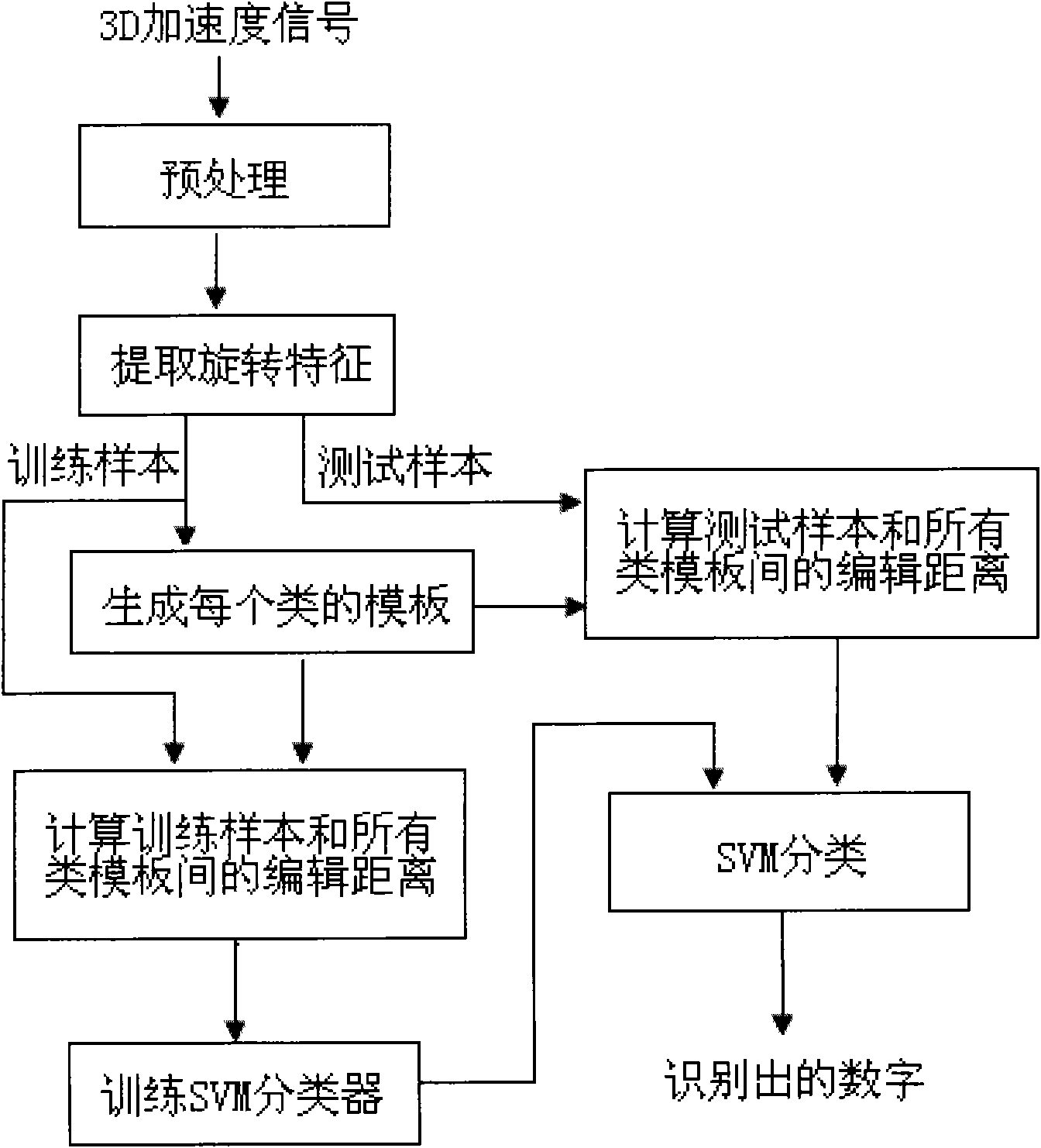
The input device used in the practice of the present invention is an apparatus that embeds a three-axis acceleration sensor. The system flow chart of the three-dimensional space writing recognition algorithm based on the rotation characteristics is shown in the attached figure 1, and the specific steps comprise:
1. pretreatment of
The influence of gravity acceleration is removed from the acquired three-dimensional acceleration signals by subtracting a mean value, then amplitude normalization processing is carried out, and Gaussian filtering is carried out to the three-dimensional acceleration signals so as to filter noise contained in the acceleration signals during measurement and noise generated by wrist shaking.
2. Extracting rotation feature codes
The three-dimensional space writing based on the acceleration sensor is different from the traditional two-dimensional plane writing, the writing track of a writer cannot be acquired, and only three axial acceleration signals measured by a three-axis acceleration sensor can be acquired. How to identify what the writer writes by using the three axial acceleration signals is the key to feature extraction.
The three-axis acceleration sensor can simultaneously measure three mutually orthogonal axial accelerations generated during gesture movement, and a is used respectivelyx(t),ay(t),az(t) represents acceleration signals of x-axis, y-axis and z-axis.
The notation A (t) ═ ax(t),ay(t),az(t)]Is a three-axis acceleration signal generated when a certain gesture moves, and the length of the signal is recorded as S. Definition of
B(t)=A(t)×A(t+1) (1)
Then b (t) is also a vector and b (t) is directed in only two ways, one upwards perpendicular to the planes a (t) and a (t +1) and the other downwards perpendicular to the planes a (t) and a (t + 1). When the direction of B (t) is vertical to the plane of A (t) and A (t +1) upwards, the acceleration signal A (t) rotates anticlockwise from t to t + 1; when the direction of b (t) is downward perpendicular to the plane of a (t) and a (t +1), the acceleration signal a (t) rotates clockwise from time t to t + 1.
The acceleration signal will produce a series of clockwise and counterclockwise rotation when t changes from 0 to S-1, i.e. when writing each character, the acceleration signal will produce a series of clockwise and counterclockwise rotation changes. The rotation characteristic provided by the invention is just to record the change process of clockwise rotation and anticlockwise rotation generated by an acceleration signal when three-dimensional space is written.
For a triaxial acceleration signal A (t) generated during writing in a three-dimensional space, extracting rotation characteristics from the following three projection planes in the three-dimensional space respectively:
Ayz(t)=[ay(t),az(t)]
Azx(t)=[az(t),ax(t)] (2)
Axy(t)=[ax(t),ay(t)]
in the formula (2), the two-dimensional vector Ayz(t),Azx(t), and Axy(t) are the projections of the three-axis acceleration signal A (t) in the y-z, z-x, and x-y planes, respectively.
With Ayz(t) is an example to illustrate the extracted rotation feature, which can be defined as follows according to equation (1):
Byz(t)=Ayz(t)×Ayz(t+1) (3)
then B isyzThe direction of (t) is perpendicular to Ayz(t) and AyzAcceleration A when the (t +1) plane is upwardyz(t) counterclockwise rotation; b isyzThe direction of (t) is perpendicular to Ayz(t) and AyzAcceleration A when the (t +1) plane is downwardyz(t) clockwise rotation. If both clockwise and counterclockwise rotation at each time are recorded, it will be observed by observation that: the acceleration signal is always rotating clockwise (or counterclockwise) for a certain period of time. It is not necessary to take every point in time within this time period as a rotation feature. Noting the ith rotation characteristic as RFyz(i) And i is greater than 1. Rotation feature RFyz(i) The extraction of (A) satisfies the following principles:
RFyz(1)=Ayz(0)
RFyz(i)=Ayz(t +1) when Byz(t) and ByzThe direction of (t-1) is the same, but
Ayz(t +1) and Ayz(t) are not in the same quadrant; or
When B is presentyz(t) and ByzWhen the direction of (t-1) is reversed
RFyz(i) Is a is formed byy(t) and az(t) the determined vector. Since the rotation is determined by the direction of the vector, use ay(t) and az(t) represents the extracted rotation feature RFyz(i) The magnitude of the vectors is taken to be equal. FIG. 2 is a rotation characteristic point RF extracted based on a y-z plane for a three-axis acceleration signal generated when a figure 8 is written on 6 personsyz(i) And use them as yAcceleration of axis and z-axis [ a ]y(t),az(t)]Shown. The axis in the vertical direction in the figure indicates ay(t), the axis in the horizontal direction represents az(t), the arrow points in the direction of acceleration of the respective axis.
For the purpose of digital calculation, a coding rule of the acceleration direction change as shown in fig. 3 is defined. Rotation feature RF extracted for FIG. 2yz(i) Coding to obtain a rotation feature code CyzLikewise, can be to Azx(t) and Axy(t) extracting the rotation characteristic points and carrying out the coding to obtain a rotation characteristic code CzxAnd Cxy. The rotation feature code of a three-axis acceleration signal is expressed as C ═ Cyz,Czx,Cxy},Cyz,CzxAnd CxyAre respectively ayz(t),Azx(t), and Axy(t) encoding the acceleration change sequence.
3. Generating templates for each class
Randomly selecting k samples from the total samples as training samples, putting the samples of the same class in the training samples together, respectively calculating the sum of the editing distances between each sample and the rotation feature codes of other samples in the class in each class, and then arranging the samples from small to large according to the sum of the editing distances to serve as a class template of each class.
4. Generating a training sample set
And calculating the edit distance between each training sample and the rotation feature codes of all class templates as the features of the sample. Then a k × k training feature matrix can be obtained for k training samples:
<math>
<mrow>
<msub>
<mi>D</mi>
<mrow>
<mi>NE</mi>
<mo>_</mo>
<mi>Train</mi>
</mrow>
</msub>
<mo>=</mo>
<msub>
<mfenced open='[' close=']'>
<mtable>
<mtr>
<mtd>
<msubsup>
<mi>d</mi>
<mrow>
<mi>NE</mi>
<mo>_</mo>
<mi>Train</mi>
</mrow>
<mn>11</mn>
</msubsup>
</mtd>
<mtd>
<msubsup>
<mi>d</mi>
<mrow>
<mi>NE</mi>
<mo>_</mo>
<mi>Train</mi>
</mrow>
<mn>12</mn>
</msubsup>
</mtd>
<mtd>
<mo>.</mo>
<mo>.</mo>
<mo>.</mo>
</mtd>
<mtd>
<msubsup>
<mi>d</mi>
<mrow>
<mi>NE</mi>
<mo>_</mo>
<mi>Train</mi>
</mrow>
<mrow>
<mn>1</mn>
<mo>×</mo>
<mi>k</mi>
</mrow>
</msubsup>
</mtd>
</mtr>
<mtr>
<mtd>
<msubsup>
<mi>d</mi>
<mrow>
<mi>NE</mi>
<mo>_</mo>
<mi>Train</mi>
</mrow>
<mn>21</mn>
</msubsup>
</mtd>
<mtd>
<msubsup>
<mi>d</mi>
<mrow>
<mi>NE</mi>
<mo>_</mo>
<mi>Train</mi>
</mrow>
<mn>22</mn>
</msubsup>
</mtd>
<mtd>
<mo>.</mo>
<mo>.</mo>
<mo>.</mo>
</mtd>
<mtd>
<msubsup>
<mi>d</mi>
<mrow>
<mi>NE</mi>
<mo>_</mo>
<mi>Train</mi>
</mrow>
<mrow>
<mn>2</mn>
<mo>×</mo>
<mi>k</mi>
</mrow>
</msubsup>
</mtd>
</mtr>
<mtr>
<mtd>
<mo>.</mo>
</mtd>
<mtd>
</mtd>
<mtd>
</mtd>
<mtd>
<mo>.</mo>
</mtd>
</mtr>
<mtr>
<mtd>
<mo>.</mo>
</mtd>
<mtd>
</mtd>
<mtd>
<msubsup>
<mi>d</mi>
<mrow>
<mi>NE</mi>
<mo>_</mo>
<mi>Train</mi>
</mrow>
<mi>ij</mi>
</msubsup>
</mtd>
<mtd>
<mo>.</mo>
</mtd>
</mtr>
<mtr>
<mtd>
<mo>.</mo>
</mtd>
<mtd>
</mtd>
<mtd>
</mtd>
<mtd>
<mo>.</mo>
</mtd>
</mtr>
<mtr>
<mtd>
<msubsup>
<mi>d</mi>
<mrow>
<mi>NE</mi>
<mo>_</mo>
<mi>Train</mi>
</mrow>
<mrow>
<mi>k</mi>
<mn>1</mn>
</mrow>
</msubsup>
</mtd>
<mtd>
<msubsup>
<mi>d</mi>
<mrow>
<mi>NE</mi>
<mo>_</mo>
<mi>Train</mi>
</mrow>
<mrow>
<mi>k</mi>
<mn>2</mn>
</mrow>
</msubsup>
</mtd>
<mtd>
<mo>.</mo>
<mo>.</mo>
<mo>.</mo>
</mtd>
<mtd>
<msubsup>
<mi>d</mi>
<mrow>
<mi>NE</mi>
<mo>_</mo>
<mi>Train</mi>
</mrow>
<mrow>
<mi>k</mi>
<mo>×</mo>
<mi>k</mi>
</mrow>
</msubsup>
</mtd>
</mtr>
</mtable>
</mfenced>
<mrow>
<mi>k</mi>
<mo>×</mo>
<mi>k</mi>
</mrow>
</msub>
<mo>-</mo>
<mo>-</mo>
<mo>-</mo>
<mrow>
<mo>(</mo>
<mn>12</mn>
<mo>)</mo>
</mrow>
</mrow>
</math>
wherein,is the distance between the ith training sample and the jth class template, i is 1, 2, … k, j is 1, 2, … k, k is the number of class templates of all classes.
5. Generating a set of test samples
For each test sample, the edit distance between the test sample and the rotation feature codes of all class templates is calculated as the feature of the test sample. For l test samples, an l × k test feature matrix can be obtained:
<math>
<mrow>
<msub>
<mi>D</mi>
<mrow>
<mi>NE</mi>
<mo>_</mo>
<mi>Test</mi>
</mrow>
</msub>
<mo>=</mo>
<msub>
<mfenced open='[' close=']'>
<mtable>
<mtr>
<mtd>
<msubsup>
<mi>d</mi>
<mrow>
<mi>NE</mi>
<mo>_</mo>
<mi>Test</mi>
</mrow>
<mn>11</mn>
</msubsup>
</mtd>
<mtd>
<msubsup>
<mi>d</mi>
<mrow>
<mi>NE</mi>
<mo>_</mo>
<mi>Test</mi>
</mrow>
<mn>12</mn>
</msubsup>
</mtd>
<mtd>
<mo>.</mo>
<mo>.</mo>
<mo>.</mo>
</mtd>
<mtd>
<msubsup>
<mi>d</mi>
<mrow>
<mi>NE</mi>
<mo>_</mo>
<mi>Test</mi>
</mrow>
<mrow>
<mn>1</mn>
<mo>×</mo>
<mi>k</mi>
</mrow>
</msubsup>
</mtd>
</mtr>
<mtr>
<mtd>
<msubsup>
<mi>d</mi>
<mrow>
<mi>NE</mi>
<mo>_</mo>
<mi>Test</mi>
</mrow>
<mn>21</mn>
</msubsup>
</mtd>
<mtd>
<msubsup>
<mi>d</mi>
<mrow>
<mi>NE</mi>
<mo>_</mo>
<mi>Test</mi>
</mrow>
<mn>22</mn>
</msubsup>
</mtd>
<mtd>
<mo>.</mo>
<mo>.</mo>
<mo>.</mo>
</mtd>
<mtd>
<msubsup>
<mi>d</mi>
<mrow>
<mi>NE</mi>
<mo>_</mo>
<mi>Test</mi>
</mrow>
<mrow>
<mn>2</mn>
<mo>×</mo>
<mi>k</mi>
</mrow>
</msubsup>
</mtd>
</mtr>
<mtr>
<mtd>
<mo>.</mo>
</mtd>
<mtd>
</mtd>
<mtd>
</mtd>
<mtd>
<mo>.</mo>
</mtd>
</mtr>
<mtr>
<mtd>
<mo>.</mo>
</mtd>
<mtd>
</mtd>
<mtd>
<msubsup>
<mi>d</mi>
<mrow>
<mi>NE</mi>
<mo>_</mo>
<mi>Test</mi>
</mrow>
<mi>ij</mi>
</msubsup>
</mtd>
<mtd>
<mo>.</mo>
</mtd>
</mtr>
<mtr>
<mtd>
<mo>.</mo>
</mtd>
<mtd>
</mtd>
<mtd>
</mtd>
<mtd>
<mo>.</mo>
</mtd>
</mtr>
<mtr>
<mtd>
<msubsup>
<mi>d</mi>
<mrow>
<mi>NE</mi>
<mo>_</mo>
<mi>Test</mi>
</mrow>
<mrow>
<mi>l</mi>
<mn>1</mn>
</mrow>
</msubsup>
</mtd>
<mtd>
<msubsup>
<mi>d</mi>
<mrow>
<mi>NE</mi>
<mo>_</mo>
<mi>Test</mi>
</mrow>
<mrow>
<mi>l</mi>
<mn>2</mn>
</mrow>
</msubsup>
</mtd>
<mtd>
<mo>.</mo>
<mo>.</mo>
<mo>.</mo>
</mtd>
<mtd>
<msubsup>
<mi>d</mi>
<mrow>
<mi>NE</mi>
<mo>_</mo>
<mi>Test</mi>
</mrow>
<mrow>
<mi>l</mi>
<mo>×</mo>
<mi>k</mi>
</mrow>
</msubsup>
</mtd>
</mtr>
</mtable>
</mfenced>
<mrow>
<mi>l</mi>
<mo>×</mo>
<mi>k</mi>
</mrow>
</msub>
<mo>-</mo>
<mo>-</mo>
<mo>-</mo>
<mrow>
<mo>(</mo>
<mn>13</mn>
<mo>)</mo>
</mrow>
</mrow>
</math>
wherein,
the distance between the ith test sample and the jth class template is represented as i, 2, … l, j is 1, 2, … k, l is the number of test samples, and k is the number of class templates of all classes.
The edit distance calculation adopted in the above steps 3, 4 and 5 is specifically as follows:
because the lengths of the rotation feature codes of different samples are not consistent, the difference between the rotation feature codes cannot be directly calculated, and the difference between the rotation feature codes of different samples is measured by adopting the edit distance.
Set symbol sequence
Is C of the ith sample
yzThe code is coded by the code generator to obtain the code,
is C of jth sample
yzThe code is coded by the code generator to obtain the code,
E={e
s,e
i,e
ddenotes the sequence, respectively
Is transformed into
The cost of replacing, inserting and deleting a symbol is high, then
And
recursively expressed as:
<math>
<mrow>
<msub>
<mi>d</mi>
<mi>Eyz</mi>
</msub>
<mrow>
<mo>(</mo>
<msubsup>
<mi>C</mi>
<mi>yz</mi>
<mi>i</mi>
</msubsup>
<mo>,</mo>
<msubsup>
<mi>C</mi>
<mi>yz</mi>
<mi>j</mi>
</msubsup>
<mo>)</mo>
</mrow>
<mo>=</mo>
<mi>min</mi>
<mfenced open='{' close=''>
<mtable>
<mtr>
<mtd>
<msub>
<mi>E</mi>
<mi>s</mi>
</msub>
<mrow>
<mo>(</mo>
<msubsup>
<mi>c</mi>
<mi>n</mi>
<mi>i</mi>
</msubsup>
<mo>,</mo>
<msubsup>
<mi>c</mi>
<mi>m</mi>
<mi>j</mi>
</msubsup>
<mo>)</mo>
</mrow>
<mo>+</mo>
<msub>
<mi>d</mi>
<mi>Eyz</mi>
</msub>
<mrow>
<mo>(</mo>
<mi>Head</mi>
<mrow>
<mo>(</mo>
<msubsup>
<mi>C</mi>
<mi>yz</mi>
<mi>i</mi>
</msubsup>
<mo>)</mo>
</mrow>
<mo>,</mo>
<mi>Head</mi>
<mrow>
<mo>(</mo>
<msubsup>
<mi>C</mi>
<mi>yz</mi>
<mi>j</mi>
</msubsup>
<mo>)</mo>
</mrow>
<mo>)</mo>
</mrow>
</mtd>
</mtr>
<mtr>
<mtd>
<msub>
<mi>E</mi>
<mi>i</mi>
</msub>
<mrow>
<mo>(</mo>
<mi>ϵ</mi>
<mo>,</mo>
<msubsup>
<mi>c</mi>
<mi>m</mi>
<mi>j</mi>
</msubsup>
<mo>)</mo>
</mrow>
<mo>+</mo>
<msub>
<mi>d</mi>
<mi>Eyz</mi>
</msub>
<mrow>
<mo>(</mo>
<msubsup>
<mi>C</mi>
<mi>yz</mi>
<mi>i</mi>
</msubsup>
<mo>,</mo>
<mi>Head</mi>
<mrow>
<mo>(</mo>
<msubsup>
<mi>C</mi>
<mi>yz</mi>
<mi>j</mi>
</msubsup>
<mo>)</mo>
</mrow>
<mo>)</mo>
</mrow>
</mtd>
</mtr>
<mtr>
<mtd>
<msub>
<mi>E</mi>
<mi>d</mi>
</msub>
<mrow>
<mo>(</mo>
<msubsup>
<mi>c</mi>
<mi>n</mi>
<mi>i</mi>
</msubsup>
<mo>,</mo>
<mi>ϵ</mi>
<mo>)</mo>
</mrow>
<mo>+</mo>
<msub>
<mi>d</mi>
<mi>Eyz</mi>
</msub>
<mrow>
<mo>(</mo>
<mi>Head</mi>
<mrow>
<mo>(</mo>
<msubsup>
<mi>C</mi>
<mi>yz</mi>
<mi>i</mi>
</msubsup>
<mo>)</mo>
</mrow>
<mo>,</mo>
<mrow>
<mo>(</mo>
<msubsup>
<mi>C</mi>
<mi>yz</mi>
<mi>j</mi>
</msubsup>
<mo>)</mo>
</mrow>
<mo>)</mo>
</mrow>
</mtd>
</mtr>
</mtable>
</mfenced>
<mo>-</mo>
<mo>-</mo>
<mo>-</mo>
<mrow>
<mo>(</mo>
<mn>4</mn>
<mo>)</mo>
</mrow>
</mrow>
</math>
wherein,
here, the cost of replacing, inserting and deleting a symbol is independent of the specific value of the symbol and its position in the sequence, and in general, the cost of replacing, inserting and deleting a symbol may be 1, i.e. e
s=e
i=e
d=1。
Since the edit distance measures the absolute value of the difference between 2 sequences, when analyzing sequences with a large variation in length, it is easy to make the edit distance between long sequences much larger than the distance between short sequences. This is clearly not appropriate and therefore needs to be normalised. The above symbol sequence
And
the normalized edit distance of (d) is expressed as:
wherein,
respectively represent sequences
And
length of (d).
Therefore, the distance between the rotation signatures of the ith sample and the jth sample can be expressed as:
wherein,
and
c for ith and jth samples respectively
zxCode sum C
xyThe edit distance of the code.
6. Support Vector Machine (SVM) classification
Training the SVM classifier by using the training sample set generated above, and recognizing the written number of each test sample by using the SVM classifier.
The superiority of the invention can be confirmed by experiments with large samples. The following describes the results of the correlation experiments performed on a large number of three-dimensional space writing digital samples by using the feature extraction method of the present invention.
Since three-dimensional space writing digital recognition based on an acceleration sensor is an emerging and developed recognition technology, a public database does not exist at present. The acceleration signal collector based on the triaxial acceleration sensor is designed in the embodiment, the data of 60 persons are collected, each collector holds the acceleration signal collector with one hand to freely write figures from 0 to 9 in a three-dimensional space, and each collector writes three times to collect 180 sets of data. 144 sets of samples (80% of the total samples in each class) were randomly selected for training in each class, 1440 total training samples, and the remaining 36 sets of samples were used for testing, 360 total testing samples.
In the experiment, the performances of the rotation characteristic provided by the invention are compared with the performances of a peak valley characteristic, a time domain original characteristic and a traditional frequency domain FFT characteristic. For each feature, three experiments were performed and then averaged.
Table 1 gives the recognition rate of each class based on four feature extraction methods.
TABLE 1 comparison of recognition rates of 10 handwritten digits in air for four different features
As can be seen from table 1, the recognition rate of the rotation feature proposed by the present invention is significantly higher than that of the time domain original feature, the peak-to-valley feature, and the FFT feature. Moreover, the identification rate based on the rotation features is high for each category, and the experimental result shows the effectiveness of the rotation features obtained by the method of the invention in the identification performance.