CN101977908A - (Pyrazolylcarbonyl) imidazolidinone derivatives for use in the treatment of retroviral diseases - Google Patents
(Pyrazolylcarbonyl) imidazolidinone derivatives for use in the treatment of retroviral diseases Download PDFInfo
- Publication number
- CN101977908A CN101977908A CN2009801095006A CN200980109500A CN101977908A CN 101977908 A CN101977908 A CN 101977908A CN 2009801095006 A CN2009801095006 A CN 2009801095006A CN 200980109500 A CN200980109500 A CN 200980109500A CN 101977908 A CN101977908 A CN 101977908A
- Authority
- CN
- China
- Prior art keywords
- compound
- phenyl
- cyano
- halogen
- title compound
- Prior art date
- Legal status (The legal status is an assumption and is not a legal conclusion. Google has not performed a legal analysis and makes no representation as to the accuracy of the status listed.)
- Granted
Links
- 0 CCOC(C(C=C(c(cc1)cc(C(F)(F)F)c1F)O*)=O)=O Chemical compound CCOC(C(C=C(c(cc1)cc(C(F)(F)F)c1F)O*)=O)=O 0.000 description 4
- SMIPYIKAYBMFGJ-GHXNOFRVSA-N CCOC(C(/C=C(/c1cc(Cl)cc(F)c1)\OC)=O)=O Chemical compound CCOC(C(/C=C(/c1cc(Cl)cc(F)c1)\OC)=O)=O SMIPYIKAYBMFGJ-GHXNOFRVSA-N 0.000 description 1
- WYHACGJKOPKIBC-UHFFFAOYSA-N CCOC(c(cc1-c(cc2Br)ccc2F)n[n]1-c1cccc(Cl)c1)=O Chemical compound CCOC(c(cc1-c(cc2Br)ccc2F)n[n]1-c1cccc(Cl)c1)=O WYHACGJKOPKIBC-UHFFFAOYSA-N 0.000 description 1
- TYNSHDYALCZFSU-UHFFFAOYSA-N CCOC(c(cc1-c2cc(F)cc(Cl)c2)n[n]1-c1cccc(Cl)c1)=O Chemical compound CCOC(c(cc1-c2cc(F)cc(Cl)c2)n[n]1-c1cccc(Cl)c1)=O TYNSHDYALCZFSU-UHFFFAOYSA-N 0.000 description 1
- FLHCBDZGRGJMIN-UHFFFAOYSA-N CCOC(c(cc1-c2cc(OCCCCl)ccc2)n[n]1-c1cc(Cl)ccc1)=O Chemical compound CCOC(c(cc1-c2cc(OCCCCl)ccc2)n[n]1-c1cc(Cl)ccc1)=O FLHCBDZGRGJMIN-UHFFFAOYSA-N 0.000 description 1
- ARKNSCZOUWGECH-UHFFFAOYSA-N CCOC(c(cc1-c2cccc(Cl)c2)n[n]1-c(cc1)ccc1F)=O Chemical compound CCOC(c(cc1-c2cccc(Cl)c2)n[n]1-c(cc1)ccc1F)=O ARKNSCZOUWGECH-UHFFFAOYSA-N 0.000 description 1
- AOJASSRSABFEFH-UHFFFAOYSA-N CNCCOc1cccc(-c2cc(C(N(C3)CNC3=O)=O)n[n]2-c2cc(Cl)ccc2)c1 Chemical compound CNCCOc1cccc(-c2cc(C(N(C3)CNC3=O)=O)n[n]2-c2cc(Cl)ccc2)c1 AOJASSRSABFEFH-UHFFFAOYSA-N 0.000 description 1
- GKLNCHMRZYZYQF-UHFFFAOYSA-N COc1cc(-c2cc(C(N(C3)CNC3=O)=O)n[n]2-c2cc(Cl)ccc2)cc(F)c1 Chemical compound COc1cc(-c2cc(C(N(C3)CNC3=O)=O)n[n]2-c2cc(Cl)ccc2)cc(F)c1 GKLNCHMRZYZYQF-UHFFFAOYSA-N 0.000 description 1
- FIZMINOPVWQGJB-UHFFFAOYSA-N COc1cc(-c2cc(C(O)=O)n[n]2-c(cc2Cl)ccc2F)ccc1 Chemical compound COc1cc(-c2cc(C(O)=O)n[n]2-c(cc2Cl)ccc2F)ccc1 FIZMINOPVWQGJB-UHFFFAOYSA-N 0.000 description 1
- BNYGLLYSUWMRDC-UHFFFAOYSA-N N#Cc1cc(-c2cc(C(N(C3)CNC3=O)=O)n[n]2-c(cc2Cl)ccc2F)cc(F)c1 Chemical compound N#Cc1cc(-c2cc(C(N(C3)CNC3=O)=O)n[n]2-c(cc2Cl)ccc2F)cc(F)c1 BNYGLLYSUWMRDC-UHFFFAOYSA-N 0.000 description 1
- FWGZLQUABIOYGD-UHFFFAOYSA-N N#Cc1cc(-c2cc(C(N(C3)CNC3=O)=O)n[n]2-c2cc(Cl)ccc2)cc(F)c1 Chemical compound N#Cc1cc(-c2cc(C(N(C3)CNC3=O)=O)n[n]2-c2cc(Cl)ccc2)cc(F)c1 FWGZLQUABIOYGD-UHFFFAOYSA-N 0.000 description 1
- PHOGHKTZTACIIY-UHFFFAOYSA-N N#Cc1cc(F)cc(-c2cc(C(O)=O)n[n]2-c(cc2)cc(Cl)c2F)c1 Chemical compound N#Cc1cc(F)cc(-c2cc(C(O)=O)n[n]2-c(cc2)cc(Cl)c2F)c1 PHOGHKTZTACIIY-UHFFFAOYSA-N 0.000 description 1
- WHRNEZVRZLZKPX-UHFFFAOYSA-N N#Cc1cccc(-c2cc(C(N(C3)CNC3=O)=O)n[n]2-c(cc2C#N)ccc2F)c1 Chemical compound N#Cc1cccc(-c2cc(C(N(C3)CNC3=O)=O)n[n]2-c(cc2C#N)ccc2F)c1 WHRNEZVRZLZKPX-UHFFFAOYSA-N 0.000 description 1
- WEEVZVDJSICOSX-UHFFFAOYSA-N N#Cc1cccc(-c2cc(C(O)=O)n[n]2-c(cc2C#N)ccc2F)c1 Chemical compound N#Cc1cccc(-c2cc(C(O)=O)n[n]2-c(cc2C#N)ccc2F)c1 WEEVZVDJSICOSX-UHFFFAOYSA-N 0.000 description 1
- OZORSANHRYUQAH-UHFFFAOYSA-N O=C(c(cc1-c(cc2)cc(F)c2F)n[n]1-c1cc(Cl)ccc1)N(C1)CNC1=O Chemical compound O=C(c(cc1-c(cc2)cc(F)c2F)n[n]1-c1cc(Cl)ccc1)N(C1)CNC1=O OZORSANHRYUQAH-UHFFFAOYSA-N 0.000 description 1
- MMERGJUFQJJCSE-UHFFFAOYSA-N O=C(c(cc1-c(cccc2F)c2F)n[n]1-c1cc(Cl)ccc1)N(C1)CNC1=O Chemical compound O=C(c(cc1-c(cccc2F)c2F)n[n]1-c1cc(Cl)ccc1)N(C1)CNC1=O MMERGJUFQJJCSE-UHFFFAOYSA-N 0.000 description 1
- MAUDEIGOWBMZBR-UHFFFAOYSA-N O=C(c(cc1-c2cccc(C(F)(F)F)c2)n[n]1-c(cc1)ccc1Cl)N(C1)CNC1=O Chemical compound O=C(c(cc1-c2cccc(C(F)(F)F)c2)n[n]1-c(cc1)ccc1Cl)N(C1)CNC1=O MAUDEIGOWBMZBR-UHFFFAOYSA-N 0.000 description 1
- HFMWZQLSJYGSHJ-UHFFFAOYSA-N OC(c(cc1-c2cc(OCc3ccccc3)ccc2)n[n]1-c1cc(Cl)ccc1)=O Chemical compound OC(c(cc1-c2cc(OCc3ccccc3)ccc2)n[n]1-c1cc(Cl)ccc1)=O HFMWZQLSJYGSHJ-UHFFFAOYSA-N 0.000 description 1
- ZDKFJNLVOVYFBJ-UHFFFAOYSA-N OCCCOc1cccc(-c2cc(C(N(C3)CNC3=O)=O)n[n]2-c2cc(Cl)ccc2)c1 Chemical compound OCCCOc1cccc(-c2cc(C(N(C3)CNC3=O)=O)n[n]2-c2cc(Cl)ccc2)c1 ZDKFJNLVOVYFBJ-UHFFFAOYSA-N 0.000 description 1
Classifications
-
- C—CHEMISTRY; METALLURGY
- C07—ORGANIC CHEMISTRY
- C07D—HETEROCYCLIC COMPOUNDS
- C07D403/00—Heterocyclic compounds containing two or more hetero rings, having nitrogen atoms as the only ring hetero atoms, not provided for by group C07D401/00
- C07D403/02—Heterocyclic compounds containing two or more hetero rings, having nitrogen atoms as the only ring hetero atoms, not provided for by group C07D401/00 containing two hetero rings
- C07D403/06—Heterocyclic compounds containing two or more hetero rings, having nitrogen atoms as the only ring hetero atoms, not provided for by group C07D401/00 containing two hetero rings linked by a carbon chain containing only aliphatic carbon atoms
-
- A—HUMAN NECESSITIES
- A61—MEDICAL OR VETERINARY SCIENCE; HYGIENE
- A61P—SPECIFIC THERAPEUTIC ACTIVITY OF CHEMICAL COMPOUNDS OR MEDICINAL PREPARATIONS
- A61P31/00—Antiinfectives, i.e. antibiotics, antiseptics, chemotherapeutics
- A61P31/12—Antivirals
-
- A—HUMAN NECESSITIES
- A61—MEDICAL OR VETERINARY SCIENCE; HYGIENE
- A61P—SPECIFIC THERAPEUTIC ACTIVITY OF CHEMICAL COMPOUNDS OR MEDICINAL PREPARATIONS
- A61P31/00—Antiinfectives, i.e. antibiotics, antiseptics, chemotherapeutics
- A61P31/12—Antivirals
- A61P31/14—Antivirals for RNA viruses
-
- A—HUMAN NECESSITIES
- A61—MEDICAL OR VETERINARY SCIENCE; HYGIENE
- A61P—SPECIFIC THERAPEUTIC ACTIVITY OF CHEMICAL COMPOUNDS OR MEDICINAL PREPARATIONS
- A61P31/00—Antiinfectives, i.e. antibiotics, antiseptics, chemotherapeutics
- A61P31/12—Antivirals
- A61P31/14—Antivirals for RNA viruses
- A61P31/18—Antivirals for RNA viruses for HIV
-
- A—HUMAN NECESSITIES
- A61—MEDICAL OR VETERINARY SCIENCE; HYGIENE
- A61P—SPECIFIC THERAPEUTIC ACTIVITY OF CHEMICAL COMPOUNDS OR MEDICINAL PREPARATIONS
- A61P35/00—Antineoplastic agents
-
- C—CHEMISTRY; METALLURGY
- C07—ORGANIC CHEMISTRY
- C07D—HETEROCYCLIC COMPOUNDS
- C07D403/00—Heterocyclic compounds containing two or more hetero rings, having nitrogen atoms as the only ring hetero atoms, not provided for by group C07D401/00
- C07D403/14—Heterocyclic compounds containing two or more hetero rings, having nitrogen atoms as the only ring hetero atoms, not provided for by group C07D401/00 containing three or more hetero rings
Landscapes
- Chemical & Material Sciences (AREA)
- Organic Chemistry (AREA)
- Health & Medical Sciences (AREA)
- Life Sciences & Earth Sciences (AREA)
- Virology (AREA)
- Public Health (AREA)
- General Health & Medical Sciences (AREA)
- Chemical Kinetics & Catalysis (AREA)
- General Chemical & Material Sciences (AREA)
- Medicinal Chemistry (AREA)
- Nuclear Medicine, Radiotherapy & Molecular Imaging (AREA)
- Veterinary Medicine (AREA)
- Pharmacology & Pharmacy (AREA)
- Animal Behavior & Ethology (AREA)
- Oncology (AREA)
- Communicable Diseases (AREA)
- Molecular Biology (AREA)
- AIDS & HIV (AREA)
- Tropical Medicine & Parasitology (AREA)
- Pharmaceuticals Containing Other Organic And Inorganic Compounds (AREA)
- Plural Heterocyclic Compounds (AREA)
- Medicines That Contain Protein Lipid Enzymes And Other Medicines (AREA)
Abstract
The present invention relates to novel substituted (pyrazolyl-carbonyl) imidazolidinones, to a process for their preparation, to their use for the treatment and/or prophylaxis of diseases and to their use for preparing medicaments for the treatment and/or prophylaxis of diseases, in particular of retroviral diseases in humans and/or animals.
Description
The present invention relates to (pyrazolyl carbonyl) imidazolidone of new replacement, their preparation method, they are used for the treatment of and/or prophylactic application, and they are used to prepare and are used for the treatment of and/or the application of prophylactic medicine, and described disease is the retrovirus disease in people and/or animal especially.
HIV (human immunodeficiency virus) causes the infection of chronic persistence progress.Described disease is by each stage advance from symptomless infection to pathological conditions AIDS (acquired immune deficiency syndrome (AIDS)).AIDS is the final stage of the disease that caused by infection.The HIV/AIDS genius morbi is to have the long-term clinically latent stage of persistent virus mass formed by blood stasis, and in the end the stage causes the inefficacy of immune defense for it.
Introduce the anti-HIV combination therapy the nineties in 20th century can effectively slow down the progress of disease and cause thus significant prolongation HIV-infected patient life expectancy (Palella etc., N.Engl.J.Med.1998,238,853-860).
At present commercially available anti-HIV medicine is by suppressing critical viral enzyme reversed transcriptive enzyme (RT), proteolytic enzyme or intergrase, or suppress HIV and enter target cell and suppress duplicating of HI virus (at Flexner, Nature Reviews Drug Discovery (summary drug development naturally) 2007,6, summarize among the 959-966).Have two class RT inhibitor: nucleosides and nucleotide RT inhibitor (NRTI) work by competitive inhibition in the DNA polymerization or chain termination.Be incorporated into to non-nucleoside RT inhibitor (NNRTI) allostery the contiguous hydrophobic pocket in the active centre of RT and bring conformational change in the enzyme.The active centre of the virus protease of the proteinase inhibitor (PI) of acquisition sealing at present also prevents that thus the new particle maturation that produces from being infective virosome.Integrase inhibitor Raltegravir combination in the active centre of hiv integrase of only present approval, and prevent that proviral DNA is incorporated in the host cell gene group.Entry inhibitor (fusion inhibitor and coreceptor antagonist) is by interacting with the HIV coat protein or preventing that by blocking-up cell coreceptor CCR5 or CXCR4 the HIV of cell from infecting.
Because the selection of resistance virus, the monotherapy that carries out with present obtainable anti-HIV medicine causes the failure for the treatment of in the extremely short time, use some to carry out combination treatment (highly active antiretroviral therapy (antiretroviral therapy of high activity)=HAART from different types of anti-HIV medicine usually; Carpenter etc., J.Am.Med.Assoc.2000,283,381-390).
Although make progress in the antiretroviral chemotherapy, nearest studies show that with obtainable medicine expection can not be eradicated HIV, and relevant with it, can not cure HIV and infect.The virus of hiding remains in the lymphocyte of dormancy, and represents activated storage again, and therefore is used for propagation again (Finzi et al., Nature Med. (natural medical science) 1999,5, the 512-517 of virus; Ramratnam etc., Nature Med. (natural medical science) 2000,6,82-85).Therefore the patient that HIV-infects depends on effective antiviral therapy all one's life.Although combination treatment is arranged, resistance virus be chosen in some times after take place.Because for the resistant mutation feature accumulation of every kind of treatment kind, a kind of failure of therapy means the forfeiture of effect of the material of whole classification usually.This crossed resistance problem is the most significant about the NNRTIs kind, because in this case, the single point sudden change in RT may be enough to bring the forfeiture of all NNRTIs effects (at Kavlick﹠amp usually; Summary among the Mitsuya, Antiretroviral Chemotherapy (antiretroviral chemotherapy) (editor De Clercq E.), 2001, ASM press, 279-312).
The development of resistance promotes by patient's relatively poor conformability usually, and this is to cause by the unfavorable character of side effect with for the complicated dosage regimen of anti-HIV medicine.
Therefore exist for pressing for that the new treatment of control HIV infection is selected.For this purpose, the urgent purpose of HIV therapy studies is to identify new chemical first guide structure, its relate to HIV in duplicating new target drone and/or at being effective by the clinical HIV resistance strain isolated that increases quantity.
US 5,624,941 and EP 576357 pyrazoles as cannabinoid receptor antagonists has been described, EP 418845, EP 554829 and WO 04/050632 are used in particular for treating inflammatory and thrombus disease with it, WO 03/037274 is used for the treatment of pain with it as the sodium-ion channel inhibitor, WO06/015860 with it as adenosine receptor ligands, be used for the treatment of inflammatory and obstructive respiration systemic disease, EP 1762568 and EP 1591443 are with its inhibitor as platelet aggregation, WO 07/002559 with it as the active conditioning agent of nuclear receptor, WO 07/020388 and WO 05/080343 with it as Cannibinoid receptor modulators, be used in particular for treatment of obesity and spirit and sacred disease, WO07/009701 and EP 1743637 use it for the treatment cardiovascular risk factor, as various kinase whose inhibitor, DE 102004054666 uses it for the control noxious plant or is used for plant growth regulating WO 2005/002576 with it.
Therefore, an object of the present invention is to provide the new compound of the antiviral activity with identical or improvement, be used for the treatment of the virus infection in the humans and animals, described humans and animals does not have aforesaid defective.
(pyrazolyl carbonyl) the imidazolidine ketone that has been surprisingly found out that the replacement described in the present invention has antiviral activity.
The present invention relates to the compound of following formula

Wherein
R
1The expression phenyl,
Wherein phenyl is replaced by 1-3 substituting group, and wherein said substituting group is independently from each other the group of being made up of following: halogen, hydroxyl, cyano group, nitro, trifluoromethyl, trifluoromethoxy, trifluoromethylthio, (C
1-C
4)-alkyl and (C
1-C
4)-alkoxyl group,
Wherein
(C
1-C
4)-alkyl and (C
1-C
4The atomic group that)-alkoxyl group can be selected from following series again replaces 1-3 time identical or differently: halogen, cyano group, hydroxyl, (C
1-C
4)-alkoxyl group, amino, list-(C
1-C
4)-alkylamino, two-(C
1-C
4)-alkylamino, (C
3-C
7)-cycloalkyl and 4-be to 7-unit heterocyclic radical,
Cycloalkyl of wherein mentioning at last and heterocyclic radical atomic group each again can be in the same manner or differently by halogen, cyano group, (C
1-C
4)-alkyl, trifluoromethyl, hydroxyl, (C
1-C
4)-alkoxyl group, trifluoromethoxy, oxo, amino, list-(C
1-C
4)-alkylamino and two-(C
1-C
4)-alkylamino replaces 3 times at the most,
R
2The expression phenyl,
Wherein phenyl is replaced by 1-3 substituting group, and wherein said substituting group is independently from each other the group of being made up of following: halogen, hydroxyl, cyano group, nitro, trifluoromethyl, trifluoromethoxy, trifluoromethylthio, (C
1-C
4)-alkyl and (C
1-C
4)-alkoxyl group,
Wherein
(C
1-C
4)-alkyl and (C
1-C
4The atomic group that)-alkoxyl group can be selected from following series again replaces 1-3 time in the same manner or differently: halogen, cyano group, hydroxyl, (C
1-C
4)-alkoxyl group, amino, list-(C
1-C
4)-alkylamino, two-(C
1-C
4)-alkylamino, (C
3-C
7)-cycloalkyl and 4-7 unit heterocyclic radical,
Cycloalkyl of wherein mentioning at last and heterocyclic radical atomic group can be distinguished in the same manner again or differently by halogen, cyano group, (C
1-C
4)-alkyl, trifluoromethyl, hydroxyl, (C
1-C
4)-alkoxyl group, trifluoromethoxy, oxo, amino, list-(C
1-C
4)-alkylamino and two-(C
1-C
4)-alkylamino replaces 3 times at the most,
Or its salt, the solvate of its solvate or its salt.
Compound of the present invention is the compound of formula (I) and the solvate of salt, solvate and salt thereof thereof; And the compound of containing as the formula of mentioning hereinafter (I) of exemplary and the solvate of salt, solvate and salt thereof thereof, if contained and the compound mentioned hereinafter also is not the solvate of salt, solvate and described salt by formula (I).
The structure that depends on them, compound of the present invention exists with heterogeneous type (enantiomer, diastereomer).Therefore, the present invention also comprises enantiomer or diastereomer and mixture separately thereof.From these mixtures of enantiomer and/or diastereomer, can separate the pure component of stereoisomerism in a known way.
If compound of the present invention can exist with tautomeric form, the present invention includes all tautomeric forms.
The physiologically acceptable salt that to be preferred for purpose salt of the present invention be compound of the present invention.Yet, but itself be not suitable for medicinal can being used in for example the salt of isolated or purified compound of the present invention also is included in.
The physiologically acceptable salt of compound of the present invention comprises the acid salt of mineral acid, carboxylic acid and sulfonic acid, for example hydrochloric acid, Hydrogen bromide, sulfuric acid, phosphoric acid, methylsulfonic acid, ethyl sulfonic acid, toluenesulphonic acids, Phenylsulfonic acid, naphthalene disulfonic acid, acetate, trifluoroacetic acid, propionic acid, lactic acid, tartrate, oxysuccinic acid, citric acid, fumaric acid, toxilic acid and benzoic salt.
The physiologically acceptable salt of compound of the present invention also comprises the salt of alkali commonly used, such as, as an example, and preferably an alkali metal salt (for example, sodium and sylvite), alkaline earth salt (for example calcium and magnesium salts) and derived from ammonia or have the ammonium salt of the organic amine of 1-16 carbon atom, described organic amine is such as an example, and preferably, ethamine, diethylamine, triethylamine, ethyl diisopropylamine, monoethanolamine, diethanolamine, trolamine, dicyclohexyl amine, dimethylaminoethanol, PROCAINE HCL, PHARMA GRADE, dibenzyl amine, N-methylmorpholine, arginine, Methionin, quadrol and N-methyl piperidine.
For purpose of the present invention,
SolvateFinger is by forming those forms of compound of the present invention of the mixture of solid or liquid state with the coordination of solvent molecule.Hydrate is the special shape of solvate, and wherein coordination and water take place.
For purpose of the present invention, unless otherwise noted, substituting group has following meanings:
Alkyl and the moieties in alkoxyl group and alkoxy carbonylExpression straight or branched alkyl unless otherwise noted, comprises (C
1-C
6)-alkyl, particularly (C
1-C
4)-alkyl is such as for example methyl, ethyl, propyl group, sec.-propyl, butyl, isobutyl-, the tertiary butyl.
For purpose of the present invention,
Alkoxyl groupPreferably represent the straight or branched alkoxyl group, particularly have 1-6, the alkoxyl group of 1-4 or 1-3 carbon atom.The straight or branched alkoxyl group that preferably has 1-3 carbon atom.For example and preferably methoxyl group, oxyethyl group, positive propoxy, isopropoxy, tert.-butoxy, n-pentyloxy and positive hexyloxy.
Alkoxy carbonylFor example and preferably represent methoxycarbonyl, ethoxy carbonyl, positive propoxy carbonyl, isopropoxy carbonyl, tert-butoxycarbonyl, n-pentyloxy carbonyl and positive hexyloxy carbonyl.
Heterocyclic radicalRepresent such monocyclic heterocycles atomic group, it has 4-7, preferably 5-6 annular atoms and 3 at the most, preferably at the most 2 from serial N, O, S, SO, SO
2Heteroatoms and/or assorted group, wherein nitrogen-atoms can also form the N-oxide compound.Described heterocycle can be saturated or part is undersaturated.Preferably have from serial O, nearly 2 heteroatomic 5-of N and S are to 7-unit, heterocycle that monocycle is saturated, give an example and preferably 1,4-oxaza heptane base, tetramethyleneimine-1-base, tetramethyleneimine-2-base, tetramethyleneimine-3-base, tetrahydrofuran base, tetrahydro-thienyl, pyranyl, the 1,3-thiazoles alkyl, piperidines-1-base, piperidines-2-base, piperidines-3-base, piperidin-4-yl, the thiapyran base, morpholine-2-Ji, morpholine-3-base, morpholine-4-base, thiomorpholine-2-base, thiomorpholine-3-base, thiomorpholine-4-base, perhydro-azepine
 Base, piperazine-1-base, piperazine-2-base.
HalogenThe expression fluorine, chlorine, bromine or iodine, unless otherwise noted, wherein preferred fluorine and chlorine.
List-(C 1 -C 4 )-alkylamino is used for when of the present invention, and expression has and comprises 1-4 carbon atom The amino group of straight or branched alkyl substituent.For example, and preferably,Can mention methylamino, ethylamino, n-propyl amino, sec.-propyl amino, normal-butyl amino, tertiary butyl amino, the amino and n-hexyl amino of n-pentyl.
Two-(C 1 -C 4 )-alkylamino is used for when of the present invention, and representative has two identical or different difference The amino group that comprises the straight or branched alkyl substituent of 1-4 carbon atom.For example, and preferred Ground:Can mention N, the N-dimethylamino, N, N-diethylamino, N-ethyl-N-methylamino, N-methyl-N-n-propyl amino, N-sec.-propyl-N-n-propyl amino, N, the N-diisopropylaminoethyl, N-normal-butyl-N-methylamino, the N-tertiary butyl-N-methylamino, the amino and N-n-hexyl-N-methylamino of N-methyl-N-n-pentyl.
(C 3 -C 7 When)-cycloalkyl was used for purpose of the present invention, representative has 3-7 or 3-6, and to encircle carbon former The monocycle saturated carbon ring of son.Can mention, for example and preferably, cyclopropyl, cyclobutyl, cyclopentyl, cyclohexyl and suberyl.
The above-mentioned atomic group that provides defines general or is applied to the final product of formula (I) and is applied to prepare required corresponding starting material and intermediate in preferred range in every kind of situation.
In each combination of atomic group and the definition of the atomic group of specifically noting in the preferably combination, no matter specified separately atomic group combination how, is also substituted arbitrarily by the definition of the atomic group of other combination institute.
The invention still further relates to the compound of formula (I), wherein
R
1The expression phenyl,
Wherein phenyl is replaced by 1-2 substituting group, and wherein said substituting group is independently from each other the group of being made up of following: halogen, hydroxyl, cyano group, nitro, trifluoromethyl, trifluoromethoxy, trifluoromethylthio, (C
1-C
4)-alkyl and (C
1-C
4)-alkoxyl group,
R
2The expression phenyl,
Wherein phenyl is replaced by 1-2 substituting group, and wherein said substituting group is independently from each other the group of being made up of following: halogen, hydroxyl, cyano group, nitro, trifluoromethoxy, trifluoromethylthio, (C
1-C
4)-alkyl and (C
1-C
4)-alkoxyl group,
Wherein
(C
1-C
4The atomic group that)-alkoxyl group can be selected from following series again replaces 1-3 time in the same manner or differently: halogen, cyano group, hydroxyl, (C
1-C
4)-alkoxyl group, amino, list-(C
1-C
4)-alkylamino, two-(C
1-C
4)-alkylamino, (C
3-C
7)-cycloalkyl and 4-7 unit heterocyclic radical,
Cycloalkyl of wherein mentioning at last and heterocyclic radical atomic group again can be respectively by halogens, cyano group, (C
1-C
4)-alkyl, trifluoromethyl, hydroxyl, (C
1-C
4)-alkoxyl group, trifluoromethoxy, oxo, amino, list-(C
1-C
4)-alkylamino and two-(C
1-C
4)-alkylamino replaces 3 times at the most in the same manner or differently,
Or the solvate of its salt, its solvate and its salt.
The invention still further relates to the compound of formula (I), wherein
R
1The expression phenyl,
Wherein phenyl is replaced by 1-2 substituting group, and wherein said substituting group is independently from each other the group of being made up of following: halogen, and cyano group, trifluoromethyl and methoxyl group,
R
2The expression phenyl,
Wherein phenyl is replaced by 1-2 substituting group, and wherein said substituting group is independently from each other the group of being made up of following: halogen, cyano group, trifluoromethoxy, methyl and (C
1-C
3)-alkoxyl group, wherein
(C
1-C
3)-alkoxyl group can be replaced 1-3 time in the same manner or differently by the atomic group that is selected from following series again: hydroxyl, (C
1-C
4)-alkoxyl group, amino, list-(C
1-C
4)-alkylamino, two-(C
1-C
4)-alkylamino and 4-7 unit heterocyclic radical,
The heterocyclic radical group of wherein mentioning at last again can be respectively by (C
1-C
4)-alkyl replaces,
Or its salt, the solvate of its solvate and its salt.
The invention still further relates to the compound of formula (I), wherein
R
1The expression phenyl,
Wherein phenyl is replaced by 1-2 substituting group, and wherein said substituting group is independently from each other the group of being made up of following: halogen, and cyano group, trifluoromethyl and methoxyl group,
R
2The expression phenyl,
Wherein phenyl is replaced by 1-2 substituting group, and wherein said substituting group is independently from each other the group of being made up of following: halogen, and cyano group, trifluoromethoxy, methyl and methoxyl group,
Or its salt, the solvate of its solvate and its salt.
The invention still further relates to the compound of formula (I), wherein
R
1The expression phenyl,
Wherein phenyl is replaced by 1-2 substituting group, and wherein said substituting group is independently from each other the group of being made up of following: halogen and cyano group,
R
2The expression phenyl,
Wherein phenyl is replaced by 1-2 substituting group, and wherein said substituting group is independently from each other the group of being made up of following: halogen and cyano group,
Or its salt, the solvate of its solvate and its salt.
The invention still further relates to the compound of following formula:

Wherein
R
3Expression hydrogen, halogen, hydroxyl, cyano group, nitro, trifluoromethyl, trifluoromethoxy, trifluoromethylthio, (C
1-C
4)-alkyl or (C
1-C
4)-alkoxyl group,
R
4The expression hydrogen or halogen,
R
5The expression halogen, hydroxyl, cyano group, nitro, trifluoromethyl, trifluoromethoxy, trifluoromethylthio, (C
1-C
4)-alkyl or (C
1-C
4)-alkoxyl group,
Wherein
(C
1-C
4The atomic group that)-alkoxyl group can be selected from following series again replaces 1-3 time in the same manner or differently: halogen, cyano group, hydroxyl, (C
1-C
4)-alkoxyl group, amino, list-(C
1-C
4)-alkylamino, two-(C
1-C
4)-alkylamino, (C
3-C
7)-cycloalkyl and 4-7 unit heterocyclic radical,
Cycloalkyl of wherein mentioning at last and heterocyclic radical atomic group again can be respectively by halogens, cyano group, (C
1-C
4)-alkyl, trifluoromethyl, hydroxyl, (C
1-C
4)-alkoxyl group, trifluoromethoxy, oxo, amino, list-(C
1-C
4)-alkylamino and two-(C
1-C
4)-alkylamino replaces 3 times at the most in the same manner or differently,
R
6The expression hydrogen or halogen,
Or its salt, the solvate of its solvate and its salt.
The invention still further relates to the compound of formula (Ia), wherein
R
3The expression halogen, hydroxyl, cyano group, nitro, trifluoromethyl, trifluoromethoxy, trifluoromethylthio, (C
1-C
4)-alkyl or (C
1-C
4)-alkoxyl group,
R
4The expression hydrogen or halogen,
R
5The expression halogen, hydroxyl, cyano group, nitro, trifluoromethoxy, trifluoromethylthio, (C
1-C
4)-alkyl or (C
1-C
4)-alkoxyl group,
Wherein
(C
1-C
4The atomic group that)-alkoxyl group can be selected from following series again replaces 1-3 time in the same manner or differently: halogen, cyano group, hydroxyl, (C
1-C
4)-alkoxyl group, amino, list-(C
1-C
4)-alkylamino, two-(C
1-C
4)-alkylamino, (C
3-C
7)-cycloalkyl and 4-7 unit heterocyclic radical,
Cycloalkyl of wherein mentioning at last and heterocyclic radical atomic group again can be respectively by halogens, cyano group, (C
1-C
4)-alkyl, trifluoromethyl, hydroxyl, (C
1-C
4)-alkoxyl group, trifluoromethoxy, oxo, amino, list-(C
1-C
4)-alkylamino and two-(C
1-C
4)-alkylamino replaces 3 times at the most in the same manner or differently,
R
6The expression hydrogen or halogen,
Or its salt, the solvate of its solvate and its salt.
The invention still further relates to the compound of formula (Ia), wherein
R
3The expression halogen, cyano group, trifluoromethyl or methoxyl group,
R
4The expression hydrogen or halogen,
R
5The expression halogen, cyano group, trifluoromethoxy, methyl or (C
1-C
3)-alkoxyl group,
Wherein
(C
1-C
3The atomic group that)-alkoxyl group can be selected from following series again replaces 1-3 time in the same manner or differently: hydroxyl, (C
1-C
4)-alkoxyl group, amino, list-(C
1-C
4)-alkylamino, two-(C
1-C
4)-alkylamino and 4-7 unit heterocyclic radical,
The heterocyclic radical atomic group of wherein mentioning at last again can be respectively by (C
1-C
4)-alkyl replaces,
R
6The expression hydrogen or halogen,
Or its salt, the solvate of its solvate and its salt.
The invention still further relates to the compound of formula (Ia), wherein
R
3The expression halogen, cyano group, trifluoromethyl or methoxyl group,
R
4Expression hydrogen, chlorine or fluorine,
R
5The expression halogen, cyano group, trifluoromethoxy, methyl or methoxy,
R
6Expression hydrogen, chlorine or fluorine,
Or its salt, the solvate of its solvate and its salt.
The invention still further relates to the compound of formula (Ia), wherein
R
3Expression halogen or cyano group,
R
4Expression hydrogen or fluorine,
R
5Expression halogen or cyano group,
R
6Expression hydrogen or fluorine,
Or its salt, the solvate of its solvate and its salt.
The invention still further relates to the compound of formula (Ia), wherein
R
3Expression chlorine or cyano group,
R
4The expression fluorine,
R
5Expression chlorine or cyano group,
R
6The expression fluorine,
Or its salt, the solvate of its solvate and its salt.
The invention still further relates to the compound of formula (Ia), wherein
R
3Expression chlorine or cyano group,
R
4The expression fluorine,
R
5Expression chlorine or cyano group,
R
6Expression hydrogen,
Or its salt, the solvate of its solvate and its salt.
The invention still further relates to the compound of formula (Ia), wherein
R
3Expression chlorine or cyano group,
R
4Expression hydrogen,
R
5Expression chlorine or cyano group,
R
6Expression hydrogen,
Or its salt, the solvate of its solvate and its salt.
The invention still further relates to the compound of formula (Ia), wherein
R
3Expression chlorine or cyano group,
R
4Expression hydrogen,
R
5Expression chlorine or cyano group,
R
6The expression fluorine,
Or its salt, the solvate of its solvate and its salt.
The invention still further relates to the compound of formula (Ia), wherein
R
3The expression halogen, cyano group, trifluoromethyl or methoxyl group,
R
4The expression hydrogen or halogen,
R
5The expression trifluoromethyl,
R
6The expression fluorine,
Or its salt, the solvate of its solvate and its salt.
The invention still further relates to the compound of formula (Ia), wherein
R
3Expression hydrogen,
R
4The expression fluorine or chlorine,
R
5The expression halogen, cyano group, trifluoromethoxy, methyl or methoxy,
R
6The expression hydrogen or halogen,
Or its salt, the solvate of its solvate and its salt.
The invention still further relates to the method that is used for preparation formula (I) and compound (Ia), wherein make the compound of following formula

Wherein
R
1And R
2As above specified implication,
Reactant salt with imidazolidine-4-ketone or imidazolidine-4-ketone.
Reaction takes place existing under the situation of dewatering agent usually in inert solvent, when suitable, has alkali, preferably in-30 ℃ to 50 ℃ temperature range, and generation under atmospheric pressure.
The example of inert solvent is a halohydrocarbon, such as methylene dichloride or trichloromethane, and hydrocarbon such as benzene or toluene, Nitromethane 99Min., tetrahydrofuran (THF), 1,4-diox, dimethyl formamide or acetonitrile.Similarly, can use the mixture of solvent.Preferred especially, methylene dichloride, dimethyl formamide, tetrahydrofuran (THF) or toluene.
The example of alkali is an alkaline carbonate, as for example, and yellow soda ash or salt of wormwood, or sodium bicarbonate or saleratus, or organic bases such as trialkylamine, triethylamine for example, N-methylmorpholine, N-methyl piperidine, 4-dimethylaminopyridine or diisopropylethylamine.
The example of the dewatering agent that is fit to of this paper comprise carbodiimide such as; N for example; N '-diethyl-; N; N; '-dipropyl-; N; N '-di-isopropyl-; N; N '-dicyclohexylcarbodiimide; N-(3-dimethylamino sec.-propyl)-N '-ethyl-carbodiimide hydrochloride (EDC); N-carbodicyclo hexylimide-N '-propoxy-methyl-polystyrene (PS-carbodiimide) or carbonyl compound are such as N,N'-carbonyldiimidazole; or 1; 2-oxazole (oxazolium) compound is such as 2-ethyl-5-phenyl-1; 2-oxazole 3-vitriol or 2-tert-butyl-5-methyl-isoxazole perchlorate; or acyl amino compound such as 2-oxyethyl group-1-ethoxy carbonyl-1; the 2-dihydroquinoline; or propane phosphonic acid acid anhydride; or isobutyl chlorocarbonate, or two (2-oxo-3-oxazolidinyl) phosphoryl chloride, or O-(benzotriazole-1-yl)-N; N; N ', N '-tetramethyl-urea hexafluorophosphate (HBTU), 2-(2-oxo-1-(2H)-pyridyl)-1; 1; 3,3-tetramethyl-urea a tetrafluoro borate (TPTU) or O-(7-azepine benzo triazol-1-yl)-N, N; N '; N '-tetramethyl-urea hexafluorophosphate (HATU), or I-hydroxybenzotriazole (HOBt) or benzotriazole-1-base oxygen base three-(dimethylamino) six fluorinated phosphonic acid Phosphonium (BOP), or benzotriazole-1-base oxygen base three (pyrrolidino) six fluorinated phosphonic acid Phosphonium (PyBOP); or N-hydroxy-succinamide, or the mixture of these and alkali.
PyBOP is preferably used in condensation, TBTU, or use EDC, under the situation that HOBt exists, carry out.
In alternative approach, the compound of formula (II) can react with thionyl chloride at first, and at the salt of second stage and imidazolidine-4-ketone or imidazolidine-4-ketone, exist alkali as, for example react under the situation of triethylamine.
Formula (I) and compound (Ia) by method for preparing carry protecting group, if suitable, thus it can remove acquisition formula (I) and additional compounds (Ia) under condition well known by persons skilled in the art.
The compound of formula (II) is known, maybe can be prepared by the ester in the compound that comes the hydrolysis following formula with alkali:
Wherein
R
1And R
2Has above-mentioned specified implication.
Come ester hydrolysis to usually occur in the inert solvent with alkali, preferably in the temperature range from the room temperature to the solvent refluxing, under atmospheric pressure carry out.
The example of alkali is an alkali metal hydroxide, as sodium hydroxide, lithium hydroxide or potassium hydroxide, or alkaline carbonate such as cesium carbonate, yellow soda ash or salt of wormwood, preferred lithium hydroxide, potassium hydroxide or sodium hydroxide.
The example of inert solvent is a halohydrocarbon, as methylene dichloride, and trichloromethane, tetrachloromethane, trichloroethane, tetrachloroethane, 1,2-ethylene dichloride or trieline, ether such as diethyl ether, methyl tert-butyl ether, 1, the 2-glycol dimethyl ether, 1, the 4-diox, tetrahydrofuran (THF), glycol dimethyl ether or diglyme, alcohol is as methyl alcohol, ethanol, n-propyl alcohol, Virahol, the propyl carbinol or the trimethyl carbinol, hydrocarbon such as benzene, dimethylbenzene, toluene, hexane, hexanaphthene or petroleum fractions, or other solvent such as dimethyl formamide, N,N-DIMETHYLACETAMIDE, methyl-sulphoxide, acetonitrile or pyridine, or water, or the mixture of solvent.Preferred solvent is 1,4-diox, tetrahydrofuran (THF) and/or methyl alcohol.Preferably the lithium hydroxide in tetrahydrofuran (THF) or in methyl alcohol 1,4-diox-water mixture or the potassium hydroxide in methyl alcohol.
The compound of known formula (III) maybe can be by making the compound of following formula in the fs

Wherein
R
2Have top specified implication,
Compound with following formula
R
1-NH-NH
2(V),
Or the reactant salt of the compound of formula V,
Wherein
R
1Have top specified implication,
And in subordinate phase, in acetate, heat and be prepared.
Reaction in fs takes place in inert solvent usually, preferably in the temperature range of the backflow from the room temperature to the solvent, under atmospheric pressure takes place.
The example of inert solvent is that alcohol is as methyl alcohol, ethanol, n-propyl alcohol, Virahol, propyl carbinol, the trimethyl carbinol or 2-methyl cellosolve, preferred alcohol.
The reaction in second stage in acetate in the temperature range that refluxes from the room temperature to acetate, under atmospheric pressure takes place usually.Reaction can also be carried out in the temperature range of the backflow from the room temperature to the solvent in methyl alcohol, ethanol Huo diox.Methyl alcohol, ethanol Huo diox and acetate are fit to the mixture of the volumetric ratio of 0.5/99.5-99.5/0.5.Can also under the condition of mentioning, use methyl alcohol, ethanol, diox or acetate and other sour mixture, described acid as, for example hydrochloric acid, methylsulfonic acid, tosic acid, camphorsulfonic acid or trifluoroacetic acid.Reaction is carried out under refluxing preferably at acetate.
Alternatively, the compound of formula (III) can be by making the compound of following formula

R wherein
2Have top specified implication,
Prepare with the compound reaction of formula V.
Reaction in inert solvent, preferably in the temperature range of the backflow from the room temperature to the solvent, under atmospheric pressure takes place usually, if suitable, takes place in the presence of acid.
The example of inert solvent is pure as methyl alcohol, ethanol, n-propyl alcohol, Virahol, propyl carbinol, the trimethyl carbinol or 2-methyl cellosolve, or other solvent such as N, dinethylformamide, N,N-dimethylacetamide or methyl-sulphoxide.
Take place down if be reflected at the existence of acid, it can be added the reaction soln from beginning or after 1-4 hour time, wherein in a kind of situation that adds acid in back,, reaction soln is heated to the temperature of the backflow that reaches solvent if suitable.
Acid for example is dense mineral acid, or dense carboxylic acid, as for example concentrated hydrochloric acid, concentrated nitric acid, the vitriol oil or spirit acid.
Known formula (IV), compound (V) and (VI) maybe can be synthetic from corresponding starting material by currently known methods.
Can illustrate the preparation of The compounds of this invention by following synthetic schemes by way of example.
Synthetic schemes:

The original inscrutable valuable pharmacological activity profile of compound exhibits of the present invention.
Therefore they be applicable to as the medicine that treats and/or prevents the humans and animals disease.
Compound characteristic of the present invention is particularly in favourable antiretroviral activity profile.
The invention still further relates to compound of the present invention and be used for the treatment of and/or prevent, particularly the application of the disease that causes of HI virus by retrovirus.
The invention still further relates to compound of the present invention and be used for the treatment of and/or preventing disease, particularly the application of aforementioned disease.
The invention still further relates to the application that compound of the present invention is used to prepare medicine, described medicine is used for the treatment of and/or preventing disease, particularly aforementioned disease.
The invention still further relates to the compounds for treating of the present invention of use treatment significant quantity and/or the method for prophylactic method, particularly aforementioned disease.
The indication scope in physianthropy that can mention is exemplified as:
1.) treatment and prevention human reverse transcript virus infection.
2.) be used for the treatment of and prevent HIV-1 (human immunodeficiency virus; Be called HTLV III/LAV in the past) and the HIV-2 inductive infects and disease (AIDS) and associated stage such as ARC (AIDS related syndromes) and LAS (LAS) and the immune deficiency and the encephalopathic that are caused by this virus.
3.) treatment is by list, and HIV many or that multidrug resistant HI virus causes infects.
Statement resistance HI virus is meant the virus that for example has at the resistance of nucleosidic inhibitors (NRTI), non-nucleosidic inhibitors (NNRTI) or proteolytic enzyme-inhibitor (PI), or has the virus at the resistance of other action principle, for example T20 (fusion inhibitor).
4.) be used for the treatment of or prevent the AIDS carrier state.
5.) treatment or prevention HTLV-I or HTLV-II infect.
The indication in animal doctor's medicine that can mention is exemplified as:
About following infection:
A) matter pneumonia (in sheep and goat) between carrying out property of sheep
B) PPV (PPV) (in sheep and goat)
C) goat sacroiliitis encephalitis (in sheep and goat)
D) Zwoegerziekte virus (in sheep)
E) infectious anemia virus (horse)
F) infection that causes by the cat leukemia virus
G) infection that causes by feline immunodeficiency virus (FIV)
H) infection that causes by simian immunodeficiency virus (SIV)
Above-mentioned list the 2nd, 3 and 4 in the indication scope of physianthropy, be preferred.
Described material is particularly suitable for controlling such HI virus, and it shows the known non-nucleosidic inhibitors for reversed transcriptive enzyme, as for example, and the resistance of efavirenz or nevirapine.
The invention still further relates to the medicine that comprises at least a compound of the present invention and at least a or multiple other active substance, be used in particular for treating and/or preventing aforementioned disease.
Compound of the present invention can also have active other compound as the composition in the conjoint therapy and one or more and be advantageously used in these treatment fields, especially for the 2nd, 3 and 4 points of listing above.For example, these compounds can be used in combination with the antiviral active substance of effective dose, and described antiviral active substance is based on the action principle of listing below:
The hiv protease inhibitor; The example that can mention has Saquinavir, Indinavir, and ritonavir, nelfinavir, amprenavir, rltonavir, Reyataz R, that Wei of furan mountain, tipranavir reaches Lu Nawei;
The nucleosides of hiv reverse transcriptase, Nucleotide and non-nucleosidic inhibitors; The example that can mention has zidovudine, lamivudine, didanosine, zalcitabine (zalzitabin), stavudine, lamivudine, Abacavir, tynofovir, Adefovir, emtricitabine, the many Suo Wei of ammonia, apricitabine, racivir, nevirapine, Delavirdine, efavirenz is according to bent Wei Lin (etravirin), a sharp Wei Lin (rilpivirin), UK-453,061;
Hiv integrase inhibitor, the example that can mention has: raltegravir, elvitegravir;
The HIV fusion inhibitor: the example that can mention has: En Fuwei peptide (enfuvirtide);
The interactional inhibitor of CXCR4/CCR5/gp120; The example that can mention has: horse traction Wei sieve, Wei Liweiluo, INCB009471, AMD-070;
The inhibitor of polyprotein sudden change; The example that can mention is bevirimat.
These selections are that possible combination is described for example, and are not limited to the example that this paper lists; In principle, every kind of combination of compound of the present invention and antiviral active substance should be considered within the scope of the invention.
Compound of the present invention can have general and/or partial result.For this purpose, they can be used in the mode that is fit to, described mode such as, for example by approach oral, parenteral, lung, nose, the hypogloeeis, tongue, cheek, rectum, skin, transdermal, conjunctiva, ear, or as implant or stent.
For these route of administration, compound of the present invention can be used with the form of medication that is fit to.
What be suitable for oral administration is such form of medication, it is according to prior art performance function and discharge compound of the present invention apace and/or in improved mode, and it comprises the compound of the present invention of crystalline form and/or amorphous forms and/or solubilized form, tablet (uncoated or coated tablet for example, for example has such dressing, described dressing has resistance to gastric juice or delays to dissolve or insoluble and control the release of compound of the present invention), the tablet or the film/wafer of quick disintegration in the oral cavity, film/lyophilized products (lyophilisates), capsule (for example hard or soft gelatin capsule), sugar coated tablet, granule, pellet, powder, emulsion, suspensoid, aerosol or solution.
The carrying out of administered parenterally can avoid absorption step (for example, in the intravenously, intra-arterial, heart, in the spinal cord or in the lumbar vertebrae), or comprises absorption (for example, intramuscular, subcutaneous, intracutaneous, through skin or intraperitoneal).The form of medication that is suitable for administered parenterally particularly is used to inject with infusion, the preparation that exists with solution, suspension, emulsion, lyophilized products or sterilized powder.
The example that is suitable for other route of administration is the medicament forms that is used to suck (particularly powder vent fan, atomizer), nasal drop, solution, sprays; By the tablet that tongue, hypogloeeis or cheek are used, film/wafer or capsule; Suppository, be used for ear or the eye preparation, vaginal capsule, aqueous suspension (lotion, jolting mixture), the lipotropy suspension, ointment, ointment, transdermal therapeutic system (for example plaster), breast, paste, foam, the face powder, implant or stent.
Compound of the present invention can be transformed into the form of medication of listing.It can carry out with inertia, atoxic medicinal vehicle by mixing in a manner known way.These vehicle comprise, particularly, carrier (Microcrystalline Cellulose for example, lactose, N.F,USP MANNITOL), solvent (for example liquid macrogol), emulsifying agent and dispersion agent or wetting agent (sodium lauryl sulphate for example, the polyoxy sorbitan oleate), tackiness agent (for example polyvinylpyrrolidone), synthetic and natural polymkeric substance (for example albumin), stablizer (for example antioxidant is such as for example xitix), pigment (for example mineral dye is such as for example ferric oxide) and taste and/or smell corrigent.
The invention still further relates to such medicine and use it for the application of aforementioned purpose, described medicine comprises at least a compound of the present invention, and normally one or more inertia, the medicinal vehicle of non-toxicity.
Usually, in people and veterinary medicine, with per 24 hours 0.1 to 200mg/kg, thereby preferably the total amount of 1 to 100mg/kg body weight is used activeconstituents of the present invention to obtain the effect of needs verified is favourable, if when being fit to, described amount is used with the form of several single dose.Single dose preferably comprises 1 activeconstituents to the amount of 80mg/kg, and particularly 1 to the 30mg/kg body weight.
Yet what may need is, departs from the amount of mentioning when needing, and it depends on body weight, route of administration particularly, to the character of the individual reaction of activeconstituents, preparation and the time in using generating process or at interval.Therefore, can be fully to be less than aforementioned minimum using of carrying out in some cases, and in other situation, must surpass the upper limit of mentioning.In the more substantial situation of using, can recommend these are divided into intraday a plurality of individually dosed.
Per-cent data in following test and embodiment are weight percents, unless otherwise noted; Part is a weight part.The solvent ratio of liquid/liquid solution, dilution ratio and concentrated ratio in every kind of situation based on volume.Statement " w/v " means " weight/volume ".Therefore, for example " 10%w/v " solution or suspension of meaning 100ml comprises the 10g material.
A)
Embodiment
Abbreviation:
Aq. water-based, the aqueous solution
Conc. spissated
DCI direct chemical ionization (in MS)
The DMA N,N-dimethylacetamide
DMF N, dinethylformamide
The DMSO methyl-sulphoxide
EDC N '-(3-dimethylaminopropyl)-N-ethyl carbodiimide x HCl
Eq. equivalent
ESI electrospray ionization (in MS)
H hour
HATU O-(7-azepine benzo triazol-1-yl)-N, N, N ', N '-tetramethyl-urea six
Fluorophosphate
HPLC high pressure high speed liquid chromatography
LC-MS link coupled liquid chromatography-mass spectrography
Min minute
The MS mass spectrum
The NMR NMR spectroscopy
PyBOP benzotriazole-1-base oxygen base three (pyrrolidino) phosphorus phosphofluoric acid
Salt
The Rt residence time (in HPLC)
The RT room temperature
TBTU O-(benzotriazole-1-yl)-N, N, N ', N '-tetramethyl-urea Tetrafluoroboric acid
Salt
The TFA trifluoroacetic acid
The THF tetrahydrofuran (THF)
The TMOF trimethyl orthoformate
The LC-MS/GC-MS method:
Method 1:
MS instrument type: Micromass ZQ; HPLC instrument type: HP 1100 series; UV DAD; Post: Phenomenex Gemini 3 μ 30mmx3.00mm; 50% formic acid of water+0.5ml of eluent A:1l, 50% formic acid of eluent B:1l acetonitrile+0.5ml; Gradient: 0.0min 90%A → 2.5min 30%A → 3.0min 5%A → 4.5min 5%A; Flow velocity: 0.0min 1ml/min, 2.5min/3.0min/4.5min 2ml/min; Baking oven: 50 ℃; UV detects: 210nm.
Method 2:
Instrument: Micromass Quattro LCZ has HPLC Agilent series 1100; Post: Phenomenex Synergi 2 μ Hydro-RP Mercury 20mm x 4mm; Eluent A:1 l water+0.5ml 50% formic acid, eluent B:1l acetonitrile+0.5ml 50% formic acid; Gradient: 0.0min 90%A → 2.5min 30%A → 3.0min 5%A → 4.5min 5%A; Flow velocity: 0.0min 1ml/min → 2.5min/3.0min/4.5min 2ml/min; Baking oven: 50 ℃; UV detects: 208-400nm.
Method 3:
MS instrument type: Micromass ZQ; HPLC instrument type: Waters Alliance 2795; Post: Phenomenex Synergi 2 μ Hydro-RP Mercury 20mm x 4mm; Eluent A:1 l water+0.5ml 50% formic acid, eluent B:1 l acetonitrile+0.5ml 50% formic acid; Gradient: 0.0min 90%A → 2.5min 30%A → 3.0min 5%A → 4.5min 5%A; Flow velocity: 0.0min 1ml/min → 2.5min/3.0min/4.5min 2ml/min; Baking oven: 50 ℃; UV detects: 210nm.
Method 4:
Instrument: Micromass Quattro LCZ has HPLC Agilent series 1100; Post: Phenomenex Onyx Monolithic C18,100mm x 3mm; Eluent A:1l water+0.5ml 50% formic acid, eluent B:1l acetonitrile+0.5ml 50% formic acid; Gradient: 0.0min90%A → 2min 65%A → 4.5min 5%A → 6min 5%A; Flow velocity: 2ml/min; Baking oven: 40 ℃; UV detects: 208-400nm.
Method 5:
Instrument: Micromass QuattroPremier has Waters UPLC Acquity; Post: Thermo Hypersil GOLD 1.9 μ 50mm x 1mm; Eluent A:1 l water+0.5ml 50% formic acid, eluent B:1 l acetonitrile+0.5ml 50% formic acid; Gradient: 0.0min 90%A → 0.1min90%A → 1.5min 10%A → 2.2min 10%A; Baking oven: 50 ℃; Flow velocity: 0.33ml/min; UV detects: 210nm.
Method 6:
MS instrument type: Waters ZQ; HPLC instrument type: Waters Alliance 2795; Post: Phenomenex Onyx Monolithic C18,100mm x 3mm; Eluent A:1 l water+0.5ml 50% formic acid, eluent B:1 l acetonitrile+0.5ml 50% formic acid; Gradient: 0.0min 90%A → 2min 65%A → 4.5min 5%A → 6min 5%A; Flow velocity: 2ml/min; Baking oven: 40 ℃; UV detects: 210nm.
Method 7:
MS instrument type: Micromass ZQ; HPLC instrument type: Waters Alliance 2795; Post: Phenomenex Synergi 2.5 μ MAX-RP 100A Mercury 20mm x 4mm; Eluent A:1l water+0.5ml 50% formic acid, eluent B:1l acetonitrile+0.5ml 50% formic acid; Gradient: 0.0min 90%A → 0.1min 90%A → 3.0min 5%A → 4.0min 5%A → 4.01min90%A; Flow velocity: 2ml/min; Baking oven: 50 ℃; UV detects: 210nm.
Method 8:
Instrument: Micromass Quattro LCZ has HPLC Agilent series 1100; Post: Phenomenex Gemini 3 μ 30mm x 3.00mm; Eluent A:1l water+0.5ml 50% formic acid, eluent B:1l acetonitrile+0.5ml 50% formic acid; Gradient: 0.0min 90%A → 2.5min 30%A → 3.0min 5%A → 4.5min 5%A; Flow velocity: 0.0min 1ml/min, 2.5min/3.0min/4.5min 2ml/min; Baking oven: 50 ℃; UV detects: 208-400nm.
Method 9:
Instrument: Micromass Quattro LCZ has HPLC Agilent series 1100; Post: Phenomenex Synergi 2.5 μ MAX-RP 100A Mercury 20mm x 4mm; Eluent A:1l water+0.5ml 50% formic acid, eluent B:1l acetonitrile+0.5ml 50% formic acid; Gradient: 0.0min 90%A → 0.1min 90%A → 3.0min 5%A → 4.0min 5%A → 4.1min90%A; Flow velocity: 2ml/min; Baking oven: 50 ℃; UV detects: 208-400nm.
Method 10:
MS instrument type: Waters (Micromass) Quattro Micro; HPLC instrument type: Agilent 1100 series; Post: Thermo Hypersil GOLD 3 μ 20mm x 4mm; Eluent A:1l water+0.5ml 50% formic acid, eluent B:1l acetonitrile+0.5ml 50% formic acid; Gradient: 0.0min100%A → 3.0min 10%A → 4.0min 10%A → 4.01min 100%A (flow velocity 2.5ml/min) → 5.00min 100%A; Baking oven: 50 ℃; Flow velocity: 2ml/min; UV detects: 210nm.
Method 11:
Instrument: Micromass GCT, GC6890; Post: Restek RTX-35,15m x 200 μ m x0.33 μ m; Constant helium flow speed: 0.88ml/min; Baking oven: 70 ℃; Inlet: 250 ℃; Gradient: 70 ℃, 30 ℃/min → 310 ℃ (keeping 3min).
Method 12:
Instrument: Waters ACQUITY SQD UPLC system; Post: Waters Acquity UPLC HSS T31.8 μ 50x 1mm; Eluent A:1l water+0.25ml 99% formic acid, eluent B:1l acetonitrile+0.25ml 99% formic acid; Gradient: 0.0min 90%A → 1.2min 5%A → 2.0min 5%A; Baking oven: 50 ℃; Flow velocity: 0.40ml/min; UV detects: 210-400nm.
Initial compounds and intermediate:
Embodiment 1A
1-(3-chloro-5-fluorophenyl)-4-oxyethyl group-3,4-dioxo but-1-ene-1-lithium alkoxide

Under argon gas, at-78 ℃ of hexamethyl two silicon Lithium Azides (lithium hexamethyldisilazide) (solution of 1N in tetrahydrofuran (THF)) solution that are provided at the 78ml (78mmol) in the 60ml diethyl ether, and 1-(the 3-chloro-5-fluorophenyl) solution of ethane ketone in the 190ml diethyl ether of adding 12.5g (72.4mmol).At-78 ℃ after 45 minutes, dropwise add the oxalic acid diethyl ester of 11.6g (79.7mmol), and with mixture in stirred overnight at room temperature.Concentrated reaction mixture also obtains the title compound (100% theoretical value) that 28.6g has 71% purity, it is reacted, and need not to be further purified.
1H-NMR(400MHz,DMSO-d
6):δ=7.63(t,1H),7.55-7.50(m,2H),6.33(s,1H),4.14(q,2H),1.24(t,3H).
LC-MS (method 1): R
t=2.65min; MS (ESIpos): m/z=273[M-Li+2H]
+.
Embodiment 2A
1-(3, the 5-difluorophenyl)-4-oxyethyl group-3,4-dioxo but-1-ene-1-lithium alkoxide

To be similar to the mode of the compound that synthesizes embodiment 1A, from 1-(3, the 5-difluorophenyl) ethane ketone and the initial preparation title compound of oxalic acid diethyl ester.Obtain 5.43g (65% theoretical value) title compound.
1H-NMR(400MHz,DMSO-d
6):δ=7.45(d,2H),7.35(t,1H),6.38(s,1H),4.17(q,2H),1.26(t,3H).
LC-MS (method 3): R
t=2.43min; MS (ESIpos): m/z=257[M-Li+2H]
+.
Embodiment 3A
1-(3-chloro-phenyl-)-4-oxyethyl group-3,4-dioxo but-1-ene-1-lithium alkoxide

To be similar to the mode of the compound that synthesizes embodiment 1A, from 1-(3-chloro-phenyl-) ethane ketone and the initial preparation title compound of oxalic acid diethyl ester.Obtain 40.4g (92% theoretical value) title compound.
LC-MS (method 4): R
t=3.91min; MS (ESIpos): m/z=255[M-Li+2H]
+.
Embodiment 4A
1-(3-cyano-phenyl)-4-oxyethyl group-3,4-dioxo but-1-ene-1-lithium alkoxide

To be similar to the mode of the compound that synthesizes embodiment 1A, from 3-acetylbenzene nitrile and the initial preparation title compound of oxalic acid diethyl ester.Acquisition has the 0.53g title compound of 62% purity (76% theoretical value).
LC-MS (method 5): R
t=1.11min; MS (ESIpos): m/z=246[M-Li+2H]
+.
Embodiment 5A
1-(3-chloro-4-fluorophenyl)-4-oxyethyl group-3,4-dioxo but-1-ene-1-lithium alkoxide
To be similar to the mode of the compound that synthesizes embodiment 1A, from 1-(3-chloro-4-fluorophenyl) ethane ketone and the initial preparation title compound of oxalic acid diethyl ester.Obtain the title compound that 9.7g has 66% purity (79% theoretical value).
LC-MS (method 1): R
t=2.69min; MS (ESIpos): m/z=273[M-Li+2H]
+.
Embodiment 6A
4-oxyethyl group-3,4-dioxo-1-[3-(trifluoromethoxy) phenyl] but-1-ene-1-lithium alkoxide
To be similar to the mode of the compound that synthesizes embodiment 1A, from 1-[3-(trifluoromethoxy) phenyl] ethane ketone and the initial preparation title compound of oxalic acid diethyl ester.Obtain the title compound that 7.7g has 65% purity (80% theoretical value).
1H-NMR(400MHz,DMSO-d
6):δ=7.84(d,1H),7.70(s,1H),7.56(t,1H),7.45(d,1H),6.41(s,1H),4.15(q,2H),1.25(t,3H).
LC-MS (method 5): R
t=1.39min; MS (ESIpos): m/z=305[M-Li+2H]
+.
Embodiment 7A
4-oxyethyl group-1-[4-fluoro-3-(trifluoromethyl) phenyl]-3,4-dioxo but-1-ene-1-lithium alkoxide

In the mode of the compound that is similar to synthetic embodiment 1A from 1-[4-fluoro-3-(trifluoromethyl) phenyl] ethane ketone and the initial preparation title compound of oxalic acid diethyl ester.Obtain the title compound that 8.7g has 78% purity (90% theoretical value).
1H-NMR(400MHz,DMSO-d
6):δ=7.91(s,1H),7.89(d,1H),7.79(d,1H),6.40(s,1H),4.16(q,2H),1.25(t,3H).
LC-MS (method 3): R
t=2.64min; MS (ESIpos): m/z=307[M-Li+2H]
+.
Embodiment 8A
4-oxyethyl group-1-(3-fluorophenyl)-3,4-dioxo but-1-ene-1-lithium alkoxide

To be similar to the mode of the compound that synthesizes embodiment 1A, from 1-(3-fluorophenyl) ethane ketone and the initial preparation title compound of oxalic acid diethyl ester.Obtain 9.4g (98% theoretical value) title compound.
LC-MS (method 5): R
t=1.22min; MS (ESIpos): m/z=239[M-Li+2H]
+.
Embodiment 9A
4-oxyethyl group-3,4-dioxo-1-[3-(trifluoromethyl) phenyl] but-1-ene-1-lithium alkoxide

To be similar to the mode of the compound that synthesizes embodiment 1A, from 1-[3-(trifluoromethyl) phenyl] ethane ketone and the initial preparation title compound of oxalic acid diethyl ester.Obtain the title compound that 44.2g has 62% purity (70% theoretical value).
1H-NMR(400MHz,DMSO-d
6):δ=8.12(d,1H),8.07(s,1H),7.83(d,1H),7.67(t,1H),6.45(s,1H),4.16(q,2H),1.25(t,3H).
LC-MS (method 3): R
t=2.54min; MS (ESIpos): m/z=289[M-Li+2H]
+.
Embodiment 10A
4-oxyethyl group-1-(3-p-methoxy-phenyl)-3,4-dioxo but-1-ene-1-lithium alkoxide

To be similar to the mode of synthetic embodiment 1A compound, from 1-(3-p-methoxy-phenyl) ethane ketone and the initial preparation title compound of oxalic acid diethyl ester.Obtain the title compound of 0.62g with 64% purity (93% theoretical value).
LC-MS (method 5): R
t=1.22min; MS (ESIpos): m/z=251[M-Li+2H]
+.
Embodiment 11A
1-(3, the 4-difluorophenyl)-4-oxyethyl group-3,4-dioxo but-1-ene-1-lithium alkoxide

To be similar to the mode of the compound that synthesizes embodiment 1A, from 1-(3, the 4-difluorophenyl) ethane ketone and the initial preparation title compound of oxalic acid diethyl ester.Obtain 8.47g (100% theoretical value) title compound.
1H-NMR(400MHz,DMSO-d
6):δ=7.79(ddd,1H),7.74-7.68(m,1H),7.47(q,1H),6.40(s,1H),4.16(q,2H),1.26(t,3H).
LC-MS (method 3): R
t=2.40min; MS (ESIpos): m/z=257[M-Li+2H]
+.
Embodiment 12A
1-(3-bromo-4-fluorophenyl)-4-oxyethyl group-3,4-dioxo but-1-ene-1-lithium alkoxide
To be similar to the mode of synthetic embodiment 1A compound, from 1-(3-bromo-4-fluorophenyl) ethane ketone and the initial preparation title compound of oxalic acid diethyl ester.Obtain the title compound that 7.8g has 75% purity (79% theoretical value).
1H-NMR(400MHz,DMSO-d
6):δ=8.05(dd,1H),7.86(ddd,1H),7.40(t,1H),6.36(s,1H),4.15(q,2H),1.25(t,3H).
LC-MS (method 3): R
t=2.59min; MS (ESIpos): m/z=318[M-Li+2H]
+.
Embodiment 13A
4-oxyethyl group-1-(2-fluorophenyl)-3,4-dioxo but-1-ene-1-lithium alkoxide

To be similar to the mode of synthetic embodiment 1A compound, from 1-(2-fluorophenyl) ethane ketone and the initial preparation title compound of oxalic acid diethyl ester.Obtain 4.5g (82% theoretical value) title compound.
1H-NMR(400MHz,DMSO-d
6):δ=7.67(dt,1H),7.49-7.42(m,1H),7.27-7.17(m,2H),6.24(s,1H),4.14(q,2H),1.24(t,3H).
LC-MS (method 3): R
t=2.36min; MS (ESIpos): m/z=239[M-Li+2H]
+.
Embodiment 14A
1-(2, the 3-difluorophenyl)-4-oxyethyl group-3,4-dioxo but-1-ene-1-lithium alkoxide
To be similar to the mode of the compound that synthesizes embodiment 1A, from 1-(2, the 3-difluorophenyl) ethane ketone and the initial preparation title compound of oxalic acid diethyl ester.Obtain the title compound that 1.7g has 26% purity (48% theoretical value).
LC-MS (method 3): R
t=2.33min; MS (ESIpos): m/z=257[M-Li+2H]
+.
Embodiment 15A
4-oxyethyl group-1-(3-fluoro-5-p-methoxy-phenyl)-3,4-dioxo but-1-ene-1-lithium alkoxide

The 3-fluoro-5-methoxybenzoic acid of 5.00g (29.4mmol) is provided in the toluene of 51ml, adds the thionyl chloride of 6.4ml (88.2mmol), and heated mixt reaches 2 hours under refluxing.Concentrated reaction mixture is absorbed in resistates in the methylene dichloride subsequently, adds the N of 3.73g (38.2mmol), the O-dimethyl hydroxylamine hydrochloride, at 0 ℃ of triethylamine that adds 10.7ml (76.4mmol), and with mixture in stirred overnight at room temperature.Add entry, separate each phase, extract, and the organic phase that merges is passed through dried over sodium sulfate, filter also concentrated with methylene dichloride.Resistates is dissolved in the diethyl ether of 105ml, and under argon gas, adds the 3M solution of methyl magnesium bromine in diethyl ether of 9.6ml (28.6mmol) in room temperature, and with the heating 2 hours under refluxing of described mixture.Add saturated aqueous ammonium chloride solution subsequently, use dichloromethane extraction, and the organic phase that merges is passed through dried over sodium sulfate, filtration and concentrated.To be similar to the mode of the compound that synthesizes embodiment 1A, make the reaction of raw product 1-(3-fluoro-5-p-methoxy-phenyl) ethane ketone and oxalic acid diethyl ester.Obtain the title compound that 4.02g has 61% purity (30% theoretical value).
LC-MS (method 5): R
t=1.26min; MS (ESIpos): m/z=269[M-Li+2H]
+.
Embodiment 16A
1-[3-(benzyloxy) phenyl]-4-oxyethyl group-3,4-dioxo but-1-ene-1-lithium alkoxide

To be similar to the mode of the compound that synthesizes embodiment 1A, from 1-[3-(benzyloxy) phenyl] ethane ketone and the initial preparation title compound of oxalic acid diethyl ester.Obtain the title compound that 8.1g has 74% purity (82% theoretical value).
1H-NMR(400MHz,DMSO-d
6):δ=7.49-7.44(m,2H),7.43-7.36(m,4H),7.36-7.30(m,2H),7.14-7.08(m,1H),6.39(s,1H),5.15(s,2H),4.14(q,2H),1.25(t,3H).
LC-MS (method 2): R
t=2.96min; MS (ESIpos): m/z=327[M-Li+2H]
+.
Embodiment 17A
4-oxyethyl group-1-(3-fluoro-5-trifluoromethyl)-3,4-dioxo but-1-ene-1-lithium alkoxide

To be similar to the mode of the compound that synthesizes embodiment 1A, from 1-[3-fluoro-5-(trifluoromethyl) phenyl] ethane ketone and the initial preparation title compound of oxalic acid diethyl ester.Obtain the title compound that 1.5g has 62% purity (62% theoretical value).
LC-MS (method 5): R
t=1.37min; MS (ESIpos): m/z=307[M-Li+2H]
+.
Embodiment 18A
1-(3-bromo-5-fluorophenyl)-4-oxyethyl group-3,4-dioxo but-1-ene-1-lithium alkoxide

To be similar to the mode of the compound that synthesizes embodiment 1A, from 1-(3-bromo-5-fluorophenyl) ethane ketone (among US2003/229096A1, describing) and the initial preparation title compound of oxalic acid diethyl ester.Obtain the title compound that 4.7g has 62% purity (74% theoretical value).
LC-MS (method 7): R
t=2.29min; MS (ESIpos): m/z=317[M-Li+2H]
+.
Embodiment 19A
1-[3, two (trifluoromethyl) phenyl of 5-]-4-oxyethyl group-3,4-dioxo but-1-ene-1-lithium alkoxide

To be similar to the compound mode of synthetic embodiment 1A, from 1-[3, two (trifluoromethyl) phenyl of 5-] ethane ketone and the initial preparation title compound of oxalic acid diethyl ester.Obtain 6.1g (86% theoretical value) title compound.
1H-NMR(400MHz,DMSO-d
6):δ=8.36(s,2H),8.23(s,1H),6.48(s,1H),4.18(q,2H),1.27(t,3H).
LC-MS (method 3): R
t=2.88min; MS (ESIneg): m/z=355[M-Li]
-.
Embodiment 20A
4-oxyethyl group-1-(3-fluoro-5-aminomethyl phenyl)-3,4-dioxo but-1-ene-1-lithium alkoxide

To be similar to the mode of the compound that synthesizes embodiment 1A, from 1-(3-fluoro-5-aminomethyl phenyl) ethane ketone and the initial preparation title compound of oxalic acid diethyl ester.Obtain the title compound that 8.88g has 66% purity (70% theoretical value).
LC-MS (method 1): R
t=2.67min; MS (ESIpos): m/z=253[M-Li+2H]
+.
Embodiment 21A
1-(3-chloro-4-fluorophenyl)-5-(3-chloro-5-fluorophenyl)-1H-pyrazoles-3-ethyl formate

The compound of the embodiment 1A with 71% purity (72.9mmol) of 28.6g is provided in the ethanol of 350ml, adds the 3-chloro-4-fluorophenyl hydrazonium salt hydrochlorate of 15.8g (80.2mmol), with mixture in stirred overnight at room temperature.Concentrated reaction mixture, and resistates is absorbed in the spirit acid of 350ml, and under refluxing, heated 2 hours.Reaction mixture is added in the ethyl acetate, and water and saturated sodium bicarbonate aqueous solution washing.Concentrate organic phase, and by hurried chromatography purification (moving phase: cyclohexane/ethyl acetate 20: 1).Obtain the title compound of 22.6g (76% theoretical value).
1H-NMR(400MHz,DMSO-d
6):δ=7.80(dd,1H),7.58-7.50(m,2H),7.38(ddd,1H),7.31(s,1H),7.27(s,1H),7.19(dt,1H),4.34(q,2H),1.32(t,3H).
LC-MS (method 5): R
t=1.52min; MS (ESIpos): m/z=397[M+H]
+.
Embodiment 22A
5-(3-chloro-5-fluorophenyl)-1-(3-chloro-phenyl-)-1H-pyrazoles-3-ethyl formate

To be similar to the mode of the compound that synthesizes embodiment 21A, from compound and the initial preparation title compound of 3-chloro-phenyl-hydrazonium salt hydrochlorate of embodiment 1A.Obtain the 5.82g title compound.
1H-NMR(400MHz,DMSO-d
6):δ=7.61-7.56(m,2H),7.54-7.47(m,2H),7.32(s,1H),7.30(d,1H),7.25(d,1H),7.18(dt,1H),4.35(q,2H),1.32(t,3H).
LC-MS (method 5): R
t=1.51min; MS (ESIpos): m/z=379[M+H]
+.
Embodiment 23A
1-(3-chloro-phenyl-)-5-(3, the 5-difluorophenyl)-1H-pyrazoles-3-ethyl formate

To be similar to the mode of the compound that synthesizes embodiment 21A, from compound and the initial preparation title compound of 3-chloro-phenyl-hydrazonium salt hydrochlorate of embodiment 2A.By hurried chromatography (moving phase: cyclohexane/ethyl acetate 3: 1) behind the purifying, obtain 2.58g (68% theoretical value) title compound.
1H-NMR(400MHz,DMSO-d
6):δ=7.60-7.56(m,2H),7.53-7.47(m,1H),7.37-7.27(m,3H),7.10-7.03(m,2H),4.35(q,2H),1.32(t,3H).
LC-MS (method 3): R
t=2.74min; MS (ESIpos): m/z=363[M+H]
+.
Embodiment 24A
1, two (3-the chloro-phenyl-)-1H-pyrazoles of 5--3-ethyl formate

The embodiment 3A compound of 112g (413mmol) is provided in the ethanol of 1120ml, adds the 3-chloro-phenyl-hydrazonium salt hydrochlorate of 101g (561mmol), and with mixture in stirred overnight at room temperature.Concentrated reaction mixture, and resistates is absorbed in the spirit acid of 1120ml, and under refluxing, heated 2 hours.Mixture is waited until ambient temperature overnight, collect the throw out obtain and stir by suction strainer, and described throw out is collected by suction strainer with hexanaphthene, with the hexanaphthene washing, and dry under high vacuum.Obtain 126g (80% theoretical value) title compound.
1H-NMR(400MHz,DMSO-d
6):δ=7.58-7.54(m,2H),7.51-7.43(m,3H),7.40(t,1H),7.30-7.26(m,1H),7.25(s,1H),7.19(d,1H),4.34(q,2H),1.32(t,3H).
LC-MS (method 2): R
t=3.00min; MS (ESIpos): m/z=361[M+H]
+.
Embodiment 25A
1, two (3-chloro-4-the fluorophenyl)-1H-pyrazoles-3-ethyl formates of 5-

To be similar to the mode of the compound that synthesizes embodiment 21A, from the initial preparation title compound of the compound of embodiment 5A.Obtain the 5.78g title compound.
1H-NMR(400MHz,DMSO-d
6):δ=7.78(dd,1H),7.67(dd,1H),7.53(t,1H),7.44(t,1H),7.35(ddd,1H),7.25(s,1H),7.22(ddd,1H),4.34(q,2H),1.32(t,3H).
LC-MS (method 5): R
t=1.51min; MS (ESIpos): m/z=397[M+H]
+.
Embodiment 26A
1-(3-chloro-phenyl-)-5-[3-(trifluoromethoxy) phenyl]-1H-pyrazoles-3-ethyl formate

To be similar to the mode of the compound that synthesizes embodiment 21A, from compound and the initial preparation title compound of 3-chloro-phenyl-hydrazonium salt hydrochlorate of embodiment 6A.Obtain 4.56g (95% theoretical value) title compound.
1H-NMR(400MHz,DMSO-d
6):δ=7.59-7.46(m,4H),7.46-7.38(m,2H),7.32-7.27(m,2H),7.22-7.19(m,1H),4.35(q,2H),1.32(t,3H).
LC-MS (method 3): R
t=2.92min; MS (ESIpos): m/z=411[M+H]
+.
Embodiment 27A
1-(3-chloro-phenyl-)-5-[4-fluoro-3-(trifluoromethyl) phenyl]-1H-pyrazoles-3-ethyl formate
To be similar to the mode of the compound that synthesizes embodiment 21A, from compound and the initial preparation title compound of 3-chloro-phenyl-hydrazonium salt hydrochlorate of embodiment 7A.Obtain the 3.60g title compound.
1H-NMR(400MHz,DMSO-d
6):δ=7.76(d,1H),7.61-7.56(m,3H),7.50(t,1H),7.43(s,1H),7.42(s,1H),7.34-7.30(m,1H),4.35(q,2H),1.33(t,3H).
LC-MS (method 1): R
t=3.05min; MS (ESIpos): m/z=413[M+H]
+.
Embodiment 28A
1-(3-chloro-4-fluorophenyl)-5-[3-(trifluoromethoxy) phenyl]-1H-pyrazoles-3-ethyl formate

To be similar to the mode of the compound that synthesizes embodiment 21A, from the initial preparation title compound of the compound of embodiment 6A.Obtain 3.50g (66% theoretical value) title compound.
1H-NMR(400MHz,DMSO-d
6):δ=7.74(dd,1H),7.59-7.51(m,2H),7.44-7.35(m,3H),7.28(s,1H),7.21(s,1H),4.35(q,2H),1.32(t,3H).
LC-MS (method 1): R
t=3.04min; MS (ESIpos): m/z=429[M+H]
+.
Embodiment 29A
5-(3-chloro-4-fluorophenyl)-1-(3-chloro-phenyl-)-1H-pyrazoles-3-ethyl formate

To be similar to the mode of the compound that synthesizes embodiment 21A, from compound and the initial preparation title compound of 3-chloro-phenyl-hydrazonium salt hydrochlorate of embodiment 5A.Obtain the 5.67g title compound.
1H-NMR(400MHz,DMSO-d
6):δ=7.64(dd,1H),7.58-7.54(m,2H),7.51-7.42(m,2H),7.29-7.21(m,3H),4.34(q,2H),1.32(t,3H).
LC-MS (method 5): R
t=1.50min; MS (ESIpos): m/z=379[M+H]
+.
Embodiment 30A
5-(3-fluorophenyl)-1-(3-p-methoxy-phenyl)-1H-pyrazoles-3-ethyl formate

To be similar to the mode of synthetic embodiment 21A compound, from compound and the initial preparation title compound of 3-p-methoxy-phenyl hydrazonium salt hydrochlorate of embodiment 8A.Obtain 30.4g (62% theoretical value) title compound.
1H-NMR(400MHz,DMSO-d
6):δ=7.44-7.33(m,2H),7.24(dd,1H),7.21(s,1H),7.17(dt,1H),7.08(d,1H),7.04(dd,1H),6.95(t,1H),6.86(dd,1H),4.34(q,2H),3.73(s,3H),1.32(t,3H).
LC-MS (method 1): R
t=2.78min; MS (ESIpos): m/z=341[M+H]
+.
Embodiment 31A
1-(3-chloro-phenyl-)-5-(3-p-methoxy-phenyl)-1H-pyrazoles-3-ethyl formate
To be similar to the mode of synthetic embodiment 21A compound, from compound and the initial preparation title compound of 3-chloro-phenyl-hydrazonium salt hydrochlorate of embodiment 10A, by preparation HPLC (RP18 post; Moving phase: the acetonitrile/water gradient) carry out purifying.Obtain the 1.60g title compound.
1H-NMR(400MHz,DMSO-d
6):δ=7.57-7.51(m,2H),7.47(t,1H),7.31-7.25(m,2H),7.17(s,1H),6.96(dd,1H),6.89(s,1H),6.80(d,1H),4.34(q,2H),3.69(s,3H),1.32(t,3H).
LC-MS (method 3): R
t=2.68min; MS (ESIpos): m/z=357[M+H]
+.
Embodiment 32A
5-(3-chloro-phenyl-)-1-[3-(trifluoromethyl) phenyl]-1H-pyrazoles-3-ethyl formate

To be similar to the mode of the compound that synthesizes embodiment 21A, from compound and the initial preparation title compound of 3-(trifluoromethyl) phenyl hydrazine hydrochloride of embodiment 3A, by preparation HPLC (RP18 post; Moving phase: the acetonitrile/water gradient) carry out purifying.Obtain 2.00g (42% theoretical value) title compound.
1H-NMR(400MHz,DMSO-d
6):δ=7.85(d,1H),7.75(s,1H),7.71(t,1H),7.64(d,1H),7.50-7.43(m,2H),7.40(t,1H),7.27(s,1H),7.20(d,1H),4.35(q,2H),1.33(t,3H).
LC-MS (method 1): R
t=3.09min; MS (ESIpos): m/z=395[M+H]
+.
Embodiment 33A
1-(3-chloro-phenyl-)-5-(3, the 4-difluorophenyl)-1H-pyrazoles-3-ethyl formate

To be similar to the mode of the compound that synthesizes embodiment 21A, from compound and the initial preparation title compound of 3-chloro-phenyl-hydrazonium salt hydrochlorate of embodiment 11A.Obtain 2.83g (49% theoretical value) title compound.
1H-NMR(400MHz,DMSO-d
6):δ=7.58-7.43(m,5H),7.28-7.24(m,1H),7.22(s,1H),7.11-7.06(m,1H),4.34(q,2H),1.32(t,3H).
LC-MS (method 3): R
t=2.72min; MS (ESIpos): m/z=363[M+H]
+.
Embodiment 34A
5-(3-bromo-4-fluorophenyl)-1-(3-chloro-phenyl-)-1H-pyrazoles-3-ethyl formate

To be similar to the mode of the compound that synthesizes embodiment 21A, from compound and the initial preparation title compound of 3-chloro-phenyl-hydrazonium salt hydrochlorate of embodiment 12A.Obtain the 3.68g title compound.
1H-NMR(400MHz,DMSO-d
6):δ=7.74(dd,1H),7.58-7.54(m,2H),7.48(t,1H),7.41(t,1H),7.30-7.23(m,3H),4.34(q,2H),1.32(t,3H).
LC-MS (method 1): R
t=3.03min; MS (ESIpos): m/z=423[M+H]
+.
Embodiment 35A
5-(3-chloro-phenyl-)-1-(4-fluorophenyl)-1H-pyrazoles-3-ethyl formate

The embodiment 3A compound of 45.0g (155mmol) is provided in the ethanol of 400ml, adds the 4-fluorophenyl hydrazonium salt hydrochlorate of 34.4g (211mmol), and with mixture in stirred overnight at room temperature.Concentrated reaction mixture, and resistates is absorbed in the spirit acid of 400ml, and under refluxing, heated 2 hours.Concentrated reaction mixture, and resistates is absorbed in the methylene dichloride is with saturated sodium bicarbonate aqueous solution and water washing, by dried over sodium sulfate and concentrate.Resistates in diethyl ether, is stirred under refluxing, and throw out is collected by suction strainer.Concentrated mother liquor stirs described resistates, and throw out is collected by suction strainer with hexanaphthene.Obtain 23g (43% theoretical value) title compound altogether.
1H-NMR(400MHz,DMSO-d
6):δ=7.47-7.39(m,4H),7.39-7.30(m,3H),7.23(s,1H),7.16(dt,1H),4.34(q,2H),1.32(t,3H).
LC-MS (method 1): R
t=2.89min; MS (ESIpos): m/z=345[M+H]
+.
Embodiment 36A
1-(3-chloro-phenyl-)-5-(2-fluorophenyl)-1H-pyrazoles-3-ethyl formate

To be similar to the mode of synthetic embodiment 21A compound, from compound and the initial preparation title compound of 3-chloro-phenyl-hydrazonium salt hydrochlorate of embodiment 13A.Obtain 2.34g (73% theoretical value) title compound.
1H-NMR(400MHz,DMSO-d
6):δ=7.56-7.41(m,5H),7.33-7.21(m,3H),7.16(s,1H),4.35(q,2H),1.33(t,3H).
LC-MS (method 1): R
t=2.85min; MS (ESIpos): m/z=345[M+H]
+.
Embodiment 37A
1-(4-fluorophenyl)-5-[3-(trifluoromethyl) phenyl]-1H-pyrazoles-3-ethyl formate
To be similar to the mode of synthetic embodiment 21A compound, from compound and the initial preparation title compound of 4-fluorophenyl hydrazonium salt hydrochlorate of embodiment 9A.Obtain 4.63g (99% theoretical value) title compound.
1H-NMR(400MHz,DMSO-d
6):δ=7.74(d,1H),7.64-7.54(m,3H),7.47-7.41(m,2H),7.37-7.30(m,3H),4.34(q,2H),1.32(t,3H).
LC-MS (method 4): R
t=4.10min; MS (ESIpos): m/z=379[M+H]
+.
Embodiment 38A
1-(3-chloro-phenyl-)-5-(2, the 3-difluorophenyl)-1H-pyrazoles-3-ethyl formate
To be similar to the mode of the compound that synthesizes embodiment 21A, from compound and the initial preparation title compound of 3-chloro-phenyl-hydrazonium salt hydrochlorate of embodiment 14A.Obtain 240mg (37% theoretical value) title compound.
1H-NMR(400MHz,CDCl
3):δ=7.46(t,1H),7.36-7.31(m,1H),7.28-7.18(m,2H),7.14-7.06(m,3H),7.00-6.94(m,1H),4.47(q,2H),1.43(t,3H).
LC-MS (method 1): R
t=2.91min; MS (ESIpos): m/z=363[M+H]
+.
Embodiment 39A
5-(3-chloro-phenyl-)-1-(4-chloro-phenyl-)-1H-pyrazoles-3-ethyl formate

To be similar to the mode of the compound that synthesizes embodiment 21A, from compound and the initial preparation title compound of 4-chloro-phenyl-hydrazonium salt hydrochlorate of embodiment 3A.By after in methyl alcohol, stirring once more purifying, by suction strainer collecting precipitation thing, and dry under high vacuum.Obtain 26.8g (57% theoretical value) title compound.
1H-NMR(400MHz,DMSO-d
6):δ=7.58-7.53(m,2H),7.49-7.43(m,2H),7.42-7.36(m,3H),7.24(s,1H),7.19-7.14(m,1H),4.34(q,2H),1.32(t,3H).
LC-MS (method 1): R
t=3.07min; MS (ESIpos): m/z=361[M+H]
+.
Embodiment 40A
5-(3-fluorophenyl)-1-(4-fluorophenyl)-1H-pyrazoles-3-ethyl formate
To be similar to the mode of the compound that synthesizes embodiment 21A, from compound and the initial preparation title compound of 4-fluorophenyl hydrazonium salt hydrochlorate of embodiment 8A.Obtain 23.0g (44% theoretical value) title compound.
1H-NMR(400MHz,DMSO-d
6):δ=7.46-7.37(m,3H),7.37-7.29(m,2H),7.26-7.16(m,3H),7.05(d,1H),4.34(q,2H),1.32(t,3H).
LC-MS (method 1): R
t=2.76min; MS (ESIpos): m/z=329[M+H]
+.
Embodiment 41A
1-(3-chloro-phenyl-)-5-(3-fluoro-5-p-methoxy-phenyl)-1H-pyrazoles-3-ethyl formate

To be similar to the mode of the compound that synthesizes embodiment 21A, from compound and the initial preparation title compound of 3-chloro-phenyl-hydrazonium salt hydrochlorate of embodiment 15A.Obtain the title compound that 2.20g has 68% purity.
1H-NMR(400MHz,DMSO-d
6):δ=7.59-7.55(m,2H),7.50(t,1H),7.31-7.27(m,1H),7.24(s,1H),6.89(dt,1H),6.74-6.69(m,2H),4.34(q,2H),3.70(s,3H),1.32(t,3H).
LC-MS (method 1): R
t=2.80min; MS (ESIpos): m/z=375[M+H]
+.
Embodiment 42A
1-(3-chloro-4-fluorophenyl)-5-(3-fluoro-5-p-methoxy-phenyl)-1H-pyrazoles-3-ethyl formate

To be similar to the mode of the compound that synthesizes embodiment 21A, from compound and the initial preparation title compound of 3-chloro-4-fluorophenyl hydrazonium salt hydrochlorate of embodiment 15A.Obtain the title compound that 2.36g has 82% purity.
1H-NMR(400MHz,DMSO-d
6):δ=7.77(dd,1H),7.54(t,1H),7.36(ddd,1H),7.24(s,1H),6.89(dt,1H),6.75-6.70(m,2H),4.34(q,2H),3.71(s,3H),1.32(t,3H).
LC-MS (method 1): R
t=2.82min; MS (ESIpos): m/z=393[M+H]
+.
Embodiment 43A
5-[3-(benzyloxy) phenyl]-1-(3-chloro-phenyl-)-1H-pyrazoles-3-ethyl formate

To be similar to the mode of the compound that synthesizes embodiment 21A, from compound and the initial preparation title compound of 3-chloro-phenyl-hydrazonium salt hydrochlorate of embodiment 16A.Obtain the 14.1g title compound.
1H-NMR(400MHz,DMSO-d
6):δ=7.56-7.44(m,3H),7.40-7.24(m,7H),7.16(s,1H),7.04(dd,1H),7.01-6.98(m,1H),6.80(d,1H),5.05(s,2H),4.34(q,2H),1.32(t,3H).
LC-MS (method 3): R
t=3.03min; MS (ESIpos): m/z=433[M+H]
+.
Embodiment 44A
1-(3-chloro-phenyl-)-5-(3-hydroxy phenyl)-1H-pyrazoles-3-ethyl formate

The compound of 19.1g (44.1mmol) embodiment 43A is provided in the spirit acid of 367ml, adds the palladium carbon (5%) of 23.5g (11.0mmol), and with described mixture in room temperature, under nitrogen atmosphere, stir and spend the night.The subsequent filtration reaction mixture, concentrated filtrate is absorbed in resistates in the methylene dichloride and with the sodium bicarbonate aqueous solution washing, and organic phase by dried over sodium sulfate, and is concentrated.Obtain the title compound that 12.7g has 63% purity (53% theoretical value).
LC-MS (method 1): R
t=2.41min; MS (ESIpos): m/z=343[M+H]
+.
Embodiment 45A
1-(3-chloro-4-fluorophenyl)-5-(3-cyano-phenyl)-1H-pyrazoles-3-ethyl formate

To be similar to the mode of the compound that synthesizes embodiment 21A, from the initial preparation title compound of the compound of embodiment 4A.Obtain 0.50g (80% theoretical value) title compound.
1H-NMR(400MHz,DMSO-d
6):δ=7.94-7.91(m,1H),7.87(dt,1H),7.77(dd,1H),7.61-7.49(m,3H),7.35(ddd,1H),7.31(s,1H),4.35(q,2H),1.32(t,3H).
LC-MS (method 1): R
t=2.61min; MS (ESIpos): m/z=370[M+H]
+.
Embodiment 46A
1-(3-chloro-4-fluorophenyl)-5-(3-fluorophenyl)-1H-pyrazoles-3-ethyl formate

To be similar to the mode of the compound that synthesizes embodiment 21A, from the initial preparation title compound of the compound of embodiment 8A.Obtain 0.60g (93% theoretical value) title compound.
1H-NMR(400MHz,DMSO-d
6):δ=7.75(dd,1H),7.53(t,1H),7.47-7.39(m,1H),7.35(ddd,1H),7.29-7.22(m,3H),7.09-7.05(m,1H),4.34(q,2H),1.32(t,3H).
LC-MS (method 1): R
t=2.77min; MS (ESIpos): m/z=363[M+H]
+.
Embodiment 47A
1-(3-chloro-4-fluorophenyl)-5-[3-(trifluoromethyl) phenyl]-1H-pyrazoles-3-ethyl formate
To be similar to the mode of the compound that synthesizes embodiment 21A, from the initial preparation title compound of the compound of embodiment 9A.Obtain 5.10g (100% theoretical value) title compound.
1H-NMR(400MHz,DMSO-d
6):δ=7.80-7.74(m,2H),7.72-7.50(m,4H),7.37(ddd,1H),7.33(s,1H),4.35(q,2H),1.33(t,3H).
LC-MS (method 3): R
t=2.87min; MS (ESIpos): m/z=413[M+H]
+.
Embodiment 48A
1-(3-chloro-4-fluorophenyl)-5-[3-fluoro-5-(trifluoromethyl) phenyl]-1H-pyrazoles-3-ethyl formate
To be similar to the mode of the compound that synthesizes embodiment 21A, from the initial preparation title compound of the compound of embodiment 17A.Obtain the title compound that 2.43g has 36% purity.
LC-MS (method 1): R
t=2.95min; MS (ESIpos): m/z=431[M+H]
+.
Embodiment 49A
1-(3-chloro-phenyl-)-5-[3-fluoro-5-(trifluoromethyl) phenyl]-1H-pyrazoles-3-ethyl formate
To be similar to the mode of the compound that synthesizes embodiment 21A, from compound and the initial preparation title compound of 3-chloro-phenyl-hydrazonium salt hydrochlorate of embodiment 17A.Obtain the 2.08g title compound.
LC-MS (method 5): R
t=1.52min; MS (ESIpos): m/z=413[M+H]
+.
Embodiment 50A
1-(3-bromophenyl)-5-(3-chloro-phenyl-)-1H-pyrazoles-3-ethyl formate

To be similar to the mode of the compound that synthesizes embodiment 21A, from compound and the initial preparation title compound of 3-bromophenyl hydrazonium salt hydrochlorate of embodiment 3A.Obtain the title compound that 2.50g has 70% purity (67% theoretical value).
LC-MS (method 1): R
t=2.93min; MS (ESIpos): m/z=405[M+H]
+.
Embodiment 51A
1-(3-bromophenyl)-5-(3-chloro-4-fluorophenyl)-1H-pyrazoles-3-ethyl formate

To be similar to the mode of the compound that synthesizes embodiment 21A, from compound and the initial preparation title compound of 3-bromophenyl hydrazonium salt hydrochlorate of embodiment 1A.Obtain the title compound that 689mg has 76% purity (77% theoretical value).
1H-NMR(400MHz,DMSO-d
6):δ=7.73-7.69(m,2H),7.52(dt,1H),7.43(t,1H),7.35-7.30(m,2H),7.25(s,1H),7.18(dt,1H),4.35(q,2H),1.32(t,3H).
LC-MS (method 7): R
t=2.55min; MS (ESIpos): m/z=423[M+H]
+.
Embodiment 52A
5-(3-bromo-5-fluorophenyl)-1-(3-chloro-4-fluorophenyl)-1H-pyrazoles-3-ethyl formate

To be similar to the mode of the compound that synthesizes embodiment 21A, from the initial preparation title compound of the compound of embodiment 18A.Obtain 3.87g (89% theoretical value) title compound.
1H-NMR(400MHz,DMSO-d
6):δ=7.80(dd,1H),7.63(dt,1H),7.55(t,1H),7.41-7.35(m,2H),7.31(s,1H),7.24-7.20(m,1H),4.34(q,2H),1.32(t,3H).
LC-MS (method 1): R
t=2.98min; MS (ESIpos): m/z=441[M+H]
+.
Embodiment 53A
1-(3-chloro-4-fluorophenyl)-5-(3-p-methoxy-phenyl)-1H-pyrazoles-3-ethyl formate

To be similar to the mode of the compound that synthesizes embodiment 21A, from the initial preparation title compound of the compound of embodiment 10A.Obtain 0.60g (97% theoretical value) title compound.
1H-NMR(400MHz,DMSO-d
6):δ=7.74(dd,1H),7.52(t,1H),7.34(ddd,1H),7.29(t,1H),7.17(s,1H),6.96(dd,1H),6.91(t,1H),6.79(d,1H),4.34(q,2H),3.71(s,3H),1.32(t,3H).
LC-MS (method 1): R
t=2.77min; MS (ESIpos): m/z=375[M+H]
+.
Embodiment 54A
5-[3, two (trifluoromethyl) phenyl of 5-]-1-(3-chloro-phenyl-)-1H-pyrazoles-3-ethyl formate

To be similar to the mode of the compound that synthesizes embodiment 21A, from compound and the initial preparation title compound of 3-chloro-phenyl-hydrazonium salt hydrochlorate of embodiment 19A.Obtain 2.42g (62% theoretical value) title compound.
1H-NMR(400MHz,DMSO-d
6):δ=8.15(s,1H),7.96(s,2H),7.63-7.57(m,2H),7.55(s,1H),7.50(t,1H),7.34(d,1H),4.36(q,2H),1.33(t,3H).
LC-MS (method 1): R
t=3.16min; MS (ESIpos): m/z=463[M+H]
+.
Embodiment 55A
1-(4-chloro-phenyl-)-5-[3-(trifluoromethyl) phenyl]-1H-pyrazoles-3-ethyl formate
To be similar to the mode of the compound that synthesizes embodiment 21A, from compound and the initial preparation title compound of 4-chloro-phenyl-hydrazonium salt hydrochlorate of embodiment 9A.Obtain 4.78g (98% theoretical value) title compound.
1H-NMR(400MHz,DMSO-d
6):δ=7.76(d,1H),7.67-7.59(m,2H),7.58-7.53(m,3H),7.43-7.38(m,2H),7.33(s,1H),4.35(q,2H),1.33(t,3H).
LC-MS (method 6): R
t=4.11min; MS (ESIpos): m/z=395[M+H]
+.
Embodiment 56A
1-(4-chloro-phenyl-)-5-(3-fluorophenyl)-1H-pyrazoles-3-ethyl formate
To be similar to the mode of the compound that synthesizes embodiment 21A, from compound and the initial preparation title compound of 4-chloro-phenyl-hydrazonium salt hydrochlorate of embodiment 8A.Obtain 43.4g (87% theoretical value) title compound.
1H-NMR(400MHz,DMSO-d
6):δ=7.58-7.53(m,2H),7.46-7.36(m,3H),7.28-7.19(m,3H),7.06(d,1H),4.34(q,2H),1.32(t,3H).
LC-MS (method 6): R
t=3.93min; MS (ESIpos): m/z=345[M+H]
+.
Embodiment 57A
1-(3-chloro-4-fluorophenyl)-5-(3-fluoro-5-aminomethyl phenyl)-1H-pyrazoles-3-ethyl formate

To be similar to the mode of the compound that synthesizes embodiment 21A, from the initial preparation title compound of the compound of embodiment 20A.Obtain the title compound that 2.79g has 78% purity.
1H-NMR(400MHz,DMSO-d
6):δ=7.75(dd,1H),7.53(t,1H),7.34(ddd,1H),7.19(s,1H),7.10(d,1H),7.01(s,1H),6.91(s,1H),4.34(q,2H),2.27(s,3H),1.32(t,3H).
LC-MS (method 1): R
t=2.98min; MS (ESIpos): m/z=377[M+H]
+.
Embodiment 58A
1-(3-chloro-phenyl-)-5-(3-fluoro-5-aminomethyl phenyl)-1H-pyrazoles-3-ethyl formate

To be similar to the mode of synthetic embodiment 21A compound, from compound and the initial preparation title compound of 3-chloro-phenyl-hydrazonium salt hydrochlorate of embodiment 20A.Obtain the 1.75g title compound.
1H-NMR(400MHz,DMSO-d
6):δ=7.58-7.53(m,2H),7.48(t,1H),7.29-7.25(m,1H),7.19(s,1H),7.12-7.07(m,1H),7.01(s,1H),6.91-6.86(m,1H),4.34(q,2H),2.27(s,3H),1.32(t,3H).
LC-MS (method 1): R
t=2.97min; MS (ESIpos): m/z=359[M+H]
+.
Embodiment 59A
5-(3-chloro-4-fluorophenyl)-1-(3-cyano-phenyl)-1H-pyrazoles-3-ethyl formate

The embodiment 51A compound of 100mg (0.236mmol) is provided in the 1-Methyl-2-Pyrrolidone of 1ml, add the zinc cyanide of 55.4mg (0.472mmol) and four (triphenyl phosphine) palladium (0) of 27.3mg (0.024mmol), and with mixture under microwave irradiation, in airtight Glass Containers 200 ℃ the heating 30 minutes.Subsequently reaction mixture is passed through diatomite filtration, and use methanol-eluted fractions, make filtrate become slightly acidic, and concentrate, described resistates is passed through preparation HPLC (RP18 post with the 1N aqueous hydrochloric acid; Moving phase: the acetonitrile/water gradient) carry out purifying.Obtain 33mg (34% theoretical value) title compound.
LC-MS (method 1): R
t=2.72min; MS (ESIpos): m/z=370[M+H]
+.
Embodiment 60A
5-(3-chloro-phenyl-)-1-(3-cyano group-4-fluorophenyl)-1H-pyrazoles-3-ethyl formate
To be similar to the mode of the compound that synthesizes embodiment 21A, from compound and the 3-cyano group-initial preparation title compound of 4-fluorophenyl hydrazonium salt hydrochlorate of embodiment 3A.Obtain the title compound that 0.76g has 46% purity (23% theoretical value).
LC-MS (method 7): R
t=2.29min; MS (ESIpos): m/z=370[M+H]
+.
Embodiment 61A
5-(3-chloro-phenyl-)-1-(3-cyano-phenyl)-1H-pyrazoles-3-ethyl formate
To be similar to the mode of synthetic embodiment 21A compound, from compound and the initial preparation title compound of 3-cyano-phenyl hydrazonium salt hydrochlorate of embodiment 3A.Obtain the title compound that 540mg has 69% purity (25% theoretical value).
LC-MS (method 7): R
t=2.24min; MS (ESIpos): m/z=352[M+H]
+.
Embodiment 62A
1, two (3-the cyano-phenyl)-1H-pyrazoles of 5--3-ethyl formate

To be similar to the mode of the compound that synthesizes embodiment 21A, from compound and the initial preparation title compound of 3-cyano-phenyl hydrazonium salt hydrochlorate of embodiment 4A.Obtain the title compound that 440mg has 26% purity.
LC-MS (method 7): R
t=1.95min; MS (ESIpos): m/z=343[M+H]
+.
Embodiment 63A
1-(3-cyano group-4-fluorophenyl)-5-(3-cyano-phenyl)-1H-pyrazoles-3-ethyl formate

To be similar to the mode of the compound that synthesizes embodiment 21A, from compound and the 3-cyano group-initial preparation title compound of 4-fluorophenyl hydrazonium salt hydrochlorate of embodiment 4A.Obtain the title compound that 510mg has 27% purity.
LC-MS (method 7): R
t=2.00min; MS (ESIpos): m/z=361[M+H]
+.
Embodiment 64A
5-(3-chloro-5-fluorophenyl)-1-(3-cyano-phenyl)-1H-pyrazoles-3-ethyl formate

To be similar to the mode of the compound that synthesizes embodiment 21A, from compound and the initial preparation title compound of 3-cyano-phenyl hydrazonium salt hydrochlorate of embodiment 1A.Obtain the title compound that 1.96g has 55% purity (86% theoretical value).
LC-MS (method 1): R
t=2.71min; MS (ESIpos): m/z=370[M+H]
+.
Embodiment 65A
5-(3-chloro-5-fluorophenyl)-1-(3-cyano group-4-fluorophenyl)-1H-pyrazoles-3-ethyl formate

To be similar to the mode of synthetic embodiment 21A compound, from compound and the 3-cyano group-initial preparation title compound of 4-fluorophenyl hydrazonium salt hydrochlorate of embodiment 1A.Obtain the title compound that 2.66g has 49% purity (100% theoretical value).
LC-MS (method 1): R
t=2.75min; MS (ESIpos): m/z=388[M+H]
+.
Embodiment 66A
1-(3-chloro-phenyl-)-5-[3-(2-hydroxyl-oxethyl) phenyl]-1H-pyrazoles-3-ethyl formate

The embodiment 44A compound of 100mg (0.29mmol) is provided in the anhydrous propanone of 2ml, adds the salt of wormwood of 44.4mg (0.32mmol) and the ethylene bromohyrin of 36.5mg (0.29mmol), and with described mixture heated overnight under refluxing.Subsequently reaction mixture is passed through preparation HPLC (RP18 post; Moving phase: the acetonitrile/water gradient adds 0.1% formic acid) carry out purifying, and obtain the 13.1mg title compound.
1H-NMR(400MHz,DMSO-d
6):δ=7.56-7.44(m,3H),7.30-7.24(m,2H),7.16(s,1H),6.96(dd,1H),6.91-6.89(m,1H),6.78(d,1H),4.85(t,1H),4.34(q,2H),3.91(t,2H),3.66(q,2H),1.32(t,3H).
LC-MS (method 1): R
t=2.35min; MS (ESIpos): m/z=387[M+H]
+.
Embodiment 67A
5-{3-[3-(acetoxyl group) propoxy-] phenyl }-1-(3-chloro-phenyl-)-1H-pyrazoles-3-ethyl formate

The compound of the embodiment 44A of 100mg (0.292mmol) is provided in the dry DMF of 1ml, adds the salt of wormwood of 242mg (1.75mmol) and 1-acetoxy-3-N-PROPYLE BROMIDE of 158mg (0.875mmol), and described mixture was stirred 4 hours at 90 ℃.Subsequently, reaction mixture is passed through preparation HPLC (RP18 post; Moving phase: the acetonitrile/water gradient adds 0.1% formic acid) carry out purifying, obtain 109mg (84% theoretical value) title compound.
LC-MS (method 1): R
t=2.79min; MS (ESIpos): m/z=443[M+H]
+.
Embodiment 68A
1-(3-chloro-phenyl-)-5-[3-(3-chlorine propoxy-) phenyl]-1H-pyrazoles-3-ethyl formate

The embodiment 44A compound of 100mg (0.292mmol) is provided in the dry DMF of 3ml, adds the salt of wormwood of 76.6mg (0.554mmol) and the 1-bromo-3-chloropropane of 133mg (0.846mmol), and mixture was heated 4 hours under refluxing.Subsequently reaction mixture is passed through preparation HPLC (RP18 post; Moving phase: the acetonitrile/water gradient adds 0.1% formic acid) purifying, obtain the title compound that 42mg has 49% purity (17% theoretical value).
LC-MS (method 7): R
t=2.53min; MS (ESIpos): m/z=419[M+H]
+.
Embodiment 69A
1-(3-chloro-phenyl-)-5-[3-(2-methoxy ethoxy) phenyl]-1H-pyrazoles-3-ethyl formate

The embodiment 44A compound of 100mg (0.292mmol) is provided in the 2ml anhydrous propanone, adds the salt of wormwood of 44.4mg (0.321mmol) and the 2-bromotrifluoromethane methyl ether of 40.6mg (0.292mmol), and with described mixture heated overnight under refluxing.Subsequently reaction mixture is passed through preparation HPLC (RP18 post; Moving phase: the acetonitrile/water gradient adds 0.1% formic acid) purifying and obtain 48mg (41% theoretical value) title compound.
1H-NMR(400MHz,DMSO-d
6):δ=7.56-7.44(m,3H),7.30-7.24(m,2H),7.17(s,1H),6.97(dd,1H),6.93-6.89(m,1H),6.79(d,1H),4.34(q,2H),4.05-4.00(m,2H),3.61-3.57(m,2H),3.28(s,3H),1.32(t,3H).
LC-MS (method 1): R
t=2.68min; MS (ESIpos): m/z=401[M+H]
+.
Embodiment 70A
1-(3-chloro-phenyl-)-5-[3-(3-tetramethyleneimine-1-base propoxy-) phenyl]-1H-pyrazoles-3-ethyl formate

The tetramethyleneimine of the embodiment 68A compound of 41.5mg (0.10mmol) and 83 μ l (0.99mmol) in 3ml ethanol, is spent the night 80 ℃ of stirrings.Subsequently reaction mixture is passed through preparation HPLC (RP18 post; Moving phase: the acetonitrile/water gradient) purifying.Obtain the 18.3mg title compound.
LC-MS (method 7): R
t=1.51min; MS (ESIpos): m/z=454[M+H]
+.
Embodiment 71A
1-(3-chloro-4-fluorophenyl)-5-(3-chloro-5-fluorophenyl)-1H-pyrazoles-3-formic acid

The embodiment 21A compound of 5.11g (12.9mmol) is provided in the tetrahydrofuran (THF) of 142ml, and, adds lithium hydroxide and the 47ml water of 3.08g (129mmol) in room temperature.With mixture in stirred overnight at room temperature, and add subsequently the 1N aqueous hydrochloric acid up to pH for acid, with described mixture ethyl acetate extraction, organic phase is washed with water, by dried over sodium sulfate, filter also concentrated.Obtain 4.51g (90% theoretical value) title compound.
1H-NMR(400MHz,DMSO-d
6):δ=13.2(s,1H),7.78(dd,1H),7.58-7.49(m,2H),7.36(ddd,1H),7.28-7.25(m,1H),7.24(s,1H),7.21-7.16(m,1H).
LC-MS (method 1): R
t=2.52min; MS (ESIpos): m/z=369[M+H]
+.
Embodiment 72A
5-(3-chloro-5-fluorophenyl)-1-(3-chloro-phenyl-)-1H-pyrazoles-3-formic acid

To be similar to the mode of the compound that synthesizes embodiment 71A, from the initial preparation title compound of the compound of embodiment 22A.Obtain 4.18g (78% theoretical value) title compound.
1H-NMR(400MHz,DMSO-d
6):δ=13.1(s,1H),7.59-7.55(m,2H),7.54-7.45(m,2H),7.30-7.26(m,1H),7.26-7.23(m,2H),7.20-7.15(m,1H).
LC-MS (method 1): R
t=2.49min; MS (ESIpos): m/z=351[M+H]
+.
Embodiment 73A
1-(3-chloro-phenyl-)-5-(3, the 5-difluorophenyl)-1H-pyrazoles-3-formic acid

The compound of the embodiment 23A of 2.50g (6.89mmol) is provided at 1 of 62ml, in 2: 1 mixtures of 4-diox and water, adds the solution of 2N lithium hydroxide in water of 35ml (70mmol), and with mixture in stirred overnight at room temperature.Enriched mixture, and subsequently the 2N hydrochloric acid soln to be added in the resistates up to pH be acid, with described mixture ethyl acetate extraction, by dried over sodium sulfate, filtration is also concentrated with described organic phase.Obtain 2.28g (99% theoretical value) title compound.
1H-NMR(400MHz,DMSO-d
6):δ=13.2(s,1H),7.59-7.54(m,2H),7.53-7.47(m,1H),7.33(tt,1H),7.30-7.26(m,1H),7.24(s,1H),7.10-7.02(m,2H).
LC-MS (method 3): R
t=2.21min; MS (ESIpos): m/z=335[M+H]
+.
Embodiment 74A
1, two (3-the chloro-phenyl-)-1H-pyrazoles of 5--3-formic acid

To be similar to the mode of the compound that synthesizes embodiment 71A, from the initial preparation title compound of the compound of embodiment 24A.Obtain 5.97g (94% theoretical value) title compound.
1H-NMR(400MHz,DMSO-d
6):δ=13.1(s,1H),7.57-7.37(m,6H),7.28-7.24(m,1H),7.21-7.18(m,1H),7.17(s,1H).
LC-MS (method 3): R
t=2.28min; MS (ESIpos): m/z=333[M+H]
+.
Embodiment 75A
1, two (3-chloro-4-the fluorophenyl)-1H-pyrazoles-3-formic acid of 5-

To be similar to the mode of the compound that synthesizes embodiment 71A, from the initial preparation title compound of the compound of embodiment 25A.Obtain 5.15g (96% theoretical value) title compound.
1H-NMR(400MHz,DMSO-d
6):δ=13.1(s,1H),7.76(dd,1H),7.65(dd,1H),7.52(t,1H),7.44(t,1H),7.33(ddd,1H),7.23(ddd,1H),7.18(s,1H)
LC-MS (method 1): R
t=2.49min; MS (ESIpos): m/z=369[M+H]
+.
Embodiment 76A
1-(3-chloro-phenyl-)-5-[3-(trifluoromethoxy) phenyl]-1H-pyrazoles-3-formic acid

The compound of the embodiment 26A of 10.8g (26.2mmol) is provided at 1 of 236ml, in the 4-diox, adds the 2N solution of lithium hydroxide in water of 236ml (472mmol), and mixture was stirred 2 hours at 70 ℃.Concentrate described mixture, and subsequently the 2N aqueous hydrochloric acid to be added in the resistates up to pH be acid, with described mixture dichloromethane extraction, with described organic phase by dried over mgso, filtration, and concentrated.Obtain 9.90g (99% theoretical value) title compound.
1H-NMR(400MHz,DMSO-d
6):δ=13.1(s,1H),7.59-7.45(m,4H),7.44-7.38(m,2H),7.31-7.26(m,1H),7.22-7.18(m,2H).
LC-MS (method 1): R
t=2.77min; MS (ESIpos): m/z=383[M+H]
+.
Embodiment 77A
1-(3-chloro-phenyl-)-5-[4-fluoro-3-(trifluoromethyl) phenyl]-1H-pyrazoles-3-formic acid
The compound of the embodiment 27A of 3.60g (8.72mmol) is provided at 1 of 50ml, in the 4-diox, adds the solution of 1N lithium hydroxide in water of 50ml (50mmol), and with the heating 1 hour under refluxing of described mixture.Concentrate described mixture, the dilute with water resistates, adding concentrated hydrochloric acid aqueous solution subsequently is tart up to pH, with described mixture ethyl acetate extraction, and with organic phase by dried over mgso, filter and concentrated.Obtain 3.30g (98% theoretical value) title compound.
1H-NMR(400MHz,DMSO-d
6):δ=7.70(d,1H),7.55-7.44(m,3H),7.40(t,1H),7.30(s,1H),7.18(d,1H),6.99(s,1H).
LC-MS (method 3): R
t=2.41min; MS (ESIpos): m/z=385[M+H]
+.
Embodiment 78A
1-(3-chloro-4-fluorophenyl)-5-[3-(trifluoromethoxy) phenyl]-1H-pyrazoles-3-formic acid

To be similar to the mode of the compound that synthesizes embodiment 71A, from the initial preparation title compound of the compound of embodiment 28A.Obtain 3.14g (96% theoretical value) title compound.
1H-NMR(400MHz,DMSO-d
6):δ=13.1(s,1H),7.72(dd,1H),7.59-7.50(m,2H),7.44-7.34(m,3H),7.23-7.18(m,2H).
LC-MS (method 1): R
t=2.56min; MS (ESIpos): m/z=401[M+H]
+.
Embodiment 79A
5-(3-chloro-4-fluorophenyl)-1-(3-chloro-phenyl-)-1H-pyrazoles-3-formic acid
To be similar to the mode of the compound that synthesizes embodiment 71A, from the initial preparation title compound of the compound of embodiment 29A.Obtain 5.30g (100% theoretical value) title compound.
1H-NMR(400MHz,DMSO-d
6):δ=13.1(s,1H),7.63(dd,1H),7.57-7.52(m,2H),7.51-7.42(m,2H),7.28-7.21(m,2H),7.17(s,1H).
LC-MS (method 1): R
t=2.46min; MS (ESIpos): m/z=351[M+H]
+.
Embodiment 80A
5-(3-fluorophenyl)-1-(3-p-methoxy-phenyl)-1H-pyrazoles-3-formic acid

The compound of the embodiment 30A of 34.0g (99.9mmol) is provided at 1 of 150ml, in the 4-diox, adds the solution of 2N lithium hydroxide in water of 150ml (300mmol), and described mixture was stirred 1 hour at 70 ℃.Enriched mixture adds concentrated hydrochloric acid aqueous solution in the resistates up to pH subsequently for acid, with described mixture dichloromethane extraction, and organic phase is carried out drying by sal epsom, filters also concentrated.With described resistates recrystallize from diethyl ether.Obtain 26.1g (84% theoretical value) title compound.
1H-NMR(400MHz,DMSO-d
6):δ=13.0(s,1H),7.45-7.32(m,2H),7.26-7.13(m,3H),7.08(d,1H),7.03(dd,1H),6.95(t,1H),6.85(d,1H),3.72(s,3H).
LC-MS (method 1): R
t=2.33min; MS (ESIpos): m/z=313[M+H]
+.
Embodiment 81A
1-(3-chloro-phenyl-)-5-(3-p-methoxy-phenyl)-1H-pyrazoles-3-formic acid
The compound of the embodiment 31A of 1.50g (4.20mmol) is provided at 1 of 20ml, in the 4-diox, adds the solution of 1N lithium hydroxide in water of 20ml (20mmol), and described mixture was stirred 1 hour at 70 ℃.Concentrate described mixture, it be acid subsequently the 1N aqueous hydrochloric acid being added in the resistates up to pH, with described mixture ethyl acetate extraction, and with the organic phase that merges by dried over mgso, filtration is also concentrated.Obtain 1.32g (92% theoretical value) title compound.
1H-NMR(400MHz,DMSO-d
6):δ=13.1(s,1H),7.56-7.44(m,3H),7.32-7.23(m,2H),7.11(s,1H),6.96(dd,1H),6.88(s,1H),6.80(d,1H),3.69(s,3H).
LC-MS (method 3): R
t=2.14min; MS (ESIpos): m/z=329[M+H]
+.
Embodiment 82A
5-(3-chloro-phenyl-)-1-[3-(trifluoromethyl) phenyl]-1H-pyrazoles-3-formic acid

The compound of the embodiment 32A of 2.00g (5.07mmol) is provided at 1 of 37ml, in the 4-diox, the lithium hydroxide that adds 1.07g (20.0mmol) in the solution of 37ml water, and with mixture in stirred overnight at room temperature.Concentrate described mixture, it be acid subsequently the 1N aqueous hydrochloric acid being added in the resistates up to pH, with described mixture ethyl acetate extraction, and with the organic phase that merges by dried over mgso, filtration is also concentrated.Obtain 0.74g (40% theoretical value) title compound.
1H-NMR(500MHz,DMSO-d
6):δ=7.75(d,1H),7.70-7.62(m,2H),7.54(d,1H),7.45(d,1H),7.42-7.36(m,2H),7.19(d,1H),6.92(s,1H).
LC-MS (method 1): R
t=2.65min; MS (ESIpos): m/z=367[M+H]
+.
Embodiment 83A
1-(3-chloro-phenyl-)-5-(3, the 4-difluorophenyl)-1H-pyrazoles-3-formic acid

To be similar to the mode of the compound that synthesizes embodiment 73A, from the initial preparation title compound of the compound of embodiment 33A.Obtain 2.49g (96% theoretical value) title compound.
1H-NMR(400MHz,DMSO-d
6):δ=13.1(s,1H),7.57-7.43(m,5H),7.27-7.22(m,1H),7.16(s,1H),7.12-7.06(m,1H).
LC-MS (method 3): R
t=2.21min; MS (ESIpos): m/z=335[M+H]
+.
Embodiment 84A
5-(3-bromo-4-fluorophenyl)-1-(3-chloro-phenyl-)-1H-pyrazoles-3-formic acid

To be similar to the mode of the compound that synthesizes embodiment 77A, from the initial preparation title compound of the compound of embodiment 34A.Obtain 3.30g (98% theoretical value) title compound.
1H-NMR(400MHz,DMSO-d
6):δ=13.1(s,1H),7.72(dd,1H),7.58-7.52(m,2H),7.48(t,1H),7.41(t,1H),7.31-7.22(m,2H),7.17(s,1H).
LC-MS (method 3): R
t=2.34min; MS (ESIpos): m/z=395[M+H]
+.
Embodiment 85A
5-(3-chloro-phenyl-)-1-(4-fluorophenyl)-1H-pyrazoles-3-formic acid

The compound of the embodiment 35A of 23.0g (66.7mmol) is provided at 1 of 100ml, in the 4-diox, adds the solution of 2N lithium hydroxide in water of 100ml (200mmol), and described mixture was stirred 2 hours at 50 ℃.Concentrate described mixture, add subsequently concentrated hydrochloric acid aqueous solution up to pH for acid, with described mixture dichloromethane extraction, and organic phase carried out drying by sal epsom, filter also concentrated.Described resistates is stirred in a small amount of diethyl ether, collect by filtering, and dry under high vacuum.Obtain 17.8g (84% theoretical value) title compound.
1H-NMR(400MHz,DMSO-d
6):δ=13.1(s,1H),7.46-7.29(m,7H),7.19-7.14(m,2H).
LC-MS (method 4): R
t=3.46min; MS (ESIpos): m/z=317[M+H]
+.
Embodiment 86A
1-(3-chloro-phenyl-)-5-(2-fluorophenyl)-1H-pyrazoles-3-formic acid

The compound of the embodiment 36A of 2.30g (6.67mmol) is provided at 1 of 32ml, in 2: 1 mixtures of 4-diox and water, adds the solution of 2N lithium hydroxide in water of 17ml (33.4mmol), and described mixture was stirred 2 hours at 50 ℃.Concentrate described mixture, it be acid subsequently the 2N aqueous hydrochloric acid being added in the resistates up to pH, with described mixture ethyl acetate extraction, and with organic phase by dried over sodium sulfate, filtration is also concentrated.Described resistates is stirred in the spiece of sherwood oil and diethyl ether, collect by filtering, and dry under high vacuum.Obtain 1.58g (75% theoretical value) title compound.
1H-NMR(400MHz,DMSO-d6):δ=13.1(s,1H),7.56-7.40(m,5H),7.34-7.20(m,3H),7.11(s,1H).
LC-MS (method 1): R
t=2.35min; MS (ESIpos): m/z=317[M+H]
+.
Embodiment 87A
1-(4-fluorophenyl)-5-[3-(trifluoromethyl) phenyl]-1H-pyrazoles-3-formic acid

The compound of the embodiment 37A of 4.50g (11.9mmol) is provided at 1 of 107ml, in the 4-diox, adds the solution of 2N lithium hydroxide in water of 107ml (214mmol), and described mixture was stirred 2 hours at 70 ℃.Concentrate described mixture, and subsequently the 2N aqueous hydrochloric acid to be added in the resistates up to pH be acid, with described mixture dichloromethane extraction, and organic phase carried out drying by sal epsom, filtration is also concentrated.Obtain 4.11g (99% theoretical value) title compound.
1H-NMR(400MHz,DMSO-d
6):δ=13.1(s,1H),7.73(d,1H),7.64-7.54(m,3H),7.46-7.40(m,2H),7.37-7.29(m,2H),7.25(s,1H).
LC-MS (method 4): R
t=3.53min; MS (ESIpos): m/z=351[M+H]
+.
Embodiment 88A
1-(3-chloro-phenyl-)-5-(2, the 3-difluorophenyl)-1H-pyrazoles-3-formic acid

The compound of the embodiment 38A of 0.21g (0.526mmol) is provided in the methyl alcohol of 3.5ml, and adds the potassium hydroxide of 295mg (5.26mmol) in room temperature.Mixture was heated 5 minutes under refluxing, and adding the 1N aqueous hydrochloric acid subsequently is 5 up to pH, and the throw out that obtains is collected by suction strainer, with the diethyl ether washing, and dry under high vacuum.Obtain 145mg (82% theoretical value) title compound.
1H-NMR(400MHz,DMSO-d
6):δ=13.2(s,1H),7.60-7.43(m,4H),7.33-7.19(m,3H),7.18(s,1H).
LC-MS (method 2): R
t=2.32min; MS (ESIpos): m/z=335[M+H]
+.
Embodiment 89A
5-(3-chloro-phenyl-)-1-(4-chloro-phenyl-)-1H-pyrazoles-3-formic acid
The compound of the embodiment 39A of 26.8g (74.2mmol) is provided at 1 of 300ml, in the 4-diox, adds the solution of 2N lithium hydroxide in water of 56ml (111mmol), and described mixture was stirred 2 hours at 70 ℃.Concentrate described mixture, it be acid subsequently the 1N aqueous hydrochloric acid being added in the resistates up to pH, with described mixture dichloromethane extraction, and with the organic phase that merges by dried over mgso, filtration is also concentrated.Obtain 24.5g (99% theoretical value) title compound.
1H-NMR(400MHz,DMSO-d
6):δ=13.1(s,1H),7.58-7.52(m,2H),7.48-7.35(m,5H),7.19-7.14(m,2H).
LC-MS (method 6): R
t=3.51min; MS (ESIpos): m/z=333[M+H]
+.
Embodiment 90A
5-(3-fluorophenyl)-1-(4-fluorophenyl)-1H-pyrazoles-3-formic acid
The compound of the embodiment 40A of 23.9g (72.8mmol) is provided at 1 of 100ml, in the 4-diox, adds the solution of 2N lithium hydroxide in water of 100ml (200mmol), and described mixture was stirred 1 hour at 50 ℃.Concentrate described mixture, with described residue diluted with water, add subsequently concentrated hydrochloric acid aqueous solution up to pH for acid, with described mixture dichloromethane extraction, and organic phase carried out drying by sal epsom, filter also concentrated.Described resistates is stirred in a small amount of diethyl ether, collect by filtering, and dry under high vacuum.Obtain 22.0g (100% theoretical value) title compound.
1H-NMR(400MHz,DMSO-d
6):δ=7.44-7.37(m,3H),7.36-7.28(m,2H),7.22(dt,1H),7.16(dt,1H),7.12(s,1H),7.05(d,1H).
LC-MS (method 1): R
t=2.32min; MS (ESIpos): m/z=301[M+H]
+.
Embodiment 91A
1-(3-chloro-phenyl-)-5-(3-fluoro-5-p-methoxy-phenyl)-1H-pyrazoles-3-formic acid

To be similar to the mode of the compound that synthesizes embodiment 71A, from the initial preparation title compound of the compound of embodiment 41A.Obtain the 1.31g title compound.
1H-NMR(400MHz,DMSO-d
6):δ=13.1(s,1H),7.58-7.53(m,2H),7.52-7.46(m,1H),7.30-7.25(m,1H),7.18(s,1H),6.88(dt,1H)6.73-6.69(m,2H),3.70(s,3H).
LC-MS (method 1): R
t=2.37min; MS (ESIpos): m/z=347[M+H]
+.
Embodiment 92A
1-(3-chloro-4-fluorophenyl)-5-(3-fluoro-5-p-methoxy-phenyl)-1H-pyrazoles-3-formic acid

In the mode (but wherein stirring 6 hours) that is similar to the compound that synthesizes embodiment 71A, from the initial preparation title compound of the compound of embodiment 42A.Obtain the 1.38g title compound.
1H-NMR(400MHz,DMSO-d
6):δ=13.1(s,1H),7.76(dd,1H),7.54(t,1H),7.35(ddd,1H),7.17(s,1H),6.89(dt,1H),6.74-6.69(m,2H),3.71(s,3H).
LC-MS (method 7): R
t=1.95min; MS (ESIpos): m/z=365[M+H]
+.
Embodiment 93A
1-(3-chloro-4-fluorophenyl)-5-(3-cyano-phenyl)-1H-pyrazoles-3-formic acid

To be similar to the mode of the compound that synthesizes embodiment 71A, from the initial preparation title compound of the compound of embodiment 45A.Obtain 348mg (68% theoretical value) title compound.
1H-NMR(400MHz,DMSO-d
6):δ=13.1(s,1H),7.91(s,1H),7.87(dt,1H),7.75(dd,1H),7.61-7.49(m,3H),7.33(ddd,1H),7.24(s,1H).
LC-MS (method 1): R
t=2.21min; MS (ESIpos): m/z=342[M+H]
+.
Embodiment 94A
1-(3-chloro-4-fluorophenyl)-5-(3-fluorophenyl)-1H-pyrazoles-3-formic acid

To be similar to the mode of the compound that synthesizes embodiment 71A, from the initial preparation title compound of the compound of embodiment 46A.Obtain 550mg (99% theoretical value) title compound.
1H-NMR(400MHz,DMSO-d
6):δ=13.1(s,1H),7.73(dd,1H),7.52(t,1H),7.46-7.39(m,1H),7.34(ddd,1H),7.28-7.21(m,2H),7.16(s,1H),7.07(dt,1H).
LC-MS (method 1): R
t=2.36min; MS (ESIpos): m/z=335[M+H]
+.
Embodiment 95A
1-(3-chloro-4-fluorophenyl)-5-[3-(trifluoromethyl) phenyl]-1H-pyrazoles-3-formic acid

To be similar to the mode of the compound that synthesizes embodiment 71A, from the initial preparation title compound of the compound of embodiment 47A.Obtain 344mg (97% theoretical value) title compound.
1H-NMR(400MHz,DMSO-d
6):δ=13.1(s,1H),7.82-7.74(m,2H),7.67-7.50(m,4H),7.36(ddd,1H),7.26(s,1H).
LC-MS (method 1): R
t=2.53min; MS (ESIpos): m/z=385[M+H]
+.
Embodiment 96A
1-(3-chloro-4-fluorophenyl)-5-[3-fluoro-5-(trifluoromethyl) phenyl]-1H-pyrazoles-3-formic acid

To be similar to the mode of the compound that synthesizes embodiment 71A, from the initial preparation title compound of the compound of embodiment 48A.Obtain the title compound that 851mg has 51% purity.
LC-MS (method 1): R
t=2.58min; MS (ESIpos): m/z=403[M+H]
+.
Embodiment 97A
1-(3-chloro-phenyl-)-5-[3-fluoro-5-(trifluoromethyl) phenyl]-1H-pyrazoles-3-formic acid

To be similar to the mode of the compound that synthesizes embodiment 71A, from the initial preparation title compound of the compound of embodiment 49A.Obtain 1.82g (85% theoretical value) title compound.
LC-MS (method 1): R
t=2.55min; MS (ESIpos): m/z=385[M+H]
+.
Embodiment 98A
1-(3-bromophenyl)-5-(3-chloro-phenyl-)-1H-pyrazoles-3-formic acid

To be similar to the mode of the compound that synthesizes embodiment 71A, from the initial preparation title compound of the compound of embodiment 51A.Obtain the 1.74g title compound.
LC-MS (method 1): R
t=2.47min; MS (ESIpos): m/z=377[M+H]
+.
Embodiment 99A
1-(3-bromophenyl)-5-(3-chloro-4-fluorophenyl)-1H-pyrazoles-3-formic acid

The compound (1.23mmol) of the embodiment 51A with 76% purity of 688mg is provided in the tetrahydrofuran (THF) of 29ml, and, add lithium hydroxide and the 10ml water of 389mg (16.2mmol) in room temperature.With described mixture stirring at room 5 hours, add subsequently the 1N aqueous hydrochloric acid up to pH for acid, and,, filter also concentrated by dried over sodium sulfate with described mixture ethyl acetate extraction.Resistates is stirred in a small amount of hexanaphthene, and throw out is collected by suction strainer.Obtain 413mg (83% theoretical value) title compound.
1H-NMR(400MHz,DMSO-d
6):δ=13.1(s,1H),7.72-7.68(m,2H),7.51(dt,1H),7.42(t,1H),7.33-7.29(m,1H),7.26-7.23(m,2H),7.18(dt,1H).
LC-MS (method 1): R
t=2.53min; MS (ESIpos): m/z=395[M+H]
+.
Embodiment 100A
5-[3-(benzyloxy) phenyl]-1-(3-chloro-phenyl-)-1H-pyrazoles-3-formic acid

To be similar to the mode of the compound that synthesizes embodiment 71A, from the initial preparation title compound of the compound of embodiment 43A.Obtain 60.0g (85% theoretical value) title compound.
1H-NMR(400MHz,DMSO-d
6):δ=13.1(s,1H),7.55-7.43(m,3H),7.40-7.22(m,7H),7.10(s,1H),7.04(dd,1H),7.00-6.97(m,1H),6.80(d,1H),5.04(s,2H).
LC-MS (method 9): R
t=2.40min; MS (ESIpos): m/z=405[M+H]
+.
Embodiment 101A
1-(3-chloro-4-fluorophenyl)-5-(3-fluoro-5-hydroxy phenyl)-1H-pyrazoles-3-formic acid

With the compound of the embodiment 52A of 200mg (0.453mmol) under argon gas, at 1 of 1.5ml, provide in the mixture of the de aerated water of 4-diox and 0.9ml, the potassium hydroxide that adds 152mg (2.72mmol), 23.1mg 2-two-tertiary butyl phosphino--2 ' (0.054mmol), three (dibenzalacetones), two palladiums (0) of 4 ', 6 '-tri isopropyl biphenyl base and 16.6mg (0.018mmol), and with described mixture 80 ℃ of heated overnight.Add the 1N aqueous hydrochloric acid subsequently and be acidity, and reaction mixture is passed through preparation HPLC (RP18 post up to pH; Moving phase: the acetonitrile/water gradient) purifying.Obtain 100mg (63% theoretical value) title compound.
1H-NMR(400MHz,DMSO-d
6):δ=13.1(s,1H),10.2(s,1H),7.75(dd,1H),7.54(t,1H),7.33(ddd,1H),7.09(s,1H),6.63(dt,1H),6.59(dt,1H),6.44(t,1H).
LC-MS (method 1): R
t=2.14min; MS (ESIpos): m/z=351[M+H]
+.
Embodiment 102A
1-(3-chloro-4-fluorophenyl)-5-(3-p-methoxy-phenyl)-1H-pyrazoles-3-formic acid

To be similar to the mode of the compound that synthesizes embodiment 71A, from the initial preparation title compound of the compound of embodiment 53A.Obtain 515mg (93% theoretical value) title compound.
1H-NMR(400MHz,DMSO-d
6):δ=13.1(s,1H),7.72(dd,1H),7.52(t,1H),7.35-7.26(m,2H),7.11(s,1H),6.96(dd,1H),6.90(t,1H),6.79(d,1H),3.70(s,3H).
LC-MS (method 1): R
t=2.34min; MS (ESIpos): m/z=347[M+H]
+.
Embodiment 103A
5-[3, two (trifluoromethyl) phenyl of 5-]-1-(3-chloro-phenyl-)-1H-pyrazoles-3-formic acid

To be similar to the mode of the compound that synthesizes embodiment 86A, from the initial preparation title compound of the compound of embodiment 54A.Obtain 1.78g (79% theoretical value) title compound.
1H-NMR(400MHz,DMSO-d
6):δ=13.1(s,1H),8.15(s,1H),7.96(s,2H),7.62-7.56(m,2H),7.52-7.45(m,2H),7.35-7.30(m,1H).
LC-MS (method 1): R
t=2.80min; MS (ESIpos): m/z=435[M+H]
+.
Embodiment 104A
1-(4-chloro-phenyl-)-5-[3-(trifluoromethyl) phenyl]-1H-pyrazoles-3-formic acid

The compound of the embodiment 55A of 4.75g (12.0mmol) at 1 of 108ml, is provided in the 4-diox, add the solution of 2N lithium hydroxide in water of 108ml (216mmol), and described mixture was stirred 2 hours at 70 ℃.Concentrate described mixture, subsequently concentrated hydrochloric acid aqueous solution is added in the resistates up to pH,, and organic phase carried out drying by sal epsom, filter also concentrated described mixture dichloromethane extraction for acid.Obtain 4.40g (100% theoretical value) title compound.
1H-NMR(400MHz,DMSO-d
6):δ=13.1(s,1H),7.75(d,1H),7.65-7.52(m,5H),7.42-7.36(m,2H),7.25(s,1H).
LC-MS (method 4): R
t=3.71min; MS (ESIpos): m/z=367[M+H]
+.
Embodiment 105A
1-(4-chloro-phenyl-)-5-(3-fluorophenyl)-1H-pyrazoles-3-formic acid

The compound of the embodiment 56A of 43.0g (125mmol) at 1 of 504ml, is provided in the 4-diox, add the solution of 2N lithium hydroxide in water of 94ml (188mmol), and described mixture was stirred 2 hours at 70 ℃.Concentrate described mixture, subsequently concentrated hydrochloric acid aqueous solution is added in the resistates up to pH,, and organic phase carried out drying by sal epsom, filter also concentrated described mixture dichloromethane extraction for acid.Obtain 39.5g (100% theoretical value) title compound.
1H-NMR(400MHz,DMSO-d
6):δ=7.56-7.51(m,2H),7.46-7.34(m,3H),7.27-7.16(m,2H),7.10(s,1H),7.06(d,1H).
LC-MS (method 1): R
t=2.49min; MS (ESIpos): m/z=317[M+H]
+.
Embodiment 106A
1-(3-chloro-4-fluorophenyl)-5-(3-fluoro-5-aminomethyl phenyl)-1H-pyrazoles-3-formic acid

In the mode (stirring 6 hours) that is similar to the compound that synthesizes embodiment 71A, from the initial preparation title compound of the compound of embodiment 57A but follow.Obtain the title compound that 2.34g has 79% purity.
1H-NMR(400MHz,DMSO-d
6):δ=13.1(s,1H),7.73(dd,1H),7.52(t,1H),7.32(ddd,1H),7.13(s,1H),7.09(d,1H),7.00(s,1H),6.94-6.89(m,1H),2.27(s,3H).
LC-MS (method 1): R
t=2.52min; MS (ESIpos): m/z=349[M+H]
+.
Embodiment 107A
1-(3-chloro-phenyl-)-5-(3-fluoro-5-aminomethyl phenyl)-1H-pyrazoles-3-formic acid

In the mode (follow and stirred 6 hours) that is similar to the compound that synthesizes embodiment 71A, from the initial preparation title compound of the compound of embodiment 58A.Obtain 1.64g (100% theoretical value) title compound.
1H-NMR(400MHz,DMSO-d
6):δ=13.1(s,1H),7.57-7.52(m,2H),7.48(t,1H),7.25(ddd,1H),7.13(s,1H),7.09(d,1H),7.01(s,1H),6.89(d,1H),2.27(s,3H).
LC-MS (method 1): R
t=2.49min; MS (ESIpos): m/z=331[M+H]
+.
Embodiment 108A
5-(3-chloro-4-fluorophenyl)-1-(3-cyano-phenyl)-1H-pyrazoles-3-formic acid
To be similar to the mode of the compound that synthesizes embodiment 71A, from the initial preparation title compound of the compound of embodiment 59A.Obtain the title compound that 21mg has 83% purity (64% theoretical value).
1H-NMR(400MHz,DMSO-d
6):δ=13.2(s,1H),7.99-7.95(m,2H),7.70-7.66(m,2H),7.52(dt,1H),7.27(s,1H),7.26-7.23(m,1H),7.20-7.15(m,1H).
LC-MS (method 7): R
t=1.78min; MS (ESIpos): m/z=342[M+H]
+.
Embodiment 109A
5-(3-chloro-phenyl-)-1-(3-cyano group-4-fluorophenyl)-1H-pyrazoles-3-formic acid

In the mode (stirring 6 hours) that is similar to the compound that synthesizes embodiment 71A, from the initial preparation title compound of the compound of embodiment 60A but follow.Obtain the title compound that 672mg has 61% purity.
LC-MS (method 7): R
t=1.86min; MS (ESIpos): m/z=342[M+H]
+.
Embodiment 110A
5-(3-chloro-phenyl-)-1-(3-cyano-phenyl)-1H-pyrazoles-3-formic acid

In the mode (stirring 6 hours) that is similar to the compound that synthesizes embodiment 71A, from the initial preparation title compound of the compound of embodiment 61A but follow.Obtain the title compound that 470mg has 77% purity.
LC-MS (method 7): R
t=1.76min; MS (ESIpos): m/z=324[M+H]
+.
Embodiment 111A
1, two (3-the cyano-phenyl)-1H-pyrazoles of 5--3-formic acid
In the mode (stirring 6 hours) that is similar to the compound that synthesizes embodiment 71A, from the initial preparation title compound of the compound of embodiment 62A but follow.Obtain the title compound that 397mg has 36% purity.
LC-MS (method 7): R
t=1.48min; MS (ESIpos): m/z=315[M+H]
+.
Embodiment 112A
1-(3-cyano group-4-fluorophenyl)-5-(3-cyano-phenyl)-1H-pyrazoles-3-formic acid

In the mode (stirring 6 hours) that is similar to the compound that synthesizes embodiment 71A, from the initial preparation title compound of the compound of embodiment 63A but follow.Obtain the title compound that 430mg has 43% purity.
LC-MS (method 7): R
t=1.58min; MS (ESIpos): m/z=333[M+H]
+.
Embodiment 113A
5-(3-chloro-5-fluorophenyl)-1-(3-cyano-phenyl)-1H-pyrazoles-3-formic acid
In the mode (stirring 6 hours) that is similar to the compound that synthesizes embodiment 71A, from the initial preparation title compound of the compound of embodiment 64A but follow.Obtain the title compound that 1.21g has 53% purity.
LC-MS (method 7): R
t=1.83min; MS (ESIpos): m/z=342[M+H]
+.
Embodiment 114A
5-(3-chloro-5-fluorophenyl)-1-(3-cyano group-4-fluorophenyl)-1H-pyrazoles-3-formic acid

In the mode (stirring 6 hours) that is similar to the compound that synthesizes embodiment 71A, from the initial preparation title compound of the compound of embodiment 65A but follow.Obtain the title compound that 1.88g has 64% purity.
LC-MS (method 7): R
t=1.91min; MS (ESIpos): m/z=360[M+H]
+.
Embodiment 115A
1-(3-chloro-phenyl-)-5-[3-(2-hydroxyl-oxethyl) phenyl]-1H-pyrazoles-3-formic acid
To be similar to the mode of the compound that synthesizes embodiment 71A, from the initial preparation title compound of the compound of embodiment 66A.Obtain 11mg (82% theoretical value) title compound.
LC-MS (method 1): R
t=1.94min; MS (ESIpos): m/z=359[M+H]
+.
Embodiment 116A
1-(3-chloro-phenyl-)-5-[3-(3-hydroxyl propoxy-) phenyl]-1H-pyrazoles-3-formic acid

To be similar to the mode of the compound that synthesizes embodiment 71A, from the initial preparation title compound of the compound of embodiment 67A.Obtain the title compound that 99mg has 65% purity (70% theoretical value).
1H-NMR(400MHz,DMSO-d
6):δ=13.0(s,1H),7.55-7.43(m,3H),7.30-7.23(m,2H),7.10(s,1H),6.94(dd,1H),6.90-6.86(m,1H),6.77(d,1H),4.52(t,1H),3.97(t,2H),3.50(q,2H),1.82-1.74(m,2H).
LC-MS (method 1): R
t=2.04min; MS (ESIpos): m/z=373[M+H]
+.
Embodiment 117A
1-(3-chloro-phenyl-)-5-[3-(2-methoxy ethoxy) phenyl]-1H-pyrazoles-3-formic acid

Also pass through preparation HPLC (RP18 post in the mode that is similar to the compound that synthesizes embodiment 71A; Moving phase: the acetonitrile/water gradient adds 0.1% formic acid) carry out purifying, from the initial preparation title compound of the compound of embodiment 69A.Obtain 46mg (100% theoretical value) title compound.
1H-NMR(400MHz,DMSO-d
6):δ=13.0(s,1H),7.55-7.44(m,3H),7.31-7.23(m,2H),7.10(s,1H),6.96(dd,1H),6.91-6.88(m,1H),6.80(d,1H),4.05-4.00(m,2H),3.61-3.54(m,2H),3.28(s,3H).
LC-MS (method 1): R
t=2.23min; MS (ESIpos): m/z=373[M+H]
+.
Embodiment 118A
1-(3-chloro-phenyl-)-5-[3-(3-tetramethyleneimine-1-base propoxy-) phenyl]-1H-pyrazoles-3-formic acid

To be similar to the mode of the compound that synthesizes embodiment 71A, from the initial preparation title compound of the compound of embodiment 70A.Obtain the title compound that 10mg has 79% purity (44% theoretical value).
LC-MS (method 1): R
t=1.44min; MS (ESIpos): m/z=426[M+H]
+.
Embodiment 119A
1-(5-[3-(2-chloroethoxy)-5-fluorophenyl]-1-(3-chloro-4-fluorophenyl)-1H-pyrazole-3-yl } carbonyl) imidazolidine-4-ketone

Compound with the embodiment 101A of 1.66g (4.73mmol), 1.04g the PyBOP of the compound of embodiment 125A (5.21mmol) and 3.69g (7.10mmol) is provided in the tetrahydrofuran (THF) of 80ml, and, add the N of 1.73ml (9.94mmol), the N-diisopropylethylamine in room temperature.Mixture in stirred overnight at room temperature, is added entry, removes tetrahydrofuran (THF) in a vacuum,, concentrate organic phase described resistates ethyl acetate extraction, and with resistates by hurried chromatography (moving phase: ethyl acetate/methanol 200/1) carry out purifying.Obtain 1-{[1-(3-chloro-4-fluorophenyl)-5-(3-fluoro-5-hydroxy phenyl)-1H-pyrazole-3-yl of 1.24g (63% theoretical value)] carbonyl } imidazolidine-4-ketone.
LC-MS (method 7): R
t=1.59min; MS (ESIpos): m/z=419[M+H]
+.
1-{[1-(3-chloro-4-fluorophenyl)-5-(3-fluoro-5-hydroxy phenyl)-1H-pyrazole-3-yl with 200mg (0.48mmol)] carbonyl } imidazolidine-4-ketone is provided in the tetrahydrofuran (THF) of 2.2ml, and in room temperature, the ethylene chlorhydrin that adds 48 μ l (0.72mmol), the di-isopropyl azodicarboxylate of the triphenyl phosphine of 188mg (0.72mmol) and 145mg (0.72mmol).With described reaction mixture in stirred overnight at room temperature, and subsequently by preparation HPLC (RP18 post; Moving phase: the acetonitrile/water gradient) carry out purifying.Obtain 24mg (10% theoretical value) title compound.
1H-NMR(400MHz,DMSO-d
6):δ=8.72(s,0.6H),8.62(s,0.4H),7.80(dd,1H),7.54(dt,1H),7.37(ddd,1H),7.20(d,1H),6.95(dt,1H),6.79(s,1H),6.77-6.71(m,1H),5.32(s,0.8H),4.90(s,1.2),4.44(s,1.2H),4.24(t,2H),3.98(s,0.8H),3.90(t,2H).
LC-MS (method 1): R
t=2.40min; MS (ESIpos): m/z=481[M+H]
+.
Embodiment 120A
3-(3-{1-(3-chloro-phenyl-)-3-[(4-oxo-imidazole alkane-1-yl) carbonyl]-1H-pyrazoles-5-yl } phenoxy group) the propyl group methanesulfonates

The compound of the embodiment 24 of 3.63g (8.23mmol) is provided in the methylene dichloride of 24ml, and, adds 2 of 2.2ml (19.3mmol), 6-lutidine and 0.75ml (9.63mmol) methylsulfonyl chloride in room temperature.In stirred overnight at room temperature, with the methylene dichloride dilution, water and aqueous sodium carbonate washing are by dried over sodium sulfate and concentrated with mixture.Obtain the title compound that 4.33g has 55% purity (56% theoretical value).
LC-MS (method 1): R
t=2.15min; MS (ESIpos): m/z=519[M+H]
+.
Embodiment 121A
2-(3-{1-(3-chloro-phenyl-)-3-[(4-oxo-imidazole alkane-1-yl) carbonyl]-1H-pyrazoles-5-yl } phenoxy group) the ethyl methane sulfonate ester

To be similar to the mode of the compound that synthesizes embodiment 120A, from the initial preparation title compound of the compound of embodiment 23.Obtain the title compound that 6.14g has 51% purity (57% theoretical value).
LC-MS (method 1): R
t=2.08min; MS (ESIpos): m/z=505[M+H]
+.
Embodiment 122A
N
2-benzyl G-NH2

The glycyl amide hydrochloride of 44.2g (0.40mol) in room temperature, under argon gas, is provided in 2.21 the methylene dichloride, adds the triethylamine of 112ml (0.80mol), and with mixture in stirred overnight at room temperature.The phenyl aldehyde that then adds 42.5g (0.40mol) spends the night with water trap heated mixt under refluxing.Concentrates described mixture, described resistates is dissolved in tetrahydrofuran (THF)/methyl alcohol (1: 1) of 400ml, and at 0 ℃, portioning adds the sodium borohydride of 16.7g (0.44mol), and with described mixture stirring at room 2 days.Use the suction filtration suspension, concentrated filtrate also carries out drying under high vacuum.Resistates is stirred in ethyl acetate, the elimination throw out, concentrated filtrate, and in toluene, stir resistates and spend the night.Pass through solid collected by filtration, and under high vacuum, after the drying, obtaining 56.5g (84% theoretical value) title compound subsequently.
1H-NMR(400MHz,DMSO-d
6):δ=7.36-7.28(m,4H),7.27-7.19(m,1H),3.68-3.64(m,2H),3.03-3.00(m,2H).
LC-MS (method 10): R
t=0.40min; MS (ESIpos): m/z=165[M+H]
+.
Embodiment 123A
1-benzyl-3-(hydroxymethyl) imidazolidine-4-ketone

37% formaldehyde solution of 172ml (6.20mol) is added the compound of the embodiment 122A of 56.5g (0.34mol), and with the heating 30 minutes under refluxing of described mixture.With described mixture dichloromethane extraction, and with the organic phase that merges by dried over sodium sulfate, filter, and concentrate.Obtain 74.5g (100% theoretical value) title compound.
LC-MS (method 5): R
t=0.51min; MS (ESIpos): m/z=207[M+H]
+.
Embodiment 124A
1-benzyl imidazole alkane-4-ketone trifluoro-acetate

At 150 ℃, heating is 6 hours under high vacuum, distills out volatile reaction product simultaneously with the compound of the embodiment 123A of 74.5g (0.36mol).Described resistates is passed through HPLC (post: Sunfire C185 μ, 250x20mm; Eluent: purifying 0.2% trifluoroacetic acid/water-acetonitrile gradient).Obtain 28.4g (27% theoretical value) title compound.
1H-NMR(400MHz,DMSO-d
6):δ=8.75(s,1H),7.48-7.39(m,5H),4.41(s,2H),4.22(s,2H),3.54(s,2H).
LC-MS (method 10): R
t=0.94min; MS (ESIpos): m/z=177[M-CF
3COOH+H]
+.
Embodiment 125A
Imidazolidine-4-ketone trifluoro-acetate

The compound dissolution of the embodiment 124A of 28.4g (97.9mmol) in the ethanol of 750ml, and under argon gas, is added the palladium carbon (5%) of 4.5g (42.3mmol).In room temperature, under hydrogen atmosphere, stir described mixture and reach 24 hours.Suspension by diatomite filtration, is concentrated and drying under high vacuum.Obtain 19.2g (98% theoretical value) title compound.
1H-NMR(400MHz,DMSO-d
6):δ=10.1(s,2H),8.89(s,1H),4.55(s,2H),3.63(s,2H).
GC-MS (method 11): R
t=3.92min MS (EIpos): m/z=86[M-CF
3COOH]
+.
Embodiment 126A
3-ethanoyl-5-fluorobenzonitrile

Racemize-1 with three (dibenzalacetones), two palladiums and the 1.23g (1.98mmol) of 824mg (0.900mmol), 1 '-dinaphthalene-2,2 '-two bases two (phenylbenzene phosphine) are added in the 3-bromo-5-fluorobenzonitrile of the 9.00g (45.0mmol) in the toluene (300ml) under argon gas atmosphere.Behind (the 1-vinyl ethyl ether base) tributyl stannane that adds 19.5g (54.0mmol), described mixture stirred under refluxing spend the night.Concentrated reaction mixture and described resistates is absorbed among the 300ml THF subsequently.After adding the 2N aqueous hydrochloric acid of 100ml, with described mixture stirring at room 2 hours.Subsequently, described reaction mixture is neutralized with saturated sodium bicarbonate aqueous solution, and use ethyl acetate extraction.The organic phase that merges is passed through dried over mgso, filter, and concentrate in a vacuum.By hurried chromatography (moving phase: cyclohexane/ethyl acetate 9: 1) purification of crude product.Obtain 7.11g (97% theoretical value) title compound.
1H-NMR(400MHz,DMSO-d
6):δ=8.28(t,1H),8.18-8.14(m,1H),8.08-8.04(m,1H),2.65(s,3H).
GC-MS (method 11): R
t=3.97min; MS (EIpos): m/z=163[M]
+.
Embodiment 127A
4-(3-cyano group-5-fluorophenyl)-2,4-dioxo ethyl butyrate

At-78 ℃ with under argon gas atmosphere, the solution of methyl phenyl ketone in the diethyl ether of 50ml of the embodiment 126A of 5.00g (30.6mmol) is added 42.9ml (42.9mmol, 1M is in hexane) two (trimethyl silyl) lithium amides in the diethyl ether of 130ml.Described mixture was stirred 1 hour at-78 ℃, slowly dropwise add subsequently and with the oxalic acid diethyl ester of 5.00ml (36.8mmol).Described mixture slowly is warmed to room temperature and stirs spend the night.The 1N aqueous hydrochloric acid is slowly added in the suspension that obtains,, and use dichloromethane extraction then with its dilute with water.By the organic phase that dried over mgso merges, filter and concentrate in a vacuum.Raw product is suspended in the diethyl ether, and stirred 30 minutes.Filtering and after drying under the high vacuum, obtaining the title compound of 6.50g (81% theoretical value) as about 9: 1 ketone/enol mixtures.
LC-MS (method 12): R
t=0.73,1.04min; MS (ESIneg): m/z=262[M-H]
-.
Embodiment 128A
1-(3-chlorine 4-fluorophenyl)-5-(3-cyano group-5-fluorophenyl)-1H-pyrazoles-3-ethyl formate

The 3-chloro-4-fluorophenyl hydrazonium salt hydrochlorate of 898mg (4.56mmol) is added in the N of 15ml, 1 of 1.00g in the N-N,N-DIMETHYLACETAMIDE (3.80mmol) embodiment 127A, the 3-dione compounds, the 10N aqueous hydrochloric acid with 0.190ml adds in the solution that obtains subsequently.With described mixture stirring at room 24 hours, subsequently by preparation HPLC (RP18 post; Moving phase: the acetonitrile/water gradient) direct purification.Obtain 1.22g (83% theoretical value) title compound.
1H-NMR(400MHz,DMSO-d
6):δ=7.93(d,1H),7.80(dd,1H),7.72(s,1H),7.58-7.49(m,2H),7.41-7.33(m,2H),4.35(q,2H),1.32(t,3H).
LC-MS (method 5): R
t=1.37min; MS (ESIpos): m/z=388[M+H]
+.
Embodiment 129A
1-(3-chloro-4-fluorophenyl)-5-(3-cyano group-5-fluorophenyl)-1H-pyrazoles-3-formic acid

12.0ml water and 741mg (30.1mmol) lithium hydroxide are added in the manthanoate of 1.20g (3.10mmol) the embodiment 128A among the THF of 36.0ml.Described mixture stirring at room 6 hours, and is added the 1N aqueous hydrochloric acid in the reaction soln subsequently.With described mixture dichloromethane extraction, and with the organic phase that merges by dried over mgso, filter, and concentrate in a vacuum.Obtain 1.10g (95% theoretical value) title compound.
1H-NMR(400MHz,DMSO-d
6):δ=13.2(s,1H),7.97-7.88(m,1H),7.78(dd,1H),7.71(s,1H),7.59-7.46(m,2H),7.35(ddd,1H),7.29(s,1H).
LC-MS (method 5): R
t=1.15min; MS (ESIpos): m/z=360[M+H]
+.
Embodiment 130A
1-(3-chloro-phenyl-)-5-(3-cyano group-5-fluorophenyl)-1H-pyrazoles-3-ethyl formate

The 3-chloro-phenyl-hydrazonium salt hydrochlorate with 60% purity of 1.87g (6.28mmol) is added in the 1.30g (4.83mmol) 1 of the embodiment 127A in the 50ml ethanol, the 3-dione compounds, and subsequently with described mixture stirring at room 2 hours.Subsequently, the dense acetic acid of 40ml is added in the reaction soln, and with described mixture stirring at room 2 hours, then stirred 1 hour at 60 ℃.The 1N aqueous hydrochloric acid is added mixture, it is used dichloromethane extraction.The organic phase that merges is passed through dried over mgso, filter and concentrate in a vacuum.With resistates by hurried chromatography (moving phase: cyclohexane/ethyl acetate 20: 1 → 1: 1) purifying.Obtain 1.16g (65% theoretical value) title compound.
1H-NMR(400MHz,DMSO-d
6):δ=7.93(d,1H),7.70(s,1H),7.63-7.56(m,2H),7.57-7.41(m,2H),7.37(s,1H),7.28(d,1H),4.35(q,2H),1.33(t,3H).
LC-MS (method 10): R
t=2.51min; MS (ESIpos): m/z=370[M+H]
+.
Embodiment 131A
1-(3-chloro-phenyl-)-5-(3-cyano group-5-fluorophenyl)-1H-pyrazoles-3-formic acid

The lithium hydroxide of 20.0ml water and 453mg (18.9mmol) is added in the manthanoate of the embodiment 130A of the 700mg (1.89mmol) among the 60.0ml THF.Described mixture in stirred overnight at room temperature, is added the 1N aqueous hydrochloric acid in the reaction soln subsequently.With described mixture dichloromethane extraction, and with the organic phase that merges by dried over mgso, filter and concentrate in a vacuum.By preparation HPLC (RP18 post; Moving phase: the acetonitrile/water gradient) purification of crude product.Obtain 712mg (89% theoretical value) title compound of 81% purity.
LC-MS (method 10): R
t=2.11min; MS (ESIpos): m/z=342[M+H]
+.
Embodiment 132A
1-(3-cyano group-4-fluorophenyl)-5-(3-cyano group-5-fluorophenyl)-1H-pyrazoles-3-ethyl formate

The 2-fluoro-5-diazanyl benzene nitrile with 35% purity of 1.96g (3.65mmol) is added in the N of 12ml, 1 of the embodiment 127A of 800mg in the N-N,N-DIMETHYLACETAMIDE (3.04mmol), the 3-dione compounds, the 10N aqueous hydrochloric acid with 0.152ml adds in the solution that obtains subsequently.With described mixture stirring at room 20 hours, subsequently with it by preparation HPLC (RP18 post; Moving phase: the acetonitrile/water gradient) direct purification.Obtain the title compound that 931mg (61% theoretical value) has 75% purity.
LC-MS (method 5): R
t=1.25min; MS (ESIpos): m/z=379[M+H]
+.
Embodiment 133A
1-(3-cyano group-4-fluorophenyl)-5-(3-cyano group-5-fluorophenyl)-1H-pyrazoles-3-formic acid

The lithium hydroxide of 10.0ml water and 570mg (23.8mmol) is added in the manthanoate that 900mg (1.78mmol) among the 30.0ml THF has the embodiment 132A of 75% purity.Described mixture stirring at room 5 hours, is added the 1N aqueous hydrochloric acid in the reaction soln subsequently.Described mixture is extracted with methylene dichloride, and the organic phase that merges is passed through dried over mgso, filter and concentrate in a vacuum.Raw product is passed through preparation HPLC (RP18 post; Moving phase: the acetonitrile/water gradient) purifying.Obtain 527mg (86% theoretical value) title compound.
1H-NMR(400MHz,DMSO-d
6):δ=8.09(br.s.,1H),7.93(d,1H),7.81-7.69(m,2H),7.69-7.60(m,1H),7.55(d,1H),7.28(br.s.,1H).
LC-MS (method 5): R
t=1.03min; MS (ESIpos): m/z=351[M+H]
+.
Embodiment 134A
5-(3-cyano group-5-fluorophenyl)-1-(3-cyano-phenyl)-1H-pyrazoles-3-ethyl formate

The 3-diazanyl benzonitrile with 79% purity of 985mg (4.56mmol) is added in the N of 20ml, 1 of the embodiment 127A of 1.00g in the N-N,N-DIMETHYLACETAMIDE (3.80mmol), the 3-dione compounds, the 10N aqueous hydrochloric acid with 0.190ml adds the solution that obtains subsequently.With described mixture stirring at room 20 hours, subsequently by preparation HPLC (RP18 post; Moving phase: the acetonitrile/water gradient) direct purification.Obtain the title compound that 1.22g (80% theoretical value) has 90% purity.
LC-MS (method 7): R
t=2.04min; MS (ESIpos): m/z=361[M+H]
+.
Embodiment 135A
5-(3-cyano group-5-fluorophenyl)-1-(3-cyano-phenyl)-1H-pyrazoles-3-formic acid

15.0ml water and 797mg lithium hydroxide (33.3mmol) are added in the manthanoate that 1.20g (3.00mmol) among the 45.0ml THF has the embodiment 134A of 90% purity.Described mixture stirring at room 5 hours, is added the 1N aqueous hydrochloric acid in the reaction soln subsequently.With described mixture dichloromethane extraction, and with the organic phase that merges by dried over mgso, filter and concentrate in a vacuum.By preparation HPLC (RP18 post; Moving phase: the acetonitrile/water gradient) purification of crude product.Obtain 821mg (82% theoretical value) title compound.
1H-NMR(400MHz,DMSO-d
6):δ=13.23(br.s.,1H),8.01-7.88(m,3H),7.73-7.63(m,3H),7.55(d,1H),7.32(s,1H).
LC-MS (method 7): R
t=1.57min; MS (ESIpos): m/z=332[M+H]
+.
Exemplary:
Embodiment 1
1-{[1-(3-chloro-4-fluorophenyl)-5-(3-chloro-5-fluorophenyl)-1H-pyrazole-3-yl] carbonyl } imidazolidine-4-ketone
Compound with the embodiment 71A of 50.0mg (0.14mmol), 12.8mg the PyBOP of imidazolidine (0.15mmol)-4-ketone and 106mg (0.20mmol) is provided in the tetrahydrofuran (THF) of 2.5ml, and, add the N of 50 μ l (0.28mmol), the N-diisopropylethylamine in room temperature.With reaction mixture in stirred overnight at room temperature, and subsequently by preparation HPLC (RP18 post; Moving phase: acetonitrile/water gradient purifying.Obtain 49.0mg (83% theoretical value) title compound.
1H-NMR(400MHz,DMSO-d
6):δ=8.73(s,0.6H),8.63(s,0.4H),7.85-7.81(m,1H),7.58-7.51(m,2H),7.41-7.34(m,1H),7.29-7.26(m,2H),7.22-7.17(m,1H),5.32(s,0.8H),4.90(s,1.2H),4.43(s,1.2H),3.98(s,0.8H).
LC-MS (method 7): R
t=1.94min; MS (ESIpos): m/z=437[M+H]
+.
Embodiment 2
1-{[5-(3-chloro-5-fluorophenyl)-1-(3-chloro-phenyl-)-1H-pyrazole-3-yl] carbonyl } imidazolidine-4-ketone

To be similar to the mode of the compound that synthesizes embodiment 1, from the initial preparation title compound of the compound of embodiment 72A.Obtain 50mg (84% theoretical value) title compound.
1H-NMR(400MHz,DMSO-d
6):δ=8.73(s,0.6H),8.63(s,0.4H),7.63-7.61(m,1H),7.59-7.55(m,1H),7.55-7.47(m,2H),7.33-7.29(m,1H),7.29-7.26(m,1H),7.26-7.24(m,1H),7.21-7.16(m,1H),5.32(s,0.8H),4.90(s,1.2H),4.44(s,1.2H),3.98(s,0.8H).
LC-MS (method 7): R
t=1.90min; MS (ESIpos): m/z=419[M+H]
+.
Embodiment 3
1-{[1-(3-chloro-phenyl-)-5-(3, the 5-difluorophenyl)-1H-pyrazole-3-yl] carbonyl } imidazolidine-4-ketone

To be similar to the mode of the compound that synthesizes embodiment 1, from the initial preparation title compound of the compound of embodiment 73A.Obtain 28mg (73% theoretical value) title compound.
1H-NMR(400MHz,DMSO-d
6):δ=8.73(s,0.6H),8.62(s,0.4H),7.61(t,1H),7.59-7.54(m,1H),7.53-7.47(m,1H),7.38-7.27(m,2H),7.27-7.25(m,1H),7.10-7.04(m,2H),5.33(s,0.8H),4.90(s,1.2H),4.44(s,1.2H),3.98(s,0.8H).
LC-MS (method 5): R
t=1.15min; MS (ESIpos): m/z=403[M+H]
+.
Embodiment 4
1-{[1, two (3-the chloro-phenyl-)-1H-pyrazole-3-yls of 5-] carbonyl } imidazolidine-4-ketone

To be similar to the mode of the compound that synthesizes embodiment 1, from the initial preparation title compound of the compound of embodiment 74A.Obtain 110mg (91% theoretical value) title compound.
1H-NMR(400MHz,DMSO-d
6):δ=8.72(s,0.6H),8.62(s,0.4H),7.58(t,1H),7.56-7.52(m,1H),7.51-7.39(m,4H),7.31-7.25(m,1H),7.22-7.18(m,2H),5.34(s,0.8H),4.91(s,1.2H),4.45(s,1.2H),3.98(s,0.8H).
LC-MS (method 9): R
t=2.03min; MS (ESIpos): m/z=401[M+H]
+.
Embodiment 5
1-{[1, two (3-chloro-4-the fluorophenyl)-1H-pyrazole-3-yls of 5-] carbonyl } imidazolidine-4-ketone

To be similar to the mode of the compound that synthesizes embodiment 1, from the initial preparation title compound of the compound of embodiment 75A.Obtain 23mg (39% theoretical value) title compound.
1H-NMR(400MHz,DMSO-d
6):δ=8.73(s,0.6H),8.63(s,0.4H),7.82(dd,1H),7.68(dt,1H),7.53(dt,1H),7.45(t,1H),7.38-7.32(m,1H),7.25-7.19(m,2H),5.33(s,0.8H),4.90(s,1.2H),4.44(s,1.2H),3.98(s,0.8H).
LC-MS (method 7): R
t=1.93min; MS (ESIpos): m/z=437[M+H]
+.
Embodiment 6
1-(1-(3-chloro-phenyl-)-5-[3-(trifluoromethoxy) phenyl]-the 1H-pyrazole-3-yl } carbonyl) imidazolidine-4-ketone

To be similar to the mode of the compound that synthesizes embodiment 1, from the initial preparation title compound of the compound of embodiment 76A.Obtain 24mg (64% theoretical value) title compound.
1H-NMR(400MHz,DMSO-d
6):δ=8.72(s,0.6H),8.63(s,0.4H),7.60-7.53(m,3H),7.52-7.46(m,1H),7.45-7.40(m,2H),7.34-7.27(m,1H),7.24-7.22(m,1H),7.21-7.18(m,1H)5.34(s,0.8H),4.91(s,1.2H),4.45(s,1.2H),3.99(s,0.8H).
LC-MS (method 7): R
t=1.97min; MS (ESIpos): m/z=451[M+H]
+.
Embodiment 7
1-(1-(3-chloro-phenyl-)-5-[4-fluoro-3-(trifluoromethyl) phenyl]-the 1H-pyrazole-3-yl } carbonyl) imidazolidine-4-ketone

To be similar to the mode of the compound that synthesizes embodiment 1, from the initial preparation title compound of the compound of embodiment 77A.Obtain 28mg (74% theoretical value) title compound.
1H-NMR(400MHz,DMSO-d
6):δ=8.73(s,0.6H),8.63(s,0.4H),7.77(ddd,1H),7.65-7.55(m,3H),7.53-7.46(m,1H),7.44-7.40(m,1H),7.38-7.36(m,1H),7.35-7.29(m,1H),5.33(s,0.8H),4.91(s,1.2H),4.45(s,1.2H),3.99(s,0.8H).
LC-MS (method 5): R
t=1.25min; MS (ESIpos): m/z=453[M+H]
+.
Embodiment 8
1-(1-(3-chloro-4-fluorophenyl)-5-[3-(trifluoromethoxy) phenyl]-the 1H-pyrazole-3-yl } carbonyl) imidazolidine-4-ketone

To be similar to the mode of the compound that synthesizes embodiment 1, from the initial preparation title compound of the compound of embodiment 78A.Obtain 53mg (91% theoretical value) title compound.
1H-NMR(400MHz,DMSO-d
6):δ=8.73(s,0.6H),8.63(s,0.4H),7.78-7.74(m,1H),7.60-7.51(m,2H),7.45-7.35(m,3H),7.24-7.19(m,2H),5.33(s,0.8H),4.91(s,1.2H),4.44(s,1.2H),3.99(s,0.8H).
LC-MS (method 7): R
t=2.02min; MS (ESIpos): m/z=469[M+H]
+.
Embodiment 9
1-{[5-(3-chloro-4-fluorophenyl)-1-(3-chloro-phenyl-)-1H-pyrazole-3-yl] carbonyl } imidazolidine-4-ketone

To be similar to the mode of the compound that synthesizes embodiment 1, from the initial preparation title compound of the compound of embodiment 79A.Obtain 52mg (87% theoretical value) title compound.
1H-NMR(400MHz,DMSO-d
6):δ=8.73(s,0.6H),8.62(s,0.4H),7.67-7.63(m,1H),7.61(t,1H),7.57-7.52(m,1H),7.51-7.41(m,2H),7.30-7.21(m,2H),7.21-7.19(m,1H),5.33(s,0.8H),4.91(s,1.2H),4.45(s,1.2H),3.98(s,0.8H).
LC-MS (method 7): R
t=1.89min; MS (ESIpos): m/z=419[M+H]
+.
Embodiment 10
1-{[5-(3-fluorophenyl)-1-(3-p-methoxy-phenyl)-1H-pyrazole-3-yl] carbonyl } imidazolidine-4-ketone

To be similar to the mode of the compound that synthesizes embodiment 1, from the initial preparation title compound of the compound of embodiment 80A.Obtain 27mg (70% theoretical value) title compound.
1H-NMR(400MHz,DMSO-d
6):δ=8.71(s,0.6H),8.62(s,0.4H),7.45-7.34(m,2H),7.27-7.15(m,3H),7.09(d,1H),7.06-7.01(m,1H),6.98-6.95(m,1H),6.92-6.86(m,1H),5.33(s,0.8H),4.90(s,1.2H),4.44(s,1.2H),3.98(s,0.8H),3.72(s,3H).
LC-MS (method 7): R
t=1.63min; MS (ESIpos): m/z=381[M+H]
+.
Embodiment 11
1-{[1-(3-chloro-phenyl-)-5-(3-p-methoxy-phenyl)-1H-pyrazole-3-yl] carbonyl } imidazolidine-4-ketone

To be similar to the mode of the compound that synthesizes embodiment 1, from the initial preparation title compound of the compound of embodiment 81A.Obtain 31mg (84% theoretical value) title compound.
1H-NMR(400MHz,DMSO-d
6):δ=8.72(s,0.6H),8.62(s,0.4H),7.57-7.44(m,3H),7.33-7.25(m,2H),7.14-7.12(m,1H),7.00-6.95(m,1H),6.91-6.87(m,1H),6.83-6.78(m,1H),5.34(s,0.8H),4.90(s,1.2H),4.46(s,1.2H),3.98(s,0.8H),3.70(s,3H).
LC-MS (method 7): R
t=1.73min; MS (ESIpos): m/z=397[M+H]
+.
Embodiment 12
1-(5-(3-chloro-phenyl-)-1-[3-(trifluoromethyl) phenyl]-the 1H-pyrazole-3-yl } carbonyl) imidazolidine-4-ketone

To be similar to the mode of the compound that synthesizes embodiment 1, from the initial preparation title compound of the compound of embodiment 82A.Obtain 22mg (58% theoretical value) title compound.
1H-NMR(400MHz,DMSO-d
6):δ=8.73(s,0.6H),8.64(s,0.4H),7.86-7.81(m,1H),7.76-7.66(m,3H),7.51-7.47(m,1H),7.46-7.38(m,2H),7.24-7.18(m,2H),5.35(s,0.8H),4.91(s,1.2H),4.46(s,1.2H),3.99(s,0.8H).
LC-MS (method 5): R
t=1.23min; MS (ESIpos): m/z=435[M+H]
+.
Embodiment 13
1-{[1-(3-chloro-phenyl-)-5-(3, the 4-difluorophenyl)-1H-pyrazole-3-yl] carbonyl } imidazolidine-4-ketone

To be similar to the mode of the compound that synthesizes embodiment 1, from the initial preparation title compound of the compound of embodiment 83A.Obtain 16mg (41% theoretical value) title compound.
1H-NMR(400MHz,DMSO-d
6):δ=8.72(s,0.6H),8.62(s,0.4H),7.60(t,1H),7.56-7.44(m,4H),7.30-7.24(m,1H),7.19-7.17(m,1H),7.12-7.06(m,1H),5.34(s,0.8H),4.90(s,1.2H),4.45(s,1.2H),3.98(s,0.8H).
LC-MS (method 5): R
t=1.16min; MS (ESIpos): m/z=403[M+H]
+.
Embodiment 14
1-{[5-(3-bromo-4-fluorophenyl)-1-(3-chloro-phenyl-)-1H-pyrazole-3-yl] carbonyl } imidazolidine-4-ketone

To be similar to the mode of the compound that synthesizes embodiment 1, from the initial preparation title compound of the compound of embodiment 84A.Obtain 26mg (70% theoretical value) title compound.
1H-NMR(400MHz,DMSO-d
6):δ=8.72(s,0.6H),8.62(s,0.4H),7.77-7.72(m,1H),7.60(t,1H),7.57-7.52(m,1H),7.51-7.45(m,1H),7.41(t,1H),7.31-7.24(m,2H),7.21-7.19(m,1H),5.33(s,0.8H),4.90(s,1.2H),4.44(s,1.2H),3.98(s,0.8H).
LC-MS (method 7): R
t=1.92min; MS (ESIpos): m/z=463[M+H]
+.
Embodiment 15
1-{[5-(3-chloro-phenyl-)-1-(4-fluorophenyl)-1H-pyrazole-3-yl] carbonyl } imidazolidine-4-ketone

To be similar to the mode of the compound that synthesizes embodiment 1, from the initial preparation title compound of the compound of embodiment 85A.Obtain 53mg (42% theoretical value) title compound.
1H-NMR(400MHz,DMSO-d
6):δ=8.71(s,0.6H),8.63(s,0.4H),7.48-7.31(m,7H),7.20-7.15(m,2H),5.32(s,0.8H),4.90(s,1.2H),4.43(s,1.2H),3.98(s,0.8H).
LC-MS (method 7): R
t=1.77min; MS (ESIpos): m/z=385[M+H]
+.
Embodiment 16
1-{[1-(3-chloro-phenyl-)-5-(2-fluorophenyl)-1H-pyrazole-3-yl] carbonyl } imidazolidine-4-ketone

To be similar to the mode of the compound that synthesizes embodiment 1, from the initial preparation title compound of the compound of embodiment 86A.Obtain 34mg (88% theoretical value) title compound.
1H-NMR(400MHz,DMSO-d
6):δ=8.73(s,0.6H),8.64(s,0.4H),7.57-7.40(m,5H),7.35-7.21(m,3H),7.14-7.11(m,1H),5.38(s,0.8H),4.91(s,1.2H),4.49(s,1.2H),3.99(s,0.8H).
LC-MS (method 5): R
t=1.10min; MS (ESIpos): m/z=385[M+H]
+.
Embodiment 17
1-(1-(4-fluorophenyl)-5-[3-(trifluoromethyl) phenyl]-the 1H-pyrazole-3-yl } carbonyl) imidazolidine-4-ketone

To be similar to the mode of the compound that synthesizes embodiment 1, from the initial preparation title compound of the compound of embodiment 87A.Obtain 28mg (74% theoretical value) title compound.
1H-NMR(400MHz,DMSO-d
6):δ=8.72(s,0.6H),8.63(s,0.4H),7.75(d,1H),7.65-7.56(m,3H),7.49-7.43(m,2H),7.37-7.30(m,2H),7.29-7.26(m,1H),5.33(s,0.8H),4.91(s,1.2H),4.44(s,1.2H),3.99(s,0.8H).
LC-MS (method 5): R
t=1.17min; MS (ESIpos): m/z=419[M+H]
+.
Embodiment 18
1-{[1-(3-chloro-phenyl-)-5-(2, the 3-difluorophenyl)-1H-pyrazole-3-yl] carbonyl } imidazolidine-4-ketone

To be similar to the mode of the compound that synthesizes embodiment 1, from the initial preparation title compound of the compound of embodiment 88A.Obtain 8mg (100% theoretical value) title compound.
1H-NMR(400MHz,DMSO-d
6):δ=8.73(s,0.6H),8.64(s,0.4H),7.61-7.43(m,4H),7.35-7.21(m,3H),7.21-7.19(m,1H),5.38(s,0.8H),4.91(s,1.2H),4.49(s,1.2H),3.99(s,0.8H).
LC-MS (method 5): R
t=1.12min; MS (ESIpos): m/z=403[M+H]
+.
Embodiment 19
1-{[5-(3-chloro-phenyl-)-1-(4-chloro-phenyl-)-1H-pyrazole-3-yl] carbonyl } imidazolidine-4-ketone

To be similar to the mode of the compound that synthesizes embodiment 1, from the initial preparation title compound of the compound of embodiment 89A.Obtain 31mg (80% theoretical value) title compound.
1H-NMR(400MHz,DMSO-d
6):δ=8.72(s,0.6H),8.65(s,0.4H),7.58-7.53(m,2H),7.50-7.38(m,5H),7.20-7.16(m,2H),5.32(s,0.8H),4.90(s,1.2H),4.43(s,1.2H),3.98(s,0.8H).
LC-MS (method 5): R
t=1.22min; MS (ESIpos): m/z=401[M+H]
+.
Embodiment 20
1-{[5-(3-fluorophenyl)-1-(4-fluorophenyl)-1H-pyrazole-3-yl] carbonyl } imidazolidine-4-ketone
To be similar to the mode of the compound that synthesizes embodiment 1, from the initial preparation title compound of the compound of embodiment 90A.Obtain 18mg (47% theoretical value) title compound.
1H-NMR(400MHz,DMSO-d
6):δ=8.72(s,0.6H),8.63(s,0.4H),7.48-7.39(m,3H),7.37-7.30(m,2H),7.27-7.16(m,3H),7.08-7.04(m,1H),5.32(s,0.8H),4.90(s,1.2H),4.43(s,1.2H),3.98(s,0.8H).
LC-MS (method 7): R
t=1.64min; MS (ESIpos): m/z=369[M+H]
+.
Embodiment 21
1-{[1-(3-chloro-phenyl-)-5-(3-fluoro-5-p-methoxy-phenyl)-1H-pyrazole-3-yl] carbonyl } imidazolidine-4-ketone
The embodiment 91A compound of 800mg (2.31mmol) is provided in the dry toluene of 19ml, and, adds 0.48ml (6.58mmol) thionyl chloride, and described mixture was heated 2.5 hours under refluxing in room temperature.After cooling, described resistates is absorbed in the 6ml methylene dichloride, and with 1/8 solution 0 ℃ of embodiment 125A compound with 0.13ml (0.92mmol) triethylamine and 92.3mg (0.46mmol), and with it in stirred overnight at room temperature.Concentrated reaction mixture, and with described resistates by preparation HPLC (RP18 post; Moving phase: the acetonitrile/water gradient) with by preparative thin layer chromatography (silica gel; Moving phase: ethyl acetate) purifying.Obtain 11mg (9% theoretical value) title compound.
1H-NMR(400MHz,DMSO-d
6):δ=8.72(s,0.6H),8.61(s,0.4H),7.59(t,1H),7.57-7.53(m,1H),7.53-7.46(m,1H),7.33-7.26(m,1H),7.21-7.19(m,1H),6.90(dt,1H),6.74-6.69(m,2H),5.33(s,0.8H),4.90(s,1.2H),4.44(s,1.2H),3.98(s,0.8H),3.71(s,3H).
LC-MS (method 1): R
t=2.23min; MS (ESIpos): m/z=415[M+H]
+.
Embodiment 22
1-{[1-(3-chloro-4-fluorophenyl)-5-(3-fluoro-5-p-methoxy-phenyl)-1H-pyrazole-3-yl] carbonyl } imidazolidine-4-ketone

To be similar to the mode of the compound that synthesizes embodiment 21, from the initial preparation title compound of the compound of embodiment 92A.Obtain 29mg (24% theoretical value) title compound.
1H-NMR(400MHz,DMSO-d
6):δ=8.72(s,0.6H),8.62(s,0.4H),7.81(dd,1H),7.54(dt,1H),7.40-7.33(m,1H),7.20-7.18(m,1H),6.90(dt,1H),6.75-6.70(m,2H),5.32(s,0.8H),4.90(s,1.2H),4.44(s,1.2H),3.98(s,0.8H),3.72(s,3H).
LC-MS (method 1): R
t=2.27min; MS (ESIpos): m/z=433[M+H]
+.
Embodiment 23
1-(1-(3-chloro-phenyl-)-5-[3-(2-hydroxyl-oxethyl) phenyl]-the 1H-pyrazole-3-yl } carbonyl) imidazolidine-4-ketone

Embodiment 115A compound with 11.1mg (0.031mmol), 6.8mg the PyBOP of embodiment 125A compound (0.034mmol) and 24.2mg (0.046mmol) is provided in the tetrahydrofuran (THF) of 0.6ml, and, add the N of 11 μ l (0.065mmol), the N-diisopropylethylamine in room temperature.With described reaction mixture in stirred overnight at room temperature, and subsequently by preparation HPLC (RP18 post; Moving phase: the acetonitrile/water gradient) purifying.Obtain 3.5mg (27% theoretical value) title compound.
1H-NMR(400MHz,DMSO-d
6):δ=8.72(s,0.6H),8.62(s,0.4H),7.57-7.43(m,3H),7.32-7.24(m,2H),7.12-7.10(m,1H),7.00-6.95(m,1H),6.92-6.89(m,1H),6.78(d,1H),5.35(s,0.8H),4.90(s,1.2H),4.85(t,1H),4.46(s,1.2H),3.98(s,0.8H),3.92(t,2H),3.67(q,2H).
LC-MS (method 7): R
t=1.38min; MS (ESIpos): m/z=427[M+H]
+.
Embodiment 24
1-(1-(3-chloro-phenyl-)-5-[3-(3-hydroxyl propoxy-) phenyl]-the 1H-pyrazole-3-yl } carbonyl) imidazolidine-4-ketone

To be similar to the mode of the compound that synthesizes embodiment 23, from the initial preparation title compound of the compound of embodiment 116A.Obtain 54mg (69% theoretical value) title compound.
1H-NMR(400MHz,DMSO-d
6):δ=8.72(s,0.6H),8.62(s,0.4H),7.56-7.44(m,3H),7.31-7.24(m,2H),7.12-7.10(m,1H),6.99-6.94(m,1H),6.91-6.88(m,1H),6.80-6.76(m,1H),5.34(s,0.8H),4.90(s,1.2H),4.52(t,1H),4.46(s,1.2H),4.01-3.95(m,2.8H),3.51(q,2H),1.83-1.75(m,2H).
LC-MS (method 1): R
t=1.95min; MS (ESIpos): m/z=441[M+H]
+.
Embodiment 25
3-{1-(3-chloro-4-fluorophenyl)-3-[(4-oxo-imidazole alkane-1-yl) carbonyl]-1H-pyrazoles-5-yl } the benzene nitrile

To be similar to the mode of the compound that synthesizes embodiment 23, from the initial preparation title compound of the compound of embodiment 93A.Described product is passed through preparative thin layer chromatography (silica gel; Moving phase: ethyl acetate) carry out purifying in addition, and obtain 8mg (16% theoretical value) title compound.
1H-NMR(400MHz,DMSO-d
6):δ=8.73(s,0.6H),8.63(s,0.4H),7.95-7.92(m,1H),7.89(dt,1H),7.81(dd,1H),7.59(t,1H),7.56-7.49(m,2H),7.38-7.31(m,1H),7.27-7.25(m,1H),5.34(s,0.8H),4.91(s,1.2H),4.45(s,1.2H),3.99(s,0.8H).
LC-MS (method 7): R
t=1.64min; MS (ESIpos): m/z=410[M+H]
+.
Embodiment 26
1-{[1-(3-chloro-4-fluorophenyl)-5-(3-fluorophenyl)-1H-pyrazole-3-yl] carbonyl } imidazolidine-4-ketone

To be similar to the mode of the compound that synthesizes embodiment 23, from the initial preparation title compound of the compound of embodiment 94A.Described product is passed through preparative thin layer chromatography (silica gel; Moving phase: ethyl acetate) other purifying, and obtain 10mg (16% theoretical value) title compound.
1H-NMR(400MHz,DMSO-d
6):δ=8.72(s,0.6H),8.63(s,0.4H),7.79(dd,1H),7.55(dt,1H),7.48-7.40(m,1H),7.39-7.32(m,1H),7.30-7.23(m,2H),7.19-7.17(m,1H),7.10-7.05(m,1H),5.33(s,0.8H),4.90(s,1.2H),4.45(s,1.2H),3.98(s,0.8H).
LC-MS (method 7): R
t=1.78min; MS (ESIpos): m/z=403[M+H]
+.
Embodiment 27
1-(1-(3-chloro-4-fluorophenyl)-5-[3-(trifluoromethyl) phenyl]-the 1H-pyrazole-3-yl } carbonyl) imidazolidine-4-ketone

To be similar to the mode of the compound that synthesizes embodiment 23, from the initial preparation title compound of the compound of embodiment 95A.Described product is passed through preparative thin layer chromatography (silica gel; Moving phase: ethyl acetate) other purifying, and obtain 17mg (29% theoretical value) title compound.
1H-NMR(400MHz,DMSO-d
6):δ=8.73(s,0.6H),8.63(s,0.4H),7.83-7.75(m,2H),7.69-7.50(m,4H),7.41-7.34(m,1H),7.30-7.27(d,1H),5.34(s,0.8H),4.91(s,1.2H),4.45(s,1.2H),3.99(s,0.8H).
LC-MS (method 7): R
t=1.95min; MS (ESIpos): m/z=453[M+H]
+.
Embodiment 28
1-(1-(3-chloro-4-fluorophenyl)-5-[3-fluoro-5-(trifluoromethyl) phenyl]-the 1H-pyrazole-3-yl } carbonyl) imidazolidine-4-ketone

To be similar to the mode of the compound that synthesizes embodiment 23, from the initial preparation title compound of the compound of embodiment 96A.Obtain 17mg (27% theoretical value) title compound.
1H-NMR(400MHz,DMSO-d
6):δ=8.73(s,0.6H),8.63(s,0.4H),7.84(dd,1H),7.77(d,1H),7.60(d,1H),7.55(dt,1H),7.46-7.37(m,2H),7.37-7.35(m,1H),5.33(s,0.8H),4.91(s,1.2H),4.44(s,1.2H),3.99(s,0.8H).
LC-MS (method 7): R
t=2.01min; MS (ESIpos): m/z=471[M+H]
+.
Embodiment 29
1-{[1-(3-chloro-phenyl-)-5-{3-[3-(dimethylamino) propoxy-] phenyl }-the 1H-pyrazole-3-yl] carbonyl } imidazolidine-4-ketone manthanoate

The solution of 2M dimethylamine in tetrahydrofuran (THF) of the embodiment 120A compound of 49.6mg (0.096mmol) and 0.48ml (0.96mmol) in 3ml ethanol, is spent the night 80 ℃ of stirrings.Subsequently reaction mixture is passed through preparation HPLC purifying (RP18 post; Moving phase: the acetonitrile/water gradient adds 0.1% formic acid).Obtain 6.2mg (23% theoretical value) title compound.
1H-NMR(400MHz,DMSO-d
6):δ=8.72(s,0.6H),8.62(s,0.4H),8.18(s,1H),7.57-7.43(m,3H),7.31-7.24(m,2H),7.13-7.11(m,1H),6.98-6.93(m,1H),6.88-6.86(m,1H),6.80(d,1H),5.34(s,0.8H),4.90(s,1.2H),4.46(s,1.2H),3.98(s,0.8H),3.92(t,2H),2.33(t,2H),2.15(s,6H),1.82-1.74(m,2H).
LC-MS (method 5): R
t=0.83min; MS (ESIpos): m/z=468[M+H]
+.
Embodiment 30
1-(1-(3-chloro-phenyl-)-5-[3-fluoro-5-(trifluoromethyl) phenyl]-the 1H-pyrazole-3-yl } carbonyl) imidazolidine-4-ketone

In the mode (in preparation HPLC, adding 0.1% formic acid) that is similar to the compound that synthesizes embodiment 23, from the initial preparation title compound of the compound of embodiment 97A.Obtain (51% theoretical value) title compound.
1H-NMR(400MHz,DMSO-d
6):δ=8.73(s,0.6H),8.63(s,0.4H),7.77(d,1H),7.64-7.55(m,3H),7.53-7.46(m,1H),7.44-7.40(m,1H),7.39-7.29(m,2H),5.33(s,0.8H),4.91(s,1.2H),4.45(s,1.2H),3.99(s,0.8H).
LC-MS (method 1): R
t=2.38min; MS (ESIpos): m/z=453[M+H]
+.
Embodiment 31
1-(1-(3-chloro-phenyl-)-5-[3-(3-tetramethyleneimine-1-base propoxy-) phenyl]-the 1H-pyrazole-3-yl } carbonyl) imidazolidine-4-ketone manthanoate
To be similar to the mode of the compound that synthesizes embodiment 23, from the initial preparation title compound of the compound of embodiment 118A.Obtain 3.2mg (33% theoretical value) title compound.
1H-NMR(400MHz,DMSO-d
6):δ=8.71(s,0.6H),8.61(s,0.4H),8.17(s,1H),7.56-7.44(m,3H),7.32-7.24(m,2H),7.13-7.11(m,1H),6.98-6.94(m,1H),6.89-6.86(m,1H),6.82-6.78(m,1H),5.34(s,0.8H),4.90(s,1.2H),4.45(s,1.2H),3.98(s,0.8H),3.94(t,2H),2.49-2.43(m,6H),1.86-1.78(m,2H),1.71-1.66(m,4H).
LC-MS (method 5): R
t=0.86min; MS (ESIpos): m/z=494[M+H]
+.
Embodiment 32
1-{[1-(3-bromophenyl)-5-(3-chloro-phenyl-)-1H-pyrazole-3-yl] carbonyl } imidazolidine-4-ketone

To be similar to the mode of the compound that synthesizes embodiment 23, from the initial preparation title compound of the compound of embodiment 98A.Obtain 122mg (52% theoretical value) title compound.
1H-NMR(400MHz,DMSO-d
6):δ=8.72(s,0.6H),8.62(s,0.4H),7.71-7.65(m,2H),7.51-7.38(m,4H),7.36-7.29(m,1H),7.22-7.17(m,2H),5.34(s,0.8H),4.90(s,1.2H),4.45(s,1.2H),3.98(s,0.8H).
LC-MS (method 5): R
t=1.19min; MS (ESIpos): m/z=445[M+H]
+.
Embodiment 33
1-{[1-(3-bromophenyl)-5-(3-chloro-4-fluorophenyl)-1H-pyrazole-3-yl] carbonyl } imidazolidine-4-ketone

To be similar to the mode of the compound that synthesizes embodiment 23, from the initial preparation title compound of the compound of embodiment 99A.Obtain 186mg (79% theoretical value) title compound.
1H-NMR(400MHz,DMSO-d
6):δ=8.72(s,0.6H),8.62(s,0.4H),7.73(t,1H),7.69(d,1H),7.52(dt,1H),7.47-7.40(m,1H),7.37-7.31(m,1H),7.28-7.24(m,2H),7.21-7.16(m,1H),5.33(s,0.8H),4.90(s,1.2H),4.44(s,1.2H),3.98(s,0.8H).
LC-MS (method 7): R
t=1.93min; MS (ESIpos): m/z=463[M+H]
+.
Embodiment 34
1-{[1-(3-chloro-phenyl-)-5-(3-hydroxy phenyl)-1H-pyrazole-3-yl] carbonyl } imidazolidine-4-ketone

Compound with the embodiment 100A of 100mg (0.25mmol), 25.5mg the PyBOP of imidazolidine (0.30mmol)-4-ketone and 141mg (0.27mmol) provides in the tetrahydrofuran (THF) of 2ml, and, add the N of 47 μ l (0.27mmol), the N-diisopropylethylamine in room temperature.With described reaction mixture in stirred overnight at room temperature, and subsequently by preparation HPLC (RP18 post; Moving phase: the acetonitrile/water gradient) purifying.The 1-of acquisition 83.5mg (72% theoretical value) (5-[3-(benzyloxy) phenyl]-1-(3-chloro-phenyl-)-1H-pyrazole-3-yl } carbonyl) imidazolidine-4-ketone.
1H-NMR(400MHz,DMSO-d
6):δ=8.72(s,0.6H),8.62(s,0.4H),7.56-7.43(m,3H),7.41-7.24(m,7H),7.13-7.11(m,1H),7.07-7.03(m,1H),7.01-6.98(m,1H),6.80(d,1H),5.34(s,0.8H),5.06(s,2H),4.90(s,1.2H),4.46(s,1.2H),3.98(s,0.8H).
LC-MS (method 9): R
t=2.25min; MS (ESIpos): m/z=473[M+H]
+.
The 1-of 317mg (0.671mmol) ({ 5-[3-(benzyloxy) phenyl]-1-(3-chloro-phenyl-)-1H-pyrazole-3-yl } carbonyl) imidazolidine-4-ketone is provided in the dense acetic acid of 5.6ml, and add the palladium carbon (5%) of 357mg (0.168mmol), and with described mixture under nitrogen atmosphere in stirred overnight at room temperature.Subsequently, filter reaction mixture concentrates described filtrate, and described resistates is passed through preparation HPLC (RP18 post; Moving phase: the acetonitrile/water gradient) purifying.Obtain 119mg (46% theoretical value) title compound.
1H-NMR(400MHz,DMSO-d
6):δ=9.67(s,1H),8.71(s,0.6H),8.62(s,0.4H),7.55-7.43(m,3H),7.30-7.16(m,2H),7.03-7.01(m,1H),6.82-6.77(m,1H),6.72-6.65(m,2H),5.34(s,0.8H),4.90(s,1.2H),4.46(s,1.2H),3.98(s,0.8H).
LC-MS (method 1): R
t=1.90min; MS (ESIpos): m/z=383[M+H]
+.
Embodiment 35
1-(1-(3-chloro-phenyl-)-5-[3-(2-methoxy ethoxy) phenyl]-the 1H-pyrazole-3-yl } carbonyl) imidazolidine-4-ketone

To be similar to the mode of the compound that synthesizes embodiment 23, from the initial preparation title compound of the compound of embodiment 117A.For remove 1,1 ', 1 " phosphoryl tripyrrole alkane is absorbed in described product in a small amount of tetrahydrofuran (THF), and water is added in the mixture up to forming throw out, removes tetrahydrofuran (THF) in a vacuum, described throw out is collected by suction strainer, and dry under high vacuum.Obtain 10mg (19% theoretical value) title compound.
1H-NMR(400MHz,DMSO-d
6):δ=8.72(s,0.6H),8.62(s,0.4H),7.56-7.44(m,3H),7.32-7.24(m,2H),7.13-7.11(m,1H),7.00-6.96(m,1H),6.91(s,1H),6.80(d,1H),5.34(s,0.8H),4.90(s,1.2H),4.46(s,1.2H),4.03(t,2H),3.98(s,0.8H),3.60(t,2H),3.28(s,3H).
LC-MS (method 1): R
t=2.13min; MS (ESIpos): m/z=441[M+H]
+.
Embodiment 36
1-(1-(3-chloro-4-fluorophenyl)-5-[3-(2-hydroxyl-oxethyl) phenyl]-the 1H-pyrazole-3-yl } carbonyl) imidazolidine-4-ketone

Compound with the embodiment 101A of 1.66g (4.73mmol), 1.04g the PyBOP of embodiment 125A compound (5.21mmol) and 3.69g (7.10mmol) is provided in the tetrahydrofuran (THF) of 80ml, and, add the N of 1.73ml (9.94mmol), the N-diisopropylethylamine in room temperature.Mixture in stirred overnight at room temperature, is added entry, remove tetrahydrofuran (THF) in a vacuum, use the ethyl acetate extraction resistates, and concentrate, and by hurried chromatography (moving phase: ethyl acetate/methanol 200/1) purifying resistates.Obtain 1-{[1-(3-chloro-4-fluorophenyl)-5-(3-fluoro-5-hydroxy phenyl)-1H-pyrazole-3-yl of 1.24g (63% theoretical value)] carbonyl } imidazolidine-4-ketone.
LC-MS (method 7): R
t=1.59min; MS (ESIpos): m/z=419[M+H]
+.
1-{[1-(3-chloro-4-fluorophenyl)-5-(3-fluoro-5-hydroxy phenyl)-1H-pyrazole-3-yl with 100mg (0.239mmol)] carbonyl } imidazolidine-4-ketone is provided in the anhydrous propanone of 2.5ml, and add the salt of wormwood of 36.3mg (0.263mmol) and the ethylene bromohyrin of 149mg (1.19mmol), and with described mixture heated overnight under refluxing.Subsequently reaction mixture is passed through preparation HPLC (RP18 post; Moving phase: the acetonitrile/water gradient) purifying.Obtain 30mg (26% theoretical value) title compound.
1H-NMR(400MHz,DMSO-d
6):δ=8.72(s,0.6H),8.62(s,0.4H),7.80(dd,1H),7.53(dt,1H),7.40-7.32(m,1H),7.19-7.17(m,1H),6.90(dt,1H),6.75-6.68(m,2H),5.32(s,0.8H),4.92-4.85(m,2.2H),4.44(s,1.2H),4.01-3.92(m,2.8H),3.65(q,2H).
LC-MS (method 7): R
t=1.53min; MS (ESIpos): m/z=463[M+H]
+.
Embodiment 37
1-(1-(3-chloro-phenyl-)-5-[3-(3-morpholine-1-base propoxy-) phenyl]-the 1H-pyrazole-3-yl } carbonyl) imidazolidine-4-ketone

To be similar to the mode (not adding tetrahydrofuran (THF)) of the compound that synthesizes embodiment 29, from compound and the initial preparation title compound of morpholine of embodiment 120A.Obtain 40mg (36% theoretical value) title compound.
1H-NMR(400MHz,DMSO-d
6):δ=8.72(s,0.6H),8.62(s,0.4H),7.56-7.44(m,3H),7.32-7.25(m,2H),7.13-7.11(m,1H),6.96(dd,1H),6.88-6.85(m,1H),6.81(d,1H),5.34(s,0.8H),4.90(s,1.2H),4.46(s,1.2H),3.98(s,0.8H),3.93(t,2H),3.56(t,4H),2.39-2.30(m,6H),1.84-1.75(m,2H).
LC-MS (method 1): R
t=1.62min; MS (ESIpos): m/z=510[M+H]
+.
Embodiment 38
1-{[1-(3-chloro-4-fluorophenyl)-5-(3-p-methoxy-phenyl)-1H-pyrazole-3-yl] carbonyl } imidazolidine-4-ketone

To be similar to the mode of the compound that synthesizes embodiment 23, from the initial preparation title compound of the compound of embodiment 102A.Obtain 7mg (12% theoretical value) title compound.
1H-NMR(400MHz,DMSO-d
6):δ=8.72(s,0.6H),8.62(s,0.4H),7.79-7.74(m,1H),7.52(dt,1H),7.38-7.27(m,2H),7.14-7.11(m,1H),7.00-6.95(m,1H),6.93-6.90(m,1H),6.80(d,1H),5.34(s,0.8H),4.90(s,1.2H),4.45(s,1.2H),3.98(s,0.8H),3.71(s,3H).
LC-MS (method 7): R
t=1.77min; MS (ESIpos): m/z=415[M+H]
+.
Embodiment 39
1-(1-(3-chloro-phenyl-)-5-[3-(3-(methylamino) propoxy-) phenyl]-the 1H-pyrazole-3-yl } carbonyl) imidazolidine-4-ketone manthanoate
To be similar to the mode (not adding tetrahydrofuran (THF)) of the compound that synthesizes embodiment 29, from compound and the initial preparation title compound of methylamine of embodiment 120A.Obtain 46mg (44% theoretical value) title compound.
1H-NMR(400MHz,DMSO-d
6):δ=8.73(s,0.6H),8.63(s,0.4H),8.28(s,1H),7.56-7.44(m,3H),7.32-7.25(m,2H),7.13-7.11(m,1H),7.00-6.94(m,1H),6.92(t,1H),6.81-6.75(m,1H),5.35(s,0.8H),4.90(s,1.2H),4.46(s,1.2H),4.02-3.96(m,2.8H),2.78(t,2H),2.42(s,3H),1.94-1.85(m,2H).
LC-MS (method 1): R
t=1.62min; MS (ESIpos): m/z=454[M+H]
+.
Embodiment 40
1-(1-(3-chloro-phenyl-)-5-[3-(3-(ethylamino) propoxy-) phenyl]-the 1H-pyrazole-3-yl } carbonyl) imidazolidine-4-ketone manthanoate

To be similar to the mode (not adding tetrahydrofuran (THF)) of the compound that synthesizes embodiment 29, from compound and the initial preparation title compound of ethamine of embodiment 120A.Obtain 23mg (21% theoretical value) title compound.
1H-NMR(400MHz,DMSO-d
6):δ=8.72(s,0.6H),8.63(s,0.4H),8.29(s,1H),7.56-7.44(m,3H),7.32-7.24(m,2H),7.13-7.11(d,1H),6.99-6.94(m,1H),6.90(t,1H),6.81-6.76(m,1H),5.35(s,0.8H),4.90(s,1.2H),4.46(s,1.2H),4.01-3.96(m,2.8H),2.78-2.64(m,4H),1.90-1.81(m,2H),1.06(t,3H).
LC-MS (method 7): R
t=1.18min; MS (ESIpos): m/z=468[M+H]
+.
Embodiment 41
1-(5-[3-(3-azetidine-1-base propoxy-) phenyl]-1-(3-chloro-phenyl-)-1H-pyrazole-3-yl } carbonyl) imidazolidine-4-ketone manthanoate

To be similar to the mode (not adding tetrahydrofuran (THF)) of the compound that synthesizes embodiment 29, from compound and the initial preparation title compound of azetidine of embodiment 120A.Obtain 13mg (11% theoretical value) title compound.
H-NMR(400MHz,DMSO-d
6):δ=8.72(s,0.6H),8.62(s,0.4H),8.18(s,1H),7.56-7.44(m,3H),7.31-7.24(m,2H),7.13-7.11(m,1H),6.97-6.92(m,1H),6.88-6.85(m,1H),6.82-6.78(m,1H),5.34(s,0.8H),4.90(s,1.2H),4.46(s,1.2H),3.98(s,0.8H),3.90(t,2H),3.12(t,4H),2.48-2.43(m,2H),2.01-1.92(m,2H),1.67-1.59(m,2H).
LC-MS (method 1): R
t=1.44min; MS (ESIpos): m/z=480[M+H]
+.
Embodiment 42
1-{[1-(3-chloro-phenyl-)-5-{3-[2-(methylamino) oxyethyl group] phenyl }-the 1H-pyrazole-3-yl] carbonyl) imidazolidine-4-ketone manthanoate

To be similar to the mode (not adding tetrahydrofuran (THF)) of the compound that synthesizes embodiment 29, from compound and the initial preparation title compound of methylamine of embodiment 121A.Obtain 26mg (26% theoretical value) title compound.
1H-NMR(400MHz,DMSO-d
6):δ=8.73(s,0.6H),8.63(s,0.4H),8.24(s,1H),7.56-7.43(m,3H),7.33-7.25(m,2H),7.13-7.11(m,1H),7.02-6.97(m,1H),6.94-6.91(m,1H),6.86-6.78(m,1H),5.35(s,0.8H),4.91(s,1.2H),4.46(s,1.2H),4.02(t,2H),3.98(s,0.8H),3.19-3.16(m,2H),2.92(t,2H),2.40(s,3H).
LC-MS (method 1): R
t=1.52min; MS (ESIpos): m/z=440[M+H]
+.
Embodiment 43
1-{[1-(3-chloro-phenyl-)-5-{3-[3-(4-methylpiperazine-1-yl) propoxy-] phenyl }-the 1H-pyrazole-3-yl] carbonyl } imidazolidine-4-ketone manthanoate

To be similar to the mode of the compound that synthesizes embodiment 29, from compound and the initial preparation title compound of 1-methylpiperazine of embodiment 120A.Obtain 45mg (38% theoretical value) title compound.
1H-NMR(400MHz,DMSO-d
6):δ=8.72(s,0.6H),8.62(s,0.4H),8.16(s,1H),7.56-7.43(m,3H),7.31-7.25(m,2H),7.13-7.11(m,1H),6.98-6.93(m,1H),6.88-6.85(m,1H),6.80(d,1H),5.34(s,0.8H),4.90(s,1.2H),4.45(s,1.2H),3.98(s,0.8H),3.92(t,2H),2.39-2.30(m,10H),2.17(s,3H),1.82-1.74(m,2H).
LC-MS (method 1): R
t=1.40min; MS (ESIpos): m/z=523[M+H]
+.
Embodiment 44
1-{[1-(3-chloro-phenyl-)-5-{3-[2-(4-methylpiperazine-1-yl) oxyethyl group] phenyl }-the 1H-pyrazole-3-yl] carbonyl } imidazolidine-4-keto-dibasic acid ester

To be similar to the mode of the compound that synthesizes embodiment 29, from compound and the initial preparation title compound of 1-methylpiperazine of embodiment 121A.Obtain 46mg (38% theoretical value) title compound.
1H-NMR(400MHz,DMSO-d
6):δ=8.72(s,0.6H),8.62(s,0.4H),8.15(s,2H),7.56-7.44(m,3H),7.31-7.25(m,2H),7.14-7.12(d,1H),6.99-6.95(m,1H),6.90-6.87(m,1H),6.83-6.79(m,1H),5.34(s,0.8H),4.90(s,1.2H),4.46(s,1.2H),4.02-3.97(m,2.8H),2.63-2.58(m,2H),2.48-2.30(m,8H),2.18(s,3H).
LC-MS (method 1): R
t=1.39min; MS (ESIpos): m/z=509[M+H]
+.
Embodiment 45
1-(1-(3-chloro-phenyl-)-5-[3-(2-morpholine-4-base oxethyl) phenyl]-the 1H-pyrazole-3-yl } carbonyl) imidazolidine-4-ketone manthanoate

To be similar to the mode (not adding tetrahydrofuran (THF)) of the compound that synthesizes embodiment 29, from compound and the initial preparation title compound of morpholine of embodiment 121A.Obtain 47mg (43% theoretical value) title compound.
1H-NMR(400MHz,DMSO-d
6):δ=8.72(s,0.6H),8.62(s,0.4H),8.14(s,1H),7.56-7.44(m,3H),7.32-7.25(m,2H),7.14-7.12(m,1H),6.99-6.95(m,1H),6.90-6.87(m,1H),6.81(d,1H),5.34(s,0.8H),4.90(s,1.2H),4.46(s,1.2H),4.01(t,2H),3.98(s,0.8H),3.56(t,4H),2.61(t,2H),2.42(t,4H).
LC-MS (method 1): R
t=1.58min; MS (ESIpos): m/z=496[M+H]
+.
Embodiment 46
1-{[1-(3-chloro-phenyl-)-5-(3-{2-[(1-methylethyl) amino] oxyethyl group } phenyl)-the 1H-pyrazole-3-yl] carbonyl } imidazolidine-4-ketone manthanoate

To be similar to the mode (not adding tetrahydrofuran (THF)) of the compound that synthesizes embodiment 29, from compound and the initial preparation title compound of Isopropylamine of embodiment 121A.Obtain 29mg (28% theoretical value) title compound.
1H-NMR(400MHz,DMSO-d
6):δ=8.72(s,0.6H),8.63(s,0.4H),8.20(s,1H),7.56-7.44(m,3H),7.33-7.25(m,2H),7.13-7.11(m,1H),7.02-6.97(m,1H),6.94-6.91(m,1H),6.83-6.78(m,1H),5.35(s,0.8H),4.90(s,1.2H),4.46(s,1.2H),4.03-3.97(m,2.8H),2.95-2.85(m,3H),1.03(d,6H).
LC-MS (method 1): R
t=1.42min; MS (ESIpos): m/z=468[M+H]
+.
Embodiment 47
1-(5-[3, two (trifluoromethyl) phenyl of 5-]-1-(3-chloro-phenyl-)-1H-pyrazole-3-yl } carbonyl) imidazolidine-4-ketone

To be similar to the mode of the compound that synthesizes embodiment 1, from the initial preparation title compound of the compound of embodiment 103A.Obtain 26mg (72% theoretical value) title compound.
1H-NMR(400MHz,DMSO-d
6):δ=8.73(s,0.6H),8.63(s,0.4H),8.16(s,1H),7.96(s,2H),7.66-7.63(m,1H),7.60-7.55(m,1H),7.53-7.46(m,2H),7.38-7.31(m,1H),5.34(s,0.8H),4.92(s,1.2H),4.46(s,1.2H),4.00(s,0.8H).
LC-MS (method 7): R
t=2.14min; MS (ESIpos): m/z=503[M+H]
+.
Embodiment 48
1-(1-(4-chloro-phenyl-)-5-[3-(trifluoromethyl) phenyl]-the 1H-pyrazole-3-yl } carbonyl) imidazolidine-4-ketone

To be similar to the mode of the compound that synthesizes embodiment 1, from the initial preparation title compound of the compound of embodiment 104A.Obtain 34mg (92% theoretical value) title compound.
1H-NMR(400MHz,DMSO-d
6):δ=8.72(s,0.6H),8.65(s,0.4H),7.77(d,1H),7.67-7.60(m,2H),7.59-7.53(m,3H),7.45-7.39(m,2H),7.29-7.27(m,1H),5.33(s,0.8H),4.91(s,1.2H),4.44(s,1.2H),3.99(s,0.8H).
LC-MS (method 7): R
t=1.95min; MS (ESIpos): m/z=435[M+H]
+.
Embodiment 49
1-{[1-(4-chloro-phenyl-)-5-(3-fluorophenyl)-1H-pyrazole-3-yl] carbonyl } imidazolidine-4-ketone

To be similar to the mode of the compound that synthesizes embodiment 1, from the initial preparation title compound of the compound of embodiment 105A.Obtain 15mg (39% theoretical value) title compound.
1H-NMR(400MHz,DMSO-d
6):δ=8.71(s,0.6H),8.64(s,0.4H),7.58-7.53(m,2H),7.47-7.38(m,3H),7.29-7.16(m,3H),7.07(d,1H),5.33(s,0.8H),4.90(s,1.2H),4.44(s,1.2H),3.98(s,0.8H).
LC-MS (method 5): R
t=1.14min; MS (ESIpos): m/z=385[M+H]
+.
Embodiment 50
1-{[1-(3-chloro-4-fluorophenyl)-5-(3-fluoro-5-aminomethyl phenyl)-1H-pyrazole-3-yl] carbonyl } imidazolidine-4-ketone

To be similar to the mode of the compound that synthesizes embodiment 23, use 3.2 normal N, the N-diisopropylethylamine, and in preparation HPLC, add 0.1% formic acid, from the initial preparation title compound of the compound of embodiment 106A.Obtain 5mg (6% theoretical value) title compound.
1H-NMR(400MHz,DMSO-d
6):δ=8.72(s,0.6H),8.62(s,0.4H),7.81-7.77(m,1H),7.56-7.49(m,1H),7.38-7.31(m,1H),7.16-7.08(m,2H),7.03-7.00(m,1H),6.95-6.90(m,1H),5.33(s,0.8H),4.90(s,1.2H),4.44(s,1.2H),3.98(s,0.8H),2.28(s,3H).
LC-MS (method 1): R
t=2.36min; MS (ESIpos): m/z=417[M+H]
+.
Embodiment 51
1-{[1-(3-chloro-phenyl-)-5-(3-fluoro-5-aminomethyl phenyl)-1H-pyrazole-3-yl] carbonyl } imidazolidine-4-ketone

To be similar to the mode of the compound that synthesizes embodiment 23, use 3.2 normal N, the N-diisopropylethylamine, and in preparation HPLC, add 0.1% formic acid, from the initial preparation title compound of the compound of embodiment 107A.Obtain 24mg (19% theoretical value) title compound.
1H-NMR(400MHz,DMSO-d
6):δ=8.72(s,0.6H),8.62(s,0.4H),7.59-7.45(m,3H),7.30-7.24(m,1H),7.16-7.08(m,2H),7.02(s,1H),6.93-6.87(m,1H),5.34(s,0.8H),4.90(s,1.2H),4.45(s,1.2H),3.98(s,0.8H),2.28(s,3H).
LC-MS (method 7): R
t=1.87min; MS (ESIpos): m/z=399[M+H]
+.
Embodiment 52
1-{[5-(3-chloro-4-fluorophenyl)-1-(3-cyano-phenyl)-1H-pyrazole-3-yl] carbonyl } imidazolidine-4-ketone

To be similar to the mode of the compound that synthesizes embodiment 23, in preparation HPLC, add 0.1% formic acid, from the initial preparation title compound of the compound of embodiment 108A.Obtain 8mg (35% theoretical value) title compound.
1H-NMR(400MHz,DMSO-d
6):δ=8.72(s,0.6H),8.64(s,0.4H),8.08-8.05(m,1H),7.98-7.94(m,1H),7.70-7.65(m,2H),7.53(dt,1H),7.30-7.25(m,2H),7.21-7.16(m,1H),5.33(s,0.8H),4.91(s,1.2H),4.46(s,1.2H),3.99(s,0.8H).
LC-MS (method 1): R
t=2.14min; MS (ESIpos): m/z=410[M+H]
+.
Embodiment 53
1-{[5-(3-chloro-phenyl-)-1-(3-cyano group-4-fluorophenyl)-1H-pyrazole-3-yl] carbonyl } imidazolidine-4-ketone

To be similar to the mode of the compound that synthesizes embodiment 23, use 3.2 normal N, the N-diisopropylethylamine, and in preparation HPLC, add 0.1% formic acid, from the initial preparation title compound of the compound of embodiment 109A.Obtain the title compound of 45mg (77% theoretical value).
1H-NMR(400MHz,DMSO-d
6):δ=8.72(s,0.6H),8.65(s,0.4H),8.22-8.17(m,1H),7.77-7.70(m,1H),7.63(t,1H),7.53-7.47(m,2H),7.40(t,1H),7.23-7.21(m,1H),7.16(d,1H),5.34(s,0.8H),4.91(s,1.2H),4.46(s,1.2H),3.99(s,0.8H).
LC-MS (method 1): R
t=2.16min; MS (ESIpos): m/z=410[M+H]
+.
Embodiment 54
1-(1-(3-chloro-4-fluorophenyl)-5-[3-fluoro-5-(2-tetramethyleneimine-1-base oxethyl) phenyl]-the 1H-pyrazole-3-yl } carbonyl) imidazolidine-4-ketone

In the mode (in preparation HPLC, not adding 0.1% formic acid) that is similar to the compound that synthesizes embodiment 29, from compound and the initial preparation title compound of tetramethyleneimine of embodiment 119A.Obtain 2.5mg (5% theoretical value) title compound.
1H-NMR(500MHz,DMSO-d
6):δ=8.74(s,0.6H),8.65(s,0.4H),7.84-7.78(m,1H),7.59-7.51(m,1H),7.41-7.33(m,1H),7.20(s,1H),6.90(d,1H),6.77(d,1H),6.67(s,1H),5.32(s,0.8H),4.90(s,1.2H),4.44(s,1.2H),4.05-3.95(m,2.8H),2.71-2.63(m,2H),2.44(s,4H),1.66(s,4H).
LC-MS (method 1): R
t=1.52min; MS (ESIpos): m/z=516[M+H]
+.
Embodiment 55
1-(5-[3-(the amino propoxy-of 3-) phenyl]-1-(3-chloro-phenyl-)-1H-pyrazole-3-yl } carbonyl) imidazolidine-4-ketone manthanoate

To be similar to the mode of the compound that synthesizes embodiment 29, wherein in preparation HPLC, add 0.1% formic acid, from compound and the initial preparation title compound of the 7N solution of ammoniacal liquor methyl alcohol of embodiment 120A.Obtain 10mg (10% theoretical value) title compound.
1H-NMR(400MHz,DMSO-d
6):δ=8.72(s,0.6H),8.63(s,0.4H),8.36(s,1H),7.56-7.44(m,3H),7.32-7.24(m,2H),7.12-7.10(m,1H),7.00-6.92(m,2H),6.80-6.75(m,1H),5.35(s,0.8H),4.90(s,1.2H),4.46(s,1.2H),4.04-3.97(m,2.8H),2.81(t,2H),1.92-1.83(m,2H).
LC-MS (method 1): R
t=1.41min; MS (ESIpos): m/z=440[M+H]
+.
Embodiment 56
3-{5-(3-chloro-phenyl-)-3-[(4-oxo-imidazole alkane-1-yl) carbonyl]-the 1H-pyrazol-1-yl } the benzene nitrile

To be similar to the mode of the compound that synthesizes embodiment 23, use 3.2 normal N, the N-diisopropylethylamine, and in preparation HPLC, add 0.1% formic acid, from the initial preparation title compound of the compound of embodiment 110A.For remove 1,1 ', 1 " phosphoryl tripyrrole alkane is absorbed in described product in a small amount of tetrahydrofuran (THF), and water is added in the mixture up to forming throw out, removes tetrahydrofuran (THF) in a vacuum, and by suction strainer collecting precipitation thing, and is dry under high vacuum.Obtain 42mg (65% theoretical value) title compound.
1H-NMR(400MHz,DMSO-d
6):δ=8.72(s,0.6H),8.64(s,0.4H),8.05-8.02(m,1H),7.96-7.92(m,1H),7.68-7.63(m,2H),7.52-7.45(m,2H),7.41(t,1H),7.23-7.21(m,1H),7.18(dt,1H),5.35(s,0.8H),4.91(s,1.2H),4.47(s,1.2H),3.99(s,0.8H).
LC-MS (method 1): R
t=2.10min; MS (ESIpos): m/z=392[M+H]
+.
Embodiment 57
3,3 '-3-[(4-oxo-imidazole alkane-1-yl) carbonyl]-1H-pyrazoles-1,5-two bases } the hexichol nitrile

To be similar to the mode of the compound that synthesizes embodiment 23, use 3.2 normal N, the N-diisopropylethylamine also adds 0.1% formic acid in preparation HPLC, from the initial preparation title compound of the compound of embodiment 111A.Obtain 16mg (29% theoretical value) title compound.
1H-NMR(400MHz,DMSO-d
6):δ=8.73(s,0.6H),8.65(s,0.4H),8.06-8.03(m,1H),7.97-7.87(m,3H),7.67-7.63(m,2H),7.58(t,1H),7.52(dt,1H),7.29-7.27(m,1H),5.36(s,0.8H),4.91(s,1.2H),4.47(s,1.2H),3.99(s,0.8H).
LC-MS (method 5): R
t=0.91min; MS (ESIpos): m/z=383[M+H]
+.
Embodiment 58
5-{5-(3-cyano-phenyl)-3-[(4-oxo-imidazole alkane-1-yl) carbonyl]-the 1H-pyrazol-1-yl }-the 2-fluorobenzonitrile

To be similar to the mode of the compound that synthesizes embodiment 23, use 3.2 normal N, the N-diisopropylethylamine also adds 0.1% formic acid in preparation HPLC, from the initial preparation title compound of the compound of embodiment 112A.For remove 1,1 ', 1 " phosphoryl tripyrrole alkane is absorbed in described product in a small amount of tetrahydrofuran (THF), and water is added in the mixture up to forming throw out, removes tetrahydrofuran (THF) in a vacuum, and described throw out is collected by suction strainer, and is dry under high vacuum.Obtain 25mg (48% theoretical value) title compound.
1H-NMR(400MHz,DMSO-d
6):δ=8.73(s,0.6H),8.66(s,0.4H),8.23-8.18(m,1H),7.97-7.94(m,1H),7.89(dt,1H),7.76-7.70(m,1H),7.66-7.50(m,3H),7.29-7.27(m,1H),5.34(s,0.8H),4.91(s,1.2H),4.46(s,1.2H),3.99(s,0.8H).
LC-MS (method 1): R
t=1.93min; MS (ESIpos): m/z=401[M+H]
+.
Embodiment 59
3-{5-(3-chloro-5-fluorophenyl)-3-[(4-oxo-imidazole alkane-1-yl) carbonyl]-the 1H-pyrazol-1-yl } the benzene nitrile

To be similar to the mode of the compound that synthesizes embodiment 23, use 3.2 normal N, the N-diisopropylethylamine, and in preparation HPLC, add 0.1% formic acid, from the initial preparation title compound of the compound of embodiment 113A.Obtain 58mg (77% theoretical value) title compound.
1H-NMR(400MHz,DMSO-d
6):δ=8.72(s,0.6H),8.64(s,0.4H),8.08-8.04(m,1H),7.98-7.94(m,1H),7.70-7.65(m,2H),7.54(dt,1H),7.30-7.28(m,1H),7.28-7.25(m,1H),7.21-7.16(m,1H),5.34(s,0.8H),4.91(s,1.2H),4.46(s,1.2H),3.99(s,0.8H).
LC-MS (method 5): R
t=1.10min; MS (ESIpos): m/z=410[M+H]
+.
Embodiment 60
5-{5-(3-chloro-5-fluorophenyl)-3-[(4-oxo-imidazole alkane-1-yl) carbonyl]-the 1H-pyrazol-1-yl }-the 2-fluorobenzonitrile

To be similar to the mode of the compound that synthesizes embodiment 23, use 3.2 normal N, the N-diisopropylethylamine also adds 0.1% formic acid in preparation HPLC, from the initial preparation title compound of the compound of embodiment 114A.Obtain 44mg (48% theoretical value) title compound.
1H-NMR(400MHz,DMSO-d
6):δ=8.73(s,0.6H),8.65(s,0.4H),8.24-8.19(m,1H),7.79-7.72(m,1H),7.65(t,1H),7.54(dt,1H),7.32-7.29(m,1H),7.29-7.27(m,1H),7.22-7.17(m,1H),5.33(s,0.8H),4.91(s,1.2H),4.45(s,1.2H),3.99(s,0.8H).
LC-MS (method 5): R
t=1.14min; MS (ESIpos): m/z=428[M+H]
+.
Embodiment 61
3-{1-(3-chloro-phenyl-)-3-[(4-oxo-imidazole alkane-1-yl) carbonyl]-1H-pyrazoles-5-yl }-the 5-fluorobenzonitrile

Compound with the embodiment 131A of 80.0mg (0.190mmol) with 81% purity, 49.5mg the PyBOP of embodiment 125A compound (0.247mmol) and 175mg (0.337mmol) provides in the tetrahydrofuran (THF) of 3.0ml, and in room temperature, the N that adds 125 μ l (0.179mmol), the N-diisopropylethylamine.Mixture in stirred overnight at room temperature, and is diluted reaction soln with methylene dichloride, subsequently with the washing of 1N aqueous hydrochloric acid.After organic phase is passed through dried over mgso, filter, and concentrate in a vacuum, raw product is passed through preparation HPLC (RP18 post; Moving phase: the acetonitrile/water gradient) purifying.Obtain 56.0mg (72% theoretical value) title compound.
1H-NMR(400MHz,DMSO-d
6):δ=8.73(b?r.s.,0.6H),8.62(s,0.4H),7.94(d,1H),7.71(br.s.,1H),7.66-7.44(m,4H),7.37-7.23(m,2H),5.33(s,0.8H),4.91(s,1.2H),4.45(s,1.2H),3.99(s,0.8H).
LC-MS (method 5): R
t=1.09min; MS (ESIpos): m/z=410[M+H]
+.
Embodiment 62
3-{1-(3-chloro-4-fluorophenyl)-3-[(4-oxo-imidazole alkane-1-yl) carbonyl]-1H-pyrazoles-5-yl }-the 5-fluorobenzonitrile

Compound with the embodiment 129A of 100mg (0.263mmol), 57.8mg the PyBOP of the compound of embodiment 125A (0.289mmol) and 205mg (0.394mmol) provides in the tetrahydrofuran (THF) of 5.0ml, and in room temperature, the N that adds 146 μ l (0.841mmol), the N-diisopropylethylamine.Mixture in stirred overnight at room temperature, and is diluted reaction soln with methylene dichloride, subsequently with the washing of 1N aqueous hydrochloric acid.By after the dried over mgso organic phase, it is filtered and concentrates in a vacuum, raw product is passed through preparation HPLC (RP18 post; Moving phase: the acetonitrile/water gradient) purifying.Obtain 78.0mg (66% theoretical value) title compound.
1H-NMR(400MHz,DMSO-d
6):δ=8.73(s,0.6H),8.63(s,0.4H),7.94(d,1H),7.84(d,1H),7.73(d,1H),7.61-7.48(m,2H),7.43-7.25(m,2H),5.33(s,0.8H),4.91(s,1.2H),4.44(s,1.2H),3.99(s,0.8H).
LC-MS (method 1): R
t=2.09min; MS (ESIpos): m/z=428[M+H]
+.
Embodiment 63
5-{5-(3-cyano group-5-fluorophenyl)-3-[(4-oxo-imidazole alkane-1-yl) carbonyl]-the 1H-pyrazol-1-yl }-the 2-fluorobenzonitrile

Compound with the embodiment 133A of 80.0mg (0.228mmol), 50.3mg the PyBOP of the compound of embodiment 125A (0.251mmol) and 178mg (0.394mmol) provides in the tetrahydrofuran (THF) of 5.0ml, and in room temperature, the N that adds 127 μ l (0.731mmol), the N-diisopropylethylamine.Mixture in stirred overnight at room temperature, and is diluted reaction soln with methylene dichloride, subsequently with the washing of 1N aqueous hydrochloric acid.By after the dried over mgso organic phase, filter and concentrate in a vacuum, by preparation HPLC (RP18 post; Moving phase: the acetonitrile/water gradient) purification of crude product.The solid suspension that obtains in acetonitrile/diethyl ether, is stirred 30 minutes also subsequent filtrations.Obtain 20.0mg (21% theoretical value) title compound.
1H-NMR(400MHz,DMSO-d
6):δ=8.73(s,0.6H),8.65(s,0.4H),8.27-8.13(m,1H),7.95(d,1H),7.74(d,2H),7.68-7.52(m,2H),7.33(s,1H),5.34(s,0.8H),4.91(s,1.2H),4.46(s,1.2H),3.99(s,0.8H).
LC-MS (method 5): R
t=1.00min; MS (ESIpos): m/z=419[M+H]
+.
Embodiment 64
3-{1-(3-cyano-phenyl)-3-[(4-oxo-imidazole alkane-1-yl) carbonyl]-1H-pyrazoles-5-yl }-the 5-fluorobenzonitrile

Compound with the embodiment 135A of 100mg (0.301mmol), 66.2mg the PyBOP of the compound of embodiment 125A (0.331mmol) and 235mg (0.451mmol) provides in the tetrahydrofuran (THF) of 5.0ml, and in room temperature, the N that adds 168 μ l (0.936mmol), the N-diisopropylethylamine.Mixture in stirred overnight at room temperature, and is diluted described reaction soln with methylene dichloride, use 1N salt solution solution washing subsequently.By after the dried over mgso organic phase,, raw product is passed through preparation HPLC (RP18 post with its filtration and concentrated in a vacuum; Moving phase: the acetonitrile/water gradient) purifying.The solid suspension that obtains in acetonitrile/diethyl ether, is stirred 30 minutes also subsequent filtrations.Obtain 18.0mg (15% theoretical value) title compound.
1H-NMR(400MHz,DMSO-d
6):δ=8.73(s,0.6H),8.64(s,0.4H),8.07(d,1H),8.00-7.90(m,2H),7.76-7.70(m,1H),7.69-7.62(m,2H),7.56(dd,1H),7.37-7.31(m,1H),5.35(s,0.8H),4.91(s,1.2H),4.46(s,1.2H),3.99(s,0.8H).
LC-MS (method 5): R
t=0.97min; MS (ESIpos): m/z=401[M+H]
+.
B)
Estimate physiologically active
Abbreviation:
The DMSO methyl-sulphoxide
FCS foetal calf serum (Biochrom AG, Berlin, Germany)
The PBS phosphate buffered saline buffer
The MTP microtiter plate
The ELISA enzyme-linked immunosorbent assay
The suitability that The compounds of this invention is used for the treatment of the disease that is caused by retrovirus can show in the mensuration system below:
The external test method
Biochemical reverse transcriptase determination
According to manufacturer's information, use " Reverse Transcriptase Assay, colorimetric (reverse transcriptase determination method, colorimetry) " (Roche Diagnostics GmbH (Luo Shi diagnoses company limited), mannheim, Germany) ".Test substances is dissolved among the DMSO, and it is used in the test of diluting with 5 times of steps (final DMSO concentration is 1%).The photometry assessed value (405/492nm) that obtains is to be less than 0.1 about negative control (mixture that does not have reversed transcriptive enzyme), and about positive control (mixture that does not have test substances) in 1.5 zone.IC with test substances
50The optical density(OD) that value is defined as measuring is the concentration of 50% o'clock test substances dilution of positive control.
Find that compound of the present invention suppresses reverse transcriptase activity.Experimental data is summarised in the Table A.
The viral light measurement method of carrying out of HI report with wild-type and inhibitor resistance
To carry the HIV-1 of lu164 gene (luciferase 164) rather than nef gene
NL4-3Report virus is used for this assay method.By producing virus with corresponding provirus pNL4-3 plasmid (fat transfection amine reagent, Invitrogen, Karlsruhe, Germany) transfection 293T cell.Use " QuikChangeII XL site-directed mutagenesis test kit " (Stratagene, Cedar Creek, the Texas, USA) initial from the provirus plasmid DNA, be provided at the virus that has the qualification resistant mutation in the pol gene.Special following sudden change: A98G, A98G-K103N-V108I, A98S, the F227C of producing, F227L, G190A, G190S, K101E, K101Q-K103N, K103N, K103N-F227L, K103N-G190A, K103N-G190S, K103N-M230L, K103N-N348I, K103N-P225H, K103N-V108I, K103N-V108I-P225H, K103N-V179F-Y181C, K103N-Y181C, K103N-Y181C-G190A, L100I, L100I-K103N, L100I-K103N-V179I-Y181C, L100I-K103N-Y181C, L234I, N348I, P225H, P236L, V106A, V106A-E138K, V106A-F227C, V106A-F227L, V106I, V106I-Y188L, V106M, V108I, V179F-Y181C, V179I, V179I-Y181C, Y181C, Y181C-G190A, Y181C-M230L, Y181I, Y188L.MT47F2 cell with these report virus infectiones is secreted into luciferase in the substratum, and virus replication is quantized by luminescent assays.
Mixture for 96 hole MTP, make 300 ten thousand MT4 7F2 cell precipitations, it is suspended in 1ml does not contain phenol red RPMI 1640 substratum (Invitrogen, Karlsruhe, Germany)/10%FCS/10% AIM-V (Invitrogen, Karlsruhe, Germany) in, and with itself and an amount of corresponding HIV-1
NL4-3Report virus is at 37 ℃ of incubations 2 hours (throw out infection) together.The virus of will not adsorb washes out with PBS subsequently, and once more with the cell precipitation that infects, it is suspended in the RPMI that does not contain phenol red/2% or 10%FCS/10%AIM-V 1640 substratum of 8ml.80 μ l suction is wherein moved on in each hole of white 96-hole MTP, and described hole has the suitable dilution test substances of 20 μ l.For fear of edge action, the hole on the MTP edge is not used in the material dilution.Second vertical row of MTP only comprises the cell (virus control) of infection, and the 11 vertical row only comprises not the cell (cell contrast) that infects, in each situation, in RPMI 1640 substratum that do not contain phenol red/2% or 10%FCS/10%AIM-V.Other Kong Congdi three vertical row of MTP begin to comprise the compound of the present invention of various concentration, and from described the 3rd vertical row, test substances is diluted to the tenth vertical row 3 with 3 times of steps
7-doubly.Test substances is dissolved among the DMSO, and wherein the final DMSO concentration in the test mixing thing finally is 1%.With the test mixing thing at 37 ℃/5%CO
2Incubation 5 days, and behind the Lu164 substrate (5mg/ml is dissolved in 30 μ M gsh/DMSO, 100mM NaCl, 1M MES, the coelenterazine in the 100mM gsh (coelenterazine)) that adds 15 μ l, assess by luminous light-intensity method.The value that obtains in the zone of 1000000 RLUs (relative light unit), is 300-400RLUs and contrast for cell for virus control.EC with test substances
50Value is defined as such concentration, and the virus replication of measuring with RLUs under described concentration is 50% of a untreated cells infected.
Find that compound of the present invention suppresses HIV and duplicates.Experimental data is summarised in the Table A.
The PBL and the H9 assay method of carrying out with wild-type HIV-1
Use Ficoll-Paque Leucosep test tube (Greiner Bio-One, Frickenhausen, Germany) from blood, separate former generation people blood lymphocyte (PBLs), and with its usefulness RPMI 1640 substratum (Invitrogen, Karlsruhe, Germany)/phytohemagglutinin (90 μ g/ml) and interleukin-2 (40U/ml) among the 10%FCS stimulated 3 days.
About being used for the mixture of 96-hole MTP, precipitate 300 ten thousand PBLs, it is suspended among RPMI 1640 substratum/10%FCS of 1ml, and with itself and an amount of HIV-1
LAI(NIH AIDSResearch﹠amp; (NIH AIDS studies ﹠amp to Reference Reagent Program; The reference reagent project), Germanic honest, USA) in 37 ℃ of incubations 2 hours (throw out infection).The virus of will not adsorb washes out with PBS subsequently, and the cell that infects is precipitated once more, and it is suspended in RPMI 1640 substratum/10%FCS/ interleukin-2 (40U/ml) of 18ml.180 μ l suction is wherein moved on in each hole of white 96 hole MTP, and described hole has the suitable dilution test substances of 20 μ l.Alternatively, in MTP, behind the preparation material extent of dilution, HIV is moved into cell, do not wash once more (supernatant liquor infection).For fear of fringing effect, will not be used for the material dilution in the hole at MTP edge.Second vertical row of MTP only comprises the cell (virus control) of infection, and the 11 vertical row only comprises not the cell (cell contrast) that infects, in each situation, in RPMI 1640 substratum/10%FCS/ interleukin-2 (40U/ml).The initial compound of the present invention that comprises various concentration of other Kong Congdi three vertical row of MTP, from described the 3rd vertical row, test substances is diluted to the tenth vertical row 3 with 3 times of steps
7-doubly.Test substances is dissolved among the DMSO, and wherein the final DMSO concentration in the test mixing thing finally is 1%.With the test mixing thing at 37 ℃/5%CO
2Incubation.After 5 and 7 days, the acellular supernatant liquor of 50 μ l is shifted out amount (HIV-1p24 with the p24 that determines by p24ELISA to exist from each hole
CAAntigen capture is measured test kit, NCI-Frederick Cancer Research and Development Center (NCI-Frederick cancer research and development centre), and Frederick Taylor, USA).Assess the value that (450/620nm) obtains from photometry, with the EC of test substances
50Value is defined as such concentration, on described concentration, the amount of p24 be untreated infection cell 50%.
Alternatively, use H9 cell (ATCC, Wesel, Germany) to substitute PBLs and be used to test test substances.According to above-mentioned pattern, with the H9 cell have 2% or RPMI 1640 substratum of 10%FCS at 37 ℃/5%CO
2Carried out incubation 5 days, as HIV-1
LAISupernatant liquor infects (the material diluent of 20 μ l and cell/virus/hole of 80 μ l).Subsequently, the AlamarBlue (Invitrogen, Karlsruhe, Germany) of 10 μ l is added in each hole, and fluorescence assessment (544/590nm) is taking place before, with MTPs 37 ℃ of incubations 3 hours.The value that obtains is about 40000 for untreated non-infected cells, and is about 7000 for untreated cells infected.In low strength range, with the EC of test substances
50Value is defined as such concentration, and on described concentration, fluorescence is 50% (in each situation, deducting the value of untreated cells infected) of untreated non-infected cells.In addition, in high concentration range, with the CC of test substances
50Value is defined as such concentration, and in described concentration, fluorescence is 50% (in each situation, deducting the value of untreated cells infected) of untreated non-infected cells.
Find that compound of the present invention suppresses HIV and duplicates.Experimental data is summarised in the Table A.
Determine the assay method of the cytotoxic effect of test substances
In order to determine the cytotoxic effect of the test substances in the cell that does not infect, material is moved among the transparent 96-hole MTPs with proper concn, and with it with the cell incubation that does not infect (H9 for example, PBLs, THP-1, MT4 7F2, CEM, Jurkat) (similar) with the said determination method.After 5 days, the AlamarBlue of every hole 1/10 volume is added in the test mixing thing, and with MTPs 37 ℃ of incubations 3 hours.Fluorescence assessment (544/590nm) takes place subsequently.Depend on cell type, the value that obtains for untreated cell between 20000 and 40000.CC with test substances
50Up to being defined as such concentration, fluorescence is 50% of untreated cell under described concentration.Be not evaluated at their antiviral activity of test substances that showed cell toxicity is found in the activity scope.
Table A:

Assay method in the body
Animal model:
NOD Scid mouse, common 5-6 age in week is available from commercial raiser (for example, Taconic or Jackson laboratory).Animal is remained in the shield retaining under aseptic condition (comprising straw mattress and feed).
With the cell of limited amount (for example 5 * 10
6T cell (for example C8166)) with an amount of m.o.i. (0.01TCID for example
50) the HIV infection.The cell that infects is introduced in the collagen sponge.Pretreated sponge is by this way implanted under the back skin of mouse.Every day,, intraperitoneal oral, subcutaneous or intravenously is handled once or for several times, processing for the first time can take place before implantation wherein to mouse.Treatment group generally includes 10 mouse.Use placebo treatment at least one group, at least one group of material (=positive control) with known activity handled, and usually with several groups mass treatment of the present invention.Dosage every day of material of the present invention is between every kg body weight 0.01mg and the 100mg.Material is formulated among the PBS in the 2%DMSO/0.5% methylcellulose gum, or in the another kind of mixture that is fit to, described mixture promotes the solvability of material.Described processing continues 4 days half usually.After using described material the last time, put to death described animal, and remove sponge.By collagenase digesting, the cell of virus-infection is available from sponge.
Total RNA is available from cell, and by checking about the quantitative PCR of viral RNA content.Come the amount of viral RNA is carried out stdn based on the amount of housekeeping gene (for example GAPDH).Determine control group amount relatively with the HIV RNA after the mass treatment with placebo treatment.If use the HIV carry luciferase, can be in addition or carry out luciferase as an alternative and measure.In this case, determine the amount of HIV from the level of luciferase signal, because it in this case, serves as measuring of virus replication.The computer program of statistical analysis by being fit to, for example Graph Pad Prism carries out.
B)
The assessment of pharmacokinetics character
Research in the body
In order to determine the drug disposition dynamic metabolism, with the test substances intravenously with by oral administration to mouse, rat and dog.The dosage of selecting in intravenously research that is used for the pharmacokinetics character of definite test substances is 0.5mg/kg in all species.When Orally administered, 3mg/kg be applied to rodent, and 1mg/kg is applied to dog.Test substances is formulated in 99% blood plasma, among the 1%DMSO, uses to rodentine intravenously being used for, and be formulated in PEG400 in varing proportions, Orally administered in the second alcohol and water to be used for.A kind of vehicle in back is used for two kinds of route of administration about dog.
Before using test substances, male Wistar rat is carried out intubate, thereby can be in position the down auxiliary of conduit or by at different time, with 2 minutes to 26 hours interval at the most, vein punctured gets blood sample.
Test substances is applied to female BalbC mouse as bolus intravenous, and in this case, by from 2 minutes to 26 hours interval at the most, the puncture Vena cava obtains sample specially.The intravenous infusion that only passed through 15 minutes of using to female beagle takes place.By at 10 minutes to 26 hours interval, obtain sample by pierce arm vein or jugular vein.
Material is determined quantitatively from the animal plasma that obtains, and calibration sample is adjusted in blood plasma.By removing plasma proteins with acetonitrile (ACN) precipitation.Subsequently, use various posts, Luna C8 for example, LichroCart Purospher Star RP18e, (California USA) is gone up sample is carried out fractional separation by HPLC for Agilent, Santa Clara in Agilent 1100LC system.Described HPLC system is by Turbo ionspray (Turbo Ion Spray) interface and API 3000 triple quadrupole bar mass spectrographs (Applied Biosystems (applying biological system), Darmstadt, Germany) coupling.The assessment of plasma concentration-time course is by mark in using and use the dynamic analysis program of verification to take place.
Except about the research of determining test substances pharmacokinetic parameter in vivo, determine to come (the preparation: high dosage research and the toxicity research at the beginning of the relative bioavailability of comparative solution and the effect in mouse, rat and the dog test Tylose suspension) of suspension in the comfortable rat.
Plasma stability
By being inserted, blood come fresh acquisition also centrifugal subsequently among the monovettes with Li-heparin bag quilt from the blood plasma of various species (BalbC mouse, Wistar rat, beagle and people).In order to determine the plasma stability of test substances, the 2ml that will comprise the 500ng/ml in the blood plasma in every kind of situation is at 37 ℃ of incubations.Sample in 3 hours interval at the most, is taken from the incubation container at different time.Thereby the sample that obtains is precipitated termination reaction and removes plasma proteins with ACN.Analyze described sample to be equivalent to the mode of studying in the body.
Microsome and liver cell incubation
The incubation that carries out with the hepatomicrosome of various species (BalbC mouse, Wistar rat, beagle, people) is at the cumulative volume of 1.5ml, at 37 ℃, and the Multiprobe that is modifying
 Robot system (Canberra Packard) or
 Carry out in the robot system (platinum Er Jinaiermo).
The incubation mixture comprises test substances and the 0.2-0.5mg/ml microsomal protein of 0.5 μ g/ml respectively.In addition, add 0.05M phosphate buffered saline buffer (pH=7.4), 1mM EDTA, 5mM 6-glucose 1-phosphate1-and 1.5U/ml are from the 6-glucose 1-phosphate1-dehydroxylase (dehydrogenase) of goldbeater's skin sample leukonid (Leuconostoc Mesenteroides).By adding NADP
+(ultimate density: 1mM) come initial particulate body temperature to educate.
In every kind of situation, 100 ten thousand cells/ml is used for determining at metabolic stability fresh separated and test substances rat, dog and the human liver cell cultivated.To be equivalent to the mode that microsome is measured, in every kind of situation, 0.5 μ g/ml test substances is added in the liver cell.
2,5,10,20,30,45 and 60 minutes or about 2,10,20,30 of more stable compound, after 50,70 and 90 minutes, from each incubation mixture, remove 125 μ l, stop enzymatic reaction thereby add ACN.After centrifugal, by LC-MS/MS (API 2000 or 3000, AppliedBiosystems (applying biological system)) analytic sample.Calculate " CL from each transformation period of the compound the microsome incubation
BloodFully-stir " and " F
MaxFully-stir " value.Can degradation of substrates (Houston JB be described by following formula, Utility of in-vitro drug-metabolism data in predicting in-vivo metabolic-clearance (usability of external drug metabolism data in the internal metabolism of prediction is removed), Bioch.Pharm.47 (9) 1469-1479 (1994); Obach RS; Baxter JG; Liston TE; Silber BM; Jones BC; MacIntyre F; Rance DJ; Wastall P, The prediction of human pharmacokinetic parameters from preclinical and invitro metabolism data (from before clinical and the prediction of people's pharmacokinetic parameter of external metabolite data), J.Pharmacol.Exp.Ther.283 (1) 46-58 (1997)):
CL '
Intrinsic[ml/ (minkg)]=(0.693/ external t
1/2[min]) (liver weight [g liver/kg body weight]) (microsomal protein [mg]/liver weight [g])/(microsomal protein [mg]/incubation volume [ml]).
By fully-stir model description blood clearance " CL
Blood", ignore protein binding (Pang KS; Rowl and M, Hepatic clearance of drugs.I.Theoretical considerations of a " well-stirred " model and a " parallel tube " model.Influence of hepatic blood flow, plasma and blood cell binding, and the hepatocellular enzymatic activity on hepatic drug clearance (consider by the theory of " fully stirring " model and " parallel tubes " model.Hepatic blood flows, blood plasma and the influence of hemocyte bonded, and the influence that the liver medicine is removed of liver cell enzymatic activity), J Pharmacokinet Biopharm 5 (6): 625-53 (1977)):
CL
BloodFully-stirring [l/ (hkg)]=(Q
H[l/ (hkg)] CL '
Intrinsic[l/ (hkg)])/(Q
H[l/ (hkg)]+CL '
Intrinsic[l/ (hkg)]).
For rat, concrete liver weight is the 32g/kg body weight, and liver blood stream is 4.2l/ (hkg).The concrete microsomal protein content of estimating rats'liver is the 40mg/g liver.Concrete extrapolation factor for other species is presented in the following table, and part is based on data in literature and the part mensuration based on us.For liver cell, the cell counting of 1.1 hundred million/g liver is used for calculating about all species.

C. the exemplary embodiment of pharmaceutical composition
Compound of the present invention can be converted into pharmaceutical preparation in the following manner:
Tablet:
Form:
The compound of the embodiment 1 of 100mg, the lactose of 50mg (monohydrate), the W-Gum of 50mg (natural), the Magnesium Stearate of the polyvinylpyrrolidone of 10mg (PVP 25) (BASF, Ludwigshafen, Germany) and 2mg.
Tablet weight 212mg.Diameter 8mm, radius-of-curvature 12mm.
Preparation:
The mixture of compound of the present invention, lactose and starch is used solution (m/m) granulating of 5% concentration of PVP in water.After the drying, described particle mixed with Magnesium Stearate reach 5 minutes.Use conventional tabletting machine (seeing above-mentioned formation) to compress this mixture about tablet.The guidance that is used for the pressure of described compression is 15kN.
Solution that can be Orally administered:
Form:
The compound of the embodiment 1 of 500mg, the polysorbate of 2.5g and the poly(oxyethylene glycol) 400 of 97g.The oral liquid of 20g is corresponding to the single dose of the 100mg of The compounds of this invention.
Preparation:
The compounds of this invention is suspended in the mixture of polyoxyethylene glycol and polysorbate and follows stirring.Continue to stir up to dissolving compound of the present invention fully.
Intravenous injection (i.v.) solution:
Compound of the present invention is dissolved in the physiology acceptable solvent (for example isotonic saline solution, 5% glucose solution, 30%PEG 400 solution) with the concentration that is lower than saturation solubility.With this solution by filtration sterilization and be distributed in the aseptic and pyrogen-free injection vessel.
Claims (26)
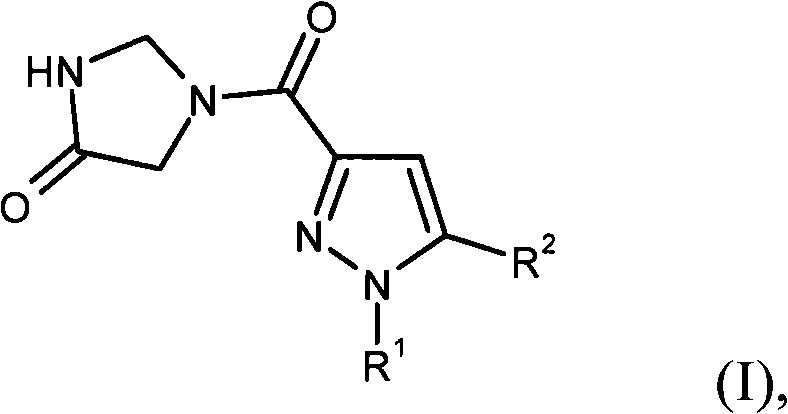


Applications Claiming Priority (3)
| Application Number | Priority Date | Filing Date | Title |
|---|---|---|---|
| DE102008015033.9 | 2008-03-17 | ||
| DE102008015033A DE102008015033A1 (en) | 2008-03-17 | 2008-03-17 | Substituted (pyrazolyl-carbonyl) imidazolidinones and their use |
| PCT/EP2009/001714 WO2009115213A1 (en) | 2008-03-17 | 2009-03-10 | (pyrazolyl carbonyl)imidazolidinone derivatives for the treatment of retroviral diseases |
Publications (2)
| Publication Number | Publication Date |
|---|---|
| CN101977908A true CN101977908A (en) | 2011-02-16 |
| CN101977908B CN101977908B (en) | 2014-04-23 |
Family
ID=40565083
Family Applications (1)
| Application Number | Title | Priority Date | Filing Date |
|---|---|---|---|
| CN200980109500.6A Expired - Fee Related CN101977908B (en) | 2008-03-17 | 2009-03-10 | (Pyrazolylcarbonyl) imidazolidinone derivatives for use in the treatment of retroviral diseases |
Country Status (22)
| Country | Link |
|---|---|
| US (1) | US8399682B2 (en) |
| EP (1) | EP2254885B1 (en) |
| JP (1) | JP5576853B2 (en) |
| KR (1) | KR20100124337A (en) |
| CN (1) | CN101977908B (en) |
| AP (1) | AP2774A (en) |
| AR (1) | AR070919A1 (en) |
| AU (1) | AU2009226656A1 (en) |
| CA (1) | CA2718685C (en) |
| CL (1) | CL2009000636A1 (en) |
| DE (1) | DE102008015033A1 (en) |
| IL (1) | IL207649A0 (en) |
| MA (1) | MA32224B1 (en) |
| MX (1) | MX2010010230A (en) |
| NZ (1) | NZ588141A (en) |
| PE (1) | PE20091718A1 (en) |
| RU (1) | RU2010141578A (en) |
| TW (1) | TW200951125A (en) |
| UA (1) | UA102390C2 (en) |
| UY (1) | UY31717A1 (en) |
| WO (1) | WO2009115213A1 (en) |
| ZA (1) | ZA201007361B (en) |
Cited By (1)
| Publication number | Priority date | Publication date | Assignee | Title |
|---|---|---|---|---|
| CN104024242A (en) * | 2011-11-29 | 2014-09-03 | 爱库利斯有限两合公司 | Carboxamide-substituted heteroaryl-pyrazoles and the use thereof |
Families Citing this family (6)
| Publication number | Priority date | Publication date | Assignee | Title |
|---|---|---|---|---|
| DE102008015033A1 (en) | 2008-03-17 | 2009-09-24 | Aicuris Gmbh & Co. Kg | Substituted (pyrazolyl-carbonyl) imidazolidinones and their use |
| DE102008015032A1 (en) | 2008-03-17 | 2009-09-24 | Aicuris Gmbh & Co. Kg | Substituted pyrazolamides and their use |
| DE102008062878A1 (en) | 2008-12-17 | 2010-06-24 | Aicuris Gmbh & Co. Kg | Substituted furancarboxamides and their use |
| DE102008062863A1 (en) | 2008-12-17 | 2010-06-24 | Aicuris Gmbh & Co. Kg | Substituted (thiophenyl-carbonyl) imidazolidinones and their use |
| EP2295038B1 (en) * | 2009-09-11 | 2013-05-29 | AiCuris GmbH & Co. KG | Solid dispersion comprising an anti-HIV agent |
| DE102012016908A1 (en) | 2012-08-17 | 2014-02-20 | Aicuris Gmbh & Co. Kg | Tris (hetero) aryl-pyrazoles and their use |
Citations (5)
| Publication number | Priority date | Publication date | Assignee | Title |
|---|---|---|---|---|
| WO2004024147A1 (en) * | 2002-09-16 | 2004-03-25 | Pfizer Limited | 4-(3,5-dicyanophenoxy) pyrazole derivatives for use as transcriptase modulators in the treatment of i.a. hiv |
| WO2004031178A1 (en) * | 2002-10-07 | 2004-04-15 | Pfizer Limited | Pyrazole derivatives |
| CN1527829A (en) * | 2001-06-04 | 2004-09-08 | - | Pyrazole derivatives as HIV reverse transcriptase inhibitors |
| CN1751028A (en) * | 2003-02-18 | 2006-03-22 | 弗·哈夫曼-拉罗切有限公司 | Non-nucleoside reverse transcriptase inhibitors |
| CN1832928A (en) * | 2003-06-26 | 2006-09-13 | 诺瓦提斯公司 | 5-membered heterocycle-based p38 kinase inhibitors |
Family Cites Families (45)
| Publication number | Priority date | Publication date | Assignee | Title |
|---|---|---|---|---|
| GB453061A (en) | 1935-03-23 | 1936-09-04 | Charles Howard Twigg | Improvements in and relating to gas heated geysers and water heaters |
| US3806506A (en) | 1971-08-05 | 1974-04-23 | Uniroyal Inc | Furan derivatives,compositions thereof and methods for using same |
| DE3119796A1 (en) | 1981-05-19 | 1982-12-23 | Hoechst Ag, 6000 Frankfurt | SUBSTITUTED TRYPTAMINE DERIVATIVES OF THIENYLOX PROPANOLAMINES, METHODS FOR THE PRODUCTION THEREOF, PHARMACEUTICAL PREPARATIONS BASED ON THESE COMPOUNDS AND THEIR USE |
| FR2538388B1 (en) | 1982-12-24 | 1985-06-21 | Pharmuka Lab | NOVEL NAPHTHALENE- OR AZANAPHTHALENECARBOXAMIDE DERIVATIVES, PROCESSES FOR THEIR PREPARATION AND THEIR USE AS MEDICAMENTS |
| US5591761A (en) | 1993-05-20 | 1997-01-07 | Texas Biotechnology Corporation | Thiophenyl-, furyl-and pyrrolyl-sulfonamides and derivatives thereof that modulate the activity of endothelin |
| PH27357A (en) | 1989-09-22 | 1993-06-21 | Fujisawa Pharmaceutical Co | Pyrazole derivatives and pharmaceutical compositions comprising the same |
| GB9012936D0 (en) | 1990-06-11 | 1990-08-01 | Fujisawa Pharmaceutical Co | Thiophene derivatives,processes for preparation thereof and pharmaceutical composition comprising the same |
| US5571810A (en) | 1990-06-11 | 1996-11-05 | Fujisawa Pharmaceutical Co., Ltd. | Thiophene derivatives |
| IL104311A (en) | 1992-02-05 | 1997-07-13 | Fujisawa Pharmaceutical Co | Pyrazole derivatives, processes for the preparation thereof and pharmaceutical compositions containing the same |
| FR2692575B1 (en) | 1992-06-23 | 1995-06-30 | Sanofi Elf | NOVEL PYRAZOLE DERIVATIVES, PROCESS FOR THEIR PREPARATION AND PHARMACEUTICAL COMPOSITIONS CONTAINING THEM. |
| JPH084281B2 (en) | 1992-09-30 | 1996-01-17 | 橋本コーポレイション株式会社 | Telephone device that expands the voice of the other party after on-hook |
| FR2728571B1 (en) | 1994-12-22 | 1997-01-31 | Adir | NOVEL ETHERS OF TRICYCLIC OXIMES, PROCESSES FOR THEIR PREPARATION AND THE PHARMACEUTICAL COMPOSITIONS CONTAINING THEM |
| US5696151A (en) | 1995-11-30 | 1997-12-09 | Uniroyal Chemical Company, Inc. | Compounds useful for the inhibition of the replication of HIV-1 and HIV-1 mutants |
| US6143780A (en) | 1999-09-17 | 2000-11-07 | Uniroyal Chemical Company, Inc. | N-arylmethylthioanilide compounds useful for the inhibition of the replication of HIV |
| IL153246A0 (en) | 2000-06-28 | 2003-07-06 | Astrazeneca Ab | Substituted quinazoline derivatives and their use as inhibitors |
| JP2005501841A (en) | 2001-08-01 | 2005-01-20 | バセル ポリオレフィン ジーエムビーエイチ | Method for producing heterocyclic pentalene derivative |
| WO2003037274A2 (en) | 2001-11-01 | 2003-05-08 | Icagen, Inc. | Pyrazole-amides and-sulfonamides |
| US7005432B2 (en) | 2002-05-16 | 2006-02-28 | Hoffman-La Roche Inc. | Substituted imidazol-pyridazine derivatives |
| AU2003265395A1 (en) | 2002-08-14 | 2004-03-03 | Ppd Discovery, Inc. | Prenylation inhibitors and methods of their synthesis and use |
| ES2379076T3 (en) | 2002-12-02 | 2012-04-20 | Astellas Pharma Inc. | Useful pyrazole derivatives as COX-I inhibitors |
| US7622471B2 (en) | 2003-02-07 | 2009-11-24 | Daiichi Pharmaceutical Co., Ltd. | Pyrazole derivatives having a pyridazine and pyridine functionality |
| DE602004023586D1 (en) | 2003-02-27 | 2009-11-26 | Neurosearch As | NEW DIAZABICYCLIC ARYL DERIVATIVES |
| FR2856683A1 (en) | 2003-06-25 | 2004-12-31 | Sanofi Synthelabo | 4-CYANOPYRAZOLE-3-CARBOXAMIDE DERIVATIVES, THEIR PREPARATION AND THEIR THERAPEUTIC APPLICATION |
| GB0315657D0 (en) * | 2003-07-03 | 2003-08-13 | Astex Technology Ltd | Pharmaceutical compounds |
| WO2005007625A2 (en) | 2003-07-14 | 2005-01-27 | The University Of Tennessee Research Foundation | Heterocyclic amides with anti-tuberculosis activity |
| US7220772B2 (en) * | 2003-09-05 | 2007-05-22 | Pfizer, Inc. | Pyrazole derivatives |
| FR2860792B1 (en) | 2003-10-10 | 2006-02-24 | Sanofi Synthelabo | THIOPHENE-2-CARBOXAMIDE DERIVATIVES, THEIR PREPARATION AND THEIR THERAPEUTIC USE |
| RU2375349C2 (en) | 2004-02-20 | 2009-12-10 | Астразенека Аб | Derivatives of 3-substituted 1,5-diphenylpyrazole effective as cb1 modulators |
| CN1980912A (en) | 2004-07-01 | 2007-06-13 | 第一制药株式会社 | Pyrazole derivatives |
| GB0417910D0 (en) | 2004-08-11 | 2004-09-15 | Novartis Ag | Organic compounds |
| CN101006082B (en) | 2004-08-23 | 2010-09-29 | 伊莱利利公司 | Histamine H3 receptor agents, methods of preparation and therapeutic uses |
| DE102004054666A1 (en) | 2004-11-12 | 2006-05-18 | Bayer Cropscience Gmbh | New substituted pyrazol-3-carboxamide derivatives useful to combat harmful plants and for growth regulation of plants |
| US7612200B2 (en) | 2004-12-07 | 2009-11-03 | Locus Pharmaceuticals, Inc. | Inhibitors of protein kinases |
| US7741479B2 (en) | 2004-12-07 | 2010-06-22 | Locus Pharmaceuticals, Inc. | Urea inhibitors of MAP kinases |
| MX2007006743A (en) | 2004-12-15 | 2007-07-09 | Astrazeneca Ab | Nicotinic acetylcholine receptor ligands. |
| US20110098301A1 (en) | 2005-03-10 | 2011-04-28 | Bayer Healthcare Llc | Pyrimidine Derivatives for Treatment of Hyperproliferative Disorders |
| BRPI0612287A8 (en) | 2005-06-27 | 2019-01-22 | Exelixis Inc | composition for pharmaceutical use in the treatment of diseases through nuclear medicine and methods of use and for modulating nuclear receptor activity |
| EP1743637A1 (en) | 2005-07-15 | 2007-01-17 | Laboratorios Del Dr. Esteve, S.A. | Use of substituted pyrazole compounds and combinations thereof for the treatment of the metabolic syndrome |
| WO2007009701A2 (en) | 2005-07-15 | 2007-01-25 | Laboratorios Del Dr. Esteve, S.A. | Use of substituted pyrazole compounds and combinations thereof for the treatment of the metabolic syndrome |
| GB0516661D0 (en) | 2005-08-13 | 2005-09-21 | Astrazeneca Ab | Therapeutic agents |
| WO2008043775A1 (en) | 2006-10-12 | 2008-04-17 | Janssen Pharmaceutica Nv | Substituted pyrazinone derivatives for use as a medicine |
| EP2518063B1 (en) | 2006-12-21 | 2017-02-01 | Sloan-Kettering Institute For Cancer Research | Pyridazinones and furan-containing compounds |
| GB0701426D0 (en) | 2007-01-25 | 2007-03-07 | Univ Sheffield | Compounds and their use |
| DE102008015033A1 (en) | 2008-03-17 | 2009-09-24 | Aicuris Gmbh & Co. Kg | Substituted (pyrazolyl-carbonyl) imidazolidinones and their use |
| DE102008015032A1 (en) * | 2008-03-17 | 2009-09-24 | Aicuris Gmbh & Co. Kg | Substituted pyrazolamides and their use |
-
2008
- 2008-03-17 DE DE102008015033A patent/DE102008015033A1/en not_active Ceased
-
2009
- 2009-03-10 AP AP2010005422A patent/AP2774A/en active
- 2009-03-10 NZ NZ588141A patent/NZ588141A/en not_active IP Right Cessation
- 2009-03-10 WO PCT/EP2009/001714 patent/WO2009115213A1/en not_active Ceased
- 2009-03-10 JP JP2011500075A patent/JP5576853B2/en not_active Expired - Fee Related
- 2009-03-10 CA CA2718685A patent/CA2718685C/en not_active Expired - Fee Related
- 2009-03-10 CN CN200980109500.6A patent/CN101977908B/en not_active Expired - Fee Related
- 2009-03-10 EP EP09721416.7A patent/EP2254885B1/en active Active
- 2009-03-10 RU RU2010141578/04A patent/RU2010141578A/en not_active Application Discontinuation
- 2009-03-10 AU AU2009226656A patent/AU2009226656A1/en not_active Abandoned
- 2009-03-10 UA UAA201012130A patent/UA102390C2/en unknown
- 2009-03-10 MX MX2010010230A patent/MX2010010230A/en active IP Right Grant
- 2009-03-10 KR KR1020107023291A patent/KR20100124337A/en not_active Withdrawn
- 2009-03-16 TW TW098108355A patent/TW200951125A/en unknown
- 2009-03-17 AR ARP090100947A patent/AR070919A1/en not_active Application Discontinuation
- 2009-03-17 UY UY031717A patent/UY31717A1/en not_active Application Discontinuation
- 2009-03-17 PE PE2009000388A patent/PE20091718A1/en not_active Application Discontinuation
- 2009-03-17 CL CL2009000636A patent/CL2009000636A1/en unknown
-
2010
- 2010-08-17 IL IL207649A patent/IL207649A0/en unknown
- 2010-09-17 US US12/885,340 patent/US8399682B2/en not_active Expired - Fee Related
- 2010-10-11 MA MA33241A patent/MA32224B1/en unknown
- 2010-10-14 ZA ZA2010/07361A patent/ZA201007361B/en unknown
Patent Citations (5)
| Publication number | Priority date | Publication date | Assignee | Title |
|---|---|---|---|---|
| CN1527829A (en) * | 2001-06-04 | 2004-09-08 | - | Pyrazole derivatives as HIV reverse transcriptase inhibitors |
| WO2004024147A1 (en) * | 2002-09-16 | 2004-03-25 | Pfizer Limited | 4-(3,5-dicyanophenoxy) pyrazole derivatives for use as transcriptase modulators in the treatment of i.a. hiv |
| WO2004031178A1 (en) * | 2002-10-07 | 2004-04-15 | Pfizer Limited | Pyrazole derivatives |
| CN1751028A (en) * | 2003-02-18 | 2006-03-22 | 弗·哈夫曼-拉罗切有限公司 | Non-nucleoside reverse transcriptase inhibitors |
| CN1832928A (en) * | 2003-06-26 | 2006-09-13 | 诺瓦提斯公司 | 5-membered heterocycle-based p38 kinase inhibitors |
Cited By (1)
| Publication number | Priority date | Publication date | Assignee | Title |
|---|---|---|---|---|
| CN104024242A (en) * | 2011-11-29 | 2014-09-03 | 爱库利斯有限两合公司 | Carboxamide-substituted heteroaryl-pyrazoles and the use thereof |
Also Published As
| Publication number | Publication date |
|---|---|
| MX2010010230A (en) | 2010-11-09 |
| CA2718685C (en) | 2016-11-29 |
| US20110124618A1 (en) | 2011-05-26 |
| AU2009226656A1 (en) | 2009-09-24 |
| CL2009000636A1 (en) | 2010-05-07 |
| PE20091718A1 (en) | 2009-12-11 |
| US8399682B2 (en) | 2013-03-19 |
| JP2011514366A (en) | 2011-05-06 |
| ZA201007361B (en) | 2011-12-28 |
| EP2254885A1 (en) | 2010-12-01 |
| UY31717A1 (en) | 2009-08-31 |
| CN101977908B (en) | 2014-04-23 |
| CA2718685A1 (en) | 2009-09-24 |
| UA102390C2 (en) | 2013-07-10 |
| RU2010141578A (en) | 2012-04-27 |
| JP5576853B2 (en) | 2014-08-20 |
| EP2254885B1 (en) | 2013-12-04 |
| AP2774A (en) | 2013-09-30 |
| TW200951125A (en) | 2009-12-16 |
| IL207649A0 (en) | 2010-12-30 |
| MA32224B1 (en) | 2011-04-01 |
| AP2010005422A0 (en) | 2010-10-31 |
| DE102008015033A1 (en) | 2009-09-24 |
| WO2009115213A1 (en) | 2009-09-24 |
| AR070919A1 (en) | 2010-05-12 |
| NZ588141A (en) | 2012-05-25 |
| KR20100124337A (en) | 2010-11-26 |
Similar Documents
| Publication | Publication Date | Title |
|---|---|---|
| CN101977908B (en) | (Pyrazolylcarbonyl) imidazolidinone derivatives for use in the treatment of retroviral diseases | |
| CN110003204B (en) | A kind of BET protein inhibitor, its preparation method and use | |
| CN102083803A (en) | Oxo-heterocyclic substituted carboxylic acid derivates and the use thereof | |
| OA13235A (en) | Piperazine derivatives for the treatment of HIV infections. | |
| EP4038064B1 (en) | N-substututed-6-oxo-1,6-dihydropyrimidine-2-yl derivatives as inhibitors of the human immunodeficiency virus replication | |
| US20030171406A1 (en) | Medicinal compositions containing propenone derivatives | |
| WO2004029049A1 (en) | Novel salt of 2-acylaminothiazole derivative | |
| CN104684913B (en) | Three (miscellaneous) arylpyrazole and application thereof | |
| US9296720B2 (en) | Carboxamide-substituted heteroaryl-pyrazoles and the use thereof | |
| KR20100004917A (en) | The salts of imidizol-5-carboxylic acid derivatives, preparation methods and use thereof | |
| DK2376479T3 (en) | Substituted furancarboxamider, and use thereof | |
| US8546438B2 (en) | Substituted (thiophenyl-carbonyl)imidazolidinones, and use thereof | |
| TWI353245B (en) | Novel aminoidazole derivatives as medicaments and | |
| JP2003504383A (en) | Alpha-hydroxy-gamma-[[(carbocyclic or heterocyclic-substituted) amino] carbonyl] alkaneamide derivatives and uses thereof | |
| JPWO2001096329A1 (en) | Pharmaceutical compositions containing propenone derivatives |
Legal Events
| Date | Code | Title | Description |
|---|---|---|---|
| C06 | Publication | ||
| PB01 | Publication | ||
| C10 | Entry into substantive examination | ||
| SE01 | Entry into force of request for substantive examination | ||
| C14 | Grant of patent or utility model | ||
| GR01 | Patent grant | ||
| CF01 | Termination of patent right due to non-payment of annual fee | ||
| CF01 | Termination of patent right due to non-payment of annual fee |
Granted publication date: 20140423 Termination date: 20180310 |