CN101977937A - Ron antibodies and uses thereof - Google Patents
Ron antibodies and uses thereof Download PDFInfo
- Publication number
- CN101977937A CN101977937A CN2009801102175A CN200980110217A CN101977937A CN 101977937 A CN101977937 A CN 101977937A CN 2009801102175 A CN2009801102175 A CN 2009801102175A CN 200980110217 A CN200980110217 A CN 200980110217A CN 101977937 A CN101977937 A CN 101977937A
- Authority
- CN
- China
- Prior art keywords
- seq
- antibody
- fragment
- ron
- polypeptide
- Prior art date
- Legal status (The legal status is an assumption and is not a legal conclusion. Google has not performed a legal analysis and makes no representation as to the accuracy of the status listed.)
- Pending
Links
Images




Classifications
-
- C—CHEMISTRY; METALLURGY
- C07—ORGANIC CHEMISTRY
- C07K—PEPTIDES
- C07K16/00—Immunoglobulins [IG], e.g. monoclonal or polyclonal antibodies
- C07K16/18—Immunoglobulins [IG], e.g. monoclonal or polyclonal antibodies against material from animals or humans
- C07K16/28—Immunoglobulins [IG], e.g. monoclonal or polyclonal antibodies against material from animals or humans against receptors, cell surface antigens or cell surface determinants
- C07K16/2863—Immunoglobulins [IG], e.g. monoclonal or polyclonal antibodies against material from animals or humans against receptors, cell surface antigens or cell surface determinants against receptors for growth factors, growth regulators
-
- A—HUMAN NECESSITIES
- A61—MEDICAL OR VETERINARY SCIENCE; HYGIENE
- A61P—SPECIFIC THERAPEUTIC ACTIVITY OF CHEMICAL COMPOUNDS OR MEDICINAL PREPARATIONS
- A61P35/00—Antineoplastic agents
-
- A—HUMAN NECESSITIES
- A61—MEDICAL OR VETERINARY SCIENCE; HYGIENE
- A61P—SPECIFIC THERAPEUTIC ACTIVITY OF CHEMICAL COMPOUNDS OR MEDICINAL PREPARATIONS
- A61P35/00—Antineoplastic agents
- A61P35/02—Antineoplastic agents specific for leukemia
-
- A—HUMAN NECESSITIES
- A61—MEDICAL OR VETERINARY SCIENCE; HYGIENE
- A61K—PREPARATIONS FOR MEDICAL, DENTAL OR TOILETRY PURPOSES
- A61K39/00—Medicinal preparations containing antigens or antibodies
- A61K2039/505—Medicinal preparations containing antigens or antibodies comprising antibodies
-
- C—CHEMISTRY; METALLURGY
- C07—ORGANIC CHEMISTRY
- C07K—PEPTIDES
- C07K2317/00—Immunoglobulins specific features
- C07K2317/20—Immunoglobulins specific features characterized by taxonomic origin
- C07K2317/21—Immunoglobulins specific features characterized by taxonomic origin from primates, e.g. man
-
- C—CHEMISTRY; METALLURGY
- C07—ORGANIC CHEMISTRY
- C07K—PEPTIDES
- C07K2317/00—Immunoglobulins specific features
- C07K2317/50—Immunoglobulins specific features characterized by immunoglobulin fragments
- C07K2317/55—Fab or Fab'
-
- C—CHEMISTRY; METALLURGY
- C07—ORGANIC CHEMISTRY
- C07K—PEPTIDES
- C07K2317/00—Immunoglobulins specific features
- C07K2317/70—Immunoglobulins specific features characterized by effect upon binding to a cell or to an antigen
- C07K2317/76—Antagonist effect on antigen, e.g. neutralization or inhibition of binding
Landscapes
- Health & Medical Sciences (AREA)
- Chemical & Material Sciences (AREA)
- Organic Chemistry (AREA)
- Immunology (AREA)
- Life Sciences & Earth Sciences (AREA)
- General Health & Medical Sciences (AREA)
- Medicinal Chemistry (AREA)
- Biochemistry (AREA)
- Veterinary Medicine (AREA)
- Pharmacology & Pharmacy (AREA)
- Nuclear Medicine, Radiotherapy & Molecular Imaging (AREA)
- Animal Behavior & Ethology (AREA)
- General Chemical & Material Sciences (AREA)
- Public Health (AREA)
- Proteomics, Peptides & Aminoacids (AREA)
- Molecular Biology (AREA)
- Chemical Kinetics & Catalysis (AREA)
- Biophysics (AREA)
- Genetics & Genomics (AREA)
- Hematology (AREA)
- Oncology (AREA)
- Peptides Or Proteins (AREA)
- Medicines Containing Antibodies Or Antigens For Use As Internal Diagnostic Agents (AREA)
Abstract
本发明涉及结合RON(receptor d’origine nantais,MST1R)的抗体及其用途,特别是在癌症的诊断和治疗中的用途。提供了抑制RON介导的促存活和肿瘤增殖途径的特异性抗体、及其变体、片段和衍生物。还提供了阻断配体MSP与RON结合能力的特异性抗体、以及这些抗体的片段、变体和衍生物。本发明还包括编码上述抗体或其片段、变体或衍生物的多核苷酸、以及含有这些多核苷酸的载体和宿主细胞。本发明还包括使用本发明的抗体来诊断和治疗癌症的方法。
The present invention relates to an antibody binding to RON (receptor d'origin nantais, MST1R) and its use, especially the use in the diagnosis and treatment of cancer. Specific antibodies, and variants, fragments and derivatives thereof, that inhibit RON-mediated pro-survival and tumor proliferation pathways are provided. Also provided are specific antibodies that block the ability of the ligand MSP to bind RON, as well as fragments, variants and derivatives of these antibodies. The present invention also includes polynucleotides encoding the above antibodies or fragments, variants or derivatives thereof, as well as vectors and host cells containing these polynucleotides. The invention also includes methods of diagnosing and treating cancer using the antibodies of the invention.
Description
发明背景Background of the invention
RON(recepteur d’origine nantais,也称为MST1R)是一种对于胚胎发育必不可少的受体型蛋白酪氨酸激酶,并且还在炎症反应中起重要作用(Camp等人Ann.Surg.Oncol.12:273-281(2005))。RON主要在来源于上皮的细胞类型中表达,并且有人提出RON同大量的其它受体型酪氨酸激酶一样可能在恶性上皮癌的演变中起作用(Wang等人Carcinogensis 23:1291-1297(2003))。RON (recepteur d'origin nantais, also known as MST1R) is a receptor-type protein tyrosine kinase essential for embryonic development and also plays an important role in inflammatory responses (Camp et al Ann.Surg.Oncol .12: 273-281 (2005)). RON is mainly expressed in cell types derived from the epithelium, and it has been suggested that RON, like a large number of other receptor-type tyrosine kinases, may play a role in the evolution of malignant epithelial carcinomas (Wang et al. Carcinogensis 23:1291-1297 (2003 )).
受体型蛋白酪氨酸激酶通常由结合胞外配体诸如生长因子和激素的胞外结构域以及具备激酶功能结构域的胞内结构域组成。受体型蛋白酪氨酸激酶已被细分为许多类别,并且RON是受体酪氨酸激酶的MET家族的成员,该家族还包括Stk、c-Met和c-Sea(Camp等人Ann.Surg.Oncol.12:273-281(2005))。RON和c-Met是在人类中发现的仅有的该家族的成员,并且它们总体上共有约65%的同源性。C-Met是肝细胞生长因子/分散因子(HGF/SF)的受体并且已被相当充分地表征为原癌基因。Receptor-type protein tyrosine kinases generally consist of an extracellular domain that binds extracellular ligands such as growth factors and hormones, and an intracellular domain that possesses a kinase-functional domain. Receptor-type protein tyrosine kinases have been subdivided into many classes, and RON is a member of the MET family of receptor tyrosine kinases, which also includes Stk, c-Met, and c-Sea (Camp et al. Ann. Surg. Oncol. 12:273-281 (2005)). RON and c-Met are the only members of this family found in humans, and they share approximately 65% homology overall. C-Met is the receptor for hepatocyte growth factor/scatter factor (HGF/SF) and has been fairly well characterized as a proto-oncogene.
已经确定RON的配体巨噬细胞刺激蛋白(MSP),其与c-Met配体HGF/SF共有约40%的同源性。MSP和HGF属于通过Kringle结构域表征的纤溶酶原-凝血酶原家族。有趣的是,MSP也已证实与癌症有关。例如,Welm等人最近观察到MSP与乳腺癌的转移和不良预后之间的关联(PNAS104:7501-7575(2007))。The ligand of RON, macrophage-stimulating protein (MSP), has been identified, which shares about 40% homology with the c-Met ligand HGF/SF. MSP and HGF belong to the plasminogen-prothrombin family characterized by Kringle domains. Interestingly, MSP has also been linked to cancer. For example, Welm et al. recently observed an association between MSP and metastasis and poor prognosis in breast cancer (PNAS 104:7501-7575 (2007)).
已经证实MSP与称为脑信号蛋白(sema)结构域的RON的胞外部分中的特定结构域结合。RON和c-Met是仅有的具有胞外sema结构域的受体酪氨酸激酶,并且已经证实RON的sema结构域包括其配体结合位点。MSP与RON的结合导致RON的激酶结构域中磷酸化,这使得RON激酶活性增加。或者,β1整联蛋白可经由Src依赖性途径将RON磷酸化并活化(Camp等人Ann.Surg.Oncol.12:273-281(2005))。RON的活化引发了许多途径的信号传导,包括PI3-K、Ras、src、β-连环蛋白和Fak信号传导。由RON活化的许多信号传导途径牵涉在与癌症相关的过程诸如增殖和凋亡的抑制中。MSP has been shown to bind to a specific domain in the extracellular portion of RON called the semaphorin (sema) domain. RON and c-Met are the only receptor tyrosine kinases with an extracellular sema domain, and it has been shown that the sema domain of RON includes its ligand binding site. Binding of MSP to RON results in phosphorylation in the kinase domain of RON, which increases RON kinase activity. Alternatively, β1 integrins can phosphorylate and activate RON via a Src-dependent pathway (Camp et al. Ann. Surg. Oncol. 12:273-281 (2005)). Activation of RON triggers signaling in many pathways, including PI3-K, Ras, src, β-catenin, and Fak signaling. Many signaling pathways activated by RON are implicated in the inhibition of cancer-related processes such as proliferation and apoptosis.
最近,由于多种原因,RON本身已牵涉在癌症演变中。例如,RON在包括乳腺癌、膀胱癌、结肠癌、卵巢癌和胰腺癌的多种人类肿瘤中表达。此外,RON已经在体外显示出增加细胞增殖和活动性。而且,RON在RON转基因小鼠中诱导肿瘤生长和转移(metastisis)(Waltz等人Cancer Research66:11967-11974(2006))。因此,对可以抑制RON信号传导途径的包括抗RON抗体在内的分子存在需求。More recently, RON itself has been implicated in cancer evolution for a number of reasons. For example, RON is expressed in a variety of human tumors including breast, bladder, colon, ovarian and pancreatic cancers. Furthermore, RON has been shown to increase cell proliferation and motility in vitro. Furthermore, RON induces tumor growth and metastisis in RON transgenic mice (Waltz et al. Cancer Research 66: 11967-11974 (2006)). Therefore, there is a need for molecules, including anti-RON antibodies, that can inhibit the RON signaling pathway.
发明内容Contents of the invention
在一些实施方案中,本发明提供一种分离的抗体或其抗原结合片段,所述抗体或其抗原结合片段特异性地结合至与选自由M14-H06、M15-E10、M16-C07、M23-F10、M80-B03、M93-D02、M96-C05、M97-D03和M98-E12组成的组的参考单克隆Fab抗体片段或选自由1P2E7、1P3B2、1P4A3、1P4A12和1P5B10组成的组的参考单克隆抗体相同的RON表位。In some embodiments, the invention provides an isolated antibody or antigen-binding fragment thereof that specifically binds to a protein selected from the group consisting of M14-H06, M15-E10, M16-C07, M23- A reference monoclonal Fab antibody fragment from the group consisting of F10, M80-B03, M93-D02, M96-C05, M97-D03 and M98-E12 or a reference monoclonal selected from the group consisting of 1P2E7, 1P3B2, 1P4A3, 1P4A12 and 1P5B10 Antibodies to the same RON epitope.
在一些实施方案中,本发明提供一种特异性地结合至RON的分离的抗体或其抗原结合片段,其中所述抗体或片段竞争性地抑制选自由M14-H06、M15-E10、M16-C07、M23-F10、M80-B03、M93-D02、M96-C05、M97-D03和M98-E12组成的组的参考单克隆Fab抗体片段或选自由1P2E7、1P3B2、1P4A3、1P4A12和1P5B10组成的组的参考单克隆抗体与RON结合。In some embodiments, the invention provides an isolated antibody or antigen-binding fragment thereof that specifically binds to RON, wherein said antibody or fragment competitively inhibits a group selected from M14-H06, M15-E10, M16-C07 , M23-F10, M80-B03, M93-D02, M96-C05, M97-D03 and M98-E12 a reference monoclonal Fab antibody fragment or a fragment selected from the group consisting of 1P2E7, 1P3B2, 1P4A3, 1P4A12 and 1P5B10 Reference monoclonal antibody bound to RON.
在一些实施方案中,本发明提供一种特异性地结合至RON的分离的抗体或其抗原结合片段,其中所述抗体或其片段包含与选自由M14-H06、M15-E10、M16-C07、M23-F10、M80-B03、M93-D02、M96-C05、M97-D03和M98-E12组成的组的参考单克隆Fab抗体片段或选自由1P2E7、1P3B2、1P4A3、1P4A12和1P5B10组成的组的参考单克隆抗体的抗原结合结构域相同的抗原结合结构域。In some embodiments, the invention provides an isolated antibody or antigen-binding fragment thereof that specifically binds to RON, wherein said antibody or fragment thereof comprises a compound selected from the group consisting of M14-H06, M15-E10, M16-C07, A reference monoclonal Fab antibody fragment from the group consisting of M23-F10, M80-B03, M93-D02, M96-C05, M97-D03 and M98-E12 or a reference selected from the group consisting of 1P2E7, 1P3B2, 1P4A3, 1P4A12 and 1P5B10 The same antigen-binding domain as the antigen-binding domain of the monoclonal antibody.
在一些实施方案中,本发明提供一种特异性地结合至RON的分离的抗体或其片段,其中所述抗体或其片段的重链可变区(VH)包含与选自由以下组成的组的参考氨基酸序列至少90%相同的氨基酸序列:SEQ IDNO:4、SEQ ID NO:14、SEQ ID NO:24、SEQ ID NO:34、SEQ ID NO:44、SEQ ID NO:54、SEQ ID NO:64、SEQ ID NO:74、SEQ ID NO:84、SEQ ID NO:94、SEQ ID NO:115、SEQ ID NO:125、SEQ ID NO:135和SEQ ID NO:145。In some embodiments, the invention provides an isolated antibody or fragment thereof that specifically binds to RON, wherein the heavy chain variable region (VH) of the antibody or fragment thereof comprises a compound selected from the group consisting of Amino acid sequences at least 90% identical to the reference amino acid sequence: SEQ ID NO: 4, SEQ ID NO: 14, SEQ ID NO: 24, SEQ ID NO: 34, SEQ ID NO: 44, SEQ ID NO: 54, SEQ ID NO: 64. SEQ ID NO: 74, SEQ ID NO: 84, SEQ ID NO: 94, SEQ ID NO: 115, SEQ ID NO: 125, SEQ ID NO: 135, and SEQ ID NO: 145.
在一些实施方案中,本发明提供一种特异性地结合至RON的分离的抗体或其片段,其中所述抗体或其片段的轻链可变区(VL)包含与选自由以下组成的组的参考氨基酸序列至少90%相同的氨基酸序列:SEQ IDNO:9、SEQ ID NO:19、SEQ ID NO:29、SEQ ID NO:39、SEQ ID NO:49、SEQ ID NO:59、SEQ ID NO:69、SEQ ID NO:79、SEQ ID NO:89、SEQ IDNO:99、SEQ ID NO:120、SEQ ID NO:130、SEQ ID NO:140和SEQ ID NO:150。In some embodiments, the invention provides an isolated antibody or fragment thereof that specifically binds to RON, wherein the light chain variable region (VL) of the antibody or fragment thereof comprises a compound selected from the group consisting of Amino acid sequences at least 90% identical to the reference amino acid sequence: SEQ ID NO: 9, SEQ ID NO: 19, SEQ ID NO: 29, SEQ ID NO: 39, SEQ ID NO: 49, SEQ ID NO: 59, SEQ ID NO: 69. SEQ ID NO: 79, SEQ ID NO: 89, SEQ ID NO: 99, SEQ ID NO: 120, SEQ ID NO: 130, SEQ ID NO: 140, and SEQ ID NO: 150.
在一些实施方案中,本发明提供一种特异性地结合至RON的分离的抗体或其片段,其中所述抗体或其片段的VH包含除了20个或更少的保守性氨基酸取代以外与选自由以下组成的组的参考氨基酸序列相同的氨基酸序列:SEQ ID NO:4、SEQ ID NO:14、SEQ ID NO:24、SEQ ID NO:34、SEQ ID NO:44、SEQ ID NO:54、SEQ ID NO:64、SEQ ID NO:74、SEQ IDNO:84、SEQ ID NO:94、SEQ ID NO:115、SEQ ID NO:125、SEQ ID NO:135和SEQ ID NO:145。In some embodiments, the invention provides an isolated antibody or fragment thereof that specifically binds to RON, wherein the VH of the antibody or fragment thereof comprises in addition to 20 or fewer conservative amino acid substitutions selected from Amino acid sequences identical to the reference amino acid sequence of the group consisting of: SEQ ID NO: 4, SEQ ID NO: 14, SEQ ID NO: 24, SEQ ID NO: 34, SEQ ID NO: 44, SEQ ID NO: 54, SEQ ID NO: 54, SEQ ID NO: ID NO: 64, SEQ ID NO: 74, SEQ ID NO: 84, SEQ ID NO: 94, SEQ ID NO: 115, SEQ ID NO: 125, SEQ ID NO: 135, and SEQ ID NO: 145.
在一些实施方案中,本发明提供一种特异性地结合至RON的分离的抗体或其片段,其中所述抗体或其片段的VL包含除了20个或更少的保守性氨基酸取代以外与选自由以下组成的组的参考氨基酸序列相同的氨基酸序列:SEQ ID NO:9、SEQ ID NO:19、SEQ ID NO:29、SEQ ID NO:39、SEQ ID NO:49、SEQ ID NO:59、SEQ ID NO:69、SEQ ID NO:79、SEQ IDNO:89、SEQ ID NO:99、SEQ ID NO:120、SEQ ID NO:130、SEQ ID NO:140和SEQ ID NO:150。In some embodiments, the invention provides an isolated antibody or fragment thereof that specifically binds to RON, wherein the VL of the antibody or fragment thereof comprises in addition to 20 or fewer conservative amino acid substitutions selected from Amino acid sequences identical to the reference amino acid sequence of the group consisting of: SEQ ID NO: 9, SEQ ID NO: 19, SEQ ID NO: 29, SEQ ID NO: 39, SEQ ID NO: 49, SEQ ID NO: 59, SEQ ID NO: 59, SEQ ID NO: ID NO: 69, SEQ ID NO: 79, SEQ ID NO: 89, SEQ ID NO: 99, SEQ ID NO: 120, SEQ ID NO: 130, SEQ ID NO: 140, and SEQ ID NO: 150.
在一些实施方案中,本发明提供一种特异性地结合至RON的分离的抗体或其片段,其中所述抗体或其片段的VH包含选自由以下组成的组的氨基酸序列:SEQ ID NO:4、SEQ ID NO:14、SEQ ID NO:24、SEQ ID NO:34、SEQ ID NO:44、SEQ ID NO:54、SEQ ID NO:64、SEQ ID NO:74、SEQ IDNO:84、SEQ ID NO:94、SEQ ID NO:115、SEQ ID NO:125、SEQ ID NO:135和SEQ ID NO:145。In some embodiments, the invention provides an isolated antibody or fragment thereof that specifically binds to RON, wherein the VH of the antibody or fragment thereof comprises an amino acid sequence selected from the group consisting of: SEQ ID NO: 4 , SEQ ID NO: 14, SEQ ID NO: 24, SEQ ID NO: 34, SEQ ID NO: 44, SEQ ID NO: 54, SEQ ID NO: 64, SEQ ID NO: 74, SEQ ID NO: 84, SEQ ID NO: 94, SEQ ID NO: 115, SEQ ID NO: 125, SEQ ID NO: 135 and SEQ ID NO: 145.
在一些实施方案中,本发明提供一种特异性地结合至RON的分离的抗体或其片段,其中所述抗体或其片段的VL包含选自由以下组成的组的氨基酸序列:SEQ ID NO:9、SEQ ID NO:19、SEQ ID NO:29、SEQ ID NO:39、SEQ ID NO:49、SEQ ID NO:59、SEQ ID NO:69、SEQ ID NO:79、SEQ IDNO:89、SEQ ID NO:99、SEQ TD NO:120、SEQ ID NO:130、SEQ ID NO:140和SEQ ID NO:150。In some embodiments, the invention provides an isolated antibody or fragment thereof that specifically binds to RON, wherein the VL of the antibody or fragment thereof comprises an amino acid sequence selected from the group consisting of: SEQ ID NO: 9 , SEQ ID NO: 19, SEQ ID NO: 29, SEQ ID NO: 39, SEQ ID NO: 49, SEQ ID NO: 59, SEQ ID NO: 69, SEQ ID NO: 79, SEQ ID NO: 89, SEQ ID NO: 99, SEQ TD NO: 120, SEQ ID NO: 130, SEQ ID NO: 140 and SEQ ID NO: 150.
在一些实施方案中,本发明提供一种特异性地结合至RON的分离的抗体或其片段,其中所述抗体或其片段的VH和VL分别包含与选自由以下组成的组的参考氨基酸序列至少90%相同的氨基酸序列:SEQ ID NO:4和SEQ ID NO:9;SEQ ID NO:14和SEQ ID NO:19;SEQ ID NO:24和SEQID NO:29;SEQ ID NO:34和SEQ ID NO:39;SEQ ID NO:44和SEQ IDNO:49;SEQ ID NO:54和SEQ ID NO:59;SEQ ID NO:64和SEQ ID NO:69;SEQ ID NO:74和SEQ ID NO:79;SEQ ID NO:84和SEQ ID NO:89;SEQ IDNO:94和SEQ ID NO:99、SEQ ID NO:115和SEQ ID NO:120、SEQ ID NO:125和SEQ ID NO:130、SEQ ID NO:135和SEQ ID NO:140、以及SEQ IDNO:145和SEQ ID NO:150。In some embodiments, the present invention provides an isolated antibody or fragment thereof that specifically binds to RON, wherein the VH and VL of the antibody or fragment thereof respectively comprise at least one of a reference amino acid sequence selected from the group consisting of 90% identical amino acid sequences: SEQ ID NO: 4 and SEQ ID NO: 9; SEQ ID NO: 14 and SEQ ID NO: 19; SEQ ID NO: 24 and SEQ ID NO: 29; SEQ ID NO: 34 and SEQ ID NO: 39; SEQ ID NO: 44 and SEQ ID NO: 49; SEQ ID NO: 54 and SEQ ID NO: 59; SEQ ID NO: 64 and SEQ ID NO: 69; SEQ ID NO: 74 and SEQ ID NO: 79 ; SEQ ID NO: 84 and SEQ ID NO: 89; SEQ ID NO: 94 and SEQ ID NO: 99, SEQ ID NO: 115 and SEQ ID NO: 120, SEQ ID NO: 125 and SEQ ID NO: 130, SEQ ID NO: 135 and SEQ ID NO: 140, and SEQ ID NO: 145 and SEQ ID NO: 150.
在一些实施方案中,本发明提供一种特异性地结合至RON的分离的抗体或其片段,其中所述抗体或其片段的VH和VL各自除了20个或更少的保守性氨基酸取代以外,分别包含与选自由以下组成的组的参考氨基酸序列相同的氨基酸序列:SEQ ID NO:4和SEQ ID NO:9;SEQ ID NO:14和SEQ ID NO:19;SEQ ID NO:24和SEQ ID NO:29;SEQ ID NO:34和SEQID NO:39;SEQ ID NO:44和SEQ TD NO:49;SEQ ID NO:54和SEQ IDNO:59;SEQ ID NO:64和SEQ ID NO:69;SEQ ID NO:74和SEQ ID NO:79;SEQ ID NO:84和SEQ ID NO:89;SEQ ID NO:94和SEQ ID NO:99、SEQ IDNO:115和SEQ ID NO:120、SEQ ID NO:125和SEQ ID NO:130、SEQ IDNO:135和SEQ ID NO:140、以及SEQ ID NO:145和SEQ ID NO:150。In some embodiments, the invention provides an isolated antibody or fragment thereof that specifically binds to RON, wherein the VH and VL of the antibody or fragment thereof are each except for 20 or fewer conservative amino acid substitutions, comprising an amino acid sequence identical to a reference amino acid sequence selected from the group consisting of: SEQ ID NO: 4 and SEQ ID NO: 9; SEQ ID NO: 14 and SEQ ID NO: 19; SEQ ID NO: 24 and SEQ ID NO: 29; SEQ ID NO: 34 and SEQ ID NO: 39; SEQ ID NO: 44 and SEQ TD NO: 49; SEQ ID NO: 54 and SEQ ID NO: 59; SEQ ID NO: 64 and SEQ ID NO: 69; SEQ ID NO: 74 and SEQ ID NO: 79; SEQ ID NO: 84 and SEQ ID NO: 89; SEQ ID NO: 94 and SEQ ID NO: 99, SEQ ID NO: 115 and SEQ ID NO: 120, SEQ ID NO : 125 and SEQ ID NO: 130, SEQ ID NO: 135 and SEQ ID NO: 140, and SEQ ID NO: 145 and SEQ ID NO: 150.
在一些实施方案中,本发明提供一种特异性地结合至RON的分离的抗体或其片段,其中所述抗体或其片段的VH和VL分别包含选自由以下组成的组的氨基酸序列:SEQ ID NO:4和SEQ ID NO:9;SEQ ID NO:14和SEQ ID NO:19;SEQ ID NO:24和SEQ ID NO:29;SEQ ID NO:34和SEQID NO:39;SEQ ID NO:44和SEQ ID NO:49;SEQ ID NO:54和SEQ IDNO:59;SEQ ID NO:64和SEQ ID NO:69;SEQ ID NO:74和SEQ ID NO:79;SEQ ID NO:84和SEQ ID NO:89;SEQ ID NO:94和SEQ ID NO:99、SEQ IDNO:115和SEQ ID NO:120、SEQ ID NO:125和SEQ ID NO:130、SEQ IDNO:135和SEQ ID NO:140、以及SEQ ID NO:145和SEQ ID NO:150。In some embodiments, the invention provides an isolated antibody or fragment thereof that specifically binds to RON, wherein the VH and VL of the antibody or fragment thereof each comprise an amino acid sequence selected from the group consisting of: SEQ ID NO: 4 and SEQ ID NO: 9; SEQ ID NO: 14 and SEQ ID NO: 19; SEQ ID NO: 24 and SEQ ID NO: 29; SEQ ID NO: 34 and SEQ ID NO: 39; SEQ ID NO: 44 and SEQ ID NO: 49; SEQ ID NO: 54 and SEQ ID NO: 59; SEQ ID NO: 64 and SEQ ID NO: 69; SEQ ID NO: 74 and SEQ ID NO: 79; SEQ ID NO: 84 and SEQ ID NO: 89; SEQ ID NO: 94 and SEQ ID NO: 99, SEQ ID NO: 115 and SEQ ID NO: 120, SEQ ID NO: 125 and SEQ ID NO: 130, SEQ ID NO: 135 and SEQ ID NO: 140, and SEQ ID NO:145 and SEQ ID NO:150.
在一些实施方案中,本发明提供一种特异性地结合至RON的分离的抗体或其片段,其中所述抗体或其片段的VH包含除了两个或更少的氨基酸取代以外与选自由以下组成的组的参考重链互补决定区-1(VH-CDR1)氨基酸序列相同的Kabat VH-CDR1氨基酸序列:SEQ ID NO:5、SEQ IDNO:15、SEQ ID NO:25、SEQ ID NO:35、SEQ ID NO:45、SEQ ID NO:55、SEQ ID NO:65、SEQ ID NO:75、SEQ ID NO:85、SEQ ID NO:95、SEQ IDNO:116、SEQ ID NO:126、SEQ ID NO:136和SEQ ID NO:146。在另外的实施方案中,所述VH-CDR1氨基酸序列选自由以下组成的组:SEQ IDNO:5、SEQ ID NO:15、SEQ ID NO:25、SEQ ID NO:35、SEQ ID NO:45、SEQ ID NO:55、SEQ ID NO:65、SEQ ID NO:75、SEQ ID NO:85、SEQ IDNO:95、SEQ ID NO:116、SEQ ID NO:126、SEQ ID NO:136和SEQ ID NO:146。In some embodiments, the invention provides an isolated antibody or fragment thereof that specifically binds to RON, wherein the VH of the antibody or fragment thereof comprises, in addition to two or fewer amino acid substitutions, an antibody selected from the group consisting of The Kabat VH-CDR1 amino acid sequence identical to the reference heavy chain complementarity determining region-1 (VH-CDR1) amino acid sequence of the group: SEQ ID NO: 5, SEQ ID NO: 15, SEQ ID NO: 25, SEQ ID NO: 35, SEQ ID NO: 45, SEQ ID NO: 55, SEQ ID NO: 65, SEQ ID NO: 75, SEQ ID NO: 85, SEQ ID NO: 95, SEQ ID NO: 116, SEQ ID NO: 126, SEQ ID NO : 136 and SEQ ID NO: 146. In additional embodiments, the VH-CDR1 amino acid sequence is selected from the group consisting of SEQ ID NO: 5, SEQ ID NO: 15, SEQ ID NO: 25, SEQ ID NO: 35, SEQ ID NO: 45, SEQ ID NO: 55, SEQ ID NO: 65, SEQ ID NO: 75, SEQ ID NO: 85, SEQ ID NO: 95, SEQ ID NO: 116, SEQ ID NO: 126, SEQ ID NO: 136 and SEQ ID NO :146.
在一些实施方案中,本发明提供一种特异性地结合至RON的分离的抗体或其片段,其中所述抗体或其片段的VH包含除了四个或更少的氨基酸取代以外与选自由以下组成的组的参考重链互补决定区-2(VH-CDR2)氨基酸序列相同的Kabat VH-CDR2氨基酸序列:SEQ ID NO:6、SEQ IDNO:16、SEQ ID NO:26、SEQ ID NO:36、SEQ ID NO:46、SEQ ID NO:56、SEQ ID NO:66、SEQ ID NO:76、SEQ ID NO:86、SEQ ID NO:96、SEQ IDNO:117、SEQ ID NO:127、SEQ ID NO:137和SEQ ID NO:147。在另外的的实施方案中,所述VH-CDR2氨基酸序列选自由以下组成的组:SEQ IDNO:6、SEQ ID NO:16、SEQ ID NO:26、SEQ ID NO:36、SEQ ID NO:46、SEQ ID NO:56、SEQ ID NO:66、SEQ ID NO:76、SEQ ID NO:86、SEQ IDNO:96、SEQ ID NO:117、SEQ ID NO:127、SEQ ID NO:137和SEQ IDNO:147。In some embodiments, the invention provides an isolated antibody or fragment thereof that specifically binds to RON, wherein the VH of the antibody or fragment thereof comprises in addition to four or fewer amino acid substitutions and is selected from the group consisting of The Kabat VH-CDR2 amino acid sequence identical to the reference heavy chain complementarity determining region-2 (VH-CDR2) amino acid sequence of the group: SEQ ID NO: 6, SEQ ID NO: 16, SEQ ID NO: 26, SEQ ID NO: 36, SEQ ID NO: 46, SEQ ID NO: 56, SEQ ID NO: 66, SEQ ID NO: 76, SEQ ID NO: 86, SEQ ID NO: 96, SEQ ID NO: 117, SEQ ID NO: 127, SEQ ID NO : 137 and SEQ ID NO: 147. In additional embodiments, the VH-CDR2 amino acid sequence is selected from the group consisting of: SEQ ID NO: 6, SEQ ID NO: 16, SEQ ID NO: 26, SEQ ID NO: 36, SEQ ID NO: 46 , SEQ ID NO: 56, SEQ ID NO: 66, SEQ ID NO: 76, SEQ ID NO: 86, SEQ ID NO: 96, SEQ ID NO: 117, SEQ ID NO: 127, SEQ ID NO: 137, and SEQ ID NO :147.
在一些实施方案中,本发明提供一种特异性地结合至RON的分离的抗体或其片段,其中所述抗体或其片段的VH包含除了四个或更少的氨基酸取代以外与选自由以下组成的组的参考重链互补决定区-3(VH-CDR3)氨基酸序列相同的Kabat VH-CDR3氨基酸序列:SEQ ID NO:7、SEQ IDNO:17、SEQ ID NO:27、SEQ ID NO:37、SEQ ID NO:47、SEQ ID NO:57、SEQ ID NO:67、SEQ ID NO:77、SEQ ID NO:87、SEQ ID NO:97、SEQ IDNO:118、SEQ ID NO:128、SEQ ID NO:138和SEQ ID NO:148。在另外的实施方案中,所述VH-CDR3氨基酸序列选自由以下组成的组:SEQ IDNO:7、SEQ ID NO:17、SEQ ID NO:27、SEQ ID NO:37、SEQ ID NO:47、SEQ ID NO:57、SEQ ID NO:67、SEQ ID NO:77、SEQ ID NO:87、SEQ IDNO:97、SEQ ID NO:118、SEQ ID NO:128、SEQ ID NO:138和SEQ IDNO:148。In some embodiments, the invention provides an isolated antibody or fragment thereof that specifically binds to RON, wherein the VH of the antibody or fragment thereof comprises in addition to four or fewer amino acid substitutions and is selected from the group consisting of The Kabat VH-CDR3 amino acid sequence identical to the reference heavy chain complementarity determining region-3 (VH-CDR3) amino acid sequence of the group: SEQ ID NO: 7, SEQ ID NO: 17, SEQ ID NO: 27, SEQ ID NO: 37, SEQ ID NO: 47, SEQ ID NO: 57, SEQ ID NO: 67, SEQ ID NO: 77, SEQ ID NO: 87, SEQ ID NO: 97, SEQ ID NO: 118, SEQ ID NO: 128, SEQ ID NO : 138 and SEQ ID NO: 148. In additional embodiments, the VH-CDR3 amino acid sequence is selected from the group consisting of SEQ ID NO: 7, SEQ ID NO: 17, SEQ ID NO: 27, SEQ ID NO: 37, SEQ ID NO: 47, SEQ ID NO: 57, SEQ ID NO: 67, SEQ ID NO: 77, SEQ ID NO: 87, SEQ ID NO: 97, SEQ ID NO: 118, SEQ ID NO: 128, SEQ ID NO: 138 and SEQ ID NO: 148.
在一些实施方案中,本发明提供一种特异性地结合至RON的分离的抗体或其片段,其中所述抗体或其片段的VL包含除了四个或更少的氨基酸取代以外与选自由以下组成的组的参考轻链互补决定区-1(VL-CDR1)氨基酸序列相同的Kabat VL-CDR1氨基酸序列:SEQ ID NO:10、SEQ IDNO:20、SEQ ID NO:30、SEQ ID NO:40、SEQ ID NO:50、SEQ ID NO:60、SEQ ID NO:70、SEQ ID NO:80、SEQ ID NO:90、SEQ ID NO:100、SEQID NO:121、SEQ ID NO:131、SEQ ID NO:141和SEQ ID NO:151。在另外的实施方案中,所述VL-CDR1氨基酸序列选自由以下组成的组:SEQ IDNO:10、SEQ ID NO:20、SEQ ID NO:30、SEQ ID NO:40、SEQ ID NO:50、SEQ ID NO:60、SEQ ID NO:70、SEQ ID NO:80、SEQ ID NO:90、SEQ IDNO:100、SEQ ID NO:121、SEQ ID NO:131、SEQ ID NO:141和SEQ IDNO:151。In some embodiments, the invention provides an isolated antibody or fragment thereof that specifically binds to RON, wherein the VL of the antibody or fragment thereof comprises in addition to four or fewer amino acid substitutions and is selected from the group consisting of The reference light chain complementarity determining region-1 (VL-CDR1) amino acid sequence of the group is identical to the Kabat VL-CDR1 amino acid sequence: SEQ ID NO: 10, SEQ ID NO: 20, SEQ ID NO: 30, SEQ ID NO: 40, SEQ ID NO: 50, SEQ ID NO: 60, SEQ ID NO: 70, SEQ ID NO: 80, SEQ ID NO: 90, SEQ ID NO: 100, SEQ ID NO: 121, SEQ ID NO: 131, SEQ ID NO : 141 and SEQ ID NO: 151. In additional embodiments, the VL-CDR1 amino acid sequence is selected from the group consisting of SEQ ID NO: 10, SEQ ID NO: 20, SEQ ID NO: 30, SEQ ID NO: 40, SEQ ID NO: 50, SEQ ID NO: 60, SEQ ID NO: 70, SEQ ID NO: 80, SEQ ID NO: 90, SEQ ID NO: 100, SEQ ID NO: 121, SEQ ID NO: 131, SEQ ID NO: 141 and SEQ ID NO: 151.
在一些实施方案中,本发明提供一种特异性地结合至RON的分离的抗体或其片段,其中所述抗体或其片段的VL包含除了两个或更少的氨基酸取代以外与选自由以下组成的组的参考轻链互补决定区-2(VL-CDR2)氨基酸序列相同的Kabat VL-CDR2氨基酸序列:SEQ ID NO:11、SEQ IDNO:21、SEQ ID NO:31、SEQ ID NO:41、SEQ ID NO:51、SEQ ID NO:61、SEQ ID NO:71、SEQ ID NO:81、SEQ ID NO:91、SEQ ID NO:101、SEQID NO:122、SEQ ID NO:132、SEQ ID NO:142和SEQ ID NO:152。在另外的实施方案中,所述VL-CDR2氨基酸序列选自由以下组成的组:SEQ IDNO:11、SEQ ID NO:21、SEQ ID NO:31、SEQ ID NO:41、SEQ ID NO:51、SEQ ID NO:61、SEQ ID NO:71、SEQ ID NO:81、SEQ ID NO:91、SEQ IDNO:101、SEQ ID NO:122、SEQ ID NO:132、SEQ ID NO:142和SEQ ID NO:152。In some embodiments, the invention provides an isolated antibody or fragment thereof that specifically binds to RON, wherein the VL of the antibody or fragment thereof comprises, in addition to two or fewer amino acid substitutions, an antibody selected from the group consisting of The reference light chain complementarity determining region-2 (VL-CDR2) amino acid sequence of the group is identical to the Kabat VL-CDR2 amino acid sequence: SEQ ID NO: 11, SEQ ID NO: 21, SEQ ID NO: 31, SEQ ID NO: 41, SEQ ID NO: 51, SEQ ID NO: 61, SEQ ID NO: 71, SEQ ID NO: 81, SEQ ID NO: 91, SEQ ID NO: 101, SEQ ID NO: 122, SEQ ID NO: 132, SEQ ID NO : 142 and SEQ ID NO: 152. In additional embodiments, the VL-CDR2 amino acid sequence is selected from the group consisting of SEQ ID NO: 11, SEQ ID NO: 21, SEQ ID NO: 31, SEQ ID NO: 41, SEQ ID NO: 51, SEQ ID NO: 61, SEQ ID NO: 71, SEQ ID NO: 81, SEQ ID NO: 91, SEQ ID NO: 101, SEQ ID NO: 122, SEQ ID NO: 132, SEQ ID NO: 142 and SEQ ID NO :152.
在一些实施方案中,本发明提供一种特异性地结合至RON的分离的抗体或其片段,其中所述抗体或其片段的VL包含除了四个或更少的氨基酸取代以外与选自由以下组成的组的参考轻链互补决定区-3(VL-CDR3)氨基酸序列相同的Kabat VL-CDR3氨基酸序列:SEQ ID NO:12、SEQ IDNO:22、SEQ ID NO:32、SEQ ID NO:42、SEQ ID NO:52、SEQ ID NO:62、SEQ ID NO:72、SEQ ID NO:82、SEQ ID NO:92、SEQ ID NO:102、SEQID NO:123、SEQ ID NO:133、SEQ ID NO:143和SEQ ID NO:153。在另外的实施方案中,所述VL-CDR3氨基酸序列选自由以下组成的组:SEQ IDNO:12、SEQ ID NO:22、SEQ ID NO:32、SEQ ID NO:42、SEQ ID NO:52、SEQ ID NO:62、SEQ ID NO:72、SEQ ID NO:82、SEQ ID NO:92、SEQ IDNO:102、SEQ ID NO:123、SEQ ID NO:133、SEQ ID NO:143和SEQ ID NO:153。In some embodiments, the invention provides an isolated antibody or fragment thereof that specifically binds to RON, wherein the VL of the antibody or fragment thereof comprises in addition to four or fewer amino acid substitutions and is selected from the group consisting of The reference light chain complementarity determining region-3 (VL-CDR3) amino acid sequence of the group is identical to the Kabat VL-CDR3 amino acid sequence: SEQ ID NO: 12, SEQ ID NO: 22, SEQ ID NO: 32, SEQ ID NO: 42, SEQ ID NO: 52, SEQ ID NO: 62, SEQ ID NO: 72, SEQ ID NO: 82, SEQ ID NO: 92, SEQ ID NO: 102, SEQ ID NO: 123, SEQ ID NO: 133, SEQ ID NO : 143 and SEQ ID NO: 153. In additional embodiments, the VL-CDR3 amino acid sequence is selected from the group consisting of SEQ ID NO: 12, SEQ ID NO: 22, SEQ ID NO: 32, SEQ ID NO: 42, SEQ ID NO: 52, SEQ ID NO: 62, SEQ ID NO: 72, SEQ ID NO: 82, SEQ ID NO: 92, SEQ ID NO: 102, SEQ ID NO: 123, SEQ ID NO: 133, SEQ ID NO: 143 and SEQ ID NO :153.
在一些实施方案中,本发明提供一种特异性地结合至RON的分离的抗体或其片段,其中除了在所述VH-CDR中的至少一个上的一个、二个、三个或四个氨基酸取代以外,所述抗体或其片段的VH包含选自由以下组成的组的VH-CDR1、VH-CDR2和VH-CDR3氨基酸序列:SEQ ID NO:5、6和7;SEQ ID NO:15、16和17;SEQ ID NO:25、26和27;SEQ ID NO:35、36和37;SEQ ID NO:45、46和47;SEQ ID NO:55、56和57;SEQID NO:65、66和67;SEQ ID NO:75、76和77;SEQ ID NO:85、86和87;SEQ ID NO:95、96和97;SEQ ID NO:116、117和118;SEQ ID NO:126、127和128;SEQ ID NO:136、137和138;以及SEQ ID NO:146、147和148。In some embodiments, the invention provides an isolated antibody or fragment thereof that specifically binds to RON, wherein except for one, two, three or four amino acids on at least one of said VH-CDRs In addition to substitutions, the VH of the antibody or fragment thereof comprises a VH-CDR1, VH-CDR2 and VH-CDR3 amino acid sequence selected from the group consisting of: SEQ ID NO: 5, 6 and 7; SEQ ID NO: 15, 16 and 17; SEQ ID NO: 25, 26 and 27; SEQ ID NO: 35, 36 and 37; SEQ ID NO: 45, 46 and 47; SEQ ID NO: 55, 56 and 57; SEQ ID NO: 65, 66 and 67; SEQ ID NO: 75, 76 and 77; SEQ ID NO: 85, 86 and 87; SEQ ID NO: 95, 96 and 97; SEQ ID NO: 116, 117 and 118; SEQ ID NO: 126, 127 and 128; SEQ ID NOS: 136, 137 and 138; and SEQ ID NOS: 146, 147 and 148.
在一些实施方案中,本发明提供一种特异性地结合至RON的分离的抗体或其片段,其中所述抗体或其片段的VH包含选自由以下组成的组的VH-CDR1、VH-CDR2和VH-CDR3氨基酸序列:SEQ ID NO:5、6和7;SEQ ID NO:15、16和17;SEQ ID NO:25、26和27;SEQ ID NO:35、36和37;SEQ ID NO:45、46和47;SEQ ID NO:55、56和57;SEQ ID NO:65、66和67;SEQ ID NO:75、76和77;SEQ ID NO:85、86和87;SEQID NO:95、96和97;SEQ ID NO:116、117和118;SEQ ID NO:126、127和128;SEQ ID NO:136、137和138;以及SEQ ID NO:146、147和148。In some embodiments, the invention provides an isolated antibody or fragment thereof that specifically binds to RON, wherein the VH of the antibody or fragment thereof comprises VH-CDR1, VH-CDR2 and VH-CDR2 selected from the group consisting of VH-CDR3 amino acid sequence: SEQ ID NO: 5, 6 and 7; SEQ ID NO: 15, 16 and 17; SEQ ID NO: 25, 26 and 27; SEQ ID NO: 35, 36 and 37; SEQ ID NO: 45, 46 and 47; SEQ ID NO: 55, 56 and 57; SEQ ID NO: 65, 66 and 67; SEQ ID NO: 75, 76 and 77; SEQ ID NO: 85, 86 and 87; SEQ ID NO: 95 , 96, and 97; SEQ ID NOs: 116, 117, and 118; SEQ ID NOs: 126, 127, and 128; SEQ ID NOs: 136, 137, and 138; and SEQ ID NOs: 146, 147, and 148.
在一些实施方案中,本发明提供一种特异性地结合至RON的分离的抗体或其片段,其中除了在VL-CDR中至少一个上的一个、二个、三个或四个氨基酸取代以外,所述抗体或其片段的VL包含选自由以下组成的组的VL-CDR1、VL-CDR2和VL-CDR3氨基酸序列:SEQ ID NO:10、11和12;SEQ ID NO:20、21和22;SEQ ID NO:30、31和32;SEQ ID NO:40、41和42;SEQ ID NO:50、51和52;SEQ ID NO:60、61和62;SEQ ID NO:70、71和72;SEQ ID NO:80、81和82;SEQ ID NO:90、91和92;SEQID NO:100、101和102;SEQ ID NO:121、122和123;SEQ ID NO:131、132和133;SEQ ID NO:141、142和143;以及SEQ ID NO:151、152和153。In some embodiments, the invention provides an isolated antibody or fragment thereof that specifically binds to RON, wherein in addition to one, two, three or four amino acid substitutions on at least one of the VL-CDRs, The VL of the antibody or fragment thereof comprises a VL-CDR1, VL-CDR2 and VL-CDR3 amino acid sequence selected from the group consisting of: SEQ ID NO: 10, 11 and 12; SEQ ID NO: 20, 21 and 22; SEQ ID NO: 30, 31 and 32; SEQ ID NO: 40, 41 and 42; SEQ ID NO: 50, 51 and 52; SEQ ID NO: 60, 61 and 62; SEQ ID NO: 70, 71 and 72; SEQ ID NO: 80, 81 and 82; SEQ ID NO: 90, 91 and 92; SEQ ID NO: 100, 101 and 102; SEQ ID NO: 121, 122 and 123; SEQ ID NO: 131, 132 and 133; SEQ ID NO: 131, 132 and 133; ID NOs: 141, 142, and 143; and SEQ ID NOs: 151, 152, and 153.
在一些实施方案中,本发明提供一种特异性地结合至RON的分离的抗体或其片段,其中所述抗体或其片段的VL包含选自由以下组成的组的VL-CDR1、VL-CDR2和VL-CDR3氨基酸序列:SEQ ID NO:10、11和12;SEQ ID NO:20、21和22;SEQ ID NO:30、31和32;SEQ ID NO:40、41和42;SEQ ID NO:50、51和52;SEQ ID NO:60、61和62;SEQ ID NO:70、71和72;SEQ ID NO:80、81和82;SEQ ID NO:90、91和92;SEQID NO:100、101和102;SEQ ID NO:121、122和123;SEQ ID NO:131、132和133;SEQ ID NO:141、142和143;以及SEQ ID NO:151、152和153。In some embodiments, the invention provides an isolated antibody or fragment thereof that specifically binds to RON, wherein the VL of the antibody or fragment thereof comprises VL-CDR1, VL-CDR2 and VL-CDR2 selected from the group consisting of VL-CDR3 amino acid sequence: SEQ ID NO: 10, 11 and 12; SEQ ID NO: 20, 21 and 22; SEQ ID NO: 30, 31 and 32; SEQ ID NO: 40, 41 and 42; SEQ ID NO: 50, 51 and 52; SEQ ID NO: 60, 61 and 62; SEQ ID NO: 70, 71 and 72; SEQ ID NO: 80, 81 and 82; SEQ ID NO: 90, 91 and 92; SEQ ID NO: 100 , 101, and 102; SEQ ID NOs: 121, 122, and 123; SEQ ID NOs: 131, 132, and 133; SEQ ID NOs: 141, 142, and 143; and SEQ ID NOs: 151, 152, and 153.
在上述的抗体或其片段的各种实施方案中,除了五个或更少的氨基酸取代以外,所述VH构架区和/或VL构架区是人类的。In various embodiments of the antibodies or fragments thereof described above, except for five or fewer amino acid substitutions, the VH framework regions and/or VL framework regions are human.
在一些实施方案中,上述的抗体或其片段结合至线性表位或非线性构象表位。In some embodiments, the antibodies or fragments thereof described above bind to a linear epitope or a non-linear conformational epitope.
在一些实施方案中,上述的抗体或其片段是多价的,并包含至少两条重链和至少两条轻链。In some embodiments, the above-described antibodies or fragments thereof are multivalent and comprise at least two heavy chains and at least two light chains.
在一些实施方案中,上述的抗体或其片段是多特异性的。在另外的实施方案中,上述的抗体或其片段是双特异性的。In some embodiments, the antibodies or fragments thereof described above are multispecific. In other embodiments, the antibodies or fragments thereof described above are bispecific.
在上述的抗体或其片段的各种实施方案中,重链和轻链可变结构域是鼠的。在另外的实施方案中,重链和轻链可变结构域来自选自由1P2E7、1P3B2、1P4A3、1P4A12和1P5B10组成的组的单克隆抗体。In various embodiments of the antibodies or fragments thereof described above, the heavy and light chain variable domains are murine. In additional embodiments, the heavy and light chain variable domains are from a monoclonal antibody selected from the group consisting of 1P2E7, 1P3B2, 1P4A3, 1P4A12 and 1P5B10.
在上述的抗体或其片段的各种实施方案中,重链和轻链可变结构域是完全人类的。在另外的实施方案中,重链和轻链可变结构域来自选自由M14-H06、M15-E10、M16-C07、M23-F10、M80-B03、M93-D02、M96-C05、M97-D03和M98-E12组成的组的单克隆Fab抗体片段。In various embodiments of the antibodies or fragments thereof described above, the heavy and light chain variable domains are fully human. In additional embodiments, the heavy and light chain variable domains are from the group consisting of Monoclonal Fab antibody fragments of the group consisting of M98-E12.
在各种实施方案中,上述的抗体或其片段是人源化的。In various embodiments, the antibodies or fragments thereof described above are humanized.
在各种实施方案中,上述的抗体或其片段是嵌合的。In various embodiments, the antibodies or fragments thereof described above are chimeric.
在各种实施方案中,上述的抗体或其片段是灵长源化的。In various embodiments, the antibodies or fragments thereof described above are primatized.
在各种实施方案中,上述的抗体或其片段是完全人类的。In various embodiments, the antibodies or fragments thereof described above are fully human.
在某些实施方案中,上述的抗体或其片段是Fab片段、Fab’片段、F(ab)2片段或Fv片段。In certain embodiments, the aforementioned antibodies or fragments thereof are Fab fragments, Fab' fragments, F(ab) 2 fragments or Fv fragments.
在某些实施方案中,上述的抗体是单链抗体。In certain embodiments, the antibodies described above are single chain antibodies.
在某些实施方案中,上述的抗体或其片段包含选自由人类κ恒定区和人类λ恒定区组成的组的轻链恒定区。In certain embodiments, the aforementioned antibodies or fragments thereof comprise a light chain constant region selected from the group consisting of a human kappa constant region and a human lambda constant region.
在某些实施方案中,上述的抗体或其片段包含重链恒定区或其片段。在另外的实施方案中,重链恒定区或其片段选自由人类IgG4、IgG4agly、IgG1和IgG1agly组成的组。In certain embodiments, the aforementioned antibodies or fragments thereof comprise a heavy chain constant region or fragments thereof. In additional embodiments, the heavy chain constant region or fragment thereof is selected from the group consisting of human IgG4, IgG4agly, IgGl and IgGlagly.
在一些实施方案中,上述的抗体或其片段以小于所述参考单克隆抗体的解离常数(KD)的KD所表征的亲和力特异性地结合至RON多肽或其片段、或RON变体多肽。在另外的实施方案中,解离常数(KD)不大于5×10⁻²M、10-2M、5×10⁻³M、10-3M、5×10⁻⁴M、10-4M、5×10⁻⁵M、10-5M、5×10⁻⁶M、10-6M、5×10⁻⁷M、10-7M、5×10⁻⁸M、10-8M、5×10⁻⁹M、10-9M、5×10⁻¹⁰M、10-10M、5×10-11M、10-11M、5×10-12M、10-12M、5×10-13M、10-13M、5×10-14M、10-14M、5×10-15M或10-15M。In some embodiments, the aforementioned antibody or fragment thereof specifically binds to a RON polypeptide or fragment thereof, or RON variant, with an affinity characterized by a KD that is less than the dissociation constant ( KD ) of the reference monoclonal antibody peptide. In other embodiments, the dissociation constant (K D ) is not greater than 5×10 −2 M, 10 −2 M, 5×10 −3 M, 10 −3 M, 5×10 −4 M, 10 −4 M, 5×10 -5 M, 10 -5 M, 5×10 -6 M, 10 -6 M, 5×10 -7 M, 10 -7 M, 5× 10 -8 M , 10 -8 M, 5× 10⁻⁹M , 10-9M , 5×10⁻¹⁰M, 10-10M , 5× 10-11M , 10-11M , 5× 10-12M , 10-12M , 5 × 10-13M , 10-13M , 5× 10-14M , 10-14M , 5× 10-15M or 10-15M .
在一些实施方案中,上述的抗体或其片段相对于鼠RON多肽或其片段优先地结合至人类RON多肽或其片段。In some embodiments, the above-described antibodies or fragments thereof bind preferentially to human RON polypeptides or fragments thereof relative to murine RON polypeptides or fragments thereof.
在一些实施方案中,上述的抗体或其片段结合至细胞表面上表达的RON。在另外的实施方案中,所述细胞是恶性细胞、赘生性细胞、肿瘤细胞、转移性细胞或肿瘤相关巨噬细胞。In some embodiments, the antibodies or fragments thereof described above bind to RON expressed on the cell surface. In additional embodiments, the cells are malignant cells, neoplastic cells, tumor cells, metastatic cells, or tumor-associated macrophages.
在一些实施方案中,上述的抗体或其片段阻断MSP与RON结合。In some embodiments, the antibodies or fragments thereof described above block the binding of MSP to RON.
在一些实施方案中,上述的抗体或其片段抑制MSP依赖性RON活化。In some embodiments, the above-described antibodies or fragments thereof inhibit MSP-dependent RON activation.
在一些实施方案中,上述的抗体或其片段抑制非MSP依赖性RON活化。In some embodiments, the above-described antibodies or fragments thereof inhibit MSP-independent RON activation.
在一些实施方案中,上述的抗体或其片段抑制RON介导的RAS/MAPK信号传导途径的活化。In some embodiments, the above-described antibodies or fragments thereof inhibit RON-mediated activation of the RAS/MAPK signaling pathway.
在一些实施方案中,上述的抗体或其片段抑制RON介导的ERK或AKT的磷酸化。In some embodiments, the above-described antibodies or fragments thereof inhibit RON-mediated phosphorylation of ERK or AKT.
在一些实施方案中,上述的抗体或其片段抑制RON介导的细胞增殖、肿瘤细胞生长、肿瘤细胞迁移、肿瘤细胞侵入或肿瘤细胞转移。In some embodiments, the above-mentioned antibodies or fragments thereof inhibit RON-mediated cell proliferation, tumor cell growth, tumor cell migration, tumor cell invasion, or tumor cell metastasis.
在一些实施方案中,上述的抗体或其片段诱导凋亡。In some embodiments, the antibodies or fragments thereof described above induce apoptosis.
在另外的实施方案中,上述的抗体或其片段还包含与其融合的异源性多肽。In another embodiment, the above-mentioned antibody or fragment thereof further comprises a heterologous polypeptide fused thereto.
在一些实施方案中,上述的抗体或其片段轭合于选自由以下组成的组的剂:细胞毒性剂、治疗剂、细胞抑制剂、生物毒素、前体药物、肽、蛋白、酶、病毒、脂质、生物反应调节剂、药物剂、淋巴因子、异源性抗体或其片段、可检测标记、聚乙二醇(PEG)、和两种或两种以上任何所述剂的组合。在另外的实施方案中,所述细胞毒性剂选自由以下组成的组:放射性核素、生物毒素、酶促活性的毒素、细胞抑制性或细胞毒性治疗剂、前体药物、免疫活性的配体、生物反应调节剂、或者两种或两种以上任何所述细胞毒性剂的组合。在另外的实施方案中,所述可检测标记选自由以下组成的组:酶、荧光标记、化学发光标记、生物发光标记、放射性标记、或者两种或两种以上任何所述可检测标记的组合。In some embodiments, the antibody or fragment thereof described above is conjugated to an agent selected from the group consisting of cytotoxic agents, therapeutic agents, cytostatic agents, biotoxins, prodrugs, peptides, proteins, enzymes, viruses, Lipids, biological response modifiers, pharmaceutical agents, lymphokines, heterologous antibodies or fragments thereof, detectable labels, polyethylene glycol (PEG), and combinations of two or more of any of these agents. In additional embodiments, the cytotoxic agent is selected from the group consisting of radionuclides, biotoxins, enzymatically active toxins, cytostatic or cytotoxic therapeutic agents, prodrugs, immunologically active ligands , a biological response modifier, or a combination of two or more of any of the cytotoxic agents. In additional embodiments, the detectable label is selected from the group consisting of an enzyme, a fluorescent label, a chemiluminescent label, a bioluminescent label, a radioactive label, or a combination of two or more of any of the detectable labels. .
在另外的实施方案中,本发明包括包含上述抗体或其片段和载体的组合物。In additional embodiments, the present invention includes compositions comprising the above-described antibodies or fragments thereof and a carrier.
本发明的某些实施方案包括一种包含编码抗体VH多肽的核酸的分离的多核苷酸,其中所述VH多肽的氨基酸序列与选自由以下组成的组的参考氨基酸序列至少90%相同:SEQ ID NO:4、SEQ ID NO:14、SEQ IDNO:24、SEQ ID NO:34、SEQ ID NO:44、SEQ ID NO:54、SEQ ID NO:64、SEQ ID NO:74、SEQ ID NO:84、SEQ ID NO:94、SEQ ID NO:115、SEQ IDNO:125、SEQ ID NO:135和SEQ ID NO:145;并且其中包含所述VH多肽的抗体或其抗原结合片段特异性地结合至RON。在另外的实施方案中,所述VH多肽的氨基酸序列选自由以下组成的组:SEQ ID NO:4、SEQ IDNO:14、SEQ ID NO:24、SEQ ID NO:34、SEQ ID NO:44、SEQ ID NO:54、SEQ ID NO:64、SEQ ID NO:74、SEQ ID NO:84、SEQ ID NO:94、SEQ IDNO:115、SEQ ID NO:125、SEQ ID NO:135和SEQ ID NO:145。Certain embodiments of the invention include an isolated polynucleotide comprising a nucleic acid encoding an antibody VH polypeptide, wherein the amino acid sequence of the VH polypeptide is at least 90% identical to a reference amino acid sequence selected from the group consisting of: SEQ ID NO: 4, SEQ ID NO: 14, SEQ ID NO: 24, SEQ ID NO: 34, SEQ ID NO: 44, SEQ ID NO: 54, SEQ ID NO: 64, SEQ ID NO: 74, SEQ ID NO: 84 , SEQ ID NO: 94, SEQ ID NO: 115, SEQ ID NO: 125, SEQ ID NO: 135, and SEQ ID NO: 145; and wherein the antibody or antigen-binding fragment thereof comprising the VH polypeptide specifically binds to RON . In additional embodiments, the amino acid sequence of the VH polypeptide is selected from the group consisting of SEQ ID NO: 4, SEQ ID NO: 14, SEQ ID NO: 24, SEQ ID NO: 34, SEQ ID NO: 44, SEQ ID NO: 54, SEQ ID NO: 64, SEQ ID NO: 74, SEQ ID NO: 84, SEQ ID NO: 94, SEQ ID NO: 115, SEQ ID NO: 125, SEQ ID NO: 135 and SEQ ID NO :145.
在某些实施方案中,编码所述VH多肽的核苷酸序列被优化以增加所述VH多肽的表达而不改变其氨基酸序列。在另外的实施方案中,所述优化包括识别和移除剪接供体位点和剪接受体位点和/或表达所述多核苷酸细胞的密码子使用的优化。在另外的实施方案中,所述核酸包含选自由以下组成的组的核苷酸序列:SEQ ID NO:3、SEQ FD NO:13、SEQ ID NO:23、SEQ ID NO:33、SEQ ID NO:43、SEQ ID NO:53、SEQ ID NO:63、SEQ IDNO:73、SEQ ID NO:83、SEQ ID NO:93、SEQ ID NO:114、SEQ ID NO:124、SEQ ID NO:134和SEQ ID NO:144。In certain embodiments, the nucleotide sequence encoding the VH polypeptide is optimized to increase expression of the VH polypeptide without altering its amino acid sequence. In additional embodiments, said optimization comprises identification and removal of splice donor and splice acceptor sites and/or optimization of codon usage of cells expressing said polynucleotide. In additional embodiments, the nucleic acid comprises a nucleotide sequence selected from the group consisting of SEQ ID NO: 3, SEQ FD NO: 13, SEQ ID NO: 23, SEQ ID NO: 33, SEQ ID NO : 43, SEQ ID NO: 53, SEQ ID NO: 63, SEQ ID NO: 73, SEQ ID NO: 83, SEQ ID NO: 93, SEQ ID NO: 114, SEQ ID NO: 124, SEQ ID NO: 134 and SEQ ID NO: 144.
在一些实施方案中,本发明提供一种包含编码抗体VL多肽的核酸的分离的多核苷酸,其中所述VL多肽的氨基酸序列与选自由以下组成的组的参考氨基酸序列至少90%相同:SEQ ID NO:9、SEQ ID NO:19、SEQ IDNO:29、SEQ ID NO:39、SEQ ID NO:49、SEQ ID NO:59、SEQ ID NO:69、SEQ ID NO:79、SEQ ID NO:89、SEQ ID NO:99、SEQ ID NO:120、SEQ IDNO:130、SEQ ID NO:140和SEQ ID NO:150;并且其中包含所述VL多肽的抗体或其抗原结合片段特异性地结合至RON。在另外的实施方案中,所述VL多肽的氨基酸序列选自由以下组成的组:SEQ ID NO:9、SEQ IDNO:19、SEQ ID NO:29、SEQ ID NO:39、SEQ ID NO:49、SEQ ID NO:59、SEQ ID NO:69、SEQ ID NO:79、SEQ ID NO:89、SEQ ID NO:99、SEQ IDNO:120、SEQ ID NO:130、SEQ ID NO:140和SEQ ID NO:150。In some embodiments, the invention provides an isolated polynucleotide comprising a nucleic acid encoding an antibody VL polypeptide, wherein the amino acid sequence of the VL polypeptide is at least 90% identical to a reference amino acid sequence selected from the group consisting of: SEQ ID NO: 9, SEQ ID NO: 19, SEQ ID NO: 29, SEQ ID NO: 39, SEQ ID NO: 49, SEQ ID NO: 59, SEQ ID NO: 69, SEQ ID NO: 79, SEQ ID NO: 89. SEQ ID NO: 99, SEQ ID NO: 120, SEQ ID NO: 130, SEQ ID NO: 140, and SEQ ID NO: 150; and wherein the antibody or antigen-binding fragment thereof comprising said VL polypeptide specifically binds to RON. In additional embodiments, the amino acid sequence of the VL polypeptide is selected from the group consisting of SEQ ID NO: 9, SEQ ID NO: 19, SEQ ID NO: 29, SEQ ID NO: 39, SEQ ID NO: 49, SEQ ID NO: 59, SEQ ID NO: 69, SEQ ID NO: 79, SEQ ID NO: 89, SEQ ID NO: 99, SEQ ID NO: 120, SEQ ID NO: 130, SEQ ID NO: 140 and SEQ ID NO : 150.
在某些实施方案中,编码所述VL多肽的核苷酸序列被优化以增加所述VL多肽的表达而不改变其氨基酸序列。在另外的实施方案中,所述优化包括识别和移除剪接供体位点和剪接受体位点和/或表达所述多核苷酸细胞的密码子使用的优化。在另外的实施方案中,所述核酸包含选自由以下组成的组的核苷酸序列:SEQ ID NO:8、SEQ ID NO:18、SEQ ID NO:28、SEQ ID NO:38、SEQ ID NO:48、SEQ ID NO:58、SEQ ID NO:68、SEQ IDNO:78、SEQ ID NO:88、SEQ ID NO:98、SEQ ID NO:119、SEQ ID NO:129、SEQ ID NO:139和SEQ ID NO:149。In certain embodiments, the nucleotide sequence encoding the VL polypeptide is optimized to increase expression of the VL polypeptide without altering its amino acid sequence. In additional embodiments, said optimization comprises identification and removal of splice donor and splice acceptor sites and/or optimization of codon usage of cells expressing said polynucleotide. In additional embodiments, the nucleic acid comprises a nucleotide sequence selected from the group consisting of SEQ ID NO: 8, SEQ ID NO: 18, SEQ ID NO: 28, SEQ ID NO: 38, SEQ ID NO : 48, SEQ ID NO: 58, SEQ ID NO: 68, SEQ ID NO: 78, SEQ ID NO: 88, SEQ ID NO: 98, SEQ ID NO: 119, SEQ ID NO: 129, SEQ ID NO: 139 and SEQ ID NO: 149.
在某些其它实施方案中,本发明提供一种包含编码抗体VH多肽的核酸的分离的多核苷酸,其中除了20个或更少的保守性氨基酸取代以外,所述VH多肽的氨基酸序列与选自由以下组成的组的参考氨基酸序列相同:SEQ ID NO:4、SEQ ID NO:14、SEQ ID NO:24、SEQ ID NO:34、SEQID NO:44、SEQ ID NO:54、SEQ ID NO:64、SEQ ID NO:74、SEQ ID NO:84、SEQ ID NO:94、SEQ ID NO:115、SEQ ID NO:125、SEQ ID NO:135和SEQID NO:145;并且其中包含所述VH多肽的抗体或其抗原结合片段特异性地结合至RON。In certain other embodiments, the invention provides an isolated polynucleotide comprising a nucleic acid encoding an antibody VH polypeptide, wherein, except for 20 or fewer conservative amino acid substitutions, the amino acid sequence of the VH polypeptide is identical to that of a selected The reference amino acid sequence is identical from the group consisting of: SEQ ID NO: 4, SEQ ID NO: 14, SEQ ID NO: 24, SEQ ID NO: 34, SEQ ID NO: 44, SEQ ID NO: 54, SEQ ID NO: 64. SEQ ID NO: 74, SEQ ID NO: 84, SEQ ID NO: 94, SEQ ID NO: 115, SEQ ID NO: 125, SEQ ID NO: 135 and SEQ ID NO: 145; and comprising said VH polypeptide The antibody or antigen-binding fragment thereof specifically binds to RON.
在一些实施方案中,本发明提供一种包含编码抗体VL多肽的核酸的分离的多核苷酸,其中除了20个或更少的保守性氨基酸取代以外,所述VL多肽的氨基酸序列与选自由以下组成的组的参考氨基酸序列相同:SEQID NO:9、SEQ ID NO:19、SEQ ID NO:29、SEQ ID NO:39、SEQ ID NO:49、SEQ ID NO:59、SEQ ID NO:69、SEQ ID NO:79、SEQ ID NO:89、SEQ IDNO:99、SEQ ID NO:120、SEQ ID NO:130、SEQ ID NO:140和SEQ IDNO:150;并且其中包含所述VL多肽的抗体或其抗原结合片段特异性地结合至RON。In some embodiments, the invention provides an isolated polynucleotide comprising a nucleic acid encoding an antibody VL polypeptide, wherein, except for 20 or fewer conservative amino acid substitutions, the amino acid sequence of the VL polypeptide is selected from the group consisting of The reference amino acid sequences of the composed groups are identical: SEQ ID NO: 9, SEQ ID NO: 19, SEQ ID NO: 29, SEQ ID NO: 39, SEQ ID NO: 49, SEQ ID NO: 59, SEQ ID NO: 69, SEQ ID NO: 79, SEQ ID NO: 89, SEQ ID NO: 99, SEQ ID NO: 120, SEQ ID NO: 130, SEQ ID NO: 140 and SEQ ID NO: 150; and an antibody comprising said VL polypeptide or Antigen-binding fragments thereof specifically bind to RON.
在一些实施方案中,本发明提供一种包含编码VH-CDR1氨基酸序列的核酸的分离的多核苷酸,其中除了两个或更少的氨基酸取代以外,所述VH-CDR1氨基酸序列与选自由以下组成的组的参考VH-CDR1氨基酸序列相同:SEQ ID NO:5、SEQ ID NO:15、SEQ ID NO:25、SEQ ID NO:35、SEQ ID NO:45、SEQ ID NO:55、SEQ ID NO:65、SEQ ID NO:75、SEQ IDNO:85、SEQ ID NO:95、SEQ ID NO:116、SEQ ID NO:126、SEQ ID NO:136和SEQ ID NO:146;并且其中包含所述VH-CDR1的抗体或其抗原结合片段特异性地结合至RON。在另外的实施方案中,所述VH-CDR1氨基酸序列选自由以下组成的组:SEQ ID NO:5、SEQ ID NO:15、SEQ ID NO:25、SEQ ID NO:35、SEQ ID NO:45、SEQ ID NO:55、SEQ ID NO:65、SEQ ID NO:75、SEQ ID NO:85、SEQ ID NO:95、SEQ ID NO:116、SEQID NO:126、SEQ ID NO:136和SEQ ID NO:146。In some embodiments, the invention provides an isolated polynucleotide comprising a nucleic acid encoding a VH-CDR1 amino acid sequence, wherein, except for two or fewer amino acid substitutions, the VH-CDR1 amino acid sequence is selected from the group consisting of The reference VH-CDR1 amino acid sequence of the composed group is identical: SEQ ID NO: 5, SEQ ID NO: 15, SEQ ID NO: 25, SEQ ID NO: 35, SEQ ID NO: 45, SEQ ID NO: 55, SEQ ID NO: 65, SEQ ID NO: 75, SEQ ID NO: 85, SEQ ID NO: 95, SEQ ID NO: 116, SEQ ID NO: 126, SEQ ID NO: 136 and SEQ ID NO: 146; and containing said Antibodies to VH-CDR1 or antigen-binding fragments thereof specifically bind to RON. In additional embodiments, the VH-CDR1 amino acid sequence is selected from the group consisting of: SEQ ID NO: 5, SEQ ID NO: 15, SEQ ID NO: 25, SEQ ID NO: 35, SEQ ID NO: 45 , SEQ ID NO: 55, SEQ ID NO: 65, SEQ ID NO: 75, SEQ ID NO: 85, SEQ ID NO: 95, SEQ ID NO: 116, SEQ ID NO: 126, SEQ ID NO: 136, and SEQ ID NO: 146.
在一些实施方案中,本发明提供一种包含编码VH-CDR2氨基酸序列的核酸的分离的多核苷酸,所述VH-CDR2氨基酸序列除了四个或更少的氨基酸取代以外,与选自由以下组成的组的参考VH-CDR2氨基酸序列相同:SEQ ID NO:6、SEQ ID NO:16、SEQ ID NO:26、SEQ ID NO:36、SEQID NO:46、SEQ ID NO:56、SEQ ID NO:66、SEQ ID NO:76、SEQ ID NO:86、SEQ ID NO:96、SEQ ID NO:117、SEQ ID NO:127、SEQ ID NO:137和SEQ ID NO:147;并且其中包含所述VH-CDR2的抗体或其抗原结合片段特异性地结合至RON。在另外的实施方案中,所述VH-CDR2氨基酸序列选自由以下组成的组:SEQ ID NO:6、SEQ ID NO:16、SEQ ID NO:26、SEQ ID NO:36、SEQ ID NO:46、SEQ ID NO:56、SEQ ID NO:66、SEQ IDNO:76、SEQ ID NO:86、SEQ ID NO:96、SEQ ID NO:117、SEQ ID NO:127、SEQ ID NO:137和SEQ ID NO:147。In some embodiments, the invention provides an isolated polynucleotide comprising a nucleic acid encoding a VH-CDR2 amino acid sequence that, except for four or fewer amino acid substitutions, is selected from the group consisting of The reference VH-CDR2 amino acid sequences of the groups are identical: SEQ ID NO: 6, SEQ ID NO: 16, SEQ ID NO: 26, SEQ ID NO: 36, SEQ ID NO: 46, SEQ ID NO: 56, SEQ ID NO: 66. SEQ ID NO: 76, SEQ ID NO: 86, SEQ ID NO: 96, SEQ ID NO: 117, SEQ ID NO: 127, SEQ ID NO: 137, and SEQ ID NO: 147; and comprising said VH - an antibody to CDR2 or an antigen-binding fragment thereof specifically binds to RON. In additional embodiments, the VH-CDR2 amino acid sequence is selected from the group consisting of: SEQ ID NO: 6, SEQ ID NO: 16, SEQ ID NO: 26, SEQ ID NO: 36, SEQ ID NO: 46 , SEQ ID NO: 56, SEQ ID NO: 66, SEQ ID NO: 76, SEQ ID NO: 86, SEQ ID NO: 96, SEQ ID NO: 117, SEQ ID NO: 127, SEQ ID NO: 137, and SEQ ID NO: 147.
在一些实施方案中,本发明提供一种包含编码VH-CDR3氨基酸序列的核酸的分离的多核苷酸,所述VH-CDR3氨基酸序列除了四个或更少的氨基酸取代以外,与选自由以下组成的组的参考VH-CDR3氨基酸序列相同:SEQ ID NO:7、SEQ ID NO:17、SEQ ID NO:27、SEQ ID NO:37、SEQID NO:47、SEQ ID NO:57、SEQ ID NO:67、SEQ ID NO:77、SEQ ID NO:87、SEQ ID NO:97、SEQ ID NO:118、SEQ ID NO:128、SEQ ID NO:138和SEQ ID NO:148;并且其中包含所述VH-CDR3的抗体或其抗原结合片段特异性地结合至RON。在另外的实施方案中,所述VH-CDR3氨基酸序列选自由以下组成的组:SEQ ID NO:7、SEQ ID NO:17、SEQ ID NO:27、SEQ ID NO:37、SEQ ID NO:47、SEQ ID NO:57、SEQ ID NO:67、SEQ IDNO:77、SEQ ID NO:87、SEQ ID NO:97、SEQ ID NO:118、SEQ ID NO:128、SEQ ID NO:138和SEQ ID NO:148。In some embodiments, the invention provides an isolated polynucleotide comprising a nucleic acid encoding a VH-CDR3 amino acid sequence that, except for four or fewer amino acid substitutions, is selected from the group consisting of The reference VH-CDR3 amino acid sequences of the groups are identical: SEQ ID NO: 7, SEQ ID NO: 17, SEQ ID NO: 27, SEQ ID NO: 37, SEQ ID NO: 47, SEQ ID NO: 57, SEQ ID NO: 67. SEQ ID NO: 77, SEQ ID NO: 87, SEQ ID NO: 97, SEQ ID NO: 118, SEQ ID NO: 128, SEQ ID NO: 138, and SEQ ID NO: 148; and comprising said VH - an antibody to CDR3 or an antigen-binding fragment thereof specifically binds to RON. In additional embodiments, the VH-CDR3 amino acid sequence is selected from the group consisting of: SEQ ID NO: 7, SEQ ID NO: 17, SEQ ID NO: 27, SEQ ID NO: 37, SEQ ID NO: 47 , SEQ ID NO: 57, SEQ ID NO: 67, SEQ ID NO: 77, SEQ ID NO: 87, SEQ ID NO: 97, SEQ ID NO: 118, SEQ ID NO: 128, SEQ ID NO: 138, and SEQ ID NO: 148.
在一些实施方案中,本发明提供一种包含编码VL-CDR1氨基酸序列的核酸的分离的多核苷酸,所述VL-CDR1氨基酸序列除了四个或更少的氨基酸取代以外,与选自由以下组成的组的参考VL-CDR1氨基酸序列相同:SEQ ID NO:10、SEQ ID NO:20、SEQ ID NO:30、SEQ ID NO:40、SEQ ID NO:50、SEQ ID NO:60、SEQ ID NO:70、SEQ ID NO:80、SEQ IDNO:90、SEQ ID NO:100、SEQ ID NO:121、SEQ ID NO:131、SEQ FD NO:141和SEQ ID NO:151;并且其中包含所述VL-CDR1的抗体或其抗原结合片段特异性地结合至RON。在另外的实施方案中,所述VL-CDR1氨基酸序列选自由以下组成的组:SEQ ID NO:10、SEQ ID NO:20、SEQ ID NO:30、SEQ ID NO:40、SEQ ID NO:50、SEQ ID NO:60、SEQ ID NO:70、SEQ ID NO:80、SEQ ID NO:90、SEQ ID NO:100、SEQ ID NO:121、SEQID NO:131、SEQ ID NO:141和SEQ ID NO:151。In some embodiments, the invention provides an isolated polynucleotide comprising a nucleic acid encoding a VL-CDR1 amino acid sequence that, except for four or fewer amino acid substitutions, is selected from the group consisting of The reference VL-CDR1 amino acid sequence of the group is identical: SEQ ID NO: 10, SEQ ID NO: 20, SEQ ID NO: 30, SEQ ID NO: 40, SEQ ID NO: 50, SEQ ID NO: 60, SEQ ID NO : 70, SEQ ID NO: 80, SEQ ID NO: 90, SEQ ID NO: 100, SEQ ID NO: 121, SEQ ID NO: 131, SEQ FD NO: 141 and SEQ ID NO: 151; and comprising said VL - an antibody to CDR1 or an antigen-binding fragment thereof specifically binds to RON. In additional embodiments, the VL-CDR1 amino acid sequence is selected from the group consisting of: SEQ ID NO: 10, SEQ ID NO: 20, SEQ ID NO: 30, SEQ ID NO: 40, SEQ ID NO: 50 , SEQ ID NO: 60, SEQ ID NO: 70, SEQ ID NO: 80, SEQ ID NO: 90, SEQ ID NO: 100, SEQ ID NO: 121, SEQ ID NO: 131, SEQ ID NO: 141, and SEQ ID NO: 151.
在一些实施方案中,本发明提供一种包含编码VL-CDR2氨基酸序列的核酸的分离的多核苷酸,所述VL-CDR2氨基酸序列除了两个或更少的氨基酸取代以外,与选自由以下组成的组的参考VL-CDR2氨基酸序列相同:SEQ ID NO:11、SEQ ID NO:21、SEQ ID NO:31、SEQ ID NO:41、SEQ ID NO:51、SEQ ID NO:61、SEQ ID NO:71、SEQ ID NO:81、SEQ IDNO:91、SEQ ID NO:101;SEQ ID NO:122、SEQ ID NO:132、SEQ ID NO:142和SEQ ID NO:152;并且其中包含所述VL-CDR2的抗体或其抗原结合片段特异性地结合至RON。在另外的实施方案中,所述VL-CDR2氨基酸序列选自由以下组成的组:SEQ ID NO:11、SEQ ID NO:21、SEQ ID NO:31、SEQ ID NO:41、SEQ ID NO:51、SEQ ID NO:61、SEQ ID NO:71、SEQ ID NO:81、SEQ ID NO:91、SEQ ID NO:101、SEQ ID NO:122、SEQID NO:132、SEQ ID NO:142和SEQ ID NO:152。In some embodiments, the invention provides an isolated polynucleotide comprising a nucleic acid encoding a VL-CDR2 amino acid sequence that, except for two or fewer amino acid substitutions, is selected from the group consisting of The reference VL-CDR2 amino acid sequences of the groups are identical: SEQ ID NO: 11, SEQ ID NO: 21, SEQ ID NO: 31, SEQ ID NO: 41, SEQ ID NO: 51, SEQ ID NO: 61, SEQ ID NO : 71, SEQ ID NO: 81, SEQ ID NO: 91, SEQ ID NO: 101; SEQ ID NO: 122, SEQ ID NO: 132, SEQ ID NO: 142 and SEQ ID NO: 152; and comprising said VL - an antibody to CDR2 or an antigen-binding fragment thereof specifically binds to RON. In additional embodiments, the VL-CDR2 amino acid sequence is selected from the group consisting of: SEQ ID NO: 11, SEQ ID NO: 21, SEQ ID NO: 31, SEQ ID NO: 41, SEQ ID NO: 51 , SEQ ID NO: 61, SEQ ID NO: 71, SEQ ID NO: 81, SEQ ID NO: 91, SEQ ID NO: 101, SEQ ID NO: 122, SEQ ID NO: 132, SEQ ID NO: 142, and SEQ ID NO: 152.
在一些实施方案中,本发明提供一种包含编码VL-CDR3氨基酸序列的核酸的分离的多核苷酸,所述VL-CDR3氨基酸序列除了四个或更少的氨基酸取代以外,与选自由以下组成的组的参考VL-CDR3氨基酸序列相同:SEQ ID NO:12、SEQ ID NO:22、SEQ ID NO:32、SEQ ID NO:42、SEQ ID NO:52、SEQ ID NO:62、SEQ ID NO:72、SEQ ID NO:82、SEQ IDNO:92、SEQ ID NO:102、SEQ ID NO:123、SEQ ID NO:133、SEQ ID NO:143和SEQ ID NO:153;并且其中包含所述VL-CDR3的抗体或其抗原结合片段特异性地结合至RON。在另外的实施方案中,所述VL-CDR3氨基酸序列选自由以下组成的组:SEQ ID NO:12、SEQ ID NO:22、SEQ ID NO:32、SEQ ID NO:42、SEQ ID NO:52、SEQ ID NO:62、SEQ ID NO:72、SEQ ID NO:82、SEQ ID NO:92、SEQ ID NO:102、SEQ ID NO:123、SEQID NO:133、SEQ ID NO:143和SEQ ID NO:153。In some embodiments, the invention provides an isolated polynucleotide comprising a nucleic acid encoding a VL-CDR3 amino acid sequence that, except for four or fewer amino acid substitutions, is selected from the group consisting of The reference VL-CDR3 amino acid sequences of the groups are identical: SEQ ID NO: 12, SEQ ID NO: 22, SEQ ID NO: 32, SEQ ID NO: 42, SEQ ID NO: 52, SEQ ID NO: 62, SEQ ID NO : 72, SEQ ID NO: 82, SEQ ID NO: 92, SEQ ID NO: 102, SEQ ID NO: 123, SEQ ID NO: 133, SEQ ID NO: 143 and SEQ ID NO: 153; and comprising said VL - an antibody to CDR3 or an antigen-binding fragment thereof specifically binds to RON. In additional embodiments, the VL-CDR3 amino acid sequence is selected from the group consisting of: SEQ ID NO: 12, SEQ ID NO: 22, SEQ ID NO: 32, SEQ ID NO: 42, SEQ ID NO: 52 , SEQ ID NO: 62, SEQ ID NO: 72, SEQ ID NO: 82, SEQ ID NO: 92, SEQ ID NO: 102, SEQ ID NO: 123, SEQ ID NO: 133, SEQ ID NO: 143 and SEQ ID NO: 153.
在一些实施方案中,本发明提供一种包含编码抗体VH多肽的核酸的分离的多核苷酸,其中所述VH多肽包含选自由以下组成的组的VH-CDR1、VH-CDR2和VH-CDR3氨基酸序列:SEQ ID NO:5、6和7;SEQ ID NO:15、16和17;SEQ ID NO:25、26和27;SEQ ID NO:35、36和37;SEQ ID NO:45、46和47;SEQ ID NO:55、56和57;SEQ ID NO:65、66和67;SEQ ID NO:75、76和77;SEQ ID NO:85、86和87;SEQID NO:95、96和97;SEQ ID NO:116、117和118;SEQ ID NO:126、127和128;SEQ ID NO:136、137和138;以及SEQ ID NO:146、147和148;并且其中包含所述VH-CDR3的抗体或其抗原结合片段特异性地结合至RON。In some embodiments, the invention provides an isolated polynucleotide comprising a nucleic acid encoding an antibody VH polypeptide, wherein the VH polypeptide comprises VH-CDR1, VH-CDR2 and VH-CDR3 amino acids selected from the group consisting of Sequences: SEQ ID NO: 5, 6 and 7; SEQ ID NO: 15, 16 and 17; SEQ ID NO: 25, 26 and 27; SEQ ID NO: 35, 36 and 37; SEQ ID NO: 45, 46 and 47; SEQ ID NO: 55, 56 and 57; SEQ ID NO: 65, 66 and 67; SEQ ID NO: 75, 76 and 77; SEQ ID NO: 85, 86 and 87; SEQ ID NO: 95, 96 and 97 ; SEQ ID NO: 116, 117 and 118; SEQ ID NO: 126, 127 and 128; SEQ ID NO: 136, 137 and 138; and SEQ ID NO: 146, 147 and 148; and comprising said VH-CDR3 The antibody or antigen-binding fragment thereof specifically binds to RON.
在一些实施方案中,本发明提供一种包含编码抗体VL多肽的核酸的分离的多核苷酸,其中所述VL多肽包含选自由以下组成的组的VH-CDR1、VH-CDR2和VH-CDR3氨基酸序列:SEQ ID NO:10、11和12;SEQ ID NO:20、21和22;SEQ ID NO:30、31和32;SEQ ID NO:40、41和42;SEQ ID NO:50、51和52;SEQ ID NO:60、61和62;SEQ ID NO:70、71和72;SEQ ID NO:80、81和82;SEQ ID NO:90、91和92;SEQID NO:100、101和102;SEQ ID NO:121、122和123;SEQ ID NO:131、132和133;SEQ ID NO:141、142和143;以及SEQ ID NO:151、152和153;并且其中包含所述VL-CDR3的抗体或其抗原结合片段特异性地结合至RON。In some embodiments, the invention provides an isolated polynucleotide comprising a nucleic acid encoding an antibody VL polypeptide, wherein the VL polypeptide comprises VH-CDR1, VH-CDR2 and VH-CDR3 amino acids selected from the group consisting of Sequences: SEQ ID NO: 10, 11 and 12; SEQ ID NO: 20, 21 and 22; SEQ ID NO: 30, 31 and 32; SEQ ID NO: 40, 41 and 42; SEQ ID NO: 50, 51 and 52; SEQ ID NO: 60, 61 and 62; SEQ ID NO: 70, 71 and 72; SEQ ID NO: 80, 81 and 82; SEQ ID NO: 90, 91 and 92; SEQ ID NO: 100, 101 and 102 ; SEQ ID NO: 121, 122 and 123; SEQ ID NO: 131, 132 and 133; SEQ ID NO: 141, 142 and 143; and SEQ ID NO: 151, 152 and 153; and comprising said VL-CDR3 The antibody or antigen-binding fragment thereof specifically binds to RON.
在一些实施方案中,上述的多核苷酸还包含编码融合于所述抗体VH多肽或所述抗体VL多肽的信号肽的核酸。In some embodiments, the aforementioned polynucleotide further comprises a nucleic acid encoding a signal peptide fused to the antibody VH polypeptide or the antibody VL polypeptide.
在某些其它实施方案中,上述的多核苷酸还包含编码融合于所述VH多肽的重链恒定区CH1结构域、编码融合于所述VH多肽的重链恒定区CH2结构域、编码融合于所述VH多肽的重链恒定区CH3结构域、或编码融合于所述VH多肽的重链铰链区的核酸。在另外的实施方案中,所述重链恒定区选自由人类IgG4、IgG4agly、IgG1或IgG1agly组成的组。In certain other embodiments, the above polynucleotide further comprises a CH1 domain encoding a heavy chain constant region fused to the VH polypeptide, a CH2 domain encoding a heavy chain constant region fused to the VH polypeptide, an encoding fused to the VH polypeptide The heavy chain constant region CH3 domain of the VH polypeptide, or the nucleic acid encoding the heavy chain hinge region fused to the VH polypeptide. In additional embodiments, said heavy chain constant region is selected from the group consisting of human IgG4, IgG4agly, IgGl or IgGlagly.
在一些实施方案中,上述的多核苷酸包含编码融合于所述VL多肽的轻链恒定区结构域的核酸。在另外的实施方案中,所述轻链恒定区是人类κ。In some embodiments, the polynucleotide described above comprises a nucleic acid encoding a light chain constant region domain fused to the VL polypeptide. In additional embodiments, the light chain constant region is human kappa.
在上述多核苷酸的各种实施方案中,包含由所述核酸编码的多肽的抗体或其抗原结合片段特异性地结合与选自由M14-H06、M15-E10、M16-C07、M23-F10和M80-B03组成的组的参考单克隆Fab抗体片段或选自由1P2E7、1P3B2、1P4A3、1P4A12和1P5B10组成的组的参考单克隆抗体相同的RON表位。In various embodiments of the aforementioned polynucleotides, the antibody or antigen-binding fragment thereof comprising a polypeptide encoded by said nucleic acid specifically binds to a protein selected from the group consisting of M14-H06, M15-E10, M16-C07, M23-F10 and The same RON epitope as the reference monoclonal Fab antibody fragment of the group consisting of M80-B03 or the reference monoclonal antibody selected from the group consisting of 1P2E7, 1P3B2, 1P4A3, 1P4A12 and 1P5B10.
在上述多核苷酸的各种其它实施方案中,包含由所述核酸编码的多肽的抗体或其抗原结合片段竞争性地抑制选自由M14-H06、M15-E10、M16-C07、M23-F10、M80-B03、M93-D02、M96-C05、M97-D03和M98-E12组成的组的参考单克隆Fab抗体片段或选自由1P2E7、1P3B2、1P4A3、1P4A12和1P5B10组成的组的参考单克隆抗体。In various other embodiments of the aforementioned polynucleotides, an antibody or antigen-binding fragment thereof comprising a polypeptide encoded by said nucleic acid competitively inhibits A reference monoclonal Fab antibody fragment from the group consisting of M80-B03, M93-D02, M96-C05, M97-D03 and M98-E12 or a reference monoclonal antibody selected from the group consisting of 1P2E7, 1P3B2, 1P4A3, 1P4A12 and 1P5B10.
在上述多核苷酸的各种实施方案中,除了五个或更少的氨基酸取代以外,所述VH多肽或所述VL多肽的构架区是人类的。In various embodiments of the aforementioned polynucleotides, except for five or fewer amino acid substitutions, the framework regions of said VH polypeptide or said VL polypeptide are human.
在上述多核苷酸的各种实施方案中,本发明提供一种包含由所述核酸编码的多肽的抗体或其抗原结合片段,其结合于线性表位或非线性构象表位。In various embodiments of the aforementioned polynucleotides, the invention provides an antibody or antigen-binding fragment thereof comprising a polypeptide encoded by said nucleic acid that binds to a linear epitope or a non-linear conformational epitope.
在上述多核苷酸的各种实施方案中,包含由所述核酸编码的多肽的抗体或其抗原结合片段是多价的,并包含至少两条重链和至少两条轻链。In various embodiments of the aforementioned polynucleotides, the antibody or antigen-binding fragment thereof comprising the polypeptide encoded by said nucleic acid is multivalent and comprises at least two heavy chains and at least two light chains.
在上述多核苷酸的某些实施方案中,包含由所述核酸编码的多肽的抗体或其抗原结合片段是多特异性的。在另外的实施方案中,包含由所述核酸编码的多肽的抗体或其抗原结合片段是双特异性的。In certain embodiments of the aforementioned polynucleotides, the antibody or antigen-binding fragment thereof comprising the polypeptide encoded by said nucleic acid is multispecific. In additional embodiments, the antibody or antigen-binding fragment thereof comprising the polypeptide encoded by said nucleic acid is bispecific.
在上述多核苷酸的各种实施方案中,包含由所述核酸编码的多肽的抗体或其抗原结合片段包含为完全人类的重链和轻链可变结构域。在另外的实施方案中,重链和轻链可变结构域与选自由M14-H06、M15-E10、M16-C07、M23-F10、M80-B03、M93-D02、M96-C05、M97-D03和M98-E 12组成的组的单克隆Fab抗体片段的重链和轻链可变结构域相同。In various embodiments of the polynucleotides described above, the antibody or antigen-binding fragment thereof comprising the polypeptide encoded by the nucleic acid comprises heavy and light chain variable domains that are fully human. In additional embodiments, the heavy and light chain variable domains are combined with the group selected from the group consisting of M14-H06, M15-E10, M16-C07, M23-F10, M80-B03, M93-D02, M96-C05, M97-D03 The heavy and light chain variable domains of the monoclonal Fab antibody fragments of the group consisting of M98-E12 are identical.
在上述多核苷酸的各种实施方案中,包含由所述核酸编码的多肽的抗体或其抗原结合片段包含为鼠的重链和轻链可变结构域。在另外的实施方案中,重链和轻链可变结构域与选自由1P2E7、1P3B2、1P4A3、1P4A12和1P5B10组成的组的单克隆抗体的重链和轻链可变结构域相同。In various embodiments of the aforementioned polynucleotides, the antibody or antigen-binding fragment thereof comprising a polypeptide encoded by said nucleic acid comprises murine heavy and light chain variable domains. In additional embodiments, the heavy and light chain variable domains are identical to the heavy and light chain variable domains of a monoclonal antibody selected from the group consisting of 1P2E7, 1P3B2, 1P4A3, 1P4A12, and 1P5B10.
在上述多核苷酸的各种实施方案中,包含由所述核酸编码的多肽的抗体或其抗原结合片段是人源化的。In various embodiments of the aforementioned polynucleotides, the antibody or antigen-binding fragment thereof comprising the polypeptide encoded by said nucleic acid is humanized.
在上述多核苷酸的各种实施方案中,包含由所述核酸编码的多肽的抗体或其抗原结合片段是灵长源化的。In various embodiments of the aforementioned polynucleotides, the antibody or antigen-binding fragment thereof comprising the polypeptide encoded by said nucleic acid is primatized.
在上述多核苷酸的各种实施方案中,包含由所述核酸编码的多肽的抗体或其抗原结合片段是嵌合的。In various embodiments of the aforementioned polynucleotides, the antibody or antigen-binding fragment thereof comprising the polypeptide encoded by said nucleic acid is chimeric.
在上述多核苷酸的一些实施方案中,包含由所述核酸编码的多肽的抗体或其抗原结合片段是完全人类的。In some embodiments of the aforementioned polynucleotides, the antibody or antigen-binding fragment thereof comprising the polypeptide encoded by said nucleic acid is fully human.
在上述多核苷酸的各种实施方案中,包含由所述核酸编码的多肽的抗体或其抗原结合片段是Fab片段、Fab’片段、F(ab)2片段或FV片段。在上述多核苷酸的某些实施方案中,包含由所述核酸编码的多肽的抗体或其抗原结合片段是单链抗体。In various embodiments of the aforementioned polynucleotides, the antibody or antigen-binding fragment thereof comprising the polypeptide encoded by said nucleic acid is a Fab fragment, a Fab' fragment, an F(ab) 2 fragment, or a FV fragment. In certain embodiments of the aforementioned polynucleotides, the antibody or antigen-binding fragment thereof comprising the polypeptide encoded by said nucleic acid is a single chain antibody.
在上述多核苷酸的一些实施方案中,包含由所述核酸编码的多肽的抗体或其抗原结合片段以解离常数(KD)所表征的亲和力特异性地结合至RON多肽或其片段、或RON变体多肽,所述解离常数(KD)不大于5×10⁻²M、10-2M、5×10⁻³M、10-3M、5×10⁻⁴M、10-4M、5×10⁻⁵M、10-5M、5×10⁻⁶M、10-6M、5×10⁻⁷M、10-7M、5×10⁻⁸M、10-8M、5×10⁻⁹M、10-9M、5×10⁻¹⁰M、10-10M、5×10-11M、10-11M、5×10-12M、10-12M、5×10-13M、10-13M、5×10-14M、10-14M、5×10-15M或10-15M。In some embodiments of the aforementioned polynucleotides, an antibody or antigen-binding fragment thereof comprising a polypeptide encoded by said nucleic acid specifically binds to a RON polypeptide or fragment thereof with an affinity characterized by a dissociation constant ( KD ), or RON variant polypeptide, the dissociation constant (K D ) is not greater than 5×10 -2 M, 10 -2 M, 5×10 -3 M, 10 -3 M, 5×10 -4 M, 10 -4 M, 5×10 -5 M, 10 -5 M, 5×10 -6 M, 10 -6 M, 5×10 -7 M, 10 -7 M, 5× 10 -8 M , 10 -8 M, 5× 10⁻⁹M , 10-9M , 5×10⁻¹⁰M, 10-10M , 5× 10-11M , 10-11M , 5 × 10-12M , 10-12M , 5× 10-13M , 10-13M , 5× 10-14M , 10-14M , 5× 10-15M or 10-15M .
在上述多核苷酸的一些实施方案中,包含由所述核酸编码的多肽的抗体或其抗原结合片段相对于鼠RON多肽或其片段优先地结合至人类RON多肽或其片段。In some embodiments of the aforementioned polynucleotides, an antibody or antigen-binding fragment thereof comprising a polypeptide encoded by said nucleic acid binds preferentially to a human RON polypeptide or fragment thereof relative to a murine RON polypeptide or fragment thereof.
在上述多核苷酸的一些实施方案中,包含由所述核酸编码的多肽的抗体或其抗原结合片段结合于细胞表面上表达的RON。在另外的实施方案中,所述细胞是恶性细胞、赘生性细胞、肿瘤细胞或转移性细胞。In some embodiments of the aforementioned polynucleotides, an antibody or antigen-binding fragment thereof comprising a polypeptide encoded by said nucleic acid binds to RON expressed on the surface of a cell. In additional embodiments, the cells are malignant cells, neoplastic cells, tumor cells or metastatic cells.
在上述多核苷酸的一些实施方案中,包含由所述核酸编码的多肽的抗体或其抗原结合片段阻断MSP与RON结合。In some embodiments of the aforementioned polynucleotides, an antibody or antigen-binding fragment thereof comprising a polypeptide encoded by said nucleic acid blocks binding of MSP to RON.
在上述多核苷酸的一些实施方案中,包含由所述核酸编码的多肽的抗体或其抗原结合片段抑制MSP依赖性RON活化。In some embodiments of the aforementioned polynucleotides, an antibody or antigen-binding fragment thereof comprising a polypeptide encoded by said nucleic acid inhibits MSP-dependent RON activation.
在上述多核苷酸的一些实施方案中,包含由所述核酸编码的多肽的抗体或其抗原结合片段抑制非MSP依赖性RON活化。In some embodiments of the aforementioned polynucleotides, an antibody or antigen-binding fragment thereof comprising a polypeptide encoded by said nucleic acid inhibits MSP-independent RON activation.
在上述多核苷酸的一些实施方案中,包含由所述核酸编码的多肽的抗体或其抗原结合片段抑制Ras/MAPK信号传导途径的活化。In some embodiments of the aforementioned polynucleotides, an antibody or antigen-binding fragment thereof comprising a polypeptide encoded by said nucleic acid inhibits activation of the Ras/MAPK signaling pathway.
在上述多核苷酸的一些实施方案中,包含由所述核酸编码的多肽的抗体或其抗原结合片段抑制RON介导的ERK的磷酸化。In some embodiments of the aforementioned polynucleotides, an antibody or antigen-binding fragment thereof comprising a polypeptide encoded by said nucleic acid inhibits RON-mediated phosphorylation of ERK.
在上述多核苷酸的一些实施方案中,包含由所述核酸编码的多肽的抗体或其抗原结合片段抑制RON介导的细胞增殖或肿瘤细胞生长。In some embodiments of the aforementioned polynucleotides, an antibody or antigen-binding fragment thereof comprising a polypeptide encoded by said nucleic acid inhibits RON-mediated cell proliferation or tumor cell growth.
在上述多核苷酸的一些实施方案中,包含由所述核酸编码的多肽的抗体或其抗原结合片段诱导凋亡。In some embodiments of the aforementioned polynucleotides, an antibody or antigen-binding fragment thereof comprising a polypeptide encoded by said nucleic acid induces apoptosis.
在一些实施方案中,上述的多核苷酸还包含编码异源性多肽的核酸。In some embodiments, the aforementioned polynucleotides further comprise nucleic acids encoding heterologous polypeptides.
在上述多核苷酸的一些实施方案中,包含由所述核酸编码的多肽的抗体或其抗原结合片段轭合于选自由以下组成的组的剂:细胞毒性剂、治疗剂、细胞抑制剂、生物毒素、前体药物、肽、蛋白、酶、病毒、脂质、生物反应调节剂、药物制剂、淋巴因子、异源性抗体或其片段、可检测标记、聚乙二醇(PEG)、以及两种或两种以上任何所述剂的组合。在另外的实施方案中,所述细胞毒性剂选自由以下组成的组:放射性核素、生物毒素、酶促活性的毒素、细胞抑制性或细胞毒性治疗剂、前体药物、免疫活性的配体、生物反应调节剂、或者两种或两种以上任何所述细胞毒性剂的组合。在某些其它实施方案中,所述可检测标记选自由以下组成的组:酶、荧光标记、化学发光标记、生物发光标记、放射性标记、或者两种或两种以上任何所述可检测标记的组合。In some embodiments of the aforementioned polynucleotides, an antibody or antigen-binding fragment thereof comprising a polypeptide encoded by said nucleic acid is conjugated to an agent selected from the group consisting of: a cytotoxic agent, a therapeutic agent, a cytostatic agent, a biological Toxins, prodrugs, peptides, proteins, enzymes, viruses, lipids, biological response modifiers, pharmaceutical agents, lymphokines, heterologous antibodies or fragments thereof, detectable labels, polyethylene glycol (PEG), and two A combination of one or two or more of any of the above agents. In additional embodiments, the cytotoxic agent is selected from the group consisting of radionuclides, biotoxins, enzymatically active toxins, cytostatic or cytotoxic therapeutic agents, prodrugs, immunologically active ligands , a biological response modifier, or a combination of two or more of any of the cytotoxic agents. In certain other embodiments, the detectable label is selected from the group consisting of an enzyme, a fluorescent label, a chemiluminescent label, a bioluminescent label, a radioactive label, or a combination of two or more of any of the detectable labels. combination.
在一些实施方案中,本发明提供包含上述的多核苷酸的组合物。In some embodiments, the present invention provides compositions comprising the polynucleotides described above.
在某些其它实施方案中,本发明提供包含上述的多核苷酸的载体。在另外的实施方案中,所述多核苷酸可操作地与启动子缔合。在另外的实施方案中,本发明提供包含这样的载体的宿主细胞。在另外的实施方案中,本发明提供其中多核苷酸可操作地与启动子缔合的载体。In certain other embodiments, the present invention provides vectors comprising the polynucleotides described above. In additional embodiments, the polynucleotide is operably associated with a promoter. In additional embodiments, the invention provides host cells comprising such vectors. In additional embodiments, the present invention provides vectors wherein a polynucleotide is operably associated with a promoter.
在另外的实施方案中,本发明提供产生特异性地结合RON的抗体或其片段的方法,包括培养含有包含上述的多核苷酸的载体的宿主细胞,并回收所述抗体或其片段。在另外的实施方案中,本发明提供由上述方法产生的分离的多肽。In another embodiment, the present invention provides a method of producing an antibody or fragment thereof that specifically binds RON, comprising culturing a host cell containing a vector comprising the polynucleotide described above, and recovering the antibody or fragment thereof. In additional embodiments, the invention provides isolated polypeptides produced by the methods described above.
在一些实施方案中,本发明提供由上述的多核苷酸编码的分离的多肽。In some embodiments, the present invention provides isolated polypeptides encoded by the polynucleotides described above.
在上述多肽的另外的实施方案中,包含所述多肽的抗体或其片段特异性地结合至RON。其它实施方案包括包含上述多肽的分离的抗体或其片段。In additional embodiments of the above polypeptides, the antibody or fragment thereof comprising said polypeptide specifically binds to RON. Other embodiments include isolated antibodies or fragments thereof comprising the polypeptides described above.
在一些实施方案中,本发明提供一种包含分离的VH编码多核苷酸和分离的VL编码多核苷酸的组合物,其中所述VH编码多核苷酸和所述VL编码多核苷酸分别包括编码与选自由以下组成的组的参考氨基酸序列至少90%相同的氨基酸序列的核酸:SEQ ID NO:4和SEQ ID NO:9;SEQ IDNO:14和SEQ ID NO:19;SEQ ID NO:24和SEQ ID NO:29;SEQ ID NO:34和SEQ ID NO:39;SEQ ID NO:44和SEQ ID NO:49;SEQ ID NO:54和SEQID NO:59;SEQ ID NO:64和SEQ ID NO:69;SEQ ID NO:74和SEQ IDNO:79;SEQ ID NO:84和SEQ ID NO:89;SEQ ID NO:94和SEQ ID NO:99;SEQ ID NO:115和SEQ ID NO:120;SEQ ID NO:125和SEQ ID NO:130;SEQ ID NO:135和SEQ ID NO:140;以及SEQ ID NO:145和SEQ IDNO:150;并且其中由所述VH和VL编码多核苷酸编码的抗体或其片段特异性地结合RON。在另外的实施方案中,所述VH编码多核苷酸和所述VL编码多核苷酸分别包括编码选自由以下组成的组的氨基酸序列的核酸:SEQ ID NO:4和SEQ ID NO:9;SEQ ID NO:14和SEQ ID NO:19;SEQ IDNO:24和SEQ ID NO:29;SEQ ID NO:34和SEQ ID NO:39;SEQ ID NO:44和SEQ ID NO:49;SEQ ID NO:54和SEQ ID NO:59;SEQ ID NO:64和SEQID NO:69;SEQ ID NO:74和SEQ ID NO:79;SEQ ID NO:84和SEQ IDNO:89;SEQ ID NO:94和SEQ ID NO:99;SEQ ID NO:115和SEQ ID NO:120;SEQ ID NO:125和SEQ ID NO:130;SEQ ID NO:135和SEQ IDNO:140;以及SEQ ID NO:145和SEQ ID NO:150。In some embodiments, the present invention provides a composition comprising an isolated VH-encoding polynucleotide and an isolated VL-encoding polynucleotide, wherein said VH-encoding polynucleotide and said VL-encoding polynucleotide each comprise a coding A nucleic acid having an amino acid sequence at least 90% identical to a reference amino acid sequence selected from the group consisting of: SEQ ID NO: 4 and SEQ ID NO: 9; SEQ ID NO: 14 and SEQ ID NO: 19; SEQ ID NO: 24 and SEQ ID NO: 29; SEQ ID NO: 34 and SEQ ID NO: 39; SEQ ID NO: 44 and SEQ ID NO: 49; SEQ ID NO: 54 and SEQ ID NO: 59; SEQ ID NO: 64 and SEQ ID NO : 69; SEQ ID NO: 74 and SEQ ID NO: 79; SEQ ID NO: 84 and SEQ ID NO: 89; SEQ ID NO: 94 and SEQ ID NO: 99; SEQ ID NO: 115 and SEQ ID NO: 120; SEQ ID NO: 125 and SEQ ID NO: 130; SEQ ID NO: 135 and SEQ ID NO: 140; and SEQ ID NO: 145 and SEQ ID NO: 150; and wherein encoded by said VH and VL encoding polynucleotides Antibodies or fragments thereof specifically bind RON. In additional embodiments, said VH encoding polynucleotide and said VL encoding polynucleotide comprise nucleic acid encoding an amino acid sequence selected from the group consisting of: SEQ ID NO: 4 and SEQ ID NO: 9; SEQ ID NO: 9; ID NO: 14 and SEQ ID NO: 19; SEQ ID NO: 24 and SEQ ID NO: 29; SEQ ID NO: 34 and SEQ ID NO: 39; SEQ ID NO: 44 and SEQ ID NO: 49; SEQ ID NO: 54 and SEQ ID NO: 59; SEQ ID NO: 64 and SEQ ID NO: 69; SEQ ID NO: 74 and SEQ ID NO: 79; SEQ ID NO: 84 and SEQ ID NO: 89; SEQ ID NO: 94 and SEQ ID NO: 99; SEQ ID NO: 115 and SEQ ID NO: 120; SEQ ID NO: 125 and SEQ ID NO: 130; SEQ ID NO: 135 and SEQ ID NO: 140; and SEQ ID NO: 145 and SEQ ID NO: 150.
在某些其它实施方案中,本发明提供一种包含分离的VH编码多核苷酸和分离的VL编码多核苷酸的组合物,其中所述VH编码多核苷酸和所述VL编码多核苷酸分别包括编码除了少于20个保守性氨基酸取代以外与选自由以下组成的组的参考氨基酸序列相同的氨基酸序列的核酸:SEQ IDNO:4和SEQ ID NO:9;SEQ ID NO:14和SEQ ID NO:19;SEQ ID NO:24和SEQ ID NO:29;SEQ ID NO:34和SEQ ID NO:39;SEQ ID NO:44和SEQID NO:49;SEQ ID NO:54和SEQ ID NO:59;SEQ ID NO:64和SEQ IDNO:69;SEQ ID NO:74和SEQ ID NO:79;SEQ ID NO:84和SEQ ID NO:89;SEQ ID NO:94和SEQ ID NO:99;SEQ ID NO:115和SEQ ID NO:120;SEQID NO:125和SEQ ID NO:130;SEQ ID NO:135和SEQ ID NO:140;以及SEQ ID NO:145和SEQ ID NO:150;并且其中由所述VH和VL编码多核苷酸编码的抗体或其片段特异性地结合RON。In certain other embodiments, the present invention provides a composition comprising an isolated VH-encoding polynucleotide and an isolated VL-encoding polynucleotide, wherein said VH-encoding polynucleotide and said VL-encoding polynucleotide are, respectively, Comprising nucleic acids encoding an amino acid sequence identical to a reference amino acid sequence selected from the group consisting of: SEQ ID NO: 4 and SEQ ID NO: 9; SEQ ID NO: 14 and SEQ ID NO, except for less than 20 conservative amino acid substitutions : 19; SEQ ID NO: 24 and SEQ ID NO: 29; SEQ ID NO: 34 and SEQ ID NO: 39; SEQ ID NO: 44 and SEQ ID NO: 49; SEQ ID NO: 54 and SEQ ID NO: 59; SEQ ID NO: 64 and SEQ ID NO: 69; SEQ ID NO: 74 and SEQ ID NO: 79; SEQ ID NO: 84 and SEQ ID NO: 89; SEQ ID NO: 94 and SEQ ID NO: 99; SEQ ID NO : 115 and SEQ ID NO: 120; SEQ ID NO: 125 and SEQ ID NO: 130; SEQ ID NO: 135 and SEQ ID NO: 140; and SEQ ID NO: 145 and SEQ ID NO: 150; and wherein The antibody or fragment thereof encoded by the VH and VL encoding polynucleotides specifically binds RON.
在另外的实施方案中,所述VH编码多核苷酸编码包含选自由以下组成的组的VH-CDR1、VH-CDR2和VH-CDR3氨基酸序列的VH多肽:SEQID NO:5、6和7;SEQ ID NO:15、16和17;SEQ ID NO:25、26和27;SEQ ID NO:35、36和37;SEQ ID NO:45、46和47;SEQ ID NO:55、56和57;SEQ ID NO:65、66和67;SEQ ID NO:75、76和77;SEQ ID NO:85、86和87;SEQ ID NO:95、96和97;SEQ ID NO:116、117和118;SEQ ID NO:126、127和128;SEQ ID NO:136、137和138;以及SEQ IDNO:146、147和148;其中所述VL编码多核苷酸编码包含选自由以下组成的组的VL-CDR1、VL-CDR2和VL-CDR3氨基酸序列的VL多肽:SEQID NO:10、11和12;SEQ ID NO:20、21和22;SEQ ID NO:30、31和32;SEQ ID NO:40、41和42;SEQ ID NO:50、51和52;SEQ ID NO:60、61和62;SEQ ID NO:70、71和72;SEQ ID NO:80、81和82;SEQ ID NO:90、91和92;SEQ ID NO:100、101和102;SEQ ID NO:121、122和123;SEQ ID NO:131、132和133;SEQ ID NO:141、142和143;以及SEQ IDNO:151、152和153;并且其中由所述VH和VL编码多核苷酸编码的抗体或其片段特异性地结合RON。In additional embodiments, the VH encoding polynucleotide encodes a VH polypeptide comprising a VH-CDR1, VH-CDR2, and VH-CDR3 amino acid sequence selected from the group consisting of: SEQ ID NOs: 5, 6, and 7; SEQ ID NO: 5, 6, and 7; ID NO: 15, 16 and 17; SEQ ID NO: 25, 26 and 27; SEQ ID NO: 35, 36 and 37; SEQ ID NO: 45, 46 and 47; SEQ ID NO: 55, 56 and 57; ID NO: 65, 66 and 67; SEQ ID NO: 75, 76 and 77; SEQ ID NO: 85, 86 and 87; SEQ ID NO: 95, 96 and 97; SEQ ID NO: 116, 117 and 118; ID NOs: 126, 127, and 128; SEQ ID NOs: 136, 137, and 138; and SEQ ID NOs: 146, 147, and 148; wherein the VL-encoding polynucleotide encoding comprises a VL-CDR1 selected from the group consisting of, VL polypeptides of VL-CDR2 and VL-CDR3 amino acid sequences: SEQ ID NO: 10, 11 and 12; SEQ ID NO: 20, 21 and 22; SEQ ID NO: 30, 31 and 32; SEQ ID NO: 40, 41 and 42; SEQ ID NO: 50, 51 and 52; SEQ ID NO: 60, 61 and 62; SEQ ID NO: 70, 71 and 72; SEQ ID NO: 80, 81 and 82; SEQ ID NO: 90, 91 and 92; SEQ ID NO: 100, 101 and 102; SEQ ID NO: 121, 122 and 123; SEQ ID NO: 131, 132 and 133; SEQ ID NO: 141, 142 and 143; and SEQ ID NO: 151, 152 and 153; and wherein the antibody or fragment thereof encoded by said VH and VL encoding polynucleotides specifically binds RON.
在上述组合物的各种实施方案中,所述VH编码多核苷酸还包含编码融合于所述抗体VH多肽的信号肽的核酸。In various embodiments of the above compositions, the VH encoding polynucleotide further comprises a nucleic acid encoding a signal peptide fused to the antibody VH polypeptide.
在上述组合物的各种实施方案中,所述VL编码多核苷酸还包含编码融合于所述抗体VL多肽的信号肽的核酸。In various embodiments of the above compositions, the VL-encoding polynucleotide further comprises a nucleic acid encoding a signal peptide fused to the antibody VL polypeptide.
在上述组合物的一些实施方案中,所述VH编码多核苷酸还包含编码融合于所述VH多肽的重链恒定区CH1结构域的核酸,还包含编码融合于所述VH多肽的重链恒定区CH2结构域的核酸,还包含编码融合于所述VH多肽的重链恒定区CH3结构域的核酸,或者还包含编码融合于所述VH多肽的重链铰链区的核酸。在另外的实施方案中,所述重链恒定区选自由人类IgG4、IgG4agly、IgG1和IgG1agly组成的组。In some embodiments of the above compositions, the VH encoding polynucleotide further comprises a nucleic acid encoding a heavy chain constant region CH1 domain fused to the VH polypeptide, and further comprising a nucleic acid encoding a heavy chain constant region fused to the VH polypeptide. The nucleic acid encoding the heavy chain constant region CH3 domain fused to the VH polypeptide, or the nucleic acid encoding the heavy chain hinge region fused to the VH polypeptide. In additional embodiments, said heavy chain constant region is selected from the group consisting of human IgG4, IgG4agly, IgGl and IgGlagly.
在上述组合物的一些实施方案中,所述VL编码多核苷酸还包含编码融合于所述VL多肽的轻链恒定区结构域的核酸。在另外的实施方案中,所述轻链恒定区是人类κ。In some embodiments of the above compositions, the VL-encoding polynucleotide further comprises a nucleic acid encoding a light chain constant region domain fused to the VL polypeptide. In additional embodiments, the light chain constant region is human kappa.
在上述组合物的一些实施方案中,由所述VH和VL编码多核苷酸编码的抗体或其片段特异性地结合与选自由M14-H06、M15-E10、M16-C07、M23-F10、M80-B03、M93-D02、M96-C05、M97-D03和M98-E12组成的组的参考单克隆Fab抗体片段或选自由1P2E7、1P3B2、1P4A3、1P4A12和1P5B10组成的组的参考单克隆抗体相同的RON表位。In some embodiments of the above compositions, the antibody or fragment thereof encoded by the VH and VL encoding polynucleotides specifically binds to - a reference monoclonal Fab antibody fragment from the group consisting of B03, M93-D02, M96-C05, M97-D03 and M98-E12 or a reference monoclonal antibody selected from the group consisting of 1P2E7, 1P3B2, 1P4A3, 1P4A12 and 1P5B10 is identical RON epitope.
在上述组合物的一些实施方案中,由所述VH和VL编码多核苷酸编码的抗体或其片段竞争性地抑制选自由M14-H06、M15-E10、M16-C07、M23-F10、M80-B03、M93-D02、M96-C05、M97-D03和M98-E12组成的组的参考单克隆Fab抗体片段或选自由1P2E7、1P3B2、1P4A3、1P4A12和1P5B10组成的组的参考单克隆抗体与RON结合。In some embodiments of the above compositions, the antibodies or fragments thereof encoded by the VH and VL encoding polynucleotides competitively inhibit the A reference monoclonal Fab antibody fragment from the group consisting of B03, M93-D02, M96-C05, M97-D03 and M98-E12 or a reference monoclonal antibody selected from the group consisting of 1P2E7, 1P3B2, 1P4A3, 1P4A12 and 1P5B10 binds to RON .
在上述组合物的一些实施方案中,除了五个或更少的氨基酸取代以外,所述VH和VL多肽的构架区是人类的。In some embodiments of the above compositions, except for five or fewer amino acid substitutions, the framework regions of the VH and VL polypeptides are human.
在上述组合物的一些实施方案中,由所述VH和VL编码多核苷酸编码的抗体或其片段结合于线性表位或非线性构象表位。In some embodiments of the above compositions, the antibody or fragment thereof encoded by the VH and VL encoding polynucleotides binds to a linear epitope or a non-linear conformational epitope.
在上述组合物的一些实施方案中,由所述VH和VL编码多核苷酸编码的抗体或其片段是多价的,并且包含至少两条重链和至少两条轻链。In some embodiments of the above compositions, the antibody or fragment thereof encoded by the VH and VL encoding polynucleotides is multivalent and comprises at least two heavy chains and at least two light chains.
在上述组合物的一些实施方案中,由所述VH和VL编码多核苷酸编码的抗体或其片段是多特异性的。在另外的实施方案中,由所述VH和VL编码多核苷酸编码的抗体或其片段是双特异性的。In some embodiments of the above compositions, the antibodies or fragments thereof encoded by the VH and VL encoding polynucleotides are multispecific. In additional embodiments, the antibody or fragment thereof encoded by said VH and VL encoding polynucleotides is bispecific.
在上述组合物的一些实施方案中,由所述VH和VL编码多核苷酸编码的抗体或其片段包含为完全人类的重链和轻链可变结构域。在另外的实施方案中,所述重链和轻链可变结构域与选自由M14-H06、M15-E10、M16-C07、M23-F10、M80-B03、M93-D02、M96-C05、M97-D03和M98-E12组成的组的单克隆Fab抗体片段的重链和轻链可变结构域相同。In some embodiments of the above compositions, the antibody or fragment thereof encoded by the VH and VL encoding polynucleotides comprises heavy and light chain variable domains that are fully human. In additional embodiments, the heavy and light chain variable domains are combined with the group selected from the group consisting of M14-H06, M15-E10, M16-C07, M23-F10, M80-B03, M93-D02, M96-C05, M97 - The heavy and light chain variable domains of the monoclonal Fab antibody fragments of the group consisting of D03 and M98-E12 are identical.
在上述组合物的一些实施方案中,由所述VH和VL编码多核苷酸编码的抗体或其片段包含为鼠的重链和轻链可变结构域。在另外的实施方案中,所述重链和轻链可变结构域与选自由1P2E7、1P3B2、1P4A3、1P4A12和1P5B10组成的组的单克隆抗体的重链和轻链可变结构域相同。In some embodiments of the above compositions, the antibody or fragment thereof encoded by the VH and VL encoding polynucleotides comprises heavy and light chain variable domains that are murine. In additional embodiments, the heavy and light chain variable domains are identical to the heavy and light chain variable domains of a monoclonal antibody selected from the group consisting of 1P2E7, 1P3B2, 1P4A3, 1P4A12 and 1P5B10.
在上述组合物的各种实施方案中,包含由所述核酸编码的多肽的抗体或其抗原结合片段是人源化的。In various embodiments of the above compositions, the antibody or antigen-binding fragment thereof comprising the polypeptide encoded by the nucleic acid is humanized.
在上述组合物的各种实施方案中,包含由所述核酸编码的多肽的抗体或其抗原结合片段是灵长源化的。In various embodiments of the above compositions, the antibody or antigen-binding fragment thereof comprising the polypeptide encoded by the nucleic acid is primatized.
在上述组合物的各种实施方案中,包含由所述核酸编码的多肽的抗体或其抗原结合片段是嵌合的。In various embodiments of the above compositions, the antibody or antigen-binding fragment thereof comprising the polypeptide encoded by said nucleic acid is chimeric.
在上述组合物的一些实施方案中,包含由所述核酸编码的多肽的抗体或其抗原结合片段是完全人类的。In some embodiments of the above compositions, the antibody or antigen-binding fragment thereof comprising the polypeptide encoded by the nucleic acid is fully human.
在上述组合物的各种实施方案中,包含由所述核酸编码的多肽的抗体或其抗原结合片段是Fab片段、Fab’片段、F(ab)2片段或Fv片段。在上述组合物的某些实施方案中,包含由所述核酸编码的多肽的抗体或其抗原结合片段是单链抗体。In various embodiments of the above compositions, the antibody or antigen-binding fragment thereof comprising the polypeptide encoded by said nucleic acid is a Fab fragment, Fab' fragment, F(ab) 2 fragment or Fv fragment. In certain embodiments of the above compositions, the antibody or antigen-binding fragment thereof comprising the polypeptide encoded by said nucleic acid is a single chain antibody.
在上述组合物的一些实施方案中,包含由所述核酸编码的多肽的抗体或其抗原结合片段以解离常数(KD)表征的亲和力特异性地结合至RON多肽或其片段、或RON变体多肽,其中所述解离常数(KD)不大于5×10⁻²M、10-2M、5×10⁻³M、10-3M、5×10⁻⁴M、10-4M、5×10⁻⁵M、10-5M、5×10⁻⁶M、10-6M、5×10⁻⁷M、10-7M、5×10⁻⁸M、10-8M、5×10⁻⁹M、10-9M、5×10⁻¹⁰M、10-10M、5×10-11M、10-11M、5×10-12M、10-12M、5×10-13M、10-13M、5×10-14M、10-14M、5×10-15M或10-15M。In some embodiments of the aforementioned compositions, the antibody or antigen-binding fragment thereof comprising the polypeptide encoded by the nucleic acid specifically binds to the RON polypeptide or fragment thereof, or the RON variant, with an affinity characterized by a dissociation constant (K D ). Body polypeptide, wherein the dissociation constant (K D ) is not greater than 5×10 -2 M, 10 -2 M, 5×10 -3 M, 10 -3 M, 5×10 -4 M, 10 -4 M , 5×10 -5 M, 10 -5 M, 5×10 -6 M, 10 -6 M, 5×10 -7 M, 10 -7 M, 5×10 -8 M, 10 -8 M , 5 × 10⁻⁹M , 10-9M , 5× 10⁻¹⁰M , 10-10M , 5× 10-11M , 10-11M , 5× 10-12M , 10-12M , 5×10 -13M , 10-13M , 5× 10-14M , 10-14M , 5× 10-15M or 10-15M .
在上述组合物的一些实施方案中,包含由所述核酸编码的多肽的抗体或其抗原结合片段相对于鼠RON多肽或其片段优先地结合至人类RON多肽或其片段。In some embodiments of the above compositions, the antibody or antigen-binding fragment thereof comprising the polypeptide encoded by the nucleic acid preferentially binds to the human RON polypeptide or fragment thereof relative to the murine RON polypeptide or fragment thereof.
在上述组合物的一些实施方案中,包含由所述核酸编码的多肽的抗体或其抗原结合片段结合至细胞表面上表达的RON。在另外的实施方案中,所述细胞是恶性细胞、赘生性细胞、肿瘤细胞、转移性细胞或肿瘤相关巨噬细胞。In some embodiments of the above compositions, the antibody or antigen-binding fragment thereof comprising the polypeptide encoded by the nucleic acid binds to RON expressed on the surface of the cell. In additional embodiments, the cells are malignant cells, neoplastic cells, tumor cells, metastatic cells, or tumor-associated macrophages.
在上述组合物的一些实施方案中,包含由所述核酸编码的多肽的抗体或其抗原结合片段阻断MSP与RON结合。In some embodiments of the above compositions, the antibody or antigen-binding fragment thereof comprising the polypeptide encoded by the nucleic acid blocks the binding of MSP to RON.
在上述组合物的一些实施方案中,包含由所述核酸编码的多肽的抗体或其抗原结合片段抑制MSP依赖性RON活化。In some embodiments of the above compositions, the antibody or antigen-binding fragment thereof comprising the polypeptide encoded by the nucleic acid inhibits MSP-dependent RON activation.
在上述组合物的一些实施方案中,包含由所述核酸编码的多肽的抗体或其抗原结合片段抑制非MSP依赖性RON活化。In some embodiments of the above compositions, the antibody or antigen-binding fragment thereof comprising the polypeptide encoded by the nucleic acid inhibits MSP-independent RON activation.
在上述组合物的一些实施方案中,包含由所述核酸编码的多肽的抗体或其抗原结合片段抑制Ras/MAPK信号传导途径的活化。In some embodiments of the above compositions, the antibody or antigen-binding fragment thereof comprising the polypeptide encoded by the nucleic acid inhibits activation of the Ras/MAPK signaling pathway.
在上述组合物的一些实施方案中,包含由所述核酸编码的多肽的抗体或其抗原结合片段抑制RON介导的ERK或AKT的磷酸化。In some embodiments of the above compositions, the antibody or antigen-binding fragment thereof comprising the polypeptide encoded by the nucleic acid inhibits RON-mediated phosphorylation of ERK or AKT.
在上述组合物的一些实施方案中,包含由所述核酸编码的多肽的抗体或其抗原结合片段抑制RON介导的细胞增殖、肿瘤细胞生长、肿瘤细胞迁移、肿瘤细胞侵入或肿瘤细胞转移。In some embodiments of the aforementioned compositions, the antibody or antigen-binding fragment thereof comprising the polypeptide encoded by the nucleic acid inhibits RON-mediated cell proliferation, tumor cell growth, tumor cell migration, tumor cell invasion, or tumor cell metastasis.
在上述组合物的一些实施方案中,包含由所述核酸编码的多肽的抗体或其抗原结合片段诱导凋亡。In some embodiments of the above compositions, the antibody or antigen-binding fragment thereof comprising the polypeptide encoded by the nucleic acid induces apoptosis.
在上述组合物的一些实施方案中,所述VH编码多核苷酸、所述VL编码多核苷酸、或所述VH和VL编码多核苷酸二者还包含编码异源性多肽的核酸。In some embodiments of the above compositions, the VH-encoding polynucleotide, the VL-encoding polynucleotide, or both the VH and VL-encoding polynucleotides further comprise a nucleic acid encoding a heterologous polypeptide.
在上述组合物的一些实施方案中,包含由所述核酸编码的多肽的抗体或其抗原结合片段轭合于选自由以下组成的组的剂:细胞毒性剂、治疗剂、细胞抑制剂、生物毒素、前体药物、肽、蛋白、酶、病毒、脂质、生物反应调节剂、药物制剂、淋巴因子、异源性抗体或其片段、可检测标记、聚乙二醇(PEG)、以及两种或两种以上任何所述剂的组合。在另外的实施方案中,所述细胞毒性剂选自由以下组成的组:放射性核素、生物毒素、酶促活性的毒素、细胞抑制性或细胞毒性治疗剂、前体药物、免疫活性的配体、生物反应调节剂、或者两种或两种以上任何所述细胞毒性剂的组合。在某些其它实施方案中,所述可检测标记选自由以下组成的组:酶、荧光标记、化学发光标记、生物发光标记、放射性标记、或者两种或两种以上任何所述可检测标记的组合。In some embodiments of the aforementioned compositions, the antibody or antigen-binding fragment thereof comprising a polypeptide encoded by said nucleic acid is conjugated to an agent selected from the group consisting of: a cytotoxic agent, a therapeutic agent, a cytostatic agent, a biotoxin , prodrugs, peptides, proteins, enzymes, viruses, lipids, biological response modifiers, pharmaceutical agents, lymphokines, heterologous antibodies or fragments thereof, detectable labels, polyethylene glycol (PEG), and two Or a combination of two or more of any of said agents. In additional embodiments, the cytotoxic agent is selected from the group consisting of radionuclides, biotoxins, enzymatically active toxins, cytostatic or cytotoxic therapeutic agents, prodrugs, immunologically active ligands , a biological response modifier, or a combination of two or more of any of the cytotoxic agents. In certain other embodiments, the detectable label is selected from the group consisting of an enzyme, a fluorescent label, a chemiluminescent label, a bioluminescent label, a radioactive label, or a combination of two or more of any of the detectable labels. combination.
在上述组合物的一些实施方案中,所述VH编码多核苷酸包含在第一载体上且所述VL编码多核苷酸包含在第二载体上。在另外的实施方案中,所述VH编码多核苷酸可操作地与第一启动子缔合且所述VL编码多核苷酸可操作地与第二启动子缔合。在某些其它实施方案中,所述第一启动子和所述第二启动子是相同启动子的拷贝。在另外的实施方案中,所述第一启动子和所述第二启动子是不相同的。In some embodiments of the above compositions, the VH-encoding polynucleotide is comprised on a first vector and the VL-encoding polynucleotide is comprised on a second vector. In additional embodiments, the VH encoding polynucleotide is operably associated with a first promoter and the VL encoding polynucleotide is operably associated with a second promoter. In certain other embodiments, said first promoter and said second promoter are copies of the same promoter. In other embodiments, said first promoter and said second promoter are different.
在上述组合物的各种实施方案中,所述第一载体和所述第二载体包含在单个宿主细胞中。In various embodiments of the above compositions, said first vector and said second vector are contained within a single host cell.
在上述组合物的某些其它实施方案中,所述第一载体和所述第二载体包含在分别的宿主细胞中。In certain other embodiments of the above compositions, said first vector and said second vector are contained in separate host cells.
在一些实施方案中,本发明提供一种产生特异性地结合RON的抗体或其片段的方法,包括培养上述的宿主细胞,并回收所述抗体或其片段。In some embodiments, the present invention provides a method for producing an antibody or fragment thereof that specifically binds RON, comprising culturing the host cell described above, and recovering the antibody or fragment thereof.
在其它实施方案中,本发明提供一种产生特异性地结合RON的抗体或其片段的方法,包括共培养分别的宿主细胞,并回收所述抗体或其片段。在上述方法的另外的实施方案中,本发明提供组合所述VH编码多肽和VL编码多肽,并回收所述抗体或其片段。In other embodiments, the invention provides a method of producing an antibody or fragment thereof that specifically binds RON comprising co-cultivating separate host cells, and recovering the antibody or fragment thereof. In additional embodiments of the above methods, the invention provides for combining said VH-encoded polypeptide and VL-encoded polypeptide, and recovering said antibody or fragment thereof.
在一些实施方案中,本发明提供由上述的方法产生的一种特异性地结合RON的抗体或其片段。In some embodiments, the invention provides an antibody or fragment thereof that specifically binds RON produced by the methods described above.
在一些实施方案中,本发明提供组合物,其中所述VH和VL编码多核苷酸在同一载体上,以及所述组合物所在的载体。In some embodiments, the present invention provides compositions wherein the VH and VL encoding polynucleotides are on the same vector, and the vector on which the composition is located.
在上述载体的各种实施方案中,所述VH和VL编码多核苷酸各自可操作地与启动子缔合。In various embodiments of the aforementioned vectors, each of the VH and VL encoding polynucleotides is operably associated with a promoter.
在上述载体的各种实施方案中,所述VH和VL编码多核苷酸在框内融合,从与其可操作地缔合的单个启动子共转录,并共翻译为单链抗体或其抗原结合片段。In various embodiments of the above vectors, the VH and VL encoding polynucleotides are fused in frame, co-transcribed from a single promoter operably associated therewith, and co-translated into a single chain antibody or antigen-binding fragment thereof .
在上述载体的各种实施方案中,所述VH和VL编码多核苷酸从与其可操作地缔合的单个启动子共转录,但分别翻译。在另外的实施方案中,所述载体还包括安放在所述VH编码多核苷酸与所述VL编码多核苷酸之间的IRES序列。在某些其它实施方案中,各自与分别的启动子可操作地缔合的所述编码VH的多核苷酸和所述编码VL的多核苷酸分别转录。在另外的实施方案中,所述分别的启动子是同一启动子的拷贝,或所述分别的启动子是不相同的。In various embodiments of the above vectors, the VH and VL encoding polynucleotides are co-transcribed from a single promoter with which they are operably associated, but translated separately. In other embodiments, the vector further includes an IRES sequence disposed between the VH-encoding polynucleotide and the VL-encoding polynucleotide. In certain other embodiments, said VH-encoding polynucleotide and said VL-encoding polynucleotide, each operably associated with a separate promoter, are transcribed separately. In other embodiments, the separate promoters are copies of the same promoter, or the separate promoters are not identical.
在一些实施方案中,本发明提供包含上述载体的宿主细胞。In some embodiments, the present invention provides host cells comprising the vectors described above.
在其它实施方案中,本发明提供一种产生特异性地结合RON的抗体或其片段的方法,包括培养上述的宿主细胞,并回收所述抗体或其片段。In other embodiments, the present invention provides a method of producing an antibody or fragment thereof that specifically binds RON, comprising culturing the host cell described above, and recovering the antibody or fragment thereof.
在一些实施方案中,本发明提供一种由上述的方法产生的特异性地结合RON的抗体或其片段。In some embodiments, the present invention provides an antibody or fragment thereof that specifically binds RON produced by the methods described above.
在一些实施方案中,本发明提供一种治疗动物的过度增生性病症的方法,包括向需要治疗的动物施用包含以下组分的组合物:a)如上述的分离的抗体或片段;和b)药学上可接受的载体。在另外的实施方案中,所述过度增生性疾病或病症选自由癌症、赘生物、肿瘤、恶性肿瘤、或其转移组成的组。In some embodiments, the present invention provides a method of treating a hyperproliferative disorder in an animal comprising administering to the animal in need of treatment a composition comprising: a) an isolated antibody or fragment as described above; and b) pharmaceutically acceptable carrier. In additional embodiments, the hyperproliferative disease or disorder is selected from the group consisting of cancer, neoplasm, tumor, malignancy, or metastasis thereof.
在上述方法的各种实施方案中,所述抗体或其片段特异性地结合至恶性细胞表面上表达的RON。在另外的实施方案中,所述抗体或其片段对恶性细胞的结合导致所述恶性细胞的生长抑制。In various embodiments of the above methods, the antibody or fragment thereof specifically binds to RON expressed on the surface of the malignant cell. In additional embodiments, binding of said antibody or fragment thereof to a malignant cell results in growth inhibition of said malignant cell.
在上述方法的各种实施方案中,所述抗体或其片段抑制RON磷酸化或抑制肿瘤细胞增殖。在另外的实施方案中,通过阻止或阻滞转移性生长而抑制肿瘤细胞增殖。In various embodiments of the above methods, the antibody or fragment thereof inhibits RON phosphorylation or inhibits tumor cell proliferation. In additional embodiments, tumor cell proliferation is inhibited by preventing or arresting metastatic growth.
在上述方法的各种实施方案中,所述抗体或其片段抑制肿瘤细胞迁移。在另外的实施方案中,通过阻止或阻滞肿瘤向相邻组织扩散而抑制肿瘤细胞增殖。In various embodiments of the above methods, the antibody or fragment thereof inhibits tumor cell migration. In additional embodiments, tumor cell proliferation is inhibited by preventing or retarding the spread of the tumor to adjacent tissues.
在上述方法的各种实施方案中,所述过度增生性疾病或病症是位于以下位置的赘生物:前列腺、结肠、腹部、骨、乳房、消化系统、肝脏、胰、腹膜、肾上腺、甲状旁腺、垂体腺、睾丸、卵巢、胸腺、甲状腺、眼、头、颈、中枢神经系统、周围神经系统、淋巴系统、骨盆、皮肤、软组织、脾脏、胸部、或泌尿生殖道。In various embodiments of the above methods, the hyperproliferative disease or condition is a neoplasm located in the following locations: prostate, colon, abdomen, bone, breast, digestive system, liver, pancreas, peritoneum, adrenal gland, parathyroid gland , pituitary gland, testes, ovary, thymus, thyroid gland, eye, head, neck, central nervous system, peripheral nervous system, lymphatic system, pelvis, skin, soft tissue, spleen, chest, or genitourinary tract.
在上述方法的各种实施方案中,所述过度增生性疾病是癌症,所述癌症选自由以下组成的组:上皮鳞状细胞癌、黑素瘤、白血病、骨髓瘤、胃癌、脑癌、肺癌、胰腺癌、子宫颈癌、卵巢癌、肝癌、膀胱癌、乳腺癌、结肠癌、肾癌、前列腺癌、睾丸癌、甲状腺癌和头颈癌。在另外的实施方案中,所述癌症选自由胃癌、肾癌、脑癌、膀胱癌、结肠癌、肺癌、乳腺癌、胰腺癌、卵巢癌和前列腺癌组成的组。In various embodiments of the above methods, the hyperproliferative disease is cancer selected from the group consisting of epithelial squamous cell carcinoma, melanoma, leukemia, myeloma, gastric cancer, brain cancer, lung cancer , pancreatic cancer, cervical cancer, ovarian cancer, liver cancer, bladder cancer, breast cancer, colon cancer, kidney cancer, prostate cancer, testicular cancer, thyroid cancer and head and neck cancer. In further embodiments, the cancer is selected from the group consisting of gastric cancer, renal cancer, brain cancer, bladder cancer, colon cancer, lung cancer, breast cancer, pancreatic cancer, ovarian cancer, and prostate cancer.
在上述方法的各种实施方案中,所述动物是哺乳动物。在另外的实施方案中,所述哺乳动物是人类。In various embodiments of the above methods, the animal is a mammal. In other embodiments, the mammal is a human.
附图说明Description of drawings
图1显示与SW480细胞结合的抗体的代表性FACS结合曲线。Figure 1 shows representative FACS binding curves of antibodies binding to SW480 cells.
图2A和2B显示单克隆鼠抗RON抗体和人类单克隆抗RON Fab对MSP与RON结合的作用。Figures 2A and 2B show the effects of monoclonal mouse anti-RON antibody and human monoclonal anti-RON Fab on the binding of MSP to RON.
图3A-3C显示抗RON抗体对MB-453乳腺癌细胞和BxPC-3胰腺癌细胞中MSP引起的RON磷酸化的作用。Figures 3A-3C show the effect of anti-RON antibodies on MSP-induced phosphorylation of RON in MB-453 breast cancer cells and BxPC-3 pancreatic cancer cells.
图4A-C显示抗RON抗体对过表达野生型RON的293细胞、表达RON的组成型活化的激酶结构域突变体的细胞和BxPC-3胰腺细胞中非MSP依赖性RON信号传导的作用。Figures 4A-C show the effect of anti-RON antibodies on MSP-independent RON signaling in 293 cells overexpressing wild-type RON, cells expressing a constitutively active kinase domain mutant of RON, and BxPC-3 pancreatic cells.
图5显示抗RON抗体对BxPC3和MDA-MB-453肿瘤细胞中pAKT磷酸化的作用。Figure 5 shows the effect of anti-RON antibodies on pAKT phosphorylation in BxPC3 and MDA-MB-453 tumor cells.
图6显示与表达人类RON剪接变体RONδ160的细胞结合的抗体的FACS结合曲线。Figure 6 shows FACS binding curves of antibodies binding to cells expressing the human RON splice variant RONδ160.
图7显示测量RON抗体对可溶性RON的结合的ELISA测定结果。Figure 7 shows the results of an ELISA assay measuring the binding of RON antibodies to soluble RON.
图8显示与表达RON的293细胞结合的抗体的FACS结合曲线。Figure 8 shows FACS binding curves of antibodies binding to RON expressing 293 cells.
图9是描绘测量与表达RON的CHO细胞结合的抗体的FACS测定结果的条形图。Figure 9 is a bar graph depicting the results of a FACS assay measuring antibody binding to RON-expressing CHO cells.
图10显示用RON抗体处理的肿瘤细胞中ERK和磷酸-ERK的蛋白质印迹。该条形图显示利用抗体1P3B2.2获得的蛋白质印迹中的结果定量。Figure 10 shows Western blot of ERK and phospho-ERK in tumor cells treated with RON antibody. The bar graph shows the quantification of the results in Western blots obtained with antibody 1P3B2.2.
图11A显示用RON抗体处理的肿瘤细胞中AKT和磷酸-AKT的蛋白质印迹。图11B描绘条形图,显示利用抗体1P3B2.2获得的蛋白质印迹中的结果定量。Figure 11A shows a Western blot of AKT and phospho-AKT in tumor cells treated with RON antibody. Figure 1 IB depicts a bar graph showing quantification of results in Western blots obtained with antibody 1P3B2.2.
图12显示未处理的、用对照抗体处理的、用MSP处理的、或用MSP和抗RON抗体处理的各种肿瘤细胞中磷酸-AKT和磷酸-ERK的蛋白质印迹。Figure 12 shows Western blots of phospho-AKT and phospho-ERK in various tumor cells untreated, treated with control antibody, treated with MSP, or treated with MSP and anti-RON antibody.
图13A显示测量RON抗体与可溶性人类RON和cyno RON的结合的ELISA测定结果。图13B和13C显示测量人类MSP与可溶性人类RON(图13C)和cyno(图13B)RON的结合的ELISA结果。Figure 13A shows the results of an ELISA assay measuring the binding of RON antibodies to soluble human RON and cyno RON. Figures 13B and 13C show the results of an ELISA measuring the binding of human MSP to soluble human RON (Figure 13C) and cyno (Figure 13B) RON.
图14A-C显示利用HT1080和HT1080-RON(图14A)、AGS(图14B)和MDA-MB-231(图14C)细胞系的肿瘤细胞侵入测定结果。较高的条表示增加的细胞侵入。Figures 14A-C show the results of tumor cell invasion assays using HT1080 and HT1080-RON (Figure 14A), AGS (Figure 14B) and MDA-MB-231 (Figure 14C) cell lines. Higher bars indicate increased cell invasion.
图15显示测量RON抗体对可溶性人类RON(Sema和PSI结构域)和RON的PSI结构域的结合的ELISA测定结果。Figure 15 shows the results of an ELISA assay measuring the binding of RON antibodies to soluble human RON (Sema and PSI domains) and the PSI domain of RON.
图16显示抗鼠RON抗体结合至表达鼠RON的293细胞的FACS结合曲线。Figure 16 shows FACS binding curves of anti-mouse RON antibody binding to 293 cells expressing murine RON.
图17A显示表达鼠RON的且用抗鼠RON抗体处理的CHO细胞中AKT和磷酸-AKT的蛋白质印迹。图17B显示其定量。Figure 17A shows a Western blot of AKT and phospho-AKT in CHO cells expressing murine RON and treated with anti-mouse RON antibody. Figure 17B shows its quantification.
图18A-B显示抗鼠RON抗体和抗人类RON抗体与表达鼠RON蛋白(图18A)或人类(图18B)RON蛋白的293细胞结合的FACS结合曲线。Figures 18A-B show FACS binding curves of anti-mouse RON antibody and anti-human RON antibody binding to 293 cells expressing either murine (Figure 18A) or human (Figure 18B) RON protein.
图19是显示在各种癌症细胞类型中RON表达水平和磷酸-ERK与磷酸-AKT的增加的表格。Figure 19 is a table showing RON expression levels and increases in phospho-ERK and phospho-AKT in various cancer cell types.
图20显示展示施用了肿瘤细胞并用抗RON抗体治疗的SCID小鼠中肿瘤大小的图。箭头表示施用抗体的时间点。Figure 20 shows graphs showing tumor size in SCID mice administered with tumor cells and treated with anti-RON antibodies. Arrows indicate time points of antibody administration.
发明详述Detailed description of the invention
I.定义I. Definition
注意:术语“一个”实体是指一个或多个该实体;例如“RON抗体”理解为表示一个或多个RON抗体。像这样,术语“一个)、“一个或多个”和“至少一个”在本文中可互换地使用。Note: the term "an" entity refers to one or more of that entity; eg "RON antibody" is understood to mean one or more RON antibodies. As such, the terms "a), "one or more" and "at least one" are used interchangeably herein.
如本文所用,术语“多肽”旨在涵盖单数的“多肽”以及复数的“多肽”,并且指的是由被酰胺键(也被称作肽键)以线状连接的单体(氨基酸)所组成的分子。术语“多肽”是指含两个或更多个氨基酸的任何链,并且不是指特定长度的产物。因此,肽、二肽、三肽、低聚肽、“蛋白”、“氨基酸链”或用来指两个或更多个氨基酸的链的任何其它术语被包括在“多肽”的定义之中,而且术语“多肽”可替代这些术语中的任何一个使用或者可与这些术语中的任何一个互换地使用。术语“多肽”也意指多肽的表达后修饰的产物,所述修饰包括但不限于糖基化、乙酰化、磷酸化、酰胺化、由已知的保护/封端基团进行的衍生作用、蛋白酶剪切或由非天然存在的氨基酸进行的修饰。多肽可由天然生物来源得到或由重组技术产生,但不一定是从指定的核酸序列翻译而来。它能够以任何方式产生,包括通过化学合成。As used herein, the term "polypeptide" is intended to encompass both the singular and the plural of "polypeptides" and refers to a group of monomers (amino acids) linked in a line by amide bonds (also known as peptide bonds). composed of molecules. The term "polypeptide" refers to any chain of two or more amino acids, and does not refer to a specific length of the product. Thus, peptide, dipeptide, tripeptide, oligopeptide, "protein", "amino acid chain" or any other term used to refer to a chain of two or more amino acids is included within the definition of "polypeptide", Also the term "polypeptide" may be used in place of or interchangeably with any of these terms. The term "polypeptide" also means the product of post-expression modifications of a polypeptide including, but not limited to, glycosylation, acetylation, phosphorylation, amidation, derivatization by known protecting/capping groups, Proteolytic cleavage or modification by non-naturally occurring amino acids. Polypeptides may be obtained from natural biological sources or produced by recombinant techniques, but are not necessarily translated from a specified nucleic acid sequence. It can be produced in any way, including by chemical synthesis.
本发明的多肽可以具有大约3个或更多个、5个或更多个、10个或更多个、20个或更多个、25个或更多个、50个或更多个、75个或更多个、100个或更多个、200个或更多个、500个或更多个、1,000个或更多个或者2,000个或更多个氨基酸的大小。多肽可具有确定的三维结构,虽然它们不一定具有这种结构。具有确定的三维结构的多肽被称为是折叠的,而不具有确定的三维结构的多肽反而能够采用大量不同构象并且被称为是未折叠的。如本文所用,术语糖蛋白是指与至少一个碳水化合物部分偶联的蛋白,其中所述碳水化合物部分是通过氨基酸残基例如丝氨酸残基或天冬酰胺残基的含氧或含氮侧链连接至蛋白的。Polypeptides of the invention may have about 3 or more, 5 or more, 10 or more, 20 or more, 25 or more, 50 or more, 75 1 or more, 100 or more, 200 or more, 500 or more, 1,000 or more, or 2,000 or more amino acids in size. Polypeptides can have a defined three-dimensional structure, although they do not necessarily have such a structure. Polypeptides that have a defined three-dimensional structure are said to be folded, whereas polypeptides that do not have a defined three-dimensional structure are instead capable of adopting a number of different conformations and are said to be unfolded. As used herein, the term glycoprotein refers to a protein coupled to at least one carbohydrate moiety, wherein the carbohydrate moiety is linked by an oxygen- or nitrogen-containing side chain of an amino acid residue such as a serine residue or an asparagine residue to protein.
“分离的”多肽或其片段、变体或衍生物意为不处于其天然环境的多肽。不需要特定水平的纯化。例如,分离的多肽可从其天生的或天然的环境中取出。表达在宿主细胞中的重组产生的多肽和蛋白被认为是为了本发明的目的而分离的,就像已通过任何适合的技术而分离、分馏或者部分地或基本上纯化的天生或重组多肽一样。An "isolated" polypeptide or fragment, variant or derivative thereof means a polypeptide that is not in its natural environment. No particular level of purification is required. For example, an isolated polypeptide can be removed from its native or natural environment. Recombinantly produced polypeptides and proteins expressed in host cells are considered isolated for the purposes of the present invention, just as are native or recombinant polypeptides that have been isolated, fractionated, or partially or substantially purified by any suitable technique.
本发明的多肽还包括前述多肽的片段、衍生物、类似物或变体及其任意组合。当指本发明的RON抗体或抗体多肽时,术语“片段”、“变体”、“衍生物”和“类似物”包括保留相应的天然抗体或多肽的至少一些抗原结合特性的任何多肽。本发明多肽的片段包括蛋白酶解片段以及缺失片段,另外还包括本文在别处所讨论的具体抗体片段。本发明的RON抗体和抗体多肽的变体包括上述的片段,并且还包括含有由于氨基酸取代、缺失或插入所致的氨基酸序列改变的多肽。变体可天然地存在或非天然地存在。可以使用领域已知的诱变技术产生非天然地存在的变体。变体多肽可包括保守的或非保守的氨基酸取代、缺失或添加。本发明的RON抗体和抗体多肽的衍生物是已被改变以表现未见于天然多肽的其它特征的多肽。实例包括融合蛋白。变体多肽在本文还称为“多肽类似物”。如本文所用,RON抗体或抗体多肽的“衍生物”是指具有通过功能侧基的反应而化学衍生出的一个或多个残基的主题多肽。还包括为“衍生物”的是包含二十种标准氨基酸的一种或多种自然产生的氨基酸衍生物的肽。例如,4-羟基脯氨酸可以取代脯氨酸;5-羟基赖氨酸可以取代赖氨酸;3-甲基组氨酸可以取代组氨酸;高丝氨酸可以取代丝氨酸;以及鸟氨酸可以取代赖氨酸。The polypeptides of the present invention also include fragments, derivatives, analogs or variants of the aforementioned polypeptides and any combination thereof. The terms "fragment," "variant," "derivative" and "analogue" when referring to a RON antibody or antibody polypeptide of the invention include any polypeptide that retains at least some of the antigen-binding properties of the corresponding native antibody or polypeptide. Fragments of polypeptides of the invention include proteolytic fragments as well as deletion fragments, and also include specific antibody fragments discussed elsewhere herein. Variants of the RON antibodies and antibody polypeptides of the present invention include fragments as described above, and also include polypeptides containing amino acid sequence changes due to amino acid substitutions, deletions, or insertions. Variants may occur naturally or non-naturally. Non-naturally occurring variants can be generated using art-known mutagenesis techniques. Variant polypeptides may include conservative or non-conservative amino acid substitutions, deletions or additions. Derivatives of the RON antibodies and antibody polypeptides of the invention are polypeptides that have been altered to exhibit other characteristics not found in the native polypeptide. Examples include fusion proteins. Variant polypeptides are also referred to herein as "polypeptide analogs." As used herein, a "derivative" of a RON antibody or antibody polypeptide refers to a subject polypeptide having one or more residues chemically derivatized by reaction of functional side groups. Also included as "derivatives" are peptides comprising one or more naturally occurring amino acid derivatives of the twenty standard amino acids. For example, 4-hydroxyproline can be substituted for proline; 5-hydroxylysine can be substituted for lysine; 3-methylhistidine can be substituted for histidine; homoserine can be substituted for serine; replace lysine.
术语“多核苷酸”旨在涵盖单数的核酸以及复数的核酸,并且是指分离的核酸分子或构建体,例如信使RNA(mRNA)或质粒DNA(pDNA)。多核苷酸可包括常规的磷酸二酯键或非常规的键(例如酰胺键,像在肽核酸(PNA)中发现的)。术语“核酸”是指任何一个或多个核酸区段,例如存在于多核苷酸中的DNA或RNA片段。“分离的”核酸或多核苷酸是指从其天生环境被取出的核酸分子、DNA或RNA。例如,为了本发明的目的,包含在载体中的编码RON抗体的重组多核苷酸被视为分离的。分离的多核苷酸的另外的实例包括被保持在异源宿主细胞中的重组多核苷酸或溶液中的(部分地或基本上)纯化的多核苷酸。分离的RNA分子包括本发明多核苷酸的体内或体外RNA转录物。根据本发明的分离的多核苷酸或核酸还包括通过合成而产生的那些分子。另外,多核苷酸或核酸可以是调节元件或者可以包括调节元件,例如启动子、核糖体结合位点或转录终止子。The term "polynucleotide" is intended to encompass nucleic acids in the singular as well as in the plural, and refers to an isolated nucleic acid molecule or construct, such as messenger RNA (mRNA) or plasmid DNA (pDNA). A polynucleotide may include conventional phosphodiester bonds or unconventional bonds (eg, amide bonds, like those found in peptide nucleic acids (PNAs)). The term "nucleic acid" refers to any one or more nucleic acid segments, such as DNA or RNA segments, present in a polynucleotide. An "isolated" nucleic acid or polynucleotide refers to a nucleic acid molecule, DNA or RNA, that has been removed from its natural environment. For example, a recombinant polynucleotide encoding a RON antibody contained in a vector is considered isolated for the purposes of the present invention. Additional examples of isolated polynucleotides include recombinant polynucleotides maintained in heterologous host cells or purified (partially or substantially) polynucleotides in solution. Isolated RNA molecules include in vivo or in vitro RNA transcripts of polynucleotides of the invention. Isolated polynucleotides or nucleic acids according to the invention also include those molecules produced synthetically. Additionally, a polynucleotide or nucleic acid may be a regulatory element or may include regulatory elements such as a promoter, ribosomal binding site, or transcription terminator.
如本文所用,“编码区”是由翻译为氨基酸的密码子所组成的核酸分子的一部分。虽然“终止密码子”(TAG、TGA或TAA)未被翻译为氨基酸,但它可被视为编码区的一部分,然而任何旁侧序列例如启动子、核糖体结合位点、转录终止子、内含子以及诸如此类不是编码区的一部分。本发明的两个或多个编码区可存在于单个多核苷酸构建体中例如在单个载体上,或者在分别的多核苷酸构建体中例如在分别的(不同的)载体上。此外,任何载体可含有单个编码区,或者可包括两个或更多编码区,例如单个载体可分别编码免疫球蛋白重链可变区和免疫球蛋白轻链可变区。另外,本发明的载体、多核苷酸或核酸可编码异源性编码区,所述异源性编码区被融合或未被融合至编码RON抗体或其片段、变体或衍生物的核酸。异源性编码区包括但不限于专门的元件或模体,例如分泌信号肽或异源性功能域。As used herein, a "coding region" is a portion of a nucleic acid molecule consisting of codons translated into amino acids. Although a "stop codon" (TAG, TGA or TAA) is not translated as an amino acid, it can be considered part of the coding region, however any flanking sequences such as promoters, ribosome binding sites, transcription terminators, internal Introns and the like are not part of the coding region. Two or more coding regions of the invention may be present in a single polynucleotide construct, eg, on a single vector, or in separate polynucleotide constructs, eg, on separate (different) vectors. Furthermore, any vector may contain a single coding region, or may include two or more coding regions, eg a single vector may separately encode an immunoglobulin heavy chain variable region and an immunoglobulin light chain variable region. In addition, a vector, polynucleotide or nucleic acid of the invention may encode a heterologous coding region, either fused or not fused to a nucleic acid encoding a RON antibody or fragment, variant or derivative thereof. Heterologous coding regions include, but are not limited to, specialized elements or motifs, such as secretion signal peptides or heterologous functional domains.
在某些实施方案中,所述多核苷酸或核酸是DNA。在DNA的情况下,包括编码多肽的核酸在内的多核苷酸通常可包含与一个或多个编码区可操作地缔合的启动子和/或其它转录或翻译控制元件。可操作的缔合是指基因产物例如多肽的编码区以这样一种方式与一个或多个调节序列相缔合以将该基因产物的表达置于所述一个或多个调节序列的影响或控制之下。两个DNA片段(例如多肽编码区和与之相缔合的启动子)是“可操作地缔合的”,如果启动子功能的诱导导致编码期望的基因产物的mRNA的转录并且如果这两个DNA片段之间的连接的性质不干扰表达调节序列指导该基因产物的表达的能力或不干扰DNA模板被转录的能力的话。因此,可将启动子区与编码多肽的核酸可操作地缔合,如果所述启动子能够实现该核酸的转录。所述启动子可以是只在预先确定的细胞中指导DNA的大量转录的细胞特异性启动子。除了启动子之外的其它转录控制元件,例如增强子、操纵子、阻抑物和转录终止信号,能够与多核苷酸可操作地缔合以指导细胞特异性转录。适合的启动子和其它转录控制区公开在本文中。In certain embodiments, the polynucleotide or nucleic acid is DNA. In the case of DNA, a polynucleotide, including nucleic acid encoding a polypeptide, will generally comprise a promoter and/or other transcriptional or translational control elements operably associated with one or more coding regions. Operable association means that the coding region of a gene product, such as a polypeptide, is associated with one or more regulatory sequences in such a way as to place the expression of the gene product under the influence or control of the one or more regulatory sequences under. Two DNA segments (e.g., a polypeptide coding region and a promoter associated therewith) are "operably associated" if induction of promoter function results in the transcription of mRNA encoding the desired gene product and if the two The nature of the linkage between the DNA fragments does not interfere with the ability of the expression regulatory sequence to direct the expression of the gene product or the ability of the DNA template to be transcribed. Accordingly, a promoter region can be operably associated with a nucleic acid encoding a polypeptide if said promoter is capable of effecting transcription of the nucleic acid. The promoter may be a cell-specific promoter that directs substantial transcription of DNA only in predetermined cells. Transcription control elements other than promoters, such as enhancers, operators, repressors, and transcription termination signals, can be operably associated with a polynucleotide to direct cell-specific transcription. Suitable promoters and other transcriptional control regions are disclosed herein.
本领域技术人员知道各种转录控制区。这些包括但不限于在脊椎动物细胞中起作用的转录控制区,例如但不限于来自如下病毒的启动子和增强子区段:细胞巨化病毒(与内含子A一起的立即早期启动子)、猿猴病毒40(早期启动子)和逆转录病毒(例如劳氏肉瘤病毒)。其它的转录控制区包括源自脊椎动物基因的那些,例如肌动蛋白、热激蛋白、牛生长激素和兔β-球蛋白,以及能够控制真核细胞中的基因表达的其它序列。另外的适合的转录控制区包括组织特异性启动子和增强子以及淋巴因子诱导的启动子(例如可被干扰素或白细胞介素诱导的启动子)。Various transcription control regions are known to those skilled in the art. These include, but are not limited to, transcriptional control regions that function in vertebrate cells, such as, but not limited to, promoter and enhancer segments from viruses such as: cytomegalovirus (immediate early promoter with intron A) , simian virus 40 (early promoter) and retroviruses (eg Rous sarcoma virus). Other transcription control regions include those derived from vertebrate genes, such as actin, heat shock protein, bovine growth hormone, and rabbit β-globin, as well as other sequences capable of controlling gene expression in eukaryotic cells. Additional suitable transcription control regions include tissue-specific promoters and enhancers, as well as lymphokine-inducible promoters (eg, promoters inducible by interferons or interleukins).
相似地,各种翻译控制元件是本领域普通技术人员已知的。这些包括但不限于核糖体结合位点、翻译起始密码子和终止密码子以及源自微小RNA病毒的元件(特别是内部核糖体进入位点或IRES,其也被称作CITE序列)。Similarly, various translational control elements are known to those of ordinary skill in the art. These include, but are not limited to, ribosome binding sites, translation initiation and termination codons, and elements derived from picornaviruses (in particular the internal ribosome entry site or IRES, which is also known as a CITE sequence).
在其它的实施方案中,本发明的多核苷酸是RNA,例如以信使RNA(mRNA)的形式。In other embodiments, the polynucleotides of the invention are RNA, for example in the form of messenger RNA (mRNA).
本发明的多核苷酸和核酸编码区可与编码分泌肽或信号肽的另外的编码区相缔合,其中所述分泌肽或信号肽指导由本发明的多核苷酸编码的多肽的分泌。根据信号假说,由哺乳动物细胞分泌的蛋白具有信号肽或分泌前导序列,其在生长中的蛋白链跨粗面内质网输出被启动时从成熟蛋白上被切下。本领域普通技术人员知道,由脊椎动物细胞分泌的多肽通常具有融合至所述多肽N端的信号肽,其从完整的或“全长”的多肽被切下以产生分泌的或“成熟的”形式的多肽。在某些实施方案中,使用天然的信号肽例如免疫球蛋白重链或轻链信号肽,或者该序列的功能衍生物,所述功能性衍生物保持了指导与之可操作地缔合的多肽分泌的能力。或者,可以使用异源性哺乳动物信号肽或其功能性衍生物。例如,可以用人类组织纤溶酶原激活剂(TPA)或小鼠β-葡萄糖醛酸酶的前导序列取代野生型前导序列。The polynucleotides and nucleic acid coding regions of the invention may be associated with additional coding regions that encode secretory or signal peptides that direct secretion of the polypeptide encoded by the polynucleotides of the invention. According to the signaling hypothesis, proteins secreted by mammalian cells have a signal peptide or secretory leader sequence that is cleaved from the mature protein when export of the growing protein chain across the rough endoplasmic reticulum is initiated. Those of ordinary skill in the art know that polypeptides secreted by vertebrate cells typically have a signal peptide fused to the N-terminus of the polypeptide, which is cleaved from the intact or "full-length" polypeptide to produce a secreted or "mature" form of polypeptides. In certain embodiments, a native signal peptide, such as an immunoglobulin heavy or light chain signal peptide, or a functional derivative of this sequence that retains the direction of the polypeptide with which it is operably associated is used. ability to secrete. Alternatively, a heterologous mammalian signal peptide or a functional derivative thereof may be used. For example, the wild-type leader sequence can be replaced with the leader sequence of human tissue plasminogen activator (TPA) or mouse β-glucuronidase.
本发明还涉及某些RON抗体、或其抗原结合片段、变体或衍生物。除非具体地指原尺寸的抗体诸如自然产生的抗体,否则术语“RON抗体”涵盖原尺寸的抗体以及这样的抗体的抗原结合片段、变体、类似物或衍生物,例如,以类似于抗体分子的方式结合抗原的天然产生的抗体或免疫球蛋白分子或改造的抗体分子或片段。The invention also relates to certain RON antibodies, or antigen-binding fragments, variants or derivatives thereof. Unless specifically referring to a full-sized antibody such as a naturally occurring antibody, the term "RON antibody" encompasses full-sized antibodies as well as antigen-binding fragments, variants, analogs or derivatives of such antibodies, e.g., in a manner similar to an antibody molecule A naturally occurring antibody or immunoglobulin molecule or an engineered antibody molecule or fragment that binds an antigen in a manner.
术语“抗体”和“免疫球蛋白”在本文中被互换地使用。抗体或免疫球蛋白至少包含重链的可变结构域,并且通常至少包含重链和轻链的可变结构域。脊椎动物系统中基本的免疫球蛋白结构被理解得相对较好。参见,例如Harlow等人,Antibodies:A Laboratory Manual(抗体:实验手册),(Cold Spring Harbor Laboratory Press,第2版,1988)。The terms "antibody" and "immunoglobulin" are used interchangeably herein. An antibody or immunoglobulin comprises at least the variable domain of a heavy chain, and usually at least the variable domains of a heavy chain and a light chain. The basic immunoglobulin structure in vertebrate systems is relatively well understood. See, eg, Harlow et al., Antibodies: A Laboratory Manual, (Cold Spring Harbor Laboratory Press, 2nd ed., 1988).
下面将更详细地讨论到,术语“免疫球蛋白”包括可通过生物化学手段区别的各种广泛类别的多肽。本领域技术人员将理解,重链被分类为gamma、mu、alpha、delta或epsilon(γ、μ、α、δ、ε)以及它们中的一些亚类(例如,γ1-γ4)。此链的性质决定抗体的“类别”分别为IgG、IgM、IgA、IgG或IgE。免疫球蛋白亚类(同种型)例如IgG1、IgG2、IgG3、IgG4、IgA1等被很好地表征并已知给予功能专门化。这些类别和同种型的各自的修饰形式是可由技术人员鉴于本公开而容易辨别的,并且因此在本发明的范围内。所有的免疫球蛋白类别都清楚地在本发明的范围内,下面的讨论通常将针对免疫球蛋白分子的IgG类别。关于IgG,标准的免疫球蛋白分子包含两个分子量大约为23,000道尔顿的相同的轻链多肽和两个分子量为53,000-70,000的相同的重链多肽。这四条链通常被二硫键以“Y”构型连结,其中所述轻链支撑所述重链,其中所述重链从“Y”的口开始并延伸通过可变区。As discussed in more detail below, the term "immunoglobulin" includes various broad classes of polypeptides that can be distinguished by biochemical means. Those skilled in the art will appreciate that heavy chains are classified as gamma, mu, alpha, delta or epsilon (gamma, mu, alpha, delta, epsilon) and subclasses of some of these (eg, gamma 1 -gamma 4). The nature of this chain determines the "class" of the antibody as IgG, IgM, IgA, IgG or IgE, respectively. Immunoglobulin subclasses (isotypes) such as IgGl, IgG2, IgG3, IgG4, IgAl, etc. are well characterized and known to confer functional specialization. Modified forms of each of these classes and isoforms are readily discernible by the skilled artisan in view of this disclosure and are thus within the scope of the present invention. All classes of immunoglobulins are clearly within the scope of the present invention and the following discussion will generally be directed to the IgG class of immunoglobulin molecules. With respect to IgG, a standard immunoglobulin molecule comprises two identical light chain polypeptides with a molecular weight of approximately 23,000 Daltons and two identical heavy chain polypeptides with a molecular weight of 53,000-70,000. These four chains are usually joined by disulfide bonds in a "Y" configuration, where the light chain supports the heavy chain, where the heavy chain begins at the mouth of the "Y" and extends through the variable region.
轻链被分类为kappa或lambda(κ,λ)。每个重链类别可与κ或λ轻链结合。通常,轻链和重链互相以共价键相连,并且当免疫球蛋白由杂交瘤、B细胞或基因工程改造的宿主细胞产生时,两条重链的“尾”部由共价的二硫键连接或非共价的连接相连。在重链中,氨基酸序列从处于Y构型叉端的N端向处于每条链底部的C端延伸。Light chains are classified as kappa or lambda (κ, λ). Each heavy chain class can be associated with a kappa or lambda light chain. Normally, the light and heavy chains are covalently linked to each other, and when the immunoglobulin is produced by hybridomas, B cells, or genetically engineered host cells, the "tails" of the two heavy chains are covered by a covalent disulfide bonded or non-covalently linked. In the heavy chains, the amino acid sequence extends from the N-terminus at the fork ends of the Y configuration to the C-terminus at the base of each chain.
轻链和重链均被划分成结构和功能同源的一些区域。术语“恒定”和“可变”是就功能而言使用的。就此而言,将理解轻链(VL)和重链(VH)部分的可变结构域均决定抗原的识别和特异性。相反地,轻链的恒定结构域(CL)和重链的恒定结构域(CH1、CH2或CH3)赋予重要的生物特性,诸如分泌、经胎盘移动、Fc受体结合、补体结合等。按照惯例,恒定区结构域的编号随着它们离抗原结合位点或抗体的氨基端更远而增加。N端部分是可变区,而在C端部分是恒定区;CH3和CL结构域实际上分别包含重链和轻链的羧基端。Both light and heavy chains are divided into regions of structural and functional homology. The terms "constant" and "variable" are used in terms of function. In this regard, it will be appreciated that the variable domains of both the light chain (VL) and heavy chain (VH) portions determine antigen recognition and specificity. Conversely, the constant domain (CL) of the light chain and the constant domain of the heavy chain (CH1, CH2 or CH3) confer important biological properties such as secretion, transplacental movement, Fc receptor binding, complement fixation, etc. By convention, the numbering of constant region domains increases the further they are from the antigen binding site or the amino terminus of the antibody. The N-terminal part is the variable region and the C-terminal part is the constant region; the CH3 and CL domains actually comprise the carboxy-terminal ends of the heavy and light chains, respectively.
如上指出,可变区允许抗体选择性地识别并特异性地结合抗原上的表位。也就是说,抗体的VL结构域和VH结构域,或者多个互补决定区(CDR)的亚组联合形成定义三维抗原结合位点的可变区。这种四级抗体结构形成存在于Y每条臂末端的抗原结合位点。更具体地,抗原结合位点是由在每条VH和VL链上的三个CDR所定义的。在一些情况下,例如来源于骆驼科动物物种或根据骆驼科动物免疫球蛋白工程化的某些免疫球蛋白分子,完整的免疫球蛋白分子可以只由重链组成而不含轻链。参见,例如Hamers-Casterman等人,Nature 363:446-448(1993)。As noted above, the variable regions allow an antibody to selectively recognize and specifically bind an epitope on an antigen. That is, the VL and VH domains of an antibody, or a subset of complementarity determining regions (CDRs), combine to form a variable region that defines a three-dimensional antigen-binding site. This quaternary antibody structure forms the antigen binding site present at the end of each arm of the Y. More specifically, the antigen binding site is defined by three CDRs on each VH and VL chain. In some cases, such as certain immunoglobulin molecules derived from camelid species or engineered from camelid immunoglobulins, complete immunoglobulin molecules may consist of heavy chains only and no light chains. See, eg, Hamers-Casterman et al., Nature 363:446-448 (1993).
在天然存在的抗体中,各抗原结合结构域中存在的六个“互补决定区”或“CDR”是当抗体采取它在水环境中的三维构型时被特定地设置以形成抗原结合结构域的短的、不连续的氨基酸序列。抗原结合结构域中余下的氨基酸显示较少的分子间差异性,称作“构架”区。构架区很大程度地采用β折叠构象而且CDR形成环,所述环连接β折叠结构并且在一些情况下形成β折叠结构的一部分。因此,构架区起到形成支架的作用,所述支架有助于通过链间非共价相互作用而将六个CDR置于正确的方向。由放置的CDR形成的抗原结合结构域确定与免疫反应性抗原上的表位互补的表面。该互补的表面促进抗体与其同类表位的非共价结合。对任何给定的重链或轻链可变区,分别包含CDR和构架区的氨基酸可由本领域普通技术人员容易地识别,因为它们已被准确地界定(参见,“Sequence of Proteinsof Immunological Interest(免疫学上重要蛋白的序列)”Kabat,E.等人,美国卫生和服务部(U.S.Department of Health and Human Services),(1983);以及Chothia和Lesk,J.Mol.Biol.,196:901-917(1987),其全文以引用的方式并入本文)。In naturally occurring antibodies, the six "complementarity determining regions" or "CDRs" present in each antigen-binding domain are specifically set to form the antigen-binding domain when the antibody adopts its three-dimensional configuration in an aqueous environment A short, discontinuous sequence of amino acids. The remaining amino acids in the antigen binding domain show less intermolecular variability and are referred to as the "framework" regions. The framework regions largely adopt a beta-sheet conformation and the CDRs form loops that link and in some cases form part of the beta-sheet structures. Thus, the framework regions function to form a scaffold that helps to place the six CDRs in the correct orientation through interchain non-covalent interactions. The antigen binding domain formed by the placed CDRs defines a surface that is complementary to an epitope on the immunoreactive antigen. This complementary surface facilitates the non-covalent binding of the antibody to its cognate epitope. For any given heavy or light chain variable region, the amino acids comprising the CDR and framework regions, respectively, can be readily identified by one of ordinary skill in the art, as they are well defined (see, "Sequence of Proteins of Immunological Interest") Sequences of Scientifically Important Proteins)" Kabat, E. et al., U.S. Department of Health and Human Services, (1983); and Chothia and Lesk, J. Mol. Biol., 196: 901- 917 (1987), which is hereby incorporated by reference in its entirety).
在本领域中使用和/或公认术语的存在两种或两种以上定义的情况下,除非明确说明相反,否则如本文所用的术语的定义意为包括所有这样的含义。具体的实例是使用术语“互补决定区”(“CDR”)来描述见于重链和轻链多肽二者的可变区中的不连续抗原组合位点。这一特定区域已经描述在Kabat等人,美国卫生和服务部,“Sequence of Proteins of ImmunologicalInterest(免疫学上重要蛋白的序列)”(1983)和Chothia等人,J.Mol.Biol.196:901-917(1987),其以引用的方式并入本文,其中定义包括彼此比较时氨基酸残基的重叠或亚组。然而,应用任一种定义来指抗体或其变体的CDR意为在本文定义和使用的术语的范围之内。包含以上引用的参考文献定义的CDR的适当的氨基酸残基列在下表1中作为比较。包含特定CDR的准确残基数将依赖于CDR的序列和大小而变化。给出抗体的可变区氨基酸序列时,本领域技术人员可常规地确定哪些残基包含特定CDR。Where there are two or more definitions for a term used and/or recognized in the art, unless expressly stated to the contrary, the definition of the term as used herein is intended to include all such meanings. A specific example is the use of the term "complementarity determining region" ("CDR") to describe discrete antigen combining sites found in the variable regions of both heavy and light chain polypeptides. This particular region has been described in Kabat et al., U.S. Department of Health and Services, "Sequence of Proteins of Immunological Interest" (1983) and Chothia et al., J. Mol. Biol. 196:901 - 917 (1987), which is incorporated herein by reference, wherein definitions include overlaps or subgroups of amino acid residues when compared to each other. However, application of either definition to a CDR of an antibody or variant thereof is meant to be within the scope of the term as defined and used herein. Appropriate amino acid residues comprising the CDRs defined by the references cited above are listed in Table 1 below for comparison. The exact number of residues comprising a particular CDR will vary depending on the sequence and size of the CDR. Given the variable region amino acid sequence of an antibody, one of skill in the art can routinely determine which residues comprise a particular CDR.
表1.CDR定义1 Table 1. CDR definitions1
1表1中所有的CDR定义的编号是根据由Kabat等人阐明的编号协议(参见以下)。 1 Numbering of all CDR definitions in Table 1 is according to the numbering protocol set forth by Kabat et al. (see below).
Kabat等人还定义了可变结构域序列的编号系统,其适用于任何抗体。本领域普通技术人员可明确地将该“Kabat编号”系统指定给任何可变结构域序列而不依赖于除序列自身之外的任何实验数据。如本文所用,“Kabat编号”是指由Kabat等人,美国卫生和服务部,“Sequence of Proteins ofImmunological Interest(免疫学上重要蛋白的序列)”(1983)所阐述的编号系统。除非另外指出,否则提及本发明的RON抗体或其抗原结合片段、变体或衍生物中具体氨基酸残基位置的编号是根据Kabat编号系统。Kabat et al. also defined a numbering system for variable domain sequences, which applies to any antibody. One of ordinary skill in the art can unambiguously assign this "Kabat numbering" system to any variable domain sequence without reliance on any experimental data other than the sequence itself. As used herein, "Kabat numbering" refers to the numbering system set forth by Kabat et al., U.S. Department of Health and Services, "Sequence of Proteins of Immunological Interest" (1983). Unless otherwise indicated, numbering referring to specific amino acid residue positions in RON antibodies of the invention, or antigen-binding fragments, variants or derivatives thereof, is according to the Kabat numbering system.
在骆驼科动物物种中,称为VHH的重链可变区形成完整的抗原结合结构域。骆驼科动物VHH可变区与来源于常规抗体的可变区(VH)之间的主要差异包括:(a)与VHH中的对应区域相比,VH的轻链接触表面中疏水氨基酸更多,(b)VHH中CDR3更长,并且(c)VHH中CDR1与CDR3之间频繁出现二硫键。In camelid species, the variable region of the heavy chain, termed VHH, forms the complete antigen-binding domain. The main differences between camelid VHH variable regions and variable regions (VH) derived from conventional antibodies include: (a) VH has more hydrophobic amino acids in the light chain contacting surface compared to the corresponding region in VHH, (b) CDR3 is longer in VHH, and (c) disulfide bonds frequently appear between CDR1 and CDR3 in VHH.
本发明的抗体或其抗原结合片段、变体或衍生物包括但不限于:多克隆的、单克隆的、多特异性的、人类的、人源化的、灵长源化的或嵌合的抗体,单链抗体,表位结合片段例如Fab、Fab’和F(ab’)2,Fd,Fv,单链Fv(scFv),单链抗体,二硫键连接的Fv(sdFv),包含VL或VH结构域的片段,由Fab表达文库产生的片段,以及抗独特型(抗Id)抗体(包括例如针对本文所公开的RON抗体的抗Id抗体)。ScFv分子是本领域中已知的并被描述在例如美国专利5,892,019中。本发明的免疫球蛋白或抗体分子可以是免疫球蛋白分子的任何类型(例如IgG、IgE、IgM、IgD、IgA和IgY)、类(例如IgG1、IgG2、IgG3、IgG4、IgA1和IgA2)或亚类。Antibodies or antigen-binding fragments, variants or derivatives thereof of the invention include, but are not limited to: polyclonal, monoclonal, multispecific, human, humanized, primatized or chimeric Antibodies, single-chain antibodies, epitope-binding fragments such as Fab, Fab' and F(ab') 2 , Fd, Fv, single-chain Fv (scFv), single-chain antibodies, disulfide-linked Fv (sdFv), including VL or fragments of the VH domain, fragments produced by a Fab expression library, and anti-idiotypic (anti-Id) antibodies (including, for example, anti-Id antibodies directed against the RON antibodies disclosed herein). ScFv molecules are known in the art and are described, for example, in US Patent 5,892,019. The immunoglobulin or antibody molecule of the invention may be of any type (e.g. IgG, IgE, IgM, IgD, IgA and IgY), class (e.g. IgG1, IgG2, IgG3, IgG4, IgA1 and IgA2) or subclass of immunoglobulin molecule. kind.
包括单链抗体的抗体片段可包括单独的或与下面的整体或一部分组合的一个或多个可变区:铰链区、CH1、CH2和CH3结构域。本发明还包括抗原结合片段,其也包括一个或多个可变区与铰链区、CH1、CH2和CH3结构域的任何组合。本发明的抗体或其免疫特异性片段可以来自包括鸟和哺乳动物的任何动物来源。优选地,所述抗体是人类、鼠、驴、兔、山羊、豚鼠、骆驼、美洲驼、马或鸡的抗体。在另一个实施方案中,所述可变区可以是软骨鱼类(condricthoid)来源的(例如来自鲨鱼)。如本文所用,“人类”抗体包括具有人类免疫球蛋白氨基酸序列的抗体,并且包括从人类免疫球蛋白文库或从转基因动物分离的抗体,其中所述转基因动物表达一种或多种人类免疫球蛋白且不表达内源性免疫球蛋白,如下文所述并且例如在Kucherlapati等人的美国专利第5,939,598号中。即使在抗体中进行氨基酸取代,人类抗体仍然是“人类”的。Antibody fragments, including single chain antibodies, may include one or more variable regions alone or in combination with the whole or a portion of the following: hinge region, CH1, CH2 and CH3 domains. The invention also includes antigen-binding fragments which also include any combination of one or more variable regions with hinge, CH1, CH2 and CH3 domains. Antibodies or immunospecific fragments thereof of the invention may be from any animal source including birds and mammals. Preferably, the antibody is a human, murine, donkey, rabbit, goat, guinea pig, camel, llama, horse or chicken antibody. In another embodiment, the variable region may be of condricthoid origin (eg, from a shark). As used herein, "human" antibodies include antibodies having the amino acid sequence of a human immunoglobulin, and include antibodies isolated from human immunoglobulin libraries or from transgenic animals expressing one or more human immunoglobulins and does not express endogenous immunoglobulins, as described below and for example in US Patent No. 5,939,598 to Kucherlapati et al. Human antibodies are still "human" even when amino acid substitutions are made in the antibody.
如本文所用,术语“重链部分”包括来源于免疫球蛋白重链的氨基酸序列。包含重链部分的多肽包括以下中的至少一个:CH1结构域、铰链(例如上、中和/或下铰链区)结构域、CH2结构域、CH3结构域、或其变体或片段。例如,本发明所用的结合多肽可包括含有CH1结构域的多肽链;含有CH1结构域、铰链结构域的至少一部分和CH2结构域的多肽链;含有CH1结构域和CH3结构域的多肽链;含有CH1结构域、铰链结构域的至少一部分和CH3结构域的多肽链;或者含有CH1结构域、铰链结构域的至少一部分、CH2结构域和CH3结构域的多肽链。在另一个实施方案中,本发明的多肽包括含有CH3结构域的多肽链。此外,本发明所用的结合多肽可缺少CH2结构域的至少一部分(例如CH2结构域的全部或部分)。如上所述,本领域普通技术人员将理解,这些结构域(例如重链部分)可被修饰以使它们在氨基酸序列上不同于天然存在的免疫球蛋白分子。As used herein, the term "heavy chain portion" includes amino acid sequences derived from immunoglobulin heavy chains. A polypeptide comprising a heavy chain portion comprises at least one of: a CH1 domain, a hinge (eg upper, middle and/or lower hinge region) domain, a CH2 domain, a CH3 domain, or a variant or fragment thereof. For example, binding polypeptides used in the present invention may include a polypeptide chain comprising a CH1 domain; a polypeptide chain comprising a CH1 domain, at least a portion of a hinge domain, and a CH2 domain; a polypeptide chain comprising a CH1 domain and a CH3 domain; A polypeptide chain of a CH1 domain, at least a portion of a hinge domain, and a CH3 domain; or a polypeptide chain comprising a CH1 domain, at least a portion of a hinge domain, a CH2 domain, and a CH3 domain. In another embodiment, a polypeptide of the invention comprises a polypeptide chain comprising a CH3 domain. Furthermore, a binding polypeptide used in the invention may lack at least a portion of a CH2 domain (eg, all or a portion of a CH2 domain). As noted above, those of ordinary skill in the art will appreciate that these domains (eg, heavy chain portions) may be modified so that they differ in amino acid sequence from naturally occurring immunoglobulin molecules.
在本文公开的某些RON抗体、或其抗原结合片段、变体或衍生物中,多聚体的一条多肽链的重链部分与所述多聚体的第二条多肽链上的那些相同。或者,本发明含有重链部分的单体是不相同的。例如,每个单体可包括不同的靶结合位点,形成例如双特异性抗体。In certain RON antibodies, or antigen-binding fragments, variants or derivatives thereof disclosed herein, the heavy chain portion of one polypeptide chain of the multimer is identical to those on the second polypeptide chain of the multimer. Alternatively, the heavy chain portion-containing monomers of the invention are not identical. For example, each monomer may comprise a different target binding site, forming eg a bispecific antibody.
用于本文所公开的诊断方法和治疗方法的结合多肽的重链部分可来源于不同的免疫球蛋白分子。例如,多肽的重链部分可包括来源于IgG1分子的CH1结构域和来源于IgG3分子的铰链区。在另一个实例中,重链部分可包括部分来源于IgG1分子和部分来源于IgG3分子的铰链区。在另一个实例中,重链部分可包括部分来源于IgG1分子和部分来源于IgG4分子的嵌合铰链。The heavy chain portion of the binding polypeptides used in the diagnostic and therapeutic methods disclosed herein can be derived from different immunoglobulin molecules. For example, the heavy chain portion of a polypeptide can include a CH1 domain derived from an IgG1 molecule and a hinge region derived from an IgG3 molecule. In another example, the heavy chain portion can include a hinge region derived in part from an IgGl molecule and in part from an IgG3 molecule. In another example, the heavy chain portion may comprise a chimeric hinge derived in part from an IgGl molecule and in part from an IgG4 molecule.
如本文所用,术语“轻链部分”包括来源于免疫球蛋白轻链的氨基酸序列。优选地,所述轻链部分包括VL或CL结构域中的至少一个。As used herein, the term "light chain portion" includes amino acid sequences derived from immunoglobulin light chains. Preferably, said light chain portion comprises at least one of a VL or CL domain.
本文所公开的RON抗体、或其抗原结合片段、变体或衍生物可从它们识别或特异性结合的抗原的一个或多个表位或一个或多个部分方面来描述或说明,例如靶多肽(RON)。靶多肽与抗体的抗原结合结构域特异性相互作用的部分是“表位”或“抗原决定簇”。靶多肽可包括单个表位,但通常包括至少两个表位,并且可包括任何数目的表位,这取决于抗原的大小、构象和类型。此外,应该注意的是,靶多肽上的“表位”可以是非多肽元件或者包括非多肽元件,例如“表位”可包括碳水化合物侧链。The RON antibodies disclosed herein, or antigen-binding fragments, variants or derivatives thereof, may be described or illustrated in terms of one or more epitopes or one or more portions of an antigen that they recognize or specifically bind, such as a target polypeptide (RON). The portion of a target polypeptide that specifically interacts with the antigen-binding domain of an antibody is an "epitope" or "antigenic determinant." A target polypeptide may include a single epitope, but typically includes at least two epitopes, and may include any number of epitopes, depending on the size, conformation, and type of antigen. Furthermore, it should be noted that an "epitope" on a target polypeptide may be or include non-polypeptide elements, for example an "epitope" may include carbohydrate side chains.
抗体的肽表位或多肽表位的最小尺寸被认为是大约4至5个氨基酸。肽或多肽表位优选地含有至少7个,更优选地至少9个并且最优选地在至少约15个和约30个氨基酸之间。因为CDR能识别处于三级形式的抗原性肽或多肽,所以含有一个表位的氨基酸不需要是连续的,并且在一些情况下甚至可以不在相同的肽链上。在本发明中,由本发明RON抗体所识别的肽或多肽表位含有具有至少4个、至少5个、至少6个、至少7个,更优选地至少8个、至少9个、至少10个、至少15个、至少20个、至少25个,或者在约15个和约30个之间的连续或不连续的RON氨基酸的序列。The minimum size of a peptide or polypeptide epitope of an antibody is considered to be about 4 to 5 amino acids. A peptide or polypeptide epitope preferably contains at least 7, more preferably at least 9 and most preferably between at least about 15 and about 30 amino acids. Because CDRs recognize antigenic peptides or polypeptides in tertiary form, the amino acids containing an epitope need not be contiguous, and in some cases may not even be on the same peptide chain. In the present invention, the peptide or polypeptide epitope recognized by the RON antibody of the present invention contains at least 4, at least 5, at least 6, at least 7, more preferably at least 8, at least 9, at least 10, A sequence of at least 15, at least 20, at least 25, or between about 15 and about 30 contiguous or non-contiguous RON amino acids.
所谓“特异性地结合”,它通常是指抗体通过其抗原结合结构域结合至表位,并且所述结合需要抗原结合结构域与表位之间的一定的互补性。根据此定义,当抗体通过其抗原结合结构域结合至表位比它与随机、无关表位结合更容易时,表述为抗体“特异性地结合”至该表位。本文使用术语“特异性”来限定某一抗体藉以结合至某一表位的相对亲和力。例如,可能认为抗体“A”对于给定表位比抗体“B”具有更高特异性,或抗体“A”可以被表述为以比其对相关的表位“D”更高的特异性结合至表位“C”。The so-called "specifically binds" generally means that an antibody binds to an epitope through its antigen-binding domain, and the binding requires a certain complementarity between the antigen-binding domain and the epitope. According to this definition, an antibody is said to "specifically bind" to an epitope when it binds to the epitope more readily through its antigen-binding domain than it does to a random, unrelated epitope. The term "specificity" is used herein to define the relative affinity with which an antibody binds to a certain epitope. For example, antibody "A" may be considered to have a higher specificity for a given epitope than antibody "B", or antibody "A" may be said to bind with a higher specificity than it does for a related epitope "D" to epitope "C".
所谓“优先地结合”,它是指抗体特异性地结合至表位比其结合至相关的、相似的、同源的或类似的表位更容易。因此,“优先地结合”至给定表位的抗体相比于其与相关表位的结合将更可能与该表位结合,即使这样的抗体可能与相关表位交叉反应。By "preferentially binding", it is meant that an antibody specifically binds to an epitope more easily than it binds to a related, similar, homologous or analogous epitope. Thus, an antibody that "preferentially binds" to a given epitope will be more likely to bind to that epitope than it would to a related epitope, even though such antibodies may cross-react with the related epitope.
通过非限制性示例的方式,如果抗体以小于其对第二表位的解离常数(KD)的KD结合第一表位,可认为该抗体优先地结合所述第一表位。在另一非限制性实例中,如果抗体以比它对第二表位的KD小至少一个数量级的亲和力结合第一表位,可认为该抗体优先地结合第一抗原。在另一非限制性实例中,如果抗体以比抗体对第二表位的KD小至少两个数量级的亲和力结合第一表位,可认为该抗体优先地结合第一表位。By way of non-limiting example, an antibody may be considered to bind a first epitope preferentially if it binds the first epitope with a KD that is less than its dissociation constant (KD) for the second epitope. In another non-limiting example, an antibody may be considered to bind a first antigen preferentially if it binds the first epitope with an affinity that is at least one order of magnitude less than its KD for the second epitope. In another non-limiting example, an antibody may be considered to bind a first epitope preferentially if it binds the first epitope with an affinity that is at least two orders of magnitude less than the antibody's KD for the second epitope.
在另一非限制性实例中,如果抗体以小于抗体对第二表位的解离速率(k(off))的k(off)结合第一表位,可认为该抗体优先地结合第一表位。在另一非限制性实例中,如果抗体以比它对第二表位的k(off)小至少一个数量级的亲和力结合第一表位,可认为该抗体优先地结合第一表位。在另一非限制性实例中,如果抗体以比它对第二表位的k(off)小至少两个数量级的亲和力结合第一表位,可认为该抗体优先地结合第一表位。In another non-limiting example, an antibody may be considered to bind a first epitope preferentially if the antibody binds the first epitope with a k(off) that is less than the antibody's dissociation rate (k(off)) for the second epitope. bit. In another non-limiting example, an antibody may be considered to bind a first epitope preferentially if it binds the first epitope with an affinity that is at least one order of magnitude less than its k(off) for the second epitope. In another non-limiting example, an antibody may be considered to bind a first epitope preferentially if it binds the first epitope with an affinity that is at least two orders of magnitude less than its k(off) for the second epitope.
本文公开的抗体或其抗原结合片段、变体或衍生物可描述为以小于或等于5×10⁻²sec-1、10-2sec-1、5×10⁻³sec-1或10-3sec-1的解离速率(k(off))结合本文公开的靶多肽或其片段或变体。更优选地,本发明的抗体可描述为以小于或等于5×10⁻⁴sec-1、10-4sec-1、5×10⁻⁵sec-1或10-5sec-15×10-6sec-1、10-6sec-1、5×10⁻⁷sec-1或10-7sec-1的解离速率(k(off))结合本文公开的靶多肽或其片段或变体。Antibodies or antigen-binding fragments, variants or derivatives thereof disclosed herein may be described as less than or equal to 5×10 −2 sec −1 , 10 −2 sec −1 , 5×10 −3 sec −1 or 10 −3 The off-rate (k(off)) of sec -1 binds a target polypeptide disclosed herein, or a fragment or variant thereof. More preferably, the antibodies of the invention can be described as less than or equal to 5×10 -4 sec -1 , 10 -4 sec -1 , 5×10 -5 sec -1 or 10 -5 sec -1 5×10 -1 An off-rate (k(off)) of 6 sec −1 , 10 −6 sec −1 , 5×10 −7 sec −1 , or 10 −7 sec −1 binds a target polypeptide disclosed herein, or a fragment or variant thereof.
本文公开的抗体或其抗原结合片段、变体或衍生物可描述为以大于或等于103M-1sec-1、5×10³M-1sec-1、104M-1sec-1或5×10⁴M-1sec-1的结合速率(k(on))结合本文公开的靶多肽或其片段或变体。更优选地,本发明的抗体可描述为以大于或等于105M-1sec-1、5×10⁵M-1sec-1、106M-1sec-1或5×10⁶M-1sec-1或107M-1sec-1的结合速率(k(on))结合本文公开的靶多肽或其片段或变体。Antibodies or antigen-binding fragments, variants or derivatives thereof disclosed herein can be described as greater than or equal to 10 3 M −1 sec −1 , 5×10 3 M −1 sec −1 , 10 4 M −1 sec −1 or an on-rate (k(on)) of 5×10 4 M −1 sec −1 binds a target polypeptide disclosed herein, or a fragment or variant thereof. More preferably, the antibodies of the invention can be described as greater than or equal to 10 5 M −1 sec −1 , 5×10 5 M −1 sec −1 , 10 6 M −1 sec −1 or 5×10 6 M −1 sec −1 The on-rate (k(on)) of 1 sec −1 or 10 7 M −1 sec −1 binds a target polypeptide disclosed herein, or a fragment or variant thereof.
如果抗体优先地结合给定表位的程度导致其在某种程度上阻碍了参考抗体与给定表位的结合,那么抗体被描述为竞争性地抑制参考抗体与给定表位的结合。可通过本领域熟知的任何方法来确定竞争性抑制,例如竞争ELISA测定。抗体可被描述为竞争性地抑制参考抗体与给定表位的结合至少90%、至少80%、至少70%、至少60%或至少50%。An antibody is described as competitively inhibiting binding of a reference antibody to a given epitope if the antibody preferentially binds to the given epitope to the extent that it prevents in some way the binding of the reference antibody to the given epitope. Competitive inhibition can be determined by any method well known in the art, such as a competition ELISA assay. Antibodies can be described as competitively inhibiting binding of a reference antibody to a given epitope by at least 90%, at least 80%, at least 70%, at least 60%, or at least 50%.
如本文所用,术语“亲和力”是指单独表位与免疫球蛋白分子的CDR的结合强度的量度。参见,例如Harlow等人,Antibodies:A LaboratoryManual(抗体:实验手册),(Cold Spring Harbor Laboratory Press,第2版,1988)中第27-28页。如本文所用,术语“亲合力”是指免疫球蛋白的群体与抗原之间形成的复合物的总的稳定性,也就是免疫球蛋白混合物与抗原的功能性结合强度。参见,例如Harlow第29-34页。亲合力与群体中单个免疫球蛋白与特定表位的亲和力还有免疫球蛋白和抗原的价二者有关。例如,二价的单克隆抗体与具有高度重复的表位结构的抗原如多聚体之间的相互作用将是高度亲合力的一种。As used herein, the term "affinity" refers to a measure of the binding strength of an individual epitope to a CDR of an immunoglobulin molecule. See, eg, Harlow et al., Antibodies: A Laboratory Manual, (Cold Spring Harbor Laboratory Press, 2nd Ed., 1988) at pp. 27-28. As used herein, the term "avidity" refers to the overall stability of the complex formed between a population of immunoglobulins and an antigen, that is, the functional binding strength of the mixture of immunoglobulins to the antigen. See, eg, Harlow pp. 29-34. Avidity is related both to the affinity of an individual immunoglobulin in a population for a particular epitope and to the valence of the immunoglobulin and the antigen. For example, the interaction between a bivalent monoclonal antibody and an antigen with a highly repetitive epitope structure, such as a multimer, will be one of high avidity.
本发明的RON抗体或其抗原结合片段、变体或衍生物还可以从其交叉反应性方面描述或指明。如本文所用,术语“交叉反应性”是指对一种抗原有特异性的抗体与第二抗原反应的能力;是两种不同抗原性物质之间相关性的量度。因此,如果一种抗体结合至除了诱导其形成的表位之外的表位,则它是交叉反应性的。交叉反应性表位通常含有许多与诱导表位相同的互补结构特征,并且在一些情况下实际上可以比原先的表位适合得更好。The RON antibodies of the invention, or antigen-binding fragments, variants or derivatives thereof, may also be described or specified in terms of their cross-reactivity. As used herein, the term "cross-reactivity" refers to the ability of an antibody specific for one antigen to react with a second antigen; a measure of the relatedness between two different antigenic substances. Thus, an antibody is cross-reactive if it binds to an epitope other than the one that induced its formation. Cross-reactive epitopes often contain many of the same complementary structural features as inducing epitopes, and in some cases may actually fit better than the original epitope.
例如,某些抗体具有某些程度的交叉反应性,原因是它们结合相关的但不相同的表位,例如与参考表位具有至少95%、至少90%、至少85%、至少80%、至少75%、至少70%、至少65%、至少60%、至少55%、和至少50%同一性(如使用本领域已知的和本文所描述的方法计算)的表位。如果抗体不结合与参考表位有小于95%、小于90%、小于85%、小于80%、小于75%、小于70%、小于65%、小于60%、小于55%以及小于50%同一性(如使用本领域已知的和本文所描述的方法计算)的表位,则可以表述为它具有很少的交叉反应性或没有交叉反应性。如果抗体不结合某一表位的任何其它类似物、直向同源物或同系物,它可被视为对该表位“高度特异性的”。For example, certain antibodies have some degree of cross-reactivity in that they bind related but not identical epitopes, e.g., at least 95%, at least 90%, at least 85%, at least 80%, at least Epitopes of 75%, at least 70%, at least 65%, at least 60%, at least 55%, and at least 50% identity (as calculated using methods known in the art and described herein). If the antibody does not bind less than 95%, less than 90%, less than 85%, less than 80%, less than 75%, less than 70%, less than 65%, less than 60%, less than 55%, and less than 50% identical to the reference epitope An epitope (as calculated using methods known in the art and described herein) can then be stated as having little or no cross-reactivity. An antibody may be considered "highly specific" for an epitope if it does not bind any other analogs, orthologs or homologs of that epitope.
本发明的RON抗体或其抗原结合片段、变体或衍生物还可以从其对本发明的多肽的结合亲和力方面描述或指明。优选的结合亲和力包括具有小于5×10⁻²M、10-2M、5×10⁻³M、10-3M、5×10⁻⁴M、10-4M、5×10⁻⁵M、10-5M、5×10⁻⁶M、10-6M、5×10⁻⁷M、10-7M、5×10⁻⁸M、10-8M、5×10⁻⁹M、10-9M、5×10⁻¹⁰M、10-10M、5×10-11M、10-11M、5×10-12M、10-12M、5×10-13M、10-13M、5×10-14M、10-14M、5×10-15M或10-15M的解离常数或Kd的结合亲和力。The RON antibody of the invention, or an antigen-binding fragment, variant or derivative thereof, can also be described or specified in terms of its binding affinity for the polypeptide of the invention. Preferred binding affinities include those with less than 5×10 -2 M, 10 -2 M, 5×10 -3 M, 10 -3 M, 5×10 -4 M, 10 -4 M , 5×10 -5 M, 10 -5 M, 5×10 -6 M, 10 -6 M, 5×10 -7 M, 10 -7 M, 5×10 -8 M, 10 -8 M, 5× 10 -9 M , 10 - 9M , 5× 10⁻¹⁰M , 10-10M , 5× 10-11M , 10-11M , 5× 10-12M , 10-12M , 5× 10-13M , 10-13M , 5×10 −14 M, 10 −14 M, 5×10 −15 M or 10 −15 M dissociation constant or Kd binding affinity.
本发明的RON抗体或其抗原结合片段、变体或衍生物可以是“多特异性的”,如双特异性的、三特异性的或更大的多特异性,表示其同时识别并结合至一个或多个不同抗原(如,蛋白)上存在的两个或多个不同表位。因此,RON抗体是“单特异性的”或“多特异性的”,如“双特异性的”,是指结合多肽与之反应的不同表位的数目。多特异性的抗体对本文所述的靶多肽不同表位可以是特异性的,或对靶多肽以及对异源性表位诸如异源性多肽或固态支持材料可以是特异性的。The RON antibodies of the invention, or antigen-binding fragments, variants or derivatives thereof, may be "multispecific", such as bispecific, trispecific or greater multispecific, meaning that they simultaneously recognize and bind to Two or more different epitopes present on one or more different antigens (eg, proteins). Accordingly, RON antibodies are "monospecific" or "multispecific", as in "bispecific", referring to the number of different epitopes with which the binding polypeptide reacts. Multispecific antibodies can be specific for different epitopes of a target polypeptide described herein, or can be specific for a target polypeptide as well as for a heterologous epitope, such as a heterologous polypeptide or a solid support material.
如本文所用,术语“价”是指在RON抗体、结合多肽或抗体中存在的可能的结合结构域如抗原结合结构域的数目。每种结合结构域特异性地结合一种表位。当RON抗体、结合多肽或抗体包括多于一个结合结构域时,每个结合结构域可特异性地结合相同表位,对于具有两个结合结构域的抗体称为“二价单特异性”,或每个结合结构域可特异性地结合不同表位,对于具有两个结合结构域的抗体称为“二价双特异性的”。抗体对于每种特异性还可以是双特异性和二价的(称为“双特异性的四价抗体”)。在另一实施方案中,可制备四价微型抗体(minibody)或结构域缺失的抗体。As used herein, the term "valency" refers to the number of possible binding domains, such as antigen binding domains, present in a RON antibody, binding polypeptide or antibody. Each binding domain specifically binds one epitope. When a RON antibody, binding polypeptide or antibody includes more than one binding domain, each binding domain can specifically bind the same epitope, an antibody with two binding domains is called "bivalent monospecific", Or each binding domain can specifically bind a different epitope, an antibody with two binding domains is called "bivalent bispecific". Antibodies can also be bispecific and bivalent for each specificity (referred to as "bispecific tetravalent antibodies"). In another embodiment, tetravalent minibodies or domain-deleted antibodies can be prepared.
双特异性的二价抗体以及制备它们的方法描述在例如美国专利第5,731,168、5,807,706、5,821,333号以及美国申请公布第2003/020734和2002/0155537号中,其所有公开内容以引用的方式并入本文。双特异性的四价抗体以及制备它们的方法描述在例如WO 02/096948和WO 00/44788中,其所有公开内容以引用的方式并入本文。通常参见PCT公布WO93/17715;WO 92/08802;WO 91/00360;WO 92/05793;Tutt等人,J.Immunol.147:60-69(1991);美国专利第4,474,893、4,714,681、4,925,648、5,573,920、5,601,819号;Kostelny等人,J.Immunol.148:1547-1553(1992)。Bispecific bivalent antibodies and methods of making them are described, for example, in U.S. Patent Nos. 5,731,168, 5,807,706, 5,821,333, and U.S. Application Publication Nos. 2003/020734 and 2002/0155537, the entire disclosures of which are incorporated herein by reference . Bispecific tetravalent antibodies and methods of making them are described, for example, in WO 02/096948 and WO 00/44788, the entire disclosures of which are incorporated herein by reference. See generally PCT publications WO 93/17715; WO 92/08802; WO 91/00360; WO 92/05793; Tutt et al., J. Immunol. 147:60-69 (1991); , No. 5,601,819; Kostelny et al., J. Immunol. 148:1547-1553 (1992).
如之前指出的,各种免疫球蛋白类别的恒定区的亚基结构和三维构型是公知的。如本文所用,术语“VH结构域”包括免疫球蛋白重链的氨基端可变结构域,并且术语“CH1结构域”包括免疫球蛋白重链的第一(最氨基端)恒定区结构域。所述CH1结构域与VH结构域邻近,并且是在免疫球蛋白重链分子铰链区的氨基端。As noted previously, the subunit structures and three-dimensional configurations of the constant regions of the various immunoglobulin classes are well known. As used herein, the term "VH domain" includes the amino-terminal variable domain of an immunoglobulin heavy chain, and the term "CH1 domain" includes the first (most amino-terminal) constant region domain of an immunoglobulin heavy chain. The CH1 domain is adjacent to the VH domain and is amino-terminal to the hinge region of the immunoglobulin heavy chain molecule.
如本文所用,术语“CH2结构域”包括利用常规编号方案(残基244至360,Kabat编号系统;和残基231-340,EU编号系统;参见Kabat EA等人,同上)从抗体的约残基244至残基360延伸的重链分子的部分。CH2结构域在其不与另外的结构域紧密配对方面是独特的。相反地,两条N连接的支链碳水化合物链被放入完整的天然IgG分子的两个CH2结构域之间。也被许多资料证明的是,CH3结构域从IgG分子的CH2结构域延伸到C端,并包括大约108个残基。As used herein, the term "CH2 domain" includes approximately residues from an antibody using the conventional numbering scheme (residues 244 to 360, the Kabat numbering system; and residues 231-340, the EU numbering system; see Kabat EA et al., supra). The portion of the heavy chain molecule that extends from base 244 to residue 360. The CH2 domain is unique in that it is not tightly paired with another domain. Instead, two N-linked branched carbohydrate chains are placed between the two CH2 domains of the intact native IgG molecule. It has also been demonstrated by many sources that the CH3 domain extends from the CH2 domain of the IgG molecule to the C-terminus and includes approximately 108 residues.
如本文所用,术语“铰链区”包括连接CH1结构域和CH2结构域的重链分子的部分。此铰链区包括大约25个残基并且是可弯曲的,因此其允许所述两个N端抗原结合区独立地移动。铰链区可被细分为三个不同的结构域:上、中和下铰链结构域(Roux等人,J.Immunol.161:4083(1998))。As used herein, the term "hinge region" includes the portion of the heavy chain molecule that connects the CH1 domain and the CH2 domain. This hinge region comprises approximately 25 residues and is flexible, thus allowing the two N-terminal antigen binding regions to move independently. The hinge region can be subdivided into three distinct domains: upper, middle, and lower hinge domains (Roux et al., J. Immunol. 161:4083 (1998)).
如本文所用,术语“二硫键”包括两个硫原子之间形成的共价健。氨基酸半胱氨酸包含一个巯基,可以与第二巯基形成二硫键或桥。在多数天然存在的IgG分子中,CH1和CL区通过二硫键连接,并且两个重链通过在对应于使用Kabat编号系统的239和242位(EU编号系统的226或229位)的两个二硫键连接。As used herein, the term "disulfide bond" includes a covalent bond formed between two sulfur atoms. The amino acid cysteine contains one sulfhydryl group that can form a disulfide bond or bridge with a second sulfhydryl group. In most naturally occurring IgG molecules, the CH1 and CL regions are linked by a disulfide bond, and the two heavy chains are separated by two chains at positions corresponding to positions 239 and 242 using the Kabat numbering system (position 226 or 229 in the EU numbering system). Disulfide linkage.
如本文所用,术语“嵌合抗体”是指在其中免疫反应性区域或位点是从第一物种获得或衍生的,而恒定区(其可以是完整的、部分的或根据本发明而修饰的)是从第二物种获得的任何抗体。在优选的实施方案中,靶结合区域或位点将来自非人类来源(例如小鼠或灵长类)而恒定区是人类的。As used herein, the term "chimeric antibody" refers to an antibody in which the immunoreactive region or locus is obtained or derived from a first species and the constant region (which may be complete, partial or modified according to the invention) ) is any antibody obtained from a second species. In preferred embodiments, the target binding region or site will be from a non-human source (eg mouse or primate) and the constant region will be human.
如本文所用,术语“工程化的抗体”是指这样的抗体,在其中重链和轻链任意一个或二者的可变结构域被改变,所述改变是通过具有已知特异性的抗体的一个或多个CDR的至少部分的替换,并且如果必要,是通过部分的构架区替换和序列改变。虽然CDR可来源于与构架区所来源的抗体相同的类别或甚至亚类别的抗体,据设想,所述CDR将来源于不同类别的抗体并且优选地来源于不同物种的抗体。在本文中被称作“人源化的抗体”是工程化的抗体,在其中来自具有已知特异性的非人类抗体的一个或多个“供体”CDR被移植进人类重链或轻链构架区。用来自供体可变区的完整的CDR来替换所有CDR以将一个可变结构域的抗原结合能力转移至另一个可能不是必需的。相反地,可能只需转移对于维持靶结合位点的活性必要的那些残基。根据例如美国专利第5,585,089、5,693,761、5,693,762和6,180,370号中所述的解释,通过进行常规的实验或者试错测试(trial anderror testing)来获得功能性工程化的或人源化的抗体完全是在本领域技术人员的能力之内。As used herein, the term "engineered antibody" refers to an antibody in which the variable domains of either or both of the heavy and light chains have been altered by means of an antibody of known specificity. At least partial replacement of one or more CDRs, and if necessary, by partial framework region replacements and sequence changes. While the CDRs may be derived from the same class or even subclass of antibody as the antibody from which the framework regions are derived, it is envisioned that the CDRs will be derived from an antibody of a different class and preferably from an antibody of a different species. A "humanized antibody" referred to herein is an engineered antibody in which one or more "donor" CDRs from a non-human antibody of known specificity have been grafted into a human heavy or light chain framework region. It may not be necessary to replace all CDRs with intact CDRs from the donor variable domain to transfer the antigen binding capability of one variable domain to another. Conversely, only those residues necessary to maintain the activity of the target binding site may be transferred. Obtaining functionally engineered or humanized antibodies by routine experimentation or trial and error testing is entirely within the scope of this invention, as explained, for example, in U.S. Pat. within the competence of those skilled in the art.
如本文所用,术语“适当地折叠的多肽”包括这样的多肽(例如RON抗体),在其中包括所述多肽的所有功能性结构域都是明显地有活性的。如本文所用,术语“不适当地折叠的多肽”包括这样的多肽,在其中所述多肽的功能性结构域中的至少一个没有活性。在一个实施方案中,适当地折叠的多肽包括被至少一个二硫键连接的多肽链,并且相反地,不适当地折叠的多肽包括不被至少一个二硫键连接的多肽链。As used herein, the term "properly folded polypeptide" includes polypeptides (eg, RON antibodies) in which all functional domains comprising the polypeptide are significantly active. As used herein, the term "improperly folded polypeptide" includes polypeptides in which at least one of the functional domains of the polypeptide is inactive. In one embodiment, a properly folded polypeptide comprises polypeptide chains linked by at least one disulfide bond, and conversely, an improperly folded polypeptide comprises polypeptide chains not linked by at least one disulfide bond.
如本文所用,术语“工程化的”包括通过合成手段(例如,通过重组技术、体外肽合成、通过肽的酶促或化学偶联,或者这些技术的组合)对核酸或多肽分子进行的操作。As used herein, the term "engineered" includes the manipulation of nucleic acid or polypeptide molecules by synthetic means (eg, by recombinant techniques, in vitro peptide synthesis, by enzymatic or chemical coupling of peptides, or combinations of these techniques).
如本文所用,术语“连接的”、“融合的”或者“融合”可以互换使用。这些术语是指通过包括化学轭合或重组手段在内的任何手段将两个以上的要素或成分联合到一起。“框内融合”是指将两个或两个以上的多核苷酸开放阅读框(ORF)连在一起形成一个连续的更长的ORF,连接方式保持原始ORF的正确翻译阅读框。因此,重组融合蛋白是含有两个或两个以上区段的单个蛋白,所述区段对应于由原始ORF编码的多肽(这些区段在自然界中正常不会那样连在一起)。虽然全部融合区段的阅读框被如此制成了连续的,这些区段可以被例如框架内连接序列在物理上或空间上分隔开。例如,编码免疫球蛋白可变区CDR的多核苷酸可被融合在框内但被编码至少一个免疫球蛋白构架区或另外的CDR区的多核苷酸分开,只要“融合的”CDR作为连续多肽的一部分而被共同翻译。As used herein, the terms "linked", "fused" or "fused" are used interchangeably. These terms refer to the joining together of two or more elements or components by any means including chemical conjugation or recombinant means. "In-frame fusion" refers to linking two or more polynucleotide open reading frames (ORFs) together to form a continuous longer ORF, and the linking method maintains the correct translation reading frame of the original ORF. Thus, a recombinant fusion protein is a single protein containing two or more segments corresponding to the polypeptide encoded by the original ORF (the segments would not normally be joined together in that way in nature). Although the reading frames of all fused segments are thus made contiguous, the segments may be physically or spatially separated by, for example, in-frame linking sequences. For example, polynucleotides encoding the CDRs of an immunoglobulin variable region may be fused in frame but separated by polynucleotides encoding at least one immunoglobulin framework region or an additional CDR region, so long as the "fused" CDRs appear as contiguous polypeptides Part of it was co-translated.
在多肽的背景下,“线性序列”或“序列”是处于氨基端到羧基端方向的多肽中氨基酸的顺序,其中序列中彼此相邻的残基在该多肽的一级结构中是连续的。In the context of polypeptides, a "linear sequence" or "sequence" is the order of amino acids in a polypeptide in the amino-terminal to carboxy-terminal direction, wherein residues adjacent to each other in the sequence are contiguous in the primary structure of the polypeptide.
本文所用术语“表达”是指基因藉以产生生物化学产物例如RNA或多肽的一种过程。该过程包括对细胞中基因的功能性存在的任何表现,其包括但不限于基因敲减以及瞬时表达和稳定表达二者。它包括但不限于将基因转录成信使RNA(mRNA)、转运RNA(tRNA)、小发夹RNA(shRNA)、小干扰RNA(siRNA)或任何其它RNA产物,以及将这种mRNA翻译成一种或多种多肽。如果最终期望的产物是生物化学产物,那么表达包括该生物化学产物和任何前体的产生。基因的表达产生“基因产物”。如本文所用,基因产物可以是核酸(例如由基因转录产生的信使RNA)或者从转录物翻译而来的多肽。本文所述的基因产物还包括具有转录后修饰(例如多腺苷酸化)的核酸或者具有翻译后修饰的多肽,所述翻译后修饰为例如甲基化、糖基化、脂质的加入、与其它蛋白亚基缔合、蛋白酶剪切以及诸如此类。The term "expression" as used herein refers to a process by which a gene produces a biochemical product such as RNA or polypeptide. This process includes any manifestation of the functional presence of a gene in a cell, which includes, but is not limited to, gene knockdown and both transient and stable expression. It includes, but is not limited to, the transcription of a gene into messenger RNA (mRNA), transfer RNA (tRNA), small hairpin RNA (shRNA), small interfering RNA (siRNA), or any other RNA product, and the translation of such mRNA into a or A variety of peptides. If the final desired product is a biochemical product, expression includes the production of that biochemical product and any precursors. Expression of a gene produces a "gene product." As used herein, a gene product can be a nucleic acid (eg, messenger RNA produced by transcription of a gene) or a polypeptide translated from a transcript. The gene products described herein also include nucleic acids with post-transcriptional modifications, such as polyadenylation, or polypeptides with post-translational modifications, such as methylation, glycosylation, addition of lipids, and Other protein subunit associations, proteolytic cleavage, and the like.
如本文所用,术语“治疗”是指治疗学上的治疗和预防或防止的措施,其中目标是防止或延缓(减轻)不期望的生理改变或病症,例如癌症的发生或扩散。有益的或期望的临床结果包括但不限于症状的缓解、疾病范围的减小、疾病的稳定(即不继续恶化的)状态、疾病演变的延迟或减缓、疾病状态的改善或减轻、以及缓和(部分的或完全的),不论是可检测的或是不可检测的。“治疗”还可以指与不接受治疗时所预期的存活相比存活的延长。需要治疗的那些人包括已经具有病况或病症的那些人以及倾向于具有病况或病症的那些人或者其中病况或病症有待预防的那些人。As used herein, the term "treatment" refers to both therapeutic treatment and prophylactic or preventive measures, wherein the goal is to prevent or delay (lessen) an undesired physiological change or condition, such as the development or spread of cancer. Beneficial or desired clinical outcomes include, but are not limited to, relief of symptoms, reduction in extent of disease, stable (i.e., no progressive) state of disease, delay or slowing of disease evolution, amelioration or palliation of disease state, and palliation ( partial or complete), whether detectable or undetectable. "Treatment" can also refer to prolonging survival as compared to expected survival if not receiving treatment. Those in need of treatment include those already with the condition or disorder as well as those prone to have the condition or disorder or in which the condition or disorder is to be prevented.
“受治疗者”或“个体”或“动物”或“患者”或“哺乳动物”是指如下的任何受治疗者,特别是哺乳动物受治疗者:对其而言诊断、预后或治疗是期望的。哺乳动物受治疗者包括人类、家畜、农畜和动物园、体育或宠物动物,如狗、猫、豚鼠、兔、大鼠、小鼠、马、牛、奶牛等等。"Subject" or "individual" or "animal" or "patient" or "mammal" means any subject, especially a mammalian subject, for whom diagnosis, prognosis or treatment is desired of. Mammalian subjects include humans, domestic animals, farm animals and zoo, sporting or pet animals such as dogs, cats, guinea pigs, rabbits, rats, mice, horses, cows, cows and the like.
如本文所用,短语例如“将得益于结合分子的施用的受治疗者”和“需要治疗的动物”包括将得益于结合分子的施用和/或得益于使用特异性结合给定靶蛋白的结合分子的治疗(即减轻或防止疾病例如癌症)的受治疗者例如哺乳动物受治疗者,其中所述结合分子被用来例如检测被结合分子所识别的抗原(例如诊断程序)。如本文更详细描述的,结合分子能够以未轭合的形式使用或可被轭合至例如药物、前体药物或同位素。As used herein, phrases such as "a subject that would benefit from the administration of a binding molecule" and "an animal in need of treatment" include those that would benefit from the administration of a binding molecule and/or benefit from the use of a protein that specifically binds to a given target protein. A subject, such as a mammalian subject, is treated (ie, alleviates or prevents a disease, such as cancer) with a binding molecule that is used, eg, to detect an antigen recognized by the binding molecule (eg, a diagnostic procedure). As described in more detail herein, binding molecules can be used in unconjugated form or can be conjugated to, for example, drugs, prodrugs or isotopes.
所谓“过度增生性疾病或病症”是指所有赘生性细胞的生长和增殖,无论是恶性的还是良性的,包括所有转化的细胞和组织以及所有的癌细胞和组织。过度增生性疾病或病症包括但不限于癌前病变、异常的细胞生长、良性肿瘤、恶性肿瘤和“癌症”。在本发明的某些实施方案中,过度增生性疾病或病症例如癌前病变、异常的细胞生长、良性肿瘤、恶性肿瘤或“癌症”包括表达、过度表达或异常表达RON的细胞。By "hyperproliferative disease or disorder" is meant the growth and proliferation of all neoplastic cells, whether malignant or benign, including all transformed cells and tissues and all cancer cells and tissues. Hyperproliferative diseases or conditions include, but are not limited to, precancerous lesions, abnormal cell growth, benign tumors, malignant tumors, and "cancers." In certain embodiments of the invention, hyperproliferative diseases or conditions such as precancerous lesions, abnormal cell growth, benign tumors, malignant tumors or "cancers" include cells that express, overexpress or aberrantly express RON.
过度增生性疾病、病症和/或病况的另外的例子包括但不限于赘生物,不论是良性的还是恶性的,其位于:前列腺、结肠、腹部、骨、乳房、消化系统、肝脏、胰腺、腹膜、内分泌腺体(肾上腺、甲状旁腺、垂体、睾丸、卵巢、胸腺、甲状腺)、眼睛、头颈、神经(中枢和周围)、淋巴系统、骨盆、皮肤、软组织、脾脏、胸和泌尿生殖道。在某些实施方案中,这种赘生物表达、过度表达或异常表达RON。Additional examples of hyperproliferative diseases, disorders, and/or conditions include, but are not limited to, neoplasms, whether benign or malignant, located in: prostate, colon, abdomen, bone, breast, digestive system, liver, pancreas, peritoneum , endocrine glands (adrenal, parathyroid, pituitary, testis, ovary, thymus, thyroid), eyes, head and neck, nerves (central and peripheral), lymphatic system, pelvis, skin, soft tissue, spleen, chest and urogenital tract. In certain embodiments, the neoplasm expresses, overexpresses or aberrantly expresses RON.
其它的过度增生性病症包括但不限于:高γ球蛋白血症、淋巴增生性病症、病变蛋白血症、紫癜、肉样瘤病、塞扎里综合症、瓦尔登斯特伦巨球蛋白血症、高歇氏病、组织细胞增生病以及除了位于上面所列器官系统中的赘生物之外的任何其它的过度增生性疾病。在本发明的某些实施方案中,疾病包括表达、过度表达或异常表达RON的细胞。Other hyperproliferative disorders include, but are not limited to: hypergammaglobulinemia, lymphoproliferative disorder, lesion proteinemia, purpura, sarcoidosis, Sezary syndrome, Waldenstrom macroglobulinemia Gaucher's disease, histiocytosis, and any other hyperproliferative disease other than neoplasms located in the organ systems listed above. In certain embodiments of the invention, the disease involves cells expressing, overexpressing or aberrantly expressing RON.
如本文所用,术语“肿瘤”或“肿瘤组织”是指由过度的细胞分裂所致的异常的组织块,在某些情况下组织包括表达、过度表达或异常表达RON的细胞。肿瘤或肿瘤组织包括“肿瘤细胞”,其为具有异常生长特性并且不具有有用的身体功能的赘生性细胞。肿瘤、肿瘤组织和肿瘤细胞可以是良性的或恶性的。肿瘤或肿瘤组织还可包括“肿瘤相关的非肿瘤细胞”,例如形成血管以供给肿瘤或肿瘤组织的血管细胞。可以通过肿瘤细胞来诱导非肿瘤细胞的复制和发育,例如诱导肿瘤或肿瘤组织中的血管生成。As used herein, the term "tumor" or "tumor tissue" refers to an abnormal mass of tissue resulting from excessive cell division, in some cases the tissue includes cells expressing, overexpressing or aberrantly expressing RON. Tumors or tumor tissue include "tumor cells," which are neoplastic cells that have abnormal growth properties and do not have useful bodily functions. Tumors, tumor tissue and tumor cells can be benign or malignant. A tumor or tumor tissue may also include "tumor-associated non-tumor cells," such as vascular cells that form blood vessels to supply the tumor or tumor tissue. The replication and development of non-tumor cells can be induced by tumor cells, for example to induce angiogenesis in tumor or tumor tissue.
如本文所用,术语“恶性肿瘤”是指非良性肿瘤或癌症。如本文所用,术语“癌症”意思就是一类过度增生性疾病,其包括特征为不受调节的或不受控制的细胞生长的恶性肿瘤。癌症的例子包括但不限于癌、淋巴瘤、胚细胞瘤、肉瘤和白血病或淋巴样恶性肿瘤。此类癌症的更特别的例子被记录如下且包括:鳞状细胞癌(例如上皮鳞状细胞癌),包括小细胞肺癌、非小细胞肺癌、肺腺癌和肺鳞状癌的肺癌,腹膜癌,肝细胞癌,包括胃肠癌的胃癌,胰腺癌,成胶质细胞瘤,子宫颈癌,卵巢癌,肝癌(liver cancer),膀胱癌,肝癌(hepatoma),乳腺癌,结肠癌,直肠癌,结肠直肠癌,子宫内膜癌或子宫癌,唾液腺癌,肾脏癌或肾癌,前列腺癌,外阴癌,甲状腺癌,肝癌,肛门癌,阴茎癌以及头颈癌。术语“癌症”包括原发性恶性细胞或肿瘤(例如其细胞未迁移至除原始恶性肿瘤或肿瘤的位点之外的受治疗者身体中的位点的那些恶性细胞或肿瘤)和继发性恶性细胞或肿瘤(例如由转移所引起的那些恶性细胞或肿瘤,所述转移是恶性细胞或肿瘤细胞向不同于原始肿瘤位点的二级位点的迁移)。有助于本发明的治疗方法的癌症包括表达、过度表达或异常表达RON的细胞。As used herein, the term "malignancy" refers to a non-benign tumor or cancer. As used herein, the term "cancer" means a class of hyperproliferative diseases including malignant tumors characterized by unregulated or uncontrolled cell growth. Examples of cancer include, but are not limited to, carcinoma, lymphoma, blastoma, sarcoma, and leukemia or lymphoid malignancies. More specific examples of such cancers are noted below and include: squamous cell carcinoma (e.g. epithelial squamous cell carcinoma), lung cancer including small cell lung cancer, non-small cell lung cancer, lung adenocarcinoma and lung squamous carcinoma, peritoneal carcinoma , hepatocellular carcinoma, gastric cancer including gastrointestinal cancer, pancreatic cancer, glioblastoma, cervical cancer, ovarian cancer, liver cancer, bladder cancer, liver cancer (hepatoma), breast cancer, colon cancer, rectal cancer , colorectal cancer, endometrial or uterine cancer, salivary gland cancer, kidney or kidney cancer, prostate cancer, vulvar cancer, thyroid cancer, liver cancer, anal cancer, penile cancer, and head and neck cancer. The term "cancer" includes primary malignant cells or tumors (eg, those whose cells have not migrated to a site in the subject's body other than the site of the original malignant tumor or tumor) and secondary malignant cells or tumors. Malignant cells or tumors (eg, those arising from metastasis, which is the migration of malignant or tumor cells to a secondary site different from the original tumor site). Cancers amenable to the methods of treatment of the present invention include cells that express, overexpress or aberrantly express RON.
癌症或恶性肿瘤的其它例子包括但不限于:儿童急性淋巴母细胞白血病、急性淋巴母细胞白血病、急性淋巴细胞白血病、急性髓细胞样白血病、肾上腺皮质癌、成人(原发性)肝细胞癌、成人(原发性)肝癌、成人急性淋巴细胞白血病、成人急性髓细胞样白血病、成人霍奇金氏病、成人霍奇金氏淋巴瘤、成人淋巴细胞白血病、成人非霍奇金氏淋巴瘤、成人原发性肝癌、成人软组织肉瘤、艾滋病相关的淋巴瘤、艾滋病相关的恶性肿瘤、肛门癌、星形细胞瘤、胆管癌、膀胱癌、骨癌、脑干胶质瘤、脑肿瘤、乳腺癌、肾盂和输尿管癌、中枢神经系统(原发性)淋巴瘤、中枢神经系统淋巴瘤、小脑星形细胞瘤、大脑星形细胞瘤、子宫颈癌、儿童(原发性)肝细胞癌、儿童(原发性)肝癌、儿童急性淋巴母细胞白血病、儿童急性髓细胞样白血病、儿童脑干胶质瘤、儿童小脑星形细胞瘤、儿童大脑星形细胞瘤、儿童颅外生殖细胞肿瘤、儿童霍奇金氏病、儿童霍奇金氏淋巴瘤、儿童下丘脑和视觉通路胶质瘤、儿童淋巴母细胞白血病、儿童髓母细胞瘤、儿童非霍奇金氏淋巴瘤、儿童松果体和幕上原始神经外胚层肿瘤、儿童原发性肝癌、儿童横纹肌肉瘤、儿童软组织肉瘤、儿童视觉通路和下丘脑胶质瘤、慢性淋巴细胞白血病、慢性骨髓性白血病、结肠癌、皮肤T细胞淋巴瘤、内分泌胰岛细胞癌、子宫内膜癌、室管膜瘤、上皮癌、食道癌、尤因氏肉瘤和相关肿瘤、外分泌胰腺癌、颅外生殖细胞肿瘤、性腺外生殖细胞肿瘤、肝外胆管癌、眼癌、女性乳腺癌、高歇氏病、胆囊癌、胃癌、胃肠道类癌肿瘤、胃肠肿瘤、生殖细胞肿瘤、妊娠滋养细胞肿瘤、毛细胞白血病、头颈癌、肝细胞癌、霍奇金氏病、霍奇金氏淋巴瘤、高γ球蛋白血症、下咽癌、肠癌、眼内黑素瘤、胰岛细胞癌、胰岛细胞胰腺癌、卡波西氏肉瘤、肾脏癌、喉癌、唇及口腔癌、肝癌、肺癌、淋巴增生性病症、巨球蛋白血症、男性乳腺癌、恶性间皮瘤、恶性胸腺瘤、髓母细胞瘤、黑素瘤、间皮瘤、转移隐匿原发性鳞状颈癌(Metastatic Occult Primary SquamousNeck Cancer)、转移原发性鳞状颈癌、转移性鳞状颈癌、多发性骨髓瘤、多发性骨髓瘤/浆细胞赘生物、骨髓增生异常综合征、骨髓性白血病、髓细胞性白血病、骨髓增殖性病症、鼻腔及鼻旁窦癌、鼻咽癌、神经母细胞瘤、怀孕期间的非霍奇金氏淋巴瘤、非黑素瘤皮肤癌、非小细胞肺癌、隐匿原发转移性鳞状颈癌、口咽癌、骨/恶性纤维肉瘤、骨肉瘤/恶性纤维组织细胞瘤、骨骼的骨肉瘤/骨恶性纤维组织细胞瘤、卵巢上皮癌、卵巢生殖细胞肿瘤、卵巢低恶性度肿瘤、胰腺癌、病变蛋白血症、紫癜、甲状旁腺癌、阴茎癌、嗜铬细胞瘤、垂体肿瘤、浆细胞赘生物/多发性骨髓瘤、原发性中枢神经系统淋巴瘤、原发性肝癌、前列腺癌、直肠癌、肾细胞癌、肾盂和输尿管癌、成视网膜细胞瘤、横纹肌肉瘤、唾液腺癌、肉样瘤病肉瘤、塞扎里综合征、皮肤癌、小细胞肺癌、小肠癌、软组织肉瘤、鳞状颈癌、胃癌、幕上原始神经外胚层和松果体肿瘤、T细胞淋巴瘤、睾丸癌、胸腺瘤、甲状腺癌、肾盂和输尿管的移行细胞癌、移行性肾盂和输尿管癌、滋养细胞肿瘤、输尿管和肾盂细胞癌、尿道癌、子宫癌、子宫肉瘤、阴道癌、视觉通路和下丘脑胶质瘤、外阴癌、瓦尔登斯特伦氏巨球蛋白血症、维尔姆斯氏肿瘤以及除了位于上面所列器官系统中的赘生物之外任何其它的过度增生性疾病。Other examples of cancer or malignancy include, but are not limited to: childhood acute lymphoblastic leukemia, acute lymphoblastic leukemia, acute lymphoblastic leukemia, acute myeloid leukemia, adrenocortical carcinoma, adult (primary) hepatocellular carcinoma, Adult (primary) liver cancer, adult acute lymphoblastic leukemia, adult acute myeloid leukemia, adult Hodgkin's disease, adult Hodgkin's lymphoma, adult lymphocytic leukemia, adult non-Hodgkin's lymphoma, Adult primary liver cancer, adult soft tissue sarcoma, AIDS-related lymphoma, AIDS-related malignancy, anal cancer, astrocytoma, bile duct cancer, bladder cancer, bone cancer, brainstem glioma, brain tumor, breast cancer , renal pelvis and ureter cancer, central nervous system (primary) lymphoma, central nervous system lymphoma, cerebellar astrocytoma, cerebral astrocytoma, cervical cancer, childhood (primary) hepatocellular carcinoma, childhood (Primary) liver cancer, acute lymphoblastic leukemia in children, acute myeloid leukemia in children, brainstem glioma in children, cerebellar astrocytoma in children, brain astrocytoma in children, extracranial germ cell tumor in children, children Hodgkin's Disease, Pediatric Hodgkin's Lymphoma, Pediatric Hypothalamus and Visual Pathway Glioma, Pediatric Lymphoblastic Leukemia, Pediatric Medulloblastoma, Pediatric Non-Hodgkin's Lymphoma, Pediatric Pineal and Supratentorial primitive neuroectodermal tumor, primary liver cancer in children, rhabdomyosarcoma in children, soft tissue sarcoma in children, visual pathway and hypothalamic glioma in children, chronic lymphocytic leukemia, chronic myelogenous leukemia, colon cancer, cutaneous T-cell lymphoma , endocrine pancreatic islet cell carcinoma, endometrial carcinoma, ependymoma, epithelial carcinoma, esophageal carcinoma, Ewing's sarcoma and related tumors, exocrine pancreatic carcinoma, extracranial germ cell tumor, extragonadal germ cell tumor, extrahepatic cholangiocarcinoma , eye cancer, female breast cancer, Gaucher's disease, gallbladder cancer, gastric cancer, gastrointestinal carcinoid tumors, gastrointestinal tumors, germ cell tumors, gestational trophoblastic tumors, hairy cell leukemia, head and neck cancer, hepatocellular carcinoma, cholangiocarcinoma Chickkin's disease, Hodgkin's lymphoma, hypergammaglobulinemia, hypopharyngeal cancer, bowel cancer, intraocular melanoma, islet cell carcinoma, islet cell pancreatic cancer, Kaposi's sarcoma, kidney cancer, Laryngeal cancer, lip and mouth cancer, liver cancer, lung cancer, lymphoproliferative disorders, macroglobulinemia, male breast cancer, malignant mesothelioma, malignant thymoma, medulloblastoma, melanoma, mesothelioma, metastasis Occult primary squamous neck cancer (Metastatic Occult Primary Squamous Neck Cancer), metastatic primary squamous neck cancer, metastatic squamous neck cancer, multiple myeloma, multiple myeloma/plasma cell neoplasm, myelodysplasia syndrome, myeloid leukemia, myeloid leukemia, myeloproliferative disorders, nasal and paranasal sinus cancer, nasopharyngeal cancer, neuroblastoma, non-Hodgkin's lymphoma during pregnancy, non-melanoma skin cancer , non-small cell lung cancer, occult primary metastatic squamous neck cancer, oropharyngeal cancer, bone/malignant fibrosarcoma, osteosarcoma/malignant fibrous histiocytoma, osteosarcoma of the bone / Malignant fibrous histiocytoma of bone, ovarian epithelial carcinoma, ovarian germ cell tumor, ovarian low-grade tumor, pancreatic cancer, lesion proteinemia, purpura, parathyroid carcinoma, penile carcinoma, pheochromocytoma, pituitary tumor, plasma Cellular neoplasms/multiple myeloma, primary central nervous system lymphoma, primary liver cancer, prostate cancer, rectal cancer, renal cell carcinoma, renal pelvis and ureter cancer, retinoblastoma, rhabdomyosarcoma, salivary gland cancer, meat Neoplastic sarcoma, Sezary syndrome, skin cancer, small cell lung cancer, small bowel cancer, soft tissue sarcoma, squamous neck cancer, gastric cancer, supratentorial primitive neuroectodermal and pineal tumors, T-cell lymphoma, testicular cancer , thymoma, thyroid cancer, transitional cell carcinoma of the renal pelvis and ureter, transitional carcinoma of the renal pelvis and ureter, trophoblastic neoplasms, cell carcinoma of the ureter and renal pelvis, urethral carcinoma, uterine carcinoma, uterine sarcoma, vaginal carcinoma, visual pathway, and hypothalamus Tumors, vulvar carcinoma, Waldenstrom's macroglobulinemia, Wilms' tumor, and any other hyperproliferative disease other than neoplasms located in the organ systems listed above.
本发明的方法可被用来治疗恶化前的状况并预防演变至赘生性或恶性状态,包括但不限于上述的那些病症。这种用途在已知的或被怀疑为前述的向瘤形成或癌症演变的状况中被指出,其中所述状况特别是在发生由增生、组织转化或最特别地发育异常所组成的非赘生性细胞生长的时候(关于这种异常生长状况的综述,参见Robbins和Angell,Basic Pathology(基础病理学),第2版,W.B.Saunders Co.,Philadelphia,第68-79页(1976))。其中细胞开始表达、过度表达或异常表达RON的这种状况可以特别地通过本发明的方法治疗。The methods of the invention can be used to treat premalignant conditions and prevent progression to neoplastic or malignant states, including but not limited to those conditions described above. This use is indicated in known or suspected conditions of the aforementioned progression towards neoplasia or cancer, especially in the presence of non-neoplastic conditions consisting of hyperplasia, tissue transformation or most particularly dysplasia. When cells grow (for a review of this abnormal growth condition, see Robbins and Angell, Basic Pathology, 2nd ed., W.B. Saunders Co., Philadelphia, pp. 68-79 (1976)). Such conditions, in which cells begin to express, overexpress or aberrantly express RON, can in particular be treated by the methods of the present invention.
增生是一种受控的细胞增殖形式,其包括组织或器官中细胞数量的增多,而不显著改变结构或功能。可以通过本发明的方法治疗的增生病症包括但不限于血管滤泡纵膈淋巴结的增生、血管淋巴样增生伴嗜酸性粒细胞增多、非典型的黑素细胞增生、基底细胞增生、良性巨大淋巴结增生、牙骨质增生、先天性肾上腺增生、先天性皮脂腺增生、囊性增生、乳腺囊性增生、义齿增生、导管增生、子宫内膜增生、纤维肌性增生、局灶性上皮增生、牙龈增生、炎性纤维增生、炎症性乳头状增生、血管内乳头状内皮增生、前列腺结节性增生、结节再生性增生、假性上皮瘤性增生、老年皮脂腺增生和疣状增生。Hyperplasia is a controlled form of cell proliferation that involves an increase in the number of cells in a tissue or organ without significant changes in structure or function. Proliferative disorders that may be treated by the methods of the present invention include, but are not limited to, hyperplasia of vascular follicular mediastinal lymph nodes, angiolymphoid hyperplasia with eosinophilia, atypical melanocytic hyperplasia, basal cell hyperplasia, benign giant lymph node hyperplasia , cementum hyperplasia, congenital adrenal hyperplasia, congenital sebaceous hyperplasia, cystic hyperplasia, breast cystic hyperplasia, denture hyperplasia, ductal hyperplasia, endometrial hyperplasia, fibromuscular hyperplasia, focal epithelial hyperplasia, gingival hyperplasia, Inflammatory fibrous hyperplasia, inflammatory papillary hyperplasia, intravascular papillary endothelial hyperplasia, prostatic nodular hyperplasia, nodular regenerative hyperplasia, pseudoepithelial neoplastic hyperplasia, senile sebaceous hyperplasia, and verrucous hyperplasia.
组织转化是一种受控的细胞生长形式,在其中一种类型的成年或完全分化的细胞代替另一种类型的成年细胞。可以通过本发明的方法治疗的组织转化病症包括但不限于特发性骨髓样组织转化、顶泌腺组织转化、非典型组织转化、自发实质性组织转化、结缔组织的组织转化、上皮组织转化、肠组织转化、组织转化性贫血、组织转化性骨化、组织转化性息肉、骨髓样组织转化、原发性骨髓样组织转化、继发性骨髓样组织转化、鳞状组织转化、羊膜的鳞状组织转化和症状性骨髓样组织转化。Tissue transformation is a form of controlled cell growth in which one type of adult or fully differentiated cell replaces another type of adult cell. Tissue transformation disorders that may be treated by the methods of the present invention include, but are not limited to, idiopathic myeloid tissue transformation, apocrine tissue transformation, atypical tissue transformation, spontaneous parenchymal tissue transformation, tissue transformation of connective tissue, epithelial tissue transformation, Intestinal transformation, tissue transformation anemia, tissue transformation ossification, tissue transformation polyposis, myeloid transformation, primary myeloid transformation, secondary myeloid transformation, squamous transformation, squamous amniotic membrane Tissue transformation and symptomatic myeloid transformation.
发育异常经常是癌症的先兆,并且主要在上皮中被发现;它是非赘生性细胞生长的最无序的形式,包括个别细胞的均一性和细胞构造方向的丧失。发育异常的细胞常常具有异常巨大的、深度染色的核,并且显示多形现象。发育异常特征性地发生在存在慢性刺激或炎症之处。可以通过本发明的方法治疗的发育异常病症包括但不限于无汗性外胚层发育异常、前脸(anterofacial)发育异常、窒息性胸廓发育异常、心房手指发育异常、支气管肺发育异常、脑发育异常、宫颈发育异常、软骨外胚层发育异常、锁骨颅骨发育异常、先天性外胚层发育异常、颅骨骨干发育异常、颅腕跗发育异常、颅骨干骺端发育异常(craniometaphysial dysplasia)、牙本质发育异常、骨干发育异常、外胚层发育异常、釉质发育异常、脑-眼发育异常、半肢骨骺发育异常(dysplasia epiphysialis hemimelia)、多发性骨骺发育异常、点状骨骺发育异常、上皮发育异常、面指生殖器发育异常、家族性颌骨纤维性发育异常、家族性白色褶皱发育异常、纤维肌性发育异常、骨纤维发育异常、繁盛性骨发育异常、遗传性肾脏-视网膜发育异常、出汗性外胚层发育异常、少汗性外胚层发育异常、淋巴细胞减少性胸腺发育异常、乳腺发育异常、下颌面发育异常(mandibulofacial dysplasia)、干骺端发育异常、Mondini发育异常、单骨纤维发育异常、粘液上皮发育异常(mucoepithelial dysplasia)、多发性骨骺发育异常、眼耳脊椎发育异常、眼牙指发育异常、眼与脊椎发育异常、牙源性发育异常、眼下颌肢发育异常、根尖周牙骨质发育异常、多骨纤维性发育异常、假性软骨性脊柱骨骺发育异常、视网膜发育异常、视网中隔发育异常、脊柱骨骺发育异常和心室径向发育异常。Dysplasia is often a precursor to cancer and is found primarily in the epithelium; it is the most disordered form of non-neoplastic cell growth, including loss of uniformity of individual cells and loss of cellular architectural orientation. Dysplastic cells often have abnormally large, deeply stained nuclei and display pleomorphism. Dysplasia characteristically occurs where chronic irritation or inflammation is present. Dysplasia disorders that may be treated by the methods of the present invention include, but are not limited to, anhidrotic ectodermal dysplasia, anterofacial dysplasia, asphyxiating thoracic dysplasia, atrial finger dysplasia, bronchopulmonary dysplasia, brain dysplasia , cervical dysplasia, cartilaginous ectodermal dysplasia, clavicle-cranial dysplasia, congenital ectodermal dysplasia, cranial diaphysis abnormality, craniometaphysial dysplasia, dentin dysplasia, Diaphyseal dysplasia, ectodermal dysplasia, enamel dysplasia, brain-eye dysplasia, dysplasia epiphysialis hemimelia, multiple epiphysial dysplasia, punctate epiphyseal dysplasia, epithelial dysplasia, facial and digital genital development Abnormal, familial fibrous dysplasia of the jaw, familial white fold dysplasia, fibromuscular dysplasia, fibrous dysplasia of bone, exuberant bone dysplasia, hereditary renal-retinal dysplasia, sweating ectodermal dysplasia , hypohidrotic ectodermal dysplasia, lymphopenic thymic dysplasia, mammary gland dysplasia, mandibulofacial dysplasia, metaphyseal dysplasia, Mondini dysplasia, monobone fiber dysplasia, mucinous epithelial development Abnormal (mucoepithelial dysplasia), multiple epiphyseal dysplasia, abnormal development of eyes and ears and spine, abnormal development of eyes and fingers, abnormal development of eyes and spine, odontogenic dysplasia, abnormal development of eye and mandibular extremities, abnormal development of periapical cementum , Osteoarthritis fibrous dysplasia, pseudochondrogenic spinal epiphyseal dysplasia, retinal dysplasia, retinal septum dysplasia, spinal epiphyseal dysplasia, and ventricular radial dysplasia.
可以通过本发明的方法治疗的另外的瘤前病症包括但不限于良性增殖异常病症(例如良性肿瘤、纤维性囊肿病况、组织肥大、肠息肉、结肠息肉和食管发育异常)、粘膜白斑病、角化病、博温氏病(Bowen′s disease)、农民皮肤、日光性唇炎和日光性角化病。Additional preneoplastic disorders that may be treated by the methods of the present invention include, but are not limited to, benign dysproliferative disorders (e.g., benign tumors, fibrocystic conditions, tissue hypertrophy, intestinal polyps, colonic polyps, and esophageal dysplasia), leukoplakia, keratosis Cheilitis, Bowen's disease, Peasant's Skin, Solar Cheilitis, and Solar Keratosis.
在优选的实施方案中,本发明的方法用来抑制癌症的生长、演变和/或转移,特别是上面所列的那些。In a preferred embodiment, the methods of the invention are used to inhibit the growth, evolution and/or metastasis of cancers, especially those listed above.
另外的过度增生性疾病、病症和/或病况包括但不限于恶性肿瘤和相关病症的演变和/或转移,所述相关病症例如白血病(包括急性白血病(例如,急性淋巴细胞白血病、急性髓细胞白血病(其包括成髓细胞的、前髓细胞白血病、髓单核细胞白血病、单核细胞白血病和红白血病))和慢性白血病(例如,慢性髓细胞(粒细胞)白血病和慢性淋巴细胞白血病))、真性红细胞增多症、淋巴瘤(例如,霍奇金氏病和非霍奇金氏病)、多发性骨髓瘤、瓦尔登斯特伦氏巨球蛋白血症、重链病和实体瘤,所述实体瘤包括但不限于肉瘤和癌瘤如纤维肉瘤、粘液肉瘤、脂肉瘤、软骨肉瘤、成骨肉瘤、脊索瘤、血管肉瘤、肉皮肉瘤、淋巴管肉瘤、淋巴管内皮肉瘤、滑膜瘤、间皮瘤、尤因氏瘤、平滑肌肉瘤、横纹肌肉瘤、结肠癌、胰腺癌、乳腺癌、卵巢癌、前列腺癌、鳞状细胞癌、基底细胞癌、腺癌、汗腺癌、皮脂腺癌、乳头状癌、乳头状腺癌、囊腺癌、髓样癌、支气管癌、肾细胞癌、肝癌、胆管癌、绒毛膜癌、精原细胞瘤、胚胎癌、维尔姆斯氏肿瘤、子宫颈癌、睾丸肿瘤、肺癌、小细胞肺癌、膀胱癌、上皮癌、神经胶质瘤、星形细胞瘤、髓母细胞瘤、颅咽管瘤、室管膜瘤、松果体瘤、成血管细胞瘤(emangioblastoma)、听神经瘤、少突神经胶质瘤、脑膜瘤(menangioma)、黑素瘤、成神经细胞瘤和成视网膜母细胞瘤。Additional hyperproliferative diseases, disorders, and/or conditions include, but are not limited to, the evolution and/or metastasis of malignancies and related disorders, such as leukemias (including acute leukemias (e.g., acute lymphoblastic leukemia, acute myeloid leukemia) (which includes myeloblastic, promyelocytic leukemia, myelomonocytic leukemia, monocytic leukemia, and erythroleukemia)) and chronic leukemia (e.g., chronic myeloid (granulocytic) leukemia and chronic lymphocytic leukemia)), Polycythemia vera, lymphoma (e.g., Hodgkin's disease and non-Hodgkin's disease), multiple myeloma, Waldenstrom's macroglobulinemia, heavy chain disease, and solid tumors, the Solid tumors include, but are not limited to, sarcomas and carcinomas such as fibrosarcoma, myxosarcoma, liposarcoma, chondrosarcoma, osteosarcoma, chordoma, angiosarcoma, skin sarcoma, lymphangiosarcoma, lymphangioendothelial sarcoma, synovoma, mesenchymal Skin tumor, Ewing's tumor, leiomyosarcoma, rhabdomyosarcoma, colon cancer, pancreatic cancer, breast cancer, ovarian cancer, prostate cancer, squamous cell carcinoma, basal cell carcinoma, adenocarcinoma, sweat gland carcinoma, sebaceous gland carcinoma, papillary carcinoma , papillary adenocarcinoma, cystadenocarcinoma, medullary carcinoma, bronchial carcinoma, renal cell carcinoma, liver carcinoma, cholangiocarcinoma, choriocarcinoma, seminoma, embryonal carcinoma, Wilms' tumor, cervical cancer, testicular tumor , lung cancer, small cell lung cancer, bladder cancer, epithelial carcinoma, glioma, astrocytoma, medulloblastoma, craniopharyngioma, ependymoma, pineal tumor, hemangioblastoma (emangioblastoma) , acoustic neuroma, oligodendroglioma, menangioma, melanoma, neuroblastoma, and retinoblastoma.
II.RONII. RON
天然产生的成熟RON(receptor d’origine nantais)是由较小的λ链和较大β链构成的异二聚体,它包括跨膜结构域和激酶结构域。这种成熟形式的RON通过裂解单链前体pro-RON而产生。裂解后,λ和β链经由二硫键保持缔合。The naturally occurring mature RON (receptor d’origin nantais) is a heterodimer composed of a smaller λ chain and a larger β chain, which includes a transmembrane domain and a kinase domain. This mature form of RON is produced by cleavage of the single-chain precursor pro-RON. After cleavage, the lambda and beta chains remain associated via disulfide bonds.
报道以下多肽序列为人类RON序列,在Genbank中具有登录号NP_002438。The following polypeptide sequence is reported as human RON sequence with accession number NP_002438 in Genbank.
人类RON(SEQ ID NO:1):Human RON (SEQ ID NO: 1):
MELLPPLPQSFLLLLLLPAKPAAGEDWQCPRTPYAASRDFDVKYVVPSFMELLPPLPQSFLLLLLLPAKPAAGEDWQCPRTPYAASRDFDVKYVVPSF
SAGGLVQAMVTYEGDRNESAVFVAIRNRLHVLGPDLKSVQSLATGPAGSAGGLVQAMVTYEGDRNESAVFVAIRNRLHVLGPDLKSVQSLATGPAG
DPGCQTCAACGPGPHGPPGDTDTKVLVLDPALPALVSCGSSLQGRCFLHDPGCQTCAACGPGPHGPPGDTDTKVLVLDPALPALVSCGSSLQGRCFLH
DLEPQGTAVHLAAPACLFSAHHNRPDDCPDCVASPLGTRVTVVEQGQADLEPQGTAVHLAAPACLFSAHHNRPDDCPDCVASPLGTRVTVVEQGQA
SYFYVASSLDAAVAASFSPRSVSIRRLKADASGFAPGFVALSVLPKHLVSSYFYVASSLDAAVAASFSPRSVSIRRLKADASGFAPGFVALSVLPKHLVS
YSIEYVHSFHTGAFVYFLTVQPASVTDDPSALHTRLARLSATEPELGDYRYSIEYVHSFHTGAFVYFLTVQPASVTDDPSALHTRLARLSATEPELGDYR
ELVLDCRFAPKRRRRGAPEGGQPYPVLRVAHSAPVGAQLATELSIAEGQELVLDCRFAPKRRRRGAPEGGQPYPVLRVAHSAPVGAQLATELSIAEGQ
EVLFGVFVTGKDGGPGVGPNSVVCAFPIDLLDTLIDEGVERCCESPVHPGEVLFGVFVTGKDGGPGVGPNSVVCAFPIDLLDTLIDEGVERCCESVHPG
LRRGLDFFQSPSFCPNPPGLEALSPNTSCRHFPLLVSSSFSRVDLFNGLLGLRRGLDFFQSPSFCPNPPGLEALSPNTSCRHFPLLVSSSSFSRVDLFNGLLG
PVQVTALYVTRLDNVTVAHMGTMDGRILQVELVRSLNYLLYVSNFSLGPVQVTALYVTRLDNVTVAHMGTMDGRILQVELVRSLNYLLYVSNFSLG
DSGQPVQRDVSRLGDHLLFASGDQVFQVPIQGPGCRHFLTCGRCLRAWDSGQPVQRDVSRLGDHLLFASGDQVFQVPIQGPGCRHFLTCGRCLRAW
HFMGCGWCGNMCGQQKECPGSWQQDHCPPKLTEFHPHSGPLRGSTRLHFMGCGWCGNMCGQQKECPGSWQQDHCPPKLTEFHPHSGPLRGSTRRL
TLCGSNFYLHPSGLVPEGTHQVTVGQSPCRPLPKDSSKLRPVPRKDFVEETLCGSNFYLHPSGLVPEGTHQVTVGQSPCCPLPKDSSKLRPVPRKDFVEE
FECELEPLGTQAVGPTNVSLTVTNMPPGKHFRVDGTSVLRGFSFMEPVLIFECELEPLGTQAVGPTNVSLTVTNMPPGKHFRVDGTSVLRGFSFMEPVLI
AVQPLFGPRAGGTCLTLEGQSLSVGTSRAVLVNGTECLLARVSEGQLLCAVQPLFGPRAGGTCLTLEGQSLSVGTSRAVLVNGTECLLARVSEGQLLC
ATPPGATVASVPLSLQVGGAQVPGSWTFQYREDPVVLSISPNCGYINSHIATPPGATVASVPLSLQVGGAQVPGSWTFQYREDPVVLSISPNCGYINSHI
TICGQHLTSAWHLVLSFHDGLRAVESRCERQLPEQQLCRLPEYVVRDPQTICGQHLTSAWHLVLSFHDGLRAVESRCERQLPEQQLCRLPEYVVRDPQ
GWVAGNLSARGDGAAGFTLPGFRFLPPPHPPSANLVPLKPEEHAIKFEYIGWVAGNLSARGDGAAGFTLPGFFRFLPPPHPPSANLVPLKPEEHAIKFEYI
GLGAVADCVGINVTVGGESCQHEFRGDMVVCPLPPSLQLGQDGAPLQVGLGAVADCVGINVTVGGESCQHEFRGDMVVCPLPPSLQLGQDGAPLQV
CVDGECHILGRVVRPGPDGVPQSTLLGILLPLLLLVAALATALVFSYWWCVDGECHILGRVVRPGPDGVPQSTLLGILLPLLLLVAALATALVFSYWW
RRKQLVLPPNLNDLASLDQTAGATPLPILYSGSDYRSGLALPAIDGLDSTRRKQLVLPPNLNDLASLDQTAGATPLPILYSGSDYRSGLALPAIDGLDST
TCVHGASFSDSEDESCVPLLRKESIQLRDLDSALLAEVKDVLIPHERVVTTCVHGASFSDSEDESCVPLLRKESIQLRDLDSALLAEVKDVLIPHERVVT
HSDRVIGKGHFGVVYHGEYIDQAQNRIQCAIKSLSRITEMQQVEAFLREHSDRVIGKGHFGVVYHGEYIDQAQNRIQCAIKSLSRITEMQQVEAFLRE
GLLMRGLNHPNVLALIGIMLPPEGLPHVLLPYMCHGDLLQFIRSPQRNPTGLLMRGLNHPNVLALIGIMLPPEGLPHVLLPYMCHGDLLQFIRSPQRNPT
VKDLISFGLQVARGMEYLAEQKFVHRDLAARNCMLDESFTVKVADFGLVKDLISFGLQVARGMEYLAEQKFVHRDLAARNCMLDESFTVKVADFGL
ARDILDREYYSVQQHRHARLPVKWMALESLQTYRFTTKSDVWSFGVLLARDILDREYYSVQQHRHARLPVKWMALESLQTYRFTTKSDVWSFGVLL
WELLTRGAPPYRHIDPFDLTHFLAQGRRLPQPEYCPDSLYQVMQQCWEWELLTRGAPPYRHIDPFDLTHFLAQGRRLPQPEYCPDSLYQVMQQCWE
ADPAVRPTFRVLVGEVEQIVSALLGDHYVQLPATYMNLGPSTSHEMNVADPAVRPTFRVLVGEVEQIVSALLGDHYVQLPATYMNLGPSTSSHEMNV
RPEQPQFSPMPGNVRRPRPLSEPPRPTRPEQPQFSPMPGNVRRPRPLSEPPRPT
已报道小鼠RON多肽具有以下序列,并且在Genbank中具有登录号NP_033100(SEQ ID NO:2):The mouse RON polypeptide has been reported to have the following sequence and has accession number NP_033100 (SEQ ID NO: 2) in Genbank:
MGLPLPLLQSSLLLMLLLRLSAASTNLNWQCPRIPYAASRDFSVKYVMGLPLPLLQSSLLLMLLLRLSAASTNLNWQCPRIPYAASRDFSVKYV
VPSFSAGGRVQATAAYEDSTNSAVFVATRNHLHVLGPDLQFIENLTTVPSFSAGGRVQATAAYEDSTNSAVFVATRNHLHVLGPDLQFIENLTT
GPIGNPGCQTCASCGPGPHGPPKDTDTLVLVMEPGLPALVSCGSTLQGPIGNPGCQTCASCGPGPHGPPKDTDTLVLVMEPGLPALVSCGSTLQ
GRCFLHELEPRGKALHLAAPACLFSANNNKPEACTDCVASPLGTRVTGRCFLHELEPRGKALHLAAPACLFSANNNNKPEACTDCVASPLGTRVT
VVEQGHASYFYVASSLDPELAASFSPRSVSIRRLKSDTSGFQPGFPSLSVVEQGHASYFYVASSLDPELAASFSPRSVSIRRLKSDTSGFQPGFPSLS
VLPKYLASYLIKYVYSFHSGDFVYFLTVQPISVTSPPSALHTRLVRLNVLPKYLASYLIKYVYSFHSGDFVYFLTVQPISVTSPPSALHTRLVRLN
AVEPEIGDYRELVLDCHFAPKRRRRGAPEGTQPYPVLQAAHSAPVDAVEPEIGDYRELVLDCHFAPKRRRRGAPEGTQPYPVLQAAHSAPVD
AKLAVELSISEGQEVLFGVFVTVKDGGSGMGPNSVVCAFPIYHLNILIAKLAVELSISEGQEVLFGVFVTVKDGGSGMGPNSVVCAFPIYHLNILI
EEGVEYCCHSSNSSSLLSRGLDFFQTPSFCPNPPGGEASGPSSRCHYFPEEGVEYCCHSSSNSSSLLSRGLDFFQTPSFCPNPPGGEASGPSSRCHYFP
LMVHASFTRVDLFNGLLGSVKVTALHVTRLGNVTVAHMGTVDGRVLMVHASFTRVDLFNGLLGSVKVTALHVTRLGNVTVAHMGTVDGRV
LQVEIARSLNYLLYVSNFSLGSSGQPVHRDVSRLGNDLLFASGDQVFLQVEIARSLNYLLYVSNFSLGSSGQPVHRDVSRLGNDLLFASGDQVF
KVPIQGPGCRHFLTCWRCLRAQRFMGCGWCGDRCDRQKECPGSWQKVPIQGPGCRHFLTCWRCLRAQRFMGCGWCGDRCDRQKECPGSWQ
QDHCPPEISEFYPHSGPLRGTTRLTLCGSNFYLRPDDVVPEGTHQITVQDHCPPEISEFYPHSGPLRGTTRLTLCGSNFYLRPDDVVPEGTHQITV
GQSPCRLLPKDSSSPRPGSLKEFIQELECELEPLVTQAVGTTNISLVITGQSPCRLLPKDSSSPRPGSLKEFIQELECELLEPLVTQAVGTTNISLVIT
NMPAGKHFRVEGISVQEGFSFVEPVLTSIKPDFGPRAGGTYLTLEGQSNMPAGKHFRVEGISVQEGFSFVEPVLTSIKPDFGPRAGGTYLTLEGQS
LSIATSRAALVNGTQCRLEQVNEEQILCVTPPGAGTARVPLHLQIGGLSIATSRAALVNGTQCRLEQVNEEQILCVTPPGAGTARVPLHLQIGG
AEVPGSWTFHYKEDPIVLDISPKCGYSGSHIMIHGQHLTSAWHFTLSFAEVPGSWTFHYKEDPIVLDISPKCGYSGSHIMIHGQHLTSAWHFTLSF
HDGQSTVESRCAGQFVEQQQRRCRLPEYVVRNPQGWATGNLSVWGHDGQSTVESRCAGQFVEQQQRRCRLPEYVVRNPQGWATGNLSVWG
DGAAGFTLPGFRFLPPPSPLRAGLVELKPEEHSVKVEYVGLGAVADCDGAAGFTLPGFFRFLPPPSPLRAGLVELKPEEHSVKVEYVGLGAVADC
VTVNMTVGGEVCQHELRGDVVICPLPPSLQLGKDGVPLQVCVDGGCVTVNMTVGGEVCQHELRGDVVICPLPPSLQLGKDGVPLQVCVDGGC
HILSQVVRSSPGRASQRILLIALLVLILLVAVLAVALIFNSRRRKKQLGHILSQVVRSSPGRASQRILLIALLVLILLVAVLAVALIFNSRRRKKQLG
AHSLSPTTLSDINDTASGAPNHEESSESRDGTSVPLLRTESIRLQDLDRAHSLSPTTLSDINDTASGAPNHEESSESRDGTSVPLLRTESIRLQDLDR
MLLAEVKDVLIPHEQVVIHTDQVIGKGHFGVVYHGEYTDGAQNQTHMLLAEVKDVLIPHEQVVIHTDQVIGKGHFGVVYHGEYTDGAQNQTH
CAIKSLSRITEVQEVEAFLREGLLMRGLHHPNILALIGIMLPPEGLPRVCAIKSLSRITEVQEVEAFLREGLLMRGLHHPNILALIGIMLPPEGLPRV
LLPYMRHGDLLRFIRSPQRNPTVKDLVSFGLQVACGMEYLAEQKFVLLPYMRHGDLLRFIRSPQRNPTVKDLVSFGLQVACGMEYLAEQKFV
HRDLAARNCMLDESFTVKVADFGLARGVLDKEYYSVRQHRHARLPHRDLAARNCMLDESFTVKVADFGLARGVLDKEYYSVRQHRHARLP
VKWMALESLQTYRFTTKSDVWSFGVLLWELLTRGAPPYPHIDPFDLVKWMALESLQTYRFTTKSDVWSFGVLLWELLTRGAPPYPHIDPFDL
SHFLAQGRRLPQPEYCPDSLYHVMLRCWEADPAARPTFRALVLEVKSHFLAQGRRLPQPEYCPDSLYHVMLRCWEADPAARPTFRALVLEVK
QVVASLLGDHYVQLTAAYVNVGPRAVDDGSVPPEQVQPSPQHCRSTQVVASLLGDHYVQLTAAYVNVGPRAVDDGSVPPEQVQPSPQHCRST
SKPRPLSEPPLPTSKPRPLSEPPLPT
本文所用的RON多肽结构域名称被定义如下:The RON polypeptide domain names used herein are defined as follows:
表2.RON多肽结构域的实例Table 2. Examples of RON polypeptide domains
如本领域技术人员将理解的,所列的结构域的开始残基和结束残基可随着用于确定结构域的计算机建模程序或方法而不同。As will be appreciated by those skilled in the art, the beginning and ending residues of the listed domains may vary depending on the computer modeling program or method used to determine the domain.
已经识别了人类RON序列的一种变体RONδ160。RONδ160(p160)具有以下氨基酸序列(SEQ ID NO:113):A variant of the human RON sequence, RONδ160, has been identified. RONδ160 (p160) has the following amino acid sequence (SEQ ID NO: 113):
MELLPPLPQSFLLLLLLPAKPAAGEDWQCPRTPYAASRDFDVKYVVPMELLPPLPQSFLLLLLLPAKPAAGEDWQCPRTPYAASRDFDVKYVVP
SFSAGGLVQAMVTYEGDRNESAVFVAIRNRLHVLGPDLKSVQSLATSFSAGGLVQAMVTYEGDRNESAVFVAIRNRLHVLGPDLKSVQSLAT
GPAGDPGCQTCAACGPGPHGPPGDTDTKVLVLDPALPALVSCGSSLGPAGDPGCQTCAACGPGPHGPPGDTDTKVLVLDPALPALVSCGSSL
QGRCFLHDLEPQGTAVHLAAPACLFSAHHNRPDDCPDCVASPLGTRQGRCFLHDLEPQGTAVHLAAPACLFSAHHNRPDDCPDCVASPLGTR
VTVVEQGQASYFYVASSLDAAVAASFSPRSVSIRRLKADASGFAPGFVTVVEQGQASYFYVASSLDAAVAASFSPRSVSIRRLKADASGFAPGF
VALSVLPKHLVSYSIEYVHSFHTGAFVYFLTVQPASVTDDPSALHTRVALSVLPKHLVSYSIEYVHSFHTGAFVYFLTVQPASVTDDPSALHTR
LARLSATEPELGDYRELVLDCRFAPKRRRRGAPEGGQPYPVLQVAHLARLSATEPELGDYRELVLDCRFAPKRRRRGAPEGGQPYPVLQVAH
SAPVGAQLATELSIAEGQEVLFGVFVTGKDGGPGVGPNSVVCAFPIDSAPVGAQLATELSIAEGQEVLFGVFVTGKDGGPGVGPNSVVCAFPID
LLDTLIDEGVERCCESPVHPGLRRGLDFFQSPSFCPNPPGLEALSPNTSLLDTLIDEGVERCCESPVHPGLRRGLDFFQSPSFCPNPPGLEALSPNTS
CRHFPLLVSSSFSRVDLFNGLLGPVQVTALYVTRLDNVTVAHMGTMCRHFPLLVSSSSFSRVDLFNGLLGPVQVTALYVTRLDNVTVAHMGTM
DGRILQVELVRSLNYLLYVSNFSLGDSGQPVQRDVSRLGDHLLFASGDGRILQVELVRSLNYLLYVSNFSLGDSGQPVQRDVSRLGDHLLFASG
DQVFQVPIQGPGCRHFLTCGRCLRAWHFMGCGWCGNMCGQQKECPDQVFQVPIQGPGCRHFLTCGRCLRAWHFMGCGWCGNMCGQQKECP
GSWQQDHCPPKLTEEPVLIAVQPLFGPRAGGTCLTLEGQSLSVGTSRGSWQQDHCPPKLTEEPVLIAVQPLFGPRAGGTCLTLEGQSLSVGTSR
AVLVNGTECLLARVSEGQLLCATPPGATVASVPLSLQVGGAQVPGSAVLVNGTECLLARVSEGQLLCATPPGATVASVPLSLQVGGAQVPGS
WTFQYREDPWLSISPNCGYINSHITICGQHLTSAWHLVLSFHDGLRAWTFQYREDPWLSISPNCGYINSHITICGQHLTSAWHLVLSFHDGLRA
VESRCERQLPEQQLCRLPEYVVRDPQGWVAGNLSARGDGAAGFTLPVESRCERQLPEQQLCRLPEYVVRDPQGWVAGNLSARGDGAAGFTLP
GFRFLPPPHPPSANLVPLKPEEHAIKFEYIGLGAVADCVGINVTVGGEGFRFLPPHPPSANLVPLKPEEHAIKFEYIGLGAVADCVGINVTVGGE
SCQHEFRGDMVVCPLPPSLQLGQDGAPLQVCVDGECHILGRVVRPGSCQHEFRGDMVVCPLPPSLQLGQDGAPLQVCVDGECHILGRVVRPG
PDGVPQSTLLGILLPLLLLVAALATALVFSYWWRRKQLVLPPNLNDLPDGVPQSTLLGILLLPLLLVAALATALVFSYWWRRKQLVLPPNLNDL
ASLDQTAGATPLPILYSGSDYRSGLALPAIDGLDSTTCVHGASFSDSEASLDQTAGATPLPILYSGSDYRSGLALPAIDGLDSTTCVHGASFSDSE
DESCVPLLRKESIQLRDLDSALLAEVKDVLIPHERVVTHSDRVIGKGHDESCVPLLRKESIQLRDLDSALLAEVKDVLIPHERVVTHSDRVIGKGH
FGVVYHGEYIDQAQNRIQCAIKSLSRITEMQQVEAFLREGLLMRGLNFGVVYHGEYIDQAQNRIQCAIKSLSRITEMQQVEAFLREGLLMRGLN
HPNVLALIGIMLPPEGLPHVLLPYMCHGDLLQFIRSPQRNPTVKDLISHPNVLALIGIMLPPEGLPHVLLPYMCHGDLLQFIRSPQRNPTVKDLIS
FGLQVARGMEYLAEQKFVHRDLAARNCMLDESFTVKVADFGLARDFGLQVARGMEYLAEQKFVHRDLAARNCMLDESFTVKVADFGLARD
ILDREYYSVQQHRHARLPVKWMALESLQTYRFTTKSDVWSFGVLLILDREYYSVQQHRHARLPVKWMALESLQTYRFTTKSDVWSFGVLL
WELLTRGAPPYRHIDPFDLTHFLAQGRRLPQPEYCPDSLYQVMQQCWELLTRGAPPYRHIDPFDLTHFLAQGRRLPQPEYCPDSLYQVMQQC
WEADPAVRPTFRVLVGEVEQIVSALLGDHYVQLPATYMNLGPSTSHWEADPAVRPTFRVLVGEVEQIVSALLGDHYVQLPATYMNLGPSTSH
EMNVRPEQPQFSPMPGNVRRPRPLSEPPRPTEMNVRPEQPQFSPMPGNVRRPRPLSEPPRPT
本发明还涉及特异性地、优先地或竞争性地结合至非人类RON蛋白(例如来自于啮齿动物或非人类灵长类的RON)的RON抗体、或其抗原结合片段、变体或衍生物。The present invention also relates to RON antibodies, or antigen-binding fragments, variants or derivatives thereof, that specifically, preferentially or competitively bind to non-human RON proteins, such as RON from rodents or non-human primates .
RON在大量肿瘤细胞中表达,包括但不限于以下的某些肿瘤细胞:乳腺癌(Camp等人.Ann.Surg.Oncol.12:273-281(2005))、结肠直肠癌、肺癌、卵巢癌、肝细胞癌、头颈鳞状细胞癌、甲状腺癌(Wang等人.Journalof Pathology 213:402-411(2007))、皮肤癌、膀胱癌、胰腺癌、胃癌(O’Toole等人.Cancer Research 66:9162-9710(2006))、肝癌和肾癌。RON is expressed in a large number of tumor cells, including but not limited to certain tumor cells of the following: breast cancer (Camp et al. Ann. Surg. Oncol. 12:273-281 (2005)), colorectal cancer, lung cancer, ovarian cancer , hepatocellular carcinoma, head and neck squamous cell carcinoma, thyroid cancer (Wang et al. Journal of Pathology 213:402-411 (2007)), skin cancer, bladder cancer, pancreatic cancer, gastric cancer (O'Toole et al. Cancer Research 66 : 9162-9710 (2006)), liver cancer and renal cancer.
III.RON抗体III. RON antibody
在一个实施方案中,本发明涉及RON抗体、或其抗原结合片段、变体或衍生物。例如,本发明至少包括表3和表4中显示的某些单克隆抗体、及其片段、变体和衍生物的抗原结合结构域。表3列出从噬菌体展示文库确定的人类抗RON Fab区。表4列出来源于杂交瘤的小鼠抗RON抗体。In one embodiment, the invention relates to RON antibodies, or antigen-binding fragments, variants or derivatives thereof. For example, the invention includes at least the antigen binding domains of certain monoclonal antibodies shown in Tables 3 and 4, and fragments, variants and derivatives thereof. Table 3 lists the human anti-RON Fab regions determined from the phage display library. Table 4 lists mouse anti-RON antibodies derived from hybridomas.
表3:RON特异性人类Fab。Table 3: RON-specific human Fabs.
表4:RON特异性鼠单克隆抗体。Table 4: RON-specific mouse monoclonal antibodies.

在2007年12月4日,将以下杂交瘤保存在Manassas,VA的美国典型培养物保藏中心(ATCC):1.P2E7.3、1P3B2.2、1.P4A3.3、1.P4A12.2和1.P5B10.3.10,并分别给出以下ATCC专利保存名称:PTA-8816、PTA-8813、PTA-8814、PTA-8815和PTA-8817。保存的杂交瘤1.P2E7.3产生本文所述的单克隆抗体1P2E7。保存的杂交瘤1P3B2.2产生本文所述的单克隆抗体1P4A3。保存的杂交瘤1.P4A3.3产生本文所述的单克隆抗体1P3B2。保存的杂交瘤1.P4A12.2产生本文所述的单克隆抗体1P4A12。保存的杂交瘤1.P5B10.3.10产生本文所述的单克隆抗体1P5B10。On December 4, 2007, the following hybridomas were deposited with the American Type Culture Collection (ATCC) in Manassas, VA: 1.P2E7.3, 1P3B2.2, 1.P4A3.3, 1.P4A12.2 and 1. P5B10.3.10, and given the following ATCC patent deposit designations, respectively: PTA-8816, PTA-8813, PTA-8814, PTA-8815, and PTA-8817. The preserved hybridoma 1.P2E7.3 produces the monoclonal antibody 1P2E7 described herein. The preserved hybridoma 1P3B2.2 produces the monoclonal antibody 1P4A3 described herein. The preserved hybridoma 1.P4A3.3 produces the monoclonal antibody 1P3B2 described herein. The preserved hybridoma 1.P4A12.2 produces the monoclonal antibody 1P4A12 described herein. The preserved hybridoma 1.P5B10.3.10 produces the monoclonal antibody 1P5B10 described herein.
如本文所用,术语“抗原结合结构域”包括特异性地结合抗原上的表位(例如,RON的表位)的位点。抗体的抗原结合结构域通常包括免疫球蛋白重链可变区的至少一部分和免疫球蛋白轻链可变区的至少一部分。由这些可变区形成的结合位点决定抗体的特异性。As used herein, the term "antigen binding domain" includes a site that specifically binds an epitope on an antigen (eg, an epitope of RON). The antigen binding domain of an antibody typically includes at least a portion of the variable region of an immunoglobulin heavy chain and at least a portion of the variable region of an immunoglobulin light chain. The binding site formed by these variable regions determines the specificity of the antibody.
本发明更具体地涉及RON抗体、或其抗原结合片段、变体或衍生物,其中RON抗体特异性地结合至与选自由M14-H06、M15-E10、M16-C07、M23-F10、M80-B03、M93-D02、M96-C05、M97-D03和M98-E12组成的组的参考单克隆Fab抗体片段或选自由1P2E7、1P3B2、1P4A3、1P4A12和1P5B10组成的组的参考单克隆抗体相同的RON表位。The present invention relates more specifically to RON antibodies, or antigen-binding fragments, variants or derivatives thereof, wherein the RON antibodies specifically bind to an antibody selected from the group consisting of M14-H06, M15-E10, M16-C07, M23-F10, M80- A reference monoclonal Fab antibody fragment from the group consisting of B03, M93-D02, M96-C05, M97-D03 and M98-E12 or a reference monoclonal antibody selected from the group consisting of 1P2E7, 1P3B2, 1P4A3, 1P4A12 and 1P5B10 Same RON gauge.
本发明还涉及如下RON抗体、或其抗原结合片段、变体或衍生物,其中RON抗体竞争性地抑制选自由M14-H06、M15-E10、M16-C07、M23-F10、M80-B03、M93-D02、M96-C05、M97-D03和M98-E12组成的组的参考单克隆Fab抗体片段或选自由1P2E7、1P3B2、1P4A3、1P4A12和1P5B10组成的组的参考单克隆抗体与RON的结合。The present invention also relates to RON antibodies, or antigen-binding fragments, variants or derivatives thereof, wherein the RON antibodies competitively inhibit the - binding of a reference monoclonal Fab antibody fragment from the group consisting of D02, M96-C05, M97-D03 and M98-E12 or a reference monoclonal antibody selected from the group consisting of 1P2E7, 1P3B2, 1P4A3, 1P4A12 and 1P5B10 to RON.
本发明还涉及如下RON抗体、或其抗原结合片段、变体或衍生物,其中RON抗体包含与选自由M14-H06、M15-E10、M16-C07、M23-F10、M80-B03、M93-D02、M96-C05、M97-D03和M98-E12组成的组的单克隆Fab抗体片段或选自由1P2E7、1P3B2、1P4A3、1P4A12和1P5B10组成的组的参考单克隆抗体相同的抗原结合结构域。The present invention also relates to a RON antibody, or an antigen-binding fragment, variant or derivative thereof, wherein the RON antibody comprises an antibody selected from the group consisting of M14-H06, M15-E10, M16-C07, M23-F10, M80-B03, M93-D02 , M96-C05, M97-D03, and M98-E12 or a reference monoclonal antibody selected from the group consisting of 1P2E7, 1P3B2, 1P4A3, 1P4A12, and 1P5B10 with the same antigen-binding domain.
制备抗体的方法是本领域公知的并在本文描述。产生了针对不含信号序列的各种RON片段或针对全长RON的抗体之后,可通过本文所述的表位定位方案以及本领域已知的方法(例如“第11章-免疫学”,CurrentProtocols in Molecular Biology(分子生物学最新实验方案),Ausubel等人编辑,第2版,John Wiley & Sons,Inc.(1996)中所述的双抗体夹心ELISA)来确定抗体或抗原结合片段结合RON的哪些氨基酸或表位。可在Morris,G.Epitope Mapping Protocols(表位定位方案),New Jersey:Humana Press(1996)中找到另外的表位定位方案,二者的全文以引用的方式并入本文。还可通过市售的方式(即ProtoPROBE,Inc.(Milwaukee,Wisconsin))来进行表位定位。Methods of making antibodies are well known in the art and described herein. After generating antibodies against various RON fragments without a signal sequence or against full-length RON, epitope mapping protocols described herein as well as methods known in the art (e.g. "Chapter 11 - Immunology", Current Protocols in Molecular Biology (Molecular Biology Latest Experimental Protocol), Ausubel et al., 2nd Edition, John Wiley & Sons, Inc. (1996) described in the double antibody sandwich ELISA) to determine the antibody or antigen-binding fragment binding RON which amino acids or epitopes. Additional epitope mapping protocols can be found in Morris, G. Epitope Mapping Protocols, New Jersey: Humana Press (1996), both of which are incorporated herein by reference in their entirety. Epitope mapping can also be performed by commercially available means (ie, ProtoPROBE, Inc. (Milwaukee, Wisconsin)).
另外,然后可筛选产生的与RON的任何部分结合的抗体作为RON的拮抗剂起作用的能力,例如,抑制MSP与RON的结合,抑制PI3-K/Akt途径的活化,抑制Ras/MAPK信号传导途径的活化,抑制src信号传导途径的活化,抑制β-连环蛋白信号传导途径的活化,抑制Fak途径的活化,抑制Erk 1/2的磷酸化,抑制Erk 1/2的活化,诱导凋亡,诱导失巢凋亡,抑制受体酪氨酸激酶(RTK)活性,阻断VEGF分泌,阻断包括但不限于EGFR、TGFβ受体和Met的其它受体激酶的活性,诱导细胞毒性一氧化氮(NO)分泌,诱导IL-12分泌,阻断MSP分泌或抑制肿瘤细胞生长、增殖、粘附、活动性、侵入或转移。可根据实施例中详细描述的方法筛选抗体的这些特性和其它特性。可使用本文实施例中所述的其它测定检验本发明的抗体的其它功能。Additionally, antibodies generated that bind to any portion of RON can then be screened for their ability to act as antagonists of RON, e.g., inhibit MSP binding to RON, inhibit activation of the PI3-K/Akt pathway, inhibit Ras/MAPK signaling Activation of pathways, inhibition of activation of src signaling pathway, inhibition of activation of β-catenin signaling pathway, inhibition of activation of Fak pathway, inhibition of phosphorylation of
在其它实施方案中,本发明包括特异性地或优先地结合至RON的至少一个表位的抗体、或其抗原结合片段、变体或衍生物,其中该表位包括、基本上由或者由以下组成:SEQ ID NO:1、SEQ ID NO:2或SEQ ID NO:113的至少约四个至五个氨基酸、SEQ ID NO:1、SEQ ID NO:2或SEQ IDNO:113的至少七个、至少九个或至少约15个至约30个氨基酸。如所述的SEQ ID NO:1、SEQ ID NO:2或SEQ ID NO:113的给定表位的氨基酸可以是,但不必须是连续或线性的。在某些实施方案中,RON的至少一个表位包括、基本上由或者由以下组成:由在细胞表面上表达或作为例如融合于IgG Fc区的可溶片段的RON的胞外结构域形成的非线性表位。因此,在某些实施方案中,RON的至少一个表位包括、基本上由或者由以下组成:SEQ ID NO:1、SEQ ID NO:2或SEQ ID NO:113的至少4个、至少5个、至少6个、至少7个、至少8个、至少9个、至少10个、至少15个、至少20个、至少25个、约15个至约30个、或至少10、15、20、25、30、35、40、45、50、55、60、65、70、75、80、85、90、95或100个连续或不连续的氨基酸,其中不连续的氨基酸通过蛋白折叠形成表位。In other embodiments, the invention includes antibodies, or antigen-binding fragments, variants or derivatives thereof, that specifically or preferentially bind to at least one epitope of RON, wherein the epitope comprises, consists essentially of, or consists of Composition: at least about four to five amino acids of SEQ ID NO: 1, SEQ ID NO: 2, or SEQ ID NO: 113, at least seven of SEQ ID NO: 1, SEQ ID NO: 2, or SEQ ID NO: 113, At least nine or at least about 15 to about 30 amino acids. The amino acids of a given epitope as described for SEQ ID NO: 1, SEQ ID NO: 2 or SEQ ID NO: 113 may be, but need not be, contiguous or linear. In certain embodiments, the at least one epitope of RON comprises, consists essentially of, or consists of: a non-cellular domain formed by the extracellular domain of RON expressed on the cell surface or as, for example, fused to a soluble fragment of an IgG Fc region. linear epitope. Thus, in certain embodiments, at least one epitope of RON comprises, consists essentially of, or consists of at least 4, at least 5 of SEQ ID NO: 1, SEQ ID NO: 2, or SEQ ID NO: 113 , at least 6, at least 7, at least 8, at least 9, at least 10, at least 15, at least 20, at least 25, about 15 to about 30, or at least 10, 15, 20, 25 , 30, 35, 40, 45, 50, 55, 60, 65, 70, 75, 80, 85, 90, 95 or 100 consecutive or discontinuous amino acids, wherein the discontinuous amino acids form an epitope by protein folding.
在其它实施方案中,本发明包括特异性地或优先地结合至RON的至少一个表位的抗体、或其抗原结合片段、变体或衍生物,其中该表位除了如上述的SEQ ID NO:1、SEQ ID NO:2或SEQ ID NO:113的一个、两个、三个、四个、五个、六个或更多个连续或不连续的氨基酸以外,还包括、基本上由或者由修饰蛋白的另外部分组成,例如可包括糖类部分以使RON抗体以比它对未修饰形式的蛋白更高的亲和力结合修饰的靶蛋白。或者,RON抗体完全不结合未修饰形式的靶蛋白。In other embodiments, the invention includes antibodies, or antigen-binding fragments, variants or derivatives thereof, that specifically or preferentially bind to at least one epitope of RON, wherein the epitope is in addition to the above SEQ ID NO: 1. In addition to one, two, three, four, five, six or more consecutive or discontinuous amino acids of SEQ ID NO: 2 or SEQ ID NO: 113, it also includes, consists essentially of, or consists of Additional moieties of the modified protein, for example, may include carbohydrate moieties to allow the RON antibody to bind the modified target protein with a higher affinity than it would for the unmodified form of the protein. Alternatively, the RON antibody does not bind the unmodified form of the target protein at all.
在某些方面,本发明涉及抗体、或其抗原结合片段、变体或衍生物,它们以比对给定的参考单克隆抗体的解离常数(KD)小的KD表征的亲和力特异性地结合至RON多肽或其片段、或RON变体多肽。In certain aspects, the invention relates to antibodies, or antigen-binding fragments, variants or derivatives thereof, having an affinity specificity characterized by a KD that is less than the dissociation constant ( KD ) for a given reference monoclonal antibody binding to a RON polypeptide or fragment thereof, or a RON variant polypeptide.
在某些实施方案中,本发明的抗体或其抗原结合片段、变体或衍生物特异性地结合至上述RON或片段或变体的至少一个表位,即,与结合至不相关的或随机的表位相比更容易地结合至这样的表位;优先地结合至上述RON或片段或变体的至少一个表位,即与结合至相关的、相似的、同源的或类似的表位相比更容易地结合至这样的表位;竞争性地抑制参考抗体的结合,所述参考抗体自身与上述RON或片段或变体的某个表位特异性地或优先地结合;或者以由解离常数KD所表征的亲和力结合至上述RON或片段或变体的至少一个表位,所述KD小于约5×10⁻²M、约10-2M、约5×10⁻³M、约10-3M、约5×10⁻⁴M、约10-4M、约5×10⁻⁵M、约10-5M、约5×10⁻⁶M、约10-6M、约5×10⁻⁷M、约10-7M、约5×10⁻⁸M、约10-8M、约5×10⁻⁹M、约10-9M、约5×10⁻¹⁰M、约10-10M、约5×10-11M、约10-11M、约5×10-12M、约10-12M、约5×10-13M、约10-13M、约5×10-14M、约10-14M、约5×10-15M或约10-15M。在一个具体方面,抗体或其片段相对于鼠RON多肽或其片段优先地结合至人类RON多肽或其片段。在另一具体方面,抗体或其片段优先地结合至一种或多种RON多肽或其片段,例如一种或多种哺乳动物RON多肽。In certain embodiments, an antibody of the invention, or an antigen-binding fragment, variant or derivative thereof, specifically binds to at least one epitope of the RON or fragment or variant described above, i.e., binds to an unrelated or random Binds to such epitopes more readily than to such epitopes; preferentially binds to at least one epitope of said RON or fragment or variant, i.e. compared to binding to a related, similar, homologous or analogous epitope bind more readily to such an epitope; competitively inhibit the binding of a reference antibody that itself binds specifically or preferentially to an epitope of the RON or fragment or variant described above; or by dissociating Binding to at least one epitope of the aforementioned RON or fragment or variant with an affinity characterized by a constant K D of less than about 5×10 −2 M, about 10 −2 M, about 5×10 −3 M, about 5×10 −3 M, about 10 -3 M, about 5×10 -4 M, about 10 -4 M, about 5×10 -5 M, about 10 -5 M, about 5×10 -6 M, about 10 -6 M , about 5× 10 -7 M, about 10 -7 M, about 5×10 -8 M, about 10 -8 M, about 5×10 -9 M, about 10 -9 M, about 5×10 -10 M, about 10 - 10 M, about 5×10 -11 M, about 10 -11 M, about 5×10 -12 M, about 10 -12 M, about 5×10 -13 M, about 10 -13 M, about 5×10 - 14 M, about 10 -14 M, about 5×10 -15 M, or about 10 -15 M. In a specific aspect, the antibody or fragment thereof binds preferentially to a human RON polypeptide or fragment thereof relative to a murine RON polypeptide or fragment thereof. In another specific aspect, the antibody or fragment thereof preferentially binds to one or more RON polypeptides or fragments thereof, eg, one or more mammalian RON polypeptides.
如在抗体结合解离常数的范畴中使用的,术语“约”允许在用于测量抗体亲和力的方法中固有的变化程度。例如,取决于所用的仪器装备的精密水平、基于所测量的样品数目的标准差、和舍入误差,术语“约10-2M”可以包括例如,从0.05M到0.005M。As used in the context of antibody binding dissociation constants, the term "about" allows for the degree of variation inherent in the methods used to measure antibody affinity. For example, the term "about 10 -2 M" can include, for example, from 0.05M to 0.005M, depending on the level of sophistication of the instrumentation used, the standard deviation based on the number of samples measured, and round-off errors.
在特定的实施方案中,本发明的抗体、或其抗原结合片段、免疫特异性片段、变体或衍生物以小于或等于5×10⁻²sec-1、10-2sec-1、5×10⁻³sec-1或10-3sec-1的解离速率(k(off))结合RON多肽或其片段或变体。或者,本发明的抗体、或其抗原结合片段、变体或衍生物以小于或等于5×10⁻⁴sec-1、10-4sec-1、5×10⁻⁵sec-1或10-5sec-15×10-6sec-1、10-6sec-1、5×10⁻⁷sec-1或10-7sec-1的解离速率(k(off))结合RON多肽或其片段或变体。In specific embodiments, an antibody of the invention, or an antigen-binding fragment, immunospecific fragment, variant or derivative thereof, is less than or equal to 5×10 -2 sec -1 , 10 -2 sec -1 , 5× An off-rate (k(off)) of 10 −3 sec −1 or 10 −3 sec −1 binds the RON polypeptide or a fragment or variant thereof. Alternatively, the antibody of the present invention, or an antigen-binding fragment, variant or derivative thereof, is less than or equal to 5×10 -4 sec -1 , 10 -4 sec -1 , 5×10 -5 sec -1 or 10 -5 Dissociation rate (k(off)) of
在其它的实施方案中,本发明的抗体、或其抗原结合片段、免疫特异性片段、变体或衍生物以大于或等于103M-1sec-1、5×10³M-1sec-1、104M-1sec-1或5×10⁴M-1sec-1的结合速率(k(on))结合RON多肽或其片段或变体。或者,本发明的抗体、或其抗原结合片段、变体或衍生物以大于或等于105M-1sec-1、5×10⁵M-1sec-1、106M-1sec-1或5×10⁶M-1sec-1或107M-1sec-1的结合速率(k(on))结合RON多肽或其片段或变体。In other embodiments, the antibody of the invention, or antigen-binding fragment, immunospecific fragment, variant or derivative thereof, is greater than or equal to 10 3 M -1 sec -1 , 5×10 3 M -1 sec -1 1 , an on-rate (k(on)) of 10 4 M −1 sec −1 or 5×10 4 M −1 sec −1 binds the RON polypeptide or a fragment or variant thereof. Alternatively, the antibody of the present invention, or an antigen-binding fragment, variant or derivative thereof, is greater than or equal to 10 5 M -1 sec -1 , 5×10 5 M -1 sec -1 , 10 6 M -1 sec -1 or an on-rate (k(on)) of 5×10 6 M −1 sec −1 or 10 7 M −1 sec −1 binds the RON polypeptide or a fragment or variant thereof.
在各种实施方案中,如本文所述的RON抗体、或其抗原结合片段、变体或衍生物是RON活性的拮抗剂。在某些实施方案中,例如,拮抗剂RON抗体与肿瘤细胞或肿瘤相关巨噬细胞上表达的RON的结合抑制MSP与RON的结合,抑制MSP诱导的RON信号传导,抑制PI3-K/Akt途径、Ras/MAPK途径、src途径、Fak途径或β-连环蛋白途径的活化,抑制ERK1/2的磷酸化或活化,阻断VEGF分泌,阻断包括但不限于EGFR、TGFβ受体和Met的其它受体激酶的活性,诱导细胞毒性一氧化氮(NO)分泌,诱导IL-12分泌,阻断MSP分泌或者抑制肿瘤细胞增殖、活动性或转移或者促进凋亡或失巢凋亡。In various embodiments, a RON antibody, or antigen-binding fragment, variant or derivative thereof, as described herein is an antagonist of RON activity. In certain embodiments, for example, binding of an antagonist RON antibody to RON expressed on tumor cells or tumor-associated macrophages inhibits MSP binding to RON, inhibits MSP-induced RON signaling, inhibits the PI3-K/Akt pathway , activation of Ras/MAPK pathway, src pathway, Fak pathway or β-catenin pathway, inhibit phosphorylation or activation of ERK1/2, block VEGF secretion, block other receptors including but not limited to EGFR, TGFβ receptor and Met The activity of receptor kinase induces cytotoxic nitric oxide (NO) secretion, induces IL-12 secretion, blocks MSP secretion or inhibits tumor cell proliferation, activity or metastasis or promotes apoptosis or anoikis.
除非具体地指明,否则如本文所用的关于抗体的“其片段”是指抗原结合片段,即抗体的特异性地结合至抗原的部分。在一个实施方案中,RON抗体,例如本发明的抗体是双特异性的RON抗体,例如是对多于一个表位(如多于一个抗原或同一抗原上多于一个表位)具有结合特异性的双特异性的抗体、微型抗体、结构域缺失的抗体或融合蛋白。在一个实施方案中,双特异性的RON抗体具有对本文公开的靶多肽如RON上至少一个表位具有特异性的至少一个结合结构域。在另一实施方案中,双特异性的RON抗体具有对靶多肽上的表位具有特异性的至少一个结合结构域和对药物或毒素具有特异性的至少一个靶结合结构域。又在另一实施方案中,双特异性的RON抗体具有对本文公开的靶多肽上的表位具有特异性的至少一个结合结构域和对前体药物具有特异性的至少一个结合结构域。双特异性RON抗体可以是四价抗体,具有对本文公开的靶多肽的表位具有特异性的两个靶结合结构域和对第二靶具有特异性的两个靶结合结构域。因此,四价双特异性RON抗体对于每种特异性可以是二价的。As used herein, unless specifically indicated, a "fragment thereof" in reference to an antibody refers to an antigen-binding fragment, ie, that portion of an antibody that specifically binds to an antigen. In one embodiment, the RON antibody, e.g., an antibody of the invention is a bispecific RON antibody, e.g., has binding specificity for more than one epitope (e.g., more than one antigen or more than one epitope on the same antigen) bispecific antibodies, minibodies, domain-deleted antibodies or fusion proteins. In one embodiment, a bispecific RON antibody has at least one binding domain specific for at least one epitope on a target polypeptide disclosed herein, eg, RON. In another embodiment, a bispecific RON antibody has at least one binding domain specific for an epitope on a target polypeptide and at least one target binding domain specific for a drug or toxin. In yet another embodiment, a bispecific RON antibody has at least one binding domain specific for an epitope on a target polypeptide disclosed herein and at least one binding domain specific for a prodrug. A bispecific RON antibody may be a tetravalent antibody, having two target binding domains specific for an epitope of a target polypeptide disclosed herein and two target binding domains specific for a second target. Thus, tetravalent bispecific RON antibodies can be bivalent for each specificity.
如本领域普通技术人员已知的,本发明的RON抗体、或其抗原结合片段、变体或衍生物可包括介导一种或多种效应子功能的恒定区。例如,补体的C1组分与抗体恒定区结合会活化补体系统。补体的活化在调理作用和细胞病原体的裂解中非常重要。补体的活化还刺激炎症反应,并可能参与自身免疫超敏反应。此外,随着抗体Fc区域的Fc受体结合位点结合到细胞上的Fc受体(FcR),抗体借助Fc区域结合到不同细胞上的受体。存在许多对不同种类的抗体具有特异性的Fc受体,所述抗体包括IgG(γ受体)、IgE(ε受体)、IgA(λ受体)和IgM(μ受体)。抗体结合细胞表面上的Fc受体引发大量重要和多样的生物反应,包括吞入和破坏被抗体包覆的颗粒、清除免疫复合体、杀伤细胞对包覆抗体的靶细胞的裂解(称为抗体依赖性细胞介导的细胞毒性,或ADCC)、释放炎性介质、胎盘转移以及控制免疫球蛋白的产生。As known to those of ordinary skill in the art, RON antibodies of the invention, or antigen-binding fragments, variants or derivatives thereof, may include constant regions that mediate one or more effector functions. For example, binding of the C1 component of complement to antibody constant regions activates the complement system. Activation of complement is important in opsonization and lysis of cellular pathogens. Activation of complement also stimulates inflammatory responses and may be involved in autoimmune hypersensitivity. Furthermore, as the Fc receptor binding site of the Fc region of an antibody binds to an Fc receptor (FcR) on a cell, the antibody binds to a receptor on a different cell via the Fc region. There are many Fc receptors with specificity for different classes of antibodies including IgG (gamma receptors), IgE (epsilon receptors), IgA (lambda receptors) and IgM (mu receptors). Antibody binding to Fc receptors on the cell surface initiates a number of important and diverse biological responses, including engulfment and destruction of antibody-coated particles, clearance of immune complexes, lysis of antibody-coated target cells by killer cells (termed antibody dependent cell-mediated cytotoxicity, or ADCC), release of inflammatory mediators, placental transfer, and control of immunoglobulin production.
因此,本发明的某些实施方案包括RON抗体、或其抗原结合片段、变体或衍生物,其中一个或多个恒定区结构域中的至少一个部分已被缺失或以其它方式被改变以提供期望的生化特征,诸如与具有大致相同免疫原性的完整、未改变的抗体相比,减少的效应子功能,非共价地二聚化的能力,增加的在肿瘤部位集中的能力,减少的血清半衰期或增加的血清半衰期。例如,用于本文所述的诊断和治疗方法中的某些抗体是结构域缺失的抗体,所述抗体包括与免疫球蛋白重链相似的多肽链,但缺少一个或多个重链结构域的至少一部分。例如,在某些抗体中,修饰的抗体的恒定区的一个完整结构域将被缺失,例如,CH2结构域的全部或部分将被缺失。例如,Fc区改变的RON抗体可耗尽癌症或炎症中牵涉的巨噬细胞。在其它实施方案中,用于本文所述的诊断和治疗方法中的某些抗体具有已被改变以消除糖基化的恒定区,例如IgG4重链恒定区,在本文别处称为“agly”抗体。尽管不被理论限制,认为“agly”抗体可能具有改进的体内安全性和稳定性特性。产生具有期望的效应子功能的去糖基化的抗体的方法例如见于WO 2005018572,其全文以引用的方式并入。Accordingly, certain embodiments of the invention include RON antibodies, or antigen-binding fragments, variants or derivatives thereof, wherein at least a portion of one or more constant region domains have been deleted or otherwise altered to provide Desirable biochemical characteristics, such as reduced effector function, ability to non-covalently dimerize, increased ability to concentrate at tumor sites, reduced Serum half-life or increased serum half-life. For example, certain antibodies useful in the diagnostic and therapeutic methods described herein are domain-deleted antibodies, which include polypeptide chains similar to immunoglobulin heavy chains but lack one or more heavy chain domains. at least partly. For example, in certain antibodies, an entire domain of the constant region of the modified antibody will be deleted, eg, all or part of the CH2 domain will be deleted. For example, RON antibodies with altered Fc regions can deplete macrophages involved in cancer or inflammation. In other embodiments, certain antibodies useful in the diagnostic and therapeutic methods described herein have a constant region that has been altered to eliminate glycosylation, such as an IgG4 heavy chain constant region, referred to elsewhere herein as an "agly" antibody . While not being bound by theory, it is believed that "agly" antibodies may have improved in vivo safety and stability properties. Methods for generating deglycosylated antibodies with desired effector functions are found, for example, in WO 2005018572, which is incorporated by reference in its entirety.
在本文所述的某些RON抗体、或其抗原结合片段、变体或衍生物中,可以利用本领域已知技术将Fc部分突变来降低效应子功能。例如,恒定区结构域的缺失或失活(通过点突变或其它手段)可能减少Fc受体结合循环系统中的经修饰的抗体,从而提高肿瘤定位。其它情况中,可能与本发明一致的恒定区修饰会减缓补体结合,并因此降低了轭合的细胞毒素的血清半衰期和非特异性缔合。然而,可以用恒定区的其它修饰来改变二硫键或寡糖部分,从而使其定位因为抗原特异性或抗体柔性增加的而增强。这些修饰所产生的生理特性、生物利用度及其它生化效果(诸如肿瘤定位、生物分布和血清半衰期)可以容易地利用已知免疫技术测量和定量而不需要过多实验。In certain RON antibodies described herein, or antigen-binding fragments, variants or derivatives thereof, the Fc portion can be mutated to reduce effector function using techniques known in the art. For example, deletion or inactivation (by point mutation or other means) of constant region domains may reduce Fc receptor binding to circulating modified antibodies, thereby improving tumor localization. In other cases, constant region modifications that may be consistent with the present invention slow complement fixation and thus reduce the serum half-life and non-specific association of the conjugated cytotoxin. However, other modifications of the constant regions can be used to alter disulfide bonds or oligosaccharide moieties such that their positioning is enhanced by increased antigen specificity or antibody flexibility. The physiological properties, bioavailability and other biochemical effects (such as tumor localization, biodistribution and serum half-life) resulting from these modifications can be readily measured and quantified without undue experimentation using known immunological techniques.
可以用本领域已知技术由整个前体或亲本抗体制得修饰形式的本发明的RON抗体、或其抗原结合片段、变体或衍生物。示范性技术在本文更详细地讨论。Modified forms of the RON antibodies of the invention, or antigen-binding fragments, variants or derivatives thereof, can be prepared from the whole precursor or the parent antibody using techniques known in the art. Exemplary techniques are discussed in more detail herein.
在某些实施方案中,RON抗体、或其抗原结合片段、变体或衍生物的可变区和恒定区二者都是完全人类的。可以使用本领域已知的和本文所描述的技术来制备是完全人类的抗体。例如,可以通过将抗原施用于转基因动物来制备针对特异性抗原的完全人类的抗体,所述转基因动物被修饰以产生这种抗体作为对抗原性攻击的响应,但是其内源性基因座已失去功能。可被用来制备这种抗体的示例性的技术被描述于美国专利第6,150,584;6,458,592;6,420,140号。其它技术是本领域已知的。可以通过如本文其它地方更详细所述的各种展示技术例如噬菌体展示系统或其它病毒展示系统来同样地产生完全人类的抗体。In certain embodiments, both the variable and constant regions of the RON antibody, or antigen-binding fragment, variant or derivative thereof, are fully human. Antibodies that are fully human can be prepared using techniques known in the art and described herein. For example, fully human antibodies against a specific antigen can be produced by administering the antigen to a transgenic animal that has been modified to produce such antibodies in response to antigenic challenge but whose endogenous loci have been lost Function. Exemplary techniques that can be used to prepare such antibodies are described in US Patent Nos. 6,150,584; 6,458,592; 6,420,140. Other techniques are known in the art. Fully human antibodies can likewise be produced by various display techniques such as phage display systems or other viral display systems as described in more detail elsewhere herein.
本发明的RON抗体、或其抗原结合片段、变体或衍生物可利用本领域已知的技术制备或制造。在某些实施方案中,抗体分子或其片段被“重组地产生”,即,利用重组DNA技术产生。用于制备抗体分子或其片段的示例性技术在本文别处更详细地讨论。The RON antibodies of the present invention, or antigen-binding fragments, variants or derivatives thereof, can be prepared or manufactured using techniques known in the art. In certain embodiments, antibody molecules or fragments thereof are "recombinantly produced", ie, produced using recombinant DNA techniques. Exemplary techniques for preparing antibody molecules or fragments thereof are discussed in more detail elsewhere herein.
本发明的RON抗体、或其抗原结合片段、变体或衍生物还包括被修饰的衍生物,所述修饰例如,通过将任何类型的分子共价连接至抗体以致该共价连接不阻止抗体与其同类表位的特异性结合。例如但不进行限制,抗体衍生物包括已经通过例如如下方式修饰的抗体:糖基化、乙酰化、聚乙二醇化、磷酸化、酰胺化、通过已知保护/封端基团的衍生化、蛋白酶剪切、与细胞配体或其它蛋白的连接等。可以通过已知技术进行许多化学修饰中的任一种,包括但不限于特异性化学裂解、乙酰化、甲酰化、衣霉素的代谢合成等等。另外,衍生物可含有一种或多种非经典的氨基酸。The RON antibodies of the invention, or antigen-binding fragments, variants or derivatives thereof, also include derivatives that have been modified, for example, by covalently linking any type of molecule to the antibody such that the covalent link does not prevent the antibody from interacting with the antibody. Specific binding of the same epitope. By way of example and not limitation, antibody derivatives include antibodies that have been modified by, for example, glycosylation, acetylation, pegylation, phosphorylation, amidation, derivatization by known protecting/capping groups, Proteolytic cleavage, linkage with cellular ligands or other proteins, etc. Any of a number of chemical modifications can be performed by known techniques, including but not limited to specific chemical cleavage, acetylation, formylation, metabolic synthesis of tunicamycin, and the like. In addition, derivatives may contain one or more non-classical amino acids.
在某些实施方案中,本发明的RON抗体、或其抗原结合片段、变体或衍生物将不引起待治疗的动物例如人类中的有害的免疫反应。在一个实施方案中,使用本领域公认的技术修饰本发明的RON抗体、或其抗原结合片段、变体或衍生物以减少它们的免疫原性。例如,抗体可被人源化、灵长源化、去免疫化,或者可制备嵌合抗体。这些类型的抗体来源于非人类的抗体,通常是鼠或灵长类抗体,其保留或基本上保留亲本抗体的抗原结合特性,但是在人类中具有较少的免疫原性。这可通过各种方法来实现,包括(a)将完整的非人类可变结构域拼接到人类恒定区上以产生嵌合抗体;(b)将一种或多种非人类互补决定区(CDR)的至少一部分拼接到保留或不保留关键骨架残基的人类构架区和恒定区上;或者(c)移植完整的非人类可变结构域,但通过替换表面残基用类似于人类的部分将它们“覆盖”。这类方法公开在Morrison等人,Proc.Natl.Acad.Sci.81:6851-6855(1984);Morrison等人,Adv.Immunol.44:65-92(1988);Verhoeyen等人,Science 239:1534-1536(1988);Padlan,Molec.Immun.28:489-498(1991);Padlan,Molec.Immun.31:169-217(1994)和美国专利第5,585,089、5,693,761、5,693,762和6,190,370号中,所有这些专利的全文据此以引用的方式并入本文。In certain embodiments, the RON antibodies of the invention, or antigen-binding fragments, variants or derivatives thereof, will not elicit an adverse immune response in the animal to be treated, eg, a human. In one embodiment, the RON antibodies of the invention, or antigen-binding fragments, variants or derivatives thereof, are modified to reduce their immunogenicity using art-recognized techniques. For example, antibodies can be humanized, primatized, deimmunized, or chimeric antibodies can be prepared. These types of antibodies are derived from non-human antibodies, usually murine or primate antibodies, which retain or substantially retain the antigen-binding properties of the parent antibody, but are less immunogenic in humans. This can be achieved by various methods, including (a) splicing entire non-human variable domains onto human constant regions to generate chimeric antibodies; (b) combining one or more non-human complementarity determining regions (CDRs) ) spliced onto human framework and constant regions with or without key framework residues; or (c) grafting complete non-human variable domains but replacing surface residues with human-like portions They "cover". Such methods are disclosed in Morrison et al., Proc. Natl. Acad. Sci. 81: 6851-6855 (1984); Morrison et al., Adv. Immunol. 44: 65-92 (1988); 1534-1536 (1988); Padlan, Molec. Immun. 28: 489-498 (1991); Padlan, Molec. Immun. 31: 169-217 (1994) and in US Pat. All of these patents are hereby incorporated by reference in their entirety.
还可使用去免疫作用来减少抗体的免疫原性。如本文所用,术语“去免疫作用”包括改变抗体以修饰T细胞表位(参见例如WO9852976A1、WO0034317A2)。例如,分析来自起始抗体的VH和VL序列,以及来自每个V区的人类T细胞表位“图谱”显示与互补决定区(CDR)和序列中的其它关键残基相关的表位位置。分析来自T细胞表位图谱的单个T细胞表位以确定具有低的改变最终抗体活性的风险的可选的氨基酸取代。设计一系列可选的VH和VL序列,其包括氨基酸取代的组合,并且这些序列随后被并入一系列结合多肽例如RON特异性抗体或其免疫特异性片段中以用于本文所公开的诊断和治疗方法,然后测试其功能。通常,产生并检验12至24个变体抗体。然后将包括修饰的V和人类C区域的完整的重链和轻链基因克隆进表达载体,并将所得的质粒引入细胞系以产生完整的抗体。然后在适当的生化和生物测定中比较所述抗体,并确定最佳的变体。Deimmunization can also be used to reduce the immunogenicity of antibodies. As used herein, the term "deimmunization" includes altering antibodies to modify T cell epitopes (see eg WO9852976A1, WO0034317A2). For example, analysis of the VH and VL sequences from the starting antibody, and the human T cell epitope "map" from each V region reveals the epitope positions relative to the complementarity determining regions (CDRs) and other key residues in the sequence. Individual T cell epitopes from the T cell epitope atlas were analyzed to identify alternative amino acid substitutions with low risk of altering the activity of the final antibody. A series of alternative VH and VL sequences are designed, which include combinations of amino acid substitutions, and these sequences are then incorporated into a series of binding polypeptides, such as RON-specific antibodies or immunospecific fragments thereof, for use in the diagnostic and treatments, and then test their functionality. Typically, 12 to 24 variant antibodies are generated and tested. The complete heavy and light chain genes, including the modified V and human C regions, are then cloned into expression vectors and the resulting plasmids introduced into cell lines to produce complete antibodies. The antibodies are then compared in appropriate biochemical and biological assays and the best variant identified.
本发明的RON抗体、或其抗原结合片段、变体或衍生物可通过本领域已知的任何适合方法产生。可通过本领域熟知的各种步骤产生针对感兴趣的抗原的多克隆抗体。例如,可将RON抗体,例如结合多肽,如RON特异性抗体或其免疫特异性片段施用于各种宿主动物(包括但不限于兔、小鼠、大鼠、鸡、仓鼠、山羊、驴等)以诱导含有对该抗原具有特异性的多克隆抗体的血清的产生。可以根据宿主物种来使用各种佐剂以增加免疫应答,并且佐剂包括但不限于弗氏(完全的和不完全的)、矿物凝胶例如氢氧化铝、表面活性物质例如溶血卵磷脂、普卢兰尼克多元醇(pluronicpolyol)、聚阴离子、肽类、油乳剂、钥孔血蓝蛋白、二硝基苯酚和潜在有用的人类佐剂例如BCG(卡介苗)和短棒状杆菌(Corynebacterium parvum)。这样的佐剂也是本领域中熟知的。RON antibodies of the invention, or antigen-binding fragments, variants or derivatives thereof, can be produced by any suitable method known in the art. Polyclonal antibodies to an antigen of interest can be generated by various procedures well known in the art. For example, RON antibodies, e.g., binding polypeptides, such as RON-specific antibodies or immunospecific fragments thereof, can be administered to various host animals (including but not limited to rabbits, mice, rats, chickens, hamsters, goats, donkeys, etc.) To induce the production of serum containing polyclonal antibodies specific for the antigen. Various adjuvants can be used to increase the immune response depending on the host species, and adjuvants include, but are not limited to, Freund's (complete and incomplete), mineral gels such as aluminum hydroxide, surface active substances such as lysolecithin, common Pluronic polyols, polyanions, peptides, oil emulsions, keyhole limpet hemocyanin, dinitrophenol and potentially useful human adjuvants such as BCG (BCG) and Corynebacterium parvum. Such adjuvants are also well known in the art.
可以使用本领域已知的各种各样的技术来制备单克隆抗体,包括使用杂交瘤、重组体和噬菌体展示技术、或其组合。例如,可以使用杂交瘤技术产生单克隆抗体,所述杂交瘤技术包括本领域已知的以及在例如Harlow等人,Antibodies :A Laboratory Manual(抗体:实验手册),Cold Spring HarborLaboratory Press,第2版(1988);Hammerling等人,Monoclonal Antibodiesand T-Cell Hybridomas(单克隆抗体和T细胞杂交瘤),Elsevier,N.Y.,563-681(1981)中所教导的那些技术(所述参考文献的全文以引用的方式并入)。如本文所用,术语“单克隆抗体”不限于通过杂交瘤技术所产生的抗体。术语“单克隆抗体”是指来源于包括任何真核的、原核的或噬菌体克隆在内的单个克隆的抗体,而不是指产生它的方法。因此,术语“单克隆抗体”不限于通过杂交瘤技术所产生的抗体。可以使用RON敲除小鼠制备单克隆抗体以增加表位识别的区域。可以使用本领域已知的各种各样的技术来制备单克隆抗体,包括如本文其它地方所述的杂交瘤和重组体和噬菌体展示技术的使用。Monoclonal antibodies can be prepared using a variety of techniques known in the art, including the use of hybridoma, recombinant and phage display techniques, or combinations thereof. For example, monoclonal antibodies can be produced using hybridoma technology, including those known in the art and described, for example, in Harlow et al., Antibodies: A Laboratory Manual, Cold Spring Harbor Laboratory Press, 2nd ed. (1988); those techniques taught in Hammerling et al., Monoclonal Antibodies and T-Cell Hybridomas (monoclonal antibodies and T-cell hybridomas), Elsevier, N.Y., 563-681 (1981) (the entirety of said reference is incorporated by reference incorporated in a manner). As used herein, the term "monoclonal antibody" is not limited to antibodies produced by hybridoma technology. The term "monoclonal antibody" refers to an antibody derived from a single clone, including any eukaryotic, prokaryotic or phage clone, and not to the method by which it is produced. Thus, the term "monoclonal antibody" is not limited to antibodies produced by hybridoma technology. Monoclonal antibodies can be prepared using RON knockout mice to increase the region of epitope recognition. Monoclonal antibodies can be prepared using a variety of techniques known in the art, including the use of hybridoma and recombinant and phage display techniques as described elsewhere herein.
在一个实例中,使用本领域公认的方案,通过多次在皮下或腹膜内注射相关抗原(例如纯化的RON或者含RON的细胞或细胞提取物)和佐剂来在哺乳动物体内产生抗体。此免疫接种通常引发这样的免疫应答,其包括来自激活的脾细胞或淋巴细胞的抗原反应性抗体的产生。虽然所得的抗体可从动物血清收集以提供多克隆制品,但是常常期望从脾脏、淋巴结或外周血来分离单独的淋巴细胞以提供单克隆抗体(MAb)的同质制品。优选地,从脾脏获得淋巴细胞。In one example, antibodies are produced in mammals by multiple subcutaneous or intraperitoneal injections of the relevant antigen (eg, purified RON or RON-containing cells or cell extracts) and an adjuvant using art-recognized protocols. This immunization typically elicits an immune response that includes the production of antigen-reactive antibodies from activated splenocytes or lymphocytes. While the resulting antibodies can be collected from animal sera to provide polyclonal preparations, it is often desirable to isolate individual lymphocytes from the spleen, lymph nodes or peripheral blood to provide homogenous preparations of monoclonal antibodies (MAbs). Preferably, the lymphocytes are obtained from the spleen.
在这个熟知的过程(Kohler等人,Nature 256:495(1975))中,与抗原一起被注射的来自哺乳动物的相对短命的或必死的淋巴细胞与不死的肿瘤细胞系(例如骨髓瘤细胞系)融合,因此产生杂交细胞或“杂交瘤”,其既是不死的又能够产生B细胞的遗传编码的抗体。通过选择、稀释和再生长而将所得的杂交物分离成单个的遗传株,而每个单个的株包括用于形成单个抗体的特定基因。它们产生对期望的抗原有同质性的抗体,并且根据它们纯的遗传谱系被称为“单克隆的”。In this well-known process (Kohler et al., Nature 256:495 (1975)), relatively short-lived or mortal lymphocytes from mammals injected with antigen are combined with immortal tumor cell lines (e.g., myeloma cell lines). ) fusion, thus producing hybrid cells or "hybridomas" that are both immortal and capable of producing the genetically encoded antibodies of the B cells. The resulting hybrids are segregated by selection, dilution, and regrowth into individual genetic strains, each individual strain including the specific gene for the formation of a single antibody. They produce antibodies that are homogeneous to the desired antigen and are termed "monoclonal" on the basis of their pure genetic lineage.
将如此制备的杂交瘤细胞接种并生长在适合的培养基中,所述培养基优选地含有抑制未融合的亲本骨髓瘤细胞的生长或存活的一种或多种物质。本领域技术人员将会理解,杂交瘤的形成、选择和生长所需的试剂、细胞系和培养基是可从若干商业来源获得的,而且很好地建立了标准化方案。通常,对杂交瘤细胞所生长的培养基进行测定以确定针对期望抗原的单克隆抗体的产生。优选地,通过体外测定来确定由杂交瘤细胞所产生的单克隆抗体的结合特异性,所述体外测定例如免疫沉淀、放射免疫测定(RIA)或酶联免疫吸附测定(ELISA)。在确定杂交瘤细胞产生期望的特异性、亲和性和/或活性的抗体之后,可通过有限稀释步骤对所述克隆进行亚克隆,并通过标准方法使其生长(Goding,Monoclonal Antibodies :Principles and Practice(编码、单克隆抗体:原理和实践),Academic Press,第59-103页(1986))。还将理解的是,由亚克隆所分泌的单克隆抗体可通过常规的纯化步骤从培养基、腹水或血清中分离,所述纯化步骤例如蛋白A、羟基磷灰石色谱法、凝胶电泳法、透析或亲和色谱法。The hybridoma cells so prepared are seeded and grown in a suitable medium, preferably containing one or more substances that inhibit the growth or survival of the unfused parental myeloma cells. Those skilled in the art will appreciate that the reagents, cell lines and media required for the formation, selection and growth of hybridomas are available from several commercial sources and standardized protocols are well established. Typically, the medium in which the hybridoma cells are grown is assayed for the production of monoclonal antibodies to the desired antigen. Preferably, the binding specificity of monoclonal antibodies produced by hybridoma cells is determined by an in vitro assay, such as immunoprecipitation, radioimmunoassay (RIA) or enzyme-linked immunosorbent assay (ELISA). After confirming that the hybridoma cells produce antibodies of the desired specificity, affinity and/or activity, the clones can be subcloned by limiting dilution steps and grown by standard methods (Goding, Monoclonal Antibodies: Principles and Practice (Coding, Monoclonal Antibodies: Principles and Practice), Academic Press, pp. 59-103 (1986)). It will also be understood that monoclonal antibodies secreted by subclones can be isolated from culture medium, ascitic fluid or serum by conventional purification procedures such as protein A, hydroxyapatite chromatography, gel electrophoresis , dialysis or affinity chromatography.
识别具体表位的抗体片段可通过已知技术产生。例如,Fab和F(ab’)2片段可重组地产生或利用酶诸如木瓜蛋白酶(以产生Fab片段)或胃蛋白酶(以产生F(ab’)2片段)通过蛋白酶剪切免疫球蛋白分子产生。F(ab’)2片段包含可变区、轻链恒定区和重链的CH1结构域。Antibody fragments that recognize particular epitopes can be generated by known techniques. For example, Fab and F(ab') 2 fragments can be produced recombinantly or by proteolytic cleavage of immunoglobulin molecules using enzymes such as papain (to produce Fab fragments) or pepsin (to produce F(ab') 2 fragments) . The F(ab') 2 fragment comprises the variable region, the constant region of the light chain and the CH1 domain of the heavy chain.
本领域技术人员还将理解,编码抗体或抗体片段(例如抗原结合位点)的DNA还可以来源于抗体文库,例如噬菌体展示文库。特别地,这种噬菌体可用来展示从所有组成成分或组合抗体文库(例如人类或鼠的)表达的抗原结合结构域。可以使用抗原来选择或确定表达结合至感兴趣抗原的抗原结合结构域的噬菌体,例如使用标记的抗原或者被结合或捕获至固体表面或珠子上的抗原。用在这些方法中的噬菌体通常是丝状噬菌体,其包括从噬菌体表达的fd和M13结合结构域,所述噬菌体具有以重组方式与噬菌体基因III或基因VIII蛋白融合的Fab、Fv OE DAB(来自轻链或重链的单个Fv区)或者二硫键稳定的Fv抗体结构域。示例性的方法列在例如EP 368 684 B1;美国专利5,969,108,Hoogenboom,H.R.和Chames,Immunol.Today 21:371(2000);Nagy等人.Nat.Med.8:801(2002);Huie等人,Proc.Natl.Acad.Sci.USA 98:2682(2001);Lui等人,J.Mol.Biol.315:1063(2002)中,其中的每一个均以引用的方式并入本文。一些出版物(例如Marks等人,Bio/Technology 10:779-783(1992))描述了通过链改组来产生高亲和性人类抗体,以及作为构建大噬菌体文库的策略的组合感染和体内重组。在另一个实施方案中,核糖体展示可被用来替代噬菌体作为展示平台(参见例如Hanes等人,Nat.Biotechnol.18:1287(2000);Wilson等人,Proc.Natl.Acad.Sci.USA 98:3750(2001);或Irving等人,J.Immunol.Methods 248:31(2001))。在又一个实施方案中,可以筛选细胞表面文库以寻找抗体(Boder等人,Proc.Natl.Acad.Sci.USA 97:10701(2000);Daugherty等人,J.Immunol.Methods 243:211(2000))。这样的方案提供了对传统杂交瘤技术的替代方案用于分离和随后克隆单克隆抗体。Those skilled in the art will also understand that DNA encoding antibodies or antibody fragments (eg, antigen combining sites) may also be derived from antibody libraries, eg, phage display libraries. In particular, such phage can be used to display antigen binding domains expressed from repertoire or combinatorial antibody libraries (eg, human or murine). Phage expressing an antigen-binding domain that binds to an antigen of interest can be selected or identified using the antigen, for example using labeled antigen or antigen bound or captured to a solid surface or bead. The phages used in these methods are usually filamentous phages that include the fd and M13 binding domains expressed from phages with Fab, Fv OE DAB recombinantly fused to the phage gene III or gene VIII protein (from single Fv region of the light or heavy chain) or a disulfide bond stabilized Fv antibody domain. Exemplary methods are listed in, for example, EP 368 684 B1; U.S. Patent 5,969,108, Hoogenboom, H.R. and Chames, Immunol. Today 21:371 (2000); Nagy et al. Nat.Med.8:801 (2002); Huie et al. USA 98:2682 (2001); Lui et al., J. Mol. Biol. 315:1063 (2002), each of which is incorporated herein by reference. Several publications (eg, Marks et al., Bio/Technology 10:779-783 (1992)) describe the generation of high-affinity human antibodies by chain shuffling, as well as combinatorial infection and in vivo recombination as strategies for constructing large phage libraries. In another embodiment, ribosome display can be used instead of phage as a display platform (see, e.g., Hanes et al., Nat. Biotechnol. 18:1287 (2000); Wilson et al., Proc. Natl. Acad. Sci. USA 98:3750 (2001); or Irving et al., J. Immunol. Methods 248:31 (2001)). In yet another embodiment, cell surface libraries can be screened for antibodies (Boder et al., Proc. Natl. Acad. Sci. USA 97:10701 (2000); Daugherty et al., J. Immunol. )). Such a protocol offers an alternative to traditional hybridoma technology for the isolation and subsequent cloning of monoclonal antibodies.
在噬菌体展示方法中,功能性抗体结构域被展示在载有编码它们的多核苷酸序列的噬菌体颗粒的表面上。例如,编码VH和VL区的DNA序列被扩增或以其它方式从动物cDNA文库(例如人类或鼠的淋巴样组织的cDNA文库)或合成的cDNA文库中分离。在某些实施方案中,编码VH和VL区的DNA通过PCR被scFv连接序列连接在一起,并被克隆进噬菌粒载体(例如p CANTAB 6或pComb 3HSS)。将所述载体经过电穿孔导入大肠杆菌,并用辅助噬菌体将大肠杆菌感染。用于这些方法的噬菌体通常是包括fd和M13的丝状噬菌体,而且VH或VL区常常被重组地融合至噬菌体基因III或基因VIII。可以使用抗原来选择或确定表达结合至感兴趣抗原的抗原结合结构域(即RON多肽或其片段)的噬菌体,例如使用标记的抗原或者被结合或捕获至固体表面或珠子上的抗原。In phage display methods, functional antibody domains are displayed on the surface of phage particles bearing the polynucleotide sequences encoding them. For example, DNA sequences encoding the VH and VL regions are amplified or otherwise isolated from animal cDNA libraries (eg, human or murine lymphoid tissue cDNA libraries) or synthetic cDNA libraries. In certain embodiments, the DNA encoding the VH and VL regions are linked together by PCR with a scFv linker sequence and cloned into a phagemid vector (eg,
可被用来制备抗体的噬菌体展示方法的另外的实例包括在Brinkman等人,J.Immunol.Methods 182:41-50(1995);Ames等人,J.Immunol.Methods 184:177-186(1995);Kettleborough等人,Eur.J.Immunol.24:952-958(1994);Persic等人,Gene 187:9-18(1997);Burton等人,Advancesin Immunology 57:191-280(1994);PCT申请第PCT/GB91/01134号;PCT公布WO 90/02809、WO 91/10737、WO 92/01047、WO 92/18619、WO93/11236、WO 95/15982、WO 95/20401;以及美国专利第5,698,426、5,223,409、5,403,484、5,580,717、5,427,908、5,750,753、5,821,047、5,571,698、5,427,908、5,516,637、5,780,225、5,658,727、5,733,743和5,969,108号中所公开的那些,其中每个的全文均以引用的方式并入本文。Additional examples of phage display methods that can be used to prepare antibodies include those in Brinkman et al., J. Immunol. Methods 182:41-50 (1995); Ames et al., J. Immunol. Methods 184:177-186 (1995 ); Kettleborough et al., Eur.J.Immunol.24:952-958 (1994); Persic et al., Gene 187:9-18 (1997); Burton et al., Advances in Immunology 57:191-280 (1994); PCT Application No. PCT/GB91/01134; PCT Publications WO 90/02809, WO 91/10737, WO 92/01047, WO 92/18619, WO 93/11236, WO 95/15982, WO 95/20401; and U.S. Patent No. 5,698,426、5,223,409、5,403,484、5,580,717、5,427,908、5,750,753、5,821,047、5,571,698、5,427,908、5,516,637、5,780,225、5,658,727、5,733,743和5,969,108号中所公开的那些,其中每个的全文均以引用的方式并入本文。
如上面的参考文献所述,在噬菌体选择之后,来自噬菌体的编码抗体的区域可被分离并用来产生包括人类抗体在内的完整抗体或任何其它期望的抗原结合片段,而且被表达在任何期望的宿主中,所述宿主包括哺乳动物细胞、昆虫细胞、植物细胞、酵母和细菌。例如,还可利用使用本领域已知的方法来重组地产生Fab、Fab’和F(ab’)2片段的技术,所述方法例如公开在PCT公布WO 92/22324;Mullinax等人,BioTechniques12(6):864-869(1992);和Sawai等人,AJRI 34:26-34(1995);以及Better等人,Science 240:1041-1043(1988)中的那些(所述参考文献的全文以引用的方式并入)。As described in the references above, following phage selection, antibody-encoding regions from phage can be isolated and used to generate whole antibodies, including human antibodies, or any other desired antigen-binding fragment, and expressed in any desired Among hosts, the host includes mammalian cells, insect cells, plant cells, yeast and bacteria. For example, techniques for recombinantly producing Fab, Fab' and F(ab') fragments using methods known in the art, such as disclosed in PCT Publication WO 92/22324; Mullinax et al., BioTechniques 12( 6): 864-869 (1992); and Sawai et al., AJRI 34: 26-34 (1995); and those in Better et al., Science 240: 1041-1043 (1988) (the full text of said reference is given in incorporated by reference).
可用来产生单链Fv和抗体的技术的实例包括在美国专利第4,946,778和5,258,498号;Huston等人,Methods in Enzymology 203:46-88(1991);Shu等人,PNAS 90:7995-7999(1993);和Skerra等人,Science240:1038-1040(1988)中所述的那些。对于一些用途(包括抗体在人类的体内用途和体外检测测定),优选使用嵌合的、人源化的或人类的抗体。嵌合抗体是这样的分子,在其中抗体的不同部分来源于不同动物物种,例如具有来源于鼠单克隆抗体可变区和人类免疫球蛋白恒定区的抗体。用于产生嵌合抗体的方法是本领域已知的。参见例如Morrison,Science229:1202(1985);Oi等人,BioTechniques 4:214(1986);Gillies等人,J.Immunol.Methods 125:191-202(1989);美国专利第5,807,715;4,816,567和4,816397号,其全文以引用的方式并入本文。另外,可以使用为产生“嵌合抗体”而开发的技术(Morrison等人,Proc.Natl.Acad.Sci.81:851-855(1984);Neuberger等人,Nature 312:604-608(1984);Takeda等人,Nature 314:452-454(1985)),通过将来自适当抗原特异性的小鼠抗体分子的基因与来自适当生物活性的人类抗体分子的基因剪接在一起。如本文所用,嵌合抗体是这样的分子,其中不同的部分来源于不同的动物物种,例如具有来源于鼠单克隆抗体的可变区和人类免疫球蛋白恒定区的那些抗体,例如人源化的抗体。Examples of techniques that can be used to generate single chain Fv and antibodies include those in U.S. Patent Nos. 4,946,778 and 5,258,498; Huston et al., Methods in Enzymology 203:46-88 (1991); Shu et al., PNAS 90:7995-7999 (1993 ); and those described in Skerra et al., Science 240: 1038-1040 (1988). For some uses, including in vivo use of antibodies in humans and in vitro detection assays, it is preferred to use chimeric, humanized or human antibodies. Chimeric antibodies are molecules in which different portions of the antibody are derived from different animal species, eg, antibodies having variable regions derived from a murine monoclonal antibody and constant regions from a human immunoglobulin. Methods for generating chimeric antibodies are known in the art. See, e.g., Morrison, Science 229:1202 (1985); Oi et al, BioTechniques 4:214 (1986); Gillies et al, J. Immunol. Methods 125:191-202 (1989); U.S. Pat. Nos. 5,807,715; 4,816,567 and 4, 816397, which is hereby incorporated by reference in its entirety. Alternatively, techniques developed for the production of "chimeric antibodies" can be used (Morrison et al., Proc. Natl. Acad. Sci. 81:851-855 (1984); Neuberger et al., Nature 312:604-608 (1984) Takeda et al., Nature 314:452-454 (1985)), by splicing genes from mouse antibody molecules of appropriate antigen specificity with genes from human antibody molecules of appropriate biological activity. As used herein, chimeric antibodies are molecules in which different portions are derived from different animal species, such as those having variable regions derived from murine monoclonal antibodies and human immunoglobulin constant regions, such as humanized antibodies.
人源化的抗体是结合期望的抗原的来自非人类物种抗体的抗体分子,其具有来自非人类物种的一个或多个互补决定区(CDR)以及来自人类免疫球蛋白分子的构架区。通常,人类构架区中的骨架残基将被来自CDR供体抗体的相应残基所取代以改变、优选地促进抗原结合。通过本领域中熟知的方法确定这些骨架取代,例如通过对CDR和骨架残基的相互作用进行建模以确定对于抗原结合重要的骨架残基,并且通过序列对比来确定在特殊位置的不常见的骨架残基。(参见例如Queen等人,美国专利第5,585,089号;Riechmann等人,Nature 332:323(1988),其全文以引用的方式并入本文。)可以使用本领域已知的各种技术将抗体人源化,所述技术包括例如CDR拼接(EP 239,400;PCT公布WO 91/09967;美国专利第5,225,539、5,530,101和5,585,089号)、镶饰(veneering)或表面重建(EP592,106;EP 519,596;Padlan,Molecular Immunology 28(4/5):489-498(1991);Studnicka等人,Protein Engineering 7(6):805-814(1994);Roguska等人,PNAS91:969-973(1994))和链改组(美国专利第5,565,332号)。A humanized antibody is an antibody molecule from an antibody from a non-human species that binds the desired antigen, having one or more complementarity determining regions (CDRs) from the non-human species and framework regions from a human immunoglobulin molecule. Typically, framework residues in the human framework regions will be substituted by corresponding residues from the CDR donor antibody to alter, preferably facilitate, antigen binding. These framework substitutions are determined by methods well known in the art, such as by modeling the interactions of CDRs and framework residues to identify framework residues important for antigen binding, and by sequence alignment to identify unusual ones at particular positions backbone residues. (See, e.g., Queen et al., U.S. Patent No. 5,585,089; Riechmann et al., Nature 332:323 (1988), which are hereby incorporated by reference in their entirety.) Antibodies can be humanized using various techniques known in the art techniques including, for example, CDR stitching (EP 239,400; PCT Publication WO 91/09967; U.S. Patent Nos. 5,225,539, 5,530,101, and 5,585,089), veneering or surface reconstruction (EP 592,106; EP 519,596; Padlan, Molecular Immunology 28 (4/5): 489-498 (1991); Studnicka et al., Protein Engineering 7 (6): 805-814 (1994); Roguska et al., PNAS91: 969-973 (1994)) and chain shuffling ( U.S. Patent No. 5,565,332).
完全人类的抗体是在人类患者的治疗性处理中特别期望的。可通过本领域已知的各种方法制备人类抗体,包括上述的使用来源于人类免疫球蛋白序列的抗体文库的噬菌体展示方法。还参见美国专利第4,444,887和4,716,111号;和PCT公布WO 98/46645、WO 98/50433、WO 98/24893、WO 98/16654、WO 96/34096、WO 96/33735和WO 91/10741,其中每个的全文均以引用的方式并入本文。Fully human antibodies are particularly desirable in the therapeutic treatment of human patients. Human antibodies can be prepared by various methods known in the art, including the phage display method described above using antibody libraries derived from human immunoglobulin sequences. See also U.S. Patent Nos. 4,444,887 and 4,716,111; and PCT Publications WO 98/46645, WO 98/50433, WO 98/24893, WO 98/16654, WO 96/34096, WO 96/33735, and WO 91/10741, wherein each Each is incorporated herein by reference in its entirety.
还可使用转基因小鼠来产生人类抗体,所述转基因小鼠不能表达功能性内源免疫球蛋白,但是能表达人类免疫球蛋白基因。例如,可将人类重链和轻链免疫球蛋白基因复合物随机地或通过同源重组引入小鼠胚胎干细胞。或者,除人类重链和轻链基因之外,人类可变区、恒定区和多变区可被引入小鼠胚胎干细胞中。随着通过同源重组将人类免疫球蛋白基因座引入,小鼠重链和轻链免疫球蛋白基因可分别或同时变得无功能。具体地说,JH区的纯合缺失阻止内源性抗体的产生。将修饰的胚胎干细胞扩增并微注射进胚泡以产生嵌合小鼠。然后将嵌合小鼠繁殖以产生表达人类抗体的纯合后代。以通常方式用所选的抗原例如期望的靶多肽的全部或一部分来对转基因小鼠进行免疫。可使用常规的杂交瘤技术从被免疫的转基因小鼠获得针对所述抗原的单克隆抗体。转基因小鼠所含的人类免疫球蛋白转基因在B细胞分化时重排,并且随后进行类转换和体细胞突变。因此,使用这种技术可能产生治疗上有用的IgG、IgA、IgM和IgE抗体。关于产生人类抗体的该技术的概况,参见Lonberg和HuszarInt.Rev.Immunol.13:65-93(1995)。关于产生人类抗体和人类单克隆抗体的该技术以及产生这种抗体的方案的详细讨论,参见例如PCT公布WO 98/24893、WO96/34096、WO 96/33735;美国专利第5,413,923、5,625,126、5,633,425、5,569,825、5,661,016、5,545,806、5,814,318和5,939,598号,其全文以引用的方式并入本文。另外,可聘请例如Abgenix,Inc.(Freemont,Calif.)和GenPharm(San Jose,Calif.)等公司使用与上述相似的技术来提供针对所选抗原的人类抗体。Human antibodies can also be produced using transgenic mice that do not express functional endogenous immunoglobulins, but do express human immunoglobulin genes. For example, human heavy and light chain immunoglobulin gene complexes can be introduced into mouse embryonic stem cells either randomly or by homologous recombination. Alternatively, human variable, constant and variable regions can be introduced into mouse embryonic stem cells in addition to human heavy and light chain genes. Following the introduction of the human immunoglobulin loci by homologous recombination, the mouse heavy and light chain immunoglobulin genes can be rendered non-functional separately or simultaneously. Specifically, homozygous deletion of the JH region prevents endogenous antibody production. The modified embryonic stem cells are expanded and microinjected into blastocysts to generate chimeric mice. The chimeric mice are then bred to produce homozygous offspring that express human antibodies. Transgenic mice are immunized in the usual manner with the antigen of choice, eg, all or a portion of the desired target polypeptide. Monoclonal antibodies directed against the antigens can be obtained from immunized transgenic mice using conventional hybridoma technology. Transgenic mice harbor human immunoglobulin transgenes that rearrange upon B-cell differentiation and subsequently undergo class switching and somatic mutation. Thus, it is possible to generate therapeutically useful IgG, IgA, IgM and IgE antibodies using this technique. For an overview of this technology for generating human antibodies, see Lonberg and Huszar Int. Rev. Immunol. 13:65-93 (1995). For a detailed discussion of this technology for producing human antibodies and human monoclonal antibodies, and protocols for producing such antibodies, see, e.g., PCT Publications WO 98/24893, WO 96/34096, WO 96/33735; U.S. Patent Nos. 5,413,923, 5,625,126, 5,633,425, Nos. 5,569,825, 5,661,016, 5,545,806, 5,814,318, and 5,939,598, the entire contents of which are incorporated herein by reference. Alternatively, companies such as Abgenix, Inc. (Freemont, Calif.) and GenPharm (San Jose, Calif.) can be hired to provide human antibodies against selected antigens using techniques similar to those described above.
可使用称作“定向选择”的技术产生识别所选的表位的完全人类的抗体。在该方法中,所选的非人类单克隆抗体例如小鼠抗体被用来指导对识别相同表位的完全人类的抗体的选择。(Jespers等人,Bio/Technology12:899-903(1994)。还参见美国专利第5,565,332号。)Fully human antibodies that recognize selected epitopes can be generated using a technique known as "directed selection." In this approach, selected non-human monoclonal antibodies, such as mouse antibodies, are used to guide the selection of fully human antibodies that recognize the same epitope. (Jespers et al., Bio/Technology 12:899-903 (1994). See also US Patent No. 5,565,332.)
此外,可以反过来利用针对本发明靶多肽的抗体通过本领域技术人员熟知的技术来产生“模拟”靶多肽的抗独特型抗体。(参见例如Greenspan& Bona,FASEB J.7(5):437-444(1989)和Nisinoff,J.Immunol.147(8):2429-2438(1991))。例如,结合至并且竞争性地抑制多肽多聚化和/或本发明的多肽与配体结合的抗体可被用来产生“模拟”多肽多聚化和/或结合结构域的抗独特型,并且因此结合至并且中和多肽和/或其配体。这种中和的抗独特型或这种抗独特型的Fab片段可被用在治疗方案中以中和多肽配体。例如,这种抗独特型抗体可被用来结合期望的靶多肽和/或结合靶多肽的配体/受体,并且从而阻断靶多肽的生物活性。In addition, antibodies against a target polypeptide of the invention can be used in reverse to generate anti-idiotypic antibodies that "mimic" the target polypeptide by techniques well known to those skilled in the art. (See, eg, Greenspan & Bona, FASEB J. 7(5):437-444 (1989) and Nisinoff, J. Immunol. 147(8):2429-2438 (1991 )). For example, antibodies that bind to and competitively inhibit polypeptide multimerization and/or binding of a polypeptide of the invention to a ligand can be used to generate anti-idiotypes that "mimic" polypeptide multimerization and/or binding domains, and Thus binding to and neutralizing the polypeptide and/or its ligand. Such neutralizing anti-idiotypes or Fab fragments of such anti-idiotypes can be used in therapeutic regimens to neutralize polypeptide ligands. For example, such anti-idiotypic antibodies can be used to bind the desired target polypeptide and/or a ligand/receptor that binds the target polypeptide, and thereby block the biological activity of the target polypeptide.
在另一实施方案中,编码期望的单克隆抗体的DNA可利用常规步骤容易地分离和测序(例如,通过利用能够特异性地结合编码鼠抗体的重链和轻链的基因的寡核苷酸探针)。分离和亚克隆的杂交瘤细胞用作这样的DNA的优选来源。分离后,可将DNA放入表达载体中,随后将表达载体转染到原核或真核宿主细胞,诸如但不限于本来不产生免疫球蛋白的大肠杆菌细胞、猿猴COS细胞、中国仓鼠卵巢(CHO)细胞或骨髓瘤细胞。更特别地,分离的DNA(可以是如本文所述合成的)可用于克隆恒定区和可变区序列以制造抗体,如Newman等人,1995年1月25日提交的美国专利第5,658,570号,其以引用的方式并入本文。基本上,这必须从选择的细胞提取RNA,转化为cDNA,并利用Ig特异性引物通过PCR扩增。为此目的合适的引物也描述在美国专利第5,658,570号中。如将在以下更详细地讨论的,可以相对大量地生长表达期望抗体的转化的细胞以提供免疫球蛋白的临床和商业供应。In another embodiment, DNA encoding the desired monoclonal antibody can be readily isolated and sequenced using conventional procedures (e.g., by using oligonucleotides capable of binding specifically to genes encoding the heavy and light chains of murine antibodies probe). Isolated and subcloned hybridoma cells serve as a preferred source of such DNA. After isolation, the DNA can be placed into an expression vector, which is then transfected into prokaryotic or eukaryotic host cells, such as but not limited to Escherichia coli cells, simian COS cells, Chinese hamster ovary (CHO ) cells or myeloma cells. More particularly, isolated DNA (which may be synthesized as described herein) can be used to clone constant and variable region sequences for the production of antibodies, as described in U.S. Patent No. 5,658,570, filed January 25, 1995 by Newman et al. It is incorporated herein by reference. Basically, this entails extracting RNA from selected cells, converting to cDNA, and amplifying by PCR using Ig-specific primers. Suitable primers for this purpose are also described in US Patent No. 5,658,570. As will be discussed in more detail below, transformed cells expressing the desired antibody can be grown in relatively large numbers to provide clinical and commercial supplies of the immunoglobulin.
在一个实施方案中,本发明的RON抗体包括抗体分子的至少一个重链或轻链CDR。在另一个实施方案中,本发明的RON抗体包括来自一个或多个抗体分子的至少两个CDR。在另一个实施方案中,本发明的RON抗体包括来自一个或多个抗体分子的至少三个CDR。在另一个实施方案中,本发明的RON抗体包括来自一个或多个抗体分子的至少四个CDR。在另一个实施方案中,本发明的RON抗体包括来自一个或多个抗体分子的至少五个CDR。在另一个实施方案中,本发明的RON抗体包括来自一个或多个抗体分子的至少六个CDR。本文描述了包括可被包含在主题RON抗体中的至少一个CDR的示例性的抗体分子。In one embodiment, a RON antibody of the invention includes at least one heavy or light chain CDR of an antibody molecule. In another embodiment, a RON antibody of the invention includes at least two CDRs from one or more antibody molecules. In another embodiment, a RON antibody of the invention includes at least three CDRs from one or more antibody molecules. In another embodiment, a RON antibody of the invention includes at least four CDRs from one or more antibody molecules. In another embodiment, a RON antibody of the invention includes at least five CDRs from one or more antibody molecules. In another embodiment, a RON antibody of the invention includes at least six CDRs from one or more antibody molecules. Described herein are exemplary antibody molecules that include at least one CDR that can be comprised in a subject RON antibody.
在一个具体实施方案中,可以检查重链和/或轻链可变结构域的氨基酸序列以通过本领域熟知的方法(例如通过将其与其它重链和轻链可变区的已知氨基酸序列进行比较以确定具有序列超变化性的区域)来确定互补决定区(CDR)的序列。使用常规的重组DNA技术,可将一个或多个CDR插入构架区例如人类构架区中以使得非人类抗体人源化。所述构架区可以是天然存在的或共有的构架区,并优选地为人类构架区(关于人类构架区的列表,参见例如Chothia等人,J.Mol.Biol.278:457-479(1998))。优选地,由构架区和CDR的组合所产生的多核苷酸编码特异性地结合至期望的多肽例如RON的至少一个表位的抗体。优选地,可在构架区中制备一个或多个氨基酸取代,并且优选地,所述氨基酸取代改善抗体与其抗原的结合。另外,这种方法可被用来制备参与链内二硫键的一个或多个可变区半胱氨酸残基的氨基酸取代或缺失,以便产生缺少一个或多个链内二硫键的抗体分子。多核苷酸的其它改变被包括在本发明中并且在本领域的技术之内。In a specific embodiment, the amino acid sequence of the heavy and/or light chain variable domains can be checked by methods well known in the art (e.g., by comparing it to the known amino acid sequences of other heavy and light chain variable regions). Comparisons were performed to identify regions of sequence hypervariability) to determine the sequences of complementarity determining regions (CDRs). One or more CDRs can be inserted into a framework region, such as a human framework region, to humanize a non-human antibody using conventional recombinant DNA techniques. The framework regions may be naturally occurring or consensus framework regions, and are preferably human framework regions (for a list of human framework regions, see e.g. Chothia et al., J. Mol. Biol. 278:457-479 (1998) ). Preferably, the polynucleotide resulting from the combination of the framework regions and CDRs encodes an antibody that specifically binds to at least one epitope of a desired polypeptide, eg, RON. Preferably, one or more amino acid substitutions may be made in the framework regions, and preferably, such amino acid substitutions improve the binding of the antibody to its antigen. Additionally, this method can be used to make amino acid substitutions or deletions of one or more variable region cysteine residues that participate in intrachain disulfide bonds in order to generate antibodies lacking one or more intrachain disulfide bonds molecular. Other modifications of the polynucleotides are encompassed by the invention and are within the skill of the art.
或者,所述用于生产单链抗体的技术(美国专利第4,694,778号;Bird,Science 242:423-442(1988);Huston等人,Proc.Natl.Acad.Sci.USA85:5879-5883(1988);和Ward等人,Nature 334:544-554(1989))可被修改以产生单链抗体。通过氨基酸桥连将Fv区的重链和轻链片段连接以形成单链抗体,从而得到单链抗体。还可以使用在大肠杆菌中装配功能性Fv片段的技术(Skerra等人,Science 242:1038-1041(1988))。Alternatively, the techniques described for the production of single-chain antibodies (US Pat. No. 4,694,778; Bird, Science 242:423-442 (1988); Huston et al., Proc.Natl.Acad.Sci.USA85:5879-5883 (1988) ); and Ward et al., Nature 334:544-554 (1989)) can be modified to produce single-chain antibodies. Single-chain antibodies are obtained by linking the heavy and light chain fragments of the Fv region by amino acid bridging to form single-chain antibodies. The technique of assembling functional Fv fragments in E. coli can also be used (Skerra et al., Science 242:1038-1041 (1988)).
然而本发明的其它实施方案包括在不能够产生内源性免疫球蛋白的转基因动物(例如小鼠)中生产人类的或基本上是人类的抗体(参见例如美国专利第6,075,181、5,939,598、5,591,669和5,589,369号,其中每个均以引用的方式并入本文)。例如已经描述,在嵌合的和种系突变的小鼠中抗体重链连接区的纯合缺失导致完全抑制内源性抗体的产生。将人类免疫球蛋白基因阵列转移至这种种系突变的小鼠将在抗原攻击时导致人类抗体的产生。使用SCID小鼠产生人类抗体的另一个优选的方法公开在美国专利第5,811,524号中,其以引用的方式并入本文。将会理解的是,还可按照本文所述来分离并操作与这些人类抗体相关的遗传物质。Yet other embodiments of the invention include the production of human or substantially human antibodies in transgenic animals (eg, mice) incapable of producing endogenous immunoglobulins (see, eg, U.S. Patent Nos. 6,075,181, 5,939,598, 5,591,669, and 5,589,369 number, each of which is incorporated herein by reference). It has been described, for example, that homozygous deletion of the antibody heavy chain joining region in chimeric and germline mutant mice results in complete inhibition of endogenous antibody production. Transfer of human immunoglobulin gene arrays to such germline mutant mice will result in the production of human antibodies upon antigen challenge. Another preferred method of generating human antibodies using SCID mice is disclosed in US Patent No. 5,811,524, which is incorporated herein by reference. It will be appreciated that genetic material associated with these human antibodies can also be isolated and manipulated as described herein.
另一高度有效的产生重组抗体的手段由Newman,Biotechnology 10:1455-1460(1992)公开。具体地,此技术导致产生含有猴可变结构域和人类恒定序列的灵长源化抗体。此文献的全文以引用的方式并入本文。此外,此技术还描述在共同指定的美国专利第5,658,570、5,693,780和5,756,096号之中,其中每个均以引用的方式并入本文。Another highly efficient means of producing recombinant antibodies is disclosed by Newman, Biotechnology 10:1455-1460 (1992). Specifically, this technique results in the generation of primatized antibodies containing monkey variable domains and human constant sequences. This document is incorporated herein by reference in its entirety. Additionally, this technique is described in commonly assigned US Patent Nos. 5,658,570, 5,693,780, and 5,756,096, each of which is incorporated herein by reference.
在另一个实施方案中,可通过显微操作来选择淋巴细胞,并且分离可变基因。例如,可从免疫的哺乳动物分离外周血单核细胞并在体外培养大约7天。可筛选培养物中符合筛选标准的特异性IgG。可以分离来自阳性孔的细胞。单个的产生Ig的B细胞可通过FACS或通过在补体介导的溶血斑测定中确定它们来分离。可将产生Ig的B细胞显微操作进入管中,并使用例如RT-PCR扩增VH和VL基因。可将VH和VL基因克隆进抗体表达载体中并转染进细胞(例如真核或原核细胞)以表达。In another embodiment, lymphocytes can be selected by micromanipulation and the variable genes isolated. For example, peripheral blood mononuclear cells can be isolated from an immunized mammal and cultured in vitro for about 7 days. Cultures can be screened for specific IgG that meets the screening criteria. Cells from positive wells can be isolated. Individual Ig-producing B cells can be isolated by FACS or by identifying them in a complement-mediated hemolytic plaque assay. Ig-producing B cells can be micromanipulated into tubes and the VH and VL genes amplified using, for example, RT-PCR. The VH and VL genes can be cloned into antibody expression vectors and transfected into cells (eg, eukaryotic or prokaryotic cells) for expression.
或者,可以使用技术人员熟知的技术选择和培养产生抗体的细胞系。这些技术在各种实验室手册和主要出版物中都有描述。在这点上,如下所述适合用于本发明的技术描述在Current Protocols in Immunology(免疫学最新实验方案),Coligan等人编辑,Green Publishing Associates andWiley-Interscience,John Wiley and Sons,New York(1991)中,其全文以引用的方式并入本文,包括附录。Alternatively, antibody-producing cell lines can be selected and grown using techniques well known to the skilled artisan. These techniques are described in various laboratory manuals and major publications. In this regard, techniques suitable for use in the present invention are described below in Current Protocols in Immunology, edited by Coligan et al., Green Publishing Associates and Wiley-Interscience, John Wiley and Sons, New York (1991 ), which is hereby incorporated by reference in its entirety, including the Appendix.
本发明的抗体可由本领域已知用于合成抗体的任何方法产生,特别是通过化学合成,或优选地通过本文所述的重组表达技术。Antibodies of the invention may be produced by any method known in the art for the synthesis of antibodies, in particular by chemical synthesis, or preferably by recombinant expression techniques as described herein.
在一个实施方案中,本发明的RON抗体、或其抗原结合片段、变体或衍生物包括合成的恒定区,其中部分地或全部地缺失了一个或多个结构域(“缺失结构域的抗体”)。在某些实施方案中,适合的修饰的抗体将包括缺失了结构域的构建体或变体,其中完整的CH2结构域已被除去(ΔCH2构建体)。对于其它实施方案,短连接肽可取代缺失的结构域以便为可变区提供柔性和移动的自由性。本领域技术人员将理解,由于CH2结构域对抗体分解代谢率的调节特性,这种构建体是特别优选的。可使用编码IgG1人类恒定结构域的载体来获得缺失结构域的构建体(参见例如WO02/060955A2和WO02/096948A2)。此载体被工程化以缺失CH2结构域并提供表达缺失结构域的IgG1恒定区的合成载体。In one embodiment, a RON antibody of the invention, or an antigen-binding fragment, variant or derivative thereof, comprises a synthetic constant region in which one or more domains have been partially or completely deleted ("domain-deleted antibody") "). In certain embodiments, suitable modified antibodies will include domain-deleted constructs or variants in which the entire CH2 domain has been removed ([Delta]CH2 construct). For other embodiments, short linker peptides may replace missing domains to provide flexibility and freedom of movement to the variable regions. Those skilled in the art will appreciate that such constructs are particularly preferred due to the regulatory properties of the CH2 domain on the catabolic rate of the antibody. Domain-deleted constructs can be obtained using vectors encoding IgGl human constant domains (see eg WO02/060955A2 and WO02/096948A2). This vector was engineered to delete the CH2 domain and provides a synthetic vector expressing the domain-deleted IgG 1 constant region.
在某些实施方案中,本发明的RON抗体、或其抗原结合片段、变体或衍生物是微型抗体。可使用本领域所描述的方法来制备微型抗体(参见例如美国专利第5,837,821号或WO 94/09817A1)。In certain embodiments, a RON antibody of the invention, or an antigen-binding fragment, variant or derivative thereof, is a minibody. Minibodies can be prepared using methods described in the art (see, e.g., US Patent No. 5,837,821 or WO 94/09817A1).
在一个实施方案中,本发明的RON抗体、或其抗原结合片段、变体或衍生物包括具有一些或甚至一个氨基酸的缺失或取代的免疫球蛋白重链,只要它允许单体亚基之间的缔合。例如,在CH2结构域所选区域中单个氨基酸的突变可足以基本上减少Fc结合并因此增加肿瘤定位。相似地,可以期望简单地缺失控制待调节的效应子功能(例如补体结合)的一个或多个恒定区结构域的部分。恒定区的这种部分缺失可改进抗体的所选特征(血清半衰期),而让与所述主题恒定区结构域相关的其它期望的功能保持完整。此外,如上面所提到的,公开的抗体的恒定区可以是通过突变或取代一个或多个氨基酸而合成的,所述氨基酸增强所得构建体的特性。在这方面,可能破坏由保守结合位点所提供的活性(例如Fc结合),而基本上保持被修饰的抗体的构型和免疫原性概况。然而其它的实施方案包括将一个或多个氨基酸加入恒定区以增强期望的特征例如效应子功能,或者提供更多细胞毒素或碳水化合物附着。在这样的实施方案中,可以期望插入或复制来源于所选恒定区结构域的特定序列。In one embodiment, the RON antibody of the invention, or an antigen-binding fragment, variant or derivative thereof, comprises an immunoglobulin heavy chain with deletions or substitutions of some or even one amino acid, so long as it allows association. For example, mutation of a single amino acid in selected regions of the CH2 domain may be sufficient to substantially reduce Fc binding and thus increase tumor localization. Similarly, it may be desirable to simply delete portions of one or more constant region domains that control the effector function to be modulated (eg, complement fixation). Such partial deletion of the constant region can improve a selected characteristic of the antibody (serum half-life), while leaving intact other desirable functions associated with the subject constant region domain. Furthermore, as mentioned above, the constant regions of the disclosed antibodies can be synthesized by mutation or substitution of one or more amino acids that enhance the properties of the resulting construct. In this regard, it is possible to disrupt the activity provided by the conserved binding site (eg, Fc binding), while substantially maintaining the conformation and immunogenicity profile of the modified antibody. Yet other embodiments include adding one or more amino acids to the constant region to enhance a desired characteristic such as effector function, or to provide for more cytotoxin or carbohydrate attachment. In such embodiments, it may be desirable to insert or replicate specific sequences derived from selected constant region domains.
本发明还提供这样的抗体,其包括、基本上由或者由本文所述的抗体分子(例如VH区和/或VL区)的变体(包括衍生物)所组成,所述抗体或其片段免疫特异性地结合至RON多肽或者其片段或变体。可以使用本领域技术人员已知的标准技术来将突变引入编码RON抗体的核苷酸序列中,其中所述技术包括但不限于导致氨基酸取代的位点定向诱变和PCR介导的诱变。优选地,所述变体(包括衍生物)编码相对于参考VH区、VH-CDR1、VH-CDR2、VH-CDR3、VL区、VL-CDR1、VL-CDR2或VL-CDR3的少于50个氨基酸的取代,少于40个氨基酸的取代,少于30个氨基酸的取代,少于25个氨基酸的取代,少于20个氨基酸的取代,少于15个氨基酸的取代,少于10个氨基酸的取代,少于5个氨基酸的取代,少于4个氨基酸的取代,少于3个氨基酸的取代,或少于2个氨基酸的取代。“保守的氨基酸取代”是其中氨基酸残基被具有带相似电荷的侧链的氨基酸残基所替换的氨基酸取代。具有带相似电荷的侧链的氨基酸残基家族已在本领域中被定义。这些家族包括具有碱性侧链(例如赖氨酸、精氨酸、组氨酸)、酸性侧链(例如天冬氨酸、谷氨酸)、不带电荷的极性侧链(例如甘氨酸、天冬酰胺、谷氨酰胺、丝氨酸、苏氨酸、酪氨酸、半胱氨酸)、非极性侧链(例如丙氨酸、缬氨酸、亮氨酸、异亮氨酸、脯氨酸、苯丙氨酸、甲硫氨酸、色氨酸)、β分支的侧链(例如苏氨酸、缬氨酸、异亮氨酸)和芳香侧链(例如酪氨酸、苯丙氨酸、色氨酸、组氨酸)的氨基酸。或者,可沿着编码序列的全部或部分通过例如饱和诱变来随机地引入突变,而且可筛选所得的突变体的生物活性以确定保持活性(例如结合RON多肽的能力)的突变体。The invention also provides antibodies comprising, consisting essentially of, or consisting of variants (including derivatives) of antibody molecules (e.g., VH regions and/or VL regions) described herein, which antibodies or fragments thereof immunize Specifically binds to a RON polypeptide, or a fragment or variant thereof. Mutations can be introduced into the RON antibody-encoding nucleotide sequence using standard techniques known to those of skill in the art, including but not limited to site-directed mutagenesis and PCR-mediated mutagenesis resulting in amino acid substitutions. Preferably, said variants (including derivatives) encode fewer than 50 sequences relative to a reference VH region, VH-CDR1 , VH-CDR2, VH-CDR3, VL region, VL-CDR1 , VL-CDR2 or VL-CDR3. Amino acid substitutions, less than 40 amino acid substitutions, less than 30 amino acid substitutions, less than 25 amino acid substitutions, less than 20 amino acid substitutions, less than 15 amino acid substitutions, less than 10 amino acid substitutions A substitution, a substitution of less than 5 amino acids, a substitution of less than 4 amino acids, a substitution of less than 3 amino acids, or a substitution of less than 2 amino acids. A "conservative amino acid substitution" is one in which an amino acid residue is replaced by an amino acid residue having a similarly charged side chain. Families of amino acid residues having similarly charged side chains have been defined in the art. These families include those with basic side chains (e.g. lysine, arginine, histidine), acidic side chains (e.g. aspartic acid, glutamic acid), uncharged polar side chains (e.g. glycine, glycine, asparagine, glutamine, serine, threonine, tyrosine, cysteine), nonpolar side chains (e.g. alanine, valine, leucine, isoleucine, proline acid, phenylalanine, methionine, tryptophan), beta branched side chains (e.g. threonine, valine, isoleucine) and aromatic side chains (e.g. tyrosine, phenylalanine acid, tryptophan, histidine) amino acids. Alternatively, mutations can be introduced randomly along all or part of the coding sequence by, for example, saturation mutagenesis, and the resulting mutants can be screened for biological activity to identify mutants that retain activity, such as the ability to bind a RON polypeptide.
例如,可能只在抗体分子的构架区或CDR区引入突变。引入的突变可以是沉默的或中性的错义突变,即对于抗体结合抗原的能力没有作用或作用很少,实际上一些此类突变对于氨基酸序列没有任何改变。这些类型的突变对于优化密码子使用、或者改进杂交瘤的抗体产生可能是有用的。在本文其它地方公开了编码本发明的RON抗体的密码子优化的编码区。或者,非中性错义突变可改变抗体结合抗原的能力。大多数沉默的和中性的错义突变的位置可能是在构架区中,而大多数非中性的错义突变的位置可能是在CDR中,虽然这不是绝对要求。本领域技术人员能够设计和检验具有期望特性的突变分子,所述期望特性为例如不改变抗原结合活性或改变结合活性(例如改进抗原结合活性或改变抗体特异性)。诱变之后,可常规地表达被编码的蛋白,并且可以使用本文所述的技术或通过本领域已知的常规修饰技术来确定被编码的蛋白的功能活性和/或生物活性(例如免疫特异性地结合RON多肽的至少一个表位的能力)。For example, mutations may be introduced only in the framework or CDR regions of the antibody molecule. The introduced mutations may be silent or neutral missense mutations, ie have no or little effect on the ability of the antibody to bind antigen, and indeed some such mutations do not have any change in the amino acid sequence. These types of mutations may be useful for optimizing codon usage, or improving antibody production by hybridomas. Codon-optimized coding regions encoding RON antibodies of the invention are disclosed elsewhere herein. Alternatively, non-neutral missense mutations can alter the ability of the antibody to bind antigen. The location of most silent and neutral missense mutations is likely to be in the framework regions, whereas the location of most non-neutral missense mutations is likely to be in the CDRs, although this is not an absolute requirement. Those skilled in the art are able to design and test mutant molecules with desired properties, eg, no alteration in antigen binding activity or altered binding activity (eg, improved antigen binding activity or altered antibody specificity). Following mutagenesis, the encoded protein can be routinely expressed, and the functional and/or biological activity (e.g., immunospecificity) of the encoded protein can be determined using the techniques described herein or by routine modification techniques known in the art. binding to at least one epitope of the RON polypeptide).
IV.编码RON抗体的多核苷酸IV. Polynucleotides encoding RON antibodies
本发明还提供了编码本发明的RON抗体、或其抗原结合片段、变体或衍生物的核酸分子。The invention also provides nucleic acid molecules encoding RON antibodies of the invention, or antigen-binding fragments, variants or derivatives thereof.
在一个实施方案中,本发明提供分离的多核苷酸,其包括、基本上由或者由编码免疫球蛋白重链可变区(VH)的核酸所组成,其中所述重链可变区CDR中的至少一个或所述重链可变区VH-CDR中的至少两个与来自本文公开的单克隆RON抗体的参考重链VH-CDR1、VH-CDR2或VH-CDR3氨基酸序列至少80%、85%、90%或95%相同。或者,VH的VH-CDR1、VH-CDR2和VH-CDR3区与来自本文公开的单克隆RON抗体的参考重链VH-CDR1、VH-CDR2和VH-CDR3氨基酸序列至少80%、85%、90%或95%相同。因此,根据此实施方案,本发明的重链可变区具有与以下多肽序列相关的VH-CDR1、VH-CDR2或VH-CDR3多肽序列:SEQ IDNO:5、SEQ ID NO:15、SEQ ID NO:25、SEQ ID NO:35、SEQ ID NO:45、SEQ ID NO:55、SEQ ID NO:65、SEQ ID NO:75、SEQ ID NO:85、SEQ IDNO:95、SEQ ID NO:116、SEQ ID NO:126、SEQ ID NO:136、和SEQ IDNO:146;SEQ ID NO:6、SEQ ID NO:16、SEQ ID NO:26、SEQ ID NO:36、SEQ ID NO:46、SEQ ID NO:56、SEQ ID NO:66、SEQ ID NO:76、SEQ IDNO:86、SEQ ID NO:96、SEQ ID NO:117、SEQ ID NO:127、SEQ IDNO:137、和SEQ ID NO:147;以及SEQ ID NO:7、SEQ ID NO:17、SEQ IDNO:27、SEQ ID NO:37、SEQ ID NO:47、SEQ ID NO:57、SEQ ID NO:67、SEQ ID NO:77、SEQ ID NO:87、SEQ ID NO:97、SEQ ID NO:118、SEQID NO:128、SEQ ID NO:138、和SEQ ID NO:148。In one embodiment, the invention provides an isolated polynucleotide comprising, consisting essentially of, or consisting of a nucleic acid encoding an immunoglobulin heavy chain variable region (VH), wherein said heavy chain variable region CDR has At least one or at least two of said heavy chain variable region VH-CDRs are at least 80%, 85% identical to the reference heavy chain VH-CDR1, VH-CDR2 or VH-CDR3 amino acid sequence from the monoclonal RON antibody disclosed herein. %, 90% or 95% the same. Alternatively, the VH-CDR1, VH-CDR2 and VH-CDR3 regions of VH are at least 80%, 85%, 90% identical to the reference heavy chain VH-CDR1, VH-CDR2 and VH-CDR3 amino acid sequences from the monoclonal RON antibodies disclosed herein. % or 95% the same. Thus, according to this embodiment, the heavy chain variable region of the invention has a VH-CDR1, VH-CDR2 or VH-CDR3 polypeptide sequence related to the following polypeptide sequences: SEQ ID NO: 5, SEQ ID NO: 15, SEQ ID NO : 25, SEQ ID NO: 35, SEQ ID NO: 45, SEQ ID NO: 55, SEQ ID NO: 65, SEQ ID NO: 75, SEQ ID NO: 85, SEQ ID NO: 95, SEQ ID NO: 116, SEQ ID NO: 126, SEQ ID NO: 136, and SEQ ID NO: 146; SEQ ID NO: 6, SEQ ID NO: 16, SEQ ID NO: 26, SEQ ID NO: 36, SEQ ID NO: 46, SEQ ID NO: 56, SEQ ID NO: 66, SEQ ID NO: 76, SEQ ID NO: 86, SEQ ID NO: 96, SEQ ID NO: 117, SEQ ID NO: 127, SEQ ID NO: 137, and SEQ ID NO: 147 ; and SEQ ID NO: 7, SEQ ID NO: 17, SEQ ID NO: 27, SEQ ID NO: 37, SEQ ID NO: 47, SEQ ID NO: 57, SEQ ID NO: 67, SEQ ID NO: 77, SEQ ID NO: 77, SEQ ID NO: ID NO: 87, SEQ ID NO: 97, SEQ ID NO: 118, SEQ ID NO: 128, SEQ ID NO: 138, and SEQ ID NO: 148.
在另一个实施方案中,本发明提供分离的多核苷酸,其包括、基本上由或者由编码免疫球蛋白轻链可变区(VL)的核酸所组成,其中所述轻链可变区VL-CDR中的至少一个或所述轻链可变区VL-CDR中的至少两个与来自本文公开的单克隆RON抗体的参考轻链VL-CDR1、VL-CDR2或VL-CDR3氨基酸序列至少80%、85%、90%或95%相同。或者,VL的VL-CDR1、VL-CDR2和VL-CDR3区与来自本文公开的单克隆RON抗体的参考轻链VL-CDR1、VL-CDR2和VL-CDR3氨基酸序列至少80%、85%、90%或95%相同。因此,根据此实施方案,本发明的轻链可变区具有与以下多肽序列相关的VL-CDR1、VL-CDR2或VL-CDR3多肽序列:SEQ IDNO:10、SEQ ID NO:20、SEQ ID NO:30、SEQ ID NO:40、SEQ ID NO:50、SEQ ID NO:60、SEQ ID NO:70、SEQ ID NO:80、SEQ ID NO:90、SEQ IDNO:100、SEQ ID NO:121、SEQ ID NO:131、SEQ ID NO:141、和SEQ ID NO:151;SEQ ID NO:11、SEQ ID NO:21、SEQ ID NO:31、SEQ ID NO:41、SEQ ID NO:51、SEQ ID NO:61、SEQ ID NO:71、SEQ ID NO:81、SEQ IDNO:91、SEQ ID NO:101、SEQ ID NO:122、SEQ ID NO:132、SEQ ID NO:142、和SEQ ID NO:152;和SEQ ID NO:12、SEQ ID NO:22、SEQ ID NO:32、SEQ ID NO:42、SEQ ID NO:52、SEQ ID NO:62、SEQ ID NO:72、SEQ ID NO:82、SEQ ID NO:92、SEQ ID NO:102、SEQ ID NO:123、SEQID NO:133、SEQ ID NO:143、和SEQ ID NO:153。In another embodiment, the invention provides an isolated polynucleotide comprising, consisting essentially of or consisting of a nucleic acid encoding an immunoglobulin light chain variable region (VL), wherein said light chain variable region VL - At least one of the CDRs or at least two of said light chain variable region VL-CDRs are at least 80000 times different from a reference light chain VL-CDR1, VL-CDR2 or VL-CDR3 amino acid sequence from a monoclonal RON antibody disclosed herein %, 85%, 90% or 95% the same. Alternatively, the VL-CDR1, VL-CDR2 and VL-CDR3 regions of the VL are at least 80%, 85%, 90% identical to the reference light chain VL-CDR1, VL-CDR2 and VL-CDR3 amino acid sequences from the monoclonal RON antibodies disclosed herein. % or 95% the same. Therefore, according to this embodiment, the light chain variable region of the invention has a VL-CDR1, VL-CDR2 or VL-CDR3 polypeptide sequence related to the following polypeptide sequences: SEQ ID NO: 10, SEQ ID NO: 20, SEQ ID NO : 30, SEQ ID NO: 40, SEQ ID NO: 50, SEQ ID NO: 60, SEQ ID NO: 70, SEQ ID NO: 80, SEQ ID NO: 90, SEQ ID NO: 100, SEQ ID NO: 121, SEQ ID NO: 131, SEQ ID NO: 141, and SEQ ID NO: 151; SEQ ID NO: 11, SEQ ID NO: 21, SEQ ID NO: 31, SEQ ID NO: 41, SEQ ID NO: 51, SEQ ID NO: ID NO: 61, SEQ ID NO: 71, SEQ ID NO: 81, SEQ ID NO: 91, SEQ ID NO: 101, SEQ ID NO: 122, SEQ ID NO: 132, SEQ ID NO: 142, and SEQ ID NO : 152; and SEQ ID NO: 12, SEQ ID NO: 22, SEQ ID NO: 32, SEQ ID NO: 42, SEQ ID NO: 52, SEQ ID NO: 62, SEQ ID NO: 72, SEQ ID NO: 82. SEQ ID NO: 92, SEQ ID NO: 102, SEQ ID NO: 123, SEQ ID NO: 133, SEQ ID NO: 143, and SEQ ID NO: 153.
如本领域所知,通过比较一条多肽或多核苷酸的氨基酸或核酸序列与第二条多肽或多核苷酸的序列来确定两条多肽或两条多核苷酸之间的“序列同一性”。当在本文中讨论时,可使用本领域已知的方法和计算机程序/软件来确定任何特定的多肽是否与另一条多肽为至少大约40%、45%、50%、55%、60%、65%、70%、75%、80%、85%、90%或95%相同,所述计算机程序/软件例如但不限于BESTFIT程序(威斯康辛序列分析包,用于Unix的第8版,Genetics Computer Group,University Research Park,575Science Drive,Madison,WI 53711)。BESTFIT使用Smith和Waterman,Advances in Applied Mathematics(应用数学进展)2:482-489(1981)中的局部同源性算法来找到两条序列之间最佳的同源区段。当使用BESTFIT或任何其它序列对比程序来确定特定序列是否根据与本发明的参考序列为例如95%相同时,毫无疑问地设置参数以针对参考多肽序列的全长来计算同一性百分比,并且允许参考序列中氨基酸总数的至多5%的同源性空位。As known in the art, "sequence identity" between two polypeptides or two polynucleotides is determined by comparing the amino acid or nucleic acid sequence of one polypeptide or polynucleotide to the sequence of a second polypeptide or polynucleotide. As discussed herein, methods and computer programs/software known in the art can be used to determine whether any particular polypeptide is at least about 40%, 45%, 50%, 55%, 60%, 65% identical to another polypeptide. %, 70%, 75%, 80%, 85%, 90% or 95% identical, said computer program/software such as but not limited to the BESTFIT program (Wisconsin Sequence Analysis Package,
在某些实施方案中,含有由多核苷酸编码的VH的抗体或抗原结合片段特异性地或优先地结合至RON。在某些实施方案中,改变编码VH多肽的核苷酸序列而不改变由其编码的氨基酸序列。例如,可以改变序列以提高给定物种中的密码子使用,从而除去剪接位点,或除去限制酶切位点。像这些的序列优化描述在实施例中,并且是本领域普通技术人员所熟知的和常规地进行的。In certain embodiments, an antibody or antigen-binding fragment comprising a VH encoded by a polynucleotide specifically or preferentially binds to RON. In certain embodiments, the nucleotide sequence encoding the VH polypeptide is altered without altering the amino acid sequence encoded thereby. For example, the sequence can be altered to increase codon usage in a given species, to remove splice sites, or to remove restriction sites. Sequence optimization such as these are described in the Examples and are well known and routinely performed by those of ordinary skill in the art.
在某些实施方案中,含有由所述多核苷酸编码的VH的抗体或抗原结合片段特异性地或优先地结合至RON。In certain embodiments, the antibody or antigen-binding fragment comprising the VH encoded by the polynucleotide specifically or preferentially binds to RON.
在一些实施方案中,本发明提供分离的多核苷酸,其包括编码抗体VH多肽的核酸,其中所述VH多肽包括选自由以下组成的组的VH-CDR1、VH-CDR2和VH-CDR3氨基酸序列:SEQ ID NO:5、6和7;SEQ ID NO:15、16和17;SEQ ID NO:25、26和27;SEQ ID NO:35、36和37;SEQID NO:45、46和47;SEQ ID NO:55、56和57;SEQ ID NO:65、66和67;SEQ ID NO:75、76和77;SEQ ID NO:85、86和87;SEQ ID NO:95、96和97;SEQ ID NO:116、117和118;SEQ ID NO:126、127和128;SEQID NO:136、137和138;以及SEQ ID NO:146、147和148;并且其中包含所述VH-CDR3的抗体或其抗原结合片段特异性地结合RON。In some embodiments, the invention provides an isolated polynucleotide comprising a nucleic acid encoding an antibody VH polypeptide, wherein the VH polypeptide comprises a VH-CDR1, VH-CDR2, and VH-CDR3 amino acid sequence selected from the group consisting of : SEQ ID NO: 5, 6 and 7; SEQ ID NO: 15, 16 and 17; SEQ ID NO: 25, 26 and 27; SEQ ID NO: 35, 36 and 37; SEQ ID NO: 45, 46 and 47; SEQ ID NO: 55, 56 and 57; SEQ ID NO: 65, 66 and 67; SEQ ID NO: 75, 76 and 77; SEQ ID NO: 85, 86 and 87; SEQ ID NO: 95, 96 and 97; SEQ ID NOs: 116, 117, and 118; SEQ ID NOs: 126, 127, and 128; SEQ ID NOs: 136, 137, and 138; and SEQ ID NOs: 146, 147, and 148; and antibodies comprising said VH-CDR3 therein or an antigen-binding fragment thereof specifically binds to RON.
在某些实施方案中,包括、基本上由或者由被一种或多种上述多核苷酸编码的VH所组成的抗体或其抗原结合片段特异性地或优先地结合至与参考单克隆Fab抗体片段(选自由M14-H06、M15-E10、M16-C07、M23-F10、M80-B03、M93-D02、M96-C05、M97-D03和M98-E12组成的组)或参考单克隆抗体(选自由1P2E7、1P3B2、1P4A3、1P4A12和1P5B10组成的组)相同的RON表位,或者将竞争性地抑制这样的单克隆抗体或片段与RON的结合。In certain embodiments, an antibody or antigen-binding fragment thereof comprising, consisting essentially of, or consisting of a VH encoded by one or more of the aforementioned polynucleotides specifically or preferentially binds to a reference monoclonal Fab antibody Fragments (selected from the group consisting of M14-H06, M15-E10, M16-C07, M23-F10, M80-B03, M93-D02, M96-C05, M97-D03 and M98-E12) or reference monoclonal antibodies (selected (group consisting of 1P2E7, 1P3B2, 1P4A3, 1P4A12 and 1P5B10) identical RON epitopes, or will competitively inhibit the binding of such monoclonal antibodies or fragments to RON.
在某些实施方案中,包括、基本上由或者由被一种或多种上述多核苷酸编码的VH所组成的抗体或其抗原结合片段以解离常数(KD)所表征的亲和力特异性地或优先地结合至RON多肽或其片段或者RON变体多肽,所述解离常数(KD)不大于5×10⁻²M、10-2M、5×10⁻³M、10-3M、5×10⁻⁴M、10-4M、5×10⁻⁵M、10-5M、5×10⁻⁶M、10-6M、5×10⁻⁷M、10-7M、5×10⁻⁸M、10-8M、5×10⁻⁹M、10-9M、5×10⁻¹⁰M、10-10M、5×10-11M、10-11M、5×10-12M、10-12M、5×10-13M、10-13M、5×10-14M、10-14M、5×10-15M或10-15M。In certain embodiments, an antibody or antigen-binding fragment thereof comprising, consisting essentially of, or consisting of a VH encoded by one or more of the aforementioned polynucleotides specifically binds with an affinity characterized by a dissociation constant (KD). or preferentially binds to a RON polypeptide or a fragment thereof or a RON variant polypeptide, said dissociation constant (K D ) being no greater than 5×10 −2 M, 10 −2 M, 5×10 −3 M, 10 −3 M , 5×10 -4 M, 10 -4 M, 5×10 -5 M, 10 -5 M, 5×10 -6 M, 10 -6 M, 5×10 -7 M, 10 -7 M , 5 × 10⁻⁸M , 10-8M , 5× 10⁻⁹M , 10-9M , 5× 10⁻¹⁰M , 10-10M , 5× 10-11M , 10-11M , 5×10 -12M , 10-12M , 5× 10-13M , 10-13M , 5× 10-14M , 10-14M , 5× 10-15M or 10-15M .
在某些实施方案中,含有由所述多核苷酸编码的VL的抗体或抗原结合片段特异性地或优先地结合至RON。In certain embodiments, the antibody or antigen-binding fragment comprising the VL encoded by the polynucleotide specifically or preferentially binds to RON.
在一些实施方案中,本发明提供分离的多核苷酸,其包括编码抗体VL多肽的核酸,其中所述VL多肽包括选自由以下组成的组的VL-CDR1、VL-CDR2和VL-CDR3氨基酸序列:SEQ ID NO:10、11和12;SEQ ID NO:20、21和22;SEQ ID NO:30、31和32;SEQ ID NO:40、41和42;SEQID NO:50、51和52;SEQ ID NO:60、61和62;SEQ ID NO:70、71和72;SEQ ID NO:80、81和82;SEQ ID NO:90、91和92;SEQ ID NO:100、101和102;SEQ ID NO:121、122和123;SEQ ID NO:131、132和133;SEQ ID NO:141、142和143;以及SEQ ID NO:151、152和153;并且其中包含所述VL-CDR3的抗体或其抗原结合片段特异性地结合RON。In some embodiments, the invention provides an isolated polynucleotide comprising a nucleic acid encoding an antibody VL polypeptide, wherein the VL polypeptide comprises a VL-CDR1, VL-CDR2 and VL-CDR3 amino acid sequence selected from the group consisting of : SEQ ID NO: 10, 11 and 12; SEQ ID NO: 20, 21 and 22; SEQ ID NO: 30, 31 and 32; SEQ ID NO: 40, 41 and 42; SEQ ID NO: 50, 51 and 52; SEQ ID NO: 60, 61 and 62; SEQ ID NO: 70, 71 and 72; SEQ ID NO: 80, 81 and 82; SEQ ID NO: 90, 91 and 92; SEQ ID NO: 100, 101 and 102; SEQ ID NO: 121, 122 and 123; SEQ ID NO: 131, 132 and 133; SEQ ID NO: 141, 142 and 143; and SEQ ID NO: 151, 152 and 153; and wherein said VL-CDR3 An antibody or antigen-binding fragment thereof specifically binds RON.
在某些实施方案中,包括、基本上由或者由被一种或多种上述多核苷酸编码的VL所组成的抗体或其抗原结合片段特异性地或优先地结合至与参考单克隆Fab抗体片段(选自由M14-H06、M15-E10、M16-C07、M23-F10、M80-B03、M93-D02、M96-C05、M97-D03和M98-E12组成的组)或参考单克隆抗体(选自由1P2E7、1P3B2、1P4A3、1P4A12和1P5B10组成的组)相同的RON表位,或者将竞争性地抑制这样的单克隆抗体或片段与RON的结合。In certain embodiments, an antibody comprising, consisting essentially of, or consisting of a VL encoded by one or more of the aforementioned polynucleotides, or an antigen-binding fragment thereof, specifically or preferentially binds to a reference monoclonal Fab antibody Fragments (selected from the group consisting of M14-H06, M15-E10, M16-C07, M23-F10, M80-B03, M93-D02, M96-C05, M97-D03 and M98-E12) or reference monoclonal antibodies (selected (group consisting of 1P2E7, 1P3B2, 1P4A3, 1P4A12 and 1P5B10) identical RON epitopes, or will competitively inhibit the binding of such monoclonal antibodies or fragments to RON.
在某些实施方案中,包括、基本上由或者由被一种或多种上述多核苷酸编码的VL所组成的抗体或其抗原结合片段以解离常数(KD)所表征的亲和力特异性地或优先地结合至RON多肽或其片段或者RON变体多肽,所述解离常数(KD)不大于5×10⁻²M、10-2M、5×10⁻³M、10-3M、5×10⁻⁴M、10-4M、5×10⁻⁵M、10-5M、5×10⁻⁶M、10-6M、5×10⁻⁷M、10-7M、5×10⁻⁸M、10-8M、5×10⁻⁹M、10-9M、5×10⁻¹⁰M、10-10M、5×10-11M、10-11M、5×10-12M、10-12M、5×10-13M、10-13M、5×10-14M、10-14M、5×10-15M或10-15M。In certain embodiments, an antibody or antigen-binding fragment thereof comprising, consisting essentially of, or consisting of a VL encoded by one or more of the aforementioned polynucleotides has an affinity specificity characterized by a dissociation constant ( KD ) Bind to RON polypeptide or its fragment or RON variant polypeptide preferentially or preferentially, described dissociation constant (K D ) is not greater than 5×10 −2 M, 10 −2 M, 5×10 −3 M, 10 −3 M, 5×10 -4 M, 10 -4 M, 5×10 -5 M, 10 -5 M, 5×10 -6 M, 10 -6 M, 5× 10 -7 M , 10 -7 M, 5× 10⁻⁸ M, 10-8 M, 5×10⁻⁹ M, 10-9 M, 5× 10⁻¹⁰ M , 10-10 M, 5×10-11 M, 10-11 M , 5 × 10-12M , 10-12M , 5× 10-13M , 10-13M , 5× 10-14M , 10-14M , 5× 10-15M or 10-15M .
在另外的实施方案中,本发明包括分离的多核苷酸,其包括、基本上由或者由编码与参考VH多肽序列至少80%、85%、90%、95%或100%相同的VH的核酸所组成,所述参考VH多肽序列选自由SEQ ID NO:4、14、24、34、44、54、64、74、84、94、115、125、135和145组成的组。在某些实施方案中,含有由所述多核苷酸编码的VH的抗体或抗原结合片段特异性地或优先地结合至RON。In additional embodiments, the invention includes isolated polynucleotides comprising, consisting essentially of, or consisting of a nucleic acid encoding a VH that is at least 80%, 85%, 90%, 95%, or 100% identical to a reference VH polypeptide sequence Constituted, the reference VH polypeptide sequence is selected from the group consisting of SEQ ID NO: 4, 14, 24, 34, 44, 54, 64, 74, 84, 94, 115, 125, 135 and 145. In certain embodiments, the antibody or antigen-binding fragment comprising the VH encoded by the polynucleotide specifically or preferentially binds to RON.
另一方面,本发明包括分离的多核苷酸,其包括、基本上由或者由编码VH的核酸序列所组成,所述VH具有选自由SEQ ID NO:4、14、24、34、44、54、64、74、84、94、115、125、135和145组成的组的多肽序列。在某些实施方案中,含有由所述多核苷酸编码的VH的抗体或抗原结合片段特异性地或优先地结合至RON。In another aspect, the present invention includes isolated polynucleotides comprising, consisting essentially of, or consisting of a nucleic acid sequence encoding a VH having a sequence selected from the group consisting of SEQ ID NO: 4, 14, 24, 34, 44, 54 , 64, 74, 84, 94, 115, 125, 135 and 145 polypeptide sequences of the group consisting of. In certain embodiments, the antibody or antigen-binding fragment comprising the VH encoded by the polynucleotide specifically or preferentially binds to RON.
在另外的实施方案中,本发明包括分离的多核苷酸,其包括、基本上由或者由编码与参考核酸序列至少80%、85%、90%、95%或100%相同的编码VH的核酸所组成,所述参考核酸序列选自由SEQ ID NO:3、13、23、33、43、53、63、73、83、93、114、124、134和144组成的组。在某些实施方案中,含有由所述多核苷酸编码的VH的抗体或抗原结合片段特异性地或优先地结合至RON。In additional embodiments, the invention includes isolated polynucleotides comprising, consisting essentially of, or encoding a VH-encoding nucleic acid that is at least 80%, 85%, 90%, 95%, or 100% identical to a reference nucleic acid sequence Formed, the reference nucleic acid sequence is selected from the group consisting of SEQ ID NO: 3, 13, 23, 33, 43, 53, 63, 73, 83, 93, 114, 124, 134 and 144. In certain embodiments, the antibody or antigen-binding fragment comprising the VH encoded by the polynucleotide specifically or preferentially binds to RON.
另一方面,本发明包括分离的多核苷酸,其包括、基本上由或者由编码本发明的VH的核酸序列所组成,其中所述VH的氨基酸序列选自由SEQID NO:4、14、24、34、44、54、64、74、84、94、115、125、135和145组成的组。本发明还包括分离的多核苷酸,其包括、基本上由或者由编码本发明的VH的核酸序列所组成,所述核酸序列选自由SEQ ID NO:3、13、23、33、43、53、63、73、83、93、114、124、134和144组成的组。在某些实施方案中,含有由此类多核苷酸编码的VH的抗体或抗原结合片段特异性地或优先地结合至RON。In another aspect, the present invention includes an isolated polynucleotide comprising, consisting essentially of, or consisting of a nucleic acid sequence encoding a VH of the present invention, wherein the amino acid sequence of the VH is selected from the group consisting of SEQ ID NO: 4, 14, 24, Groups of 34, 44, 54, 64, 74, 84, 94, 115, 125, 135, and 145. The present invention also includes an isolated polynucleotide comprising, consisting essentially of or consisting of a nucleic acid sequence encoding a VH of the present invention selected from the group consisting of SEQ ID NO: 3, 13, 23, 33, 43, 53 , 63, 73, 83, 93, 114, 124, 134, and 144. In certain embodiments, antibodies or antigen-binding fragments comprising a VH encoded by such polynucleotides specifically or preferentially bind to RON.
在某些实施方案中,包括、基本上由或者由被一种或多种上述多核苷酸编码的VH所组成的抗体或其抗原结合片段特异性地或优先地结合至与参考单克隆Fab抗体片段(选自由M14-H06、M15-E10、M16-C07、M23-F10、M80-B03、M93-D02、M96-C05、M97-D03和M98-E12组成的组)或参考单克隆抗体(选自由1P2E7、1P3B2、1P4A3、1P4A12和1P5B10组成的组)相同的RON表位,或者将竞争性地抑制这样的单克隆抗体或片段与RON的结合,或者将竞争性地抑制这样的单克隆抗体与RON的结合。In certain embodiments, an antibody or antigen-binding fragment thereof comprising, consisting essentially of, or consisting of a VH encoded by one or more of the aforementioned polynucleotides specifically or preferentially binds to a reference monoclonal Fab antibody Fragments (selected from the group consisting of M14-H06, M15-E10, M16-C07, M23-F10, M80-B03, M93-D02, M96-C05, M97-D03 and M98-E12) or reference monoclonal antibodies (selected free from the group consisting of 1P2E7, 1P3B2, 1P4A3, 1P4A12 and 1P5B10) will either competitively inhibit the binding of such monoclonal antibodies or fragments to RON, or will competitively inhibit the binding of such monoclonal antibodies to RON The combination of RON.
在某些实施方案中,包括、基本上由或者由被一种或多种上述多核苷酸编码的VH所组成的抗体或其抗原结合片段以解离常数(KD)所表征的亲和力特异性地或优先地结合至RON多肽或其片段或者RON变体多肽,所述解离常数(KD)不大于5×10⁻²M、10-2M、5×10⁻³M、10-3M、5×10⁻⁴M、10-4M、5×10⁻⁵M、10-5M、5×10⁻⁶M、10-6M、5×10⁻⁷M、10-7M、5×10⁻⁸M、10-8M、5×10⁻⁹M、10-9M、5×10⁻¹⁰M、10-10M、5×10-11M、10-11M、5×10-12M、10-12M、5×10-13M、10-13M、5×10-14M、10-14M、5×10-15M或10-15M。In certain embodiments, an antibody or antigen-binding fragment thereof comprising, consisting essentially of, or consisting of a VH encoded by one or more of the aforementioned polynucleotides has an affinity specificity characterized by a dissociation constant ( KD ) Bind to RON polypeptide or its fragment or RON variant polypeptide preferentially or preferentially, described dissociation constant (K D ) is not greater than 5×10 −2 M, 10 −2 M, 5×10 −3 M, 10 −3 M, 5×10 -4 M, 10 -4 M, 5×10 -5 M, 10 -5 M, 5×10 -6 M, 10 -6 M, 5× 10 -7 M , 10 -7 M, 5× 10⁻⁸ M, 10-8 M, 5×10⁻⁹ M, 10-9 M, 5× 10⁻¹⁰ M , 10-10 M, 5×10-11 M, 10-11 M , 5 × 10-12M , 10-12M , 5× 10-13M , 10-13M , 5× 10-14M , 10-14M , 5× 10-15M or 10-15M .
在另外的实施方案中,本发明包括分离的多核苷酸,其包括、基本上由或者由编码VL的核酸所组成,所述编码VL的核酸与参考VL多肽序列至少80%、85%、90%、95%或100%相同,所述参考VL多肽序列选自由SEQ ID NO:9、19、29、39、49、59、69、79、89、99、120、130、140和150组成的组。在另外的实施方案中,本发明包括分离的多核苷酸,其包括、基本上由或者由编码VL的核酸所组成,所述编码VL的核酸与参考核酸序列至少80%、85%、90%、95%或100%相同,所述参考核酸序列选自由SEQ ID NO:8、18、28、38、48、58、68、78、88、98、119、129、139和149组成的组。在某些实施方案中,含有由此类多核苷酸编码的VL的抗体或抗原结合片段特异性地或优先地结合至RON。In additional embodiments, the invention includes isolated polynucleotides comprising, consisting essentially of, or consisting of, a nucleic acid encoding a VL that is at least 80%, 85%, 90% identical to a reference VL polypeptide sequence. %, 95% or 100% identical, the reference VL polypeptide sequence is selected from the group consisting of SEQ ID NO: 9, 19, 29, 39, 49, 59, 69, 79, 89, 99, 120, 130, 140 and 150 Group. In additional embodiments, the invention includes isolated polynucleotides comprising, consisting essentially of, or consisting of, a nucleic acid encoding a VL that is at least 80%, 85%, 90% identical to a reference nucleic acid sequence , 95% or 100% identical, the reference nucleic acid sequence is selected from the group consisting of SEQ ID NO: 8, 18, 28, 38, 48, 58, 68, 78, 88, 98, 119, 129, 139 and 149. In certain embodiments, antibodies or antigen-binding fragments comprising a VL encoded by such polynucleotides specifically or preferentially bind to RON.
另一方面,本发明包括分离的多核苷酸,其包括、基本上由或者由编码VL的核酸序列所组成,所述VL具有选自由SEQ ID NO:9、19、29、39、49、59、69、79、89、99、120、130、140和150组成的组的多肽序列。本发明还包括分离的多核苷酸,其包括、基本上由或者由编码本发明的VL的核酸序列所组成,其中所述核酸序列选自由SEQ ID NO:8、18、28、38、48、58、68、78、88、98、119、129、139和149组成的组。在某些实施方案中,含有由此类多核苷酸编码的VL的抗体或抗原结合片段特异性地或优先地结合至RON。In another aspect, the present invention includes isolated polynucleotides comprising, consisting essentially of, or consisting of a nucleic acid sequence encoding a VL having a sequence selected from the group consisting of SEQ ID NO: 9, 19, 29, 39, 49, 59 , 69, 79, 89, 99, 120, 130, 140 and 150 polypeptide sequences of the group consisting of. The present invention also includes an isolated polynucleotide comprising, consisting essentially of or consisting of a nucleic acid sequence encoding a VL of the present invention, wherein said nucleic acid sequence is selected from the group consisting of SEQ ID NO: 8, 18, 28, 38, 48, Groups of 58, 68, 78, 88, 98, 119, 129, 139 and 149. In certain embodiments, antibodies or antigen-binding fragments comprising a VL encoded by such polynucleotides specifically or preferentially bind to RON.
在某些实施方案中,包括、基本上由或者由被一种或多种上述多核苷酸编码的VL所组成的抗体或其抗原结合片段特异性地或优先地结合至与参考单克隆Fab抗体片段(选自由M14-H06、M15-E10、M16-C07、M23-F10、M8O-B03、M93-D02、M96-C05、M97-D03和M98-E12组成的组)或参考单克隆抗体(选自由1P2E7、1P3B2、1P4A3、1P4A12和1P5B10组成的组)相同的RON表位,或者将竞争性地抑制这样的单克隆抗体或片段与RON的结合。In certain embodiments, an antibody comprising, consisting essentially of, or consisting of a VL encoded by one or more of the aforementioned polynucleotides, or an antigen-binding fragment thereof, specifically or preferentially binds to a reference monoclonal Fab antibody Fragments (selected from the group consisting of M14-H06, M15-E10, M16-C07, M23-F10, M8O-B03, M93-D02, M96-C05, M97-D03 and M98-E12) or reference monoclonal antibodies (selected (group consisting of 1P2E7, 1P3B2, 1P4A3, 1P4A12 and 1P5B10) identical RON epitopes, or will competitively inhibit the binding of such monoclonal antibodies or fragments to RON.
在某些实施方案中,包括、基本上由或者由被一种或多种上述多核苷酸编码的VL所组成的抗体或其抗原结合片段以解离常数(KD)所表征的亲和力特异性地或优先地结合至RON多肽或其片段或者RON变体多肽,所述解离常数(KD)不大于5×10⁻²M、10-2M、5×10⁻³M、10-3M、5×10⁻⁴M、10-4M、5×10⁻⁵M、10-5M、5×10⁻⁶M、10-6M、5×10⁻⁷M、10-7M、5×10⁻⁸M、10-8M、5×10⁻⁹M、10-9M、5×10⁻¹⁰M、10-10M、5×10-11M、10-11M、5×10-12M、10-12M、5×10-13M、10-13M、5×10-14M、10-14M、5×10-15M或10-15M。In certain embodiments, an antibody or antigen-binding fragment thereof comprising, consisting essentially of, or consisting of a VL encoded by one or more of the aforementioned polynucleotides has an affinity specificity characterized by a dissociation constant ( KD ) Bind to RON polypeptide or its fragment or RON variant polypeptide preferentially or preferentially, described dissociation constant (K D ) is not greater than 5×10 −2 M, 10 −2 M, 5×10 −3 M, 10 −3 M, 5×10 -4 M, 10 -4 M, 5×10 -5 M, 10 -5 M, 5×10 -6 M, 10 -6 M, 5× 10 -7 M , 10 -7 M, 5× 10⁻⁸ M, 10-8 M, 5×10⁻⁹ M, 10-9 M, 5× 10⁻¹⁰ M , 10-10 M, 5×10-11 M, 10-11 M , 5 × 10-12M , 10-12M , 5× 10-13M , 10-13M , 5× 10-14M , 10-14M , 5× 10-15M or 10-15M .
上述多核苷酸中的任一个还可包括另外的核酸,所述另外的核酸编码例如指导被编码的多肽的分泌的信号肽、如本文所述的抗体恒定区或如本文所述的其它异源性多肽。Any of the aforementioned polynucleotides may also include additional nucleic acid encoding, for example, a signal peptide directing secretion of the encoded polypeptide, an antibody constant region as described herein, or other heterologous nucleic acid as described herein. sex peptides.
而且,如本文其它地方更详细描述的,本发明包括含有一种或多种上述的多核苷酸的多核苷酸的组合物。在一个实施方案中,本发明包括含有第一多核苷酸和第二多核苷酸的组合物,其中所述第一多核苷酸编码本文所述的VH多肽而且所述第二多核苷酸编码本文所述的VL多肽。特别地,组合物包括,基本上由或者由VH多核苷酸和VL多核苷酸所组成,其中所述VH多核苷酸和VL多核苷酸编码分别与参考VH和VL多肽氨基酸序列至少80%、85%、90%、95%或100%相同的多肽,所述参考VH和VL多肽氨基酸序列选自由SEQ ID NO:4和9、14和19、24和29、34和39、44和49、54和59、64和69、74和79、84和89、94和99、115和120、125和130、135和140、以及145和150组成的组。或者可选地,组合物包括,基本上由或者由VH多核苷酸和VL多核苷酸所组成,所述VH多核苷酸和VL多核苷酸分别与参考VL和VL核酸序列至少80%、85%、90%、95%或100%相同,所述参考VL和VL核酸序列选自由SEQ IDNO:3和8、13和18、23和28、33和38、43和48、53和58、63和68、73和78、83和88、93和98、114和119、124和129、134和139、以及144和149组成的组。在某些实施方案中,含有由这种组合物中的多核苷酸所编码的VH和VL的抗体或抗原结合片段特异性地或优先地结合至RON。Furthermore, as described in more detail elsewhere herein, the invention includes compositions of polynucleotides comprising one or more of the above-described polynucleotides. In one embodiment, the invention includes a composition comprising a first polynucleotide and a second polynucleotide, wherein the first polynucleotide encodes a VH polypeptide described herein and the second polynucleotide The nucleotides encode the VL polypeptides described herein. In particular, the compositions comprise, consist essentially of, or consist of VH polynucleotides and VL polynucleotides, wherein said VH polynucleotides and VL polynucleotides encode at least 80%, 85%, 90%, 95% or 100% identical polypeptides, the reference VH and VL polypeptide amino acid sequences are selected from the group consisting of SEQ ID NO: 4 and 9, 14 and 19, 24 and 29, 34 and 39, 44 and 49, 54 and 59, 64 and 69, 74 and 79, 84 and 89, 94 and 99, 115 and 120, 125 and 130, 135 and 140, and 145 and 150. Or alternatively, the composition comprises, consists essentially of or consists of a VH polynucleotide and a VL polynucleotide which are at least 80%, 85% identical to the reference VL and VL nucleic acid sequences, respectively. %, 90%, 95% or 100% identical, the reference VL and VL nucleic acid sequences are selected from SEQ ID NO: 3 and 8, 13 and 18, 23 and 28, 33 and 38, 43 and 48, 53 and 58, 63 and 68, 73 and 78, 83 and 88, 93 and 98, 114 and 119, 124 and 129, 134 and 139, and 144 and 149. In certain embodiments, antibodies or antigen-binding fragments comprising VH and VL encoded by polynucleotides in such compositions specifically or preferentially bind to RON.
本发明还包括本发明的多核苷酸的片段,如别处描述的。另外,编码如本文所述的融合多核苷酸、Fab片段和其它衍生物的多核苷酸也被本发明所包括。The invention also includes fragments of polynucleotides of the invention, as described elsewhere. In addition, polynucleotides encoding fusion polynucleotides, Fab fragments and other derivatives as described herein are also encompassed by the present invention.
可通过本领域任何已知方法来产生或制造多核苷酸。例如,如果抗体的核苷酸序列是已知的,那么可以从化学合成的寡核苷酸(例如,如Kutmeier等人,BioTechniques 17:242(1994)中所述)组装编码该抗体的多核苷酸,这简单地包括合成重叠的含有编码该抗体的部分序列的寡核苷酸,将那些寡核苷酸退火并连接,并且然后将连接的寡核苷酸通过PCR进行扩增。Polynucleotides can be generated or manufactured by any method known in the art. For example, if the nucleotide sequence of the antibody is known, polynucleotides encoding the antibody can be assembled from chemically synthesized oligonucleotides (e.g., as described in Kutmeier et al., BioTechniques 17:242 (1994) acid, which simply involves synthesizing overlapping oligonucleotides containing partial sequences encoding the antibody, annealing and ligating those oligonucleotides, and then amplifying the ligated oligonucleotides by PCR.
或者,可以由来自适合来源的核酸产生编码RON抗体或其抗原结合片段、变体或衍生物的多核苷酸。如果含有编码特定抗体的核酸的克隆是不可得的但该抗体分子的序列是已知的,那么编码所述抗体的核酸可以化学合成或者从适合的来源(例如抗体cDNA文库,或者从表达所述抗体或其它RON抗体的任何组织或细胞(例如被选择来表达抗体的杂交瘤细胞)所产生的cDNA文库或从中所分离的核酸,优选为poly A+RNA)通过如下手段获得以便确定例如来自编码所述抗体或其它RON抗体的cDNA文库的cDNA克隆,所述手段是通过使用可与序列的3’和5’端杂交的合成引物进行PCR扩增或者通过使用对特定基因序列有特异性的寡核苷酸探针进行克隆。然后使用本领域熟知的任何方法将通过PCR产生的扩增的核酸克隆到可复制的克隆载体中。Alternatively, polynucleotides encoding RON antibodies or antigen-binding fragments, variants or derivatives thereof can be generated from nucleic acid from a suitable source. If a clone containing nucleic acid encoding a particular antibody is not available but the sequence of the antibody molecule is known, the nucleic acid encoding said antibody can be chemically synthesized or obtained from a suitable source (e.g., an antibody cDNA library, or from expression of said antibody molecule). A cDNA library produced by or nucleic acid isolated therefrom, preferably poly A+RNA, from any tissue or cell (e.g. a hybridoma cell selected to express the antibody) of the antibody or other RON antibody) is obtained by the following means in order to identify e.g. cDNA cloning of cDNA libraries of said or other RON antibodies by PCR amplification using synthetic primers that hybridize to the 3' and 5' ends of the sequence or by using oligos specific for a particular gene sequence Nucleotide probes were cloned. The amplified nucleic acid generated by PCR is then cloned into a replicable cloning vector using any method well known in the art.
确定了RON抗体或其抗原结合片段、变体或衍生物的核苷酸序列和相应的氨基酸序列之后,可以使用本领域熟知的用于操作核苷酸序列的方法例如重组DNA技术、位点定向诱变、PCR等(参见例如在Sambrook等人,Molecular Cloning,A Laboratory Manual(分子克隆实验手册),第2版,Cold Spring Harbor Laboratory,Cold Spring Harbor,N.Y.(1990)和Ausubel等人编辑,Current Protocols in Molecular Biology(分子生物学最新实验方案),John Wiley & Sons,NY(1998)中所描述的技术,二者的全文以引用的方式并入本文)来操作它的核苷酸序列,以产生具有不同氨基酸序列的抗体,例如产生氨基酸取代、缺失和/或插入。After determining the nucleotide sequence and the corresponding amino acid sequence of the RON antibody or an antigen-binding fragment, variant or derivative thereof, methods well known in the art for manipulating the nucleotide sequence such as recombinant DNA techniques, site-directed Mutagenesis, PCR, etc. (see e.g. in Sambrook et al., Molecular Cloning, A Laboratory Manual, 2nd Edition, Cold Spring Harbor Laboratory, Cold Spring Harbor, N.Y. (1990) and Ausubel et al. eds., Current Protocols in Molecular Biology (Molecular Biology Latest Experimental Protocol), John Wiley & Sons, NY (1998), the techniques described in the two are incorporated herein by reference in their entirety) to manipulate its nucleotide sequence to Antibodies are produced with different amino acid sequences, for example by making amino acid substitutions, deletions and/or insertions.
编码RON抗体、或其抗原结合片段、变体或衍生物的多核苷酸可由任何多核糖核苷酸或多脱氧核糖核苷酸所组成,所述多核糖核苷酸或多脱氧核糖核苷酸可以是未修饰的RNA或DNA或者修饰的RNA或DNA。例如,编码RON抗体、或其抗原结合片段、变体或衍生物的多核苷酸可由单链和双链DNA、作为单链和双链区域的混合物的DNA、单链和双链RNA以及作为单链和双链区域的混合物的RNA、包括可能是单链的或更通常地是双链的或者单链和双链区域混合物的DNA和RNA在内的杂交分子所组成。另外,编码RON抗体、或其抗原结合片段、变体或衍生物的多核苷酸可由三链区域所组成,其包括RNA或DNA或者RNA和DNA二者。编码RON抗体、或其抗原结合片段、变体或衍生物的多核苷酸还可含有一个或多个修饰的碱基或者为了稳定性或其它原因而修饰的DNA或RNA骨架。“修饰的”碱基包括例如三苯甲基化的碱基和不常见的碱基例如肌苷。可以对DNA和RNA进行各种修饰;因此,“多核苷酸”包括化学地、酶促地或代谢地修饰的形式。A polynucleotide encoding a RON antibody, or an antigen-binding fragment, variant or derivative thereof, may consist of any polyribonucleotide or polydeoxyribonucleotide that It may be unmodified RNA or DNA or modified RNA or DNA. For example, polynucleotides encoding RON antibodies, or antigen-binding fragments, variants, or derivatives thereof, can be composed of single- and double-stranded DNA, DNA as a mixture of single- and double-stranded regions, single- and double-stranded RNA, and as single- and double-stranded DNA. RNA that is a mixture of stranded and double-stranded regions, hybrid molecules including DNA and RNA that may be single-stranded or more usually double-stranded or a mixture of single- and double-stranded regions. Additionally, polynucleotides encoding RON antibodies, or antigen-binding fragments, variants or derivatives thereof, may consist of triple-stranded regions comprising RNA or DNA or both RNA and DNA. A polynucleotide encoding a RON antibody, or an antigen-binding fragment, variant or derivative thereof, may also contain one or more modified bases or a DNA or RNA backbone modified for stability or for other reasons. "Modified" bases include, for example, tritylated bases and unusual bases such as inosine. Various modifications can be made to DNA and RNA; thus, "polynucleotide" includes chemically, enzymatically or metabolically modified forms.
可通过将一个或多个核苷酸取代、添加或缺失引入免疫球蛋白的核苷酸序列中从而将一个或多个氨基酸取代、添加或缺失引入被编码的蛋白来产生编码来源于免疫球蛋白的多肽(例如免疫球蛋白重链部分或轻链部分)的非天然变体的分离的多核苷酸。可以通过标准的技术例如位点定向诱变和PCR介导的诱变来引入突变。优选地,在一个或多个非必需氨基酸残基上进行保守的氨基酸取代。A protein derived from an immunoglobulin can be produced by introducing one or more nucleotide substitutions, additions or deletions into the nucleotide sequence of the immunoglobulin and thereby introducing one or more amino acid substitutions, additions or deletions into the encoded protein. An isolated polynucleotide that is a non-natural variant of a polypeptide (eg, an immunoglobulin heavy chain portion or light chain portion) of . Mutations can be introduced by standard techniques such as site-directed mutagenesis and PCR-mediated mutagenesis. Preferably, conservative amino acid substitutions are made at one or more non-essential amino acid residues.
V.RON抗体多肽V.RON Antibody Peptide
本发明还涉及构成RON抗体的分离的多肽,以及编码这种多肽的多核苷酸。本发明的RON抗体包括多肽例如编码来源于免疫球蛋白分子的RON特异性抗原结合区的氨基酸序列。“来源于”指定蛋白的多肽或氨基酸序列是指具有某种氨基酸序列的多肽的起源。在某些情况下,来源于特定起始多肽或氨基酸序列的多肽或氨基酸序列具有与该起始序列或其一部分基本上相同或者可以由本领域普通技术人员确定为在起始序列中具有其起源的氨基酸序列,其中所述部分是由至少10-20个氨基酸、至少20-30个氨基酸、至少30-50个氨基酸所组成的。The invention also relates to isolated polypeptides constituting RON antibodies, as well as polynucleotides encoding such polypeptides. RON antibodies of the invention include polypeptides such as amino acid sequences encoding RON-specific antigen-binding regions derived from immunoglobulin molecules. A polypeptide or amino acid sequence "derived from" a specified protein refers to the origin of a polypeptide having a certain amino acid sequence. In some cases, a polypeptide or amino acid sequence derived from a particular starting polypeptide or amino acid sequence is substantially identical to that starting sequence or a portion thereof or can be determined by one of ordinary skill in the art to have its origin in the starting sequence. Amino acid sequence, wherein said portion consists of at least 10-20 amino acids, at least 20-30 amino acids, at least 30-50 amino acids.
在一个实施方案中,本发明提供分离的多肽,其包括、基本上由或者由免疫球蛋白重链可变区(VH)所组成,其中所述重链可变区VH-CDR中的至少一个或所述重链可变区VH-CDR中的至少两个与来自本文公开的单克隆RON抗体的参考重链VH-CDR1、VH-CDR2或VH-CDR3氨基酸序列至少80%、85%、90%或95%相同。或者,VH的VH-CDR1、VH-CDR2和VH-CDR3区与来自本文公开的单克隆RON抗体的参考重链VH-CDR1、VH-CDR2和VH-CDR3氨基酸序列至少80%、85%、90%或95%相同。尽管VH-CDR可由Kabat系统限定,但其它CDR定义例如由Chothia系统限定的VH-CDR也包括在本发明中。在某些实施方案中,包含所述VH的抗体或抗原结合片段特异性或优先地结合RON。In one embodiment, the invention provides an isolated polypeptide comprising, consisting essentially of or consisting of an immunoglobulin heavy chain variable region (VH), wherein at least one of said heavy chain variable region VH-CDRs Or at least two of said heavy chain variable region VH-CDRs are at least 80%, 85%, 90% identical to a reference heavy chain VH-CDR1, VH-CDR2 or VH-CDR3 amino acid sequence from a monoclonal RON antibody disclosed herein % or 95% the same. Alternatively, the VH-CDR1, VH-CDR2 and VH-CDR3 regions of VH are at least 80%, 85%, 90% identical to the reference heavy chain VH-CDR1, VH-CDR2 and VH-CDR3 amino acid sequences from the monoclonal RON antibodies disclosed herein. % or 95% the same. Although VH-CDRs may be defined by the Kabat system, other CDR definitions such as VH-CDRs defined by the Chothia system are also encompassed by the present invention. In certain embodiments, the antibody or antigen-binding fragment comprising said VH specifically or preferentially binds RON.
在一些实施方案中,本发明提供分离的多肽,其包括、基本上由或者由免疫球蛋白重链可变区(VH)所组成,在其中VH-CDR1、VH-CDR2和VH-CDR3区除了在所述VH-CDR中的至少一个上的1个、2个、3个、4个、5个或6个氨基酸取代之外具有选自由以下组成的组的多肽序列:SEQ ID NO:5、6和7;SEQ ID NO:15、16和17;SEQ ID NO:25、26和27;SEQ ID NO:35、36和37;SEQ ID NO:45、46和47;SEQ ID NO:55、56和57;SEQ ID NO:65、66和67;SEQ ID NO:75、76和77;SEQ ID NO:85、86和87;SEQ ID NO:95、96和97;SEQ ID NO:116、117和118;SEQ ID NO:126、127和128;SEQ ID NO:136、137和138;以及SEQ IDNO:146、147和148。In some embodiments, the invention provides isolated polypeptides comprising, consisting essentially of, or consisting of, an immunoglobulin heavy chain variable region (VH), wherein the VH-CDR1, VH-CDR2, and VH-CDR3 regions are excluding In addition to 1, 2, 3, 4, 5 or 6 amino acid substitutions on at least one of said VH-CDRs, there is a polypeptide sequence selected from the group consisting of: SEQ ID NO: 5, 6 and 7; SEQ ID NO: 15, 16 and 17; SEQ ID NO: 25, 26 and 27; SEQ ID NO: 35, 36 and 37; SEQ ID NO: 45, 46 and 47; SEQ ID NO: 55, 56 and 57; SEQ ID NO: 65, 66 and 67; SEQ ID NO: 75, 76 and 77; SEQ ID NO: 85, 86 and 87; SEQ ID NO: 95, 96 and 97; SEQ ID NO: 116, 117 and 118; SEQ ID NO: 126, 127 and 128; SEQ ID NO: 136, 137 and 138; and SEQ ID NO: 146, 147 and 148.
在一些实施方案中,本发明提供分离的多肽,其包括、基本上由或者由免疫球蛋白重链可变区(VH)所组成,在其中VH-CDR1、VH-CDR2和VH-CDR3区具有选自由以下组成的组的多肽序列:SEQ ID NO:5、6和7;SEQ ID NO:15、16和17;SEQ ID NO:25、26和27;SEQ ID NO:35、36和37;SEQ ID NO:45、46和47;SEQ ID NO:55、56和57;SEQ ID NO:65、66和67;SEQ ID NO:75、76和77;SEQ ID NO:85、86和87;SEQID NO:95、96和97;SEQ ID NO:116、117和118;SEQ ID NO:126、127和128;SEQ ID NO:136、137和138;以及SEQ ID NO:146、147和148。In some embodiments, the invention provides isolated polypeptides comprising, consisting essentially of, or consisting of, an immunoglobulin heavy chain variable region (VH), wherein the VH-CDR1, VH-CDR2, and VH-CDR3 regions have A polypeptide sequence selected from the group consisting of: SEQ ID NOs: 5, 6 and 7; SEQ ID NOs: 15, 16 and 17; SEQ ID NOs: 25, 26 and 27; SEQ ID NOs: 35, 36 and 37; SEQ ID NO: 45, 46 and 47; SEQ ID NO: 55, 56 and 57; SEQ ID NO: 65, 66 and 67; SEQ ID NO: 75, 76 and 77; SEQ ID NO: 85, 86 and 87; SEQ ID NOs: 95, 96, and 97; SEQ ID NOs: 116, 117, and 118; SEQ ID NOs: 126, 127, and 128; SEQ ID NOs: 136, 137, and 138; and SEQ ID NOs: 146, 147, and 148.
在另外的实施方案中,本发明包括分离的多肽,其包括、基本上由或者由与参考VH多肽氨基酸序列至少80%、85%、90%、95%或100%相同的VH多肽所组成,所述参考VH多肽序列选自由4、14、24、34、44、54、64、74、84、94、115、125、135和145组成的组。在某些实施方案中,含有所述VH多肽的抗体或抗原结合片段特异性地或优先地结合至RON。In additional embodiments, the invention includes isolated polypeptides comprising, consisting essentially of, or consisting of, a VH polypeptide that is at least 80%, 85%, 90%, 95%, or 100% identical to a reference VH polypeptide amino acid sequence, The reference VH polypeptide sequence is selected from the group consisting of 4, 14, 24, 34, 44, 54, 64, 74, 84, 94, 115, 125, 135 and 145. In certain embodiments, the antibody or antigen-binding fragment comprising the VH polypeptide specifically or preferentially binds to RON.
在另一方面,本发明包括分离的多肽,其包括、基本上由或者由选自由SEQ ID NO:4、14、24、34、44、54、64、74、84、94、115、125、135和145组成的组的VH多肽所组成。在某些实施方案中,含有所述VH多肽的抗体或抗原结合片段特异性地或优先地结合至RON。In another aspect, the invention includes isolated polypeptides comprising, consisting essentially of or selected from the group consisting of SEQ ID NO: 4, 14, 24, 34, 44, 54, 64, 74, 84, 94, 115, 125,
在某些实施方案中,包括、基本上由或者由一种或多种上述VH多肽所组成的抗体或其抗原结合片段特异性地或优先地结合至与参考单克隆Fab抗体片段(选自由M14-H06、M15-E10、M16-C07、M23-F10、M80-B03、M93-D02、M96-C05、M97-D03和M98-E12组成的组)或参考单克隆抗体(选自由1P2E7、1P3B2、1P4A3、1P4A12和1P5B10组成的组)相同的RON表位,或者将竞争性地抑制这样的单克隆抗体或片段与RON的结合。In certain embodiments, an antibody or antigen-binding fragment thereof comprising, consisting essentially of, or consisting of one or more of the aforementioned VH polypeptides specifically or preferentially binds to a reference monoclonal Fab antibody fragment (selected from M14 -H06, M15-E10, M16-C07, M23-F10, M80-B03, M93-D02, M96-C05, M97-D03 and M98-E12) or a reference monoclonal antibody (selected from 1P2E7, 1P3B2, 1P4A3, 1P4A12 and 1P5B10) identical RON epitopes, or will competitively inhibit the binding of such monoclonal antibodies or fragments to RON.
在某些实施方案中,包括、基本上由或者由一种或多种上述VH多肽所组成的抗体或其抗原结合片段以解离常数(KD)所表征的亲和力特异性地或优先地结合至RON多肽或其片段或者RON变体多肽,所述解离常数(KD)不大于5×10⁻²M、10-2M、5×10⁻³M、10-3M、5×10⁻⁴M、10-4M、5×10⁻⁵M、10-5M、5×10⁻⁶M、10-6M、5×10⁻⁷M、10-7M、5×10⁻⁸M、10-8M、5×10⁻⁹M、10-9M、5×10⁻¹⁰M、10-10M、5×10-11M、10-11M、5×10-12M、10-12M、5×10-13M、10-13M、5×10-14M、10-14M、5×10-15M或10-15M。In certain embodiments, an antibody or antigen-binding fragment thereof comprising, consisting essentially of, or consisting of one or more of the VH polypeptides described above specifically or preferentially binds with an affinity characterized by a dissociation constant ( KD ) To a RON polypeptide or a fragment thereof or a RON variant polypeptide, the dissociation constant (K D ) is not greater than 5×10 -2 M, 10 -2 M, 5×10 -3 M, 10 -3 M, 5×10 -4 M, 10 -4 M, 5×10 -5 M, 10 -5 M, 5×10 -6 M, 10 -6 M, 5×10 -7 M, 10 -7 M , 5×10 -8 M, 10 -8 M, 5×10 -9 M, 10 -9 M, 5×10 -10 M, 10 -10 M, 5×10 -11 M, 10 -11 M, 5×10 -12 M, 10-12M , 5× 10-13M , 10-13M , 5× 10-14M , 10-14M , 5× 10-15M or 10-15M .
在另一个实施方案中,本发明提供分离的多肽,其包括、基本上由或者由免疫球蛋白轻链可变区(VL)所组成,其中所述轻链可变区VL-CDR中的至少一个或所述轻链可变区VL-CDR中的至少两个与来自本文公开的单克隆RON抗体的参考轻链VL-CDR1、VL-CDR2或VL-CDR3氨基酸序列至少80%、85%、90%或95%相同。或者,VL的VL-CDR1、VL-CDR2和VL-CDR3区与来自本文公开的单克隆RON抗体的参考轻链VL-CDR1、VL-CDR2和VL-CDR3氨基酸序列至少80%、85%、90%或95%相同。尽管VL-CDR可由Kabat系统限定,但其它CDR定义例如由Chothia系统限定的VL-CDR也包括在本发明中。在某些实施方案中,包含所述VL多肽的抗体或抗原结合片段特异性或优先地结合RON。In another embodiment, the invention provides an isolated polypeptide comprising, consisting essentially of or consisting of an immunoglobulin light chain variable region (VL), wherein at least one of the VL-CDRs of the light chain variable region is One or at least two of said light chain variable region VL-CDRs are at least 80%, 85%, or at least 80%, 85%, or more identical in amino acid sequence to a reference light chain VL-CDR1, VL-CDR2, or VL-CDR3 amino acid sequence from a monoclonal RON antibody disclosed herein. 90% or 95% the same. Alternatively, the VL-CDR1, VL-CDR2 and VL-CDR3 regions of the VL are at least 80%, 85%, 90% identical to the reference light chain VL-CDR1, VL-CDR2 and VL-CDR3 amino acid sequences from the monoclonal RON antibodies disclosed herein. % or 95% the same. Although VL-CDRs may be defined by the Kabat system, other CDR definitions such as VL-CDRs defined by the Chothia system are also encompassed by the present invention. In certain embodiments, the antibody or antigen-binding fragment comprising the VL polypeptide specifically or preferentially binds RON.
在一些实施方案中,本发明提供分离的多肽,其包括,基本上由或者由免疫球蛋白轻链可变区(VL)所组成,在其中VL-CDR1、VL-CDR2和VL-CDR3区除了在所述VL-CDR中的至少一个上的1个、2个、3个、4个、5个或6个氨基酸取代之外具有选自由以下组成的组的多肽序列:SEQID NO:10、11和12;SEQ ID NO:20、21和22;SEQ ID NO:30、31和32;SEQ ID NO:40、41和42;SEQ ID NO:50、51和52;SEQ ID NO:60、61和62;SEQ ID NO:70、71和72;SEQ ID NO:80、81和82;SEQ ID NO:90、91和92;SEQ ID NO:100、101和102;SEQ ID NO:121、122和123;SEQ ID NO:131、132和133;SEQ ID NO:141、142和143;以及SEQ IDNO:151、152和153。In some embodiments, the invention provides isolated polypeptides comprising, consisting essentially of, or consisting of, an immunoglobulin light chain variable region (VL), wherein the VL-CDR1, VL-CDR2 and VL-CDR3 regions are excluding Apart from 1, 2, 3, 4, 5 or 6 amino acid substitutions on at least one of said VL-CDRs has a polypeptide sequence selected from the group consisting of: SEQ ID NO: 10, 11 and 12; SEQ ID NO: 20, 21 and 22; SEQ ID NO: 30, 31 and 32; SEQ ID NO: 40, 41 and 42; SEQ ID NO: 50, 51 and 52; SEQ ID NO: 60, 61 and 62; SEQ ID NOs: 70, 71 and 72; SEQ ID NOs: 80, 81 and 82; SEQ ID NOs: 90, 91 and 92; SEQ ID NOs: 100, 101 and 102; SEQ ID NOs: 121, 122 and 123; SEQ ID NOs: 131, 132, and 133; SEQ ID NOs: 141, 142, and 143; and SEQ ID NOs: 151, 152, and 153.
在一些实施方案中,本发明提供分离的多肽,其包括、基本上由或者由免疫球蛋白重链可变区(VL)所组成,在其中VL-CDR1、VL-CDR2和VL-CDR3区具有选自由以下组成的组的多肽序列:SEQ ID NO:10、11和12;SEQ ID NO:20、21和22;SEQ ID NO:30、31和32;SEQ ID NO:40、41和42;SEQ ID NO:50、51和52;SEQ ID NO:60、61和62;SEQ ID NO:70、71和72;SEQ ID NO:80、81和82;SEQ ID NO:90、91和92;SEQID NO:100、101和102;SEQ ID NO:121、122和123;SEQ ID NO:131、132和133;SEQ ID NO:141、142和143;以及SEQ ID NO:151、152和153。In some embodiments, the invention provides isolated polypeptides comprising, consisting essentially of, or consisting of, an immunoglobulin heavy chain variable region (VL), wherein the VL-CDR1, VL-CDR2, and VL-CDR3 regions have A polypeptide sequence selected from the group consisting of: SEQ ID NO: 10, 11 and 12; SEQ ID NO: 20, 21 and 22; SEQ ID NO: 30, 31 and 32; SEQ ID NO: 40, 41 and 42; SEQ ID NO: 50, 51 and 52; SEQ ID NO: 60, 61 and 62; SEQ ID NO: 70, 71 and 72; SEQ ID NO: 80, 81 and 82; SEQ ID NO: 90, 91 and 92; SEQ ID NO: 100, 101 and 102; SEQ ID NO: 121, 122 and 123; SEQ ID NO: 131, 132 and 133; SEQ ID NO: 141, 142 and 143; and SEQ ID NO: 151, 152 and 153.
在另外的实施方案中,本发明包括分离的多肽,其包括,基本上由或者由与参考VL多肽序列至少80%、85%、90%、95%或100%相同的VL多肽所组成,其中所述参考VL多肽序列选自由SEQ ID NO:9、19、29、39、49、59、69、79、89、99、120、130、140和150组成的组。在某些实施方案中,含有所述VL多肽的抗体或抗原结合片段特异性地或优先地结合至RON。In additional embodiments, the invention includes isolated polypeptides comprising, consisting essentially of, or consisting of, a VL polypeptide that is at least 80%, 85%, 90%, 95%, or 100% identical to a reference VL polypeptide sequence, wherein The reference VL polypeptide sequence is selected from the group consisting of SEQ ID NO: 9, 19, 29, 39, 49, 59, 69, 79, 89, 99, 120, 130, 140 and 150. In certain embodiments, the antibody or antigen-binding fragment comprising the VL polypeptide specifically or preferentially binds to RON.
在另一方面,本发明包括分离的多肽,其包括,基本上由或者由选自由SEQ ID NO:9、19、29、39、49、59、69、79、89、99、120、130、140和150组成的组的VL多肽所组成。在某些实施方案中,含有所述VL多肽的抗体或抗原结合片段特异性地或优先地结合至RON。In another aspect, the present invention includes isolated polypeptides comprising, consisting essentially of or selected from the group consisting of SEQ ID NO: 9, 19, 29, 39, 49, 59, 69, 79, 89, 99, 120, 130, Groups consisting of 140 and 150 VL polypeptides consisted. In certain embodiments, the antibody or antigen-binding fragment comprising the VL polypeptide specifically or preferentially binds to RON.
在某些实施方案中,包括、基本上由或者由一种或多种上述VL多肽所组成的抗体或其抗原结合片段特异性地或优先地结合至与参考单克隆Fab抗体片段(选自由M14-H06、M15-E10、M16-C07、M23-F10、M80-B03、M93-D02、M96-C05、M97-D03和M98-E12组成的组)或参考单克隆抗体(选自由1P2E7、1P3B2、1P4A3、1P4A12和1P5B 10组成的组)相同的RON表位,或者将竞争性地抑制这样的单克隆抗体或片段与RON的结合。In certain embodiments, an antibody or antigen-binding fragment thereof comprising, consisting essentially of, or consisting of one or more of the aforementioned VL polypeptides specifically or preferentially binds to a reference monoclonal Fab antibody fragment (selected from M14 -H06, M15-E10, M16-C07, M23-F10, M80-B03, M93-D02, M96-C05, M97-D03 and M98-E12) or a reference monoclonal antibody (selected from 1P2E7, 1P3B2, 1P4A3, 1P4A12 and 1P5B 10) identical RON epitopes, or will competitively inhibit the binding of such monoclonal antibodies or fragments to RON.
在某些实施方案中,包括、基本上由或者由一种或多种上述VL多肽所组成的抗体或其抗原结合片段以解离常数(KD)所表征的亲和力特异性地或优先地结合至RON多肽或其片段或者RON变体多肽,所述解离常数(KD)不大于5×10⁻²M、10-2M、5×10⁻³M、10-3M、5×10⁻⁴M、10-4M、5×10⁻⁵M、10-5M、5×10⁶M、10-6M、5×10⁻⁷M、10-7M、5×10⁻⁸M、10-8M、5×10⁻⁹M、10-9M、5×10⁻¹⁰M、10-10M、5×10-11M、10-11M、5×10-12M、10-12M、5×10-13M、10-13M、5×10-14M、10-14M、5×10-15M或10-15M。In certain embodiments, an antibody or antigen-binding fragment thereof comprising, consisting essentially of, or consisting of one or more of the VL polypeptides described above specifically or preferentially binds with an affinity characterized by a dissociation constant ( KD ) To a RON polypeptide or a fragment thereof or a RON variant polypeptide, the dissociation constant (K D ) is not greater than 5×10 -2 M, 10 -2 M, 5×10 -3 M, 10 -3 M, 5×10 -4M , 10-4M , 5×10⁻⁵M, 10-5M , 5× 10⁶M , 10-6M , 5× 10⁻⁷M , 10-7M , 5× 10⁻⁸M , 10 -8 M, 5×10 -9 M, 10 -9 M, 5×10 -10 M, 10 -10 M, 5×10 -11 M, 10 -11 M, 5×10 -12 M, 10 -12M , 5× 10-13M , 10-13M , 5× 10-14M , 10-14M , 5× 10-15M or 10-15M .
在其它实施方案中,抗体或其抗原结合片段包括、基本上由或者由VH多肽和VL多肽组成,其中所述VH多肽和VL多肽分别与参考VH和VL多肽氨基酸序列至少80%、85%、90%、95%或100%相同,所述参考VH和VL多肽氨基酸序列选自由SEQ ID NO:4和9、14和19、24和29、34和39、44和49、54和59、64和69、74和79、84和89、94和99、115和120、125和130、135和134、以及145和150组成的组。在某些实施方案中,含有这些VH和VL多肽的抗体或抗原结合片段特异性地或优先地结合至RON。In other embodiments, the antibody or antigen-binding fragment thereof comprises, consists essentially of, or consists of a VH polypeptide and a VL polypeptide, wherein the VH polypeptide and VL polypeptide are at least 80%, 85%, 85% identical to a reference VH and VL polypeptide amino acid sequence, respectively. 90%, 95% or 100% identical, said reference VH and VL polypeptide amino acid sequences being selected from the group consisting of SEQ ID NO: 4 and 9, 14 and 19, 24 and 29, 34 and 39, 44 and 49, 54 and 59, 64 and 69, 74 and 79, 84 and 89, 94 and 99, 115 and 120, 125 and 130, 135 and 134, and 145 and 150. In certain embodiments, antibodies or antigen-binding fragments containing these VH and VL polypeptides specifically or preferentially bind to RON.
上述任何多肽还可包括另外的多肽,例如指导被编码的多肽的分泌的信号肽、本文所述的抗体恒定区或本文所述的其它异源性多肽。另外,如其它地方所述,本发明的多肽包括多肽片段。另外,如本文所述,本发明的多肽包括融合多肽、Fab片段和其它衍生物。Any of the polypeptides described above may also include additional polypeptides, such as signal peptides that direct secretion of the encoded polypeptide, antibody constant regions described herein, or other heterologous polypeptides described herein. In addition, polypeptides of the invention include polypeptide fragments, as described elsewhere. In addition, polypeptides of the invention include fusion polypeptides, Fab fragments, and other derivatives, as described herein.
而且,如本文其它地方更详细描述的,本发明包括含有上述多肽的组合物。Furthermore, as described in more detail elsewhere herein, the invention includes compositions comprising the above-described polypeptides.
本领域普通技术人员还将理解,可以修饰本文所公开的RON抗体多肽以使它们在氨基酸序列上与天然存在的结合多肽不同,其中所述RON抗体多肽来源于这些天然存在的结合多肽。例如,来源于指定蛋白的多肽或氨基酸序列可以是相似的,例如与起始序列具有某种百分比同一性,例如,它可以与起始序列60%、70%、75%、80%、85%、90%或95%相同。Those of ordinary skill in the art will also appreciate that the RON antibody polypeptides disclosed herein can be modified so that they differ in amino acid sequence from naturally occurring binding polypeptides from which the RON antibody polypeptides are derived. For example, a polypeptide or amino acid sequence derived from a given protein may be similar, such as having a certain percentage identity to the starting sequence, for example, it may be 60%, 70%, 75%, 80%, 85% identical to the starting sequence , 90% or 95% the same.
此外,可以进行导致在“非必需的”氨基酸区域的保守取代或改变的核苷酸或氨基酸取代、缺失或插入。例如,来源于指定蛋白的多肽或氨基酸序列可以除了一个或多个单个氨基酸取代、插入或缺失之外与起始序列相同,例如,1个、2个、3个、4个、5个、6个、7个、8个、9个、10个、15个、20个或更多单个氨基酸取代、插入或缺失。来源于指定蛋白的多肽或氨基酸序列可以除了一个或多个单个氨基酸取代、插入或缺失之外与起始序列相同,例如,1个、2个、3个、4个、5个、6个、7个、8个、9个、10个、15个、20个或更多单个氨基酸取代、插入或缺失。在其它实施方案中,来源于指定蛋白的多肽或氨基酸序列除了2个或更少、3个或更少、4个或更少、5个或更少、6个或更少、7个或更少、8个或更少、9个或更少、10个或更少、15个或更少或者20个或更少的单个氨基酸取代、插入或缺失之外可以与起始序列相同。在某些实施方案中,来源于指定蛋白的多肽或氨基酸序列相对于起始序列具有1至5个、1至10个、1至15个或1至20个单个氨基酸取代、插入或缺失。In addition, nucleotide or amino acid substitutions, deletions or insertions may be made which result in conservative substitutions or changes in regions of "non-essential" amino acids. For example, a polypeptide or amino acid sequence derived from a given protein may be identical to the starting sequence except for one or more single amino acid substitutions, insertions or deletions, e.g., 1, 2, 3, 4, 5, 6 1, 7, 8, 9, 10, 15, 20 or more single amino acid substitutions, insertions or deletions. A polypeptide or amino acid sequence derived from a given protein may be identical to the starting sequence except for one or more single amino acid substitutions, insertions or deletions, e.g., 1, 2, 3, 4, 5, 6, 7, 8, 9, 10, 15, 20 or more single amino acid substitutions, insertions or deletions. In other embodiments, the polypeptide or amino acid sequence derived from a given protein contains 2 or fewer, 3 or fewer, 4 or fewer, 5 or fewer, 6 or fewer, 7 or more Other than few, 8 or fewer, 9 or fewer, 10 or fewer, 15 or fewer, or 20 or fewer single amino acid substitutions, insertions or deletions may be identical to the starting sequence. In certain embodiments, the polypeptide or amino acid sequence derived from a given protein has 1 to 5, 1 to 10, 1 to 15, or 1 to 20 single amino acid substitutions, insertions or deletions relative to the starting sequence.
本发明的某些RON抗体多肽包括、基本上由或者由来源于人类氨基酸序列的氨基酸序列所组成。然而,某些RON抗体多肽包括来源于另一哺乳动物物种的一个或多个连续的氨基酸。例如,本发明的RON抗体可包括灵长类重链部分、铰链部分或抗原结合区。在另一个例子中,一种或多种来源于鼠的氨基酸可存在于非鼠抗体多肽中,例如在RON抗体的抗原结合位点中。在另一个例子中,RON抗体的抗原结合位点完全是鼠的。在某些治疗应用中,设计RON特异性的抗体或其抗原结合片段、变体或类似物以使其在施用所述抗体的动物中不是免疫原性的。Certain RON antibody polypeptides of the invention comprise, consist essentially of, or consist of amino acid sequences derived from human amino acid sequences. However, certain RON antibody polypeptides include one or more contiguous amino acids derived from another mammalian species. For example, a RON antibody of the invention may include a primate heavy chain portion, a hinge portion, or an antigen binding region. In another example, one or more amino acids of murine origin can be present in a non-murine antibody polypeptide, eg, in the antigen binding site of a RON antibody. In another example, the antigen binding site of the RON antibody is entirely murine. In certain therapeutic applications, RON-specific antibodies, or antigen-binding fragments, variants or analogs thereof, are designed so that they are not immunogenic in the animal to which they are administered.
在某些实施方案中,RON抗体多肽包括通常不与抗体缔合的氨基酸序列或者一个或多个部分。下面更详细地描述了示例性的修饰。例如,本发明的单链Fv抗体片段可包括柔性连接序列,或可被修饰以添加功能性部分(例如PEG、药物、毒素或标记物)。In certain embodiments, a RON antibody polypeptide includes an amino acid sequence or one or more portions not normally associated with antibodies. Exemplary modifications are described in more detail below. For example, single chain Fv antibody fragments of the invention may include flexible linker sequences, or may be modified to add functional moieties (eg, PEG, drugs, toxins, or labels).
本发明的RON抗体多肽可包括,基本上由或者由融合蛋白所组成。融合蛋白是嵌合分子,其包括例如具有至少一个靶结合位点的免疫球蛋白抗原结合结构域,以及至少一个异源性部分即在性质上是与免疫球蛋白抗原结合结构域非天然连接的部分。氨基酸序列通常可存在于被集合在融合多肽的不同蛋白中,或者它们通常可存在于相同蛋白中但在融合多肽中以新的排列安置。可以通过例如化学合成或通过产生和翻译多核苷酸来产生融合蛋白,其中所述多核苷酸中的肽区域以期望的关系被编码。The RON antibody polypeptides of the present invention may comprise, consist essentially of or consist of fusion proteins. Fusion proteins are chimeric molecules comprising, for example, an immunoglobulin antigen binding domain having at least one target binding site, and at least one heterologous moiety that is non-naturally linked in nature to the immunoglobulin antigen binding domain part. The amino acid sequences may generally be present in different proteins that are pooled in the fusion polypeptide, or they may generally be present in the same protein but arranged in a new arrangement within the fusion polypeptide. Fusion proteins can be produced, for example, by chemical synthesis or by producing and translating polynucleotides in which the peptide regions are encoded in the desired relationship.
应用于多核苷酸或多肽的术语“异源性的”是指多核苷酸或多肽来源于与被比较的其它实体不同的实体。例如,如本文所用,待融合至RON抗体、或其抗原结合片段、变体或类似物的“异源性的多肽”来源于相同物种的非免疫球蛋白多肽,或者不同物种的免疫球蛋白或非免疫球蛋白多肽。The term "heterologous" applied to a polynucleotide or polypeptide means that the polynucleotide or polypeptide is derived from a different entity than the other entity being compared. For example, as used herein, a "heterologous polypeptide" to be fused to a RON antibody, or antigen-binding fragment, variant, or analog thereof, is derived from a non-immunoglobulin polypeptide of the same species, or an immunoglobulin of a different species or Non-immunoglobulin polypeptides.
“保守的氨基酸取代”是这样的取代,在其中氨基酸残基被具有相似侧链的氨基酸残基所替换。具有相似侧链的氨基酸残基家族已在本领域中定义,包括碱性侧链(例如赖氨酸、精氨酸、组氨酸)、酸性侧链(例如天冬氨酸、谷氨酸)、不带电的极性侧链(例如甘氨酸、天冬酰胺、谷氨酰胺、丝氨酸、苏氨酸、酪氨酸、半胱氨酸)、非极性侧链(例如丙氨酸、缬氨酸、亮氨酸、异亮氨酸、脯氨酸、苯丙氨酸、甲硫氨酸、色氨酸)、β分支的侧链(例如苏氨酸、缬氨酸、异亮氨酸)和芳香侧链(例如酪氨酸、苯丙氨酸、色氨酸、组氨酸)。因此,免疫球蛋白多肽中的非必需氨基酸残基优选地被来自相同侧链家族的另一个氨基酸残基所替换。在另一个实施方案中,一串氨基酸可被结构上相似但在侧链家族成员的顺序和/或组成上不同的一串所替换。"Conservative amino acid substitutions" are substitutions in which an amino acid residue is replaced by an amino acid residue having a similar side chain. Families of amino acid residues with similar side chains have been defined in the art, including basic side chains (e.g., lysine, arginine, histidine), acidic side chains (e.g., aspartic acid, glutamic acid) , uncharged polar side chains (such as glycine, asparagine, glutamine, serine, threonine, tyrosine, cysteine), nonpolar side chains (such as alanine, valine , leucine, isoleucine, proline, phenylalanine, methionine, tryptophan), beta branched side chains (e.g. threonine, valine, isoleucine) and Aromatic side chains (eg tyrosine, phenylalanine, tryptophan, histidine). Thus, a nonessential amino acid residue in an immunoglobulin polypeptide is preferably replaced by another amino acid residue from the same side chain family. In another embodiment, a string of amino acids may be replaced by a string that is structurally similar but differs in the order and/or composition of the side chain family members.
或者,在另一个实施方案中,可沿着免疫球蛋白编码序列的全部或部分通过例如饱和诱变来随机地引入突变,并且可将所得的突变体并入RON抗体以用于本文公开的诊断和治疗方法,并筛选其结合至期望的抗原例如RON的能力。Alternatively, in another embodiment, mutations can be introduced randomly along all or part of the immunoglobulin coding sequence by, for example, saturation mutagenesis, and the resulting mutants can be incorporated into RON antibodies for use in the diagnostics disclosed herein and therapeutic methods and screened for their ability to bind to desired antigens, such as RON.
VI.融合蛋白和抗体轭合物VI. Fusion Proteins and Antibody Conjugates
如本文其它地方更详细地讨论的,本发明的RON抗体、或其抗原结合片段、变体或衍生物还可以在N端或C端被重组地融合至异源性多肽,或化学地轭合(包括共价和非共价轭合)至多肽或其它组合物。例如,RON特异性的RON抗体可被重组地融合或轭合至在检测测定中作为标记物有用的分子和效应分子,如异源性多肽、药物、放射性核素或毒素。参见例如PCT公布WO 92/08495;WO 91/14438;WO 89/12624;美国专利第5,314,995号和EP 396,387。As discussed in more detail elsewhere herein, the RON antibodies of the invention, or antigen-binding fragments, variants or derivatives thereof, can also be recombinantly fused to a heterologous polypeptide at the N- or C-terminus, or chemically conjugated (including covalent and non-covalent conjugation) to a polypeptide or other composition. For example, RON-specific RON antibodies can be recombinantly fused or conjugated to molecules and effector molecules useful as labels in detection assays, such as heterologous polypeptides, drugs, radionuclides, or toxins. See, eg, PCT Publications WO 92/08495; WO 91/14438; WO 89/12624; U.S. Patent No. 5,314,995 and EP 396,387.
本发明的RON抗体、或其抗原结合片段、变体或衍生物包括被修饰的衍生物,即,通过将任何类型的分子共价连接至抗体以致共价连接不阻止抗体与RON的结合。例如但不进行限制,抗体衍生物包括已经通过例如如下方式进行修饰的抗体:糖基化、乙酰化、聚乙二醇化、磷酰化(phosphylation)、磷酸化、酰胺化、通过已知保护/封端基团的衍生化、蛋白酶剪切、与细胞配体或其它蛋白的连接等。可以通过已知技术进行许多化学修饰中的任一种,其包括但不限于特异性化学裂解、乙酰化、甲酰化、衣霉素的代谢合成等。另外地,衍生物可含有一种或多种非经典的氨基酸。RON antibodies of the invention, or antigen-binding fragments, variants or derivatives thereof, include derivatives that are modified, ie, by covalently linking any type of molecule to the antibody such that the covalent link does not prevent the binding of the antibody to RON. By way of example and not limitation, antibody derivatives include antibodies that have been modified by, for example, glycosylation, acetylation, pegylation, phosphylation, phosphorylation, amidation, by known protection/ Derivatization of capping groups, proteolytic cleavage, attachment to cellular ligands or other proteins, etc. Any of a number of chemical modifications can be performed by known techniques including, but not limited to, specific chemical cleavage, acetylation, formylation, metabolic synthesis of tunicamycin, and the like. Additionally, derivatives may contain one or more non-canonical amino acids.
本发明的RON抗体、或其抗原结合片段、变体或衍生物可由通过肽键或修饰的肽键(即肽等排体)互相连接的氨基酸组成,并且可含有除了20个基因编码的氨基酸之外的氨基酸。可通过天然过程(例如翻译后加工)或本领域公知的化学修饰技术来修饰RON特异性抗体。在基础教科书中、在更详细的专题著作中、并在大量的研究文献中很好地描述了这些修饰。修饰可发生在RON特异性抗体中任何地方,其包括肽骨架、氨基酸侧链和氨基或羧基末端,或在如碳水化合物等部分上。将理解的是,相同类型的修饰可以相同或不同程度地存在于给定的RON特异性抗体的若干位点。而且,给定的RON特异性抗体可含有许多类型的修饰。RON特异性抗体可以由于例如泛素化而是分支的,并且它们可以是含有或不含分支的环状。环状的、分支的和分支环状的RON特异性抗体可从翻译后的天然过程得到,或可以通过合成方法制备。修饰包括乙酰化、酰化、ADP核糖基化、酰胺化、黄素的共价连接、血红素部分的共价连接、核苷酸或核苷酸衍生物的共价连接、脂质或脂质衍生物的共价连接、磷脂酰肌醇的共价连接、交联、环化、二硫键形成、去甲基化、共价交联的形成、半胱氨酸的形成、焦谷氨酸的形成、甲酰化、γ-羧基化、糖基化、GPI锚的形成、羟基化、碘化、甲基化、十四酰化、氧化、聚乙二醇化、蛋白酶解加工、磷酸化、异戊烯化、外消旋化、硒化(selenoylation)、硫酸化、转运RNA介导的氨基酸向蛋白的添加例如精氨酰化(arginylation)和泛素化。(参见例如Proteins-Structure And Molecular Properties(蛋白-结构和分子特性),T.E.Creighton,W.H.Freeman and Company,New York第2版,(1993);Posttranslational Covalent Modification Of Proteins(蛋白的翻译后共价修饰),B.C.Johnson编辑,Academic Press,New York,第1-12页(1983);Seifter等人,Meth.Enzymol.182:626-646(1990);Rattan等人,Ann.NY Acad.Sci.663:48-62(1992))。The RON antibodies of the invention, or antigen-binding fragments, variants or derivatives thereof, may be composed of amino acids interconnected by peptide bonds or modified peptide bonds (i.e., peptide isosteres), and may contain amino acids other than the 20 gene-encoded amino acids. Extra amino acids. RON-specific antibodies can be modified by natural processes such as post-translational processing, or by chemical modification techniques well known in the art. These modifications are well described in basic textbooks, in more detailed monographs, and in the extensive research literature. Modifications can occur anywhere in the RON-specific antibody, including the peptide backbone, amino acid side chains and amino or carboxyl termini, or on moieties such as carbohydrates. It will be appreciated that the same type of modification may be present at several sites of a given RON-specific antibody to the same or to varying degrees. Furthermore, a given RON-specific antibody may contain many types of modifications. RON-specific antibodies may be branched due to eg ubiquitination, and they may be circular with or without branches. Circular, branched, and branched cyclic RON-specific antibodies can be derived from post-translational natural processes, or can be prepared by synthetic methods. Modifications include acetylation, acylation, ADP ribosylation, amidation, covalent attachment of flavins, covalent attachment of heme moieties, covalent attachment of nucleotides or nucleotide derivatives, lipids or lipids Covalent attachment of derivatives, covalent attachment of phosphatidylinositol, cross-linking, cyclization, disulfide bond formation, demethylation, formation of covalent cross-links, formation of cysteine, pyroglutamic acid Formation, formylation, γ-carboxylation, glycosylation, GPI anchor formation, hydroxylation, iodination, methylation, myristylation, oxidation, pegylation, proteolytic processing, phosphorylation, Prenylation, racemization, selenoylation, sulfation, transfer RNA mediated addition of amino acids to proteins such as arginylation and ubiquitination. (See e.g. Proteins-Structure And Molecular Properties (protein-structure and molecular properties), T.E. Creighton, W.H. Freeman and Company, New York 2nd Edition, (1993); Posttranslational Covalent Modification Of Proteins (post-translational covalent modification of proteins) , B.C. Johnson ed., Academic Press, New York, pp. 1-12 (1983); Seifter et al., Meth. Enzymol. 182:626-646 (1990); Rattan et al., Ann.NY Acad.Sci.663: 48-62 (1992)).
本发明还提供这样的融合蛋白,其包括RON抗体、或其抗原结合片段、变体或衍生物和异源性多肽。与抗体融合的异源性多肽对功能可能是有用的,或者对表达靶RON多肽的细胞是有用的。在一个实施方案中,本发明的融合蛋白包括、基本上由或者由具有本发明抗体的任何一个或多个VH区的氨基酸序列或本发明抗体的任何一个或多个VL区的氨基酸序列的多肽或其片段或变体、和异源性多肽序列组成。在另一个实施方案中,用于本文公开的诊断和治疗方法的融合蛋白包括、基本上由或者由具有RON特异性抗体、或其片段、变体或衍生物的任何一个、两个、三个VH-CDR的氨基酸序列,或者具有RON特异性抗体、或其片段、变体或衍生物的任何一个、两个、三个VL-CDR的氨基酸序列的多肽和异源性多肽序列组成。在一个实施方案中,融合蛋白包括具有本发明的RON特异性抗体、或其片段、衍生物或变体的VH-CDR3的氨基酸序列的多肽和异源性多肽序列,所述融合蛋白特异性地结合至RON的至少一个表位。在另一个实施方案中,融合蛋白包括具有本发明的RON特异性抗体的至少一个VH区的氨基酸序列和本发明的RON特异性抗体的至少一个VL区的氨基酸序列的多肽,或者其片段、衍生物或变体,以及异源性多肽序列。优选地,融合蛋白的VH和VL区对应于特异性地结合RON的至少一个表位的单个来源的抗体(或scFv或Fab片段)。在又一个实施方案中,用于本文公开的诊断和治疗方法的融合蛋白包括这样的多肽,其具有RON特异性抗体的任何一个、两个、三个或更多个VH CDR的氨基酸序列和RON特异性抗体的任何一个、两个、三个或更多个VL CDR的氨基酸序列的多肽,或者其片段或变体,以及异源性多肽序列。优选地,两个、三个、四个、五个、六个或更多个VH-CDR或VL-CDR对应于本发明的单个来源的抗体(或scFv或Fab片段)。编码这些融合蛋白的核酸分子也包括在本发明中。The invention also provides fusion proteins comprising a RON antibody, or an antigen-binding fragment, variant or derivative thereof, and a heterologous polypeptide. A heterologous polypeptide fused to an antibody may be useful for function, or for cells expressing a target RON polypeptide. In one embodiment, the fusion protein of the present invention comprises, consists essentially of, or consists of a polypeptide having the amino acid sequence of any one or more VH regions of the antibody of the present invention or the amino acid sequence of any one or more VL regions of the antibody of the present invention or its fragments or variants, and heterologous polypeptide sequences. In another embodiment, fusion proteins for use in the diagnostic and therapeutic methods disclosed herein comprise, consist essentially of, or consist of any one, two, three of RON-specific antibodies, or fragments, variants, or derivatives thereof The amino acid sequence of VH-CDR, or the composition of polypeptide and heterologous polypeptide sequence with any one, two, or three amino acid sequences of VL-CDR of RON-specific antibody or its fragment, variant or derivative. In one embodiment, the fusion protein comprises a polypeptide having the amino acid sequence of the VH-CDR3 of the RON-specific antibody of the present invention, or a fragment, derivative or variant thereof, and a heterologous polypeptide sequence, the fusion protein specifically Binds to at least one epitope of RON. In another embodiment, the fusion protein comprises a polypeptide having the amino acid sequence of at least one VH region of the RON-specific antibody of the present invention and the amino acid sequence of at least one VL region of the RON-specific antibody of the present invention, or a fragment, a derivative thereof substances or variants, and heterologous polypeptide sequences. Preferably, the VH and VL regions of the fusion protein correspond to a single source of antibodies (or scFv or Fab fragments) that specifically bind at least one epitope of RON. In yet another embodiment, fusion proteins for use in the diagnostic and therapeutic methods disclosed herein include polypeptides having the amino acid sequences of any one, two, three or more VH CDRs of RON-specific antibodies and RON Polypeptides of any one, two, three or more amino acid sequences of VL CDRs of specific antibodies, or fragments or variants thereof, and heterologous polypeptide sequences. Preferably, two, three, four, five, six or more VH-CDRs or VL-CDRs correspond to a single source antibody (or scFv or Fab fragment) of the invention. Nucleic acid molecules encoding these fusion proteins are also included in the present invention.
文献中报道的示例性融合蛋白包括以下物质的融合蛋白:T细胞受体(Gascoigne等人,Proc.Natl.Acad.Sci.USA 84:2936-2940(1987));CD4(Capon等人,Nature 337:525-531(1989);Traunecker等人,Nature339:68-70(1989);Zettmeissl等人,DNA Cell Biol.USA 9:347-353(1990);和Byrn等人,Nature 344:667-670(1990));L-选择蛋白(归巢受体)(Watson等人,J.Cell.Biol.110:2221-2229(1990);和Watson等人,Nature349:164-167(1991));CD44(Aruffo等人,Cell 61:1303-1313(1990));CD28和B7(Linsley等人,J.Exp.Med.173:721-730(1991));CTLA-4(Lisley等人,J.Exp.Med.174:561-569(1991));CD22(Stamenkovic等人,Cell66:1133-1144(1991));TNF受体(Ashkenazi等人,Proc.Natl.Acad.Sci.USA88:10535-10539(1991);Lesslauer等人,Eur.J.Immunol.27:2883-2886(1991);和Peppel等人,J.Exp.Med.174:1483-1489(1991));以及IgE受体a(Ridgway和Gorman,J.Cell.Biol.第115卷,摘要号1448(1991))。Exemplary fusion proteins reported in the literature include fusion proteins of: T cell receptor (Gascoigne et al., Proc. Natl. Acad. Sci. USA 84:2936-2940 (1987)); CD4 (Capon et al., Nature 337:525-531 (1989); Traunecker et al., Nature 339:68-70 (1989); Zettmeissl et al., DNA Cell Biol. USA 9:347-353 (1990); and Byrn et al., Nature 344:667- 670 (1990)); L-selectin (homing receptor) (Watson et al., J. Cell. Biol. 110:2221-2229 (1990); and Watson et al., Nature 349:164-167 (1991)) CD44 (Aruffo et al., Cell 61:1303-1313 (1990)); CD28 and B7 (Linsley et al., J.Exp.Med.173:721-730 (1991)); CTLA-4 (Lisley et al., J.Exp.Med.174:561-569 (1991)); CD22 (Stamenkovic et al., Cell66:1133-1144 (1991)); TNF receptor (Ashkenazi et al., Proc.Natl.Acad.Sci.USA88: 10535-10539 (1991); Lesslauer et al., Eur.J.Immunol.27:2883-2886 (1991); and Peppel et al., J.Exp.Med.174:1483-1489 (1991)); and IgE receptors Body a (Ridgway and Gorman, J. Cell. Biol. Vol. 115, Abstract No. 1448 (1991)).
如本文其它地方所讨论的,本发明的RON抗体或者其抗原结合片段、变体或衍生物可被融合至异源性多肽以增加多肽的体内半衰期或者供使用本领域已知方法的免疫测定中使用。例如,在一个实施方案中,可将PEG轭合至本发明的RON抗体以增加其体内半衰期。Leong,S.R.等人,Cytokine16:106(2001);Adv.in Drug Deliv.Rev.54:531(2002);或Weir等人,Biochem.Soc.Transactions 30:512(2002)。As discussed elsewhere herein, the RON antibodies of the invention, or antigen-binding fragments, variants or derivatives thereof, can be fused to a heterologous polypeptide to increase the in vivo half-life of the polypeptide or for use in immunoassays using methods known in the art use. For example, in one embodiment, PEG can be conjugated to the RON antibodies of the invention to increase their in vivo half-life. Leong, S.R. et al., Cytokine 16: 106 (2001); Adv. in Drug Deliv. Rev. 54: 531 (2002); or Weir et al., Biochem. Soc. Transactions 30: 512 (2002).
此外,本发明的RON抗体、或其抗原结合片段、变体或衍生物可被融合至标志物序列(例如肽)以促进它们的纯化或检测。在优选的实施方案中,标志物氨基酸序列是六组氨酸肽,例如在pQE载体(QIAGEN,Inc.,9259Eton Avenue,Chatsworth,Calif.,91311)中提供的标签,除此之外,许多其它的也可以市售的方式获得。如Gentz等人,Proc.Natl.Acad.Sci.USA86:821-824(1989)中所述,例如,六组氨酸提供融合蛋白的方便的纯化。对纯化有用的其它肽标签包括但不限于“HA”标签和“flag”标签,所述“HA”标签对应于来源于流感血凝素蛋白的表位(Wilson等人,Cell 37:767(1984))。Furthermore, RON antibodies of the invention, or antigen-binding fragments, variants or derivatives thereof, may be fused to marker sequences (eg, peptides) to facilitate their purification or detection. In a preferred embodiment, the marker amino acid sequence is a hexahistidine peptide, such as the tag provided in the pQE vector (QIAGEN, Inc., 9259 Eton Avenue, Chatsworth, Calif., 91311), among many others can also be obtained commercially. As described in Gentz et al., Proc. Natl. Acad. Sci. USA 86:821-824 (1989), for example, hexahistidine provides for convenient purification of fusion proteins. Other peptide tags useful for purification include, but are not limited to, "HA" tags corresponding to epitopes derived from the influenza hemagglutinin protein (Wilson et al., Cell 37:767 (1984) and "flag" tags. )).
融合蛋白可以利用本领域熟知的方法来制备(参见,例如美国专利第5,116,964和5,225,538号)。可以根据经验选择进行融合的确切位点以便优化融合蛋白的分泌或结合特性。然后编码融合蛋白的DNA被转染到宿主细胞内进行表达。Fusion proteins can be prepared using methods well known in the art (see, eg, US Patent Nos. 5,116,964 and 5,225,538). The exact site for fusion can be chosen empirically in order to optimize the secretion or binding properties of the fusion protein. The DNA encoding the fusion protein is then transfected into host cells for expression.
能够以未轭合的形式使用本发明的RON抗体,或可将其轭合至各种分子中的至少一个以例如改进该分子的治疗特性,促进靶检测或用于患者的成像或治疗。当进行纯化时,本发明的RON抗体、或其抗原结合片段、变体或衍生物可在纯化之前或之后被标记或轭合。The RON antibodies of the invention can be used in unconjugated form, or they can be conjugated to at least one of a variety of molecules, eg, to improve the therapeutic properties of the molecule, to facilitate target detection, or for imaging or treatment of patients. When purification is performed, the RON antibodies of the invention, or antigen-binding fragments, variants or derivatives thereof, may be labeled or conjugated before or after purification.
特别地,本发明的RON抗体、或其抗原结合片段、变体或衍生物可被轭合至治疗剂、前体药物、肽、蛋白、酶、病毒、脂质、生物反应调节剂、药剂或PEG。In particular, RON antibodies of the invention, or antigen-binding fragments, variants or derivatives thereof, may be conjugated to therapeutic agents, prodrugs, peptides, proteins, enzymes, viruses, lipids, biological response modifiers, pharmaceutical agents or PEG.
本领域技术人员将理解,还可使用各种技术将轭合物组装,其取决于待轭合的所选剂。例如,通过将结合多肽与激活的生物素的酯(例如生物素N-羟基琥珀酰亚胺酯)进行反应来制备含生物素的轭合物。相似地,可在偶联剂例如本文所列的那些偶联剂存在下,或通过与异硫氰酸酯(优选为荧光素-异硫氰酸酯)进行反应来制备含荧光标志物的轭合物。以类似的方式来制备本发明的RON抗体、或其抗原结合片段、变体或衍生物的轭合物。Those skilled in the art will understand that the conjugates can also be assembled using various techniques, depending on the selected agent to be conjugated. For example, biotin-containing conjugates are prepared by reacting the binding polypeptide with an activated ester of biotin (eg, biotin N-hydroxysuccinimide ester). Similarly, fluorescent marker-containing conjugates can be prepared in the presence of coupling agents such as those listed herein, or by reaction with an isothiocyanate, preferably fluorescein-isothiocyanate. compound. Conjugates of RON antibodies of the invention, or antigen-binding fragments, variants or derivatives thereof, are prepared in a similar manner.
本发明还包括轭合至诊断剂或治疗剂的RON抗体或其抗原结合片段、变体或衍生物。可在诊断上使用RON抗体以例如监测神经疾病的形成或演变,其作为临床检验步骤的一部分以例如确定给定治疗和/或预防方案的效力。可通过将RON抗体或其抗原结合片段、变体或衍生物偶联至可检测的物质以便于检测。可检测的物质的例子包括各种酶、辅基、荧光物质、发光物质、生物发光物质、放射性物质、使用各种正电子发射断层摄影术的发射正电子的金属和非放射性顺磁金属离子。参见例如美国专利第4,741,900号中可被与根据本发明的用于诊断的抗体轭合的金属离子。适合的酶的例子包括辣根过氧化物酶、碱性磷酸酶、β-半乳糖苷酶或乙酰胆碱酯酶;适合的辅基复合物的例子包括抗生蛋白链菌素/生物素和抗生物素蛋白/生物素;适合的荧光物质的例子包括伞形花内酯、荧光素、异硫氰酸荧光素、若丹明、二氯三嗪基胺荧光素、丹酰氯或藻红蛋白;发光物质的例子包括鲁米诺;生物发光物质的例子包括荧光素酶、虫荧光素和水母发光蛋白;并且适合的放射性物质的例子包括125I、131I、111In或99Tc。The invention also includes RON antibodies or antigen-binding fragments, variants or derivatives thereof conjugated to a diagnostic or therapeutic agent. RON antibodies can be used diagnostically, eg, to monitor the development or progression of neurological disease, as part of a clinical testing procedure, eg, to determine the efficacy of a given therapeutic and/or prophylactic regimen. Detection can be facilitated by conjugating the RON antibody, or antigen-binding fragment, variant or derivative thereof, to a detectable substance. Examples of detectable substances include various enzymes, prosthetic groups, fluorescent substances, luminescent substances, bioluminescent substances, radioactive substances, positron-emitting metals using various positron emission tomography methods, and non-radioactive paramagnetic metal ions. See, eg, US Pat. No. 4,741,900 for metal ions that can be conjugated to antibodies for diagnosis according to the present invention. Examples of suitable enzymes include horseradish peroxidase, alkaline phosphatase, beta-galactosidase, or acetylcholinesterase; examples of suitable prosthetic complexes include streptavidin/biotin and avidin Protein/biotin; examples of suitable fluorescent substances include umbelliferone, fluorescein, fluorescein isothiocyanate, rhodamine, dichlorotriazinylamine fluorescein, dansyl chloride or phycoerythrin; luminescent substances Examples include luminol; examples of bioluminescent substances include luciferase, luciferin, and aequorin; and examples of suitable radioactive substances include 125 I, 131 I, 111 In, or 99 Tc.
RON抗体或其抗原结合片段、变体或衍生物还可以通过将它轭合至化学发光化合物而被可检测地标记。然后通过检测在化学反应过程中产生的发光的存在来确定化学发光标记的RON抗体的存在。特别有用的化学发光标记化合物的例子是鲁米诺、异鲁米诺、热性吖啶酯(theromaticacridinium ester)、咪唑、吖啶盐和草酸酯。A RON antibody or antigen-binding fragment, variant or derivative thereof can also be detectably labeled by conjugating it to a chemiluminescent compound. The presence of the chemiluminescently labeled RON antibody is then determined by detecting the presence of luminescence generated during the chemical reaction. Examples of particularly useful chemiluminescent labeling compounds are luminol, isoluminol, theromatic acridinium esters, imidazoles, acridinium salts and oxalates.
可将RON抗体或其抗原结合片段、变体或衍生物可检测地标记的方法中的一种是通过将其连接至酶并在酶免疫测定(EIA)中利用连接的产物(Voller,A.,“The Enzyme Linked Immunosorbent Assay(ELISA)(酶联免疫吸附测定(ELISA))”Microbiological Associates Quarterly Publication,Walkersville,Md.,Diagnostic Horizons 2:1-7(1978));Voller等人,J.Clin.Pathol.31:507-520(1978);Butler,J.E.,Meth.Enzymol.73:482-523(1981);Maggio,E.(编辑),Enzyme Immunoassay(酶的免疫测定),CRC Press,BocaRaton,Fla.,(1980);Ishikawa,E.等人,(编辑),Enzyme Immunoassay(酶的免疫测定),Kgaku Shoin,Tokyo(1981))。结合至RON抗体的酶将与合适的底物(优选地显色底物)以产生可通过例如分光光度计测量的、荧光的或目视手段检测的化学部分的方式发生反应。可被用来可检测地标记抗体的酶包括但不限于苹果酸脱氢酶、葡萄球菌核酸酶、δ-5-类固醇异构酶、酵母醇脱氢酶、α-甘油磷酸脱氢酶、磷酸丙糖异构酶、辣根过氧化物酶、碱性磷酸酶、天冬酰胺酶、葡萄糖氧化酶、β-半乳糖苷酶、核糖核酸酶、脲酶、过氧化氢酶、葡萄糖-6-磷酸脱氢酶、葡萄糖淀粉酶和乙酰胆碱酯酶。另外,可通过使用酶的显色底物的比色法来完成检测。还可通过将底物的酶反应程度与相似地制备的标准物进行视觉对比来完成检测。One of the ways in which a RON antibody or antigen-binding fragment, variant or derivative thereof can be detectably labeled is by linking it to an enzyme and utilizing the linked product in an enzyme immunoassay (EIA) (Voller, A. , "The Enzyme Linked Immunosorbent Assay (ELISA)" Microbiological Associates Quarterly Publication, Walkersville, Md., Diagnostic Horizons 2:1-7 (1978)); Voller et al., J.Clin .Pathol.31:507-520 (1978); Butler, J.E., Meth.Enzymol.73:482-523 (1981); Maggio, E. (editor), Enzyme Immunoassay (immunoassay of enzyme), CRC Press, Boca Raton , Fla., (1980); Ishikawa, E. et al., (eds.), Enzyme Immunoassay (enzyme immunoassay), Kgaku Shoin, Tokyo (1981)). The enzyme bound to the RON antibody will react with a suitable substrate, preferably a chromogenic substrate, in such a way as to generate a chemical moiety that can be detected, eg, by spectrophotometric, fluorescent or visual means. Enzymes that can be used to detectably label antibodies include, but are not limited to, malate dehydrogenase, staphylococcal nuclease, delta-5-steroid isomerase, yeast alcohol dehydrogenase, alpha-glycerophosphate dehydrogenase, phosphoric acid Triose isomerase, horseradish peroxidase, alkaline phosphatase, asparaginase, glucose oxidase, β-galactosidase, ribonuclease, urease, catalase, glucose-6-phosphate Dehydrogenase, glucoamylase, and acetylcholinesterase. Alternatively, detection can be accomplished by colorimetric methods using chromogenic substrates for the enzyme. Detection can also be accomplished by visual comparison of the extent of enzymatic reaction of the substrate with similarly prepared standards.
还可使用各种其它免疫测定中的任一种来完成检测。例如,通过RON抗体或其抗原结合片段、变体或衍生物的放射性标记,可能通过使用放射免疫测定(RIA)来检测该抗体(参见例如Weintraub,B.,Principles ofRadioimmunoassays,Seventh Training Course on Radioligand AssayTechniques(放射免疫测定原理,放射配体测定技术的第七次培训课程),The Endocrine Society,(1986年3月),其以引用的方式并入本文)。可通过一些手段来检测放射性同位素,包括但不限于伽玛计数器、闪烁计数器或放射自显影法。Detection can also be accomplished using any of a variety of other immunoassays. For example, by radioactive labeling of the RON antibody or an antigen-binding fragment, variant or derivative thereof, it is possible to detect the antibody by using a radioimmunoassay (RIA) (see, e.g., Weintraub, B., Principles of Radioimmunoassays, Seventh Training Course on Radioligand Assay Techniques (Principles of Radioimmunoassay, Seventh Training Course in Radioligand Assay Technique), The Endocrine Society, (March 1986), which is incorporated herein by reference). Radioisotopes can be detected by a number of means including, but not limited to, gamma counters, scintillation counters, or autoradiography.
还可使用发射荧光的金属例如152Eu或镧系的其它元素来可检测地标记RON抗体或其抗原结合片段、变体或衍生物。可使用诸如二乙烯三胺五乙酸(DTPA)或乙二胺四乙酸(EDTA)这类金属螯合基团来将这些金属连接至所述抗体。Fluorescent emitting metals such as 152Eu or other elements of the lanthanide series can also be used to detectably label RON antibodies or antigen-binding fragments, variants or derivatives thereof. Metal chelating groups such as diethylenetriaminepentaacetic acid (DTPA) or ethylenediaminetetraacetic acid (EDTA) can be used to attach these metals to the antibody.
用于将各种部分轭合至RON抗体或其抗原结合片段、变体或衍生物的技术是熟知的,参见例如Arnon等人,“Monoclonal Antibodies ForImmunotargeting Of Drugs In Cancer Therapy(癌症疗法中用于药物免疫靶向的单克隆抗体)”,Monoclonal Antibodies And Cancer Therapy(单克隆抗体和癌症疗法)中,Reisfeld等人(编辑),第243-56页(Alan R.Liss,Inc.(1985);Hellstrom等人,“Antibodies For Drug Delivery(用于药物递送的抗体)”,Controlled Drug Delivery(受控的药物递送)(第2版)中,Robinson等人(编辑),Marcel Dekker,Inc.,第623-53页(1987);Thorpe,“AntibodiesCarriers Of Cytotoxic Agents In Cancer Therapy:A Review(癌症疗法中细胞毒性剂的抗体载体:综述)”,Monoclonal Antibodies′84:Biological AndClinical Applications(单克隆抗体’84:生物和临床应用)中,Pinchera等人(编辑),第475-506页(1985);“Analysis,Results,And Future Prospective OfThe Therapeutic Use Of Radiolabeled Antibody In Cancer Therapy(癌症疗法中放射性标记的抗体的治疗用途的分析、结果和未来展望)”,MonoclonalAntibodies For Cancer Detection And Therapy(用于癌症检测和疗法的单克隆抗体)中,Baldwin等人(编辑),Academic Press,第303-16页(1985);以及Thorpe等人,“The Preparation And Cytotoxic Properties Of Antibody-ToxinConiugates(抗体-毒素轭合物的制备和细胞毒特性)”,Immunol.Rev.62:119-58(1982)。Techniques for conjugating various moieties to RON antibodies or antigen-binding fragments, variants, or derivatives thereof are well known, see, e.g., Arnon et al., "Monoclonal Antibodies For Immunotargeting Of Drugs In Cancer Therapy" Immune Targeting Monoclonal Antibodies)", in Monoclonal Antibodies And Cancer Therapy, Reisfeld et al. (eds.), pp. 243-56 (Alan R. Liss, Inc. (1985); Hellstrom et al., "Antibodies For Drug Delivery", in Controlled Drug Delivery (2nd Edition), Robinson et al. (eds.), Marcel Dekker, Inc., p. 623 -53 pages (1987); Thorpe, "Antibodies Carriers Of Cytotoxic Agents In Cancer Therapy: A Review (Antibody Carriers Of Cytotoxic Agents In Cancer Therapy: A Review)", Monoclonal Antibodies '84: Biological And Clinical Applications (Monoclonal Antibodies '84: Biological and Clinical Applications), Pinchera et al. (Ed.), pp. 475-506 (1985); "Analysis, Results, And Future Prospective Of The Therapeutic Use Of Radiolabeled Antibody In Cancer Therapy Analysis, results and future prospects for use)", in Monoclonal Antibodies For Cancer Detection And Therapy (monoclonal antibodies for cancer detection and therapy), Baldwin et al (eds), Academic Press, pp. 303-16 (1985); and Thorpe et al., "The Preparation And Cytotoxic Properties Of Antibody-Toxin Coniugates (Preparation And Cytotoxic Properties Of Antibody-Toxin Conjugates)", Immunol. Rev. 62: 119-58 (1982).
具体地,用于本文公开的诊断和治疗方法中的结合分子,例如结合多肽,如RON特异性抗体或其免疫特异性片段可轭合于细胞毒素(诸如放射性同位素、细胞毒性药物或毒素)、治疗剂、细胞抑制剂、生物毒素、前体药物、肽、蛋白、酶、病毒、脂质、生物反应调节剂、药剂、免疫活性配体(例如淋巴因子或其它抗体,其中所得分子既结合赘生性细胞,又结合效应细胞,诸如T细胞)、或PEG。在另一个实施方案中,用于本文公开的诊断和治疗方法中的结合分子,例如结合多肽,如RON特异性抗体或其免疫特异性片段可以与减少肿瘤的血管化作用的分子轭合。在其它实施方案中,公开的组合物可包含偶联了药物或前体药物的结合分子,例如结合多肽,如RON特异性抗体或其免疫特异性片段。本发明的再其它实施方案包括轭合了特异性生物毒素(诸如蓖麻毒蛋白、白树毒素、假单胞菌外毒素或白喉毒素)或其细胞毒性片段的结合分子,例如结合多肽,如RON特异性抗体或其免疫特异性片段的用途。使用的轭合或未轭合的结合分子的选择取决于癌症的类型和阶段、辅助治疗(例如化疗或外部辐射)的使用以及患者的状况。应当意识到,本领域技术人员根据本文的教导可以容易地做出这类选择。In particular, binding molecules, such as binding polypeptides, such as RON-specific antibodies or immunospecific fragments thereof, for use in the diagnostic and therapeutic methods disclosed herein may be conjugated to cytotoxins (such as radioisotopes, cytotoxic drugs or toxins), Therapeutics, cytostatics, biotoxins, prodrugs, peptides, proteins, enzymes, viruses, lipids, biological response modifiers, pharmaceutical agents, immunologically active ligands (such as lymphokines or other antibodies, wherein the resulting molecule binds to progenitor cells, in turn combined with effector cells, such as T cells), or PEG. In another embodiment, binding molecules, such as binding polypeptides, such as RON-specific antibodies or immunospecific fragments thereof, for use in the diagnostic and therapeutic methods disclosed herein may be conjugated to molecules that reduce vascularization of tumors. In other embodiments, the disclosed compositions may comprise a drug or prodrug-conjugated binding molecule, eg, a binding polypeptide, such as a RON-specific antibody or immunospecific fragment thereof. Still other embodiments of the invention include binding molecules, e.g., binding polypeptides, conjugated to specific biological toxins, such as ricin, gelonin, pseudomonas exotoxin, or diphtheria toxin, or cytotoxic fragments thereof, such as Use of RON-specific antibodies or immunospecific fragments thereof. The choice of conjugated or unconjugated binding molecule to use depends on the type and stage of cancer, the use of adjuvant therapy (eg chemotherapy or external radiation) and the condition of the patient. It should be appreciated that such selections can be readily made by those skilled in the art given the teachings herein.
应当意识到,在以前的研究中,标记了同位素的抗肿瘤抗体已被成功地用于在动物模型中以及在一些情况下在人类中破坏实体瘤的细胞以及淋巴瘤/白血病细胞。示例性放射性同位素包括:90Y、125I、131I、123I、111In、105Rh、153Sm、67Cu、67Ga、166Ho、177Lu、186Re和188Re。放射性核素通过产生电离辐射而起作用,所述电离辐射引起核DNA多处链断裂,导致细胞死亡。用于产生治疗性轭合物的同位素典型地产生具有短路径长度的高能α或β粒子。这些放射性核素杀伤其邻近的细胞,例如该轭合物所附着的或已经进入的赘生性细胞。它们对非定位的细胞几乎无作用或完全无作用。放射性核素基本上是无免疫原性的。It will be appreciated that in previous studies, isotope-labeled anti-tumor antibodies have been successfully used to destroy solid tumor cells and lymphoma/leukemia cells in animal models and, in some cases, humans. Exemplary radioactive isotopes include : 90Y , 125I , 131I , 123I , 111In ,105Rh, 153Sm , 67Cu , 67Ga , 166Ho , 177Lu , 186Re , and188Re . Radionuclides work by producing ionizing radiation that causes multiple strand breaks in nuclear DNA, leading to cell death. Isotopes used to produce therapeutic conjugates typically produce energetic alpha or beta particles with short path lengths. These radionuclides kill adjacent cells, such as neoplastic cells to which the conjugate is attached or have entered. They have little or no effect on nonlocalized cells. Radionuclides are essentially non-immunogenic.
在与本发明一起的放射标记轭合物的使用方面,结合分子,例如结合多肽,如RON特异性抗体或其免疫特异性片段可以被直接标记(诸如通过碘化)或可以通过利用螯合剂来间接标记。本文所用的短语“间接标记”和“间接标记方法”均意味着将螯合剂共价地连接结合分子,而将至少一种放射性核素与该螯合剂相关联。这些螯合剂通常是指双功能螯合剂,因为它们既能结合多肽,又能结合放射性同位素。特别优选的螯合剂包括1-异硫氰酸苄基-3-甲基二乙烯三胺五乙酸(1-isothiocycmatobenzyl-3-methyldiothelene triaminepentaacetic acid)(″MX-DTPA″)和环己基二乙烯三胺五乙酸(″CHX-DTPA″)衍生物。其它螯合剂包括P-DOTA和EDTA衍生物。特别优选的用于间接标记的放射性核素包括111In和90Y。In connection with the use of radiolabeled conjugates with the present invention, binding molecules, such as binding polypeptides, such as RON-specific antibodies or immunospecific fragments thereof, can be directly labeled (such as by iodination) or can be labeled by the use of chelating agents. indirect markup. As used herein, the phrases "indirect labeling" and "indirect labeling method" both mean covalently linking a chelator to a binding molecule while at least one radionuclide is associated with the chelator. These chelators are often referred to as bifunctional chelators because they bind both polypeptides and radioisotopes. Particularly preferred chelating agents include 1-isothiocymatobenzyl-3-methyldiothelene triaminepentaacetic acid ("MX-DTPA") and cyclohexyldiethylenetriamine Pentaacetic acid ("CHX-DTPA") derivatives. Other chelating agents include P-DOTA and EDTA derivatives. Particularly preferred radionuclides for indirect labeling include111In and90Y .
本文所用的短语“直接标记”和“直接标记方法”均意味着将放射性核素直接共价地连到多肽上(通常借助氨基酸残基)。更具体的说,这些连接技术包括随机标记和定点标记。在后一种情况中,将标记定点到多肽上的特定位点,诸如仅存在于轭合物Fc部分上的N-连接的糖残基。此外,各种直接标记技术和实验方案是适用于本发明的。例如,锝-99标记的多肽可以通过配体交换过程来制备,即通过用二价锡离子溶液还原锝酸盐(pertechnate)(TcO4-),将被还原的锝螯合到Sephadex柱上,并将结合多肽施加到该柱上;或者通过批量标记技术制备,例如通过将锝酸盐、还原剂(诸如SnCl2)、缓冲液(诸如邻苯二甲酸钠钾溶液)、以及抗体一起孵育。在任何情况中,用于直接标记抗体的优选放射性核素是本领域公知的,并且用于直接标记的特别优选的放射性核素是通过酪氨酸残基共价连接的131I。用于本文公开的诊断和治疗方法中的结合分子,例如结合多肽,如RON特异性抗体或其免疫特异性片段可以用例如放射性碘化钠或碘化钾和化学氧化剂(诸如次氯酸钠、氯胺T或类似物质),或者酶促氧化剂(诸如乳过氧化物酶、葡萄糖氧化酶和葡萄糖)来获得。As used herein, the phrases "direct labeling" and "direct labeling method" both mean the direct covalent attachment of a radionuclide to a polypeptide (usually via an amino acid residue). More specifically, these linking techniques include random labeling and fixed-point labeling. In the latter case, the label is directed to a specific site on the polypeptide, such as an N-linked sugar residue present only on the Fc portion of the conjugate. In addition, a variety of direct labeling techniques and protocols are suitable for use in the present invention. For example, technetium-99 labeled polypeptides can be prepared by a ligand exchange process by reducing pertechnate (TcO4 - ) with a solution of divalent tin ions, chelating the reduced technetium onto a Sephadex column, and The binding polypeptide is applied to the column; or prepared by bulk labeling techniques, eg, by incubating technetate, a reducing agent such as SnCl2 , a buffer such as sodium potassium phthalate solution, and the antibody. In any event, preferred radionuclides for direct labeling of antibodies are well known in the art, and a particularly preferred radionuclide for direct labeling is131I covalently linked through tyrosine residues. Binding molecules, e.g., binding polypeptides, such as RON-specific antibodies or immunospecific fragments thereof, for use in the diagnostic and therapeutic methods disclosed herein may be treated with, e.g., radioactive sodium or potassium iodide and a chemical oxidizing agent such as sodium hypochlorite, chloramine T, or the like. substances), or enzymatic oxidants such as lactoperoxidase, glucose oxidase and glucose.
关于螯合剂和螯合轭合物的专利是本领域已知的。例如,Gansow的美国专利第4,831,175号涉及多重取代的二乙烯三胺五乙酸螯合物,和含有该螯合物的蛋白轭合物,以及它们的制备方法。Gansow的美国专利第5,099,069、5,246,692、5,286,850、5,434,287和5,124,471号还涉及到多重取代的DTPA螯合物。这些专利的全文均以引用的方式并入本文。适用的金属螯合剂的其它例子是乙二胺四乙酸(EDTA)、二乙烯三胺五乙酸(DPTA)、1,4,8,11-四氮杂十四烷(tetraazatetradecane)、1,4,8,11-四氮杂十四烷-1,4,8,11-四乙酸、1-氧代-4,7,12,15-四氮杂十七烷-4,7,12,15-四乙酸或类似物。环己基-DTPA或CHX-DTPA是特别优选的,并且在下文有大量的例子。还有其它一些适用的螯合剂,包括那些还有待发现的螯合剂,可能很容易地被技术人员识别,并且显然在本发明的范围内。Patents on chelating agents and chelate conjugates are known in the art. For example, US Patent No. 4,831,175 to Gansow relates to multiply substituted diethylenetriaminepentaacetic acid chelates, and protein conjugates containing the chelates, and methods for their preparation. US Patent Nos. 5,099,069, 5,246,692, 5,286,850, 5,434,287 and 5,124,471 to Gansow also relate to multiple substituted DTPA chelates. The entire contents of these patents are incorporated herein by reference. Other examples of suitable metal chelating agents are ethylenediaminetetraacetic acid (EDTA), diethylenetriaminepentaacetic acid (DPTA), 1,4,8,11-tetraazatetradecane, 1,4, 8,11-tetraazatetradecane-1,4,8,11-tetraacetic acid, 1-oxo-4,7,12,15-tetraazaheptadecane-4,7,12,15- Tetraacetic acid or similar. Cyclohexyl-DTPA or CHX-DTPA are particularly preferred and there are numerous examples below. Still other suitable chelating agents, including those yet to be discovered, may be readily identified by the skilled artisan, and are clearly within the scope of the present invention.
优选地选择美国专利第6,682,134、6,399,061和5,843,439号(其全文以引用的方式并入本文)中用于协助螯合的相容螯合剂,包括特异性双功能螯合剂来提供对三价金属的高亲合力,显示升高的肿瘤对非肿瘤比率,骨吸收下降以及更高的放射性核素在体内目标部位(即B细胞淋巴瘤肿瘤位点)的停留。然而,其它可能具备或可能不具备所有这些特点的双功能性螯合剂是本领域已知的,并且也有益于肿瘤治疗。Compatible chelators of U.S. Pat. Nos. 6,682,134, 6,399,061, and 5,843,439 (incorporated herein by reference in their entirety), including specific bifunctional chelators to provide high sensitivity to trivalent metals, are preferably selected to assist in chelation. Avidity, showing increased tumor-to-non-tumor ratio, decreased bone resorption, and higher retention of radionuclides at the target site in vivo (ie, B-cell lymphoma tumor site). However, other bifunctional chelators that may or may not possess all of these characteristics are known in the art and would also be of interest in tumor therapy.
还应当意识到,与本文的教导一致,为了诊断和治疗目的,结合分子可以与不同的放射性标记轭合。为了这个目的,前面提到的美国专利第6,682,134、6,399,061和5,843,439号公开了放射性标记的治疗轭合物,其用于在施用治疗抗体前进行肿瘤的诊断“成像”。“In2B8”轭合物包含对人类CD20抗原具有特异性的小鼠单克隆抗体2B8,该抗体借助双功能螯合剂连接于111In,所述螯合剂即是包含1-异硫氰苄基-3-甲基-DTPA和1-甲基-3-异硫氰苄基-DTPA的1∶1混合物的MX-DTPA(二乙烯三胺五乙酸)。111In作为诊断放射性核素是特别优选的,因为在约1到约10mCi之间可以安全地施用而没有可检测到的毒性;并且成像数据通常可以预测后续的90Y标记的抗体分布。多数成像研究使用5mCi 111In标记的抗体,因为这个剂量既安全又比更低剂量的成像效果好,最佳成像发生在施用抗体后的3到6天。参见,例如Murray,J.Nuc.Med.26:3328(1985)和Carraguillo等人,J.Nuc.Med.26:67(1985)。It should also be appreciated that binding molecules can be conjugated to various radioactive labels for diagnostic and therapeutic purposes, consistent with the teachings herein. To this end, the aforementioned US Patent Nos. 6,682,134, 6,399,061 and 5,843,439 disclose radiolabeled therapeutic conjugates for diagnostic "imaging" of tumors prior to administration of therapeutic antibodies. The "In2B8" conjugate comprises the mouse monoclonal antibody 2B8, specific for the human CD20 antigen, linked to 111 In by means of a bifunctional chelator comprising 1-isothiocyanatobenzyl-3 - MX-DTPA (diethylenetriaminepentaacetic acid) of a 1:1 mixture of methyl-DTPA and 1-methyl-3-isothiocyanatobenzyl-DTPA. 111 In is particularly preferred as a diagnostic radionuclide because between about 1 and about 10 mCi can be administered safely without detectable toxicity; and imaging data are generally predictive of subsequent 90 Y-labeled antibody distribution. Most imaging studies use 5 mCi 111 In-labeled antibody because this dose is both safe and more effective than lower doses for imaging, with optimal imaging occurring 3 to 6 days after antibody administration. See, eg, Murray, J. Nuc. Med. 26:3328 (1985) and Carraguillo et al., J. Nuc. Med. 26:67 (1985).
如上文所指出,有许多放射性核素可以用于本发明,并且本领域技术人员可以容易地确定各种情况下,哪种放射性核素是最合适的。例如,131I是公知用于靶向免疫治疗的放射性核素。然而,131I的临床应用可能受到几个因素的限制,包括:8天的物理半衰期;碘化抗体在血液和肿瘤部位的脱卤作用;以及发射特性(例如,γ成分高),这对肿瘤局部剂量蓄积可能是次优状态。随着更佳螯合剂的出现,连接金属螯合基团与蛋白的机会提高了利用其它放射性核素诸如111In和90Y的机会。90Y提供了几个用于放射免疫治疗应用的益处:64小时的90Y的半衰期足以允许肿瘤的抗体积累;并且与例如131I不同,90Y是单纯的高能β发射体,在其衰变过程中不伴随γ辐射;辐射范围在100到1,000细胞直径的组织内。另外,最低贯穿辐射量使得可以门诊施用90Y-标记的抗体。此外,细胞杀伤不要求标记抗体的内化,并且电离辐射的局部发射对没有靶分子的临近肿瘤细胞应该是致死性的。As noted above, there are many radionuclides that can be used in the present invention, and one skilled in the art can readily determine which radionuclide is most suitable in each situation. For example, 131 I is a well-known radionuclide used in targeted immunotherapy. However, the clinical application of 131I may be limited by several factors, including: physical half-life of 8 days; dehalogenation of iodinated antibodies in blood and tumor sites; Local dose accumulation may be suboptimal. With the advent of better chelating agents, the opportunity to attach metal chelating groups to proteins increases the opportunity to utilize other radionuclides such as111In and90Y . 90Y offers several benefits for radioimmunotherapy applications: the half-life of 90Y of 64 hours is sufficient to allow accumulation of antibodies in tumors; and unlike e.g. No concomitant gamma radiation; radiation in the range of 100 to 1,000 cell diameters of tissue. In addition, the minimal amount of penetrating radiation allows outpatient administration of90Y -labeled antibodies. Furthermore, internalization of labeled antibodies is not required for cell killing, and localized emission of ionizing radiation should be lethal to adjacent tumor cells without target molecules.
另一种用于轭合结合分子,例如结合多肽,如RON特异性抗体或其免疫特异性片段的优选药剂是细胞毒性药物,特别是用于癌症治疗的那些细胞毒性药物。如本文所用,“细胞毒素或细胞毒性剂”意味着对细胞的生长和增殖有害的任何试剂,并且其可能表现为减少、抑制或破坏细胞和恶性肿瘤。示例性的细胞毒素包括但不限于,放射性核素、生物毒素、酶促活性毒素、细胞抑制剂或细胞毒性治疗剂、前体药物、免疫活性配体和生物反应调节剂(诸如细胞因子)。任何表现为阻滞或减慢免疫反应性细胞或恶性肿瘤细胞生长的细胞毒素均在本发明范围内。Another preferred agent for conjugating binding molecules, such as binding polypeptides, such as RON-specific antibodies or immunospecific fragments thereof, are cytotoxic drugs, especially those used in cancer therapy. As used herein, "cytotoxin or cytotoxic agent" means any agent that is detrimental to the growth and proliferation of cells, and which may act to reduce, inhibit or destroy cells and malignancies. Exemplary cytotoxins include, but are not limited to, radionuclides, biotoxins, enzymatically active toxins, cytostatic or cytotoxic therapeutic agents, prodrugs, immunologically active ligands, and biological response modifiers such as cytokines. Any cytotoxin that appears to arrest or slow the growth of immunoreactive cells or malignant cells is within the scope of the invention.
示例性细胞毒素通常包括,细胞抑制剂、烷化剂、抗代谢物、抗增殖剂、微管蛋白结合剂、激素和激素拮抗剂、和类似的细胞毒素。适用于本发明的示例性细胞抑制剂包括烷化物质,诸如双氯乙基甲胺、三亚乙基磷酰胺、环磷酰胺、异环磷酰胺、苯丁酸氮芥、白消安、美法仑或三亚胺醌,还有亚硝基脲化合物,诸如卡莫司汀、洛莫司汀或司莫司汀。其它优选的细胞毒性剂类别包括例如类美登素(maytansinoid)族的药物。其它优选的细胞毒试剂种类包括,例如蒽环霉素(anthracycline)族药物、长春花属药物、丝裂霉素、博莱霉素、细胞毒性核苷、蝶啶族药物、二炔类(diynene)以及鬼臼毒素。这些种类中特别有用的成员包括,例如阿霉素、洋红霉素(carminomycin)、柔红霉素(道诺霉素)、多柔比星(doxorubicin)、氨基喋呤(aminopterin)、氨甲蝶呤、甲基叶酸(methopterin)、光辉霉素(mithramycin)、链黑菌素(streptonigrin)、二氯甲氨蝶呤、丝裂霉素C、放线菌素D、泊非霉素(porfiromycin)、5-氟尿嘧啶、氟尿苷(fioxuridine)、替加氟(ftorafur)、6-巯基嘌呤、阿糖胞苷(cytarabine)、阿糖胞嘧啶(cytosinearabinoside)、鬼臼毒素(podophyllotoxin)或鬼臼毒素衍生物(诸如依托泊苷(etoposide)或磷酸依托泊苷)、美法仑(melphalan)、长春碱(vinblastine)、长春新碱(vincristine)、异长春碱(leurosidine)、长春地辛(vindesine)、环氧长春碱(leurosine)及类似物。还有其他适用于本文教导的细胞毒素包括紫杉酚、紫杉烷(taxane),松胞菌素B(cytochalasinB),短杆菌肽D(gramicidin D)、溴化乙锭、吐根碱(emetine),替尼泊苷(tenoposide),秋水仙碱(colchicin)、二羟基炭疽菌素二酮、米托蒽醌(mitoxantrone)、普鲁卡因(procaine)、丁卡因(tetracaine)、利多卡因(lidocaine)、心得安(propranolol)和嘌呤霉素(puromycin)以及它们的类似物或同系物。激素和激素拮抗剂,诸如皮质类固醇,例如泼尼松(Prednisone);孕激素,例如羟基孕酮或甲羟孕酮(medroprogesterone);雌激素,例如己烯雌酚(diethylstilbestrol);抗雌激素,例如他莫昔芬;雄激素,例如睾酮,以及芳香酶抑制剂,例如氨鲁米特(aminogluthetimide)也适用于本文的教导。本领域技术人员可以对所需化合物进行化学修饰,从而为了制备本发明的轭合物的目的使得该化合物的反应更方便。Exemplary cytotoxins generally include, cytostatics, alkylating agents, antimetabolites, antiproliferative agents, tubulin binding agents, hormones and hormone antagonists, and similar cytotoxins. Exemplary cytostatic agents suitable for use in the present invention include alkylating substances such as dichloroethylmethylamine, triethylenephosphamide, cyclophosphamide, ifosfamide, chlorambucil, busulfan, melpha len or triimine quinone, but also nitrosourea compounds such as carmustine, lomustine or semustine. Other preferred classes of cytotoxic agents include, for example, drugs of the maytansinoid family. Other preferred classes of cytotoxic agents include, for example, anthracyclines, vincas, mitomycins, bleomycins, cytotoxic nucleosides, pteridines, diynenes, ) and podophyllotoxin. Particularly useful members of these classes include, for example, doxorubicin, carminomycin, daunorubicin (daunomycin), doxorubicin, aminopterin, methotrexate Methopterin, methopterin, mithramycin, streptonigrin, methotrexate, mitomycin C, actinomycin D, porfiromycin , 5-fluorouracil, fioxuridine, ftorafur, 6-mercaptopurine, cytarabine, cytosinearabinoside, podophyllotoxin, or podophyllotoxin Derivatives (such as etoposide or etoposide phosphate), melphalan, vinblastine, vincristine, leurosidine, vindesine , epoxy vinblastine (leurosine) and the like. Still other cytotoxins suitable for use in the teachings herein include taxol, taxane, cytochalasin B, gramicidin D, ethidium bromide, emetine ), tenoposide, colchicin, dihydroxyanthraxedione, mitoxantrone, procaine, tetracaine, lidocaine Lidocaine, propranolol and puromycin and their analogs or homologues. Hormones and hormone antagonists such as corticosteroids such as prednisone; progestins such as hydroxyprogesterone or medroprogesterone; estrogens such as diethylstilbestrol; Syfenes; androgens, such as testosterone, and aromatase inhibitors, such as aminogluthetimide are also suitable for use in the teaching herein. One skilled in the art can make chemical modifications to a desired compound to make the reaction of the compound more convenient for the purpose of preparing the conjugates of the present invention.
特别优选的细胞毒素的一个实例包含抗肿瘤抗生素中烯二炔(enediyne)家族的成员或衍生物,包括刺孢霉素(calicheamicin)、埃斯培拉霉素(esperamicin)或达内霉素(dynemicin)。这些毒素非常强力,并且通过切割核DNA起作用,导致细胞死亡。与能被体内切割产生许多无活性但是有免疫原性的多肽片段的蛋白毒素不同,象刺孢霉素、埃斯培拉霉素和其它烯二炔类毒素是基本没有免疫原性的小分子。这些非肽毒素是通过以前用于标记单克隆抗体和其它分子的技术以化学方式连接到二聚体或四聚体上。这些连接技术包括经由只存在于构建体Fc部分上的N-连接的糖残基发生的位点特异性连接。这种定点连接方法的优点是减少了连接对构建体的结合特性的可能的影响。An example of a particularly preferred cytotoxin comprises members or derivatives of the enediyne family of antitumor antibiotics, including calicheamicin, esperamicin, or danapycin ( dynamicin). These toxins are very potent and work by cleaving nuclear DNA, leading to cell death. Unlike protein toxins, which can be cleaved in vivo to produce many inactive but immunogenic polypeptide fragments, toxins like calicheamicin, esperamycin, and other enediyne toxins are small molecules that are essentially non-immunogenic . These non-peptidic toxins are chemically attached to dimers or tetramers by techniques previously used to label monoclonal antibodies and other molecules. These linkage techniques include site-specific linkage via N-linked sugar residues present only on the Fc portion of the construct. An advantage of this method of site-directed ligation is that it reduces the possible effect of ligation on the binding properties of the construct.
如前面提到的,用于制备轭合物的相容的细胞毒素可以包含前体药物。本文所用的术语“前体药物”是指药物活性物质的前体或衍生物形式,与亲本药物相比,它们对肿瘤细胞的细胞毒性低,并且能被酶促活化或转化成活性更高的亲本形式。适用于本发明的前体药物包括但不限于,含磷酸酯的前体药物、含硫代磷酸酯的前体药物、含硫酸酯的前体药物、含肽的前体药物、含β-内酰胺的前体药物,含有任选地取代的苯氧乙酰胺的前体药物或含有任选地取代的苯乙酰胺的前体药物、5-氟胞嘧啶和其它5-氟尿苷前体药物,它们能被转化为细胞毒性更高的游离型药物。可以衍生成前体药物形式用于本发明的细胞毒性药物的其他实例包括上面描述过的那些化疗剂。As mentioned previously, the compatible cytotoxin used to prepare the conjugate may comprise a prodrug. As used herein, the term "prodrug" refers to a precursor or derivative form of a drug active substance which is less cytotoxic to tumor cells than the parent drug and which can be enzymatically activated or converted into a more active parental form. Prodrugs suitable for use in the present invention include, but are not limited to, phosphate-containing prodrugs, phosphorothioate-containing prodrugs, sulfate-containing prodrugs, peptide-containing prodrugs, Prodrugs of amides, prodrugs containing optionally substituted phenoxyacetamides or prodrugs containing optionally substituted phenylacetamides, 5-fluorocytosine and other 5-fluorouridine prodrugs , which can be transformed into free-form drugs with higher cytotoxicity. Other examples of cytotoxic drugs that can be derivatized in prodrug form for use in the present invention include those chemotherapeutic agents described above.
在其它细胞毒素中,将理解的是,本文公开的结合分子,例如结合多肽,如RON特异性抗体或其免疫特异性片段还可与生物毒素相缔合或轭合,所述生物毒素例如蓖麻毒蛋白A亚基、相思豆毒素、白喉毒素、肉毒杆菌毒素、蓝藻毒素(cyanginosin)、蛤蚌毒素(saxitoxin)、志贺毒素、破伤风、河豚毒素、单端孢霉烯毒素(trichothecene)、疣孢青霉原(verrucologen)或毒性酶。优选地,将使用允许抗体-毒素构建体的直接表达的基因工程技术来制备这种构建体。可与本文公开的结合分子,例如结合多肽,如RON特异性抗体或其免疫特异性片段相缔合的其它的生物反应调节剂包括细胞因子,例如淋巴因子和干扰素。鉴于本公开,认为本领域技术人员可容易地使用常规技术形成这种构建体。Among other cytotoxins, it will be appreciated that the binding molecules disclosed herein, e.g., binding polypeptides, such as RON-specific antibodies or immunospecific fragments thereof, may also be associated or conjugated with biological toxins, such as ricin Toxin A subunit, abrin, diphtheria toxin, botulinum toxin, cyanotoxin (cyanginosin), saxitoxin (saxitoxin), Shiga toxin, tetanus, tetrodotoxin, trichothecene ), verrucologen or toxic enzymes. Preferably, such constructs will be prepared using genetic engineering techniques that allow direct expression of the antibody-toxin construct. Other biological response modifiers that can be associated with the binding molecules disclosed herein, eg, binding polypeptides, such as RON-specific antibodies or immunospecific fragments thereof, include cytokines, such as lymphokines and interferons. In view of the present disclosure, it is believed that one skilled in the art can readily form such constructs using conventional techniques.
可用来与所公开的结合分子,例如结合多肽,如RON特异性抗体或其免疫特异性片段缔合或轭合的另一类相容的细胞毒素是放射性敏化药物,其可有效地针对肿瘤细胞或免疫活性细胞。这种药物增强对电离辐射的敏感性,从而增加放射疗法的效力。被肿瘤细胞内化的抗体轭合物将把放射性敏化剂递送至较接近核处,在该处放射性敏化作用将是最大的。连接了未结合的放射性敏化剂的本发明的结合分子将被快速地从血液清除,将余下的放射性敏化剂定位在靶肿瘤中并在正常组织中提供最小吸收。在从血液快速清除之后,将以下面三种方法之一与相同靶向抗体一起施用附助放射疗法:1.)特别针对肿瘤的外部激光辐射,2.)直接植入肿瘤的放射性或3.)全身放射免疫疗法。该方法潜在的有吸引力的变化是将治疗性放射性同位素连接至放射性敏化的免疫轭合物,从而为了给患者施用单种药物提供方便。Another class of compatible cytotoxins that can be used to associate or conjugate with the disclosed binding molecules, e.g., binding polypeptides, such as RON-specific antibodies or immunospecific fragments thereof, are radiosensitizing drugs that are effective against tumors cells or immunocompetent cells. This drug increases the sensitivity to ionizing radiation, thereby increasing the effectiveness of radiation therapy. Antibody conjugates internalized by tumor cells will deliver the radiosensitizer closer to the nucleus where radiosensitization will be maximal. A binding molecule of the invention to which unconjugated radiosensitizer is attached will be rapidly cleared from the blood, localizing the remaining radiosensitizer in the target tumor and providing minimal uptake in normal tissue. Following rapid clearance from the blood, adjuvant radiation therapy will be administered with the same targeting antibody in one of three ways: 1.) external laser radiation targeted specifically at the tumor, 2.) radiation implanted directly into the tumor or 3. ) systemic radioimmunotherapy. A potentially attractive variation on this approach is the attachment of a therapeutic radioisotope to a radiosensitized immunoconjugate, thereby providing for the convenience of administering a single drug to the patient.
在某些实施方案中,可以轭合增强结合分子,例如结合多肽,如RON特异性抗体或其免疫特异性片段的稳定性或效力的部分。例如,在一个实施方案中,可将PEG轭合至本发明的结合分子以增加它们的体内半衰期。Leong,S.R.,等人,Cytokine 16:106(2001);Adv.in Drug Deliv.Rev.54:531(2002);或Weir等人,Biochem.Soc.Transactions 30:512(2002)。In certain embodiments, moieties that enhance the stability or potency of a binding molecule, eg, a binding polypeptide, such as a RON-specific antibody or immunospecific fragment thereof, can be conjugated. For example, in one embodiment, PEG can be conjugated to the binding molecules of the invention to increase their in vivo half-life. Leong, S.R., et al., Cytokine 16: 106 (2001); Adv. in Drug Deliv. Rev. 54: 531 (2002); or Weir et al., Biochem. Soc. Transactions 30: 512 (2002).
本发明还包括轭合至诊断剂或治疗剂的结合分子,例如结合多肽,如RON特异性抗体或其免疫特异性片段的用途。结合分子可以作为临床检验步骤的一部分在诊断上用来例如监测肿瘤的形成或演变以例如确定给定治疗和/或预防方案的效力。可通过将结合分子,例如结合多肽,如RON特异性抗体或其免疫特异性片段与可检测的物质偶联以便于检测。可检测的物质的例子包括各种酶、辅基、荧光物质、发光物质、生物发光物质、放射性物质、使用各种正电子发射断层摄影术的发射正电子的金属和非放射性顺磁金属离子。参见例如美国专利第4,741,900号中可与根据本发明的用于诊断的抗体轭合的金属离子。适合的酶的例子包括辣根过氧化物酶、碱性磷酸酶、β-半乳糖苷酶或乙酰胆碱酯酶;适合的辅基复合物的例子包括抗生蛋白链菌素/生物素和抗生物素蛋白/生物素;适合的荧光物质的例子包括伞形花内酯、荧光素、异硫氰酸荧光素、若丹明、二氯三嗪基胺荧光素、丹酰氯或藻红蛋白;发光物质的例子包括鲁米诺;生物发光物质的例子包括荧光素酶、虫荧光素和水母发光蛋白;并且适合的放射性物质的例子包括125I、131I、111In或99Tc。The invention also encompasses the use of binding molecules, such as binding polypeptides, such as RON-specific antibodies or immunospecific fragments thereof, conjugated to diagnostic or therapeutic agents. Binding molecules can be used diagnostically as part of a clinical assay procedure, eg, to monitor the development or progression of a tumor, eg, to determine the efficacy of a given therapeutic and/or prophylactic regimen. Detection can be facilitated by conjugating a binding molecule, eg, a binding polypeptide, such as a RON-specific antibody or immunospecific fragment thereof, to a detectable substance. Examples of detectable substances include various enzymes, prosthetic groups, fluorescent substances, luminescent substances, bioluminescent substances, radioactive substances, positron-emitting metals using various positron emission tomography methods, and non-radioactive paramagnetic metal ions. See, eg, US Pat. No. 4,741,900 for metal ions that can be conjugated to antibodies for diagnosis according to the present invention. Examples of suitable enzymes include horseradish peroxidase, alkaline phosphatase, beta-galactosidase, or acetylcholinesterase; examples of suitable prosthetic complexes include streptavidin/biotin and avidin Protein/biotin; examples of suitable fluorescent substances include umbelliferone, fluorescein, fluorescein isothiocyanate, rhodamine, dichlorotriazinylamine fluorescein, dansyl chloride or phycoerythrin; luminescent substances Examples include luminol; examples of bioluminescent substances include luciferase, luciferin, and aequorin; and examples of suitable radioactive substances include 125 I, 131 I, 111 In, or 99 Tc.
结合分子,例如结合多肽,如RON特异性抗体或其免疫特异性片段还可通过将它偶联至化学发光化合物而被可检测地标记。然后通过检测在化学反应过程中产生的发光的存在来确定化学发光标记的结合分子的存在。特别有用的化学发光标记化合物的例子是鲁米诺、异鲁米诺、热性吖啶酯、咪唑、吖啶盐和草酸酯。A binding molecule, eg, a binding polypeptide, such as a RON-specific antibody or immunospecific fragment thereof, can also be detectably labeled by coupling it to a chemiluminescent compound. The presence of the chemiluminescent-labeled binding molecule is then determined by detecting the presence of luminescence generated during the chemical reaction. Examples of particularly useful chemiluminescent labeling compounds are luminol, isoluminol, thermal acridinium esters, imidazoles, acridinium salts and oxalate esters.
可将结合分子,例如结合多肽,如RON特异性抗体或其免疫特异性片段可检测地标记的方法中的一种是通过将其连接至酶并在酶免疫测定(EIA)中使用连接的产物(Voller,A.,“The Enzyme Linked ImmunosorbentAssay(ELISA)(酶联免疫吸附测定(ELISA))”Microbiological AssociatesQuarterly Publication,Walkersville,Md.,Diagnostic Horizons 2:1-7(1978));Voller等人,J.Clin.Pathol.31:507-520(1978);Butler,J.E.,Meth.Enzymol.73:482-523(1981);Maggio,E.(编辑),Enzyme Immunoassay(酶的免疫测定),CRC Press,Boca Raton,Fla.,(1980);Ishikawa,E.等人,(编辑),EnzymeImmunoassay(酶的免疫测定),Kgaku Shoin,Tokyo(1981))。结合至结合分子的酶将与合适的底物(优选地为显色底物)以产生可通过例如分光光度计测量的、荧光的或目视手段检测的化学部分的方式发生反应。可被用来可检测地标记抗体的酶包括但不限于苹果酸脱氢酶、葡萄球菌核酸酶、δ-5-类固醇异构酶、酵母醇脱氢酶、α-甘油磷酸脱氢酶、磷酸丙糖异构酶、辣根过氧化物酶、碱性磷酸酶、天冬酰胺酶、葡萄糖氧化酶、β-半乳糖苷酶、核糖核酸酶、脲酶、过氧化氢酶、葡萄糖-6-磷酸脱氢酶、葡萄糖淀粉酶和乙酰胆碱酯酶。另外,可通过使用酶的显色底物的比色法来完成检测。还可通过将底物的酶反应程度与相似地制备的标准物进行视觉对比来完成检测。One of the ways in which a binding molecule, such as a binding polypeptide, such as a RON-specific antibody or immunospecific fragment thereof, can be detectably labeled is by linking it to an enzyme and using the linked product in an enzyme immunoassay (EIA) (Voller, A., "The Enzyme Linked Immunosorbent Assay (ELISA)" Microbiological Associates Quarterly Publication, Walkersville, Md., Diagnostic Horizons 2:1-7 (1978)); Voller et al., J. Clin. Pathol. 31: 507-520 (1978); Butler, J. E., Meth. Enzymol. 73: 482-523 (1981); Maggio, E. (ed.), Enzyme Immunoassay, CRC Press, Boca Raton, Fla., (1980); Ishikawa, E. et al., (eds.), Enzyme Immunoassay, Kgaku Shoin, Tokyo (1981)). An enzyme bound to a binding molecule will react with a suitable substrate, preferably a chromogenic substrate, in such a way as to generate a chemical moiety that can be detected, eg, by spectrophotometric, fluorescent or visual means. Enzymes that can be used to detectably label antibodies include, but are not limited to, malate dehydrogenase, staphylococcal nuclease, delta-5-steroid isomerase, yeast alcohol dehydrogenase, alpha-glycerophosphate dehydrogenase, phosphoric acid Triose isomerase, horseradish peroxidase, alkaline phosphatase, asparaginase, glucose oxidase, β-galactosidase, ribonuclease, urease, catalase, glucose-6-phosphate Dehydrogenase, glucoamylase, and acetylcholinesterase. Alternatively, detection can be accomplished by colorimetric methods using chromogenic substrates for the enzyme. Detection can also be accomplished by visual comparison of the extent of enzymatic reaction of the substrate with similarly prepared standards.
还可使用各种其它免疫测定中的任一种来完成检测。例如,通过结合分子,例如结合多肽,如RON特异性抗体或其免疫特异性片段的放射性标记,可能通过使用放射免疫测定(RIA)来检测癌症抗原(参见例如Weintraub,B.,Principles of Radioimmunoassays,Seventh Training Course onRadioligand Assay Techniques(放射免疫测定原理,放射配体测定技术的第七次培训课程),The Endocrine Society,(1986年3月),其以引用的方式并入本文)。可通过一些手段来检测放射性同位素,其包括但不限于伽玛计数器、闪烁计数器或放射自显影法。Detection can also be accomplished using any of a variety of other immunoassays. For example, by radioactive labeling of binding molecules, such as binding polypeptides, such as RON-specific antibodies or immunospecific fragments thereof, it is possible to detect cancer antigens by using radioimmunoassays (RIA) (see e.g. Weintraub, B., Principles of Radioimmunoassays, Seventh Training Course on Radioligand Assay Techniques, The Endocrine Society, (March 1986), which is incorporated herein by reference). Radioisotopes can be detected by several means including, but not limited to, gamma counters, scintillation counters, or autoradiography.
还可使用发射荧光的金属例如152Eu或镧系的其它元素来可检测地标记结合分子,例如结合多肽,如RON特异性抗体或其免疫特异性片段。可使用金属螯合基团如二乙烯三胺五乙酸(DTPA)或乙二胺四乙酸(EDTA)来将这些金属连接至所述抗体。Fluorescence-emitting metals such as 152Eu or other elements of the lanthanide series can also be used to detectably label binding molecules, such as binding polypeptides, such as RON-specific antibodies or immunospecific fragments thereof. These metals can be attached to the antibody using metal chelating groups such as diethylenetriaminepentaacetic acid (DTPA) or ethylenediaminetetraacetic acid (EDTA).
用于将各种部分轭合至结合分子,例如结合多肽,如RON特异性抗体或其免疫特异性片段的技术是熟知的,参见例如Arnon等人,“MonoclonalAntibodies For Immunotargeting Of Drugs In Cancer Therapy(癌症疗法中用于药物免疫靶向的单克隆抗体)”,Monoclonal Antibodies And CancerTherapy(单克隆抗体和癌症疗法)中,Reisfeld等人(编辑),第243-56页(Alan R.Liss,Inc.(1985);Hellstrom等人,“Antibodies For Drug Delivery(用于药物递送的抗体)”,Controlled Drug Delivery(受控的药物递送)(第2版)中,Robinson等人(编辑),Marcel Dekker,Inc.,第623-53页(1987);Thorpe,“Antibody Carriers Of Cytotoxic Agents In Cancer Therapy:A Review(癌症疗法中细胞毒性剂的抗体载体:综述)”,Monoclonal Antibodies′84:Biological And Clinical Applications(单克隆抗体’84:生物和临床应用)中,Pinchera等人(编辑),第475-506页(1985);“Analysis,Results,And FutureProspective Of The Therapeutic Use Of Radiolabeled Antibody In CancerTherapy(癌症疗法中放射性标记的抗体的治疗用途的分析、结果和未来展望)”,Monoclonal Antibodies For Cancer Detection And Therapy(用于癌症检测和治疗的单克隆抗体)中,Baldwin等人(编辑),Academic Press,第303-16页(1985);以及Thorpe等人,“The Preparation And CytotoxicProperties Of Antibody-Toxin Conjugates(抗体-毒素轭合物的制备和细胞毒特性)”,Immunol.Rev.62:119-58(1982)。Techniques for conjugating various moieties to binding molecules, such as binding polypeptides, such as RON-specific antibodies or immunospecific fragments thereof are well known, see e.g. Arnon et al., "Monoclonal Antibodies For Immunotargeting Of Drugs In Cancer Therapy" Monoclonal Antibodies for Drug Immune Targeting in Antibody Therapy), in Monoclonal Antibodies And Cancer Therapy, Reisfeld et al. (eds.), pp. 243-56 (Alan R. Liss, Inc. ( 1985); Hellstrom et al., "Antibodies For Drug Delivery", in Controlled Drug Delivery (Controlled Drug Delivery) (2nd ed.), Robinson et al. (eds), Marcel Dekker, Inc ., pp. 623-53 (1987); Thorpe, "Antibody Carriers Of Cytotoxic Agents In Cancer Therapy: A Review (Antibody Carriers Of Cytotoxic Agents In Cancer Therapy: A Review)", Monoclonal Antibodies'84: Biological And Clinical Applications ( Monoclonal Antibodies '84: Biological and Clinical Applications), Pinchera et al. (eds), pp. 475-506 (1985); "Analysis, Results, And Future Prospective Of The Therapeutic Use Of Radiolabeled Antibody In Cancer Therapy Analysis, Results and Future Prospects for Therapeutic Use of Antibodies Labeled with Antibodies), in Monoclonal Antibodies For Cancer Detection And Therapy (Monoclonal Antibodies For Cancer Detection and Therapy), Baldwin et al (eds), Academic Press, pp. 303- 16 pages (1985); and Thorpe et al., "The Preparation And Cytotoxic Properties Of Antibody-Toxin Conjugates", Immunol. Rev. 62:119-58 (1982).
VII.抗体多肽的表达VII. Expression of Antibody Polypeptides
如所熟知,可从原始的杂交瘤细胞或从通过标准技术转化的其它细胞来分离RNA,其中所述标准技术例如异硫氰酸胍提取和沉淀接着是离心或色谱。当期望时,可通过标准技术例如寡dT纤维素上的色谱从总RNA分离mRNA。适合的技术是本领域所熟悉的。RNA can be isolated from original hybridoma cells or from other cells transformed by standard techniques, such as guanidine isothiocyanate extraction and precipitation followed by centrifugation or chromatography, as is well known. When desired, mRNA can be isolated from total RNA by standard techniques such as chromatography on oligo-dT cellulose. Suitable techniques are familiar in the art.
在一个实施方案中,可以根据公知方法使用逆转录酶和DNA聚合酶来同时或分别制备编码抗体的轻链和重链的cDNA。可通过共有恒定区引物或通过基于公布的重链和轻链DNA和氨基酸序列的更特异的引物来起始PCR。如上所讨论,还可将PCR用于分离编码抗体的轻链和重链的DNA克隆。在该情况下,可通过共有引物或更大的同源探针如小鼠恒定区探针来筛选文库。In one embodiment, cDNAs encoding the light and heavy chains of an antibody can be prepared simultaneously or separately using reverse transcriptase and DNA polymerase according to known methods. PCR can be initiated with consensus constant region primers or with more specific primers based on published heavy and light chain DNA and amino acid sequences. As discussed above, PCR can also be used to isolate DNA clones encoding the light and heavy chains of the antibody. In this case, the library can be screened by consensus primers or larger homologous probes such as mouse constant region probes.
可使用本领域已知的技术从细胞中分离DNA,通常是质粒DNA,根据例如前面关于重组DNA技术的文献详细阐述的标准的公知技术来绘制其限制性图谱并测序。当然,根据本发明,在分离过程中或之后的分析过程中的任一点,所述DNA可以是合成的。DNA, usually plasmid DNA, can be isolated from the cells using techniques known in the art, restriction mapped and sequenced according to standard well known techniques such as those detailed in the foregoing literature on recombinant DNA techniques. Of course, the DNA may be synthetic according to the invention at any point during the isolation process or during subsequent analysis.
在操作分离的遗传物质以提供本发明的RON抗体或其抗原结合片段、变体或衍生物之后,编码RON抗体的多核苷酸通常被插在表达载体中以引入到宿主细胞中,所述宿主细胞可被用来产生期望数量的RON抗体。Following manipulation of the isolated genetic material to provide a RON antibody of the invention, or an antigen-binding fragment, variant or derivative thereof, the polynucleotide encoding the RON antibody is typically inserted into an expression vector for introduction into a host cell that Cells can be used to produce desired quantities of RON antibody.
抗体或其片段、衍生物或类似物例如结合至本文所述靶分子(如RON)的抗体的重链或轻链的重组表达,要求构建含有编码所述抗体的多核苷酸的表达载体。获得编码本发明的抗体分子或抗体的重链或轻链或其部分(优选地包含重链或轻链可变结构域)的多核苷酸之后,可通过使用本领域公知技术的重组DNA技术来产生用于产生抗体分子的载体。因此,本文描述了通过表达含有编码抗体的核苷酸序列的多核苷酸来制备蛋白的方法。本领域技术人员公知的方法可被用来构建含有编码抗体的序列和适合的转录和翻译控制信号的表达载体。这些方法包括例如体外重组DNA技术、合成技术和体内遗传重组。因此,本发明提供可复制的载体,其包含编码本发明的抗体分子、或者其重链或轻链、或者重链或轻链可变结构域的可操作地连接至启动子的核苷酸序列。这种载体可包含编码抗体分子恒定区的核苷酸序列(参见例如PCT公布WO 86/05807、PCT公布WO89/01036和美国专利第5,122,464号),而且抗体的可变结构域可被克隆进这种载体以表达完整的重链或轻链。Recombinant expression of antibodies or fragments, derivatives or analogs thereof, such as the heavy or light chains of antibodies that bind to a target molecule as described herein, such as RON, requires the construction of an expression vector containing a polynucleotide encoding the antibody. After obtaining the polynucleotide encoding the heavy chain or light chain or part thereof (preferably comprising a heavy chain or light chain variable domain) of an antibody molecule or an antibody of the present invention, it can be obtained by using recombinant DNA techniques well known in the art. Vectors for production of antibody molecules are produced. Thus, described herein are methods of making proteins by expressing a polynucleotide comprising a nucleotide sequence encoding an antibody. Methods well known to those skilled in the art can be used to construct expression vectors containing sequences encoding the antibody and appropriate transcriptional and translational control signals. These methods include, for example, in vitro recombinant DNA techniques, synthetic techniques and in vivo genetic recombination. Accordingly, the invention provides a replicable vector comprising a nucleotide sequence encoding an antibody molecule of the invention, or its heavy or light chain, or a heavy or light chain variable domain, operably linked to a promoter . Such vectors can contain nucleotide sequences encoding constant regions of antibody molecules (see, e.g., PCT Publication WO 86/05807, PCT Publication WO 89/01036, and U.S. Patent No. 5,122,464), and the variable domains of the antibody can be cloned into this vector. vector to express the complete heavy or light chain.
可用本发明的两种表达载体共同转染宿主细胞,第一载体编码重链衍生的多肽并且第二载体编码轻链衍生的多肽。两种载体可含有相同的选择性标记,其使得重链多肽和轻链多肽同等表达。或者,可以使用编码重链多肽和轻链多肽二者的单个载体。在这种情况,轻链被有利地置于重链之前以避免过量的毒性游离重链(Proudfoot,Nature 322:52(1986);Kohler,Proc.Natl.Acad.Sci.USA 77:2197(1980))。重链和轻链的编码序列可包括cDNA或基因组DNA。Host cells can be co-transfected with two expression vectors of the invention, the first vector encoding a heavy chain-derived polypeptide and the second vector encoding a light chain-derived polypeptide. Both vectors may contain the same selectable marker, which allows equal expression of heavy and light chain polypeptides. Alternatively, a single vector encoding both heavy and light chain polypeptides may be used. In this case, the light chain is advantageously placed ahead of the heavy chain to avoid excess toxic free heavy chain (Proudfoot, Nature 322:52 (1986); Kohler, Proc.Natl.Acad.Sci.USA 77:2197 (1980 )). The coding sequences for the heavy and light chains may comprise cDNA or genomic DNA.
本文使用术语“载体”或“表达载体”来表示根据本发明被用作引入到宿主细胞中并且在宿主细胞中表达期望基因的媒介物的载体。如本领域技术人员所知,这种载体可容易地选自由质粒、噬菌体、病毒和逆转录病毒组成的组。通常,与本发明相容的载体将包括选择性标记、促进期望基因的克隆的适合的限制位点以及进入和/或在真核或原核细胞中复制的能力。The term "vector" or "expression vector" is used herein to denote a vector used according to the present invention as a vehicle for introduction into and expression of a desired gene in a host cell. Such vectors can readily be selected from the group consisting of plasmids, bacteriophages, viruses and retroviruses, as known to those skilled in the art. Generally, a vector compatible with the present invention will include a selectable marker, suitable restriction sites to facilitate cloning of the desired gene, and the ability to enter and/or replicate in eukaryotic or prokaryotic cells.
为了本发明的目的,可以使用许多表达载体系统。例如,一种类别的载体使用来源于动物病毒例如牛乳头瘤病毒、多瘤病毒、腺病毒、痘苗病毒、杆状病毒、逆转录病毒(RSV、MMTV或MOMLV)或SV40病毒的DNA元件。其它的载体包括使用具有内部核糖体结合位点的多顺反子系统。另外,可通过引入一个或多个允许选择转染的宿主细胞的标记来选择已经将DNA整合进它们的染色体的细胞。所述标记可提供针对营养缺陷型宿主的原营养、杀生物剂(例如抗生素)抗性或对重金属例如铜的抗性。可将选择性标记基因直接连接至待表达的DNA序列,或者通过共同转化引入相同细胞中。对于mRNA的最优合成还可能需要另外的元件。这些元件可包括信号序列、剪接信号以及转录启动子、增强子和终止信号。For the purposes of the present invention, a number of expression vector systems can be used. For example, one class of vectors uses DNA elements derived from animal viruses such as bovine papilloma virus, polyoma virus, adenovirus, vaccinia virus, baculovirus, retrovirus (RSV, MMTV or MOMLV), or SV40 virus. Other vectors include the use of polycistronic systems with internal ribosome binding sites. Additionally, cells that have integrated the DNA into their chromosomes can be selected by introducing one or more markers that allow selection of transfected host cells. The markers may confer prototrophy, biocide (eg, antibiotic) resistance, or resistance to heavy metals, such as copper, for an auxotrophic host. Selectable marker genes can be linked directly to the DNA sequence to be expressed, or introduced into the same cell by co-transformation. Additional elements may also be required for optimal synthesis of mRNA. These elements may include signal sequences, splicing signals, and transcriptional promoters, enhancers, and termination signals.
在特别优选的实施方案中,将克隆的可变区基因与按上面所讨论合成的重链和轻链恒定区基因(优选为人类的)一起插入表达载体中。在一个实施方案中,使用Biogen IDEC,Inc.的被称作NEOSPLA的有专利权的表达载体(公开于美国专利第6,159,730号)来使其实现。该载体含有细胞巨化病毒启动子/增强子、小鼠β珠蛋白主要启动子、SV40复制起点、牛生长激素多腺苷酸化序列、新霉素磷酸转移酶外显子1和外显子2、二氢叶酸还原酶基因和前导序列。已经发现,在并入可变区和恒定区基因、转染进CHO细胞然后在含有G418的培养基中选择并用氨甲蝶呤扩增时,该载体导致非常高水平的抗体表达。当然,能够在真核细胞中引发表达的任何表达载体可被用于本发明。适合的载体的例子包括但不限于质粒pcDNA3、pHCMV/Zeo、pCR3.1、pEF1/His、pIND/GS、pRc/HCMV2、pSV40/Zeo2、pTRACER-HCMV、pUB6/V5-His、pVAX1和pZeoSV2(可从Invitrogen,San Diego,CA获得)以及质粒pCI(可从Promega,Madison,WI获得)。通常,筛选大量的转化细胞中表达适当高水平的那些细胞,如果免疫球蛋白重链和轻链是可通过例如机器人系统进行的常规实验的话。还在美国专利第5,736,137号和5,658,570号中教导了载体系统,其中每个的全文均以引用的方式并入本文。该系统提供了高表达水平,例如>30pg/细胞/天。其它示例性的载体系统被公开于例如美国专利第6,413,777号中。In a particularly preferred embodiment, the cloned variable region genes are inserted into an expression vector together with heavy and light chain constant region genes (preferably human) synthesized as discussed above. In one embodiment, this is accomplished using Biogen IDEC, Inc.'s proprietary expression vector called NEOSPLA (disclosed in US Patent No. 6,159,730). This vector contains cytomegalovirus promoter/enhancer, mouse beta globin major promoter, SV40 origin of replication, bovine growth hormone polyadenylation sequence,
在其它优选的实施方案中,可以使用多顺反子构建体来表达本发明的RON抗体、或其抗原结合片段、变体或衍生物,所述多顺反子构建体为例如在2002年11月18日提交并且其全文以引用的方式并入本文的美国专利申请公布第2003-0157641A1号中所公开的那些。在这些全新的表达系统中,可以从单个多顺反子构建体来产生感兴趣的多种基因产物例如抗体的重链和轻链。这些系统有利地使用内部核糖体进入位点(IRES)以在真核宿主细胞中提供相对高水平的RON抗体,例如结合多肽,如RON特异性抗体或其免疫特异性片段。相容的IRES序列公开在美国专利第6,193,980号中,其也被并入本文。本领域技术人员将了解,这种表达系统可用来有效地产生公开在本申请中的全范围的RON抗体。In other preferred embodiments, polycistronic constructs, such as those described in Nov. Those disclosed in US Patent Application Publication No. 2003-0157641A1, filed on March 18 and incorporated herein by reference in its entirety. In these novel expression systems, multiple gene products of interest, such as the heavy and light chains of antibodies, can be produced from a single polycistronic construct. These systems advantageously use internal ribosome entry sites (IRES) to provide relatively high levels of RON antibodies, eg, binding polypeptides, such as RON-specific antibodies or immunospecific fragments thereof, in eukaryotic host cells. Compatible IRES sequences are disclosed in US Patent No. 6,193,980, which is also incorporated herein. Those skilled in the art will appreciate that such an expression system can be used to efficiently produce the full range of RON antibodies disclosed in this application.
更通常地,制备了编码RON抗体的单体亚基的载体或DNA序列之后,可将表达载体引入适合的宿主细胞中。可通过本领域技术人员熟知的各种技术来实现质粒向宿主细胞的引入。这些技术包括但不限于转染(包括电泳和电穿孔)、原生质体融合、磷酸钙沉淀、用有包膜的DNA的细胞融合、微注射和用完整病毒感染。参见Ridgway,A.A.G.“Mammalian ExpressionVectors(哺乳动物表达载体)”Vectors(载体),Rodriguez和Denhardt编辑,Butterworths,波士顿,马萨诸塞州,第24.2章,第470-472页(1988)。通常,质粒引入到宿主中是通过电穿孔。使含有表达构建体的宿主细胞在适合产生轻链和重链的条件下生长,并且测定了重链和/或轻链蛋白的合成。示例性的测定技术包括酶联免疫吸附测定(ELISA)、放射免疫测定(RIA)或荧光激活细胞分选器分析(FACS)、免疫组织化学以及诸如此类。More generally, following preparation of a vector or DNA sequence encoding a monomeric subunit of a RON antibody, the expression vector can be introduced into a suitable host cell. Introduction of plasmids into host cells can be accomplished by various techniques well known to those skilled in the art. These techniques include, but are not limited to, transfection (including electrophoresis and electroporation), protoplast fusion, calcium phosphate precipitation, cell fusion with enveloped DNA, microinjection, and infection with whole virus. See Ridgway, A.A.G. "Mammalian Expression Vectors" Vectors, eds. Rodriguez and Denhardt, Butterworths, Boston, MA, Chapter 24.2, pp. 470-472 (1988). Typically, plasmid introduction into a host is by electroporation. Host cells containing the expression construct are grown under conditions suitable for the production of light and heavy chains, and heavy and/or light chain protein synthesis is assayed. Exemplary assay techniques include enzyme-linked immunosorbent assay (ELISA), radioimmunoassay (RIA) or fluorescence activated cell sorter analysis (FACS), immunohistochemistry, and the like.
通过常规技术将表达载体转移进宿主细胞,然后通过常规技术培养转染的细胞以产生用于本文所述方法的抗体。因此,本发明包括含有编码本发明抗体或其重链或轻链的多核苷酸的宿主细胞,其中所述多核苷酸被可操作地连接至异源性启动子。在用于表达双链抗体的优选的实施方案中,编码重链和轻链二者的载体可被共表达在宿主细胞中以表达完整免疫球蛋白分子,如下所详述。The expression vectors are transferred into host cells by conventional techniques, and the transfected cells are then cultured by conventional techniques to produce antibodies for use in the methods described herein. Accordingly, the invention includes host cells containing a polynucleotide encoding an antibody of the invention, or a heavy or light chain thereof, operably linked to a heterologous promoter. In a preferred embodiment for expression of diabodies, vectors encoding both heavy and light chains can be co-expressed in host cells to express intact immunoglobulin molecules, as detailed below.
如本文所用,“宿主细胞”是指含有使用重组DNA技术构建的并编码至少一个异源性基因的载体的细胞。在描述从重组宿主中分离抗体的步骤中,术语“细胞”和“细胞培养物”可被互换地使用以表示抗体的来源,除非它被另外清楚地说明。换言之,从“细胞”中回收多肽可以指从全细胞的旋转沉淀物或从含有培养基和悬浮细胞二者的细胞培养物中。As used herein, "host cell" refers to a cell containing a vector constructed using recombinant DNA techniques and encoding at least one heterologous gene. In describing procedures for isolating antibodies from recombinant hosts, the terms "cell" and "cell culture" are used interchangeably to denote the source of the antibody unless it is clearly stated otherwise. In other words, recovery of a polypeptide from "cells" may refer to either from a spin pellet of whole cells or from a cell culture containing both medium and suspension cells.
可以利用各种宿主表达载体系统来表达用于本文所述方法的抗体分子。这种宿主表达系统表示感兴趣的编码序列可通过其而产生并接着被纯化的媒介物,但是也代表当用适合的核苷酸编码序列转化或转染时可原位表达本发明的抗体分子的细胞。这些包括但不限于微生物,例如用含有抗体编码序列的重组噬菌体DNA、质粒DNA或黏粒DNA表达载体转化的细菌(例如大肠杆菌、枯草芽孢杆菌);用含有抗体编码序列的重组酵母表达载体转化的酵母(例如酵母属、毕赤酵母属);用含有抗体编码序列的重组病毒表达载体(例如杆状病毒)感染的昆虫细胞系统;用重组病毒表达载体(例如花椰菜花叶病毒,CaMV;烟草花叶病毒,TMV)感染的或用含有抗体编码序列的重组质粒表达载体(例如Ti质粒)转化的植物细胞系统;或者包括含有来源于哺乳动物细胞(例如金属硫蛋白启动子)或哺乳动物病毒(例如腺病毒晚期启动子、痘苗病毒7.5K启动子)基因组的启动子的重组表达构建体的哺乳动物细胞系统(例如COS、CHO、BLK、293、3T3细胞)。优选地,细菌细胞例如大肠杆菌,以及更优选地,特别是用来表达整个重组抗体分子的真核细胞被用来表达重组抗体分子。例如,与载体(例如来自人类细胞巨化病毒的主要立即早期基因启动子元件)结合在一起的哺乳动物细胞例如中国仓鼠卵巢细胞(CHO)是抗体的有效表达系统(Foecking等人,Gene 45:101(1986);Cockett等人,Bio/Technology 8:2(1990))。A variety of host expression vector systems can be utilized to express the antibody molecules used in the methods described herein. Such a host expression system represents a vehicle by which a coding sequence of interest can be produced and subsequently purified, but also represents an in situ expression of an antibody molecule of the invention when transformed or transfected with an appropriate nucleotide coding sequence Cell. These include, but are not limited to, microorganisms such as bacteria transformed with recombinant phage DNA, plasmid DNA, or cosmid DNA expression vectors containing antibody coding sequences (e.g. Escherichia coli, Bacillus subtilis); transformation with recombinant yeast expression vectors containing antibody coding sequences Yeast (such as Saccharomyces, Pichia); insect cell systems infected with recombinant viral expression vectors (such as baculovirus) containing antibody coding sequences; infection with recombinant viral expression vectors (such as cauliflower mosaic virus, CaMV; tobacco Mosaic virus, TMV) or plant cell systems transformed with recombinant plasmid expression vectors (such as Ti plasmids) containing antibody coding sequences; Mammalian cell systems (such as COS, CHO, BLK, 293, 3T3 cells) for recombinant expression constructs of promoters of the genome (eg adenovirus late promoter, vaccinia virus 7.5K promoter). Preferably, bacterial cells such as E. coli, and more preferably, especially eukaryotic cells for expressing whole recombinant antibody molecules are used to express recombinant antibody molecules. For example, mammalian cells such as Chinese hamster ovary cells (CHO) combined with a vector such as the major immediate early gene promoter element from human cytomegalovirus are efficient expression systems for antibodies (Foecking et al., Gene 45: 101 (1986); Cockett et al., Bio/Technology 8:2 (1990)).
用于蛋白表达的宿主细胞系通常具有哺乳动物来源;相信本领域技术人员具有优先地确定最适合于期望的基因产物在其中表达的特定宿主细胞系的能力。示例性的宿主细胞系包括但不限于CHO(中国仓鼠卵巢)、DG44和DUXB 11(中国仓鼠卵巢系、二氢叶酸还原酶负)、HELA(人宫颈癌)、CVI(猴肾系)、COS(含SV40T抗原的CVI衍生物)、VERY、BHK(幼仓鼠肾)、MDCK、293、WI38、R1610(中国仓鼠成纤维细胞)BALBC/3T3(小鼠成纤维细胞)、HAK(仓鼠肾系)、SP2/O(小鼠骨髓瘤)、P3x63-Ag3.653(小鼠骨髓瘤)、BFA-1c1BPT(牛内皮细胞)、RAJI(人淋巴细胞)和293(人肾)。CHO细胞是特别优选的。宿主细胞系通常是可以从商业服务即美国典型培养物保藏中心或者从发表的文献获得。Host cell lines used for protein expression are generally of mammalian origin; it is believed that one skilled in the art has the ability to preferentially determine the particular host cell line most suitable for expression of a desired gene product in it. Exemplary host cell lines include, but are not limited to, CHO (Chinese hamster ovary), DG44 and DUXB 11 (Chinese hamster ovary line, dihydrofolate reductase negative), HELA (human cervical carcinoma), CVI (monkey kidney line), COS (CVI derivatives containing SV40T antigen), VERY, BHK (baby hamster kidney), MDCK, 293, WI38, R1610 (Chinese hamster fibroblasts), BALBC/3T3 (mouse fibroblasts), HAK (hamster kidney line) , SP2/O (mouse myeloma), P3x63-Ag3.653 (mouse myeloma), BFA-1c1BPT (bovine endothelial cells), RAJI (human lymphocytes) and 293 (human kidney). CHO cells are particularly preferred. Host cell lines are generally available from a commercial service, the American Type Culture Collection, or from published literature.
此外,可以选择调节插入序列的表达或以期望的特定形式来修饰并加工基因产物的宿主细胞株。蛋白产物的这种修饰(例如糖基化)和加工(例如剪切)对于蛋白的功能可能是重要的。不同宿主细胞对于蛋白和基因产物的翻译后加工和修饰具有特征性的且特别的机制。可以选择适合的细胞系或宿主系统来保证所表达的外来蛋白的正确修饰和加工。为此目的,可以使用具有初级转录物适当加工、糖基化和基因产物磷酸化的细胞机制的真核宿主细胞。In addition, host cell strains can be selected that regulate the expression of the inserted sequences or that modify and process the gene product in the specific form desired. Such modification (eg, glycosylation) and processing (eg, cleavage) of the protein product may be important for the function of the protein. Different host cells have characteristic and specific mechanisms for the post-translational processing and modification of proteins and gene products. Appropriate cell lines or host systems can be chosen to ensure correct modification and processing of the foreign protein expressed. For this purpose, eukaryotic host cells with the cellular machinery for proper processing of primary transcripts, glycosylation and phosphorylation of gene products can be used.
对于长期、高产率的重组蛋白产生,稳定的表达是优选的。例如,稳定表达抗体分子的细胞系可被工程化。并非使用含有病毒复制起点的表达载体,可将宿主细胞用DNA和选择性标记转化,其中所述DNA是由适当的表达控制元件(例如启动子、增强子、序列、转录终止子、多腺苷酸化位点等)控制的。在引入外来DNA之后,可允许工程化的细胞在营养丰富的培养基中生长1-2天,然后被换成选择性培养基中。重组质粒中的选择性标记给予对选择的抗性,并允许细胞稳定地将质粒整合进它们的染色体中并生长以形成集中点(foci),其反过来又能被克隆并扩展进细胞系中。该方法可被有利地用来对稳定表达抗体分子的细胞系进行工程化。For long-term, high-yield recombinant protein production, stable expression is preferred. For example, cell lines that stably express antibody molecules can be engineered. Instead of using expression vectors containing viral origins of replication, host cells can be transformed with DNA and selectable markers, where the DNA is composed of appropriate expression control elements (e.g., promoters, enhancers, sequences, transcription terminators, polyadenosine acidification sites, etc.) controlled. Following the introduction of foreign DNA, the engineered cells can be allowed to grow for 1-2 days in nutrient-rich medium before being switched to selective medium. Selectable markers in recombinant plasmids confer resistance to selection and allow cells to stably integrate the plasmid into their chromosomes and grow to form foci, which in turn can be cloned and expanded into cell lines . This method can be advantageously used to engineer cell lines that stably express antibody molecules.
可以使用若干选择系统,包括但不限于单纯疱疹病毒胸苷激酶(Wigler等人,Cell 11:223(1977))、次黄嘌呤鸟嘌呤磷酸核糖基转移酶(Szybalska &Szybalski,Proc.Natl.Acad.Sci.USA 48:202(1992))和腺嘌呤磷酸核糖转移酶(Lowy等人,Cell 22:817 1980),其可被分别用于tk-、hgprt-或aprt-细胞。而且,抗代谢物抗性可被用作选择下述基因的基础:dhfr,其赋予对氨甲蝶呤的抗性(Wigler等人,Natl.Acad.Sci.USA 77:357(1980);O′Hare等人,Proc.Natl.Acad.Sci.USA 78:1527(1981));gpt,其赋予对霉酚酸的抗性(Mulligan & Berg,Proc.Natl.Acad.Sci.USA 78:2072(1981));neo,其赋予对氨基葡糖苷G-418的抗性(Clinical Pharmacy 12:488-505;Wu和Wu,Biotherapy 3:87-95(1991);Tolstoshev,Ann.Rev.Pharmacol.Toxicol.32:573-596(1993);Mulligan,Science 260:926-932(1993);以及Morgan和Anderson,Ann.Rev.Biochem.62:191-217(1993);TIB TECH 11(5):155-215(1993年5月));以及hygro,其赋予对潮霉素的抗性(Santerre等人,Gene30:147(1984))。可以使用的重组DNA技术的领域中通常已知的方法被描述在Ausubel等人(编辑),Current Protocols is Molecular Biology(分子生物学最新实验方案),John Wiley & Sons,NY(1993);Kriegler,Gene Transferand Expression,A Laboratory Manual(基因转移和表达的实验手册),Stockton Press,NY(1990);以及第12和13章,Dracopoli等人(编辑),Current Protocols in Human Genetics(人类遗传学最新实验方案),JohnWiley & Sons,NY(1994);Colberre-Garapin等人,J.Mol.Biol.150:1(1981)中,其全文以引用的方式并入本文。Several selection systems can be used, including but not limited to herpes simplex virus thymidine kinase (Wigler et al., Cell 11:223 (1977)), hypoxanthine-guanine phosphoribosyltransferase (Szybalska & Szybalski, Proc. Natl. Acad. Sci. USA 48:202 (1992)) and adenine phosphoribosyltransferase (Lowy et al., Cell 22:817 1980), which can be used in tk-, hgprt- or aprt- cells, respectively. Furthermore, antimetabolite resistance can be used as a basis for selection of the following gene: dhfr, which confers resistance to methotrexate (Wigler et al., Natl. Acad. Sci. USA 77:357 (1980); 0 'Hare et al., Proc.Natl.Acad.Sci.USA 78:1527 (1981)); gpt, which confers resistance to mycophenolic acid (Mulligan & Berg, Proc.Natl.Acad.Sci.USA 78:2072 (1981)); neo, which confers resistance to glucosamine G-418 (Clinical Pharmacy 12:488-505; Wu and Wu, Biotherapy 3:87-95 (1991); Tolstoshev, Ann. Rev. Pharmacol. Toxicol. 32: 573-596 (1993); Mulligan, Science 260: 926-932 (1993); and Morgan and Anderson, Ann. Rev. Biochem. 62: 191-217 (1993); TIB TECH 11 (5): 155-215 (May 1993)); and hygro, which confers resistance to hygromycin (Santerre et al., Gene 30: 147 (1984)). Methods generally known in the field of recombinant DNA technology that can be used are described in Ausubel et al. (eds.), Current Protocols is Molecular Biology (Molecular Biology Latest Experimental Protocol), John Wiley & Sons, NY (1993); Kriegler, Gene Transfer and Expression, A Laboratory Manual, Stockton Press, NY (1990); and
可通过载体扩增来增加抗体分子的表达水平(关于综述,参见Bebbington和Hentschel,The use of vectors based on gene amplification forthe expression of cloned genes in mammalian cells in DNA cloning(基于基因扩增的载体用于在DNA克隆中在哺乳动物细胞中表达克隆的基因的用途),Academic Press,New York,第3卷(1987))。当表达抗体的载体系统中的标记是可扩增的时,存在于宿主细胞培养物中的抑制剂水平的增加将增加标记基因的拷贝数。因为扩增的区域与抗体基因相关,抗体的产生也将增加(Crouse等人,Mol.Cell.Biol.3:257(1983))。Expression levels of antibody molecules can be increased by vector amplification (for review, see Bebbington and Hentschel, The use of vectors based on gene amplification for the expression of cloned genes in mammalian cells in DNA cloning Use of DNA Cloning to Express Cloned Genes in Mammalian Cells), Academic Press, New York, Vol. 3 (1987)). When the marker in the vector system expressing the antibody is amplifiable, increasing the level of inhibitor present in the host cell culture will increase the copy number of the marker gene. Because the amplified region is associated with the antibody gene, antibody production will also increase (Crouse et al., Mol. Cell. Biol. 3:257 (1983)).
体外生产允许规模扩大以便得到大量的期望多肽。在组织培养条件下培养哺乳动物细胞的技术是本领域已知的并且包括在例如气升式反应器中或在连续的搅拌反应器中的均质悬浮培养,或者在例如空心纤维、微囊、琼脂糖微珠或陶瓷管壳中的固定化或截留的细胞培养。如果必要和/或期望,可在例如合成的铰链区多肽的优先生物合成之后或在本文所述的HIC色谱步骤之前或之后使用通常的色谱方法来纯化多肽的溶液,其中所述方法例如凝胶过滤、离子交换色谱、DEAE-纤维素上的色谱或者(免疫)亲和色谱。In vitro production allows for scale-up to obtain large quantities of the desired polypeptide. Techniques for culturing mammalian cells under tissue culture conditions are known in the art and include homogeneous suspension culture in, for example, airlift reactors or in continuous stirred reactors, or culture in, for example, hollow fibers, microcapsules, Immobilized or entrapped cell cultures in agarose beads or ceramic shells. If necessary and/or desired, solutions of polypeptides can be purified using conventional chromatographic methods, such as gels, for example after preferential biosynthesis of synthetic hinge region polypeptides or before or after the HIC chromatography steps described herein. Filtration, ion exchange chromatography, chromatography on DEAE-cellulose or (immuno)affinity chromatography.
编码本发明的RON抗体或其抗原结合片段、变体或衍生物的基因还可被表达在非哺乳动物细胞例如细菌或昆虫或酵母或植物细胞中。容易地吸收核酸的细菌包括肠杆菌科的成员,例如大肠杆菌或沙门氏菌(Salmonella)等菌株;芽胞杆菌科的成员,例如枯草芽孢杆菌;肺炎球菌、链球菌和流感嗜血杆菌。还将理解的是,当在细菌中表达时,异源性多肽通常变为包涵体的一部分。异源性多肽必须被分离,纯化然后组装成功能性分子。当期望四价形式的抗体时,亚基然后将自装配为四价抗体(WO02/096948A2)。Genes encoding RON antibodies of the invention or antigen-binding fragments, variants or derivatives thereof can also be expressed in non-mammalian cells such as bacteria or insects or yeast or plant cells. Bacteria that readily take up nucleic acids include members of the family Enterobacteriaceae, such as Escherichia coli or strains such as Salmonella; members of the Bacillus family, such as Bacillus subtilis; pneumococci, streptococci, and Haemophilus influenzae. It will also be appreciated that, when expressed in bacteria, the heterologous polypeptide often becomes part of the inclusion body. Heterologous polypeptides must be isolated, purified and then assembled into functional molecules. When a tetravalent form of the antibody is desired, the subunits will then self-assemble into the tetravalent antibody (WO02/096948A2).
在细菌系统中,取决于被表达的抗体分子期望的用途,可以有利地选择若干表达载体。例如,当大量这种蛋白待产生时,为了产生抗体分子的药物组合物,可以期待指导融合蛋白产物高水平表达的载体,其中所述融合蛋白产物被容易地纯化。这种载体包括但不限于大肠杆菌表达载体pUR278(Ruther等人,EMBO J.2:1791(1983)),在其中抗体编码序列可被个别地连接至载体而与lacZ编码区同在框内以便产生融合蛋白;pIN载体(Inouye & Inouye,Nucleic Acids Res.13:3101-3109(1985);Van Heeke &Schuster.J.Biol.Chem.24:5503-5509(1989));以及诸如此类。还可使用pGEX载体来表达作为与谷胱甘肽S转移酶(GST)的融合蛋白的外来多肽。通常,这种融合蛋白是可溶的并且可容易地从溶解的细胞来纯化,其中所述纯化是通过吸附和结合至基质谷胱甘肽琼脂糖珠并接着在游离谷胱甘肽存在下洗脱。设计pGEX载体而包括凝血酶或因子Xa蛋白酶裂解位点以致于可从GST部分释放克隆的靶基因产物。In bacterial systems, several expression vectors may advantageously be selected depending on the intended use of the antibody molecule being expressed. For example, when large quantities of such proteins are to be produced, vectors directing high-level expression of fusion protein products, which are readily purified, can be expected for the production of pharmaceutical compositions of antibody molecules. Such vectors include, but are not limited to, the E. coli expression vector pUR278 (Ruther et al., EMBO J. 2:1791 (1983)), in which antibody coding sequences can be individually ligated into the vector in frame with the lacZ coding region so that Generation of fusion proteins; pIN vectors (Inouye & Inouye, Nucleic Acids Res. 13:3101-3109 (1985); Van Heeke & Schuster. J. Biol. Chem. 24:5503-5509 (1989)); and the like. The pGEX vector can also be used to express foreign polypeptides as fusion proteins with glutathione S-transferase (GST). Typically, such fusion proteins are soluble and can be readily purified from lysed cells by adsorption and binding to the matrix glutathione-sepharose beads followed by washing in the presence of free glutathione. take off. The pGEX vector is designed to include a thrombin or Factor Xa protease cleavage site so that the cloned target gene product can be released from the GST moiety.
除了原核生物之外,还可使用真核微生物。酿酒酵母或普通面包酵母是真核微生物中最常用的,虽然若干其它株系也常用,例如毕赤酵母。In addition to prokaryotes, eukaryotic microorganisms can also be used. Saccharomyces cerevisiae or common baker's yeast is the most commonly used eukaryotic microorganism, although several other strains are also commonly used, such as Pichia pastoris.
为了在酵母属中表达,常用例如质粒YRp7(Stinchcomb等人,Nature282:39(1979);Kingsman等人,Gene 7:141(1979);Tschemper等人,Gene10:157(1980))。该质粒已经含有TRP1基因,所述TRP1基因给缺乏在色氨酸中生长的能力的酵母突变株例如ATCC第44076或PEP4-1号提供选择性标记(Jones,Genetics 85:12(1977))。然后,作为酵母宿主细胞基因组的特征的trp1损伤的存在提供有效的环境以通过在不含色氨酸条件下生长来检测转化。For expression in Saccharomyces, eg the plasmid YRp7 is commonly used (Stinchcomb et al., Nature 282:39 (1979); Kingsman et al., Gene 7:141 (1979); Tschemper et al., Gene 10:157 (1980)). This plasmid already contains the TRP1 gene that provides a selectable marker for mutant strains of yeast lacking the ability to grow in tryptophan, such as ATCC No. 44076 or PEP4-1 (Jones, Genetics 85:12 (1977)). The presence of the trp1 lesion that is characteristic of the yeast host cell genome then provides an efficient environment to detect transformation by growth in the absence of tryptophan.
在昆虫系统中,夜蛾(Autographa californica)核型多角体病毒(AcNPV)通常被用作载体来表达外来基因。该病毒生长在草地夜蛾(Spodoptera frugiperda)细胞中。编码抗体的序列可被个别地克隆进病毒的非必需区域(例如多角体蛋白基因)并被置于AcNPV启动子(例如多角体蛋白启动子)的控制下。In insect systems, Autographa californica nuclear polyhedrosis virus (AcNPV) is commonly used as a vector to express foreign genes. The virus grows in Spodoptera frugiperda cells. Antibody-encoding sequences can be cloned individually into non-essential regions of the virus (eg, the polyhedrin gene) and placed under the control of an AcNPV promoter (eg, the polyhedrin promoter).
重组地表达本发明的抗体分子后,可通过本领域任何已知的纯化免疫球蛋白分子的方法来将它纯化,例如通过色谱法(例如离子交换色谱、亲和色谱,特别是对蛋白A后的特异性抗原的亲和性色谱以及分筛柱色谱)、离心、差异溶解或蛋白纯化的任何其它标准技术。或者,增加本发明抗体亲和力的优选的方法公开在US 20020123057A1。After recombinantly expressing an antibody molecule of the invention, it can be purified by any method known in the art for purifying an immunoglobulin molecule, for example, by chromatography (e.g., ion exchange chromatography, affinity chromatography, especially for protein A). affinity chromatography for the specific antigen of interest, as well as sizing column chromatography), centrifugation, differential lysis, or any other standard technique for protein purification. Alternatively, a preferred method for increasing the affinity of the antibodies of the present invention is disclosed in US 20020123057A1.
VIII.使用治疗性RON特异性抗体或其免疫特异性片段的治疗方法VIII. Methods of treatment using therapeutic RON-specific antibodies or immunospecific fragments thereof
本发明的一个实施方案提供用于治疗患有过度增生性疾病或病症如癌症、恶性肿瘤、肿瘤、或其转移或倾向于感染所述疾病的动物的所述疾病的方法,该方法包括、基本上由或由向动物施用有效量的结合RON或RON变体的抗体或其免疫特异性片段组成。合适的抗体包括本文描述的所有抗体和其抗原特异性片段。实例包括但不限于,特异性地结合至与选自由M14-H06、M15-E10、M16-C07、M23-F10、M80-B03、M93-D02、M96-C05、M97-D03和M98-E12组成的组的参考单克隆Fab抗体片段或选自由1P2E7、1P3B2、1P4A3、1P4A12和1P5B10组成的组的参考单克隆抗体相同的RON表位的分离的抗体或其抗原结合片段、特异性地结合至RON的分离的抗体或其抗原结合片段,其中该抗体或其片段竞争性地抑制选自由M14-H06、M15-E10、M16-C07、M23-F10、M80-B03、M93-D02、M96-C05、M97-D03和M98-E12组成的组的参考单克隆Fab抗体片段或选自由1P2E7、1P3B2、1P4A3、1P4A12和1P5B10组成的组的参考单克隆抗体与RON结合、或特异性地结合至RON的分离的抗体或其抗原结合片段,其中该抗体或其片段包含与选自由M14-H06、M15-E10、M16-C07、M23-F10、M80-B03、M93-D02、M96-C05、M97-D03和M98-E12组成的组的单克隆Fab抗体片段或选自由1P2E7、1P3B2、1P4A3、1P4A12和1P5B10组成的组的参考单克隆抗体相同的抗原结合结构域。One embodiment of the present invention provides a method for treating a hyperproliferative disease or condition such as cancer, malignancy, tumor, or metastases thereof or an animal predisposed to infection of said disease, the method comprising, essentially comprising or consisting of administering to the animal an effective amount of an antibody or immunospecific fragment thereof that binds RON or a RON variant. Suitable antibodies include all antibodies described herein and antigen-specific fragments thereof. Examples include, but are not limited to, specifically binding to a protein selected from the group consisting of M14-H06, M15-E10, M16-C07, M23-F10, M80-B03, M93-D02, M96-C05, M97-D03, and M98-E12. The reference monoclonal Fab antibody fragment of the group or the reference monoclonal antibody selected from the group consisting of 1P2E7, 1P3B2, 1P4A3, 1P4A12 and 1P5B10 An isolated antibody or antigen-binding fragment thereof to the same RON epitope, specifically binds to RON An isolated antibody or antigen-binding fragment thereof, wherein the antibody or fragment thereof competitively inhibits a group selected from the group consisting of M14-H06, M15-E10, M16-C07, M23-F10, M80-B03, M93-D02, M96-C05, A reference monoclonal Fab antibody fragment from the group consisting of M97-D03 and M98-E12 or a reference monoclonal antibody selected from the group consisting of 1P2E7, 1P3B2, 1P4A3, 1P4A12 and 1P5B10 binds to, or specifically binds to, RON in isolation An antibody or antigen-binding fragment thereof, wherein the antibody or fragment thereof comprises a compound selected from the group consisting of M14-H06, M15-E10, M16-C07, M23-F10, M80-B03, M93-D02, M96-C05, M97-D03 and The same antigen binding domain as the monoclonal Fab antibody fragment of the group consisting of M98-E12 or the reference monoclonal antibody selected from the group consisting of 1P2E7, 1P3B2, 1P4A3, 1P4A12 and 1P5B10.
在某些实施方案中,特异性地结合至RON或其变体的本发明的抗体抑制MSP与RON的结合。在另外的实施方案中,与细胞,特别是肿瘤细胞或肿瘤相关巨噬细胞上表达的RON或其变体特异性地结合的本发明的抗体抑制牵涉在细胞增殖、活动性和/或转移中的下游信号转导分子的活化。这样的分子包括但不限于PI3-K、Akt、mTOR和Rac。在另外的实施方案中,与细胞,特别是肿瘤细胞或肿瘤相关巨噬细胞上表达的RON或其变体特异性地结合的本发明的抗体抑制Ras/MAPK信号传导途径的活化。在另外的实施方案中,与细胞,特别是肿瘤细胞或肿瘤相关巨噬细胞上表达的RON或其变体特异性地结合的本发明的抗体抑制src信号传导途径的活化。在另外的实施方案中,与细胞,特别是肿瘤细胞或肿瘤相关巨噬细胞上表达的RON或其变体特异性地结合的本发明的抗体抑制β-连环蛋白信号传导途径的活化。在又另外的实施方案中,与细胞,特别是肿瘤细胞或肿瘤相关巨噬细胞上表达的RON或其变体特异性地结合的本发明的抗体抑制RON与MSP的相互作用。在另一实施方案中,与细胞,特别是肿瘤细胞或肿瘤相关巨噬细胞上表达的RON或其变体特异性地结合的本发明的抗体抑制包括PI3-K/Akt途径、Ras/MAPK途径、src途径、Fak途径和β-连环蛋白信号传导途径的RON活化的途径的活化。在另一实施方案中,与细胞,特别是肿瘤细胞或肿瘤相关巨噬细胞上表达的RON或其变体特异性地结合的本发明的抗体抑制Erk 1/2的磷酸化或活化。在又另外的实施方案中,与细胞,特别是肿瘤细胞或肿瘤相关巨噬细胞上表达的RON或其变体特异性地结合的本发明的抗体抑制细胞增殖、活动性和/或转移。在又另外的实施方案中,与细胞,特别是肿瘤细胞或肿瘤相关巨噬细胞上表达的RON或其变体特异性地结合的本发明的抗体促进凋亡或失巢凋亡。在又另外的实施方案中,与细胞,特别是肿瘤细胞或肿瘤相关巨噬细胞上表达的RON或其变体特异性地结合的本发明的抗体阻断VEGF分泌。在又另外的实施方案中,与细胞,特别是肿瘤细胞或肿瘤相关巨噬细胞上表达的RON或其变体特异性地结合的本发明的抗体阻断包括但不限于EGFR、TGFβ受体和Met的其它受体激酶的活性。在又另外的实施方案中,与细胞,特别是肿瘤细胞或肿瘤相关巨噬细胞上表达的RON或其变体特异性地结合的本发明的抗体诱导细胞毒性一氧化氮(NO)分泌。在又另外的实施方案中,与细胞,特别是肿瘤细胞或肿瘤相关巨噬细胞上表达的RON或其变体特异性地结合的本发明的抗体诱导IL-12分泌。在又另外的实施方案中,与细胞,特别是肿瘤细胞或肿瘤相关巨噬细胞上表达的RON或其变体特异性地结合的本发明的抗体阻断MSP分泌。In certain embodiments, an antibody of the invention that specifically binds to RON or a variant thereof inhibits the binding of MSP to RON. In additional embodiments, antibodies of the invention that specifically bind to RON or variants thereof expressed on cells, particularly tumor cells or tumor-associated macrophages, inhibit involvement in cell proliferation, motility and/or metastasis Activation of downstream signaling molecules. Such molecules include, but are not limited to, PI3-K, Akt, mTOR, and Rac. In additional embodiments, an antibody of the invention that specifically binds to RON or a variant thereof expressed on a cell, particularly a tumor cell or a tumor-associated macrophage, inhibits activation of the Ras/MAPK signaling pathway. In additional embodiments, an antibody of the invention that specifically binds to RON or a variant thereof expressed on a cell, particularly a tumor cell or a tumor-associated macrophage, inhibits activation of the src signaling pathway. In further embodiments, an antibody of the invention that specifically binds to RON or a variant thereof expressed on a cell, particularly a tumor cell or a tumor-associated macrophage, inhibits activation of the β-catenin signaling pathway. In yet further embodiments, an antibody of the invention that specifically binds to RON or a variant thereof expressed on a cell, particularly a tumor cell or a tumor-associated macrophage, inhibits the interaction of RON with MSP. In another embodiment, the antibody of the invention that specifically binds to RON or variants thereof expressed on cells, particularly tumor cells or tumor-associated macrophages, inhibits PI3-K/Akt pathway, Ras/MAPK pathway Activation of RON-activated pathways, src pathway, Fak pathway, and β-catenin signaling pathway. In another embodiment, an antibody of the invention that specifically binds to RON or a variant thereof expressed on a cell, particularly a tumor cell or a tumor-associated macrophage, inhibits the phosphorylation or activation of
待用于本文公开的治疗方法的特异性地结合至RON的本发明的抗体或其变体可被制备并用作治疗剂,其终止、减少、阻止或抑制牵涉在细胞过度增生中的细胞活动,例如诱导通常与过度增生性疾病或病症相关的改变的或异常的类型的血管化作用的细胞活动。Antibodies of the invention, or variants thereof, that specifically bind to RON to be used in the therapeutic methods disclosed herein may be prepared and used as therapeutic agents that terminate, reduce, prevent or inhibit cellular events involved in cellular hyperproliferation, For example cellular activities that induce altered or aberrant types of vascularization commonly associated with hyperproliferative diseases or disorders.
本发明的抗体或其免疫特异性片段包括但不限于特异性地结合肿瘤相关蛋白诸如RON的单克隆抗体、嵌合抗体或人源化的抗体、和抗体片段。抗体可以是单价、二价、多价或双功能抗体,并且抗体片段包括Fab、F(ab’)2和Fv。Antibodies or immunospecific fragments thereof of the invention include, but are not limited to, monoclonal antibodies, chimeric or humanized antibodies, and antibody fragments that specifically bind tumor-associated proteins such as RON. Antibodies can be monovalent, bivalent, multivalent or diabodies, and antibody fragments include Fab, F(ab') 2 and Fv.
根据本发明的治疗性抗体能够以未标记的或未轭合的形式被使用,或者可被偶联或连接至细胞毒性部分(例如放射性标记和生化细胞毒素)以产生发挥治疗作用的剂。Therapeutic antibodies according to the invention can be used in unlabeled or unconjugated form, or can be conjugated or linked to cytotoxic moieties such as radiolabels and biochemical cytotoxins to generate therapeutic agents.
在某些实施方案中,本发明的抗体或其免疫特异性片段包括抗原结合结构域。抗原结合结构域由在抗体之间不同的抗体可变区形成。天然产生的抗体包括至少两个抗原结合结构域,即,它们是至少二价的。如本文所用,术语“抗原结合结构域”包括特异性地结合抗原(例如,细胞表面或可溶性抗原)上的表位的位点。抗体的抗原结合结构域通常包括至少一部分的免疫球蛋白重链可变区和至少一部分的免疫球蛋白轻链可变区。由这些可变区形成的结合位点决定抗体的特异性。In certain embodiments, antibodies of the invention, or immunospecific fragments thereof, include an antigen binding domain. Antigen-binding domains are formed by antibody variable regions that differ between antibodies. Naturally occurring antibodies comprise at least two antigen binding domains, ie, they are at least bivalent. As used herein, the term "antigen binding domain" includes a site that specifically binds an epitope on an antigen (eg, a cell surface or soluble antigen). The antigen binding domain of an antibody typically includes at least a portion of an immunoglobulin heavy chain variable region and at least a portion of an immunoglobulin light chain variable region. The binding site formed by these variable regions determines the specificity of the antibody.
本发明提供用于治疗哺乳动物的各种过度增生性病症的方法,例如通过抑制肿瘤生长,所述方法包括、基本上由或者由对哺乳动物施用有效量的特异性地或优先地结合RON(例如人类RON)的抗体或其抗原结合片段组成。The present invention provides methods for treating various hyperproliferative disorders in mammals, for example by inhibiting tumor growth, said methods comprising, consisting essentially of, or consisting of administering to the mammal an effective amount of a compound that specifically or preferentially binds to RON( For example, antibodies to human RON) or antigen-binding fragments thereof.
本发明更具体地针对治疗动物(例如哺乳动物,如人类)的过度增生性疾病的方法,例如抑制或阻止肿瘤形成、肿瘤生长、肿瘤侵入和/或转移形成,所述方法包括、基本上由或者由向对其有需要的动物施用有效量的特异性结合或优先结合RON的一个或多个表位的抗体或其免疫特异性片段组成。The present invention is more particularly directed to a method of treating a hyperproliferative disease in an animal (e.g. a mammal such as a human), e.g. inhibiting or preventing tumor formation, tumor growth, tumor invasion and/or metastasis formation comprising, consisting essentially of Alternatively, it may consist of administering to an animal in need thereof an effective amount of an antibody or immunospecific fragment thereof that specifically binds or preferentially binds to one or more epitopes of RON.
在其它实施方案中,本发明包括用于治疗动物(例如人类患者)的过度增生性疾病的方法,例如抑制肿瘤形成、肿瘤生长、肿瘤侵入和/或转移形成,其中所述方法包括对需要这种治疗的动物施用有效量的组合物,所述组合物除了药学上可接受的载体之外,包括、基本上由或者由特异性结合RON的至少一个表位的抗体或其免疫特异性片段所组成,其中所述表位包括、基本上由或者由SEQ ID NO:1、SEQ ID NO:2或SEQ ID NO:113的至少四个到五个氨基酸氨基酸、SEQ ID NO:1、SEQ ID NO:2或SEQ IDNO:113的至少七个、至少九个或至少约15个到至少约30个氨基酸所组成。如所述的SEQ ID NO:1、SEQ ID NO:2或SEQ ID NO:113的给定表位的氨基酸可以是连续的但不必是连续的。In other embodiments, the present invention includes methods for treating a hyperproliferative disease in an animal (e.g., a human patient), e.g., inhibiting tumor formation, tumor growth, tumor invasion, and/or metastasis formation, wherein the method includes treating A treated animal is administered an effective amount of a composition comprising, consisting essentially of, or consisting of, in addition to a pharmaceutically acceptable carrier, an antibody or immunospecific fragment thereof that specifically binds at least one epitope of RON Consisting of, wherein said epitope comprises, consists essentially of or consists of at least four to five amino acids of SEQ ID NO: 1, SEQ ID NO: 2 or SEQ ID NO: 113 Amino acids, SEQ ID NO: 1, SEQ ID NO : 2 or at least seven, at least nine, or at least about 15 to at least about 30 amino acids of SEQ ID NO: 113. The amino acids of a given epitope as described for SEQ ID NO: 1, SEQ ID NO: 2 or SEQ ID NO: 113 may but need not be contiguous.
在某些实施方案中,RON的至少一个表位包括、基本上由、或由细胞表面上表达的RON的胞外结构域形成的非线性表位组成。因此在某些实施方案中,RON的至少一个表位包括、基本上由、或由SEQ ID NO:1、SEQID NO:2或SEQ ID NO:113的至少4、至少5、至少6、至少7、至少8、至少9、至少10、至少15、至少20、至少25、约15至约30、或至少10、15、20、25、30、35、40、45、50、55、60、65、70、75、80、85、90、95或100个连续或不连续氨基酸组成,其中不连续氨基酸通过蛋白折叠形成表位。In certain embodiments, the at least one epitope of RON comprises, consists essentially of, or consists of a non-linear epitope formed by the extracellular domain of RON expressed on the surface of the cell. Thus in certain embodiments, at least one epitope of RON comprises, consists essentially of, or consists of at least 4, at least 5, at least 6, at least 7 of SEQ ID NO: 1, SEQ ID NO: 2 or SEQ ID NO: 113 , at least 8, at least 9, at least 10, at least 15, at least 20, at least 25, about 15 to about 30, or at least 10, 15, 20, 25, 30, 35, 40, 45, 50, 55, 60, 65 , 70, 75, 80, 85, 90, 95 or 100 continuous or discontinuous amino acids, wherein the discontinuous amino acids form an epitope by protein folding.
在其它实施方案中,本发明包括用于治疗动物(例如人类患者)的过度增生性疾病的方法,例如抑制肿瘤形成、肿瘤生长、肿瘤侵入和/或转移形成,其中所述方法包括对需要这种治疗的动物施用有效量的组合物,所述组合物除了药学上可接受的载体之外,包括、基本上由或者由特异性结合RON的至少一个表位的抗体或其免疫特异性片段(其中所述表位包括、基本上由或者由除了如上所述的SEQ ID NO:1、SEQ ID NO:2或SEQ IDNO:113的一个、两个、三个、四个、五个、六个或更多个连续或不连续氨基酸以外所组成)以及修饰蛋白的另外部分所组成,例如,碳水化合物部分可被包括以使结合分子以高于对未修饰形式蛋白的亲和力与修饰的靶蛋白相结合。可选择地,结合分子根本不结合未修饰形式的靶蛋白。In other embodiments, the present invention includes methods for treating a hyperproliferative disease in an animal (e.g., a human patient), e.g., inhibiting tumor formation, tumor growth, tumor invasion, and/or metastasis formation, wherein the method includes treating The treated animal is administered an effective amount of a composition comprising, consisting essentially of, or consisting of, in addition to a pharmaceutically acceptable carrier, an antibody or immunospecific fragment thereof that specifically binds at least one epitope of RON ( Wherein the epitopes comprise, consist essentially of or consist of one, two, three, four, five, six of SEQ ID NO: 1, SEQ ID NO: 2 or SEQ ID NO: 113 as described above or more contiguous or discontinuous amino acids) and additional portions of the modified protein, for example, carbohydrate moieties may be included to allow the binding molecule to associate with the modified target protein with a higher affinity than for the unmodified form of the protein combined. Alternatively, the binding molecule does not bind the unmodified form of the target protein at all.
更具体地,本发明提供治疗人类癌症的方法,包括对需要治疗的人类施用一种组合物,所述组合物包括有效量的RON特异性抗体或其免疫特异性片段,以及药学上可接受的载体。待治疗的癌症类型包括但不限于胃癌、肾癌、脑癌、膀胱癌、结肠癌、肺癌、乳腺癌、胰腺癌、卵巢癌和前列腺癌。More specifically, the present invention provides a method for treating human cancer, comprising administering to a human in need of treatment a composition comprising an effective amount of an RON-specific antibody or an immunospecific fragment thereof, and a pharmaceutically acceptable carrier. The type of cancer to be treated includes, but is not limited to, stomach cancer, kidney cancer, brain cancer, bladder cancer, colon cancer, lung cancer, breast cancer, pancreatic cancer, ovarian cancer, and prostate cancer.
在某些实施方案中,抗体或其片段特异性地结合至上述RON或片段或变体的至少一个表位,即,与结合至不相关的或随机的表位相比更容易地结合至这样的表位;优先地结合至上述RON或片段或变体的至少一个表位,即与结合至相关的、相似的、同源的或类似的表位相比更容易地结合至这样的表位;竞争性地抑制参考抗体的结合,其中所述参考抗体自身与上述RON或片段或变体的某表位特异性地或优先地结合;或者以由解离常数KD所表征的亲和力结合至上述RON或片段或变体的至少一个表位,其中所述KD小于约5×10⁻²M、约10-2M、约5×10⁻³M、约10-3M、约5×10⁻⁴M、约10-4M、约5×10⁻⁵M、约10-5M、约5×10⁻⁶M、约10-6M、约5×10⁻⁷M、约10-7M、约5×10⁻⁸M、约10-8M、约5×10⁻⁹M、约10-9M、约5×10⁻¹⁰M、约10-10M、约5×10-11M、约10-11M、约5×10-12M、约10-12M、约5×10-13M、约10-13M、约5×10-14M、约10-14M、约5×10-15M或约10-15M。如在抗体结合解离常数的范畴中使用的,术语“约”允许用于测量抗体亲和力的方法中固有的变化程度。例如,取决于所用的仪器的精密水平、基于所测量的样品数目的标准差、和舍入误差,术语“约10-2M”可以包括例如,从0.05M到0.005M。在某些实施方案中,本发明的抗体和其片段与其所来源的其它物种的RON蛋白交叉反应,例如与人类RON特异性地结合的抗体或其片段还与鼠RON结合。本发明的其它适合的抗体或其片段包括高度物种特异性的那些。In certain embodiments, the antibody or fragment thereof specifically binds to at least one epitope of the aforementioned RON or fragment or variant, i.e. binds more readily to such an epitope than to an unrelated or random epitope. Epitope; preferentially binds to at least one epitope of said RON or fragment or variant, i.e. binds to such epitope more easily than to a related, similar, homologous or analogous epitope; competes To selectively inhibit the binding of a reference antibody, wherein the reference antibody itself specifically or preferentially binds to an epitope of the above-mentioned RON or fragment or variant; or binds to the above-mentioned RON with an affinity characterized by a dissociation constant KD or at least one epitope of a fragment or variant, wherein said K D is less than about 5×10 −2 M, about 10 −2 M, about 5×10 −3 M, about 10 −3 M , about 5×10 − 4 M, about 10 -4 M, about 5×10 -5 M, about 10 -5 M, about 5×10 -6 M, about 10 -6 M, about 5×10 -7 M, about 10 -7 M , about 5×10 -8 M, about 10 -8 M, about 5×10 -9 M, about 10 -9 M, about 5×10 -10 M, about 10 -10 M, about 5×10 -11 M , about 10 -11 M, about 5×10 -12 M, about 10 -12 M, about 5×10 -13 M, about 10 -13 M, about 5×10 -14 M, about 10 -14 M, about 5×10 -15 M or about 10 -15 M. As used in the context of antibody binding dissociation constants, the term "about" allows for a degree of variation inherent in the methods used to measure antibody affinity. For example, the term "about 10 -2 M" may include, for example, from 0.05M to 0.005M, depending on the level of sophistication of the instrument used, the standard deviation based on the number of samples measured, and round-off errors. In certain embodiments, antibodies and fragments thereof of the invention cross-react with RON proteins of other species from which they are derived, eg, antibodies or fragments thereof that specifically bind human RON also bind murine RON. Other suitable antibodies or fragments thereof of the invention include those that are highly species specific.
在特定的实施方案中,本文公开的抗体或其免疫特异性片段以小于或等于5×10⁻²sec-1、10-2sec-1、5×10⁻³sec-1或10-3sec-1的解离速率(k(off))结合RON多肽或其片段或变体。本文公开的其它抗体或其免疫特异性片段以小于或等于5×10⁻⁴sec-1、10-4sec-1、5×10⁵sec-1或10-5sec-15×10-6sec-1、10-6sec-1、5×10⁻⁷sec-1或10-7sec-1的解离速率(k(off))结合RON多肽或其片段或变体。In specific embodiments, an antibody disclosed herein, or an immunospecific fragment thereof, is administered at less than or equal to 5 x 10 -2 sec -1 , 10 -2 sec -1 , 5 x 10 -3 sec -1 , or 10 -3 sec An off-rate (k(off)) of -1 binds a RON polypeptide or fragment or variant thereof. Other antibodies or immunospecific fragments thereof disclosed herein at less than or equal to 5×10 -4 sec -1 , 10 -4 sec -1 , 5×10 5 sec -1 or 10 -5
在其它的实施方案中,本文公开的抗体或其免疫特异性片段以大于或等于103M-1sec-1、5×10³M-1sec-1、104M-1sec-1或5×10⁴M-1sec-1的结合速率(k(on))结合RON多肽或其片段或变体。用于本文公开的诊断和治疗方法中的其它抗体或其免疫特异性片段以大于或等于105M-1sec-1、5×10⁵M-1sec-1、106M-1sec-1或5×10⁶M-1sec-1或107M-1sec-1的结合速率(k(on))结合RON多肽或其片段或变体。In other embodiments, an antibody or immunospecific fragment thereof disclosed herein is present at greater than or equal to 10 3 M -1 sec -1 , 5×10 3 M -1 sec -1 , 10 4 M -1 sec -1 , or The on-rate (k(on)) of 5×10 4 M −1 sec −1 binds the RON polypeptide or a fragment or variant thereof. Other antibodies or immunospecific fragments thereof for use in the diagnostic and therapeutic methods disclosed herein at greater than or equal to 10 5 M −1 sec −1 , 5×10 5 M −1 sec −1 , 10 6 M −1 sec −1 An on-rate (k(on)) of 1 or 5×10 6 M −1 sec −1 or 10 7 M −1 sec −1 binds the RON polypeptide or a fragment or variant thereof.
在各个实施方案中,上述的一种或多种结合分子是RON活性的拮抗剂,例如,拮抗剂RON抗体与肿瘤细胞上表达的RON的结合抑制MSP的结合,抑制信号转导途径中下游分子如PI3-K、Akt、Ras、MAPK、src、Fak、β-连环蛋白和ERK 1/2的活化,或抑制肿瘤细胞的增殖、活动性或转移。In various embodiments, the above-mentioned one or more binding molecules are antagonists of RON activity, for example, the binding of the antagonist RON antibody to RON expressed on tumor cells inhibits the binding of MSP, and inhibits the downstream molecules in the signal transduction pathway Such as the activation of PI3-K, Akt, Ras, MAPK, src, Fak, β-catenin and
IX.使用RON特异性结合分子和核酸扩增测定的诊断或预后方法IX. Diagnostic or prognostic methods using RON-specific binding molecules and nucleic acid amplification assays
RON特异性抗体、或其片段、衍生物或类似物可被用于诊断目的以检测、诊断或监测与RON的异常的表达和/或活性相关的疾病、病症和/或病况。RON表达在肿瘤组织和其它瘤病况中增加。RON-specific antibodies, or fragments, derivatives or analogs thereof, may be used for diagnostic purposes to detect, diagnose or monitor diseases, disorders and/or conditions associated with aberrant expression and/or activity of RON. RON expression is increased in tumor tissue and other neoplastic conditions.
RON特异性抗体或其片段对于哺乳动物(优选地为人类)中过度增生性病症的诊断、治疗、预防和/或预后是有用的。这种病症包括但不限于癌症、赘生物、肿瘤和/或如本文下面其它地方所述的特别是RON相关的癌症,例如胃癌、脑癌、膀胱癌、结肠癌、肺癌、乳腺癌、胰腺癌、卵巢癌和前列腺癌。RON-specific antibodies or fragments thereof are useful for the diagnosis, treatment, prevention and/or prognosis of hyperproliferative disorders in mammals, preferably humans. Such conditions include, but are not limited to, cancers, neoplasms, tumors, and/or particularly RON-associated cancers as described elsewhere herein below, such as gastric cancer, brain cancer, bladder cancer, colon cancer, lung cancer, breast cancer, pancreatic cancer , ovarian and prostate cancer.
例如,如本文所公开,RON的表达至少与胃、脑、膀胱、结肠、肺、乳腺、胰腺、卵巢和前列腺肿瘤组织相关。因此,针对RON的抗体(和抗体片段)可被用来检测表达升高水平的RON的特定组织。这些诊断测定可以在体内或在体外例如在血液样品、活检组织或尸检组织上进行。For example, as disclosed herein, expression of RON correlates with at least stomach, brain, bladder, colon, lung, breast, pancreas, ovary, and prostate tumor tissues. Accordingly, antibodies (and antibody fragments) directed against RON can be used to detect specific tissues expressing elevated levels of RON. These diagnostic assays can be performed in vivo or in vitro, for example, on blood samples, biopsy tissue or autopsy tissue.
因此,本发明提供在诊断癌症和其它过度增生性病症过程中有用的诊断方法,其包括测量来自个体的组织或其它细胞或体液中的RON蛋白或转录物的表达水平,以及将所测量的表达水平与正常组织或体液中标准的RON表达水平进行比较,由此,表达水平与标准相比的增加病症。Accordingly, the present invention provides diagnostic methods useful in diagnosing cancer and other hyperproliferative disorders comprising measuring the expression level of RON protein or transcript in tissues or other cells or body fluids from an individual, and converting the measured expression The level is compared to a standard expression level of RON in a normal tissue or body fluid, whereby the expression level is increased compared to the standard disorder.
一个实施方案提供了检测液体或组织样品中异常的过度增生细胞例如癌症前期细胞或癌细胞的存在的方法,其包括测定个体的组织或体液样品中RON的表达,以及将样品中RON表达的存在或水平与一组标准组织或体液样品中RON表达的存在或水平进行比较,其中RON表达的检测或者RON表达与标准相比的增加表明了异常的过度增生细胞生长。One embodiment provides a method of detecting the presence of abnormal hyperproliferative cells, such as precancerous cells or cancer cells, in a fluid or tissue sample, comprising determining the expression of RON in a tissue or body fluid sample of an individual, and comparing the presence of RON expression in the sample to The level or level is compared to the presence or level of RON expression in a set of standard tissue or body fluid samples, wherein detection of RON expression or an increase in RON expression compared to the standard is indicative of abnormal hyperproliferative cell growth.
更具体地,本发明提供检测体液或组织样品中异常的过度增生细胞的存在的方法,其包括(a)使用本发明的RON特异性抗体或其免疫特异性片段来测定个体的组织或体液样品中RON的表达,以及(b)将样品中RON表达的存在或水平与一组标准组织或体液样品中RON表达的存在或水平进行比较,由此,RON表达的检测或者RON表达与标准相比的增加表明了异常的过度增生细胞生长。More specifically, the invention provides methods for detecting the presence of abnormal hyperproliferative cells in a body fluid or tissue sample comprising (a) using a RON-specific antibody or immunospecific fragment thereof of the invention to assay a tissue or body fluid sample of an individual RON expression in the sample, and (b) comparing the presence or level of RON expression in the sample with the presence or level of RON expression in a set of standard tissue or body fluid samples, whereby the detection of RON expression or the comparison of RON expression to the standard An increase in , indicates abnormal hyperproliferative cell growth.
关于癌症,来自个体的活检组织中的相对高含量的RON蛋白的存在可表明肿瘤或其它恶性生长的存在,可表明这种恶性肿瘤或肿瘤的发展的素因,或者可提供在实际的临床症状显现之前检测疾病的手段。此类型的更确定的诊断可允许健康专业人士更早地使用预防措施或大胆治疗,从而预防癌症的形成或进一步演变。With regard to cancer, the presence of relatively high levels of RON protein in biopsies from an individual may indicate the presence of a tumor or other malignant growth, may indicate a predisposing factor for the development of such malignancy or tumor, or may provide evidence of the presence of an actual clinical symptom. previous means of detecting disease. A more definitive diagnosis of this type may allow health professionals to use preventative measures or aggressive treatment earlier, thereby preventing the development or further progression of the cancer.
本发明的RON特异性抗体可被用来使用本领域技术人员已知的经典的免疫组织化学方法测定生物样品中的蛋白水平(例如,参见Jalkanen等人,J.Cell.Biol.101:976-985(1985);Jalkanen等人,J.Cell.Biol.105:3087-3096(1987))。对于检测蛋白表达有用的其它基于抗体的方法包括免疫测定,例如酶联免疫吸附测定(ELISA)和放射免疫测定(RIA)。适合的抗体测定标记物是本领域已知的,并且包括酶标记物,例如葡萄糖氧化酶;放射性同位素,例如碘(125I、121I)、碳(14C)、硫(35S)、氚(3H)、铟(112In)和锝(99Tc);发光标记物,例如鲁米诺;以及荧光标记物,例如荧光素和若丹明,以及生物素。适合的测定在本文其它地方更详细地描述。RON-specific antibodies of the invention can be used to determine protein levels in biological samples using classical immunohistochemical methods known to those skilled in the art (see, e.g., Jalkanen et al., J. Cell. Biol. 101:976- 985 (1985); Jalkanen et al., J. Cell. Biol. 105:3087-3096 (1987)). Other antibody-based methods useful for detecting protein expression include immunoassays, such as enzyme-linked immunosorbent assay (ELISA) and radioimmunoassay (RIA). Suitable antibody assay labels are known in the art and include enzyme labels such as glucose oxidase; radioactive isotopes such as iodine ( 125 I, 121 I), carbon ( 14 C), sulfur ( 35 S), tritium ( 3 H), indium ( 112 In), and technetium ( 99 Tc); luminescent labels, such as luminol; and fluorescent labels, such as fluorescein and rhodamine, and biotin. Suitable assays are described in more detail elsewhere herein.
本发明的一个方面是用于体内检测或诊断过度增生疾病或病症的方法,其中所述过度增生性疾病或病症是与动物,优选地为哺乳动物,以及最优选地为人类的RON的异常表达相关的。在一个实施方案中,诊断包括:a)对受治疗者施用(例如,在肠胃外、皮下或腹膜内)有效量的特异性结合至RON的本发明的标记的抗体或其片段;b)施用后等待一段时间间隔以允许标记的结合分子优先地集中在受治疗者中RON被表达的位点(而且未结合的标记的分子被清除至背景水平);c)确定背景水平;和d)检测受治疗者体内标记的分子,以至于背景水平以上的标记的分子的检测表明受治疗者具有与RON异常表达相关的特殊疾病或病症。可通过各种方法来确定背景水平,包括将所检测的标记的分子的量与之前在特定系统中确定的标准值进行比较。One aspect of the invention is a method for the detection or diagnosis of a hyperproliferative disease or disorder in vivo, wherein the hyperproliferative disease or disorder is associated with abnormal expression of RON in an animal, preferably a mammal, and most preferably a human related. In one embodiment, the diagnosis comprises: a) administering (e.g., parenterally, subcutaneously, or intraperitoneally) to a subject an effective amount of a labeled antibody or fragment thereof of the invention that specifically binds to RON; b) administering followed by waiting for a time interval to allow labeled binding molecules to preferentially concentrate in the subject at sites where RON is expressed (and unbound labeled molecules to be cleared to background levels); c) determine background levels; and d) detect A labeled molecule in a subject such that detection of the labeled molecule above background levels indicates that the subject has a particular disease or condition associated with aberrant expression of RON. Background levels can be determined by various methods, including comparing the amount of labeled molecule detected to a standard value previously determined in a particular system.
本领域中将理解的是,受治疗者的个头和所用的成像系统将确定产生诊断图像所需的成像部分的量。在放射性同位素部分的情况下,对于人类受治疗者,所注入的放射性的量将通常是在从约5至20毫居里范围内的例如99Tc。然后,标记的结合分子例如抗体或抗体片段将优先地聚集在细胞中含有特定蛋白的位置处。体内肿瘤成像描述在S.W.Burchiel等人,“Immunopharmacokinetics of Radiolabeled Antibodies and Their Fragments(放射标记的抗体和其片段的免疫药代动力学)”,(第13章,TumorImaging:The Radiochemical Detection of Cancer(肿瘤成像:癌症的放射化学检测),S.W.Burchiel和B.A.Rhodes编辑,Masson Publishing Inc.(1982)。It will be understood in the art that the size of the subject and the imaging system used will determine the amount of imaging moiety required to produce a diagnostic image. In the case of a radioisotope moiety, for a human subject, the amount of radioactivity injected will typically be in the range from about 5 to 20 millicuries, eg99Tc . Labeled binding molecules such as antibodies or antibody fragments will then preferentially accumulate in the cell at locations containing the specific protein. In vivo tumor imaging is described in SW Burchiel et al., "Immunopharmacokinetics of Radiolabeled Antibodies and Their Fragments", (Chapter 13, Tumor Imaging: The Radiochemical Detection of Cancer (tumor imaging: Radiochemical Detection of Cancer), SW Burchiel and BARhodes, eds., Masson Publishing Inc. (1982).
取决于若干可变的因素,包括所用的标记物类型和施用方式,允许标记的分子优先地集中在受治疗者中的位点以及为了使未结合的标记的分子被清除至背景水平的施用后时间间隔是6至48小时或6至24小时或6至12小时。在另一个实施方案中,施用后的时间间隔是5至20天或7至10天。Depending on several variable factors, including the type of label used and the mode of administration, the site that allows the labeled molecule to preferentially concentrate in the subject and the post-administration time required for the unbound labeled molecule to be cleared to background levels. The time interval is 6 to 48 hours or 6 to 24 hours or 6 to 12 hours. In another embodiment, the time interval after administration is 5 to 20 days or 7 to 10 days.
可以使用本领域已知的用于体内扫描的方法来检测患者体内标记的分子的存在。这些方法取决于所用的标记物的类型。技术人员将能够确定用于具体特殊标记物的适合方法。可被用于本发明的诊断方法中的方法和装置包括但不限于计算机断层成像(CT),全身扫描例如正电子发射断层成像(position emission tomography,PET)、磁共振成像(MRI)和超声波成像。The presence of the labeled molecule in the patient can be detected using methods known in the art for in vivo scanning. These methods depend on the type of marker used. The skilled artisan will be able to determine the appropriate method for a particular marker. Methods and devices that may be used in the diagnostic methods of the present invention include, but are not limited to, computed tomography (CT), whole body scans such as positron emission tomography (position emission tomography, PET), magnetic resonance imaging (MRI), and ultrasound imaging .
在特定的实施方案中,用放射性同位素标记结合分子,并且用辐射响应的外科仪器在患者中检测(Thurston等人,美国专利第5,441,050号)。在另一个实施方案中,用荧光化合物标记结合分子,并且用荧光响应的扫描仪器在患者中检测。在另一个实施方案中,用发射正电子的金属标记结合分子,并且用正电子发射断层成像在患者中检测。在再一个实施方案中,用顺磁标记物来标记结合分子,并且用磁共振成像(MRI)在患者中检测。In specific embodiments, the binding molecule is labeled with a radioactive isotope and detected in the patient with a radiation-responsive surgical instrument (Thurston et al., US Patent No. 5,441,050). In another embodiment, the binding molecule is labeled with a fluorescent compound and detected in the patient using a fluorescence-responsive scanning instrument. In another embodiment, the binding molecule is labeled with a positron emitting metal and detected in the patient using positron emission tomography. In yet another embodiment, the binding molecule is labeled with a paramagnetic label and detected in the patient using magnetic resonance imaging (MRI).
用于RON表达的体内成像的抗体标记物或标志物包括通过X-射线成像、核磁共振成像(NMR)、MRI、CAT扫描或电子自旋共振成像(ESR)可检测的那些。对于X-射线成像,适合的标记物包括放射性同位素例如钡或铯,其发射可检测的辐射但不明显地有害于受治疗者。对于NMR和ESR适合的标志物包括具有可检测的特征性自旋的那些,例如氘,其可通过对相关杂交瘤的营养物进行标记而被并入抗体。当为了在人体中诊断而使用体内成像来检测增高水平的RON表达时,可以优选地使用如本文其它地方所述的人类抗体或“人源化的”嵌合单克隆抗体。Antibody labels or markers for in vivo imaging of RON expression include those detectable by X-ray imaging, nuclear magnetic resonance imaging (NMR), MRI, CAT scan, or electron spin resonance imaging (ESR). For X-ray imaging, suitable labels include radioactive isotopes such as barium or cesium, which emit detectable radiation but are not appreciably harmful to the subject. Suitable markers for NMR and ESR include those with a detectable characteristic spin, such as deuterium, which can be incorporated into antibodies by labeling nutrients of the relevant hybridoma. When in vivo imaging is used to detect increased levels of RON expression for diagnostic purposes in humans, it may be preferable to use human antibodies or "humanized" chimeric monoclonal antibodies as described elsewhere herein.
在与上述的那些相关的实施方案中,通过重复任一个诊断疾病或病症的方法来对已经诊断的疾病或病症进行监测,其中所述重复是在例如最初诊断之后一个月、最初诊断之后六个月、最初诊断之后一年等等。In embodiments related to those above, the already diagnosed disease or condition is monitored by repeating any one of the methods of diagnosing the disease or condition, wherein said repetition is, for example, one month after the initial diagnosis, six months after the initial diagnosis months, one year after initial diagnosis, etc.
在已经根据传统方法进行了病症的诊断(包括肿瘤的诊断)的情况下,本文公开的检测方法作为预后的指示器是有用的,由此,继续展现增强的RON表达的患者将经历与表达水平降低到更接近标准水平的患者相比更糟的临床后果。In cases where a diagnosis of a disorder, including a diagnosis of a tumor, has been made according to traditional methods, the detection methods disclosed herein are useful as an indicator of prognosis, whereby patients who continue to exhibit enhanced RON expression will experience a similar expression level Patients who were reduced to more near-standard levels had worse clinical outcomes.
所谓“测定肿瘤相关的RON多肽的表达水平”是指以定性或定量方式直接地(例如通过确定或估计绝对蛋白水平)或间接地(例如通过与第二生物样品中癌症相关的多肽水平进行比较)测量或估计第一生物样品中RON多肽的水平。优选地,测量或估计第一生物样品中RON多肽的表达水平,并将其与标准RON多肽水平比较,所述标准是从第二生物样品取得的或通过将来自不具有该病症的个体的群体中的水平进行平均而确定的,其中所述第二生物样品是从不具有该病症的个体中获得的。本领域将会理解,一旦知道了“标准”RON多肽水平,它可被反复地用作比较的标准。The so-called "determining the expression level of a tumor-associated RON polypeptide" means directly (for example, by determining or estimating an absolute protein level) or indirectly (for example, by comparing with the level of a cancer-related polypeptide in a second biological sample) in a qualitative or quantitative manner ) measures or estimates the level of RON polypeptide in the first biological sample. Preferably, the expression level of the RON polypeptide in the first biological sample is measured or estimated and compared to the level of the RON polypeptide in a standard obtained from the second biological sample or obtained by comparing wherein the second biological sample is obtained from an individual who does not have the disorder. It will be understood in the art that once a "standard" RON polypeptide level is known, it can be used repeatedly as a standard for comparison.
所谓“生物样品”是指从潜在表达RON的个体、细胞系、组织培养物或其它细胞来源获得的任何生物样品。如所指出,生物样品包括体液(例如血清、血浆、尿、滑液和脊髓液)和含有潜在表达RON的细胞的其它组织来源。从哺乳动物获得活检组织和体液的方法是本领域熟知的。By "biological sample" is meant any biological sample obtained from an individual, cell line, tissue culture, or other cell source potentially expressing RON. As noted, biological samples include bodily fluids (eg, serum, plasma, urine, synovial fluid, and spinal fluid) and other tissue sources containing cells potentially expressing RON. Methods of obtaining biopsies and body fluids from mammals are well known in the art.
在另外的实施方案中,针对RON的构象表位的抗体或抗体的免疫特异性片段可被用来定量地或定性地检测RON基因产物或者其保守的变体或肽片段的存在。这可通过例如免疫荧光技术来完成,其利用与光学显微检测、流式细胞计量的检测或荧光的检测相结合的荧光标记的抗体。In additional embodiments, antibodies or immunospecific fragments of antibodies directed against conformational epitopes of RON can be used to quantitatively or qualitatively detect the presence of RON gene products or conserved variants or peptide fragments thereof. This can be accomplished by, for example, immunofluorescence techniques, which utilize fluorescently labeled antibodies in combination with light microscopic detection, flow cytometric detection, or fluorescence detection.
可使用上述方法诊断和/或预后的癌症包括但不限于胃癌、肾癌、脑癌、膀胱癌、结肠癌、肺癌、乳腺癌、胰腺癌、卵巢癌和前列腺癌。Cancers that can be diagnosed and/or predicted using the methods described above include, but are not limited to, gastric cancer, kidney cancer, brain cancer, bladder cancer, colon cancer, lung cancer, breast cancer, pancreatic cancer, ovarian cancer, and prostate cancer.
X.免疫测定X. Immunoassay
可以通过本领域任何已知方法来测定本文公开的RON特异性抗体或其免疫特异性片段的免疫特异性结合。可以使用的免疫测定包括但不限于竞争性和非竞争性测定系统,其使用技术例如蛋白质印迹、放射免疫测定、ELISA(酶联免疫吸附测定)、“三明治”免疫测定、免疫沉淀测定、沉淀素反应、凝胶扩散沉淀反应、免疫扩散测定、凝集测定、补体固定测定、免疫放射测定、荧光免疫测定、蛋白A免疫测定,仅举几个例子。这种测定是本领域中常规的和熟知的(参见例如Ausubel等人编辑,CurrentProtocols in Molecular Biology(分子生物学最新实验方案),John Wiley &Sons,Inc.,New York,第1卷(1994),其全文以引用的方式并入本文)。示例性的免疫测定简短地描述如下(但不旨在进行限制)。Immunospecific binding of the RON-specific antibodies or immunospecific fragments thereof disclosed herein can be assayed by any method known in the art. Immunoassays that may be used include, but are not limited to, competitive and non-competitive assay systems using techniques such as Western blot, radioimmunoassay, ELISA (enzyme-linked immunosorbent assay), "sandwich" immunoassay, immunoprecipitation assay, precipitin reactions, gel diffusion precipitation reactions, immunodiffusion assays, agglutination assays, complement fixation assays, immunoradiometric assays, fluorescent immunoassays, protein A immunoassays, to name a few. Such assays are routine and well known in the art (see e.g. Ausubel et al. eds., Current Protocols in Molecular Biology, John Wiley & Sons, Inc., New York, Vol. 1 (1994), pp. incorporated herein by reference in its entirety). Exemplary immunoassays are briefly described below (but not intended to be limiting).
免疫沉淀方案通常包括将细胞群体在裂解缓冲液例如补充有蛋白磷酸酶和/或蛋白酶抑制剂(例如EDTA、PMSF、抑酞酶、钒酸钠)的RIPA缓冲液(1%NP-40或Triton X-100,1%脱氧胆酸钠,0.1%SDS,0.15M NaCl,0.01M磷酸钠,pH 7.2,1%Trasylol)中裂解,将感兴趣的抗体加入细胞裂解产物,在4℃孵育一段时间(例如1-4小时),将蛋白A和/或蛋白G琼脂糖珠加至细胞裂解产物,在4℃孵育约1小时或更长,在裂解缓冲液中洗涤珠子并且将珠子重新悬浮在SDS/样品缓冲液中。可通过例如蛋白质印迹分析来评估感兴趣的抗体将特定抗原免疫沉淀的能力。本领域技术人员将知道可修改参数以增加抗体与抗原的结合以及减少背景(例如用琼脂糖珠预先清除细胞裂解产物)。关于免疫沉淀方案的进一步讨论,参见例如Ausubel等人编辑,Current Protocols in Molecular Biology(分子生物学最新实验方案),John Wiley & Sons,Inc.,New York,第1卷(1994)章节10.16.1。Immunoprecipitation protocols typically involve dissolving the cell population in a lysis buffer such as RIPA buffer (1% NP-40 or Triton Lyse in X-100, 1% sodium deoxycholate, 0.1% SDS, 0.15M NaCl, 0.01M sodium phosphate, pH 7.2, 1% Trasylol), add the antibody of interest to the cell lysate, and incubate at 4°C for a period of time (e.g. 1-4 hours), add protein A and/or protein G agarose beads to cell lysate, incubate at 4°C for about 1 hour or longer, wash beads in lysis buffer and resuspend beads in SDS /sample buffer. The ability of an antibody of interest to immunoprecipitate a particular antigen can be assessed, for example, by Western blot analysis. Those skilled in the art will know that parameters can be modified to increase binding of the antibody to the antigen and to reduce background (eg, preclearing cell lysates with sepharose beads). For further discussion of immunoprecipitation protocols see, e.g., Ausubel et al. eds., Current Protocols in Molecular Biology, John Wiley & Sons, Inc., New York, Volume 1 (1994) Chapter 10.16.1 .
蛋白质印迹分析通常包括制备蛋白样品,在聚丙烯酰胺凝胶(例如8%-20%SDS-PAGE,取决于抗原的分子量)中进行蛋白样品的电泳,将蛋白样品从聚丙烯酰胺凝胶转移至膜例如硝酸纤维素、PVDF或尼龙上,在封闭溶液(例如含有3%BSA或脱脂奶的PBS)中封闭所述膜,在洗涤缓冲液(例如PBS-吐温20)中洗涤所述膜,用在封闭缓冲液中稀释的第一抗体(感兴趣的抗体)封闭所述膜,在洗涤缓冲液中洗涤所述膜,用在封闭缓冲液中稀释的轭合至酶底物(例如辣根过氧化物酶或碱性磷酸酶)或放射性分子(例如32p或1251)的第二抗体(其识别第一抗体,例如抗人类抗体)封闭所述膜,在洗涤缓冲液中洗涤所述膜,以及检测抗原的存在。本领域技术人员将知道可被修改以增加检测的信号并减少背景噪声的参数。关于蛋白质印迹方案的进一步讨论,参见例如Ausubel等人编辑,Current Protocols in Molecular Biology(分子生物学最新实验方案),JohnWiley & Sons,Inc.,New York,第1卷(1994)章节10.8.1。Western blot analysis typically involves preparing a protein sample, performing electrophoresis of the protein sample on a polyacrylamide gel (e.g., 8%-20% SDS-PAGE, depending on the molecular weight of the antigen), transferring the protein sample from the polyacrylamide gel to On a membrane such as nitrocellulose, PVDF or nylon, block the membrane in a blocking solution (such as PBS containing 3% BSA or skim milk), wash the membrane in a washing buffer (such as PBS-Tween 20), Block the membrane with a primary antibody (antibody of interest) diluted in blocking buffer, wash the membrane in wash buffer, and bind to an enzyme substrate (e.g., horseradish) diluted in blocking buffer. peroxidase or alkaline phosphatase) or a radioactive molecule (such as 32p or 1251) with a secondary antibody (which recognizes the primary antibody, such as an anti-human antibody) to block the membrane, wash the membrane in wash buffer, and to detect the presence of antigens. Those skilled in the art will know the parameters that can be modified to increase the detected signal and reduce background noise. For further discussion of Western blotting protocols, see, e.g., Ausubel et al. eds., Current Protocols in Molecular Biology, John Wiley & Sons, Inc., New York, Vol. 1 (1994), Chapter 10.8.1.
ELISA包括制备抗原,用所述抗原包被96孔微量滴定板的孔,将轭合至可检测的化合物例如酶底物(例如辣根过氧化物酶或碱性磷酸酶)的感兴趣的抗体加入孔中并孵育一段时间,以及检测抗原的存在。在ELISA中,感兴趣的抗体不必轭合至可检测的化合物;相反,可将轭合至可检测的化合物的第二抗体(其识别感兴趣的抗体)加入孔中。进一步地,可将抗体包被于孔中,而不是用抗原来包被孔。在这种情况下,在将感兴趣的抗原加入包被的孔中之后,可加入轭合至可检测的化合物的第二抗体。本领域技术人员将知道可被修改以增加检测的信号的参数,以及本领域已知的其它改进形式的ELISA。关于ELISA的进一步讨论,参见例如Ausubel等人编辑,Current Protocols in Molecular Biology(分子生物学最新实验方案),John Wiley & Sons,Inc.,New York,第1卷(1994)章节11.2.1。ELISA involves preparing the antigen, coating the wells of a 96-well microtiter plate with the antigen, and placing an antibody of interest conjugated to a detectable compound such as an enzyme substrate (e.g. horseradish peroxidase or alkaline phosphatase) Add to the wells and incubate for a period of time, and detect the presence of the antigen. In an ELISA, the antibody of interest need not be conjugated to a detectable compound; instead, a secondary antibody (which recognizes the antibody of interest) conjugated to a detectable compound can be added to the wells. Further, rather than coating the wells with antigen, antibodies can be coated in the wells. In such cases, a secondary antibody conjugated to a detectable compound can be added after the antigen of interest is added to the coated wells. Those skilled in the art will know the parameters that can be modified to increase the signal detected, as well as other modifications of the ELISA known in the art. For further discussion of ELISA, see, e.g., Ausubel et al. eds., Current Protocols in Molecular Biology, John Wiley & Sons, Inc., New York, Vol. 1 (1994), Chapter 11.2.1.
可通过竞争性结合测定来确定抗体对抗原的结合亲和力以及抗体-抗原相互作用的解离速率。竞争性结合测定的一个例子是放射免疫测定,其包括用感兴趣的抗体在逐渐增加量的未标记抗原的存在下孵育被标记的抗原(例如3H或125I),以及检测结合至被标记的抗原的抗体。可以从Scatchard图形分析的数据来确定感兴趣的抗体对特定抗原的亲和力以及结合的解离速率。可使用放射免疫测定来确定与第二抗体的竞争。在这种情况下,在逐渐增加量的未标记的第二抗体的存在下,将抗原与轭合至标记的化合物(例如3H或125I)的感兴趣的抗体一起孵育。The binding affinity of the antibody for the antigen and the dissociation rate of the antibody-antigen interaction can be determined by competitive binding assays. An example of a competitive binding assay is a radioimmunoassay, which involves incubating a labeled antigen (such as 3 H or 125 I) with the antibody of interest in the presence of increasing amounts of unlabeled antigen, and detecting binding to the labeled antigen. Antibodies to antigens. The affinity of an antibody of interest for a particular antigen, as well as the off-rate of binding, can be determined from Scatchard plot analysis data. Competition with secondary antibodies can be determined using a radioimmunoassay. In this case, the antigen is incubated with the antibody of interest conjugated to a labeled compound (eg 3 H or 125 I) in the presence of increasing amounts of unlabeled secondary antibody.
RON特异性抗体可被另外地用于组织学,如在免疫荧光、免疫电子显微术或非免疫测定中,以原位检测癌症抗原基因产物或者其保守的变体或肽片段。可通过从患者取出组织学标本并对其应用标记的RON特异性抗体或其片段来完成原位检测,其中所述应用优选地是通过将被标记的抗体(或片段)覆盖在生物样品上。通过使用这种步骤,不仅可能确定RON蛋白或者保守的变体或肽片段的存在,而且可能确定它在被检验的组织中的分布。使用本发明,普通技术人员将容易理解,可以修改许多组织学方法(例如染色步骤)中的任一种以便实现这种原位检测。RON-specific antibodies may additionally be used histologically, such as in immunofluorescence, immunoelectron microscopy, or non-immunoassays, to detect in situ cancer antigen gene products or conserved variants or peptide fragments thereof. In situ detection can be accomplished by removing a histological specimen from the patient and applying thereto a labeled RON-specific antibody or fragment thereof, preferably by covering the biological sample with the labeled antibody (or fragment). By using this procedure it is possible not only to determine the presence of the RON protein or conserved variants or peptide fragments, but also its distribution in the examined tissue. Using the present invention, one of ordinary skill will readily appreciate that any of a number of histological procedures (eg, staining procedures) can be modified in order to achieve such in situ detection.
RON基因产物或者其保守的变体或肽片段的免疫测定和非免疫测定通常将包括在能够结合至RON或者其保守的变体或肽片段的可检测地标记的抗体的存在下孵育一种样品例如生物液、组织提取物、新鲜收集的细胞或在细胞培养物中培养的细胞的溶解产物,以及通过本领域熟知的若干技术中的任一种来检测结合的抗体。Immunoassays and non-immunoassays for RON gene products or conservative variants or peptide fragments thereof will generally involve incubating a sample in the presence of a detectably labeled antibody capable of binding to RON or conservative variants or peptide fragments thereof For example, biological fluids, tissue extracts, freshly collected cells or lysates of cells grown in cell culture, and bound antibodies are detected by any of several techniques well known in the art.
可将生物样品与固相支撑物或载体(例如硝酸纤维素或者能够固定细胞、细胞颗粒或可溶性蛋白的其它固体支撑物)接触并固定于其上。然后可用适合的缓冲液洗涤所述支撑物,之后用可检测地标记的RON特异性抗体进行处理。然后可用缓冲液再一次洗涤所述固相支撑物以除去未结合的抗体。任选地,接下来对抗体进行标记。然后可通过传统方法来检测固体支撑物上的结合的标记物的量。The biological sample can be contacted with and immobilized on a solid support or carrier such as nitrocellulose or other solid support capable of immobilizing cells, cell particles or soluble proteins. The support may then be washed with a suitable buffer prior to treatment with a detectably labeled RON-specific antibody. The solid support can then be washed again with buffer to remove unbound antibody. Optionally, the antibody is next labeled. The amount of bound label on the solid support can then be detected by conventional methods.
所谓“固相支撑物或载体”是指能够结合抗原或抗体的任何支撑物。熟知的支撑物或载体包括玻璃、聚苯乙烯、聚丙烯、聚乙烯、葡聚糖、尼龙、淀粉酶、天然的和修饰的纤维素、聚丙烯酰胺、辉长岩和磁铁矿石。出于本发明的目的载体的性质可以是在某种程度上可溶的或是不可溶的。支撑物质实际上可具有任何可能的结构构型,只要偶联的分子能够结合至抗原或抗体。因此,支撑物的构型可以是如珠子般的球形的,或者如试管的内表面或棒的外表面一样的圆柱状的。或者,表面可以是如纸张、测试条等一样的平的。优选的支撑物包括聚苯乙烯珠子。本领域技术人员将知道用来结合抗体或抗原的许多其它适合的载体,或通过使用常规实验将能够确定结合抗体或抗原的许多其它适合的载体。The so-called "solid phase support or carrier" refers to any support capable of binding antigens or antibodies. Well-known supports or carriers include glass, polystyrene, polypropylene, polyethylene, dextran, nylon, amylases, natural and modified celluloses, polyacrylamides, gabbros, and magnetites. The nature of the carrier may be to some extent soluble or insoluble for the purposes of the present invention. The support material can have virtually any possible structural configuration as long as the conjugated molecule is capable of binding to the antigen or antibody. Thus, the configuration of the support may be spherical like a bead, or cylindrical like the inner surface of a test tube or the outer surface of a rod. Alternatively, the surface may be flat like paper, test strips, or the like. Preferred supports include polystyrene beads. Those skilled in the art will know of, or will be able to ascertain through the use of routine experimentation, many other suitable carriers for binding antibodies or antigens.
可根据熟知的方法来确定给定批量的RON特异性抗体的结合活性。本领域技术人员通过使用常规的实验方法将能够针对每次测定来确定可操作的和最佳的测定条件。The binding activity of a given batch of RON-specific antibodies can be determined according to well-known methods. Those skilled in the art will be able to determine operable and optimal assay conditions for each assay by using routine experimentation.
有许多方法可用来测量抗体-抗原相互作用的亲和力,但用于确定速率常数的方法相对较少。大多数方法依赖于对抗体或抗原进行标记,其不可避免地使常规测量变得复杂,并且给被测量的量带来不确定性。There are many methods for measuring the affinity of antibody-antigen interactions, but relatively few methods for determining rate constants. Most methods rely on labeling of antibodies or antigens, which inevitably complicates routine measurements and introduces uncertainty in the quantities being measured.
在BIAcore上进行的表面等离子体共振(SPR)提供优于测量抗体-抗原相互作用亲和力的传统方法的许多优点:(i)不需要标记抗体或抗原;(ii)不需要提前纯化抗体,并可直接使用细胞培养物上清液;(iii)使得允许对不同单克隆抗体相互作用进行快速的半定量比较的实时测量变得可能,而且足以用于许多评估目的;(iv)可重新产生双特异性表面以便可在相同条件下容易地比较一系列不同的单克隆抗体;(v)分析步骤完全是自动化的,并且不需要使用者介入就能进行广泛系列的测量。BIAapplications手册,第AB版(1998年重印),BIACORE序号BR-1001-86;BIAtechnology手册,第AB版(1998年重印),BIACORE序号BR-1001-84。Surface plasmon resonance (SPR) performed on BIAcore offers many advantages over traditional methods of measuring antibody-antigen interaction affinity: (i) does not require labeling of antibody or antigen; (ii) does not require prior antibody purification and can Direct use of cell culture supernatants; (iii) enables real-time measurements allowing rapid semi-quantitative comparisons of the interactions of different mAbs and is sufficient for many evaluation purposes; (iv) can regenerate bispecific surface so that a series of different mAbs can be easily compared under the same conditions; (v) the analytical steps are fully automated and a wide range of measurements can be performed without user intervention. BIAapplications Handbook, Edition AB (Reprinted 1998), BIACORE Serial Number BR-1001-86; BIAtechnology Handbook, Edition AB (Reprinted 1998), BIACORE Serial Number BR-1001-84.
基于SPR的结合研究需要结合对儿的一个成员被固定在传感器表面上。被固定的结合配偶体被称作配体。溶液中的结合配偶体被称作分析物。在一些情况下,通过结合至称作捕捉分子的另一个固定的分子而将配体间接地结合至表面上。SPR响应反映了在分析物结合或解离时检测器表面上的质量浓度的变化。SPR-based binding studies require one member of the binding pair to be immobilized on the sensor surface. The immobilized binding partner is called a ligand. Binding partners in solution are called analytes. In some cases, the ligand is bound to the surface indirectly by binding to another immobilized molecule called a capture molecule. The SPR response reflects changes in mass concentration on the detector surface as analyte binds or dissociates.
基于SPR,实时BIAcore测量在相互作用发生时直接监测它们。此技术十分适合于动力学参数的确定。进行比较亲和力的排序是极简单的,而且动力学和亲和力常数二者都可来源于感应图数据。Based on SPR, real-time BIAcore measurements directly monitor interactions as they occur. This technique is well suited for the determination of kinetic parameters. Rankings for comparative affinities are extremely simple, and both kinetic and affinity constants can be derived from sensorgram data.
当在穿过配体表面的离散脉冲中注入分析物时,所得的感应图可被分成三个基本阶段:(i)在注射样品的过程中将分析物与配体缔合;(ii)在注射样品的过程中的平衡或稳态,其中分析物结合的速率是通过从复合物解离而平衡;(iii)在缓冲液流动过程中分析物从表面上解离。When the analyte is injected in discrete pulses across the ligand surface, the resulting sensorgram can be divided into three basic phases: (i) association of the analyte with the ligand during injection of the sample; Equilibrium or steady state during sample injection, where the rate of analyte association is balanced by dissociation from the complex; (iii) analyte dissociation from the surface during buffer flow.
缔合和解离阶段提供关于分析物-配体相互作用的动力学信息(ka和kd,复合物形成和解离的速率,kd/ka=KD)。平衡阶段提供关于分析物-配体相互作用的亲和力信息(KD)。The association and dissociation phases provide kinetic information about the analyte-ligand interaction ( ka and kd , the rates of complex formation and dissociation, kd / ka = KD ). The equilibration phase provides affinity information (K D ) on the analyte-ligand interaction.
BIAevaluation软件使用数值积分和全局拟合算法二者来为曲线拟合提供广泛的便利。通过数据的适当分析,可从简单的BIAcore研究中获得相互作用的单独速率和亲和力常数。通过该技术可测量的亲和力的范围是非常宽的,其从mM至pM变化。BIAevaluation software uses both numerical integration and global fitting algorithms to provide extensive facilities for curve fitting. With appropriate analysis of the data, individual rate and affinity constants for interactions can be obtained from simple BIAcore studies. The range of affinities measurable by this technique is very broad, ranging from mM to pM.
表位特异性是单克隆抗体的重要特性。与使用放射免疫测定、ELISA或其它表面吸附方法的传统技术相反,使用BIAcore的表位定位不需要标记抗体或纯化的抗体,并且允许使用一系列的多种单克隆抗体来进行多位点特异性测试。另外,大量的分析可被自动处理。Epitope specificity is an important property of monoclonal antibodies. In contrast to traditional techniques using radioimmunoassays, ELISA, or other surface adsorption methods, epitope mapping using BIAcore does not require labeled or purified antibodies and allows the use of a panel of multiple monoclonal antibodies for multi-site specificity test. In addition, a large number of analyzes can be handled automatically.
配对的结合实验测试两个MAb同时与同一个抗原结合的能力。针对不同表位的MAb将独立地结合,而针对相同的或密切相关的表位的MAb将干扰彼此之间的结合。可以直截了当地进行使用BIAcore的这些结合实验。Paired binding assays test the ability of two MAbs to bind to the same antigen simultaneously. MAbs directed against different epitopes will bind independently, while MAbs directed against the same or closely related epitopes will interfere with the binding of each other. These binding experiments using BIAcore can be performed straightforwardly.
例如,人们可使用捕捉分子来结合第一MAb,然后相继加入抗原和第二MAb。感应图将揭示:1.有多少抗原结合至第一MAb,2.第二MAb以什么程度结合至连接在表面的抗原,3.如果第二MAb不结合,配对测试的顺序的颠倒是否改变结果。For example, one can use a capture molecule to bind a first MAb, and then add the antigen and the second MAb sequentially. The sensorgram will reveal: 1. how much antigen binds to the first MAb, 2. to what extent the second MAb binds to the surface-attached antigen, 3. if the second MAb does not bind, does the inversion of the order of the pair test change the results .
肽抑制是用于表位定位的另一种技术。此方法可为配对的抗体结合研究进行补充,并且在知道抗原的一级序列的时候能将功能性表位与结构特征相联系。测试了肽或抗原片段对于不同MAb与固定的抗原之间结合的抑制。据假设,干扰给定MAb的结合的肽与该MAb所确定的表位在结构上相关。Peptide inhibition is another technique used for epitope mapping. This approach can complement paired antibody binding studies and, when the primary sequence of the antigen is known, can relate functional epitopes to structural features. Peptides or antigen fragments were tested for inhibition of binding between different MAbs and immobilized antigen. It is hypothesized that peptides that interfere with the binding of a given MAb are structurally related to the epitope defined by that MAb.
XI.药物组合物和施用方法XI. Pharmaceutical Compositions and Methods of Administration
制备并将RON特异性抗体或其免疫特异性片段施用于需要其的受治疗者的方法是本领域技术人员所熟知或容易确定的。结合分子,例如结合多肽,如RON特异性抗体或其免疫特异性片段的施用途径可以是例如口服、肠胃外、经吸入或局部。本文所用的术语肠胃外包括例如静脉内、动脉内、腹膜内、肌内、皮下、直肠或阴道施用。虽然所有这些施用方式都清楚地被认为是本发明范围内的,但一种施用形式是用于注射,特别是静脉内或动脉内注射或滴注的溶液。一般来说,适用于注射的药物组合物可以包含缓冲液(例如,乙酸盐、磷酸盐或柠檬酸盐缓冲液)、表面活性剂(例如,聚山梨醇酯),任选稳定剂(例如人类白蛋白)等。然而,在与本文教导相容的其它方法中,可以将结合分子,例如结合多肽,如RON特异性抗体或其免疫特异性片段直接递送到有害细胞群体的部位,从而提高患病组织暴露于治疗剂。Methods for making and administering RON-specific antibodies or immunospecific fragments thereof to a subject in need thereof are well known or readily determined by those skilled in the art. The route of administration of a binding molecule, such as a binding polypeptide, such as a RON-specific antibody or immunospecific fragment thereof, can be, for example, oral, parenteral, by inhalation or topically. The term parenteral as used herein includes, for example, intravenous, intraarterial, intraperitoneal, intramuscular, subcutaneous, rectal or vaginal administration. While all of these modes of administration are clearly considered to be within the scope of the present invention, one form of administration is a solution for injection, especially intravenous or intraarterial injection or instillation. In general, pharmaceutical compositions suitable for injection may contain buffers (e.g., acetate, phosphate, or citrate buffers), surfactants (e.g., polysorbates), optionally stabilizers (e.g., human albumin), etc. However, in other methods compatible with the teachings herein, binding molecules, such as binding polypeptides, such as RON-specific antibodies or immunospecific fragments thereof, can be delivered directly to the site of unwanted cell populations, thereby increasing exposure of diseased tissue to therapeutic agent.
用于肠胃外给药的制品包括无菌的水溶液或非水溶液、悬浮液和乳液。非水溶剂的例子是丙二醇、聚乙二醇、植物油(诸如橄榄油)以及可注射的有机酯(诸如油酸乙酯)。水性载体包括水、醇/水溶液、乳液或悬浮液,包括盐水和缓冲的介质。在主题发明中,药物上可接受的载体包括但不限于0.01-0.1M、并且优选0.05M磷酸盐缓冲液或0.8%盐水。其它常见肠胃外载体包括磷酸钠溶液、林格氏右旋糖、右旋糖和氯化钠、乳酸林格氏溶液,或者不挥发油。静脉内载体包括液体和营养补充剂、电解质补充剂,诸如那些基于林格氏右旋糖的等等。还可以存在防腐剂和其它添加剂,例如抗微生物剂、抗氧化剂、螯合剂和惰性气体等。Preparations for parenteral administration include sterile aqueous or non-aqueous solutions, suspensions and emulsions. Examples of non-aqueous solvents are propylene glycol, polyethylene glycol, vegetable oils such as olive oil, and injectable organic esters such as ethyl oleate. Aqueous carriers include water, alcoholic/aqueous solutions, emulsions or suspensions, including saline and buffered media. In the subject invention, pharmaceutically acceptable carriers include, but are not limited to, 0.01-0.1M, and preferably 0.05M phosphate buffered saline or 0.8% saline. Other common parenteral vehicles include sodium phosphate solution, Ringer's dextrose, dextrose and sodium chloride, lactated Ringer's, or fixed oils. Intravenous vehicles include fluid and nutrient replenishers, electrolyte replenishers such as those based on Ringer's dextrose, and the like. Preservatives and other additives, such as antimicrobials, antioxidants, chelating agents, inert gases, and the like, may also be present.
更具体地说,适用于注射用途的药物组合物包括无菌水性溶液(当是水溶性的时)或分散体以及用于临时制备无菌注射溶液或分散体的无菌粉末。在这些情况中,所述组合物必须是无菌的,并且应该是容易进行注射器操作的液体。它应当在制造和储存条件下是稳定的,并且优选抗微生物(诸如细菌和真菌)的污染作用而保存。载体可以是溶剂或分散体介质,其含有例如水、乙醇、多元醇(例如,甘油、丙二醇和液态聚乙二醇等),和其合适的混合物。可以通过利用涂层(诸如卵磷脂)、通过在分散体的情况中维持所需颗粒大小,以及通过使用表面活性剂来保持适当的流动性。用于本文公开的治疗方法的适合的制剂描述在Remington’sPharmaceutical Sciences(雷明登氏制药科学),Mack Publishing Co.,第16版(1980)中。More particularly, pharmaceutical compositions suitable for injectable use include sterile aqueous solutions (where water soluble) or dispersions and sterile powders for the extemporaneous preparation of sterile injectable solutions or dispersion. In these cases, the composition must be sterile and should be liquid with easy syringe handling. It should be stable under the conditions of manufacture and storage and preferably preserved against the contaminating action of microorganisms such as bacteria and fungi. The carrier can be a solvent or dispersion medium containing, for example, water, ethanol, polyol (eg, glycerol, propylene glycol, and liquid polyethylene glycol, and the like), and suitable mixtures thereof. Proper fluidity can be maintained by the use of coatings such as lecithin, by maintaining the required particle size in the case of dispersions, and by the use of surfactants. Suitable formulations for use in the methods of treatment disclosed herein are described in Remington's Pharmaceutical Sciences, Mack Publishing Co., 16th Edition (1980).
防止微生物的作用可以通过各种抗细菌和抗真菌剂来实现,例如对羟基苯甲酸酯类、氯丁醇、苯酚、抗坏血酸、硫柳汞等。在许多情况中,优选在组合物中包括等渗剂,例如糖、多元醇(诸如甘露醇、山梨醇)或氯化钠。通过在组合物中包含能延迟吸收的试剂(例如,单硬脂酸铝和明胶),可以将注射组合物的吸收延长。Prevention of the action of microorganisms can be achieved by various antibacterial and antifungal agents, for example, parabens, chlorobutanol, phenol, ascorbic acid, thimerosal, and the like. In many cases, it will be preferable to include isotonic agents, for example, sugars, polyalcohols (such as mannitol, sorbitol) or sodium chloride in the compositions. Prolonged absorption of the injectable compositions can be brought about by including in the composition an agent which delays absorption (for example, aluminum monostearate and gelatin).
在任何情况中,可通过将所需量的活性化合物(例如,结合分子,如结合多肽,如RON特异性抗体或其免疫特异性片段自身或联合其它活性剂)、与所需的如本文所列的一种成分或多种成分的组合一起引入合适溶剂中,随后过滤除菌制得无菌注射液。通常通过将活性化合物引入含有基本分散体介质的无菌载体和以上列举的其它所需成分,制得分散体。对于制备无菌注射液的无菌粉末来说,优选的制备方法是真空干燥和冷冻干燥,这些方法由先前无菌过滤的溶液产生出活性成分和任何其它所需成分的粉末。用于注射的制品根据本领域已知的方法经过加工、装入容器(诸如安瓿、袋子、瓶子、注射器或小瓶),在无菌条件下封口。进一步,可以将制剂包装,并以药盒的形式出售,象共同待审的U.S.S.N.09/259,337(US-2002-0102208A1)中描述的那些,该申请的全文以引用的方式并入本文。这类制造产品将优选带有标签或包装插页,表明相关组合物用于治疗患有或易患自身免疫或肿瘤病症的受治疗者。In any event, the active compound (e.g., a binding molecule, such as a binding polypeptide, such as a RON-specific antibody or immunospecific fragment thereof, by itself or in combination with other active agents) in the desired amount, with the desired One or more of the listed ingredients are introduced together into a suitable solvent, followed by filtered sterilization to prepare a sterile injectable solution. Generally, dispersions are prepared by incorporating the active compound into a sterile vehicle that contains a basic dispersion medium and the required other ingredients from those enumerated above. In the case of sterile powders for the preparation of sterile injectable solutions, the preferred methods of preparation are vacuum drying and freeze-drying which yield a powder of the active ingredient plus any additional desired ingredient from a previously sterile-filtered solution thereof. Preparations for injection are processed, filled into containers such as ampoules, bags, bottles, syringes or vials, and sealed under sterile conditions according to methods known in the art. Further, formulations can be packaged and sold in kit form, like those described in co-pending U.S.S.N. 09/259,337 (US-2002-0102208A1 ), which is incorporated herein by reference in its entirety. Such articles of manufacture will preferably bear a label or package insert indicating that the relevant compositions are used for treating a subject suffering from or susceptible to an autoimmune or neoplastic disorder.
对于本文所述的过度增生性病症的治疗,本发明组合物的有效剂量随着许多不同因素而变化,所述因素包括施用方式、靶位点、患者的生理学状况、患者是人类还是动物、施用的其它药物、以及治疗是预防性的还是治疗性的。通常,患者是人类,但是也可以治疗非人类哺乳动物包括转基因哺乳动物。可使用本领域技术人员已知的常规方法滴定治疗剂量以优化安全性和效力。For the treatment of the hyperproliferative disorders described herein, the effective dosage of the compositions of the invention will vary with many different factors, including the mode of administration, the target site, the physiological condition of the patient, whether the patient is human or animal, the administration other medications, and whether the treatment is prophylactic or therapeutic. Typically, the patient is a human, but non-human mammals including transgenic mammals can also be treated. Therapeutic doses can be titrated to optimize safety and efficacy using routine methods known to those skilled in the art.
对于用抗体或其片段治疗过度增生性病症,剂量范围可以是宿主体重的大约0.0001至100mg/kg、以及更通常是0.01至5mg/kg(例如,0.02mg/kg、0.25mg/kg、0.5mg/kg、0.75mg/kg、1mg/kg、2mg/kg等)。例如,剂量可以是1mg/kg体重或10mg/kg体重或在1-10mg/kg的范围内的任何剂量,优选地至少1mg/kg。上述范围中的中间剂量也意为在本发明范围内。可以每日、隔日、每周、或根据任何其它通过经验性分析确定的方案,向受治疗者施用此剂量。一种示例性疗法需要长期,例如至少6个月的多剂量施用。其它示例性治疗方案需要每两周施用一次或每月施用一次或每3至6个月施用1次。示例性的剂量安排包括每日1-10mg/kg或15mg/kg、隔日30mg/kg、或每周60mg/kg。在一些方法中,具有不同结合特异性的两种或两种以上单克隆抗体同时施用,这种情况施用的每种抗体的剂量落入所示范围内。For the treatment of hyperproliferative disorders with antibodies or fragments thereof, dosages may range from about 0.0001 to 100 mg/kg, and more typically 0.01 to 5 mg/kg (e.g., 0.02 mg/kg, 0.25 mg/kg, 0.5 mg /kg, 0.75mg/kg, 1mg/kg, 2mg/kg, etc.). For example, the dose may be 1 mg/kg body weight or 10 mg/kg body weight or any dose within the range of 1-10 mg/kg, preferably at least 1 mg/kg. Doses intermediate to the above ranges are also intended to be within the scope of the invention. Such doses may be administered to the subject daily, every other day, weekly, or according to any other schedule determined by empirical analysis. An exemplary therapy requires multiple dose administration over a long period of time, such as at least 6 months. Other exemplary treatment regimens entail biweekly administration or monthly administration or once every 3 to 6 months. Exemplary dosage schedules include 1-10 mg/kg or 15 mg/kg daily, 30 mg/kg on alternate days, or 60 mg/kg weekly. In some methods, two or more monoclonal antibodies with different binding specificities are administered simultaneously, in which case the dose of each antibody administered falls within the ranges indicated.
本文公开的RON特异性抗体或其免疫特异性片段可以多次施用。单次剂量之间的间隔可以是每周、每月或每年。间隔也可以是不规律的,如通过测量患者中靶多肽或靶分子的血液水平所示的。在一些方法中,调节剂量使血浆多肽浓度达到1-1000μg/ml和在一些方法中达到25-300μg/ml。或者,结合分子能够以缓释制剂施用,这种情况需要较低的施用频率。剂量和频率根据患者体内抗体的半衰期而不同。还可通过融合至稳定多肽或部分例如白蛋白或PEG来延长结合分子的半衰期。通常,人源化抗体表现出最长的半衰期,然后是嵌合抗体和非人类抗体。在一个实施方案中,能够以未轭合的形式施用本发明的结合分子。在另一实施方案中,结合分子,例如结合多肽,如用于本文公开方法中的RON特异性抗体或其免疫特异性片段能够以轭合形式多次施用。还有一实施方案中,本发明的结合分子能够以未轭合形式施用,然后施用轭合形式,或者反过来。The RON-specific antibodies or immunospecific fragments thereof disclosed herein can be administered multiple times. Intervals between single doses can be weekly, monthly or yearly. Intervals can also be irregular, as indicated by measuring blood levels of the target polypeptide or target molecule in the patient. In some methods, dosage is adjusted to achieve a plasma polypeptide concentration of 1-1000 μg/ml and in some methods 25-300 μg/ml. Alternatively, the binding molecules can be administered as a sustained release formulation, which requires less frequent administration. Dosage and frequency vary according to the half-life of the antibody in the patient. The half-life of the binding molecule can also be extended by fusion to a stabilizing polypeptide or moiety such as albumin or PEG. In general, humanized antibodies exhibit the longest half-life, followed by chimeric and nonhuman antibodies. In one embodiment, the binding molecules of the invention can be administered in unconjugated form. In another embodiment, a binding molecule, eg, a binding polypeptide, such as a RON-specific antibody or immunospecific fragment thereof for use in the methods disclosed herein can be administered multiple times in conjugated form. In yet another embodiment, the binding molecules of the invention can be administered in unconjugated form followed by conjugated form, or vice versa.
施用剂量和频率可以根据治疗是治疗性还是预防性的而变化。在预防性应用中,含有抗体或其鸡尾酒式混合物的组合物向还未在疾病状态或处于疾病前状态的患者施用以增强患者的抵抗力。这样的剂量定义为“预防有效量”。在此应用中,准确的量又取决于患者的健康状态和一般免疫状态,但是通常为0.1至25mg/剂的范围,尤其是0.5至2.5mg/剂。能够以相对稀疏的间隔长期施用相对低的剂量。一些患者可以在其有生之年持续接受治疗。Dosage and frequency of administration can vary depending on whether the treatment is therapeutic or prophylactic. In prophylactic applications, compositions containing antibodies or cocktails thereof are administered to patients not yet in a disease state or in a pre-disease state to boost the patient's resistance. Such a dose is defined as a "prophylactically effective amount". In this application, the exact amount again depends on the patient's state of health and general immune status, but will generally be in the range of 0.1 to 25 mg/dose, especially 0.5 to 2.5 mg/dose. Relatively low doses can be administered chronically at relatively infrequent intervals. Some patients can continue treatment throughout their lifetime.
在治疗性应用中,有时需要以相对短的间隔施用相对高的剂量(例如,约1至400mg/kg结合分子如抗体/剂,对于放射免疫轭合物更通常使用5至25mg的剂量,并且对于细胞毒素-药物轭合的分子使用更高剂量),直到减缓或终止疾病进程,并且优选地直到患者显示疾病症状的部分或完全的改善。之后,可患者可被施用预防性剂量方案。In therapeutic applications, it is sometimes desirable to administer relatively high doses at relatively short intervals (e.g., about 1 to 400 mg/kg binding molecule such as antibody/dose, more typically 5 to 25 mg for radioimmunoconjugates, and Higher doses are used for cytotoxin-drug conjugated molecules) until disease progression is slowed or terminated, and preferably until the patient shows partial or complete amelioration of disease symptoms. Thereafter, the patient may be administered a prophylactic dosage regimen.
在一个实施方案中,可以用编码RON特异性抗体或其免疫特异性片段的核酸分子(例如在载体中)来治疗受治疗者。编码多肽的核酸剂量在约10ng到1g、100ng到100mg、1μg到10mg或30-300μg DNA/患者的范围内。对于感染性病毒载体,剂量在每剂10-100或更多病毒粒子。In one embodiment, a subject may be treated with a nucleic acid molecule (eg, in a vector) encoding a RON-specific antibody or immunospecific fragment thereof. The dosage of nucleic acid encoding a polypeptide is in the range of about 10 ng to 1 g, 100 ng to 100 mg, 1 μg to 10 mg, or 30-300 μg DNA/patient. For infectious viral vectors, dosages range from 10-100 or more virions per dose.
治疗剂可以通过肠胃外、局部、静脉内、口服、皮下、动脉内、颅内、腹膜内、鼻内或肌内的方式施用以用于预防性和/或治疗性的治疗。在一些方法中,将药剂直接注射进其中表达RON的细胞聚集的特定组织中,例如颅内注射。抗体的施用优选以肌内注射或静脉内输注进行。在一些方法中,特定的治疗抗体直接注射到颅内。一些方法中,抗体以缓释组合物或装置的形式施用,诸如MedipadTM装置。Therapeutic agents may be administered parenterally, topically, intravenously, orally, subcutaneously, intraarterially, intracranially, intraperitoneally, intranasally or intramuscularly for prophylactic and/or therapeutic treatment. In some methods, the agent is injected directly into specific tissues where RON-expressing cells accumulate, such as intracranial injection. Administration of the antibody is preferably by intramuscular injection or intravenous infusion. In some methods, specific therapeutic antibodies are injected directly into the brain. In some methods, the antibody is administered in a sustained release composition or device, such as a Medipad ™ device.
任选地可将本发明的RON抗体或其片段与治疗需要治疗(例如,预防性或治疗性)的病症或病况有效的其它药剂一起联合施用。Optionally, the RON antibodies or fragments thereof of the invention can be administered in combination with other agents effective in the treatment of the disorder or condition in need of treatment (eg, prophylactic or therapeutic).
90Y标记的结合多肽的有效单次治疗剂量(即治疗有效量)的范围在约5到约75mCi,更优选在约10到约40mCi。131I标记的抗体的单次治疗非骨髓清除性有效剂量的范围在约5到约70mCi,更优选约5到约40mCi。131I标记的抗体的单次治疗清除有效剂量(即,可能需要自体骨髓移植)在约30到约600mCi,更优选在约50到少于约500mCi的范围。就嵌合抗体而言,由于其循环半衰期比小鼠抗体长,碘-131标记的嵌合抗体的单次治疗非骨髓清除性有效剂量的范围在约5到约40mCi,更优选少于约30mCi。对于例如111In标记,成像标准通常少于5mCi。An effective single therapeutic dose (ie, a therapeutically effective amount) of90Y -labeled binding polypeptide ranges from about 5 to about 75 mCi, more preferably from about 10 to about 40 mCi. A single therapeutically non-myeloablative effective dose of131I - labeled antibody ranges from about 5 to about 70 mCi, more preferably from about 5 to about 40 mCi. A single therapeutically effective dose of 131 I-labeled antibody (ie, autologous bone marrow transplantation may be required) ranges from about 30 to about 600 mCi, more preferably from about 50 to less than about 500 mCi. In the case of chimeric antibodies, a single therapeutic non-myeloablative effective dose of iodine-131 labeled chimeric antibodies ranges from about 5 to about 40 mCi, more preferably less than about 30 mCi due to their longer circulating half-life than mouse antibodies . For eg111In labelling, imaging standards are typically less than 5mCi.
虽然对于131I和90Y已取得了大量的临床经验,但其它放射标记也是本领域已知的,并且已被用于类似的目的。还有另外一些放射性同位素被用于成像。例如,其它与本发明范围相容的放射性同位素包括但不限于,123I、125I、32P、57Co、64Cu、67Cu、77Br、81Rb、81Kr、87Sr、113In、127Cs、129Cs、132I、197Hg、203Pb、206Bi、177Lu、186Re、212Pb、212Bi、47Sc、105Rh、109Pd、153Sm、188Re、199Au、225Ac、211At和213Bi。在这方面,α、β和γ放射源均与本发明相容。此外,鉴于本公开内容,应当认为本领域技术人员可以容易地确定哪些放射性核素与选定的治疗过程相匹配,而不需进行过多实验。为了这一目的,其它曾被用于临床诊断的放射性核素包括125I、123I、99Tc、43K、52Fe、67Ga、68Ga以及111In。抗体也已被标记上各种放射性核素,可能用于定向免疫治疗(Peirersz等人.Immunol.Cell Biol.65:111-125(1987))。这些放射性核素包括188Re和186Re,以及在较小程度上的199Au和67Cu。美国专利第5,460,785号提供了涉及到这些放射性同位素的另外数据,该专利以引用的方式并入本文。While substantial clinical experience has been gained with131I and90Y , other radiolabels are known in the art and have been used for similar purposes. Still other radioactive isotopes are used for imaging. For example, other radioisotopes compatible with the scope of the present invention include, but are not limited to, 123 I, 125 I, 32 P, 57 Co, 64 Cu, 67 Cu, 77 Br, 81 Rb, 81 Kr, 87 Sr, 113 In, 127 Cs, 129 Cs, 132 I, 197 Hg, 203 Pb, 206 Bi, 177 Lu, 186 Re, 212 Pb , 212 Bi, 47Sc, 105 Rh, 109 Pd, 153 Sm, 188 Re, 199 Au, 225 Ac, 211 At and 213 Bi. In this regard, alpha, beta and gamma radiation sources are compatible with the present invention. Furthermore, in view of the present disclosure, it is believed that one skilled in the art can readily determine which radionuclides are compatible with a selected course of treatment without undue experimentation. Other radionuclides that have been used clinically for this purpose include 125 I, 123 I, 99 Tc, 43 K, 52 Fe, 67 Ga, 68 Ga, and 111 In. Antibodies have also been labeled with various radionuclides for possible use in targeted immunotherapy (Peirersz et al. Immunol. Cell Biol. 65:111-125 (1987)). These radionuclides include 188 Re and 186 Re, and to a lesser extent 199 Au and 67 Cu. Additional data relating to these radioisotopes is provided in US Patent No. 5,460,785, which is incorporated herein by reference.
无论以轭合形式或未轭合形式使用本文公开的RON特异性抗体或其免疫特异性片段,都应当意识到,本发明的主要优点是在骨髓抑制患者、特别是正在进行或已进行了辅助治疗(诸如放疗或化疗)的那些患者中使用这些分子的能力。即,在其它优选实施方案中,分子的有益的输送概况(即相对短的血清停留时间、高结合亲和力和增强的定位)使它们对于治疗具有减少的红骨髓储量并对骨髓毒性敏感的患者特别有用。在这点上,分子的独特输送概况使它们在将放射标记的轭合物施用于骨髓抑制的癌症患者时非常有效。像这样,本文公开的RON特异性抗体或其免疫特异性片段以轭合形式或未轭合形式在之前经受过辅助疗法例如外部照射放疗或化疗的患者中是有用的。在其它优选的实施方案中,结合分子,例如结合多肽,如RON特异性抗体或其免疫特异性片段(也是轭合或未轭合形式)可以与化疗剂一起用于联合治疗方案中。本领域技术人员明白,这类治疗方案可能包含相继、同时、并行或共同施用本文公开的抗体或其它结合分子与一种或多种化疗剂。本发明这个方面特别优选的实施方案包括施用放射标记的结合多肽。Whether the RON-specific antibodies or immunospecific fragments thereof disclosed herein are used in conjugated or unconjugated form, it should be appreciated that a major advantage of the present invention is in myelosuppressed patients, especially those undergoing or having undergone adjuvant The ability to use these molecules in those patients for treatment such as radiotherapy or chemotherapy. That is, in other preferred embodiments, the beneficial delivery profile of the molecules (i.e., relatively short serum residence time, high binding affinity, and enhanced localization) makes them particularly useful for treating patients with reduced red bone marrow reserves and susceptibility to myelotoxicity. it works. In this regard, the unique delivery profile of the molecules makes them very effective in administering radiolabeled conjugates to myelosuppressed cancer patients. As such, the RON-specific antibodies or immunospecific fragments thereof disclosed herein are useful in conjugated or unconjugated form in patients who have previously undergone adjuvant therapy such as external beam radiation or chemotherapy. In other preferred embodiments, binding molecules, such as binding polypeptides, such as RON-specific antibodies or immunospecific fragments thereof (also in conjugated or unconjugated form), may be used with chemotherapeutic agents in combination therapy regimens. Those skilled in the art appreciate that such treatment regimens may involve sequential, simultaneous, concurrent or co-administration of an antibody or other binding molecule disclosed herein and one or more chemotherapeutic agents. A particularly preferred embodiment of this aspect of the invention involves the administration of a radiolabeled binding polypeptide.
虽然RON特异性抗体或其免疫特异性片段可以象上面描述的来施用,应当强调的是在其它实施方案中,可以将轭合和未轭合的结合分子施用给本来健康的患者作为一线治疗剂。在这类实施方案中,可以将结合分子施用给具有正常或平均的红骨髓储备的患者,和/或施用给未曾并且没有进行辅助疗法(诸如体外照射或化疗)的患者。Although RON-specific antibodies or immunospecific fragments thereof can be administered as described above, it should be emphasized that in other embodiments, conjugated and unconjugated binding molecules can be administered to otherwise healthy patients as first-line therapy . In such embodiments, the binding molecules may be administered to patients with normal or average red bone marrow reserves, and/or to patients who have not and are not undergoing adjuvant therapy, such as external beam radiation or chemotherapy.
然而,象上面讨论过的,选择的本发明的实施方案包括将RON特异性抗体或其免疫特异性片段施用给骨髓抑制患者,或者与一种或多种辅助疗法,诸如放疗或化疗联合或共同使用(即联合治疗方案)。如本文所用,RON特异性抗体或其免疫特异性片段与辅助疗法的共同或联合施用意味着相继、同时、共同、并行、相伴或同期施用或应用所述疗法和本文公开的结合分子。本领域技术人员会理解,联合治疗方案的各种成分的施用或应用应当被定时以便增强治疗的整体效果。例如,应当以标准的公知治疗过程施用化疗剂,然后在几周内施用本文描述的放射免疫轭合物。相反,可以静脉内施用连接了细胞毒素的结合分子,然后进行肿瘤局限性的体外放射。还在其它实施方案中,可以将结合分子与一种或多种选定的化疗剂在一次就诊中并行施用。技术人员(例如,有经验的肿瘤医生)基于选定的辅助疗法和本说明书的教导能很容易地确定有效的联合治疗方案,而不需过多实验。However, as discussed above, selected embodiments of the invention include the administration of RON-specific antibodies or immunospecific fragments thereof to myelosuppressed patients, either in combination or concurrently with one or more adjuvant therapies, such as radiotherapy or chemotherapy use (i.e. combination therapy). As used herein, co- or combined administration of a RON-specific antibody or immunospecific fragment thereof with an adjuvant therapy means sequential, simultaneous, concurrent, parallel, concomitant or concurrent administration or application of said therapy and a binding molecule disclosed herein. Those skilled in the art will understand that the administration or application of the various components of a combination treatment regimen should be timed so as to enhance the overall effect of the treatment. For example, chemotherapeutic agents should be administered in a standard, well-known course of treatment, followed within several weeks by the radioimmunoconjugates described herein. Instead, cytotoxin-linked binding molecules can be administered intravenously, followed by tumor-localized external beam radiation. In still other embodiments, the binding molecule can be administered concurrently with one or more selected chemotherapeutic agents in one visit. A skilled artisan (eg, an experienced oncologist) can readily determine effective combination therapy regimens without undue experimentation based on the selected adjuvant therapy and the teachings of this specification.
在此方面,可以理解,结合分子(带有细胞毒素或不带细胞毒素)和化疗剂的联合可能以任何次序并在向患者提供治疗益处的任何时间段内施用。即,化疗剂和RON特异性抗体或其免疫特异性片段可能以任何顺序或并行施用。在选定的实施方案中,本发明的RON特异性抗体或其免疫特异性片段将被施用给之前已经进行过化疗的患者。在其它实施方案中,本发明的RON特异性抗体或其免疫特异性片段将与化疗治疗基本上同时或并行地施用。例如,可以给予正在经历化疗疗程的患者结合分子。在优选的实施方案中,将在任何化疗剂或化疗治疗的1年内施用结合分子。在其它优选实施方案中,将在任何化疗剂或化疗治疗的10、8、6、4或2个月内施用多肽。还在其它优选的实施方案中,将在任何化疗剂或化疗治疗的4、3、2、或1周内施用结合分子。又在其它实施方案中,将在选定的化疗剂或化疗治疗的5、4、3、2或1天内施用结合分子。还可以理解,两种药剂或治疗法可以在大约数小时或数分钟内(即,基本上同时地)施用给患者。In this regard, it is understood that the combination of binding molecule (with or without cytotoxin) and chemotherapeutic agent may be administered in any order and for any period of time that provides a therapeutic benefit to the patient. That is, the chemotherapeutic agent and the RON-specific antibody or immunospecific fragment thereof may be administered in any order or concurrently. In selected embodiments, RON-specific antibodies or immunospecific fragments thereof of the invention will be administered to patients who have previously undergone chemotherapy. In other embodiments, the RON-specific antibodies or immunospecific fragments thereof of the invention will be administered substantially simultaneously or concurrently with chemotherapy treatment. For example, the binding molecule can be administered to a patient undergoing a course of chemotherapy. In a preferred embodiment, the binding molecule will be administered within 1 year of any chemotherapeutic agent or chemotherapy treatment. In other preferred embodiments, the polypeptide will be administered within 10, 8, 6, 4 or 2 months of any chemotherapeutic agent or chemotherapy treatment. In still other preferred embodiments, the binding molecule will be administered within 4, 3, 2, or 1 week of any chemotherapeutic agent or chemotherapy treatment. In yet other embodiments, the binding molecule will be administered within 5, 4, 3, 2, or 1 day of the selected chemotherapeutic agent or chemotherapy treatment. It is also understood that the two agents or treatments may be administered to the patient within about hours or minutes (ie, substantially simultaneously).
此外,根据本发明,骨髓抑制患者意味着表现出任何血液计数下降的患者。本领域技术人员应当意识到,有多种血液计数参数被常规用作骨髓抑制的临床指标,并且人们可以很容易地测量患者体内出现的骨髓抑制程度。领域认同的骨髓抑制量度的例子是绝对中性粒细胞计数(ANC)或血小板计数。这种骨髓抑制或部分骨髓抑制可能是多种生化病症或疾病的结果,或者更有可能的,是之前化疗或放疗的结果。在这方面,本领域技术人员会明白,曾经接受常规化疗的患者一般会表现出红骨髓储备下降。正如上面讨论过的,这样的受治疗者通常不能用最佳水平的细胞毒素(即放射性核素)来治疗,因为会出现导致更高的死亡率或发病率的不能接受的副作用,诸如贫血或免疫抑制。Furthermore, according to the present invention, a myelosuppressed patient means a patient showing any decrease in blood count. Those skilled in the art will appreciate that there are a variety of blood count parameters that are routinely used as clinical indicators of myelosuppression and that one can readily measure the degree of myelosuppression occurring in a patient. Examples of art recognized measures of myelosuppression are absolute neutrophil count (ANC) or platelet count. This myelosuppression or partial myelosuppression may be the result of a variety of biochemical conditions or diseases or, more likely, of prior chemotherapy or radiation therapy. In this regard, those skilled in the art will appreciate that patients who have received conventional chemotherapy typically exhibit reduced red marrow reserves. As discussed above, such subjects cannot usually be treated with optimal levels of cytotoxins (i.e., radionuclides) because of unacceptable side effects that lead to higher mortality or morbidity, such as anemia or Immunosuppressive.
更具体的说,本发明所述轭合或未轭合的RON特异性抗体或其免疫特异性片段可以用来有效地治疗ANC低于约2000/mm3或血小板计数低于约150,000/mm3的患者。更优选地,本发明的RON特异性抗体或其免疫特异性片段可以用于治疗ANC低于约1500/mm3、低于约1000/mm3或者更优选低于约500/mm3的患者。类似的,本发明的RON特异性抗体或其免疫特异性片段可以用来治疗血小板计数低于约75,000/mm3、低于约50,000/mm3或者甚至低于约10,000/mm3的患者。更一般的来说,本领域技术人员可以容易地采用政府制定的指南和程序确定何时患者是骨髓抑制的。More specifically, conjugated or unconjugated RON-specific antibodies or immunospecific fragments thereof of the present invention can be used to effectively treat ANC below about 2000/mm 3 or platelet count below about 150,000/mm 3 of patients. More preferably, RON-specific antibodies or immunospecific fragments thereof of the invention may be used to treat patients with an ANC of less than about 1500/mm 3 , less than about 1000/mm 3 or more preferably less than about 500/mm 3 . Similarly, RON-specific antibodies or immunospecific fragments thereof of the invention can be used to treat patients with platelet counts below about 75,000/mm 3 , below about 50,000/mm 3 , or even below about 10,000/mm 3 . More generally, one skilled in the art can readily employ government established guidelines and procedures to determine when a patient is myelosuppressed.
如上文指出的,许多骨髓抑制患者已经经过了多个疗程,包括化疗、植入物放疗或体外放射。在后一种情况中,体外放射源是用于对恶性肿瘤的局部辐射。对于植入放疗法,放射性试剂通过手术被放置到恶性肿瘤内,从而选择性地辐射疾病部位。任何情况中,本发明的RON特异性抗体或其免疫特异性片段都可以用于治疗表现出骨髓抑制的患者的紊乱,而不管是什么原因引起的骨髓抑制。As noted above, many patients with myelosuppression have undergone multiple courses of treatment, including chemotherapy, radiation therapy with implants, or external beam radiation. In the latter case, the external source of radiation is used for localized irradiation of the malignancy. With implant radiation therapy, a radioactive agent is surgically placed within the malignant tumor to selectively irradiate the diseased site. In any event, the RON-specific antibodies or immunospecific fragments thereof of the invention may be used to treat the disorder in patients exhibiting myelosuppression, regardless of the cause of the myelosuppression.
在这方面,还应当意识到,本发明的RON特异性抗体或其免疫特异性片段可以与任何能消除、减少、抑制或控制赘生性细胞的体内生长的化疗剂被共同或联合使用(例如,提供联合治疗方案)。正如讨论过的,这类试剂经常导致红骨髓储备的下降。这种下降可全部或部分由本发明化合物的骨髓毒性的减少来补偿,这使得能够积极地治疗这些患者的瘤形成。在其它实施方案中,本文公开的放射标记的免疫轭合物可以有效地与能提高赘生性细胞对放射性核素的易感性的放射增敏剂一起使用。例如,可以在放射标记的结合分子已大部分从血流中清除,但在肿瘤部位仍维持在治疗有效水平之后施用放射增敏化合物。In this regard, it should also be appreciated that the RON-specific antibodies or immunospecific fragments thereof of the invention may be used concomitantly or in combination with any chemotherapeutic agent capable of eliminating, reducing, inhibiting or controlling the growth of neoplastic cells in vivo (e.g., Combined treatment options are available). As discussed, such agents often result in a decrease in red marrow reserves. This reduction may be fully or partly compensated by a reduction in the myelotoxicity of the compounds of the invention, which enables aggressive treatment of neoplasia in these patients. In other embodiments, the radiolabeled immunoconjugates disclosed herein can be effectively used with radiosensitizers that increase the susceptibility of neoplastic cells to radionuclides. For example, the radiosensitizing compound may be administered after the radiolabeled binding molecule has largely been cleared from the bloodstream, but remains at the tumor site at therapeutically effective levels.
考虑到本发明的这些方面,与本发明相容的示例性化疗剂包括烷化剂、长春花生物碱(例如,长春新碱、长春碱)、丙卡巴肼、甲氨蝶呤和强的松。四药物联合MOPP(mechlethamine(氮芥)、长春新碱(Oncovin)、丙卡巴肼和强的松)可以非常有效地治疗各种类型的淋巴瘤,并包括本发明的优选实施方案。在MOPP耐药性患者中,可以使用ABVD(例如,阿霉素、博来霉素、长春碱和达卡巴嗪)、CH1VPP(苯丁酸氮芥、长春碱、丙卡巴肼和强的松)、CABS(洛莫司汀、多柔比星、博来霉素和链脲佐菌素)、MOPP加ABVD、MOPP加ABV(多柔比星、博来霉素和长春碱)或BCVPP(卡莫司汀、环磷酰胺、长春碱、丙卡巴肼和强的松)的联合。对于标准给药剂量和进度,可参见Arnold S.Freedman和Lee M.Nadler,Malignant Lymphomas(恶性淋巴瘤),在Harrison’s Principles ofInternal Medicine(哈里森内科学原理)1774-1788(Kurt J.Isselbacher等人编辑,第13版.1994)和V.T.DeVita等人,(1997)和其中引用的参考文献。这些疗法可以不经改变使用或者按照具体患者需要经过改变后与本发明的一种或多种RON特异性抗体或其免疫特异性片段联合使用。With these aspects of the invention in mind, exemplary chemotherapeutic agents compatible with the invention include alkylating agents, vinca alkaloids (e.g., vincristine, vinblastine), procarbazine, methotrexate, and prednisone . The four-drug combination MOPP (mechlethamine (nitrogen mustard), vincristine (Oncovin), procarbazine and prednisone) is very effective in the treatment of various types of lymphoma and comprises a preferred embodiment of the present invention. In MOPP-resistant patients, ABVD (eg, doxorubicin, bleomycin, vinblastine, and dacarbazine), CH1VPP (chlorambucil, vinblastine, procarbazine, and prednisone) can be used , CABS (lomustine, doxorubicin, bleomycin, and streptozotocin), MOPP plus ABVD, MOPP plus ABV (doxorubicin, bleomycin, and vinblastine), or BCVPP (ca combination of mustine, cyclophosphamide, vinblastine, procarbazine, and prednisone). For standard dosing and schedules, see Arnold S. Freedman and Lee M. Nadler, Malignant Lymphomas, in Harrison's Principles of Internal Medicine 1774-1788 (eds. Kurt J. Isselbacher et al. , 13th Ed. 1994) and V.T. DeVita et al., (1997) and references cited therein. These therapies can be used unchanged or in combination with one or more RON-specific antibodies or immunospecific fragments thereof of the invention, modified according to the needs of a particular patient.
可用于本发明范畴的其它方案包括使用单独烷化剂例如环磷酰胺或苯丁酸氮芥、或者药物联合如CVP(环磷酰胺、长春新碱和强的松)、CHOP(CVP和多柔比星)、C-MOPP(环磷酰胺、长春新碱、强的松和丙卡巴肼)、CAP-BOP(CHOP加丙卡巴肼和博来霉素)、m-BACOD(CHOP加甲氨蝶呤、博来霉素和甲酰四氢叶酸)、ProMACE-MOPP(强的松、甲氨蝶呤、多柔比星、环磷酰胺、依托泊苷和甲酰四氢叶酸加标准MOPP)、ProMACE-CytaBOM(强的松、多柔比星、环磷酰胺、依托泊苷、阿糖胞苷、博来霉素、长春新碱、甲氨蝶呤和甲酰四氢叶酸)以及MACOP-B(甲氨蝶呤、多柔比星、环磷酰胺、长春新碱、固定剂量的强的松、博来霉素和甲酰四氢叶酸)。本领域技术人员能够容易地确定用于这些方案之中每一个的标准剂量和进度。CHOP也已经与博来霉素、甲氨蝶呤、丙卡巴肼、氮芥、胞嘧啶阿拉伯糖苷以及依托泊苷联合。其它相容的化疗剂包括但不限于2-氯脱氧腺苷(2-CDA)、2’-脱氧助间型霉素(Deoxycoformycin)和氟达拉滨。Other regimens that can be used within the scope of the present invention include the use of alkylating agents such as cyclophosphamide or chlorambucil alone, or drug combinations such as CVP (cyclophosphamide, vincristine and prednisone), CHOP (CVP and Bistar), C-MOPP (cyclophosphamide, vincristine, prednisone and procarbazine), CAP-BOP (CHOP plus procarbazine and bleomycin), m-BACOD (CHOP plus methotrexate , bleomycin, and leucovorin), ProMACE-MOPP (prednisone, methotrexate, doxorubicin, cyclophosphamide, etoposide, and leucovorin plus standard MOPP), ProMACE -CytaBOM (prednisone, doxorubicin, cyclophosphamide, etoposide, cytarabine, bleomycin, vincristine, methotrexate, and leucovorin) and MACOP-B ( methotrexate, doxorubicin, cyclophosphamide, vincristine, fixed-dose prednisone, bleomycin, and leucovorin). Standard dosages and schedules for each of these regimens can be readily determined by those skilled in the art. CHOP has also been combined with bleomycin, methotrexate, procarbazine, nitrogen mustard, cytosine arabinoside, and etoposide. Other compatible chemotherapeutic agents include, but are not limited to, 2-chlorodeoxyadenosine (2-CDA), 2'-deoxycoformycin and fludarabine.
对于不能实现疾病缓解或复发的中级和高级恶性肿瘤患者,使用救援治疗(salvage therapy)。救援治疗使用药物,例如胞嘧啶阿拉伯糖苷、顺铂、卡铂、依托泊苷和异环磷酰胺(单独地或联合地给予)。在复发或侵袭形式的某些肿瘤病症中,常常使用以下方案:IMVP-16(异环磷酰胺、甲氨蝶呤和依托泊苷)、MIME(甲基-gag、异环磷酰胺、甲氨蝶呤和依托泊苷)、DHAP(地塞米松、高剂量阿糖胞苷和顺铂)、ESHAP(依托泊苷、甲基强的松龙(methylpredisolone)、HD阿糖胞苷、顺铂)、CEPP(B)(环磷酰胺、依托泊苷、丙卡巴肼、强的松和博来霉素)和CAMP(洛莫司汀、米托蒽醌、阿糖胞苷和强的松),每个均有熟知的给药速率和进度。Salvage therapy is used for patients with intermediate- and high-grade malignancies who cannot achieve disease remission or relapse. Rescue therapy uses drugs such as cytosine arabinoside, cisplatin, carboplatin, etoposide, and ifosfamide (given alone or in combination). In certain neoplastic conditions in recurrent or aggressive form, the following regimens are often used: IMVP-16 (ifosfamide, methotrexate, and etoposide), MIME (methyl-gag, ifosfamide, methylamine pterin and etoposide), DHAP (dexamethasone, high-dose cytarabine, and cisplatin), ESHAP (etoposide, methylprednisolone, HD cytarabine, cisplatin) , CEPP(B) (cyclophosphamide, etoposide, procarbazine, prednisone, and bleomycin) and CAMP (lomustine, mitoxantrone, cytarabine, and prednisone), each Each has a known dosing rate and schedule.
可以与本发明的RON特异性抗体或其免疫特异性片段联合使用的化疗剂的量可以随着受治疗者而变化,或者可以根据本领域熟知的方法施用。见例如,Bruce A Chabner等人,Antineoplastic Agents(抗肿瘤剂),在Goodman & Gilman的The Pharmacological Basis of Therapeutics(治疗的药理学基础)1233-1287(Joel G.Hardman等人编辑,第9版(1996))。The amount of chemotherapeutic agent that can be used in combination with a RON-specific antibody or immunospecific fragment thereof of the invention can vary from subject to subject, or can be administered according to methods well known in the art. See, eg, Bruce A Chabner et al., Antineoplastic Agents, in Goodman & Gilman, The Pharmacological Basis of Therapeutics 1233-1287 (eds. Joel G. Hardman et al., 9th ed. ( 1996)).
在另一个实施方案中,本发明的RON特异性抗体或其免疫特异性片段可以与生物制剂一起施用。可以用于治疗癌症的生物制剂是本领域已知的,本发明的结合分子可以与例如这些已知的生物制剂一起使用。In another embodiment, a RON-specific antibody or immunospecific fragment thereof of the invention may be administered with a biological agent. Biological agents that can be used to treat cancer are known in the art, and the binding molecules of the invention can be used, for example, with such known biological agents.
例如,FDA已批准以下用于治疗乳腺癌的生物制剂:


此外,FDA还批准了以下用于治疗结肠癌的生物制剂:AvastinTM;ErbituxTM(西妥昔单抗,ImClone Systems Inc.,New York,NY,和Bristol-Myers Squibb,New York,NY;是一种直接针对表皮生长因子受体(EGFR)的单克隆抗体);(甲磺酸伊马替尼;蛋白激酶抑制剂);和
目前批准的用于治疗非霍奇金淋巴瘤的疗法包括:


对于治疗白血病,能与本发明的结合分子联合使用的示例性生物制剂包括
对于治疗肺癌,示例性的生物制剂包括TarcevaTM(盐酸厄洛替尼,OSIPharmaceuticals Inc.,Melville,NY;一种设计用来靶向到人类表皮生长因子受体1(HER1)途径的小分子)。For the treatment of lung cancer, exemplary biologics include Tarceva ™ (erlotinib hydrochloride, OSI Pharmaceuticals Inc., Melville, NY; a small molecule designed to target the human epidermal growth factor receptor 1 (HER1) pathway) .
对于治疗多发性骨髓瘤,示例性的生物制剂包括

其它示例性的生物制剂包括由ImClone Systems,Inc.,New York,NY开发的MOAB IMC-C225。Other exemplary biologics include MOAB IMC-C225 developed by ImClone Systems, Inc., New York, NY.
如前文所讨论的,可以将本发明的RON特异性抗体或其免疫特异性片段、或其重组体以药学上有效量施用以用于体内治疗哺乳动物的过度增生性病症。在这方面,应当意识到所公开的抗体要配制成能协助活性药剂的施用并提高其稳定性。优选地,符合本发明的药物组合物包含药学上可接受的无毒、无菌载体,诸如生理盐水、无毒缓冲液、防腐剂等。为了本申请的目的,与治疗剂轭合或未轭合的药物有效量的本发明的RON特异性抗体或其免疫特异性片段、或其重组体应该理解为这样的量,其足够实现与靶的有效结合,并取得益处,例如减轻疾病或病症的症状或者检测物质或细胞。在肿瘤细胞的情况中,优选所述结合分子能与赘生性或免疫反应性细胞上或非赘生性细胞(例如与赘生性细胞相伴的血管细胞)上的选定的免疫反应性抗原相互作用,并能引起这些细胞的死亡增加。当然,可以将本发明的药物组合物以单次剂量或多次剂量施用,从而提供药学上有效量的结合分子。As previously discussed, a RON-specific antibody of the invention, or an immunospecific fragment thereof, or a recombinant thereof, may be administered in a pharmaceutically effective amount for in vivo treatment of a hyperproliferative disorder in a mammal. In this regard, it should be appreciated that the disclosed antibodies are formulated to facilitate administration and enhance the stability of the active agent. Preferably, the pharmaceutical composition according to the present invention contains pharmaceutically acceptable non-toxic, sterile carriers, such as physiological saline, non-toxic buffers, preservatives and the like. For the purposes of this application, a pharmaceutically effective amount of a RON-specific antibody of the present invention, or an immunospecific fragment thereof, or a recombinant thereof, conjugated or unconjugated with a therapeutic agent should be understood as an amount sufficient to achieve a combination with the target. effective combination and achieve a benefit, such as alleviating the symptoms of a disease or disorder or detecting a substance or cell. In the case of tumor cells, it is preferred that the binding molecule is capable of interacting with a selected immunoreactive antigen on a neoplastic or immunoreactive cell or on a non-neoplastic cell such as a vascular cell associated with a neoplastic cell, And can cause the death of these cells to increase. Of course, the pharmaceutical compositions of the invention may be administered in a single dose or in multiple doses so as to provide a pharmaceutically effective amount of the binding molecule.
与本公开的范围保持一致,可以将本发明的RON特异性抗体或其免疫特异性片段按照前面提到的治疗方法以足够产生治疗或预防效果的用量施用给人类或其它动物。可以将本发明的RON特异性抗体或其免疫特异性片段以常规剂型给予这样的人类或其它动物,所述剂型是通过将本发明的抗体与常规的药学上可接受的载体或稀释剂按照已知技术结合在一起制备的。本领域技术人员会意识到,药学上可接受的载体或稀释剂的形式和特点受到与之结合使用的活性成分的量、施用途径和其它公知变量支配。本领域技术人员还会意识到,包含一种或多种根据本发明的结合分子种类的混合物可能证明是特别有效的。Consistent with the scope of the present disclosure, RON-specific antibodies or immunospecific fragments thereof of the present invention may be administered to humans or other animals in an amount sufficient to produce a therapeutic or prophylactic effect according to the aforementioned treatment methods. The RON-specific antibodies of the present invention or immunospecific fragments thereof can be administered to such humans or other animals in conventional dosage forms by combining the antibodies of the present invention with conventional pharmaceutically acceptable carriers or diluents according to established dosage forms. Prepared by combining known technologies. Those skilled in the art will appreciate that the form and identity of the pharmaceutically acceptable carrier or diluent is governed by the amount of active ingredient with which it is used, the route of administration and other well known variables. Those skilled in the art will also appreciate that mixtures comprising one or more binding molecule species according to the invention may prove particularly effective.
除非另外说明,否则本发明的实施将利用细胞生物学、细胞培养、分子生物学、转基因生物学、微生物学、重组DNA和免疫学的常用技术,其在本领域的技术之内。这些技术在文献中被充分地解释。参见例如Molecular Cloning A Laboratory Manual(分子克隆实验手册),第2版,Sambrook等人编辑,Cold Spring Harbor Laboratory Press:(1989);MolecularCloning:A Laboratory Manual(分子克隆:实验手册),Sambrook等人编辑,Cold Springs Harbor Laboratory,New York(1992),DNA Cloning(DNA克隆),D.N.Glover编辑,卷I和II(1985);Oligonucleotide Synthesis(寡核苷酸合成),M.J.Gait编辑,(1984);Mullis等人.美国专利第4,683,195号;Nucleic Acid Hybridization(核酸杂交),B.D.Hames & S.J.Higgins编辑(1984);Transcription And Translation(转录和翻译),B.D.Hames & S.J.Higgins编辑(1984);Culture Of Animal Cells(动物细胞培养),R.I.Freshney,Alan R.Liss,Inc.,(1987);Immobilized Cells And Enzymes(固定化的细胞和酶),IRL Press,(1986);B.Perbal,A Practical Guide To MolecularCloning(分子克隆实用指南)(1984);专题论文,Methods In Enzymology(酶学方法),Academic Press,Inc.,N.Y.;Gene Transfer Vectors For MammalianCells(哺乳动物细胞的基因转移载体),J.H.Miller和M.P.Calos编辑,ColdSpring Harbor Laboratory(1987);Methods In Enzymology(酶学方法),卷154和155(Wu等人编辑);Immunochemical Methods In Cell And MolecularBiology(细胞和分子生物学中的免疫化学方法),Mayer和Walker编辑,Academic Press,London(1987);Handbook Of Experimental Immunology(实验免疫学手册),卷I-IV,D.M.Weir和C.C.Blackwell编辑,(1986);Manipulating the Mouse Embryo(小鼠胚胎操作),Cold Spring HarborLaboratory Press,Cold Spring Harbor,N.Y.,(1986);和在Ausubel等人,Current Protocols in Molecular Biology(分子生物学最新实验方案),JohnWiley和Sons,Baltimore,Maryland(1989)。The practice of the present invention will employ, unless otherwise indicated, conventional techniques of cell biology, cell culture, molecular biology, transgenic biology, microbiology, recombinant DNA and immunology, which are within the skill of the art. Such techniques are explained fully in the literature. See, e.g., Molecular Cloning A Laboratory Manual, 2nd Ed., edited by Sambrook et al., Cold Spring Harbor Laboratory Press: (1989); Molecular Cloning: A Laboratory Manual, edited by Sambrook et al. , Cold Springs Harbor Laboratory, New York (1992), DNA Cloning, edited by D.N. Glover, Volumes I and II (1985); Oligonucleotide Synthesis (oligonucleotide synthesis), edited by M.J. Gait, (1984); Mullis et al. U.S. Patent No. 4,683,195; Nucleic Acid Hybridization, edited by B.D.Hames & S.J.Higgins (1984); Transcription And Translation, edited by B.D.Hames & S.J.Higgins (1984); Culture Of Animal Cells (Animal Cell Culture), R.I.Freshney, Alan R.Liss, Inc., (1987); Immobilized Cells And Enzymes (immobilized cells and enzymes), IRL Press, (1986); B.Perbal, A Practical Guide To Molecular Cloning (A Practical Guide to Molecular Cloning) (1984); Monograph, Methods In Enzymology, Academic Press, Inc., N.Y.; Gene Transfer Vectors For Mammalian Cells, J.H.Miller and M.P.Calos ed., Cold Spring Harbor Laboratory (1987); Methods In Enzymology, Volumes 154 and 155 (edited by Wu et al.); Immunochemical Methods In Cell And Molecular Biology, Mayer and Edited by Walker, Academic Press, London (1987); Handboo k Of Experimental Immunology (Handbook of Experimental Immunology), Volume I-IV, edited by D.M.Weir and C.C.Blackwell, (1986); Manipulating the Mouse Embryo (Mouse Embryo Operation), Cold Spring Harbor Laboratory Press, Cold Spring Harbor, N.Y., ( 1986); and in Ausubel et al., Current Protocols in Molecular Biology, John Wiley and Sons, Baltimore, Maryland (1989).
抗体工程的一般原理阐述在Antibody Engineering(抗体工程),第2版,C.A.K.Borrebaeck编辑,牛津大学出版社(1995)中。蛋白质工程的一般原理阐述在Protein Engineering,A Practical Approach(蛋白工程的实用方法),RickWood,D.等人编辑,IRL Press,牛津大学出版社,牛津,英格兰(1995)中。抗体和抗体-半抗原结合的一般原理阐述在:Nisonoff,A.,Molecular Immunology(分子免疫学),第2版,Sinauer Associates,Sunderland,MA(1984);和Steward,M.W.,Antibodies,Their Structure andFunction(抗体、其结构和功能),Chapman和Hall,New York,NY(1984)。另外,本领域已知的和未特别描述的免疫学标准方法通常是按照CurrentProtocols in Immunology(免疫学最新实验方案),John Wiley & Sons,NewYork;Stites等人(编辑),Basic and Clinical-Immunology(基础和临床免疫学)(第8版),Appleton & Lange,Norwalk,CT(1994)以及Mishell和Shiigi(编辑),Selected Methods in Cellular Immunology(细胞免疫学中的精选方法),W.H.Freeman and Co.,New York(1980)。The general principles of antibody engineering are described in Antibody Engineering, 2nd ed., edited by C.A.K. Borrebaeck, Oxford University Press (1995). The general principles of protein engineering are set forth in Protein Engineering, A Practical Approach, edited by Rick Wood, D. et al., IRL Press, Oxford University Press, Oxford, England (1995). The general principles of antibodies and antibody-hapten binding are set forth in: Nisonoff, A., Molecular Immunology, 2nd ed., Sinauer Associates, Sunderland, MA (1984); and Steward, M.W., Antibodies, Their Structure and Function (Antibodies, Their Structure and Function), Chapman and Hall, New York, NY (1984). In addition, standard methods of immunology known in the art and not specifically described are generally in accordance with Current Protocols in Immunology (immunology latest experimental protocol), John Wiley & Sons, New York; Stites et al. (editors), Basic and Clinical-Immunology ( Basic and Clinical Immunology) (8th ed.), Appleton & Lange, Norwalk, CT (1994) and Mishell and Shiigi (eds.), Selected Methods in Cellular Immunology (Selected Methods in Cellular Immunology), W.H. Freeman and Co ., New York (1980).
阐述免疫学的一般原理的标准参考著作包括Current Protocols inImmunology(免疫学最新实验方案),John Wiley & Sons,New York;Klein,J.,Immunology:The Science of Self-Nonself Discrimination(免疫学:辨别自身-非自身的科学),John Wiley & Sons,New York(1982);Kennett,R等人编辑,Monoclonal Antibodies,Hybridoma:A New Dimension in BiologicalAnalyses(单克隆抗体、杂交瘤:生物学分析的新尺度),Plenum Press,NewYork(1980);Campbell,A.,“Monoclonal Antibody Technology(单克隆抗体技术)”,Burden,R等人编辑,Laboratory Techniques in Biochemistry andMolecular Biology(生物化学和分子生物学实验技术),卷13,Elsevere,Amsterdam(1984),Kuby Immunology第4版,编辑Richard A.Goldsby,Thomas J.Kindt和Barbara A.Osbome,H.Freemand&Co.(2000);Roitt,I.,Brostoff,J.和Male D.,Immunology(免疫学)第6版London:Mosby(2001);Abbas A.,Abul,A.和Lichtman,A.,Cellular and Molecular Immunology(细胞和分子免疫学)第5版,Elsevier Health Sciences Division(2005);Kontermann和Dubel,A ntibodies Engineering(抗体工程),Springer Verlan(2001);Sambrook和Russell,Molecular Cloning:A Laboratory Manual(分子克隆实验手册).Cold Spring Harbor Press(2001);Lewin,Genes VIII(基因VIII),Prentice Hall(2003);Harlow和Lane,Antibodies:A LaboratoryManual(抗体实验手册),Cold Spring Harbor Press(1988);Dieffenbach和Dveksler,PCR Primer(PCR引物)Cold Spring Harbor Press(2003)。Standard reference works describing the general principles of immunology include Current Protocols in Immunology, John Wiley & Sons, New York; Klein, J., Immunology: The Science of Self-Nonself Discrimination - Science that is not itself), John Wiley & Sons, New York (1982); Kennett, R et al. eds., Monoclonal Antibodies, Hybridoma: A New Dimension in Biological Analyzes (Monoclonal Antibodies, Hybridomas: A New Dimension in Biological Analysis) , Plenum Press, NewYork (1980); Campbell, A., "Monoclonal Antibody Technology", edited by Burden, R et al., Laboratory Techniques in Biochemistry and Molecular Biology, Volume 13, Elsevere, Amsterdam (1984), Kuby Immunology 4th Edition, edited by Richard A. Goldsby, Thomas J. Kindt and Barbara A. Osbome, H. Freemand & Co. (2000); Roitt, I., Brostoff, J. and Male D., Immunology 6th ed. London: Mosby (2001); Abbas A., Abul, A. and Lichtman, A., Cellular and Molecular Immunology 5th ed., Elsevier Health Sciences Division (2005); Kontermann and Dubel, Antibodies Engineering (Antibody Engineering), Springer Verlan (2001); Sambrook and Russell, Molecular Cloning: A Laboratory Manual (Molecular Cloning Experiment Manual). Cold Spring Harbor Press (2001); Lewin , Genes VIII (gene VIII), Prentice Hall (2003); Harlow and Lane, Antibodies: A Laboratory Manual (antibody experiment manual), Cold Spring Harbor Press (1988); Dieffenbach and Dveksler, PCR Primer (PCR primers) Cold Spring Harbor Press (2003).
上面所引用的所有参考文献,以及本文所引用的所有文献的全文均以引用的方式并入本文。All references cited above, as well as all documents cited herein, are hereby incorporated by reference in their entirety.
实施例Example
实施例1Example 1
噬菌体展示获得的Fab抗体的产生和转化Production and transformation of Fab antibody obtained by phage display
重组的人类和鼠RON胞外结构域蛋白用于筛选人类首次用于试验的包含3.5×10¹⁰个独特克隆的噬菌粒Fab文库(Nat Biotechnol.23(3):344-8(2005))。将生物素化的RON蛋白捕获到抗生蛋白链菌素包被的磁珠上,随后与噬菌体文库一起孵育。如以前所述进行选择(Nat Biotechnol.23(3):344-8(2005))。利用人类RON sema胞外结构域和融合于人类IgG1Fc的全长鼠胞外结构域(muRON-Fc)(R&D Systems,Inc.)进行三次不同的淘选臂。臂1淘选人类RON sema结构域蛋白3轮。臂2淘选muRON-Fc蛋白三轮。臂3淘选人类蛋白两轮,并且对鼠蛋白淘选第三轮。3轮淘选后,通过MluI消化除去479bp基因III残余端,并为了在TG1细胞中可溶性Fab的表达将载体重新连接。对来自人类RON sema结构域淘选(臂1)的960个克隆的ELISA分析产生含有52个独特序列的314个阳性克隆。对来自臂2和臂3的1920个克隆的ELISA分析产生含有65个独特序列的282个阳性克隆。纯化独特的克隆,由ELISA再次证实对重组人类RONsema胞外结构域和muRON-Fc以及稳定地转染全长人类和鼠RON的CHO细胞的结合。基于结合数据,选择从臂1分离的四个克隆和从臂2和3分离的五个克隆用于进一步分析:M93-D02、M96-C05、M97-D03、M98-E12、M14-H06、M15-E10、M16-C07、M23-F10和M80-B03。Recombinant human and mouse RON extracellular domain proteins were used to screen a phagemid Fab library containing 3.5×10 10 unique clones for the first time in humans (Nat Biotechnol.23(3):344-8(2005)) . Biotinylated RON protein was captured onto streptavidin-coated magnetic beads and subsequently incubated with the phage library. Selection was performed as previously described (Nat Biotechnol. 23(3):344-8 (2005)). Three different panning arms were performed using human RON sema ectodomain and full-length murine ectodomain fused to human IgGl Fc (muRON-Fc) (R&D Systems, Inc.).
实施例2Example 2
鼠单克隆抗体的产生Production of mouse monoclonal antibodies
免疫和血液取样Immunization and Blood Sampling
对九周大的雌性Rbf小鼠(Jackson Labs,Bar Harbor,ME)用固定在25μl Talon金属螯合树脂(Clonetech)上的最终珠密度为1.6mg/ml树脂的40.5μg hRON-10His(R&D Systems,Inc.)腹膜内(IP)免疫。随后,以25μg IP施用两次另外的注射,最终珠密度也是1.6mg/ml树脂。两次25μg注射之后是融合前IP施用RIBI佐剂中的50μg,之后收集淋巴组织。Nine-week-old female Rbf mice (Jackson Labs, Bar Harbor, ME) were treated with 40.5 μg hRON-10His (R&D Systems) immobilized on 25 μl Talon metal-chelating resin (Clonetech) at a final bead density of 1.6 mg/ml resin. , Inc.) intraperitoneal (IP) immunization. Subsequently, two additional injections were administered at 25 μg IP, also at a final bead density of 1.6 mg/ml resin. Two 25 μg injections were followed by prefusion IP administration of 50 μg in RIBI adjuvant after which lymphoid tissue was collected.
在第一次免疫之前、第一次加强免疫七天后、随后两次免疫的每一次之后和收集淋巴细胞之前通过眼窝后血管丛收集方法从免疫的小鼠收集血清样品。利用ELISA和FACS测定测量血清滴度。Serum samples were collected from immunized mice by the retro-orbital plexus collection method before the first immunization, seven days after the first booster immunization, after each of the two subsequent immunizations and before lymphocyte collection. Serum titers were measured using ELISA and FACS assays.
固相测定(ELISA)Solid phase assay (ELISA)
将96-孔微滴定板Maxisorp(Nunc)用50μl/孔的Dulbecco磷酸盐缓冲液,pH 7.2中的1μg/ml hRON-10His样品包被过夜。然后倒空板,用在PBS中的0.05%吐温-20溶液,pH 7.2利用Embla自动洗板器(Skatron)洗涤三次。在洗涤步骤之后,用在PBS中的过滤的1%BSA,pH 7.2封闭溶液充满孔并允许在室温孵育1小时。封闭板之后,将板弹空,立即加入在封闭缓冲液中的50μl血清、前血清、对照样品或稀释的mAb上清液(来自产生单克隆的杂交瘤)的连续稀释液;允许ELISA板在室温孵育1小时。如上述洗涤板四次,随后向每个孔加入50μl在封闭缓冲液中的1:5000稀释的山羊抗小鼠IgG-HRP(Jackson Labs),再次允许在室温孵育1小时。如上述洗涤板五次,随后加入50μl Ultra TMB(Pierce)底物,然后允许催化大约10分钟。通过加入等体积的2.0N H2SO4来终止酶反应,在Spectramax 384Plus(Molecular Devices)自动板扫描机上在450nm读板。利用Softmax Pro(Molecular Devices)分析软件完成ELISA分析。96-well microtiter plates Maxisorp (Nunc) were coated overnight with 50 μl/well of 1 μg/ml hRON-10His samples in Dulbecco's phosphate buffer, pH 7.2. Plates were then emptied and washed three times with a solution of 0.05% Tween-20 in PBS, pH 7.2, using an Embla automatic plate washer (Skatron). Following the wash step, wells were filled with filtered 1% BSA, pH 7.2 blocking solution in PBS and allowed to incubate for 1 hour at room temperature. After blocking the plate, the plate was flicked and 50 μl serial dilutions of serum, preserum, control sample or diluted mAb supernatant (from monoclonal-producing hybridomas) in blocking buffer were added; Incubate for 1 hour at room temperature. Plates were washed four times as above, then 50 μl of goat anti-mouse IgG-HRP (Jackson Labs) diluted 1:5000 in blocking buffer was added to each well and allowed to incubate again for 1 hour at room temperature. Plates were washed five times as above, followed by addition of 50 [mu]l Ultra TMB (Pierce) substrate and then allowed to catalyze for approximately 10 minutes. Enzyme reactions were stopped by adding an equal volume of 2.0N H2SO4 and plates were read at 450nm on a Spectramax 384Plus (Molecular Devices) automated plate scanner. ELISA analysis was performed using Softmax Pro (Molecular Devices) analysis software.
流式细胞术测定Flow Cytometry Assay
流式细胞术测定在SW480和HT1080细胞系进行。通过首先除去生长培养基并用20ml无菌PBS轻柔洗涤细胞单层两次以除去细胞碎片和代谢的生长培养基来从T162烧瓶(Nunclon)抬升单层细胞来进行细胞分离。每次洗涤后,通过抽吸轻柔除去PBS洗液。然后向每个烧瓶加入10ml非酶促的细胞解离缓冲液(Sigma,目录号C5914)并允许孵育2-5分钟,伴随周期性的轻拍和摇动以从组织培养塑料瓶释放细胞单层。向每个烧瓶加入15至20ml的生长培养基,并轻柔混合细胞,然后转移到50ml无菌管中。在1200RPM离心细胞4分钟以沉淀细胞团块。在20ml无菌PBS中洗涤细胞两次,然后计数并悬浮到FACS缓冲液中(PBS中的1%BSA)。Flow cytometry assays were performed on SW480 and HT1080 cell lines. Cell isolation was performed by lifting the monolayer from a T162 flask (Nunclon) by first removing the growth medium and gently washing the cell monolayer twice with 20 ml sterile PBS to remove cell debris and metabolized growth medium. After each wash, gently remove the PBS wash by aspiration. 10 ml of non-enzymatic cell dissociation buffer (Sigma, cat# C5914) was then added to each flask and allowed to incubate for 2-5 minutes with periodic tapping and shaking to release the cell monolayer from the tissue culture plastic bottle. Add 15 to 20 ml of growth medium to each flask and mix cells gently before transferring to 50 ml sterile tubes. Cells were centrifuged at 1200 RPM for 4 minutes to pellet cell clumps. Cells were washed twice in 20 ml sterile PBS, then counted and suspended in FACS buffer (1% BSA in PBS).
为了使荧光可见,进行了细胞染色。所有细胞染色步骤在冰上或在4℃进行。首先,利用台盼蓝排除法将洗涤的细胞在血细胞计数器上计数,并在FACS缓冲液中悬浮1-2×10⁶/ml,以每孔50ul铺板到96-孔V或U形底板中。然后,向每个孔加入50μl一抗(稀释的纯化的对照抗体、血清抗体或mAb上清液),并将板保留在冰上30分钟。洗涤细胞三次。每个洗涤循环通过如下进行:向每个孔加入150μl FAC缓冲液,在1300rpm将板离心4分钟,丢弃上清液并将细胞团块轻拍松散,向每个孔加入200μlFACS缓冲液,然后在1300rpm将板离心4分钟。第三次洗涤之后,丢弃上清液,将细胞团块轻拍松散。然后,向每个孔加入50μl的二抗工作溶液(如制造商建议的1∶200)。使用来自Jackson Lab的物种特异性荧光素(FITC)或藻红蛋白(PE)-轭合的二抗。加入二抗之后,用箔覆盖板,摇动,然后在冰上或在4℃保存30分钟。然后洗涤细胞三次(如上所述)随后固定。为了固定细胞,向每个孔加入200μl固定缓冲液(PBS中的1%低聚甲醛)。然后摇动板并由流式细胞术读数或保存在4℃。48或72小时后读板。这些测定中使用以下抗体对照:小鼠免疫血清、小鼠前血清、鼠mAb 691(R&D)。To visualize the fluorescence, cells were stained. All cell staining steps were performed on ice or at 4°C. First, the washed cells were counted on a hemocytometer by trypan blue exclusion method, suspended in FACS buffer at 1-2×10 6 /ml, and plated into 96-well V or U-bottom plates at 50 ul per well. Then, 50 [mu]l of primary antibody (diluted purified control antibody, serum antibody or mAb supernatant) was added to each well and the plate was kept on ice for 30 minutes. Wash cells three times. Each wash cycle was performed by adding 150 μl of FAC buffer to each well, centrifuging the plate at 1300 rpm for 4 min, discarding the supernatant and tapping the cell clumps to loosen them, adding 200 μl of FACS buffer to each well, and then The plate was centrifuged at 1300 rpm for 4 minutes. After the third wash, discard the supernatant and tap the cell pellets to loosen them. Then, 50 [mu]l of secondary antibody working solution (1:200 as suggested by the manufacturer) was added to each well. Species-specific fluorescein (FITC) or phycoerythrin (PE)-conjugated secondary antibodies from Jackson Lab were used. After addition of the secondary antibody, the plate was covered with foil, shaken, and then kept on ice or at 4°C for 30 minutes. Cells were then washed three times (as above) and then fixed. To fix the cells, 200 [mu]l fixation buffer (1% paraformaldehyde in PBS) was added to each well. Plates were then shaken and read by flow cytometry or stored at 4°C. Plates were read after 48 or 72 hours. The following antibody controls were used in these assays: mouse immune serum, mouse preserum, murine mAb 691 (R&D).
杂交瘤的产生Generation of hybridomas
在淋巴细胞的细胞融合实验之前,将Ig-/HGPRT-Balb/c小鼠骨髓瘤细胞系的APRT-衍生物FL653和Ig-/HGPRT-Balb/c小鼠骨髓瘤细胞系的SP2/0-Ag14在包含4500mg/L葡萄糖、L-谷氨酰胺和20μg/ml 8-氮杂鸟嘌呤(Sigma Chemical Co.)的达尔伯克氏改良伊格尔培养基(DMEM,SigmaChemical Co.,St.Louis,MO)中的10%胎牛血清中培养至少10天。将骨髓瘤细胞培养在Series IITM模型水套层培养箱(Forma Scientific,Marietta,OH)中,该培养箱程序设置为保持在37℃、98%湿环境、伴有大气环境中的7%CO2。Before the cell fusion experiment of lymphocytes, APRT-derivative FL653 of Ig-/HGPRT-Balb/c mouse myeloma cell line and SP2/0- of Ig-/HGPRT-Balb/c mouse myeloma cell line Ag14 was cultured in Dulbecco's modified Eagle's medium (DMEM, Sigma Chemical Co., St.Louis , MO) in 10% fetal bovine serum for at least 10 days. Myeloma cells were cultured in a Series II TM model water-jacketed incubator (Forma Scientific, Marietta, OH) programmed to maintain at 37°C in a 98% humid environment with 7% CO in an atmospheric environment. 2 .
处死在ELISA和FACS中筛选为对hRON 10His抗原特异性抗体阳性的小鼠,无菌地收集脾脏B-淋巴细胞。洗涤脾脏B-淋巴细胞并制备为用于PEG介导的融合于FL653或SP2/0-Ag14骨髓瘤的淋巴细胞体细胞融合体,根据Kennett等人,(Monoclonal Antibody:A New Dimension in BiologicalAnalyses(单克隆抗体:生物学分析的新尺度),Plenum Press,New York(1992))。将融合的细胞铺板到24-孔无菌组织培养板(Corning Glass Works,Corning,NY),对于基于FL653或SP2/0-Ag14骨髓瘤的融合体分别向融合细胞提供含有腺嘌呤、氨基喋呤和胸苷(AAT)或次黄嘌呤、氨基喋呤和胸苷的培养基。细胞培养物环境保持在37℃、98%湿环境、伴有大气环境中的7%CO2。Mice screened positive for hRON 10His antigen-specific antibodies in ELISA and FACS were sacrificed, and splenic B-lymphocytes were aseptically collected. Splenic B-lymphocytes were washed and prepared as lymphocyte somatic cell fusions for PEG-mediated fusion to FL653 or SP2/0-Ag14 myeloma according to Kennett et al., (Monoclonal Antibody: A New Dimension in Biological Analyzes (Monoclonal Antibody: A New Dimension in Biological Analyzes Cloning Antibodies: A New Dimension in Biological Analysis), Plenum Press, New York (1992). The fused cells were plated to 24-well sterile tissue culture plates (Corning Glass Works, Corning, NY), and for the fusion based on FL653 or SP2/0-Ag14 myeloma, the fused cells were provided with adenine, aminopterin, respectively. and thymidine (AAT) or hypoxanthine, aminopterin and thymidine. The cell culture environment was maintained at 37°C, 98% humidity with 7% CO2 in the atmosphere.
10天后,分离AAT或HAT抗性培养物并如前所述由ELISA筛选对hRON的ELISA(R&D形式)和FACS(SW480hRON+/HT1080hRON-)形式具有特异性的免疫反应性。随后克隆阳性培养物,扩增并冷冻。通过有限稀释(约1个细胞/孔)进行克隆并在显微镜下记录生长以确保所选的克隆的克隆来源。扩增在ELISA和FACS形式测定上都被筛选为阳性的克隆用于冷冻,利用IsoStrip测定(Roche)表征亚类,测定单克隆产生水平并为了微克水平量的所选单克隆抗体将其转移到1升细胞袋(LampireBiologicals Laboratories,Inc.)。After 10 days, AAT or HAT resistant cultures were isolated and screened by ELISA for specific immunoreactivity to the ELISA (R&D format) and FACS (SW480hRON+/HT1080hRON-) forms of hRON as described previously. Positive cultures were subsequently cloned, expanded and frozen. Cloning was performed by limiting dilution (approximately 1 cell/well) and growth was recorded microscopically to ensure the clonal origin of the selected clones. Clones that screened positive on both ELISA and FACS format assays were expanded for freezing, subclasses were characterized using the IsoStrip assay (Roche), monoclonal production levels were determined and transferred to 1 for microgram quantities of selected mAbs. Liter cell bags (Lampire Biologicals Laboratories, Inc.).
实施例3Example 3
鼠抗人类RON功能阻断mAb的克隆Cloning of mouse anti-human RON function blocking mAb
鼠杂交瘤免疫球蛋白可变区的克隆Cloning of Variable Region of Mouse Hybridoma Immunoglobulin
按照制造商推荐的方案利用Qiagen RNeasy微型试剂盒从鼠杂交瘤细胞制备总细胞RNA。利用用于引发第一链cDNA的随机六聚物,通过RT-PCR从总细胞RNA中克隆编码重链和轻链的可变区的cDNA。对于PCR扩增带有完整信号序列的鼠免疫球蛋白可变结构域,与多种鼠免疫球蛋白基因家族信号序列杂交的简并正向引物和对鼠恒定结构域的5’端具有特异性的单种反向引物的混合物。凝胶纯化PCR产物并按照制造商推荐的方案利用TOPO克隆试剂盒将其亚克隆到Invitrogen的pCR2.1TOPO载体中。对来自多种独立亚克隆的插入物测序来确立共有序列。推测的成熟免疫球蛋白N端与通过Edman降解从杂交瘤确定的一致。利用来自Kabat数据库的共有的免疫球蛋白可变结构域序列基于BLAST分析分配到具体亚组。CDR利用Kabat定义来命名。Total cellular RNA was prepared from murine hybridoma cells using the Qiagen RNeasy Mini Kit following the manufacturer's recommended protocol. cDNAs encoding the variable regions of the heavy and light chains were cloned from total cellular RNA by RT-PCR using random hexamers used to prime first-strand cDNAs. For PCR amplification of murine immunoglobulin variable domains with intact signal sequences, a degenerate forward primer that hybridizes to signal sequences from multiple murine immunoglobulin gene families and specific for the 5' end of murine constant domains Mixture of single reverse primers. The PCR product was gel purified and subcloned into Invitrogen's pCR2.1 TOPO vector using the TOPO cloning kit following the manufacturer's recommended protocol. Inserts from multiple independent subclones were sequenced to establish consensus sequences. The putative mature immunoglobulin N-terminus was consistent with that determined from the hybridoma by Edman degradation. Assignment to specific subgroups was based on BLAST analysis using consensus immunoglobulin variable domain sequences from the Kabat database. CDRs are named using the Kabat definition.
1P3B2.21P3B2.2
以下显示为SEQ ID NO:54的是1P3B2.2成熟重链可变结构域蛋白序列,CDR加下划线:Shown below as SEQ ID NO: 54 is the 1P3B2.2 mature heavy chain variable domain protein sequence with the CDRs underlined:
1 EVQLQQSGPE LEKPGASVKI SCKASGYSFT GYNMNWVKQS NGESLEWIGD1 EVQLQQSGPE LEKPGASVKI SCKASGYSFT GYNMN WVKQS NGESLEWIGD
51 IDPYYGGTRY NQKFKGKATL TVDKSSSTAY MQLKSLTSED SAVYYCAREG 51 IDPYYGGTRY NQKFKG KATL TVDKSSSTAY MQLKSLTSED SAVYYCAR EG
101 RGFAYWGQGT LVTVSA101 RGFAY WGQGT LVTVSA
这是鼠亚组II(A)重链。以下显示为SEQ ID NO:53的是1P3B2.2重链可变结构域(来自pYL363)的DNA序列,其信号序列加下划线(编码重链的信号是MGWICIFLFLVSVTTGVHS(SEQ ID NO:103)):This is the murine subgroup II (A) heavy chain. Shown below as SEQ ID NO: 53 is the DNA sequence of the 1P3B2.2 heavy chain variable domain (from pYL363) with the signal sequence underlined (the signal encoding the heavy chain is MGWICIFLFLVSVTTGVHS (SEQ ID NO: 103)):
1 ATGGGTTGGATCTGTATCTTTCTCTTCCTCGTGTCAGTAACTACAGGTGT 1 ATGGGTTGGATCTGTATCTTTCTCTTCCTCGTGTCAGTAACTACAGGTGT
51 CCACTCTGAGGTCCAGCTGCAGCAGTCTGGACCTGAGCTGGAGAAGCCTG51 CCACTCT GAGGTCCAGCTGCAGCAGTCTGGACCTGAGCTGGAGAAGCCTG
101 GCGCTTCAGTGAAAATATCCTGCAAGGCTTCTGGTTACTCATTCACTGGC101 GCGCTTCAGTGAAAATATCCTGCAAGGCTTCTGGTTACTCATTCACTGGC
151 TACAACATGAACTGGGTGAAGCAGAGCAATGGAGAGAGCCTTGAGTGGAT151 TACAACATGAACTGGGTGAAGCAGAGCAATGGAGAGAGCCTTGAGTGGAT
201 TGGAGATATTGATCCTTACTATGGTGGTACTAGGTACAACCAGAAGTTCA201 TGGAGATATTGATCCTTACTATGGTGGTACTAGGTACAACCAGAAGTTCA
251 AGGGCAAGGCCACATTGACTGTAGACAAATCCTCCAGCACAGCCTACATG251 AGGGCAAGGCCACATTGACTGTAGACAAAATCCTCCAGCCAGCCTACATG
301 CAACTCAAGAGCCTGACATCTGAGGACTCTGCAGTCTATTACTGTGCAAG301 CAACTCAAAGAGCCTGACATCTGAGGACTCTGCAGTCTATTACTGTGCAAG
351 AGAGGGGAGGGGTTTTGCTTACTGGGGCCAAGGGACTCTGGTCACTGTCT351 AGAGGGGAGGGGTTTTGCTTACTGGGGCCAAGGGACTCTGGTCACTGTCT
401 CTGCA401 CTGCA
以下显示为SEQ ID NO:59的是1P3B2.2成熟轻链可变结构域蛋白序列,其CDR加下划线:Shown below as SEQ ID NO: 59 is the 1P3B2.2 mature light chain variable domain protein sequence with the CDRs underlined:
1 DIQMTQSPASLSASVGETVTITCRASENIYSYLAWYQKKQGKSPQLLVYN1 DIQMTQSPASLSASVGETVTITC RASENIYSYLA WYQKKQGKSPQLLVYN
51 AKTSVEGVPSRFSGSGSGIQFSLKINSLQPEDFGSYYCHCQHHYGTLPTF51 AKTSVE GVPSRFSGSGSGIQFSLKINSLQPEDFGSYYC HCQHHYGTLPT F
101 GGGTKLEIK101 GGGTKLEIK
这是鼠亚组Vκ轻链。(注意CDR3中不常见的未配对的半胱氨酸。)以下显示为SEQ ID NO:58的是轻链可变结构域(来自pYL359)的DNA序列,其信号序列加下划线(编码轻链的信号是MRAPAQFLGLLLLWLTGARC(SEQ ID NO:104)):This is the murine subgroup VK light chain. (Note the unusual unpaired cysteine in CDR3.) Shown below as SEQ ID NO: 58 is the DNA sequence of the light chain variable domain (from pYL359) with its signal sequence underlined (encoding the light chain The signal is MRAPAQFLGLLLLWLTGARC (SEQ ID NO: 104)):
1 ATGAGGGCCCCTGCTCAGTTCCTTGGGTTGCTGCTGCTGTGGCTTACAGG 1 ATGAGGGCCCCTGCTCAGTTCCTTGGGTTGCTGCTGCTGTGGCTTACAGG
51 TGCCAGATGTGACATCCAGATGACTCAGTCTCCAGCCTCCCTATCTGCAT51 TGCCAGATGT GACATCCAGATGACTCAGTCTCCAAGCCTCCCCTATCTGCAT
101 CTGTGGGAGAAACTGTCACCATCACATGTCGAGCAAGTGAGAATATTTAC101 CTGTGGGAGAAACTGTCACCATCACATGTCGAGCAAGTGAGAATATTTAC
151 AGTTATTTAGCATGGTATCAGAAGAAACAGGGAAAATCTCCTCAACTCCT151 AGTTATTTTAGCATGGTATCAGAAGAAACAGGGAAAATCTCCTCAACTCCT
201 GGTCTATAATGCAAAAACCTCAGTAGAAGGTGTGCCATCAAGGTTCAGTG201 GGTCTATAATGCAAAAACCTCAGTAGAAGGTGTGCCATCAAGGTTCAGTG
251 GCAGTGGATCAGGCATACAGTTTTCTCTGAAGATCAATAGCCTGCAGCCT251 GCAGTGGATCAGGCATACAGTTTTCTCTGAAGATCAATAGCCTGCAGCCT
301 GAAGATTTTGGGAGTTATTACTGTCACTGTCAACATCATTATGGTACTCT301 GAAGATTTTGGGAGTTATTACTGTCACTGTCAACATCATTATGGTACTCT
351 TCCGACGTTCGGTGGAGGCACCAAGCTGGAAATCAAA351 TCCGACGTTCGGTGGAGGCACCAAGCTGGAAATCAAA
1P4A3.31P4A3.3
以下显示为SEQ ID NO:64的是1P4A3.3成熟重链可变结构域蛋白序列,其CDR加下划线:Shown below as SEQ ID NO: 64 is the 1P4A3.3 mature heavy chain variable domain protein sequence with the CDRs underlined:
1 EVQLQQSGPE LEKPGASVMI SCKASGYSFT GYNMNWVKQS TGKSLEWIGD 1 EVQLQQSGPE LEKPGASVMI SCKASGYSFT GYNMN WVKQS TGKSLEWIG D
51 IDPYYDGTRY NQKFKGKATL TADKSSSTAY MQLKSLTSED SAVYYCTREG 51 IDPYYDGTRY NQKFKG KATL TADKSSSTAY MQLKSLTSED SAVYYCTR EG
101 RGFAYWGQGT LVTVSA101 RGFAY WGQGT LVTVSA
这是鼠亚组II(A)重链。以下显示为SEQ ID NO:63的是1P4A3.3重链可变结构域(来自pYL367)的DNA序列,其信号序列加下划线(编码重链的信号是MGWSWVFLLI LSVTTGVHS(SEQ ID NO:105)):This is the murine subgroup II (A) heavy chain. Shown below as SEQ ID NO: 63 is the DNA sequence of the 1P4A3.3 heavy chain variable domain (from pYL367) with the signal sequence underlined (the signal encoding the heavy chain is MGWSWVFLLI LSVTTGVHS (SEQ ID NO: 105)):
1 ATGGGATGGA GCTGGGTCTT TCTCTTAATC CTATCAGTAA CTACAGGTGT 1 ATGGGATGGA GCTGGGTCTT TTCCTTAATC CTATCAGTAA CTACAGGTGT
51 CCACTCTGAG GTCCAGCTGC AGCAGTCTGG ACCTGAGCTG GAGAAGCCTG51 CCACTCT GAG GTCCAGCTGC AGCAGTCTGG ACCTGAGCTG GAGAAGCCTG
101 GCGCTTCAGT GATGATATCC TGCAAGGCTT CTGGTTACTC ATTCACTGGC101 GCGCTTCAGT GATGATATCC TGCAAGGCTT CTGGTTACTC ATTCACTGGC
151 TACAACATGA ACTGGGTGAA GCAGAGCACT GGCAAGAGCC TTGAGTGGAT151 TACAACATGA ACTGGGTGAA GCAGAGCACT GGCAAGAGCC TTGAGTGGAT
201 TGGAGATATT GATCCTTACT ATGATGGTAC TAGGTACAAC CAGAAGTTCA201 TGGAGATATT GATCCTTACT ATGATGGTAC TAGGTACAAC CAGAAGTTCA
251 AGGGCAAGGC CACATTGACT GCAGACAAAT CCTCCAGCAC AGCCTACATG251 AGGGCAAGGC CACATTGACT GCAGACAAAT CCTCCAGCAC AGCCTACATG
301 CAGCTCAAGA GCCTGACATC TGAAGACTCT GCAGTCTATT ACTGTACAAG301 CAGCTCAAGA GCCTGACATC TGAAGACTCT GCAGTCTATT ACTGTACAAG
351 AGAGGGAAGA GGGTTTGCTT ACTGGGGCCA AGGGACTCTG GTCACTGTCT351 AGAGGGAAGA GGGTTTGCTT ACTGGGGCCA AGGGACTCTG GTCACTGTCT
401 CTGCA401 CTGCA
以下显示为SEQ ID NO:69的是1P4A3.3成熟轻链可变结构域蛋白序列,其CDR加下划线:Shown below as SEQ ID NO: 69 is the 1P4A3.3 mature light chain variable domain protein sequence with the CDRs underlined:
1 DIQMTQSPAS LSASVGETVT ITCRASENIY SYLAWYQQKQ GKSPQLLVYN 1 DIQMTQSPAS LSASVGETVT ITC RASENIY SYLA WYQQKQ GKSPQLLVY N
51 AKTLAGGVPS RFSGSGSGTQ FSLKINSLQP EDFGSYYCQH YYGTPLTFGA51 AKTLAG GVPS RFSGSGSGTQ FSLKINSLQP EDFGSYYC QH YYGTPLT FGA
101 GTKLELK101 GTKLELK
这是鼠亚组Vκ轻链。以下显示为SEQ ID NO:68的是轻链可变结构域(来自pYL360)的DNA序列,其信号序列加下划线(编码轻链的信号是MRSPAQFLGL LLLWLTGARC(SEQ ID NO:106)):This is the murine subgroup VK light chain. Shown below as SEQ ID NO: 68 is the DNA sequence of the light chain variable domain (from pYL360) with the signal sequence underlined (the signal encoding the light chain is MRSPAQFLGL LLLWLTGARC (SEQ ID NO: 106)):
1 ATGAGGTCCC CAGCTCAGTT CCTTGGGTTG CTGCTGCTGT GGCTTACAGG 1 ATGAGGTCCC CAGCTCAGTT CCTTGGGTTG CTGCTGCTGT GGCTTACAGG
51 TGCCAGATGT GACATCCAGA TGACTCAGTC TCCAGCCTCC CTATCTGCAT51 TGCCAGATGT GACATCCAGA TGACTCAGTC TCCAGCCTCC CTATCTGCAT
101 CTGTGGGAGA AACTGTCACC ATCACATGTC GAGCAAGTGA GAATATTTAC101 CTGTGGGAGA AACTGTCACC ATCACATGTC GAGCAAGTGA GAATATTTAC
151 AGTTATTTAG CATGGTATCA GCAGAAACAG GGAAAATCTC CTCAGCTCCT151 AGTTATTTAG CATGGTATCA GCAGAAACAG GGAAAATCTC CTCAGCTCCT
201 GGTCTATAAT GCAAAAACCT TAGCAGGAGG TGTGCCATCA AGGTTCAGTG201 GGTCTATAAT GCAAAAACCT TAGCAGGAGG TGTGCCATCA AGGTTCAGTG
251 GCAGTGGATC AGGCACACAG TTTTCTCTGA AGATCAACAG CCTGCAGCCT251 GCAGTGGATC AGGCACACAG TTTTCTCTGA AGATCAACAG CCTGCAGCCT
301 GAAGATTTTG GGAGTTATTA TTGTCAACAT TATTATGGTA CTCCTCTCAC301 GAAGATTTTG GGAGTTATTA TTGTCAACAT TATTATGGTA CTCCTCTCAC
351 GTTCGGTGCT GGGACCAAGC TGGAGCTGAA A351 GTTCGGTGCT GGGACCAAGC TGGAGCTGAA A
1P3B2.2与1P4A3.3mAb是高度同源的。以下显示的是1P3B2.2(上)与1P4A3.3(下)的重链的比对,其共有94.8%同一性:1P3B2.2 is highly homologous to 1P4A3.3 mAb. Shown below is an alignment of the heavy chains of 1P3B2.2 (top) and 1P4A3.3 (bottom), which share 94.8% identity:
1 EVQLQQSGPELEKPGASVKISCKASGYSFTGYNMNWVKQSNGESLEWIGD 501 EVQLQQSGPELEKPGASVKISCKASGYSFT
|||||||||||||||||| ||||||||||||||||||||| |.|||||||||||||||||||||||||||||||||||||||||||||||||||||||
1 EVQLQQSGPELEKPGASVMISCKASGYSFTGYNMNWVKQSTGKSLEWIGD 501 EVQLQQSGPELEKPGASVMISCKASGYSFT
51 IDPYYGGTRYNQKFKGKATLTVDKSSSTAYMQLKSLTSEDSAVYYCAREG 10051
||||| ||||||||||||||| |||||||||||||||||||||||| ||||||||||||||||||||||||||||||||||||||||||||||||||||||||||||||||||||||||||||
51 IDPYYDGTRYNQKFKGKATLTADKSSSTAYMQLKSLTSEDSAVYYCTREG 10051
101 RGFAYWGQGTLVTVSA 116 (SEQ ID NO:54)101 RGFAY WGQGTLVTVSA 116 (SEQ ID NO: 54)
|||||||||||||||||||||||||||||||||
101 RGFAYWGQGTLVTVSA 116 (SEQ ID NO:64)101 RGFAY WGQGTLVTVSA 116 (SEQ ID NO: 64)
以下显示的是1P3B2.2(上)与1P4A3.3(下)的轻链的比对,其共有90.7%同一性:Shown below is an alignment of the light chains of 1P3B2.2 (top) and 1P4A3.3 (bottom), which share 90.7% identity:
1 DIQMTQSPASLSASVGETVTITCRASENIYSYLAWYQKKQGKSPQLLVYN 501 DIQMTQSPASLSASVGETVTITC
|||||||||||||||||||||||||||||||||||||.|||||||||||||||||||||||||||||||||||||||||||||||||||||||||||||||
1 DIQMTQSPASLSASVGETVTITCRASENIYSYLAWYQQKQGKSPQLLVYN 501 DIQMTQSPASLSASVGETVTITC
51 AKTSVEGVPSRFSGSGSGIQFSLKINSLQPEDFGSYYCHCQHHYGTLPTF 10051 AKTSVE
||| |||||||||||||| ||||||||||||||||||| |||:|| |||||||||||||||||||||||||||||||||||||||||:|| ||
51 AKTLAGGVPSRFSGSGSGTQFSLKINSLQPEDFGSYYC..QHYYGTPLTF 9851 AKTLAG GVPSRFSGSGSGTQFSLKINSLQPEDFGSYYC.. QHYYGTPLT F 98
101 GGGTKLEIK 109 (SEQ ID NO:59)101 GGGTKLEIK 109 (SEQ ID NO: 59)
| |||||:|||||||:|
99 GAGTKLELK 107 (SEQ ID NO:69)99 GAGTKLELK 107 (SEQ ID NO: 69)
1P5B10.31P5B10.3
以下显示为SEQ ID NO:74的是1P5B10.3成熟重链可变结构域蛋白序列,其CDR加下划线:Shown below as SEQ ID NO: 74 is the 1P5B10.3 mature heavy chain variable domain protein sequence with the CDRs underlined:
1 EVQLQQSGPE LVKPGASMKI SCRAAGFSFT GYTMNWVKQS HGKSLEWIGL 1 EVQLQQSGPE LVKPGASMKI SCRAAGFSFT GYTMN WVKQS HGKSLEWIG L
51 INLNNGGTSH NQKFKGKATL TVDKSSSTAY MELLSLTSED SAVYYCARWL 51 INLNNGGTSH NQKFKG KATL TVDKSSSTAY MELLSLTSED SAVYYCAR WL
101 RRGGYAMDYW GQGISVTVSS101 RRGGYAMDY W GQGISVTVSS
这是鼠亚组II(A)重链。以下显示为SEQ ID NO:73的是1P5B10.3重链可变结构域(来自pYL358)的DNA序列,其信号序列加下划线(编码重链的信号是MGCSWVMLFL LSGTAGVHS(SEQ ID NO:107)):This is the murine subgroup II (A) heavy chain. Shown below as SEQ ID NO: 73 is the DNA sequence of the 1P5B10.3 heavy chain variable domain (from pYL358) with the signal sequence underlined (the signal encoding the heavy chain is MGCSWVMLFL LSGTAGVHS (SEQ ID NO: 107)):
1 ATGGGATGCA GCTGGGTAAT GCTCTTCCTC CTGTCAGGAA CTGCAGGTGT 1 ATGGGATGCA GCTGGGTAAT GCTCTTCCTC CTGTCAGGAA CTGCAGGTGT
51 CCACTCTGAG GTCCAGCTAC AACAGTCTGG ACCTGAACTG GTGAAGCCTG51 CCACTCT GAG GTCCAGCTAC AACAGTCTGG ACCTGAACTG GTGAAGCCTG
101 GAGCTTCAAT GAAGATATCC TGCAGGGCTG CTGGTTTCTC ATTCACTGGC101 GAGCTTCAAT GAAGATATCC TGCAGGGCTG CTGGTTTCTC ATTCACTGGC
151 TACACCATGA ACTGGGTGAA GCAGAGCCAT GGAAAGAGCC TTGAGTGGAT151 TACACCATGA ACTGGGTGAA GCAGAGCCAT GGAAAGAGCC TTGAGTGGAT
201 TGGACTTATT AATCTTAACA ATGGTGGTAC TAGCCACAAC CAGAAGTTCA201 TGGACTTATT AATCTTAACA ATGGTGGTAC TAGCCACAAC CAGAAGTTCA
251 AGGGCAAGGC CACATTAACT GTAGACAAGT CATCCAGCAC AGCCTACATG251 AGGGCAAGGC CACATTAACT GTAGACAAGT CATCCAGCAC AGCCTACATG
301 GAGCTCCTCA GTCTGACATC TGAGGACTCT GCAGTCTATT ACTGTGCAAG301 GAGCTCCTCA GTCTGACATC TGAGGACTCT GCAGTCTATT ACTGTGCAAG
351 ATGGTTACGT CGTGGGGGCT ATGCTATGGA CTACTGGGGT CAAGGAATTT351 ATGGTTACGT CGTGGGGGCT ATGCTATGGA CTACTGGGGT CAAGGAATTT
401 CAGTCACCGT CTCCTCA401 CAGTCACCGTCTCCTCA
以下显示为SEQ ID NO:79的是1P5B10.3成熟轻链可变结构域蛋白序列,其CDR加下划线:Shown below as SEQ ID NO: 79 is the 1P5B10.3 mature light chain variable domain protein sequence with the CDRs underlined:
1 DILLTQSPAI LSVSPGERVS FSCRASQNIG TSIHWYQQRT NGSPRLLIKY 1 DILLTQSPAI LSVSPGERVS FSC RASQNIG TSIH WYQQRT NGSPRLLIK Y
51 ASESISGIPS RFSGSGSGTD FTLSINSVES EDIADYYCQQ SDSWPLTFGA51 ASESIS GIPS RFSGSGSGTD FTLSINSVES EDIADYYC QQ SDSWPLT FGA
101 GTKLELK101 GTKLELK
这是鼠亚组Iκ轻链。以下显示为SEQ ID NO:78的是轻链可变结构域(来自pYL368)的DNA序列,其信号序列加下划线(编码轻链的信号是MVSS AQFLVF LLFWIPASRG(SEQ ID NO:108)):This is the murine subgroup I kappa light chain. Shown below as SEQ ID NO: 78 is the DNA sequence of the light chain variable domain (from pYL368) with the signal sequence underlined (the signal encoding the light chain is MVSS AQFLVF LLFWIPASRG (SEQ ID NO: 108)):
1 ATGGTGTCCT CAGCTCAGTT CCTTGTATTT TTGCTTTTCT GGATTCCAGC 1 ATGGTGTCCT CAGCTCAGTT CCTTGTATTT TTGCTTTTCT GGATTCCAGC
51 CTCCAGAGGT GACATCTTGC TGACTCAGTC TCCAGCCATC CTGTCTGTGA51 CTCCAGAGGT GACATCTTGC TGACTCAGTC TCCAGCCATC CTGTCTGTGA
101 GTCCAGGAGA AAGAGTCAGT TTCTCCTGCA GGGCCAGTCA GAACATTGGC101 GTCCAGGAGA AAGAGTCAGT TTCTCCTGCA GGGCCAGTCA GAACATTGGC
151 ACAAGCATAC ACTGGTATCA GCAAAGAACA AATGGTTCTC CAAGGCTTCT151 ACAAGCATAC ACTGGTATCA GCAAAGAACA AATGGTTCTC CAAGGCTTCT
201 CATAAAGTAT GCTTCTGAGT CTATCTCTGG GATCCCTTCC AGGTTTAGTG201 CATAAAGTAT GCTTCTGAGT CTATCTCTGG GATCCCTTCC AGGTTTAGTG
251 GCAGTGGATC AGGGACAGAT TTTACTCTTA GCATCAACAG TGTGGAGTCT251 GCAGTGGATC AGGGACAGAT TTTACTCTTA GCATCAACAG TGTGGAGTCT
301 GAAGATATTG CAGATTATTA CTGTCAACAA AGTGATAGCT GGCCACTCAC301 GAAGATATTG CAGATTATTA CTGTCAACAA AGTGATAGCT GGCCACTCAC
351 GTTTGGTGCT GGGACCAAGC TGGAGCTGAA A351 GTTTGGTGCT GGGACCAAGC TGGAGCTGAA A
1P4A 12.21P4A 12.2
以下显示为SEQ ID NO:84的是1P4A12.2成熟重链可变结构域蛋白序列,其CDR加下划线:Shown below as SEQ ID NO: 84 is the 1P4A12.2 mature heavy chain variable domain protein sequence with the CDRs underlined:
1 EVQLQQSGPE LVKPGASMKI SCKASGYSFT GYTMNWVKQS HGKKLEWIGL 1 EVQLQQSGPE LVKPGASMKI SCKASGYSFT GYTMN WVKQS HGKKLEWIG L
51 INPYNGGTIY NQKFKGKATL TVDKSSSTAY MELLSLTSED SAVYYCARWL 51 INPYNGGTIY NQKFKG KATL TVDKSSSTAY MELLSLTSED SAVYYCAR WL
101 RRGGYAMDYW GQGASVTVSS101 RRGGYAMDY W GQGASVTVSS
这是鼠亚组II(A)重链。以下显示为SEQ ID NO:83的是1P5B10.3重链可变结构域(来自pCN558)的DNA序列,其信号序列加下划线(编码重链的信号是MGCSCVMLFL LSGTAGVRS(SEQ ID NO:109)):This is the murine subgroup II (A) heavy chain. Shown below as SEQ ID NO: 83 is the DNA sequence of the 1P5B10.3 heavy chain variable domain (from pCN558) with the signal sequence underlined (the signal encoding the heavy chain is MGCSCVMLFL LSGTAGVRS (SEQ ID NO: 109)):
1ATGGGATGCAGCTGTGTAATGCTCTTCCTCCTGTCAGGAACTGCAGGTGT 1 ATGGGATGCAGCTGTGTAATGCTCTTCCTCCTGTCAGGAACTGCAGGTGT
51CCGCTCTGAGGTCCAGCTGCAACAGTCTGGACCTGAGCTGGTGAAGCCTG51 CCGCTCT GAGGTCCAGCTGCAACAGTCTGGACCTGAGCTGGTGAAGCCTG
101GAGCTTCAATGAAGATATCCTGCAAGGCTTCTGGTTACTCATTCACTGGC101GAGCTTCAATGAAGATATCCTGCAAGGCTTCTGGTTACTCATTCACTGGC
151TACACCATGAACTGGGTGAAGCAGAGCCATGGAAAGAAGCTTGAGTGGAT151TACACCATGAACTGGGTGAAGCAGAGCCATGGAAAGAAGCTTGAGTGGAT
201TGGACTTATTAATCCTTACAATGGTGGGACTATCTACAACCAGAAGTTCA201TGGACTTATTAATCCTTACAATGGTGGGACTATTCTACAACCAGAAGTTCA
251AGGGCAAGGCCACATTAACTGTAGACAAGTCATCCAGCACAGCCTACATG251AGGGCAAGGCCACATTAACTGTAGACAAGTCATCCAGCACAGCCTACATG
301GAGCTCCTCAGTCTGACATCTGAGGACTCTGCAGTCTATTACTGTGCAAG301GAGCTCCTCAGTCTGACATCTGAGGACTCTGCAGTCTATTACTGTGCAAG
351ATGGTTACGACGTGGGGGCTATGCTATGGACTACTGGGGTCAAGGAGCCT351ATGGTTACGACGTGGGGGCTATGCTATGGACTACTGGGGTCAAGGAGCCT
401CAGTCACCGTCTCCTCA401CAGTCACCGTCTCCTCA
以下显示为SEQ ID NO:89的是1P5B10.3成熟轻链可变结构域蛋白序列,其CDR加下划线:Shown below as SEQ ID NO: 89 is the 1P5B10.3 mature light chain variable domain protein sequence with the CDRs underlined:
1 DILLTQSPAI LSVSPGERVS FSCRASQSIG TSIHWYQQRT NGSPRLLIKF 1 DILLTQSPAI LSVSPGERVS FSC RASQSIG TSIH WYQQRT NGSPRLLIK F
51 ASESISGIPS RFSGSGSGTD FTLSINSVES EDIADYYCQQ SDSWPLTFGA51 ASESIS GIPS RFSGSGSGTD FTLSINSVES EDIADYYC QQ SDSWPLT FGA
101 GTKLEVK101 GTKLEVK
这是鼠亚组κI轻链。以下显示为SEQ ID NO:88的是轻链可变结构域(来自pCN559)的DNA序列,其信号序列加下划线(编码轻链的信号是MVSSAQFLVF LLFWIPASRG(SEQ ID NO:110)):This is the murine subgroup κI light chain. Shown below as SEQ ID NO: 88 is the DNA sequence of the light chain variable domain (from pCN559) with the signal sequence underlined (the signal encoding the light chain is MVSSAQFLVF LLFWIPASRG (SEQ ID NO: 110)):
1ATGGTGTCCTCAGCTCAGTTCCTTGTATTTTTGCTTTTCTGGATTCCAGC 1 ATGGTGTCCTCAGCTCAGTTCCTTGTATTTTTGCTTTTCTGGATTCCAGC
51CTCCAGAGGTGACATCTTGCTGACTCAGTCTCCAGCCATCCTGTCTGTGA51 CTCCAGAGGTGACATCTTGCTGACTCAGTCTCCAGCCATCCTGTCTGTGA
101GTCCAGGAGAAAGAGTCAGTTTCTCCTGCAGGGCCAGTCAGAGCATTGGC101GTCCAGGAGAAAGAGTCAGTTTCTCCTGCAGGGCCAGTCAGAGCATTGGC
151ACAAGCATACACTGGTATCAGCAAAGAACAAATGGTTCTCCAAGGCTTCT151ACAAGCATACACTGGTATCAGCAAAGAACAAATGGTTCTCCAAGGCTTCT
201CATAAAGTTTGCTTCTGAGTCTATCTCTGGGATCCCTTCCAGGTTTAGTG201 CATAAAGTTTGCTTCTGAGTCTATCTCTGGGATCCCTTCCAGGTTTAGTG
251GCAGTGGATCAGGGACAGATTTTACTCTTAGCATCAACAGTGTGGAGTCT251GCAGTGGATCAGGGACAGATTTTACTTCTTAGCATCAACAGTGTGGAGTCT
301GAAGATATTGCAGATTATTACTGTCAACAAAGTGATAGCTGGCCACTCAC301GAAGATATTGCAGATTATTACTGTCAACAAAGTGATAGCTGGCCACTCAC
351GTTCGGTGCTGGGACCAAGCTGGAGGTGAAA351GTTCGGTGCTGGGACCAAGCTGGAGGTGAAA
1P5B10.3与1P4A12.2mAb是高度同源的。以下显示的是1P5B10.3(上)与1P4A12.2(下)的重链的比对,其共有92.5%同一性:1P5B10.3 is highly homologous to 1P4A12.2 mAb. Shown below is an alignment of the heavy chains of 1P5B10.3 (top) and 1P4A12.2 (bottom), which share 92.5% identity:
1 EVQLQQSGPELVKPGASMKISCRAAGFSFTGYTMNWVKQSHGKSLEWIGL 501 EVQLQQSGPELVKPGASMKISCRAAGFSFT
||||||||||||||||||||||:|.|:|||||||||||||||| ||||||||||||||||||||||||||||:|.|:||||||||||||||||||||||
1 EVQLQQSGPELVKPGASMKISCKASGYSFTGYTMNWVKQSHGKKLEWIGL 501 EVQLQQSGPELVKPGASMKISCKASGYSFT
51 INLNNGGTSHNQKFKGKATLTVDKSSSTAYMELLSLTSEDSAVYYCARWL 10051
|| |||| :||||||||||||||||||||||||||||||||||||||||||||||||||||||||||||||||||||||||||||||||||||||||
51 INPYNGGTIYNQKFKGKATLTVDKSSSTAYMELLSLTSEDSAVYYCARWL 10051
101 RRGGYAMDYWGQGISVTVSS 120 (SEQ ID NO:74)101 RRGGYAMDYWGQGISVTVSS 120 (SEQ ID NO: 74)
||||||||||||| |||||||||||||||||||||||||
101 RRGGYAMDYWGQGASVTVSS 120 (SEQ ID NO:84)101 RRGGYAMDYWGQGASVTVSS 120 (SEQ ID NO: 84)
以下显示的是1P5B 10.3(上)与1P4A12.2(下)的轻链的比对,其共有97.2%同一性:Shown below is an alignment of the light chains of 1P5B10.3 (top) and 1P4A12.2 (bottom), which share 97.2% identity:
1 DILLTQSPAILSVSPGERVSFSCRASQNIGTSIHWYQQRTNGSPRLLIKY 501 DILLTQSPAILSVSPGERVSFSC
|||||||||||||||||||||||||||.|||||||||||||||||||||:|||||||||||||||||||||||||||.|||||||||||||||||||||:
1 DILLTQSPAILSVSPGERVSFSCRASQSIGTSIHWYQQRTNGSPRLLIKF 501 DILLTQSPAILSVSPGERVSFSC
51 ASESISGIPSRFSGSGSGTDFTLSINSVESEDIADYYCQQSDSWPLTFGA 10051 ASESIS
||||||||||||||||||||||||||||||||||||||||||||||||||||||||||||||||||||||||||||||||||||||||||||||||||||
51 ASESISGIPSRFSGSGSGTDFTLSINSVESEDIADYYCQQSDSWPLTFGA 10051 ASESIS
101 GTKLELK 107 (SEQ ID NO:79)101 GTKLELK 107 (SEQ ID NO: 79)
||||| |||||| |
101 GTKLEVK 107 (SEQ ID NO:89101 GTKLEVK 107 (SEQ ID NO: 89
1P2E7.31P2E7.3
以下显示为SEQ ID NO:94的是1P2E7.3成熟重链可变结构域蛋白序列,其CDR加下划线:Shown below as SEQ ID NO: 94 is the 1P2E7.3 mature heavy chain variable domain protein sequence with the CDRs underlined:
1DVQLQESGPGLVKPSQSLSLTCTVTGDSITSDYAWNWIRQFPGNKLEWMG1DVQLQESGPGLVKPSQSLSLTCTVTGDSIT SDYAWN WIRQFPGNKLEWMG
51YISYSGSTSYNPSLKSRFSITRDTSKNQFFLQLNSVTTEDSATYYCARGG 51 YISYSGSTSYNPSLKS RFSIRTDTSKNQFFLQLNSVTTEDSATYYCAR GG
101FYYRYAGPGFAYWGQGTLVTVSA101 FYYRYAGPGFAY WGQGTLVTVSA
这是鼠亚组I(A)重链。以下显示为SEQ ID NO:93的是1P2E7.3重链可变结构域(来自pCN556)的DNA序列,其信号序列加下划线(编码重链的信号是MRVLILLWLF TAFPGILS(SEQ ID NO:111)):This is the murine subgroup I (A) heavy chain. Shown below as SEQ ID NO: 93 is the DNA sequence of the 1P2E7.3 heavy chain variable domain (from pCN556) with the signal sequence underlined (the signal encoding the heavy chain is MRVLILLWLF TAFPGILS (SEQ ID NO: 111)):
1 ATGAGAGTGC TGATTCTTTT GTGGCTGTTC ACAGCCTTCC CTGGTATCCT 1 ATGAGAGTGC TGATTCTTTT GTGGCTGTTC ACAGCCTTCC CTGGTATCCT
51 GTCTGATGTG CAGCTTCAGG AGTCGGGACC TGGCCTGGTG AAACCTTCTC51 GTCT GATGTG CAGCTTCAGG AGTCGGGACC TGGCCTGGTG AAACCTTCTC
101 AGTCTCTGTC CCTCACCTGC ACTGTCACTG GCGACTCAAT CACCAGTGAT101 AGTCTCTGTC CCTCACCTGC ACTGTCACTG GCGACTCAAT CACCAGTGAT
151 TATGCCTGGA ACTGGATCCG GCAGTTTCCA GGAAACAAAC TGGAGTGGAT151 TATGCCTGGA ACTGGATCCG GCAGTTTCCA GGAAACAAAC TGGAGTGGAT
201 GGGCTACATA AGCTACAGTG GTAGCACTAG CTACAACCCA TCTCTCAAAA201 GGGCTACATA AGCTACAGTG GTAGCACTAG CTACAACCCA TCTCTCAAAA
251 GTCGATTCTC TATCACTCGA GACACATCCA AGAACCAGTT CTTCCTGCAG251 GTCGATTCTC TATCACTCGA GACACATCCA AGAACCAGTT CTTCCTGCAG
301 TTGAATTCTG TGACTACTGA GGACTCAGCC ACATATTACT GTGCAAGAGG301 TTGAATTCTG TGACTACTGA GGACTCAGCC ACATATTACT GTGCAAGAGG
351 GGGGTTCTAC TATAGGTACG CCGGGCCTGG GTTTGCTTAT TGGGGCCAAG351 GGGGTTCTAC TATAGGTACG CCGGGCCTGG GTTTGCTTAT TGGGGCCAAG
401 GGACTCTGGT CACTGTCTCT GCA401 GGACTCTGGT CACTGTCTCT GCA
以下显示为SEQ ID NO:99的是1P2E7.3成熟轻链可变结构域蛋白序列,其CDR加下划线:Shown below as SEQ ID NO: 99 is the 1P2E7.3 mature light chain variable domain protein sequence with the CDRs underlined:
1 DVVMTQTPLT LSVTIGQPAS ISCKSSQSLL YTNGKTYLNW LLQRPGQSPK1 DVVMTQTPLT LSVTIGQPAS ISC KSSQSLL YTNGKTYLN W LLQRPGQSPK
51 RLIYLVSKLD SGVPDRFSGS GSGTDFTLKI SRVEAEDLGV YYCLQSTHFP 51 RLIY LVSKLD S GVPDRFSGS GSGTDFTLKI SRVEAEDLGV YYC LQSTHFP
101 LTFGAGTKLE LK101 LT FGAGTKLE LK
这是鼠亚组IIκ轻链。以下显示为SEQ ID NO:99的是1P2E7.3轻链可变结构域(来自pCN557)的DNA序列,其信号序列加下划线(编码重链的信号是MMSPAQFLFL LVLSIQEING(SEQ ID NO:112)):This is the murine subgroup II kappa light chain. Shown below as SEQ ID NO: 99 is the DNA sequence of the 1P2E7.3 light chain variable domain (from pCN557) with the signal sequence underlined (the signal encoding the heavy chain is MMSPAQFLFL LVLSIQEING (SEQ ID NO: 112)):
1ATGATGAGTCCTGCCCAGTTCCTGTTTCTGTTAGTGCTCTCGATTCAGGA 1 ATGATGAGTCCTGCCCAGTTCCTGTTTCTGTTAGTGCTCTCGATTCAGGA
51AATCAACGGTGATGTTGTGATGACCCAGACTCCACTCACTTTGTCGGTTA51 AATCAACGGT GATGTTGTGATGACCCAGACTCCACTCACTTTGTCGGTTA
101CCATTGGACAACCAGCTTCCATCTCTTGCAAGTCAAGTCAGAGCCTCTTA101CCATTGGACAACCAGCTTTCCATCTCTTGCAAGTCAAGTCAGGAGCCTCTTA
151TATACTAATGGAAAAACCTATTTGAATTGGTTGTTACAGAGGCCAGGCCA151TATACTAATGGAAAAAACCTATTTGAATTGGTTGTTACAGAGGCCAGGCCA
201GTCTCCAAAACGCCTAATCTATCTGGTGTCTAAATTGGACTCTGGAGTCC201GTCTCCAAAACGCCTAATCTATCTGGTGTCTAAATTGGACTCTGGAGTCC
251CTGACAGGTTCAGTGGCAGTGGATCAGGGACAGATTTCACACTGAAAATC251CTGACAGGTTCAGTGGCAGTGGATCAGGGACAGATTTCACACTGAAAATC
301AGCAGAGTGGAGGCTGAGGATTTGGGAGTTTATTACTGCTTGCAGAGTAC301AGCAGAGTGGAGGCTGAGGATTTGGGAGTTTATTACTGCTTGCAGAGTAC
351ACATTTTCCGCTCACGTTCGGTGCTGGGACCAAGCTGGAGCTGAAA351ACATTTTCCGCTCACGTTCGGTGCTGGGACCAAGCTGGAGCTGAAA
实施例4Example 4
由流式细胞术确定鼠单克隆抗体与表达RON的肿瘤细胞的结合Binding of murine monoclonal antibodies to RON-expressing tumor cells determined by flow cytometry
由流式细胞术分析RON抗体与表达RON的肿瘤细胞的结合,并计算表观亲和力。用5mM EDTA将汇合的SW480细胞分离,用FACS缓冲液(1%FCS,0.05%叠氮化钠,1×PBS)洗涤1次并以0.5-1.0×10⁷/ml重悬。将细胞以100μl/孔加到96-孔V底聚丙烯板。在FACS缓冲液中以2×终浓度进行抗体稀释并以100μl/孔加入板。在4℃孵育板1小时,然后用FACS缓冲液洗涤3次。然后将细胞团块重悬在150μl 1/200稀释的PE标记的山羊抗鼠IgG H&L二抗中,并在4℃孵育1小时。然后用FACS缓冲液洗涤细胞1次,并在室温用150μl 3%甲醛固定10分钟。将细胞团块重悬在150μl FACS缓冲液中并通过FACS分析。抗体1P5B10、1P4A3、1P2E7、1P3B2和1P4A12在SW480-RON细胞上的代表性的FACS滴定显示在图1中。利用标准4P拟合等式从结合曲线计算结合的EC50。多种抗体的表观亲和力显示在表5中。这些数据表示,抗体结合至人类RON。Binding of RON antibodies to RON-expressing tumor cells was analyzed by flow cytometry and apparent affinities calculated. Confluent SW480 cells were detached with 5 mM EDTA, washed once with FACS buffer (1% FCS, 0.05% sodium azide, 1×PBS) and resuspended at 0.5-1.0×10 7 /ml. Cells were added to 96-well V-bottom polypropylene plates at 100 μl/well. Antibody dilutions were made at 2x final concentration in FACS buffer and added to the plate at 100 μl/well. Plates were incubated at 4°C for 1 hour and then washed 3 times with FACS buffer. The cell pellet was then resuspended in 150 μl of 1/200 diluted PE-labeled goat anti-mouse IgG H&L secondary antibody and incubated at 4°C for 1 hour. Cells were then washed once with FACS buffer and fixed with 150 μl of 3% formaldehyde for 10 minutes at room temperature. Cell pellets were resuspended in 150 μl FACS buffer and analyzed by FACS. Representative FACS titrations of antibodies 1P5B10, 1P4A3, 1P2E7, 1P3B2 and 1P4A12 on SW480-RON cells are shown in FIG. 1 . Binding EC50s were calculated from binding curves using standard 4P fitting equations. The apparent affinities of various antibodies are shown in Table 5. These data indicate that the antibodies bind to human RON.
表5:通过FACS利用标准4P拟合等式计算的抗体与肿瘤细胞的结合的表观亲和力(参见图1)Table 5: Apparent affinity of antibody binding to tumor cells calculated by FACS using standard 4P fitting equation (see Figure 1)
实施例5Example 5
抗RON抗体阻断MSP-RON结合Anti-RON antibody blocks MSP-RON binding
利用标准ELISA方案测量抗体或Fab阻断MSP与RON结合的能力。简单地说,将可溶性RON蛋白(R&D Systems,目录号1947)以PBS中1μg/ml的浓度在4℃在Nunc Maxisorb ELISA板上包被过夜。用自动洗板器在PBS、0.05%吐温20中洗涤板4次。然后在室温(RT)在PBS+1%无蛋白酶的、无IgG的BSA(Jacksan Labs 001-000-162)中封闭板1-2小时。洗涤后,将抗体或Fab在封闭缓冲液中的连续稀释液加到板中(200μl/孔)。将在封闭液中200ng/ml浓度的MSP(R&D Systems目录号4306-MS)加到板中(10μl/孔)并在室温孵育混合物1-2小时。再次用自动洗板器(PBS,0.05%吐温20)洗涤板4次。然后,在室温以在封闭液中0.5μg/ml浓度的生物素化的山羊抗MSP多克隆抗体(R&D Systems BAF 352)孵育板0.5-1小时。在另外的洗涤步骤之后,加入在封闭液中1∶200稀释的抗生蛋白链菌素-HRP(DY998,R&D Systems)并在室温孵育0.5-1小时。在最终洗涤步骤之后,用TMB溶液(25ml100mM醋酸钠,用柠檬酸调整pH至6,4ul 30%H2O2,250μl在DMSO中的42mM TMB)将板显色5分钟,用100ul H2SO4终止反应。在Molecular Devices Spectramax M5上在450nm波长读板,且Softmax pro V5软件用于分析数据。利用鼠单克隆抗体和人类Fab的ELISA测定结果分别显示在图2A和2B中,并证明鼠单克隆抗体和人类Fab可阻断MSP与RON的结合。The ability of the antibody or Fab to block the binding of MSP to RON is measured using standard ELISA protocols. Briefly, soluble RON protein (R&D Systems, Cat #1947) was coated on Nunc Maxisorb ELISA plates overnight at 4°C at a concentration of 1 μg/ml in PBS. Plates were washed 4 times in PBS, 0.05
实施例6Example 6
抗RON抗体阻断MSP依赖性RON活性Anti-RON antibody blocks MSP-dependent RON activity
为了测量抗体阻断MSP诱导的磷酸化RON,使用ELISA捕获方法,其中将总RON蛋白捕获在ELISA板上,随后用抗磷酸-酪氨酸抗体(pRONDuoSet IC ELISA,R&D Systems,目录号DYC1947)检测。对于这些实验,将MDA-MB-453乳腺癌细胞(图3A-B)或BxPC-3(图3C)胰腺癌细胞以大约8×10⁵个细胞/孔铺板到6-孔组织培养盘内的RPMI/10%FCS中并允许粘附过夜。第二天,将细胞血清饥饿2.5小时。然后将抗体以终浓度10μg/ml(图3A和3C)或以不同浓度(图3B)加到盘中并孵育15分钟,且然后以终浓度100ng/ml加入MSP另外15分钟。然后按照制造商的方案收集板。抗磷酸-酪氨酸抗体检测的结果显示在图3A-C中并证明鼠单克隆抗体阻断MDA-MB-453乳腺癌细胞中MSP诱导的RON磷酸化,MDA-MB-453细胞中有RON磷酸化的剂量依赖性阻断,且抗体阻断BxPC-3胰腺癌细胞中MSP诱导的RON磷酸化。To measure antibody blocking of MSP-induced phosphorylated RON, an ELISA capture method was used, in which total RON protein was captured on an ELISA plate and subsequently detected with an anti-phospho-tyrosine antibody (pRONDuoSet IC ELISA, R&D Systems, cat# DYC1947) . For these experiments, MDA-MB-453 breast cancer cells (Figure 3A-B) or BxPC-3 (Figure 3C) pancreatic cancer cells were plated at approximately 8 x 10⁵ cells/well into 6-well tissue culture dishes. in RPMI/10% FCS and allowed to adhere overnight. The next day, cells were serum starved for 2.5 hours. Antibody was then added to the plate at a final concentration of 10 μg/ml (Figures 3A and 3C) or at different concentrations (Figure 3B) and incubated for 15 minutes, and then MSP was added at a final concentration of 100 ng/ml for an additional 15 minutes. Plates were then collected following the manufacturer's protocol. The results of the anti-phospho-tyrosine antibody assay are shown in Figure 3A-C and demonstrate that the murine monoclonal antibody blocks MSP-induced RON phosphorylation in MDA-MB-453 breast cancer cells, which have RON Dose-dependent blockade of phosphorylation, and antibody blocks MSP-induced RON phosphorylation in BxPC-3 pancreatic cancer cells.
实施例7Example 7
抗RON抗体阻断非MSP依赖性RON活性Anti-RON antibody blocks MSP-independent RON activity
为了测量抗RON抗体对非MSP依赖性信号传导的阻断潜力,使用pERK ELISA测定(pERK 1/2免疫测定,R&D Systems目录号KCB1018)。磷酸-ERK是RON途径的已知下游信号介质。将293E细胞铺板用于转染(10cm盘中3×10⁶个细胞)并允许在DMEM/10%FBS中粘附过夜。第2天,用空载体、编码野生型RON的质粒(图4A)、或编码RONCA的质粒(组成型活化的M1254T激酶结构域突变体;图4B)转染细胞。第3天,将转染的细胞铺板到黑色/透明底的96-孔组织培养板并用无血清培养基中的抗体以30μg/ml或3μg/ml(或MSP以200ng/ml)处理。第4天和第5天,根据制造商的说明书处理板。野生型RON和组成型活化的RON的结果分别显示在图4A和4B中,并证明鼠单克隆抗体阻止pERK的磷酸化。这些数据表明抗体阻断非MSP依赖性RON信号传导。To measure the blocking potential of anti-RON antibodies on MSP-independent signaling, a pERK ELISA assay (
利用BxPC-3胰腺癌细胞进行类似实验。在这些实验中,将细胞直接铺板到黑色/透明底的96-孔板中,并且不进行转染步骤。结果显示在图4C中。MSP与抗体一起加到孔时,观察到抗体的类似的阻断活性(数据未显示)。Similar experiments were performed using BxPC-3 pancreatic cancer cells. In these experiments, cells were plated directly into black/clear bottom 96-well plates and no transfection step was performed. The results are shown in Figure 4C. Similar blocking activity of the antibody was observed when MSP was added to the wells along with the antibody (data not shown).
实施例8Example 8
抗RON抗体阻断肿瘤细胞中的pAKTAnti-RON antibody blocks pAKT in tumor cells
利用两种肿瘤细胞系评价抗RON抗体对肿瘤细胞中pAKT信号传导的阻断潜力:BXPC3和MDA-MB-453。在这些实验中,在早上将1百万个细胞/孔铺板到6孔盘中,然后在DMEM+1%BSA中血清饥饿过夜18小时。除去培养基并以DMEM中的10ug/ml加入抗RON抗体。在37℃孵育细胞30分钟。将MSP以终浓度200ng/ml加入并在37℃孵育30分钟。制备细胞裂解物并将15ug在10%tris-甘氨酸凝胶上电泳,转移到硝酸纤维素。用磷酸化-AKT(Ser473)抗体(Cell Signalling#9271)(图5,上图)探测蛋白质印迹,然后剥除并用AKT抗体(Cell Signalling#9272)(图5,下图)再次探测。利用抗体1P3B2和1P4A3获得的结果显示在图5中并证明鼠单克隆抗体阻止pAKTin肿瘤细胞的磷酸化。The blocking potential of anti-RON antibodies on pAKT signaling in tumor cells was evaluated using two tumor cell lines: BXPC3 and MDA-MB-453. In these experiments, 1 million cells/well were plated into 6-well plates in the morning and then serum starved overnight for 18 hours in DMEM+1% BSA. The medium was removed and anti-RON antibody was added at 10 ug/ml in DMEM. Cells were incubated at 37°C for 30 minutes. MSP was added at a final concentration of 200 ng/ml and incubated at 37°C for 30 minutes. Cell lysates were prepared and 15ug were electrophoresed on a 10% tris-glycine gel, transferred to nitrocellulose. Western blots were probed with a phospho-AKT (Ser473) antibody (Cell Signaling #9271) (Figure 5, upper panel), then stripped and reprobed with an AKT antibody (Cell Signalling #9272) (Figure 5, lower panel). The results obtained with antibodies 1P3B2 and 1P4A3 are shown in Figure 5 and demonstrate that the murine monoclonal antibodies prevent phosphorylation of pAKTin tumor cells.
实施例9Example 9
抗RON抗体结合至RON剪接变体Anti-RON antibodies bind to RON splice variants
为了确定抗RON抗体是否与人类RON剪接变体RONδ160结合,用Hu-RON-P160(MZ236)构建体或单独的载体(模拟品)转染293E细胞。转染后二十四小时,用PBS-5mM EDTA从板除去细胞并用浓度为5ug/ml的抗体、随后是轭合到PE的抗小鼠二抗染色,并通过FACS分析。FACS分析的结果显示在图6中并证明鼠单克隆抗体结合至RONδ160。To determine whether anti-RON antibodies bind to the human RON splice variant RONδ160, 293E cells were transfected with the Hu-RON-P160 (MZ236) construct or vector alone (mock). Twenty-four hours after transfection, cells were removed from the plate with PBS-5mM EDTA and stained with antibody at a concentration of 5ug/ml, followed by anti-mouse secondary antibody conjugated to PE, and analyzed by FACS. The results of the FACS analysis are shown in Figure 6 and demonstrate that the murine monoclonal antibody binds to RONdelta160.
实施例10Example 10
抗RON抗体以高亲和力结合至可溶抗原Anti-RON antibodies bind to soluble antigens with high affinity
利用标准ELISA方案测量抗体与可溶性RON结合的能力。简单地说,将可溶性RON蛋白(R&D Systems,目录号1947)以PBS中1mg/ml的浓度在4℃在Nunc Maxisorb ELISA板上包被过夜。用自动洗板器在PBS、0.05%吐温20中洗涤板4次。然后在室温(RT)在PBS+1%BSA中封闭板1-2小时。洗涤后,将抗体在封闭缓冲液中的连续稀释液加到板中(100μl/孔)并在室温孵育1-2小时。再次用自动洗板器洗涤板4次(PBS,0.05%吐温20)。接下来,在室温以在封闭缓冲液(100μl/孔)中1∶4000稀释的HRP-标记的驴抗小鼠多克隆抗体(Jackson Labs 715-035-130)的稀释液孵育板0.5-1小时。再次用自动洗板器(PBS,0.05%吐温20)洗涤板4次。在最终洗涤步骤之后,用TMB溶液(25ml100mM醋酸钠,用柠檬酸调整pH至6,4ul 30%H2O2,250μl DMSO中的42mM TMB)将板显色5分钟。用100ul H2SO4终止反应。在Molecular Devices Spectramax M5上在450nm波长读板,且Softmax pro V5软件用于分析数据。结果显示在图7中并证明抗体以高亲和力结合可溶性RON。The ability of antibodies to bind soluble RON was measured using standard ELISA protocols. Briefly, soluble RON protein (R&D Systems, Cat #1947) was coated on Nunc Maxisorb ELISA plates overnight at 4°C at a concentration of 1 mg/ml in PBS. Plates were washed 4 times in PBS, 0.05%
实施例11Example 11
抗RON抗体结合表达RON的细胞Anti-RON antibody binds to RON-expressing cells
由流式细胞术分析RON抗体与表达RON的293E细胞的结合,并计算表观亲和力。用胰蛋白酶将汇合的293E/人类RON细胞分离,并用FACS缓冲液(1%FCS,0.05%叠氮化钠,1×PBS)以0.6×107/ml重悬。将细胞以50μl/孔加到96-孔圆底聚丙烯板中。在FACS缓冲液中以2×终浓度进行抗体稀释并以50μl/孔加入板中。在4℃孵育板1小时,然后用FACS缓冲液洗涤3次。然后将细胞团块重悬在100μl藻红蛋白(PE)Fab’2片段山羊抗小鼠IgG Fcg二抗(1/200稀释的)中,并在黑暗中在4℃孵育1小时。然后用FACS缓冲液洗涤细胞3次,并用200μl在PBS中的1%低聚甲醛固定,并通过FACS分析。从结合曲线计算结合的EC50。结果显示在图8中并证明抗体以高亲和力结合表达RON的293细胞。Binding of RON antibodies to RON-expressing 293E cells was analyzed by flow cytometry and apparent affinities were calculated. Confluent 293E/human RON cells were detached with trypsin and resuspended in FACS buffer (1% FCS, 0.05% sodium azide, 1×PBS) at 0.6×10 7 /ml. Cells were added to 96-well round bottom polypropylene plates at 50 μl/well. Antibody dilutions were made at 2x final concentration in FACS buffer and added to the plate at 50 μl/well. Plates were incubated at 4°C for 1 hour and then washed 3 times with FACS buffer. Cell pellets were then resuspended in 100 μl phycoerythrin (PE) Fab'2 fragment goat anti-mouse IgG Fcg secondary antibody (diluted 1/200) and incubated for 1 hour at 4°C in the dark. Cells were then washed 3 times with FACS buffer, fixed with 200 μl of 1% paraformaldehyde in PBS, and analyzed by FACS. The EC50 of binding was calculated from the binding curve. The results are shown in Figure 8 and demonstrate that the antibody binds RON expressing 293 cells with high affinity.
实施例12Example 12
抗RON抗体阻断MSP与表达RON的细胞的结合Anti-RON antibody blocks binding of MSP to RON-expressing cells
由流式细胞术分析RON抗体阻断MSP与表达RON的CHO细胞结合的能力。用胰蛋白酶将汇合的CHO/人类RON细胞分离,用FACS缓冲液(1%FCS,0.05%叠氮化钠,1×PBS)以0.6×107/ml重悬。将细胞以50μl/孔加到96-孔圆底聚丙烯板中。在FACS缓冲液中以2×终浓度进行抗体稀释并以50μl/孔加入板。在4℃孵育板1小时,然后用FACS缓冲液洗涤1次。将MSP(1ug/ml)以50ul/孔的体积加到细胞团块中并在室温孵育30分钟,随后用FACS缓冲液洗涤1次。在室温将山羊抗人类MSP(10ug/ml)加到细胞团块中30分钟,随后在FACS缓冲液中洗涤2次。然后将细胞团块重悬在100μlPE Fab’2片段驴抗山羊IgG(H+L)二抗(1/200稀释的)中,并在黑暗中在室温孵育30分钟,然后用FACS缓冲液洗涤2次。随后用200μl在PBS中的1%低聚甲醛固定细胞,并通过FACS分析。结果显示在图9中并证明抗RON抗体减少MSP与表达RON蛋白的CHO细胞结合。The ability of RON antibodies to block MSP binding to RON-expressing CHO cells was analyzed by flow cytometry. Confluent CHO/human RON cells were detached with trypsin and resuspended in FACS buffer (1% FCS, 0.05% sodium azide, 1×PBS) at 0.6×10 7 /ml. Cells were added to 96-well round bottom polypropylene plates at 50 μl/well. Antibody dilutions were made at 2x final concentration in FACS buffer and added to the plate at 50 μl/well. Plates were incubated for 1 hour at 4°C and then washed once with FACS buffer. MSP (lug/ml) was added to the cell pellet at a volume of 50ul/well and incubated at room temperature for 30 minutes, followed by washing once with FACS buffer. Goat anti-human MSP (10 ug/ml) was added to the cell pellet for 30 minutes at room temperature, followed by 2 washes in FACS buffer. Cell pellets were then resuspended in 100 μl PE Fab'2 fragment donkey anti-goat IgG (H+L) secondary antibody (diluted 1/200) and incubated for 30 min at room temperature in the dark, then washed with FACS buffer for 2 Second-rate. Cells were then fixed with 200 μl of 1% paraformaldehyde in PBS and analyzed by FACS. The results are shown in Figure 9 and demonstrate that anti-RON antibodies reduce MSP binding to CHO cells expressing RON protein.
实施例13Example 13
抗RON抗体阻断肿瘤细胞中MSP诱导的pERK和pAKT信号传导Anti-RON antibody blocks MSP-induced pERK and pAKT signaling in tumor cells
为了测量抗体对MSP诱导的pERK和pAKT信号传导的阻断,使用双色红外荧光蛋白质印迹方法。对于这些实验,将细胞以大约5×10⁵细胞/孔铺板到12-孔组织培养盘内的完全培养基/10%FBS中并允许粘附过夜。第二天,将细胞在DMEM中血清饥饿3小时。然后将抗体以图10所示的浓度加到盘中并孵育15分钟。然后以终浓度200ng/ml加入MSP并孵育细胞另外15分钟。制备总细胞裂解物并在10%tris-甘氨酸凝胶上分析20ug样品,转移到硝酸纤维素上。To measure antibody blockade of MSP-induced pERK and pAKT signaling, a two-color infrared fluorescent western blotting method was used. For these experiments, cells were plated at approximately 5 x 10⁵ cells/well in complete media/10% FBS in 12-well tissue culture dishes and allowed to adhere overnight. The next day, cells were serum starved for 3 hours in DMEM. Antibodies were then added to the plates at the concentrations shown in Figure 10 and incubated for 15 minutes. MSP was then added at a final concentration of 200 ng/ml and cells were incubated for an additional 15 minutes. Total cell lysates were prepared and 20 ug samples were analyzed on a 10% tris-glycine gel, transferred to nitrocellulose.
为了评估磷酸化-ERK水平,用磷酸化-p44/42Map激酶(Thr 202/Tyr204)兔抗体(Cell Signalling#9101)和p44/42Map激酶(L34F12)小鼠mAb(Cell Signalling#4696)同时探测各印迹点。为了评估磷酸-AKT水平,用磷酸化-AKT(Ser473)(587F11)小鼠mAb(Cell Signalling#9271)和AKT兔抗体(Cell Signalling#9272)同时探测各印迹点。IR染料标记的二抗用于检测pERK和pAKT印迹点,并利用Odyssey成像仪(Li-corBiosciences)扫描各印迹点。如图10和11所示的结果证明,抗RON抗体减少磷酸化-ERK(phoso-ERK)和磷酸化-AKT的水平。这表明,抗RON抗体能在MDA-MB-453细胞中阻断ERK和AKT信号传导。还在其它肿瘤细胞类型中进行这些实验,并且如图12所示,抗RON抗体还减少其它肿瘤细胞中的ERK和AKT信号传导。To assess phospho-ERK levels, each was probed simultaneously with phospho-p44/42Map kinase (Thr 202/Tyr204) rabbit antibody (Cell Signaling #9101) and p44/42Map kinase (L34F12) mouse mAb (Cell Signaling #4696). blot point. To assess phospho-AKT levels, each blot was simultaneously probed with phospho-AKT (Ser473)(587F11) mouse mAb (Cell Signaling #9271) and AKT rabbit antibody (Cell Signaling #9272). IR dye-labeled secondary antibodies were used to detect pERK and pAKT blots, and each blot was scanned using an Odyssey imager (Li-cor Biosciences). The results shown in Figures 10 and 11 demonstrate that anti-RON antibodies reduce the levels of phospho-ERK (phoso-ERK) and phospho-AKT. This indicates that anti-RON antibodies can block ERK and AKT signaling in MDA-MB-453 cells. These experiments were also performed in other tumor cell types, and as shown in Figure 12, anti-RON antibodies also reduced ERK and AKT signaling in other tumor cells.
实施例14Example 14
人类MSP结合可溶的人类和食蟹猴RONHuman MSP binds soluble human and cynomolgus RON
利用标准ELISA方案测量人类MSP(R&D systems目录号4306)结合可溶性人类和食蟹猴(Macaca fascicularis)RON(“cyno RON”)的能力。简单地说,将可溶性人类RON蛋白(R&D Systems,目录号1947)或可溶性cyno RON蛋白以PBS中1mg/ml的浓度在4℃在Nunc MaxisorbELISA板上包被过夜。对于cyno RON ELISA,从CHO细胞产生和纯化来自cyno RON的相应蛋白序列。用自动洗板器在PBS、0.05%吐温20中洗涤板4次。然后在室温(RT)在PBS+1%无蛋白酶的、无IgG的BSA(JacksanLabs 001-000-162)中封闭板1-2小时。洗涤后,将MSP(R&D Systems目录号4306-MS)在封闭缓冲液中的连续稀释液加到板中(100μl/孔)并在室温孵育1-2小时。再次用自动洗板器(PBS,0.05%吐温20)洗涤板4次。接下来,在室温以在封闭缓冲液中0.5mg/ml浓度的生物素化的山羊抗MSP多克隆(R&D Systems BAF 352)抗体孵育板0.5-1小时。在另外的洗涤步骤之后,加入在封闭缓冲液中1∶200稀释的抗生蛋白链菌素-HRP(DY998,R&D Systems)并在室温孵育0.5-1小时。在最终的洗涤步骤之后,用TMB溶液(25ml 100mM醋酸钠,用柠檬酸调整pH至6,4ul 30%H2O2,250μl DMSO中的42mM TMB)将板显色5分钟,并用100ul H2SO4终止反应。在Molecular Devices Spectramax M5上在450nm波长读板,且Softmax pro V5软件用于分析数据。如图13B和13C所示,MSP结合至cynoRON和人类RON二者。图13A证明,抗RON抗体结合至cynoRON以及结合至人类RON。抗体结合实验如实施例10所述的进行。The ability of human MSP (R&D systems Cat# 4306) to bind soluble human and cynomolgus monkey (Macaca fascicularis) RON ("cyno RON") was measured using a standard ELISA protocol. Briefly, soluble human RON protein (R&D Systems, Cat #1947) or soluble cyno RON protein was coated on Nunc Maxisorb ELISA plates overnight at 4°C at a concentration of 1 mg/ml in PBS. For the cyno RON ELISA, the corresponding protein sequence from cyno RON was produced and purified from CHO cells. Plates were washed 4 times in PBS, 0.05
实施例15Example 15
抗RON抗体阻断细胞的侵入Anti-RON antibody blocks cell invasion
为了测量抗体对胎牛血清(FBS)诱导的或MSP诱导的肿瘤细胞侵入的阻断,使用8.0微米基质胶包被的FluoroblokTM transwell插入物(BD目录号354166)。简单地说,在37℃无CO2环境中用500ul PBS将基质胶包被的插入物再水合2小时。在再水合之后,除去PBS。用胰蛋白酶将已经血清饥饿的肿瘤细胞分离并以5×10⁴细胞/ml重悬在无血清培养基中。然后将肿瘤细胞与抗体一起预孵育30分钟,随后加入到该测定中。接下来,将750ul化学引诱物(10%热灭活的FBS或200ng/ml MSP)加到底部小室,并将500ul的细胞+/-抗体加到顶部小室。将细胞和化学引诱物在37℃在5%CO2中孵育48小时。孵育后,从顶部小室除去培养基。然后将插入物转移到包含500ul/孔的Hanks平衡盐溶液(HBSS)中的4ug/ml钙黄绿素乙酰氧基甲酯(AM)的第二个24孔板并在37℃、5%CO2孵育1小时。利用TECAN GENios Pro荧光读板器在波长494/517nm(Ex/Em)读取侵入的细胞的荧光。结果显示在图14中并证明抗RON抗体可阻断肿瘤细胞的侵入。To measure antibody blocking of fetal bovine serum (FBS)-induced or MSP-induced tumor cell invasion, 8.0 micron Matrigel-coated Fluoroblok™ transwell inserts (BD cat# 354166) were used. Briefly, Matrigel-coated inserts were rehydrated with 500 ul of PBS for 2 h at 37 °C in a CO2- free environment. After rehydration, PBS was removed. Serum-starved tumor cells were detached with trypsin and resuspended in serum-free medium at 5 × 10⁴ cells/ml. Tumor cells were then pre-incubated with antibodies for 30 minutes prior to addition to the assay. Next, 750ul of chemoattractant (10% heat inactivated FBS or 200ng/ml MSP) was added to the bottom chamber and 500ul of cells +/- antibody was added to the top chamber. Cells and chemoattractants were incubated for 48 h at 37 °C in 5% CO2 . After incubation, medium was removed from the top chamber. Inserts were then transferred to a second 24-well plate containing 500 ul/well of 4 ug/ml calcein acetoxymethyl ester (AM) in Hanks Balanced Salt Solution (HBSS) and incubated at 37°C, 5% CO 1 hour. The fluorescence of the invaded cells was read at wavelength 494/517 nm (Ex/Em) using a TECAN GENios Pro fluorescence plate reader. The results are shown in Figure 14 and demonstrate that anti-RON antibodies can block invasion of tumor cells.
实施例16Example 16
定位抗RON抗体Targeting anti-RON antibody
将RON的PSI结构域(G502-P544)在大肠杆菌中表达为硫氧还蛋白(thiroedexin)-融合蛋白。在NiNTA琼脂糖(qiagen)上、随后通过制备型尺寸排阻色谱(SEC)纯化蛋白。这种蛋白用于包被ELISA板并利用与上述实施例10中抗体对可溶性RON的结合的相同方案分析抗体的结合。图15显示的结果证明尽管抗RON抗体与包含SEMA和PSI结构域的可溶性RON蛋白结合,但抗体不与单独的PSI结构域结合。The PSI domain of RON (G502-P544) was expressed in E. coli as a thioredoxin-fusion protein. Proteins were purified on NiNTA agarose (qiagen) followed by preparative size exclusion chromatography (SEC). This protein was used to coat ELISA plates and assay for antibody binding using the same protocol as described above for antibody binding to soluble RON in Example 10. The results shown in Figure 15 demonstrate that while anti-RON antibodies bind to soluble RON protein comprising both SEMA and PSI domains, the antibodies do not bind to the PSI domain alone.
实施例17Example 17
抗鼠RON抗体结合至293细胞上的小鼠RONAnti-mouse RON antibody binds to mouse RON on 293 cells
由流式细胞术分析RON抗体与表达鼠的RON的293E细胞的结合,并计算表观亲和力。用胰蛋白酶将汇合的293E/鼠RON细胞分离,并用FACS缓冲液(1%FCS,0.05%叠氮化钠,1×PBS)以0.6×107/ml重悬。将细胞以50μl/孔加到96-孔圆底聚丙烯板。在FACS缓冲液中以2×终浓度进行抗体稀释并以50μl/孔加入板。在4℃孵育板1小时,然后用FACS缓冲液洗涤3次。然后将细胞团块重悬在100μlPE Fab’2片段山羊抗小鼠IgGFcg二抗(1/200稀释的)中,并在黑暗中在4℃孵育1小时。然后用FACS缓冲液洗涤细胞3次,并用200μl PBS中的1%低聚甲醛固定,并通过FACS分析。从结合曲线计算结合的EC50。数据显示在图16中并证明抗体以高亲和力结合表达鼠RON的细胞。Binding of RON antibodies to 293E cells expressing murine RON was analyzed by flow cytometry and apparent affinities calculated. Confluent 293E/mouse RON cells were detached with trypsin and resuspended in FACS buffer (1% FCS, 0.05% sodium azide, 1×PBS) at 0.6×10 7 /ml. Cells were added to 96-well round bottom polypropylene plates at 50 μl/well. Antibody dilutions were made at 2x final concentration in FACS buffer and added to the plate at 50 μl/well. Plates were incubated at 4°C for 1 hour and then washed 3 times with FACS buffer. Cell pellets were then resuspended in 100 μl PE Fab'2 fragment goat anti-mouse IgG Fcg secondary antibody (diluted 1/200) and incubated for 1 hour at 4°C in the dark. Cells were then washed 3 times with FACS buffer, fixed with 200 μl of 1% paraformaldehyde in PBS, and analyzed by FACS. The EC50 of binding was calculated from the binding curve. The data are shown in Figure 16 and demonstrate that the antibody binds with high affinity to cells expressing murine RON.
实施例18Example 18
抗鼠RON抗体阻断pAKT信号传导Anti-mouse RON antibody blocks pAKT signaling
为了确定抗鼠RON抗体是否还能阻断RON信号传导,在表达鼠RON的CHO细胞系中测量pAKT信号传导。在MSP存在或不存在和不同浓度的抗鼠RON抗体的条件下培养细胞。利用实施例13中所述的方案评价磷酸化AKT的水平。结果显示在图17中。RON抗体存在时磷酸化-AKT的水平减少表明抗鼠RON抗体阻断pAKT信号传导。To determine whether anti-mouse RON antibodies could also block RON signaling, pAKT signaling was measured in a CHO cell line expressing murine RON. Cells were cultured in the presence or absence of MSP and different concentrations of anti-mouse RON antibody. Levels of phosphorylated AKT were assessed using the protocol described in Example 13. The results are shown in Figure 17. Reduced levels of phosphorylated-AKT in the presence of RON antibody indicate that anti-mouse RON antibody blocks pAKT signaling.
实施例19Example 19
抗鼠RON抗体微弱地结合人类RONAnti-mouse RON antibody weakly binds human RON
为了确定抗鼠RON抗体是否还结合人类RON,将鼠和人类的RON蛋白表达在293细胞中。利用如以上在实施例8和16中所述的FACS分析确定抗体与表达RON的细胞的结合。图18中显示的结果证明抗鼠RON抗体结合至鼠和人类RON蛋白二者,但对鼠RON具有更大亲和力。To determine whether anti-mouse RON antibodies also bind human RON, the murine and human RON proteins were expressed in 293 cells. Binding of antibodies to RON expressing cells was determined using FACS analysis as described above in Examples 8 and 16. The results shown in Figure 18 demonstrate that anti-mouse RON antibodies bind to both murine and human RON proteins, but with greater affinity for murine RON.
实施例20Example 20
RON在多种人类肿瘤细胞系上表达和传达信号RON is expressed and signals on multiple human tumor cell lines
由流式细胞术分析RON抗体与表达RON的肿瘤的结合。在这些实验中,用胰蛋白酶将汇合的肿瘤细胞分离,并用FACS缓冲液(1%FCS,0.05%叠氮化钠,1×PBS)以0.6×10⁷/ml重悬。将细胞以50μl/孔加到96-孔圆底聚丙烯板中。在FACS缓冲液中以2×终浓度进行抗体稀释并以50μl/孔加入板。在4℃孵育板1小时,然后用FACS缓冲液洗涤2次。然后将细胞团块重悬在100μlPE Fab’2片段山羊抗小鼠IgG Fcg二抗(1/200稀释的)中,并在黑暗中在室温孵育30分钟。然后用FACS缓冲液洗涤细胞2次,并用200μl PBS中1%低聚甲醛固定,并通过FACS分析。细胞上RON表达的相对水平从MFI确定。结果概述在图19所示的表格中。检验的大多数人类肿瘤细胞系表达RON。另外,确定MSP诱导的pAKT和pERK水平的实验如实施例13所述的进行。图19显示MSP诱导的pAKT和pERK相对于未处理的样品中pAKT和pERK成倍增加。MSP诱导的pAKT和pERK的高水平表明这些肿瘤细胞系中的许多肿瘤细胞系的RON信号。Binding of RON antibodies to RON-expressing tumors was analyzed by flow cytometry. In these experiments, confluent tumor cells were trypsinized and resuspended at 0.6 x 10⁷ /ml in FACS buffer (1% FCS, 0.05% sodium azide, 1 x PBS). Cells were added to 96-well round bottom polypropylene plates at 50 μl/well. Antibody dilutions were made at 2x final concentration in FACS buffer and added to the plate at 50 μl/well. Plates were incubated for 1 hour at 4°C and then washed 2 times with FACS buffer. Cell pellets were then resuspended in 100 μl PE Fab'2 fragment goat anti-mouse IgG Fcg secondary antibody (diluted 1/200) and incubated for 30 minutes at room temperature in the dark. Cells were then washed twice with FACS buffer, fixed with 200 μl of 1% paraformaldehyde in PBS, and analyzed by FACS. Relative levels of RON expression on cells were determined from MFI. The results are summarized in the table shown in Figure 19. Most human tumor cell lines examined express RON. Additionally, experiments to determine MSP-induced pAKT and pERK levels were performed as described in Example 13. Figure 19 shows that pAKT and pERK induced by MSP are multiplied relative to pAKT and pERK in untreated samples. High levels of MSP-induced pAKT and pERK indicated RON signaling in many of these tumor cell lines.
实施例21Example 21
抗RON抗体减慢肿瘤生长Anti-RON antibody slows tumor growth
为了确定抗RON抗体对肿瘤生长的作用,观察了抗人类RON抗体对乳腺肿瘤模型的作用。将MDA-MB-231细胞(ATCC)乳腺癌细胞保持在37℃、5%CO2环境中并培养在包含10%FBS、无抗生素的RPMI-1640培养基中。用悬浮在与基质胶基质(BD)1∶1混合的200μl培养基(无血清)中的5×10⁶细胞对7周大的雌性CB17SCID小鼠(CB17-Prkdcscid/NCrCrl)皮下(SC)接种到右胁中。每周至少两次记录体重和肿瘤测量值(长度(L)和宽度(W))。利用下式计算肿瘤体积:L×W2/2=mm3。当大多数肿瘤达到150-300mmW(第29天)时,将小鼠分到治疗组和对照组。肿瘤在各组间是大小匹配的。从第29天开始,以40mg/kg经腹膜内(IP)注射施用1P3B2,每周两次,共13个剂量。按照相同时间表向对照组IP施用(10ml/kg)无菌盐水(0.9%)。此外,在第29天和第50天向对照组静脉内(IV)施用(10ml/kg)柠檬酸盐赋形剂(10mM柠檬酸缓冲液,pH 5.5、135mM氯化钠)。对照组的给药模拟本研究中所用的最严格的给药方案,并反映此处未提及的本研究中包含的其它组的方案。To determine the effect of anti-RON antibodies on tumor growth, the effect of anti-human RON antibodies on breast tumor models was observed. MDA-MB-231 cells (ATCC) breast cancer cells were maintained at 37°C in a 5% CO2 environment and cultured in RPMI-1640 medium containing 10% FBS without antibiotics. Seven-week-old female CB17SCID mice (CB17-Prkdcscid/NCrCrl) were inoculated subcutaneously (SC) with 5 × 10⁶ cells suspended in 200 μl medium (serum-free) mixed 1:1 with Matrigel matrix (BD) to the right flank. Body weight and tumor measurements (length (L) and width (W)) were recorded at least twice a week. Tumor volumes were calculated using the formula: L×W 2 /2=mm 3 . When most tumors reached 150-300 mmW (day 29), mice were divided into treatment and control groups. Tumors were size matched across groups. Starting on day 29, 1P3B2 was administered at 40 mg/kg by intraperitoneal (IP) injection twice a week for a total of 13 doses. The control group was administered IP (10 ml/kg) sterile saline (0.9%) on the same schedule. In addition, citrate vehicle (10 mM citrate buffer, pH 5.5, 135 mM sodium chloride) was administered intravenously (IV) (10 ml/kg) to the control group on
在每个数据点,Student’s T检验(单向、双尾)用于确定1P3B2测试组的平均肿瘤体积与对照组的平均肿瘤体积的差异的统计显著性。结果图示在图20中并显示1P3B2-处理的小鼠中的肿瘤显著地小于盐水处理的小鼠中的肿瘤。这种数据证明,抗人类RON抗体减少肿瘤生长。At each data point, a Student's T-test (one-way, two-tailed) was used to determine the statistical significance of the difference in the mean tumor volume of the 1P3B2 test group versus the mean tumor volume of the control group. The results are graphically presented in Figure 20 and show that tumors in 1P3B2-treated mice were significantly smaller than tumors in saline-treated mice. This data demonstrates that anti-human RON antibodies reduce tumor growth.


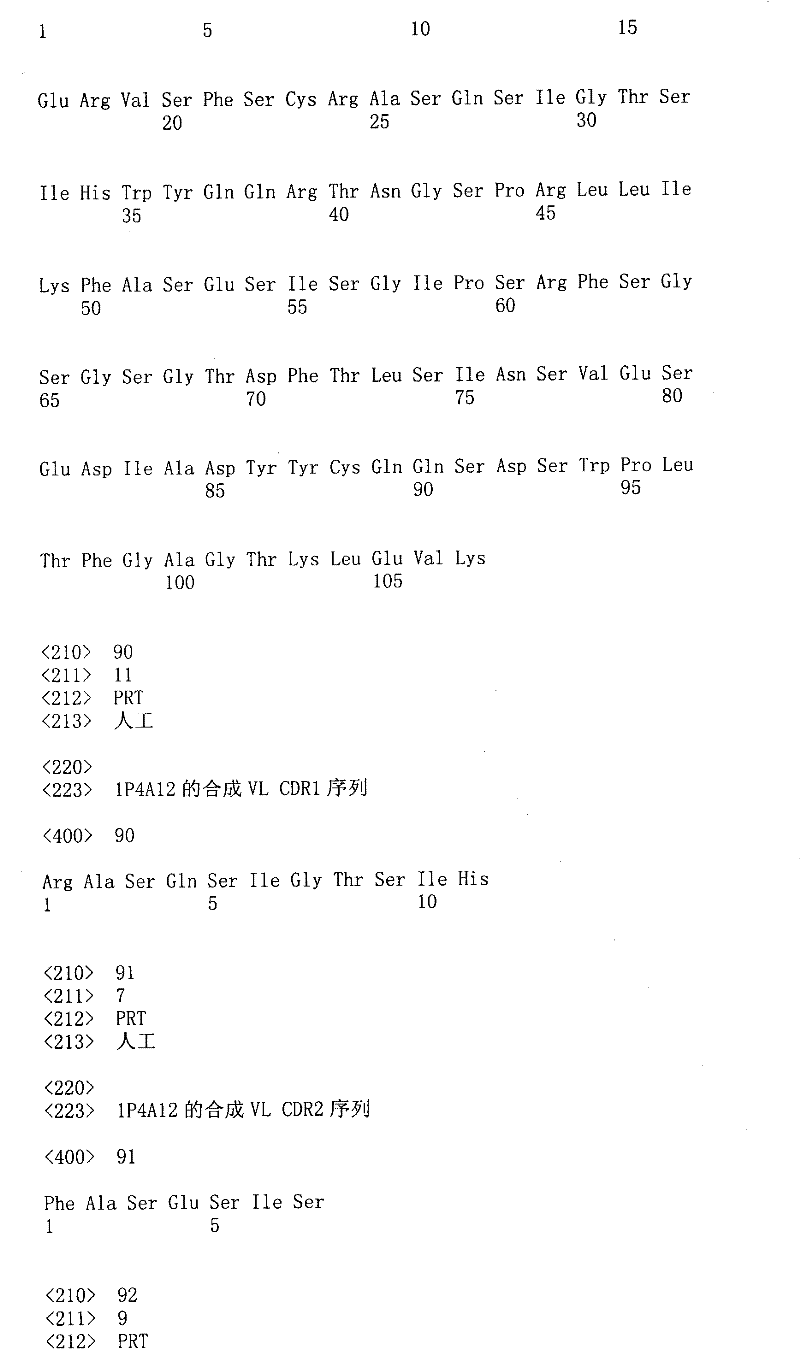


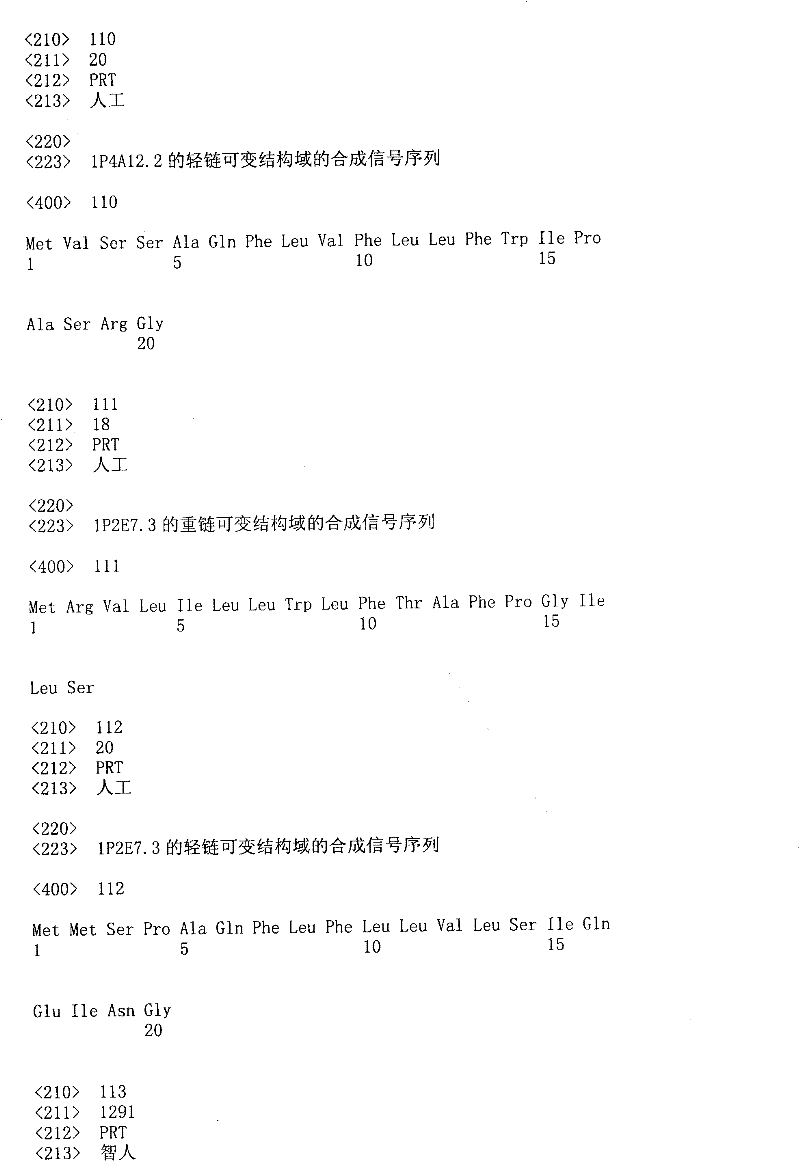


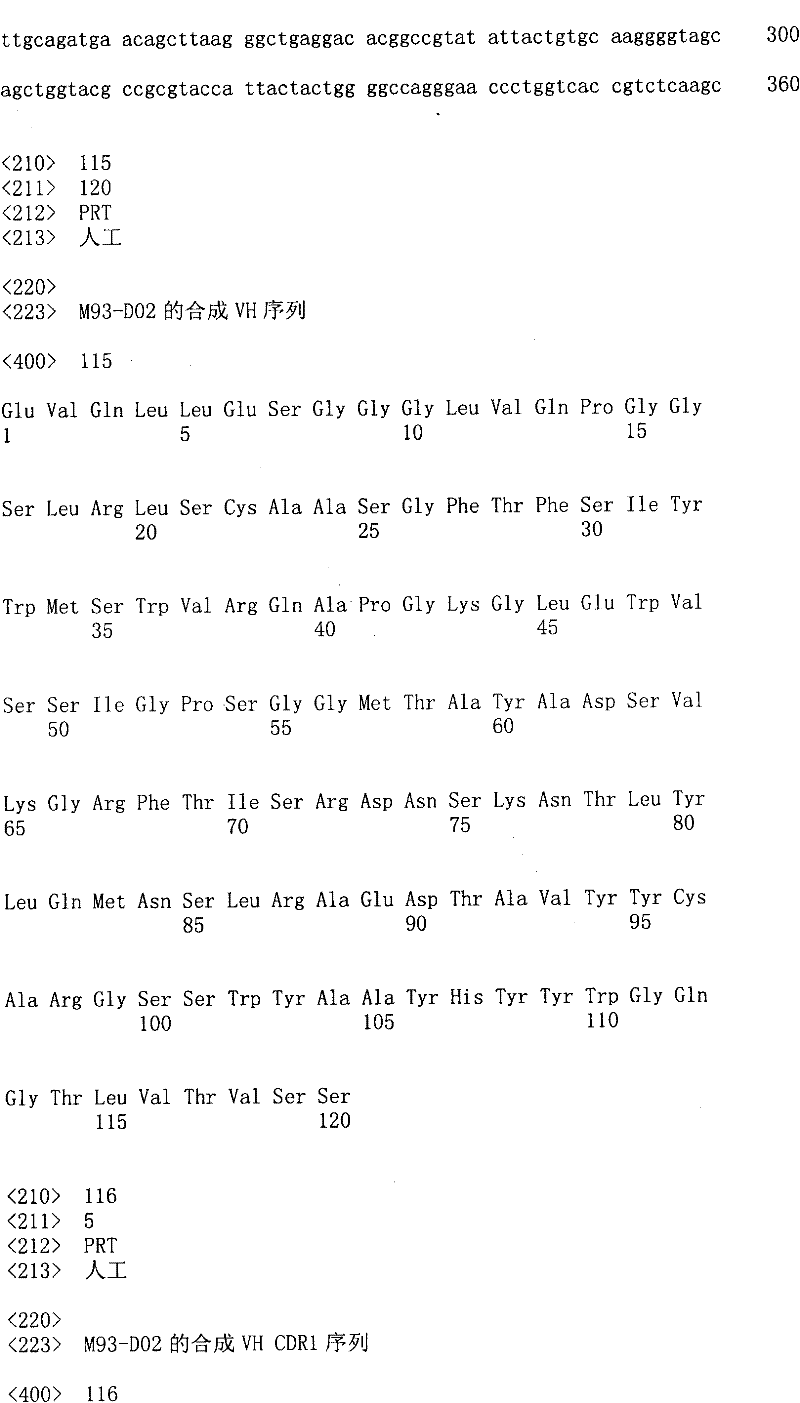
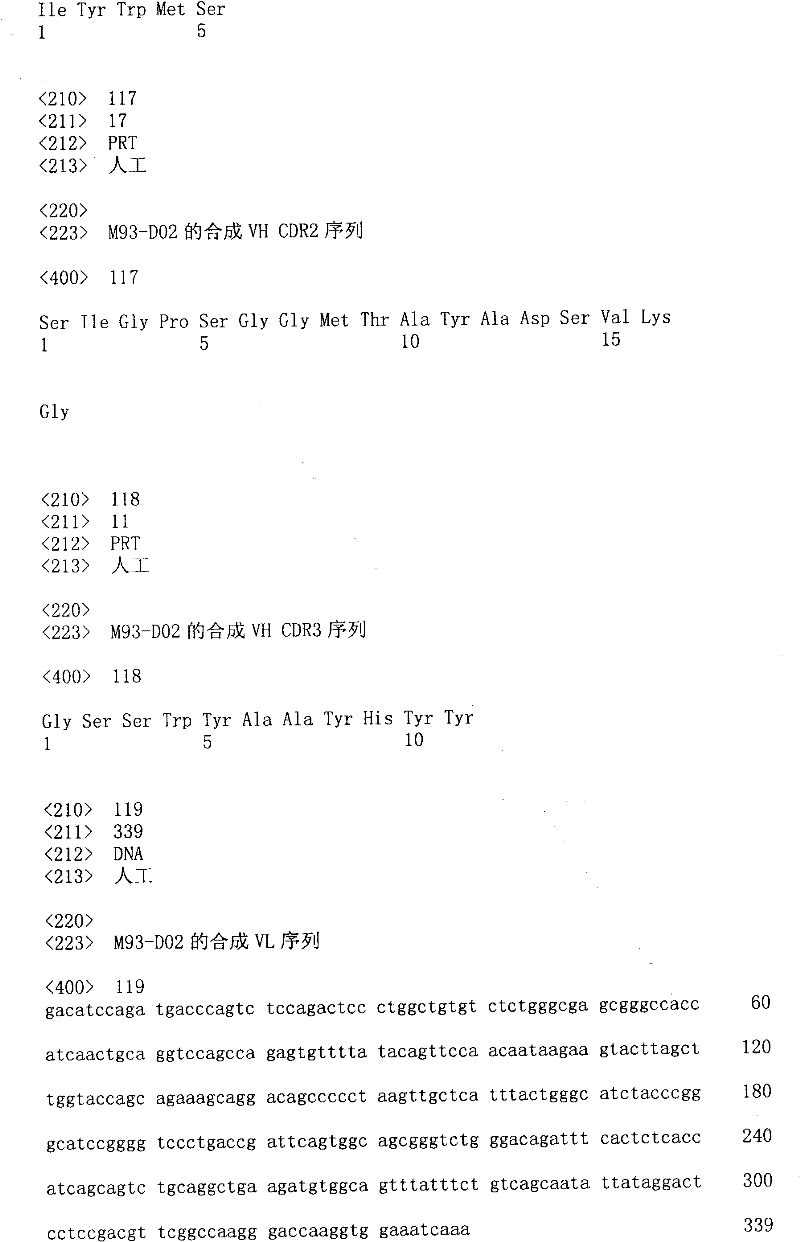


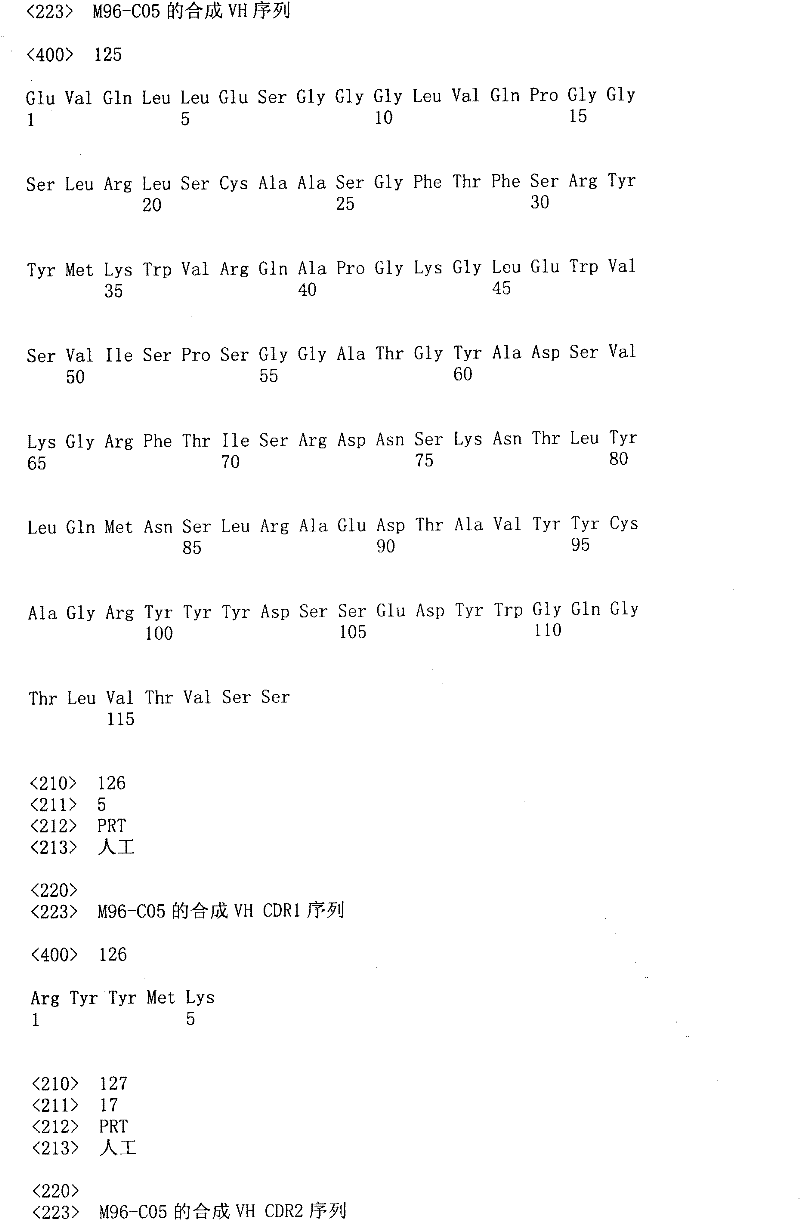


Claims (239)
Applications Claiming Priority (3)
| Application Number | Priority Date | Filing Date | Title |
|---|---|---|---|
| US2277908P | 2008-01-22 | 2008-01-22 | |
| US61/022,779 | 2008-01-22 | ||
| PCT/US2009/000376 WO2009094148A2 (en) | 2008-01-22 | 2009-01-22 | Ron antibodies and uses thereof |
Publications (1)
| Publication Number | Publication Date |
|---|---|
| CN101977937A true CN101977937A (en) | 2011-02-16 |
Family
ID=40901578
Family Applications (1)
| Application Number | Title | Priority Date | Filing Date |
|---|---|---|---|
| CN2009801102175A Pending CN101977937A (en) | 2008-01-22 | 2009-01-22 | Ron antibodies and uses thereof |
Country Status (11)
| Country | Link |
|---|---|
| US (1) | US20090226442A1 (en) |
| EP (1) | EP2245066A2 (en) |
| JP (1) | JP2011509687A (en) |
| KR (1) | KR20100106590A (en) |
| CN (1) | CN101977937A (en) |
| AU (1) | AU2009206724A1 (en) |
| BR (1) | BRPI0906498A2 (en) |
| CA (1) | CA2712697A1 (en) |
| IL (1) | IL207129A0 (en) |
| MX (1) | MX2010008025A (en) |
| WO (1) | WO2009094148A2 (en) |
Cited By (1)
| Publication number | Priority date | Publication date | Assignee | Title |
|---|---|---|---|---|
| CN114874323A (en) * | 2021-02-05 | 2022-08-09 | 上海医药集团股份有限公司 | anti-GITR antibodies and uses thereof |
Families Citing this family (22)
| Publication number | Priority date | Publication date | Assignee | Title |
|---|---|---|---|---|
| TWI480050B (en) * | 2009-02-10 | 2015-04-11 | Daiichi Sankyo Co Ltd | Anti-mst1r antibodies and uses thereof |
| US20130089554A1 (en) * | 2009-12-29 | 2013-04-11 | Emergent Product Development Seattle, Llc | RON Binding Constructs and Methods of Use Thereof |
| CA2787070A1 (en) * | 2010-01-28 | 2011-08-04 | Ian Kirby | Cd127 binding proteins |
| WO2012000994A1 (en) * | 2010-06-29 | 2012-01-05 | C.N.R.S. | Llt-1 antibodies with new functional properties |
| JP2013533746A (en) | 2010-07-06 | 2013-08-29 | アベオ ファーマシューティカルズ, インコーポレイテッド | Anti-RON antibody |
| WO2013033008A2 (en) | 2011-08-26 | 2013-03-07 | Merrimack Pharmaceuticals, Inc. | Tandem fc bispecific antibodies |
| CN105017420B (en) * | 2012-02-17 | 2019-05-28 | 西雅图基因公司 | Antibodies against integrin αvβ6 and use of the same in the treatment of cancer |
| SG11201506451UA (en) | 2013-03-06 | 2015-09-29 | Merrimack Pharmaceuticals Inc | Anti-c-met tandem fc bispecific antibodies |
| KR102131371B1 (en) * | 2013-07-02 | 2020-07-08 | 삼성전자주식회사 | Ang-2 specific antibodies and uses thereof |
| CN105504049B (en) * | 2014-09-26 | 2019-07-05 | 艾托金生物医药(苏州)有限公司 | The relevant HPV E7 protein monoclonal antibody of cervical carcinoma and its application |
| WO2018052789A1 (en) | 2016-09-08 | 2018-03-22 | Pcm Targetech, Llc | Monoclonal antibodies specific to the plexin-semaphorin-integrin (psi) domain of ron for drug delivery and its application in cancer therapy |
| CN110944651A (en) | 2017-02-08 | 2020-03-31 | 蜻蜓疗法股份有限公司 | Multispecific binding proteins for natural killer cell activation and therapeutic uses thereof for treating cancer |
| EP4273258A3 (en) | 2017-02-20 | 2024-01-17 | Dragonfly Therapeutics, Inc. | Proteins binding her2, nkg2d and cd16 |
| MX2020008333A (en) | 2018-02-08 | 2020-09-21 | Dragonfly Therapeutics Inc | COMBINATION THERAPY OF CANCER INCLUDING MULTISPECIFIC BINDING PROTEINS THAT ACTIVATE NATURAL KILLER CELLS. |
| CA3090244A1 (en) * | 2018-02-08 | 2019-08-15 | Dragonfly Therapeutics, Inc. | Antibody variable domains targeting the nkg2d receptor |
| CN112119093A (en) | 2018-02-20 | 2020-12-22 | 蜻蜓治疗公司 | Multispecific binding proteins that bind CD33, NKG2D, and CD16 and methods of use |
| CN113164570B (en) | 2018-08-08 | 2024-05-14 | 蜻蜓疗法股份有限公司 | Proteins binding NKG2D, CD and tumor-associated antigens |
| EA202091888A1 (en) | 2018-08-08 | 2020-10-23 | Драгонфлай Терапьютикс, Инк. | VARIABLE ANTIBODY DOMAINS TARGETED ON THE NKG2D RECEPTOR |
| CA3108427A1 (en) | 2018-08-08 | 2020-02-13 | Dragonfly Therapeutics, Inc. | Multi-specific binding proteins that bind bcma, nkg2d and cd16, and methods of use |
| WO2021030358A1 (en) | 2019-08-12 | 2021-02-18 | Regeneron Pharmaceuticals, Inc. | Macrophage stimulating 1 receptor (mst1r) variants and uses thereof |
| AU2021268340A1 (en) | 2020-05-06 | 2022-12-08 | Dragonfly Therapeutics, Inc. | Proteins binding NKG2D, CD16 and CLEC12A |
| EP4301774A4 (en) | 2021-03-03 | 2025-08-13 | Dragonfly Therapeutics Inc | Methods for treating cancer with multispecific binding proteins for binding NKG2D, CD16, and a tumor-associated antigen |
Family Cites Families (15)
| Publication number | Priority date | Publication date | Assignee | Title |
|---|---|---|---|---|
| US6294330B1 (en) * | 1997-01-31 | 2001-09-25 | Odyssey Pharmaceuticals Inc. | Protein fragment complementation assays for the detection of biological or drug interactions |
| US20020002276A1 (en) * | 1997-02-10 | 2002-01-03 | Genentech, Inc. | Chimeric heteromultimer adhesins |
| WO2000018895A1 (en) * | 1998-09-25 | 2000-04-06 | The Children's Medical Center Corporation | Short peptides which selectively modulate the activity of protein kinases |
| AU2002258798A1 (en) * | 2001-04-13 | 2002-10-28 | Children's Hospital Medical Center | Methods for the treatment of hepatic disorders |
| WO2002087618A1 (en) * | 2001-04-27 | 2002-11-07 | Takeda Chemical Industries, Ltd. | Preventive/therapeutic method for cancer |
| IL159177A0 (en) * | 2001-06-20 | 2004-06-01 | Prochon Biotech Ltd | Antibodies that block receptor protein tyrosine kinase activation, methods of screening for and uses thereof |
| US6867005B2 (en) * | 2001-10-24 | 2005-03-15 | Beckman Coulter, Inc. | Method and apparatus for increasing the dynamic range and accuracy of binding assays |
| US20030157082A1 (en) * | 2002-01-31 | 2003-08-21 | Millennium Pharmaceuticals, Inc. | Methods and compositions for treating cancer using 140, 1470, 1686, 2089, 2427, 3702, 5891, 6428, 7181, 7660, 25641, 69583, 49863, 8897, 1682, 17667, 9235, 3703, 14171, 10359, 1660, 1450, 18894, 2088, 32427, 2160, 9252, 9389, 1642, 85269, 10297, 1584, 9525, 14124, 4469, 8990, 2100, 9288, 64698, 10480,20893, 33230,1586, 9943, 16334, 68862, 9011, 14031, 6178, 21225, 1420, 32236, 2099, 2150, 26583, 2784, 8941, 9811, 27444, 50566 or 66428 molecules |
| DK1675961T3 (en) * | 2003-10-24 | 2009-02-23 | Oncalis Ag | Method for Identifying and / or Validating Receptor Tyrosine Kinase Inhibitors |
| US20090246205A1 (en) * | 2004-05-13 | 2009-10-01 | Imclone Systems, Inc | Inhibition of macrophage-stimulating protein receptor (ron) |
| EP1745073A2 (en) * | 2004-05-14 | 2007-01-24 | Receptor Biologix, Inc. | Cell surface receptor isoforms and methods of identifying and using the same |
| WO2006094073A2 (en) * | 2005-03-02 | 2006-09-08 | Acadia Pharmaceuticals Inc. | Functional bioluminescence energy resonance transfer (bret) assay to screen, identify and characterize receptor tyrosine kinase ligands |
| EA015992B1 (en) * | 2006-03-17 | 2012-01-30 | Байоджен Айдек Эмэй Инк. | Stabilized antibody and multivalent antibinding molecule based thereon, methods for making thereof and use such stabilized antibody |
| US7452985B2 (en) * | 2006-08-17 | 2008-11-18 | Visgeneer, Inc. | Human Ron-related gene variant associated with cancers |
| UY31478A1 (en) * | 2007-11-21 | 2009-07-17 | RECEIVER INHIBITION FOR MACROFAGO STIMULATING PROTEIN (RON) AND METHODS FOR TREATMENT OF THE SAME |
-
2009
- 2009-01-22 US US12/320,296 patent/US20090226442A1/en not_active Abandoned
- 2009-01-22 KR KR1020107018552A patent/KR20100106590A/en not_active Withdrawn
- 2009-01-22 CA CA2712697A patent/CA2712697A1/en not_active Abandoned
- 2009-01-22 AU AU2009206724A patent/AU2009206724A1/en not_active Abandoned
- 2009-01-22 WO PCT/US2009/000376 patent/WO2009094148A2/en not_active Ceased
- 2009-01-22 BR BRPI0906498-2A patent/BRPI0906498A2/en not_active IP Right Cessation
- 2009-01-22 EP EP09703214A patent/EP2245066A2/en not_active Withdrawn
- 2009-01-22 CN CN2009801102175A patent/CN101977937A/en active Pending
- 2009-01-22 JP JP2010544322A patent/JP2011509687A/en not_active Withdrawn
- 2009-01-22 MX MX2010008025A patent/MX2010008025A/en not_active Application Discontinuation
-
2010
- 2010-07-21 IL IL207129A patent/IL207129A0/en unknown
Cited By (1)
| Publication number | Priority date | Publication date | Assignee | Title |
|---|---|---|---|---|
| CN114874323A (en) * | 2021-02-05 | 2022-08-09 | 上海医药集团股份有限公司 | anti-GITR antibodies and uses thereof |
Also Published As
| Publication number | Publication date |
|---|---|
| JP2011509687A (en) | 2011-03-31 |
| BRPI0906498A2 (en) | 2015-07-14 |
| MX2010008025A (en) | 2010-08-04 |
| KR20100106590A (en) | 2010-10-01 |
| IL207129A0 (en) | 2010-12-30 |
| CA2712697A1 (en) | 2009-07-30 |
| WO2009094148A3 (en) | 2010-01-14 |
| AU2009206724A1 (en) | 2009-07-30 |
| WO2009094148A2 (en) | 2009-07-30 |
| US20090226442A1 (en) | 2009-09-10 |
| EP2245066A2 (en) | 2010-11-03 |
Similar Documents
| Publication | Publication Date | Title |
|---|---|---|
| US20090226442A1 (en) | RON antibodies and uses thereof | |
| TWI812600B (en) | Anti-pd-l1 antibodies and variants | |
| JP6006284B2 (en) | Methods of providing disease-specific binding molecules and targets | |
| EP2436696B1 (en) | Method of providing disease-specific binding molecules and targets | |
| EP2427212B1 (en) | Anti-cd100 antibodies and methods for using the same | |
| US20240309091A1 (en) | Human anti-semaphorin 4d antibody | |
| US8834883B2 (en) | Anti-VEGF antibodies and uses thereof | |
| CA2646406A1 (en) | Anti-igf-ir antibodies and uses thereof | |
| EP3712173A1 (en) | Pdgf receptor beta binding polypeptides | |
| JP2009532027A5 (en) | ||
| CA2697612A1 (en) | Anti-igf-1r antibodies and uses thereof | |
| WO2008127655A1 (en) | Anti-alpha 6 beta 4 integrin antibodies and uses therof | |
| CA2748757A1 (en) | Anti-lymphotoxin antibodies | |
| CN112566642A (en) | Anti-polysialic acid antibody and use thereof | |
| WO2005037999A2 (en) | Treatment of cancer using antibodies to lrrc15 | |
| CN116940595A (en) | anti-TIGIT antibodies and uses thereof | |
| WO2022116877A1 (en) | ANTI-GARP/TGFβ ANTIBODIES AND METHODS OF USE | |
| CN120569411A (en) | Anti-PDL 1/VEGF antibodies and methods of use | |
| AU2013204503A1 (en) | Anti-lymphotoxin antibodies | |
| HK1167150B (en) | Method of providing disease-specific binding molecules and targets | |
| HK40023278A (en) | Antigens associated with inflammatory bowel disease |
Legal Events
| Date | Code | Title | Description |
|---|---|---|---|
| C06 | Publication | ||
| PB01 | Publication | ||
| C02 | Deemed withdrawal of patent application after publication (patent law 2001) | ||
| WD01 | Invention patent application deemed withdrawn after publication |
Open date: 20110216 |