CN101977947A - Cycloolefin polymer compound, its preparation method and selective hydrogenation method - Google Patents
Cycloolefin polymer compound, its preparation method and selective hydrogenation method Download PDFInfo
- Publication number
- CN101977947A CN101977947A CN2009801094592A CN200980109459A CN101977947A CN 101977947 A CN101977947 A CN 101977947A CN 2009801094592 A CN2009801094592 A CN 2009801094592A CN 200980109459 A CN200980109459 A CN 200980109459A CN 101977947 A CN101977947 A CN 101977947A
- Authority
- CN
- China
- Prior art keywords
- chemical formula
- compound
- alkyl
- reaction
- expressions
- Prior art date
- Legal status (The legal status is an assumption and is not a legal conclusion. Google has not performed a legal analysis and makes no representation as to the accuracy of the status listed.)
- Granted
Links
Images


Classifications
-
- C—CHEMISTRY; METALLURGY
- C08—ORGANIC MACROMOLECULAR COMPOUNDS; THEIR PREPARATION OR CHEMICAL WORKING-UP; COMPOSITIONS BASED THEREON
- C08F—MACROMOLECULAR COMPOUNDS OBTAINED BY REACTIONS ONLY INVOLVING CARBON-TO-CARBON UNSATURATED BONDS
- C08F210/00—Copolymers of unsaturated aliphatic hydrocarbons having only one carbon-to-carbon double bond
- C08F210/02—Ethene
-
- C—CHEMISTRY; METALLURGY
- C08—ORGANIC MACROMOLECULAR COMPOUNDS; THEIR PREPARATION OR CHEMICAL WORKING-UP; COMPOSITIONS BASED THEREON
- C08F—MACROMOLECULAR COMPOUNDS OBTAINED BY REACTIONS ONLY INVOLVING CARBON-TO-CARBON UNSATURATED BONDS
- C08F232/00—Copolymers of cyclic compounds containing no unsaturated aliphatic radicals in a side chain, and having one or more carbon-to-carbon double bonds in a carbocyclic ring system
- C08F232/08—Copolymers of cyclic compounds containing no unsaturated aliphatic radicals in a side chain, and having one or more carbon-to-carbon double bonds in a carbocyclic ring system having condensed rings
-
- C—CHEMISTRY; METALLURGY
- C08—ORGANIC MACROMOLECULAR COMPOUNDS; THEIR PREPARATION OR CHEMICAL WORKING-UP; COMPOSITIONS BASED THEREON
- C08F—MACROMOLECULAR COMPOUNDS OBTAINED BY REACTIONS ONLY INVOLVING CARBON-TO-CARBON UNSATURATED BONDS
- C08F8/00—Chemical modification by after-treatment
- C08F8/04—Reduction, e.g. hydrogenation
-
- C—CHEMISTRY; METALLURGY
- C08—ORGANIC MACROMOLECULAR COMPOUNDS; THEIR PREPARATION OR CHEMICAL WORKING-UP; COMPOSITIONS BASED THEREON
- C08F—MACROMOLECULAR COMPOUNDS OBTAINED BY REACTIONS ONLY INVOLVING CARBON-TO-CARBON UNSATURATED BONDS
- C08F4/00—Polymerisation catalysts
- C08F4/42—Metals; Metal hydrides; Metallo-organic compounds; Use thereof as catalyst precursors
- C08F4/44—Metals; Metal hydrides; Metallo-organic compounds; Use thereof as catalyst precursors selected from light metals, zinc, cadmium, mercury, copper, silver, gold, boron, gallium, indium, thallium, rare earths or actinides
- C08F4/60—Metals; Metal hydrides; Metallo-organic compounds; Use thereof as catalyst precursors selected from light metals, zinc, cadmium, mercury, copper, silver, gold, boron, gallium, indium, thallium, rare earths or actinides together with refractory metals, iron group metals, platinum group metals, manganese, rhenium technetium or compounds thereof
- C08F4/62—Refractory metals or compounds thereof
- C08F4/64—Titanium, zirconium, hafnium or compounds thereof
- C08F4/659—Component covered by group C08F4/64 containing a transition metal-carbon bond
- C08F4/65908—Component covered by group C08F4/64 containing a transition metal-carbon bond in combination with an ionising compound other than alumoxane, e.g. (C6F5)4B-X+
-
- C—CHEMISTRY; METALLURGY
- C08—ORGANIC MACROMOLECULAR COMPOUNDS; THEIR PREPARATION OR CHEMICAL WORKING-UP; COMPOSITIONS BASED THEREON
- C08F—MACROMOLECULAR COMPOUNDS OBTAINED BY REACTIONS ONLY INVOLVING CARBON-TO-CARBON UNSATURATED BONDS
- C08F4/00—Polymerisation catalysts
- C08F4/42—Metals; Metal hydrides; Metallo-organic compounds; Use thereof as catalyst precursors
- C08F4/44—Metals; Metal hydrides; Metallo-organic compounds; Use thereof as catalyst precursors selected from light metals, zinc, cadmium, mercury, copper, silver, gold, boron, gallium, indium, thallium, rare earths or actinides
- C08F4/60—Metals; Metal hydrides; Metallo-organic compounds; Use thereof as catalyst precursors selected from light metals, zinc, cadmium, mercury, copper, silver, gold, boron, gallium, indium, thallium, rare earths or actinides together with refractory metals, iron group metals, platinum group metals, manganese, rhenium technetium or compounds thereof
- C08F4/62—Refractory metals or compounds thereof
- C08F4/64—Titanium, zirconium, hafnium or compounds thereof
- C08F4/659—Component covered by group C08F4/64 containing a transition metal-carbon bond
- C08F4/65912—Component covered by group C08F4/64 containing a transition metal-carbon bond in combination with an organoaluminium compound
Landscapes
- Chemical & Material Sciences (AREA)
- Health & Medical Sciences (AREA)
- Chemical Kinetics & Catalysis (AREA)
- Medicinal Chemistry (AREA)
- Polymers & Plastics (AREA)
- Organic Chemistry (AREA)
- General Chemical & Material Sciences (AREA)
- Low-Molecular Organic Synthesis Reactions Using Catalysts (AREA)
- Organic Low-Molecular-Weight Compounds And Preparation Thereof (AREA)
- Addition Polymer Or Copolymer, Post-Treatments, Or Chemical Modifications (AREA)
- Catalysts (AREA)
- Transition And Organic Metals Composition Catalysts For Addition Polymerization (AREA)
- Polyoxymethylene Polymers And Polymers With Carbon-To-Carbon Bonds (AREA)
Abstract
Description
技术领域technical field
本发明涉及环烯烃类聚合物化合物及其制备方法。更具体而言,本发明涉及一种由单体制得的环烯烃类共聚物,该单体可由占石脑油裂解的C5馏分中大部分的二环戊二烯进行氢化而容易且经济地获得,或者该单体可使用狄尔斯-阿尔德反应使三个环戊二烯分子化学键合后氢化所述环戊二烯而获得;本发明还涉及一种氢化方法。The invention relates to a cycloolefin polymer compound and a preparation method thereof. More specifically, the present invention relates to a cycloolefinic copolymer prepared from monomers readily and economically obtainable by hydrogenation of dicyclopentadiene, which constitutes the majority of the C5 fraction of naphtha cracking , or the monomer can be obtained by using a Diels-Alder reaction to chemically bond three cyclopentadiene molecules and hydrogenating the cyclopentadiene; the present invention also relates to a hydrogenation method.
背景技术Background technique
尽管石脑油裂解产物中C4或低于C4的馏分被分离并精制而在石油工业中被有效利用,但是其中的C5-馏分大部分被燃烧用作燃料,仅有少部分被一些制造商分离并精制从而被工业应用。因此,对C5-馏分的分离精制以制备高附加值的化学产品的深入研究正在进行着。Although the C4 or lower fractions of naphtha cracking products are separated and refined to be effectively utilized in the petroleum industry, most of the C5-fractions are burned as fuel, and only a small part is separated by some manufacturers And refined so as to be used industrially. Therefore, in-depth research on the separation and purification of C5-fractions to prepare high value-added chemical products is ongoing.
特别是,在C5-馏分中环戊二烯占大部分。环戊二烯在室温下自发地发生狄尔斯-阿尔德反应,由此转化成二环戊二烯。为了从二环戊二烯生产塑料,正在积极研究二环戊二烯与乙烯、α-烯烃或苯乙烯的共聚反应(反应式1)。二环戊二烯具有两个烯基(olefin group),已知其中5-6位碳的烯基活性比2-3位碳烯基的活性更强。当采用聚合催化剂二环戊二烯与乙烯型单体发生共聚反应时,5-6位碳的烯基首先反应并获得反应式1中的中间步骤的聚合物,但是上述反应通常不能在此步骤停止而继续进行反应,因此留在聚合物中的2-3位碳的烯基额外地参与到上述聚合反应中,得到交联聚合物(Naga,N.J.Polym.Sci.,Part A:Polym.Chem.2005,43,1285-1291)。然而,所述交联聚合物难以加工,而在最终应用开发上受到限制。In particular, cyclopentadiene predominates in the C5-fraction. Cyclopentadiene spontaneously undergoes a Diels-Alder reaction at room temperature, thereby converting to dicyclopentadiene. In order to produce plastics from dicyclopentadiene, the copolymerization reaction of dicyclopentadiene with ethylene, α-olefin or styrene (reaction formula 1) is being actively studied. Dicyclopentadiene has two olefin groups, and it is known that the olefin group at the 5-6 carbon position is more active than the carbenyl group at the 2-3 position. When the polymerization catalyst dicyclopentadiene is used for copolymerization with vinyl monomers, the alkenyl group at the 5-6 carbon position first reacts and obtains the polymer of the intermediate step in
第IV族茂金属催化剂被报道,在二环戊二烯的量调节为小于10%时,其能够使反应式1中中间步骤的非交联聚合物的制备成为可能。(Simanke,A.G.;Mauler,R.S.;Galland,G.B.J.Polym.Sci.,PartA:Polym.Chem.2002,40,471-485;Suzuki,J.;Kino,Y.;Uozumi,T.;Sano,T.;Teranishi,T.;Jin,J.;Soga,K.;Shiono,T.J.Appl.Polym.Sci.1999,72,103-108)。最近已有报道,基于第III族金属的催化剂使制备含有大量二环戊二烯的共聚物成为可能,因为仅5-6位碳的烯基反应而2-3位碳的烯基不反应(Journalof Organometallic Chemistry 691(2006)3114-3121;Xiaofang Li andZhaomin Hou,Macromolecules 2005,38,6767-6769;Xiaofang Li,MasayoshiNishiura,Kyouichi Mori,Tomohiro Mashiko and Zhaomin Hou,Chem.Commun.,2007,4137-4139)。但是,由于这种聚合物含有与分子结构不反应的烯基,因此在直接的商业应用上存在问题。具有高反应性的烯基可引起熔融时树脂变形且降低耐久性。由于这些原因,在聚合物链中含有烯基的树脂在工业应用中是不多见的。Group IV metallocene catalysts are reported to enable the preparation of non-crosslinked polymers in the intermediate step of
日本的Zeon公司已经生产上市了如下面反应式2所示的通过二环戊二烯5-6位碳的烯基开环易位聚合制备的线型聚合物经氢化反应获得的树脂(Masahiro Yamazaki,Journal of Molecular Catalysis A:Chemical 213(2004)81-87)。在这种情况下,通过氢化反应将树脂中的双键完全去除是必需的。然而,对含有烯基的聚合物化合物进行氢化反应将所有双键转化为单键是不容易的。Japan's Zeon company has produced and listed the resin (Masahiro Yamazaki) obtained by hydrogenation of the linear polymer prepared by the alkenyl ring-opening metathesis polymerization of the 5-6 carbon of dicyclopentadiene as shown in the following
(反应式1)(Reaction 1)

(反应式2)(Reaction 2)

另一方面,在高温下二环戊二烯可转化成环戊二烯,然后与乙烯或者α-烯烃进行狄尔斯-阿尔德反应,由此制备降冰片烯类环烯烃,其然后可与乙烯进行共聚反应(Cho,E.S.;Joung,U.G.;Lee,B.Y.;Lee,H.;Part,Y.-W.;Lee,C.H.;Shin,D.M.Organometallics 2004,23,4693-4699;LeeSi-Geun,Park Yeong-Hwan,Hong Seong-Don,Song Gwang-Ho,JeongBung-Gun,Nam Dae-U,Lee Bun-Yeoul,Korean Patent No.10-0458600(2004.11.16);Incoronata Tritto,Laura Boggioni,Dino R.Ferro,CoordinationChemistry Reviews 250(2006)212-241)。由此制备的共聚物称为环烯烃共聚物(COC)(反应式3)。如反应式3下面所示,所述降冰片烯类单体也可通过ROMP反应后进行氢化反应从而制备树脂。(Mashahiro Yamazaki,Journalof Molecular Catalysis A:Chemical 213(2004)81-87)。由此制备的聚合物称为环烯烃聚合物(COP)。由于如上所述的聚合物化合物难于氢化,环烯烃共聚物(COC)比环烯烃聚合物(COP)在制备工艺上更有利。此外,当调节COC的乙烯和降冰片烯的比例时,树脂的玻璃转变温度(Tg)是可控的,因此有可能制备各种等级的产品,而且,COC由于高透明度、低双折射以及低树脂密度而具有优势,因此已经开发了其在食品及医药品包装材料、DVD材料及显示用光学膜等领域中的应用。On the other hand, dicyclopentadiene can be converted to cyclopentadiene at high temperature, followed by a Diels-Alder reaction with ethylene or an α-olefin, thereby producing norbornene-like cycloalkenes, which can then be combined with Copolymerization of ethylene (Cho, E.S.; Joung, U.G.; Lee, B.Y.; Lee, H.; Part, Y.-W.; Lee, C.H.; Shin, D.M. Organometallics 2004, 23, 4693-4699; Park Yeong-Hwan, Hong Seong-Don, Song Gwang-Ho, JeongBung-Gun, Nam Dae-U, Lee Bun-Yeoul, Korean Patent No.10-0458600 (2004.11.16); Incoronata Tritto, Laura Boggioni, Dino R . Ferro, Coordination Chemistry Reviews 250 (2006) 212-241). The copolymer thus prepared is called cycloolefin copolymer (COC) (Equation 3). As shown below in
(反应式3)(Reaction 3)

然而,由于采用降冰片烯制备的COC树脂含有大量降冰片烯单体,高玻璃转变温度树脂级别是脆性的,因此不适合用在光学膜。为了克服包括上述这些问题的通常由降冰片烯制备的COC树脂的性质的缺点,已试图采用庞大环烯烃化合物,如1,4,5,8-二桥亚甲基-1,2,3,4,4a,5,8,8a-八氢萘(1,4,5,8-dimethano-1,2,3,4,4a,5,8,8a-octahydronaphthalene,下文简称“DMON”),作为COC单体,其通过降冰片烯与环戊二烯再次进行狄尔斯-阿尔德反应而制得。(反应式4;W.Kaminsky,Catalysis Today 62(2000)23-34)。为了改善COP的性质,对通过如反应式4的下面所示的DMON的ROMP及氢化反应而制备树脂也进行了很多的努力(Masahiro Yamazaki,Journal of Molecular Catalysis A:Chemical 213(2004)81-87)。合成COC时,采用庞大的环烯烃单体,与采用降冰片烯制备COC时相比,乙烯的相对含量高的聚合物制备高玻璃转变温度的树脂成为可能。由于所述聚合物链中包含比环烯烃单体更多的柔性乙烯单体,上面提及的脆性问题可被克服。然而,如反应式4所示,由二环戊二烯通过两个步骤制得的DMON存在问题,是因为其制备工艺难,因此其价格相当昂贵,不适于用作聚合物的单体。因此,DMON的经济制备目前被认为是DMON类树脂商业化的关键。However, since the COC resin prepared using norbornene contains a large amount of norbornene monomer, high glass transition temperature resin grades are brittle and thus not suitable for use in optical films. In order to overcome the disadvantages of the properties of COC resins usually prepared from norbornene, including the above-mentioned problems, attempts have been made to use bulky cyclic olefin compounds such as 1,4,5,8-dimethano-1,2,3, 4,4a,5,8,8a-octahydronaphthalene (1,4,5,8-dimethano-1,2,3,4,4a,5,8,8a-octahydronaphthalene, hereinafter referred to as "DMON"), as COC monomer, which is prepared by Diels-Alder reaction of norbornene and cyclopentadiene again. (Equation 4; W. Kaminsky, Catalysis Today 62 (2000) 23-34). In order to improve the properties of COP, many efforts have been made to prepare resins by ROMP and hydrogenation of DMON as shown below in Reaction Formula 4 (Masahiro Yamazaki, Journal of Molecular Catalysis A: Chemical 213 (2004) 81-87 ). When synthesizing COC, a bulky cycloolefin monomer is used. Compared with the preparation of COC by norbornene, it is possible to prepare a resin with a high glass transition temperature from a polymer with a high relative content of ethylene. Due to the inclusion of more flexible vinyl monomers than cycloolefin monomers in the polymer chain, the brittleness problem mentioned above can be overcome. However, as shown in Reaction Scheme 4, DMON prepared from dicyclopentadiene through two steps has problems because its preparation process is difficult, so its price is quite expensive and it is not suitable for use as a monomer for polymers. Therefore, the economical preparation of DMON is currently considered the key to the commercialization of DMON-based resins.
(反应式4)(Reaction 4)

此外,反应式4下面所示的聚合物材料已由Zeon公司商品化。In addition, the polymer material shown below in Reaction Scheme 4 has been commercialized by Zeon Corporation.
另一方面,环戊二烯在C5馏分中占大部分。环戊二烯(CPD)在室温下自发进行狄尔斯-阿尔德反应,而转化为二环戊二烯(DCPD)。此外,二环戊二烯可与环戊二烯继续进行狄尔斯-阿尔德反应,由此制备三环戊二烯(TCPD)。这些反应可持续地进行,因此利用这些反应在工业领域中制备树脂是可行的。(反应式5,Chemical Engineering Science 56(2001)927-935)。On the other hand, cyclopentadiene makes up the majority of the C5 fraction. Cyclopentadiene (CPD) spontaneously undergoes a Diels-Alder reaction at room temperature to convert to dicyclopentadiene (DCPD). In addition, dicyclopentadiene can undergo Diels-Alder reaction with cyclopentadiene to produce tricyclopentadiene (TCPD). These reactions proceed sustainably, so it is feasible to use these reactions to prepare resins in the industrial field. (
(反应式5)(Reaction 5)

这种环戊二烯(CPD)的狄尔斯-阿尔德反应产物具有两个烯基。一个烯基是在降冰片烯化合物结构中(下面简称为“降冰片烯型烯烃”),且另一个烯基是在环戊烯结构中(下面简称为“环戊烯型烯烃”)。通常,两个烯基中,已知降冰片烯型烯烃活性更强。利用两个烯基反应活性的不同,对二环戊二烯的两个烯基中的降冰片烯型烯烃进行选择性地氢化反应来制备5,6-二氢二环戊二烯的方法已有报道。This Diels-Alder reaction product of cyclopentadiene (CPD) has two alkenyl groups. One alkenyl group is in the norbornene compound structure (hereinafter simply referred to as "norbornene type olefin"), and the other alkenyl group is in the cyclopentene structure (hereinafter simply referred to as "cyclopentene type olefin"). In general, of the two alkenyl groups, it is known that the norbornene-type olefin is more reactive. The method for preparing 5,6-dihydrodicyclopentadiene by selectively hydrogenating the norbornene-type olefins in the two alkenyl groups of dicyclopentadiene by utilizing the difference in reactivity of the two alkenyl groups There are reports.
例如,美国专利号7078577,Inorg.Chem.1999,38,2359和J.Org.Chem.1991,56,6043中公开了,采用市面上可购买的Pd/氧化铝或Pd/C催化剂,经二环戊二烯的选择性氢化反应制备5,6-二氢二环戊二烯。在这种催化剂存在下,为了实现氢化反应的选择性,本质上要求加入等量的氢。因为两个烯基中的降冰片烯型烯基在上述催化剂的存在下具有更快的反应速率,所以其首先被氢化。如果加入比等量更多量的氢,环戊烯型烯基具有低反应速率,也可被氢化,因此四氢二环戊二烯作为副产物产生。尤其是,由于选择性受反应速率调节,即使当考虑灵敏影响选择性的反应条件研发连续工艺并有效控制反应条件时,也不可避免地留下一些未反应的二环戊二烯(<0.3%),且副产物四氢二环戊二烯以3%或更多的量形成。For example, U.S. Patent No. 7078577, Inorg.Chem.1999, 38, 2359 and J.Org.Chem.1991, 56, 6043 disclose that, adopt commercially available Pd/alumina or Pd/C catalyst, through two Selective hydrogenation of cyclopentadiene to produce 5,6-dihydrodicyclopentadiene. In the presence of such a catalyst, in order to achieve the selectivity of the hydrogenation reaction, an equivalent amount of hydrogen addition is essentially required. Since the norbornene-type alkenyl group among the two alkenyl groups has a faster reaction rate in the presence of the above catalyst, it is hydrogenated first. If hydrogen is added in an amount greater than the equivalent amount, the cyclopentenyl alkenyl group has a low reaction rate and can also be hydrogenated, so that tetrahydrodicyclopentadiene is produced as a by-product. In particular, since the selectivity is regulated by the reaction rate, even when a continuous process is developed considering the reaction conditions that sensitively affect the selectivity and the reaction conditions are effectively controlled, some unreacted dicyclopentadiene (<0.3% ), and the by-product tetrahydrodicyclopentadiene was formed in an amount of 3% or more.
此外,Tetrahedron Letters 2007,48,8331中报告了,在反应器内用NaBH4还原醋酸镍而得到的镍金属作为催化剂,对二环戊二烯进行选择性氢化反应的结果。即使在这种情况中,为了实现选择性以1.1的当量加入氢,且为了去除副产物四氢二环戊二烯,反应产物采用重结晶精制。同样,J.C.S.Perkin I,1977,19中报告了,在反应器内用NaBH4还原醋酸镍获得的镍金属作为催化剂对三环戊二烯进行选择性氢化反应的结果。即使在这种情况,为了实现选择性,加入了1当量的氢,且采用0.360g的醋酸镍对1.5g的三环戊二烯进行氢化,但是其催化活性低,对于商业应用不适宜。In addition, Tetrahedron Letters 2007, 48, 8331 reported the results of selective hydrogenation of dicyclopentadiene using nickel metal obtained by reducing nickel acetate with NaBH4 in a reactor as a catalyst. Even in this case, the reaction product was purified by recrystallization in order to achieve selectivity by adding hydrogen in an equivalent of 1.1, and in order to remove by-product tetrahydrodicyclopentadiene. Equally, J.C.S.Perkin I, 1977, report in 19, use NaBH in the reactor Reducing the nickel metal that nickel acetate obtains is used as the result that the selective hydrogenation reaction of tricyclopentadiene is carried out as a catalyst. Even in this case, 1 equivalent of hydrogen was added to achieve selectivity, and 1.5 g of tricyclopentadiene was hydrogenated with 0.360 g of nickel acetate, but its catalytic activity was low and unsuitable for commercial use.
发明内容Contents of the invention
因此,本发明的目的在于提供一种环烯烃类聚合物化合物,其由可利用简单工艺获得的单体制备,且能够表现出与由DMON得到的常规环烯烃类聚合物同等的特性。Accordingly, an object of the present invention is to provide a cycloolefin-based polymer compound prepared from monomers obtainable by a simple process and capable of exhibiting characteristics equivalent to conventional cycloolefin-based polymers obtained from DMON.
本发明的另一目的在于提供一种通过对可采用简单工艺获得的单体进行乙烯基聚合反应制备环烯烃类聚合物化合物的方法。Another object of the present invention is to provide a method for preparing a cycloolefin-based polymer compound by vinyl polymerization of a monomer obtainable by a simple process.
特别是,本发明旨在于提供一种具有高玻璃转变温度的环烯烃类聚合物化合物。In particular, the present invention aims to provide a cycloolefin-based polymer compound having a high glass transition temperature.
本发明另旨在于提供一种采用预定的钯化合物催化剂,仅对二环戊二烯、三环戊二烯及类似的环戊二烯的狄尔斯-阿尔德反应产物中的降冰片烯型烯基进行选择性氢化的方法。Another object of the present invention is to provide a catalyst using a predetermined palladium compound, only for the norbornene type in the Diels-Alder reaction products of dicyclopentadiene, tricyclopentadiene and similar cyclopentadiene. A method for the selective hydrogenation of alkenyl groups.
本发明又旨在于提供一种催化剂,在含有两个具有不同反应活性的烯基的化合物,如二环戊二烯、三环戊二烯及类似的环戊二烯狄尔斯-阿尔德反应产物中,该催化剂对其中一个烯基不具有氢化反应活性,而仅对另一个烯基具有氢化反应活性。The present invention also aims to provide a catalyst for the reaction of dicyclopentadiene, tricyclopentadiene and similar cyclopentadiene Diels-Alder in compounds containing two alkenyl groups with different reactivity. In the product, the catalyst is inactive for the hydrogenation of one of the alkenyl groups but only for the other alkenyl group.
本发明的一个实施方式提供一种包含由下面化学式1表示的重复单元的环烯烃类聚合物化合物:One embodiment of the present invention provides a cycloolefin-based polymer compound including a repeating unit represented by the following Chemical Formula 1:
化学式1

其中,a是0或1,x∶y的摩尔比范围是从99∶1至1∶99,且z具有10~20,000的平均值。Wherein, a is 0 or 1, the molar ratio of x:y ranges from 99:1 to 1:99, and z has an average value of 10-20,000.
具体地,所述环烯烃类聚合物化合物可包含下面化学式2表示的重复单元:Specifically, the cycloolefin-based polymer compound may include repeating units represented by the following chemical formula 2:
化学式2

又具体地,所述环烯烃类聚合物化合物可包含下面化学式7表示的重复单元:Also specifically, the cycloolefin polymer compound may include repeating units represented by the following chemical formula 7:
化学式7

根据本发明实施方式的环烯烃类聚合物化合物,x∶y的摩尔比可为90∶10~50∶50,且z可具有500~3000的平均值。According to the cycloolefin polymer compound according to the embodiment of the present invention, the molar ratio of x:y may be 90:10˜50:50, and z may have an average value of 500˜3000.
根据本发明实施方式的环烯烃类聚合物化合物包含由化学式2表示的重复单位,可进一步包含下面化学式4表示的重复单位,其中x∶(y+o)的摩尔比范围可为从10∶90至90∶10。The cycloolefin-based polymer compound according to an embodiment of the present invention includes a repeating unit represented by
化学式4chemical formula 4
其中R是氢原子或C1~6烷基或苯基。如此,R可以是氢原子。Wherein R is a hydrogen atom or a C1-6 alkyl group or a phenyl group. Thus, R may be a hydrogen atom.
本发明另一实施方式提供一种包含下面化学式1表示的重复单元的环烯烃类聚合物化合物的制备方法,所述方法包括:在催化剂存在的条件下,使由下面的化学式3表示的化合物或由下面化学式8表示的化合物与乙烯进行乙烯基聚合反应,所述催化剂采用助催化剂通过活化由下面化学式6表示的化合物而形成,所述助催化剂包括选自三甲基铝单独或者三甲基铝和三异丁基铝的混合物部分水解而获得的甲基铝氧烷、Al(R3)3(其中R3相同或不同,为卤素或C1~20烃基)、B(Arf)3(其中Arf是氟原子取代的芳香基)和[L]+[B(Arf)4]-(其中Arf如上述定义,且[L]+是碳正离子或叔铵离子)的一种或多种。Another embodiment of the present invention provides a method for preparing a cycloolefin polymer compound comprising a repeating unit represented by the following
化学式1

其中,a是0或1,x∶y的摩尔比为从99∶1至1∶99的范围,且z具有10~20,000的平均值。Wherein, a is 0 or 1, the molar ratio of x:y ranges from 99:1 to 1:99, and z has an average value of 10-20,000.
化学式3

化学式6

其中,M是Ti、Zr或Hf;X是卤素或C1~20烷基;各R1相同或不相同,为氢、C1~20烷基、烯基或炔基;且R2相同或不相同,为氢、C1~20烷基、烯基或炔基。Wherein, M is Ti, Zr or Hf; X is halogen or C1-20 alkyl; each R 1 is the same or different, and is hydrogen, C1-20 alkyl, alkenyl or alkynyl; and R 2 is the same or different , is hydrogen, C1-20 alkyl, alkenyl or alkynyl.
化学式8
在根据本发明实施方式的方法中,化学式3表示的化合物及下面化学式5表示的化合物5可与乙烯反应。In the method according to an embodiment of the present invention, the compound represented by
化学式5

其中R是氢原子、C1~6烷基或苯基。Wherein R is a hydrogen atom, a C1-6 alkyl group or a phenyl group.
在根据本发明实施方式的方法中,化学式6表示的化合物中,M是Ti,X是甲基或氯,且R1和R2都是甲基;在Al(R3)3中,R3是甲基、乙基或异丁基;在B(Arf)3中,Arf是五氟苯基(C6F5);且在[L]+[B(Arf)4]-中,Arf是五氟苯基(C6F5),[L]+是[Ph3C]+或[PhNMe2H]+。In the method according to the embodiment of the present invention, in the compound represented by
在根据本发明实施方式的方法中,化学式3表示的化合物或化学式8表示的化合物可以采用N-杂环-碳烯-配位钯化合物作为催化剂使下面化学式9表示的化合物的烯基选择性氢化而获得。In the method according to the embodiment of the present invention, the compound represented by
化学式9chemical formula 9
(其中n=0或1)。(where n=0 or 1).
在根据本发明实施方式的方法中,所述N-杂环-碳烯-配位钯化合物可包括下面化学式10表示的化合物:In the method according to an embodiment of the present invention, the N-heterocycle-carbene-coordinated palladium compound may include a compound represented by the following chemical formula 10:
化学式10
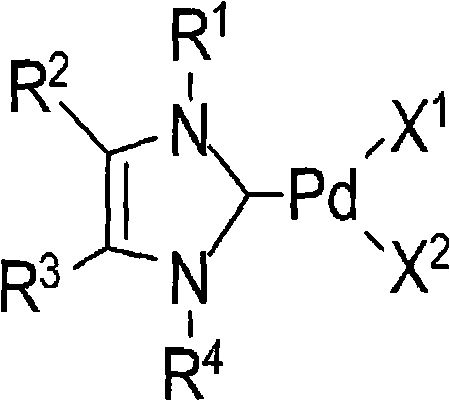
其中,R1和R4独立地选自由包含N、O或S的杂原子取代或未取代的C1~20烷基和C6~30芳香基中;R2和R3独立地选自氢原子和由包含N、O或S的杂原子取代或未取代的C1~20烷基和C6~30芳香基中;X1和X2独立地选自卤素配体、取代或未取代的烯丙基配体和羧化物配体中,或者是选自烯烃配体和溶剂配体中;且两个化合物能够以二聚物形式存在。Wherein, R 1 and R 4 are independently selected from C1~20 alkyl groups and C6~30 aryl groups substituted or unsubstituted by heteroatoms containing N, O or S; R 2 and R 3 are independently selected from hydrogen atoms and Among C1~20 alkyl groups and C6~30 aryl groups substituted or unsubstituted by heteroatoms containing N, O or S; X1 and X2 are independently selected from halogen ligands, substituted or unsubstituted allyl ligands Body and carboxylate ligands, or selected from olefin ligands and solvent ligands; and the two compounds can exist in dimer form.
特别是,在根据本发明实施方式的方法中,由化学式10表示的所述化合物可以是如下的化合物,其中R1和R4都是2,6-二异丙基苯基(2,6-iPr2C6H3-);R2和R3都是氢原子;且X1和X2都是氯或醋酸根,在这种情况下两个化合物能够以二聚物形式存在,或X1和X2中的一个是氯,另一个是烯丙基。Particularly, in the method according to the embodiment of the present invention, the compound represented by
根据本发明另一实施方式,提供一种制备下面化学式12表示的化合物的方法,该方法包括采用N-杂环-碳烯-配位钯化合物作为催化剂使下面化学式11表示的化合物的烯基选择性氢化:According to another embodiment of the present invention, there is provided a method for preparing a compound represented by the following
化学式11Chemical formula 11

(其中n=0~10)(where n=0~10)
化学式12
(其中n=0~10)(where n=0~10)
具体地,由化学式11表示的化合物和化学式12表示的化合物可以是其中的n等于0或1的化合物。Specifically, the compound represented by Chemical Formula 11 and the compound represented by
在根据本发明实施方式的制备方法中,N-杂环-碳烯-配位钯化合物可包括下面化学式10表示的化合物:In the preparation method according to an embodiment of the present invention, the N-heterocycle-carbene-coordinated palladium compound may include a compound represented by the following Chemical Formula 10:
化学式10

其中,R1和R4独立地选自由包含N、O或S的杂原子取代或未取代的C1~20烷基和C6~30芳香基中;R2和R3独立地选自氢原子和由包含N、O或S的杂原子取代或未取代的C1~20烷基和C6~30芳香基中;X1和X2独立地选自卤素配体、取代或未取代的烯丙基配体和羧化物配体中,或者是选自烯烃配体和溶剂配体中;且两个化合物能够以二聚物形式存在。Wherein, R 1 and R 4 are independently selected from C1~20 alkyl groups and C6~30 aryl groups substituted or unsubstituted by heteroatoms containing N, O or S; R 2 and R 3 are independently selected from hydrogen atoms and Among C1~20 alkyl groups and C6~30 aryl groups substituted or unsubstituted by heteroatoms containing N, O or S; X1 and X2 are independently selected from halogen ligands, substituted or unsubstituted allyl ligands Body and carboxylate ligands, or selected from olefin ligands and solvent ligands; and the two compounds can exist in dimer form.
在根据本发明实施方式的制备方法中,由化学式10表示的所述化合物可以是如下的化合物,其中R1和R4都是2,6-二异丙基苯基(2,6-iPr2C6H3-);R2和R3都是氢原子;且X1和X2都是氯或醋酸根,在这种情况下两个化合物能够以二聚物形式存在,或X1和X2中的一个是氯,另一个是烯丙基。In the preparation method according to an embodiment of the present invention, the compound represented by
本发明的另一实施方式提供一种包括N-杂环-碳烯-配位钯化合物的催化剂,从而仅对具有两个不同反应活性的烯基的化合物中的一个烯基进行选择性氢化反应。Another embodiment of the present invention provides a catalyst comprising an N-heterocycle-carbene-coordinating palladium compound to selectively hydrogenate only one alkenyl group in a compound having two alkenyl groups of different reactivity .
如此,具有两个不同反应活性的烯基的化合物可由下面化学式11表示。As such, a compound having two alkenyl groups of different reactivity may be represented by Chemical Formula 11 below.
化学式11Chemical formula 11
(其中n=0~10)(where n=0~10)
此外,具有两个不同反应活性的烯基的化合物可以是由化学式11表示的化合物,其中n是0或1。In addition, the compound having two alkenyl groups of different reactivity may be a compound represented by Chemical Formula 11, wherein n is 0 or 1.
根据一具体实施方式,N-杂环-碳烯-配位钯化合物可包括下面化学式10表示的化合物:According to a specific embodiment, the N-heterocycle-carbene-coordinated palladium compound may include a compound represented by the following chemical formula 10:
化学式10

其中,R1和R4独立地选自由包含N、O或S的杂原子取代或未取代的C1~20烷基或C6~30芳香基中;R2和R3独立地选自氢原子和由包含N、O或S的杂原子取代或未取代的C1~20烷基或C6~30芳香基中;X1和X2独立地选自卤素配体、取代或未取代的烯丙基配体和羧化物配体中,或者是选自烯烃配体和溶剂配体中;且两个化合物能够以二聚物形式存在。Wherein, R 1 and R 4 are independently selected from C1-20 alkyl or C6-30 aryl groups substituted or unsubstituted by heteroatoms containing N, O or S; R 2 and R 3 are independently selected from hydrogen atoms and In C1~20 alkyl or C6~30 aryl substituted or unsubstituted by heteroatoms containing N, O or S; X1 and X2 are independently selected from halogen ligands, substituted or unsubstituted allyl ligands Body and carboxylate ligands, or selected from olefin ligands and solvent ligands; and the two compounds can exist in dimer form.
如此,由化学式10表示的所述化合物可以是如下的化合物,其中R1和R4都是2,6-二异丙基苯基(2,6-iPr2C6H3-);R2和R3都是氢原子;且X1和X2都是氯或醋酸根,在这种情况下两个化合物能够以二聚物形式存在,或X1和X2中的一个是氯,另一个是烯丙基。Thus, the compound represented by
根据本发明一实施方式,提供一种新结构的环烯烃共聚物,如5,6-二氢二环戊二烯-乙烯共聚物或5,6-二氢二环戊二烯-(降冰片烯类环烯或环戊烯)-乙烯三元共聚物,其利用通过对二环戊二烯进行氢化而容易且经济地制得的5,6-二氢二环戊二烯,所述二环戊二烯在石脑油裂解的C5馏分中占大部分;以及提供其制备方法。从而,采用比常规已知的环烯烃类聚合物化合物制备方法更简便的方法,而制得性能优异的环烯烃类聚合物化合物。预期由此获得的环烯烃类聚合物化合物可应用于食品和药品的包装材料、DVD材料、用于显示的光学膜等领域中。According to one embodiment of the present invention, a kind of cycloolefin copolymer of new structure is provided, such as 5,6-dihydrodicyclopentadiene-ethylene copolymer or 5,6-dihydrodicyclopentadiene-(norbornanol Olefinic cycloalkene (or cyclopentene)-ethylene terpolymers utilizing 5,6-dihydrodicyclopentadiene, which is readily and economically prepared by hydrogenation of dicyclopentadiene, which Cyclopentadiene forms the majority of the C5 fraction of naphtha cracking; and methods for its preparation are provided. Thus, a cycloolefin polymer compound having excellent properties can be produced by using a simpler method than conventionally known cycloolefin polymer compound preparation methods. The cycloolefin-based polymer compound thus obtained is expected to be applicable in the fields of packaging materials for food and medicine, DVD materials, optical films for display, and the like.
此外,根据本发明一实施方式,二氢三环戊二烯用作新的环烯烃单体来与乙烯共聚。所得到的共聚物与传统的环烯烃共聚物,如降冰片烯-乙烯共聚物相比显示了相同程度的玻璃转变温度,即使是所述聚合物链包含相对少量的二氢三环戊二烯单体(或包含相对大量的乙烯单体)。而且,当具有高玻璃转变温度的聚合物链包含的乙烯单体的量相对多,该聚合物链更柔,因此能减少传统的降冰片烯-乙烯共聚物的缺点。Furthermore, according to an embodiment of the present invention, dihydrotricyclopentadiene is used as a novel cycloolefin monomer to be copolymerized with ethylene. The resulting copolymers show glass transition temperatures to the same extent as conventional cyclic olefin copolymers, such as norbornene-ethylene copolymers, even though the polymer chains contain relatively small amounts of dihydrotricyclopentadiene monomers (or containing relatively large amounts of vinyl monomers). Also, when a polymer chain having a high glass transition temperature contains a relatively large amount of ethylene monomer, the polymer chain is more flexible, thus reducing the disadvantages of conventional norbornene-ethylene copolymers.
另外,在本发明中,当N-杂环-碳烯-配位钯化合物用作氢化催化剂,在二环戊二烯、三环戊二烯和类似环戊二烯的狄尔斯-阿尔德反应产物的降冰片烯型烯基和环戊烯型烯基中,上述催化剂特别地仅对降冰片烯型烯基具有氢化反应活性,对环戊烯型烯基不具有氢化反应活性,因此与氢化过程中的氢的过量投入或氢的压力无关,可在不同溶剂中高产量和高纯度制备氢化化合物而不需要副产物的提纯。In addition, in the present invention, when the N-heterocyclic-carbene-coordinated palladium compound is used as a hydrogenation catalyst, Diels-Alder In the norbornene-type alkenyl and cyclopentene-type alkenyl of the reaction product, the above-mentioned catalyst has hydrogenation reactivity only for the norbornene-type alkenyl, and does not have hydrogenation reactivity for the cyclopentene-type alkenyl, so it is compatible with Regardless of the excess input of hydrogen or the pressure of hydrogen in the hydrogenation process, hydrogenated compounds can be prepared in different solvents with high yield and high purity without purification of by-products.
附图说明Description of drawings
图1是5,6-二氢二环戊二烯/乙烯共聚物(在20psig乙烯压下获得)的1HNMR谱;Figure 1 is a 1 H NMR spectrum of 5,6-dihydrodicyclopentadiene/ethylene copolymer (obtained at 20 psig ethylene pressure);
图2是5,6-二氢二环戊二烯/乙烯共聚物(在20psig乙烯压下获得)13CNMR(DEPT)谱;Figure 2 is a 13 CNMR (DEPT) spectrum of 5,6-dihydrodicyclopentadiene/ethylene copolymer (obtained at 20 psig ethylene pressure);
图3是5,6-二氢二环戊二烯/乙烯共聚物(在20psig乙烯压下获得)HMQC NMR谱及其结构;Fig. 3 is 5,6-dihydrodicyclopentadiene/ethylene copolymer (obtained under 20psig ethylene pressure) HMQC NMR spectrum and its structure;
图4是5,6-二氢二环戊二烯/乙烯共聚物(在20psig乙烯压下获得)COSYNMR及其结构;Figure 4 is 5,6-dihydrodicyclopentadiene/ethylene copolymer (obtained under 20 psig ethylene pressure) COSYNMR and its structure;
图5是5,6-二氢二环戊二烯-降冰片烯-乙烯三元聚合物的1H NMR数据;Fig. 5 is the 1 H NMR data of 5,6-dihydrodicyclopentadiene-norbornene-ethylene terpolymer;
图6是5,6-二氢二环戊二烯-环戊烯-乙烯三元聚合物的1H NMR数据;Fig. 6 is the 1 H NMR data of 5,6-dihydrodicyclopentadiene-cyclopentene-ethylene terpolymer;
图7是实施例15的二氢三环戊二烯/乙烯共聚物1H NMR谱;Fig. 7 is the dihydrotricyclopentadiene/ethylene copolymer 1 H NMR spectrum of
图8是显示根据环烯烃摩尔比的三种共聚物的玻璃转变温度的变化曲线;Figure 8 is a graph showing the change in glass transition temperature of three copolymers according to the cycloolefin molar ratio;
图9是氢化之前三环戊二烯的1H NMR谱;Figure 9 is the 1 H NMR spectrum of tricyclopentadiene before hydrogenation;
图10是实施例16的氢化产物的1H NMR谱;Fig. 10 is the 1 H NMR spectrum of the hydrogenation product of
图11是实施例16的氢化产物的13C NMR谱;Fig. 11 is the 13 C NMR spectrum of the hydrogenation product of
图12是氢化之前二环戊二烯的1H NMR谱;Figure 12 is the 1 H NMR spectrum of dicyclopentadiene before hydrogenation;
图13是实施例20的氢化产物的1H NMR谱;Fig. 13 is the 1 H NMR spectrum of the hydrogenation product of
图14是实施例20的氢化产物的13C NMR谱;Fig. 14 is the 13 C NMR spectrum of the hydrogenation product of
图15是比较实施例1的氢化产物的1H NMR谱;Fig. 15 is the 1 H NMR spectrum of the hydrogenation product of comparative example 1;
图16是比较实施例4的氢化产物的1H NMR谱。16 is a 1 H NMR spectrum of the hydrogenation product of Comparative Example 4. FIG.
具体实施方式Detailed ways
下面对本发明进行详细描述。The present invention is described in detail below.
根据本发明第一实施方式的环烯烃类聚合物化合物是包含下面化学式2表示的重复单元的环烯烃类聚合物化合物:The cycloolefin-based polymer compound according to the first embodiment of the present invention is a cycloolefin-based polymer compound including a repeating unit represented by the following Chemical Formula 2:
化学式2

其中,x∶y的摩尔比为从99∶1至1∶99的范围,且z具有10~20,000的平均值。Wherein, the molar ratio of x:y ranges from 99:1 to 1:99, and z has an average value of 10-20,000.
所述环烯烃类聚合物化合物包含由化学式2表示的重复单元,通过下面化学式3表示的5,6-二氢二环戊二烯和含乙烯基单体乙烯基聚合而获得,其中5,6-二氢二环戊二烯可经二环戊二烯的氢化反应容易地制备(反应式6;Francisco Alonso,Iosaki Osante and Miguel Yus,Tetrahedron,2006,63,93-102;U.S.Pat.Appl.Publ.,2005038303,17Feb 2005)。The cycloolefin-based polymer compound comprises a repeating unit represented by
化学式3

(反应式6)(reaction formula 6)

由于二环戊二烯的5-6位的烯基比2-3位的烯基更有反应活性,当加入催化剂和1当量的氢时,可保留2-3位的烯基而仅对5-6位的烯基氢化,由此制备5,6-二氢二环戊二烯单体。如二环戊二烯的小分子的氢化反应论工艺比通过ROMP获得的聚合物材料的氢化反应容易。Since the alkenyl at the 5-6 position of dicyclopentadiene is more reactive than the alkenyl at the 2-3 position, when a catalyst and 1 equivalent of hydrogen are added, the alkenyl at the 2-3 position can be retained and only the alkenyl at the 5 The alkenyl group at the -6 position is hydrogenated, thereby preparing a 5,6-dihydrodicyclopentadiene monomer. The hydrogenation reaction of small molecules like dicyclopentadiene is easier than the hydrogenation of polymeric materials obtained by ROMP.
特别是,这种化合物可采用N-杂环-碳烯-配位钯化合物催化剂对烯基选择性氢化而获得,对此稍后进行描述。In particular, such compounds can be obtained by selective hydrogenation of alkenyl groups using N-heterocycle-carbene-coordinating palladium compound catalysts, which will be described later.
在本发明中,可通过这种简单工艺制备的5,6-二氢二环戊二烯与乙烯进行共聚反应,从而可制备环烯烃类共聚物。如此,因为5,6-二氢二环戊二烯是一种庞大的单体,能够达到采用DMON制备的传统的环烯烃类聚合物化合物的性能,所述DMON由降冰片烯与环戊二烯反应而获得。In the present invention, 5,6-dihydrodicyclopentadiene, which can be prepared by this simple process, is copolymerized with ethylene, so that a cycloolefin copolymer can be prepared. Thus, because 5,6-dihydrodicyclopentadiene is a bulky monomer, it can achieve the properties of conventional cycloolefin-based polymer compounds prepared using DMON, which consists of norbornene and cyclopentadiene obtained by the reaction of alkenes.
此外,采用5,6-二氢二环戊二烯制得的聚合物的分子结构与通过对DMON进行ROMP然后再氢化而制得的聚合物的分子结构(反应式4底部的聚合物结构)相似,因此可以期待相似的性质。In addition, the molecular structure of the polymer prepared with 5,6-dihydrodicyclopentadiene was compared with that of the polymer prepared by ROMP of DMON followed by hydrogenation (polymer structure at the bottom of Equation 4) similar, and thus similar properties can be expected.
尤其是,5,6-二氢二环戊二烯单体的制备与DMON单体的制备相比,更简便有利。In particular, the preparation of 5,6-dihydrodicyclopentadiene monomer is more convenient and advantageous than the preparation of DMON monomer.
由于如上所述的5,6-二氢二环戊二烯的2-3位烯基的低反应活性,采用5,6-二氢二环戊二烯作为单体的环烯烃共聚物未见报道。Due to the low reactivity of the 2-3 alkenyl group of 5,6-dihydrodicyclopentadiene as mentioned above, no cyclic olefin copolymers using 5,6-dihydrodicyclopentadiene as a monomer reports.
根据Naga 2005年发表的论文,当采用已知在庞大单体的聚合反应中非常有活性的CGC(限定几何构型催化剂),试验5,6-二氢二环戊二烯和乙烯进行共聚时,5,6-二氢二环戊二烯完全不参与聚合反应,且只得到纯的聚乙烯(J.Polym.Sci.,PartA:Polym.Chem.2005,43.1285-1291)。According to a paper published by Naga in 2005, when 5,6-dihydrodicyclopentadiene and ethylene were tested for copolymerization using CGC (Constrained Geometry Catalyst), which is known to be very active in the polymerization of bulky monomers , 5,6-dihydrodicyclopentadiene does not participate in the polymerization reaction at all, and only pure polyethylene is obtained (J. Polym. Sci., Part A: Polym. Chem. 2005, 43.1285-1291).
另一方面,据1996年Wagerner报道,向5,6-二氢二环戊二烯加入已知为易位催化剂(metathesis catalyst)的WCl3-Et2AlCl组合物时,采用NMR波谱法确认了双键的消失,且这种催化剂导致5,6-二氢二环戊二烯的烯烃聚合(T.A.Davidson,K.B.Wagerner,D.B.Priddy,Macromolecules 1996,29,786-788)。然而,由此获得的所述化合物是分子量并不大的低聚物形式,且与根据本发明的采用5,6-二氢二环戊二烯的共聚物是无关的。On the other hand, according to Wagerner's report in 1996, when a WCl 3 -Et 2 AlCl composition known as a metathesis catalyst (metathesis catalyst) was added to 5,6-dihydrodicyclopentadiene, it was confirmed by NMR spectroscopy The double bond disappears and this catalyst leads to olefinic polymerization of 5,6-dihydrodicyclopentadiene (TA Davidson, KB Wagerner, DB Priddy, Macromolecules 1996, 29, 786-788). However, the compounds thus obtained are in the form of oligomers with a moderate molecular weight and are not relevant for the copolymers according to the invention with 5,6-dihydrodicyclopentadiene.
由化学式3表示的化合物可包含内型异构体和外型异构体。从石脑油裂解的C5馏分获得的二环戊二烯化合物包含内型异构体和外型异构体的混合物。通常,含有90摩尔%或更多的所述内型异构体。如上面所提到的,所述化学式3的化合物由石脑油裂解的C5馏分中得到的二环戊二烯化合物经氢化反应而获得。由于内型异构体和外型异构体的混合比例不因氢化反应而改变,通常制得的化学式3的化合物包含过量的内型异构体。The compound represented by
根据本发明的实施方式,所述包含由化学式2表示的重复单元的环烯烃类聚合物化合物,可以是通过将化学式3的化合物与乙烯进行乙烯基共聚反应而获得的环烯烃类共聚物。在化学式1中,x∶y的摩尔比为99∶1至1∶99的范围。在透明无定形树脂的制备中,x∶y的摩尔比优选为90∶10至10∶90,且更优选90∶10至50∶50。聚合物链中的x∶y的摩尔比可通过调节加入到反应器中的两种单体的摩尔比而控制。此外,表明聚合度的Z可具有10~20,000的平均值,且从确保适当的机械强度来说,优选500~3000。According to an embodiment of the present invention, the cycloolefin polymer compound including the repeating unit represented by
根据本发明第一实施方式的环烯烃类聚合物化合物,可以是由化学式3表示的化合物与选自由下面化学式5表示的化合物中的一种环烯烃的混合物和环戊烯与乙烯进行乙烯基共聚反应而获得的聚合物化合物。The cycloolefin-based polymer compound according to the first embodiment of the present invention may be a mixture of a compound represented by
化学式5

其中,R是氢原子、C1~6烷基或苯基。优选地,可使用其中R为H的化合物,即降冰片烯。Wherein, R is a hydrogen atom, a C1-6 alkyl group or a phenyl group. Preferably, the compound wherein R is H, ie norbornene, can be used.
这种聚合物化合物可以是除化学式2表示的重复单元之外,进一步包括下面化学式4表示的重复单元的聚合物化合物。Such a polymer compound may be a polymer compound further including a repeating unit represented by Chemical Formula 4 below in addition to the repeating unit represented by
化学式4chemical formula 4

其中R是氢原子、C1~6烷基或苯基。Wherein R is a hydrogen atom, a C1-6 alkyl group or a phenyl group.
这时,x∶(y+o)的摩尔比可以是99∶1至1∶99的范围,且对获得透明无定形树脂来说优选90∶10至10∶90。y∶o的摩尔比根据要加入的两种环烯烃的比例而可控制,且y和o可以是0以外的任何变数。At this time, the molar ratio of x:(y+o) may range from 99:1 to 1:99, and is preferably 90:10 to 10:90 for obtaining a transparent amorphous resin. The molar ratio of y:o is controllable according to the ratio of the two cycloolefins to be added, and y and o can be any variable other than zero.
化学式3的化合物,如上所述具有低反应活性的烯基,在CGC存在的条件下也不能与乙烯进行共聚反应,CGC已知在庞大单体的共聚反应中活性非常高。The compound of
在本发明中,化学式3的化合物与乙烯基单体的烯烃聚合反应采用下面化学式6表示的化合物作为催化剂前体来引发。具体地,用在根据本发明的制备方法中的催化剂是采用助催化剂来活化化学式6的化合物而形成的,所述助催化剂包括选自甲基铝氧烷、Al(R3)3、B(Arf)3和[L]+[B(Arf)4]-中的一种或多种。当在溶剂存在或不存在的条件下,采用上述催化剂,化学式3的化合物与乙烯基单体进行烯烃共聚反应时,可得到根据本发明的环烯烃类聚合物化合物。In the present invention, the olefin polymerization reaction of the compound of
化学式6

其中,M是Ti、Zr或Hf;X是卤素或C1~20烷基;R1互相相同或不同,为氢、C1~20烷基、烯基或炔基;且R2相同或不同,为氢、C1~20烷基、烯基或炔基。优选的是,M是Ti;X是甲基或氯;R1和R2都是甲基。Wherein, M is Ti, Zr or Hf; X is halogen or C1-20 alkyl; R 1 are the same or different from each other, and are hydrogen, C1-20 alkyl, alkenyl or alkynyl; and R 2 are the same or different, being hydrogen, C1-20 alkyl, alkenyl or alkynyl. Preferably, M is Ti; X is methyl or chlorine; R1 and R2 are both methyl.
化学式6表示的化合物可由本发明人采用已知化合物通过已知工艺来制备(Wu,C.J.;Lee,S.H.;Yun,H.;Lee,B.Y.Organometallics 2007,26,6685-6687)。The compound represented by
具体地,甲基铝氧烷可通过三甲基铝单独或三甲基铝和三异丁基铝的混合物进行部分水解而得到,且可以在市面上购买到。预测其结构具有-[Al(Me或iBu)-O]a-的线形、环形或网状结构。Specifically, methylaluminoxane can be obtained by partial hydrolysis of trimethylaluminum alone or a mixture of trimethylaluminum and triisobutylaluminum, and is commercially available. Its structure is predicted to have -[Al(Me or iBu)-O] a - linear, ring or network structure.
在Al(R3)3中,R3相互相同或不同,为卤素或C1~20烃基,且优选甲基、乙基或异丁基。In Al(R 3 ) 3 , R 3 are the same or different from each other, and are halogen or a C1-20 hydrocarbon group, and are preferably methyl, ethyl or isobutyl.
在B(Arf)3中,Arf是氟原子取代的芳香基,且优选五氟苯基(C6F5)。In B(Ar f ) 3 , Ar f is an aromatic group substituted with a fluorine atom, and is preferably a pentafluorophenyl group (C 6 F 5 ).
在[L]+[B(Arf)4]-中,Arf定义如上所述,且[L]+是碳正离子或叔铵离子。Arf优选五氟苯基(C6F5),且[L]+优选[Ph3C]+或[PhNMe2H]+。In [L] + [B(Ar f ) 4 ] − , Ar f is as defined above, and [L] + is a carbocation or a tertiary ammonium ion. Ar f is preferably pentafluorophenyl (C 6 F 5 ), and [L] + is preferably [Ph 3 C] + or [PhNMe 2 H] + .
采用这种催化剂的烯烃聚合反应可在溶剂存在或不存在的条件下进行。这样,所述溶剂可包括甲苯、己烷、环己烷、二氯甲烷或氯苯。优选使用甲苯。The polymerization of olefins using this catalyst can be carried out in the presence or absence of a solvent. Thus, the solvent may include toluene, hexane, cyclohexane, methylene chloride or chlorobenzene. Preference is given to using toluene.
另外,根据本发明第二个实施方式,环烯烃类聚合物化合物由下面化学式7表示:In addition, according to the second embodiment of the present invention, the cycloolefin-based polymer compound is represented by the following chemical formula 7:
化学式7
其中,x∶y的摩尔比为99∶1至1∶99的范围,且z具有10~20,000的平均值。Wherein, the molar ratio of x:y ranges from 99:1 to 1:99, and z has an average value of 10˜20,000.
包含由化学式7表示的重复单元的环烯烃类聚合物化合物,通过由化学式8表示的二氢三环戊二烯含乙烯基的单体与乙烯进行乙烯基共聚反应而得到。二氢三环戊二烯可通过下面反应式7所示的三环戊二烯氢化而制得。The cycloolefin-based polymer compound including the repeating unit represented by
化学式8

(反应式7)(Reaction 7)

三环戊二烯可通过二环戊二烯和环戊二烯进行狄尔斯-阿尔德反应而制备。已有报道,三环戊二烯的制备收率取决于反应条件的研究(Zhongqiang Xiong,Zhentao Mi and Xiangwen Zhang,React.Kinet.Catal.Lett.Vol.85,89-97(2005)),但是,从副产物中仅完全分离出三环戊二烯的主要异构体,未见有报道。Tricyclopentadiene can be prepared by Diels-Alder reaction of dicyclopentadiene and cyclopentadiene. It has been reported that the preparation yield of tricyclopentadiene depends on the research of reaction conditions (Zhongqiang Xiong, Zhentao Mi and Xiangwen Zhang, React.Kinet.Catal.Lett.Vol.85,89-97(2005)), but , Only the main isomer of tricyclopentadiene is completely separated from the by-product, and there is no report.
在本发明中,为了从副产物中仅完全分离出三环戊二烯的主要异构体,可引入一种重结晶方法,该方法包括:将副产物溶解在乙醇中,从而利用随温度溶解度的不同而分离出所需要的物质。In the present invention, in order to completely separate only the main isomer of tricyclopentadiene from the by-product, a recrystallization method may be introduced, which includes: dissolving the by-product in ethanol, thereby utilizing the temperature-dependent solubility different to isolate the desired substance.
由此得到的三环戊二烯的两个烯基中仅降冰片烯型烯烃选择性氢化可有多种方法。There are various methods for the selective hydrogenation of only norbornene-type olefins among the two alkenyl groups of tricyclopentadiene thus obtained.
例如,根据1977年Athelstan L.J.Beckwith和Martin L.Gilpin在J.C.S.Perkin I的第19-27页发表的论文,采用镍化合物催化剂,加入1当量的氢来进行选择性氢化,所述催化剂是通过在乙醇中用NaBH4还原醋酸镍制备的。同样在二环戊二烯的情况下,由于降冰片烯型烯烃具有高反应活性,尝试在催化剂的存在下采用1当量的氢进行选择性氢化(Brunel,J.M.Tetrahedron 2007,63,3899.;Alonso,F.;Osante,I.;Yus,M.Tetrahedron2007,63,93;Bartlett,P.D.;Banavali,R.J.Org.Chem.1991,56,6043)。然而在这种情况下,采用1当量的氢获得选择性,且如果在反应过程中不调节氢气的量,两个烯基都被还原的化合物和两个烯基都没有被还原的化合物可成为副产物,引起不期望的问题。同样,为了获得高选择性,催化剂的状态和反应条件应该被严格控制。For example, according to the paper published by Athelstan LJBeckwith and Martin L. Gilpin in JCSPerkin I pp. 19-27 in 1977, selective hydrogenation was carried out with the addition of 1 equivalent of hydrogen using a nickel compound catalyst by using Prepared by reducing nickel acetate with NaBH 4 . Also in the case of dicyclopentadiene, due to the high reactivity of norbornene-type olefins, attempts were made to carry out selective hydrogenation with 1 equivalent of hydrogen in the presence of a catalyst (Brunel, JM Tetrahedron 2007, 63, 3899.; Alonso, F.; Osante, I.; Yus, M. Tetrahedron 2007, 63, 93; Bartlett, PD; Banavali, RJ Org. Chem. 1991, 56, 6043). In this case, however, selectivity is obtained with 1 equivalent of hydrogen, and if the amount of hydrogen is not adjusted during the reaction, the compound in which both alkenyl groups are reduced and the compound in which both alkenyl groups are not reduced can become By-products, causing undesired problems. Also, in order to obtain high selectivity, the catalyst state and reaction conditions should be strictly controlled.
由于这些原因,优选使用能够仅使三环戊二烯的降冰片烯型烯基选择性氢化的催化剂,且其例子包括N-杂环-碳烯-配位钯化合物。For these reasons, it is preferable to use a catalyst capable of selectively hydrogenating only norbornene-type alkenyl groups of tricyclopentadiene, and examples thereof include N-heterocyclic-carbene-coordinated palladium compounds.
在本发明中,由此获得的二氢三环戊二烯与乙烯进行共聚反应,得到环烯烃类共聚物。因此,庞大的二氢三环戊二烯是有利的,这是因为即使在仅仅包含少量的环烯烃时,聚合物链也可具有高玻璃转变温度且赋有柔性。In the present invention, the dihydrotricyclopentadiene thus obtained is copolymerized with ethylene to obtain a cycloolefin copolymer. Therefore, bulky dihydrotricyclopentadiene is advantageous because the polymer chain can have a high glass transition temperature and be endowed with flexibility even when only a small amount of cyclic olefin is included.
由化学式8表示的化合物由于内型和外型几何构型可包含四种异构体。用作起始原料的二环戊二烯化合物通常是以9∶1或更高的比例包含内型-异构体和外型-异构体的混合物。此外,当降冰片烯型烯基和环戊二烯进行狄尔斯-阿尔德反应时,也可产生内型-化合物和外型-化合物。根据ZhongqiangXiong,Zhentao Mi,Xiangwen Zhang等在React.Kinet.Catal.Lett.Vol.85,89-97(2005)中发表的论文,在这些化合物中,只有两种化合物是以约5∶1的比例形成的。在本发明中使用的单体是纯的二氢三环戊二烯化合物,其通过利用重结晶将混合物中的小比例的化合物去除,由此获得纯的单一异构体,然后对它进行氢化而制备的。这种化合物用来准确地分析新制备的聚合物化合物,或者可选地,所述异构体可以未经分离的混合物的形式使用,而制得聚合物。The compound represented by
根据本发明的第二实施方式,所述包含由化学式7表示的重复单元的环烯烃类聚合物化合物,可以是由化学式8的化合物与乙烯进行乙烯基共聚反应得到的环烯烃类共聚物,其中在化学式7中,x∶y的摩尔比可以是从99∶1至1∶99的范围。为了制备透明无定形树脂,优选x∶y的摩尔比从90∶10至10∶90,且更优选从90∶10至50∶50。在聚合物链中的x∶y的摩尔比可通过调节加入到反应器中的两种单体的摩尔比而控制。而表示聚合度的Z可具有10~20,000的平均值,且就达到适合的机械强度而言优选500~3000。According to the second embodiment of the present invention, the cycloolefin polymer compound comprising the repeating unit represented by
在聚合反应中所使用的催化剂体系和溶剂如第一实施方式中所描述。The catalyst system and solvent used in the polymerization reaction are as described in the first embodiment.
在根据本发明第二实施方式的由化学式7表示的环烯烃类共聚物的情况下,与根据第一实施方式的由化学式2表示的5,6-二氢二环戊二烯和乙烯的共聚物相比,其具有更高的玻璃转变温度,且能够制备出大量(最大45%)含有5,6-二氢三环戊二烯的共聚物。因此,可以提供具有更广泛应用性的环烯烃类共聚物。In the case of the cycloolefin-based copolymer represented by
在根据本发明第一实施方式和第二实施方式的环烯烃类共聚物的制备中,环状单体的例子可包括下面化学式12表示的化合物,其可采用由下面化学式11表示的具有两个不同反应活性的烯基的化合物中的仅一个烯基进行选择性氢化而制得。In the preparation of the cycloolefin-based copolymers according to the first embodiment and the second embodiment of the present invention, examples of the cyclic monomer may include compounds represented by the following
化学式11Chemical formula 11

(其中n=0~10。)(wherein n=0~10.)
化学式12
(其中n=0~10。)(wherein n=0~10.)
在化学式11表示的化合物中,n等于0的二环戊二烯化合物从石脑油裂解的C5馏分获得,且可包括内型-异构体和外型-异构体的混合物。此时,通常以90摩尔%或更多的量过量地含有内型-异构体。根据本发明,这种化合物可以以内型-异构体和外型-异构体混合在一起或完全分离的方式使用。Among the compounds represented by Chemical Formula 11, the dicyclopentadiene compound with n equal to 0 is obtained from the C5 fraction of naphtha cracking, and may include a mixture of endo-isomers and exo-isomers. At this time, the endo-isomer is usually contained in excess in an amount of 90 mol% or more. According to the present invention, such compounds can be used in the form that endo-isomers and exo-isomers are mixed together or completely separated.
在由化学式11表示的化合物中,其中n等于1的三环戊二烯可通过二环戊二烯和环戊二烯进行狄尔斯-阿尔德反应而制备(Zhongqiang Xiong,Zhentao Mi and Xiangwen Zhang,React.Kinet.Catal.Lett.Vol.85,89-97(2005);Athelstan L.J.Beckwith and Martin L.Gilpin,J.C.S.Perkin I,1977,pp19-27)。此外,三环戊二烯由于内型和外型的几何构型可包含四种异构体,根据Zhongqing Xiong,Zhentao Mi,Xiangwen Zhang等人在React.Kinet.Catal.Lett.Vol.85,89-97(2005)中发表的论文,其中仅有两种化合物是以约5∶1的比例形成的。在本发明中,这种化合物可以内型-异构体和外型-异构体混合在一起或完全分离的方式使用。Among the compounds represented by Chemical Formula 11, tricyclopentadiene in which n is equal to 1 can be prepared by Diels-Alder reaction of dicyclopentadiene and cyclopentadiene (Zhongqiang Xiong, Zhentao Mi and Xiangwen Zhang , React.Kinet.Catal.Lett.Vol.85, 89-97 (2005); Athelstan L.J.Beckwith and Martin L.Gilpin, J.C.S.Perkin I, 1977, pp19-27). In addition, tricyclopentadiene can contain four isomers due to endo- and exo-geometry, according to Zhongqing Xiong, Zhentao Mi, Xiangwen Zhang et al. in React.Kinet.Catal.Lett.Vol.85, 89 -97 (2005), in which only two compounds were formed in a ratio of about 5:1. In the present invention, this compound may be used in a form in which endo-isomers and exo-isomers are mixed together or completely separated.
此外,在由化学式11表示的化合物中,任何一种其中n等于2或更大的化合物在异构体分离的情况下使用,未见有报道。然而,当这种化合物与二环戊二烯进行热化时,据报道与n等于1的化合物一起得到一混合物(Chemical Engineering Science 56(2001)927-935)。由此获得的混合物可采用上述催化剂来氢化,从而制备化学式2的混合物。Furthermore, among the compounds represented by Chemical Formula 11, any compound wherein n is equal to 2 or more is used in the case of separation of isomers, and there is no report. However, when this compound was thermalized with dicyclopentadiene, it was reported to give a mixture with the compound with n equal to 1 (Chemical Engineering Science 56 (2001) 927-935). The mixture thus obtained may be hydrogenated using the catalyst described above, thereby preparing a mixture of
关于N-杂环-碳烯-配位钯化合物,最近已由Sebastian W和FrankGlorius在Acc.Chem.Res.,2008,41,1523-1533中进行了概述。钯的氧化态可以是0价或2价。Concerning N-heterocyclic-carbene-coordinating palladium compounds, they have recently been outlined by Sebastian W and Frank Glorius in Acc. Chem. Res., 2008, 41, 1523-1533. The oxidation state of palladium can be 0 or 2.
根据本发明的一实施方式,所述N-杂环-碳烯-配位钯化合物被用作氢化催化剂,尤其用在二环戊二烯、三环戊二烯及类似环戊二烯狄尔斯-阿尔德反应产物中的烯基选择性氢化反应中。According to one embodiment of the present invention, the N-heterocyclic-carbene-coordinated palladium compound is used as a hydrogenation catalyst, especially for dicyclopentadiene, tricyclopentadiene and similar cyclopentadiene dill Selective hydrogenation of alkenyl groups in Stein-Alder reaction products.
所述N-杂环-碳烯-配位钯化合物的一个具体的例子可包括下面化学式10表示的化合物。A specific example of the N-heterocyclic-carbene-coordinated palladium compound may include a compound represented by
化学式10

其中,R1和R4独立地选自由如N、O或S的杂原子取代或未取代的C1~20烷基和C6~30芳香基中;R2和R3独立地选自氢原子和由如N、O或S的杂原子取代或未取代的C1~20烷基和C6~30芳香基中;X1和X2独立地选自卤素配体、取代或未取代的烯丙基配体和羧化物配体中,或者是选自烯烃配体和溶剂配体中;且两个化合物能够以二聚物形式存在。Wherein, R 1 and R 4 are independently selected from C1~20 alkyl groups and C6~30 aryl groups substituted or unsubstituted by heteroatoms such as N, O or S; R 2 and R 3 are independently selected from hydrogen atoms and Among C1~20 alkyl groups and C6~30 aryl groups substituted or unsubstituted by heteroatoms such as N, O or S; X1 and X2 are independently selected from halogen ligands, substituted or unsubstituted allyl ligands Body and carboxylate ligands, or selected from olefin ligands and solvent ligands; and the two compounds can exist in dimer form.
更具体地,化学式10表示的化合物可包括如下的化合物:其中R1和R4都是2,6-二异丙基苯基(2,6-iPr2C6H3-);R2和R3都是氢原子;且X1和X2都是氯或醋酸根,在这种情况下两个化合物能够以二聚物形式存在,或X1和X2中的一个是氯,另一个是烯丙基,且这种化合物可在市面上购买到(例如,Strem公司)。More specifically, the compound represented by
当由化学式11表示的化合物的选择性氢化反应在上述的催化剂存在下进行,所述催化剂的量没有特别限定。但是,考虑到氢化反应的经济效益,[烯烃]/[Pd]的重量比可为从1000至100000。When the selective hydrogenation reaction of the compound represented by Chemical Formula 11 is performed in the presence of the above-mentioned catalyst, the amount of the catalyst is not particularly limited. However, the weight ratio of [olefin]/[Pd] may be from 1,000 to 100,000 in consideration of the economical efficiency of the hydrogenation reaction.
此外,氢化反应可在溶剂存在或不存在下进行。所述溶剂的例子包括甲苯、己烷、环己烷、二氯甲烷、四氢呋喃(THF)、甲醇、乙醇、异丙醇、乙腈、乙酸乙酯、乙醚等等。In addition, the hydrogenation reaction can be carried out in the presence or absence of a solvent. Examples of the solvent include toluene, hexane, cyclohexane, methylene chloride, tetrahydrofuran (THF), methanol, ethanol, isopropanol, acetonitrile, ethyl acetate, diethyl ether, and the like.
在氢化反应中,氢源可包括氢气(H2)或如在Angew.Chem.Iht.Ed.2008,47,3223中报道的蚁酸。考虑到经济效益更优选氢气。这样,氢气的压力可以是从大气压至约100巴的范围,且考虑到反应器的稳定性和反应速率优选5~30巴的范围。In the hydrogenation reaction, the hydrogen source may include hydrogen gas (H 2 ) or formic acid as reported in Angew. Chem. Iht. Ed. 2008, 47, 3223. Hydrogen is more preferred in view of economic efficiency. As such, the pressure of hydrogen may range from atmospheric pressure to about 100 bar, and is preferably in the range of 5 to 30 bar in consideration of reactor stability and reaction rate.
反应温度可以是从室温到200℃的范围,且考虑到反应的经济效益优选在常温进行。The reaction temperature may range from room temperature to 200°C, and is preferably performed at normal temperature in consideration of the economical efficiency of the reaction.
氢化后,含有氢化产物的溶液通过短硅胶垫(short silica gel pads)以去除催化剂,得到纯化合物。钯化合物或钯金属可以从滤出的催化剂中回收,从而重新使用。After hydrogenation, the solution containing the hydrogenated product was passed through short silica gel pads to remove the catalyst and obtain the pure compound. Palladium compounds or palladium metal can be recovered from the filtered catalyst for reuse.
根据上述方法,可获得仅降冰片烯型烯基被选择性氢化的化学式12的化合物。特别是,可以得到其中n=0的化学式12的化合物(即化学式3的化合物)或其中n=1的化学式12的化合物(即化学式8的化合物)。当根据本发明实施方式的N-杂环-碳烯-配位钯化合物用作催化剂时,氢化反应的选择性可至少在90%,实际上可以是100%。According to the above method, the compound of
同样,当根据本发明实施方式的N-杂环-碳烯-配位钯化合物用作催化剂时,所述催化剂的活性由转化数(turnover number,TON)评估,为1000或更大,因此即使使用少量催化剂也能够达到高收率的氢化反应。Also, when the N-heterocyclic-carbene-coordinated palladium compound according to an embodiment of the present invention is used as a catalyst, the activity of the catalyst, evaluated by the turnover number (TON), is 1000 or more, so even High-yield hydrogenation reactions can also be achieved using small amounts of catalyst.
选择性氢化具有两个不同反应活性的烯基的化合物(如二环戊二烯、三环戊二烯及类似环戊二烯狄尔斯-阿尔德反应产物)中的仅一个烯基而获得的产物,如第一实施方式和第二实施方式所描述,可被有效应用于与另一烯烃化合物的共聚反应中。Selective hydrogenation of only one alkenyl group in compounds having two alkenyl groups of different reactivity (such as dicyclopentadiene, tricyclopentadiene, and similar cyclopentadiene Diels-Alder reaction products) to obtain The product, as described in the first embodiment and the second embodiment, can be effectively used in a copolymerization reaction with another olefinic compound.
例如,选择性利用二环戊二烯的两个烯基中反应性较强的降冰片烯型烯基的乙烯基聚合反应和开环聚合反应(ROMP),被大量开发和报道过(Journal of Organometallic Chemistry 691(2006)31143121;Xiaofang Li andZhaomin Hou,Macromolecules 2005,38,6767-6769;Xiaofang Li,MasayoshiNishiura,Kyouichi Mori,Tomohiro Mashiko and Zahomin Hou,Chem.Commun.,2007,41374139;Masahiro Yamazaki,Journal of MolecularCatalysis A:Chemical 213(2004)8187)。在这种情况下,由于制备的聚合物包含烯基,直接商业应用存在问题。烯基具有高反应活性,可引起熔融时树脂的变形以及耐久性的降低。由于这些原因,聚合链中含有烯基的树脂在工业领域中应用不是很普遍。由此,基本上需要利用氢化反应将聚合物链中的双键完全去除。然而,通过对含有烯基的聚合物化合物进行氢化反应,将所有的双键转化为单键是并非易事。For example, vinyl polymerization and ring-opening polymerization (ROMP), which selectively utilize the more reactive norbornene-type alkenyl in the two alkenyl groups of dicyclopentadiene, have been developed and reported in large numbers (Journal of Organometallic Chemistry 691(2006)31143121;Xiaofang Li andZhaomin Hou,Macromolecules 2005,38,6767-6769;Xiaofang Li,MasayoshiNishiura,Kyouichi Mori,Tomohiro Mashiko and Zahomin Hou,Chem.Commun.,2007,41374139;Masahiro Yamazaki,Journal of Molecular Catalysis A: Chemical 213 (2004) 8187). In this case, direct commercial application is problematic because the prepared polymer contains alkenyl groups. Alkenyl groups are highly reactive, causing deformation of the resin during melting and reduction in durability. For these reasons, resins containing alkenyl groups in the polymer chain are not very common in industrial applications. Therefore, it is basically necessary to completely remove the double bond in the polymer chain by hydrogenation reaction. However, it is not easy to convert all double bonds into single bonds by hydrogenating alkenyl-containing polymer compounds.
因此,在二环戊二烯的两个烯基中,仅对降冰片烯型烯基选择性氢化,由此获得5,6-二氢二环戊二烯,随后将它用作单体与乙烯进行共聚反应。在这点上,反应式5和6中所示的根据本发明实施方式的共聚合反应方法可作为实例。Therefore, among the two alkenyl groups of dicyclopentadiene, only the norbornene-type alkenyl group is selectively hydrogenated, thereby obtaining 5,6-dihydrodicyclopentadiene, which is subsequently used as a monomer with Ethylene is copolymerized. In this regard, the copolymerization reaction method according to the embodiment of the present invention shown in
根据本发明的催化剂,利用这种方法使在制备共聚物中非常有用的环烯烃单体的选择性制备变为可能,因此期待根据本发明第一实施方式和第二实施方式方法的共聚物的商业生产更有效。According to the catalyst of the present invention, the selective production of cycloolefin monomers which are very useful in the preparation of copolymers has become possible by this method, and therefore the copolymers according to the methods of the first embodiment and the second embodiment of the present invention are expected. Commercial production is more efficient.
根据下面的实施例,可更好地理解本发明,但是这些实施例仅用于进行说明并不限定本发明。The present invention can be better understood from the following examples, but these examples are provided for illustration only and do not limit the present invention.
实施例1至4:5,6-二氢二环戊二烯-乙烯共聚反应Examples 1 to 4: 5,6-dihydrodicyclopentadiene-ethylene copolymerization
在氮气环境下,将5,6-二氢二环戊二烯(5.37g,40mmol)和磁条加入到聚合反应器,之后加入甲苯到总量为28ml。此聚合反应器在搅拌下加热到70℃。化学式6表示的化合物(0.7mg,2μmol)、[Ph3C]+[B(C6F5)4]-(7.4mg,8.0μmol)和三异丁基铝(160mg,800μmol)与2.0ml的甲苯在干燥箱中混合,用注射器将得到的混合物加入到反应器中同时在70℃下搅拌,且将乙烯气体在60psig的压力下注入到其中。3分钟后,解除乙烯的压力并打开反应器,将反应液投入到含有30ml的甲醇的容器中,从而反应产物沉淀出。进行过滤,得到沉淀物。在100℃下对该沉淀物减压至真空,从而从沉淀物中去除残留的溶剂,而获得了1.8g的聚合物物质。Under a nitrogen atmosphere, 5,6-dihydrodicyclopentadiene (5.37 g, 40 mmol) and a magnetic strip were added to the polymerization reactor, followed by toluene to a total of 28 ml. The polymerization reactor was heated to 70°C with stirring. Compound represented by chemical formula 6 (0.7mg, 2μmol), [Ph 3 C] + [B(C 6 F 5 ) 4 ] - (7.4mg, 8.0μmol) and triisobutylaluminum (160mg, 800μmol) with 2.0ml and toluene were mixed in a dry box, the resulting mixture was added to the reactor with a syringe while stirring at 70° C., and ethylene gas was injected thereinto at a pressure of 60 psig. After 3 minutes, the pressure of ethylene was released, the reactor was opened, and the reaction solution was poured into a container containing 30 ml of methanol, whereby the reaction product was precipitated. Filtration was performed to obtain a precipitate. The precipitate was decompressed to vacuum at 100° C. to remove residual solvent from the precipitate to obtain 1.8 g of a polymer substance.
另一方面,将乙烯压力减少到40psig、20psig及10psig,同时将聚合反应时间调节为7.0min、8.0min及6.0min,从而获得粘稠液,从中分别获得了1.8g、1.9g和0.4g的聚合物物质。由此获得的聚合物物质的结构采用NMR准确地进行分析(图1至图4)。图1至图4中确定了在20psig的乙烯压力下获得的共聚物,在其他乙烯压力下获得的共聚物同样可以确定为5,6-二氢二环戊二烯-乙烯共聚物。On the other hand, the ethylene pressure was reduced to 40 psig, 20 psig, and 10 psig, while the polymerization reaction time was adjusted to 7.0 min, 8.0 min, and 6.0 min to obtain viscous liquids, from which 1.8 g, 1.9 g, and 0.4 g of polymeric substance. The structure of the polymer substance thus obtained was accurately analyzed using NMR ( FIGS. 1 to 4 ). Copolymers obtained at an ethylene pressure of 20 psig are identified in Figures 1 to 4, and copolymers obtained at other ethylene pressures can also be identified as 5,6-dihydrodicyclopentadiene-ethylene copolymers.
参与反应的5,6-二氢二环戊二烯(HDCPD)的量基于图1的NMR结构分析,利用1H NMR谱图的积分值(integrated value)通过下列关系式来确定。The amount of 5,6-dihydrodicyclopentadiene (HDCPD) involved in the reaction was determined based on the NMR structure analysis in FIG. 1 by using the integrated value of the 1 H NMR spectrum by the following relational formula.
A=2.5~1.8ppm积分值A=2.5~1.8ppm integral value
B=1.8~0.8ppm积分值B=1.8~0.8ppm integral value
HDCPD含量=(A/5)/[(A/5)+(B-9)/4]HDCPD content = (A/5)/[(A/5)+(B-9)/4]
利用DSC测定玻璃转变温度,分子量和分子量分布采用GPC以聚苯乙烯为标准而测得。结果如下面表1所示。The glass transition temperature was measured by DSC, and the molecular weight and molecular weight distribution were measured by GPC with polystyrene as the standard. The results are shown in Table 1 below.
表1Table 1

实施例5:5,6-二氢二环戊二烯-降冰片烯-乙烯三元共聚反应Example 5: Terpolymerization of 5,6-dihydrodicyclopentadiene-norbornene-ethylene
在氮气环境下,将5,6-二氢二环戊二烯(2.7g,20mmol)、降冰片烯(1.9g,20mmol)及磁条加入到聚合反应器中,然后加入甲苯至总量为28ml。此聚合反应器在搅拌下加热到70℃。由化学式6表示的催化剂(0.7mg,2μmol)、[Ph3C]+[B(C6F5)4]-(7.4mg,8μmol)及三异丁基铝(160mg,800μmol)与2.0ml的甲苯在干燥箱中混合,然后将得到的混合物利用注射器在70℃搅拌下加入到反应器中,并在40psig压力下将乙烯气体注入到其中。7分钟后,解除乙烯压,打开反应器,并加入30ml的甲醇从而将反应产物沉淀出。进行过滤,由此获得粉末。将此粉末在100℃下减压至真空,从而从沉淀物中去除残留在其中的溶剂,由此获得1.8g的聚合物物质。Under a nitrogen atmosphere, 5,6-dihydrodicyclopentadiene (2.7g, 20mmol), norbornene (1.9g, 20mmol) and magnetic strips were added to the polymerization reactor, and then toluene was added to a total amount of 28ml. The polymerization reactor was heated to 70°C with stirring. Catalyst represented by Chemical Formula 6 (0.7 mg, 2 μmol), [Ph 3 C] + [B(C 6 F 5 ) 4 ] - (7.4 mg, 8 μmol) and triisobutylaluminum (160 mg, 800 μmol) with 2.0 ml The toluene was mixed in a dry box, and then the resulting mixture was added to the reactor with stirring at 70° C. using a syringe, and ethylene gas was injected thereinto at a pressure of 40 psig. After 7 minutes, the ethylene pressure was released, the reactor was opened, and 30 ml of methanol was added to precipitate the reaction product. Filtration was performed, whereby a powder was obtained. This powder was depressurized to vacuum at 100° C. to remove the solvent remaining therein from the precipitate, whereby 1.8 g of a polymer substance was obtained.
这样获得的聚合物物质具有100.4℃的玻璃转变温度,96000的重均分子量(Mw)以及1.47的分子量分布(Mw/Mn)。The polymer substance thus obtained had a glass transition temperature of 100.4°C, a weight average molecular weight (Mw) of 96000, and a molecular weight distribution (Mw/Mn) of 1.47.
图5示出得到的聚合物物质的1H NMR谱图。测定1H NMR谱图的积分值,来确定三种单体的含量。因此,乙烯∶降冰片烯∶5,6-二氢二环戊二烯的比例根据下面分析确定为10∶4.0∶1.0。Fig. 5 shows the 1 H NMR spectrum of the obtained polymer substance. The integral value of the 1 H NMR spectrum was determined to determine the contents of the three monomers. Therefore, the ratio of ethylene:norbornene:5,6-dihydrodicyclopentadiene was determined to be 10:4.0:1.0 according to the following analysis.
最左边,2.3~2.4ppm信号:HDCPD→积分值1.0Leftmost, 2.3~2.4ppm signal: HDCPD→Integral value 1.0
1.9~2.3ppm信号:HDCPD的四个氢原子信号+降冰片烯的两个氢原子信号1.9~2.3ppm signal: four hydrogen atom signals of HDCPD + two hydrogen atom signals of norbornene
0.8~1.9信号:HDCPD的九个氢原子信号+降冰片烯的八个氢原子信号+乙烯的四个氢原子信号0.8~1.9 signal: nine hydrogen atom signals of HDCPD + eight hydrogen atom signals of norbornene + four hydrogen atom signals of ethylene
实施例6:5,6-二氢二环戊二烯-环戊烯-乙烯三元共聚反应Embodiment 6: 5,6-dihydrodicyclopentadiene-cyclopentene-ethylene ternary copolymerization reaction
在氮气环境下,将5,6-二氢二环戊二烯(2.7g,20mmol)、环戊烯(1.4g,20mmol)及磁条加入到聚合反应器中,然后加入甲苯至总量为28ml。此聚合反应器在搅拌下加热到70℃。由化学式6表示的催化剂(0.69mg,2μmol)、[Ph3C]+[B(C6F5)4]-(7.4mg,8μmol)及三异丁基铝(160mg,800μmol)与2.0ml的甲苯在干燥箱中混合,然后将得到的混合物利用注射器在70℃搅拌下加入到反应器中,并在20psig压力下将乙烯气体注入到其中。6分钟30秒后,移除乙烯气体,打开反应器,从而该反应终止。加入30ml的甲醇,使反应液沉淀。进行过滤,由此获得粉末。将此粉末在100℃下减压至真空,从而从沉淀物中去除残留在其中的溶剂,由此获得0.73g的聚合物物质。这样获得的聚合物物质具有18.4℃的玻璃转变温度,76000的重均分子量(Mw)以及1.6的分子量分布(Mw/Mn)。Under nitrogen atmosphere, 5,6-dihydrodicyclopentadiene (2.7g, 20mmol), cyclopentene (1.4g, 20mmol) and magnetic strip are added in the polymerization reactor, then add toluene to total amount of 28ml. The polymerization reactor was heated to 70°C with stirring. Catalyst represented by Chemical Formula 6 (0.69 mg, 2 μmol), [Ph 3 C] + [B(C 6 F 5 ) 4 ] - (7.4 mg, 8 μmol) and triisobutylaluminum (160 mg, 800 μmol) with 2.0 ml The toluene was mixed in a dry box, and then the resulting mixture was added to the reactor with stirring at 70° C. using a syringe, and ethylene gas was injected thereinto at a pressure of 20 psig. After 6 minutes and 30 seconds, the ethylene gas was removed, the reactor was opened, and the reaction was terminated. 30 ml of methanol was added to precipitate the reaction solution. Filtration was performed, whereby a powder was obtained. This powder was depressurized to vacuum at 100° C. to remove the solvent remaining therein from the precipitate, whereby 0.73 g of a polymer substance was obtained. The polymer substance thus obtained had a glass transition temperature of 18.4°C, a weight average molecular weight (Mw) of 76000 and a molecular weight distribution (Mw/Mn) of 1.6.
图6示出得到的聚合物化合物的1H NMR谱图。测定1H NMR谱图的积分值,来确定三种单体的含量。因此,乙烯∶环戊烯∶5,6-二氢二环戊二烯的比例根据下面分析确定为5.5∶4.5∶1.0。Fig. 6 shows the 1 H NMR spectrum of the obtained polymer compound. The integral value of the 1 H NMR spectrum was determined to determine the contents of the three monomers. Therefore, the ratio of ethylene:cyclopentene:5,6-dihydrodicyclopentadiene was determined to be 5.5:4.5:1.0 according to the following analysis.
最左边,2.3~2.4ppm信号:HDCPD→积分值1.0Leftmost, 2.3~2.4ppm signal: HDCPD→Integral value 1.0
1.7~1.9ppm信号:环戊烯的两个氢原子信号1.7~1.9ppm signal: two hydrogen atom signals of cyclopentene
0.8~1.7信号:HDCPD的九个氢原子信号+环戊烯的六个氢原子信号+乙烯的四个氢原子信号0.8~1.7 signal: nine hydrogen atom signals of HDCPD + six hydrogen atom signals of cyclopentene + four hydrogen atom signals of ethylene
合成实施例:二氢三环戊二烯化合物的合成与纯化Synthesis Example: Synthesis and Purification of Dihydrotricyclopentadiene Compounds
当二环戊二烯加热到170℃并进行蒸馏时,获得环戊二烯。由此获得的160g环戊二烯和320g的二环戊二烯加入到高压釜(autoclave)中,在150℃施加20巴氮气压力的条件下,以300rpm搅拌12小时。反应之后,首先通过70℃真空蒸馏除去未反应的环戊二烯和二环戊二烯(380g)。然后,在反应混合物中加入900ml的乙醇,并在80℃加热回流,从而将剩下的固体物质溶解,之后将该溶液置于冰箱中进行重结晶,然后过滤,由此获得67g的三环戊二烯。When dicyclopentadiene is heated to 170°C and distilled, cyclopentadiene is obtained. 160 g of cyclopentadiene and 320 g of dicyclopentadiene thus obtained were charged into an autoclave, and stirred at 300 rpm for 12 hours at 150° C. under a nitrogen pressure of 20 bar. After the reaction, unreacted cyclopentadiene and dicyclopentadiene (380 g) were first removed by vacuum distillation at 70°C. Then, 900 ml of ethanol was added to the reaction mixture, and heated to reflux at 80° C. to dissolve the remaining solid matter, and then the solution was placed in a refrigerator for recrystallization, and then filtered to obtain 67 g of tricyclopentyl Diene.
由此获得的三环戊二烯(63g,0.318mol),由化学式10表示的化合物(其中R1、R4=2,6-二异丙基苯基,R2、R3=H,X1=烯丙基,X2=Cl)(18mg,0.0318mmol),以及二氯甲烷(204ml)加入到高压釜中,并在25℃、20巴氢气压条件下,以300rpm搅拌12小时。反应溶液经硅胶去除催化剂,然后利用真空减压去除溶剂,得到63g的纯化合物(收率为99%)。Thus obtained tricyclopentadiene (63 g, 0.318 mol), a compound represented by Chemical Formula 10 (wherein R 1 , R 4 =2,6-diisopropylphenyl, R 2 , R 3 =H, X 1 = Allyl, X 2 =Cl) (18 mg, 0.0318 mmol), and dichloromethane (204 ml) were added to the autoclave, and stirred at 300 rpm for 12 hours at 25 °C and 20 bar hydrogen pressure. The reaction solution was passed through silica gel to remove the catalyst, and then the solvent was removed by vacuum to obtain 63 g of pure compound (99% yield).
实施例7至15:二氢三环戊二烯-乙烯共聚反应Examples 7 to 15: Dihydrotricyclopentadiene-ethylene copolymerization
在氮气环境下,上述合成实施例中获得的二氢三环戊二烯(8.01g,40mmol)加入到聚合反应器中,然后加入甲苯至总量为28ml。此聚合反应器置于70℃恒温槽以达到热平衡。然后,由化学式6表示的化合物(1.4mg,4μmol)、[Ph3C]+[B(C6F5)4]-(14.7mg,16.0μmol)及三异丁基铝(160mg,800μmol)溶解在2.0ml的甲苯中,且由此获得的活化催化剂利用注射器加入到反应器中。然后,在60psig压力下将乙烯气体注入到其中,并进行8分钟的搅拌。然后,解除乙烯压,打开反应器,然后将反应溶液加入到含有30ml的甲醇的容器中,从而沉淀出制备的聚合物。进行过滤,由此获得沉淀物。将此沉淀物在100℃下减压至真空,从而从沉淀物中去除残留在其中的溶剂,由此获得2.2g的聚合物物质。Under a nitrogen atmosphere, the dihydrotricyclopentadiene (8.01 g, 40 mmol) obtained in the above synthesis example was added to the polymerization reactor, and then toluene was added to make the total amount 28 ml. The polymerization reactor was placed in a constant temperature bath at 70°C to achieve thermal equilibrium. Then, the compound represented by Chemical Formula 6 (1.4 mg, 4 μmol), [Ph 3 C] + [B(C 6 F 5 ) 4 ] - (14.7 mg, 16.0 μmol) and triisobutylaluminum (160 mg, 800 μmol) It was dissolved in 2.0 ml of toluene, and the activated catalyst thus obtained was added to the reactor by means of a syringe. Ethylene gas was then injected thereinto at a pressure of 60 psig and stirred for 8 minutes. Then, the ethylene pressure was released, the reactor was opened, and the reaction solution was added to a container containing 30 ml of methanol, whereby the produced polymer was precipitated. Filtration was performed, whereby a precipitate was obtained. This precipitate was decompressed to vacuum at 100° C., thereby removing the solvent remaining therein from the precipitate, thereby obtaining 2.2 g of a polymer substance.
如下面表2所示,在上述方法中,当二氢三环戊二烯的量固定在8.01g(浓度1.4mmol/ml),而乙烯压改变为60psig、40psig、30psig、20psig和10psig,聚合反应进行到得到粘稠溶液的时间点(分别为8.0min,5.0min,6.0min,6.0min,9.0min)时,得到2.2g、1.8g、1.2g、1.6g和0.6g的相应聚合物物质。As shown in Table 2 below, in the above method, when the amount of dihydrotricyclopentadiene was fixed at 8.01 g (concentration 1.4 mmol/ml), and the ethylene pressure was changed to 60 psig, 40 psig, 30 psig, 20 psig and 10 psig, the polymerization When the reaction was carried out to the point where a viscous solution was obtained (8.0 min, 5.0 min, 6.0 min, 6.0 min, 9.0 min, respectively), 2.2 g, 1.8 g, 1.2 g, 1.6 g and 0.6 g of the corresponding polymer species were obtained .
此外,采用相同的方法,当乙烯压力固定在20psig,而二氢三环戊二烯的浓度改变为1.4、1.8、2.1、2.8和3.2mmol/ml,聚合反应进行到得到粘稠溶液的时间点(分别为6.0min,8.0min,6.0min,7.0min,7.0min)时,得到1.6g、2.3g、1.3g、1.4g和2.2g的相应聚合物物质。In addition, using the same method, when the ethylene pressure was fixed at 20 psig, and the concentration of dihydrotricyclopentadiene was changed to 1.4, 1.8, 2.1, 2.8, and 3.2 mmol/ml, the polymerization reaction proceeded to the point where a viscous solution was obtained (6.0 min, 8.0 min, 6.0 min, 7.0 min, 7.0 min, respectively), 1.6 g, 2.3 g, 1.3 g, 1.4 g and 2.2 g of the corresponding polymer species were obtained.
由此获得的聚合物物质采用1H NMR谱图进行结构分析,从而确定聚合物中的二氢三环戊二烯的含量。The polymer substance thus obtained was subjected to structural analysis using 1 H NMR spectrum, thereby determining the content of dihydrotricyclopentadiene in the polymer.
例如,图7示出在20psig乙烯压下采用3.2mmol/ml二氢三环戊二烯获得的二氢三环戊二烯/乙烯共聚物(实施例15)的1H NMR谱图。利用1HNMR谱图的积分值根据下列关系式确定了二氢三环戊二烯(HTCPD)的含量。For example, Figure 7 shows the 1 H NMR spectrum of a dihydrotricyclopentadiene/ethylene copolymer (Example 15) obtained with 3.2 mmol/ml dihydrotricyclopentadiene at 20 psig ethylene pressure. The content of dihydrotricyclopentadiene (HTCPD) was determined according to the following relational formula using the integrated value of the 1 HNMR spectrum.
A=2.45~1.75ppm积分值A=2.45~1.75ppm integral value
B=1.65~0.75ppm积分值B=1.65~0.75ppm integral value
HTCPD含量=(A/10)/[(A/10)+(B-10)/4]HTCPD content = (A/10)/[(A/10)+(B-10)/4]
采用Thermal Analysis公司提供的Model-Q10的DSC,以15℃/分钟的速率升温,进行两次扫描来确定玻璃转变温度。且利用Waters公司提供的Model 150-C+的GPC,在30℃在THF溶剂中用聚苯乙烯作为标准测定了Mw和Mw/Mn。The DSC of Model-Q10 provided by Thermal Analysis was used to raise the temperature at a rate of 15 °C/min, and two scans were performed to determine the glass transition temperature. And using the GPC of Model 150-C+ provided by Waters, the Mw and Mw/Mn were measured in THF solvent at 30°C with polystyrene as a standard.
聚合反应结果在下列表2中示出。The polymerization results are shown in Table 2 below.
表2Table 2
如表2所示,可以看出利用二氢三环戊二烯化合物的环烯烃类共聚物具有高玻璃转变温度。因此,根据本发明实施方式的二氢三环戊二烯化合物-乙烯共聚物,由于其优异的热稳定性,预期可在各种领域得到应用。As shown in Table 2, it can be seen that the cycloolefin-based copolymer using the dihydrotricyclopentadiene compound has a high glass transition temperature. Therefore, the dihydrotricyclopentadiene compound-ethylene copolymer according to an embodiment of the present invention is expected to be applied in various fields due to its excellent thermal stability.
为了更明确地阐明根据本发明实施方式的二氢三环戊二烯(HTCPD)-乙烯共聚物比其它环烯烃共聚物具有更高的玻璃转变温度,其玻璃转变温度与从其它环戊二烯获得的环烯烃共聚物进行比较,示于图8作为参考。In order to clarify more clearly that the dihydrotricyclopentadiene (HTCPD)-ethylene copolymer according to an embodiment of the present invention has a higher glass transition temperature than other cycloolefin copolymers, its glass transition temperature is different from other cyclopentadiene The cycloolefin copolymers obtained for comparison are shown in Fig. 8 for reference.
图8显示出以环烯烃的不同摩尔比得到的三种环烯烃共聚物(HTCPD/乙烯共聚物,降冰片烯/乙烯共聚物,HDCPD/乙烯共聚物)的玻璃转变温度的变化。特别是,HTCPD/乙烯共聚物的热稳定性评定为优秀。Figure 8 shows the change in glass transition temperature of three cyclic olefin copolymers (HTCPD/ethylene copolymer, norbornene/ethylene copolymer, HDCPD/ethylene copolymer) obtained at different molar ratios of cyclic olefin. In particular, the thermal stability of the HTCPD/ethylene copolymer was rated as excellent.
制备实施例1:化学式10(RPreparation Example 1: Chemical Formula 10 (R 11 =R=R 44 =2,6-二异丙基苯基;R=2,6-diisopropylphenyl; R 22 =R= R 33 =H;= H; Xx 11 =烯丙基;X= allyl; X 22 =Cl)的化合物的制备=Cl) compound preparation
如下反应式8说明了上述标题化合物的制备。
2,6-二异丙基苯胺(15g,84.7mmol)溶解在67ml的1-丙醇和15ml的水中,然后加入乙二醛(40%水溶液,5.6g,38.5mmol)。反应在70℃进行1小时,将温度降低到常温,之后对反应产物进行过滤。剩下的固体溶解在二氯甲烷中,加入无水硫酸镁并过滤,然后滤液进行真空减压以除去溶剂。由此获得的化合物(5.048g,12.73mmol)和多聚甲醛(0.458g,15.27mmol)溶解在83ml的甲苯并在100℃搅拌2个小时。此后,将温度降到40℃,并向其中加入盐酸(4N,d=1.05g/ml二恶烷溶液,4.01g,15.27mmol),并对得到的沉淀物进行过滤。由此获得的固体化合物溶解在二氯甲烷中,用无水硫酸镁进行干燥,并将滤液进行真空减压,从而去除溶剂。由此获得的化合物(1.753g,4.124mmol)和叔丁醇钾(0.508g,4.537mmol)溶解在24ml的THF中,并在搅拌下进行4个小时的反应。利用真空减压除去溶剂,然后产物溶解在甲苯中并用硅藻土过滤。滤液进行真空减压从而去除溶剂。由此获得的化合物(1.335g,3.435mmol)与氯化烯丙基钯(palladium allylchloride)(0.629g,3.435mmol)溶解在8ml的THF中并搅拌4小时。所述反应溶液通过硅胶并过滤,然后溶液进行真空减压从而去除溶剂,得到化学式10的标题化合物,其中R1=R4=2,6-二异丙基苯基;R2=R3=H;X1=烯丙基;X2=Cl。2,6-Diisopropylaniline (15 g, 84.7 mmol) was dissolved in 67 ml of 1-propanol and 15 ml of water, then glyoxal (40% aqueous solution, 5.6 g, 38.5 mmol) was added. The reaction was carried out at 70° C. for 1 hour, the temperature was lowered to normal temperature, and then the reaction product was filtered. The remaining solid was dissolved in dichloromethane, anhydrous magnesium sulfate was added and filtered, then the filtrate was vacuum decompressed to remove the solvent. The compound thus obtained (5.048 g, 12.73 mmol) and paraformaldehyde (0.458 g, 15.27 mmol) were dissolved in 83 ml of toluene and stirred at 100° C. for 2 hours. Thereafter, the temperature was lowered to 40° C., and hydrochloric acid (4N, d=1.05 g/ml dioxane solution, 4.01 g, 15.27 mmol) was added thereto, and the resulting precipitate was filtered. The solid compound thus obtained was dissolved in dichloromethane, dried over anhydrous magnesium sulfate, and the filtrate was subjected to vacuum decompression to remove the solvent. The thus-obtained compound (1.753 g, 4.124 mmol) and potassium tert-butoxide (0.508 g, 4.537 mmol) were dissolved in 24 ml of THF, and reacted with stirring for 4 hours. The solvent was removed under reduced pressure in vacuo, then the product was dissolved in toluene and filtered through celite. The filtrate was subjected to vacuum to remove the solvent. The compound thus obtained (1.335 g, 3.435 mmol) and palladium allylchloride (0.629 g, 3.435 mmol) were dissolved in 8 ml of THF and stirred for 4 hours. The reaction solution was passed through silica gel and filtered, and then the solution was subjected to vacuum decompression to remove the solvent to obtain the title compound of
(反应式8)(Reaction 8)

制备实施例2:化学式10(RPreparation Example 2: Chemical Formula 10 (R 11 =R=R 44 =2,6-二异丙基苯基;R=2,6-diisopropylphenyl; R 22 =R=R 33 =H;= H; Xx 11 =X=X 22 =Cl)的化合物的制备=Cl) compound preparation
向制备实施例1的化合物(0.508g,0.889mmol)中加入6.5ml的盐酸(1M醚溶液),并搅拌3个小时。进行过滤获得沉淀物后用戊烷洗涤,从而获得固体化合物。所述固体化合物进行真空减压去除残留溶剂,得到化学式10表示的标题化合物,其中R1=R4=2,6-二异丙基苯基;R2=R3=H;X1=X2=Cl。To the compound of Preparation Example 1 (0.508 g, 0.889 mmol) was added 6.5 ml of hydrochloric acid (1M ether solution), and stirred for 3 hours. The precipitate obtained by filtration was washed with pentane to obtain a solid compound. The solid compound was subjected to vacuum decompression to remove the residual solvent to obtain the title compound represented by
制备实施例3:化学式10(RPreparation Example 3: Chemical Formula 10 (R 11 =R=R 44 =2,6-二异丙基苯基;R=2,6-diisopropylphenyl; R 22 =R=R 33 =H;= H; Xx 11 =X=X 22 =OC(O)CH=OC(O)CH 33 )的化合物的制备) preparation of compounds
制备实施例2的化合物(0.564g,0.498mmol)和乙酸银(0.332g,1.992mmol)在30ml的THF中搅拌1小时。反应液用硅藻土进行过滤,然后滤液进行真空减压以去除残留溶剂,得到化学式10的标题化合物,其中R1=R4=2,6-二异丙基苯基;R2=R3=H;X1=X2=OC(O)CH3。The compound of Preparative Example 2 (0.564 g, 0.498 mmol) and silver acetate (0.332 g, 1.992 mmol) were stirred in 30 ml of THF for 1 hour. The reaction solution was filtered with diatomaceous earth, and then the filtrate was vacuum-reduced to remove the residual solvent to obtain the title compound of
实施例16Example 16
三环戊二烯(77g,0.388mol)、制备实施例1的化合物(22mg,0.0385mmol)及二氯甲烷(250ml)加入到高压釜中,并在-78℃进行减压以去除空气。将温度上升到25℃后,施加20巴的氢气压,并以300rpm搅拌12小时。打开反应器,反应液通过硅胶去除催化剂,然后利用真空减压去除溶剂,得到77g纯化合物(收率为100%,选择性100%)。Tricyclopentadiene (77g, 0.388mol), the compound of Preparation Example 1 (22mg, 0.0385mmol) and dichloromethane (250ml) were charged into the autoclave, and the pressure was reduced at -78°C to remove air. After raising the temperature to 25°C, a hydrogen pressure of 20 bar was applied and stirring was carried out at 300 rpm for 12 hours. The reactor was opened, and the reaction solution was passed through silica gel to remove the catalyst, and then the solvent was removed by vacuum to obtain 77 g of pure compound (100% yield, 100% selectivity).
图9示出分离精制的三环戊二烯化合物的1H NMR谱图,图10示出氢化化合物的1H NMR谱图,且图11示出13C NMR谱图。如图10所示,与图9比较,可以观察到:6ppm附近的一个峰,表示降冰片烯型烯基消失;和5.4~5.7ppm附近的两个峰,表示环戊烯型烯基仍然保留。如图11的13CNMR所示,可以观察到:132ppm附近的两个峰,表示环戊烯型烯基的碳原子,和20~50ppm附近的13个峰,表示包括氢化的降冰片烯型烯基的碳原子的脂肪族碳。由此,可以确定只有降冰片烯型烯基被100%选择性地氢化。FIG. 9 shows the 1 H NMR spectrum of the isolated and purified tricyclopentadiene compound, FIG. 10 shows the 1 H NMR spectrum of the hydrogenated compound, and FIG. 11 shows the 13 C NMR spectrum. As shown in Figure 10, compared with Figure 9, it can be observed that: a peak near 6ppm indicates that the norbornene-type alkenyl group disappears; and two peaks near 5.4-5.7ppm indicate that the cyclopentenyl-type alkenyl group still remains . As shown in the 13 CNMR of FIG. 11, it can be observed that two peaks around 132 ppm represent the carbon atoms of the cyclopentene-type alkenyl group, and 13 peaks around 20-50 ppm represent hydrogenated norbornene-type alkenes. The aliphatic carbon of the carbon atom of the group. From this, it was confirmed that only norbornene-type alkenyl groups were hydrogenated with 100% selectivity.
实施例17Example 17
三环戊二烯(3.2g,0.016mol)、制备实施例1的化合物(9.1mg,0.016mmol)以及甲苯(10ml)加入到高压釜中,在-78℃减压以除去空气。将温度上升到25℃后,施加10巴的氢气压,并搅拌12个小时。打开反应器,将反应液通过硅胶除去催化剂,然后利用真空减压去除溶剂,得到3.2g的纯化合物(收率为100%,选择性为100%)。1H和13C NMR分析表明,得到了与图10和图11同样的图谱。Tricyclopentadiene (3.2 g, 0.016 mol), the compound of Preparation Example 1 (9.1 mg, 0.016 mmol) and toluene (10 ml) were added to the autoclave, and the pressure was reduced at -78°C to remove air. After raising the temperature to 25° C., a hydrogen pressure of 10 bar was applied and stirred for 12 hours. The reactor was opened, the reaction solution was passed through silica gel to remove the catalyst, and then the solvent was removed by vacuum to obtain 3.2 g of pure compound (100% yield, 100% selectivity). 1 H and 13 C NMR analysis showed that the same spectra as those in Fig. 10 and Fig. 11 were obtained.
实施例18Example 18
三环戊二烯(70mg,0.353mmol)、制备实施例2的化合物(2.0mg,3.53μmol)以及氘化苯(0.3ml)加入到核磁共振管(NMR tube)中,在-78℃减压以除去空气。将温度上升到25℃后,施加常压的氢气。12小时后,利用NMR确认反应结果。1H和13C NMR分析表明,得到了与图10和图11同样的图谱。Tricyclopentadiene (70mg, 0.353mmol), the compound of Preparation Example 2 (2.0mg, 3.53μmol) and deuterated benzene (0.3ml) were added to a nuclear magnetic resonance tube (NMR tube), and the pressure was reduced at -78°C to remove air. After raising the temperature to 25° C., hydrogen gas at normal pressure was applied. After 12 hours, the reaction result was confirmed by NMR. 1 H and 13 C NMR analysis showed that the same spectra as those in Fig. 10 and Fig. 11 were obtained.
实施例19Example 19
三环戊二烯(63mg,0.318mmol)、制备实施例3的化合物(2.0mg,3.17μmol)以及氘化苯(0.3ml)加入到核磁共振管中,在-78℃减压以除去空气。将温度上升到25℃后,施加常压的氢气。12小时后,利用NMR确认反应结果。1H和13C NMR分析表明,得到了与图10和图11同样的图谱。Tricyclopentadiene (63mg, 0.318mmol), the compound of Preparation Example 3 (2.0mg, 3.17μmol) and deuterated benzene (0.3ml) were added to the NMR tube, and the pressure was reduced at -78°C to remove air. After raising the temperature to 25° C., hydrogen gas at normal pressure was applied. After 12 hours, the reaction result was confirmed by NMR. 1 H and 13 C NMR analysis showed that the same spectra as those in Fig. 10 and Fig. 11 were obtained.
实施例20Example 20
二环戊二烯(4.6g,34.99mmol)、制备实施例1的化合物(2mg,0.0035mmol)以及二氯甲烷(20ml)加入到高压釜中,在-78℃减压以除去空气。将温度上升到25℃后,施加20巴的氢气压,并搅拌6个小时。打开反应器,反应液通过硅胶从而去除催化剂,然后利用真空减压去除溶剂,得到4.6g纯化合物(收率为100%,选择性为100%)。Dicyclopentadiene (4.6g, 34.99mmol), the compound of Preparation Example 1 (2mg, 0.0035mmol) and dichloromethane (20ml) were added to the autoclave, and the pressure was reduced at -78°C to remove air. After raising the temperature to 25° C., a hydrogen pressure of 20 bar was applied and stirred for 6 hours. The reactor was opened, and the reaction solution was passed through silica gel to remove the catalyst, and then the solvent was removed by vacuum to obtain 4.6 g of pure compound (100% yield, 100% selectivity).
图12示出市面上购买的二环戊二烯的1H NMR谱图,图13示出氢化化合物的1H NMR谱图,和图14示出13C NMR谱图。如图13所示,与图12比较,可观察到:5.5ppm附近的一个峰,表示降冰片烯型烯基消失;和5.4~5.8ppm附近的峰,表示环戊烯型烯基被保留。如图14的13C NMR所示,可观察到:132ppm附近的两个峰,表示环戊烯型烯基的碳;和20~50ppm附近的8个峰,表示包括氢化降冰片烯型烯基的碳原子的脂肪族碳。由此,可以确认仅降冰片烯型烯基被100%选择性地氢化。FIG. 12 shows a 1 H NMR spectrum of commercially available dicyclopentadiene, FIG. 13 shows a 1 H NMR spectrum of a hydrogenated compound, and FIG. 14 shows a 13 C NMR spectrum. As shown in FIG. 13 , compared with FIG. 12 , a peak around 5.5 ppm indicating the disappearance of the norbornene-type alkenyl group and a peak around 5.4-5.8 ppm indicating the retention of the cyclopenten-type alkenyl group were observed. As shown in the 13 C NMR of FIG. 14, two peaks around 132 ppm, indicating the carbon of the cyclopenten-type alkenyl group; and eight peaks around 20-50 ppm, indicating that the hydrogenated norbornene-type alkenyl group is included The carbon atoms are aliphatic carbons. From this, it was confirmed that only the norbornene-type alkenyl group was hydrogenated 100% selectively.
比较实施例1Comparative Example 1
在氮气环境下,将Cp2TiCl2(1.1mg,4.5μmol)、丁基锂(2.5M己烷溶液)(12.4mg,45μmol)和三环戊二烯(30mg,0.15mmol)加入到核磁共振管中,溶解在氘化苯中,且在-78℃减压,然后在室温下以常压注入氢气。5个小时后,利用NMR确认了,在降冰片烯型烯基完成氢化反应之前环戊烯型烯基开始氢化。Under nitrogen atmosphere, Cp 2 TiCl 2 (1.1 mg, 4.5 μmol), butyllithium (2.5M in hexane) (12.4 mg, 45 μmol) and tricyclopentadiene (30 mg, 0.15 mmol) were added to the NMR tube, dissolved in deuterated benzene, and decompressed at -78 °C, and then injected hydrogen at room temperature at normal pressure. After 5 hours, it was confirmed by NMR that hydrogenation of the cyclopentenyl alkenyl group started before the hydrogenation reaction of the norbornene alkenyl group was completed.
因此,可以看出,从最初反应两种烯基同时参与了氢化,且10小时后,所有的烯基被还原。图15示出两种烯基都被还原的化合物的1H NMR谱图。Therefore, it can be seen that from the initial reaction, two alkenyl groups participated in hydrogenation simultaneously, and after 10 hours, all alkenyl groups were reduced. Figure 15 shows the 1 H NMR spectrum of the compound where both alkenyl groups were reduced.
比较实施例2Comparative Example 2
在氮气环境下,将Rh/Al(16mg)和三环戊二烯(30mg,0.15mmol)加入到核磁共振管中,溶解在氘化苯中,并在-78℃进行减压,然后在常温下以常压注入氢气。1小时后,利用NMR确认了,在降冰片烯型烯基的氢化反应完成之前,环戊烯型烯基开始进行氢化反应。Under a nitrogen atmosphere, Rh/Al (16mg) and tricyclopentadiene (30mg, 0.15mmol) were added to an NMR tube, dissolved in deuterated benzene, and depressurized at -78°C, then at room temperature Hydrogen was injected under normal pressure. One hour later, it was confirmed by NMR that the hydrogenation reaction of the cyclopentenyl alkenyl group started to proceed before the hydrogenation reaction of the norbornene alkenyl group was completed.
因此,可以看出,从最初反应两种烯基同时参与氢化反应,且5小时后,所有的烯基被还原,由此得到了和图15相同的1H NMR谱图。Therefore, it can be seen that from the initial reaction, two alkenyl groups participated in the hydrogenation reaction at the same time, and after 5 hours, all the alkenyl groups were reduced, thus obtaining the same 1 H NMR spectrum as in Figure 15 .
比较实施例3Comparative Example 3
在氮气环境下,将Pd/C(8mg,0.08mmol)和三环戊二烯(30mg,0.15mmol)加入到核磁共振管中,溶解在氘化苯中,并在-78℃进行减压,然后在常温下以常压注入氢气。1小时后,利用NMR确认了,在降冰片烯型烯基的氢化反应完成之前,环戊烯型烯基开始进行氢化反应。Under a nitrogen atmosphere, Pd/C (8mg, 0.08mmol) and tricyclopentadiene (30mg, 0.15mmol) were added to an NMR tube, dissolved in deuterated benzene, and depressurized at -78°C, Hydrogen gas was then injected at normal temperature and pressure. One hour later, it was confirmed by NMR that the hydrogenation reaction of the cyclopentenyl alkenyl group started to proceed before the hydrogenation reaction of the norbornene alkenyl group was completed.
因此,可以看出,从最初反应两种烯基同时参与氢化反应,且6小时后,所有的烯基被还原,由此得到了和图15相同的1H NMR谱图。Therefore, it can be seen that from the initial reaction, two alkenyl groups participated in the hydrogenation reaction at the same time, and after 6 hours, all the alkenyl groups were reduced, thus obtaining the same 1 H NMR spectrum as in Figure 15 .
比较实施例4Comparative Example 4
二环戊二烯(4.6g,34.99mmol)、Pd/C(500mg,4.70mmol)和二氯甲烷(20ml)加入到高压釜中,并在-78℃进行减压,从而从中去除空气。将温度上升到25℃后,施加20巴的氢气压,并搅拌2个小时。打开反应器,反应液通过硅胶从而去除催化剂,然后利用真空减压去除溶剂,由此获得纯化合物。Dicyclopentadiene (4.6g, 34.99mmol), Pd/C (500mg, 4.70mmol) and dichloromethane (20ml) were added to the autoclave, and the pressure was reduced at -78°C to remove air therefrom. After raising the temperature to 25° C., a hydrogen pressure of 20 bar was applied and stirred for 2 hours. The reactor was opened, and the reaction solution was passed through silica gel to remove the catalyst, and then the solvent was removed by vacuum to obtain a pure compound.
图16示出其中两种烯基都被还原的化合物的1H NMR谱。Figure 16 shows the 1 H NMR spectrum of a compound in which both alkenyl groups are reduced.
Claims (21)


Applications Claiming Priority (7)
| Application Number | Priority Date | Filing Date | Title |
|---|---|---|---|
| KR10-2008-0012749 | 2008-02-12 | ||
| KR1020080012749A KR100906165B1 (en) | 2008-02-12 | 2008-02-12 | Cycloolefin-based high molecular compound and its manufacturing method |
| PCT/KR2009/000650 WO2009102150A2 (en) | 2008-02-12 | 2009-02-11 | Cycloolefin-based polymer compound, preparation method thereof and selective hydrogenation process |
| KR1020090010911A KR101102622B1 (en) | 2009-02-11 | 2009-02-11 | Selective hydrogenation method of a compound having two olefin groups with different reactivity and catalyst used therein |
| KR1020090010910A KR101101306B1 (en) | 2009-02-11 | 2009-02-11 | Cycloolefin-based high molecular compound and its manufacturing method |
| KR10-2009-0010910 | 2009-02-11 | ||
| KR10-2009-0010911 | 2009-02-11 |
Related Child Applications (2)
| Application Number | Title | Priority Date | Filing Date |
|---|---|---|---|
| CN201210115461.4A Division CN102643372B (en) | 2008-02-12 | 2009-02-11 | Selective hydrogenation process |
| CN201210115464.8A Division CN102641747B (en) | 2008-02-12 | 2009-02-11 | Cycloolefin-based polymer compound, preparation method thereof and selective hydrogenation process |
Publications (2)
| Publication Number | Publication Date |
|---|---|
| CN101977947A true CN101977947A (en) | 2011-02-16 |
| CN101977947B CN101977947B (en) | 2013-07-17 |
Family
ID=40957379
Family Applications (3)
| Application Number | Title | Priority Date | Filing Date |
|---|---|---|---|
| CN2009801094592A Active CN101977947B (en) | 2008-02-12 | 2009-02-11 | Cycloolefin polymer compound, its preparation method and selective hydrogenation method |
| CN201210115461.4A Active CN102643372B (en) | 2008-02-12 | 2009-02-11 | Selective hydrogenation process |
| CN201210115464.8A Active CN102641747B (en) | 2008-02-12 | 2009-02-11 | Cycloolefin-based polymer compound, preparation method thereof and selective hydrogenation process |
Family Applications After (2)
| Application Number | Title | Priority Date | Filing Date |
|---|---|---|---|
| CN201210115461.4A Active CN102643372B (en) | 2008-02-12 | 2009-02-11 | Selective hydrogenation process |
| CN201210115464.8A Active CN102641747B (en) | 2008-02-12 | 2009-02-11 | Cycloolefin-based polymer compound, preparation method thereof and selective hydrogenation process |
Country Status (5)
| Country | Link |
|---|---|
| US (1) | US8735521B2 (en) |
| EP (1) | EP2243794B1 (en) |
| JP (2) | JP5220132B2 (en) |
| CN (3) | CN101977947B (en) |
| WO (1) | WO2009102150A2 (en) |
Cited By (3)
| Publication number | Priority date | Publication date | Assignee | Title |
|---|---|---|---|---|
| CN107709386A (en) * | 2015-06-30 | 2018-02-16 | 可隆工业株式会社 | Hydrocarbon resins, the preparation method of hydrocarbon resins and adhesive composition |
| CN112679307A (en) * | 2019-10-18 | 2021-04-20 | 中国石油化工股份有限公司 | Method for preparing high-purity dicyclopentadiene by taking crude dicyclopentadiene as raw material |
| CN116553995A (en) * | 2023-05-05 | 2023-08-08 | 广东华锦达新材科技有限公司 | A kind of preparation method and application of tricyclodecene compound |
Families Citing this family (4)
| Publication number | Priority date | Publication date | Assignee | Title |
|---|---|---|---|---|
| JP2008239960A (en) * | 2007-02-26 | 2008-10-09 | Mitsui Chemicals Inc | Olefinic polymer including cyclic olefin-derived skeletal structure |
| US9759830B2 (en) * | 2013-10-30 | 2017-09-12 | Schlumberger Technology Corporation | Method and apparatus for determining mud contamination of formation fluid |
| US20200172715A1 (en) * | 2018-11-30 | 2020-06-04 | Exxonmobil Chemical Patents Inc. | Blends of Cyclic Olefin Copolymers and Films Prepared Therefrom |
| WO2021183330A1 (en) * | 2020-03-10 | 2021-09-16 | Exxonmobil Chemical Patents Inc. | Wax compositions comprising hydrogenated or partially hydrogenated linear olefin dimers and methods for production thereof |
Family Cites Families (24)
| Publication number | Priority date | Publication date | Assignee | Title |
|---|---|---|---|---|
| GB1262050A (en) * | 1969-06-05 | 1972-02-02 | Arakawa Rinsan Kagaku Kogyo | Process for manufacturing polymers of dihydrodicylopentadiene |
| JPS5842610A (en) * | 1981-09-07 | 1983-03-12 | Mitsui Petrochem Ind Ltd | Hydrocarbon resin and its modified product |
| JPS614711A (en) * | 1984-06-18 | 1986-01-10 | Mitsui Petrochem Ind Ltd | Low-softening point hydrocarbon polymer and its use |
| EP0542488B1 (en) * | 1991-11-11 | 1994-07-06 | Mitsui Petrochemical Industries, Ltd. | Process for preparing cycloolefin random copolymer |
| JPH06168625A (en) * | 1992-11-27 | 1994-06-14 | Nippon Zeon Co Ltd | Application of cyclopentene polymer |
| DE69434935D1 (en) * | 1994-02-01 | 2007-04-12 | Asahi Chemical Ind | NEW POLYMER CONTAINING MODIFIED CYCLIC STRUCTURE |
| JPH07281350A (en) * | 1994-04-05 | 1995-10-27 | Konica Corp | Silver halide photographic sensitive material |
| DE4447068A1 (en) * | 1994-12-29 | 1996-07-04 | Hoechst Ag | Process for the production of aromatic olefins |
| US6232407B1 (en) * | 1998-06-10 | 2001-05-15 | Teijin Limited | Process for producing hydrogenated α-olefin-dicyclopentadiene copolymer, method for molding the same and optical material |
| US6362357B1 (en) * | 1999-02-22 | 2002-03-26 | University Of New Orleans Research & Technology Foundation | Use a catalyst system comprising nickel palladium or platinum and imidazoline-2-ylidene or imidazolidine-2-ylidene in stille coupling reactions |
| US6369265B1 (en) * | 1999-09-16 | 2002-04-09 | University Of New Orleans Research & Technology Foundation | Use of a catalyst system comprising nickel, palladium, or platinum and imidazoline-2-ylidene or imidazolidine-2-ylidene in kumada coupling reactions |
| WO2001066248A2 (en) * | 2000-02-22 | 2001-09-13 | University Of New Orleans Research And Technology Foundation | C-c and c-n coupling catalyst comprising transition metal and carbene |
| DE10149348A1 (en) * | 2001-10-06 | 2003-04-10 | Oxeno Olefinchemie Gmbh | Production of higher alpha-olefins, useful for copolymer production, includes telomerizing a conjugated diene with a nucleophile in the presence of a palladium carbene complex catalyst |
| KR100458600B1 (en) | 2002-02-07 | 2004-12-03 | 주식회사 엘지화학 | Method for preparing olefin-cyclic olefin copolymer using methylene bridged metallocene catalyst |
| US7078577B2 (en) * | 2003-08-11 | 2006-07-18 | Equistar Chemicals, Lp | DihydroDicyclopentadiene production |
| US7041758B2 (en) * | 2004-03-26 | 2006-05-09 | Rohm And Haas Company | Catalyst complexes for polymerization and co-polymerization of cyclic olefins |
| WO2006058535A2 (en) * | 2004-11-30 | 2006-06-08 | Technische Universität Dresden | Novel n-heterocyclic platinum and palladium carbene complexes, production and use thereof for the partial oxidation of hydrocarbons |
| US7737301B2 (en) * | 2005-08-30 | 2010-06-15 | Syngenta Crop Protection, Inc. | Process for the production of anilines |
| KR100804822B1 (en) * | 2005-10-17 | 2008-02-20 | 주식회사 엘지화학 | Method for producing cyclic olefin polymer |
| WO2007046611A1 (en) * | 2005-10-17 | 2007-04-26 | Lg Chem, Ltd. | Polymerization methods using the catalysts |
| KR100837870B1 (en) * | 2005-11-30 | 2008-06-13 | 주식회사 엘지화학 | Method for producing cyclic olefin polymer with high bulk density and cyclic olefin polymer produced thereby |
| KR100652921B1 (en) * | 2005-12-07 | 2006-12-04 | 한국과학기술연구원 | Manufacturing Method of 5-Vinyl-2-norbornene Using Supported Catalysts Supported by Fluorine Compounds |
| KR100820542B1 (en) * | 2006-03-24 | 2008-04-08 | 주식회사 엘지화학 | Transition metal compound, catalyst composition comprising the same and olefin polymerization using the same |
| JP2008239960A (en) * | 2007-02-26 | 2008-10-09 | Mitsui Chemicals Inc | Olefinic polymer including cyclic olefin-derived skeletal structure |
-
2009
- 2009-02-11 CN CN2009801094592A patent/CN101977947B/en active Active
- 2009-02-11 JP JP2010546694A patent/JP5220132B2/en active Active
- 2009-02-11 WO PCT/KR2009/000650 patent/WO2009102150A2/en not_active Ceased
- 2009-02-11 CN CN201210115461.4A patent/CN102643372B/en active Active
- 2009-02-11 US US12/867,147 patent/US8735521B2/en active Active
- 2009-02-11 CN CN201210115464.8A patent/CN102641747B/en active Active
- 2009-02-11 EP EP09709656.4A patent/EP2243794B1/en active Active
-
2013
- 2013-01-16 JP JP2013005636A patent/JP5662491B2/en active Active
Cited By (3)
| Publication number | Priority date | Publication date | Assignee | Title |
|---|---|---|---|---|
| CN107709386A (en) * | 2015-06-30 | 2018-02-16 | 可隆工业株式会社 | Hydrocarbon resins, the preparation method of hydrocarbon resins and adhesive composition |
| CN112679307A (en) * | 2019-10-18 | 2021-04-20 | 中国石油化工股份有限公司 | Method for preparing high-purity dicyclopentadiene by taking crude dicyclopentadiene as raw material |
| CN116553995A (en) * | 2023-05-05 | 2023-08-08 | 广东华锦达新材科技有限公司 | A kind of preparation method and application of tricyclodecene compound |
Also Published As
| Publication number | Publication date |
|---|---|
| WO2009102150A2 (en) | 2009-08-20 |
| CN102641747A (en) | 2012-08-22 |
| JP2011514406A (en) | 2011-05-06 |
| US8735521B2 (en) | 2014-05-27 |
| CN102641747B (en) | 2014-06-25 |
| WO2009102150A3 (en) | 2009-11-05 |
| CN101977947B (en) | 2013-07-17 |
| CN102643372A (en) | 2012-08-22 |
| CN102643372B (en) | 2014-09-10 |
| EP2243794B1 (en) | 2016-07-27 |
| EP2243794A2 (en) | 2010-10-27 |
| EP2243794A4 (en) | 2014-05-21 |
| JP2013126985A (en) | 2013-06-27 |
| JP5220132B2 (en) | 2013-06-26 |
| JP5662491B2 (en) | 2015-01-28 |
| US20110054131A1 (en) | 2011-03-03 |
Similar Documents
| Publication | Publication Date | Title |
|---|---|---|
| CN102641747B (en) | Cycloolefin-based polymer compound, preparation method thereof and selective hydrogenation process | |
| US8981026B2 (en) | Cycloolefin polymer compound and method of preparing the same | |
| CN1046294C (en) | Addition polymer prepared from norbornene functional monomer and its preparation method | |
| JP4692668B2 (en) | Ring-opening olefin polymer and process for producing hydride thereof | |
| JP2002504172A (en) | Method for preparing copolymer of ethylene / norbornene type monomer using cationic palladium catalyst | |
| KR100906165B1 (en) | Cycloolefin-based high molecular compound and its manufacturing method | |
| JP2000509754A (en) | α-olefin-cycloolefin copolymer and method for producing the same | |
| KR101101306B1 (en) | Cycloolefin-based high molecular compound and its manufacturing method | |
| JP2010254880A (en) | Cross-linked polymer | |
| TWI333961B (en) | Polymerization methods using the catalysts | |
| KR101102622B1 (en) | Selective hydrogenation method of a compound having two olefin groups with different reactivity and catalyst used therein | |
| KR100770291B1 (en) | Multinuclear transition metal compound catalyst and method for preparing polymer using same | |
| JPH11279266A (en) | Method for producing α-olefin-cyclic olefin copolymer | |
| KR100989242B1 (en) | Method for producing organic transition metal complex compound, metathesis catalyst produced by the method, ring-opening metathesis polymer and method for producing polymer | |
| US20070123666A1 (en) | Polymerization methods using the catalysts | |
| JP5119617B2 (en) | Method for producing cyclic olefin polymer | |
| TWI445712B (en) | Metal hydride complex, hydrogenation method of cyclic olefin ring-opening polymer, and method for producing cyclic olefin ring-opening polymer hydride | |
| JPH03220230A (en) | Hydrogenated ring-opening polymer and its production | |
| JP2003082073A (en) | Cyclic olefin monomer composition, production method thereof, cyclic olefin polymer composition and cyclic olefin polymer hydrogenated composition | |
| JP2004269718A (en) | Method for producing norbornene resin | |
| JP2000017015A (en) | Method for producing thermoplastic hydrogenated olefin resin | |
| CN122010663A (en) | Cyclic olefin compound and preparation method and application thereof | |
| CN101180303A (en) | Metal hydride complex, hydrogenation method of cyclic olefin-based ring-opening polymer, and method for preparing hydrogenated product of cyclic olefin-based ring-opening polymer | |
| JPH03258814A (en) | Production of polymer | |
| JP2003081889A (en) | Method for producing 1,4-methano-1,4,4a, 9a-tetrahydrofluorene |
Legal Events
| Date | Code | Title | Description |
|---|---|---|---|
| C06 | Publication | ||
| PB01 | Publication | ||
| C10 | Entry into substantive examination | ||
| SE01 | Entry into force of request for substantive examination | ||
| C14 | Grant of patent or utility model | ||
| GR01 | Patent grant |