CN101977955B - Bonding of polymers to metals and compounds and compositions useful for such bonding - Google Patents
Bonding of polymers to metals and compounds and compositions useful for such bonding Download PDFInfo
- Publication number
- CN101977955B CN101977955B CN200980109605.1A CN200980109605A CN101977955B CN 101977955 B CN101977955 B CN 101977955B CN 200980109605 A CN200980109605 A CN 200980109605A CN 101977955 B CN101977955 B CN 101977955B
- Authority
- CN
- China
- Prior art keywords
- nitrosobenzene
- alkyl
- compound
- moiety
- rubber
- Prior art date
- Legal status (The legal status is an assumption and is not a legal conclusion. Google has not performed a legal analysis and makes no representation as to the accuracy of the status listed.)
- Active
Links
- 0 C*N=C([C@@](C)(*)C=C1)C=CC1=N*C Chemical compound C*N=C([C@@](C)(*)C=C1)C=CC1=N*C 0.000 description 5
Classifications
-
- C—CHEMISTRY; METALLURGY
- C08—ORGANIC MACROMOLECULAR COMPOUNDS; THEIR PREPARATION OR CHEMICAL WORKING-UP; COMPOSITIONS BASED THEREON
- C08G—MACROMOLECULAR COMPOUNDS OBTAINED OTHERWISE THAN BY REACTIONS ONLY INVOLVING UNSATURATED CARBON-TO-CARBON BONDS
- C08G18/00—Polymeric products of isocyanates or isothiocyanates
- C08G18/06—Polymeric products of isocyanates or isothiocyanates with compounds having active hydrogen
- C08G18/70—Polymeric products of isocyanates or isothiocyanates with compounds having active hydrogen characterised by the isocyanates or isothiocyanates used
- C08G18/71—Monoisocyanates or monoisothiocyanates
- C08G18/718—Monoisocyanates or monoisothiocyanates containing silicon
-
- C—CHEMISTRY; METALLURGY
- C08—ORGANIC MACROMOLECULAR COMPOUNDS; THEIR PREPARATION OR CHEMICAL WORKING-UP; COMPOSITIONS BASED THEREON
- C08G—MACROMOLECULAR COMPOUNDS OBTAINED OTHERWISE THAN BY REACTIONS ONLY INVOLVING UNSATURATED CARBON-TO-CARBON BONDS
- C08G18/00—Polymeric products of isocyanates or isothiocyanates
- C08G18/06—Polymeric products of isocyanates or isothiocyanates with compounds having active hydrogen
- C08G18/28—Polymeric products of isocyanates or isothiocyanates with compounds having active hydrogen characterised by the compounds used containing active hydrogen
- C08G18/2805—Compounds having only one group containing active hydrogen
- C08G18/288—Compounds containing at least one heteroatom other than oxygen or nitrogen
- C08G18/289—Compounds containing at least one heteroatom other than oxygen or nitrogen containing silicon
-
- C—CHEMISTRY; METALLURGY
- C08—ORGANIC MACROMOLECULAR COMPOUNDS; THEIR PREPARATION OR CHEMICAL WORKING-UP; COMPOSITIONS BASED THEREON
- C08G—MACROMOLECULAR COMPOUNDS OBTAINED OTHERWISE THAN BY REACTIONS ONLY INVOLVING UNSATURATED CARBON-TO-CARBON BONDS
- C08G18/00—Polymeric products of isocyanates or isothiocyanates
- C08G18/06—Polymeric products of isocyanates or isothiocyanates with compounds having active hydrogen
- C08G18/28—Polymeric products of isocyanates or isothiocyanates with compounds having active hydrogen characterised by the compounds used containing active hydrogen
- C08G18/30—Low-molecular-weight compounds
- C08G18/32—Polyhydroxy compounds; Polyamines; Hydroxyamines
- C08G18/3271—Hydroxyamines
- C08G18/329—Hydroxyamines containing aromatic groups
-
- C—CHEMISTRY; METALLURGY
- C08—ORGANIC MACROMOLECULAR COMPOUNDS; THEIR PREPARATION OR CHEMICAL WORKING-UP; COMPOSITIONS BASED THEREON
- C08G—MACROMOLECULAR COMPOUNDS OBTAINED OTHERWISE THAN BY REACTIONS ONLY INVOLVING UNSATURATED CARBON-TO-CARBON BONDS
- C08G18/00—Polymeric products of isocyanates or isothiocyanates
- C08G18/06—Polymeric products of isocyanates or isothiocyanates with compounds having active hydrogen
- C08G18/70—Polymeric products of isocyanates or isothiocyanates with compounds having active hydrogen characterised by the isocyanates or isothiocyanates used
- C08G18/72—Polyisocyanates or polyisothiocyanates
- C08G18/77—Polyisocyanates or polyisothiocyanates having heteroatoms in addition to the isocyanate or isothiocyanate nitrogen and oxygen or sulfur
- C08G18/778—Polyisocyanates or polyisothiocyanates having heteroatoms in addition to the isocyanate or isothiocyanate nitrogen and oxygen or sulfur silicon
-
- C—CHEMISTRY; METALLURGY
- C08—ORGANIC MACROMOLECULAR COMPOUNDS; THEIR PREPARATION OR CHEMICAL WORKING-UP; COMPOSITIONS BASED THEREON
- C08G—MACROMOLECULAR COMPOUNDS OBTAINED OTHERWISE THAN BY REACTIONS ONLY INVOLVING UNSATURATED CARBON-TO-CARBON BONDS
- C08G18/00—Polymeric products of isocyanates or isothiocyanates
- C08G18/06—Polymeric products of isocyanates or isothiocyanates with compounds having active hydrogen
- C08G18/70—Polymeric products of isocyanates or isothiocyanates with compounds having active hydrogen characterised by the isocyanates or isothiocyanates used
- C08G18/72—Polyisocyanates or polyisothiocyanates
- C08G18/80—Masked polyisocyanates
- C08G18/8061—Masked polyisocyanates masked with compounds having only one group containing active hydrogen
- C08G18/8083—Masked polyisocyanates masked with compounds having only one group containing active hydrogen with compounds containing at least one heteroatom other than oxygen or nitrogen
- C08G18/809—Masked polyisocyanates masked with compounds having only one group containing active hydrogen with compounds containing at least one heteroatom other than oxygen or nitrogen containing silicon
-
- C—CHEMISTRY; METALLURGY
- C08—ORGANIC MACROMOLECULAR COMPOUNDS; THEIR PREPARATION OR CHEMICAL WORKING-UP; COMPOSITIONS BASED THEREON
- C08G—MACROMOLECULAR COMPOUNDS OBTAINED OTHERWISE THAN BY REACTIONS ONLY INVOLVING UNSATURATED CARBON-TO-CARBON BONDS
- C08G77/00—Macromolecular compounds obtained by reactions forming a linkage containing silicon with or without sulfur, nitrogen, oxygen or carbon in the main chain of the macromolecule
- C08G77/04—Polysiloxanes
- C08G77/22—Polysiloxanes containing silicon bound to organic groups containing atoms other than carbon, hydrogen and oxygen
- C08G77/26—Polysiloxanes containing silicon bound to organic groups containing atoms other than carbon, hydrogen and oxygen nitrogen-containing groups
-
- C—CHEMISTRY; METALLURGY
- C09—DYES; PAINTS; POLISHES; NATURAL RESINS; ADHESIVES; COMPOSITIONS NOT OTHERWISE PROVIDED FOR; APPLICATIONS OF MATERIALS NOT OTHERWISE PROVIDED FOR
- C09J—ADHESIVES; NON-MECHANICAL ASPECTS OF ADHESIVE PROCESSES IN GENERAL; ADHESIVE PROCESSES NOT PROVIDED FOR ELSEWHERE; USE OF MATERIALS AS ADHESIVES
- C09J4/00—Adhesives based on organic non-macromolecular compounds having at least one polymerisable carbon-to-carbon unsaturated bond ; adhesives, based on monomers of macromolecular compounds of groups C09J183/00 - C09J183/16
-
- Y—GENERAL TAGGING OF NEW TECHNOLOGICAL DEVELOPMENTS; GENERAL TAGGING OF CROSS-SECTIONAL TECHNOLOGIES SPANNING OVER SEVERAL SECTIONS OF THE IPC; TECHNICAL SUBJECTS COVERED BY FORMER USPC CROSS-REFERENCE ART COLLECTIONS [XRACs] AND DIGESTS
- Y10—TECHNICAL SUBJECTS COVERED BY FORMER USPC
- Y10T—TECHNICAL SUBJECTS COVERED BY FORMER US CLASSIFICATION
- Y10T428/00—Stock material or miscellaneous articles
- Y10T428/31504—Composite [nonstructural laminate]
- Y10T428/31652—Of asbestos
- Y10T428/31667—Next to addition polymer from unsaturated monomers, or aldehyde or ketone condensation product
Landscapes
- Chemical & Material Sciences (AREA)
- Organic Chemistry (AREA)
- Health & Medical Sciences (AREA)
- Chemical Kinetics & Catalysis (AREA)
- Medicinal Chemistry (AREA)
- Polymers & Plastics (AREA)
- Adhesives Or Adhesive Processes (AREA)
- Compositions Of Macromolecular Compounds (AREA)
- Silicon Polymers (AREA)
Abstract
本发明提供一种化合物,其包含至少一个烷氧基硅烷结构部分和选自亚硝基苯或亚硝基苯前体及其组合的至少一个结构部分,且其用于聚合物对金属,尤其橡胶对金属的粘结。所述亚硝基苯前体可以是醌二肟或醌肟中的至少一种。本发明还提供一种化合物,其包含至少一个烷氧基硅烷结构部分和选自芳族亚硝基或芳族亚硝基前体及其组合的至少一个结构部分。The present invention provides a compound comprising at least one alkoxysilane moiety and at least one moiety selected from nitrosobenzene or nitrosobenzene precursors and combinations thereof, and which is used in polymers against metals, especially Rubber to metal bonding. The nitrosobenzene precursor may be at least one of quinone dioxime or quinone oxime. The present invention also provides a compound comprising at least one alkoxysilane moiety and at least one moiety selected from the group consisting of aromatic nitroso or aromatic nitroso precursors and combinations thereof.
Description
技术领域 technical field
本发明提供了适合于在聚合物对金属,例如弹性体对金属,例如橡胶对金属的粘结应用中使用的粘合剂组合物。一个方面提供适合于在这种粘合剂组合物橡胶对金属粘结应用中使用的化合物。The present invention provides adhesive compositions suitable for use in polymer to metal, eg elastomer to metal, eg rubber to metal bonding applications. One aspect provides compounds suitable for use in such adhesive compositions rubber-to-metal bonding applications.
背景技术 Background technique
聚合物对金属,和尤其是橡胶对金属的粘结已经实践很多年。对于实现聚合物或橡胶对金属粘结的配方而言存在许多应用领域。橡胶对金属粘结广泛用于将不同金属粘结到天然或合成橡胶上。由于许多原因,进行聚合物对金属的粘结。Polymer to metal, and especially rubber to metal bonding has been practiced for many years. There are many application areas for formulations to achieve polymer or rubber to metal bonding. Rubber-to-metal bonding is widely used to bond dissimilar metals to natural or synthetic rubber. Polymer to metal bonding is performed for a number of reasons.
橡胶对金属的粘结的一个方面是结合了金属的结构强度与橡胶的弹性体性能。One aspect of rubber-to-metal bonding is the combination of the structural strength of the metal with the elastomeric properties of the rubber.
因此,金属和聚合物,例如橡胶,常常彼此粘结用于冲击吸收应用,例如用于轴承、轮子、减震器、活动臂等。可在非常小的规模上,例如在PC组件中,或者在非常大的规模上,例如在建筑,如桥梁和建筑物中,利用这样的组分。也可通过利用金属对橡胶的粘结,实现减噪。被大家接受的是,包含粘结在一起的金属和橡胶的任何组件都可能经历巨大的力。因此,希望提供金属对橡胶的粘结,它可耐受显著大的力,例如压缩或拉伸(extensive)压力,包括震动,而没有出现金属或橡胶彼此分离。存在许多其他橡胶与金属粘结的应用,包括其中将轮胎用内部金属丝增强层粘结到轮胎的橡胶上的轮胎生产。Consequently, metals and polymers, such as rubber, are often bonded to each other for impact-absorbing applications, such as for bearings, wheels, shock absorbers, movable arms, and the like. Such components can be utilized on a very small scale, such as in PC components, or on a very large scale, such as in construction, such as bridges and buildings. Noise reduction can also be achieved by utilizing metal-to-rubber bonding. It is accepted that any assembly consisting of metal and rubber bonded together is likely to experience enormous forces. Accordingly, it is desirable to provide metal-to-rubber bonds that can withstand significantly large forces, such as compressive or extensive pressures, including shock, without metal or rubber separation from each other. There are many other rubber-to-metal bonding applications, including tire production where the tire is bonded to the tire's rubber with internal wire reinforcement.
一般地,提供粘合剂配方,以将所选择的橡胶粘结到所选择的金属基底上。Generally, adhesive formulations are provided to bond selected rubbers to selected metal substrates.
传统的橡胶对金属的粘结技术结合两步体系,其中在第一步中,施加底漆,之后在第二步中,施加粘合剂。底漆通常由氯化橡胶和含有反应性基团的酚醛树脂,以及颜料,例如二氧化钛、氧化锌、炭黑等的溶液或悬浮液组成。通常以薄层形式将底漆施加到金属组件,例如处理过的钢组件,例如喷砂处理或化学处理过的组件的处理过(清洁过)的表面上。Traditional rubber-to-metal bonding techniques incorporate a two-step system where in a first step a primer is applied, followed by an adhesive in a second step. Primers usually consist of solutions or suspensions of chlorinated rubber and phenolic resins containing reactive groups, and pigments such as titanium dioxide, zinc oxide, carbon black, etc. The primer is usually applied in thin layers to the treated (cleaned) surface of metal components, such as treated steel components, eg grit blasted or chemically treated components.
粘合剂通常由大范围的橡胶材料和交联剂组成。这些包括,但不限于,氯化和溴氯化的橡胶,芳族亚硝基苯化合物和双马来酰亚胺作为交联剂,二甲苯、全氯乙烯和乙苯作为溶剂,以及一些铅或锌盐。粘合剂层通常是在经打底漆的金属和橡胶之间的连接。Adhesives generally consist of a wide range of rubber materials and crosslinking agents. These include, but are not limited to, chlorinated and bromochlorinated rubbers, aromatic nitrosobenzene compounds and bismaleimides as crosslinkers, xylene, perchlorethylene and ethylbenzene as solvents, and some lead or zinc salts. The adhesive layer is usually the connection between the primed metal and the rubber.
在橡胶对金属的粘结技术中使用的常见的交联剂是芳族亚硝基化合物,例如对二亚硝基苯。Common crosslinkers used in rubber-to-metal bonding technology are aromatic nitroso compounds such as p-dinitrosobenzene.
在其中应用橡胶对金属的粘结的许多领域中,存在许多机会来解决多种类型的问题,尤其包括粘结强度和耐久性,样品制备和粘合剂的施加容易性,单道涂层对两道涂层体系,降低的毒性和改进的环境性能。In the many areas in which rubber-to-metal bonding is applied, many opportunities exist to address multiple types of problems including, inter alia, bond strength and durability, sample preparation and ease of application of the adhesive, single-coat vs. Two-coat system for reduced toxicity and improved environmental performance.
存在有用于橡胶对金属粘结的许多配方。例如,硅烷已经用作腐蚀抑制剂和作为橡胶对金属的粘结中的粘合促进剂。降低VOC(挥发性有机化合物)和降低成本,例如与在某些体系中用作粘合促进剂的钴盐有关的那些,是理想的,例如在下述美国专利申请公布号U.S.2007/0056469A1和U.S.2005/0079364A1和美国专利号6756079B2和U.S.6409874中所述的。所述的具体的硅烷是在乙醇/水溶液中通常分别以1∶3的比例一起使用的双(三甲氧基丙基)胺和双(三乙氧基丙基)四硫化物。值得注意的是,这样在施加到金属上之前,硅烷或者单独地或者一起被水解。There are many formulations for rubber to metal bonding. For example, silanes have been used as corrosion inhibitors and as adhesion promoters in rubber-to-metal bonding. It would be desirable to reduce VOC (volatile organic compounds) and reduce costs, such as those associated with cobalt salts used as adhesion promoters in certain systems, such as in the following U.S. Patent Application Publication Nos. U.S. 2007/0056469A1 and U.S. 2005/0079364A1 and described in U.S. Patent Nos. 6756079B2 and U.S. 6409874. The specific silanes mentioned are bis(trimethoxypropyl)amine and bis(triethoxypropyl)tetrasulfide used together in ethanol/water solution, usually in a ratio of 1:3 respectively. It is worth noting that in this way the silanes are hydrolyzed either individually or together before being applied to the metal.
Qinetiq Ltd.的国际专利公布号WO2004/000851公开了在良好控制程度下,硅烷水解的方法。在水和催化剂存在下,在溶液中进行该方法。Lord Corporation的国际(PCT)专利公布号WO2004/078867公开了单道涂层的溶剂基粘合剂,它被设计用于粘结含烷氧基硅烷/氨基甲酸酯加合物和氯化聚合物的热塑性弹性体。在这一专利文献内公开了合成方法和配方。Lord Corporation的美国专利号4031120公开了含异氰酸酯官能的有机基硅烷,结合有多异氰酸酯和芳族亚硝基化合物的组合物。所得体系被描述为一道涂层粘合剂,用于将多种弹性体材料粘结到金属和其他基底上。International Patent Publication No. WO2004/000851 by Qinetiq Ltd. discloses a process for the hydrolysis of silanes under a well-controlled degree. The process is carried out in solution in the presence of water and a catalyst. Lord Corporation's International (PCT) Patent Publication No. WO2004/078867 discloses a one-coat solvent-based adhesive designed for bonding alkoxysilane/urethane adduct-containing and chlorinated polymeric thermoplastic elastomers. Synthetic methods and formulations are disclosed within this patent document. US Patent No. 4,031,120 to Lord Corporation discloses compositions containing isocyanate-functional organosilanes in combination with polyisocyanates and aromatic nitroso compounds. The resulting system is described as a one-coat adhesive for bonding a variety of elastomeric materials to metal and other substrates.
一般地,希望在硫化步骤,如压塑、传递模塑、注塑和例如采用蒸汽或热空气的高压釜加热的过程中,实现粘结。例如,可将半固体橡胶注射入模具内。半固体橡胶然后交联成完全固化的橡胶,并同时形成与基底的粘结头。Generally, it is desirable to achieve bonding during vulcanization steps such as compression molding, transfer molding, injection molding and autoclave heating, for example with steam or hot air. For example, semi-solid rubber can be injected into the mold. The semi-solid rubber is then cross-linked to a fully cured rubber while simultaneously forming a bond to the substrate.
对固化体系的某些要求是所需的。这包括,加工的容易性,稳定性(例如避免沉降),施加的容易性,快速干燥(以便允许在没有结垢的情况下处理),良好的润湿性能和良好的固化强度。应当独立于所应用的弹性体(橡胶)的类型以及也独立于基底的类型,而实现固化。将意识到的是,一些橡胶是经共混的材料,因此希望采用这种经共混的材料实现良好的固化。在各种工艺参数下实现合适地一致的固化。耐久性也是所需的。例如,橡胶/金属接合点在相对高的机械应力下,例如在高压下,和即使暴露于侵蚀性气氛,例如热的液体,例如油下,也应当耐久。Certain requirements on the curing system are desired. These include, ease of processing, stability (eg to avoid settling), ease of application, fast drying (to allow handling without fouling), good wetting properties and good cured strength. Curing should be achieved independently of the type of elastomer (rubber) applied and also of the substrate. It will be appreciated that some rubbers are blended materials and it is therefore desirable to achieve good cure with such blended materials. Suitably consistent curing is achieved under various process parameters. Durability is also desired. For example, rubber/metal joints should be durable under relatively high mechanical stress, such as under high pressure, and even when exposed to aggressive atmospheres, such as hot liquids, such as oil.
尽管存在这些现有技术,仍希望提供将聚合物基底粘结到金属基底上的化合物和组合物,它弥补一些或所有的已知缺陷和/或提供已有技术的替代,以便消费者具有更多的从中选择的可能性。Despite these prior arts, it would be desirable to provide compounds and compositions for bonding polymeric substrates to metal substrates that remedy some or all of the known deficiencies and/or provide an alternative to the prior art so that consumers have better Many possibilities to choose from.
发明内容 Contents of the invention
概述overview
本发明提供了适合于在橡胶对金属的粘结中使用的化合物。The present invention provides compounds suitable for use in rubber-to-metal bonding.
在第一方面中,提供一种化合物,它包含:In a first aspect, there is provided a compound comprising:
a)至少一个烷氧基硅烷结构部分;和a) at least one alkoxysilane moiety; and
b)选自芳族亚硝基或芳族亚硝基前体及其组合的至少一个结构部分。b) at least one moiety selected from aromatic nitroso or aromatic nitroso precursors and combinations thereof.
该化合物可包含:This compound may contain:
a)至少一个烷氧基硅烷结构部分;和a) at least one alkoxysilane moiety; and
b)选自亚硝基苯或亚硝基苯前体及其组合的至少一个结构部分。b) at least one moiety selected from nitrosobenzene or nitrosobenzene precursors and combinations thereof.
在本说明书上下文内,术语“芳族亚硝基结构部分”是指具有至少一个亚硝基的芳族结构部分。类似地,术语“芳族亚硝基前体结构部分”是指能转化成具有至少一个亚硝基的芳族亚硝基结构部分的任何化合物。术语“芳族”包括稠合和非稠合芳环二者。例如,以下详细地列出了本发明包括的稠合和非稠合芳族亚硝基结构部分的非限制性选择:Within the context of the present description, the term "aromatic nitroso moiety" means an aromatic moiety having at least one nitroso group. Similarly, the term "aromatic nitroso precursor moiety" refers to any compound that can be converted into an aromatic nitroso moiety having at least one nitroso group. The term "aromatic" includes both fused and non-fused aromatic rings. For example, a non-limiting selection of fused and non-fused aromatic nitroso moieties encompassed by the invention is listed in detail below:

如本领域技术人员将意识到的那样,以上公开的亚硝基结构可任选地被取代一次或多次,例如被C1-C20烷基、C1-C20环烷基、C1-C20烷氧基、C6-C20芳烷基、C6-C20烷芳基、C6-C20芳胺、C6-C20芳基亚硝基、氰基、氨基、羟基、卤素及其组合中的至少一种取代一次或多次。这样的取代是可能的,条件是没有干扰组合物的有效粘结或固化。As will be appreciated by those skilled in the art, the nitroso structures disclosed above may optionally be substituted one or more times, for example by C 1 -C 20 alkyl, C 1 -C 20 cycloalkyl, C 1 -C 20 alkoxy, C 6 -C 20 aralkyl, C 6 -C 20 alkaryl, C 6 -C 20 arylamine, C 6 -C 20 aryl nitroso, cyano, amino, hydroxyl , halogen and combinations thereof are substituted one or more times. Such substitutions are possible provided they do not interfere with effective bonding or curing of the composition.
这样的化合物辅助橡胶对金属的粘结头的形成。它们可在橡胶和金属的界面处容易地施加,且辅助在固化工艺过程中坚固和耐久的粘结头的逐渐形成。Such compounds aid in the formation of rubber-to-metal bonds. They can be applied easily at the rubber-to-metal interface and assist in the development of a strong and durable bond during the curing process.
如此所述的化合物和配方可导致许多优点。例如,可配制单组分粘合剂体系。使用方便和常规的技术,例如喷涂或浸涂,以单一步骤容易地将这样的体系施加到基底上。与常规的二亚硝基苯配方相比,如此提供的化合物和配方可具有降低的毒性。如此提供的化合物和配方还可实现优异的粘结头强度。例如,在测定本发明组合物的粘结头强度的橡胶对金属的粘结试验中,可观察到85-100%的橡胶破坏。在许多实施例中,观察到100%的橡胶破坏。另外,本发明的经固化的组合物显示出耐热水性和耐溶剂性。橡胶破坏涉及在粘结头破坏之前橡胶的破坏。也就是说,粘结头的强度大于橡胶基底。The compounds and formulations thus described lead to many advantages. For example, one-component adhesive systems can be formulated. Such systems are easily applied to substrates in a single step using convenient and conventional techniques, such as spraying or dipping. Compounds and formulations so provided may have reduced toxicity compared to conventional dinitrosobenzene formulations. The compounds and formulations so provided also achieve excellent bond joint strength. For example, in the rubber-to-metal bond test, which measures the bond strength of compositions of the invention, 85-100% rubber failure can be observed. In many examples, 100% rubber failure was observed. In addition, the cured composition of the present invention exhibits resistance to hot water and solvents. Rubber failure involves failure of the rubber prior to bond head failure. That is, the bonded head is stronger than the rubber base.
与常规体系相对照,本发明的粘合剂体系可在硫化和粘结头形成之前施加到未硫化的橡胶(不同于金属)上,和当随后硫化时,产生粘结头。这意味着可将粘合剂体系施加到或者橡胶或者金属基底上。常规的体系若按照这一方式施加,则不形成粘结头。In contrast to conventional systems, the adhesive system of the present invention can be applied to unvulcanized rubber (other than metal) prior to vulcanization and bond formation, and when subsequently vulcanized, produces a bond. This means that the adhesive system can be applied to either rubber or metal substrates. Conventional systems do not form bond joints when applied in this manner.
芳族亚硝基前体结构部分可包括任何芳族肟,芳族二肟及其组合。例如,芳族亚硝基前体结构部分可以是选自下述的化合物的单肟或二肟:The aromatic nitroso precursor moiety can include any aromatic oxime, aromatic dioxime, and combinations thereof. For example, the aromatic nitroso precursor moiety can be a monoxime or dioxime of a compound selected from:

如本领域技术人员将意识到的是,以上公开的二酮结构可任选地被取代一次或多次,例如被C1-C20烷基、C1-C20环烷基、C1-C20烷氧基、C6-C20芳烷基、C6-C20烷芳基、C6-C20芳胺、C6-C20芳基亚硝基、氰基、氨基、羟基、卤素及其组合中的至少一种取代一次或多次。这样的取代是可能的,条件是没有干扰组合物的有效粘结或固化,例如干扰芳族亚硝基化合物的就地生成。As will be appreciated by those skilled in the art, the diketone structures disclosed above may optionally be substituted one or more times, for example by C 1 -C 20 alkyl, C 1 -C 20 cycloalkyl, C 1 -C 20 cycloalkyl, C 1 - C 20 alkoxy, C 6 -C 20 aralkyl, C 6 -C 20 alkaryl, C 6 -C 20 arylamine, C 6 -C 20 aryl nitroso, cyano, amino, hydroxyl, At least one of halogen and combinations thereof is substituted one or more times. Such substitutions are possible provided that they do not interfere with effective bonding or curing of the composition, for example by interfering with the in situ formation of the aromatic nitroso compound.
本发明化合物中的芳族亚硝基结构部分可包括亚硝基苯结构部分。亚硝基苯结构部分可以是单亚硝基苯、二亚硝基苯或其组合。类似地,本发明组合物中的芳族亚硝基前体结构部分可包括亚硝基苯结构部分的前体。亚硝基苯前体可以是单亚硝基苯前体、二亚硝基苯前体或其组合。将意识到的是,亚硝基苯前体可就地形成亚硝基苯结构。亚硝基苯前体可以是醌二肟或醌肟中的至少一种。已发现这些结构辅助所需的粘结头的形成。Aromatic nitroso moieties in compounds of the present invention may include nitrosobenzene moieties. The nitrosobenzene moiety can be mononitrosobenzene, dinitrosobenzene, or combinations thereof. Similarly, the aromatic nitroso precursor moieties in the compositions of the present invention may include precursors of nitrosobenzene moieties. The nitrosobenzene precursor may be a mononitrosobenzene precursor, a dinitrosobenzene precursor, or a combination thereof. It will be appreciated that nitrosobenzene precursors can form nitrosobenzene structures in situ. The nitrosobenzene precursor may be at least one of quinone dioxime or quinone oxime. These structures have been found to assist in the formation of the desired bond head.
如本领域技术人员将意识到的是,提到亚硝基苯和亚硝基苯前体结构部分包括可任选地被C1-C20烷基、C1-C20环烷基、C1-C20烷氧基、C6-C20芳烷基、C6-C20烷芳基、C6-C20芳胺、C6-C20芳基亚硝基、氰基、氨基、羟基、卤素及其组合中的至少一种取代一次或多次的亚硝基苯和亚硝基苯前体结构部分。这样的取代是可能的,条件是没有干扰组合物的有效粘结或固化。例如,条件是没有干扰亚硝基苯结构部分的就地生成。As will be appreciated by those skilled in the art, references to nitrosobenzene and nitrosobenzene precursor moieties include those optionally replaced by C 1 -C 20 alkyl, C 1 -C 20 cycloalkyl, C 1 -C 20 alkoxy, C 6 -C 20 aralkyl, C 6 -C 20 alkaryl, C 6 -C 20 arylamine, C 6 -C 20 aryl nitroso, cyano, amino, Nitrosobenzene and nitrosobenzene precursor moieties substituted one or more times by at least one of hydroxyl, halogen, and combinations thereof. Such substitutions are possible provided they do not interfere with effective bonding or curing of the composition. For example, provided that the in situ generation of the nitrosobenzene moiety is not interfered with.
硅烷结构部分可以具有下述结构:Silane moieties can have the following structures:

其中“a”可以是1-3,和“b”可以是0-2,但若a=3,则b=0;或者若a=2,则b=1;以便存在至少一个烷氧基;wherein "a" may be 1-3, and "b" may be 0-2, but if a=3, then b=0; or if a=2, then b=1; so that at least one alkoxy group is present;
R1可选自H、C1-C24烷基、C3-C24酰基,优选C1-C4烷基;R 1 can be selected from H, C 1 -C 24 alkyl, C 3 -C 24 acyl, preferably C 1 -C 4 alkyl;
其中若a≥1,则至少一个R1不是氢;和wherein if a≥1, at least one R is not hydrogen; and
R2可选自C1-C24烷基和C3-C24酰基,优选C1-C4烷基。R 2 may be selected from C 1 -C 24 alkyl and C 3 -C 24 acyl, preferably C 1 -C 4 alkyl.
在一个实施方案中,a为3,和R1是C1-C24烷基。R1可以是C1-C4烷基,和a可以是3。In one embodiment, a is 3, and R 1 is C 1 -C 24 alkyl. R 1 may be C 1 -C 4 alkyl, and a may be 3.
所述化合物可以是衍生自异氰酸酯或异硫氰酸酯和活性氢化合物,例如-NHx(其中x=1或2)、-SH或-OH的反应产物。按照这一方式,如此所述的化合物应当含有由以下描述的至少一个连接基团:The compound may be a reaction product derived from an isocyanate or isothiocyanate and an active hydrogen compound, eg -NHx (where x = 1 or 2), -SH or -OH. In this way, the compounds so described should contain at least one linking group described by:

其中X可以是S或O,和Y包括-NHx(其中x=1或2)、-S或-O。wherein X can be S or O, and Y includes -NH x (where x = 1 or 2), -S or -O.
这些化合物的通式结构如下所示:The general structures of these compounds are shown below:
其中“a”可以是1-3,和“b”可以是0-2;但若a=3,则b=0;where "a" can be 1-3, and "b" can be 0-2; but if a=3, then b=0;
或者若a=2,则b=1;以便存在至少一个烷氧基;or if a=2, then b=1; so that at least one alkoxy group is present;
R1可选自H、C1-C24烷基、C3-C24酰基,优选C1-C4烷基;和其中若a≥1,则至少一个R1不是氢;和 R can be selected from H, C 1 -C 24 alkyl, C 3 -C 24 acyl, preferably C 1 -C 4 alkyl; and wherein if a > 1, at least one R is not hydrogen; and
R2可选自C1-C24烷基和C3-C24酰基,优选C1-C4烷基;R 2 can be selected from C 1 -C 24 alkyl and C 3 -C 24 acyl, preferably C 1 -C 4 alkyl;
n可以是1-5;n can be 1-5;
X可以是O或S;X can be O or S;
Y可以是-O、-S或-NHx(其中x=1或2);和Y can be -O, -S or -NH x (where x = 1 or 2); and
R3是含亚硝基苯、醌二肟或醌肟的结构部分。 R3 is a nitrosobenzene, quinonedioxime or quinone oxime containing moiety.
R3可以是含此处定义的亚硝基芳族结构或亚硝基芳族结构前体的结构部分。 R3 may be a moiety comprising a nitrosoaromatic structure or a precursor of a nitrosoaromatic structure as defined herein.
R1可选自C1-C24烷基、C3-C24酰基。R1可选自C1-C24烷基、C3-C24酰基,和“a”可以是3。X可以是O。Y可以是O或-NHx(其中x=1)。R1可选自C1-C4烷基,X可以是O,和“a”是3。R1可选自C1-C4烷基,X可以是O,Y可以是O,和“a”可以是3。R1可选自C1-C4烷基,X可以是O,Y可以是-NHx(其中x=1),和“a”可以是3。R1可选自C1-C4烷基,X可以是O,Y可以是O,“a”可以是3,和R3可以是含亚硝基苯的结构部分。R 1 can be selected from C 1 -C 24 alkyl, C 3 -C 24 acyl. R 1 may be selected from C 1 -C 24 alkyl, C 3 -C 24 acyl, and "a" may be 3. X can be O. Y can be O or -NHx (where x=1). R 1 may be selected from C 1 -C 4 alkyl, X may be O, and "a" is 3. R 1 may be selected from C 1 -C 4 alkyl, X may be O, Y may be O, and "a" may be 3. R 1 may be selected from C 1 -C 4 alkyl, X may be O, Y may be -NH x (where x=1), and "a" may be 3. R 1 may be selected from C 1 -C 4 alkyl, X may be O, Y may be O, "a" may be 3, and R 3 may be a nitrosobenzene-containing moiety.
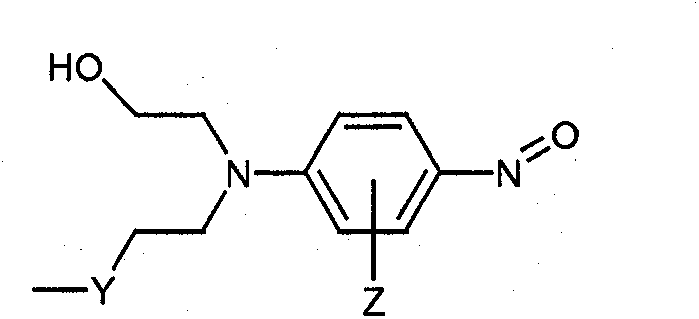
显示通过“Y”的连接的R3的结构可包括:Structures of R3 showing linkage through "Y" may include:

其中Z表示上述结构中的环可任选地被烷基、环烷基、烷氧基、芳烷基、烷芳基、芳胺、芳基亚硝基、氨基、羟基、卤素及其组合单取代、二取代、三取代或四取代,和进一步其中在环的每一碳原子上,所述取代基可以相同或者不同。这样的取代是可能的,条件是没有干扰组合物的有效的粘结或固化。例如,条件是没有干扰亚硝基苯化合物的就地生成。Wherein Z represents that the ring in the above structure can be optionally represented by alkyl, cycloalkyl, alkoxy, aralkyl, alkaryl, arylamine, arylnitroso, amino, hydroxyl, halogen and combinations thereof Substitution, di-substitution, tri-substitution or tetra-substitution, and further wherein on each carbon atom of the ring, the substituents may be the same or different. Such substitutions are possible provided they do not interfere with effective bonding or curing of the composition. For example, provided that the in situ formation of nitrosobenzene compounds is not interfered with.
根据本发明的化合物可具有下述通式结构:Compounds according to the present invention may have the following general structure:

其中n可以是1-5;where n can be 1-5;
“a”可以是1-3,和“b”可以是0-2;“a”可以是1-3,和“b”可以是0-2;但若a=3,则b=0,或者若a=2,则b=1,以便存在至少一个烷氧基;"a" can be 1-3, and "b" can be 0-2; "a" can be 1-3, and "b" can be 0-2; but if a=3, then b=0, or if a=2, then b=1, so that at least one alkoxy group is present;
R1可选自H、C1-C24烷基和C3-C24酰基,优选C1-C4烷基;和其中若a≥1,则至少一个R1不是氢;和 R can be selected from H, C 1 -C 24 alkyl and C 3 -C 24 acyl, preferably C 1 -C 4 alkyl; and wherein if a≥1, at least one R is not hydrogen; and
R2可选自C1-C24烷基和C3-C24酰基,优选C1-C4烷基。R 2 may be selected from C 1 -C 24 alkyl and C 3 -C 24 acyl, preferably C 1 -C 4 alkyl.
X可以是O或S;X can be O or S;
Y可以是-O、-S或-NHx(其中x=1或2)。Y may be -O, -S or -NH x (where x = 1 or 2).
R1可选自C1-C24烷基、C3-C24酰基。R1可选自C1-C24烷基、C3-C24酰基,和“a”可以是3。X可以是O。Y可以是O或-NHx(其中x=1)。R1可选自C1-C4烷基,X可以是O,和“a”是3。R1可选自C1-C4烷基,X可以是O,Y可以是O,和“a”可以是3。R1可选自C1-C4烷基,X可以是O,Y可以是-NHx(其中x=1),和“a”可以是3。R1可选自C1-C4烷基,X可以是O,Y可以是O,n可以是3,和“a”可以是3。R 1 can be selected from C 1 -C 24 alkyl, C 3 -C 24 acyl. R 1 may be selected from C 1 -C 24 alkyl, C 3 -C 24 acyl, and "a" may be 3. X can be O. Y can be O or -NHx (where x=1). R 1 may be selected from C 1 -C 4 alkyl, X may be O, and "a" is 3. R 1 may be selected from C 1 -C 4 alkyl, X may be O, Y may be O, and "a" may be 3. R 1 may be selected from C 1 -C 4 alkyl, X may be O, Y may be -NH x (where x=1), and "a" may be 3. R 1 may be selected from C 1 -C 4 alkyl, X may be O, Y may be O, n may be 3, and "a" may be 3.
在进一步的方面中,本发明提供低聚物型和共低聚物型化合物,它由包含下述结构部分的单体组成:In a further aspect, the present invention provides oligomeric and co-oligomeric compounds consisting of monomers comprising the following moieties:
a)至少一个烷氧基硅烷结构部分;和a) at least one alkoxysilane moiety; and
b)选自芳族亚硝基或芳族亚硝基前体及其组合的至少一个结构部分,b) at least one moiety selected from aromatic nitroso or aromatic nitroso precursors and combinations thereof,
其中共低聚物型化合物由不同单体组成。Wherein the co-oligomer type compound is composed of different monomers.
低聚物型和共低聚物型化合物可由包含下述结构部分的单体组成:Oligomeric and co-oligomeric compounds may consist of monomers comprising the following moieties:
a)至少一个烷氧基硅烷结构部分;和a) at least one alkoxysilane moiety; and
b)选自亚硝基苯或亚硝基苯前体及其组合的至少一个结构部分。b) at least one moiety selected from nitrosobenzene or nitrosobenzene precursors and combinations thereof.
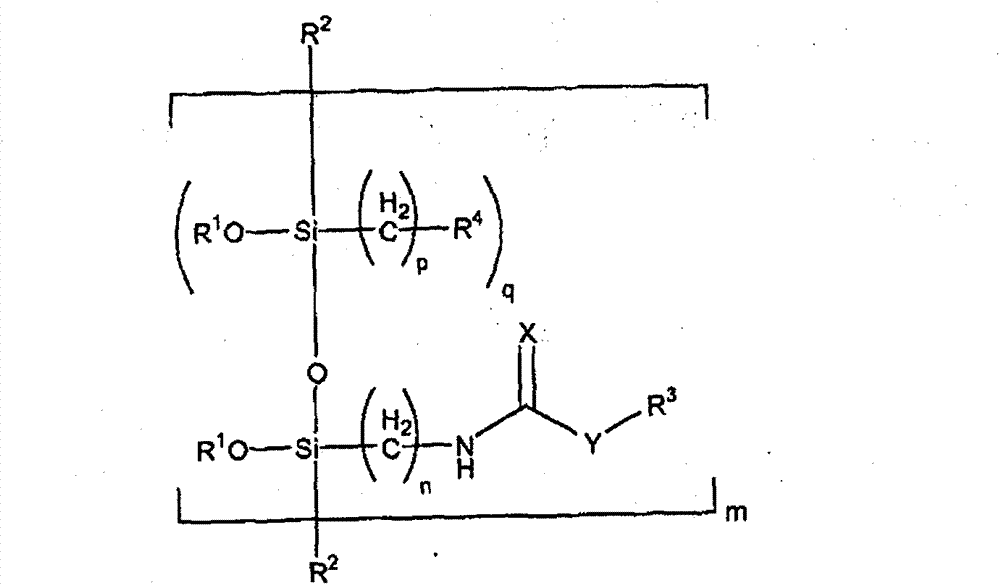
这种低聚物型和共低聚物型化合物可具有下述通式:Such oligomeric and co-oligomeric compounds may have the general formula:
其中m可以是1-100,n可以是1-5;p可以是1-5;q可以是0-50;和若q=0,则m≥2;Wherein m can be 1-100, n can be 1-5; p can be 1-5; q can be 0-50; and if q=0, then m≥2;
R1可选自H、C1-C24烷基、C3-C24酰基,和优选C1-C4烷基; R can be selected from H, C 1 -C 24 alkyl, C 3 -C 24 acyl, and preferably C 1 -C 4 alkyl;
R2可选自OR1、C1-C24烷基和C3-C24酰基,和其中若R2=OR1,则至少一个R1不是氢;R 2 may be selected from OR 1 , C 1 -C 24 alkyl and C 3 -C 24 acyl, and wherein if R 2 =OR 1 , at least one R 1 is not hydrogen;
R4可选自丙烯酸酯、醛、氨基、酸酐、叠氮化物、马来酰亚胺、羧酸根、磺酸根、环氧化物、酯官能的、卤素、羟基、异氰酸酯或封端的异氰酸酯、硫官能的、乙烯基和烯烃官能的或聚合物型的结构; R can be selected from acrylate, aldehyde, amino, anhydride, azide, maleimide, carboxylate, sulfonate, epoxy, ester functional, halogen, hydroxyl, isocyanate or blocked isocyanate, sulfur functional , vinyl and olefin functional or polymeric structures;
X可以是O或S;X can be O or S;
Y可以是-O、-S或-NHx(其中x=1或2);和Y can be -O, -S or -NH x (where x = 1 or 2); and
R3是含亚硝基苯、醌二肟或醌肟的结构部分。 R3 is a nitrosobenzene, quinonedioxime or quinone oxime containing moiety.
R3可以是含此处定义的亚硝基芳族结构或亚硝基芳族结构前体的结构部分。 R3 may be a moiety comprising a nitrosoaromatic structure or a precursor of a nitrosoaromatic structure as defined herein.
R1可选自C1-C24烷基、C3-C24酰基。R1可选自C1-C24烷基、C3-C24酰基,和R2可以是OR1。X可以是O。Y可以是O或-NHx(其中x=1)。R1可选自C1-C4烷基,X可以是O,和R2可以是OR1。R1可选自C1-C4烷基,X可以是O,Y可以是O,和R2可以是OR1。R1可选自C1-C4烷基,X可以是O,Y可以是-NHx(其中x=1),和R2可以是OR1。R1可选自C1-C4烷基,X可以是O,Y可以是O,n可以是3,R2可以是OR1,和R3可以是含亚硝基苯的结构部分。R1可选自C1-C4烷基,X可以是O,Y可以是O,n可以是3,R2可以是OR1,R3可以是含亚硝基苯的结构部分,q可以是0,和n可以是≥2。R1可选自C1-C4烷基,X可以是O,Y可以是O,n可以是3,R2可以是OR1,R3可以是含亚硝基苯的结构部分,q可以是0,m可以是≥2,和R4可以是乙烯基或酯。R 1 can be selected from C 1 -C 24 alkyl, C 3 -C 24 acyl. R 1 may be selected from C 1 -C 24 alkyl, C 3 -C 24 acyl, and R 2 may be OR 1 . X can be O. Y can be O or -NHx (where x=1). R 1 may be selected from C 1 -C 4 alkyl, X may be O, and R 2 may be OR 1 . R 1 may be selected from C 1 -C 4 alkyl, X may be O, Y may be O, and R 2 may be OR 1 . R 1 may be selected from C 1 -C 4 alkyl, X may be O, Y may be -NH x (where x=1), and R 2 may be OR 1 . R 1 may be selected from C 1 -C 4 alkyl, X may be O, Y may be O, n may be 3, R 2 may be OR 1 , and R 3 may be a nitrosobenzene-containing moiety. R 1 can be selected from C 1 -C 4 alkyl, X can be O, Y can be O, n can be 3, R 2 can be OR 1 , R 3 can be a nitrosobenzene-containing moiety, q can be is 0, and n can be ≥2. R 1 can be selected from C 1 -C 4 alkyl, X can be O, Y can be O, n can be 3, R 2 can be OR 1 , R 3 can be a nitrosobenzene-containing moiety, q can be is 0, m can be ≥ 2, and R4 can be vinyl or ester.
本发明的化合物的具体实例包括下述:Specific examples of compounds of the present invention include the following:
(A)的合成的反应流程图如下(所有化合物以类似方法制备):The synthetic reaction scheme of (A) is as follows (all compounds are prepared in a similar way):

将意识到的是,可利用适量的一种或多种如此所述的化合物,配制适合于将金属粘结到橡胶上的组合物。It will be appreciated that compositions suitable for bonding metal to rubber may be formulated using suitable amounts of one or more of the compounds thus described.
因此,还提供用于将基底粘结在一起的组合物,其中该组合物包含:Accordingly, there is also provided a composition for bonding substrates together, wherein the composition comprises:
(i)包含下述结构部分的至少一种化合物:(i) at least one compound comprising the following moieties:
a)至少一个烷氧基硅烷结构部分;和a) at least one alkoxysilane moiety; and
b)选自芳族亚硝基或芳族亚硝基前体及其组合的至少一个结构部分;和b) at least one moiety selected from aromatic nitroso or aromatic nitroso precursors and combinations thereof; and
(ii)该化合物的合适载剂。将意识到的是,可利用任何合适的载剂。希望载剂应当环境友好。这样的组合物适合于在将基底,例如金属基底,粘结到天然或合成橡胶中使用。(ii) A suitable carrier for the compound. It will be appreciated that any suitable carrier may be utilized. It is desirable that the carrier should be environmentally friendly. Such compositions are suitable for use in bonding substrates, such as metal substrates, to natural or synthetic rubber.
所述用于将基底粘结在一起的组合物可包含:The composition for bonding substrates together may comprise:
(i)包含下述结构部分的至少一种化合物(i) at least one compound comprising the following structural moieties
a)至少一个烷氧基硅烷结构部分;和a) at least one alkoxysilane moiety; and
b)选自亚硝基苯或亚硝基苯前体及其组合的至少一个结构部分;和b) at least one moiety selected from nitrosobenzene or nitrosobenzene precursors and combinations thereof; and
(ii)该化合物的合适载剂。(ii) A suitable carrier for the compound.
包括所述至少一个烷氧基硅烷结构部分和所述选自芳族亚硝基或芳族亚硝基前体的至少一个结构部分的化合物的存在量可以是总组合物的1-20%w/w。合适地,所述至少一个芳族亚硝基化合物前体的存在量可以是1-15%w/w,例如4-12%w/w。所述至少一个芳族亚硝基化合物前体的存在量可以为总组合物的6%w/w。The compound comprising said at least one alkoxysilane moiety and said at least one moiety selected from aromatic nitroso or aromatic nitroso precursors may be present in an amount of 1-20% w of the total composition /w. Suitably, said at least one aromatic nitroso compound precursor may be present in an amount of 1-15% w/w, such as 4-12% w/w. The at least one aromatic nitroso compound precursor may be present in an amount of 6% w/w of the total composition.
本发明的组合物可用于其中希望就地形成芳族亚硝基结构部分的任何应用。类似地,本发明的组合物可用于其中希望就地形成芳族二亚硝基结构部分的任何应用。将意识到的是,在这些组合物内,所述化合物可就地反应,以形成亚硝基苯结构部分。还考虑,所述化合物可就地反应,以形成二亚硝基苯结构部分。例如,对于尤其良好的粘结来说,可希望所述化合物就地反应,以形成对亚硝基苯酚结构部分。The compositions of the present invention are useful in any application where it is desired to form an aromatic nitroso moiety in situ. Similarly, the compositions of the present invention may be used in any application where it is desired to form an aromatic dinitroso moiety in situ. It will be appreciated that within these compositions the compounds can react in situ to form nitrosobenzene moieties. It is also contemplated that the compounds can react in situ to form dinitrosobenzene moieties. For example, for particularly good adhesion, it may be desirable for the compounds to react in situ to form p-nitrosophenol moieties.
本发明的组合物可以是单组分组合物。本发明的组合物可以是双组分组合物。The compositions of the invention may be one-component compositions. The compositions of the invention may be two-component compositions.
还提供将两个基底粘结在一起的方法,该方法包括将如此所述的组合物施加到所述基底中至少一个基底的粘结表面上并使得所述基底的粘结表面结合在一起。例如,第一基底可由待粘结到另一基底上的天然或合成橡胶构造。另一或第二基底可以是金属基底。一般地,所述化合物中的烷氧基硅烷结构部分将固着到金属表面上。选自芳族亚硝基或芳族亚硝基前体的结构部分通常将变得固着到橡胶上。类似地,选自亚硝基苯或亚硝基苯前体的结构部分通常将变得固着到橡胶上。因此,所述分子的每一末端被官能化并辅助以坚固和耐久粘结头将所述材料粘结在一起。Also provided is a method of bonding two substrates together, the method comprising applying a composition as described above to the bonding surface of at least one of the substrates and bonding the bonding surfaces of the substrates together. For example, a first substrate may be constructed of natural or synthetic rubber to be bonded to another substrate. The other or second substrate may be a metal substrate. Typically, the alkoxysilane moiety in the compound will anchor to the metal surface. Moieties selected from aromatic nitroso groups or aromatic nitroso precursors will generally become anchored to the rubber. Similarly, moieties selected from nitrosobenzene or nitrosobenzene precursors will generally become anchored to the rubber. Thus, each end of the molecule is functionalized and assists in bonding the materials together with a strong and durable bond.
因此,通过将未固化状态下的聚合物材料施加到涂覆有粘合剂组合物的金属上,并固化在其上的所述聚合物材料以将其粘结到所述金属上,从而可将涂覆有如此所述的粘合剂组合物的金属粘附到聚合物材料,例如橡胶组合物上。在橡胶聚合物材料的情况下,可在将橡胶固化的时间段内,借助加热和压力而硫化所述未固化的橡胶,从而导致将橡胶粘结到金属上。Thus, by applying a polymer material in an uncured state to a metal coated with an adhesive composition, and curing said polymer material thereon to bond it to said metal, Metal coated with an adhesive composition as described herein is adhered to a polymeric material, such as a rubber composition. In the case of rubbery polymer materials, the uncured rubber may be vulcanized with heat and pressure during the period of time the rubber is cured, resulting in bonding of the rubber to the metal.
通过能与聚合物,尤其与聚合物链内具有链烯烃/烯丙基类官能度团的聚合物反应的亚硝基,实现对金属的这种粘结。例如,在聚合物链内的二烯烃或烯丙基类官能团。这一反应例如在亚硝基和橡胶材料之间产生多种交联点。据认为,本发明的材料减少了游离亚硝基,因为亚硝基在分子结构内。在亚硝基和硅烷的反应中,亚硝基与天然橡胶内的链烯烃官能团反应,同时硅烷与金属形成粘结头。This bonding to metals is achieved through nitroso groups that are reactive with polymers, especially polymers with olefinic/allylic functionality within the polymer chain. For example, diene or allylic functional groups within the polymer chain. This reaction creates, for example, various crosslinking points between the nitroso groups and the rubber material. It is believed that the materials of the present invention reduce free nitroso groups because the nitroso groups are within the molecular structure. In the nitroso and silane reaction, the nitroso reacts with the alkene functional groups in natural rubber, while the silane forms a bond with the metal.
已知二亚硝基苯在粘合剂配方中是非常有效的交联剂,和常常导致特征在于高的永久强度和高的耐侵蚀性介质的粘结头。然而,如果发生组合物随后的热处理,未反应的游离亚硝基材料,例如二亚硝基苯,可能引起继续硫化,从而导致不想要的粘结头脆化。对于不提供二亚硝基苯释放的本发明实施方案来说,可减轻后一问题,因为下述事实:亚硝基和硅烷的反应产物会不含游离亚硝基材料,例如二亚硝基苯,因此不会自由地经历进一步的硫化。降低与常规体系有关的危险也是重要的。Dinitrosobenzene is known to be a very effective crosslinker in adhesive formulations and often leads to bonded joints characterized by high permanent strength and high resistance to aggressive media. However, if subsequent heat treatment of the composition occurs, unreacted free nitroso material, such as dinitrosobenzene, may cause continued vulcanization, leading to unwanted embrittlement of the bond joint. The latter problem can be mitigated for embodiments of the invention that do not provide dinitrosobenzene release due to the fact that the reaction product of nitroso and silane will be free of free nitroso material such as dinitroso Benzene and therefore are not free to undergo further sulfidation. It is also important to reduce the risks associated with conventional systems.
可在本发明中应用硅烷的组合。例如,可在本发明的组合物内包括一种或多种额外的硅烷。这些硅烷一般具有下式:Combinations of silanes may be employed in the present invention. For example, one or more additional silanes may be included in the compositions of the present invention. These silanes generally have the formula:
其中:in:
n为1或2;n is 1 or 2;
y=(2-n);y=(2-n);
每一R1可选自C1-C24烷基或C2-C24酰基;Each R 1 may be selected from C 1 -C 24 alkyl or C 2 -C 24 acyl;
每一R2可选自C1-C30脂族基团、取代的C3-C30芳族基团或未取代的C3-C30芳族基团;Each R 2 may be selected from a C 1 -C 30 aliphatic group, a substituted C 3 -C 30 aromatic group or an unsubstituted C 3 -C 30 aromatic group;
R5可选自氢、C1-C10亚烷基、被一个或多个氨基取代的C1-C10亚烷基、被一个或多个氨基取代的C2-C10亚链烯基、C6-C10亚芳基或C7-C20烷基亚芳基;R 5 can be selected from hydrogen, C 1 -C 10 alkylene, C 1 -C 10 alkylene substituted by one or more amino groups, C 2 -C 10 alkenylene substituted by one or more amino groups , C 6 -C 10 arylene or C 7 -C 20 alkyl arylene;
X是任选的且是下述任一种:X is optional and is any of the following:

其中每一R3可选自氢、C1-C30脂族基团或C6-C30芳族基团;和wherein each R 3 may be selected from hydrogen, a C 1 -C 30 aliphatic group or a C 6 -C 30 aromatic group; and
R4可选自C1-C30脂族基团或C6-C30芳族基团;和R 4 may be selected from a C 1 -C 30 aliphatic group or a C 6 -C 30 aromatic group; and
其中若n=1,则R3和R5中的至少一个不是氢。Wherein if n=1, then at least one of R3 and R5 is not hydrogen.
在一个实施方案中,存在X。将意识到的是,若X不存在,则硅烷可具有下述通式:In one embodiment, X is present. It will be appreciated that if X is absent, the silane may have the general formula:

优选的硅烷包括双甲硅烷基硅烷,例如具有两个三取代的甲硅烷基的那些。取代基可个别地选自C1-C20烷氧基、C6-C30芳氧基和C2-C30酰氧基。在本发明中使用的合适的双甲硅烷基硅烷包括:Preferred silanes include bissilylsilanes, such as those having two trisubstituted silyl groups. The substituents may be individually selected from C 1 -C 20 alkoxy, C 6 -C 30 aryloxy and C 2 -C 30 acyloxy. Suitable bissilylsilanes for use in the present invention include:

其中:in:
每一R1可选自C1-C24烷基或C2-C24酰基;Each R 1 may be selected from C 1 -C 24 alkyl or C 2 -C 24 acyl;
每一R2可选自C1-C20脂族基团或C6-C30芳族基团;Each R 2 may be selected from a C 1 -C 20 aliphatic group or a C 6 -C 30 aromatic group;
X是任选的且是下述任一种:X is optional and is any of the following:

其中每一R3可选自氢、C1-C20脂族基团或C6-C30芳族基团;和wherein each R 3 may be selected from hydrogen, a C 1 -C 20 aliphatic group or a C 6 -C 30 aromatic group; and
R4可选自C1-C20脂族基团或C6-C30芳族基团。R 4 may be selected from a C 1 -C 20 aliphatic group or a C 6 -C 30 aromatic group.
在一个实施方案中,存在X。如将意识到的是,若X不存在,则双硅烷可具有下述通式:In one embodiment, X is present. As will be appreciated, if X is absent, the bissilane can have the following general formula:

本发明包括的一些双甲硅烷基氨基硅烷的实例包括:双-(三甲氧基甲硅烷基丙基)胺、双-(三乙氧基甲硅烷基丙基)胺、双-(三乙氧基甲硅烷基丙基)乙二胺、N-[2-(乙烯基苄基氨基)乙基]-3-氨丙基三甲氧基硅烷和氨乙基-氨丙基三甲氧基硅烷。可相对于本发明的化合物,包括范围为1∶3-3∶1的这些额外的硅烷。这种混合可导致优异的橡胶对金属的粘结。Examples of some bissilylaminosilanes encompassed by the present invention include: bis-(trimethoxysilylpropyl)amine, bis-(triethoxysilylpropyl)amine, bis-(triethoxysilylpropyl)amine, bis-(triethoxysilylpropyl)amine, silylpropyl)ethylenediamine, N-[2-(vinylbenzylamino)ethyl]-3-aminopropyltrimethoxysilane and aminoethyl-aminopropyltrimethoxysilane. These additional silanes may be included in the range of 1:3 to 3:1 relative to the compounds of the invention. This mixing results in excellent rubber-to-metal bonding.
特别地,除了亚硝基硅烷以外还包括氨基双(丙基三甲氧基硅烷)显著增强橡胶对金属的粘结头强度。据认为,氨基双(丙基三甲氧基硅烷)在配方内具有多重功能。这包括辅助成膜和“润湿”金属表面。In particular, the inclusion of aminobis(propyltrimethoxysilane) in addition to the nitrososilane significantly enhanced the rubber-to-metal bond strength. Aminobis(propyltrimethoxysilane) is believed to serve multiple functions within the formulation. This includes assisting in film formation and "wetting" metal surfaces.
硅烷的存在量可以是总组合物的1-10%w/w。合适地,硅烷的存在量可以是1-5%w/w,例如1-3%w/w。硅烷的存在量可以是总组合物的3%w/w。The silane may be present in an amount of 1-10% w/w of the total composition. Suitably the silane may be present in an amount of 1-5% w/w, such as 1-3% w/w. The silane may be present in an amount of 3% w/w of the total composition.
本发明与现有技术之间的显著区别是,在本发明中,硅烷可以“显著未水解”,这意味着它们以未水解状态利用。其产生是因为该材料可纯地和/或没有任何水存在的情况下施加。A significant difference between the present invention and the prior art is that in the present invention the silanes can be "substantially unhydrolyzed", which means that they are utilized in an unhydrolyzed state. This arises because the material can be applied neat and/or without any water present.
氨基硅烷和亚硝基硅烷可独立地水解和/或混合并水解,以形成最终的硅烷溶液。5%的水溶液通常足以有效地水解硅烷。或者,可将硅烷加入到纯的溶剂中,所述溶剂如接收时原样使用,而没有为了故意促进水解而添加水。Aminosilanes and nitrososilanes can be hydrolyzed independently and/or mixed and hydrolyzed to form the final silane solution. A 5% aqueous solution is usually sufficient to effectively hydrolyze silanes. Alternatively, the silane can be added to the neat solvent, which is used as received without the addition of water to deliberately facilitate hydrolysis.
一般地,施加到金属基底上的最终的硅烷溶液可在硅烷浓度和比例(氨基硅烷与亚硝基硅烷之比)方面在宽范围内变化,且仍然提供有益的结果。最终的溶液应当含有至少约0.1%体积的总硅烷浓度,即在最终溶液中氨基硅烷和亚硝基硅烷的组合的浓度。硅烷浓度为约0.1%-约10%体积的溶液通常提供坚固的粘结而没有浪费有价值的硅烷。In general, the final silane solution applied to the metal substrate can vary widely in silane concentration and ratio (aminosilane to nitrososilane ratio) and still provide beneficial results. The final solution should contain a total silane concentration of at least about 0.1% by volume, ie, the concentration of the combination of aminosilanes and nitrososilanes in the final solution. Solutions with silane concentrations of about 0.1% to about 10% by volume generally provide strong bonds without wasting valuable silane.
可通过使用如此所述的化合物和组合物,以硅烷溶液的最小浪费实现聚合物材料,例如橡胶组合物,和金属之间的优异的粘合。关于在粘合剂应用中它们的使用,本发明的组合物通常比传统的用于橡胶对金属粘结的粘合剂体系中存在的组合物薄,而没有丧失工艺性能特性。组合物的厚度可通过亚硝基和硅烷的反应产物的浓度决定,且范围为0.1-12微米,和更优选范围为0.5-10微米。Excellent adhesion between polymeric materials, such as rubber compositions, and metals can be achieved with minimal waste of silane solution by using the compounds and compositions thus described. With regard to their use in adhesive applications, the compositions of the present invention are generally thinner than those present in conventional adhesive systems for rubber-to-metal bonding, without loss of process performance characteristics. The thickness of the composition can be determined by the concentration of the reaction product of nitroso groups and silanes, and is in the range of 0.1-12 microns, and more preferably in the range of 0.5-10 microns.
许多不同的金属可用本发明所述的组合物处理,并可被粘结到聚合物材料上。这些金属包括,但不限于,锌和锌合金,例如锌-镍和锌-钴合金,具有含锌涂层的金属基底,钢,和尤其冷轧钢和碳钢,铝和铝合金,铜和铜合金,例如黄铜,以及锡和锡合金,包括具有含锡涂层的金属基底。Many different metals can be treated with the compositions of the present invention and bonded to polymeric materials. These metals include, but are not limited to, zinc and zinc alloys, such as zinc-nickel and zinc-cobalt alloys, metal substrates with zinc-containing coatings, steel, and especially cold-rolled and carbon steel, aluminum and aluminum alloys, copper and Copper alloys, such as brass, and tin and tin alloys, including metal substrates with tin-containing coatings.
详述detail
在使用本发明中所述的方法进行橡胶对金属的粘结中涉及的橡胶组合物可进一步包括对于橡胶组合物常见的已知添加剂。这些包括增强炭黑;无活性的填料,例如碳酸钙、白垩、滑石、或金属氧化物;加速剂体系;硫化延迟剂;促进剂,例如氧化锌或硬脂酸;增塑剂,例如芳族、链烷属、环烷属和合成的矿物油;老化、光防护、臭氧防护、疲劳、着色和加工助剂;和硫。相对于100重量份橡胶组合物,通常这些添加剂的存在量可以是约0.1份-约80份。The rubber composition involved in rubber-to-metal bonding using the method described in this invention may further include known additives common to rubber compositions. These include reinforcing carbon black; inactive fillers such as calcium carbonate, chalk, talc, or metal oxides; accelerator systems; vulcanization retardants; accelerators such as zinc oxide or stearic acid; plasticizers such as aromatic , paraffinic, naphthenic, and synthetic mineral oils; aging, light protection, ozone protection, fatigue, coloring, and processing aids; and sulfur. Typically these additives may be present in an amount from about 0.1 parts to about 80 parts by weight relative to 100 parts by weight of the rubber composition.
通常在pH范围为3-7内有效地发生水解,形成硅烷醇基,即SiOH。在这一范围以上或以下的pH下,可通过其中硅烷醇自缩合形成硅氧烷的方法,发生硅烷的缩合。在这一方法过程中,相邻分子的羟基分子彼此反应,以消除水分子并形成含-Si-O-Si-O-Si-官能团的交联的硅氧烷结构。Hydrolysis typically occurs efficiently in the pH range of 3-7 to form silanol groups, ie SiOH. At pH's above or below this range, condensation of silanes can occur by a process in which silanols self-condense to form siloxanes. During this process, hydroxyl molecules of adjacent molecules react with each other to eliminate water molecules and form cross-linked siloxane structures containing -Si-O-Si-O-Si-functional groups.
为了加速硅烷水解和抑制在水解步骤过程中的的硅烷缩合,硅烷溶液的pH可维持低于约7,和优选在约4-6.5的温和酸性范围内(尤其对于双甲硅烷基氨基硅烷的水解来说)。这可通过添加一种或多种相容的酸来实现。例如,有机酸,例如乙酸、草酸、甲酸、丙酸,可加入到水解溶液中,以调节pH。当需要时,也可使用氢氧化钠或其他相容的碱,以提高硅烷溶液的pH。一些硅烷当与水混合时,提供温和酸性的pH溶液,不可能需要pH调节来加速水解。相对于制备硅烷水解溶液所讨论的pH范围不应当与施加到金属基底上的最终硅烷溶液的pH相混淆。In order to accelerate silane hydrolysis and inhibit silane condensation during the hydrolysis step, the pH of the silane solution can be maintained below about 7, and preferably in the mildly acidic range of about 4-6.5 (especially for the hydrolysis of bissilylaminosilane for). This can be achieved by adding one or more compatible acids. For example, organic acids, such as acetic acid, oxalic acid, formic acid, propionic acid, can be added to the hydrolysis solution to adjust the pH. Sodium hydroxide or other compatible bases may also be used to raise the pH of the silane solution when desired. Some silanes, when mixed with water, provide mildly acidic pH solutions and may not require pH adjustment to accelerate hydrolysis. The pH ranges discussed with respect to the preparation of the silane hydrolysis solution should not be confused with the pH of the final silane solution applied to the metal substrate.
水解硅烷溶液可进一步包括一种或多种相容的溶剂。醇通常用于增溶和水解硅烷。合适的醇包括,但不限于,甲醇、乙醇、正丙醇、异丙醇、正丁醇、仲丁醇、叔丁醇和更长链的脂族醇。在经水解的硅烷溶液中水与溶剂之比(如施加到金属基底上那样,按体积计)可以是约1∶99-约99∶1,和优选1∶1-1∶20。The hydrolyzed silane solution may further include one or more compatible solvents. Alcohols are often used to solubilize and hydrolyze silanes. Suitable alcohols include, but are not limited to, methanol, ethanol, n-propanol, isopropanol, n-butanol, sec-butanol, t-butanol, and longer chain aliphatic alcohols. The ratio of water to solvent (by volume as applied to the metal substrate) in the hydrolyzed silane solution can be from about 1:99 to about 99:1, and preferably from 1:1 to 1:20.
在施加硅烷溶液之前,可清洁待涂覆的金属表面,以允许更好的粘合。例如,用溶剂或碱性材料清洁。然后可通过多种方法,包括浸涂、喷涂、刷涂或擦拭溶液到金属上,进行施加。已经建议,为了改进橡胶粘合,在硫化之前,涂层保持部分交联。由于这一原因,通常在室温下空气干燥所述涂层,因为加热干燥可引起更高的交联度,其将导致在橡胶和金属表面之间更差的粘合。Before applying the silane solution, the metal surface to be coated may be cleaned to allow better adhesion. For example, cleaning with solvents or alkaline materials. Application can then be by a variety of methods including dipping, spraying, brushing or wiping the solution onto the metal. It has been suggested that, in order to improve rubber adhesion, the coating remains partially crosslinked prior to vulcanization. For this reason, the coating is usually air dried at room temperature, since heat drying can cause a higher degree of crosslinking, which will lead to poorer adhesion between the rubber and the metal surface.
如下所述制备本发明的化合物:Compounds of the invention are prepared as follows:
具体实施方式 Detailed ways
实施例Example
根据下述实验程序,和如上文所述反应流程图中所例示,合成化合物A、B、C和D(上文)。Compounds A, B, C and D (above) were synthesized according to the experimental procedures described below, and as exemplified in the reaction schemes described above.
根据J.J D′Amico,C.C.Tung和L.A.Walker,J.Am.Chem.Soc.,5957(1959)所述,进行反应(1)(见上文)。Reaction (1) was carried out as described by J.J D'Amico, C.C. Tung and L.A. Walker, J.Am.Chem.Soc., 5957 (1959) (supra).
反应(2):在50ml圆底烧瓶中,在10ml无水THF内,将γ-异氰酸丙酯基三乙氧基硅烷(GE Bayer Silicones A-1310)(2.35g,9.5mmol)溶剂化。用氮气冲洗反应烧瓶,并向其中装入N,N-双-(2-羟乙基)-4-亚硝基-苯胺(2g,9.5mmol),接着装入催化量的二月桂酸二丁锡(1.5μmol)。在氮气下,将反应回流额外2小时。使用红外光谱,监控异氰酸酯的消耗(2275cm-1)。在减压下除去溶剂,以定量的收率得到产物。Reaction (2): In a 50 ml round bottom flask, γ-isocyanatopropyl triethoxysilane (GE Bayer Silicones A-1310) (2.35 g, 9.5 mmol) was solvated in 10 ml dry THF . The reaction flask was flushed with nitrogen and charged with N,N-bis-(2-hydroxyethyl)-4-nitroso-aniline (2 g, 9.5 mmol) followed by a catalytic amount of dibutyl dilaurate Tin (1.5 μmol). The reaction was refluxed for an additional 2 hours under nitrogen. Using infrared spectroscopy, the consumption of isocyanate (2275 cm −1 ) was monitored. The solvent was removed under reduced pressure to give the product in quantitative yield.

反应3:在50ml圆底烧瓶中,在8ml无水THF内,将γ-异氰酸丙酯基三甲氧基硅烷(ABCR GmbH)(1.5g,7.3mmol)溶剂化。用氮气冲洗反应烧瓶,并向其中装入N,N-双-(2-羟乙基)-4-亚硝基-苯胺(1.53g,7.3mmol),接着装入催化量的二月桂酸二丁锡(1μmol)。在氮气下,将反应回流额外2小时。使用红外光谱,监控异氰酸酯的消耗(2275cm-1)。在减压下除去溶剂,以定量的收率得到产物。Reaction 3: Gamma-isocyanatopropyltrimethoxysilane (ABCR GmbH) (1.5 g, 7.3 mmol) was solvated in 8 ml anhydrous THF in a 50 ml round bottom flask. The reaction flask was flushed with nitrogen and charged with N,N-bis-(2-hydroxyethyl)-4-nitroso-aniline (1.53 g, 7.3 mmol), followed by a catalytic amount of dilauric acid di Butyl tin (1 μmol). The reaction was refluxed for an additional 2 hours under nitrogen. Using infrared spectroscopy, the consumption of isocyanate (2275 cm −1 ) was monitored. The solvent was removed under reduced pressure to give the product in quantitative yield.

反应4:在50ml圆底烧瓶中,在10ml无水THF内,将γ-异氰酸丙酯基三乙氧基硅烷(GE Bayer Silicones A-1310)(2.35g,9.5mmol)溶剂化。用氮气冲洗反应烧瓶,并向其中装入N,N-双-(2-羟乙基)-4-亚硝基-苯胺(1g,4.75mmol),接着装入催化量的二月桂酸二丁锡(1.5μmol)。在氮气下,将反应回流额外5小时。使用红外光谱,监控异氰酸酯的消耗(2275cm-1)。在减压下除去溶剂,以定量的收率得到产物。Reaction 4: Gamma-isocyanatopropyltriethoxysilane (GE Bayer Silicones A-1310) (2.35 g, 9.5 mmol) was solvated in 10 ml dry THF in a 50 ml round bottom flask. The reaction flask was flushed with nitrogen and charged with N,N-bis-(2-hydroxyethyl)-4-nitroso-aniline (1 g, 4.75 mmol) followed by a catalytic amount of dibutyl dilaurate Tin (1.5 μmol). The reaction was refluxed for an additional 5 hours under nitrogen. Using infrared spectroscopy, the consumption of isocyanate (2275 cm −1 ) was monitored. The solvent was removed under reduced pressure to give the product in quantitative yield.


反应5:在100ml圆底烧瓶中,在30ml无水THF内,将γ-异氰酸丙酯基三乙氧基硅烷(GE Bayer Silicones A-1310)(10.68g,43.18mmol)溶剂化。用氮气冲洗反应烧瓶,并向其中装入对苯醌二肟(Sigma-Aldrich)(3g,21.72mmol),接着装入催化量的二月桂酸二丁锡。在氮气下,将反应回流额外5小时。使用红外光谱,监控异氰酸酯的消耗(2275cm-1)。在减压下除去溶剂,以定量的收率得到产物。Reaction 5: Gamma-isocyanatopropyltriethoxysilane (GE Bayer Silicones A-1310) (10.68 g, 43.18 mmol) was solvated in 30 ml dry THF in a 100 ml round bottom flask. The reaction flask was flushed with nitrogen and charged with p-benzoquinone dioxime (Sigma-Aldrich) (3 g, 21.72 mmol) followed by a catalytic amount of dibutyltin dilaurate. The reaction was refluxed for an additional 5 hours under nitrogen. Using infrared spectroscopy, the consumption of isocyanate (2275 cm −1 ) was monitored. The solvent was removed under reduced pressure to give the product in quantitative yield.
如下所述,制备包含本发明化合物的配方,其中化合物A至C是如以上在发明概述中列出的本发明的化合物。化合物E是双(三甲氧基甲硅烷基丙基)胺-可商购于Sigma Aldrich。化合物E具有下式:Formulations comprising compounds of the invention, wherein compounds A to C are compounds of the invention as listed above in the Summary of the Invention, were prepared as described below. Compound E is bis(trimethoxysilylpropyl)amine - commercially available from Sigma Aldrich. Compound E has the formula:

天然橡胶组合物natural rubber composition
使用下述组成的天然橡胶,进行试验:The test was carried out using natural rubber of the following composition:
(a)NR SMR CV 60;(b)SRF N762黑;(c)Oil Strukthene 410;(d)FlectolH;(e)Santoflex 13(HPPD);(f)Sunproof Improved Wax;(g)硫化促进剂,N-环己基-2-苯并噻唑。 (a) NR SMR CV 60; (b) SRF N762 black; (c) Oil Strukthene 410; (d) FlectolH; (e) Santoflex 13 (HPPD); (f) Sunproof Improved Wax; N-cyclohexyl-2-benzothiazole.
EPDM橡胶组合物EPDM rubber composition
使用下述组成的EPDM橡胶,进行试验:The following composition of EPDM rubber was used for the test:
(a)Buna EP G 3850;(b)Buna EP G 3963;(c)Trilene 65;(d)Dicup 40C;(e)Carbowax 400。 (a) Buna EP G 3850; (b) Buna EP G 3963; (c) Trilene 65; (d) Dicup 40C; (e) Carbowax 400.
在天然橡胶对金属的粘结中所使用的组合物Compositions for use in natural rubber to metal bonding

(a)双(三甲氧基甲硅烷基丙基)胺;(b)氯磺化聚乙烯(DuPontPerformance Elastomers);(c)氯化天然橡胶(Bayer MaterialScience);(d)如接收时原样使用;(e)用乙酸调节到pH 4-5的乙醇∶水(95∶5)。 (a) bis(trimethoxysilylpropyl)amine; (b) chlorosulfonated polyethylene (DuPont Performance Elastomers); (c) chlorinated natural rubber (Bayer MaterialScience); (d) used as received; (e) Ethanol:water (95:5) adjusted to pH 4-5 with acetic acid.
在EPDM橡胶对金属的粘结中所使用的组合物Compositions used in EPDM rubber to metal bonding

(a)氯磺化聚乙烯(DuPont Performance Elastomers);(b)如接收时原样使用;(c)亲水的热解法二氧化硅;(d)磷酸铝锌水合物;(e)N,N’-4,4’-二苯甲烷双马来酰亚胺;(f)甲阶酚醛树脂。 (a) Chlorosulfonated polyethylene (DuPont Performance Elastomers); (b) Use as received; (c) Hydrophilic fumed silica; (d) Aluminum zinc phosphate hydrate; (e) N, N'-4,4'-Diphenylmethane bismaleimide; (f) Resole phenolic resin.
测试test
为了评估本发明粘合剂体系在将橡胶粘结到金属表面上的效力,根据调节到45度角的ASTM 429-B标准,进行一系列试验。用所述粘合剂涂覆金属基底(2.54cm(1英寸)宽,10.16cm(4英寸)长的面板或试件),并在硫化工艺中将其粘附到天然橡胶上。天然橡胶组合物是在配方表中列出的硫固化的组合物。In order to evaluate the effectiveness of the adhesive system of the present invention in bonding rubber to metal surfaces, a series of tests were performed according to the ASTM 429-B standard adjusted to an angle of 45 degrees. Metal substrates (2.54 cm (1 inch) wide by 10.16 cm (4 inch) long panels or test pieces) were coated with the adhesive and adhered to natural rubber in a vulcanization process. The natural rubber composition is the sulfur cured composition listed in the formulation table.
金属基底在自动化含水碱性清洁剂中超声清洁,用去离子水清洗,和用热空气吹干。基底也可以使用合适的磨蚀剂喷砂处理。Metal substrates were ultrasonically cleaned in an automated aqueous alkaline cleaner, rinsed with deionized water, and dried with hot air. The substrate may also be grit blasted with a suitable abrasive.
在施加粘合剂之前,遮盖金属试件两端上的2.54cm(1英寸)长和2.54cm宽(1英寸),以防止该区域可用于粘结到橡胶上,留下2.54cm(1英寸)宽和5.08cm(2英寸)长的中心区域以供粘结到橡胶上。Before applying the adhesive, mask 2.54 cm (1 inch) long and 2.54 cm wide (1 inch) on both ends of the metal test piece to prevent this area from being available for bonding to rubber, leaving 2.54 cm (1 inch) ) wide and 5.08 cm (2 inches) long center area for bonding to rubber.
在本发明的粘结操作中,优选在清洁基底之后,通过浸涂、喷涂或刷涂方法,将组合物施加到金属基底上,以确保均匀的覆盖率。In the bonding operation of the present invention, the composition is applied to the metal substrate by dipping, spraying or brushing methods, preferably after cleaning the substrate, to ensure uniform coverage.
可在环境条件下,亦即室温下,进行干燥。可通过加热、强制空气或二者,提高溶剂的蒸发速率。Drying may be performed under ambient conditions, ie at room temperature. The rate of solvent evaporation can be increased by heating, forced air, or both.
然后,将未固化橡胶层置于每一试件上,并在标准的液压硫化压机内固化以橡胶固化曲线所规定的时间段。在本发明的粘结工艺中使用的天然橡胶的情况下,橡胶在150℃下,在20-30吨的压力下固化20分钟,以确保待被粘结的表面和粘合剂的紧密接触。A layer of uncured rubber was then placed on each test piece and cured in a standard hydraulic vulcanization press for the time period specified by the rubber cure curve. In the case of natural rubber used in the bonding process of the present invention, the rubber is cured at 150° C. for 20 minutes under a pressure of 20-30 tons to ensure intimate contact between the surfaces to be bonded and the adhesive.
在固化之后,将经粘结的样品在室温下老化24小时,之后进行测试,和标注撕裂图案。通过45度角改进的ASTM 429-B标准,使用Instron试验设备(Instron测试仪,型号5500R),在50mm/min的稳态负载速率下,测试每一样品,直到分离完全。After curing, the bonded samples were aged at room temperature for 24 hours before being tested and noted for tear patterns. Each sample was tested using an Instron test apparatus (Instron Tester, Model 5500R) at a steady state load rate of 50mm/min through the modified ASTM 429-B standard at a 45 degree angle until separation was complete.
“橡胶覆盖率”是在剥离测试之后,在粘结的金属基底上残留的橡胶百分数。100%橡胶破坏是指橡胶完全破坏,而没有橡胶部分从金属表面上剥离掉(和相当于100%橡胶破坏)。"Rubber Coverage" is the percentage of rubber remaining on the bonded metal substrate after the peel test. 100% rubber failure means complete failure of the rubber with no parts of the rubber peeled off from the metal surface (and equivalent to 100% rubber failure).
一般地,希望在金属对橡胶的粘结头破坏之前橡胶基底破坏。采用以上列出的某些配方,实现了该结果。In general, it is desirable for the rubber substrate to fail before the metal-to-rubber bond fails. This result was achieved with some of the formulations listed above.
当本文关于本发明而使用时的措辞“含、包含”和措辞“具有/包括”用于说明存在所述的特征、整数、步骤或组分,但不排除一种或多种其他特征、整数、步骤、部分或其组的存在或添加。When used herein in relation to the present invention, the words "comprising, comprising" and the words "having/comprising" are used to describe the presence of stated features, integers, steps or components, but not to the exclusion of one or more other features, integers , the presence or addition of steps, parts or groups thereof.
应意识到的是,为了清楚起见在单独的实施方案上下文中描述的本发明的某些特征也可在单一的实施方案中组合提供。相反,为了简短起见在单一实施方案上下文中描述的本发明的各种特征也可单独或以任何合适的子组合形式提供。It is appreciated that certain features of the invention, which are, for clarity, described in the context of separate embodiments, may also be provided in combination in a single embodiment. Conversely, various features of the invention which are, for brevity, described in the context of a single embodiment, may also be provided separately or in any suitable subcombination.
Claims (21)



Applications Claiming Priority (3)
| Application Number | Priority Date | Filing Date | Title |
|---|---|---|---|
| US12/055,908 | 2008-03-26 | ||
| US12/055,908 US8153268B1 (en) | 2008-03-26 | 2008-03-26 | Polymer to metal bonding and compounds and compositions useful therefor |
| PCT/EP2009/053098 WO2009118255A1 (en) | 2008-03-26 | 2009-03-16 | Polymer to metal bonding and compounds and compositions useful therefor |
Publications (2)
| Publication Number | Publication Date |
|---|---|
| CN101977955A CN101977955A (en) | 2011-02-16 |
| CN101977955B true CN101977955B (en) | 2014-02-12 |
Family
ID=40996825
Family Applications (1)
| Application Number | Title | Priority Date | Filing Date |
|---|---|---|---|
| CN200980109605.1A Active CN101977955B (en) | 2008-03-26 | 2009-03-16 | Bonding of polymers to metals and compounds and compositions useful for such bonding |
Country Status (10)
| Country | Link |
|---|---|
| US (1) | US8153268B1 (en) |
| EP (1) | EP2268693B1 (en) |
| JP (1) | JP5706312B2 (en) |
| KR (1) | KR101434002B1 (en) |
| CN (1) | CN101977955B (en) |
| BR (1) | BRPI0909156A2 (en) |
| CA (1) | CA2719094C (en) |
| ES (1) | ES2643689T3 (en) |
| RU (1) | RU2513018C9 (en) |
| WO (1) | WO2009118255A1 (en) |
Families Citing this family (11)
| Publication number | Priority date | Publication date | Assignee | Title |
|---|---|---|---|---|
| EP2475705B1 (en) * | 2009-09-11 | 2015-07-22 | Henkel IP & Holding GmbH | Bonding compositions |
| KR101583394B1 (en) * | 2009-09-11 | 2016-01-07 | 헨켈 아이피 앤드 홀딩 게엠베하 | Compositions for polymer bonding |
| GB201004101D0 (en) * | 2010-03-12 | 2010-04-28 | Carmeda Ab | Immobilised biological entities |
| JP6093863B2 (en) * | 2012-09-14 | 2017-03-08 | ヘンケル・アクチェンゲゼルシャフト・ウント・コムパニー・コマンディットゲゼルシャフト・アウフ・アクチェンHenkel AG & Co. KGaA | Improved adhesive composition comprising sulfur impregnated particulate solid |
| CN104781329B (en) * | 2012-09-14 | 2018-11-09 | 汉高知识产权控股有限责任公司 | Improved cementing compositions |
| WO2014104195A1 (en) * | 2012-12-28 | 2014-07-03 | 大阪有機化学工業株式会社 | Adhesion-improving agent and silane compound |
| GB2517443A (en) * | 2013-08-20 | 2015-02-25 | Henkel IP & Holding GmbH | Improved bonding or vulcanisation compositions |
| RU2593645C2 (en) * | 2014-09-11 | 2016-08-10 | Общество с ограниченной ответственностью "Константа-2" (ООО "Константа-2") | Anticorrosive composition |
| CN107567486A (en) | 2015-05-01 | 2018-01-09 | 洛德公司 | Adhesive for rubber bonding |
| CN105670548B (en) * | 2016-03-01 | 2018-10-26 | 沈阳化工大学 | A kind of natural rubber/styrene-butadiene rubber metal fever vulcanizing adhesive |
| JP7457314B2 (en) * | 2019-12-10 | 2024-03-28 | 横浜ゴム株式会社 | Compound and method for producing the compound |
Citations (2)
| Publication number | Priority date | Publication date | Assignee | Title |
|---|---|---|---|---|
| US4031120A (en) * | 1974-09-17 | 1977-06-21 | Lord Corporation | Isocyanatosilane adducts |
| EP1167455A2 (en) * | 2000-06-30 | 2002-01-02 | Shin-Etsu Chemical Co., Ltd. | Room temperature rapid-curable silicone composition |
Family Cites Families (18)
| Publication number | Priority date | Publication date | Assignee | Title |
|---|---|---|---|---|
| US2A (en) * | 1826-12-15 | 1836-07-29 | John Goulding | Mode of manufacturing wool or other fibrous materials |
| US2386452A (en) | 1942-09-25 | 1945-10-09 | Corning Glass Works | Organo silicon compounds and method of making them |
| US3542639A (en) | 1967-01-26 | 1970-11-24 | Lord Corp | Rubber-to-metal adhesive and its use |
| CA1088696A (en) * | 1974-09-17 | 1980-10-28 | Nicholas J. Gervase | Isocyanto-functional organo silanes and adhesives therefrom |
| US4308071A (en) * | 1978-02-21 | 1981-12-29 | Lord Corporation | One-coat adhesive systems |
| US4769308A (en) * | 1985-11-11 | 1988-09-06 | Fuji Photo Film Co., Ltd. | Dry presensitized plate with photosensitive layer containing organotin |
| EP1032616A4 (en) | 1997-10-23 | 2001-04-11 | Aar Cornelis P J V D | Rubber to metal bonding by silane coupling agents |
| US6416869B1 (en) | 1999-07-19 | 2002-07-09 | University Of Cincinnati | Silane coatings for bonding rubber to metals |
| JPWO2002024826A1 (en) * | 2000-09-22 | 2004-01-29 | Nok株式会社 | Vulcanized adhesive composition |
| GB2390092A (en) | 2002-06-25 | 2003-12-31 | Qinetiq Ltd | Silane hydrolysis with rare earth metal catalysts |
| US6878231B2 (en) | 2003-02-28 | 2005-04-12 | Lord Corporation | One-part solvent-based adhesive for bonding polymer materials |
| JP2005082700A (en) * | 2003-09-09 | 2005-03-31 | Shin Etsu Chem Co Ltd | Primer composition for thermosetting fluorine-based elastomer and adhesion method |
| US20050079364A1 (en) | 2003-10-08 | 2005-04-14 | University Of Cincinnati | Silane compositions and methods for bonding rubber to metals |
| US7829553B2 (en) * | 2004-02-09 | 2010-11-09 | Amulet Pharmaceuticals, Inc. | Nitric oxide-releasing polymers |
| US20060235156A1 (en) | 2005-04-14 | 2006-10-19 | Griswold Roy M | Silylated thermoplastic vulcanizate compositions |
| US7994249B2 (en) | 2005-09-09 | 2011-08-09 | The University Of Cincinnati | Silane coating compositions and methods of use thereof |
| EP1801138A1 (en) * | 2005-12-23 | 2007-06-27 | Sika Technology AG | Humidity curing hot melt adhesive comprising at least a silane functional polyurethane prepolymer |
| JP2008111032A (en) * | 2006-10-30 | 2008-05-15 | Yokohama Rubber Co Ltd:The | Urethane adhesive composition |
-
2008
- 2008-03-26 US US12/055,908 patent/US8153268B1/en active Active
-
2009
- 2009-03-16 RU RU2010143548/04A patent/RU2513018C9/en not_active IP Right Cessation
- 2009-03-16 CA CA2719094A patent/CA2719094C/en not_active Expired - Fee Related
- 2009-03-16 ES ES09724509.6T patent/ES2643689T3/en active Active
- 2009-03-16 EP EP09724509.6A patent/EP2268693B1/en active Active
- 2009-03-16 WO PCT/EP2009/053098 patent/WO2009118255A1/en not_active Ceased
- 2009-03-16 CN CN200980109605.1A patent/CN101977955B/en active Active
- 2009-03-16 KR KR1020107021252A patent/KR101434002B1/en not_active Expired - Fee Related
- 2009-03-16 JP JP2011501175A patent/JP5706312B2/en active Active
- 2009-03-16 BR BRPI0909156A patent/BRPI0909156A2/en not_active IP Right Cessation
Patent Citations (2)
| Publication number | Priority date | Publication date | Assignee | Title |
|---|---|---|---|---|
| US4031120A (en) * | 1974-09-17 | 1977-06-21 | Lord Corporation | Isocyanatosilane adducts |
| EP1167455A2 (en) * | 2000-06-30 | 2002-01-02 | Shin-Etsu Chemical Co., Ltd. | Room temperature rapid-curable silicone composition |
Also Published As
| Publication number | Publication date |
|---|---|
| EP2268693B1 (en) | 2017-08-02 |
| WO2009118255A1 (en) | 2009-10-01 |
| BRPI0909156A2 (en) | 2015-11-24 |
| RU2513018C9 (en) | 2016-09-10 |
| KR101434002B1 (en) | 2014-08-25 |
| JP2011517671A (en) | 2011-06-16 |
| ES2643689T3 (en) | 2017-11-23 |
| CN101977955A (en) | 2011-02-16 |
| US8153268B1 (en) | 2012-04-10 |
| JP5706312B2 (en) | 2015-04-22 |
| EP2268693A1 (en) | 2011-01-05 |
| KR20110008018A (en) | 2011-01-25 |
| RU2513018C2 (en) | 2014-04-20 |
| CA2719094C (en) | 2015-03-10 |
| CA2719094A1 (en) | 2009-10-01 |
| RU2010143548A (en) | 2012-05-10 |
Similar Documents
| Publication | Publication Date | Title |
|---|---|---|
| CN102725368B (en) | Compositions for polymer bonding | |
| CA2719094C (en) | Polymer to metal bonding and compounds and compositions useful therefor | |
| JPH0586335A (en) | Alkoxysilane adhesive composition | |
| US8642689B2 (en) | Oxidising agents for elastomer bonding compositions | |
| US8840751B2 (en) | Bonding compositions | |
| CN102666557B (en) | Phosphonic acid ester bonding composition | |
| EP3036298B1 (en) | Improved bonding or vulcanisation compositions |
Legal Events
| Date | Code | Title | Description |
|---|---|---|---|
| C06 | Publication | ||
| PB01 | Publication | ||
| C10 | Entry into substantive examination | ||
| SE01 | Entry into force of request for substantive examination | ||
| C14 | Grant of patent or utility model | ||
| GR01 | Patent grant | ||
| ASS | Succession or assignment of patent right |
Owner name: HENKEL IRELAND CO., LTD. Free format text: FORMER OWNER: HENKEL IRELAND HOLDING CO., LTD. Effective date: 20140225 Owner name: HENKEL IRELAND HOLDING CO., LTD. Free format text: FORMER OWNER: LOCTITE (RD) LTD. Effective date: 20140225 |
|
| TR01 | Transfer of patent right | ||
| TR01 | Transfer of patent right |
Effective date of registration: 20140225 Address after: Dublin, Ireland Patentee after: Henkel Ireland Ltd. Address before: Dublin, Ireland Patentee before: Henkel Ireland holdings LLC Effective date of registration: 20140225 Address after: Dublin, Ireland Patentee after: Henkel Ireland holdings LLC Address before: Dublin, Ireland Patentee before: Loctite (R & D) Ltd. |
|
| ASS | Succession or assignment of patent right |
Owner name: HENKEL AG + CO KGAA Free format text: FORMER OWNER: HENKEL IRELAND CO., LTD. Effective date: 20140928 Owner name: HENKEL INTELLECTUAL PROPERTY AND HOLDINGS CO., LTD Free format text: FORMER OWNER: HENKEL AG + CO KGAA Effective date: 20140928 |
|
| C41 | Transfer of patent application or patent right or utility model | ||
| TR01 | Transfer of patent right |
Effective date of registration: 20140928 Address after: Dusseldorf Patentee after: THE DIAL Corp. Address before: Dusseldorf Patentee before: HENKEL AG & Co.KGaA Effective date of registration: 20140928 Address after: Dusseldorf Patentee after: HENKEL AG & Co.KGaA Address before: Dublin, Ireland Patentee before: Henkel Ireland Ltd. |
|
| TR01 | Transfer of patent right |
Effective date of registration: 20220804 Address after: Dusseldorf Patentee after: HENKEL AG & Co.KGaA Address before: Dusseldorf Patentee before: THE DIAL Corp. |
|
| TR01 | Transfer of patent right |