CN101977972A - Coating solutions comprising segmented reactive block copolymers - Google Patents
Coating solutions comprising segmented reactive block copolymers Download PDFInfo
- Publication number
- CN101977972A CN101977972A CN2008801271893A CN200880127189A CN101977972A CN 101977972 A CN101977972 A CN 101977972A CN 2008801271893 A CN2008801271893 A CN 2008801271893A CN 200880127189 A CN200880127189 A CN 200880127189A CN 101977972 A CN101977972 A CN 101977972A
- Authority
- CN
- China
- Prior art keywords
- hydrophilic
- medical device
- reactive
- block
- group
- Prior art date
- Legal status (The legal status is an assumption and is not a legal conclusion. Google has not performed a legal analysis and makes no representation as to the accuracy of the status listed.)
- Granted
Links
- YUYGPCCUUFAHPR-UHFFFAOYSA-N CCC(ON(C)C)=O Chemical compound CCC(ON(C)C)=O YUYGPCCUUFAHPR-UHFFFAOYSA-N 0.000 description 1
Images


Classifications
-
- A—HUMAN NECESSITIES
- A61—MEDICAL OR VETERINARY SCIENCE; HYGIENE
- A61L—METHODS OR APPARATUS FOR STERILISING MATERIALS OR OBJECTS IN GENERAL; DISINFECTION, STERILISATION OR DEODORISATION OF AIR; CHEMICAL ASPECTS OF BANDAGES, DRESSINGS, ABSORBENT PADS OR SURGICAL ARTICLES; MATERIALS FOR BANDAGES, DRESSINGS, ABSORBENT PADS OR SURGICAL ARTICLES
- A61L29/00—Materials for catheters, medical tubing, cannulae, or endoscopes or for coating catheters
- A61L29/08—Materials for coatings
- A61L29/085—Macromolecular materials
-
- A—HUMAN NECESSITIES
- A61—MEDICAL OR VETERINARY SCIENCE; HYGIENE
- A61L—METHODS OR APPARATUS FOR STERILISING MATERIALS OR OBJECTS IN GENERAL; DISINFECTION, STERILISATION OR DEODORISATION OF AIR; CHEMICAL ASPECTS OF BANDAGES, DRESSINGS, ABSORBENT PADS OR SURGICAL ARTICLES; MATERIALS FOR BANDAGES, DRESSINGS, ABSORBENT PADS OR SURGICAL ARTICLES
- A61L27/00—Materials for grafts or prostheses or for coating grafts or prostheses
- A61L27/28—Materials for coating prostheses
- A61L27/34—Macromolecular materials
-
- A—HUMAN NECESSITIES
- A61—MEDICAL OR VETERINARY SCIENCE; HYGIENE
- A61L—METHODS OR APPARATUS FOR STERILISING MATERIALS OR OBJECTS IN GENERAL; DISINFECTION, STERILISATION OR DEODORISATION OF AIR; CHEMICAL ASPECTS OF BANDAGES, DRESSINGS, ABSORBENT PADS OR SURGICAL ARTICLES; MATERIALS FOR BANDAGES, DRESSINGS, ABSORBENT PADS OR SURGICAL ARTICLES
- A61L31/00—Materials for other surgical articles, e.g. stents, stent-grafts, shunts, surgical drapes, guide wires, materials for adhesion prevention, occluding devices, surgical gloves, tissue fixation devices
- A61L31/08—Materials for coatings
- A61L31/10—Macromolecular materials
-
- C—CHEMISTRY; METALLURGY
- C08—ORGANIC MACROMOLECULAR COMPOUNDS; THEIR PREPARATION OR CHEMICAL WORKING-UP; COMPOSITIONS BASED THEREON
- C08F—MACROMOLECULAR COMPOUNDS OBTAINED BY REACTIONS ONLY INVOLVING CARBON-TO-CARBON UNSATURATED BONDS
- C08F265/00—Macromolecular compounds obtained by polymerising monomers on to polymers of unsaturated monocarboxylic acids or derivatives thereof as defined in group C08F20/00
- C08F265/04—Macromolecular compounds obtained by polymerising monomers on to polymers of unsaturated monocarboxylic acids or derivatives thereof as defined in group C08F20/00 on to polymers of esters
-
- C—CHEMISTRY; METALLURGY
- C08—ORGANIC MACROMOLECULAR COMPOUNDS; THEIR PREPARATION OR CHEMICAL WORKING-UP; COMPOSITIONS BASED THEREON
- C08F—MACROMOLECULAR COMPOUNDS OBTAINED BY REACTIONS ONLY INVOLVING CARBON-TO-CARBON UNSATURATED BONDS
- C08F265/00—Macromolecular compounds obtained by polymerising monomers on to polymers of unsaturated monocarboxylic acids or derivatives thereof as defined in group C08F20/00
- C08F265/04—Macromolecular compounds obtained by polymerising monomers on to polymers of unsaturated monocarboxylic acids or derivatives thereof as defined in group C08F20/00 on to polymers of esters
- C08F265/06—Polymerisation of acrylate or methacrylate esters on to polymers thereof
-
- C—CHEMISTRY; METALLURGY
- C08—ORGANIC MACROMOLECULAR COMPOUNDS; THEIR PREPARATION OR CHEMICAL WORKING-UP; COMPOSITIONS BASED THEREON
- C08J—WORKING-UP; GENERAL PROCESSES OF COMPOUNDING; AFTER-TREATMENT NOT COVERED BY SUBCLASSES C08B, C08C, C08F, C08G or C08H
- C08J7/00—Chemical treatment or coating of shaped articles made of macromolecular substances
- C08J7/04—Coating
- C08J7/0427—Coating with only one layer of a composition containing a polymer binder
-
- C—CHEMISTRY; METALLURGY
- C08—ORGANIC MACROMOLECULAR COMPOUNDS; THEIR PREPARATION OR CHEMICAL WORKING-UP; COMPOSITIONS BASED THEREON
- C08J—WORKING-UP; GENERAL PROCESSES OF COMPOUNDING; AFTER-TREATMENT NOT COVERED BY SUBCLASSES C08B, C08C, C08F, C08G or C08H
- C08J7/00—Chemical treatment or coating of shaped articles made of macromolecular substances
- C08J7/04—Coating
- C08J7/056—Forming hydrophilic coatings
-
- C—CHEMISTRY; METALLURGY
- C08—ORGANIC MACROMOLECULAR COMPOUNDS; THEIR PREPARATION OR CHEMICAL WORKING-UP; COMPOSITIONS BASED THEREON
- C08L—COMPOSITIONS OF MACROMOLECULAR COMPOUNDS
- C08L51/00—Compositions of graft polymers in which the grafted component is obtained by reactions only involving carbon-to-carbon unsaturated bonds; Compositions of derivatives of such polymers
- C08L51/003—Compositions of graft polymers in which the grafted component is obtained by reactions only involving carbon-to-carbon unsaturated bonds; Compositions of derivatives of such polymers grafted on to macromolecular compounds obtained by reactions only involving unsaturated carbon-to-carbon bonds
-
- G—PHYSICS
- G02—OPTICS
- G02B—OPTICAL ELEMENTS, SYSTEMS OR APPARATUS
- G02B1/00—Optical elements characterised by the material of which they are made; Optical coatings for optical elements
- G02B1/04—Optical elements characterised by the material of which they are made; Optical coatings for optical elements made of organic materials, e.g. plastics
- G02B1/041—Lenses
- G02B1/043—Contact lenses
-
- C—CHEMISTRY; METALLURGY
- C08—ORGANIC MACROMOLECULAR COMPOUNDS; THEIR PREPARATION OR CHEMICAL WORKING-UP; COMPOSITIONS BASED THEREON
- C08J—WORKING-UP; GENERAL PROCESSES OF COMPOUNDING; AFTER-TREATMENT NOT COVERED BY SUBCLASSES C08B, C08C, C08F, C08G or C08H
- C08J2333/00—Characterised by the use of homopolymers or copolymers of compounds having one or more unsaturated aliphatic radicals, each having only one carbon-to-carbon double bond, and only one being terminated by only one carboxyl radical, or of salts, anhydrides, esters, amides, imides, or nitriles thereof; Derivatives of such polymers
- C08J2333/04—Characterised by the use of homopolymers or copolymers of compounds having one or more unsaturated aliphatic radicals, each having only one carbon-to-carbon double bond, and only one being terminated by only one carboxyl radical, or of salts, anhydrides, esters, amides, imides, or nitriles thereof; Derivatives of such polymers esters
- C08J2333/14—Characterised by the use of homopolymers or copolymers of compounds having one or more unsaturated aliphatic radicals, each having only one carbon-to-carbon double bond, and only one being terminated by only one carboxyl radical, or of salts, anhydrides, esters, amides, imides, or nitriles thereof; Derivatives of such polymers esters of esters containing halogen, nitrogen, sulfur, or oxygen atoms in addition to the carboxy oxygen
- C08J2333/16—Homopolymers or copolymers of esters containing halogen atoms
-
- C—CHEMISTRY; METALLURGY
- C08—ORGANIC MACROMOLECULAR COMPOUNDS; THEIR PREPARATION OR CHEMICAL WORKING-UP; COMPOSITIONS BASED THEREON
- C08J—WORKING-UP; GENERAL PROCESSES OF COMPOUNDING; AFTER-TREATMENT NOT COVERED BY SUBCLASSES C08B, C08C, C08F, C08G or C08H
- C08J2383/00—Characterised by the use of macromolecular compounds obtained by reactions forming in the main chain of the macromolecule a linkage containing silicon with or without sulfur, nitrogen, oxygen, or carbon only; Derivatives of such polymers
- C08J2383/10—Block- or graft-copolymers containing polysiloxane sequences
-
- C—CHEMISTRY; METALLURGY
- C08—ORGANIC MACROMOLECULAR COMPOUNDS; THEIR PREPARATION OR CHEMICAL WORKING-UP; COMPOSITIONS BASED THEREON
- C08J—WORKING-UP; GENERAL PROCESSES OF COMPOUNDING; AFTER-TREATMENT NOT COVERED BY SUBCLASSES C08B, C08C, C08F, C08G or C08H
- C08J2453/00—Characterised by the use of block copolymers containing at least one sequence of a polymer obtained by reactions only involving carbon-to-carbon unsaturated bonds; Derivatives of such polymers
Landscapes
- Health & Medical Sciences (AREA)
- Chemical & Material Sciences (AREA)
- Medicinal Chemistry (AREA)
- Organic Chemistry (AREA)
- Polymers & Plastics (AREA)
- Chemical Kinetics & Catalysis (AREA)
- Animal Behavior & Ethology (AREA)
- Epidemiology (AREA)
- Public Health (AREA)
- Veterinary Medicine (AREA)
- General Health & Medical Sciences (AREA)
- Life Sciences & Earth Sciences (AREA)
- Physics & Mathematics (AREA)
- Dermatology (AREA)
- Transplantation (AREA)
- Oral & Maxillofacial Surgery (AREA)
- Optics & Photonics (AREA)
- General Physics & Mathematics (AREA)
- Heart & Thoracic Surgery (AREA)
- Surgery (AREA)
- Vascular Medicine (AREA)
- Graft Or Block Polymers (AREA)
- Materials For Medical Uses (AREA)
- Paints Or Removers (AREA)
- Coating Of Shaped Articles Made Of Macromolecular Substances (AREA)
Abstract
本发明涉及对器件的表面处理。所述表面处理包括通过末端官能化表面材料的反应官能团与聚合物基底上的单体单元中互补的表面反应官能团的反应将反应性嵌段共聚物结合到基底表面上。本发明还涉及表面改性的医疗器件,其实例包括隐形眼镜、人工晶状体、血管支架、有晶体眼人工晶状体、无晶体眼人工晶状体、角膜植入物、导管、植入管等,其包括由所述方法制备的表面。

This invention relates to surface treatment of devices. The surface treatment includes bonding reactive block copolymers to a substrate surface through the reaction of reactive functional groups of a terminally functionalized surface material with complementary surface reactive functional groups in monomer units on a polymer substrate. This invention also relates to surface-modified medical devices, examples of which include contact lenses, intraocular lenses, vascular stents, phakic intraocular lenses, aphakic intraocular lenses, corneal implants, catheters, implantation cannulas, etc., comprising a surface prepared by the method described above.
Description
技术领域technical field
本发明涉及包含新型特制聚合物的涂覆溶液,其可用作眼科器件的表面涂料。这些聚合物可使用受控的自由基聚合方法进行特制,并含有许多功能区域。受控的自由基聚合使得可以很容易合成具有可调的化学组成的嵌段共聚物,其因此显示出与通过常规无自由基聚合制备的共聚物不同的化学性能。具有包含官能团(缩水甘油基、活化酯、氨基、羟基、羧酸基等)的基底结合区域和亲水区域的嵌段共聚物在与含有互补官能团的基底共价结合时显示了良好的表面性能。The present invention relates to coating solutions comprising novel tailored polymers useful as surface coatings for ophthalmic devices. These polymers can be tailored using controlled radical polymerization methods and contain many functional domains. Controlled radical polymerization allows the facile synthesis of block copolymers with tunable chemical composition, which thus exhibit different chemical properties than copolymers prepared by conventional free-radical polymerization. Block copolymers with substrate-binding regions containing functional groups (glycidyl, activated esters, amino groups, hydroxyl groups, carboxylic acid groups, etc.) and hydrophilic regions show good surface properties when covalently bonded to substrates containing complementary functional groups .
背景技术Background technique
医疗器件例如镜片由多种材料制备。在隐形眼镜领域中,材料广泛地分为常规水凝胶或有机硅水凝胶。最近,优选使用含有硅的材料(有机硅水凝胶)。这些材料在含水量上可能有很大的不同。然而,不考虑其含水量如何,有机硅材料通常是相对疏水的、不可湿的,并且对脂质具有高亲和性。通过增加其亲水性和改善其生物相容性来改性有机硅器件的表面的方法是非常重要的。Medical devices such as lenses are made from a variety of materials. In the field of contact lenses, materials are broadly classified as conventional hydrogels or silicone hydrogels. Recently, silicon-containing materials (silicone hydrogels) are preferably used. These materials can vary widely in moisture content. However, regardless of their water content, silicone materials are generally relatively hydrophobic, non-wettable, and have a high affinity for lipids. Methods to modify the surface of silicone devices by increasing their hydrophilicity and improving their biocompatibility are of great importance.
已研究了许多用于表面涂覆的共聚物。美国专利6,958,169披露了提供一种由包括亲水性形成器件用单体和第二形成器件用单体的单体混合物形成的医疗器件,所述亲水性形成器件用单体包含可共聚基团和给电子部分,所述第二形成器件用单体包含可共聚基团和反应性官能团;使该医疗器件的表面与湿润剂接触,所述湿润剂包括对所述第二形成镜片用单体提供的官能团具有反应性的给质子部分,并且与亲水性形成镜片用单体的给电子部分络合。A number of copolymers have been investigated for surface coating. U.S. Patent 6,958,169 discloses providing a medical device formed from a monomer mixture comprising a hydrophilic device-forming monomer comprising a copolymerizable group and a second device-forming monomer and an electron-donating moiety, the second device-forming monomer comprising a copolymerizable group and a reactive functional group; contacting the surface of the medical device with a wetting agent comprising The functional group provided has a reactive proton donating moiety and complexes with the electron donating moiety of the hydrophilic lens forming monomer.
美国专利6,858,310公开了改性医疗器件的表面以增加其生物相容性或亲水性的方法,所述方法是用可去除的亲水聚合物通过所述亲水聚合物上的反应官能团与医疗器件表面上或表面附近互补的官能团反应对器件进行涂覆。U.S. Patent 6,858,310 discloses a method for modifying the surface of a medical device to increase its biocompatibility or hydrophilicity by using a removable hydrophilic polymer through reactive functional groups on the hydrophilic polymer and medical Complementary functional groups on or near the surface of the device react to coat the device.
美国专利6,599,559公开了改性医疗器件的表面以增加其生物相容性或亲水性的方法,所述方法是用可去除的亲水聚合物通过亲水聚合物上与医疗器件表面上或表面附近的反应官能团互补的反应官能团的反应对器件进行涂覆。U.S. Patent 6,599,559 discloses a method for modifying the surface of a medical device to increase its biocompatibility or hydrophilicity by using a removable hydrophilic The reaction of adjacent reactive functional groups with complementary reactive functional groups coats the device.
美国专利6,428,839公开了一种提高医疗器件的可润湿性的方法,所述方法包括以下步骤:(a)提供由包含亲水单体和含硅单体的单体混合物形成的医疗器件,其中所述医疗器件未经表面氧化处理;(b)使所述医疗器件的表面与含有给质子润湿剂的溶液接触,从而所述润湿剂在没有表面氧化处理步骤和不添加偶联剂的情况下与医疗器件表面上的亲水单体形成络合物。U.S. Patent 6,428,839 discloses a method of improving the wettability of a medical device comprising the steps of: (a) providing a medical device formed from a monomer mixture comprising a hydrophilic monomer and a silicon-containing monomer, wherein The medical device has not been subjected to surface oxidation treatment; (b) contacting the surface of the medical device with a solution containing a proton-donating wetting agent, whereby the wetting agent has no surface oxidation treatment step and no addition of a coupling agent In some cases, it forms complexes with hydrophilic monomers on the surface of medical devices.
当前许多共聚物均使用常规自由基聚合技术制备,聚合物的结构完全是无规的,或者由各自单体的反应比例控制。通过使用受控的自由基聚合技术,可以可控的方式形成共聚物,从而它们与使用常规自由基聚合技术制备的共聚物相比具有完全不同的溶液性能和涂覆性能。受控的自由基聚合可通过多种方法进行,例如ATRP(原子转移自由基聚合)和RAFT(可逆加成断裂链转移聚合)。Many current copolymers are prepared using conventional free-radical polymerization techniques, and the structure of the polymer is either completely random or controlled by the reaction ratio of the respective monomers. By using controlled free-radical polymerization techniques, copolymers can be formed in a controlled manner such that they have completely different solution and coating properties than copolymers prepared using conventional free-radical polymerization techniques. Controlled radical polymerization can be performed by various methods such as ATRP (Atom Transfer Radical Polymerization) and RAFT (Reversible Addition-Fragmentation Chain Transfer Polymerization).
发明内容Contents of the invention
根据本文公开的内容,本发明一般涉及用于在医疗器件的生产中形成结合涂层的包含反应性嵌段共聚物的涂覆溶液。本文所用术语“结合”是指反应性嵌段共聚物和器件表面官能团之间的共价连接,其使得涂料组合物与器件联系起来。适合的器件的实例包括隐形眼镜、人工晶状体、人工晶状体插入器、血管支架、有晶体眼人工晶状体、无晶体眼人工晶状体、角膜植入物、导管、植入管等。In light of the disclosure herein, the present invention generally relates to coating solutions comprising reactive block copolymers for use in forming bond coatings in the production of medical devices. The term "bonding" as used herein refers to the covalent linkage between the reactive block copolymer and the device surface functional groups which enables the association of the coating composition with the device. Examples of suitable devices include contact lenses, intraocular lenses, intraocular lens inserters, vascular stents, phakic intraocular lenses, aphakic intraocular lenses, corneal implants, catheters, implants, and the like.
根据本发明通过原子转移自由基聚合(″ATRP″)方法制备的反应性嵌段共聚物可具有下列通式(I):The reactive block copolymers prepared according to the present invention by the atom transfer radical polymerization ("ATRP") process may have the following general formula (I):
R1-[(A)m]p-[(B)n]q-X (I)R 1 -[(A) m ] p -[(B) n ] q -X (I)
其中R1是能够用作原子转移自由基聚合的引发剂的部分的反应性残基,A是化学结合单元嵌段,B是亲水单元嵌段,m是1到10,000,n是1到10,000,p和q是自然数,X是原子转移自由基聚合的引发剂的卤素封端基团。应当注意的是,有许多方法用于在聚合后除去或转化原子转移自由基聚合引发剂的卤素封端基团,这对于本领域技术人员是已知的。因此,根据本发明使用ATRP制备的聚合物包括那些X是原子转移自由基聚合引发剂的卤素封端基团的聚合物和已经过聚合后除去或转化原子转移自由基聚合引发剂的卤素封端基团的那些聚合物(即衍生的反应产物)。含有卤素端基的聚合物可用于许多传统烷基卤有机反应中。在一个实施例中,在自由基来源(AIBN或Cu(I)络合物)存在下,向聚合烷基卤中添加三丁基甲锡烷产生饱和氢封端的聚合物。在另一个实施例中,通过用烯丙基三正丁基锡烷替换三丁基甲锡烷可制备具有烯丙基端基的聚合物。末端卤素也可通过亲核取代、自由基化学或路易斯酸催化的亲电加成被取代以产生多种遥爪衍生物,例如烯烃、炔烃、醇、硫醇、烷烃、叠氮化物、胺、磷鎓或环氧基等等。wherein R is a reactive residue capable of serving as part of an initiator for atom transfer radical polymerization, A is a chemical binding unit block, B is a hydrophilic unit block, m is 1 to 10,000, and n is 1 to 10,000 , p and q are natural numbers, X is a halogen capping group of the initiator of atom transfer radical polymerization. It should be noted that there are many methods for removing or converting the halogen capping groups of the atom transfer radical polymerization initiator after polymerization, which are known to those skilled in the art. Thus, polymers prepared using ATRP according to the present invention include those in which X is the halogen-terminated group of the atom transfer radical polymerization initiator and those that have undergone post-polymerization removal or conversion of the halogen-terminated group of the atom transfer radical polymerization initiator. Groups of those polymers (ie derived reaction products). Polymers containing halogen end groups are useful in many conventional alkyl halide organic reactions. In one example, addition of tributylstannane to a polymeric alkyl halide in the presence of a free radical source (AIBN or Cu(I) complex) produces a saturated hydrogen terminated polymer. In another example, a polymer with allyl end groups can be prepared by substituting allyltri-n-butylstannane for tributylstannane. Terminal halogens can also be substituted by nucleophilic substitution, free radical chemistry, or Lewis acid-catalyzed electrophilic addition to generate a variety of telechelic derivatives such as alkenes, alkynes, alcohols, thiols, alkanes, azides, amines , phosphonium or epoxy, etc.
根据本发明通过可逆加成断裂链转移聚合(″RAFT″)方法制备的反应性嵌段共聚物可具有下列通式(II):The reactive block copolymers prepared according to the present invention by the reversible addition-fragmentation chain transfer polymerization ("RAFT") process may have the following general formula (II):
R1-[(A)m]p-[(B)n]q-R2 (II)R 1 -[(A) m ] p -[(B) n ] q -R 2 (II)
其中R1是RAFT试剂或自由基引发剂的形成自由基的残基,A是化学结合单元嵌段,B是亲水单元嵌段,m是1到10,000,n是1到10,000,p和q是自然数,R2是链转移试剂的二硫酯嵌段。基于二硫酯化学的RAFT试剂是本领域技术人员公知的,包括例如黄原酸酯、三硫代碳酸酯和二硫代羧酸酯。应当注意的是,本领域普通技术人员已知多种用于聚合后除去或转化链转移剂的二硫酯嵌段的方法。因此根据本发明使用RAFT试剂制备的聚合物包括其中R2是链转移试剂的二硫酯嵌段的那些,和那些已经过聚合后除去或转化链转移试剂的二硫酯嵌段的聚合物(即衍生的反应产物)。所述转化的一个实例是使用自由基还原剂用氢取代二硫酯基团。其它包括端基的热分解,或通过氨解作用将二硫酯基团转化为硫醇基团。可制备多种遥爪衍生物,例如烯烃、炔烃、醇、硫醇、烷烃、叠氮化物、胺、磷鎓或环氧基等。where R is a radical-forming residue of a RAFT agent or a radical initiator, A is a chemical binding unit block, B is a hydrophilic unit block, m is 1 to 10,000, n is 1 to 10,000, p and q is a natural number, and R is the dithioester block of the chain transfer reagent. RAFT agents based on dithioester chemistry are well known to those skilled in the art and include, for example, xanthates, trithiocarbonates, and dithiocarboxylates. It should be noted that a variety of methods are known to those of ordinary skill in the art for post-polymerization removal or conversion of the dithioester block of the chain transfer agent. Polymers prepared using RAFT agents according to the invention thus include those in which R is the dithioester block of the chain transfer agent, and those polymers that have undergone post-polymerization removal or conversion of the dithioester block of the chain transfer agent ( ie derived reaction products). An example of such a transformation is the replacement of a dithioester group with hydrogen using a free radical reducing agent. Others include thermal decomposition of end groups, or conversion of dithioester groups to thiol groups by aminolysis. Various telechelic derivatives can be prepared, such as alkenes, alkynes, alcohols, thiols, alkanes, azides, amines, phosphonium or epoxy groups, etc.
根据本发明通过可逆加成断裂链转移聚合(″RAFT″)方法制备的反应性嵌段共聚物可具有下列通式(III):The reactive block copolymers prepared according to the present invention by the reversible addition-fragmentation chain transfer polymerization ("RAFT") process may have the following general formula (III):
R1-[(B)n]q-[(A)m]p-R2-[(A)m]p-[(B)n]q-R1 (III)R1-[(B) n ] q -[(A) m ] p -R2-[(A) m ] p -[(B) n ] q -R1 (III)
其中R1是RAFT试剂或自由基引发剂的形成自由基的残基,A是化学结合单元嵌段,B是亲水单元嵌段,m是1到10,000,n是1到10,000,p和q是自然数,R2是二硫酯基团。where R1 is a radical-forming residue of a RAFT agent or a radical initiator, A is a chemical binding unit block, B is a hydrophilic unit block, m is 1 to 10,000, n is 1 to 10,000, p and q are A natural number, R2 is a dithioester group.
对于每个通式I、II和III的聚合物来说,嵌段单元的顺序并不重要,反应性嵌段共聚物可含有超过2个嵌段。因此该反应性嵌段共聚物可以是多嵌段共聚物,包括一个或多个嵌段的重复。参见下面非限制性的实例,它们均落于通式I、II和III中:For each of the polymers of formulas I, II and III, the order of the block units is not critical and the reactive block copolymers may contain more than 2 blocks. The reactive block copolymer may thus be a multi-block copolymer comprising repetitions of one or more blocks. See the following non-limiting examples, which all fall within general formulas I, II and III:
(1)-(A)m(B)n-(1)-(A) m (B) n -
(2)-(B)n-(A)m-(2)-(B) n- (A) m-
(3)-(A)m-(B)n-(A)m-(3)-(A) m -(B) n -(A) m -
可用于本发明的反应性嵌段共聚物还可包含被认为是未结合的或不是亲水性的嵌段,例如聚苯乙烯或聚甲基丙烯酸甲酯。聚合物内非结合或非亲水性嵌段的存在也包括在所述反应性嵌段共聚物和本发明式I、II和III的范围内。The reactive block copolymers useful in the present invention may also contain blocks that are considered unincorporated or not hydrophilic, such as polystyrene or polymethylmethacrylate. The presence of non-binding or non-hydrophilic blocks within the polymer is also included within the scope of the reactive block copolymers and formulas I, II and III of the invention.
本发明提供了形成表面改性的医疗器件的方法,所述方法包括提供在至少一个表面上具有至少一个提供反应性官能团的基团的医疗器件;提供包含反应性嵌段共聚物的表面改性剂,所述反应性嵌段共聚物包含亲水嵌段和具有与所述医疗器件至少一个提供反应性官能团的基团互补的反应性的化学结合单元嵌段;使医疗器件的具有反应性官能团的至少一个表面与所述表面改性剂接触;以及,使器件表面和表面改性剂处于适于在器件表面和表面改性剂之间形成共价键的反应条件下,以形成表面改性的医疗器件。The present invention provides a method of forming a surface-modified medical device, the method comprising providing a medical device having on at least one surface at least one group providing a reactive functional group; providing a surface modification comprising a reactive block copolymer agent, the reactive block copolymer comprises a hydrophilic block and has a reactive chemical bonding unit block complementary to at least one group providing a reactive functional group of the medical device; the medical device has a reactive functional group At least one surface of the device is contacted with the surface modifier; and, subjecting the device surface and the surface modifier to reaction conditions suitable for forming a covalent bond between the device surface and the surface modifier to form the surface modification of medical devices.
本发明还提供表面改性的医疗器件,其包括在至少一个表面上具有至少一个提供反应性官能团的基团的医疗器件,以及用于医疗器件表面的包含亲水嵌段和化学结合单元嵌段的反应性嵌段共聚物;其中所述医疗器件的表面官能团与一种或多种包含亲水嵌段和化学结合单元嵌段的反应性嵌段共聚物之间的反应使得在它们之间形成共价键。The present invention also provides a surface modified medical device comprising a medical device having at least one group providing a reactive functional group on at least one surface, and a block comprising a hydrophilic block and a chemical binding unit for the surface of the medical device wherein the reaction between the surface functional groups of the medical device and one or more reactive block copolymers comprising a hydrophilic block and a chemical binding unit block results in the formation of covalent bond.
附图说明Description of drawings
图1是用于制备嵌段共聚物的原子转移自由基聚合(ATRP)实例示意图,其中在聚合物的一端是化学结合单元的低聚嵌段,之后是大的亲水嵌段;Figure 1 is a schematic diagram of an example of atom transfer radical polymerization (ATRP) for the preparation of block copolymers in which at one end of the polymer is an oligomeric block of chemically bound units followed by a large hydrophilic block;
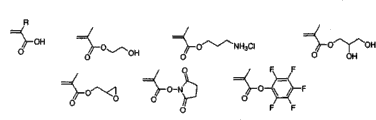
图2是各种单体的结构式,它们可用于提供本发明嵌段共聚物的反应性官能团;Figure 2 is a structural formula of various monomers that can be used to provide the reactive functional groups of the block copolymers of the present invention;
图3是显示如何使用RAFT聚合来聚合具有功能性区域的嵌段共聚物的反应流程图。Figure 3 is a reaction scheme showing how to polymerize block copolymers with functional domains using RAFT polymerization.
具体实施方式Detailed ways
本发明一般涉及包含反应性嵌段共聚物的涂覆溶液。包含反应性嵌段共聚物的组合物可用于在生产医疗器件中提供表面结合的涂层。在优选的实施方案中,本发明涉及具有与医疗器件例如镜片的表面官能团互补的反应性官能团的反应性嵌段共聚物。应当理解的是,术语“表面”不限于“至少一个完整表面”。表面覆盖不需要均匀或完整以对表面官能团或表面处理有效。本发明的反应性嵌段共聚物可用作生物相容材料的涂层,所述生物相容材料包括通常用于镜片,包括隐形眼镜的软性和刚性材料。The present invention generally relates to coating solutions comprising reactive block copolymers. Compositions comprising reactive block copolymers can be used to provide surface-bonded coatings in the production of medical devices. In a preferred embodiment, the present invention relates to reactive block copolymers having reactive functional groups complementary to the surface functional groups of medical devices such as lenses. It should be understood that the term "surface" is not limited to "at least one complete surface". Surface coverage need not be uniform or complete to be effective for surface functional groups or surface treatments. The reactive block copolymers of the present invention are useful as coatings for biocompatible materials, including soft and rigid materials commonly used in lenses, including contact lenses.
根据本发明通过原子转移自由基聚合(″ATRP″)方法制备的反应性嵌段共聚物可具有下列通式(I):The reactive block copolymers prepared according to the present invention by the atom transfer radical polymerization ("ATRP") process may have the following general formula (I):
R1-[(A)m]p-[(B)n]q-X (1)R 1 -[(A) m ] p -[(B) n ] q -X (1)
其中R1是能够用作原子转移自由基聚合引发剂的部分的反应性残基,A是化学结合单元嵌段,B是亲水单元嵌段,m是1到10,000,n是1到10,000,p和q是自然数,X是原子转移自由基聚合引发剂的卤素封端基团。应当注意的是,有许多方法用于在聚合后除去或转化原子转移自由基聚合引发剂的卤素封端基团,这对于本领域技术人员是已知的。因此,根据本发明使用ATRP制备的聚合物包括那些X是原子转移自由基聚合引发剂的卤素封端基团的聚合物和已经过聚合后除去或转化原子转移自由基聚合引发剂的卤素封端基团的那些聚合物(即衍生的反应产物)。含有卤素端基的聚合物可用于许多传统烷基卤有机反应中。在一个实施例中,在自由基来源(AIBN或Cu(I)络合物)存在下,向聚合烷基卤中添加三丁基甲锡烷产生饱和氢封端的聚合物。在另一个实施例中,通过用烯丙基三正丁基锡烷替换三丁基甲锡烷可制备具有烯丙基端基的聚合物。末端的卤素也可通过亲核取代、自由基化学或路易斯酸催化的亲电加成被取代以产生多种遥爪衍生物,例如烯烃、炔烃、醇、硫醇、烷烃、叠氮化物、胺、磷鎓或环氧基等。wherein R is a reactive residue that can be used as part of an atom transfer radical polymerization initiator, A is a chemical binding unit block, B is a hydrophilic unit block, m is 1 to 10,000, n is 1 to 10,000, p and q are natural numbers, and X is a halogen capping group of the atom transfer radical polymerization initiator. It should be noted that there are many methods for removing or converting the halogen capping groups of the atom transfer radical polymerization initiator after polymerization, which are known to those skilled in the art. Thus, polymers prepared using ATRP according to the present invention include those in which X is the halogen-terminated group of the atom transfer radical polymerization initiator and those that have undergone post-polymerization removal or conversion of the halogen-terminated group of the atom transfer radical polymerization initiator. Groups of those polymers (ie derived reaction products). Polymers containing halogen end groups are useful in many conventional alkyl halide organic reactions. In one example, addition of tributylstannane to a polymeric alkyl halide in the presence of a free radical source (AIBN or Cu(I) complex) produces a saturated hydrogen terminated polymer. In another example, a polymer with allyl end groups can be prepared by substituting allyltri-n-butylstannane for tributylstannane. Terminal halogens can also be substituted by nucleophilic substitution, free radical chemistry, or Lewis acid-catalyzed electrophilic addition to generate a variety of telechelic derivatives such as alkenes, alkynes, alcohols, thiols, alkanes, azides, Amine, phosphonium or epoxy etc.
根据本发明通过可逆加成断裂链转移聚合(″RAFT″)方法制备的反应性嵌段共聚物可具有下列通式(II):The reactive block copolymers prepared according to the present invention by the reversible addition-fragmentation chain transfer polymerization ("RAFT") process may have the following general formula (II):
R1-[(A)m]p-[(B)n]q-R2 (II)R 1 -[(A) m ] p -[(B) n ] q -R 2 (II)
其中R1是RAFT试剂或自由基引发剂的形成自由基的残基,A是化学结合单元嵌段,B是亲水单元嵌段,m是1到10,000,n是1到10,000,p和q是自然数,R2是链转移试剂的二硫酯嵌段。基于二硫酯化学的RAFT试剂是本领域普通技术人员公知的,包括例如黄原酸酯、三硫代碳酸盐和二硫代羧酸酯。应当注意的是,本领域普通技术人员已知多种用于聚合后除去或转化链转移试剂的二硫酯嵌段的方法。因此根据本发明使用RAFT试剂制备的聚合物包括其中R2是链转移试剂的二硫酯嵌段的那些聚合物,和那些已经过聚合后除去或转化链转移试剂的二硫酯嵌段的聚合物(即衍生的反应产物)。所述转化的一个实例是使用自由基还原剂用氢取代二硫酯基团。其它包括末端基团的热分解,或通过氨解作用将二硫酯基团转化为硫醇基团。可制备多种遥爪衍生物,例如烯烃、炔烃、醇、硫醇、烷烃、叠氮化物、胺、磷鎓或环氧基等。where R is a radical-forming residue of a RAFT agent or a radical initiator, A is a chemical binding unit block, B is a hydrophilic unit block, m is 1 to 10,000, n is 1 to 10,000, p and q is a natural number, and R is the dithioester block of the chain transfer reagent. RAFT agents based on dithioester chemistry are well known to those of ordinary skill in the art and include, for example, xanthates, trithiocarbonates, and dithiocarboxylates. It should be noted that a variety of methods are known to those of ordinary skill in the art for post-polymerization removal or conversion of the dithioester block of the chain transfer reagent. Polymers prepared using RAFT reagents according to the invention thus include those polymers in which R is a dithioester block of a chain transfer agent, and those that have undergone polymerization to remove or convert the dithioester block of a chain transfer agent. substances (i.e. derived reaction products). An example of such a transformation is the replacement of a dithioester group with hydrogen using a free radical reducing agent. Others include thermal decomposition of terminal groups, or conversion of dithioester groups to thiol groups by aminolysis. Various telechelic derivatives can be prepared, such as alkenes, alkynes, alcohols, thiols, alkanes, azides, amines, phosphonium or epoxy groups, etc.
根据本发明通过可逆加成断裂链转移聚合(″RAFT″)方法制备的反应性嵌段共聚物可具有下列通式(III):The reactive block copolymers prepared according to the present invention by the reversible addition-fragmentation chain transfer polymerization ("RAFT") process may have the following general formula (III):
R1-[(B)n]q-[(A)m]p-R2-[(A)m]p-[(B)n]q-R1 (III)R1-[(B) n ] q -[(A) m ] p -R2-[(A) m ] p -[(B) n ] q -R1 (III)
其中R1是RAFT试剂或自由基引发剂的形成自由基的残基,A是化学结合单元嵌段,B是亲水单元嵌段,m是1到10,000,n是1到10,000,p和q是自然数,R2是二硫酯基团。where R1 is a radical-forming residue of a RAFT agent or a radical initiator, A is a chemical binding unit block, B is a hydrophilic unit block, m is 1 to 10,000, n is 1 to 10,000, p and q are A natural number, R2 is a dithioester group.
对于每个通式I、II和III的聚合物来说,嵌段单元的顺序并不重要,反应性嵌段共聚物可含有超过2个的嵌段。因此该反应性嵌段共聚物可以是多嵌段共聚物,包括一个或多个嵌段的重复。可参见下面非限制性的实例,其均落于通式I、II和III中:For each of the polymers of formulas I, II and III, the order of the block units is not critical and the reactive block copolymers may contain more than 2 blocks. The reactive block copolymer may thus be a multi-block copolymer comprising repetitions of one or more blocks. See the following non-limiting examples, which all fall within the general formulas I, II and III:
(1)-(A)m(B)n-(1)-(A) m (B) n -
(2)-(B)n-(A)m-(2)-(B) n- (A) m-
(3)-(A)m-(B)n-(A)m-(3)-(A) m -(B) n -(A) m -
可用于本发明的反应性嵌段共聚物还可包含被认为是非结合的或非亲水性的嵌段,例如聚苯乙烯或聚甲基丙烯酸甲酯。聚合物内非结合或非亲水性嵌段的存在也包括在所述反应性嵌段共聚物和本发明式I、II和III的范围内。The reactive block copolymers useful in the present invention may also contain blocks that are considered non-binding or non-hydrophilic, such as polystyrene or polymethyl methacrylate. The presence of non-binding or non-hydrophilic blocks within the polymer is also included within the scope of the reactive block copolymers and formulas I, II and III of the invention.
本发明提供了可通过使用互补性官能团用于表面改性隐形眼镜等医疗器件的材料。尽管下文中仅以隐形眼镜为例进行说明,其不应当认为是限制性的,因为除隐形眼镜外,本发明的共聚物还适用于表面改性其它医疗器件,例如有晶体眼和无晶体眼人工晶状体以及角膜植入物。隐形眼镜和其它生物医学器件的聚合物材料的表面基团被用于与本发明的反应性嵌段共聚物形成化学连接,即结合。本发明中优选的反应性嵌段共聚物基于要涂覆的聚合物材料的特定表面基团来选择。根据本发明,选择用于表面改性的一种或多种反应性嵌段共聚物应当具有与所述基底表面基团互补的反应性化学官能团。所述互补反应性化学官能团使得在反应性嵌段共聚物和基底的互补表面基团之间能发生化学反应,以形成共价连接。因此所述一种或多种反应性嵌段共聚物结合到隐形眼镜等医疗器件的表面,实现其表面改性。The present invention provides materials that can be used to surface modify medical devices such as contact lenses through the use of complementary functional groups. Although only contact lenses are exemplified below, it should not be considered limiting, as the copolymers of the present invention are also suitable for surface modification of other medical devices, such as phakic and aphakic eyes, in addition to contact lenses Intraocular lenses and corneal implants. Surface groups of polymeric materials of contact lenses and other biomedical devices are used to form chemical links, ie bonds, with the reactive block copolymers of the present invention. Preferred reactive block copolymers in the present invention are selected based on the specific surface groups of the polymeric material to be coated. According to the present invention, the one or more reactive block copolymers selected for surface modification should have reactive chemical functional groups complementary to the substrate surface groups. The complementary reactive chemical functional groups enable a chemical reaction between the reactive block copolymer and complementary surface groups of the substrate to form a covalent linkage. Therefore, the one or more reactive block copolymers are bound to the surface of medical devices such as contact lenses to achieve surface modification thereof.
反应性嵌段共聚物包括化学结合单元嵌段以提供所需的分子的表面结合。所述化学结合单元嵌段可以不同,基于反应性嵌段共聚物的用途而定。也就是说,选择反应性嵌段共聚物的化学结合单元嵌段以提供与器件的表面官能团互补的官能团。Reactive block copolymers include blocks of chemically binding units to provide the desired surface binding of molecules. The blocks of chemically bound units can vary, depending on the use of the reactive block copolymer. That is, the chemically bound unit blocks of the reactive block copolymer are selected to provide functional groups that are complementary to the surface functional groups of the device.
所述嵌段共聚物的化学结合单元单体根据器件表面的官能团进行选择。例如,如果器件表面的反应性分子含有羧酸基团,反应性嵌段共聚物的化学结合单元单体可以是含缩水甘油基的单体。如果器件表面的反应性分子含有羟基或氨基官能团,反应性嵌段共聚物的化学结合单元单体可以是含有异氰酸酯或碳酰氯基团的单体。多种与器件表面的反应性基团互补的化学结合单元的含官能团单体的适当组合对于本领域技术人员将是明显的。例如,化学结合单元嵌段可包含选自胺、羟基、肼、酰肼、硫醇(亲核基团)、羧酸;羧酸酯,包括酰亚胺酯、原酸酯;碳酸酯、异氰酸酯、异硫氰酸酯、醛、酮、硫酮、链烯基、丙烯酸酯、甲基丙烯酸酯、丙烯酰胺、砜、马来酰亚胺、二硫化物、碘代、环氧基、磺酸酯、硫代磺酸酯、硅烷、烷氧基硅烷、卤代硅烷和氨基磷酸酯的部分。这些基团更具体的实例包括琥珀酰亚胺酯或碳酸酯、咪唑酯或碳酸酯、苯并三唑酯或碳酸酯、对硝基苯基碳酸酯、乙烯基砜、氯乙基砜、乙烯基吡啶、二硫吡啶、碘乙酰胺、乙二醛、二酮、甲磺酸酯、甲苯磺酸酯和三氟乙基磺酸酯。还包括其它活化的羧酸衍生物,以及任何上述部分的水合物或保护的衍生物(例如醛水合物、半缩醛、缩醛、酮水合物、半缩酮、缩酮、酮缩硫醇、硫缩醛)。优选的亲电基团包括琥珀酰亚胺碳酸酯、琥珀酰亚胺酯、马来酰亚胺、苯并三唑碳酸酯、缩水甘油基醚、咪唑酯、对硝基苯基碳酸酯、丙烯酸酯、三氟乙基磺酸酯、醛和邻二硫吡啶。下表1中提供了互补性官能团的例子。The chemical binding unit monomers of the block copolymer are selected according to the functional groups on the surface of the device. For example, if the reactive molecules on the surface of the device contain carboxylic acid groups, the chemical binding unit monomer of the reactive block copolymer can be a glycidyl group-containing monomer. If the reactive molecules on the device surface contain hydroxyl or amino functional groups, the chemical binding unit monomers of the reactive block copolymers can be monomers containing isocyanate or phosgene groups. Suitable combinations of functional group-containing monomers for various chemical binding units complementary to reactive groups on the device surface will be apparent to those skilled in the art. For example, blocks of chemically binding units may comprise compounds selected from the group consisting of amines, hydroxyls, hydrazines, hydrazides, thiols (nucleophiles), carboxylic acids; carboxylic acid esters, including imide esters, orthoesters; carbonates, isocyanates , isothiocyanate, aldehyde, ketone, thioketone, alkenyl, acrylate, methacrylate, acrylamide, sulfone, maleimide, disulfide, iodo, epoxy, sulfonic acid ester, thiosulfonate, silane, alkoxysilane, halosilane and phosphoramidate moieties. More specific examples of such groups include succinimidyl ester or carbonate, imidazole ester or carbonate, benzotriazole ester or carbonate, p-nitrophenyl carbonate, vinyl sulfone, chloroethyl sulfone, vinyl pyridine, dithiopyridine, iodoacetamide, glyoxal, diketone, mesylate, tosylate, and trifluoroethanesulfonate. Also included are other activated carboxylic acid derivatives, as well as hydrates or protected derivatives of any of the above moieties (e.g. aldehyde hydrates, hemiacetals, acetals, ketone hydrates, hemiketals, ketals, thioketals , Thioacetal). Preferred electrophilic groups include succinimide carbonate, succinimide ester, maleimide, benzotriazole carbonate, glycidyl ether, imidazolate, p-nitrophenyl carbonate, acrylic acid esters, trifluoroethanesulfonates, aldehydes, and o-dithiopyridines. Examples of complementary functional groups are provided in Table 1 below.
表1Table 1

所述反应性嵌段共聚物的化学结合单元嵌段是低聚物或多聚物,调节其大小以提供与要涂覆的医疗器件表面的适当结合。因此,式I、II或III的变量m可以为1至约1000,优选为1至约100,最优选为1至约30。The chemical binding unit blocks of the reactive block copolymers are oligomers or polymers, sized to provide proper binding to the surface of the medical device to be coated. Thus, the variable m of formula I, II or III may be from 1 to about 1000, preferably from 1 to about 100, most preferably from 1 to about 30.
除化学结合单元外,本发明的反应性嵌段共聚物还含有亲水区域,当嵌段共聚物与含有互补官能团的基底共价结合时显示良好的表面性质。亲水区域包含至少一个亲水单体,例如HEMA、甲基丙烯酸甘油酯、甲基丙烯酸(″MAA″)、丙烯酸(″AA″)、甲基丙烯酰胺、丙烯酰胺、N,N′-二甲基甲基丙烯酰胺或N,N′-二甲基丙烯酰胺;其共聚物;亲水性预聚物,例如烯键式不饱和聚环氧烷烃、环内酰胺例如N-乙烯基-2-吡咯烷酮(″NVP″),或其衍生物。其它实例有亲水性碳酸乙烯酯或氨基甲酸乙烯酯单体。亲水性单体可以是非离子单体,例如甲基丙烯酸2-羟乙基酯(″HEMA″)、2-羟乙基丙烯酸酯(″HEA″)、2-(2-乙氧基乙氧基)乙基(甲基)丙烯酸酯、(甲基)丙烯酸甘油酯、聚(乙二醇(甲基)丙烯酸酯)、四氢呋喃(甲基)丙烯酸酯、(甲基)丙烯酰胺、N,N′-二甲基甲基丙烯酰胺、N,N′-二甲基丙烯酰胺(″DMA″)、N-乙烯基-2-吡咯烷酮(或其它N-乙烯基内酰胺)、N-乙烯基乙酰胺及其组合。亲水性单体的其它实例有美国专利5,070,215中公开的碳酸乙烯酯和氨基甲酸乙烯酯单体,以及美国专利4,910,277中公开的亲水性噁唑酮单体。所述亲水性单体还可以是阴离子单体,例如2-甲基丙烯酰氧基乙磺酸盐。也可使用例如来自丙烯酸和甲基丙烯酸的取代的阴离子亲水性单体,其中取代基团可通过温和的化学过程除去。所述取代的阴离子亲水性单体的非限制性实例包括(甲基)丙烯酸的三甲基硅烷基酯,其被水解以再生阴离子羧基。所述亲水性单体也可以是选自下列组中的阳离子单体:3-甲基丙烯酰氨基丙基-N,N,N-三甲基铵盐、2-甲基丙烯酰氧基乙基-N,N,N-三甲基铵盐、以及含胺的单体例如3-甲基丙烯酰氨基丙基-N,N-二甲基胺。其它合适的亲水性单体对于本领域技术人员是显而易见的。In addition to chemically binding units, the reactive block copolymers of the present invention also contain hydrophilic regions, which exhibit good surface properties when the block copolymers are covalently bonded to substrates containing complementary functional groups. The hydrophilic region comprises at least one hydrophilic monomer such as HEMA, glyceryl methacrylate, methacrylic acid ("MAA"), acrylic acid ("AA"), methacrylamide, acrylamide, N,N'-di Methylmethacrylamide or N,N'-dimethylacrylamide; copolymers thereof; hydrophilic prepolymers such as ethylenically unsaturated polyalkylene oxides, cyclic lactams such as N-vinyl-2 - pyrrolidone ("NVP"), or a derivative thereof. Other examples are hydrophilic vinyl carbonate or vinyl carbamate monomers. The hydrophilic monomer may be a nonionic monomer such as 2-hydroxyethyl methacrylate ("HEMA"), 2-hydroxyethyl acrylate ("HEA"), 2-(2-ethoxyethoxy base) ethyl (meth)acrylate, glyceryl (meth)acrylate, poly(ethylene glycol (meth)acrylate), tetrahydrofuran (meth)acrylate, (meth)acrylamide, N,N '-Dimethylmethacrylamide, N,N'-dimethylacrylamide ("DMA"), N-vinyl-2-pyrrolidone (or other N-vinyllactam), N-vinyl ethyl Amides and combinations thereof. Other examples of hydrophilic monomers are the vinyl carbonate and vinyl carbamate monomers disclosed in US Patent 5,070,215, and the hydrophilic oxazolone monomers disclosed in US Patent 4,910,277. The hydrophilic monomer may also be an anionic monomer such as 2-methacryloyloxyethanesulfonate. Substituted anionic hydrophilic monomers such as those derived from acrylic and methacrylic acids can also be used, where the substituent groups can be removed by mild chemical processes. Non-limiting examples of such substituted anionic hydrophilic monomers include trimethylsilyl (meth)acrylates, which are hydrolyzed to regenerate anionic carboxyl groups. The hydrophilic monomer can also be a cationic monomer selected from the following group: 3-methacrylamidopropyl-N,N,N-trimethylammonium salt, 2-methacryloxy Ethyl-N,N,N-trimethylammonium salt, and amine-containing monomers such as 3-methacrylamidopropyl-N,N-dimethylamine. Other suitable hydrophilic monomers will be apparent to those skilled in the art.
将调节亲水性单体嵌段的大小以提供所述反应性嵌段共聚物所需的表面涂覆性能。亲水性低聚或高聚嵌段的大小根据要涂覆的基底和用途而可能不同。因此式I、II或III的变量n可以为1至约10000,优选为约10至约1000,更优选为约20至约300。The size of the hydrophilic monomer block will be adjusted to provide the desired surface coating properties of the reactive block copolymer. The size of the hydrophilic oligomeric or polymeric blocks may vary depending on the substrate to be coated and the use. Thus the variable n of formula I, II or III may be from 1 to about 10,000, preferably from about 10 to about 1,000, more preferably from about 20 to about 300.
可使用原子转移自由基聚合(ATRP)制备嵌段共聚物,其中各嵌段和整个聚合物的分子量可精确地控制。如图1所示,可使用原子转移自由基聚合(ATRP)制备嵌段共聚物,其中在聚合物的一端有化学结合单元嵌段,随后是大亲水嵌段。应当理解的是,添加包含化学结合单元区域的单体和包含亲水区域的单体的顺序并不重要。多种单体可用于组配聚合物(例如参见图2)。可使用可逆加成断裂链转移聚合(RAFT)制备嵌段共聚物,其中各嵌段和整个聚合物的分子量可精确地控制(参见图3)。Block copolymers can be prepared using atom transfer radical polymerization (ATRP), where the molecular weight of each block and the overall polymer can be precisely controlled. As shown in Figure 1, block copolymers can be prepared using atom transfer radical polymerization (ATRP), where there is a block of chemically bound units at one end of the polymer, followed by a large hydrophilic block. It should be understood that the order of addition of the monomers comprising the chemical binding unit region and the monomer comprising the hydrophilic region is not critical. A variety of monomers can be used to assemble polymers (see, eg, Figure 2). Block copolymers can be prepared using reversible addition-fragmentation chain transfer polymerization (RAFT), where the molecular weight of individual blocks and the overall polymer can be precisely controlled (see Figure 3).
本发明的反应性嵌段共聚物可用于涂覆基底。可用于本发明的基底材料的实例见Künzler等的美国专利5,908,906;Künzler等的5,714,557;Künzler等的5,710,302;Lai等的5,708,094;Bambury等的5,616,757;Bambury等的5,610,252;Lai等的5,512,205;Lai等的5,449,729;Künzler等的5,387,662;Lai等的5,310,779和Künzler等的6,891,010。The reactive block copolymers of the present invention are useful for coating substrates. 5,710,302 of Künzler et al; 5,708,094 of Lai et al; 5,616,757 of Bambury et al; 5,610,252 of Bambury et al; 5,449,729; 5,387,662 by Künzler et al; 5,310,779 by Lai et al; and 6,891,010 by Künzler et al.
本发明涉及反应性嵌段共聚物在医疗器件,包括“硬”和“软”隐形眼镜中的用途。如上文所述,本发明可用于多种材料。水凝胶通常是一类公知的材料,其包含水合的、平衡态下含水的交联聚合体系。含硅水凝胶的含水量通常超过约5重量%,更通常为约10-约80重量%。这样的材料通常通过聚合含有至少一种含硅单体和至少一种亲水性单体的混合物来制备。通常,含硅单体或亲水性单体用作交联剂(交联剂定义为具有多种可聚合官能团的单体)或者可使用单独的交联剂。适用于形成含硅水凝胶的含硅单体单元是本领域已知的,美国专利4,136,250、4,153,641、4,740,533、5,034,461、5,070,215、5,260,000、5,310,779和5,358,995中提供了众多的实例。The present invention relates to the use of reactive block copolymers in medical devices, including "hard" and "soft" contact lenses. As noted above, the present invention is applicable to a wide variety of materials. Hydrogels are generally a well-known class of materials comprising hydrated, cross-linked polymeric systems containing water in equilibrium. Silicon-containing hydrogels typically have a water content in excess of about 5% by weight, more typically from about 10 to about 80% by weight. Such materials are typically prepared by polymerizing a mixture comprising at least one silicon-containing monomer and at least one hydrophilic monomer. Typically, a silicon-containing monomer or a hydrophilic monomer is used as a crosslinking agent (a crosslinking agent is defined as a monomer having multiple polymerizable functional groups) or a separate crosslinking agent may be used. Silicon-containing monomer units suitable for forming silicon-containing hydrogels are known in the art, with numerous examples provided in US Pat.
适用的含硅单体单元的实例包括大体积聚硅氧烷基烷基(甲基)丙烯酸单体。大体积聚硅氧烷基烷基(甲基)丙烯酸单体的实例由下式IV表示:Examples of suitable silicon-containing monomeric units include bulky polysiloxanylalkyl (meth)acrylic monomers. An example of a bulky polysiloxane alkyl (meth)acrylic monomer is represented by Formula IV below:

其中,X表示-O-或-NR-;Wherein, X represents -O- or -NR-;
各个R1独立地表示氢或甲基;each R independently represents hydrogen or methyl;
各个R2独立地表示低级烷基、苯基或由下式表示的基团,Each R independently represents lower alkyl, phenyl, or a group represented by the following formula,

其中各个R’2独立的表示低级烷基或苯基;以及h是1-10。wherein each R'2 independently represents lower alkyl or phenyl; and h is 1-10.
一些优选的大体积单体是甲基丙烯酰氧丙基三(三甲基硅烷氧基)硅烷或三(三甲基硅烷氧基)硅烷基丙基甲基丙烯酸酯,有时称为TRIS。Some preferred bulky monomers are methacryloxypropyl tris(trimethylsiloxy)silane or tris(trimethylsiloxy)silylpropyl methacrylate, sometimes referred to as TRIS.
另一类代表性的含硅单体包括含硅的碳酸乙烯酯或氨基甲酸乙烯酯单体,例如1,3-双[4-乙烯基氧羰基氧)丁基]四甲基二硅氧烷;3-(三甲基硅烷基)丙基乙烯基碳酸酯;3-(乙烯基氧羰基硫代)丙基]-[三(三甲基硅烷氧基)硅烷]、3-[三(三甲基硅烷氧基)硅烷基]丙基乙烯基氨基甲酸酯、3-[三(三甲基硅烷氧基)硅烷基]丙基烯丙基氨基甲酸酯;3-[三(三甲基硅烷氧基)硅烷基]丙基乙烯基碳酸酯;叔丁基二甲基硅烷氧基乙基乙烯基碳酸酯;三甲基硅烷基乙基乙烯基碳酸酯和三甲基硅烷基甲基乙烯基碳酸酯。Another representative class of silicon-containing monomers includes silicon-containing vinyl carbonate or vinyl carbamate monomers such as 1,3-bis[4-vinyloxycarbonyloxy)butyl]tetramethyldisiloxane ; 3-(trimethylsilyl)propyl vinyl carbonate; 3-(vinyloxycarbonylthio)propyl]-[tri(trimethylsiloxy)silane], 3-[tri(tri Methylsilyloxy)silyl]propylvinylcarbamate, 3-[tris(trimethylsiloxy)silyl]propylallylcarbamate; 3-[tris(trimethylsilyloxy)silyl]propylallylcarbamate; ylsilyloxy)silyl]propyl vinyl carbonate; tert-butyldimethylsilyloxyethyl vinyl carbonate; trimethylsilylethyl vinyl carbonate and trimethylsilylmethyl Vinyl carbonate.
含硅的碳酸乙烯酯或氨基甲乙烯酸酯单体的实例由式V所示:Examples of silicon-containing vinyl carbonate or urethane monomers are represented by Formula V:

其中:in:
Y′代表-O-、-S-或-NH-;Y' represents -O-, -S- or -NH-;
RSi代表含硅的有机基团;R Si represents a silicon-containing organic group;
R3代表氢或甲基;R 3 represents hydrogen or methyl;
d为1、2、3或4;并且q是0或1。d is 1, 2, 3 or 4; and q is 0 or 1.
适当的含硅有机基团RSi包括下列基团:Suitable silicon-containing organic groups R Si include the following groups:
-(CH2)n′Si[(CH2)m′CH3]3;-(CH 2 ) n′ Si[(CH 2 ) m ′CH 3 ] 3 ;
-(CH2)n′Si[OSi(CH2)m′CH3]3;-( CH2 ) n'Si [OSi ( CH2 ) m'CH3 ] 3 ;

以及as well as

其中,R4代表Among them, R 4 represents

其中p′是1-6;where p' is 1-6;
R5代表具有1-6个碳原子的烷基或氟代烷基;R 5 represents an alkyl or fluoroalkyl group with 1-6 carbon atoms;
e是1-200;n′是1、2、3或4;并且m’是0、1、2、3、4或5。e is 1-200; n' is 1, 2, 3 or 4; and m' is 0, 1, 2, 3, 4 or 5.
式V的一个具体例子用式VI表示:A specific example of formula V is represented by formula VI:

另一类含硅单体包括聚氨酯-聚硅氧烷大分子单体(有时也指预聚物),其可如传统的聚氨酯弹性体一样具有硬-软-硬嵌段。它们可用亲水性单体例如HEMA封端。这样的含硅聚氨酯的实例公开于多个出版物中,包括Lai,Yu-Chin,″The Role of Bulky Polysiloxanylalkyl Methacryates in Polyurethane-Polysiloxane Hydrogels″,Journal of Applied Polymer Science,Vol.60,1193-1199(1996)。PCT公开申请号WO 96/31792公开了这样的单体的实例。其它含硅聚氨酯单体的实例用式VII和VIII表示:Another class of silicon-containing monomers includes polyurethane-polysiloxane macromers (also sometimes referred to as prepolymers), which can have hard-soft-hard blocks like traditional polyurethane elastomers. They can be capped with hydrophilic monomers such as HEMA. Examples of such silicon-containing polyurethanes are disclosed in various publications, including Lai, Yu-Chin, "The Role of Bulky Polysiloxanylalkyl Methacryates in Polyurethane-Polysiloxane Hydrogels", Journal of Applied Polymer Science, Vol.60, 1193-1199( 1996). Examples of such monomers are disclosed in PCT Published Application No. WO 96/31792. Examples of other silicon-containing polyurethane monomers are represented by formulas VII and VIII:
(VII)E(*D*A*D*G)a *D*A*D*E′;或(VII)E( * D * A * D * G) a * D * A * D * E′; or
(VIII)E(*D*G*D*A)a *D*G*D*E′;(VIII)E( * D * G * D * A) a * D * G * D * E′;
其中:in:
D表示具有6-30个碳原子的烷基双基、烷基环烷基双基、环烷基双基、芳基双基或烷芳基双基;D represents an alkyl diradical, an alkylcycloalkyl diradical, a cycloalkyl diradical, an aryl diradical or an alkaryl diradical with 6-30 carbon atoms;
G表示具有1-40个碳原子的烷基双基、环烷基双基、烷基环烷基双基、芳基双基或烷芳基双基,其可以在主链中包含醚、硫或胺键连接;G represents an alkyl diradical, cycloalkyl diradical, alkylcycloalkyl diradical, aryl diradical or alkaryl diradical with 1-40 carbon atoms, which may contain ether, sulfur in the main chain or amine linkage;
*表示氨基甲酸酯或脲基连接;a是至少1; * indicates a urethane or ureido linkage; a is at least 1;
A表示式IX的二价聚合基团;A represents a divalent polymeric group of formula IX;

其中:in:
各个Rs独立地表示具有1-10个碳原子的烷基或氟取代的烷基,其可以在碳原子间含有醚键连接;Each R s independently represents an alkyl group or a fluorine-substituted alkyl group having 1-10 carbon atoms, which may contain ether linkages between carbon atoms;
m′为至少1;并且m' is at least 1; and
p是使该部分分子量为400到10,000的数目;p is a number such that the moiety has a molecular weight of 400 to 10,000;
各个E和E′独立地表示式X代表的可聚合不饱和有机基团:Each of E and E' independently represents a polymerizable unsaturated organic group represented by formula X:

其中:in:
R6是氢或甲基;R 6 is hydrogen or methyl;
R7是氢、具有1-6个碳原子的烷基、或-CO-Y-R9基团,其中Y是-O-、-S-或-NH-;R 7 is hydrogen, an alkyl group with 1-6 carbon atoms, or a -CO-YR 9 group, wherein Y is -O-, -S- or -NH-;
R8是具有1-10个碳原子的二价亚烷基;R 8 is a divalent alkylene group having 1-10 carbon atoms;
R9是具有1-12个碳原子的烷基;R 9 is an alkyl group with 1-12 carbon atoms;
X表示-CO-或-OCO-;X means -CO- or -OCO-;
Z表示-O-或-NH-;Z represents -O- or -NH-;
Ar表示具有6-30个碳原子的芳基;Ar represents an aryl group having 6-30 carbon atoms;
w为0-6;x是0或1;y是0或1;z是0或1。w is 0-6; x is 0 or 1; y is 0 or 1; z is 0 or 1.
含硅聚氨酯单体的更具体的实例用式(XI)表示:A more specific example of a silicon-containing polyurethane monomer is represented by formula (XI):

其中m是至少1,并优选是3或4,a是至少1,并优选是1,p是使其分子量为400-10,000的数目,优选是至少30,R10是除去异氰酸酯基团后二异氰酸酯的双基,例如异佛尔酮二异氰酸酯的双基,各个E″是下式表示的基团:wherein m is at least 1, and preferably 3 or 4, a is at least 1, and preferably 1, p is a number such that its molecular weight is 400-10,000, preferably at least 30, and R is the diisocyanate after removal of the isocyanate groups For example, the diradical of isophorone diisocyanate, each E "is a group represented by the following formula:

优选的含硅水凝胶材料包括(在共聚的大体积单体混合物中)5-50重量%,优选10-25重量%的一种或多种含硅大分子单体;5-75重量%,优选30-60重量%的一种或多种聚硅氧烷基烷基(甲基)丙烯酸单体;和10-50重量%,优选20-40重量%的亲水性单体。通常,所述含硅大分子单体是在分子两端或更多端用不饱和基团封端的聚有机硅氧烷。除上述结构式中的端基外,Deichert等人的美国专利4,153,641公开了其它不饱和基团,包括丙烯氧基或甲基丙烯氧基。含延胡索酸酯的材料例如Lai的美国专利5,512,205、5,449,729和5,310,779中教导的那些也是可用于本发明的基底。优选的是,所述硅烷大分子单体是含硅的碳酸乙烯酯或氨基甲酸乙烯酯或具有一个或多个硬-软-硬嵌段和用亲水性单体封端的聚氨酯-聚硅氧烷。Preferred silicon-containing hydrogel materials comprise (in the copolymerized bulky monomer mixture) 5-50% by weight, preferably 10-25% by weight of one or more silicon-containing macromonomers; 5-75% by weight , preferably 30-60% by weight of one or more polysiloxane alkyl (meth)acrylic monomers; and 10-50% by weight, preferably 20-40% by weight of a hydrophilic monomer. Typically, the silicon-containing macromer is a polyorganosiloxane terminated with unsaturated groups at two or more ends of the molecule. In addition to the terminal groups in the above formulas, US Patent 4,153,641 to Deichert et al. discloses other unsaturated groups including propyleneoxy or methacryloxy. Fumarate-containing materials such as those taught in US Pat. Nos. 5,512,205, 5,449,729 and 5,310,779 to Lai are also useful substrates for the present invention. Preferably, the silane macromer is a silicon-containing vinyl carbonate or vinyl carbamate or a polyurethane-polysiloxane having one or more hard-soft-hard blocks and endcapped with a hydrophilic monomer. alkyl.
适合的亲水性单体形成可用于本发明的水凝胶,例如含硅水凝胶材料。有用的单体的实例包括酰胺,例如二甲基丙烯酰胺、二甲基甲基丙烯酰胺;环内酰胺例如n-乙烯基-2-吡咯烷酮和用可聚合基团功能化的聚亚烷基二醇。可用的功能化的聚亚烷基二醇的实例包括含有单甲基丙烯酸酯或双甲基丙烯酸酯端基的不同链长的聚(二乙二醇)。在一个优选的实施方案中,所述聚亚烷基二醇聚合物含有至少两个亚烷基二醇单体单元。其它的例子有美国专利5,070,215中公开的亲水性碳酸乙烯酯或氨基甲酸乙烯酯单体,以及美国专利4,910,277中公开的亲水性噁唑酮单体。其它合适的亲水性单体对于本领域技术人员来说是显而易见的。Suitable hydrophilic monomers form hydrogels useful in the invention, such as silicon-containing hydrogel materials. Examples of useful monomers include amides, such as dimethylacrylamide, dimethylmethacrylamide; cyclic lactams, such as n-vinyl-2-pyrrolidone, and polyalkylene diacetals functionalized with polymerizable groups; alcohol. Examples of useful functionalized polyalkylene glycols include poly(diethylene glycol) of various chain lengths containing monomethacrylate or dimethacrylate end groups. In a preferred embodiment, the polyalkylene glycol polymer contains at least two alkylene glycol monomer units. Other examples are the hydrophilic vinyl carbonate or vinyl carbamate monomers disclosed in US Patent 5,070,215, and the hydrophilic oxazolone monomers disclosed in US Patent 4,910,277. Other suitable hydrophilic monomers will be apparent to those skilled in the art.
形成器件用添加剂和共聚单体Additives and comonomers for device formation
所述单体混合物可在需要时和不损害本发明的目的和效果的范围内包括各种添加剂,例如抗氧化剂、着色剂、紫外吸收剂和润滑剂。The monomer mixture may include various additives, such as antioxidants, colorants, ultraviolet absorbers, and lubricants, as necessary and within a range that does not impair the object and effects of the present invention.
单体混合物可根据成型的聚合物制品的目的用途等,通过使用一种或至少两种上述共聚单体和低聚物,以及,如果需要,一种或多种交联剂来制备。The monomer mixture can be prepared by using one or at least two of the above comonomers and oligomers, and, if necessary, one or more crosslinking agents, depending on the intended use of the shaped polymer article and the like.
当成型的聚合物制品为例如医疗产品,尤其是隐形眼镜时,所述单体混合物由一种或多种硅化合物例如硅氧烷基(甲基)丙烯酸酯、硅氧烷基(甲基)丙烯酰胺和含硅低聚物合适的制备,以获得具有高透氧性的隐形眼镜。When the shaped polymeric article is, for example, a medical product, especially a contact lens, the monomer mixture is composed of one or more silicon compounds such as siloxane-based (meth)acrylates, siloxane-based (meth) Acrylamide and silicon-containing oligomers are suitably prepared to obtain contact lenses with high oxygen permeability.
单体混合物可包括其它成分,例如交联剂、内部润湿剂、亲水性单体单元、增韧剂、以及其它本领域公知的成分。The monomer mixture may include other ingredients such as crosslinkers, internal wetting agents, hydrophilic monomer units, toughening agents, and other ingredients known in the art.
尽管不需要,单体混合物可包括增韧剂,其量优选低于约80重量%,例如约5-约80重量%,更通常为约20-约60重量%。美国专利4,327,203中描述了合适的增韧剂的实例。这些试剂包括环烷基丙烯酸酯或甲基丙烯酸酯,例如丙烯酸甲酯和甲基丙烯酸甲酯、叔丁基环己基甲基丙烯酸酯、异丙基环戊基丙烯酸酯、叔戊基环庚基甲基丙烯酸酯、叔丁基环己基丙烯酸酯、异己基环戊基丙烯酸酯和甲基异戊基环辛基丙烯酸酯。合适的增韧剂的其它实例描述于美国专利4,355,147中。该参考文献描述了多环丙烯酸酯或甲基丙烯酸酯,例如异冰片基丙烯酸酯和甲基丙烯酸酯、二环戊二烯基丙烯酸酯和甲基丙烯酸酯、金刚烷基丙烯酸酯和甲基丙烯酸酯、和异松蒎基丙烯酸酯和甲基丙烯酸酯。美国专利5,270,418中提供了增韧剂的其它实例。该参考文献描述了支链烷基羟基环烷基丙烯酸酯、甲基丙烯酸酯、丙烯酰胺和甲基丙烯酰胺。代表性的实例包括4-叔丁基-2-羟基环己基甲基丙烯酸酯(TBE);4-叔丁基-2-羟基环戊基甲基丙烯酸酯;甲基丙烯酰氧基氨基-4-叔丁基-2-羟基环己烷;6-异戊基-3-羟基环己基甲基丙烯酸酯;甲基丙烯酰氧基氨基-2-异己基-5-羟基环戊烷。Although not required, the monomer mixture may include a toughening agent, preferably in an amount less than about 80% by weight, such as from about 5 to about 80% by weight, more typically from about 20 to about 60% by weight. Examples of suitable toughening agents are described in US Patent 4,327,203. These agents include cycloalkyl acrylates or methacrylates such as methyl acrylate and methyl methacrylate, tert-butylcyclohexyl methacrylate, isopropylcyclopentyl acrylate, tert-pentylcycloheptylmethyl Acrylates, tert-butylcyclohexylacrylate, isohexylcyclopentylacrylate and methylisopentylcyclohexylacrylate. Other examples of suitable toughening agents are described in US Patent 4,355,147. This reference describes polycyclic acrylates or methacrylates such as isobornyl acrylate and methacrylate, dicyclopentadienyl acrylate and methacrylate, adamantyl acrylate and methacrylate esters, and isopine pinene acrylates and methacrylates. Additional examples of toughening agents are provided in US Patent No. 5,270,418. This reference describes branched chain alkylhydroxycycloalkyl acrylates, methacrylates, acrylamides and methacrylamides. Representative examples include 4-tert-butyl-2-hydroxycyclohexyl methacrylate (TBE); 4-tert-butyl-2-hydroxycyclopentyl methacrylate; methacryloxyamino-4 - tert-butyl-2-hydroxycyclohexane; 6-isopentyl-3-hydroxycyclohexyl methacrylate; methacryloyloxyamino-2-isohexyl-5-hydroxycyclopentane.
特别是对于隐形眼镜,对某些用于形成含硅水凝胶的单体进行氟化以减少在其制造的隐形眼镜上积累沉积物,如美国专利4,954,587、5,079,319、5,010,141和6,891,010中所述。此外,已发现使用具有某些氟化侧链基团,即-(CF2)-H的含硅单体能改善亲水单体单元和含硅单体单元间的相容性,如美国专利5,387,662和5,321,108中所述。For contact lenses in particular, certain monomers used to form silicon-containing hydrogels are fluorinated to reduce deposit build-up on contact lenses produced therefrom, as described in US Pat. In addition, it has been found that the use of silicon-containing monomers with certain fluorinated side chain groups, ie -(CF 2 )-H, improves the compatibility between the hydrophilic monomer unit and the silicon-containing monomer unit, as described in U.S. Patent 5,387,662 and 5,321,108.
如上文所述,表面结构和组成决定了固体材料的许多物理性能和最终用途。诸如润湿、摩擦、粘附或润滑的性能很大程度上受表面性质的影响。表面性质的改变在生物相容性起关键作用的生物技术应用中具有特别重要的意义。因此,需要提供具有光学透明的亲水表面膜的含硅水凝胶隐形眼镜,其不仅具有改善的可润湿性,还允许在人眼中使用更长的时间。在长时间配戴含硅水凝胶镜片的情况下,需要进一步提供具有光学透明表面膜的改善的含硅水凝胶隐形眼镜,其不仅具有改善的脂质和微生物性质,还通常允许在人眼中使用更长的时间。这样的经表面处理的镜片在实际使用中配戴舒适,允许更长时间的配戴,而不刺激角膜或对角膜产生其它副作用。As mentioned above, surface structure and composition determine many physical properties and end uses of solid materials. Properties such as wetting, friction, adhesion or lubrication are largely influenced by the nature of the surface. Modification of surface properties is of particular importance in biotechnological applications where biocompatibility plays a key role. Therefore, there is a need to provide silicon-containing hydrogel contact lenses with optically clear hydrophilic surface films that not only have improved wettability but also allow for longer periods of use in the human eye. In the case of prolonged wear of silicon-containing hydrogel lenses, there is a further need to provide improved silicon-containing hydrogel contact lenses with optically clear surface films that not only have improved lipid and microbial properties, but also generally allow Use longer in the eyes. Such surface-treated lenses are comfortable to wear in practice, allowing for longer periods of wear without irritation or other adverse effects on the cornea.
人们还期望将这些表面增强的涂层用于可植入的医疗器件例如人工晶状体材料以减少镜片上皮细胞对植入器件的附着,以及减少人工晶状体通过插入器导入眼部时的摩擦。人们同样期望将这些表面增强的涂层用于人工晶状体插入器中。It is also desirable to use these surface-enhancing coatings for implantable medical devices such as intraocular lens materials to reduce adhesion of lens epithelial cells to implanted devices, and to reduce friction when intraocular lenses are introduced into the eye through an inserter. It is also desirable to use these surface enhancing coatings in intraocular lens inserters.
本发明可用于对聚合物器件进行表面处理。所述表面处理包括通过使反应性嵌段共聚物的互补反应性官能团与聚合物基底表面的反应性官能团反应,将反应性嵌段共聚物结合到聚合物医疗器件基底的表面。The invention can be used for surface treatment of polymer devices. The surface treatment includes bonding the reactive block copolymer to the surface of the polymeric medical device substrate by reacting complementary reactive functional groups of the reactive block copolymer with reactive functional groups on the surface of the polymeric substrate.
如前所述,为根据本发明嵌段共聚物进行隐形眼镜的表面改性,将互补官能团整合到隐形眼镜材料(即基底)表面和用作表面改性处理聚合物(表面改性剂)的反应性嵌段共聚物的化学结合单元嵌段之间。例如,如果表面改性剂具有环氧化物官能团,则要处理的隐形眼镜材料必须具有将与所述表面改性剂反应的互补官能团残基。在这种情况下,隐形眼镜材料可包括反应性预聚物,例如双-α,ω-富马酰基丁基聚二甲基硅氧烷二酸,以与表面改性剂环氧化物官能团反应。类似的,如果由具有提供环氧化物官能团的残基的材料形成隐形眼镜,则可使用含甲基丙烯酸2-羟乙基酯官能团的表面改性剂进行本发明的表面改性。所述互补的化学官能团使隐形眼镜的表面和一种或多种表面改性剂的反应性基团之间能产生结合。官能团间的这种结合在其之间形成共价键。例如,含有具有表面羟基官能团的预聚物的隐形眼镜优选使用含有羧酸官能团、异氰酸酯官能团或环氧基官能团的表面改性剂进行表面改性。类似的,具有表面羧酸基团的隐形眼镜优选使用含有甲基丙烯酸缩水甘油酯(GMA)单体单元以提供环氧基官能团的表面改性剂进行表面改性。含有表面反应性官能团的隐形眼镜和反应性表面改性剂之间的反应在本领域技术人员已知的条件下进行。As previously mentioned, for the surface modification of contact lenses according to the block copolymers of the present invention, complementary functional groups are incorporated into the surface of the contact lens material (i.e. substrate) and used as surface modifying polymers (surface modifiers). Reactive block copolymers are chemically bonded between unit blocks. For example, if the surface modifier has epoxide functionality, the contact lens material to be treated must have complementary functional residues that will react with the surface modifier. In this case, the contact lens material may include a reactive prepolymer, such as bis-α,ω-fumarylbutyl dimethicone diacid, to react with the surface modifier epoxy functional groups . Similarly, if the contact lens is formed from a material having residues providing epoxide functionality, a surface modification agent containing 2-hydroxyethyl methacrylate functionality may be used for the surface modification of the present invention. The complementary chemical functional groups enable bonding between the surface of the contact lens and the reactive groups of the one or more surface modifiers. This association between functional groups forms a covalent bond between them. For example, a contact lens containing a prepolymer having surface hydroxyl functional groups is preferably surface modified with a surface modifying agent containing carboxylic acid functional groups, isocyanate functional groups, or epoxy functional groups. Similarly, contact lenses having surface carboxylic acid groups are preferably surface modified with a surface modifier containing glycidyl methacrylate (GMA) monomer units to provide epoxy functionality. The reaction between contact lenses containing surface-reactive functional groups and reactive surface modifiers is carried out under conditions known to those skilled in the art.
在基底材料不含反应性基团的情况下,可添加反应性基团。例如,通过使用表面活化处理例如氧等离子体、氨-丁二烯-氨(ABA)处理和氢-氨-丁二烯-氨(HABA)处理。基底材料的等离子体处理是已知的,描述于Valint等的美国专利6,193,369、6,213,604和Grobe,III的6,550,915。In cases where the base material does not contain reactive groups, reactive groups may be added. For example, by using surface activation treatments such as oxygen plasma, ammonia-butadiene-ammonia (ABA) treatment, and hydrogen-ammonia-butadiene-ammonia (HABA) treatment. Plasma treatment of substrate materials is known and described in US Patents 6,193,369, 6,213,604 to Valint et al. and 6,550,915 to Grobe, III.
涂覆基底的方法包括将所述基底在含有表丽改性剂的溶液中浸涂。所述含有表面改性剂的溶液可在溶剂中主要含有表面改性剂,或可以含有其它物质例如清洁物质和提取物质。其它方法可包括用表面改性剂喷涂器件。为进行共价结合反应,需要使用合适的催化剂,例如缩合催化剂。或者,所述基底和表面改性剂可用高压条件处理。在某些实施方案中,所述基底和表面改性剂可在包装材料中高压处理,以产生涂覆的基底。一旦基底和表面改性剂间发生反应,可基本除去剩余的表面改性剂,向基底包装材料中加入包装溶液。然后按常规进行密封和其它加工步骤。或者,在储存和将基底器件运送到使用者的过程中,所述表面改性剂可保留在基底包装材料中。A method of coating a substrate includes dip coating the substrate in a solution containing a surface modifier. The surface modifying agent-containing solution may mainly contain the surface modifying agent in a solvent, or may contain other substances such as cleaning substances and extracting substances. Other methods may include spraying the device with a surface modifier. For the covalent bonding reaction, it is necessary to use suitable catalysts, such as condensation catalysts. Alternatively, the substrate and surface modifier may be treated under high pressure conditions. In certain embodiments, the substrate and surface modifier can be autoclaved in a packaging material to produce a coated substrate. Once the reaction between the substrate and the surface modifier has occurred, the remaining surface modifier can be substantially removed and the packaging solution added to the substrate packaging material. Sealing and other processing steps are then performed as usual. Alternatively, the surface modifier may remain in the base packaging material during storage and shipping of the base device to the user.
现在描述通常的涂覆方法。医疗器件,例如商用SofLens59TM隐形眼镜从包装中取出,在纯水中浸泡至少15分钟,然后放入聚合物溶液中。本领域技术人员应当了解的是,这里公开的溶液的量可在特定的环境下调整以适应医疗器件尺寸的需要。标记玻璃瓶,加入约4ml聚合物溶液,将镜片放置在每个瓶内。当使用两种聚合物溶液涂覆时,放入玻璃瓶之前立即混合。小瓶用硅酮塞子和波纹铝盖密封,随后置于高压釜中一个30分钟的周期。将经处理的镜片冷却至少3小时,随后从小瓶中取出,用去离子水润洗至少3次。随后将润洗的镜片放置在新的含有4ml硼酸盐缓冲盐水(经过细菌粘附实验的样品使用磷酸盐)的小瓶中,高压灭菌一个30分钟的周期。A general coating method is now described. A medical device, such as a commercial SofLens59 TM contact lens, is removed from the package, soaked in pure water for at least 15 minutes, and then placed in the polymer solution. It will be appreciated by those skilled in the art that the amounts of the solutions disclosed herein may be adjusted to suit the dimensions of the medical device under particular circumstances. Glass vials were labeled, approximately 4ml of polymer solution was added, and lenses were placed within each vial. When coating with two polymer solutions, mix immediately before placing in the glass bottle. Vials were sealed with silicone stoppers and corrugated aluminum caps and then placed in an autoclave for a 30 minute cycle. The treated lenses were allowed to cool for at least 3 hours, then removed from the vials and rinsed at least 3 times with deionized water. The rinsed lenses were then placed in new vials containing 4 ml of borate buffered saline (phosphate was used for samples subjected to bacterial adhesion assays) and autoclaved for a 30 minute cycle.
其它类型的隐形眼镜,例如包含其它水凝胶材料的那些可使用上文公开的涂覆聚合物来处理。在一个实施方案中,美国专利5,260,000中公开的包含Balafilcon A水凝胶材料的PureVisionTM隐形眼镜用上述公开的涂覆聚合物进行表面处理。(PureVisionTM隐形眼镜从Bausch and Lomb,Rochester,New York获得)。一方面,PureVisionTM隐形眼镜首先用在含有空气和氨的腔中产生等离子体放电进行处理,以增加反应性表面官能团的数量。用于表面处理的溶液包括嵌段DMA-GMA共聚物和聚丙烯酸。Other types of contact lenses, such as those comprising other hydrogel materials, can be treated with the coating polymers disclosed above. In one embodiment, the PureVision (TM) contact lenses comprising the Balafilcon A hydrogel material disclosed in US Pat. No. 5,260,000 are surface treated with the coating polymers disclosed above. (PureVision( TM) contact lenses were obtained from Bausch and Lomb, Rochester, New York). In one aspect, PureVision (TM) contact lenses are first treated with a plasma discharge in a chamber containing air and ammonia to increase the number of reactive surface functional groups. Solutions for surface treatment include block DMA-GMA copolymer and polyacrylic acid.
硅水凝胶隐形眼镜包装在容器中,所述容器包括储纳隐形眼镜和无菌包装溶液的部分。容器的实例有常规的隐形眼镜泡罩包装。将装有浸在溶液中的隐形眼镜的容器,例如在容器上方用密封圈进行密封。例如所述密封盖(lidstock)绕着容器的周围进行密封。The silicone hydrogel contact lens is packaged in a container that includes a portion that houses the contact lens and a sterile packaging solution. An example of a container is a conventional contact lens blister pack. The container containing the contact lenses immersed in the solution is sealed, eg, with a sealing ring over the container. For example the lidstock seals around the circumference of the container.
溶液和隐形眼镜灭菌后密封于包装容器中。灭菌技术的实例包括将溶液和隐形眼镜曝于热能量、微波辐射、γ辐射或紫外线辐射。具体的实例包括密封在包装容器中时通过例如高压处理将溶液和隐形眼镜加热到至少100℃,更优选至少120℃的温度。The solution and contact lenses are sterilized and sealed in packaging containers. Examples of sterilization techniques include exposing the solutions and contact lenses to thermal energy, microwave radiation, gamma radiation or ultraviolet radiation. Specific examples include heating the solution and contact lens to a temperature of at least 100°C, more preferably at least 120°C by, for example, autoclaving while sealed in a packaging container.
包装溶液是包含相互作用的嵌段共聚物的水溶液,所述嵌段共聚物的量基于包装溶液总重量优选为0.02-5.0重量%。相互作用的嵌段共聚物的具体量根据基底和共聚物而不同,但一般而言,所述相互作用的嵌段共聚物的量在上述范围内。The packaging solution is an aqueous solution comprising an interacting block copolymer in an amount of preferably 0.02 to 5.0% by weight, based on the total weight of the packaging solution. The specific amount of interacting block copolymer varies depending on the substrate and the copolymer, but generally, the amount of interacting block copolymer is within the above range.
包装溶液的pH优选为约6.0-8.0,更优选为约6.5-7.8,最优选为6.7-7.7。合适的缓冲液包括单乙醇胺、二乙醇胺、三乙醇胺、氨丁三醇(三(羟甲基)氨基甲烷,Tris)、Bis-Tris、Bis-Tris丙烷、硼酸盐、柠檬酸盐、磷酸盐、碳酸氢盐、氨基酸及其混合物。具体缓冲剂的例子包括硼酸、硼酸钠、柠檬酸钾、柠檬酸、Bis-Tris、Bis-Tris丙烷和碳酸氢钠。当存在缓冲液时,其量通常为约0.05-2.5重量%,优选为0.1-1.5重量%。某些相互作用的表面活性嵌段共聚物将用作缓冲液,如果需要,可使用补充的缓冲剂。已发现稳定化依赖于pH,如下文实施例中所述。The pH of the packaging solution is preferably about 6.0-8.0, more preferably about 6.5-7.8, most preferably 6.7-7.7. Suitable buffers include monoethanolamine, diethanolamine, triethanolamine, tromethamine (tris(hydroxymethyl)aminomethane, Tris), Bis-Tris, Bis-Tris propane, borate, citrate, phosphate , bicarbonate, amino acids and mixtures thereof. Examples of specific buffers include boric acid, sodium borate, potassium citrate, citric acid, Bis-Tris, Bis-Tris propane, and sodium bicarbonate. When present, a buffer is generally present in an amount of about 0.05-2.5% by weight, preferably 0.1-1.5% by weight. Certain interactive surface-active block copolymers will be used as buffers, and supplemental buffers may be used if desired. Stabilization was found to be pH dependent, as described in the Examples below.
包装溶液还可包括任选为缓冲剂的形式的张力调节剂,以提供同渗质量摩尔浓度为约200-400mOsm/kg,更优选为约250-350mOsm/kg的等渗或近等渗的溶液。适合的张力调节剂的实例包括氯化钠和氯化钾、葡萄糖、甘油、氯化钙和氯化镁。当存在时,这些试剂的量通常为约0.01-2.5重量%,优选为约0.2-约1.5重量%。The packaging solution may also include a tonicity adjusting agent, optionally in the form of a buffer, to provide an isotonic or near-isotonic solution with an osmolality of about 200-400 mOsm/kg, more preferably about 250-350 mOsm/kg . Examples of suitable tonicity adjusting agents include sodium and potassium chlorides, dextrose, glycerol, calcium chloride and magnesium chloride. When present, these agents generally range from about 0.01 to 2.5% by weight, preferably from about 0.2 to about 1.5% by weight.
任选的是,所述包装溶液可包括抗微生物剂,但优选所述溶液不含这样的试剂。Optionally, the packaging solution may include an antimicrobial agent, but preferably the solution is free of such agents.
可用于本发明的某些实施方案中的反应性嵌段共聚物可根据本领域公知的合成方法以及下面实施例中公开的方法来制备。根据本发明使用一种或多种表面改性剂对隐形眼镜进行表面改性在下面实施例中进一步详细描述。Reactive block copolymers useful in certain embodiments of the present invention can be prepared according to synthetic methods known in the art and disclosed in the Examples below. Surface modification of contact lenses according to the present invention using one or more surface modifying agents is described in further detail in the Examples below.
实施例Example
实施例A.NVP-b-GVC共聚物的合成Example A. Synthesis of NVP-b-GVC Copolymer
向装有磁性搅拌棒的100mL Schlenk烧瓶中加入AIBN(46mg;2.82x10⁻⁴mol)。向所述烧瓶中加入586mg(2.82x10⁻⁴)溶于少量二噁烷中的乙基-α-(O-乙基氧蒽基)丙酸酯(EEXP)。向Schlenk烧瓶中加入二噁烷(15ml)和N-乙烯基吡咯烷酮(NVP)[15ml;0.141mol],随后密封,并通入氮气30分钟。将烧瓶置于油浴(60℃)中23小时。冷却至室温后,向烧瓶中加入20ml THF,反应物在乙醚中沉淀。过滤分离沉淀物,并真空干燥得到10.53g白色固体(PVP MacroRAFT试剂)。To a 100 mL Schlenk flask equipped with a magnetic stir bar was added AIBN (46 mg; 2.82 x 10 -4 mol). To the flask was added 586 mg (2.82 x 10 -4 ) of ethyl-α-(O-ethylxanthyl)propionate (EEXP) dissolved in a small amount of dioxane. Dioxane (15 ml) and N-vinylpyrrolidone (NVP) [15 ml; 0.141 mol] were added to the Schlenk flask, which was then sealed and purged with nitrogen for 30 minutes. The flask was placed in an oil bath (60°C) for 23 hours. After cooling to room temperature, 20 ml of THF was added to the flask, and the reactant was precipitated in ether. The precipitate was isolated by filtration and dried in vacuo to yield 10.53 g of a white solid (PVP MacroRAFT reagent).
在第二反应中向所述PVP MacroRAFT试剂中加入第二结合嵌段(GVC)。将2g的PVP MacroRAFT试剂(约4.0x10⁻⁴mol,假定分子量为5K)与4mL 1,4-二噁烷和搅拌子一起加入到100mL的Schlenk烧瓶中,随后向烧瓶中加入1.136g(2.82x10⁻⁴mol)缩水甘油基乙烯基氨基甲酸酯(N-乙烯基)和20mg AIBN(1.22x10⁻⁴mol),随后密封,并通入氮气30分钟。将粘稠的混合物置于油浴(60℃)中22.5小时。将反应物冷却至室温,并向烧瓶中加入5ml THF,随后在乙醚中沉淀产物。过滤沉淀物,在25℃下真空干燥得到2.44g分离的产物。*注意:缩水甘油基乙烯基氨基甲酸酯是乙烯基异氰酸酯与缩水甘油的反应产物。A second binding block (GVC) was added to the PVP MacroRAFT reagent in a second reaction. 2 g of PVP MacroRAFT reagent (approximately 4.0x10⁻⁴ mol, assuming a molecular weight of 5K) was added to a 100-mL Schlenk flask along with 4 mL of 1,4-dioxane and a stir bar, followed by the addition of 1.136 g (2.82x10 -4 mol) glycidyl vinyl carbamate (N-vinyl) and 20 mg AIBN (1.22x10 -4 mol), then sealed and purged with nitrogen for 30 minutes. The viscous mixture was placed in an oil bath (60°C) for 22.5 hours. The reaction was cooled to room temperature, and 5 ml of THF was added to the flask, followed by precipitation of the product in ether. The precipitate was filtered and dried under vacuum at 25°C to give 2.44 g of isolated product. * Note: Glycidyl vinyl carbamate is the reaction product of vinyl isocyanate and glycidol.
将PVP MacroRAFT试剂以及NVP和GVC的嵌段共聚物用质子NMR(CDCl3)和GPC表征,数据表明GVC嵌段整合到了PVP链的末端。GPC显示加入GVC嵌段后洗脱峰向更短时间位移(更高的分子量)。此外,NMR图谱显示在2.65ppm和2.85ppm处的缩水甘油基峰,其在PVP MacroRAFT试剂的图谱中不存在。NMR图谱上的积分显示PVP∶PGVC的摩尔比为约7∶1。The PVP MacroRAFT reagent and block copolymers of NVP and GVC were characterized by proton NMR ( CDCl3 ) and GPC, and the data indicated that the GVC block was incorporated at the end of the PVP chain. GPC showed that the elution peak was shifted to a shorter time (higher molecular weight) after adding the GVC block. In addition, the NMR spectrum showed glycidyl peaks at 2.65 ppm and 2.85 ppm, which were absent in the spectrum of PVP MacroRAFT reagent. Integration on the NMR spectrum showed a molar ratio of PVP:PGVC of about 7:1.
实施例B.DMA-b-GMA共聚物的合成Example B. Synthesis of DMA-b-GMA Copolymer
称取353mg(0.97mmol)S-1-十二烷基-S-(α,α′-二甲基-α″-乙酸)三硫代碳酸酯和33mg AIBN,置于50ml Schlenk烧瓶中。向烧瓶中加入10ml(97mmol)N,N-二甲基丙烯酰胺(DMA)和20ml四氢呋喃(THF),用隔膜密封烧瓶,随后通入氩气去氧30分钟。将烧瓶置于50℃油浴中4.5小时。在另外一个容器中,在2.0ml(14.66mmol)甲基丙烯酸缩水甘油酯(GMA)中鼓入氩气30分钟,在4.5小时后加入到烧瓶中。*注意:就在加入GMA前从烧瓶中取少部分,并在乙醚中沉淀。反应在加入GMA 15小时后终止(总反应时间19.5小时)。将最终产物溶于THF,并在乙醚中沉淀。Weigh 353mg (0.97mmol) S-1-dodecyl-S-(α,α′-dimethyl-α″-acetic acid) trithiocarbonate and 33mg AIBN, and place in a 50ml Schlenk flask. Add 10ml (97mmol) N,N-dimethylacrylamide (DMA) and 20ml tetrahydrofuran (THF) in the flask, seal the flask with a septum, then feed argon gas for deoxygenation for 30 minutes.The flask is placed in a 50°C oil bath 4.5 hours. In a separate vessel, 2.0 ml (14.66 mmol) of glycidyl methacrylate (GMA) was bubbled with argon for 30 minutes and added to the flask after 4.5 hours. * Note: Just before adding GMA A small portion was taken from the flask and precipitated in ether. The reaction was terminated 15 hours after the addition of GMA (total reaction time 19.5 hours). The final product was dissolved in THF and precipitated in ether.
用质子NMR(CDCl3)和GPC表征第一沉淀物以及DMA和GMA的嵌段共聚物。GPC显示加入GMA嵌段后洗脱峰向更短时间位移(更高的分子量)。此外,嵌段共聚物的NMR谱显示甲基丙烯酸缩水甘油酯在3.7ppm和4.3ppm处有峰。The first precipitate and the block copolymer of DMA and GMA were characterized by proton NMR (CDCl 3 ) and GPC. GPC showed that the elution peak was shifted to shorter time (higher molecular weight) after addition of GMA block. In addition, the NMR spectrum of the block copolymer showed glycidyl methacrylate peaks at 3.7 ppm and 4.3 ppm.
*注意:该聚合产生嵌段共聚物PDMA-嵌段-(PGMA-共聚-PDMA),其中第二嵌段实际上是GMA和在添加GMA时还未聚合的剩余DMA的统计共聚。因此第二“嵌段”在组成上是异质的。然而,在给定这对单体的反应比例(rDMA~0.5,rGMA~2.5,假定GMA和MMA性质类似)的情况下,GMA应优选整合到第二嵌段中。聚合产生统计共聚或异质组成的嵌段作为第二嵌段也被认为是本发明的反应性嵌段共聚物。 * Note: This polymerization produces a block copolymer PDMA-block- (PGMA-co-PDMA), where the second block is actually a statistical copolymer of GMA and the remaining DMA that had not been polymerized when GMA was added. The second "block" is thus heterogeneous in composition. However, given the reaction ratio of this pair of monomers (rDMA~0.5, rGMA~2.5, assuming similar properties of GMA and MMA), GMA should preferably be incorporated into the second block. Polymerizations resulting in statistically copolymerized or heterogeneously composed blocks as second blocks are also considered reactive block copolymers of the present invention.
此外,剩余DMA单体的量可通过GC监测,在反应中所有DMA均消耗后可加入第二单体。Additionally, the amount of remaining DMA monomer can be monitored by GC and a second monomer can be added after all DMA is consumed in the reaction.
实施例C:端基的去除Example C: Removal of end groups
为除去RAFT端基,将4.0g实施例B的共聚物(DMA-b-GMA)在圆底烧瓶中溶于15mL二噁烷。向烧瓶中加入250微升的三(三甲基硅烷基)硅烷和65.8mg AIBN。溶液用氮气鼓泡30分钟,随后在氮气保护下在80℃下加热12小时。将冷却的溶液通过滴加至乙醚中而沉淀。真空过滤收集的白色固体,并在室温下真空干燥。通过产物黄色的消失和在质子NMR中十二烷基共振的消失证实了三硫代碳酸酯端基的断裂。To remove RAFT end groups, 4.0 g of the copolymer of Example B (DMA-b-GMA) was dissolved in 15 mL of dioxane in a round bottom flask. 250 microliters of tris(trimethylsilyl)silane and 65.8 mg AIBN were added to the flask. The solution was sparged with nitrogen for 30 minutes, then heated at 80° C. for 12 hours under a nitrogen blanket. The cooled solution was precipitated by adding dropwise into diethyl ether. The white solid collected was vacuum filtered and dried under vacuum at room temperature. Cleavage of the trithiocarbonate end group was confirmed by the disappearance of the yellow color of the product and the disappearance of the dodecyl resonance in proton NMR.
实施例D:GMA-b-DMA共聚物基底的合成,其中各嵌段的分子量不同Example D: Synthesis of GMA-b-DMA Copolymer Substrates with Different Molecular Weights of Each Block
表2Table 2
*所有的反应中加入~33mg AIBN * ~33 mg AIBN was added to all reactions
*注意:所有的反应均以类似的方式使用上表中给出的量进行。下面用反应2748-114作为上述方法的一个例子进行描述。称取350mg(0.97mmol)S-1-十二烷基-S-(α,α′-二甲基-α″-乙酸)三硫代碳酸酯和33mg AIBN置于250ml圆底烧瓶中。向烧瓶中加入20ml(194mmol)N,N-二甲基丙烯酰胺(DMA)和60ml二噁烷,用隔膜密封烧瓶,随后通入氩气去氧30分钟。将烧瓶置于油浴(50℃)中6.0小时。在另一个容器中,在2.0ml(14.66mmol)甲基丙烯酸缩水甘油酯(GMA)中鼓入氩气30分钟,在6.0小时后加入到烧瓶中。*注意:就在加入GMA前从烧瓶中取少部分并在乙醚中沉淀。反应在加入GMA 15小时后终止(总反应时间19.5小时)。将最终产物在乙醚中从反应混合物中沉淀出来。 * Note: All reactions were performed in a similar manner using the amounts given in the table above. Reaction 2748-114 is described below as an example of the above method. Weigh 350mg (0.97mmol) S-1-dodecyl-S-(α, α′-dimethyl-α″-acetic acid) trithiocarbonate and 33mg AIBN into a 250ml round bottom flask. Add 20ml (194mmol) N in the flask, N-dimethylacrylamide (DMA) and 60ml dioxane, seal the flask with a septum, then pass through argon gas deoxygenation for 30 minutes.The flask is placed in an oil bath (50°C) 6.0 hours. In another container, 2.0ml (14.66mmol) glycidyl methacrylate (GMA) was bubbled with argon for 30 minutes and added to the flask after 6.0 hours. * Note: just after adding GMA A small portion was taken from the flask and precipitated in ether. The reaction was terminated 15 hours after the addition of GMA (total reaction time 19.5 hours). The final product was precipitated from the reaction mixture in ether.
用质子NMR(CDCl3)和GPC表征第一沉淀物以及DMA和GMA的嵌段共聚物。GPC显示加入GMA嵌段后洗脱峰向更短时间位移(更高的分子量)。此外,嵌段共聚物的NMR谱显示甲基丙烯酸缩水甘油酯在3.7ppm和4.3ppm处有峰。下面显示了这些聚合物使用DMF作为洗脱剂的GPC数据,使用PMMA标准物和PVP标准物校准。尽管分子量的趋势一致,PMMA标准物显示分子量与聚DMA的理论预期值更接近。The first precipitate and the block copolymer of DMA and GMA were characterized by proton NMR (CDCl 3 ) and GPC. GPC showed that the elution peak was shifted to shorter time (higher molecular weight) after addition of GMA block. In addition, the NMR spectrum of the block copolymer showed glycidyl methacrylate peaks at 3.7 ppm and 4.3 ppm. Shown below are the GPC data for these polymers using DMF as the eluent, calibrated using PMMA standards and PVP standards. Although the molecular weight trend was consistent, the PMMA standards showed molecular weights closer to the theoretically expected values for polyDMA.
表3table 3
PMMA标准物 PVP标准物PMMA standard PVP standard
样品 Mw Mn Mw MnSample Mw Mn Mw Mn

实施例E:使用常规自由基聚合合成DMA-r-GMA无规共聚物作为对比实施Embodiment E: use conventional free radical polymerization to synthesize DMA-r-GMA random copolymer as comparative implementation
表4Table 4

*注意:GPC数据相对于PMMA标准物进行报告,DMF作为洗脱剂。 * Note: GPC data are reported relative to PMMA standards with DMF as eluent.
两个反应以类似的方式使用上表中给出的量进行。下面使用反应2748-123作为上述方法的一个例子进行描述。向0.5L圆底烧瓶中加入20mlDMA和2.94ml GMA。加入46mg AIBN和200ml二噁烷,然后向反应混合物中鼓入氩气1小时以除去任何溶解的氧。随后将圆底烧瓶置于64℃的油浴中,让聚合进行48小时。然后从油浴中取出烧瓶,通过滴加到乙醚中来沉淀产物。过滤分离沉淀的聚合物,并在真空烘箱中在室温下干燥。Both reactions were performed in a similar manner using the amounts given in the table above. The following description uses reaction 2748-123 as an example of the above method. To a 0.5L round bottom flask was added 20ml DMA and 2.94ml GMA. 46mg of AIBN and 200ml of dioxane were added, then argon was bubbled through the reaction mixture for 1 hour to remove any dissolved oxygen. The round bottom flask was then placed in an oil bath at 64°C and the polymerization was allowed to proceed for 48 hours. The flask was then removed from the oil bath and the product was precipitated by adding dropwise into diethyl ether. The precipitated polymer was isolated by filtration and dried in a vacuum oven at room temperature.
用质子NMR(CDCl3)和GPC表征DMA和GMA的无规共聚物。使用DMF作为洗脱剂的GPC数据如上表所示。两个样品的分子量均远大于实施例D中其RAFT聚合的对应物。此外,无规共聚物的NMR谱显示甲基丙烯酸缩水甘油酯在3.7ppm和4.3ppm处有峰。Random copolymers of DMA and GMA were characterized by proton NMR (CDCl 3 ) and GPC. GPC data using DMF as eluent are shown in the above table. The molecular weights of both samples are much greater than their RAFT polymerized counterparts in Example D. In addition, the NMR spectrum of the random copolymer showed glycidyl methacrylate peaks at 3.7 ppm and 4.3 ppm.
选择无规聚合样品中DMA与GMA的摩尔比使之接近实施例D中RAFT聚合产生的摩尔比。对于无规样本而言,两种聚合物为DMA(90)-r-GMA(10)[2748-123A]和DMA(85)-r-GMA(15)[2748-123B]。The molar ratio of DMA to GMA in the random polymerization sample was chosen to be close to that produced by the RAFT polymerization in Example D. For random samples, the two polymers were DMA(90)-r-GMA(10)[2748-123A] and DMA(85)-r-GMA(15)[2748-123B].
*每个单体的摩尔百分比在括号中给出。 * Mole percent of each monomer is given in parentheses.
实施例F:硅水凝胶制剂的涂覆Example F: Coating of Silicone Hydrogel Formulations
制备包括如下所示的两种含硅单体(M2D39+和M1-MCR-C12);N-乙烯基-2-吡咯烷酮(″NVP″);三(三甲基硅烷氧基)硅烷基丙基甲基丙烯酸酯(″TRIS″);甲基丙烯酸2-羟乙基酯(″HEMA″);紫外线阻断单体(SA单体);以及AIBN的阳离子硅水凝胶制剂的隐形眼镜。该基底中的“反应性部分”是HEMA的-OH基团,其在制剂中的含量为18.6份。镜片制剂在两个聚丙烯模具间在110℃下热加二工4小时,从模具中取出,并在IPA中提取4小时,然后转移到去离子水中。The preparation included two silicon-containing monomers (M2D39+ and M1-MCR-C12) shown below; N-vinyl-2-pyrrolidone ("NVP"); tris(trimethylsiloxy)silylpropylmethyl 2-hydroxyethyl methacrylate ("HEMA"); UV blocking monomer (SA monomer); and AIBN's cationic silicone hydrogel formulations for contact lenses. The "reactive moiety" in this substrate is the -OH group of HEMA, which was present at 18.6 parts in the formulation. The lens formulations were thermally processed between two polypropylene molds at 110° C. for 4 hours, removed from the molds, extracted in IPA for 4 hours, and then transferred to deionized water.

使用来自实施例D的样品2748-118和来自实施例E的样品2748-123A和2748-123B制备涂覆溶液。在典型的涂覆实验中,将上述制备的镜片置于含有3.8mL 250ppm(w/v)溶于pH=7.2Trizma缓冲液中的主题聚合物溶液的聚丙烯(PP)泡罩内。同样制备不含涂覆聚合物的对照批次。密封镜片泡罩,在121℃下高压灭菌30分钟。高压灭菌后,从泡罩包装中取出镜片,在纯水中润洗24小时,用X射线光电子能谱(XPS)分析表面,以确定表面的元素组成和静态接触角。表面数据在下表中列出。Coating solutions were prepared using sample 2748-118 from Example D and samples 2748-123A and 2748-123B from Example E. In a typical coating experiment, lenses prepared above were placed in polypropylene (PP) blisters containing 3.8 mL of a 250 ppm (w/v) solution of the subject polymer in pH = 7.2 Trizma buffer. A control batch containing no coating polymer was also prepared. Seal the lens blisters and autoclave at 121 °C for 30 min. After autoclaving, the lenses were removed from the blister pack, rinsed in pure water for 24 h, and the surface was analyzed by X-ray photoelectron spectroscopy (XPS) to determine the elemental composition and static contact angle of the surface. Surface data are listed in the table below.
表5table 5

从XPS数据中可以发现,反应性嵌段共聚物2748-118导致镜片表面硅(Si2p)最大程度地减少,和氮(N1s)最大程度地增加。这表明该GMA-b-DMA反应性嵌段共聚物在与镜片表面反应并涂覆镜片基底上是有效的。此外嵌段共聚物2748-118的静态接触角低于对照物以及无规共聚物,这同样表明有更多的亲水反应性嵌段共聚物结合到镜片上。From the XPS data, it was found that the reactive block copolymer 2748-118 resulted in the greatest reduction of silicon (Si2p) and the greatest increase of nitrogen (N1s) on the lens surface. This indicates that the GMA-b-DMA reactive block copolymer is effective at reacting with the lens surface and coating the lens substrate. In addition, the static contact angle of the block copolymer 2748-118 was lower than that of the control and the random copolymer, which also indicates that there is more hydrophilic reactive block copolymer incorporated into the lens.
XPS数据在Physical Electronics Quantera SXM(扫描X射线微探针)上收集,样品采集在1400微米x 100微米分析扫描区进行。所有分析中使用双束中和(离子和电子)。仪器基础压力是5x10⁻¹⁰torr,操作过程中压力小于或等于1x10⁻⁷torr。利用低分辨检查谱(0-1100eV)分析各样本,来鉴定样本表面的元素。通过对光电子峰面积的积分来完成元素组成的量化。考虑分析器传输、光电子截面和源角校正以提供精确的原子浓度值。XPS data was collected on a Physical Electronics Quantera SXM (scanning X-ray microprobe) with sample acquisition in a 1400 micron x 100 micron analytical scan area. Dual beam neutralization (ions and electrons) was used in all analyses. The base pressure of the instrument is 5x10 -10 torr, and the pressure during operation is less than or equal to 1x10 -7 torr. Each sample was analyzed using a low-resolution inspection spectrum (0-1100 eV) to identify elements on the sample surface. Quantification of elemental composition was accomplished by integration of the photoelectron peak area. Consider analyzer transmission, photoelectron cross section, and source angle corrections to provide accurate atomic concentration values.
将各批次的3个镜片置于含有HPLC级水的玻璃瓶中,放置在振荡器上24小时,以洗去未结合的涂覆聚合物。此后将样品置于无菌有盖培养皿中,在HPLC级水中润洗15分钟。随后用干净的无菌解剖刀和无硅乳胶手套将镜片一分为四。使用干净的金属掩模将用于XPS分析的四等分放在干净的金属压盘上,3个背面朝上和3个前面朝上。放入光谱仪之前将样品置于氮气干燥箱中过夜。Three lenses from each batch were placed in glass vials containing HPLC grade water and placed on a shaker for 24 hours to wash away unbound coating polymer. Samples were thereafter placed in sterile Petri dishes and rinsed in HPLC grade water for 15 minutes. The lens is then quartered using a clean sterile scalpel and silicone-free latex gloves. Place quadrants for XPS analysis on a clean metal platen, 3 back side up and 3 front side up, using a clean metal mask. The samples were placed in a nitrogen drybox overnight before being placed in the spectrometer.
对于接触角分析,将样品安装在干净的载玻片上,在氮气干燥箱中干燥过夜。在脱水的样品上测量接触角,每个样品两个点。用于测量的仪器是AST Products Video Contact Angle System(VCA)2500XE。该仪器利用了低功率显微镜,产生边界清楚的水滴图像,其立即在计算机屏幕上获得。将HPLC水引入VCA系统微量调节注射器,由注射器将0.6μl水滴注入到样品上。通过沿水滴圆周放置3-5个标记来计算接触角。软件计算了代表水滴圆周的曲线,并记录接触角。每次测量均记录右和左接触角。上表中列出的是两个的平均值。For contact angle analysis, samples were mounted on clean glass slides and dried overnight in a nitrogen oven. Contact angles were measured on dehydrated samples, two points per sample. The instrument used for the measurement is AST Products Video Contact Angle System (VCA) 2500XE. The instrument utilizes a low-power microscope, producing well-defined images of water droplets that are immediately captured on a computer screen. The HPLC water was introduced into the micro-adjustment syringe of the VCA system, and 0.6 μl of water was dropped onto the sample from the syringe. Calculate the contact angle by placing 3-5 marks along the circumference of the droplet. The software calculates a curve representing the circumference of the drop and records the contact angle. Right and left contact angles were recorded for each measurement. Listed in the table above is the average of the two.
实施例G.使用双官能三硫代碳酸酯合成DMA-b-GMA共聚物Example G. Synthesis of DMA-b-GMA Copolymer Using Difunctional Trithiocarbonate
称取353mg S,S’-双(α,α′-二甲基-α″-乙酸)三硫代碳酸酯和33mg AIBN置于50ml Schlenk烧瓶中。向烧瓶中加入10mlN,N-二甲基丙烯酰胺(DMA)和20ml四氢呋喃(THF)。用隔膜密封烧瓶,并通入氩气去氧30分钟。Weigh 353mg S, S'-bis(α,α'-dimethyl-α"-acetic acid) trithiocarbonate and 33mg AIBN into a 50ml Schlenk flask. Add 10ml N,N-dimethyl Acrylamide (DMA) and 20ml tetrahydrofuran (THF).The flask was sealed with a septum and deoxygenated with argon for 30 minutes.
将烧瓶置于50℃的油浴中4.5小时。在另一个容器中,在2.0ml甲基丙烯酸缩水甘油酯(GMA)中鼓入氩气30分钟,在4.5小时后加入到烧瓶中。反应在加入GMA 15小时后终止,并在乙醚中沉底出最终产物。The flask was placed in an oil bath at 50°C for 4.5 hours. In another vessel, 2.0 ml of glycidyl methacrylate (GMA) was bubbled with argon for 30 minutes and added to the flask after 4.5 hours. The reaction was stopped 15 hours after the addition of GMA and the final product was precipitated in ether.
实施例H:在各种缓冲液中大量镜片基底上的涂覆Example H: Coating on Bulk Lens Substrates in Various Buffers
以下实施例用于表面用本发明的聚合物能处理多种基底。本实施例中使用的3种镜片材料是实施例F中详细描述的硅水凝胶,其在该实施例中称为RD-1881,以及商用镜片材料polymacon(SofLens 38

在典型的涂覆实验中,下表中列出的镜片包装在含有3.8mL250-2000ppm(w/v)溶于pH=7.2BBS或TRIZMA缓冲液中的主题聚合物溶液的聚丙烯(PP)透明泡罩内。同样制备不含涂覆聚合物的对照批次。密封镜片泡罩,在121℃下高压灭菌30分钟。高压灭菌后,从泡罩包装中取出镜片,在纯水中润洗24小时,用X射线光电子能谱(XPS)分析表面,确定表面的元素组成。XPS数据在下表中列出。In a typical coating experiment, the lenses listed in the table below were packaged in clear polypropylene (PP) containing 3.8 mL of 250-2000 ppm (w/v) solution of the subject polymer in pH = 7.2 BBS or TRIZMA buffer. Inside the blister. A control batch containing no coating polymer was also prepared. Seal the lens blisters and autoclave at 121 °C for 30 min. After autoclaving, the lenses were removed from the blister pack, rinsed in pure water for 24 hours, and the surface was analyzed by X-ray photoelectron spectroscopy (XPS) to determine the elemental composition of the surface. The XPS data are listed in the table below.
表6Table 6
上表中的样品B、C、D和F含有1000ppm溶于缓冲液的实施例D的2673-208。Samples B, C, D and F in the table above contained 1000 ppm of 2673-208 from Example D in buffer.
样品G含有2000ppm溶于pH 7.2BBS的2673-208。Sample G contained 2000 ppm of 2673-208 dissolved in pH 7.2 BBS.
样品H含有500ppm溶于pH 7.2TRIZMA缓冲液的2673-208。Sample H contained 500 ppm of 2673-208 in pH 7.2 TRIZMA buffer.
样品I和M含有250ppm溶于pH 7.2TRIZMA缓冲液的2673-208。Samples I and M contained 250 ppm 2673-208 in pH 7.2 TRIZMA buffer.
样品K含有1000ppm实施例A中制备的聚合物。Sample K contained 1000 ppm of the polymer prepared in Example A.
从XPS数据中可以看出,可利用反应性嵌段共聚物2673-208涂覆多种基底。在样品A到D中,用含有不同缓冲液中的1000ppm的DMA-b-GMA共聚物(2673-208)处理RD-1881镜片。所有缓冲液显示当用共聚物处理时,镜片表面氮增加和硅浓度降低,然而当使用TRIZMA或MOPS缓冲液与含环氧化物聚合物时,硅下降最多。这些缓冲液优选用于增强这些聚合物的反应。样品E和F表明可用这些反应性嵌段共聚物处理polymacon,这通过处理镜片的表面氮增加和氧减少显示出来。这与结合在镜片表面的含polyDMA的共聚物一致。样品G、H和I是共聚物在缓冲溶液中浓度研究的一部分,显示可使用很低的浓度(250ppm),但用这些共聚物仍然得到表面硅的显著下降。样品J和K是polymacon镜片,其显示用PVP-b-GVC共聚物(实施例A)处理的镜片表现出氮增加和氧减少,这同样与结合在镜片表面的含polyPVP的共聚物一致。最后,在样品L和M中,非等离子体处理的balafilcon A镜片用GMA-b-DMA共聚物(2673-208)处理,显示硅显著减少,碳和氮增加,表明聚合物结合。As can be seen from the XPS data, a variety of substrates can be coated with the reactive block copolymer 2673-208. In samples A to D, RD-1881 lenses were treated with DMA-b-GMA copolymer (2673-208) containing 1000 ppm in different buffers. All buffers showed an increase in nitrogen and a decrease in silicon concentration on the lens surface when treated with the copolymer, however when TRIZMA or MOPS buffers were used with the epoxide-containing polymer, the silicon dropped the most. These buffers are preferably used to enhance the reaction of these polymers. Samples E and F show that polymacon can be treated with these reactive block copolymers, as shown by increased nitrogen and decreased oxygen on the surface of the treated lens. This is consistent with polyDMA-containing copolymers bound to the lens surface. Samples G, H and I were part of a concentration study of the copolymers in buffered solutions, showing that very low concentrations (250 ppm) could be used, but a significant reduction in surface silicon was still obtained with these copolymers. Samples J and K are polymacon lenses, which show that lenses treated with PVP-b-GVC copolymer (Example A) exhibit an increase in nitrogen and a decrease in oxygen, again consistent with polyPVP-containing copolymers bound to the lens surface. Finally, in samples L and M, non-plasma-treated balafilcon A lenses treated with GMA-b-DMA copolymer (2673-208) showed significant reductions in silicon and increases in carbon and nitrogen, indicating polymer incorporation.
XPS分析和样品制备如实施例F中详细描述。XPS analysis and sample preparation are as detailed in Example F.
当本文中显示和描述本发明某些特定的结构和组成时,可在不偏离本发明内容主旨和范围的情况下进行多种改变,这对于本领域技术人员是显而易见的,同样不限于本文所示的具体结构和描述,其范围由所附的权利要求确定。When some specific structures and compositions of the present invention are shown and described herein, various changes can be made without departing from the gist and scope of the present invention, which will be obvious to those skilled in the art, and are not limited to those described herein. The specific structure and description shown, the scope of which is determined by the appended claims.
Claims (40)
Applications Claiming Priority (5)
| Application Number | Priority Date | Filing Date | Title |
|---|---|---|---|
| US1684507P | 2007-12-27 | 2007-12-27 | |
| US61/016,845 | 2007-12-27 | ||
| US12/334,618 US7942929B2 (en) | 2007-12-27 | 2008-12-15 | Coating solutions comprising segmented reactive block copolymers |
| US12/334,618 | 2008-12-15 | ||
| PCT/US2008/086989 WO2009085755A1 (en) | 2007-12-27 | 2008-12-16 | Coating solutions comprising segmented reactive block copolymers |
Publications (2)
| Publication Number | Publication Date |
|---|---|
| CN101977972A true CN101977972A (en) | 2011-02-16 |
| CN101977972B CN101977972B (en) | 2013-03-27 |
Family
ID=40288871
Family Applications (1)
| Application Number | Title | Priority Date | Filing Date |
|---|---|---|---|
| CN2008801271893A Expired - Fee Related CN101977972B (en) | 2007-12-27 | 2008-12-16 | Coating solutions comprising segmented reactive block copolymers |
Country Status (4)
| Country | Link |
|---|---|
| EP (2) | EP2597113A1 (en) |
| JP (1) | JP2011508059A (en) |
| CN (1) | CN101977972B (en) |
| WO (1) | WO2009085755A1 (en) |
Cited By (7)
| Publication number | Priority date | Publication date | Assignee | Title |
|---|---|---|---|---|
| CN104844746A (en) * | 2015-05-05 | 2015-08-19 | 南开大学 | Water-soluble polymer with multi-stimulative-responsibility and preparation method thereof |
| CN108431071A (en) * | 2015-07-17 | 2018-08-21 | 国立科学研究中心 | Fire Resistant Polyurethane Compound Containing Phosphorus-Containing Oligomer Composition Of Controlled Length |
| CN108473812A (en) * | 2015-10-23 | 2018-08-31 | 阿科玛法国公司 | Method for forming nanostructures by self-assembly of diblock copolymers |
| CN109820625A (en) * | 2018-09-30 | 2019-05-31 | 四川大学 | A kind of cross-linked artificial biological valve processing method |
| CN111492018A (en) * | 2017-12-15 | 2020-08-04 | Ppg工业俄亥俄公司 | Polyoxazoline cure for packaging coating compositions |
| CN117546077A (en) * | 2021-06-24 | 2024-02-09 | 日油株式会社 | Contact lens and method for manufacturing the same |
| TWI874705B (en) * | 2020-09-03 | 2025-03-01 | 日商大金工業股份有限公司 | Silicone copolymer |
Families Citing this family (24)
| Publication number | Priority date | Publication date | Assignee | Title |
|---|---|---|---|---|
| US9522980B2 (en) | 2010-05-06 | 2016-12-20 | Johnson & Johnson Vision Care, Inc. | Non-reactive, hydrophilic polymers having terminal siloxanes and methods for making and using the same |
| US20130203813A1 (en) | 2011-05-04 | 2013-08-08 | Johnson & Johnson Vision Care, Inc. | Medical devices having homogeneous charge density and methods for making same |
| US9170349B2 (en) | 2011-05-04 | 2015-10-27 | Johnson & Johnson Vision Care, Inc. | Medical devices having homogeneous charge density and methods for making same |
| WO2013074535A1 (en) * | 2011-11-15 | 2013-05-23 | Novartis Ag | A silicone hydrogel lens with a crosslinked hydrophilic coating |
| TWI582118B (en) * | 2012-05-25 | 2017-05-11 | 壯生和壯生視覺關懷公司 | Contact lenses containing water-soluble N-(2-hydroxyalkyl)(meth)acrylamide polymers or copolymers |
| US10073192B2 (en) | 2012-05-25 | 2018-09-11 | Johnson & Johnson Vision Care, Inc. | Polymers and nanogel materials and methods for making and using the same |
| US9297929B2 (en) | 2012-05-25 | 2016-03-29 | Johnson & Johnson Vision Care, Inc. | Contact lenses comprising water soluble N-(2 hydroxyalkyl) (meth)acrylamide polymers or copolymers |
| US9244196B2 (en) | 2012-05-25 | 2016-01-26 | Johnson & Johnson Vision Care, Inc. | Polymers and nanogel materials and methods for making and using the same |
| US9486311B2 (en) | 2013-02-14 | 2016-11-08 | Shifamed Holdings, Llc | Hydrophilic AIOL with bonding |
| CA3193600A1 (en) | 2013-03-21 | 2014-09-25 | Shifamed Holdings, Llc | Accommodating intraocular lens |
| US10195018B2 (en) | 2013-03-21 | 2019-02-05 | Shifamed Holdings, Llc | Accommodating intraocular lens |
| AU2014348502B2 (en) * | 2013-11-15 | 2019-08-15 | Tangible Science, Inc. | Contact lens with a hydrophilic layer |
| AU2015306613B2 (en) | 2014-08-26 | 2018-01-25 | Shifamed Holdings, Llc | Accommodating intraocular lens |
| SG11201802066WA (en) | 2015-10-07 | 2018-04-27 | Seed Co Ltd | Production method of unhydrated ophthalmic lens and unhydrated ophthalmic lens |
| US11141263B2 (en) | 2015-11-18 | 2021-10-12 | Shifamed Holdings, Llc | Multi-piece accommodating intraocular lens |
| CN108472129B (en) | 2015-11-18 | 2021-09-24 | 施菲姆德控股有限责任公司 | Combined accommodating intraocular lens |
| KR102089715B1 (en) * | 2016-06-22 | 2020-03-16 | 주식회사 엘지화학 | Copolymer, preparation method for the same, and hydrophilic coating composition comprising the same |
| CN120000379A (en) | 2016-12-23 | 2025-05-16 | 施菲姆德控股有限责任公司 | Multi-piece accommodative intraocular lens and methods of making and using the same |
| US10350056B2 (en) | 2016-12-23 | 2019-07-16 | Shifamed Holdings, Llc | Multi-piece accommodating intraocular lenses and methods for making and using same |
| AU2018277037B2 (en) | 2017-05-30 | 2024-04-18 | Shifamed Holdings, Llc | Surface treatments for accommodating intraocular lenses and associated methods and devices |
| AU2018279101B2 (en) | 2017-06-07 | 2023-07-13 | Shifamed Holdings, Llc | Adjustable optical power intraocular lenses |
| DE102018127812B4 (en) * | 2018-11-07 | 2020-06-18 | Fachhochschule Kiel | Contact lens with a surface coating and manufacturing process |
| WO2021007535A1 (en) | 2019-07-11 | 2021-01-14 | Shifamed Holdings, Llc | Accommodating intraocular lenses and associated methods |
| US20250321364A1 (en) * | 2024-04-15 | 2025-10-16 | Bausch + Lomb Ireland Limited | Surface modified ophthalmic devices |
Family Cites Families (37)
| Publication number | Priority date | Publication date | Assignee | Title |
|---|---|---|---|---|
| US4136250A (en) | 1977-07-20 | 1979-01-23 | Ciba-Geigy Corporation | Polysiloxane hydrogels |
| US4153641A (en) | 1977-07-25 | 1979-05-08 | Bausch & Lomb Incorporated | Polysiloxane composition and contact lens |
| US4327203A (en) | 1981-02-26 | 1982-04-27 | Bausch & Lomb Incorporated | Polysiloxane with cycloalkyl modifier composition and biomedical devices |
| US4355147A (en) | 1981-02-26 | 1982-10-19 | Bausch & Lomb Incorporated | Polysiloxane with polycyclic modifier composition and biomedical devices |
| US4740533A (en) | 1987-07-28 | 1988-04-26 | Ciba-Geigy Corporation | Wettable, flexible, oxygen permeable, substantially non-swellable contact lens containing block copolymer polysiloxane-polyoxyalkylene backbone units, and use thereof |
| US5270418A (en) | 1987-04-02 | 1993-12-14 | Bausch & Lomb Incorporated | Polymer compositions for contact lenses |
| US4910277A (en) | 1988-02-09 | 1990-03-20 | Bambury Ronald E | Hydrophilic oxygen permeable polymers |
| US4954587A (en) | 1988-07-05 | 1990-09-04 | Ciba-Geigy Corporation | Dimethylacrylamide-copolymer hydrogels with high oxygen permeability |
| US5070215A (en) | 1989-05-02 | 1991-12-03 | Bausch & Lomb Incorporated | Novel vinyl carbonate and vinyl carbamate contact lens material monomers |
| US5034461A (en) | 1989-06-07 | 1991-07-23 | Bausch & Lomb Incorporated | Novel prepolymers useful in biomedical devices |
| US5079319A (en) | 1989-10-25 | 1992-01-07 | Ciba-Geigy Corporation | Reactive silicone and/or fluorine containing hydrophilic prepolymers and polymers thereof |
| US5010141A (en) | 1989-10-25 | 1991-04-23 | Ciba-Geigy Corporation | Reactive silicone and/or fluorine containing hydrophilic prepolymers and polymers thereof |
| US5310779A (en) | 1991-11-05 | 1994-05-10 | Bausch & Lomb Incorporated | UV curable crosslinking agents useful in copolymerization |
| US5358995A (en) | 1992-05-15 | 1994-10-25 | Bausch & Lomb Incorporated | Surface wettable silicone hydrogels |
| US5260000A (en) | 1992-08-03 | 1993-11-09 | Bausch & Lomb Incorporated | Process for making silicone containing hydrogel lenses |
| US5321108A (en) | 1993-02-12 | 1994-06-14 | Bausch & Lomb Incorporated | Fluorosilicone hydrogels |
| US5616757A (en) | 1993-04-08 | 1997-04-01 | Bausch & Lomb Incorporated | Organosilicon-containing materials useful for biomedical devices |
| US5760100B1 (en) | 1994-09-06 | 2000-11-14 | Ciba Vision Corp | Extended wear ophthalmic lens |
| EP0865444B1 (en) | 1995-12-07 | 2001-09-19 | BAUSCH & LOMB INCORPORATED | Monomeric units useful for reducing the modulus of silicone hydrogels |
| BR9611859A (en) | 1995-12-07 | 1999-05-04 | Bausch & Lomb | Polymeric silicone composition with low water content contact lens and method for producing a polymeric silicone composition with low water content |
| US5708094A (en) | 1996-12-17 | 1998-01-13 | Bausch & Lomb Incorporated | Polybutadiene-based compositions for contact lenses |
| AU740278B2 (en) | 1998-05-05 | 2001-11-01 | Bausch & Lomb Incorporated | Plasma surface treatment of silicone hydrogel contact lenses |
| US6550915B1 (en) | 1998-12-21 | 2003-04-22 | Bausch & Lomb Incorporated | Surface treatment of fluorinated contact lens materials |
| US6630243B2 (en) * | 1999-05-20 | 2003-10-07 | Bausch & Lomb Incorporated | Surface treatment of silicone hydrogel contact lenses comprising hydrophilic polymer chains attached to an intermediate carbon coating |
| US6200626B1 (en) * | 1999-05-20 | 2001-03-13 | Bausch & Lomb Incorporated | Surface-treatment of silicone medical devices comprising an intermediate carbon coating and graft polymerization |
| US6213604B1 (en) | 1999-05-20 | 2001-04-10 | Bausch & Lomb Incorporated | Plasma surface treatment of silicone hydrogel contact lenses with a flexible carbon coating |
| CN1313842C (en) * | 1999-10-12 | 2007-05-02 | 庄臣及庄臣视力保护公司 | Contact lens coating selection and manufacturing process thereof |
| US6599559B1 (en) | 2000-04-03 | 2003-07-29 | Bausch & Lomb Incorporated | Renewable surface treatment of silicone medical devices with reactive hydrophilic polymers |
| US6428839B1 (en) | 2000-06-02 | 2002-08-06 | Bausch & Lomb Incorporated | Surface treatment of medical device |
| US6891010B2 (en) | 2001-10-29 | 2005-05-10 | Bausch & Lomb Incorporated | Silicone hydrogels based on vinyl carbonate endcapped fluorinated side chain polysiloxanes |
| US6958169B2 (en) | 2002-12-17 | 2005-10-25 | Bausch & Lomb Incorporated | Surface treatment of medical device |
| JP2004339165A (en) * | 2003-05-16 | 2004-12-02 | Asahi Kasei Corp | Coating material for medical device and leukocyte removal filter using the same |
| WO2005068571A1 (en) * | 2004-01-15 | 2005-07-28 | Menicon Co., Ltd. | Coating agent applied onto eye lens surface |
| US20080305143A1 (en) * | 2005-08-25 | 2008-12-11 | Medtronic Vascular, Inc. | Controlled Radical Polymerization-Derived Block Copolymer Compositions for Medical Device Coatings |
| WO2007064594A2 (en) * | 2005-11-29 | 2007-06-07 | Bausch & Lomb Incorporated | New coatings on ophthalmic lenses |
| US7811555B2 (en) * | 2005-12-30 | 2010-10-12 | Cordis Corporation | Tri-branched biologically active copolymer |
| JP4832910B2 (en) * | 2006-01-31 | 2011-12-07 | 株式会社メニコン | Ophthalmic lens surface coating agent and ophthalmic lens obtained thereby |
-
2008
- 2008-12-16 CN CN2008801271893A patent/CN101977972B/en not_active Expired - Fee Related
- 2008-12-16 JP JP2010540781A patent/JP2011508059A/en active Pending
- 2008-12-16 EP EP13151482.0A patent/EP2597113A1/en not_active Withdrawn
- 2008-12-16 EP EP08868283A patent/EP2235094A1/en not_active Withdrawn
- 2008-12-16 WO PCT/US2008/086989 patent/WO2009085755A1/en not_active Ceased
Cited By (9)
| Publication number | Priority date | Publication date | Assignee | Title |
|---|---|---|---|---|
| CN104844746A (en) * | 2015-05-05 | 2015-08-19 | 南开大学 | Water-soluble polymer with multi-stimulative-responsibility and preparation method thereof |
| CN104844746B (en) * | 2015-05-05 | 2017-03-29 | 南开大学 | A kind of water-soluble polymer with multiple stimulation response and preparation method thereof |
| CN108431071A (en) * | 2015-07-17 | 2018-08-21 | 国立科学研究中心 | Fire Resistant Polyurethane Compound Containing Phosphorus-Containing Oligomer Composition Of Controlled Length |
| CN108473812A (en) * | 2015-10-23 | 2018-08-31 | 阿科玛法国公司 | Method for forming nanostructures by self-assembly of diblock copolymers |
| CN111492018A (en) * | 2017-12-15 | 2020-08-04 | Ppg工业俄亥俄公司 | Polyoxazoline cure for packaging coating compositions |
| CN109820625A (en) * | 2018-09-30 | 2019-05-31 | 四川大学 | A kind of cross-linked artificial biological valve processing method |
| TWI874705B (en) * | 2020-09-03 | 2025-03-01 | 日商大金工業股份有限公司 | Silicone copolymer |
| CN117546077A (en) * | 2021-06-24 | 2024-02-09 | 日油株式会社 | Contact lens and method for manufacturing the same |
| CN117546077B (en) * | 2021-06-24 | 2026-04-14 | 日油株式会社 | Contact lens and method for manufacturing the same |
Also Published As
| Publication number | Publication date |
|---|---|
| EP2597113A1 (en) | 2013-05-29 |
| WO2009085755A1 (en) | 2009-07-09 |
| JP2011508059A (en) | 2011-03-10 |
| CN101977972B (en) | 2013-03-27 |
| EP2235094A1 (en) | 2010-10-06 |
Similar Documents
| Publication | Publication Date | Title |
|---|---|---|
| CN101977972B (en) | Coating solutions comprising segmented reactive block copolymers | |
| US7942929B2 (en) | Coating solutions comprising segmented reactive block copolymers | |
| CN101977638A (en) | Coating solutions comprising interacting block copolymers | |
| RU2565591C2 (en) | Non-reactionable hydrophilic polymers with terminal siloxanes and fields of application thereof | |
| JP6250647B2 (en) | POLYMER AND NANOGEL MATERIAL AND METHOD FOR PRODUCING AND USING THE SAME | |
| AU2010236103B2 (en) | Wettable hydrogels comprising acyclic polyamides | |
| CN104350076B (en) | Polymer and nanogel materials, methods of making and using same | |
| US8454689B2 (en) | Brush copolymers | |
| US20070122540A1 (en) | Coatings on ophthalmic lenses | |
| WO2009085819A1 (en) | Surface active segmented block copolymers | |
| CN101484194A (en) | Modification of surfaces of polymeric articles by Michael addition reaction | |
| EP2035050A2 (en) | Modification of surfaces of polymeric articles by michael addition reaction | |
| WO2009085759A1 (en) | Segmented reactive block copolymers | |
| WO2008079495A2 (en) | Coatings and solutions for contact lenses | |
| WO2008005753A2 (en) | HYDROPHILIC MACROMONOMERS HAVING α, β -CONJUGATED CARBOXYLIC TERMINAL GROUP AND MEDICAL DEVICES INCORPORATING SAME | |
| US20070264503A1 (en) | Polymers comprising polyhydric alcohols, medical devices modified with same, and method of making | |
| US20080003252A1 (en) | Functionalized hydrophilic macromonomers and medical devices incorporating same | |
| WO2009079224A2 (en) | Surface modified biomedical devices | |
| HK1204793B (en) | Contact lenses comprising water soluble n-(2 hydroxyalkyl) (meth) acrylamide polymers or copolymers |
Legal Events
| Date | Code | Title | Description |
|---|---|---|---|
| C06 | Publication | ||
| PB01 | Publication | ||
| C10 | Entry into substantive examination | ||
| SE01 | Entry into force of request for substantive examination | ||
| C14 | Grant of patent or utility model | ||
| GR01 | Patent grant | ||
| CF01 | Termination of patent right due to non-payment of annual fee |
Granted publication date: 20130327 Termination date: 20141216 |
|
| EXPY | Termination of patent right or utility model |