CN102000703B - Hot rolling machine outlet side temperature control device and its control method - Google Patents
Hot rolling machine outlet side temperature control device and its control method Download PDFInfo
- Publication number
- CN102000703B CN102000703B CN 201010264990 CN201010264990A CN102000703B CN 102000703 B CN102000703 B CN 102000703B CN 201010264990 CN201010264990 CN 201010264990 CN 201010264990 A CN201010264990 A CN 201010264990A CN 102000703 B CN102000703 B CN 102000703B
- Authority
- CN
- China
- Prior art keywords
- temperature
- cooling water
- hot
- mill
- rolling mill
- Prior art date
- Legal status (The legal status is an assumption and is not a legal conclusion. Google has not performed a legal analysis and makes no representation as to the accuracy of the status listed.)
- Expired - Fee Related
Links
Images


Landscapes
- Control Of Metal Rolling (AREA)
Abstract
本发明提供一种热轧机出侧温度控制装置及控制方法,在计测出的轧机出侧温度(FDT)和目标温度具有偏差时,在不牺牲热轧机的加工轧机出侧温度精度的情况下,提高轧制设备的生产量。其特征在于,具备:在冷却之前推断钢板的轧制速度(以下,称为“钢板速度”)和台间冷却的水量的预置控制部件(110)、进行用于消除来自在冷却控制中计测出的钢板的加工轧机出侧温度的目标温度的偏差的控制的反馈控制部件(130)、根据上述预置控制部件输出的冷却水量和上述反馈控制部件输出的冷却水量生成最终的台间冷却指令的台间冷却指令生成部件(140)、根据上述预置控制部件输出的钢板速度和上述反馈控制部件输出的钢板速度计算最终的钢板速度的速度指令生成部件。
The present invention provides a hot rolling mill outlet temperature control device and control method, which can be used without sacrificing the accuracy of the hot rolling mill processing mill outlet temperature when there is a deviation between the measured rolling mill outlet temperature (FDT) and the target temperature. In this case, increase the production capacity of rolling equipment. It is characterized in that it includes: a preset control part (110) for estimating the rolling speed of the steel plate (hereinafter referred to as "steel plate speed") and the amount of cooling water between stands before cooling; The feedback control part (130) for the control of the deviation of the target temperature of the exit side temperature of the processing rolling mill of the steel plate is controlled, and the final inter-stand cooling is generated based on the cooling water amount output by the preset control part and the cooling water output by the feedback control part. An inter-stand cooling command generation unit (140) for the command, and a speed command generation unit for calculating the final steel plate speed based on the steel plate speed output by the preset control unit and the steel plate speed output by the feedback control unit.
Description
技术领域 technical field
本发明涉及用于管理热轧机的出侧温度并适当进行钢板轧制的热轧机出侧温度控制装置及控制方法。The present invention relates to a hot-rolling mill exit-side temperature control device and a control method for controlling the exit-side temperature of a hot-rolling mill and appropriately rolling a steel plate.
背景技术 Background technique
以往,作为对具备多个台(stand)的热轧机出侧温度(精轧机出侧温度)进行控制的方法,例如有如下方法:在确定了轧制开始至结束的钢板的速度模式之后,针对在冷却开始前预先设定出的带钢冷却装置的喷射数n,基于对轧制中的钢板测定出的热轧机出侧温度(Finisher DeliveryTemperature:FDT),按照使FDT成为目标温度的方式将喷射数变更Δn个,并用(n+Δn)个喷射数进行冷却控制(例如,参照专利文献1)。Conventionally, as a method of controlling the outlet temperature of a hot rolling mill (finishing mill outlet temperature) provided with a plurality of stands, there is, for example, a method in which, after determining the speed pattern of the steel sheet from the start to the end of rolling, With respect to the spray number n of the strip cooling device set in advance before the start of cooling, based on the hot rolling mill exit temperature (Finisher Delivery Temperature: FDT) measured for the steel plate being rolled, FDT is set to the target temperature The number of injections is changed by Δn, and the cooling control is performed with (n+Δn) injection numbers (for example, refer to Patent Document 1).
专利文献1:日本特开平10-43811号公报Patent Document 1: Japanese Patent Application Laid-Open No. 10-43811
然而,在专利文献1所述的方法中具有以下问题。However, the method described in
在专利文献1所述的控制方法中,为了用冷却水量(喷射数)来补偿计测出的热轧机出侧温度(FDT)和目标温度的偏差,而在计测FDT高时增加冷却水量,在计测FDT低时减少冷却水量。这里,在计测FDT低时,通过增加钢板的轧制速度也能够增加计测FDT,此时能够并行地提高钢板的生产率。在专利文献1所述的控制方法中,由于没有考虑到这一点,因此存在当计测FDT比目标温度低时会错过提高钢板生产量的机会的问题。In the control method described in
此外,在用冷却水量(喷射数)来补偿计测出的热轧机出侧温度(FDT)和目标温度的偏差时,在通过一次补偿之后FDT没有成为目标温度的情况下需要再次补偿,但关于进行再次补偿的定时,在专利文献1中没有记载。为了使反馈控制处于高响应化及稳定化,需要依赖于变更了喷射数的带钢冷却装置的位置对进行下次补偿的定时进行变更。另外,没有考虑为了对FDT进行反馈控制而变更轧制速度的情况,关于该情况下进行下次补偿的定时也没有记载在专利文献1中。In addition, when using the amount of cooling water (number of injections) to compensate for the deviation between the measured exit temperature (FDT) of the hot rolling mill and the target temperature, if FDT does not reach the target temperature after the first compensation, it is necessary to compensate again. There is no description in
发明内容 Contents of the invention
本发明是鉴于上述状况进行的,其目的在于,当计测出的热轧机出侧温度(FDT)和目标温度有偏差时,在不牺牲热轧机的出侧温度精度的情况下提高轧制设备的生产量。The present invention is made in view of the above situation, and its object is to improve the rolling temperature without sacrificing the temperature accuracy of the hot rolling mill when the measured exit temperature (FDT) of the hot rolling mill deviates from the target temperature. production capacity of manufacturing equipment.
为了解决上述课题,本发明的第一方面,其特征在于,具备:预置控制部,其在冷却之前推断钢板的轧制速度(以下称为“钢板速度”)和台间冷却的水量;反馈控制部,其进行用于消除冷却控制中计测出的钢板的热轧机出侧温度与目标温度之间的偏差的控制;台间冷却指令生成部,其根据上述预置控制部输出的冷却水量和上述反馈控制部输出的冷却水量,生成最终的台间冷却指令;以及速度指令生成部,其根据上述预置控制部输出的钢板速度和上述反馈控制部输出的钢板速度,计算最终的钢板速度。In order to solve the above-mentioned problems, the first aspect of the present invention is characterized in that it includes: a preset control unit that estimates the rolling speed of the steel plate (hereinafter referred to as "steel plate speed") and the amount of water for inter-stand cooling before cooling; A control unit that performs control to eliminate the deviation between the hot rolling mill exit temperature of the steel plate measured in the cooling control and the target temperature; an inter-stand cooling command generation unit that performs cooling based on the output of the preset control unit The amount of water and the amount of cooling water output by the above-mentioned feedback control unit generate the final inter-stand cooling command; and the speed command generation unit calculates the final steel plate speed based on the steel plate speed output by the above-mentioned preset control unit and the steel plate speed output by the above-mentioned feedback control unit. speed.
这里,上述反馈控制部判定热轧机出侧的钢板温度的计测值和该目标温度的大小关系,基于判定结果从上述钢板速度及上述冷却水量中选择进行变更的操作端,针对选择出的操作端,计算用于使热轧机出侧温度接近目标温度的操作量的变更量。Here, the feedback control unit determines the magnitude relationship between the measured value of the steel plate temperature on the exit side of the hot rolling mill and the target temperature, selects an operation terminal to be changed from among the steel plate speed and the cooling water amount based on the determination result, and controls the selected On the operation side, the change amount of the operation amount for bringing the outlet temperature of the hot rolling mill closer to the target temperature is calculated.
此外,在第一方面中,优选上述反馈控制部具备:操作端选择部,其判定热轧机出侧的钢板温度的计测值与目标值之间的偏差的符号,在钢板温度的计测值比目标值大时,将冷却水量设定为操作端,在钢板温度的计测值比目标值小时,将钢板速度设定为操作端;以及变更量计算部,其按照温度偏差的大小来计算所设定的操作端的变更量。In addition, in the first aspect, it is preferable that the feedback control unit includes: an operation end selection unit that determines the sign of the deviation between the measured value of the steel plate temperature on the exit side of the hot rolling mill and the target value, When the value is larger than the target value, the amount of cooling water is set as the operating end, and when the measured value of the steel plate temperature is smaller than the target value, the steel plate speed is set as the operating end; Calculate the change amount of the set operation side.
在第一方面中,上述变更量计算部在钢板速度被设定为操作端时,进行增大钢板速度的处理,以使热轧机出侧的钢板温度上升。因此,既能降低钢板温度的目标值和计测值之间的偏差,又能增大生产量。另一方面,在冷却水量被设定为操作端时,进行增大冷却水量的处理,以使热轧机出侧的钢板温度下降。因此,既能降低钢板温度的目标值与计测值之间的偏差,又能维持生产量。In the first aspect, when the steel plate speed is set to the operating end, the change amount calculation unit performs processing of increasing the steel plate speed so as to increase the temperature of the steel plate on the exit side of the hot rolling mill. Therefore, the deviation between the target value of the steel plate temperature and the measured value can be reduced, and the throughput can be increased. On the other hand, when the amount of cooling water is set to the operating end, a process of increasing the amount of cooling water is performed to lower the temperature of the steel plate on the exit side of the hot rolling mill. Therefore, the deviation between the target value of the steel plate temperature and the measured value can be reduced, and the throughput can be maintained.
结果,在不牺牲热轧机出侧的钢板温度的精度的范围内,能够使轧制设备的生产量最大化。As a result, the throughput of the rolling facility can be maximized within the range of not sacrificing the accuracy of the temperature of the steel plate on the exit side of the hot rolling mill.
本发明的第二方面相对于第一方面,其特征在于,还具备:反馈控制起动定时生成部,其判定上述反馈控制部选择了轧制速度或冷却水量的哪一个作为操作端,按照判定结果确定反馈控制部的下一次反馈控制的实施定时;以及轨迹长度计算部,其根据热轧机的设备所相关的信息和各台中的钢板的轧制量,计算在各台间的冷却水量和钢板速度分别变化时热轧机出侧温度变化所需的钢板的轨迹长度,并将其存储于轨迹长度表。The second aspect of the present invention is characterized in that it further includes a feedback control start timing generation unit that determines which of the rolling speed or the amount of cooling water is selected by the feedback control unit as the operation terminal, and according to the determination result The implementation timing of the next feedback control by the feedback control section is determined; and the track length calculation section calculates the amount of cooling water and the steel plate between each station based on the information related to the equipment of the hot rolling mill and the rolling amount of the steel plate in each station. The trajectory length of the steel plate required for the temperature change on the exit side of the hot rolling mill when the speed is changed respectively is stored in the trajectory length table.
这里,上述反馈控制起动定时生成部,比较上述反馈控制部实施了反馈控制后从最终台输出的热轧机出侧的钢板长度和上述轨迹长度表存储的轨迹长度,在输出的钢板长度比轨迹长度长时,向上述反馈控制部输出起动信号。Here, the feedback control start timing generation unit compares the length of the steel plate on the exit side of the hot rolling mill output from the last stage after the feedback control is performed by the feedback control unit with the track length stored in the track length table, and compares the output steel plate length ratio track When the length is long, an activation signal is output to the above-mentioned feedback control unit.
此外,在第二方面中,优选具备冷却反馈控制优先顺序表,该冷却反馈控制优先顺序表存储了表示在变更冷却水量时优先变更哪个台间对应的冷却装置的冷却水量的优先顺序。即,在选择冷却水量作为操作端的情况下,按照上述冷却反馈控制优先顺序表存储的优先顺序确定了变更冷却水量的冷却装置之后,根据温度偏差和第一影响系数表的内容,计算用于使热轧机出侧温度接近目标温度的冷却水量的増加量来作为变更量。Furthermore, in the second aspect, it is preferable to include a cooling feedback control priority order table that stores a priority order indicating which cooling water amount of the cooling device corresponding between the stations is preferentially changed when changing the cooling water amount. That is, when the amount of cooling water is selected as the operating terminal, after the cooling device for changing the amount of cooling water is determined according to the priority order stored in the cooling feedback control priority order table, according to the temperature deviation and the content of the first influence coefficient table, the calculation method for using The increase in the amount of cooling water at which the outlet temperature of the hot rolling mill is close to the target temperature is used as the change amount.
在第二方面,只有在钢板的输出长度达到了轨迹长度的情况下,起动反馈控制部件,由此,在热轧机的冷却反馈控制下,使进行下一次补偿的定时最优化,能够实现高响应化及稳定的反馈控制。因此,得到了高精度的热轧机出侧温度。In the second aspect, only when the output length of the steel plate reaches the track length, the feedback control means is activated, thereby optimizing the timing of the next compensation under the cooling feedback control of the hot rolling mill, and high Responsive and stable feedback control. Therefore, a high-precision exit temperature of the hot rolling mill is obtained.
(发明效果)(invention effect)
根据本发明,既能维持热轧机出侧的钢板温度的精度,又能提高轧制设备的生产量。According to the present invention, while maintaining the accuracy of the temperature of the steel plate at the exit side of the hot rolling mill, the throughput of the rolling facility can be improved.
附图说明 Description of drawings
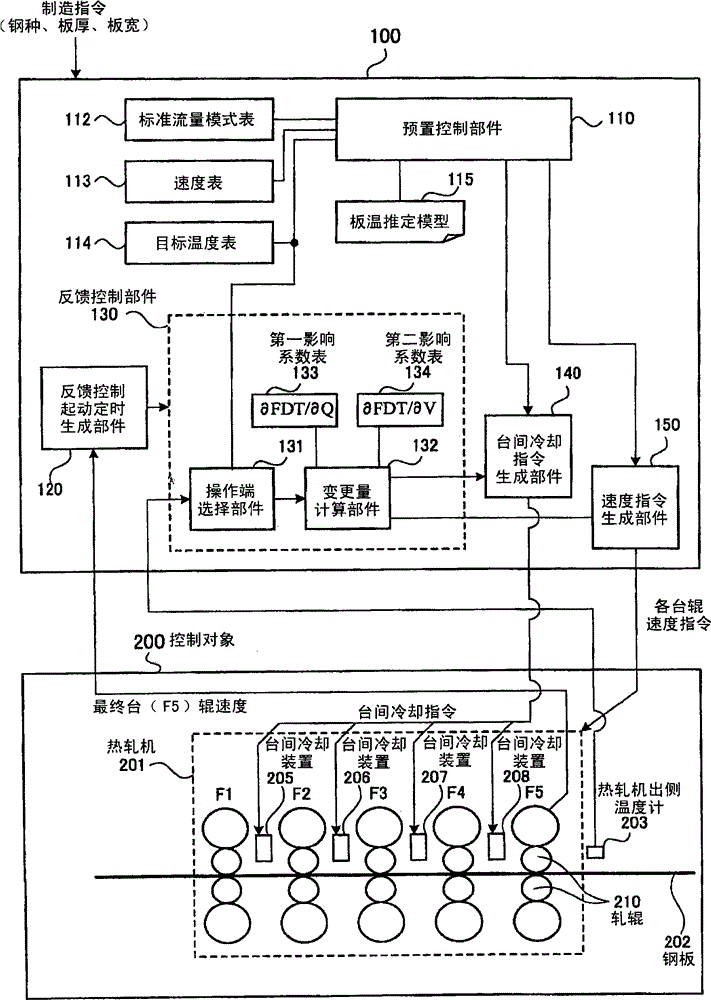
图1是表示本发明的第一实施方式所涉及的热轧机出侧温度控制装置的构成的框图。FIG. 1 is a block diagram showing the configuration of a hot rolling mill exit temperature control device according to a first embodiment of the present invention.
图2是表示图1的标准流量模式表的构成例的图。FIG. 2 is a diagram showing a configuration example of a standard flow pattern table in FIG. 1 .
图3是表示图1的速度表的构成例的图。FIG. 3 is a diagram showing a configuration example of the speedometer in FIG. 1 .
图4是表示图1的目标温度表的构成例的图。FIG. 4 is a diagram showing a configuration example of a target temperature table in FIG. 1 .
图5是表示图1的预置(preset)控制部件的处理的流程图。FIG. 5 is a flowchart showing processing of a preset control unit in FIG. 1 .
图6是表示图1的反馈控制起动定时生成部件的处理的流程图。FIG. 6 is a flowchart showing the processing of the feedback control activation timing generator in FIG. 1 .
图7是表示图1的操作端选择部件的处理的流程图。Fig. 7 is a flowchart showing the processing of the operation terminal selection unit in Fig. 1 .
图8是表示图1的变更量计算部件的处理的流程图。FIG. 8 is a flowchart showing the processing of the change amount calculation unit in FIG. 1 .
图9是表示图1的第一影响系数表的构成例的图。FIG. 9 is a diagram showing a configuration example of the first influence coefficient table in FIG. 1 .
图10是表示图1的第二影响系数表的构成例的图。FIG. 10 is a diagram showing a configuration example of the second influence coefficient table in FIG. 1 .
图11是表示本发明的第二实施方式所涉及的热轧机的出侧温度控制装置的构成例的框图。11 is a block diagram showing a configuration example of an exit-side temperature control device for a hot rolling mill according to a second embodiment of the present invention.
图12是表示图11的轨迹长度计算部件的处理的流程图。FIG. 12 is a flowchart showing the processing of the trajectory length calculation unit in FIG. 11 .
图13是表示图11的压下规程表的构成例的图。FIG. 13 is a diagram showing a configuration example of the pressing schedule table of FIG. 11 .
图14是表示图11的轨迹(tracking)长度表的构成例的图。Fig. 14 is a diagram showing a configuration example of a tracking length table shown in Fig. 11 .
图15是表示图11的反馈控制起动定时生成部件的处理的流程图。FIG. 15 is a flowchart showing the processing of the feedback control activation timing generator in FIG. 11 .
图16是表示图11的冷却反馈控制优先顺序表的构成例的图。FIG. 16 is a diagram showing a configuration example of the cooling feedback control priority table shown in FIG. 11 .
(符号说明)(Symbol Description)
100、100A…热轧机出侧温度控制装置100, 100A...Temperature control device on the exit side of hot rolling mill
110…预置控制部件110...preset control components
115…板温推定模型115... Plate temperature estimation model
120…反馈控制起动定时生成部件120...Feedback control start timing generating part
121…压下规程表121...Depression schedule
122…轨迹长度计算部件122...Track length calculation component
123…反馈控制起动定时生成部件123...Feedback control start timing generating part
130…反馈控制部件130...feedback control components
131…操作端选择部件131...Operating terminal selection parts
132…变更量计算部件132...Change calculation unit
133…第一影响系数表133...The first impact coefficient table
134…第二影响系数表134...Second Influence Coefficient Table
135…冷却反馈控制优先顺序表135… Cooling Feedback Control Priority Table
140…台间冷却指令生成部件140... Inter-stage cooling instruction generating unit
150…速度指令生成部件150…Speed command generator
200…控制对象200…control object
201…热轧机201...Hot rolling mill
202…钢板202...steel plate
203…热轧机出侧温度计203...Outlet side thermometer of hot rolling mill
205~208…台间冷却装置205~208...Inter-stage cooling device
具体实施方式 Detailed ways
以下,参照附图,对用于实施本发明的实施例进行说明。说明按照下述项目的顺序进行。此外,在各图中,对共同构件附加相同符号。Hereinafter, embodiments for carrying out the present invention will be described with reference to the drawings. Explanations are given in order of the following items. In addition, in each figure, the same code|symbol is attached|subjected to a common member.
1.第一实施方式(根据热轧机出侧温度偏差切换操作端的例子)1. First Embodiment (Example of Switching the Operating End According to Temperature Deviation on the Outlet Side of a Hot Rolling Mill)
2.第二实施方式(根据最近的操作端确定FB控制的起动定时的例子)2. Second Embodiment (Example of determining the start timing of FB control from the nearest operator terminal)
<1.第一实施方式><1. First Embodiment>
图1是表示本发明的第一实施方式所涉及的热轧机出侧温度控制装置(台间冷却控制系统)的构成例。第一实施方式是根据热轧机出侧温度偏差的符号进行操作端的切换的例子。FIG. 1 shows a configuration example of a hot rolling mill outlet temperature control device (inter-stand cooling control system) according to a first embodiment of the present invention. The first embodiment is an example in which the operation terminal is switched according to the sign of the temperature deviation on the exit side of the hot rolling mill.
图1所示的热轧机出侧温度控制装置100接受制造指令后,从包括多个台间冷却装置及多个轧辊在内的控制对象200接收各种信号,向控制对象200输出轧辊210的转速、间隙、台F1~F5的轧制负载等控制信号。首先,对控制对象200的构成进行说明。After receiving the manufacturing order, the
在本实施方式中,控制对象200是热轧设备,具备热轧机(也称为“精轧机”)201,该热轧机201具备5个台F1~F5。钢板202被台F1~F5的各台的轧辊210轧制,在减小板厚的同时以规定速度在图1所述的热轧机201中从左至右移动。在热轧机201的出侧,具备对轧制后的钢板202的温度进行测定的热轧机出侧温度计203。In the present embodiment, the control object 200 is a hot rolling facility, and includes a hot rolling mill (also referred to as a "finishing mill") 201, and the
作为在台间冷却钢板202的装置,热轧机201在台F1-F2之间、台F2-F3之间、台F3-F4之间、台F4-F5之间分别具备台间冷却装置205~208。台间冷却装置205~208用与来自热轧机出侧温度控制装置100的台间冷却指令相应的水量,对钢板202进行冷却。台间冷却控制的目的在于,使由热轧机出侧温度计203计测出的温度与目标温度一致。虽然热轧机出侧的目标温度通常在钢板纵长方向各部位是一定的,但也能根据各部位设定不同的值。As a device for cooling the
(热轧机出侧温度控制装置的构成)(Structure of temperature control device on exit side of hot rolling mill)
接着,对热轧机出侧温度控制装置100的构成进行说明。虽然将各功能表记为“……部件”,例如关于热轧机出侧温度控制装置100的各功能,也可以按照一个或多个计算机的指示用软件来实现。例如,能够将“……部件”代替为“……部”。以下,同理。Next, the configuration of the exit
该热轧机出侧温度控制装置100主要进行2个处理。第一处理是如下的预置控制运算,即:从上位计算机接受下次轧制的钢板的制造指令(钢种、板厚、板宽等),计算出与该钢板相应的轧制速度和台间冷却装置205~208的冷却水量的值。第二处理是如下的反馈控制运算,即:在使轧制中热轧机出侧温度计203计测出的钢板温度和目标值的背离减少的方向上,对轧制速度和台间冷却装置205~208的冷却水量的值进行修正。为了实施这2个处理,热轧机出侧温度控制装置100具备:预置控制部件110、反馈控制部件130、反馈控制起动定时生成部件120、台间冷却指令生成部件140、速度指令生成部件150。This hot rolling mill exit
在钢板202被台间冷却装置205~208冷却之前,预置控制部件110计算各台间冷却装置的冷却水的流量(冷却水量)和钢板的轧制速度(钢板速度)。在本实施方式中,从标准流量模式表112、速度表113、目标温度表114中获取信息,进行利用了板温推定模型115的运算,确定各台间冷却装置205~208的冷却水量和/或钢板速度。板温推定模型115规定有下述信息和轧制后的钢板温度之间的关系,该信息包括:在由热轧机100轧制之前的钢板速度、钢板202的轧制速度、设置在台间的台间冷却装置205~208的冷却水量。Before the
此外,热轧机出侧温度控制装置100具备闪存等非易失性存储部件(省略图示),在该存储部件中存储有标准流量模式表112、速度表113、目标温度表114及板温推定模型115。In addition, the hot-rolling mill exit
当钢板202在热轧机201中被冷却时,反馈控制部件113实时(即时)获取由热轧机出侧温度计203测定出的钢板温度的实际值,修正冷却水量和钢板速度中的任意一方或两方。该反馈控制部件130具备:操作端选择部件131、变更量计算部件132、第一影响系数表133、第二影响系数表134。这里,第一影响系数表133存储有热轧机出侧温度的变化相对于台间冷却装置的流量变化的比例

操作端选择部件131判定用热轧机出侧温度计203计测出的钢板202的温度和目标温度的大小(偏差的符号),并基于判定结果来确定:将台间冷却装置205~208的冷却水量和钢板速度中的哪一方设定为操作端来控制热轧机出侧温度。在钢板温度的计测值比目标值大时,将台间冷却装置205~208的冷却水量设定为操作端,在目标值比计测值大时,将钢板速度设定为操作端。另外,变更量计算部件132利用温度偏差的符号和大小、第一影响系数表133及第二影响系数表134,计算所设定的操作端的操作量的变更量。The operating
反馈控制起动定时生成部件120,根据由利用了钢板202的轧制速度的运算确定了钢板位置的结果中,确定反馈控制部件130的起动定时,生成起动指令。The feedback control
台间冷却指令生成部件140,将预置控制部件110输出的台间冷却指令和反馈控制部件130输出的台间冷却指示的修正量相加,计算出最终向台间冷却装置205~208输出的台间冷却指令。The inter-stage cooling
速度指令生成部件150,将预置控制部件110输出的钢板速度指令和反馈控制部件130输出的钢板速度指令的修正量相加,输出最终的钢板速度指令。The speed
在此,对标准流量模式表112、速度表113、目标温度表114进行说明。Here, the standard flow rate pattern table 112, the speed table 113, and the target temperature table 114 are demonstrated.
图2是表示标准流量模式表112的构成例的图。FIG. 2 is a diagram showing a configuration example of the standard flow pattern table 112 .
标准流量模式表112在各台间蓄积:在钢板202的钢种、板厚、板宽条件下确定冷却水量的运算中利用的冷却水量的初始值。钢板202的钢种、板厚、板宽的信息,例如从管理制造信息的上位计算机向热轧机出侧温度控制装置100发送。在图2中,表示了初始值的值用相对于最大流量的百分比示出的例子。例如,表示了在钢种为SS400(碳钢)、板厚3.0~4.0mm、板宽为1200mm时,台F1-F2之间的流量相对于最大流量为80%,台F2-F3之间的流量相对于最大流量为70%,台F3-F4之间的流量相对于最大流量为50%,台F4-F5之间的流量相对于最大流量为0%。标准流量模式表112的内容,是在钢板速度的初始值、钢板前端假定的加工入侧温度下,按照能够大致满足目标FDT,进而能够使伴随着各台的轧制引起的温度下降模式成为期望模式的方式,由模拟仿真或实际的轧制作业预先确定出的。The standard flow rate pattern table 112 stores, among each station, the initial value of the cooling water amount used for calculating the cooling water amount under the conditions of steel type, plate thickness, and plate width of the
图3是表示速度表113的构成的图。FIG. 3 is a diagram showing the configuration of the
针对钢种、板厚、板宽,在钢板202的最终台(在本实施方式中为台F5)出侧速度中,除了钢板202的前端进入台F5时的初始速度之外,还层化存储有恒定速度、钢板202的尾端脱离台F5时的终期速度。预置控制部110判定相应钢板的钢种、板厚、板宽,从速度表113中提取所对应的速度信息。例如,表示了在钢种为SS400、板厚为3.0~4.0mm、板宽为1200mm时,设定有初始速度460mpm(米/分)、恒定速度600mpm、终期速度600mpm。With respect to the steel type, plate thickness, and plate width, in addition to the initial speed when the front end of the
从初始速度至恒定速度的速度变化的梯度,在预置控制部件110确定台间冷却流量的运算之中,确定为用同一冷却水量使FDT达到恒定的值。另外,从恒定速度至终期速度的梯度,在设备制约或容许的温度变化的范围内确定。当确定出台F5出侧的钢板速度时,就确定了台F5的轧辊210的转速,进而根据该值按照各台的压下率(入侧板厚与出侧板厚之比)确定出其他台的轧辊210的转速。The gradient of the speed change from the initial speed to the constant speed is determined so that the FDT becomes a constant value with the same amount of cooling water in the calculation for determining the interstage cooling flow rate by the
图4是表示目标温度表114的构成的图。FIG. 4 is a diagram showing the configuration of the target temperature table 114 .
表示对应钢板的种类(钢种),热轧机出侧温度(FDT)的目标值被层化的例子。预置控制部件110判定钢板202相应的钢种,从目标温度表114中提取出所对应的目标温度。例如,在钢种为SS400时,表示热轧机出侧的目标温度为880℃。目标温度能够使用包括在制造指令中从上位计算机接收到的值。An example in which the target value of the exit temperature (FDT) of the hot rolling mill is stratified according to the type of steel plate (steel type) is shown. The
[热轧机出侧温度控制装置的动作][Operation of the temperature control device on the outlet side of the hot rolling mill]
接着,参照图5的流程图,对预置控制部件110执行的处理进行说明。Next, processing executed by the
首先,预置控制部件110从目标温度表114中获取目标温度,从速度表113中获取初始速度(步骤S5-1)。另外,预置控制部件110从标准流量模式表112中获取标准流量模式(步骤S5-2)。First, the
然后,预置控制部件110进行在获取的条件下预测热轧机出侧温度(FDT)的计算(步骤S5-3)。为了更准确地预测FDT,需要将钢板202进入热轧机201时的温度即热轧机入侧温度(Finishing Mill EntryTemperature:FET)作为初始值,用数学式表示来自钢板202的热辐射、对流导热、伴随着轧制的塑性变形的加工放热、钢板202在与轧辊210接触中所失去的接触导热、因钢板202和轧辊210的摩擦引起的摩擦放热、因来自台间冷却装置的冷却水喷射引起的温度下降等各种要因,在各台中累积地计算。以往研究了各种计算式,例如,在“板轧制的理论和实践”(日本钢铁协会编,1984)中有详细叙述。作为一例,(1)式表示了没有喷射冷却水时的热辐射所引起的传热系数hr的计算式。Then, the
(数学式1)(mathematical formula 1)
hr=σ·ε[{(273+Tsu)/100}4-{(273+Ta)/100}4]/(Tsu-Ta)……(1)hr=σ·ε[{(273+Tsu)/100} 4 -{(273+Ta)/100} 4 ]/(Tsu-Ta)...(1)
其中,σ:斯蒂芬-波尔兹曼常数(=4.88)Among them, σ: Stephen-Boltzmann constant (=4.88)
ε:放射率ε: emissivity
Ta:空气温度(℃)Ta: air temperature (°C)
Tsu:钢板202的表面温度Tsu: surface temperature of
在钢板202在台间移动的期间,伴随着移动,根据(1)式,从钢板202中获取热量。另外,在被冷却的情况下,例如,根据“板轧制的理论和实践”所记载的关系式,获取了与冷却水量相应的热量。将由各要因获取或者给予的热量的总和置换成传热系数,计算在一定时间Δ之间从钢板进出的热量。基于时间经过Δ前的钢板202的温度,根据(2)式,对Δ时间的热量的移动进行加减运算。While the
(数学式2)(mathematical formula 2)
Tn=Tn-1-(ht+hb)*Δ/(ρ*C*B)……(2)Tn=Tn-1-(ht+hb)*Δ/(ρ*C*B)...(2)
其中,Tn:当前的钢板温度Among them, Tn: current steel plate temperature
Tn-1:Δ前的钢板温度Tn-1: steel plate temperature before Δ
ht:钢板表面的传热系数ht: heat transfer coefficient of the steel plate surface
hb:钢板背面的传热系数hb: heat transfer coefficient on the back of the steel plate
ρ:钢板202的密度ρ: Density of
C:钢板202的比热C: specific heat of
B:钢板202的厚度B: Thickness of
另外,在钢板202的厚度大等需要考虑厚度方向的热传导的情况下,能够通过求解公知的热方程式来计算。热方程式由(3)式表示,除了时间方向之外还在厚度方向上由计算机进行差分计算的方法,已经被各种文件公开了。In addition, when it is necessary to consider heat conduction in the thickness direction, such as the thickness of the
(数学式3)(mathematical formula 3)
其中,λ:热传导率where, λ: thermal conductivity
T:材料温度T: material temperature
x:钢板202的厚度方向的位置x: position in the thickness direction of the
针对钢板202的前端部,通过咬合在台F1之后到脱离台F5之间,推进时间地进行上述(1)式~(3)式的计算,从而能够计算钢板202前端部的FDT。The FDT of the front end of the
然后,预置控制部件110判定FDT相对于目标温度(Ttarget)是否在一定范围(±α)内。在FDT比目标温度高的情况下,进行增加台间冷却水流量的处理,在FDT比目标温度低的情况下,进行减少台间冷却水流量的处理。在除此以外的情况下,维持台间冷却水流量(步骤S5-4)。流量的增减处理虽然只要以一定比例增减各台间的冷却水量即可,但也考虑对特定台的水量进行增减。Then, the
接着,预置控制部件110判定结束条件(步骤S5-5)。一般情况下,只要将FDT落入一定范围的条件作为结束条件即可,但也能考虑将步骤S5-3,S5-4的计算重复次数附加在结束条件中。Next, the
最后,预置控制部件110确定在使钢板202加速至速度表113规定的恒定速度时的加速率,并确定钢板202的速度模式(步骤S5-6)。加速率Vr可以是预先确定出的常数,但以对热轧机入侧中的钢板202的温度在钢板202的纵长方向上降低的情况进行补偿为目的,还考虑按照从钢板202的前端相对于钢板202的纵长方向的部位的FET的下降率FETr,基于(4)式计算。Finally, the
(数学式4)(mathematical formula 4)


接着,参照图6的流程图,对反馈控制起动定时生成部件120执行的处理进行说明。Next, the processing executed by the feedback control
反馈控制起动定时生成部件120以几百ms左右的周期起动计时器。首先,反馈控制起动定时生成部件120获取最终台(F5)的轧辊210的转速V(步骤S6-1)。接着,对由该值求出的钢板速度进行积分,计算钢板202的移动量(步骤S6-2)。这里,钢板速度能够按照公知的轧制理论(在轧辊的前侧和后侧,钢板速度不同),由下式算出。即,利用后进率φ通过(5)式求出轧辊210入侧的钢板速度Vsb,另外,利用先进率f通过(6)式求出轧辊210出侧的钢板速度Vsf。The feedback control start timing
(数学式5)(mathematical formula 5)
Vsb=(1-φ)Vr……(5)Vsb=(1-φ)Vr...(5)
(数学式6)(mathematical formula 6)
Vsf=(1+f)Vr……(6)Vsf=(1+f)Vr...(6)
然后,反馈控制起动定时生成部件120,在利用反馈控制变更了台间冷却水量的定时(timing),判定成为变更对象的台间冷却装置205~208正下方的钢板部位是否通过了热轧机出侧温度计203(步骤S6-3)。在没有通过的情况下,结束处理。在通过了的情况下,判定是否经过了一定时间(步骤S6-4)。Then, the feedback control activation
在步骤S6-4的判定处理中,在判定出并未经过相当于从向台间冷却装置205~208给予水量变更指令之后直到所对应的水量反映在钢板202的冷却中的时间(通常1~2秒左右)的时间时,同样结束处理。在经过了一定时间的情况下,从反馈控制起动定时生成部件120向反馈控制部件130输出起动信号(步骤S6-5)。In the judgment process of step S6-4, when it is judged that the time corresponding to the time (usually 1 to 2 hours) from when the water quantity change command is given to the
最后,反馈控制起动定时生成部件120将钢板移动量计算用的积分值(步骤S6-6)清零(初始化)。以下,通过计时器起动反馈控制起动定时生成部件120,从而周期性地重复步骤S6-1~步骤S6-6的处理。Finally, the feedback control start timing
接着,参照图7的流程图,对反馈控制部件130具备的操作端选择部件131的处理进行说明。Next, the processing of the operation
在轧制中利用热轧机出侧温度计203从钢板202检测出的FDT(热轧机出侧温度)与目标温度之间有偏差时,操作端选择部件131执行如下处理:判定是通过改变台间冷却水量来消除该偏差,还是通过改变钢板速度来消除该偏差,并将判定结果输出至变更量计算部件132中。在本实施方式中,以关注偏差的符号来确定是通过改变台间冷却水量来消除该偏差还是通过改变钢板速度来消除该偏差为例。When there is a deviation between the FDT (hot rolling mill exit temperature) detected from the
首先,操作端选择部件131获取热轧机出侧温度的目标值和计测值(步骤S7-1)。接着,操作端选择部件131计算从计测值中减去目标值后的值作为温度偏差,并判定温度偏差的绝对值是否在预定的阈值以上(步骤S7-2)。在温度偏差的绝对值在阈值以上时,判定温度偏差的符号(步骤S7-4)。在符号为正时、即在计测值比在目标值上相加了阈值之后的值还大时,操作端选择部件131将冷却水量设定为操作端(步骤S7-5)。在符号为负时、即在计测值比从目标值中减去阈值之后的值还小时,操作端选择部件131将钢板速度设定为操作端(步骤S7-6)。First, the operation end selection means 131 acquires a target value and a measured value of the exit temperature of the hot rolling mill (step S7-1). Next, the operation
在步骤S7-2的判定处理中判定出温度偏差的绝对值不在阈值以上时,操作端选择部件131不使台间冷却水量和钢板速度中的任一方变化(操作量为零),所以将操作端的设定设为无(步骤S7-3)。最后,将在步骤S7-5、S7-6中设定出的操作端和温度偏差输出至变更量计算部件132(步骤S7-7)。When it is determined in the determination process of step S7-2 that the absolute value of the temperature deviation is not greater than the threshold value, the operation end selection means 131 does not change either the amount of cooling water between stands or the speed of the steel plate (the operation amount is zero), so the
接着,参照图8的流程图,对反馈控制部件130具备的变更量计算部件132的处理进行说明。Next, the processing of the change
首先,反馈控制部件130按照操作端选择部件131的输出进行操作端的选定(步骤S8-1)。在将冷却水量选定为操作端时,变更量计算部件132为使温度偏差变小,按照(7)式计算各台间冷却水量的变更量ΔQ(步骤S8-2)。例如,按照使变更量ΔQ中的、Δq1为变更量整体的50%、Δq2为变更量整体的30%、Δq3是变更量整体的20%、Δq4是变更量整体的0%等方式,按每个台间冷却装置适当地设定冷却水量的变更量。First, the
(数学式7)(mathematical formula 7)
ΔQ=(Δq1、Δq2、Δq3、Δq4)……(7)ΔQ=(Δq1, Δq2, Δq3, Δq4)...(7)
其中,Δq1:F1-F2间冷却水量的变更量Among them, Δq1: the amount of cooling water change between F1-F2
Δq2:F2-F3间冷却水量的变更量Δq2: Change of cooling water volume between F2-F3
Δq3:F3-F4间冷却水量的变更量Δq3: Change amount of cooling water between F3-F4
Δq4:F4-F5间冷却水量的变更量Δq4: Change amount of cooling water between F4-F5
更具体而言,根据从第一影响系数表133中获取的当前状态所对应的层化的影响系数
(数学式8)(mathematical formula 8)
其中,i:台间号码Among them, i: inter-station number
(1:F1-F2间、2:F2-F3间、3:F3-F4间、4:F4-F5间)(1: Room F1-F2, 2: Room F2-F3, 3: Room F3-F4, 4: Room F4-F5)
Δqi:因反馈控制引起的台间i的冷却水量的变更量Δqi: The amount of change in the amount of cooling water between stations i due to feedback control
Gqi:常数(将冷却水量作为操作端时的反馈控制增益)Gqi: constant (feedback control gain when cooling water volume is used as the operating terminal)
ΔFDT:温度偏差ΔFDT: temperature deviation
选择冷却水量作为操作端,是由于处于计测温度比目标温度高的情况,ΔFDT为正。此时,根据计算结果得到的冷却水量的变更量Δqi也为正,台间冷却装置205~208中的冷却水量沿着总是增加的方向被操作。The reason why the amount of cooling water is selected as the operation end is that ΔFDT is positive when the measured temperature is higher than the target temperature. At this time, the amount of change Δqi in the amount of cooling water obtained from the calculation result is also positive, and the amount of cooling water in the
此外,关于用于消除ΔFDT的台,根据反馈控制的响应性及控制效果选择下游台(接近出侧的一方)为好,但有时钢板202被轧制得较薄之后冷却时会对钢板202的形状带来不良影响。考虑到这一点,也有如下方法:在一定程度上牺牲反馈控制的响应性,而从入侧台起优先选择。反馈控制增益是考虑这一点,根据通过哪个台消除多大程度的温度偏差来确定的。In addition, as for the stage used to eliminate ΔFDT, it is better to select the downstream stage (the side closer to the exit side) according to the responsiveness and control effect of the feedback control, but sometimes the
这里,图9表示第一影响系数表133的构成例。Here, FIG. 9 shows a configuration example of the first influence coefficient table 133 .
在第一影响系数表133中,使冷却水量以单位量变化时的FDT的变化量所对应的数值即


但是,还假设将步骤S8-2的处理中算出的各台间的冷却水量的变更量加到当前冷却水量之后的结果达到了各台间的冷却水量(冷却能力)的上限的情况,此时只通过冷却水量的増加无法消除温度偏差,所以需要用于缩小温度偏差的进一步的处置。因此,变更量计算部件132进行以下的处理。However, it is also assumed that the result of adding the amount of change in the amount of cooling water between the stations calculated in the process of step S8-2 to the current amount of cooling water reaches the upper limit of the amount of cooling water (cooling capacity) between the stations. Since the temperature deviation cannot be eliminated only by increasing the amount of cooling water, further measures for reducing the temperature deviation are required. Therefore, the change
首先,变更量计算部件132判定在各台间增加冷却水量的结果冷却水量是否达到了上限(步骤S8-3)。在达到了上限的情况下,以冷却水量达到了上限的台间冷却装置的当前时刻的冷却水量作为基点,固定为冷却水量成为上限的变更量(Δqimax)(步骤S8-4)。然后,利用从第二影响系数表134中获取的与当前状态相应的层化的影响系数
(数学式9)(mathematical formula 9)
其中,∑:在各台间计算出的值的总和Among them, ∑: The sum of the values calculated among the units
Δqi:因反馈控制引起的台间i的冷却水量的变更量Δqi: The amount of change in the amount of cooling water between stations i due to feedback control
Gv:常数(将钢板速度作为操作端时的反馈控制增益)Gv: constant (feedback control gain when the steel plate speed is used as the operating end)
由此,将变更量计算部件132基于温度偏差的余量、第二影响系数表134的内容和(9)式计算出的钢板速度的变更量,输出至速度指令生成部件150。然后,基于来自速度指令生成部件150的各台辊速度指令,各台的轧辊210的转速被控制在减速的方向上,钢板速度降低。结果,钢板温度降低,且能够减小与目标温度的温度偏差。Thus, the change amount of the steel sheet speed calculated by the change
接着,图10表示第二影响系数表134的构成例。Next, FIG. 10 shows a configuration example of the second influence coefficient table 134 .
在第二影响系数表134中,使钢板202的速度增加或减少1mpm时的FDT的变化量所对应的数值即按钢种、热轧机出侧板速、热轧机出侧板厚(目标板厚)被层化地存储。在图10的例子中,在钢种为碳钢(SS400)、F5出侧板速为400mpm以下、板厚为2mm以下时,

另一方面,在步骤S8-1的判定处理中钢板速度被选定为操作端时,变更量计算部件132按照(10)式计算使温度偏差变小的钢板速度的变更量ΔV(步骤S8-6)。具体而言,根据从第一影响系数表133中获取的与当前状态相应的层化的影响系数和FDT的温度偏差,由下述运算计算台间冷却水量的变更量。On the other hand, when the steel plate speed is selected as the operation end in the determination process of step S8-1, the change
(数学式10)(mathematical formula 10)
其中,i:台间号码Among them, i: inter-station number
(1:F1-F2间、2:F2-F3间、3:F3-F4间、4:F4-F5间)(1: Room F1-F2, 2: Room F2-F3, 3: Room F3-F4, 4: Room F4-F5)
Δqi:因卷绕温度FB控制引起的台间i的冷却水量的变更量Δqi: The amount of change in the amount of cooling water between stations i caused by the control of the winding temperature FB
Gqi:常数(将冷却水量作为操作端时的反馈控制增益)Gqi: constant (feedback control gain when cooling water volume is used as the operating terminal)
ΔFDT:温度偏差ΔFDT: temperature deviation
这里,作为操作端而选择钢板速度,是因为处于计测温度比目标温度低的情况,ΔFDT为负。此时,由计算结果得到的钢板速度的变更量ΔV为正,钢板速度沿着总是增加的方向被操作。Here, the reason why the steel plate speed is selected as the operating point is that ΔFDT is negative when the measured temperature is lower than the target temperature. At this time, the change amount ΔV of the steel plate speed obtained from the calculation result is positive, and the steel plate speed is manipulated in a direction of always increasing.
但是,还假设将步骤S8-6的处理中计算出的钢板速度的变更量加在当前的钢板速度上的结果达到了钢板速度(轧辊的旋转能力)的上限的情况,只通过钢板速度的增加无法消除温度偏差,所以需要用于减小温度偏差的进一步处置。因此,在变更量计算部件132中进行以下的处理。However, it is also assumed that the result of adding the change amount of the steel plate speed calculated in the process of step S8-6 to the current steel plate speed has reached the upper limit of the steel plate speed (rotation capacity of the roll), and only by increasing the steel plate speed The temperature deviation cannot be eliminated, so further measures for reducing the temperature deviation are required. Therefore, the following processing is performed in the change
首先,变更量计算部件132使钢板速度増加,结果判定钢板速度是否达到了上限(步骤S8-7)。钢板速度的上限值是考虑下述各种要因而确定,即,驱动各台的轧辊210的电动机的转矩或转速的限制、钢板202的后端从轧辊210拔出时的速度限制等。在达到了上限的情况下,以当前时刻的钢板速度作为基点,固定为钢板速度成为上限的变更量(ΔVmax)(步骤S8-8)。First, the change
然后,利用从第一影响系数表133中获取的与当前状态相应的层化的影响系数
(数学式11)(mathematical formula 11)
由此,将变更量计算部件132基于温度偏差的余量、第一影响系数表133的内容和(11)式计算出的各台间冷却水量的变更量,输出至台间冷却指令生成部件140。然后,基于来自台间冷却指令生成部件140的台间冷却指令,各台间冷却装置205~208的冷却水量被控制在减少的方向上。结果,钢板温度上升,能够减小与目标温度的温度偏差。Thus, the change amount of each inter-stage cooling water amount calculated by the change
在上述的实施方式中,虽然采取了使冷却水量的变化所对应的FDT的变化量蓄积在第一影响系数表133中,使钢板速度的变化所对应的FDT的变化量蓄积在第二影响系数表134中,从各表取出相应的影响系数的方式,但也能够每次都计算下次冷却控制的钢板所对应的影响系数,并用于反馈控制。例如,按照以下说明的计算,在预置控制部件110中计算各影响系数,并在相应的钢板的冷却控制之前将计算出的影响系数发送至反馈控制部件130,在反馈控制部件130中能够利用发送来的影响系数来计算冷却水量或钢板速度的变更量。关于影响系数,例如,在钢板速度的变化所对应的FDT的变化量
(数学式12)(mathematical formula 12)
其中,V1、V2:下次冷却控制的钢板202的轧制速度附近的速度Among them, V1, V2: the speed near the rolling speed of the
(V1≠V2)(V1≠V2)
(FDT)1:以速度V1轧制钢板202时得到的FDT(FDT)1: FDT obtained when the
(FDT)2:以速度V2轧制钢板202时得到的FDT(FDT)2: FDT obtained when the
另外,相对于各台间的冷却水量的变化所对应的FDT的变化量的影响系数能够针对各台间按照(13)式计算。In addition, the influence coefficient of the change in FDT corresponding to the change in the amount of cooling water between the units It can be calculated according to the formula (13) for each station.
(数学式13)(mathematical formula 13)
其中,(qi)1、(qi)2:下次冷却控制的钢板202的冷却水量附近的水量Among them, (qi)1, (qi)2: the amount of water in the vicinity of the cooling water amount of the
((qi)1≠(qi)2)((qi)1≠(qi)2)
(FDT)1:以(qi)1冷却钢板202时得到的FDT(FDT)1: FDT obtained when cooling the
(FDT)2:以(qi)2冷却钢板202时得到的FDT(FDT)2: FDT obtained when cooling the
(台i以外的台间冷却水量是预置控制部件110计算出的值)(The amount of cooling water between stations other than station i is the value calculated by the preset control unit 110)
i:台号码i: station number
[第一实施方式的效果][Effect of the first embodiment]
如以上说明,根据第一实施方式所示的本发明,在热轧机的出侧温度控制中,根据热轧机出侧温度偏差的符号进行操作端的切换。由此,既能考虑提高钢板的生产量,又能得到高精度的热轧机出侧温度。因此,提高了钢板的品质。As described above, according to the present invention shown in the first embodiment, in the exit temperature control of the hot rolling mill, switching of the operation terminal is performed according to the sign of the temperature deviation at the exit side of the hot rolling mill. Accordingly, it is possible to obtain a high-precision exit temperature of the hot-rolling mill while considering an increase in the throughput of the steel plate. Therefore, the quality of the steel sheet is improved.
此外,在本实施方式中,虽然采用了在作为同一控制装置的热轧机出侧温度控制装置100中执行预置控制部件110和反馈控制部件130,但并不限定于该例子。例如,作为在热轧机的控制系统中常见的方式,也可以采用由过程控制计算机执行预置控制、由机械设备控制器执行反馈控制的构成。In addition, in this embodiment, although the preset control means 110 and the feedback control means 130 are implemented in the hot-rolling-mill exit-side
另外,在本实施方式中,作为在钢板202的轧制中修正操作量的部件而具备反馈控制部件130,但是也可以考虑如下构成:在热轧机入侧设置温度计来检测钢板202的热轧机入侧温度,并设置进一步高精度地补偿其偏差的部件。In addition, in this embodiment, the feedback control means 130 is provided as means for correcting the operation amount during the rolling of the
<2.第二实施方式><2. Second Embodiment>
第二实施方式是判定上次热轧机出侧温度反馈控制的操作端是钢板速度还是台间冷却水量,并基于判定结果确定下次反馈控制的起动定时的例子。以下,以第二实施方式的特征或者与第一实施方式不同的部分作为中心进行说明。The second embodiment is an example in which it is determined whether the operating end of the hot rolling mill outlet temperature feedback control last time was the steel plate speed or the interstand cooling water amount, and the start timing of the next feedback control is determined based on the determination result. Hereinafter, the characteristics of the second embodiment or the parts different from the first embodiment will be mainly described.
图11表示本发明的第二实施方式所涉及的热轧机出侧温度控制装置的构成例。图11所示的热轧机出侧温度控制装置100A与热轧机出侧温度控制装置100(参照图1)进行比较,不同点在于,还具备:压下规程表121、轨迹长度计算部件122、轨迹长度表123、反馈控制部件130内的冷却反馈(FB)控制优先顺序表135。各表被存储于未图示的闪存等非易失性存储部件。Fig. 11 shows a configuration example of a hot rolling mill exit temperature control device according to a second embodiment of the present invention. Compared with the hot rolling mill exit temperature control device 100A shown in FIG. 11 and the hot rolling mill exit temperature control device 100 (refer to FIG. 1 ), the difference lies in that it also includes a reduction schedule table 121 and a track length calculation unit 122. , the trajectory length table 123 , and the cooling feedback (FB) control priority order table 135 in the
轨迹长度计算部件122,根据热轧机的设备所相关的信息和各台中的钢板的轧制量,通过热轧机出侧的钢板长度换算,来计算在分别使各台间的冷却水量和钢板速度变化时热轧机出侧温度变化所需的钢板202的移动距离(轨迹长度)。计算出的轨迹长度被存储于轨迹长度表123。利用该轨迹长度,分别对热轧机出侧温度控制的操作端即台间冷却装置205~208和钢板速度变更操作量之后,与从最终台(台F5)出侧输出的钢板202的长度进行比较。The track length calculation part 122 calculates the amount of cooling water and the steel plate between each stand respectively by converting the length of the steel plate on the outlet side of the hot rolling mill according to the information related to the equipment of the hot rolling mill and the rolling amount of the steel plate in each stand. The moving distance (trajectory length) of the
反馈控制起动定时生成部件120判定由反馈控制部件130选择出的操作端是轧制速度还是冷却水量,根据判定结果确定下一次反馈控制的实施定时。更具体而言,基于实施了反馈控制后输出的热轧机出侧的钢板长度和轨迹长度表123存储的信息进行比较的结果,来生成并输出用于实施下一次反馈控制的起动信号。The feedback control start timing
接着,参照图12的流程图,对轨迹长度计算部件122执行的处理进行说明。Next, the processing executed by the trajectory length calculation unit 122 will be described with reference to the flowchart of FIG. 12 .
首先,轨迹长度计算部件122从图13所示的压下规程表121中,获取进入台F1的钢板202的厚度即坯材厚度和各台的压下率的信息(步骤S12-1)。First, the trajectory length calculation unit 122 acquires information on the thickness of the
在压下规程表121中,对应于钢板202的钢种、板厚、板宽,蓄积有进入台F1时的钢板202的坯材厚度及台F1~F5的各自的出侧板厚(压下率)的信息。在图13中,作为一例示出:在钢种为SS400、板厚为2.0~3.0mm、板宽为900mm时,台F1~F5分别以50%、47%、42%、39%、28%的比率使钢板202的板厚变薄。In the reduction schedule table 121, corresponding to the steel type, plate thickness, and plate width of the
接着,轨迹长度计算部件122计算各台的出侧板厚(步骤S12-2)。能够用(14)式计算各台的出侧板厚。Next, the trajectory length calculating means 122 calculates the exit-side plate thickness of each stand (step S12-2). The exit side plate thickness of each table can be calculated by (14) formula.
(数学式14)(mathematical formula 14)
出侧板厚=入侧板厚×(1-压下率)×(目标板厚/入侧板厚)Thickness of exit side = thickness of entry side × (1-reduction rate) × (target thickness/thickness of entry side)
/{下游台的(1-压下率)之积}/{product of (1-reduction rate) of the downstream station}
其中,下游台包括对象台自身。Wherein, the downstream station includes the target station itself.
以钢种为SS400、板厚为2.0~3.0mm、板宽为900mm、目标板厚(在本实施方式中为F5出侧板厚)为2.0mm时为例,各台的出侧板厚Th1~Th5参照压下规程表121,按照从上游台开始的顺序如下求出。Taking steel grade SS400, plate thickness 2.0-3.0 mm, plate width 900 mm, and target plate thickness (in this embodiment, F5 exit-side plate thickness) as an example, the exit-side plate thickness Th1 of each station - Th5 is obtained as follows in order from the upstream table with reference to the reduction schedule table 121 .
Th1=26×(1-0.5)×(2.0/26)/{(1-0.5)×(1-0.47)×(1-0.42)×(1-0.39)×(1-0.28)}Th1=26×(1-0.5)×(2.0/26)/{(1-0.5)×(1-0.47)×(1-0.42)×(1-0.39)×(1-0.28)}
=14.81mm=14.81mm
Th2=14.81×(1-0.47)×(2.0/14.81)/{(1-0.47)×(1-0.42)×(1-0.39)×(1-0.28)}Th2=14.81×(1-0.47)×(2.0/14.81)/{(1-0.47)×(1-0.42)×(1-0.39)×(1-0.28)}
=7.85mm=7.85mm
Th3=7.85×(1-0.42)×(2.0/7.85)/{(1-0.42)×(1-0.39)×(1-0.28)}Th3=7.85×(1-0.42)×(2.0/7.85)/{(1-0.42)×(1-0.39)×(1-0.28)}
=5.08m=5.08m
Th4=5.08×(1-0.39)×(2.0/5.08)/{(1-0.39)×(1-0.28)}Th4=5.08×(1-0.39)×(2.0/5.08)/{(1-0.39)×(1-0.28)}
=2.77m=2.77m
Th5=2.77×(1-0.28)×(2.0/2.77)/(1-0.28)Th5=2.77×(1-0.28)×(2.0/2.77)/(1-0.28)
=2.0m=2.0m
根据这些各台的出侧板厚,计算操作台间冷却装置205~208的每一个时的轨迹长度(步骤S12-3)。能够利用(15)式计算轨迹长度。此外,设各台间冷却装置处于相应台的中央,另外,最终台设为台F5。Based on the exit-side plate thickness of each of these stands, the path length when operating each of the
(数学式15)(mathematical formula 15)
轨迹长度=(相应台间距离×台间的钢板厚度/目标板厚)/2Trajectory length = (corresponding distance between stations × steel plate thickness between stations/target plate thickness)/2
+针对下游台间 +For downstream inter-stage
(台间距离×台间的钢板厚度/目标板厚)的总和The sum of (distance between stations × steel plate thickness between stations/target plate thickness)
+从最终台至热轧机出侧温度计203的距离 + the distance from the final station to the
因此,针对上述的压下率的例子,以台间距离为5m、从台F5至热轧机出侧温度计203的距离为6m的情况为例,第i台和第(i+1)台之间的台间冷却装置的冷却水量发生了变化的情况所对应的轨迹长度Li,分别如下求出。Therefore, for the example of the above-mentioned reduction rate, taking the case where the distance between stands is 5 m and the distance from stand F5 to the hot rolling mill
L1=(5×14.81/2.0)/2+5×(7.85+5.08+2.77)/2.0+6L 1 =(5×14.81/2.0)/2+5×(7.85+5.08+2.77)/2.0+6
=63.76m=63.76m
L2=(5×7.85/2.0)/2+5×(5.08+2.77)/2.0+6L 2 =(5×7.85/2.0)/2+5×(5.08+2.77)/2.0+6
=35.43m=35.43m
L3=(5×5.08/2.0)/2+5×2.77/2.0+6L 3 =(5×5.08/2.0)/2+5×2.77/2.0+6
=19.28m=19.28m
L4=(5×2.77/2.0)/2+6L 4 =(5×2.77/2.0)/2+6
=9.46m=9.46m
然后,对所有台间判定轨迹长度的计算是否已结束(步骤S12-4)。在未结束的情况下,重复步骤S12-3的处理。在已结束的情况下,因为台间冷却装置205~208所对应的轨迹长度的计算结束,所以接着计算操作端为钢板速度时的轨迹长度(步骤S12-5)。Then, it is determined whether or not the calculation of the track length has been completed for all stations (step S12-4). If not finished, the process of step S12-3 is repeated. When it has been completed, since the calculation of the trajectory lengths corresponding to the
钢板速度的变更,严格上会影响到钢板202的尾端的FDT。可是,这里示出如下例子:对热轧机201的入侧位置的上游的钢板的影响与对热轧机入侧位置的钢板的影响大致等效,将热轧机201的入侧位置所对应的轨迹长度L0设为钢板速度变更所对应的轨迹长度。用(16)式表示此时的轨迹长度。The change of the steel plate speed will strictly affect the FDT of the tail end of the
(数学式16)(mathematical formula 16)
轨迹长度=(相应台间距离×台间的钢板厚度/目标板厚)Trajectory length = (corresponding distance between stations × steel plate thickness between stations / target plate thickness)
+针对下游台间 +For downstream inter-stage
(台间距离×台间的钢板厚度/目标板厚)的总和The sum of (distance between stations × steel plate thickness between stations/target plate thickness)
+从最终台至热轧机出侧温度计203的距离 + the distance from the final station to the
因此,轨迹长度L0如下求出。Therefore, the trajectory length L0 is obtained as follows.
L0=5×(14.81/2.0)+5×(7.85+5.08+2.77)/2.0+6L 0 =5×(14.81/2.0)+5×(7.85+5.08+2.77)/2.0+6
=82.28m=82.28m
图14表示轨迹长度表123的构成例。在轨迹长度表123中,与操作端及操作量对应地存储有轨迹长度计算部件122输出的值。FIG. 14 shows a configuration example of the track length table 123 . In the track length table 123, the value output by the track length calculating part 122 is stored in association with the operation terminal and the operation amount.
由此,轨迹长度计算部件122,根据各台间的板厚和台间距离、以及最终台和热轧机出侧温度计203的距离,通过热轧机出侧板厚换算,来计算热轧机出侧温度计203检测到因台间冷却水量改变的影响引起的钢板温度变化所需的钢板长度(轨迹长度)的值,并将其存储在轨迹长度表123中。此外,通过热轧机出侧板厚换算,来计算热轧机出侧温度计203检测到因速度改变的影响引起的钢板温度变化所需的钢板长度(轨迹长度)的值,并将其存储在轨迹长度表中。Thus, the track length calculation unit 122 calculates the hot rolling mill temperature by converting the exit thickness of the hot rolling mill based on the plate thickness and the distance between the stands and the distance between the final stand and the hot rolling mill
接着,参照图15的流程图,对反馈控制起动定时生成部件120执行的处理进行说明。Next, the processing executed by the feedback control
反馈控制起动定时生成部件120以几百ms左右的周期起动计时器。首先,获取在反馈控制部件130的变更量计算部件132改变了向操作端的输出的定时所输出的值,判定操作端是钢板速度还是冷却水量(步骤S15-1)。The feedback control start timing
在判定出操作端只是冷却水量的情况下,反馈控制起动定时生成部件120确定在所操作的台间冷却装置中最上游的台间冷却装置(步骤S15-2)。In a case where it is determined that the operating end is only the cooling water amount, the feedback control start timing generating
接着,反馈控制起动定时生成部件120,从轨迹长度表123中获取确定出的台间冷却装置所对应的台间(操作部位)对应的轨迹长度(步骤S15-3)。即,获取以变更了操作量后的最上游的台间所对应的台为起点的轨迹长度的总和。Next, the feedback control
另一方面,在上述步骤S15-1的判定处理中判定出操作端至少包括钢板速度的情况下,反馈控制起动定时生成部件120从轨迹长度表123中获取钢板速度所对应的轨迹长度L0(步骤S15-4)。即,获取以热轧机的入侧台作为起点的轨迹长度的总和。On the other hand, when it is determined in the determination process of the above-mentioned step S15-1 that the operating end includes at least the steel plate speed, the feedback control start timing generating
在步骤S15-3或步骤S15-4的处理完成之后,反馈控制起动定时生成部件120获取最终台(F5)的轧辊210的转速V(步骤S15-5)。After the processing of step S15-3 or step S15-4 is completed, the feedback control start timing generating
然后,对由该值求出的钢板速度进行积分,计算来自钢板202的最终台(F5)的输出长度(步骤S15-6)。利用上述的(6)式,能够根据轧辊210的转速求出轧辊出侧的钢板速度Vsf。Then, the steel plate velocity obtained from this value is integrated to calculate the output length from the final table ( F5 ) of the steel plate 202 (step S15-6). Using the above formula (6), the steel sheet velocity Vsf on the exit side of the roll can be obtained from the rotation speed of the
这里,反馈控制起动定时生成部件120,对钢板202的输出长度和从轨迹长度表123中提取出的热轧机出侧温度变化所需的钢板202的轨迹长度之间的长短关系进行比较(步骤S15-7)。在输出长度未达到轨迹长度时,意味着:操作量变更的影响未反映于热轧机出侧温度计203中的计测值。因此,因为不是起动反馈控制部件130的定时,所以结束处理。Here, the feedback control starts the
另一方面,在输出长度达到了轨迹长度时,反馈控制起动定时生成部件120生成起动信号,向反馈控制部件130输出该起动信号。然后,在输出起动信号之后,将输出长度计算用的钢板速度的积分值清零(步骤15-9)。On the other hand, when the output length reaches the track length, the feedback control start timing
以下,反馈控制起动定时生成部件120因起动了计时器,所以周期性地反复进行步骤S15-1~S15-9的处理。Hereinafter, since the feedback control start timing
此外,在本实施方式中,虽然只关注输出长度并生成了反馈控制部件130的起动信号,但并不限定于本例。例如,也能够在向台间冷却装置205~258给予冷却水量的变更指令之后,加上相当于直到所对应的冷却水量反映于钢板202的冷却为止的时间(一般为2~5秒)的时间,生成向反馈控制部件130的起动信号。由此,能够在更好地反映了操作后的钢板202状态的情况下输出向反馈控制部件130的起动信号。In addition, in this embodiment, although focusing only on the output length and generating the activation signal of the feedback control means 130, it is not limited to this example. For example, it is also possible to add a time corresponding to the time (generally 2 to 5 seconds) until the corresponding amount of cooling water is reflected in the cooling of the
[冷却反馈控制的优先顺序][Priority order of cooling feedback control]
在第一实施方式中说明了如下情形,即:在将冷却水量选定为操作端的情况下,为使温度偏差变小,变更量计算部件132按照(7)式计算各台间冷却水量的变更量ΔQ(参照图8的步骤S8-2),按照每个台间冷却装置适当地设定冷却水量的变更量。此时,也可预先对台间建立优先顺序,在按台间冷却装置设定冷却水量的变更量时,基于台间的优先顺序来设定冷却水量的变更量。以下,对基于台间的优先顺序的冷却水量的变更量的设定处理进行说明。In the first embodiment, when the cooling water amount is selected as the operation end, the change
图16是表示冷却反馈控制优先顺序表135的构成例。冷却反馈控制优先顺序表135中蓄积了下述信息,即,在使台间冷却装置的冷却水量变化来消除冷却控制中计测出的钢板的热轧机出侧温度和目标温度之间的偏差的情况下,优先操作哪个台间的台间冷却装置的冷却水量的信息。在图16所示的例子中,冷却反馈控制的优先顺序按钢种、轧制后(台F5出侧)的板厚、台间被层化地存储。FIG. 16 shows a configuration example of the cooling feedback control priority order table 135 . In the cooling feedback control priority order table 135, information is stored that changes the amount of cooling water in the interstand cooling device to eliminate the deviation between the hot rolling mill exit temperature of the steel plate measured in the cooling control and the target temperature. In the case of the case, the information on the amount of cooling water of the inter-stage cooling device of which inter-stage cooling device is preferentially operated. In the example shown in FIG. 16 , the priority order of cooling feedback control is stored hierarchically for each steel type, plate thickness after rolling (outlet side of stand F5 ), and between stands.
首先,变更量计算部件132从图12所示的冷却反馈控制优先顺序表135中,获取与轧制中的钢板202相应的台间的优先顺序。然后,按照从优先顺序的最高的台间所对应的台间冷却装置开始的顺序变更操作量,当该台间冷却装置饱和时,来变更优先顺序为次位的台间冷却装置的操作量。在冷却反馈控制优先顺序表135中,钢板的种类、目标板厚被层化,并且能够各自赋予不同的顺序。First, the change
例如,虽然考虑根据反馈控制的响应性及控制效果优先选择下游(热轧机出侧)的台间,但在钢板202薄时进行轧制之后再进行冷却时,有时会对钢板202的形状带来不良影响(弯曲、翘曲等)。考虑该点,也考虑如下方法:在一定程度上牺牲反馈控制的响应性,从上游(热轧机入侧)的台间优先选择。关于操作量的变更量,根据从第一影响系数表133中获取的与当前状态相应的层化的影响系数
在图12的例子中,在钢种为SS400、台F5出侧板厚为1.6mm以下时,台F1-F2间的优先顺序为第一,其他的台F2-F3、F3-F4、F4-F5间的优先顺序为第10。这意味着对台F1-F2间进行操作,其他台间的操作量实质上是固定的。此时,虽然反馈控制的响应性及控制效果弱,但对钢板202的不良影响极少。In the example shown in Figure 12, when the steel grade is SS400 and the plate thickness at the exit side of station F5 is 1.6mm or less, the priority among stations F1-F2 is first, and the other stations F2-F3, F3-F4, F4- The priority among F5 is 10th. This means that operations between stations F1-F2 are performed, and the amount of operations between other stations is substantially fixed. In this case, although the responsiveness and control effect of the feedback control are weak, the adverse effect on the
另外,在钢种为SS400、台F5出侧板厚为1.6~2.6mm时,台F1-F2间的优先顺序为第2、台F2-F3间的优先顺序为第1、其他台F3-F4、F4-F5间的优先顺序为第10。这意味着优先进行台F2-F3间的操作,在未表现控制效果(上限值已饱和)时,进行台F1-F2间的操作,其他台间的操作量实质上是固定的。此时,因为可对2个台间进行操作,且下游侧的台间的优先顺序高,所以与上述例相比,提高了反馈控制的响应性及控制效果,对钢板202的不良影响也比较少。In addition, when the steel grade is SS400 and the plate thickness of the outlet side of station F5 is 1.6-2.6mm, the priority order between stations F1-F2 is the second, the priority order between stations F2-F3 is first, and the priority order of other stations F3-F4 , F4-F5 priority order is 10th. This means that the operations between the stations F2-F3 are performed preferentially, and when the control effect is not exhibited (the upper limit value is saturated), the operations between the stations F1-F2 are performed, and the operation amounts between the other stations are substantially constant. At this time, since the two stations can be operated, and the priority of the downstream station is high, compared with the above example, the responsiveness and control effect of the feedback control are improved, and the adverse effect on the
而且,在钢种为SS400、台F5出侧板厚为2.6~4mm时,台F1-F2间的优先顺序为第3、台F2-F3间的优先顺序为第2、台F3-F4间的优先顺序为第1、台F4-F5间的优先顺序为第10。这意味着按照台F3-F4间、F2-F3间、F2-F1间的顺序进行操作,台F4-F5间的操作量实质上是固定的。此时,因为可对3个台间进行操作,且下游侧的台间的优先顺序高,所以能够进一步谋求反馈控制的响应性及控制效果的提高。Moreover, when the steel grade is SS400 and the thickness of the exit side of station F5 is 2.6-4 mm, the priority order between stations F1-F2 is the third, the priority order between stations F2-F3 is the second, and the priority order between stations F3-F4 is The priority order is No. 1, and the priority order among stations F4-F5 is No. 10. This means that operations are performed in the order between stations F3-F4, between F2-F3, and between F2-F1, and the amount of operations between stations F4-F5 is substantially constant. In this case, since three stations can be operated, and the station on the downstream side has a higher priority, it is possible to further improve the responsiveness of the feedback control and the control effect.
[第二实施方式的效果][Effects of the second embodiment]
如以上说明,根据第二实施方式所示的本发明,分别针对操作了冷却水量的情况和变更了轧制速度的情况,通过热轧机出侧的钢板长度换算,来计算热轧机出侧温度变化所需的钢板的移动距离(轨迹长度)。并且,对钢板的输出长度和比较对象的轨迹长度的长短进行比较,仅在输出长度达到了轨迹长度的情况下,起动反馈控制部件。通过采用这样的构成,从而在热轧机的冷却反馈控制中,能够使进行下次补偿的定时适当化,能够实现高响应化及稳定性的反馈控制。因此,得到了高精度的热轧机出侧温度。因此,提高了钢板的品质。As described above, according to the present invention shown in the second embodiment, for the case where the amount of cooling water is manipulated and the case where the rolling speed is changed, the exit side of the hot rolling mill is calculated by converting the length of the steel plate on the exit side of the hot rolling mill. The moving distance (trajectory length) of the steel plate required for the temperature change. Then, the output length of the steel plate is compared with the track length of the comparison object, and only when the output length reaches the track length, the feedback control means is activated. By adopting such a configuration, in the cooling feedback control of the hot rolling mill, the timing for performing the next compensation can be appropriated, and high-response and stable feedback control can be realized. Therefore, a high-precision exit temperature of the hot rolling mill is obtained. Therefore, the quality of the steel sheet is improved.
(产业上的可用性)(industrial availability)
本发明能够广泛用于热轧机的台间冷却控制。The present invention can be widely used in inter-stand cooling control of hot rolling mills.
此外,由于以上所述的实施方式是用于实施本发明的最优方式的具体例,故附加了在技术上优选的各种限定。不过,只要在以上的实施方式的说明中没有特别限定本发明的意思的记载,本发明就不限定于这些实施方式。例如,以上说明所举出的使用材料及其使用量、处理时间、处理顺序及各参数的数值的条件等只不过是优选例,另外,用于说明的各图中的尺寸、形状及配置关系等也是表示实施方式的一个例子的概略图。因此,本发明并不限定于上述的实施方式的例子,在不脱离本发明宗旨的范围内能够进行各种变形、变更。In addition, since the embodiment described above is a specific example of the best mode for carrying out the present invention, various limitations that are technically preferable are added. However, the present invention is not limited to these embodiments unless there is any description in the description of the above embodiments that specifically limits the meaning of the present invention. For example, the materials used and their usage amounts, processing time, processing order, and conditions for the numerical values of each parameter mentioned in the above description are only preferable examples. etc. are also schematic diagrams showing an example of an embodiment. Therefore, the present invention is not limited to the examples of the above-mentioned embodiments, and various modifications and changes are possible within a range not departing from the gist of the present invention.
例如,热轧机出侧温度控制装置进行的一连串处理,既能通过硬件执行,也能通过软件执行。另外,执行这些处理的功能,可以说能够通过硬件和软件的组合来实现。在通过软件执行一连串的处理的情况下,可通过构成该软件的程序组装于专用硬件的计算机、或通过安装各种程序来执行各种功能,例如从程序记录介质(省略图示)向通用的计算机等安装。For example, a series of processes performed by the outlet temperature control device of a hot rolling mill can be executed by hardware or by software. In addition, it can be said that the function of executing these processes can be realized by a combination of hardware and software. In the case of executing a series of processes by software, various functions can be executed by assembling the program constituting the software in a computer dedicated to hardware or by installing various programs, for example, from a program recording medium (not shown) to a general-purpose computer. computer etc. installation.
另外,在本说明书中,记述程序记录介质等存储的程序的处理步骤,当然包括沿着所记载的顺序在时间序列上进行的处理,即使不一定在时间序列上进行处理,也包括并行或单独执行的处理(例如,并行处理或基于对象的处理)。In addition, in this specification, descriptions of the processing steps of programs stored in a program recording medium, etc., naturally include processing performed in time series along the described order, and even if processing is not necessarily performed in time series, parallel or separate processing is also included. The processing performed (eg, parallel processing or object-based processing).
另外,程序既可以是由一个计算机进行处理,也可以由多个计算机分散处理。此外,程序也可以传送至远方的计算机来执行。In addition, the program may be processed by one computer, or may be distributed and processed by a plurality of computers. In addition, the program can also be transmitted to a remote computer for execution.
Claims (13)
Applications Claiming Priority (4)
| Application Number | Priority Date | Filing Date | Title |
|---|---|---|---|
| JP2009-202880 | 2009-09-02 | ||
| JP2009202880 | 2009-09-02 | ||
| JP2010-120880 | 2010-05-26 | ||
| JP2010120880A JP5564704B2 (en) | 2009-09-02 | 2010-05-26 | Hot finish rolling mill outlet side temperature control device and control method |
Publications (2)
| Publication Number | Publication Date |
|---|---|
| CN102000703A CN102000703A (en) | 2011-04-06 |
| CN102000703B true CN102000703B (en) | 2013-03-20 |
Family
ID=43808550
Family Applications (1)
| Application Number | Title | Priority Date | Filing Date |
|---|---|---|---|
| CN 201010264990 Expired - Fee Related CN102000703B (en) | 2009-09-02 | 2010-08-26 | Hot rolling machine outlet side temperature control device and its control method |
Country Status (1)
| Country | Link |
|---|---|
| CN (1) | CN102000703B (en) |
Families Citing this family (9)
| Publication number | Priority date | Publication date | Assignee | Title |
|---|---|---|---|---|
| JP5685208B2 (en) * | 2012-01-24 | 2015-03-18 | 株式会社日立製作所 | Control device for hot rolling mill for thin plate and control method for hot rolling mill for thin plate |
| JP5733230B2 (en) * | 2012-02-09 | 2015-06-10 | 東芝三菱電機産業システム株式会社 | Control device for hot rolling line |
| CN103406369A (en) * | 2013-02-19 | 2013-11-27 | 新疆八一钢铁股份有限公司 | Method for improving strip steel head roll force precision by utilizing temperature function |
| JP2015205331A (en) * | 2014-04-23 | 2015-11-19 | 株式会社日立製作所 | Control device and control method for hot rolling mill |
| JP6399985B2 (en) * | 2015-09-08 | 2018-10-03 | 株式会社日立製作所 | Winding temperature control device and winding temperature control method |
| US11534810B2 (en) * | 2019-03-06 | 2022-12-27 | Toshiba Mitsubishi-Electric Industrial Systems Corporation | Cooling-water injection control device and cooling-water injection control method for rolling mill |
| BR112022023144A2 (en) * | 2020-05-15 | 2022-12-20 | Jfe Steel Corp | TEMPERATURE DRIFT PREDICTION METHOD IN THICK STEEL PLATE, TEMPERATURE DRIFT CONTROL METHOD IN THICK STEEL PLATE, TEMPERATURE DRIFT PREDICTION MODEL GENERATION METHOD FOR THICK STEEL PLATE, STEEL PLATE PRODUCTION METHOD THICK AND THICK STEEL PLATE PRODUCTION EQUIPMENT |
| TWI786580B (en) * | 2021-03-26 | 2022-12-11 | 中國鋼鐵股份有限公司 | Method for estimating an outlet temperature of a finishing mill |
| US12157156B2 (en) * | 2021-06-15 | 2024-12-03 | Tmeic Corporation | Control device for cooling apparatus |
Citations (3)
| Publication number | Priority date | Publication date | Assignee | Title |
|---|---|---|---|---|
| CN1640575A (en) * | 2004-01-12 | 2005-07-20 | 鞍钢集团新钢铁有限责任公司 | Band-steel laminar-flow cooling device and its cooling control method |
| CN100998995A (en) * | 2006-09-06 | 2007-07-18 | 中铝西南铝板带有限公司 | Temperature control system of milling uluminium/aluminium alloy coiled material and control method |
| CN101204717A (en) * | 2006-12-19 | 2008-06-25 | 株式会社日立制作所 | Winding temperature control device and control method |
Family Cites Families (1)
| Publication number | Priority date | Publication date | Assignee | Title |
|---|---|---|---|---|
| JP3059388B2 (en) * | 1996-07-30 | 2000-07-04 | 川崎製鉄株式会社 | Hot finish mill output temperature control method and hot finish mill output temperature control device |
-
2010
- 2010-08-26 CN CN 201010264990 patent/CN102000703B/en not_active Expired - Fee Related
Patent Citations (3)
| Publication number | Priority date | Publication date | Assignee | Title |
|---|---|---|---|---|
| CN1640575A (en) * | 2004-01-12 | 2005-07-20 | 鞍钢集团新钢铁有限责任公司 | Band-steel laminar-flow cooling device and its cooling control method |
| CN100998995A (en) * | 2006-09-06 | 2007-07-18 | 中铝西南铝板带有限公司 | Temperature control system of milling uluminium/aluminium alloy coiled material and control method |
| CN101204717A (en) * | 2006-12-19 | 2008-06-25 | 株式会社日立制作所 | Winding temperature control device and control method |
Non-Patent Citations (1)
| Title |
|---|
| JP特开平10-43811A 1998.02.17 |
Also Published As
| Publication number | Publication date |
|---|---|
| CN102000703A (en) | 2011-04-06 |
Similar Documents
| Publication | Publication Date | Title |
|---|---|---|
| CN102000703B (en) | Hot rolling machine outlet side temperature control device and its control method | |
| JP5564704B2 (en) | Hot finish rolling mill outlet side temperature control device and control method | |
| JP6438753B2 (en) | Tandem rolling mill control device and tandem rolling mill control method | |
| CN1311922C (en) | Computer Aided Method and Rolling Mill Train for Determining Rated Values and Intermediate Quantities | |
| JP5685208B2 (en) | Control device for hot rolling mill for thin plate and control method for hot rolling mill for thin plate | |
| CN101791633B (en) | Device and method for controlling coiling temperature | |
| JP5660972B2 (en) | Manufacturing method and rolling device for differential thickness plate | |
| CN105032950B (en) | The control device and control method of hot-rolling mill | |
| JP6068146B2 (en) | Set value calculation apparatus, set value calculation method, and set value calculation program | |
| CN105344720A (en) | Online control method for finish rolling temperature of precision rolling strip steel | |
| CN1243047A (en) | Interlinked control method for plate-band rolling course based on coordination law of plate shape and plate thickness | |
| JP2009095852A (en) | Manufacturing method and manufacturing apparatus for hot-rolled steel sheet | |
| CN103240279A (en) | Control apparatus of hot continuous rolling mill and control method of hot continuous rolling mill | |
| CN114126777B (en) | Method for controlling a cooling device in a rolling mill train | |
| KR20250093609A (en) | Method for predicting the width of a finished rolled product, method for controlling the width of a finished rolled product, method for manufacturing a hot rolled steel sheet, and method for generating a width prediction model of a finished rolled product | |
| CN113316747B (en) | Control method and electronic device, computer readable medium, manufacturing method and apparatus | |
| CN105583238B (en) | A kind of Hot Strip Width Forecasting Methodology | |
| JP5381740B2 (en) | Thickness control method of hot rolling mill | |
| US12049677B1 (en) | Cooling a rolled product upstream of a finishing train of a hot rolling mill | |
| JP2013198920A (en) | Method and apparatus for manufacturing hot-rolled steel sheet | |
| JP2019181500A (en) | Hot rolling line control device | |
| JP2007050413A (en) | Plate width control method and apparatus | |
| JP2014079778A (en) | Manufacturing method and manufacturing apparatus of hot rolled steel sheet | |
| JP5631233B2 (en) | Thickness control method of rolling mill | |
| JP2013188777A (en) | Method for controlling planar shape in hot rolling, and manufacturing device |
Legal Events
| Date | Code | Title | Description |
|---|---|---|---|
| C06 | Publication | ||
| PB01 | Publication | ||
| C10 | Entry into substantive examination | ||
| SE01 | Entry into force of request for substantive examination | ||
| C14 | Grant of patent or utility model | ||
| GR01 | Patent grant | ||
| CF01 | Termination of patent right due to non-payment of annual fee | ||
| CF01 | Termination of patent right due to non-payment of annual fee |
Granted publication date: 20130320 |