CN102013473B - Negative electrode for nonaqueous electrolyte secondary cell, method of manufacturing the same, and nonaqueous electrolyte secondary cell - Google Patents
Negative electrode for nonaqueous electrolyte secondary cell, method of manufacturing the same, and nonaqueous electrolyte secondary cell Download PDFInfo
- Publication number
- CN102013473B CN102013473B CN2010102653470A CN201010265347A CN102013473B CN 102013473 B CN102013473 B CN 102013473B CN 2010102653470 A CN2010102653470 A CN 2010102653470A CN 201010265347 A CN201010265347 A CN 201010265347A CN 102013473 B CN102013473 B CN 102013473B
- Authority
- CN
- China
- Prior art keywords
- negative electrode
- active material
- component
- current collector
- electrode active
- Prior art date
- Legal status (The legal status is an assumption and is not a legal conclusion. Google has not performed a legal analysis and makes no representation as to the accuracy of the status listed.)
- Active
Links
Images


Classifications
-
- H—ELECTRICITY
- H01—ELECTRIC ELEMENTS
- H01M—PROCESSES OR MEANS, e.g. BATTERIES, FOR THE DIRECT CONVERSION OF CHEMICAL ENERGY INTO ELECTRICAL ENERGY
- H01M4/00—Electrodes
- H01M4/02—Electrodes composed of, or comprising, active material
- H01M4/62—Selection of inactive substances as ingredients for active masses, e.g. binders, fillers
- H01M4/621—Binders
-
- H—ELECTRICITY
- H01—ELECTRIC ELEMENTS
- H01M—PROCESSES OR MEANS, e.g. BATTERIES, FOR THE DIRECT CONVERSION OF CHEMICAL ENERGY INTO ELECTRICAL ENERGY
- H01M10/00—Secondary cells; Manufacture thereof
- H01M10/05—Accumulators with non-aqueous electrolyte
- H01M10/052—Li-accumulators
- H01M10/0525—Rocking-chair batteries, i.e. batteries with lithium insertion or intercalation in both electrodes; Lithium-ion batteries
-
- H—ELECTRICITY
- H01—ELECTRIC ELEMENTS
- H01M—PROCESSES OR MEANS, e.g. BATTERIES, FOR THE DIRECT CONVERSION OF CHEMICAL ENERGY INTO ELECTRICAL ENERGY
- H01M4/00—Electrodes
- H01M4/02—Electrodes composed of, or comprising, active material
- H01M4/04—Processes of manufacture in general
- H01M4/0402—Methods of deposition of the material
- H01M4/0404—Methods of deposition of the material by coating on electrode collectors
-
- H—ELECTRICITY
- H01—ELECTRIC ELEMENTS
- H01M—PROCESSES OR MEANS, e.g. BATTERIES, FOR THE DIRECT CONVERSION OF CHEMICAL ENERGY INTO ELECTRICAL ENERGY
- H01M4/00—Electrodes
- H01M4/02—Electrodes composed of, or comprising, active material
- H01M4/13—Electrodes for accumulators with non-aqueous electrolyte, e.g. for lithium-accumulators; Processes of manufacture thereof
- H01M4/131—Electrodes based on mixed oxides or hydroxides, or on mixtures of oxides or hydroxides, e.g. LiCoOx
-
- H—ELECTRICITY
- H01—ELECTRIC ELEMENTS
- H01M—PROCESSES OR MEANS, e.g. BATTERIES, FOR THE DIRECT CONVERSION OF CHEMICAL ENERGY INTO ELECTRICAL ENERGY
- H01M4/00—Electrodes
- H01M4/02—Electrodes composed of, or comprising, active material
- H01M4/13—Electrodes for accumulators with non-aqueous electrolyte, e.g. for lithium-accumulators; Processes of manufacture thereof
- H01M4/139—Processes of manufacture
- H01M4/1391—Processes of manufacture of electrodes based on mixed oxides or hydroxides, or on mixtures of oxides or hydroxides, e.g. LiCoOx
-
- H—ELECTRICITY
- H01—ELECTRIC ELEMENTS
- H01M—PROCESSES OR MEANS, e.g. BATTERIES, FOR THE DIRECT CONVERSION OF CHEMICAL ENERGY INTO ELECTRICAL ENERGY
- H01M4/00—Electrodes
- H01M4/02—Electrodes composed of, or comprising, active material
- H01M4/62—Selection of inactive substances as ingredients for active masses, e.g. binders, fillers
- H01M4/621—Binders
- H01M4/622—Binders being polymers
- H01M4/623—Binders being polymers fluorinated polymers
-
- Y—GENERAL TAGGING OF NEW TECHNOLOGICAL DEVELOPMENTS; GENERAL TAGGING OF CROSS-SECTIONAL TECHNOLOGIES SPANNING OVER SEVERAL SECTIONS OF THE IPC; TECHNICAL SUBJECTS COVERED BY FORMER USPC CROSS-REFERENCE ART COLLECTIONS [XRACs] AND DIGESTS
- Y02—TECHNOLOGIES OR APPLICATIONS FOR MITIGATION OR ADAPTATION AGAINST CLIMATE CHANGE
- Y02E—REDUCTION OF GREENHOUSE GAS [GHG] EMISSIONS, RELATED TO ENERGY GENERATION, TRANSMISSION OR DISTRIBUTION
- Y02E60/00—Enabling technologies; Technologies with a potential or indirect contribution to GHG emissions mitigation
- Y02E60/10—Energy storage using batteries
-
- Y—GENERAL TAGGING OF NEW TECHNOLOGICAL DEVELOPMENTS; GENERAL TAGGING OF CROSS-SECTIONAL TECHNOLOGIES SPANNING OVER SEVERAL SECTIONS OF THE IPC; TECHNICAL SUBJECTS COVERED BY FORMER USPC CROSS-REFERENCE ART COLLECTIONS [XRACs] AND DIGESTS
- Y02—TECHNOLOGIES OR APPLICATIONS FOR MITIGATION OR ADAPTATION AGAINST CLIMATE CHANGE
- Y02P—CLIMATE CHANGE MITIGATION TECHNOLOGIES IN THE PRODUCTION OR PROCESSING OF GOODS
- Y02P70/00—Climate change mitigation technologies in the production process for final industrial or consumer products
- Y02P70/50—Manufacturing or production processes characterised by the final manufactured product
-
- Y—GENERAL TAGGING OF NEW TECHNOLOGICAL DEVELOPMENTS; GENERAL TAGGING OF CROSS-SECTIONAL TECHNOLOGIES SPANNING OVER SEVERAL SECTIONS OF THE IPC; TECHNICAL SUBJECTS COVERED BY FORMER USPC CROSS-REFERENCE ART COLLECTIONS [XRACs] AND DIGESTS
- Y10—TECHNICAL SUBJECTS COVERED BY FORMER USPC
- Y10T—TECHNICAL SUBJECTS COVERED BY FORMER US CLASSIFICATION
- Y10T29/00—Metal working
- Y10T29/49—Method of mechanical manufacture
- Y10T29/49002—Electrical device making
- Y10T29/49108—Electric battery cell making
- Y10T29/49115—Electric battery cell making including coating or impregnating
Landscapes
- Chemical & Material Sciences (AREA)
- Engineering & Computer Science (AREA)
- Chemical Kinetics & Catalysis (AREA)
- Electrochemistry (AREA)
- General Chemical & Material Sciences (AREA)
- Manufacturing & Machinery (AREA)
- Materials Engineering (AREA)
- Battery Electrode And Active Subsutance (AREA)
- Secondary Cells (AREA)
- Cell Electrode Carriers And Collectors (AREA)
Abstract
本发明提供了非水电解质二次电池中的负极、制造该负极的方法、以及使用该负极的非水电解质二次电池。其中,该非水电解质二次电池的负极包括:负极活性物质层,包含负极活性物质、包括聚偏二氟乙烯和/或具有聚偏二氟乙烯作为主链的衍生物的聚偏二氟乙烯成分、包括苯乙烯丁二烯聚合物和/或具有苯乙烯丁二烯聚合物作为主链的衍生物的苯乙烯丁二烯成分、具有10至15的亲水亲油平衡值的非离子表面活性剂、以及N-甲基吡咯烷酮;以及箔状负极集电体,在集电体的至少一个主表面上设置有负极活性物质层。
The present invention provides a negative electrode in a nonaqueous electrolyte secondary battery, a method of manufacturing the negative electrode, and a nonaqueous electrolyte secondary battery using the negative electrode. Wherein, the negative electrode of the non-aqueous electrolyte secondary battery includes: a negative electrode active material layer comprising a negative electrode active material, polyvinylidene fluoride comprising polyvinylidene fluoride and/or polyvinylidene fluoride having polyvinylidene fluoride as a derivative of the main chain Components, styrene butadiene components comprising styrene butadiene polymers and/or derivatives having styrene butadiene polymers as backbones, nonionic surfaces with a hydrophilic-lipophilic balance of 10 to 15 An active agent, and N-methylpyrrolidone; and a foil-shaped negative electrode current collector provided with a negative electrode active material layer on at least one main surface of the current collector.
Description
相关申请的参考 References for related applications
本发明包含于2009年9月3日向日本专利局提交的日本优先权专利申请JP 2009-203398的主题,其全部内容结合于此作为参考。 The present invention contains subject matter related to Japanese Priority Patent Application JP 2009-203398 filed in Japan Patent Office on Sep. 3, 2009, the entire content of which is hereby incorporated by reference. the
技术领域 technical field
本发明涉及非水电解质二次电池的负极、制造该负极的方法、以及使用该负极的非水电解质二次电池。具体而言,本发明涉及用于其中电极形状为箔状或片状并适于形成为薄箔片并增大容量的非水电解质二次电池的负极、制造该负极的方法、及使用该负极的非水电解质二次电池。 The present invention relates to a negative electrode for a nonaqueous electrolyte secondary battery, a method for producing the negative electrode, and a nonaqueous electrolyte secondary battery using the negative electrode. Specifically, the present invention relates to a negative electrode for a nonaqueous electrolyte secondary battery in which the shape of the electrode is foil or sheet and suitable for forming a thin foil and increasing capacity, a method of manufacturing the negative electrode, and using the negative electrode non-aqueous electrolyte secondary battery. the
背景技术 Background technique
近年来,随着通过锂离子二次电池所代表的非水电解质二次电池更大容量的发展趋势,作为用于增大容量的技术,已经进行通过提高电极组合物的体积密度(组合物密度)来提高每个电池的电极组合物的负载重量。 In recent years, with the development trend of higher capacity of non-aqueous electrolyte secondary batteries represented by lithium ion secondary batteries, as a technique for increasing the capacity, by increasing the volume density of the electrode composition (composition density ) to increase the load weight of the electrode composition of each battery. the
对于上述类型的非水电解质二次电池中的负极而言,诸如石墨的碳材料被广泛使用。碳材料示出了伴随充电而变化的体积膨胀系数约为1.2,该值小于硅和锡类合金负极材料的体积膨胀系数。因 此,如果没有像电极板的切割或电解质层(负极组合物层)的剥离或破裂的这样的缺陷,则在理论上碳材料可实现更高容量的电池。 For the negative electrode in the above-mentioned type of non-aqueous electrolyte secondary battery, carbon materials such as graphite are widely used. Carbon materials show a volume expansion coefficient that changes with charging of about 1.2, which is smaller than that of silicon and tin-based alloy anode materials. Therefore, if there are no such defects as cutting of the electrode plate or peeling or cracking of the electrolyte layer (negative electrode composition layer), the carbon material can theoretically realize a higher capacity battery.
在这种环境下,关于使用用于负极的碳材料的非水电解质二次电池,已经尝试了诸如将柔性橡胶成分(例如,苯乙烯丁二烯橡胶)用于负极的负极特性的各种提高。 Under such circumstances, with regard to nonaqueous electrolyte secondary batteries using carbon materials for the negative electrode, various improvements in negative electrode characteristics such as the use of flexible rubber components (for example, styrene butadiene rubber) for the negative electrode have been attempted. . the
例如,已经众所周知一种负极的制造方法,其中,使用羧甲基纤维素作为增稠剂并且使用橡胶聚合物苯乙烯丁二烯橡胶作为粘结剂(例如,见日本专利第3286516号,下文中称作专利文献1)。在该方法中,制备了作为水溶性分散体的负极组合物浆料,并且在用所述分散体涂覆并干燥后,将负极成型。 For example, a negative electrode manufacturing method is known in which carboxymethyl cellulose is used as a thickener and a rubber polymer styrene butadiene rubber is used as a binder (for example, see Japanese Patent No. 3286516, hereinafter It is referred to as Patent Document 1). In this method, a negative electrode composition slurry is prepared as a water-soluble dispersion, and after being coated with the dispersion and dried, the negative electrode is shaped. the
另一方面,在制造负极时作为粘结剂被广泛使用的聚偏二氟乙烯不溶于水。鉴于此,还提出了这样一种方法,其中,将聚偏二氟乙烯粉末混合在包含羧甲基纤维素和苯乙烯丁二烯橡胶作为主要成分的水性浆料中(例如,见日本专利第3615472号和第3621031号,下文中,分别称作专利文献2和3)。
On the other hand, polyvinylidene fluoride, which is widely used as a binder in the production of negative electrodes, is insoluble in water. In view of this, there has also been proposed a method in which polyvinylidene fluoride powder is mixed in an aqueous slurry containing carboxymethyl cellulose and styrene butadiene rubber as main components (for example, see Japanese Patent No. No. 3615472 and No. 3621031, hereinafter referred to as
相反,还提出了这样一种方法,其中,将通过使用N-甲基吡咯烷酮(被广泛用作有机溶剂)而制备、并且包含聚偏二氟乙烯作为主要成分的溶液与利用腈基改性链端的苯乙烯丁二烯橡胶粉末混合或与苯乙烯丁二烯橡胶粉末混合(尽管该情况没有明确描述)(例如,见日本专利公开第Hei 11-214012号,下文中称作专利文献4)。 On the contrary, there has also been proposed a method in which a solution prepared by using N-methylpyrrolidone (which is widely used as an organic solvent) and containing polyvinylidene fluoride as a main component is combined with a chain modified with a nitrile group. The styrene-butadiene rubber powder at the end is mixed or mixed with the styrene-butadiene rubber powder (although this case is not clearly described) (for example, see Japanese Patent Laid-Open No. Hei 11-214012, hereinafter referred to as Patent Document 4). the
同时,包含纤维素骨架作为主链的羧甲基纤维素为水溶性增稠剂,因此,在成型负极组合物层时,其被用作水性浆料形成剂或粘结剂。当由此成型的负极板在非氧化气氛中进行热处理时,形成了基于纤维素环开口或在侧链的包括醚键的新键。众所周知,作为新 键形成的结果,获得了对于类似于固液界面层的锂离子嵌入/脱嵌效率的提高效果及由于在热处理时的弱酸化效果而引起的对于碳表面羧基的中和效果。因此,如所知地,表现出对充放电特性的提高效果及在第一次充电期间对气体生成的抑制效果(例如,见日本专利第3191614号,下文中称作专利文献5)。 Meanwhile, carboxymethyl cellulose including a cellulose skeleton as a main chain is a water-soluble thickener, and thus, it is used as an aqueous slurry forming agent or a binder when forming a negative electrode composition layer. When the negative electrode plate thus formed was heat-treated in a non-oxidizing atmosphere, new bonds including ether bonds based on cellulose ring openings or in side chains were formed. It is well known that as a result of the formation of new bonds, the effect of increasing the intercalation/deintercalation efficiency of lithium ions similar to the solid-liquid interface layer and the neutralization effect of carboxyl groups on the carbon surface due to the weak acidification effect at the time of heat treatment are obtained. Therefore, as known, an improvement effect on charge and discharge characteristics and a suppression effect on gas generation during the first charge are exhibited (for example, see Japanese Patent No. 3191614, hereinafter referred to as Patent Document 5). the
发明内容 Contents of the invention
但是,在专利文献1中所描述的技术中,CMC(羧甲基纤维素盐)可溶解于水,但不溶于N-甲基吡咯烷酮(NMP)。另外,SBR(苯乙烯丁二烯橡胶)在制造处理期间内也处于水溶分散体状态,但不溶于NMP。因此,存在不可能在NMP体系中进行涂覆材料(浆料)的制备及电极板的制造的问题。
However, in the technique described in
此外,在专利文献2至4所描述的技术中,苯乙烯丁二烯橡胶不太溶于N-甲基吡咯烷酮,使其难以类似于水溶分散体情况的良好方式在负极板上反映出平滑橡胶的效果。
In addition, in the techniques described in
相反,作为晶体聚合物的聚偏二氟乙烯不溶于水。因此,在聚偏二氟乙烯被应用于水溶性浆料的情况下,难以在N-甲基吡咯烷酮中分散的情况类似的良好方式在负极板上反映出其效果。 In contrast, polyvinylidene fluoride, which is a crystalline polymer, is insoluble in water. Therefore, in the case where polyvinylidene fluoride is applied to the water-soluble slurry, its effect is reflected on the negative electrode plate in a good manner similar to the case where it is difficult to disperse in N-methylpyrrolidone. the
顺便提及,如果利用腈基等改性苯乙烯丁二烯橡胶粉末的端基,则能将其转换成具有几微米级别的颗粒尺寸的微粒。但是,这种转换处理通常很难进行。鉴于这种难度,并鉴于制造处理期间内的可操作性及保存稳定性,苯乙烯丁二烯橡胶粉末以在溶剂中聚合后作为水溶性分散体而分离的状态而商业化。因此,在市场上,被转换成微粒的苯乙烯丁二烯橡胶粉末的应用性很差。 Incidentally, if the terminal group of the styrene butadiene rubber powder is modified with a nitrile group or the like, it can be converted into fine particles having a particle size on the order of several micrometers. However, this conversion process is often difficult to perform. In view of this difficulty, and in view of handleability and storage stability during the manufacturing process, styrene butadiene rubber powder is commercialized in a state of being separated as a water-soluble dispersion after polymerization in a solvent. Therefore, the styrene butadiene rubber powder converted into fine particles has poor applicability in the market. the
此外,在专利文献5中所描述的技术中,羧甲基纤维素不溶于作为有机溶剂的N-甲基吡咯烷酮。因此,在通过利用N-甲基吡咯烷酮作为分散剂的浆料制造负极板的过程中,不能获得如上所述诸如用于负极组合物层的成型剂功能的各种效果。
Furthermore, in the technique described in
此外,目前已经设计投入实际使用的将碳材料用于负极的锂离子二次电池中,负极组合物层的体积密度约为1.8g/cc,并且使该密度接近于真实密度2.2g/cc是不容易实现的。 In addition, in a lithium ion secondary battery using a carbon material for the negative electrode that has been designed and put into practical use at present, the bulk density of the negative electrode composition layer is about 1.8 g/cc, and making the density close to the real density of 2.2 g/cc is Not easy to achieve. the
实际上,当体积密度达到组合物层真实密度的约90%的高值时(即,当组合物层体积密度达到1.95g/cc时),即使在例如广泛用作负极集电体的铜箔的厚度为12μm的情况下,诸如负极板的切割和组合物层的剥落或破裂的缺陷也会变得可见。当尝试将铜箔变得更薄以获得更高容量时,这个问题尤其明显。 In fact, when the bulk density reaches a high value of about 90% of the true density of the composition layer (i.e., when the composition layer bulk density reaches 1.95 g/cc), even in copper foil, which is widely used as a negative electrode current collector, for example, In the case of a thickness of 12 μm, defects such as cutting of the negative plate and peeling or cracking of the composition layer also became visible. This problem is especially evident when trying to make the copper foil thinner to achieve higher capacity. the
因此,需要一种非水电解质二次电池的负极,从而使得负极组合物层的体积密度能够增大、能够表现出稳定的负极特性、并确保更高的容量,并且需要一种该负极的制造方法、以及使用该负极的非水电解质二次电池。 Therefore, need a kind of negative electrode of non-aqueous electrolyte secondary battery, thereby make the bulk density of negative electrode composition layer can increase, can show stable negative electrode characteristic, and ensure higher capacity, and need a kind of manufacture of this negative electrode method, and a nonaqueous electrolyte secondary battery using the negative electrode. the
为了符合上述需要,本发明人进行了深入广泛的研究,发现通过使用预定的表面活性剂能够实现上述需要。根据所述发现,已经完成了本发明。 In order to meet the above needs, the present inventors conducted intensive and extensive studies and found that the above needs can be achieved by using a predetermined surfactant. Based on the findings, the present invention has been accomplished. the
根据本发明的实施方式,提供了一种非水电解质二次电池的负极,包括: According to an embodiment of the present invention, a kind of negative pole of non-aqueous electrolyte secondary battery is provided, comprising:
负极活性物质层,包含负极活性物质、(A)包括聚偏二氟乙烯和/或包含聚偏二氟乙烯作为主链的衍生物的聚偏二氟乙烯成分、(B)包括苯乙烯丁二烯聚合物和/或具有苯乙烯丁二烯聚合物作为 主链的衍生物的苯乙烯丁二烯成分、(C)具有10至15的HLB的非离子表面活性剂、以及(D)N-甲基吡咯烷酮;以及 Negative electrode active material layer, comprising negative electrode active material, (A) polyvinylidene fluoride comprising polyvinylidene fluoride and/or polyvinylidene fluoride comprising polyvinylidene fluoride as a main chain derivative, (B) comprising styrene butadiene styrene-butadiene polymer and/or a styrene-butadiene polymer as a backbone derivative of a styrene-butadiene component, (C) a nonionic surfactant having an HLB of 10 to 15, and (D) a N- Methylpyrrolidone; and
箔状负极集电体,在该集电体的至少一个主表面上设置有负极活性物质层。 A foil-shaped negative electrode current collector having a negative electrode active material layer provided on at least one main surface of the current collector. the
此外,根据本发明另一实施方式,提供了一种非水电解质二次电池的负极的制造方法,所述负极包括: In addition, according to another embodiment of the present invention, a method for manufacturing a negative electrode of a non-aqueous electrolyte secondary battery is provided, the negative electrode comprising:
负极活性物质层,包含负极活性物质、(A)包括聚偏二氟乙烯和/或具有聚偏二氟乙烯作为主链的衍生物的聚偏二氟乙烯成分、(B)包括苯乙烯丁二烯聚合物和/或具有苯乙烯丁二烯聚合物作为主链的衍生物的苯乙烯丁二烯成分、(C)具有10至15的HLB的非离子表面活性剂、以及(D)N-甲基吡咯烷酮;以及 Negative electrode active material layer comprising negative electrode active material, (A) polyvinylidene fluoride component including polyvinylidene fluoride and/or a derivative having polyvinylidene fluoride as a main chain, (B) styrene butadiene styrene butadiene polymer and/or derivatives having a styrene butadiene polymer as the main chain, (C) a nonionic surfactant having an HLB of 10 to 15, and (D) N- Methylpyrrolidone; and
箔状负极集电体,在该集电体的至少一个主表面上设置有负极活性物质层, A foil-shaped negative electrode current collector, a negative electrode active material layer is provided on at least one main surface of the current collector,
所述方法包括以下步骤: The method comprises the following steps:
制备包含成分(A)至(D)并具有成分(D)作为分散剂的负极组合物浆料;并且 preparing a negative electrode composition slurry comprising components (A) to (D) and having component (D) as a dispersant; and
利用负极组合物浆料涂覆负极集电体的至少一个主表面,随后干燥并热处理。 At least one main surface of the negative electrode current collector is coated with the negative electrode composition slurry, followed by drying and heat treatment. the
此外,根据本发明又一实施方式,提供了一种非水电解质二次电池,包括:正极,具有箔状正极集电体,在该正极集电体的至少一个主表面上设置有正极活性物质层;负极,具有箔状负极集电体,在该负极集电体的至少一个主表面上设置有负极活性物质层;隔膜,用于避免正极与负极之间的接触;以及非水电解液,可用于参与正极和负极上的电极反应, In addition, according to another embodiment of the present invention, a non-aqueous electrolyte secondary battery is provided, including: a positive electrode having a foil-shaped positive electrode current collector, and a positive electrode active material is provided on at least one main surface of the positive electrode current collector layer; a negative electrode having a foil-shaped negative electrode current collector on at least one major surface of the negative electrode current collector is provided with a negative electrode active material layer; a separator for avoiding contact between the positive electrode and the negative electrode; and a non-aqueous electrolyte, Can be used to participate in the electrode reaction on the positive and negative electrodes,
其中,负极活性物质层包含负极活性物质、(A)包括聚偏二氟乙烯和/或具有聚偏二氟乙烯作为主链的衍生物的聚偏二氟乙烯成分、(B)包括苯乙烯丁二烯聚合物和/或具有苯乙烯丁二烯聚合物作为主链的衍生物的苯乙烯丁二烯成分、(C)具有10至15的HLB的非离子表面活性剂、以及(D)N-甲基吡咯烷酮。 Wherein, the negative electrode active material layer contains the negative electrode active material, (A) includes polyvinylidene fluoride and/or a polyvinylidene fluoride component having polyvinylidene fluoride as a derivative of the main chain, (B) includes styrene butadiene A styrene butadiene component of a diene polymer and/or a derivative having a styrene butadiene polymer as a main chain, (C) a nonionic surfactant having an HLB of 10 to 15, and (D) N - Methylpyrrolidone. the
根据本发明的实施方式,使用预定的表面活性剂,能够提供非水电解质二次电池的负极,使得负极组合物层的体积密度能够增大,表现出稳定的负极特性,并确保更高的容量。本发明还能提供负极的制造方法,以及使用该负极的非水电解质二次电池。 According to an embodiment of the present invention, a negative electrode of a non-aqueous electrolyte secondary battery can be provided by using a predetermined surfactant, so that the volume density of the negative electrode composition layer can be increased, stable negative electrode characteristics can be exhibited, and a higher capacity can be ensured . The present invention also provides a method for producing the negative electrode, and a nonaqueous electrolyte secondary battery using the negative electrode. the
附图说明 Description of drawings
图1A和图1B分别是示出了用于示出根据本发明实施方式的非水电解质二次电池的实施方式的分解透视图和截面图;并且 1A and FIG. 1B are an exploded perspective view and a cross-sectional view showing an embodiment of a nonaqueous electrolyte secondary battery according to an embodiment of the present invention, respectively; and
图2是示出了二次电池的循环特性的示图。 FIG. 2 is a graph showing cycle characteristics of a secondary battery. the
具体实施方式 Detailed ways
现在,将在下面描述根据本发明实施方式的非水电解质二次电池的负极。 Now, the negative electrode of the nonaqueous electrolyte secondary battery according to the embodiment of the present invention will be described below. the
如上所述,根据本发明实施方式非水电解质二次电池的负极具有形状为箔状的负极集电体和负极活性物质层。负极活性物质层形成在负极集电体的至少一个主表面上,具体地,形成在负极集电体的正面表面和/或背面表面上。 As described above, the negative electrode of the non-aqueous electrolyte secondary battery according to the embodiment of the present invention has the negative electrode current collector and the negative electrode active material layer in the shape of a foil. The negative electrode active material layer is formed on at least one main surface of the negative electrode current collector, specifically, on the front surface and/or the rear surface of the negative electrode current collector. the
另外,利用随后将描述的负极组合物浆料形成负极活性物质层,并且该负极活性物质层包含负极活性物质、(A)聚偏二氟乙烯 成分、(B)苯乙烯丁二烯成分、(C)具有10至15的亲水亲油平衡值(HLB)的非离子表面活性剂、以及(D)N-甲基吡咯烷酮。 In addition, a negative electrode active material layer is formed using the negative electrode composition slurry to be described later, and the negative electrode active material layer includes a negative electrode active material, (A) polyvinylidene fluoride component, (B) styrene butadiene component, ( C) A nonionic surfactant having a hydrophilic-lipophilic balance (HLB) of 10 to 15, and (D) N-methylpyrrolidone. the
<负极集电体> <Negative Electrode Current Collector>
负极集电体形状为箔状或片状,并且由厚度通常为7μm至20μm的诸如铜箔、镍箔及不锈钢箔的金属箔构成。负极集电体可以通过电解沉积制备,或可以通过使箔芯构件进行压延处理来制备。 The negative electrode current collector is shaped like a foil or a sheet, and is composed of metal foil such as copper foil, nickel foil, and stainless steel foil with a thickness of usually 7 μm to 20 μm. The negative electrode current collector can be produced by electrolytic deposition, or can be produced by subjecting a foil core member to a calendering treatment. the
<负极活性物质层> <Negative electrode active material layer>
负极活性物质层包含如上所述的成分(A)至(D),并且形成在正面表面和/或背面表面上(对应于随后描述的电极卷绕体中的内表面和/或外表面)。 The negative electrode active material layer contains components (A) to (D) as described above, and is formed on the front surface and/or the back surface (corresponding to the inner surface and/or outer surface in the electrode wound body described later). the
此处,在实际的电池制造处理中,通常,由单个箔状负极集电体(负极集电体片)制造多个负极(负极板)。换言之,例如,在单个箔状负极集电体的正面表面上形成多个负极活性物质层。 Here, in an actual battery manufacturing process, generally, a plurality of negative electrodes (negative electrode plates) are produced from a single foil-shaped negative electrode current collector (negative electrode current collector sheet). In other words, for example, a plurality of negative electrode active material layers are formed on the front surface of a single foil-shaped negative electrode collector. the
另外,对应于利用负极组合物浆料进行涂覆的涂覆处理,每个负极活性物质层具有涂覆起始端部(这里开始进行涂覆)和涂覆结束端部(这里完成涂覆(停止))。此外,在相邻的负极活性物质层之间存在对应于间歇涂覆操作的未涂覆阶段的未涂覆部。顺便提及,在未涂覆部中,暴露出箔状负极集电体。此外,通常,涂覆起始端部和涂覆结束端部与箔状集电体的暴露部分邻接。 In addition, corresponding to the coating process that utilizes the negative electrode composition slurry to coat, each negative electrode active material layer has a coating start end (start coating here) and a coating end end (finish coating (stop coating here) )). In addition, there is an uncoated portion corresponding to the uncoated stage of the intermittent coating operation between adjacent anode active material layers. Incidentally, in the uncoated portion, the foil-shaped negative electrode current collector was exposed. In addition, generally, the coating start end and the coating end end are adjacent to the exposed portion of the foil-shaped current collector. the
[负极活性物质] [Negative active material]
负极活性物质的实例包括能够嵌入和脱嵌(吸附和脱附)锂的碳材料、能够与锂合金化的金属、包含任意这些金属的合金化合物等。在本发明中,碳材料被用作负极活性物质。 Examples of the negative electrode active material include carbon materials capable of intercalating and deintercalating (adsorbing and desorbing) lithium, metals capable of alloying with lithium, alloy compounds containing any of these metals, and the like. In the present invention, a carbon material is used as an anode active material. the
碳材料的实例包括难石墨化碳、诸如人工石墨和天然石墨等的石墨、热解碳、焦炭(沥青焦炭、针状焦炭、石油焦炭等)、玻璃碳、有机聚合物烧成材料(通过在适当温度下焙烧而将酚醛树脂、呋喃树脂等碳化所获得的材料)、活性碳及碳纤维,它们可以单独使用或任意组合使用。 Examples of carbon materials include hardly graphitizable carbon, graphite such as artificial graphite and natural graphite, pyrolytic carbon, coke (pitch coke, needle coke, petroleum coke, etc.), glassy carbon, organic polymer fired material (by carbonized phenolic resin, furan resin, etc. by firing at an appropriate temperature), activated carbon, and carbon fiber, which can be used alone or in any combination. the
另外,可以在制造电池之后,在电池中电化学地进行将锂嵌入负极活性物质层。可选地,可以在电池制造之后或之前,通过从正极或除正极之外的锂源提供的锂而进行嵌入,或通过电化学嵌入进行嵌入。此外,可以在合成负极活性物质时合成含锂材料,或者可以在制造电池时将锂结合在负极活性物质中。 In addition, intercalation of lithium into the negative electrode active material layer may be performed electrochemically in the battery after the battery is produced. Alternatively, intercalation may be performed by lithium supplied from the positive electrode or a lithium source other than the positive electrode, or by electrochemical intercalation, after or before cell fabrication. In addition, a lithium-containing material may be synthesized when synthesizing an anode active material, or lithium may be incorporated in an anode active material when a battery is manufactured. the
[(A)聚偏二氟乙烯成分] [(A) Polyvinylidene fluoride component]
能够被用作成分(A)的材料的实例包括聚偏二氟乙烯(下文中,有时缩写为“PVdF”)及具有PVdF作为主链的衍生物。通常,成分(A)在负极中或在负极活性物质层中用作粘合剂。 Examples of materials that can be used as the component (A) include polyvinylidene fluoride (hereinafter, sometimes abbreviated as “PVdF”) and derivatives having PVdF as a main chain. Usually, component (A) is used as a binder in the negative electrode or in the negative electrode active material layer. the
具有PVdF作为主链的衍生物的实例包括PVdF的改性材料、通过将偏二氟乙烯与不饱和二元酸单酯进行共聚所获得的偏二氟乙烯共聚物、偏二氟乙烯共聚物的硅烷改性材料、以及四氟乙烯和六氟丙烯(HFP)的共聚物(PTFE-HFP)。 Examples of derivatives having PVdF as a main chain include modified materials of PVdF, vinylidene fluoride copolymers obtained by copolymerizing vinylidene fluoride and unsaturated dibasic acid monoesters, vinylidene fluoride copolymers Silane-modified materials, and copolymers of tetrafluoroethylene and hexafluoropropylene (HFP) (PTFE-HFP). the
顺便提及,这些PVdF衍生物可以两种以上混合使用,或者与PVdF混合使用。 Incidentally, these PVdF derivatives may be used in combination of two or more, or in combination with PVdF. the
[(B)苯乙烯丁二烯成分] [(B) Styrene butadiene component]
成分(B)的实例包括苯乙烯丁二烯橡胶(下文中,往往缩写为“SBR”)和具有SBR作为主链的衍生物。通常,成分(B)在负极中或在负极活性物质层中用作柔软剂。 Examples of the component (B) include styrene butadiene rubber (hereinafter, often abbreviated as "SBR") and derivatives having SBR as a main chain. In general, component (B) is used as a softening agent in the negative electrode or in the negative electrode active material layer. the
具有SBR作为主链的衍生物的实例包括利用羧酸盐诸如羧酸锂盐、羧酸钠盐等进行改性所获得的衍生物。 Examples of derivatives having SBR as a main chain include derivatives obtained by modification with carboxylate salts such as lithium carboxylate salts, sodium carboxylate salts, and the like. the
顺便提及,这些SBR衍生物可以两种以上混合使用,或者与SBR混合使用。 Incidentally, these SBR derivatives may be used in combination of two or more, or in combination with SBR. the
[(C)具有10至15的HLB的非离子表面活性剂] [(C) Nonionic surfactant having HLB of 10 to 15]
成分(C)不受具体限制,只要其为具有10至15的HLB的表面活性剂即可。成分(C)的实例包括聚氧化烯烷基醚、聚氧化烯烷基苯基醚、聚氧化烯支链癸基醚、以及它们的任意混合物。 Ingredient (C) is not particularly limited as long as it is a surfactant having an HLB of 10 to 15. Examples of component (C) include polyoxyalkylene alkyl ethers, polyoxyalkylene alkylphenyl ethers, polyoxyalkylene branched decyl ethers, and any mixtures thereof. the
聚氧化烯烷基苯基醚的优选实例包括聚氧化乙烯烷基苯基醚;聚氧化烯支链癸基醚的优选实例包括聚氧化乙烯异癸基醚、聚氧化烯异十三烷基醚、以及聚氧化乙烯异十三烷基醚。 Preferred examples of polyoxyalkylene alkylphenyl ethers include polyoxyethylene alkylphenyl ethers; preferred examples of polyoxyalkylene branched decyl ethers include polyoxyethylene isodecyl ether, polyoxyalkylene isotridecyl ether , and polyoxyethylene isotridecyl ether. the
如果HLB小于10或大于15,则用于形成负极活性物质层的负极组合物浆料会团聚,因此,不能被均匀地涂覆于负极集电体。此外,在这种情况下,所获得的负极活性物质层的剥离强度或拉伸强度不足。 If the HLB is less than 10 or greater than 15, the negative electrode composition slurry for forming the negative electrode active material layer is aggregated, and thus, cannot be uniformly applied to the negative electrode collector. Also, in this case, the peel strength or tensile strength of the obtained negative electrode active material layer was insufficient. the
另外,由于阴离子表面活性剂和阳离子表面活性剂会导致负极组合物浆料的团聚,因此它们是不合适的。 In addition, anionic surfactants and cationic surfactants are not suitable because they cause agglomeration of negative electrode composition slurry. the
[(D)N-甲基吡咯烷酮] [(D)N-Methylpyrrolidone]
作为成分(D)的N-甲基吡咯烷酮(下文中,有时缩写为“NMP”)用作负极组合物浆料的溶剂(分散剂)。 N-methylpyrrolidone (hereinafter, sometimes abbreviated as "NMP") as the ingredient (D) is used as a solvent (dispersant) of the negative electrode composition slurry. the
[(E)疏水性纤维素成分] [(E) Hydrophobic cellulose component]
作为成分(E)的疏水性纤维素成分的实例包括甲基纤维素和氧化纤维素,它们可以混合使用。 Examples of the hydrophobic cellulose component as component (E) include methylcellulose and oxidized cellulose, which may be used in admixture. the
作为根据本发明实施方式的非水电解质二次电池的负极的必需成分的成分(E)用作随后描述的负极组合物浆料的增稠剂。 Ingredient (E), which is an essential ingredient of the negative electrode of the nonaqueous electrolyte secondary battery according to the embodiment of the present invention, is used as a thickener for a negative electrode composition slurry described later. the
如上所述,根据本发明实施方式的非水电解质二次电池的负极包含了作为必需成分的成分(A)至(D),成分(E)作为可选成分,此外,除成分(E)之外的其他添加剂也可以包含在负极中。 As described above, the negative electrode of the nonaqueous electrolyte secondary battery according to the embodiment of the present invention contains components (A) to (D) as essential components, component (E) as an optional component, and in addition, other than component (E) Other additives can also be included in the negative electrode. the
即使当负极活性物质层的体积密度被增大至接近于负极活性物质层真实密度的值时,如上所述非水电解质二次电池的负极也会实现负极的稳定的负极性能,而不会有作为负极的任何问题或不便之处。因此,通过使用这样的负极所制造的非水电解质二次电池在设计的自由度方面很优异,并且在其容量和特性方面,伴随体积密度的增大,电池显示出很小的在设计上的损失。 Even when the bulk density of the negative electrode active material layer is increased to a value close to the true density of the negative electrode active material layer, the negative electrode of the nonaqueous electrolyte secondary battery as described above will realize the stable negative electrode performance of the negative electrode without having Any problems or inconveniences as the negative pole. Therefore, the non-aqueous electrolyte secondary battery manufactured by using such a negative electrode is excellent in the degree of freedom of design, and in terms of its capacity and characteristics, the battery shows little difference in design along with the increase in bulk density. loss. the
例如,在使用碳材料作为负极活性物质的负极中,即使当体积密度高为负极活性物质层的真实密度的约90%时(即,即使当负极活性物质层的体积密度约为1.95g/cc时),也能够获得上述优点。 For example, in a negative electrode using a carbon material as the negative active material, even when the bulk density is as high as about 90% of the true density of the negative active material layer (that is, even when the bulk density of the negative active material layer is about 1.95 g/cc ), the above-mentioned advantages can also be obtained. the
另外,具体地,能够获得良好的负极,其在整个部分平坦并具有均匀厚度(特别地,在间歇涂覆中在涂覆起始端部和涂覆结束(停止)端部具有很小粗糙度)。这样能够避免由于在负极未涂覆部分的压按压力累积所产生的破坏或破裂的问题。 In addition, specifically, a good negative electrode can be obtained which is flat over the entire portion and has a uniform thickness (particularly, with little roughness at the coating start end and the coating end (stop) end in intermittent coating) . This can avoid the problem of breakage or cracking due to accumulation of pressing force at the uncoated portion of the negative electrode. the
现在,将在下面描述根据本发明实施方式的非水电解质二次电池的负极的制造方法。 Now, a method of manufacturing the negative electrode of the nonaqueous electrolyte secondary battery according to the embodiment of the present invention will be described below. the
制造方法包括步骤:制备包含上述成分(A)、(B)、(C)及作为分散剂的成分(D)的负极组合物浆料,可选地,还具有成分(E)(组合物浆料制备步骤),并利用负极组合物浆料涂覆负极集电体的至少一个主表面,随后,进行干燥和热处理(活性物质层形成步骤),从而制造如上所述的非水电解质二次电池的负极。 The manufacturing method comprises the steps of: preparing negative electrode composition slurry comprising the above-mentioned components (A), (B), (C) and component (D) as a dispersant, optionally, also having component (E) (composition slurry material preparation step), and utilize the negative electrode composition slurry to coat at least one main surface of the negative electrode current collector, subsequently, perform drying and heat treatment (active material layer forming step), thereby manufacturing the nonaqueous electrolyte secondary battery as described above the negative pole. the
<负极组合物浆料制备步骤> <Negative electrode composition slurry preparation steps>
[作为成分(B)的水溶性分散体的制备和使用] [Preparation and use of water-soluble dispersion as component (B)]
在组合物浆料制备步骤中,通常,以水溶性分散体的状态使用成分(B)。这样能够使得大部分的已经转化成胶体的分散体状态,相对于专利文献3等中所使用的SBR微粒粉末,对于分散剂更加稳定。此外,使其能够提高市场上的材料的实用性,因此,降低了成本。
In the composition slurry preparation step, usually, component (B) is used in the state of a water-soluble dispersion. This enables most of the dispersion state that has been converted into a colloid to be more stable to the dispersant compared to the SBR microparticle powder used in
顺便提及,成分(B)(SBR成分)的水溶性分散体的制备不受具体限制,并且可以根据现有技术通过下面的方法来执行。 Incidentally, the preparation of the water-soluble dispersion of component (B) (SBR component) is not particularly limited, and can be performed by the following method according to the prior art. the
[成分(B)的分散体的改性] [Modification of dispersion of component (B)]
通过添加非离子表面活性剂作为上述成分(C)来进行分散体的改性,由此,水溶性分散体的成分(B)(SBR成分)被转化成具有成分(D)(NMP)作为分散剂的分散体(这种分散体往往称作“SBR改性的分散体”)。 The modification of the dispersion is carried out by adding a nonionic surfactant as the above-mentioned component (C), whereby the component (B) (SBR component) of the water-soluble dispersion is converted to have component (D) (NMP) as the dispersed agent dispersions (such dispersions are often referred to as "SBR modified dispersions"). the
[成分(A)的NMP分散体的制备] [Preparation of NMP dispersion of component (A)]
通过在成分(D)(NMP)中分散或溶解成分(A)(PVdF成分)来进行该步骤,从而获得PVdF成分的NMP分散体(这种分散体往往称作“PVdF-NMP分散体”)。 This step is carried out by dispersing or dissolving component (A) (PVdF component) in component (D) (NMP), thereby obtaining an NMP dispersion of the PVdF component (this dispersion is often referred to as "PVdF-NMP dispersion") . the
PVdF成分在NMP中有很好的可溶性。因此,能够通过将PVdF成分粉末添加至NMP来获得PVdF-NMP分散体,随后,根据常用方法进行混合。 The PVdF component has good solubility in NMP. Therefore, a PVdF-NMP dispersion can be obtained by adding PVdF component powder to NMP, followed by mixing according to a usual method. the
[分散体的混合及活性物质的添加] [Mixing of dispersion and addition of active substances]
通过混合SBR改性的分散体和已经如上所述所获得的PVdF-NMP分散体来进行该步骤。 This step is carried out by mixing the SBR modified dispersion and the PVdF-NMP dispersion already obtained as described above. the
另外,负极活性物质可以被添加至两种分散体的任意一种中,并且可在混合两种分散体期间或之后进行添加。此外,该处理按以下进行:通过最初使用少于规定量的NMP、并在混合分散体期间或之后利用NMP稀释分散体混合物,从而使NMP量达到规定量。 In addition, the negative active material may be added to either of the two dispersions, and may be added during or after mixing the two dispersions. In addition, the treatment is performed by initially using less than a prescribed amount of NMP and diluting the dispersion mixture with NMP during or after mixing the dispersion so that the amount of NMP becomes the prescribed amount. the
通过这种处理,能够获得具有良好浆料性能的负极组合物浆料。随后,将描述这点。 Through this treatment, a negative electrode composition slurry with good slurry properties can be obtained. Subsequently, this point will be described. the
[成分(E)的添加] [Addition of Component (E)]
作为成分(E)的疏水纤维素成分的添加不是必需的,但这种添加提供了如专利文献5中所描述的效果。
Addition of a hydrophobic cellulose component as ingredient (E) is not essential, but such addition provides the effect as described in
与羧甲基纤维素(CMC)不同,作为疏水纤维素的甲基纤维素和氧化纤维素可溶于NMP,因此,可优选被用在根据本发明实施方式的非水电解质二次电池的制造方法中。 Unlike carboxymethyl cellulose (CMC), methyl cellulose and oxidized cellulose, which are hydrophobic cellulose, are soluble in NMP, and therefore, can be preferably used in the manufacture of a nonaqueous electrolyte secondary battery according to an embodiment of the present invention method. the
另外,这样的成分(E)可以被混合在包含NMP作为分散剂的溶液或分散体中。在这种情况下,可以制备包含分散或溶解在NMP中的疏水纤维素的疏水纤维素分散体,并且在混合上述分散体后,可以将这种分散体添加至负极组合物浆料。可选地,疏水纤维素可 以直接添加至上述SBR改性分散体或PVdF-NMP分散体,或者添加至负极组合物浆料。 In addition, such ingredient (E) may be mixed in a solution or dispersion containing NMP as a dispersant. In this case, a hydrophobic cellulose dispersion comprising hydrophobic cellulose dispersed or dissolved in NMP may be prepared, and after mixing the above dispersion, this dispersion may be added to the negative electrode composition slurry. Alternatively, hydrophobic cellulose can be directly added to the above-mentioned SBR modified dispersion or PVdF-NMP dispersion, or added to the negative electrode composition slurry. the
如上所述的负极组合物浆料的使用具有以下优势。 The use of the negative electrode composition slurry as described above has the following advantages. the
在该实施方式中,制备并使用了SBR改性的分散体。通过在SBR制造处理中在预定溶剂中将聚合状态的SBR聚合物分离并提取至水层中来生产用于该制备的水溶性SBR分散体。因此,相比于将被制成可生产诸如扁平微粒的微粒的SBR粉末直接溶解在NMP中的情况,可确保高分散度,并且能够获得更好的分散状态。 In this embodiment, SBR modified dispersions were prepared and used. The water-soluble SBR dispersion used for this preparation is produced by separating and extracting the SBR polymer in a polymerized state into a water layer in a predetermined solvent in the SBR manufacturing process. Therefore, a high degree of dispersion can be ensured, and a better dispersion state can be obtained, compared to the case where SBR powder made to produce fine particles such as flat particles is directly dissolved in NMP. the
另外,SBR在NMP中溶解性很低,使得必须将SBR转化成微粒以获得其在NMP中的良好分散。但是,不仅SBR的粉末而且树脂的粉末通常具有粉尘燃烧或爆炸的危险,因此,它们不适于被转化成微粒。鉴于此,作为安全使用高分散度的微粒状态的树脂的方法,通过在溶剂中聚合的树脂作为水溶性分散体被分离并提取的方法所获得的这些树脂体系被制造者商业化。 In addition, SBR has very low solubility in NMP, making it necessary to convert SBR into microparticles to obtain its good dispersion in NMP. However, powders of not only SBR but also resins generally have a risk of dust combustion or explosion, and therefore, they are not suitable for being converted into fine particles. In view of this, these resin systems obtained by a method in which resin polymerized in a solvent is separated and extracted as a water-soluble dispersion are commercialized by manufacturers as a method of safely using a resin in a particulate state with a high degree of dispersion. the
如上所述,在该实施方式中,使用了SBR成分的水溶性分散体,并且在NMP分散体中通过使用预定的表面活性剂将其改性,从而可将SBR成分分散或溶解在NMP中,同时维持高分散状态。因此,能够提供用于锂离子二次电池的稳定的负极组合物浆料。 As mentioned above, in this embodiment, the water-soluble dispersion of the SBR component is used, and it is modified by using a predetermined surfactant in the NMP dispersion, so that the SBR component can be dispersed or dissolved in NMP, While maintaining a high dispersion state. Therefore, a stable negative electrode composition slurry for lithium ion secondary batteries can be provided. the
另外,通过充分混合上述SBR改性的分散体与PVdF-NMP分散体,能够制备混合浆料,同时,维持这二种分散体的良好的分散状态。因此,能够合适地表现出这两种成分的优势,诸如作为晶体聚合物的聚偏二氟乙烯的强结合力及苯乙烯丁二烯橡胶的柔性。 In addition, by sufficiently mixing the above SBR-modified dispersion and the PVdF-NMP dispersion, a mixed slurry can be prepared while maintaining a good dispersion state of the two dispersions. Therefore, the advantages of these two components, such as the strong bonding force of polyvinylidene fluoride which is a crystalline polymer and the flexibility of styrene butadiene rubber, can be suitably exhibited. the
这样能够根据电池容量增大的进展避免诸如由于压按压力的累积所引起的负极集电体的未涂覆部分的破坏或破裂的问题,该问 题在追求要形成的负极活性物质层的超过真实密度的80%的高体积密度时,将会产生。 This can avoid problems such as damage or cracking of the uncoated portion of the negative electrode current collector due to the accumulation of pressing force, which is in pursuit of exceeding the negative electrode active material layer to be formed, according to the progress of the battery capacity increase. A high bulk density of 80% of the true density will be produced. the
顺便提及,在以适当比率混合SBR改性的分散体和PVdF-NMP分散体的情况下,即使当负极活性物质层的体积密度高至真实密度的约90%时,也能实现SBR的橡胶弹性和PVdF的晶体高粘附力。 Incidentally, in the case of mixing the SBR-modified dispersion and the PVdF-NMP dispersion at an appropriate ratio, even when the bulk density of the anode active material layer is as high as about 90% of the true density, the rubbery properties of SBR can be achieved. Elasticity and high adhesion of PVdF crystals. the
此外,在上述负极组合物浆料中混合甲基纤维素或羟丙基甲基纤维素等的疏水性浆料的情况下,浆料的流变性能增强,使所述体系接近于牛顿粘弹性体系,其中,粘性的变化与剪切速率成比例。因此,负极组合物浆料在其应用于负极集电体时表现出良好的扩展性,并且确保了对于间歇涂覆操作的良好的响应。 In addition, in the case of mixing a hydrophobic slurry such as methylcellulose or hydroxypropylmethylcellulose in the above-mentioned negative electrode composition slurry, the rheological properties of the slurry are enhanced, making the system close to Newtonian viscoelasticity A system in which the change in viscosity is proportional to the shear rate. Therefore, the negative electrode composition slurry exhibits good spreadability when it is applied to the negative electrode current collector, and ensures good response to the intermittent coating operation. the
具体地,这种负极组合物浆料在用其涂覆负极集电体的过程中表现出良好的扩展性和良好的截断性。因此,浆料对于间歇涂覆操作表现出令人满意的跟随性。因此,能够清晰地形成未涂覆部以及涂覆起始端部和涂覆结束端部的形状。 Specifically, this negative electrode composition slurry exhibits good expansibility and good cut-off property in the process of coating the negative electrode current collector with it. Therefore, the slurry exhibits satisfactory followability for batch coating operations. Therefore, the shapes of the uncoated portion and the coating start end and coating end end can be clearly formed. the
因此,能够获得在涂覆表面、未涂覆部分、涂覆起始端部、及涂覆结束端部处具有很小粗糙度的良好的负极活性物质层。在非水电解质二次电池中,这对体积密度的提高及容量的增大有贡献。此外,能够消除由于压按压力的累积所引起的未涂覆部分的破坏或破裂。 Therefore, a good negative electrode active material layer having little roughness at the coated surface, uncoated portion, coating start end, and coating end end can be obtained. In the non-aqueous electrolyte secondary battery, this contributes to an increase in bulk density and an increase in capacity. In addition, it is possible to eliminate breakage or cracking of the uncoated portion due to accumulation of pressing force. the
顺便提及,羧甲基纤维素(CMC)不溶于作为有机溶剂的N-甲基吡咯烷酮。因此,通过使用具有N-甲基吡咯烷酮作为分散剂的浆料所制备的负极不能表现出上述的负极成型剂等的功能。 Incidentally, carboxymethylcellulose (CMC) is insoluble in N-methylpyrrolidone as an organic solvent. Therefore, an anode prepared by using a slurry having N-methylpyrrolidone as a dispersant cannot exhibit the functions of the above-mentioned anode forming agent and the like. the
另一方面,尽管由于在水中产生大量气泡而使利用水的使用很难,但是甲基纤维素和氧化纤维素能够分散或溶解于N-甲基吡咯烷 酮中。因此,在使用包含N-甲基吡咯烷酮作为分散剂的浆料来制造负极的情况下,甲基纤维素和氧化纤维素用作负极成型剂,并且能够增强所获得的负极特性。此外,能够实现热处理后的充放电特性及气体生成抑制效果等的改善。 On the other hand, methylcellulose and oxidized cellulose can be dispersed or dissolved in N-methylpyrrolidone, although the use with water is difficult due to the generation of a large number of air bubbles in the water. Therefore, in the case of manufacturing an anode using a slurry containing N-methylpyrrolidone as a dispersant, methylcellulose and oxidized cellulose serve as an anode forming agent and can enhance the characteristics of the obtained anode. In addition, improvements in charge and discharge characteristics after heat treatment, gas generation suppression effect, and the like can be achieved. the
在上述负极组合物浆料中,能够根据所期望的负极特性及电池特性适当地改变成分的含量。但是,通常,基于100重量份的负极活性物质,期望PVdF成分(A)和SBR成分(B)的总量为1.5至5重量份,优选为2至4重量份。 In the above-mentioned negative electrode composition slurry, the contents of components can be appropriately changed according to desired negative electrode characteristics and battery characteristics. However, generally, the total amount of the PVdF component (A) and the SBR component (B) is desirably 1.5 to 5 parts by weight, preferably 2 to 4 parts by weight, based on 100 parts by weight of the negative electrode active material. the
如果两种成分总量小于1.5重量份,则所获得的负极活性物质会发生剥离。另一方面,如果两种成分总量超过5重量份,则所获得的负极活性物质的多孔性会被破坏,并且充放电特性会降低。 If the total amount of the two components is less than 1.5 parts by weight, the obtained negative electrode active material will be peeled off. On the other hand, if the total amount of the two components exceeds 5 parts by weight, the porosity of the obtained negative electrode active material may be destroyed, and the charge and discharge characteristics may be lowered. the
顺便提及,PVdF成分(A)与SBR成分(B)的混合比率PVdF/SBR,按重量比,优选在9.5/0.5至2/8的范围内,更优选在9/1至3/7的范围内。 Incidentally, the mixing ratio PVdF/SBR of the PVdF component (A) and the SBR component (B), by weight ratio, is preferably in the range of 9.5/0.5 to 2/8, more preferably in the range of 9/1 to 3/7. within range. the
随着在压延成型后的负极活性物质层的密度达到真实密度,由于SBR成分的橡胶弹性而引起的回复力及PVdF成分的晶体硬化在负极活性物质层中作为反应力起作用。这导致不增加PVdF的比例,则很难维持负极活性物质层的粘附强度。 As the density of the negative electrode active material layer after calendering reaches the true density, the restoring force due to the rubber elasticity of the SBR component and the crystal hardening of the PVdF component act as reaction forces in the negative electrode active material layer. This makes it difficult to maintain the adhesion strength of the negative electrode active material layer without increasing the proportion of PVdF. the
另外,基于100重量份的负极活性物质,包含纤维素骨架作为主链的甲基纤维素或羟丙基甲基纤维素(E)期望以0.2至1.5重量份的量进行混合。 In addition, methylcellulose or hydroxypropylmethylcellulose (E) including a cellulose skeleton as a main chain is desirably mixed in an amount of 0.2 to 1.5 parts by weight based on 100 parts by weight of the negative active material. the
如果该量小于0.2重量份,则所获得的负极组合物浆料的流变性能不会得到改善。此外,不会展现出由于当热处理时侧链或纤维素环打开而引起的由伪SEI效果引起的速率特性和充放电特性的改 善效果。另一方面,如果所述量大于1.5重量份,则会过多地增大电阻。 If the amount is less than 0.2 parts by weight, the rheological properties of the obtained negative electrode composition slurry may not be improved. In addition, the improvement effect of rate characteristics and charge-discharge characteristics caused by pseudo SEI effect due to opening of side chains or cellulose rings when heat treatment is not exhibited. On the other hand, if the amount is greater than 1.5 parts by weight, resistance may be excessively increased. the
另外,基于100重量份的负极活性物质,期望非离子表面活性剂(C)以0.2至1.5重量份的量进行混合。 In addition, the nonionic surfactant (C) is desirably mixed in an amount of 0.2 to 1.5 parts by weight based on 100 parts by weight of the negative electrode active material. the
<活性物质层形成步骤> <Active material layer formation step>
[涂覆步骤] [Coating steps]
利用如上述所获得的负极组合物浆料涂覆负极集电体的至少一个主表面,即,负极集电体的正面表面和背面表面的至少之一。 At least one main surface of the negative electrode current collector, that is, at least one of the front surface and the rear surface of the negative electrode current collector is coated with the negative electrode composition slurry obtained as described above. the
例如,通过刮刀、间断直接涂覆(comma direct coating)、挤压喷嘴模涂覆、照相凹版涂覆、上拉系统等来进行涂覆,并且期望使用配备了间歇涂覆设备的这些系统中的一个。 For example, coating is performed by doctor blade, intermittent direct coating (comma direct coating), extrusion nozzle die coating, gravure coating, pull-up system, etc., and it is desirable to use one of these systems equipped with intermittent coating equipment. one. the
顺便提及,如上所述,在单个负极集电体片上形成多个负极活性物质层,并且在负极活性物质层之间执行间歇涂覆操作的未涂覆阶段。 Incidentally, as described above, a plurality of negative electrode active material layers are formed on a single negative electrode current collector sheet, and the non-coating stage of the intermittent coating operation is performed between the negative electrode active material layers. the
[干燥步骤] [Drying step]
从电极组合物层的形成性能的角度考虑,期望使用热气干燥系统作为诸如空气漂浮系统的传送系统。更优选地,使用添加了除热式加热的干燥系统,诸如远红外至中红外辐射加热系统、使直流电流通过芯构件的加热系统等。另外,优选通过以不同条件将干燥区划分为多个区域组并通过以符合干燥状态的形式控制温度和气流量来进行热气干燥。 From the viewpoint of the formation performance of the electrode composition layer, it is desirable to use a hot air drying system as a delivery system such as an air flotation system. More preferably, a drying system to which heat removal type heating is added, such as a far-infrared to mid-infrared radiation heating system, a heating system passing direct current through a core member, or the like is used. In addition, it is preferable to perform hot air drying by dividing the drying area into a plurality of area groups under different conditions and by controlling the temperature and the air flow rate in a manner conforming to the drying state. the
温度可以为80℃至150℃,并且考虑到溶剂蒸气压与排气流量之间的关系来设定气流量,从而能够实现最佳干燥。 The temperature can be 80° C. to 150° C., and the air flow rate is set in consideration of the relationship between the solvent vapor pressure and the exhaust flow rate, so that optimum drying can be achieved. the
[热处理步骤] [Heat treatment steps]
优选在诸如惰性气体或抽真空条件的非氧化气氛中进行加热处理。这是用于防止例如铜箔的负极集电体的氧化,并且用于促成或提高在活性物质层中用作增稠剂的疏水性纤维素成分的热熔融或分解、用作粘结剂的PVdF或SBR的熔融或渗透、通过孔隙的形成引起的电解液吸收或保持能力等。 The heat treatment is preferably performed in a non-oxidizing atmosphere such as an inert gas or vacuum conditions. This is for preventing the oxidation of the negative electrode collector such as copper foil, and for promoting or improving thermal fusion or decomposition of the hydrophobic cellulose component used as a thickener in the active material layer, used as a binder Melting or infiltration of PVdF or SBR, electrolyte absorption or holding capacity due to pore formation, etc. the
此处,惰性气体的实例包括氩气和氮气,并且热处理温度优选在100℃至300℃范围内。 Here, examples of the inert gas include argon and nitrogen, and the heat treatment temperature is preferably in the range of 100°C to 300°C. the
另外,优选在真空或减压至1000Pa以下的低压下进行抽真空条件下的热处理。 In addition, it is preferable to perform the heat treatment under vacuum conditions under vacuum or a reduced pressure of 1000 Pa or less. the
用于该热处理的加热方法不受具体限制。但是,从提高对增稠剂的热分解效果或增大产率的角度考虑,利用这样的方法来进行加热,其中,热处理前的负极前体被卷绕,从而形成电极卷绕体(通常为大直径电极卷绕体),并且直流电流通过电极卷绕体,从而在非氧化气氛中或在抽真空条件下进行加热。 The heating method used for this heat treatment is not particularly limited. However, from the viewpoint of improving the thermal decomposition effect on the thickener or increasing the yield, heating is performed by a method in which a negative electrode precursor before heat treatment is wound to form an electrode wound body (usually Large-diameter electrode winding body), and a direct current is passed through the electrode winding body, thereby heating in a non-oxidizing atmosphere or under vacuum conditions. the
作为这样的热处理的结果,能够提高所获得负极的充放电特性、高载荷放电率放电特性以及低温特性,并且能够减小所生成的气体量。 As a result of such heat treatment, the charge-discharge characteristics, high-load-discharge-rate discharge characteristics, and low-temperature characteristics of the obtained negative electrode can be improved, and the amount of generated gas can be reduced. the
[压延步骤] [Calendering step]
压延步骤在根据本发明实施方式的负极的制造方法中不是必需的步骤。但是,通过将用于形成负极的芯构件进行压延,可获得负极集电体。 The rolling step is not an essential step in the method of manufacturing the negative electrode according to the embodiment of the present invention. However, an anode current collector can be obtained by rolling a core member used to form an anode. the
另外,可以在利用负极组合物浆料涂覆芯构件并进行干燥及热处理之后,进行压延处理。可选地,可以在进行利用负极组合物浆料涂覆芯构件并烘干之后进行压延处理;在这种情况下,在压延处理后进行热处理,从而获得根据本发明实施方式的负极。 In addition, the calendering treatment may be performed after coating the core member with the negative electrode composition slurry and performing drying and heat treatment. Alternatively, calendering treatment may be performed after coating the core member with the negative electrode composition slurry and drying; in this case, heat treatment is performed after the calendering treatment, thereby obtaining the negative electrode according to the embodiment of the present invention. the
顺便提及,很自然地,当利用负极组合物浆料涂覆通过压延芯构件所获得的负极集电体,随后进行干燥以及热处理时,能够获得根据发明实施方式的负极。 Incidentally, naturally, when the negative electrode current collector obtained by rolling the core member is coated with the negative electrode composition slurry, followed by drying and heat treatment, the negative electrode according to the embodiment of the invention can be obtained. the
[压按步骤和切割步骤] [Pressing steps and cutting steps]
压按步骤也不是必需的步骤。但是,根据所期望的负极电解质层的体积密度,可以在热处理后进行压按处理。 The pressing step is also not a necessary step. However, depending on the desired bulk density of the negative electrode electrolyte layer, pressing treatment may be performed after the heat treatment. the
同时,切割步骤也不是必需的步骤。但是,由于通常在单个负极集电体上形成多个负极活性物质层,所以如果由此所获得的配件被适当地切割,则能够获得多个负极。 Also, the cutting step is not an essential step. However, since a plurality of negative electrode active material layers are generally formed on a single negative electrode current collector, if the assembly thus obtained is properly cut, multiple negative electrodes can be obtained. the
因此,切割步骤为这样的步骤,其中将其上利用活性物质层(组合物层)而设置有预定的集电体箔的电极板切割至符合所期望的电池尺寸的电极板宽度。将切割后所获得的电极板用于构成电极元件(一组电极)。 Therefore, the cutting step is a step in which an electrode plate on which a predetermined current collector foil is provided with an active material layer (composition layer) is cut to an electrode plate width conforming to a desired battery size. The electrode plate obtained after cutting was used to constitute an electrode element (a set of electrodes). the
现在,将在下面描述根据本发明实施方式的非水电解质二次电池。 Now, a nonaqueous electrolyte secondary battery according to an embodiment of the present invention will be described below. the
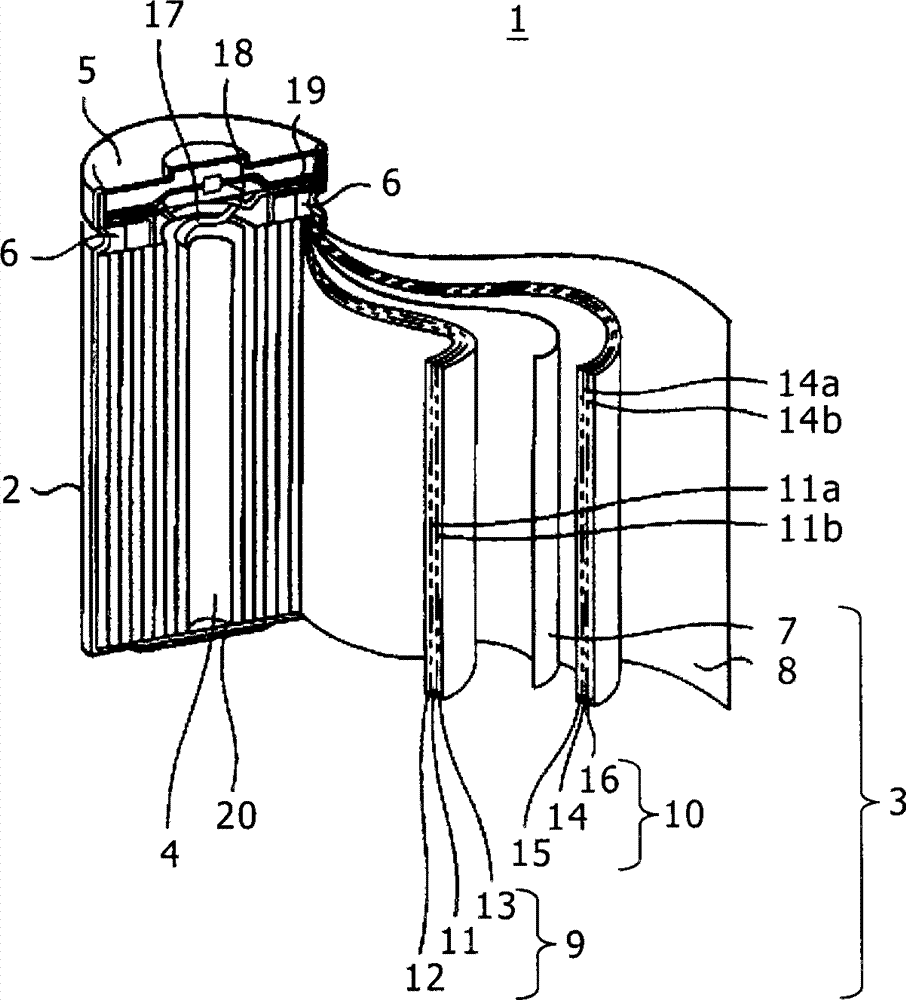
在这个实施方式中,作为实例将描述如通过图1A中的部分切割透视图所示的所谓元件卷绕型的圆柱形电池的情况。 In this embodiment, a case of a cylindrical battery of a so-called element winding type as shown by a partially cut perspective view in FIG. 1A will be described as an example. the
首先,将描述根据该实施方式的非水电解质二次电池的构造。 First, the configuration of the nonaqueous electrolyte secondary battery according to this embodiment will be described. the
在该实施方式中,电池1具有这样一种构造,其中,将卷绕体3(电极卷绕体)以中心销4(没有示出)作为中心设置在顶部开口式圆柱形电池壳2内部,并且电池壳2利用电池盖5密封。
In this embodiment, the
例如,电池壳2由镀镍的铁壳构成。卷绕体3具有这样的构造,其中,被卷绕成卷绕体形状的正极9和负极10设定为彼此相对,其间设置有包含电解质的卷绕隔膜7和8。
For example, the
电池盖5在其内部设置有安全阀机构18及热敏电阻元件(PTC(正温度系数)元件),并且利用其间的垫圈6进行嵌塞而连接至电池壳2。换言之,通过电池壳2和电池盖5密封电池壳1的内部。
The
安全阀机构18通过PTC元件而电连接至电池盖5。当电池的内压由于内部短路或外部加热而达到或超过预定值时,例如,结合盘被反转,从而破坏电池盖5与卷绕体3之间的电连接。此处,热敏电阻元件为随温度升高使电阻增大从而用于限制电流的元件,从而防止由于大电流而产生的异常热发生。
The
图1B示意性地示出了卷绕体3的截面结构。
FIG. 1B schematically shows a cross-sectional structure of the
在该实施方式中,卷绕体3具有这样的构造,其中,将带状(片状)形状的正极9和负极10设置为通过其间的含电解质的隔膜7和8而彼此相对,并且所得堆叠体被卷绕为卷绕体的形式。
In this embodiment,
将由例如铝构成的正极引线和由例如镍构成的负极引线(没有示出)分别连接至卷绕体3的正极9和负极10。正极引线被焊接至安全阀机构18,从而与电池盖5电连接。负极引线通过直接焊接至电池壳2而进行电连接。
A positive electrode lead composed of, for example, aluminum and a negative electrode lead (not shown) composed of, for example, nickel are connected to the
此处,例如,正极9具有正极集电体11,该正极集电体11具有作为卷绕结构的内表面的第一主表面11a及作为卷绕结构的外表面的第二主表面11b。在第一主表面11a侧上形成内部正极活性物质层12,并且在第二主表面11b侧上形成外部正极活性物质层13。
Here, for example, the
内部正极活性物质层12和外部正极活性物质层13优选通过根据所期望的电池构造和/或特性从如随后所描述的能够进行锂的嵌入或脱嵌的材料中选择一种材料而形成。此外,正极活性物质层可以不必同时形成在卷绕体的内表面和外表面两个面上。例如,正极集电体11可以由铝、镍、不锈钢等形成。
The inner positive electrode
另外,内部正极活性物质层12和外部正极活性物质层13可以包含正极活性物质,并且可选地包含诸如碳材料的导电助剂以及诸如聚偏二氟乙烯的粘结剂。
In addition, the inner positive electrode
例如,正极活性物质优选为包括锂和过渡金属的含锂金属化合物氧化物,例如由通式LixMO2所表示,并包含足够量的锂(Li)。这样的含锂金属化合物氧化物能够生成高电压,并且由于其高密度,因此能够使二次电池的容量进一步提高。 For example, the positive electrode active material is preferably a lithium-containing metal compound oxide including lithium and a transition metal, such as represented by the general formula Li x MO 2 , and contains a sufficient amount of lithium (Li). Such lithium-containing metal compound oxides are capable of generating high voltages, and further increase the capacity of secondary batteries due to their high density.
顺便提及,通式中的M为至少一种过渡金属,优选实例为选自由钴、镍及锰所组成的组中的至少一种。x值根据电池的充/放电状态而变化,通常在0.05≤x≤1.10的范围内。 Incidentally, M in the general formula is at least one transition metal, preferably at least one selected from the group consisting of cobalt, nickel and manganese. The value of x varies according to the charge/discharge state of the battery, and is generally in the range of 0.05≤x≤1.10. the
这样的含锂金属化合物氧化物的具体实例包括LiCoO2和LiNiO2。作为正极活性物质,可以单独使用含锂金属化合物氧化物或其中两种以上的组合。 Specific examples of such lithium-containing metal compound oxides include LiCoO 2 and LiNiO 2 . As the positive electrode active material, lithium-containing metal compound oxides may be used alone or in combination of two or more thereof.
形成正极9,从而减少内部正极活性物质层12和外部正极活性物质层13中的杂质,具体地说,不相干的金属成分或水。
The
另外,正极9的内部正极活性物质层12和外部正极活性物质层13应该以对应于每1g稳态(例如,在充放电循环重复约5次后)的负极碳材料不小于250mAh/g的充/放电容量的量而包含Li。以上述方式,优选正极活性物质层12和13以对应于不小于300mAh的充/放电容量、更优选为不小于330mAh的充/放电容量的量而包含Li。
In addition, the inner positive electrode
顺便提及,Li可以不必完全从内部正极活性物质层12和外部正极活性物质层13提供。例如,在随后描述的溶剂中,满足存在的Li的量对应于每1g电池系统中的碳材料不小于250mAh的充/放电容量。根据电池放电容量的测量来适当地选择Li含量。
Incidentally, Li may not necessarily be completely supplied from the inner positive electrode
另一方面,已经描述了构成负极10、内部负极活性物质层15及外部负极活性物质层16的材料等要素,因此,此处省略对它们的描述。
On the other hand, elements constituting the
形成负极10,从而减小在内部负极活性物质层15和外部负极活性物质层16中的杂质,具体地说,不相干的金属化合物或水。
The
此外,可以在电池制造后在电池中电化学地进行利用锂嵌入负极活性物质层,或者通过在电池制造之后或之前从正极或除正极之外的其他锂源提供锂而电化学地进行利用锂嵌入负极活性物质层。此外,可以在合成各种材料的阶段合成含锂材料,从而可以在制造电池时将锂结合至负极中。 In addition, the utilization of lithium intercalation in the negative electrode active material layer can be performed electrochemically in the battery after the battery is manufactured, or by supplying lithium from the positive electrode or other lithium sources other than the positive electrode after or before the battery is manufactured. embedded in the negative electrode active material layer. In addition, lithium-containing materials can be synthesized at the stage of synthesizing various materials, so that lithium can be incorporated into the negative electrode when manufacturing batteries. the
设置隔膜7和8,用于防止由于正极9与负极10之间的物理接触所引起的短路的发生,同时允许锂离子通过。例如,隔膜7和8各自均由诸如聚乙烯膜、聚丙烯膜等的微孔聚烯烃膜构成。
为了确保安全,优选隔膜7和8具有通过在预定温度(例如,120℃)或以上时通过热熔融引起它们的孔的闭合使电阻升高而切断电流的功能。
In order to ensure safety, it is preferable that the
另外,隔膜7和8利用电解液(没有示出)浸渍。在这个实施方式中,例如,电解液包含非水溶剂及作为在溶剂中溶解的电解质盐的锂盐,并且可选地包含各种添加剂。
In addition, the
非水溶剂的实例包括碳酸亚丙酯、碳酸亚乙酯、碳酸二乙酯、碳酸甲乙酯、1,2-二甲氧基乙烷、1,2-二乙氧基乙烷、γ-丁内酯、四氢呋喃、2-甲基四氢呋喃、1,3-二氧戊环、4-甲基-1,3-二氧戊环、二乙醚、环丁砜、甲基环丁砜、乙腈、丙腈、苯甲醚、乙酸酯、丙酸酯等。 Examples of nonaqueous solvents include propylene carbonate, ethylene carbonate, diethyl carbonate, ethyl methyl carbonate, 1,2-dimethoxyethane, 1,2-diethoxyethane, γ- Butyrolactone, tetrahydrofuran, 2-methyltetrahydrofuran, 1,3-dioxolane, 4-methyl-1,3-dioxolane, diethyl ether, sulfolane, methylsulfolane, acetonitrile, propionitrile, benzene Methyl ether, acetate, propionate, etc. the
顺便提及,可以单独使用这些非水溶剂或使用其中两种以上的混合物。 Incidentally, these nonaqueous solvents may be used alone or as a mixture of two or more thereof. the
在以混合方式使用两种以上非水溶剂的情况下,具体地,优选使用碳酸亚乙酯作为主要溶剂,并且使用不对称链碳酸酯(例如,碳酸甲乙酯或碳酸甲丙酯)作为添加至主要溶剂的第二成分。 In the case of using two or more non-aqueous solvents in a mixed manner, specifically, it is preferable to use ethylene carbonate as the main solvent, and use an asymmetric chain carbonate (for example, ethyl methyl carbonate or methyl propyl carbonate) as an additive to the second component of the main solvent. the
此外,还可以使用碳酸甲乙酯和碳酸二甲酯的混合溶剂。在这种情况下,碳酸亚乙酯与第二成分溶剂的按体积计的混合比率优选范围为7∶3至3∶7。此外,在使用上述混合溶剂作为第二成分溶剂的情况下,碳酸甲乙酯与碳酸二甲酯的体积比优选范围为2∶8至9∶1。 In addition, a mixed solvent of ethyl methyl carbonate and dimethyl carbonate can also be used. In this case, the mixing ratio by volume of ethylene carbonate to the second component solvent preferably ranges from 7:3 to 3:7. Furthermore, in the case of using the above mixed solvent as the second component solvent, the volume ratio of ethyl methyl carbonate to dimethyl carbonate preferably ranges from 2:8 to 9:1. the
第二成分的添加抑制了主要溶剂的分解。此外,第二成分的添加增强了导电性,从而提高了电流特性,降低了电解液的凝固点,从而提高了低温特性,并降低了与锂金属的反应性,从而提高了安全性。 The addition of the second component suppresses the decomposition of the main solvent. In addition, the addition of the second component enhances electrical conductivity to improve current characteristics, lowers the freezing point of the electrolyte to improve low-temperature characteristics, and reduces reactivity with lithium metal to improve safety. the
作为电解质盐,优选使用LiPF6,但是,能够使用通常用于这种类型电池的任意电解质盐。能够用作电解质盐的锂盐的实例包括LiClO4、LiAsF6、LiPF6、LiBF4、LiCH3SO3、LiCF3SO3、LiN(CF3SO2)2、LiN(C2F5SO2)2、LiN(C4F9SO2)(CF3SO2)、LiCl及LiBr。在这些中,优选为LiClO4、LiAsF6、LiPF6、LiBF4、LiCH3SO3、LiCF3SO3、LiN(CF3SO2)2、LiN(C2F5SO2)2及LiN(C4F9SO2)(CF3SO2),并且特别优选为LiPF6和LiBF4。 As the electrolyte salt, LiPF 6 is preferably used, however, any electrolyte salt generally used for this type of battery can be used. Examples of lithium salts that can be used as electrolyte salts include LiClO 4 , LiAsF 6 , LiPF 6 , LiBF 4 , LiCH 3 SO 3 , LiCF 3 SO 3 , LiN(CF 3 SO 2 ) 2 , LiN(C 2 F 5 SO 2 ) 2 , LiN(C 4 F 9 SO 2 )(CF 3 SO 2 ), LiCl and LiBr. Among these, LiClO 4 , LiAsF 6 , LiPF 6 , LiBF 4 , LiCH 3 SO 3 , LiCF 3 SO 3 , LiN(CF 3 SO 2 ) 2 , LiN(C 2 F 5 SO 2 ) 2 and LiN( C 4 F 9 SO 2 ) (CF 3 SO 2 ), and particularly preferably LiPF 6 and LiBF 4 .
可以单独使用这些锂盐或通过混合使用其中二者以上。 These lithium salts may be used alone or by mixing two or more thereof. the
现在,将在下面以如上所述获得非水电解质二次电池的情况作为实例,描述根据该实施方式的负极的制造方法。 Now, a method of manufacturing the negative electrode according to this embodiment will be described below, taking the case of obtaining the nonaqueous electrolyte secondary battery as described above as an example. the
根据该实施方式的负极的制造方法也能够应用于构成电池的正极。另外,如上所述,也能够根据目的适当选择材料及其用量等。在该实施方式中,将描述使用石墨作为负极活性物质的主要成分的负极的制造实例。 The method of manufacturing a negative electrode according to this embodiment can also be applied to a positive electrode constituting a battery. In addition, as described above, materials, usage amounts, and the like can also be appropriately selected according to purposes. In this embodiment mode, a production example of an anode using graphite as a main component of the anode active material will be described. the
首先,通过使用锤式研磨机、销式研磨机、球磨机、喷射式研磨机等来粉碎天然石墨,从而获得最终为电池中活性物质层的主要成分的石墨颗粒。 First, natural graphite is pulverized by using a hammer mill, a pin mill, a ball mill, a jet mill, etc., thereby obtaining graphite particles that are finally a main component of an active material layer in a battery. the
具体地,在使用锤式研磨机的情况下,例如,优选以至少20分钟在4000rpm至5000rpm的转速下进行粉碎。顺便提及,利用将石墨颗粒带入至空气流中的技术来期望地进行天然石墨的进料和石墨颗粒的出料。 Specifically, in the case of using a hammer mill, for example, pulverization is preferably performed at a rotation speed of 4000 rpm to 5000 rpm for at least 20 minutes. Incidentally, feeding of natural graphite and discharging of graphite particles are desirably performed using a technique of bringing graphite particles into an air stream. the
由此获得的石墨颗粒与作为粘结剂及增稠剂的聚偏二氟乙烯的N甲基吡咯烷酮分散体、苯乙烯丁二烯橡胶(SBR)以及羟丙基甲基纤维素按预定顺序分别以预定量进行混合,从而获得了在用作负极组合物的溶剂的N-甲基-2-吡咯烷酮(NMP)中包含这些成分的糊状混炼材料(浆料)。 The graphite particles thus obtained are mixed with N-methylpyrrolidone dispersion of polyvinylidene fluoride as a binder and thickener, styrene butadiene rubber (SBR) and hydroxypropyl methylcellulose in a predetermined order. Mixing was performed in predetermined amounts, thereby obtaining a pasty kneaded material (slurry) containing these components in N-methyl-2-pyrrolidone (NMP) used as a solvent for the negative electrode composition. the
这里,利用这样一种方法来制备苯乙烯丁二烯橡胶的N-甲基吡咯烷酮分散体,其中,将预定量的聚氧乙烯异十三烷基醚表面活性剂添加至可商购的水溶性分散液(JSR的产品)中,并且在搅拌后,利用N-甲基吡咯烷酮进行稀释,从而获得具有N-甲基吡咯烷酮作为分散剂的分散体(SBR改性的分散体)。通过这种方式,进行混炼材料的制备步骤。 Here, an N-methylpyrrolidone dispersion of styrene butadiene rubber was prepared by a method in which a predetermined amount of polyoxyethylene isotridecyl ether surfactant was added to a commercially available water-soluble Dispersion liquid (product of JSR), and after stirring, was diluted with N-methylpyrrolidone to obtain a dispersion having N-methylpyrrolidone as a dispersant (SBR modified dispersion). In this way, the preparation step of the kneaded material is performed. the
接下来,将所获得的混炼材料涂覆至用作片状(带状)负极集电体的实例的铜箔集电体。此后,例如,通过使用喷射干燥器在氮气或惰性气体中在80℃至110℃的温度下进行干燥焙烧处理,由此干燥该混炼材料,并焙烧以及铺展该粘结剂,从而获得在集电体上形成具有活性物质层的负极。如果需要,可以根据所期望的体积密度进行压制成型。通过这种方式,进行涂覆干燥、压延和热处理步骤。 Next, the obtained kneaded material was applied to a copper foil current collector serving as an example of a sheet-shaped (belt-shaped) negative electrode current collector. Thereafter, the kneaded material is dried, and the binder is fired and spread by, for example, performing dry roasting treatment in nitrogen or an inert gas at a temperature of 80° C. to 110° C. using a spray dryer, thereby obtaining A negative electrode having an active material layer is formed on the electrode. Compression molding can be performed if desired, depending on the desired bulk density. In this way, the coating drying, calendering and heat treatment steps are carried out. the
[实施例] [Example]
现在,将在下面示出的实施例中更详细地描述本发明,但是,本发明不限于这些实施例。 Now, the present invention will be described in more detail in Examples shown below, however, the present invention is not limited to these Examples. the
(实施例1至35) (Examples 1 to 35)
根据下面的步骤来制造实施例中的非水电解质二次电池。 The nonaqueous electrolyte secondary batteries in Examples were manufactured according to the following procedure. the
首先,根据上述步骤制造负极。 First, a negative electrode was fabricated according to the above steps. the
具体地,通过使用N-甲基吡咯烷酮作为用于构成混炼材料的溶剂、聚偏二氟乙烯和苯乙烯丁二烯橡胶作为粘结剂、聚氧乙烯异十三烷基醚作为表面活性剂、以及羟丙基甲基纤维素作为增稠剂来制备各个N-甲基吡咯烷酮分散体。此后,在预定步骤中,利用活性物质混炼该分散体,从而制备浆料。将浆料涂覆至金属箔芯构件,随后,通过干燥、压按以及热处理,获得负极板。顺便提及,在氮气气氛下在180℃下进行热处理。 Specifically, by using N-methylpyrrolidone as a solvent for constituting the kneaded material, polyvinylidene fluoride and styrene butadiene rubber as a binder, and polyoxyethylene isotridecyl ether as a surfactant , and hydroxypropylmethylcellulose as a thickener to prepare each N-methylpyrrolidone dispersion. Thereafter, in a predetermined step, the dispersion is kneaded with the active material, thereby preparing a slurry. The slurry was applied to the metal foil core member, followed by drying, pressing, and heat treatment to obtain a negative electrode plate. Incidentally, heat treatment was performed at 180° C. under a nitrogen atmosphere. the
在实施例1至35中,如下表1所示,关于聚偏二氟乙烯和苯乙烯丁二烯橡胶的总量、它们存在的比率(含量)、作为增稠剂的羟丙基甲基纤维素的量、以及热处理的存在(在表中,通过“已进行”)表示)或没有(在表中,通过“-”表示)的条件发生改变。 In Examples 1 to 35, as shown in Table 1 below, regarding the total amount of polyvinylidene fluoride and styrene butadiene rubber, the ratio (content) of their presence, hydroxypropyl methylcellulose as a thickener The amount of element, as well as the presence (in the table, indicated by "conducted") or absence (in the table, indicated by "-") of the heat treatment was changed. the
顺便提及,对于苯乙烯丁二烯橡胶,利用水溶性分散体的状态,并使用了预定的表面活性剂,从而将其改性成主要基于所使用的N-甲基吡咯烷酮的分散体。 Incidentally, for styrene butadiene rubber, the state of the water-soluble dispersion is utilized, and a predetermined surfactant is used, thereby modifying it into a dispersion mainly based on N-methylpyrrolidone used. the
所使用的聚氧化乙烯异十三烷基醚表面活性剂的量约为苯乙烯丁二烯橡胶量的约1/20,并且该混合物在干燥后凝固;因此,表面活性剂的量被包括在苯乙烯丁二烯橡胶的量中。 The amount of polyoxyethylene isotridecyl ether surfactant used was about 1/20 of the amount of styrene butadiene rubber, and the mixture solidified after drying; therefore, the amount of surfactant was included in The amount of styrene butadiene rubber. the
随后,将0.5mol的碳酸锂和1mol的碳酸钴混合,并且该混合物在900℃下在空气中焙烧5小时,得到LiCoO2。由此获得的LiCoO2被粉碎,以获得利用激光衍射法所测量的具有15μm的50%累积粒径的LiCoO2粉末。 Subsequently, 0.5 mol of lithium carbonate and 1 mol of cobalt carbonate were mixed, and the mixture was fired at 900° C. in air for 5 hours to obtain LiCoO 2 . The LiCoO 2 thus obtained was pulverized to obtain a LiCoO 2 powder having a 50% cumulative particle diameter of 15 μm as measured by a laser diffraction method.
此后,将91重量份的通过混合95重量份的LiCoO2粉末与5重量份的碳酸锂粉末而制备的混合物、6重量份作为导电剂的石墨、以及3重量份作为粘结剂的聚偏二氟乙烯彼此混合,以制备分散在溶剂(N-甲基吡咯烷酮)中从而获得浆料(糊状材料)的正极组合物。 Thereafter, 91 parts by weight of a mixture prepared by mixing 95 parts by weight of LiCoO powder with 5 parts by weight of lithium carbonate powder, 6 parts by weight of graphite as a conductive agent, and 3 parts by weight of polylidene as a binder Vinyl fluoride was mixed with each other to prepare a positive electrode composition dispersed in a solvent (N-methylpyrrolidone) to obtain a slurry (paste material).
将正极组合物浆料均匀涂覆至厚度为20μm的带状铝箔的两侧,最终成为正极集电体。涂层随后被干燥并压制成型,从而制备片状正极。 The positive electrode composition slurry was uniformly coated on both sides of a strip-shaped aluminum foil with a thickness of 20 μm, and finally became a positive electrode current collector. The coating was then dried and pressed to form a positive electrode in the form of a sheet. the
接下来,将由此制造的负极和正极与隔膜一起按照负极、隔膜、正极及隔膜的顺序进行堆叠,其中每个隔膜由厚度为25μm的多微孔聚丙烯膜构成,并且所得的堆叠体被卷绕多次,从而制成外径测量为18mm的螺旋卷绕体。 Next, the anode and cathode thus produced were stacked in the order of anode, separator, cathode, and separator together with a separator each composed of a microporous polypropylene film with a thickness of 25 μm, and the resulting stack was rolled Winding was performed several times to produce a spirally wound body having an outer diameter measuring 18 mm. the
将螺旋卷绕体容纳在由镀镍的铁所构成的电池壳中,并且将绝缘板设置在螺旋卷绕体的上下端面上。由铝构成的正极引线从正极集电体引出,并且被焊接至电池盖。由镍构成的负极引线从负极集电体引出,并且被焊接至电池壳的底部。 The spirally wound body was accommodated in a battery case composed of nickel-plated iron, and insulating plates were provided on upper and lower end surfaces of the spirally wound body. A positive electrode lead composed of aluminum was drawn from the positive electrode current collector, and was welded to the battery cover. A negative electrode lead composed of nickel was drawn from the negative electrode current collector, and was welded to the bottom of the battery case. the
此后,利用通过将LiPF6以1mol/dm3的浓度溶解在非水溶剂(例如,碳酸亚乙酯与碳酸二乙酯的等体积混合溶剂)中所制备的电解液组合物来填充其中容纳有卷绕体的电池壳,以利用电解液组合物浸渍正极和负极以及隔膜。 Thereafter, the electrolyte solution composition prepared by dissolving LiPF 6 at a concentration of 1 mol/ dm in a non-aqueous solvent (for example, an equal-volume mixed solvent of ethylene carbonate and diethyl carbonate) was used to fill the liquid contained therein. The battery case of the jellyroll body is used to impregnate the positive and negative electrodes and the separator with the electrolyte composition.
此后,利用其上涂覆有沥青的绝缘密封垫圈插入至电池盖与电池壳之间,而将电池盖嵌塞至电池壳,从而固定具有电路断开功能的安全阀机构和PTC元件以及电池盖,以获得其一侧被气密地密封的电池。 Thereafter, the battery cover is caulked to the battery case by inserting an insulating sealing gasket coated with asphalt between the battery cover and the battery case, thereby fixing the safety valve mechanism and the PTC element and the battery cover having a circuit breaking function , to obtain a battery whose one side is hermetically sealed. the
顺便提及,在实施例中由此获得的各个电池根据在JIS C8711中所描述的ICR18650的测量具有2350mAh的电池容量。 Incidentally, the respective batteries thus obtained in Examples had a battery capacity of 2350 mAh according to the measurement of ICR18650 described in JIS C8711. the
<性能的评价> <Evaluation of performance>
在如上实施例中所获得的非水电解质二次电池进行下面的评价。在下表1中给出了评价结果。 The nonaqueous electrolyte secondary batteries obtained in the above examples were subjected to the following evaluations. The evaluation results are given in Table 1 below. the
[结合力] [Binding force]
通过180度(角)剥离测试来评价结合力。在表1中,“○”意味着没有发生剥离,而“×”意味着发生剥离。 Adhesion was evaluated by 180 degree (angle) peel test. In Table 1, "◯" means that peeling did not occur, and "X" means that peeling occurred. the
[柔性(抗破坏性)] [flexible (destructive)]
压按后的负极活性物质层通过使用溶剂被剥离,并且通过箔表面观察和/或拉伸试验来评价由于压按压力的累积所引起的集电体的未涂覆部分的破坏或破裂的水平。 The pressed negative electrode active material layer was peeled off by using a solvent, and the level of damage or cracking of the uncoated part of the current collector due to the accumulation of pressing force was evaluated by foil surface observation and/or tensile test . the
[循环特性] [Cycle characteristics]
通过在20℃下的循环试验(1C充电,1C放电)来评价作为电池特性之一的循环特性。 The cycle characteristic, which is one of battery characteristics, was evaluated by a cycle test (1C charge, 1C discharge) at 20°C. the
对于实施例1、5和7,由图2中所示的示图表示循环试验结果。 For Examples 1, 5 and 7, the cycle test results are represented by the graph shown in FIG. 2 . the


根据表1和图2中的结果,可以看出,基于100重量份的活性物质组合物,作为粘结剂(A)的聚偏二氟乙烯与作为粘结剂(B)的苯乙烯丁二烯橡胶聚合物的总量的存在比率(含量)优选范围为的1.5至5重量份。 According to the results in Table 1 and Fig. 2, it can be seen that, based on the active material composition of 100 parts by weight, polyvinylidene fluoride as binder (A) and styrene butadiene as binder (B) The presence ratio (content) of the total amount of vinyl rubber polymers is preferably in the range of 1.5 to 5 parts by weight. the
如果总量小于1.5重量份,则由于组合物层的剥离,充放电特性降低。如果总量大于5重量份,则由于负极活性物质层的孔隙率的阻碍,充放电特性降低。 If the total amount is less than 1.5 parts by weight, the charge-discharge characteristics decrease due to peeling of the composition layer. If the total amount is more than 5 parts by weight, the charge-discharge characteristics decrease due to hindrance of the porosity of the negative electrode active material layer. the
另外,可以看出,作为粘结剂(A)的聚偏二氟乙烯或包含聚偏二氟乙烯作为主链的衍生物与作为粘合剂(B)苯乙烯丁二烯橡胶聚合物或包含苯乙烯丁二烯主链的衍生物的存在的重量比率(混合比率)的范围优选为9.5/0.5至2/8,更优选范围为9/1至3/7。 In addition, it can be seen that as binder (A) polyvinylidene fluoride or a derivative comprising polyvinylidene fluoride as a main chain and as binder (B) styrene butadiene rubber polymer or comprising The derivatives of the styrene-butadiene main chain are present in a weight ratio (mixing ratio) in the range of preferably 9.5/0.5 to 2/8, more preferably in the range of 9/1 to 3/7. the
在苯乙烯丁二烯橡胶(B)的比例为0.5的情况下,如果混合物中存在作为增稠剂的纤维素(E),则不会发生特殊的问题。但是,如果混合物中不存在作为增稠剂的纤维素(E),则基于总粘结剂量的聚偏二氟乙烯的比例增大,使得负极活性物质层变硬,很可能导致由于压按压力的累积或组合物层的剥离而引起在集电体的未涂覆部分的破坏或破裂的问题。 In the case of a proportion of styrene-butadiene rubber (B) of 0.5, no particular problem occurs if cellulose (E) is present as a thickener in the mixture. However, if there is no cellulose (E) as a thickener in the mixture, the proportion of polyvinylidene fluoride based on the total binder amount increases, making the negative electrode active material layer hard, which is likely to cause The problem of damage or cracking in the uncoated part of the current collector is caused by the accumulation of or peeling off of the composition layer. the
可以如下解释这种情况。虽然苯乙烯丁二烯橡胶(B)天然具有弹性,但是作为增稠剂的纤维素(E)也具有一定程度的弹性,使得可认为纤维素(E)的存在有利于负极活性物质层的良好的柔性。 This situation can be explained as follows. Although styrene butadiene rubber (B) is naturally elastic, cellulose (E) as a thickener also has a certain degree of elasticity, so that it can be considered that the presence of cellulose (E) is conducive to the good formation of the negative electrode active material layer. flexibility. the
另外,由于浆料在流变性方面及对于间歇涂覆操作的响应方面增强,所以涂覆表面的形状及涂覆起始端部和涂覆结束端部的形状得以改善;具体地,涂覆起始端部的凸起量被减小为现有技术中的 1/2。因此,在这种情况下,认为增加了对于由于压按压力的累积所引起的未涂覆部分电极的破坏或破裂的改善效果。 In addition, since the slurry is enhanced in rheology and response to intermittent coating operations, the shape of the coated surface and the shapes of the coating start end and the coating end end are improved; specifically, the coating start The amount of protrusion of the part is reduced to 1/2 of that of the prior art. Therefore, in this case, it is considered that the effect of improving the breakage or cracking of the uncoated portion of the electrode due to the accumulation of pressing force is increased. the
(参考例) (reference example)
通过使用各种表面活性剂,制备了多种负极组合物浆料,并且评价其涂覆材料形成性能(浆料形成性能)。此外,评价利用负极组合物浆料所获得的负极的剥离强度和拉伸强度,下表2中示出了结果。 By using various surfactants, various negative electrode composition slurries were prepared, and their coating material forming properties (slurry forming properties) were evaluated. In addition, the peel strength and tensile strength of the negative electrode obtained using the negative electrode composition slurry were evaluated, and the results are shown in Table 2 below. the

虽然已经在上面通过示出一些实施方式及其实施例描述了本发明,但是发明不限于所述实施方式或实施例,在本发明的范围内可以进行各种修改。 Although the present invention has been described above by showing some embodiments and examples thereof, the invention is not limited to the embodiments or examples, and various modifications can be made within the scope of the present invention. the
例如,根据本发明实施方式的负极及其制造方法、以及非水电解质二次电池不限应用于如上面的实施方式和实施例所示的所谓的卷绕型非水电解质二次电池,也可以应用于所谓的堆叠型电池,进一步地,应用于非水电解质为聚合物或凝胶形态的电池。 For example, the negative electrode and its manufacturing method according to the embodiment of the present invention, and the non-aqueous electrolyte secondary battery are not limited to be applied to the so-called winding type non-aqueous electrolyte secondary battery as shown in the above embodiments and examples, and may also be It is applied to a so-called stacked battery, and further, to a battery in which the nonaqueous electrolyte is in the form of a polymer or a gel. the
因此,根据本发明的实施方式,能够实现具有高体积密度的负极、在诸如充放电特性、高速率特性、温度特性等的各种电池特性方面优异、确保抑制气体生成、并具有高可靠性的非水电解质锂二次电池。具体地,这样的电池被用于个人计算机、手机等方面。 Therefore, according to an embodiment of the present invention, it is possible to realize a negative electrode having a high volume density, being excellent in various battery characteristics such as charge and discharge characteristics, high rate characteristics, temperature characteristics, etc., ensuring suppression of gas generation, and having high reliability. Non-aqueous electrolyte lithium secondary battery. Specifically, such batteries are used in personal computers, mobile phones, and the like. the
Claims (13)
Applications Claiming Priority (2)
| Application Number | Priority Date | Filing Date | Title |
|---|---|---|---|
| JP2009-203398 | 2009-09-03 | ||
| JP2009203398A JP5879673B2 (en) | 2009-09-03 | 2009-09-03 | Method for producing negative electrode for non-aqueous electrolyte secondary battery |
Publications (2)
| Publication Number | Publication Date |
|---|---|
| CN102013473A CN102013473A (en) | 2011-04-13 |
| CN102013473B true CN102013473B (en) | 2013-11-06 |
Family
ID=43625391
Family Applications (1)
| Application Number | Title | Priority Date | Filing Date |
|---|---|---|---|
| CN2010102653470A Active CN102013473B (en) | 2009-09-03 | 2010-08-26 | Negative electrode for nonaqueous electrolyte secondary cell, method of manufacturing the same, and nonaqueous electrolyte secondary cell |
Country Status (3)
| Country | Link |
|---|---|
| US (1) | US9350023B2 (en) |
| JP (1) | JP5879673B2 (en) |
| CN (1) | CN102013473B (en) |
Families Citing this family (21)
| Publication number | Priority date | Publication date | Assignee | Title |
|---|---|---|---|---|
| JP5640188B2 (en) * | 2011-03-18 | 2014-12-17 | サンノプコ株式会社 | Non-aqueous electrochemical element dispersion, non-aqueous electrochemical element member using the same, and non-aqueous electrochemical element using the same |
| JP5949914B2 (en) * | 2012-05-21 | 2016-07-13 | ダイキン工業株式会社 | Electrode mixture |
| JP5949915B2 (en) * | 2012-05-21 | 2016-07-13 | ダイキン工業株式会社 | Electrode mixture |
| JP2016076292A (en) * | 2013-01-11 | 2016-05-12 | 日立マクセル株式会社 | Non-aqueous electrolyte secondary battery |
| JP6354135B2 (en) | 2013-02-12 | 2018-07-11 | 株式会社ジェイテクト | Electric storage material manufacturing apparatus and manufacturing method |
| DE102013219604A1 (en) * | 2013-09-27 | 2015-04-02 | Robert Bosch Gmbh | Electrode production with NMP under an inert gas atmosphere |
| JP6321404B2 (en) * | 2014-02-26 | 2018-05-09 | 株式会社ジェイテクト | Electric storage material manufacturing apparatus and manufacturing method |
| JP6375711B2 (en) * | 2014-06-13 | 2018-08-22 | 株式会社ジェイテクト | Electric storage material manufacturing apparatus and manufacturing method |
| JP6523443B2 (en) * | 2014-10-02 | 2019-05-29 | エルジー・ケム・リミテッド | Positive electrode active material slurry containing rubber-based binder and positive electrode produced therefrom |
| JP6476974B2 (en) * | 2015-02-18 | 2019-03-06 | 株式会社Gsユアサ | Electric storage element and method for manufacturing electric storage element |
| CN108615950A (en) * | 2018-07-06 | 2018-10-02 | 江苏卓高新材料科技有限公司 | A kind of takeup type battery core method for shaping and shaping equipment |
| KR102367368B1 (en) * | 2018-07-13 | 2022-02-23 | 주식회사 엘지에너지솔루션 | Data Cable Device Having Cable Battery |
| JP7461101B2 (en) * | 2018-08-03 | 2024-04-03 | 株式会社Aescジャパン | Lithium ion secondary battery |
| CN111933946B (en) * | 2019-03-18 | 2022-03-18 | 宁德新能源科技有限公司 | Electrochemical device and electronic device comprising same |
| DE102019128445A1 (en) * | 2019-10-22 | 2021-04-22 | Bayerische Motoren Werke Aktiengesellschaft | Method for producing an electrode for a storage device for storing electrical energy, use of such an electrode and electrode |
| CN111009692A (en) * | 2019-12-26 | 2020-04-14 | 惠州市豪鹏科技有限公司 | Manufacturing method of lithium ion battery and lithium ion battery |
| US20230048875A1 (en) * | 2020-01-17 | 2023-02-16 | Panasonic Intellectual Property Management Co., Ltd. | Coating method and coating device |
| CN113380975B (en) * | 2021-04-26 | 2023-04-14 | 上海空间电源研究所 | A kind of flexible zinc electrode, manufacturing method and application |
| US20230307650A1 (en) * | 2021-07-30 | 2023-09-28 | Lg Energy Solution, Ltd. | Positive Electrode for Lithium Secondary Battery Including Insulating Layer Having Excellent Wet Adhesion and Lithium Secondary Battery Including the Same |
| KR20230030316A (en) * | 2021-08-25 | 2023-03-06 | 주식회사 엘지에너지솔루션 | Electrode for secondary battery, manufacturing method thereof, and secondary battery comprising the same |
| CN113991108A (en) * | 2021-08-30 | 2022-01-28 | 宁波维科电池有限公司 | High-performance lithium ion battery cell |
Citations (1)
| Publication number | Priority date | Publication date | Assignee | Title |
|---|---|---|---|---|
| CN101447561A (en) * | 2007-11-28 | 2009-06-03 | 三星Sdi株式会社 | Negative electrode for rechargeable lithium battery, and rechargeable lithium battery including the same |
Family Cites Families (20)
| Publication number | Priority date | Publication date | Assignee | Title |
|---|---|---|---|---|
| JP3286516B2 (en) | 1995-12-06 | 2002-05-27 | 三洋電機株式会社 | Non-aqueous electrolyte secondary battery |
| JP3449118B2 (en) | 1996-06-07 | 2003-09-22 | 株式会社リコー | Image forming device |
| JP4437239B2 (en) * | 1997-08-11 | 2010-03-24 | ソニー株式会社 | Nonaqueous electrolyte secondary battery |
| KR100263153B1 (en) | 1998-01-22 | 2000-08-01 | 김순택 | Electrode binder used in lithium lon secondary battery and method for manufacturing active material contained it |
| JP3621031B2 (en) | 2000-09-04 | 2005-02-16 | 松下電器産業株式会社 | Anode for non-aqueous electrolyte secondary battery |
| US6773838B2 (en) * | 2000-09-04 | 2004-08-10 | Matsushita Electric Industrial Co., Ltd. | Non-aqueous electrolyte secondary battery and negative electrode for the same |
| JP3615472B2 (en) | 2000-09-04 | 2005-02-02 | 松下電器産業株式会社 | Non-aqueous electrolyte battery |
| US6706446B2 (en) * | 2000-12-26 | 2004-03-16 | Shin-Kobe Electric Machinery Co., Ltd. | Non-aqueous electrolytic solution secondary battery |
| JP2004103475A (en) * | 2002-09-11 | 2004-04-02 | Sony Corp | battery |
| KR20080040049A (en) * | 2004-01-05 | 2008-05-07 | 쇼와 덴코 가부시키가이샤 | Lithium Battery Negative Material and Lithium Battery |
| JP4819342B2 (en) * | 2004-11-08 | 2011-11-24 | エレクセル株式会社 | Positive electrode for lithium battery and lithium battery using the same |
| US7923400B2 (en) * | 2004-12-14 | 2011-04-12 | Nissan Motor Co., Ltd. | Method of making an electrode for use in a battery |
| JP4857555B2 (en) * | 2004-12-14 | 2012-01-18 | 日産自動車株式会社 | Lithium ion secondary battery electrode and lithium ion secondary battery using the same |
| JP2007234418A (en) * | 2006-03-01 | 2007-09-13 | Matsushita Electric Ind Co Ltd | Negative electrode mixture paste for non-aqueous secondary battery, negative electrode and non-aqueous secondary battery using the same, and method for producing negative electrode mixture paste |
| JP2008021415A (en) * | 2006-07-10 | 2008-01-31 | Nissan Motor Co Ltd | Nonaqueous electrolyte secondary battery electrode |
| US20100028773A1 (en) * | 2007-03-05 | 2010-02-04 | Toyo Ink Mfg. Co., Ltd. | Composition for battery |
| JP2008277196A (en) * | 2007-05-02 | 2008-11-13 | Sony Corp | Method for producing electrode plate for non-aqueous electrolyte secondary battery |
| JP4874868B2 (en) * | 2007-05-23 | 2012-02-15 | ソニー株式会社 | Gel electrolyte secondary battery |
| US7931984B2 (en) * | 2007-11-28 | 2011-04-26 | Samsung Sdi Co., Ltd. | Negative electrode for rechargeable lithium battery, and rechargeable lithium battery including the same |
| WO2010035827A1 (en) * | 2008-09-29 | 2010-04-01 | 日本ゼオン株式会社 | Method for manufacturing electrode for electrochemical element |
-
2009
- 2009-09-03 JP JP2009203398A patent/JP5879673B2/en active Active
-
2010
- 2010-08-24 US US12/862,210 patent/US9350023B2/en active Active
- 2010-08-26 CN CN2010102653470A patent/CN102013473B/en active Active
Patent Citations (1)
| Publication number | Priority date | Publication date | Assignee | Title |
|---|---|---|---|---|
| CN101447561A (en) * | 2007-11-28 | 2009-06-03 | 三星Sdi株式会社 | Negative electrode for rechargeable lithium battery, and rechargeable lithium battery including the same |
Also Published As
| Publication number | Publication date |
|---|---|
| US9350023B2 (en) | 2016-05-24 |
| JP5879673B2 (en) | 2016-03-08 |
| US20110052984A1 (en) | 2011-03-03 |
| CN102013473A (en) | 2011-04-13 |
| JP2011054462A (en) | 2011-03-17 |
Similar Documents
| Publication | Publication Date | Title |
|---|---|---|
| CN102013473B (en) | Negative electrode for nonaqueous electrolyte secondary cell, method of manufacturing the same, and nonaqueous electrolyte secondary cell | |
| KR102826515B1 (en) | Multi-layered Anode Comprising Silicon-based Compound and Lithium Secondary Battery Comprising the Same | |
| CN110431697B (en) | Method for preparing slurry composition for secondary battery positive electrode, positive electrode prepared by the method, and lithium secondary battery comprising the positive electrode | |
| JP5603018B2 (en) | Negative electrode for lithium ion secondary battery, lithium ion secondary battery using the same, method for producing negative electrode for lithium ion secondary battery, and slurry used for production | |
| KR101138637B1 (en) | Cathode Active Material for Lithium Secondary Battery | |
| EP3506398B1 (en) | Method for producing slurry for cathode for secondary battery | |
| CN109417165B (en) | Positive electrode active material particles comprising a core containing lithium cobalt oxide and a shell containing lithium cobalt phosphate and method of making the same | |
| CN104704652B (en) | Electrode for nonaqueous electrolyte secondary battery plate and the rechargeable nonaqueous electrolytic battery using it and its manufacture method | |
| JP2008181830A (en) | Nonaqueous electrolyte secondary battery | |
| CN101199079A (en) | lithium secondary battery | |
| JP2007317639A (en) | Positive electrode active material and lithium secondary battery including the same | |
| CN101331643A (en) | Lithium-ion secondary battery | |
| JP2004146253A (en) | Negative electrode and battery, and methods for producing them | |
| KR20250069515A (en) | Multi-layered Anode Comprising Silicon-based Compound and Lithium Secondary Battery Comprising the Same | |
| KR102943307B1 (en) | Aqueous cathode slurry, cathode composition, and lithium-ion secondary battery comprising the cathode composition, and a method for manufacturing the same | |
| US20230223535A1 (en) | Negative electrode and secondary battery including the same | |
| CN116210102A (en) | Negative electrode material, and negative electrode and secondary battery comprising same | |
| JP2007234277A (en) | Non-aqueous electrolyte secondary battery positive electrode, method for producing the same, and non-aqueous electrolyte secondary battery | |
| JP3579280B2 (en) | Negative electrode for non-aqueous electrolyte secondary battery and non-aqueous electrolyte secondary battery provided with this negative electrode | |
| CN115380407A (en) | Negative electrode active material for lithium secondary battery, negative electrode, and lithium secondary battery | |
| JP2011181386A (en) | Nonaqueous electrolyte secondary battery | |
| EP3951941A1 (en) | Method for preparing anode active material | |
| CN103258989B (en) | Electrode for lithium secondary battery, manufacturing method, and lithium secondary battery | |
| WO2013038702A1 (en) | Nonaqueous electrolyte secondary cell | |
| CN115440974A (en) | Positive active material, method of preparing the same, and rechargeable lithium battery including the same |
Legal Events
| Date | Code | Title | Description |
|---|---|---|---|
| C06 | Publication | ||
| PB01 | Publication | ||
| C10 | Entry into substantive examination | ||
| SE01 | Entry into force of request for substantive examination | ||
| C14 | Grant of patent or utility model | ||
| GR01 | Patent grant | ||
| TR01 | Transfer of patent right |
Effective date of registration: 20180419 Address after: Kyoto Japan Patentee after: Murata Manufacturing Co.,Ltd. Address before: Fukushima Patentee before: Murata, Northeast China Effective date of registration: 20180419 Address after: Fukushima Patentee after: Murata, Northeast China Address before: Tokyo, Japan Patentee before: Sony Corp. |
|
| TR01 | Transfer of patent right |