CN102123721A - Therapeutic inhibitors of PAI-1 function and methods of their use - Google Patents
Therapeutic inhibitors of PAI-1 function and methods of their use Download PDFInfo
- Publication number
- CN102123721A CN102123721A CN2009801088638A CN200980108863A CN102123721A CN 102123721 A CN102123721 A CN 102123721A CN 2009801088638 A CN2009801088638 A CN 2009801088638A CN 200980108863 A CN200980108863 A CN 200980108863A CN 102123721 A CN102123721 A CN 102123721A
- Authority
- CN
- China
- Prior art keywords
- amino acid
- seq
- pai
- ligand
- polyligand
- Prior art date
- Legal status (The legal status is an assumption and is not a legal conclusion. Google has not performed a legal analysis and makes no representation as to the accuracy of the status listed.)
- Pending
Links
- 108010022233 Plasminogen Activator Inhibitor 1 Proteins 0.000 title claims abstract description 363
- 238000000034 method Methods 0.000 title claims abstract description 126
- 102000012335 Plasminogen Activator Inhibitor 1 Human genes 0.000 title 1
- 229940124788 therapeutic inhibitor Drugs 0.000 title 1
- 102100039418 Plasminogen activator inhibitor 1 Human genes 0.000 claims abstract description 359
- 108090000765 processed proteins & peptides Proteins 0.000 claims abstract description 260
- 239000003446 ligand Substances 0.000 claims abstract description 250
- 102000004196 processed proteins & peptides Human genes 0.000 claims abstract description 177
- 102000040430 polynucleotide Human genes 0.000 claims abstract description 169
- 108091033319 polynucleotide Proteins 0.000 claims abstract description 169
- 239000002157 polynucleotide Substances 0.000 claims abstract description 169
- 108090000623 proteins and genes Proteins 0.000 claims abstract description 162
- 230000004807 localization Effects 0.000 claims abstract description 151
- 229920001184 polypeptide Polymers 0.000 claims abstract description 122
- 230000001939 inductive effect Effects 0.000 claims abstract description 38
- 230000000694 effects Effects 0.000 claims abstract description 35
- 201000001320 Atherosclerosis Diseases 0.000 claims abstract description 20
- 239000000203 mixture Substances 0.000 claims abstract description 9
- 230000002123 temporal effect Effects 0.000 claims abstract description 9
- 210000004027 cell Anatomy 0.000 claims description 168
- 125000000539 amino acid group Chemical group 0.000 claims description 137
- 239000013598 vector Substances 0.000 claims description 129
- 210000001519 tissue Anatomy 0.000 claims description 77
- 230000027455 binding Effects 0.000 claims description 76
- 102000004169 proteins and genes Human genes 0.000 claims description 58
- 235000018102 proteins Nutrition 0.000 claims description 56
- 210000004509 vascular smooth muscle cell Anatomy 0.000 claims description 54
- 238000003780 insertion Methods 0.000 claims description 52
- 230000037431 insertion Effects 0.000 claims description 52
- 210000001616 monocyte Anatomy 0.000 claims description 50
- 235000001014 amino acid Nutrition 0.000 claims description 47
- 210000002889 endothelial cell Anatomy 0.000 claims description 44
- 229940024606 amino acid Drugs 0.000 claims description 43
- 230000001105 regulatory effect Effects 0.000 claims description 43
- 150000001413 amino acids Chemical class 0.000 claims description 40
- 230000037361 pathway Effects 0.000 claims description 35
- 230000003480 fibrinolytic effect Effects 0.000 claims description 34
- 239000003527 fibrinolytic agent Substances 0.000 claims description 33
- 108010031318 Vitronectin Proteins 0.000 claims description 32
- 102100035140 Vitronectin Human genes 0.000 claims description 32
- 210000002540 macrophage Anatomy 0.000 claims description 32
- 108091023040 Transcription factor Proteins 0.000 claims description 29
- 102000040945 Transcription factor Human genes 0.000 claims description 29
- 239000003112 inhibitor Substances 0.000 claims description 27
- 230000002401 inhibitory effect Effects 0.000 claims description 27
- 201000010099 disease Diseases 0.000 claims description 24
- 208000037265 diseases, disorders, signs and symptoms Diseases 0.000 claims description 24
- 239000012634 fragment Substances 0.000 claims description 23
- 238000006467 substitution reaction Methods 0.000 claims description 23
- 241000282414 Homo sapiens Species 0.000 claims description 22
- 239000002773 nucleotide Substances 0.000 claims description 22
- 125000003729 nucleotide group Chemical group 0.000 claims description 22
- 230000009261 transgenic effect Effects 0.000 claims description 22
- QNAYBMKLOCPYGJ-REOHCLBHSA-N L-alanine Chemical compound C[C@H](N)C(O)=O QNAYBMKLOCPYGJ-REOHCLBHSA-N 0.000 claims description 20
- 235000004279 alanine Nutrition 0.000 claims description 20
- 230000005764 inhibitory process Effects 0.000 claims description 20
- NOESYZHRGYRDHS-UHFFFAOYSA-N insulin Chemical compound N1C(=O)C(NC(=O)C(CCC(N)=O)NC(=O)C(CCC(O)=O)NC(=O)C(C(C)C)NC(=O)C(NC(=O)CN)C(C)CC)CSSCC(C(NC(CO)C(=O)NC(CC(C)C)C(=O)NC(CC=2C=CC(O)=CC=2)C(=O)NC(CCC(N)=O)C(=O)NC(CC(C)C)C(=O)NC(CCC(O)=O)C(=O)NC(CC(N)=O)C(=O)NC(CC=2C=CC(O)=CC=2)C(=O)NC(CSSCC(NC(=O)C(C(C)C)NC(=O)C(CC(C)C)NC(=O)C(CC=2C=CC(O)=CC=2)NC(=O)C(CC(C)C)NC(=O)C(C)NC(=O)C(CCC(O)=O)NC(=O)C(C(C)C)NC(=O)C(CC(C)C)NC(=O)C(CC=2NC=NC=2)NC(=O)C(CO)NC(=O)CNC2=O)C(=O)NCC(=O)NC(CCC(O)=O)C(=O)NC(CCCNC(N)=N)C(=O)NCC(=O)NC(CC=3C=CC=CC=3)C(=O)NC(CC=3C=CC=CC=3)C(=O)NC(CC=3C=CC(O)=CC=3)C(=O)NC(C(C)O)C(=O)N3C(CCC3)C(=O)NC(CCCCN)C(=O)NC(C)C(O)=O)C(=O)NC(CC(N)=O)C(O)=O)=O)NC(=O)C(C(C)CC)NC(=O)C(CO)NC(=O)C(C(C)O)NC(=O)C1CSSCC2NC(=O)C(CC(C)C)NC(=O)C(NC(=O)C(CCC(N)=O)NC(=O)C(CC(N)=O)NC(=O)C(NC(=O)C(N)CC=1C=CC=CC=1)C(C)C)CC1=CN=CN1 NOESYZHRGYRDHS-UHFFFAOYSA-N 0.000 claims description 20
- 239000000126 substance Substances 0.000 claims description 20
- 230000003176 fibrotic effect Effects 0.000 claims description 18
- 238000001727 in vivo Methods 0.000 claims description 17
- 238000012217 deletion Methods 0.000 claims description 16
- 230000037430 deletion Effects 0.000 claims description 16
- 210000004413 cardiac myocyte Anatomy 0.000 claims description 13
- 230000001419 dependent effect Effects 0.000 claims description 13
- 238000002347 injection Methods 0.000 claims description 13
- 239000007924 injection Substances 0.000 claims description 13
- 230000002526 effect on cardiovascular system Effects 0.000 claims description 12
- 210000005003 heart tissue Anatomy 0.000 claims description 12
- 108090001061 Insulin Proteins 0.000 claims description 11
- 210000002460 smooth muscle Anatomy 0.000 claims description 11
- OUYCCCASQSFEME-QMMMGPOBSA-N L-tyrosine Chemical compound OC(=O)[C@@H](N)CC1=CC=C(O)C=C1 OUYCCCASQSFEME-QMMMGPOBSA-N 0.000 claims description 10
- 241000699666 Mus <mouse, genus> Species 0.000 claims description 10
- 210000001789 adipocyte Anatomy 0.000 claims description 10
- 229940125396 insulin Drugs 0.000 claims description 10
- 238000010361 transduction Methods 0.000 claims description 10
- 230000026683 transduction Effects 0.000 claims description 10
- OUYCCCASQSFEME-UHFFFAOYSA-N tyrosine Natural products OC(=O)C(N)CC1=CC=C(O)C=C1 OUYCCCASQSFEME-UHFFFAOYSA-N 0.000 claims description 10
- 241000701161 unidentified adenovirus Species 0.000 claims description 10
- WHUUTDBJXJRKMK-UHFFFAOYSA-N Glutamic acid Natural products OC(=O)C(N)CCC(O)=O WHUUTDBJXJRKMK-UHFFFAOYSA-N 0.000 claims description 9
- 102000001938 Plasminogen Activators Human genes 0.000 claims description 9
- 108010001014 Plasminogen Activators Proteins 0.000 claims description 9
- AYFVYJQAPQTCCC-UHFFFAOYSA-N Threonine Natural products CC(O)C(N)C(O)=O AYFVYJQAPQTCCC-UHFFFAOYSA-N 0.000 claims description 9
- 239000004473 Threonine Substances 0.000 claims description 9
- 208000024248 Vascular System injury Diseases 0.000 claims description 9
- 208000012339 Vascular injury Diseases 0.000 claims description 9
- 235000013922 glutamic acid Nutrition 0.000 claims description 9
- 239000004220 glutamic acid Substances 0.000 claims description 9
- 229940127126 plasminogen activator Drugs 0.000 claims description 9
- 210000000329 smooth muscle myocyte Anatomy 0.000 claims description 9
- 230000015572 biosynthetic process Effects 0.000 claims description 8
- 210000004962 mammalian cell Anatomy 0.000 claims description 8
- 238000004519 manufacturing process Methods 0.000 claims description 8
- 230000007246 mechanism Effects 0.000 claims description 8
- 239000000758 substrate Substances 0.000 claims description 8
- 241000700159 Rattus Species 0.000 claims description 7
- MTCFGRXMJLQNBG-UHFFFAOYSA-N Serine Natural products OCC(N)C(O)=O MTCFGRXMJLQNBG-UHFFFAOYSA-N 0.000 claims description 7
- 210000000709 aorta Anatomy 0.000 claims description 7
- 210000001054 cardiac fibroblast Anatomy 0.000 claims description 7
- 208000024172 Cardiovascular disease Diseases 0.000 claims description 6
- DHMQDGOQFOQNFH-UHFFFAOYSA-N Glycine Chemical compound NCC(O)=O DHMQDGOQFOQNFH-UHFFFAOYSA-N 0.000 claims description 6
- CKLJMWTZIZZHCS-REOHCLBHSA-N L-aspartic acid Chemical compound OC(=O)[C@@H](N)CC(O)=O CKLJMWTZIZZHCS-REOHCLBHSA-N 0.000 claims description 6
- 235000003704 aspartic acid Nutrition 0.000 claims description 6
- OQFSQFPPLPISGP-UHFFFAOYSA-N beta-carboxyaspartic acid Natural products OC(=O)C(N)C(C(O)=O)C(O)=O OQFSQFPPLPISGP-UHFFFAOYSA-N 0.000 claims description 6
- 241000283690 Bos taurus Species 0.000 claims description 5
- 241000282326 Felis catus Species 0.000 claims description 5
- 241000283973 Oryctolagus cuniculus Species 0.000 claims description 5
- 210000002557 fixed macrophage Anatomy 0.000 claims description 5
- 235000005772 leucine Nutrition 0.000 claims description 5
- 238000010172 mouse model Methods 0.000 claims description 5
- 230000002829 reductive effect Effects 0.000 claims description 5
- DCXYFEDJOCDNAF-UHFFFAOYSA-N Asparagine Natural products OC(=O)C(N)CC(N)=O DCXYFEDJOCDNAF-UHFFFAOYSA-N 0.000 claims description 4
- 241000700199 Cavia porcellus Species 0.000 claims description 4
- 241000283073 Equus caballus Species 0.000 claims description 4
- DCXYFEDJOCDNAF-REOHCLBHSA-N L-asparagine Chemical compound OC(=O)[C@@H](N)CC(N)=O DCXYFEDJOCDNAF-REOHCLBHSA-N 0.000 claims description 4
- ROHFNLRQFUQHCH-YFKPBYRVSA-N L-leucine Chemical compound CC(C)C[C@H](N)C(O)=O ROHFNLRQFUQHCH-YFKPBYRVSA-N 0.000 claims description 4
- COLNVLDHVKWLRT-QMMMGPOBSA-N L-phenylalanine Chemical compound OC(=O)[C@@H](N)CC1=CC=CC=C1 COLNVLDHVKWLRT-QMMMGPOBSA-N 0.000 claims description 4
- ROHFNLRQFUQHCH-UHFFFAOYSA-N Leucine Natural products CC(C)CC(N)C(O)=O ROHFNLRQFUQHCH-UHFFFAOYSA-N 0.000 claims description 4
- KDXKERNSBIXSRK-UHFFFAOYSA-N Lysine Natural products NCCCCC(N)C(O)=O KDXKERNSBIXSRK-UHFFFAOYSA-N 0.000 claims description 4
- 239000004472 Lysine Substances 0.000 claims description 4
- 241001494479 Pecora Species 0.000 claims description 4
- 235000009582 asparagine Nutrition 0.000 claims description 4
- 229960001230 asparagine Drugs 0.000 claims description 4
- COLNVLDHVKWLRT-UHFFFAOYSA-N phenylalanine Natural products OC(=O)C(N)CC1=CC=CC=C1 COLNVLDHVKWLRT-UHFFFAOYSA-N 0.000 claims description 4
- 230000007505 plaque formation Effects 0.000 claims description 4
- 239000004471 Glycine Substances 0.000 claims description 3
- 241000282898 Sus scrofa Species 0.000 claims description 3
- 238000006243 chemical reaction Methods 0.000 claims description 3
- 210000000497 foam cell Anatomy 0.000 claims description 3
- KZSNJWFQEVHDMF-BYPYZUCNSA-N L-valine Chemical compound CC(C)[C@H](N)C(O)=O KZSNJWFQEVHDMF-BYPYZUCNSA-N 0.000 claims description 2
- KZSNJWFQEVHDMF-UHFFFAOYSA-N Valine Natural products CC(C)C(N)C(O)=O KZSNJWFQEVHDMF-UHFFFAOYSA-N 0.000 claims description 2
- HNDVDQJCIGZPNO-UHFFFAOYSA-N histidine Natural products OC(=O)C(N)CC1=CN=CN1 HNDVDQJCIGZPNO-UHFFFAOYSA-N 0.000 claims description 2
- 239000004474 valine Substances 0.000 claims description 2
- 102100023915 Insulin Human genes 0.000 claims 1
- 241000009328 Perro Species 0.000 claims 1
- 230000000392 somatic effect Effects 0.000 claims 1
- 230000033228 biological regulation Effects 0.000 abstract description 13
- 206010016654 Fibrosis Diseases 0.000 abstract description 9
- 230000001413 cellular effect Effects 0.000 abstract description 9
- 230000004761 fibrosis Effects 0.000 abstract description 9
- 230000014509 gene expression Effects 0.000 description 97
- 150000007523 nucleic acids Chemical class 0.000 description 60
- 102000039446 nucleic acids Human genes 0.000 description 45
- 108020004707 nucleic acids Proteins 0.000 description 45
- 108020004414 DNA Proteins 0.000 description 40
- 108700019146 Transgenes Proteins 0.000 description 26
- 238000000338 in vitro Methods 0.000 description 26
- 125000003275 alpha amino acid group Chemical group 0.000 description 25
- 238000013461 design Methods 0.000 description 25
- 230000036961 partial effect Effects 0.000 description 25
- 102000010834 Extracellular Matrix Proteins Human genes 0.000 description 21
- 108010037362 Extracellular Matrix Proteins Proteins 0.000 description 21
- 238000003776 cleavage reaction Methods 0.000 description 21
- 210000002744 extracellular matrix Anatomy 0.000 description 21
- 230000002068 genetic effect Effects 0.000 description 21
- 230000035772 mutation Effects 0.000 description 21
- 102000003978 Tissue Plasminogen Activator Human genes 0.000 description 20
- 108090000373 Tissue Plasminogen Activator Proteins 0.000 description 20
- 229960000187 tissue plasminogen activator Drugs 0.000 description 20
- 238000010367 cloning Methods 0.000 description 19
- 108020004705 Codon Proteins 0.000 description 18
- 230000007017 scission Effects 0.000 description 18
- 108091028043 Nucleic acid sequence Proteins 0.000 description 16
- 239000012528 membrane Substances 0.000 description 16
- 125000006850 spacer group Chemical group 0.000 description 16
- 108091008146 restriction endonucleases Proteins 0.000 description 15
- 108010070600 Glucose-6-phosphate isomerase Proteins 0.000 description 14
- 102000035195 Peptidases Human genes 0.000 description 13
- 108091005804 Peptidases Proteins 0.000 description 13
- 239000004365 Protease Substances 0.000 description 13
- 230000003993 interaction Effects 0.000 description 13
- 239000003550 marker Substances 0.000 description 13
- 241001465754 Metazoa Species 0.000 description 12
- 102000012479 Serine Proteases Human genes 0.000 description 12
- 108010022999 Serine Proteases Proteins 0.000 description 12
- 210000000170 cell membrane Anatomy 0.000 description 12
- 108020001507 fusion proteins Proteins 0.000 description 12
- 102000037865 fusion proteins Human genes 0.000 description 12
- 241000699670 Mus sp. Species 0.000 description 11
- 238000012546 transfer Methods 0.000 description 11
- 238000012795 verification Methods 0.000 description 11
- 108020004638 Circular DNA Proteins 0.000 description 10
- 102100031111 Disintegrin and metalloproteinase domain-containing protein 17 Human genes 0.000 description 10
- -1 LEU2 Proteins 0.000 description 10
- 238000007792 addition Methods 0.000 description 10
- BFPSDSIWYFKGBC-UHFFFAOYSA-N chlorotrianisene Chemical compound C1=CC(OC)=CC=C1C(Cl)=C(C=1C=CC(OC)=CC=1)C1=CC=C(OC)C=C1 BFPSDSIWYFKGBC-UHFFFAOYSA-N 0.000 description 10
- 238000011161 development Methods 0.000 description 10
- 230000018109 developmental process Effects 0.000 description 10
- 229920001519 homopolymer Polymers 0.000 description 10
- 239000013612 plasmid Substances 0.000 description 10
- 230000001225 therapeutic effect Effects 0.000 description 10
- 108091032973 (ribonucleotides)n+m Proteins 0.000 description 9
- 102000053602 DNA Human genes 0.000 description 9
- 102000004877 Insulin Human genes 0.000 description 9
- 102100038356 Kallikrein-2 Human genes 0.000 description 9
- 101710176220 Kallikrein-2 Proteins 0.000 description 9
- 238000013459 approach Methods 0.000 description 9
- 210000004899 c-terminal region Anatomy 0.000 description 9
- 230000000747 cardiac effect Effects 0.000 description 9
- 238000001415 gene therapy Methods 0.000 description 9
- 150000002632 lipids Chemical class 0.000 description 9
- 230000001404 mediated effect Effects 0.000 description 9
- 239000000178 monomer Substances 0.000 description 9
- 239000000047 product Substances 0.000 description 9
- 230000004044 response Effects 0.000 description 9
- 238000011282 treatment Methods 0.000 description 9
- 230000003612 virological effect Effects 0.000 description 9
- 102000003990 Urokinase-type plasminogen activator Human genes 0.000 description 8
- 108090000435 Urokinase-type plasminogen activator Proteins 0.000 description 8
- 241000700605 Viruses Species 0.000 description 8
- 239000003814 drug Substances 0.000 description 8
- 239000011159 matrix material Substances 0.000 description 8
- 238000012360 testing method Methods 0.000 description 8
- 238000001890 transfection Methods 0.000 description 8
- 238000010200 validation analysis Methods 0.000 description 8
- 108010073385 Fibrin Proteins 0.000 description 7
- 102000009123 Fibrin Human genes 0.000 description 7
- BWGVNKXGVNDBDI-UHFFFAOYSA-N Fibrin monomer Chemical compound CNC(=O)CNC(=O)CN BWGVNKXGVNDBDI-UHFFFAOYSA-N 0.000 description 7
- 108700039691 Genetic Promoter Regions Proteins 0.000 description 7
- 108010076504 Protein Sorting Signals Proteins 0.000 description 7
- 230000030570 cellular localization Effects 0.000 description 7
- 229950003499 fibrin Drugs 0.000 description 7
- 230000006870 function Effects 0.000 description 7
- 210000004185 liver Anatomy 0.000 description 7
- 230000004048 modification Effects 0.000 description 7
- 238000012986 modification Methods 0.000 description 7
- 239000013603 viral vector Substances 0.000 description 7
- 208000037260 Atherosclerotic Plaque Diseases 0.000 description 6
- 108091026890 Coding region Proteins 0.000 description 6
- 206010010144 Completed suicide Diseases 0.000 description 6
- 230000008859 change Effects 0.000 description 6
- 230000006378 damage Effects 0.000 description 6
- 230000010354 integration Effects 0.000 description 6
- 230000008569 process Effects 0.000 description 6
- 230000008685 targeting Effects 0.000 description 6
- 102000043279 ADAM17 Human genes 0.000 description 5
- 108091007505 ADAM17 Proteins 0.000 description 5
- 102000014914 Carrier Proteins Human genes 0.000 description 5
- 108010042407 Endonucleases Proteins 0.000 description 5
- 102000004190 Enzymes Human genes 0.000 description 5
- 108090000790 Enzymes Proteins 0.000 description 5
- 102000000213 Hemojuvelin Human genes 0.000 description 5
- 108050008605 Hemojuvelin Proteins 0.000 description 5
- 101001035447 Humicola insolens Exoglucanase-6A Proteins 0.000 description 5
- 238000004458 analytical method Methods 0.000 description 5
- 239000000427 antigen Substances 0.000 description 5
- 108091007433 antigens Proteins 0.000 description 5
- 102000036639 antigens Human genes 0.000 description 5
- 230000008901 benefit Effects 0.000 description 5
- 238000010494 dissociation reaction Methods 0.000 description 5
- 230000005593 dissociations Effects 0.000 description 5
- 210000001671 embryonic stem cell Anatomy 0.000 description 5
- 229940088598 enzyme Drugs 0.000 description 5
- 210000002216 heart Anatomy 0.000 description 5
- 230000000670 limiting effect Effects 0.000 description 5
- 239000002502 liposome Substances 0.000 description 5
- 230000014759 maintenance of location Effects 0.000 description 5
- 210000002307 prostate Anatomy 0.000 description 5
- 238000002864 sequence alignment Methods 0.000 description 5
- 241000282472 Canis lupus familiaris Species 0.000 description 4
- 241000701022 Cytomegalovirus Species 0.000 description 4
- 102000004533 Endonucleases Human genes 0.000 description 4
- 206010061216 Infarction Diseases 0.000 description 4
- 206010060862 Prostate cancer Diseases 0.000 description 4
- 208000000236 Prostatic Neoplasms Diseases 0.000 description 4
- 208000027418 Wounds and injury Diseases 0.000 description 4
- 230000009471 action Effects 0.000 description 4
- 108091008324 binding proteins Proteins 0.000 description 4
- 210000004556 brain Anatomy 0.000 description 4
- 125000002091 cationic group Chemical group 0.000 description 4
- 239000013599 cloning vector Substances 0.000 description 4
- 230000000295 complement effect Effects 0.000 description 4
- 238000002716 delivery method Methods 0.000 description 4
- 238000010586 diagram Methods 0.000 description 4
- 230000029087 digestion Effects 0.000 description 4
- 229940079593 drug Drugs 0.000 description 4
- 235000013601 eggs Nutrition 0.000 description 4
- 230000003511 endothelial effect Effects 0.000 description 4
- 238000002474 experimental method Methods 0.000 description 4
- 239000013604 expression vector Substances 0.000 description 4
- 210000002950 fibroblast Anatomy 0.000 description 4
- 230000007574 infarction Effects 0.000 description 4
- 208000014674 injury Diseases 0.000 description 4
- 210000004901 leucine-rich repeat Anatomy 0.000 description 4
- 208000010125 myocardial infarction Diseases 0.000 description 4
- 102000005962 receptors Human genes 0.000 description 4
- 108020003175 receptors Proteins 0.000 description 4
- 230000010076 replication Effects 0.000 description 4
- 230000001177 retroviral effect Effects 0.000 description 4
- 230000011664 signaling Effects 0.000 description 4
- 230000000087 stabilizing effect Effects 0.000 description 4
- 238000003786 synthesis reaction Methods 0.000 description 4
- 238000013518 transcription Methods 0.000 description 4
- 230000035897 transcription Effects 0.000 description 4
- 241000196324 Embryophyta Species 0.000 description 3
- 102000010956 Glypican Human genes 0.000 description 3
- 108050001154 Glypican Proteins 0.000 description 3
- 108010076557 Matrix Metalloproteinase 14 Proteins 0.000 description 3
- 102000011716 Matrix Metalloproteinase 14 Human genes 0.000 description 3
- 108010052285 Membrane Proteins Proteins 0.000 description 3
- 206010028980 Neoplasm Diseases 0.000 description 3
- 108091034117 Oligonucleotide Proteins 0.000 description 3
- 102000011755 Phosphoglycerate Kinase Human genes 0.000 description 3
- 102000013566 Plasminogen Human genes 0.000 description 3
- 108010051456 Plasminogen Proteins 0.000 description 3
- 101100372762 Rattus norvegicus Flt1 gene Proteins 0.000 description 3
- 229940122055 Serine protease inhibitor Drugs 0.000 description 3
- 101710102218 Serine protease inhibitor Proteins 0.000 description 3
- 241000700584 Simplexvirus Species 0.000 description 3
- 101001099217 Thermotoga maritima (strain ATCC 43589 / DSM 3109 / JCM 10099 / NBRC 100826 / MSB8) Triosephosphate isomerase Proteins 0.000 description 3
- 102400001320 Transforming growth factor alpha Human genes 0.000 description 3
- 101800004564 Transforming growth factor alpha Proteins 0.000 description 3
- JLCPHMBAVCMARE-UHFFFAOYSA-N [3-[[3-[[3-[[3-[[3-[[3-[[3-[[3-[[3-[[3-[[3-[[5-(2-amino-6-oxo-1H-purin-9-yl)-3-[[3-[[3-[[3-[[3-[[3-[[5-(2-amino-6-oxo-1H-purin-9-yl)-3-[[5-(2-amino-6-oxo-1H-purin-9-yl)-3-hydroxyoxolan-2-yl]methoxy-hydroxyphosphoryl]oxyoxolan-2-yl]methoxy-hydroxyphosphoryl]oxy-5-(5-methyl-2,4-dioxopyrimidin-1-yl)oxolan-2-yl]methoxy-hydroxyphosphoryl]oxy-5-(6-aminopurin-9-yl)oxolan-2-yl]methoxy-hydroxyphosphoryl]oxy-5-(6-aminopurin-9-yl)oxolan-2-yl]methoxy-hydroxyphosphoryl]oxy-5-(6-aminopurin-9-yl)oxolan-2-yl]methoxy-hydroxyphosphoryl]oxy-5-(6-aminopurin-9-yl)oxolan-2-yl]methoxy-hydroxyphosphoryl]oxyoxolan-2-yl]methoxy-hydroxyphosphoryl]oxy-5-(5-methyl-2,4-dioxopyrimidin-1-yl)oxolan-2-yl]methoxy-hydroxyphosphoryl]oxy-5-(4-amino-2-oxopyrimidin-1-yl)oxolan-2-yl]methoxy-hydroxyphosphoryl]oxy-5-(5-methyl-2,4-dioxopyrimidin-1-yl)oxolan-2-yl]methoxy-hydroxyphosphoryl]oxy-5-(5-methyl-2,4-dioxopyrimidin-1-yl)oxolan-2-yl]methoxy-hydroxyphosphoryl]oxy-5-(6-aminopurin-9-yl)oxolan-2-yl]methoxy-hydroxyphosphoryl]oxy-5-(6-aminopurin-9-yl)oxolan-2-yl]methoxy-hydroxyphosphoryl]oxy-5-(4-amino-2-oxopyrimidin-1-yl)oxolan-2-yl]methoxy-hydroxyphosphoryl]oxy-5-(4-amino-2-oxopyrimidin-1-yl)oxolan-2-yl]methoxy-hydroxyphosphoryl]oxy-5-(4-amino-2-oxopyrimidin-1-yl)oxolan-2-yl]methoxy-hydroxyphosphoryl]oxy-5-(6-aminopurin-9-yl)oxolan-2-yl]methoxy-hydroxyphosphoryl]oxy-5-(4-amino-2-oxopyrimidin-1-yl)oxolan-2-yl]methyl [5-(6-aminopurin-9-yl)-2-(hydroxymethyl)oxolan-3-yl] hydrogen phosphate Polymers Cc1cn(C2CC(OP(O)(=O)OCC3OC(CC3OP(O)(=O)OCC3OC(CC3O)n3cnc4c3nc(N)[nH]c4=O)n3cnc4c3nc(N)[nH]c4=O)C(COP(O)(=O)OC3CC(OC3COP(O)(=O)OC3CC(OC3COP(O)(=O)OC3CC(OC3COP(O)(=O)OC3CC(OC3COP(O)(=O)OC3CC(OC3COP(O)(=O)OC3CC(OC3COP(O)(=O)OC3CC(OC3COP(O)(=O)OC3CC(OC3COP(O)(=O)OC3CC(OC3COP(O)(=O)OC3CC(OC3COP(O)(=O)OC3CC(OC3COP(O)(=O)OC3CC(OC3COP(O)(=O)OC3CC(OC3COP(O)(=O)OC3CC(OC3COP(O)(=O)OC3CC(OC3COP(O)(=O)OC3CC(OC3COP(O)(=O)OC3CC(OC3CO)n3cnc4c(N)ncnc34)n3ccc(N)nc3=O)n3cnc4c(N)ncnc34)n3ccc(N)nc3=O)n3ccc(N)nc3=O)n3ccc(N)nc3=O)n3cnc4c(N)ncnc34)n3cnc4c(N)ncnc34)n3cc(C)c(=O)[nH]c3=O)n3cc(C)c(=O)[nH]c3=O)n3ccc(N)nc3=O)n3cc(C)c(=O)[nH]c3=O)n3cnc4c3nc(N)[nH]c4=O)n3cnc4c(N)ncnc34)n3cnc4c(N)ncnc34)n3cnc4c(N)ncnc34)n3cnc4c(N)ncnc34)O2)c(=O)[nH]c1=O JLCPHMBAVCMARE-UHFFFAOYSA-N 0.000 description 3
- 230000004913 activation Effects 0.000 description 3
- 239000003795 chemical substances by application Substances 0.000 description 3
- 238000004590 computer program Methods 0.000 description 3
- 238000012937 correction Methods 0.000 description 3
- 230000002950 deficient Effects 0.000 description 3
- 210000003038 endothelium Anatomy 0.000 description 3
- 238000000799 fluorescence microscopy Methods 0.000 description 3
- 108091006047 fluorescent proteins Proteins 0.000 description 3
- 102000034287 fluorescent proteins Human genes 0.000 description 3
- 238000001476 gene delivery Methods 0.000 description 3
- 239000005090 green fluorescent protein Substances 0.000 description 3
- 239000001963 growth medium Substances 0.000 description 3
- 238000009396 hybridization Methods 0.000 description 3
- 230000006698 induction Effects 0.000 description 3
- 238000001638 lipofection Methods 0.000 description 3
- 239000006166 lysate Substances 0.000 description 3
- 238000010232 migration assay Methods 0.000 description 3
- 238000010647 peptide synthesis reaction Methods 0.000 description 3
- 229940012957 plasmin Drugs 0.000 description 3
- 239000002243 precursor Substances 0.000 description 3
- 230000002797 proteolythic effect Effects 0.000 description 3
- 230000018477 regulation of fibrinolysis Effects 0.000 description 3
- 230000003362 replicative effect Effects 0.000 description 3
- 238000011160 research Methods 0.000 description 3
- 239000003001 serine protease inhibitor Substances 0.000 description 3
- 239000000243 solution Substances 0.000 description 3
- 208000001072 type 2 diabetes mellitus Diseases 0.000 description 3
- 241000701447 unidentified baculovirus Species 0.000 description 3
- 239000003981 vehicle Substances 0.000 description 3
- 230000002861 ventricular Effects 0.000 description 3
- MZOFCQQQCNRIBI-VMXHOPILSA-N (3s)-4-[[(2s)-1-[[(2s)-1-[[(1s)-1-carboxy-2-hydroxyethyl]amino]-4-methyl-1-oxopentan-2-yl]amino]-5-(diaminomethylideneamino)-1-oxopentan-2-yl]amino]-3-[[2-[[(2s)-2,6-diaminohexanoyl]amino]acetyl]amino]-4-oxobutanoic acid Chemical compound OC[C@@H](C(O)=O)NC(=O)[C@H](CC(C)C)NC(=O)[C@H](CCCN=C(N)N)NC(=O)[C@H](CC(O)=O)NC(=O)CNC(=O)[C@@H](N)CCCCN MZOFCQQQCNRIBI-VMXHOPILSA-N 0.000 description 2
- 108010085238 Actins Proteins 0.000 description 2
- 102000007469 Actins Human genes 0.000 description 2
- 108010088751 Albumins Proteins 0.000 description 2
- 102000002260 Alkaline Phosphatase Human genes 0.000 description 2
- 108020004774 Alkaline Phosphatase Proteins 0.000 description 2
- 101100381481 Caenorhabditis elegans baz-2 gene Proteins 0.000 description 2
- 241001515826 Cassava vein mosaic virus Species 0.000 description 2
- 241000701489 Cauliflower mosaic virus Species 0.000 description 2
- 108010035563 Chloramphenicol O-acetyltransferase Proteins 0.000 description 2
- 108091035707 Consensus sequence Proteins 0.000 description 2
- 102000002585 Contractile Proteins Human genes 0.000 description 2
- 108010068426 Contractile Proteins Proteins 0.000 description 2
- 108010035601 Coxsackie and Adenovirus Receptor Like Membrane Protein Proteins 0.000 description 2
- 102000008198 Coxsackie and Adenovirus Receptor Like Membrane Protein Human genes 0.000 description 2
- 102000004127 Cytokines Human genes 0.000 description 2
- 108090000695 Cytokines Proteins 0.000 description 2
- 241000702421 Dependoparvovirus Species 0.000 description 2
- 108010054218 Factor VIII Proteins 0.000 description 2
- 102000001690 Factor VIII Human genes 0.000 description 2
- 102000002702 GPI-Linked Proteins Human genes 0.000 description 2
- 108010043685 GPI-Linked Proteins Proteins 0.000 description 2
- 108050007238 Glypican-1 Proteins 0.000 description 2
- 108010043121 Green Fluorescent Proteins Proteins 0.000 description 2
- 102000004144 Green Fluorescent Proteins Human genes 0.000 description 2
- 101001077604 Homo sapiens Insulin receptor substrate 1 Proteins 0.000 description 2
- 101001077600 Homo sapiens Insulin receptor substrate 2 Proteins 0.000 description 2
- 101001000104 Homo sapiens Myosin-11 Proteins 0.000 description 2
- 206010020772 Hypertension Diseases 0.000 description 2
- 206010021143 Hypoxia Diseases 0.000 description 2
- 102100025087 Insulin receptor substrate 1 Human genes 0.000 description 2
- 102100025092 Insulin receptor substrate 2 Human genes 0.000 description 2
- 241000446313 Lamella Species 0.000 description 2
- 108060001084 Luciferase Proteins 0.000 description 2
- 239000005089 Luciferase Substances 0.000 description 2
- 241000124008 Mammalia Species 0.000 description 2
- 102000018697 Membrane Proteins Human genes 0.000 description 2
- 244000061176 Nicotiana tabacum Species 0.000 description 2
- 235000002637 Nicotiana tabacum Nutrition 0.000 description 2
- 208000008589 Obesity Diseases 0.000 description 2
- 102100030153 Opalin Human genes 0.000 description 2
- 102000010292 Peptide Elongation Factor 1 Human genes 0.000 description 2
- 108010077524 Peptide Elongation Factor 1 Proteins 0.000 description 2
- 102000015439 Phospholipases Human genes 0.000 description 2
- 108010064785 Phospholipases Proteins 0.000 description 2
- ONIBWKKTOPOVIA-UHFFFAOYSA-N Proline Natural products OC(=O)C1CCCN1 ONIBWKKTOPOVIA-UHFFFAOYSA-N 0.000 description 2
- 108091027981 Response element Proteins 0.000 description 2
- 241000714474 Rous sarcoma virus Species 0.000 description 2
- 240000004808 Saccharomyces cerevisiae Species 0.000 description 2
- 238000012300 Sequence Analysis Methods 0.000 description 2
- 108020004682 Single-Stranded DNA Proteins 0.000 description 2
- 238000002105 Southern blotting Methods 0.000 description 2
- 108700005078 Synthetic Genes Proteins 0.000 description 2
- 101150052863 THY1 gene Proteins 0.000 description 2
- 102100024549 Tenascin-X Human genes 0.000 description 2
- 102000002689 Toll-like receptor Human genes 0.000 description 2
- 108020000411 Toll-like receptor Proteins 0.000 description 2
- 108700009124 Transcription Initiation Site Proteins 0.000 description 2
- 108060008682 Tumor Necrosis Factor Proteins 0.000 description 2
- 102000000852 Tumor Necrosis Factor-alpha Human genes 0.000 description 2
- 108090000848 Ubiquitin Proteins 0.000 description 2
- 102000044159 Ubiquitin Human genes 0.000 description 2
- 230000002378 acidificating effect Effects 0.000 description 2
- 238000010171 animal model Methods 0.000 description 2
- 229930002877 anthocyanin Natural products 0.000 description 2
- 235000010208 anthocyanin Nutrition 0.000 description 2
- 239000004410 anthocyanin Substances 0.000 description 2
- 150000004636 anthocyanins Chemical class 0.000 description 2
- 239000003242 anti bacterial agent Substances 0.000 description 2
- 230000001580 bacterial effect Effects 0.000 description 2
- 230000000740 bleeding effect Effects 0.000 description 2
- 210000004369 blood Anatomy 0.000 description 2
- 239000008280 blood Substances 0.000 description 2
- 210000004204 blood vessel Anatomy 0.000 description 2
- 210000002798 bone marrow cell Anatomy 0.000 description 2
- 102220351305 c.176C>A Human genes 0.000 description 2
- 201000011510 cancer Diseases 0.000 description 2
- 150000001720 carbohydrates Chemical class 0.000 description 2
- 235000014633 carbohydrates Nutrition 0.000 description 2
- 230000009787 cardiac fibrosis Effects 0.000 description 2
- 230000003197 catalytic effect Effects 0.000 description 2
- 230000024245 cell differentiation Effects 0.000 description 2
- 239000000470 constituent Substances 0.000 description 2
- 238000010276 construction Methods 0.000 description 2
- 238000012258 culturing Methods 0.000 description 2
- 230000004069 differentiation Effects 0.000 description 2
- 238000005538 encapsulation Methods 0.000 description 2
- 210000002472 endoplasmic reticulum Anatomy 0.000 description 2
- 210000001163 endosome Anatomy 0.000 description 2
- 238000005516 engineering process Methods 0.000 description 2
- 239000003623 enhancer Substances 0.000 description 2
- 230000002255 enzymatic effect Effects 0.000 description 2
- 238000001976 enzyme digestion Methods 0.000 description 2
- 210000001808 exosome Anatomy 0.000 description 2
- 229960000301 factor viii Drugs 0.000 description 2
- 230000004927 fusion Effects 0.000 description 2
- 210000002288 golgi apparatus Anatomy 0.000 description 2
- 208000019622 heart disease Diseases 0.000 description 2
- 239000004009 herbicide Substances 0.000 description 2
- 229940088597 hormone Drugs 0.000 description 2
- 239000005556 hormone Substances 0.000 description 2
- 230000007954 hypoxia Effects 0.000 description 2
- 208000015181 infectious disease Diseases 0.000 description 2
- 230000003834 intracellular effect Effects 0.000 description 2
- 210000003734 kidney Anatomy 0.000 description 2
- 230000003902 lesion Effects 0.000 description 2
- 230000029226 lipidation Effects 0.000 description 2
- 210000004698 lymphocyte Anatomy 0.000 description 2
- 210000003712 lysosome Anatomy 0.000 description 2
- 230000001868 lysosomic effect Effects 0.000 description 2
- 208000030159 metabolic disease Diseases 0.000 description 2
- 230000003278 mimic effect Effects 0.000 description 2
- 210000003470 mitochondria Anatomy 0.000 description 2
- 108010065781 myosin light chain 2 Proteins 0.000 description 2
- 210000004940 nucleus Anatomy 0.000 description 2
- 235000020824 obesity Nutrition 0.000 description 2
- 210000004248 oligodendroglia Anatomy 0.000 description 2
- 210000001672 ovary Anatomy 0.000 description 2
- 125000001312 palmitoyl group Chemical group O=C([*])C([H])([H])C([H])([H])C([H])([H])C([H])([H])C([H])([H])C([H])([H])C([H])([H])C([H])([H])C([H])([H])C([H])([H])C([H])([H])C([H])([H])C([H])([H])C([H])([H])C([H])([H])[H] 0.000 description 2
- 230000001717 pathogenic effect Effects 0.000 description 2
- 210000002824 peroxisome Anatomy 0.000 description 2
- 230000035790 physiological processes and functions Effects 0.000 description 2
- 239000013641 positive control Substances 0.000 description 2
- 230000000770 proinflammatory effect Effects 0.000 description 2
- 108010015255 protransforming growth factor alpha Proteins 0.000 description 2
- 238000010188 recombinant method Methods 0.000 description 2
- 230000003830 regulated secretory pathway Effects 0.000 description 2
- 102200051510 rs121913152 Human genes 0.000 description 2
- 102220152922 rs755788420 Human genes 0.000 description 2
- 210000000518 sarcolemma Anatomy 0.000 description 2
- 210000001908 sarcoplasmic reticulum Anatomy 0.000 description 2
- 230000028327 secretion Effects 0.000 description 2
- 210000004739 secretory vesicle Anatomy 0.000 description 2
- 210000002027 skeletal muscle Anatomy 0.000 description 2
- 230000006641 stabilisation Effects 0.000 description 2
- 238000011105 stabilization Methods 0.000 description 2
- UCSJYZPVAKXKNQ-HZYVHMACSA-N streptomycin Chemical compound CN[C@H]1[C@H](O)[C@@H](O)[C@H](CO)O[C@H]1O[C@@H]1[C@](C=O)(O)[C@H](C)O[C@H]1O[C@@H]1[C@@H](NC(N)=N)[C@H](O)[C@@H](NC(N)=N)[C@H](O)[C@H]1O UCSJYZPVAKXKNQ-HZYVHMACSA-N 0.000 description 2
- 238000007910 systemic administration Methods 0.000 description 2
- 108010020352 tenascin X Proteins 0.000 description 2
- 229940124597 therapeutic agent Drugs 0.000 description 2
- 238000002560 therapeutic procedure Methods 0.000 description 2
- 230000009466 transformation Effects 0.000 description 2
- 238000003146 transient transfection Methods 0.000 description 2
- 102000035160 transmembrane proteins Human genes 0.000 description 2
- 108091005703 transmembrane proteins Proteins 0.000 description 2
- 230000032258 transport Effects 0.000 description 2
- 210000005167 vascular cell Anatomy 0.000 description 2
- 210000005166 vasculature Anatomy 0.000 description 2
- 230000007502 viral entry Effects 0.000 description 2
- MTCFGRXMJLQNBG-REOHCLBHSA-N (2S)-2-Amino-3-hydroxypropansäure Chemical compound OC[C@H](N)C(O)=O MTCFGRXMJLQNBG-REOHCLBHSA-N 0.000 description 1
- CUKWUWBLQQDQAC-VEQWQPCFSA-N (3s)-3-amino-4-[[(2s)-1-[[(2s)-1-[[(2s)-1-[[(2s,3s)-1-[[(2s)-1-[(2s)-2-[[(1s)-1-carboxyethyl]carbamoyl]pyrrolidin-1-yl]-3-(1h-imidazol-5-yl)-1-oxopropan-2-yl]amino]-3-methyl-1-oxopentan-2-yl]amino]-3-(4-hydroxyphenyl)-1-oxopropan-2-yl]amino]-3-methyl-1-ox Chemical compound C([C@@H](C(=O)N[C@@H]([C@@H](C)CC)C(=O)N[C@@H](CC=1NC=NC=1)C(=O)N1[C@@H](CCC1)C(=O)N[C@@H](C)C(O)=O)NC(=O)[C@@H](NC(=O)[C@H](CCCN=C(N)N)NC(=O)[C@@H](N)CC(O)=O)C(C)C)C1=CC=C(O)C=C1 CUKWUWBLQQDQAC-VEQWQPCFSA-N 0.000 description 1
- FQVLRGLGWNWPSS-BXBUPLCLSA-N (4r,7s,10s,13s,16r)-16-acetamido-13-(1h-imidazol-5-ylmethyl)-10-methyl-6,9,12,15-tetraoxo-7-propan-2-yl-1,2-dithia-5,8,11,14-tetrazacycloheptadecane-4-carboxamide Chemical compound N1C(=O)[C@@H](NC(C)=O)CSSC[C@@H](C(N)=O)NC(=O)[C@H](C(C)C)NC(=O)[C@H](C)NC(=O)[C@@H]1CC1=CN=CN1 FQVLRGLGWNWPSS-BXBUPLCLSA-N 0.000 description 1
- 102100033260 2'-deoxynucleoside 5'-phosphate N-hydrolase 1 Human genes 0.000 description 1
- ZIIUUSVHCHPIQD-UHFFFAOYSA-N 2,4,6-trimethyl-N-[3-(trifluoromethyl)phenyl]benzenesulfonamide Chemical compound CC1=CC(C)=CC(C)=C1S(=O)(=O)NC1=CC=CC(C(F)(F)F)=C1 ZIIUUSVHCHPIQD-UHFFFAOYSA-N 0.000 description 1
- BFSVOASYOCHEOV-UHFFFAOYSA-N 2-diethylaminoethanol Chemical compound CCN(CC)CCO BFSVOASYOCHEOV-UHFFFAOYSA-N 0.000 description 1
- HRHMKAOOSCBQKD-UHFFFAOYSA-N 3-methyl-2,6-dioxopyrimidine-4-carboxylic acid Chemical group CN1C(C(O)=O)=CC(=O)NC1=O HRHMKAOOSCBQKD-UHFFFAOYSA-N 0.000 description 1
- FWMNVWWHGCHHJJ-SKKKGAJSSA-N 4-amino-1-[(2r)-6-amino-2-[[(2r)-2-[[(2r)-2-[[(2r)-2-amino-3-phenylpropanoyl]amino]-3-phenylpropanoyl]amino]-4-methylpentanoyl]amino]hexanoyl]piperidine-4-carboxylic acid Chemical compound C([C@H](C(=O)N[C@H](CC(C)C)C(=O)N[C@H](CCCCN)C(=O)N1CCC(N)(CC1)C(O)=O)NC(=O)[C@H](N)CC=1C=CC=CC=1)C1=CC=CC=C1 FWMNVWWHGCHHJJ-SKKKGAJSSA-N 0.000 description 1
- 101710163881 5,6-dihydroxyindole-2-carboxylic acid oxidase Proteins 0.000 description 1
- 102000009027 Albumins Human genes 0.000 description 1
- 102100034035 Alcohol dehydrogenase 1A Human genes 0.000 description 1
- 102100036826 Aldehyde oxidase Human genes 0.000 description 1
- 102100033312 Alpha-2-macroglobulin Human genes 0.000 description 1
- 102220557153 Alstrom syndrome protein 1_A56Y_mutation Human genes 0.000 description 1
- 102400000345 Angiotensin-2 Human genes 0.000 description 1
- 101800000733 Angiotensin-2 Proteins 0.000 description 1
- 102000000412 Annexin Human genes 0.000 description 1
- 108050008874 Annexin Proteins 0.000 description 1
- 102000007592 Apolipoproteins Human genes 0.000 description 1
- 108010071619 Apolipoproteins Proteins 0.000 description 1
- 102000018616 Apolipoproteins B Human genes 0.000 description 1
- 108010027006 Apolipoproteins B Proteins 0.000 description 1
- 108010025628 Apolipoproteins E Proteins 0.000 description 1
- 102000013918 Apolipoproteins E Human genes 0.000 description 1
- 101100288313 Arabidopsis thaliana KTI4 gene Proteins 0.000 description 1
- 206010003210 Arteriosclerosis Diseases 0.000 description 1
- 206010003211 Arteriosclerosis coronary artery Diseases 0.000 description 1
- 210000002237 B-cell of pancreatic islet Anatomy 0.000 description 1
- 208000035143 Bacterial infection Diseases 0.000 description 1
- 102000004954 Biglycan Human genes 0.000 description 1
- 108090001138 Biglycan Proteins 0.000 description 1
- OYPRJOBELJOOCE-UHFFFAOYSA-N Calcium Chemical compound [Ca] OYPRJOBELJOOCE-UHFFFAOYSA-N 0.000 description 1
- 208000020446 Cardiac disease Diseases 0.000 description 1
- 208000031229 Cardiomyopathies Diseases 0.000 description 1
- 108010078791 Carrier Proteins Proteins 0.000 description 1
- 241000700198 Cavia Species 0.000 description 1
- 102000012286 Chitinases Human genes 0.000 description 1
- 108010022172 Chitinases Proteins 0.000 description 1
- 102000012422 Collagen Type I Human genes 0.000 description 1
- 108010022452 Collagen Type I Proteins 0.000 description 1
- 206010011086 Coronary artery occlusion Diseases 0.000 description 1
- YAHZABJORDUQGO-NQXXGFSBSA-N D-ribulose 1,5-bisphosphate Chemical compound OP(=O)(O)OC[C@@H](O)[C@@H](O)C(=O)COP(O)(O)=O YAHZABJORDUQGO-NQXXGFSBSA-N 0.000 description 1
- 230000004543 DNA replication Effects 0.000 description 1
- 102000052510 DNA-Binding Proteins Human genes 0.000 description 1
- 108700020911 DNA-Binding Proteins Proteins 0.000 description 1
- 102000004163 DNA-directed RNA polymerases Human genes 0.000 description 1
- 108090000626 DNA-directed RNA polymerases Proteins 0.000 description 1
- 102000004237 Decorin Human genes 0.000 description 1
- 108090000738 Decorin Proteins 0.000 description 1
- 108010044052 Desmin Proteins 0.000 description 1
- 229920002307 Dextran Polymers 0.000 description 1
- 108010006731 Dimethylallyltranstransferase Proteins 0.000 description 1
- 108090000204 Dipeptidase 1 Proteins 0.000 description 1
- 102100021242 Dymeclin Human genes 0.000 description 1
- 102100031780 Endonuclease Human genes 0.000 description 1
- YQYJSBFKSSDGFO-UHFFFAOYSA-N Epihygromycin Natural products OC1C(O)C(C(=O)C)OC1OC(C(=C1)O)=CC=C1C=C(C)C(=O)NC1C(O)C(O)C2OCOC2C1O YQYJSBFKSSDGFO-UHFFFAOYSA-N 0.000 description 1
- 241000283086 Equidae Species 0.000 description 1
- 241000588724 Escherichia coli Species 0.000 description 1
- 241000206602 Eukaryota Species 0.000 description 1
- 101710196208 Fibrinolytic enzyme Proteins 0.000 description 1
- 101150094690 GAL1 gene Proteins 0.000 description 1
- 101150038242 GAL10 gene Proteins 0.000 description 1
- 102000002464 Galactosidases Human genes 0.000 description 1
- 108010093031 Galactosidases Proteins 0.000 description 1
- 102100028501 Galanin peptides Human genes 0.000 description 1
- 102100024637 Galectin-10 Human genes 0.000 description 1
- 102100039556 Galectin-4 Human genes 0.000 description 1
- 241000702463 Geminiviridae Species 0.000 description 1
- 229930182566 Gentamicin Natural products 0.000 description 1
- CEAZRRDELHUEMR-URQXQFDESA-N Gentamicin Chemical compound O1[C@H](C(C)NC)CC[C@@H](N)[C@H]1O[C@H]1[C@H](O)[C@@H](O[C@@H]2[C@@H]([C@@H](NC)[C@@](C)(O)CO2)O)[C@H](N)C[C@@H]1N CEAZRRDELHUEMR-URQXQFDESA-N 0.000 description 1
- 101000892220 Geobacillus thermodenitrificans (strain NG80-2) Long-chain-alcohol dehydrogenase 1 Proteins 0.000 description 1
- 102100039289 Glial fibrillary acidic protein Human genes 0.000 description 1
- 101710193519 Glial fibrillary acidic protein Proteins 0.000 description 1
- 102000053187 Glucuronidase Human genes 0.000 description 1
- 108010060309 Glucuronidase Proteins 0.000 description 1
- 102100031181 Glyceraldehyde-3-phosphate dehydrogenase Human genes 0.000 description 1
- 206010018691 Granuloma Diseases 0.000 description 1
- 108010051696 Growth Hormone Proteins 0.000 description 1
- 101150009006 HIS3 gene Proteins 0.000 description 1
- 101100246753 Halobacterium salinarum (strain ATCC 700922 / JCM 11081 / NRC-1) pyrF gene Proteins 0.000 description 1
- 208000013875 Heart injury Diseases 0.000 description 1
- 101710154606 Hemagglutinin Proteins 0.000 description 1
- 108091005904 Hemoglobin subunit beta Proteins 0.000 description 1
- 101000780443 Homo sapiens Alcohol dehydrogenase 1A Proteins 0.000 description 1
- 101000928314 Homo sapiens Aldehyde oxidase Proteins 0.000 description 1
- 101000817629 Homo sapiens Dymeclin Proteins 0.000 description 1
- 101100121078 Homo sapiens GAL gene Proteins 0.000 description 1
- 101000608765 Homo sapiens Galectin-4 Proteins 0.000 description 1
- 101000599858 Homo sapiens Intercellular adhesion molecule 2 Proteins 0.000 description 1
- 101000605528 Homo sapiens Kallikrein-2 Proteins 0.000 description 1
- 101000934372 Homo sapiens Macrosialin Proteins 0.000 description 1
- 101000585872 Homo sapiens Opalin Proteins 0.000 description 1
- 101000831496 Homo sapiens Toll-like receptor 3 Proteins 0.000 description 1
- 101000803709 Homo sapiens Vitronectin Proteins 0.000 description 1
- 108010091358 Hypoxanthine Phosphoribosyltransferase Proteins 0.000 description 1
- 102100029098 Hypoxanthine-guanine phosphoribosyltransferase Human genes 0.000 description 1
- 108060003951 Immunoglobulin Proteins 0.000 description 1
- 102000008394 Immunoglobulin Fragments Human genes 0.000 description 1
- 108010021625 Immunoglobulin Fragments Proteins 0.000 description 1
- 108700005091 Immunoglobulin Genes Proteins 0.000 description 1
- 206010022489 Insulin Resistance Diseases 0.000 description 1
- 102000012411 Intermediate Filament Proteins Human genes 0.000 description 1
- 108010061998 Intermediate Filament Proteins Proteins 0.000 description 1
- 102000011782 Keratins Human genes 0.000 description 1
- 108010076876 Keratins Proteins 0.000 description 1
- 241000235058 Komagataella pastoris Species 0.000 description 1
- ONIBWKKTOPOVIA-BYPYZUCNSA-N L-Proline Chemical compound OC(=O)[C@@H]1CCCN1 ONIBWKKTOPOVIA-BYPYZUCNSA-N 0.000 description 1
- AYFVYJQAPQTCCC-GBXIJSLDSA-N L-threonine Chemical compound C[C@@H](O)[C@H](N)C(O)=O AYFVYJQAPQTCCC-GBXIJSLDSA-N 0.000 description 1
- 241000713666 Lentivirus Species 0.000 description 1
- 102000002704 Leucyl aminopeptidase Human genes 0.000 description 1
- 108010004098 Leucyl aminopeptidase Proteins 0.000 description 1
- 208000019693 Lung disease Diseases 0.000 description 1
- 108010091175 Matriptase Proteins 0.000 description 1
- 108010000684 Matrix Metalloproteinases Proteins 0.000 description 1
- 102000002274 Matrix Metalloproteinases Human genes 0.000 description 1
- 101150092813 Mfap2 gene Proteins 0.000 description 1
- 102100025599 Microfibrillar-associated protein 2 Human genes 0.000 description 1
- 102000002151 Microfilament Proteins Human genes 0.000 description 1
- 108010040897 Microfilament Proteins Proteins 0.000 description 1
- 241000713333 Mouse mammary tumor virus Species 0.000 description 1
- 102100038895 Myc proto-oncogene protein Human genes 0.000 description 1
- 101710135898 Myc proto-oncogene protein Proteins 0.000 description 1
- 101710107068 Myelin basic protein Proteins 0.000 description 1
- 108010067385 Myosin Light Chains Proteins 0.000 description 1
- 102000016349 Myosin Light Chains Human genes 0.000 description 1
- 102100036639 Myosin-11 Human genes 0.000 description 1
- 241001467460 Myxogastria Species 0.000 description 1
- 108091061960 Naked DNA Proteins 0.000 description 1
- 206010028851 Necrosis Diseases 0.000 description 1
- 102000008763 Neurofilament Proteins Human genes 0.000 description 1
- 108010088373 Neurofilament Proteins Proteins 0.000 description 1
- 108090000913 Nitrate Reductases Proteins 0.000 description 1
- 101710163270 Nuclease Proteins 0.000 description 1
- 101710149086 Nuclease S1 Proteins 0.000 description 1
- 108091005461 Nucleic proteins Proteins 0.000 description 1
- 108020005187 Oligonucleotide Probes Proteins 0.000 description 1
- 102000015636 Oligopeptides Human genes 0.000 description 1
- 108010038807 Oligopeptides Proteins 0.000 description 1
- 101710063924 Opalin Proteins 0.000 description 1
- 240000007594 Oryza sativa Species 0.000 description 1
- 235000007164 Oryza sativa Nutrition 0.000 description 1
- 101710093908 Outer capsid protein VP4 Proteins 0.000 description 1
- 101710135467 Outer capsid protein sigma-1 Proteins 0.000 description 1
- 238000012408 PCR amplification Methods 0.000 description 1
- 101150012394 PHO5 gene Proteins 0.000 description 1
- 229910019142 PO4 Inorganic materials 0.000 description 1
- 108010067372 Pancreatic elastase Proteins 0.000 description 1
- 102220537692 Partner and localizer of BRCA2_E42A_mutation Human genes 0.000 description 1
- 102000003992 Peroxidases Human genes 0.000 description 1
- 108091000080 Phosphotransferase Proteins 0.000 description 1
- 108010020346 Polyglutamic Acid Proteins 0.000 description 1
- 108010015078 Pregnancy-Associated alpha 2-Macroglobulins Proteins 0.000 description 1
- 101710176177 Protein A56 Proteins 0.000 description 1
- 108010029485 Protein Isoforms Proteins 0.000 description 1
- 102000001708 Protein Isoforms Human genes 0.000 description 1
- 102000016611 Proteoglycans Human genes 0.000 description 1
- 108010067787 Proteoglycans Proteins 0.000 description 1
- 102000013009 Pyruvate Kinase Human genes 0.000 description 1
- 108020005115 Pyruvate Kinase Proteins 0.000 description 1
- 101000702488 Rattus norvegicus High affinity cationic amino acid transporter 1 Proteins 0.000 description 1
- 108020004511 Recombinant DNA Proteins 0.000 description 1
- 108700005075 Regulator Genes Proteins 0.000 description 1
- 102000018779 Replication Protein C Human genes 0.000 description 1
- 108010027647 Replication Protein C Proteins 0.000 description 1
- 101100394989 Rhodopseudomonas palustris (strain ATCC BAA-98 / CGA009) hisI gene Proteins 0.000 description 1
- 101100434411 Saccharomyces cerevisiae (strain ATCC 204508 / S288c) ADH1 gene Proteins 0.000 description 1
- 102100027287 Serpin H1 Human genes 0.000 description 1
- 108050008290 Serpin H1 Proteins 0.000 description 1
- 244000061456 Solanum tuberosum Species 0.000 description 1
- 235000002595 Solanum tuberosum Nutrition 0.000 description 1
- 102100038803 Somatotropin Human genes 0.000 description 1
- 102220493262 Spermatid nuclear transition protein 1_L43A_mutation Human genes 0.000 description 1
- 101000857870 Squalus acanthias Gonadoliberin Proteins 0.000 description 1
- 241000282887 Suidae Species 0.000 description 1
- 102100037942 Suppressor of tumorigenicity 14 protein Human genes 0.000 description 1
- 101150033985 TPI gene Proteins 0.000 description 1
- 101150032817 TPI1 gene Proteins 0.000 description 1
- 102220563539 Tapasin-related protein_T52E_mutation Human genes 0.000 description 1
- 108090000190 Thrombin Proteins 0.000 description 1
- 208000007536 Thrombosis Diseases 0.000 description 1
- 102000006601 Thymidine Kinase Human genes 0.000 description 1
- 108020004440 Thymidine kinase Proteins 0.000 description 1
- 102000008230 Toll-like receptor 3 Human genes 0.000 description 1
- 108010060885 Toll-like receptor 3 Proteins 0.000 description 1
- 101710150448 Transcriptional regulator Myc Proteins 0.000 description 1
- 108700015934 Triose-phosphate isomerases Proteins 0.000 description 1
- 101150058730 Ttpa gene Proteins 0.000 description 1
- 102000004243 Tubulin Human genes 0.000 description 1
- 108090000704 Tubulin Proteins 0.000 description 1
- 101150050575 URA3 gene Proteins 0.000 description 1
- 241000700618 Vaccinia virus Species 0.000 description 1
- 108010073929 Vascular Endothelial Growth Factor A Proteins 0.000 description 1
- 108010019530 Vascular Endothelial Growth Factors Proteins 0.000 description 1
- 102100039037 Vascular endothelial growth factor A Human genes 0.000 description 1
- 241000251539 Vertebrata <Metazoa> Species 0.000 description 1
- 102100035071 Vimentin Human genes 0.000 description 1
- 108010065472 Vimentin Proteins 0.000 description 1
- 108700005077 Viral Genes Proteins 0.000 description 1
- 208000036142 Viral infection Diseases 0.000 description 1
- 208000008383 Wilms tumor Diseases 0.000 description 1
- 229920002494 Zein Polymers 0.000 description 1
- 108010055615 Zein Proteins 0.000 description 1
- 238000009825 accumulation Methods 0.000 description 1
- 101150102866 adc1 gene Proteins 0.000 description 1
- 230000002411 adverse Effects 0.000 description 1
- 239000000443 aerosol Substances 0.000 description 1
- 102000015395 alpha 1-Antitrypsin Human genes 0.000 description 1
- 108010050122 alpha 1-Antitrypsin Proteins 0.000 description 1
- 229940024142 alpha 1-antitrypsin Drugs 0.000 description 1
- 108010026331 alpha-Fetoproteins Proteins 0.000 description 1
- 210000001132 alveolar macrophage Anatomy 0.000 description 1
- 229960000723 ampicillin Drugs 0.000 description 1
- AVKUERGKIZMTKX-NJBDSQKTSA-N ampicillin Chemical compound C1([C@@H](N)C(=O)N[C@H]2[C@H]3SC([C@@H](N3C2=O)C(O)=O)(C)C)=CC=CC=C1 AVKUERGKIZMTKX-NJBDSQKTSA-N 0.000 description 1
- 230000003321 amplification Effects 0.000 description 1
- 230000002491 angiogenic effect Effects 0.000 description 1
- 238000002399 angioplasty Methods 0.000 description 1
- 230000000964 angiostatic effect Effects 0.000 description 1
- 229950006323 angiotensin ii Drugs 0.000 description 1
- 238000000137 annealing Methods 0.000 description 1
- 230000000692 anti-sense effect Effects 0.000 description 1
- 229940088710 antibiotic agent Drugs 0.000 description 1
- 210000004507 artificial chromosome Anatomy 0.000 description 1
- 230000003143 atherosclerotic effect Effects 0.000 description 1
- 208000022362 bacterial infectious disease Diseases 0.000 description 1
- 230000004888 barrier function Effects 0.000 description 1
- 102000005936 beta-Galactosidase Human genes 0.000 description 1
- 108010005774 beta-Galactosidase Proteins 0.000 description 1
- 102000006635 beta-lactamase Human genes 0.000 description 1
- GINJFDRNADDBIN-FXQIFTODSA-N bilanafos Chemical compound OC(=O)[C@H](C)NC(=O)[C@H](C)NC(=O)[C@@H](N)CCP(C)(O)=O GINJFDRNADDBIN-FXQIFTODSA-N 0.000 description 1
- 230000003115 biocidal effect Effects 0.000 description 1
- 230000004071 biological effect Effects 0.000 description 1
- 229920001222 biopolymer Polymers 0.000 description 1
- 230000001851 biosynthetic effect Effects 0.000 description 1
- 210000000601 blood cell Anatomy 0.000 description 1
- 229910052791 calcium Inorganic materials 0.000 description 1
- 239000011575 calcium Substances 0.000 description 1
- 239000001506 calcium phosphate Substances 0.000 description 1
- 229910000389 calcium phosphate Inorganic materials 0.000 description 1
- 235000011010 calcium phosphates Nutrition 0.000 description 1
- 239000002775 capsule Substances 0.000 description 1
- 125000003178 carboxy group Chemical group [H]OC(*)=O 0.000 description 1
- 229940030602 cardiac therapy drug Drugs 0.000 description 1
- 230000015556 catabolic process Effects 0.000 description 1
- 229920006317 cationic polymer Polymers 0.000 description 1
- 238000004113 cell culture Methods 0.000 description 1
- 230000007910 cell fusion Effects 0.000 description 1
- 238000012512 characterization method Methods 0.000 description 1
- 229930002868 chlorophyll a Natural products 0.000 description 1
- ATNHDLDRLWWWCB-AENOIHSZSA-M chlorophyll a Chemical compound C1([C@@H](C(=O)OC)C(=O)C2=C3C)=C2N2C3=CC(C(CC)=C3C)=[N+]4C3=CC3=C(C=C)C(C)=C5N3[Mg-2]42[N+]2=C1[C@@H](CCC(=O)OC\C=C(/C)CCC[C@H](C)CCC[C@H](C)CCCC(C)C)[C@H](C)C2=C5 ATNHDLDRLWWWCB-AENOIHSZSA-M 0.000 description 1
- 229930002869 chlorophyll b Natural products 0.000 description 1
- NSMUHPMZFPKNMZ-VBYMZDBQSA-M chlorophyll b Chemical compound C1([C@@H](C(=O)OC)C(=O)C2=C3C)=C2N2C3=CC(C(CC)=C3C=O)=[N+]4C3=CC3=C(C=C)C(C)=C5N3[Mg-2]42[N+]2=C1[C@@H](CCC(=O)OC\C=C(/C)CCC[C@H](C)CCC[C@H](C)CCCC(C)C)[C@H](C)C2=C5 NSMUHPMZFPKNMZ-VBYMZDBQSA-M 0.000 description 1
- 239000013611 chromosomal DNA Substances 0.000 description 1
- 210000000349 chromosome Anatomy 0.000 description 1
- 210000003040 circulating cell Anatomy 0.000 description 1
- 102000021124 collagen binding proteins Human genes 0.000 description 1
- 108091011142 collagen binding proteins Proteins 0.000 description 1
- 239000002299 complementary DNA Substances 0.000 description 1
- 150000001875 compounds Chemical class 0.000 description 1
- 230000008876 conformational transition Effects 0.000 description 1
- 210000002808 connective tissue Anatomy 0.000 description 1
- 230000003918 constitutive secretory pathway Effects 0.000 description 1
- 230000001276 controlling effect Effects 0.000 description 1
- 208000029078 coronary artery disease Diseases 0.000 description 1
- 208000026758 coronary atherosclerosis Diseases 0.000 description 1
- 210000004351 coronary vessel Anatomy 0.000 description 1
- 230000007547 defect Effects 0.000 description 1
- 230000007812 deficiency Effects 0.000 description 1
- 239000008380 degradant Substances 0.000 description 1
- 238000006731 degradation reaction Methods 0.000 description 1
- 238000001514 detection method Methods 0.000 description 1
- 206010012601 diabetes mellitus Diseases 0.000 description 1
- 230000003205 diastolic effect Effects 0.000 description 1
- 235000005911 diet Nutrition 0.000 description 1
- 230000000378 dietary effect Effects 0.000 description 1
- 235000014113 dietary fatty acids Nutrition 0.000 description 1
- 238000009792 diffusion process Methods 0.000 description 1
- 239000000539 dimer Substances 0.000 description 1
- 238000006471 dimerization reaction Methods 0.000 description 1
- 208000016097 disease of metabolism Diseases 0.000 description 1
- 230000003828 downregulation Effects 0.000 description 1
- 239000003596 drug target Substances 0.000 description 1
- 238000004520 electroporation Methods 0.000 description 1
- 230000002124 endocrine Effects 0.000 description 1
- 101150107963 eno gene Proteins 0.000 description 1
- 230000007613 environmental effect Effects 0.000 description 1
- 102000052116 epidermal growth factor receptor activity proteins Human genes 0.000 description 1
- 108700015053 epidermal growth factor receptor activity proteins Proteins 0.000 description 1
- 210000002919 epithelial cell Anatomy 0.000 description 1
- 210000003237 epithelioid cell Anatomy 0.000 description 1
- 210000003527 eukaryotic cell Anatomy 0.000 description 1
- 238000011156 evaluation Methods 0.000 description 1
- 210000001723 extracellular space Anatomy 0.000 description 1
- 229930195729 fatty acid Natural products 0.000 description 1
- 239000000194 fatty acid Substances 0.000 description 1
- 150000004665 fatty acids Chemical class 0.000 description 1
- 238000000855 fermentation Methods 0.000 description 1
- 230000004151 fermentation Effects 0.000 description 1
- 239000000835 fiber Substances 0.000 description 1
- 108060002895 fibrillin Proteins 0.000 description 1
- 102000013370 fibrillin Human genes 0.000 description 1
- 230000020764 fibrinolysis Effects 0.000 description 1
- 229960002518 gentamicin Drugs 0.000 description 1
- 210000005046 glial fibrillary acidic protein Anatomy 0.000 description 1
- 125000000291 glutamic acid group Chemical group N[C@@H](CCC(O)=O)C(=O)* 0.000 description 1
- 108020004445 glyceraldehyde-3-phosphate dehydrogenase Proteins 0.000 description 1
- 229930182470 glycoside Natural products 0.000 description 1
- 150000002338 glycosides Chemical class 0.000 description 1
- 239000003102 growth factor Substances 0.000 description 1
- 239000000122 growth hormone Substances 0.000 description 1
- 230000035876 healing Effects 0.000 description 1
- 239000000185 hemagglutinin Substances 0.000 description 1
- 210000003958 hematopoietic stem cell Anatomy 0.000 description 1
- 230000023597 hemostasis Effects 0.000 description 1
- 210000003630 histaminocyte Anatomy 0.000 description 1
- 210000003701 histiocyte Anatomy 0.000 description 1
- 102000056475 human ICAM2 Human genes 0.000 description 1
- 102000045989 human MYH11 Human genes 0.000 description 1
- 230000002209 hydrophobic effect Effects 0.000 description 1
- 201000001421 hyperglycemia Diseases 0.000 description 1
- 208000006575 hypertriglyceridemia Diseases 0.000 description 1
- 210000003016 hypothalamus Anatomy 0.000 description 1
- 238000003384 imaging method Methods 0.000 description 1
- 210000002865 immune cell Anatomy 0.000 description 1
- 102000018358 immunoglobulin Human genes 0.000 description 1
- 230000000415 inactivating effect Effects 0.000 description 1
- 230000028709 inflammatory response Effects 0.000 description 1
- 238000001802 infusion Methods 0.000 description 1
- 230000000977 initiatory effect Effects 0.000 description 1
- 210000003963 intermediate filament Anatomy 0.000 description 1
- 230000000968 intestinal effect Effects 0.000 description 1
- 238000001361 intraarterial administration Methods 0.000 description 1
- 238000007918 intramuscular administration Methods 0.000 description 1
- 238000007912 intraperitoneal administration Methods 0.000 description 1
- 238000001990 intravenous administration Methods 0.000 description 1
- 238000007914 intraventricular administration Methods 0.000 description 1
- 208000028867 ischemia Diseases 0.000 description 1
- 230000000302 ischemic effect Effects 0.000 description 1
- 238000002955 isolation Methods 0.000 description 1
- 229960000318 kanamycin Drugs 0.000 description 1
- 229930027917 kanamycin Natural products 0.000 description 1
- SBUJHOSQTJFQJX-NOAMYHISSA-N kanamycin Chemical compound O[C@@H]1[C@@H](O)[C@H](O)[C@@H](CN)O[C@@H]1O[C@H]1[C@H](O)[C@@H](O[C@@H]2[C@@H]([C@@H](N)[C@H](O)[C@@H](CO)O2)O)[C@H](N)C[C@@H]1N SBUJHOSQTJFQJX-NOAMYHISSA-N 0.000 description 1
- 229930182823 kanamycin A Natural products 0.000 description 1
- 208000017169 kidney disease Diseases 0.000 description 1
- 210000001865 kupffer cell Anatomy 0.000 description 1
- 210000005240 left ventricle Anatomy 0.000 description 1
- 150000002614 leucines Chemical class 0.000 description 1
- 239000007788 liquid Substances 0.000 description 1
- 238000002865 local sequence alignment Methods 0.000 description 1
- 210000004072 lung Anatomy 0.000 description 1
- 230000002132 lysosomal effect Effects 0.000 description 1
- 210000005075 mammary gland Anatomy 0.000 description 1
- 108010083942 mannopine synthase Proteins 0.000 description 1
- 238000013507 mapping Methods 0.000 description 1
- 239000000463 material Substances 0.000 description 1
- 108090000440 matrix metalloproteinase 25 Proteins 0.000 description 1
- 230000035800 maturation Effects 0.000 description 1
- 230000008172 membrane trafficking Effects 0.000 description 1
- 210000003584 mesangial cell Anatomy 0.000 description 1
- 108020004999 messenger RNA Proteins 0.000 description 1
- 210000001724 microfibril Anatomy 0.000 description 1
- 230000002025 microglial effect Effects 0.000 description 1
- 238000000520 microinjection Methods 0.000 description 1
- 238000012544 monitoring process Methods 0.000 description 1
- 210000004980 monocyte derived macrophage Anatomy 0.000 description 1
- 210000003205 muscle Anatomy 0.000 description 1
- 210000002464 muscle smooth vascular Anatomy 0.000 description 1
- 210000000066 myeloid cell Anatomy 0.000 description 1
- 230000002107 myocardial effect Effects 0.000 description 1
- 210000004165 myocardium Anatomy 0.000 description 1
- YOHYSYJDKVYCJI-UHFFFAOYSA-N n-[3-[[6-[3-(trifluoromethyl)anilino]pyrimidin-4-yl]amino]phenyl]cyclopropanecarboxamide Chemical compound FC(F)(F)C1=CC=CC(NC=2N=CN=C(NC=3C=C(NC(=O)C4CC4)C=CC=3)C=2)=C1 YOHYSYJDKVYCJI-UHFFFAOYSA-N 0.000 description 1
- 239000006225 natural substrate Substances 0.000 description 1
- 230000017074 necrotic cell death Effects 0.000 description 1
- 201000008026 nephroblastoma Diseases 0.000 description 1
- 210000005044 neurofilament Anatomy 0.000 description 1
- 239000002858 neurotransmitter agent Substances 0.000 description 1
- 108091027963 non-coding RNA Proteins 0.000 description 1
- 102000042567 non-coding RNA Human genes 0.000 description 1
- 108010058731 nopaline synthase Proteins 0.000 description 1
- 238000003199 nucleic acid amplification method Methods 0.000 description 1
- 239000002751 oligonucleotide probe Substances 0.000 description 1
- 210000000287 oocyte Anatomy 0.000 description 1
- 238000005457 optimization Methods 0.000 description 1
- 210000000056 organ Anatomy 0.000 description 1
- 210000004409 osteocyte Anatomy 0.000 description 1
- 210000000496 pancreas Anatomy 0.000 description 1
- 230000003076 paracrine Effects 0.000 description 1
- 238000007911 parenteral administration Methods 0.000 description 1
- 239000002245 particle Substances 0.000 description 1
- 230000008506 pathogenesis Effects 0.000 description 1
- 230000007170 pathology Effects 0.000 description 1
- 230000007310 pathophysiology Effects 0.000 description 1
- 230000010412 perfusion Effects 0.000 description 1
- 108040007629 peroxidase activity proteins Proteins 0.000 description 1
- 238000002823 phage display Methods 0.000 description 1
- 230000009038 pharmacological inhibition Effects 0.000 description 1
- PHEDXBVPIONUQT-RGYGYFBISA-N phorbol 13-acetate 12-myristate Chemical compound C([C@]1(O)C(=O)C(C)=C[C@H]1[C@@]1(O)[C@H](C)[C@H]2OC(=O)CCCCCCCCCCCCC)C(CO)=C[C@H]1[C@H]1[C@]2(OC(C)=O)C1(C)C PHEDXBVPIONUQT-RGYGYFBISA-N 0.000 description 1
- 239000002644 phorbol ester Substances 0.000 description 1
- 235000021317 phosphate Nutrition 0.000 description 1
- 150000003013 phosphoric acid derivatives Chemical group 0.000 description 1
- 102000020233 phosphotransferase Human genes 0.000 description 1
- 230000004962 physiological condition Effects 0.000 description 1
- 230000035479 physiological effects, processes and functions Effects 0.000 description 1
- 239000013600 plasmid vector Substances 0.000 description 1
- 230000004983 pleiotropic effect Effects 0.000 description 1
- 108010054442 polyalanine Proteins 0.000 description 1
- 229920002643 polyglutamic acid Polymers 0.000 description 1
- 229920000642 polymer Polymers 0.000 description 1
- 238000001556 precipitation Methods 0.000 description 1
- 125000002924 primary amino group Chemical group [H]N([H])* 0.000 description 1
- 230000019525 primary metabolic process Effects 0.000 description 1
- 238000012545 processing Methods 0.000 description 1
- 230000035755 proliferation Effects 0.000 description 1
- 230000017854 proteolysis Effects 0.000 description 1
- 230000006337 proteolytic cleavage Effects 0.000 description 1
- 210000001147 pulmonary artery Anatomy 0.000 description 1
- 230000002685 pulmonary effect Effects 0.000 description 1
- 208000005069 pulmonary fibrosis Diseases 0.000 description 1
- 230000008707 rearrangement Effects 0.000 description 1
- 230000009467 reduction Effects 0.000 description 1
- 238000007634 remodeling Methods 0.000 description 1
- 230000000717 retained effect Effects 0.000 description 1
- 230000004141 reverse cholesterol transport Effects 0.000 description 1
- 238000012552 review Methods 0.000 description 1
- 235000009566 rice Nutrition 0.000 description 1
- 102220263973 rs1323126988 Human genes 0.000 description 1
- 102220003317 rs137852699 Human genes 0.000 description 1
- 102200067659 rs397508057 Human genes 0.000 description 1
- 239000000523 sample Substances 0.000 description 1
- 230000009919 sequestration Effects 0.000 description 1
- 210000002966 serum Anatomy 0.000 description 1
- 239000013605 shuttle vector Substances 0.000 description 1
- 210000002363 skeletal muscle cell Anatomy 0.000 description 1
- 239000000779 smoke Substances 0.000 description 1
- 230000004991 spatiotemporal regulation Effects 0.000 description 1
- 241000894007 species Species 0.000 description 1
- 230000003393 splenic effect Effects 0.000 description 1
- 230000007480 spreading Effects 0.000 description 1
- 238000003892 spreading Methods 0.000 description 1
- 210000000130 stem cell Anatomy 0.000 description 1
- 229960005322 streptomycin Drugs 0.000 description 1
- 238000007920 subcutaneous administration Methods 0.000 description 1
- 125000001424 substituent group Chemical group 0.000 description 1
- 229940124530 sulfonamide Drugs 0.000 description 1
- 150000003456 sulfonamides Chemical class 0.000 description 1
- 230000001629 suppression Effects 0.000 description 1
- 230000002194 synthesizing effect Effects 0.000 description 1
- 239000003826 tablet Substances 0.000 description 1
- 210000001550 testis Anatomy 0.000 description 1
- 229960004072 thrombin Drugs 0.000 description 1
- 230000007838 tissue remodeling Effects 0.000 description 1
- 238000011200 topical administration Methods 0.000 description 1
- 230000001988 toxicity Effects 0.000 description 1
- 231100000419 toxicity Toxicity 0.000 description 1
- 230000002103 transcriptional effect Effects 0.000 description 1
- 230000001131 transforming effect Effects 0.000 description 1
- 238000013519 translation Methods 0.000 description 1
- 230000005945 translocation Effects 0.000 description 1
- QORWJWZARLRLPR-UHFFFAOYSA-H tricalcium bis(phosphate) Chemical compound [Ca+2].[Ca+2].[Ca+2].[O-]P([O-])([O-])=O.[O-]P([O-])([O-])=O QORWJWZARLRLPR-UHFFFAOYSA-H 0.000 description 1
- 241001515965 unidentified phage Species 0.000 description 1
- 241001430294 unidentified retrovirus Species 0.000 description 1
- 102000009816 urokinase plasminogen activator receptor activity proteins Human genes 0.000 description 1
- 108040001269 urokinase plasminogen activator receptor activity proteins Proteins 0.000 description 1
- 230000002792 vascular Effects 0.000 description 1
- 210000003556 vascular endothelial cell Anatomy 0.000 description 1
- 230000004218 vascular function Effects 0.000 description 1
- 230000008728 vascular permeability Effects 0.000 description 1
- 108090000195 villin Proteins 0.000 description 1
- 210000005048 vimentin Anatomy 0.000 description 1
- 239000005019 zein Substances 0.000 description 1
- 229940093612 zein Drugs 0.000 description 1
Images


Classifications
-
- C—CHEMISTRY; METALLURGY
- C07—ORGANIC CHEMISTRY
- C07K—PEPTIDES
- C07K14/00—Peptides having more than 20 amino acids; Gastrins; Somatostatins; Melanotropins; Derivatives thereof
- C07K14/001—Peptides having more than 20 amino acids; Gastrins; Somatostatins; Melanotropins; Derivatives thereof by chemical synthesis
-
- A—HUMAN NECESSITIES
- A61—MEDICAL OR VETERINARY SCIENCE; HYGIENE
- A61P—SPECIFIC THERAPEUTIC ACTIVITY OF CHEMICAL COMPOUNDS OR MEDICINAL PREPARATIONS
- A61P7/00—Drugs for disorders of the blood or the extracellular fluid
- A61P7/02—Antithrombotic agents; Anticoagulants; Platelet aggregation inhibitors
-
- A—HUMAN NECESSITIES
- A61—MEDICAL OR VETERINARY SCIENCE; HYGIENE
- A61P—SPECIFIC THERAPEUTIC ACTIVITY OF CHEMICAL COMPOUNDS OR MEDICINAL PREPARATIONS
- A61P9/00—Drugs for disorders of the cardiovascular system
-
- A—HUMAN NECESSITIES
- A61—MEDICAL OR VETERINARY SCIENCE; HYGIENE
- A61P—SPECIFIC THERAPEUTIC ACTIVITY OF CHEMICAL COMPOUNDS OR MEDICINAL PREPARATIONS
- A61P9/00—Drugs for disorders of the cardiovascular system
- A61P9/10—Drugs for disorders of the cardiovascular system for treating ischaemic or atherosclerotic diseases, e.g. antianginal drugs, coronary vasodilators, drugs for myocardial infarction, retinopathy, cerebrovascula insufficiency, renal arteriosclerosis
-
- C—CHEMISTRY; METALLURGY
- C07—ORGANIC CHEMISTRY
- C07K—PEPTIDES
- C07K14/00—Peptides having more than 20 amino acids; Gastrins; Somatostatins; Melanotropins; Derivatives thereof
- C07K14/435—Peptides having more than 20 amino acids; Gastrins; Somatostatins; Melanotropins; Derivatives thereof from animals; from humans
- C07K14/745—Blood coagulation or fibrinolysis factors
- C07K14/75—Fibrinogen
-
- C—CHEMISTRY; METALLURGY
- C07—ORGANIC CHEMISTRY
- C07K—PEPTIDES
- C07K14/00—Peptides having more than 20 amino acids; Gastrins; Somatostatins; Melanotropins; Derivatives thereof
- C07K14/435—Peptides having more than 20 amino acids; Gastrins; Somatostatins; Melanotropins; Derivatives thereof from animals; from humans
- C07K14/78—Connective tissue peptides, e.g. collagen, elastin, laminin, fibronectin, vitronectin or cold insoluble globulin [CIG]
-
- C—CHEMISTRY; METALLURGY
- C07—ORGANIC CHEMISTRY
- C07K—PEPTIDES
- C07K14/00—Peptides having more than 20 amino acids; Gastrins; Somatostatins; Melanotropins; Derivatives thereof
- C07K14/81—Protease inhibitors
- C07K14/8107—Endopeptidase (E.C. 3.4.21-99) inhibitors
- C07K14/811—Serine protease (E.C. 3.4.21) inhibitors
- C07K14/8121—Serpins
- C07K14/8132—Plasminogen activator inhibitors
-
- C—CHEMISTRY; METALLURGY
- C12—BIOCHEMISTRY; BEER; SPIRITS; WINE; VINEGAR; MICROBIOLOGY; ENZYMOLOGY; MUTATION OR GENETIC ENGINEERING
- C12N—MICROORGANISMS OR ENZYMES; COMPOSITIONS THEREOF; PROPAGATING, PRESERVING, OR MAINTAINING MICROORGANISMS; MUTATION OR GENETIC ENGINEERING; CULTURE MEDIA
- C12N9/00—Enzymes; Proenzymes; Compositions thereof; Processes for preparing, activating, inhibiting, separating or purifying enzymes
- C12N9/14—Hydrolases (3)
- C12N9/24—Hydrolases (3) acting on glycosyl compounds (3.2)
- C12N9/2402—Hydrolases (3) acting on glycosyl compounds (3.2) hydrolysing O- and S- glycosyl compounds (3.2.1)
- C12N9/2405—Glucanases
- C12N9/2451—Glucanases acting on alpha-1,6-glucosidic bonds
-
- C—CHEMISTRY; METALLURGY
- C12—BIOCHEMISTRY; BEER; SPIRITS; WINE; VINEGAR; MICROBIOLOGY; ENZYMOLOGY; MUTATION OR GENETIC ENGINEERING
- C12N—MICROORGANISMS OR ENZYMES; COMPOSITIONS THEREOF; PROPAGATING, PRESERVING, OR MAINTAINING MICROORGANISMS; MUTATION OR GENETIC ENGINEERING; CULTURE MEDIA
- C12N9/00—Enzymes; Proenzymes; Compositions thereof; Processes for preparing, activating, inhibiting, separating or purifying enzymes
- C12N9/14—Hydrolases (3)
- C12N9/48—Hydrolases (3) acting on peptide bonds (3.4)
- C12N9/50—Proteinases, e.g. Endopeptidases (3.4.21-3.4.25)
- C12N9/64—Proteinases, e.g. Endopeptidases (3.4.21-3.4.25) derived from animal tissue
- C12N9/6421—Proteinases, e.g. Endopeptidases (3.4.21-3.4.25) derived from animal tissue from mammals
- C12N9/6424—Serine endopeptidases (3.4.21)
- C12N9/6456—Plasminogen activators
- C12N9/6459—Plasminogen activators t-plasminogen activator (3.4.21.68), i.e. tPA
-
- C—CHEMISTRY; METALLURGY
- C12—BIOCHEMISTRY; BEER; SPIRITS; WINE; VINEGAR; MICROBIOLOGY; ENZYMOLOGY; MUTATION OR GENETIC ENGINEERING
- C12N—MICROORGANISMS OR ENZYMES; COMPOSITIONS THEREOF; PROPAGATING, PRESERVING, OR MAINTAINING MICROORGANISMS; MUTATION OR GENETIC ENGINEERING; CULTURE MEDIA
- C12N9/00—Enzymes; Proenzymes; Compositions thereof; Processes for preparing, activating, inhibiting, separating or purifying enzymes
- C12N9/14—Hydrolases (3)
- C12N9/48—Hydrolases (3) acting on peptide bonds (3.4)
- C12N9/50—Proteinases, e.g. Endopeptidases (3.4.21-3.4.25)
- C12N9/64—Proteinases, e.g. Endopeptidases (3.4.21-3.4.25) derived from animal tissue
- C12N9/6421—Proteinases, e.g. Endopeptidases (3.4.21-3.4.25) derived from animal tissue from mammals
- C12N9/6424—Serine endopeptidases (3.4.21)
- C12N9/6456—Plasminogen activators
- C12N9/6462—Plasminogen activators u-Plasminogen activator (3.4.21.73), i.e. urokinase
-
- C—CHEMISTRY; METALLURGY
- C12—BIOCHEMISTRY; BEER; SPIRITS; WINE; VINEGAR; MICROBIOLOGY; ENZYMOLOGY; MUTATION OR GENETIC ENGINEERING
- C12Y—ENZYMES
- C12Y302/00—Hydrolases acting on glycosyl compounds, i.e. glycosylases (3.2)
- C12Y302/01—Glycosidases, i.e. enzymes hydrolysing O- and S-glycosyl compounds (3.2.1)
- C12Y302/01099—Arabinan endo-1,5-alpha-L-arabinosidase (3.2.1.99)
-
- C—CHEMISTRY; METALLURGY
- C12—BIOCHEMISTRY; BEER; SPIRITS; WINE; VINEGAR; MICROBIOLOGY; ENZYMOLOGY; MUTATION OR GENETIC ENGINEERING
- C12Y—ENZYMES
- C12Y304/00—Hydrolases acting on peptide bonds, i.e. peptidases (3.4)
- C12Y304/21—Serine endopeptidases (3.4.21)
- C12Y304/21069—Protein C activated (3.4.21.69)
-
- C—CHEMISTRY; METALLURGY
- C12—BIOCHEMISTRY; BEER; SPIRITS; WINE; VINEGAR; MICROBIOLOGY; ENZYMOLOGY; MUTATION OR GENETIC ENGINEERING
- C12Y—ENZYMES
- C12Y304/00—Hydrolases acting on peptide bonds, i.e. peptidases (3.4)
- C12Y304/21—Serine endopeptidases (3.4.21)
- C12Y304/21073—Serine endopeptidases (3.4.21) u-Plasminogen activator (3.4.21.73), i.e. urokinase
Landscapes
- Health & Medical Sciences (AREA)
- Chemical & Material Sciences (AREA)
- Organic Chemistry (AREA)
- Life Sciences & Earth Sciences (AREA)
- Engineering & Computer Science (AREA)
- Genetics & Genomics (AREA)
- General Health & Medical Sciences (AREA)
- Zoology (AREA)
- Bioinformatics & Cheminformatics (AREA)
- Biochemistry (AREA)
- Wood Science & Technology (AREA)
- Medicinal Chemistry (AREA)
- Molecular Biology (AREA)
- General Engineering & Computer Science (AREA)
- Biomedical Technology (AREA)
- Gastroenterology & Hepatology (AREA)
- Proteomics, Peptides & Aminoacids (AREA)
- Biophysics (AREA)
- Microbiology (AREA)
- Biotechnology (AREA)
- Toxicology (AREA)
- General Chemical & Material Sciences (AREA)
- Chemical Kinetics & Catalysis (AREA)
- Hematology (AREA)
- Public Health (AREA)
- Animal Behavior & Ethology (AREA)
- Pharmacology & Pharmacy (AREA)
- Nuclear Medicine, Radiotherapy & Molecular Imaging (AREA)
- Veterinary Medicine (AREA)
- Heart & Thoracic Surgery (AREA)
- Cardiology (AREA)
- Vascular Medicine (AREA)
- Urology & Nephrology (AREA)
- Diabetes (AREA)
- Micro-Organisms Or Cultivation Processes Thereof (AREA)
- Medicines That Contain Protein Lipid Enzymes And Other Medicines (AREA)
- Pharmaceuticals Containing Other Organic And Inorganic Compounds (AREA)
- Peptides Or Proteins (AREA)
- Measuring Or Testing Involving Enzymes Or Micro-Organisms (AREA)
- Medicines Containing Material From Animals Or Micro-Organisms (AREA)
Abstract
本发明涉及哺乳动物PAI-1配体和调节剂。本发明具体涉及多肽、多肽组合物以及编码PAI-1配体和/或调节剂多肽的多核苷酸。本发明也涉及调节PAI-1活性的聚合配体(polyligand),所述聚合配体是同质聚合配体(homopolyligand)或异质聚合配体(heteropolyligand)。本发明也涉及位于细胞区域内的配体和聚合配体。本发明也涉及可用于为PAI-1配体和聚合配体提供空间调控的定位束缚子(tether)和启动子序列。本发明还涉及可用于为PAI-1配体和聚合配体提供时序调控的可诱导基因开关。本发明还涉及治疗或预防动脉粥样硬化的方法。本发明还涉及治疗或预防纤维化的方法。

The present invention relates to mammalian PAI-1 ligands and modulators. The present invention specifically relates to polypeptides, polypeptide compositions, and polynucleotides encoding PAI-1 ligand and/or modulator polypeptides. The present invention also relates to polyligands that modulate the activity of PAI-1, said polyligands being homopolyligands or heteropolyligands. The invention also relates to ligands and polyligands localized in cellular regions. The invention also relates to localization tether and promoter sequences useful for providing spatial regulation of PAI-1 ligands and polyligands. The present invention also relates to inducible gene switches that can be used to provide temporal regulation of PAI-1 ligands and polyligands. The invention also relates to methods of treating or preventing atherosclerosis. The invention also relates to methods of treating or preventing fibrosis.
Description
发明背景Background of the invention
发明领域field of invention
本发明涉及修饰的PAI-1蛋白和核酸。本发明也涉及哺乳动物PAI-1配体和调节剂。本发明具体涉及多肽、多肽组合物以及编码PAI-1配体和/或调节剂多肽的多核苷酸。本发明也涉及调节PAI-1活性的聚合配体(polyligand),所述聚合配体是同质聚合配体(homopolyligand)或异质聚合配体(heteropolyligand)。本发明也涉及位于细胞区域内的配体和聚合配体。本发明也涉及可用于为PAI-1配体和聚合配体提供空间调控的定位束缚子(tether)和启动子序列。本发明还涉及可用于为PAI-1配体和聚合配体提供时序调控的可诱导基因开关。本发明还涉及治疗或预防动脉粥样硬化的方法。本发明还涉及治疗或预防纤维化的方法。The present invention relates to modified PAI-1 proteins and nucleic acids. The invention also relates to mammalian PAI-1 ligands and modulators. The present invention specifically relates to polypeptides, polypeptide compositions, and polynucleotides encoding PAI-1 ligand and/or modulator polypeptides. The present invention also relates to polyligands that modulate the activity of PAI-1, said polyligands being homopolyligands or heteropolyligands. The invention also relates to ligands and polyligands localized in cellular regions. The invention also relates to localization tether and promoter sequences useful for providing spatial regulation of PAI-1 ligands and polyligands. The present invention also relates to inducible gene switches that can be used to provide temporal regulation of PAI-1 ligands and polyligands. The invention also relates to methods of treating or preventing atherosclerosis. The invention also relates to methods of treating or preventing fibrosis.
发明背景Background of the invention
纤溶酶原激活剂抑制剂-1(PAI-1)是一种组织纤溶酶原激活剂(tPA)和尿激酶纤溶酶原激活剂(uPA)的丝氨酸蛋白酶抑制剂,这种制剂能将酶原纤溶酶原转变成纤维溶解酶纤溶酶。PAI-1对纤维蛋白溶解的调节是正常血管功能的重要控制点,因为纤维蛋白积累会导致血栓,而纤维蛋白过度减少会导致出血。PAI-1在组织纤维化中也发挥重要作用,可灭活基质金属蛋白酶以及产生纤溶酶(Takeshita,K等,American Journal of Physiology,2004(2):449-456),调节动物模型PAI-1表达的研究表明,PAI-1与化学或免疫介导损伤后纤维化的发病有关(Weisberg.AD等,Arterioscler.Thromb.Vasc.Biol.,2005,25:365-371)。Plasminogen activator inhibitor-1 (PAI-1) is a serine protease inhibitor of tissue plasminogen activator (tPA) and urokinase plasminogen activator (uPA), which can Converts the zymogen plasminogen to the fibrinolytic enzyme plasmin. Regulation of fibrinolysis by PAI-1 is an important control point for normal vascular function, as fibrin accumulation leads to thrombus and excessive fibrin reduction leads to bleeding. PAI-1 also plays an important role in tissue fibrosis, can inactivate matrix metalloproteinases and produce plasmin (Takeshita, K et al., American Journal of Physiology, 2004 (2): 449-456), regulate animal model PAI-1 1 expression studies have shown that PAI-1 is associated with the pathogenesis of fibrosis after chemical or immune-mediated injury (Weisberg. AD et al., Arterioscler. Thromb. Vasc. Biol., 2005, 25: 365-371).
PAI-1也参与肾、肺、心血管和代谢疾病(Cale,JM和Lawrence,DA.Curr Drug Targets,2007,8(9):971-81)及癌症的病理生理学过程。许多研究支持PAI-1在心脏疾病的发展中具有作用。例如,药理学抑制PAI-1证明能提供保护抵抗血管紧张素(antiotensin)-II诱导的主动脉重塑(Weisberg.AD等,Arterioscler.Thromb.Vasc.Biol.,2005,25:365-371)。此外,与野生型小鼠相比,观察到PAI-1缺陷小鼠心肌梗塞后心脏纤维化发展减慢(Takesita,K等,American Journal of Pathology,2004,164(2):449-455)。一些研究(回顾Sobel,BE等,Arterioscler.Thromb.Vasc.Biol.,2003,23:1979-1989)提示,血管壁PAI-1表达的改变可能导致冠状动脉粥样硬化。PAI-1 is also involved in the pathophysiology of renal, pulmonary, cardiovascular and metabolic diseases (Cale, JM and Lawrence, DA. Curr Drug Targets, 2007, 8(9):971-81) and cancer. Many studies support a role for PAI-1 in the development of heart disease. For example, pharmacological inhibition of PAI-1 has been shown to confer protection against angiotensin-II-induced aortic remodeling (Weisberg.AD et al., Arterioscler.Thromb.Vasc.Biol., 2005, 25:365-371) . Furthermore, a slowed progression of cardiac fibrosis after myocardial infarction was observed in PAI-1 deficient mice compared to wild type mice (Takesita, K et al., American Journal of Pathology, 2004, 164(2):449-455). Some studies (reviewed by Sobel, BE et al., Arterioscler. Thromb. Vasc. Biol., 2003, 23: 1979-1989) suggest that changes in PAI-1 expression in vessel walls may lead to coronary atherosclerosis.
调节心脏PAI-1表达的新制剂和方法有助于研究其在心脏疾病中的作用。此外,本领域需要能抑制PAI-1活性的新制剂、治疗和方法。New agents and methods to modulate the expression of cardiac PAI-1 facilitate the study of its role in cardiac disease. Furthermore, there is a need in the art for new agents, treatments and methods that inhibit the activity of PAI-1.
发明概述Summary of the invention
本发明的一个目的是提供哺乳动物PAI-1配体、聚合配体和/或调节剂。It is an object of the present invention to provide mammalian PAI-1 ligands, polyligands and/or modulators.
本发明另一个目的是提供连接于定位束缚子的哺乳动物PAI-1配体、聚合配体和/或调节剂。Another object of the present invention is to provide mammalian PAI-1 ligands, polyligands and/or modulators linked to localization tethers.
本发明另一个目的是提供连接于组织特异性启动子的哺乳动物PAI-1配体、聚合配体和/或调节剂。Another object of the present invention is to provide mammalian PAI-1 ligands, polyligands and/or modulators linked to tissue-specific promoters.
本发明另一个目的是提供连接于可诱导基因开关的哺乳动物PAI-1配体、聚合配体和/或调节剂。Another object of the present invention is to provide mammalian PAI-1 ligands, polyligands and/or modulators linked to inducible gene switches.
本发明另一个目的是提供一种实现空间调控哺乳动物PAI-1配体、聚合配体和/或调节剂的方法,该方法是将所述配体、聚合配体和/或调节剂连接于定位束缚子或组织特异性启动子。Another object of the present invention is to provide a method for spatially regulating mammalian PAI-1 ligands, polyligands and/or modulators, the method is to link the ligands, polyligands and/or modulators to Locate tethers or tissue-specific promoters.
本发明另一个目的是提供一种实现时序调控哺乳动物PAI-1配体、聚合配体和/或调节剂的方法,该方法是将所述配体、聚合配体和/或调节剂连接于可诱导基因开关。Another object of the present invention is to provide a method for realizing temporal regulation of mammalian PAI-1 ligands, polyligands and/or regulators, the method is to link the ligands, polyligands and/or regulators to Inducible gene switch.
本发明另一个目的是提供可与PAI-1配体、聚合配体和/或调节剂一起使用以提供空间调控的定位束缚子。Another object of the present invention is to provide localization tethers that can be used with PAI-1 ligands, polyligands and/or modulators to provide spatial regulation.
本发明另一个目的是提供可与PAI-1配体、聚合配体和/或调节剂一起使用以提供空间调控的组织特异性启动子。Another object of the present invention is to provide tissue-specific promoters that can be used with PAI-1 ligands, polyligands and/or modulators to provide spatial regulation.
本发明另一个目的是提供可与PAI-1配体、聚合配体和/或调节剂一起使用以提供时序调控的可诱导基因开关。Another object of the present invention is to provide inducible gene switches that can be used with PAI-1 ligands, polyligands and/or modulators to provide temporal regulation.
本发明另一个目的是提供编码哺乳动物PAI-1配体、聚合配体和/或调节剂的多核苷酸。Another object of the present invention is to provide polynucleotides encoding mammalian PAI-1 ligands, polyligands and/or modulators.
本发明另一个目的是提供基因构建物,其包含编码哺乳动物PAI-1配体、聚合配体和/或调节剂的多核苷酸和定位束缚子或组织特异性启动子。Another object of the present invention is to provide a gene construct comprising a polynucleotide encoding a mammalian PAI-1 ligand, polyligand and/or modulator and a localization tether or a tissue-specific promoter.
本发明另一个目的是提供包含编码哺乳动物PAI-1配体、聚合配体和/或调节剂的多核苷酸的载体。Another object of the present invention is to provide vectors comprising polynucleotides encoding mammalian PAI-1 ligands, polyligands and/or modulators.
本发明另一个目的是提供包含编码哺乳动物PAI-1配体、聚合配体和/或调节剂的多核苷酸的宿主细胞。Another object of the present invention is to provide host cells comprising polynucleotides encoding mammalian PAI-1 ligands, polyligands and/or modulators.
本发明另一个目的是提供包含编码哺乳动物PAI-1配体、聚合配体和/或调节剂的多核苷酸的转基因生物。Another object of the present invention is to provide a transgenic organism comprising a polynucleotide encoding a mammalian PAI-1 ligand, polyligand and/or modulator.
本发明另一个目的是提供用哺乳动物PAI-1配体、聚合配体和/或调节剂治疗或预防心血管疾病的方法。Another object of the present invention is to provide methods of treating or preventing cardiovascular diseases using mammalian PAI-1 ligands, polyligands and/or modulators.
本发明另一个目的是提供用哺乳动物PAI-1配体、聚合配体和/或调节剂治疗或预防纤维变性疾病的方法。Another object of the present invention is to provide methods of treating or preventing fibrotic diseases using mammalian PAI-1 ligands, polyligands and/or modulators.
本发明另一个目的是一种将编码PAI-1配体、聚合配体和/或调节剂的多核苷酸转移到心血管组织内的方法。Another object of the present invention is a method of transferring polynucleotides encoding PAI-1 ligands, polyligands and/or modulators into cardiovascular tissue.
本发明另一个实施方式是提供一种评价PAI-1在不稳定斑块形成中所具功能的方法。Another embodiment of the present invention is to provide a method for evaluating the function of PAI-1 in unstable plaque formation.
本发明另一个目的是提供用经过修饰可表达纤维溶解途径抑制剂的单核细胞治疗或预防动脉粥样硬化的方法。Another object of the present invention is to provide a method of treating or preventing atherosclerosis using monocytes modified to express an inhibitor of the fibrinolytic pathway.
本发明另一个目的是提供用经过修饰可表达纤维溶解途径抑制剂的单核细胞治疗或预防纤维变性疾病的方法。Another object of the present invention is to provide methods of treating or preventing fibrotic diseases using monocytes modified to express fibrinolytic pathway inhibitors.
本发明另一个目的是提供一种包含连接于降解决定子的PAI-1蛋白的融合蛋白。Another object of the present invention is to provide a fusion protein comprising PAI-1 protein linked to a degron.
本发明另一个目的是提供一种包含连接于定位信号的PAI-1的融合蛋白。Another object of the present invention is to provide a fusion protein comprising PAI-1 linked to a localization signal.
本发明另一个目的是提供对载体插入已经过优化的PAI-1多核苷酸序列。Another object of the present invention is to provide a PAI-1 polynucleotide sequence optimized for vector insertion.
本发明另一个目的是提供对载体插入已经过优化的PAI-1多核苷酸序列,所述序列任选连接于编码降解决定子的多核苷酸序列。Another object of the present invention is to provide a PAI-1 polynucleotide sequence optimized for vector insertion, optionally linked to a polynucleotide sequence encoding a degron.
本发明另一个目的是提供对载体插入已经过优化的PAI-1多核苷酸序列,所述序列任选连接于编码定位信号的多核苷酸序列。Another object of the present invention is to provide a PAI-1 polynucleotide sequence optimized for vector insertion, optionally linked to a polynucleotide sequence encoding a localization signal.
本发明另一个目的是提供基因构建物,其包含对载体插入已经过优化的PAI-1多核苷酸序列,所述序列任选连接于编码降解决定子和/或定位信号的多核苷酸序列。Another object of the present invention is to provide a gene construct comprising a PAI-1 polynucleotide sequence optimized for vector insertion, optionally linked to a polynucleotide sequence encoding a degron and/or a localization signal.
本发明另一个目的是提供包含基因构建物的载体,所述基因构建物包含对载体插入已经过优化的PAI-1多核苷酸序列,所述序列任选连接于编码降解决定子和/或定位信号的多核苷酸序列。Another object of the present invention is to provide a vector comprising a gene construct comprising a PAI-1 polynucleotide sequence optimized for vector insertion, optionally linked to a gene encoding a degron and/or localization Signal polynucleotide sequence.
本发明另一个目的是提供含有包含基因构建物的载体的宿主细胞,所述基因构建物包含对载体插入已经过优化的PAI-1多核苷酸序列,所述序列任选连接于编码降解决定子和/或定位信号的多核苷酸序列。Another object of the present invention is to provide a host cell containing a vector comprising a genetic construct comprising a PAI-1 polynucleotide sequence optimized for vector insertion, optionally linked to an encoding degron and/or the polynucleotide sequence of the localization signal.
本发明另一个目的是提供转基因生物,其包含对载体插入已经过优化的PAI-1多核苷酸序列,所述序列任选连接于编码降解决定子和/或定位信号的多核苷酸序列。Another object of the present invention is to provide a transgenic organism comprising a PAI-1 polynucleotide sequence optimized for vector insertion, optionally linked to a polynucleotide sequence encoding a degron and/or a localization signal.
本发明另一个目的是提供基因构建物,其包含对载体插入已经过优化的PAI-1多核苷酸序列,所述序列任选连接于编码降解决定子和/或定位信号的多核苷酸序列,包括遍在的组织特异性、细胞特异性或可诱导启动子。Another object of the present invention is to provide a gene construct comprising a PAI-1 polynucleotide sequence optimized for vector insertion, which is optionally linked to a polynucleotide sequence encoding a degron and/or a localization signal, Ubiquitous tissue-specific, cell-specific or inducible promoters are included.
本发明另一个目的是提供包含基因构建物的载体,所述基因构建物包含对载体插入已经过优化的PAI-1多核苷酸序列,所述序列任选连接于编码降解决定子和/或定位信号的多核苷酸序列,包括遍在的组织特异性、细胞特异性或可诱导启动子。Another object of the present invention is to provide a vector comprising a gene construct comprising a PAI-1 polynucleotide sequence optimized for vector insertion, optionally linked to a gene encoding a degron and/or localization Signaling polynucleotide sequences, including ubiquitous tissue-specific, cell-specific or inducible promoters.
本发明另一个目的是提供含有包含基因构建物的载体的宿主细胞,所述基因构建物包含对载体插入已经过优化的PAI-1多核苷酸序列,所述序列任选连接于编码降解决定子和/或定位信号的多核苷酸序列,包括遍在的组织特异性、细胞特异性或可诱导启动子。Another object of the present invention is to provide a host cell containing a vector comprising a genetic construct comprising a PAI-1 polynucleotide sequence optimized for vector insertion, optionally linked to an encoding degron and/or polynucleotide sequences of localization signals, including ubiquitous tissue-specific, cell-specific or inducible promoters.
本发明另一个目的是提供包含基因构建物的转基因生物,所述基因构建物包含对载体插入已经过优化的PAI-1多核苷酸序列,所述序列任选连接于编码降解决定子和/或定位信号的多核苷酸序列,包括遍在的组织特异性、细胞特异性或可诱导启动子。Another object of the present invention is to provide a transgenic organism comprising a genetic construct comprising a PAI-1 polynucleotide sequence optimized for vector insertion, optionally linked to a gene encoding a degron and/or Polynucleotide sequences for localization signals, including ubiquitous tissue-specific, cell-specific or inducible promoters.
本发明另一个目的是提供一种改变宿主细胞PAI-1表达的方法。Another object of the present invention is to provide a method for altering the expression of PAI-1 in host cells.
本发明另一个目的是提供一种改变心脏组织PAI-1表达的方法。Another object of the present invention is to provide a method for changing the expression of PAI-1 in heart tissue.
本发明另一个目的是提供一种产生PAI-1表达改变转基因对象的方法。Another object of the present invention is to provide a method for producing a transgenic subject with altered expression of PAI-1.
本发明另一个目的是提供哺乳动物PAI-1配体、聚合配体和/或调节剂。Another object of the present invention is to provide mammalian PAI-1 ligands, polyligands and/or modulators.
本发明另一个目的是提供连接于降解决定子的哺乳动物PAI-1配体、聚合配体和/或调节剂。Another object of the present invention is to provide mammalian PAI-1 ligands, polyligands and/or modulators linked to degrons.
本发明另一个目的是提供连接于定位信号的哺乳动物PAI-1配体、聚合配体和/或调节剂。Another object of the present invention is to provide mammalian PAI-1 ligands, polyligands and/or modulators linked to localization signals.
本发明另一个目的是提供编码哺乳动物PAI-1配体、聚合配体和/或调节剂的多核苷酸,其任选连接于表位、报道分子、降解决定子和/或定位信号。Another object of the present invention is to provide polynucleotides encoding mammalian PAI-1 ligands, polyligands and/or modulators, optionally linked to epitopes, reporters, degrons and/or localization signals.
本发明另一个目的是提供基因构建物,其包含任选连接于表位、报道分子、降解决定子和/或定位信号的编码哺乳动物PAI-1配体、聚合配体和/或调节剂的多核苷酸。Another object of the present invention is to provide a genetic construct comprising a protein encoding a mammalian PAI-1 ligand, polyligand and/or modulator optionally linked to an epitope, reporter, degron and/or localization signal. polynucleotide.
本发明另一个目的是提供包含基因构建物的载体,所述基因构建物包含任选连接于表位、报道分子、降解决定子和/或定位信号的编码哺乳动物PAI-1配体、聚合配体和/或调节剂的多核苷酸。Another object of the present invention is to provide a vector comprising a genetic construct comprising a mammalian PAI-1 ligand, polyligand, optionally linked to an epitope, reporter, degron and/or localization signal. body and/or modulator polynucleotides.
本发明另一个目的是提供含有包含基因构建物的载体的宿主细胞,所述基因构建物包含任选连接于表位、报道分子、降解决定子和/或定位信号的编码哺乳动物PAI-1配体、聚合配体和/或调节剂的多核苷酸。Another object of the present invention is to provide a host cell containing a vector comprising a genetic construct comprising a mammalian PAI-1 ligand, optionally linked to an epitope, reporter, degron and/or localization signal. Polynucleotides for body, polyligand and/or modulator.
本发明另一个目的是提供转基因生物,其包含任选连接于表位、报道分子、降解决定子和/或定位信号的编码哺乳动物PAI-1配体、聚合配体和/或调节剂的多核苷酸。Another object of the present invention is to provide transgenic organisms comprising polynuclear cells encoding mammalian PAI-1 ligands, polyligands and/or modulators, optionally linked to epitopes, reporters, degrons and/or localization signals. glycosides.
本发明另一个目的是提供基因构建物,其包含任选连接于表位、报道分子、降解决定子和/或定位信号的编码哺乳动物PAI-1配体、聚合配体和/或调节剂的多核苷酸,包括遍在的组织特异性、细胞特异性或可诱导启动子。Another object of the present invention is to provide a genetic construct comprising a protein encoding a mammalian PAI-1 ligand, polyligand and/or modulator optionally linked to an epitope, reporter, degron and/or localization signal. Polynucleotides, including ubiquitous tissue-specific, cell-specific or inducible promoters.
本发明另一个目的是提供含有基因构建物的载体,所述基因构建物包含任选连接于表位、报道分子、降解决定子和/或定位信号的编码哺乳动物PAI-1配体、聚合配体和/或调节剂的多核苷酸,包括遍在的组织特异性、细胞特异性或可诱导启动子。Another object of the present invention is to provide a vector containing a genetic construct comprising a mammalian PAI-1 ligand, polyligand, optionally linked to an epitope, reporter, degron and/or localization signal. Polynucleotides for body and/or regulators, including ubiquitous tissue-specific, cell-specific or inducible promoters.
本发明另一个目的是提供含有包含基因构建物的载体的宿主细胞,所述基因构建物包含任选连接于表位、报道分子、降解决定子和/或定位信号的编码哺乳动物PAI-1配体、聚合配体和/或调节剂的多核苷酸,包括遍在的组织特异性、细胞特异性或可诱导启动子。Another object of the present invention is to provide a host cell containing a vector comprising a genetic construct comprising a mammalian PAI-1 ligand, optionally linked to an epitope, reporter, degron and/or localization signal. Polynucleotides comprising ubiquitous tissue-specific, cell-specific or inducible promoters, polyligands and/or modulators.
本发明另一个目的是提供含有基因构建物的转基因生物,所述基因构建物包含任选连接于表位、报道分子、降解决定子和/或定位信号的编码哺乳动物PAI-1配体、聚合配体和/或调节剂的多核苷酸,包括遍在的组织特异性、细胞特异性或可诱导启动子。Another object of the present invention is to provide a transgenic organism containing a genetic construct comprising a mammalian PAI-1 ligand, polymeric protein, optionally linked to an epitope, reporter, degron and/or localization signal. Polynucleotides for ligands and/or modulators, including ubiquitous tissue-specific, cell-specific or inducible promoters.
本发明另一个目的是提供抑制宿主细胞PAI-1的方法。Another object of the present invention is to provide a method for inhibiting PAI-1 in host cells.
本发明另一个目的是提供抑制心脏组织PAI-1的方法。Another object of the present invention is to provide a method for inhibiting PAI-1 in cardiac tissue.
本发明另一个目的是提供产生PAI-1活性降低转基因对象的方法。Another object of the present invention is to provide a method for producing a transgenic subject with reduced PAI-1 activity.
多肽和多核苷酸序列的描述Description of polypeptide and polynucleotide sequences
SEQ ID NO:1-30代表PAI-1配体和聚合配体及其编码多核苷酸的例子。图9所示为各个以下配体和聚合配体的图,显示了它们各自的肽组成体系结构。SEQ ID NOs: 1-30 represent examples of PAI-1 ligands and polyligands and polynucleotides encoding them. Figure 9 shows a diagram of each of the following ligands and polyligands showing their respective peptide composition architectures.
具体地说,SEQ ID NO:1的PAI-1聚合配体由SEQ ID NO:2编码,其中已为哺乳动物表达和载体插入优化了密码子。SEQ ID NO:1的PAI-1聚合配体是同质聚合配体的一个实施方式,在文中称为PAI1-DCY-94-1。Specifically, the PAI-1 polyligand of SEQ ID NO: 1 is encoded by SEQ ID NO: 2, in which codons have been optimized for mammalian expression and vector insertion. The PAI-1 polyligand of SEQ ID NO: 1 is an embodiment of a homogeneous polyligand, referred to herein as PAI1-DCY-94-1.
SEQ ID NO:3的PAI-1聚合配体由SEQ ID NO:4编码,其中已为哺乳动物表达和载体插入优化了密码子。SEQ ID NO:3的PAI-1聚合配体是单体配体(monomeric ligand)的一个实施方式,在文中称为PAI1-DCY-94-2。The PAI-1 polyligand of SEQ ID NO: 3 is encoded by SEQ ID NO: 4, in which codons have been optimized for mammalian expression and vector insertion. The PAI-1 polymeric ligand of SEQ ID NO: 3 is an embodiment of a monomeric ligand, referred to herein as PAI1-DCY-94-2.
SEQ ID NO:5的PAI-1聚合配体由SEQ ID NO:6编码,其中已为哺乳动物表达和载体插入优化了密码子。SEQ ID NO:5的PAI-1聚合配体是同质聚合配体的一个实施方式,在文中也称为PAI1-DCY-94-3。The PAI-1 polyligand of SEQ ID NO: 5 is encoded by SEQ ID NO: 6, in which codons have been optimized for mammalian expression and vector insertion. The PAI-1 polyligand of SEQ ID NO: 5 is an embodiment of a homogeneous polyligand, also referred to herein as PAI1-DCY-94-3.
SEQ ID NO:7的PAI-1聚合配体由SEQ ID NO:8编码,其中已为哺乳动物表达和载体插入优化了密码子。SEQ ID NO:7的PAI-1聚合配体是异质聚合配体的一个实施方式,在文中也称为PAI1-DCY-94-4。The PAI-1 polyligand of SEQ ID NO: 7 is encoded by SEQ ID NO: 8, in which codons have been optimized for mammalian expression and vector insertion. The PAI-1 polyligand of SEQ ID NO: 7 is an embodiment of a heterogeneous polyligand, also referred to herein as PAI1-DCY-94-4.
SEQ ID NO:9的PAI-1聚合配体由SEQ ID NO:10编码,其中已为哺乳动物表达和载体插入优化了密码子。SEQ ID NO:9的PAI-1聚合配体是单体配体(monomeric ligand)的一个实施方式,在文中称为PAI1-DCY-94-5。The PAI-1 polyligand of SEQ ID NO: 9 is encoded by SEQ ID NO: 10, in which codons have been optimized for mammalian expression and vector insertion. The PAI-1 polyligand of SEQ ID NO: 9 is an embodiment of a monomeric ligand, referred to herein as PAI1-DCY-94-5.
SEQ ID NO:11的PAI-1聚合配体由SEQ ID NO:12编码,其中已为哺乳动物表达和载体插入优化了密码子。SEQ ID NO:11的PAI-1聚合配体是单体配体(monomeric ligand)的一个实施方式,在文中称为PAI1-DCY-94-6。The PAI-1 polyligand of SEQ ID NO: 11 is encoded by SEQ ID NO: 12, in which codons have been optimized for mammalian expression and vector insertion. The PAI-1 polymeric ligand of SEQ ID NO: 11 is an embodiment of a monomeric ligand, referred to herein as PAI1-DCY-94-6.
SEQ ID NO:13的PAI-1聚合配体由SEQ ID NO:14编码,其中已为哺乳动物表达和载体插入优化了密码子。SEQ ID NO:13的PAI-1聚合配体是异质聚合配体的一个实施方式,在文中也称为PAI1-DCY-94-7。The PAI-1 polyligand of SEQ ID NO: 13 is encoded by SEQ ID NO: 14, in which codons have been optimized for mammalian expression and vector insertion. The PAI-1 polyligand of SEQ ID NO: 13 is an embodiment of a heterogeneous polyligand, also referred to herein as PAI1-DCY-94-7.
SEQ ID NO:15的PAI-1聚合配体由SEQ ID NO:16编码,其中已为哺乳动物表达和载体插入优化了密码子。SEQ ID NO:15的PAI-1聚合配体是异质聚合配体的一个实施方式,在文中也称为PAI1-DCY-94-8。The PAI-1 polyligand of SEQ ID NO: 15 is encoded by SEQ ID NO: 16, in which codons have been optimized for mammalian expression and vector insertion. The PAI-1 polyligand of SEQ ID NO: 15 is an embodiment of a heterogeneous polyligand, also referred to herein as PAI1-DCY-94-8.
SEQ ID NO:17的PAI-1聚合配体由SEQ ID NO:18编码,其中已为哺乳动物表达和载体插入优化了密码子SEQ ID NO:17的PAI-1聚合配体是异质聚合配体的一个实施方式,在文中也称为PAI1-DCY-94-9。The PAI-1 polyligand of SEQ ID NO: 17 is encoded by SEQ ID NO: 18, wherein codons have been optimized for mammalian expression and vector insertion The PAI-1 polyligand of SEQ ID NO: 17 is a heterogeneous polyligand An embodiment of the antibody, also referred to herein as PAI1-DCY-94-9.
SEQ ID NO:19的PAI-1聚合配体由SEQ ID NO:20编码,其中已为哺乳动物表达和载体插入优化了密码子。SEQ ID NO:19的PAI-1聚合配体是异质聚合配体的一个实施方式,在文中也称为PAI1-DCY-94-10。The PAI-1 polyligand of SEQ ID NO: 19 is encoded by SEQ ID NO: 20, in which codons have been optimized for mammalian expression and vector insertion. The PAI-1 polyligand of SEQ ID NO: 19 is an embodiment of a heterogeneous polyligand, also referred to herein as PAI1-DCY-94-10.
SEQ ID NO:21的PAI-1聚合配体由SEQ ID NO:22编码,其中已为哺乳动物表达和载体插入优化了密码子SEQ ID NO:21的PAI-1聚合配体是异质聚合配体的一个实施方式,在文中也称为PAI1-DCY-94-11。The PAI-1 polyligand of SEQ ID NO: 21 is encoded by SEQ ID NO: 22, wherein codons have been optimized for mammalian expression and vector insertion The PAI-1 polyligand of SEQ ID NO: 21 is a heterogeneous polyligand An embodiment of the antibody, also referred to herein as PAI1-DCY-94-11.
SEQ ID NO:23的PAI-1聚合配体由SEQ ID NO:24编码,其中已为哺乳动物表达和载体插入优化了密码子。SEQ ID NO:23的PAI-1聚合配体是异质聚合配体的一个实施方式,在文中也称为PAI1-DCY-94-12。The PAI-1 polyligand of SEQ ID NO: 23 is encoded by SEQ ID NO: 24, in which codons have been optimized for mammalian expression and vector insertion. The PAI-1 polyligand of SEQ ID NO: 23 is an embodiment of a heterogeneous polyligand, also referred to herein as PAI1-DCY-94-12.
SEQ ID NO:25的PAI-1聚合配体由SEQ ID NO:26编码,其中已为哺乳动物表达和载体插入优化了密码子。SEQ ID NO:25的PAI-1聚合配体是异质聚合配体的一个实施方式,在文中也称为PAI1-DCY-94-13。The PAI-1 polyligand of SEQ ID NO: 25 is encoded by SEQ ID NO: 26, in which codons have been optimized for mammalian expression and vector insertion. The PAI-1 polyligand of SEQ ID NO: 25 is an embodiment of a heterogeneous polyligand, also referred to herein as PAI1-DCY-94-13.
SEQ ID NO:27的PAI-1聚合配体由SEQ ID NO:28编码,其中已为哺乳动物表达和载体插入优化了密码子。SEQ ID NO:27的PAI-1聚合配体是异质聚合配体的一个实施方式,在文中也称为PAI1-DCY-94-14。The PAI-1 polyligand of SEQ ID NO: 27 is encoded by SEQ ID NO: 28, in which codons have been optimized for mammalian expression and vector insertion. The PAI-1 polyligand of SEQ ID NO: 27 is an embodiment of a heterogeneous polyligand, also referred to herein as PAI1-DCY-94-14.
SEQ ID NO:29的PAI-1聚合配体由SEQ ID NO:30编码,其中已为哺乳动物表达和载体插入优化了密码子。SEQ ID NO:29的PAI-1聚合配体是异质聚合配体的一个实施方式,在文中也称为PAI1-DCY-94-15。The PAI-1 polyligand of SEQ ID NO: 29 is encoded by SEQ ID NO: 30, in which codons have been optimized for mammalian expression and vector insertion. The PAI-1 polyligand of SEQ ID NO: 29 is an embodiment of a heterogeneous polyligand, also referred to herein as PAI1-DCY-94-15.
SEQ ID NO:31-36是用于构建配体和聚合配体的全长蛋白质的例子。SEQID NO:31称为智人(Homo sapiens)纤溶酶原激活剂的抑制剂1,其公共登录号为AAA60009。SEQ ID NO:32称为智人玻连蛋白,其公共登录号为EAW51082。SEQ ID NO:33称为智人激肽释放酶2,前列腺同工型1,其公共登录号为NP_005542。SEQ ID NO:34称为智人组织纤溶酶原激活剂,其公共登录号为BAA00881。SEQ ID NO:35称为智人toll样受体3,其公共登录号为NP_003256。SEQ ID NO:36称为智人尿激酶纤溶酶原激活剂(uPA),其公共登录号为CAA01390。SEQ ID NOs: 31-36 are examples of full-length proteins useful in the construction of ligands and polyligands. SEQID NO: 31 is called the
SEQ ID NO:37-51是单体配体肽的例子。SEQ ID NO:37-51中的每一个在图9中表示为:母体蛋白质名称或其缩写名称,随后为母体蛋白质的氨基酸范围,再后为按照约定表示的任何氨基酸取代突变,即X#Z,其中,X是被取代的氨基酸的单字母氨基酸代码,#是母体蛋白质内该氨基酸残基的位置或编号,Z是新取代氨基酸的单字母氨基酸代码。SEQ ID NO: 37-51 are examples of monomeric ligand peptides. Each of SEQ ID NO: 37-51 is represented in Figure 9 as: the parent protein name or its abbreviated name, followed by the amino acid range of the parent protein, followed by any amino acid substitution mutations represented by convention, i.e. X#Z , wherein, X is the single-letter amino acid code of the substituted amino acid, # is the position or number of the amino acid residue in the parent protein, and Z is the single-letter amino acid code of the newly substituted amino acid.
SEQ ID NO:37是SEQ ID NO:31的部分序列,在图9中表示为‘PAI1354-368’。SEQ ID NO: 37 is a partial sequence of SEQ ID NO: 31, represented as 'PAI1354-368' in Figure 9.
SEQ ID NO:38是SEQ ID NO:31的部分序列,在图9中表示为‘PAI1300-309’。SEQ ID NO: 38 is a partial sequence of SEQ ID NO: 31, denoted as 'PAI1300-309' in Figure 9.
SEQ ID NO:39是SEQ ID NO:31的部分序列,在图9中表示为‘PAI1343-353’。SEQ ID NO: 39 is a partial sequence of SEQ ID NO: 31, denoted as 'PAI1343-353' in Figure 9.
SEQ ID NO:40是SEQ ID NO:32的部分序列,在图9中表示为‘玻连蛋白20-63’。SEQ ID NO: 40 is a partial sequence of SEQ ID NO: 32, represented as 'vitronectin 20-63' in Figure 9.
SEQ ID NO:41是SEQ ID NO:32的部分序列,包含F32L取代突变,在图9中表示为‘玻连蛋白20-63F32L’。SEQ ID NO: 41 is a partial sequence of SEQ ID NO: 32, comprising the F32L substitution mutation, represented as 'vitronectin 20-63F32L' in Figure 9.
SEQ ID NO:42是SEQ ID NO:32的部分序列,包含T29A取代突变,在图9中表示为‘玻连蛋白20-63T29A’。SEQ ID NO: 42 is a partial sequence of SEQ ID NO: 32, comprising the T29A substitution mutation, represented as 'vitronectin 20-63T29A' in Figure 9.
SEQ ID NO:43是SEQ ID NO:32的部分序列,包含E42A取代突变,在图9中表示为‘玻连蛋白20-63E42A’。SEQ ID NO: 43 is a partial sequence of SEQ ID NO: 32, comprising the E42A substitution mutation, represented as 'vitronectin 20-63E42A' in Figure 9.
SEQ ID NO:44是SEQ ID NO:32的部分序列,包含L43A取代突变,在图9中表示为‘玻连蛋白20-63L43A’。SEQ ID NO: 44 is a partial sequence of SEQ ID NO: 32, comprising the L43A substitution mutation, represented as 'vitronectin 20-63L43A' in Figure 9.
SEQ ID NO:45是SEQ ID NO:45的部分序列,包含S23F、T52E、D53L、A56Y和E57Y取代突变,在图9中表示为‘玻连蛋白20-63突变体’。SEQ ID NO: 45 is a partial sequence of SEQ ID NO: 45, comprising S23F, T52E, D53L, A56Y and E57Y substitution mutations, represented as 'vitronectin 20-63 mutant' in Figure 9.
SEQ ID NO:46是SEQ ID NO:33的部分序列,在图9中表示为‘激肽释放酶2(25-256)’。SEQ ID NO: 46 is a partial sequence of SEQ ID NO: 33, represented as 'kallikrein 2 (25-256)' in Figure 9.
SEQ ID NO:47是SEQ ID NO:33的部分序列,在图9中表示为hK2(25-44)。SEQ ID NO: 47 is a partial sequence of SEQ ID NO: 33, represented as hK2(25-44) in Figure 9.
SEQ ID NO:48是SEQ ID NO:33的部分序列,在图9中表示为‘激肽释放酶2(47-256)’。SEQ ID NO: 48 is a partial sequence of SEQ ID NO: 33, represented as 'kallikrein 2 (47-256)' in Figure 9.
SEQ ID NO:49是SEQ ID NO:34的部分序列,在图9中表示为‘tPA(301-308)’。SEQ ID NO: 49 is a partial sequence of SEQ ID NO: 34, denoted as 'tPA(301-308)' in Figure 9.
SEQ ID NO:50是SEQ ID NO:35的部分序列,包含V55A、N57Y、T59N、S79K、D81K和G83E取代突变,在图9中表示为‘Toll样受体329-121(V55A,N57Y,T59N,S79K,D81K,G83E)’。SEQ ID NO: 50 is a partial sequence of SEQ ID NO: 35, comprising V55A, N57Y, T59N, S79K, D81K and G83E substitution mutations, represented in Figure 9 as 'Toll-like receptor 329-121 (V55A, N57Y, T59N , S79K, D81K, G83E)'.
SEQ ID NO:51是SEQ ID NO:36的部分序列,包含H224A、D275A和S376A取代突变,在图9中表示为‘尿激酶纤溶酶原激活剂(179-415)H224A,D275A,S376A’。SEQ ID NO: 51 is a partial sequence of SEQ ID NO: 36, comprising H224A, D275A and S376A substitution mutations, represented in Figure 9 as 'urokinase plasminogen activator (179-415) H224A, D275A, S376A' .
SEQ ID NO:52表示用于产生天然间隔片段的全长蛋白质的例子。SEQ IDNO:524也称为特异腐质霉(Humicola insolens)外切葡聚糖酶-6A前体(外纤维二糖水解酶6A)(1,4-β-纤维二糖水解酶6A)(β-葡聚糖纤维二糖水解酶6A)(微晶粉末纤维素酶2(Avicelase 2)),其公共登录号为Q9C1S9。SEQ ID NO: 52 represents an example of a full-length protein used to generate a native spacer. SEQ ID NO: 524 is also known as Humicola insolens exoglucanase-6A precursor (exocellobiohydrolase 6A) (1,4-β-cellobiohydrolase 6A) (β - Glucan cellobiohydrolase 6A) (Avicelase 2), whose public accession number is Q9C1S9.
SEQ ID NO:53表示天然间隔片段的一个例子。SEQ ID NO:53是SEQ IDNO:52的部分序列,在图9中表示为‘16aa接头’。SEQ ID NO: 53 represents an example of a natural spacer. SEQ ID NO: 53 is a partial sequence of SEQ ID NO: 52, represented as '16aa linker' in Figure 9.
SEQ ID NO:54-56是人造间隔的例子。SEQ ID NO:54-56 are examples of artificial spacers.
SEQ ID NO:57-76代表用于本发明1类定位束缚子多肽的例子。图14A-14B显示以下1类定位束缚子多肽各自的图,显示了它们各自的肽组成体系结构。SEQ ID NOs: 57-76 represent examples of
SEQ ID NO:57的1类定位束缚子多肽也称为91-1。The
SEQ ID NO:58的1类定位束缚子多肽也称为91-2。The
SEQ ID NO:59的1类定位束缚子多肽也称为91-3。The
SEQ ID NO:60的1类定位束缚子多肽也称为91-4。The
SEQ ID NO:61的1类定位束缚子多肽也称为91-5。The
SEQ ID NO:62的1类定位束缚子多肽也称为91-6。The
SEQ ID NO:63的1类定位束缚子多肽也称为91-7。The
SEQ ID NO:64的1类定位束缚子多肽也称为91-8。The
SEQ ID NO:65的1类定位束缚子多肽也称为91-9。The
SEQ ID NO:66的1类定位束缚子多肽也称为91-10。The
SEQ ID NO:67的1类定位束缚子多肽也称为91-11。The
SEQ ID NO:68的1类定位束缚子多肽也称为91-12。The
SEQ ID NO:69的1类定位束缚子多肽也称为91-13。The
SEQ ID NO:70的1类定位束缚子多肽也称为91-14。The
SEQ ID NO:71的1类定位束缚子多肽也称为91-15。The
SEQ ID NO:72的1类定位束缚子多肽也称为91-16。The
SEQ ID NO:73的1类定位束缚子多肽也称为91-17。The
SEQ ID NO:74的1类定位束缚子多肽也称为91-18。The
SEQ ID NO:75的1类定位束缚子多肽也称为91-19。The
SEQ ID NO:76的1类定位束缚子多肽也称为91-20。The
SEQ ID NO:77-95是用于构建1类定位束缚子的多肽片段的例子。SEQ ID NO: 77-95 are examples of polypeptide fragments useful in the construction of
SEQ ID NO:96表示用作内部运载物(cargo)以构建1类定位束缚子的表位标签的例子,在图14A-14B中表示为‘TAG’。SEQ ID NO: 96 represents an example of an epitope tag used as an internal cargo to construct a
SEQ ID NO:97-99是用于构建1类定位束缚子的间隔的例子。SEQ ID NO:97-99 are examples of spacers used to construct
SEQ ID NO:100-111代表用于本发明3类定位束缚子多肽的例子。图15显示以下3类定位束缚子多肽各自的图显示了它们各自的肽组成体系结构。SEQ ID NOs: 100-111 represent examples of
SEQ ID NO:100的3类定位束缚子多肽也称为93-1。The
SEQ ID NO:101的3类定位束缚子多肽也称为93-2。The
SEQ ID NO:102的3类定位束缚子多肽也称为93-3。The
SEQ ID NO:103的3类定位束缚子多肽也称为93-4。The
SEQ ID NO:104的3类定位束缚子多肽也称为93-5。The
SEQ ID NO:105的3类定位束缚子多肽也称为93-6。The
SEQ ID NO:106的3类定位束缚子多肽也称为93-7。The
SEQ ID NO:107的3类定位束缚子多肽也称为93-8。The
SEQ ID NO:108的3类定位束缚子多肽也称为93-9。The
SEQ ID NO:109的3类定位束缚子多肽也称为93-10。The
SEQ ID NO:110的3类定位束缚子多肽也称为93-11。The
SEQ ID NO:111的3类定位束缚子多肽也称为93-12。The
SEQ ID NO:112-129是用于构建3类定位束缚子的多肽片段的例子。SEQ ID NOs: 112-129 are examples of polypeptide fragments used to construct
SEQ ID NO:130表示用作内部运载物(cargo)以构建3类定位束缚子的表位标签的例子,在图15中表示为‘TAG’或‘TAG/IC’。SEQ ID NO: 130 represents an example of an epitope tag used as an internal cargo to construct a
SEQ ID NO:131是用于构建3类定位束缚子的合成TACE/ADAM17切割位点的例子。SEQ ID NO: 131 is an example of a synthetic TACE/ADAM17 cleavage site used to construct a
SEQ ID NO:132-139代表用于本发明组织特异性启动子序列的例子。SEQ ID NO: 132-139 represent examples of tissue-specific promoter sequences useful in the present invention.
SEQ ID NO:132是动脉平滑肌特异性启动子的例子,在文中也称为MOD5306,其结构描绘于图10。SEQ ID NO: 132 is an example of an arterial smooth muscle-specific promoter, also referred to herein as MOD5306, the structure of which is depicted in FIG. 10 .
SEQ ID NO:133是合成血管平滑肌细胞特异性启动子的例子,在文中也称为MOD 5309,其结构描绘于图11A。SEQ ID NO: 133 is an example of a synthetic vascular smooth muscle cell-specific promoter, also referred to herein as MOD 5309, the structure of which is depicted in Figure 11A.
SEQ ID NO:134是合成血管平滑肌细胞特异性启动子的例子,在文中也称为MOD 5312,其结构描绘于图11B。SEQ ID NO: 134 is an example of a synthetic vascular smooth muscle cell-specific promoter, also referred to herein as MOD 5312, the structure of which is depicted in Figure 11B.
SEQ ID NO:135是合成血管平滑肌细胞特异性启动子的例子,在文中也称为MOD 5315,其结构描绘于图11C。SEQ ID NO: 135 is an example of a synthetic vascular smooth muscle cell-specific promoter, also referred to herein as MOD 5315, the structure of which is depicted in Figure 11C.
SEQ ID NO:136是内皮细胞特异性启动子的例子,在文中也称为MOD4012-ESM1,其结构描绘于图12A。SEQ ID NO: 136 is an example of an endothelial cell-specific promoter, also referred to herein as MOD4012-ESM1, the structure of which is depicted in Figure 12A.
SEQ ID NO:137是内皮细胞特异性启动子的例子,在文中也称为MOD4399-FLT1,其结构描绘于图12B。SEQ ID NO: 137 is an example of an endothelial cell-specific promoter, also referred to herein as MOD4399-FLT1, the structure of which is depicted in Figure 12B.
SEQ ID NO:138是合成的内皮细胞特异性启动子的例子,在文中也称为MOD 4790,其结构描绘于图13A。SEQ ID NO: 138 is an example of a synthetic endothelial cell-specific promoter, also referred to herein as MOD 4790, the structure of which is depicted in Figure 13A.
SEQ ID NO:139是合成的内皮细胞特异性启动子的例子,在文中也称为MOD 4791,其结构描绘于图13B。SEQ ID NO: 139 is an example of a synthetic endothelial cell-specific promoter, also referred to herein as MOD 4791, the structure of which is depicted in Figure 13B.
如本领域所共知,本文采用了三字母氨基酸代码和单字母氨基酸代码。Both the three-letter amino acid codes and the one-letter amino acid codes are used herein, as is well known in the art.
附图简述Brief description of the drawings
图1A-1F显示了有或没有间隔的同质聚合配体的例子。Figures 1A-1F show examples of homopolymeric ligands with and without spacers.
图2A-2J显示了有或没有间隔的异质聚合配体的例子。Figures 2A-2J show examples of heteropolymeric ligands with and without spacers.
图3A-3H显示了连接于定位信号的配体和聚合配体的例子。Figures 3A-3H show examples of ligands and polyligands linked to localization signals.
图4A-4G显示了连接于表位或报道分子的聚合配体的例子。Figures 4A-4G show examples of polyligands linked to epitopes or reporters.
图5A-5I显示了连接于定位信号以及表位或报道分子的聚合配体的例子。Figures 5A-5I show examples of polyligands linked to localization signals and epitopes or reporters.
图6A-6E显示了包括任选连接于表位、报道分子和/或定位信号的配体或聚合配体的基因构建物的例子。Figures 6A-6E show examples of genetic constructs including ligands or polyligands optionally linked to epitopes, reporters and/or localization signals.
图7A-7D显示了含配体基因构建物的载体的例子。Figures 7A-7D show examples of vectors containing ligand gene constructs.
图8显示了用于组成型合成聚合配体的顺序克隆方法的例子。Figure 8 shows an example of a sequential cloning approach for the constitutive synthesis of polyligands.
图9显示了配体和聚合配体以及它们PAI-1抑制机制的例子。Figure 9 shows examples of ligands and polyligands and their mechanism of PAI-1 inhibition.
图10显示了动脉平滑肌特异性启动子的例子。Figure 10 shows examples of arterial smooth muscle-specific promoters.
图11A-11C显示了合成的血管平滑肌细胞特异性启动子的例子。11A-11C show examples of synthetic vascular smooth muscle cell-specific promoters.
图12A-12B显示了内皮细胞特异性启动子的例子。Figures 12A-12B show examples of endothelial cell-specific promoters.
图13A-13B显示了合成的内皮细胞特异性启动子的例子。Figures 13A-13B show examples of synthetic endothelial cell-specific promoters.
图14A-14B显示了1类定位束缚子的例子。Figures 14A-14B show examples of
图15显示了3类定位束缚子的例子。Figure 15 shows examples of 3 types of positioning tethers.
图16显示了PAI-1配体和聚合配体的示例性抑制机制。Figure 16 shows exemplary inhibition mechanisms of PAI-1 ligands and polyligands.
图17A-17H显示了连接于降解决定子和/或定位信号的PAI-1的例子。Figures 17A-17H show examples of PAI-1 linked to degrons and/or localization signals.
图18A-18I显示了包含任选连接于降解决定子和/或定位信号的ULTRAVECTOR(UV)-能PAI-1cDNA的基因构建物的例子。Figures 18A-18I show examples of gene constructs comprising ULTRAVECTOR (UV)-capable PAI-1 cDNA optionally linked to degrons and/or localization signals.
图19A-19D显示了含有ULTRAVECTOR(UV)-能PAI-1基因构建物的载体的例子。Figures 19A-19D show examples of vectors containing ULTRAVECTOR (UV)-capable PAI-1 gene constructs.
图20A-20J显示了有或没有间隔的连接于降解决定子的配体和同质聚合配体的例子。Figures 20A-20J show examples of ligands and homopolymeric ligands attached to degrons with or without spacers.
图21A-21H显示了有或没有间隔的连接于降解决定子的异质聚合配体的例子。Figures 21A-21H show examples of heteropolymeric ligands attached to degrons with or without spacers.
图22A-22F显示了连接于降解决定子和定位信号的配体和聚合配体的例子。Figures 22A-22F show examples of ligands and polyligands linked to degrons and localization signals.
图23A-23G显示了包含任选连接于降解决定子和/或定位信号的配体或聚合配体的基因构建物的例子。Figures 23A-23G show examples of genetic constructs comprising ligands or polyligands optionally linked to degrons and/or localization signals.
发明详述Detailed description of the invention
本说明书和权利要求书中使用的术语具有本领域所理解的常规含义。例如,多核苷酸可与核酸互换使用,包括单链和双链DNA、RNA及其聚合类似物。Terms used in the specification and claims have their ordinary meanings as understood in the art. For example, polynucleotide is used interchangeably with nucleic acid and includes single- and double-stranded DNA, RNA, and polymeric analogs thereof.
术语嵌合表示由其天然状态下不毗连的片段构成。例如,嵌合型多核苷酸表示包含其天然状态下不毗连片段的多核苷酸。The term chimeric means consisting of fragments that are not contiguous in their natural state. For example, a chimeric polynucleotide refers to a polynucleotide comprising non-contiguous segments of its native state.
术语多肽、肽和蛋白质可互换使用,代表氨基酸的聚合物。The terms polypeptide, peptide and protein are used interchangeably to represent a polymer of amino acids.
合成基因(或基因的一部分)是一种不同于野生型多核苷酸序列的非天然基因(或基因的一部分)。合成基因(或基因的一部分)可包含一个或多个天然不毗连的核酸序列(嵌合序列),和/或可包含取代、插入和缺失以及它们的组合。A synthetic gene (or portion of a gene) is a non-native gene (or portion of a gene) that differs from the wild-type polynucleotide sequence. A synthetic gene (or portion of a gene) may comprise one or more nucleic acid sequences that are not contiguous in nature (chimeric sequences), and/or may comprise substitutions, insertions and deletions, and combinations thereof.
非人生物包括非人灵长类、哺乳动物、脊椎动物、无脊椎动物、植物以及包括酵母和粘菌在内的低等真核生物。Non-human organisms include non-human primates, mammals, vertebrates, invertebrates, plants, and lower eukaryotes including yeast and slime molds.
限制性内切酶是能在核酸分子内的识别序列上切割核酸的酶。Restriction endonucleases are enzymes that cleave nucleic acids at recognition sequences within nucleic acid molecules.
宿主细胞包括但不限于市售和非市售的细胞系,如从ATCC(马纳萨斯,弗吉尼亚州)获得的细胞、原代细胞培养物、干细胞、免疫细胞、血细胞、任何生物或组织的细胞。Host cells include, but are not limited to, commercially and non-commercially available cell lines such as cells obtained from ATCC (Manassas, VA), primary cell cultures, stem cells, immune cells, blood cells, any organism or tissue cell.
载体指用于将核酸克隆和/或转移到宿主细胞内的任何运载体。载体可以是一种复制子,其与另一DNA区段相连可使所连区段复制。复制子指用作DNA体内复制的自主单元,即能在其本身控制下复制的任何遗传元件(例如,质粒、噬菌体、粘粒、染色体、病毒)。术语载体包括用于在体外、离体或体内将核酸引入细胞的病毒和非病毒运载体。本领域已知许多载体可用于操作核酸、将反应元件和启动子掺入基因中,等等。可能的载体包括,例如质粒或修饰的病毒,包括,例如噬菌体,如λ衍生物,或质粒,如pBR322或pUC质粒衍生物,或Bluescript载体。可用于本发明的载体的另一例子是如通过引用纳入本文的WO 2007/038276所述的弗吉尼亚州布莱克斯堡的英特列克星敦公司(Intrexon Corp.,Blacksburg,VA)的UltraVectorTM产生系统。例如,可通过将合适DNA片段连接入具有互补粘性末端的所选载体而实现将对应于反应元件和启动子的DNA片段插入合适载体中。或者,可用酶修饰DNA分子的两端,或者可将核苷酸序列(接头)连接入DNA末端来产生任何位点。可工程改造这种载体使之含有可选择标记基因以选择标记已掺入细胞基因组中的细胞。这种标记得以鉴定和/或选择掺入了标记并表达其所编码蛋白质的宿主细胞。A vector refers to any vehicle used for cloning and/or transferring a nucleic acid into a host cell. A vector may be a replicon which, when ligated to another DNA segment, enables replication of the ligated segment. A replicon refers to any genetic element (eg, plasmid, phage, cosmid, chromosome, virus) that serves as an autonomous unit of DNA replication in vivo, ie, capable of replicating under its own control. The term vector includes both viral and non-viral vehicles used to introduce nucleic acid into cells in vitro, ex vivo or in vivo. Many vectors are known in the art for manipulating nucleic acids, incorporating response elements and promoters into genes, and the like. Possible vectors include, for example, plasmids or modified viruses, including, for example, bacteriophages, such as lambda derivatives, or plasmids, such as pBR322 or pUC plasmid derivatives, or Bluescript vectors. Another example of a vector that can be used in the present invention is the UltraVector ™ production system of Intrexon Corp., Blacksburg, VA, as described in WO 2007/038276, incorporated herein by reference . Insertion of the DNA fragments corresponding to the response elements and promoters into suitable vectors can be accomplished, for example, by ligating the appropriate DNA fragments into the vector of choice with complementary cohesive ends. Alternatively, both ends of the DNA molecule can be modified enzymatically, or nucleotide sequences (linkers) can be ligated into the DNA termini to create any site. Such vectors can be engineered to contain a selectable marker gene to select cells for which the marker has been incorporated into the genome of the cell. Such markers allow identification and/or selection of host cells that incorporate the marker and express the protein it encodes.
病毒载体,特别是逆转录病毒载体已用于细胞以及活的动物对象的各种基因递送应用。可采用的病毒载体包括但不限于:逆转录病毒、腺伴随病毒、痘病毒、杆状病毒、牛痘病毒、单纯疱疹病毒、E-B病毒、腺病毒、双粒病毒和花椰菜花叶病毒载体。非病毒载体包括质粒、脂质体、荷电脂质(细胞转染剂)、DNA-蛋白质复合物和生物聚合物。除核酸外,载体还可包含一个或多个调控区域和/或用于选择、检测和监测核酸转运结果(转动至何种组织、表达持续时间等)的可选择标记。Viral vectors, particularly retroviral vectors, have been used in various gene delivery applications in cells as well as live animal subjects. Viral vectors that may be used include, but are not limited to, retrovirus, adeno-associated virus, poxvirus, baculovirus, vaccinia virus, herpes simplex virus, E-B virus, adenovirus, geminivirus, and cauliflower mosaic virus vectors. Non-viral vectors include plasmids, liposomes, charged lipids (cell transfection agents), DNA-protein complexes, and biopolymers. In addition to the nucleic acid, the vector may also contain one or more regulatory regions and/or selectable markers for selection, detection and monitoring of nucleic acid delivery outcomes (translocation to which tissues, duration of expression, etc.).
术语质粒指通常携带有基因的染色体外元件,它不是细胞中心代谢的一部分,通常是环状双链DNA分子形式。这种元件可以是衍生自任何来源的单链或双链DNA或RNA,线形、环状或超螺旋形的自主复制序列、基因组整合序列、噬菌体或核苷酸序列,其中许多核苷酸序列连接或重组入独特构建物中,该构建物能将所选基因产物的启动子片段和DNA序列连同合适的3’非翻译序列一起引入细胞。The term plasmid refers to an extrachromosomal element usually carrying a gene, which is not part of the central metabolism of the cell, usually in the form of a circular double-stranded DNA molecule. Such elements may be single- or double-stranded DNA or RNA derived from any source, linear, circular, or supercoiled autonomously replicating sequences, genomic integration sequences, phages, or nucleotide sequences, many of which are linked Or recombined into a unique construct that introduces the promoter fragment and DNA sequence of the selected gene product into the cell along with the appropriate 3' untranslated sequence.
克隆载体指复制子,它是单位长度的核酸,优选DNA,能顺序复制并包含复制起点,例如质粒、噬菌体或粘粒,可将另一核酸区段与其相连从而复制该连接区段。克隆载体能在一种细胞类型中复制,在另一种中表达(穿梭载体)。克隆载体可包含一条或多条序列而利用其选择包含该载体的细胞和/或一个或多个插入感兴趣序列的多克隆位点。A cloning vector refers to a replicon, which is a unit length of nucleic acid, preferably DNA, capable of sequential replication and containing an origin of replication, such as a plasmid, phage or cosmid, to which another nucleic acid segment can be ligated to replicate the joined segment. Cloning vectors are capable of replicating in one cell type and expressing in another (shuttle vector). A cloning vector may contain one or more sequences with which to select cells containing the vector and/or one or more multiple cloning sites for insertion of a sequence of interest.
术语病毒载体指载体、质粒或运载体,其设计成能在转化入宿主后表达所插入的核酸序列。克隆的基因,即,插入的核酸序列通常置于调控元件,例如启动子、最小启动子、增强子等的控制下。可用于驱动核酸在所需宿主细胞中表达的启动调控区或启动子种类繁多,为本领域技术人员所熟悉。事实上,任何能驱动这些基因表达的启动子都可用于表达载体中,包括但不限于:病毒启动子、细菌启动子、动物启动子、哺乳动物启动子、合成启动子、组成型启动子、组织特异性启动子、致病或疾病相关启动子、发育特异性启动子、诱导型启动子、光调节启动子;CYC1、HIS3、GAL1、GAL4、GAL10、ADH1、PGK、PHO5、GAPDH、ADC1、TRP1、URA3、LEU2、ENO、TPI、碱性磷酸酶启动子(用于在酵母菌中表达);AOX1启动子(用于在毕赤酵母菌中表达);β-内酰胺酶、lac、ara、tet、trp、lPL、lPR、T7、tac、和trc启动子(用于在大肠杆菌中表达);光调节-、种子特异性-、花粉特异性-、子房特异性、花椰菜花叶病毒35S、CMV 35S最低、木薯叶脉花叶病毒(CsVMV)、叶绿素a/b结合蛋白、核酮糖1,5-二磷酸羧化酶、枝条-特异性、根特异性、壳多糖酶、应激诱导型、水稻东格鲁杆状病毒、植物超级启动子、马铃薯亮氨酸氨肽酶、硝酸盐还原酶、甘露碱合酶、胭脂碱合酶、泛素、玉米蛋白和花青甙启动子(可用于在植物细胞中表达);本领域已知的动物和哺乳动物启动子,包括但不限于SV40早期(SV40e)启动子区、劳斯肉瘤病毒(RSV)的3’长末端重复序列(LTR)中所含的启动子、腺病毒(Ad)的E1A或主要晚期启动子(MLP)基因的启动子、巨细胞病毒(CMV)早期启动子、单纯疱疹病毒(HSV)胸苷激酶(TK)启动子、杆状病毒IE1启动子、延伸因子1α(EF1)启动子、磷酸甘油酸酯激酶(PGK)启动子、泛素(Ubc)启动子、白蛋白启动子、小鼠金属硫蛋白-L启动子的调控序列和转录调控区、遍在启动子(HPRT、波形蛋白、β-肌动蛋白、微管蛋白等)、中间丝(索蛋白、神经丝、角蛋白、GFAP等)的启动子、治疗基因(MDR、CFTR或VIII型因子等的)的启动子、致病或疾病相关启动子、和显示组织特异性及已用于转基因动物中的启动子,例如在胰腺腺泡细胞中有活性的弹性蛋白酶I基因调控区;在胰腺β细胞中有活性的胰岛素基因调控区、在淋巴细胞中有活性的免疫球蛋白基因调控区、在睾丸、乳腺、淋巴和肥大细胞中有活性的小鼠乳腺肿瘤病毒调控区;白蛋白基因、在肝中有活性的Apo AI和Apo AII调控区、在肝中有活性的甲胎蛋白基因调控区、在肝中有活性的α1-抗胰蛋白酶基因调控区、在骨髓细胞中有活性的β-球蛋白基因调控区、在大脑少突胶质细胞中有活性的髓磷脂碱蛋白基因调控区、在骨骼肌中有活性的肌球蛋白轻链-2基因调控区、和在下丘脑中有活性的促性腺激素释放激素基因调控区、丙酮酸激酶启动子、绒毛蛋白启动子、脂肪酸结合肠蛋白的启动子、平滑肌细胞β-肌动蛋白的启动子,等等。此外,可通过加入增强子或调节序列等来修饰这些表达序列。The term viral vector refers to a vector, plasmid or vehicle designed to express an inserted nucleic acid sequence upon transformation into a host. The cloned gene, ie the inserted nucleic acid sequence, is usually placed under the control of regulatory elements such as promoters, minimal promoters, enhancers and the like. A wide variety of regulatory regions or promoters that can be used to drive expression of a nucleic acid in a desired host cell are familiar to those skilled in the art. Virtually any promoter capable of driving the expression of these genes can be used in the expression vector, including but not limited to: viral promoters, bacterial promoters, animal promoters, mammalian promoters, synthetic promoters, constitutive promoters, Tissue-specific promoters, pathogenic or disease-associated promoters, development-specific promoters, inducible promoters, light-regulated promoters; CYC1, HIS3, GAL1, GAL4, GAL10, ADH1, PGK, PHO5, GAPDH, ADC1, TRP1, URA3, LEU2, ENO, TPI, alkaline phosphatase promoter (for expression in yeast); AOX1 promoter (for expression in Pichia pastoris); β-lactamase, lac, ara , tet, trp, lPL, lPR, T7, tac, and trc promoters (for expression in E. coli); light-regulated-, seed-specific-, pollen-specific-, ovary-specific, cauliflower mosaic virus 35S, CMV 35S minimum, cassava vein mosaic virus (CsVMV), chlorophyll a/b binding protein, ribulose 1,5-bisphosphate carboxylase, shoot-specific, root-specific, chitinase, stress Inducible, rice Donggelu baculovirus, plant super promoter, potato leucine aminopeptidase, nitrate reductase, mannopine synthase, nopaline synthase, ubiquitin, zein and anthocyanin promoters (for expression in plant cells); animal and mammalian promoters known in the art, including but not limited to the SV40 early (SV40e) promoter region, the 3' long terminal repeat of Rous sarcoma virus (RSV) ( LTR), promoter of E1A or major late promoter (MLP) gene of adenovirus (Ad), early promoter of cytomegalovirus (CMV), herpes simplex virus (HSV) thymidine kinase (TK ) promoter, baculovirus IE1 promoter, elongation factor 1α (EF1) promoter, phosphoglycerate kinase (PGK) promoter, ubiquitin (Ubc) promoter, albumin promoter, mouse metallothionein- Regulatory sequences and transcriptional regulatory regions of the L promoter, ubiquitous promoters (HPRT, vimentin, β-actin, tubulin, etc.), initiation of intermediate filaments (thorbin, neurofilament, keratin, GFAP, etc.) promoters, promoters of therapeutic genes (of MDR, CFTR, or factor VIII, etc.), pathogenic or disease-associated promoters, and promoters that show tissue specificity and have been used in transgenic animals, such as in pancreatic acinar cells Active elastase I gene regulatory region; active insulin gene regulatory region in pancreatic beta cells, immunoglobulin gene regulatory region active in lymphocytes, active in testis, mammary gland, lymphoid and mast cells Mouse mammary tumor virus regulatory region; albumin gene, Apo AI and Apo AII regulatory region active in liver, alpha-fetoprotein gene regulatory region active in liver, α1-antitrypsin active in liver Gene regulatory regions, in bone marrow cells Active β-globin gene regulatory region, active myelin basic protein gene regulatory region in brain oligodendrocytes, active myosin light chain-2 gene regulatory region in skeletal muscle, and active myosin light chain-2 gene regulatory region in hypothalamus Active gonadotropin-releasing hormone gene regulatory region, pyruvate kinase promoter, villin promoter, fatty acid-binding intestinal protein promoter, smooth muscle cell β-actin promoter, etc. Furthermore, these expression sequences can be modified by adding enhancers or regulatory sequences and the like.
可用本领域已知的方法,例如转染、电穿孔、显微注射、转导、细胞融合、DEAE葡聚糖、磷酸钙沉淀、脂质转染(溶酶体融合)、利用基因枪或DNA载体运输蛋白将载体引入所需的宿主细胞中(参见,例如Wu等,J.Biol.Chem.267:963(1992);Wu等,J.Biol.Chem.263:14621(1988);和Hartmut等,加拿大专利申请号2,012,311)。Methods known in the art can be used, such as transfection, electroporation, microinjection, transduction, cell fusion, DEAE dextran, calcium phosphate precipitation, lipofection (lysosomal fusion), using a gene gun or DNA Vector transport proteins introduce the vector into the desired host cell (see, e.g., Wu et al., J. Biol. Chem. 267:963 (1992); Wu et al., J. Biol. Chem. 263:14621 (1988); and Hartmut et al., Canadian Patent Application No. 2,012,311).
也可通过脂质转染体内引入本发明的多核苷酸。在过去10年,用脂质体体外包裹和转染核酸逐渐增多。可利用合成的阳离子脂质制备用于体内转染编码标记的基因的脂质体,设计的阳离子脂质能减少脂质体介导转染遇到的困难和危险(Felgner等,Proc.Natl.Acad.Sci.USA.84:7413(1987);Mackey等,Proc.Natl.Acad.Sci.USA 85:8027(1988);和Ulmer等,Science 259:1745(1993))。采用阳离子脂质可促进带负电核酸的包裹,也能促进与带负电细胞膜的融合(Felgner等,Science 337:387(1989))。WO95/18863、WO96/17823和U.S.5,459,127描述了转运核酸特别有用的脂质化合物和组合物。采用脂质转染将外源性基因体内引入特定生物体具有一定的实用优点。脂质体分子可靶向特定细胞代表了一类优点。直接转染特定细胞类型显然在具有细胞异质性的组织,例如胰腺、肝脏、肾脏和脑中特别优选。为了靶向目的,可将脂质与其它分子化学偶连(Mackey等,1988,同上)。可将靶向的肽,例如激素或神经递质和蛋白质,例如抗体,或非肽分子化学偶联于脂质体。Polynucleotides of the invention can also be introduced in vivo by lipofection. In the past 10 years, the use of liposomes for encapsulation and transfection of nucleic acids in vitro has gradually increased. Synthetic cationic lipids can be utilized to prepare liposomes for in vivo transfection of genes encoding markers, and designed cationic lipids can reduce the difficulties and risks encountered in liposome-mediated transfection (Felgner et al., Proc. Natl. USA. 84: 7413 (1987); Mackey et al., Proc. Natl. Acad. Sci. USA 85: 8027 (1988); and Ulmer et al., Science 259: 1745 (1993)). The use of cationic lipids can facilitate encapsulation of negatively charged nucleic acids, as well as fusion with negatively charged cell membranes (Felgner et al., Science 337:387 (1989)). WO95/18863, WO96/17823 and U.S. 5,459,127 describe lipid compounds and compositions which are particularly useful for transporting nucleic acids. The use of lipofection to introduce exogenous genes into specific organisms in vivo has certain practical advantages. The ability to target liposomal molecules to specific cells represents a class of advantages. Direct transfection of specific cell types is obviously particularly preferred in tissues with cellular heterogeneity such as pancreas, liver, kidney and brain. Lipids can be chemically coupled to other molecules for targeting purposes (Mackey et al., 1988, supra). Targeted peptides, such as hormones or neurotransmitters and proteins, such as antibodies, or non-peptide molecules can be chemically coupled to liposomes.
也可采用其它分子来促进核酸的体内转染,例如阳离子寡肽(如WO95/21931)、衍生自DNA结合蛋白质的肽(如WO96/25508)或阳离子聚合物(如WO95/21931)。Other molecules may also be used to facilitate in vivo transfection of nucleic acids, such as cationic oligopeptides (eg WO95/21931), peptides derived from DNA binding proteins (eg WO96/25508) or cationic polymers (eg WO95/21931).
也可将载体作为裸DNA质粒引入体内(参见,美国专利号5,693,622、5,589,466和5,580,859)。还可采用受体介导的DNA递送方法(Curiel等,Hum.Gene Ther.3:147(1992);和Wu等,J.Biol.Chem.262:4429(1987))。Vectors can also be introduced in vivo as naked DNA plasmids (see, US Pat. Nos. 5,693,622, 5,589,466, and 5,580,859). Receptor-mediated DNA delivery methods can also be used (Curiel et al., Hum. Gene Ther. 3:147 (1992); and Wu et al., J. Biol. Chem. 262:4429 (1987)).
术语转染指细胞摄取外源或异源性RNA或DNA。当这种RNA或DNA被引入细胞内时,称该细胞被外源或异源性RNA或DNA转染。当转染的RNA或DNA导致表型改变时,称细胞被外源或异源性RNA或DNA转化。转化的RNA或DNA可以整合(共价相连)入构成细胞基因组的染色体DNA中。The term transfection refers to the uptake of exogenous or heterologous RNA or DNA by a cell. When such RNA or DNA is introduced into a cell, the cell is said to be transfected with exogenous or heterologous RNA or DNA. A cell is said to be transformed with exogenous or heterologous RNA or DNA when the transfected RNA or DNA results in a phenotypic change. The transforming RNA or DNA can be integrated (covalently linked) into the chromosomal DNA that makes up the genome of the cell.
转化指核酸片段转移入宿主生物体的基因组中,从而导致遗传学稳定的遗传性。含有被转化核酸片段的宿主生物称为转基因或重组生物或转化生物。Transformation refers to the transfer of a nucleic acid fragment into the genome of a host organism, resulting in genetically stable heritability. A host organism containing a nucleic acid fragment to be transformed is called a transgenic or recombinant organism or transformed organism.
此外,包含本发明多核苷酸的重组载体可包含它们要在其中扩增或表达的细胞宿主的一个或多个复制起点,标记或可选择标记。In addition, recombinant vectors comprising polynucleotides of the invention may comprise one or more origins of replication, markers or selectable markers of the cellular host in which they are amplified or expressed.
术语可选择标记指一种可鉴定因子,通常是根据该标记基因的作用而选择抗生素抗性或化学抗性基因(即抵抗抗生素、抵抗除草剂)、比色标记、酶、荧光标记等,可利用这种作用来示踪遗传了感兴趣核酸和/或鉴定已遗传了该感兴趣核酸的细胞或生物。本领域已知并使用的可选择标记基因的例子包括:提供氨苄青霉素、链霉素、庆大霉素、卡那霉素、潮霉素、双丙氨磷除草剂、磺酰胺等抗性的基因;和可用作表型标记物的基因,即花青苷调节基因、异戊烯转移酶基因,等等。The term selectable marker refers to an identifiable factor, typically an antibiotic resistance or chemical resistance gene (i.e., resistance to antibiotics, resistance to herbicides), colorimetric markers, enzymes, fluorescent markers, etc., which can be selected based on the action of the marker gene. This effect is exploited to trace and/or identify cells or organisms that have inherited a nucleic acid of interest. Examples of selectable marker genes known and used in the art include: those that confer resistance to ampicillin, streptomycin, gentamicin, kanamycin, hygromycin, bialaphos herbicides, sulfonamides, etc. genes; and genes useful as phenotypic markers, ie, anthocyanin regulatory genes, prenyltransferase genes, and the like.
术语报道分子指编码能依据报道分子的作用而得到鉴定的鉴定因子的核酸,可利用这种来示踪遗传了感兴趣核酸,鉴定已遗传了感兴趣核酸的细胞或生物,和/或检测基因表达诱导或转录。本领域已知并使用的报道分子的例子包括但不限于:萤光素酶(Luc)、荧光蛋白如绿色荧光蛋白(GFP)、氯霉素乙酰转移酶(CAT)、β-半乳糖苷酶(LacZ)、β-葡糖醛酸糖苷酶(Gus)等。可选择标记基因也可视作报道分子。The term reporter molecule refers to a nucleic acid encoding an identification factor that can be identified based on the action of the reporter molecule, which can be used to track the inheritance of a nucleic acid of interest, to identify cells or organisms that have inherited a nucleic acid of interest, and/or to detect genetic Expression induction or transcription. Examples of reporter molecules known and used in the art include, but are not limited to: luciferase (Luc), fluorescent proteins such as green fluorescent protein (GFP), chloramphenicol acetyltransferase (CAT), beta-galactosidase (LacZ), β-glucuronidase (Gus), etc. A selectable marker gene can also be considered a reporter.
启动子和启动子序列可互换使用,指能控制编码序列或功能性RNA表达的DNA序列。编码序列通常位于启动子序列的3’端。启动子可以全部衍生自天然基因,或由衍生自天然发现的不同启动子的不同元件构成,或者甚至可包含合成的DNA区段。本领域技术人员知道不同启动子可指导不同组织或细胞类型,或不同发育阶段,或在对不同环境或生理条件反应时的基因表达。可导致基因在大多数细胞类型中大部分时间内表达的启动子通常称为组成型启动子。可导致基因在特定细胞类型中表达的启动子通常称为细胞特异性启动子或组织特异性启动子。可导致基因在发育或细胞分化特定阶段表达的启动子通常称为发育特异性启动子或细胞分化特异性启动子。在与能诱导启动子的药物、生物分子、化学品、配体、光等接触或用这些物质处理细胞后,诱导和导致了基因表达,这种启动子通常称为诱导型启动子或可调节启动子。还应知道,由于在大多数情况中调控序列的确切边界并不完全明确,不同长度的DNA片段可具有相同的启动子活性。Promoter and promoter sequence are used interchangeably to refer to a DNA sequence capable of controlling the expression of a coding sequence or functional RNA. The coding sequence is usually located 3' to the promoter sequence. The promoter may be derived entirely from a native gene, or consist of different elements derived from different promoters found in nature, or may even comprise synthetic DNA segments. Those skilled in the art know that different promoters can direct gene expression in different tissues or cell types, or at different developmental stages, or in response to different environmental or physiological conditions. Promoters that cause a gene to be expressed most of the time in most cell types are often called constitutive promoters. Promoters that result in the expression of a gene in a particular cell type are often referred to as cell-specific or tissue-specific promoters. Promoters that can cause the expression of a gene at a specific stage of development or cell differentiation are often referred to as development-specific promoters or cell differentiation-specific promoters. Gene expression is induced and caused by exposure to or treatment of cells with drugs, biomolecules, chemicals, ligands, light, etc. that induce promoters, commonly referred to as inducible promoters or regulatable Promoter. It should also be understood that DNA fragments of different lengths may have the same promoter activity since in most cases the exact boundaries of the regulatory sequences are not well defined.
启动子序列在其3’末端通常结合有转录起始位点并向前延伸(5’方向)而包含启动转录水平超过背景而可检测的所需的最少数量的碱基或元件。在启动子序列中可找到转录起始位点(通过,例如核酸酶S1图谱不难确定)以及负责RNA聚合酶结合的蛋白质结合结构域(共有序列)。A promoter sequence typically incorporates a transcription initiation site at its 3' end and extends forward (5' direction) to contain the minimum number of bases or elements required to initiate transcription levels detectable above background. In the promoter sequence can be found a transcription initiation site (e.g. easily determined by nuclease S1 mapping) as well as a protein binding domain (consensus sequence) responsible for RNA polymerase binding.
术语同源性指两个多核苷酸或两个多肽部分之间的相同性百分比。可用本领域已知的技术测定一个部分的序列与另一部分的序列之间的对应性。例如,可排列对比序列信息并利用不难获得的计算机程序来直接比较两个多肽分子之间的序列信息从而测定同源性。或者,可在同源区之间形成稳定双链体的条件下使多核苷酸杂交,然后用单链同源性核酸酶消化并测定消化片段的大小来测定同源性。The term homology refers to the percent identity between two polynucleotides or two polypeptide moieties. The correspondence between the sequence of one moiety and the sequence of another moiety can be determined using techniques known in the art. For example, homology can be determined by aligning the sequence information and using readily available computer programs to directly compare the sequence information between two polypeptide molecules. Alternatively, homology can be determined by hybridizing polynucleotides under conditions such that stable duplexes are formed between regions of homology, followed by digestion with a single-stranded homologous nuclease and measuring the size of the digested fragments.
本文所用的术语同源的所有语法形式和拼写变化形式指具有共同进化起源的蛋白质之间的关系,包括来自超家族(例如,免疫球蛋白超家族)的蛋白质和不同物种的同源蛋白质(例如,肌球蛋白轻链等)(Reeck等,Cell 50:667(1987))。序列高度相似反映了这种蛋白质(和它们的编码基因)具有序列同源性。然而,在常规应用和本申请中,当术语同源采用副词(例如高度)修饰时,指序列相似性而不指共同的进化起源。As used herein, all grammatical and spelling variations of the term homologous refer to the relationship between proteins with a common evolutionary origin, including proteins from a superfamily (e.g., the immunoglobulin superfamily) and homologous proteins of different species (e.g., , myosin light chain, etc.) (Reeck et al., Cell 50:667 (1987)). The high sequence similarity reflects sequence homology of such proteins (and their encoding genes). However, in conventional usage and in this application, when the term homology is modified by an adverb (eg highly), it refers to sequence similarity and not to a common evolutionary origin.
因此,术语序列相似性的所有语法形式指可能具有或不具有共同进化起源的核酸和蛋白质的氨基酸序列之间的相同性或对应性程度(参见Reeck等,Cell50:667(1987))。在一个实施方式中,当二条DNA序列在确定长度上有至少约50%(例如,至少约75%、90%或95%)的核苷酸匹配时,称这两条DNA序列基本上同源或基本上相似。可利用已有的序列数据库标准软件,或在(例如)特定系统所规定的严谨条件下进行Southern杂交实验比较序列,从而鉴定基本上同源的序列。本领域技术人员知道如何确定合适的杂交条件(参见例如,Sambrook等,1989,同上)。Thus, all grammatical forms of the term sequence similarity refer to the degree of identity or correspondence between amino acid sequences of nucleic acids and proteins, which may or may not have a common evolutionary origin (see Reeck et al., Cell 50:667 (1987)). In one embodiment, two DNA sequences are said to be substantially homologous when they match at least about 50% (e.g., at least about 75%, 90%, or 95%) of the nucleotides over a defined length or substantially similar. Substantially homologous sequences can be identified by comparing sequences using standard software from available sequence databases, or by performing Southern hybridization experiments, for example, under stringent conditions dictated by a particular system. Those skilled in the art know how to determine appropriate hybridization conditions (see, eg, Sambrook et al., 1989, supra).
本文所用的基本上相似,指核酸片段中一个或多个核苷酸碱基的改变导致一个或多个氨基酸取代,但不影响该DNA序列所编码蛋白质的功能特性。基本上相似,也指核酸片段中一个或多个核苷酸碱基的改变不影响该核酸片段(用反义或共-阻遏技术检测)介导基因表达改变的能力。基本上相似,还指本发明核酸片段的修饰,例如缺失或插入一个或多个核苷酸碱基不实质性影响所产生的转录物的功能特性。因此,应该知道本发明包括多个具体的示范性序列。提到的各种修饰是本领域常规技术中所熟知,如测定编码的产物是否保留了生物学活性。As used herein, substantially similar refers to a change in one or more nucleotide bases in a nucleic acid fragment that results in one or more amino acid substitutions without affecting the functional properties of the protein encoded by the DNA sequence. Substantially similar also refers to changes in one or more nucleotide bases in a nucleic acid fragment that do not affect the ability of the nucleic acid fragment (detected by antisense or co-suppression techniques) to mediate changes in gene expression. Substantially similar also means that modifications of the nucleic acid fragments of the invention, such as deletion or insertion of one or more nucleotide bases, do not substantially affect the functional properties of the resulting transcript. Accordingly, it should be understood that the present invention encompasses a number of specific exemplary sequences. The various modifications mentioned are well known in the art, such as determining whether the encoded product retains biological activity.
此外,本领域技术人员知道还可通过在严谨性条件下(0.1X SSC,0.1%SDS,65℃和用2X SSC,0.1%SDS,然后用0.1X SSC,0.1%SDS洗涤)能否与本文举例的序列杂交来确定本发明包括的基本上相似的序列。本发明的基本上相似的核酸片段是其DNA序列与本文报道的核酸片段的DNA序列有至少约70%、80%、90%或95%相同的那些核酸片段。In addition, those skilled in the art know that it can also be compared with this paper under stringent conditions (0.1X SSC, 0.1% SDS, 65 ° C and with 2X SSC, 0.1% SDS, then with 0.1X SSC, 0.1% SDS) Exemplary sequence hybridization to identify substantially similar sequences encompassed by the invention. Substantially similar nucleic acid fragments of the invention are those nucleic acid fragments whose DNA sequences are at least about 70%, 80%, 90%, or 95% identical to the DNA sequences of the nucleic acid fragments reported herein.
本文所用术语相对应指相似或同源序列,而无论检测相似性或同源性的分子某确切位置是否相同或不同。核酸或氨基酸序列排列比对时可包括空格。因此,术语相对应指序列相似性,而不指氨基酸残基或核苷酸碱基的编号。The term corresponding as used herein refers to similar or homologous sequences, regardless of whether the exact position of the molecule where the similarity or homology is tested is the same or different. Nucleic acid or amino acid sequence alignments may include spaces. Thus, the term corresponding refers to sequence similarity and not to amino acid residue or nucleotide base numbering.
氨基酸或核苷酸序列的实质性部分包含足够长的多肽氨基酸序列或基因核苷酸序列,可由本领域技术人员通过手工操作评价序列,或采用诸如BLAST(局部序列比对基本检索工具;Altschul等,J.Mol.Biol.215:403(1993));可从ncbi.nlm.nih.gov/BLAST/获得)等算法进行计算机自动序列比较和鉴定来推测性鉴定该多肽或基因。通常,10个或更多个毗连的氨基酸或30个或更多个核苷酸的序列是推测性鉴定某多肽或核酸序列是否与已知蛋白质或基因同源所必需。此外,对于核苷酸序列,包含20-30个毗连核苷酸的基因特异性寡核苷酸探针可用于基因鉴定(例如,Southern杂交)和分离(例如,细菌菌落或噬菌体噬斑的原位杂交)的序列依赖性方法。另外,12-15个碱基的短寡核苷酸可用作PCR中的扩增引物以获得包含该引物的特定核酸片段。因此,核苷酸序列的实质性部分应包含足够长的序列以特异性鉴定和/或分离包含该序列的核酸片段。A substantial part of the amino acid or nucleotide sequence comprises a sufficiently long polypeptide amino acid sequence or gene nucleotide sequence, and the sequence can be evaluated manually by those skilled in the art, or by using such as BLAST (Local Sequence Alignment Basic Search Tool; Altschul et al. , J. Mol. Biol. 215:403 (1993)); available from ncbi.nlm.nih.gov/BLAST/) and other algorithms to speculatively identify the polypeptide or gene by computer automated sequence comparison and identification. Typically, a sequence of 10 or more contiguous amino acids or 30 or more nucleotides is necessary to speculatively identify whether a polypeptide or nucleic acid sequence is homologous to a known protein or gene. In addition, for nucleotide sequences, gene-specific oligonucleotide probes comprising 20-30 contiguous nucleotides can be used for gene identification (e.g., Southern hybridization) and isolation (e.g., origin of bacterial colonies or phage plaques). Sequence-dependent methods for bit hybridization). In addition, short oligonucleotides of 12-15 bases can be used as amplification primers in PCR to obtain specific nucleic acid fragments comprising the primers. Thus, a substantial portion of the nucleotide sequence should comprise a sequence of sufficient length to specifically identify and/or isolate nucleic acid fragments comprising that sequence.
本发明的一个方面是提供一种连接于降解决定子的PAI-1蛋白。降解决定子可连接在PAI-1蛋白的氨基末端或羧基末端。降解决定子,或降解决定信号是本领域已知的,是一种短的、通常为可诱导多肽降解的便携式元件,它几种例子描述于Garcin,D等,Journal of Virology,2004,78(16):8799-8811以及Gardner,RG和Hampton,RY,The EMBO Journal,1999,18(21):5994-6004。连接于降解决定子的PAI-1的例子见图17A、17B、17E、I7F、17G和17H。One aspect of the invention is to provide a PAI-1 protein linked to a degron. The degron can be attached to the amino terminus or the carboxyl terminus of the PAI-1 protein. A degron, or degradant signal, is known in the art and is a short, usually portable element that induces polypeptide degradation, several examples of which are described in Garcin, D et al., Journal of Virology, 2004, 78( 16): 8799-8811 and Gardner, RG and Hampton, RY, The EMBO Journal, 1999, 18(21): 5994-6004. Examples of PAI-1 linked to degrons are shown in Figures 17A, 17B, 17E, 17F, 17G and 17H.
本发明另一个方面是提供连接于定位信号的PAI-1蛋白。细胞定位信号的非限制性例子有定位于肌质网、内质网、胞外基质、线粒体、高尔基体、过氧化物酶体、溶酶体、核、核仁、核内体、外体、其他胞内囊泡、胞质膜、顶膜和基底外侧膜的信号。在一个实施方式中,PAI-1通过例如美国临时申请60/957,328中所述的那些非细胞特异性胞质膜定位信号传递到细胞外表面。在其他实施方式中,PAI-1通过细胞特异性定位信号,如成纤维细胞、内皮细胞、平滑肌细胞、脂肪细胞和心肌细胞肌膜的特异性定位信号,传递到细胞外表面。在其他实施方式中,PAI-1通过胞外相关结构域,例如胶原结合蛋白,传递到胞外基质,或心肌梗塞区富含的其他胞外组分。图17C-17H显示了连接于定位信号的PAI-1的其他例子。给出的定位信号仅是举例而不是限制。In another aspect of the invention there is provided a PAI-1 protein linked to a localization signal. Non-limiting examples of cellular localization signals are localization to sarcoplasmic reticulum, endoplasmic reticulum, extracellular matrix, mitochondria, Golgi apparatus, peroxisomes, lysosomes, nucleus, nucleolus, endosomes, exosomes, Signals from other intracellular vesicles, plasma membrane, apical and basolateral membranes. In one embodiment, PAI-1 is delivered to the extracellular surface by non-cell specific plasma membrane localization signals such as those described in US Provisional Application 60/957,328. In other embodiments, PAI-1 is delivered to the extracellular surface via cell-specific localization signals, such as those specific to the sarcolemma of fibroblasts, endothelial cells, smooth muscle cells, adipocytes, and cardiomyocytes. In other embodiments, PAI-1 is delivered to the extracellular matrix, or other extracellular components enriched in the myocardial infarct region, via an extracellular associated domain, such as collagen binding protein. Figures 17C-17H show other examples of PAI-1 linked to a positioning signal. The positioning signals given are examples only and are not limiting.
本发明一方面是提供对载体插入已经过优化的PAI-1多核苷酸序列。在一个实施方式中,所述多核苷酸为插入ULTRAVECTOR(弗吉尼亚州布莱克斯堡的英特列克星敦公司(Intrexon Corp.Blacksburg,VA),US2004/0185556)质粒载体已经过优化。在另一个实施方式中,通过除去以下内部限制性位点:NgoMIV、Xma I、Cla I、BamH I、BstB I、EcoR I、RcoR V、Pci I、Sac I、Stu I、ApaL I、Bgl II、Kpn I、Mfe I、Nde I、Nhe I、Nsi I、Asc I、AsiS I、BsiW I、Fse I、Mlu I、Not I、Pac I、Sal I、SbfI、SnaB I、Swa I、Rsr IIl、RsrII2、BstXI、Sap I、BsmB I、Xba I、Xho I、Hpa I、Pml I、Sph I、Aar I、Bgl I、BsmB I、BspM I、BstAP I、BstX I、Dra III、Ear I、Sap I、Blp I和BspE I,对插入载体的多核苷酸已进行了优化。One aspect of the present invention is to provide a PAI-1 polynucleotide sequence that has been optimized for vector insertion. In one embodiment, the polynucleotide has been optimized for insertion into the ULTRAVECTOR (Intrexon Corp. Blacksburg, VA, US2004/0185556) plasmid vector. In another embodiment, by removing the following internal restriction sites: NgoMIV, Xma I, Cla I, BamH I, BstB I, EcoR I, RcoR V, Pci I, Sac I, Stu I, ApaL I, Bgl II , Kpn I, Mfe I, Nde I, Nhe I, Nsi I, Asc I, AsiS I, BsiW I, Fse I, Mlu I, Not I, Pac I, Sal I, SbfI, SnaB I, Swa I, Rsr IIl , RsrII2, BstXI, Sap I, BsmB I, Xba I, Xho I, Hpa I, Pml I, Sph I, Aar I, Bgl I, BsmB I, BspM I, BstAP I, BstX I, Dra III, Ear I, Sap I, Blp I, and BspE I have been optimized for inserting polynucleotides into vectors.
本发明一方面是提供对载体插入已经过优化的PAI-1多核苷酸序列,所述序列连接于降解决定子多核苷酸序列。在一个实施方式中,所述降解决定子序列连接于PAI-1多核苷酸序列的5′端(例如,见图18C和18H)。在本发明另一个实施方式中,所述降解决定子序列连接于降解决定子多核苷酸序列的3′端(例如,见图18B和18F)。In one aspect of the present invention there is provided a PAI-1 polynucleotide sequence optimized for vector insertion, which sequence is linked to a degron polynucleotide sequence. In one embodiment, the degron sequence is linked to the 5' end of the PAI-1 polynucleotide sequence (eg, see Figures 18C and 18H). In another embodiment of the invention, the degron sequence is linked to the 3' end of the degron polynucleotide sequence (eg, see Figures 18B and 18F).
本发明另一方面是提供对载体插入已经过优化的PAI-1多核苷酸序列,所述序列连接于定位信号(例如见图18D-18I)。Another aspect of the present invention is to provide a PAI-1 polynucleotide sequence optimized for vector insertion, which sequence is linked to a positioning signal (see, eg, Figures 18D-18I).
本发明另一个实施方式涉及选择性调控载体插入优化的PAI-1多核苷酸序列在所需细胞、组织或生理状态中表达的基因构建物。所述基因构建物可包括任选连接于降解决定子和/或定位信号的PAI-1基因构建物。示例性的基因构建物见图13A-13E、23A-23G和18A-18I。所述基因构建物的启动子部分可以是组成型启动子、非组成型启动子、组织特异性启动子(组成型或非组成型)或可诱导启动子。可用于本发明的组织特异性启动子的非限制性例子是内皮细胞特异性启动子(White,SJ等,Gene Ther.2007/11/8[印刷前电子公开]),血管平滑肌细胞特异性启动子(Ribault,S,Circ Res.,2001,88(5):468-75;Appleby,CE等,Gene Ther.2003,10(18):1616-22),心肌细胞特异性启动子(Xu,L等,J Biol Chem.,2006,281(45):34430-40),冠脉脂肪细胞特异性启动子,以及心脏成纤维细胞特异性启动子。组合的组织和状态特异性启动子如心脏和缺氧特异性启动子(Su,H等,Proc Natl.Acad.Sci.U.S.A.,2004,101(46):16280-5)也可用于本发明。可诱导启动子可用药物或其他因子激活。RHEOSWITCH是一种从马萨诸塞州伊普斯威奇市新英格兰生物实验室(New England BioLabs,Ipswich,MA)购得的可诱导启动子系统,可用于本发明。本发明的一个实施方式包括表达受可诱导启动子系统调控的PAI-1基因构建物。Another embodiment of the present invention relates to a gene construct for selectively regulating the expression of the optimized PAI-1 polynucleotide sequence inserted into a vector in a desired cell, tissue or physiological state. The genetic construct may comprise a PAI-1 genetic construct optionally linked to a degron and/or a localization signal. Exemplary gene constructs are shown in Figures 13A-13E, 23A-23G and 18A-18I. The promoter portion of the genetic construct may be a constitutive promoter, a non-constitutive promoter, a tissue-specific promoter (constitutive or non-constitutive), or an inducible promoter. Non-limiting examples of tissue-specific promoters that can be used in the present invention are endothelial cell-specific promoters (White, SJ et al., Gene Ther. 2007/11/8 [epub ahead of print]), vascular smooth muscle cell-specific (Ribault, S, Circ Res., 2001, 88 (5): 468-75; Appleby, CE et al., Gene Ther. 2003, 10 (18): 1616-22), cardiomyocyte-specific promoter (Xu, L et al., J Biol Chem., 2006, 281(45): 34430-40), coronary adipocyte-specific promoter, and cardiac fibroblast-specific promoter. Combined tissue and state specific promoters such as cardiac and hypoxia specific promoters (Su, H et al., Proc Natl. Acad. Sci. U.S.A., 2004, 101(46):16280-5) are also useful in the present invention. Inducible promoters can be activated by drugs or other factors. RHEOSWITCH is an inducible promoter system commercially available from New England BioLabs, Ipswich, MA, that can be used in the present invention. One embodiment of the invention includes a PAI-1 gene construct whose expression is regulated by an inducible promoter system.
201本发明另一方面提供含基因构建物的载体,以表达本文所述的为哺乳动物细胞表达和载体插入而优化的PAI-1多核苷酸序列。载体可以是本文所述的病毒载体或非病毒载体。这种载体的非限制性例子见图19A-19D。201 Another aspect of the present invention provides a vector comprising a genetic construct to express the PAI-1 polynucleotide sequence described herein optimized for mammalian cell expression and vector insertion. The vector can be a viral vector or a non-viral vector as described herein. Non-limiting examples of such vectors are shown in Figures 19A-19D.
图19A显示了通用形式含载体插入优化的PAI-1多核苷酸序列和任选的定位信号和/或降解决定子的载体,其中的基因构建物可作为一个单元从载体上释放而产生转基因动物。例如,通过限制性核酸内切酶消化使所述基因构建物或转基因从载体骨架释放。然后将释放的转基因注射到小鼠受精卵的原核中;或用该转基因转化胚胎干细胞。图19A所示的载体也可用于瞬时转染转基因,其中所述转基因的启动子和密码子为哺乳动物表达已进行了优化。Figure 19A shows a general format vector containing the optimized PAI-1 polynucleotide sequence and optional localization signals and/or degrons for vector insertion, where the gene construct can be released from the vector as a unit to produce transgenic animals . For example, the gene construct or transgene is released from the vector backbone by restriction endonuclease digestion. The released transgene is then injected into the pronuclei of fertilized mouse eggs; or embryonic stem cells are transformed with the transgene. The vector shown in Figure 19A can also be used for transient transfection of transgenes whose promoters and codons have been optimized for mammalian expression.
图19B和19C描绘了用于递送和控制PAI-1多肽体内表达的基因治疗载体的实施方式。图19B和19C中连接于基因构建物的多核苷酸序列包括基因组整合结构域以利于转基因整合入病毒基因组和/或宿主基因组中。Figures 19B and 19C depict embodiments of gene therapy vectors for delivery and controlled in vivo expression of PAI-1 polypeptides. The polynucleotide sequences linked to the gene constructs in Figures 19B and 19C include a genomic integration domain to facilitate integration of the transgene into the viral genome and/or host genome.
图19D显示了用于产生稳定细胞系的含定位信号基因构建物的载体。Figure 19D shows vectors containing localization signal gene constructs used to generate stable cell lines.
本发明另一方面提供了含有载体的宿主细胞,所述载体包含基因构建物,以表达本文所述的为哺乳动物细胞表达和载体插入已经过优化的PAI-1多核苷酸序列。在一个实施方式中,所述宿主细胞是哺乳动物细胞。宿主细胞包括人、非人灵长类、小鼠、牛、猪、羊、马、大鼠、兔、狗、猫和豚鼠细胞。宿主细胞的具体类型包括心肌细胞、成纤维细胞、内皮细胞、平滑肌细胞和脂肪细胞。Another aspect of the present invention provides a host cell containing a vector comprising a genetic construct to express the PAI-1 polynucleotide sequence described herein that has been optimized for mammalian cell expression and vector insertion. In one embodiment, the host cell is a mammalian cell. Host cells include human, non-human primate, mouse, bovine, porcine, ovine, equine, rat, rabbit, dog, cat, and guinea pig cells. Specific types of host cells include cardiomyocytes, fibroblasts, endothelial cells, smooth muscle cells, and adipocytes.
本发明另一方面提供含有为哺乳动物细胞表达和载体插入而优化的PAI-1多核苷酸序列的转基因生物。在一个实施方式中,所述转基因宿主是哺乳动物。哺乳动物转基因宿主包括非人灵长类、小鼠、牛、猪、羊、马、大鼠、兔、狗、猫和豚鼠。将完整的转基因注射到受精卵母细胞的原核内或胚胎干细胞内以产生转基因生物。完整的转基因包括为哺乳动物细胞表达和载体插入而优化的PAI-1多核苷酸序列,任选连接于本文所述的降解决定子、定位信号或组成型启动子、非组成型启动子、组织特异性启动子(组成型或非组成型)或可诱导启动子。所述转基因生物可用作动物模型来确定PAI-1在心脏中的作用。Another aspect of the invention provides a transgenic organism containing a PAI-1 polynucleotide sequence optimized for mammalian cell expression and vector insertion. In one embodiment, the transgenic host is a mammal. Mammalian transgenic hosts include non-human primates, mice, cattle, pigs, sheep, horses, rats, rabbits, dogs, cats and guinea pigs. The intact transgene is injected into the pronucleus of a fertilized oocyte or into an embryonic stem cell to generate a transgenic organism. The complete transgene includes the PAI-1 polynucleotide sequence optimized for mammalian cell expression and vector insertion, optionally linked to degrons, localization signals or constitutive promoters, non-constitutive promoters, tissue Specific promoters (constitutive or non-constitutive) or inducible promoters. The transgenic organism can be used as an animal model to determine the role of PAI-1 in the heart.
本发明另一方面是改变宿主细胞PAI-1表达的方法,包括将包含编码至少一个PAI-1拷贝的载体插入优化的核酸分子的载体转染入宿主细胞,并在适合产生至少一个PAI-1拷贝的条件下培养该转染的宿主细胞。Another aspect of the present invention is a method for altering the expression of PAI-1 in a host cell, comprising transfecting a vector comprising an optimized nucleic acid molecule encoding at least one copy of PAI-1 into the host cell, and producing at least one PAI-1 when suitable The transfected host cells were cultured under copying conditions.
本发明另一方面是改变对象心脏组织PAI-1表达的方法,包括将包含编码至少一个PAI-1拷贝的载体插入优化的核酸分子的载体注射入对象的心脏组织。Another aspect of the invention is a method of altering the expression of PAI-1 in cardiac tissue of a subject, comprising injecting a vector comprising a vector insertion-optimized nucleic acid molecule encoding at least one copy of PAI-1 into the cardiac tissue of the subject.
本发明另一方面是一种产生具有PAI-1表达改变的转基因对象的方法,包括将包含编码至少一个PAI-1拷贝的载体插入优化的核酸分子的载体注射入受精卵或胚胎干细胞中。Another aspect of the present invention is a method of producing a transgenic subject with altered expression of PAI-1, comprising injecting a vector comprising a vector insertion-optimized nucleic acid molecule encoding at least one copy of PAI-1 into fertilized eggs or embryonic stem cells.
本发明一个方面是通过截短和/或氨基酸取代修饰天然底物和/或调节剂从而提供PAI-1活性的新型配体抑制剂。One aspect of the present invention is the modification of natural substrates and/or modulators by truncation and/or amino acid substitutions to provide novel ligand inhibitors of PAI-1 activity.
本发明另一个方面是通过将新型抑制剂及其变体连接在一起从而提供PAI-1活性的模块式聚合配体抑制剂。本发明又一方面是通过与降解决定子相连而限制PAI-1抑制剂、配体或聚合配体的活性。本发明再一个方面是通过与定位信号相连而使PAI-1抑制剂、配体或聚合配体细胞定位。Another aspect of the invention is to provide modular polyligand inhibitors of PAI-1 activity by linking together novel inhibitors and variants thereof. In yet another aspect of the invention, the activity of a PAI-1 inhibitor, ligand or polyligand is limited by linking to a degron. Yet another aspect of the invention is the cellular localization of a PAI-1 inhibitor, ligand or polyligand by linking to a localization signal.
本发明的一个方面包括抑制PAI-1作为预防心脏组织纤维化的方法。通过抑制PAI-1将缓解对纤溶酶原激活剂的抑制,导致纤溶酶原活化成纤溶酶而破坏纤维蛋白。增强患病心脏纤维蛋白的破坏是治疗或预防II型糖尿病、高甘油酯血症、高血压、肥胖症、烟草接触或其他原因所致心肌病的一种潜在方法。One aspect of the invention includes inhibition of PAI-1 as a method of preventing fibrosis of cardiac tissue. Inhibition of PAI-1 will alleviate inhibition of plasminogen activators, leading to activation of plasminogen into plasmin and destruction of fibrin. Enhanced fibrin destruction in diseased hearts is a potential approach to treat or prevent cardiomyopathy from type II diabetes, hyperglyceridemia, hypertension, obesity, tobacco exposure, or other causes.
本发明其他方面包括用于任何组织的PAI-1抑制剂。Additional aspects of the invention include PAI-1 inhibitors for use in any tissue.
本发明的其他实施方式包括通过与靶向细胞某区域的定位信号相连而使PAI-1抑制剂定位于不同细胞位置。Other embodiments of the invention include localization of PAI-1 inhibitors to different cellular locations by linking to localization signals that target certain regions of the cell.
本发明涉及PAI-1的多肽配体和聚合配体。PAI-1配体和聚合配体的各种实施方式代表为SEQ ID NO:1-30和SEQ ID NO:37-51。更具体地说,本发明涉及包括SEQ ID NO:37-51中任何一个或多个的配体、同质聚合配体和异质聚合配体。此外,本发明涉及包含SEQ ID NO:31-36的一个或多个部分序列(截短片段)或其任一部分的配体和聚合配体。此外,本发明涉及与包含SEQ IDNO:37-51中一个或多个或者其任一部分的聚合配体有至少约80%、85%、90%、95%、96%、97%、98%和99%序列相同性的聚合配体。此外,本发明涉及与包含SEQ ID NO:31-36的一个或多个部分序列的聚合配体有至少约80%、85%、90%、95%、96%、97%、98%和99%序列相同性的聚合配体。The present invention relates to polypeptide ligands and polyligands of PAI-1. Various embodiments of PAI-1 ligands and polyligands are represented by SEQ ID NOs: 1-30 and SEQ ID NOs: 37-51. More specifically, the present invention relates to ligands, homopolyligands and heteropolyligands comprising any one or more of SEQ ID NO: 37-51. Furthermore, the present invention relates to ligands and polyligands comprising one or more partial sequences (truncated fragments) of SEQ ID NO: 31-36 or any part thereof. In addition, the present invention relates to at least about 80%, 85%, 90%, 95%, 96%, 97%, 98% and Polyligands with 99% sequence identity. In addition, the present invention relates to at least about 80%, 85%, 90%, 95%, 96%, 97%, 98% and 99% polyligands comprising one or more partial sequences of SEQ ID NO: 31-36 % sequence identity of aggregated ligands.
聚合配体可以是同质聚合配体或异质聚合配体,是由两个或多个单体多肽配体构成的嵌合配体。同质聚合配体的例子见图4A-4F。异质聚合配体的例子见图6A-6J。单体配体的一个例子是SEQ ID NO:40所示的多肽。SEQ ID NO:40是从亲本全长SEQ ID NO:32中选出的部分序列。同质聚合配体的一个例子是包含SEQ ID NO:37的二聚体或多聚体的多肽。异质聚合配体的一个例子是包含SEQ ID NO:37和SEQ ID NO:38-51之一或多个的多肽。SEQ ID NO:37-51中的每一个代表了一个单体形式的多肽配体。SEQ ID NO:37-51是选出的SEQID NO:31-36部分序列的例子,然而,SEQ ID NO:31-36的其他部分序列也可用作单体配体。SEQ ID NO:31-36的单体部分序列可以与亲本多肽如SEQ IDNO:40的一部分相同。此外,SEQ ID NO:31-36的单体部分序列可含有氨基酸取代,如SEQ ID NO:41-45。此外,单体配体和聚合配体与包含SEQ ID NO:37-51之一个或多个的氨基酸序列的配体的序列相同性至少约80%、85%、90%、95%、96%、97%、98%或99%。此外,单体配体和聚合配体与SEQ ID NO:31-36的部分序列的序列相同性至少约80%、85%、90%、95%、96%、97%、98%和99%。The polyligand can be a homogeneous polyligand or a heterogeneous polyligand, which is a chimeric ligand composed of two or more monomeric polypeptide ligands. Examples of homopolymeric ligands are shown in Figures 4A-4F. Examples of heteropolymeric ligands are shown in Figures 6A-6J. An example of a monomeric ligand is the polypeptide shown in SEQ ID NO:40. SEQ ID NO: 40 is a partial sequence selected from the parental full-length SEQ ID NO: 32. An example of a homopolymeric ligand is a polypeptide comprising a dimer or multimer of SEQ ID NO:37. An example of a heteropolymeric ligand is a polypeptide comprising one or more of SEQ ID NO: 37 and SEQ ID NO: 38-51. Each of SEQ ID NO: 37-51 represents a monomeric form of the polypeptide ligand. SEQ ID NOS: 37-51 are examples of selected partial sequences of SEQ ID NOS: 31-36, however, other partial sequences of SEQ ID NOS: 31-36 may also be used as monomeric ligands. The monomeric partial sequence of SEQ ID NO: 31-36 may be identical to a portion of a parent polypeptide, such as SEQ ID NO: 40. In addition, the monomer partial sequences of SEQ ID NO: 31-36 may contain amino acid substitutions, such as SEQ ID NO: 41-45. In addition, the monomeric and polymeric ligands have at least about 80%, 85%, 90%, 95%, 96% sequence identity to ligands comprising the amino acid sequence of one or more of SEQ ID NO: 37-51 , 97%, 98%, or 99%. Additionally, the monomeric and polymeric ligands have at least about 80%, 85%, 90%, 95%, 96%, 97%, 98% and 99% sequence identity to the partial sequence of SEQ ID NOS: 31-36 .
有许多方法可将SEQ ID NO:37-51并入同质聚合或异质聚合配体。此外,有许多方法可将SEQ ID NO:31-36的其他部分序列相互合并和与SEQ IDNO:37-51合并得到聚合配体。同质聚合配体体系结构的非限制性例子见图1A-1F。异质聚合配体体系结构的非限制性例子见图2A-2J。本发明涉及同质聚合配体和异质聚合配体的所有可能组合,对此没有限制。本发明的配体和聚合配体被设计成能调节PAI-1的内源功能。There are many ways to incorporate SEQ ID NO: 37-51 into homopolymeric or heteropolymeric ligands. In addition, there are many ways to combine other partial sequences of SEQ ID NO: 31-36 with each other and with SEQ ID NO: 37-51 to obtain polyligands. Non-limiting examples of homopolymeric ligand architectures are shown in Figures 1A-1F. Non-limiting examples of heteropolymeric ligand architectures are shown in Figures 2A-2J. The present invention relates to all possible combinations of homopolymeric ligands and heterogeneous polyligands without limitation. The ligands and polyligands of the invention are designed to modulate the endogenous function of PAI-1.
在本发明的一个实施方式中,所述配体或聚合配体是本文所述的PAI-1配体或聚合配体。In one embodiment of the invention, the ligand or polyligand is a PAI-1 ligand or polyligand as described herein.
在本发明另一个实施方式中,所述配体或聚合配体与本文所述PAI-1配体或聚合配体至少60%、65%、70%、75%、80%、85%、90%、95%、96%、97%、98%或99%相同。In another embodiment of the present invention, said ligand or polyligand is at least 60%, 65%, 70%, 75%, 80%, 85%, 90% identical to the PAI-1 ligand or polyligand described herein. %, 95%, 96%, 97%, 98% or 99% the same.
在本发明另一个实施方式中,所述配体或聚合配体是本文所述的PAI-1配体或聚合配体,所述配体或聚合配体已经过修饰而包含一个或多个氨基酸缺失、取代、插入、截短,或它们的组合。In another embodiment of the present invention, said ligand or polyligand is a PAI-1 ligand or polyligand as described herein, said ligand or polyligand has been modified to include one or more amino acids Deletions, substitutions, insertions, truncations, or combinations thereof.
本发明另一个实施方式是与SEQ ID NO:1-30中奇数编号序列所示多肽至少60%、65%、70%、75%、80%、85%、90%、95%、96%、97%、98%或99%相同的多肽。Another embodiment of the present invention is at least 60%, 65%, 70%, 75%, 80%, 85%, 90%, 95%, 96%, 97%, 98% or 99% identical polypeptides.
本发明另一个实施方式是与SEQ ID NO:1-30中偶数编号序列所示多核苷酸至少60%、65%、70%、75%、80%、85%、90%、95%、96%、97%、98%或99%相同的多核苷酸。Another embodiment of the present invention is at least 60%, 65%, 70%, 75%, 80%, 85%, 90%, 95%, 96 %, 97%, 98% or 99% identical polynucleotides.
在本发明另一个实施方式中,所述PAI-1配体或聚合配体包含至少一个与SEQ ID NO:37-51之一至少60%、65%、70%、75%、80%、85%、90%、95%、96%、97%、98%或99%相同的肽。In another embodiment of the present invention, said PAI-1 ligand or polyligand comprises at least one of SEQ ID NO: 37-51 at least 60%, 65%, 70%, 75%, 80%, 85% %, 90%, 95%, 96%, 97%, 98% or 99% identical peptides.
在本发明另一个实施方式中,所述PAI-1配体或聚合配体具有以下抑制机制:潜伏状态、将PA1转变成底物、空间位阻tPA结合、空间位阻内源玻连蛋白的、或直接竞争结合位点的至少一种。In another embodiment of the present invention, the PAI-1 ligand or polyligand has the following inhibitory mechanisms: latent state, conversion of PA1 into a substrate, steric hindrance of tPA binding, steric hindrance of endogenous vitronectin , or directly compete for at least one of the binding sites.
本发明另一个实施方式是编码本文所述PAI-1配体或聚合配体的多核苷酸。Another embodiment of the invention is a polynucleotide encoding a PAI-1 ligand or polyligand as described herein.
本发明的聚合配体在诸单体之前、之后或之间任选包含间隔氨基酸(示例性的体系结构见图1D-1F和图2F-2J)。Polyligands of the invention optionally contain spacer amino acids before, after or between monomers (see Figures 1D-1F and 2F-2J for exemplary architectures).
本发明意图包括同质聚合配体和异质聚合配体的所有组合,而不仅限于上下文给出的例子。在本说明书中,术语“配体”包括单体配体、聚合配体、同质聚合配体和/或异质聚合配体。术语配体还包括诱骗剂、抑制剂和调节剂。The present invention is intended to include all combinations of homopolymeric ligands and heterogeneous polyligands without being limited to the examples given above and below. In this specification, the term "ligand" includes monomeric ligands, polymeric ligands, homogeneous polymeric ligands and/or heterogeneous polymeric ligands. The term ligand also includes decoys, inhibitors and modulators.
单体配体是一种多肽,所述多肽的至少一部分能够被PAI-1识别。所述多肽能够被识别的这部分称为识别基序。在本发明中,识别基序可以是天然的或合成的基序。识别基序的例子是本领域熟知的,包括但不限于天然产生的PAI-1底物、假底物基序以及PAI-1调节结合蛋白中存在的相互作用结构域及其修饰形式。A monomeric ligand is a polypeptide at least a portion of which is recognized by PAI-1. The portion of the polypeptide that can be recognized is called a recognition motif. In the present invention, recognition motifs can be natural or synthetic motifs. Examples of recognition motifs are well known in the art and include, but are not limited to, naturally occurring PAI-1 substrates, pseudosubstrate motifs, and interaction domains present in PAI-1 regulatory binding proteins and modified forms thereof.
通常通过鉴定和分离假定的PAI-1相互作用结构域识别基序来构建基于天然PAI-1相互作用伴侣的配体单体。示例性的天然PAI-1相互作用伴侣是本领域已知的,包括纤维蛋白、组织纤溶酶原激活剂(SEQ ID NO:34表示的蛋白质)、尿激酶纤溶酶原激活剂(SEQ ID NO:36表示的蛋白质)和玻连蛋白(SEQ IDNO:32表示的蛋白质)。其他单体包括PAI-1识别基序以及邻近和毗连PAI-1相互作用结构域识别基序二侧的氨基酸。因此,单体配体可以是任何长度,只要该单体包括PAI-1识别基序即可。例如,单体可包括PAI-1识别基序和至少1、2、3、4、5、6、7、8、9、10、11、12、13、14、15、16、17、18、19、20、21、22、23、24、25、26、27、28、29、30或100个或更多个邻近该识别基序的氨基酸。其他设计灵感来自配体的三维模型以及与PAI-1结合相互作用的型模。根据这种模型,可能需要对配体或聚合配体的一级序列进行修饰。Ligand monomers based on natural PAI-1 interacting partners are generally constructed by identifying and isolating putative PAI-1 interacting domain recognition motifs. Exemplary natural PAI-1 interaction partners are known in the art and include fibrin, tissue plasminogen activator (protein represented by SEQ ID NO: 34), urokinase plasminogen activator (SEQ ID NO:36 expressed protein) and vitronectin (SEQ ID NO:32 expressed protein). Other monomers include the PAI-1 recognition motif and amino acids adjacent to and flanking the PAI-1 interaction domain recognition motif. Thus, the monomeric ligand can be of any length as long as the monomer includes the PAI-1 recognition motif. For example, a monomer can include a PAI-1 recognition motif and at least 1, 2, 3, 4, 5, 6, 7, 8, 9, 10, 11, 12, 13, 14, 15, 16, 17, 18, 19, 20, 21, 22, 23, 24, 25, 26, 27, 28, 29, 30 or 100 or more amino acids adjacent to the recognition motif. Other designs were inspired by 3D models of ligands and models of binding interactions with PAI-1. Based on this model, modifications to the primary sequence of the ligand or polyligand may be required.
例如,在一个实施方式中,本发明包括的PAI-1抑制剂含有选自以下肽的至少一个拷贝:For example, in one embodiment, the invention includes a PAI-1 inhibitor comprising at least one copy of a peptide selected from:
a)与包含SEQ ID NO:31的氨基酸残基354-368相对应氨基酸残基的肽至少60%、65%、70%、75%、80%、85%、90%、95%、96%、97%、98%或99%相同的肽;a) at least 60%, 65%, 70%, 75%, 80%, 85%, 90%, 95%, 96% of a peptide comprising amino acid residues corresponding to amino acid residues 354-368 of SEQ ID NO: 31 , 97%, 98% or 99% identical peptides;
b)与包含SEQ ID NO:31的氨基酸残基300-309相对应氨基酸残基的肽至少60%、65%、70%、75%、80%、85%、90%、95%、96%、97%、98%或99%相同的肽;b) at least 60%, 65%, 70%, 75%, 80%, 85%, 90%, 95%, 96% of a peptide comprising amino acid residues corresponding to amino acid residues 300-309 of SEQ ID NO: 31 , 97%, 98% or 99% identical peptides;
c)与包含SEQ ID NO:31的氨基酸残基343-353相对应氨基酸残基的肽至少60%、65%、70%、75%、80%、85%、90%、95%、96%、97%、98%或99%相同的肽;c) at least 60%, 65%, 70%, 75%, 80%, 85%, 90%, 95%, 96% of a peptide comprising amino acid residues corresponding to amino acid residues 343-353 of SEQ ID NO: 31 , 97%, 98% or 99% identical peptides;
d)与包含SEQ ID NO:32的氨基酸残基20-63相对应氨基酸残基的肽至少60%、65%、70%、75%、80%、85%、90%、95%、96%、97%、98%或99%相同的肽;d) at least 60%, 65%, 70%, 75%, 80%, 85%, 90%, 95%, 96% of a peptide comprising amino acid residues corresponding to amino acid residues 20-63 of SEQ ID NO: 32 , 97%, 98% or 99% identical peptides;
e)与包含SEQ ID NO:32的氨基酸残基20-63相对应氨基酸残基的肽至少60%、65%、70%、75%、80%、85%、90%、95%、96%、97%、98%或99%相同的肽,其中所述与SEQ ID NO:32的氨基酸残基32相对应的氨基酸残基从苯丙氨酸突变为亮氨酸;e) at least 60%, 65%, 70%, 75%, 80%, 85%, 90%, 95%, 96% of a peptide comprising amino acid residues corresponding to amino acid residues 20-63 of SEQ ID NO: 32 , 97%, 98% or 99% identical peptides, wherein said amino acid residue corresponding to amino acid residue 32 of SEQ ID NO: 32 is mutated from phenylalanine to leucine;
f)与包含SEQ ID NO:32的氨基酸残基20-63相对应氨基酸残基的肽至少60%、65%、70%、75%、80%、85%、90%、95%、96%、97%、98%或99%相同的肽,其中所述与SEQ ID NO:32的氨基酸残基29相对应氨基酸残基从苏氨酸突变为丙氨酸;f) at least 60%, 65%, 70%, 75%, 80%, 85%, 90%, 95%, 96% of a peptide comprising amino acid residues corresponding to amino acid residues 20-63 of SEQ ID NO: 32 , 97%, 98% or 99% identical peptides, wherein said amino acid residue corresponding to amino acid residue 29 of SEQ ID NO: 32 is mutated from threonine to alanine;
g)与包含SEQ ID NO:32的氨基酸残基20-63相对应氨基酸残基的肽至少60%、65%、70%、75%、80%、85%、90%、95%、96%、97%、98%或99%相同的肽,其中所述与SEQ ID NO:32的氨基酸残基42相对应的氨基酸残基从谷氨酸突变为丙氨酸;g) at least 60%, 65%, 70%, 75%, 80%, 85%, 90%, 95%, 96% of a peptide comprising amino acid residues corresponding to amino acid residues 20-63 of SEQ ID NO: 32 , 97%, 98% or 99% identical peptides, wherein said amino acid residue corresponding to amino acid residue 42 of SEQ ID NO: 32 is mutated from glutamic acid to alanine;
h)与包含SEQ ID NO:32的氨基酸残基20-63相对应氨基酸残基的肽至少60%、65%、70%、75%、80%、85%、90%、95%、96%、97%、98%或99%相同的肽,其中所述与SEQ ID NO:32的氨基酸残基43相对应的氨基酸残基从亮氨酸突变为丙氨酸;h) at least 60%, 65%, 70%, 75%, 80%, 85%, 90%, 95%, 96% of a peptide comprising amino acid residues corresponding to amino acid residues 20-63 of SEQ ID NO: 32 , 97%, 98% or 99% identical peptides, wherein said amino acid residue corresponding to amino acid residue 43 of SEQ ID NO: 32 is mutated from leucine to alanine;
i)与包含SEQ ID NO:32的氨基酸残基20-63相对应氨基酸残基的肽至少60%、65%、70%、75%、80%、85%、90%、95%、96%、97%、98%或99%相同的肽,其中所述与SEQ ID NO:32的氨基酸残基23相对应的氨基酸残基从丝氨酸突变为苯丙氨酸,与SEQ ID NO:32的氨基酸残基52相对应的氨基酸残基从苏氨酸突变为谷氨酸,与SEQ ID NO:32的氨基酸残基56相对应的氨基酸残基从丙氨酸突变为酪氨酸,与SEQ ID NO:32的氨基酸残基57相对应的氨基酸残基从谷氨酸突变为酪氨酸;i) at least 60%, 65%, 70%, 75%, 80%, 85%, 90%, 95%, 96% of a peptide comprising amino acid residues corresponding to amino acid residues 20-63 of SEQ ID NO: 32 , 97%, 98% or 99% identical peptides, wherein said amino acid residue corresponding to amino acid residue 23 of SEQ ID NO: 32 is mutated from serine to phenylalanine, which is identical to amino acid residue 23 of SEQ ID NO: 32 The amino acid residue corresponding to
j)与包含SEQ ID NO:33的氨基酸残基25-256相对应氨基酸残基的肽至少60%、65%、70%、75%、80%、85%、90%、95%、96%、97%、98%或99%相同的肽;j) at least 60%, 65%, 70%, 75%, 80%, 85%, 90%, 95%, 96% of a peptide comprising amino acid residues corresponding to amino acid residues 25-256 of SEQ ID NO: 33 , 97%, 98% or 99% identical peptides;
k)与包含SEQ ID NO:33的氨基酸残基25-44相对应氨基酸残基的肽至少60%、65%、70%、75%、80%、85%、90%、95%、96%、97%、98%或99%相同的肽;k) at least 60%, 65%, 70%, 75%, 80%, 85%, 90%, 95%, 96% of a peptide comprising amino acid residues corresponding to amino acid residues 25-44 of SEQ ID NO: 33 , 97%, 98% or 99% identical peptides;
l)与包含SEQ ID NO:33的氨基酸残基47-256相对应氨基酸残基的肽至少60%、65%、70%、75%、80%、85%、90%、95%、96%、97%、98%或99%相同的肽;l) at least 60%, 65%, 70%, 75%, 80%, 85%, 90%, 95%, 96% of a peptide comprising amino acid residues corresponding to amino acid residues 47-256 of SEQ ID NO: 33 , 97%, 98% or 99% identical peptides;
m)与包含SEQ ID NO:34的氨基酸残基301-308相对应氨基酸残基的肽至少60%、65%、70%、75%、80%、85%、90%、95%、96%、97%、98%或99%相同的肽;m) at least 60%, 65%, 70%, 75%, 80%, 85%, 90%, 95%, 96% of a peptide comprising amino acid residues corresponding to amino acid residues 301-308 of SEQ ID NO: 34 , 97%, 98% or 99% identical peptides;
n)与包含SEQ ID NO:35的氨基酸残基29-121相对应氨基酸残基的肽至少60%、65%、70%、75%、80%、85%、90%、95%、96%、97%、98%或99%相同的肽,其中所述与SEQ ID NO:35的氨基酸残基55相对应的氨基酸残基从缬氨酸突变为丙氨酸,与SEQ ID NO:35的氨基酸残基57相对应的氨基酸残基从天冬氨酸突变为酪氨酸,与SEQ ID NO:35的氨基酸残基59相对应的氨基酸残基从苏氨酸突变为天冬酰胺,与SEQ ID NO:35的氨基酸残基79相对应的氨基酸残基从丝氨酸突变为赖氨酸,与SEQ ID NO:35的氨基酸残基81相对应的氨基酸残基从天冬氨酸突变为赖氨酸,与SEQ ID NO:35的氨基酸残基83相对应的氨基酸残基从甘氨酸突变为谷氨酸;和n) at least 60%, 65%, 70%, 75%, 80%, 85%, 90%, 95%, 96% of a peptide comprising amino acid residues corresponding to amino acid residues 29-121 of SEQ ID NO: 35 , 97%, 98% or 99% identical peptides, wherein the amino acid residue corresponding to amino acid residue 55 of SEQ ID NO: 35 is mutated from valine to alanine, which is the same as that of SEQ ID NO: 35 The amino acid residue corresponding to amino acid residue 57 is mutated from aspartic acid to tyrosine, and the amino acid residue corresponding to amino acid residue 59 of SEQ ID NO: 35 is mutated from threonine to asparagine, and the amino acid residue corresponding to SEQ ID NO: 35 is mutated from threonine to asparagine. The amino acid residue corresponding to amino acid residue 79 of ID NO: 35 was mutated from serine to lysine, and the amino acid residue corresponding to amino acid residue 81 of SEQ ID NO: 35 was mutated from aspartic acid to lysine , the amino acid residue corresponding to amino acid residue 83 of SEQ ID NO: 35 is mutated from glycine to glutamic acid; and
o)与包含SEQ ID NO:36的氨基酸残基179-415相对应氨基酸残基的肽至少60%、65%、70%、75%、80%、85%、90%、95%、96%、97%、98%或99%相同的肽,其中所述与SEQ ID NO:36的氨基酸残基224相对应的氨基酸残基从组氨酸突变为丙氨酸,与SEQ ID NO:36的氨基酸残基275相对应的氨基酸残基从天冬氨酸突变为丙氨酸,与SEQ ID NO:36的氨基酸残基376相对应的氨基酸残基从丝氨酸突变为丙氨酸。o) at least 60%, 65%, 70%, 75%, 80%, 85%, 90%, 95%, 96% of a peptide comprising amino acid residues corresponding to amino acid residues 179-415 of SEQ ID NO: 36 , 97%, 98% or 99% identical peptides, wherein the amino acid residue corresponding to amino acid residue 224 of SEQ ID NO: 36 is mutated from histidine to alanine, which is identical to that of SEQ ID NO: 36 The amino acid residue corresponding to amino acid residue 275 was mutated from aspartic acid to alanine, and the amino acid residue corresponding to amino acid residue 376 of SEQ ID NO: 36 was mutated from serine to alanine.
文中,术语“相对应于”和“与...相对应”在涉及序列比对时,意指参比蛋白质(如纤溶酶原激活剂的抑制剂1,AAA60009,SEQ ID NO:31)中所列举的位置以及与参比蛋白位置比对的那些位置。因此,当将目的肽的氨基酸序列与参比肽(如SEQ ID NO:31)的氨基酸序列进行排列对比时,目的肽序列中“相对应于”参比肽序列某些列举位置的氨基酸就是与参比肽序列这些位置进行对比的氨基酸,但不必须在参比序列的这些准确编号位置内。排列对比序列以确定序列之间相对应氨基酸的方法在下文中描述。Herein, the terms "corresponding to" and "corresponding to" when referring to sequence alignment, mean a reference protein (such as inhibitor of
在其他实施方式中,配体可以是单克隆抗体片段、噬菌体展示产物、PAI-1合成抑制剂、或转录因子诱骗剂。In other embodiments, the ligand can be a monoclonal antibody fragment, a phage display product, a PAI-1 synthesis inhibitor, or a transcription factor decoy.
单体配体是一种多肽,所述多肽的至少一部分能够被PAI-1识别。所述多肽能够被识别的这部分称为识别基序。在本发明中,识别基序可以是天然的或合成的基序。识别基序的例子是本领域熟知的,包括但不限于天然产生的PAI-1底物、假底物基序以及PAI-1调节结合蛋白中存在的相互作用结构域及其修饰形式。A monomeric ligand is a polypeptide at least a portion of which is recognized by PAI-1. The portion of the polypeptide that can be recognized is called a recognition motif. In the present invention, recognition motifs can be natural or synthetic motifs. Examples of recognition motifs are well known in the art and include, but are not limited to, naturally occurring PAI-1 substrates, pseudosubstrate motifs, and interaction domains present in PAI-1 regulatory binding proteins and modified forms thereof.
聚合型配体(聚合配体)包含两个或多个单体配体。Polymeric ligands (polymeric ligands) comprise two or more monomeric ligands.
同质聚合配体是一种聚合配体,其组成的各个单体配体的氨基酸序列都相同,除了一个或多个单体配体中的可去磷酸化的残基如丝氨酸、苏氨酸或酪氨酸可被取代或修饰外。修饰包括但不限于取代伪磷酸化的残基(酸性氨基酸)或取代天然残基。A homogeneous polyligand is a polyligand whose constituent monomeric ligands have the same amino acid sequence except for dephosphorylatable residues such as serine, threonine in one or more monomeric ligands Or tyrosine can be substituted or modified outside. Modifications include, but are not limited to, substitution of pseudophosphorylated residues (acidic amino acids) or substitution of native residues.
异质聚合配体是一种聚合配体,其组成的一些单体配体的氨基酸序列不相同。A heteropolymeric ligand is a polymeric ligand that consists of some monomeric ligands that differ in amino acid sequence.
本发明的配体任选连接于能提供表位标签、报道分子和/或细胞定位信号的额其它分子或氨基酸。细胞定位信号可使配体靶向细胞的某个区域。表位标签和/或报道分子和/或定位信号可以是相同的分子。表位标签和/或报道分子和/或定位信号也可以是不同分子。The ligands of the invention are optionally linked to other molecules or amino acids that provide epitope tags, reporters and/or cellular localization signals. Cellular localization signals allow ligands to be targeted to certain regions of the cell. The epitope tag and/or reporter molecule and/or localization signal can be the same molecule. The epitope tag and/or reporter molecule and/or localization signal may also be different molecules.
本发明还包括包含配体、同质聚合配体和异质聚合配体编码核苷酸序列的多核苷酸。本发明的核酸任选连接于编码具有其他特征,如表位标签、报道分子和/或细胞定位信号多肽的其它核苷酸序列。所述多核苷酸任选侧接包含限制性核酸内切酶位点和限制性核酸内切酶活性所需其他核苷酸的的核苷酸序列。所述侧翼序列任选在载体内提供独特的克隆位点并任选提供亚序列克隆取向。此外,可任选将本发明的核酸掺入载体多核苷酸中。本发明的配体、聚合配体和多核苷酸可用作检索工具和/或治疗。The present invention also includes polynucleotides comprising ligand, homopolyligand and heteropolyligand encoding nucleotide sequences. Nucleic acids of the invention are optionally linked to other nucleotide sequences encoding polypeptides having other characteristics, such as epitope tags, reporters and/or cellular localization signals. The polynucleotide is optionally flanked by a nucleotide sequence comprising restriction endonuclease sites and other nucleotides required for restriction endonuclease activity. The flanking sequences optionally provide unique cloning sites within the vector and optionally provide subsequence cloning orientations. In addition, nucleic acids of the invention may optionally be incorporated into vector polynucleotides. The ligands, polyligands and polynucleotides of the invention are useful as retrieval tools and/or therapeutics.
本发明的其他实施方式包括基于假定或真实PAI-1相互作用伴侣的单体(如上所述)。此外,如果底物或结合蛋白含有一个以上的识别基序,则可将其鉴定为一个以上的单体。Other embodiments of the invention include monomers based on putative or real PAI-1 interacting partners (as described above). Furthermore, if a substrate or binding protein contains more than one recognition motif, it can be identified as more than one monomer.
本发明另一个实施方式是包含编码配体肽至少一个拷贝的多核苷酸序列的核酸分子。Another embodiment of the present invention is a nucleic acid molecule comprising at least one copy of a polynucleotide sequence encoding a ligand peptide.
本发明另一个实施方式是核酸分子,其中的多核苷酸序列编码一个或多个肽配体的一个或多个拷贝。Another embodiment of the invention is a nucleic acid molecule wherein the polynucleotide sequence encodes one or more copies of one or more peptide ligands.
本发明另一个实施方式是核酸分子,其中的多核苷酸序列编码至少2、3、4、5、6、7、8、9或10个肽拷贝。Another embodiment of the invention is a nucleic acid molecule wherein the polynucleotide sequence encodes at least 2, 3, 4, 5, 6, 7, 8, 9 or 10 copies of a peptide.
本发明另一个实施方式是包含编码配体或聚合配体至少一个拷贝的核酸分子的载体。Another embodiment of the invention is a vector comprising at least one copy of a nucleic acid molecule encoding a ligand or polyligand.
本发明另一个实施方式是包含载体的重组宿主细胞,所述载体包含编码配体或聚合配体至少一个拷贝的核酸分子。Another embodiment of the invention is a recombinant host cell comprising a vector comprising at least one copy of a nucleic acid molecule encoding a ligand or polyligand.
本发明另一个实施方式是一种抑制宿主细胞PAI-1的方法,包括将包含编码配体或聚合配体至少一个拷贝的核酸分子的载体转染入宿主细胞,并在适合产生配体或聚合配体至少一个拷贝的条件下培养该转染的宿主细胞。Another embodiment of the present invention is a method for inhibiting host cell PAI-1, comprising transfecting a vector comprising at least one copy of a nucleic acid molecule encoding a ligand or a polyligand into a host cell, and producing the ligand or polyligand The transfected host cells are cultured in the presence of at least one copy of the ligand.
本发明另一方面是一种抑制对象心脏组织PAI-1的方法,包括将包含编码PAI-1配体或聚合配体至少一个拷贝的核酸分子的载体注射入对象的心脏组织中。Another aspect of the present invention is a method for inhibiting PAI-1 in a subject's cardiac tissue, comprising injecting a vector comprising at least one copy of a nucleic acid molecule encoding a PAI-1 ligand or polyligand into the subject's cardiac tissue.
本发明另一方面是一种产生PAI-1活性降低转基因对象的方法,包括将包含编码PAI-1配体或聚合配体至少一个拷贝的核酸分子的载体注射入受精卵或胚胎干细胞中。Another aspect of the present invention is a method for producing a transgenic subject with reduced PAI-1 activity, comprising injecting a vector comprising at least one copy of a nucleic acid molecule encoding a PAI-1 ligand or polyligand into fertilized eggs or embryonic stem cells.
本发明还涉及与参比抑制剂至少约60%、65%、70%、75%、80%、85%、90%、95%、96%、97%、98%或99%相同的修饰的抑制剂。“修饰的抑制剂”用于指可通过添加、删除或取代蛋白或多肽抑制剂一级结构(氨基酸序列)中的一个或多个氨基酸而产生的肽。“修饰的识别基序”是通过添加、删除或取代该基序一级结构(氨基酸序列)中的一个或多个氨基酸而经过修饰的天然形成的PAI-1识别基序。术语“蛋白质”和“多肽”和“肽”在本文中可互换使用。参比抑制剂不必是野生型蛋白或其一部分。因此,参比抑制剂可以是之前已对其序列进行修饰而不同于野生型蛋白的蛋白质或肽。参比抑制剂可以是或不是特定生物的野生型蛋白质。The invention also relates to modified compounds that are at least about 60%, 65%, 70%, 75%, 80%, 85%, 90%, 95%, 96%, 97%, 98%, or 99% identical to a reference inhibitor Inhibitors. "Modified inhibitor" is used to refer to a peptide that can be produced by adding, deleting or substituting one or more amino acids in the primary structure (amino acid sequence) of a protein or polypeptide inhibitor. A "modified recognition motif" is a naturally occurring PAI-1 recognition motif that has been modified by adding, deleting or substituting one or more amino acids in the primary structure (amino acid sequence) of the motif. The terms "protein" and "polypeptide" and "peptide" are used interchangeably herein. A reference inhibitor need not be a wild-type protein or a portion thereof. Thus, a reference inhibitor may be a protein or peptide whose sequence has been previously modified to differ from the wild-type protein. A reference inhibitor may or may not be a wild-type protein of a particular organism.
某多肽的氨基酸序列与参比氨基酸序列至少,例如约95%“相同”应理解为该多肽的氨基酸序列与参比序列相同,除了编码参比肽的参比氨基酸序列的每100个氨基酸中可包括至多约5个修饰外。换句话说,为获得氨基酸序列与参比氨基酸序列至少约95%相同的肽,至多约5%的参比序列氨基酸残基可缺失或被其他氨基酸取代,或者可在参比序列中插入占参比序列总氨基酸数至多约5%的氨基酸。对参比序列的这些修饰可发生在参比氨基酸序列的N-末端或C-末端位置,或者那些末端位置之间的任何位置,可各自分散在参比序列的氨基酸中,或者以一个或多个毗连基团分散在参比序列中。The amino acid sequence of a polypeptide is at least, for example about 95%, "identical" to a reference amino acid sequence is understood to mean that the amino acid sequence of the polypeptide is identical to the reference sequence, except that every 100 amino acids of the reference amino acid sequence encoding the reference peptide may Include up to about 5 modified additions. In other words, to obtain a peptide whose amino acid sequence is at least about 95% identical to the reference amino acid sequence, up to about 5% of the amino acid residues of the reference sequence may be deleted or substituted with other amino acids, or an amino acid residue of the reference sequence may be inserted into the reference sequence. Amino acids that account for up to about 5% of the total number of amino acids in a sequence. These modifications to the reference sequence may occur at the N-terminal or C-terminal positions of the reference amino acid sequence, or at any position between those terminal positions, and may each be dispersed among the amino acids of the reference sequence, or in one or more contiguous groups scattered throughout the reference sequence.
本文所用“相同性”表示核苷酸序列或氨基酸序列与参比核苷酸或氨基酸序列的相同性。通常,排列序列以获得最高级别的匹配。“相同性”本身具有本领域已知的含义,可采用公开的技术来计算。(参见,例如,Computational Molecular Biology(计算分子生物学),Lesk,A.M.编,牛津大学出版社(Oxford University Press),纽约(1988);Biocomputing:Informatics and Genome Projects(生物计算:信息和基因组项目),Smith,D.W.编,学术出版社(Academic Press),纽约(1993);Computer Analysis of Sequence Data(序列数据的计算机分析),第I部分,Griffin,A.M.和Griffin,H.G.编,休玛娜出版社(Humana Press),新泽西州(1994);Sequence Analysis in Molecular Biology(分子生物学的序列分析),von Heinje,G.编,学术出版社(1987);和Sequence Analysis Primer(序列分析引物),Gribskov,M.和Devereux,J.编,斯托克顿出版社,纽约(1991))。尽管现已有几种方法可测量两个多核苷酸或多肽序列之间的相同性,但术语“相同性”是本领域熟练技术人员熟知的(Carillo,H.&Lipton,D.,Siam J Applied Math 48:1073(1988))。通常用来确定两个序列之间相同性或类似性的方法包括但不限于,Martin J.Bishop编的Guide to Huge Computers(巨型计算机指南),学术出版社,圣地亚哥(1994)以及Carillo,H.和Lipton,D.,Siam J Applied Math 48:1073(1988)中披露的方法。计算机程序也可包含计算相同性和类似性的方法和算法。确定两个序列之间相同性和类似性的计算机程序方法的例子包括但不限于,GCG程序包(Devereux,J.等,Nucleic Acids Research12(i):387(1984)),BLASTP,ExPASy,BLASTN,FASTA(Atschul,S.F.等,J Molec Biol 215:403(1990))和FASTDB。测定相同性和类似性方法的例子讨论见Michaels,G.和Garian,R.,Current Protocols in Protein Science(蛋白质科学实验指南),第一卷,约翰威利父子公司(John Wiley &S ons,Inc.)(2000),该书纳入本文作为参考。在本发明一个实施方式中,用于测定两个或多个多肽之间相同性的算法是BLASTP。"Identity" as used herein means the identity of a nucleotide or amino acid sequence to a reference nucleotide or amino acid sequence. In general, sequences are permuted for the highest level of matching. "Identity" per se has a meaning known in the art and can be calculated using published techniques. (See, e.g., Computational Molecular Biology, ed. Lesk, A.M., Oxford University Press, New York (1988); Biocomputing: Informatics and Genome Projects (Biocomputing: Information and Genome Projects) , Smith, D.W., eds., Academic Press, New York (1993); Computer Analysis of Sequence Data, Part I, Griffin, A.M. and Griffin, H.G., eds., Humana Press (Humana Press), NJ (1994); Sequence Analysis in Molecular Biology, von Heinje, G. ed., Academic Press (1987); and Sequence Analysis Primer, Gribskov , M. and Devereux, J. eds., Stockton Press, New York (1991)). Although there are several methods for measuring the identity between two polynucleotide or polypeptide sequences, the term "identity" is well known to those skilled in the art (Carillo, H. & Lipton, D., Siam J Applied Math 48:1073 (1988)). Methods commonly used to determine identity or similarity between two sequences include, but are not limited to, Guide to Huge Computers edited by Martin J. Bishop, Academic Press, San Diego (1994) and Carillo, H. and the method disclosed in Lipton, D., Siam J Applied Math 48:1073 (1988). Computer programs may also contain methods and algorithms for computing identities and similarities. Examples of computer program methods for determining identity and similarity between two sequences include, but are not limited to, the GCG package (Devereux, J. et al., Nucleic Acids Research 12(i):387 (1984)), BLASTP, ExPASy, BLASTN , FASTA (Atschul, S.F. et al., J Molec Biol 215:403 (1990)) and FASTDB. For an example discussion of methods for determining identity and similarity see Michaels, G. and Garian, R., Current Protocols in Protein Science, Vol. 1, John Wiley & Sons, Inc. ) (2000), which is incorporated herein by reference. In one embodiment of the invention, the algorithm used to determine identity between two or more polypeptides is BLASTP.
在本发明另一个实施方式中,用于测定两个或多个多肽之间相同性的算法是FASTDB,该方法基于Brutlag等的算法(Comp.App.Biosci.6:237-245(1990),纳入本文作为参考)。在FASTDB序列对比中,查询和对象序列是氨基酸序列。序列比对结果为相同性百分比。可用于氨基酸序列FASTDB比对计算相同性百分比的参数包括但不限于:矩阵=PAM,k-元组=2,错配罚分=1,连接罚分=20,随机组长度=0,截断值=1,缺口罚分=5,缺口大小罚分0.05,窗口大小=500或对象氨基酸序列的长度,取较短的值。In another embodiment of the invention, the algorithm used to determine the identity between two or more polypeptides is FASTDB, which is based on the algorithm of Brutlag et al. (Comp.App.Biosci.6:237-245 (1990), incorporated herein by reference). In a FASTDB sequence alignment, query and subject sequences are amino acid sequences. Sequence alignments are expressed as percent identities. Parameters that can be used to calculate percent identity for amino acid sequence FASTDB alignment include, but are not limited to: matrix=PAM, k-tuple=2, mismatch penalty=1, join penalty=20, random group length=0, cutoff value =1, gap penalty=5, gap size penalty 0.05, window size=500 or the length of the target amino acid sequence, whichever is shorter.
如果对象序列比查询序列长或短是因为N-末端或C-末端添加或缺失而不是因为内部添加或缺失,则可进行手工纠正,因为当计算相同性百分比时FSTDB程序不考虑对象序列N-末端和C-末端的截短或添加。对于相对于查询序列两端都截短的对象序列,可计算与参比序列不匹配/对齐的查询序列N-和C-末端的碱基数占查询序列碱基总数的百分比,而纠正相同性百分比。FASTDB序列比对的结果决定了匹配/对齐。然后从上述FASTDB程序用特定参数计算出的相同性百分比减去对齐百分比可得到最终的相同性百分比评分。可用这种纠正评分来确定对齐部分是如何相互“对应”的,以及确定相同性百分比。可分别考虑查询(对象)序列或参比序列中延伸超过参比或对象序列N-或C-末端的残基以便手工校正相同性百分比评分。也就是说,当手工校正相同性百分比评分或对齐数目时可计算出与对比序列N-或C-末端不匹配/对齐的残基数目。If the subject sequence is longer or shorter than the query sequence because of N-terminal or C-terminal additions or deletions rather than because of internal additions or deletions, manual corrections can be made because the FSTDB program does not take into account the subject sequence N- Truncation or addition of the terminal and C-terminal. For object sequences that are truncated at both ends relative to the query sequence, the percentage of bases at the N- and C-terminal ends of the query sequence that are not matched/aligned to the reference sequence can be calculated as a percentage of the total number of bases in the query sequence, while correcting for identity percentage. Matching/alignment is determined by the results of the FASTDB sequence alignment. The final percent identity score is then obtained by subtracting the percent alignment from the percent identity calculated with the specified parameters by the FASTDB program described above. This correction score can be used to determine how aligned parts "correspond" to each other, as well as to determine percent identity. Residues in the query (subject) or reference sequence extending beyond the N- or C-termini of the reference or subject sequence, respectively, can be considered for manual correction of the percent identity score. That is, the number of residues that are not matched/aligned to the N- or C-terminus of the compared sequence can be calculated when manually correcting the percent identity score or the number of alignments.
例如,可将90个氨基酸残基的对象序列与100个残基的参比序列排列对比以确定相同性百分比。因此,当对象序列的N-末端发生缺失时,FASTDB比对不会显示N-末端前10个残基的匹配/对齐程度。这10个不相配的残基占序列的10%(N-和C-末端不匹配的残基数/查询序列的残基总数),因此要将FASTDB程序算出的相同性百分比评分减去10%。如果其余90个残基完美匹配,则最终的相同性百分比为90%。在另一个例子中,将90个残基的对象序列与100个残基的参比序列进行比较。此时的缺失是内部缺失,因此对象序列的N-或C-末端没有与查询序列不匹配/对齐的残基。此时无需手工纠正FASTDB算出的相同性百分比。For example, a 90 amino acid residue subject sequence can be aligned to a 100 residue reference sequence to determine percent identity. Therefore, when a deletion occurs at the N-terminus of the subject sequence, the FASTDB alignment will not show the degree of matching/alignment of the first 10 residues at the N-terminus. These 10 mismatched residues account for 10% of the sequence (N- and C-terminal mismatched residues/total number of residues in the query sequence), so subtract 10% from the percent identity score calculated by the FASTDB program . If the remaining 90 residues are perfectly matched, the final percent identity is 90%. In another example, a 90 residue subject sequence is compared to a 100 residue reference sequence. Deletions in this case are internal deletions, so there are no residues at the N- or C-terminus of the subject sequence that do not match/align with the query sequence. At this time, there is no need to manually correct the percent identity calculated by FASTDB.
本发明的聚合配体可在诸单体之前、之后或之间任选包含间隔氨基酸。间隔物的长度和组成可不同。间隔物的一个例子是谷氨酸、丙氨酸、多聚谷氨酸或多聚丙氨酸。有时考虑采用脯氨酸作为间隔物以打断多肽的二级结构。间隔氨基酸可以是任何氨基酸,不限于丙氨酸、甘氨酸和脯氨酸。间隔物的例子提供于SEQ ID NO:53-56。本发明涉及含有或没有间隔物的同质聚合配体和异质聚合配体的所有组合,而不仅限于上下文给出的例子。Polyligands of the invention may optionally contain spacer amino acids before, after or between monomers. The spacers can vary in length and composition. An example of a spacer is glutamic acid, alanine, polyglutamic acid or polyalanine. It is sometimes considered to use proline as a spacer to interrupt the secondary structure of the polypeptide. The spacer amino acid can be any amino acid, not limited to alanine, glycine and proline. Examples of spacers are provided in SEQ ID NOs: 53-56. The invention relates to all combinations of homopolyligands and heteropolyligands with or without spacers, without being restricted to the examples given above and below.
本发明的配体和聚合配体可任选连接于将配体定位于细胞某区域的信号。细胞定位信号的非限制性例子有定位于肌质网、内质网、胞外基质、线粒体、高尔基体、过氧化物酶体、溶酶体、核、核仁、核内体、外体、其他胞内囊泡、胞质膜、顶膜和基底外侧膜的信号。在一个实施方式中,所述配体和聚合配体通过如美国临时申请60/957,328中所述的那些非细胞特异性胞质膜定位信号递送到细胞外表面。在其他实施方式中,所述配体和聚合配体通过细胞特异性定位信号,例如成纤维细胞、内皮细胞、平滑肌细胞、脂肪细胞和心肌细胞肌膜的特异性定位信号递送到细胞外表面。在其他实施方式中,所述配体和聚合配体通过胞外相关结构域,如胶原结合蛋白,或心肌梗塞区中富含的其他胞外组分递送到胞外基质。图3A-3H、5A-5I、11A-11I和22A-22F显示了连接于定位信号的配体和聚合配体的示例性体系结构。给出的定位信号仅是举例而不是限制。The ligands and polyligands of the invention can optionally be linked to signals that localize the ligand to a region of the cell. Non-limiting examples of cellular localization signals are localization to sarcoplasmic reticulum, endoplasmic reticulum, extracellular matrix, mitochondria, Golgi apparatus, peroxisomes, lysosomes, nucleus, nucleolus, endosomes, exosomes, Signals from other intracellular vesicles, plasma membrane, apical and basolateral membranes. In one embodiment, the ligands and polyligands are delivered to the extracellular surface by non-cell specific plasma membrane localization signals such as those described in US Provisional Application 60/957,328. In other embodiments, the ligands and polyligands are delivered to the extracellular surface by cell-specific localization signals, such as those of fibroblasts, endothelial cells, smooth muscle cells, adipocytes, and cardiomyocyte sarcolemma. In other embodiments, the ligands and polyligands are delivered to the extracellular matrix via extracellular associated domains, such as collagen binding proteins, or other extracellular components that are abundant in the myocardial infarct region. Figures 3A-3H, 5A-5I, 11A-11I, and 22A-22F show exemplary architectures of ligands and polyligands linked to localization signals. The positioning signals given are examples only and are not limiting.
本发明一个实施方式是连接于1类定位束缚子的配体或聚合配体。One embodiment of the invention is a ligand or polyligand attached to a
本发明另一个实施方式是连接于2类定位束缚子的配体或聚合配体。Another embodiment of the invention is a ligand or polyligand attached to a
本发明另一个实施方式是连接于3类定位束缚子的配体或聚合配体。Another embodiment of the invention is a ligand or polyligand attached to a
本发明另一个实施方式是本文所述的1类定位束缚子。Another embodiment of the invention is a
本发明另一个实施方式是与本文所述1类定位束缚子至少60%、65%、70%、75%、80%、85%、90%、95%、96%、97%、98%或99%相同的1类定位束缚子。Another embodiment of the present invention is at least 60%, 65%, 70%, 75%, 80%, 85%, 90%, 95%, 96%, 97%, 98% or 99%
本发明另一个实施方式是已经过修饰的包含一个或多个氨基酸缺失、取代、插入、截短,或它们的组合的本文所述1类定位束缚子。Another embodiment of the invention is a
本发明另一个实施方式是与SEQ ID NO:57-76至少60%、65%、70%、75%、80%、85%、90%、95%、96%、97%、98%或99%相同的1类定位束缚子。Another embodiment of the present invention is at least 60%, 65%, 70%, 75%, 80%, 85%, 90%, 95%, 96%, 97%, 98% or 99% of SEQ ID NO: 57-76 %
本发明另一个实施方式是包含至少一个与SEQ ID NO:77-95之一至少60%、65%、70%、75%、80%、85%、90%、95%、96%、97%、98%或99%相同肽的1类定位束缚子。Another embodiment of the present invention is to comprise at least one and at least 60%, 65%, 70%, 75%, 80%, 85%, 90%, 95%, 96%, 97% of one of SEQ ID NO:77-95
本发明另一个实施方式是编码本文所述1类定位束缚子的多核苷酸。Another embodiment of the present invention is a polynucleotide encoding a
本发明另一个实施方式是本文所述的2类定位束缚子。Another embodiment of the invention is the
本发明另一个实施方式是编码本文所述2类定位束缚子的多核苷酸。Another embodiment of the present invention is a polynucleotide encoding a
本发明另一个实施方式是本文所述的3类定位束缚子。Another embodiment of the invention is the
本发明另一个实施方式是与本文所述3类定位束缚子至少60%、65%、70%、75%、80%、85%、90%、95%、96%、97%、98%或99%相同的3类定位束缚子。Another embodiment of the present invention is at least 60%, 65%, 70%, 75%, 80%, 85%, 90%, 95%, 96%, 97%, 98% or 99%
本发明另一个实施方式是已经过修饰包含一个或多个氨基酸缺失、取代、插入、截短,或它们的组合的本文所述3类定位束缚子。Another embodiment of the present invention is the
本发明另一个实施方式是与SEQ ID NO:100-111至少60%、65%、70%、75%、80%、85%、90%、95%、96%、97%、98%或99%相同的3类定位束缚子。Another embodiment of the present invention is at least 60%, 65%, 70%, 75%, 80%, 85%, 90%, 95%, 96%, 97%, 98% or 99% of SEQ ID NO: 100-111 %
本发明另一个实施方式是包含至少一个与SEQ ID NO:112-128之一至少60%、65%、70%、75%、80%、85%、90%、95%、96%、97%、98%或99%相同肽的3类定位束缚子。Another embodiment of the present invention is to comprise at least one of SEQ ID NO: 112-128 at least 60%, 65%, 70%, 75%, 80%, 85%, 90%, 95%, 96%, 97
本发明另一个实施方式是编码本文所述3类定位束缚子的多核苷酸。Another embodiment of the present invention is a polynucleotide encoding the
本发明的配体和聚合配体也可连接于降解决定子以限制它们的活性。图21A-21H和22A-22F显示了连接于降解决定子的配体和聚合配体的几种非限制性例子。The ligands and polyligands of the invention may also be attached to degrons to limit their activity. Figures 21A-21H and 22A-22F show several non-limiting examples of ligands and polyligands attached to degrons.
此外,本发明的配体和聚合配体任选连接于可提供表位标签或报道分子的其它分子或氨基酸(见图4A-4G)。表位标签的非限制性例子是FLAGTM、HA(血凝素)、c-Myc和His6。报道分子的非限制性例子是碱性磷酸酶、半乳糖苷酶、过氧化物酶、萤光素酶和荧光蛋白。给出的表位和报道分子仅是举例而不是限制。表位标签和/或报道分子可以是相同分子。表位标签和/或报道分子也可以是不同分子。In addition, ligands and polyligands of the invention are optionally linked to other molecules or amino acids that can provide epitope tags or reporters (see Figures 4A-4G). Non-limiting examples of epitope tags are FLAG™, HA (hemagglutinin), c-Myc and His6. Non-limiting examples of reporter molecules are alkaline phosphatase, galactosidase, peroxidase, luciferase, and fluorescent protein. The epitopes and reporters given are by way of example only and not limitation. The epitope tag and/or the reporter molecule can be the same molecule. Epitope tags and/or reporter molecules can also be different molecules.
可采用本领域已知技术通过化学方法或重组方法合成配体和聚合配体以及与其连接的任选氨基酸。化学合成技术包括但不限于通常用自动化肽合成仪进行的肽合成。也可用本领域已知的非自动化肽合成方法来合成肽。重组技术包括将配体编码核酸插入表达载体,其中用细胞因子和加工合成核酸表达产物。Ligands and polyligands and optional amino acids linked thereto can be synthesized chemically or recombinantly using techniques known in the art. Chemical synthesis techniques include, but are not limited to, peptide synthesis typically performed with automated peptide synthesizers. Peptides can also be synthesized using non-automated peptide synthesis methods known in the art. Recombinant techniques involve the insertion of ligand-encoding nucleic acids into expression vectors, wherein cytokines and processing are used to synthesize nucleic acid expression products.
细胞定位信号、表位标签或降解决定子与配体或聚合配体的连接可包括与配体共价连接或可酶解连接。当定位信号包括多肽之外的材料如脂质或碳水化合物时,可采用化学反应来连接分子。此外,也可用非标准氨基酸以及用脂质、碳水化合物、磷酸或其他分子修饰的氨基酸作为肽合成的前体。本发明的配体含有或没有定位信号时都有治疗作用。然而,连接有定位信号的配体可用作亚细胞工具或治疗剂。Attachment of a cellular localization signal, epitope tag, or degron to a ligand or polyligand can include covalent or enzymatic attachment to the ligand. When the localization signal includes materials other than polypeptides such as lipids or carbohydrates, chemical reactions can be used to link the molecules. In addition, non-standard amino acids as well as amino acids modified with lipids, carbohydrates, phosphates, or other molecules can also be used as precursors for peptide synthesis. The ligands of the invention are therapeutically useful with or without a localization signal. However, ligands linked to localization signals can be used as subcellular tools or therapeutic agents.
图6A-6E、13A-13E和23A-23G显示了含PAI-1配体的基因构建物的例子。如本文所述,含PAI-1配体的基因构建物可通过病毒或非病毒载体递送。图7B和7C描绘了用于递送和调控多肽体内表达的基因治疗载体的实施方式。图7B和7C中的连接于基因构建物的多核苷酸序列包含基因组整合结构域有利于转基因整合入病毒基因组和/或宿主基因组中。AttP和AttB序列是基因组整合序列的非限制性例子。Figures 6A-6E, 13A-13E and 23A-23G show examples of gene constructs containing PAI-1 ligands. As described herein, PAI-1 ligand-containing gene constructs can be delivered by viral or non-viral vectors. Figures 7B and 7C depict embodiments of gene therapy vectors for delivery and modulation of polypeptide expression in vivo. The polynucleotide sequences linked to the gene constructs in Figures 7B and 7C comprise a genomic integration domain to facilitate integration of the transgene into the viral genome and/or host genome. AttP and AttB sequences are non-limiting examples of genomically integrated sequences.
图7A显示了含PAI-1配体基因构建物的载体,其中所述配体基因构建物可作为一个单位从载体释放以产生转基因动物。例如,通过限制性核酸内切酶消化使载体骨架释放所述配体基因构建物或转基因,。然后将释放的转基因注射到受精小鼠卵的原核中;或用该转基因来转化胚胎干细胞。图7A所示的含配体基因构建物的载体也可用于瞬时转染转基因,其中所述转基因的启动子和密码子已按照宿主生物进行了优化。图7A的含配体基因构建物的载体也可用于在适应了小规模或大规模制造的可发酵生物中重组表达多肽,其中所述转基因的启动子和密码子已按照发酵宿主生物进行了优化。Figure 7A shows a vector containing a PAI-1 ligand gene construct that can be released from the vector as a unit to generate transgenic animals. The vector backbone releases the ligand gene construct or transgene, eg, by restriction endonuclease digestion. The released transgene is then injected into the pronuclei of fertilized mouse eggs; or the transgene is used to transform embryonic stem cells. The vector containing the ligand gene construct shown in Figure 7A can also be used for transient transfection of a transgene whose promoter and codons have been optimized for the host organism. The vector containing the ligand gene construct of Figure 7A can also be used to recombinantly express polypeptides in fermentable organisms adapted for small-scale or large-scale manufacturing, wherein the promoter and codons of the transgene have been optimized for the fermentation host organism .
图7D显示了用于产生稳定细胞系的含PAI-1配体基因构建物的载体。Figure 7D shows the vector containing the PAI-1 ligand gene construct used to generate stable cell lines.
本发明还包括包含编码配体和聚合配体核苷酸序列的多核苷酸。本发明的多核苷酸任选连接于编码降解决定子、定位信号或报道分子的其它核苷酸序列。此外,可任选将本发明的核酸掺入载体多核苷酸中。所述多核苷酸任选侧接包含限制性核酸内切酶位点和限制性核酸内切酶活性所需其他核苷酸的的核苷酸序列。侧翼序列任选在载体内提供克隆位点。限制性位点可包括但不限于大多数市售克隆载体中的任何一个常用位点。为此目的也可使用被包括归巢内切核酸酶在内的其他限制性酶切割的位点。多核苷酸侧翼序列还任选可为亚序列克隆提供取向。优选5’和3’的限制性内切核酸酶位点彼此不同,从而可使双链DNA定向克隆入克隆载体中相应的互补位点。The invention also includes polynucleotides comprising nucleotide sequences encoding ligands and polyligands. The polynucleotides of the invention are optionally linked to other nucleotide sequences encoding degrons, localization signals or reporters. In addition, nucleic acids of the invention may optionally be incorporated into vector polynucleotides. The polynucleotide is optionally flanked by a nucleotide sequence comprising restriction endonuclease sites and other nucleotides required for restriction endonuclease activity. The flanking sequences optionally provide cloning sites within the vector. Restriction sites may include, but are not limited to, any of the commonly used sites in most commercially available cloning vectors. Sites cleaved by other restriction enzymes, including homing endonucleases, may also be used for this purpose. Polynucleotide flanking sequences also optionally provide orientation for subsequence cloning. It is preferred that the 5' and 3' restriction endonuclease sites are different from each other to allow directional cloning of double-stranded DNA into corresponding complementary sites in the cloning vector.
也可采用重组技术合成含有或没有降解决定子、定位信号、表位或报道分子的配体和聚合配体。制备包含所需组分的多核苷酸表达构建物将其插入表达载体中。然后将表达载体转染入细胞并表达和分离多肽产物。通过重组DNA技术制得的配体可用作研究工具和/或治疗剂。Ligands and polyligands with or without degrons, localization signals, epitopes or reporters may also be synthesized using recombinant techniques. A polynucleotide expression construct comprising the desired components is prepared and inserted into an expression vector. The expression vector is then transfected into cells and the polypeptide product is expressed and isolated. Ligands produced by recombinant DNA techniques are useful as research tools and/or therapeutic agents.
下面是如何制造编码配体和聚合配体的多核苷酸的一个例子。合成编码配体和侧翼序列的互补寡核苷酸并退火。用本领域已知技术将所得双链DNA分子插入克隆载体中。当配体和聚合配体框内被置于邻近翻译成蛋白质产物的转基因构建物序列时,它们在细胞或转基因动物内表达形成融合蛋白的一部分。The following is an example of how to make polynucleotides encoding ligands and polyligands. Complementary oligonucleotides encoding the ligand and flanking sequences are synthesized and annealed. The resulting double-stranded DNA molecule is inserted into a cloning vector using techniques known in the art. When the ligand and polyligand are placed in frame adjacent to the sequence of the transgene construct which is translated into the protein product, they are expressed in the cell or transgenic animal to form part of the fusion protein.
本发明另一个实施方式涉及选择性调控PAI-1配体或聚合配体在所需细胞、组织或生理状态中表达的基因构建物。示例性的基因构建物体系结构见图6A-6E。所述基因构建物的启动子部分可以是组成型启动子、非组成型启动子、组织特异性启动子(组成型或非组成型)或可诱导启动子。可用于本发明的组织特异性启动子的非限制性例子是内皮细胞特异性启动子(White,SJ等,Gene Ther.2007/11/8[在公布前电子公开]),血管平滑肌细胞特异性启动子(Ribault,S,Circ Res.,2001,88(5):468-75;Appleby,CE等,Gene Ther.2003,10(18):1616-22),心肌细胞特异性启动子(Xu,L等,J Biol Chem.,2006,281(45):34430-40),冠脉脂肪细胞特异性启动子,以及心脏成纤维细胞特异性启动子。由于组合的组织和状态特异性启动子如心脏和缺氧特异性启动子(Su,H等,Proc Natl.Acad.Sci.U.S.A.,2004,101(46):16280-5)能够在心肌梗塞区表达配体或聚合配体,因此尤其适用于本发明。可用药物或其他因子激活可诱导启动子。RHEOSWITCH是一种从马萨诸塞州伊普斯威奇市新英格兰生物实验室(New England BioLabs,Ipswich,MA)购得的可诱导启动子系统,可用于本发明。本发明一个实施方式包括表达受可诱导启动子系统控制的配体或聚合配体基因构建物。Another embodiment of the present invention relates to gene constructs that selectively regulate the expression of PAI-1 ligands or polyligands in desired cells, tissues or physiological states. Exemplary gene construct architectures are shown in Figures 6A-6E. The promoter portion of the genetic construct may be a constitutive promoter, a non-constitutive promoter, a tissue-specific promoter (constitutive or non-constitutive), or an inducible promoter. Non-limiting examples of tissue-specific promoters that can be used in the present invention are endothelial cell-specific promoters (White, SJ et al., Gene Ther. 2007/11/8 [published electronically prior to publication]), vascular smooth muscle cell-specific Promoter (Ribault, S, Circ Res., 2001, 88 (5): 468-75; Appleby, CE et al., Gene Ther. 2003, 10 (18): 1616-22), cardiomyocyte-specific promoter (Xu , L et al., J Biol Chem., 2006, 281(45): 34430-40), coronary adipocyte-specific promoter, and cardiac fibroblast-specific promoter. Due to combined tissue and state-specific promoters such as cardiac and hypoxia-specific promoters (Su, H et al., Proc Natl. Expressed ligands or polyligands are therefore particularly suitable for use in the present invention. Inducible promoters can be activated by drugs or other factors. RHEOSWITCH is an inducible promoter system commercially available from New England BioLabs, Ipswich, MA, that can be used in the present invention. One embodiment of the invention includes ligand or polyligand gene constructs whose expression is controlled by an inducible promoter system.
本发明一个实施方式是编码连接于组织特异性启动子的配体或聚合配体的多核苷酸。One embodiment of the invention is a polynucleotide encoding a ligand or polyligand linked to a tissue-specific promoter.
本发明另一个实施方式是编码连接于动脉平滑肌特异性启动子的配体或聚合配体的多核苷酸。Another embodiment of the invention is a polynucleotide encoding a ligand or polyligand linked to an arterial smooth muscle specific promoter.
本发明另一个实施方式是编码连接于血管平滑肌细胞特异性启动子的配体或聚合配体的多核苷酸。Another embodiment of the invention is a polynucleotide encoding a ligand or polyligand linked to a vascular smooth muscle cell specific promoter.
本发明另一个实施方式是编码连接于内皮细胞特异性启动子的配体或聚合配体的多核苷酸。Another embodiment of the invention is a polynucleotide encoding a ligand or polyligand linked to an endothelial cell-specific promoter.
本发明另一个实施方式是编码连接于合成的内皮细胞特异性启动子的配体或聚合配体的多核苷酸。Another embodiment of the invention is a polynucleotide encoding a ligand or polyligand linked to a synthetic endothelial cell-specific promoter.
本发明另一个实施方式是编码本文所述组织特异性启动子的多核苷酸。Another embodiment of the invention is a polynucleotide encoding a tissue-specific promoter described herein.
本发明另一个实施方式是已经过修饰的包含一个或多个核苷酸缺失、取代、插入、截短,或它们组合的编码本文所述组织特异性启动子的多核苷酸。Another embodiment of the present invention is a modified polynucleotide encoding a tissue-specific promoter described herein comprising one or more nucleotide deletions, substitutions, insertions, truncations, or combinations thereof.
本发明另一个实施方式是编码与本文所述组织特异性启动子至少60%、65%、70%、75%、80%、85%、90%、95%、96%、97%、98%或99%相同的组织特异性启动子的多核苷酸。Another embodiment of the present invention is a tissue-specific promoter encoding at least 60%, 65%, 70%, 75%, 80%, 85%, 90%, 95%, 96%, 97%, 98% or 99% identical tissue-specific promoter polynucleotides.
本发明另一个实施方式是与SEQ ID NO:132-139所示多核苷酸至少60%、65%、70%、75%、80%、85%、90%、95%、96%、97%、98%或99%相同的多核苷酸。Another embodiment of the present invention is at least 60%, 65%, 70%, 75%, 80%, 85%, 90%, 95%, 96%, 97% of the polynucleotide shown in SEQ ID NO: 132-139 , 98% or 99% identical polynucleotides.
聚合配体的性质是模块。本发明一个方面是所述聚合配体的组合模块。本发明另一个方面是制造这些模块聚合配体的简单易行方法。就这点而言,本发明的一个实施方式包括模块克隆基因表达组分的方法。当重组合成配体、同质聚合配体、异质聚合配体和任选的氨基酸表达组分时,可考虑将每个可克隆的元件作为模块。为快速方便地克隆,需要制备粘性末端相容易于依次插入和克隆的模块元件。这可通过利用限制性内切酶位点识别和切割的天然特性而实现。本发明一个方面包括模块侧翼序列,位于模块一端的侧翼序列可用于限制性酶消化一次,而位于另一端的侧翼序列需要时可用于限制性酶多次消化。换句话说,可利用并破坏位于模块一端的限制性位点以便顺序克隆模块元件。侧接编码区模块的限制性位点的一个例子是限制性酶NgoM IV和Cla I;或XmaI和Cla I所识别的序列。用NgoM IV和Cla I切割第一环状DNA产生含有5′NgoM IV突出端和3′Cla I突出端的线性DNA;用Xma I和Cla I切割第二环状DNA产生含有5′Cla I突出端和3′Xma I突出端的线性DNA,从而得到含有相容粘性末端的第一和第二DNA片段。当将这些第一和第二DNA片段混合在一起、退火并连接形成第三环状DNA片段时,第一DNA中的NgoM IV位点和第二DNA中的Xma I位点在第三环状DNA中被破坏。此时DNA的该残留区受到保护不会被Xma I或NgoM IV消化,但第三环状DNA保留的侧翼序列仍含有完整的5′NgoM IV和3′Cla I位点。可重复该过程多次以实现定向的顺序模块克隆。内切核酸酶NgoM IV、Xma I和Cla I所识别的限制性位点是一组用作侧翼序列时可顺序克隆的位点。The nature of polyligands is modular. One aspect of the invention is the combinatorial module of said polyligand. Another aspect of the invention is a simple and easy method for making these modular polyligands. In this regard, one embodiment of the invention includes methods for modular cloning of gene expression components. When recombinantly synthesizing the ligand, homopolyligand, heteropolyligand and optionally amino acid expression components, each clonable element can be considered as a module. For fast and easy cloning, it is necessary to prepare modular elements with cohesive ends that facilitate sequential insertion and cloning. This can be achieved by taking advantage of the natural properties of restriction enzyme site recognition and cleavage. One aspect of the invention includes the flanking sequences of the modules, the flanking sequences at one end of the module can be used for one restriction enzyme digestion, and the flanking sequences at the other end can be used for multiple restriction enzyme digestions as needed. In other words, a restriction site located at one end of the module can be used and disrupted for sequential cloning of the module elements. An example of a restriction site flanking a module of the coding region is the sequence recognized by the restriction enzymes NgoM IV and Cla I; or XmaI and Cla I. Cutting of the first circular DNA with NgoM IV and Cla I produces a linear DNA containing a 5′ NgoM IV overhang and a 3′ Cla I overhang; cleavage of the second circular DNA with Xma I and Cla I produces a linear DNA containing a 5′ Cla I overhang and 3′ Xma I overhangs, resulting in first and second DNA fragments with compatible cohesive ends. When these first and second DNA fragments are mixed together, annealed and ligated to form a third circular DNA fragment, the NgoM IV site in the first DNA and the Xma I site in the second DNA are in the third circular DNA fragment. DNA is damaged. At this time, this residual region of DNA is protected from digestion by Xma I or NgoM IV, but the flanking sequence retained by the third circular DNA still contains intact 5'NgoM IV and 3'Cla I sites. This process can be repeated multiple times to achieve directed sequential module cloning. Restriction sites recognized by the endonucleases NgoM IV, Xma I and Cla I are a set of sites that can be cloned sequentially when used as flanking sequences.
除了环状DNA,另一种直接依次装配编码区模块的方法是采用线性DNA。例如,与上述顺序克隆过程相似,编码区模块侧接的限制性位点是限制性酶NgoM IV和Cla I;或Xma I和Cla I所识别的序列。用NgoM IV和Cla I切割第一环状DNA产生含有5′NgoM IV突出端和3′Cla I突出端的线性DNA。通过PCR扩增或者合成并退火互补寡核苷酸产生第二线性双链DNA。此第二线性DNA含有5′Cla I突出端和3′Xma I突出端,是与线性化第一DNA相容的粘性末端。当将这些第一和第二DNA片段混合在一起、退火并连接形成第三环状DNA片段时,第一DNA中的NgoM IV位点和第二DNA中的Xma I位点在第三环状DNA中被破坏。第三环状DNA内保留的侧接序列仍含有完整的5′NgoM IV和3′Cla I位点。可重复多次该过程以实现定向的顺序模块克隆。内切核酸酶NgoM IV、Xma I和Cla I所识别的限制性位点是一组用作侧接序列时可顺序克隆的位点。该过程的描述见图8。In addition to circular DNA, another method to directly and sequentially assemble coding region modules is to use linear DNA. For example, similar to the sequential cloning process described above, the restriction sites flanking the coding region modules are sequences recognized by the restriction enzymes NgoM IV and Cla I; or Xma I and Cla I. Cutting of the first circular DNA with NgoM IV and Cla I yields linear DNA containing a 5' NgoM IV overhang and a 3' Cla I overhang. A second linear double-stranded DNA is generated by PCR amplification or synthesis and annealing of complementary oligonucleotides. This second linear DNA contains a 5' Cla I overhang and a 3' Xma I overhang and is a cohesive end compatible with the linearized first DNA. When these first and second DNA fragments are mixed together, annealed and ligated to form a third circular DNA fragment, the NgoM IV site in the first DNA and the Xma I site in the second DNA are in the third circular DNA fragment. DNA is damaged. The remaining flanking sequences within the third circular DNA still contain intact 5' NgoM IV and 3' Cla I sites. This process can be repeated multiple times to achieve directed sequential module cloning. Restriction sites recognized by the endonucleases NgoM IV, Xma I, and Cla I are a set of sites that allow sequential cloning when used as flanking sequences. See Figure 8 for a description of the process.
本领域普通技术人员明白,可如上所述顺序直接克隆其他限制性位点。选择限制性内切核酸酶的优选标准是选择一对可产生相容粘性末端但其位点在相互连接后被破坏的内切核酸酶。选择第三内切核酸酶位点的另一个标准是不会产生与前两个位点之一相容的粘性末端。当将该标准用于顺序直接克隆体系时,可按照需要将配体、聚合配体以及其他编码区或或表达组分组合装配在一起。同样的顺序过程可用于表位、报道分子、降解决定子和/或定位信号。It will be apparent to those of ordinary skill in the art that other restriction sites can be cloned directly in sequence as described above. A preferred criterion for selecting a restriction endonuclease is to select a pair of endonucleases that produce compatible cohesive ends but whose sites are disrupted upon mutual ligation. Another criterion for selecting the third endonuclease site was that it would not generate cohesive ends compatible with one of the first two sites. When this standard is used in a sequential direct cloning system, ligands, polyligands, and other combinations of coding regions or expression components can be assembled as desired. The same sequential process can be used for epitopes, reporters, degrons and/or localization signals.
描述了聚合配体以及调节PAI-1活性聚合配体的制备方法。疗法包括将含有或没有定位信号的纯化的配体或聚合配体递送给细胞。或者,可通过病毒或逆转录病毒构建物,如采用腺病毒、慢病毒、腺伴随病毒的构建物或能在细胞内表达蛋白质产物的其他病毒或逆转录病毒构建物,来递送含有或没有定位信号的配体和聚合配体。Polyligands and methods for preparing polyligands that modulate PAI-1 activity are described. Therapy involves delivery of purified or aggregated ligands, with or without a localization signal, to cells. Alternatively, delivery may be by viral or retroviral constructs, such as those employing adenoviruses, lentiviruses, adeno-associated viruses, or other viral or retroviral constructs capable of expressing protein products intracellularly, with or without targeting Signaling ligands and polyligands.
所述PAI-1配体或聚合配体、编码PAI-1配体和聚合配体的核酸、以及含有编码PAI-1配体和聚合配体核酸的载体可用于治疗患纤维变性疾病的对象或者有发生纤维化风险的对象。所述对象可以是患天然发生的纤维变性疾病或手术诱导的、化学诱导的、遗传诱导的或其他实验因素诱导的纤维变性疾病的动物。纤维变性疾病的原因可以是糖尿病或因化学接触、饮食原因、遗传原因、肥胖或自然成熟诱导的高血糖症。纤维变性疾病的原因也可能是高血压、缺血、坏死、免疫介导的损伤、接触烟草烟雾、接触化学物质、接触纤维、病毒或细菌感染,或者特发原因。所述PAI-1配体或聚合配体、编码PAI-1配体和聚合配体的核酸、以及含有编码PAI-1配体和聚合配体核酸的载体可用于治疗心脏、血液、肾脏、肝脏、肺和卵巢的纤维化和其他PAI-1相关疾病。所述PAI-1配体或聚合配体、编码PAI-1配体和聚合配体的核酸、以及含有编码PAI-1配体和聚合配体核酸的载体可用于治疗表达PAI-1的各种癌症。。The PAI-1 ligand or polyligand, the nucleic acid encoding the PAI-1 ligand and the polyligand, and the vector containing the nucleic acid encoding the PAI-1 ligand and the polyligand may be used to treat a subject suffering from a fibrotic disease or Subjects at risk of developing fibrosis. The subject may be an animal suffering from a naturally occurring fibrotic disease or a surgically induced, chemically induced, genetically induced or other experimentally induced fibrotic disease. The cause of fibrotic disease can be diabetes or hyperglycemia induced by chemical exposure, dietary reasons, genetic reasons, obesity or natural maturation. The cause of fibrotic disease may also be hypertension, ischemia, necrosis, immune-mediated injury, exposure to tobacco smoke, exposure to chemicals, exposure to fibers, viral or bacterial infection, or idiopathic causes. The PAI-1 ligand or polyligand, the nucleic acid encoding the PAI-1 ligand and the polyligand, and the vector containing the nucleic acid encoding the PAI-1 ligand and the polyligand can be used to treat heart, blood, kidney, liver , fibrosis of the lung and ovary, and other PAI-1-related diseases. The PAI-1 ligand or polyligand, the nucleic acid encoding the PAI-1 ligand and the polyligand, and the vector containing the nucleic acid encoding the PAI-1 ligand and the polyligand can be used to treat various diseases expressing PAI-1. cancer. .
本发明另一个实施方式是将编码配体或聚合配体的多核苷酸转移到本文所述心血管组织内的方法。Another embodiment of the invention is a method of transferring a polynucleotide encoding a ligand or polyligand into cardiovascular tissue as described herein.
本发明另一个实施方式是将编码配体或聚合配体的多核苷酸转移到心血管组织内的方法,包括以下之一:局部注射腺病毒、离体转导单核细胞、或直接注射入主动脉。Another embodiment of the present invention is a method of transferring a polynucleotide encoding a ligand or a polyligand into cardiovascular tissue, including one of the following: local injection of adenovirus, ex vivo transduction of monocytes, or direct injection into aorta.
本发明另一个实施方式是评价PAI-1在本文所述不稳定斑块形成中的功能的方法。Another embodiment of the invention is a method of evaluating the function of PAI-1 in the formation of unstable plaques as described herein.
本发明另一个实施方式是评价PAI-1在不稳定斑块形成中的功能的方法,包括建立胰岛素抗性小鼠模型的步骤。Another embodiment of the present invention is a method for evaluating the function of PAI-1 in unstable plaque formation, including the step of establishing an insulin-resistant mouse model.
本发明另一个实施方式是实现空间或时序调控本文所述的配体或聚合配体的方法。Another embodiment of the invention is a method of achieving spatial or temporal modulation of a ligand or polyligand described herein.
本发明另一个实施方式是实现空间调控配体或聚合配体的方法,包括将所述配体或聚合配体连接于组织特异性启动子的步骤。Another embodiment of the present invention is a method for realizing a spatially regulated ligand or polyligand, comprising the step of linking the ligand or polyligand to a tissue-specific promoter.
本发明另一个实施方式是实现空间调控配体或聚合配体的方法,包括将所述配体或聚合配体连接于定位束缚子的步骤。Another embodiment of the present invention is a method for realizing spatial regulation of ligands or polyligands, including the step of linking the ligands or polyligands to a localization tether.
本发明另一个实施方式是实现时序调控配体或聚合配体的方法,包括将所述配体或聚合配体连接于可诱导基因开关的步骤。Another embodiment of the present invention is a method for realizing a time-regulating ligand or polyligand, including the step of linking the ligand or polyligand to an inducible gene switch.
本发明另一个实施方式是治疗、预防或缓解心血管疾病的方法,包括以下步骤:Another embodiment of the present invention is a method for treating, preventing or alleviating cardiovascular disease, comprising the following steps:
a)鉴定患有心血管疾病或有发生心血管疾病风险的对象;和a) identifying subjects with or at risk of developing cardiovascular disease; and
b)给予该对象PAI-1配体或聚合配体。b) administering the PAI-1 ligand or polyligand to the subject.
本发明另一个实施方式是治疗、预防或缓解纤维变性疾病的方法,包括以下步骤:Another embodiment of the present invention is a method for treating, preventing or alleviating fibrotic diseases, comprising the following steps:
a)鉴定患有纤维变性疾病或有发生纤维变性疾病风险的对象;和a) identifying a subject with or at risk of developing a fibrotic disease; and
b)给予该对象PAI-1配体或聚合配体。b) administering the PAI-1 ligand or polyligand to the subject.
可将纯化的PAI-1配体制成供口服或肠胃外给药、局部给药、或片剂、胶囊或液体形式、鼻内或吸入气溶胶、皮下给药、肌肉内给药、腹膜内给药、或其他注射方式,静脉内输液;或任何其他给药途径。此外,可将编码该配体的核苷酸序列掺入设计用来递送和在细胞内表达基因产物的载体中。这种载体包括质粒、粘粒、人造染色体和修饰的病毒。可体内或离体递送给真核细胞。离体递送方法包括分离预定为受者的细胞或供者细胞并将载体递送给那些细胞内,然后用该细胞治疗受者。Purified PAI-1 ligand can be formulated for oral or parenteral administration, topical administration, or in tablet, capsule or liquid form, intranasally or inhaled aerosol, subcutaneous, intramuscular, intraperitoneal Administration, or other injection, intravenous infusion; or any other route of administration. In addition, the nucleotide sequence encoding the ligand can be incorporated into a vector designed to deliver and express the gene product in the cell. Such vectors include plasmids, cosmids, artificial chromosomes and modified viruses. Delivery to eukaryotic cells can be in vivo or ex vivo. Ex vivo delivery methods involve isolating cells intended to be recipients or donor cells and delivering the vector into those cells and then treating the recipient with the cells.
本发明另一方面是治疗或预防动脉粥样硬化的方法,包括:Another aspect of the present invention is a method for treating or preventing atherosclerosis, comprising:
a)鉴定患有血管损伤或有血管损伤风险的对象;a) identifying subjects with or at risk of vascular injury;
b)分离所述对象的单核细胞;b) isolating monocytes of said subject;
c)将至少一个与启动子相连的编码纤维溶解途径多肽调节剂的多核苷酸引入所述单核细胞从而产生修饰的细胞;和c) introducing into said monocytes at least one polynucleotide encoding a fibrinolytic pathway polypeptide modulator linked to a promoter to produce a modified cell; and
d)将所述修饰的细胞引入所述对象。d) introducing said modified cells into said subject.
333本发明另一个实施方式涉及制备向对象递送纤维溶解途径多肽调节剂的修饰细胞的方法,包括在所述对象的单核细胞内引入至少一个与启动子相连的编码纤维溶解途径多肽调节剂的多核苷酸以产生修饰的细胞。333 Another embodiment of the present invention is directed to a method of producing a modified cell for delivering a fibrinolytic pathway polypeptide modulator to a subject, comprising introducing into monocytes of said subject at least one promoter-linked gene encoding a fibrinolytic pathway polypeptide modulator polynucleotides to produce modified cells.
在本发明一个实施方式中,所述启动子是可诱导启动子。在本发明另一个实施方式中,所述启动子是巨噬细胞特异性启动子。在本发明另一个实施方式中,所述启动子是泡沫细胞特异性启动子。In one embodiment of the invention, said promoter is an inducible promoter. In another embodiment of the present invention, said promoter is a macrophage specific promoter. In another embodiment of the present invention, said promoter is a foam cell specific promoter.
与治疗动脉粥样硬化的现有局部递送方法,如用导管递送涂布药物的支架或气囊血管成形术介导的通过病毒向内皮和/或血管平滑肌细胞递送相比,本发明具有一些优势。除了与器械介导递送方法相关的困难外,血管细胞的类型是难以转导且转基因表达差的细胞,这使得向这些细胞局部递送转基因困难得难以置信。因此这些方法的效率大打折扣。本发明采用了一种循环细胞类型,单核细胞,该细胞会回巢于血管损伤区域,因此不需要使用器械介导的局部递送蛋白质治疗剂。在血管损伤部位单核细胞分化为巨噬细胞。巨噬细胞一旦出现在动脉粥样化局部环境中将进一步分化为泡沫细胞。The present invention has several advantages over existing local delivery methods for the treatment of atherosclerosis, such as catheter delivery of drug-coated stents or balloon angioplasty mediated delivery of viruses to endothelial and/or vascular smooth muscle cells. In addition to the difficulties associated with device-mediated delivery methods, the type of vascular cells are difficult to transduce and have poor transgene expression, making local delivery of transgenes to these cells incredibly difficult. Therefore, the efficiency of these methods is greatly reduced. The present invention employs a circulating cell type, monocytes, that home to areas of vascular injury, thereby eliminating the need for device-mediated local delivery of protein therapeutics. Monocytes differentiate into macrophages at the site of vascular injury. Once present in the local environment of atherosclerosis, macrophages will further differentiate into foam cells.
巨噬细胞对动脉粥样硬化发展的大多数阶段都有作用。因此它们是递送转基因、表达纤维溶解途径调节剂、定位于粥样硬化损伤的一种有用细胞类型。这些损伤可发生在所有脉管系统内。已显示纤维溶解途径在动脉粥样硬化发生和发展中有关键作用,此外在止血中也有关键作用。因此,本发明考虑该途径的时空调控调节剂,以防止不良反应,如全身给药可能造成的潜在失控性出血。在本发明一个实施方式中,时空调控通过采用可诱导基因开关而实现。Macrophages contribute to most stages of atherosclerosis development. They are therefore a useful cell type for delivering transgenes, expressing modulators of the fibrinolytic pathway, and localizing to atherosclerotic lesions. These injuries can occur in all vasculature. The fibrinolytic pathway has been shown to play a key role in the development and progression of atherosclerosis, in addition to having a key role in hemostasis. Thus, the present invention contemplates spatiotemporal modulators of this pathway in order to prevent adverse effects such as potentially uncontrolled bleeding that may result from systemic administration. In one embodiment of the invention, spatiotemporal regulation is achieved through the use of inducible gene switches.
例如,本发明另一方面是治疗或预防动脉粥样硬化的方法,包括:For example, another aspect of the present invention is a method for treating or preventing atherosclerosis, comprising:
a)鉴定患有血管损伤或有血管损伤风险的对象;a) identifying subjects with or at risk of vascular injury;
b)分离所述对象的单核细胞;b) isolating monocytes of said subject;
c)将以下多核苷酸引入所述细胞以产生修饰的细胞:(1)编码基因开关的多核苷酸,所述基因开关包含至少一个转录因子序列,其中所述至少一个转录因子序列编码化学配体依赖性转录因子,和(2)至少一个与启动子相连的编码纤维溶解途径多肽调节剂的多核苷酸,所述启动子可用所述化学配体依赖性转录因子活化;c) introducing the following polynucleotide into said cell to produce a modified cell: (1) a polynucleotide encoding a gene switch comprising at least one transcription factor sequence, wherein said at least one transcription factor sequence encodes a chemical ligand A body-dependent transcription factor, and (2) at least one polynucleotide encoding a fibrinolytic pathway polypeptide modulator linked to a promoter that can be activated by the chemical ligand-dependent transcription factor;
d)将所述修饰的细胞引入所述对象;和d) introducing said modified cells into said subject; and
e)将所述化学配体引入对象以激活启动子。e) introducing said chemical ligand into the subject to activate the promoter.
本发明另一个实施方式涉及一种制备向对象递送纤维溶解途径多肽调节剂的修饰细胞的方法,包括将以下多核苷酸引入所述细胞的多核苷酸以产生修饰的细胞:(a)编码基因开关的多核苷酸,所述基因开关包含至少一个转录因子序列,其中所述至少一个转录因子序列编码化学配体依赖性转录因子,和(b)至少一个与启动子相连的编码纤维溶解途径多肽调节剂的多核苷酸,所述启动子可用所述化学配体依赖性转录因子活化。Another embodiment of the present invention relates to a method of preparing a modified cell that delivers a fibrinolytic pathway polypeptide modulator to a subject, comprising introducing the following polynucleotide into the polynucleotide of the cell to produce a modified cell: (a) a gene encoding A polynucleotide for a switch comprising at least one transcription factor sequence, wherein the at least one transcription factor sequence encodes a chemical ligand-dependent transcription factor, and (b) at least one promoter-linked encoding fibrinolytic pathway polypeptide A polynucleotide of a modulator, said promoter is activatable by said chemical ligand-dependent transcription factor.
在一个实施方式中,所述纤维溶解途径调节剂是本文所述的PAI-1配体或聚合配体。然而,所述治疗或预防动脉粥样硬化的方法不限于本文所述的PAI-1配体或聚合配体,还包括采用纤维溶解途径的任何多肽调节剂。例如,可用于本发明方法的纤维溶解途径调节剂可包括其他多肽PAI-1抑制剂;天然纤溶酶原激活剂如美国专利5,830,849中描述的那些;突变纤溶酶原激活剂如美国专利5,866,413中描述的那些;或纤溶酶原激活剂片段如美国专利5,039,791中描述的那些。In one embodiment, the fibrinolytic pathway modulator is a PAI-1 ligand or polyligand as described herein. However, the method of treating or preventing atherosclerosis is not limited to the PAI-1 ligands or polyligands described herein, but also includes any polypeptide modulators that employ the fibrinolytic pathway. For example, modulators of the fibrinolytic pathway useful in the methods of the invention may include other polypeptide PAI-1 inhibitors; natural plasminogen activators such as those described in U.S. Patent 5,830,849; mutant plasminogen activators such as those described in U.S. Patent 5,866,413 or fragments of plasminogen activator such as those described in US Pat. No. 5,039,791.
本发明还考虑采用巨噬细胞特异性调控元件来控制可诱导基因开关以限制转基因只在巨噬细胞内表达。此时可实现对转基因表达的空间和时序调控,从而使表达仅限于巨噬细胞和/或动脉粥样化内巨噬细胞衍生的细胞。巨噬细胞特异性调控元件可用于可诱导基因开关系统,以加入化学物质调节特定细胞类型内纤维溶解途径调节剂的表达。在离体情况下将基因表达程序转导入巨噬细胞的前体细胞,如单核细胞,再引入体内以治疗动脉粥样硬化。用于本发明的巨噬细胞特异性调控元件的例子有,Gough,P.J.和E.W.Raines,Blood 101(2):485-91(2003)所述的巨噬细胞限制性CD68基因的调控元件。The present invention also contemplates the use of macrophage-specific regulatory elements to control inducible gene switches to limit transgene expression to macrophages only. Spatial and temporal regulation of transgene expression can then be achieved such that expression is restricted to macrophages and/or macrophage-derived cells within the atheroma. Macrophage-specific regulatory elements can be used in inducible gene switch systems to add chemicals to modulate the expression of fibrinolytic pathway regulators in specific cell types. In vitro, the gene expression program is transduced into the precursor cells of macrophages, such as monocytes, and then introduced into the body to treat atherosclerosis. Examples of macrophage-specific regulatory elements useful in the present invention are the regulatory elements of the macrophage-restricted CD68 gene described by Gough, P.J. and E.W. Raines, Blood 101(2):485-91 (2003).
例如,本发明另一方面是治疗或预防动脉粥样硬化的方法,包括:For example, another aspect of the present invention is a method for treating or preventing atherosclerosis, comprising:
a)鉴定患有血管损伤或有血管损伤风险的对象;a) identifying subjects with or at risk of vascular injury;
b)分离所述对象的单核细胞;b) isolating monocytes of said subject;
c)将以下多核苷酸引入所述细胞产生修饰的细胞:(1)编码基因开关的多核苷酸,所述基因开关包含至少一个连接于巨噬细胞特异性调控元件的转录因子序列,其中所述至少一个转录因子序列编码化学配体依赖性转录因子,和(2)至少一个与启动子相连的编码纤维溶解途径多肽调节剂的多核苷酸,所述启动子可用所述化学配体依赖性转录因子活化;c) introducing the following polynucleotide into said cell to produce a modified cell: (1) a polynucleotide encoding a gene switch comprising at least one transcription factor sequence linked to a macrophage-specific regulatory element, wherein said The at least one transcription factor sequence encodes a chemical ligand-dependent transcription factor, and (2) at least one polynucleotide encoding a fibrinolytic pathway polypeptide modulator linked to a promoter that can be used for the chemical ligand-dependent activation of transcription factors;
d)将所述修饰的细胞引入所述对象;和d) introducing said modified cells into said subject; and
e)将所述化学配体引入对象以激活启动子。e) introducing said chemical ligand into the subject to activate the promoter.
此外,本发明另一个实施方式涉及制备向对象递送多肽配体或聚合配体的修饰细胞的方法,包括将以下多核苷酸引入所述对象的单核细胞以产生修饰的细胞:(a)编码基因开关的多核苷酸,所述基因开关包含至少一个连接于巨噬细胞特异性调控元件的转录因子序列,其中所述至少一个转录因子序列编码化学配体依赖性转录因子,和(b)至少一个与启动子相连的编码纤维溶解途径多肽调节剂的多核苷酸,所述启动子可用所述化学配体依赖性转录因子活化。In addition, another embodiment of the present invention relates to a method of preparing a modified cell for delivering a polypeptide ligand or a polyligand to a subject, comprising introducing the following polynucleotide into monocytes of the subject to produce a modified cell: (a) encoding a polynucleotide of a gene switch comprising at least one transcription factor sequence linked to a macrophage-specific regulatory element, wherein the at least one transcription factor sequence encodes a chemical ligand-dependent transcription factor, and (b) at least A polynucleotide encoding a fibrinolytic pathway polypeptide modulator linked to a promoter activatable by said chemical ligand-dependent transcription factor.
在其他实施方式中,在单核细胞内引入编码其他治疗蛋白如载脂蛋白的其它多核苷酸。In other embodiments, additional polynucleotides encoding other therapeutic proteins, such as apolipoprotein, are introduced into monocytes.
本发明考虑通过靶向其他巨噬细胞群来治疗其他组织内涉及纤维化的其他疾病。例如,通过纤维溶解调节剂的特异性启动子或其他定向表达方法靶向其他固定的巨噬细胞,如肺泡巨噬细胞,从而有可能治疗肺纤维化。属于本发明范围内的其他固定巨噬细胞以及它们在组织内的定位包括结缔组织的组织细胞、肝脏的枯氏细胞、神经组织的小神经胶质细胞、肉芽肿的上皮样细胞、骨骼的破骨细胞、脾窦状隙衬里细胞和肾小球系膜细胞。本发明考虑通过靶向表达纤维溶解途径多肽调节剂来治疗任何涉及这些和其他巨噬细胞亚型的纤维变性疾病。The present invention contemplates the treatment of other diseases involving fibrosis in other tissues by targeting other macrophage populations. For example, targeting other fixed macrophages, such as alveolar macrophages, through specific promoters of fibrinolytic modulators or other directed expression methods could potentially treat pulmonary fibrosis. Other immobilized macrophages within the scope of the invention and their localization in tissues include histiocytes of connective tissue, Kupffer cells of liver, microglial cells of nervous tissue, epithelioid cells of granuloma, Osteocytes, splenic sinus lining cells, and glomerular mesangial cells. The present invention contemplates the treatment of any fibrotic disease involving these and other macrophage subtypes by targeted expression of fibrinolytic pathway polypeptide modulators.
本发明另一个方面是治疗、预防或缓解涉及固定巨噬细胞群的纤维变性疾病的方法,包括以下步骤:Another aspect of the invention is a method of treating, preventing or alleviating a fibrotic disease involving a fixed macrophage population comprising the steps of:
a)鉴定患有纤维变性疾病的对象;a) identifying a subject with a fibrotic disease;
b)分离所述对象的单核细胞;b) isolating monocytes of said subject;
c)将至少一个与固定巨噬细胞群特异性调控元件相连的编码纤维溶解途径多肽调节剂的多核苷酸引入所述单核细胞以产生修饰的细胞;和c) introducing into said monocytes at least one polynucleotide encoding a fibrinolytic pathway polypeptide modulator linked to a fixed macrophage population-specific regulatory element to produce a modified cell; and
d)将所述修饰的细胞引入所述对象。d) introducing said modified cells into said subject.
本发明还考虑通过采用美国专利6,875,612描述的单核细胞特异性载体使纤维溶解途径多肽调节剂在体内单核细胞来源的细胞内靶向表达的方法。The present invention also contemplates methods for targeted expression of fibrinolytic pathway polypeptide modulators in monocyte-derived cells in vivo by using the monocyte-specific vectors described in US Pat. No. 6,875,612.
方法method
结果:获自证明成功调节心血管组织内纤维溶解活性的体外和体内实验的综合数据将证明局部PAI-1抑制对患病心血管组织具有治疗功效。在II型糖尿病患者中,产生PAI-1诱骗剂的临床意义是降低不稳定粥样硬化斑块的形成。Results: The combined data obtained from in vitro and in vivo experiments demonstrating successful modulation of fibrinolytic activity in cardiovascular tissue will demonstrate that local PAI-1 inhibition has therapeutic efficacy in diseased cardiovascular tissue. The clinical implication of producing a PAI-1 decoy is to reduce the formation of unstable atherosclerotic plaques in patients with type II diabetes.
目的:目标是开发一种利用可诱导组织特异性表达PAI-1的诱骗剂的腺病毒基因疗法,所述诱骗剂靶向患病血管的细胞外表面膜和/或胞外微环境。构成这种疗法的各组分描述如下。Objective: The goal is to develop an adenoviral gene therapy utilizing a decoy that induces tissue-specific expression of PAI-1 that targets the extracellular membrane and/or the extracellular microenvironment of diseased blood vessels. The individual components that make up this therapy are described below.
各组分--PAI-1诱骗剂:纤溶酶原激活剂的抑制剂-1(PAI1)是一种参与调节纤维蛋白溶解的丝氨酸蛋白酶抑制剂(丝抑蛋白)。其目标包括组织纤溶酶原激活剂(tPA)和尿激酶纤溶酶原激活剂(uPA)。PAI1在自杀性抑制剂反应中结合其靶标,在仅缓慢清除的中间体阶段共价结合(不在复合体正常清除之前)。PAI1单独存在于溶液中的半衰期很短,小于2小时。它自发经历构象转变形成无功能的潜伏形式。由于玻连蛋白含有其他胞外基质(ECM)蛋白的结合域,因此PAI1与玻连蛋白结合可大大增强该分子的活性寿命并使之靶向胞外基质的特定部位。设计诱骗剂可综合多种方式抑制PAI-1,包括扣留该分子、通过造成构象转变的肽下调和蛋白水解该分子。Components - PAI-1 Decoy: Plasminogen Activator Inhibitor-1 (PAI1) is a serine protease inhibitor (sirpin) involved in the regulation of fibrinolysis. Its targets include tissue plasminogen activator (tPA) and urokinase plasminogen activator (uPA). PAI1 binds its target in a suicide inhibitor response, covalently at an intermediate stage that is only slowly cleared (not prior to normal clearance of the complex). The half-life of PAI1 alone in solution is very short, less than 2 hours. It spontaneously undergoes a conformational transition to a nonfunctional latent form. Since vitronectin contains binding domains for other extracellular matrix (ECM) proteins, binding of PAI1 to vitronectin greatly enhances the active lifetime of the molecule and allows it to target specific sites in the extracellular matrix. Decoys can be designed to inhibit PAI-1 in a combination of ways, including sequestration of the molecule, downregulation through peptides causing a conformational shift, and proteolysis of the molecule.
PAI-1诱骗剂的空间和时序调控:PAI-1诱骗剂在组织和细胞水平的正确空间定位是使PAI-1诱骗剂功效最大毒性最小所必需的。在组织水平上,可通过采用组织特异性启动子调控PAI-1诱骗剂的表达而实现。而在细胞水平上,这将通过利用与PAI-1诱骗剂融合的定位束缚子而实现。Spatial and Temporal Regulation of PAI-1 Decoys: Correct spatial localization of PAI-1 decoys at the tissue and cellular level is required to maximize PAI-1 decoy efficacy and minimize toxicity. At the tissue level, this can be achieved by regulating the expression of the PAI-1 decoy using a tissue-specific promoter. Instead, at the cellular level, this would be achieved by utilizing a localization tether fused to the PAI-1 decoy.
组织特异性启动子:为使PAI-1诱骗剂的表达仅限于靶器官,已设计了组织特异性启动子使转基因定向表达于特定的血管细胞类型,包括血管平滑肌细胞和内皮细胞。采用RheoSwitch技术工程改造时序调控以便用验证过的组织特异性启动子进行可诱导表达。Tissue-Specific Promoters: To restrict expression of PAI-1 decoys to target organs, tissue-specific promoters have been designed to direct expression of the transgene to specific vascular cell types, including vascular smooth muscle cells and endothelial cells. Temporal regulation is engineered using RheoSwitch technology for inducible expression from validated tissue-specific promoters.
定位束缚子:为在细胞水平进行空间调控,设计出了定位束缚子,当与PAI-1诱骗剂融合时能将其运送到正确部位实现治疗效益。可能需要对治疗诱骗剂进行一些体内优化以获得对粥样硬化斑块的最大治疗效果。例如,如果治疗诱骗剂的浓度梯度浅而宽,这种基因疗法靶向的细胞可能产生最佳效果-也许扩散得远而且广泛从而甚至产生某些精细的内分泌效果(第2类)。另一方面,也可能需要限制诱骗剂的浓度梯度使其主要存在于被转染细胞的表面;该方法将治疗区域限制于一个小得多的范围(第1类)。第3类,此小结的主题,试图“沿中间道路前进”,在损伤正在愈合的情况下(即蛋白水解微环境)能够旁分泌扩散诱骗剂。Positioning tether: For spatial regulation at the cellular level, a localization tether has been designed that, when fused with a PAI-1 decoy, can deliver it to the correct site for therapeutic benefit. Some in vivo optimization of treatment decoys may be required to obtain maximum therapeutic effect on atherosclerotic plaques. For example, cells targeted by such gene therapy may have optimal effects if the concentration gradient of the therapeutic decoy is shallow and wide—perhaps spreading far and wide to even produce some subtle endocrine effects (category 2). On the other hand, it may also be necessary to limit the concentration gradient of the decoy to be present primarily on the surface of the transfected cells; this approach confines the treatment area to a much smaller area (category 1).
范围:除了成功整合这些单独组分外,开发了经过验证的诱骗剂、loc和启动子组分以开发用于临床前研究的基因疗法。成功完成这些实验将证明,在代谢病模型中,通过局部抑制PAI-1来调节纤维蛋白溶解可降低脉管系统中不稳定粥样硬化斑块的形成。Scope: In addition to the successful integration of these individual components, the development of validated decoy, loc and promoter components for the development of gene therapies for preclinical studies. Successful completion of these experiments will demonstrate that modulation of fibrinolysis by local inhibition of PAI-1 reduces the formation of unstable atherosclerotic plaques in the vasculature in models of metabolic disease.
临床前模型:用胰岛素抗性临床前小鼠模型的动脉粥样硬化发展来评价PAI-1在不稳定斑块形成中的作用。在小鼠中评价基因转移技术以便用于向靶组织递送基因。Preclinical Models: The role of PAI-1 in unstable plaque formation was evaluated using a preclinical mouse model of insulin resistance for the development of atherosclerosis. Gene transfer technology was evaluated in mice for gene delivery to target tissues.
胰岛素抗性小鼠模型-开发小鼠模型的全面计划:实验1)用FFA、甘油三酯和胰岛素试验证实,在10周龄具有胰岛素抗性的胰岛素抗性小鼠(IRS1+/-ApoE-/-和IRS2+/-ApoE-/-)以及对照(C57BL6)非胰岛素抗性小鼠和胰岛素抗性PAI-1缺陷小鼠(IRS1+/-ApoE-/-PAI-1+/-and IRS2+/-ApoE-/-PAI-1+/-)中诱导了动脉粥样硬化和心肌梗塞;当动物达到12周龄时进行高分辨超声波心脏询问,并评价16周龄时的心脏收缩和舒张功能;和评价10周龄时做过冠状动脉闭塞的16周龄小鼠心脏左心室的梗塞面积、纤维化程度以及PAI-1含量和定位;2)描绘不同小鼠品系纤维化程度与按梗塞面积标准化的左心室功能伴随病损之间的关系;3)将PAI-1缺陷动物与过表达PAI-1的胰岛素抗性动物杂交并进行以上1和2所述相同的研究,以消除PAI-1在冠状动脉闭塞后发生心脏纤维化以及诱导梗死形成中的潜在作用;和4)用细胞成像技术特征分析主动脉粥样硬化斑块。Insulin-resistant mouse models - a comprehensive plan to develop mouse models: Experiment 1) Insulin-resistant mice (IRS1+/-ApoE-/ - and IRS2+/-ApoE-/-) and control (C57BL6) non-insulin-resistant mice and insulin-resistant PAI-1-deficient mice (IRS1+/-ApoE-/-PAI-1+/- and IRS2+/-ApoE -/-PAI-1+/-) induced atherosclerosis and myocardial infarction; performed high-resolution echocardiographic interrogation when animals reached 12 weeks of age, and assessed systolic and diastolic function at 16 weeks of age; and evaluated Infarct size, degree of fibrosis, content and localization of PAI-1 in the left ventricle of 16-week-old mice with coronary artery occlusion at 10 weeks of age; The relationship between ventricular function and accompanying lesions; 3) Cross PAI-1-deficient animals with insulin-resistant animals overexpressing PAI-1 and perform the same studies as described in 1 and 2 above to eliminate PAI-1 in the coronary arteries Post-occlusion cardiac fibrosis and potential role in infarct induction; and 4) Characterization of aortic atherosclerotic plaques using cellular imaging techniques.
心血管组织的基因转移:尽管已经尝试对血管组织基因转导做过多次研究,但都没能明确适合临床基因治疗的理想载体和给药途径。全身给药将导致腺病毒被快速清除以及肝脏附着/感染。曾经报道过对心血管组织的局部转导。虽然心肌细胞易被腺病毒转导,但内皮细胞(EC)和血管平滑肌细胞(VSMC)则不易。VSMC对2和5血清型腺病毒介导的基因转移极顽固。这是由于病毒进入差和转基因本身的传统遍在启动子转录无效。SMC表面的柯萨奇腺病毒受体(CAR)表达有限很好地解释了病毒进入差的原因,这导致转导水平大大低于感染相同剂量(病毒)上皮细胞所得到的转导水平[(Beck,Uramoto等2004),见参考文献]。Cardiovascular tissue gene transfer: Although there have been many attempts to study gene transduction in vascular tissue, the ideal carrier and route of administration for clinical gene therapy have not been clarified. Systemic administration will result in rapid clearance of adenovirus and attachment/infection of the liver. Local transduction of cardiovascular tissue has been reported. While cardiomyocytes are readily transduced by adenovirus, endothelial cells (EC) and vascular smooth muscle cells (VSMC) are not. VSMCs are extremely recalcitrant to
局部注射腺病毒:推荐方法之一是通过心尖进行心室内注射,注射到左心室腔内。该方法证明能导致转基因在主动脉内皮中表达(Juan,Lee等2001)。虽然采用该方法未观察到VSMC表达,但这可能是由于转基因的无效转录所致。CMV介导的转基因表达在VSMC中无效,因此证明包含VSMC特异性启动子会导致体内表达升高(Akyurek,Yang等2000;Akyurek,Nallamshetty等2001;Appleby,Kingston等2003)。因此,采用该技术,联用强VSMC启动子与高效价病毒可能导致VSMC表达。此外,在注射期间夹紧输出血管有可能增加病毒与靶细胞接触。这也将导致经冠状动脉的心脏灌注(Roth,Lai等2004)Local injection of adenovirus: One of the recommended methods is intraventricular injection through the apex of the heart, into the left ventricular cavity. This approach was shown to result in transgene expression in the aortic endothelium (Juan, Lee et al. 2001). Although VSMC expression was not observed using this method, this may be due to inefficient transcription of the transgene. CMV-mediated transgene expression was ineffective in VSMCs, thus demonstrating that inclusion of a VSMC-specific promoter resulted in increased expression in vivo (Akyurek, Yang et al. 2000; Akyurek, Nallamshetty et al. 2001; Appleby, Kingston et al. 2003). Therefore, using this technique, the combination of a strong VSMC promoter with a high titer virus may result in VSMC expression. In addition, clamping the efferent vessel during injection has the potential to increase virus contact with target cells. This will also result in transcoronary cardiac perfusion (Roth, Lai et al 2004)
概述-局部注射腺病毒:该方法适合心肌细胞和内皮细胞的体内基因转移。然而,根据文献中报道的发现,由于EC屏障和转导效率低,VSMC中不可能有强表达。Overview - Local injection of adenovirus: This method is suitable for in vivo gene transfer in cardiomyocytes and endothelial cells. However, based on the findings reported in the literature, strong expression in VSMCs is unlikely due to the EC barrier and low transduction efficiency.
单核细胞离体转导:另一种推荐方法是采用离体方法。巨噬细胞在血管壁动脉粥样硬化发展的全部阶段都有作用。募集的单核细胞粘附于血管损伤部位并分化成巨噬细胞。此外,它们还具有很强的生物合成能力(Beck,Uramoto等2004)。不难分离获得骨髓细胞、转导和返还动物以进行离体基因递送。Ex vivo transduction of monocytes: Another recommended approach is to use ex vivo methods. Macrophages play a role in all stages of the development of atherosclerosis in the vessel wall. The recruited monocytes adhere to the site of vascular injury and differentiate into macrophages. In addition, they also have a strong biosynthetic capacity (Beck, Uramoto et al. 2004). It is not difficult to isolate bone marrow cells, transduce and return animals for ex vivo gene delivery.
曾用该方法将治疗基因递送到动脉粥样硬化区域。在该方法的大多数例子中,利用表达的ApoE来促进胆固醇的逆向转运(Hasty,Linton等1999;Van Eck,Herijgers等2000;Ishiguro,Yoshida等2001;Juan,Lee等2001;Yoshida,Hasty等2001;Gough和Raines 2003)。此外,单核细胞衍生的巨噬细胞在对MI的炎性反应中具有作用。因此该方法也可用于MI模型以降低梗死区PAI-1的活性。This approach has been used to deliver therapeutic genes to areas of atherosclerosis. In most examples of this approach, expressed ApoE is used to facilitate reverse cholesterol transport (Hasty, Linton et al. 1999; Van Eck, Herijgers et al. 2000; Ishiguro, Yoshida et al. 2001; Juan, Lee et al. 2001; Yoshida, Hasty et al. 2001 ; Gough and Raines 2003). Furthermore, monocyte-derived macrophages have a role in the inflammatory response to MI. Therefore, this method can also be used in MI models to reduce the activity of PAI-1 in the infarct area.
概述-单核细胞离体转导:该方法的主要缺点是,单核细胞对Ad5血清型有抗性(Burke,Sumner等2002;Burke 2003)。Ad11p和Ad35血清型以及慢病毒和逆转录病毒载体容易感染血液生成细胞类型,包括髓细胞类型如单核细胞(Segerman,Lindman等2006)。Overview - Ex vivo transduction of monocytes: The major disadvantage of this method is that monocytes are resistant to the Ad5 serotype (Burke, Sumner et al. 2002; Burke 2003). Ad11p and Ad35 serotypes as well as lentiviral and retroviral vectors readily infect hematopoietic cell types, including myeloid cell types such as monocytes (Segerman, Lindman et al. 2006).
直接注射入主动脉:另一种方法是直接动脉内注射入升主动脉的斑块区域。这是一种常用于心肌基因转移的方法,然而,我们不能确保该方法用于主动脉基因转移是否可行。Direct injection into the aorta: Another approach is direct intra-arterial injection into the plaque area of the ascending aorta. This is a method commonly used for gene transfer in the myocardium, however, we cannot ensure that this method is feasible for gene transfer in the aorta.
综述-心血管组织的基因转移:根据对已报道的各种基因转移策略的评价,通过注射到左心室腔,钳闭肺动脉和主动脉内递送转导的单核细胞或冠状动脉内递送,都可能提供用于多种心血管细胞类型的可行基因转移方法。Review—Gene Transfer to Cardiovascular Tissue: Based on an evaluation of various gene transfer strategies that have been reported, transduced monocytes by injection into the left ventricular cavity, pulmonary artery clamping, and intraaortic delivery or intracoronary delivery, all Potentially provide a viable gene transfer method for a variety of cardiovascular cell types.
实验框架Experimental framework
诱骗剂-计划1Decoy -
1.用HepG2细胞体外验证PAI-1的作用1. Use HepG2 cells to verify the role of PAI-1 in vitro
a.抗原a.Antigen
b.活性b. Activity
2.用VSMC体外验证PAI-1的作用2. Use VSMC to verify the role of PAI-1 in vitro
a.抗原a.Antigen
b.活性b. Activity
3.用VSMC迁移试验体外验证3. In Vitro Verification with VSMC Migration Assay
a.人VSMCa.Human VSMC
b.小鼠VSMCb. Mouse VSMC
定位束缚子-计划2Locating Tethered Sub-Plan 2
1.用VSMC体外验证1. In vitro validation with VSMC
a.培养液和细胞(膜)裂解液中的抗原a. Antigens in culture medium and cell (membrane) lysate
b.通过荧光显微镜定位b. Localization by Fluorescence Microscopy
2.用EC体外验证2. In Vitro Validation with EC
a.培养液和细胞(膜)裂解液中的抗原a. Antigens in culture medium and cell (membrane) lysate
b.通过荧光显微镜定位b. Localization by Fluorescence Microscopy
3.单核细胞/巨噬细胞体外验证3. In Vitro Validation of Monocytes/Macrophages
a.培养液和细胞(膜)裂解液中的抗原a. Antigens in culture medium and cell (membrane) lysate
b.通过荧光显微镜定位b. Localization by Fluorescence Microscopy
启动子-计划3Promoter-
4.用VSMC体外验证4. In Vitro Validation with VSMCs
a.VSMC和非VSMC中的报道分子活性a. Reporter activity in VSMCs and non-VSMCs
b.VSMC和非VSMC中的可诱导报道分子活性b. Inducible reporter activity in VSMCs and non-VSMCs
5.用EC体外验证5. In Vitro Validation with EC
a.EC和非EC中的报道分子活性a. Reporter activity in EC and non-EC
b.EC和非EC中的可诱导报道分子活性b. Inducible reporter activity in EC and non-EC
6.单核细胞/巨噬细胞体外验证6. In Vitro Validation of Monocytes/Macrophages
a.单核细胞/巨噬细胞以及非单核细胞/巨噬细胞细胞类型中的报道分子活性a. Reporter activity in monocyte/macrophage and non-monocyte/macrophage cell types
b.单核细胞/巨噬细胞以及非单核细胞/巨噬细胞细胞类型中的可诱导报道分子活性b. Inducible reporter activity in monocyte/macrophage and non-monocyte/macrophage cell types
定位诱骗剂-计划4Location Decoy -
1.被转导VSMC的体外验证(表达和定位试验)1. In vitro verification of transduced VSMC (expression and localization test)
2.被转导EC的体外验证(表达和定位试验)2. In vitro verification of transduced EC (expression and localization test)
3.用被转导VSMC迁移试验体外验证3. In vitro verification with transduced VSMC migration assay
a.人VSMCa.Human VSMC
b.小鼠VSMCb. Mouse VSMC
4.被转导单核细胞/巨噬细胞的体外验证(表达和定位试验)4. In vitro verification of transduced monocytes/macrophages (expression and localization test)
具有可诱导/组织特异性报道分子表达的病毒-计划5Viruses with inducible/tissue-specific reporter expression -
1.VSMC体外验证1. Verification of VSMC in vitro
2.EC体外验证2. EC in vitro verification
3.单核细胞/巨噬细胞体外验证3. In Vitro Validation of Monocytes/Macrophages
病毒基因疗法-计划6Viral Gene Therapy -
1.用VSMC体外验证(表达和定位试验)1. In vitro verification with VSMC (expression and localization test)
2.被转导EC的体外验证(表达和定位试验)2. In vitro verification of transduced EC (expression and localization test)
3.用被转导VSMC迁移试验体外验证3. In vitro verification with transduced VSMC migration assay
a.人VSMCa.Human VSMC
b.小鼠VSMCb. Mouse VSMC
4.被转导单核细胞/巨噬细胞的体外验证(表达和定位试验)4. In vitro verification of transduced monocytes/macrophages (expression and localization test)
体外数据的编译报告-计划7Compiled Report of In Vitro Data -
1.计划1-6的编译数据1. Compiled data of plans 1-6
临床前模型-计划8Preclinical Models - Program 8
1.诱导有或没有PAI-1缺陷的胰岛素抗性(IR)小鼠动脉粥样硬化。1. Induction of atherosclerosis in insulin resistant (IR) mice with or without PAI-1 deficiency.
2.特征分析无PAI-1小鼠、胰岛素抗性(IR)小鼠的主动脉粥样硬化斑块。2. Characteristic analysis of aortic atherosclerotic plaques in PAI-1-free mice and insulin-resistant (IR) mice.
3.验证基因转移模型3. Validation of the Gene Transfer Model
a.离体转导单核细胞a. In vitro transduction of monocytes
b.在阻塞或不阻塞输出血管情况下心肌内注射b. Intramyocardial injection with or without occlusion of efferent vessels
c.直接注射入主动脉c. Direct injection into the aorta
实施例Example
实施例:PAI-1诱骗剂和抑制策略Example: PAI-1 decoys and inhibition strategies
PAI-1诱骗剂的示例性抑制机制描绘于图16。An exemplary mechanism of inhibition by PAI-1 decoys is depicted in FIG. 16 .
在几乎每种情况下,以下示例性诱骗剂设计包括了多种抑制机制。每种示例性诱骗剂设计及其抑制机制的示意图见图9。图9描绘的并在以下实施例中描述的诱骗剂设计可作为本发明的示例性实施方式。本领域普通技术人员应理解,本发明不限于本文所述的具体实施方式,许多等价设计和抑制策略也属于本发明范围内。In nearly every case, the following exemplary decoy designs incorporate multiple mechanisms of inhibition. A schematic diagram of each exemplary decoy design and its mechanism of inhibition is shown in FIG. 9 . The decoy design depicted in Figure 9 and described in the Examples below serves as an exemplary embodiment of the invention. Those of ordinary skill in the art should understand that the present invention is not limited to the specific embodiments described herein, and many equivalent designs and suppression strategies also fall within the scope of the present invention.
参见“多肽和多核苷酸序列描述”部分以了解以下示例性PAI-1诱骗剂的相对应SEQ ID NO.。See the "Description of Polypeptide and Polynucleotide Sequences" section for the corresponding SEQ ID NOs of the following exemplary PAI-1 decoys.
PAI-1诱骗剂1-3:天然PAI1在溶液中的半衰期很短不到2小时。它自发经历构象转变成为非抑制性的潜伏形式。最邻近蛋白酶切割位点(R346-M347)的反应中心环(RCL)肽在转变为潜伏形式时插入到PAI1结构存在的β片层中。基于该RCL序列的肽可阻断PAI1蛋白酶的抑制活性。PAI-1 decoys 1-3: Native PAI1 has a short half-life in solution of less than 2 hours. It spontaneously undergoes a conformational change to the non-inhibited latent form. The reactive center loop (RCL) peptide closest to the protease cleavage site (R346-M347) inserts into the β-sheet where the PAI1 structure exists when converted to the latent form. Peptides based on this RCL sequence can block the inhibitory activity of PAI1 protease.
据此,PAI-1诱骗剂1-3可利用此RCL序列来抑制该分子。基于该序列的重组肽已显示可抑制PAI1作用,其作用原理与天然RCL极其相同,但时间较短。评价各单独序列、多个序列以及被间隔物隔开的多个序列(有可能与PAI1分子聚合)。这种序列将模拟天然RCL肽的作用。这些DCY将几乎明确抑制,目的是鉴定哪种类型的构建物将最有效地抑制以及可能与下面的其他设计联用。Accordingly, PAI-1 decoys 1-3 can utilize this RCL sequence to inhibit this molecule. Recombinant peptides based on this sequence have been shown to inhibit the action of PAI1 in much the same way as native RCL, but for a shorter period of time. Individual sequences, multiple sequences, and multiple sequences separated by spacers (possibly aggregated with PAI1 molecules) were evaluated. Such a sequence would mimic the action of the native RCL peptide. These DCYs will almost definitely inhibit and the aim was to identify which type of construct would inhibit most effectively and possibly in combination with other designs below.
PAI1-DCY-94-1:用RCL肽的4种串联重复序列来抑制正常的PAI1自杀反应。比较该DCY与PAI1-DCY-94-2和PAI1-DCY-94-3的相对效率。PAI1-DCY-94-1: Inhibition of normal PAI1 suicide response with 4 tandem repeats of RCL peptide. The relative efficiency of this DCY was compared with PAI1-DCY-94-2 and PAI1-DCY-94-3.
PAI1-DCY-94-2:用单个RCL来抑制正常的PAI1自杀反应。比较该DCY与PAI1-DCY-94-1和PAI1-DCY-94-3的相对效率。PAI1-DCY-94-2: Inhibition of the normal PAI1 suicide response with a single RCL. The relative efficiency of this DCY was compared with that of PAI1-DCY-94-1 and PAI1-DCY-94-3.
PAI1-DCY-94-3:用RCL肽的4种串联重复序列(被间隔物隔开以增强其与多个PAI1分子的相互作用)来抑制正常的PAI1自杀反应。比较该DCY与PAI1-DCY-94-1和PAI1-DCY-94-2的相对效率。PAI1-DCY-94-3: Inhibition of normal PAI1 suicide response with 4 tandem repeats of RCL peptide separated by spacers to enhance its interaction with multiple PAI1 molecules. The relative efficiency of this DCY was compared with PAI1-DCY-94-1 and PAI1-DCY-94-2.
PAI-1诱骗剂4和5:与几种丝氨酸蛋白酶(例如,tPA、uPA、凝血酶)之一结合后,PAI1在切割过程显著的构象变化从而导致自杀性抑制反应。实验证据显示,这种结构重排是抑制机制的重要部分。延迟这种构象变化能使切割反应进行完全从而将PAI1转变成不同于正常底物。在活性PAI1结构中无序存在的反应中心环(RCL)肽插入β片层。PAI-1
出于以下两个潜在目的之一,尝试使PAI-1诱骗剂4和5与活性pAI1的RCL相互作用:1)减缓RCL插入PAI1结构中以使PAI1被靶标丝氨酸蛋白酶自然切割,或2)通过空间干扰阻止与靶标蛋白酶结合在一起。RCL肽与PAI1的β片层相互作用。利用该片层的序列约束天然RCL。Interaction of PAI-1
PAI1-DCY-94-4:该DCY的目的是稳定RCL同时使其仍旧独立于片层而允许切割反应进行。利用构成片层部分插入了RCL的β链为RCL肽提供另一结合表面。PAI1的两个反向平行β链将被用来产生其中插入并结合RCL的天然β片层部分。构成该DCY的两条链在序列中不毗连,因此可利用形成β转角的四个残基结合它们并得到合适的二级结构。PAI1-DCY-94-4: The purpose of this DCY is to stabilize the RCL while remaining independent of the lamella to allow cleavage reactions to proceed. The [beta]-strand of RCL intercalated with the lamina part provides another binding surface for the RCL peptide. The two antiparallel beta strands of PAI1 will be used to generate the native beta sheet portion into which the RCL is inserted and bound. The two strands that make up this DCY are not contiguous in sequence, so the four residues that form the β-turn can be used to bind them and give a suitable secondary structure.
PAI1-DCY-94-5:该DCY的目的是稳定RCL同时使其仍旧独立于片层并允许切割反应进行。RCL肽实际插入在PAI1结构的两条平行β链之间。这两条链在天然结构序列中不毗连,但它们是PAI1这种β片层的顺序成员。PAI1-DCY-94-5: The purpose of this DCY is to stabilize the RCL while remaining independent of the lamella and allowing the cleavage reaction to proceed. The RCL peptide is actually inserted between the two parallel beta strands of the PAI1 structure. These two strands are not contiguous in the native structural sequence, but they are sequential members of this beta sheet of PAI1.
富含亮氨酸的重复序列(LRR)是见于几种蛋白质,包括胞外基质蛋白核心蛋白聚糖和双糖链蛋白聚糖以及Toll样受体中的基序。该基序包含β链的微凹表面以及螺旋或半螺旋结构的凸面。这些基序反复堆叠形成螺线管结构,含有一系列平行β链形成凹片层。该序列关键部分的亮氨酸提供了内部口袋,允许面朝外的残基有巨大变异。这种基序稳定,尤其是当连续重复时。来自Toll样受体3胞外域的几个LRR将被用作支架以再形成其中插入了RCL的天然片层结构部分。由于平行链的堆叠,使LRR理想地模拟了PAI1β片层结构部分。由于PAI1中片层的大小,它们将在LRR支架上再产生两个区段。Leucine-rich repeats (LRRs) are motifs found in several proteins, including the extracellular matrix proteins decorin and biglycan, and Toll-like receptors. The motif comprises a dimpled surface of the β-strand and a convex surface of the helical or semi-helical structure. These motifs are repeatedly stacked to form a solenoid structure, containing a series of parallel β-strands forming concave sheets. The leucines in a critical part of the sequence provide an internal pocket, allowing large variations in the outward-facing residues. This motif is stable, especially when repeated consecutively. Several LRRs from the ectodomain of Toll-
PAI-1诱骗剂6和7:激肽释放酶2(hK2)是一种前列腺正常表达的丝氨酸蛋白酶,可用作前列腺癌的标记物。它对P1切割位点Arg显示有强特异性。它能切割和随后灭活PAI1,效率高于其他蛋白酶。该蛋白的表达状况结合其特异性,使其成为实际切割和灭活PAI1的良好候选物。如果靶向存在PAI1的区域,它能够切割并因此有效灭活PAI1。PAI-1
PAI-1诱骗剂6和7可利用活性蛋白酶激肽释放酶2(hK2)来消化PAI1。hK2是一种通常见于前列腺的丝氨酸蛋白酶。其表达状况特殊已被用作前列腺癌的标记物。其底物特殊已显示出能特异性消化PAI1而不是被其抑制。这些构建物之一具有带电环,能模拟天然tPA序列,显示对PAI1结合至关重要。PAI-1
PAI1-DCY-94-6:可制得激肽释放酶2的潜在突变体以增强其结合特异性。存在于tPA中的环含有几个对tPA-PAI1结合至关重要的带电残基。可突变hK2中相应的环使之匹配该序列并可能增强对PAI1的结合特异性。PAI1-DCY-94-6: A potential mutant of
PAI1-DCY-94-7:激肽释放酶2(hK2)是一种前列腺正常表达的丝氨酸蛋白酶,可用作前列腺癌的标记物。它对P1切割位点Arg显示有强特异性。它能切割和随后灭活PAI1,效率高于其他蛋白酶。该蛋白的表达状况结合其序列特异性使其成为DCY实际切割和灭活PAI1的良好候选物。PAI1-DCY-94-7: Kallikrein 2 (hK2) is a serine protease normally expressed in the prostate and may be used as a marker for prostate cancer. It shows strong specificity for the P1 cleavage site Arg. It cleaves and subsequently inactivates PAI1 more efficiently than other proteases. The expression profile of this protein combined with its sequence specificity make it a good candidate for DCY to actually cleave and inactivate PAI1.
已证明组织纤溶酶原激活剂(tPA)表面带正电荷的环对PAI1结合至关重要。据认为它能与PAI1的RCL肽附近的一系列酸性残基相互作用。获得该区域以代替hK2中较短的环。加入该序列导致较高的结合亲和力和更有效地切割。A positively charged loop on the surface of tissue plasminogen activator (tPA) has been shown to be critical for PAI1 binding. It is thought to interact with a series of acidic residues near the RCL peptide of PAI1. This region was obtained to replace the shorter loop in hK2. Addition of this sequence results in higher binding affinity and more efficient cleavage.
PAI-1诱骗剂8-12:纤溶酶原激活剂的抑制剂-1(PAI1)是一种参与调节纤维蛋白溶解的丝氨酸蛋白酶抑制剂。其靶标包括组织纤溶酶原激活剂(tPA)和尿激酶纤溶酶原激活剂(uPA)。PAI1在自杀性抑制剂反应中结合其靶标,仅在极缓慢切割的酰基酶中间体阶段共价结合(不在复合体被清除之前)。PAI1在溶液中的半衰期很短不到2小时。它自发经历构象转变成为无功能的潜伏形式。最邻近切割位点的反应中心环(RCL)肽插入PAI1结构上已有的β片层中。基于该RCL序列的肽可阻断PAI1蛋白酶的抑制活性。PAI-1 decoys 8-12: Inhibitor of plasminogen activator-1 (PAI1) is a serine protease inhibitor involved in the regulation of fibrinolysis. Its targets include tissue plasminogen activator (tPA) and urokinase plasminogen activator (uPA). PAI1 binds its target in the suicide inhibitor response, covalently only at the stage of the very slowly cleaving acylase intermediate (not until the complex is cleared). The half-life of PAI1 in solution is very short, less than 2 hours. It spontaneously undergoes a conformational change to the nonfunctional latent form. The reactive center loop (RCL) peptide closest to the cleavage site inserts into the existing β-sheet on the PAI1 structure. Peptides based on this RCL sequence can block the inhibitory activity of PAI1 protease.
玻连蛋白是一种结合多个ECM伴侣的胞外基质(ECM)分子。它以高亲和力结合PAI1并显著延长其半衰期,从而能与tPA、uPA和其他丝氨酸蛋白酶相互作用并抑制。与PAI1的相互作用发生在玻连蛋白的生长调节素B(SMB)结构域中。结合是特异性的亲和力高(Kd约1nM)。Vitronectin is an extracellular matrix (ECM) molecule that binds multiple ECM partners. It binds PAI1 with high affinity and significantly prolongs its half-life, allowing it to interact with and inhibit tPA, uPA, and other serine proteases. The interaction with PAI1 occurs in the somatomodulin B (SMB) domain of vitronectin. Binding is specific with high affinity (Kd about 1 nM).
PAI-1诱骗剂8-12利用玻连蛋白与PAI1相互作用并使其与RCL抑制肽结合。玻连蛋白的生长调节素B(SMB)结构域以高亲和力结合PAI1并可显著延长其有效半衰期。一些论文显示,该结合表面的酪氨酸突变可完全消除结合。尽管我们的目的不是消除结合,而是使SMB结合的稳定作用最小同时保留至少部分结合亲和力。制备一系列保守性突变以探测结合表面。SMB突变与RCL肽结合将赋予DCY相当大的抑制特性。将会发现使结合最大同时使稳定性最小的构建物,无论其是天然的SMB结构域或是突变构建物之一。SMB的高结合亲和力将RCL肽有效束缚于PAI1,应能促进更迅捷的相互作用。PAI-1 decoys 8-12 utilize vitronectin to interact with PAI1 and bind it to the RCL inhibitory peptide. The somatomodulin B (SMB) domain of vitronectin binds PAI1 with high affinity and can significantly prolong its effective half-life. Several papers have shown that tyrosine mutations of this binding surface can completely abolish binding. Although our aim was not to eliminate binding, but to minimize the stabilization of SMB binding while retaining at least part of the binding affinity. A series of conservative mutations were made to probe the binding surface. SMB mutations combined with RCL peptides would confer considerable inhibitory properties on DCY. Constructs will be found that maximize binding while minimizing stability, whether it be the native SMB domain or one of the mutant constructs. The high binding affinity of SMB effectively tethers the RCL peptide to PAI1 and should facilitate a more rapid interaction.
PAI1-DCY-94-8:DCY将利用玻连蛋白的SMB结构域以高亲和力和特异性靶向PAI1结合。SMB结构域将附着于基于PAI1的RCL多个重复抑制肽。最初的SMB结合将使该肽非常接近并插入β片层,导致抑制作用,并可能导致SMB结构域分离。RCL肽可能以顺式或反式起作用,影响附近的含有这些多个结合域和抑制域的PAI1分子。PAI1-DCY-94-8:DCY will utilize the SMB domain of vitronectin to target PAI1 binding with high affinity and specificity. The SMB domain will attach to the PAI1-based RCL multiple repeat inhibitory peptide. Initial SMB binding will bring the peptide into close proximity and insert into the β-sheet, leading to inhibition and possibly dissociation of the SMB domains. RCL peptides may act in cis or trans, affecting nearby PAI1 molecules containing these multiple binding and inhibitory domains.
PAI1-DCY-94-9:该诱骗剂将利用玻连蛋白的生长调节素B结构域以高亲和力和特异性靶向PAI1结合。SMB结构域将附着于基于PAI1的RCL多个重复抑制肽。最初的SMB结合将使肽非常接近并插入β片层,导致抑制作用,并可能导致SMB结构域分离。RCL肽可能以顺式或反式起作用,影响附近的含有这些多个结合域和抑制域的PAI1分子。所述SMB结构域将被突变。这种突变将有可能降低玻连蛋白对PAI1的稳定作用但将维持有效靶向RCL肽的充足亲和力。PAI1-DCY-94-9: This decoy will utilize the somatomodulin B domain of vitronectin to target PAI1 binding with high affinity and specificity. The SMB domain will attach to the PAI1-based RCL multiple repeat inhibitory peptide. Initial SMB binding will bring the peptide into close proximity and insert into the β-sheet, leading to inhibition and possibly dissociation of the SMB domains. RCL peptides may act in cis or trans, affecting nearby PAI1 molecules containing these multiple binding and inhibitory domains. The SMB domain will be mutated. Such a mutation would likely reduce the stabilizing effect of vitronectin on PAI1 but would maintain sufficient affinity to effectively target the RCL peptide.
PAI1-DCY-94-10:该诱骗剂将利用玻连蛋白的生长调节素B结构域以高亲和力和特异性靶向PAI1结合。SMB结构域将附着于基于PAI1的RCL多个重复抑制肽。最初的SMB结合将使肽非常接近并插入β片层,导致抑制作用,并可能导致SMB结构域分离。RCL肽可能以顺式或反式起作用,影响附近的含有这些多个结合域和抑制域的PAI1分子。所述SMB结构域将被突变。这种突变将有可能降低玻连蛋白对PAI1的稳定作用但将维持有效靶向RCL肽的充足亲和力。一些研究文章证明,突变消除了结合,尤其是在结合界面的T→A突变。本发明的目的不是消除结合,而是尽可能消除玻连蛋白结合PAI1的二级稳定作用。PAI1-DCY-94-10: This decoy will utilize the somatomodulin B domain of vitronectin to target PAI1 binding with high affinity and specificity. The SMB domain will attach to the PAI1-based RCL multiple repeat inhibitory peptide. Initial SMB binding will bring the peptide into close proximity and insert into the β-sheet, leading to inhibition and possibly dissociation of the SMB domains. RCL peptides may act in cis or trans, affecting nearby PAI1 molecules containing these multiple binding and inhibitory domains. The SMB domain will be mutated. Such a mutation would likely reduce the stabilizing effect of vitronectin on PAI1 but would maintain sufficient affinity to effectively target the RCL peptide. Several research articles have demonstrated that mutations abolish binding, especially T→A mutations at the binding interface. The purpose of the present invention is not to eliminate binding, but to eliminate as much as possible the secondary stabilization of vitronectin binding to PAI1.
PAI1-DCY-94-11:该诱骗剂将利用玻连蛋白的生长调节素B结构域以高亲和力和特异性靶向PAII结合。SMB结构域将附着于基于PAI1的RCL多个重复抑制肽。最初的SMB结合将使肽非常接近并插入β片层,导致抑制作用,并可能导致SMB结构域分离。RCL肽可能以顺式或反式起作用,影响附近的含有这些多个结合域和抑制域的PAI1分子。所述SMB结构域将被突变。这种突变将有可能降低玻连蛋白对PAI1的稳定作用但将维持有效靶向RCL肽的充足亲和力。PAI1-DCY-94-11: This decoy will utilize the somatomodulin B domain of vitronectin to target PAII binding with high affinity and specificity. The SMB domain will attach to the PAI1-based RCL multiple repeat inhibitory peptide. Initial SMB binding will bring the peptide into close proximity and insert into the β-sheet, leading to inhibition and possibly dissociation of the SMB domains. RCL peptides may act in cis or trans, affecting nearby PAI1 molecules containing these multiple binding and inhibitory domains. The SMB domain will be mutated. Such a mutation would likely reduce the stabilizing effect of vitronectin on PAI1 but would maintain sufficient affinity to effectively target the RCL peptide.
PAI1-DCY-94-12:该诱骗剂将利用玻连蛋白的生长调节素B结构域以高亲和力和特异性靶向PAI1结合。SMB结构域将附着于基于PAI1的RCL多个重复抑制肽。最初的SMB结合将使肽非常接近并插入β片层,导致抑制作用,并可能导致SMB结构域分离。RCL肽可能以顺式或反式起作用,影响附近的含有这些多个结合域和抑制域的PAI1分子。所述SMB结构域将被突变。这种突变将有可能降低玻连蛋白对PAI1的稳定作用但将维持有效靶向RCL肽的充足亲和力。PAI1-DCY-94-12: This decoy will utilize the somatomodulin B domain of vitronectin to target PAI1 binding with high affinity and specificity. The SMB domain will attach to the PAI1-based RCL multiple repeat inhibitory peptide. Initial SMB binding will bring the peptide into close proximity and insert into the β-sheet, leading to inhibition and possibly dissociation of the SMB domains. RCL peptides may act in cis or trans, affecting nearby PAI1 molecules containing these multiple binding and inhibitory domains. The SMB domain will be mutated. Such a mutation would likely reduce the stabilizing effect of vitronectin on PAI1 but would maintain sufficient affinity to effectively target the RCL peptide.
PAI-1诱骗剂13和14:玻连蛋白是一种结合多个ECM伴侣的胞外基质(ECM)分子。它以高亲和力结合PAI1而显著延长其半衰期,使之能与tPA、uPA和其他丝氨酸蛋白酶相互作用并抑制。与PAI1的相互作用发生在玻连蛋白的生长调节素B(SMB)结构域中。结合有特异性亲和力高(Kd约1nM)。PAI-1 decoys 13 and 14: Vitronectin is an extracellular matrix (ECM) molecule that binds multiple ECM partners. It binds PAI1 with high affinity and significantly prolongs its half-life, enabling it to interact with and inhibit tPA, uPA and other serine proteases. The interaction with PAI1 occurs in the somatomodulin B (SMB) domain of vitronectin. Binding has specificity and high affinity (Kd about 1nM).
激肽释放酶2(hK2)是一种前列腺正常表达的丝氨酸蛋白酶,可用作前列腺癌的标记物。它对P1切割位点Arg显示出强特异性。它能切割和随后灭活PAI1,效率高于其他蛋白酶。该蛋白的表达状况结合其序列特异性使其成DCY实际切割和灭活PAI1的良好候选物。Kallikrein 2 (hK2), a serine protease normally expressed in the prostate, is used as a marker for prostate cancer. It shows strong specificity for the P1 cleavage site Arg. It cleaves and subsequently inactivates PAI1 more efficiently than other proteases. The expression profile of this protein combined with its sequence specificity make it a good candidate for DCY to actually cleave and inactivate PAI1.
PAI-1诱骗剂13-14也利用SMB结构域来提高对PAI1的结合亲和力,此时与能够结合并隔离PAI1的灭活蛋白酶结合,或与能将其消化的激肽释放酶2结合。PAI-1 decoys 13-14 also utilize the SMB domain to increase binding affinity for PAI1, in this case by binding to an inactivated protease that binds and sequesters PAI1, or to
PAI1-DCY-94-13:尿激酶-型纤溶酶原激活剂(uPA)是一种参与激活纤维溶解途径以及通过其受体参与信号传导反应的丝氨酸蛋白酶。uPA是PAI1的靶标。该酶将被截短成仅含催化结构域,催化残基将被突变而消除活性。这种灭活的酶将连接于玻连蛋白的SMB结构域为PAI1提供结合平台。PAI1将被隔离不能与其他丝氨酸蛋白酶相互作用并抑制。与PAI1-DCY-94-7和PAI1-DCY-94-14不同,这种DCY将不会在靶区域引入任何新的酶活性。PAI1-DCY-94-13: Urokinase-type plasminogen activator (uPA) is a serine protease involved in the activation of the fibrinolytic pathway and in signaling responses through its receptors. uPA is a target of PAI1. The enzyme will be truncated to contain only the catalytic domain and the catalytic residue will be mutated to abolish activity. This inactivated enzyme will link to the SMB domain of vitronectin to provide a binding platform for PAI1. PAI1 will be sequestered from interacting with and inhibiting other serine proteases. Unlike PAI1-DCY-94-7 and PAI1-DCY-94-14, this DCY will not introduce any new enzymatic activity in the target region.
PAI1-DCY-94-14:该诱骗剂将利用玻连蛋白的生长调节素B结构域以高亲和力和特异性靶向PAI1结合。SMB结构域将附着于活性激肽释放酶2分子以高亲和力和特异性靶向PAI1并将其切割,从而使其灭活。PAI1-DCY-94-14: This decoy will utilize the somatomodulin B domain of vitronectin to target PAI1 binding with high affinity and specificity. The SMB domain will attach to the
PAI-1诱骗剂15:玻连蛋白是一种结合多个ECM伴侣的胞外基质(ECM)分子。它以高亲和力结合PAI1并显著延长其半衰期,从而能与tPA、uPA和其他丝氨酸蛋白酶相互作用并抑制。与PAI1的相互作用发生在玻连蛋白的生长调节素B(SMB)结构域中。结合有特异性亲和力高(Kd约1nM)。PAI-1 decoy 15: Vitronectin is an extracellular matrix (ECM) molecule that binds multiple ECM partners. It binds PAI1 with high affinity and significantly prolongs its half-life, allowing it to interact with and inhibit tPA, uPA, and other serine proteases. The interaction with PAI1 occurs in the somatomodulin B (SMB) domain of vitronectin. Binding has specificity and high affinity (Kd about 1nM).
PAI-1诱骗剂15是SMB结构域的又一组突变。SMB的结构就其骨架而言几乎是对称的。PAI1结合表面和面对结合位点的表面二者的螺旋和环取向几乎相同。在许多方面,5个突变将在SMB分子上再产生第二个PAI1结合位点。虽然背面螺旋和环之间的间隔略小于天然结合位点的间隔,但该螺旋区域能提供以一定亲和力结合第二个PAI1分子的充足相互作用。如果确实结合两个PAI1分子,可连接RCL肽以能与两个结合的PAI1分子相互作用。PAI-1 decoy 15 is yet another set of mutations in the SMB domain. The structure of SMB is almost symmetrical with respect to its backbone. The helix and loop orientations of both the PAI1 binding surface and the surface facing the binding site are almost identical. In many ways, the five mutations will regenerate a second PAI1 binding site on the SMB molecule. Although the spacing between the back helix and loop is slightly smaller than that of the natural binding site, this helical region provides sufficient interactions to bind a second PAI1 molecule with some affinity. If two PAI1 molecules do bind, the RCL peptide can be linked to be able to interact with the two bound PAI1 molecules.
与天然结合位点相对的表面具有与结合位点类似的骨架。该表面的突变能部分复制PAI1结合位点。可引入若干突变以概括SMB的大多数PAI1结合表面。突变诸残基的α碳附加上0.99埃的RMS,而螺旋结构域的α碳附加上0.49埃的RMS。The surface opposite the native binding site has a similar backbone to the binding site. Mutations on this surface partially duplicate the PAI1 binding site. Several mutations can be introduced to recapitulate most of the PAI1 binding surface of SMB. The alpha carbons of the mutated residues add an RMS of 0.99 Angstroms, while the alpha carbons of the helical domains add an RMS of 0.49 Angstroms.
这样可能导致PAI1分子以面对面方式二聚化。存在至少两种可能:该分子的RCL肽可能相互干扰,可能有实质性空间位阻而影响PAI1的抑制性能。为增强PAI1的抑制作用,可使能结合从而抑制PAI1的外源RCL肽连接于该突变的SMB结构域成为重复的四聚体。This may lead to dimerization of PAI1 molecules in a face-to-face manner. There are at least two possibilities: the RCL peptides of this molecule may interfere with each other, and there may be substantial steric hindrance to affect the inhibitory performance of PAI1. In order to enhance the inhibitory effect of PAI1, the exogenous RCL peptide capable of binding and inhibiting PAI1 can be linked to the mutated SMB domain to form a repeated tetramer.
实施例:组织特异性启动子Example: Tissue-specific promoters
参见“多肽和多核苷酸序列描述”部分以了解以下示例性组织特异性启动子的相对应SEQ ID NO。See the "Description of Polypeptide and Polynucleotide Sequences" section for the corresponding SEQ ID NOs of the following exemplary tissue-specific promoters.
MOD 5306-动脉平滑肌特异性启动子(示于图10)-原理:结蛋白基因编码骨骼、心脏和平滑肌细胞中存在的中间丝蛋白。用于本文的该启动子区域含有能结合血清反应因子和Oct-样因子的CArG/八聚体重叠元件;它还含有最小启动子(用启动子预测工具确定);该区域在动脉平滑肌细胞中具有活性,但在静脉平滑肌细胞或体内心脏中没有活性。MOD 5306 - Arterial smooth muscle specific promoter (shown in Figure 10) - Principle: The desmin gene encodes an intermediate filament protein present in skeletal, cardiac and smooth muscle cells. This promoter region used herein contains CArG/octamer overlapping elements that bind serum response factors and Oct-like factors; it also contains a minimal promoter (determined using a promoter prediction tool); this region is expressed in arterial smooth muscle cells Active, but not in venous smooth muscle cells or in the heart in vivo.
合成启动子的MOD原理:分析启动子区域并收集血管平滑肌细胞(VSMC)表达的基因提供了与VSMC特异性表达相关的几种调控元件列表。在以下合成的启动子构建物:融合于平滑肌收缩蛋白SM22α基因片段的肾母细胞瘤过表达的(Nov)最小启动子区域中采用了一组这种调控元件的组合。SM22α是一种已建立的VSMC分化标记物。其最小启动子显示能指导不同转基因的动脉平滑肌特异性表达。近年报道了成年大鼠主动脉有非常高的Nov表达。MOD Rationale for Synthetic Promoters: Analysis of promoter regions and collection of genes expressed in vascular smooth muscle cells (VSMCs) provided a list of several regulatory elements associated with VSMC-specific expression. A combination of such regulatory elements was employed in the following synthetic promoter construct: Wilms tumor overexpressed (Nov) minimal promoter region fused to smooth muscle contractile protein SM22α gene fragment. SM22α is an established VSMC differentiation marker. Its minimal promoter was shown to direct arterial smooth muscle-specific expression of different transgenes. In recent years, it has been reported that adult rat aorta has a very high expression of Nov.
本发明示例性合成的血管平滑肌启动子包括:MOD 5309-合成的VSMC特异性启动子1(示于图11A),MOD 5312-合成的VSMC特异性启动子2(示于图11B),和MOD 5315-合成的VSMC特异性启动子3(示于图11C)Exemplary synthetic vascular smooth muscle promoters of the present invention include: MOD 5309-synthetic VSMC-specific promoter 1 (shown in Figure 11A), MOD 5312-synthetic VSMC-specific promoter 2 (shown in Figure 11B), and MOD 5315 - synthetic VSMC-specific promoter 3 (shown in Figure 11C)
MOD原理:分析启动子区域并收集血管平滑肌细胞(VSMC)表达的基因,提供了与VSMC特异性表达相关的几种调控元件列表。在以下合成的启动子构建物:融合于人肌球蛋白重链11,平滑肌启动子区域的平滑肌收缩蛋白SM22α基因片段中采用了一组这种调控元件的组合。SM22α是一种已建立的VSMC分化标记物。该大鼠最小启动子显示能指导不同转基因的动脉平滑肌特异性表达。类似地,MYH11也是平滑肌特异性。MOD Rationale: Analysis of promoter regions and collection of genes expressed in vascular smooth muscle cells (VSMCs) provides a list of several regulatory elements associated with VSMC-specific expression. A combination of such regulatory elements was employed in the following synthetic promoter construct: the smooth muscle contractile protein SM22α gene fragment fused to the human myosin heavy chain 11, smooth muscle promoter region. SM22α is an established VSMC differentiation marker. This rat minimal promoter was shown to direct arterial smooth muscle-specific expression of different transgenes. Similarly, MYH11 is also smooth muscle specific.
MOD 4012-ESM1,内皮细胞特异性启动子(示于图12A)-Mod原理:该基因编码一种主要在内皮细胞中表达的分泌蛋白。该基因的启动子可用于需要内皮细胞特异性表达治疗/诱骗分子的基因疗法。MOD 4012-ESM1, endothelial cell-specific promoter (shown in Figure 12A) - Mod principle: This gene encodes a secreted protein expressed mainly in endothelial cells. The promoter of this gene can be used for gene therapy requiring endothelial cell-specific expression of therapeutic/decoy molecules.
MOD 4399-FLT1,内皮细胞特异性启动子(示于图12B)-MOD原理:人跨膜fms-样受体酪氨酸激酶Flt-1是诱导内皮增殖和血管通透性的血管内皮生长因子的受体之一。Flt-1在内皮中特异性表达。Flt-1启动子可用作将引入的外源基因靶向内皮表达的工具。MOD 4399-FLT1, endothelial cell-specific promoter (shown in Figure 12B)-MOD principle: Human transmembrane fms-like receptor tyrosine kinase Flt-1 is a vascular endothelial growth factor that induces endothelial proliferation and vascular permeability one of the receptors. Flt-1 is specifically expressed in the endothelium. The Flt-1 promoter can be used as a tool to target the expression of an introduced foreign gene to the endothelium.
MOD 4790-合成的内皮细胞特异性启动子1(示于图13A)和MOD 4791-合成的内皮细胞特异性启动子2(示于图13B)-MOD原理:基因疗法的主要目的是将感兴趣的基因引入所需细胞类型。内皮细胞系实际上覆盖所有大的血管因此直接接触循环系统。有可能通过内皮细胞递送的基因产物包括激素,血浆中发现的蛋白因子,如胰岛素、生长激素、因子VIII,以及分别用于治疗局部缺血或新生血管疾病的血管生成分子或血管抑制分子。检查内皮细胞特异性基因的启动子区域揭示,大多数具有特异性和非特异性转录因子二者的结合位点。这种设计的目的是构建合成的内皮细胞特异性小启动子。将位于许多内皮细胞特异性mRNA转录物5′端的已知转录因子结合位点的序列连接于人ICAM2最小启动子,从而产生了合成的内皮细胞特异性启动子1和2。MOD 4790-Synthetic Endothelial Cell-Specific Promoter 1 (shown in Figure 13A) and MOD 4791-Synthetic Endothelial Cell-Specific Promoter 2 (shown in Figure 13B)-MOD Rationale: The main purpose of gene therapy is to Gene introduction into the desired cell type. The endothelial cell line covers virtually all large blood vessels and thus directly contacts the circulatory system. Gene products that have the potential to be delivered by endothelial cells include hormones, protein factors found in plasma such as insulin, growth hormone, factor VIII, and angiogenic or angiostatic molecules for the treatment of ischemic or neovascular diseases, respectively. Examination of the promoter regions of endothelial cell-specific genes revealed that most had binding sites for both specific and non-specific transcription factors. The purpose of this design was to construct a small synthetic endothelial cell-specific promoter. Synthetic endothelial cell-
实施例:定位束缚子Example: positioning tethers
参见“多肽和多核苷酸序列描述”部分以了解以下示例性定位束缚子的相对应SEQ ID NO.。See the "Description of Polypeptide and Polynucleotide Sequences" section for the corresponding SEQ ID NOs of the following exemplary localization tethers.
1类定位束缚子-脂质修饰的束缚子,整合于胞质膜,胞外束缚子(示于图14A-14B):设计的1类定位束缚子可将运载物锚定在胞质膜的细胞外表面。所设计的它们具有心脏、骨骼或成纤维细胞组织记忆力。大部分构建物利用羰基磷脂酰肌醇(GPI)脂质修饰而锚定于膜。GPI生物合成发生于在ER内翻译之后。该蛋白质的C-末端区识别疏水基序,随后将其切除。切除后该蛋白质加入完整的GPI部分。GPI锚的结构和组成多种多样,可以是蛋白质或组织特异性。一旦位于细胞表面,GPI锚可被磷脂酶切除。GPI切割的动力学取决于脂质长度、膜表面电荷以及膜双层自身的生理化学特性。如此,设计中采用了不同的GPI锚以提供各种表面保留时间。
设计的91-1到91-4包含血幼素(hemojuvelin,HJV)GPI-锚切割/添加结构域。选择HJV是因为它在骨骼肌内表达,并且如果加入正确的GPI锚就具有组织特异性,从而可提供用于肌肉组织的理想结构域。91-1是基础信号肽/运载物/GPI基序的蓝图。91-2在运载物与脂质锚之间加入了一个接头可增加运载物的移动范围。91-3含有包含突变的HJV的较长c-末端区域,可防止HJV与神经发生素结合,但已被证明能适当地运输到膜。91-4与91-2相同,但加入在MAGP1微纤维蛋白结合结构域中。当GPI锚被切除时,设计的该构建物可结合周围的微纤维基质。这能保持运载物非常接近基质修饰蛋白。The designed 91-1 to 91-4 contain the hemojuvelin (HJV) GPI-anchor cleavage/addition domain. HJV was chosen because it is expressed in skeletal muscle and is tissue specific if incorporated with the correct GPI anchor, thus providing an ideal domain for use in muscle tissue. 91-1 is a blueprint for the underlying signal peptide/cargo/GPI motif. 91-2 adds a linker between the cargo and the lipid anchor to increase the mobility of the cargo. 91-3 contains a longer C-terminal region containing a mutant HJV that prevents HJV binding to neurogenin but has been shown to be properly transported to membranes. 91-4 is the same as 91-2 but added in the MAGP1 fibrillin binding domain. When the GPI anchor is excised, the construct is designed to bind the surrounding microfibrous matrix. This keeps the cargo in close proximity to the matrix-modifying protein.
设计的91-5和91-6可利用Thy-1GPI切割/添加位点。选择Thy-1是由于经研究并确认其保留时间长于其他的GPI锚定蛋白。Thy-1锚的结构可造成磷脂酶空间位阻而减慢其切割速率。91-7基于91-6构建,加入了腱糖蛋白-X(TNX)基质结合域。该结构域应将切割的GPI-锚定蛋白靶向I型胶原微纤维。91-8也含有基质结合域,但不是靶向基质框架,这种ApoB结构域能结合葡糖胺基葡聚糖(9637699).91-5 and 91-6 were designed to utilize Thy-1GPI cleavage/addition sites. Thy-1 was chosen because it was studied and confirmed to have a longer retention time than other GPI-anchored proteins. The structure of Thy-1 anchor can cause steric hindrance of phospholipase and slow down its cleavage rate. 91-7 is constructed based on 91-6 with the addition of the tenascin-X (TNX) matrix binding domain. This domain should target the cleaved GPI-anchored protein to type I collagen microfibrils. 91-8 also contains a matrix-binding domain, but instead of targeting the matrix framework, this ApoB domain binds glucosaminoglycan (9637699).
设计的91-9到91-11具有相同的设计原理,但利用了磷脂酰肌醇聚糖-1的GPI基序。磷脂酰肌醇聚糖-1是一种定位于膜筏(raft)和小凹的GPI-1锚定蛋白聚糖。它在不同组织中广泛表达,在这种MDR中提供可能不同于其他GPI的保留时间。91-12到91-16具有类似的原理,但含有MT-MMP6GPI切割/添加位点以及不同组合的接头与基质结合域。Designs 91-9 to 91-11 have the same design principle but utilize the GPI motif of Glypican-1. Glypican-1 is a GPI-1-anchored proteoglycan localized to membrane rafts and pits. It is widely expressed in different tissues, providing a retention time in this MDR that may differ from that of other GPIs. 91-12 to 91-16 have a similar principle but contain MT-MMP6GPI cleavage/addition sites and different combinations of linker and matrix binding domains.
设计91-17和91-18试图产生能适当运输呈递运载物于细胞外表面的一种跨膜LOC,。MT1-MMP C-末端尾和跨膜区域除了假定的运输信息没有已知功能。91-18加入了糖基化胞外结构域,以在91-17不存在于膜中时帮助运输。91-19和91-20能将运载物置于c-末端。蛋白裂解酶(matriptase)是一种II型丝氨酸蛋白酶。其蛋白酶结构域位于C-末端区域,在这些构建物中被除去。剩余部分可能被糖基化而介导胞质膜递送。Designs 91-17 and 91-18 attempted to generate a transmembrane LOC capable of properly transporting presentation cargo to the extracellular surface. The MT1-MMP C-terminal tail and transmembrane region have no known function other than putative trafficking information. 91-18 has added a glycosylated extracellular domain to aid trafficking when 91-17 is not present in the membrane. 91-19 and 91-20 were able to place the cargo at the c-terminus. Matriptase is a type II serine protease. Its protease domain, located in the C-terminal region, was removed in these constructs. The remainder may be glycosylated to mediate plasma membrane delivery.
总之,设计91-1到91-16试图得到不同的膜保留时间以获得适合所加入的诱骗剂的理想运载物呈递。一些设计包含基质结合域以增强递送位点的运载物在基质中的活性。设计91-17到91-20试图获得不具有内在活性的可能是最简单的设计。所有设计的潜在缺陷将是胞质膜运输缺陷。In summary, designs 91-1 to 91-16 attempted to obtain different membrane retention times to achieve ideal cargo presentation for the decoy added. Some designs include a matrix binding domain to enhance the activity of the cargo at the delivery site in the matrix. Designs 91-17 through 91-20 are probably the simplest designs that attempt to achieve no intrinsic activity. A potential flaw in all designs would be a defect in plasma membrane trafficking.
2类定位束缚子-可分泌和/或胞外束缚子,可溶性:这些定位模块的意图是通过调节型分泌途径或组成型细胞膜释放途径,使携带的运载物通过细胞进入胞外空间。一旦到达细胞外,结合序列将允许肽附着于细胞质膜外部小叶并在此处合成,或者附着于形成胞外基质的蛋白质。
为了分泌,采用了三种策略。第一种,利用细胞的调节型分泌途径,使脂质或蛋白质聚集和/或结合于颗粒内表面。第二种,利用组成型分泌途径,使常规信号进入这些囊泡。第三种,利用上述两种途径。这是由于在患理状态下,上述一种或另一种途径可能会“超载”,而利用两种功能不同的信号(肽)应不会阻止肽活性完全消失。当利用与分泌颗粒内表面的结合时,将选择对pH或钙水平变化敏感的结合,而有助于肽的细胞表面释放。For secretion, three strategies were employed. The first, utilizes the regulated secretory pathway of the cell to aggregate and/or bind lipids or proteins to the inner surface of the particle. The second, using the constitutive secretory pathway, brings conventional signals into these vesicles. The third way is to use the above two ways. This is due to the fact that in a diseased state one or the other of the above pathways may be "overloaded", and the use of two functionally different signals (peptides) should not prevent complete loss of peptide activity. When utilizing binding to the inner surface of secretory granules, binding that is sensitive to changes in pH or calcium levels will be selected to facilitate cell surface release of the peptide.
一旦该肽从囊泡释放到表面,预计会与结合在细胞外部小叶表面的蛋白质(即uPAR或膜联蛋白)结合,或与包含胞外基质的蛋白质(即纤维蛋白)结合。在一些构建物中,利用了已知会在梗死区过度表达从而“暴露”“隐藏的”ECM结合基序的那些酶的蛋白酶(识别)位点。采用这种方法试图防止运载物被健康组织区域内的蛋白质捕获和激活。换句话说,位点的安置方式应使定位肽主体释放运载物时仅将其自身释放到胞外基质中。预计与ECM结合将使运载物具有“逗留能力”,而与膜蛋白质维持结合将允许我们的肽翻转。Once the peptide is released from the vesicle to the surface, it is expected to bind to a protein bound to the surface of the outer leaflet of the cell (i.e. uPAR or annexin) or to a protein comprising the extracellular matrix (i.e. fibrin). In some constructs, the protease (recognition) sites of those enzymes known to be overexpressed in the infarct area to "unmask" the "hidden" ECM binding motif were utilized. This approach attempts to prevent the cargo from being captured and activated by proteins in areas of healthy tissue. In other words, the sites are positioned in such a way that the targeting peptide body only releases itself into the extracellular matrix when it releases the cargo. Binding to the ECM is expected to render the cargo "stay-capable", while maintaining binding to membrane proteins will allow our peptides to flip.
3类定位束缚子-条件性可溶性胞外束缚子(示于图15):本设计的基本模块元件如下:预计活性较低的跨膜蛋白(或前蛋白),熟知的信号肽,脂质膜附着基序(GPI和棕榈酰基),以及条件性可切割的蛋白水解位点(用于TACE/ADAM17、MT1-MMP、uPA/tTPA或多种蛋白酶切割)。在11种设计和1种可能的阳性对照中这些组分不相同。这些设计作为一个整体试图破坏不同风险因素(实验的和实际的)之间的平衡。
LOC-93-1本身就是一类。其基于前-原-TGF-α(pre-pro-TGF-alpha),但在该设计中,删除了分泌和加工的生长因子,代之以治疗诱骗剂、标签或荧光蛋白。为了使该设计能“工作”,必需用与成熟TGF-α非常类似的方法处理该诱骗剂。前-原-TGF-α大部分被肿瘤坏死因子α转化酶(TACE/ADAM17)切割和激活,该酶也参与各种促炎细胞因子如TNF-α的“屏蔽”。TACE由促炎微环境诱生,可用佛波酯处理人为诱生。TACE大量存在于心脏损伤、组织重塑和肿瘤微环境区域内,可在细胞表面或者甚至在分泌之前在分泌小泡内被激活。该组中采用TACE(或预测的TACE共有序列)的其他设计是LOC-93-2、-3、-4和-9。然而,预计这些共有位点通过不同方式定位到表面。LOC-93-1 is in a class by itself. It is based on pre-pro-TGF-alpha (pre-pro-TGF-alpha), but in this design secreted and processed growth factors are deleted and replaced by therapeutic decoys, tags or fluorescent proteins. In order for this design to "work", the decoy must be treated in much the same way as mature TGF-alpha. Pre-pro-TGF-α is mostly cleaved and activated by tumor necrosis factor-α converting enzyme (TACE/ADAM17), which is also involved in the "shielding" of various pro-inflammatory cytokines such as TNF-α. TACE is induced by a pro-inflammatory microenvironment and can be artificially induced by phorbol ester treatment. TACE is abundant in areas of cardiac injury, tissue remodeling, and the tumor microenvironment, and can be activated on the cell surface or even within secretory vesicles prior to secretion. Other designs in this group using TACE (or the predicted TACE consensus sequence) are LOC-93-2, -3, -4 and -9. However, these consensus sites are expected to localize to the surface in different ways.
LOC-93-2、-3、-4、-5、-6、-7和-12(对照)利用了一种称为TM10的少许不明确的多肽,即Opalin(一种功能未知的脑特异性蛋白)的人同源物。通过检索EMBL-GFP(海德堡,德国)定位数据库计划中小的(即小于200个氨基酸)跨膜蛋白鉴定到这种蛋白质。它不含明显的信号肽、配体受体或激酶结构域,其141氨基酸序列的BLAST检索显示无密切同源物。尽管LOCATE数据库称TM10是一种II型膜蛋白,但对该序列进行的多次分析揭示,毫无例外它实际上明确是I型膜蛋白(含有通过LOCATE相连的分析位点)。在完成这些设计之后,Kippert等最近(2008/4/25;18439243)对TM10(TMEM10)进行了定性,实验证明为I型,具有很强的胞质膜定位功能和可能的肌动蛋白结合功能。采用小的致密跨膜LOC信号肽(transmembraneLOCsig)的理由几乎不言而喻,因为这种例子的许多肽体积较大很可能参与多效性信号传导一这对治疗有潜在危害。心脏治疗采用少突胶质细胞特异性多肽的理由是,脑特异性蛋白质干扰心脏特异性过程的可能性很小。LOC-93-2, -3, -4, -5, -6, -7, and -12 (control) utilize a slightly ill-defined polypeptide called TM10, Opalin (a brain-specific human homologue of sex protein). This protein was identified by searching the EMBL-GFP (Heidelberg, Germany) localization database project for small (ie less than 200 amino acids) transmembrane proteins. It contains no apparent signal peptide, ligand receptor, or kinase domain, and a BLAST search of its 141 amino acid sequence revealed no close homologues. Although the LOCATE database states that TM10 is a type II membrane protein, multiple analyzes of the sequence revealed that, without exception, it is in fact clearly a type I membrane protein (containing the analysis sites linked by LOCATE). Following these designs, Kippert et al. recently (2008/4/25; 18439243) characterized TM10 (TMEM10), experimentally proven to be type I, with strong plasma membrane localization and possible actin binding . The rationale for using small, compact transmembrane LOC signal peptides (transmembraneLOCsig) is almost self-evident, as many of the peptides of this example are large and likely to be involved in pleiotropic signaling - a potential therapeutic hazard. The rationale for using oligodendrocyte-specific peptides in cardiac therapy is that there is little likelihood that brain-specific proteins interfere with cardiac-specific processes.
通过实验比较将LOC-93-2、-3和-4归为一组。将合成的嵌合TACE底物(基于TGF-αTACE位点+TNF-α的两个取代基,侧接短间隔残基)与TM10的N-末端融合,形成TAG/DCY与LOC之间的连接。LOC-93-3通过包含EGFR的n-末端信号肽将93-2转变为“内部运载物”;这测试了信号肽是否增强了向表面的递送。LOC-93-4在LOC-93-3中添加了c-末端棕榈酰附着位点;这种添加进而可测试c-末端脂化是否增强了细胞表面的定位和/或保留。LOC-93-2, -3 and -4 were grouped together by experimental comparison. A synthetic chimeric TACE substrate (based on the TGF-α TACE site + two substituents of TNF-α flanked by short spacer residues) was fused to the N-terminus of TM10 to form a link between TAG/DCY and LOC . LOC-93-3 converts 93-2 into an "internal cargo" by containing the n-terminal signal peptide of EGFR; this tested whether the signal peptide enhanced delivery to the surface. LOC-93-4 adds a c-terminal palmitoyl attachment site to LOC-93-3; this addition in turn allows testing whether c-terminal lipidation enhances cell surface localization and/or retention.
也通过比较不同的蛋白水解位点将LOC-93-3、-5、-6、-7一起归入另一组。所述蛋白水解切割位点可以是TACE/ADAM17、uPA/tPA、MT1-MMP的切割位点,或者是更不稳定的可被多种蛋白酶(即α-2巨球蛋白)靶向的位点。LOC-93-3, -5, -6, -7 were also grouped together into another group by comparing different proteolytic sites. The proteolytic cleavage site can be that of TACE/ADAM17, uPA/tPA, MT1-MMP, or a more labile site that can be targeted by various proteases (i.e. α-2 macroglobulin) .
LOC-93-8、-9、-10和-11的设计如下。其构型为信号肽(来自前-磷脂酰肌醇聚糖)后接内部运载物,终止于c-末端的假定GPI锚定位点(来自MMP 25)。与LOC-93-3、-5、-6和-7类似,这些测试显示蛋白酶切割位点的四种变化。然而,在本文中,膜附着是困难的,因为不是通过跨膜,而是通过单一脂化模式。The designs of LOC-93-8, -9, -10 and -11 are as follows. Its configuration is a signal peptide (from pre-glypican) followed by an internal cargo, terminating in a putative GPI anchor site at the c-terminus (from MMP 25). Similar to LOC-93-3, -5, -6 and -7, these tests revealed four changes in the protease cleavage site. In this paper, however, membrane attachment is difficult because not by transmembrane but by a single lipidation mode.
LOC-93-12是胞质膜定位的一种潜在阳性对照物,已由EMBL-海德堡的GFP-LOC计划以及最近的Kippert等的论文(2008/4/25;18439243)定性。LOC-93-12 is a potential positive control for plasma membrane localization, which has been characterized by the GFP-LOC project of EMBL-Heidelberg and more recently by Kippert et al. (2008/4/25; 18439243).
本发明还提供了以下非限制性实施方式。The invention also provides the following non-limiting embodiments.
E1.一种分离的多肽配体,其中所述配体调节PAI-1活性。E1. An isolated polypeptide ligand, wherein said ligand modulates PAI-1 activity.
E2.一种分离的多肽异质聚合配体,其中所述异质聚合配体调节PAI-1活性。E2. An isolated polypeptide heteropolyligand, wherein said heteropolyligand modulates PAI-1 activity.
E3.一种分离的多肽同质聚合配体,其中所述同质聚合配体调节PAI-1活性。E3. An isolated polypeptide homopolymeric ligand, wherein said homopolymeric ligand modulates PAI-1 activity.
E4.一种分离的融合蛋白,其中所述融合蛋白包含母体蛋白的一个或多个片段,所述母体蛋白含有至少一个假想的PAI-1相互作用结构域识别基序。E4. An isolated fusion protein, wherein said fusion protein comprises one or more fragments of a parent protein comprising at least one putative PAI-1 interaction domain recognition motif.
E5.如E4所述的分离的融合蛋白,其中所述母体蛋白是纤维蛋白、组织纤溶酶原激活剂、尿激酶纤溶酶原激活剂或玻连蛋白。E5. The isolated fusion protein of E4, wherein the parent protein is fibrin, tissue plasminogen activator, urokinase plasminogen activator, or vitronectin.
E6.如E1-E5所述的多肽,还包含降解决定子、定位信号、表位或报道分子的一个或多个。E6. The polypeptide according to E1-E5, further comprising one or more of degrons, localization signals, epitopes or reporters.
E7.一种分离的多核苷酸,其包含编码E1-E7各项所述多肽的核苷酸序列。E7. An isolated polynucleotide comprising a nucleotide sequence encoding the polypeptide of each of E1-E7.
E8.一种载体,其包含E7所述多核苷酸。E8. A vector comprising the polynucleotide of E7.
E9.一种宿主细胞,其包含E7所述多核苷酸。E9. A host cell comprising the polynucleotide of E7.
E10.一种非人生物,其包含E7所述多核苷酸。E10. A non-human organism comprising the polynucleotide of E7.
E11.任选连接于启动子的E7所述的多核苷酸。E11. The polynucleotide according to E7 optionally linked to a promoter.
E12.如E11所述的任选连接于启动子的多核苷酸,其中所述启动子是组成型启动子、非特异性启动子、可诱导启动子或组织特异性启动子。E12. The polynucleotide of E11 optionally linked to a promoter, wherein the promoter is a constitutive promoter, a non-specific promoter, an inducible promoter or a tissue-specific promoter.
E13.如E12所述的任选连接于启动子的多核苷酸,其中所述组织特异性启动子是内皮细胞特异性启动子、血管平滑肌细胞特异性启动子、心肌细胞特异性启动子、冠脉脂肪细胞特异性启动子或心脏成纤维细胞特异性启动子。E13. The polynucleotide optionally linked to a promoter as described in E12, wherein the tissue-specific promoter is an endothelial cell-specific promoter, a vascular smooth muscle cell-specific promoter, a cardiomyocyte-specific promoter, a coronary Cardiac adipocyte-specific promoter or cardiac fibroblast-specific promoter.
E14.如E9所述的宿主细胞,其中所述宿主细胞是哺乳动物细胞。E14. The host cell of E9, wherein said host cell is a mammalian cell.
E15.如E14所述宿主细胞,其中所述宿主细胞是内皮细胞、血管平滑肌细胞、心肌细胞、冠脉脂肪细胞或心脏成纤维细胞。E15. The host cell according to E14, wherein the host cell is an endothelial cell, a vascular smooth muscle cell, a cardiomyocyte, a coronary adipocyte or a cardiac fibroblast.
E16.如E10所述非人生物,其中所述生物是非人灵长类、小鼠、牛、猪、羊、马、大鼠、兔、狗、猫或豚鼠。E16. The non-human organism of E10, wherein the organism is a non-human primate, mouse, cow, pig, sheep, horse, rat, rabbit, dog, cat or guinea pig.
E17.一种抑制细胞PAI-1的方法,包括用E8所述载体转染宿主细胞并在适合产生至少一个所述多肽拷贝的条件下培养被转染的宿主细胞。E17. A method for inhibiting PAI-1 in cells, comprising transfecting host cells with the vector described in E8 and culturing the transfected host cells under conditions suitable for producing at least one copy of the polypeptide.
E18.一种抑制对象心肌组织PAI-1的方法,包括将E8所述载体注射到对象的心脏组织中。E18. A method for inhibiting PAI-1 in myocardial tissue of a subject, comprising injecting the vector of E8 into the cardiac tissue of the subject.
E19.一种产生PAI-1活性降低转基因对象的方法,包括将E8所述载体注射到受精卵中。E19. A method for producing a transgenic object with reduced PAI-1 activity, comprising injecting the vector described in E8 into a fertilized egg.
E20.一种分离的融合蛋白,其中所述融合蛋白包含与降解决定子相连的PAI-1。E20. An isolated fusion protein, wherein the fusion protein comprises PAI-1 linked to a degron.
E21.一种分离的融合蛋白,其中所述融合蛋白包含与定位信号相连的PAI-1。E21. An isolated fusion protein, wherein the fusion protein comprises PAI-1 linked to a localization signal.
E22.一种分离的融合蛋白,其中所述融合蛋白包含与降解决定子和定位信号相连的PAI-1。E22. An isolated fusion protein, wherein the fusion protein comprises PAI-1 linked to a degron and a localization signal.
E23.一种分离的多核苷酸,其包含编码E20-E22各项所述多肽的核苷酸序列。E23. An isolated polynucleotide comprising a nucleotide sequence encoding the polypeptide of each of E20-E22.
E24.一种分离的多核苷酸,其包含对载体插入已经过优化的编码PAI-1的核苷酸序列的多核苷酸。E24. An isolated polynucleotide comprising a polynucleotide that has been optimized for vector insertion of a nucleotide sequence encoding PAI-1.
E25.如E24所述的分离的多核苷酸,其中所述载体是ULTRAVECTOR。E25. The isolated polynucleotide of E24, wherein said vector is an ULTRAVECTOR.
E26.一种载体,其包含E23-E25所述多核苷酸。E26. A vector comprising the polynucleotide of E23-E25.
E27.一种宿主细胞,其包含E23-E25所述多核苷酸。E27. A host cell comprising the polynucleotide of E23-E25.
E28.一种非人生物,其包含E23-E25所述多核苷酸。E28. A non-human organism comprising the polynucleotide of E23-E25.
E29.任选连接于启动子的E23-E25所述的多核苷酸。E29. The polynucleotide of E23-E25 optionally linked to a promoter.
E30.如E29所述的任选连接于启动子的多核苷酸,其中所述启动子是组成型启动子、非特异性启动子、可诱导启动子或组织特异性启动子。E30. The polynucleotide of E29 optionally linked to a promoter, wherein the promoter is a constitutive promoter, a non-specific promoter, an inducible promoter or a tissue-specific promoter.
E31.如E29所述的任选连接于启动子的多核苷酸,其中所述组织特异性启动子是内皮细胞特异性启动子、血管平滑肌细胞特异性启动子、心肌细胞特异性启动子、冠脉脂肪细胞特异性启动子或心脏成纤维细胞特异性启动子。E31. The polynucleotide optionally linked to a promoter as described in E29, wherein the tissue-specific promoter is an endothelial cell-specific promoter, a vascular smooth muscle cell-specific promoter, a cardiomyocyte-specific promoter, a coronary Cardiac adipocyte-specific promoter or cardiac fibroblast-specific promoter.
E32.如E27所述的宿主细胞,其中所述宿主细胞是哺乳动物细胞。E32. The host cell of E27, wherein said host cell is a mammalian cell.
E33.如E32所述宿主细胞,其中所述宿主细胞是内皮细胞、血管平滑肌细胞、心肌细胞、冠脉脂肪细胞或心脏成纤维细胞。E33. The host cell of E32, wherein the host cell is an endothelial cell, a vascular smooth muscle cell, a cardiomyocyte, a coronary adipocyte or a cardiac fibroblast.
E34.如E28所述非人生物,其中所述生物是非人灵长类、小鼠、牛、猪、羊、马、大鼠、兔、狗、猫或豚鼠。E34. The non-human organism of E28, wherein the organism is a non-human primate, mouse, cow, pig, sheep, horse, rat, rabbit, dog, cat or guinea pig.
E35.一种改变宿主细胞内PAI-1表达的方法,包括将E26所述载体转染入宿主细胞并在适合产生至少一个PAI-1拷贝的条件下培养转染的宿主细胞。E35. A method for altering the expression of PAI-1 in a host cell, comprising transfecting the vector of E26 into a host cell and culturing the transfected host cell under conditions suitable for producing at least one copy of PAI-1.
E36.一种改变对象心脏组织PAI-1表达的方法,包括将E26所述载体注射到对象的心脏组织中。E36. A method for changing the expression of PAI-1 in heart tissue of a subject, comprising injecting the vector of E26 into the heart tissue of the subject.
E37.一种产生PAI-1表达改变的转基因对象的方法,包括将E26所述载体注射到受精卵中。E37. A method for producing a transgenic subject with altered expression of PAI-1, comprising injecting the vector of E26 into a fertilized egg.
上述实施例和实施方式仅作为列举性实施方式。本领域技术人员应理解,本发明不限于本文所述的具体实施方式,许多等价设计也属于本发明范围内。The above-described examples and implementations are by way of illustration only. Those skilled in the art should understand that the present invention is not limited to the specific embodiments described herein, and many equivalent designs also fall within the scope of the present invention.
参考文献references
Akyurek,L.M.,S.Nallamshetty等.(2001).″Coexpression of guanylate kinase with thymidine kinase enhances prodrug cell killing in vitro and suppresses vascular smooth muscle cell proliferation in vivo(鸟苷酸激酶和胸苷激酶共表达体外增强了前药的细胞杀伤并抑制体内血管平滑肌细胞增殖).″Mol Ther 3(5第1部分):779-86.Akyurek, LM, S.Nallamshetty et al. (2001). "Coexpression of guanylate kinase with thymidine kinase enhances prodrug cell killing in vitro and suppresses vascular smooth muscle cell proliferation in vivo (coexpression of guanylate kinase and thymidine kinase enhances prodrug cell killing in vitro prodrug cell killing and inhibits vascular smooth muscle cell proliferation in vivo). " Mol Ther 3 (5 Part 1): 779-86.
Akyurek,L.M.,Z.Y.Yang等.(2000).″SM22alpha promoter targets gene expression to vascular smooth muscle cells in vitro and in vivo(SM22α启动子在体外和体内使基因表达靶向血管平滑肌细胞).″Mol Med 6(11):983-91.Akyurek, LM, ZYYang et al. (2000). "SM22alpha promoter targets gene expression to vascular smooth muscle cells in vitro and in vivo (SM22α promoter targets vascular smooth muscle cells in vitro and in vivo)." Mol Med 6( 11): 983-91.
Appleby,C.E.,P.A.Kingston等.(2003).″A novel combination of promoter and enhancers increases transgene expression in vascular smooth muscle cells in vitro and coronary arteries in vivo after adenovirus-mediated gene transfer(启动子和增强子的新型组合提高了腺病毒介导的基因转移后体外血管平滑肌细胞和体内冠状动脉中的转基因表达).″Gene Ther 10(18):1616-22.Appleby, CE, PA Kingston et al. (2003). "A novel combination of promoter and enhancers increases transgene expression in vascular smooth muscle cells in vitro and coronary arteries in vivo after adenovirus-mediated gene transfer (the novel combination of promoter and enhancer increases Gene Ther 10(18):1616-22.
Beck,C.,H.Uramoto等.(2004).″Tissue-specific targeting for cardiovascular gene transfer.Potential vectors and future challenges(组织特异性靶向心血管的基因转移。潜在的载体和未来挑战).″Curr Gene Ther 4(4):457-67.Beck, C., H. Uramoto et al. (2004). "Tissue-specific targeting for cardiovascular gene transfer. Potential vectors and future challenges (tissue-specific targeting for cardiovascular gene transfer. Potential vectors and future challenges)." Curr Gene Ther 4(4):457-67.
Burke,B.(2003).″Macrophages as novel cellular vehicles for gene therapy(巨噬细胞是基因治疗的新型运载细胞).″Expert Opin Biol Ther 3(6):919-24.Burke, B. (2003). "Macrophages as novel cellular vehicles for gene therapy." Expert Opin Biol Ther 3(6): 919-24.
Burke,B.,S.Sumner等.(2002).″Macrophages in gene therapy:cellular delivery vehicles and in vivo targets(巨噬细胞在基因疗法中的应用:细胞输送载体和体内靶标).″J Leukoc Biol 72(3):417-28.Burke, B., S. Sumner et al. (2002). "Macrophages in gene therapy: cellular delivery vehicles and in vivo targets" J Leukoc Biol 72(3):417-28.
Gough,P.J.and E.W.Raines(2003).″Gene therapy of apolipoprotein E-deficient mice using a novel macrophage-specific retroviral vector(采用新型巨噬细胞-特异性逆转录病毒载体基因治疗载脂蛋白E-缺陷小鼠).″Blood 101(2):485-91.Gough, PJ and EWRaines(2003). "Gene therapy of apolipoprotein E-deficient mice using a novel macrophage-specific retroviral vector (using a novel macrophage-specific retroviral vector gene therapy apolipoprotein E-deficient mice). " Blood 101(2): 485-91.
Hasty,A.H.,M.F.Linton等.(1999).″Retroviral gene therapy in ApoE-deficient mice:ApoE expression in the artery wall reduces early foam cell lesion formation(Apo-E缺陷小鼠的逆转录病毒基因疗法:动脉壁ApoE表达降低了早期泡沫细胞损伤的形成).″Circulation 99(19):2571-6.Hasty, AH, MFLinton et al. (1999). "Retroviral gene therapy in ApoE-deficient mice: ApoE expression in the artery wall reduces early foam cell lesion formation (retroviral gene therapy in Apo-E-deficient mice: arterial wall ApoE expression reduces the formation of early foam cell lesions)." Circulation 99(19): 2571-6.
Ishiguro,H.,H.Yoshida等.(2001).″Retrovirus-mediated expression of apolipoprotein A-I in the macrophage protects against atherosclerosis in vivo(逆转录病毒介导的巨噬细胞载脂蛋白A-I表达体内保护免于动脉粥样硬化).″J Biol Chem 276(39):36742-8.Ishiguro, H., H. Yoshida et al. (2001). "Retrovirus-mediated expression of apolipoprotein AI in the macrophage protects against atherosclerosis in vivo (retrovirus-mediated expression of apolipoprotein AI in macrophage protects against atherosclerosis in vivo) Atherosclerosis). "J Biol Chem 276(39): 36742-8.
Juan,S.H.,T.S.Lee等.(2001).″Adenovirus-mediated heme oxygenase-1gene transfer inhibits the development of atherosclerosis in apolipoprotein E-deficient mice(腺病毒介导的血红素加氧酶-1基因转移抑制了载脂蛋白E缺陷小鼠动脉粥样硬化的发展).″Circulation104(13):1519-25.Juan, SH, TS Lee et al. (2001). "Adenovirus-mediated heme oxygenase-1gene transfer inhibits the development of atherosclerosis in apolipoprotein E-deficient mice (adenovirus-mediated heme oxygenase-1 gene transfer inhibits apolipoprotein Development of atherosclerosis in protein E-deficient mice). " Circulation 104(13): 1519-25.
Lu,Z.Z.,F.Ni等.(2006).″Efficient gene transfer into hematopoietic cells by a retargeting adenoviral vector system with a chimeric fiber of adenovirus serotype 5and 11p(用含腺病毒血清型5和11p嵌合纤维的再靶向腺病毒载体系统将基因有效转移给造血细胞).″Exp Hematol 34(9):1171-82.Lu, ZZ, F.Ni et al. (2006). "Efficient gene transfer into hematopoietic cells by a retargeting adenoviral vector system with a chimeric fiber of adenovirus serotype 5and 11p Targeted adenoviral vector system for efficient gene transfer to hematopoietic cells). " Exp Hematol 34(9): 1171-82.
Nilsson,M.,S.Karlsson等.(2004).″Functionally distinct subpopulations of cord blood CD34+cells are transduced by adenoviral vectors with serotype 5or 35tropism(用含血清型5或35向性的腺病毒载体转导脐带血CD34+细胞的不同功能亚群).″Mol Ther 9(3):377-88.Nilsson, M., S.Karlsson et al. (2004). "Functionally distinct subpopulations of cord blood CD34+ cells are transduced by adenoviral vectors with serotype 5or 35tropism Different functional subsets of blood CD34+ cells). " Mol Ther 9(3): 377-88.
Ophorst,O.J.,S.Kostense等.(2004).″An adenoviral type 5vector carrying a type 35fiber as a vaccine vehicle:DC targeting,cross neutralization,and immunogenicity(携带35型纤维的腺病毒5型载体作为疫苗运载体:DC靶向、交叉中和以及免疫原性).″Vaccine 22(23-24):3035-44.Ophorst, OJ, S. Kostense et al. (2004). "An
Roth,D.M.,N.C.Lai等.(2004).″Indirect intracoronary delivery of adenovirus encoding adenylyl cyclase increases left ventricular contractile function in mice(间接冠状动脉内递送编码腺苷酸环化酶的腺病毒增强了小鼠的左心室收缩功能).″Am J Physiol Heart Circ Physiol 287(1):H172-7.Roth, DM, NCLai et al. (2004). "Indirect intracoronary delivery of adenylyl cyclase increases left ventricular contractile function in mice systolic function).″ Am J Physiol Heart Circ Physiol 287(1):H172-7.
Segerman,A.,K.Lindman等.(2006).″Adenovirus types 11p and 35attach to and infect primary lymphocytes and monocytes,but hexon expression in T-cells requires prior activation(11p和35型腺病毒能附着感染原代淋巴细胞和单核细胞,但在T细胞中的六邻体表达要求预先活化).″Virology 349(1):96-111.Segerman, A., K.Lindman et al. (2006). "Adenovirus types 11p and 35attach to and infect primary lymphocytes and monocytes, but hexon expression in T-cells requires prior activation (11p and 35-type adenovirus can attach and infect primary Lymphocytes and monocytes, but hexon expression in T cells requires prior activation). " Virology 349(1):96-111.
Shayakhmetov,D.M.,T.Papayannopoulou等.(2000).″Efficient gene transfer into human CD34(+)cells by a retargeted adenovirus vector(通过再靶向的腺病毒载体将基因有效转移人CD34(+)细胞).″J Virol 74(6):2567-83.Shayakhmetov, DM, T. Papayannopoulou et al. (2000). "Efficient gene transfer into human CD34(+) cells by a retargeted adenovirus vector " J Virol 74(6): 2567-83.
Van Eck,M.,N.Herijgers等.(2000).″Effect of macrophage-derived mouse ApoE,human ApoE3-Leiden,and human ApoE2(Arg 158-->Cys)on cholesterol levels and atherosclerosis in ApoE-deficient mice(巨噬细胞-产生的小鼠ApoE、人ApoE3-Leiden和人ApoE2(Arg158-->Cys)对ApoE-缺陷小鼠胆固醇水平和动脉粥样硬化的影响).″Arterioscler Thromb Vasc Biol 20(1):119-27.Van Eck, M., N. Herijgers et al. (2000). "Effect of macrophage-derived mouse ApoE, human ApoE3-Leiden, and human ApoE2(Arg 158-->Cys) on cholesterol levels and atherosclerosis in ApoE-deficient mice (Effect of macrophage-produced mouse ApoE, human ApoE3-Leiden and human ApoE2 (Arg158-->Cys) on cholesterol levels and atherosclerosis in ApoE-deficient mice). " Arterioscler Thromb Vasc Biol 20(1 ): 119-27.
Yoshida,H.,A.H.Hasty等.(2001).″Isoform-specific effects of apolipoprotein E on atherogenesis:gene transduction studies in mice(载脂蛋白E对动脉粥样硬化形成的同种型特异性效应:小鼠的基因转导研究).″Circulation 104(23):2820-5.Yoshida, H., AHHasty et al. (2001). "Isoform-specific effects of apolipoprotein E on atherogenesis: gene transduction studies in mice Gene Transduction Research). " Circulation 104(23): 2820-5.


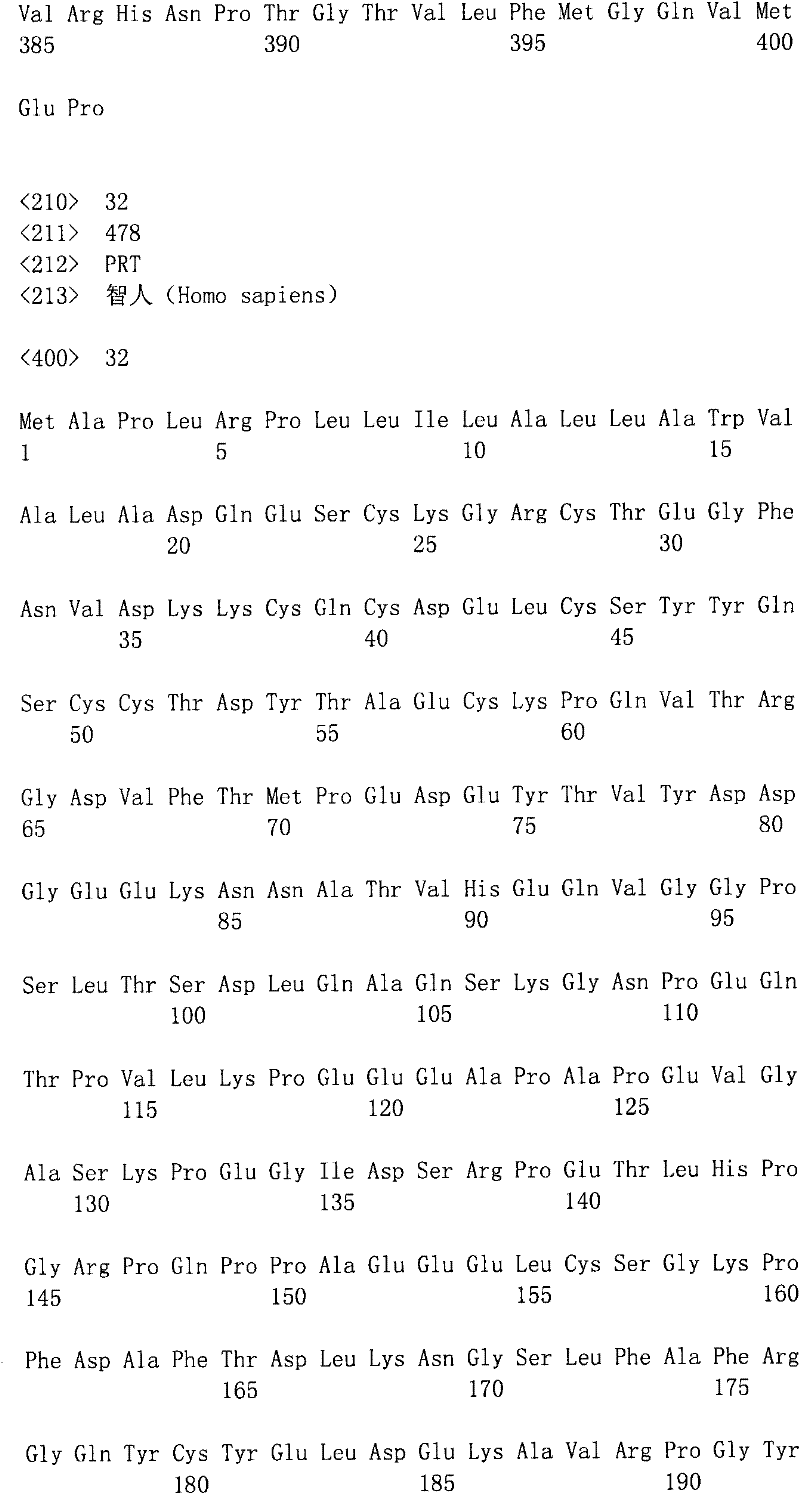


Claims (79)
Applications Claiming Priority (5)
| Application Number | Priority Date | Filing Date | Title |
|---|---|---|---|
| US2013708P | 2008-01-09 | 2008-01-09 | |
| US61/020,137 | 2008-01-09 | ||
| US8064008P | 2008-07-14 | 2008-07-14 | |
| US61/080,640 | 2008-07-14 | ||
| PCT/US2009/000155 WO2009089059A2 (en) | 2008-01-09 | 2009-01-09 | Therapeutic inhibitors of pai-1 function methods of their use |
Publications (1)
| Publication Number | Publication Date |
|---|---|
| CN102123721A true CN102123721A (en) | 2011-07-13 |
Family
ID=40853701
Family Applications (1)
| Application Number | Title | Priority Date | Filing Date |
|---|---|---|---|
| CN2009801088638A Pending CN102123721A (en) | 2008-01-09 | 2009-01-09 | Therapeutic inhibitors of PAI-1 function and methods of their use |
Country Status (12)
| Country | Link |
|---|---|
| US (2) | US8431363B2 (en) |
| EP (1) | EP2242501A4 (en) |
| JP (2) | JP2011509093A (en) |
| KR (1) | KR101712208B1 (en) |
| CN (1) | CN102123721A (en) |
| AU (1) | AU2009204464B2 (en) |
| BR (1) | BRPI0906867A2 (en) |
| CA (1) | CA2711878A1 (en) |
| IL (1) | IL206891A0 (en) |
| MX (1) | MX2010007586A (en) |
| RU (1) | RU2010133847A (en) |
| WO (1) | WO2009089059A2 (en) |
Cited By (5)
| Publication number | Priority date | Publication date | Assignee | Title |
|---|---|---|---|---|
| CN105793285A (en) * | 2013-12-10 | 2016-07-20 | 豪夫迈·罗氏有限公司 | Use of a binding domain of a subunit of a multi-subunit structure for targeted delivery of a pharmaceutically active entity to the multi-subunit structure |
| WO2018107687A1 (en) * | 2016-12-15 | 2018-06-21 | 深圳瑞健生命科学研究院有限公司 | Method for preventing and treating hyperlipidemia |
| US11207387B2 (en) | 2016-12-15 | 2021-12-28 | Talengen International Limited | Method and drug for preventing and treating obesity |
| US11389515B2 (en) | 2016-12-15 | 2022-07-19 | Talengen International Limited | Method for mitigating heart disease |
| CN119656313A (en) * | 2024-12-13 | 2025-03-21 | 四川大学华西医院 | Use of Serpine1 gene as a target in the preparation of drugs for preventing or treating myocardial fibrosis |
Families Citing this family (6)
| Publication number | Priority date | Publication date | Assignee | Title |
|---|---|---|---|---|
| BRPI0906867A2 (en) | 2008-01-09 | 2019-09-24 | Intrexon Corp | therapeutic inhibitors of parent-1 function and methods of using them |
| CN103154236B (en) * | 2010-05-12 | 2016-08-31 | 再生医学Tx有限责任公司 | bioactive kidney cells |
| CN104271593B (en) * | 2012-05-01 | 2018-01-16 | 富士胶片株式会社 | The polypeptide used in the cultural method and this method of multipotential stem cell |
| CN103421781B (en) * | 2012-07-04 | 2014-12-31 | 华中农业大学 | Promoters of pig muscle tissue specific expression gene myf6 and use thereof |
| US11613744B2 (en) | 2018-12-28 | 2023-03-28 | Vertex Pharmaceuticals Incorporated | Modified urokinase-type plasminogen activator polypeptides and methods of use |
| CA3123872A1 (en) | 2018-12-28 | 2020-07-02 | Catalyst Biosciences, Inc. | Modified urokinase-type plasminogen activator polypeptides and methods of use |
Family Cites Families (23)
| Publication number | Priority date | Publication date | Assignee | Title |
|---|---|---|---|---|
| US5639726A (en) * | 1994-09-30 | 1997-06-17 | The Regents Of The University Of Michigan | Peptide mediated enhancement of thrombolysis methods and compositions |
| AU1191001A (en) * | 1999-10-07 | 2001-05-10 | Human Genome Sciences, Inc. | Plasminogen-like polynucleotides, polypeptides, and antibodies |
| DE10053251A1 (en) * | 2000-10-26 | 2002-05-08 | Boehringer Ingelheim Pharma | New protein or peptide comprising epitope of plasminogen activator inhibitor-1, useful for screening substance for treating thromboembolic and cardiovascular diseases, cancer or related diseases |
| US20030211095A1 (en) * | 2002-05-08 | 2003-11-13 | Abd. Al-Roof Higazi | Peptide for regulation of urokinase plasminogen activator and method of optimizing therapeutic efficacy |
| US20030199463A1 (en) * | 2002-04-23 | 2003-10-23 | Silviu Itescu | DNA enzyme to inhibit plasminogen activator inhibitor-1 |
| JP2006507297A (en) * | 2002-05-13 | 2006-03-02 | チルドレンズ・ホスピタル・ロサンジェルス | Treatment and prevention of abnormal scar formation in keloids and other skin or internal wounds or lesions |
| US7241613B1 (en) * | 2002-06-05 | 2007-07-10 | Oscient Pharmaceuticals Corporation | Identification of Candida cell surface proteins and their uses |
| US7785871B2 (en) | 2002-10-09 | 2010-08-31 | Intrexon Corporation | DNA cloning vector plasmids and methods for their use |
| US20080050808A1 (en) * | 2002-10-09 | 2008-02-28 | Reed Thomas D | DNA modular cloning vector plasmids and methods for their use |
| US7071295B2 (en) * | 2002-12-02 | 2006-07-04 | Intrexon Corporation | Signal for targeting molecules to the sarco(endo)plasmic reticulum |
| CA2509222A1 (en) | 2002-12-10 | 2004-06-24 | Wyeth | Substituted indole oxo-acetyl amino acetic acid derivatives as inhibitors of plasminogen activator inhibitor-1 (pai-1) |
| JP2007537755A (en) | 2004-05-18 | 2007-12-27 | イントレクソン コーポレイション | Method for dynamic vector construction of DNA cloning vector plasmids |
| US8153598B2 (en) | 2005-10-19 | 2012-04-10 | Intrexon Corporation | PKD ligands and polynucleotides encoding PKD ligands |
| WO2007048103A2 (en) | 2006-10-18 | 2007-04-26 | Intrexon Corporation | Pkd ligands and polynucleotides encoding pkd ligands |
| US7943732B2 (en) * | 2006-06-05 | 2011-05-17 | Intrexon Corporation | AKT ligands and polynucleotides encoding AKT ligands |
| US8993263B2 (en) * | 2006-08-07 | 2015-03-31 | Intrexon Corporation | PKA ligands and polynucleotides encoding PKA ligands |
| US8999666B2 (en) * | 2006-08-09 | 2015-04-07 | Intrexon Corporation | PKC ligands and polynucleotides encoding PKC ligands |
| US8283445B2 (en) * | 2006-11-13 | 2012-10-09 | Intrexon Corporation | Extracellular-signal-regulated-kinase (ERK) heteropolyligand polypeptide |
| US8729225B2 (en) * | 2006-11-13 | 2014-05-20 | Intrexon Corporation | Glycogen synthase kinase heteropolyligand polypeptide |
| US7705122B2 (en) * | 2006-12-04 | 2010-04-27 | Intrexon Corporation | mTOR ligands and polynucleotides encoding mTOR ligands |
| EP2537924B1 (en) | 2007-03-27 | 2015-03-18 | Intrexon Corporation | MEK ligands and polynucleotides encoding mek ligands |
| CA2722754A1 (en) * | 2007-04-27 | 2009-01-29 | The University Of Toledo | Modified plasminogen activator inhibitor type-1 molecule and methods based thereon |
| BRPI0906867A2 (en) | 2008-01-09 | 2019-09-24 | Intrexon Corp | therapeutic inhibitors of parent-1 function and methods of using them |
-
2009
- 2009-01-09 BR BRPI0906867A patent/BRPI0906867A2/en not_active IP Right Cessation
- 2009-01-09 RU RU2010133847/10A patent/RU2010133847A/en not_active Application Discontinuation
- 2009-01-09 CN CN2009801088638A patent/CN102123721A/en active Pending
- 2009-01-09 US US12/812,127 patent/US8431363B2/en not_active Expired - Fee Related
- 2009-01-09 WO PCT/US2009/000155 patent/WO2009089059A2/en not_active Ceased
- 2009-01-09 MX MX2010007586A patent/MX2010007586A/en active IP Right Grant
- 2009-01-09 CA CA2711878A patent/CA2711878A1/en not_active Abandoned
- 2009-01-09 EP EP09700772A patent/EP2242501A4/en not_active Withdrawn
- 2009-01-09 KR KR1020107017701A patent/KR101712208B1/en not_active Expired - Fee Related
- 2009-01-09 AU AU2009204464A patent/AU2009204464B2/en not_active Ceased
- 2009-01-09 JP JP2010542283A patent/JP2011509093A/en not_active Withdrawn
-
2010
- 2010-07-08 IL IL206891A patent/IL206891A0/en unknown
-
2012
- 2012-01-18 JP JP2012008069A patent/JP2012135307A/en not_active Withdrawn
-
2013
- 2013-02-15 US US13/769,144 patent/US8828686B2/en not_active Expired - Fee Related
Cited By (9)
| Publication number | Priority date | Publication date | Assignee | Title |
|---|---|---|---|---|
| CN105793285A (en) * | 2013-12-10 | 2016-07-20 | 豪夫迈·罗氏有限公司 | Use of a binding domain of a subunit of a multi-subunit structure for targeted delivery of a pharmaceutically active entity to the multi-subunit structure |
| WO2018107687A1 (en) * | 2016-12-15 | 2018-06-21 | 深圳瑞健生命科学研究院有限公司 | Method for preventing and treating hyperlipidemia |
| WO2018107691A1 (en) * | 2016-12-15 | 2018-06-21 | 深圳瑞健生命科学研究院有限公司 | Method for preventing and treating tissue injury caused by abnormal deposition of lipid |
| US11207387B2 (en) | 2016-12-15 | 2021-12-28 | Talengen International Limited | Method and drug for preventing and treating obesity |
| US11389515B2 (en) | 2016-12-15 | 2022-07-19 | Talengen International Limited | Method for mitigating heart disease |
| US11478535B2 (en) | 2016-12-15 | 2022-10-25 | Talengen International Limited | Method for preventing and treating fatty liver |
| US11547746B2 (en) | 2016-12-15 | 2023-01-10 | Talengen International Limited | Method for treating coronary atherosclerosis and complications thereof |
| CN119656313A (en) * | 2024-12-13 | 2025-03-21 | 四川大学华西医院 | Use of Serpine1 gene as a target in the preparation of drugs for preventing or treating myocardial fibrosis |
| CN119656313B (en) * | 2024-12-13 | 2026-02-17 | 四川大学华西医院 | The use of the Serpine1 gene as a target in the preparation of drugs for the prevention or treatment of myocardial fibrosis |
Also Published As
| Publication number | Publication date |
|---|---|
| US8431363B2 (en) | 2013-04-30 |
| US20130267022A1 (en) | 2013-10-10 |
| BRPI0906867A2 (en) | 2019-09-24 |
| EP2242501A2 (en) | 2010-10-27 |
| AU2009204464A1 (en) | 2009-07-16 |
| RU2010133847A (en) | 2012-05-20 |
| EP2242501A4 (en) | 2011-10-19 |
| JP2011509093A (en) | 2011-03-24 |
| US20110055940A1 (en) | 2011-03-03 |
| IL206891A0 (en) | 2010-12-30 |
| CA2711878A1 (en) | 2009-07-16 |
| JP2012135307A (en) | 2012-07-19 |
| WO2009089059A2 (en) | 2009-07-16 |
| KR20100129271A (en) | 2010-12-08 |
| WO2009089059A3 (en) | 2009-09-24 |
| KR101712208B1 (en) | 2017-03-03 |
| MX2010007586A (en) | 2011-02-22 |
| AU2009204464B2 (en) | 2014-12-04 |
| US8828686B2 (en) | 2014-09-09 |
Similar Documents
| Publication | Publication Date | Title |
|---|---|---|
| US8828686B2 (en) | Polynucleotides encoding therapeutic inhibitors of PAI-1 | |
| JP7418519B2 (en) | Factor IX fusion proteins and methods of producing and using them | |
| Nara et al. | Elastase inhibitor elafin is a new type of proteinase inhibitor which has a transglutaminase-mediated anchoring sequence termed “cementoin” | |
| JP4451514B2 (en) | Blood coagulation factor VII variant | |
| KR100188302B1 (en) | Proteins and nucleic acids | |
| CN102316893B (en) | Antidotes for factor Xa inhibitors and methods of using the same in combination with blood coagulating agents | |
| JP2008109938A (en) | Von Willebrand factor (vWF) cleaving enzyme | |
| JP2015205933A (en) | Unit dose formulation of antidotes for factor xa inhibitors and methods of using the same | |
| BR112012004104B1 (en) | FACTOR IX FUSION PROTEIN AND ITS USE | |
| JPH05508664A (en) | Phospholipid-targeted thrombolytic agent | |
| JPH06503949A (en) | Novel insulin-like growth factor binding protein IGFBP-5 | |
| CZ182898A3 (en) | Inhibitor of endothelium cell proliferation and the use thereof | |
| JP2022528203A (en) | Composition of tumor suppressor fusion and method for producing the same | |
| JPH04505554A (en) | Soluble thrombomodulin analogs | |
| JP2000504218A (en) | Ligand-directed enzyme prodrug therapy | |
| JP4754478B2 (en) | Inhibitor protein for protease and use thereof | |
| JP2020505424A (en) | Factor IX fusion proteins and methods of making and using same | |
| CN105377888A (en) | Dual reactivity potent kunitz inhibitor of fibrinolysis | |
| Lewis et al. | Homologous plasminogen N‐terminal and plasminogen‐related gene A and B peptides: Characterization of cDNAs and recombinant fusion proteins | |
| WO2024106448A1 (en) | Nucleic acid construct capable of selectively detecting or killing mismatch repair-deficient cell, and use thereof | |
| Pintucci | The cardiovascular effects of proteolysis of high molecular weight basic fibroblast growth factor by inflammatory serine proteases | |
| JP2003174890A (en) | Novel serine protease inhibitor protein MT0039 | |
| JP2004105166A (en) | Feline follistatin and method for producing the same with high purity | |
| JP2006204150A (en) | Screening method for treatment or prevention agent for Alzheimer's disease |
Legal Events
| Date | Code | Title | Description |
|---|---|---|---|
| C06 | Publication | ||
| PB01 | Publication | ||
| C10 | Entry into substantive examination | ||
| SE01 | Entry into force of request for substantive examination | ||
| C02 | Deemed withdrawal of patent application after publication (patent law 2001) | ||
| WD01 | Invention patent application deemed withdrawn after publication |
Application publication date: 20110713 |