CN102215820A - Releasable Fusogenic Lipids for Nucleic Acid Delivery Systems - Google Patents
Releasable Fusogenic Lipids for Nucleic Acid Delivery Systems Download PDFInfo
- Publication number
- CN102215820A CN102215820A CN2009801459159A CN200980145915A CN102215820A CN 102215820 A CN102215820 A CN 102215820A CN 2009801459159 A CN2009801459159 A CN 2009801459159A CN 200980145915 A CN200980145915 A CN 200980145915A CN 102215820 A CN102215820 A CN 102215820A
- Authority
- CN
- China
- Prior art keywords
- substituted
- nhc
- alkyl
- nanoparticle
- group
- Prior art date
- Legal status (The legal status is an assumption and is not a legal conclusion. Google has not performed a legal analysis and makes no representation as to the accuracy of the status listed.)
- Pending
Links
- 0 CC(C(*)NC(*)=O)=O Chemical compound CC(C(*)NC(*)=O)=O 0.000 description 1
Images


Classifications
-
- A—HUMAN NECESSITIES
- A61—MEDICAL OR VETERINARY SCIENCE; HYGIENE
- A61K—PREPARATIONS FOR MEDICAL, DENTAL OR TOILETRY PURPOSES
- A61K9/00—Medicinal preparations characterised by special physical form
- A61K9/10—Dispersions; Emulsions
- A61K9/127—Synthetic bilayered vehicles, e.g. liposomes or liposomes with cholesterol as the only non-phosphatidyl surfactant
- A61K9/1271—Non-conventional liposomes, e.g. PEGylated liposomes or liposomes coated or grafted with polymers
- A61K9/1272—Non-conventional liposomes, e.g. PEGylated liposomes or liposomes coated or grafted with polymers comprising non-phosphatidyl surfactants as bilayer-forming substances, e.g. cationic lipids or non-phosphatidyl liposomes coated or grafted with polymers
-
- A—HUMAN NECESSITIES
- A61—MEDICAL OR VETERINARY SCIENCE; HYGIENE
- A61P—SPECIFIC THERAPEUTIC ACTIVITY OF CHEMICAL COMPOUNDS OR MEDICINAL PREPARATIONS
- A61P35/00—Antineoplastic agents
Landscapes
- Health & Medical Sciences (AREA)
- Life Sciences & Earth Sciences (AREA)
- Chemical & Material Sciences (AREA)
- Animal Behavior & Ethology (AREA)
- Veterinary Medicine (AREA)
- Public Health (AREA)
- Medicinal Chemistry (AREA)
- Pharmacology & Pharmacy (AREA)
- General Health & Medical Sciences (AREA)
- Dispersion Chemistry (AREA)
- Epidemiology (AREA)
- Molecular Biology (AREA)
- Biophysics (AREA)
- Chemical Kinetics & Catalysis (AREA)
- General Chemical & Material Sciences (AREA)
- Nuclear Medicine, Radiotherapy & Molecular Imaging (AREA)
- Organic Chemistry (AREA)
- Pharmaceuticals Containing Other Organic And Inorganic Compounds (AREA)
- Medicines That Contain Protein Lipid Enzymes And Other Medicines (AREA)
- Organic Low-Molecular-Weight Compounds And Preparation Thereof (AREA)
- Pyrrole Compounds (AREA)
- Medicinal Preparation (AREA)
Abstract
Description
相关申请的参照引用REFERENCE TO RELATED APPLICATIONS
本申请主张对第61/115,378号美国临时专利申请的优先权。此专利申请日为2008年11月17日,专利内容在此引入作为参考。This application claims priority to US Provisional Patent Application Serial No. 61/115,378. The patent application date is November 17, 2008, and the content of the patent is hereby incorporated by reference.
背景技术Background technique
近年来,使用核酸的治疗方法被作为治疗多种疾病的尝试。例如反义疗法等多种疗法是疾病治疗的有力工具,因为治疗性基因可以选择性地调整与疾病相关的基因表达,并将使用其他治疗方法时引起的副作用降至最低。In recent years, therapeutic methods using nucleic acids have been attempted as treatments for various diseases. Various therapies, such as antisense therapy, are powerful tools for disease treatment because therapeutic genes can selectively adjust the expression of disease-related genes and minimize the side effects caused by other therapeutic methods.
然而,由于基因的稳定性差、输送效率低,使用核酸的治疗方法受到限制。集中基因输送系统试图克服上述障碍,将治疗性基因有效地在体外以及体内送达目标区域,例如癌细胞或者组织。为了促进输送和强化治疗性基因的细胞吸收,上述尝试针对对脂质体的利用。However, therapeutic approaches using nucleic acids are limited due to poor gene stability and low delivery efficiency. Concentrated gene delivery systems attempt to overcome the above barriers to efficiently deliver therapeutic genes to target areas, such as cancer cells or tissues, in vitro and in vivo. In order to facilitate delivery and enhance cellular uptake of therapeutic genes, the above attempts have directed the use of liposomes.
尽管在输送质体方面已经取得一些进展,但当前可得的脂质体不能有效地将低聚核苷酸输送入人体。对于输送低聚核苷酸,理想的输送系统应当包括正电荷,此正电荷足以中和低聚核苷酸的负电荷。最近,Stuart,D.D.等在Biochim.Biophys.Acta,2000,1463:219-229中,以及Semple,S.C.等在Biochim.Biophys.Acta,2001,1510:152-166中分别介绍了包覆阳离子脂质体(coated cationic liposomal,CCL)和稳定的核酸脂粒(Stable Nucleic Acid-Lipid Particles,SNALP),据报道,上述物质可以提供具有小尺寸、高核酸封装率、良好的血清稳定性和循环时间持久的纳米微粒。Although some progress has been made in delivering plastids, currently available liposomes are not effective in delivering oligonucleotides into the human body. For delivery of oligonucleotides, an ideal delivery system should include a positive charge sufficient to neutralize the negative charge of the oligonucleotide. Recently, Stuart, D.D. et al. in Biochim.Biophys.Acta, 2000, 1463:219-229, and Semple, S.C. et al. introduced coating cationic lipid Coated cationic liposomal (CCL) and stable nucleic acid liposomal (Stable Nucleic Acid-Lipid Particles, SNALP), according to reports, the above substances can provide small size, high nucleic acid encapsulation rate, good serum stability and long-lasting circulation time of nanoparticles.
尽管有上述尝试和进展,但仍需提供改进的核酸输送系统。本发明即针对这一需要而提出。Despite the above attempts and advances, there remains a need to provide improved nucleic acid delivery systems. The present invention addresses this need.
发明内容Contents of the invention
本发明提供包含亚胺连接基和两性基的可释放融合脂质,以及包含同样物质用于核酸输送的纳米微粒组合物。多核酸(polynucleic acids),例如低聚核苷酸,被封装在包含阳离子脂质、本发明所述的可释放融合脂质和PEG脂质混合物的纳米微粒复合体中。The present invention provides releasable fusogenic lipids comprising an imine linker and an amphoteric group, as well as nanoparticle compositions comprising the same for nucleic acid delivery. Polynucleic acids, such as oligonucleotides, are encapsulated in nanoparticle complexes comprising cationic lipids, releasable fusion lipids described herein and PEG lipid mixtures.
根据本发明的这一方面,用于核酸(具体为低聚核苷酸)输送的可释放融合脂质具有式(I):According to this aspect of the invention, the releasable fusion lipid for delivery of nucleic acids, in particular oligonucleotides, has the formula (I):
R——(L1)a——M——(L2)b——QR——(L 1 ) a ——M——(L 2 ) b ——Q
其中in
R是水溶的电中性或者含两性离子的基团;R is a water-soluble neutral or zwitterionic group;
L1-2是单独选择的双功能连接基;L 1-2 is an individually selected bifunctional linker;
M是含亚胺的基团;M is an imine-containing group;
Q是取代的或者非取代的,饱和或者不饱和的含C4-30的基团;Q is a substituted or unsubstituted, saturated or unsaturated C4-30-containing group;
(a)是0或者正整数;以及(a) is 0 or a positive integer; and
(b)是0或者正整数。(b) is 0 or a positive integer.
本发明还提供用于核酸输送的纳米微粒组合物。根据本发明,用于核酸(具体为低聚核苷酸)输送的纳米微粒组合物可以包括:The present invention also provides nanoparticle compositions for nucleic acid delivery. According to the present invention, the nanoparticle composition for the delivery of nucleic acids (in particular oligonucleotides) may comprise:
(i)阳离子脂质;(i) cationic lipids;
(ii)式(I)化合物;以及(ii) a compound of formula (I); and
(iii)PEG脂质。(iii) PEG lipids.
另一方面,本发明提供将核酸(优选低聚核苷酸)在体内和体外送达细胞或者组织的方法。通过本发明所述的方法送入的低聚核苷酸可以调整目标基因的表达。In another aspect, the invention provides methods for delivering nucleic acids, preferably oligonucleotides, to cells or tissues in vivo and in vitro. The oligonucleotides introduced by the methods of the present invention can regulate the expression of target genes.
同时,本发明提供抑制目标基因表达的方法。所述基因就是致癌基因以及与哺乳动物,优选为人的疾病相关的基因。所述方法包括使用本发明所述的纳米微粒组合物制成的纳米微粒/纳米微粒复合体来接触细胞,例如癌细胞或者组织。封装在纳米微粒中的低聚核苷酸被释放出来,其调节被治疗的细胞或者组织内的mRNA或者蛋白质的下调。使用纳米微粒的治疗允许在治疗恶性疾病时对目标基因的表达进行调整(并带来随之而来的相关益处),例如抑制癌细胞的生长。通过一种或多种有效的和/或被认可的治疗手段,这些疗法可以单独实施,也可以作为联合疗法的一部分实施。Meanwhile, the present invention provides a method for inhibiting the expression of a target gene. Such genes are oncogenes and genes associated with diseases in mammals, preferably humans. The method comprises contacting a cell, such as a cancer cell or a tissue, with a nanoparticle/nanoparticle complex made from a nanoparticle composition according to the invention. The oligonucleotides encapsulated in the nanoparticles are released, which modulate the downregulation of mRNAs or proteins in the treated cells or tissues. Therapeutics using nanoparticles allows for the modulation of target gene expression (and concomitantly associated benefits) in the treatment of malignant diseases, such as inhibition of cancer cell growth. These therapies may be administered alone or as part of a combination therapy with one or more effective and/or approved treatments.
此外,本发明还包括制造式(I)化合物以及包含同样物质的纳米微粒的方法。Furthermore, the present invention also includes processes for the manufacture of compounds of formula (I) and nanoparticles comprising the same.
包含本发明所述的可释放融合脂质的纳米微粒组合物提供了在体内以及体外核酸给药的方式。Nanoparticle compositions comprising the releasable fusogenic lipids of the present invention provide a means for nucleic acid delivery in vivo as well as in vitro.
当包含本发明所述的可释放融合脂质的纳米微粒进入细胞和细胞区室时,它可以帮助释放封装在其中的核酸。不受任何理论的限制,这一特性部分归因于酸不稳定连接基。亚胺基连接基酸不稳定,并且在例如癌细胞和核内体的酸性环境中发生水解。因此,亚胺基连接基可以促进纳米微粒的破裂,从而允许核酸在细胞内的释放。When nanoparticles comprising releasable fusogenic lipids according to the invention enter cells and cellular compartments, it can aid in the release of nucleic acids encapsulated therein. Without being bound by any theory, this property is due in part to the acid labile linker. The imino linker is acid-labile and undergoes hydrolysis in the acidic environment of, for example, cancer cells and endosomes. Thus, imine-based linkers can facilitate the disruption of nanoparticles, thereby allowing the release of nucleic acids within the cell.
包含两性电荷基团的可释放融合脂质增强核酸的细胞吸收。带有极性但电荷为中性的基团帮助纳米微粒穿过细胞膜。Releasable fusion lipids containing amphiphilic charge groups enhance cellular uptake of nucleic acids. The polar but neutrally charged groups help the nanoparticles pass through cell membranes.
本发明所述的可释放融合脂质稳定了生物流体中的纳米微粒复合体以及其中的核酸。纳米微粒复合体可以将核酸分子与核酸酶隔开,从而防止核酸发生降解。The releasable fusion lipids of the present invention stabilize nanoparticle complexes and nucleic acids therein in biological fluids. Nanoparticle complexes can isolate nucleic acid molecules from nucleases, thereby preventing nucleic acid degradation.
本发明所述的纳米微粒输送系统允许在所期望的目标区域内选择性地出现足够量的治疗性低聚核苷酸,例如通过EPR(Enhanced Permeation and Retention)效应到达癌细胞。目标区域内的治疗性核酸可以有针对性地调整癌细胞或组织内的目标基因的表达。The nanoparticle delivery system of the present invention allows a sufficient amount of therapeutic oligonucleotides to selectively appear in the desired target area, such as reaching cancer cells through the EPR (Enhanced Permeation and Retention) effect. Therapeutic nucleic acids in the target region can specifically modulate the expression of the target gene in the cancer cell or tissue.
本发明所述的纳米微粒也可以用于生物活性分子的输送,例如小分子化学治疗以及一种或多种不同类型的治疗性核酸,因而在疾病的治疗中取得了协同效应。The nanoparticles described in the present invention can also be used for the delivery of biologically active molecules, such as small molecule chemotherapy and one or more different types of therapeutic nucleic acids, thus achieving a synergistic effect in the treatment of diseases.
其他更多的优点会从如下说明中得到体现。Other more advantages will be reflected from the following description.
基于本发明的目的,术语“残基”应当理解为化合物的一部分,其指的是例如C6-30碳氢化合物在与其他化合物发生取代反应之后的剩余。For the purposes of the present invention, the term "residue" should be understood as a part of a compound, which refers to, for example, a C6-30 hydrocarbon remaining after a substitution reaction with another compound.
基于本发明的目的,术语“烷基”指的是饱和的脂肪族碳氢化合物,包括直链、支链和环烷基团。术语“烷基”还包括烷基-硫-烷基、烷氧基烷基、环烷基烷基、杂环烷基和C1-6烷羰基烷基基团。优选地,所述烷基基团具有1到12个碳。更为优选地,其为约1到7个碳的低碳数烷基,进一步优选为约1到4个碳。所述烷基基团可以是被取代的或者未被取代的。当烷基基团是被取代的时,取代基优选包括卤代基、氧、叠氮基、硝基、氰基、烷基、烷氧基、烷基-硫、烷基-硫-烷基、烷氧基烷基、烷基胺、三卤甲基、氢氧基、巯基、羟基、氰基、硅烷基、环烷基、环烷基烷基、杂环烷基、杂芳基、烯基、炔基、C1-6烃基、芳基和氨基。For the purposes of the present invention, the term "alkyl" refers to saturated aliphatic hydrocarbons, including straight chain, branched chain and cycloalkyl groups. The term "alkyl" also includes alkyl-thio-alkyl, alkoxyalkyl, cycloalkylalkyl, heterocycloalkyl and C 1-6 alkylcarbonylalkyl groups. Preferably, the alkyl group has 1 to 12 carbons. More preferably, it is a lower alkyl group of about 1 to 7 carbons, still more preferably about 1 to 4 carbons. The alkyl groups can be substituted or unsubstituted. When the alkyl group is substituted, the substituents preferably include halo, oxygen, azido, nitro, cyano, alkyl, alkoxy, alkyl-thio, alkyl-thio-alkyl , alkoxyalkyl, alkylamine, trihalomethyl, hydroxyl, mercapto, hydroxyl, cyano, silyl, cycloalkyl, cycloalkylalkyl, heterocycloalkyl, heteroaryl, alkene group, alkynyl group, C 1-6 hydrocarbon group, aryl group and amino group.
基于本发明的目的,术语“被取代的”指的是用下述基团之一增加或者替换包含在官能团或化合物中的一个或多个原子,所述基团包括:卤代基、氧、叠氮基、硝基、氰基、烷基、烷氧基、烷基-硫、烷基-硫-烷基、烷氧基烷基、烷基胺、三卤甲基、氢氧基、巯基、羟基、氰基、硅烷基、环烷基、环烷基烷基、杂环烷基、杂芳基、烯基、炔基、C1-6烷羰基烷基、芳基和氨基。For the purposes of the present invention, the term "substituted" refers to the addition or replacement of one or more atoms contained in a functional group or compound with one of the following groups: halo, oxygen, Azido, nitro, cyano, alkyl, alkoxy, alkyl-thio, alkyl-thio-alkyl, alkoxyalkyl, alkylamine, trihalomethyl, hydroxide, mercapto , hydroxy, cyano, silyl, cycloalkyl, cycloalkylalkyl, heterocycloalkyl, heteroaryl, alkenyl, alkynyl, C 1-6 alkylcarbonylalkyl, aryl and amino.
基于本发明的目的,术语“烯基”指的是包含至少一个碳-碳双键的基团,包括直链、支链和环状。优选地,所述烯基基团具有2到12个碳。更为优选地,其为约2到7个碳的低碳数烯基,进一步优选为约2到4个碳。所述烯基基团可以是被取代的或者未被取代的。当烯基基团是被取代的时,取代基优选包括卤代基、氧、叠氮基、硝基、氰基、烷基、烷氧基、烷基-硫、烷基-硫-烷基、烷氧基烷基、烷基胺、三卤甲基、氢氧基、巯基、羟基、氰基、硅烷基、环烷基、环烷基烷基、杂环烷基、杂芳基、烯基、炔基、C1-6烃基、芳基和氨基。For the purposes of the present invention, the term "alkenyl" refers to a group comprising at least one carbon-carbon double bond, including straight chain, branched chain and cyclic. Preferably, the alkenyl group has 2 to 12 carbons. More preferably, it is a lower alkenyl group of about 2 to 7 carbons, still more preferably about 2 to 4 carbons. The alkenyl group can be substituted or unsubstituted. When an alkenyl group is substituted, the substituents preferably include halo, oxygen, azido, nitro, cyano, alkyl, alkoxy, alkyl-thio, alkyl-thio-alkyl , alkoxyalkyl, alkylamine, trihalomethyl, hydroxyl, mercapto, hydroxyl, cyano, silyl, cycloalkyl, cycloalkylalkyl, heterocycloalkyl, heteroaryl, alkene group, alkynyl group, C 1-6 hydrocarbon group, aryl group and amino group.
基于本发明的目的,术语“炔基”指的是包含至少一个碳-碳三键的基团,包括直链、支链和环状。优选地,所述炔基基团具有2到12个碳。更为优选地,其为约2到7个碳的低碳数炔基,进一步优选为约2到4个碳。所述炔基基团可以是被取代的或者未被取代的。当炔基基团是被取代的时,取代基优选包括卤代基、氧、叠氮基、硝基、氰基、烷基、烷氧基、烷基-硫、烷基-硫-烷基、烷氧基烷基、烷基胺、三卤甲基、氢氧基、巯基、羟基、氰基、硅烷基、环烷基、环烷基烷基、杂环烷基、杂芳基、烯基、炔基、C1-6烃基、芳基和氨基。“炔基”的例子包括炔丙基、丙炔和3-己炔。For the purposes of the present invention, the term "alkynyl" refers to a group comprising at least one carbon-carbon triple bond, including straight chain, branched chain and cyclic. Preferably, the alkynyl group has 2 to 12 carbons. More preferably, it is a lower alkynyl of about 2 to 7 carbons, still more preferably about 2 to 4 carbons. The alkynyl group can be substituted or unsubstituted. When the alkynyl group is substituted, the substituents preferably include halo, oxygen, azido, nitro, cyano, alkyl, alkoxy, alkyl-thio, alkyl-thio-alkyl , alkoxyalkyl, alkylamine, trihalomethyl, hydroxyl, mercapto, hydroxyl, cyano, silyl, cycloalkyl, cycloalkylalkyl, heterocycloalkyl, heteroaryl, alkene group, alkynyl group, C 1-6 hydrocarbon group, aryl group and amino group. Examples of "alkynyl" include propargyl, propyne and 3-hexyne.
基于本发明的目的,术语“芳基”指的是包含至少一个芳香环的芳香碳氢化合物环状结构。所述芳香环可以是稠环,或者也可以连接到其他芳香碳氢化合物环或非芳香碳氢化合物环。芳基的例子包括,例如苯基、萘基、1,2,3,4-四氢化萘和联苯。芳基优选的例子包括苯基和萘基。For the purposes of the present invention, the term "aryl" refers to an aromatic hydrocarbon ring structure comprising at least one aromatic ring. The aromatic ring may be fused, or may be attached to another aromatic or non-aromatic hydrocarbon ring. Examples of aryl groups include, for example, phenyl, naphthyl, tetralin and biphenyl. Preferable examples of aryl include phenyl and naphthyl.
基于本发明的目的,术语“环烷基”指的是C3-8环状碳氢化合物。环烷基的例子包括环丙基、环丁基、环戊基、环己基、环庚基和环辛基。For the purposes of the present invention, the term "cycloalkyl" refers to a C 3-8 cyclic hydrocarbon. Examples of cycloalkyl groups include cyclopropyl, cyclobutyl, cyclopentyl, cyclohexyl, cycloheptyl and cyclooctyl.
基于本发明的目的,术语“环烯基”指的是包含至少一个碳-碳双键的C3-8环状碳氢化合物。环烯基的例子包括环戊烯基、环戊二烯基、环己烯基、1,3-环己二烯基、环庚烯、环庚三烯和环辛烯基。For the purposes of the present invention, the term "cycloalkenyl" refers to a C 3-8 cyclic hydrocarbon containing at least one carbon-carbon double bond. Examples of the cycloalkenyl group include cyclopentenyl, cyclopentadienyl, cyclohexenyl, 1,3-cyclohexadienyl, cycloheptenyl, cycloheptatriene and cyclooctenyl.
基于本发明的目的,术语“环烷基烷基”指的是用C3-8环烷基取代的烷基。环烷基烷基的例子包括环丙基甲基和环戊基乙基。For the purposes of the present invention, the term "cycloalkylalkyl" refers to an alkyl group substituted with a C 3-8 cycloalkyl group. Examples of cycloalkylalkyl include cyclopropylmethyl and cyclopentylethyl.
基于本发明的目的,术语“烷氧基”指的是指示数量的通过氧桥连接到主分子基团的碳原子组成的烷基。烷氧基的例子包括,例如甲氧基、乙氧基、丙氧基和异丙氧基。For the purposes of the present invention, the term "alkoxy" refers to an alkyl group consisting of an indicated number of carbon atoms attached to the main molecular group through an oxygen bridge. Examples of alkoxy include, for example, methoxy, ethoxy, propoxy and isopropoxy.
基于本发明的目的,“烷基芳基”指的是用烷基取代的芳基。For purposes of the present invention, "alkylaryl" refers to an aryl group substituted with an alkyl group.
基于本发明的目的,“芳烷基”指的是用芳基取代的烷基。For purposes of the present invention, "aralkyl" refers to an alkyl group substituted with an aryl group.
基于本发明的目的,术语“烷氧基烷基”指的是用烷氧基取代的烷基。For the purposes of the present invention, the term "alkoxyalkyl" refers to an alkyl group substituted with an alkoxy group.
基于本发明的目的,术语“烷基硫-烷基”指的是烷基-S-烷基硫醚,例如二甲硫醚或者甲乙硫醚。For the purposes of the present invention, the term "alkylthio-alkyl" refers to an alkyl-S-alkylsulfide such as dimethylsulfide or methylethylsulfide.
基于本发明的目的,术语“氨基”指的是由氨通过一个或多个氢基被有机基团替换而衍生出来的本领域所知的含氮基团。例如,术语“酰氨基”和“烷基胺”指的是分别被酰基和烷基取代基取代的特定的N取代游记基团。For purposes of the present invention, the term "amino" refers to a nitrogen-containing group known in the art derived from ammonia by replacing one or more hydrogen groups with an organic group. For example, the terms "acylamino" and "alkylamine" refer to specific N-substituted amino groups substituted with acyl and alkyl substituents, respectively.
基于本发明的目的,术语“烷羰基”指的是用烷基取代的羰基。For the purposes of the present invention, the term "alkcarbonyl" refers to a carbonyl group substituted with an alkyl group.
基于本发明的目的,术语“卤素”或“卤代基”指的是氟、氯、溴和碘。For the purposes of the present invention, the term "halogen" or "halo" refers to fluorine, chlorine, bromine and iodine.
基于本发明的目的,术语“杂环烷基”指的是包含至少一个选自氮、氧和硫的杂原子非芳香环状结构。杂环烷基环可以是稠环,或者也可以连接到其他杂环烷基环和/或非芳香碳氢化合物环。优选的杂环烷基具有3到7个部分。杂环烷基的例子包括,例如哌嗪、吗啉、哌啶、四氢呋喃、吡咯烷和吡唑。优选的杂环烷基包括哌啶基、哌嗪基、吗啉基和吡咯烷基。For the purposes of the present invention, the term "heterocycloalkyl" refers to a non-aromatic ring structure comprising at least one heteroatom selected from nitrogen, oxygen and sulfur. The heterocycloalkyl ring can be fused or it can be attached to another heterocycloalkyl ring and/or a non-aromatic hydrocarbon ring. Preferred heterocycloalkyl groups have 3 to 7 moieties. Examples of heterocycloalkyl groups include, for example, piperazine, morpholine, piperidine, tetrahydrofuran, pyrrolidine and pyrazole. Preferred heterocycloalkyl groups include piperidinyl, piperazinyl, morpholinyl and pyrrolidinyl.
基于本发明的目的,术语“杂芳基”指的是包含至少一个选自氮、氧和硫的杂原子的芳香环结构。杂芳基环可以是稠环,或者也可以连接到一个或多个杂芳基环、芳香或非芳香碳氢化合物环或者杂环烷基环。杂芳基的例子包括,例如吡啶、呋喃、噻吩、5,6,7,8,-四氢异喹啉和嘧啶。杂芳基的优选例子包括噻吩基、苯并噻吩基、吡啶基、喹啉基、吡嗪基、嘧啶基、咪唑基、苯并咪唑基、呋喃基、苯并呋喃基、噻唑基、苯并噻唑基、异恶唑基、氧二氮唑基、异硫代氮唑基、苯并异硫代氮唑基、三氮唑基、四氮唑基、吡咯基、吲哚基、吡唑基和苯并吡唑基。For the purposes of the present invention, the term "heteroaryl" refers to an aromatic ring structure comprising at least one heteroatom selected from nitrogen, oxygen and sulfur. A heteroaryl ring can be fused, or it can be attached to one or more heteroaryl rings, aromatic or non-aromatic hydrocarbon rings, or heterocycloalkyl rings. Examples of heteroaryl groups include, for example, pyridine, furan, thiophene, 5,6,7,8,-tetrahydroisoquinoline and pyrimidine. Preferred examples of heteroaryl groups include thienyl, benzothienyl, pyridyl, quinolinyl, pyrazinyl, pyrimidinyl, imidazolyl, benzimidazolyl, furyl, benzofuryl, thiazolyl, benzo Thiazolyl, isoxazolyl, oxadiazolyl, isothioazolyl, benzisothioazolyl, triazolyl, tetrazolyl, pyrrolyl, indolyl, pyrazolyl and benzopyrazolyl.
基于本发明的目的,术语“杂原子”指的是氮、氧和硫。For the purposes of the present invention, the term "heteroatom" refers to nitrogen, oxygen and sulfur.
在一些实例中,取代的烷基包括羧烷基、氨烷基、二烷氨基、羟烷基和巯烷基;取代的烯基包括羧烯基、氨烯基、二烯氨基、羟烯基和巯烯基;取代的炔基包括羧炔基、氨炔基、二炔氨基、羟炔基和巯炔基;取代的环烷基包括例如4-氯环己基的基团;芳基包括例如萘基的基团;取代的芳基包括例如3-溴苯基的基团;芳烷基包括例如甲苯基的基团;杂烷基包括例如乙基噻吩的基团;取代的杂芳基包括例如3-甲氧基噻吩的基团;烷氧基包括例如甲氧基的基团;以及苯氧基包括3-硝基苯氧基的基团。卤代基应当理解为包括氟代基、氯代基、碘代基和溴代基。In some examples, substituted alkyl groups include carboxyalkyl, aminoalkyl, dialkylamino, hydroxyalkyl, and mercaptoalkyl; substituted alkenyl groups include carboxyalkenyl, aminoalkenyl, dienylamino, hydroxyalkenyl and mercaptoenyl; substituted alkynyl groups include carboxyalkynyl, aminoalkynyl, dialkynylamino, hydroxyalkynyl, and mercaptoalkynyl; substituted cycloalkyl groups include groups such as 4-chlorocyclohexyl; aryl groups include groups such as Groups such as naphthyl; substituted aryl groups include groups such as 3-bromophenyl; aralkyl groups include groups such as tolyl; heteroalkyl groups include groups such as ethylthiophene; substituted heteroaryl groups include groups such as A group such as 3-methoxythiophene; alkoxy group includes a group such as methoxy; and phenoxy group includes a group such as 3-nitrophenoxy. Halo should be understood to include fluoro, chloro, iodo and bromo.
基于本发明的目的,“正整数”应当理解为包括等于或大于1的整数,并且应由具有普通技术知识的技术人员通过普通技术在合理的范围内进行理解。For the purpose of the present invention, a "positive integer" should be understood as including an integer equal to or greater than 1, and should be understood within a reasonable range by a person having ordinary technical knowledge through ordinary techniques.
基于本发明的目的,术语“连接的”应当理解为包括一个基团与另一个基团的共价的(优选)或非共价的接合,即作为化学反应的结果。For the purposes of the present invention, the term "linked" is understood to include the covalent (preferably) or non-covalent attachment of one group to another, ie as a result of a chemical reaction.
基于本发明的目的,术语“有效量”和“足够量”的意思应该是由本领域普通技术人员所理解的取得所需效果或治疗效果的量。For the purposes of the present invention, the terms "effective amount" and "sufficient amount" shall mean an amount to achieve the desired or therapeutic effect as understood by those of ordinary skill in the art.
本发明所述的术语“纳米微粒”和/或由纳米微粒组合物形成的“纳米微粒复合体”指的是脂质基纳米复合体。纳米微粒包含封装在阳离子脂质、融合脂质和PEG脂质的混合物中的核酸,例如低聚核苷酸。可选地,所述纳米微粒可以不含核酸。The term "nanoparticle" and/or "nanoparticle complex" formed from the nanoparticle composition in the present invention refers to a lipid-based nanocomplex. Nanoparticles comprise nucleic acids, such as oligonucleotides, encapsulated in mixtures of cationic lipids, fusogenic lipids, and PEG lipids. Alternatively, the nanoparticles may be free of nucleic acids.
基于本发明的目的,术语“治疗性低聚核苷酸”指的是用作药物或诊断试剂的低聚核苷酸。For the purposes of the present invention, the term "therapeutic oligonucleotide" refers to an oligonucleotide used as a drug or a diagnostic reagent.
基于本发明的目的,不考虑给药途径,与不使用本发明所述的纳米微粒治疗的情况相比较,“基因表达的调整”应当广义地理解为包括任何类型基因的下调或上调,尤其是与癌症和炎症相关的基因。Based on the purpose of the present invention, regardless of the route of administration, "regulation of gene expression" should be broadly understood to include down-regulation or up-regulation of any type of gene, especially Genes associated with cancer and inflammation.
基于本发明的目的,与不使用本发明所述的纳米微粒治疗的情况相比较,“抑制目标基因的表达”应当理解为mRNA表达或者蛋白质转译的量减少或减弱。这种抑制的适当测定包括,使用本领域技术人员所知的技术对蛋白质或mRNA水平进行检验,例如本领域技术人员所知的斑点印迹、RNA印迹、原位杂化、ELISA、免疫沉淀反应、酶功能以及表型测定。治疗条件可以通过例如细胞,优选癌细胞或组织内的mRNA水平的降低来确认。Based on the purpose of the present invention, "inhibiting the expression of a target gene" should be understood as the reduction or weakening of mRNA expression or protein translation compared with the situation without using the nanoparticle treatment of the present invention. Suitable assays for such inhibition include assays of protein or mRNA levels using techniques known to those skilled in the art, such as dot blots, Northern blots, in situ hybridization, ELISA, immunoprecipitation, Enzyme functional and phenotypic assays. A therapeutic condition can be confirmed, for example, by a decrease in mRNA levels in cells, preferably cancer cells or tissues.
广义来说,当获得了所期望的反应,就应当认定抑制或者治疗获得了成功。例如,成功的抑制或者治疗可以被定义为获得与肿瘤生长抑制相关的基因的例如10%或更高的(具体为20%、30%、40%)的下调。可选地,当与不使用本发明所述的纳米微粒治疗的情况相比较,成功的治疗可以被定义为癌细胞或组织内致癌基因mRNA降低了至少20%或优选30%,甚至是40%或者更高(例如50%或80%),包括本领域技术人员所预期的其他临床指标。Broadly speaking, suppression or treatment should be considered successful when the desired response is achieved. For example, successful inhibition or treatment may be defined as obtaining eg 10% or more (specifically 20%, 30%, 40%) down-regulation of genes associated with tumor growth inhibition. Alternatively, successful treatment may be defined as at least 20% or preferably 30% or even 40% reduction of oncogene mRNA in cancer cells or tissues when compared to treatment without the use of nanoparticles according to the invention Or higher (eg, 50% or 80%), including other clinical indicators expected by those skilled in the art.
此外,为了方便起见,说明书中单个术语的使用不受限制。因此,例如涉及由低聚核苷酸、胆固醇类似物、阳离子脂质、可释放融合脂质、PEG脂质等组成的组合物时,其指的是所述低聚核苷酸、胆固醇类似物、阳离子脂质、可释放融合脂质、PEG脂质等的一个或多个分子。可以预期的是,低聚核苷酸可以是同一种类或者不同种类的基因。应当理解的是,本发明并不限于此处所揭示的特定构型、处理步骤和材料,这些构型、处理步骤和材料可以适当多样化。Furthermore, for the sake of convenience, the use of individual terms in the specification is not limited. Thus, for example, reference to compositions consisting of oligonucleotides, cholesterol analogs, cationic lipids, releasable fusion lipids, PEG lipids, etc., refers to said oligonucleotides, cholesterol analogs , cationic lipids, one or more molecules of releasable fusion lipids, PEG lipids, and the like. It is contemplated that the oligonucleotides may be of the same species or of different species of gene. It is to be understood that this invention is not limited to the particular configurations, process steps and materials disclosed herein, which may vary as appropriate.
还应当理解的是,本发明所用到的技术仅用于描述特定实例,并不受限制,本发明的范围由附加的权利要求书及其等同物来限定。It should also be understood that the techniques used in the present invention are used to describe specific examples only and not limiting, the scope of the present invention is defined by the appended claims and their equivalents.
附图说明Description of drawings
图1图表说明制备实例6-11所描述的化合物6的反应方案。Figure 1 schematically illustrates the reaction scheme for the preparation of
图2图表说明制备实例12-15所描述的化合物10的反应方案。Figure 2 schematically illustrates the reaction scheme for the preparation of
具体实施方式Detailed ways
A.概述A. Overview
1.式(I)的可释放融合脂质1. The releasable fusion lipid of formula (I)
根据本发明的一个方面,提供了式(I)化合物:According to one aspect of the present invention, compounds of formula (I) are provided:
(I)R——(L1)a——M——(L2)b——Q(I)R——(L 1 ) a ——M——(L 2 ) b ——Q
其中in
R是水溶的电中性或者含两性离子的基团;R is a water-soluble neutral or zwitterionic group;
L1-2是单独选择的双功能连接基;L 1-2 is an individually selected bifunctional linker;
M是含亚胺的基团;M is an imine-containing group;
Q是取代的或者非取代的,饱和或者不饱和的含C4-30的基团;Q is a substituted or unsubstituted, saturated or unsaturated C4-30-containing group;
(a)是0或者正整数,优选为0或者从约1到约10(例如1、2、3、4、5、6)的整数;以及(a) is 0 or a positive integer, preferably 0 or an integer from about 1 to about 10 (
(b)是0或者正整数,优选为0或者从约1到约10(例如1、2、3、4、5、6)的整数。(b) is 0 or a positive integer, preferably 0 or an integer from about 1 to about 10 (
当(a)和(b)等于或大于2时,L1和L2分别相同或不同。When (a) and (b) are equal to or greater than 2, L 1 and L 2 are the same or different, respectively.
在一个优选的方面,此处所述分子式的化合物包括Q碳氢化合物基团(脂肪族)。Q基团具有式(Ia):In a preferred aspect, the compounds of the formulas described herein include a Q hydrocarbon group (aliphatic). The Q group has the formula (Ia):
(Ia)(Ia)

其中in
Y1和Y’1分别为O、S或NR4,优选为氧;Y 1 and Y' 1 are O, S or NR 4 respectively, preferably oxygen;
(c)为0或1;(c) is 0 or 1;
(d)为0或正整数,优选为0或从约1到约10(例如1、2、3、4、5、6)的整数;(d) is 0 or a positive integer, preferably 0 or an integer from about 1 to about 10 (
(e)为0或1;(e) is 0 or 1;
X为C、N或P;X is C, N or P;
Q1为H、C1-3烷基、NR5、OH或Q 1 is H, C 1-3 alkyl, NR 5 , OH or
Q2为H、C1-3烷基、NR6、OH或Q 2 is H, C 1-3 alkyl, NR 6 , OH or

Q3为孤电子对、(=O)、H、C1-3烷基、NR7、OH或Q 3 is a lone electron pair, (=O), H, C 1-3 alkyl, NR 7 , OH or

假定assumed
(i)当X为C,Q3不为孤电子对或(=O);(i) when X is C, Q 3 is not a lone electron pair or (=O);
(ii)当X为N,Q3为孤电子对;以及(ii) when X is N, Q3 is a lone electron pair; and
(iii)当X为P,Q3为(=O)且(e)为0,(iii) when X is P, Q 3 is (=O) and (e) is 0,
其中in
L11、L12和L13为单独选择的双功能间隔基;L 11 , L 12 and L 13 are individually selected bifunctional spacers;
Y11、Y12和Y13分别为O、S或NR8,优选为O或NR8;Y 11 , Y 12 and Y 13 are O, S or NR 8 , preferably O or NR 8 ;
Y’11、Y’12和Y’13分别为O、S或NR8,优选为氧;Y' 11 , Y' 12 and Y' 13 are O, S or NR 8 , preferably oxygen;
R11、R12和R13分别为取代的或非取代的,饱和的或不饱和的C4-30;R 11 , R 12 and R 13 are respectively substituted or unsubstituted, saturated or unsaturated C 4-30 ;
(f1)、(f2)和(f3)分别为0或1;(f1), (f2) and (f3) are 0 or 1, respectively;
(g1)、(g2)、(g3)分别为0或1;以及(g1), (g2), (g3) are 0 or 1 respectively; and
(h1)、(h2)、(h3)分别为0或1;(h1), (h2), (h3) are 0 or 1 respectively;
R2-3独立地选自氢、氢氧基、胺、取代的胺、C1-6烷基、C2-6烯基、C2-6炔基、C3-19支链烷基、C3-8环烷基、C1-6取代的烷基、C2-6取代的烯基、C2-6取代的炔基、C3-8取代的环烷基、芳基、取代的芳基、杂芳基、取代的杂芳基、C1-6杂烷基和取代的C1-6杂烷基,优选为氢、氢氧基、胺、甲基、乙基和丙基;以及R 2-3 is independently selected from hydrogen, hydroxyl, amine, substituted amine, C 1-6 alkyl, C 2-6 alkenyl, C 2-6 alkynyl, C 3-19 branched alkyl, C 3-8 cycloalkyl, C 1-6 substituted alkyl, C 2-6 substituted alkenyl, C 2-6 substituted alkynyl, C 3-8 substituted cycloalkyl, aryl, substituted Aryl, heteroaryl, substituted heteroaryl, C 1-6 heteroalkyl and substituted C 1-6 heteroalkyl, preferably hydrogen, hydroxide, amine, methyl, ethyl and propyl; as well as
R4-8独立地选自氢、C1-6烷基、C2-6烯基、C2-6炔基、C3-19支链烷基、C3-8环烷基、C1-6取代的烷基、C2-6取代的烯基、C2-6取代的炔基、C3-8取代的环烷基、芳基、取代的芳基、杂芳基、取代的杂芳基、C1-6杂烷基和取代的C1-6杂烷基,优选为氢、甲基、乙基和丙基,R 4-8 is independently selected from hydrogen, C 1-6 alkyl, C 2-6 alkenyl, C 2-6 alkynyl, C 3-19 branched alkyl, C 3-8 cycloalkyl, C 1 -6 substituted alkyl, C 2-6 substituted alkenyl, C 2-6 substituted alkynyl, C 3-8 substituted cycloalkyl, aryl, substituted aryl, heteroaryl, substituted hetero Aryl, C 1-6 heteroalkyl and substituted C 1-6 heteroalkyl, preferably hydrogen, methyl, ethyl and propyl,
假定Q包括R11、R12和R13中的至少一个或两个(例如一个、两个、三个)。It is assumed that Q includes at least one or two (eg one, two, three) of R 11 , R 12 and R 13 .
在本发明的范围内可以预期的双功能连接基与双功能间隔基的组合,包括那些允许连接基和间隔基的变量和取代基进行组合的组合,由此这些组合形成式(I)的稳定化合物。例如,值和取代基的组合不允许氧、氮或羰基直接紧邻亚胺定位。Combinations of bifunctional linker and bifunctional spacer that are contemplated within the scope of the present invention include those that allow combinations of linker and spacer variables and substituents such that these combinations form stable compounds of formula (I) compound. For example, the combination of values and substituents does not allow an oxygen, nitrogen or carbonyl to be positioned directly next to the imine.
优选地,Q包括R11、R12和R13中的至少两个。Preferably, Q includes at least two of R 11 , R 12 and R 13 .
当(d)等于或大于2时,-C(R2R3)-基在各种情况下相同或者不同。When (d) is equal to or greater than 2, the -C(R 2 R 3 )- groups are in each case the same or different.
本发明一个优选的方面在于,含亚胺基团具有分子式:A preferred aspect of the invention is that the imine-containing group has the formula:
-N=CR1-或-CR1=N-,-N=CR 1 - or -CR 1 =N-,
其中R1为氢、C1-6烷基、C3-8支链烷基、C3-8环烷基、C1-6取代的烷基、C3-8取代的环烷基、芳基和取代的芳基,优选为氢、甲基、乙基或丙基。Wherein R 1 is hydrogen, C 1-6 alkyl, C 3-8 branched alkyl, C 3-8 cycloalkyl, C 1-6 substituted alkyl, C 3-8 substituted cycloalkyl, aromatic and substituted aryl, preferably hydrogen, methyl, ethyl or propyl.
在一个实例中,酸不稳定的M连接基为-N=CH-或-CH=N-。In one example, the acid labile M linker is -N=CH- or -CH=N-.
根据本发明所述的可释放融合脂质具有式(Ib)或(I’b):The releasable fusion lipid according to the present invention has formula (Ib) or (I'b):
或or

2.水溶的电中性或者含两性离子的基团:R基团2. Water-soluble neutral or zwitterionic groups: R groups
本发明所述的化合物包括末端两性离子。在一个实例中,两性离子包括胺和酸。酸性质子距离所述胺3到8个原子(例如,所述酸性质子距离所述胺3、4、5、6、7或8个原子)。优选地,所述酸性质子距离所述胺3到6个原子。The compounds described herein include terminal zwitterions. In one example, zwitterions include amines and acids. The acidic proton is 3 to 8 atoms away from the amine (eg, the acidic proton is 3, 4, 5, 6, 7, or 8 atoms away from the amine). Preferably, the acidic proton is 3 to 6 atoms away from the amine.
所述酸包括但不限于羧酸、磺酸或磷酸。Such acids include, but are not limited to, carboxylic, sulfonic, or phosphoric acids.
在进一步的实例中,含两性离子的基团为氨基酸的两性离子形式。R基的一些说明性实例包括但不限于:In a further example, the zwitterion-containing group is the zwitterionic form of an amino acid. Some illustrative examples of R groups include, but are not limited to:
-CH(COO)(NH3,-CH(COO)(NH 3 ,
Lys=-HN-(CH2)4CH(COO)(NH3),Lys=-HN-(CH 2 ) 4 CH(COO)(NH 3 ),
Glu=-C(=O)-(CH2)2CH(COO)(NH3)和Glu=-C(=O)-(CH 2 ) 2 CH(COO)(NH 3 ) and
Asp=-C(=O)-(CH2)CH(COO)(NH3)。Asp=-C(=O)-( CH2 )CH(COO)( NH3 ).
在另一实例中,含两性离子的基团为氨基酸的两性离子形式的衍生物。所述氨基酸可以是天然的氨基酸或者天然氨基酸的衍生物。氨基酸类似物和衍生物的一些实例包括:2-氨基己二酸、3-氨基己二酸、β-丙氨酸、β-氨基丙酸、2-氨基丁酸、4-氨基丁酸、哌啶酸、6-氨基己酸、2-氨基庚酸、2-氨基异丁酸、3-氨基异丁酸、2-氨基庚二酸、2,4-氨基丁酸、锁链素、2,2-二氨基庚二酸、2,3-二氨基丙酸、N-乙基甘氨酸、N-乙基天门冬酰胺、3-羟基脯氨酸、4-羟基脯氨酸、异锁链素、别-异亮氨酸、N-甲基甘氨酸或肌氨酸、N-甲基-异亮氨酸、6-N-甲基赖氨酸、N-甲基缬氨酸、正缬氨酸、正亮氨酸、鸟氨酸、和其他列于63 Fed.Reg.,29620,29622中的物质,在此引入作为参考,不再详述。In another example, the zwitterion-containing group is a zwitterionic derivative of an amino acid. The amino acid may be a natural amino acid or a derivative of a natural amino acid. Some examples of amino acid analogs and derivatives include: 2-aminoadipic acid, 3-aminoadipic acid, β-alanine, β-alanine, 2-aminobutyric acid, 4-aminobutyric acid, piperidine Glycolic acid, 6-aminocaproic acid, 2-aminoheptanoic acid, 2-aminoisobutyric acid, 3-aminoisobutyric acid, 2-aminopimelic acid, 2,4-aminobutyric acid, desmosin, 2,2 -Diaminopimelic acid, 2,3-diaminopropionic acid, N-ethylglycine, N-ethylasparagine, 3-hydroxyproline, 4-hydroxyproline, isodesmosin, allo- Isoleucine, N-methylglycine or sarcosine, N-methyl-isoleucine, 6-N-methyllysine, N-methylvaline, norvaline, positive Aminoline, ornithine, and other substances listed in 63 Fed.Reg., 29620, 29622 are hereby incorporated by reference and will not be described in detail.
3.双功能连接基:L1和L2基团3. Bifunctional linker: L1 and L2 groups
根据本发明,包括在式(I)化合物之中的L1基团选自:According to the present invention, the L groups included in the compounds of formula (I) are selected from:
-(CR21R22)t1-[C(=Y16)]a3-,-(CR 21 R 22 ) t1 -[C(=Y 16 )] a3 -,
-(CR21R22)t1Y17-(CR23R24)t2-(Y18)a2-[C(=Y16)]a3-,-(CR 21 R 22 ) t1 Y 17 -(CR 23 R 24 ) t2 -(Y 18 ) a2 -[C(=Y 16 )] a3 -,
-(CR21R22CR23R24Y17)t1-[C(=Y16)]a3-,-(CR 21 R 22 CR 23 R 24 Y 17 ) t1 -[C(=Y 16 )] a3 -,
-(CR21R22CR23R24Y17)t1(CR25R26)t4-(Y18)a2-[C(=Y16)]a3-,-(CR 21 R 22 CR 23 R 24 Y 17 ) t1 (CR 25 R 26 ) t4 -(Y 18 ) a2 -[C(=Y 16 )] a3 -,
-[(CR21R22CR23R24)t2Y17]t3(CR25R26)t4-(Y18)a2-[C(=Y16)]a3-,-[(CR 21 R 22 CR 23 R 24 ) t2 Y 17 ] t3 (CR 25 R 26 ) t4 -(Y 18 ) a2 -[C(=Y 16 )] a3 -,
-(CR21R22)t1-[(CR23R24)t2Y17]t3(CR25R26)t4-(Y18)a2-[C(=Y16)]a3-,-(CR 21 R 22 ) t1 -[(CR 23 R 24 ) t2 Y 17 ] t3 (CR 25 R 26 ) t4 -(Y 18 ) a2 -[C(=Y 16 )] a3 -,
-(CR21R22)t1(Y17)a2[C(=Y16)a3(CR23R24)t2-,-(CR 21 R 22 ) t1 (Y 17 ) a2 [C(=Y 16 ) a3 (CR 23 R 24 ) t2 -,
-(CR21R22)t1(Y17)a2[C(=Y16)]a3Y14(CR23R24)t2-,-(CR 21 R 22 ) t1 (Y 17 ) a2 [C(=Y 16 )] a3 Y 14 (CR 23 R 24 ) t2 -,
-(CR21R22)t1(Y17)a2[C(=Y16)]a3(CR23R24)t2-Y15-(CR23R24)t3-,-(CR 21 R 22 ) t1 (Y 17 ) a2 [C(=Y 16 )] a3 (CR 23 R 24 ) t2 -Y 15 -(CR 23 R 24 ) t3 -,
-(CR21R22)t1(Y17)a2[C(=Y16)]a3Y14(CR23R24)t2-Y15-(CR23R24)t3-,-(CR 21 R 22 ) t1 (Y 17 ) a2 [C(=Y 16 )] a3 Y 14 (CR 23 R 24 ) t2 -Y 15 -(CR 23 R 24 ) t3 -,
-(CR21R22)t1(Y17)a2[C(=Y16)]a3(CR23R24CR25R26Y19)t2(CR27CR28)t3-,-(CR 21 R 22 ) t1 (Y 17 ) a2 [C(=Y 16 )] a3 (CR 23 R 24 CR 25 R 26 Y 19 ) t2 (CR 27 CR 28 ) t3 -,
-(CR21R22)t1(Y17)a2[C(=Y16)]a3Y14(CR23R24CR25R26Y19)t2(CR27CR28)t3-,以及-(CR 21 R 22 ) t1 (Y 17 ) a2 [C(=Y 16 )] a3 Y 14 (CR 23 R 24 CR 25 R 26 Y 19 ) t2 (CR 27 CR 28 ) t3 -, and

其中:in:
Y16为O、NR28或S,优选为氧;Y 16 is O, NR 28 or S, preferably oxygen;
Y14-15和Y17-19分别为O、NR29或S,优选为O或NR29;Y 14-15 and Y 17-19 are O, NR 29 or S respectively, preferably O or NR 29 ;
R21-27独立地选自氢、氢氧基、胺、C1-6烷基、C3-12支链烷基、C3-8环烷基、C1-6取代的烷基、C3-8取代的环烷基、芳基、取代的芳基、芳烷基、C1-6杂芳基、取代的C1-6杂芳基、C1-6烷氧基、苯氧基和C1-6杂烷氧基,优选为氢、甲基、乙基或丙基;以及R 21-27 are independently selected from hydrogen, hydroxyl, amine, C 1-6 alkyl, C 3-12 branched chain alkyl, C 3-8 cycloalkyl, C 1-6 substituted alkyl, C 3-8 substituted cycloalkyl, aryl, substituted aryl, aralkyl, C 1-6 heteroaryl, substituted C 1-6 heteroaryl, C 1-6 alkoxy, phenoxy and C 1-6 heteroalkoxy, preferably hydrogen, methyl, ethyl or propyl; and
R28-29独立地选自氢、C1-6烷基、C3-12支链烷基、C3-8环烷基、C1-6取代的烷基、C3-8取代的环烷基、芳基、取代的芳基、芳烷基、C1-6杂芳基、取代的C1-6杂芳基、C1-6烷氧基、苯氧基和C1-6杂烷氧基,优选为氢、甲基、乙基或丙基;R 28-29 are independently selected from hydrogen, C 1-6 alkyl, C 3-12 branched chain alkyl, C 3-8 cycloalkyl, C 1-6 substituted alkyl, C 3-8 substituted ring Alkyl, aryl, substituted aryl, aralkyl, C 1-6 heteroaryl, substituted C 1-6 heteroaryl, C 1-6 alkoxy, phenoxy and C 1-6 hetero Alkoxy, preferably hydrogen, methyl, ethyl or propyl;
(t1)、(t2)、(t3)和(t4)分别为0或正整数,优选为0或从约1到约10(例如1、2、3、4、5、6)的正整数;以及(t1), (t2), (t3) and (t4) are respectively 0 or a positive integer, preferably 0 or a positive integer from about 1 to about 10 (
(a2)和(a3)分别为0或1。(a2) and (a3) are 0 or 1, respectively.
在本发明的范围内可以预期的双功能L1连接基,包括那些允许取代基和变量进行组合的连接基,由此这些组合形成式(I)的稳定化合物。例如,当(a3)为0时,Y17不直接与Y14相连。Bifunctional L1 linkers contemplated within the scope of the present invention include those that allow combinations of substituents and variables such that these combinations form stable compounds of formula (I). For example, when (a3) is 0, Y 17 is not directly connected to Y 14 .
基于本发明的目的,当双功能连接基的值是等于或大于2的正整数时,可以使用相同或不同的双功能连接基。For the purpose of the present invention, when the value of the bifunctional linker is a positive integer equal to or greater than 2, the same or different bifunctional linkers may be used.
当(t1)、(t2)、(t3)和(t4)都分别等于或大于2时,R21-R28在各种情况下分别相同或不同。When (t1), (t2), (t3) and (t4) are each equal to or greater than 2, R 21 -R 28 are the same or different in each case.
在一个实例中,Y14-15和Y17-19为O或NH;R21-29分别为氢或甲基。In one example, Y 14-15 and Y 17-19 are O or NH; R 21-29 are hydrogen or methyl, respectively.
在另一个实例中,Y16为O;Y14-15和Y17-19为O或NH;R21-29为氢。In another example, Y 16 is O; Y 14-15 and Y 17-19 are O or NH; R 21-29 are hydrogen.
在某些实例中,L1独立地选自:In certain instances, L is independently selected from:
-(CH2)t1-[C(=O)]a3-,-(CH 2 ) t1 -[C(=O)] a3 -,
-(CH2)t1Y17-(CH2)t2-(Y18)a2-[C(=O)]a3-,-(CH 2 ) t1 Y 17 -(CH 2 ) t2 -(Y 18 ) a2 -[C(=O)] a3 -,
-(CH2CH2Y17)t1-[C(=O)]a3-,-(CH 2 CH 2 Y 17 ) t1 -[C(=O)] a3 -,
-(CH2CH2Y17)t1(CH2)t4-(Y18)a2-[C(=O)]a3-,-(CH 2 CH 2 Y 17 ) t1 (CH 2 ) t4 -(Y 18 ) a2 -[C(=O)] a3 -,
-[(CH2CH2)t2Y17]t3(CH2)t4-(Y18)a2-[C(=O)]a3-,-[(CH 2 CH 2 ) t2 Y 17 ] t3 (CH 2 ) t4 -(Y 18 ) a2 -[C(=O)] a3 -,
-(CH2)t1-[(CH2)t2Y17]t3(CH2)t4-(Y18)a2-[C(=O)]a3-,-(CH 2 ) t1 -[(CH 2 ) t2 Y 17 ] t3 (CH 2 ) t4 -(Y 18 ) a2 -[C(=O)] a3 -,
-(CH2)t1(Y17)a2[C(=O)]a3(CH2)t2-,-(CH 2 ) t1 (Y 17 ) a2 [C(=O)] a3 (CH 2 ) t2 -,
-(CH2)t1(Y17)a2[C(=O)]a3Y14(CH2)t2-,-(CH 2 ) t1 (Y 17 ) a2 [C(=O)] a3 Y 14 (CH 2 ) t2 -,
-(CH2)t1(Y17)a2[C(=O)]a3(CH2)t2-Y15-(CH2)t3-,-(CH 2 ) t1 (Y 17 ) a2 [C(=O)] a3 (CH 2 ) t2 -Y 15 -(CH 2 ) t3 -,
-(CH2)t1(Y17)a2[C(=O)]a3Y14(CH2)t2-Y15-(CH2)t3-,-(CH 2 ) t1 (Y 17 ) a2 [C(=O)] a3 Y 14 (CH 2 ) t2 -Y 15 -(CH 2 ) t3 -,
-(CH2)t1(Y17)a2[C(=O)]a3(CH2CH2Y19)t2(CH2)t3-,以及-(CH 2 ) t1 (Y 17 ) a2 [C(=O)] a3 (CH 2 CH 2 Y 19 ) t2 (CH 2 ) t3 -, and
-(CH2)t1(Y17)a2[C(=O)]a3Y14(CH2CH2Y19)t2(CH2)t3-,-(CH 2 ) t1 (Y 17 ) a2 [C(=O)] a3 Y 14 (CH 2 CH 2 Y 19 ) t2 (CH 2 ) t3 -,
其中in
Y14-15和Y17-19分别为O或NH;Y 14-15 and Y 17-19 are O or NH respectively;
(t1)、(t2)、(t3)和(t4)分别为0或正整数,优选为0或从约1到约10(例如1、2、3、4、5、6)的正整数;以及(t1), (t2), (t3) and (t4) are respectively 0 or a positive integer, preferably 0 or a positive integer from about 1 to about 10 (
(a2)和(a3)分别为0或1。(a2) and (a3) are 0 or 1, respectively.
当(t1)或(t3)等于或大于2时,Y17在各种情况下相同或不同。When (t1) or (t3) is equal to or greater than 2, Y 17 is the same or different in each case.
当(t2)等于或大于2时,Y17在各种情况下相同或不同。When (t2) is equal to or greater than 2, Y 17 is the same or different in each case.
在进一步的实例和/或可选的实例中,L1基的说明性实例选自:In further instances and/or alternative instances, illustrative examples of the L group are selected from:
-CH2-,-(CH2)2-,-(CH2)3-,-(CH2)4-,-(CH2)5-,-(CH2)6-,-NH(CH2)-,-CH 2 -, -(CH 2 ) 2 -, -(CH 2 ) 3 -, -(CH 2 ) 4 -, -(CH 2 ) 5 -, -(CH 2 ) 6 -, -NH(CH 2 )-,
-CH(NH2)CH2-,-CH(NH 2 )CH 2 -,
-(CH2)4-C(=O)-,-(CH2)5-C(=O)-,-(CH2)6-C(=O)-,-(CH 2 ) 4 -C(=O)-, -(CH 2 ) 5 -C(=O)-, -(CH 2 ) 6 -C(=O)-,
-CH2CH2O-CH2O-C(=O)-, -CH2CH2O - CH2OC (=O)-,
-(CH2CH2O)2-CH2O-C(=O)-,-( CH2CH2O ) 2 - CH2OC ( =O)-,
-(CH2CH2O)3-CH2O-C(=O)-,- ( CH2CH2O ) 3 - CH2OC (=O)-,
-(CH2CH2O)2-C(=O)-,-( CH2CH2O ) 2 - C(=O)-,
-CH2CH2O-CH2CH2NH-C(=O)-, -CH2CH2O - CH2CH2NH -C(=O)- ,
-(CH2CH2O)2-CH2CH2NH-C(=O)-,-( CH2CH2O ) 2 - CH2CH2NH - C(=O)-,
-CH2-O-CH2CH2O-CH2CH2NH-C(=O)-, -CH2 -O- CH2CH2O - CH2CH2NH -C ( =O)- ,
-CH2-O-(CH2CH2O)2-CH2CH2NH-C(=O)-, -CH2- O-( CH2CH2O ) 2 - CH2CH2NH -C(=O) - ,
-CH2-O-CH2CH2O-CH2C(=O)-, -CH2 -O- CH2CH2O - CH2C (=O) - ,
-CH2-O-(CH2CH2O)2-CH2C(=O)-, -CH2- O-( CH2CH2O ) 2- CH2C (=O)- ,
-(CH2)4-C(=O)NH-,-(CH2)5-C(=O)NH-,-(CH 2 ) 4 -C(=O)NH-, -(CH 2 ) 5 -C(=O)NH-,
-(CH2)6-C(=O)NH-,-(CH 2 ) 6 -C(=O)NH-,
-CH2CH2O-CH2O-C(=O)-NH-, -CH2CH2O - CH2OC (=O)-NH-,
-(CH2CH2O)2-CH2O-C(=O)-NH-,-( CH2CH2O ) 2- CH2OC ( =O)-NH-,
-(CH2CH2O)3-CH2O-C(=O)-NH-, - ( CH2CH2O ) 3 - CH2OC (=O)-NH-,
-(CH2CH2O)2-C(=O)-NH-,-( CH2CH2O ) 2 - C(=O)-NH-,
-CH2CH2O-CH2CH2NH-C(=O)-NH-, -CH2CH2O - CH2CH2NH -C ( =O)-NH-,
-(CH2CH2O)2-CH2CH2NH-C(=O)-NH-,-( CH2CH2O ) 2 - CH2CH2NH - C(=O)-NH-,
-CH2-O-CH2CH2O-CH2CH2NH-C(=O)-NH-, -CH2 -O- CH2CH2O - CH2CH2NH -C(=O) -NH- ,
-CH2-O-(CH2CH2O)2-CH2CH2NH-C(=O)-NH-,-CH2 - O-( CH2CH2O ) 2 - CH2CH2NH -C(=O) -NH- ,
-CH2-O-CH2CH2O-CH2C(=O)-NH-, -CH2 -O- CH2CH2O - CH2C (=O) -NH- ,
-CH2-O-(CH2CH2O)2-CH2C(=O)-NH-, -CH2- O-( CH2CH2O ) 2- CH2C (=O) -NH- ,
-(CH2CH2O)2-,-CH2CH2O-CH2O-,-(CH 2 CH 2 O) 2 -, -CH 2 CH 2 O-CH 2 O-,
-(CH2CH2O)2-CH2CH2NH-,- ( CH2CH2O ) 2 - CH2CH2NH- ,
-(CH2CH2O)3-CH2CH2NH-,- ( CH2CH2O ) 3 - CH2CH2NH- ,
-CH2CH2O-CH2CH2NH-, -CH2CH2O - CH2CH2NH- ,
-(CH2CH2O)2-CH2CH2NH-,- ( CH2CH2O ) 2 - CH2CH2NH- ,
-CH2-O-CH2CH2O-CH2CH2NH-, -CH2 -O - CH2CH2O - CH2CH2NH- ,
-CH2-O-(CH2CH2O)2-CH2CH2NH-, -CH2- O-( CH2CH2O ) 2 - CH2CH2NH- ,
-CH2-O-CH2CH2O-, -CH2 -O- CH2CH2O- ,
-CH2-O-(CH2CH2O)2-, -CH2 -O-( CH2CH2O ) 2- ,


-C(=O)NH(CH2)2-,-CH2C(=O)NH(CH2)2-,-C(=O)NH(CH 2 ) 2 -, -CH 2 C(=O)NH(CH 2 ) 2 -,
-C(=O)NH(CH2)3-,-CH2C(=O)NH(CH2)3-,-C(=O)NH(CH 2 ) 3 -, -CH 2 C(=O)NH(CH 2 ) 3 -,
-C(=O)NH(CH2)4-,-CH2C(=O)NH(CH2)4-,-C(=O)NH(CH 2 ) 4 -, -CH 2 C(=O)NH(CH 2 ) 4 -,
-C(=O)NH(CH2)5-,-CH2C(=O)NH(CH2)5-,-C(=O)NH(CH 2 ) 5 -, -CH 2 C(=O)NH(CH 2 ) 5 -,
-C(=O)NH(CH2)6-,-CH2C(=O)NH(CH2)6-,-C(=O)NH(CH 2 ) 6 -, -CH 2 C(=O)NH(CH 2 ) 6 -,
-C(=O)O(CH2)2-,-CH2C(=O)O(CH2)2-,-C(=O)O(CH 2 ) 2 -, -CH 2 C(=O)O(CH 2 ) 2 -,
-C(=O)O(CH2)3-,-CH2C(=O)O(CH2)3-,-C(=O)O(CH 2 ) 3 -, -CH 2 C(=O)O(CH 2 ) 3 -,
-C(=O)O(CH2)4-,-CH2C(=O)O(CH2)4-,-C(=O)O(CH 2 ) 4 -, -CH 2 C(=O)O(CH 2 ) 4 -,
-C(=O)O(CH2)5-,-CH2C(=O)O(CH2)5-,-C(=O)O(CH 2 ) 5 -, -CH 2 C(=O)O(CH 2 ) 5 -,
-C(=O)O(CH2)6-,-CH2C(=O)O(CH2)6-,-C(=O)O(CH 2 ) 6 -, -CH 2 C(=O)O(CH 2 ) 6 -,
-(CH2CH2)2NHC(=O)NH(CH2)2-,-(CH 2 CH 2 ) 2 NHC(=O)NH(CH 2 ) 2 -,
-(CH2CH2)2NHC(=O)NH(CH2)3-,-(CH 2 CH 2 ) 2 NHC(=O)NH(CH 2 ) 3 -,
-(CH2CH2)2NHC(=O)NH(CH2)4-,-(CH 2 CH 2 ) 2 NHC(=O)NH(CH 2 ) 4 -,
-(CH2CH2)2NHC(=O)NH(CH2)5-,-(CH 2 CH 2 ) 2 NHC(=O)NH(CH 2 ) 5 -,
-(CH2CH2)2NHC(=O)NH(CH2)6-,-(CH 2 CH 2 ) 2 NHC(=O)NH(CH 2 ) 6 -,
-(CH2CH2)2NHC(=O)O(CH2)2-,-(CH 2 CH 2 ) 2 NHC(=O)O(CH 2 ) 2 -,
-(CH2CH2)2NHC(=O)O(CH2)3-,-(CH 2 CH 2 ) 2 NHC(=O)O(CH 2 ) 3 -,
-(CH2CH2)2NHC(=O)O(CH2)4-,-(CH 2 CH 2 ) 2 NHC(=O)O(CH 2 ) 4 -,
-(CH2CH2)2NHC(=O)O(CH2)5-,-(CH 2 CH 2 ) 2 NHC(=O)O(CH 2 ) 5 -,
-(CH2CH2)2NHC(=O)O(CH2)6-,-(CH 2 CH 2 ) 2 NHC(=O)O(CH 2 ) 6 -,
-(CH2CH2)2NHC(=O)(CH2)2-,-(CH 2 CH 2 ) 2 NHC(=O)(CH 2 ) 2 -,
-(CH2CH2)2NHC(=O)(CH2)3-,-(CH 2 CH 2 ) 2 NHC(=O)(CH 2 ) 3 -,
-(CH2CH2)2NHC(=O)(CH2)4-,-( CH2CH2 ) 2NHC (=O)( CH2 ) 4- ,
-(CH2CH2)2NHC(=O)(CH2)5-,以及-(CH 2 CH 2 ) 2 NHC(=O)(CH 2 ) 5 -, and
-(CH2CH2)2NHC(=O)(CH2)6-。-( CH2CH2 ) 2NHC (=O)( CH2 ) 6- .
在某些实例中,L2独立地选自:In certain instances, L is independently selected from:
-(CR’21R’22)t’1-[C(=Y’16)]a’3(CR’27CR’28)t’2-,-(CR' 21 R' 22 ) t'1 -[C(=Y' 16 )] a'3 (CR' 27 CR' 28 ) t'2 -,
-(CR’21R’22)t’1Y’14-(CR’23R’24)t’2-(Y’15)a’2-[C(=Y’16)]a’3(CR’27CR’28)t’3-,-(CR' 21 R' 22 ) t'1 Y' 14 -(CR' 23 R' 24 ) t'2 -(Y' 15 ) a'2 -[C(=Y' 16 )] a'3 ( CR' 27 CR' 28 ) t'3 -,
-(CR’21R’22CR’23R’24Y’14)t’1-[C(=Y’16)]a’3(CR’27CR’28)t’2-,-(CR' 21 R' 22 CR' 23 R' 24 Y' 14 ) t'1 -[C(=Y' 16 )] a'3 (CR' 27 CR' 28 ) t'2 -,
-(CR’21R’22CR’23R’24Y’14)t’1(CR’25R’26)t’2-(Y’15)a’2-[C(=Y’16)]a’3(CR’27CR’28)t’3-,-(CR' 21 R' 22 CR' 23 R' 24 Y' 14 ) t'1 (CR' 25 R' 26 ) t'2 -(Y' 15 ) a'2 -[C(=Y' 16 ) ] a'3 (CR' 27 CR' 28 ) t'3 -,
-[(CR’21R’22CR’23R’24)t’2Y’14]t’1(CR’25R’26)t’2-(Y’15)a’2-[C(=Y’16)]a’3(CR’27CR’28)t’3-,-[(CR' 21 R' 22 CR' 23 R' 24 ) t'2 Y' 14 ] t'1 (CR' 25 R' 26 ) t'2 -(Y' 15 ) a'2 -[C( =Y' 16 )] a'3 (CR' 27 CR' 28 ) t'3 -,
-(CR’21R’22)t’1-[(CR’23R’24)t’2Y’14]t’2(CR’25R’26)t’3-(Y’15)a’2-[C(=Y’16)]a’3(CR’27CR’28)t ’4--(CR' 21 R' 22 ) t'1 -[(CR' 23 R' 24 ) t'2 Y' 14 ] t'2 (CR' 25 R' 26 ) t'3 -(Y' 15 ) a '2 -[C(=Y' 16 )] a'3 (CR' 27 CR' 28 ) t '4 -
-(CR’21R’22)t’1(Y’14)a’2[C(=Y’16)]a’3(CR’23R’24)t’2-,-(CR' 21 R' 22 ) t'1 (Y' 14 ) a'2 [C(=Y' 16 )] a'3 (CR' 23 R' 24 ) t'2 -,
-(CR’21R’22)t’1(Y’14)a’2[C(=Y’16)]a’3Y’15(CR’23R’24)t’2-,-(CR' 21 R' 22 ) t'1 (Y' 14 ) a'2 [C(=Y' 16 )] a'3 Y' 15 (CR' 23 R' 24 ) t'2 -,
-(CR’21R’22)t’1(Y’14)a’2[C(=Y’16)]a’3(CR’23R’24)t’2-Y’15-(CR’23R’24)t’3-,-(CR' 21 R' 22 ) t'1 (Y' 14 ) a'2 [C(=Y' 16 )] a'3 (CR' 23 R' 24 ) t'2 -Y' 15 -(CR ' 23 R' 24 ) t'3 -,
-(CR’21R’22)t’1(Y’14)a’2[C(=Y’16)]a’3Y’14(CR’23R’24)t’2-Y’15-(CR’23R’24)t’3-,-(CR' 21 R' 22 ) t'1 (Y' 14 ) a'2 [C(=Y' 16 )] a'3 Y' 14 (CR' 23 R' 24 ) t'2 -Y' 15 -(CR' 23 R' 24 ) t'3 -,
-(CR’21R’22)t’1(Y’14)a’2[C(=Y’16)]a’3(CR’23R’24CR’25R’26Y’15)t’2(CR’27CR’28)t’3-,-(CR' 21 R' 22 ) t'1 (Y' 14 ) a'2 [C(=Y' 16 )] a'3 (CR' 23 R' 24 CR' 25 R' 26 Y' 15 ) t '2 (CR' 27 CR' 28 ) t'3 -,
-(CR’21R’22)t’1(Y’14)a’2[C(=Y’16)]a’3Y’17(CR’23R’24CR’25R’26Y’15)t’2(CR’27CR’28)t’3-,以及-(CR' 21 R' 22 ) t'1 (Y' 14 ) a'2 [C(=Y' 16 )] a'3 Y' 17 (CR' 23 R' 24 CR' 25 R' 26 Y' 15 ) t'2 (CR' 27 CR' 28 ) t'3 -, and

其中:in:
Y’16为O、NR’28或S,优选为氧; Y'16 is O, NR'28 or S, preferably oxygen;
Y’14-15和Y’17分别为O、NR’29或S,优选为O或NR’29; Y'14-15 and Y'17 are O, NR'29 or S respectively, preferably O or NR'29 ;
R’21-27独立地选自氢、氢氧基、胺、C1-6烷基、C3-12支链烷基、C3-8环烷基、C1-6取代的烷基、C3-8取代的环烷基、芳基、取代的芳基、芳烷基、C1-6杂芳基、取代的C1-6杂芳基、C1-6烷氧基、苯氧基和C1-6杂烷氧基,优选为氢、甲基、乙基或丙基;以及 R'21-27 are independently selected from hydrogen, hydroxyl, amine, C 1-6 alkyl, C 3-12 branched chain alkyl, C 3-8 cycloalkyl, C 1-6 substituted alkyl, C 3-8 substituted cycloalkyl, aryl, substituted aryl, aralkyl, C 1-6 heteroaryl, substituted C 1-6 heteroaryl, C 1-6 alkoxy, phenoxy and C 1-6 heteroalkoxy, preferably hydrogen, methyl, ethyl or propyl; and
R’28-29独立地选自氢、C1-6烷基、C3-12支链烷基、C3-8环烷基、C1-6取代的烷基、C3-8取代的环烷基、芳基、取代的芳基、芳烷基、C1-6杂芳基、取代的C1-6杂芳基、C1-6烷氧基、苯氧基和C1-6杂烷氧基,优选为氢、甲基、乙基或丙基;R' 28-29 are independently selected from hydrogen, C 1-6 alkyl, C 3-12 branched chain alkyl, C 3-8 cycloalkyl, C 1-6 substituted alkyl, C 3-8 substituted Cycloalkyl, aryl, substituted aryl, aralkyl, C 1-6 heteroaryl, substituted C 1-6 heteroaryl, C 1-6 alkoxy, phenoxy and C 1-6 Heteroalkoxy, preferably hydrogen, methyl, ethyl or propyl;
(t’1)、(t’2)、(t’3)和(t’4)分别为0或正整数,优选为0或从约1到约10(例如1、2、3、4、5、6)的正整数;以及(t'1), (t'2), (t'3) and (t'4) are respectively 0 or a positive integer, preferably 0 or from about 1 to about 10 (such as 1, 2, 3, 4, A positive integer of 5, 6); and
(a’2)和(a’3)分别为0或1。(a'2) and (a'3) are 0 or 1, respectively.
在本发明的范围内可以预期的双功能L2连接基,包括那些允许连接基的变量和取代基进行组合的连接基,由此这些组合形成式(I)的稳定化合物。例如,当(a’3)为0时,Y’14不直接与Y’14或Y’17相连。Bifunctional L2 linkers contemplated within the scope of the present invention include those that allow combinations of linker variables and substituents such that these combinations form stable compounds of formula (I). For example, when (a'3) is 0, Y'14 is not directly connected to Y'14 or Y'17 .
基于本发明的目的,当包括可释放连接基的双功能L2连接基的值是等于或大于2的正整数时,可以使用相同或不同的双功能连接基。For the purpose of the present invention, when the value of the bifunctional L2 linker including the releasable linker is a positive integer equal to or greater than 2, the same or different bifunctional linkers may be used.
在一个实例中,Y’14-15和Y’17为O或NH;R’21-29分别为氢或甲基。In one example, Y'14-15 and Y'17 are O or NH; R'21-29 are hydrogen or methyl, respectively.
在另一个实例中,Y’16为O;Y’14-15和Y’17为O或NH;R’21-29为氢。In another example, Y'16 is O; Y'14-15 and Y'17 are O or NH; R'21-29 are hydrogen.
在某些实例中,L2选自:In certain instances, L is selected from:
-(CH2)t’1-[C(=O)]a’3(CH2)t’2-,-(CH 2 ) t'1 -[C(=O)] a'3 (CH 2 ) t'2 -,
-(CH2)t’1Y’14-(CH2)t’2-(Y’15)a’2-[C(=O)]a’3(CH2)t’3-,-(CH 2 ) t'1 Y' 14 -(CH 2 ) t'2 -(Y' 15 ) a'2 -[C(=O)] a'3 (CH 2 ) t'3 -,
-(CH2CH2Y’14)t’1-[C(=O)]a’3(CH2)t’2-,-(CH 2 CH 2 Y' 14 ) t'1 -[C(=O)] a'3 (CH 2 ) t'2 -,
-(CH2CH2Y’14)t’1(CH2)t’2-(Y’15)a’2-[C(=O)]a’3(CH2)t’3-,-(CH 2 CH 2 Y' 14 ) t'1 (CH 2 ) t'2 -(Y' 15 ) a'2 -[C(=O)] a'3 (CH 2 ) t'3 -,
-[(CH2CH2)t’2Y’14]t’1(CH2)t’2-(Y’15)a’2-[C(=O)]a’3(CH2)t’3-,-[(CH 2 CH 2 ) t'2 Y' 14 ] t'1 (CH 2 ) t'2 -(Y' 15 ) a'2 -[C(=O)] a'3 (CH 2 ) t '3- ,
-(CH2)t’1-[(CH2)t’2Y’14]t’2(CH2)t’3-(Y’15)a’2-[C(=O)]a’3(CH2)t’4-,-(CH 2 ) t'1 -[(CH 2 ) t'2 Y' 14 ] t'2 (CH 2 ) t'3 -(Y' 15 ) a'2 -[C(=O)] a' 3 (CH 2 ) t'4 -,
-(CH2)t’1(Y’14)a’2[C(=O)]a’3(CH2)t’2-,-(CH 2 ) t'1 (Y' 14 ) a'2 [C(=O)] a'3 (CH 2 ) t'2 -,
-(CH2)t’1(Y’14)a’2[C(=O)]a’3Y’15(CH2)t’2-,-(CH 2 ) t'1 (Y' 14 ) a'2 [C(=O)] a'3 Y' 15 (CH 2 ) t'2 -,
-(CH2)t’1(Y’14)a’2[C(=O)]a’3(CH2)t’2-Y’15-(CH2)t’3-,-(CH 2 ) t'1 (Y' 14 ) a'2 [C(=O)] a'3 (CH 2 ) t'2 -Y' 15 -(CH 2 ) t'3 -,
-(CH2)t’1(Y’14)a’2[C(=O)]a’3Y’14(CH2)t’2-Y’15-(CH2)t’3-,-(CH 2 ) t'1 (Y' 14 ) a'2 [C(=O)] a'3 Y' 14 (CH 2 ) t'2 -Y' 15 -(CH 2 ) t'3 -,
-(CH2)t’1(Y’14)a’2[C(=O)]a’3(CH2CH2Y’15)t’2(CH2)t’3-,and-(CH 2 ) t'1 (Y' 14 ) a'2 [C(=O)] a'3 (CH 2 CH 2 Y' 15 ) t'2 (CH 2 ) t'3 -, and
-(CH2)t’1(Y’14)a’2[C(=O)]a’3Y’17(CH2CH2Y’15)t’2(CH2)t’3-,-(CH 2 ) t'1 (Y' 14 ) a'2 [C(=O)] a'3 Y' 17 (CH 2 CH 2 Y' 15 ) t'2 (CH 2 ) t'3 -,
其中in
Y’14-15和Y’17分别为O或NH; Y'14-15 and Y'17 are O or NH respectively;
(t’1)、(t’2)、(t’3)和(t’4)分别为0或正整数,优选为0或从约1到约10(例如1、2、3、4、5、6)的正整数;以及(t'1), (t'2), (t'3) and (t'4) are respectively 0 or a positive integer, preferably 0 or from about 1 to about 10 (such as 1, 2, 3, 4, A positive integer of 5, 6); and
(a’2)和(a’3)分别为0或1。(a'2) and (a'3) are 0 or 1, respectively.
当(t’1)或(t’2)等于或大于2时,Y’14在各种情况下相同或不同。When (t'1) or (t'2) is equal to or greater than 2, Y'14 is the same or different in each case.
当(t’2)等于或大于2时,Y’15在各种情况下相同或不同。When (t'2) is equal to or greater than 2, Y'15 is the same or different in each case.
在进一步的实例和/或可选的实例中,L2基的说明性实例选自:In further instances and/or alternative instances, illustrative examples of L groups are selected from:
-CH2-,-(CH2)2-,-(CH2)3-,-(CH2)4-,-(CH2)5-,-(CH2)6-,-NH(CH2)-,-CH 2 -, -(CH 2 ) 2 -, -(CH 2 ) 3 -, -(CH 2 ) 4 -, -(CH 2 ) 5 -, -(CH 2 ) 6 -, -NH(CH 2 )-,
-CH(NH2)CH2-,-CH(NH 2 )CH 2 -,
-O(CH2)2-,-C(=O)O(CH2)3-,-C(=O)NH(CH2)3-,-O(CH 2 ) 2 -, -C(=O)O(CH 2 ) 3 -, -C(=O)NH(CH 2 ) 3 -,
-C(=O)(CH2)2-,-C(=O)(CH2)3-,-C(=O)(CH 2 ) 2 -, -C(=O)(CH 2 ) 3 -,
-CH2-C(=O)-O(CH2)3-,-CH 2 -C(=O)-O(CH 2 ) 3 -,
-CH2-C(=O)-NH(CH2)3-,-CH 2 -C(=O)-NH(CH 2 ) 3 -,
-CH2-OC(=O)-O(CH2)3-,-CH 2 -OC(=O)-O(CH 2 ) 3 -,
-CH2-OC(=O)-NH(CH2)3-,-CH 2 -OC(=O)-NH(CH 2 ) 3 -,
-(CH2)2-C(=O)-O(CH2)3-,-(CH 2 ) 2 -C(=O)-O(CH 2 ) 3 -,
-(CH2)2-C(=O)-NH(CH2)3-,-(CH 2 ) 2 -C(=O)-NH(CH 2 ) 3 -,
-CH2C(=O)O(CH2)2-O-(CH2)2-,-CH 2 C(=O)O(CH 2 ) 2 -O-(CH 2 ) 2 -,
-CH2C(=O)NH(CH2)2-O-(CH2)2-,-CH 2 C(=O)NH(CH 2 ) 2 -O-(CH 2 ) 2 -,
-(CH2)2C(=O)O(CH2)2-O-(CH2)2-,-(CH 2 ) 2 C(=O)O(CH 2 ) 2 -O-(CH 2 ) 2 -,
-(CH2)2C(=O)NH(CH2)2-O-(CH2)2-,-(CH 2 ) 2 C(=O)NH(CH 2 ) 2 -O-(CH 2 ) 2 -,
-CH2C(=O)O(CH2CH2O)2CH2CH2-, -CH2C ( = O)O( CH2CH2O ) 2CH2CH2- ,
-(CH2)2C(=O)O(CH2CH2O)2CH2CH2-,-(CH 2 ) 2 C(=O)O(CH 2 CH 2 O) 2 CH 2 CH 2 -,
-(CH2CH2O)2-,-CH2CH2O-CH2O-.-(CH 2 CH 2 O) 2 -, -CH 2 CH 2 O-CH 2 O-.
-(CH2CH2O)2-CH2CH2NH-,-(CH2CH2O)3-CH2CH2NH-,-(CH 2 CH 2 O) 2 -CH 2 CH 2 NH-, -(CH 2 CH 2 O) 3 -CH 2 CH 2 NH-,
-CH2CH2O-CH2CH2NH-, -CH2CH2O - CH2CH2NH- ,
-CH2-O-CH2CH2O-CH2CH2NH-, -CH2 -O - CH2CH2O - CH2CH2NH- ,
-CH2-O-(CH2CH2O)2-CH2CH2NH-, -CH2- O-( CH2CH2O ) 2 - CH2CH2NH- ,
-CH2-O-CH2CH2O-,-CH2-O-(CH2CH2O)2-,-CH 2 -O-CH 2 CH 2 O-, -CH 2 -O-(CH 2 CH 2 O) 2 -,

-(CH2)2NHC(=O)-(CH2CH2O)2-,-(CH 2 ) 2 NHC(=O)-(CH 2 CH 2 O) 2 -,
-C(=O)NH(CH2)2-,-CH2C(=O)NH(CH2)2-,-C(=O)NH(CH 2 ) 2 -, -CH 2 C(=O)NH(CH 2 ) 2 -,
-C(=O)NH(CH2)3-,-CH2C(=O)NH(CH2)3-,-C(=O)NH(CH 2 ) 3 -, -CH 2 C(=O)NH(CH 2 ) 3 -,
-C(=O)NH(CH2)4-,-CH2C(=O)NH(CH2)4-,-C(=O)NH(CH 2 ) 4 -, -CH 2 C(=O)NH(CH 2 ) 4 -,
-C(=O)NH(CH2)5-,-CH2C(=O)NH(CH2)5-,-C(=O)NH(CH 2 ) 5 -, -CH 2 C(=O)NH(CH 2 ) 5 -,
-C(=O)NH(CH2)6-,-CH2C(=O)NH(CH2)6-,-C(=O)NH(CH 2 ) 6 -, -CH 2 C(=O)NH(CH 2 ) 6 -,
-C(=O)O(CH2)2-,-CH2C(=O)O(CH2)2-,-C(=O)O(CH 2 ) 2 -, -CH 2 C(=O)O(CH 2 ) 2 -,
-C(=O)O(CH2)3-,-CH2C(=O)O(CH2)3-,-C(=O)O(CH 2 ) 3 -, -CH 2 C(=O)O(CH 2 ) 3 -,
-C(=O)O(CH2)4-,-CH2C(=O)O(CH2)4-,-C(=O)O(CH 2 ) 4 -, -CH 2 C(=O)O(CH 2 ) 4 -,
-C(=O)O(CH2)5-,-CH2C(=O)O(CH2)5-,-C(=O)O(CH 2 ) 5 -, -CH 2 C(=O)O(CH 2 ) 5 -,
-C(=O)O(CH2)6-,-CH2C(=O)O(CH2)6-,-C(=O)O(CH 2 ) 6 -, -CH 2 C(=O)O(CH 2 ) 6 -,
-(CH2CH2)2NHC(=O)NH(CH2)2-,-(CH 2 CH 2 ) 2 NHC(=O)NH(CH 2 ) 2 -,
-(CH2CH2)2NHC(=O)NH(CH2)3-,-(CH 2 CH 2 ) 2 NHC(=O)NH(CH 2 ) 3 -,
-(CH2CH2)2NHC(=O)NH(CH2)4-,-(CH 2 CH 2 ) 2 NHC(=O)NH(CH 2 ) 4 -,
-(CH2CH2)2NHC(=O)NH(CH2)5-,-(CH 2 CH 2 ) 2 NHC(=O)NH(CH 2 ) 5 -,
-(CH2CH2)2NHC(=O)NH(CH2)6-,-(CH 2 CH 2 ) 2 NHC(=O)NH(CH 2 ) 6 -,
-(CH2CH2)2NHC(=O)O(CH2)2-,-(CH 2 CH 2 ) 2 NHC(=O)O(CH 2 ) 2 -,
-(CH2CH2)2NHC(=O)O(CH2)3-,-(CH 2 CH 2 ) 2 NHC(=O)O(CH 2 ) 3 -,
-(CH2CH2)2NHC(=O)O(CH2)4-,-(CH 2 CH 2 ) 2 NHC(=O)O(CH 2 ) 4 -,
-(CH2CH2)2NHC(=O)O(CH2)5-,-(CH 2 CH 2 ) 2 NHC(=O)O(CH 2 ) 5 -,
-(CH2CH2)2NHC(=O)O(CH2)6-,-(CH 2 CH 2 ) 2 NHC(=O)O(CH 2 ) 6 -,
-(CH2CH2)2NHC(=O)(CH2)2-,-(CH 2 CH 2 ) 2 NHC(=O)(CH 2 ) 2 -,
-(CH2CH2)2NHC(=O)(CH2)3-,-(CH 2 CH 2 ) 2 NHC(=O)(CH 2 ) 3 -,
-(CH2CH2)2NHC(=O)(CH2)4-,-( CH2CH2 ) 2NHC (=O)( CH2 ) 4- ,
-(CH2CH2)2NHC(=O)(CH2)5-,以及-(CH 2 CH 2 ) 2 NHC(=O)(CH 2 ) 5 -, and
-(CH2CH2)2NHC(=O)(CH2)6-。-( CH2CH2 ) 2NHC (=O)( CH2 ) 6- .
在进一步的实例中,双功能连接基L1和L2可以是具有取代的饱和或不饱和的、支链的或直链的C3-50烷基(具体为C3-40烷基、C3-20烷基、C3-15烷基、C3-10烷基等),其中可选地一个或多个碳被NR6、O、S或C(=Y)(优选为O或NH)替换,但被替换的碳不超过70%(具体为少于65%、50%、40%、30%、20%、10%)。4.双功能间隔基:L11、L12和L13基In a further example, the bifunctional linker L 1 and L 2 can be a substituted saturated or unsaturated, branched or linear C 3-50 alkyl (specifically C 3-40 alkyl, C 3-20 alkyl, C 3-15 alkyl, C 3-10 alkyl, etc.), wherein optionally one or more carbons are replaced by NR 6 , O, S or C (=Y) (preferably O or NH ) replacement, but the replaced carbon does not exceed 70% (specifically less than 65%, 50%, 40%, 30%, 20%, 10%). 4. Bifunctional spacers: L 11 , L 12 and L 13 groups
根据本发明,双功能间隔基L11-13分别选自:According to the present invention, the bifunctional spacers L 11-13 are respectively selected from:
-(CR31R32)q1-;以及-(CR 31 R 32 ) q1 -; and
-Y26(CR31R32)q1-,-Y 26 (CR 31 R 32 ) q1- ,
其中:in:
Y26为O、NR33或S,优选为氧或NR33;Y 26 is O, NR 33 or S, preferably oxygen or NR 33 ;
R31-32独立地选自氢、氢氧基、C1-6烷基、C3-12支链烷基、C3-8环烷基、C1-6取代的烷基、C3-8取代的环烷基、C1-6杂烷基、取代的C1-6杂烷基、C1-6烷氧基、苯氧基和C1-6杂烷氧基,优选为氢、甲基、乙基或丙基;R 31-32 are independently selected from hydrogen, hydroxyl, C 1-6 alkyl, C 3-12 branched alkyl, C 3-8 cycloalkyl, C 1-6 substituted alkyl, C 3- 8 substituted cycloalkyl, C 1-6 heteroalkyl, substituted C 1-6 heteroalkyl, C 1-6 alkoxy, phenoxy and C 1-6 heteroalkoxy, preferably hydrogen, methyl, ethyl or propyl;
R33独立地选自氢、氢氧基、C1-6烷基、C3-12支链烷基、C3-8环烷基、C1-6取代的烷基、C3-8取代的环烷基、C1-6杂烷基、取代的C1-6杂烷基、C1-6烷氧基、苯氧基和C1-6杂烷氧基,优选为氢、甲基、乙基或丙基;以及R 33 is independently selected from hydrogen, hydroxyl, C 1-6 alkyl, C 3-12 branched alkyl, C 3-8 cycloalkyl, C 1-6 substituted alkyl, C 3-8 substituted Cycloalkyl, C 1-6 heteroalkyl, substituted C 1-6 heteroalkyl, C 1-6 alkoxy, phenoxy and C 1-6 heteroalkoxy, preferably hydrogen, methyl , ethyl or propyl; and
(q1)为0或正整数,优选为0或从约1到约10(例如1、2、3、4、5、6)的整数。(q1) is 0 or a positive integer, preferably 0 or an integer from about 1 to about 10 (
在本发明的范围内可以预期的双功能连接基,包括那些允许取代基和变量进行组合的连接基,由此这些组合形成式(I)的稳定化合物。Bifunctional linkers contemplated within the scope of this invention include those that allow combinations of substituents and variables such that these combinations form stable compounds of formula (I).
当(q1)等于或大于2时,R31和R32在各种情况下分别相同或者不同。When (q1) is equal to or greater than 2, R 31 and R 32 are the same or different in each case.
在一个优选的实例中,R’31-33为氢或甲基。In a preferred example, R'31-33 is hydrogen or methyl.
在某些优选的实例中,R31-32为氢或甲基;Y26为O或NH。In certain preferred examples, R 31-32 are hydrogen or methyl; Y 26 is O or NH.
当(q1)等于或大于2时,C(R31)(R32)基团相同或者不同。When (q1) is equal to or greater than 2, the C(R 31 )(R 32 ) groups are the same or different.
在进一步的和/或可选的实例中,L11-13独立地选自:In further and/or alternative examples, L 11-13 are independently selected from:
-CH2-,-(CH2)2-,-(CH2)3-,-(CH2)4-,-(CH2)5-,-(CH2)6-,-CH 2 -, -(CH 2 ) 2 -, -(CH 2 ) 3 -, -(CH 2 ) 4 -, -(CH 2 ) 5 -, -(CH 2 ) 6 -,
-O(CH2)2-,-O(CH2)3-,-O(CH2)4-,-O(CH2)5-,-O(CH2)6-,CH(OH)-,-O(CH 2 ) 2 -, -O(CH 2 ) 3 -, -O(CH 2 ) 4 -, -O(CH 2 ) 5 -, -O(CH 2 ) 6 -, CH(OH)- ,
-(CH2CH2O)-CH2CH2-, - ( CH2CH2O ) -CH2CH2- ,
-(CH2CH2O)2-CH2CH2-,- ( CH2CH2O ) 2 - CH2CH2- ,
-C(=O)O(CH2)3-,-C(=O)NH(CH2)3-,-C(=O)O(CH 2 ) 3 -, -C(=O)NH(CH 2 ) 3 -,
-C(=O)(CH2)2-,-C(=O)(CH2)3-,-C(=O)(CH 2 ) 2 -, -C(=O)(CH 2 ) 3 -,
-CH2-C(=O)-O(CH2)3-,-CH 2 -C(=O)-O(CH 2 ) 3 -,
-CH2-C(=O)-NH(CH2)3-,-CH 2 -C(=O)-NH(CH 2 ) 3 -,
-CH2-OC(=O)-O(CH2)3-,-CH 2 -OC(=O)-O(CH 2 ) 3 -,
-CH2-OC(=O)-NH(CH2)3-,-CH 2 -OC(=O)-NH(CH 2 ) 3 -,
-(CH2)2-C(=O)-O(CH2)3-,-(CH 2 ) 2 -C(=O)-O(CH 2 ) 3 -,
-(CH2)2-C(=O)-NH(CH2)3-,-(CH 2 ) 2 -C(=O)-NH(CH 2 ) 3 -,
-CH2C(=O)O(CH2)2-O-(CH2)2-,-CH 2 C(=O)O(CH 2 ) 2 -O-(CH 2 ) 2 -,
-CH2C(=O)NH(CH2)2-O-(CH2)2-,-CH 2 C(=O)NH(CH 2 ) 2 -O-(CH 2 ) 2 -,
-(CH2)2C(=O)O(CH2)2-O-(CH2)2-,-(CH 2 ) 2 C(=O)O(CH 2 ) 2 -O-(CH 2 ) 2 -,
-(CH2)2C(=O)NH(CH2)2-O-(CH2)2-,-(CH 2 ) 2 C(=O)NH(CH 2 ) 2 -O-(CH 2 ) 2 -,
-CH2C(=O)O(CH2CH2O)2CH2CH2-,以及 -CH2C ( =O)O( CH2CH2O ) 2CH2CH2- , and
-(CH2)2C(=O)O(CH2CH2O)2CH2CH2-。-(CH 2 ) 2 C(=O)O(CH 2 CH 2 O) 2 CH 2 CH 2 -.
5.Q基5.Q base
根据本发明,Q基包含一个或多个取代的或非取代的、饱和的或不饱和的含C4-30的基团。Q基包括一个或多个C4-30脂肪族饱和的或不饱和的碳氢化合物。According to the invention, the Q group comprises one or more substituted or unsubstituted, saturated or unsaturated C4-30-containing groups. The Q group includes one or more C4-30 aliphatic saturated or unsaturated hydrocarbons.
Q基由分子式(Ia)表示:The Q group is represented by molecular formula (Ia):
(Ia)(Ia)

其中in
X为C、N或P;X is C, N or P;
Q1为H、C1-3烷基、NR5、OH或Q 1 is H, C 1-3 alkyl, NR 5 , OH or

Q2为H、C1-3烷基、NR6、OH或Q 2 is H, C 1-3 alkyl, NR 6 , OH or

Q3为孤电子对、(=O)、H、C1-3烷基、NR7、OH或Q 3 is a lone electron pair, (=O), H, C 1-3 alkyl, NR 7 , OH or

L11、L12和L13为独立地选择的间隔基;L 11 , L 12 and L 13 are independently selected spacers;
Y11、Y’11、Y12、Y’12、Y13和Y’13分别为O、S或NR8;Y 11 , Y' 11 , Y 12 , Y' 12 , Y 13 and Y' 13 are O, S or NR 8 ;
R11、R12和R13分别为(取代的或非取代的)饱和的或不饱和的C4-30;以及R 11 , R 12 and R 13 are respectively (substituted or unsubstituted) saturated or unsaturated C 4-30 ; and
所有其他变量如上述定义,All other variables are as defined above,
假定Q包括R11、R12和R13中的至少一个或两个。It is assumed that Q includes at least one or two of R 11 , R 12 and R 13 .
在一个优选的实例中,R11、R12和R13分别包括C4-30饱和的或不饱和的脂肪族碳氢化合物。更加优选地,脂肪族碳氢化合物均为饱和的或不饱和的C8-24碳氢化合物(进一步优选地,C12-22碳氢化合物:C12-22烷基、C12-22烯基、C12-22烷氧基)。脂肪族碳氢化合物的实例包括但不限于,月桂酰(C12)、肉豆蔻酰(C14)、棕榈酰(C16)、硬脂酰(C18)、油酰(C18)和芥酰(C22);饱和的或不饱和的C12烷氧基、C14烷氧基、C16烷氧基、C18烷氧基、C20烷氧基和C22烷氧基;以及,饱和的或不饱和的C12烷基、C14烷基、C16烷基、C18烷基、C20烷基和C22烷基。In a preferred example, R 11 , R 12 and R 13 respectively include C4-30 saturated or unsaturated aliphatic hydrocarbons. More preferably, the aliphatic hydrocarbons are all saturated or unsaturated C8-24 hydrocarbons (further preferably, C12-22 hydrocarbons: C12-22 alkyl, C12-22 alkenyl, C12-22 alkoxy). Examples of aliphatic hydrocarbons include, but are not limited to, lauroyl (C12), myristoyl (C14), palmitoyl (C16), stearoyl (C18), oleoyl (C18), and erucoyl (C22); Saturated or unsaturated C12 alkoxy, C14 alkoxy, C16 alkoxy, C18 alkoxy, C20 alkoxy and C22 alkoxy; and, saturated or unsaturated C12 alkyl, C14 alkoxy group, C16 alkyl, C18 alkyl, C20 alkyl and C22 alkyl.
优选地,R11、R12和R13中的至少两个分别包括饱和的或不饱和的C8-24碳氢化合物(更加优选地,C12-22碳氢化合物)。Preferably, at least two of R 11 , R 12 and R 13 respectively include saturated or unsaturated C8-24 hydrocarbons (more preferably, C12-22 hydrocarbons).
Q基的一些实例由如下分子式表示:Some examples of Q groups are represented by the following formulas:


(例如,(d)为1,(f11)为1); (for example, (d) is 1, (f11) is 1);


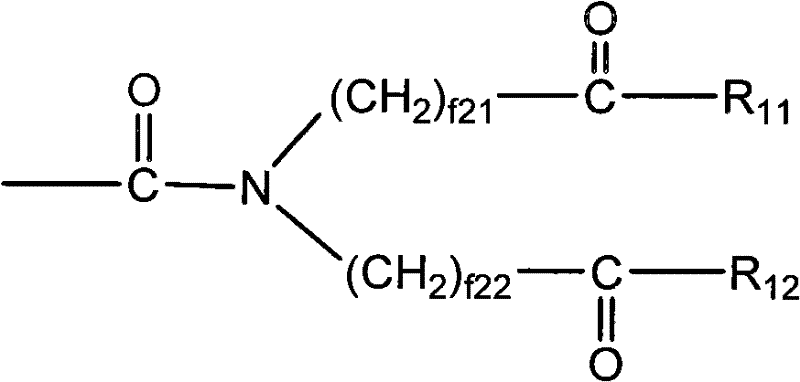
(例如,Y1为NH或O); (for example, Y is NH or O);
(例如,(f11)、(f12)和(f13)分别为1或2); (e.g. (f11), (f12) and (f13) are 1 or 2, respectively);

(例如,Y1、Y11和Y12为O) (eg, Y 1 , Y 11 and Y 12 are O)


其中,in,
Y1为O、S或NR31,优选为氧或NH;Y 1 is O, S or NR 31 , preferably oxygen or NH;
R11、R12和R13分别为取代的或非取代的、饱和的或不饱和的C4-30(烷基、烯基、烷氧基);R 11 , R 12 and R 13 are respectively substituted or unsubstituted, saturated or unsaturated C 4-30 (alkyl, alkenyl, alkoxy);
R31为氢、甲基或乙基;R 31 is hydrogen, methyl or ethyl;
(d)为0或正整数,优选为0或从约1到约10(例如1、2、3、4、5、6)的整数。(d) is 0 or a positive integer, preferably 0 or an integer from about 1 to about 10 (
(f11)、(f12)和(f13)分别为0、1、2、3或4;以及(f11), (f12) and (f13) are 0, 1, 2, 3 or 4 respectively; and
(f21)和(f22)分别为1、2、3或4。(f21) and (f22) are 1, 2, 3 or 4, respectively.
在某些实例中,Q基包括二酰甘油、二酰咪唑双酰胺、二烷丙基、磷脂酰乙醇胺或神经酰胺。适宜的二酰甘油或二酰咪唑双酰胺包括二酰甘油或二酰咪唑双酰胺基,所述二酰甘油或二酰咪唑双酰胺基具有分别包含约C4到约C30,优选约C8到约C24,饱和的或不饱和的碳原子的烷基链长度。二酰甘油或二酰咪唑双酰胺基可以进一步包括一个或多个取代的烷基。In certain examples, the Q group includes diacylglycerol, diacyl imidazole bisamide, dialkylpropyl, phosphatidylethanolamine, or ceramide. Suitable diacylglycerol or diacylimidazole bisamides include diacylglycerol or diacylimidazole bisamide groups having a carbon dioxide concentration of about C4 to about C30, preferably about C8 to about C24, respectively. , the alkyl chain length of saturated or unsaturated carbon atoms. The diacylglycerol or diacylimidazole bisamide group may further include one or more substituted alkyl groups.
本发明使用的术语“二酰甘油”(DAG)指的是具有两个脂酰链,R111和R112。R11和R12具有相同或不同的约4到30个碳(优选为约8到约24),通过酯键连接至甘油。所述酰基可以饱和,也可以不同程度的不饱和。DAG具有总分子式:The term "diacylglycerol" (DAG) used in the present invention refers to a fatty acid having two acyl chains, R 111 and R 112 . R 11 and R 12 have the same or different about 4 to 30 carbons (preferably about 8 to about 24), linked to glycerol through an ester bond. The acyl groups can be saturated or unsaturated to varying degrees. DAG has the overall molecular formula:

DAG的实例可以选自二月桂酰基甘油(C12)、二肉豆蔻酰基甘油(C14,DMG)、二棕榈酰基甘油(C16,DPG)、二硬脂酰基甘油(C18,DSG)、二油酰基甘油(C18)、二芥酰(C22)、二月桂酰基咪唑双酰胺(C12)、二肉豆蔻酰基咪唑双酰胺(C14)、二棕榈酰基咪唑双酰胺(C16)、二硬脂酰基咪唑双酰胺(C18)、二油酰基咪唑双酰胺(C18)、二芥酰基咪唑双酰胺(C22)。本领域技术人员可以认识到其他二酰甘油也可以取得预期效果。Examples of DAG may be selected from dilauroylglycerol (C12), dimyristoylglycerol (C14, DMG), dipalmitoylglycerol (C16, DPG), distearoylglycerol (C18, DSG), dioleoylglycerol (C18), Dierucoyl (C22), Dilauroyl imidazole bisamide (C12), Dimyristoyl imidazole bisamide (C14), Dipalmitoyl imidazole bisamide (C16), Distearoyl imidazole bisamide ( C18), Dioleoyl imidazole bisamide (C18), Dierucoyl imidazole bisamide (C22). Those skilled in the art will recognize that other diacylglycerols may also work as expected.
术语“二烷氧基丙基”指的是具有两个烷基链R111和R112的化合物。R111和R112烷基包括相同或不同的约4到30个碳(优选约8到约24)。所述烷基可以饱和,也可以不同程度的不饱和。二烷氧基丙基具有总分子式:The term "dialkoxypropyl" refers to compounds having two alkyl chains R 111 and R 112 . The R 111 and R 112 alkyl groups include the same or different about 4 to 30 carbons (preferably about 8 to about 24). The alkyl groups may be saturated or unsaturated to varying degrees. Dialkoxypropyl has the general molecular formula:
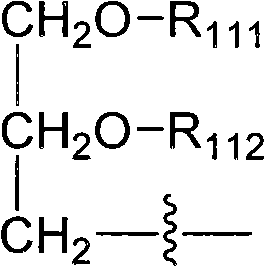
其中R111和R112烷基为具有约4到30个碳(优选为约8到约24)的相同或不同的烷基。所述烷基可以饱和或不饱和。适合的烷基包括但不限于月桂基(C12)、肉豆蔻基(C14)、棕榈基(C16)、硬脂基(C18)、油酰基(C18)和二十酰基(C20)。Wherein the R 111 and R 112 alkyl groups are the same or different alkyl groups having about 4 to 30 carbons (preferably about 8 to about 24). The alkyl group may be saturated or unsaturated. Suitable alkyl groups include, but are not limited to, lauryl (C12), myristyl (C14), palmityl (C16), stearyl (C18), oleoyl (C18) and eicosyl (C20).
在一个实例中,R111和R112二者相同,就是说R111和R112均为肉豆蔻基(C14)或均为硬脂基(C18)等。在另一个实例中,R111和R112不同,就是说R111为肉豆蔻基(C14),R112为硬脂基(C18)。In one example, both R 111 and R 112 are the same, that is to say both R 111 and R 112 are both myristyl (C14) or both are stearyl (C18), etc. In another example, R 111 and R 112 are different, that is, R 111 is myristyl (C14) and R 112 is stearyl (C18).
在另一个实例中,Q基可以包括磷脂酰乙醇胺(PE)。有助于可释放融合脂质配合的所述磷脂酰乙醇胺可以包含饱和的或不饱和的脂肪酸,其碳链长度在约4到30个碳(优选约8到约24)范围内。适宜的磷脂酰乙醇胺包括但不限于:二肉豆蔻酰基磷脂酰乙醇胺(DMPE)、二棕榈酰基磷脂酰乙醇胺(DPPE)、二油酰基磷脂酰乙醇胺(DOPE)、二硬脂酰基磷脂酰乙醇胺(DSPE)。In another example, the Q group can include phosphatidylethanolamine (PE). The phosphatidylethanolamines that facilitate complexation of the releasable fusogenic lipids may comprise saturated or unsaturated fatty acids with carbon chain lengths ranging from about 4 to 30 carbons (preferably about 8 to about 24). Suitable phosphatidylethanolamines include, but are not limited to: dimyristoylphosphatidylethanolamine (DMPE), dipalmitoylphosphatidylethanolamine (DPPE), dioleoylphosphatidylethanolamine (DOPE), distearoylphosphatidylethanolamine (DSPE ).
在又一个实例中,Q基可以包括神经酰胺(Cer)。神经酰胺具有唯一的酰基。神经酰胺可以具有饱和的或不饱和的、碳链长度在约4到30个碳(优选约8到约24)范围内的脂肪酸。In yet another example, the Q group can include ceramide (Cer). Ceramides have a unique acyl group. Ceramides may have saturated or unsaturated fatty acids with carbon chain lengths ranging from about 4 to 30 carbons (preferably about 8 to about 24).
一个优选的实例包括:A preferred example includes:

其中R11-13分别为相同或不同的C12-22饱和的或不饱和的脂肪族碳氢化合物,例如二月桂基(C12)、二肉豆蔻基(C14)、二棕榈基(C16)、二硬脂基(C18)、二油酰基(C18)和二芥酰基(C22);Wherein R 11-13 are respectively the same or different C12-22 saturated or unsaturated aliphatic hydrocarbons, such as dilauryl (C12), dimyristyl (C14), dipalmityl (C16), di Stearyl (C18), dioleoyl (C18) and dierucoyl (C22);
(f11)、(f12)和(f13)分别为0、1、2、3或4;以及(f11), (f12) and (f13) are 0, 1, 2, 3 or 4 respectively; and
(f21)和(f22)分别为1、2、3或4。(f21) and (f22) are 1, 2, 3 or 4, respectively.
B.式(I)的可释放融合脂质的制备B. Preparation of Releasable Fusion Lipids of Formula (I)
典型的、特定的化合物的合成在实例中进行阐释。不过总的来说,本发明的化合物可以通过几种方式制备。根据本发明所述的式(I)化合物的制备方法,包括将含胺的化合物与含醛的化合物进行反应,以提供具有亚胺基团的融合脂质。所述胺可以是伯胺,所述醛可以进一步包括脂肪族或芳香族取代基。Typical, specific compound syntheses are illustrated in the Examples. In general, however, the compounds of the invention can be prepared in several ways. The preparation method of the compound of formula (I) according to the present invention comprises reacting an amine-containing compound with an aldehyde-containing compound to provide a fusion lipid having an imine group. The amine may be a primary amine and the aldehyde may further include aliphatic or aromatic substituents.
图1和图2显示了融合脂质制备的典型实例。首先,在例如EDC或DIPC的偶联剂的参与下,脂质与亲核的多功能连接基(化合物1)发生偶联以提供化合物2。优选地,所述反应在例如二氯甲烷、三氯甲烷、甲苯、DMF或其混合物的惰性溶液中进行,并且优选所述反应在例如DMAP、DIEA、吡啶、三乙胺等碱的存在下,在-4℃到约70℃(例如-4℃到约50℃)的温度下进行。在一个优选的实例中,所述反应在0℃到约25℃或0℃到约室温的温度下进行。Figure 1 and Figure 2 show typical examples of fusion lipid preparation. First, lipids are coupled with a nucleophilic multifunctional linker (compound 1 ) to provide
化合物2的末端官能团进一步与例如化合物4的双功能连接基偶联,然后去除胺保护基以提供具有末端的脂质化合物(化合物6)。The terminal functional group of
包含两性离子基团的化合物,例如Fmoc-Lys(OMe)-NH2,与例如化合物7的双功能连接基反应,以提供具有受保护的醛的化合物8。所述醛保护基被去除。化合物9的所述醛与含胺脂质(化合物6)在脱水条件下反应,然后去除胺保护基并皂化,以提供包含亚胺键的融合脂质。A compound containing a zwitterionic group, such as Fmoc-Lys(OMe) -NH2 , reacts with a bifunctional linker such as
所述脂质与所述亲核的多功能连接基的接合可以在碱的存在下,使用本领域技术人员所知的偶联剂,利用标准有机合成技术来实现,所述偶联剂例如1,3-二异丙基碳化二亚胺(DIPC)、二烷基碳化二亚胺、2-卤-1-烷基吡啶卤化盐、1-(3-二甲基氨丙基)-3-乙基碳化二亚胺(EDC)、丙烷磷酸环酐(PPACA)和苯基二氯磷酸酯。此外,亚胺键的形成可以利用用于脱水的标准有机合成技术来实现,例如使用分子筛、共沸、酸催化脱水等。Conjugation of the lipid to the nucleophilic multifunctional linker can be accomplished using standard organic synthesis techniques in the presence of a base using coupling agents known to those skilled in the art, such as 1 , 3-diisopropylcarbodiimide (DIPC), dialkylcarbodiimide, 2-halo-1-alkylpyridinium halides, 1-(3-dimethylaminopropyl)-3- Ethylcarbodiimide (EDC), propanephosphoric acid cyclic anhydride (PPACA), and phenyl dichlorophosphate. In addition, imine bond formation can be achieved using standard organic synthesis techniques for dehydration, such as the use of molecular sieves, azeotropes, acid-catalyzed dehydration, and the like.
在另一个实例中,活化的脂质酸,例如NHS或PNP脂,可以用来与例如化合物1的亲核的多功能连接基进行反应。In another example, activated lipid acids, such as NHS or PNP lipids, can be used to react with nucleophilic multifunctional linkers such as
可选地,当脂质用例如NHS或PNP的离去基团进行活化时,无需偶联剂,并且所述反应在碱的存在下进行。Alternatively, when the lipid is activated with a leaving group such as NHS or PNP, no coupling agent is required and the reaction is performed in the presence of a base.
将保护基从含胺化合物去除可以通过例如三氟乙酸(TFA)、HCL、硫酸等的强酸,或者催化氢化、自由基反应等进行。可选地,例如Fmoc的胺保护基的去除,可以通过例如哌啶或DMAP的碱进行。在一个优选的实例中,使用HCL溶液在二氧己环中进行Boc基的去保护。所述去保护反应可以在-4℃到约50℃的温度下进行。优选地,所述反应在0℃到约25℃或0℃到室温的温度下进行。在一个更加优选的实例中,Boc基的去保护在室温下进行。Removal of protecting groups from amine-containing compounds can be performed by strong acids such as trifluoroacetic acid (TFA), HCL, sulfuric acid, etc., or by catalytic hydrogenation, free radical reactions, and the like. Alternatively, removal of an amine protecting group such as Fmoc can be performed by a base such as piperidine or DMAP. In a preferred example, the deprotection of the Boc group is carried out in dioxane using HCL solution. The deprotection reaction can be carried out at a temperature of -4°C to about 50°C. Preferably, the reaction is carried out at a temperature from 0°C to about 25°C or from 0°C to room temperature. In a more preferred example, the deprotection of the Boc group is carried out at room temperature.
例如,通过本发明所述的方法制备的化合物包括:For example, compounds prepared by the methods described herein include:


优选地,式(I)的可释放融合脂质包括:Preferably, the releasable fusion lipid of formula (I) comprises:

C.纳米微粒组合物C. Nanoparticle Compositions
1.概述1 Overview
在本发明的一个方面,提供用于核酸输送的包含式(I)的可释放融合脂质的纳米微粒组合物。In one aspect of the present invention, there is provided a nanoparticle composition comprising a releasable fusion lipid of formula (I) for nucleic acid delivery.
根据本发明,所述纳米微粒组合物包含阳离子脂质、式(I)的可释放融合脂质和PEG脂质。According to the invention, the nanoparticle composition comprises a cationic lipid, a releasable fusion lipid of formula (I) and a PEG lipid.
在本发明一个优选的方面,所述纳米微粒组合物包括胆固醇。In a preferred aspect of the invention, the nanoparticle composition comprises cholesterol.
在本发明的另一个方面,所述纳米微粒组合物可以包含本领域所知的融合脂质(非阳离子脂质)。可以预期包含阳离子脂质的混合物、不同的融合脂质的混合物和/或不同的任选PEG脂质的混合物的纳米微粒组合物。In another aspect of the invention, the nanoparticle composition may comprise fusogenic lipids (non-cationic lipids) known in the art. Nanoparticle compositions comprising mixtures of cationic lipids, mixtures of different fusogenic lipids, and/or mixtures of different optionally PEG lipids are contemplated.
在另一个优选的方面,所述纳米微粒组合物包含以所述纳米微粒组合物中的脂质总量计摩尔比为约10%到约99.9%的阳离子脂质。In another preferred aspect, the nanoparticle composition comprises cationic lipids in a molar ratio of about 10% to about 99.9%, based on the total amount of lipids in the nanoparticle composition.
以所述纳米微粒组合物中的脂质总量计,所述阳离子脂质的含量可以为约2%到约60%、约5%到约50%、约10%到约45%、约15%到约25%或约30%到约40%。The cationic lipid may be present in an amount of about 2% to about 60%, about 5% to about 50%, about 10% to about 45%, about 15%, based on the total amount of lipid in the nanoparticle composition. % to about 25% or about 30% to about 40%.
在一个优选的实例中,以所述纳米微粒组合物中的脂质总量计,所述阳离子脂质的含量为约15%到约25%(具体为15、17、18、20或25%)。In a preferred example, based on the total amount of lipids in the nanoparticle composition, the content of the cationic lipid is about 15% to about 25% (specifically 15, 17, 18, 20 or 25%) ).
根据本发明,所述纳米微粒组合物包含以所述纳米微粒组合物中的脂质总量计摩尔比为约20%到约85%、约25%到约85%、约60%到约80%(例如65、75、78或80%)的包括胆固醇和/或非胆固醇基的融合脂质在内的所述融合脂质总量(优选为本发明所述的可释放融合脂质)。在一个优选的实例中,以所述纳米微粒组合物中的脂质总量计,所述融合/非阳离子脂质总量为约80%。According to the present invention, the nanoparticle composition comprises a molar ratio of about 20% to about 85%, about 25% to about 85%, about 60% to about 80%, based on the total amount of lipids in the nanoparticle composition. % (eg 65, 75, 78 or 80%) of the total amount of said fusion lipids (preferably releasable fusion lipids according to the present invention) including cholesterol and/or non-cholesterol-based fusion lipids. In a preferred example, the total amount of fusion/non-cationic lipids is about 80% based on the total amount of lipids in the nanoparticle composition.
在某些实例中,以所述纳米微粒组合物中的脂质总量计,非胆固醇基的融合/非阳离子脂质的摩尔比为约25%到约78%(25、35、47、60或78%)。在一个实例中,以所述纳米微粒组合物中的脂质总量计,非胆固醇基的融合/非阳离子脂质为约60%。In certain examples, the molar ratio of non-cholesterol-based fusion/non-cationic lipids is from about 25% to about 78% (25, 35, 47, 60%) based on the total amount of lipids in the nanoparticle composition. or 78%). In one example, the non-cholesterol-based fusogenic/non-cationic lipid is about 60% based on the total amount of lipid in the nanoparticle composition.
在某些实例中,所述纳米微粒组合物包含以所述纳米微粒组合物中的脂质总量计摩尔比为约0%到约60%、约10%到约60%、约20%到约50%(例如20、30、40或50%)的除了非胆固醇融合脂质之外的胆固醇。在一个实例中,以所述纳米微粒组合物中的脂质总量计,胆固醇为约20%。In certain examples, the nanoparticle composition comprises a molar ratio of about 0% to about 60%, about 10% to about 60%, about 20% to about 60%, based on the total amount of lipids in the nanoparticle composition. About 50% (eg 20, 30, 40 or 50%) cholesterol other than non-cholesterol fusion lipids. In one example, cholesterol is about 20% based on the total amount of lipids in the nanoparticle composition.
在某些实例中,以所述纳米微粒组合物中的脂质总量计,所述纳米微粒组合物中包含的所述PEG脂质的摩尔比为约0.5%到约20%、约1.5%到约18%。在纳米微粒组合物的一个实例中,以脂质总量计,包括的所述PEG脂质的摩尔比为约2%到约10%(例如,2、3、4、5、6、7、8、9或10%)。例如,以所述纳米微粒组合物中的脂质总量计,所述PEG脂质总量为约2%。In certain examples, the PEG lipid is included in the nanoparticle composition in a molar ratio of about 0.5% to about 20%, about 1.5%, based on the total amount of lipid in the nanoparticle composition to about 18%. In one example of the nanoparticle composition, the PEG lipid is included in a molar ratio of about 2% to about 10% (e.g., 2, 3, 4, 5, 6, 7, 8, 9 or 10%). For example, the total amount of PEG lipid is about 2% based on the total amount of lipid in the nanoparticle composition.
基于本发明的目的,所述纳米微粒组合物中包含的可释放融合脂质的量可以理解为所述的可释放融合脂质单独的量,或者式(I)的可释放融合脂质以及如果在所述纳米微粒组合物中存在的话,任何额外的本领域所知的融合脂质(可释放或不可释放均可)的总量。Based on the purpose of the present invention, the amount of the releasable fusion lipid contained in the nanoparticle composition can be understood as the individual amount of the releasable fusion lipid, or the releasable fusion lipid of formula (I) and if The total amount of any additional fusogenic lipids (whether releasable or non-releasable) known in the art, if present in the nanoparticle composition.
2.式(I)的可释放融合脂质和任选的本领域所知的融合/非阳离子脂质2. Releasable fusion lipids of formula (I) and optionally fusion/non-cationic lipids known in the art
本发明所述的纳米微粒组合物包含式(I)的可释放融合脂质。不受任何理论的限制,式(I)的可释放融合脂质在所述纳米微粒进入细胞之后促进封装在所述纳米微粒中的核酸从核内体和所述纳米微粒中释放出来。The nanoparticle composition of the present invention comprises a releasable fusion lipid of formula (I). Without being bound by any theory, the releasable fusion lipid of formula (I) facilitates the release of nucleic acids encapsulated in the nanoparticles from endosomes and from the nanoparticles after the nanoparticles enter cells.
在本发明的另一个方面,所述的纳米微粒组合物可以包括额外的本领域所知的融合脂质。用在所述纳米微粒组合物中的适宜的额外的本领域所知的融合脂质包括中性融合/非阳离子脂质或阴离子融合脂质。In another aspect of the invention, the nanoparticle composition may include additional fusogenic lipids known in the art. Suitable additional art-known fusogenic lipids for use in the nanoparticle composition include neutral fusogenic/non-cationic lipids or anionic fusogenic lipids.
中性脂质包括在选定的pH值,优选为生理pH值下以不带电的或中性的两性离子形式存在的脂质。这种本领域所知的融合脂质的实例包括二酰磷脂酰胆碱、二酰磷脂酰乙醇胺、神经酰胺、鞘磷脂、脑磷脂、胆固醇、脑苷脂和二酰甘油。Neutral lipids include lipids that exist in an uncharged or neutral zwitterionic form at a selected pH, preferably physiological pH. Examples of such fusion lipids known in the art include diacylphosphatidylcholine, diacylphosphatidylethanolamine, ceramide, sphingomyelin, cephalin, cholesterol, cerebroside, and diacylglycerol.
阴离子脂质包括在生理pH值下带负电的脂质。这些脂质包括但不限于磷脂酰甘油、心磷脂、二酰磷脂酰丝氨酸、二酰磷脂酸、N-十二烷酰磷脂酰乙醇胺、N-丁二酰磷脂酰乙醇胺、N-戊二酰磷脂酰乙醇胺、赖氨酰磷脂酰甘油、棕榈酰油酰磷脂酰甘油(POPG)和经过其他阴离子改性基改性过的中性脂质。Anionic lipids include lipids that are negatively charged at physiological pH. These lipids include, but are not limited to, phosphatidylglycerol, cardiolipin, diacylphosphatidylserine, diacylphosphatidic acid, N-dodecanoylphosphatidylethanolamine, N-succinylphosphatidylethanolamine, N-glutarylphospholipids Ethanolamine, lysylphosphatidylglycerol, palmitoyloleoylphosphatidylglycerol (POPG), and neutral lipids modified with other anionic modifiers.
许多本领域所知的融合脂质包括总体上具有疏水基团和极性头基的两亲性脂质,并且可以在水溶液中形成囊泡。Many fusion lipids known in the art comprise amphiphilic lipids generally having a hydrophobic group and a polar head group, and can form vesicles in aqueous solution.
可以预期融合脂质包括天然的和合成的磷脂和相关的脂质。Fused lipids are contemplated to include natural and synthetic phospholipids and related lipids.
非限定性的非阳离子脂质的列表选自磷脂和与非磷脂质相关的材料,例如卵磷脂;溶血卵磷脂;二酰磷脂酰胆碱;溶血磷脂酰胆碱;磷脂酰乙醇胺;溶血磷脂酰乙醇胺;磷脂酰丝氨酸;磷脂酰肌醇;鞘磷脂;脑磷脂;神经酰胺;心磷脂;磷脂酸;磷脂酰甘油;脑苷酯;联十六烷基磷酸酯;A non-limiting list of non-cationic lipids is selected from phospholipids and materials related to non-phospholipids, such as lecithin; lyso-lecithin; diacylphosphatidylcholine; lysophosphatidylcholine; phosphatidylethanolamine; Ethanolamine; Phosphatidylserine; Phosphatidylinositol; Sphingomyelin; Cephalin; Ceramide; Cardiolipin; Phosphatidic acid; Phosphatidylglycerol;
1,2-二月桂酰-sn-甘油(DLG);1,2-Dilauroyl-sn-glycerol (DLG);
1,2-二肉豆蔻酰-sn-甘油(DMG);1,2-Dimyristoyl-sn-glycerol (DMG);
1,2-二棕榈酰-sn-甘油(DPG);1,2-dipalmitoyl-sn-glycerol (DPG);
1,2-二硬脂酰-sn-甘油(DSG);1,2-Distearoyl-sn-glycerol (DSG);
1,2-二月桂酰-sn-丙三氧基-3-磷脂酸(DLPA);1,2-Dilauroyl-sn-propanetrioxy-3-phosphatidic acid (DLPA);
1,2-二肉豆蔻酰-sn-丙三氧基-3-磷脂酸(DMPA);1,2-Dimyristoyl-sn-propanetrioxy-3-phosphatidic acid (DMPA);
1,2-二棕榈酰-sn-丙三氧基-3-磷脂酸(DPPA);1,2-dipalmitoyl-sn-propanetrioxy-3-phosphatidic acid (DPPA);
1,2-二硬脂酰-sn-丙三氧基-3-磷脂酸(DSPA);1,2-Distearoyl-sn-propanetrioxy-3-phosphatidic acid (DSPA);
1,2-花生四烯酰-sn-丙三氧基-3-磷酸胆碱(DAPC);1,2-Arachidonoyl-sn-propanetrioxy-3-phosphocholine (DAPC);
1,2-二月桂酰-sn-丙三氧基-3-磷酸胆碱(DLPC);1,2-Dilauroyl-sn-propanetrioxy-3-phosphocholine (DLPC);
1,2-二肉豆蔻酰-sn-丙三氧基-3-磷酸胆碱(DMPC);1,2-Dimyristoyl-sn-propanetrioxy-3-phosphocholine (DMPC);
1,2-二棕榈酰-sn-丙三氧基-3-乙基磷酸胆碱(DPePC);1,2-Dipalmitoyl-sn-propanetrioxy-3-ethylphosphocholine (DPePC);
1,2-二棕榈酰-sn-丙三氧基-3-磷酸胆碱或二棕榈酰磷脂酰胆碱或二棕榈酰磷脂酰胆碱(DPPC);1,2-dipalmitoyl-sn-propanetrioxy-3-phosphocholine or dipalmitoylphosphatidylcholine or dipalmitoylphosphatidylcholine (DPPC);
1,2-二硬脂酰-sn-丙三氧基-3-磷酸胆碱或二硬脂酰磷脂酰胆碱或二硬脂酰磷脂酰胆碱(DSPC);1,2-Distearoyl-sn-propanetrioxy-3-phosphocholine or distearoylphosphatidylcholine or distearoylphosphatidylcholine (DSPC);
1,2-二月桂酰-sn-丙三氧基-3-磷酸乙醇胺(DLPE);1,2-Dilauroyl-sn-propanetrioxy-3-phosphoethanolamine (DLPE);
1,2-二肉豆蔻酰-sn-丙三氧基-3-磷酸乙醇胺或二肉豆蔻酰磷酸乙醇胺(DMPE);1,2-Dimyristoyl-sn-propanetrioxy-3-phosphoethanolamine or dimyristoylphosphoethanolamine (DMPE);
1,2-二棕榈酰-sn-丙三氧基-3-磷酸乙醇胺或二棕榈酰磷脂酰乙醇胺(DPPE);1,2-Dipalmitoyl-sn-propanetrioxy-3-phosphoethanolamine or dipalmitoylphosphatidylethanolamine (DPPE);
1,2-二硬脂酰-sn-丙三氧基-3-磷酸乙醇胺or二硬脂酰磷脂酰乙醇胺(DSPE);1,2-Distearoyl-sn-propanetrioxy-3-phosphoethanolamine or distearoylphosphatidylethanolamine (DSPE);
1,2-二月桂酰-sn-丙三氧基-3-磷酸甘油(DLPG);1,2-Dilauroyl-sn-propanetrioxy-3-phosphoglycerol (DLPG);
1,2-二肉豆蔻酰-sn-丙三氧基-3-磷酸甘油(DMPG);1,2-Dimyristoyl-sn-propanetrioxy-3-phosphoglycerol (DMPG);
1,2-二肉豆蔻酰-sn-丙三氧基-3-磷酸-sn-1-甘油(DMP-sn-1-G);1,2-Dimyristoyl-sn-propanetrioxy-3-phosphate-sn-1-glycerol (DMP-sn-1-G);
1,2-二棕榈酰-sn-丙三氧基-3-磷酸甘油或二棕榈酰磷脂酰甘油(DPPG);1,2-Dipalmitoyl-sn-propanetrioxy-3-phosphoglycerol or dipalmitoylphosphatidylglycerol (DPPG);
1,2-二硬脂酰-sn-丙三氧基-3-磷酸甘油(DSPG);1,2-Distearoyl-sn-propanetrioxy-3-phosphoglycerol (DSPG);
1,2-二硬脂酰-sn-丙三氧基-3-磷酸-sn-1-甘油(DSP-sn-1-G);1,2-Distearoyl-sn-propanetrioxy-3-phosphate-sn-1-glycerol (DSP-sn-1-G);
1,2-二棕榈酰-sn-丙三氧基-3-磷酸-L-serine(DPPS);1,2-dipalmitoyl-sn-propanetrioxy-3-phosphate-L-serine (DPPS);
1-棕榈酰-2-亚油酰-sn-丙三氧基-3-磷酸胆碱(PLinoPC);1-palmitoyl-2-linoleoyl-sn-propanetrioxy-3-phosphocholine (PLinoPC);
1-棕榈酰-2-油酰-sn-丙三氧基-3-磷酸胆碱或棕榈酰油酰磷脂酰胆碱(POPC);1-palmitoyl-2-oleoyl-sn-propanetrioxy-3-phosphocholine or palmitoyl oleoylphosphatidylcholine (POPC);
1-棕榈酰-2-油酰-sn-丙三氧基-3-磷酸甘油(POPG);1-palmitoyl-2-oleoyl-sn-propanetrioxy-3-phosphoglycerol (POPG);
1-棕榈酰-2-可溶-sn-丙三氧基-3-磷酸胆碱(P-lyso-PC);1-palmitoyl-2-soluble-sn-propanetrioxy-3-phosphocholine (P-lyso-PC);
1-硬脂酰-2-可溶-sn-丙三氧基-3-磷酸胆碱(S-lyso-PC);1-Stearoyl-2-soluble-sn-propanetrioxy-3-phosphocholine (S-lyso-PC);
1,2-二油酰-sn-丙三氧基-3-磷酸乙醇胺或二油酰磷脂酰乙醇胺(DOPE);1,2-dioleoyl-sn-propanetrioxy-3-phosphoethanolamine or dioleoylphosphatidylethanolamine (DOPE);
二植烷酰磷脂酰乙醇胺(DPhPE);Diphytanylphosphatidylethanolamine (DPhPE);
1,2-二油酰-sn-丙三氧基-3-磷酸胆碱或二油酰磷脂酰胆碱或二油酰磷脂酰胆碱(DOPC);以及1,2-dioleoyl-sn-propanetrioxy-3-phosphocholine or dioleoylphosphatidylcholine or dioleoylphosphatidylcholine (DOPC); and
1,2-二植烷酰-sn-丙三氧基-3-磷酸胆碱(DPhPC),1,2-diphytanyl-sn-propanetrioxy-3-phosphocholine (DPhPC),
二油酰磷脂酰甘油(DOPG);Dioleoylphosphatidylglycerol (DOPG);
棕榈酰油酰磷脂酰乙醇胺(POPE);Palmitoyl oleoyl phosphatidylethanolamine (POPE);
二油酰-磷脂酰乙醇胺4-(N-马来酰亚胺甲基)-环己烷-1-羰酸盐(DOPE-mal);Dioleoyl-phosphatidylethanolamine 4-(N-maleimidomethyl)-cyclohexane-1-carboxylate (DOPE-mal);
16-O-单甲基PE;16-O-monomethyl PE;
16-O-二甲基PE;16-O-dimethyl PE;
18-1-反式PE;1-硬脂酰-2-油酰-硬脂酰乙醇胺(SOPE);18-1-trans PE; 1-stearoyl-2-oleoyl-stearyl ethanolamine (SOPE);
1,2-二反油酰-sn-丙三氧基-3-磷酸乙醇胺(反式DOPE);其制药上可接受的盐及其混合物。融合脂质的详细描述参见美国专利申请2007/0293449和2006/0051405。1,2-Dieiraeoyl-sn-propanetrioxy-3-phosphoethanolamine (trans-DOPE); its pharmaceutically acceptable salts and mixtures thereof. Fusogenic lipids are described in detail in US Patent Application Nos. 2007/0293449 and 2006/0051405.
非阳离子脂质包括固醇或类固醇,例如胆固醇。Non-cationic lipids include sterols or steroids, such as cholesterol.
额外的非阳离子脂质例如是硬脂酰胺、月桂酰胺、十六烷基胺、乙酰棕榈酸盐、甘油蓖麻油酸脂、十六烷基固体盐、异丙基肉豆蔻酸盐、两性丙烯酸聚合物、三乙醇胺月桂基硫酸盐、烷基芳基硫酸盐、聚乙氨基苯胂酸脂肪酸酰胺和二十八烷基二甲基溴化铵。Additional non-cationic lipids are e.g. stearamide, lauramide, cetylamine, acetyl palmitate, glyceryl ricinoleate, cetyl solid salt, isopropyl myristate, amphoteric acrylic polymer triethanolamine lauryl sulfate, alkylaryl sulfate, polyethylaminophenylarsine fatty acid amide, and behenyldimethylammonium bromide.
可以预期的阴离子脂质包括磷脂酰丝氨酸、磷脂酸、磷脂酰胆碱、血小板活性因子(PAF)、磷脂酰乙醇胺、磷脂酰-DL-甘油、磷脂酰肌醇、磷脂酰肌醇、心磷脂、溶血磷脂、氢化磷脂、鞘氨脂质、神经节苷酯、植物鞘氨醇、鞘氨醇、其制药上可接受的盐及其混合物。Contemplated anionic lipids include phosphatidylserine, phosphatidic acid, phosphatidylcholine, platelet activating factor (PAF), phosphatidylethanolamine, phosphatidyl-DL-glycerol, phosphatidylinositol, phosphatidylinositol, cardiolipin, Lysophospholipids, hydrogenated phospholipids, sphingolipids, gangliosides, phytosphingosines, sphingosines, pharmaceutically acceptable salts thereof, and mixtures thereof.
有助于制备本发明所述的纳米微粒组合物的适当的非阳离子脂质包括二酰基磷脂酰胆碱(例如,二硬脂酰磷脂酰胆碱、二油酰磷脂酰胆碱、二棕榈酰磷脂酰胆碱和二亚油酰磷脂酰胆碱)、二酰磷脂酰乙醇胺(例如,二油酰磷脂酰乙醇胺和棕榈酰油酰磷脂酰乙醇胺)、神经酰胺或鞘磷脂。这些脂质中的酰基优选为具有饱和的和不饱和的碳链的脂肪酸,例如亚麻酰、异硬脂酰、油烯基、反油酰、岩芹酰、亚麻烯酰、桐酰、花生四烯酰、肉豆蔻酰棕榈酰和月桂酰。更加优选的酰基为月桂酰、肉豆蔻酰、棕榈酰、硬脂酰或油酰,更加优选为具有饱和的和不饱和的C8-C30(优选C10-C24)碳链的脂肪酸。Suitable non-cationic lipids that facilitate the preparation of the nanoparticle compositions described herein include diacylphosphatidylcholines (e.g., distearoylphosphatidylcholine, dioleoylphosphatidylcholine, dipalmitoylphosphatidylcholine, phosphatidylcholine and dilinoleoylphosphatidylcholine), diacylphosphatidylethanolamines (eg, dioleoylphosphatidylethanolamine and palmitoyloleoylphosphatidylethanolamine), ceramides, or sphingomyelin. The acyl groups in these lipids are preferably fatty acids with saturated and unsaturated carbon chains, such as linolenoyl, isostearoyl, oleyl, elairoyl, petroyl, linolenoyl, giroyl, arachidyl enoyl, myristoyl palmitoyl and lauroyl. More preferred acyl groups are lauroyl, myristoyl, palmitoyl, stearoyl or oleoyl, more preferably fatty acids with saturated and unsaturated C 8 -C 30 (preferably C 10 -C 24 ) carbon chains.
用于本发明所述的纳米微粒组合物的各种磷脂酰胆碱包括:Various phosphatidylcholines used in the nanoparticle compositions of the present invention include:
1,2-二癸酰-sn-丙三氧基-3-磷酸胆碱(DDPC,C10:0,C10:0);1,2-Didecanoyl-sn-propanetrioxy-3-phosphocholine (DDPC, C10:0, C10:0);
1,2-二月桂酰-sn-丙三氧基-3-磷酸胆碱(DLPC,C12:0,C12:0);1,2-Dilauroyl-sn-propanetrioxy-3-phosphocholine (DLPC, C12:0, C12:0);
1,2-二肉豆蔻酰-sn-丙三氧基-3-磷酸胆碱(DMPC,C14:0,C14:0);1,2-Dimyristoyl-sn-propanetrioxy-3-phosphocholine (DMPC, C14:0, C14:0);
1,2-二棕榈酰-sn-丙三氧基-3-磷酸胆碱(DPPC,C16:0,C16:0);1,2-dipalmitoyl-sn-propanetrioxy-3-phosphocholine (DPPC, C16:0, C16:0);
1,2-二硬脂酰-sn-丙三氧基-3-磷酸胆碱(DSPC,C18:0,C18:0);1,2-Distearoyl-sn-propanetrioxy-3-phosphocholine (DSPC, C18:0, C18:0);
1,2-二油酰-sn-丙三氧基-3-磷酸胆碱(DOPC,C18:1,C18:1);1,2-dioleoyl-sn-propanetrioxy-3-phosphocholine (DOPC, C18:1, C18:1);
1,2-二芥酰-sn-丙三氧基-3-磷酸胆碱(DEPC,C22:1,C22:1);1,2-Dierucoyl-sn-propanetrioxy-3-phosphocholine (DEPC, C22:1, C22:1);
1,2-二二十碳五烯酰-sn-丙三氧基-3-磷酸胆碱(EPA-PC,C20:5,C20:5);1,2-Eicosapentaenoyl-sn-propanetrioxy-3-phosphocholine (EPA-PC, C20:5, C20:5);
1,2-二二十二碳六烯酰-sn-丙三氧基-3-磷酸胆碱(DHA-PC,C22:6,C22:6);1,2-Docosahexaenoyl-sn-propanetrioxy-3-phosphocholine (DHA-PC, C22:6, C22:6);
1-肉豆蔻酰-2-棕榈酰-sn-丙三氧基-3-磷酸胆碱(MPPC,C14:0,C16:0);1-myristoyl-2-palmitoyl-sn-propanetrioxy-3-phosphocholine (MPPC, C14:0, C16:0);
1-肉豆蔻酰-2-硬脂酰-sn-丙三氧基-3-磷酸胆碱(MSPC,C14:0,C18:0);1-myristoyl-2-stearoyl-sn-propanetrioxy-3-phosphocholine (MSPC, C14:0, C18:0);
1-棕榈酰-2-硬脂酰-sn-丙三氧基-3-磷酸胆碱(PMPC,C16:0,C14:0);1-palmitoyl-2-stearyl-sn-propanetrioxy-3-phosphocholine (PMPC, C16:0, C14:0);
1-棕榈酰-2-硬脂酰-sn-丙三氧基-3-磷酸胆碱(PSPC,C16:0,C18:0);1-palmitoyl-2-stearyl-sn-propanetrioxy-3-phosphocholine (PSPC, C16:0, C18:0);
1-硬脂酰-2-肉豆蔻酰-sn-丙三氧基-3-磷酸胆碱(SMPC,C18:0,C14:0);1-Stearoyl-2-myristoyl-sn-propanetrioxy-3-phosphocholine (SMPC, C18:0, C14:0);
1-硬脂酰-2-棕榈酰-sn-丙三氧基-3-磷酸胆碱(SPPC,C18:0,C16:0);1-Stearoyl-2-palmitoyl-sn-propanetrioxy-3-phosphocholine (SPPC, C18:0, C16:0);
1,2-肉豆蔻酰-油酰-sn-丙三氧基-3-磷酸乙醇胺(MOPC,C14:0,C18:0);1,2-myristoyl-oleoyl-sn-propanetrioxy-3-phosphoethanolamine (MOPC, C14:0, C18:0);
1,2-棕榈酰-油酰-sn-丙三氧基-3-磷酸乙醇胺(POPC,C16:0,C18:1);1,2-palmitoyl-oleoyl-sn-propanetrioxy-3-phosphoethanolamine (POPC, C16:0, C18:1);
1,2-硬脂酰-油酰-sn-丙三氧基-3-磷酸乙醇胺(POPC,C18:0,C18:1),其制药上可接受的盐及其混合物。1,2-Stearoyl-oleoyl-sn-propanetrioxy-3-phosphoethanolamine (POPC, C18:0, C18:1), its pharmaceutically acceptable salts and mixtures thereof.
用于本发明所述的纳米微粒组合物的各种可溶磷脂酰胆碱包括:Various soluble phosphatidylcholines useful in the nanoparticle compositions of the present invention include:
1-肉豆蔻酰-2-可溶-sn-丙三氧基-3-磷酸胆碱(M-LysoPC,C14:0);1-myristoyl-2-soluble-sn-propanetrioxy-3-phosphocholine (M-LysoPC, C14:0);
1-劣线酰-2-可溶-sn-丙三氧基-3-磷酸胆碱(P-LysoPC,C16:0);1-lysoyl-2-soluble-sn-glyceryltrioxy-3-phosphocholine (P-LysoPC, C16:0);
1-硬脂酰-2-可溶-sn-丙三氧基-3-磷酸胆碱(S-LysoPC,C18:0),其制药上可接受的盐及其混合物。1-Stearoyl-2-soluble-sn-propanetrioxy-3-phosphocholine (S-LysoPC, C18:0), its pharmaceutically acceptable salts and mixtures thereof.
用于本发明所述的纳米微粒组合物的各种磷脂酰甘油选自:The various phosphatidylglycerols used in the nanoparticle compositions of the present invention are selected from:
氢化大豆磷脂酰甘油(HSPG);Hydrogenated soybean phosphatidylglycerol (HSPG);
非氢化卵磷脂酰甘油(EPG);Non-hydrogenated egg phosphatidylglycerol (EPG);
1,2-二肉豆蔻酰-sn-丙三氧基-3-磷酸甘油(DMPG,C14:0,C14:0);1,2-Dimyristoyl-sn-propanetrioxy-3-phosphoglycerol (DMPG, C14:0, C14:0);
1,2-二棕榈酰-sn-丙三氧基-3-磷酸甘油(DPPG,C16:0,C16:0);1,2-dipalmitoyl-sn-propanetrioxy-3-phosphoglycerol (DPPG, C16:0, C16:0);
1,2-二硬脂酰-sn-丙三氧基-3-磷酸甘油(DSPG,C18:0,C18:0);1,2-Distearoyl-sn-propanetrioxy-3-phosphoglycerol (DSPG, C18:0, C18:0);
1,2-二油酰-sn-丙三氧基-3-磷酸甘油(DOPG,C18:1,C18:1);1,2-Dioleoyl-sn-propanetrioxy-3-phosphoglycerol (DOPG, C18:1, C18:1);
1,2-二芥酰-sn-丙三氧基-3-磷酸甘油(DEPG,C22:1,C22:1);1,2-Dierucoyl-sn-propanetrioxy-3-phosphoglycerol (DEPG, C22:1, C22:1);
1-棕榈酰-2-油酰-sn-丙三氧基-3-磷酸甘油(POPG,C16:0,C18:1),其制药上可接受的盐及其混合物。1-palmitoyl-2-oleoyl-sn-propanetrioxy-3-phosphoglycerol (POPG, C16:0, C18:1), its pharmaceutically acceptable salts and mixtures thereof.
用于本发明所述的纳米微粒组合物的各种磷脂酸包括:Various phosphatidic acids useful in the nanoparticle compositions of the present invention include:
1,2-二肉豆蔻酰-sn-丙三氧基-3-磷脂酸(DMPA,C14:0,C14:0);1,2-Dimyristoyl-sn-propanetrioxy-3-phosphatidic acid (DMPA, C14:0, C14:0);
1,2-二棕榈酰-sn-丙三氧基-3-磷脂酸(DPPA,C16:0,C16:0);1,2-dipalmitoyl-sn-propanetrioxy-3-phosphatidic acid (DPPA, C16:0, C16:0);
1,2-二硬脂酰-sn-丙三氧基-3-磷脂酸(DSPA,C18:0,C18:0),其制药上可接受的盐及其混合物。1,2-Distearoyl-sn-propanetrioxy-3-phosphatidic acid (DSPA, C18:0, C18:0), its pharmaceutically acceptable salts and mixtures thereof.
用于本发明所述的纳米微粒组合物的各种磷脂酰乙醇胺包括:Various phosphatidylethanolamines useful in the nanoparticle compositions of the present invention include:
氢化大豆磷脂酰乙醇胺(HSPE);Hydrogenated soybean phosphatidylethanolamine (HSPE);
非氢化卵磷脂酰乙醇胺(EPE);Non-hydrogenated egg phosphatidylethanolamine (EPE);
1,2-二肉豆蔻酰-sn-丙三氧基-3-磷酸乙醇胺(DMPE,C14:0,C14:0);1,2-Dimyristoyl-sn-propanetrioxy-3-phosphoethanolamine (DMPE, C14:0, C14:0);
1,2-二棕榈酰-sn-丙三氧基-3-磷酸乙醇胺(DPPE,C16:0,C16:0);1,2-dipalmitoyl-sn-propanetrioxy-3-phosphoethanolamine (DPPE, C16:0, C16:0);
1,2-二硬脂酰-sn-丙三氧基-3-磷酸乙醇胺(DSPE,C18:0,C18:0);1,2-Distearoyl-sn-propanetrioxy-3-phosphoethanolamine (DSPE, C18:0, C18:0);
1,2-二油酰-sn-丙三氧基-3-磷酸乙醇胺(DOPE,C18:1,C18:1);1,2-dioleoyl-sn-propanetrioxy-3-phosphoethanolamine (DOPE, C18:1, C18:1);
1,2-二油酰-sn-丙三氧基-3-磷酸乙醇胺(DEPE,C22:1,C22:1);1,2-dioleoyl-sn-propanetrioxy-3-phosphoethanolamine (DEPE, C22:1, C22:1);
1,2-二芥酰-sn-丙三氧基-3-磷酸乙醇胺(POPE,C16:0,C18:1),其制药上可接受的盐及其混合物。1,2-Dierucoyl-sn-propanetrioxy-3-phosphoethanolamine (POPE, C16:0, C18:1), its pharmaceutically acceptable salts and mixtures thereof.
用于本发明所述的纳米微粒组合物的各种磷脂酰丝氨酸包括:Various phosphatidylserines useful in the nanoparticle compositions of the present invention include:
1,2-二肉豆蔻酰-sn-丙三氧基-3-磷酸-L-丝氨酸(DMPS,C14:0,C14:0);1,2-Dimyristoyl-sn-propanetrioxy-3-phospho-L-serine (DMPS, C14:0, C14:0);
1,2-二棕榈酰-sn-丙三氧基-3-磷酸-L-丝氨酸(DPPS,C16:0,C16:0);1,2-dipalmitoyl-sn-propanetrioxy-3-phospho-L-serine (DPPS, C16:0, C16:0);
1,2-二硬脂酰-sn-丙三氧基-3-磷酸-L-丝氨酸(DSPS,C18:0,C18:0);1,2-Distearoyl-sn-propanetrioxy-3-phospho-L-serine (DSPS, C18:0, C18:0);
1,2-二油酰-sn-丙三氧基-3-磷酸-L-丝氨酸(DOPS,C18:1,C18:1);1,2-dioleoyl-sn-propanetrioxy-3-phospho-L-serine (DOPS, C18:1, C18:1);
1-棕榈酰-2-油酰-sn-3-磷酸-L-丝氨酸(POPS,C16:0,C18:1),其制药上可接受的盐及其混合物。1-palmitoyl-2-oleoyl-sn-3-phospho-L-serine (POPS, C16:0, C18:1), its pharmaceutically acceptable salts and mixtures thereof.
在一个优选的实例中,有助于制备本发明所述的纳米微粒组合物的适合的中性脂质例如包括,In a preferred example, suitable neutral lipids that facilitate the preparation of the nanoparticle compositions of the present invention include, for example,
二油酰磷脂酰乙醇胺(DOPE),Dioleoylphosphatidylethanolamine (DOPE),
二硬脂酰磷脂酰乙醇胺(DSPE),Distearoylphosphatidylethanolamine (DSPE),
棕榈酰油酰磷脂酰乙醇胺(POPE),Palmitoyl Oleoyl Phosphatidylethanolamine (POPE),
卵磷脂酰胆碱(EPC),Egg Phosphatidylcholine (EPC),
二棕榈酰磷脂酰胆碱(DPPC),Dipalmitoylphosphatidylcholine (DPPC),
二硬脂酰磷脂酰胆碱(DSPC),Distearoylphosphatidylcholine (DSPC),
二油酰磷脂酰胆碱(DOPC),Dioleoylphosphatidylcholine (DOPC),
棕榈酰油酰磷脂酰胆碱(POPC),Palmitoyl oleoylphosphatidylcholine (POPC),
二棕榈酰磷脂酰甘油(DPPG),Dipalmitoylphosphatidylglycerol (DPPG),
二油酰磷脂酰甘油(DOPG),Dioleoylphosphatidylglycerol (DOPG),
二油酰-磷脂酰乙醇胺4-(N-马来酰亚胺甲基)-环己烷-1-碳酸盐(DOPE-mal),胆固醇,其制药上可接受的盐及其混合物。Dioleoyl-phosphatidylethanolamine 4-(N-maleimidomethyl)-cyclohexane-1-carbonate (DOPE-mal), cholesterol, its pharmaceutically acceptable salts and mixtures thereof.
在某些优选的实例中,本发明所述的纳米微粒组合物包括DSPC、EPC、DOPE等及其混合物。In some preferred examples, the nanoparticle composition of the present invention includes DSPC, EPC, DOPE, etc. and mixtures thereof.
在本发明的另一个方面,所述纳米微粒组合物包含例如固醇的非阳离子脂质。所述纳米微粒组合物优选包含胆固醇或其类似物,更加优选为胆固醇。In another aspect of the invention, the nanoparticle composition comprises a non-cationic lipid such as a sterol. The nanoparticle composition preferably comprises cholesterol or an analogue thereof, more preferably cholesterol.
3.阳离子脂质3. Cationic lipids
根据本发明所述的纳米微粒组合物可以包括阳离子脂质。可以预期的适合的脂质例如包括:Nanoparticle compositions according to the invention may include cationic lipids. Suitable lipids are contemplated to include, for example:
氯化N-[1-(2,3-二油酰氧)丙基]-N,N,N-三甲基铵(DOTMA);N-[1-(2,3-dioleoyloxy)propyl]-N,N,N-trimethylammonium chloride (DOTMA);
氯化1,2-二(油酰氧)-3-3-(三甲基铵)丙烷或氯化N-(2,3-二油酰氧)丙基)-N,N,N-三甲基铵(DOTAP);1,2-bis(oleoyloxy)-3-3-(trimethylammonium)propane chloride or N-(2,3-dioleoyloxy)propyl)-N,N,N-tri Methyl ammonium (DOTAP);
1,2-二(六十烷酰氧)-3-3-(三甲基氨)丙烷(DMTAP);1,2-bis(hexacosanoyloxy)-3-3-(trimethylamino)propane (DMTAP);
溴化1,2-二肉豆蔻丙氧基-3-二甲基羟乙基铵或溴化N-(1,2-二肉豆蔻丙氧基-3)-N,N-二甲基-N-羟乙基铵(DMRIE);1,2-Dimyristylpropoxy-3-dimethylhydroxyethylammonium bromide or N-(1,2-Dimyristylpropoxy-3)-N,N-dimethyl- N-hydroxyethylammonium (DMRIE);
溴化二甲基二十八烷基铵或溴化N,N-二硬脂酰-N,N-二甲基铵(DDAB);Dimethyl octadecyl ammonium bromide or N,N-distearoyl-N,N-dimethylammonium bromide (DDAB);
3-(N-(N′,N′-二甲基乙胺)氨基甲酰)胆固醇(DC-胆固醇);3-(N-(N',N'-dimethylethylamine)carbamoyl)cholesterol (DC-cholesterol);
3β-[N′,N′-二胍基乙基-乙胺)氨基甲酰胆固醇(BGTC);3β-[N',N'-biguanidinoethyl-ethylamine)carbamoylcholesterol (BGTC);
2-(2-(3-(二(3-氨丙基)氨)丙胺基)乙酰胺基)-N,N-二四癸乙酰胺(RPR209120);2-(2-(3-(di(3-aminopropyl)amino)propylamino)acetamido)-N,N-tetradecylacetamide (RPR209120);
1,2-二链烯酰-sn-丙三氧基-3-乙基磷酸胆碱(例如,1,2-二油酰-sn-丙三氧基-3-乙基磷酸胆碱、1,2-二硬脂酰-sn-丙三氧基-3-乙基磷酸胆碱和1,2-二棕榈酰-sn-丙三氧基-3-乙基磷酸胆碱);1,2-dielenoyl-sn-propanetrioxy-3-ethylphosphocholine (e.g., 1,2-dioleoyl-sn-propanetrioxy-3-ethylphosphocholine, 1 , 2-distearoyl-sn-propanetrioxy-3-ethylphosphocholine and 1,2-dipalmitoyl-sn-propanetrioxy-3-ethylphosphocholine);
四甲基四棕榈酰精胺(TMTPS);Tetramethyltetrapalmitoylsperamide (TMTPS);
四甲基四油烯基精胺(TMTOS);Tetramethyltetraoleylspermine (TMTOS);
四甲基四月桂基精胺(TMTLS);Tetramethyltetralaurylspermine (TMTLS);
四甲基四肉豆蔻基精胺(TMTMS);Tetramethyltetramyristylspermine (TMTMS);
四甲基二油烯基精胺(TMDOS);Tetramethyldioleylspermine (TMDOS);
2,5-二(3-氨丙基氨)-N-(2-(二十八烷基氨)-2-羟乙基)戊酰胺(DOGS);2,5-bis(3-aminopropylamino)-N-(2-(octadecylamino)-2-hydroxyethyl)pentanamide (DOGS);
2,5-二(3-氨丙基氨)-N-(2-(二(Z)-十八-9-二烯氨)-2-氧代乙基)戊酰胺(DOGS-9-en);2,5-bis(3-aminopropylamino)-N-(2-(bis(Z)-octadec-9-dienylamino)-2-oxoethyl)pentanamide (DOGS-9-en );
2,5-二(3-氨丙基氨)-N-(2-(二(9Z,12Z)-十八-9,12-二烯氨)-2-氧代乙基)戊酰胺(DLinGS);2,5-bis(3-aminopropylamino)-N-(2-(bis(9Z,12Z)-octadec-9,12-dienylamino)-2-oxoethyl)pentanamide (DLinGS );
N4-精胺胆固醇基氨基甲酸酯(GL-67);N4-spermine cholesteryl carbamate (GL-67);
(9Z,9′Z)-2-(2,5-二(3-氨丙基氨)戊酰胺)丙烷-1,3-二基-二十八-9-烯醇盐(DOSPER);(9Z,9'Z)-2-(2,5-bis(3-aminopropylamino)pentanamide)propane-1,3-diyl-octaco-9-enolate (DOSPER);
三氟乙酸2,3-二油烯氧-N-[2(精胺羧酰氨基)乙基]-N,N-二甲基-1-丙酰铵(DOSPA);2,3-Dioleyloxy-N-[2(sperminecarboxamido)ethyl]-N,N-dimethyl-1-propionyl ammonium trifluoroacetate (DOSPA);
1,2-二肉豆蔻酰-3-三甲基铵-丙烷;1,2-二硬脂酰-3-三甲基铵-丙烷;1,2-Dimyristoyl-3-trimethylammonium-propane; 1,2-Distearoyl-3-trimethylammonium-propane;
二十八烷基二甲基铵(DODMA);Octacyldimethylammonium (DODMA);
二硬脂酰二甲基铵(DSDMA);Distearoyldimethylammonium (DSDMA);
氯化N,N-二油烯基-N,N-二甲基铵(DODAC);其制药上可接受的盐及其混合物。N,N-Dioleyl-N,N-dimethylammonium chloride (DODAC); its pharmaceutically acceptable salts and mixtures thereof.
阳离子脂质的详细描述参见US2007/0293449和美国专利4,897,355;5,279,833;6,733,777;6,376,248;5,736,392;5,686,958;5,334,761;5,459,127;2005/0064595;5,208,036;5,264,618;5,279,833;5,283,185;5,753,613;以及5,785,992。阳离子脂质的详细描述参见US2007/0293449和美国专利4,897,355;5,279,833;6,733,777;6,376,248;5,736,392;5,686,958;5,334,761;5,459,127;2005/0064595;5,208,036;5,264,618;5,279,833;5,283,185;5,753,613;以及5,785,992。
在一个优选的方面,所述阳离子脂质会在选定的pH值,例如pH<13(例如,pH6-12、pH 6-8)带有正电荷。所述纳米微粒组合物的一个优选实例包括具有如下结构的所述阳离子脂质:In a preferred aspect, the cationic lipid will be positively charged at a selected pH value, such as pH<13 (e.g., pH 6-12, pH 6-8). A preferred example of the nanoparticle composition includes the cationic lipid having the following structure:


其中R1为胆固醇或其类似物。Wherein R1 is cholesterol or its analogues.
更加优选地,纳米微粒组合物包括具有如下结构的所述阳离子脂质:More preferably, the nanoparticle composition comprises said cationic lipid having the following structure:

阳离子脂质的详细描述参见PCT/US09/52396,其内容在此引入作为参考。A detailed description of cationic lipids is found in PCT/US09/52396, the contents of which are incorporated herein by reference.
此外,可以使用包括阳离子脂质的商业上可购买的制剂:例如LIPOFECTIN


4.PEG脂质4. PEG lipids
根据本发明所述的纳米微粒组合物包含PEG脂质。所述PEG脂质扩大本发明所述的纳米微粒的循环量,并阻止所述纳米微粒过早地从身体排泄出来。所述PEG脂质降低免疫原性并增强所述纳米微粒的稳定性。The nanoparticle composition according to the present invention comprises PEG lipids. The PEG lipids expand the circulating volume of the nanoparticles of the present invention and prevent premature excretion of the nanoparticles from the body. The PEG lipids reduce immunogenicity and enhance the stability of the nanoparticles.
用于所述纳米微粒组合物的所述PEG脂质包括融合/非阳离子脂质的PEG化的形式。所述PEG脂质包括,例如与二酰甘油进行配合的PEG(PEG-DAG),与二酰咪唑双酰胺进行配合的PEG,与二酰丙氧基进行配合的PEG(PEG-DAA),与磷脂进行配合的PEG、例如与磷脂酰乙醇胺发生偶联的PEG(PEG-PE),与神经酰胺进行配合的PEG(PEG-Cer),与胆固醇衍生物进行配合的PEG(PEG-Chol)或其混合物。参见美国专利5,885,613和5,820,873,以及美国专利公布2006/051405,其内容在此引入作为参考。The PEG lipids for use in the nanoparticle compositions include PEGylated versions of fusion/non-cationic lipids. The PEG lipids include, for example, PEG complexed with diacylglycerol (PEG-DAG), PEG complexed with diacyl imidazole bisamide, PEG complexed with diacylpropoxy (PEG-DAA), and PEG complexed with phospholipids, such as PEG coupled with phosphatidylethanolamine (PEG-PE), PEG complexed with ceramide (PEG-Cer), PEG complexed with cholesterol derivatives (PEG-Chol), or mixture. See US Patents 5,885,613 and 5,820,873, and US Patent Publication 2006/051405, the contents of which are incorporated herein by reference.
PEG总的来说由如下结构表示:PEG is generally represented by the following structure:
-O-(CH2CH2O)n--O-(CH 2 CH 2 O) n -
其中(n)为从约5到约2300的正整数,优选从约5到约460,由此PEG脂质的聚合部分具有约200到约100,000道尔顿,优选约200到约20,000道尔顿的平均分子量。(n)代表所述聚合物的聚合程度,且取决于所述聚合物的所述分子量。wherein (n) is a positive integer from about 5 to about 2300, preferably from about 5 to about 460, whereby the polymeric portion of the PEG lipid has a dalton of about 200 to about 100,000, preferably about 200 to about 20,000 dalton average molecular weight. (n) represents the degree of polymerization of the polymer, and depends on the molecular weight of the polymer.
在一个优选的方面,所述PEG为聚乙二醇,其平均分子量为约200到约20,000道尔顿,更加优选为约500到约10,000道尔顿,进一步优选为约1,000到5,000道尔顿(具体为约1,500到约3,000道尔顿)。在一个实例中,所述PEG具有约2,000道尔顿的分子量。在另一个实例中,所述PEG具有约750道尔顿的分子量。In a preferred aspect, the PEG is polyethylene glycol having an average molecular weight of from about 200 to about 20,000 Daltons, more preferably from about 500 to about 10,000 Daltons, still more preferably from about 1,000 to 5,000 Daltons (specifically about 1,500 to about 3,000 Daltons). In one example, the PEG has a molecular weight of about 2,000 Daltons. In another example, the PEG has a molecular weight of about 750 Daltons.
可选地,所述聚乙二醇(PEG)残基部分可以由如下结构表示:Optionally, the polyethylene glycol (PEG) residue portion can be represented by the following structure:
-Y71-(CH2CH2O)n-CH2CH2Y71-,-Y 71 -(CH 2 CH 2 O) n -CH 2 CH 2 Y 71 -,
-Y71-(CH2CH2O)n-CH2C(=Y72)-Y71-,-Y 71 -(CH 2 CH 2 O) n -CH 2 C(=Y 72 )-Y 71 -,
-Y71-C(=Y72)-(CH2)a12-Y73-(CH2CH2O)n-CH2CH2-Y73-(CH2)a12-C(=Y72)-Y71-和-Y 71 -C(=Y 72 )-(CH 2 ) a12 -Y 73 -(CH 2 CH 2 O) n -CH 2 CH 2 -Y 73 -(CH 2 ) a12 -C(=Y 72 )- Y 71 - and
-Y71-(CR71R72)a12-Y73-(CH2)b12-O-(CH2CH2O)n-(CH2)b12-Y73-(CR71R72)a12-Y71-,-Y 71 -(CR 71 R 72 ) a12 -Y 73 -(CH 2 ) b12 -O-(CH 2 CH 2 O) n -(CH 2 ) b12 -Y 73 -(CR 71 R 72 ) a12 -Y 71- ,
其中:in:
Y71和Y73分别为O、S、SO、SO2、NR73或化学键;Y 71 and Y 73 are respectively O, S, SO, SO 2 , NR 73 or a chemical bond;
Y72为O、S或NR74,优选为氧;Y 72 is O, S or NR 74 , preferably oxygen;
R71-74独立地选自氢、C1-6烷基、C2-6烯基、C2-6炔基、C3-19支链烷基、C3-8环烷基、C1-6取代的烷基、C2-6取代的烯基、C2-6取代的炔基、C3-8取代的环烷基、芳基、取代的芳基、杂芳基、取代的杂芳基、C1-6杂烷基、取代的C1-6杂烷基、C1-6烷氧基、芳氧基、C1-6杂烷氧基、杂芳氧基、C2-6烷酰基、芳羰基、C2-6烷氧羰基、芳氧羰基、C2-6链烷酰氧基、芳羰氧基、C2-6取代的烷酰基、取代的芳羰基、C2-6取代的链烷酰氧基、取代的芳氧羰基、C2-6取代的链烷酰氧基和取代的芳羰氧基,优选为氢、甲基、乙基和丙基;R 71-74 are independently selected from hydrogen, C 1-6 alkyl, C 2-6 alkenyl, C 2-6 alkynyl, C 3-19 branched alkyl, C 3-8 cycloalkyl, C 1 -6 substituted alkyl, C 2-6 substituted alkenyl, C 2-6 substituted alkynyl, C 3-8 substituted cycloalkyl, aryl, substituted aryl, heteroaryl, substituted hetero Aryl, C 1-6 heteroalkyl, substituted C 1-6 heteroalkyl, C 1-6 alkoxy, aryloxy, C 1-6 heteroalkoxy, heteroaryloxy, C 2- 6 alkanoyl, arylcarbonyl, C 2-6 alkoxycarbonyl, aryloxycarbonyl, C 2-6 alkanoyloxy, arylcarbonyloxy, C 2-6 substituted alkanoyl, substituted arylcarbonyl, C 2 -6 substituted alkanoyloxy, substituted aryloxycarbonyl, C 2-6 substituted alkanoyloxy and substituted arylcarbonyloxy, preferably hydrogen, methyl, ethyl and propyl;
(a12)和(b12)分别是0或者正整数,优选为0或者从约1到约6(具体为1、2、3、4、5、6)的整数;以及(a12) and (b12) are respectively 0 or a positive integer, preferably 0 or an integer from about 1 to about 6 (specifically 1, 2, 3, 4, 5, 6); and
(n)是从约5到约2300的整数,优选为从约5到约460。(n) is an integer from about 5 to about 2300, preferably from about 5 to about 460.
PEG的末端可以结束于H、NH2、OH、CO2H、C1-6烷基(例如甲基、乙基、丙基)、C1-6烷氧基、酰基或芳基。在一个优选的实例中,PEG的末端氢氧基被甲氧基或甲基取代。在一个优选的实例中,所述PEG脂质中使用的所述PEG为甲氧基PEG。PEG can be terminated with H, NH 2 , OH, CO 2 H, C 1-6 alkyl (eg, methyl, ethyl, propyl), C 1-6 alkoxy, acyl, or aryl. In a preferred example, the terminal hydroxyl group of PEG is substituted by methoxy group or methyl group. In a preferred example, the PEG used in the PEG lipid is methoxy PEG.
所述PEG可以直接或通过连接基基团与脂质进行配合。用于与脂质结构进行配合的所述聚合物转变成适当活化的聚合物,使用美国专利5,122,614和5,808,096中所描述的活化技术以及其他本领域所知的、无需过度实验的技术。The PEG can be complexed to the lipid either directly or through a linker group. The polymers used to complex the lipid structure are converted to suitably activated polymers using the activation techniques described in US Pat. Nos. 5,122,614 and 5,808,096 and others known in the art without undue experimentation.
有助于制备PEG脂质的活化的PEG的实例包括,例如甲氧基聚乙二醇-丁二酸盐、mPEG-NHS、甲氧基聚乙二醇-丁二酸亚胺基丁二酸盐、甲氧基聚乙二醇-乙酸(mPEG-CH2COOH)、甲氧基聚乙二醇-胺(mPEG-NH2)、和甲氧基聚乙二醇-磺酸酯(mPEG-TRES)。Examples of activated PEGs that facilitate the preparation of PEG lipids include, for example, methoxypolyethylene glycol-succinate, mPEG-NHS, methoxypolyethylene glycol-succinimidylsuccinate salt, methoxypolyethylene glycol-acetic acid (mPEG-CH 2 COOH), methoxypolyethylene glycol-amine (mPEG-NH 2 ), and methoxypolyethylene glycol-sulfonate (mPEG- TRES).
在某些方面,具有末端羰酸基的聚合物可以用于所述PEG脂质的制备。制备具有末端羰酸的高纯度聚合物的方法参见美国专利申请11/328,662,其内容在此引入作为参考。In certain aspects, polymers with terminal carboxylic acid groups can be used in the preparation of the PEG lipids. Methods for preparing high purity polymers having terminal carboxylic acids are described in US Patent Application Serial No. 11/328,662, the contents of which are incorporated herein by reference.
在可选的实例中,具有末端胺基的聚合物被用来制备所述PEG-脂质。制备包含末端胺的高纯度聚合物的方法参见美国专利申请11/508,507和11/537,172,其内容在此引入作为参考。In an alternative example, polymers with terminal amine groups are used to prepare the PEG-lipids. Methods for preparing high purity polymers containing terminal amines are described in US Patent Application Nos. 11/508,507 and 11/537,172, the contents of which are incorporated herein by reference.
PEG和脂质可以通过键合,即包含连接基基团的非酯或包含连接基基团的酯结合在一起。适合的包含连接基的非酯包括但不限于酰胺基连接基基团、氨基连接基基团、羰基连接基基团、氨基甲酸酯连接基基团、碳酸酯(OC(=O)O)连接基基团、尿素连接基基团、醚连接基基团、丁二酰连接基基团,及其组合。适合的酯连接基基团包括,例如丁二酰酯、磷酸酯(-O-P(=O)(OH)-O-)、磺酸酯,及其组合。PEG and lipids can be brought together by linkage, ie non-ester containing linker group or ester containing linker group. Suitable linker-containing non-esters include, but are not limited to, amido linker groups, amino linker groups, carbonyl linker groups, carbamate linker groups, carbonate (OC(=O)O) Linker groups, urea linker groups, ether linker groups, succinyl linker groups, and combinations thereof. Suitable ester linker groups include, for example, succinyl esters, phosphate esters (-O-P(=O)(OH)-O-), sulfonate esters, and combinations thereof.
在一个实例中,本发明所述的纳米微粒组合物可以包括聚乙二醇-二酰甘油(PEG-DAG)或聚乙烯-二酰咪唑双酰胺。适合的聚乙二醇-二酰甘油或聚乙二醇-二酰咪唑双酰胺配合体包括分别具有约C4到约C30(优选约C8到C24)饱和的或不饱和的碳原子的烷基链长度的二烷基甘油或二烷基咪唑双酰胺基。所述二烷基甘油或二烷基咪唑双酰胺基可以进一步包括一个或多个取代的烷基。In one example, the nanoparticle composition of the present invention may include polyethylene glycol-diacylglycerol (PEG-DAG) or polyethylene-diacyl imidazole bisamide. Suitable polyethylene glycol-diacylglycerol or polyethylene glycol-diimidazole bisamide complexes include saturated or unsaturated carbon atoms having about C4 to about C30 (preferably about C8 to C24 ), respectively Dialkylglycerol or dialkylimidazole bisamide groups with alkyl chain lengths. The dialkylglycerol or dialkylimidazole bisamide group may further include one or more substituted alkyl groups.
本发明中使用的术语“二酰甘油”(DAG)指的是具有两个脂肪酰链,R111和R112的化合物。R111和R112具有约4到约30个碳(优选约8到约24)的相同或不同的碳链长度,并且通过酯键结合到甘油。所述酰基可以饱和,也可以不同程度的不饱和。DAG具有总分子式:The term "diacylglycerol" (DAG) as used in the present invention refers to a compound having two fatty acyl chains, R 111 and R 112 . R 111 and R 112 have the same or different carbon chain lengths of about 4 to about 30 carbons, preferably about 8 to about 24, and are bound to glycerol through an ester bond. The acyl groups can be saturated or unsaturated to varying degrees. DAG has the overall molecular formula:

在一个优选的实例中,所述PEG-二酰甘油配合体是PEG-二月桂基甘油(C12)、PEG-二肉豆蔻基甘油(C14,DMG)、PEG-二棕榈酰甘油(C16,DPG)或PEG-二硬脂基甘油(C18,DSG)。本领域技术人员可以理解的是,用于所述PEG-二酰乙二醇配合体的其他二酰甘油也是可预期的。用于本发明的适合的PEG-二酰甘油配合体,以及制备和应用它们的方法,参见美国专利公布2003/0077829,和PCT专利申请CA02/00669,其内容在此引入作为参考。In a preferred example, the PEG-diacylglycerol complexes are PEG-dilaurylglycerol (C12), PEG-dimyristylglycerol (C14, DMG), PEG-dipalmitoylglycerol (C16, DPG ) or PEG-distearylglycerol (C18, DSG). Those skilled in the art will appreciate that other diacylglycerols for the PEG-diacylethylene glycol complex are also contemplated. Suitable PEG-diacylglycerol complexes for use in the present invention, and methods of making and using them, are described in US Patent Publication 2003/0077829, and PCT Patent Application CA02/00669, the contents of which are incorporated herein by reference.
所述PEG-二酰甘油配合体的实例可以选自PEG-二月桂基甘油(C12)、PEG-二肉豆蔻基甘油(C14)、PEG-二棕榈酰甘油(C16)、PEG-二硬脂基甘油(C18)。所述PEG-二酰咪唑双酰胺的实例包括PEG-二月桂基咪唑双酰胺(C12)、PEG-二肉豆蔻基咪唑双酰胺(C14)、PEG-二棕榈酰咪唑双酰胺(C16)和PEG-二硬脂基咪唑双酰胺(C18)。Examples of the PEG-diacylglycerol complexes may be selected from PEG-dilaurylglycerol (C12), PEG-dimyristylglycerol (C14), PEG-dipalmitoylglycerol (C16), PEG-distearyl glycerol (C18). Examples of the PEG-diacyl imidazole bisamide include PEG-dilauryl imidazole bisamide (C12), PEG-dimyristyl imidazole bisamide (C14), PEG-dipalmitoyl imidazole bisamide (C16) and PEG - distearylimidazole bisamide (C18).
在另一个实例中,本发明所述的纳米微粒组合物可以包括聚乙二醇-二烷基丙氧基配合体(PEG-DAA)。In another example, the nanoparticle composition of the present invention may include polyethylene glycol-dialkylpropoxy complex (PEG-DAA).
术语“二烷基丙氧基”指的是具有两个烷基链,R111和R112的化合物。R111和R112烷基包括约4到约30个碳(优选约8到约24)的相同或不同的碳链长度。所述烷基可以饱和,也可以具有不同程度的不饱和度。二烷基丙氧基具有总分子式:The term "dialkylpropoxy" refers to compounds having two alkyl chains, R 111 and R 112 . The R 111 and R 112 alkyl groups include the same or different carbon chain lengths of about 4 to about 30 carbons, preferably about 8 to about 24. The alkyl groups can be saturated or have varying degrees of unsaturation. Dialkylpropoxy has the general molecular formula:

其中R111和R112烷基是具有约4到约30个碳(优选约8到约24)的相同或不同的烷基。所述烷基可以饱和或不饱和。适合的烷基包括但不限于月桂基(C12)、肉豆蔻基(C14)、棕榈基(C16)、硬脂基(C18)、油酰基(C18)和二十酰基(C20)。Wherein R 111 and R 112 alkyl groups are the same or different alkyl groups having about 4 to about 30 carbons (preferably about 8 to about 24). The alkyl group may be saturated or unsaturated. Suitable alkyl groups include, but are not limited to, lauryl (C12), myristyl (C14), palmityl (C16), stearyl (C18), oleoyl (C18) and eicosyl (C20).
在一个实例中,R111和R112相同,具体地R111和R112均为肉豆蔻基(C14)、硬脂基(C18)或油酰基(C18)等。在另一个实例中,R111和R112不同,具体地R111为肉豆蔻基(C14),R112均硬脂基(C18)。在优选的实例中,所述PEG-二烷基丙基配合体包括相同的R111和R112。In one example, R 111 and R 112 are the same, specifically R 111 and R 112 are both myristyl (C14), stearyl (C18) or oleoyl (C18) and the like. In another example, R 111 and R 112 are different, specifically R 111 is myristyl (C14), and R 112 is both stearyl (C18). In a preferred example, the PEG-dialkylpropyl ligand includes the same R 111 and R 112 .
在又一个实例中,本发明所述的纳米微粒组合物可以包括与磷脂酰乙醇胺配合的PEG(PEG-PE)。有助于所述PEG脂质配合的所述磷脂酰乙醇胺可以包含具有约4到约30个碳(优选约8到约24)的碳链长度的饱和的或不饱和的脂肪酸。适合的磷脂酰乙醇胺包括但不限于二肉豆蔻酰磷脂酰乙醇胺(DMPE)、二棕榈酰磷脂酰乙醇胺(DPPE)、二油酰磷脂酰乙醇胺(DOPE)和二硬脂酰磷脂酰乙醇胺(DSPE)。In yet another example, the nanoparticle compositions of the present invention may include PEG complexed with phosphatidylethanolamine (PEG-PE). The phosphatidylethanolamine that facilitates the complexation of the PEG lipid may comprise a saturated or unsaturated fatty acid having a carbon chain length of about 4 to about 30 carbons, preferably about 8 to about 24. Suitable phosphatidylethanolamines include, but are not limited to, dimyristoylphosphatidylethanolamine (DMPE), dipalmitoylphosphatidylethanolamine (DPPE), dioleoylphosphatidylethanolamine (DOPE) and distearoylphosphatidylethanolamine (DSPE) .
在又一个实例中,本发明所述的纳米微粒组合物可以包括与神经酰胺配合的PEG(PEG-Cer)。神经酰胺仅具有一个酰基。神经酰胺可以具有碳链长度为约4到约30个碳(优选约8到约24)的饱和的或不饱和的脂肪酸。In yet another example, the nanoparticle composition of the present invention may include PEG complexed with ceramide (PEG-Cer). Ceramides have only one acyl group. Ceramides may have saturated or unsaturated fatty acids with carbon chain lengths of about 4 to about 30 carbons, preferably about 8 to about 24.
在可选的实例中,本发明所述的纳米微粒组合物可以包括与胆固醇衍生物配合的PEG。术语“胆固醇衍生物”意为任何包含经过改性,即取代和/或其脱去的胆固醇结构的胆固醇类似物。所述术语胆固醇衍生物也包括类固醇激素和胆汁酸。In an optional example, the nanoparticle composition of the present invention may include PEG complexed with a cholesterol derivative. The term "cholesterol derivative" means any cholesterol analog comprising a modified, ie substituted and/or depleted cholesterol structure. The term cholesterol derivatives also includes steroid hormones and bile acids.
PEG脂质的说明性实例包括N-(羰基-甲氧基聚乙二醇)-1,2-二肉豆蔻酰-sn-丙三氧基-3-磷酸乙醇胺(2kDamPEG-DMPE或5kDamPEG-DMPE);N-(羰基-甲氧基聚乙二醇)-1,2-二棕榈酰-sn-丙三氧基-3-磷酸乙醇胺(2kDamPEG-DPPE或5kDamPEG-DPPE);N-(羰基-甲氧基聚乙二醇)-1,2-d二硬脂酰-sn-丙三氧基-3-磷酸乙醇胺(750DamPEG-DSPE、2kDamPEG-DSPE、5kDamPEG-DSPE);及其制药上可接受的盐(具体为钠盐)及其混合物。Illustrative examples of PEG lipids include N-(carbonyl-methoxypolyethylene glycol)-1,2-dimyristoyl-sn-propanetrioxy-3-phosphoethanolamine ( 2kDa mPEG-DMPE or 5kDa mPEG -DMPE); N-(carbonyl-methoxypolyethylene glycol)-1,2-dipalmitoyl-sn-propanetrioxy-3-phosphoethanolamine ( 2kDa mPEG-DPPE or 5kDa mPEG-DPPE); N -(carbonyl-methoxypolyethylene glycol)-1,2-ddistearoyl-sn-propanetrioxy-3-phosphoethanolamine ( 750Da mPEG-DSPE, 2kDa mPEG-DSPE, 5kDa mPEG-DSPE) ; and pharmaceutically acceptable salts thereof (specifically sodium salts) and mixtures thereof.
在某些优选的实例中,本发明所述的纳米微粒组合物包括具有PEG-DAG或PEG-神经酰胺的PEG脂质,其中PEG的分子量为约200到约20,000,优选为约500到约10,000,更加优选为约1,000到5,000。In certain preferred embodiments, the nanoparticle composition of the present invention comprises PEG lipids with PEG-DAG or PEG-ceramide, wherein the molecular weight of PEG is from about 200 to about 20,000, preferably from about 500 to about 10,000 , more preferably about 1,000 to 5,000.
表1提供了PEG-DAG和PEG-神经酰胺的新的说明性实例。Table 1 provides new illustrative examples of PEG-DAG and PEG-ceramide.
表1Table 1


优选地,本发明所述的纳米微粒组合物包括所述PEG脂质,其选自PEG-DSPE、PEG-二棕榈酰咪唑双酰胺(C16)、PEG-神经酰胺(C16)等及其混合物。PEG-DSPE、mPEG-二棕榈酰咪唑双酰胺(C16)和mPEG-神经酰胺(C16)的结构如下所示:Preferably, the nanoparticle composition of the present invention includes the PEG lipid, which is selected from PEG-DSPE, PEG-dipalmitoyl imidazole bisamide (C16), PEG-ceramide (C16), etc. and mixtures thereof. The structures of PEG-DSPE, mPEG-dipalmitoyl imidazole bisamide (C16) and mPEG-ceramide (C16) are shown below:

其中,(n)是约5到约2300,优选约5到约460的整数。Wherein, (n) is an integer of about 5 to about 2300, preferably about 5 to about 460.
在一个优选的实例中,(n)是约45。In a preferred example, (n) is about 45.
在进一步的实例中,并作为例如PEG的PAO基聚合物的替代选择,可以使用一个或多个有效非抗原材料,例如葡聚糖、聚乙烯醇、碳水化合物基质聚合物、羟丙基甲基丙烯酰胺(HPMA)、聚烷撑氧、及/或其共聚物。可以代替PEG使用的合适的共聚物的实例包括但不限于聚乙烯吡咯烷酮、聚甲基恶唑啉、聚乙基恶唑啉、聚羟丙基甲基丙烯酰胺、聚甲基丙烯酰胺和聚二甲基丙烯酰胺、聚乳酸、聚乙醇酸,及衍生的纤维素,例如羟甲基纤维素或羟乙基纤维素。参见普通转让的美国专利6,153,655,其内容在此引入作为参考。本领域技术人员可以理解,对于例如PEG的PAO,可以采用如本发明所述的相同类型的活化。本领域技术人员可以进一步了解,上述列表仅是说明性的,可以预期所有具有本发明所述的性质的聚合材料。基于本发明的目的,“本质上或实际上非抗原”意为本领域中被认为在哺乳动物体内无毒并且不引起可感知的免疫反应的所有材料。In a further example, and as an alternative to PAO-based polymers such as PEG, one or more effectively non-antigenic materials such as dextran, polyvinyl alcohol, carbohydrate matrix polymers, hydroxypropylmethyl Acrylamide (HPMA), polyalkylene oxide, and/or copolymers thereof. Examples of suitable copolymers that can be used in place of PEG include, but are not limited to, polyvinylpyrrolidone, polymethyloxazoline, polyethyloxazoline, polyhydroxypropylmethacrylamide, polymethacrylamide, and polydimethacrylamide. Methacrylamide, polylactic acid, polyglycolic acid, and derivatized celluloses such as hydroxymethylcellulose or hydroxyethylcellulose. See commonly assigned US Patent 6,153,655, the contents of which are incorporated herein by reference. Those skilled in the art will understand that for PAOs such as PEG, the same type of activation as described in the present invention can be used. Those skilled in the art will further appreciate that the above list is illustrative only and that all polymeric materials having the properties described herein are contemplated. For the purposes of the present invention, "essentially or virtually non-antigenic" means all materials that are recognized in the art to be non-toxic in mammals and not to elicit an appreciable immune response.
在又一个实例中,本发明所述的纳米微粒组合物包括具有例如缩酮或亚胺的可释放连接基的PEG脂质。这种可释放PEG脂质在输送系统进入细胞之后允许核酸(低聚核苷酸)从所述输送系统分离。关于这种可释放PEG脂质的更详细的描述参见美国临时专利申请61/115,379和61/115,371,名称分别为“用于核酸输送系统的基于亚胺基团的可释放聚合脂质”和“用于核酸输送系统的基于缩酮或乙缩醛的可释放聚合脂质”,以及在规定期提交的PCT专利申请_____,名称为“用于核酸输送系统的可释放聚合脂质”,其内容在此引入作为参考。In yet another example, the nanoparticle compositions described herein include PEG lipids with releasable linkers such as ketals or imines. This releasable PEG lipid allows the separation of nucleic acids (oligonucleotides) from the delivery system after it has entered the cell. For a more detailed description of such releasable PEG lipids see U.S. Provisional Patent Applications 61/115,379 and 61/115,371, entitled "Imine Group-Based Releasable Polymeric Lipids for Nucleic Acid Delivery Systems" and " Releasable Polymeric Lipids Based on Ketal or Acetal for Nucleic Acid Delivery Systems," and a PCT patent application filed at the prescribed date _____, entitled "Releasable Polymeric Lipids for Nucleic Acid Delivery Systems," which The contents are incorporated herein by reference.
5.核酸/低聚核苷酸5. Nucleic acid/oligonucleotide
本发明所述的纳米微粒组合物可以用于将各种核酸输送到细胞或组织。所述核酸包括质粒和低聚核苷酸。优选地,本发明所述的纳米微粒组合物用于输送低聚核苷酸。The nanoparticle compositions described herein can be used to deliver various nucleic acids to cells or tissues. Such nucleic acids include plasmids and oligonucleotides. Preferably, the nanoparticle composition of the present invention is used to deliver oligonucleotides.
为了更加充分地了解本发明的范围,定义如下术语。技术人员可以了解,术语“核酸”或“核苷酸”适用于脱氧核糖核酸(“DNA”)、核糖核酸(“RNA”),无论单链还是双链,除非另有说明,并且适用于其任何化学变体或类似物,例如锁核酸(LNA)。技术人员可以理解,术语“核酸”所包括的有其多核酸、衍生物、变体和类似物。“低聚核苷酸”通常为相对较短的多核苷酸,例如长度为约2到200个核苷酸,优选为约8到约50个核苷酸,更加优选为约8到约30个核苷酸,进一步优选为约8到约20个或约15到约28个。根据本发明,所述低聚核苷酸通常为合成核酸,并且为单链,除非另有说明。术语“多核苷酸”和“多核酸”在本发明中可以作为同义词使用。In order to more fully appreciate the scope of the present invention, the following terms are defined. The skilled artisan will appreciate that the terms "nucleic acid" or "nucleotide" apply to deoxyribonucleic acid ("DNA"), ribonucleic acid ("RNA"), whether single- or double-stranded, unless otherwise stated, and to Any chemical variant or analog such as locked nucleic acid (LNA). A skilled artisan will understand that the term "nucleic acid" includes polynucleic acids, derivatives, variants and analogs thereof. "Oligonucleotides" are generally relatively short polynucleotides, for example about 2 to 200 nucleotides in length, preferably about 8 to about 50 nucleotides, more preferably about 8 to about 30 nucleotides Nucleotides, more preferably about 8 to about 20 or about 15 to about 28. According to the invention, said oligonucleotides are generally synthetic nucleic acids and are single-stranded unless otherwise stated. The terms "polynucleotide" and "polynucleic acid" may be used synonymously in the present invention.
所述低聚核苷酸(类似物)不限于单一种类的低聚核苷酸,相反,旨在与多种基团协同作用,可以理解连接基可以结合到核苷酸的一个或更多3’-或5’-末端,通常是PO4或SO4基。可以预期的核酸分子可以包括硫代磷酸核苷酸间键合变体、糖变体、核酸基变体和/或磷酸盐骨架变体。低聚核苷酸可以包含天然的偶磷二酯骨架或硫代磷酸骨架或任何其他改性的骨架类似物,例如LNA(锁核酸)、PNA(具有肽骨架的核酸)、CpG低聚物诸如此类,例如Tides 2002,Oligonucleotide and Peptide Technology Conferences,May 6-8,2002,Las Vegas,NV和Oligonucleotide & Peptide Technologies,18th & 19th November 2003,Hamburg,Germany所披露的,其内容在此引入作为参考。The oligonucleotides (analogues) are not limited to a single species of oligonucleotides, but rather are intended to cooperate with a variety of groups, it being understood that a linker may be bound to one or more of the nucleotides. '- or 5'-end, usually PO 4 or SO 4 groups. Contemplated nucleic acid molecules may include phosphorothioate internucleotide linkage variants, sugar variants, nucleic acid base variants and/or phosphate backbone variants. The oligonucleotide may comprise a natural phosphodiester backbone or a phosphorothioate backbone or any other modified backbone analog such as LNA (locked nucleic acid), PNA (nucleic acid with a peptide backbone), CpG oligomers and the like , as disclosed in Tides 2002, Oligonucleotide and Peptide Technology Conferences, May 6-8, 2002, Las Vegas, NV and Oligonucleotide & Peptide Technologies, 18th & 19th November 2003, Hamburg, Germany, the contents of which are incorporated herein by reference.
通过本发明可以预期的低聚核苷酸的变体包括,例如将额外的电荷、极化性、氢键、散电相互作用和官能度引入到低聚核苷酸的官能基团的加成或取代。这种变体包括但不限于2′-位糖变体、5-位嘧啶变体、8-位嘌呤变体、在环外胺上的变体、4-硫尿核苷的取代、5-溴基或5-碘尿嘧啶的取代、骨架变体、甲基化、例如等基线异胞苷和异胍的碱基配对组合、以及类似的组合。本发明范围内可以预期的低聚核苷酸还可以包括3′和/或5′帽状结构。Variations of oligonucleotides contemplated by the present invention include, for example, the addition of additional charge, polarizability, hydrogen bonding, electroscattering interactions, and functionality to functional groups of oligonucleotides. or replace. Such variants include, but are not limited to, 2'-position sugar variants, 5-position pyrimidine variants, 8-position purine variants, variants on exocyclic amines, substitutions of 4-thiouridine, 5- Bromo or 5-iodouracil substitutions, backbone variants, methylation, base pairing combinations such as isobasic isocytidine and isoguanidine, and the like. Oligonucleotides contemplated within the scope of the invention may also include 3' and/or 5' cap structures.
基于本发明的目的,“帽状结构”应当理解为化学变体,其在所述低聚核苷酸的两个末端均被引入。所述帽可以出现在5′-末端(5′-帽)或3′-末端(3′-帽)或者同时出现在两个末端。所述5′-帽的非限制性实例包括反转的脱碱基残基(基团)、4′,5′-亚甲基核苷酸;1-(β-D-赤型呋喃酰)核苷酸、4′-硫代核苷酸、碳环核苷酸;1,5-失水己糖醇核苷酸;L-核苷酸;α-核苷酸;改性的碱性核苷酸;二硫代磷酸酯键合;苏型-戊呋喃酰核苷酸;无环3′,4′-断裂核苷酸;无环3,4-二羟丁基核苷酸;无环3,5-二羟戊基核苷酸;3′-3′-反转的核苷酸基团;3′-3′-反转的脱碱基基团;3′-2′-反转的核苷酸基团;3′-2′-反转的脱碱基基团;1,4-丁二醇磷酸酯;3′-氨基磷酸酯;己基磷酸酯;氨己基磷酸酯;3′-磷酸酯;3′-硫代磷酸;二硫代磷酸酯;或者桥接或非桥接膦酸甲酯基团。详细描述参见WO97/26270,其内容在此引入作为参考。所述3′-帽可以包括,例如4′,5′-亚甲基核苷酸;1-(β-D-赤型呋喃酰)核苷酸;4′-硫代核苷酸、碳环核苷酸;5′-氨烷基磷酸酯;1,3-二氨-2-丙基磷酸酯;3-氨丙基磷酸酯;6-氨己基磷酸酯;1,2-氨十二烷基磷酸酯;羟丙基磷酸酯;1,5-失水己糖醇核苷酸;L-核苷酸;α-核苷酸;改性的碱性核苷酸;二硫代磷酸酯;苏型-戊呋喃酰核苷酸;无环3′,4′-断裂核苷酸;3,4-二羟丁基核苷酸;3,5-二羟戊基核苷酸;5′-5′-反转的核苷酸基团;5′-5′-反转的脱碱基基团;5′-氨基磷酸酯;5′-硫代磷酸;1,4-丁二醇磷酸酯;5′-氨基;桥接和/或非桥接5′-氨基磷酸酯、硫代磷酸和/或二硫代磷酸酯、桥接或非桥接膦酸甲酯和5′-巯基基团。参见BeaucageandIyer,1993,Tetrahedron49,1925;其内容在此引入作为参考。For the purposes of the present invention, "caps" are to be understood as chemical variants, which are introduced at both ends of the oligonucleotide. The cap may appear at the 5'-end (5'-cap) or at the 3'-end (3'-cap) or at both ends. Non-limiting examples of such 5'-caps include inverted abasic residues (groups), 4',5'-methylene nucleotides; 1-(β-D-erythrofuranoyl) Nucleotides, 4′-thionucleotides, carbocyclic nucleotides; 1,5-anhydrohexitol nucleotides; L-nucleotides; α-nucleotides; modified basic cores Nucleotides; Phosphorodithioate linkages; Threo-pentfuranoyl nucleotides;
核苷酸类似物的非限制性列表具有如下结构:A non-limiting list of nucleotide analogs has the following structures:


参见Freier & Altmann;Nucl.Acid Res.,1997,25,4429-4443和Uhlmann;Curr.Opinion in Drug Development,2000,3(2),293-213中所描述的核苷酸类似物的更多实例,其内容在此引入作为参考。See more of nucleotide analogs described in Freier &Altmann; Nucl. Acid Res., 1997, 25, 4429-4443 and Uhlmann; Curr. Opinion in Drug Development, 2000, 3(2), 293-213 Examples, the contents of which are incorporated herein by reference.
本发明所使用的术语“反义”指的是与能够编译出基因产物或能够编译出控制序列的特定的DNA或RNA互补的核苷酸序列。术语“反义链”用来指与“有义链”互补的核酸链。在细胞代谢的正常运行中,DNA分子的有义链编译出核苷酸和/或其他基因产物。有义链充当信使RNA(“mRNA”)转录(反义链)的模板,其依次指导任何编码的基因产物的合成。反义核酸分子可以通过包括合成在内的任何本领域所知的方法生产出来。一旦被引入到细胞中,这个被转录的链与由所述细胞产生的天然序列合并以形成双链体。这些双链体继而阻止mRNA的进一步转录或其转译。本领域了解,标识“负”或(-)指的是反义链,“正”或(+)指的是有义链。The term "antisense" used in the present invention refers to a nucleotide sequence complementary to a specific DNA or RNA capable of encoding a gene product or encoding a control sequence. The term "antisense strand" is used to refer to the nucleic acid strand that is complementary to the "sense strand". During the normal operation of cellular metabolism, the sense strand of the DNA molecule encodes nucleotides and/or other gene products. The sense strand serves as a template for messenger RNA ("mRNA") transcription (the antisense strand), which in turn directs the synthesis of any encoded gene product. Antisense nucleic acid molecules can be produced by any method known in the art, including synthesis. Once introduced into a cell, this transcribed strand merges with the native sequence produced by the cell to form a duplex. These duplexes in turn prevent further transcription of the mRNA or its translation. As is understood in the art, the designation "minus" or (-) refers to the antisense strand and "positive" or (+) refers to the sense strand.
基于本发明的目的,“互补的”应当理解为一个核酸序列与另一个核酸序列形成氢键。百分比互补率表示核酸分子中可以与另一核酸序列形成氢键,即Watson-Crick碱基配对的相连的残基的百分比,具体为10个中有5、6、7、8、9、10个即为50%、60%、70%、80%、90%和100%互补。“完美互补的”意为核酸序列的所有相连的残基与另一核酸序列的相同数量的相连的残基之间形成氢键。For the purposes of the present invention, "complementary" is to be understood as a nucleic acid sequence forming a hydrogen bond with another nucleic acid sequence. The percentage complementarity rate indicates the percentage of connected residues in a nucleic acid molecule that can form a hydrogen bond with another nucleic acid sequence, that is, Watson-Crick base pairing, specifically 5, 6, 7, 8, 9, 10 out of 10 That is 50%, 60%, 70%, 80%, 90% and 100% complementarity. "Perfectly complementary" means that all of the linked residues of a nucleic acid sequence form hydrogen bonds with the same number of linked residues of another nucleic acid sequence.
用于本发明所述的纳米微粒中的核酸(例如一个或多个相同或不同的低聚核苷酸或低聚核苷酸衍生物)可以包括约5到约1000个核酸,优选为相对较短的多核苷酸,例如长度优选为约8到约50个核苷酸(例如,约8、9、10、11、12、13、14、15、16、17、18、19、20、21、22、23、24、25、26、27、28、29或30)。Nucleic acids (e.g., one or more identical or different oligonucleotides or oligonucleotide derivatives) used in the nanoparticles of the present invention may comprise from about 5 to about 1000 nucleic acids, preferably relatively Short polynucleotides, e.g., preferably about 8 to about 50 nucleotides in length (e.g., about 8, 9, 10, 11, 12, 13, 14, 15, 16, 17, 18, 19, 20, 21 , 22, 23, 24, 25, 26, 27, 28, 29 or 30).
一方面,封装在本发明所述的纳米微粒中的有效的核酸包括低聚核苷酸和低聚脱氧核苷酸,其具有天然的偶磷二酯骨架或硫代磷酸骨架或任何其他经改性的骨架类似物,例如:In one aspect, useful nucleic acids encapsulated in the nanoparticles of the present invention include oligonucleotides and oligodeoxynucleotides having a natural phosphodiester backbone or phosphorothioate backbone or any other modified Sexual skeleton analogs such as:
LNA(锁核酸);LNA (locked nucleic acid);
PNA(具有肽骨架的核酸);PNA (nucleic acid with a peptide backbone);
短干扰RNA(siRNA);short interfering RNA (siRNA);
微RNA(miRNA);microRNA (miRNA);
具有肽骨架的核酸(PNA);Nucleic acid (PNA) with a peptide backbone;
偶磷二酰胺化吗啉代低聚核苷酸(PMO);Phosphodiamidated morpholino oligonucleotides (PMO);
三环-DNA;tricyclic-DNA;
诱导ODN(双链低聚核苷酸);Induce ODN (double-stranded oligonucleotide);
催化的RNA序列(RNAi);Catalyzed RNA-Seq (RNAi);
核糖酶;ribozyme;
适体(aptamers);Aptamers;
镜像体(spiegelmers,L-构型低聚核苷酸);Mirror bodies (spiegelmers, L-configuration oligonucleotides);
CpG低聚物,诸如此类,例如下面所披露的:CpG oligomers, and the like, such as those disclosed below:
Tides 2002,Oligonucleotide and Peptide Technology Conferences,May 6-8,2002,Las Vegas,NV & Oligonucleotide & Peptide Technologies,18th & 19th November 2003,Hamburg,Germany,其内容在此引入作为参考。Tides 2002, Oligonucleotide and Peptide Technology Conferences, May 6-8, 2002, Las Vegas, NV & Oligonucleotide & Peptide Technologies, 18th & 19th November 2003, Hamburg, Germany, the contents of which are incorporated herein by reference.
在封装在纳米微粒中的核酸的另一方面,低聚核苷酸可选地包括本领域所知的任何适当的核苷酸类似物和衍生物,包括下面表2所列的这些:In another aspect of nucleic acids encapsulated in nanoparticles, the oligonucleotides optionally include any suitable nucleotide analogs and derivatives known in the art, including those listed in Table 2 below:
表2.典型的核苷酸类似物和衍生物Table 2. Typical Nucleotide Analogs and Derivatives


在一个优选的方面,封装在所述纳米微粒中的目标低聚核苷酸包括但不限于,例如致癌基因、前-血管生成路径基因、前-细胞增殖路径基因、病毒感染媒介基因和前-炎症路径基因。In a preferred aspect, target oligonucleotides encapsulated in the nanoparticles include, but are not limited to, for example oncogenes, pro-angiogenic pathway genes, pro-cellular proliferation pathway genes, viral infection vector genes and pre- Inflammatory pathway genes.
在一个优选的实例中,封装在本发明所述的纳米微粒中的低聚核苷酸涉及到瞄准肿瘤细胞或下调与肿瘤细胞相关的基因或蛋白质表达和/或肿瘤细胞对于抗癌治疗的抵抗。例如,用来下调任何本领域所知的与癌症相关的细胞蛋白质的反义低聚核苷酸,例如BCL-2,可以用于本发明。参见2004年4月9日提交的美国专利申请10/822,205,其内容在此引入作为参考。优选的治疗性低聚核苷酸的非限制性列表包括反义bcl-2低聚核苷酸、反义HIF-1α低聚核苷酸、反义存活素低聚核苷酸、反义ErbB3低聚核苷酸、反义PIK3CA低聚核苷酸、反义HSP27低聚核苷酸、反义雄激素受体低聚核苷酸、反义Gli2低聚核苷酸和反义β-连环蛋白低聚核苷酸。In a preferred embodiment, the oligonucleotides encapsulated in the nanoparticles of the present invention are involved in targeting tumor cells or down-regulating the expression of genes or proteins associated with tumor cells and/or the resistance of tumor cells to anticancer therapy . For example, antisense oligonucleotides used to downregulate any cancer-associated cellular protein known in the art, such as BCL-2, can be used in the present invention. See
更加优选地,根据本发明所述的低聚核苷酸包括硫代磷酸骨架和LNA。More preferably, the oligonucleotide according to the present invention comprises a phosphorothioate backbone and LNA.
在一个优选的实例中,低聚核苷酸可以是例如反义存活素LNA、反义ErbB3 LNA、或反义HIF1-αLNA。In a preferred example, the oligonucleotide can be, for example, antisense survivin LNA, antisense ErbB3 LNA, or antisense HIF1-α LNA.
在另一个优选的实例中,低聚核苷酸可以是例如具有相同或与Genasense

可以预期的优选的实例包括:Preferable examples that can be expected include:
(i)反义存活素LNA低聚物(SEQ ID NO:1)(i) antisense survivin LNA oligomer (SEQ ID NO: 1)
mCs-Ts-mCs-As-as-ts-cs-cs-as-ts-gs-gs-mCs-As-Gs-c; m C s -T s - m C s -A s -a s -t s -c s -c s -a s -t s -g s -g s -m C s -A s -G s -c;
其中大写字母代表LNA,“s”代表硫代磷酸骨架;The uppercase letters represent LNA, and "s" represents the phosphorothioate skeleton;
(ii)反义Bcl2 siRNA:(ii) Antisense Bcl2 siRNA:
SENSE 5’-gcaugcggccucuguuugadTdT-3′(SEQ ID NO:2)SENSE 5'-gcaugcggccucuguuugadTdT-3' (SEQ ID NO: 2)
ANTISENSE 3′-dTdTcguacgccggagacaaacu-5′(SEQ ID NO:3)ANTISENSE 3'-dTdTcguacgccggagacaaacu-5' (SEQ ID NO: 3)
其中dT代表DNA;where dT stands for DNA;
(iii)Genasense(硫代磷酸反义低聚核苷酸):(SEQ ID NO:4)(iii) Genasense (phosphorothioate antisense oligonucleotide): (SEQ ID NO: 4)
ts-cs-ts-cs-cs-cs-as-gs-cs-gs-ts-gs-cs-gs-cs-cs-cs-as-tt s -c s -t s -c s -c s -c s -a s -g s -c s -g s -t s -g s -c s -g s -c s -c s -c s -a s -t
其中小写字母代表DNA而“s”代表硫代磷酸骨架;The lowercase letters represent DNA and "s" represents phosphorothioate backbone;
(iv)反义HIF1α LNA低聚物(SEQ ID NO:5)(iv) antisense HIF1α LNA oligomer (SEQ ID NO: 5)
TsGsGscsasasgscsastscscsTsGsTsa T s G s G s c s a s a s g s c s a s t s c s c s T s G s T s a
其中大写字母代表LNA而“s”代表硫代磷酸骨架。Wherein the uppercase letter stands for LNA and "s" stands for phosphorothioate backbone.
(v)反义ErbB3 LNA低聚物(SEQ ID NO:6)(v) antisense ErbB3 LNA oligomer (SEQ ID NO: 6)
TsAsGscscstsgstscsascststs MeCsTs MeCs T s A s G s c s c s t s g s t s c s a s c s t s t s Me C s T s Me C s
其中大写字母代表LNA而“s”代表硫代磷酸骨架。Wherein the uppercase letter stands for LNA and "s" stands for phosphorothioate backbone.
(vi)反义ErbB3 LNA低聚物(SEQ ID NO:7)(vi) antisense ErbB3 LNA oligomer (SEQ ID NO: 7)
Gs MeCsTscscsasgsascsastscsas MeCsTs MeCG s Me C s T s c s c s a s g s a s c s a s t s c s a s Me C s T s Me C
其中大写字母代表LNA而“s”代表硫代磷酸骨架。Wherein the uppercase letter stands for LNA and "s" stands for phosphorothioate backbone.
(vii)反义PIK3CA LNA低聚物(SEQ ID NO:8)(vii) antisense PIK3CA LNA oligomer (SEQ ID NO: 8)
AsGs MeCscsaststscsaststscscsAs MeCs MeCA s G s Me C s c s a s t s t s c s a s t s t s c s c s A s Me C s Me C
其中大写字母代表LNA而“s”代表硫代磷酸骨架。Wherein the uppercase letter stands for LNA and "s" stands for phosphorothioate backbone.
(viii)反义PIK3CA LNA低聚物(SEQ ID NO:9)(viii) antisense PIK3CA LNA oligomer (SEQ ID NO: 9)
TsTsAststsgstsgscsastscsts MeCsAsGT s T s A s t s t s g s t s g s c s a s t s c s t s Me C s A s G
其中大写字母代表LNA而“s”代表硫代磷酸骨架。Wherein the uppercase letter stands for LNA and "s" stands for phosphorothioate backbone.
(ix)反义HSP27 LNA低聚物(SEQ ID NO:10)(ix) antisense HSP27 LNA oligomer (SEQ ID NO: 10)
CSGSTSgStSaStStStScScSgScSGSTSGC S G S T S g S t S a S t S t S t S c S c S g S c S G S T S G
其中大写字母代表LNA而“s”代表硫代磷酸骨架。Wherein the uppercase letter stands for LNA and "s" stands for phosphorothioate backbone.
(x)反义HSP27 LNA低聚物(SEQ ID NO:11)(x) antisense HSP27 LNA oligomer (SEQ ID NO: 11)
GsGs MeCsascsasgscscsasgstsgsGs MeCsGG s G s Me C s a s c s a s g s c s c s a s g s t s g s G s Me C s G
其中大写字母代表LNA而“s”代表硫代磷酸骨架。Wherein the uppercase letter stands for LNA and "s" stands for phosphorothioate backbone.
(xi)反义Androgen Receptor LNA低聚物(SEQ ID NO:12)(xi) antisense Androgen Receptor LNA oligomer (SEQ ID NO: 12)
MeCs MeCs MeCsasasgsgscsascstsgscsAsGsA Me C s Me C s Me C s a s a s g s g s c s a s c s t s g s c s A s G s A
其中大写字母代表LNA而“s”代表硫代磷酸骨架。Wherein the uppercase letter stands for LNA and "s" stands for phosphorothioate backbone.
(xii)反义Androgen Receptor LNA低聚物(SEQ ID NO:13)(xii) antisense Androgen Receptor LNA oligomer (SEQ ID NO: 13)
As MeCs MeCsasasgstststscststscsAsGs MeCA s Me C s Me C s a s a s g s t s t s t s c s t s t s c s A s G s Me C
其中大写字母代表LNA而“s”代表硫代磷酸骨架。Wherein the uppercase letter stands for LNA and "s" stands for phosphorothioate backbone.
(xiii)反义GLI2 LNA低聚物(SEQ ID NO:14)(xiii) antisense GLI2 LNA oligomer (SEQ ID NO: 14)
MeCSTS MeCScStStSgSgStSgScSaSgSTS MeCST Me C S T S Me C S c S t S t S g S g S t S g S c S a S g S T S Me C S T
其中大写字母代表LNA而“s”代表硫代磷酸骨架。Wherein the uppercase letter stands for LNA and "s" stands for phosphorothioate backbone.
(xiv)反义GLI2 LNA低聚物(SEQ ID NO:15)(xiv) antisense GLI2 LNA oligomer (SEQ ID NO: 15)
Ts MeCsAsgsaststscsasasascs MeCs MeCsAT s Me C s A s g s a s t s t s c s a s a s a s c s Me C s Me C s A
其中大写字母代表LNA而“s”代表硫代磷酸骨架where the uppercase letter stands for LNA and "s" stands for phosphorothioate backbone
(xv)反义β-连环蛋白LNA低聚物(SEQ ID NO:16)(xv) antisense β-catenin LNA oligomer (SEQ ID NO: 16)
GsTsGststscstsascsascscsasTsTsAG s T s G s t s t s c s t s a s c s a s c s c s a s T s T s A
其中大写字母代表LNA而“s”代表硫代磷酸骨架。Wherein the uppercase letter stands for LNA and "s" stands for phosphorothioate backbone.
小写字母代表DNA单元,粗体大写字母代表LNA,例如β-D-氧-LNA单元。LNA单体中的所有胞嘧啶碱基均为5-甲基胞嘧啶。下标“s”代表硫代磷酸键合。Lower case letters represent DNA units, bold upper case letters represent LNA, eg β-D-oxy-LNA units. All cytosine bases in the LNA monomer are 5-methylcytosine. The subscript "s" represents a phosphorothioate linkage.
LNA包括如下所示的2’-O,4’-C亚甲基二环核苷酸:LNAs include 2'-O,4'-C methylenebicyclic nucleotides as shown below:

详细描述参见美国专利申请11/272,124,名称为“LNA低聚核苷酸和癌症的治疗”,和10/776,934,名称为“用于调整存活素表达的低聚化合物”中所披露的存活素LNA,其内容在此引入作为参考。另外参见美国专利7,589,190和美国专利公布2004/0096848中的HIF-1α调整;美国专利公布2008/0318894和PCT/US09/063357中的ErbB3调整;美国专利公布2009/0192110中的PIK3CA调整;PCT/IB09/052860中的HSP27调整;美国专利公布2009/0181916中的雄激素受体调整;以及美国临时申请61/081,135和PCT申请PCT/IB09/006407,名称为“针对GLI2的RNA对抗剂”;以及美国专利公布2009/0005335和2009/0203137中的β连环蛋白调整;上述内容在此引入作为参考。适当的目标基因的额外的实例参见WO 03/74654、PCT/US03/05028和美国专利申请流水号10/923,536,其内容在此引入作为参考。See U.S. Patent Application Nos. 11/272,124, entitled "LNA Oligonucleotides and Therapy of Cancer," and 10/776,934, entitled "Oligomeric Compounds for Modulating Survivin Expression," for a detailed description of survivin LNA, the contents of which are incorporated herein by reference. See also US Patent 7,589,190 and HIF-1α modulation in US Patent Publication 2004/0096848; ErbB3 modulation in US Patent Publication 2008/0318894 and PCT/US09/063357; PIK3CA modulation in US Patent Publication 2009/0192110; PCT/IB09 Modulation of HSP27 in /052860; Modulation of the Androgen Receptor in U.S. Patent Publication 2009/0181916; and U.S. Provisional Application 61/081,135 and PCT Application PCT/IB09/006407, entitled "RNA Antagonists against GLI2"; and U.S. Beta-Catenin Modulation in Patent Publications 2009/0005335 and 2009/0203137; the foregoing are hereby incorporated by reference. Additional examples of suitable target genes are found in WO 03/74654, PCT/US03/05028 and US Patent Application Serial No. 10/923,536, the contents of which are incorporated herein by reference.
在另一个实例中,本发明所述的纳米微粒可以包括可释放地连接到内体释放促进基的低聚核苷酸。所述内体释放促进基,例如是组氨酸富集的肽,可以使内体膜破裂,因而促进治疗性药剂的细胞质输送。组氨酸富集的肽增强低聚核苷酸向细胞质的内体释放。继而,细胞内释放的低聚核苷酸可以转移到细胞核。更多关于低聚核苷酸-组氨酸富集的肽配合体的详细描述参见2008年11月17日提交的美国临时专利申请流水号61/115,350和61/115,326,以及在规定期提交的PCT专利申请______,名称为“用于核酸输送系统的可释放配合体”,其内容在此引入作为参考。In another example, the nanoparticles of the present invention can include oligonucleotides releasably linked to endosomal release-promoting groups. The endosomal release-promoting group, such as a histidine-rich peptide, can disrupt endosomal membranes, thereby facilitating cytoplasmic delivery of therapeutic agents. Histidine-rich peptides enhance endosomal release of oligonucleotides to the cytoplasm. In turn, oligonucleotides released intracellularly can be transferred to the nucleus. For a more detailed description of oligonucleotide-histidine-enriched peptide ligands, see U.S. Provisional Patent Application Serial Nos. 61/115,350 and 61/115,326 filed on November 17, 2008, and PCT Patent Application ______, entitled "Releasable Ligands for Nucleic Acid Delivery Systems," the contents of which are incorporated herein by reference.
6.目标基团6. Target group
可选地/优选地,本发明所述的纳米微粒组合物进一步包括针对特定细胞或组织类型的目标配合基。所述目标基可以通过连接基分子结合到纳米微粒组合物的任何组件(优选为融合脂质和PEG-脂质),所述连接基分子例如酰胺、酰胺基、羰基、酯、肽、二硫化物、硅烷、核苷、脱碱基核苷、聚醚、多胺、聚酰胺、肽、碳水化合物、脂质、聚碳氢化合物、磷酸酯、氨基磷酸酯、硫代磷酸酯、烷基磷酸酯、马来酰亚胺连接基或不耐光连接基。任何本领域所知的技术均可用于将目标基与所述纳米微粒组合物的任何组件进行配合,而无需过度的实验。Optionally/preferably, the nanoparticle composition of the present invention further includes targeting ligands for specific cell or tissue types. The target group can be bound to any component of the nanoparticle composition (preferably fusogenic lipids and PEG-lipids) via linker molecules such as amides, amide groups, carbonyls, esters, peptides, disulfides, etc. silanes, nucleosides, abasic nucleosides, polyethers, polyamines, polyamides, peptides, carbohydrates, lipids, polyhydrocarbons, phosphates, phosphoramidates, phosphorothioates, alkyl phosphates ester, maleimide linker, or light-labile linker. Any technique known in the art can be used without undue experimentation to complex target groups with any of the components of the nanoparticle composition.
例如,目标媒介可以结合到PEG脂质的聚合物部分以引导所述纳米微粒到达在体内的目标区域。本发明所述的纳米微粒的定向输送增强了封装治疗性核酸的纳米微粒的细胞吸收,因而改善了治疗效力。在某些方面,一些细胞穿透肽可以用多种目标肽替换,以实现向肿瘤位置的定向输送。For example, targeting agents can be bound to the polymer moiety of PEG lipids to guide the nanoparticles to target areas in vivo. The targeted delivery of nanoparticles according to the present invention enhances cellular uptake of nanoparticles encapsulating therapeutic nucleic acids, thereby improving therapeutic efficacy. In certain aspects, some cell penetrating peptides can be replaced with multiple target peptides to achieve targeted delivery to tumor sites.
在本发明一个优选的方面,目标基团允许纳米微粒针对特定的目标区域,所述目标基团例如是单链抗体(SCA)或单链抗原结合的抗体、单克隆抗体、例如RGD肽和选择蛋白的细胞粘合肽、例如TAT、穿膜肽(Penetratin)和(Arg)9的细胞穿透肽(CPPs)、受体配合基、目标碳水化合物分子或外源凝集素。参见J Pharm Sci.2006 Sep;95(9):1856-72 Cell adhesion molecules中的定向药物输送,其内容在此引入作为参考。In a preferred aspect of the invention, targeting groups such as single chain antibodies (SCA) or single chain antigen-binding antibodies, monoclonal antibodies, e.g. RGD peptides and selection Cell-adhesive peptides of proteins, cell-penetrating peptides (CPPs) such as TAT, Penetratin and (Arg)9, receptor ligands, target carbohydrate molecules or lectins. See Directed Drug Delivery in J Pharm Sci. 2006 Sep;95(9):1856-72 Cell adhesion molecules, the contents of which are hereby incorporated by reference.
优选的目标基团包括单链抗体(SCAs)或抗体的单链可变片段(sFv)。SCA包含抗体的域,其可以结合或识别目标肿瘤细胞的特定分子。除了保持抗原结合位置之外,与PEG-脂质配合的SCA可以降低抗原性和提高SCA在血流中的半寿期。Preferred targeting groups include single chain antibodies (SCAs) or single chain variable fragments (sFv) of antibodies. SCAs comprise domains of antibodies that can bind or recognize specific molecules of target tumor cells. In addition to maintaining the antigen-binding site, SCA complexed with PEG-lipids can reduce antigenicity and increase the half-life of SCA in the bloodstream.
术语“单链抗体”(SCA)、“单链抗原结合的分子或抗体”或“单链Fv”(sFv)可互换使用。所述单链抗体具有对所述抗原的结合亲和力。单链抗体(SCA)或单链Fv可以并已经通过几种方法构造出来。关于单链抗原结合的蛋白质的理论和制造的描述参见普通转让的美国专利申请10/915,069和美国专利6,824,782,其内容在此引入作为参考。The terms "single-chain antibody" (SCA), "single-chain antigen-binding molecule or antibody" or "single-chain Fv" (sFv) are used interchangeably. The single chain antibody has binding affinity for the antigen. Single-chain antibodies (SCAs) or single-chain Fvs can and have been constructed by several methods. A description of the theory and manufacture of single-chain antigen-binding proteins is found in commonly assigned US Patent Application Serial No. 10/915,069 and US Patent 6,824,782, the contents of which are incorporated herein by reference.
典型地,SCA或Fv域可以选自单克隆抗体,其在文献中以如下缩写的形式被人所知:26-10、MOPC 315、741F8、520C9、McPC 603、D1.3、鼠类phOx、人类phOx、RFL3.8sTCR、1A6、Se155-4,18-2-3,4-4-20,7A4-1、B6.2、CC49,3C2,2c、MA-15C5/K12GO、Ox等等(参见,Huston,J.S.等,Proc.Natl.Acad.Sci.USA 85:5879-5883(1988);Huston,J.S.等,SIM News 38(4)(Supp):11(1988);McCartney,J.等,ICSU Short Reports 10:114(1990);McCartney,J.E.等,unpublished results(1990);Nedelman,M.A.等,J.Nuclear Med.32(Supp.):1005(1991);Huston,J.S.等,In:Molecular Design and Modeling:Concepts and Applications,Part B,edited by J.J.Langone,Methods in Enzymology 203:46-88(1991);Huston,J.S.等,In:Advances in the Applications of Monoclonal Antibodies in Clinical Oncology,Epenetos,A.A.(Ed.),London,Chapman & Hall(1993);Bird,R.E.等,Science 242:423-426(1988);Bedzyk,W.D.等,J.Biol.Chem.265:18615-18620(1990);Colcher,D.等,J.Nat.Cancer Inst.82:1191-1197(1990);Gibbs,R.A.等,Proc.Natl.Acad.Sci.USA 88:4001-4004(1991);Milenic,D.E.等,Cancer Research 51:6363-6371(1991);Pantoliano,M.W.等,Biochemistry 30:10117-10125(1991);Chaudhary,V.K.等,Nature 339:394-397(1989);Chaudhary,V.K.等,Proc.Natl.Acad.Sci.USA 87:1066-1070(1990);Batra,J.K.等,Biochem.Biophys.Res.Comm.171:1-6(1990);Batra,J.K.等,J.Biol.Chem.265:15198-15202(1990);Chaudhary,V.K.等,Proc.Natl.Acad Sci.USA 87:9491-9494(1990);Batra,J.K.等,Mol.Cell.Biol.11:2200-2205(1991);Brinkmann,U.等,Proc.Natl.Acad.Sci.USA 88:8616-8620(1991);Seetharam,S.等,J.Biol.Chem.266:17376-17381(1991);Brinkmann,U.等,Proc.Natl.Acad.Sci.USA 89:3075-3079(1992);Glockshuber,R.等,Biochemistry 29:1362-1367(1990);Skerra,A.等,Bio/Technol.9:273-278(1991);Pack,P.等,Biochemistry 31:1579-1534(1992);Clackson,T.等,Nature 352:624-628(1991);Marks,J.D.等,J.Mol.Biol.222:581-597(1991);Iverson,B.L.等,Science 249:659-662(1990);Roberts,V.A.等,Proc.Natl.Acad.Sci.USA 87:6654-6658(1990);Condra,J.H.等,J.Biol.Chem.265:2292-2295(1990);Laroche,Y.等,J.Biol.Chem.266:16343-16349(1991);Holvoet,P.等,J.Biol.Chem.266:19717-19724(1991);Anand,N.N.等,J.Biol.Chem.266:21874-21879(1991);Fuchs,P.等,Biol Technol.9:1369-1372(1991);Breitling,F.等,Gene 104:104-153(1991);Seehaus,T.等,Gene 114:235-237(1992);Takkinen,K.等,Protein Engng.4:837-841(1991);Dreher,M.L.等,J.Immunol.Methods 139:197-205(1991);Mottez,E.等,Eur.J.Immunol.21:467-471(1991);Traunecker,A.等,Proc.Natl.Acad.Sci.USA 88:8646-8650(1991);Traunecker,A.等,EMBO J.10:3655-3659(1991);Hoo,W.F.S.等,Proc.Natl.Acad.Sci.USA 89:4759-4763(1993))。上述出版物均在此引入作为参考。Typically, the SCA or Fv domain may be selected from monoclonal antibodies known in the literature by the following abbreviations: 26-10, MOPC 315, 741F8, 520C9, McPC 603, D1.3, murine phOx, Human phOx, RFL3.8sTCR, 1A6, Se155-4, 18-2-3, 4-4-20, 7A4-1, B6.2, CC49, 3C2, 2c, MA-15C5/K 12 G O , Ox, etc. etc. (see, Huston, JS et al., Proc.Natl.Acad.Sci.USA 85:5879-5883 (1988); Huston, JS et al., SIM News 38 (4) (Supp): 11 (1988); McCartney, JS etc., ICSU Short Reports 10: 114 (1990); McCartney, JE et al., unpublished results (1990); Nedelman, MA et al., J.Nuclear Med.32 (Supp.): 1005 (1991); Huston, JS et al., In: Molecular Design and Modeling: Concepts and Applications, Part B, edited by JJLangone, Methods in Enzymology 203:46-88 (1991); Huston, JS et al., In: Advances in the Applications of Monoclonal Antibodies in Clinical Oncology, Epenetos, AA (Ed.), London, Chapman & Hall (1993); Bird, RE et al., Science 242: 423-426 (1988); Bedzyk, WD et al., J. Biol. Chem. 265: 18615-18620 (1990); Colcher, D. et al., J. Nat. Cancer Inst. 82: 1191-1197 (1990); Gibbs, RA et al., Proc. Natl. Acad. Sci. USA 88: 4001-4004 (1991); Milenic, DE et al., Cancer Research 51: 6363-6371 (1991); Pantoliano, MW et al., Biochemistry 30: 10117-10125 (1991); Chaudhary, VK et al., Nature 339: 394-397 (1989); Chaudha ry, VK et al., Proc.Natl.Acad.Sci.USA 87:1066-1070 (1990); Batra, JK et al., Biochem.Biophys.Res.Comm.171:1-6 (1990); Batra, JK et al., J. Biol. Chem. 265: 15198-15202 (1990); Chaudhary, VK et al., Proc. Natl. Acad Sci. USA 87: 9491-9494 (1990); Batra, JK et al., Mol. Cell. Biol. 11: 2200-2205 (1991); Brinkmann, U. et al., Proc. Natl. Acad. Sci. USA 88:8616-8620 (1991); Seetharam, S. et al., J. Biol. ); Brinkmann, U. et al., Proc.Natl.Acad.Sci.USA 89:3075-3079 (1992); Glockshuber, R. et al., Biochemistry 29:1362-1367 (1990); Skerra, A. et al., Bio/ Technol.9: 273-278 (1991); Pack, P. et al., Biochemistry 31: 1579-1534 (1992); Clackson, T. et al., Nature 352: 624-628 (1991); Marks, JD et al., J. Mol. Biol. 222: 581-597 (1991); Iverson, BL et al., Science 249: 659-662 (1990); Roberts, VA et al., Proc. Natl. Acad. Sci. USA 87: 6654-6658 (1990) ; Condra, JH et al., J.Biol.Chem.265:2292-2295 (1990); Laroche, Y. et al., J.Biol.Chem.266:16343-16349 (1991); Holvoet, P. et al., J. Biol. Chem. 266: 19717-19724 (1991); Anand, NN et al., J. Biol. Chem. 266: 21874-21879 (1991); Fuchs, P. et al., Biol Technol. 9: 1369-1372 (1991) ; Breitling, F. et al., Gene 104: 104-153 (1991); Seehaus, T. et al., Gene 114: 235-237 (1992); Takkinen, K etc., Protein Engng.4:837-841 (1991); Dreher, ML et al., J.Immunol.Methods 139:197-205 (1991); Mottez, E. et al., Eur.J.Immunol.21:467- 471 (1991); Traunecker, A. et al, Proc. Natl. et al., Proc. Natl. Acad. Sci. USA 89:4759-4763 (1993)). The above publications are hereby incorporated by reference.
目标基的非限制性列表包括血管内皮细胞生长因子、FGF2、生长激素抑制素和生长激素抑制素类似物、转铁蛋白、促黑激素、ApoE和ApoE肽、von Willebrand′s因子和von Willebrand′s因子肽、腺病毒纤维蛋白质和腺病毒纤维蛋白质肽、PD1和PD1肽、EGF和EGF肽、RGD肽、叶酸、茴香酰胺等。本领域技术人员所了解的其他可选的目标媒介也可以用于本发明所述的纳米微粒。A non-limiting list of target groups includes vascular endothelial growth factor, FGF2, somatostatin and somatostatin analogs, transferrin, melanotropin, ApoE and ApoE peptide, von Willebrand's factor, and von Willebrand' S factor peptide, adenovirus fiber protein and adenovirus fiber protein peptide, PD1 and PD1 peptide, EGF and EGF peptide, RGD peptide, folic acid, anisamide, etc. Other optional targeting agents known to those skilled in the art can also be used with the nanoparticles of the present invention.
在一个优选的实例中,用于本发明所述的化合物的目标媒介包括单链抗体(SCA)、RGD肽、选择蛋白、TAT、穿膜肽(penetratin)、(Arg)9、叶酸、茴香酰胺等,这些媒介的一些优选的结构为:In a preferred example, target vehicles for the compounds of the present invention include single chain antibody (SCA), RGD peptide, selectin, TAT, penetratin, (Arg) 9 , folic acid, anisamide etc., some preferred structures of these media are:
C-TAT:(SEQ ID NO:17)CYGRKKRRQRRR;C-TAT: (SEQ ID NO: 17) CYGRKKRRQRRR;
C-(Arg)9:(SEQ ID NO:18)CRRRRRRRRR;C-(Arg) 9 : (SEQ ID NO: 18) CRRRRRRRRR;
RGD可以为链状或环状:RGD can be chain or ring:

叶酸是下式的残基Folate is a residue of the formula

茴香酰胺为p-MeO-Ph-C(=O)OH。Anisamide is p-MeO-Ph-C(=O)OH.
Arg9可以包括用于配合的半胱氨酸,例如CRRRRRRRRR,TAT可以在所述肽的末端添加额外的半胱氨酸,例如CYGRKKRRQRRRC。Arg 9 may include a cysteine for coordination, eg CRRRRRRRRR, and TAT may add an extra cysteine at the end of the peptide, eg CYGRKKRRQRRRC.
基于本发明的目的,说明和附图中使用的缩写代表如下结构:For the purposes of the present invention, the abbreviations used in the description and drawings represent the following structures:
(i)C-diTAT(SEQ ID NO:19)=CYGRKKRRQRRRYGRKKRRQRRR-NH2;(i) C-diTAT (SEQ ID NO: 19) = CYGRKKRRQRRRYGRKKRRQRRR- NH2 ;
(ii)Linear RGD(SEQ ID NO:20)=RGDC;(ii) Linear RGD (SEQ ID NO: 20) = RGDC;
(iii)Cyclic RGD(SEQ ID NO:21和SEQ ID NO:22)=c-RGDFC或c-RGDFK;(iii) Cyclic RGD (SEQ ID NO: 21 and SEQ ID NO: 22) = c-RGDFC or c-RGDFK;
(iv)RGD-TAT(SEQ ID NO:23)=CYGRKKRRQRRRGGGRGDS-NH2;以及(iv) RGD-TAT (SEQ ID NO: 23) = CYGRKKRRQRRRGGGRGDS- NH2 ; and
(v)Arg9(SEQ ID NO:24)=RRRRRRRRR。(v) Arg9 (SEQ ID NO: 24) = RRRRRRRR.
可选地,所述目标基包括,糖和碳水化合物,例如半乳糖、半乳糖胺和N-乙酰半乳糖胺;激素,例如雌激素、睾酮、孕酮、糖皮质素、肾上腺素、胰岛素、高血糖素、氢化可的松、维生素D、甲状腺激素、视黄素和生长激素;生长因子,例如VEGF、EGF、NGF和PDGF;神经递质,例如GABA、谷氨酸、乙酰胆碱;NOGO;肌醇三磷酸酯;肾上腺素;降肾上腺素;一氧化氮、肽、维生素,例如叶酸和吡哆醇、药物、抗体以及任何其他可以在体内或体外与细胞表面受体发生相互作用的分子。Optionally, the target groups include, sugars and carbohydrates, such as galactose, galactosamine and N-acetylgalactosamine; hormones, such as estrogen, testosterone, progesterone, glucocorticoids, epinephrine, insulin, Glucagon, hydrocortisone, vitamin D, thyroid hormones, retinoids, and growth hormone; growth factors, such as VEGF, EGF, NGF, and PDGF; neurotransmitters, such as GABA, glutamate, acetylcholine; NOGO; Phosphates; epinephrine; norepinephrine; nitric oxide, peptides, vitamins such as folic acid and pyridoxine, drugs, antibodies, and any other molecule that can interact with cell surface receptors in vivo or in vitro.
D.纳米微粒的制备D. Preparation of Nanoparticles
本发明所述的纳米微粒可以通过本领域所知的任何方法制备,而无需过度的实验。Nanoparticles described herein can be prepared by any method known in the art without undue experimentation.
例如,所述纳米微粒可以如此制备:在第一容器内的水溶液中提供例如低聚核苷酸的核酸(或用于比较研究的不含核酸的水溶液),在第二容器内提供包含本发明所述的纳米微粒组合物的有机脂质溶液,将所述水溶液与所述有机脂质溶液混合以制造封装了所述核酸的纳米微粒。该方法的详细描述参见美国专利公布2004/0142025,其内容在此引入作为参考。For example, the nanoparticles can be prepared by providing a nucleic acid such as an oligonucleotide (or a nucleic acid-free aqueous solution for comparative studies) in an aqueous solution in a first container, and providing a nucleic acid containing the present invention in a second container. The organic lipid solution of the nanoparticle composition, the aqueous solution is mixed with the organic lipid solution to produce nanoparticles encapsulating the nucleic acid. A detailed description of this method is found in US Patent Publication 2004/0142025, the contents of which are incorporated herein by reference.
可选地,本发明所述的纳米微粒可以使用本领域所知的任何方法制备,包括例如清洁剂透析法或改进的反相法,该方法在混合组分时利用有机溶剂以提供单相。在清洁剂透析法中,核酸(具体为siRNA)与阳离子脂质的清洁剂溶液接触以形成包覆的核酸复合体。Alternatively, nanoparticles according to the invention can be prepared using any method known in the art including, for example, detergent dialysis or a modified reverse phase method which utilizes an organic solvent when mixing the components to provide a single phase. In detergent dialysis, nucleic acids, specifically siRNA, are contacted with a detergent solution of cationic lipids to form coated nucleic acid complexes.
在本发明的一个实例中,所述阳离子脂质和例如低聚核苷酸的核酸进行合并以制造约1∶20到约20∶1的配料比,优选为约1∶5到约5∶1,更加优选为约1∶2到约2∶1。In one embodiment of the invention, the cationic lipids and nucleic acids such as oligonucleotides are combined to produce a dosage ratio of about 1:20 to about 20:1, preferably about 1:5 to about 5:1 , more preferably from about 1:2 to about 2:1.
在本发明的一个实例中,所述阳离子脂质和例如低聚核苷酸的核酸进行合并以制造约1∶1到约20∶1,约1∶1到约12∶1,更加优选为约2∶1到约6∶1的配料比。可选地,所述纳米微粒组合物的氮与磷酸酯(N/P)之比为约2∶1到约5∶1(具体为2.5∶1)。In one embodiment of the invention, the cationic lipids and nucleic acids such as oligonucleotides are combined to produce about 1:1 to about 20:1, about 1:1 to about 12:1, more preferably about 2:1 to about 6:1 ingredient ratio. Optionally, the nanoparticle composition has a nitrogen to phosphate (N/P) ratio of about 2:1 to about 5:1 (specifically 2.5:1).
在另一个实例中,本发明所述的纳米微粒可以使用双泵系统制备。通常,所述过程包括提供在第一容器内的包含核酸的水溶液和在第二容器内的包含所述纳米微粒组合物的脂质溶液。使用双泵系统混合两种溶液以提供纳米微粒。随后将得到的混合溶液用水性缓冲液进行稀释,形成的纳米微粒可以通过渗析进行净化和/或分离。所述纳米微粒可以进一步通过使用0.22μm过滤器过滤来进行消毒处理。In another example, the nanoparticles described herein can be prepared using a dual pump system. Typically, the process includes providing an aqueous solution comprising nucleic acid in a first container and a lipid solution comprising the nanoparticle composition in a second container. The two solutions were mixed using a dual pump system to provide nanoparticles. The resulting mixed solution is then diluted with an aqueous buffer and the nanoparticles formed can be purified and/or isolated by dialysis. The nanoparticles can be further sterilized by filtration using a 0.22 μm filter.
包含核酸的所述纳米微粒直径为约5到约300nm。优选地,所述纳米微粒具有小于约150nm(例如约50-150nm)的中间粒径,更加优选为小于约100nm的直径,使用动态光散射技术(DLS)进行测量。大部分所述纳米微粒具有约30到100nm(例如,59.5、66、68、76、80、93、96nm)的中间粒径,优选为约60到约95nm。技术人员可以预测,使用本领域所知的其他技术,例如TEM进行测量,得到的中间粒径数值会比DLS技术增加一半。通过多分散性显示,本发明的纳米微粒尺寸大体上均匀。The nanoparticles comprising nucleic acid are about 5 to about 300 nm in diameter. Preferably, the nanoparticles have a median particle size of less than about 150 nm (eg, about 50-150 nm), more preferably a diameter of less than about 100 nm, as measured using dynamic light scattering techniques (DLS). Most of the nanoparticles have a median particle size of about 30 to 100 nm (eg, 59.5, 66, 68, 76, 80, 93, 96 nm), preferably about 60 to about 95 nm. A skilled artisan would predict that measurements using other techniques known in the art, such as TEM, would give half the median particle size value compared to the DLS technique. The nanoparticles of the invention are substantially uniform in size as shown by polydispersity.
可选地,所述纳米微粒可以通过本领域所知的任何方法进行定径。尺寸可以由技术人员按照期望进行控制。进行定径是为了获得所需的尺寸范围,并使纳米微粒尺寸的分布相对狭窄。将所述纳米微粒确定为所需的尺寸有几种技术可供使用。例如参见美国专利4,737,323,其内容在此引入作为参考。Alternatively, the nanoparticles can be sized by any method known in the art. Dimensions can be controlled by the technician as desired. Sizing is done to obtain the desired size range and to make the distribution of nanoparticle sizes relatively narrow. Several techniques are available to size the nanoparticles to the desired size. See, eg, US Patent 4,737,323, the contents of which are incorporated herein by reference.
本发明提供制备血清稳定的纳米微粒的方法,由此核酸(例如LNA或siRNA)被封装在脂质多层结构中,并被保护以防止分解。本发明所述的纳米微粒在水溶液中稳定。所述纳米微粒中所包括的核酸受到保护,免受体液内存在的核酸酶的影响。The present invention provides methods for preparing serum-stable nanoparticles whereby nucleic acids (eg, LNA or siRNA) are encapsulated in lipid multilayer structures and protected from breakdown. The nanoparticles described in the present invention are stable in aqueous solution. The nucleic acids included in the nanoparticles are protected from nucleases present in bodily fluids.
此外,根据本发明制备的纳米微粒在生理pH值下优选为中性或带正电荷。Furthermore, the nanoparticles prepared according to the invention are preferably neutral or positively charged at physiological pH.
使用本发明所述的纳米微粒组合物制备的纳米微粒或纳米微粒复合体包括:(i)阳离子脂质;(ii)包括式(I)化合物的融合脂质;(iii)PEG脂质和(iv)核酸,例如低聚核苷酸。Nanoparticles or nanoparticle complexes prepared using the nanoparticle compositions of the present invention include: (i) cationic lipids; (ii) fusion lipids comprising compounds of formula (I); (iii) PEG lipids and ( iv) Nucleic acids, such as oligonucleotides.
在一个实例中,所述纳米微粒组合物包括下列混合物In one example, the nanoparticle composition includes a mixture of
阳离子脂质、可选地具有二酰磷脂酰乙醇胺的式(I)化合物、与磷脂酰乙醇胺配合的PEG(PEG-PE)和胆固醇;cationic lipid, optionally a compound of formula (I) with diacylphosphatidylethanolamine, PEG complexed with phosphatidylethanolamine (PEG-PE), and cholesterol;
阳离子脂质、可选地具有二酰磷脂酰胆碱的式(I)化合物、与磷脂酰乙醇胺配合的PEG(PEG-PE)和胆固醇;cationic lipid, optionally a compound of formula (I) with diacylphosphatidylcholine, PEG complexed with phosphatidylethanolamine (PEG-PE) and cholesterol;
阳离子脂质、可选地具有二酰磷脂酰乙醇胺的式(I)化合物、二酰磷脂酰胆碱、与磷脂酰乙醇胺配合的PEG(PEG-PE)和胆固醇;cationic lipid, optionally a compound of formula (I) with diacylphosphatidylethanolamine, diacylphosphatidylcholine, PEG complexed with phosphatidylethanolamine (PEG-PE) and cholesterol;
阳离子脂质、可选地具有二酰磷脂酰乙醇胺的式(I)化合物、与神经酰胺配合的PEG(PEG-Cer)和胆固醇;以及a cationic lipid, optionally a compound of formula (I) with diacylphosphatidylethanolamine, PEG complexed to ceramide (PEG-Cer), and cholesterol; and
阳离子脂质、可选地具有二酰磷脂酰乙醇胺的式(I)化合物、与磷脂酰乙醇胺配合的PEG(PEG-PE)、与神经酰胺配合的PEG(PEG-Cer)和胆固醇。Cationic lipid, compound of formula (I) optionally with diacylphosphatidylethanolamine, PEG complexed to phosphatidylethanolamine (PEG-PE), PEG complexed to ceramide (PEG-Cer) and cholesterol.
额外的纳米微粒组合物可以通过对包含本领域所知的阳离子脂质的组合物进行改性来制备。包含式(I)化合物的纳米微粒组合物可以通过添加本领域所知的阳离子脂质来进行改性。参见美国专利申请公布2008/0020058的表IV中描述的本领域所知的组合物,其内容在此引入作为参考。Additional nanoparticle compositions can be prepared by modifying compositions comprising cationic lipids known in the art. Nanoparticle compositions comprising compounds of formula (I) can be modified by the addition of cationic lipids known in the art. See compositions known in the art described in Table IV of US Patent Application Publication 2008/0020058, the contents of which are incorporated herein by reference.
用于制备纳米微粒的纳米微粒组合物的非限制性列表见表3。See Table 3 for a non-limiting list of nanoparticle compositions used to prepare nanoparticles.
表3table 3

在一个实例中,纳米微粒中阳离子脂质1∶化合物10∶胆固醇∶PEG-DSPE∶C16mPEG-神经酰胺的摩尔比分别为约18%∶60%∶20%∶1%∶1%。(样本8号)In one example, the molar ratio of cationic lipid 1 : compound 10 : cholesterol : PEG-DSPE : C16mPEG-ceramide in the nanoparticles is about 18% : 60% : 20% : 1% : 1%, respectively. (Sample No. 8)
在另一个实例中,纳米微粒包含阳离子脂质1、化合物10、胆固醇和C16mPEG-神经酰胺的摩尔比以所述纳米微粒组合物中存在的脂质总量计为约17%∶60%∶20%∶3%。(样本7号)In another example, the nanoparticles comprise
在一个实例中,组合物中所包含的阳离子脂质具有如下结构:In one example, the cationic lipid included in the composition has the following structure:

在另一个实例中,这些纳米微粒组合物包含具有如下结构的可释放聚合脂质:In another example, the nanoparticle compositions comprise releasable polymeric lipids having the structure:

其中PEG脂质的聚合物部分具有约2,000道尔顿的数均重量。Wherein the polymer portion of the PEG lipid has a number average weight of about 2,000 Daltons.
本发明所用的摩尔比指的是相对于所述纳米微粒组合物中存在的脂质总量的量。As used herein, the molar ratio refers to the amount relative to the total amount of lipid present in the nanoparticle composition.
F.治疗方法F. Treatment
本发明所述的纳米微粒可以单独或与其他疗法联合用于治疗以阻止、抑制、降低或处理任何与细胞或组织内目标基因表达的水平相关或相应的性状、疾病或情况。所述方法包括将本发明所述的纳米微粒给药到需要的哺乳动物。Nanoparticles of the present invention can be used alone or in combination with other therapies for treatment to prevent, inhibit, reduce or treat any trait, disease or condition that correlates with or corresponds to the level of gene expression of interest in cells or tissues. The method comprises administering the nanoparticles of the invention to a mammal in need thereof.
本发明的一个方面提供了将治疗性药剂,例如核酸/低聚核苷酸,在体内和/或体外引入或输送到哺乳动物细胞中的方法。One aspect of the invention provides methods for introducing or delivering therapeutic agents, such as nucleic acids/oligonucleotides, into mammalian cells in vivo and/or in vitro.
根据本发明的方法包括将细胞与本发明所述的化合物接触。所述输送可以作为适当的药物组合物的一部分在体内进行,或者自体内或在体外环境到达细胞。The method according to the invention comprises contacting a cell with a compound according to the invention. Such delivery may be carried out in vivo as part of an appropriate pharmaceutical composition, or to the cell ex vivo or in an in vitro setting.
本发明有助于将低聚核苷酸引入到哺乳动物。本发明所述的化合物可以给药到哺乳动物,优选为人类。The present invention facilitates the introduction of oligonucleotides into mammals. The compounds of the present invention can be administered to mammals, preferably humans.
根据本发明,本发明优选提供抑制或下调(或调整)哺乳动物细胞或组织内的基因表达的方法。基因表达的下调或抑制可以在体内、自体内和/或在体外实现。所述方法包括将人类细胞或组织与封装了核酸的纳米微粒接触,或者将所述纳米微粒给药到需要的哺乳动物。一旦接触发生,与不使用本发明所述的纳米微粒相比,在体内、自体内或在体外可以确认至少约10%,优选至少约20%或更高(例如,至少约25%、30%、40%、50%、60%),例如在mRNA或蛋白质水平方面,成功地发生了基因表达的抑制或下调。According to the present invention, the present invention preferably provides methods of inhibiting or down-regulating (or modulating) gene expression in mammalian cells or tissues. Downregulation or inhibition of gene expression can be achieved in vivo, ex vivo and/or in vitro. The methods include contacting human cells or tissues with nucleic acid-encapsulated nanoparticles, or administering the nanoparticles to a mammal in need thereof. Once contact occurs, at least about 10%, preferably at least about 20% or higher (e.g., at least about 25%, 30% , 40%, 50%, 60%), eg at the mRNA or protein level, successful suppression or downregulation of gene expression occurs.
基于本发明的目的,“抑制”或“下调”应当理解为,当与不使用本发明所述的纳米微粒相比,目标基因的表达,或者RNA或编码为一个或多个蛋白质亚单元的等效RNA的水平,或者一个或多个蛋白质亚单元的活性发生了降低。For the purposes of the present invention, "inhibition" or "down-regulation" should be understood as, when compared with the absence of the nanoparticles of the present invention, the expression of the target gene, or RNA or protein encoded as one or more protein subunits, etc. The level of effective RNA, or the activity of one or more protein subunits is reduced.
在一个优选的实例中,目标基因包括但不限于,例如致癌基因、前-血管生成路径基因、前-细胞增殖路径基因、病毒感染媒介基因和前-炎症路径基因。In a preferred example, the target genes include but not limited to, for example, oncogenes, pro-angiogenic pathway genes, pro-cell proliferation pathway genes, viral infection vector genes and pro-inflammatory pathway genes.
优选地,癌细胞或组织内,例如脑、乳房、结肠直肠、胃、肺、口腔、胰、前列腺、皮肤或子宫颈的癌细胞,目标基因的基因表达受到了抑制。癌细胞或组织可以来自下列的一个或多个:实体瘤、淋巴瘤、小细胞肺癌、急性淋巴细胞性白血病(ALL)、胰腺癌、恶性胶质瘤、卵巢癌、胃癌、乳腺癌、结直肠癌、前列腺癌、子宫颈癌、脑肿瘤、KB癌、肺癌、结肠癌、上皮癌等。Preferably, the gene expression of the target gene is suppressed in cancer cells or tissues, such as cancer cells of the brain, breast, colorectum, stomach, lung, oral cavity, pancreas, prostate, skin or cervix. Cancer cells or tissues may be from one or more of the following: solid tumors, lymphoma, small cell lung cancer, acute lymphoblastic leukemia (ALL), pancreatic cancer, glioblastoma, ovarian cancer, gastric cancer, breast cancer, colorectal cancer Cancer, prostate cancer, cervical cancer, brain tumor, KB cancer, lung cancer, colon cancer, epithelial cancer, etc.
在一个特定的实例中,根据本发明的方法制备的纳米微粒包括,例如反义bcl-2低聚核苷酸、反义HIF-1α低聚核苷酸、反义存活素低聚核苷酸、反义ErbB3低聚核苷酸、反义PIK3CA低聚核苷酸、反义HSP27低聚核苷酸、反义雄激素受体低聚核苷酸、反义Gli2低聚核苷酸和反义β-连环蛋白低聚核苷酸。In a specific example, nanoparticles prepared according to the method of the present invention include, for example, antisense bcl-2 oligonucleotides, antisense HIF-1α oligonucleotides, antisense survivin oligonucleotides , antisense ErbB3 oligonucleotides, antisense PIK3CA oligonucleotides, antisense HSP27 oligonucleotides, antisense androgen receptor oligonucleotides, antisense Gli2 oligonucleotides and antisense Sense β-catenin oligonucleotide.
根据本发明,所述纳米微粒可以包括低聚核苷酸(SEQ ID NO:1、SEQ ID NOs 2和3、SEQ ID NO:3、SEQ ID NO:4、SEQ ID NO:5、SEQ ID NO:6、SEQ ID NO:7、SEQ ID NO:7、SEQ ID NO:8、SEQ ID NO:9、SEQ ID NO:10、SEQ ID NO:11、SEQ ID NO:12、SEQ ID NO:13、SEQ ID NO:14、SEQ ID NO:15和SEQ ID NO:16,其中每种核酸均为天然的或改性的核酸)。可以预期的疗法使用封装在上述纳米微粒中的核酸。在一个实例中,在治疗中可以使用包含八个或更多个连续的反义核苷酸的治疗性核苷酸。According to the invention, the nanoparticles may comprise oligonucleotides (SEQ ID NO: 1,
可选地,本发明还提供治疗哺乳动物的方法。所述方法包括将包含本发明所述的纳米微粒的有效量的药物组合物给药到需要的患者。所述方法的效果取决于所述核酸对于治疗条件的效果。本发明提供适于哺乳动物体内不同医疗条件的治疗方法。所述方法包括将包含封装的治疗性核酸的有效量的纳米微粒给药到需要这种治疗的哺乳动物。本发明所述的纳米微粒尤其有助于治疗疾病,例如(但不限于)癌症、炎症性疾病和自身免疫疾病。Optionally, the present invention also provides methods of treating mammals. The method comprises administering to a patient in need thereof an effective amount of a pharmaceutical composition comprising the nanoparticles described herein. The effectiveness of the method depends on the effect of the nucleic acid on the condition being treated. The present invention provides methods of treatment suitable for various medical conditions in mammals. The method comprises administering to a mammal in need of such treatment an effective amount of nanoparticles comprising an encapsulated therapeutic nucleic acid. Nanoparticles described herein are particularly useful in the treatment of diseases such as, but not limited to, cancer, inflammatory diseases, and autoimmune diseases.
在一个实例中,本发明还提供治疗具有恶性肿瘤或癌症的患者的方法,包括将包含本发明所述的纳米微粒的有效量的治疗性组合物给药到需要的患者。被治疗的癌症可以是下列的一个或多个:实性肿瘤、淋巴瘤、小细胞肺癌、急性淋巴细胞性白血病(ALL)、胰腺癌、恶性胶质瘤、卵巢癌、胃癌、结直肠癌、前列腺癌、子宫颈癌、脑肿瘤、KB癌、肺癌、结肠癌、上皮癌等。所述纳米微粒通过下调目标基因的基因表达,在哺乳动物体内有助于治疗肿瘤疾病、降低肿瘤负担、阻止新生肿瘤转移和阻止肿瘤/新生肿瘤生长的复发。例如,所述纳米微粒有助于转移性疾病(具体为转移到肝脏的癌症)的治疗。In one example, the present invention also provides a method of treating a patient with malignancy or cancer, comprising administering to a patient in need thereof an effective amount of a therapeutic composition comprising the nanoparticles described herein. The cancer to be treated can be one or more of the following: solid tumor, lymphoma, small cell lung cancer, acute lymphoblastic leukemia (ALL), pancreatic cancer, malignant glioma, ovarian cancer, gastric cancer, colorectal cancer, Prostate cancer, cervical cancer, brain tumor, KB cancer, lung cancer, colon cancer, epithelial cancer, etc. The nanoparticle helps to treat tumor diseases, reduce tumor burden, prevent neoplastic metastasis, and prevent recurrence of tumor/new tumor growth in mammals by down-regulating gene expression of target genes. For example, the nanoparticles are useful in the treatment of metastatic disease, in particular cancer that metastasizes to the liver.
在又一个方面,本发明提供在体内或体外抑制癌细胞生长或增生的方法。所述方法包括将癌细胞与本发明所述的纳米微粒接触。在一个实例中,本发明提供在体内或体外一直癌症生长的方法,其中细胞表达为ErbB3基因。In yet another aspect, the invention provides methods of inhibiting the growth or proliferation of cancer cells in vivo or in vitro. The method comprises contacting cancer cells with the nanoparticles described herein. In one example, the invention provides a method of perpetuating the growth of a cancer in vivo or in vitro, wherein the cells express the ErbB3 gene.
在另一个方面,本发明提供将核酸(例如反义ErbB3 LNA低聚核苷酸)输送进癌细胞的手段,在癌细胞内其可以与ErbB3 mRNA,例如在细胞核内结合。其结果是,ErbB3蛋白质表达受到了抑制,其抑制了癌细胞的生长。所述方法将低聚核苷酸(例如,包括LNA的反义低聚核苷酸)引入到癌细胞并降低癌细胞或组织内的目标基因(例如,存活素、HIF-1α或ErbB3)表达。In another aspect, the invention provides means for delivering nucleic acids (e.g., antisense ErbB3 LNA oligonucleotides) into cancer cells where they can bind to ErbB3 mRNA, e.g., in the nucleus. As a result, ErbB3 protein expression was suppressed, which suppressed the growth of cancer cells. The method introduces an oligonucleotide (e.g., an antisense oligonucleotide comprising LNA) into a cancer cell and reduces expression of a gene of interest (e.g., survivin, HIF-1α, or ErbB3) within the cancer cell or tissue .
可选地,本发明提供调整癌细胞内凋亡的方法。在又一个方面,还提供在体内或体外提高癌细胞或组织对于化学疗法药剂的敏感性的方法。Alternatively, the invention provides methods of modulating apoptosis in cancer cells. In yet another aspect, methods of increasing the sensitivity of cancer cells or tissues to chemotherapeutic agents in vivo or in vitro are also provided.
在又一个方面,提供在体内或体外杀死肿瘤细胞的方法。所述方法包括将本发明所述的化合物引入到肿瘤细胞以降低基因表达,例如ErbB3基因,并将所述肿瘤细胞与足以杀死部分肿瘤细胞的一定量的至少一种抗癌药(例如化学疗法药剂)接触。因此,肿瘤细胞被杀死的部分会大于相同剂量不使用本发明所述的纳米微粒的化学疗法药剂所能杀死的部分。In yet another aspect, methods of killing tumor cells in vivo or in vitro are provided. The method includes introducing a compound of the present invention into tumor cells to reduce gene expression, such as the ErbB3 gene, and combining the tumor cells with an amount of at least one anticancer drug (such as chemical therapeutic agent) contact. Thus, the fraction of tumor cells that is killed will be greater than that of the same dose of chemotherapeutic agent without the use of nanoparticles according to the invention.
在本发明的另一个方面,抗癌药/化学疗法药剂可以同时或先后与本发明所述的化合物联合使用。本发明所述的化合物可以先于或与抗癌药同时给药,或者在抗癌药给药之后给药。因此,本发明所述的的纳米微粒可以在化学疗法药剂的治疗之前、同时或之后给药。In another aspect of the present invention, anticancer/chemotherapeutic agents may be used in combination with the compounds described herein simultaneously or sequentially. The compounds of the present invention may be administered prior to or simultaneously with the anticancer drug, or administered after the anticancer drug is administered. Thus, the nanoparticles according to the invention can be administered before, simultaneously with or after treatment with chemotherapeutic agents.
更进一步的方面包括将本发明所述的化合物与其他抗癌药治疗结合以取得协同或附加的效果。A further aspect involves combining the compounds of the present invention with other anticancer drug treatments for synergistic or additive effects.
可选地,本发明所述的纳米微粒组合物可以用来输送药物活性试剂,其优选具有相对于哺乳动物的负电荷或电中性。封装了纳米微粒的药物活性试剂/化合物可以给药到需要的哺乳动物。所述药物活性试剂/化合物包括小分子量分子。典型地,药物活性试剂具有小于约1,500道尔顿(具体为小于1,000道尔顿)的分子量。Alternatively, the nanoparticle compositions of the present invention may be used to deliver pharmaceutically active agents, which preferably have a negative or neutral charge relative to the mammal. The nanoparticle-encapsulated pharmaceutically active agent/compound can be administered to a mammal in need thereof. The pharmaceutically active agents/compounds include small molecular weight molecules. Typically, the pharmaceutically active agent has a molecular weight of less than about 1,500 Daltons, specifically less than 1,000 Daltons.
在进一步的实例中,本发明所述的化合物可以用来输送核酸、药物活性试剂或其组合。In a further example, the compounds described herein can be used to deliver nucleic acids, pharmaceutically active agents, or combinations thereof.
在又一个实例中,与治疗相关的纳米微粒可以包含一个或多个治疗性核酸(相同或不同,例如相同或不同的低聚核苷酸)的混合物,和/或一个或多个用于协同应用的药物活性试剂。In yet another example, therapeutically relevant nanoparticles may comprise a mixture of one or more therapeutic nucleic acids (same or different, e.g., the same or different oligonucleotides), and/or one or more therapeutic nucleic acids for synergistic Applied pharmaceutically active agents.
G.纳米微粒的药物组合物/制剂G. Pharmaceutical Compositions/Formulations of Nanoparticles
包含了本发明所述的纳米微粒的药物组合物/制剂可以与一个或多个生理上可接受的载体相结合来制备,所述载体包含赋形剂和助剂,所述助剂促进活性化合物转变为制药上可用的制剂。合适的制剂取决于所选择的给药途径,即采用局部还是全身的治疗。Pharmaceutical compositions/formulations comprising nanoparticles according to the invention can be prepared in combination with one or more physiologically acceptable carriers comprising excipients and auxiliaries which promote the active compound into pharmaceutically usable formulations. Proper formulation will depend upon the route of administration chosen, ie, whether topical or systemic treatment is employed.
适当的剂型部分取决于使用或进入的途径,例如口服、皮肤用药或注射。本领域所知的制备合适的制剂需要考虑的因素包括但不限于,毒性和任何会阻止所述组合物或制剂发挥其效力的缺陷。Proper dosage form depends in part on the route of use or entry, eg oral, dermal or injection. Factors known in the art to be considered in preparing a suitable formulation include, but are not limited to, toxicity and any defects that would prevent the composition or formulation from exerting its efficacy.
本发明所述的纳米微粒的药物组合物的给药可以为口服、肺部、局部或非肠道。局部给药包括但不限于通过表皮、透皮、眼科途径的给药,包括通过粘膜,例如包括阴道和直肠输送。也可以想到非肠道给药,包括静脉、动脉、皮下、腹腔内或肌肉注射或者灌输。The administration of the pharmaceutical composition of nanoparticles of the present invention can be oral, pulmonary, topical or parenteral. Topical administration includes, but is not limited to, administration by epidermal, transdermal, ophthalmic routes, including transmucosal, including, for example, vaginal and rectal delivery. Parenteral administration, including intravenous, intraarterial, subcutaneous, intraperitoneal or intramuscular injection or infusion, is also conceivable.
在一个优选的实例中,本发明包含治疗性低聚核苷酸的纳米微粒静脉(i.v.)或腹腔内(i.p.)给药。在本发明的许多方面,优选非肠道途径。In a preferred embodiment, the present invention comprises intravenous (i.v.) or intraperitoneal (i.p.) administration of nanoparticles of therapeutic oligonucleotides. In many aspects of the invention, parenteral routes are preferred.
为了注射,包括但不限于静脉、肌肉内和皮下注射,本发明的纳米微粒可以在水溶液中制备,优选在生理相容的缓冲液,例如生理盐水缓冲液或极性溶剂中,所述极性溶剂包括但不限于吡咯烷酮或二甲亚砜。For injection, including but not limited to intravenous, intramuscular and subcutaneous injection, the nanoparticles of the present invention can be prepared in aqueous solution, preferably in a physiologically compatible buffer, such as a physiological saline buffer or a polar solvent, the polarity Solvents include, but are not limited to, pyrrolidone or dimethylsulfoxide.
纳米微粒也可以制备用于弹丸注射或用于连续灌输。用于注射的制剂可以以单位剂型提供,例如安瓿或多次剂量容器。有效的组合物包括但不限于悬液、溶液或油性或水性载体内的乳液,可以包含辅剂,例如悬浮剂、稳定剂和/或分散剂。用于非肠道给药的药物组合物包括水溶形式的水溶液。水性注射悬液可以包含调整所述悬液的粘度的物质,例如羧甲基纤维素钠、山梨醇或葡聚糖。可选地,所述悬液也可以包含合适的稳定剂和/或提高所述溶液中纳米微粒浓度的试剂。可选地,所述纳米微粒在使用前可以是粉末形式,用于与合适的载体,例如无菌、无热原的水形成的组成。Nanoparticles can also be prepared for bolus injection or for continuous infusion. Formulations for injection may be presented in unit dosage form, eg, in ampoules or in multi-dose containers. Useful compositions include, but are not limited to, suspensions, solutions or emulsions in oily or aqueous vehicles, and may contain adjuvants such as suspending, stabilizing and/or dispersing agents. Pharmaceutical compositions for parenteral administration include aqueous solutions in water-soluble form. Aqueous injection suspensions may contain substances which adjust the viscosity of the suspension, such as sodium carboxymethyl cellulose, sorbitol, or dextran. Optionally, the suspension may also contain suitable stabilizers and/or agents that increase the concentration of nanoparticles in the solution. Alternatively, the nanoparticles may be in powder form for constitution with a suitable vehicle, eg sterile, pyrogen-free water, before use.
为了口腔给药,本发明所述的纳米微粒可以通过将所述纳米微粒与本领域所知的制药上可接受的载体想结合来制备。这样的载体使得本发明的纳米微粒制备成片剂、丸剂、锭剂、糖衣丸、胶囊、液体、凝胶、糖浆、糊剂、浆液、溶液、悬液、浓缩的溶液和悬液用于在患者的饮用水中进行稀释、预混形式用于在患者的用餐中进行稀释,诸如此类,用于患者的口服。口服的药物制剂可以使用固体赋形剂来制造,在添加其他适当的辅剂(如果需要)之后,可选地,研磨得到的混合物,处理颗粒的混合物,以获得片剂或糖衣丸核。有效的赋形剂特别是,填充物,例如糖(例如,乳糖、蔗糖、甘露糖醇或山梨醇),纤维素制剂,例如玉米淀粉、小麦淀粉米淀粉和马铃薯淀粉,以及其他材料,例如明胶、黄芪树胶、甲基纤维素、羟丙基甲基纤维素、羧甲基纤维素钠和/或聚乙烯吡咯烷酮(PVP)。如果需要,可以添加崩解剂,例如交联聚乙烯基吡咯烷酮、琼脂或海藻酸。也可以使用盐,例如海藻酸钠。For oral administration, the nanoparticles of the present invention can be prepared by combining the nanoparticles with pharmaceutically acceptable carriers known in the art. Such carriers enable the preparation of the nanoparticles of the invention into tablets, pills, lozenges, dragees, capsules, liquids, gels, syrups, pastes, slurries, solutions, suspensions, concentrated solutions and suspensions for use in For dilution in the patient's drinking water, premixed form for dilution in the patient's meal, and the like, for oral administration by the patient. Pharmaceutical preparations for oral administration can be made using a solid excipient, optionally grinding a resulting mixture, and processing the mixture of granules, after adding other suitable auxiliaries, if desired, to obtain tablets or dragee cores. Effective excipients are, inter alia, fillers such as sugars (for example, lactose, sucrose, mannitol, or sorbitol), cellulose preparations such as corn starch, wheat starch, rice starch, and potato starch, and other materials such as gelatin , tragacanth gum, methylcellulose, hydroxypropylmethylcellulose, sodium carboxymethylcellulose, and/or polyvinylpyrrolidone (PVP). If desired, disintegrants such as cross-linked polyvinylpyrrolidone, agar or alginic acid can be added. Salts such as sodium alginate can also be used.
为了通过吸入给药,本发明的纳米微粒可以方便地以喷雾剂的形式使用压力包装或喷雾器和适当的推进剂来输送。For administration by inhalation, the nanoparticles of the invention are conveniently delivered in the form of a spray using a press pack or nebuliser and a suitable propellant.
所述纳米微粒制备成直肠组合物,例如栓剂或保留灌肠,使用例如常规的栓剂基质,例如可可脂或其他甘油酯。The nanoparticles are formulated in rectal compositions such as suppositories or retention enemas, using, for example, conventional suppository bases such as cocoa butter or other glycerides.
除了上述制剂之外,所述纳米微粒还可以制备成长效制剂。这种长效制剂可以通过埋入法(例如,皮下或肌肉内)或通过肌肉注射给药。本发明的纳米微粒可以为了这种给药途径制备,使用适当的聚合或疏水材料(例如,使用制药上可接受的油),使用离子交换树脂,或者作为微溶衍生物,例如但不限于,微溶盐。In addition to the above preparations, the nanoparticles can also be prepared as long-acting preparations. Such long-acting formulations may be administered by implantation (eg, subcutaneously or intramuscularly) or by intramuscular injection. The nanoparticles of the invention can be prepared for this route of administration, using suitable polymeric or hydrophobic materials (e.g., using pharmaceutically acceptable oils), using ion exchange resins, or as sparingly soluble derivatives, such as, but not limited to, Slightly soluble salt.
此外,所述纳米微粒可以使用缓释系统,例如包含所述纳米微粒的固体疏水聚合物的半透基质来输送。已经确认了多种缓释材料,并且为本领域技术人员所知。In addition, the nanoparticles can be delivered using a sustained release system, such as a semipermeable matrix of a solid hydrophobic polymer comprising the nanoparticles. A variety of sustained release materials have been identified and are known to those skilled in the art.
另外,可以在本发明所述的的纳米微粒的药物组合物中使用抗氧化剂和悬浮剂。In addition, antioxidants and suspending agents may be used in the nanoparticulate pharmaceutical compositions of the present invention.
H.剂量H. Dosage
为适于抑制一个或多个预先选定的基因的表达而确定剂量,例如临床意义上的治疗有效量,是本领域技术人员能够胜任的,尤其是鉴于本发明的公开性。Determining dosages suitable for inhibiting the expression of one or more preselected genes, eg, a clinically meaningful therapeutically effective amount, is well within the abilities of those skilled in the art, especially in light of the present disclosure.
对于本发明的方法中所使用的任何治疗性核酸,治疗有效量可以通过体外测定来初步测定。然后,可以确定在动物模型中使用的剂量,以获得包括该有效剂量的循环浓度范围。这一信息可以用来更精确地确定用于患者的剂量。For any therapeutic nucleic acid used in the methods of the invention, the therapeutically effective amount can be initially determined by in vitro assays. The dose used in animal models can then be determined to achieve a circulating concentration range that includes the effective dose. Such information can be used to more accurately determine dosages for patients.
药物组合物的给药量取决于包括在其中的核酸的效力。通常,用于治疗中的包含核酸的纳米微粒的量是可以有效地在哺乳动物体内获得需要的治疗结果的量。自然,不同纳米微粒的剂量会根据封装在其中(例如低聚核苷酸)的核酸(或药物活性试剂)而有所区别。此外,根据剂型和给药途径,剂量当然会不同。不过总的来说,封装在本发明所述的纳米微粒中的核酸可以以约0.1到约1g/kg/周的量给药,优选为约1到约500mg/kg,更加优选为1到约100mg/kg(具体为约3到约90mg/kg/服)。The dosage of the pharmaceutical composition depends on the potency of the nucleic acid included therein. Generally, the amount of nucleic acid-containing nanoparticles used in therapy is that amount effective to achieve the desired therapeutic result in a mammal. Naturally, the dose of different nanoparticles will vary according to the nucleic acid (or pharmaceutically active agent) encapsulated therein (eg oligonucleotide). In addition, the dosage will, of course, vary depending on the dosage form and the route of administration. In general, however, nucleic acids encapsulated in the nanoparticles of the present invention may be administered in an amount of about 0.1 to about 1 g/kg/week, preferably about 1 to about 500 mg/kg, more preferably 1 to about 100mg/kg (specifically about 3 to about 90mg/kg/serving).
上述范围是说明性的,本领域技术人员可以根据临床经验和治疗指征确定最佳剂量。并且,确切的处方、给药途径和剂量可以通过医生个人对于患者情况的判断来选择。此外,本发明所述的纳米微粒的毒性和治疗效能可以通过使用本领域所知的方法在细胞培养或实验动物中进行的标准药物过程来确定。The above range is illustrative, and those skilled in the art can determine the optimal dose according to clinical experience and treatment indications. Also, the exact prescription, route of administration and dosage can be selected by the physician's personal judgment of the patient's condition. Furthermore, the toxicity and therapeutic efficacy of the nanoparticles described herein can be determined by standard pharmaceutical procedures in cell culture or experimental animals using methods known in the art.
可选地,根据核酸的效力,在治疗中可以使用约1mg到约100mg/kg/服(0.1到100mg/kg/服)的量。剂量单位形式总体上为约1mg到约60mg的活性剂低聚核苷酸。Alternatively, depending on the potency of the nucleic acid, an amount of about 1 mg to about 100 mg/kg/serving (0.1 to 100 mg/kg/serving) may be used in therapy. Dosage unit forms are generally from about 1 mg to about 60 mg of the active agent oligonucleotide.
在一个实例中,本发明的治疗包括将一定量的本发明所述的纳米微粒给药到哺乳动物,所述一定量为约1到约60mg/kg/服(约25到60mg/kg/服,约3到约20mg/kg/服),例如60、45、35、30、25、15、5或3mg/kg/服(单次剂量或多次剂量制)。例如,本发明所述的的纳米微粒可以在q3dx9以5、25、30或60mg/kg/服的量静脉给药。再例如,治疗方案包括将反义低聚核苷酸以一定量给药,所述一定量为每周约4到约18mg/kg/服,或每周约4到约9.5mg/kg/服(例如,在六周的周期内以每周约8mg/kg/服的剂量服用三周)。In one example, the treatment of the present invention comprises administering to a mammal an amount of about 1 to about 60 mg/kg/serving (about 25 to 60 mg/kg/serving) of the nanoparticles described herein to the mammal. , about 3 to about 20 mg/kg/serving), for example 60, 45, 35, 30, 25, 15, 5 or 3 mg/kg/serving (single dose or multiple dose formulation). For example, the nanoparticles of the present invention can be administered intravenously at 5, 25, 30 or 60 mg/kg/serving on q3dx9. As another example, the treatment regimen includes administering the antisense oligonucleotide in an amount of about 4 to about 18 mg/kg/serving per week, or about 4 to about 9.5 mg/kg/serving per week (eg, at a dose of about 8 mg/kg/serving weekly for three weeks in a six-week cycle).
可选地,封装在本发明所述的纳米微粒中的低聚核苷酸的输送包括将一定浓度的低聚核苷酸在体内、自体内或在体外与肿瘤细胞或组织接触,所述浓度为约0.1到约1000μM,优选为约10到约1500μM(具体为约10到约1000μM,约30到约1000μM)。Optionally, delivery of oligonucleotides encapsulated in nanoparticles according to the invention comprises contacting tumor cells or tissues with a concentration of oligonucleotides in vivo, auto vivo or in vitro, said concentration It is about 0.1 to about 1000 μM, preferably about 10 to about 1500 μM (specifically about 10 to about 1000 μM, about 30 to about 1000 μM).
所述组合物可以每日一次给药,或者作为多周治疗方案的一部分分成多次剂量给药。精确的剂量取决于情况所处的阶段和严重程度,疾病,例如肿瘤对于核酸的敏感性,以及被治疗患者的个人特质,这是本领域技术人员可以了解的。The composition may be administered once daily or in divided doses as part of a multi-week treatment regimen. The precise dose depends on the stage and severity of the condition, the susceptibility of the disease, eg, tumor, to the nucleic acid, and the individual idiosyncrasies of the patient being treated, as will be appreciated by those skilled in the art.
在本发明涉及到纳米微粒给药的所有方面,所述的剂量是基于低聚核苷酸分子的量,而不是给药的纳米微粒的量。In all aspects of the invention involving the administration of nanoparticles, said dosages are based on the amount of oligonucleotide molecules, not the amount of nanoparticles administered.
可以预测的是,所述治疗会持续一日或多日,直到取得需要的临床结果。根据患者的性别、年龄和医疗状况以及由参与的临床医生确定的疾病的严重程度,封装了治疗性核酸(或药物活性试剂)的纳米微粒给药的确切的量、频率和周期当然会有所不同。It is foreseeable that the treatment will be continued for one or more days until the desired clinical result is achieved. The exact amount, frequency and period of administration of nanoparticles encapsulating a therapeutic nucleic acid (or pharmaceutically active agent) will of course vary depending on the sex, age and medical condition of the patient and the severity of the disease as determined by the participating clinicians. different.
更进一步的方面包括将本发明所述的的纳米微粒与其他抗癌疗法联合使用以取得协同或附加的效果。A further aspect includes combining the nanoparticles of the present invention with other anti-cancer therapies to achieve synergistic or additive effects.
实例example
下述实例用来帮助进一步理解本发明,但并不以任何方式限制本发明的有效范围。The following examples are used to help further understand the present invention, but do not limit the effective scope of the present invention in any way.
在这些实例中,所有合成反应均在干燥的氮气或氩气中进行。N-(3-氨丙基)-1,3-丙烷二氨)、BOC-ON、LiOCl4、胆固醇和1H-吡唑-1-甲脒·HCl购自Aldrich。所有其他的试剂和溶剂无需进一步提纯直接使用。LNA低聚-1目标存活素基因和低聚-2目标ErbB3基因自行制备,其序列见表4。核苷内键合为硫代磷酸,mC代表甲基化胞嘧啶,大写字母指代LNA。In these examples, all synthesis reactions were performed under dry nitrogen or argon. N-(3-aminopropyl)-1,3-propanediamine), BOC-ON, LiOCl4 , cholesterol and 1H-pyrazole-1-carboxamidine·HCl were purchased from Aldrich. All other reagents and solvents were used without further purification. The target survivin gene of LNA oligo-1 and the target ErbB3 gene of oligo-2 were prepared by ourselves, and their sequences are shown in Table 4. Intranucleoside linkage is phosphorothioate, m C stands for methylated cytosine, capital letter designates LNA.
表4Table 4
在全部实例中使用下述缩写,诸如LNA(Locked nucleic acid oligonucleotide)、BACC(2-[N,N’-二(2-胍丙基)]氨乙基-胆固醇基-碳酸酯)、Chol(胆固醇)、DIEA(二异丙基乙胺)、DMAP(4-N,N-二甲氨基-吡啶)、DOPE(L-α-二油酰基磷脂酰乙醇胺,美国Avanti Polar Lipids或日本NOF)、DLS(动态光散射)、DSPC(1,2-二硬脂基-sn-丙三氧基-3-磷酸胆碱)(日本NOF)、DSPE-PEG(1,2-二硬脂基-sn-丙三氧基-3-磷酸乙醇胺-N-(聚乙二醇)2000铵盐或钠盐,美国Avanti Polar Lipids和日本NOF)、KD(knowndown)、EPC(卵磷脂酰胆碱,美国Avanti Polar Lipids)以及C16 mPEG-Ceramide(N-棕榈酰-鞘氨醇-1-丁二酰(甲氧基聚乙二醇)2000,美国Avanti Polar Lipids)。也使用其他缩写,诸如FAM(6-羧基荧光素)、FBS(牛胎儿血清)、GAPDH(甘油醛-3-磷酸脱氢酶)、DMEM(Dulbecco’s Modified Eagle’s Medium)、MEM(Modified Eagle’s Medium)、TEAA(四乙基乙酸铵)、TFA(三氟乙酸)、RT-qPCR(逆转录-定量聚合酶链反应)。Abbreviations such as LNA (Locked nuclear acid oligonucleotide), BACC (2-[N,N'-bis(2-guanidinopropyl)]aminoethyl-cholesteryl-carbonate), Chol ( Cholesterol), DIEA (diisopropylethylamine), DMAP (4-N, N-dimethylamino-pyridine), DOPE (L-α-dioleoylphosphatidylethanolamine, Avanti Polar Lipids in the United States or NOF in Japan), DLS (dynamic light scattering), DSPC (1,2-distearyl-sn-propanetrioxy-3-phosphocholine) (NOF Japan), DSPE-PEG (1,2-distearyl-sn -Glyceryltrioxy-3-phosphoethanolamine-N-(polyethylene glycol) 2000 ammonium or sodium salt, American Avanti Polar Lipids and Japanese NOF), KD (knowndown), EPC (egg phosphatidylcholine, American Avanti Polar Lipids) and C16 mPEG-Ceramide (N-palmitoyl-sphingosine-1-succinyl (methoxypolyethylene glycol) 2000, Avanti Polar Lipids, USA). Other abbreviations are also used such as FAM (6-carboxyfluorescein), FBS (fetal bovine serum), GAPDH (glyceraldehyde-3-phosphate dehydrogenase), DMEM (Dulbecco's Modified Eagle's Medium), MEM (Modified Eagle's Medium), TEAA (tetraethylammonium acetate), TFA (trifluoroacetic acid), RT-qPCR (reverse transcription-quantitative polymerase chain reaction).
实例1.常规NMR方法。Example 1. Conventional NMR method.
除非另有说明,使用Varian Mercury 300NMR光谱仪,以氘化的三氯甲烷作为溶剂,在300MHz得到1H NMR光谱,在75.46MHz得到13C NMR光谱。在四甲基硅烷(TMS)的磁场方向发现百万分级(ppm)的化学位移。Unless otherwise stated, 1 H NMR spectra were obtained at 300 MHz and 13 C NMR spectra were obtained at 75.46 MHz using a Varian Mercury 300 NMR spectrometer with deuterated chloroform as solvent. Chemical shifts in parts per million (ppm) were found in the direction of the magnetic field of tetramethylsilane (TMS).
实例2.常规HPLC方法。Example 2. Conventional HPLC method.
通过Beckman Coulter System Gold HPLC设备对反应混合物和中间体的纯度以及最终产物进行监测。其使用ZORBAX
实例3.常规mRNA下调过程。Example 3. Conventional mRNA downregulation process.
细胞保持在完全培养基(F-12K或DMEM,用10%FBS补充)中。一个在每个井孔中包含2.5×10⁵个细胞的12孔的井孔板在37℃下培养一整夜。用Opti-MEM对细胞进行一次清洗,并向每个井孔中加入400μL的Opti-MEM。然后向每个井孔中加入包含低聚核苷酸的纳米微粒或Lipofectamine2000
实例4.常规RNA制备过程。Example 4. Conventional RNA preparation process.
为了在体外的mRNA下调屏幕,使用RNAqueous Kit
实例5.常规RT-qPCR过程。Example 5. Conventional RT-qPCR procedure.
所有试剂均来自Applied Biosystems:High Capacity cDNA Reverse Transcription Kit

实例6:H-Dap-OMe:2HCl(化合物1)的制备Example 6: Preparation of H-Dap-OMe:2HCl (Compound 1)
在室温下,在1,4-二恶烷(130mL)中用2M HCl对H-Dap-(Boc)-OMe:HCl(5g,19.63mmol)处理30分钟。在30-35℃下,在真空中将溶剂去除。残留物在乙醚中回溶并过滤。分离的固体在真空中用P2O5进行干燥,得到3.4g(90%)产物:13C NMR(DMSO-d6)δ38.95、49.99、53.53、66.37、166.77。H-Dap-(Boc)-OMe:HCl (5 g, 19.63 mmol) was treated with 2M HCl in 1,4-dioxane (130 mL) for 30 min at room temperature. The solvent was removed in vacuo at 30-35°C. The residue was redissolved in ether and filtered. The isolated solid was dried in vacuo over P2O5 to give 3.4 g (90%) of product: 13 C NMR (DMSO- d6 ) δ 38.95 , 49.99, 53.53, 66.37, 166.77.
实例7:二油酰基-Dap-OMe(化合物2)的制备Example 7: Preparation of Dioleoyl-Dap-OMe (Compound 2)
将化合物1(3.4g,17.8mmol)在26mL无水DMF中的溶液加入到油酸(22.5mL,20.0g,71.1mmol)在170mL污水DCM的溶液中。混合物冷却到0到5℃,然后加入EDC(20.5g,106.7mmol)和DMAP(28.2g,231.1mmol)。反应混合物搅拌一整夜,并被允许在氮气中升温到室温。使用TLC(DCM∶MEOH=90∶1,v/v)监测反应是否完成。反应混合物用200mL试剂级的DCM进行稀释,用1N HCl(3×80mL)和0.5%含水NaHCO3(3×80mL)进行清洗。将得到的有机层分离,用无水硫酸镁进行干燥,在30℃下真空中进行浓缩。残留物用硅胶柱色谱(DCM/MeOH/TEA=95∶5∶0.1,v/v/v)进行提纯,得到7.0g(61%)产物:13C NMR δ14.15、22.60、25.55、25.69、27.20、27.25、29.18、29.23、29.29、29.34、29.55、29.75、29.78、31.91、36.43、36.52、41.53、52.63、53.58、129.49、129.54、129.82、129.85、170.55、173.59、174.49。A solution of compound 1 (3.4 g, 17.8 mmol) in 26 mL of anhydrous DMF was added to a solution of oleic acid (22.5 mL, 20.0 g, 71.1 mmol) in 170 mL of sewage DCM. The mixture was cooled to 0 to 5°C, then EDC (20.5 g, 106.7 mmol) and DMAP (28.2 g, 231.1 mmol) were added. The reaction mixture was stirred overnight and allowed to warm to room temperature under nitrogen. The completion of the reaction was monitored using TLC (DCM:MEOH=90:1, v/v). The reaction mixture was diluted with 200 mL of reagent grade DCM, washed with 1 N HCl (3 x 80 mL) and 0.5% aqueous NaHCO 3 (3 x 80 mL). The resulting organic layer was separated, dried over anhydrous magnesium sulfate, and concentrated in vacuo at 30°C. The residue was purified by silica gel column chromatography (DCM/MeOH/TEA=95:5:0.1, v/v/v) to obtain 7.0 g (61%) of the product: 13 C NMR δ14.15, 22.60, 25.55, 25.69, 27.20, 27.25, 29.18, 29.23, 29.29, 29.34, 29.55, 29.75, 29.78, 31.91, 36.43, 36.52, 41.53, 52.63, 53.58, 129.49, 129.54, 129.82, 129.85, 170.45, 9.9
实例8:二油酰基-Dap-OH(化合物3)的制备Example 8: Preparation of Dioleoyl-Dap-OH (Compound 3)
将NaOH(0.87g,21.63mmol)在7mL水中的溶液加入到化合物2(7.0g,10.8mmol)在70mL乙醇中的溶液中。混合物在室温下搅拌一整夜,在室温下真空中进行浓缩。残留物在63mL水中形成悬液,在5℃下用1N HCl对溶液进行酸化。用DCM对水溶液萃取三次。将得到的有机层合并,用无水硫酸镁进行干燥。在35℃下真空中将溶剂去除,得到5.5g(80%)产品:13C NMR δ14.19、22.75、25.51、25.68、27.25、27.29、29.21、29.26、29.32、29.38、29.59、29.79、29.82、31.95、36.30、36.37、41.58、55.15、129.53、129.91、171.49、175.67、176.19。A solution of NaOH (0.87 g, 21.63 mmol) in 7 mL of water was added to a solution of compound 2 (7.0 g, 10.8 mmol) in 70 mL of ethanol. The mixture was stirred overnight at room temperature, concentrated in vacuo at room temperature. The residue was suspended in 63 mL of water, and the solution was acidified with 1N HCl at 5°C. The aqueous solution was extracted three times with DCM. The obtained organic layers were combined and dried over anhydrous magnesium sulfate. The solvent was removed in vacuo at 35°C to give 5.5 g (80%) of product: 13 C NMR δ 14.19, 22.75, 25.51, 25.68, 27.25, 27.29, 29.21, 29.26, 29.32, 29.38, 29.59, 29.79, 29.82, 31.95, 36.30, 36.37, 41.58, 55.15, 129.53, 129.91, 171.49, 175.67, 176.19.
实例9:BocNHCH2CH2NH2(化合物4)的制备Example 9: Preparation of BocNHCH 2 CH 2 NH 2 (Compound 4)
在0-5℃下,将Boc-酸酐(60g,274.9mmol)在150mL无水DCM中的溶液花费1.5小时缓慢加入到乙烷-1,2-二胺(41.3g,687.3mmol)在250mL无水THF和200mL无水DCM的溶液中。反应混合物搅拌一整夜,同时允许其升温到室温。将300mL的水加入到混合物中,在30℃下真空中进行浓缩。用DCM(3×300mL)对得到的水溶液进行清洗,将有机层合并,并用0.5N HCl(3×300mL)对其进行萃取。将含水层合并,用4N NaOH溶液将pH值调节到9-10,然后用DCM(3×500mL)进行萃取。将有机层合并,用无水硫酸镁进行干燥。在35℃下真空中将溶剂去除,得到17.6g(40%)产品:13C NMR δ28.23、41.67、43.19、78.77、155.93。A solution of Boc-anhydride (60 g, 274.9 mmol) in 150 mL of anhydrous DCM was slowly added to ethane-1,2-diamine (41.3 g, 687.3 mmol) in 250 mL of anhydrous DCM at 0-5 °C over 1.5 h. A solution of aqueous THF and 200 mL of anhydrous DCM. The reaction mixture was stirred overnight while allowing to warm to room temperature. 300 mL of water was added to the mixture and concentrated in vacuo at 30 °C. The resulting aqueous solution was washed with DCM (3 x 300 mL), and the organic layers were combined and extracted with 0.5N HCl (3 x 300 mL). The aqueous layers were combined, the pH was adjusted to 9-10 with 4N NaOH solution, and extracted with DCM (3 x 500 mL). The organic layers were combined and dried over anhydrous magnesium sulfate. The solvent was removed in vacuo at 35°C to give 17.6 g (40%) of product: 13 C NMR δ 28.23, 41.67, 43.19, 78.77, 155.93.
实例10:二油酰基-Dap-NHCH2CH2NHBoc(化合物5)的制备Example 10: Preparation of Dioleoyl-Dap-NHCH 2 CH 2 NHBoc (Compound 5)
将DMAP(6.2g,51.2mmol)加入到化合物3(5.4g,8.53mmol)在50mL无水DMF和400mL无水DCM的溶液中,溶液在冰浴中进行冷却。将化合物4(2.73g,17.1mmol)和EDC(6.6g,34.1mmol)加入到溶液中,溶液搅拌一整夜,同时升温到室温。用TLC(DCM/MeOH=9∶1,v/v)监测反应是否完成,500mL的DCM对反应混合物进行稀释,用0.2N HCl(3×500mL)和水(3×500mL)进行清洗,并用无水硫酸镁进行干燥。在35℃下真空中将溶剂去除,得到5.6g(85%)产品:13CNMR δ14.16、22.72、25.52、25.77、27.23、27.26、28.43、29.24、29.35、29.56、29.79、31.92、36.50、40.25、40.38、41.99、55.22、76.57-77.42(CDCl3)、79.41、129.54、129.86、156.35、170.44、174.25、175.35。DMAP (6.2 g, 51.2 mmol) was added to a solution of compound 3 (5.4 g, 8.53 mmol) in 50 mL of anhydrous DMF and 400 mL of anhydrous DCM, and the solution was cooled in an ice bath. Compound 4 (2.73 g, 17.1 mmol) and EDC (6.6 g, 34.1 mmol) were added to the solution, and the solution was stirred overnight while warming to room temperature. The completion of the reaction was monitored by TLC (DCM/MeOH=9:1, v/v), and the reaction mixture was diluted with 500 mL of DCM, washed with 0.2N HCl (3×500 mL) and water (3×500 mL), and washed with Magnesium sulfate water for drying. The solvent was removed in vacuo at 35°C to give 5.6 g (85%) of product: 13 CNMR δ 14.16, 22.72, 25.52, 25.77, 27.23, 27.26, 28.43, 29.24, 29.35, 29.56, 29.79, 31.92, 36.50, 40.25 , 40.38, 41.99, 55.22, 76.57-77.42 (CDCl3), 79.41, 129.54, 129.86, 156.35, 170.44, 174.25, 175.35.
实例11:二油酰基-Dap-NHCH2CH2NH2(化合物6)的制备Example 11: Preparation of Dioleoyl-Dap-NHCH 2 CH 2 NH 2 (Compound 6)
将化合物5(5.6g,7.2mmol)溶于95mLDCM中,在室温下用24mL三氟乙酸对溶液处理30分钟。在室温下真空中将溶剂去除,残留物用200mL DCM再溶解。用水对溶液进行清洗,并用1%NaHCO3清洗几次知道pH值为8-9。用无水硫酸镁对有机层进行干燥,在30℃下真空中将溶剂去除,得到4.13g(85%)产物:13C NMRδ14.15、22.70、25.62、25.77、27.25、29.24、29.35、29.55、29.78、31.91、36.43、41.53、54.95、129.48、129.85、170.99、174.43、175.33。Compound 5 (5.6 g, 7.2 mmol) was dissolved in 95 mL of DCM, and the solution was treated with 24 mL of trifluoroacetic acid for 30 minutes at room temperature. The solvent was removed in vacuo at room temperature and the residue was redissolved with 200 mL of DCM. The solution was washed with water and several times with 1% NaHCO3 until the pH was 8-9. The organic layer was dried over anhydrous magnesium sulfate and the solvent was removed in vacuo at 30°C to give 4.13 g (85%) of product: 29.78, 31.91, 36.43, 41.53, 54.95, 129.48, 129.85, 170.99, 174.43, 175.33.
实例12:4-(二甲基缩醛)苯酸(化合物7)的制备Example 12: Preparation of 4-(dimethylacetal)benzoic acid (compound 7)
将4-甲酰苯酸(1.5g,10mmol)溶于30mL无水甲醇中,然后加入四氟硼酸锂在乙腈(300μL,0.3mmol)、原甲酸三甲酯(1.38g、10mmol)中的1.0M溶液。反应混合物回流一整夜。将溶剂去除,将残留物在沸腾的环己烷中悬浮30分钟。混合物冷却到室温,通过过滤将固体分离,得到1.5g(77%)产物:13C NMR(CD3OD)53.26、103.88、127.75、130.47、131.14、144.29、169.30。Dissolve 4-formylbenzoic acid (1.5 g, 10 mmol) in 30 mL of anhydrous methanol, then add 1.0 mL of lithium tetrafluoroborate in acetonitrile (300 μL, 0.3 mmol), trimethyl orthoformate (1.38 g, 10 mmol) M solution. The reaction mixture was refluxed overnight. The solvent was removed and the residue was suspended in boiling cyclohexane for 30 minutes. The mixture was cooled to room temperature and the solid was isolated by filtration to give 1.5 g (77%) of product: 13 C NMR (CD 3 OD) 53.26, 103.88, 127.75, 130.47, 131.14, 144.29, 169.30.
实例13:化合物8的制备。Example 13: Preparation of
将FmocNH-Lys(OMe)-NH2(0.60mmol)和DMAP(219.6mg,1.80mmol)溶于无水DCM和无水DMF中。混合物冷却到0-5℃,然后加入EDC(345.6mg、1.80mmol)和化合物7(352.8mg,1.80mmol)。在0℃到室温下,N2中反应混合物搅拌一整夜。将溶剂去除,残留物从DMF/IPA(10mL/100mL)的混合溶剂中经过再结晶得到产物。FmocNH-Lys(OMe) -NH2 (0.60 mmol) and DMAP (219.6 mg, 1.80 mmol) were dissolved in anhydrous DCM and anhydrous DMF. The mixture was cooled to 0-5°C, then EDC (345.6 mg, 1.80 mmol) and compound 7 (352.8 mg, 1.80 mmol) were added. The reaction mixture was stirred overnight under N2 at 0 °C to room temperature. The solvent was removed, and the residue was recrystallized from a mixed solvent of DMF/IPA (10 mL/100 mL) to obtain the product.
实例14:化合物9的制备。Example 14: Preparation of
在室温下用1.68mL 86%的甲酸对6.75mL三氯甲烷中的化合物8(0.46mmol)处理一整夜。将溶剂去除,残留物从DCM/乙醚中经过两次再结晶得到产物。Compound 8 (0.46 mmol) in 6.75 mL of chloroform was treated with 1.68 mL of 86% formic acid overnight at room temperature. The solvent was removed and the residue was recrystallized twice from DCM/ether to give the product.
实例15:化合物10的制备。Example 15: Preparation of
将化合物6(0.30mmol)溶于10mL无水DCM和2mL无水DMF中,然后加入化合物9(1.0g,0.2mmol)、分子筛(2g)和DIEA(25.8mg,0.2mmol)。在室温下N2中,反应混合物搅拌一整夜。将反应混合物过滤,将滤出液在真空中进行浓缩。残留物从乙腈-IPA中再结晶。将非常微细的固体悬浮物进行离心得到产物:用哌啶处理化合物,除去Fmoc得到胺。用NaOH处理胺中间体,使甲酯水解,然后酸化以制备化合物10。Compound 6 (0.30 mmol) was dissolved in 10 mL of anhydrous DCM and 2 mL of anhydrous DMF, then compound 9 (1.0 g, 0.2 mmol), molecular sieves (2 g) and DIEA (25.8 mg, 0.2 mmol) were added. The reaction mixture was stirred overnight at room temperature under N2 . The reaction mixture was filtered and the filtrate was concentrated in vacuo. The residue was recrystallized from acetonitrile-IPA. Centrifugation of a very fine suspension of solids gave the product: treatment of the compound with piperidine and removal of the Fmoc gave the amine. Treatment of the amine intermediate with NaOH hydrolyzes the methyl ester followed by acidification to prepare
实例16.LNA-脂质纳米微粒组合物的制备Example 16. Preparation of LNA-lipid nanoparticle compositions
在这个实例中,制备封装了各种核酸的纳米微粒组合物,例如包含低聚核苷酸的LNA。例如,阳离子脂质1、化合物10、胆固醇、DSPE-PEG和C16mPEG-神经酰胺以18∶60∶20∶1∶1的摩尔比在10mL 90%乙醇中进行混合(总脂质30μmole)。将LNA低聚核苷酸(0.4μmole)溶于10mL 20mM Tris缓冲液(pH 7.4-7.6)中。加热到37℃之后,两种溶液通过双注射泵混合在一起,然后用20mL 20mM Tris缓冲液(300mM NaCl,pH 7.4-7.6)对混合溶液进行稀释。混合物37℃下培养30分钟,在10mM PBS缓冲液(138mM NaCl,2.7mM KCl,pH 7.4)中进行渗析。通过渗析将乙醇从混合物中去除之后,得到稳定的微粒。通过离心对纳米微粒溶液进行浓缩。将纳米微粒溶液转移到15mL离心过滤装置(Amicon Ultra-15,美国Millipore)。离心在离心速度为3,000rpm,温度为4℃的条件下进行。在给定时间之后收集浓缩的悬浮物,用0.22μm注射式过滤器(Millex-GV,美国Millipore)进行过滤以消毒。In this example, nanoparticle compositions encapsulating various nucleic acids, such as LNAs comprising oligonucleotides, are prepared. For example,
在25°水(Sigma)中,纳米微粒在Plus 90Particle Size Analyzer Dynamic Light Scattering Instrument(Brookhaven,纽约)上作为介质,测量其直径和多分散性。Nanoparticles were measured for diameter and polydispersity in 25° water (Sigma) on a Plus 90 Particle Size Analyzer Dynamic Light Scattering Instrument (Brookhaven, New York) as a medium.
通过UV-VIS(Agilent 8453)确定LNA低聚核苷酸的封装效率。通过扫描溶液获得背景UV-vis光谱,所述扫描溶液是由PBS缓冲盐水(250μL)、甲醇(625μL)和三氯甲烷(250μL)组成的混合溶液。为了确定封装起来的核酸浓度,将甲醇(625μL)和三氯甲烷(250μL)添加到PBS缓冲盐水纳米微粒悬液(250μL)中。混合之后,得到清液,该溶液经过声处理2分钟,然后在260nm吸光度。根据公式(1)和(2)计算封装的核酸浓度和The encapsulated nucleic acid concentration and荷载效率:Encapsulation efficiency of LNA oligonucleotides was determined by UV-VIS (Agilent 8453). The background UV-vis spectrum was obtained by scanning the solution which was a mixed solution consisting of PBS buffered saline (250 μL), methanol (625 μL) and chloroform (250 μL). To determine the concentration of encapsulated nucleic acids, methanol (625 μL) and chloroform (250 μL) were added to the PBS-buffered saline nanoparticle suspension (250 μL). After mixing, a clear solution was obtained, which was sonicated for 2 minutes and then absorbed at 260 nm. Calculate the nucleic acid concentration and The encapsulated nucleic acid concentration and loading efficiency of the package according to formulas (1) and (2):
Cen(μg/ml)=A260×OD260单位(μg/mL)×稀释因子(μL/μL)----------------(1)C en (μg/ml)=A 260 ×OD 260 unit (μg/mL)×dilution factor (μL/μL)----------------(1)
其中稀释因子由样品贮存容量(μL)除以测定容量(μL)得到。The dilution factor is obtained by dividing the sample storage capacity (μL) by the assay volume (μL).
封装效率(%)=[Cen/Cinitial]×100------------------------------------(2)Package efficiency (%)=[C en /C initial ]×100-------------------------------------- -(2)
其中Cen经过提纯之后封装在纳米微粒悬浮物内的核酸(具体为LNA低聚核苷酸)浓度,Cinitial在纳米微粒悬液形成之前初始的核酸(LNA低聚核酸)浓度。各种纳米微粒组合物的实例总结于表5和6中。Where C en is the concentration of nucleic acid (specifically LNA oligonucleotide) encapsulated in the nanoparticle suspension after purification, and C initial is the initial concentration of nucleic acid (LNA oligonucleotide) before the nanoparticle suspension is formed. Examples of various nanoparticle compositions are summarized in Tables 5 and 6.
表5table 5

表6Table 6

实例17.纳米微粒稳定性Example 17. Nanoparticle Stability
纳米微粒稳定性定义为其在4℃下随着时间推移保持结构完整性的能力。纳米微粒的胶体稳定性通过监测其平均直径随时间的变化来评价。由表6中的样本NP1制备的纳米微粒分散到10mM PBS缓冲液(138mM NaCl,2.7mM KCl,pH 7.4)中,并在4℃下贮藏。在一个给定的时间点,取约20-50μL的纳米微粒悬浮物并用纯水稀释到2mL。在25℃下用DLS测量纳米微粒的尺寸。Nanoparticle stability is defined as its ability to maintain structural integrity over time at 4°C. The colloidal stability of nanoparticles was evaluated by monitoring the change in their mean diameter over time. Nanoparticles prepared from sample NP1 in Table 6 were dispersed in 10 mM PBS buffer (138 mM NaCl, 2.7 mM KCl, pH 7.4) and stored at 4°C. At a given time point, take approximately 20-50 μL of the nanoparticle suspension and dilute to 2 mL with pure water. The size of the nanoparticles was measured by DLS at 25°C.
实例18:纳米微粒在体外的细胞吸收Example 18: Cellular uptake of nanoparticles in vitro
封装在本发明所述的纳米微粒中的核酸(LNA oligonucleotide Oilgo-2)的细胞吸收的效率在人类癌细胞,例如前列腺癌细胞(15PC3 cell line)中进行评价。使用实例16中所述的方法制备样本NP2的纳米微粒。LNA低聚核苷酸(低聚-2)用FAM进行标记,以用于荧光显微镜研究。The efficiency of cellular uptake of nucleic acid (LNA oligonucleotide Oilgo-2) encapsulated in nanoparticles according to the invention was evaluated in human cancer cells, such as prostate cancer cells (15PC3 cell line). Nanoparticles of sample NP2 were prepared using the method described in Example 16. LNA oligonucleotides (oligo-2) were labeled with FAM for fluorescence microscopy studies.
在15PC3细胞系中对纳米微粒进行评价。细胞保持在完全培养基(DMEM,用10%FBS补充)中。一个在每个井孔中包含2.5×10⁵个细胞的12孔的井孔板在37℃下培养一整夜。用Opti-MEM对细胞进行一次清洗,并向每个井孔中加入400mL的Opti-MEM。然后,用封装了核酸(FAM-改性的低聚2)的样本NP2(200nM)的纳米微粒溶液,或者没有纳米微粒的自由核酸(无封装的FAM改性的低聚2)的溶液(作为对比)对细胞进行处理。细胞在37℃下培养24小时。用PBS对细胞进行五次清洗,然后用300mL的Hoechst溶液(2mg/mL)对每个井孔进行30分钟染色处理,再用PBS清洗5次。细胞用预冷却的(-20℃)70%乙醇在-20℃下固定20分钟。细胞在荧光显微镜下进行观察,以评价封装在本发明所述的的纳米微粒内的核酸的细胞吸收效率。Nanoparticles were evaluated in the 15PC3 cell line. Cells were maintained in complete medium (DMEM supplemented with 10% FBS). A 12-well plate containing 2.5 x 10⁵ cells per well was incubated overnight at 37°C. Wash the cells once with Opti-MEM and add 400 mL of Opti-MEM to each well. Then, a solution of nanoparticles of sample NP2 (200 nM) with encapsulated nucleic acid (FAM-modified oligo2) or a solution of free nucleic acid without nanoparticles (non-encapsulated FAM-modified oligo2) (as For comparison) the cells were treated. Cells were incubated at 37°C for 24 hours. The cells were washed five times with PBS, and then each well was stained with 300 mL of Hoechst solution (2 mg/mL) for 30 minutes, and then washed five times with PBS. Cells were fixed with pre-cooled (-20°C) 70% ethanol for 20 minutes at -20°C. Cells were observed under a fluorescence microscope to assess the efficiency of cellular uptake of nucleic acids encapsulated within the nanoparticles of the present invention.
实例19.纳米微粒在各种人类癌细胞中在体外对于mRNA下调的效力Example 19. Efficacy of nanoparticles for mRNA downregulation in various human cancer cells in vitro
对本发明所述的的纳米微粒在各种癌细胞中的效力进行评价,所述癌细胞例如人类不能排除癌细胞(A431)、人类胃癌细胞(N87)、人类肺癌细胞(A549、HCC827或H1581)、人类前列腺癌细胞(15PC3、LNCaP、PC3、CWR22、DU145)、人类乳腺癌细胞(MCF7、SKBR3)、结肠癌细胞(SW480)、胰腺癌细胞(BxPC3)和黑素瘤(518A2)。细胞用下列之一进行处理:纳米微粒封装的反义ErbB3低聚核苷酸(样本NP1)或空白对照纳米微粒(样本NP3)。每种纳米微粒在体外对于ErbB3表达下调的效力用实例3所述的过程进行测量。The efficacy of nanoparticles according to the invention was evaluated in various cancer cells, such as human non-exclusive cancer cells (A431), human gastric cancer cells (N87), human lung cancer cells (A549, HCC827 or H1581) , human prostate cancer cells (15PC3, LNCaP, PC3, CWR22, DU145), human breast cancer cells (MCF7, SKBR3), colon cancer cells (SW480), pancreatic cancer cells (BxPC3) and melanoma (518A2). Cells were treated with one of the following: nanoparticle-encapsulated antisense ErbB3 oligonucleotides (sample NP1 ) or placebo nanoparticles (sample NP3 ). The in vitro potency of each nanoparticle against the downregulation of ErbB3 expression was measured using the procedure described in Example 3.
实例20.在人类前列腺癌异种移植的小鼠模型中纳米微粒对于mRNA下调的效果Example 20. Effect of Nanoparticles on mRNA Downregulation in Human Prostate Cancer Xenograft Mouse Model
本发明所述的纳米微粒在体内的效力在人类前列腺癌异种移植的小鼠体内进行评价。通过向右侧肋腹皮下注射5×10⁶细胞/鼠,在裸鼠体内移植15PC3人类前列腺肿瘤。当肿瘤达到100mm3的平均体积,小鼠被随机编为5只一组。每组的小鼠用封装了反义ErbB3低聚核苷酸(样本NP1)的纳米微粒或相应的未封装低聚核苷酸(低聚2)进行治疗。纳米微粒在q3dx4(或q3dx10)以15mg/kg/服、5mg/kg/服、1mg/kg/服、或0.5mg/kg/服的剂量静脉(i.v.)给药。剂量基于纳米微粒中低聚核苷酸的量。未封装低聚核苷酸在q3dx4以30mg/kg/服的剂量腹腔内(i.p.)给药,或者以25mg/kg/服或45mg/kg/服的剂量静脉给药,历时12天。小鼠在末次服药之后二十四小时sacrificed。从小鼠收集血浆样品并在-20℃下贮存。还从小鼠手机肿瘤和肝脏样品。对样品进行分析以得到肿瘤和肝脏中的mRNAKD。对这些动物的存活进行观察。The in vivo efficacy of nanoparticles according to the invention was evaluated in mice xenografted with human prostate cancer. 15PC3 human prostate tumors were implanted in nude mice by subcutaneously injecting 5×10 6 cells/mouse into the right flank. When tumors reached an average volume of 100 mm 3 , mice were randomized into groups of 5. Mice in each group were treated with nanoparticles encapsulated with antisense ErbB3 oligonucleotides (sample NP1 ) or the corresponding unencapsulated oligonucleotides (oligo2). Nanoparticles were administered intravenously (iv) at a dose of 15 mg/kg/dose, 5 mg/kg/dose, 1 mg/kg/dose, or 0.5 mg/kg/dose on q3dx4 (or q3dx10). Doses are based on the amount of oligonucleotide in the nanoparticles. Unencapsulated oligonucleotides were administered intraperitoneally (ip) at a dose of 30 mg/kg/serving q3dx4, or intravenously at a dose of 25 mg/kg/serving or 45 mg/kg/serving for 12 days. Mice were sacrificed twenty-four hours after the last dose. Plasma samples were collected from mice and stored at -20°C. Tumor and liver samples were also collected from mice. Samples were analyzed for mRNA KD in tumor and liver. The survival of these animals was observed.


Claims (45)






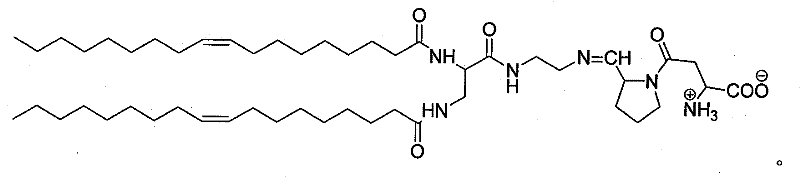


Applications Claiming Priority (3)
| Application Number | Priority Date | Filing Date | Title |
|---|---|---|---|
| US11537808P | 2008-11-17 | 2008-11-17 | |
| US61/115,378 | 2008-11-17 | ||
| PCT/US2009/064730 WO2010057160A1 (en) | 2008-11-17 | 2009-11-17 | Releasable fusogenic lipids for nucleic acids delivery systems |
Publications (1)
| Publication Number | Publication Date |
|---|---|
| CN102215820A true CN102215820A (en) | 2011-10-12 |
Family
ID=42170408
Family Applications (1)
| Application Number | Title | Priority Date | Filing Date |
|---|---|---|---|
| CN2009801459159A Pending CN102215820A (en) | 2008-11-17 | 2009-11-17 | Releasable Fusogenic Lipids for Nucleic Acid Delivery Systems |
Country Status (7)
| Country | Link |
|---|---|
| US (1) | US20110223257A1 (en) |
| EP (1) | EP2355799A4 (en) |
| JP (1) | JP2012509273A (en) |
| CN (1) | CN102215820A (en) |
| CA (1) | CA2742846A1 (en) |
| TW (1) | TW201021852A (en) |
| WO (1) | WO2010057160A1 (en) |
Cited By (4)
| Publication number | Priority date | Publication date | Assignee | Title |
|---|---|---|---|---|
| CN107106493A (en) * | 2014-11-21 | 2017-08-29 | 西北大学 | The sequence-specific cellular uptake of spherical nucleic acid nano particle conjugate |
| CN107951861A (en) * | 2016-10-17 | 2018-04-24 | 南京绿叶制药有限公司 | A kind of lipid nano particle membrane material feed composition |
| CN107951862A (en) * | 2016-10-17 | 2018-04-24 | 南京绿叶制药有限公司 | Lipid nanoparticle of antisense oligonucleotide inhibiting bcl-2 and preparation method thereof |
| CN110337429A (en) * | 2016-12-21 | 2019-10-15 | 阿克丘勒斯治疗公司 | Ionizable cation lipid for RNA delivery |
Families Citing this family (28)
| Publication number | Priority date | Publication date | Assignee | Title |
|---|---|---|---|---|
| EP3539572A1 (en) | 2005-08-24 | 2019-09-18 | ImmunoGen, Inc. | Process for preparing maytansinoid antibody conjugates |
| TW201021853A (en) * | 2008-11-17 | 2010-06-16 | Enzon Pharmaceuticals Inc | Releasable cationic lipids for nucleic acids delivery systems |
| US20100233270A1 (en) | 2009-01-08 | 2010-09-16 | Northwestern University | Delivery of Oligonucleotide-Functionalized Nanoparticles |
| BRPI1010620B8 (en) | 2009-06-03 | 2021-05-25 | Immunogen Inc | conjugation methods |
| SG186085A1 (en) * | 2010-06-03 | 2013-01-30 | Alnylam Pharmaceuticals Inc | Biodegradable lipids for the delivery of active agents |
| US9205099B2 (en) | 2010-06-22 | 2015-12-08 | Dna Therapeutics | Optimized in vivo delivery system with endosomolytic agents for nucleic acid conjugates |
| RS58367B1 (en) | 2011-03-29 | 2019-03-29 | Immunogen Inc | Preparation of maytansinoid antibody conjugates by a one-step process |
| EP2527440A1 (en) | 2011-05-27 | 2012-11-28 | Institut Curie | Cancer treatment by combining DNA molecules mimicking double strand breaks with hyperthermia |
| EP2788006B1 (en) | 2011-12-07 | 2026-01-07 | Alnylam Pharmaceuticals, Inc. | Biodegradable lipids for the delivery of active agents |
| CN104114572A (en) | 2011-12-16 | 2014-10-22 | 现代治疗公司 | Modified nucleosides, nucleotides and nucleic acid compositions |
| US10358680B2 (en) * | 2012-09-11 | 2019-07-23 | Duke University | Nano-plasmonic molecular probes for plasmonics coupling interference |
| WO2014055877A1 (en) | 2012-10-04 | 2014-04-10 | Immunogen, Inc. | Use of a pvdf membrane to purify cell-binding agent cytotoxic agent conjugates |
| US10130711B2 (en) | 2013-06-19 | 2018-11-20 | The Regents Of The University Of California | Chemical structures for localized delivery of therapeutic agents |
| JP6527516B2 (en) | 2013-12-03 | 2019-06-05 | ノースウェスタン ユニバーシティ | Liposome particles, methods of making the foregoing and uses thereof |
| ES2880468T3 (en) | 2014-03-14 | 2021-11-24 | Univ California | TCO Conjugates and Methods for Delivery of Therapeutic Agents |
| TWI665192B (en) | 2014-05-28 | 2019-07-11 | 德商拜耳作物科學股份有限公司 | Process for preparing dihydroisoxazole derivatives |
| AU2015269412B2 (en) | 2014-06-04 | 2020-03-12 | Exicure Operating Company | Multivalent delivery of immune modulators by liposomal spherical nucleic acids for prophylactic or therapeutic applications |
| WO2016028940A1 (en) | 2014-08-19 | 2016-02-25 | Northwestern University | Protein/oligonucleotide core-shell nanoparticle therapeutics |
| JP6823067B2 (en) | 2015-09-10 | 2021-01-27 | タンボ・インコーポレイテッド | Bioorthogonal composition |
| US11364304B2 (en) | 2016-08-25 | 2022-06-21 | Northwestern University | Crosslinked micellar spherical nucleic acids |
| ES2983582T3 (en) | 2017-04-07 | 2024-10-23 | Tambo Inc | Bioorthogonal compositions |
| WO2018209270A1 (en) | 2017-05-11 | 2018-11-15 | Northwestern University | Adoptive cell therapy using spherical nucleic acids (snas) |
| JP2020526558A (en) | 2017-07-13 | 2020-08-31 | ノースウェスタン ユニバーシティ | Common and direct methods for preparing oligonucleotide functionalized metal-organic framework nanoparticles |
| AU2018359904B2 (en) * | 2017-11-06 | 2023-02-23 | Nitto Denko Corporation | Fusogenic compounds for delivery of biologically active molecules |
| US12319711B2 (en) | 2019-09-20 | 2025-06-03 | Northwestern University | Spherical nucleic acids with tailored and active protein coronae |
| US12378560B2 (en) | 2019-10-29 | 2025-08-05 | Northwestern University | Sequence multiplicity within spherical nucleic acids |
| EP4295917A3 (en) | 2020-08-07 | 2024-02-28 | Tambo, Inc. | Trans-cyclooctene bioorthogonal agents and uses in cancer and immunotherapy |
| LU103379B1 (en) * | 2024-09-09 | 2026-03-09 | Re3B Therapeutics Ug I G | Serum-Protein Coated Fusogenic Lipid Particles For Targeted Drug Delivery |
Citations (3)
| Publication number | Priority date | Publication date | Assignee | Title |
|---|---|---|---|---|
| US20060240554A1 (en) * | 2005-02-14 | 2006-10-26 | Sirna Therapeutics, Inc. | Lipid nanoparticle based compositions and methods for the delivery of biologically active molecules |
| WO2008137758A2 (en) * | 2007-05-04 | 2008-11-13 | Mdrna, Inc. | Amino acid lipids and uses thereof |
| US20080281044A1 (en) * | 2006-08-18 | 2008-11-13 | Monahan Sean D | Endosomolytic Modified Poly(Alcohol) and Poly(Amine) Polymers |
Family Cites Families (18)
| Publication number | Priority date | Publication date | Assignee | Title |
|---|---|---|---|---|
| US5945408A (en) * | 1996-03-06 | 1999-08-31 | G.D. Searle & Co. | Hydroxyanidino derivatives useful as nitric oxide synthase inhibitors |
| CA2289702C (en) * | 1997-05-14 | 2008-02-19 | Inex Pharmaceuticals Corp. | High efficiency encapsulation of charged therapeutic agents in lipid vesicles |
| US6794499B2 (en) * | 1997-09-12 | 2004-09-21 | Exiqon A/S | Oligonucleotide analogues |
| US6841537B1 (en) * | 1998-04-22 | 2005-01-11 | Protiva Biotherapeutics Inc. | Combination therapy using nucleic acids and conventional drugs |
| US6169078B1 (en) * | 1998-05-12 | 2001-01-02 | University Of Florida | Materials and methods for the intracellular delivery of substances |
| US20030077829A1 (en) * | 2001-04-30 | 2003-04-24 | Protiva Biotherapeutics Inc.. | Lipid-based formulations |
| US20070042983A1 (en) * | 2001-05-18 | 2007-02-22 | Sirna Therapeutics, Inc. | RNA interference mediated inhibition of gene expression using short interfering nucleic acid (siNA) |
| US20050222064A1 (en) * | 2002-02-20 | 2005-10-06 | Sirna Therapeutics, Inc. | Polycationic compositions for cellular delivery of polynucleotides |
| US7015349B2 (en) * | 2003-03-26 | 2006-03-21 | The Gillette Company | Reduction of hair growth |
| NZ592917A (en) * | 2003-09-15 | 2012-12-21 | Protiva Biotherapeutics Inc | Stable polyethyleneglycol (PEG) dialkyloxypropyl (DAA) lipid conjugates |
| EP1692107A4 (en) * | 2003-12-10 | 2008-10-29 | Nitromed Inc | NITROGEN MONOXIDE RELEASE PYRUVATE COMPOUNDS, COMPOSITIONS AND METHODS OF USE |
| WO2006007712A1 (en) * | 2004-07-19 | 2006-01-26 | Protiva Biotherapeutics, Inc. | Methods comprising polyethylene glycol-lipid conjugates for delivery of therapeutic agents |
| WO2006086330A2 (en) * | 2005-02-08 | 2006-08-17 | Id Biomedical Corporation Of Quebec C.O.B. As Glaxosmithkline Biologicals North America | Pharmaceutical compositions |
| US7404969B2 (en) * | 2005-02-14 | 2008-07-29 | Sirna Therapeutics, Inc. | Lipid nanoparticle based compositions and methods for the delivery of biologically active molecules |
| WO2006096701A2 (en) * | 2005-03-07 | 2006-09-14 | Id Biomedical Corporation Of Quebec C.O.B. As Glaxosmithkline Biologicals North America | Pharmaceutical liposomal compositions |
| US7919466B2 (en) * | 2006-02-01 | 2011-04-05 | The Regents Of The University Of California | Lymphatic zip codes in tumors and pre-malignant lesions |
| US20070293449A1 (en) * | 2006-06-20 | 2007-12-20 | Nastech Pharmaceutical Company Inc. | Compositions and methods for delivery of double-stranded rna |
| US20080255234A1 (en) * | 2007-04-11 | 2008-10-16 | Zinpro Corporation | Rumen protected lysine |
-
2009
- 2009-11-17 CA CA2742846A patent/CA2742846A1/en not_active Abandoned
- 2009-11-17 WO PCT/US2009/064730 patent/WO2010057160A1/en not_active Ceased
- 2009-11-17 US US13/129,546 patent/US20110223257A1/en not_active Abandoned
- 2009-11-17 EP EP09826954A patent/EP2355799A4/en not_active Withdrawn
- 2009-11-17 CN CN2009801459159A patent/CN102215820A/en active Pending
- 2009-11-17 TW TW098138943A patent/TW201021852A/en unknown
- 2009-11-17 JP JP2011536585A patent/JP2012509273A/en not_active Ceased
Patent Citations (3)
| Publication number | Priority date | Publication date | Assignee | Title |
|---|---|---|---|---|
| US20060240554A1 (en) * | 2005-02-14 | 2006-10-26 | Sirna Therapeutics, Inc. | Lipid nanoparticle based compositions and methods for the delivery of biologically active molecules |
| US20080281044A1 (en) * | 2006-08-18 | 2008-11-13 | Monahan Sean D | Endosomolytic Modified Poly(Alcohol) and Poly(Amine) Polymers |
| WO2008137758A2 (en) * | 2007-05-04 | 2008-11-13 | Mdrna, Inc. | Amino acid lipids and uses thereof |
Cited By (9)
| Publication number | Priority date | Publication date | Assignee | Title |
|---|---|---|---|---|
| CN107106493A (en) * | 2014-11-21 | 2017-08-29 | 西北大学 | The sequence-specific cellular uptake of spherical nucleic acid nano particle conjugate |
| CN107951861A (en) * | 2016-10-17 | 2018-04-24 | 南京绿叶制药有限公司 | A kind of lipid nano particle membrane material feed composition |
| CN107951862A (en) * | 2016-10-17 | 2018-04-24 | 南京绿叶制药有限公司 | Lipid nanoparticle of antisense oligonucleotide inhibiting bcl-2 and preparation method thereof |
| WO2018072646A1 (en) * | 2016-10-17 | 2018-04-26 | 南京绿叶制药有限公司 | Lipid nanoparticle of antisense oligonucleic acid for inhibiting bcl-2 and preparation method therefor |
| CN107951861B (en) * | 2016-10-17 | 2020-12-01 | 南京绿叶制药有限公司 | Lipid nanoparticle membrane material composition |
| CN112587504A (en) * | 2016-10-17 | 2021-04-02 | 南京绿叶制药有限公司 | Lipid nanoparticle of antisense oligonucleotide for inhibiting bcl-2 and preparation method thereof |
| CN112587504B (en) * | 2016-10-17 | 2022-10-18 | 南京绿叶制药有限公司 | Lipid nanoparticle of antisense oligonucleotide for inhibiting bcl-2 and preparation method thereof |
| CN110337429A (en) * | 2016-12-21 | 2019-10-15 | 阿克丘勒斯治疗公司 | Ionizable cation lipid for RNA delivery |
| US12527881B2 (en) | 2016-12-21 | 2026-01-20 | Arcturus Therapeutics, Inc. | Ionizable cationic lipid for RNA delivery |
Also Published As
| Publication number | Publication date |
|---|---|
| WO2010057160A1 (en) | 2010-05-20 |
| CA2742846A1 (en) | 2010-05-20 |
| TW201021852A (en) | 2010-06-16 |
| US20110223257A1 (en) | 2011-09-15 |
| WO2010057160A9 (en) | 2011-05-05 |
| JP2012509273A (en) | 2012-04-19 |
| EP2355799A1 (en) | 2011-08-17 |
| EP2355799A4 (en) | 2012-09-05 |
Similar Documents
| Publication | Publication Date | Title |
|---|---|---|
| CN102215820A (en) | Releasable Fusogenic Lipids for Nucleic Acid Delivery Systems | |
| US20110305770A1 (en) | Releasable polymeric lipids for nucleic acids delivery system | |
| US20110229581A1 (en) | Releasable cationic lipids for nucleic acids delivery systems | |
| US20110111044A1 (en) | Nanoparticle compositions for nucleic acids delivery system | |
| US20110305769A1 (en) | Branched cationic lipids for nucleic acids delivery system | |
| KR101762466B1 (en) | Lipids, lipid compositions, and methods of using them | |
| CN102231951A (en) | Releasable conjugates for nucleic acids delivery systems | |
| CN103189057B (en) | Macrocyclic Lipid Compounds and Their Applications | |
| CN107266391A (en) | Amine cation lipid and application thereof | |
| EP4497746A1 (en) | Novel ionizable lipid and lipid nanoparticle composition using same | |
| CN117658848A (en) | Lipid compounds for delivering therapeutic agents and their uses | |
| CN121586703A (en) | Lipid compounds for delivery of therapeutic agents, methods of making and uses thereof | |
| JPWO2017111172A1 (en) | Compounds as cationic lipids | |
| WO2012098692A1 (en) | Composition for inhibiting target gene expression | |
| WO2025124584A1 (en) | Degradable cationic lipid containing disulfide bond and use thereof | |
| WO2025200610A1 (en) | Cationic lipid containing disulfide bond and ionizable side group, and use thereof | |
| WO2011007795A1 (en) | Composition for inhibiting the expression of target gene |
Legal Events
| Date | Code | Title | Description |
|---|---|---|---|
| C06 | Publication | ||
| PB01 | Publication | ||
| C10 | Entry into substantive examination | ||
| SE01 | Entry into force of request for substantive examination | ||
| C02 | Deemed withdrawal of patent application after publication (patent law 2001) | ||
| WD01 | Invention patent application deemed withdrawn after publication |
Application publication date: 20111012 |