CN102300902A - UV light-emissive fluorene-based copolymers - Google Patents
UV light-emissive fluorene-based copolymers Download PDFInfo
- Publication number
- CN102300902A CN102300902A CN2009801558741A CN200980155874A CN102300902A CN 102300902 A CN102300902 A CN 102300902A CN 2009801558741 A CN2009801558741 A CN 2009801558741A CN 200980155874 A CN200980155874 A CN 200980155874A CN 102300902 A CN102300902 A CN 102300902A
- Authority
- CN
- China
- Prior art keywords
- alkyl
- aryl
- independently selected
- hydrogen
- alkenyl
- Prior art date
- Legal status (The legal status is an assumption and is not a legal conclusion. Google has not performed a legal analysis and makes no representation as to the accuracy of the status listed.)
- Granted
Links
Images


Classifications
-
- C—CHEMISTRY; METALLURGY
- C09—DYES; PAINTS; POLISHES; NATURAL RESINS; ADHESIVES; COMPOSITIONS NOT OTHERWISE PROVIDED FOR; APPLICATIONS OF MATERIALS NOT OTHERWISE PROVIDED FOR
- C09K—MATERIALS FOR MISCELLANEOUS APPLICATIONS, NOT PROVIDED FOR ELSEWHERE
- C09K11/00—Luminescent materials, e.g. electroluminescent or chemiluminescent
- C09K11/06—Luminescent materials, e.g. electroluminescent or chemiluminescent containing organic luminescent materials
-
- C—CHEMISTRY; METALLURGY
- C08—ORGANIC MACROMOLECULAR COMPOUNDS; THEIR PREPARATION OR CHEMICAL WORKING-UP; COMPOSITIONS BASED THEREON
- C08G—MACROMOLECULAR COMPOUNDS OBTAINED OTHERWISE THAN BY REACTIONS ONLY INVOLVING UNSATURATED CARBON-TO-CARBON BONDS
- C08G61/00—Macromolecular compounds obtained by reactions forming a carbon-to-carbon link in the main chain of the macromolecule
- C08G61/02—Macromolecular compounds containing only carbon atoms in the main chain of the macromolecule, e.g. polyxylylenes
-
- C—CHEMISTRY; METALLURGY
- C08—ORGANIC MACROMOLECULAR COMPOUNDS; THEIR PREPARATION OR CHEMICAL WORKING-UP; COMPOSITIONS BASED THEREON
- C08G—MACROMOLECULAR COMPOUNDS OBTAINED OTHERWISE THAN BY REACTIONS ONLY INVOLVING UNSATURATED CARBON-TO-CARBON BONDS
- C08G61/00—Macromolecular compounds obtained by reactions forming a carbon-to-carbon link in the main chain of the macromolecule
- C08G61/02—Macromolecular compounds containing only carbon atoms in the main chain of the macromolecule, e.g. polyxylylenes
- C08G61/10—Macromolecular compounds containing only carbon atoms in the main chain of the macromolecule, e.g. polyxylylenes only aromatic carbon atoms, e.g. polyphenylenes
-
- C—CHEMISTRY; METALLURGY
- C08—ORGANIC MACROMOLECULAR COMPOUNDS; THEIR PREPARATION OR CHEMICAL WORKING-UP; COMPOSITIONS BASED THEREON
- C08G—MACROMOLECULAR COMPOUNDS OBTAINED OTHERWISE THAN BY REACTIONS ONLY INVOLVING UNSATURATED CARBON-TO-CARBON BONDS
- C08G61/00—Macromolecular compounds obtained by reactions forming a carbon-to-carbon link in the main chain of the macromolecule
- C08G61/12—Macromolecular compounds containing atoms other than carbon in the main chain of the macromolecule
-
- C—CHEMISTRY; METALLURGY
- C09—DYES; PAINTS; POLISHES; NATURAL RESINS; ADHESIVES; COMPOSITIONS NOT OTHERWISE PROVIDED FOR; APPLICATIONS OF MATERIALS NOT OTHERWISE PROVIDED FOR
- C09B—ORGANIC DYES OR CLOSELY-RELATED COMPOUNDS FOR PRODUCING DYES, e.g. PIGMENTS; MORDANTS; LAKES
- C09B69/00—Dyes not provided for by a single group of this subclass
- C09B69/008—Dyes containing a substituent, which contains a silicium atom
-
- C—CHEMISTRY; METALLURGY
- C09—DYES; PAINTS; POLISHES; NATURAL RESINS; ADHESIVES; COMPOSITIONS NOT OTHERWISE PROVIDED FOR; APPLICATIONS OF MATERIALS NOT OTHERWISE PROVIDED FOR
- C09B—ORGANIC DYES OR CLOSELY-RELATED COMPOUNDS FOR PRODUCING DYES, e.g. PIGMENTS; MORDANTS; LAKES
- C09B69/00—Dyes not provided for by a single group of this subclass
- C09B69/10—Polymeric dyes; Reaction products of dyes with monomers or with macromolecular compounds
- C09B69/109—Polymeric dyes; Reaction products of dyes with monomers or with macromolecular compounds containing other specific dyes
-
- H—ELECTRICITY
- H10—SEMICONDUCTOR DEVICES; ELECTRIC SOLID-STATE DEVICES NOT OTHERWISE PROVIDED FOR
- H10K—ORGANIC ELECTRIC SOLID-STATE DEVICES
- H10K85/00—Organic materials used in the body or electrodes of devices covered by this subclass
- H10K85/10—Organic polymers or oligomers
- H10K85/111—Organic polymers or oligomers comprising aromatic, heteroaromatic, or aryl chains, e.g. polyaniline, polyphenylene or polyphenylene vinylene
- H10K85/115—Polyfluorene; Derivatives thereof
-
- H—ELECTRICITY
- H10—SEMICONDUCTOR DEVICES; ELECTRIC SOLID-STATE DEVICES NOT OTHERWISE PROVIDED FOR
- H10K—ORGANIC ELECTRIC SOLID-STATE DEVICES
- H10K85/00—Organic materials used in the body or electrodes of devices covered by this subclass
- H10K85/10—Organic polymers or oligomers
- H10K85/151—Copolymers
-
- C—CHEMISTRY; METALLURGY
- C08—ORGANIC MACROMOLECULAR COMPOUNDS; THEIR PREPARATION OR CHEMICAL WORKING-UP; COMPOSITIONS BASED THEREON
- C08G—MACROMOLECULAR COMPOUNDS OBTAINED OTHERWISE THAN BY REACTIONS ONLY INVOLVING UNSATURATED CARBON-TO-CARBON BONDS
- C08G2261/00—Macromolecular compounds obtained by reactions forming a carbon-to-carbon link in the main chain of the macromolecule
- C08G2261/30—Monomer units or repeat units incorporating structural elements in the main chain
- C08G2261/31—Monomer units or repeat units incorporating structural elements in the main chain incorporating aromatic structural elements in the main chain
- C08G2261/314—Condensed aromatic systems, e.g. perylene, anthracene or pyrene
-
- C—CHEMISTRY; METALLURGY
- C08—ORGANIC MACROMOLECULAR COMPOUNDS; THEIR PREPARATION OR CHEMICAL WORKING-UP; COMPOSITIONS BASED THEREON
- C08G—MACROMOLECULAR COMPOUNDS OBTAINED OTHERWISE THAN BY REACTIONS ONLY INVOLVING UNSATURATED CARBON-TO-CARBON BONDS
- C08G2261/00—Macromolecular compounds obtained by reactions forming a carbon-to-carbon link in the main chain of the macromolecule
- C08G2261/30—Monomer units or repeat units incorporating structural elements in the main chain
- C08G2261/31—Monomer units or repeat units incorporating structural elements in the main chain incorporating aromatic structural elements in the main chain
- C08G2261/314—Condensed aromatic systems, e.g. perylene, anthracene or pyrene
- C08G2261/3142—Condensed aromatic systems, e.g. perylene, anthracene or pyrene fluorene-based, e.g. fluorene, indenofluorene, or spirobifluorene
-
- C—CHEMISTRY; METALLURGY
- C08—ORGANIC MACROMOLECULAR COMPOUNDS; THEIR PREPARATION OR CHEMICAL WORKING-UP; COMPOSITIONS BASED THEREON
- C08G—MACROMOLECULAR COMPOUNDS OBTAINED OTHERWISE THAN BY REACTIONS ONLY INVOLVING UNSATURATED CARBON-TO-CARBON BONDS
- C08G2261/00—Macromolecular compounds obtained by reactions forming a carbon-to-carbon link in the main chain of the macromolecule
- C08G2261/30—Monomer units or repeat units incorporating structural elements in the main chain
- C08G2261/31—Monomer units or repeat units incorporating structural elements in the main chain incorporating aromatic structural elements in the main chain
- C08G2261/316—Monomer units or repeat units incorporating structural elements in the main chain incorporating aromatic structural elements in the main chain bridged by heteroatoms, e.g. N, P, Si or B
-
- C—CHEMISTRY; METALLURGY
- C08—ORGANIC MACROMOLECULAR COMPOUNDS; THEIR PREPARATION OR CHEMICAL WORKING-UP; COMPOSITIONS BASED THEREON
- C08G—MACROMOLECULAR COMPOUNDS OBTAINED OTHERWISE THAN BY REACTIONS ONLY INVOLVING UNSATURATED CARBON-TO-CARBON BONDS
- C08G2261/00—Macromolecular compounds obtained by reactions forming a carbon-to-carbon link in the main chain of the macromolecule
- C08G2261/30—Monomer units or repeat units incorporating structural elements in the main chain
- C08G2261/31—Monomer units or repeat units incorporating structural elements in the main chain incorporating aromatic structural elements in the main chain
- C08G2261/316—Monomer units or repeat units incorporating structural elements in the main chain incorporating aromatic structural elements in the main chain bridged by heteroatoms, e.g. N, P, Si or B
- C08G2261/3162—Arylamines
-
- C—CHEMISTRY; METALLURGY
- C08—ORGANIC MACROMOLECULAR COMPOUNDS; THEIR PREPARATION OR CHEMICAL WORKING-UP; COMPOSITIONS BASED THEREON
- C08G—MACROMOLECULAR COMPOUNDS OBTAINED OTHERWISE THAN BY REACTIONS ONLY INVOLVING UNSATURATED CARBON-TO-CARBON BONDS
- C08G2261/00—Macromolecular compounds obtained by reactions forming a carbon-to-carbon link in the main chain of the macromolecule
- C08G2261/50—Physical properties
- C08G2261/52—Luminescence
- C08G2261/522—Luminescence fluorescent
- C08G2261/5222—Luminescence fluorescent electrofluorescent
-
- Y—GENERAL TAGGING OF NEW TECHNOLOGICAL DEVELOPMENTS; GENERAL TAGGING OF CROSS-SECTIONAL TECHNOLOGIES SPANNING OVER SEVERAL SECTIONS OF THE IPC; TECHNICAL SUBJECTS COVERED BY FORMER USPC CROSS-REFERENCE ART COLLECTIONS [XRACs] AND DIGESTS
- Y10—TECHNICAL SUBJECTS COVERED BY FORMER USPC
- Y10S—TECHNICAL SUBJECTS COVERED BY FORMER USPC CROSS-REFERENCE ART COLLECTIONS [XRACs] AND DIGESTS
- Y10S428/00—Stock material or miscellaneous articles
- Y10S428/917—Electroluminescent
Landscapes
- Chemical & Material Sciences (AREA)
- Organic Chemistry (AREA)
- Health & Medical Sciences (AREA)
- Chemical Kinetics & Catalysis (AREA)
- Medicinal Chemistry (AREA)
- Polymers & Plastics (AREA)
- Engineering & Computer Science (AREA)
- Materials Engineering (AREA)
- Polyoxymethylene Polymers And Polymers With Carbon-To-Carbon Bonds (AREA)
- Organic Low-Molecular-Weight Compounds And Preparation Thereof (AREA)
- Addition Polymer Or Copolymer, Post-Treatments, Or Chemical Modifications (AREA)
Abstract
Description
交叉引用的相关申请 Cross-Referenced Related Applications
不适用 not applicable
关于联邦资助研究或开发的声明 Statement Regarding Federally Funded Research or Development
不适用 not applicable
发明背景 Background of the invention
1.技术领域1. Technical field
本发明涉及芴基共聚物和它们的制备以及作为发光聚合物的用途。 The present invention relates to fluorene-based copolymers and their preparation and use as light-emitting polymers.
2.现有技术说明2. Description of existing technology
有机小分子发光二极管(OLED)和聚合物发光二极管(PLED)最近已经朝着在全色平板显示器中的应用取得了重大的进步。分子设计和合成工艺的进步已经作出了重大贡献。在无机和有机杂化LED中,该有机材料提供了发射能量,该能量转移到无机半导电纳米晶体材料,用于光发射。芴基聚合物最近已经作为吸引人的发光材料而出现。但是,这些芴基聚合物缺乏足够的稳定性,这影响了它们的发射性能。 Organic small-molecule light-emitting diodes (OLEDs) and polymer light-emitting diodes (PLEDs) have recently made significant progress toward application in full-color flat panel displays. Advances in molecular design and synthetic processes have made significant contributions. In inorganic and organic hybrid LEDs, the organic material provides the emission energy, which is transferred to the inorganic semiconducting nanocrystalline material for light emission. Fluorene-based polymers have recently emerged as attractive light-emitting materials. However, these fluorenyl polymers lack sufficient stability, which affects their emission properties.
发明内容 Contents of the invention
本发明的一种实施方案是式I的芴基共聚物: One embodiment of the invention is a fluorenyl copolymer of formula I:
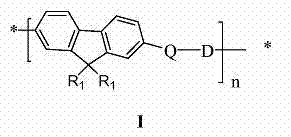
其中: in:
R1各自独立的是空间位阻基团, R 1 are each independently a steric hindrance group,
Q是键或者一个或多个未稠合的或者稠合的芳族环, Q is a bond or one or more unfused or fused aromatic rings,
D是这样的基团,其包含二价、三价和四价之一的原子,其中该原子的一个价是用连接到Q上的芳族部分来满足的,和其中该芳族部分具有连接到其上的空间位阻基团,和其中该原子的其余价是用芳族取代基满足的,和 D is a group comprising an atom of one of divalent, trivalent and tetravalent, wherein one valence of the atom is satisfied by an aromatic moiety attached to Q, and wherein the aromatic moiety has to a sterically hindering group thereon, and wherein the remaining valences of the atom are satisfied with aromatic substituents, and
n是选自2-10000的整数, n is an integer selected from 2-10000,
其中该R1和D的空间位阻基团提供了足够的空间相互作用,以使得式I的空间构象基本上是非平面的,和 wherein the steric hindrance groups of R and D provide sufficient steric interactions such that the steric conformation of formula I is substantially non-planar, and
其中该共聚物表现出UV光发射。 Wherein the copolymer exhibits UV light emission.
本发明的另外一种实施方案是一种发光装置,其包含第一电极,第二电极和布置在第一电极和第二电极之间的聚合物层。该聚合物层包含式I的芴基共聚物: Another embodiment of the present invention is a light emitting device comprising a first electrode, a second electrode and a polymer layer disposed between the first electrode and the second electrode. The polymer layer comprises a fluorene-based copolymer of formula I:

其中 in
R1各自独立的选自C1-C30烷基,C2-C30烯基,C2-C30炔基,C1-C30芳基,C1-C30烷氧基,C2-C30链烯氧基,C2-C30炔氧基,C1-C30芳氧基,C1-C30硫烷基,C2-C30硫烯基,C2-C30硫炔基,C1-C30硫芳基,C(O)OR4,N(R4)(R5),C(O)N(R4)(R5),F,Cl,Br,NO2,CN,酰基,羧化物(carboxylate)和羟基,其中R4和R5各自独立的选自氢,C1-C30烷基和C1-C30芳基,
R 1 are each independently selected from C 1 -C 30 alkyl, C 2 -C 30 alkenyl, C 2 -C 30 alkynyl, C 1 -C 30 aryl, C 1 -C 30 alkoxy, C 2 -C 30 alkenyloxy, C 2 -C 30 alkynyloxy, C 1 -C 30 aryloxy, C 1 -
Q是键或者一个或多个未稠合的或者稠合的芳族环, Q is a bond or one or more unfused or fused aromatic rings,
D是这样的基团,其包含二价、三价和四价之一的原子,其中该原子的一个价是用连接到Q上的芳族部分来满足的,和其中该芳族部分具有连接到其上的空间位阻基团,和其中该原子的其余价是用芳族取代基满足的,和 D is a group comprising an atom of one of divalent, trivalent and tetravalent, wherein one valence of the atom is satisfied by an aromatic moiety attached to Q, and wherein the aromatic moiety has to a sterically hindering group thereon, and wherein the remaining valences of the atom are satisfied with aromatic substituents, and
n是选自2-10000的整数。 n is an integer selected from 2-10000.
本发明的另外一种实施方案是一种用于形成芴基共聚物的方法,该共聚物表现出比具有基本上平面的空间构象的芴基聚合物更高的发射性能和稳定性,该方法包括由单体单元形成该芴基共聚物。该单体单元包含芴基团和至少一个具有空间位阻结构的化学基团。该化学基团赋予了该芴基共聚物非平面的空间构象。 Another embodiment of the present invention is a method for forming a fluorene-based copolymer exhibiting higher emissive properties and stability than fluorene-based polymers having a substantially planar spatial conformation, the method Formation of the fluorene-based copolymer from monomeric units is included. The monomer unit comprises a fluorene group and at least one chemical group with a steric hindrance structure. The chemical group imparts a non-planar spatial conformation to the fluorene-based copolymer.
附图说明 Description of drawings
此处提供的附图用于便于理解本发明的某些实施方案的目的,并且是作为示例提供的,而并非对附加的权利要求的范围进行限制。 The drawings provided herein are for the purpose of facilitating the understanding of certain embodiments of the present invention and are provided by way of example and not to limit the scope of the appended claims.
图1是使用本发明的芴基共聚物的发光装置的一种实施方案的示意图。 Fig. 1 is a schematic diagram of one embodiment of a light-emitting device using the fluorene-based copolymer of the present invention.
图2是使用本发明的芴基共聚物的发光装置的另外一种实施方案的示意图。 Fig. 2 is a schematic diagram of another embodiment of a light-emitting device using the fluorene-based copolymer of the present invention.
图3是使用本发明的芴基共聚物的发光装置的另外一种实施方案的示意图。 Fig. 3 is a schematic diagram of another embodiment of a light-emitting device using the fluorene-based copolymer of the present invention.
图4是使用本发明的芴基共聚物的发光装置的另外一种实施方案的示意图。 Fig. 4 is a schematic diagram of another embodiment of a light-emitting device using the fluorene-based copolymer of the present invention.
具体实施方式 Detailed ways
一般讨论 general discussion
本发明方法和组合物的实施方案涉及表现出UV发射的芴基共聚物的设计和合成,该共聚物具有提高的光学性能例如发光寿命和增强的发射和具有提高的稳定性和光学透明度。已知的芴基聚合物具有基本上平面的空间构象。已知的芴-基聚合物作为紫光和UV发射物的性能受到它们的稳定性的阻碍,例如形成π-聚集体/激态原子的倾向,易于受到酮缺陷影响等等。 Embodiments of the methods and compositions of the present invention relate to the design and synthesis of fluorene-based copolymers exhibiting UV emission, having enhanced optical properties such as luminescent lifetime and enhanced emission, and having enhanced stability and optical clarity. Known fluorenyl polymers have a substantially planar spatial conformation. The performance of known fluorene-based polymers as violet and UV emitters is hampered by their stability, eg tendency to form π-aggregates/excited atoms, susceptibility to ketone defects, etc.
术语“空间构象”涉及聚合物的组成部分在空间中的排列。术语“基本平面的”表示芴基聚合物的环的原子处于这样的平面上,该平面通过环的每个原子的中心,或者其中通过一个环的每个原子中心的平面与通过另外一个环的每个原子中心的平面的差异小于大约10%,或者小于大约9%,或者小于大约8%,或者小于大约7%,或者小于大约6%,或者小于大约5%,或者小于大约4%,或者小于大约3%,或者小于大约2%,或者小于大约1%。术语“π-聚集体/激态原子”表示由聚合物链的自聚集而形成的产物;更明确的,该术语指的是芴基聚合物中的交互链相互作用,包括激态相互作用(激态原子)和/或基态相互作用(聚集体),其将强烈的影响这样的聚合物的吸收和/或发射。术语“酮缺陷”表示聚合物的光致氧化,其指的是这样的情形,在这里未受保护的芴环的质子被氧化来形成酮,因此明显影响或者破坏了芴环的发光。 The term "steric conformation" relates to the arrangement of the constituent parts of a polymer in space. The term "substantially planar" means that the atoms of the rings of the fluorenyl polymer lie on a plane that passes through the center of each atom of the ring, or where the plane through the center of each atom of one ring is different from the plane through the center of each atom of the other ring. The plane of each atomic center varies by less than about 10%, or by less than about 9%, or by less than about 8%, or by less than about 7%, or by less than about 6%, or by less than about 5%, or by less than about 4%, or Less than about 3%, or less than about 2%, or less than about 1%. The term "π-aggregates/excited atoms" denotes the products formed by the self-aggregation of polymer chains; more specifically, the term refers to the interchain interactions in fluorenyl polymers, including the excimer interactions ( Excited atoms) and/or ground state interactions (aggregates), which will strongly affect the absorption and/or emission of such polymers. The term "ketone defect" denotes photooxidation of the polymer, which refers to the situation where the protons of the unprotected fluorene rings are oxidized to form ketones, thus significantly affecting or destroying the fluorene ring's luminescence.
本发明人发现可以实现提高上述性能(即具有提高的光学性能例如发光寿命和放大的发射和具有提高的稳定性的UV发射),并且该芴基聚合物的性能可通过赋予该芴基聚合物的空间构象为基本上非平面来提高。在本发明的实施方案中,芴基聚合物有效的共轭长度是通过形成芴基共聚物来控制的,该共聚物包含聚合物主链,并且该主链通过引入某些结构到该聚合物链中而间断。本发明方法和组合物的实施方案涉及提高芴基聚合物的发射性能和稳定性的方法,该共聚物具有基本上平面的空间构象。本发明的方法包括由单体单元来形成芴基共聚物,该单体单元包含芴基团和至少一个具有空间位阻结构的化学基团,其是由一个或多个空间位阻基团的存在而形成的。空间位阻结构是这样的结构,其使得该化学基团能够赋予该芴基共聚物基本上非平面的空间构象。 The present inventors have found that the above-mentioned properties can be improved (i.e., with enhanced optical properties such as luminescent lifetime and amplified emission and UV emission with increased stability), and the properties of the fluorenyl polymer can be achieved by endowing the fluorenyl polymer with The spatial conformation is enhanced by being substantially non-planar. In an embodiment of the invention, the effective conjugation length of a fluorenyl polymer is controlled by forming a fluorenyl copolymer comprising a polymer backbone, and the backbone is controlled by introducing certain structures into the polymer interrupted in the chain. Embodiments of the methods and compositions of the present invention relate to methods of enhancing the emission performance and stability of fluorenyl polymers having a substantially planar spatial conformation. The method of the present invention comprises forming a fluorene-based copolymer from a monomer unit comprising a fluorene group and at least one chemical group having a sterically hindered structure formed by one or more sterically hindered groups formed by existence. A sterically hindered structure is a structure that enables the chemical group to impart a substantially non-planar steric conformation to the fluorene-based copolymer.
术语“空间位阻基团”表示这样的基团,它在共聚物链中的存在干涉了该共聚物链处于基本上平面的构型的能力,这通常归因于空间位阻基团的尺寸。该空间位阻基团是这样的尺寸或者这样的结构或者二者,该空间位阻基团的相互作用赋予了该芴基共聚物基本上非平面的。空间位阻基团的存在使得该共聚物链中的某些键旋转,来适应空间位阻基团的存在。这种旋转导致了非平面的构型,这是因为聚合物主链的扭曲和产生了三维(3-D)位阻结构。电子的移位(delocalization)仍然存在,并且该共聚物表现出UV或者深蓝色光发射和提高的稳定性。 The term "steric hindering group" means a group whose presence in a copolymer chain interferes with the ability of the copolymer chain to assume a substantially planar configuration, usually due to the size of the steric hindering group . The steric hindering group is of such a size or such a structure, or both, that the interaction of the steric group renders the fluorene-based copolymer substantially non-planar. The presence of the steric hindering group allows some bonds in the copolymer chain to rotate to accommodate the presence of the steric hindering group. This rotation results in a non-planar configuration due to twisting of the polymer backbone and creates a three-dimensional (3-D) hindered structure. The delocalization of electrons still exists, and the copolymer exhibits UV or deep blue light emission and increased stability.
术语“基本上非平面的”表示该芴基聚合物的环原子不处于通过该环的每个原子的中心的平面。在这样的情形中,通过一个环的每个原子中心的平面与通过另外一个环的每个原子中心的平面的差异大于大约10%,或者大于大约11%,或者大于大约12%,或者大于大约13%,或者大于大约14%,或者大于大约15%,或者大于大约16%,或者大于大约17%,或者大于大约18%,或者大于大约19%,或者大于大约20%。在一些实施方案中,至少两个环的平面差异是大约10-大约25%,或者大约11-大约25%,或者大约12-大约25%,或者大约13-大约25%,或者大约14-大约25%,或者大约15-大约25%,或者大约10-大约20%,或者大约11-大约20%,或者大约12-大约20%,或者大约13-大约20%,或者大约14-大约20%,或者大约15-大约20%,或者更多。 The term "substantially non-planar" means that the ring atoms of the fluorenyl polymer are not in a plane passing through the center of each atom of the ring. In such cases, the plane through the center of each atom of one ring differs from the plane through the center of each atom of the other ring by more than about 10%, or by more than about 11%, or by more than about 12%, or by more than about 13%, or greater than about 14%, or greater than about 15%, or greater than about 16%, or greater than about 17%, or greater than about 18%, or greater than about 19%, or greater than about 20%. In some embodiments, the difference in plane of at least two rings is from about 10 to about 25%, or from about 11 to about 25%, or from about 12 to about 25%, or from about 13 to about 25%, or from about 14 to about 25%. 25%, or about 15-about 25%, or about 10-about 20%, or about 11-about 20%, or about 12-about 20%, or about 13-about 20%, or about 14-about 20% , or about 15-about 20%, or more.
在单体单元的引入中所涉及的考虑包括(a)延长的π-共轭的正确控制来实现纯UV或者深蓝发射;(b)扭曲聚合物主链和三维(3-D)位阻结构,用于缓和聚合物链的自聚集来实现提高的发射;(c)扭曲的聚合物主链和3-D位阻结构来充当该芴单元的保护基团,来基本上降低或者防止聚合物经历光致氧化或者所述的酮效应。 Considerations involved in the incorporation of monomer units include (a) proper control of extended π-conjugation to achieve pure UV or deep blue emission; (b) twisted polymer backbone and three-dimensional (3-D) steric hindrance , used to moderate the self-aggregation of polymer chains to achieve improved emission; (c) twisted polymer backbone and 3-D steric structure to act as a protecting group for the fluorene unit to substantially reduce or prevent polymer undergoes photooxidation or the described ketone effect.
术语“纯UV或者深蓝发射”表示该聚合物具有大的能带间隙和发射UV区域的光或者具有深蓝颜色。术语“扭曲的聚合物主链”表示该聚合物是以这样的方式设计的,即两个相连的芳族环不处于一个平面中,这归因于在至少一个环上的空间大体积取代,这样两个芳族环具有彼此相差下面度数的平面:大约10度或者更多,或者大约11度或者更多,或者大约12度或者更多,或者大约13度或者更多,或者大约14度或者更多,或者大约15度或者更多,或者大约16度或者更多,或者大约17度或者更多,或者大约18度或者更多,或者大约19度或者更多,或者大约20度或者更多,并且是“扭曲”的含义。 The term "pure UV or deep blue emission" means that the polymer has a large energy band gap and emits light in the UV region or has a deep blue color. The term "twisted polymer backbone" indicates that the polymer is designed in such a way that the two connected aromatic rings are not in a plane due to sterically bulky substitution on at least one ring, Such two aromatic rings have planes that differ from each other by about 10 degrees or more, or about 11 degrees or more, or about 12 degrees or more, or about 13 degrees or more, or about 14 degrees or More, or about 15 degrees or more, or about 16 degrees or more, or about 17 degrees or more, or about 18 degrees or more, or about 19 degrees or more, or about 20 degrees or more , and is the meaning of "twisted".
在一些实施方案中,用于形成芴基共聚物的单体单元包含二价、三价或者四价原子。在一些实施方案中,引入到该聚合物主链中的结构是化学结构,其包含这样的原子,这里该原子是氧,碳,氮,硅等等,和这里该原子处于这样的位置,即,苯环与它相邻的原子或者结构的连接点的δ位置。这样的结构可以称作包含δ-氧,δ-碳,δ-氮,δ-硅等等。在一些实施方案中,该单体单元包含多核芳族化合物,其可以是碳环的或者杂环的。 In some embodiments, the monomer units used to form the fluorene-based copolymer comprise divalent, trivalent, or tetravalent atoms. In some embodiments, the structure incorporated into the polymer backbone is a chemical structure comprising atoms, where the atoms are oxygen, carbon, nitrogen, silicon, etc., and where the atoms are in positions such that , the δ position of the connection point between the benzene ring and its adjacent atom or structure. Such structures may be said to contain delta-oxygen, delta-carbon, delta-nitrogen, delta-silicon, and the like. In some embodiments, the monomer unit comprises a polynuclear aromatic compound, which may be carbocyclic or heterocyclic.
在一些实施方案中,引入到该芴基共聚物中的化学结构包含二价、三价或者四价原子,其中该化学结构是通过单个共价键或者一个或多个未稠合的或者稠合的芳族环连接到芴基团上的。该二价、三价或者四价原子中的一个价是用连接到该芴部分或者未稠合的或者稠合的芳族环基团上的芳族部分来满足的。该芳族部分包含一个或多个空间位阻基团。该原子其余的价是用芳族取代基来满足的。 In some embodiments, the chemical structure introduced into the fluorene-based copolymer comprises divalent, trivalent or tetravalent atoms, wherein the chemical structure is formed by a single covalent bond or one or more unfused or fused The aromatic ring is attached to the fluorene group. One of the divalent, trivalent or tetravalent atoms is satisfied with an aromatic moiety attached to the fluorene moiety or unfused or fused aromatic ring group. The aromatic moiety contains one or more sterically hindering groups. The remaining valences of the atom are satisfied by aromatic substituents.
在一些实施方案中,该芴基共聚物具有式I: In some embodiments, the fluorene-based copolymer has Formula I:

其中: in:
R1各自独立的是空间位阻基团, R 1 are each independently a steric hindrance group,
Q是键或者一个或多个未稠合的或者稠合的芳族环,其包含至少一个空间位阻基团;在一些实施方案中,Q是单核或者多核芳族部分, Q is a bond or one or more unfused or fused aromatic rings comprising at least one sterically hindered group; in some embodiments, Q is a mononuclear or polynuclear aromatic moiety,
D是这样的基团,其包含二价、三价和四价原子,其中该原子的一个价是用连接到Q上的芳族部分来满足的,和其中该芳族部分具有连接到其上的空间位阻基团,和其中该原子的其余价是用芳族取代基满足的,和 D is a group comprising divalent, trivalent and tetravalent atoms, wherein one valency of the atom is satisfied by an aromatic moiety attached to Q, and wherein the aromatic moiety has attached thereto A sterically hindering group, and wherein the remaining valences of the atom are satisfied with aromatic substituents, and
n是选自2-10000的整数, n is an integer selected from 2-10000,
其中该R1、Q和D的空间位阻基团提供了足够的空间相互作用,以使得式I的空间构象基本上是非平面的,和其中该共聚物表现出UV光发射。 wherein the steric hindering groups of R 1 , Q and D provide sufficient steric interactions such that the steric conformation of Formula I is substantially non-planar, and wherein the copolymer exhibits UV light emission.
芴基共聚物的具体实施方案Specific embodiments of fluorene-based copolymers
在一些实施方案中,该芴基共聚物包含重复单体单元,并且是式I: In some embodiments, the fluorene-based copolymer comprises repeating monomer units and is of Formula I:
其中: in:
R1各自独立的选自C1-C30烷基,C2-C30烯基,C2-C30炔基,C1-C30芳基,C1-C30烷氧基,C2-C30链烯氧基,C2-C30炔氧基,C1-C30芳氧基(例如诸如苯氧基),C1-C30硫烷基,C2-C30硫烯基,C2-C30硫炔基,C1-C30硫芳基,C(O)OR4,N(R4)(R5),C(O)N(R4)(R5),F,Cl,Br,NO2,CN,酰基,羧化物和羟基,其中R4和R5各自独立的选自氢,C1-C30烷基和C1-C30芳基, R 1 are each independently selected from C 1 -C 30 alkyl, C 2 -C 30 alkenyl, C 2 -C 30 alkynyl, C 1 -C 30 aryl, C 1 -C 30 alkoxy, C 2 -C 30 alkenyloxy, C 2 -C 30 alkynyloxy, C 1 -C 30 aryloxy (eg such as phenoxy), C 1 -C 30 sulfanyl, C 2 -C 30 sulfenyl , C 2 -C 30 thioalkynyl, C 1 -C 30 thioaryl, C(O)OR 4 , N(R 4 )(R 5 ), C(O)N(R 4 )(R 5 ), F, Cl, Br, NO 2 , CN, acyl, carboxylate and hydroxyl, wherein R 4 and R 5 are each independently selected from hydrogen, C 1 -C 30 alkyl and C 1 -C 30 aryl,
Q是键或者一个或多个未稠合的或者稠合的芳族环, Q is a bond or one or more unfused or fused aromatic rings,
D是这样的基团,其包含二价、三价和四价原子,其中该原子的一个价是用连接到Q上的芳族部分来满足的,和其中该芳族部分具有连接到其上的空间位阻基团,和其中该原子的其余价是用芳族取代基满足的,和 D is a group comprising divalent, trivalent and tetravalent atoms, wherein one valency of the atom is satisfied by an aromatic moiety attached to Q, and wherein the aromatic moiety has attached thereto A sterically hindering group, and wherein the remaining valences of the atom are satisfied with aromatic substituents, and
n是选自2-10000的整数。 n is an integer selected from 2-10000.
在一些实施方案中,Q选自单键或者一个或多个未稠合的或者稠合的芳族环。在一些实施方案中,Q是单核芳族部分,即,由单个芳族环组成的芳族部分,其中环原子是碳或者其中一个或多个环原子是杂原子。在一些实施方案中,该单核芳族部分每个环的原子数可以是3或者4或者5或者6或者7或者8个,并且可以是3-8,或者4-8,或者4-7,或者4-6,或者5-8,或者5-7,或者5-6个等等。 In some embodiments, Q is selected from a single bond or one or more unfused or fused aromatic rings. In some embodiments, Q is a mononuclear aromatic moiety, ie, an aromatic moiety consisting of a single aromatic ring, wherein the ring atoms are carbon or wherein one or more ring atoms are heteroatoms. In some embodiments, the number of atoms per ring of the mononuclear aromatic moiety may be 3 or 4 or 5 or 6 or 7 or 8, and may be 3-8, or 4-8, or 4-7, Or 4-6, or 5-8, or 5-7, or 5-6 and so on.
在一些实施方案中,Q是单芳族环,其包含碳原子或者碳原子和一个或多个杂原子。这样的单芳族环部分的例子,作为示例而非限制,包括苯基,取代的苯基,吡啶,取代的吡啶,嘧啶,取代的嘧啶等等。 In some embodiments, Q is a single aromatic ring comprising a carbon atom or a carbon atom and one or more heteroatoms. Examples of such single aromatic ring moieties include, by way of illustration and not limitation, phenyl, substituted phenyl, pyridine, substituted pyridine, pyrimidine, substituted pyrimidine, and the like.
在一些实施方案中,Q是多核芳族部分,即,包含大于一个芳族环的芳族部分,其中环原子是碳或者其中一个或多个环原子是杂原子。多核芳族部分是多环的芳族部分,即,包含大于一个环,或者大于两个环,或者大于三个环,或者大于四个环,或者大于五个环,或者大于六个环等等。在一些实施方案中,多核芳族部分的至少两个环是稠合的,即,这两个环共同具有两个原子和一个键,并且包括例如螺稠合的环。在一些实施方案中,该多核芳族部分的环是未稠合的,即,该芳族部分的环不具有共用的两个原子和一个键。当Q是非单键时,Q所具有的至少一个空间取代基或者空间位阻基团处于Q的芳族环中这样的位置上,即,该位置是Q到芴部分连接位置的邻位。该空间取代基可以是选自包含 R1的那些基团的基团。 In some embodiments, Q is a polynuclear aromatic moiety, ie, an aromatic moiety comprising more than one aromatic ring, wherein the ring atoms are carbon or wherein one or more ring atoms are heteroatoms. A polynuclear aromatic moiety is an aromatic moiety that is polycyclic, i.e., contains more than one ring, or more than two rings, or more than three rings, or more than four rings, or more than five rings, or more than six rings, etc. . In some embodiments, at least two rings of the polynuclear aromatic moiety are fused, ie, the two rings have two atoms and one bond in common, and include, for example, spirofused rings. In some embodiments, the rings of the polynuclear aromatic moiety are unfused, ie, the rings of the aromatic moiety do not have two atoms and one bond in common. When Q is a non-single bond, Q has at least one steric substituent or steric hindrance at a position in the aromatic ring of Q that is ortho to the attachment position of Q to the fluorene moiety. The steric substituent may be a group selected from those containing R.
芳族部分或者芳族取代基是这样,其包含芳族环系统,其中该环系统中的原子的电子是通过例如如下来离开原位的:通过碳电子的π-共轭或者通过碳电子与一个或多个杂原子的电子一起的π-共轭。在一些情形中,在至少一部分的环中满足H?ckel法则。该多核芳族部分的环可以包括碳环的环和/或杂环的环。术语“碳环的环”表示这样的环,在其中每个环原子是碳。术语“杂环的环”表示这样的环,在其中至少一个环原子不是碳,并且包含1-4,或者1-3,或者1-2,或者2-4,或者2-3,或者3-4个杂原子。含有至少两个环,其之一是杂环的环的芳族部分可以称作包含一个或多个杂原子的多核芳族部分。该多核芳族部分的每个环中的原子数可以是3或者4或者5或者6或者7或者8个,并且可以是3-8,或者4-8,或者4-7,或者4-6,或者5-8,或者5-7,或者5-6个等等。 An aromatic moiety or an aromatic substituent is one which comprises an aromatic ring system in which the electrons of the atoms in the ring system are dislodged, for example by π-conjugation of carbon electrons or by carbon electrons with The π-conjugation of the electrons of one or more heteroatoms together. In some cases, Höckel's law is satisfied in at least a portion of the rings. The rings of the polynuclear aromatic moiety may include carbocyclic rings and/or heterocyclic rings. The term "carbocyclic ring" means a ring in which each ring atom is carbon. The term "heterocyclic ring" means a ring in which at least one ring atom is not carbon and contains 1-4, or 1-3, or 1-2, or 2-4, or 2-3, or 3- 4 heteroatoms. An aromatic moiety containing at least two rings, one of which is a heterocyclic ring, may be referred to as a polynuclear aromatic moiety containing one or more heteroatoms. The number of atoms in each ring of the polynuclear aromatic moiety may be 3 or 4 or 5 or 6 or 7 or 8, and may be 3-8, or 4-8, or 4-7, or 4-6, Or 5-8, or 5-7, or 5-6, etc.
在一些实施方案中,该多核芳族部分或者芳族取代基可以是碳环和包含稠合的六元环(例如苯环),包括例如萘,蒽,菲,芘,屈,苯并蒽,二苯并蒽,胆蒽,苯并芘,六苯并苯等等。在一些实施方案中,该多核芳族部分或者芳族取代基可以是杂环,并且包含一个或多个稠合的六元环,其中一个环的一个或多个碳原子被杂原子取代(相应碳环化合物的杂环配对物)。这样的多核芳族部分或者芳族取代基的例子包括例如向萘,蒽,菲,芘,屈,苯并蒽,二苯并蒽,胆蒽,苯并芘,六苯并苯等上的杂环配对物,并且包括例如香豆素,喹啉,异喹啉,苯并喹啉,二氮杂菲,蝶啶等。在一些实施方案中,该多核芳族部分或者芳族取代基可以是杂环的,并且包含稠合环的组合,其中一个或多个的环是六元环和一个或多个的环是五元环,其中一个环的一个或多个碳原子被杂原子取代(杂环配对物(counterpart))。这样的多核芳族部分或者芳族取代基的例子包括例如咔唑,嘌呤,苯并噻吩,苯并呋喃,吲哚等等。 In some embodiments, the polynuclear aromatic moiety or aromatic substituent may be carbocyclic and comprise fused six-membered rings (e.g., benzene rings), including, for example, naphthalene, anthracene, phenanthrene, pyrene, chrysene, benzanthracene, Dibenzanthracene, cholanthracene, benzopyrene, hexabenzone, etc. In some embodiments, the polynuclear aromatic moiety or aromatic substituent may be heterocyclic and comprise one or more fused six-membered rings wherein one or more carbon atoms of one ring are replaced by a heteroatom (respectively heterocyclic counterparts of carbocyclic compounds). Examples of such polynuclear aromatic moieties or aromatic substituents include, for example, heterocyclic compounds on naphthalene, anthracene, phenanthrene, pyrene, chrysene, benzanthracene, dibenzoanthracene, cholanthracene, benzopyrene, hexabenzone, etc. ring counterparts, and include, for example, coumarins, quinolines, isoquinolines, benzoquinolines, phenanthrenes, pteridines, and the like. In some embodiments, the polynuclear aromatic moiety or aromatic substituent may be heterocyclic and comprise a combination of fused rings in which one or more rings are six-membered and one or more rings are five-membered A membered ring in which one or more carbon atoms of one ring is replaced by a heteroatom (heterocyclic counterpart). Examples of such polynuclear aromatic moieties or aromatic substituents include, for example, carbazole, purine, benzothiophene, benzofuran, indole and the like.
在一些实施方案中,D是包含二价、三价或者四价原子的基团。二价原子包括例如氧,硫,硒,碲等等。三价原子包括例如氮,磷等等。四价原子包括例如碳,硅,锗等等。 In some embodiments, D is a group comprising divalent, trivalent or tetravalent atoms. Divalent atoms include, for example, oxygen, sulfur, selenium, tellurium, and the like. Trivalent atoms include, for example, nitrogen, phosphorus, and the like. Tetravalent atoms include, for example, carbon, silicon, germanium, and the like.
如上所述,该二价、三价或者四价原子的一个价是通过连接到Q或者连接到芴部分(如果Q是键)上的芳族部分来满足的。在一些实施方案中,所述原子连接到Q上这样的位置,即,该位置处于该原子连接点的对位。在一些实施方案中,该芳族部分具有处于这样位置上的空间位阻基团,即,处于该芳族基团与Q连接位置的邻位,并且所述原子的其余价是用芳族取代基来满足的。在此处的式子中提供星号来表示在所述分子中聚合物开始重复的点。 As stated above, one valency of the divalent, trivalent or tetravalent atom is satisfied by the aromatic moiety attached to Q or to the fluorene moiety if Q is a bond. In some embodiments, the atom is attached to Q at a position that is para to the point of attachment of the atom. In some embodiments, the aromatic moiety has a sterically hindering group at a position ortho to the position at which the aromatic group is attached to Q, and the remaining valences of the atom are substituted with aromatic base to be satisfied. The asterisk is provided in the formulas herein to indicate the point in the molecule at which the polymer begins to repeat.
在本发明共聚物的一些实施方案中,D选自: In some embodiments of the copolymers of the present invention, D is selected from:

其中箭头表示向Q的连接点,和星号表示在分子中聚合物开始重复的点,并且其中: where the arrow indicates the point of attachment to Q, and the asterisk indicates the point in the molecule where the polymer begins to repeat, and where:
X是O,S,Te或者Se, X is O, S, Te or Se,
Y是N或者P, Y is N or P,
Z是C或者Si, Z is C or Si,
R2选自C1-C30烷基,C2-C30烯基,C2-C30炔基,C1-C30芳基,C1-C30烷氧基,C2-C30链烯氧基,C2-C30炔氧基,C1-C30芳氧基(例如诸如苯氧基),C1-C30硫烷基,C2-C30硫烯基,C2-C30硫炔基,C1-C30硫芳基,C(O)OR4,N(R4)(R5),C(O)N(R4)(R5),F,Cl,Br,NO2,CN,酰基,羧化物和羟基,其中R4和R5各自独立的选自氢,C1-C30烷基和C1-C30芳基, R 2 is selected from C 1 -C 30 alkyl, C 2 -C 30 alkenyl, C 2 -C 30 alkynyl, C 1 -C 30 aryl, C 1 -C 30 alkoxy, C 2 -C 30 Alkenyloxy, C 2 -C 30 alkynyloxy, C 1 -C 30 aryloxy (eg such as phenoxy), C 1 -C 30 sulfanyl, C 2 -C 30 sulfenyl, C 2 -C 30 thioalkynyl, C 1 -C 30 thioaryl, C(O)OR 4 , N(R 4 )(R 5 ), C(O)N(R 4 )(R 5 ), F, Cl , Br, NO 2 , CN, acyl, carboxylate and hydroxyl, wherein R 4 and R 5 are each independently selected from hydrogen, C 1 -C 30 alkyl and C 1 -C 30 aryl,
R3各自独立的选自氢,C1-C30烷基,C2-C30烯基,C2-C30炔基,C1-C30芳基,C1-C30烷氧基,C2-C30链烯氧基,C2-C30炔氧基,C1-C30芳氧基(例如诸如苯氧基),C1-C30硫烷基,C2-C30硫烯基,C2-C30硫炔基,C1-C30硫芳基,C(O)OR4,N(R4)(R5),C(O)N(R4)(R5),F,Cl,Br,NO2,CN,酰基,羧化物和羟基,其中R4和R5各自独立的选自氢,C1-C30烷基和C1-C30芳基,和 R 3 are each independently selected from hydrogen, C 1 -C 30 alkyl, C 2 -C 30 alkenyl, C 2 -C 30 alkynyl, C 1 -C 30 aryl, C 1 -C 30 alkoxy, C 2 -C 30 alkenyloxy, C 2 -C 30 alkynyloxy, C 1 -C 30 aryloxy (eg such as phenoxy), C 1 -C 30 sulfanyl, C 2 -C 30 sulfur Alkenyl, C 2 -C 30 thioalkynyl, C 1 -C 30 thioaryl, C(O)OR 4 , N(R 4 )(R 5 ), C(O)N(R 4 )(R 5 ), F, Cl, Br, NO 2 , CN, acyl, carboxylate and hydroxyl, wherein R 4 and R 5 are each independently selected from hydrogen, C 1 -C 30 alkyl and C 1 -C 30 aryl, and
n是选自2-10000的整数。 n is an integer selected from 2-10000.
在本发明共聚物的一些实施方案中,D选自: In some embodiments of the copolymers of the present invention, D is selected from:

其中箭头表示向Q的连接点,和 where the arrows indicate the connection points towards Q, and
其中: in:
X是O,S,Te或者Se, X is O, S, Te or Se,
Y是N或者P, Y is N or P,
Z是C或者Si, Z is C or Si,
R2选自C1-C30烷基,C2-C30烯基,C2-C30炔基,C1-C30芳基,C1-C30烷氧基,C2-C30链烯氧基,C2-C30炔氧基,C1-C30芳氧基(例如诸如苯氧基),C1-C30硫烷基,C2-C30硫烯基,C2-C30硫炔基,C1-C30硫芳基,C(O)OR4,N(R4)(R5),C(O)N(R4)(R5),F,Cl,Br,NO2,CN,酰基,羧化物和羟基,其中R4和R5各自独立的选自氢,C1-C30烷基和C1-C30芳基, R 2 is selected from C 1 -C 30 alkyl, C 2 -C 30 alkenyl, C 2 -C 30 alkynyl, C 1 -C 30 aryl, C 1 -C 30 alkoxy, C 2 -C 30 Alkenyloxy, C 2 -C 30 alkynyloxy, C 1 -C 30 aryloxy (eg such as phenoxy), C 1 -C 30 sulfanyl, C 2 -C 30 sulfenyl, C 2 -C 30 thioalkynyl, C 1 -C 30 thioaryl, C(O)OR 4 , N(R 4 )(R 5 ), C(O)N(R 4 )(R 5 ), F, Cl , Br, NO 2 , CN, acyl, carboxylate and hydroxyl, wherein R 4 and R 5 are each independently selected from hydrogen, C 1 -C 30 alkyl and C 1 -C 30 aryl,
R3各自独立的选自氢,C1-C30烷基,C2-C30烯基,C2-C30炔基,C1-C30芳基,C1-C30烷氧基,C2-C30链烯氧基,C2-C30炔氧基,C1-C30芳氧基(例如诸如苯氧基),C1-C30硫烷基,C2-C30硫烯基,C2-C30硫炔基,C1-C30硫芳基,C(O)OR4,N(R4)(R5),C(O)N(R4)(R5),F,Cl,Br,NO2,CN,酰基,羧化物和羟基,其中R4和R5各自独立的选自氢,C1-C30烷基和C1-C30芳基,和 R 3 are each independently selected from hydrogen, C 1 -C 30 alkyl, C 2 -C 30 alkenyl, C 2 -C 30 alkynyl, C 1 -C 30 aryl, C 1 -C 30 alkoxy, C 2 -C 30 alkenyloxy, C 2 -C 30 alkynyloxy, C 1 -C 30 aryloxy (eg such as phenoxy), C 1 -C 30 sulfanyl, C 2 -C 30 sulfur Alkenyl, C 2 -C 30 thioalkynyl, C 1 -C 30 thioaryl, C(O)OR 4 , N(R 4 )(R 5 ), C(O)N(R 4 )(R 5 ), F, Cl, Br, NO 2 , CN, acyl, carboxylate and hydroxyl, wherein R 4 and R 5 are each independently selected from hydrogen, C 1 -C 30 alkyl and C 1 -C 30 aryl, and
n是选自2-10000的整数。 n is an integer selected from 2-10000.
在一些实施方案中,本发明的芴基共聚物具有式: In some embodiments, the fluorenyl copolymers of the present invention have the formula:

其中 in
X是O,S,Te或者Se, X is O, S, Te or Se,
R1和R2各自独立的选自C1-C30烷基,C2-C30烯基,C2-C30炔基,C1-C30芳基,C1-C30烷氧基,C2-C30链烯氧基,C2-C30炔氧基,C1-C30芳氧基(例如诸如苯氧基),C1-C30硫烷基,C2-C30硫烯基,C2-C30硫炔基,C1-C30硫芳基,C(O)OR4,N(R4)(R5),C(O)N(R4)(R5),F,Cl,Br,NO2,CN,酰基,羧化物和羟基,其中R4和R5各自独立的选自氢,C1-C30烷基和C1-C30芳基,和 R 1 and R 2 are each independently selected from C 1 -C 30 alkyl, C 2 -C 30 alkenyl, C 2 -C 30 alkynyl, C 1 -C 30 aryl, C 1 -C 30 alkoxy , C 2 -C 30 alkenyloxy, C 2 -C 30 alkynyloxy, C 1 -C 30 aryloxy (eg such as phenoxy), C 1 -C 30 sulfanyl, C 2 -C 30 Thienyl, C 2 -C 30 thioalkynyl, C 1 -C 30 thioaryl, C(O)OR 4 , N(R 4 )(R 5 ), C(O)N(R 4 )(R 5 ), F, Cl, Br, NO 2 , CN, acyl, carboxylate and hydroxyl, wherein R 4 and R 5 are each independently selected from hydrogen, C 1 -C 30 alkyl and C 1 -C 30 aryl, and
n是选自2-10000的整数;或者具有式: n is an integer selected from 2-10000; or has the formula:
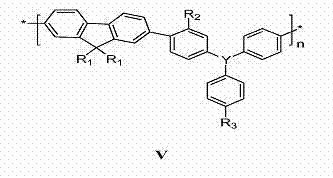
其中 in
Y是N或者P, Y is N or P,
R1和R2各自独立的选自C1-C30烷基,C2-C30烯基,C2-C30炔基,C1-C30芳基,C1-C30烷氧基,C2-C30链烯氧基,C2-C30炔氧基,C1-C30芳氧基(例如诸如苯氧基),C1-C30硫烷基,C2-C30硫烯基,C2-C30硫炔基,C1-C30硫芳基,C(O)OR4,N(R4)(R5),C(O)N(R4)(R5),F,Cl,Br,NO2,CN,酰基,羧化物和羟基,其中R4和R5各自独立的选自氢,C1-C30烷基和C1-C30芳基, R 1 and R 2 are each independently selected from C 1 -C 30 alkyl, C 2 -C 30 alkenyl, C 2 -C 30 alkynyl, C 1 -C 30 aryl, C 1 -C 30 alkoxy , C 2 -C 30 alkenyloxy, C 2 -C 30 alkynyloxy, C 1 -C 30 aryloxy (eg such as phenoxy), C 1 -C 30 sulfanyl, C 2 -C 30 Thienyl, C 2 -C 30 thioalkynyl, C 1 -C 30 thioaryl, C(O)OR 4 , N(R 4 )(R 5 ), C(O)N(R 4 )(R 5 ), F, Cl, Br, NO 2 , CN, acyl, carboxylate and hydroxyl, wherein R 4 and R 5 are each independently selected from hydrogen, C 1 -C 30 alkyl and C 1 -C 30 aryl,
R3选自氢,C1-C30烷基,C2-C30烯基,C2-C30炔基,C1-C30芳基,C1-C30烷氧基,C2-C30链烯氧基,C2-C30炔氧基,C1-C30芳氧基(例如诸如苯氧基),C1-C30硫烷基,C2-C30硫烯基,C2-C30硫炔基,C1-C30硫芳基,C(O)OR4,N(R4)(R5),C(O)N(R4)(R5),F,Cl,Br,NO2,CN,酰基,羧化物和羟基,其中R4和R5各自独立的选自氢,C1-C30烷基和C1-C30芳基,和 R 3 is selected from hydrogen, C 1 -C 30 alkyl, C 2 -C 30 alkenyl, C 2 -C 30 alkynyl, C 1 -C 30 aryl, C 1 -C 30 alkoxy, C 2 - C 30 alkenyloxy, C 2 -C 30 alkynyloxy, C 1 -C 30 aryloxy (eg such as phenoxy), C 1 -C 30 sulfanyl, C 2 -C 30 sulfenyl, C 2 -C 30 thioalkynyl, C 1 -C 30 thioaryl, C(O)OR 4 , N(R 4 )(R 5 ), C(O)N(R 4 )(R 5 ), F , Cl, Br, NO 2 , CN, acyl, carboxylate and hydroxyl, wherein R 4 and R 5 are each independently selected from hydrogen, C 1 -C 30 alkyl and C 1 -C 30 aryl, and
n是选自2-10000的整数;或者具有式: n is an integer selected from 2-10000; or has the formula:

其中 in
Z是C或者Si, Z is C or Si,
R1和R2各自独立的选自C1-C30烷基,C2-C30烯基,C2-C30炔基,C1-C30芳基,C1-C30烷氧基,C2-C30链烯氧基,C2-C30炔氧基,C1-C30芳氧基(例如诸如苯氧基),C1-C30硫烷基,C2-C30硫烯基,C2-C30硫炔基,C1-C30硫芳基,C(O)OR4,N(R4)(R5),C(O)N(R4)(R5),F,Cl,Br,NO2,CN,酰基,羧化物和羟基,其中R4和R5各自独立的选自氢,C1-C30烷基和C1-C30芳基, R 1 and R 2 are each independently selected from C 1 -C 30 alkyl, C 2 -C 30 alkenyl, C 2 -C 30 alkynyl, C 1 -C 30 aryl, C 1 -C 30 alkoxy , C 2 -C 30 alkenyloxy, C 2 -C 30 alkynyloxy, C 1 -C 30 aryloxy (eg such as phenoxy), C 1 -C 30 sulfanyl, C 2 -C 30 Thienyl, C 2 -C 30 thioalkynyl, C 1 -C 30 thioaryl, C(O)OR 4 , N(R 4 )(R 5 ), C(O)N(R 4 )(R 5 ), F, Cl, Br, NO 2 , CN, acyl, carboxylate and hydroxyl, wherein R 4 and R 5 are each independently selected from hydrogen, C 1 -C 30 alkyl and C 1 -C 30 aryl,
R3选自氢,C1-C30烷基,C2-C30烯基,C2-C30炔基,C1-C30芳基,C1-C30烷氧基,C2-C30链烯氧基,C2-C30炔氧基,C1-C30芳氧基(例如诸如苯氧基),C1-C30硫烷基,C2-C30硫烯基,C2-C30硫炔基,C1-C30硫芳基,C(O)OR4,N(R4)(R5),C(O)N(R4)(R5),F,Cl,Br,NO2,CN,酰基,羧化物和羟基,其中R4和R5各自独立的选自氢,C1-C30烷基和C1-C30芳基,和 R 3 is selected from hydrogen, C 1 -C 30 alkyl, C 2 -C 30 alkenyl, C 2 -C 30 alkynyl, C 1 -C 30 aryl, C 1 -C 30 alkoxy, C 2 - C 30 alkenyloxy, C 2 -C 30 alkynyloxy, C 1 -C 30 aryloxy (eg such as phenoxy), C 1 -C 30 sulfanyl, C 2 -C 30 sulfenyl, C 2 -C 30 thioalkynyl, C 1 -C 30 thioaryl, C(O)OR 4 , N(R 4 )(R 5 ), C(O)N(R 4 )(R 5 ), F , Cl, Br, NO 2 , CN, acyl, carboxylate and hydroxyl, wherein R 4 and R 5 are each independently selected from hydrogen, C 1 -C 30 alkyl and C 1 -C 30 aryl, and
n是选自2-10000的整数;或者具有式: n is an integer selected from 2-10000; or has the formula:
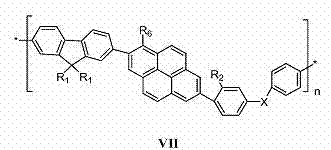
其中 in
X是O,S,Te或者Se, X is O, S, Te or Se,
R1,R2和R6各自独立的选自C1-C30烷基,C2-C30烯基,C2-C30炔基,C1-C30芳基,C1-C30烷氧基,C2-C30链烯氧基,C2-C30炔氧基,C1-C30芳氧基(例如诸如苯氧基),C1-C30硫烷基,C2-C30硫烯基,C2-C30硫炔基,C1-C30硫芳基,C(O)OR4,N(R4)(R5),C(O)N(R4)(R5),F,Cl,Br,NO2,CN,酰基,羧化物和羟基,其中R4和R5各自独立的选自氢,C1-C30烷基和C1-C30芳基,和 R 1 , R 2 and R 6 are each independently selected from C 1 -C 30 alkyl, C 2 -C 30 alkenyl, C 2 -C 30 alkynyl, C 1 -C 30 aryl, C 1 -C 30 Alkoxy, C 2 -C 30 alkenyloxy, C 2 -C 30 alkynyloxy, C 1 -C 30 aryloxy (eg such as phenoxy), C 1 -C 30 sulfanyl, C 2 -C 30 thioalkenyl, C 2 -C 30 thioalkynyl, C 1 -C 30 thioaryl, C(O)OR 4 , N(R 4 )(R 5 ), C(O)N(R 4 )(R 5 ), F, Cl, Br, NO 2 , CN, acyl, carboxylate and hydroxyl, wherein R 4 and R 5 are each independently selected from hydrogen, C 1 -C 30 alkyl and C 1 -C 30 aryl, and
n是选自2-10000的整数;或者具有式: n is an integer selected from 2-10000; or has the formula:

其中 in
Y是N或者P, Y is N or P,
R1,R2和R6各自独立的选自C1-C30烷基,C2-C30烯基,C2-C30炔基,C1-C30芳基,C1-C30烷氧基,C2-C30链烯氧基,C2-C30炔氧基,C1-C30芳氧基(例如诸如苯氧基),C1-C30硫烷基,C2-C30硫烯基,C2-C30硫炔基,C1-C30硫芳基,C(O)OR4,N(R4)(R5),C(O)N(R4)(R5),F,Cl,Br,NO2,CN,酰基,羧化物和羟基,其中R4和R5各自独立的选自氢,C1-C30烷基和C1-C30芳基, R 1 , R 2 and R 6 are each independently selected from C 1 -C 30 alkyl, C 2 -C 30 alkenyl, C 2 -C 30 alkynyl, C 1 -C 30 aryl, C 1 -C 30 Alkoxy, C 2 -C 30 alkenyloxy, C 2 -C 30 alkynyloxy, C 1 -C 30 aryloxy (eg such as phenoxy), C 1 -C 30 sulfanyl, C 2 -C 30 thioalkenyl, C 2 -C 30 thioalkynyl, C 1 -C 30 thioaryl, C(O)OR 4 , N(R 4 )(R 5 ), C(O)N(R 4 )(R 5 ), F, Cl, Br, NO 2 , CN, acyl, carboxylate and hydroxyl, wherein R 4 and R 5 are each independently selected from hydrogen, C 1 -C 30 alkyl and C 1 -C 30 Aryl,
R3选自氢,C1-C30烷基,C2-C30烯基,C2-C30炔基,C1-C30芳基,C1-C30烷氧基,C2-C30链烯氧基,C2-C30炔氧基,C1-C30芳氧基(例如诸如苯氧基),C1-C30硫烷基,C2-C30硫烯基,C2-C30硫炔基,C1-C30硫芳基,C(O)OR4,N(R4)(R5),C(O)N(R4)(R5),F,Cl,Br,NO2,CN,酰基,羧化物和羟基,其中R4和R5各自独立的选自氢,C1-C30烷基和C1-C30芳基,和 R 3 is selected from hydrogen, C 1 -C 30 alkyl, C 2 -C 30 alkenyl, C 2 -C 30 alkynyl, C 1 -C 30 aryl, C 1 -C 30 alkoxy, C 2 - C 30 alkenyloxy, C 2 -C 30 alkynyloxy, C 1 -C 30 aryloxy (eg such as phenoxy), C 1 -C 30 sulfanyl, C 2 -C 30 sulfenyl, C 2 -C 30 thioalkynyl, C 1 -C 30 thioaryl, C(O)OR 4 , N(R 4 )(R 5 ), C(O)N(R 4 )(R 5 ), F , Cl, Br, NO 2 , CN, acyl, carboxylate and hydroxyl, wherein R 4 and R 5 are each independently selected from hydrogen, C 1 -C 30 alkyl and C 1 -C 30 aryl, and
n是选自2-10000的整数;或者具有式: n is an integer selected from 2-10000; or has the formula:
其中 in
Z是C或者Si, Z is C or Si,
R1,R2和R6各自独立的选自C1-C30烷基,C2-C30烯基,C2-C30炔基,C1-C30芳基,C1-C30烷氧基,C2-C30链烯氧基,C2-C30炔氧基,C1-C30芳氧基(例如诸如苯氧基),C1-C30硫烷基,C2-C30硫烯基,C2-C30硫炔基,C1-C30硫芳基,C(O)OR4,N(R4)(R5),C(O)N(R4)(R5),F,Cl,Br,NO2,CN,酰基,羧化物和羟基,其中R4和R5各自独立的选自氢,C1-C30烷基和C1-C30芳基, R 1 , R 2 and R 6 are each independently selected from C 1 -C 30 alkyl, C 2 -C 30 alkenyl, C 2 -C 30 alkynyl, C 1 -C 30 aryl, C 1 -C 30 Alkoxy, C 2 -C 30 alkenyloxy, C 2 -C 30 alkynyloxy, C 1 -C 30 aryloxy (eg such as phenoxy), C 1 -C 30 sulfanyl, C 2 -C 30 thioalkenyl, C 2 -C 30 thioalkynyl, C 1 -C 30 thioaryl, C(O)OR 4 , N(R 4 )(R 5 ), C(O)N(R 4 )(R 5 ), F, Cl, Br, NO 2 , CN, acyl, carboxylate and hydroxyl, wherein R 4 and R 5 are each independently selected from hydrogen, C 1 -C 30 alkyl and C 1 -C 30 Aryl,
R3选自氢,C1-C30烷基,C2-C30烯基,C2-C30炔基,C1-C30芳基,C1-C30烷氧基,C2-C30链烯氧基,C2-C30炔氧基,C1-C30芳氧基(例如诸如苯氧基),C1-C30硫烷基,C2-C30硫烯基,C2-C30硫炔基,C1-C30硫芳基,C(O)OR4,N(R4)(R5),C(O)N(R4)(R5),F,Cl,Br,NO2,CN,酰基,羧化物和羟基,其中R4和R5各自独立的选自氢,C1-C30烷基和C1-C30芳基,和 R 3 is selected from hydrogen, C 1 -C 30 alkyl, C 2 -C 30 alkenyl, C 2 -C 30 alkynyl, C 1 -C 30 aryl, C 1 -C 30 alkoxy, C 2 - C 30 alkenyloxy, C 2 -C 30 alkynyloxy, C 1 -C 30 aryloxy (eg such as phenoxy), C 1 -C 30 sulfanyl, C 2 -C 30 sulfenyl, C 2 -C 30 thioalkynyl, C 1 -C 30 thioaryl, C(O)OR 4 , N(R 4 )(R 5 ), C(O)N(R 4 )(R 5 ), F , Cl, Br, NO 2 , CN, acyl, carboxylate and hydroxyl, wherein R 4 and R 5 are each independently selected from hydrogen, C 1 -C 30 alkyl and C 1 -C 30 aryl, and
n是选自2-10000的整数;或者具有式: n is an integer selected from 2-10000; or has the formula:
其中 in
X是O,S,Te或者Se, X is O, S, Te or Se,
R1,R2,R7,R8和R9各自独立的选自C1-C30烷基,C2-C30烯基,C2-C30炔基,C1-C30芳基,C1-C30烷氧基,C2-C30链烯氧基,C2-C30炔氧基,C1-C30芳氧基(例如诸如苯氧基),C1-C30硫烷基,C2-C30硫烯基,C2-C30硫炔基,C1-C30硫芳基,C(O)OR4,N(R4)(R5),C(O)N(R4)(R5),F,Cl,Br,NO2,CN,酰基,羧化物和羟基,其中R4和R5各自独立的选自氢,C1-C30烷基和C1-C30芳基,和 R 1 , R 2 , R 7 , R 8 and R 9 are each independently selected from C 1 -C 30 alkyl, C 2 -C 30 alkenyl, C 2 -C 30 alkynyl, C 1 -C 30 aryl , C 1 -C 30 alkoxy, C 2 -C 30 alkenyloxy, C 2 -C 30 alkynyloxy, C 1 -C 30 aryloxy (eg such as phenoxy), C 1 -C 30 Sulfanyl, C 2 -C 30 thioalkenyl, C 2 -C 30 thioalkynyl, C 1 -C 30 thioaryl, C(O)OR 4 , N(R 4 )(R 5 ), C( O) N(R 4 )(R 5 ), F, Cl, Br, NO 2 , CN, acyl, carboxylate and hydroxyl, wherein R 4 and R 5 are each independently selected from hydrogen, C 1 -C 30 alkyl and C 1 -C 30 aryl, and
n是选自2-10000的整数; n is an integer selected from 2-10000;
或者具有式: or with the formula:

其中 in
Y是N或者P, Y is N or P,
R1,R2,R7,R8和R9各自独立的选自C1-C30烷基,C2-C30烯基,C2-C30炔基,C1-C30芳基,C1-C30烷氧基,C2-C30链烯氧基,C2-C30炔氧基,C1-C30芳氧基(例如诸如苯氧基),C1-C30硫烷基,C2-C30硫烯基,C2-C30硫炔基,C1-C30硫芳基,C(O)OR4,N(R4)(R5),C(O)N(R4)(R5),F,Cl,Br,NO2,CN,酰基,羧化物和羟基,其中R4和R5各自独立的选自氢,C1-C30烷基和C1-C30芳基, R 1 , R 2 , R 7 , R 8 and R 9 are each independently selected from C 1 -C 30 alkyl, C 2 -C 30 alkenyl, C 2 -C 30 alkynyl, C 1 -C 30 aryl , C 1 -C 30 alkoxy, C 2 -C 30 alkenyloxy, C 2 -C 30 alkynyloxy, C 1 -C 30 aryloxy (eg such as phenoxy), C 1 -C 30 Sulfanyl, C 2 -C 30 thioalkenyl, C 2 -C 30 thioalkynyl, C 1 -C 30 thioaryl, C(O)OR 4 , N(R 4 )(R 5 ), C( O) N(R 4 )(R 5 ), F, Cl, Br, NO 2 , CN, acyl, carboxylate and hydroxyl, wherein R 4 and R 5 are each independently selected from hydrogen, C 1 -C 30 alkyl and C 1 -C 30 aryl,
R3选自氢,C1-C30烷基,C2-C30烯基,C2-C30炔基,C1-C30芳基,C1-C30烷氧基,C2-C30链烯氧基,C2-C30炔氧基,C1-C30芳氧基(例如诸如苯氧基),C1-C30硫烷基,C2-C30硫烯基,C2-C30硫炔基,C1-C30硫芳基,C(O)OR4,N(R4)(R5),C(O)N(R4)(R5),F,Cl,Br,NO2,CN,酰基,羧化物和羟基,其中R4和R5各自独立的选自氢,C1-C30烷基和C1-C30芳基,和 R 3 is selected from hydrogen, C 1 -C 30 alkyl, C 2 -C 30 alkenyl, C 2 -C 30 alkynyl, C 1 -C 30 aryl, C 1 -C 30 alkoxy, C 2 - C 30 alkenyloxy, C 2 -C 30 alkynyloxy, C 1 -C 30 aryloxy (eg such as phenoxy), C 1 -C 30 sulfanyl, C 2 -C 30 sulfenyl, C 2 -C 30 thioalkynyl, C 1 -C 30 thioaryl, C(O)OR 4 , N(R 4 )(R 5 ), C(O)N(R 4 )(R 5 ), F , Cl, Br, NO 2 , CN, acyl, carboxylate and hydroxyl, wherein R 4 and R 5 are each independently selected from hydrogen, C 1 -C 30 alkyl and C 1 -C 30 aryl, and
n是选自2-10000的整数; n is an integer selected from 2-10000;
或者具有式: or with the formula:

其中 in
Z是C或者Si, Z is C or Si,
R1,R2,R7,R8和R9各自独立的选自C1-C30烷基,C2-C30烯基,C2-C30炔基,C1-C30芳基,C1-C30烷氧基,C2-C30链烯氧基,C2-C30炔氧基,C1-C30芳氧基(例如诸如苯氧基),C1-C30硫烷基,C2-C30硫烯基,C2-C30硫炔基,C1-C30硫芳基,C(O)OR4,N(R4)(R5),C(O)N(R4)(R5),F,Cl,Br,NO2,CN,酰基,羧化物和羟基,其中R4和R5各自独立的选自氢,C1-C30烷基和C1-C30芳基, R 1 , R 2 , R 7 , R 8 and R 9 are each independently selected from C 1 -C 30 alkyl, C 2 -C 30 alkenyl, C 2 -C 30 alkynyl, C 1 -C 30 aryl , C 1 -C 30 alkoxy, C 2 -C 30 alkenyloxy, C 2 -C 30 alkynyloxy, C 1 -C 30 aryloxy (eg such as phenoxy), C 1 -C 30 Sulfanyl, C 2 -C 30 thioalkenyl, C 2 -C 30 thioalkynyl, C 1 -C 30 thioaryl, C(O)OR 4 , N(R 4 )(R 5 ), C( O) N(R 4 )(R 5 ), F, Cl, Br, NO 2 , CN, acyl, carboxylate and hydroxyl, wherein R 4 and R 5 are each independently selected from hydrogen, C 1 -C 30 alkyl and C 1 -C 30 aryl,
R3选自氢,C1-C30烷基,C2-C30烯基,C2-C30炔基,C1-C30芳基,C1-C30烷氧基,C2-C30链烯氧基,C2-C30炔氧基,C1-C30芳氧基(例如诸如苯氧基),C1-C30硫烷基,C2-C30硫烯基,C2-C30硫炔基,C1-C30硫芳基,C(O)OR4,N(R4)(R5),C(O)N(R4)(R5),F,Cl,Br,NO2,CN,酰基,羧化物和羟基,其中R4和R5各自独立的选自氢,C1-C30烷基和C1-C30芳基,和 R 3 is selected from hydrogen, C 1 -C 30 alkyl, C 2 -C 30 alkenyl, C 2 -C 30 alkynyl, C 1 -C 30 aryl, C 1 -C 30 alkoxy, C 2 - C 30 alkenyloxy, C 2 -C 30 alkynyloxy, C 1 -C 30 aryloxy (eg such as phenoxy), C 1 -C 30 sulfanyl, C 2 -C 30 sulfenyl, C 2 -C 30 thioalkynyl, C 1 -C 30 thioaryl, C(O)OR 4 , N(R 4 )(R 5 ), C(O)N(R 4 )(R 5 ), F , Cl, Br, NO 2 , CN, acyl, carboxylate and hydroxyl, wherein R 4 and R 5 are each independently selected from hydrogen, C 1 -C 30 alkyl and C 1 -C 30 aryl, and
n是选自2-10000的整数; n is an integer selected from 2-10000;
或者具有式: or with the formula:

其中 in
X是O,S,Te或者Se, X is O, S, Te or Se,
R1,R2,R10和R11各自独立的选自C1-C30烷基,C2-C30烯基,C2-C30炔基,C1-C30芳基,C1-C30烷氧基,C2-C30链烯氧基,C2-C30炔氧基,C1-C30芳氧基(例如诸如苯氧基),C1-C30硫烷基,C2-C30硫烯基,C2-C30硫炔基,C1-C30硫芳基,C(O)OR4,N(R4)(R5),C(O)N(R4)(R5),F,Cl,Br,NO2,CN,酰基,羧化物和羟基,其中R4和R5各自独立的选自氢,C1-C30烷基和C1-C30芳基,和 R 1 , R 2 , R 10 and R 11 are each independently selected from C 1 -C 30 alkyl, C 2 -C 30 alkenyl, C 2 -C 30 alkynyl, C 1 -C 30 aryl, C 1 -C 30 alkoxy, C 2 -C 30 alkenyloxy, C 2 -C 30 alkynyloxy, C 1 -C 30 aryloxy (eg such as phenoxy), C 1 -C 30 sulfanyl , C 2 -C 30 thioalkenyl, C 2 -C 30 thioalkynyl, C 1 -C 30 thioaryl, C(O)OR 4 , N(R 4 )(R 5 ), C(O)N (R 4 )(R 5 ), F, Cl, Br, NO 2 , CN, acyl, carboxylate and hydroxyl, wherein R 4 and R 5 are each independently selected from hydrogen, C 1 -C 30 alkyl and C 1 -C 30 aryl, and
n是选自2-10000的整数; n is an integer selected from 2-10000;
或者具有式: or with the formula:

其中 in
Y是N或者P, Y is N or P,
R1,R2,R10和R11各自独立的选自C1-C30烷基,C2-C30烯基,C2-C30炔基,C1-C30芳基,C1-C30烷氧基,C2-C30链烯氧基,C2-C30炔氧基,C1-C30芳氧基(例如诸如苯氧基),C1-C30硫烷基,C2-C30硫烯基,C2-C30硫炔基,C1-C30硫芳基,C(O)OR4,N(R4)(R5),C(O)N(R4)(R5),F,Cl,Br,NO2,CN,酰基,羧化物和羟基,其中R4和R5各自独立的选自氢,C1-C30烷基和C1-C30芳基, R 1 , R 2 , R 10 and R 11 are each independently selected from C 1 -C 30 alkyl, C 2 -C 30 alkenyl, C 2 -C 30 alkynyl, C 1 -C 30 aryl, C 1 -C 30 alkoxy, C 2 -C 30 alkenyloxy, C 2 -C 30 alkynyloxy, C 1 -C 30 aryloxy (eg such as phenoxy), C 1 -C 30 sulfanyl , C 2 -C 30 thioalkenyl, C 2 -C 30 thioalkynyl, C 1 -C 30 thioaryl, C(O)OR 4 , N(R 4 )(R 5 ), C(O)N (R 4 )(R 5 ), F, Cl, Br, NO 2 , CN, acyl, carboxylate and hydroxyl, wherein R 4 and R 5 are each independently selected from hydrogen, C 1 -C 30 alkyl and C 1 -C 30 aryl,
R3选自氢,C1-C30烷基,C2-C30烯基,C2-C30炔基,C1-C30芳基,C1-C30烷氧基,C2-C30链烯氧基,C2-C30炔氧基,C1-C30芳氧基(例如诸如苯氧基),C1-C30硫烷基,C2-C30硫烯基,C2-C30硫炔基,C1-C30硫芳基,C(O)OR4,N(R4)(R5),C(O)N(R4)(R5),F,Cl,Br,NO2,CN,酰基,羧化物和羟基,其中R4和R5各自独立的选自氢,C1-C30烷基和C1-C30芳基,和 R 3 is selected from hydrogen, C 1 -C 30 alkyl, C 2 -C 30 alkenyl, C 2 -C 30 alkynyl, C 1 -C 30 aryl, C 1 -C 30 alkoxy, C 2 - C 30 alkenyloxy, C 2 -C 30 alkynyloxy, C 1 -C 30 aryloxy (eg such as phenoxy), C 1 -C 30 sulfanyl, C 2 -C 30 sulfenyl, C 2 -C 30 thioalkynyl, C 1 -C 30 thioaryl, C(O)OR 4 , N(R 4 )(R 5 ), C(O)N(R 4 )(R 5 ), F , Cl, Br, NO 2 , CN, acyl, carboxylate and hydroxyl, wherein R 4 and R 5 are each independently selected from hydrogen, C 1 -C 30 alkyl and C 1 -C 30 aryl, and
n是选自2-10000的整数; n is an integer selected from 2-10000;
或者具有式: or with the formula:
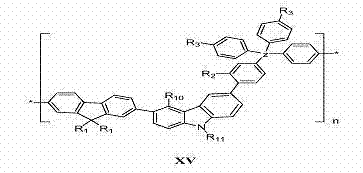
其中 in
Z是C或者Si, Z is C or Si,
R1,R2,R10和R11各自独立的选自C1-C30烷基,C2-C30烯基,C2-C30炔基,C1-C30芳基,C1-C30烷氧基,C2-C30链烯氧基,C2-C30炔氧基,C1-C30芳氧基(例如诸如苯氧基),C1-C30硫烷基,C2-C30硫烯基,C2-C30硫炔基,C1-C30硫芳基,C(O)OR4,N(R4)(R5),C(O)N(R4)(R5),F,Cl,Br,NO2,CN,酰基,羧化物和羟基,其中R4和R5各自独立的选自氢,C1-C30烷基和C1-C30芳基, R 1 , R 2 , R 10 and R 11 are each independently selected from C 1 -C 30 alkyl, C 2 -C 30 alkenyl, C 2 -C 30 alkynyl, C 1 -C 30 aryl, C 1 -C 30 alkoxy, C 2 -C 30 alkenyloxy, C 2 -C 30 alkynyloxy, C 1 -C 30 aryloxy (eg such as phenoxy), C 1 -C 30 sulfanyl , C 2 -C 30 thioalkenyl, C 2 -C 30 thioalkynyl, C 1 -C 30 thioaryl, C(O)OR 4 , N(R 4 )(R 5 ), C(O)N (R 4 )(R 5 ), F, Cl, Br, NO 2 , CN, acyl, carboxylate and hydroxyl, wherein R 4 and R 5 are each independently selected from hydrogen, C 1 -C 30 alkyl and C 1 -C 30 aryl,
R3选自氢,C1-C30烷基,C2-C30烯基,C2-C30炔基,C1-C30芳基,C1-C30烷氧基,C2-C30链烯氧基,C2-C30炔氧基,C1-C30芳氧基(例如诸如苯氧基),C1-C30硫烷基,C2-C30硫烯基,C2-C30硫炔基,C1-C30硫芳基,C(O)OR4,N(R4)(R5),C(O)N(R4)(R5),F,Cl,Br,NO2,CN,酰基,羧化物和羟基,其中R4和R5各自独立的选自氢,C1-C30烷基和C1-C30芳基,和 R 3 is selected from hydrogen, C 1 -C 30 alkyl, C 2 -C 30 alkenyl, C 2 -C 30 alkynyl, C 1 -C 30 aryl, C 1 -C 30 alkoxy, C 2 - C 30 alkenyloxy, C 2 -C 30 alkynyloxy, C 1 -C 30 aryloxy (eg such as phenoxy), C 1 -C 30 sulfanyl, C 2 -C 30 sulfenyl, C 2 -C 30 thioalkynyl, C 1 -C 30 thioaryl, C(O)OR 4 , N(R 4 )(R 5 ), C(O)N(R 4 )(R 5 ), F , Cl, Br, NO 2 , CN, acyl, carboxylate and hydroxyl, wherein R 4 and R 5 are each independently selected from hydrogen, C 1 -C 30 alkyl and C 1 -C 30 aryl, and
n是选自2-10000的整数。 n is an integer selected from 2-10000.
在一些实施方案中,任何一个上式中的n是下面的整数:2-大约10000,或者2-大约8000,或者2-大约6000,或者2-大约4000,或者2-大约2000,或者10-大约10000,或者10-大约8000,或者10-大约6000,或者10-大约4000,或者10-大约2000,或者50-大约10,000,或者50-大约8000,或者50-大约6000,或者50-大约4000,或者50-大约2000,或者100-大约10000,或者100-大约8000,或者100-大约6000,或者100-大约4000,或者100-大约2000,或者200-大约10000,或者200-大约8000,或者200-大约6000,或者200-大约4000,或者200-大约2000,或者500-大约10000,或者500-大约8000,或者500-大约6000,或者500-大约4000,或者500-大约2000,或者1000-大约10000,或者1000-大约8000,或者1000-大约6000,或者1000-大约4000,或者1000-大约2000,或者2000-大约10000,或者2000-大约8000,或者2000-大约6000,或者2000-大约4000,或者2000-大约3000,或者5000-大约10000,或者5000-大约8000,或者5000-大约6000等等。 In some embodiments, n in any of the above formulas is an integer of 2-about 10000, or 2-about 8000, or 2-about 6000, or 2-about 4000, or 2-about 2000, or 10- About 10,000, or 10-about 8,000, or 10-about 6,000, or 10-about 4,000, or 10-about 2,000, or 50-about 10,000, or 50-about 8,000, or 50-about 6,000, or 50- About 4,000, or 50-about 2,000, or 100-about 10,000, or 100-about 8,000, or 100-about 6,000, or 100-about 4,000, or 100-about 2,000, or 200-about 10,000, or 200-about 8,000 , or 200-about 6,000, or 200-about 4,000, or 200-about 2,000, or 500-about 10,000, or 500-about 8,000, or 500-about 6,000, or 500-about 4,000, or 500-about 2,000, or 1000-about 10000, or 1000-about 8000, or 1000-about 6000, or 1000-about 4000, or 1000-about 2000, or 2000-about 10000, or 2000-about 8000, or 2000-about 6000, or 2000- About 4,000, or 2,000-about 3,000, or 5,000-about 10,000, or 5,000-about 8,000, or 5,000-about 6,000, etc.
在一些实施方案中,在任何一个上式中,上述的R1,R2,R3,R4,R5,R6,R7,R8,R9,R10和R11,或者下面的R12,R13,R14,R15,R16,R17,R18,R19和R20任何一个中的碳原子数可以独立的是C1-C30,C1-C25,C1-C20,C1-C15,C1-C10,C1-C5,C2-C30,C2-C25,C2-C20,C2-C15,C2-C10,C2-C5,C3-C30,C3-C25,C3-C20,C3-C15,C3-C10,C4-C30,C4-C25,C4-C20,C4-C15,C4-C10,C5-C30,C5-C25,C5-C20,C5-C15,C5-C10,C10-C30,C10-C25,C10-C20,C10-C15,C15-C30,C15-C25,C15-C20,C20-C30,C20-C25等等。 In some embodiments, in any one of the above formulas, R 1 , R 2 , R 3 , R 4 , R 5 , R 6 , R 7 , R 8 , R 9 , R 10 and R 11 above, or the following The number of carbon atoms in any one of R 12 , R 13 , R 14 , R 15 , R 16 , R 17 , R 18 , R 19 and R 20 can be independently C 1 -C 30 , C 1 -C 25 , C 1 -C 20 , C 1 -C 15 , C 1 -C 10 , C 1 -C 5 , C 2 -C 30 , C 2 -C 25 , C 2 -C 20 , C 2 -C 15 , C 2 -C 10 , C 2 -C 5 , C 3 -C 30 , C 3 -C 25 , C 3 -C 20 , C 3 -C 15 , C 3 -C 10 , C 4 -C 30 , C 4 -C 25 , C 4 -C 20 , C 4 -C 15 , C 4 -C 10 , C 5 -C 30 , C 5 -C 25 , C 5 -C 20 , C 5 -C 15 , C 5 -C 10 , C 10 -C 30 , C 10 -C 25 , C 10 -C 20 , C 10 -C 15 , C 15 -C 30 , C 15 -C 25 , C 15 -C 20 , C 20 -C 30 , C 20 -C 25 and so on.
制备根据本发明实施方案的芴基共聚物Preparation of Fluorene-Based Copolymers According to Embodiments of the Invention
该芴基共聚物是根据常规聚合物化学,使用适当的单体单元来生产上述共聚物而合成的。聚合技术包括例如过渡金属催化偶合或者缩合(逐步反应)聚合等等。 The fluorene-based copolymers are synthesized according to conventional polymer chemistry, using appropriate monomer units to produce the copolymers described above. Polymerization techniques include, for example, transition metal catalyzed coupling or condensation (stepwise reaction) polymerization, among others.
在一些实施方案中,为了形成本发明实施方案的共聚物,使用缩聚。在两个或者更多个多官能分子之间进行缩合,来生产更大官能度的分子和最终的共聚物。该反应持续直到一种反应物完全消耗。建立了平衡,该平衡可以通过控制下面的因素来移动:反应物和产物的量以及温度,单体比例,溶剂类型,不同的过渡金属催化剂的性质等等。 In some embodiments, to form the copolymers of embodiments of the present invention, polycondensation is used. Condensation between two or more multifunctional molecules produces larger functional molecules and final copolymers. The reaction continues until one reactant is completely consumed. An equilibrium is established that can be shifted by controlling the amounts of reactants and products as well as temperature, monomer ratios, solvent types, properties of different transition metal catalysts, and the like.
聚合条件例如温度,反应介质,pH,持续时间,反应物加入次序等等取决于所用的聚合类型,单体反应物(包括所用的任何官能团)的性质,所用的任何催化剂的性质等等。这样的条件通常是已知的,因为能够使用的聚合技术的类型是本领域已知的。 Polymerization conditions such as temperature, reaction medium, pH, duration, order of addition of reactants, etc. will depend on the type of polymerization employed, the nature of the monomeric reactants (including any functional groups employed), the nature of any catalyst employed, etc. Such conditions are generally known, as the types of polymerization techniques that can be used are known in the art.
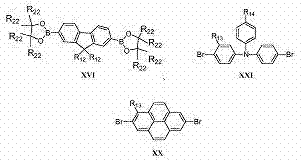
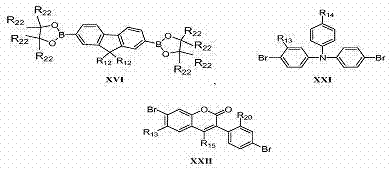
作为示例而非限制,下面的是用于制备本发明实施方案的共聚物的官能化单体的列表;所示单体在用于单体连接来形成聚合物链的位置上具有官能团,作为示例而非限制: By way of illustration and not limitation, the following is a list of functionalized monomers used to prepare the copolymers of embodiments of the present invention; Instead of limiting:

其中: in:
R12,R13,R15和R18各自独立的选自C1-C30烷基,C2-C30烯基,C2-C30炔基,C1-C30芳基,C1-C30烷氧基,C2-C30链烯氧基,C2-C30炔氧基,C1-C30芳氧基(例如诸如苯氧基),C1-C30硫烷基,C2-C30硫烯基,C2-C30硫炔基,C1-C30硫芳基,C(O)OR4,N(R4)(R5),C(O)N(R4)(R5),F,Cl,Br,NO2,CN,酰基,羧化物和羟基,其中R4和R5各自独立的选自氢,C1-C30烷基和C1-C30芳基, R 12 , R 13 , R 15 and R 18 are each independently selected from C 1 -C 30 alkyl, C 2 -C 30 alkenyl, C 2 -C 30 alkynyl, C 1 -C 30 aryl, C 1 -C 30 alkoxy, C 2 -C 30 alkenyloxy, C 2 -C 30 alkynyloxy, C 1 -C 30 aryloxy (eg such as phenoxy), C 1 -C 30 sulfanyl , C 2 -C 30 thioalkenyl, C 2 -C 30 thioalkynyl, C 1 -C 30 thioaryl, C(O)OR 4 , N(R 4 )(R 5 ), C(O)N (R 4 )(R 5 ), F, Cl, Br, NO 2 , CN, acyl, carboxylate and hydroxyl, wherein R 4 and R 5 are each independently selected from hydrogen, C 1 -C 30 alkyl and C 1 -C 30 aryl,
R14,R16,R17,R19和R20各自独立的选自氢,C1-C30烷基,C2-C30烯基,C2-C30炔基,C1-C30芳基,C1-C30烷氧基,C2-C30链烯氧基,C2-C30炔氧基,C1-C30芳氧基(例如诸如苯氧基),C1-C30硫烷基,C2-C30硫烯基,C2-C30硫炔基,C1-C30硫芳基,C(O)OR4,N(R4)(R5),C(O)N(R4)(R5),F,Cl,Br,NO2,CN,酰基,羧化物和羟基,其中R4和R5各自独立的选自氢,C1-C30烷基和C1-C30芳基,和 R 14 , R 16 , R 17 , R 19 and R 20 are each independently selected from hydrogen, C 1 -C 30 alkyl, C 2 -C 30 alkenyl, C 2 -C 30 alkynyl, C 1 -C 30 Aryl, C 1 -C 30 alkoxy, C 2 -C 30 alkenyloxy, C 2 -C 30 alkynyloxy, C 1 -C 30 aryloxy (eg such as phenoxy), C 1 - C 30 sulfanyl, C 2 -C 30 thioalkenyl, C 2 -C 30 thioalkynyl, C 1 -C 30 thioaryl, C(O)OR 4 , N(R 4 )(R 5 ), C(O)N(R 4 )(R 5 ), F, Cl, Br, NO 2 , CN, acyl, carboxylate and hydroxyl, wherein R 4 and R 5 are each independently selected from hydrogen, C 1 -C 30 Alkyl and C 1 -C 30 aryl, and
R22独立的选自氢,C1-C30烷基;在一些实施方案中,R22独立的选自低级烷基。 R 22 is independently selected from hydrogen, C 1 -C 30 alkyl; in some embodiments, R 22 is independently selected from lower alkyl.
在一个例子中,作为示例而非限制,根据聚合物IV类型的聚合物(其中X =O)可以由下面的单体单元形成,其中XVI中的R22每个是甲基: In one example, by way of illustration and not limitation, a polymer according to Polymer IV type (where X=0) can be formed from the following monomer units, wherein R in XVI are each methyl :

在另外一个例子中,作为示例而非限制,根据聚合物类型V的聚合物(其中Y = N)可以由下面的单体单元形成,其中XVI中的R22每个是甲基: In another example, by way of illustration and not limitation, a polymer according to polymer type V (where Y=N) can be formed from the following monomer units, wherein R in XVI are each methyl :

在另外一个例子中,作为示例而非限制,根据聚合物类型VI的聚合物(其中Z = C和R16每个是苯基)可以由下面的单体单元形成,其中XVI中的R22每个是甲基: In another example, by way of illustration and not limitation, a polymer according to polymer type VI (wherein Z = C and R 16 is each phenyl) may be formed from the following monomer units, wherein R 22 in XVI is each one is methyl:

在另外一个例子中,作为示例而非限制,根据聚合物类型VII的聚合物(X = S)可以由下面的单体单元形成,其中XVI中的R22每个是甲基: In another example, by way of illustration and not limitation, a polymer according to polymer type VII (X=S) can be formed from the following monomer units, wherein R in XVI are each methyl :

在另外一个例子中,作为示例而非限制,根据聚合物类型VIII的聚合物(其中Y = N)可以由下面的单体单元形成,其中XVI中的R22每个是甲基: In another example, by way of illustration and not limitation, polymers according to polymer type VIII (where Y=N) can be formed from the following monomer units, wherein R in XVI are each methyl :
在另外一个例子中,作为示例而非限制,根据聚合物类型IX的聚合物(其中Z = Si和R17每个是苯基)可以由下面的单体单元形成,其中XVI中的R22每个是甲基: In another example, by way of illustration and not limitation, a polymer according to polymer type IX (where Z = Si and R 17 is each phenyl) may be formed from the following monomer units, where R 22 in XVI is each one is methyl:
在另外一个例子中,作为示例而非限制,根据聚合物类型X的聚合物(其中X = O)可以由下面的单体单元形成,其中XVI中的R22每个是甲基: In another example, by way of illustration and not limitation, a polymer according to polymer type X (where X = 0) can be formed from the following monomer units, wherein R in XVI are each methyl :

在另外一个例子中,作为示例而非限制,根据聚合物类型XI的聚合物(其中Y = N)可以由下面的单体单元形成,其中XVI中R22每个是甲基: In another example, by way of illustration and not limitation, a polymer according to polymer type XI (where Y=N) can be formed from the following monomer units, wherein R in XVI are each methyl:
在另外一个例子中,作为示例而非限制,根据聚合物类型XII的聚合物(其中Z = Si和R17每个是苯基)可以由下面的单体单元形成,其中XVI中的R22每个是甲基: In another example, by way of illustration and not limitation, a polymer according to polymer type XII (where Z = Si and R 17 is each phenyl) can be formed from the following monomer units, where R 22 in XVI is each one is methyl:

在另外一个例子中,作为示例而非限制,根据聚合物类型XIII的聚合物(其中X = S)可以由下面的单体单元形成,其中XVI中的R22每个是甲基: In another example, by way of illustration and not limitation, a polymer according to polymer type XIII (where X=S) can be formed from the following monomer units, wherein R in XVI are each methyl :

在另外一个例子中,作为示例而非限制,根据聚合物类型XIV的聚合物(其中Y = N)可以由下面的单体单元形成,其中XVI中的R22每个是甲基: In another example, by way of illustration and not limitation, a polymer according to polymer type XIV (where Y=N) can be formed from the following monomer units, wherein R in XVI are each methyl :
在另外一个例子中,作为示例而非限制,根据聚合物类型XV的聚合物(其中Z = Si和R17每个是苯基)可以由下面的单体单元形成,其中XVI中的R22每个是甲基: In another example, by way of illustration and not limitation, a polymer according to polymer type XV (wherein Z=Si and R 17 is each phenyl) may be formed from the following monomer units, wherein R 22 in XVI is each one is methyl:

使用该芴基共聚物的具体实施方案Specific embodiments using the fluorene-based copolymer
本发明的芴基共聚物可以用来提供局部和均匀的UV能量,用于基于从该共聚物转移到量子点的能量的发射显示器应用。本发明的材料具有大的能带间隙,并且是稳定的UV发射化学品。术语“大的能带间隙”表示这样的共聚物的最高被占用分子轨道(HOMO)和最低被占用分子轨道(LUMO)之间的能量差异是足够大的,以使得它们仅仅发射UV或者深蓝光。本发明芴基共聚物实施方案作为纳米尺寸UV能量源用于发光装置中,并且可以用作例如发光二极管例如OLED、PLED和混合LED中的发射材料或者层,其可以用于显示器装置中。 The fluorene-based copolymers of the present invention can be used to provide localized and uniform UV energy for emissive display applications based on energy transfer from the copolymers to quantum dots. The materials of the present invention have large energy band gaps and are stable UV emitting chemicals. The term "large bandgap" indicates that the energy difference between the highest occupied molecular orbital (HOMO) and the lowest occupied molecular orbital (LUMO) of such copolymers is large enough that they only emit UV or deep blue light . Fluorene-based copolymer embodiments of the present invention are useful in light-emitting devices as nanoscale UV energy sources, and can be used, for example, as emissive materials or layers in light-emitting diodes such as OLEDs, PLEDs, and hybrid LEDs, which can be used in display devices.
碱性有机发光二极管的结构包含至少三层,即,两个电极层和位于这两个电极层之间的有机光发射层。这两个电极连接到电源上。在这种实施方案中,与电源负极相连的电极(阴极)充当了电子注射层(EIL),其在施加电压时将电子注射到光发射层中。与电源正极相连的电极(阳极)充当了空穴注射层(HIL),其在施加电压时将空穴注射到光发射层中。当该电子和空穴在有机发光层(EML)中相遇时,它们沿着能量间隙(EML聚合物的LUMO和HOMO水平之间的能量差异)重新结合。由该电子和空穴重新结合而释放出的能量是光的形式,并且颜色取决于能量间隙的值。在一些实施方案中,该装置是多层装置,其具有外聚合物层例如诸如聚噻吩化学,例如聚(3,4-亚乙基二氧噻吩)或者PEDOT等,Dupont缓冲剂等等,该层还充当了HIL。 The structure of a basic organic light-emitting diode comprises at least three layers, namely two electrode layers and an organic light-emitting layer located between these two electrode layers. These two electrodes are connected to a power source. In this embodiment, the electrode (cathode) connected to the negative pole of the power supply acts as an electron injection layer (EIL), which injects electrons into the light emitting layer upon application of a voltage. The electrode (anode) connected to the positive pole of the power supply acts as a hole injection layer (HIL), which injects holes into the light emitting layer when a voltage is applied. When this electron and hole meet in the organic light-emitting layer (EML), they recombine along the energy gap (the difference in energy between the LUMO and HOMO levels of the EML polymer). The energy released by the recombination of the electrons and holes is in the form of light, and the color depends on the value of the energy gap. In some embodiments, the device is a multilayer device having an outer polymer layer such as, for example, polythiophene chemistries, such as poly(3,4-ethylenedioxythiophene) or PEDOT, etc., Dupont buffer, etc., which Layers also act as the HIL.
除了上述的碱性结构之外,电子传输层(ETL)可以加入到EIL和EML之间,空穴传输层(HTL)可以加入到HIL和EML之间。在其中使用它们的实施方案中,ETL和HTL提供了分别在EIL、HIL和EML之间更好的能带排列,这将提高电子和空穴分别从EIL和HIL到EML中的传输。此外,在一些实施方案中,电子阻挡层(EBL)可以加入到HIL和EML之间。在一些实施方案中,空穴阻挡层(HBL)可以加入到EIL和EML之间。EBL和HBL的作用是分别阻挡逸出的电子和空穴(它们没有彼此重新结合)。如果存在EBL和HBL二者,则逸出的电子和空穴会被限制到EML中,而没有泄漏通过和被各自的电极收集(这将产生浪费的功率消耗和降低发光效率)。当逸出的电子和空穴由于EBL和HBL的存在而被限制到EML中时,对于该电子和空穴来说这里有进一步重新结合和发光的机会,并且因此提高了发射效率。类似的,如果使用HTL和ETL,EBL和HBL可以分别插入到HTL、ETL和EML之间。可选择的,通过正确的选择材料和/或合成,HTL和ETL还分别能够充当EBL和HBL。 In addition to the above-mentioned basic structure, an electron transport layer (ETL) can be added between the EIL and the EML, and a hole transport layer (HTL) can be added between the HIL and the EML. In the embodiment where they are used, ETL and HTL provide better band alignment between EIL, HIL and EML respectively, which will enhance the transport of electrons and holes from EIL and HIL respectively into EML. Additionally, in some embodiments, an electron blocking layer (EBL) may be added between the HIL and the EML. In some embodiments, a hole blocking layer (HBL) can be added between the EIL and the EML. The role of the EBL and HBL is to block escaped electrons and holes (which do not recombine with each other), respectively. If both EBL and HBL are present, the escaped electrons and holes will be confined into the EML without leakage through and collected by the respective electrodes (which would result in wasteful power consumption and reduced luminous efficiency). When the escaped electrons and holes are confined in the EML due to the presence of the EBL and HBL, there is a chance for the electrons and holes to further recombine and emit light, and thus increase the emission efficiency. Similarly, if HTL and ETL are used, EBL and HBL can be inserted between HTL, ETL and EML, respectively. Alternatively, by proper choice of materials and/or synthesis, HTL and ETL can also act as EBL and HBL, respectively.
作为此处使用的,术语“位于…之间”和“布置在…之间”表示有机光发射层直接处于两个电极层之间或者间接处于两个电极层之间,这里一个或多个上述的插入层处于有机光发射层与一个或者两个电极层之间。 As used herein, the terms "located between" and "arranged between" mean that the organic light-emitting layer is directly between two electrode layers or indirectly between two electrode layers, where one or more of the above-mentioned The insertion layer is between the organic light emitting layer and one or two electrode layers.
本发明实施方案的芴基共聚物可以用作位于上述装置的两个电极层之间的有机光发射层。本发明的共聚物可以通过本领域已知的技术来位于或者布置于两个电极层之间。作为示例而非限制,这样的技术包括(a)在一个电极内表面上的气相沉积方法,包括例如真空气相沉积等等;和(b)在一个电极内表面等上的施涂方法,其包括例如旋涂,狭缝涂覆,印刷,喷墨沉积,分配,喷涂等。另外,本发明的装置可以如下来制作:将第一电极、本发明的芴基共聚物膜和第二电极依次层合到载体上。其他层可以合适的包括在该层合方法中。 The fluorene-based copolymer of an embodiment of the present invention may be used as an organic light-emitting layer between two electrode layers of the above device. The copolymers of the present invention may be positioned or disposed between two electrode layers by techniques known in the art. By way of example and not limitation, such techniques include (a) vapor deposition methods on the inner surface of an electrode, including, for example, vacuum vapor deposition, etc.; and (b) application methods on the inner surface of an electrode, etc., including Such as spin coating, slot coating, printing, inkjet deposition, dispensing, spraying, etc. In addition, the device of the present invention can be produced by sequentially laminating the first electrode, the fluorene-based copolymer film of the present invention, and the second electrode on a carrier. Other layers may be suitably included in the lamination process.
该有机光发射层的厚度是大约1-大约500nm,或者大约1-大约400nm,或者大约5-大约500nm,或者大约5-大约400nm,或者大约5-大约300nm,或者大约5-大约200nm,或者大约5-大约100nm,或者大约10-大约500nm,或者大约10-大约400nm,或者大约10-大约300nm,或者大约10-大约200nm,或者大约10-大约100nm,或者大约20-大约500nm,或者大约20-大约400nm,或者大约20-大约300nm,或者大约20-大约200nm,或者大约20-大约100nm,或者大约30-大约500nm,或者大约30-大约400nm,或者大约30-大约300nm,或者大约30-大约200nm,或者大约30-大约100nm,或者大约25-大约250nm等等。 The thickness of the organic light emitting layer is about 1-about 500nm, or about 1-about 400nm, or about 5-about 500nm, or about 5-about 400nm, or about 5-about 300nm, or about 5-about 200nm, or About 5-about 100nm, or about 10-about 500nm, or about 10-about 400nm, or about 10-about 300nm, or about 10-about 200nm, or about 10-about 100nm, or about 20-about 500nm, or about 20-about 400nm, or about 20-about 300nm, or about 20-about 200nm, or about 20-about 100nm, or about 30-about 500nm, or about 30-about 400nm, or about 30-about 300nm, or about 30 - about 200nm, or about 30 - about 100nm, or about 25 - about 250nm, etc.
电极的厚度独立的为大约0.1-大约1000nm,或者大约0.1-大约500nm,或者大约0.1-大约400nm,或者大约0.1-大约300nm,或者大约0.1-大约200nm,或者大约0.1-大约100nm,或者大约0.1-大约50nm,或者大约1-大约1000nm,或者大约1-大约500nm,或者大约1-大约400nm,或者大约1-大约300nm,或者大约1-大约200nm,或者大约1-大约100nm,或者大约1-大约50nm,或者大约5-大约750nm,或者大约5-大约500nm,或者大约5-大约400nm,或者大约5-大约300nm,或者大约5-大约200nm,或者大约5-大约100nm,或者大约5-大约50nm,或者大约10-大约500nm,或者大约10-大约400nm,或者大约10-大约300nm,或者大约10-大约200nm,或者大约10-大约100nm,或者大约10-大约50nm,或者大约50-大约500nm,或者大约50-大约400nm,或者大约50-大约300nm,或者大约50-大约200nm,或者大约50-大约100nm等等。 The thickness of the electrodes is independently about 0.1 to about 1000 nm, or about 0.1 to about 500 nm, or about 0.1 to about 400 nm, or about 0.1 to about 300 nm, or about 0.1 to about 200 nm, or about 0.1 to about 100 nm, or about 0.1 -about 50nm, or about 1-about 1000nm, or about 1-about 500nm, or about 1-about 400nm, or about 1-about 300nm, or about 1-about 200nm, or about 1-about 100nm, or about 1- About 50nm, or about 5-about 750nm, or about 5-about 500nm, or about 5-about 400nm, or about 5-about 300nm, or about 5-about 200nm, or about 5-about 100nm, or about 5-about 50nm, or about 10-about 500nm, or about 10-about 400nm, or about 10-about 300nm, or about 10-about 200nm, or about 10-about 100nm, or about 10-about 50nm, or about 50-about 500nm , or about 50-about 400nm, or about 50-about 300nm, or about 50-about 200nm, or about 50-about 100nm, and so on.
如上所述,该发光装置可以另外的包括一个或多个空穴注射层,电子注射层;空穴传输层,电子传输层,电子阻挡层和/或空穴阻挡层等等,这是本领域已知的。该装置还可以包括保护层或者密封层,用于降低该装置曝露于环境元素的目的。此外,该装置可以覆盖有和/或包装在适当的材料中。 As mentioned above, the light-emitting device may additionally include one or more hole injection layers, electron injection layers; hole transport layers, electron transport layers, electron blocking layers and/or hole blocking layers, etc., which are known in the art known. The device may also include a protective or sealing layer for the purpose of reducing the exposure of the device to environmental elements. Additionally, the device may be covered and/or encased in a suitable material.
作为示例而非限制,图1表示了使用本发明实施方案的芴基共聚物的装置的一个例子。参考图1,发光装置10包含第一电极12和第二电极14。布置在12和14之间的是层16,其包含此处公开的实施方案的芴基共聚物。每个电极12和14分别依靠线20和22连接到电源18上。电源18被设计来分别激活电极12和电极14。
By way of illustration and not limitation, FIG. 1 shows an example of a device using a fluorene-based copolymer according to an embodiment of the present invention. Referring to FIG. 1 , a
作为示例而非限制,图2表示了使用本发明实施方案的芴基共聚物的装置的另外一个例子。参考图2,发光装置10包含第一电极12和第二电极14。布置在12和14之间的是层16,其包含此处公开的实施方案的芴基共聚物。每个电极12和14分别依靠线20和22连接到电源18上。电源18被设计来分别激活电极12和电极14。电极14布置在载体24上。
By way of illustration and not limitation, FIG. 2 shows another example of a device using a fluorene-based copolymer according to an embodiment of the present invention. Referring to FIG. 2 , the
作为示例而非限制,图3表示了使用本发明实施方案的芴基共聚物的装置的另外一个例子。参见图3,发光装置30包含第一电极32和第二电极34,空穴注射层46,和电子注射层48。布置在46和48之间的是层36,其包含此处公开的实施方案的芴基共聚物。每个电极32和34分别依靠线40和42连接到电源38上。电源38被设计来分别激活电极32和电极34。电极34布置在载体44上。
By way of illustration and not limitation, Figure 3 shows another example of a device using a fluorene-based copolymer according to an embodiment of the present invention. Referring to FIG. 3 , the
作为示例而非限制,图4表示了使用本发明实施方案的芴基共聚物的装置的另外一个例子。参见图4,发光装置40包含第一电极52和第二电极54,空穴注射层66,空穴传输层68,电子传输层70和电子注射层72。布置在68和70之间的是层56,其包含此处公开的实施方案的芴基共聚物。每个电极52和54分别依靠线60和62连接到电源58上。电源58被设计来分别激活电极52和电极54。电极54布置在载体64上。
By way of illustration and not limitation, FIG. 4 shows another example of a device using a fluorene-based copolymer according to an embodiment of the present invention. Referring to FIG. 4 , the
阳极可以由具有相对高的功函的任何材料形成,包括金属例如但不限于金,铂,银,铜,镍,钯,钴,硒,钒,钨,铬等等及其组合,合金,氧化物,硫化物和卤化物,并且包括金属氧化物例如但不限于氧化锡,氧化锌,氧化铟,氧化铟锡,和氧化铟锌。该阳极还可以由导电聚合物形成,其例如是但不限于聚苯胺,聚吡咯,聚噻吩,聚亚苯基硫化物等等。每种上述材料可以单独使用或者组合使用,并且阳极可以形成单层构造或者多层构造。 The anode may be formed of any material with a relatively high work function, including metals such as, but not limited to, gold, platinum, silver, copper, nickel, palladium, cobalt, selenium, vanadium, tungsten, chromium, and the like, combinations thereof, alloys, oxides compounds, sulfides, and halides, and include metal oxides such as, but not limited to, tin oxide, zinc oxide, indium oxide, indium tin oxide, and indium zinc oxide. The anode may also be formed from a conductive polymer such as, but not limited to, polyaniline, polypyrrole, polythiophene, polyphenylene sulfide, and the like. Each of the above-mentioned materials may be used alone or in combination, and the anode may be formed in a single-layer configuration or a multi-layer configuration.
阴极可以由具有相对低的功函的材料形成(即,最高的被占电子能量水平非常接近于真空水平),包括金属例如但不限于锂,钠,钾,钙,镁,铝,铟,钌,钛,锰,钇,银,铅,锡,铬等等及其合金和氧化物。该阴极可以由上述金属的合金形成,例如诸如锂-铟,钠-钾,镁-银,铝-锂,铝-镁,镁-铟等等,或者由金属氧化物形成例如诸如氧化铟锡。每种上述材料可以单独使用或者组合使用。该阴极可以形成单层构造或者多层构造。 The cathode can be formed from a material with a relatively low work function (i.e., the highest occupied electron energy level is very close to the vacuum level), including metals such as but not limited to lithium, sodium, potassium, calcium, magnesium, aluminum, indium, ruthenium , Titanium, manganese, yttrium, silver, lead, tin, chromium, etc. and their alloys and oxides. The cathode may be formed from an alloy of the above metals, such as, for example, lithium-indium, sodium-potassium, magnesium-silver, aluminum-lithium, aluminum-magnesium, magnesium-indium, etc., or a metal oxide such as, for example, indium tin oxide. Each of the above materials may be used alone or in combination. The cathode may be formed in a single-layer configuration or a multi-layer configuration.
该载体可以由任何合适的材料制成,该材料为所述装置提供了稳定性和用于所述装置的层的合适的平台。这样的材料包括例如玻璃,金属,合金,陶瓷,半导体材料,塑料和/或两种或者多种上述材料的组合。用于该载体的材料可以是透明的,半透明的或者不透明的,这取决于其中该装置被观察的方式等。 The carrier may be made of any suitable material that provides stability to the device and a suitable platform for the layers of the device. Such materials include, for example, glasses, metals, alloys, ceramics, semiconductor materials, plastics, and/or combinations of two or more of the foregoing. The material used for the support may be transparent, translucent or opaque, depending on the manner in which the device is viewed, etc.
空穴注射层可以由任何具有空穴注射性能的材料形成;这样的材料是本领域公知的,并且包括例如聚合物基空穴注射材料。 The hole injection layer may be formed from any material having hole injection properties; such materials are well known in the art and include, for example, polymer-based hole injection materials.
用于形成电子注射层的材料也是本领域已知的。这样的材料包括例如具有电子注射性能的有机化合物,和无机化合物例如诸如碱金属和碱土金属的某些盐例如诸如氟化物,碳酸盐,氧化物等等。作为示例而非限制,具体的例子包括LiF,CSCO3,CaO等等。 Materials for forming the electron injection layer are also known in the art. Such materials include, for example, organic compounds having electron injecting properties, and inorganic compounds such as certain salts of alkali and alkaline earth metals such as fluorides, carbonates, oxides, and the like. Specific examples include, by way of illustration and not limitation, LiF, CSCO 3 , CaO, and the like.
电子阻挡层可以由这样的材料形成,该材料具有比EML更高的LUMO水平,并因此形成了防止电子到达阳极的阻挡。这种材料可以是聚合物基化学品,具有或高或低的分子量。这种材电子料还可以是包含硅的化学化合物,其可以是但不限于由SiO2,SiN等制成的无机绝缘层,或者有机硅基聚合物例如硅氧烷等等。 The electron blocking layer may be formed of a material that has a higher LUMO level than the EML and thus forms a barrier preventing electrons from reaching the anode. This material can be a polymer-based chemical, with either high or low molecular weight. Such an electronic material may also be a chemical compound containing silicon, which may be, but not limited to, an inorganic insulating layer made of SiO 2 , SiN, etc., or an organosilicon-based polymer such as siloxane, etc.
空穴阻挡层可以由这样的材料形成,该材料具有比EML更低的HOMO水平,并因此形成了防止空穴到达阴极的阻挡。这种材料可以是例如具有或高或低的分子量的聚合物基化学品,小有机分子等等。 The hole blocking layer may be formed of a material that has a lower HOMO level than the EML and thus forms a barrier preventing the holes from reaching the cathode. Such materials may be, for example, polymer-based chemicals of high or low molecular weight, small organic molecules, and the like.
当用于装置中时,每个上述另外层的厚度可以独立的是大约0.1-大约500nm,或者大约1-大约500nm,或者大约1-大约300nm,或者大约1-大约250nm,或者大约5-大约200nm,或者大约10-大约150nm等等。 When used in a device, the thickness of each of the aforementioned additional layers may independently be about 0.1 to about 500 nm, or about 1 to about 500 nm, or about 1 to about 300 nm, or about 1 to about 250 nm, or about 5 to about 500 nm. 200nm, or about 10-about 150nm and so on.
如上所述,本发明的装置还可以包含保护层或者密封层,用于降低该装置曝露于环境元素例如诸如湿气,氧等的目的。能够用于制作保护层的材料的例子包括无机膜例如诸如金刚石薄膜,含有金属氧化物或者金属氮化物的膜;聚合物膜例如诸如含有氟树脂,聚对二甲苯,聚乙烯,有机硅树脂,聚苯乙烯树脂等的膜;和可光固化树脂。另外,该装置本身可以覆盖有例如玻璃,气密膜,金属等等,和该装置可以包装有适当的密封树脂。 As mentioned above, the device of the present invention may also comprise a protective or sealing layer for the purpose of reducing the exposure of the device to environmental elements such as moisture, oxygen and the like. Examples of materials that can be used to make the protective layer include inorganic films such as diamond films, films containing metal oxides or metal nitrides; polymer films such as films containing fluororesins, parylene, polyethylene, silicone resins, Films of polystyrene resins and the like; and photocurable resins. In addition, the device itself may be covered with, for example, glass, airtight film, metal, etc., and the device may be packaged with an appropriate sealing resin.
本发明芴基共聚物另外的应用包括用于无机-有机混合LED装置的给能材料。无机-有机混合LED提供了比OLED或者PLED装置更长的发射寿命、更好的颜色纯度和在精确调色中的灵活性。 Additional applications of the fluorene-based copolymers of the present invention include energy-enabling materials for inorganic-organic hybrid LED devices. Inorganic-organic hybrid LEDs offer longer emission lifetimes, better color purity and flexibility in precise color grading than OLED or PLED devices.
术语讨论: Terminology Discussion:
下面提供定义来用于上面所用的术语和短语,其在前面没有定义过。 Definitions are provided below for terms and phrases used above that have not been previously defined.
作为此处使用的,术语“至少”表示规定项目的数目可以等于或者大于所述的数字。作为此处使用的,术语“大约”表示所述的数字可以通过加减10%而不同;例如“大约5”表示4.5-5.5。命名“第一”和“第二”仅仅用于区分两种项目例如“第一电极”和“第二电极”的目的,并且并非表示暗含着一个项目相对于另一项目的任何次序或者顺序或者重要性。 As used herein, the term "at least" means that the number of specified items may be equal to or greater than the stated number. As used herein, the term "about" means that the stated number can vary by plus or minus 10%; eg "about 5" means 4.5-5.5. The designations "first" and "second" are used only for the purpose of distinguishing two items such as "first electrode" and "second electrode" and are not meant to imply any order or order or sequence of one item relative to the other. importance.
术语“取代的”表示化合物或者部分上的氢原子被另外一种原子例如碳原子或者杂原子所取代。取代基包括例如烷基,烷氧基,芳基,芳氧基,烯基,链烯氧基,炔基,炔氧基,硫烷基,硫烯基,硫炔基,硫芳基等等。 The term "substituted" means that a compound or moiety has a hydrogen atom replaced with another atom such as a carbon atom or a heteroatom. Substituents include, for example, alkyl, alkoxy, aryl, aryloxy, alkenyl, alkenyloxy, alkynyl, alkynyloxy, sulfanyl, thioalkenyl, thioalkynyl, thioaryl, etc. .
作为此处使用的,术语“杂原子”表示氮,氧,磷或者硫。术语“卤代”和“卤素”表示氟,氯,溴或者碘取代基。术语“成环”表示具有脂环族或者芳族环结构,其可以取代或者不取代,和可以包括或者不包括一个或多个杂原子。成环结构包括单环结构,双环结构和多环结构。术语“脂环族”用来指脂肪族成环部分,与芳族成环部分相对。 As used herein, the term "heteroatom" means nitrogen, oxygen, phosphorus or sulfur. The terms "halo" and "halogen" mean a fluoro, chloro, bromo or iodo substituent. The term "ring-forming" means having an alicyclic or aromatic ring structure, which may or may not be substituted, and which may or may not include one or more heteroatoms. Cyclic structures include monocyclic structures, bicyclic structures and polycyclic structures. The term "cycloaliphatic" is used to refer to aliphatic ring-forming moieties, as opposed to aromatic ring-forming moieties.
作为此处使用的,术语“芳族环系统”或者“芳烃”包括单环环,双环环系统和多环环系统,在其中单环环,或者至少一部分的双环环系统或者多环环系统是芳族的(表现出例如π共轭)。该芳族环系统的单环环,双环环系统和多环环系统可以包括碳环环和/或杂环环。术语“碳环环”表示其中每个环原子是碳的环。术语“杂环环”表示其中至少一个环原子不是碳的环,并且包含1-4个杂原子。 As used herein, the term "aromatic ring system" or "arene" includes monocyclic rings, bicyclic ring systems and polycyclic ring systems in which a monocyclic ring, or at least a portion of a bicyclic ring system or a polycyclic ring system is Aromatic (shows eg π conjugation). The monocyclic rings, bicyclic ring systems and polycyclic ring systems of the aromatic ring system may comprise carbocyclic rings and/or heterocyclic rings. The term "carbocyclic ring" means a ring in which each ring atom is carbon. The term "heterocyclic ring" means a ring in which at least one ring atom is other than carbon and contains 1-4 heteroatoms.
作为此处使用的,术语“烷基”表示支化的,未支化的,或者成环的饱和的烃基团,虽然并非必需,但是其典型的包含1-大约30个碳原子或者更多。烷基包括但不限于甲基,乙基,正丙基,异丙基,正丁基,异丁基,叔丁基,辛基,癸基等等,以及环烷基例如环戊基,环己基等等。术语“低级烷基”表示具有1-6个碳原子的烷基。术语“高级烷基”表示具有大于6个碳原子,例如7-大约30个碳原子或者更多的烷基。作为此处使用的,术语“取代的烷基”表示用一个或多个取代基取代的烷基。术语“杂烷基”表示其中至少一个碳原子被杂原子取代的烷基。如果没有另外的指示,则术语“烷基”包括未取代的烷基,取代的烷基,低级烷基和杂烷基。 As used herein, the term "alkyl" means a branched, unbranched, or ring-forming saturated hydrocarbon group, which typically, though not necessarily, contains 1 to about 30 carbon atoms or more. Alkyl groups include but are not limited to methyl, ethyl, n-propyl, isopropyl, n-butyl, isobutyl, tert-butyl, octyl, decyl, etc., and cycloalkyl groups such as cyclopentyl, cyclo Hexyl and so on. The term "lower alkyl" means an alkyl group having 1 to 6 carbon atoms. The term "higher alkyl" means an alkyl group having greater than 6 carbon atoms, eg, 7 to about 30 carbon atoms or more. As used herein, the term "substituted alkyl" means an alkyl group substituted with one or more substituents. The term "heteroalkyl" denotes an alkyl group in which at least one carbon atom is replaced by a heteroatom. If not otherwise indicated, the term "alkyl" includes unsubstituted alkyl, substituted alkyl, lower alkyl and heteroalkyl.
作为此处使用的,术语“烯基”表示线性的,支化的或者成环的具有2-大约30个碳原子或者更多的烃基,其含有至少一个双键,例如乙烯基,正丙烯基,异丙烯基,正丁烯基,异丁烯基,辛烯基,癸烯基,十四烯基,十六烯基,二十烯基,二十四烯基等等。术语“低级烯基”表示具有2-6个碳原子的烯基。术语“高级烯基”表示具有大于6个碳原子,例如7- 30个碳原子或者更多的烯基。术语“取代的烯基”表示用一个或多个取代基取代的烯基或者环烯基。术语“杂烯基”表示其中至少一个碳原子被杂原子取代的烯基或者环烯基。如果没有另外的指示,则术语“烯基”包括未取代的烯基,取代的烯基,低级烯基和杂烯基。 As used herein, the term "alkenyl" means a linear, branched or cyclic hydrocarbon radical having 2 to about 30 carbon atoms or more which contains at least one double bond, e.g. ethenyl, n-propenyl , isopropenyl, n-butenyl, isobutenyl, octenyl, decenyl, tetradecenyl, hexadecenyl, eicosenyl, tetradecenyl and so on. The term "lower alkenyl" means an alkenyl group having 2 to 6 carbon atoms. The term "higher alkenyl" means an alkenyl group having greater than 6 carbon atoms, for example 7-30 carbon atoms or more. The term "substituted alkenyl" means an alkenyl or cycloalkenyl group substituted with one or more substituents. The term "heteroalkenyl" denotes an alkenyl or cycloalkenyl group in which at least one carbon atom is replaced by a heteroatom. If not otherwise indicated, the term "alkenyl" includes unsubstituted alkenyl, substituted alkenyl, lower alkenyl and heteroalkenyl.
作为此处使用的,术语“炔基”表示线性的,支化的或者成环的具有2-大约30个碳原子或者更多的烃基,其含有至少一个叁键,例如乙炔基,正丙炔基,异丙炔基,正丁炔基,异丁炔基,辛炔基,癸炔基,十四炔基,十六炔基,二十炔基,二十四炔基等等。术语“低级炔基”表示具有2-6个碳原子的炔基。术语“高级炔基”表示具有大于6个碳原子,例如7-30个碳原子或者更多的炔基。术语“取代的炔基”表示用一个或多个取代基取代的炔基或者环炔基。术语“杂炔基”表示其中至少一个碳原子被杂原子取代的炔基或者环炔基。如果没有其他的指示,则术语“炔基”包括未取代的炔基,取代的炔基,低级炔基和杂炔基。 As used herein, the term "alkynyl" means a linear, branched or cyclic hydrocarbon group of 2 to about 30 carbon atoms or more containing at least one triple bond, e.g. ethynyl, n-propyne base, isopropynyl, n-butynyl, isobutynyl, octynyl, decynyl, tetradecynyl, hexadeynyl, eicosynyl, tetracosynyl and so on. The term "lower alkynyl" means an alkynyl group having 2 to 6 carbon atoms. The term "higher alkynyl" means an alkynyl group having greater than 6 carbon atoms, eg 7-30 carbon atoms or more. The term "substituted alkynyl" means an alkynyl or cycloalkynyl group substituted with one or more substituents. The term "heteroalkynyl" denotes an alkynyl or cycloalkynyl group in which at least one carbon atom is replaced by a heteroatom. If not indicated otherwise, the term "alkynyl" includes unsubstituted alkynyl, substituted alkynyl, lower alkynyl and heteroalkynyl.
作为此处使用的,术语“亚烷基(alkylene)”表示线性的,支化的或者成环的烷基,在其中烷基位置中的两个氢原子被取代。亚烷基连接基因此包括-CH2CH2-和-CH2CH2CH2-等等,以及其取代的样式,其中一个或多个氢原子被非氢取代基取代。术语“低级亚烷基”指的是含有2-6个碳原子的亚烷基。术语“高级亚烷基”表示具有大于6个碳原子,例如7-30个碳原子或者更多的亚烷基。作为此处使用的,术语“取代的亚烷基”表示用一个或多个取代基取代的亚烷基。作为此处使用的,术语“杂亚烷基”表示其中一个或多个亚甲基单元被杂原子取代的亚烷基。如果没有其他的指示,则术语“亚烷基”包括杂亚烷基。 As used herein, the term "alkylene" means a linear, branched or cyclic alkyl group in which two hydrogen atoms in the alkyl position are replaced. Alkylene linking groups thus include -CH2CH2- and -CH2CH2CH2- and the like , as well as substituted patterns thereof wherein one or more hydrogen atoms are replaced by non-hydrogen substituents. The term "lower alkylene" refers to an alkylene group having 2 to 6 carbon atoms. The term "higher alkylene" means an alkylene group having greater than 6 carbon atoms, eg 7-30 carbon atoms or more. As used herein, the term "substituted alkylene" means an alkylene group substituted with one or more substituents. As used herein, the term "heteroalkylene" means an alkylene group in which one or more methylene units are replaced with a heteroatom. If not indicated otherwise, the term "alkylene" includes heteroalkylene.
作为此处使用的,术语“亚烯基(alkenylene)”表示含有至少一个双键的亚烷基,例如亚乙烯基(乙烯撑),正亚丙烯基,正亚丁烯基,正亚己烯基等等以及其取代的样式,其中一个或多个氢原子被非氢取代基取代。术语“低级亚烯基”指的是含有2-6个碳原子的亚烯基。术语“高级亚烯基”表示具有大于6个碳原子,例如7-30个碳原子或者更多的亚烯基。作为此处使用的,术语“取代的亚烯基”表示用一个或多个取代基取代的亚烯基。作为此处使用的,术语“杂亚烯基”表示其中一个或多个亚烯基单元被杂原子取代的亚烯基。如果没有其他的指示,则术语“亚烯基”包括杂亚烯基。 As used herein, the term "alkenylene" means an alkylene group containing at least one double bond, such as vinylene (vinylene), n-propenylene, n-butenylene, n-hexenylene etc. and substituted patterns thereof, in which one or more hydrogen atoms are replaced by non-hydrogen substituents. The term "lower alkenylene" refers to an alkenylene group containing 2 to 6 carbon atoms. The term "higher alkenylene" means an alkenylene group having greater than 6 carbon atoms, for example 7-30 carbon atoms or more. As used herein, the term "substituted alkenylene" means an alkenylene substituted with one or more substituents. As used herein, the term "heteroalkenylene" means an alkenylene group in which one or more alkenylene units are replaced with a heteroatom. If not indicated otherwise, the term "alkenylene" includes heteroalkenylene.
作为此处使用的,术语“亚炔基(alkynylene)”表示含有至少一个叁键的亚烷基,例如亚乙炔基,正亚丙炔基,正亚丁炔基,正亚己炔基等等。术语“低级亚炔基”指的是含有2-6个碳原子的亚炔基。术语“高级亚炔基”表示具有大于6个碳原子的亚炔基,例如7-30个碳原子。作为此处使用的,术语“取代的亚炔基”表示用一个或多个取代基取代的亚炔基。作为此处使用的,术语“杂亚炔基”表示其中一个或多个亚炔基单元被杂原子取代的亚炔基。如果没有其他的指示,则术语“亚炔基”包括杂亚炔基。 As used herein, the term "alkynylene" means an alkylene group containing at least one triple bond, such as ethynylene, n-propynylene, n-butynylene, n-hexynylene, and the like. The term "lower alkynylene" refers to an alkynylene group containing 2 to 6 carbon atoms. The term "higher alkynylene" means an alkynylene group having greater than 6 carbon atoms, eg 7-30 carbon atoms. As used herein, the term "substituted alkynylene" means an alkynylene group substituted with one or more substituents. As used herein, the term "heteroalkynylene" means an alkynylene group in which one or more alkynylene units are replaced by a heteroatom. If not indicated otherwise, the term "alkynylene" includes heteroalkynylene.
作为此处使用的,术语“烷氧基”表示通过单个的端醚连接基键合到另外一种化学结构的烷基。作为此处使用的,术语“低级烷氧基”表示这样的烷氧基,其中该烷基包含1-6个碳原子,和包括例如甲氧基,乙氧基,正丙氧基,异丙氧基,叔丁氧基等等。术语“高级烷氧基”表示烷氧基,其中该烷基具有大于6个碳原子,例如7-30个碳原子或者更多。作为此处使用的,术语“取代的烷氧基”表示用一个或多个取代基取代的烷氧基。术语“杂烷氧基”表示在其中至少一个碳原子被杂原子取代的烷氧基。如果没有其他的指示,则术语“烷氧基”包括未取代的烷氧基,取代的烷氧基,低级烷氧基和杂烷氧基。 As used herein, the term "alkoxy" denotes an alkyl group bonded to another chemical structure through a single terminal ether linkage. As used herein, the term "lower alkoxy" means an alkoxy group wherein the alkyl group contains 1 to 6 carbon atoms, and includes, for example, methoxy, ethoxy, n-propoxy, isopropoxy Oxygen, tert-butoxy, etc. The term "higher alkoxy" refers to an alkoxy group wherein the alkyl group has more than 6 carbon atoms, eg 7-30 carbon atoms or more. As used herein, the term "substituted alkoxy" means an alkoxy group substituted with one or more substituents. The term "heteroalkoxy" denotes an alkoxy group in which at least one carbon atom is replaced by a heteroatom. If not indicated otherwise, the term "alkoxy" includes unsubstituted alkoxy, substituted alkoxy, lower alkoxy and heteroalkoxy.
作为此处使用的,术语“链烯氧基”表示通过单个的端醚连接基键合到另外一种化学结构的烯基。作为此处使用的,术语“低级链烯氧基”表示链烯氧基,其中该烯基包含2-6个碳原子,和包括例如乙烯氧基,正丙烯氧基,异丙烯氧基,叔丁烯氧基等等。术语“高级链烯氧基”表示链烯氧基,其中该烯基具有大于6个碳原子,例如7-30个碳原子或者更多。作为此处使用的,术语“取代的链烯氧基”表示用一个或多个取代基取代的链烯氧基。术语“杂链烯氧基”表示在其中至少一个碳原子被杂原子取代的链烯氧基。如果没有其他的指示,则术语“链烯氧基”包括未取代的链烯氧基,取代的链烯氧基,低级链烯氧基,高级链烯氧基和杂链烯氧基。 As used herein, the term "alkenyloxy" denotes an alkenyl group bonded to another chemical structure through a single terminal ether linkage. As used herein, the term "lower alkenyloxy" means alkenyloxy, wherein the alkenyl contains 2 to 6 carbon atoms, and includes, for example, ethyleneoxy, n-propyleneoxy, isopropenyloxy, t- butenyloxy and so on. The term "higher alkenyloxy" means alkenyloxy, wherein the alkenyl group has more than 6 carbon atoms, eg, 7-30 carbon atoms or more. As used herein, the term "substituted alkenyloxy" means alkenyloxy substituted with one or more substituents. The term "heteroalkenyloxy" denotes an alkenyloxy group in which at least one carbon atom is replaced by a heteroatom. If not indicated otherwise, the term "alkenyloxy" includes unsubstituted alkenyloxy, substituted alkenyloxy, lower alkenyloxy, higher alkenyloxy and heteroalkenyloxy.
作为此处使用的,术语“炔氧基”表示通过单个的端醚连接基键合到另外一种化学结构的炔基。作为此处使用的,术语“低级炔氧基”表示炔氧基,其中该炔基包含2-6个碳原子,和包括例如乙炔氧基,正丙炔氧基,异丙炔氧基,叔丁炔氧基等等。术语“高级炔氧基”表示炔氧基,其中该炔基具有大于6个碳原子,例如7-30个碳原子或者更多。作为此处使用的,术语“取代的炔氧基”表示用一个或多个取代基取代的炔氧基。术语“杂炔氧基”表示在其中至少一个碳原子被杂原子取代的炔氧基。如果没有其他的指示,则术语“炔氧基”包括未取代的炔氧基,取代的炔氧基,低级炔氧基,高级炔氧基和杂炔氧基。 As used herein, the term "alkynyloxy" denotes an alkynyl group bonded to another chemical structure through a single terminal ether linkage. As used herein, the term "lower alkynyloxy" means alkynyloxy, wherein the alkynyl contains 2-6 carbon atoms, and includes for example ethynyloxy, n-propynyloxy, isopropynyloxy, tert butynyloxy and so on. The term "higher alkynyloxy" means an alkynyloxy group, wherein the alkynyl group has more than 6 carbon atoms, eg, 7-30 carbon atoms or more. As used herein, the term "substituted alkynyloxy" means alkynyloxy substituted with one or more substituents. The term "heteroalkynyloxy" denotes an alkynyloxy group in which at least one carbon atom is replaced by a heteroatom. If not indicated otherwise, the term "alkynyloxy" includes unsubstituted alkynyloxy, substituted alkynyloxy, lower alkynyloxy, higher alkynyloxy and heteroalkynyloxy.
作为此处使用的,术语“硫烷基”表示通过单个的端硫代(硫)连接基键合到另外一种化学结构的烷基。作为此处使用的,术语“低级硫烷基”表示硫烷基,其中该烷基包含1-6个碳原子,和包括例如硫甲基,硫乙基,硫丙基等等。术语“高级硫烷基”表示硫烷基,其中该烷基具有大于6个碳原子,例如7-30个碳原子或者更多。作为此处使用的,术语“取代的硫烷基”表示用一个或多个取代基取代的硫烷基。术语“杂硫烷基”表示在其中至少一个碳原子被杂原子取代的硫烷基。如果没有其他的指示,则术语“硫烷基”包括未取代的硫烷基,取代的硫烷基,低级硫烷基和杂硫烷基。 As used herein, the term "thioalkyl" means an alkyl group bonded to another chemical structure through a single terminal thio (thio) linker. As used herein, the term "lowersulfanyl" means a sulfanyl group wherein the alkyl group contains 1 to 6 carbon atoms, and includes, for example, thiomethyl, thioethyl, thiopropyl and the like. The term "higher sulfanyl" refers to a sulfanyl group wherein the alkyl group has greater than 6 carbon atoms, eg 7-30 carbon atoms or more. As used herein, the term "substituted sulfanyl" means a sulfanyl group substituted with one or more substituents. The term "heterosulfanyl" denotes a sulfanyl group in which at least one carbon atom is replaced with a heteroatom. If not indicated otherwise, the term "sulfanyl" includes unsubstituted sulfanyl, substituted sulfanyl, lower sulfanyl and heterosulfanyl.
作为此处使用的,术语“硫烯基”表示通过单个的端硫代(硫)连接基键合到另外一种化学结构的烯基。作为此处使用的,术语“低级硫烯基”表示硫烯基,其中该烯基包含2-6个碳原子,和包括例如硫乙烯基,硫丙烯基等等。术语“高级硫烯基”表示硫烯基,其中该烯基具有大于6个碳原子,例如7-30个碳原子或者更多。作为此处使用的,术语“取代的硫烯基”表示用一个或多个取代基取代的硫烯基。术语“杂硫烯基”表示在其中至少一个碳原子被杂原子取代的硫烯基。如果没有其他的指示,则术语“硫烯基”包括未取代的硫烯基,取代的硫烯基,低级硫烯基和杂硫烯基。 As used herein, the term "thioalkenyl" means an alkenyl group bonded to another chemical structure through a single terminal thio (thio) linker. As used herein, the term "lower thioalkenyl" means thioalkenyl, wherein the alkenyl contains 2 to 6 carbon atoms, and includes, for example, thioethenyl, thiopropenyl and the like. The term "higher thioalkenyl" refers to a thioalkenyl group wherein the alkenyl group has more than 6 carbon atoms, for example 7-30 carbon atoms or more. As used herein, the term "substituted thienyl" means a thienyl substituted with one or more substituents. The term "heterothienyl" denotes a thienyl group in which at least one carbon atom is replaced with a heteroatom. If not indicated otherwise, the term "thienyl" includes unsubstituted thienyl, substituted thienyl, lower thienyl and heterothienyl.
作为此处使用的,术语“硫炔基”表示通过单个的端硫代(硫)连接基键合到另外一种化学结构的炔基。作为此处使用的,术语“低级硫炔基”表示硫炔基,其中该烷基包含2-6个碳原子,和包括例如硫乙炔基,硫丙炔基等等。术语“高级硫炔基”表示硫炔基,其中该炔基具有大于6个碳原子,例如7-30个碳原子。作为此处使用的,术语“取代的硫炔基”表示用一个或多个取代基取代的硫炔基。术语“杂硫炔基”表示在其中至少一个碳原子被杂原子取代的硫炔基。如果没有其他的指示,则术语“硫炔基”包括未取代的硫炔基,取代的硫炔基,低级硫炔基和杂硫炔基。 As used herein, the term "thioalkynyl" means an alkynyl group bonded to another chemical structure through a single terminal thio (thio) linker. As used herein, the term "lower thioalkynyl" means thioalkynyl wherein the alkyl group contains 2-6 carbon atoms, and includes, for example, thioethynyl, thiopropynyl and the like. The term "higher thioalkynyl" refers to a thioalkynyl group wherein the alkynyl group has greater than 6 carbon atoms, eg 7-30 carbon atoms. As used herein, the term "substituted thioalkynyl" means a thioalkynyl group substituted with one or more substituents. The term "heterothioalkynyl" denotes a thioalkynyl group in which at least one carbon atom is replaced with a heteroatom. If not indicated otherwise, the term "thioalkynyl" includes unsubstituted thioalkynyl, substituted thioalkynyl, lower thioalkynyl and heterothioalkynyl.
术语“芳基”表示这样的基团,其含有单个芳环或者多个芳环,该芳环是稠合到一起的,直接连接的或者间接连接的(这样不同的芳族环键合到共同的基团例如亚甲基或者亚乙基部分上)。此处所述的芳基可以包含但不限于5-30个碳原子。芳基包括例如苯基,萘基,蒽基,菲基,联苯基,二苯基醚,二苯基胺,苯甲酮等等。术语“取代的芳基”指的是包含一个或多个取代基的芳基。术语“杂芳基”表示在其中至少一个碳原子被杂原子取代的芳基。如果没有其他的指示,则术语“芳基”包括未取代的芳基,取代的芳基和杂芳基。 The term "aryl" denotes a group containing a single aromatic ring or multiple aromatic rings which are fused together, either directly linked or indirectly linked (such that different aromatic rings are bonded to a common groups such as methylene or ethylene moieties). The aryl group described herein may contain, but is not limited to, 5-30 carbon atoms. Aryl groups include, for example, phenyl, naphthyl, anthracenyl, phenanthrenyl, biphenyl, diphenyl ether, diphenylamine, benzophenone and the like. The term "substituted aryl" refers to an aryl group that contains one or more substituents. The term "heteroaryl" denotes an aryl group in which at least one carbon atom is replaced by a heteroatom. If not indicated otherwise, the term "aryl" includes unsubstituted aryl, substituted aryl and heteroaryl.
作为此处使用的,术语“芳氧基”表示通过单个的端醚(氧)连接基键合到另外一种化学结构的芳基。作为此处使用的,术语“苯氧基”是其中芳基是苯基的芳氧基。 As used herein, the term "aryloxy" denotes an aryl group bonded to another chemical structure through a single terminal ether (oxygen) linkage. As used herein, the term "phenoxy" is an aryloxy group wherein the aryl group is phenyl.
作为此处使用的,术语“硫芳基”表示通过单个的端硫代(硫)连接基键合到另外一种化学结构的芳基。作为此处使用的,术语“硫苯基”是其中芳基是苯基的硫芳基。 As used herein, the term "thioaryl" denotes an aryl group bonded to another chemical structure through a single terminal thio (thio) linker. As used herein, the term "thiophenyl" is a thioaryl group wherein the aryl group is phenyl.
实施例 Example
XVI的制备,其中RPreparation of XVI, where R 1212 每个是正己基,REach is n-hexyl, R 22twenty two 每个是甲基:Each is methyl:
将2,7-二溴-9,9-二己基-9H-芴(15g,30.5mmol),KOAc(乙酸钾)(18g,183mmol),双(频哪醇根合)乙硼烷(16.4g,64mmol),Pd(dppf)Cl2(1.8g,0.22mmol)在150mL的1,4-二氧杂环乙烷中的混合物在80℃搅拌12 h。在将该混合物冷却到室温后,将水和氯仿加入该混合物中,将分离的有机层用盐水和水清洗,并且在无水Na2SO4上干燥。真空下除去溶剂,将残留物在硅胶色谱柱上,用石油作为洗提液进行提纯,来产生2-(9,9-二己基-2-(4,4,5,5-四甲基-1,3,2-二氧杂硼烷-2-基)-9H-芴-7-基)-4,4,5,5-四甲基-1,3,2-二氧杂硼烷(XVI,其中R12每个是正己基,R22每个是甲基)。 2,7-dibromo-9,9-dihexyl-9H-fluorene (15g, 30.5mmol), KOAc (potassium acetate) (18g, 183mmol), bis(pinacolato)diborane (16.4g , 64 mmol), a mixture of Pd(dppf)Cl 2 (1.8 g, 0.22 mmol) in 150 mL of 1,4-dioxane was stirred at 80° C. for 12 h. After the mixture was cooled to room temperature, water and chloroform were added to the mixture, the separated organic layer was washed with brine and water, and dried over anhydrous Na2SO4 . The solvent was removed in vacuo and the residue was purified on a silica gel column using petroleum as eluent to give 2-(9,9-dihexyl-2-(4,4,5,5-tetramethyl- 1,3,2-dioxaborolin-2-yl)-9H-fluoren-7-yl)-4,4,5,5-tetramethyl-1,3,2-dioxaborolane ( XVI, wherein each of R 12 is n-hexyl, and each of R 22 is methyl).
聚合物VIII的制备,其中Y = N,RPreparation of polymer VIII, where Y = N, R 11 每个是正己基,REach is n-hexyl, R 22 是正戊基,Ris n-pentyl, R 33 是氢,Ris hydrogen, R 66 是正戊基:is n-pentyl:
将上面的XVI(其中R12每个是正己基,R22每个是甲基)(2mmol其中mmol =毫摩尔),(4-溴苯基)-(4-溴苯基-正戊基苯基)-苯基胺(XXI,其中R13是正戊基和R24是氢)(1.0mmol)和3-正戊基-2,7-二溴芘(XX,其中R13是正戊基)(1.0mmol)和钯催化剂在四氢呋喃(THF)中的混合物回流24小时。然后,将该反应混合物用水猝灭,和用氯仿萃取。蒸发溶剂,随后闪蒸色谱法来产生下面的期望的UV聚合物:聚合物VIII类型(其中Y = N),聚合物VIII类型(其中Y = N和R1每个是正己基,R2是正戊基,R3是氢和R6是正戊基)。 The above XVI (where R 12 each is n-hexyl, R 22 each is methyl) (2 mmol where mmol = mmol), (4-bromophenyl)-(4-bromophenyl-n-pentylbenzene base)-phenylamine (XXI, wherein R 13 is n-pentyl and R 24 is hydrogen) (1.0 mmol) and 3-n-pentyl-2,7-dibromopyrene (XX, wherein R 13 is n-pentyl) ( 1.0 mmol) and palladium catalyst in tetrahydrofuran (THF) was refluxed for 24 hours. Then, the reaction mixture was quenched with water, and extracted with chloroform. Evaporation of the solvent followed by flash chromatography yielded the following desired UV polymers: polymer type VIII (where Y=N), polymer type VIII (where Y=N and R each is n-hexyl, R is n- pentyl, R 3 is hydrogen and R 6 is n-pentyl).
聚合物IV的制备,其中X = O和RPreparation of polymer IV, where X = O and R 11 每个是正己基和Reach is n-hexyl and R 22 是苯基:is phenyl:
将上面的XVI(其中R12每个是正己基,R22每个是甲基)(1.0mmol)和(4-溴苯基)(3-苯基-4-溴苯基)醚(XIX,其中R13是苯基)(1.0mmol)和钯催化剂在甲苯中的混合物回流24小时。然后,将该反应混合物用水猝灭,和用氯仿萃取。蒸发溶剂,随后闪蒸色谱法来产生下面的期望的UV聚合物:聚合物IV类型,其中X = O,R1每个是正己基和R2是苯基。 The above XVI (where R 12 each is n-hexyl, R 22 each is methyl) (1.0 mmol) and (4-bromophenyl) (3-phenyl-4-bromophenyl) ether (XIX, Where R13 is phenyl) (1.0 mmol) and the mixture of palladium catalyst in toluene was refluxed for 24 hours. Then, the reaction mixture was quenched with water, and extracted with chloroform. Evaporation of the solvent followed by flash chromatography yielded the following desired UV polymers: polymer type IV, where X = O, each of R1 is n-hexyl and R2 is phenyl.
聚合物X的制备,其中X = S,RPreparation of polymer X, where X = S, R 11 每个是正己基,REach is n-hexyl, R 77 是甲基,Ris methyl, R 88 是甲基,Ris methyl, R 99 是甲基和Ris methyl and R 22 是甲基:is methyl:
将上面的XVI(其中R12每个是正己基和R22每个是甲基)(2mmol),XXII(其中R13,R15和R20每个是甲基)(1.0mmol),和(4-溴苯基)(3-甲基-4-溴苯基)醚(XVII,其中R13是甲基)(1.0mmol)和钯催化剂在THF中的混合物回流24小时。然后,将该反应混合物用水猝灭,和用氯仿萃取。蒸发溶剂,随后闪蒸色谱法来产生下面的期望的UV聚合物:聚合物X类型,其中X = S,R1每个是正己基,R7是甲基,R8是甲基,R9是甲基和R2是甲基。 With above XVI (wherein R 12 each is n-hexyl and R 22 each is methyl) (2mmol), XXII (wherein R 13 , R 15 and R 20 each are methyl) (1.0mmol), and ( A mixture of 4-bromophenyl)(3-methyl-4-bromophenyl)ether (XVII, where R13 is methyl) (1.0 mmol) and palladium catalyst in THF was refluxed for 24 hours. Then, the reaction mixture was quenched with water, and extracted with chloroform. Evaporation of the solvent followed by flash chromatography yielded the following desired UV polymers: Polymer X type, where X = S, R1 each is n-hexyl, R7 is methyl, R8 is methyl, R9 is methyl and R2 is methyl.
聚合物XV的制备,其中Z = Si,RPreparation of Polymer XV, where Z = Si, R 11 每个是正己基,REach is n-hexyl, R 1010 是Cis C 2020 Hh 4040 CHCH 33 ,R, R 1111 是甲基,Ris methyl, R 22 是甲基,Ris methyl, R 33 是正己基,Ris n-hexyl, R 33 是甲基:is methyl:
将上面的XVI(其中R12每个是正己基和R22每个是甲基)(2mmol),XXVI(其中R13是C20H40CH3,R19是甲基,R18是氢)(1.0mmol)和XXIV(其中R13是正己基和R17是4-甲基苯基)(1.0mmol)和钯催化剂在THF中的混合物回流24小时。然后,将该反应混合物用水猝灭,和用氯仿萃取。蒸发溶剂,随后闪蒸色谱法来产生下面的期望的UV聚合物:聚合物XV类型,其中Z = Si,R1每个是正己基,R10是C20H40CH3,R11是甲基,R2是甲基,R3是正己基,R3是甲基。 The above XVI (where R 12 each is n-hexyl and R 22 each is methyl) (2 mmol), XXVI (where R 13 is C 20 H 40 CH 3 , R 19 is methyl, R 18 is hydrogen) (1.0 mmol) and XXIV (where R 13 is n-hexyl and R 17 is 4-methylphenyl) (1.0 mmol) and palladium catalyst in THF were refluxed for 24 hours. Then, the reaction mixture was quenched with water, and extracted with chloroform. Evaporation of the solvent followed by flash chromatography yielded the following desired UV polymers: Polymer XV type, where Z = Si, R 1 each is n-hexyl, R 10 is C 20 H 40 CH 3 , R 11 is methane base, R 2 is methyl, R 3 is n-hexyl, R 3 is methyl.
将上述芴基聚合物每个混入到这样的装置中,该装置包含两个电极层和布置在两个电极层之间的有机光发射层。将每个该芴基聚合物用作有机光发射层。在通过电压源的电极的激活时,每个装置表现出UV或者深蓝色发射。 The above-mentioned fluorenyl polymers were each mixed into a device comprising two electrode layers and an organic light-emitting layer disposed between the two electrode layers. Each of the fluorenyl polymers was used as an organic light-emitting layer. Upon activation of the electrodes by a voltage source, each device exhibited UV or deep blue emission.
虽然为了清楚理解的目的而通过说明和示例以某些细节来描述了前述的本发明,但是对本领域技术人员来说很显然按照本发明的教导,可以对其进行某些改变和改进,而不脱离附加的权利要求的主旨或范围。此外,前述说明,出于解释的目的,使用了具体的命名来提供对于本发明通彻的理解。但是,对本领域技术人员来说很显然不需要特定的细节来实施本发明。因此,提出了本发明具体实施方案的前述说明来用于示例和说明的目的;它们并非打算是穷举的或者并非打算将本发明限制到所公开的精确的形式.考虑到上述的教导,可以进行许多的改进和变化。选择和描述所述的实施方案来解释本发明的原理和它的实际应用,以及由此使得本领域技术人员能够使用本发明。 Although the foregoing invention has been described in some detail by way of illustration and example for purposes of clarity of understanding, it will be apparent to those skilled in the art that certain changes and improvements may be made in accordance with the teachings of the invention without depart from the spirit or scope of the appended claims. Moreover, the foregoing description, for purposes of explanation, used specific nomenclature to provide a thorough understanding of the invention. It will be apparent, however, to one skilled in the art that the specific details are not required to practice the present invention. Thus, the foregoing descriptions of specific embodiments of the invention have been presented for purposes of illustration and description; they are not intended to be exhaustive or to limit the invention to the precise forms disclosed. With the above teachings in mind, it is possible to Many improvements and changes were made. The described embodiments were chosen and described in order to explain the principles of the invention and its practical application, and thereby enable those skilled in the art to use the invention.
Claims (15)


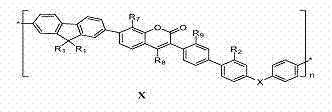


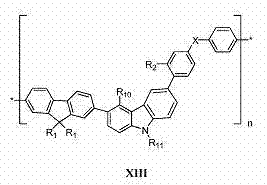


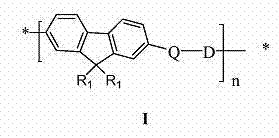

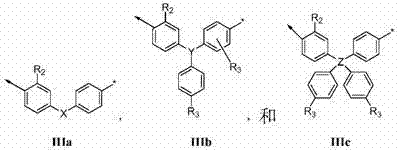

Applications Claiming Priority (1)
| Application Number | Priority Date | Filing Date | Title |
|---|---|---|---|
| PCT/US2009/032507 WO2010087840A1 (en) | 2009-01-30 | 2009-01-30 | Uv light-emissive fluorene-based copolymers |
Publications (2)
| Publication Number | Publication Date |
|---|---|
| CN102300902A true CN102300902A (en) | 2011-12-28 |
| CN102300902B CN102300902B (en) | 2014-07-02 |
Family
ID=42395889
Family Applications (1)
| Application Number | Title | Priority Date | Filing Date |
|---|---|---|---|
| CN200980155874.1A Expired - Fee Related CN102300902B (en) | 2009-01-30 | 2009-01-30 | UV Light-emissive Fluorene-based Copolymers |
Country Status (6)
| Country | Link |
|---|---|
| US (1) | US8785004B2 (en) |
| EP (1) | EP2384346A4 (en) |
| KR (1) | KR20110137298A (en) |
| CN (1) | CN102300902B (en) |
| TW (1) | TW201033246A (en) |
| WO (1) | WO2010087840A1 (en) |
Families Citing this family (4)
| Publication number | Priority date | Publication date | Assignee | Title |
|---|---|---|---|---|
| US9695274B2 (en) | 2012-06-29 | 2017-07-04 | Merck Patent Gmbh | Polymers containing 2,7-pyrene structural units |
| WO2014142844A1 (en) * | 2013-03-13 | 2014-09-18 | Hewlett-Packard Development Company, L.P. | Organic photoconductors |
| JP6005595B2 (en) | 2013-06-28 | 2016-10-12 | 株式会社東芝 | Polymer and solar cell using the same |
| WO2016050637A2 (en) * | 2014-09-30 | 2016-04-07 | Sicpa Holding Sa | Liquid containing polymer marker, use of a polymer marker as authentication tool, and method and device for detecting a polymer marker dissolved in a liquid |
Citations (3)
| Publication number | Priority date | Publication date | Assignee | Title |
|---|---|---|---|---|
| US20030154647A1 (en) * | 2001-12-26 | 2003-08-21 | Nguyen My T. | Photoluminescent markers and methods for detection of such markers |
| US20050186106A1 (en) * | 2004-02-24 | 2005-08-25 | Sanyo Electric Co., Ltd. | Organic electroluminescent device and process for preparing the same |
| US20050236977A1 (en) * | 2004-04-12 | 2005-10-27 | Canon Kabushiki Kaisha | Fluorene compound and organic light-emitting device using same |
Family Cites Families (40)
| Publication number | Priority date | Publication date | Assignee | Title |
|---|---|---|---|---|
| KR0176331B1 (en) | 1996-05-16 | 1999-04-01 | 박원훈 | Floren based shift copolymer for electroluminescent device and electroluminescent device using same as light emitting material |
| KR0176336B1 (en) | 1996-12-31 | 1999-04-01 | 박원훈 | Floren-based Alternating Copolymer Containing Acetylene Group and Electroluminescent Device Using the Same |
| US5998045A (en) | 1997-07-03 | 1999-12-07 | International Business Machines Corporation | Polymeric light-emitting device |
| CA2360644A1 (en) | 1999-02-04 | 2000-08-10 | The Dow Chemical Company | Fluorene copolymers and devices made therefrom |
| KR100528906B1 (en) | 1999-05-31 | 2005-11-16 | 삼성에스디아이 주식회사 | Blue light-emitting compound and display device adopting blue light-emitting compound as color-developing substance |
| US20010012572A1 (en) | 1999-12-10 | 2001-08-09 | Katsumi Araki | Novel polymer, light-emitting device material and light-emitting device using the same |
| SG96550A1 (en) | 2000-04-24 | 2003-06-16 | Inst Materials Research & Eng | Blue electroluminescent materials for polymer light-emitting diodes |
| GB0024155D0 (en) * | 2000-10-03 | 2000-11-15 | Cambridge Display Tech Ltd | Electroluminescent polymers |
| AU2001292050A1 (en) | 2000-10-03 | 2002-04-15 | Cambridge Display Techbnology Limited | Light-emissive polymer blends and light-emissive devices made from the same |
| US6759452B2 (en) | 2000-12-22 | 2004-07-06 | Eastman Kodak Company | Polycarbonate nanocomposite optical plastic article and method of making same |
| WO2002066537A1 (en) * | 2001-02-21 | 2002-08-29 | Cambridge Display Technology Limited | (partially) conjugated polymer process for its preparation and use in electroluminescent devices |
| KR100424073B1 (en) * | 2001-05-22 | 2004-03-22 | 한국과학기술연구원 | Fluorene compounds containing various functional groups, their polymers, and el element using the same |
| MY128940A (en) | 2001-07-10 | 2007-03-30 | Dow Global Technologies Inc | Electroactive polymers and devices made therefrom |
| AU2002316734A1 (en) | 2001-07-20 | 2003-03-03 | University Of Rochester | Light-emitting organic oligomer compositions |
| KR100414394B1 (en) | 2001-08-16 | 2004-01-07 | 일진다이아몬드(주) | Novel Light-emitting Fluorene-based Copolymers, EL Devices Comprising Said Copolymers, and Synthetic Method thereof |
| KR100411465B1 (en) * | 2001-10-26 | 2003-12-18 | 한국과학기술연구원 | Fluorene-based compounds and their polymers having polyphenylenes, and el element comprising the same |
| US6830830B2 (en) | 2002-04-18 | 2004-12-14 | Canon Kabushiki Kaisha | Semiconducting hole injection materials for organic light emitting devices |
| US6936355B2 (en) | 2002-06-04 | 2005-08-30 | Canon Kabushiki Kaisha | Organic photoluminescent polymers with improved stability |
| JP4464277B2 (en) | 2002-09-24 | 2010-05-19 | イー・アイ・デュポン・ドウ・ヌムール・アンド・カンパニー | Conductive organic polymer / nanoparticle composite material and method of using the same |
| JP3876872B2 (en) * | 2002-10-15 | 2007-02-07 | ソニーケミカル&インフォメーションデバイス株式会社 | Electroluminescent polymer, bisfluorenylsilane compound and organic EL device |
| US20040079924A1 (en) | 2002-10-25 | 2004-04-29 | Korea Kumho Petrochemical Co., Ltd. | Blue light-emitting, ladder-type polymer with excellent heat stability |
| CN1791584A (en) | 2003-05-16 | 2006-06-21 | 陶氏环球技术公司 | Process for preparing a 4,7-bis(5-halothien-2-yl)-2,1,3-benzothiadiazole and a precursor therefor |
| US20050189873A1 (en) | 2003-09-25 | 2005-09-01 | Kelly Stephen M. | Lighting elements, devices and methods |
| WO2005049548A1 (en) | 2003-11-17 | 2005-06-02 | Sumitomo Chemical Company, Limited | Crosslinkable substituted fluorene compounds |
| KR100702848B1 (en) | 2004-03-10 | 2007-04-03 | 이정훈 | Manufacturing method of composite material of silver nano particles and polymer resin |
| KR100573137B1 (en) | 2004-04-02 | 2006-04-24 | 삼성에스디아이 주식회사 | Fluorene compound and organic electroluminescent device using same |
| KR20070001262A (en) | 2004-04-06 | 2007-01-03 | 바스프 악티엔게젤샤프트 | Cosmetic formulations comprising zno nanoparticles |
| WO2005123634A1 (en) | 2004-06-16 | 2005-12-29 | Idemitsu Kosan Co., Ltd. | Fluorene derivative and organic electroluminescent device using same |
| KR100578108B1 (en) | 2004-08-17 | 2006-05-10 | 한국과학기술원 | Ad molecule composition containing nano particles with photoreactive group on the surface |
| US20060094859A1 (en) * | 2004-11-03 | 2006-05-04 | Marrocco Matthew L Iii | Class of bridged biphenylene polymers |
| US7172811B2 (en) | 2005-03-24 | 2007-02-06 | 3M Innovative Properties Company | Methods of preparing polymer nanocomposite having surface modified nanoparticles |
| JP4659695B2 (en) | 2005-11-01 | 2011-03-30 | キヤノン株式会社 | Fluorene compound and organic light emitting device |
| JP4933127B2 (en) | 2006-03-31 | 2012-05-16 | キヤノン株式会社 | Fluorene derivative and organic electroluminescence device using the same |
| US20070254996A1 (en) | 2006-04-28 | 2007-11-01 | Krzysztof Nauka | Nanocrystal-polymer composite materials and methods of attaching nanocrystals to polymer molecules |
| US20080152946A1 (en) | 2006-12-22 | 2008-06-26 | Yen Feng-Wen | Novel fluorene compounds, hole injection materials/hole transport materials containing said fluorene compounds, a light emitting element containing said fluorene compounds and methods of preparation thereof |
| JP5470706B2 (en) | 2007-01-25 | 2014-04-16 | 三菱化学株式会社 | Hole transport material, polymer compound obtained by polymerizing the hole transport material, composition for organic electroluminescence device, and organic electroluminescence device |
| JP5110901B2 (en) | 2007-02-20 | 2012-12-26 | キヤノン株式会社 | Material for organic light emitting device and organic light emitting device using the same |
| JP4827771B2 (en) | 2007-03-08 | 2011-11-30 | キヤノン株式会社 | Organic light emitting device and display device using oligofluorene compound |
| US7947801B2 (en) | 2007-04-03 | 2011-05-24 | The University Of Massachusetts | Polyfluorene method |
| KR101415444B1 (en) * | 2008-04-02 | 2014-07-04 | 미쓰비시 가가꾸 가부시키가이샤 | Polymer compound, reticulated polymer compound produced by crosslinking the polymer compound, composition for organic electroluminescent element, organic electroluminescent element, organic el display, and organic el lighting |
-
2009
- 2009-01-30 CN CN200980155874.1A patent/CN102300902B/en not_active Expired - Fee Related
- 2009-01-30 KR KR1020117020070A patent/KR20110137298A/en not_active Withdrawn
- 2009-01-30 EP EP09839413A patent/EP2384346A4/en not_active Withdrawn
- 2009-01-30 US US13/146,398 patent/US8785004B2/en not_active Expired - Fee Related
- 2009-01-30 WO PCT/US2009/032507 patent/WO2010087840A1/en not_active Ceased
- 2009-12-30 TW TW098145837A patent/TW201033246A/en unknown
Patent Citations (3)
| Publication number | Priority date | Publication date | Assignee | Title |
|---|---|---|---|---|
| US20030154647A1 (en) * | 2001-12-26 | 2003-08-21 | Nguyen My T. | Photoluminescent markers and methods for detection of such markers |
| US20050186106A1 (en) * | 2004-02-24 | 2005-08-25 | Sanyo Electric Co., Ltd. | Organic electroluminescent device and process for preparing the same |
| US20050236977A1 (en) * | 2004-04-12 | 2005-10-27 | Canon Kabushiki Kaisha | Fluorene compound and organic light-emitting device using same |
Non-Patent Citations (1)
| Title |
|---|
| XING-HUA ZHOU, ET AL.: "Highly Efficient UV-Violet Light-Emitting Polymers Derived from Fluorene and Tetraphenylsilane Derivatives: Molecular Design toward Enhanced Electroluminescent Performance", 《MACROMOLECULES》 * |
Also Published As
| Publication number | Publication date |
|---|---|
| US8785004B2 (en) | 2014-07-22 |
| EP2384346A1 (en) | 2011-11-09 |
| EP2384346A4 (en) | 2012-10-03 |
| CN102300902B (en) | 2014-07-02 |
| WO2010087840A9 (en) | 2010-12-02 |
| KR20110137298A (en) | 2011-12-22 |
| TW201033246A (en) | 2010-09-16 |
| WO2010087840A1 (en) | 2010-08-05 |
| US20110278560A1 (en) | 2011-11-17 |
Similar Documents
| Publication | Publication Date | Title |
|---|---|---|
| TWI795694B (en) | Heterocyclic compound, organic light emitting device comprising same, composition for organic layer of organic light emitting device and manufacturing method of organic light emitting device | |
| CN106117522B (en) | hole transport material | |
| Wang et al. | Quinacridone-based π-conjugated electronic materials | |
| Cocherel et al. | New 3π‐2Spiro Ladder‐Type Phenylene Materials: Synthesis, Physicochemical Properties and Applications in OLEDs | |
| TWI829976B (en) | Heterocyclic compound, organic light emitting device comprising same, composition for organic layer of organic light emitting device and manufacturing method of organic light emitting device | |
| Usluer et al. | Fluorene‐carbazole dendrimers: Synthesis, thermal, photophysical and electroluminescent device properties | |
| Fu et al. | Electroluminescent and photovoltaic properties of silole-based materials | |
| KR102154386B1 (en) | Compound, coating composition comprising the same, organic light emitting device using the same and method of manufacturing the same | |
| TWI567160B (en) | Material for photovoltaic devices | |
| CN103849375B (en) | Organic light emission composition, Apparatus and method for | |
| CN115710254A (en) | Heterocyclic compound, organic light-emitting device including the same, and composition for organic layer of organic light-emitting device | |
| TWI833856B (en) | Organic light emitting device, method for manufacturing the same and composition for organic material layer | |
| KR102186092B1 (en) | Coating composition and electroluminescence device comprising the same | |
| Kim et al. | Thermally cross-linkable spirobifluorene-core-based hole transport layer with high solvent-resistivity for solution processible OLEDs | |
| CN102300902B (en) | UV Light-emissive Fluorene-based Copolymers | |
| KR20080111968A (en) | Electroluminescent molecule containing fluorine group and electroluminescent device using same | |
| EP3680260B1 (en) | Polymer, coating composition comprising same, and organic light emitting element using same | |
| CN119462719A (en) | A boron-nitrogen compound and an organic electroluminescent device containing the same | |
| KR20170048424A (en) | Organic light-emitting composition, device and method | |
| Liao et al. | High-performance poly (2, 3-diphenyl-1, 4-phenylene vinylene)-based polymer light-emitting diodes by blade coating method | |
| Hu et al. | Synthesis and photophysical properties of pyrene-based multiply conjugated shaped light-emitting architectures: Toward efficient organic-light-emitting diodes | |
| KR101258701B1 (en) | Organic electroluminescent polymer having arylamine unit containing 9'-aryl-fluoren-9'-yl group and organic electroluminescent device manufactured using the same | |
| Mucur et al. | Enhancing the device performance of a blue light‐emitting copolymer using CdSe/ZnS quantum dots | |
| KR102130880B1 (en) | Compound, organic light emitting device using the same and method of manufacturing the same | |
| JP7773788B2 (en) | Heterocyclic compound and organic light-emitting device containing the same |
Legal Events
| Date | Code | Title | Description |
|---|---|---|---|
| C06 | Publication | ||
| PB01 | Publication | ||
| C10 | Entry into substantive examination | ||
| SE01 | Entry into force of request for substantive examination | ||
| C14 | Grant of patent or utility model | ||
| GR01 | Patent grant | ||
| CF01 | Termination of patent right due to non-payment of annual fee | ||
| CF01 | Termination of patent right due to non-payment of annual fee |
Granted publication date: 20140702 Termination date: 20220130 |