CN102361987A - Nematode resistant transgenic plants - Google Patents
Nematode resistant transgenic plants Download PDFInfo
- Publication number
- CN102361987A CN102361987A CN2010800126758A CN201080012675A CN102361987A CN 102361987 A CN102361987 A CN 102361987A CN 2010800126758 A CN2010800126758 A CN 2010800126758A CN 201080012675 A CN201080012675 A CN 201080012675A CN 102361987 A CN102361987 A CN 102361987A
- Authority
- CN
- China
- Prior art keywords
- seq
- double
- plant
- protein
- stranded rna
- Prior art date
- Legal status (The legal status is an assumption and is not a legal conclusion. Google has not performed a legal analysis and makes no representation as to the accuracy of the status listed.)
- Pending
Links
Images




Classifications
-
- C—CHEMISTRY; METALLURGY
- C12—BIOCHEMISTRY; BEER; SPIRITS; WINE; VINEGAR; MICROBIOLOGY; ENZYMOLOGY; MUTATION OR GENETIC ENGINEERING
- C12N—MICROORGANISMS OR ENZYMES; COMPOSITIONS THEREOF; PROPAGATING, PRESERVING, OR MAINTAINING MICROORGANISMS; MUTATION OR GENETIC ENGINEERING; CULTURE MEDIA
- C12N15/00—Mutation or genetic engineering; DNA or RNA concerning genetic engineering, vectors, e.g. plasmids, or their isolation, preparation or purification; Use of hosts therefor
- C12N15/09—Recombinant DNA-technology
- C12N15/63—Introduction of foreign genetic material using vectors; Vectors; Use of hosts therefor; Regulation of expression
- C12N15/79—Vectors or expression systems specially adapted for eukaryotic hosts
- C12N15/82—Vectors or expression systems specially adapted for eukaryotic hosts for plant cells, e.g. plant artificial chromosomes (PACs)
- C12N15/8241—Phenotypically and genetically modified plants via recombinant DNA technology
- C12N15/8261—Phenotypically and genetically modified plants via recombinant DNA technology with agronomic (input) traits, e.g. crop yield
- C12N15/8271—Phenotypically and genetically modified plants via recombinant DNA technology with agronomic (input) traits, e.g. crop yield for stress resistance, e.g. heavy metal resistance
- C12N15/8279—Phenotypically and genetically modified plants via recombinant DNA technology with agronomic (input) traits, e.g. crop yield for stress resistance, e.g. heavy metal resistance for biotic stress resistance, pathogen resistance, disease resistance
- C12N15/8285—Phenotypically and genetically modified plants via recombinant DNA technology with agronomic (input) traits, e.g. crop yield for stress resistance, e.g. heavy metal resistance for biotic stress resistance, pathogen resistance, disease resistance for nematode resistance
-
- Y—GENERAL TAGGING OF NEW TECHNOLOGICAL DEVELOPMENTS; GENERAL TAGGING OF CROSS-SECTIONAL TECHNOLOGIES SPANNING OVER SEVERAL SECTIONS OF THE IPC; TECHNICAL SUBJECTS COVERED BY FORMER USPC CROSS-REFERENCE ART COLLECTIONS [XRACs] AND DIGESTS
- Y02—TECHNOLOGIES OR APPLICATIONS FOR MITIGATION OR ADAPTATION AGAINST CLIMATE CHANGE
- Y02A—TECHNOLOGIES FOR ADAPTATION TO CLIMATE CHANGE
- Y02A40/00—Adaptation technologies in agriculture, forestry, livestock or agroalimentary production
- Y02A40/10—Adaptation technologies in agriculture, forestry, livestock or agroalimentary production in agriculture
- Y02A40/146—Genetically Modified [GMO] plants, e.g. transgenic plants
Landscapes
- Genetics & Genomics (AREA)
- Health & Medical Sciences (AREA)
- Life Sciences & Earth Sciences (AREA)
- Engineering & Computer Science (AREA)
- Zoology (AREA)
- Wood Science & Technology (AREA)
- Organic Chemistry (AREA)
- Biomedical Technology (AREA)
- Chemical & Material Sciences (AREA)
- Biotechnology (AREA)
- General Engineering & Computer Science (AREA)
- Molecular Biology (AREA)
- Bioinformatics & Cheminformatics (AREA)
- Microbiology (AREA)
- Physics & Mathematics (AREA)
- Plant Pathology (AREA)
- Biophysics (AREA)
- Biochemistry (AREA)
- General Health & Medical Sciences (AREA)
- Cell Biology (AREA)
- Breeding Of Plants And Reproduction By Means Of Culturing (AREA)
Abstract
本发明提供了编码双链RNA的表达载体(所述双链RNA靶向某些维持寄生线虫感染需要的植物基因),抗线虫的转基因植物(所述转基因植物表达此双链RNA),和与其相关的方法。靶向的植物基因是GLABRA-样基因、同源域-样基因、海藻糖-6-磷酸磷酸酶-样基因、与SEQ ID NO:16具有至少80%同源性的未知基因、ringH2指-样基因、锌指-样基因或MIOX-样基因。The present invention provides expression vectors encoding double-stranded RNA (the double-stranded RNA targets certain plant genes required for maintaining parasitic nematode infection), nematode-resistant transgenic plants (the transgenic plants express the double-stranded RNA), and methods related thereto. The targeted plant gene is a GLABRA-like gene, a homeodomain-like gene, a trehalose-6-phosphate phosphatase-like gene, an unknown gene having at least 80% homology to SEQ ID NO: 16, a ringH2 finger-like gene, a zinc finger-like gene, or a MIOX-like gene.
Description
本申请要求提交于2009年3月20日的美国临时专利申请序号61/161,776的优先权益,其全部内容引用在此作为参考。This application claims the benefit of priority to US Provisional Patent Application Serial No. 61/161,776, filed March 20, 2009, the entire contents of which are incorporated herein by reference.
发明背景Background of the invention
线虫是以2000多种行栽作物、蔬菜、水果和观赏植物为食的微小线虫动物,在全世界引起大约1千亿美元的作物损失。多种寄生线虫物种感染作物植物,包括根癌线虫(root-knot nematode)(RKN)、胞囊形成线虫(cyst-forming nematode)和病变形成线虫(lesion-forming nematode)。以在进食位点引起根虫瘿形成为特征的根癌线虫,具有相对广的宿主范围并因此在多种作物物种上是致病的。胞囊形成线虫和病变形成线虫具有较为有限的宿主范围,但是仍在易感作物中引起相当大的损失。Nematodes are tiny nematodes that feed on more than 2,000 species of row crops, vegetables, fruits, and ornamentals, causing an estimated $100 billion in crop losses worldwide. A variety of parasitic nematode species infect crop plants, including root-knot nematode (RKN), cyst-forming nematode, and lesion-forming nematode. Root-knot nematode, characterized by causing root gall formation at feeding sites, has a relatively broad host range and is therefore pathogenic on a variety of crop species. Cyst and lesion forming nematodes have a more limited host range but still cause considerable losses in susceptible crops.
致病线虫目前遍及整个美国,在南部和西部的温暖、潮湿区域以及在沙质土壤中发生最为密集。1954年,首次在美国北卡罗莱纳州发现了大豆胞囊线虫(Soybean cyst nematode)(Heterodera glycines),其是大豆植物最严重的害虫。一些地区受到大豆胞囊线虫(SCN)侵染太严重,以至于不采取控制措施,大豆产量将不再是经济上可行的。尽管大豆是受到SCN攻击的主要经济作物,但是SCN总共寄生大约50种宿主,包括大田作物、蔬菜、观赏植物和杂草。The disease-causing nematode is now widespread throughout the United States, with the highest concentrations occurring in warm, humid regions of the South and West and in sandy soils. Soybean cyst nematode (Heterodera glycines), the most serious pest of soybean plants, was first discovered in North Carolina, USA in 1954. Some areas are so infested with soybean cyst nematode (SCN) that without control measures soybean production would no longer be economically viable. Although soybean is the main commercial crop attacked by SCN, SCN parasitizes about 50 host species in total, including field crops, vegetables, ornamental plants and weeds.
线虫损害的病征包括在炎热时期叶子的矮化和黄化,以及植物枯萎。然而,线虫感染可以在没有任何明显的地上疾病症状的情况下引起显著的产量损失。产量降低的主要原因是由于地下的根损伤。受到SCN感染的根会矮化或者发育不良。线虫感染也可以减少根上固氮根瘤的数量,并可以使根更易于受到其他土传植物病原体的攻击。Symptoms of nematode damage include dwarfing and yellowing of leaves and plant wilting during hot periods. However, nematode infestation can cause significant yield loss without any obvious above-ground disease symptoms. The main reason for lower yields is due to root damage below ground. Roots infected with SCN are dwarfed or stunted. Nematode infection can also reduce the number of nitrogen-fixing nodules on roots and can make roots more vulnerable to attack by other soil-borne plant pathogens.
线虫的生活史具有三个主要的阶段:卵、幼体和成体。线虫物种之间生活史不同。例如,在最佳的条件下,SCN的生活史通常可以在24到30天内完成,然而其他物种可能需要1年或者更长以完成生活史。在春天,当温度和湿度水平变得有利的时候,在土壤中,虫状的幼体从卵中孵化。只有在幼体发育阶段的线虫能感染大豆根。The life cycle of nematodes has three main stages: eggs, larvae and adults. Life histories differ between nematode species. For example, under optimal conditions, the life cycle of the SCN can usually be completed within 24 to 30 days, whereas other species may take 1 year or longer to complete the life cycle. In the spring, when temperature and humidity levels become favorable, insect-like larvae hatch from eggs in the soil. Only nematodes in the larval stage can infect soybean roots.
SCN的生活史是很多研究的主题,并且其是理解线虫生活史的有用的实例。在渗透入大豆根后,SCN幼体移动穿过根直到它们接触到维管组织,在那时,它们停止迁移并开始进食。通过口针,线虫注射修饰某些根细胞的分泌物并将它们转变成专门的进食位点。根细胞在形态上被转化成作为线虫的营养来源的大型多核合胞体(或者在RKN的情况下为巨大细胞)。因此,主动进食线虫从植物中盗取基本营养物质,造成了产量损失。随着雌性线虫进食,它们开始膨大并最终变得太大以至于它们的身体突破了根组织并暴露于根的表面。The life history of the SCN is the subject of much research and is a useful example for understanding the life history of nematodes. After infiltrating soybean roots, SCN larvae migrate through the roots until they contact vascular tissue, at which point they stop migrating and begin feeding. Through the stylet, nematode injections modify the secretions of certain root cells and turn them into specialized feeding sites. Root cells are morphologically transformed into large multinucleated syncytia (or giant cells in the case of RKN) that serve as a source of nutrition for the nematode. Thus, the active-feeding nematodes steal essential nutrients from the plant, causing yield losses. As the female nematodes feed, they begin to swell and eventually become so large that their bodies break through the root tissue and expose the surface of the root.
在一段时间的进食后,没有如成体膨大的雄性SCN线虫,迁移到根的外面进入土壤中并使增大的成年雌性受精。然后雄性死亡,而雌性仍依附于根系统并继续进食。在膨大的雌性内的卵开始发育,最初在体外的团块(mass)或卵囊内,并然后随后在线虫体腔内。最终,整个成年雌性体腔都充满了卵,且线虫死去。死亡雌性的充满卵的身体称为胞囊。胞囊最终扩散并在土壤中可随意发现。胞囊的壁变得非常坚硬,为包含在其中的大约200至400个卵提供良好的保护。SCN的卵在胞囊中存活直到合适的孵化条件出现。尽管许多卵可以在第一年内孵化,但是许多卵也会在保护性胞囊中存活几年。After a period of feeding, male SCN nematodes, without adult enlargement, migrate outside the roots into the soil and fertilize enlarged adult females. The males then die, while the females remain attached to the root system and continue to feed. Eggs within enlarged females begin to develop, initially in a mass or oocyst outside the body, and then subsequently inside the nematode body cavity. Eventually, the entire body cavity of an adult female is filled with eggs, and the nematode dies. The egg-filled body of a dead female is called a cyst. The cysts eventually spread and can be found randomly in the soil. The walls of the cyst become very hard, providing good protection for the approximately 200 to 400 eggs contained within. Eggs of SCN survive in the cyst until suitable hatching conditions arise. Many eggs also survive in the protective cyst for several years, although many eggs can hatch within the first year.
线虫在土壤中以其自身的能力每年仅可以移动几英寸。然而,线虫感染可以以多种方式传播相当远的距离。任何移动受感染土壤的东西都能传播感染,包括农业机械、车辆和工具、风、水、动物和农场工人。土壤的种子大小颗粒常常污染收获的种子。因此,当从受感染的田地的受污染的种子播种在未受感染的田地的时候,线虫感染可以传播。甚至有证据表明,某些线虫物种可以通过鸟类传播。这些原因中仅有一些可以预防。Nematodes can only move a few inches per year in the soil on their own. However, nematode infections can be spread over considerable distances in a number of ways. Anything that moves infected soil can spread infection, including agricultural machinery, vehicles and tools, wind, water, animals, and farm workers. Seed-sized particles of soil often contaminate harvested seeds. Thus, nematode infestation can spread when contaminated seeds from an infected field are sown in an uninfected field. There is even evidence that certain nematode species can be transmitted by birds. Only some of these causes are preventable.
用于管理线虫感染的常规方法包括:在受线虫感染的土地中保持合适的土壤营养和土壤pH水平;控制其他植物疾病,以及昆虫和杂草害虫;仅在耕种了未感染田地后使用卫生实践,如线虫感染田地的耕作、种植和栽培;在受感染的田地作业后,用高压水或者蒸汽彻底清洁设备;不使用在受感染的土地上生长的种子用于种植未感染的田地,除非种子已经适当地清洁;轮作受感染的田地并用非宿主作物替换宿主作物;使用杀线虫剂;和种植抗性植物品种。General methods used to manage nematode infestations include: maintaining proper soil nutrient and soil pH levels in nematode-infested land; controlling other plant diseases, as well as insect and weed pests; using sanitation practices only after tilling uninfected fields , such as plowing, planting, and cultivation of nematode-infected fields; after working on infected fields, thoroughly clean equipment with high-pressure water or steam; do not use seeds grown on infected fields for planting uninfected fields, unless the seeds have been properly cleaned; rotated infected fields and replaced host crops with non-host crops; used nematicides; and planted resistant plant varieties.
已经提出了用于植物的基因转化的方法以赋予对植物寄生线虫增加的抗性。美国专利号5,589,622和5,824,876涉及在受到线虫附着后在植物的进食位点内或者附近特异表达的植物基因的鉴定。这些植物靶基因的启动子随后可用于指导有害蛋白质或者酶的特异表达,或者靶基因或一般细胞基因的反义RNA的表达。此植物启动子也可以用于通过用包含连接于其产物诱导线虫摄食之后死亡的基因的植物靶基因启动子的构建体转化植物,从而在进食位点特异地赋予线虫抗性。Methods have been proposed for the genetic transformation of plants to confer increased resistance to plant-parasitic nematodes. US Patent Nos. 5,589,622 and 5,824,876 relate to the identification of plant genes that are specifically expressed in or near the feeding site of a plant following nematode infestation. The promoters of these plant target genes can then be used to direct the specific expression of unwanted proteins or enzymes, or the expression of antisense RNA to target or general cellular genes. This plant promoter can also be used to confer nematode resistance specifically at the feeding site by transforming plants with a construct comprising a plant target gene promoter linked to a gene whose product induces death following nematode feeding.
近来,已经提出了RNA干扰(RNAi)(也被称为基因沉默),作为控制线虫的方法。当基本对应于靶基因或mRNA序列的双链RNA(dsRNA)引入细胞时,来自于靶基因的表达受到抑制(见例如,美国专利号6,506,559)。美国专利号6,506,559表明了RNA干扰对秀丽隐杆线虫(Caenorhabditis elegans)已知基因的效果,但是没有表明RNA干扰用于控制植物寄生线虫的效用。Recently, RNA interference (RNAi), also known as gene silencing, has been proposed as a method of controlling nematodes. Expression from a target gene is inhibited when double-stranded RNA (dsRNA) substantially corresponding to the sequence of the target gene or mRNA is introduced into the cell (see eg, US Patent No. 6,506,559). US Patent No. 6,506,559 shows the effect of RNA interference on known genes of Caenorhabditis elegans, but does not show the utility of RNA interference for controlling plant parasitic nematodes.
已经提出了用RNA干扰靶向关键的线虫基因,例如,在PCT公开文本WO 01/96584、WO 01/17654、US 2004/0098761、US 2005/0091713、US 2005/0188438、US 2006/0037101、US 2006/0080749、US 2007/0199100、和US 2007/0250947中。Targeting key nematode genes with RNA interference has been proposed, for example, in PCT Publications WO 01/96584, WO 01/17654, US 2004/0098761, US 2005/0091713, US 2005/0188438, US 2006/0037101, US 2006/0080749, US 2007/0199100, and US 2007/0250947.
已经提出了很多RNA干扰作用的模型。在哺乳动物系统中,大于30个核苷酸的dsRNA以非序列特异性的方式触发诱导干扰素合成和总体蛋白质合成关闭。然而,美国专利号6,506,559公开了在线虫中,对应于靶基因序列的双链RNA的长度可至少为25、50、100、200、300或者400个碱基,甚至更大的双链RNA也有效地诱导秀丽隐杆线虫中的RNA干扰。众所周知,当包含范围为98个到854个核苷酸的双链区域的发卡RNA构建体转化入多种植物物种时,靶植物基因被有效地沉默。一般同意在许多生物中,包括线虫和植物,大片段的双链RNA在细胞中被切分为约19-24个核苷酸的片段(siRNA),这些siRNA是RNA干扰现象的实际介质。Many models of the role of RNA interference have been proposed. In mammalian systems, dsRNAs larger than 30 nucleotides trigger induction of interferon synthesis and shutdown of overall protein synthesis in a sequence-nonspecific manner. However, U.S. Patent No. 6,506,559 discloses that in C. elegans, the length of the double-stranded RNA corresponding to the target gene sequence can be at least 25, 50, 100, 200, 300, or 400 bases, and even larger double-stranded RNAs are also effective. Induced RNA interference in Caenorhabditis elegans. It is well known that target plant genes are efficiently silenced when hairpin RNA constructs comprising double-stranded regions ranging from 98 to 854 nucleotides are transformed into various plant species. It is generally agreed that in many organisms, including nematodes and plants, large segments of double-stranded RNA are cleaved in cells into fragments (siRNAs) of approximately 19-24 nucleotides, and that these siRNAs are the actual mediators of the RNA interference phenomenon.
尽管已经有许多努力使用RNA干扰控制寄生线虫,到目前为止,在任何国家中还没有解除对转基因线虫抗性的植物的管制。因此,仍然存在使用RNA干扰来鉴定用于控制植物寄生线虫和生产具有增加的植物寄生线虫抗性的植物的安全且有效的组合物和方法的需要。Although there have been many efforts to control parasitic nematodes using RNA interference, so far, transgenic nematode-resistant plants have not been deregulated in any country. Accordingly, there remains a need for using RNA interference to identify safe and effective compositions and methods for controlling plant-parasitic nematodes and producing plants with increased resistance to plant-parasitic nematodes.
发明概述Summary of the invention
本发明提供了克服或者减轻有价值的农作物如大豆的线虫侵染的核酸,转基因植物和方法。本发明的核酸能够用RNA干扰(RNAi)降低植物靶基因的表达。根据本发明,此植物靶基因选自GLABRA-样基因、同源域-样基因(HD-样)、海藻糖-6-磷酸磷酸酶-样基因(TTP-样)、未知基因(UNK)、RingH2指-样基因(RingH2-样)、锌指-样基因(ZF-样)和MIOX-样基因。The present invention provides nucleic acids, transgenic plants and methods for overcoming or alleviating nematode infestation of valuable crops such as soybeans. The nucleic acids of the invention are capable of reducing the expression of target genes in plants using RNA interference (RNAi). According to the present invention, this plant target gene is selected from GLABRA-like gene, homeodomain-like gene (HD-like), trehalose-6-phosphate phosphatase-like gene (TTP-like), unknown gene (UNK), RingH2 finger-like genes (RingH2-like), zinc finger-like genes (ZF-like) and MIOX-like genes.
在一个实施方案中,本发明提供了分离的编码双链RNA的表达载体,所述双链RNA包含第一链和与第一链互补的第二链,其中第一链与植物靶基因一部分基本相同,该部分选自靶基因的从约19个到约400或500个连续的核苷酸,其中双链RNA抑制靶基因表达,而其中靶基因选自(a)编码植物GLABRA-样蛋白质的多核苷酸,所述蛋白质与具有SEQ IDNO:2中示出的序列的大豆GLABRA-样蛋白质具有至少80%序列同一性;(b)编码植物同源域-样蛋白质的多核苷酸,所述蛋白质与具有SEQ IDNO:5或者SEQ ID NO:8中示出的序列的大豆同源域-样蛋白质具有至少80%序列同一性;(c)编码植物海藻糖-6-磷酸磷酸酶-样蛋白质的多核苷酸;(d)编码植物未知蛋白质的多核苷酸,所述蛋白质与具有SEQ ID NO:17中示出的序列的大豆未知蛋白质具有至少80%序列同一性;(e)编码RingH2指-样蛋白质的多核苷酸,所述蛋白质与具有SEQ ID NO:20中示出的序列的大豆RingH2指-样蛋白质具有至少80%序列同一性;(f)编码锌指-样蛋白质的多核苷酸,所述蛋白质与具有SEQ ID NO:23或者SEQ ID NO:26中示出的序列的大豆锌指-样蛋白质具有至少80%序列同一性;(g)编码MIOX-样蛋白质的多核苷酸。In one embodiment, the present invention provides an isolated expression vector encoding a double-stranded RNA comprising a first strand and a second strand complementary to the first strand, wherein the first strand is substantially identical to a portion of a plant target gene. Likewise, the portion is selected from from about 19 to about 400 or 500 contiguous nucleotides of a target gene, wherein the double-stranded RNA inhibits expression of the target gene, and wherein the target gene is selected from (a) encoding a plant GLABRA-like protein A polynucleotide having at least 80% sequence identity to a soybean GLABRA-like protein having a sequence shown in SEQ ID NO: 2; (b) a polynucleotide encoding a plant homeodomain-like protein, said The protein has at least 80% sequence identity to a soybean homeodomain-like protein having the sequence shown in SEQ ID NO: 5 or SEQ ID NO: 8; (c) encodes a plant trehalose-6-phosphate phosphatase-like protein (d) a polynucleotide encoding a plant unknown protein having at least 80% sequence identity to an unknown soybean protein having a sequence shown in SEQ ID NO: 17; (e) encoding RingH2 refers to A polynucleotide of a -like protein having at least 80% sequence identity with a soybean RingH2 finger-like protein having the sequence shown in SEQ ID NO: 20; (f) a polynucleotide encoding a zinc finger-like protein acid, said protein has at least 80% sequence identity with a soybean zinc finger-like protein having the sequence shown in SEQ ID NO: 23 or SEQ ID NO: 26; (g) a polynucleotide encoding a MIOX-like protein .
本发明还涉及包含编码一批双链RNA分子的核酸的分离的表达载体,所述RNA分子包含多种RNA分子,每种包含具有约19、20、21、22、23或24个核苷酸长度的双链区域,其中所述RNA分子来自多核苷酸,该多核苷酸选自(a)编码植物GLABRA-样蛋白质的多核苷酸,所述蛋白质与具有SEQ ID NO:2中示出的序列的大豆GLABRA-样蛋白质具有至少80%序列同一性;(b)编码植物同源域-样蛋白质的多核苷酸,所述蛋白质与具有SEQ ID NO:5或者SEQ ID NO:8中示出的序列的大豆同源域-样蛋白质具有至少80%序列同一性;(c)编码植物海藻糖-6-磷酸磷酸酶-样蛋白质的多核苷酸;(d)编码植物未知蛋白质的多核苷酸,所述蛋白质与具有SEQ IDNO:17中示出的序列的大豆未知蛋白质具有至少80%序列同一性;(e)编码RingH2指-样蛋白质的多核苷酸,所述蛋白质与具有SEQ ID NO:20中示出的序列的大豆RingH2指-样蛋白质具有至少80%序列同一性;(f)编码锌指-样蛋白质的多核苷酸,所述蛋白质与具有SEQ ID NO:23或者SEQ IDNO:26中示出的序列的大豆锌指-样蛋白质具有至少80%序列同一性;(g)编码MIOX-样蛋白质的多核苷酸。The present invention also relates to an isolated expression vector comprising a nucleic acid encoding a plurality of double-stranded RNA molecules comprising a plurality of RNA molecules each comprising about 19, 20, 21, 22, 23 or 24 nucleotides The double-stranded region of length, wherein said RNA molecule is from polynucleotide, and this polynucleotide is selected from (a) the polynucleotide of encoding plant GLABRA-like protein, and said protein is shown in SEQ ID NO:2. The soybean GLABRA-like protein of sequence has at least 80% sequence identity; (b) the polynucleotide of coding plant homeodomain-like protein, described protein and have SEQ ID NO: 5 or SEQ ID NO: Shown in 8 The soybean homeodomain-like protein of the sequence has at least 80% sequence identity; (c) polynucleotide encoding plant trehalose-6-phosphate phosphatase-like protein; (d) polynucleotide encoding plant unknown protein , said protein has at least 80% sequence identity with an unknown soybean protein having the sequence shown in SEQ ID NO: 17; (e) a polynucleotide encoding a RingH2 finger-like protein, said protein having SEQ ID NO: The soybean RingH2 finger-like protein of the sequence shown in 20 has at least 80% sequence identity; (f) a polynucleotide encoding a zinc finger-like protein that has SEQ ID NO: 23 or SEQ ID NO: 26 Soybean zinc finger-like proteins of the sequences shown in (g) have at least 80% sequence identity; (g) polynucleotides encoding MIOX-like proteins.
在另一个实施方案中,本发明提供了能够表达至少一个双链RNA的转基因植物,所述双链RNA与植物靶基因一部分基本相同,该靶基因选自(a)编码植物GLABRA-样蛋白质的多核苷酸,所述蛋白质与具有SEQ IDNO:2中示出的序列的大豆GLABRA-样蛋白质具有至少80%序列同一性;(b)编码植物同源域-样蛋白质的多核苷酸,所述蛋白质与具有SEQ IDNO:5或者SEQ ID NO:8中示出的序列的大豆同源域-样蛋白质具有至少80%序列同一性;(c)编码植物海藻糖-6-磷酸磷酸酶-样蛋白质的多核苷酸;(d)编码植物未知蛋白质的多核苷酸,所述蛋白质与具有SEQ ID NO:17中示出的序列的大豆未知蛋白质具有至少80%序列同一性;(e)编码RingH2指-样蛋白质的多核苷酸,所述蛋白质与具有SEQ ID NO:20中示出的序列的大豆RingH2指-样蛋白质具有至少80%序列同一性;(f)编码锌指-样蛋白质的多核苷酸,所述蛋白质与具有SEQ ID NO:23或者SEQ ID NO:26中示出的序列的大豆锌指-样蛋白质具有至少80%序列同一性;(g)编码MIOX-样蛋白质的多核苷酸,其中所述双链RNA抑制该靶基因在植物根中的表达。In another embodiment, the present invention provides transgenic plants capable of expressing at least one double-stranded RNA substantially identical to a portion of a plant target gene selected from (a) genes encoding a plant GLABRA-like protein A polynucleotide having at least 80% sequence identity to a soybean GLABRA-like protein having a sequence shown in SEQ ID NO: 2; (b) a polynucleotide encoding a plant homeodomain-like protein, said The protein has at least 80% sequence identity to a soybean homeodomain-like protein having the sequence shown in SEQ ID NO: 5 or SEQ ID NO: 8; (c) encodes a plant trehalose-6-phosphate phosphatase-like protein (d) a polynucleotide encoding a plant unknown protein having at least 80% sequence identity to an unknown soybean protein having a sequence shown in SEQ ID NO: 17; (e) encoding RingH2 refers to A polynucleotide of a -like protein having at least 80% sequence identity with a soybean RingH2 finger-like protein having the sequence shown in SEQ ID NO: 20; (f) a polynucleotide encoding a zinc finger-like protein acid, said protein has at least 80% sequence identity with a soybean zinc finger-like protein having the sequence shown in SEQ ID NO: 23 or SEQ ID NO: 26; (g) a polynucleotide encoding a MIOX-like protein , wherein the double-stranded RNA suppresses the expression of the target gene in plant roots.
本发明还包括制备能够表达双链RNA的转基因植物的方法,所述双链RNA包含与植物靶基因一部分基本相同的第一链和与第一链互补的第二链,其中该靶基因选自(a)编码植物GLABRA-样蛋白质的多核苷酸,所述蛋白质与具有SEQ ID NO:2中示出的序列的大豆GLABRA-样蛋白质具有至少80%序列同一性;(b)编码植物同源域-样蛋白质的多核苷酸,所述蛋白质与具有SEQ ID NO:5或者SEQ ID NO:8中示出的序列的大豆同源域-样蛋白质具有至少80%序列同一性;(c)编码植物海藻糖-6-磷酸磷酸酶-样蛋白质的多核苷酸;(d)编码植物未知蛋白质的多核苷酸,所述蛋白质与具有SEQ ID NO:17中示出的序列的大豆未知蛋白质具有至少80%序列同一性;(e)编码RingH2指-样蛋白质的多核苷酸,所述蛋白质与具有SEQ IDNO:20中示出的序列的大豆RingH2指-样蛋白质具有至少80%序列同一性;(f)编码锌指-样蛋白质的多核苷酸,所述蛋白质与具有SEQ ID NO:23或者SEQ ID NO:26中示出的序列的大豆锌指-样蛋白质具有至少80%序列同一性;(g)编码MIOX-样蛋白质的多核苷酸,所述方法包括以下步骤:(i)制备包含编码双链RNA的核酸的表达载体,其中此核酸一旦在植物中表达能够形成双链转录本;(ii)用所述表达载体转化受体植物;(iii)产生一个或多个该受体植物的转基因后代;和(iv)就对线虫感染的耐受性选择后代。The invention also includes a method of producing a transgenic plant capable of expressing a double-stranded RNA comprising a first strand substantially identical to a portion of a plant target gene and a second strand complementary to the first strand, wherein the target gene is selected from (a) a polynucleotide encoding a plant GLABRA-like protein having at least 80% sequence identity to a soybean GLABRA-like protein having the sequence shown in SEQ ID NO: 2; (b) encoding a plant homolog A polynucleotide of a domain-like protein having at least 80% sequence identity to a soybean homologous domain-like protein having the sequence shown in SEQ ID NO: 5 or SEQ ID NO: 8; (c) encoding A polynucleotide of a plant trehalose-6-phosphate phosphatase-like protein; (d) a polynucleotide encoding a plant unknown protein having at least the same molecular weight as the soybean unknown protein having the sequence shown in SEQ ID NO: 17 80% sequence identity; (e) a polynucleotide encoding a RingH2 finger-like protein having at least 80% sequence identity with the soybean RingH2 finger-like protein having the sequence shown in SEQ ID NO: 20; ( f) a polynucleotide encoding a zinc finger-like protein having at least 80% sequence identity to a soybean zinc finger-like protein having a sequence shown in SEQ ID NO: 23 or SEQ ID NO: 26; ( g) a polynucleotide encoding a MIOX-like protein, the method comprising the steps of: (i) preparing an expression vector comprising a nucleic acid encoding a double-stranded RNA, wherein this nucleic acid is capable of forming a double-stranded transcript once expressed in a plant; ( ii) transforming a recipient plant with the expression vector; (iii) producing one or more transgenic progeny of the recipient plant; and (iv) selecting the progeny for tolerance to nematode infection.
本发明还提供了一种赋予植物线虫抗性的方法,所述方法包含以下步骤:(i)选择植物靶基因,所述靶基因选自(a)编码植物GLABRA-样蛋白质的多核苷酸,所述蛋白质与具有SEQ ID NO:2中示出的序列的大豆GLABRA-样蛋白质具有至少80%序列同一性;(b)编码植物同源域-样蛋白质的多核苷酸,所述蛋白质与具有SEQ ID NO:5或者SEQ ID NO:8中示出的序列的大豆同源域-样蛋白质具有至少80%序列同一性;(c)编码植物海藻糖-6-磷酸磷酸酶-样蛋白质的多核苷酸;(d)编码植物未知蛋白质的多核苷酸,所述蛋白质与具有SEQ ID NO:17中示出的序列的大豆未知蛋白质具有至少80%序列同一性;(e)编码RingH2指-样蛋白质的多核苷酸,所述蛋白质与具有SEQ ID NO:20中示出的序列的大豆RingH2指-样蛋白质具有至少80%序列同一性;(f)编码锌指-样蛋白质的多核苷酸,所述蛋白质与具有SEQ ID NO:23或者SEQ ID NO:26中示出的序列的大豆锌指-样蛋白质具有至少80%序列同一性;(g)编码MIOX-样蛋白质的多核苷酸;(ii)制备包含编码双链RNA的核酸的表达载体,所述双链RNA包含与靶基因一部分基本相同的第一链和与第一链互补的第二链,其中此核酸一旦在植物中表达能够形成双链转录本;(iii)用所述核酸转化受体植物;(iv)产生一个或多个该受体植物的转基因后代;和(v)就线虫耐受性选择后代。The present invention also provides a method for imparting nematode resistance to plants, the method comprising the steps of: (i) selecting a plant target gene selected from (a) a polynucleotide encoding a plant GLABRA-like protein, The protein has at least 80% sequence identity with a soybean GLABRA-like protein having the sequence shown in SEQ ID NO: 2; (b) a polynucleotide encoding a plant homeodomain-like protein that is identical to a soybean GLABRA-like protein having The soybean homeodomain-like protein of the sequence shown in SEQ ID NO: 5 or SEQ ID NO: 8 has at least 80% sequence identity; (c) a polynuclear protein encoding plant trehalose-6-phosphate phosphatase-like protein Nucleotides; (d) a polynucleotide encoding a plant unknown protein having at least 80% sequence identity to an unknown soybean protein having a sequence shown in SEQ ID NO: 17; (e) encoding a RingH2 finger-like A polynucleotide for a protein having at least 80% sequence identity with a soybean RingH2 finger-like protein having a sequence shown in SEQ ID NO: 20; (f) a polynucleotide encoding a zinc finger-like protein, The protein has at least 80% sequence identity with a soybean zinc finger-like protein having a sequence shown in SEQ ID NO: 23 or SEQ ID NO: 26; (g) a polynucleotide encoding a MIOX-like protein; ( ii) preparing an expression vector comprising a nucleic acid encoding a double-stranded RNA comprising a first strand substantially identical to a portion of a target gene and a second strand complementary to the first strand, wherein the nucleic acid, once expressed in a plant, is capable of forming a double-stranded transcript; (iii) transforming a recipient plant with the nucleic acid; (iv) producing one or more transgenic progeny of the recipient plant; and (v) selecting the progeny for nematode tolerance.
附图简述Brief description of the drawings
图1显示了分配给对应的来自大豆(Glycine max)和其他植物物种的核苷酸和氨基酸序列的SEQ ID NO的表。Figure 1 shows a table of SEQ ID NOs assigned to corresponding nucleotide and amino acid sequences from soybean (Glycine max) and other plant species.
图2显示了GmHD-样(SEQ ID NO:5)编码的开放阅读框与相关的大豆氨基酸序列GM50534465(SEQ ID NO:8)的氨基酸比对,该比对使用Vector NTI软件套件v10.3.0(空位开放罚分=10,空位延伸罚分=0.05,空位间隔罚分=8)。用具有SEQ ID NO:6描述的有义链的RAW484生成的发卡茎可以靶向SEQ ID NO:4和SEQ ID NO:7描述的相应的DNA序列。Figure 2 shows the amino acid alignment of the open reading frame encoded by GmHD-like (SEQ ID NO: 5) and the related soybean amino acid sequence GM50534465 (SEQ ID NO: 8), using the Vector NTI software suite v10.3.0 ( Gap Open Penalty = 10, Gap Extension Penalty = 0.05, Gap Interval Penalty = 8). Hairpin stems generated with RAW484 having the sense strand described by SEQ ID NO:6 can target the corresponding DNA sequences described by SEQ ID NO:4 and SEQ ID NO:7.
图3显示了GmTPP-样(SEQ ID NO:10)编码的开放阅读框与相关的大豆氨基酸序列GM47125400(SEQ ID NO:13)和GMsq97c08(SEQ ID NO:15)的氨基酸比对,该比对使用Vector NTI软件套件v10.3.0(空位开放罚分=10,空位延伸罚分=0.05,空位间隔罚分=8)。用具有SEQ ID NO:11描述的有义链的RTJ150生成的发卡茎可以靶向SEQ ID NO:9,SEQ ID NO:12和SEQ ID NO:14描述的相应的DNA序列。Figure 3 shows the amino acid alignment of the open reading frame encoded by GmTPP-like (SEQ ID NO: 10) and the related soybean amino acid sequences GM47125400 (SEQ ID NO: 13) and GMsq97c08 (SEQ ID NO: 15), the alignment Vector NTI software suite v10.3.0 (gap opening penalty = 10, gap extension penalty = 0.05, gap separation penalty = 8) was used. Hairpin stems generated with RTJ150 having the sense strand described by SEQ ID NO: 11 can target the corresponding DNA sequences described by SEQ ID NO: 9, SEQ ID NO: 12 and SEQ ID NO: 14.
图4显示了GmZF-样(SEQ ID NO:23)编码的开放阅读框与大豆基因索引标识符TC248286(SEQ ID NO:26)描述的相关的大豆氨基酸序列的氨基酸比对,该比对使用Vector NTI软件套件v10.3.0(空位开放罚分=10,空位延伸罚分=0.05,空位间隔罚分=8)。用具有SEQ ID NO:24描述的有义链的RAW486生成的发卡茎可以靶向SEQ ID NO:22和SEQ ID NO:25描述的相应的DNA序列。Figure 4 shows the amino acid alignment of the open reading frame encoded by GmZF-like (SEQ ID NO: 23) and the soybean amino acid sequence related to the soybean gene index identifier TC248286 (SEQ ID NO: 26), using Vector NTI Software Suite v10.3.0 (Gap Open Penalty = 10, Gap Extension Penalty = 0.05, Gap Interval Penalty = 8). Hairpin stems generated with RAW486 having the sense strand described by SEQ ID NO:24 can target the corresponding DNA sequences described by SEQ ID NO:22 and SEQ ID NO:25.
图5显示了GmMIOX-样(SEQ ID NO:28)编码的开放阅读框与相关的大豆氨基酸序列GM50229820(SEQ ID NO:31)的氨基酸比对,该比对使用Vector NTI软件套件v10.3.0(空位开放罚分=10,空位延伸罚分=0.05,空位间隔罚分=8)。用具有SEQ ID NO:29描述的有义链的RTP2615-1生成的发卡茎可以靶向SEQ ID NO:27和SEQ ID NO:30描述的相应的DNA序列。Figure 5 shows the amino acid alignment of the open reading frame encoded by GmMIOX-like (SEQ ID NO: 28) and the related soybean amino acid sequence GM50229820 (SEQ ID NO: 31), using the Vector NTI software suite v10.3.0 ( Gap Open Penalty = 10, Gap Extension Penalty = 0.05, Gap Interval Penalty = 8). Hairpin stems generated with RTP2615-1 having the sense strand described by SEQ ID NO:29 can target the corresponding DNA sequences described by SEQ ID NO:27 and SEQ ID NO:30.
图6a-c显示了GmHD-样(SEQ ID NO:4)与相关的大豆序列GM50634465(SEQ ID NO:7)的DNA比对,该比对使用Vector NTI软件套件v10.3.0(空位开放罚分=15,空位延伸罚分=6.66,空位间隔罚分=8)。用具有SEQ ID NO:6描述的有义链的RAW484生成的发卡茎可以靶向SEQ ID NO:4和SEQ ID NO:7描述的相应的DNA序列,如比对中所示。Figure 6a-c shows the DNA alignment of GmHD-like (SEQ ID NO: 4) and the related soybean sequence GM50634465 (SEQ ID NO: 7) using the Vector NTI software suite v10.3.0 (Gap Opening Penalty = 15, Gap Extension Penalty = 6.66, Gap Interval Penalty = 8). Hairpin stems generated with RAW484 having the sense strand described by SEQ ID NO: 6 can target the corresponding DNA sequences described by SEQ ID NO: 4 and SEQ ID NO: 7, as shown in the alignment.
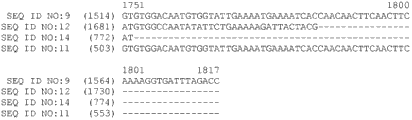
图7a-e显示了GmTPP-样(SEQ ID NO:9)与相关的DNA序列GM47125400(SEQ ID NO:12)和GMsq97c08(SEQ ID NO:14)的DNA比对,该比对使用Vector NTI软件套件v10.3.0(空位开放罚分=15,空位延伸罚分=6.66,空位间隔罚分=8)。用具有SEQ ID NO:11描述的有义链的RTJ150生成的发卡茎可以靶向SEQ ID NO:9,SEQ ID NO:12和SEQ IDNO:14描述的相应的DNA序列,如比对中所示。Figure 7a-e shows the DNA alignment of GmTPP-like (SEQ ID NO: 9) and related DNA sequences GM47125400 (SEQ ID NO: 12) and GMsq97c08 (SEQ ID NO: 14) using Vector NTI software Suite v10.3.0 (Gap Opening Penalty = 15, Gap Extension Penalty = 6.66, Gap Interval Penalty = 8). Hairpin stems generated with RTJ150 having the sense strand described by SEQ ID NO: 11 can target the corresponding DNA sequences described by SEQ ID NO: 9, SEQ ID NO: 12 and SEQ ID NO: 14, as shown in the alignment .
图8a-c显示了GmZF-样(SEQ ID NO:22)与大豆基因索引标识符TC248286(SEQ ID NO:25)描述的相关大豆DNA序列的DNA比对,该比对使用Vector NTI软件套件v10.3.0(空位开放罚分=15,空位延伸罚分=6.66,空位间隔罚分=8)。用具有SEQ ID NO:24描述的有义链的RAW486生成的发卡茎可以靶向SEQ ID NO:22和SEQ ID NO:25描述的相应的DNA序列,如比对中所示。Figure 8a-c shows a DNA alignment of the GmZF-like (SEQ ID NO: 22) with the related soybean DNA sequence described by the soybean gene index identifier TC248286 (SEQ ID NO: 25) using the Vector NTI software suite v10 .3.0 (Gap Open Penalty = 15, Gap Extension Penalty = 6.66, Gap Interval Penalty = 8). Hairpin stems generated with RAW486 having the sense strand described by SEQ ID NO: 24 can target the corresponding DNA sequences described by SEQ ID NO: 22 and SEQ ID NO: 25, as shown in the alignment.
图9a-c显示了GmMIOX-样(SEQ ID NO:27)与相关的大豆DNA序列GM50229820(SEQ ID NO:30)的DNA比对,该比对使用Vector NTI软件套件v10.3.0(空位开放罚分=15,空位延伸罚分=6.66,空位间隔罚分=8)。用具有SEQ ID NO:29描述的有义链的RTP2615-1生成的发卡茎可以靶向SEQ ID NO:27和SEQ ID NO:30描述的相应的DNA序列,如比对中所示。Figure 9a-c shows the DNA alignment of GmMIOX-like (SEQ ID NO: 27) and the related soybean DNA sequence GM50229820 (SEQ ID NO: 30) using the Vector NTI software suite v10.3.0 (gap opening penalty Points = 15, Gap Extension Penalty = 6.66, Gap Interval Penalty = 8). Hairpin stems generated with RTP2615-1 having the sense strand described by SEQ ID NO: 29 can target the corresponding DNA sequences described by SEQ ID NO: 27 and SEQ ID NO: 30, as shown in the alignment.
图10a-h显示了示例性的GmHD-样序列(图10a,氨基酸;图10b,核苷酸),GmTPP-样序列(图10c,氨基酸;图10d,核苷酸),GmZF-样序列(图10e,氨基酸;图10f,核苷酸),和GmMIOX-样序列(图10g,氨基酸;图10h,核苷酸)的总体百分比同一性。百分比同一性由使用Vector NTI软件套件v10.3.0的多重比对计算得来。Figures 10a-h show exemplary GmHD-like sequences (Figure 10a, amino acids; Figure 10b, nucleotides), GmTPP-like sequences (Figure 10c, amino acids; Figure 10d, nucleotides), GmZF-like sequences ( Figure 10e, amino acids; Figure 10f, nucleotides), and the overall percent identity of the GmMIOX-like sequence (Figure 10g, amino acids; Figure 10h, nucleotides). Percent identities were calculated from multiple alignments using the Vector NTI software suite v10.3.0.
图11显示了GmMIOX-样基因(SEQ ID NO:28)与来自棉花TC86807和TC86837(分别为SEQ ID NO:33和SEQ ID NO:35),甜菜TC6112(SEQID NO:37),玉米ZM2G126900(SEQ ID NO:39)和马铃薯基因索引标识符CV505571(SEQ ID NO:41)的相关同源物的氨基酸比对,该比对使用Vector NTI软件套件v10.3.0(空位开放罚分=15,空位延伸罚分=6.66,空位间隔罚分=8)。Figure 11 shows the GmMIOX-like gene (SEQ ID NO: 28) and from cotton TC86807 and TC86837 (respectively being SEQ ID NO: 33 and SEQ ID NO: 35), sugar beet TC6112 (SEQ ID NO: 37), maize ZM2G126900 (SEQ ID NO: 39) and the related homologue of the Potato Gene Index identifier CV505571 (SEQ ID NO: 41) amino acid alignment using the Vector NTI software suite v10.3.0 (gap opening penalty = 15, gap extension Penalty = 6.66, Gap Penalty = 8).
图12显示了GmMIOX-样基因(SEQ ID NO:27)与来自棉花TC86807和TC86837(分别为SEQ ID NO:32和SEQ ID NO:34)、甜菜TC6112(SEQID NO:36)、玉米ZM2G126900(SEQ ID NO:38)和马铃薯基因索引标识符CV505571(SEQ ID NO:40)的相关同源物的核苷酸比对,该比对使用Vector NTI软件套件v10.3.0(空位开放罚分=15,空位延伸罚分=6.66,空位间隔罚分=8)。Figure 12 shows the association of GmMIOX-like gene (SEQ ID NO: 27) from cotton TC86807 and TC86837 (respectively SEQ ID NO: 32 and SEQ ID NO: 34), sugar beet TC6112 (SEQ ID NO: 36), maize ZM2G126900 (SEQ ID NO: ID NO: 38) and related homologues of the Potato Gene Index identifier CV505571 (SEQ ID NO: 40) nucleotide alignment using the Vector NTI software suite v10.3.0 (gap opening penalty = 15, Gap extension penalty = 6.66, Gap spacing penalty = 8).
图13a-b显示了示例性的MIXO-样序列(图13a,氨基酸;图13b,核苷酸)的总体百分比同一性。百分比同一性由使用Vector NTI软件套件v10.3.0的多重比对计算得来。Figures 13a-b show the overall percent identity of exemplary MIXO-like sequences (Figure 13a, amino acids; Figure 13b, nucleotides). Percent identities were calculated from multiple alignments using the Vector NTI software suite v10.3.0.
图14a-14t显示了在SEQ ID NO:1、3、4、6、7、9、11、12、14、16、18、19、21、22、24、25、27、29、30、32、34、36、38、或者40中根据核苷酸位置多种可能的21聚体。Figure 14a-14t has shown in SEQ ID NO:1,3,4,6,7,9,11,12,14,16,18,19,21,22,24,25,27,29,30,32 , 34, 36, 38, or 40 multiple possible 21mers according to nucleotide position.
优选实施方案详述DETAILED DESCRIPTION OF THE PREFERRED EMBODIMENT
通过参考以下本发明优选实施方案的详细的说明和本文中所包含的实施例可以更容易地理解本发明。除非另有说明,本文中所用术语应根据相关领域普通技术人员的常规使用进行理解。除了下文提供的术语定义之外,常见的分子生物学术语的定义可见于Riger等人,1991 Glossary of genetics:classical and molecular第5版,Berlin:Springer-Verlag;和CurrentProtocols in Molecular Biology,F.M.Ausubel等人.,编著,CurrentProtocols,a joint venture between Greene Publishing Associates,Inc.andJohn Wiley & Sons,Inc.,(1998补编)。应当理解,如本说明书和权利要求中所用,单数形式(“a”或“an”)可以意为一个或者多个,取决于在其中使用它的上下文。因此,例如,提到“(一个)细胞”指可以使用至少一个细胞。应当理解,本文中所用的术语仅用于描述具体实施方案的目的,且并不意为限制。在本申请中,参考了多种出版物。所有这些出版物的公开和在那些出版物中引用的那些参考文献以其整体在此都引入本申请中作为参考,以便更充分地说明本发明所属的技术领域。标准的克隆,DNA分离,扩增和纯化技术,涉及DNA连接酶、DNA聚合酶、限制性内切核酸酶等的酶促反应的技术,以及多种分离技术为本领域技术人员所知并且常用。许多标准技术描述于:Sambrook等人,1989 Molecular Cloning,第二版,Cold Spring Harbor Laboratory,Plainview,N.Y.;Maniatis等人,1982Molecular Cloning,Cold Spring Harbor Laboratory,Plainview,N.Y.;Wu(编著)1993 Meth.Enzymol.218,Part I;Wu(编著)1979 Meth Enzymol.68;Wu等人.,(编著)1983 Meth.Enzymol.100和101;Grossman和Moldave(编著)1980 Meth.Enzymol.65;Miller(编著)1972Experiments inMolecular Genetics,Cold Spring Harbor Laboratory,Cold Spring Harbor,N.Y.;Old和Primrose,1981 Principles of Gene Manipulation,University ofCalifornia Press,Berkeley;Schleif和Wensink,1982 Practical Methods inMolecular Biology;Glover(编著)1985 DNA Cloning卷I和II,IRL Press,Oxford,UK;Hames和Higgins(编著)1985 Nucleic Acid Hybridization,IRL Press,Oxford,UK;和Setlow和Hollaender 1979 GeneticEngineering:Principles and Methods,卷1-4,Plenum Press,New York。使用缩写和名称时认为其是本领域标准的且常用于如这里所引用的专业杂志中。The present invention may be understood more readily by reference to the following detailed description of the preferred embodiments of the invention and the Examples contained herein. Unless otherwise specified, terms used herein are to be understood according to conventional usage by those of ordinary skill in the relevant art. In addition to the term definitions provided below, definitions of common molecular biology terms can be found in Riger et al., 1991 Glossary of genetics: classical and molecular 5th edition, Berlin: Springer-Verlag; and Current Protocols in Molecular Biology, F.M.Ausubel et al. Al., eds., Current Protocols, a joint venture between Greene Publishing Associates, Inc. and John Wiley & Sons, Inc., (1998 Supplement). It should be understood that, as used in the specification and claims, the singular form ("a" or "an") can mean one or more, depending on the context in which it is used. Thus, for example, reference to "(a) cell" means that at least one cell may be used. It is to be understood that terminology used herein is for the purpose of describing particular embodiments only and is not intended to be limiting. Throughout this application, various publications are referenced. The disclosures of all of these publications and those references cited in those publications are hereby incorporated by reference into this application in their entireties in order to more fully describe the art to which this invention pertains. Standard cloning, DNA isolation, amplification and purification techniques, techniques involving enzymatic reactions such as DNA ligase, DNA polymerase, restriction endonuclease, and various separation techniques are known and commonly used by those skilled in the art . Many standard techniques are described in: Sambrook et al., 1989 Molecular Cloning, Second Edition, Cold Spring Harbor Laboratory, Plainview, N.Y.; Maniatis et al., 1982 Molecular Cloning, Cold Spring Harbor Laboratory, Plainview, N.Y.; Wu (ed.) 1993 Meth. Enzymol.218, Part I; Wu (Ed.) 1979 Meth Enzymol.68; Wu et al., (Ed.) 1983 Meth.Enzymol.100 and 101; Grossman and Moldave (Ed.) 1980 Meth.Enzymol.65; ) 1972 Experiments in Molecular Genetics, Cold Spring Harbor Laboratory, Cold Spring Harbor, N.Y.; Old and Primrose, 1981 Principles of Gene Manipulation, University of California Press, Berkeley; Schleif and Wensink, 1982 Practical Methods in
如本文中所用,术语“表达载体”指能(i)运输已经与其连接的另一核酸并且(ii)指导与其有效连接的多核苷酸表达的核酸分子。如此处所用,术语“有效连接”和“有效地连接”可互换并用于指目的核苷酸序列以下述方式连接于表达载体的调节序列,所述方式为当载体引入宿主细胞时允许宿主细胞中核苷酸序列表达。术语“调节序列”用于包括启动子,增强子和其他表达调控元件(如多腺苷酸化信号)。As used herein, the term "expression vector" refers to a nucleic acid molecule capable of (i) transporting another nucleic acid to which it has been linked and (ii) directing the expression of a polynucleotide to which it is operably linked. As used herein, the terms "operably linked" and "operably linked" are interchangeable and are used to refer to a regulatory sequence of a nucleotide sequence of interest that is linked to an expression vector in a manner that allows the host cell to expression of nucleotide sequences. The term "regulatory sequence" is used to include promoters, enhancers and other expression control elements (eg, polyadenylation signals).
如此处所用,“RNAi”或者“RNA干扰”指在植物中序列特异的转录后基因沉默的方法,由双链RNA(dsRNA)介导。如此处所用“双链RNA”指部分或者完全成双链的RNA。双链RNA也被称为短片段干扰RNA(siRNA)、短片段干扰核酸(siNA)、微小RNA(miRNA)等。在RNA干扰方法中,把包含与靶基因的一部分基本相同的第一链和与第一链互补的第二链的双链RNA引入植物。在引入植物之后,含有RNA干扰加工机制的植物细胞将靶基因特异性的双链RNA加工成相对小的片段(siRNA),导致靶基因沉默。As used herein, "RNAi" or "RNA interference" refers to a method of sequence-specific post-transcriptional gene silencing in plants, mediated by double-stranded RNA (dsRNA). "Double-stranded RNA" as used herein refers to partially or fully double-stranded RNA. Double-stranded RNA is also called short interfering RNA (siRNA), short interfering nucleic acid (siNA), microRNA (miRNA), and the like. In the RNA interference method, a double-stranded RNA comprising a first strand substantially identical to a portion of a target gene and a second strand complementary to the first strand is introduced into a plant. After introduction into plants, plant cells containing RNA interference processing machinery process target gene-specific double-stranded RNA into relatively small fragments (siRNA), resulting in target gene silencing.
如此处所用,考虑到当对比RNA和DNA序列时尿嘧啶替换为胸腺嘧啶,用于双链RNA的术语“基本相同”指此双链RNA的其中一条链的核苷酸序列与靶基因的20个或者更多的连续的核苷酸至少约为80%-90%相同,更加优选地,与靶基因的20个或者更多的连续的核苷酸至少约为90%-95%相同,最为优选地,与靶基因的20个或者更多的连续的核苷酸至少约为95%、96%、97%、98%或99%相同或者完全相同。20个或者更多的核苷酸意为靶基因的一部分,至少约20、21、22、23、24、25、50、100、200、300、400、500、1000、1500个连续的碱基或者最高达全长。As used herein, the term "substantially identical" for a double-stranded RNA means that the nucleotide sequence of one strand of this double-stranded RNA is identical to that of the target gene in consideration of the substitution of uracil for thymine when comparing RNA and DNA sequences. or more contiguous nucleotides are at least about 80%-90% identical, more preferably at least about 90%-95% identical to 20 or more contiguous nucleotides of the target gene, most Preferably, at least about 95%, 96%, 97%, 98% or 99% identical or identical to 20 or more contiguous nucleotides of the target gene. 20 or more nucleotides means a part of the target gene, at least about 20, 21, 22, 23, 24, 25, 50, 100, 200, 300, 400, 500, 1000, 1500 consecutive bases Or up to full length.
如此处所用,“互补的”多核苷酸是那些根据标准Watson-Crick互补规则能够碱基配对的多核苷酸。特别地,嘌呤将与嘧啶碱基配对形成鸟嘌呤配对胞嘧啶(G:C)以及腺嘌呤在DNA中配对胸腺嘧啶(A:T),或者腺嘌呤在RNA中配对尿嘧啶的组合。可以理解,尽管他们并不完全地互相互补,两条多核苷酸可互相杂交,条件是每一条有至少一个与另一条基本互补的区域。如此处所用,术语“基本互补”指两条核酸序列在其核苷酸的至少80%上是互补的。优选地,这两条核酸序列在其核苷酸的至少85%、90%、95%、96%、97%、98%、99%或者更多或者全部上是互补的。备选地,“基本互补”意为两条核酸序列在高度严格条件下可以杂交。如此处所用,术语“基本相同”或者“对应(相应)”指两条核酸序列具有至少80%序列同一性,优选地,这两条核酸序列具有至少85%、90%、95%、96%、97%、98%、99%或100%的序列同一性。As used herein, "complementary" polynucleotides are those polynucleotides capable of base pairing according to the standard Watson-Crick complementarity rules. In particular, a purine will base pair with a pyrimidine to form a combination of guanine pairing cytosine (G:C) and adenine pairing thymine (A:T) in DNA, or adenine pairing uracil in RNA. It will be appreciated that, although they are not perfectly complementary to each other, two polynucleotides can hybridize to each other, provided that each has at least one region that is substantially complementary to the other. As used herein, the term "substantially complementary" means that two nucleic acid sequences are complementary over at least 80% of their nucleotides. Preferably, the two nucleic acid sequences are complementary over at least 85%, 90%, 95%, 96%, 97%, 98%, 99% or more or all of their nucleotides. Alternatively, "substantially complementary" means that two nucleic acid sequences hybridize under highly stringent conditions. As used herein, the term "substantially identical" or "corresponding (corresponding)" means that two nucleic acid sequences have at least 80% sequence identity, preferably, these two nucleic acid sequences have at least 85%, 90%, 95%, 96% , 97%, 98%, 99% or 100% sequence identity.
同样如此处所用,术语“核酸”和“多核苷酸”是指线性的或者分枝的、单链或者双链的RNA或者DNA或者它们的杂合物。该术语也包括RNA/DNA杂合物。当双链RNA合成产生时,较少常见的碱基,例如肌苷,5-甲基胞嘧啶,6-甲基腺嘌呤,次黄嘌呤和其他碱基也可以用于反义的,双链RNA和核酶配对。例如,含有尿苷和胞苷的C-5丙炔类似物的多核苷酸已显示出以高亲和力结合RNA并且是基因表达的强力的反义抑制物。也可以制造其他修饰,比如对磷酸二酯主链的修饰,或者对RNA的核糖糖基团中的2’-羟基的修饰。“分离的”核酸分子是基本上与在该核酸的天然来源中存在的其他核酸分子(如,编码其他多肽的序列)分离的一种核酸分子。例如,认为克隆的核酸是分离的。如果核酸已经通过人为干预改变、或者已经将核酸放置于不是其天然位点的基因座或位置、或者如果通过转化将它引入细胞中,那么也认为核酸是分离的。此外,分离的核酸分子,例如cDNA分子,可以没有一些其天然结合的其他细胞物质、或者当通过重组技术产生时,没有培养基、或者当化学合成时没有化学前体或其他化学物质。尽管它可以任选地包括位于基因的编码区的3’和5’末端的非翻译序列,但是优选地可以除去天然地位于其天然发生的复制子中的编码区侧翼的序列。Also as used herein, the terms "nucleic acid" and "polynucleotide" refer to linear or branched, single- or double-stranded RNA or DNA, or hybrids thereof. The term also includes RNA/DNA hybrids. Less common bases such as inosine, 5-methylcytosine, 6-methyladenine, hypoxanthine and others can also be used for antisense, double-stranded RNA and ribozyme pairing. For example, polynucleotides containing C-5 propyne analogs of uridine and cytidine have been shown to bind RNA with high affinity and to be potent antisense inhibitors of gene expression. Other modifications can also be made, such as modifications to the phosphodiester backbone, or to the 2'-hydroxyl in the ribose sugar group of RNA. An "isolated" nucleic acid molecule is one that is substantially separated from other nucleic acid molecules (eg, sequences encoding other polypeptides) that are present in the natural source of the nucleic acid. For example, a cloned nucleic acid is considered isolated. A nucleic acid is also considered isolated if it has been altered by human intervention, or if the nucleic acid has been placed in a locus or location other than its natural site, or if it has been introduced into a cell by transformation. Furthermore, an isolated nucleic acid molecule, such as a cDNA molecule, can be free of some of the other cellular material with which it is naturally associated, or culture medium when produced by recombinant techniques, or chemical precursors or other chemicals when chemically synthesized. While it may optionally include untranslated sequences located at the 3' and 5' ends of the coding region of the gene, preferably sequences that naturally flank the coding region in its naturally occurring replicon may be removed.
如此处所用,术语“接触”和“施用”可互换使用,指本发明的双链RNA在植物中转录从而抑制植物内关键靶基因的表达的方法。可以以多种方法施用该双链RNA,包括但不限于直接引入细胞(即,细胞内地);或者细胞外引入,或者进入植物维管系统,或者可由植物转录该双链RNA。例如,可将双链RNA喷雾到植物上,或者可将双链RNA用于根部附近的土壤,令植物将其吸收,或者可以遗传改造植物以表达足够量的靶向植物靶向基因的双链RNA,所述量足以通过双链RNA沉默(RNAi)植物靶基因,来杀死或者不利地影响某些或者全部的该植物所暴露于的寄生线虫。As used herein, the terms "contacting" and "administering" are used interchangeably to refer to the method by which the double-stranded RNA of the present invention is transcribed in a plant to inhibit the expression of a key target gene in the plant. The double-stranded RNA can be administered in a variety of ways including, but not limited to, direct introduction into the cell (ie, intracellularly); or extracellular introduction, or into the plant vasculature, or the double-stranded RNA can be transcribed by the plant. For example, dsRNA can be sprayed onto plants, or dsRNA can be applied to the soil near the roots, allowing the plant to take it up, or plants can be genetically engineered to express a sufficient amount of dsRNA that targets a plant-targeted gene. RNA in an amount sufficient to kill or adversely affect some or all of the parasitic nematodes to which the plant is exposed by double-stranded RNA silencing (RNAi) of a plant target gene.
如此处所用,当用于感染的背景时,术语“控制”指减少或者预防感染。减少或者预防线虫感染将使得植物具有增加的线虫抗性;然而,这种增加的抗性并不意指该植物必然具有100%感染抗性。在优选的实施方案中,与不具有线虫抗性的野生型植物相比,在抗性植物中线虫感染抗性大于前者10%、20%、30%、40%、50%、60%、70%、80%、90%、或95%。优选地,野生型植物是这样的植物,其与具有增加的线虫抗性的植物的有相似的基因型,更优选地是有相同的基因型,但并不包含靶向靶基因的双链RNA。植物的线虫感染抗性可能是由于线虫暴露于植物基因特异性的双链RNA时,线虫死亡,不育,发育停滞,或者线虫的移动性受损,所述双链RNA在进食位点发育,维持或者在进食位点提供线虫营养的总体能力上具有某些效用。此处所用术语“对线虫感染有抗性的”或者“具有线虫抗性的植物”指与野生型植物相比,植物避免线虫感染,杀死线虫或者阻碍,减少或者终止线虫发育,生长或者繁殖的能力。这可以由主动方法完成,例如,通过产生对线虫有害的物质,或者由被动的方法完成,如具有减少的对线虫的营养价值或者不发展线虫进食位点诱导的结构如合胞体或者巨大细胞。植物线虫抗性的水平可以由多种方法确定,例如,通过计算能够在该植物上建立寄生的线虫,或者测量线虫发育次数(times),线虫雌雄比例,或者,对于胞囊线虫,计算生产于受感染植物的根部或者植物检测系统的胞囊或者线虫卵的数目。As used herein, the term "control" when used in the context of infection means to reduce or prevent infection. Reducing or preventing nematode infection will result in a plant with increased nematode resistance; however, this increased resistance does not mean that the plant is necessarily 100% resistant to infection. In a preferred embodiment, nematode infection resistance is greater than 10%, 20%, 30%, 40%, 50%, 60%, 70% in resistant plants compared to wild type plants without nematode resistance %, 80%, 90%, or 95%. Preferably, a wild-type plant is a plant that has a similar genotype, more preferably the same genotype, as a plant with increased nematode resistance, but does not contain a double stranded RNA targeting a target gene . Resistance to nematode infection in plants may result from nematode death, sterility, developmental arrest, or impaired mobility of nematodes when exposed to plant gene-specific double-stranded RNAs that develop at feeding sites, There is some utility in maintaining or overall ability to provide nematode nutrition at feeding sites. The term "resistant to nematode infection" or "nematode-resistant plant" as used herein refers to plants that avoid nematode infection, kill nematodes or impede, reduce or terminate nematode development, growth or reproduction compared to wild-type plants Ability. This can be done by active methods, for example, by producing substances that are harmful to the nematode, or by passive methods, such as having reduced nutritional value to the nematode or not developing nematode feeding site-induced structures such as syncytia or giant cells. The level of plant nematode resistance can be determined by various methods, for example, by counting nematodes capable of establishing parasitism on the plant, or measuring nematode development times (times), nematode sex ratio, or, for cyst nematodes, counting The number of cysts or nematode eggs on roots of infected plants or plant detection systems.
术语“植物”指包括在成熟或者发育的任何阶段的植物,以及取自或来自任何此植物的任何组织或者器官(植物部分),除非上下文另有明确说明。植物部分包括但不限于,茎、根、花、胚珠、雄蕊、种子、叶、胚、分生组织区、愈伤组织、花药培养物、配子体、孢子体、花粉、小孢子、原生质体、发根培养物等。本发明也包括由本发明植物产生的种子。在一个实施方案中,与野生型物种的植物种子相比,此种子对于增加的线虫感染抗性而言是不分离的。如此处所用,植物细胞包括但不局限于原生质体,配子生产细胞,再生为整个植物的细胞。植物各种组织的组织培养和由此再生植物已为本领域众所周知和广为公布。The term "plant" is meant to include a plant at any stage of maturity or development, and any tissue or organ (plant part) taken or derived from any such plant, unless the context clearly indicates otherwise. Plant parts include, but are not limited to, stems, roots, flowers, ovules, stamens, seeds, leaves, embryos, meristematic regions, callus, anther cultures, gametophytes, sporophytes, pollen, microspores, protoplasts, hair root cultures etc. The invention also includes seeds produced by plants of the invention. In one embodiment, the seeds are non-segregating for increased resistance to nematode infection compared to plant seeds of the wild-type species. As used herein, a plant cell includes, but is not limited to, a protoplast, a gamete-producing cell, a cell that regenerates into a whole plant. Tissue culture of various tissues of plants and regeneration of plants therefrom are well known and widely published in the art.
如此处所用,术语“转基因”指含有全部或者部分的至少一种重组多核苷酸的任何植物、植物细胞、愈伤组织、植物组织,或者植物部分。在许多情形中,全部或者部分的重组多核苷酸被稳定地整合进染色体或者稳定的染色体外元件,从而将它传递至连续世代。就本发明的目的,术语“重组体多核苷酸”指已经改变,重排或者通过遗传工程修饰的多核苷酸。实例包括任何克隆的多核苷酸或者连接或关联于异源序列的多核苷酸。术语“重组”不是指天然发生事件造成的多核苷酸的改变,如自发突变,或者来自选择育种之后的非自发诱变造成的多核苷酸的改变。As used herein, the term "transgenic" refers to any plant, plant cell, callus, plant tissue, or plant part that contains all or part of at least one recombinant polynucleotide. In many cases, all or part of the recombinant polynucleotide is stably integrated into a chromosome or a stable extrachromosomal element, thereby passing it on to successive generations. For the purposes of the present invention, the term "recombinant polynucleotide" refers to a polynucleotide that has been altered, rearranged or modified by genetic engineering. Examples include any cloned polynucleotide or polynucleotide linked or associated with a heterologous sequence. The term "recombination" does not refer to changes in a polynucleotide resulting from naturally occurring events, such as spontaneous mutation, or from non-spontaneous mutagenesis following selective breeding.
如此处所用,术语“抑制表达的足够量”指此双链RNA的浓度或者数量足够减少mRNA或者蛋白质的水平或者稳定性,所述mRNA或者蛋白质由植物中靶基因产生。如此处所用,“抑制表达”指来自靶基因的蛋白质和/或mRNA产物消失或者可见的水平下降。抑制植物靶基因表达可能导致寄生线虫死亡,或者如果植物疾病与寄生线虫生活史的特定阶段相关,则此抑制会延迟或预防进入特定的发育步骤(如,变态)。抑制的结果可以由线虫外部特性检测确定(如下述实施例所示)。As used herein, the term "a sufficient amount to inhibit expression" refers to a concentration or amount of such double-stranded RNA sufficient to reduce the level or stability of mRNA or protein produced by a target gene in a plant. As used herein, "inhibiting expression" refers to the disappearance or visible decrease in the level of protein and/or mRNA product from a target gene. Inhibition of plant target gene expression may result in the death of the parasitic nematode, or delay or prevent entry to a specific developmental step (eg, metamorphosis) if the plant disease is associated with a specific stage of the parasitic nematode's life cycle. The result of inhibition can be determined by nematode external characteristic detection (as shown in the following examples).
本发明涉及分离的表达载体,所述表达载体编码至少一种能够特异地抑制植物靶基因表达的双链RNA,所述植物靶基因影响线虫进食位点发育、进食位点维持、线虫存活、线虫变态,或者线虫繁殖。本发明的表达载体编码的双链RNA包含第一链和与第一链互补的第二链,其中第一链与植物靶基因一部分基本相同。双链RNA的第一链可以与靶基因任一部分基本相同,只要靶基因在植物中的表达受到抑制。优选地,双链RNA的第一链与靶基因的从约19、20或者21到约400或500个连续的核苷酸基本相同。The present invention relates to isolated expression vectors encoding at least one double-stranded RNA capable of specifically inhibiting the expression of plant target genes affecting nematode feeding site development, feeding site maintenance, nematode survival, nematode metamorphosis, or nematode reproduction. The double-stranded RNA encoded by the expression vector of the present invention comprises a first strand and a second strand complementary to the first strand, wherein the first strand is substantially identical to a part of a plant target gene. The first strand of the double-stranded RNA can be substantially identical to any part of the target gene, so long as the expression of the target gene in the plant is suppressed. Preferably, the first strand of the double stranded RNA is substantially identical to from about 19, 20 or 21 to about 400 or 500 contiguous nucleotides of the target gene.
本发明的表达载体包含有效连接于调节序列的编码双链RNA的核酸,所述调节序列为启动子。任何启动子可用在本发明的分离的表达载体中。优选地,编码双链RNA的核酸受根特异的启动子或者寄生线虫诱导的进食细胞特异的启动子的转录调控。更为优选地,表达载体包含与寄生线虫诱导的进食细胞特异的启动子有效连接的核酸,所述核酸编码双链RNA。The expression vector of the present invention comprises a nucleic acid encoding a double-stranded RNA operably linked to a regulatory sequence, which is a promoter. Any promoter can be used in the isolated expression vector of the invention. Preferably, the nucleic acid encoding the double-stranded RNA is under the transcriptional regulation of a root-specific promoter or a parasitic nematode-induced feeding cell-specific promoter. More preferably, the expression vector comprises a nucleic acid encoding a double-stranded RNA operably linked to a parasitic nematode-induced feeding cell-specific promoter.
在一个实施方案中,本发明的分离的表达载体编码能够抑制植物GLABRA-样靶基因表达的双链RNA。GLABRA基因是HD-ZIP IV转录因子家族的一部分。在植物中GLABRA转录因子已经显示出与花色素苷积累,根发育和毛状体发育相关。在这个实施方案中本发明表达载体编码的双链RNA包含与植物基因组GLABRA-样靶基因一部分基本相同的第一链和与此第一链基本互补的第二链。In one embodiment, the isolated expression vector of the invention encodes a double-stranded RNA capable of inhibiting the expression of a plant GLABRA-like target gene. The GLABRA gene is part of the HD-ZIP IV family of transcription factors. In plants GLABRA transcription factors have been shown to be associated with anthocyanin accumulation, root development and trichome development. In this embodiment the double-stranded RNA encoded by the expression vector of the present invention comprises a first strand substantially identical to a portion of a plant genome GLABRA-like target gene and a second strand substantially complementary to this first strand.
如实施例1所示,分离并在SEQ ID NO:1中展示全长大豆GLABRA-样靶基因。在此实施方案中,植物GLABRA-样靶基因选自由(a)编码植物GLABRA-样蛋白质的多核苷酸,所述蛋白质与具有SEQ ID NO:2中示出的序列的大豆GLABRA-样蛋白质具有至少80%序列同一性(b)具有SEQID NO:1中示出的序列的多核苷酸,(c)具有与SEQ ID NO:1至少80%序列同一性的多核苷酸;(d)来自植物的多核苷酸,所述多核苷酸与SEQ IDNO:1中示出的序列在严格条件下杂交。与大豆GLABRA-样靶基因一部分基本相同的示例性的双链RNA第一链在SEQ ID NO:3中示出,所述双链RNA第一链适用于本发明的表达载体之中。As shown in Example 1, the full-length soybean GLABRA-like target gene was isolated and displayed in SEQ ID NO:1. In this embodiment, the plant GLABRA-like target gene is selected from (a) a polynucleotide encoding a plant GLABRA-like protein that has the same properties as the soybean GLABRA-like protein having the sequence shown in SEQ ID NO:2 At least 80% sequence identity (b) has a polynucleotide of the sequence shown in SEQ ID NO: 1, (c) has a polynucleotide with at least 80% sequence identity to SEQ ID NO: 1; (d) is from a plant A polynucleotide that hybridizes to the sequence shown in SEQ ID NO: 1 under stringent conditions. An exemplary double-stranded RNA first strand substantially identical to a portion of a soybean GLABRA-like target gene suitable for use in an expression vector of the invention is shown in SEQ ID NO: 3.
在另一个实施方案中,本发明的分离的表达载体编码能够抑制植物同源域-样靶基因表达的双链RNA。同源域-样基因包含DNA结合结构域并一般被认为是转录因子。在这个实施方案中,本发明表达载体编码的双链RNA包含与植物基因组同源域-样靶基因一部分基本相同的第一链和与此第一链基本互补的第二链。如实施例1所示,分离并在SEQ ID NO:4中展示全长大豆同源域-样靶基因。在此实施方案中,植物同源域-样靶基因选自(a)编码植物同源域-样蛋白质的多核苷酸,所述蛋白质与具有SEQ IDNO:5或SEQ ID NO:8中示出的序列的大豆同源域-样蛋白质具有至少80%序列同一性;(b)具有SEQ ID NO:4或者SEQ ID NO:7中示出的序列的多核苷酸,(c)具有与SEQ ID NO:4或者SEQ ID NO:7至少80%序列同一性的多核苷酸;和(d)来自植物的多核苷酸,所述多核苷酸与SEQ IDNO:4或SEQ ID NO:7中示出的序列在严格条件下杂交。在SEQ ID NO:6中示出与大豆同源域-样靶基因一部分基本相同的示例性的双链RNA第一链,所述双链RNA第一链适用于本发明的表达载体之中。In another embodiment, the isolated expression vector of the invention encodes a double-stranded RNA capable of suppressing the expression of a plant homeodomain-like target gene. Homeodomain-like genes contain DNA binding domains and are generally considered transcription factors. In this embodiment, the double-stranded RNA encoded by the expression vector of the present invention comprises a first strand substantially identical to a portion of a plant genome homeodomain-like target gene and a second strand substantially complementary to the first strand. As shown in Example 1, the full-length soybean homeodomain-like target gene was isolated and displayed in SEQ ID NO:4. In this embodiment, the plant homeodomain-like target gene is selected from (a) a polynucleotide encoding a plant homeodomain-like protein having the same expression as shown in SEQ ID NO: 5 or SEQ ID NO: 8 The soybean homeodomain-like protein of the sequence has at least 80% sequence identity; (b) has the polynucleotide of the sequence shown in SEQ ID NO:4 or SEQ ID NO:7, (c) has and SEQ ID NO: 4 or SEQ ID NO: 7 polynucleotides with at least 80% sequence identity; and (d) polynucleotides from plants that are shown in SEQ ID NO: 4 or SEQ ID NO: 7 The sequences hybridize under stringent conditions. An exemplary double-stranded RNA first strand substantially identical to a portion of a soybean homeodomain-like target gene suitable for use in an expression vector of the invention is shown in SEQ ID NO: 6.
在另一个实施方案中,本发明的分离的表达载体编码能够抑制植物海藻糖-6-磷酸磷酸酶-样(TPP)靶基因表达的双链RNA。植物TPP基因与海藻糖代谢有关。在植物中海藻糖已经显示出其为作为渗透保护剂和信号分子而与胁迫应答和生理相关的重要的糖。TPP酶把海藻糖-6-磷酸转化为海藻糖。如实施例1所示,分离并在SEQ ID NO:9中展示全长大豆海藻糖-6-磷酸磷酸酶-样基因。在这个实施方案中,本发明表达载体编码的双链RNA包含与植物基因组海藻糖-6-磷酸磷酸酶-样靶基因一部分基本相同的第一链和与此第一链基本互补的第二链。此实施方案的表达载体编码能够抑制任何植物海藻糖-6-磷酸磷酸酶-样基因的双链RNA。优选地,此实施方案的双链RNA靶向大豆海藻糖-6-磷酸磷酸酶-样基因,所述海藻糖-6-磷酸-磷酸酶-样基因选自(a)编码植物TPP-样蛋白质的多核苷酸,所述蛋白质与具有SEQ ID NO:10、SEQ ID NO:13、或SEQ ID NO:15中示出的序列的大豆TPP-样蛋白质具有至少80%序列同一性;(b)具有SEQ ID NO:9、SEQ ID NO:12、或者SEQ ID NO:14中示出的序列的多核苷酸,(c)具有与SEQ ID NO:9、SEQ ID NO:12、或SEQ ID NO:14至少80%序列同一性的多核苷酸和(d)来自植物的多核苷酸,所述多核苷酸与SEQ ID NO:9、SEQID NO:12、或者SEQ ID NO:14中示出的序列在严格条件下杂交。在SEQID NO:11中示出与大豆TPP-样靶基因一部分基本相同的示例性双链RNA第一链,所述双链RNA第一链适用于本发明的表达载体之中。In another embodiment, the isolated expression vector of the present invention encodes a double-stranded RNA capable of inhibiting expression of a plant trehalose-6-phosphate phosphatase-like (TPP) target gene. Plant TPP gene is related to trehalose metabolism. In plants trehalose has been shown to be an important sugar related to stress response and physiology as an osmoprotectant and signaling molecule. TPPase converts trehalose-6-phosphate into trehalose. As shown in Example 1, the full-length soybean trehalose-6-phosphate phosphatase-like gene was isolated and displayed in SEQ ID NO:9. In this embodiment, the double-stranded RNA encoded by the expression vector of the present invention comprises a first strand substantially identical to a part of the plant genome trehalose-6-phosphate phosphatase-like target gene and a second strand substantially complementary to the first strand . The expression vector of this embodiment encodes a double-stranded RNA capable of inhibiting any plant trehalose-6-phosphate phosphatase-like gene. Preferably, the double-stranded RNA of this embodiment targets a soybean trehalose-6-phosphate phosphatase-like gene selected from (a) encoding a plant TPP-like protein A polynucleotide having at least 80% sequence identity to a soybean TPP-like protein having a sequence shown in SEQ ID NO: 10, SEQ ID NO: 13, or SEQ ID NO: 15; (b) There is a polynucleotide having the sequence shown in SEQ ID NO: 9, SEQ ID NO: 12, or SEQ ID NO: 14, (c) having the same sequence as SEQ ID NO: 9, SEQ ID NO: 12, or SEQ ID NO : 14 a polynucleotide of at least 80% sequence identity and (d) a polynucleotide from a plant that is shown in SEQ ID NO: 9, SEQ ID NO: 12, or SEQ ID NO: 14 The sequences hybridize under stringent conditions. An exemplary double-stranded RNA first strand substantially identical to a portion of a soybean TPP-like target gene suitable for use in an expression vector of the invention is shown in SEQ ID NO: 11.
在另一个实施方案中,本发明的分离的表达载体编码能够抑制植物未知功能的基因表达的双链RNA,所述未知功能基因是具有如SEQ IDNO:16所定义的全长序列的大豆未知功能基因的同源物。在这个实施方案中,本发明表达载体编码的双链RNA包含与在SEQ ID NO:16中所定义的未知靶基因或者其同源物的一部分基本相同的第一链,和与此第一链互补的第二链。在此实施方案中,此双链RNA靶向未知基因,所述未知基因选自(a)植物未知蛋白质,所述未知蛋白质与具有SEQ ID NO:17中示出的序列的大豆未知蛋白质具有至少80%序列同一性(b)具有SEQ IDNO:16中示出的序列的多核苷酸,(c)具有与SEQ ID NO:16至少80%序列同一性的多核苷酸和(d)来自植物的多核苷酸,所述多核苷酸与SEQ IDNO:16中示出的序列在严格条件下杂交。在SEQ ID NO:18中示出的与大豆未知靶基因一部分基本相同的示例性的双链RNA第一链,所述双链RNA第一链适用于本发明的表达载体之中。In another embodiment, the isolated expression vector of the present invention encodes a double-stranded RNA capable of inhibiting the expression of a gene of unknown function in plants, and the gene of unknown function is a soybean unknown function having a full-length sequence as defined by SEQ ID NO: 16 Homologues of genes. In this embodiment, the double-stranded RNA encoded by the expression vector of the present invention comprises a first strand substantially identical to a part of the unknown target gene as defined in SEQ ID NO: 16 or a homologue thereof, and the first strand Complementary second strand. In this embodiment, this double-stranded RNA targets an unknown gene selected from (a) an unknown plant protein having at least the same molecular weight as an unknown soybean protein having the sequence shown in SEQ ID NO: 80% sequence identity (b) a polynucleotide having the sequence shown in SEQ ID NO: 16, (c) a polynucleotide having at least 80% sequence identity to SEQ ID NO: 16 and (d) a polynucleotide from a plant A polynucleotide that hybridizes under stringent conditions to the sequence shown in SEQ ID NO: 16. An exemplary double-stranded RNA first strand substantially identical to a portion of an unknown soybean target gene shown in SEQ ID NO: 18, which is suitable for use in the expression vector of the present invention.
在另一个实施方案中,本发明的分离的表达载体编码能够抑制植物ringH2指-样靶基因表达的双链RNA。许多植物RingH2指蛋白质与多种植物过程有关,包括非生物和生物胁迫应答、发育、光呼吸作用、程序性细胞死亡、种子萌发、和细胞周期调控。在这个实施方案中,本发明表达载体编码的双链RNA包含与植物基因组ringH2指-样靶基因一部分基本相同的第一链和与此第一链互补的第二链。如实施例1所示,分离并在SEQID NO:19中展示全长大豆ringH2指-样基因。在此实施方案中,此植物ringH2指-样靶基因选自(a)编码RingH2指-样蛋白质的多核苷酸,所述蛋白质与具有SEQ ID NO:20中示出的序列的大豆RingH2指-样蛋白质具有至少80%序列同一性;(b)具有SEQ ID NO:19中示出的序列的多核苷酸;(c)具有与SEQ ID NO:19至少80%序列同一性的多核苷酸;和(d)来自植物的多核苷酸,所述多核苷酸与SEQ ID NO:19中示出的序列在严格条件下杂交。在SEQ ID NO:21中示出与大豆RingH2指靶基因一部分基本相同的示例性双链RNA第一链,所述双链RNA第一链适用于本发明的表达载体之中。In another embodiment, the isolated expression vector of the present invention encodes a double-stranded RNA capable of inhibiting the expression of a plant ringH2 finger-like target gene. Many plant RingH2 finger proteins are involved in a variety of plant processes, including abiotic and biotic stress responses, development, photorespiration, programmed cell death, seed germination, and cell cycle regulation. In this embodiment, the double-stranded RNA encoded by the expression vector of the present invention comprises a first strand substantially identical to a part of a plant genome ringH2 finger-like target gene and a second strand complementary to the first strand. As shown in Example 1, the full-length soybean ringH2 finger-like gene was isolated and displayed in SEQ ID NO:19. In this embodiment, the plant ringH2 finger-like target gene is selected from (a) a polynucleotide encoding a RingH2 finger-like protein that is similar to a soybean RingH2 finger-like protein having the sequence shown in SEQ ID NO:20 A sample protein has at least 80% sequence identity; (b) has a polynucleotide of the sequence shown in SEQ ID NO: 19; (c) has a polynucleotide with SEQ ID NO: 19 at least 80% sequence identity; and (d) a polynucleotide from a plant that hybridizes under stringent conditions to the sequence shown in SEQ ID NO: 19. An exemplary double-stranded RNA first strand substantially identical to a portion of a soybean RingH2 finger target gene suitable for use in an expression vector of the invention is shown in SEQ ID NO: 21.
在另一个实施方案中,本发明的分离的表达载体编码能够抑制植物锌指-样靶基因表达的双链RNA。含锌指基序的基因与多种植物过程相关,包括蛋白质-蛋白质相互作用和DNA结合。在这个实施方案中,本发明表达载体编码的双链RNA包含与植物基因组锌指-样靶基因一部分基本相同的第一链和与此第一链基本互补的第二链。如实施例1所示,分离并在SEQID NO:22中展示全长大豆锌指-样基因。在此实施方案中,大豆锌指-样靶基因选自(a)编码锌指-样蛋白质的多核苷酸,所述蛋白质与具有SEQ IDNO:23或SEQ ID NO:26中示出的序列的大豆锌指-样蛋白质具有至少80%序列同一性;(b)具有SEQ ID NO:22或SEQ ID NO:25中示出的序列的多核苷酸,(c)具有与SEQ ID NO:22或SEQ ID NO:25至少80%序列同一性的多核苷酸和(d)来自植物的多核苷酸,所述多核苷酸与SEQ IDNO:22或SEQ ID NO:25中示出的序列在严格条件下杂交。在SEQ IDNO:24中示出与大豆锌指-样靶基因一部分基本相同的示例性的双链RNA第一链,所述双链RNA第一链适用于本发明的表达载体之中。In another embodiment, the isolated expression vector of the present invention encodes a double-stranded RNA capable of inhibiting the expression of a plant zinc finger-like target gene. Genes containing zinc finger motifs are associated with a variety of plant processes, including protein-protein interactions and DNA binding. In this embodiment, the double-stranded RNA encoded by the expression vector of the present invention comprises a first strand substantially identical to a part of a plant genome zinc finger-like target gene and a second strand substantially complementary to the first strand. As shown in Example 1, the full-length soybean zinc finger-like gene was isolated and displayed in SEQ ID NO:22. In this embodiment, the soybean zinc finger-like target gene is selected from (a) a polynucleotide encoding a zinc finger-like protein that has the sequence shown in SEQ ID NO: 23 or SEQ ID NO: 26 Soybean zinc finger-like protein has at least 80% sequence identity; (b) has the polynucleotide of the sequence shown in SEQ ID NO:22 or SEQ ID NO:25, (c) has the polynucleotide with SEQ ID NO:22 or SEQ ID NO: 25 polynucleotides with at least 80% sequence identity and (d) polynucleotides from plants, said polynucleotides with the sequence shown in SEQ ID NO: 22 or SEQ ID NO: 25 under stringent conditions down hybridization. An exemplary double-stranded RNA first strand substantially identical to a portion of a soybean zinc finger-like target gene suitable for use in an expression vector of the invention is shown in SEQ ID NO: 24.
在另一个实施方案中,本发明的分离的表达载体编码能够抑制植物MIOX-样基因表达的双链RNA。肌醇加氧酶(MIOX)是细胞壁聚合物合成中的关键酶,调节两个涉及半纤维素和果胶生物合成的通路中的一个。MIOX催化肌醇分裂为葡糖醛酸,所述葡糖醛酸随后在两步过程中被转化为尿苷-二磷酸-葡糖醛酸(UDP-GlcA)。MIOX在植物和动物界中高度保守,在迄今筛选的所有植物中,发现其作为单拷贝基因或者小基因家族。在这个实施方案中,本发明表达载体编码的双链RNA包含与植物基因组MIOX-样靶基因一部分基本相同的第一链和与此第一链基本互补的第二链。如实施例1所示,分离并在SEQ ID NO:27中展示全长大豆MIOX-样基因。SEQ ID NO:27描述的大豆MIOX-样基因序列包含开放阅读框,所述开放阅读框具有公布于SEQ ID NO:28的氨基酸序列。如实施例3所示,SEQ ID NO:28描述的此氨基酸序列用来鉴定来自棉花、甜菜、玉米、和马铃薯的同源的MIOX-样氨基酸序列。SEQ ID NO:33、SEQ ID NO:35、SEQ ID NO:37、SEQ ID NO:39、和SEQ ID NO:41分别示出了相应的同源的氨基酸序列,并且这些代表性的MIOX-样蛋白质序列或者序列片段的比对展示于图11a-b中。SEQ ID NO:32、SEQ ID NO:34、SEQ ID NO:36、SEQ ID NO:38、和SEQ ID NO:40描述了相应的同源DNA序列,并且代表性的MIOX-样同源物和SEQ ID NO:27的比对展示于图12a-e中。In another embodiment, the isolated expression vector of the invention encodes a double-stranded RNA capable of suppressing expression of a plant MIOX-like gene. Inositol oxygenase (MIOX) is a key enzyme in cell wall polymer synthesis, regulating one of two pathways involved in hemicellulose and pectin biosynthesis. MIOX catalyzes the cleavage of inositol to glucuronic acid, which is then converted to uridine-diphosphate-glucuronic acid (UDP-GlcA) in a two-step process. MIOX is highly conserved in the plant and animal kingdoms, and has been found as single-copy genes or small gene families in all plants screened to date. In this embodiment, the double-stranded RNA encoded by the expression vector of the present invention comprises a first strand substantially identical to a portion of a plant genome MIOX-like target gene and a second strand substantially complementary to this first strand. As shown in Example 1, the full-length soybean MIOX-like gene was isolated and displayed in SEQ ID NO:27. The soybean MIOX-like gene sequence described by SEQ ID NO: 27 comprises an open reading frame having the amino acid sequence published in SEQ ID NO: 28. As shown in Example 3, this amino acid sequence described by SEQ ID NO: 28 was used to identify homologous MIOX-like amino acid sequences from cotton, sugar beet, maize, and potato. SEQ ID NO: 33, SEQ ID NO: 35, SEQ ID NO: 37, SEQ ID NO: 39, and SEQ ID NO: 41 respectively show the corresponding homologous amino acid sequences, and these representative MIOX-like Alignments of protein sequences or sequence fragments are shown in Figure 11a-b. SEQ ID NO: 32, SEQ ID NO: 34, SEQ ID NO: 36, SEQ ID NO: 38, and SEQ ID NO: 40 describe the corresponding homologous DNA sequences, and representative MIOX-like homologues and The alignment of SEQ ID NO: 27 is shown in Figures 12a-e.
相应地,在此实施方案中,植物MIOX-样靶基因选自由(a)编码植物MIOX-样蛋白质的多核苷酸,所述蛋白质与具有SEQ ID NO:28、SEQ IDNO:33、SEQ ID NO:35、SEQ ID NO:37、SEQ ID NO:39、或SEQ IDNO:41中示出的序列的植物MIOX-样蛋白质具有至少80%序列同一性;(b)具有SEQ ID NO:27、SEQ ID NO:29、SEQ ID NO:30、SEQ ID NO:32、SEQ ID NO:34、SEQ ID NO:36、SEQ ID NO:38、或SEQ ID NO:40中示出的序列的多核苷酸,(c)具有与SEQ ID NO:27、SEQ ID NO:29、SEQ IDNO:30、SEQ ID NO:32、SEQ ID NO:34、SEQ ID NO:36、SEQ ID NO:38、或SEQ ID NO:40至少80%序列同一性的多核苷酸和(d)来自寄生线虫的多核苷酸,所述多核苷酸与SEQ ID NO:27、SEQ ID NO:29、SEQ ID NO:30、SEQ ID NO:32、SEQ ID NO:34、SEQ ID NO:36、SEQ ID NO:38、或SEQID NO:40中示出的序列在严格条件下杂交。Accordingly, in this embodiment, the plant MIOX-like target gene is selected from (a) a polynucleotide encoding a plant MIOX-like protein having the same expression as SEQ ID NO: 28, SEQ ID NO: 33, SEQ ID NO : 35, SEQ ID NO: 37, SEQ ID NO: 39, or the plant MIOX-like protein of the sequence shown in SEQ ID NO: 41 has at least 80% sequence identity; (b) has SEQ ID NO: 27, SEQ ID NO: A polynucleotide of the sequence set forth in ID NO: 29, SEQ ID NO: 30, SEQ ID NO: 32, SEQ ID NO: 34, SEQ ID NO: 36, SEQ ID NO: 38, or SEQ ID NO: 40 , (c) has the same expression as SEQ ID NO: 27, SEQ ID NO: 29, SEQ ID NO: 30, SEQ ID NO: 32, SEQ ID NO: 34, SEQ ID NO: 36, SEQ ID NO: 38, or SEQ ID NO: 40 polynucleotides of at least 80% sequence identity and (d) polynucleotides from parasitic nematodes, said polynucleotides are identical to SEQ ID NO: 27, SEQ ID NO: 29, SEQ ID NO: 30, SEQ ID NO: 30, SEQ ID NO: The sequence set forth in ID NO: 32, SEQ ID NO: 34, SEQ ID NO: 36, SEQ ID NO: 38, or SEQ ID NO: 40 hybridizes under stringent conditions.
可以用本文提供的信息和生物技术领域人员所知的那些技术从大豆之外的植物分离本发明植物靶基因相应的其它cDNA。例如,可以从植物cDNA文库分离下述核酸分子,其来自植物且与SEQ ID NO:1、3、4、6、7、9、11、12、14、16、18、19、21、22、24、25、27、29或者30的核苷酸序列在严格条件下杂交。如此处所用,关于DNA与DNA印迹杂交,术语“严格条件”指在10X Denhart’s溶液、6X SSC、0.5%SDS、和100μg/ml变性鲑精DNA中在60℃过夜杂交。随后在62℃依次用3X SSC/0.1%SDS、随后用1X SSC/0.1%SDS,最后用0.1X SSC/0.1%SDS洗涤印迹,每次30分钟。也如此处所用,在优选的实施方案中,用语“严格条件”指在6X SSC溶液在65℃杂交。在另一个实施方案中,“高度严格条件”指在10XDenhart’s溶液、6X SSC、0.5%SDS和100μg/ml变性鲑精DNA中在65℃过夜杂交。随后在65℃依次用3X SSC/0.1%SDS、随后用1X SSC/0.1%SDS,最后用0.1X SSC/0.1%SDS洗涤印迹,每次30分钟。Meinkoth和Wahl,1984,Anal.Biochem.138:267-284描述了核酸杂交的方法;本领域众所周知。Other cDNAs corresponding to plant target genes of the invention can be isolated from plants other than soybean using the information provided herein and techniques known to those skilled in the art of biotechnology. For example, the following nucleic acid molecules from a plant can be isolated from a plant cDNA library and have the same sequence as SEQ ID NO: 1, 3, 4, 6, 7, 9, 11, 12, 14, 16, 18, 19, 21, 22, A 24, 25, 27, 29 or 30 nucleotide sequence hybridizes under stringent conditions. As used herein, with respect to hybridization of DNA to Southern blots, the term "stringent conditions" refers to overnight hybridization at 60°C in 10X Denhart's solution, 6X SSC, 0.5% SDS, and 100 μg/ml denatured salmon sperm DNA. The blots were then washed sequentially with 3X SSC/0.1% SDS, then 1X SSC/0.1% SDS, and finally 0.1X SSC/0.1% SDS at 62°C for 30 minutes each. Also as used herein, in preferred embodiments, the term "stringent conditions" refers to hybridization in 6X SSC solution at 65°C. In another embodiment, "highly stringent conditions" refers to overnight hybridization at 65°C in 10X Denhart's solution, 6X SSC, 0.5% SDS, and 100 μg/ml denatured salmon sperm DNA. The blot was then washed sequentially at 65°C with 3X SSC/0.1% SDS, then with 1X SSC/0.1% SDS, and finally with 0.1X SSC/0.1% SDS for 30 minutes each. Methods for nucleic acid hybridization are described by Meinkoth and Wahl, 1984, Anal. Biochem. 138:267-284; well known in the art.
备选地,可以从植物细胞分离mRNA,而且可以用反转录酶制备cDNA。可以基于SEQ ID NO:1、3、4、6、7、9、11、12、14、16、18、19、21、22、24、25、27、29、或者30中显示的核苷酸序列设计聚合酶链式反应扩增的合成的寡核苷酸引物。可以用cDNA,或者备选地,基因组DNA作为模板和合适的寡核苷酸引物,根据标准的PCR扩增技术扩增本发明植物靶基因相应的核酸分子。如此扩增的核酸分子可以被克隆入合适的载体并用DNA序列分析表征。Alternatively, mRNA can be isolated from plant cells and cDNA can be prepared using reverse transcriptase. Can be based on the nucleotides shown in SEQ ID NO: 1, 3, 4, 6, 7, 9, 11, 12, 14, 16, 18, 19, 21, 22, 24, 25, 27, 29, or 30 Sequence design of synthetic oligonucleotide primers for PCR amplification. Nucleic acid molecules corresponding to plant target genes of the invention can be amplified according to standard PCR amplification techniques using cDNA, or alternatively, genomic DNA, as a template and appropriate oligonucleotide primers. The nucleic acid molecules thus amplified can be cloned into suitable vectors and characterized by DNA sequence analysis.
如上述讨论,线虫和植物胞内把长度大于约19-24个核苷酸的双链RNA的片段切割成长度约19-24个核苷酸的siRNA,并且这些siRNA是RNA干扰现象的实际介质。图14a-t中的表格示出了大豆GLABRA-样基因SEQ ID NO:1、同源域-样基因SEQ ID NO:4、海藻糖-6-磷酸磷酸酶-样基因SEQ ID NO:9、未知基因SEQ ID NO:16、ringH2指-样基因SEQ IDNO:19、锌指-样基因SEQ ID NO:22和MIOX-样基因SEQ ID NO:27以及其各自片段与同源物的示例性的21聚体,如表中示出的SEQ ID NO所示。此表也可用于通过从每一个21聚体加或减去合适的核苷酸数目计算19、20、22、23或者24聚体。As discussed above, nematodes and plants intracellularly cleave fragments of dsRNA longer than about 19-24 nucleotides into siRNAs of about 19-24 nucleotides in length, and these siRNAs are the actual mediators of the RNA interference phenomenon . Tables in Figure 14a-t show soybean GLABRA-like gene SEQ ID NO: 1, homeodomain-like gene SEQ ID NO: 4, trehalose-6-phosphate phosphatase-like gene SEQ ID NO: 9, Exemplary of unknown gene SEQ ID NO: 16, ringH2 finger-like gene SEQ ID NO: 19, zinc finger-like gene SEQ ID NO: 22 and MIOX-like gene SEQ ID NO: 27 and their respective fragments and homologues 21mer, as shown in the SEQ ID NO shown in the table. This table can also be used to calculate 19, 20, 22, 23 or 24-mers by adding or subtracting the appropriate number of nucleotides from each 21-mer.
本发明表达载体编码至少一个双链RNA,所述双链RNA长度可以在靶基因约19个核苷酸到约500个连续的核苷酸或高达靶基因全长的范围内。本发明表达载体编码的双链RNA可以以miRNA方式实施,所述miRNA靶向于靶基因一部分相应的单一位点,所述靶基因一部分包含其19、20、或21个连续的核苷酸。备选地,本发明表达载体编码的双链RNA可具有长度为从约19、20、或21个核苷酸到约600个连续的核苷酸。在另一个实施方案中,本发明表达载体编码的双链RNA具有长度为从约19、20、或21个核苷酸到约400个连续的核苷酸,或者为从约19、20、或21个核苷酸到约300个连续的核苷酸。The expression vector of the present invention encodes at least one double-stranded RNA, and the length of said double-stranded RNA can range from about 19 nucleotides to about 500 consecutive nucleotides of the target gene or up to the full length of the target gene. The double-stranded RNA encoded by the expression vector of the present invention can be implemented in the form of miRNA, and the miRNA targets a single site corresponding to a part of the target gene, and the part of the target gene includes its 19, 20, or 21 consecutive nucleotides. Alternatively, the double-stranded RNA encoded by the expression vector of the present invention may have a length of from about 19, 20, or 21 nucleotides to about 600 contiguous nucleotides. In another embodiment, the double-stranded RNA encoded by the expression vector of the present invention has a length of from about 19, 20, or 21 nucleotides to about 400 contiguous nucleotides, or from about 19, 20, or 21 nucleotides to about 300 contiguous nucleotides.
如此处公开,实施本发明并不必需双链RNA和靶基因之间100%序列同一性。优选地,本发明的双链RNA包含19-核苷酸部分,所述19-核苷酸部分与靶基因的19个连续核苷酸部分基本相同。尽管为了抑制优选包含与本发明植物靶基因一部分相同的核苷酸序列的双链RNA,本发明能够容忍可能预料的序列变异,所述可能预料的序列变异起因于基因操作或者合成、遗传突变、品系多态性、或者进化趋异。因此本发明的双链RNA也包括包含与靶基因有至少1、2、或者更多个核苷酸错配的双链RNA。例如,本发明考虑在图14a-t中例示的21聚体双链RNA序列可包含1、2、或更多核苷酸的添加、缺失或者取代,只要获得的序列仍然干扰此植物靶基因功能。As disclosed herein, 100% sequence identity between the double-stranded RNA and the target gene is not required to practice the invention. Preferably, the double-stranded RNA of the invention comprises a 19-nucleotide portion that is substantially identical to a 19-nucleotide portion of the target gene. Although double-stranded RNA comprising a nucleotide sequence identical to a part of the plant target gene of the present invention is preferred for suppression, the present invention can tolerate possible expected sequence variations resulting from genetic manipulation or synthesis, genetic mutation, Strain polymorphism, or evolutionary divergence. Therefore, the double-stranded RNA of the present invention also includes double-stranded RNA comprising at least 1, 2, or more nucleotide mismatches with the target gene. For example, the present invention contemplates that the 21-mer double-stranded RNA sequences exemplified in Figures 14a-t may contain additions, deletions, or substitutions of 1, 2, or more nucleotides, so long as the resulting sequence still interferes with the plant target gene function .
本发明的双链RNA和植物靶基因之间的序列同一性可以由本领域所知的序列比较和比对算法(见Gribskov和Devereux,Sequence AnalysisPrimer,Stockton Press,1991,和彼处引用的参考)和通过,例如,植入BESTFIT软件程序的Smith-Waterman算法,使用缺省参数(如Universityof Wisconsin Genetic Computing Group)计算核苷酸序列间的差异百分数来优化。优选抑制性RNA和靶基因的至少19个连续的核苷酸之间大于80%序列同一性,90%序列同一性或甚至100%序列同一性。The sequence identity between the double-stranded RNA of the present invention and the plant target gene can be determined by sequence comparison and alignment algorithms known in the art (see Gribskov and Devereux, Sequence Analysis Primer, Stockton Press, 1991, and references cited therein) and Optimization is performed by, for example, calculating the percent difference between nucleotide sequences using the Smith-Waterman algorithm embedded in the BESTFIT software program using default parameters (eg, University of Wisconsin Genetic Computing Group). Preferably there is greater than 80% sequence identity, 90% sequence identity or even 100% sequence identity between the inhibitory RNA and at least 19 contiguous nucleotides of the target gene.
当本发明表达载体编码双链RNA,所述双链RNA长度长于约21个核苷酸,例如,从约50个核苷酸至约1000个核苷酸时,编码的双链RNA将在植物细胞中被随机地切割为约19-24个核苷酸的siRNA。本发明的较长双链DNA的切割将产生均来自于此较长双链RNA的19聚体、20聚体、21聚体、22聚体、23聚体或24聚体的双链RNA的库。本发明表达载体产生的siRNA具有对应于植物靶基因的完整序列上的约19-24个连续核苷酸片段的序列。例如,本发明表达载体产生的来自SEQ ID NO:1、3、4、6、7、9、11、12、14、16、18、19、21、22、24、25、27、29、30、32、34、36、38或40中示出的靶基因的siRNA的库可包含多种RNA分子,所述RNA分子选自图14a-14t中与SEQ ID NO:1、3、4、6、7、9、11、12、14、16、18、19、21、22、24、25、27、29、30、32、34、36、38或40的21聚体核苷酸基本相同的寡核苷酸。本发明表达载体编码的siRNA的库也可含有具有任何21个连续核苷酸序列的特异性RNA分子的组合,所述连续核苷酸序列来自图14a-14t中示出的SEQ ID NO:1、3、4、6、7、9、11、12、14、16、18、19、21、22、24、25、27、29、30、32、34、36、38或40。此外,由于植物中多种特异化的Dicer产生大小通常在从19nt到24nt范围之内的siRNA(见Henderson等人,2006.Nature Genetics38:721-725.),本发明表达载体编码的siRNA可以在从约19个连续核苷酸到约24个连续核苷酸范围之内。类似地,本发明表达载体编码的siRNA的库可包含多种RNA分子,所述RNA分子具有来自SEQ ID NO:1、3、4、6、7、9、11、12、14、16、18、19、21、22、24、25、27、29、30、32、34、36、38或40的任何19、20、21、22、23或24个连续核苷酸序列。备选地,本发明表达载体编码的siRNA的库可包含多种RNA分子,所述RNA分子具有来自SEQ ID NO:1、3、4、6、7、9、11、12、14、16、18、19、21、22、24、25、27、29、30、32、34、36、38或40的任何19、20、21、22、23、和/或24个连续核苷酸序列的组合。When the expression vector of the present invention encodes a double-stranded RNA whose length is longer than about 21 nucleotides, for example, from about 50 nucleotides to about 1000 nucleotides, the encoded double-stranded RNA will be expressed in plants siRNAs that are randomly cleaved in cells into approximately 19-24 nucleotides. Cleavage of the longer double-stranded DNA of the present invention will generate 19mers, 20mers, 21mers, 22mers, 23mers or 24mers of double-stranded RNAs all derived from this longer double-stranded RNA library. The siRNA produced by the expression vector of the present invention has a sequence corresponding to about 19-24 continuous nucleotide fragments on the complete sequence of the plant target gene. For example, from SEQ ID NO:1,3,4,6,7,9,11,12,14,16,18,19,21,22,24,25,27,29,30 produced by the expression vector of the present invention , 32, 34, 36, 38, or 40, the library of siRNAs to target genes may comprise a plurality of RNA molecules selected from the group consisting of SEQ ID NO: 1, 3, 4, 6 in Figures 14a-14t , 7, 9, 11, 12, 14, 16, 18, 19, 21, 22, 24, 25, 27, 29, 30, 32, 34, 36, 38 or 40 21-mer nucleotides that are substantially identical Oligonucleotides. Libraries of siRNAs encoded by expression vectors of the invention may also contain combinations of specific RNA molecules having any 21 contiguous nucleotide sequences from SEQ ID NO: 1 shown in Figures 14a-14t , 3, 4, 6, 7, 9, 11, 12, 14, 16, 18, 19, 21, 22, 24, 25, 27, 29, 30, 32, 34, 36, 38 or 40. In addition, since a variety of specialized Dicers in plants produce siRNAs generally ranging in size from 19nt to 24nt (see Henderson et al., 2006. Nature Genetics38: 721-725.), the siRNA encoded by the expression vector of the present invention can be expressed in ranging from about 19 contiguous nucleotides to about 24 contiguous nucleotides. Similarly, a library of siRNAs encoded by expression vectors of the invention may comprise a variety of RNA molecules having , 19, 21, 22, 24, 25, 27, 29, 30, 32, 34, 36, 38 or 40 of any 19, 20, 21, 22, 23 or 24 contiguous nucleotide sequences. Alternatively, the library of siRNAs encoded by the expression vectors of the present invention may comprise a variety of RNA molecules having genes from SEQ ID NO: 1, 3, 4, 6, 7, 9, 11, 12, 14, 16, Any 19, 20, 21, 22, 23, and/or 24 contiguous nucleotide sequences of 18, 19, 21, 22, 24, 25, 27, 29, 30, 32, 34, 36, 38, or 40 combination.
本发明表达载体可以任选地编码双链RNA,所述双链RNA在任一末端或两个末端包含单链突出端。优选地,此单链突出端在此双链RNA分子的每一链的3’末端包含至少两个核苷酸。此双链结构可以通过单一自身互补RNA链(即,形成发夹环)或者两个互补RNA链形成。RNA双链体形成可以在细胞内或细胞外起始。当本发明的双链RNA形成发夹环时,它可以任选地包含如美国2003/0180945A1中示出的内含子或核酸间隔区,所述核酸间隔区是互补RNA链之间的一段序列,以稳定细胞中发卡转基因。制备多种双链RNA分子的方法陈述于,例如,WO 99/53050和美国专利号6,506,559中。可以引入一定量的RNA,所述一定量允许递送至少每个细胞一个拷贝。双链物质的更高剂量可以产生更有效的抑制作用。Expression vectors of the invention may optionally encode double-stranded RNA comprising single-stranded overhangs at either or both ends. Preferably, the single-stranded overhang comprises at least two nucleotides at the 3' end of each strand of the double-stranded RNA molecule. This double-stranded structure can be formed by a single self-complementary RNA strand (ie, forming a hairpin loop) or by two complementary RNA strands. RNA duplex formation can be initiated intracellularly or extracellularly. When the double-stranded RNA of the present invention forms a hairpin loop, it may optionally contain an intron or a nucleic acid spacer as shown in
如上述描述,本发明分离的表达载体包含编码双链RNA分子的核酸,其中在宿主植物细胞中表达此载体导致与宿主植物细胞的野生型种类相比增加的寄生线虫抗性。本发明分离的表达载体能够介导宿主植物细胞中编码的双链RNA的表达,这意味着此重组体表达载体包括一个或者多个调节序列,如,启动子,基于用于表达的宿主植物细胞选择所述调节序列,所述调节序列有效地连接于编码此双链RNA的核酸。在一个实施方案中,此核酸分子还包含位于此核酸分子任何末端侧翼的启动子,其中此启动子驱动每一条单个DNA链表达,从而产生杂交并形成双链RNA的两条互补RNA。在另一个实施方案中,此核酸分子包含核苷酸序列,所述核苷酸序列在一个转录单元上转录为双链RNA的两条链,其中有义链从此转录单元的5’末端转录而反义链从3’末端转录,其中3至500个碱基或者更多的碱基对分隔开这两条链,其中转录后RNA转录本自身折叠形成发卡。根据此发明,此发卡转录本的间隔区区域可以是任何DNA片段。As described above, the isolated expression vector of the present invention comprises a nucleic acid encoding a double-stranded RNA molecule, wherein expression of this vector in a host plant cell results in increased parasitic nematode resistance compared to the wild-type species of the host plant cell. The isolated expression vector of the present invention is capable of mediating the expression of double-stranded RNA encoded in a host plant cell, which means that the recombinant expression vector includes one or more regulatory sequences, such as a promoter, based on the host plant cell used for expression The regulatory sequence is selected to be operably linked to the nucleic acid encoding this double-stranded RNA. In one embodiment, the nucleic acid molecule further comprises a promoter flanking either end of the nucleic acid molecule, wherein the promoter drives the expression of each individual DNA strand, thereby producing two complementary RNAs that hybridize and form a double stranded RNA. In another embodiment, this nucleic acid molecule comprises a nucleotide sequence that is transcribed as two strands of a double-stranded RNA on one transcription unit, wherein the sense strand is transcribed from the 5' end of this transcription unit. The antisense strand is transcribed from the 3' end, with 3 to 500 base pairs or more separating the two strands, where the RNA transcript folds upon itself to form a hairpin after transcription. According to the invention, the spacer region of the hairpin transcript may be any DNA segment.
根据本发明,如果将引入的多核苷酸掺入非染色体自主复制子中或者整合入植物染色体,则它可以在植物细胞中稳定地维持。备选地,引入的多核苷酸可以存在于染色体外的非复制载体上并且被瞬时表达或者瞬时有活性。不论存在于染色体外非复制载体内或者整合入染色体的载体内,此多核苷酸优选地位于植物表达盒。植物表达盒优选地包含能够驱动植物细胞中基因表达的调节序列,所述调节序列被有效连接从而每个序列可以实现其功能,例如,通过聚腺苷酸化信号终止转录表达。优选地聚腺苷酸化信号是那些来自于根癌农杆菌(Agrobacterium tumefaciens)t-DNA,例如已知是Ti-质粒pTiACH5的章鱼碱合酶的基因3(Gielen等人,1984,EMBO J.3:835)或其功能等价物,但是植物中全部其他功能活性的终止子也适合。因为植物基因表达非常经常不限于转录水平,植物表达盒优选地包含其他有效连接的序列,如翻译增强子例如超驱动序列,所述超驱动序列包含增强每个RNA多肽比率的来自烟草花叶病毒的5’非翻译前导序列(Gallie等人,1987,Nucl.Acids Research 15:8693-8711)。植物表达载体的实例包括那些详述于:Becker,D等人,1992,New plant binary vectors withselectable markers located proximal to the left border,Plant Mol.Biol.20:1195-1197;Bevan,M.W.,1984,Binary Agrobacterium vectors for planttransformation,Nucl.Acid.Res.12:8711-8721;和Vectors for GeneTransfer in Higher Plants;于:Transgenic Plants,卷1,Engineering andUtilization,编著:Kung和R.Wu,Academic Press,1993,S.15-38中的实例。According to the present invention, if the introduced polynucleotide is incorporated into a non-chromosomal autonomous replicon or integrated into a plant chromosome, it can be stably maintained in a plant cell. Alternatively, the introduced polynucleotide may reside on an extrachromosomal non-replicating vector and be transiently expressed or transiently active. Whether present in an extrachromosomal non-replicating vector or a chromosomally integrated vector, this polynucleotide is preferably located in a plant expression cassette. Plant expression cassettes preferably comprise regulatory sequences capable of driving gene expression in plant cells, operably linked so that each sequence can perform its function, eg, termination of transcriptional expression by a polyadenylation signal. Preferred polyadenylation signals are those derived from Agrobacterium tumefaciens t-DNA, such as
本发明的表达盒中有用的启动子包括任何启动子,其能够启动处于植物根中的植物细胞中的转录。如此启动子包括,但不限于那些可以从植物、植物病毒和细菌得到的启动子,所述细菌包含在植物中表达的基因,例如农杆菌属(Agrobacterium)和根瘤菌属(Rhizobium)。优选能够表达与寄生线虫接触的细胞中编码的双链RNA的启动子。备选地,启动子可以驱动远离线虫接触位点的植物组织中的双链RNA表达,并且此双链RNA可以随后由植物运输到与寄生线虫接触的细胞,特别是线虫进食位点细胞或靠近线虫进食位点的细胞,例如合胞体细胞或者巨大细胞。优选地,本发明的表达盒包含根特异性启动子,病原体诱导启动子或线虫诱导启动子。更为优选地,线虫诱导启动子是寄生线虫进食位点特异性启动子。寄生线虫进食位点特异性启动子可以对于合胞体细胞或巨大细胞有特异性,或对于这两种细胞均有特异性。本发明中有特定用途的是合胞体位点优选的,或者线虫进食位点诱导的启动子,包括但不限于来自共同拥有的共同未决WO 2008/095887中公开的Mtn3-样启动子,共同拥有的共同未决WO2007/096275公开的Mtn21-样启动子,共同拥有的共同未决WO2008/077892公开的过氧化物酶-样启动子,共同拥有的共同未决WO2008/071726公开的海藻糖-6-磷酸磷酸酶-样启动子和共同拥有的共同未决WO 2008/095888公开的At5g12170-样启动子的启动子。以上所有申请在此处引用作为参考。Promoters useful in the expression cassettes of the invention include any promoter capable of initiating transcription in plant cells in plant roots. Such promoters include, but are not limited to, those obtainable from plants, plant viruses, and bacteria comprising genes expressed in plants, such as Agrobacterium and Rhizobium. Promoters capable of expressing double-stranded RNA encoded in cells in contact with parasitic nematodes are preferred. Alternatively, the promoter can drive expression of double-stranded RNA in plant tissues remote from the site of nematode contact, and this double-stranded RNA can then be transported by the plant to cells in contact with the parasitic nematode, particularly cells at or near the nematode feeding site. Cells of nematode feeding sites, such as syncytia or giant cells. Preferably, the expression cassette of the invention comprises a root-specific promoter, a pathogen-inducible promoter or a nematode-inducible promoter. More preferably, the nematode-inducible promoter is a parasitic nematode feeding site-specific promoter. Parasitic nematode feeding site-specific promoters may be specific for syncytial cells, giant cells, or both. Of particular use in the present invention are syncytium-site-preferred, or nematode feeding-site-inducible promoters, including but not limited to the Mtn3-like promoters disclosed in co-owned co-pending WO 2008/095887, commonly Owned co-pending WO2007/096275 disclosed Mtn21-like promoter, co-owned co-pending WO2008/077892 disclosed peroxidase-like promoter, co-owned co-pending WO2008/071726 disclosed trehalose- A 6-phosphate phosphatase-like promoter and a promoter of the At5g12170-like promoter disclosed in co-owned co-pending WO 2008/095888. All of the above applications are incorporated herein by reference.
此外,启动子TobRB7、AtRPE、AtPyk10、Gemini19和AtHMG1已经显示出受线虫诱导(线虫诱导的启动子的综述见Ann.Rev.Phytopathol.(2002)40:191-219;同样见美国专利号6,593,513)。分离另外的线虫诱导的启动子的方法陈述于美国专利号5,589,622和5,824,876中。也可以通过诱导的启动子促进植物基因表达(综述见Gatz,1997,Annu.Rev.Plant Physiol.Plant Mol.Biol.48:89-108)。其他诱导的启动子包括来自芸苔属(Brassica)的hsp80启动子,可由热激诱导;PPDK启动子由光诱导;来自烟草,拟南芥属,和玉米的PR-1启动子可由感染病原体诱导;和Adh1启动子由缺氧和冷胁迫诱导。化学诱导的启动子尤其适用于如果要求时间特异性的基因表达。如此启动子的非限制实例是水杨酸诱导的启动子(PCT申请号WO 95/19443),四环素诱导的启动子(Gatz等人,1992,Plant J.2:397-404)和乙醇诱导的启动子(PCT申请号WO 93/21334)。In addition, the promoters TobRB7, AtRPE, AtPyk10, Gemini19, and AtHMG1 have been shown to be induced by nematodes (for a review of nematode-induced promoters see Ann. Rev. Phytopathol. (2002) 40:191-219; see also US Patent No. 6,593,513) . Methods for isolating additional nematode-inducible promoters are set forth in US Patent Nos. 5,589,622 and 5,824,876. Plant gene expression can also be promoted by inducible promoters (for review, see Gatz, 1997, Annu. Rev. Plant Physiol. Plant Mol. Biol. 48:89-108). Other inducible promoters include the hsp80 promoter from Brassica, which is inducible by heat shock; the PPDK promoter, which is inducible by light; the PR-1 promoter from tobacco, Arabidopsis, and maize, which is inducible by infectious pathogens ; and Adh1 promoter induced by hypoxia and cold stress. Chemically inducible promoters are especially useful if time-specific gene expression is required. Non-limiting examples of such promoters are salicylic acid-inducible promoters (PCT Application No. WO 95/19443), tetracycline-inducible promoters (Gatz et al., 1992, Plant J.2:397-404) and ethanol-inducible promoters. Promoter (PCT Application No. WO 93/21334).
备选地,此启动子可以是组成型的,发育阶段优选的,细胞类型优选的,组织优选的或者器官优选的。组成型的启动子在大多数的情况下是有活性的。组成型启动子的非限制实例包括CaMV 19S和35S启动子(Odell等人,1985,Nature 313:810-812)、sX CaMV 35S启动子(Kay等人,1987,Science 236:1299-1302)、Sep1启动子、稻肌动蛋白启动子(McElroy等人,1990,Plant Cell 2:163-171),拟南芥肌动蛋白启动子、泛素启动子(Christensen等人,1989,Plant Molec.Bio1.18:675-689);pEmu(Last等人,1991,Theor.Appl.Genet.81:581-588),玄参花叶病毒35S启动子、Smas启动子(Velten等人,1984,EMBO J.3:2723-2730)、GRP1-8启动子、肉桂醇脱氢酶启动子(美国专利号5,683,439),来自农杆菌T-DNA的启动子,如甘露碱合酶,胭脂碱合酶,和章鱼碱合酶,核酮糖二磷酸羧化酶的小亚基(ssuRUBISCO)的启动子等。Alternatively, the promoter may be constitutive, developmental stage-preferred, cell-type-preferred, tissue-preferred or organ-preferred. Constitutive promoters are active under most conditions. Non-limiting examples of constitutive promoters include the CaMV 19S and 35S promoters (Odell et al., 1985, Nature 313:810-812), the sX CaMV 35S promoter (Kay et al., 1987, Science 236:1299-1302), Sep1 promoter, rice actin promoter (McElroy et al., 1990, Plant Cell 2:163-171), Arabidopsis actin promoter, ubiquitin promoter (Christensen et al., 1989, Plant Molec.Bio1 .18:675-689); pEmu (people such as Last, 1991, Theor.Appl.Genet.81:581-588), Scrophulariaceae mosaic virus 35S promoter, Smas promoter (people such as Velten, 1984, EMBO J .3:2723-2730), GRP1-8 promoter, cinnamyl alcohol dehydrogenase promoter (US Patent No. 5,683,439), promoters from Agrobacterium T-DNA, such as mannopine synthase, nopaline synthase, and Promoters of octopine synthase, small subunit of ribulose bisphosphate carboxylase (ssuRUBISCO), etc.
在另一个实施方案中,本发明的表达载体包含双向启动子,驱动两个核酸分子的表达,以此一个核酸分子编码与双链RNA第一链基本相同的序列,所述双链RNA的第一链与植物靶基因基本相同,该植物靶基因选自本文所描述的GLABRA-样基因、同源域-样基因、海藻糖-6-磷酸磷酸酶-样基因、未知基因、ringH2指-样基因、锌指-基因、或MIOX-样基因,而另一个核酸分子编码与第一链互补的此双链RNA的第二链,其中当两个序列都转录时此两条链能够形成双链RNA。双向启动子是能够介导向两个方向表达的启动子。In another embodiment, the expression vector of the present invention comprises a bidirectional promoter driving the expression of two nucleic acid molecules, whereby one nucleic acid molecule encodes a sequence substantially identical to the first strand of a double-stranded RNA, the second strand of the double-stranded RNA One strand is substantially identical to a plant target gene selected from the group consisting of GLABRA-like genes, homeodomain-like genes, trehalose-6-phosphate phosphatase-like genes, unknown genes, ringH2 finger-like genes described herein gene, zinc finger-gene, or MIOX-like gene, and another nucleic acid molecule encoding the second strand of this double-stranded RNA that is complementary to the first strand, wherein the two strands are capable of forming a double strand when both sequences are transcribed RNA. A bidirectional promoter is a promoter capable of mediating expression in both directions.
备选地,本发明的表达载体包含两个启动子,第一个启动子介导双链RNA的第一链转录,所述双链RNA的第一链与植物靶基因一部分基本相同,该植物靶基因选自本文所描述的GLABRA-样基因、同源域-样基因、海藻糖-6-磷酸磷酸酶-样基因、未知基因、ringH2指-样基因、锌指-样基因、或MIOX-样基因,而第二个启动子介导此双链RNA的第二链转录,所述此双链RNA的第二链与第一链互补且当两个序列都转录时能够形成双链RNA。例如,第一个启动子可以是组成型的或组织特异性的而第二个启动子可以是组织特异性的或病原体诱导的。Alternatively, the expression vector of the present invention comprises two promoters, the first promoter mediates the transcription of the first strand of the double-stranded RNA, the first strand of the double-stranded RNA is substantially identical to a part of the plant target gene, and the plant The target gene is selected from GLABRA-like genes, homeodomain-like genes, trehalose-6-phosphate phosphatase-like genes, unknown genes, ringH2 finger-like genes, zinc finger-like genes, or MIOX-like genes described herein. like gene, while the second promoter mediates the transcription of the second strand of this double-stranded RNA, which is complementary to the first strand and capable of forming a double-stranded RNA when both sequences are transcribed. For example, a first promoter can be constitutive or tissue-specific and a second promoter can be tissue-specific or pathogen-inducible.
本发明也在转基因植物中实施,所述转基因植物包含本发明的表达载体。此实施方案的转基因植物能够表达前述双链RNA从而抑制GLABRA-样靶基因、同源域-样靶基因、海藻糖-6-磷酸磷酸酶-样靶基因、未知靶基因、ringH2指-样靶基因、锌指-样靶基因或者MIOX-样靶基因。此实施方案的转基因植物因此是抗线虫的。The invention is also practiced in transgenic plants comprising an expression vector of the invention. The transgenic plant of this embodiment is capable of expressing the aforementioned double-stranded RNA to inhibit GLABRA-like target gene, homeodomain-like target gene, trehalose-6-phosphate phosphatase-like target gene, unknown target gene, ringH2 finger-like target gene gene, zinc finger-like target gene or MIOX-like target gene. The transgenic plants of this embodiment are thus nematode resistant.
根据本发明,植物是单子叶植物或者双子叶植物。本发明的转基因植物可以是任何对植物寄生线虫感染易感的物种,此类物种包括,但不限于,苜蓿属(Medicago)、茄属(Solanum)、芸苔属(Brassiea)、黄瓜属(Cucumis)、胡桃属(Juglans)、棉属(Gossypium)、苹果属(Malus)、葡萄属(Vitis)、金鱼草属(Antirrhinum)、科杨属(Populus)、草莓属(Fragaria)、拟南芥属(Arabidopsis)、云杉属(Picea)、辣椒属(Capsicum)、藜属(Chenopodium)、菊属(Dendranthema)、牵牛属(Pharbitis)、松属(Pinus)、豌豆属(Pisum)、稻属(Oryza)、玉蜀黍属(Zea)、小麦属(Triticum)、Triticale、黑麦属(Secale)、黑麦草属(Lolium)、大麦属(Hordeum)、大豆属(Glycine)、黄杉属(Pseudotsuga)、高凉菜属(Kalanchoe)、甜菜属(Beta)、向日葵属(Helianthus)、烟草属(Nicotiana)、南瓜属(Cucurbita)、蔷薇属(Rosa)、草莓属(Fragaria)、百脉根属(Lotus)、驴食豆属(Onobrychis)、红花草属(trifolium)、胡芦巴属(Trigonella)、豇豆属(Vigna)、柑桔属(Citrus)、亚麻属(Linum)、老鹤草属(Geranium)、木薯属(Manihot)、胡萝卜属(Daucus)、萝卜属(Raphanus)、芥属(Sinapis)、颠茄属(Atropa)、曼陀罗属(Datura)、莨菪属(Hyoscyamus)、矮牵牛属(Petunia)、毛地黄属(Digitalis)、Majorana、Ciahorium、莴苣属(Lactuca)、雀麦属(Bromus)、天门冬属(Asparagus)、金鱼草属(Antirrhinum)、Heterocallis、Nemesis、天竺葵属(Pelargonium)、Panieum、狼尾草属(Pennisetum)、毛茛属(Ranunculus)、千里光属(Senecio)、Salpiglossis、Browaalia、菜豆属(Phaseolus)、燕麦属(Avena)和葱属(Allium)。优选地植物是作物植物,如小麦、大麦、高粱、黑麦、黑小麦、玉米、稻、甘蔗、豌豆、苜蓿、大豆、胡萝卜、芹菜、西红柿、马铃薯、棉花、烟草、胡椒、卡诺拉油菜(canola)、油菜(oilseed rape)、甜菜(beet)、甘蓝、花椰菜、椰菜或莴苣。According to the invention, the plants are monocots or dicots. The transgenic plants of the present invention can be any species susceptible to infection by plant parasitic nematodes, such species include, but are not limited to, Medicago, Solanum, Brassiea, Cucumis ), Juglans, Gossypium, Malus, Vitis, Antirrhinum, Populus, Fragaria, Arabidopsis (Arabidopsis), Picea, Capsicum, Chenopodium, Dendranthema, Pharbitis, Pinus, Pisum, Oryza (Oryza), Zea, Triticum, Triticale, Secale, Lolium, Hordeum, Glycine, Pseudotsuga , Kalanchoe, Beta, Helianthus, Nicotiana, Cucurbita, Rosa, Fragaria, Lotus ), Onobrychis, Trifolium, Trigonella, Vigna, Citrus, Linum, Geranium ), Manihot, Daucus, Raphanus, Sinapis, Atropa, Datura, Hyoscyamus, Petunia Petunia, Digitalis, Majorana, Ciahorium, Lactuca, Bromus, Asparagus, Antirrhinum, Heterocallis, Nemesis, Pelargonium ( Pelargonium, Panieum, Pennisetum, Ranunculus, Senecio, Salpiglossis, Browaalia, Phaseolus, Avena, and Allium. Preferably the plants are crop plants such as wheat, barley, sorghum, rye, triticale, maize, rice, sugar cane, pea, alfalfa, soybean, carrot, celery, tomato, potato, cotton, tobacco, pepper, canola (canola), oilseed rape, beet, kale, cauliflower, broccoli, or lettuce.
可以用任何方法转化本发明的表达载体进入植物细胞以生产本发明的转基因植物。转化或转染宿主细胞包括植物细胞的适宜的方法为植物生物技术领域所公知。一般地转化双子叶植物的方法公开于,例如,在美国专利号4,940,838、5,464,763等中。转化特定双子叶植物例如,棉花的方法,陈述于美国专利号5,004,863;5,159,135;和5,846,797中。可以用美国专利号4,992,375;5,416,011;5,569,834;5,824,877;6,384,301和EP 0301749B1中示出的大豆转化方法。转化方法可以包括直接和间接的转化方法。合适的直接方法包括聚乙二醇诱导的DNA摄取、脂质体介导的转化(US4,536,475)、用基因枪的生物射弹方法(Fromm ME等人,Bio/Technology.8(9):833-9,1990;Gordon-Kamm等人,Plant Cell 2:603,1990),电穿孔法、在包含DNA的溶液中孵育干胚,和显微注射。如果要从转化的细胞中再生完整的植物,优选地在质粒上定位额外的可选择的标记基因。直接转化技术同等地适于双子叶植物和单子叶植物。Any method can be used to transform the expression vector of the present invention into plant cells to produce the transgenic plants of the present invention. Suitable methods for transforming or transfecting host cells, including plant cells, are well known in the art of plant biotechnology. Methods for transforming dicots in general are disclosed, for example, in US Pat. Nos. 4,940,838, 5,464,763, and the like. Methods for transforming specific dicots, eg, cotton, are set forth in US Patent Nos. 5,004,863; 5,159,135; and 5,846,797. The soybean transformation methods shown in US Patent Nos. 4,992,375; 5,416,011; 5,569,834; 5,824,877; 6,384,301 and EP 0301749B1 can be used. Transformation methods can include direct and indirect transformation methods. Suitable direct methods include polyethylene glycol-induced DNA uptake, liposome-mediated transformation (US 4,536,475), biolistic methods with gene guns (Fromm ME et al., Bio/Technology. 8(9): 833-9, 1990; Gordon-Kamm et al., Plant Cell 2:603, 1990), electroporation, incubation of dry embryos in a solution containing DNA, and microinjection. If whole plants are to be regenerated from transformed cells, an additional selectable marker gene is preferably located on the plasmid. Direct transformation techniques are equally applicable to dicotyledonous and monocotyledonous plants.
转化也可以通过借助土壤杆菌属(Agrobacterium)的细菌感染(例如EP 0 116 718)、借助病毒载体的病毒感染(EP 0 067 553;US 4,407,956;WO 95/34668;WO 93/03161)或者借助花粉(EP 0 270 356;WO 85/01856;US 4,684,611)来实施。基于土壤杆菌属的转化技术(特别对于双子叶植物)是本领域熟知的。土壤杆菌属菌株(例如根瘤土壤杆菌(Agrobacteriumtumefaciens)或者发根土壤杆菌(Agrobacterium rhizogenes)包含质粒(Ti或者Ri质粒)和用土壤杆菌属感染后转移到植物中去的T-DNA元件。T-DNA(转移DNA)整合到植物细胞的基因组中。T-DNA可以定位在Ti或者Ri质粒上或者单独地包含在所谓的双元载体中。土壤杆菌属介导的转化的方法描述于,例如,Horsch RB等(1985)Science 225:1229中。土壤杆菌属介导的转化最适合于双子叶植物,但是也已经适应于单子叶植物。通过土壤杆菌转化植物描述于,例如,White FF,Vectors for Gene Transferin Higher Plants,Transgenic Plants,第1卷,Engineering and Utilization,S.D.Kung和R.Wu编辑,Academic Press,1993,第15-38页;Jenes B等Techniques for Gene Transfer,Transgenic Plants,第1卷,Engineeringand Utilization,S.D.Kung和R.Wu编辑,Academic Press,1993,第128-143页;Potrykus(1991)Annu Rev Plant Physiol Plant Molec Biol 42:205-225中。转化可以造成瞬时或稳定转化和表达。Transformation can also be by bacterial infection with Agrobacterium (eg EP 0 116 718), viral infection with viral vectors (EP 0 067 553; US 4,407,956; WO 95/34668; WO 93/03161) or by pollen (EP 0 270 356; WO 85/01856; US 4,684,611) to implement. Agrobacterium-based transformation techniques, particularly for dicotyledonous plants, are well known in the art. Agrobacterium strains (e.g. Agrobacterium tumefaciens or Agrobacterium rhizogenes) contain a plasmid (Ti or Ri plasmid) and a T-DNA element that is transferred to plants after infection with Agrobacterium. T-DNA (Transfer DNA) is integrated into the genome of the plant cell. The T-DNA can be positioned on a Ti or Ri plasmid or contained separately in a so-called binary vector. The method of Agrobacterium-mediated transformation is described, for example, in Horsch RB et al. (1985) Science 225:1229. Agrobacterium-mediated transformation is most suitable for dicotyledonous plants, but has also been adapted to monocotyledonous plants. Transformation of plants by Agrobacterium is described, for example, in White FF, Vectors for Gene Transfer in Higher Plants, Transgenic Plants, Vol. 1, Engineering and Utilization, edited by S.D.Kung and R. Wu, Academic Press, 1993, pp. 15-38; Jenes B et al. Techniques for Gene Transfer, Transgenic Plants, Vol. 1, Engineering and Utilization, edited by S.D. Kung and R. Wu, Academic Press, 1993, pp. 128-143;
本发明的转基因植物可以是使用已知的植物育种方法,与类似的转基因植物或者用缺乏本发明的核酸的转基因植物或者用非转基因植物杂交来制备种子。此外,本发明的转基因植物可以包含,和/或是与另一种包含一种或者多种核酸的转基因植物杂交,因此在植物和/或其后代中产生转基因的“堆积”。然后,将种子生长以获得包含本发明核酸的杂交可育转基因植物。杂交可育转基因植物可以具有通过母代亲本或者通过父代亲本遗传而来的特定表达盒。第二植物可以是近交系植物。杂交可育转基因植物可以是杂种。任何这些杂交可育转基因植物的种子也包括于本发明中。本发明的种子可以收获自可育转基因植物并用于生长本发明的转化植物的后代,包括包含DNA构建体的杂交植物株系。The transgenic plants of the invention can be crossed with similar transgenic plants or with transgenic plants lacking the nucleic acid of the invention or with non-transgenic plants to produce seeds using known plant breeding methods. In addition, a transgenic plant of the invention may comprise, and/or be crossed with, another transgenic plant comprising one or more nucleic acids, thereby producing a "stack" of transgenes in the plant and/or its progeny. The seeds are then grown to obtain hybrid fertile transgenic plants comprising a nucleic acid of the invention. Hybrid fertile transgenic plants can have specific expression cassettes inherited either through the maternal parent or through the paternal parent. The second plant may be an inbred plant. Hybrid fertile transgenic plants can be hybrids. Seeds of any of these cross-fertile transgenic plants are also included in the present invention. Seeds of the invention can be harvested from fertile transgenic plants and used to grow progeny of transformed plants of the invention, including hybrid plant lines comprising the DNA construct.
“基因堆积”也可以通过植物转化来转移两种或多种基因到细胞核中来完成。在转化期间,可以将多个基因依次或者同时引入到细胞核中。通过用靶向多个相连的部分目标序列的单一转基因,通过基因沉默机制,特别是RNA干扰,可以下调植物或靶标病原体物种的多个基因。也可以过表达在单独启动子控制下的堆积的多个基因以达到需求的单一或多个表型。也可以向植物中引入包含过表达基因和沉默靶标的基因堆积的构建体产生单一或者多个农艺学重要的表型。在这些堆积的实施方案中,本发明的表达载体进一步包含核酸序列,所述核酸序列编码除如本文所述编码线虫抗性的序列之外的其他性状。根据本发明,表达载体的编码双链RNA的序列可以与任何感兴趣的多核苷酸序列的组合堆积来创造需要的表型。组合可以产生具有多种性状组合的植物,所述性状组合包括但不限于疾病抗性、除草剂耐受、产量增强、寒冷和干旱耐受。可以通过任意方法,包括但不限于通过常规方法或遗传转化杂交育种植物,来产生这些堆积的组合。如果通过遗传转化堆积性状,目标多肽序列可以以任何顺序依次地或者同时组合。例如,如果要引入两种基因,那么两种序列可以包含于分开的转化盒中或者在相同的转化盒上。序列的表达可以通过相同或者不同的启动子驱动。"Gene stacking" can also be accomplished by plant transformation to transfer two or more genes into the nucleus. During transformation, multiple genes can be introduced into the nucleus sequentially or simultaneously. By using a single transgene targeting multiple contiguous partial target sequences, multiple genes in a plant or target pathogen species can be downregulated by gene silencing mechanisms, especially RNA interference. Stacked multiple genes under the control of individual promoters can also be overexpressed to achieve the desired single or multiple phenotypes. Gene stack constructs comprising overexpressed genes and silencing targets can also be introduced into plants to produce single or multiple agronomically important phenotypes. In these stacked embodiments, the expression vectors of the invention further comprise nucleic acid sequences encoding additional traits in addition to the sequences encoding nematode resistance as described herein. According to the present invention, the double-stranded RNA-encoding sequence of the expression vector can be stacked in combination with any polynucleotide sequence of interest to create the desired phenotype. Combinations can result in plants having combinations of traits including, but not limited to, disease resistance, herbicide tolerance, yield enhancement, cold and drought tolerance. These stacked combinations can be produced by any method including, but not limited to, by conventional methods or by genetic transformation of cross-bred plants. If traits are stacked by genetic transformation, the polypeptide sequences of interest can be combined sequentially or simultaneously in any order. For example, if two genes are to be introduced, the two sequences can be contained in separate transformation cassettes or on the same transformation cassette. Expression of the sequences can be driven by the same or different promoters.
在另一个实施方案中,本发明提供了本发明转基因植物的方法。本发明的这个实施方案包括的步骤为,首先,制备包含编码上述双链RNA的核酸的表达载体。在本方法的第二步中,将此表达载体转化入受体植物。在这一实施方案的第三步中,产生一个或多个此转化的受体植物的转基因后代。在这一实施方案的第四步中,选择有线虫抗性的转基因后代。可以用,例如,描述于美国专利公开2008/0153102中的发根测定或生根外植体测定,通过田间测试转基因后代的线虫抗性,或通过任何其他测试植物线虫抗性的方法,实施线虫抗性测试。In another embodiment, the present invention provides methods for transgenic plants of the present invention. This embodiment of the present invention includes the steps of, first, preparing an expression vector comprising a nucleic acid encoding the above-mentioned double-stranded RNA. In the second step of the method, this expression vector is transformed into recipient plants. In the third step of this embodiment, one or more transgenic progeny of the transformed recipient plant are produced. In the fourth step of this embodiment, nematode resistant transgenic progeny are selected. Nematode resistance can be performed by field testing transgenic progeny for nematode resistance using, for example, the hairy root assay or rooted explant assay described in
由于增加的线虫感染抗性是希望被遗传入多种植物的一般性状。增加的线虫感染抗性是希望被遗传入多种植物的一般性状。本发明可以用于减少任何植物寄生线虫造成的作物破坏。优选地,寄生线虫属于诱导巨大细胞或合胞体细胞的线虫科,比如长针科(Longidoridae),毛刺科(Trichodoridae),异皮科(Heterodidae),根结科(Meloidogynidae),短体科(Pratylenchidae)或小垫刃科(Tylenchulidae)。特别地,在异皮科和根结科中。当寄生线虫是球胞囊线虫属(Globodera)时,示例性靶向的物种包括,但不限于,蓍草球胞囊线虫(G.achilleae)、蒿球胞囊线虫(G.artemisiae)、枸杞球胞囊线虫(G.hypolysi)、G.mexicana、欧蓍草球胞囊线虫(G.millefolii)、乔巴特棘皮线虫(G.mali)、马铃薯白线虫(G.pallida)、马铃薯金线虫(G.rostochiensis)、烟草球胞囊线虫(G.tabacum)、和弗吉亚球胞囊线虫(G.virginiae)。当寄生线虫是异皮线虫属(Heterodera)时,示例性靶向的物种包括,但不限于,燕麦异皮线虫(H.avenae)、胡萝卜异皮线虫(H.carotae)、鹰嘴豆异皮线虫(H.ciceri)、十字花科异皮线虫(H.cruciferae)、龙爪稷异皮线虫(H.delvii)、微褐藻异皮线虫(H.elachista)、菲利普异皮线虫(H.filipjevi)、冈比亚异皮线虫(H.gambiensis)、大豆异皮线虫(H.glycines)、豌豆异皮线虫(H.goettingiana)、荞麦异皮线虫(H.graduni)、啤酒花异皮线虫(H.humuli)、大麦异皮线虫(H.hordecalis)、麦类异皮线虫(H.latipons)、燕麦异皮线虫(H.major)、苜蓿异皮线虫(H.medicaginis)、水稻同居异皮线虫(H.oryzicola)、巴基斯坦异皮线虫(H.pakistanensis)、玫瑰异皮线虫(H.rosii)、甘蔗异皮线虫(H.sacchari)、甜菜异皮线虫(H.schachtii)、蜀黍异皮线虫(H.sorghi)、三叶草异皮线虫(H.trifolii)、荨麻异皮线虫(H.urticae)、木豆异皮线虫(H.vigni)和玉米异皮线虫(H.zeae)。当寄生线虫是根结线虫属(Meloidogyne)时,示例性靶向的物种包括,但不限于,高粱根结线虫(M.acronea)、(M.arabica)、花生根结线虫(M.arenaria)、甘蓝根结线虫(M.artiellia)、短尾根结线虫(M.brevicauda)、山茶根结线虫(M.camelliae)、奇氏根结线虫(M.chitwoodi)、咖啡根结线虫(M.cofeicola)、短小根结线虫(M.esigua)、禾草根结线虫(M.graminicola)、北方根结线虫(M.hapla)、南方根结线虫(M.incognita)、印度根结线虫(M.indica)、M.inornata、爪哇根结线虫(M.javantca)、M.lini、苹果根结线虫(M.mali)、小头根结线虫(M.microcephala)、小突根结线虫(M.microtyla)、纳西根结线虫(M.naasi)、萨拉斯根结线虫(M.salasi)和花生根结线虫(M.thamesi)。Increased resistance to nematode infection is a general trait that is expected to be inherited in a variety of plants. Increased resistance to nematode infection is a general trait that is expected to be inherited in a variety of plants. The present invention can be used to reduce crop damage by any plant parasitic nematode. Preferably, the parasitic nematode belongs to the nematode family that induces giant cells or syncytia, such as Longidoridae, Trichodoridae, Heterodidae, Meloidogynidae, Pratylenchidae ) or Tylenchulidae. In particular, in the Heterodermaceae and Rhizomataceae. When the parasitic nematode is Globodera, exemplary targeted species include, but are not limited to, G. achilleae, G. artemisiae, Lycium barbarum G. hypolysi, G. mexicana, G. millefolii, G. mali, G. pallida, G. pallida ( G. rostochiensis), G. tabacum, and G. virginiae. When the parasitic nematode is Heterodera, exemplary targeted species include, but are not limited to, H. avenae, H. carotae, H. chickpea H.ciceri, H.cruciferae, H.delvii, H.elachista, H.filipjevi ), H.gambiensis, H.glycines, H.goettingiana, H.graduni, H.humuli ), H.hordecalis, H.latipons, H.major, H.medicaginis, H. .oryzicola), H. pakistanensis, H. rosii, H. sacchari, H. schachtii, H. sorghum .sorghi), H. trifolii, H. urticae, H. vigni, and H. zeae. When the parasitic nematode is Meloidogyne, exemplary targeted species include, but are not limited to, M. acronea, M. arabica, M. arenaria , M.artiellia, M.brevicauda, M.camelliae, M.chitwoodi, M.cofeicola ), M.esigua, M.graminicola, M.hapla, M.incognita, M.indica ), M.inornata, M.javantca, M.lini, M.mali, M.microcephala, M.microtyla ), M. naasi, M. salasi and M. thamesi.
下述实施例并不意为限制本发明权利要求的范围,而是意为某些实施方案的示例。任何在示例性的方法中对于本领域技术人员可见的变化意为落入本发明范围。The following examples are not intended to limit the scope of the claimed invention, but are meant to be illustrations of certain embodiments. Any variations in the exemplified methods apparent to those skilled in the art are intended to fall within the scope of the invention.
实施例1:靶基因克隆和载体构建Example 1: Target gene cloning and vector construction
使用可得到的大豆靶基因cDNA克隆序列,用PCR分离长度约为200-500bp的DNA片段,所述DNA片段用于构建表1中描述的和实施例2中讨论的双元载体。将此PCR产物克隆入TOPO Pcr2.1载体(Invitrogen,Carlsbad,CA),且插入片段由测序确定。用此法分离靶基因GmTPP-样、GmGLABRA-样、和GmMIOX-样的基因片段。备选地,使用可得到的大豆靶基因的cDNA克隆序列鉴定长度约为200-300bp的DNA片段,所述DNA片段用于构建表1中描述的和实施例2中讨论的双元载体。合成被识别的大豆靶基因的DNA序列,将其克隆入pUC19(Invitrogen)载体,且由测序验证。使用DNA合成分离靶基因GmHD-样,GmRingH2指-样,GmUNK,和GmZF-样的基因片段。Using the available soybean target gene cDNA clone sequences, DNA fragments approximately 200-500 bp in length were isolated by PCR, which were used to construct the binary vectors described in Table 1 and discussed in Example 2. This PCR product was cloned into TOPO Pcr2.1 vector (Invitrogen, Carlsbad, CA), and the insert was confirmed by sequencing. This method was used to isolate target gene GmTPP-like, GmGLABRA-like, and GmMIOX-like gene fragments. Alternatively, available cDNA clone sequences of soybean target genes were used to identify DNA fragments approximately 200-300 bp in length that were used to construct the binary vectors described in Table 1 and discussed in Example 2. The DNA sequences of the identified soybean target genes were synthesized, cloned into pUC19 (Invitrogen) vector, and verified by sequencing. DNA synthesis was used to isolate target gene GmHD-like, GmRingH2 finger-like, GmUNK, and GmZF-like gene fragments.
为了获得大豆靶基因GmHD-样、GmTPP、未知、GmRingH2指-样和GmZF-样基因的全长cDNA,使用来自SCN感染的大豆根的总RNA和来自Invitrogen的GeneRacer试剂盒(L1502-1)实施5’RACE。To obtain full-length cDNAs of soybean target genes GmHD-like, GmTPP, unknown, GmRingH2 finger-like and GmZF-like genes, total RNA from SCN-infected soybean roots and the GeneRacer kit from Invitrogen (L1502-1) were performed. 5' RACE.
大豆靶基因GmHD-样、GmTPP、未知、GmRingH2指-样和GmZF-样基因的全长序列被装配成cDNA,其对应于6个基因靶标,被命名为SEQID NO:4、SEQ ID NO:9、SEQ ID NO:16、SEQ ID NO:19、和SEQ IDNO:22。The full-length sequences of the soybean target genes GmHD-like, GmTPP, unknown, GmRingH2 finger-like and GmZF-like genes were assembled into cDNAs, which corresponded to 6 gene targets, named as SEQ ID NO: 4, SEQ ID NO: 9 , SEQ ID NO: 16, SEQ ID NO: 19, and SEQ ID NO: 22.
使用cDNA序列信息确定大豆靶基因GmGLABRA-样和GmMIOX-样基因的全长序列,所述全长序列命名为SEQ ID NO:1和SEQ IDNO:27。The full-length sequences of soybean target genes GmGLABRA-like and GmMIOX-like genes were determined using cDNA sequence information, and the full-length sequences were designated as SEQ ID NO: 1 and SEQ ID NO: 27.
使用大豆胞囊线虫(SCN)诱导的启动子生成表达双链RNA构建体的植物转化双元载体,所述双链RNA构建体描述于SEQ ID NO:3、6、11、18、21、24、和29。为此,描述于SEQ ID NO:3、6、11、18、21、24、和29的基因片段有效连接于SCN诱导的GmMTN3启动子(WO 2008/095887)或者At海藻糖-6-磷酸磷酸酶-样启动子(WO2008/071726),如表1中指定的。获得的植物双元载体含有植物转化可选择的标记,由修饰的拟南芥AHAS基因组成,所述基因赋予除草剂Arsenal((BASF Corporation,Florham Park,NJ)耐受性。Plant transformation binary vectors expressing double-stranded RNA constructs described in SEQ ID NO: 3, 6, 11, 18, 21, 24 were generated using a soybean cyst nematode (SCN)-inducible promoter , and 29. To this end, the gene fragments described in SEQ ID NO: 3, 6, 11, 18, 21, 24, and 29 were operably linked to the SCN-induced GmMTN3 promoter (WO 2008/095887) or the At trehalose-6-phosphate phosphate Enzyme-like promoters (WO2008/071726), as specified in Table 1. The resulting plant binary vector contains a selectable marker for plant transformation consisting of a modified Arabidopsis AHAS gene that confers tolerance to the herbicide Arsenal ((BASF Corporation, Florham Park, NJ).
表1Table 1

实施例2靶向大豆靶基因的双链RNA的生物测定Example 2 Bioassay of Double-stranded RNA Targeting Soybean Target Gene
在共有的共同未决美国专利公开2008/0153102中公开的生根植物测定系统中使用表1中描述的双元载体。在用实施例1中描述的双元载体转化后产生转基因根。将多重转基因根株系传代培养并以大约500J2/孔的水平,用表面净化的race 3SCN第二阶段幼虫(J2)接种。线虫接种后4周,计数每一孔中的胞囊数目。对于每一转化构建体,计算每一株系的胞囊数目以测定构建体的平均胞囊数和标准误差。将每一转化构建体的胞囊数值与平行测试的空载体对照的胞囊数值对比以确定测试的构建体是否导致胞囊数的减少。包含描述于SEQ ID NO 3、6、11、18、21、24、和29的发卡茎序列的构建体的生物测定结果导致在指定的构建体中测试的很多株系中减少的大豆胞囊线虫胞囊计数的一般趋势,所述指定的构建体包含与每一描述的基因有效相连的SCN诱导的启动子。The binary vectors described in Table 1 were used in the rooting plant assay system disclosed in commonly-owned co-pending
实施例3:鉴定双元构建体靶向的额外的大豆序列Example 3: Identification of additional soybean sequences targeted by binary constructs
如实施例2中公开的,当有效连接于SCN诱导的启动子和表达于大豆根中时,构建体RAW484导致靶向SEQ ID NO:4的双链RNA分子的表达和减少的胞囊计数。由SEQ ID NO:6描述的RAW484中包含的GmHD-样基因有义片段,对应由SEQ ID NO:4描述的GmHD-样序列的核苷酸592-791。至少一个从表达自RAW484的双链RNA分子加工所获得的21聚体可以靶向由SEQ ID NO:7描述的另一个大豆序列。图2显示了表达自RAW484的由GmHD-样靶基因SEQ ID NO:5描述的双链RNA分子的鉴定的靶和由SEQ ID NO:8描述的GM50634465的氨基酸比对。图6显示了表达自RAW484的由GmHD-样靶基因SEQ ID NO:4描述的双链RNA分子的鉴定的靶,由SEQ ID NO:6描述的包含在RAW484中的GmHD-样基因的有义片段,和由SEQ ID NO:7描述的GM50634465的核苷酸比对。图10a显示了示出彼此氨基酸序列同一性百分数的矩阵表,所述氨基酸序列为由SEQ ID NO:5描述的GmHD-样基因全长氨基酸序列和由RAW484表达的由SEQ ID NO:8描述的双链RNA分子的另外的大豆转录本靶。图10b显示了示出相互的DNA序列同一性百分数矩阵表,所述DNA序列为由SEQ ID NO:4描述的GmHD-样基因的全长转录本序列,由SEQID NO:6描述的包含于RAW484中的GmHD-样基因的有义片段,和由SEQ ID NO:7描述的RAW484表达的双链RNA分子的另外的大豆转录本靶。As disclosed in Example 2, construct RAW484 resulted in expression of a double-stranded RNA molecule targeting SEQ ID NO: 4 and reduced cyst count when operably linked to an SCN-inducible promoter and expressed in soybean roots. The sense fragment of the GmHD-like gene contained in RAW484 described by SEQ ID NO:6 corresponds to nucleotides 592-791 of the GmHD-like sequence described by SEQ ID NO:4. At least one 21-mer obtained from processing of a double-stranded RNA molecule expressed from RAW484 can target another soybean sequence described by SEQ ID NO:7. Figure 2 shows the amino acid alignment of the identified target of the double-stranded RNA molecule described by the GmHD-like target gene SEQ ID NO:5 expressed from RAW484 and GM50634465 described by SEQ ID NO:8. Figure 6 shows the identified target of the double-stranded RNA molecule described by the GmHD-like target gene SEQ ID NO: 4 expressed from RAW484, the sense of the GmHD-like gene contained in RAW484 described by SEQ ID NO: 6 Fragment, and nucleotide alignment of GM50634465 described by SEQ ID NO:7. Figure 10a shows a matrix table showing the percent identity of each other's amino acid sequences, which are the full-length amino acid sequence of the GmHD-like gene described by SEQ ID NO: 5 and the GmHD-like gene expressed by RAW484 described by SEQ ID NO: 8. Additional soybean transcript targets for double-stranded RNA molecules. Figure 10b shows a matrix table showing the percentage of mutual DNA sequence identity for the full-length transcript sequence of the GmHD-like gene described by SEQ ID NO: 4, contained in RAW484 described by SEQ ID NO: 6 A sense fragment of the GmHD-like gene in , and an additional soybean transcript target of the double-stranded RNA molecule expressed by RAW484 described by SEQ ID NO:7.
如实施例2中公开的,当构建体有效连接于SCN诱导的启动子且在大豆根中表达时,所述构建体RTJ150导致靶向SEQ ID NO:9的双链RNA分子的表达和导致减少的胞囊计数。由SEQ ID NO:11描述的,包含在RTJ150中的GmTPP-样基因的有义片段,包含对应于由SEQ ID NO:9描述的GmTPP-样序列的基因的外显子和内含子序列。包含在RTJ150中的GmTPP-样基因的有义片段的外显子区域,对应于SEQ ID NO:11的核苷酸1到20和核苷酸144到552。SEQ ID NO:11的核苷酸1到20对应于由SEQ ID NO:9描述的GmTPP-样序列的核苷酸1135到1154。SEQ IDNO:11的核苷酸144到552对应于由SEQ ID NO:9描述的GmTPP-样序列的核苷酸1155到1563。SEQ ID NO:11的核苷酸21到143对应于GmTPP-样基因的内含子序列。As disclosed in Example 2, when the construct is operatively linked to an SCN-induced promoter and expressed in soybean roots, the construct RTJ150 leads to the expression of a double-stranded RNA molecule targeting SEQ ID NO: 9 and to a reduction in cyst count. The sense fragment of the GmTPP-like gene contained in RTJ150, described by SEQ ID NO: 11, comprises the exon and intron sequences of the gene corresponding to the GmTPP-like sequence described by SEQ ID NO: 9. The exon region of the sense fragment of the GmTPP-like gene contained in RTJ150, corresponding to
至少一个从表达自RTJ150的双链RNA分子的加工所获得的21聚体可以靶向其他大豆序列例如SEQ ID NO:12和SEQ ID NO:14。图3显示了由GmTPP-样靶基因SEQ ID NO:10描述的表达自RTJ150的双链RNA分子的鉴定的靶和由SEQ ID NO:13描述的GM47125400和由SEQ IDNO:15描述的GMsq97c08的氨基酸比对。图7显示了由GmTPP-样靶基因SEQ ID NO:9描述的表达自RTJ150的双链RNA分子的鉴定的靶,由SEQ ID NO:11描述的包含于RTJ150中的GmTPP-样基因的有义片段和由SEQ ID NO:12描述的GM47125400和由SEQ ID NO:14描述的GMsq97c08的核苷酸比对。图10c显示了示出相互的氨基酸序列同一性百分数的矩阵表,所述氨基酸序列为由SEQ ID NO:10描述的GmTPP-样基因全长氨基酸序列和由SEQ ID NO:13和SEQ ID NO:15描述的由RTJ150表达的双链RNA分子的另外的大豆转录本靶。图10d显示了示出相互的DNA序列同一性百分数的矩阵表,所述DNA序列为由SEQ ID NO:9描述的GmTPP-样基因的全长转录本序列,由SEQ ID NO:11描述的包含于RTJ150中的GmHD-样基因的有义片段,和由SEQ ID NO:12和SEQ IDNO:14描述的由RTJ150表达的双链RNA分子的另外的大豆转录本靶。At least one 21-mer obtained from processing of a double-stranded RNA molecule expressed from RTJ150 can target other soybean sequences such as SEQ ID NO: 12 and SEQ ID NO: 14. Figure 3 shows the identified target of the double-stranded RNA molecule expressed from RTJ150 described by the GmTPP-like target gene SEQ ID NO: 10 and the amino acid of GM47125400 described by SEQ ID NO: 13 and GMsq97c08 described by SEQ ID NO: 15 Comparison. Figure 7 shows the identified target of the double-stranded RNA molecule expressed from RTJ150 described by the GmTPP-like target gene SEQ ID NO: 9, the sense of the GmTPP-like gene contained in RTJ150 described by SEQ ID NO: 11 Nucleotide alignment of fragments with GM47125400 described by SEQ ID NO:12 and GMsq97c08 described by SEQ ID NO:14. Figure 10c shows a matrix table showing the percentages of mutual amino acid sequence identities for the full-length amino acid sequence of the GmTPP-like gene described by SEQ ID NO: 10 and by SEQ ID NO: 13 and SEQ ID NO: 15 Additional soybean transcript targets for double-stranded RNA molecules expressed by RTJ150 described. Figure 10d shows a matrix table showing the percentages of mutual DNA sequence identities for the full-length transcript sequence of the GmTPP-like gene described by SEQ ID NO: 9, which contains the sequence described by SEQ ID NO: 11 Sense fragments of GmHD-like genes in RTJ150, and additional soybean transcript targets of double-stranded RNA molecules expressed by RTJ150 described by SEQ ID NO: 12 and SEQ ID NO: 14.
如实施例2中公开的,当有效连接于SCN诱导的启动子且在大豆根中表达时,构建体RAW486导致靶向SEQ ID NO:22的双链RNA的表达和导致减少的胞囊计数。由SEQ ID NO:24描述的,包含在RAW486中的GmZF-样基因的有义片段,对应由SEQ ID NO:22描述的GmZF-样序列的核苷酸643-841。至少一个从表达自RAW486的双链RNA分子加工所获得的21聚体可以靶向由SEQ ID NO:25描述的其他大豆序列。图4显示了表达自RAW486的由GmZF-样靶基因SEQ ID NO:23描述的双链RNA分子的鉴定的靶和由SEQ ID NO:26描述的大豆基因索引序列TC248286的氨基酸比对。图8显示了表达自RAW486由GmZF-样靶基因SEQ IDNO:22描述的双链RNA分子鉴定的靶、由SEQ ID NO:24描述的包含于RAW486中的GmHD-样基因的有义片段和由SEQ ID NO:25描述的大豆基因索引序列TC248286的核苷酸比对。图10e显示了示出相互的氨基酸序列同一性百分数的矩阵表,所述氨基酸序列为由SEQ ID NO:23描述的GmZF-样基因全长氨基酸序列和由SEQ ID NO:25描述的由RAW486表达的双链RNA分子的另外的大豆转录本靶。图10f显示了示出相互的DNA序列同一性百分数的矩阵表,所述DNA序列为由SEQ ID NO:22描述的GmZF-样基因的全长转录本序列,由SEQ ID NO:24描述的包含于RAW486中的GmZF-样基因的有义片段,和由SEQ ID NO:25描述的由RAW486表达的双链RNA分子的另外的大豆转录本靶。As disclosed in Example 2, when operably linked to an SCN-inducible promoter and expressed in soybean roots, construct RAW486 resulted in the expression of a double-stranded RNA targeting SEQ ID NO: 22 and in reduced cyst counts. The sense fragment of the GmZF-like gene contained in RAW486, described by SEQ ID NO: 24, corresponds to nucleotides 643-841 of the GmZF-like sequence described by SEQ ID NO: 22. At least one 21-mer obtained from processing of a double-stranded RNA molecule expressed from RAW486 can target other soybean sequences described by SEQ ID NO:25. Figure 4 shows the amino acid alignment of the identified target of the double-stranded RNA molecule described by the GmZF-like target gene SEQ ID NO: 23 expressed from RAW486 and the soybean gene index sequence TC248286 described by SEQ ID NO: 26. Figure 8 shows the target expressed from RAW486 identified by the double-stranded RNA molecule described by GmZF-like target gene SEQ ID NO: 22, the sense fragment of the GmHD-like gene contained in RAW486 described by SEQ ID NO: 24 and expressed by Nucleotide alignment of the soybean gene index sequence TC248286 described by SEQ ID NO: 25. Figure 10e shows a matrix table showing the percentage of mutual amino acid sequence identity for the full-length amino acid sequence of the GmZF-like gene described by SEQ ID NO: 23 and expressed by RAW486 described by SEQ ID NO: 25 Additional soybean transcript targets of double-stranded RNA molecules. Figure 10f shows a matrix showing mutual DNA sequence identity percentages for the full-length transcript sequence of the GmZF-like gene described by SEQ ID NO: 22, comprising the sequence described by SEQ ID NO: 24 A sense fragment of the GmZF-like gene in RAW486, and an additional soybean transcript target of the double-stranded RNA molecule expressed by RAW486 described by SEQ ID NO:25.
如实施例2中公开的,当有效连接于SCN诱导的启动子且在大豆根中表达时,构建体RTP2615-1导致靶向SEQ ID NO:27的双链RNA的表达和导致减少的胞囊计数。由SEQ ID NO:29描述的,包含于RTP2615-1中的GmMIOX-样基因的有义片段,对应由SEQ ID NO:27描述的GmMIOX-样序列的核苷酸361到574。至少一个从表达自RTP2615-1的双链RNA分子加工所获得的21聚体可以靶向由SEQ ID NO:30描述的另一个大豆序列。图5显示了表达自RTP2615-1由GmMIOX-样靶基因SEQ ID NO:28描述的双链RNA分子的鉴定的靶和由SEQ ID NO:31描述的GM50229820的氨基酸比对。图9显示了表达自RTP2615-1由GmMIOX-样靶基因SEQID NO:27描述的双链RNA分子的鉴定的靶、由SEQ ID NO:29描述的包含于RTP2615-1中的GmMIOX-样基因的有义片段和由SEQ ID NO:30描述的hyseq序列GM06MC048445_0229820的核苷酸比对。图10g显示了示出相互的氨基酸序列同一性百分数的矩阵表,所述氨基酸序列为由SEQ ID NO:28描述的GmMIOX-样基因的全长氨基酸序列和由SEQ IDNO:31描述的由RTP2615-1表达的双链RNA分子的另外的大豆转录本靶。图10h显示了示出相互DNA序列同一性百分数的矩降表,所述DNA序列为由SEQ ID NO:27描述的GmMIOX-样基因的全长转录本序列,由SEQID NO:29描述的包含于RTP2615-1中的GmMIOX-样基因的有义片段,和由SEQ ID NO:30描述的由RTP2615-1表达的双链RNA分子的另外的大豆转录本靶。As disclosed in Example 2, when operably linked to an SCN-inducible promoter and expressed in soybean roots, construct RTP2615-1 resulted in the expression of a double-stranded RNA targeting SEQ ID NO: 27 and in reduced cysts count. The sense fragment of the GmMIOX-like gene contained in RTP2615-1 described by SEQ ID NO:29 corresponds to
实施例4 MIOX-样同源物Example 4 MIOX-like homologues
如实施例2中公开的,当有效连接于SCN诱导的启动子且在大豆根中表达时,构建体RTP2615-1导致靶向SEQ ID NO:27的双链RNA的表达和导致减少的胞囊计数。如实施例1中公开的,由SEQ ID NO:27描述的基因的推定的全长转录本序列包含具有如SEQ ID NO:28公开的氨基酸序列的开放阅读框。使用由SEQ ID NO:30描述的氨基酸序列鉴定来自其他受寄生线虫感染的植物物种的同源基因。鉴定具有分别与SEQ ID NO:27和SEQ ID NO:28同源的DNA和氨基酸序列的样品基因并且由SEQID:32、34、36、38、和40以及SEQ ID NO:33、35、37、39和41来描述它们。图11显示了鉴定的同源物与SEQ ID NO:28的氨基酸比对。图13a显示了示出鉴定的同源物与SEQ ID NO:28相互的氨基酸同一性百分数的矩阵表。图12显示了鉴定的同源物SEQ ID NO:32、34、36、38、和40与SEQ ID NO:27和由SEQ ID NO:29描述的包含在RTP2615-1中的有义链的DNA序列比对。图13b显示了示出SEQ ID NO:27、由SEQ ID NO:29描述的包含在RTP2615-1中的有义链、和鉴定的同源物SEQ ID NO:32、34、36、38、和40相互的DNA序列同一性百分数的矩阵表。As disclosed in Example 2, when operably linked to an SCN-inducible promoter and expressed in soybean roots, construct RTP2615-1 resulted in the expression of a double-stranded RNA targeting SEQ ID NO: 27 and in reduced cysts count. As disclosed in Example 1, the deduced full-length transcript sequence of the gene described by SEQ ID NO:27 comprises an open reading frame with the amino acid sequence disclosed as SEQ ID NO:28. Homologous genes from other parasitic nematode-infected plant species were identified using the amino acid sequence described by SEQ ID NO:30. Identification of sample genes having DNA and amino acid sequences homologous to SEQ ID NO: 27 and SEQ ID NO: 28, respectively, and consisting of SEQ ID NO: 32, 34, 36, 38, and 40 and SEQ ID NO: 33, 35, 37, 39 and 41 to describe them. Figure 11 shows the amino acid alignment of identified homologues to SEQ ID NO:28. Figure 13a shows a matrix showing the percent amino acid identity of identified homologues to each other of SEQ ID NO: 28. Figure 12 shows the DNA of the identified homologues SEQ ID NO: 32, 34, 36, 38, and 40 with SEQ ID NO: 27 and the sense strand contained in RTP2615-1 described by SEQ ID NO: 29 Sequence Alignment. Figure 13b shows SEQ ID NO: 27, the sense strand contained in RTP2615-1 described by SEQ ID NO: 29, and identified homologues SEQ ID NO: 32, 34, 36, 38, and A matrix of 40 percent DNA sequence identities to each other.
无需使用常规以外的实验,本领域技术人员将认识到,或将能够确认很多本文描述的本发明的特定实施方案的等价物。此类等价物意为由下述权利要求所包含。Those skilled in the art will recognize, or will be able to ascertain, without undue undue experimentation, many equivalents to the specific embodiments of the invention described herein. Such equivalents are intended to be covered by the following claims.


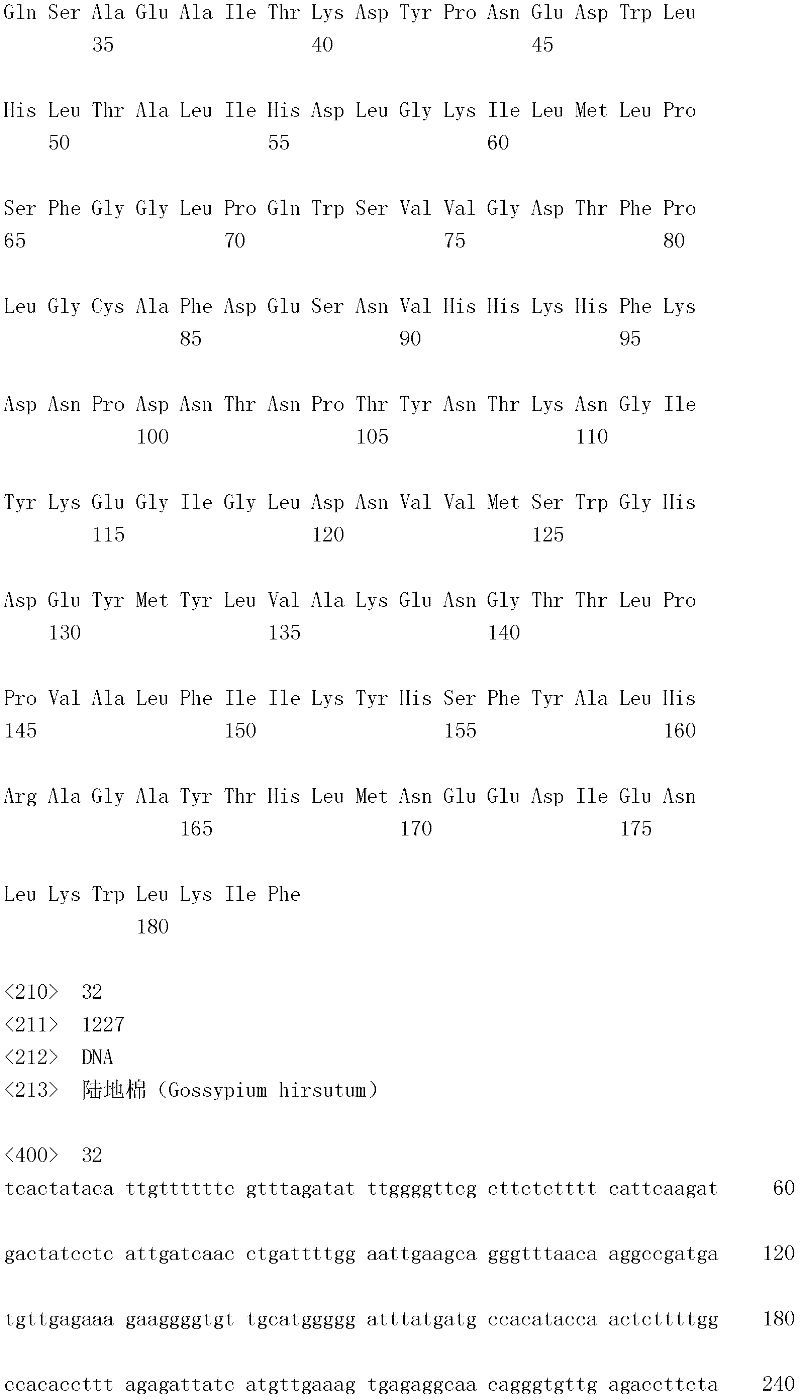


Claims (5)
Applications Claiming Priority (3)
| Application Number | Priority Date | Filing Date | Title |
|---|---|---|---|
| US16177609P | 2009-03-20 | 2009-03-20 | |
| US61/161,776 | 2009-03-20 | ||
| PCT/EP2010/053606 WO2010106163A1 (en) | 2009-03-20 | 2010-03-19 | Nematode-resistant transgenic plants |
Publications (1)
| Publication Number | Publication Date |
|---|---|
| CN102361987A true CN102361987A (en) | 2012-02-22 |
Family
ID=42167978
Family Applications (1)
| Application Number | Title | Priority Date | Filing Date |
|---|---|---|---|
| CN2010800126758A Pending CN102361987A (en) | 2009-03-20 | 2010-03-19 | Nematode resistant transgenic plants |
Country Status (9)
| Country | Link |
|---|---|
| US (1) | US20120084882A1 (en) |
| EP (1) | EP2408923A1 (en) |
| CN (1) | CN102361987A (en) |
| AR (1) | AR075906A1 (en) |
| BR (1) | BRPI1006273A2 (en) |
| CA (1) | CA2754956A1 (en) |
| DE (1) | DE112010001772T5 (en) |
| MX (1) | MX2011009415A (en) |
| WO (1) | WO2010106163A1 (en) |
Cited By (2)
| Publication number | Priority date | Publication date | Assignee | Title |
|---|---|---|---|---|
| CN110923247A (en) * | 2019-12-27 | 2020-03-27 | 甘肃农业大学 | Barley stripe disease pathogenic gene Pgmimox and application thereof |
| CN120624534A (en) * | 2025-06-30 | 2025-09-12 | 石河子大学 | Application of cotton inositol oxidase GhMIOX4D and its encoding gene in regulating plant growth and development |
Families Citing this family (3)
| Publication number | Priority date | Publication date | Assignee | Title |
|---|---|---|---|---|
| JP6560203B2 (en) * | 2013-11-04 | 2019-08-14 | ダウ アグロサイエンシィズ エルエルシー | Universal donor system for gene targeting |
| CN107849568B (en) | 2015-08-07 | 2021-10-26 | 拜尔作物科学公司 | Root-preferred and stress-inducible promoters and uses thereof |
| CN121674425A (en) * | 2026-02-10 | 2026-03-17 | 中国科学院东北地理与农业生态研究所 | Soybean GmST3d gene mutant and application thereof in regulating and controlling resistance of soybeans to sclerotinia sclerotiorum |
Citations (2)
| Publication number | Priority date | Publication date | Assignee | Title |
|---|---|---|---|---|
| US6506559B1 (en) * | 1997-12-23 | 2003-01-14 | Carnegie Institute Of Washington | Genetic inhibition by double-stranded RNA |
| US20070039067A1 (en) * | 2004-09-30 | 2007-02-15 | Ceres, Inc. | Nucleotide sequences and polypeptides encoded thereby useful for modifying plant characteristics |
Family Cites Families (41)
| Publication number | Priority date | Publication date | Assignee | Title |
|---|---|---|---|---|
| US4407956A (en) | 1981-03-13 | 1983-10-04 | The Regents Of The University Of California | Cloned cauliflower mosaic virus DNA as a plant vehicle |
| CA1192510A (en) | 1981-05-27 | 1985-08-27 | Lawrence E. Pelcher | Rna plant virus vector or portion thereof, a method of construction thereof, and a method of producing a gene derived product therefrom |
| NL8200523A (en) | 1982-02-11 | 1983-09-01 | Univ Leiden | METHOD FOR TRANSFORMING IN VITRO PLANT PROTOPLASTS WITH PLASMIDE DNA. |
| US4536475A (en) | 1982-10-05 | 1985-08-20 | Phytogen | Plant vector |
| EP0320500B1 (en) | 1983-01-13 | 2004-11-17 | Max-Planck-Gesellschaft zur Förderung der Wissenschaften e.V. | Non-oncogenic ti plasmid vector system and recombinant DNA molecules for the introduction of expressible genes into plant cell genomes |
| NL8300698A (en) | 1983-02-24 | 1984-09-17 | Univ Leiden | METHOD FOR BUILDING FOREIGN DNA INTO THE NAME OF DIABIC LOBAL PLANTS; AGROBACTERIUM TUMEFACIENS BACTERIA AND METHOD FOR PRODUCTION THEREOF; PLANTS AND PLANT CELLS WITH CHANGED GENETIC PROPERTIES; PROCESS FOR PREPARING CHEMICAL AND / OR PHARMACEUTICAL PRODUCTS. |
| EP0160692A1 (en) | 1983-11-03 | 1985-11-13 | DE WET, Johannes Martenis Jacob | Method for the transfer of exogenous genes in plants using pollen as a vector |
| US4992375A (en) | 1983-11-25 | 1991-02-12 | Monsanto Company | Method of regenerating soybeans from cultured soybean cotyledonary nodes |
| US5004863B2 (en) | 1986-12-03 | 2000-10-17 | Agracetus | Genetic engineering of cotton plants and lines |
| IL84459A (en) | 1986-12-05 | 1993-07-08 | Agracetus | Apparatus and method for the injection of carrier particles carrying genetic material into living cells |
| US5015580A (en) | 1987-07-29 | 1991-05-14 | Agracetus | Particle-mediated transformation of soybean plants and lines |
| US5922602A (en) | 1988-02-26 | 1999-07-13 | Biosource Technologies, Inc. | Cytoplasmic inhibition of gene expression |
| US5614395A (en) | 1988-03-08 | 1997-03-25 | Ciba-Geigy Corporation | Chemically regulatable and anti-pathogenic DNA sequences and uses thereof |
| US5416011A (en) | 1988-07-22 | 1995-05-16 | Monsanto Company | Method for soybean transformation and regeneration |
| GB9019736D0 (en) | 1990-09-10 | 1990-10-24 | Univ Leeds Ind Service Ltd | Plant parasitic nematode control |
| JPH07503361A (en) | 1991-08-01 | 1995-04-13 | バイオソース テクノロジーズ インコーポレイティド | recombinant plant virus nucleic acid |
| PT637339E (en) | 1992-04-13 | 2002-03-28 | Syngenta Ltd | DNA BUILDINGS AND PLANS THAT INCORPORATE THEM |
| US5824876A (en) | 1993-06-28 | 1998-10-20 | Advanced Technologies (Cambridge) Limited | Plant parasitic nematode control |
| US5470353A (en) | 1993-10-20 | 1995-11-28 | Hollister Incorporated | Post-operative thermal blanket |
| US5846797A (en) | 1995-10-04 | 1998-12-08 | Calgene, Inc. | Cotton transformation |
| US5845797A (en) | 1996-07-31 | 1998-12-08 | Daikyo Seiko, Ltd. | Rubber plug for drug vessel |
| CN1202246C (en) | 1998-04-08 | 2005-05-18 | 联邦科学和工业研究组织 | Methods for means for obtaining modified phenotypes |
| WO2000042207A2 (en) | 1999-01-14 | 2000-07-20 | Monsanto Technology Llc | Soybean transformation method |
| US6579455B1 (en) | 1999-09-09 | 2003-06-17 | Pti Advanced Filtration | Filter and valve apparatus |
| US6593513B2 (en) | 2000-01-28 | 2003-07-15 | North Carolina State University | Endoglucanase gene promoter upregulated by the root-knot nematode |
| AU2001275474A1 (en) | 2000-06-12 | 2001-12-24 | Akkadix Corporation | Materials and methods for the control of nematodes |
| GB0130199D0 (en) | 2001-12-17 | 2002-02-06 | Syngenta Mogen Bv | New nematode feeding assay |
| CA2478904A1 (en) | 2002-03-14 | 2003-09-18 | Commonwealth Scientific And Industrial Research Organisation | Modified gene-silencing rna and uses thereof |
| BR0312580A (en) | 2002-07-10 | 2006-10-10 | Univ Kansas State | compositions and methods for controlling parasitic nematodes |
| IL157538A0 (en) | 2003-08-21 | 2004-03-28 | Bar Ilan Res & Dev Company Ltd | Plant resistant to cytoplasm-feeding parasites |
| US7622301B2 (en) | 2004-02-24 | 2009-11-24 | Basf Plant Science Gmbh | Compositions and methods using RNA interference for control of nematodes |
| WO2006020821A2 (en) | 2004-08-13 | 2006-02-23 | Basf Plant Science Gmbh | Compositions and methods using rna interference for control of nematodes |
| EP1799029B1 (en) | 2004-10-13 | 2012-05-16 | University Of Georgia Research Foundation, Inc. | Nematode resistant transgenic plants |
| WO2007095469A2 (en) | 2006-02-10 | 2007-08-23 | Monsanto Technology Llc | Identification and use of target genes for control of plant parasitic nematodes |
| BRPI0708206A2 (en) | 2006-02-23 | 2011-05-17 | Basf Plant Science Gmbh | promoter, expression cassette, vector, plant cell, transgenic plant, plant seed, methods for controlling a parasitic nematode infestation in plants, and for conferring or enhancing nematode resistance in a plant, and use of a promoter or an expression cassette or a vector |
| CA2644273A1 (en) * | 2006-04-05 | 2008-03-27 | Metanomics Gmbh | Process for the production of a fine chemical |
| AR065227A1 (en) | 2006-12-12 | 2009-05-27 | Basf Plant Science Gmbh | PROMOTERS AND REGULATORY ELEMENTS OF THE TREALOSA-6-PHOSPHATE PHOSPHATE PHASE OF INDOCITABLE PLANTS BY PATHOGENS |
| US8076142B2 (en) | 2006-12-21 | 2011-12-13 | Basf Plant Sciences Gmbh | Rooted plant assay system |
| CN101595223A (en) | 2006-12-22 | 2009-12-02 | 巴斯福植物科学有限公司 | Peroxidase gene nematode inducible promotors and using method |
| BRPI0808370A2 (en) | 2007-02-06 | 2014-08-19 | Basf Plant Science Gmbh | PROMOTER, EXPERIMENT CASSETTE, TRANSGENIC PLANT, AND METHOD FOR CHECKING OR IMPROVING NEMATOID RESISTANCE ON A PLANT |
| CA2674495A1 (en) | 2007-02-06 | 2008-08-14 | Basf Plant Science Gmbh | Nematode inducible plant mtn3-like gene promoters and regulatory elements |
-
2010
- 2010-03-19 WO PCT/EP2010/053606 patent/WO2010106163A1/en not_active Ceased
- 2010-03-19 CA CA2754956A patent/CA2754956A1/en not_active Abandoned
- 2010-03-19 EP EP10713320A patent/EP2408923A1/en not_active Withdrawn
- 2010-03-19 CN CN2010800126758A patent/CN102361987A/en active Pending
- 2010-03-19 DE DE112010001772T patent/DE112010001772T5/en not_active Withdrawn
- 2010-03-19 AR ARP100100901A patent/AR075906A1/en not_active Application Discontinuation
- 2010-03-19 US US13/138,695 patent/US20120084882A1/en not_active Abandoned
- 2010-03-19 MX MX2011009415A patent/MX2011009415A/en not_active Application Discontinuation
- 2010-03-19 BR BRPI1006273-4A patent/BRPI1006273A2/en not_active IP Right Cessation
Patent Citations (2)
| Publication number | Priority date | Publication date | Assignee | Title |
|---|---|---|---|---|
| US6506559B1 (en) * | 1997-12-23 | 2003-01-14 | Carnegie Institute Of Washington | Genetic inhibition by double-stranded RNA |
| US20070039067A1 (en) * | 2004-09-30 | 2007-02-15 | Ceres, Inc. | Nucleotide sequences and polypeptides encoded thereby useful for modifying plant characteristics |
Non-Patent Citations (6)
| Title |
|---|
| ANOOP S. SINDHU ET AL.: "Effective and specific in planta RNAi in cyst nematodes:expression interference of four parasitism genes reduces parasitic success", 《JOURNAL OF EXPERIMENTAL BOTANY》, vol. 60, no. 1, 17 December 2008 (2008-12-17), pages 1 - 3 * |
| DAGMAR SZAKASITS ET AL.: "The transcriptome of syncytia induced by the cyst nematode Heterodera schachtii in Arabidopsis roots", 《THE PLANT JOURNAL》, vol. 57, 9 December 2008 (2008-12-09) * |
| DANIEL R.G. PRICE AND JOHN A. GATEHOUSE: "RNAi-mediated crop protection against insects", 《CELL》, vol. 26, no. 7, 1 July 2008 (2008-07-01), XP022757296, DOI: doi:10.1016/j.tibtech.2008.04.004 * |
| DAVID J. FAIRBAIRN ET AL.: "Host-delivered RNAi: an eVective strategy to silence genes in plant parasitic nematodes", 《PLANTA》, vol. 226, no. 6, 31 December 2007 (2007-12-31), pages 1 - 3, XP019563600, DOI: doi:10.1007/s00425-007-0588-x * |
| P. SUSI ET AL.: "Characteristics of RNA silencing in plants: similarities and differences across kingdoms", 《LATERALITY IN THE NEMATODE》, vol. 54, 31 December 2004 (2004-12-31), XP002390785, DOI: doi:10.1023/B:PLAN.0000028797.63168.a7 * |
| SARAH CHANG ET AL.: "MicroRNAs act sequentially and asymmetrically to control chemosensory laterality in the nematode", 《NATURE》, vol. 430, 12 August 2004 (2004-08-12) * |
Cited By (3)
| Publication number | Priority date | Publication date | Assignee | Title |
|---|---|---|---|---|
| CN110923247A (en) * | 2019-12-27 | 2020-03-27 | 甘肃农业大学 | Barley stripe disease pathogenic gene Pgmimox and application thereof |
| CN110923247B (en) * | 2019-12-27 | 2023-04-11 | 甘肃农业大学 | Barley stripe disease pathogenic gene Pgmiox and application thereof |
| CN120624534A (en) * | 2025-06-30 | 2025-09-12 | 石河子大学 | Application of cotton inositol oxidase GhMIOX4D and its encoding gene in regulating plant growth and development |
Also Published As
| Publication number | Publication date |
|---|---|
| AR075906A1 (en) | 2011-05-04 |
| EP2408923A1 (en) | 2012-01-25 |
| WO2010106163A1 (en) | 2010-09-23 |
| BRPI1006273A2 (en) | 2019-09-24 |
| DE112010001772T5 (en) | 2012-10-18 |
| US20120084882A1 (en) | 2012-04-05 |
| CA2754956A1 (en) | 2010-09-23 |
| MX2011009415A (en) | 2011-09-27 |
Similar Documents
| Publication | Publication Date | Title |
|---|---|---|
| EP2111452B1 (en) | Compositions and methods using rna interference of opr3-like gene for control of nematodes | |
| US20100011463A1 (en) | Compositions and Methods Using RNA Interference for Control of Nematodes | |
| EP2115148B1 (en) | Compositions and methods using rna interference of cdpk-like for control of nematodes | |
| US20100180352A1 (en) | Compositions and Methods of Using RNA Interference for Control of Nematodes | |
| US20100107276A1 (en) | Compositions and Methods Using RNA Interference Targeting MTHFR-Like Genes for Control of Nematodes | |
| US20100017912A1 (en) | Compositions and methods using rna interference of cad-like genes for control of nematodes | |
| US20100005545A1 (en) | Compositions and Methods of Using RNA Interference of SCA1-Like Genes for Control of Nematodes | |
| US20130091598A1 (en) | Nematode-Resistant Transgenic Plants | |
| CN102361987A (en) | Nematode resistant transgenic plants | |
| US20110047645A1 (en) | Compositions and Methods of Using RNA Interference for Control of Nematodes | |
| MX2010011716A (en) | Compositions and methods of using rna interference for control of nematodes. | |
| WO2012156902A1 (en) | Nematode-resistant transgenic plants |
Legal Events
| Date | Code | Title | Description |
|---|---|---|---|
| C06 | Publication | ||
| PB01 | Publication | ||
| C10 | Entry into substantive examination | ||
| SE01 | Entry into force of request for substantive examination | ||
| C02 | Deemed withdrawal of patent application after publication (patent law 2001) | ||
| WD01 | Invention patent application deemed withdrawn after publication |
Application publication date: 20120222 |