CN102688198A - Polypeptide drug sustained-release microsphere preparation and preparation method thereof - Google Patents
Polypeptide drug sustained-release microsphere preparation and preparation method thereof Download PDFInfo
- Publication number
- CN102688198A CN102688198A CN201210203775XA CN201210203775A CN102688198A CN 102688198 A CN102688198 A CN 102688198A CN 201210203775X A CN201210203775X A CN 201210203775XA CN 201210203775 A CN201210203775 A CN 201210203775A CN 102688198 A CN102688198 A CN 102688198A
- Authority
- CN
- China
- Prior art keywords
- polylactic acid
- microspheres
- release
- polypeptide
- preparation
- Prior art date
- Legal status (The legal status is an assumption and is not a legal conclusion. Google has not performed a legal analysis and makes no representation as to the accuracy of the status listed.)
- Granted
Links
Images


Classifications
-
- A—HUMAN NECESSITIES
- A61—MEDICAL OR VETERINARY SCIENCE; HYGIENE
- A61K—PREPARATIONS FOR MEDICAL, DENTAL OR TOILETRY PURPOSES
- A61K9/00—Medicinal preparations characterised by special physical form
- A61K9/14—Particulate form, e.g. powders, Processes for size reducing of pure drugs or the resulting products, Pure drug nanoparticles
- A61K9/16—Agglomerates; Granulates; Microbeadlets ; Microspheres; Pellets; Solid products obtained by spray drying, spray freeze drying, spray congealing,(multiple) emulsion solvent evaporation or extraction
- A61K9/1605—Excipients; Inactive ingredients
- A61K9/1629—Organic macromolecular compounds
- A61K9/1641—Organic macromolecular compounds obtained otherwise than by reactions only involving carbon-to-carbon unsaturated bonds, e.g. polyethylene glycol, poloxamers
- A61K9/1647—Polyesters, e.g. poly(lactide-co-glycolide)
-
- A—HUMAN NECESSITIES
- A61—MEDICAL OR VETERINARY SCIENCE; HYGIENE
- A61P—SPECIFIC THERAPEUTIC ACTIVITY OF CHEMICAL COMPOUNDS OR MEDICINAL PREPARATIONS
- A61P3/00—Drugs for disorders of the metabolism
- A61P3/04—Anorexiants; Antiobesity agents
-
- A—HUMAN NECESSITIES
- A61—MEDICAL OR VETERINARY SCIENCE; HYGIENE
- A61P—SPECIFIC THERAPEUTIC ACTIVITY OF CHEMICAL COMPOUNDS OR MEDICINAL PREPARATIONS
- A61P3/00—Drugs for disorders of the metabolism
- A61P3/08—Drugs for disorders of the metabolism for glucose homeostasis
- A61P3/10—Drugs for disorders of the metabolism for glucose homeostasis for hyperglycaemia, e.g. antidiabetics
Landscapes
- Health & Medical Sciences (AREA)
- Diabetes (AREA)
- Engineering & Computer Science (AREA)
- Bioinformatics & Cheminformatics (AREA)
- Pharmacology & Pharmacy (AREA)
- Veterinary Medicine (AREA)
- Public Health (AREA)
- General Health & Medical Sciences (AREA)
- Chemical & Material Sciences (AREA)
- Animal Behavior & Ethology (AREA)
- Life Sciences & Earth Sciences (AREA)
- Medicinal Chemistry (AREA)
- Hematology (AREA)
- Organic Chemistry (AREA)
- Nuclear Medicine, Radiotherapy & Molecular Imaging (AREA)
- General Chemical & Material Sciences (AREA)
- Chemical Kinetics & Catalysis (AREA)
- Obesity (AREA)
- Endocrinology (AREA)
- Emergency Medicine (AREA)
- Epidemiology (AREA)
- Child & Adolescent Psychology (AREA)
- Medicinal Preparation (AREA)
- Medicines That Contain Protein Lipid Enzymes And Other Medicines (AREA)
Abstract
本发明公开了一种多肽药物缓释微球制剂及其制备方法,将聚乳酸-羟基乙酸共聚物或聚乳酸和保护剂、多肽药物共同溶解在有机溶剂中,形成完全均一的混合溶液,混合溶液加入到油相形成乳液。除去有机溶剂,离心洗涤,冷冻干燥,即得多肽药物缓释微球。本发明采取O/O法,杜绝了复乳法制备过程中药物向外水相扩散的问题,提高了药物包埋率,药物包埋率在60%~95%。生物活性多肽药物通过微球表面孔隙和随着微球的聚合物材料在体内降解缓慢释放出来,释放时间可长达数周至数月,体外释放试验结果表明释放符合近似零级释放。
The invention discloses a polypeptide drug sustained-release microsphere preparation and a preparation method thereof. Polylactic acid-glycolic acid copolymer or polylactic acid, a protective agent, and a polypeptide drug are dissolved together in an organic solvent to form a completely uniform mixed solution. The solution is added to the oil phase to form an emulsion. The organic solvent is removed, washed by centrifugation, and freeze-dried to obtain the sustained-release microspheres of polypeptide drugs. The invention adopts the O/O method, which eliminates the problem of drug diffusion to the external water phase in the preparation process of the double emulsion method, improves the drug embedding rate, and the drug embedding rate is 60% to 95%. Bioactive polypeptide drugs are slowly released through the surface pores of the microspheres and with the degradation of the polymer material of the microspheres in vivo, and the release time can be as long as several weeks to several months. The results of in vitro release tests show that the release conforms to approximately zero-order release.
Description
技术领域 technical field
本发明属于生物医用高分子材料与生物活性药物控释制剂研究领域,具体地说,本发明涉及一种多肽药物缓释微球制剂及其制备方法。The invention belongs to the research field of biomedical polymer materials and bioactive drug controlled-release preparations. Specifically, the invention relates to a polypeptide drug sustained-release microsphere preparation and a preparation method thereof.
背景技术 Background technique
大多数的蛋白、多肽类药物,口服生物利用度很低,以致口服后不能产生足够高的有效血药浓度,这类药物不能通过口服途径给药。皮下注射时由于体内蛋白酶的存在,药物在体内的半衰期很短,需要频繁注射,增加了患者的痛苦,降低患者依从性。Most protein and polypeptide drugs have very low oral bioavailability, so that they cannot produce a sufficiently high effective blood concentration after oral administration, and such drugs cannot be administered orally. Due to the presence of proteases in the body during subcutaneous injection, the half-life of the drug in the body is very short, requiring frequent injections, which increases the pain of the patient and reduces the patient's compliance.
利用生物相容性可降解材料(例如高分子材料)包裹药物活性成分,制成微球制剂,通过可降解的生物高分子材料在体内逐步降解来控制药物释放,维持有效的血药浓度。然而,大多数微球制剂都存在很高的药物突释现象以及此后的低释,造成血药浓度过高或者低于有效血药浓度。此外,在微球制剂生产过程中很容易造成生物活性药物成分活性降低或降解,对于多肽类药物来说尤其如此。因此,需要一种新的制剂和工艺来改善这类缓释制剂的突释及维持释放期间的有效血药浓度。Biocompatible degradable materials (such as polymer materials) are used to wrap active pharmaceutical ingredients to make microsphere preparations, and the drug release is controlled through the gradual degradation of biodegradable biopolymer materials in vivo to maintain effective blood drug concentrations. However, most of the microsphere formulations have a high burst drug release and a low drug release thereafter, resulting in high blood drug concentration or lower than the effective blood drug concentration. In addition, during the production of microsphere preparations, it is easy to reduce or degrade the activity of bioactive pharmaceutical ingredients, especially for peptide drugs. Therefore, there is a need for a new formulation and process to improve the effective blood drug concentration during the burst release and sustained release of such sustained release formulations.
艾塞那肽(exenatide)是人工合成的北美毒蜥外泌肽(exendin-4),由39个氨基酸残基构成,分子式为C184H282N50O60S,相对分子量4186.57,其氨基酸序列如下:His-Gly-Glu-Gly-Thr-Phe-Thr-Ser-Asp-Leu-SerLys-Gln-Met-Glu-Glu-Glu-Ala-Val-Arg-Leu-Phe-Ile-Glu-Trp-Leu-Lys-Asn-Gly-Gly-Pro-Ser-Ser-Gly-Ala-Pro-Pro-Pro-Ser-NH2。艾塞那肽为人胰高血糖素样肽-1(GLP-1)的类似物,与GLP-1具有相同的生理功能,其53%的氨基酸顺序与哺乳动物胰高血糖素样多肽-1(GLP-1)的氨基酸顺序相同,其主要生物功能为:①增加胰岛素的生物合成及葡萄糖依赖性促胰岛素分泌;②刺激β细胞增殖和再生,抑制β细胞凋亡从而增加β细胞的数量;③抑制胰高血糖素的分泌;④抑制肝糖生成,但不会引起严重低血糖;⑤抑制餐后胃肠道动力及分泌功能;⑥降低食欲,减少食物的摄入;⑦对神经细胞具有保护作用。可促进葡萄糖依赖的胰岛素分泌,抑制不适当的葡萄糖依赖的胰高血糖素的分泌,减慢胃排空,改善外周组织对胰岛素的敏感性,充分控制血糖。Exenatide is a synthetic exendin-4, composed of 39 amino acid residues, molecular formula C 184 H 282 N 50 O 60 S, relative molecular weight 4186.57, its amino acid sequence As follows: His-Gly-Glu-Gly-Thr-Phe-Thr-Ser-Asp-Leu-SerLys-Gln-Met-Glu-Glu-Glu-Ala-Val-Arg-Leu-Phe-Ile-Glu-Trp- Leu-Lys-Asn-Gly-Gly-Pro-Ser-Ser-Gly-Ala-Pro-Pro-Pro-Pro-Ser-NH2. Exenatide is an analogue of human glucagon-like peptide-1 (GLP-1), which has the same physiological function as GLP-1, and its 53% amino acid sequence is similar to that of mammalian glucagon-like peptide-1 ( GLP-1) has the same amino acid sequence, and its main biological functions are: ① increase insulin biosynthesis and glucose-dependent insulin secretion; ② stimulate β-cell proliferation and regeneration, inhibit β-cell apoptosis and increase the number of β-cells; ③ Inhibit the secretion of glucagon; ④ Inhibit the production of glycogen, but will not cause severe hypoglycemia; ⑤ Inhibit the motility and secretion function of the gastrointestinal tract after meals; ⑥ Reduce appetite and food intake; ⑦ Protect nerve cells effect. It can promote glucose-dependent insulin secretion, inhibit inappropriate glucose-dependent glucagon secretion, slow down gastric emptying, improve the sensitivity of peripheral tissues to insulin, and fully control blood sugar.
艾塞那肽注射剂已于2005年4月获美国食品药品监督管理局(FDA)批准上市,商品名为百泌达(Byetta,Exenatide Injection),用于改善使用二甲双胍和磺酰脲类药物不理想的2型糖尿病患者的血糖控制或者用来控制体重。临床结果显示,艾塞那肽用于糖尿病治疗效果明显。艾塞那肽的半衰期仅2.4小时,需每日注射两次。2012年1月27日,FDA批准了每周注射一次的艾塞那肽缓释剂型,商品名Bydureon。Exenatide injection was approved by the U.S. Food and Drug Administration (FDA) in April 2005, and its trade name is Byetta (Exenatide Injection), which is used to improve the unsatisfactory use of metformin and sulfonylurea drugs. Glycemic control or weight control in patients with type 2 diabetes. Clinical results show that exenatide is effective in the treatment of diabetes. Exenatide has a half-life of only 2.4 hours and requires twice-daily injections. On January 27, 2012, the FDA approved a weekly injection of exenatide sustained-release dosage form, trade name Bydureon.
美国礼来公司(Eli Lilly and Company)、Amylin、Alkermes公司生产的艾塞那肽缓释制剂(Bydureon)采用相凝聚原理来制备艾塞那肽微球,该制剂其配方包括5%的艾塞那肽、2%蔗糖及93%PLGA(50∶50)。The Exenatide Sustained Release Preparation (Bydureon) produced by Eli Lilly and Company, Amylin and Alkermes uses the principle of phase coacervation to prepare Exenatide microspheres. The formulation of the preparation includes 5% Exenatide That peptide, 2% sucrose and 93% PLGA (50:50).
此方法制备的微球形状不规整,不是规则圆球,表面凹凸不平,粒径分布不均匀,平均粒径在20~40微米之间。制备过程中需要筛选出不符合要求的部分,来控制微球的平均粒径和粒径分布,使产率大大下降,同时增加了制备工艺的复杂性和无菌工艺操作的难度。国内也有研究机构采用复乳法(W/O/W)制备类似微球,按照复乳化方法不同有直接机械搅拌和膜乳化两种方法。膜乳化法虽然可制得粒径相对均一的微球,但多肽药物大都易溶于水,在制备过程中药物易于向外水相扩散,造成药物包封率不高,生产成本上升,而成本亦是微球制剂生产过程中的一个关键因素。The shape of the microspheres prepared by the method is irregular, not a regular sphere, the surface is uneven, the particle size distribution is uneven, and the average particle size is between 20 and 40 microns. During the preparation process, it is necessary to screen out the parts that do not meet the requirements to control the average particle size and particle size distribution of the microspheres, which greatly reduces the yield and increases the complexity of the preparation process and the difficulty of aseptic process operation. There are also domestic research institutions using the double emulsion method (W/O/W) to prepare similar microspheres. According to the double emulsification method, there are two methods: direct mechanical stirring and membrane emulsification. Although the membrane emulsification method can produce microspheres with relatively uniform particle size, most of the polypeptide drugs are easily soluble in water. It is also a key factor in the production process of microsphere preparations.
现有技术在制备微球过程中,生物活性多肽药物与聚乳酸-羟基乙酸共聚物分别溶于水和有机溶剂,分属互不相容两相:油相和水相,药物和聚乳酸-羟基乙酸共聚物是非均相体系。Prior art In the process of preparing microspheres, bioactive polypeptide drugs and polylactic acid-glycolic acid copolymers are dissolved in water and organic solvents respectively, and belong to two mutually incompatible phases: oil phase and water phase, drugs and polylactic acid-glycolic acid- Glycolic acid copolymers are heterogeneous systems.
发明内容 Contents of the invention
基于此,有必要提供一种多肽药物缓释微球制剂的制备方法,其制备得到的缓释微球制剂能有效延长在体内的作用时间。Based on this, it is necessary to provide a preparation method of polypeptide drug sustained-release microsphere preparation, and the prepared sustained-release microsphere preparation can effectively prolong the action time in vivo.
一种多肽药物缓释微球的制备方法,包括以下步骤:A preparation method of polypeptide drug slow-release microspheres, comprising the following steps:
(1)将聚乳酸-羟基乙酸共聚物或聚乳酸溶于有机溶剂中,形成浓度为100~800mg/mL的溶液;所述聚乳酸-羟基乙酸共聚物中乙交酯∶丙交酯=15∶85~90∶10,所述聚乳酸-羟基乳酸共聚物的分子量为2000~65000;所述聚乳酸的分子量为4000~50000;所述有机溶剂为二氯甲烷、三氯甲烷、乙酸乙酯、丙酮、乙酸、乙腈中的一种或几种;(1) Dissolve polylactic acid-glycolic acid copolymer or polylactic acid in an organic solvent to form a solution with a concentration of 100 to 800 mg/mL; glycolide in the polylactic acid-glycolic acid copolymer: lactide=15 : 85~90:10, the molecular weight of the polylactic acid-hydroxylactic acid copolymer is 2000~65000; the molecular weight of the polylactic acid is 4000~50000; the organic solvent is dichloromethane, chloroform, ethyl acetate , acetone, acetic acid, acetonitrile or one or more;
(2)分别按10~500mg/ml和10~200mg/ml的浓度,将多肽药物和保护剂溶于无菌水中,得到多肽药物溶液,所述保护剂为糖、糖醇类、蛋白类、无机盐、高分子稳定剂中的一种或几种;(2) According to the concentrations of 10-500 mg/ml and 10-200 mg/ml respectively, the polypeptide drug and the protective agent are dissolved in sterile water to obtain a polypeptide drug solution, and the protective agent is sugar, sugar alcohols, proteins, One or more of inorganic salts and polymer stabilizers;
(3)按体积比为1∶5~50将步骤(1)的聚乳酸-羟基乙酸共聚物溶液或聚乳酸溶液与步骤(2)的多肽药物溶液混合,搅拌至形成均一、澄清、透明的混合液;(3) Mix the polylactic acid-glycolic acid copolymer solution or polylactic acid solution in step (1) with the polypeptide drug solution in step (2) at a volume ratio of 1:5 to 50, and stir until a uniform, clear, transparent mixed solution;
(4)配制含0.5~5wt%稳定剂的油相,所述油相选自大豆油、花生油、玉米油、芝麻油、矿物油、二甲基硅油、棉籽油、橄榄油、椰子油、橘油、脂肪烃、环脂烃或芳香烃中的一种或几种;所述稳定剂选自卵磷脂、span80、单硬脂酸甘油酯或双硬脂酸聚甘油酯;油相作用是作为乳液连续相,为了保持乳液两相稳定,油相中需加入一定量的稳定剂。稳定剂的含量影响最终微球粒径的大小。稳定剂含量越高,乳化时形成的乳滴越小,最终得到的微球粒径越小。(4) preparation contains the oil phase of 0.5~5wt% stabilizer, and described oil phase is selected from soybean oil, peanut oil, corn oil, sesame oil, mineral oil, simethicone oil, cottonseed oil, olive oil, coconut oil, orange oil One or more of aliphatic hydrocarbons, cycloaliphatic hydrocarbons or aromatic hydrocarbons; the stabilizer is selected from lecithin, span80, glyceryl monostearate or polyglyceryl distearate; the oil phase acts as an emulsion Continuous phase, in order to keep the two phases of the emulsion stable, a certain amount of stabilizer needs to be added to the oil phase. The content of stabilizer affects the size of the final microsphere particle size. The higher the stabilizer content, the smaller the emulsion droplets formed during emulsification, and the smaller the particle size of the final microspheres.
(5)按体积比1∶2~50将步骤(3)的混合液与步骤(4)的油相均质形成O/O型乳液;形成乳液的方法有机械搅拌(时间3~15min)、高压均质或高剪切均质等。两相比及两相间的表面张力影响最终微球粒径大小。有机相与油相体积比越大,对应得到的微球粒径越大。(5) The mixed solution of step (3) and the oil phase of step (4) are homogeneously formed O/O type emulsion by volume ratio 1: 2~50; The method for forming emulsion has mechanical stirring (time 3~15min), High-pressure homogenization or high-shear homogenization, etc. The two phases and the surface tension between the two phases affect the final particle size of the microspheres. The larger the volume ratio of the organic phase to the oil phase, the larger the corresponding particle size of the obtained microspheres.
(6)挥发步骤(5)的乳液除去有机溶剂,待有机溶剂完全挥发干净后,离心收集微球,加入环己烷洗涤,除去微球中残留的有机溶剂,把收集到的微球放入真空冷冻干燥器干燥4~10h,得到多肽药物缓释微球制剂,置于-20℃保存。(6) Remove the organic solvent from the emulsion in the volatilization step (5). After the organic solvent is completely volatilized, collect the microspheres by centrifugation, add cyclohexane to wash, remove the residual organic solvent in the microspheres, and put the collected microspheres into Dry in a vacuum freeze dryer for 4-10 hours to obtain the polypeptide drug sustained-release microsphere preparation, which is stored at -20°C.
可以在300~3000rpm搅拌速度下搅拌6~15h除去有机溶剂,也可以采取加热、减压蒸发等方法达到相同效果。溶剂挥发的速度影响微球的表面形态,有机溶剂挥发速度慢,得到的微球表面更加致密,微球孔隙率小。The organic solvent can be removed by stirring at a stirring speed of 300-3000 rpm for 6-15 hours, or by heating, vacuum evaporation and other methods to achieve the same effect. The volatilization speed of the solvent affects the surface morphology of the microspheres. The volatilization speed of the organic solvent is slow, and the surface of the obtained microspheres is denser, and the porosity of the microspheres is small.
在其中一些实施例中,所述多肽药物为艾塞那肽(exenatide)、胰高血糖素样肽(GLP-1)、促黄体激素释放激素(LHRH)、细胞因子、肿瘤坏死因子、生长激素、降钙素、表皮生长因子(EGF)、神经生长因子(NGF)、干扰素、生长激素、酶、白细胞介素、促红细胞生长素、免疫球蛋白、抗体、集落刺激因子、胰岛素或其类似物、衍生物、修饰物或盐。In some of these embodiments, the polypeptide drug is exenatide, glucagon-like peptide (GLP-1), luteinizing hormone-releasing hormone (LHRH), cytokine, tumor necrosis factor, growth hormone , calcitonin, epidermal growth factor (EGF), nerve growth factor (NGF), interferon, growth hormone, enzyme, interleukin, erythropoietin, immunoglobulin, antibody, colony-stimulating factor, insulin, or the like substances, derivatives, modifications or salts.
在其中一个实施例中,所述多肽药物为艾塞那肽、利拉鲁肽或其药学上可接受盐。In one of the embodiments, the polypeptide drug is exenatide, liraglutide or a pharmaceutically acceptable salt thereof.
在其中一些实施例中,所述聚乳酸-羟基乙酸共聚物溶液或聚乳酸溶液的浓度为100~500mg/mL。聚乳酸-羟基乳酸共聚物或聚乳酸在有机溶剂中的浓度越大,乳化时形成的液滴越大,对应最后形成微球的粒径越大。In some of these embodiments, the concentration of the polylactic acid-glycolic acid copolymer solution or the polylactic acid solution is 100-500 mg/mL. The greater the concentration of polylactic acid-hydroxylactic acid copolymer or polylactic acid in the organic solvent, the larger the droplets formed during emulsification, corresponding to the larger particle size of the final microspheres.
在其中一些实施例中,所述保护剂为人血白蛋白、锌盐如氯化锌、碳酸锌、硫酸锌和醋酸锌、蔗糖或明胶。保护剂的作用是保持生物活性多肽药物的稳定性,防止多肽药物形成多聚体失活或无法释放。In some of these embodiments, the protective agent is human serum albumin, zinc salts such as zinc chloride, zinc carbonate, zinc sulfate and zinc acetate, sucrose or gelatin. The function of the protective agent is to maintain the stability of the biologically active polypeptide drug and prevent the polypeptide drug from forming multimers that are inactivated or unable to be released.
在其中一些实施例中,艾塞那肽或利拉鲁肽的浓度为50~200mg/ml,保护剂的浓度为50~100mg/ml。In some of these embodiments, the concentration of exenatide or liraglutide is 50-200 mg/ml, and the concentration of the protective agent is 50-100 mg/ml.
在其中一些实施例中,所述聚乳酸-羟基乙酸共聚物溶液与艾塞那肽溶液的体积比为1∶5~10。In some of the embodiments, the volume ratio of the polylactic acid-glycolic acid copolymer solution to the exenatide solution is 1:5-10.
在其中一些实施例中,所述稳定剂的含量为0.5%~3%。In some of these embodiments, the content of the stabilizer is 0.5%-3%.
在其中一些实施例中,所述混合液与油相的体积比为1∶2~10。In some of the embodiments, the volume ratio of the mixed liquid to the oil phase is 1:2-10.
在其中一些实施例中,聚乳酸-羟基乙酸共聚物的分子量为10000~50000。In some of the embodiments, the polylactic acid-glycolic acid copolymer has a molecular weight of 10,000-50,000.
在其中一些实施例中,油相的粘度为10~500cp。油相的粘度对微球粒径有较大影响,粘度越大,乳化时形成的液滴尺寸越大。In some of the embodiments, the oil phase has a viscosity of 10-500 cp. The viscosity of the oil phase has a great influence on the particle size of the microspheres. The higher the viscosity, the larger the droplet size formed during emulsification.
在其中一些实施例中,油相的粘度为30~100cp。In some of the embodiments, the viscosity of the oil phase is 30-100 cp.
在其中一些实施例中,聚乳酸-羟基乙酸共聚物的特性粘数为0.1~0.5。In some of the embodiments, the intrinsic viscosity of the polylactic acid-glycolic acid copolymer is 0.1-0.5.
在其中一个实施例中,所述聚乳酸-羟基乙酸共聚物的特性粘数为0.3~0.5。In one embodiment, the polylactic acid-glycolic acid copolymer has an intrinsic viscosity of 0.3-0.5.
本发明还提供了一种由上述制备方法制得的多肽药物缓释微球制剂。所述制剂主要包括可生物降解的高分子聚合物、多肽药物和保护剂,所述可生物降解的高分子聚合物为聚乳酸-羟基乙酸共聚物、聚乳酸或其改性修饰物中的一种或几种。该多肽药物缓释微球制剂是经皮下或肌肉注射的,主要是由生物活性多肽药物与可生物降解的聚合物构成的缓释组合物(微球),生物活性多肽药物均匀分散在可生物降解的聚合物中。优选的微球粒径在20~100微米,更优选的为30~60微米。微球平均粒径的大小也影响生物活性多肽药物从微球中的释放。随着微球粒径的逐渐增大,生物活性多肽药物从微球中释放速度也逐渐减慢,相应释放时间也随之延长。微球粒径越大,注射时越困难,病人的疼痛感越强。The present invention also provides a polypeptide drug sustained-release microsphere preparation prepared by the above preparation method. The preparation mainly includes a biodegradable polymer, a polypeptide drug and a protective agent, and the biodegradable polymer is one of polylactic acid-glycolic acid copolymer, polylactic acid or a modified modification thereof species or several. The polypeptide drug sustained-release microsphere preparation is injected subcutaneously or intramuscularly, and is mainly a sustained-release composition (microsphere) composed of a bioactive polypeptide drug and a biodegradable polymer. The bioactive polypeptide drug is uniformly dispersed in the biodegradable in degraded polymers. The preferred particle size of the microspheres is 20-100 microns, more preferably 30-60 microns. The average particle size of the microspheres also affects the release of bioactive polypeptide drugs from the microspheres. With the gradual increase of the particle size of the microspheres, the release rate of the bioactive polypeptide drug from the microspheres also gradually slowed down, and the corresponding release time was also prolonged. The larger the particle size of the microspheres, the more difficult it is to inject and the stronger the pain for the patient.
本发明的缓释微球的原料如下:The raw material of slow release microsphere of the present invention is as follows:
1.艾塞那肽(以艾塞那肽为例说明,也可以是其它的生物活性多肽药物,如GLP-1、LHRH、利拉鲁肽、降钙素、细胞因子、肿瘤坏死因子、生长激素、EGF、NGF、干扰素、生长激素、酶、白细胞介素、促红细胞生长素、免疫球蛋白、抗体、集落刺激因子、胰岛素以及上述蛋白、多肽的类似物、衍生物、修饰物及盐,上述多肽药物可以是通过天然提取、化学合成或者基因工程方法得到)1. Exenatide (take exenatide as an example, it can also be other biologically active peptide drugs, such as GLP-1, LHRH, liraglutide, calcitonin, cytokines, tumor necrosis factor, growth Hormone, EGF, NGF, interferon, growth hormone, enzyme, interleukin, erythropoietin, immunoglobulin, antibody, colony-stimulating factor, insulin and the analogs, derivatives, modifications and salts of the above proteins and polypeptides , the above polypeptide drugs can be obtained by natural extraction, chemical synthesis or genetic engineering methods)
艾塞那肽是一种含有39个氨基酸的多肽,艾塞那肽为人胰高血糖素样肽-1(GLP-1)的类似物,是GLP-1的受体激动剂,与GLP-1具有相同的生理功能,艾塞那肽在体外显示可以结合并活化已知的人类GLP-1受体。这就意味着通过包括cAMP和/或其他细胞内信号传导机制使葡萄糖依赖性胰岛素合成及胰岛β细胞在体内分泌胰岛素增加。在葡萄糖浓度升高的情况下,艾塞那肽可促进胰岛素从β细胞中释放。体内给药后艾塞那肽模拟GLP-1的某种抗高血糖药作用。Exenatide is a polypeptide containing 39 amino acids. Exenatide is an analogue of human glucagon-like peptide-1 (GLP-1), a receptor agonist of GLP-1, and GLP-1 With the same physiological function, exenatide has been shown in vitro to bind and activate the known human GLP-1 receptor. This implies an increase in glucose-dependent insulin synthesis and insulin secretion by pancreatic beta cells in vivo through mechanisms involving cAMP and/or other intracellular signaling. Exenatide stimulates the release of insulin from beta cells in the presence of elevated glucose concentrations. Exenatide mimics some antihyperglycemic effects of GLP-1 after in vivo administration.
2.保护剂2. Protective agent
保护剂的作用是防止生物活性物(例如艾塞那肽)在制备微球的过程中活性降低,一方面有助于蛋白的稳定,防止蛋白在微球内部形成多聚体而无法释放,另一方面可以减小药物突释作用。The role of the protective agent is to prevent the activity of biologically active substances (such as exenatide) from reducing during the preparation of microspheres. On the one hand, it helps to stabilize the protein and prevents the protein from forming polymers inside the microsphere and cannot be released. On the one hand, it can reduce the drug burst release effect.
本发明可以选用的保护剂主要有糖、糖醇类:主要是小分子的糖。例如:蔗糖、乳糖、海藻糖、纤维二糖、甘露糖、麦芽糖、肌糖、绵白糖、菊糖、右旋糖苷、麦芽糖糊精、甘露醇等;蛋白类:人血白蛋白、纤维蛋白等;高分子稳定剂:明胶、阿拉伯胶、桃胶、黄原胶、甲基纤维素、羧甲基纤维素钠、羟丙基纤维素、卡波姆、聚维酮、葡聚糖;锌盐类:醋酸锌、碳酸锌、硫酸锌、氯化锌。本发明选用的保护剂为上述中的一种或几种。The protective agent that can be selected in the present invention mainly contains sugar, sugar alcohols: mainly the sugar of small molecules. For example: sucrose, lactose, trehalose, cellobiose, mannose, maltose, inosose, soft white sugar, inulin, dextran, maltodextrin, mannitol, etc.; proteins: human albumin, fibrin, etc. ;Polymer Stabilizer: Gelatin, Gum Arabic, Peach Gum, Xanthan Gum, Methylcellulose, Sodium Carboxymethylcellulose, Hydroxypropylcellulose, Carbomer, Povidone, Dextran; Zinc Salt Class: zinc acetate, zinc carbonate, zinc sulfate, zinc chloride. The protective agent selected in the present invention is one or more of the above.
3.聚乳酸-羟基乙酸共聚物或聚乳酸3. Polylactic acid-glycolic acid copolymer or polylactic acid
本发明中所用到的高分子聚物合由本领域技术人员综合考虑聚合物的降解率、物理性质、端基化学等确定的。聚乳酸-羟基乙酸共聚物、聚乳酸的分子量及组成影响生物活性多肽药物从微球中的释放。聚乳酸-羟基乙酸共聚物中乙交酯∶丙交酯=25∶75~90∶10,所述聚乳酸-羟基乳酸共聚物的分子量为2000~65000,特性粘数为0.1~0.5。聚乳酸的分子量为4000~50000。聚乳酸-羟基乙酸共聚物、聚乳酸可以是端基封闭、未封闭(端羧基)及经过其他基团修饰的(例如MPEG-PLGA、MPEG-PLGA)。聚合物采用端羧基PLGA(末端未封闭)或MPEG-PLGA时,所得微球比采用端基封闭PLGA具有更低的突释率。The high molecular polymer used in the present invention is determined by those skilled in the art by comprehensively considering the degradation rate, physical properties, and end group chemistry of the polymer. The molecular weight and composition of polylactic acid-glycolic acid copolymer and polylactic acid affect the release of bioactive polypeptide drugs from microspheres. Glycolide: lactide = 25:75-90:10 in the polylactic acid-glycolic acid copolymer, the molecular weight of the polylactic acid-hydroxylactic acid copolymer is 2000-65000, and the intrinsic viscosity is 0.1-0.5. The molecular weight of polylactic acid is 4000-50000. Polylactic acid-glycolic acid copolymer, polylactic acid can be end-blocked, unblocked (carboxyl-terminated) and modified with other groups (eg MPEG-PLGA, MPEG-PLGA). When the polymer adopts carboxyl-terminated PLGA (unblocked at the end) or MPEG-PLGA, the obtained microspheres have a lower burst release rate than that of end-blocked PLGA.
本发明的多肽药物缓释微球制备方法采取O/O法,将聚乳酸-羟基乙酸共聚物和保护剂、多肽药物共同溶解在有机溶剂中,形成完全均一的混合溶液,混合溶液加入到油相(植物油)形成乳液。制备过程中连续相为油相,杜绝了复乳法制备过程中药物向外水相扩散的问题,提高了药物包埋率,药物包埋率在60%~95%。多肽药物和保护剂均匀地包埋在聚乳酸-羟基乙酸共聚物微球内。生物活性多肽药物通过微球表面孔隙和随着微球的聚合物材料在体内降解缓慢释放出来,释放时间可长达一周至数月,体外释放试验结果表明释放符合近似零级释放。The preparation method of the polypeptide drug slow-release microspheres of the present invention adopts the O/O method, and the polylactic acid-glycolic acid copolymer, the protective agent, and the polypeptide drug are dissolved in an organic solvent to form a completely uniform mixed solution, and the mixed solution is added to the oil phase (vegetable oil) to form an emulsion. The continuous phase in the preparation process is an oil phase, which eliminates the problem of drug diffusion to the outer water phase in the preparation process of the double emulsion method, improves the drug embedding rate, and the drug embedding rate is 60% to 95%. Polypeptide drugs and protective agents are uniformly embedded in polylactic acid-glycolic acid copolymer microspheres. Bioactive polypeptide drugs are slowly released through the surface pores of the microspheres and with the degradation of the polymer material of the microspheres in vivo, and the release time can be as long as one week to several months. The results of in vitro release tests show that the release conforms to approximately zero-order release.
本发明的多肽药物缓释微球制剂的制备方法只需要乳化、挥发有机溶剂即可得到规整的微球和在微球中均匀分布的药物,工序简单,操作简单,制备重复性好,批次之间无显著差别,得到的微球粒径均一、分布窄、粒径可控,微球表面圆整,微球突释率低。The preparation method of the polypeptide drug sustained-release microsphere preparation of the present invention only needs to emulsify and volatilize the organic solvent to obtain regular microspheres and drugs evenly distributed in the microspheres, the process is simple, the operation is simple, and the preparation repeatability is good. There is no significant difference between them, and the obtained microspheres have uniform particle size, narrow distribution, controllable particle size, rounded surface of the microspheres, and low burst release rate of the microspheres.
本发明制备的艾塞那肽缓/利拉鲁肽释微球,微球之间无粘连和团聚,微球无破裂,药物释放平稳、持续,药物活性在体内释放期间保持在90%以上,可适用于治疗Ⅱ型糖尿病和控制体重。The exenatide slow/liraglutide release microspheres prepared by the present invention have no adhesion and agglomeration among the microspheres, no breakage of the microspheres, stable and sustained drug release, and the drug activity remains above 90% during the release in vivo. It is suitable for treating type Ⅱ diabetes and controlling body weight.
附图说明 Description of drawings
图1为实施例4艾塞那肽缓释微球的扫描电镜照片;Fig. 1 is the scanning electron micrograph of embodiment 4 exenatide slow-release microspheres;
图2为实施例2艾塞那肽缓释微球体外累计释放曲线;Fig. 2 is the in vitro cumulative release curve of Exenatide sustained-release microspheres in Example 2;
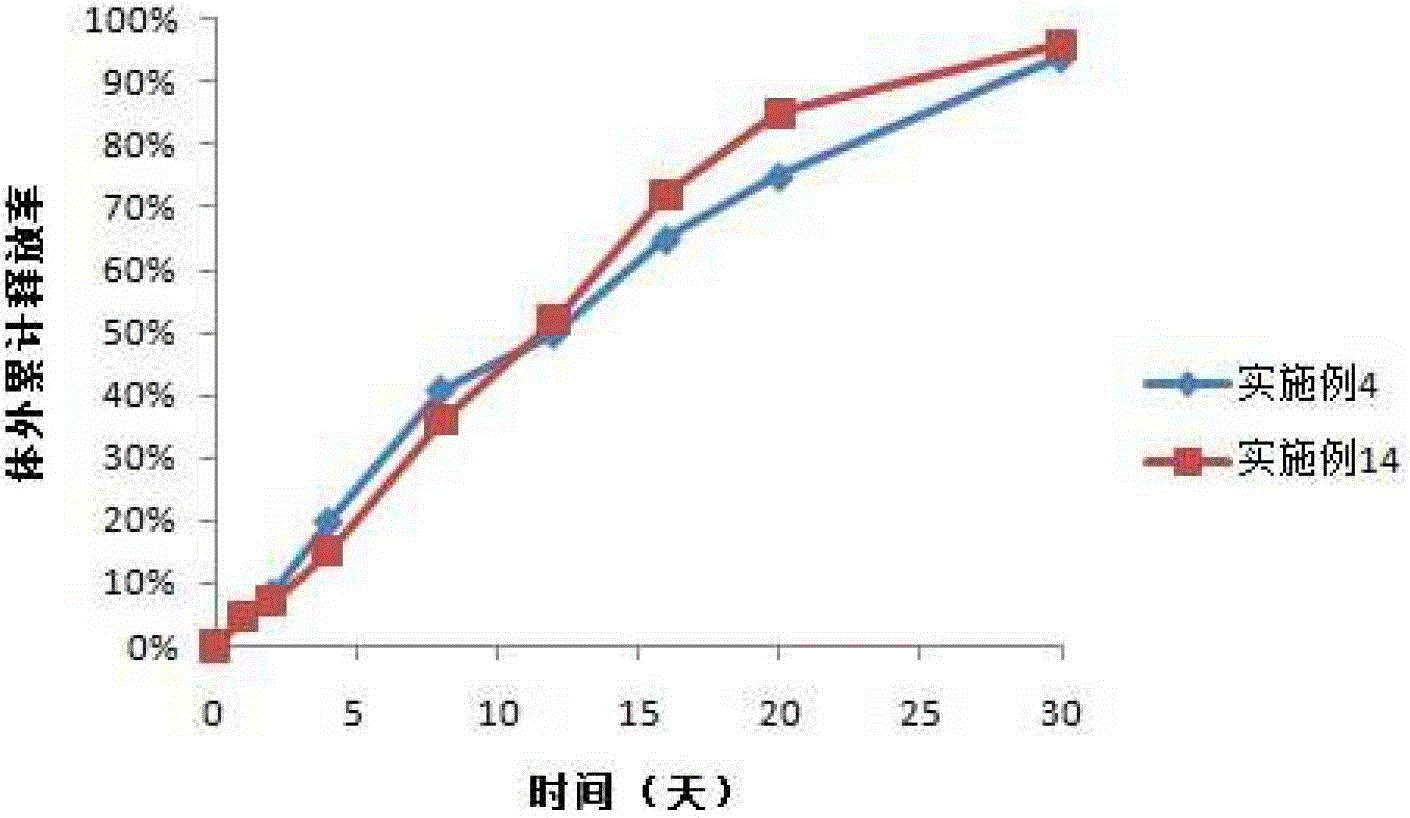
图3为实施例4、14缓释微球制剂体外累计释放曲线;Fig. 3 is embodiment 4, 14 sustained-release microsphere preparation in vitro cumulative release curve;
图4为实施例4、14缓释微球制剂给药后第1天血糖浓度-时间曲线图;Fig. 4 is the first day blood glucose concentration-time graph after the administration of the slow-release microsphere preparation of embodiment 4, 14;
图5为实施例4、14缓释微球制剂给药后第5天血糖浓度-时间曲线图;Fig. 5 is the blood glucose concentration-time graph on the 5th day after the administration of the sustained-release microsphere preparation of Example 4 and 14;
图6为实施例4、14缓释微球制剂给药后第10天血糖浓度-时间曲线图;Fig. 6 is the blood glucose concentration-time graph on the 10th day after the administration of the sustained-release microsphere preparation of Example 4 and 14;
图7为实施例4、14缓释微球制剂给药后第15天血糖浓度-时间曲线图;Fig. 7 is the blood glucose concentration-time graph on the 15th day after the administration of the sustained-release microsphere preparation of Example 4 and 14;
图8为实施例4、14缓释微球制剂给药后第20天血糖浓度-时间曲线图;Fig. 8 is the blood glucose concentration-time graph on the 20th day after the administration of the sustained-release microsphere preparation of Example 4 and 14;
图9为实施例4、14缓释微球制剂给药后第30天血糖浓度-时间曲线图;Fig. 9 is the blood glucose concentration-time graph on the 30th day after the administration of the sustained-release microsphere preparation of Example 4 and 14;
图10为实施例4、14的艾塞那肽及利拉鲁肽缓释微球在体内时间-血药浓度图。Fig. 10 is a time-blood concentration diagram of exenatide and liraglutide sustained-release microspheres in Examples 4 and 14 in vivo.
具体实施方式 Detailed ways
以下结合具体实施例来详细说明本发明。The present invention will be described in detail below in conjunction with specific embodiments.
实施例1Example 1
一种艾塞那肽缓释微球的制备方法,包括以下步骤:A preparation method for exenatide slow-release microspheres, comprising the following steps:
(1)将1.0g聚乳酸-羟基乙酸共聚物(分子量15000,乙交酯∶丙交酯=75∶25,端羧基)溶于5ml无水乙酸中,形成聚乳酸-羟基乙酸共聚物溶液;(1) 1.0 g of polylactic acid-glycolic acid copolymer (molecular weight 15000, glycolide:lactide=75:25, carboxyl terminal) was dissolved in 5 ml of anhydrous acetic acid to form polylactic acid-glycolic acid copolymer solution;
(2)称取50mg艾塞那肽,30mg蔗糖溶于0.5mL无菌水中;(2) Weigh 50 mg of exenatide and dissolve 30 mg of sucrose in 0.5 mL of sterile water;
(3)将步骤(1)的聚乳酸-羟基乙酸共聚物溶液与步骤(2)的艾塞那肽溶液混合,用磁力搅拌器搅拌至形成完全均一、澄清、透明的混合液,作为有机相;(3) Mix the polylactic acid-glycolic acid copolymer solution in step (1) with the exenatide solution in step (2), and stir with a magnetic stirrer until a completely uniform, clear, transparent mixed solution is formed as the organic phase ;
(4)配制50ml含2wt%卵磷脂的液体石蜡,作为油相;(4) prepare 50ml of liquid paraffin containing 2wt% lecithin, as the oil phase;
(5)将步骤(3)的混合液与步骤(4)的油相均质乳化处理5-15min形成O/O型乳液;(5) Homogeneously emulsifying the mixed solution of step (3) and the oil phase of step (4) for 5-15 minutes to form an O/O type emulsion;
(6)搅拌挥发步骤(5)的乳液除去乙酸;待有机溶剂完全挥发干净后,离心收集微球,加入环己烷洗涤,除去微球中残留的有机溶剂,得到PLGA微球,把收集到的微球放入冷冻干燥机干燥,得到艾塞那肽缓释微球,微球粒径在5~30微米范围内,载药量4.12%,包封率89.17%。(6) Stir and volatilize the emulsion of step (5) to remove acetic acid; After the organic solvent is completely volatilized, collect the microspheres by centrifugation, add cyclohexane to wash, remove the residual organic solvent in the microspheres, obtain the PLGA microspheres, and collect the microspheres The microspheres were put into a freeze dryer to dry to obtain exenatide sustained-release microspheres, the particle diameter of the microspheres was in the range of 5-30 microns, the drug loading was 4.12%, and the encapsulation efficiency was 89.17%.
实施例2Example 2
除PLGA由端羧基PLGA替换为端基封闭PLGA外,具体步骤同实施例1,得到艾塞那肽缓释微球粒径在5~30微米范围内,载药量4.58%,包封率90.49%。Except that PLGA is replaced by carboxyl-terminated PLGA with end-blocked PLGA, the specific steps are the same as in Example 1, and the particle size of exenatide sustained-release microspheres is in the range of 5 to 30 microns, the drug loading is 4.58%, and the encapsulation efficiency is 90.49%. %.
实施例3Example 3
除PLGA由MPEG-PLGA替换为端基封闭PLGA外,具体步骤同实施例1,得到艾塞那肽缓释微球粒径在5~30微米范围内,载药量4.22%,包封率88.45%。Except that PLGA was replaced by MPEG-PLGA with end-blocked PLGA, the specific steps were the same as in Example 1, and the obtained exenatide sustained-release microspheres had a particle size in the range of 5 to 30 microns, a drug loading of 4.22%, and an encapsulation efficiency of 88.45. %.
实施例1、2、3比较,聚合物采用端羧基PLGA(末端未封闭)或MPEG-PLGA时,所得微球比采用端基封闭PLGA具有更低的突释率,端基封闭PLGA分子是烷基末端,而未封闭的则是羧基末端,MPEG-PLGA具有PEG链,后两者聚合物具有更佳亲水性。由于烷基末端的存在,端基封闭PLGA在有机溶剂中溶解性能好,在微球制备过程中蛋白颗粒易迁移到微球表面,造成了较高的突释效应,然而由于亲水性差,在释放过程中水分摄取率低,微球骨架降解缓慢,而端羧基PLGA和MPEG-PLGA亲水性高,生物降解速度快。Embodiment 1,2,3 comparison, when polymer adopts carboxyl-terminated PLGA (unblocked at the end) or MPEG-PLGA, gained microsphere has lower burst release rate than adopting end-blocked PLGA, and end-blocked PLGA molecule is alkane The base end, while the unblocked one is the carboxyl end, MPEG-PLGA has a PEG chain, and the latter two polymers are more hydrophilic. Due to the existence of the alkyl end, the end-blocked PLGA has good solubility in organic solvents, and the protein particles are easy to migrate to the surface of the microspheres during the preparation of the microspheres, resulting in a high burst release effect. However, due to poor hydrophilicity, in During the release process, the water uptake rate was low and the microsphere skeleton degraded slowly, while the carboxyl-terminated PLGA and MPEG-PLGA were highly hydrophilic and biodegraded quickly.
实施例4Example 4
一种艾塞那肽缓释微球的制备方法,包括以下步骤:A preparation method for exenatide slow-release microspheres, comprising the following steps:
(1)将1.0g聚乳酸-羟基乙酸共聚物(分子量15000,乙交酯∶丙交酯=75∶25)溶于5ml乙酸中,形成聚乳酸-羟基乙酸共聚物溶液;(1) Dissolve 1.0 g of polylactic acid-glycolic acid copolymer (molecular weight 15000, glycolide: lactide=75:25) in 5 ml of acetic acid to form polylactic acid-glycolic acid copolymer solution;
(2)称取80mg艾塞那肽,30mg人血白蛋白溶于0.5mL无菌水中;(2) Weigh 80mg of exenatide and dissolve 30mg of human serum albumin in 0.5mL of sterile water;
(3)将步骤(1)的聚乳酸-羟基乙酸共聚物溶液与步骤(2)的艾塞那肽溶液混合,用磁力搅拌器搅拌至形成完全均一、澄清、透明的混合液,作为有机相;(3) Mix the polylactic acid-glycolic acid copolymer solution in step (1) with the exenatide solution in step (2), and stir with a magnetic stirrer until a completely uniform, clear, transparent mixed solution is formed as the organic phase ;
(4)配制50ml含2wt%卵磷脂的花生油,作为油相;(4) Prepare 50ml of peanut oil containing 2wt% lecithin as the oil phase;
(5)将步骤(3)的混合液与步骤(4)的油相均质乳化,均质形成O/O型乳液;(5) homogeneously emulsify the mixed solution of step (3) and the oil phase of step (4), and homogeneously form an O/O type emulsion;
(6)搅拌挥发步骤(5)的乳液除去乙酸;待有机溶剂完全挥发干净后,离心收集微球,加入环己烷洗涤,除去微球中残留的有机溶剂,得到PLGA微球,把收集到的微球放入冷冻干燥机干燥,得到艾塞那肽缓释微球,微球粒径在20~50微米范围内,载药量7.18%,包封率94.14%。(6) Stir and volatilize the emulsion of step (5) to remove acetic acid; After the organic solvent is completely volatilized, collect the microspheres by centrifugation, add cyclohexane to wash, remove the residual organic solvent in the microspheres, obtain the PLGA microspheres, and collect the microspheres The microspheres were put into a freeze dryer to dry to obtain the exenatide slow-release microspheres, the particle diameter of the microspheres was in the range of 20-50 microns, the drug loading was 7.18%, and the encapsulation efficiency was 94.14%.
与实施例1相比,除油相由液体石蜡变为花生油外,其他条件不变,微球粒径明显变大,这是由于花生油的粘度大于液体石蜡,形成乳滴更大,用大豆油、芝麻油、玉米油、棉籽油、甲基硅油等粘度大于液体石蜡的油相时,可得到相同结果。Compared with Example 1, except that the oil phase changes from liquid paraffin to peanut oil, other conditions remain unchanged, and the particle size of the microspheres becomes significantly larger. This is because the viscosity of peanut oil is greater than that of liquid paraffin, and the emulsion droplets formed are larger. , sesame oil, corn oil, cottonseed oil, methyl silicone oil and other oil phases with higher viscosity than liquid paraffin, the same results can be obtained.
实施例5Example 5
具体步骤同实施例4,除步骤4中卵磷脂的含量由2%降为0.5%,得到艾塞那肽缓释微球粒径在40~100微米范围内,载药量4.25%,包封率83.23%。The specific steps are the same as in Example 4, except that the content of lecithin in step 4 is reduced from 2% to 0.5%, and the obtained exenatide sustained-release microspheres have a particle size in the range of 40 to 100 microns, a drug loading of 4.25%, and encapsulated The rate is 83.23%.
实施例6Example 6
具体步骤同实施例4,除步骤4中卵磷脂的含量由2%变为5%,得到艾塞那肽缓释微球粒径在20~60微米范围内,载药量7.32%,包封率92.16%。The specific steps are the same as in Example 4, except that the content of lecithin in step 4 is changed from 2% to 5%, and the obtained exenatide sustained-release microspheres have a particle size in the range of 20 to 60 microns, a drug loading of 7.32%, and encapsulated The rate is 92.16%.
与实施例4相比,增加卵磷脂含量,微球粒径减小,减少卵磷脂含量,微球粒径增大。从上述实施例得出稳定剂卵磷脂的含量优选在0.5~3%可得到符合粒径范围的微球。Compared with Example 4, increasing the lecithin content, the particle size of the microspheres decreases, and decreasing the lecithin content, the particle size of the microspheres increases. It can be concluded from the above examples that the content of the stabilizer lecithin is preferably 0.5-3% to obtain microspheres meeting the particle size range.
实施例7Example 7
具体步骤同实施例4,除步骤4中花生油含量由50mL降为10mL,得到艾塞那肽缓释微球粒径在60~100微米范围内,载药量3.14%,包封率67.13%。The specific steps were the same as in Example 4, except that in step 4, the content of peanut oil was reduced from 50 mL to 10 mL, and the obtained exenatide sustained-release microspheres had a particle size in the range of 60 to 100 microns, a drug loading of 3.14%, and an encapsulation efficiency of 67.13%.
实施例8Example 8
具体步骤同实施例4,除步骤4中花生油含量由50mL增加为200mL,得到艾塞那肽缓释微球粒径在30~60微米范围内,载药量6.54%,包封率93.63%。从上述实施例得出,油相与药物、保护剂溶液体积比较小时,形成乳液两相稳定性较差,微球粒径分布不均匀,油相用量过多,生产成本增加,优选的油相与混合液的比例在5~10∶1。The specific steps were the same as in Example 4, except that the peanut oil content in step 4 was increased from 50 mL to 200 mL, and the exenatide sustained-release microspheres were obtained with a particle size in the range of 30 to 60 microns, a drug loading of 6.54%, and an encapsulation efficiency of 93.63%. From the above examples, it can be concluded that the volume of the oil phase and the medicine and the protective agent solution are relatively small, and the stability of the two phases of the emulsion is poor, the particle size distribution of the microspheres is uneven, the amount of the oil phase is too much, and the production cost increases. The preferred oil phase The ratio to the mixed solution is 5-10:1.
实施例9Example 9
具体步骤同实施例4,除步骤1中溶剂由乙酸变为乙腈,得到艾塞那肽缓释微球粒径在30~60微米范围内,载药量5.36%,包封率73.26%。The specific steps were the same as in Example 4, except that the solvent in step 1 was changed from acetic acid to acetonitrile, and the exenatide sustained-release microspheres were obtained with a particle size in the range of 30-60 microns, a drug loading of 5.36%, and an encapsulation efficiency of 73.26%.
实施例10Example 10
一种艾塞那肽缓释微球的制备方法,包括以下步骤:A preparation method for exenatide slow-release microspheres, comprising the following steps:
(1)将1.0g聚乳酸-羟基乙酸共聚物(分子量5000,乙交酯∶丙交酯=25∶75)溶于5ml无水乙酸中,形成聚乳酸-羟基乙酸共聚物溶液;(1) 1.0 g of polylactic acid-glycolic acid copolymer (molecular weight 5000, glycolide: lactide=25:75) was dissolved in 5 ml of anhydrous acetic acid to form polylactic acid-glycolic acid copolymer solution;
(2)称取50mg艾塞那肽,30mg明胶溶于0.5mL无菌水中;(2) Weigh 50 mg of exenatide and dissolve 30 mg of gelatin in 0.5 mL of sterile water;
(3)将步骤(1)的聚乳酸-羟基乙酸共聚物溶液与步骤(2)的艾塞那肽溶液混合,用磁力搅拌器搅拌至形成完全均一、澄清、透明的混合液,作为有机相;(3) Mix the polylactic acid-glycolic acid copolymer solution in step (1) with the exenatide solution in step (2), and stir with a magnetic stirrer until a completely uniform, clear, transparent mixed solution is formed as the organic phase ;
(4)配制50ml含2wt%span80的花生油,作为油相;(4) Prepare 50ml of peanut oil containing 2wt% span80 as the oil phase;
(5)将步骤(3)的混合液与步骤(4)的油相均质形成O/O型乳液;(5) The mixed solution of step (3) is homogeneously formed with the oil phase of step (4) to form an O/O type emulsion;
(6)搅拌挥发步骤(5)的乳液除去乙酸;待有机溶剂完全挥发干净后,离心收集微球,加入环己烷洗涤,除去微球中残留的有机溶剂,得到PLGA微球,把收集到的微球放入冷冻干燥机干燥,得到艾塞那肽缓释微球,微球粒径在30~60微米范围内,载药量3.89%,包封率85.20%。(6) Stir and volatilize the emulsion of step (5) to remove acetic acid; After the organic solvent is completely volatilized, collect the microspheres by centrifugation, add cyclohexane to wash, remove the residual organic solvent in the microspheres, obtain the PLGA microspheres, and collect the microspheres The microspheres were put into a freeze dryer to dry to obtain exenatide slow-release microspheres, the microsphere particle size was in the range of 30-60 microns, the drug loading was 3.89%, and the encapsulation efficiency was 85.20%.
实施例11Example 11
一种艾塞那肽缓释微球的制备方法,包括以下步骤:A preparation method for exenatide slow-release microspheres, comprising the following steps:
(1)将1.0g聚乳酸-羟基乙酸共聚物(分子量65000,乙交酯∶丙交酯=85∶15)溶于5ml无水乙酸中,形成聚乳酸-羟基乙酸共聚物溶液;(1) Dissolve 1.0 g of polylactic acid-glycolic acid copolymer (molecular weight 65000, glycolide: lactide=85:15) in 5 ml of anhydrous acetic acid to form polylactic acid-glycolic acid copolymer solution;
(2)称取50mg艾塞那肽,30mg碳酸锌溶于0.5mL无菌水中;(2) Weigh 50mg of exenatide and dissolve 30mg of zinc carbonate in 0.5mL sterile water;
(3)将步骤(1)的聚乳酸-羟基乙酸共聚物溶液与步骤(2)的艾塞那肽溶液混合,用磁力搅拌器搅拌至形成完全均一、澄清、透明的混合液,作为有机相;(3) Mix the polylactic acid-glycolic acid copolymer solution in step (1) with the exenatide solution in step (2), and stir with a magnetic stirrer until a completely uniform, clear, transparent mixed solution is formed as the organic phase ;
(4)配制50ml含2wt%span60的玉米油,作为油相;(4) prepare 50ml of corn oil containing 2wt% span60 as the oil phase;
(5)将步骤(3)的混合液与步骤(4)的油相混合均质形成O/O型乳液;(5) mixing the mixed solution of step (3) with the oil phase of step (4) to form an O/O emulsion;
(6)搅拌挥发步骤(5)的乳液除去乙酸;待有机溶剂完全挥发干净后,离心收集微球,加入环己烷洗涤,除去微球中残留的有机溶剂,得到PLGA微球,把收集到的微球放入冷冻干燥机干燥,得到艾塞那肽缓释微球,微球粒径在30~60微米范围内,载药量3.93%,包封率86.60%。(6) Stir and volatilize the emulsion of step (5) to remove acetic acid; After the organic solvent is completely volatilized, collect the microspheres by centrifugation, add cyclohexane to wash, remove the residual organic solvent in the microspheres, obtain the PLGA microspheres, and collect the microspheres The microspheres were put into a freeze dryer to dry to obtain the exenatide slow-release microspheres, the particle diameter of the microspheres was in the range of 30-60 microns, the drug loading was 3.93%, and the encapsulation efficiency was 86.60%.
实施例12Example 12
一种艾塞那肽缓释微球的制备方法,包括以下步骤:A preparation method for exenatide slow-release microspheres, comprising the following steps:
(1)将1.0g聚乳酸-羟基乙酸共聚物(分子量15000,乙交酯∶丙交酯=90∶10)溶于5ml无水乙酸中,形成聚乳酸-羟基乙酸共聚物溶液;(1) Dissolve 1.0 g of polylactic acid-glycolic acid copolymer (molecular weight 15000, glycolide:lactide=90:10) in 5 ml of anhydrous acetic acid to form polylactic acid-glycolic acid copolymer solution;
(2)称取80mg艾塞那肽,65mg醋酸锌溶于0.5mL无菌水中;(2) Weigh 80 mg of exenatide and dissolve 65 mg of zinc acetate in 0.5 mL of sterile water;
(3)将步骤(1)的聚乳酸-羟基乙酸共聚物溶液与步骤(2)的艾塞那肽溶液混合,用磁力搅拌器搅拌至形成完全均一、澄清、透明的混合液,作为有机相;(3) Mix the polylactic acid-glycolic acid copolymer solution in step (1) with the exenatide solution in step (2), and stir with a magnetic stirrer until a completely uniform, clear, transparent mixed solution is formed as the organic phase ;
(4)配制50ml含1wt%卵磷脂的大豆油,作为油相;(4) prepare 50ml soybean oil containing 1wt% lecithin, as oil phase;
(5)将步骤(3)的混合液与步骤(4)的油相机械搅拌,均质形成O/O型乳液;(5) Mechanically agitating the mixed solution of step (3) with the oil phase of step (4) to homogeneously form an O/O type emulsion;
(6)搅拌挥发步骤(5)的乳液除去乙酸;待有机溶剂完全挥发干净后,离心收集微球,加入环己烷洗涤,除去微球中残留的有机溶剂,得到PLGA微球,把收集到的微球放入冷冻干燥机干燥,得到艾塞那肽缓释微球,微球粒径在30~60微米范围内,载药量6.34%,包封率84.89%。(6) Stir and volatilize the emulsion of step (5) to remove acetic acid; After the organic solvent is completely volatilized, collect the microspheres by centrifugation, add cyclohexane to wash, remove the residual organic solvent in the microspheres, obtain the PLGA microspheres, and collect the microspheres The microspheres were dried in a freeze dryer to obtain exenatide slow-release microspheres, the particle diameter of which was in the range of 30-60 microns, the drug loading capacity was 6.34%, and the encapsulation efficiency was 84.89%.
实施例13Example 13
一种艾塞那肽缓释微球的制备方法,包括以下步骤:A preparation method for exenatide slow-release microspheres, comprising the following steps:
(1)将0.5g聚乳酸(分子量15000)溶于5ml无水乙酸中,形成聚乳酸溶液;(1) Dissolve 0.5g polylactic acid (molecular weight 15000) in 5ml anhydrous acetic acid to form a polylactic acid solution;
(2)称取50mg艾塞那肽,20mg硫酸锌溶于0.5mL无菌水中;(2) Weigh 50 mg of exenatide and dissolve 20 mg of zinc sulfate in 0.5 mL of sterile water;
(3)将步骤(1)的聚乳酸溶液与步骤(2)的艾塞那肽溶液混合,用磁力搅拌器搅拌至形成完全均一、澄清、透明的混合液,作为有机相;(3) Mix the polylactic acid solution in step (1) with the exenatide solution in step (2), and stir with a magnetic stirrer until a completely uniform, clear and transparent mixed solution is formed as the organic phase;
(4)配制50ml含0.5wt%卵磷脂的芝麻油,作为油相;(4) preparation 50ml contains the sesame oil of 0.5wt% lecithin, as oily phase;
(5)将步骤(3)的混合液与步骤(4)的油相机械搅拌,均质形成O/O型乳液;(5) Mechanically agitating the mixed solution of step (3) with the oil phase of step (4) to homogeneously form an O/O type emulsion;
(6)搅拌挥发步骤(5)的乳液除去乙酸;待有机溶剂完全挥发干净后,离心收集微球,加入环己烷洗涤,除去微球中残留的有机溶剂,得到PLA微球,把收集到的微球放入冷冻干燥机干燥,得到艾塞那肽缓释微球,微球粒径在30~80微米范围内,载药量8.14%,包封率82.34%。(6) Stir and volatilize the emulsion of step (5) to remove acetic acid; After the organic solvent is completely volatilized, collect the microspheres by centrifugation, add cyclohexane to wash, remove the residual organic solvent in the microspheres, obtain PLA microspheres, collect the The microspheres were put into a freeze dryer to dry to obtain exenatide slow-release microspheres, the particle diameter of the microspheres was in the range of 30-80 microns, the drug loading was 8.14%, and the encapsulation efficiency was 82.34%.
实施例14Example 14
一种利拉鲁肽缓释微球的制备方法,包括以下步骤:A preparation method of liraglutide sustained-release microspheres, comprising the following steps:
(1)将1.0g聚乳酸-羟基乙酸共聚物(分子量15000,乙交酯∶丙交酯=75∶25)溶于5ml无水乙酸中,形成聚乳酸-羟基乙酸共聚物溶液;(1) Dissolve 1.0 g of polylactic acid-glycolic acid copolymer (molecular weight 15000, glycolide:lactide=75:25) in 5 ml of anhydrous acetic acid to form polylactic acid-glycolic acid copolymer solution;
(2)称取50mg艾塞那肽,10mg氯化锌溶于0.5mL无菌水中;(2) Weigh 50 mg of exenatide and dissolve 10 mg of zinc chloride in 0.5 mL of sterile water;
(3)将步骤(1)的聚乳酸-羟基乙酸共聚物溶液与步骤(2)的利拉鲁肽溶液混合,用磁力搅拌器搅拌至形成完全均一、澄清、透明的混合液,作为有机相;(3) Mix the polylactic acid-glycolic acid copolymer solution in step (1) with the liraglutide solution in step (2), and stir with a magnetic stirrer until a completely uniform, clear, and transparent mixed solution is formed as the organic phase ;
(4)配制50ml含2wt%卵磷脂的大豆油,作为油相;(4) preparing 50ml of soybean oil containing 2wt% lecithin, as the oil phase;
(5)将步骤(3)的混合液与步骤(4)的油相混合均质均质形成O/O型乳液;(5) mixing the mixed solution of step (3) with the oil phase of step (4) to form an O/O emulsion;
(6)搅拌挥发步骤(5)的乳液除去乙酸;待有机溶剂完全挥发干净后,离心收集微球,加入环己烷洗涤,除去微球中残留的有机溶剂,得到PLGA微球,把收集到的微球放入冷冻干燥机干燥,得到利拉鲁肽缓释微球,微球粒径在30~60微米范围内,载药量4.49%,包封率93.54%。(6) Stir and volatilize the emulsion of step (5) to remove acetic acid; After the organic solvent is completely volatilized, collect the microspheres by centrifugation, add cyclohexane to wash, remove the residual organic solvent in the microspheres, obtain the PLGA microspheres, and collect the microspheres The microspheres were dried in a freeze dryer to obtain liraglutide sustained-release microspheres, the particle size of the microspheres was in the range of 30-60 microns, the drug loading was 4.49%, and the encapsulation efficiency was 93.54%.
实施例15Example 15
一种利拉鲁肽缓释微球的制备方法,包括以下步骤:A preparation method of liraglutide sustained-release microspheres, comprising the following steps:
(1)将1.0g聚乳酸(端羧基PLA,分子量50000)溶于5ml无水乙酸中,形成聚乳酸共聚物溶液;(1) 1.0g of polylactic acid (carboxyl-terminated PLA, molecular weight 50000) was dissolved in 5ml of anhydrous acetic acid to form a polylactic acid copolymer solution;
(2)称取150mg利拉鲁肽肽,50mg甘露糖溶于0.5mL无菌水中;(2) Weigh 150mg of liraglutide and dissolve 50mg of mannose in 0.5mL of sterile water;
(3)将步骤(1)的聚乳酸溶液与步骤(2)的利拉鲁肽溶液混合,用磁力搅拌器搅拌至形成完全均一、澄清、透明的混合液,作为有机相;(3) Mix the polylactic acid solution in step (1) with the liraglutide solution in step (2), and stir with a magnetic stirrer until a completely uniform, clear, and transparent mixed solution is formed as the organic phase;
(4)配制50ml含2wt%卵磷脂的花生油,作为油相;(4) Prepare 50ml of peanut oil containing 2wt% lecithin as the oil phase;
(5)将步骤(3)的混合液与步骤(4)的油相混合均质形成O/O型乳液;(5) mixing the mixed solution of step (3) with the oil phase of step (4) to form an O/O emulsion;
(6)搅拌挥发步骤(5)的乳液除去乙酸;待有机溶剂完全挥发干净后,离心收集微球,加入环己烷洗涤,除去微球中残留的有机溶剂,得到PLA微球,把收集到的微球放入冷冻干燥机干燥,得到利拉鲁肽缓释微球,微球粒径在30~60微米范围内,载药量9.18%,包封率84.73%。(6) Stir and volatilize the emulsion of step (5) to remove acetic acid; After the organic solvent is completely volatilized, collect the microspheres by centrifugation, add cyclohexane to wash, remove the residual organic solvent in the microspheres, obtain PLA microspheres, collect the The microspheres were dried in a freeze dryer to obtain liraglutide sustained-release microspheres, the particle size of the microspheres was in the range of 30-60 microns, the drug loading was 9.18%, and the encapsulation efficiency was 84.73%.
实施例16Example 16
除由MPEG-PLA替换PLA外,具体操作步骤同实施例13,微球粒径在30~60微米范围内,载药量9.87%,包封率91.73%。Except that PLA was replaced by MPEG-PLA, the specific operation steps were the same as in Example 13, the particle size of the microspheres was in the range of 30-60 microns, the drug loading was 9.87%, and the encapsulation efficiency was 91.73%.
从上述实施例得出,通过选用不同的油相、两相比例及稳定剂含量,可以得到不同粒径的微球,粒径范围在5~100纳米间。本发明的缓释微球粒径优选在20~50微米间,用液体石蜡做油相时,得到微球粒径较小,小于20微米。采用植物油(花生油、大豆油、芝麻油等)能得到粒径较大的微球,粒径范围在20~100微米间。稳定剂的含量选择在2%左右,优选卵磷脂。It can be concluded from the above examples that microspheres with different particle sizes can be obtained by selecting different oil phases, two-phase ratios and stabilizer contents, and the particle size range is between 5 and 100 nanometers. The particle size of the sustained-release microspheres of the present invention is preferably between 20 and 50 microns, and when liquid paraffin is used as the oil phase, the obtained microspheres have a smaller particle size, less than 20 microns. Vegetable oil (peanut oil, soybean oil, sesame oil, etc.) can be used to obtain microspheres with a larger particle size, and the particle size range is between 20 and 100 microns. The content of the stabilizer is selected at about 2%, preferably lecithin.
微球粒径分布测定:Determination of particle size distribution of microspheres:
微球粒径分布用马尔文激光粒度测定仪(Mastersizer 2000,Malvern)进行测定。称取5mg微球冻干粉,加入到50mL纯化水中,用漩涡振荡器震荡5min,使微球分散均匀,采用激光粒度测定仪进行测定。粒径分布系数通过下式得出:The particle size distribution of microspheres was measured with a Malvern laser particle size analyzer (Mastersizer 2000, Malvern). Weigh 5mg of microsphere freeze-dried powder, add it into 50mL of purified water, shake it with a vortex oscillator for 5min, so that the microspheres are evenly dispersed, and use a laser particle size analyzer for measurement. The particle size distribution coefficient is obtained by the following formula:
di为单个微球的粒径,dave为微球平均粒径,N为微球的总数,N>300.微球形态观察:di is the particle size of a single microsphere, da ave is the average particle size of the microsphere, N is the total number of microspheres, and N>300. Microsphere morphology observation:
微球的形态、表面特性用SEM来观察。用取样棒把微球冻干粉末轻涂于贴在样品台上的导电胶上。真空条件下喷金(120s)后,用扫描电子显微镜观察(S-3700N日本)。实施例4得到的微球的形态如图1所示,微球表面圆整。The morphology and surface characteristics of the microspheres were observed by SEM. Use a sampling stick to lightly smear the microsphere freeze-dried powder on the conductive glue attached to the sample stage. After spraying gold (120s) under vacuum conditions, observe with a scanning electron microscope (S-3700N Japan). The morphology of the microspheres obtained in Example 4 is shown in Figure 1, and the surface of the microspheres is round.
微球载药量和包封率的测定Determination of drug loading and encapsulation efficiency of microspheres
采用文献中报道的NaOH-SDS法来测定微球的载药量和包封率,具体操作如下:准确称量10mg微球,用1ml 0.1mol·L-1NaOH(含5%SDS)溶液混悬,在100rpm、37℃水浴摇床中震荡24h,8000rpm离心10min,取上清液,高效液相色谱法测定上清液中的艾塞那肽含量。The NaOH-SDS method reported in the literature was used to determine the drug loading and encapsulation efficiency of the microspheres. The specific operations were as follows: accurately weigh 10 mg of microspheres, mix them with 1 ml of 0.1mol·L -1 NaOH (containing 5% SDS) solution Suspended, shaken at 100rpm, 37°C in a water bath shaker for 24h, centrifuged at 8000rpm for 10min, took the supernatant, and determined the exenatide content in the supernatant by high performance liquid chromatography.

艾塞那肽/利拉鲁肽活性测定:Exenatide/Liraglutide Activity Assay:
通过ELISA方法检测艾塞那肽/利拉鲁肽的活性,按照活性GLP-1(7-36)特异性酶免试剂盒(美国/EDI)说明书方法测定。The activity of Exenatide/Liraglutide was detected by ELISA method, and determined according to the instruction method of the activity GLP-1 (7-36) specific enzyme immunoassay kit (US/EDI).
艾塞那肽/利拉鲁肽体外初始释放测定:Exenatide/liraglutide initial release assay in vitro:
将上述实施例制备的艾塞那肽/利拉鲁肽缓释微球进行体外释放的测定,测定方法为分别称取50mg微球置于10mL离心管中,释放介质为pH7.4的磷酸缓冲液(含0.02%的叠氮化钠作为抑菌剂,0.05%的土温80作为润湿剂),置于温度37℃±0.5℃条件下放置1h,1h后,取出样品,接着5000rpm离心15min,取出上清液,HPLC测定上清液中艾塞那肽/利拉鲁肽浓度,计算出释放百分比。表1列出了使用不同实施例的多肽药物微球制剂的体外突释及药物活性保留。表2为不同实施例各组分含量。The exenatide/liraglutide sustained-release microspheres prepared in the above examples were tested for release in vitro. The determination method was to weigh 50 mg of microspheres and place them in a 10 mL centrifuge tube, and the release medium was phosphate buffered pH7.4 solution (containing 0.02% sodium azide as a bacteriostatic agent, 0.05
表1Table 1

从表1中,本发明制备的缓释微球粒径在5~100nm间,体外药物的突释率大多在5%以下,粒径分布系数在10~30间,药物的活性保留在92%以上。油相的粘度对微球粒径影响较大,用粘度较大的液体石蜡时,得到的微球粒径较小;相反的,采用低粘度油相时(花生油等植物油)可以得到粒径较大微球。From Table 1, the particle size of the slow-release microspheres prepared by the present invention is between 5 and 100 nm, the burst release rate of the drug in vitro is mostly below 5%, the particle size distribution coefficient is between 10 and 30, and the activity of the drug remains at 92%. above. The viscosity of the oil phase has a greater influence on the particle size of the microspheres. When using liquid paraffin with a higher viscosity, the particle size of the obtained microspheres is smaller; large microspheres.
表2Table 2

从表2中看出,本发明制备的多肽药物缓释微球,药物含量在3~10%间,保护剂的含量在0.5~6%,可生物降解高分子聚合物在85%~95%间。As can be seen from Table 2, the polypeptide drug slow-release microspheres prepared by the present invention have a drug content of 3-10%, a protective agent content of 0.5-6%, and a biodegradable high molecular polymer content of 85%-95%. between.
艾塞那肽缓释微球体外释放的测定:Determination of in vitro release of exenatide sustained-release microspheres:
将上述实施例2、4、14制备的艾塞那肽缓释微球进行体外释放的测定,测定方法为将50mg微球置于10mL离心管中,释放介质为pH7.4的磷酸缓冲液(含0.02%的叠氮化钠作为抑菌剂,0.05%的土温80作为润湿剂),置于恒温水浴摇床中,在震荡速度100rpm,温度37℃±0.5℃条件下进行微球的体外释放测定。实施例2分别在1、2、3、4、5、6、7天,实施例4、14分别在第1、2、4、8、12、16、20、30天取出0.5mL释放介质用高效液相色谱法测定药物的含量,并补充新鲜的释放介质。从图2、3中可以看出,实施例2、4、14的缓释微球具有很好的缓释效果。通过使用不同分子量、组成的聚乳酸-羟基乙酸共聚物制成的缓释微球制剂,释放时间可以从一周至长达一月。The exenatide sustained-release microspheres prepared in the above-mentioned examples 2, 4, and 14 were measured for release in vitro, and the assay method was that 50 mg microspheres were placed in a 10 mL centrifuge tube, and the release medium was a phosphate buffer solution of pH 7.4 ( Containing 0.02% sodium azide as a bacteriostatic agent, 0.05
动物实验:Animal experiment:
血糖浓度检测blood sugar concentration detection
取SD大鼠16只,雌性,体重200g左右。随机分为药物组和空白对照组,药物组皮下注射适量实施例4、实施例14制备得到的微球,空白组皮下注射等量生理盐水。分别于给药后的第1、5、10、15、20、30天腹腔注射18mmol/kg的葡萄糖,注射前每鼠先取空白血样,然后在注射后的5、10、30、60min取血,测定注射前后的血糖浓度。葡萄糖的测定参照葡萄糖测定试剂盒(广州阳普医疗科技有限公司)说明书进行。制作时间和血糖浓度的曲线图。结果见图4-9,从图中可以看出,注射葡萄糖后,10min后药物组血糖浓度(实施例4,实施例14)均较对照组显著降低,说明30天后血液中还存在药物,微球具有明显的缓释作用。Take 16 SD rats, female, weighing about 200 g. They were randomly divided into a drug group and a blank control group. The drug group was subcutaneously injected with an appropriate amount of the microspheres prepared in Example 4 and Example 14, and the blank group was subcutaneously injected with the same amount of normal saline. On the 1st, 5th, 10th, 15th, 20th, and 30th days after the administration, 18 mmol/kg of glucose was injected intraperitoneally. Before the injection, a blank blood sample was taken from each mouse, and then blood was taken at 5, 10, 30, and 60 minutes after the injection. Blood glucose concentrations before and after injection were measured. The determination of glucose was carried out according to the instructions of the glucose determination kit (Guangzhou Yangpu Medical Technology Co., Ltd.). Make a graph of time versus blood glucose concentration. The results are shown in Figures 4-9. As can be seen from the figure, after injecting glucose, the blood glucose concentration of the drug group (Example 4, Example 14) was significantly lower than that of the matched group after 10 minutes, indicating that there was still a drug in the blood after 30 days, and there was a slight The balls have a pronounced slow release effect.
体内释放:In vivo release:
SD大鼠随机分为三组,分别皮下注射实施例4、14的适量微球,分别于给药后的第1、2、3、4、6、8、10、12、15、18、22、26、30天尾静脉取血,立刻将血液置于抗凝管中,15000g离心3min,将血浆转移至干净的离心管中,-80冻存,以备检测。血浆中的艾塞那肽含量采用酶联免疫法检测,检测方法按照大鼠胰高血糖素样肽1(GLP-1)ELISA检测试剂盒(上海雅吉生物生物科技有限公司)说明书进行。SD rats were randomly divided into three groups, subcutaneously injected with the appropriate amount of microspheres in Examples 4 and 14, respectively, on
实验结果如图10所示,由图10可以看出,实施例4,14制剂在开始有一个较低的突释,然后在5-30天内维持一个相对稳定的血药浓度。The experimental results are shown in Fig. 10. It can be seen from Fig. 10 that the formulations of Examples 4 and 14 have a low burst release at the beginning, and then maintain a relatively stable blood drug concentration within 5-30 days.
以上所述实施例仅表达了本发明的几种实施方式,其描述较为具体和详细,但并不能因此而理解为对本发明专利范围的限制。应当指出的是,对于本领域的普通技术人员来说,在不脱离本发明构思的前提下,还可以做出若干变形和改进,这些都属于本发明的保护范围。因此,本发明专利的保护范围应以所附权利要求为准。The above-mentioned embodiments only express several implementation modes of the present invention, and the description thereof is relatively specific and detailed, but should not be construed as limiting the patent scope of the present invention. It should be pointed out that those skilled in the art can make several modifications and improvements without departing from the concept of the present invention, and these all belong to the protection scope of the present invention. Therefore, the protection scope of the patent for the present invention should be based on the appended claims.
Claims (10)
Priority Applications (2)
| Application Number | Priority Date | Filing Date | Title |
|---|---|---|---|
| CN201210203775.XA CN102688198B (en) | 2012-06-19 | 2012-06-19 | Polypeptide drug sustained-release microsphere preparation and preparation method thereof |
| PCT/CN2013/077403 WO2013189282A1 (en) | 2012-06-19 | 2013-06-18 | Polypeptide-medicine-slow-releasing microsphere preparation and preparation method therefor |
Applications Claiming Priority (1)
| Application Number | Priority Date | Filing Date | Title |
|---|---|---|---|
| CN201210203775.XA CN102688198B (en) | 2012-06-19 | 2012-06-19 | Polypeptide drug sustained-release microsphere preparation and preparation method thereof |
Publications (2)
| Publication Number | Publication Date |
|---|---|
| CN102688198A true CN102688198A (en) | 2012-09-26 |
| CN102688198B CN102688198B (en) | 2015-04-15 |
Family
ID=46854047
Family Applications (1)
| Application Number | Title | Priority Date | Filing Date |
|---|---|---|---|
| CN201210203775.XA Active CN102688198B (en) | 2012-06-19 | 2012-06-19 | Polypeptide drug sustained-release microsphere preparation and preparation method thereof |
Country Status (2)
| Country | Link |
|---|---|
| CN (1) | CN102688198B (en) |
| WO (1) | WO2013189282A1 (en) |
Cited By (20)
| Publication number | Priority date | Publication date | Assignee | Title |
|---|---|---|---|---|
| CN104306318A (en) * | 2014-10-29 | 2015-01-28 | 珀莱雅化妆品股份有限公司 | Moisturizing composition granule and preparation method thereof |
| CN104382860A (en) * | 2014-10-30 | 2015-03-04 | 浙江美华鼎昌医药科技有限公司 | Liraglutide sustained-release microsphere preparation and preparation method thereof |
| CN105497873A (en) * | 2015-12-17 | 2016-04-20 | 华南理工大学 | Light-operated snake venom polypeptide zinc nano preparation and preparation method and application thereof |
| CN105878174A (en) * | 2016-04-26 | 2016-08-24 | 广州帝奇医药技术有限公司 | Solid dispersion and preparation method and application thereof |
| CN106084987A (en) * | 2016-08-29 | 2016-11-09 | 苏州安洁科技股份有限公司 | A kind of UV ink |
| CN106074393A (en) * | 2016-06-09 | 2016-11-09 | 丽珠医药集团股份有限公司 | A kind of preparation of the sustained-release micro-spheres of injection polypeptide drug |
| CN107034189A (en) * | 2017-05-31 | 2017-08-11 | 东莞市保莱生物科技有限公司 | A kind of candidate stem cell cultural method |
| CN107320770A (en) * | 2017-07-12 | 2017-11-07 | 江苏西宏生物医药有限公司 | One kind injection implant |
| CN108434118A (en) * | 2018-01-24 | 2018-08-24 | 中国药科大学 | Glucagon-like peptide-1 analogs sustained-release micro-spheres and preparation method thereof |
| CN108653740A (en) * | 2018-05-18 | 2018-10-16 | 上海济群医药科技有限公司 | A method for preparing PLGA sustained-release microspheres by an improved phase separation method |
| CN109432397A (en) * | 2018-11-28 | 2019-03-08 | 苏州天马医药集团天吉生物制药有限公司 | Polypeptide microballoon and preparation method thereof |
| CN109692634A (en) * | 2019-01-31 | 2019-04-30 | 合肥工业大学 | A kind of micron polymeric particles and preparation method thereof based on eutectic solvent lotion |
| CN109939220A (en) * | 2019-04-30 | 2019-06-28 | 苏州大学 | Polypeptide microballoon and preparation method thereof with quick-release and slow release effect |
| CN110339166A (en) * | 2018-04-04 | 2019-10-18 | 沈阳药科大学 | A kind of liraglutide multivesicular liposome and its preparation method and application |
| CN110623944A (en) * | 2018-06-20 | 2019-12-31 | 鲁南制药集团股份有限公司 | Glucagon-like peptide-1 analogue sustained-release microsphere preparation and preparation method thereof |
| CN111727054A (en) * | 2018-01-04 | 2020-09-29 | 中央研究院 | Cell-Binding Adjuvants for Increased Efficacy |
| CN112587505A (en) * | 2020-10-16 | 2021-04-02 | 长春斯菲尔生物科技有限公司 | Olanzapine pamoate sustained-release microparticle preparation and preparation method thereof |
| CN114634634A (en) * | 2022-03-22 | 2022-06-17 | 陈凌卉 | Biological function composite porous polyester microsphere and preparation method thereof |
| CN115025051A (en) * | 2022-06-27 | 2022-09-09 | 浙江美华鼎昌医药科技有限公司 | Preparation method of exenatide sustained-release microspheres |
| CN115120564A (en) * | 2022-06-27 | 2022-09-30 | 浙江美华鼎昌医药科技有限公司 | Preparation process of liraglutide sustained-release microspheres |
Families Citing this family (4)
| Publication number | Priority date | Publication date | Assignee | Title |
|---|---|---|---|---|
| CN110865160B (en) * | 2019-10-25 | 2022-05-03 | 广东嘉博制药有限公司 | Method for measuring in-vitro release degree of propofol fat emulsion |
| CN115554249A (en) * | 2022-10-09 | 2023-01-03 | 南方医科大学第三附属医院(广东省骨科研究院) | A microfluidic preparation method for self-assembled polypeptide microspheres |
| CN117482065A (en) * | 2023-11-06 | 2024-02-02 | 中国药科大学 | A kind of high-loading microsphere based on interfacial interaction and its preparation method |
| CN121466938B (en) * | 2026-01-09 | 2026-03-13 | 吉林大学 | A method for preparing a multi-shell structured slow-release agent for remediating petroleum-contaminated groundwater |
Citations (4)
| Publication number | Priority date | Publication date | Assignee | Title |
|---|---|---|---|---|
| CN101396347A (en) * | 2007-09-27 | 2009-04-01 | 江苏先声药物研究有限公司 | Preparation method of recombined human blood-vessel endothelia inhibin sustained-released microsphere |
| CN101474160A (en) * | 2009-01-08 | 2009-07-08 | 上海交通大学 | Oil in oil-oil in oil-water in oil method for preparing microballoons |
| CN101559041A (en) * | 2009-05-19 | 2009-10-21 | 中国科学院过程工程研究所 | Polypeptide medicament sustained release microsphere or microcapsule preparation with uniform grain size and preparation method thereof |
| CN101646424A (en) * | 2007-03-27 | 2010-02-10 | 菲特伦株式会社 | Composition and microspheres for controlled release of exenatide and preparation method thereof |
Family Cites Families (4)
| Publication number | Priority date | Publication date | Assignee | Title |
|---|---|---|---|---|
| CN1965810A (en) * | 2006-11-17 | 2007-05-23 | 中国人民解放军第二军医大学 | Sustained release microsphere formulation of thymosin alpha-1, preparation process and use thereof |
| CN100544765C (en) * | 2007-12-20 | 2009-09-30 | 中国科学院长春应用化学研究所 | Preparation method of biodegradable polyester microspheres wrapped with nano-insulin |
| CN101658496A (en) * | 2009-09-11 | 2010-03-03 | 中国人民解放军第二军医大学 | Exenatide release microsphere preparation, preparation method and application thereof |
| CN102429876B (en) * | 2011-12-14 | 2014-12-24 | 深圳翰宇药业股份有限公司 | Liraglutide sustained-release microsphere preparation and preparation method thereof |
-
2012
- 2012-06-19 CN CN201210203775.XA patent/CN102688198B/en active Active
-
2013
- 2013-06-18 WO PCT/CN2013/077403 patent/WO2013189282A1/en not_active Ceased
Patent Citations (4)
| Publication number | Priority date | Publication date | Assignee | Title |
|---|---|---|---|---|
| CN101646424A (en) * | 2007-03-27 | 2010-02-10 | 菲特伦株式会社 | Composition and microspheres for controlled release of exenatide and preparation method thereof |
| CN101396347A (en) * | 2007-09-27 | 2009-04-01 | 江苏先声药物研究有限公司 | Preparation method of recombined human blood-vessel endothelia inhibin sustained-released microsphere |
| CN101474160A (en) * | 2009-01-08 | 2009-07-08 | 上海交通大学 | Oil in oil-oil in oil-water in oil method for preparing microballoons |
| CN101559041A (en) * | 2009-05-19 | 2009-10-21 | 中国科学院过程工程研究所 | Polypeptide medicament sustained release microsphere or microcapsule preparation with uniform grain size and preparation method thereof |
Cited By (30)
| Publication number | Priority date | Publication date | Assignee | Title |
|---|---|---|---|---|
| CN104306318B (en) * | 2014-10-29 | 2017-01-11 | 珀莱雅化妆品股份有限公司 | Moisturizing composition granule and preparation method thereof |
| CN104306318A (en) * | 2014-10-29 | 2015-01-28 | 珀莱雅化妆品股份有限公司 | Moisturizing composition granule and preparation method thereof |
| CN104382860A (en) * | 2014-10-30 | 2015-03-04 | 浙江美华鼎昌医药科技有限公司 | Liraglutide sustained-release microsphere preparation and preparation method thereof |
| CN105497873B (en) * | 2015-12-17 | 2020-02-18 | 华南理工大学 | A kind of light-controlled snake venom polypeptide zinc nano preparation and its preparation method and use |
| CN105497873A (en) * | 2015-12-17 | 2016-04-20 | 华南理工大学 | Light-operated snake venom polypeptide zinc nano preparation and preparation method and application thereof |
| CN105878174A (en) * | 2016-04-26 | 2016-08-24 | 广州帝奇医药技术有限公司 | Solid dispersion and preparation method and application thereof |
| WO2017186076A1 (en) * | 2016-04-26 | 2017-11-02 | 广州帝奇医药技术有限公司 | Solid dispersion, preparation method for same, and applications thereof |
| CN105878174B (en) * | 2016-04-26 | 2021-06-29 | 广州帝奇医药技术有限公司 | A kind of solid dispersion and its preparation method and application |
| CN106074393A (en) * | 2016-06-09 | 2016-11-09 | 丽珠医药集团股份有限公司 | A kind of preparation of the sustained-release micro-spheres of injection polypeptide drug |
| CN106084987A (en) * | 2016-08-29 | 2016-11-09 | 苏州安洁科技股份有限公司 | A kind of UV ink |
| CN107034189A (en) * | 2017-05-31 | 2017-08-11 | 东莞市保莱生物科技有限公司 | A kind of candidate stem cell cultural method |
| CN107320770A (en) * | 2017-07-12 | 2017-11-07 | 江苏西宏生物医药有限公司 | One kind injection implant |
| CN111727054A (en) * | 2018-01-04 | 2020-09-29 | 中央研究院 | Cell-Binding Adjuvants for Increased Efficacy |
| CN108434118A (en) * | 2018-01-24 | 2018-08-24 | 中国药科大学 | Glucagon-like peptide-1 analogs sustained-release micro-spheres and preparation method thereof |
| CN110339166B (en) * | 2018-04-04 | 2022-04-22 | 沈阳药科大学 | A kind of liraglutide multivesicular liposome and its preparation method and application |
| CN110339166A (en) * | 2018-04-04 | 2019-10-18 | 沈阳药科大学 | A kind of liraglutide multivesicular liposome and its preparation method and application |
| CN108653740A (en) * | 2018-05-18 | 2018-10-16 | 上海济群医药科技有限公司 | A method for preparing PLGA sustained-release microspheres by an improved phase separation method |
| CN108653740B (en) * | 2018-05-18 | 2021-06-08 | 上海济群医药科技有限公司 | Method for preparing PLGA sustained-release microspheres by improved phase separation method |
| CN110623944B (en) * | 2018-06-20 | 2022-02-08 | 鲁南制药集团股份有限公司 | Glucagon-like peptide-1 analogue sustained-release microsphere preparation and preparation method thereof |
| CN110623944A (en) * | 2018-06-20 | 2019-12-31 | 鲁南制药集团股份有限公司 | Glucagon-like peptide-1 analogue sustained-release microsphere preparation and preparation method thereof |
| CN109432397B (en) * | 2018-11-28 | 2022-03-18 | 苏州天马医药集团天吉生物制药有限公司 | Polypeptide microsphere and preparation method thereof |
| CN109432397A (en) * | 2018-11-28 | 2019-03-08 | 苏州天马医药集团天吉生物制药有限公司 | Polypeptide microballoon and preparation method thereof |
| CN109692634B (en) * | 2019-01-31 | 2021-07-23 | 合肥工业大学 | A kind of micron polymer particles based on deep eutectic solvent emulsion and preparation method thereof |
| CN109692634A (en) * | 2019-01-31 | 2019-04-30 | 合肥工业大学 | A kind of micron polymeric particles and preparation method thereof based on eutectic solvent lotion |
| CN109939220A (en) * | 2019-04-30 | 2019-06-28 | 苏州大学 | Polypeptide microballoon and preparation method thereof with quick-release and slow release effect |
| CN109939220B (en) * | 2019-04-30 | 2023-04-07 | 苏州大学 | Polypeptide microsphere with quick-release and slow-release effects and preparation method thereof |
| CN112587505A (en) * | 2020-10-16 | 2021-04-02 | 长春斯菲尔生物科技有限公司 | Olanzapine pamoate sustained-release microparticle preparation and preparation method thereof |
| CN114634634A (en) * | 2022-03-22 | 2022-06-17 | 陈凌卉 | Biological function composite porous polyester microsphere and preparation method thereof |
| CN115025051A (en) * | 2022-06-27 | 2022-09-09 | 浙江美华鼎昌医药科技有限公司 | Preparation method of exenatide sustained-release microspheres |
| CN115120564A (en) * | 2022-06-27 | 2022-09-30 | 浙江美华鼎昌医药科技有限公司 | Preparation process of liraglutide sustained-release microspheres |
Also Published As
| Publication number | Publication date |
|---|---|
| CN102688198B (en) | 2015-04-15 |
| WO2013189282A1 (en) | 2013-12-27 |
Similar Documents
| Publication | Publication Date | Title |
|---|---|---|
| CN102688198B (en) | Polypeptide drug sustained-release microsphere preparation and preparation method thereof | |
| US8173148B2 (en) | Stabilized polymeric delivery system comprising a water-insoluble polymer and an organic liquid | |
| CN1527698B (en) | Controlled release biodegradable gel substrate | |
| JP5933025B2 (en) | Microspheres for controlled or sustained release of medication | |
| KR20060015472A (en) | Drug Delivery System and Cell Therapy | |
| US20160067190A1 (en) | Injectable nano-network gels for diabetes treatment | |
| CN101658496A (en) | Exenatide release microsphere preparation, preparation method and application thereof | |
| US9351923B2 (en) | Extended-release composition comprising a somatostatin derivative in microparticles | |
| MX2011001660A (en) | Pharmaceutical compositions. | |
| CN102429876A (en) | Liraglutide sustained-release microsphere preparation and preparation method thereof | |
| WO2009100422A2 (en) | Drug delivery system comprising microparticles and gelation system | |
| WO2017186073A1 (en) | Preparation method of sustained release microparticulates, sustained release microparticulates thereby and use thereof | |
| CN108434118A (en) | Glucagon-like peptide-1 analogs sustained-release micro-spheres and preparation method thereof | |
| NO337172B1 (en) | Microparticles which include a somatostatin analogue, pharmaceutical composition, sets and uses thereof. | |
| WO2011087496A1 (en) | Microspheres for the sustained release of octreotide without an initial time lag | |
| US7781400B2 (en) | Pharmaceutical compositions comprising dextran with a molecular weight of 1.0-100 KDA and processes for their preparation | |
| WO2019155396A1 (en) | Sustained release microspheres with low initial burst and methods of preparation thereof | |
| CN106667958A (en) | Polypeptide sustained-release microsphere preparation and preparation method thereof | |
| CN102370624A (en) | Exendin-4 sustained-release microspheres, injection thereof and preparation method of the sustained-release microspheres |
Legal Events
| Date | Code | Title | Description |
|---|---|---|---|
| C06 | Publication | ||
| PB01 | Publication | ||
| C10 | Entry into substantive examination | ||
| SE01 | Entry into force of request for substantive examination | ||
| C53 | Correction of patent of invention or patent application | ||
| CB02 | Change of applicant information |
Address after: 510663 Guangdong Science City Guangzhou skim Springs Road No. 3, Guangzhou international business incubator B District 201 Applicant after: Guangzhou AC Pharmaceuticals Co., Ltd. Address before: 510070 No. 34, building 100, martyrs Road, Guangzhou, Guangdong, 6B01 Applicant before: Guangzhou AC Pharmaceuticals Co., Ltd. |
|
| C14 | Grant of patent or utility model | ||
| GR01 | Patent grant |