Disclosure of Invention
In order to overcome the defects of the prior art, the invention aims to provide an on-line prediction method for the cold load of the central air conditioner of the office building, which effectively realizes the dynamic prediction and accurate prediction of the cold load of the air conditioner.
The invention also aims to provide an on-line prediction system for the cooling load of the central air conditioner of the office building, which realizes the method.
The purpose of the invention is realized by the following technical scheme:
the method for online predicting the hourly cooling load of the central air conditioner of the office building comprises the following steps:
(1) data initialization: manually inputting the area of the air-conditioning room of the building, the number of air-conditioning terminal equipment in each air-conditioning room, the power and the cooling area, and calculating the operation input parameters of the air conditioner; setting a unique number for each intelligent node device of the air conditioner terminal equipment; setting the residual error initial value between the predicted value and the actual value of the input parameter to zero, and setting the actual value and the predicted value residual error initial value of the output parameter to zero; setting the initial value of the acquisition days p to zero;
the input parameters consist of outdoor meteorological parameters and air conditioner operation input parameters; the outdoor meteorological parameters comprise the average dry bulb temperature of the outdoor environment, the average relative humidity of the outdoor environment and the average total solar radiation of the outdoor environment; the air conditioner operation input parameters comprise indoor average temperature, average relative humidity and opening rate of air conditioner tail end equipment; the output parameter is air conditioner cold load;
(2) enabling the acquisition days p = p +1, and judging whether the acquisition days p meet that p is larger than or equal to m, wherein m is set by a user;
if not, repeating the step (2) after the acquisition, processing and storage of the input parameters of the p day are carried out;
if yes, judging whether the acquisition days p meet p > m, if not, performing the step (3), and if so, performing the step (4);
(3) the following steps are carried out:
(3-1) when the number of acquisition hours n =1, acquiring, processing and storing the input parameter and the output parameter in the 1 st hour, and simultaneously performing the following steps:
(3-1-1) performing initialization modeling on an air-conditioning load Online SVR model by taking the actual value of the input parameter of the 1 st to m-1 th days as input and the actual value of the air-conditioning cold load of the 1 st to m-1 th days as output;
(3-1-2) performing initialization modeling on the input parameter time sequence single SVR model by using the actual values of the input parameters from day 1 to day m-1, and predicting the input parameters 24 hours on day m in a time-by-time manner;
(3-1-3) predicting the cooling load of the air conditioner for 24 hours on the m-th day from time to time by using the results of the step (3-1-1) and the step (3-1-2);
(3-2) letting the number of collection hours n = n + 1; collecting, processing and storing input parameters and output parameters within the nth hour;
(3-3) judging whether n satisfies n =24, and if not, repeating the steps (3-2) - (3-3); if yes, performing the step (5);
(4) the following steps are carried out:
(4-1) when the number of acquisition hours n =1, the acquisition, processing and storage of the input parameter and the output parameter are performed within the 1 st hour, and the following steps are performed:
(4-1-1) performing incremental training on the current air-conditioning load Online SVR model by using the actual values of the input parameters and the output parameters on the p-1 th day, and performing decrement training on the current air-conditioning load Online SVR model by using the actual values of the input parameters and the output parameters on the p-m +1 th day to obtain an updated air-conditioning load Online SVR model;
(4-1-2) calculating residual errors between predicted values and actual values of the six input parameters at the p-1 th day;
(4-1-3) performing incremental training on the current input parameter Online SVR model by using the actual value of the input parameter 24 hours on the p-1 th day, performing decrement training on the input parameter Online SVR model by using the actual value of the input parameter on the p-m +1 th day, and updating the input parameter Online SVR model;
(4-1-4) predicting 24-hour input parameters on the p day by time by using the input parameter Online SVR model updated in the step (4-1-3);
(4-1-5) calculating a residual error between a predicted value and an actual value of the air conditioner cooling load at the p-1 th day;
(4-1-6) predicting 24-hour air-conditioning cold load on the p day by time by using the result of the step (4-1-4) and an air-conditioning cold load Online SVR prediction model;
(4-2) letting the number of collection hours n = n + 1; collecting, processing and storing input parameters and output parameters in the nth hour;
(4-3) judging whether n satisfies n =24, and if not, repeating the steps (4-2) - (4-3); if yes, performing the step (5);
(5) detecting whether a prediction end signal exists or not, and if not, repeating the steps (2) to (4); if yes, ending the prediction.
And (3-1-1) taking the actual value of the input parameter of the 1 st to m-1 th days as input and the actual value of the air-conditioning cold load of the 1 st to m-1 th days as output to carry out initialization modeling on the air-conditioning load Online SVR model, which comprises the following specific steps:
let Online SVR initialize model as Y = fonlineSVR[X]Then input is
<math>
<mrow>
<mi>X</mi>
<mo>=</mo>
<msub>
<mfenced open='[' close=']'>
<mtable>
<mtr>
<mtd>
<msub>
<mi>x</mi>
<mn>1,1</mn>
</msub>
<mrow>
<mo>(</mo>
<mn>1</mn>
<mo>)</mo>
</mrow>
</mtd>
<mtd>
<msub>
<mi>x</mi>
<mn>1,2</mn>
</msub>
<mrow>
<mo>(</mo>
<mn>1</mn>
<mo>)</mo>
</mrow>
</mtd>
<mtd>
<mo>.</mo>
<mo>.</mo>
<mo>.</mo>
</mtd>
<mtd>
<msub>
<mi>x</mi>
<mn>1,6</mn>
</msub>
<mrow>
<mo>(</mo>
<mn>1</mn>
<mo>)</mo>
</mrow>
</mtd>
</mtr>
<mtr>
<mtd>
<msub>
<mi>x</mi>
<mn>1,1</mn>
</msub>
<mrow>
<mo>(</mo>
<mn>2</mn>
<mo>)</mo>
</mrow>
</mtd>
<mtd>
<msub>
<mi>x</mi>
<mn>1,2</mn>
</msub>
<mrow>
<mo>(</mo>
<mn>2</mn>
<mo>)</mo>
</mrow>
</mtd>
<mtd>
<mo>.</mo>
<mo>.</mo>
<mo>.</mo>
</mtd>
<mtd>
<msub>
<mi>x</mi>
<mn>1,6</mn>
</msub>
<mrow>
<mo>(</mo>
<mn>2</mn>
<mo>)</mo>
</mrow>
</mtd>
</mtr>
<mtr>
<mtd>
<mo>.</mo>
</mtd>
<mtd>
<mo>.</mo>
</mtd>
<mtd>
</mtd>
<mtd>
<mo>.</mo>
</mtd>
</mtr>
<mtr>
<mtd>
<mo>.</mo>
</mtd>
<mtd>
<mo>.</mo>
</mtd>
<mtd>
<mo>.</mo>
<mo>.</mo>
<mo>.</mo>
</mtd>
<mtd>
<mo>.</mo>
</mtd>
</mtr>
<mtr>
<mtd>
<mo>.</mo>
</mtd>
<mtd>
<mo>.</mo>
</mtd>
<mtd>
</mtd>
<mtd>
<mo>.</mo>
</mtd>
</mtr>
<mtr>
<mtd>
<msub>
<mi>x</mi>
<mn>1,1</mn>
</msub>
<mrow>
<mo>(</mo>
<mn>24</mn>
<mo>)</mo>
</mrow>
</mtd>
<mtd>
<msub>
<mi>x</mi>
<mn>1,2</mn>
</msub>
<mrow>
<mo>(</mo>
<mn>24</mn>
<mo>)</mo>
</mrow>
</mtd>
<mtd>
<mo>.</mo>
<mo>.</mo>
<mo>.</mo>
</mtd>
<mtd>
<msub>
<mi>x</mi>
<mn>1,6</mn>
</msub>
<mrow>
<mo>(</mo>
<mn>24</mn>
<mo>)</mo>
</mrow>
</mtd>
</mtr>
<mtr>
<mtd>
<msub>
<mi>x</mi>
<mn>2,1</mn>
</msub>
<mrow>
<mo>(</mo>
<mn>1</mn>
<mo>)</mo>
</mrow>
</mtd>
<mtd>
<msub>
<mi>x</mi>
<mn>2,2</mn>
</msub>
<mrow>
<mo>(</mo>
<mn>1</mn>
<mo>)</mo>
</mrow>
</mtd>
<mtd>
<mo>.</mo>
<mo>.</mo>
<mo>.</mo>
</mtd>
<mtd>
<msub>
<mi>x</mi>
<mn>2,6</mn>
</msub>
<mrow>
<mo>(</mo>
<mn>1</mn>
<mo>)</mo>
</mrow>
</mtd>
</mtr>
<mtr>
<mtd>
<mo>.</mo>
</mtd>
<mtd>
<mo>.</mo>
</mtd>
<mtd>
</mtd>
<mtd>
<mo>.</mo>
</mtd>
</mtr>
<mtr>
<mtd>
<mo>.</mo>
</mtd>
<mtd>
<mo>.</mo>
</mtd>
<mtd>
<mo>.</mo>
<mo>.</mo>
<mo>.</mo>
</mtd>
<mtd>
<mo>.</mo>
</mtd>
</mtr>
<mtr>
<mtd>
<mo>.</mo>
</mtd>
<mtd>
<mo>.</mo>
</mtd>
<mtd>
</mtd>
<mtd>
<mo>.</mo>
</mtd>
</mtr>
<mtr>
<mtd>
<msub>
<mi>x</mi>
<mrow>
<mi>m</mi>
<mo>-</mo>
<mn>1,1</mn>
</mrow>
</msub>
<mrow>
<mo>(</mo>
<mn>24</mn>
<mo>)</mo>
</mrow>
</mtd>
<mtd>
<msub>
<mi>x</mi>
<mrow>
<mi>m</mi>
<mo>-</mo>
<mn>1,2</mn>
</mrow>
</msub>
<mrow>
<mo>(</mo>
<mn>24</mn>
<mo>)</mo>
</mrow>
</mtd>
<mtd>
<mo>.</mo>
<mo>.</mo>
<mo>.</mo>
</mtd>
<mtd>
<msub>
<mi>x</mi>
<mrow>
<mi>m</mi>
<mo>-</mo>
<mn>1,6</mn>
</mrow>
</msub>
<mrow>
<mo>(</mo>
<mn>24</mn>
<mo>)</mo>
</mrow>
</mtd>
</mtr>
</mtable>
</mfenced>
<mrow>
<mn>24</mn>
<mo>×</mo>
<mi>m</mi>
<mo>-</mo>
<mn>24</mn>
<mo>,</mo>
<mn>6</mn>
</mrow>
</msub>
</mrow>
</math>
The output is:
<math>
<mrow>
<mi>Y</mi>
<mo>=</mo>
<msub>
<mfenced open='[' close=']'>
<mtable>
<mtr>
<mtd>
<msub>
<mi>y</mi>
<mn>1</mn>
</msub>
<mrow>
<mo>(</mo>
<mn>1</mn>
<mo>)</mo>
</mrow>
</mtd>
</mtr>
<mtr>
<mtd>
<msub>
<mi>y</mi>
<mn>1</mn>
</msub>
<mrow>
<mo>(</mo>
<mn>2</mn>
<mo>)</mo>
</mrow>
</mtd>
</mtr>
<mtr>
<mtd>
<mo>.</mo>
</mtd>
</mtr>
<mtr>
<mtd>
<mo>.</mo>
</mtd>
</mtr>
<mtr>
<mtd>
<mo>.</mo>
</mtd>
</mtr>
<mtr>
<mtd>
<msub>
<mi>y</mi>
<mn>1</mn>
</msub>
<mrow>
<mo>(</mo>
<mn>24</mn>
<mo>)</mo>
</mrow>
</mtd>
</mtr>
<mtr>
<mtd>
<msub>
<mi>y</mi>
<mn>2</mn>
</msub>
<mrow>
<mo>(</mo>
<mn>1</mn>
<mo>)</mo>
</mrow>
</mtd>
</mtr>
<mtr>
<mtd>
<mo>.</mo>
</mtd>
</mtr>
<mtr>
<mtd>
<mo>.</mo>
</mtd>
</mtr>
<mtr>
<mtd>
<mo>.</mo>
</mtd>
</mtr>
<mtr>
<mtd>
<msub>
<mi>y</mi>
<mrow>
<mi>m</mi>
<mo>-</mo>
<mn>1</mn>
</mrow>
</msub>
<mrow>
<mo>(</mo>
<mn>24</mn>
<mo>)</mo>
</mrow>
</mtd>
</mtr>
</mtable>
</mfenced>
<mrow>
<mn>24</mn>
<mo>×</mo>
<mi>m</mi>
<mo>-</mo>
<mn>24,1</mn>
</mrow>
</msub>
</mrow>
</math>
wherein x isk,d(l) Actual values of the d-th input parameter representing the l-hour of the k-th day; wherein the values 1,2, 3, 4, 5 and 6 of d respectively correspond to the input parameters: the average dry bulb temperature of the outdoor environment, the average relative humidity of the outdoor environment, the average total solar radiation of the outdoor environment, the average dry bulb temperature of the indoor of the building, the average relative humidity of the indoor of the building and the opening rate of air-conditioning terminal equipment; l =1,2, 3 … 24; k =1,2, 3 … m-1;
the step (3-1-2) of performing initialization modeling of the input parameter time sequence Online SVR model by using the actual values of the input parameters of the 1 st to m-1 st days and predicting the input parameters of the m day for 24 hours time by time specifically comprises the following steps:
(3-1-2-1) constructing an ONLINESVR time sequence of each input parameter by using the actual values of the input parameters from day 1 to day m-1;
(3-1-2-2) reconstructing the Online SVR time sequence of each input parameter obtained in the step (3-1-2-1), which comprises the following steps:
setting the embedding dimension of the input sample of the input parameter time series Online SVR model to be D, wherein D <24, then the input sample is expressed as:
<math>
<msub>
<mfenced open='[' close=']'>
<mtable>
<mtr>
<mtd>
<msub>
<mi>x</mi>
<mrow>
<mn>1</mn>
<mo>,</mo>
<mi>d</mi>
</mrow>
</msub>
<mrow>
<mo>(</mo>
<mn>1</mn>
<mo>)</mo>
</mrow>
</mtd>
<mtd>
<msub>
<mi>x</mi>
<mrow>
<mn>1</mn>
<mo>,</mo>
<mi>d</mi>
</mrow>
</msub>
<mrow>
<mo>(</mo>
<mn>2</mn>
<mo>)</mo>
</mrow>
</mtd>
<mtd>
<mo>.</mo>
<mo>.</mo>
<mo>.</mo>
</mtd>
<mtd>
<msub>
<mi>x</mi>
<mrow>
<mn>1</mn>
<mo>,</mo>
<mi>d</mi>
</mrow>
</msub>
<mrow>
<mo>(</mo>
<mi>D</mi>
<mo>)</mo>
</mrow>
</mtd>
</mtr>
<mtr>
<mtd>
<msub>
<mi>x</mi>
<mrow>
<mn>1</mn>
<mo>,</mo>
<mi>d</mi>
</mrow>
</msub>
<mrow>
<mo>(</mo>
<mn>2</mn>
<mo>)</mo>
</mrow>
</mtd>
<mtd>
<msub>
<mi>x</mi>
<mrow>
<mn>1</mn>
<mo>,</mo>
<mi>d</mi>
</mrow>
</msub>
<mrow>
<mo>(</mo>
<mn>3</mn>
<mo>)</mo>
</mrow>
</mtd>
<mtd>
<mo>.</mo>
<mo>.</mo>
<mo>.</mo>
</mtd>
<mtd>
<msub>
<mi>x</mi>
<mrow>
<mn>1</mn>
<mo>,</mo>
<mi>d</mi>
</mrow>
</msub>
<mrow>
<mo>(</mo>
<mi>D</mi>
<mo>+</mo>
<mn>1</mn>
<mo>)</mo>
</mrow>
</mtd>
</mtr>
<mtr>
<mtd>
<msub>
<mi>x</mi>
<mrow>
<mn>1</mn>
<mo>,</mo>
<mi>d</mi>
</mrow>
</msub>
<mrow>
<mo>(</mo>
<mn>3</mn>
<mo>)</mo>
</mrow>
</mtd>
<mtd>
<msub>
<mi>x</mi>
<mrow>
<mn>1</mn>
<mo>,</mo>
<mi>d</mi>
</mrow>
</msub>
<mrow>
<mo>(</mo>
<mn>4</mn>
<mo>)</mo>
</mrow>
</mtd>
<mtd>
<mo>.</mo>
<mo>.</mo>
<mo>.</mo>
</mtd>
<mtd>
<msub>
<mi>x</mi>
<mrow>
<mn>1</mn>
<mo>,</mo>
<mi>d</mi>
</mrow>
</msub>
<mrow>
<mo>(</mo>
<mi>D</mi>
<mo>+</mo>
<mn>2</mn>
<mo>)</mo>
</mrow>
</mtd>
</mtr>
<mtr>
<mtd>
<mo>.</mo>
</mtd>
<mtd>
<mo>.</mo>
</mtd>
<mtd>
</mtd>
<mtd>
<mo>.</mo>
</mtd>
</mtr>
<mtr>
<mtd>
<mo>.</mo>
</mtd>
<mtd>
<mo>.</mo>
</mtd>
<mtd>
<mo>.</mo>
<mo>.</mo>
<mo>.</mo>
</mtd>
<mtd>
<mo>.</mo>
</mtd>
</mtr>
<mtr>
<mtd>
<mo>.</mo>
</mtd>
<mtd>
<mo>.</mo>
</mtd>
<mtd>
</mtd>
<mtd>
<mo>.</mo>
</mtd>
</mtr>
<mtr>
<mtd>
<msub>
<mi>x</mi>
<mrow>
<mi>m</mi>
<mo>-</mo>
<mn>1</mn>
<mo>,</mo>
<mi>d</mi>
</mrow>
</msub>
<mrow>
<mo>(</mo>
<mn>22</mn>
<mo>-</mo>
<mi>D</mi>
<mo>)</mo>
</mrow>
</mtd>
<mtd>
<msub>
<mi>x</mi>
<mrow>
<mi>m</mi>
<mo>-</mo>
<mn>1</mn>
<mo>,</mo>
<mi>d</mi>
</mrow>
</msub>
<mrow>
<mo>(</mo>
<mn>23</mn>
<mo>-</mo>
<mi>D</mi>
<mo>)</mo>
</mrow>
</mtd>
<mtd>
<mo>.</mo>
<mo>.</mo>
<mo>.</mo>
</mtd>
<mtd>
<msub>
<mi>x</mi>
<mrow>
<mi>m</mi>
<mo>-</mo>
<mn>1</mn>
<mo>,</mo>
<mi>d</mi>
</mrow>
</msub>
<mrow>
<mo>(</mo>
<mn>22</mn>
<mo>)</mo>
</mrow>
</mtd>
</mtr>
<mtr>
<mtd>
<msub>
<mi>x</mi>
<mrow>
<mi>m</mi>
<mo>-</mo>
<mn>1</mn>
<mo>,</mo>
<mi>d</mi>
</mrow>
</msub>
<mrow>
<mo>(</mo>
<mn>23</mn>
<mo>-</mo>
<mi>D</mi>
<mo>)</mo>
</mrow>
</mtd>
<mtd>
<msub>
<mi>x</mi>
<mrow>
<mi>m</mi>
<mo>-</mo>
<mn>1</mn>
<mo>,</mo>
<mi>d</mi>
</mrow>
</msub>
<mrow>
<mo>(</mo>
<mn>23</mn>
<mo>-</mo>
<mi>D</mi>
<mo>+</mo>
<mn>1</mn>
<mo>)</mo>
</mrow>
</mtd>
<mtd>
<mo>.</mo>
<mo>.</mo>
<mo>.</mo>
</mtd>
<mtd>
<msub>
<mi>x</mi>
<mrow>
<mi>m</mi>
<mo>-</mo>
<mn>1</mn>
<mo>,</mo>
<mi>d</mi>
</mrow>
</msub>
<mrow>
<mo>(</mo>
<mn>23</mn>
<mo>)</mo>
</mrow>
</mtd>
</mtr>
</mtable>
</mfenced>
<mrow>
<mn>24</mn>
<mo>×</mo>
<mrow>
<mo>(</mo>
<mi>m</mi>
<mo>-</mo>
<mn>1</mn>
<mo>)</mo>
</mrow>
<mo>-</mo>
<mi>D</mi>
<mo>,</mo>
<mi>D</mi>
</mrow>
</msub>
</math>
the output samples are represented as:
<math>
<msub>
<mfenced open='[' close=']'>
<mtable>
<mtr>
<mtd>
<msub>
<mi>x</mi>
<mrow>
<mn>1</mn>
<mo>,</mo>
<mi>d</mi>
</mrow>
</msub>
<mrow>
<mo>(</mo>
<mi>D</mi>
<mo>+</mo>
<mn>1</mn>
<mo>)</mo>
</mrow>
</mtd>
</mtr>
<mtr>
<mtd>
<msub>
<mi>x</mi>
<mrow>
<mn>1</mn>
<mo>,</mo>
<mi>d</mi>
</mrow>
</msub>
<mrow>
<mo>(</mo>
<mi>D</mi>
<mo>+</mo>
<mn>2</mn>
<mo>)</mo>
</mrow>
</mtd>
</mtr>
<mtr>
<mtd>
<msub>
<mi>x</mi>
<mrow>
<mn>1</mn>
<mo>,</mo>
<mi>d</mi>
</mrow>
</msub>
<mrow>
<mo>(</mo>
<mi>D</mi>
<mo>+</mo>
<mn>3</mn>
<mo>)</mo>
</mrow>
</mtd>
</mtr>
<mtr>
<mtd>
<mo>.</mo>
</mtd>
</mtr>
<mtr>
<mtd>
<mo>.</mo>
</mtd>
</mtr>
<mtr>
<mtd>
<mo>.</mo>
</mtd>
</mtr>
<mtr>
<mtd>
<msub>
<mi>x</mi>
<mrow>
<mi>m</mi>
<mo>-</mo>
<mn>1</mn>
<mo>,</mo>
<mi>d</mi>
</mrow>
</msub>
<mrow>
<mo>(</mo>
<mn>23</mn>
<mo>)</mo>
</mrow>
</mtd>
</mtr>
<mtr>
<mtd>
<msub>
<mi>x</mi>
<mrow>
<mi>m</mi>
<mo>-</mo>
<mn>1</mn>
<mo>,</mo>
<mi>d</mi>
</mrow>
</msub>
<mrow>
<mo>(</mo>
<mn>24</mn>
<mo>)</mo>
</mrow>
</mtd>
</mtr>
</mtable>
</mfenced>
<mrow>
<mn>24</mn>
<mo>×</mo>
<mrow>
<mo>(</mo>
<mi>m</mi>
<mo>-</mo>
<mn>1</mn>
<mo>)</mo>
</mrow>
<mo>-</mo>
<mi>D</mi>
<mo>,</mo>
<mn>1</mn>
</mrow>
</msub>
</math>
wherein x isk,d(l) Actual values of the d-th input parameter representing the l-hour of the k-th day; wherein the values 1,2, 3, 4, 5 and 6 of d respectively correspond to the input parameters: the average dry bulb temperature of the outdoor environment, the average relative humidity of the outdoor environment, the average total solar radiation of the outdoor environment, the average dry bulb temperature of the indoor of the building, the average relative humidity of the indoor of the building and the opening rate of air-conditioning terminal equipment; l =1,2, 3 … 24; k =1,2, 3 … m-1;
(3-1-2-3) Using the Online SVR time series of each input parameter reconstructed in the step (3-1-2-2), an Online SVR model f is applied to the input parameter time seriesonlineSVRInput,dCarrying out initialization training;
(3-1-2-4) predicting the 24-hour time-by-time value of each input parameter on the m-th day:
initializing a model f by utilizing the Online SVR time sequence of each input parameter obtained in the step (3-1-2-3)onlineSVRInput,dThe 24 hour hourly values for each input parameter on day m were predicted as follows:
wherein
A predicted value representing the d-th input parameter at the l hour of the m-th day; wherein d has a value of 1,2. 3, 4, 5, 6 correspond to the input parameters: the average dry bulb temperature of the outdoor environment, the average relative humidity of the outdoor environment, the average total solar radiation of the outdoor environment, the average dry bulb temperature of the indoor of the building, the average relative humidity of the indoor of the building and the opening rate of the air-conditioning terminal equipment.
And (3) predicting the cooling load of the air conditioner 24 hours on the m day time by using the results of the step (3-1-1) and the step (3-1-2) in the step (3-1-3), specifically:
initialization prediction model Y = f by setting air conditioner cold load Online SVRonlineSVR[X]Then, then
The input is the predicted value of each input parameter 24 hours on the mth day:
the output is the predicted value of the air conditioner cooling load 24 hours on the m day:
wherein
Is the predicted value of air conditioner cooling load at l hour on day m, where l =1,2, 3 … 24.
And (4-1-3) performing incremental training on the current input parameter Online SVR model by using the actual value of the input parameter 24 hours on the p-1 th day, wherein the incremental training specifically comprises the following steps:
setting an input parameter Online SVR model as fonlineSVRInput,d,fTrainThe function is an incremental training function, and f is calculated byonlineSVRInput,dUpdating:
fonlineSVRInput,d=fTrain(fonlineSVRInput,d,NewSampleX,NewSampleY)
wherein,
the input is an input parameter Online SVR model f before incremental trainingonlineSVRInput,dNew sample input variable NewSampleX and new sample output variable NewSampleY, and the output is an input parameter Online SVR model f after incremental trainingonlineSVRInput,d。
And (4-1-3) performing decrement training on the OnlineSVR model of the input parameters by using the actual values of the input parameters of the p-m +1 th day, specifically:
screening the average dry bulb temperature x of each input parameter in 24 hours on the p-m +1 th dayp-m+1,1(l) Average relative humidity x of outdoor environmentp-m+1,2(l) Average total solar radiation x in outdoor environmentp-m+1,3(l) Average dry bulb temperature x in building roomp-m+1,4(l) Average indoor relative humidity x of buildingp-m+1,5(l) And the opening rate x of the air-conditioning terminal equipmentp-m+1,6(l) Reconstructing to form a decrement training sample;
setting an input parameter Online SVR model as fonlineSVRInput,d,fForgetThe function is a decrement training function, and f is calculated by using the following formulaonlineSVRInput,dUpdating:
fonlineSVRInput,d=fForget(fonlineSVRInput,d,SamplesIndexes)
wherein SamplesIndexes is a subscript value of the reduced training sample, SamplesIndexes =1,2, …, 24;
the input is an input parameter Online SVR model f before decrement trainingonlineSVRInput,dSamplesIndexes, the output is an input parameter Online SVR model f after decrement trainingonlineSVRInput,d。
The 24-hour input parameters of the p day are predicted time by using the input parameter Online SVR model updated in the step (4-1-3) in the step (4-1-4), and the method specifically comprises the following steps:
(4-1-4-1) calculating the predicted value of the input parameter using the following equation:
(4-1-4-2) correcting the predicted value obtained in step (4-1-4-1) using the following formula:
wherein f isonlineSVRInput,dInputting the updated input parameter Online SVR model in the step (4-1-3); errorxd(l) Residual errors between predicted values and actual values of the input parameters on the p-1 th day are shown, wherein values 1,2, 3, 4, 5 and 6 of d respectively correspond to the input parameters: the average dry bulb temperature of the outdoor environment, the average relative humidity of the outdoor environment, the average total solar radiation of the outdoor environment, the average dry bulb temperature of the indoor of the building, the average relative humidity of the indoor of the building and the opening rate of the air-conditioning terminal equipment.
And (4-1-6) predicting the 24-hour air-conditioning cold load of the p day by time by using the result of the step (4-1-4) and an air-conditioning cold load Online SVR prediction model, specifically:
(4-1-6-1) prediction model Y = f using air-conditioning cooling load Online SVRonlineSVR[X]Predicting an air conditioner cooling load value at the l hour of the p day time by time, wherein l =1,2, 3 … 24:
(4-1-6-2) correcting the predicted value obtained in step (4-1-6-1) using the following formula:
wherein Errorx (l) is a residual error between a predicted value and an actual value of the air-conditioning cooling load on the p-1 th day;the predicted value of the air-conditioning cooling load of the ith hour on the p day is expressed; where l =1,2, 3 … 24.
The office building central air conditioner hourly cooling load online prediction system for realizing the office building central air conditioner hourly cooling load online prediction method is characterized by comprising the following steps of:
the cold source data acquisition system is used for acquiring a cold load value of the central air conditioner; the cold source data collector, the water supply pipe temperature sensor, the water return pipe temperature sensor, the chilled water flowmeter and the cold source data communication module are respectively connected with the cold source data collector; the cold source data acquisition device is connected with the cold source data communication module;
the air conditioner terminal equipment intelligent node device is used for collecting air conditioner operation input parameters;
the outdoor meteorological data acquisition device is used for acquiring outdoor meteorological parameters; the system comprises an outdoor data collector, an outdoor data communication module, an outdoor environment temperature sensor, an outdoor environment relative humidity sensor and a solar total radiation sensor, wherein the outdoor environment temperature sensor, the outdoor environment relative humidity sensor and the solar total radiation sensor are respectively connected with the outdoor data collector, and the outdoor data collector is connected with the outdoor data communication module;
the data transfer server is used for receiving, storing and uploading online monitoring data of the cold source data acquisition system, the air conditioner terminal equipment intelligent node device and the outdoor meteorological data acquisition device, and receiving a time-by-time air conditioner cold load predicted value from the air conditioner load prediction server;
and the air conditioner cold load prediction data server receives the real-time data uploaded by the data transfer server, preprocesses the data and predicts the air conditioner cold load.
The intelligent node device of the air-conditioning terminal equipment comprises a fan coil intelligent node device and an air-conditioning unit intelligent node device;
the fan coil intelligent node device comprises a fan coil controller, a fan coil temperature sensor, a fan coil humidity sensor, a fan coil collector and a fan coil data communication module; the fan coil controller, the fan coil temperature sensor and the fan coil humidity sensor are respectively connected with the fan coil collector; the fan coil collector is connected with the fan coil data communication module;
the intelligent node device of the air conditioning terminal equipment is an air conditioning unit intelligent node device and comprises an air conditioning unit data collector, an air conditioning unit controller, a return air inlet temperature sensor, a return air inlet humidity sensor and an air conditioning unit data communication module, wherein the air conditioning unit controller, the return air inlet temperature sensor and the return air inlet humidity sensor are respectively connected with the air conditioning unit data collector; and the air conditioning group data collector is connected with the air conditioning group data communication module.
The invention considers the important factors influencing the air conditioning cold load of the office building, such as outdoor environment parameters, indoor environment parameters, the opening state of the terminal equipment and the like: firstly, continuously collecting various parameters, and analyzing and processing data; when the data collection quantity meets the load prediction requirement, a regression prediction model of the air conditioner cold load and each input parameter is established by using an online support vector regression algorithm (OnlineSFR), each input parameter value 24 hours on the day is predicted according to the historical data of each input parameter, and the air conditioner cold load 24 hours on the day is predicted by using the prediction model of the air conditioner cold load. Meanwhile, the prediction model is continuously and dynamically updated as new samples are added online.
Compared with the prior art, the invention has the following advantages and beneficial effects:
1. the invention considers the important factors influencing the air conditioning cold load of the office building, such as outdoor environment parameters, indoor environment parameters, the opening state of the terminal equipment and the like, and greatly improves the precision of load prediction.
2. The Online SVR Online training algorithm is adopted, the model is continuously trained and continuously optimized along with the updating of Online data, and the prediction precision is improved.
3. The invention can predict the air conditioner cold load of the day 24 hours in advance and correct and compensate the predicted value of the air conditioner cold load of 24 hours.
4. The invention also provides an on-line prediction system for the hourly cooling load of the central air conditioner of the office building, which can be used for predicting the real-time load of the central air conditioner system of the office building, and can also be used for predicting the hourly load in the operation period of the central air conditioner system, the energy-saving control of the central air conditioner system, the prediction of the energy consumption of the air conditioner, the peak clipping of electric power in a large-range area and other occasions.
Examples
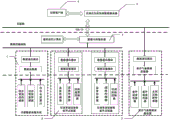
As shown in fig. 1, the on-line prediction system for the hourly cooling load of the central air conditioner of the office building of the present embodiment includes a cold source data acquisition system 1, a plurality of intelligent node devices 2 of air conditioner end equipment, an outdoor meteorological data acquisition device 3, a data transfer server 4, an air conditioner cooling load prediction data server 5, and a remote client 6; the intelligent node device of the air-conditioning terminal equipment comprises a fan coil intelligent node device and an air-conditioning unit intelligent node device;
as shown in fig. 2, the cold source data acquisition system is used for acquiring the cold load value of the central air conditioner; the cold source data acquisition system comprises a cold source data acquisition device, a water supply pipe temperature sensor, a water return pipe temperature sensor, a chilled water flowmeter and a cold source data communication module, wherein the water supply pipe temperature sensor, the water return pipe temperature sensor and the chilled water flowmeter are respectively connected with the cold source data acquisition device; the cold source data acquisition device is connected with the cold source data communication module. Wherein, the cold source data collector is provided with an AI port and a data port, 3 AI ports (AI-1, AI-2 and AI-3) are respectively connected with a water supply pipe temperature sensor, a water return pipe temperature sensor and a chilled water flowmeter; one end of the data communication module is connected with the data port of the cold source data acquisition device, and the other end of the data communication module is externally connected with a data transmission line. The cold source data acquisition system 1 can acquire the supply water temperature of the chilled water, the return water temperature of the chilled water and the flow rate of the chilled water at the current moment in real time.
As shown in fig. 3, the fan coil intelligent node device is used for collecting the air conditioner operation input parameters; the fan coil intelligent node device comprises a fan coil controller, a fan coil temperature sensor, a fan coil humidity sensor, a fan coil collector and a fan coil data communication module; the fan coil controller, the fan coil temperature sensor and the fan coil humidity sensor are respectively connected with the fan coil collector; and the fan coil collector is connected with the fan coil data communication module. The fan coil controller is provided with an AI port, a DO port and a data port, the fan coil controller is respectively connected with a temperature sensor and a humidity sensor through 2 AI ports (AI-1 and AI-2), respectively connected with coils of 4 relays (P1, P2, P3 and P4) through 4 DO ports (DO-1, DO-2, DO-3 and DO-4), auxiliary contacts of the 4 relays are respectively connected with electromagnetic valves and terminals corresponding to high-speed, medium-speed and low-speed gears of the three-speed fan, the fan coil controller is connected with the data communication module through the data port, and the other end of the data communication module is connected with a data transmission line. Indoor temperature, humidity and the on-off state of the fan coil can be collected in real time through the intelligent node device of the fan coil. The on-off state of the fan coil is judged by the following processes: when one of the high speed, medium speed or low speed relays of the fan coil is detected to be closed, the fan coil is considered to be opened.
As shown in fig. 4, the intelligent node device of the air conditioning unit comprises an air conditioning unit data collector, an air conditioning unit controller, a return air inlet temperature sensor, a return air inlet humidity sensor and an air conditioning unit data communication module, wherein the air conditioning unit controller, the return air inlet temperature sensor and the return air inlet humidity sensor are respectively connected with the air conditioning unit data collector; and the air conditioning group data collector is connected with the air conditioning group data communication module.
As shown in fig. 5, the outdoor meteorological data acquisition device comprises an outdoor data acquisition unit, an outdoor data communication module, an outdoor environment temperature sensor, an outdoor environment relative humidity sensor and a solar total radiation sensor, wherein the outdoor environment temperature sensor, the outdoor environment relative humidity sensor and the solar total radiation sensor are respectively connected with the outdoor data acquisition unit, and the outdoor data acquisition unit is connected with the outdoor data communication module. The data collector is provided with connecting ports of 3 sensors, namely an outdoor environment temperature sensor, an outdoor environment relative humidity sensor and a solar total radiation sensor, the connecting ports are connected with the wireless transmission module through an RS232 output end of the data collector, the wireless transmission module is connected to an air conditioner load prediction server through a network after receiving signals sent by the collector, the server receives effective data and stores the effective data in a database, and a microcomputer can access the server in real time.
The data transfer server 4 is used for receiving, storing and uploading on-line monitoring data of the cold source data acquisition system, the air conditioner terminal equipment intelligent node device and the outdoor meteorological data acquisition device, and receiving a time-by-time air conditioner cold load predicted value from the air conditioner load prediction server; and providing the central air-conditioning cold load prediction data for the remote monitoring computer.
And the air conditioner cold load prediction data server 5 is used for receiving the real-time data uploaded by the data transfer server, preprocessing the data and predicting the air conditioner cold load.
And the remote client 6 is used for realizing remote control of the system.
As shown in fig. 6, the method for online predicting the hourly cooling load of the office building central air conditioner of the system comprises the following steps:
(1) data initialization: manually inputting the area of the air-conditioning room of the building, the number of air-conditioning terminal equipment in each air-conditioning room, the power and the cooling area, and calculating the operation input parameters of the air conditioner; setting a unique number for each intelligent node device of the air conditioner terminal equipment; setting the residual error initial value between the predicted value and the actual value of the six input parameters to zero, and setting the residual error initial value between the actual value and the predicted value of the air conditioner cold load to zero; setting the initial value of the acquisition days p to zero;
the input parameters consist of outdoor meteorological parameters and air conditioner operation input parameters; the outdoor meteorological parameters comprise the average dry bulb temperature of the outdoor environment, the average relative humidity of the outdoor environment and the average total solar radiation of the outdoor environment; the air conditioner operation input parameters comprise indoor average temperature, average relative humidity and opening rate of air conditioner tail end equipment; the output parameter is air conditioner cold load;
(2) enabling the acquisition days p = p +1, and judging whether the acquisition days p meet that p is larger than or equal to m, wherein m is set by a user;
if not, repeating the step (2) after the acquisition, processing and storage of the input parameters of the p day are carried out;
if yes, judging whether the acquisition days p meet p > m, if not, performing the step (3), and if so, performing the step (4);
the acquisition of the input parameters specifically comprises the following steps: acquisition period of T1,T1The value can be 3 minutes, 5 minutes, 10 minutes and other parameters, and 60 minutes is divided by T1Is an integer, i.e. q times per 1 hour, q =60/T1。
The processing and storing process of the input parameters comprises the following steps: calculating the air conditioner cold load of each hour, the average dry bulb temperature and average relative humidity of an air conditioner opening room in a building, the weighted opening rate of air conditioner terminal equipment, the average dry bulb temperature of an outdoor environment, the average relative humidity of the outdoor environment and the average total solar radiation of the outdoor environment; normalizing data such as air conditioner cold load, building indoor average dry bulb temperature and average relative humidity, air conditioner tail end equipment weighted opening rate, outdoor environment average dry bulb temperature, outdoor environment average relative humidity, outdoor environment average solar total radiation and the like; storing the normalized data to an air conditioner cold load prediction server;
setting the air-conditioning cooling load Y in the l hour of the p dayp(l) Outdoor environment dry bulb temperature xp,1(l) Outdoor environment relative humidity xp,2(l) Outdoor environment solar total radiation xp,3(l) Indoor average dry bulb temperature x of building air-conditioning open roomp,4(l) And average relative humidity xp,5(l) Weighted opening rate x of air conditioner terminal equipmentp,6(l) Then, the calculation process specifically includes:
a) calculating the average cooling load Y of the building central air-conditioning system in the l hour on the p dayp(l):
<math>
<mrow>
<msub>
<mi>Y</mi>
<mi>p</mi>
</msub>
<mrow>
<mo>(</mo>
<mi>l</mi>
<mo>)</mo>
</mrow>
<mo>=</mo>
<mfrac>
<mrow>
<munderover>
<mi>Σ</mi>
<mrow>
<mi>s</mi>
<mo>=</mo>
<mn>1</mn>
</mrow>
<mi>q</mi>
</munderover>
<mo>{</mo>
<mo>[</mo>
<msub>
<mi>C</mi>
<mi>w</mi>
</msub>
<mo>×</mo>
<mo>[</mo>
<msub>
<mi>t</mi>
<mrow>
<mi>c</mi>
<mn>2</mn>
</mrow>
</msub>
<mrow>
<mo>(</mo>
<mi>s</mi>
<mo>)</mo>
</mrow>
<mo>-</mo>
<msub>
<mi>t</mi>
<mrow>
<mi>c</mi>
<mn>1</mn>
</mrow>
</msub>
<mrow>
<mo>(</mo>
<mi>s</mi>
<mo>)</mo>
</mrow>
<mo>]</mo>
<msub>
<mrow>
<mo>×</mo>
<mi>q</mi>
</mrow>
<mi>w</mi>
</msub>
<mrow>
<mo>(</mo>
<mi>s</mi>
<mo>)</mo>
</mrow>
<mo>]</mo>
<msub>
<mrow>
<mo>×</mo>
<mi>T</mi>
</mrow>
<mn>1</mn>
</msub>
<mo>}</mo>
</mrow>
<mn>60</mn>
</mfrac>
<mo>-</mo>
<mo>-</mo>
<mo>-</mo>
<mrow>
<mo>(</mo>
<mn>1</mn>
<mo>)</mo>
</mrow>
</mrow>
</math>
In the formula, Cw: the constant pressure specific heat of water, kJ/kg DEG C;
qw(s): the mass flow of the chilled water collected by the cold source data collection system in the s sampling period within the l hour is kg/s;
tc1(s): the supply water temperature of the chilled water acquired by the cold source data acquisition system in the s sampling period in the l hour is controlled at DEG C;
tc2(s): the return water temperature of the chilled water acquired by the cold source data acquisition system in the s sampling period in the l hour is in the DEG C.
(b) Calculating the average dry bulb temperature x of the environment outside the inner chamber in the l hour on the p dayp,1(l):
<math>
<mrow>
<msub>
<mi>x</mi>
<mrow>
<mi>p</mi>
<mo>,</mo>
<mn>1</mn>
</mrow>
</msub>
<mrow>
<mo>(</mo>
<mi>l</mi>
<mo>)</mo>
</mrow>
<mo>=</mo>
<mfrac>
<mrow>
<munderover>
<mi>Σ</mi>
<mrow>
<mi>s</mi>
<mo>=</mo>
<mn>1</mn>
</mrow>
<mi>q</mi>
</munderover>
<msub>
<mi>T</mi>
<mi>d</mi>
</msub>
<mrow>
<mo>(</mo>
<mi>s</mi>
<mo>)</mo>
</mrow>
</mrow>
<mi>q</mi>
</mfrac>
<mo>-</mo>
<mo>-</mo>
<mo>-</mo>
<mrow>
<mo>(</mo>
<mn>2</mn>
<mo>)</mo>
</mrow>
</mrow>
</math>
Td(s): the dry bulb temperature of the outdoor environment, DEG C, collected by the outdoor meteorological data collection device in the s sampling period in the l hour.
(c) Calculating the average relative humidity x of the environment outside the inner chamber in the l hour on the p dayp,2(l):
<math>
<mrow>
<msub>
<mi>x</mi>
<mrow>
<mi>p</mi>
<mo>,</mo>
<mn>2</mn>
</mrow>
</msub>
<mrow>
<mo>(</mo>
<mi>l</mi>
<mo>)</mo>
</mrow>
<mo>=</mo>
<mfrac>
<mrow>
<munderover>
<mi>Σ</mi>
<mrow>
<mi>s</mi>
<mo>=</mo>
<mn>1</mn>
</mrow>
<mi>q</mi>
</munderover>
<mi>RH</mi>
<mrow>
<mo>(</mo>
<mi>s</mi>
<mo>)</mo>
</mrow>
</mrow>
<mi>q</mi>
</mfrac>
<mo>-</mo>
<mo>-</mo>
<mo>-</mo>
<mrow>
<mo>(</mo>
<mn>3</mn>
<mo>)</mo>
</mrow>
</mrow>
</math>
RH(s): the relative humidity of the outdoor environment acquired by the outdoor meteorological data acquisition device in the s-th sampling period within the l-th hour is percent.
(d) Calculating the average solar total radiation x of the outdoor environment in the l hour on the p dayp,3(l):
<math>
<mrow>
<msub>
<mi>x</mi>
<mrow>
<mi>p</mi>
<mo>,</mo>
<mn>3</mn>
</mrow>
</msub>
<mrow>
<mo>(</mo>
<mi>l</mi>
<mo>)</mo>
</mrow>
<mo>=</mo>
<mfrac>
<mrow>
<munderover>
<mi>Σ</mi>
<mrow>
<mi>s</mi>
<mo>=</mo>
<mn>1</mn>
</mrow>
<mi>q</mi>
</munderover>
<mi>S</mi>
<mrow>
<mo>(</mo>
<mi>s</mi>
<mo>)</mo>
</mrow>
</mrow>
<mi>q</mi>
</mfrac>
<mo>-</mo>
<mo>-</mo>
<mo>-</mo>
<mrow>
<mo>(</mo>
<mn>4</mn>
<mo>)</mo>
</mrow>
</mrow>
</math>
(s): total solar radiation (mwh/cm) collected by outdoor meteorological data collection device in the s-th sampling period in the l hour2。
(e) Calculating the indoor average dry bulb temperature x of the room with the built air conditioner opened in the ith hour on the p dayp,4(l):
<math>
<mrow>
<msub>
<mi>x</mi>
<mrow>
<mi>p</mi>
<mo>,</mo>
<mn>4</mn>
</mrow>
</msub>
<mrow>
<mo>(</mo>
<mi>l</mi>
<mo>)</mo>
</mrow>
<mo>=</mo>
<mfrac>
<mrow>
<munderover>
<mi>Σ</mi>
<mrow>
<mi>s</mi>
<mo>=</mo>
<mn>1</mn>
</mrow>
<mi>q</mi>
</munderover>
<mfrac>
<mrow>
<munderover>
<mi>Σ</mi>
<mrow>
<mi>i</mi>
<mo>=</mo>
<mn>1</mn>
</mrow>
<mi>l</mi>
</munderover>
<munderover>
<mi>Σ</mi>
<mrow>
<mi>j</mi>
<mo>=</mo>
<mn>0</mn>
</mrow>
<msub>
<mi>n</mi>
<mi>i</mi>
</msub>
</munderover>
<msub>
<mi>A</mi>
<mi>ij</mi>
</msub>
<msub>
<mi>S</mi>
<mi>ij</mi>
</msub>
<mrow>
<mo>(</mo>
<mi>s</mi>
<mo>)</mo>
</mrow>
<msub>
<mi>t</mi>
<mi>ij</mi>
</msub>
<mrow>
<mo>(</mo>
<mi>s</mi>
<mo>)</mo>
</mrow>
</mrow>
<mrow>
<munderover>
<mi>Σ</mi>
<mrow>
<mi>i</mi>
<mo>=</mo>
<mn>1</mn>
</mrow>
<mi>l</mi>
</munderover>
<munderover>
<mi>Σ</mi>
<mrow>
<mi>j</mi>
<mo>=</mo>
<mn>0</mn>
</mrow>
<msub>
<mi>n</mi>
<mi>i</mi>
</msub>
</munderover>
<msub>
<mi>A</mi>
<mi>ij</mi>
</msub>
<msub>
<mi>S</mi>
<mi>ij</mi>
</msub>
<mrow>
<mo>(</mo>
<mi>s</mi>
<mo>)</mo>
</mrow>
</mrow>
</mfrac>
<mo>×</mo>
<msub>
<mi>T</mi>
<mn>1</mn>
</msub>
</mrow>
<mn>60</mn>
</mfrac>
<mo>-</mo>
<mo>-</mo>
<mo>-</mo>
<mrow>
<mo>(</mo>
<mn>5</mn>
<mo>)</mo>
</mrow>
</mrow>
</math>
In the formula: i: the serial number of the building room provided with the air-conditioning terminal equipment;
l, the total number of the rooms of the building provided with the air-conditioning terminal equipment is one;
j: serial number of air-conditioning terminal equipment in a building room;
ni: ith room air conditionerTotal number of end devices, one;
Aij: cooling area, m, of jth air conditioner terminal equipment in ith room2;
Sij(s): the switching state of jth air conditioner terminal equipment in an ith room in an s sampling period in the l hour is 1 in an opening state and 0 in a closing state;
tij(s): the temperature detected by the jth air conditioner terminal intelligent control device in the ith room in the ith sampling period within the ith hour is in DEG C;
(f) calculating the indoor average relative humidity x of the room with the built air conditioner opened in the ith hour on the p dayp,5(l):
<math>
<mrow>
<msub>
<mi>x</mi>
<mrow>
<mi>p</mi>
<mo>,</mo>
<mn>5</mn>
</mrow>
</msub>
<mrow>
<mo>(</mo>
<mi>l</mi>
<mo>)</mo>
</mrow>
<mo>=</mo>
<mfrac>
<mrow>
<munderover>
<mi>Σ</mi>
<mrow>
<mi>s</mi>
<mo>=</mo>
<mn>1</mn>
</mrow>
<mi>q</mi>
</munderover>
<mfrac>
<mrow>
<munderover>
<mi>Σ</mi>
<mrow>
<mi>i</mi>
<mo>=</mo>
<mn>1</mn>
</mrow>
<mi>l</mi>
</munderover>
<munderover>
<mi>Σ</mi>
<mrow>
<mi>j</mi>
<mo>=</mo>
<mn>0</mn>
</mrow>
<msub>
<mi>n</mi>
<mi>i</mi>
</msub>
</munderover>
<msub>
<mi>A</mi>
<mi>ij</mi>
</msub>
<msub>
<mi>S</mi>
<mi>ij</mi>
</msub>
<mrow>
<mo>(</mo>
<mi>s</mi>
<mo>)</mo>
</mrow>
<msub>
<mi>U</mi>
<mi>ij</mi>
</msub>
<mrow>
<mo>(</mo>
<mi>s</mi>
<mo>)</mo>
</mrow>
</mrow>
<mrow>
<munderover>
<mi>Σ</mi>
<mrow>
<mi>i</mi>
<mo>=</mo>
<mn>1</mn>
</mrow>
<mi>l</mi>
</munderover>
<munderover>
<mi>Σ</mi>
<mrow>
<mi>j</mi>
<mo>=</mo>
<mn>0</mn>
</mrow>
<msub>
<mi>n</mi>
<mi>i</mi>
</msub>
</munderover>
<msub>
<mi>A</mi>
<mi>ij</mi>
</msub>
<msub>
<mi>S</mi>
<mi>ij</mi>
</msub>
<mrow>
<mo>(</mo>
<mi>s</mi>
<mo>)</mo>
</mrow>
</mrow>
</mfrac>
<mo>×</mo>
<msub>
<mi>T</mi>
<mn>1</mn>
</msub>
</mrow>
<mn>60</mn>
</mfrac>
<mo>-</mo>
<mo>-</mo>
<mo>-</mo>
<mrow>
<mo>(</mo>
<mn>6</mn>
<mo>)</mo>
</mrow>
</mrow>
</math>
In the formula: u shapeij(s): indoor relative humidity,%, detected by the jth air conditioner terminal equipment intelligent node device in the ith room in the ith sampling period within the ith hour;
(d) calculating the average weighted opening rate x of the air-conditioning terminal equipment of the building in the ith hour of the p dayp,6(l):
<math>
<mrow>
<msub>
<mi>x</mi>
<mrow>
<mi>p</mi>
<mo>,</mo>
<mn>6</mn>
</mrow>
</msub>
<mrow>
<mo>(</mo>
<mi>l</mi>
<mo>)</mo>
</mrow>
<mo>=</mo>
<mfrac>
<mrow>
<munderover>
<mi>Σ</mi>
<mrow>
<mi>s</mi>
<mo>=</mo>
<mn>1</mn>
</mrow>
<mi>q</mi>
</munderover>
<mrow>
<mo>(</mo>
<mfrac>
<mrow>
<munderover>
<mi>Σ</mi>
<mrow>
<mi>i</mi>
<mo>=</mo>
<mn>1</mn>
</mrow>
<mi>l</mi>
</munderover>
<munderover>
<mi>Σ</mi>
<mrow>
<mi>j</mi>
<mo>=</mo>
<mn>0</mn>
</mrow>
<msub>
<mi>n</mi>
<mi>i</mi>
</msub>
</munderover>
<msub>
<mi>S</mi>
<mi>ij</mi>
</msub>
<mrow>
<mo>(</mo>
<mi>s</mi>
<mo>)</mo>
</mrow>
<msub>
<mi>P</mi>
<mi>ij</mi>
</msub>
</mrow>
<mrow>
<munderover>
<mi>Σ</mi>
<mrow>
<mi>i</mi>
<mo>=</mo>
<mn>1</mn>
</mrow>
<mi>l</mi>
</munderover>
<munderover>
<mi>Σ</mi>
<mrow>
<mi>j</mi>
<mo>=</mo>
<mn>0</mn>
</mrow>
<msub>
<mi>n</mi>
<mi>i</mi>
</msub>
</munderover>
<msub>
<mi>P</mi>
<mi>ij</mi>
</msub>
</mrow>
</mfrac>
<mo>×</mo>
<msub>
<mi>T</mi>
<mn>1</mn>
</msub>
<mo>)</mo>
</mrow>
</mrow>
<mn>60</mn>
</mfrac>
<mo>-</mo>
<mo>-</mo>
<mo>-</mo>
<mrow>
<mo>(</mo>
<mn>7</mn>
<mo>)</mo>
</mrow>
</mrow>
</math>
In the formula, Sij(s): the switching state of jth air conditioner terminal equipment in an ith room in an ith sampling period within the ith hour is 1 in an on state and 0 in an off state;
Pij: power of jth air conditioning end device in ith room.
The data normalization processing method can process the data to the value of-1, 1 by adopting the following method:
in the formula, x: data attribute values in the data attribute vector;
xmin: a minimum value in the data attribute vector;
xmax: a maximum value in the data attribute vector;
y: and normalizing the processed data attribute values.
(3) The following steps are carried out:
(3-1) when the number of acquisition hours n =1, acquiring, processing and storing the input parameter and the output parameter in the 1 st hour, and simultaneously performing the following steps:
(3-1-1) performing initialization modeling on the air-conditioning load Online SVR model by taking the actual value of the input parameter of the 1 st to m-1 th days as input and the actual value of the air-conditioning cold load of the 1 st to m-1 th days as output, specifically:
one SVR model is Y = fonlineSVR[X]Input is as
<math>
<mrow>
<mi>X</mi>
<mo>=</mo>
<msub>
<mfenced open='[' close=']'>
<mtable>
<mtr>
<mtd>
<msub>
<mi>x</mi>
<mn>1,1</mn>
</msub>
<mrow>
<mo>(</mo>
<mn>1</mn>
<mo>)</mo>
</mrow>
</mtd>
<mtd>
<msub>
<mi>x</mi>
<mn>1,2</mn>
</msub>
<mrow>
<mo>(</mo>
<mn>1</mn>
<mo>)</mo>
</mrow>
</mtd>
<mtd>
<mo>.</mo>
<mo>.</mo>
<mo>.</mo>
</mtd>
<mtd>
<msub>
<mi>x</mi>
<mn>1,6</mn>
</msub>
<mrow>
<mo>(</mo>
<mn>1</mn>
<mo>)</mo>
</mrow>
</mtd>
</mtr>
<mtr>
<mtd>
<msub>
<mi>x</mi>
<mn>1,1</mn>
</msub>
<mrow>
<mo>(</mo>
<mn>2</mn>
<mo>)</mo>
</mrow>
</mtd>
<mtd>
<msub>
<mi>x</mi>
<mn>1,2</mn>
</msub>
<mrow>
<mo>(</mo>
<mn>2</mn>
<mo>)</mo>
</mrow>
</mtd>
<mtd>
<mo>.</mo>
<mo>.</mo>
<mo>.</mo>
</mtd>
<mtd>
<msub>
<mi>x</mi>
<mn>1,6</mn>
</msub>
<mrow>
<mo>(</mo>
<mn>2</mn>
<mo>)</mo>
</mrow>
</mtd>
</mtr>
<mtr>
<mtd>
<mo>.</mo>
</mtd>
<mtd>
<mo>.</mo>
</mtd>
<mtd>
</mtd>
<mtd>
<mo>.</mo>
</mtd>
</mtr>
<mtr>
<mtd>
<mo>.</mo>
</mtd>
<mtd>
<mo>.</mo>
</mtd>
<mtd>
<mo>.</mo>
<mo>.</mo>
<mo>.</mo>
</mtd>
<mtd>
<mo>.</mo>
</mtd>
</mtr>
<mtr>
<mtd>
<mo>.</mo>
</mtd>
<mtd>
<mo>.</mo>
</mtd>
<mtd>
</mtd>
<mtd>
<mo>.</mo>
</mtd>
</mtr>
<mtr>
<mtd>
<msub>
<mi>x</mi>
<mn>1,1</mn>
</msub>
<mrow>
<mo>(</mo>
<mn>24</mn>
<mo>)</mo>
</mrow>
</mtd>
<mtd>
<msub>
<mi>x</mi>
<mn>1,2</mn>
</msub>
<mrow>
<mo>(</mo>
<mn>24</mn>
<mo>)</mo>
</mrow>
</mtd>
<mtd>
<mo>.</mo>
<mo>.</mo>
<mo>.</mo>
</mtd>
<mtd>
<msub>
<mi>x</mi>
<mn>1,6</mn>
</msub>
<mrow>
<mo>(</mo>
<mn>24</mn>
<mo>)</mo>
</mrow>
</mtd>
</mtr>
<mtr>
<mtd>
<msub>
<mi>x</mi>
<mn>2,1</mn>
</msub>
<mrow>
<mo>(</mo>
<mn>1</mn>
<mo>)</mo>
</mrow>
</mtd>
<mtd>
<msub>
<mi>x</mi>
<mn>2,2</mn>
</msub>
<mrow>
<mo>(</mo>
<mn>1</mn>
<mo>)</mo>
</mrow>
</mtd>
<mtd>
<mo>.</mo>
<mo>.</mo>
<mo>.</mo>
</mtd>
<mtd>
<msub>
<mi>x</mi>
<mn>2,6</mn>
</msub>
<mrow>
<mo>(</mo>
<mn>1</mn>
<mo>)</mo>
</mrow>
</mtd>
</mtr>
<mtr>
<mtd>
<mo>.</mo>
</mtd>
<mtd>
<mo>.</mo>
</mtd>
<mtd>
</mtd>
<mtd>
<mo>.</mo>
</mtd>
</mtr>
<mtr>
<mtd>
<mo>.</mo>
</mtd>
<mtd>
<mo>.</mo>
</mtd>
<mtd>
<mo>.</mo>
<mo>.</mo>
<mo>.</mo>
</mtd>
<mtd>
<mo>.</mo>
</mtd>
</mtr>
<mtr>
<mtd>
<mo>.</mo>
</mtd>
<mtd>
<mo>.</mo>
</mtd>
<mtd>
</mtd>
<mtd>
<mo>.</mo>
</mtd>
</mtr>
<mtr>
<mtd>
<msub>
<mi>x</mi>
<mrow>
<mi>m</mi>
<mo>-</mo>
<mn>1,1</mn>
</mrow>
</msub>
<mrow>
<mo>(</mo>
<mn>24</mn>
<mo>)</mo>
</mrow>
</mtd>
<mtd>
<msub>
<mi>x</mi>
<mrow>
<mi>m</mi>
<mo>-</mo>
<mn>1,2</mn>
</mrow>
</msub>
<mrow>
<mo>(</mo>
<mn>24</mn>
<mo>)</mo>
</mrow>
</mtd>
<mtd>
<mo>.</mo>
<mo>.</mo>
<mo>.</mo>
</mtd>
<mtd>
<msub>
<mi>x</mi>
<mrow>
<mi>m</mi>
<mo>-</mo>
<mn>1,6</mn>
</mrow>
</msub>
<mrow>
<mo>(</mo>
<mn>24</mn>
<mo>)</mo>
</mrow>
</mtd>
</mtr>
</mtable>
</mfenced>
<mrow>
<mn>24</mn>
<mo>×</mo>
<mi>m</mi>
<mo>-</mo>
<mn>24</mn>
<mo>,</mo>
<mn>6</mn>
</mrow>
</msub>
</mrow>
</math>
The output is:
<math>
<mrow>
<mi>Y</mi>
<mo>=</mo>
<msub>
<mfenced open='[' close=']'>
<mtable>
<mtr>
<mtd>
<msub>
<mi>y</mi>
<mn>1</mn>
</msub>
<mrow>
<mo>(</mo>
<mn>1</mn>
<mo>)</mo>
</mrow>
</mtd>
</mtr>
<mtr>
<mtd>
<msub>
<mi>y</mi>
<mn>1</mn>
</msub>
<mrow>
<mo>(</mo>
<mn>2</mn>
<mo>)</mo>
</mrow>
</mtd>
</mtr>
<mtr>
<mtd>
<mo>.</mo>
</mtd>
</mtr>
<mtr>
<mtd>
<mo>.</mo>
</mtd>
</mtr>
<mtr>
<mtd>
<mo>.</mo>
</mtd>
</mtr>
<mtr>
<mtd>
<msub>
<mi>y</mi>
<mn>1</mn>
</msub>
<mrow>
<mo>(</mo>
<mn>24</mn>
<mo>)</mo>
</mrow>
</mtd>
</mtr>
<mtr>
<mtd>
<msub>
<mi>y</mi>
<mn>2</mn>
</msub>
<mrow>
<mo>(</mo>
<mn>1</mn>
<mo>)</mo>
</mrow>
</mtd>
</mtr>
<mtr>
<mtd>
<mo>.</mo>
</mtd>
</mtr>
<mtr>
<mtd>
<mo>.</mo>
</mtd>
</mtr>
<mtr>
<mtd>
<mo>.</mo>
</mtd>
</mtr>
<mtr>
<mtd>
<msub>
<mi>y</mi>
<mrow>
<mi>m</mi>
<mo>-</mo>
<mn>1</mn>
</mrow>
</msub>
<mrow>
<mo>(</mo>
<mn>24</mn>
<mo>)</mo>
</mrow>
</mtd>
</mtr>
</mtable>
</mfenced>
<mrow>
<mn>24</mn>
<mo>×</mo>
<mi>m</mi>
<mo>-</mo>
<mn>24,1</mn>
</mrow>
</msub>
</mrow>
</math>
wherein x isk,d(l) Represents the d-th input parameter actual value at the l hour of the k-th day; wherein the values 1,2, 3, 4, 5 and 6 of d respectively correspond to the input parameters: the average dry bulb temperature of the outdoor environment, the average relative humidity of the outdoor environment, the average total solar radiation of the outdoor environment, the average dry bulb temperature of the indoor of the building, the average relative humidity of the indoor of the building and the opening rate of air-conditioning terminal equipment; l =1,2, 3 … 24; k =1,2, 3 … m-1;
(3-1-2) performing initialization modeling of an input parameter time sequence Online SVR model by using actual values of input parameters from day 1 to day m-1, and predicting the input parameters 24 hours on day m by time, specifically comprising the following steps:
(3-1-2-1) constructing an ONLINESVR time sequence of each input parameter by using the actual values of the input parameters from day 1 to day m-1;
(3-1-2-2) reconstructing the Online SVR time sequence of each input parameter obtained in the step (3-1-2-1), which comprises the following steps:
setting the embedding dimension of the input sample of the input parameter time series Online SVR model to be D, wherein D <24, then the input sample is expressed as:
<math>
<msub>
<mfenced open='[' close=']'>
<mtable>
<mtr>
<mtd>
<msub>
<mi>x</mi>
<mrow>
<mn>1</mn>
<mo>,</mo>
<mi>d</mi>
</mrow>
</msub>
<mrow>
<mo>(</mo>
<mn>1</mn>
<mo>)</mo>
</mrow>
</mtd>
<mtd>
<msub>
<mi>x</mi>
<mrow>
<mn>1</mn>
<mo>,</mo>
<mi>d</mi>
</mrow>
</msub>
<mrow>
<mo>(</mo>
<mn>2</mn>
<mo>)</mo>
</mrow>
</mtd>
<mtd>
<mo>.</mo>
<mo>.</mo>
<mo>.</mo>
</mtd>
<mtd>
<msub>
<mi>x</mi>
<mrow>
<mn>1</mn>
<mo>,</mo>
<mi>d</mi>
</mrow>
</msub>
<mrow>
<mo>(</mo>
<mi>D</mi>
<mo>)</mo>
</mrow>
</mtd>
</mtr>
<mtr>
<mtd>
<msub>
<mi>x</mi>
<mrow>
<mn>1</mn>
<mo>,</mo>
<mi>d</mi>
</mrow>
</msub>
<mrow>
<mo>(</mo>
<mn>2</mn>
<mo>)</mo>
</mrow>
</mtd>
<mtd>
<msub>
<mi>x</mi>
<mrow>
<mn>1</mn>
<mo>,</mo>
<mi>d</mi>
</mrow>
</msub>
<mrow>
<mo>(</mo>
<mn>3</mn>
<mo>)</mo>
</mrow>
</mtd>
<mtd>
<mo>.</mo>
<mo>.</mo>
<mo>.</mo>
</mtd>
<mtd>
<msub>
<mi>x</mi>
<mrow>
<mn>1</mn>
<mo>,</mo>
<mi>d</mi>
</mrow>
</msub>
<mrow>
<mo>(</mo>
<mi>D</mi>
<mo>+</mo>
<mn>1</mn>
<mo>)</mo>
</mrow>
</mtd>
</mtr>
<mtr>
<mtd>
<msub>
<mi>x</mi>
<mrow>
<mn>1</mn>
<mo>,</mo>
<mi>d</mi>
</mrow>
</msub>
<mrow>
<mo>(</mo>
<mn>3</mn>
<mo>)</mo>
</mrow>
</mtd>
<mtd>
<msub>
<mi>x</mi>
<mrow>
<mn>1</mn>
<mo>,</mo>
<mi>d</mi>
</mrow>
</msub>
<mrow>
<mo>(</mo>
<mn>4</mn>
<mo>)</mo>
</mrow>
</mtd>
<mtd>
<mo>.</mo>
<mo>.</mo>
<mo>.</mo>
</mtd>
<mtd>
<msub>
<mi>x</mi>
<mrow>
<mn>1</mn>
<mo>,</mo>
<mi>d</mi>
</mrow>
</msub>
<mrow>
<mo>(</mo>
<mi>D</mi>
<mo>+</mo>
<mn>2</mn>
<mo>)</mo>
</mrow>
</mtd>
</mtr>
<mtr>
<mtd>
<mo>.</mo>
</mtd>
<mtd>
<mo>.</mo>
</mtd>
<mtd>
</mtd>
<mtd>
<mo>.</mo>
</mtd>
</mtr>
<mtr>
<mtd>
<mo>.</mo>
</mtd>
<mtd>
<mo>.</mo>
</mtd>
<mtd>
<mo>.</mo>
<mo>.</mo>
<mo>.</mo>
</mtd>
<mtd>
<mo>.</mo>
</mtd>
</mtr>
<mtr>
<mtd>
<mo>.</mo>
</mtd>
<mtd>
<mo>.</mo>
</mtd>
<mtd>
</mtd>
<mtd>
<mo>.</mo>
</mtd>
</mtr>
<mtr>
<mtd>
<msub>
<mi>x</mi>
<mrow>
<mi>m</mi>
<mo>-</mo>
<mn>1</mn>
<mo>,</mo>
<mi>d</mi>
</mrow>
</msub>
<mrow>
<mo>(</mo>
<mn>22</mn>
<mo>-</mo>
<mi>D</mi>
<mo>)</mo>
</mrow>
</mtd>
<mtd>
<msub>
<mi>x</mi>
<mrow>
<mi>m</mi>
<mo>-</mo>
<mn>1</mn>
<mo>,</mo>
<mi>d</mi>
</mrow>
</msub>
<mrow>
<mo>(</mo>
<mn>23</mn>
<mo>-</mo>
<mi>D</mi>
<mo>)</mo>
</mrow>
</mtd>
<mtd>
<mo>.</mo>
<mo>.</mo>
<mo>.</mo>
</mtd>
<mtd>
<msub>
<mi>x</mi>
<mrow>
<mi>m</mi>
<mo>-</mo>
<mn>1</mn>
<mo>,</mo>
<mi>d</mi>
</mrow>
</msub>
<mrow>
<mo>(</mo>
<mn>22</mn>
<mo>)</mo>
</mrow>
</mtd>
</mtr>
<mtr>
<mtd>
<msub>
<mi>x</mi>
<mrow>
<mi>m</mi>
<mo>-</mo>
<mn>1</mn>
<mo>,</mo>
<mi>d</mi>
</mrow>
</msub>
<mrow>
<mo>(</mo>
<mn>23</mn>
<mo>-</mo>
<mi>D</mi>
<mo>)</mo>
</mrow>
</mtd>
<mtd>
<msub>
<mi>x</mi>
<mrow>
<mi>m</mi>
<mo>-</mo>
<mn>1</mn>
<mo>,</mo>
<mi>d</mi>
</mrow>
</msub>
<mrow>
<mo>(</mo>
<mn>23</mn>
<mo>-</mo>
<mi>D</mi>
<mo>+</mo>
<mn>1</mn>
<mo>)</mo>
</mrow>
</mtd>
<mtd>
<mo>.</mo>
<mo>.</mo>
<mo>.</mo>
</mtd>
<mtd>
<msub>
<mi>x</mi>
<mrow>
<mi>m</mi>
<mo>-</mo>
<mn>1</mn>
<mo>,</mo>
<mi>d</mi>
</mrow>
</msub>
<mrow>
<mo>(</mo>
<mn>23</mn>
<mo>)</mo>
</mrow>
</mtd>
</mtr>
</mtable>
</mfenced>
<mrow>
<mn>24</mn>
<mo>×</mo>
<mrow>
<mo>(</mo>
<mi>m</mi>
<mo>-</mo>
<mn>1</mn>
<mo>)</mo>
</mrow>
<mo>-</mo>
<mi>D</mi>
<mo>,</mo>
<mi>D</mi>
</mrow>
</msub>
</math>
the output samples are represented as:
<math>
<msub>
<mfenced open='[' close=']'>
<mtable>
<mtr>
<mtd>
<msub>
<mi>x</mi>
<mrow>
<mn>1</mn>
<mo>,</mo>
<mi>d</mi>
</mrow>
</msub>
<mrow>
<mo>(</mo>
<mi>D</mi>
<mo>+</mo>
<mn>1</mn>
<mo>)</mo>
</mrow>
</mtd>
</mtr>
<mtr>
<mtd>
<msub>
<mi>x</mi>
<mrow>
<mn>1</mn>
<mo>,</mo>
<mi>d</mi>
</mrow>
</msub>
<mrow>
<mo>(</mo>
<mi>D</mi>
<mo>+</mo>
<mn>2</mn>
<mo>)</mo>
</mrow>
</mtd>
</mtr>
<mtr>
<mtd>
<msub>
<mi>x</mi>
<mrow>
<mn>1</mn>
<mo>,</mo>
<mi>d</mi>
</mrow>
</msub>
<mrow>
<mo>(</mo>
<mi>D</mi>
<mo>+</mo>
<mn>3</mn>
<mo>)</mo>
</mrow>
</mtd>
</mtr>
<mtr>
<mtd>
<mo>.</mo>
</mtd>
</mtr>
<mtr>
<mtd>
<mo>.</mo>
</mtd>
</mtr>
<mtr>
<mtd>
<mo>.</mo>
</mtd>
</mtr>
<mtr>
<mtd>
<msub>
<mi>x</mi>
<mrow>
<mi>m</mi>
<mo>-</mo>
<mn>1</mn>
<mo>,</mo>
<mi>d</mi>
</mrow>
</msub>
<mrow>
<mo>(</mo>
<mn>23</mn>
<mo>)</mo>
</mrow>
</mtd>
</mtr>
<mtr>
<mtd>
<msub>
<mi>x</mi>
<mrow>
<mi>m</mi>
<mo>-</mo>
<mn>1</mn>
<mo>,</mo>
<mi>d</mi>
</mrow>
</msub>
<mrow>
<mo>(</mo>
<mn>24</mn>
<mo>)</mo>
</mrow>
</mtd>
</mtr>
</mtable>
</mfenced>
<mrow>
<mn>24</mn>
<mo>×</mo>
<mrow>
<mo>(</mo>
<mi>m</mi>
<mo>-</mo>
<mn>1</mn>
<mo>)</mo>
</mrow>
<mo>-</mo>
<mi>D</mi>
<mo>,</mo>
<mn>1</mn>
</mrow>
</msub>
</math>
wherein x isk,d(l) Actual values of the d-th input parameter representing the l-hour of the k-th day; wherein the values 1,2, 3, 4, 5 and 6 of d respectively correspond to the input parameters: the average dry bulb temperature of the outdoor environment, the average relative humidity of the outdoor environment, the average total solar radiation of the outdoor environment, the average dry bulb temperature of the indoor of the building, the average relative humidity of the indoor of the building and the opening rate of air-conditioning terminal equipment; l =1,2, 3 … 24; k =1,2, 3 … m-1;
(3-1-2-3) Using the Online SVR time series of each input parameter reconstructed in the step (3-1-2-2), an Online SVR model f is applied to the input parameter time seriesonlineSVRInput,dCarrying out initialization training;
(3-1-2-4) predicting the 24-hour time-by-time value of each input parameter on the m-th day:
initializing a model f by utilizing the Online SVR time sequence of each input parameter obtained in the step (3-1-2-3)onlineSVRInput,dThe 24 hour hourly values for each input parameter on day m were predicted as follows:
wherein
A predicted value representing the d-th input parameter at the l hour of the m-th day; wherein the
values 1,2, 3, 4, 5 and 6 of d respectively correspond to the input parameters: the average dry bulb temperature of the outdoor environment, the average relative humidity of the outdoor environment, the average total solar radiation of the outdoor environment, the average dry bulb temperature of the indoor of the building, the average relative humidity of the indoor of the building and the opening rate of the air-conditioning terminal equipment.
(3-1-3) predicting the cooling load of the air conditioner 24 hours on the m day by time according to the results of the step (3-1-1) and the step (3-1-2), specifically:
initialization prediction model Y = f by setting air conditioner cold load Online SVRonlineSVR[X]Then, then
The input is the predicted value of each input parameter 24 hours on the mth day:
the output is the predicted value of the air conditioner cooling load 24 hours on the m day:
wherein
Is the predicted value of air conditioner cooling load at l hour on day m, where l =1,2, 3 … 24.
(3-2) letting the number of collection hours n = n + 1; collecting, processing and storing input parameters and output parameters within the nth hour;
(3-3) judging whether n satisfies n =24, and if not, repeating the steps (3-2) - (3-3); if yes, performing the step (5);
(4) the following steps are carried out:
(4-1) when the number of acquisition hours n =1, the acquisition, processing and storage of the input parameter and the output parameter are performed within the 1 st hour, and the following steps are performed:
(4-1-1) performing incremental training on the current air-conditioning load Online SVR model by using the actual values of the input parameters and the output parameters on the p-1 th day, and performing decrement training on the current air-conditioning load Online SVR model by using the actual values of the input parameters and the output parameters on the p-m +1 th day to obtain an updated air-conditioning load Online SVR model;
(4-1-2) calculating residual errors between predicted values and actual values of the six input parameters at the p-1 th day;
(4-1-3) performing incremental training on the current input parameter Online SVR model by using the actual value of the input parameter 24 hours on the p-1 day, performing decrement training on the input parameter Online SVR model by using the input parameter on the p-m +1 day, and updating the input parameter Online SVR model;
the incremental training of the OnlineSFR model of the current input parameter by using the actual value of the input parameter of 24 hours in the p-1 th day specifically comprises the following steps:
setting an input parameter Online SVR model as fonlineSVRInput,d,fTrainThe function is an incremental training function, and f is calculated byonlineSVRInput,dUpdating:
fonlineSVRInput,d=fTrain(fonlineSVRInput,d,NewSampleX,NewSampleY)
wherein,
the input is an input parameter Online SVR model f before incremental trainingonlineSVRInput,dNew sample input variable NewSampleX and new sample output variable NewSampleY, and the output is an input parameter Online SVR model f after incremental trainingonlineSVRInput,d。
The decrement training of the input parameter Online SVR model by using the input parameters of the p-m +1 th day specifically comprises the following steps:
screening the average dry bulb temperature x of each input parameter in 24 hours on the p-m +1 th dayp-m+1,1(l) Average relative humidity x of outdoor environmentp-m+1,2(l) Average total solar radiation x in outdoor environmentp-m+1,3(l) Average dry bulb temperature x in building roomp-m+1,4(l) Average indoor relative humidity x of buildingp-m+1,5(l) And the opening rate x of the air-conditioning terminal equipmentp-m+1,6(l) Reconstructing to form a decrement training sample;
setting an input parameter Online SVR model as fonlineSVRInput,d,fForgetThe function is a decrement training function, and f is calculated by using the following formulaonlineSVRInput,dUpdating:
fonlineSVRInput,d=fForget(fonlineSVRInput,d,SamplesIndexes)
wherein SamplesIndexes is a subscript value of the reduced training sample, SamplesIndexes =1,2, …, 24;
the input is an input parameter Online SVR model f before decrement trainingonlineSVRInput,dSamplesIndexes, the output is an input parameter Online SVR model f after decrement trainingonlineSVRInput,d。
(4-1-4) predicting 24-hour input parameters of the p day by time by using the input parameter Online SVR model updated in the step (4-1-3), wherein the method specifically comprises the following steps:
(4-1-4-1) calculating the predicted value of the input parameter using the following equation:
(4-1-4-2) correcting the predicted value obtained in step (4-1-4-1) using the following formula:
wherein f isonlineSVRInput,dInputting the updated input parameter Online SVR model in the step (4-1-3); errorxd(l) Residual errors between predicted values and actual values of the input parameters on the p-1 th day are shown, wherein values 1,2, 3, 4, 5 and 6 of d respectively correspond to the input parameters: the average dry bulb temperature of the outdoor environment, the average relative humidity of the outdoor environment, the average total solar radiation of the outdoor environment, the average dry bulb temperature of the indoor of the building, the average relative humidity of the indoor of the building and the opening rate of the air-conditioning terminal equipment.
(4-1-5) calculating a residual between the predicted air conditioner cooling load of the p-1 th day and an actual value;
(4-1-6) using the result of the step (4-1-4) and an air-conditioning cooling load Online SVR prediction model to predict 24-hour air-conditioning cooling load on the p day time by time, specifically:
(4-1-6-1) prediction model Y = f using air-conditioning cooling load Online SVRonlineSVR[X]Predicting an air conditioner cooling load value at the l hour of the p day time by time, wherein l =1,2, 3 … 24:
(4-1-6-2) correcting the predicted value obtained in step (4-1-6-1) using the following formula:
wherein Errorx (l) is a residual error between a predicted value and an actual value of the air-conditioning cooling load on the p-1 th day;
the predicted value of the air-conditioning cooling load of the ith hour on the p day is expressed; wherein l =1,2,3…24。
(4-2) letting the number of collection hours n = n + 1; collecting, processing and storing input parameters and output parameters in the nth hour;
(4-3) judging whether n satisfies n =24, and if not, repeating the steps (4-2) - (4-3); if yes, performing the step (5);
(5) detecting whether a prediction end signal exists or not, and if not, repeating the steps (2) to (4); if yes, ending the prediction.
The above embodiments are preferred embodiments of the present invention, but the present invention is not limited to the above embodiments, and any other changes, modifications, substitutions, combinations, and simplifications which do not depart from the spirit and principle of the present invention should be construed as equivalents thereof, and all such changes, modifications, substitutions, combinations, and simplifications are intended to be included in the scope of the present invention.