The rare-earth element R that can be used among the present invention includes yttrium at interior light and heavy rare earth element, can individually, also can use in combination. More particularly, R comprises neodymium, praseodymium, lanthanum (La), cerium, terbium (Tb), dysprosium, holmium (Ho), erbium (Er), europium (Eu), samarium, gadolinium, promethium (Pm), thulium (Tm), ytterbium (Yb), praseodymium (Lu) and yttrium, and the mixture of two or more rare earth elements, for example contain cerium mischmetal alloy (mischmetal) or do not contain the rare earth metal Di(didymium of cerium). These can be used on rare-earth element R of the present invention needn't be always pure, can contain the impurity that brings inevitably in process of production. In these rare-earth element R, Ce, Sm does not contain rare earth metal Di and the Sm alloy of cerium, Sm-Nd for example, Sm-Gd, Sm-Ce, Sm-Dy and Sm-Y are better.
The amount of the R that uses in the present invention is 5 to 20 atomic percentages typically, and the amount of R is that 8 to 9.5 atomic percentages are better. When the amount of R during less than 5 atomic percentage, iHc reduces. On the other hand, the amount of R is during more than 20 atomic percentage, and 4 π Is reduce.
The nitrogen content that uses among the present invention is 5 to 30 atomic percentages typically, and nitrogen content is that 13 to 18 atomic percentages are better. When nitrogen content was less than 5 atomic percentage, magnetic anisotropy reduced, thereby has greatly reduced iHc. Nitrogen content can make iHc and 4 π Is and magnetic anisotropy reduce more than 30 atomic percentages on the other hand, and it is unsuitable for doing practical permanent magnet.
The hydrogen content that uses among the present invention is 0.01 to 25 atomic percentage typically, and hydrogen content is that 2 to 5 atomic percentages are better. When hydrogen content was less than 0.01 atomic percentage, magnetic property reduced. On the other hand, hydrogen content can reduce iHc and magnetic anisotropy more than 25 atomic percentages, and requires hydrogen to be absorbed in the pressure processing of getting off.
The key component of magnetic material of the present invention is iron, and the content of iron is 40 to 89.9 atomic percentages typically, and 50 to 86 atomic percentages are better. Better iron content is 69 to 72 atomic percentages, and this is because magnetic material of the present invention is by orthohormbic structure alloy R2Fe
17The R of (wherein R is from Ce, Pr, Nd, at least a rare earth element of selecting among Sm and the Gd) or hexagonal structure2Fe
17(wherein R is from Tb, Dy, Ho, Er, Eu, Tm, Yb, at least a rare earth element of selecting among Lu and the Y) is as the preparation of solvent absorbed nitrogen and hydrogen. But even have a small amount of rich R phase or imperfect stoicheiometry phase in magnetic material of the present invention, the reduction of magnetic property also is little. And when the preparation sintered magnet, exist rich R to improve on the contrary mutually magnetic property in the grain boundary of microstructure. On the other hand, even have a small amount of α-iron phase to be deposited in the sintered magnet owing to iron is excessive, this magnetic material also can be used for preparing sintered magnet according to the quantity of α-iron phase.
In order further to improve Curie temperature and the temperature characterisitic of magnetic material of the present invention, can replace part iron with cobalt, its quantity is at most 50 atomic percentages of iron.
In order to improve the magnetic property of bonding of the present invention and sintered magnet, in formula of the present invention (I), add at least a kind of additive M.
The example of additive M comprises such as Sn, Ga, In, Bi, Pb, Zn, Al, Zr, Cu, Mo, Ti, Si, Ce, the metal that Sm and Fe are such; Their alloy or mixture; Oxide (MgO for example, Al2O
3And Sm2O
3); Fluoride (AlF for example3,ZnF
2); Carbide (for example SiC and TiC); Nitride (for example AlN and Si3N
2); And alloy or the mixture of these metals, oxide, fluoride, carbide and nitride, in these additives M, be preferably: Zn, Ga, Al, In and Sn; Their alloy or mixture; From Zn, Ga, Al, at least one member who selects among In and the Sn and from Si, SiC, Si3N
2,MgO,Sm
2O
3Any alloy or mixture with at least one member composition of selecting among the TiC.
The amount of additive M is 0.1 to 40 atomic percentage typically, and the amount of additive M is 5 to 15 atomic percentages preferably. When additive content was less than 0.1 atomic percentage, the increase of iHc was very little. When the content of additive M during more than 40 atomic percentage, 4 π Is significantly reduce on the other hand.
(1) preparation of raw alloy
With the high frequency fusing, arc-melting or melt spinning method (melt spinning) method is made the alloy of iron and at least a rare earth element in inert protective gas (for example argon gas), as raw alloy. Ree content is 5 to 25 atomic percentages, and iron content is that 75 to 95 atomic percentages are better. When ree content is less than 5 atomic percentage, in alloy, can there be a large amount of α-Fe phase, thereby can not obtains high iHc. When ree content during more than 25 atomic percentage, can not obtain 4 high π Is.
When the raw materials alloy, cobalt and/or at least a additive also can be made alloy with iron and rare earth element.
When cobalt prepared alloy with rare earth element and iron, it is better that the amount of cobalt is no more than 50% atomic percentage of iron. When additive M and rare earth element and iron prepared alloy together, ree content was 5 to 25 atomic percentages, and iron content is 75 to 90 atomic percentages, and additive M content is that 0.1 to 50 atomic percentage is better. As cobalt and additive M, when rare earth element and iron prepared alloy together, it is better that the content of cobalt is no more than 50 atomic percentages of iron.
When using high frequency fusing or arc-melting method, iron trends towards deposition at alloy when molten state is solidified, and this reduces magnetic property, and particularly iHc reduces. Like this, be effectively for this class iron phase being disappeared annealing, it makes alloy compositions evenly and has improved the crystallinity of alloy. Therefore, be to carry out the annealing to two weeks in one hour 500 ℃ to 1300 ℃ of temperature preferably. Alloy with high frequency fusing or arc-melting preparation will well and have 4 higher π Is than what prepare with melt spinning method aspect the crystallinity.
Alloy of the present invention also can prepare with the melt spinning method method, and the crystal of the alloy made from this method is thinner, and according to employed condition, crystal size can be about 0.2 micron.But when cooling rate was high, alloy became amorphous state, and behind absorbed nitrogen and hydrogen, 4 π Is and iHc do not resemble with the alloy that high frequency melts or the arc-melting method obtains to be increased.In this case, preferably anneal.
(2) coarse grain efflorescence
For the uniform absorption of nitrogen, hydrogen after making is carried out, raw alloy carries out the coarse grain efflorescence in plate crusher, stamping mill and a coffee grinder, efflorescence is carried out in nitrogen and this class inert gas of argon, mean particle size after the efflorescence will make that they and nitrogen and hydrogen respond and not cause that oxidation, its representative value are 40 to 300 microns.
Efflorescence also can be by alternately repeating to make raw alloy absorb hydrogen under 200 ℃ to the 400 ℃ temperature and carry out at the hydrogen of emitting absorption under 600 ℃ to the 800 ℃ temperature in this class inert gas of argon gas in hydrogen.Become harder because contain the raw alloy of hydrogen, in raw alloy, replace the absorption of repeated hydrogen and the stretching that release causes lattice, so efflorescence can spontaneously be carried out, and depend on alternately repeated number of times and crystalline minimizing is controlled, make its granular size that reaches any requirement, for example be so small to have only 4 microns.
(3) absorption of nitrogen and hydrogen in raw alloy
Can be applied to the absorbed nitrogen in raw alloy among the present invention and the method for hydrogen comprises: with a step, make raw material alloy powder under the temperature that raises and 1 to 10 atmospheric pressure, contact ammonia or ammonia and from hydrogen, helium, neon, argon, the mist of at least a gas of selecting in the nitrogen; In two steps, make raw material alloy powder at elevated temperatures with hydrogen or hydrogen with from helium, the mist of at least a gas of selecting in the neon, argon and nitrogen contacts, to carry out the absorption of hydrogen, make then the alloy powder that absorbed hydrogen under 1 to 10 atmospheric pressure of temperature that raises with ammonia and ammonia with from hydrogen, helium, neon, argon, the mist contact of at least a gas of selecting in the nitrogen is to carry out the absorption of nitrogen in the alloy that has absorbed hydrogen; And in two steps, make raw material alloy powder under the temperature that raises and 1 to 10 atmospheric pressure with nitrogen, ammonia, perhaps nitrogen or ammonia contact with the mist of at least a gas of selecting from helium, neon, argon gas, to carry out the absorption of nitrogen, the alloy powder that has absorbed nitrogen is contacted, in the alloy powder that has absorbed nitrogen, to carry out the absorption of hydrogen under the temperature that raises and 1 to 10 atmospheric pressure with the mist of hydrogen or hydrogen and at least a gas of selecting from helium, neon, argon and nitrogen.In these methods, better with one step process, because the absorption of nitrogen and hydrogen can be finished in 10 to 20 minutes.In two-stage process, at first in alloy powder, carry out the absorption of hydrogen, the absorptance of carrying out nitrogen then in the alloy powder that has absorbed hydrogen is easier to.
The nitrogen that absorbs in raw alloy and the amount of hydrogen can contact the pressure of the kind of gas or the ammonia of use and the mixing ratio of hydrogen, the temperature of being got, effect and control the time of contact of use with selected.When using one-step method, better with ammonia and hydrogen mixed gas.The mixing ratio of ammonia and hydrogen changes according to contact conditions, and the dividing potential drop that is preferably ammonia is 0.02 to 0.75 atmospheric pressure, and the dividing potential drop of hydrogen is 0.98 to 0.25 atmospheric pressure, and total pressure is 1 atmospheric pressure.Typical contact temperature is from 100 ℃ to 650 ℃.When the contact temperature was lower than 100 ℃, the absorptivity of nitrogen and hydrogen was very little.On the other hand, the contact temperature is when being higher than 650 ℃, can form nitrided iron and reduces magnetic property.In contact gas, exist oxygen can reduce magnetic property, therefore must reduce the dividing potential drop of oxygen as much as possible.Though can use the gas that contains except that ammonia mist in the present invention, but this can reduce absorptivity as key component.But the mist of still available for example hydrogen and nitrogen carries out 5 to 50 hours the long nitrogen and the absorption of hydrogen in raw alloy.
(4) meticulous efflorescence and mixing additive M
Alloy powder is further meticulous efflorescence in vibrator after having absorbed nitrogen and hydrogen, and this process is carried out in as this class inert gas of nitrogen, helium, neon and argon, typical mean particle size by efflorescence to 1 to 10 microns.
When preparing sintered magnet by the alloy powder that contains at least a additive M, after having absorbed nitrogen and hydrogen, alloy powder adds additive M, and in as nitrogen, helium, neon, this class inert gas of argon, this mixture is mixed in vibrator when also meticulous efflorescence is 1 to 10 micron to mean size, the effect of additive M shows the most significantly.The final magnetic property of the condition influence magnet of mixing and meticulous efflorescence.More particularly, in this step, the alloy powder that has absorbed nitrogen and hydrogen stood granular size and form variation and with the mixing of additive M, thus, can be at additive with the principal phase reaction and/or after additive is diffused into the grain boundary, the microstructure of sintered magnet is subjected to the condition effect in this step.
When mean particle size reached about 0.2 micron, additive was easy to when sintering and principal phase reaction, thereby magnetic property do not have big improvement, and mean particle size is oxidized easily when being lower than 0.2 micron, thereby was difficult to handle.On the other hand, when mean particle size reaches 20 to 30 microns, assembled many magnetic domains in each crystal grain, the effect of additive as a result is very little, and iHc can not improve by sintering.
The amount of additive M is 0.1 to 40 atomic percentage typically.When the amount of additive M is 5 to 15 atomic percentages, (BH) of magnetic property, particularly sintered magnet
MaxBe improved.When the amount of additive M was 0.1 to 5 atomic percentage, 4 π Is reductions were very little, and comparing iHc with the alloy powder that does not have additive M has to a certain degree improvement.On the other hand, the sintered magnet that provides of the additive of 15 to the 30 atomic percentages 4 π Is that higher iHc, good rectangular hysteresis loop arranged and reduced.When the amount of additive during in 30 to 40 atomic percentages, the iHc of sintered magnet increases greatly, but magnetization is little, and a kind of special magnet is provided like this.When the atomic percentage of additive M further is increased to when surpassing 40,4 π Is of sintered magnet become too little concerning practicality.
(5) mold pressing alloy powder in magnetic field
When the preparation sintered magnet, the alloy that obtains above must inciting somebody to action in magnetic field before sintering is pulverized the end and be molded into moulded products under pressure, and magnetic field is 10 to 15 kilo-oersteds (KOe) in the practicality, and pressure is 1 to 4 ton/centimetre
2Because alloy powder magnetic property of the present invention is better than common rareearth magnetic material, thus when pressurization the most handy stronger magnetic field.The alloy powder that obtains above also can be with following method mold pressing bonded permanent magnet: alloy powder is mixed with thermoplastic resin as binding agent, for example polyamide, polybutene, terephthalate, polyphenylene sulfide carry out injection molding to mixture then as liquid crystal high polymers in magnetic field; With mix as the thermosetting resin of bonding agent, epoxy resin for example, Plenolic resin and synthetic rubber carry out compression moulding to this mixture then in magnetic field; Or in magnetic field, carry out compression moulding and provide moulded products, the thermosetting resin that is used as bonding agent adds surface layer for this moulded products it is soaked into, or moulded products is inserted the thermoplastic resin solvent, makes the moulded products drying that obtains then.
(6) sintering
In order to prepare sintered magnet with magnetic powder material of the present invention, can carry out sintering with usual way, for example, normal pressure heating, hot pressing and hot isobaric compression method.In these methods, carrying out hot pressing under the atmosphere of heat does not need to resemble and uses main equipment the hot isobaric compression method, and can improve the magnetic property of sintered magnet, now it is described.
Because magnetic material of the present invention can obtain by absorbed nitrogen in alloy and hydrogen, so unless in the structure of sintered magnet, kept the nitrogen and the hydrogen of scheduled volume, otherwise just can not obtain required magnetic property.Therefore at ammonia and hydrogen, or and argon, or and the mist of nitrogen, perhaps nitrogen and hydrogen or and the mist of argon in, temperature is 100 ℃ to 650 ℃, and to carry out sintering better, typical sintering time is 30 minutes to 4 hours, between 2 hours better.In these mists, the mist of ammonia and hydrogen is better to the nitrogen and the hydrogen that absorb in the structure that is controlled at sintered magnet.But when carrying out under sintering is being lower than 450 ℃ temperature, magnetic material of the present invention is stable, therefore carries out the good magnetic property that sintering can both provide sintered magnet with any gas.When sintering temperature surpasses 650 ℃, what the sintering gas that don't work in general, magnetic material of the present invention all decomposes and is settled out α-Fe phase, and has changed the amount of the nitrogen and the hydrogen of original absorption.
The pressure of hot pressing depends on the material of mould therefor, common 10 tons/centimetre
2Just enough.
Further, when using additive M, sintering condition changes with the kind of used additive.For example when using fusing point near 420 ℃ Zn during as additive M, about 420 ℃, the diffusion of Zn in the grain boundary becomes very remarkable, though the content of the Zn of 30-40 atomic percentage makes iHc increase along with reducing of 4 π Is, therefore also along with final (BH) that do not improve
MaxAnd increase, but singly there is this diffusion big improvement not to be arranged to magnetic property.Yet when sintering temperature was further brought up to above 420 ℃, principal phase that the interphase of being represented by above-mentioned formula (I) forms and the reaction of Zn provided reacting phase in the grain boundary, by optimizing the quantity of reacting phase, (BH)
MaxSignificant improvement can be arranged.
(7) magnetization
Sintered magnet of the present invention or bonded permanent magnet are placed in the external magnetic field and can magnetize.In magnetization, in order to obtain high magnetic property, the direction of easy axis of the direction in magnetic field and sintered magnet or bonded magnet is consistent to be important.As magnetic field, for example, magnetostatic field can produce by electromagnet, and perhaps pulsed magnetic field can be produced by the capacitor magnetizer that discharges.Typically be enough to produce magnetized magnetic field intensity and will surpass 15KOe, it is better to surpass 30KOe.
(8) annealing
When preparation bonded permanent magnet of the present invention and sintered magnet, annealing is effective.We can say that the crystallinity of magnetic material and the magnetic property of magnetic material have confidential relation.For magnetic material of the present invention, when crystallinity during near fully (promptly when the defective in the unordered less or crystal in the crystal structure less), 4 π Is and magnetic anisotropy greatly increase.Like this, when the crystallinity of magnetic material of the present invention increased, magnetic property also further improved.In the present invention, annealing is one increases crystalline better means for practical purpose.
In the present invention, when the annealing of raw alloy is when carrying out before absorbed nitrogen, the hydrogen in alloy, being preferably in temperature is to carry out the annealing to two weeks in 1 hour in 500 ℃ to 1300 ℃ inert gas (for example hydrogen and nitrogen) or the hydrogen.
When the annealing of alloy is when having carried out after having absorbed nitrogen and hydrogen, typical annealing temperature is 100 ℃ to 650 ℃, and 150 ℃ to 500 ℃ better.When annealing temperature was lower than 100 ℃, annealing did not have effect.On the other hand, when annealing temperature surpasses 650 ℃, can make the evaporation of nitrogen and hydrogen.The atmosphere of any non-oxygen can be used, and the atmosphere or the air that contain hydrogen, argon, nitrogen or ammonia are more effective.Be lower than when carrying out under 450 ℃ when annealing, air is effective as anneal gas.
Following Example be used for illustrating in greater detail of the present invention.
In the present invention, the rare earth element of its alloy powder and the quantitative analysis of iron are that alloy powder is dissolved in nitric acid, the solution that obtains is carried out with spectrometer that the inductively coupled plasma emission spectrometry carries out, (spectrometer is by Seiko instrument and the Seiko Instruments of Electronics Co., Ltd. again; Electronics Ltd. makes), the nitrogen that absorbs and the quantitative analysis of hydrogen are that alloy powder of the present invention is placed on fusion in the inert gas, do (analyzer " EM GA-2000 " is made by Horiba Co., Ltd) that pulse stove analysis of thermal conductivity carries out with analyzer.
Measure 4 π Is of alloy powder of the present invention, iHc, magnetized temperature dependence and Curie temperature with a vibrating specimen magnetometer (making) by Toei Industrial Co., Ltd.
Example 1
An alloy block, composition are atomic percentage 10.5Sm-89.5Fe, and promptly composition formula is Sm
2Fe
17, it is to be the 99.9%(percentage by weight with arc-melting purity in the water-cooled copper boat in argon gas atmosphere) Sm and purity be 99.9% Fe preparation.The alloy block that obtains was like this annealed three hours in argon gas under 1200 ℃, and corase grind is pulverized in the nitrogen atmosphere of plate crusher then, and then meticulous efflorescence is 100 microns to mean particle size in the coffee grinder of nitrogen atmosphere.
The alloy powder that obtains like this is placed in the tube furnace, introducing dividing potential drop is that 0.4 atmospheric ammonia and dividing potential drop are 0.6 atmospheric hydrogen, furnace temperature rises to 450 ℃ from 15 ℃/minute speed, when continuing to introduce mist, remain on 450 ℃ 30 minutes, in alloy powder, to realize the absorption of nitrogen and hydrogen, furnace temperature drops to 20 ℃ with 15 ℃/minute speed in mixed-gas atmosphere then, provides the alloy powder that constituent atoms percentage is 8.3Sm-70.6Fe-18.0N-3.1H.
Figure 15 is the alpha-emitting X-ray diffraction pattern of CuK of the nickel filtering (Ni-filtered) of this alloy powder.
Make binding agent with copper powder, the alloy powder that obtains like this is 2 tons/centimetre at pressure
215KOe magnetic field in carry out compression moulding.The compression moulding goods that obtain like this magnetize in the pulsed magnetic field of 50KOe, and its magnetic property is as follows:
4πIs????13.3KG
Ea 9.8 * 10
6Erg/gram (erg/g)
iHc????1100Oe
This alloy powder is the magnetic material with high 4 π Is and high Ea.
Alloy powder is placed on further meticulous efflorescence is 5 microns to mean particle size in the nitrogen atmosphere of vibrator, equally carries out compression moulding with copper powder as binding agent with top then, iHc is improved to 5100Oe.
Figure 16 is the Curie temperature (Tc) of this alloy powder.Tc is 560 ℃, and it is than component formula Sm
2Fe
17Tc95 ℃ of interphase significant raising has been arranged.
Example 2 is to example 4
Repeat to obtain nitrogenous and the used same step of alloy powder hydrogen in the example 1, only the dividing potential drop with ammonia and hydrogen becomes 0.1 to 0.9 atmospheric pressure, 0.2 and 0.8 atmospheric pressure, 0.5 and 0.5 atmospheric pressure respectively.It is 9.1Sm-76.9Fe-9.0N-5.0H that the result obtains constituent atoms percentage respectively, the alloy powder of 8.7Sm-74.2Fe-13.1N-4.0H and 8.0Sm-67.8Fe-23.3N-0.9H.The composition and the magnetic property thereof of alloy powder are shown in the following table 1.
Contrast executes 1
Repeat to obtain the used same step of alloy powder in the example 1, just replace mist with 1 atmospheric hydrogen.The magnetic property that has absorbed the alloy powder of hydrogen is shown in following table 1.
Reference examples 2
Repeat to obtain the used same step of alloy powder in the example 1, just the dividing potential drop of ammonia and hydrogen becomes 0.6 atmospheric pressure and 0.4 atmospheric pressure respectively in the gaseous mixture.The result obtains the alloy powder that constituent atoms percentage is 6.5Sm-55.0Fe-38.2N-0.3H.The magnetic property of the alloy powder that obtains like this is shown in the following table 1.
Reference examples 3
Repeat to obtain the used same step of alloy powder in the example 1, just replace mist with 1 atmospheric nitrogen, temperature is 550 ℃ and kept 8 hours.The magnetic property that has absorbed the alloy powder of nitrogen is shown in Table 1.(table is seen the literary composition back)
Example 5 is to example 7
It is 100 microns alloy powder that use-case 1 same step obtains nitrogenous and mean particle size hydrogen, just uses 7.2Sm-92.8Fe respectively, and 14.4Sm-85.6Fe and 20.2Sm-79.8Fe replace 10.5Sm-89.5Fe as raw alloy.Behind absorbed nitrogen and hydrogen, the component of alloy powder and their magnetic property are shown in Table 2.(table is seen the literary composition back)
Example 8
Repeat to obtain the used same step of alloy powder in the example 1, just the absorption of nitrogen and hydrogen is that 0.05 atmospheric ammonia and dividing potential drop are to carry out in 0.95 atmospheric argon gas in dividing potential drop, 1 atmospheric pressure of total pressure, and temperature is 490 ℃, the time is 5 minutes.
The magnetic property of the alloy powder that obtains like this is shown in following table 3.
Example 9
Repeat the used same step of example 8, become 450 ℃ and 20 minutes respectively with the temperature and time that contacts of mist when just absorbed nitrogen is with hydrogen in alloy.
The magnetic property of the alloy powder that obtains like this is shown in following table 3.
Example 10
Repeat to obtain the used same step of alloy powder in the example 1, just the absorption of nitrogen and hydrogen is to be 0.2 atmospheric ammonia in dividing potential drop in alloy, dividing potential drop is that 0.3 atmospheric hydrogen and dividing potential drop are to carry out in 0.5 atmospheric argon gas, total pressure is 1 atmospheric pressure, temperature is 450 ℃, and the time is 30 minutes.
The magnetic property of the alloy powder that obtains like this is shown in following table 3.
Example 11
Is the same mean particle size of about 1 gram and example 1 that 100 microns raw material alloy powder is encapsulated in the cylindrical stainless steel pressure vessel 30 millimeters of insides diameter of vessel, high 150 millimeters.After container vacuumized, filling with two atmospheric ammonias and 3 atmospheric hydrogen, is 5 atmospheric pressure at 20 ℃ of following container total pressures.Then container is placed in 400 ℃ the electric furnace 30 minutes, in alloy, to carry out the absorption of nitrogen and hydrogen.Total pressure at 400 ℃ of following containers is 7.2 atmospheric pressure.Container is cooled to 20 ℃ then, alloy powder is taken out from container analyze.The nitrogen that it absorbed and the content of hydrogen are respectively 16.3 and 7.8 atomic percentages.After having absorbed nitrogen and hydrogen, the composition and the magnetic property thereof of alloy powder are shown in table 3.(table is seen the literary composition back)
Example 12
Repeating to obtain nitrogenous and hydrogen, mean particle size with the same step of example 1 is 100 microns alloy powder, is the 99.9%(percentage by weight with purity separately respectively just) Oe, Nd, Pr, Gd, Dy and Y and didymium replace Sm.
Composition and the magnetic property of alloy powder before and after its absorbed nitrogen and hydrogen is shown in table 4.Magnetic anisotropy is that the ratio according to the magnetization (σ ∥) of magnetization (σ ⊥) and the direction of easy axis of hard direction in 15KOe magnetic field calculates.
Be clear that σ behind absorbed nitrogen and the hydrogen from table 4
SWith iHc improvement has been arranged.(table is seen the literary composition back)
Example 13 is to example 17
Alloy block Sm, Dy, Y, Gd, Oe or Nd and Fe melt as high frequency in argon gas and prepare, and each material purity is the 99.9%(percentage by weight), in the swage tool, make motlten metal Cheng Mo then.Then alloy block is placed in the argon gas atmosphere and annealed 2 hours under 1,200 ℃, so that component is even.The raw alloy composition that obtains like this is shown in Table 5.
In the nitrogen atmosphere of coffee grinder, be 100 microns to mean particle size then with the meticulous efflorescence of alloy, then with mode absorbed nitrogen and the hydrogen same with example 1, the magnetic material that obtains, its alloying component is shown in table 5.Give the magnetic property of the magnetic material that obtains like this in the table 5.(table is seen the literary composition back)
Example 18
And example 1 in the same raw alloy (mean particle size is 100 microns) that obtains be placed in the tube furnace, in tube furnace, be introduced separately into 1 atmospheric hydrogen, furnace temperature rises to 450 ℃ with 15 ℃/minute speed, when continuing introduce hydrogen, keep 450 ℃-hour, in alloy powder, only to absorb hydrogen; Remain on to furnace temperature then that to introduce dividing potential drop in 450 ℃ the tube furnace be that 0.4 atmospheric ammonia and dividing potential drop are that the mist of 0.6 atmospheric hydrogen replaces hydrogen (total pressure is 1 atmospheric pressure) to reach 30 minutes, with absorbed nitrogen in the alloy powder that has absorbed hydrogen, make alloy powder speed with 15 ℃/minute in same mixed-gas atmosphere be cooled to 20 ℃ then, provide the alloy powder that constituent atoms percentage is 8.3Sm-70.6Fe-17.5N-3.6H.The magnetic property of the alloy powder that obtains like this is as follows:
4πIs????13.2KG
Ea 8.9×10
6erg/g
iHc????780Oe
Example 19
The same raw alloy that obtains in the example 1 (mean particle size is 100 microns) is placed in the tube furnace, in tube furnace, be introduced separately into 1 atmospheric nitrogen, furnace temperature rises to 550 ℃ with 15 ℃/minute speed, when continuing to introduce nitrogen, furnace temperature is remained on 550 ℃ and reach 8 hours, with independent absorbed nitrogen in alloy powder, the mist of introducing dividing potential drop then and be 0.5 atmospheric hydrogen and dividing potential drop in being cooled to and remaining on 450 ℃ tube furnace and be 0.5 atmospheric nitrogen replaces nitrogen (total pressure is 1 atmospheric pressure) to reach 30 minutes, in the alloy powder that has absorbed nitrogen, to absorb hydrogen, alloy powder speed with 15 ℃/minute in same mixed-gas atmosphere is cooled to 20 ℃, provides the alloy powder that constituent atoms percentage is 8.4Sm-71.9Fe-15.6N-4.1H.The magnetic property of the alloy powder that obtains like this is as follows:
4πIs????12.6KG
Ea 4.5×10
6erg/g
iHc????390Oe
Example 20
The purity that is used in argon gas atmosphere medium-high frequency fusing is the 99.9%(percentage by weight) Sm and Fe prepare the alloy that constituent atoms percentage is 10.5Sm-89.5Fe, subsequently motlten metal is poured into moulding in the swage, place the alloy block that obtains like this argon gas atmosphere to anneal 3 hours down then at 1250 ℃.The alloy that will obtain like this in nitrogen atmosphere in a plate crusher carries out coarse grain to be pulverized, again in coffee grinder in nitrogen atmosphere meticulous efflorescence be 100 microns to mean particle size.Claim that this alloy powder is a powders A.
Powders A is enclosed in one to be had in pressure valve and the manometric autoclave.After autoclave vacuumizes, the mist of hydrogen and ammonia is introduced autoclave.The interior pressure of autoclave is 9 atmospheric pressure, and wherein the ammonia dividing potential drop is 3.0 atmospheric pressure, and the hydrogen dividing potential drop is 6.0 atmospheric pressure.Then autoclave is placed on and is heated to 465 ℃ and kept 30 minutes in the heating furnace,, slowly be cooled to 20 ℃ more subsequently, provide the alloy powder that constituent atoms percentage is 8.3Sm-70.6Fe-16.5N-4.6H in alloy powder, to carry out the absorption of nitrogen and hydrogen.
The magnetic property of alloy powder is as follows
4πIs????13.1KG
Ea 9.3×10
6erg/g
iHc????1050Oe
Example 21
It is 550 ℃ place that the powders A that obtains in the example 20 is placed on temperature in the tube furnace, and being distributed as of temperature in the tube furnace: the temperature at stove center is 1500 ℃, and furnace temperature reduces rapidly to direction of both ends, and the temperature of one end equals 20 ℃.Making dividing potential drop is that 0.7 atmospheric nitrogen and dividing potential drop are mist (total pressure is 1 atmospheric pressure) rapid circulation 24 hours in stove of 0.3 atmospheric ammonia, the center that mist passes through earlier contacts with powders A again, in alloy powder, to carry out the absorption of nitrogen and hydrogen, make alloy powder in mixed-gas atmosphere, slowly be cooled to 20 ℃ then, provide the alloy powder that constituent atoms percentage is 8.4Sm-71.4Fe-15.6N-4.6H.
The magnetic property of alloy powder is as follows:
4πIs????11.8KG
Ea 7.3×10
6erg/g
iHc????570Oe
Example 22
To prepare the component formula with the same mode of example 20 with high-frequency melting is Sm
2Fe
10Alloy block.The alloy block of like this preparation is placed on efflorescence in nitrogen atmosphere in the coffee grinder, and sieve obtains average particulate diameter less than 74 microns alloy powder then.Powder is dispersed in the methyl ethyl ketone, is coated on the corrosion resistant plate of 15 centimetres of diameters, obtain a target at air drying.
(ULVAC Co make " SH-450 ") carries out radio frequency sputtering with the target of preparation like this in sputter equipment, obtaining one thick 0.8 micron Sm-Fe film under the following condition on one thick 0.48 millimeter, area are the aluminium substrate of 3.81 centimetres of 3.81 cm x:
8 centimetres of the distances of substrate and target
600 ℃-650 ℃ of substrate temperatures
The argon gas of the about 40 milli torrs of gas and pressure
350 watts of radio-frequency powers
Measured K with the copper of nickel filtering
αRadiation is to the X-ray diffraction of the film that obtains like this.Observe Sm
2O
3Identifiable peak value is in 2 θ are 25 to 35 ° zone, to Sm
2Fe
17Identifiable peak value is in 2 θ are 40 to 43 ° zone, and the peak value of expression α-Fe phase is 45 ° about 2 θ greatly and locates.
Film is enclosed in the quartz ampoule, in argon gas atmosphere, is heated to 800 ℃ and kept 1 hour, enclose tube furnace then.Then be that 0.35 atmospheric ammonia and dividing potential drop are that 0.65 atmospheric hydrogen (total pressure is 1 atmospheric pressure) is introduced tube furnace with dividing potential drop, the temperature of tube furnace rises to 450 ℃ with 15 ℃/minute speed, when continuing to introduce mist, keep 450 ℃ and reach 15 minutes, in film, to carry out the absorption of nitrogen and hydrogen, with 15 ℃/minute speed the temperature of tube furnace is cooled to 20 ℃ in same mixed-gas atmosphere then, providing the component formula is Sm
2Fe
11N
1H
0.1Magnetic thin film.
As the K that measures with the copper of nickel filtering
αRadiation has only Sm during to the X-ray diffraction of this magnetic film
2Fe
17The peak move on to lower angle, but the absorption of the mobile width at angle and example 1 alloy powder of nitrogen and hydrogen the same, direction of easy axis is parallel to substrate, hard direction is then perpendicular to substrate.Film Sm-Fe and Sm
2Fe
11N
1H
0.1Magnetic property be shown in table 6.(table is seen the literary composition back)
Example 23
Be the 99.9%(percetage by weight with electric arc melted pure degree in the argon gas in a water-cooled copper boat) Sm and Fe, preparing the component formula is Sm
2Fe
17Alloy block.With the 900 ℃ of annealing 7 days down in argon gas atmosphere of the alloy block that obtains like this, then in plate crusher, in nitrogen atmosphere, carry out coarse grain and pulverize, then meticulous efflorescence is 105 microns to mean particle size in coffee grinder, in nitrogen atmosphere.
Again the alloy powder that obtains like this is placed on that meticulous efflorescence is 4.6 microns to mean particle size in the nitrogen atmosphere in the oscillating mill, then in argon gas atmosphere 900 ℃ of annealing 6 hours down.
After Figure 17 (a) is this alloy powder annealing, with the copper K of nickel filtering
αThe X-ray diffraction pattern that radiation obtains.Can see that the peak is very sharp, crystallinity is enough high.
The alloy powder that obtains after the annealing is placed in the tube furnace, introducing dividing potential drop in stove is that 0.4 atmospheric ammonia and dividing potential drop are the mist of 0.6 atmospheric hydrogen, its total pressure is 1 atmospheric pressure, with 15 ℃/minute speed the temperature of tube furnace is risen to 450 ℃, when introducing mist, furnace temperature is remained on 450 ℃ and reach 30 minutes, in alloy, to carry out the absorption of nitrogen and hydrogen, make alloy powder in same mist, be cooled to 20 ℃ for 15 ℃/minute then, provide the alloy powder that constituent atoms percentage is 8.3Sm-70.5Fe-18.3N-2.9H with speed.
Figure 17-(b) is the copper K of nickel filtering
αLine is to the X-powder diffraction pattern of this alloy powder radiation.The magnetic property of the alloy powder that obtains like this is as follows:
4πIs????13.8KG
Ea 11.4×10
6erg/g
iHc????6800Oe
The alloy powder that obtains like this is the magnetic material with high 4 π Is and high Ea.
When above-described annealing is carried out not according to said process, obtain the alloy that constituent atoms percentage is 8.3Sm-71.0Fe-17.8N-2.9H, its magnetic property is as follows:
4πIs????11.6
Ea 6.5×10
6erg/g
iHc????1540Oe
Example 24
Electric arc melting purity is the 99.9%(percentage by weight in the argon gas atmosphere of a water-cooled copper boat) Sm, Dy and Fe prepare the alloy block that constituent atoms percentage is 10.2Sm-1.0Dy-88.8Fe.The alloy block that will obtain like this in argon gas atmosphere is placed in nitrogen atmosphere then and carries out the coarse grain pulverizing in the plate crusher 1200 ℃ of annealing two hours, and meticulous efflorescence is 117 microns to mean particle size in the nitrogen atmosphere in coffee grinder again.
Is further meticulous efflorescence in the nitrogen atmosphere of the alloy powder that obtains like this in a jet mill 3.8 microns to mean particle size, as in the example 23, anneal subsequently, then in alloy powder, to carry out the absorption of nitrogen and hydrogen with the same mode of example 23, provide the alloy powder that constituent atoms percentage is 8.0Sm-0.8Dy-70.0Fe-18.5N-2.7H, its magnetic property is as follows:
4πIs????13.9KG
Ea 11.2×16
6erg/g
iHc????6830Oe
Example 25
Be the 99.9%(percentage by weight with electric arc melted pure degree in the argon gas atmosphere in the water-cooled copper vessel) Sm and Fe, preparing the component formula is Sm
2Fe
15.9Alloy block.Make the alloy block that obtains like this in argon gas atmosphere, 900 ℃ of annealing 7 days down, carry out coarse grain then in the nitrogen atmosphere in a plate crusher and pulverize, be 110 microns at the meticulous mean particle size that breaks up in the coffee grinder, in nitrogen atmosphere subsequently.
The alloy powder that obtains like this is designated as powder B, it is placed in the tube furnace, in stove, pass to 1 atmospheric hydrogen separately, the temperature of tube furnace is risen to 300 ℃ with 15 ℃/minute speed, when continuing to introduce hydrogen, keep furnace temperature to reach 30 minutes for 300 ℃, to carry out the absorption of alloy to hydrogen.The uptake of hydrogen is 1.23 hydrogen atoms of each Sm atomic ratio.
Further the alloy powder that obtains like this be placed in the vibrator, meticulous efflorescence is 3.8 microns to mean particle size in nitrogen atmosphere.
Then alloy powder is placed in the tube furnace, introducing the ammonia dividing potential drop in stove is that 0.4 atmospheric pressure and hydrogen dividing potential drop are 0.6 atmospheric mist, its total pressure is 1 atmospheric pressure, the temperature that makes tube furnace rises to 450 ℃ with 15 ℃/minute speed, when continuing to introduce mist, furnace temperature is kept 450 ℃ reach 30 minutes, to realize the absorption of alloy to nitrogen and hydrogen, then alloy powder is cooled to 20 ℃ with 15 ℃/minute speed in same mist, provide the alloy powder that constituent atoms percentage is 8.8Sm-69.9Fe-18.6N-2.7H, its magnetic property is as follows:
4πIs????13.5KG
Ea 10.9×10
6erg/g
iHc????5600Oe
The alloy powder that obtains like this is the magnetic material with high Ea and high 4 π Is.
Figure 18 is the K of the copper of using nickel filtering of this alloy powder
αThe X-powder diffraction pattern that radiation obtains.
Example 26
The powder B that example 25 is obtained is placed in the tube furnace, an atmospheric hydrogen is introduced in the tube furnace, make furnace temperature rise to 300 ℃ with 15 ℃/minute speed, when continuing to introduce hydrogen, keep furnace temperature to reach 10 minutes for 300 ℃, so that alloy absorpting hydrogen (being the hydrogen absorption step) stops to introduce hydrogen then, make the tube furnace temperature in argon gas atmosphere, rise to 700 ℃, so that alloy discharges hydrogen (being the hydrogen release process) with 15 ℃/minute speed.Repeat alternately that hydrogen absorbs and the hydrogen release process, until the mean particle size of alloy powder by till the meticulous efflorescence to 4.1 micron.
Under the condition identical, carry out the absorption of alloy then, thereby provide the alloy powder that constituent atoms percentage is 8.8Sm-69.9Fe-18.3N-3.0H nitrogen and hydrogen with example 25.
The copper K with nickel filtering of alloy powder
αThe X-powder diffraction pattern that radiation obtains is similar to Figure 18.
The magnetic property of alloy powder is as follows:
4πIs????13.6KG
Ea 11.3×16
6erg/g
iHc????6200Oe
Difference absorbed nitrogen and hydrogen in the powder B that example 25 obtains, used condition is identical with example 25, be meticulous efflorescence in the nitrogen atmosphere of the alloy powder that obtains like this in vibrator 3.7 microns to mean particle size then, provide the alloy powder that constituent atoms percentage is 8.8Sm-70.4Fe-18.0N-2.8H.
The magnetic property of the alloy powder that obtains like this is as follows:
4πIs????11.2KG
Ea 7.8×10
6erg/g
iHc????4800Oe
When powder B that example 25 obtains in vibrator, in the nitrogen atmosphere by meticulous efflorescence when mean particle size is 3.7 microns, with mode in alloy powder absorbed nitrogen and the hydrogen identical with example 25, the alloy powder that provides has constituent atoms percentage 8.9Sm-70.7Fe-17.7N-2.7H.
The magnetic property of this alloy powder is as follows:
4πIs????12.0KG
Ea 7.6×10
6erg/g
iHc????2200Oe
Example 27
Use a device to the molten alloy preparation of quenching, constituent atoms percentage is the raw alloy of 10.5Sm-89.5Fe.Quenching is by the copper roller of 25 centimetres of wide rotations of 2 centimetres of a diameter of molten alloy directive is carried out.Purity before quenching is the 99.9%(percentage by weight) Sm and Fe be placed in the quartz nozzle, and with the high frequency fusing, penetrating pressure is 1 kg/cm in argon gas atmosphere
2, injection is 1 millimeter with the distance of roller.As shown in table 7, the rotating speed of roller is variable, is 30 microns with efflorescence in the nitrogen atmosphere of thin sample in coffee grinder that obtains like this to mean particle size, uses then with the same way of example 1 and makes alloy powder absorbed nitrogen and hydrogen.
The composition and the magnetic property thereof of the alloy powder that obtains like this are shown in table 7.(table is seen the literary composition back)
Can see that when raw alloy was equipped with the melt spinning method legal system, the present invention can obtain the very high magnetic material material of iHc (be except rotating speed 6000 rev/mins situation).Analyze with the X-ray powder diffraction, when being equipped with raw alloy with the melt spinning method legal system, at 500 to 3000 rev/mins, the raw alloy that obtains is crystalline as if the rotating speed of roller.On the other hand, when being equipped with raw alloy with the melt spinning method legal system, when the rotating speed of roller was 6000 rev/mins, the raw alloy that obtains was an amorphous state, and perhaps this is the reason that makes iHc not high.
Example 28
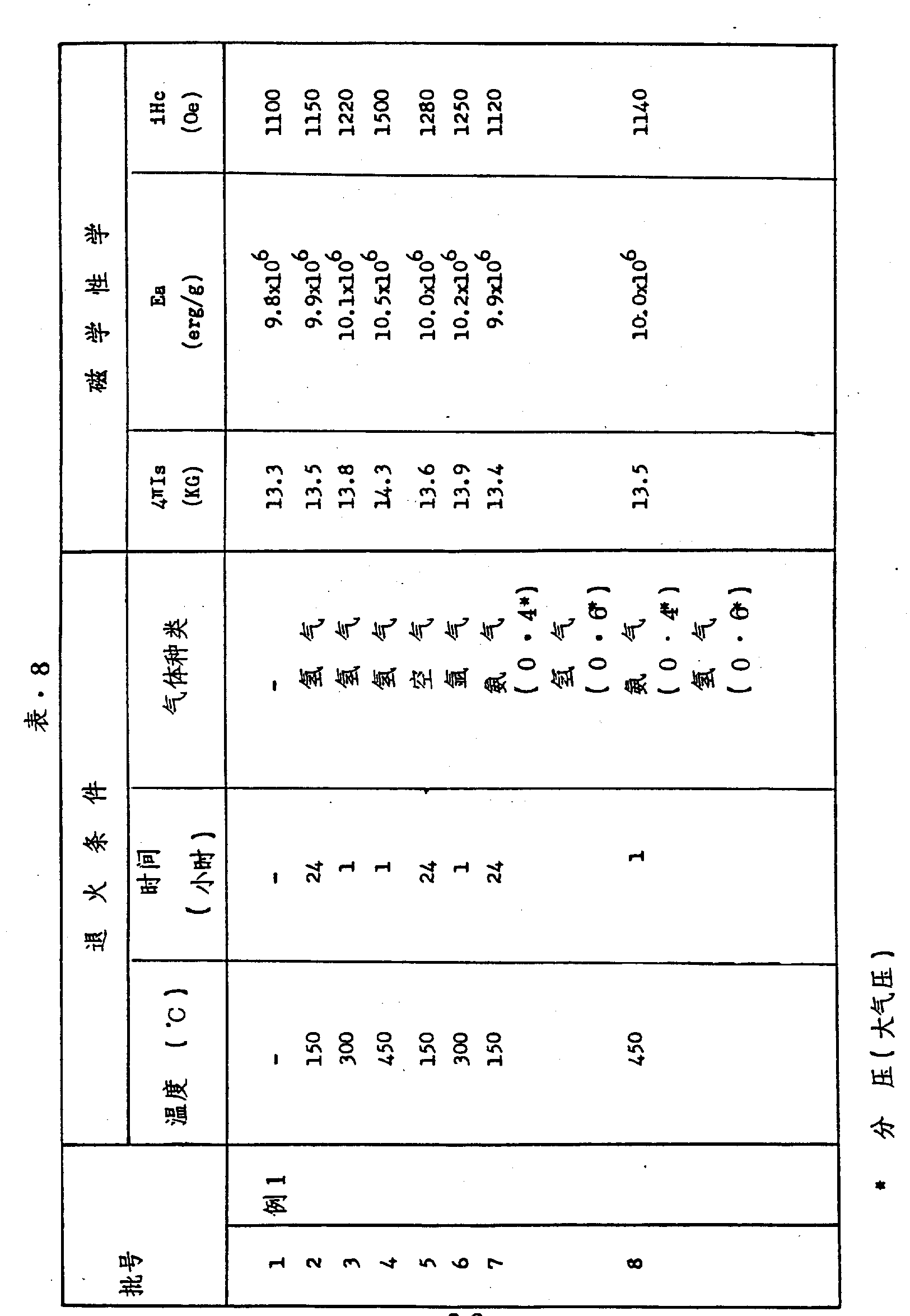
To behind absorbed nitrogen and hydrogen, anneal with the alloy powder (mean particle size is 100 microns) that example 1 obtains with quadrat method with condition shown in the table 8.The magnetic property of annealing back alloy powder is shown in table 8.As can be seen from Table 8, it is effective annealing to improving magnetic property under these conditions.Do not observe the change that annealing front and back alloy powder is formed.(table is seen the literary composition back)
Example 29
With Sm, Fe, Co electric arc melting and prepare the alloy with component in the table 9, Sm, Fe, the purity of Co is the 99.9%(percentage by weight in the argon atmospher in water-cooled vessel).Then alloy is placed in the plate crusher, carries out the coarse grain pulverizing in nitrogen atmosphere, meticulous efflorescence is 100 microns to mean particle size in the nitrogen atmosphere in coffee grinder again.
The alloy powder that obtains like this is placed in the tube furnace, introducing the ammonia dividing potential drop is that 0.67 atmospheric pressure and hydrogen dividing potential drop are 0.33 atmospheric mist, its total pressure is 1 atmospheric pressure, make tube furnace be warming up to 470 ℃ with 15 ℃/minute speed, when continuing to introduce mist, furnace temperature is remained on 470 ℃ and reach 60 minutes, so that alloy absorbed nitrogen and hydrogen, make alloy powder speed with 15 ℃/minute in same mist cool to 20 ℃, provide composition alloy powder as shown in table 9.
The magnetic property of alloy powder is shown in table 9.
Meticulous efflorescence is when mean particle size is 4.6 microns in oscillating mill, in the nitrogen atmosphere when the raw alloy of lot number 1, and the iHc that has absorbed the alloy powder of nitrogen and hydrogen is 5700Oe, and the Tc that has absorbed the alloy powder of nitrogen and helium is 590 ℃.The thermal demagnetization of this alloy powder is at 100 ℃, and 150 ℃, 99.2%, 98.1% and 98.6% when being 20 ℃ respectively in the time of 200 ℃.Therefore we can say, added the thermal property that cobalt has improved alloy of the present invention later on.(table is seen the literary composition back)
Example 30
The same alloy powder (its mean particle size is that 5 microns, iHc are 5100Oe) that obtains in about 1 gram and the example 1 is enclosed in water-cooled (WC) mould that-5 millimeters * 10 millimeters square holes are arranged carries out hot pressing, directed in the magnetic field of 15KOe, and to be subjected to pressure be 1 ton/centimetre
3Compression.Then mould is fixed in the hot-press arrangement, under condition shown in the table 10, does hot pressing, to realize the sintering of alloy powder.
The magnetic property of the sintered body that obtains like this is shown in table 10(table and sees the literary composition back)
Example 31
With, composition formula 23 that obtain with quadrat method with example is Sm
2Fe
17, mean particle size be 105 microns alloys in the mist of the ammonia of different dividing potential drops and hydrogen absorbed nitrogen and hydrogen, obtain alloy powder thus.To the alloy powder that obtains like this, at per unit structure cell Sm
2Fe
17N
xH
yIn add 2.2 Zn atoms, and with this mixture be placed in the vibrator, meticulous efflorescence 1 hour in nitrogen atmosphere, provide mean particle size and be 5 microns alloy powder, its composition formula is Sm
2Fe
17N
xH
yZn
2.2, as shown in figure 19.
Alloy powder is in 1 ton/centimetre then
2Pressure under, in 15KOe magnetic field, be moulded to 5 millimeters * 10 millimeters * 2 millimeters plate by unidirectional magnetic field compacting, this plate is being that 0.2 atmospheric ammonia and dividing potential drop are sintering 2 hours in the mist of 0.8 atmospheric hydrogen under 10 tons every square centimeter the pressure, in dividing potential drop, the mist total pressure is 1 atmospheric pressure, and temperature is 480 ℃.The sintered body that obtains is like this magnetized in the magnetic field of about 60KOe, provide sintered magnet.
The results are shown among Figure 19, it has clearly illustrated nitrogen, hydrogen uptake and magnetic property (BH)
MaxSubstantial connection.When x is about 4.0, y is about at 0.5 o'clock, (BH)
MaxThe highest, even x changes to 5.0 from 3.0, y changes to 1.0 from 0.1, (BH)
MaxAlso quite high.
Example 32
With, composition formula 23 that obtain with quadrat method with example is Sm
2Fe
17, mean particle size is 105 microns alloy, with mode absorbed nitrogen and the hydrogen same with example 23, obtaining having composition formula is Sm
2Fe
17N
4.0H
0.5Alloy powder.To the alloy powder that obtains like this, at per unit structure cell Sm
2Fe
17N
4.0H
0.5In add 2.2 Zn atoms, in vibrator, meticulous efflorescence is 1 hour in nitrogen atmosphere with this mixture, provides that to have mean particle size be that 5 microns, composition formula are Sm
2Fe
17N
4.0H
0.5Zn
2.2Alloy powder.
Make the alloy powder that obtains like this at 1 ton/centimetre
2Suppress the plate that is molded into 10 millimeters * 5 millimeters * 2 millimeters by the unidirectional magnetic field under the pressure, in 15KOe magnetic field, this plate is at 10 tons/centimetre
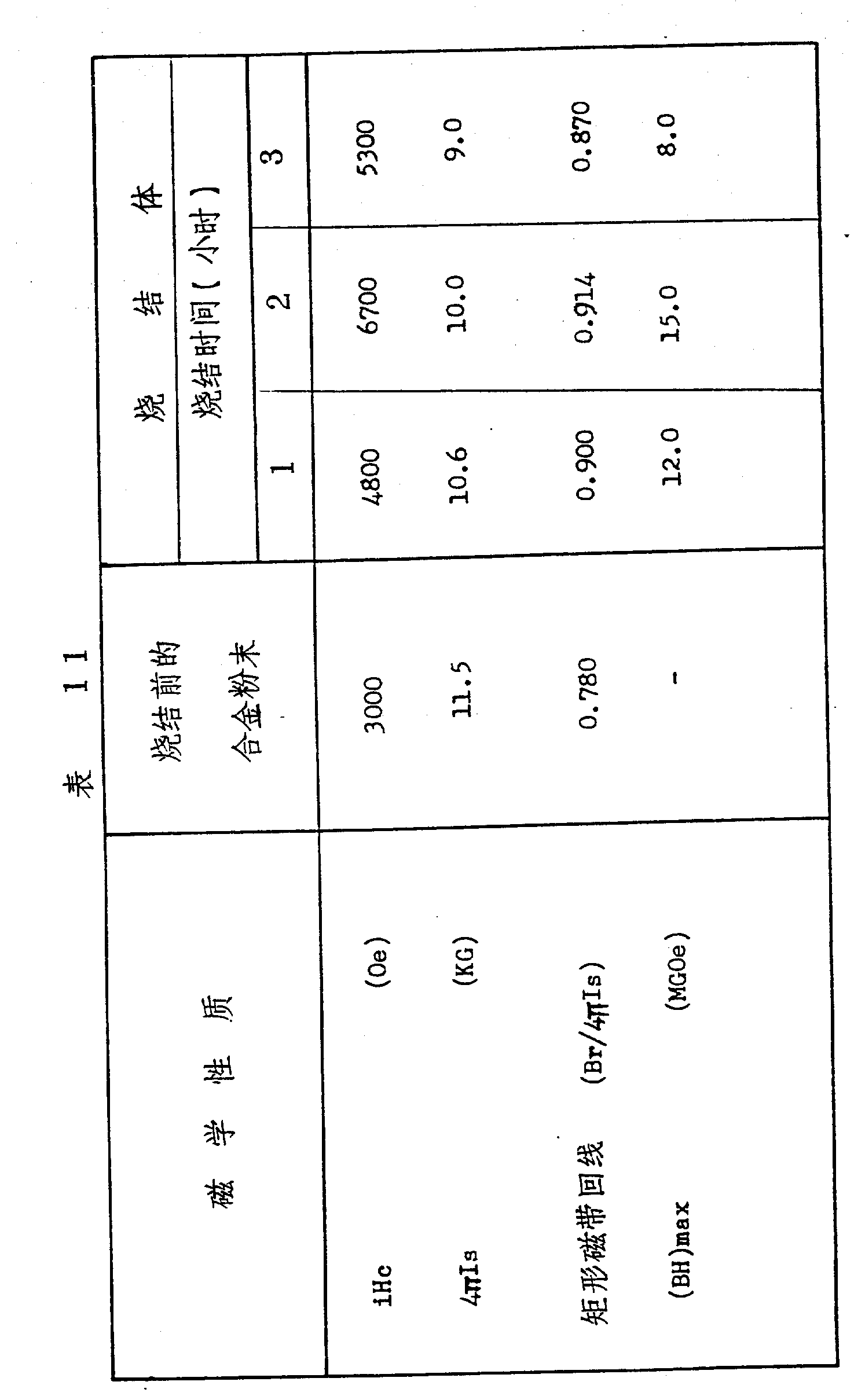
2Pressure under be that 0.2 atmospheric pressure and hydrogen dividing potential drop are sintering a period of time as shown in table 11 in 0.8 atmospheric mist in the ammonia dividing potential drop, the total pressure of mist is 1 atmospheric pressure, temperature is 470 ℃.
The magnetic property of the sintered body that obtains like this is shown in table 11.(table is seen the literary composition back)
Example 33
To the composition formula that obtains with quadrat method with example 32 usefulness is Sm
2Fe
17N
4.0H
0.5Alloy powder, respectively at per unit structure cell Sm
2Fe
17N
4.0H
0.5In add 2 and 7 Zn atoms, with the meticulous efflorescence 4 hours and 1 hour respectively in vibrator, in the nitrogen atmosphere of this mixture, alloy powder is molded into plate with the mode as example 32, provide sintered body.
The magnetic property of the sintered body that obtains like this is shown in table 12.(table is seen the literary composition back)
Example 34
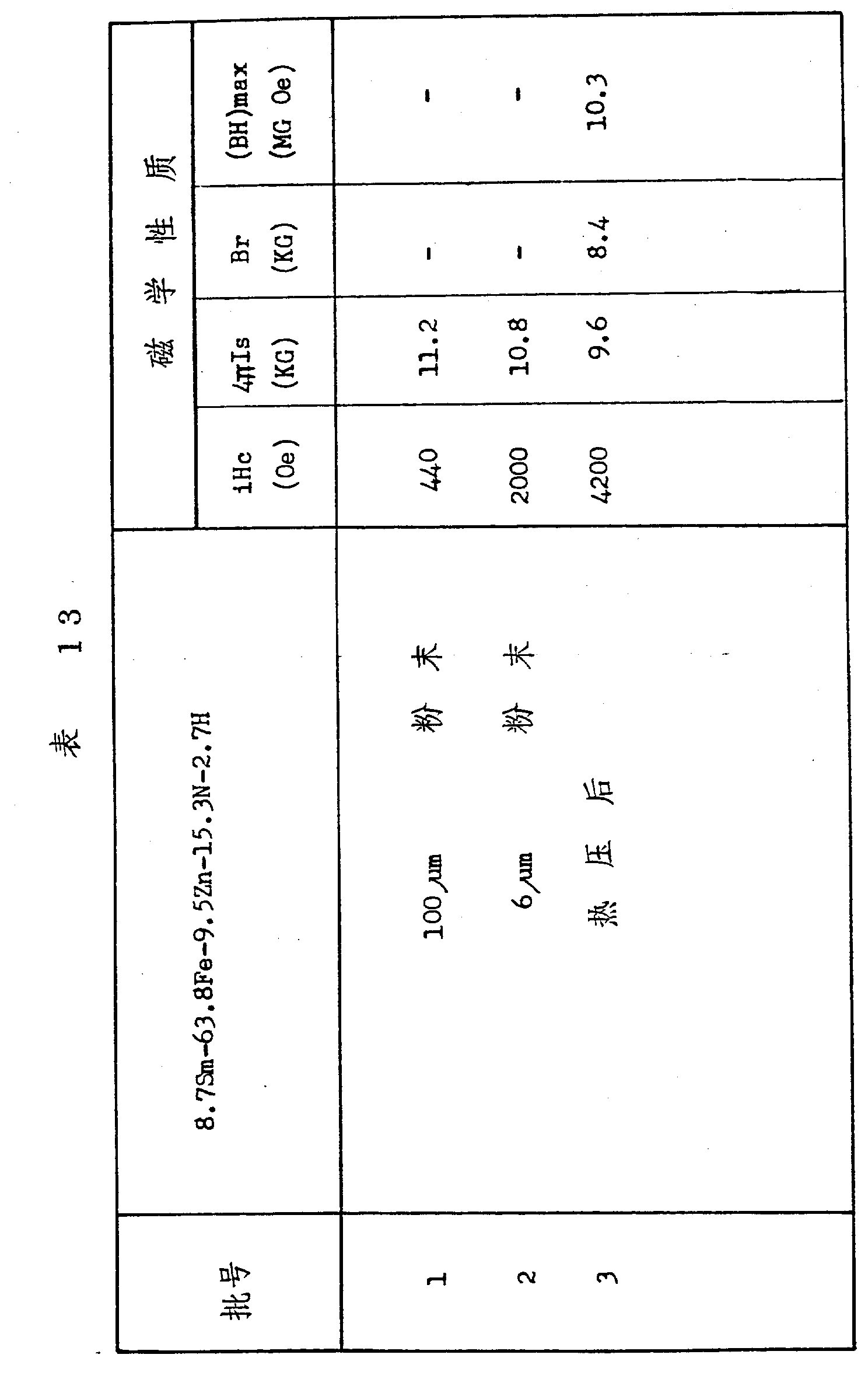
Be the 99.9%(percentage by weight with high frequency fusing purity) Sm, Fe, Zn, preparation constituent atoms percentage is the alloy of 10.6Sm-77.8Fe-11.6Zn.Make the alloy that obtains like this 900 ℃ of annealing 24 hours down, the alloy grating after will anneal subsequently also meticulous efflorescence is 100 microns to mean particle size, makes its absorbed nitrogen and hydrogen then, and these all use the mode identical with example 1 to carry out.Table 13 has been listed the magnetic property of the alloy powder of meticulous efflorescence.
Then alloy powder is placed on that further meticulous efflorescence is about 6 microns to mean particle size in the nitrogen atmosphere in the vibrator.Table 13 has been listed the magnetic property of the alloy powder that obtains like this.
Then mean particle size is about 6 microns powder and is placed on 10 tons/centimetre
2Pressure under, in the magnetic field of 15KOe, carry out mold pressing with unidirectional magnetic field compacting, form 10 millimeters * 5 millimeters * 2 millimeters plate.Make plate water-cooled mould for hot pressed sintering (temperature is 470 ℃, and pressure is 12 tons/square centimeter) 90 minutes then, gas is that the ammonia dividing potential drop is that 0.2 atmospheric pressure and hydrogen dividing potential drop are 0.8 atmospheric mist, and total pressure is 1 atmospheric pressure.The magnetic property of the sintered body that obtains like this is listed in table 13.
Be appreciated that it is effective adding Zn in magnet preparation of the present invention.(table is seen the literary composition back)
Example 35
With example 29 in use obtain with quadrat method, constituent atoms percentage is the alloy powder of 4.6 microns of 8.3Sm-63.3Fe-7.1Co-17.9N-3.4H, mean particle size, add that mean particle size is the Zn of 10 atomic percentages of 8 microns, in alumina (alumina) alms bowl of nitrogen atmosphere, mixed 20 minutes.
The alloy powder that obtains like this provides a sintered body with the hot-forming and sintering of mode same with example 34.
The magnetic property of sintered body is as follows:
Br????8.8KG
iHc????6.9KOe
(BH)
max10.3MGOe
Example 36
To the mean particle size that obtains with example 32 same procedure is that 8 microns, composition formula are Sm
2Fe
17N
4.0H
0.5Alloy powder, respectively to per unit structure cell Sm
2Fe
17N
4.0H
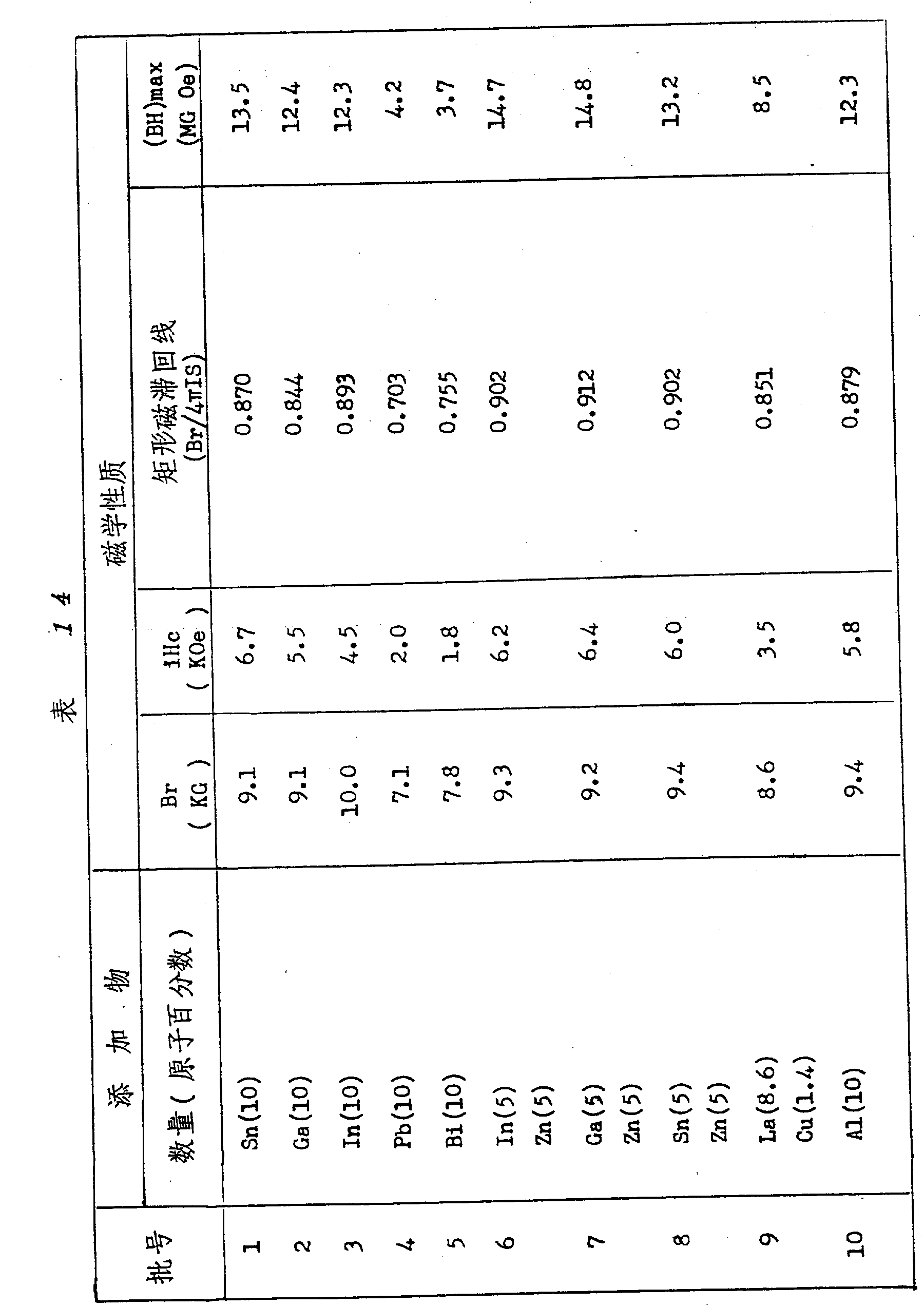
0.5Add 7.0 and 11.5 Zn atoms, in nitrogen, mixed 30 minutes, to be molded into plate with the same mode of example 32, then dividing potential drop be 0.35 atmospheric ammonia and dividing potential drop be in the mist of 0.65 atmospheric hydrogen hot pressing (the mist total pressure was 1 atmospheric pressure in 1 hour, temperature is 465 ℃), provide sintered magnet.
The magnetic property of the sintered magnet that obtains like this is shown in table 15.(table is seen the literary composition back)
These results show that the existence at a large amount of non-magnetic phase Zn of structure cell boundary has increased iHc significantly, organize the volume ratio that the minimizing of 4 π Is on the other hand is proportional to non-magnetic phase Zn and alloy powder.
Example 37
(composition formula is Sm using the alloy powder that obtains with example 32 same procedure
2Fe
17N
4.0H
0.5Mean particle size is 105 microns) place vibrator, meticulous efflorescence is to about 0.2 micron of mean particle size in nitrogen, the 2 gram alloy powders that obtain are like this mixed in a mortar with 0.4 gram epoxy adhesive (Konishi company product " Bondquick 5 "), form the thickness powder.Then the thickness powder is placed in one 10 millimeters * 5 millimeters * 5 millimeters the ceramic vessel, sclerosis is about 1 hour in the magnetic field of 15KOe, under 20 ℃ of temperature, provides a bonded permanent magnet (a).
With above-described same alloy powder in 15KOe magnetic field, 10 tons/centimetre
2Carry out mold pressing under the pressure in addition, provide the one-tenth mechanograph of 0.5 grammes per square metre.Become mechanograph to be immersed in and be dissolved in the polyisoprene solution of toluene, provide a bonded permanent magnet (b) after the intensive drying with 5% weight ratio.
The magnetic property of these bonded permanent magnet (a) and (b) is shown in table 16.(table is seen the literary composition back)
Penetrate.Observe Sm
2O
3Identifiable peak value is in 2 θ are 25 to 35 ° zone, to Sm
2Fe
17Identifiable peak value is in 2 θ are 40 to 43 ° zone, and the peak value of expression α-Fe phase is 45 ° about 2 θ greatly and locates.
Film is enclosed in the quartz ampoule, in argon gas atmosphere, is heated to 800 ℃ and kept 1 hour, enclose tube furnace then.Then be that 0.35 atmospheric ammonia and dividing potential drop are that 0.65 atmospheric hydrogen (total pressure is 1 atmospheric pressure) is introduced tube furnace with dividing potential drop, the temperature of tube furnace rises to 450 ℃ with 15 ℃/minute speed, when continuing to introduce mist, keep 450 ℃ and reach 15 minutes, in film, to carry out the absorption of nitrogen and hydrogen, with 15 ℃/minute speed the temperature of tube furnace is cooled to 20 ℃ in same mixed-gas atmosphere then, providing the component formula is Sm
2Fe
11N
1H
0.1Magnetic thin film.
When measuring with the K α radiation of the copper of nickel filtering, has only Sm to the X-ray diffraction of this magnetic film
2Fe
17The peak move on to lower angle, but the absorption of the mobile width at angle and example 1 alloy powder of nitrogen and hydrogen the same, direction of easy axis is parallel to substrate, hard direction is then perpendicular to substrate.Film Sm-Fe and Sm
2Fe
11N
1H
0.1Magnetic property be shown in table 6.
Table 6
The alloy film magnetic property
(BH)max????iHc????Br
(MGOe)????(KOe)????(KG)
Sm-Fe sputtered film 0.1 150 6.5
Sm
2Fe
11N
1H
0.1Magnetic film 0.2 300 5.0
Example 23
Be 99.9%(weight with electric arc melted pure degree in the argon gas in a water-cooled copper boat
Example 27
Use a device that molten alloy is quenched, preparation constituent atoms percentage is the raw alloy of 10.5Sm-89.5Fe.Quenching is by the copper roller of 25 centimetres of wide rotations of 2 centimetres of a diameter of molten alloy directive is carried out.Purity before quenching is the 99.9%(percentage by weight) Sm and Fe be placed in the quartzy nozzle, and with the high frequency fusing, penetrating pressure is 1 kg/cm in argon gas atmosphere
2, the distance of nozzle and roller is 1 millimeter.As shown in table 7, the rotating speed of roller is variable, is 30 microns with efflorescence in the nitrogen atmosphere of thin sample in coffee grinder that obtains like this to mean particle size, uses then with the same way of example 1 and makes alloy powder absorbed nitrogen and hydrogen.
The composition and the magnetic property thereof of the alloy powder that obtains like this are shown in table 7.
Table 7
The rotating speed magnetic property of lot number alloy powder component roller
(atomic percentage) rev/min 4 π Is iHc
(KG) (O
θ)
1????8.3Sm-70.9Fe-17.6N-3.2H????500????11.8????2080
2????8.3Sm-70.6Fe-17.8N-3.3H????1500????10.6????2650
3????8.3Sm-70.7Fe-17.5N-3.5H????3000????10.1????3530
4????8.4Sm-71.9Fe-16.8N-2.9H????6000????10.3????350
Can see that when raw alloy was equipped with the melt spinning method legal system, the present invention can obtain the very high magnetic material material of iHc (be except rotating speed 6000 rev/mins situation).Analyze with the X-ray powder diffraction, when being equipped with raw alloy with the melt spinning method legal system, at 500 to 3000 rev/mins, the raw alloy that obtains is crystalline as if the rotating speed of roller.On the other hand, when being equipped with raw alloy with the melt spinning method legal system, when the rotating speed of roller was 6000 rev/mins, the raw alloy that obtains was an amorphous state, and perhaps this is the reason that makes iHc not high.
Example 36
To the mean particle size that obtains with example 32 same procedure is that 8 microns, composition formula are Sm
2Fe
17N
4.0H
0.5Alloy powder, respectively to per unit structure cell Sm
2Fe
17N
4.0H
0.5Add 7.0 and 11.5 Zn atoms, in nitrogen, mixed 30 minutes, to be molded into plate with the same mode of example 32, then dividing potential drop be 0.35 atmospheric ammonia and dividing potential drop be in the mist of 0.65 atmospheric hydrogen hot pressing (the mist total pressure was 1 atmospheric pressure in 1 hour, temperature is 465 ℃), provide sintered magnet.
The magnetic property of the sintered magnet that obtains like this is shown in table 15.
Table 15
The magnetic property sintered magnet
Sm
2Fe
17N
4.0H
0.5Zn
7.0Sm
2Fe
17N
4.0H
0.5Zn
11.5
iHc(Oe)????5????10
4πIs(KG)????4.3????3.6
These results show that the existence at a large amount of non-magnetic phase Zn of structure cell boundary has increased iHc significantly, organize the volume ratio that the minimizing of 4 π Is on the other hand is proportional to non-magnetic phase Zn and alloy powder.
Example 37
(composition formula is Sm using the alloy powder that obtains with example 32 same procedure
2Fe
17N
4.0H
0.5Mean particle size is 105 microns) place vibrator, meticulous efflorescence is to about 0.2 micron of mean particle size in nitrogen, the 2 gram alloy powders that obtain are like this mixed in a mortar with 0.4 gram epoxy adhesive (Konishi company product " Bondquick 5 "), form the thickness powder.Then the thickness powder is placed in one 10 millimeters * 5 millimeters * 5 millimeters the ceramic vessel, sclerosis is about 1 hour in the magnetic field of 15KOe, under 20 ℃ of temperature, provides a bonded permanent magnet (a).
With above-described same alloy powder in 15KOe magnetic field, 10 tons/centimetre
2Carry out mold pressing under the pressure in addition, provide the one-tenth mechanograph of 0.5 grammes per square metre.Become mechanograph to be immersed in and be dissolved in the polyisoprene solution of toluene, provide a bonded permanent magnet (b) after the intensive drying with 5% weight ratio.
The magnetic property of these bonded permanent magnet (a) and (b) is shown in table 16.
Table 16
The sample magnetic property
Br????iHc????(BH)max
(KG)????(Oe)????(MG????Oe)
Raw material alloy powder-7000-
Bonded permanent magnet (a) 3.5 8,400 2.5
Bonded permanent magnet (b) 8.1 4,500 10.0