CN102770710A - Sorbent containing engineered fuel feed stocks - Google Patents
Sorbent containing engineered fuel feed stocks Download PDFInfo
- Publication number
- CN102770710A CN102770710A CN2010800645800A CN201080064580A CN102770710A CN 102770710 A CN102770710 A CN 102770710A CN 2010800645800 A CN2010800645800 A CN 2010800645800A CN 201080064580 A CN201080064580 A CN 201080064580A CN 102770710 A CN102770710 A CN 102770710A
- Authority
- CN
- China
- Prior art keywords
- feedstock
- fuel
- copper
- engineered fuel
- emissions
- Prior art date
- Legal status (The legal status is an assumption and is not a legal conclusion. Google has not performed a legal analysis and makes no representation as to the accuracy of the status listed.)
- Pending
Links
Images


Classifications
-
- C—CHEMISTRY; METALLURGY
- C10—PETROLEUM, GAS OR COKE INDUSTRIES; TECHNICAL GASES CONTAINING CARBON MONOXIDE; FUELS; LUBRICANTS; PEAT
- C10J—PRODUCTION OF PRODUCER GAS, WATER-GAS, SYNTHESIS GAS FROM SOLID CARBONACEOUS MATERIAL, OR MIXTURES CONTAINING THESE GASES; CARBURETTING AIR OR OTHER GASES
- C10J3/00—Production of combustible gases containing carbon monoxide from solid carbonaceous fuels
- C10J3/72—Other features
-
- A—HUMAN NECESSITIES
- A61—MEDICAL OR VETERINARY SCIENCE; HYGIENE
- A61P—SPECIFIC THERAPEUTIC ACTIVITY OF CHEMICAL COMPOUNDS OR MEDICINAL PREPARATIONS
- A61P37/00—Drugs for immunological or allergic disorders
-
- C—CHEMISTRY; METALLURGY
- C10—PETROLEUM, GAS OR COKE INDUSTRIES; TECHNICAL GASES CONTAINING CARBON MONOXIDE; FUELS; LUBRICANTS; PEAT
- C10L—FUELS NOT OTHERWISE PROVIDED FOR; NATURAL GAS; SYNTHETIC NATURAL GAS OBTAINED BY PROCESSES NOT COVERED BY SUBCLASSES C10G OR C10K; LIQUIFIED PETROLEUM GAS; USE OF ADDITIVES TO FUELS OR FIRES; FIRE-LIGHTERS
- C10L5/00—Solid fuels
- C10L5/40—Solid fuels essentially based on materials of non-mineral origin
- C10L5/44—Solid fuels essentially based on materials of non-mineral origin on vegetable substances
-
- C—CHEMISTRY; METALLURGY
- C10—PETROLEUM, GAS OR COKE INDUSTRIES; TECHNICAL GASES CONTAINING CARBON MONOXIDE; FUELS; LUBRICANTS; PEAT
- C10L—FUELS NOT OTHERWISE PROVIDED FOR; NATURAL GAS; SYNTHETIC NATURAL GAS OBTAINED BY PROCESSES NOT COVERED BY SUBCLASSES C10G OR C10K; LIQUIFIED PETROLEUM GAS; USE OF ADDITIVES TO FUELS OR FIRES; FIRE-LIGHTERS
- C10L5/00—Solid fuels
- C10L5/40—Solid fuels essentially based on materials of non-mineral origin
- C10L5/46—Solid fuels essentially based on materials of non-mineral origin on sewage, house, or town refuse
-
- F—MECHANICAL ENGINEERING; LIGHTING; HEATING; WEAPONS; BLASTING
- F23—COMBUSTION APPARATUS; COMBUSTION PROCESSES
- F23G—CREMATION FURNACES; CONSUMING WASTE PRODUCTS BY COMBUSTION
- F23G5/00—Incineration of waste; Incinerator constructions; Details, accessories or control therefor
- F23G5/02—Incineration of waste; Incinerator constructions; Details, accessories or control therefor with pretreatment
- F23G5/027—Incineration of waste; Incinerator constructions; Details, accessories or control therefor with pretreatment pyrolising or gasifying stage
- F23G5/0273—Incineration of waste; Incinerator constructions; Details, accessories or control therefor with pretreatment pyrolising or gasifying stage using indirect heating
-
- F—MECHANICAL ENGINEERING; LIGHTING; HEATING; WEAPONS; BLASTING
- F23—COMBUSTION APPARATUS; COMBUSTION PROCESSES
- F23K—FEEDING FUEL TO COMBUSTION APPARATUS
- F23K1/00—Preparation of lump or pulverulent fuel in readiness for delivery to combustion apparatus
-
- C—CHEMISTRY; METALLURGY
- C10—PETROLEUM, GAS OR COKE INDUSTRIES; TECHNICAL GASES CONTAINING CARBON MONOXIDE; FUELS; LUBRICANTS; PEAT
- C10J—PRODUCTION OF PRODUCER GAS, WATER-GAS, SYNTHESIS GAS FROM SOLID CARBONACEOUS MATERIAL, OR MIXTURES CONTAINING THESE GASES; CARBURETTING AIR OR OTHER GASES
- C10J2300/00—Details of gasification processes
- C10J2300/09—Details of the feed, e.g. feeding of spent catalyst, inert gas or halogens
- C10J2300/0913—Carbonaceous raw material
- C10J2300/0946—Waste, e.g. MSW, tires, glass, tar sand, peat, paper, lignite, oil shale
-
- C—CHEMISTRY; METALLURGY
- C10—PETROLEUM, GAS OR COKE INDUSTRIES; TECHNICAL GASES CONTAINING CARBON MONOXIDE; FUELS; LUBRICANTS; PEAT
- C10J—PRODUCTION OF PRODUCER GAS, WATER-GAS, SYNTHESIS GAS FROM SOLID CARBONACEOUS MATERIAL, OR MIXTURES CONTAINING THESE GASES; CARBURETTING AIR OR OTHER GASES
- C10J2300/00—Details of gasification processes
- C10J2300/09—Details of the feed, e.g. feeding of spent catalyst, inert gas or halogens
- C10J2300/0983—Additives
-
- C—CHEMISTRY; METALLURGY
- C10—PETROLEUM, GAS OR COKE INDUSTRIES; TECHNICAL GASES CONTAINING CARBON MONOXIDE; FUELS; LUBRICANTS; PEAT
- C10J—PRODUCTION OF PRODUCER GAS, WATER-GAS, SYNTHESIS GAS FROM SOLID CARBONACEOUS MATERIAL, OR MIXTURES CONTAINING THESE GASES; CARBURETTING AIR OR OTHER GASES
- C10J2300/00—Details of gasification processes
- C10J2300/09—Details of the feed, e.g. feeding of spent catalyst, inert gas or halogens
- C10J2300/0983—Additives
- C10J2300/0996—Calcium-containing inorganic materials, e.g. lime
-
- C—CHEMISTRY; METALLURGY
- C10—PETROLEUM, GAS OR COKE INDUSTRIES; TECHNICAL GASES CONTAINING CARBON MONOXIDE; FUELS; LUBRICANTS; PEAT
- C10L—FUELS NOT OTHERWISE PROVIDED FOR; NATURAL GAS; SYNTHETIC NATURAL GAS OBTAINED BY PROCESSES NOT COVERED BY SUBCLASSES C10G OR C10K; LIQUIFIED PETROLEUM GAS; USE OF ADDITIVES TO FUELS OR FIRES; FIRE-LIGHTERS
- C10L2200/00—Components of fuel compositions
- C10L2200/02—Inorganic or organic compounds containing atoms other than C, H or O, e.g. organic compounds containing heteroatoms or metal organic complexes
- C10L2200/029—Salts, such as carbonates, oxides, hydroxides, percompounds, e.g. peroxides, perborates, nitrates, nitrites, sulfates, and silicates
-
- F—MECHANICAL ENGINEERING; LIGHTING; HEATING; WEAPONS; BLASTING
- F23—COMBUSTION APPARATUS; COMBUSTION PROCESSES
- F23G—CREMATION FURNACES; CONSUMING WASTE PRODUCTS BY COMBUSTION
- F23G2201/00—Pretreatment
- F23G2201/40—Gasification
-
- F—MECHANICAL ENGINEERING; LIGHTING; HEATING; WEAPONS; BLASTING
- F23—COMBUSTION APPARATUS; COMBUSTION PROCESSES
- F23G—CREMATION FURNACES; CONSUMING WASTE PRODUCTS BY COMBUSTION
- F23G2201/00—Pretreatment
- F23G2201/70—Blending
- F23G2201/701—Blending with additives
-
- F—MECHANICAL ENGINEERING; LIGHTING; HEATING; WEAPONS; BLASTING
- F23—COMBUSTION APPARATUS; COMBUSTION PROCESSES
- F23G—CREMATION FURNACES; CONSUMING WASTE PRODUCTS BY COMBUSTION
- F23G2207/00—Control
- F23G2207/60—Additives supply
-
- F—MECHANICAL ENGINEERING; LIGHTING; HEATING; WEAPONS; BLASTING
- F23—COMBUSTION APPARATUS; COMBUSTION PROCESSES
- F23K—FEEDING FUEL TO COMBUSTION APPARATUS
- F23K2201/00—Pretreatment of solid fuel
- F23K2201/50—Blending
- F23K2201/505—Blending with additives
-
- Y—GENERAL TAGGING OF NEW TECHNOLOGICAL DEVELOPMENTS; GENERAL TAGGING OF CROSS-SECTIONAL TECHNOLOGIES SPANNING OVER SEVERAL SECTIONS OF THE IPC; TECHNICAL SUBJECTS COVERED BY FORMER USPC CROSS-REFERENCE ART COLLECTIONS [XRACs] AND DIGESTS
- Y02—TECHNOLOGIES OR APPLICATIONS FOR MITIGATION OR ADAPTATION AGAINST CLIMATE CHANGE
- Y02E—REDUCTION OF GREENHOUSE GAS [GHG] EMISSIONS, RELATED TO ENERGY GENERATION, TRANSMISSION OR DISTRIBUTION
- Y02E20/00—Combustion technologies with mitigation potential
- Y02E20/12—Heat utilisation in combustion or incineration of waste
-
- Y—GENERAL TAGGING OF NEW TECHNOLOGICAL DEVELOPMENTS; GENERAL TAGGING OF CROSS-SECTIONAL TECHNOLOGIES SPANNING OVER SEVERAL SECTIONS OF THE IPC; TECHNICAL SUBJECTS COVERED BY FORMER USPC CROSS-REFERENCE ART COLLECTIONS [XRACs] AND DIGESTS
- Y02—TECHNOLOGIES OR APPLICATIONS FOR MITIGATION OR ADAPTATION AGAINST CLIMATE CHANGE
- Y02E—REDUCTION OF GREENHOUSE GAS [GHG] EMISSIONS, RELATED TO ENERGY GENERATION, TRANSMISSION OR DISTRIBUTION
- Y02E20/00—Combustion technologies with mitigation potential
- Y02E20/16—Combined cycle power plant [CCPP], or combined cycle gas turbine [CCGT]
- Y02E20/18—Integrated gasification combined cycle [IGCC], e.g. combined with carbon capture and storage [CCS]
-
- Y—GENERAL TAGGING OF NEW TECHNOLOGICAL DEVELOPMENTS; GENERAL TAGGING OF CROSS-SECTIONAL TECHNOLOGIES SPANNING OVER SEVERAL SECTIONS OF THE IPC; TECHNICAL SUBJECTS COVERED BY FORMER USPC CROSS-REFERENCE ART COLLECTIONS [XRACs] AND DIGESTS
- Y02—TECHNOLOGIES OR APPLICATIONS FOR MITIGATION OR ADAPTATION AGAINST CLIMATE CHANGE
- Y02E—REDUCTION OF GREENHOUSE GAS [GHG] EMISSIONS, RELATED TO ENERGY GENERATION, TRANSMISSION OR DISTRIBUTION
- Y02E50/00—Technologies for the production of fuel of non-fossil origin
- Y02E50/10—Biofuels, e.g. bio-diesel
-
- Y—GENERAL TAGGING OF NEW TECHNOLOGICAL DEVELOPMENTS; GENERAL TAGGING OF CROSS-SECTIONAL TECHNOLOGIES SPANNING OVER SEVERAL SECTIONS OF THE IPC; TECHNICAL SUBJECTS COVERED BY FORMER USPC CROSS-REFERENCE ART COLLECTIONS [XRACs] AND DIGESTS
- Y02—TECHNOLOGIES OR APPLICATIONS FOR MITIGATION OR ADAPTATION AGAINST CLIMATE CHANGE
- Y02E—REDUCTION OF GREENHOUSE GAS [GHG] EMISSIONS, RELATED TO ENERGY GENERATION, TRANSMISSION OR DISTRIBUTION
- Y02E50/00—Technologies for the production of fuel of non-fossil origin
- Y02E50/30—Fuel from waste, e.g. synthetic alcohol or diesel
Landscapes
- Chemical & Material Sciences (AREA)
- Engineering & Computer Science (AREA)
- Organic Chemistry (AREA)
- Oil, Petroleum & Natural Gas (AREA)
- Mechanical Engineering (AREA)
- General Engineering & Computer Science (AREA)
- Combustion & Propulsion (AREA)
- Health & Medical Sciences (AREA)
- Chemical Kinetics & Catalysis (AREA)
- Life Sciences & Earth Sciences (AREA)
- Bioinformatics & Cheminformatics (AREA)
- General Chemical & Material Sciences (AREA)
- Medicinal Chemistry (AREA)
- Nuclear Medicine, Radiotherapy & Molecular Imaging (AREA)
- Pharmacology & Pharmacy (AREA)
- Immunology (AREA)
- Animal Behavior & Ethology (AREA)
- General Health & Medical Sciences (AREA)
- Public Health (AREA)
- Veterinary Medicine (AREA)
- Processing Of Solid Wastes (AREA)
- Solid Fuels And Fuel-Associated Substances (AREA)
Abstract
Description
技术领域 technical field
依据35 USC§119本申请要求于2009年12月22日提交的美国临时申请No.61/289,217的优先权,引入该申请的全部内容作为参考。This application claims priority under 35 USC § 119 to US Provisional Application No. 61/289,217, filed December 22, 2009, which application is incorporated by reference in its entirety.
本发明涉及替代燃料。具体而言,本发明涉及设计燃料原料,以在燃烧和气化应用过程中控制排放分布(emission profile)、防止腐蚀以及改善工作性能。本申请所述原料包含:经处理的市政固体废物的至少一种组分、吸附剂和任选的其他组分。This invention relates to alternative fuels. In particular, the invention relates to designing fuel feed stocks to control emission profiles, prevent corrosion, and improve performance during combustion and gasification applications. The feedstock described herein comprises at least one component of treated municipal solid waste, a sorbent, and optionally other components.
背景技术 Background technique
可用于供热、运输和制造化学品及石油化工产品的化石燃料源正变得日益紧缺和昂贵。诸如能源和石油化工产品制造等产业正在积极寻求成本有效的经设计的燃料原料替代物用于生产能源和石油化工产品以及多种其他产品。此外,由于化石燃料的成本日益增加,用于制造能源和石油化工产品的经设计的燃料原料的运输成本正快速上升。Fossil fuel sources for heating, transporting and manufacturing chemicals and petrochemicals are becoming increasingly scarce and expensive. Industries such as energy and petrochemical manufacturing are actively seeking cost-effective, engineered alternatives to fuel feedstocks for the production of energy and petrochemicals, among a variety of other products. Furthermore, due to the increasing cost of fossil fuels, the cost of transporting engineered fuel feedstocks used to manufacture energy and petrochemicals is rising rapidly.
这些能源和石油化工产品制造业及其他产业依赖化石燃料如煤、石油和天然气用于燃烧和气化过程,来制造能源、供热供电和生成用于下游化学品和液态燃料制造的合成气以及用于涡轮的能源。These energy and petrochemical manufacturing industries, among others, rely on fossil fuels such as coal, oil, and natural gas for combustion and gasification processes to produce energy, heat, power, and syngas for downstream chemicals and liquid fuel manufacturing, as well as energy from the turbine.
燃烧和气化是热化学过程,用于释放储存在燃料源中的能量。燃烧在存在过量空气或过量氧气的条件下于反应器中进行。燃烧通常用于生成蒸汽,蒸汽用于驱动涡轮来发电。然而,燃料燃烧的强力性导致在所产生的气体之中生成大量污染物。例如,化石燃料如煤、石油和天然气在氧化气氛下燃烧释放出基态臭氧(ground level ozone)的前体——氮氧化物,基态臭氧会刺激哮喘发作。燃烧还是二氧化硫的最大来源,二氧化硫随后生成极微细的硫酸盐粒子。来自美国发电厂的微细粒子污染每年使超过30,000人的寿命缩短。几十万美国人患有哮喘、心脏病和上呼吸道及下呼吸道疾病,这些疾病与来自发电厂的微细粒子有关。Combustion and gasification are thermochemical processes used to release energy stored in a fuel source. Combustion takes place in the reactor in the presence of excess air or excess oxygen. Combustion is typically used to generate steam, which is used to drive turbines to generate electricity. However, the aggressive nature of fuel combustion results in the generation of large amounts of pollutants in the gases produced. For example, burning fossil fuels such as coal, oil and natural gas in an oxidizing atmosphere releases nitrogen oxides, precursors to ground level ozone, which can stimulate asthma attacks. Combustion is also the largest source of sulfur dioxide, which in turn produces very fine sulfate particles. Fine particle pollution from U.S. power plants shortens the lives of more than 30,000 people each year. Hundreds of thousands of Americans suffer from asthma, heart disease and upper and lower respiratory illnesses linked to fine particles from power plants.
气化也在反应器中进行,但在没有空气的条件下或存在低于化学计量的氧气的条件下进行。在没有氧气的条件下或在低于化学计量的氧气下发生的热化学反应不会引发氮氧化物或硫氧化物的形成。因而,气化可消除大量在燃料燃烧过程中形成的污染物。Gasification is also performed in a reactor, but in the absence of air or in the presence of substoichiometric oxygen. Thermochemical reactions that take place in the absence of oxygen or with substoichiometric oxygen do not initiate the formation of nitrogen oxides or sulfur oxides. Thus, gasification removes a large number of pollutants formed during fuel combustion.
气化生成称为合成气(syngas)的气态富燃料产物。在气化过程中有两个过程发生,将燃料源转化为可使用的燃料气。第一阶段,在低于600°C(1112°F)的温度下热解释放出燃料的挥发性组分,即消除挥发物的过程。热解还产生焦化物,该焦化物主要由炭或焦炭和灰分组成。第二气化阶段,使热解之后残留的碳与蒸汽、氢或纯氧反应。由于没有空气中氮气的稀释,与纯氧或蒸汽一同进行的气化产生一氧化碳和氢气的高品质混合物。Gasification produces a gaseous fuel-rich product called syngas. During gasification two processes take place to convert the fuel source into usable fuel gas. In the first stage, pyrolysis at temperatures below 600°C (1112°F) releases the volatile components of the fuel, the process of eliminating volatiles. Pyrolysis also produces char, which consists mainly of charcoal or coke and ash. In the second gasification stage, the carbon remaining after pyrolysis is reacted with steam, hydrogen or pure oxygen. Gasification with pure oxygen or steam produces a high-quality mixture of carbon monoxide and hydrogen due to the absence of dilution with nitrogen in the air.
废物是大量气化原料的一种潜在来源。废物例如市政固体废物(MSW)通常被丢弃,或者用于燃烧过程来产生热量和/或蒸汽直接用于供热或冷却或用于涡轮机中以发电。由废物流得到的燃料通常称为废物衍生燃料(refuse-derived fuel)或RDF。以上描述了伴随燃烧带来的缺点,包括产生污染物,例如氮氧化物、硫氧化物、粒子和破坏环境的氯产物。Waste is a potential source of bulk gasification feedstock. Waste such as municipal solid waste (MSW) is typically discarded or used in a combustion process to generate heat and/or steam for direct heating or cooling or in turbines to generate electricity. Fuels derived from waste streams are often referred to as refuse-derived fuels or RDFs. Disadvantages associated with combustion have been described above, including the generation of pollutants such as nitrogen oxides, sulfur oxides, particulates, and environmentally damaging chlorine products.
目前公用和工业燃煤炉以及城市废物、医疗废物和有毒废物焚化炉大量排放氯化氢(HCl)(与其他酸性气体污染物)。煤仅包含痕量的氯,但公用电炉会燃烧大量的煤。对于废物焚化炉,在一些塑料废物例如聚氯乙烯(PVC)(C2H3Cl)和聚偏二氯乙烯(PVDC)(C2H2Cl2)中以及一些食品和院落废物中包含大量的氯。在PVC和PVDC热解过程,在低于350°C的燃烧初始阶段氯大部分变为HCl。(Panagiotou,T.,Levendis,Y.A.,1996.Combust.Sci.Technol.112,117,1996)。捕集HCl具有重要意义,因为HCl具有危害性、腐蚀性,是酸雨的促成因素,且HCl排放目前受到控制(Fellows,K.T.,Pilat,M.J.,J.Air Waste Manag.Assoc.40,887,1990)。另外,HCl可直接或间接通过生成氯气(通过迪肯反应生成Cl2)促使随后在加热炉废流之中形成未燃的氯化烃、多氯二苯并二氧芑(polychlorinated dibenzodioxin)、多氯二苯并呋喃(Addink,R.,Bakker,W.C.M.,Olie,K.,Environ.Sci.Technol.2055,1995)。因而,捕集HCl是必要的。为避免产生随废流冷却而形成的高毒性二氧芑和呋喃,氯化物的捕集必须在高温,优选高于500°C的温度下进行。随着废流冷却至中等温度(约300°C),在飞尘中多氯二苯并二氧芑和呋喃(PCDD/PCDF)的形成发生(Stieglitz,L.,Zwick,G.,Beck,J.,Roth,W.,Vogg,H.,Chemosphere18,1219,1989)。Hydrogen chloride (HCl) (along with other acid gas pollutants) is currently emitted in large quantities from utility and industrial coal-fired furnaces, as well as municipal waste, medical waste, and toxic waste incinerators. Coal contains only trace amounts of chlorine, but electric utility stoves burn large amounts of it. For waste incinerators , large quantities of of chlorine. In the pyrolysis process of PVC and PVDC, chlorine is mostly converted to HCl at the initial stage of combustion below 350°C. (Panagiotou, T., Levendis, YA, 1996. Combust. Sci. Technol. 112, 117, 1996). Capture of HCl is important because HCl is hazardous, corrosive, a contributor to acid rain, and HCl emissions are currently controlled (Fellows, KT, Pilat, MJ, J. Air Waste Manag. Assoc. 40, 887, 1990). In addition, HCl can contribute to the subsequent formation of unburned chlorinated hydrocarbons, polychlorinated dibenzodioxins, polychlorinated dibenzodioxins, polychlorinated Chlorodibenzofurans (Addink, R., Bakker, WCM, Olie, K., Environ. Sci. Technol. 2055, 1995). Therefore, trapping HCl is necessary. To avoid the formation of highly toxic dioxins and furans as the waste stream cools, chloride capture must be carried out at elevated temperatures, preferably above 500°C. As the waste stream cools to moderate temperatures (about 300°C), the formation of polychlorinated dibenzodioxins and furans (PCDD/PCDF) in fly ash occurs (Stieglitz, L., Zwick, G., Beck, J., Roth, W., Vogg, H., Chemosphere 18, 1219, 1989).
与工业操作有关的二氧化硫排放主要来自燃烧源和热过程,例如发电厂(燃烧煤或石油)、焚化炉、蒸汽生成设备、工艺加热装置、化学反应器和其他类似设备。所有这些排放均必须按照1990年空气洁净法令修正案订立的环境保护局(“EPA”)的规定。近来,由于着重建立新型发电厂并且大多数工厂计划使用煤,因而需要对节约经济的SO2排放方法重新给予更多的关注(Wu,C.,Khang,S.-J.,Keener,T.C.,和Lee,S.-K.,Adv.Environ.Research,8,655-666,2004)。据报道在世界范围内已提出或开发出超过250项废气脱硫(FGD)技术(Oxley,J.H.,Rosenberg,H.S.,Barrett,R.E.,Energy Eng.88,6,1991)。然而,由于效率低,这些工艺方法目前投入使用的较少(Makansi,J.,Power,137,23-56,1993)。Sulfur dioxide emissions associated with industrial operations arise primarily from combustion sources and thermal processes such as power plants (burning coal or oil), incinerators, steam generation equipment, process heating units, chemical reactors and other similar equipment. All such emissions are subject to Environmental Protection Agency ("EPA") regulations established by the Clean Air Act Amendments of 1990. Recently, due to the emphasis on building new power plants and most plants are planned to use coal, more attention needs to be paid to economical SO2 emission methods (Wu, C., Khang, S.-J., Keener, TC, and Lee, S.-K., Adv. Environ. Research, 8, 655-666, 2004). It is reported that more than 250 exhaust gas desulfurization (FGD) technologies have been proposed or developed worldwide (Oxley, JH, Rosenberg, HS, Barrett, RE, Energy Eng. 88, 6, 1991). However, due to low efficiency, these processes are less used at present (Makansi, J., Power, 137, 23-56, 1993).
通常,含大量硫或氯的燃料和废物不推荐进行燃烧和气化反应。“大量”定义为添加到最终燃料原料中时使最终原料含硫量超过2%或含氯量超过1%的含量。例如,诸如高硫煤、废旧轮胎、地毯、橡胶和一些塑料如PVC等物质燃烧时释放出数量无法接受的有害硫系和氯系气体。因此,所述物质通常避免作为燃料源。In general, fuels and wastes containing large amounts of sulfur or chlorine are not recommended for combustion and gasification. "Substantial" is defined as an amount added to the final fuel feedstock that, when added, would result in the final feedstock containing more than 2 percent sulfur or more than 1 percent chlorine. For example, substances such as high-sulfur coal, waste tires, carpet, rubber, and some plastics such as PVC release unacceptable amounts of harmful sulfur- and chlorine-based gases when burned. Therefore, such substances are generally avoided as fuel sources.
多年来文献广泛报导了锅炉中氯引发的高温表面腐蚀是工业当中损失最为惨重的问题之一。该问题可能造成工厂故障停产和周期性全面停工,这在运行和维护成本中占据很大比重。这使得一些装置要每年更换高温加热器悬架(pendant)或者使用造价高昂的合金材料保护金属表面或作为替换管材。Chlorine-induced high-temperature surface corrosion in boilers has been widely reported in the literature for many years as one of the costliest problems in the industry. The problem can cause plant downtime and periodic total shutdowns, which represent a significant portion of operating and maintenance costs. This has led some installations to replace high temperature heater pendants annually or use expensive alloys to protect metal surfaces or replace tubing.
使用生物质和废物衍生燃料时腐蚀问题更加严重,这是由于生物质燃料和废物燃料的灰分与煤灰具有极为不同的组成和不同的熔融特性。灰分的不同导致腐蚀并导致高温加热管和其他部件上的氯盐沉积物包含在工厂的传热装置中。氯引起的腐蚀在高温加热器中蒸汽温度达到近480°C(900°F)时开始,并随着所述温度上升至近500-600°C(930-1100°F)而增强。这事实上限制了生物质-能量和废物-能量转换中高温加热蒸汽的温度,从而与燃煤厂相比限制了这些工厂的发电效率。Corrosion problems are exacerbated when biomass and waste-derived fuels are used because the ash content of biomass and waste fuels has a very different composition and different melting characteristics than coal ash. The difference in ash content causes corrosion and leads to chloride salt deposits on high temperature heating pipes and other components contained in the heat transfer equipment of the plant. Chlorine-induced corrosion begins when the steam temperature in the high temperature heater reaches approximately 480°C (900°F) and intensifies as the temperature rises to approximately 500-600°C (930-1100°F). This in fact limits the temperature of the high-temperature heating steam in biomass-to-energy and waste-to-energy conversion, thereby limiting the power generation efficiency of these plants compared to coal-fired plants.
生物质燃料和化石燃料常包含不同比例的多种化学组分,这些化学组分可能在用作能源的过程中或在用作能源之后引起各种环境或技术问题。这些化学组分包括其他卤素气体(即Cl、F和Br)、氮(N)、痕量金属和汞(Hg)。较高含量的硫、氯或氟造成系统设备的严重腐蚀并产生如上所述的危害性空气污染物。痕量组分也可能对环境或人体健康形成威胁(例如Hg、Cd、Pb、As、Cr、Tl),可能引起额外的腐蚀问题(例如Na、K、V、Zn、Pb),导致涡轮叶片结垢(主要为Ca),或者污染或损害所使用的任意催化剂(主要为As)或下游吸附剂。为避免或减少这些问题、这些组分和/或由这些组分形成的产物(转化工艺(如气化、燃烧)过程中或之后可能释放或产生的产物),需要一种或多种适宜的技术减少燃料或工艺产物(气体、液体或固体)中它们的存在。Biomass fuels and fossil fuels often contain various chemical components in different proportions, which may cause various environmental or technical problems during or after their use as energy sources. These chemical components include other halogen gases (ie, Cl, F, and Br), nitrogen (N), trace metals, and mercury (Hg). Higher levels of sulfur, chlorine or fluorine cause severe corrosion of system equipment and produce hazardous air pollutants as described above. Trace components may also pose a threat to the environment or human health (e.g. Hg, Cd, Pb, As, Cr, Tl), which may cause additional corrosion problems (e.g. Na, K, V, Zn, Pb), causing turbine blades Fouling (mainly Ca), or fouling or damage to any catalyst used (mainly As) or downstream sorbents. In order to avoid or reduce these problems, these components and/or products formed from these components (products that may be released or generated during or after the conversion process (such as gasification, combustion)), one or more suitable Technology to reduce their presence in fuels or process products (gases, liquids or solids).
此前已开发或实现的在气化和/或燃烧过程中用于气体净化的系统主要着力于控制现有实际燃料本身当中的这些污染物(即通过限制使用受到严重污染的燃料)或通过对废气流进行后处理例如添加吸附剂来控制向大气中的排放。将吸附剂例如氢氧化钙、碳酸钙、倍半碳酸钠、碳酸氢钠和氧化镁注入燃烧排气烟道气体,以清洁含氯和硫的污染物所排出的气体(美国专利No.6,303,083、6,595,494、4,657,738和5,817,283)。然而,这些干吸附剂的最佳工作温度为800°C至约2000°C,因而仅在排气烟道或燃烧装置中使用。如果吸附剂例如石灰石在低于800°C的温度下使用,则污染物转化率会低于20%,从而有时会产生毒性产物。因此,这些吸附剂常制成浆状并用于半干半湿和湿净气器,这要求较复杂的系统并且运行过程中伴随着废水的产生,从而造成较高的资金和运行成本。生物质或MSW衍生燃料的气化通常在850°C或低于850°C的温度下进行。迄今为止,吸附剂从未混入过固体燃料原料,所述固体燃料原料包含经处理市政固体废物的至少一种组分。Systems for gas purification during gasification and/or combustion processes that have previously been developed or implemented have primarily focused on controlling these pollutants in the actual fuels themselves (i.e. by restricting the use of heavily polluted fuels) or by controlling exhaust gases. The stream is post-treated such as adding sorbents to control emissions to the atmosphere. Adsorbents such as calcium hydroxide, calcium carbonate, sodium sesquicarbonate, sodium bicarbonate, and magnesium oxide are injected into combustion exhaust flue gases to clean the exhaust gas from chlorine and sulfur-containing pollutants (U.S. Patent Nos. 6,303,083, 6,595,494, 4,657,738 and 5,817,283). However, these dry sorbents operate optimally at temperatures ranging from 800°C to about 2000°C and are thus only used in exhaust stacks or combustion plants. If adsorbents such as limestone are used at temperatures below 800°C, the conversion of pollutants can be below 20%, sometimes producing toxic products. Consequently, these sorbents are often slurried and used in semi-dry, semi-humid and wet scrubbers, which require more complex systems and run with associated wastewater generation, resulting in higher capital and operating costs. Gasification of biomass or MSW-derived fuels is typically performed at temperatures at or below 850°C. To date, sorbents have never been incorporated into solid fuel feedstocks comprising at least one component of processed municipal solid waste.
因而,需要使得能够在燃烧或气化应用中使用各种燃料原料的方法,,如若不然所述燃料原料则由于燃烧和气化时产生大量污染物而不能够使用。Thus, there is a need for methods that enable the use of various fuel feed stocks in combustion or gasification applications that would otherwise be unusable due to the generation of large amounts of pollutants upon combustion and gasification.
本发明的一个目的是提供经设计含吸附剂的燃料原料,所述燃料原料使得包含大量硫或氯的废物能够用于燃烧或气化应用。It is an object of the present invention to provide engineered sorbent-containing fuel feedstocks that enable the use of wastes containing large amounts of sulfur or chlorine for combustion or gasification applications.
本发明的另一目的是提供经设计含一种或多种吸附剂的燃料原料,所述一种或多种吸附剂可用于控制特定的污染物或优选同时控制多种污染物。为了实现控制多种污染物,理想的是要一种多功能吸附剂;或者,可使用多种吸附剂,每种吸附剂经过选择来处理特定的组分。吸附剂的选择取决于各种考虑因素,包括但不限于以下因素:(i)燃料特性,实质上即需要一种或多种吸附剂控制何种类型的污染物以及需要控制的污染物量;(ii)工作条件,例如还原或氧化环境、温度、压力和转化技术(例如固定床、密相流化床、循环流化床等);(iii)吸附剂的反应性和副产物的特性,例如稳定性、熔点、沸点和毒性;及(iv)经济效益。Another object of the present invention is to provide fuel feedstocks designed to contain one or more sorbents that can be used to control a specific pollutant or preferably multiple pollutants simultaneously. To achieve control of multiple pollutants, it is desirable to have a single multifunctional sorbent; alternatively, multiple sorbents may be used, each selected to treat a specific component. The choice of sorbent depends on a variety of considerations including, but not limited to, the following: (i) fuel characteristics, essentially which types and amounts of pollutants are desired to be controlled by the sorbent or sorbents; ( ii) working conditions such as reducing or oxidizing environment, temperature, pressure and conversion technique (e.g. fixed bed, dense phase fluidized bed, circulating fluidized bed, etc.); (iii) reactivity of the adsorbent and properties of by-products, such as Stability, melting point, boiling point and toxicity; and (iv) economic efficiency.
本发明的又一目的是提供经设计吸附剂一体化的燃料原料,所述燃料原料具有几个显著优势,包括但不限于:改善的反应动力特性、改善的吸附剂反应性、改善的污染物去除效率、改善的燃料转化率、改善的腐蚀控制、减少的灰渣、降低的工作温度、延长的发电设备寿命、避免了高昂的改造成本、降低的运行和维护成本。Yet another object of the present invention is to provide engineered sorbent-integrated fuel feedstocks with several significant advantages including, but not limited to: improved reaction kinetics, improved sorbent reactivity, improved pollutant Removal efficiency, improved fuel conversion, improved corrosion control, reduced ash, reduced operating temperature, extended power generation equipment life, avoidance of high retrofit costs, reduced operating and maintenance costs.
在吸附剂嵌入原料的情况下,可实现污染物在其生成之处与吸附剂的紧密接触。在将吸附剂投入炉内的情况下污染物已从燃料粒子内迁移至整块燃料或废气流,与将吸附剂投入炉内相比,吸附剂作为燃料一部分时所述粒子内污染物的浓度更高。这种构造改善了反应动力学,从而促进了反应。Where the sorbent is embedded in the feedstock, intimate contact of the pollutants with the sorbent where they are generated can be achieved. Concentrations of pollutants in particles that have migrated from within fuel particles to the bulk fuel or exhaust stream when the sorbent is put into the furnace, compared to when the sorbent is put into the furnace as part of the fuel higher. This configuration improves the reaction kinetics and thus facilitates the reaction.
此外,由于燃料粒子内存在温度梯度,因而所述燃料粒子内吸附剂的烧结度降低,由此吸附剂的反应性较高。Furthermore, due to the presence of temperature gradients within the fuel particles, the degree of sintering of the adsorbent within the fuel particles is reduced, whereby the reactivity of the adsorbent is high.
使吸附剂与原料结合形成一体化的燃料粒子还使得能够使用细小的吸附剂粒子(例如<1μm),同时在反应室内仍能够实现较长的驻留时间,可达到分钟数量级,与之相比在将吸附剂投入炉内的情况下仅为1-2秒。综合而言,细小的吸附剂粒子和较长的驻留时间将会明显提高污染物去除效率。Combining the sorbent with the feedstock to form integrated fuel particles also enables the use of fine sorbent particles (e.g., <1 μm) while still enabling long residence times within the reaction chamber, on the order of minutes, compared to In the case of putting the adsorbent into the furnace, it is only 1-2 seconds. In summary, finer adsorbent particles and longer residence time will significantly improve the removal efficiency of pollutants.
在未完全反应的吸附剂可能与燃料粒子分离并进入废气流的情况下,会与气体流中的H2S(或SO2)继续反应。因此,吸附剂的利用率明显提高。Where the incompletely reacted sorbent may separate from the fuel particles and enter the exhaust gas stream, it will continue to react with H2S (or SO2 ) in the gas stream. Therefore, the utilization rate of the adsorbent is significantly improved.
由于吸附剂作为燃料原料的一部分,因而无需配备干吸附剂投入系统通常所要求的吸附剂处理系统(存储、输送、原子化等)。Since the sorbent is part of the fuel feedstock, there is no need for sorbent handling systems (storage, delivery, atomization, etc.) typically required for dry sorbent feed systems.
此外,吸附剂/污染物反应的产物主要停留在底部灰分中,因而落在下游收集装置(即静电除尘器、袋滤室、颗粒物洗涤器)上的粒子或灰尘将会减少,从而节省了这些收集装置所需的资金、运行和维护成本。In addition, the products of the sorbent/pollutant reaction stay primarily in the bottom ash, so fewer particles or dust will fall on downstream collection devices (i.e., electrostatic precipitators, baghouses, particulate scrubbers), saving these savings. The capital, operating and maintenance costs required for the collection device.
对于气化,吸附剂还可催化促进燃料的转化,从而可提高气化率和气化性能(J.Weldon,G.B.Haldipur,D.A.Lewandowski,K.J.Smith,“Advancedcoal gasfication and desulfurization with calcium-based sorbent”,KRW EnergySystems Inc.,Madison,PA 15663.)。For gasification, the adsorbent can also catalyze and promote the conversion of fuel, thereby improving the gasification rate and gasification performance (J. Weldon, G.B. Haldipur, D.A. Lewandowski, K.J. Smith, "Advanced coal gasfication and desulfurization with calcium-based sorbent", KRW Energy Systems Inc., Madison, PA 15663.).
发明内容 Contents of the invention
本发明披露了一种经设计的燃料原料,该燃料原料包含至少一种源自经处理MSW废流的组分和吸附剂,该原料具有多种化学分子特性,这些特性使其可用于各种燃烧和气化用途。该原料可为疏松材料、致密立方体、砖状物、粒状物、蜂窝状物、片状物形式或其他适宜的形状和形态。披露了经设计包含至少一种源自经处理MSW废流的组分和吸附剂的燃料原料的制造方法,该方法包括下述工艺:对多种废流(包括固体废物和液体废物)进行处理,并在需要的情况下在材料回收中心进行分离以留存包含废流的组分。还披露了本文所述经设计的燃料原料的制造方法。The present invention discloses an engineered fuel feedstock comprising at least one component derived from a treated MSW waste stream and an adsorbent, the feedstock possesses a variety of chemical molecular properties that make it useful in a variety of Combustion and gasification uses. The raw material can be in the form of loose material, dense cubes, bricks, granules, honeycombs, flakes or other suitable shapes and forms. A process for the manufacture of a fuel feedstock designed to comprise at least one component derived from a treated MSW waste stream and a sorbent is disclosed, the process comprising the process of processing a variety of waste streams, including solid waste and liquid waste , and if required, separation at a material recovery center to retain the components comprising the waste stream. Also disclosed are methods of making the engineered fuel feedstocks described herein.
美国专利申请No.12/492,096披露了设计HHV燃料的算法,在此引入其全部内容作为参考。确定的是燃料原料可经过设计来通过添加适量吸附剂减少有害排放。燃料原料的硫含量为约0.2lb/MMBTU至约2.5lbs/MMBTU。如果添加适量吸附剂,则这些燃料在燃烧或气化时产生低于30ppm的SOx或氯污染物排放。例如,燃料原料可经过设计具有约13,000 BTU/lb的煤当量较高的热值,并且包含少于约0.05重量%或0.04lbs/MMBTU的硫或氯。所述经设计的燃料原料在燃烧或气化时将会排放低于30ppm的SOx或HCl而无需后处理。所述燃料具有与煤相当的能量密度(BYU/lb),但不存在除渣、熔化和硫污染的问题,能够作为煤的替代物或煤的补充物。此外,所述经设计的燃料原料可经过设计例如通过在气化之前优化原料中C、H和O的含量产生高品质的合成气。如果合成气用于发电应用则就HHV而言,或者在合成气用于化学合成应用的情况下就H2/CO之比以及成品合成气中CO和H2的存在量而言,所述经设计的燃料原料制成了高品质的合成气。各种废流组分(包括可再生材料和再生残余物)以及硫和氯含量高的材料现可用于制造所需的经设计的燃料原料。US Patent Application No. 12/492,096 discloses algorithms for designing HHV fuels, the entire contents of which are incorporated herein by reference. It is established that fuel feedstocks can be engineered to reduce harmful emissions by adding appropriate amounts of sorbents. The sulfur content of the fuel feedstock is from about 0.2 lbs/MMBTU to about 2.5 lbs/MMBTU. These fuels, when combusted or gasified, produce less than 30 ppm of SOx or chlorine pollutant emissions if the appropriate amount of sorbent is added. For example, the fuel feedstock may be engineered to have a coal-equivalent higher heating value of about 13,000 BTU/lb and contain less than about 0.05% by weight or 0.04 lbs/MMBTU of sulfur or chlorine. The engineered fuel stock will emit less than 30 ppm SOx or HCl when combusted or gasified without aftertreatment. The fuel has an energy density (BYU/lb) comparable to coal but does not suffer from the problems of slagging, melting and sulfur contamination and can be used as a coal substitute or a coal supplement. Furthermore, the engineered fuel feedstock can be engineered to produce high quality syngas, for example by optimizing the C, H and O content in the feedstock prior to gasification. In terms of HHV if the syngas is used for power generation applications, or in terms of the H2 /CO ratio and the amount of CO and H2 present in the finished syngas if the syngas is used for chemical synthesis applications, the The engineered fuel feedstock produces high-quality syngas. Various waste stream components, including renewable materials and regeneration residues, as well as materials high in sulfur and chlorine, can now be used to make the desired engineered fuel feedstocks.
因而,一方面,本发明提供一种经设计的燃料原料,该燃料原料包含源自经处理MSW废物的组分和吸附剂,该原料的碳含量为约30%至约80%、氢含量为约3%至约10%,灰分含量低于约10%。在一些实施方式中,该原料的HHV为约3,000BTU/lb至约15,000BTU/lb的HHV。在一些实施方式中,该原料的挥发性物质含量为约40%至约80%。在一些实施方式中,该原料的水分含量小于约30%。在一些实施方式中,该原料的水分含量为约10%至约30%。在其他实施方式中,该原料的水分含量为约10%至约20%。在又一些实施方式中,该原料的水分含量为约1%至约10%。该经设计的燃料原料基本上不含玻璃、金属、砂石(grit)和不燃物(除了使所述经设计的燃烧原料为惰性所必需的那些)。在一些实施方式中,所述吸附剂为钙类吸附剂。在一些实施方式中,所述钙类吸附剂选自石灰石(CaCO3)、生石灰(CaO)、熟石灰(Ca(OH)2)、白云石(CaCO3·MgO)。在一些实施方式中,所述钙类吸附剂来自不可再生资源。在一些实施方式中,所述钙类吸附剂来源于矿物。在一些实施方式中,所述吸附剂来自可再生资源。在一些实施方式中,所述吸附剂来自蛋壳。在其他实施方式中,将氢氧化铁、铁的氧化物选作吸附剂。在又一些实施方式中,可将一些金属氧化物例如锌氧化物、铜氧化物或镍氧化物单独或组合使用选作吸附剂。在又一些实施方式中,一种或多种上述组分当中可能富含的一些废物,例如煤灰或木灰、结合沉淀物(cement)、铁屑、石灰浆,可用作吸附剂。此外,诸如纯炭以及来源于木材和煤两者的木炭等材料由于产生较少的废物而均可用作吸附剂。特别是,煤灰含有较多的硅铝酸盐,硅铝酸盐具有额外的吸附能力。在其他实施方式中,所述吸附剂为钠类吸附剂。在其他实施方式中,所述钠类吸附剂为倍半碳酸钠(“天然碱”)。Thus, in one aspect, the present invention provides an engineered fuel feedstock comprising components derived from processed MSW waste and an adsorbent, the feedstock having a carbon content of from about 30% to about 80%, a hydrogen content of From about 3% to about 10%, with an ash content below about 10%. In some embodiments, the feedstock has a HHV of from about 3,000 BTU/lb to about 15,000 BTU/lb HHV. In some embodiments, the feedstock has a volatile matter content of about 40% to about 80%. In some embodiments, the feedstock has a moisture content of less than about 30%. In some embodiments, the feedstock has a moisture content of from about 10% to about 30%. In other embodiments, the feedstock has a moisture content of from about 10% to about 20%. In yet other embodiments, the feedstock has a moisture content of from about 1% to about 10%. The engineered fuel feedstock is substantially free of glass, metal, grit, and incombustibles (except those necessary to render the engineered fuel feedstock inert). In some embodiments, the sorbent is a calcium-based sorbent. In some embodiments, the calcium-based adsorbent is selected from limestone (CaCO 3 ), quicklime (CaO), slaked lime (Ca(OH) 2 ), and dolomite (CaCO 3 ·MgO). In some embodiments, the calcium-based sorbent is derived from a non-renewable resource. In some embodiments, the calcium-based sorbent is derived from minerals. In some embodiments, the sorbent is derived from renewable resources. In some embodiments, the adsorbent is from egg shells. In other embodiments, iron hydroxide, iron oxides are selected as the adsorbent. In yet other embodiments, some metal oxides such as zinc oxide, copper oxide, or nickel oxide may be selected as adsorbents alone or in combination. In yet other embodiments, some wastes that may be rich in one or more of the above components, such as coal ash or wood ash, bound cement, iron filings, lime slurry, can be used as adsorbents. Furthermore, materials such as pure charcoal as well as charcoal derived from both wood and coal can be used as adsorbents due to the generation of less waste. In particular, coal ash contains more aluminosilicates, which have additional adsorption capacity. In other embodiments, the sorbent is a sodium-based sorbent. In other embodiments, the sodium-based sorbent is sodium sesquicarbonate ("trona").
在一些实施方式中,所述吸附剂的含量为约0.1%(吸附剂的重量/燃料原料的重量(w/w))至50%(w/w)。在其他实施方式中,所述吸附剂的含量为约1%(w/w)至20%(w/w)。在又一些实施方式中,所述吸附剂的含量为约3%(w/w)至15%(w/w)。在又一些实施方式中,吸附剂的含量为约5%(w/w)至约10%(w/w)。在一些实施方式中,所述吸附剂的含量根据所除去的是硫衍生污染物还是氯衍生污染物由特定化学反应的化学计量要求来决定。在一些实施方式中,所述吸附剂的含量按照化学计量比硫衍生污染物或氯衍生污染物或者所要除去的其他污染物的含量高约10%至约50%。在一些实施方式中,所述吸附剂的含量按照化学计量比硫衍生污染物或氯衍生污染物或者所要除去的其他污染物的含量高约20%至约40%。在一些实施方案中,所述吸附剂的含量按照化学计量比硫衍生污染物或氯衍生污染物或者所要除去的其他污染物的含量高约30%。在一些实施方式中,所述吸附剂的含量按照化学计量比硫衍生污染物或氯衍生污染物或者所要除去的其他污染物的含量高约10%至约20%。在其他实施方式中,可添加两种以上的吸附剂,每种吸附剂的含量如上所述。In some embodiments, the content of the adsorbent is about 0.1% (weight of adsorbent/weight of fuel feed stock (w/w)) to 50% (w/w). In other embodiments, the sorbent is present in an amount of about 1% (w/w) to 20% (w/w). In yet other embodiments, the sorbent is present in an amount of about 3% (w/w) to 15% (w/w). In still other embodiments, the amount of sorbent is from about 5% (w/w) to about 10% (w/w). In some embodiments, the amount of the sorbent is determined by the stoichiometric requirements of a particular chemical reaction depending on whether sulfur-derived or chlorine-derived pollutants are being removed. In some embodiments, the sorbent is present in an amount of about 10% to about 50% stoichiometrically greater than the amount of sulfur-derived pollutants or chlorine-derived pollutants or other pollutants to be removed. In some embodiments, the sorbent is present in an amount of about 20% to about 40% stoichiometrically greater than the amount of sulfur-derived pollutants or chlorine-derived pollutants or other pollutants to be removed. In some embodiments, the sorbent is present in an amount stoichiometrically about 30% greater than the amount of sulfur-derived pollutants or chlorine-derived pollutants or other pollutants to be removed. In some embodiments, the sorbent is present in an amount of about 10% to about 20% stoichiometrically greater than the amount of sulfur-derived pollutants or chlorine-derived pollutants or other pollutants to be removed. In other embodiments, more than two adsorbents can be added, and the content of each adsorbent is as described above.
在一些实施方式中,在所述经设计的燃料原料与另一种燃料例如煤、石油、天然气、RDF、其他经设计的燃料原料或其他适宜的燃料一起一同进行气化或燃烧时,与所述经设计的燃料原料相混合的吸附剂的含量可根据来自所述经设计的燃料原料和其他燃料两者的硫衍生或氯衍生污染物的总量决定。In some embodiments, when the engineered fuel feedstock is gasified or combusted with another fuel such as coal, oil, natural gas, RDF, other engineered fuel feedstock, or other suitable fuel, the The amount of sorbent mixed with the engineered fuel feedstock can be determined based on the total amount of sulfur-derived or chlorine-derived pollutants from both the engineered fuel feedstock and other fuels.
在一些实施方式中,所述原料的碳含量为约40%至约70%。在一些实施方式中,所述原料的碳含量为约50%至约60%。在一些实施方式中,所述原料的碳含量为约30%至约40%。在一些实施方式中,所述原料的碳含量为约40%至约50%。在一些实施方式中,所述原料的碳含量为约60%至约70%。在一些实施方式中,所述原料的碳含量为约70%至约80%。在一些实施方式中,所述原料的碳含量为约35%。在一些实施方式中,所述原料的碳含量为约45%。在一些实施方式中,所述原料的碳含量为约55%。在一些实施方式中,所述原料的碳含量为约65%。在一些实施方式中,所述原料的碳含量为约75%。In some embodiments, the carbon content of the feedstock is from about 40% to about 70%. In some embodiments, the carbon content of the feedstock is from about 50% to about 60%. In some embodiments, the carbon content of the feedstock is from about 30% to about 40%. In some embodiments, the carbon content of the feedstock is from about 40% to about 50%. In some embodiments, the carbon content of the feedstock is from about 60% to about 70%. In some embodiments, the carbon content of the feedstock is from about 70% to about 80%. In some embodiments, the feedstock has a carbon content of about 35%. In some embodiments, the feedstock has a carbon content of about 45%. In some embodiments, the feedstock has a carbon content of about 55%. In some embodiments, the feedstock has a carbon content of about 65%. In some embodiments, the feedstock has a carbon content of about 75%.
在一些实施方式中,所述原料的氢含量为约4%至约9%。在一些实施方式中,所述原料的氢含量为约5%至约8%。在一些实施方式中,所述原料的氢含量为约6%至约7%。In some embodiments, the hydrogen content of the feedstock is from about 4% to about 9%. In some embodiments, the hydrogen content of the feedstock is from about 5% to about 8%. In some embodiments, the hydrogen content of the feedstock is from about 6% to about 7%.
在一些实施方式中,所述原料的水分含量为约12%至约28%。在一些实施方式中,所述原料的水分含量为约14%至约24%。在一些实施方式中,所述原料的水分含量为约16%至约22%。在一些实施方式中,所述原料的水分含量为约18%至约20%。In some embodiments, the moisture content of the feedstock is from about 12% to about 28%. In some embodiments, the moisture content of the feedstock is from about 14% to about 24%. In some embodiments, the moisture content of the feedstock is from about 16% to about 22%. In some embodiments, the moisture content of the feedstock is from about 18% to about 20%.
在一些实施方式中,所述原料的灰分含量少于约10%。在一些实施方式中,所述原料的灰分含量少于约9%。在一些实施方式中,所述原料的灰分含量少于约8%。在一些实施方式中,所述原料的灰分含量少于约7%。在一些实施方式中,所述原料的灰分含量少于约6%。在一些实施方式中,所述原料的灰分含量少于约5%。在一些实施方式中,所述原料的灰分含量少于约4%。在一些实施方式中,所述原料的灰分含量少于约3%。In some embodiments, the feedstock has an ash content of less than about 10%. In some embodiments, the feedstock has an ash content of less than about 9%. In some embodiments, the feedstock has an ash content of less than about 8%. In some embodiments, the feedstock has an ash content of less than about 7%. In some embodiments, the feedstock has an ash content of less than about 6%. In some embodiments, the feedstock has an ash content of less than about 5%. In some embodiments, the feedstock has an ash content of less than about 4%. In some embodiments, the feedstock has an ash content of less than about 3%.
在一些实施方式中,所述原料的HHV为约3,000BTU/lb至约15,000BTU/lb。在一些实施方式中,所述原料的HHV为约4,000BTU/lb至约14,000BTU/lb。在一些实施方式中,所述原料的HHV为约5,000BTU/lb至约13,000BTU/lb。在一些实施方式中,所述原料的HHV为约6,000BTU/lb至约12,000BTU/lb。在一些实施方式中,所述原料的HHV为约7,000BTU/lb至约11,000BTU/lb。在一些实施方式中,所述原料的HHV为约8,000BTU/lb至约10,000BTU/lb。在一些实施方式中,所述原料的HHV为约9,000BTU/lb。In some embodiments, the feedstock has a HHV of about 3,000 BTU/lb to about 15,000 BTU/lb. In some embodiments, the feedstock has a HHV of from about 4,000 BTU/lb to about 14,000 BTU/lb. In some embodiments, the feedstock has a HHV of from about 5,000 BTU/lb to about 13,000 BTU/lb. In some embodiments, the feedstock has a HHV of from about 6,000 BTU/lb to about 12,000 BTU/lb. In some embodiments, the feedstock has a HHV of about 7,000 BTU/lb to about 11,000 BTU/lb. In some embodiments, the feedstock has a HHV of about 8,000 BTU/lb to about 10,000 BTU/lb. In some embodiments, the feedstock has a HHV of about 9,000 BTU/lb.
在一些实施方式中,所述原料的挥发性物质含量为约50%至约70%。In some embodiments, the feedstock has a volatile matter content of about 50% to about 70%.
在一些实施方式中,所述原料的挥发性物质含量为约60%。In some embodiments, the feedstock has a volatile matter content of about 60%.
在一些实施方式中,所述经设计的燃料原料的H/C之比为约0.025至约0.20。在一些实施方式中,所述经设计的燃料原料的H/C之比为约0.05至约0.18。在一些实施方式中,所述经设计的燃料原料的H/C之比为约0.07至约0.16。在一些实施方式中,所述经设计的燃料原料的H/C之比为约0.09至约0.14。在一些实施方式中,所述经设计的燃料原料的H/C之比为约0.10至约0.13。在一些实施方式中,所述经设计的燃料原料的H/C之比为约0.11至约0.12。在一些实施方式中,所述经设计的燃料原料的H/C之比为约0.13。在一些实施方式中,所述经设计的燃料原料的H/C之比为约0.08。In some embodiments, the engineered fuel feedstock has a H/C ratio of about 0.025 to about 0.20. In some embodiments, the engineered fuel feedstock has a H/C ratio of about 0.05 to about 0.18. In some embodiments, the engineered fuel feedstock has a H/C ratio of about 0.07 to about 0.16. In some embodiments, the engineered fuel feed stock has a H/C ratio of about 0.09 to about 0.14. In some embodiments, the engineered fuel feedstock has a H/C ratio of about 0.10 to about 0.13. In some embodiments, the engineered fuel feed stock has a H/C ratio of about 0.11 to about 0.12. In some embodiments, the engineered fuel feed stock has a H/C ratio of about 0.13. In some embodiments, the engineered fuel feed stock has a H/C ratio of about 0.08.
在一些实施方式中,所述经设计的燃料原料的O/C之比为约0.01至约1.0。在一些实施方式中,所述经设计的燃料原料的O/C之比为约0.1至约0.8。在一些实施方式中,所述经设计的燃料原料的O/C之比为约0.2至约0.7。在一些实施方式中,所述经设计的燃料原料的O/C之比为约0.3至约0.6。在一些实施方式中,所述经设计的燃料原料的O/C之比为约0.4至约0.5。在一些实施方式中,所述经设计的燃料原料的O/C之比为约0.9。在一些实施方式中,所述经设计的燃料原料的O/C之比为约0.01。In some embodiments, the engineered fuel feed stock has an O/C ratio of about 0.01 to about 1.0. In some embodiments, the engineered fuel feed stock has an O/C ratio of about 0.1 to about 0.8. In some embodiments, the engineered fuel feed stock has an O/C ratio of about 0.2 to about 0.7. In some embodiments, the engineered fuel feed stock has an O/C ratio of about 0.3 to about 0.6. In some embodiments, the engineered fuel feedstock has an O/C ratio of about 0.4 to about 0.5. In some embodiments, the engineered fuel feedstock has an O/C ratio of about 0.9. In some embodiments, the engineered fuel feedstock has an O/C ratio of about 0.01.
在一些实施方式中,所述经设计的燃料原料在850°C并且空气当量比(ER)为0.34的条件下进行气化产生合成气,该合成气的H2含量为约6体积%至约30体积%,CO含量为约14体积%至约25体积%,CH4含量为约0.3体积%至约6.5体积%,CO2含量为约6.5体积%至约13.5体积%,N2含量为约44体积%至约68体积%。In some embodiments, the engineered fuel feedstock is gasified at 850°C and an air equivalence ratio (ER) of 0.34 to produce a syngas with an H2 content of about 6% by volume to about 30 volume %, CO content is about 14 volume % to about 25 volume % , CH content is about 0.3 volume % to about 6.5 volume %, CO content is about 6.5 volume % to about 13.5 volume %, N content is about 44% by volume to about 68% by volume.
在一些实施方式中,所述经设计的燃料原料在850°C且ER为0.34的条件下进行气化时产生H2/CO之比为约0.3至约2.0的合成气。在一些实施方式中,所述经设计的燃料原料在850°C且ER为0.34的条件下进行气化时产生H2/CO之比为约0.5至约1.5的合成气。在一些实施方式中,所述经设计的燃料原料在850°C且ER为0.34的条件下进行气化时产生H2/CO之比为约0.8至约1.2的合成气。在一些实施方式中,所述经设计的燃料原料在850°C且ER为0.34的条件下进行气化时产生H2/CO之比为约1.0的合成气。In some embodiments, the engineered fuel feedstock, when gasified at 850°C and an ER of 0.34, produces a syngas with a H2 /CO ratio of about 0.3 to about 2.0. In some embodiments, the engineered fuel feedstock, when gasified at 850°C and an ER of 0.34, produces a syngas having a H2 /CO ratio of about 0.5 to about 1.5. In some embodiments, the engineered fuel feedstock, when gasified at 850°C and an ER of 0.34, produces a syngas with a H2 /CO ratio of about 0.8 to about 1.2. In some embodiments, the engineered fuel feedstock, when gasified at 850°C and an ER of 0.34, produces a syngas with a H2 /CO ratio of about 1.0.
在一些实施方式中,所述经设计的燃料原料在850°C且ER为0.34的条件下进行气化时产生下述合成气,该合成气的H2含量为约20体积%,N2含量为约46体积%,CO含量为约25体积%,CH4含量为约1体积%,CO2含量为约8体积%,以及BTU/scf为约160。In some embodiments, the engineered fuel feedstock, when gasified at 850°C and an ER of 0.34, produces a syngas having an H2 content of about 20% by volume, a N2 content of is about 46 vol%, a CO content of about 25 vol%, a CH4 content of about 1 vol%, a CO2 content of about 8 vol%, and a BTU/scf of about 160.
在一些实施方式中,与燃煤相比,所述经设计的燃料原料在燃烧时产生较少的有害排放。在一些实施方式中,与燃煤相比,所述经设计的燃料原料在燃烧时产生较少的硫排放。在一些实施方式中,与燃煤相比,所述经设计的燃料原料在燃烧时产生较少的HCl排放。在一些实施方式中,与燃煤相比,所述经设计的燃料原料在燃烧时产生较少的诸如汞等重金属排放。在一些实施方式中,所述经设计的原料燃料进行设计以避免排放颗粒物、NOx、CO、CO2、挥发性有机化合物(VOC)和卤族气体。In some embodiments, the engineered fuel feedstock produces fewer harmful emissions when combusted compared to coal. In some embodiments, the engineered fuel feed stock produces less sulfur emissions when combusted compared to coal. In some embodiments, the engineered fuel feedstock produces less HCl emissions when combusted compared to coal. In some embodiments, the engineered fuel feedstock produces fewer heavy metal emissions, such as mercury, when combusted compared to coal. In some embodiments, the engineered feedstock fuel is engineered to avoid emissions of particulate matter, NOx, CO, CO2 , volatile organic compounds (VOCs), and halogen gases.
在一些实施方式中,与燃煤排放出的GHG相比,所述经设计的燃料原料经过设计而减少了与GHG相关的排放分布。在一些实施方式中,所述经设计的燃料原料经过设计而减少了与生物质如木材、柳枝稷(switch grass)等燃烧排放的GHG相关的排放分布。In some embodiments, the engineered fuel feed stock is engineered to reduce the emission profile associated with GHGs as compared to GHGs emitted by coal combustion. In some embodiments, the engineered fuel feedstock is engineered to reduce the emission profile associated with GHG emissions from the combustion of biomass, such as wood, switch grass, and the like.
在一些实施方式中,所述原料为疏松、未压实的形式。在其他实施方式中,所述经设计的燃料原料为压实的形式。在一些实施方式中,所述压实的形式为立方体。在一些实施方式中,所述压实的形式为长方体。在其他实施方式中,所述压实的形式为圆柱体。在一些实施方式中,所述压实的形式为球体。在一些实施方式中,所述压实的形式为砖块状。在其他实施方式中,所述压实的形式为粒状。在一些实施方式中,将所述压实的燃料切为不同厚度的片。在一些实施方式中,所述厚度为约3/16英寸至约3/4英寸。在一些实施方式中,所述压实的形式为蜂窝状。In some embodiments, the feedstock is in a loose, uncompacted form. In other embodiments, the engineered fuel feed stock is in compacted form. In some embodiments, the compacted form is a cube. In some embodiments, the compacted form is a cuboid. In other embodiments, the compacted form is a cylinder. In some embodiments, the compacted form is a sphere. In some embodiments, the compacted form is brick-like. In other embodiments, the compacted form is granular. In some embodiments, the compacted fuel is cut into pieces of varying thickness. In some embodiments, the thickness is about 3/16 inch to about 3/4 inch. In some embodiments, the compacted form is honeycomb.
在一些实施方式中,使所述经设计的燃料原料为惰性。在一些实施方式中,所述经设计的燃料原料包含至少一种使该原料为惰性的添加剂。在一些实施方式中,可将添加剂混入经处理MSW废流,所述废流可使所得粒状物为惰性。一些类型的湿MSW包含较多的活菌细胞,这些活菌细胞在湿润条件下进行发酵时例如长时间存放或运输过程中能够产生热量和氢气。例如,可将添加剂如氢氧化钙加入MSW,来防止食品类废物腐烂并加快固体废物的干燥。在一些实施方式中,使所述原料为惰性的添加剂为CaO。添加剂的其他非限制性实例为硫代铝酸钙和其他硫酸盐化合物,只要这些化合物不干扰使用所述经设计燃料原料的下游工艺即可。In some embodiments, the engineered fuel feed stock is rendered inert. In some embodiments, the engineered fuel feedstock includes at least one additive that renders the feedstock inert. In some embodiments, additives can be mixed into the treated MSW waste stream, which can render the resulting pellets inert. Some types of wet MSW contain more viable cells that can generate heat and hydrogen when fermented under humid conditions, such as during long-term storage or transportation. For example, additives such as calcium hydroxide can be added to MSW to prevent food waste from decay and to speed up the drying of solid waste. In some embodiments, the additive to render the feedstock inert is CaO. Other non-limiting examples of additives are calcium thioaluminate and other sulfate compounds, as long as these compounds do not interfere with downstream processes using the engineered fuel feed stock.
或者,可通过任意已知的使生物材料失去活性的方法使MSW为生物惰性。例如,可在进行处理之前或之后使用X射线使MSW失去活性。可通过干燥除去有机体例如微生物生长所需的水。利用高温以及任选的高温高压(高压釜)对MSW进行处理也会使MSW为生物惰性。在一种实施方式中,供应经设计的粒状物燃料使引擎或涡轮往复运动所产生的过多热量可改变方向通过系统并用于使MSW为惰性。在其他实施方式中,通过诸如微波辐射等方式使所述原料为惰性。Alternatively, MSW can be rendered biologically inert by any known method for inactivating biological materials. For example, X-rays can be used to inactivate MSWs before or after treatment. Water required for the growth of organisms such as microorganisms can be removed by drying. Treatment of MSW with high temperature and optionally high temperature and pressure (autoclave) also renders MSW biologically inert. In one embodiment, excess heat generated by reciprocating the engine or turbine with engineered particulate fuel can be redirected through the system and used to render the MSW inert. In other embodiments, the starting material is rendered inert by means such as microwave irradiation.
在一些实施方式中,所述经设计的燃料原料的压实形式具有约0.25英寸至约1.5英寸的直径。在一些实施方式中,所述经设计的燃料原料的压实形式具有约0.5英寸至约6英寸的长度。在一些实施方式中,所述经设计的燃料原料的压实形式具有约为20:1至约3:1的表面积与体积之比。在一些实施方式中,所述经设计的燃料原料的压实形式具有约10lb/ft3至约75lb/ft3的体密度。在一些实施方式中,所述经设计的燃料原料的压实形式具有约0.2至约0.6的孔隙率。在一些实施方式中,所述经设计的燃料原料的压实形式具有约为1至10的纵横比。在一些实施方式中,所述经设计的燃料原料的压实形式具有为约0.023BTU/(ft·hr·°F)至约0.578BTU/(ft·hr·°F)的热导率。在一些实施方式中,所述经设计的燃料原料的致密形式具有为约4.78×10-5BTU/(lb·°F)至约4.78×10-4BTU/(lb·°F)的比热容。在一些实施方式中,所述经设计的燃料原料的压实形式具有为约1.08×10-5ft2/s至2.16×10-5ft2/s的热扩散系数。In some embodiments, the engineered fuel feedstock in compacted form has a diameter of about 0.25 inches to about 1.5 inches. In some embodiments, the compacted form of the engineered fuel feed stock has a length of about 0.5 inches to about 6 inches. In some embodiments, the engineered fuel feedstock in compacted form has a surface area to volume ratio of about 20:1 to about 3:1. In some embodiments, the engineered fuel feedstock in compacted form has a bulk density of about 10 lb/ ft3 to about 75 lb/ ft3 . In some embodiments, the compacted form of the engineered fuel feedstock has a porosity of about 0.2 to about 0.6. In some embodiments, the compacted form of the engineered fuel feedstock has an aspect ratio of about 1-10. In some embodiments, the engineered fuel feedstock in compacted form has a thermal conductivity of about 0.023 BTU/(ft·hr·°F) to about 0.578 BTU/(ft·hr·°F). In some embodiments, the densified form of the engineered fuel feedstock has a specific heat capacity of about 4.78×10 −5 BTU/(lb·°F) to about 4.78×10 −4 BTU/(lb·°F). In some embodiments, the engineered fuel feedstock in compacted form has a thermal diffusivity of about 1.08×10 −5 ft 2 /s to 2.16×10 −5 ft 2 /s.
在一些实施方式中,促进所述燃料原料气化的至少一种废物选自脂肪、油类和油脂(FOG)。在一些实施方式中,促进所述燃料原料气化的至少一种废物为污泥。在一些实施方式中,所述经设计的燃料原料的压实形式基本上包封在FOG组分当中。在一些实施方式中,包封层具有伤纹。在其他实施方式中,所述经设计的燃料原料的包封压实形式的伤纹使得该燃料与没有伤纹的燃料相比在气化过程中更有效地去挥发物。In some embodiments, at least one waste that facilitates gasification of said fuel feedstock is selected from fats, oils, and greases (FOG). In some embodiments, at least one waste that facilitates gasification of the fuel feedstock is sludge. In some embodiments, the compacted form of the engineered fuel feedstock is substantially encapsulated within the FOG component. In some embodiments, the encapsulant layer is textured. In other embodiments, the graining of the engineered fuel feed stock in an encapsulated compacted form allows the fuel to be more efficiently devolatilized during gasification than a fuel without graining.
另一方面,披露了一种经设计的燃料原料,该燃料原料的碳含量为约30%至约80%,氢含量为约3%至约10%,水分含量为约10%至约30%,灰分含量低于约10%,吸附剂含量为约0.1%(w/w)至50%(w/w),该燃料原料通过下述方法制造,该方法包括:In another aspect, an engineered fuel feed stock is disclosed having a carbon content of about 30% to about 80%, a hydrogen content of about 3% to about 10%, and a moisture content of about 10% to about 30% , having an ash content of less than about 10% and an adsorbent content of from about 0.1% (w/w) to 50% (w/w), the fuel stock is produced by a process comprising:
a)在材料回收设备处接收多种MSW废物原料;a) receiving multiple MSW waste feedstocks at the material recovery facility;
b)根据步骤a)所述多种MSW废物原料的组分的化学分子特性,在所述组分经过材料回收设备时进行清查;b) performing an inventory of the components of the plurality of MSW waste feedstocks in step a) as they pass through the material recovery facility, based on their chemical molecular characteristics;
c)将步骤b)清查的所述多种MSW废物原料的组分的化学分子特性与所述经设计的燃料原料的化学分子特性进行比较;c) comparing the chemical molecular properties of the components of the plurality of MSW waste feedstocks inventoried in step b) with the chemical molecular properties of the engineered fuel feedstock;
d)添加吸附剂;d) adding adsorbent;
e)任选地添加额外的经设计的燃料原料组分,所述组分包含的化学分子特性与步骤b)所清查的组分的化学分子特性加在一起等同于所述经设计的燃料原料的化学分子特性。e) optionally adding an additional engineered fuel feedstock component comprising chemical molecular properties which, taken together with those of the components inventoried in step b), are equivalent to said engineered fuel feedstock chemical molecular properties.
在一些实施方式中,所述原料的HHV为约3,000BTU/lb至约15,000BTU/lb。在一些实施方式中,所述原料的挥发性物质含量为约40%至约80%。在一些实施方式中,将所述经设计的燃料原料的尺寸减少以使该原料均质化。在一些实施方式中,将所述经设计的燃料原料压实。在一些实施方式中,所述经压实的原料为砖状物形式。在一些实施方式中,所述经压实的原料为粒状物形式。在一些实施方式中,所述经压实的原料为立方体形式。In some embodiments, the feedstock has a HHV of about 3,000 BTU/lb to about 15,000 BTU/lb. In some embodiments, the feedstock has a volatile matter content of about 40% to about 80%. In some embodiments, the engineered fuel feedstock is reduced in size to homogenize the feedstock. In some embodiments, the engineered fuel feedstock is compacted. In some embodiments, the compacted raw material is in the form of bricks. In some embodiments, the compacted feedstock is in the form of pellets. In some embodiments, the compacted feedstock is in the form of cubes.
另一方面,披露了一种经设计的燃料原料,该燃料原料通过下述方法制造,所述方法包括:In another aspect, an engineered fuel stock is disclosed, the fuel stock being produced by a method comprising:
a)根据化学分子特性在材料回收设备处将多种MSW废物原料分成多种MSW废物组分;a) separation of multiple MSW waste feedstocks into multiple MSW waste components at the material recovery facility based on their chemical molecular properties;
b)为所述经设计的燃料原料选择化学分子特性,所述化学分子特性包括碳含量为约30%至约80%,氢含量为约3%至约10%,水分含量为约10%至约30%,灰分含量低于约10%;b) selecting chemical molecular characteristics for said engineered fuel feedstock comprising a carbon content of about 30% to about 80%, a hydrogen content of about 3% to about 10%, and a moisture content of about 10% to about 30%, with an ash content of less than about 10%;
c)对步骤a)的MSW废物组分进行选择,使得所选择的组分的化学分子特性加在一起等同于步骤b)所选择的化学分子特性;c) selecting the MSW waste components of step a) such that the chemical molecular properties of the selected components add up to the chemical molecular properties selected in step b);
d)如果步骤c)选择的MSW废物组分的化学分子特性不能等同于步骤b)选择的化学分子特性,那么任选地向步骤c)所选择的组分中添加其他燃料组分;d) optionally adding other fuel components to the components selected in step c) if the chemical molecular properties of the MSW waste components selected in step c) cannot be equated to the chemical molecular properties selected in step b);
e)选择一定量的吸附剂;以及e) selecting a certain amount of adsorbent; and
f)混合步骤c)和e)以及任选的步骤d)的组分。f) Mixing the components of steps c) and e) and optionally step d).
在一些实施方式中,减小步骤f)的混合物的尺寸以助于使所述经设计的燃料原料均质化。在一些实施方式中,针对步骤f)的混合物或步骤e)的尺寸减小混合物的压实形式确定尺寸和形状。在一些实施方式中,将步骤f)的混合物压实。在其他实施方式中,将步骤f)的尺寸减小混合物压实。在一些实施方式中,所述经设计的燃料原料的HHV为约3,000BTU/lb至约15,000BTU/lb。在一些实施方式中,所述原料的挥发性物质含量为约40%至约80%。In some embodiments, the size of the mixture of step f) is reduced to help homogenize the engineered fuel feedstock. In some embodiments, the size and shape are determined for the compacted form of the mixture of step f) or the size-reduced mixture of step e). In some embodiments, the mixture of step f) is compacted. In other embodiments, the size-reduced mixture of step f) is compacted. In some embodiments, the engineered fuel feed stock has a HHV from about 3,000 BTU/lb to about 15,000 BTU/lb. In some embodiments, the feedstock has a volatile matter content of about 40% to about 80%.
另一方面,披露了由经处理MSW废流制造经设计的燃料原料的方法,该方法包括下述步骤:In another aspect, a method of producing an engineered fuel feedstock from a processed MSW waste stream is disclosed, the method comprising the steps of:
a)从经处理MSW废流中选择多种组分,所述组分组合在一起具有下述化学分子特性,所述特性包括碳含量为约30%至约80%,氢含量为约3%至约10%,水分含量为约10%至约30%,灰分含量低于10%,硫含量低于2%;a) selecting a plurality of components from the treated MSW waste stream which, in combination, have the following chemical molecular characteristics including a carbon content of about 30% to about 80% and a hydrogen content of about 3% to about 10%, a moisture content of about 10% to about 30%, an ash content of less than 10%, and a sulfur content of less than 2%;
b)将步骤a)选出的组分组合并混合在一起形成原料;b) combining and mixing the components selected in step a) to form a raw material;
c)将步骤b)的原料所得到的化学分子特性与步骤a)的化学分子特性进行比较;c) comparing the chemical molecular properties obtained from the raw material of step b) with the chemical molecular properties of step a);
d)如果步骤b)选出的MSW废物组分的化学分子特性不等同于步骤a)的化学分子特性,则任选地将其他燃料组分添加到步骤b)选出的组分中;以及d) optionally adding other fuel components to the selected components of step b) if the chemical molecular properties of the MSW waste components selected in step b) are not identical to those of step a); and
e)添加吸附剂。e) Adding sorbent.
在一些实施方式中,减小步骤b)或步骤d)的混合物的尺寸,以助于使所述经设计的燃料原料均质化。在一些实施方式中,针对步骤b)的混合物或者步骤b)或d)的尺寸减小混合物的压实形式,确定尺寸和形状。在其他实施方式中,将步骤e)的尺寸减小混合物压实,达到约10lbs/ft3至约75lbs/ft3的密度。在一些实施方式中,所述经设计的燃料原料的HHV为约3,000BTU/lb至约15,000BTU/lb。在一些实施方式中,所述原料的挥发性物质含量为约40%至约80%。In some embodiments, the size of the mixture of step b) or step d) is reduced to help homogenize the engineered fuel feed stock. In some embodiments, the size and shape are determined for the compacted form of the mixture of step b) or the size-reduced mixture of steps b) or d). In other embodiments, the size-reduced mixture of step e) is compacted to a density of about 10 lbs/ ft3 to about 75 lbs/ ft3 . In some embodiments, the engineered fuel feed stock has a HHV from about 3,000 BTU/lb to about 15,000 BTU/lb. In some embodiments, the feedstock has a volatile matter content of about 40% to about 80%.
另一方面,披露了一种经设计的燃料原料的制造方法,该方法包括:In another aspect, a method of manufacturing an engineered fuel stock is disclosed, the method comprising:
a)接收多种MSW废流;a) Receive multiple MSW waste streams;
b)为所述经设计的燃料原料选择化学分子特性,所述化学分子特性包括碳含量为约30%至约80%,氢含量为约3%至约10%,水分含量为约10%至约30%,灰分含量低于10%;b) selecting chemical molecular characteristics for said engineered fuel feedstock comprising a carbon content of about 30% to about 80%, a hydrogen content of about 3% to about 10%, and a moisture content of about 10% to About 30%, the ash content is less than 10%;
c)根据所述多种MSE废流的组分的化学分子特性对所述组分进行清查;c) inventorying the components of the plurality of MSE waste streams based on their chemical molecular characteristics;
d)将步骤c)所清查的所述多种MSW废流的组分的化学分子特性与步骤b)所选择的化学分子特性进行比较;d) comparing the chemical molecular properties of the components of the plurality of MSW waste streams inventoried in step c) with the chemical molecular properties selected in step b);
e)任选地将具有所需化学分子特性的附加燃料组分添加到步骤c)所清查的组分中,以满足步骤b)所要求的所述经设计的燃料原料的化学分子特性;以及e) optionally adding additional fuel components having desired chemical molecular properties to the components inventoried in step c) to meet the chemical molecular properties of said engineered fuel feed stock required in step b); and
f)添加吸附剂。f) Adding sorbent.
在一些实施方式中,混合步骤c)或e)的经设计的燃料原料。在一些实施方式中,减小步骤c)或e)的经设计的燃料原料的尺寸。在一些实施方式中,将步骤c)或e)的经设计的燃料原料压实。在一些实施方式中,将步骤c)或e)的尺寸减小的经设计的燃料原料压实。在一些实施方式中,将所述经设计的燃料原料压实达到约10lbs/ft3至约75lbs/ft3的密度。In some embodiments, the engineered fuel feed stock of step c) or e) is mixed. In some embodiments, the engineered fuel feed stock of step c) or e) is reduced in size. In some embodiments, the engineered fuel feedstock of step c) or e) is compacted. In some embodiments, the size-reduced engineered fuel feedstock of step c) or e) is compacted. In some embodiments, the engineered fuel feedstock is compacted to a density of about 10 lbs/ ft3 to about 75 lbs/ ft3 .
在一些实施方式中,将所述经设计的燃料原料压实形成砖状物。在其他实施方式中,将所述经设计的燃料原料压实形成粒状物。In some embodiments, the engineered fuel feedstock is compacted to form bricks. In other embodiments, the engineered fuel feedstock is compacted to form pellets.
本发明的又一目的是提供包含一种或多种吸附剂的经设计的燃料原料,所述一种或多种吸附剂可用于控制特定的污染物或优选同时控制多种污染物。为了实现多重污染物的控制,理想地需要一种多功能吸附剂,或者可使用多种吸附剂,每种吸附剂经过选择来处理特定的组分。吸附剂的选择取决于多种考虑因素,包括但不限于下述因素:i)燃料特性,主要是需要一种或多种吸附剂控制的污染物的类型和量;ii)工作条件,例如还原或氧化环境、温度、压力和转化技术(例如固定床、密相流化床、循环流化床等);(iii)吸附剂的反应性和副产物的特性,例如稳定性、熔点、沸点和毒性;及(iv)经济效益。It is a further object of the present invention to provide engineered fuel feedstocks comprising one or more sorbents that can be used to control a specific pollutant or preferably multiple pollutants simultaneously. To achieve multi-pollutant control, one multifunctional sorbent is ideally required, or multiple sorbents can be used, each selected to treat specific components. The choice of sorbent depends on a variety of considerations, including but not limited to the following: i) fuel characteristics, primarily the type and amount of pollutants to be controlled by one or more sorbents; ii) operating conditions, such as reduction or oxidizing environment, temperature, pressure and conversion technique (e.g. fixed bed, dense phase fluidized bed, circulating fluidized bed, etc.); (iii) reactivity of the adsorbent and properties of by-products, such as stability, melting point, boiling point and toxicity; and (iv) economic efficiency.
以下更全面地披露了本发明的又一目的是提供吸附剂一体化的经设计的燃料原料,该原料几个显著优势,包括但不限于:改善的反应动力学、改善的吸附剂反应性、改善的污染物去除效率、改善的燃料转化率、改善的腐蚀控制、减少的灰渣、降低的工作温度、延长的发电设备寿命、避免了高昂的改造成本、降低的运行和维护成本。A further object of the present invention, more fully disclosed below, is to provide a sorbent-integrated engineered fuel feedstock that offers several significant advantages, including but not limited to: improved reaction kinetics, improved sorbent reactivity, Improved pollutant removal efficiency, improved fuel conversion, improved corrosion control, reduced ash, reduced operating temperature, extended power generation equipment life, avoiding high retrofit costs, reduced operating and maintenance costs.
在吸附剂嵌入原料的情况下,可实现污染物在其生成之处与吸附剂的紧密接触。在将吸附剂投入炉内的情况下污染物已从燃料粒子内迁移至整块燃料或废气流,与将吸附剂投入炉内相比,吸附剂作为燃料一部分时所述粒子内污染物的浓度较高。这种构造改善了反应动力学,从而促进了反应。Where the sorbent is embedded in the feedstock, intimate contact of the pollutants with the sorbent where they are generated can be achieved. Concentrations of pollutants in particles that have migrated from within fuel particles to the bulk fuel or exhaust stream when the sorbent is put into the furnace, compared to when the sorbent is put into the furnace as part of the fuel higher. This configuration improves the reaction kinetics and thus facilitates the reaction.
此外,由于燃料粒子内存在温度梯度,因而所述燃料粒子内吸附剂的烧结度降低,由此吸附剂的反应性较高。Furthermore, due to the presence of temperature gradients within the fuel particles, the degree of sintering of the adsorbent within the fuel particles is reduced, whereby the reactivity of the adsorbent is high.
使吸附剂与原料结合形成一体化的燃料粒子还使得能够使用细小的吸附剂粒子(例如<1μm),同时在反应室内仍能够实现较长的驻留时间,可达到分钟数量级,与之相比在将吸附剂投入炉内的情况下仅为1-2秒。综合而言,细小的吸附剂粒子和较长的驻留时间将会明显提高污染物去除效率。Combining the sorbent with the feedstock to form integrated fuel particles also enables the use of fine sorbent particles (e.g., <1 μm) while still enabling long residence times within the reaction chamber, on the order of minutes, compared to In the case of putting the adsorbent into the furnace, it is only 1-2 seconds. In summary, finer adsorbent particles and longer residence time will significantly improve the removal efficiency of pollutants.
在未完全反应的吸附剂可能与燃料粒子分离并进入废气流的情况下,会与废气流中的H2S(或SO2)继续反应。因此,吸附剂的利用率明显提高。Where the incompletely reacted sorbent may separate from the fuel particles and enter the exhaust stream, it will continue to react with H2S (or SO2 ) in the exhaust stream. Therefore, the utilization rate of the adsorbent is significantly improved.
由于吸附剂作为燃料原料的一部分,因而无需配备干吸附剂投入系统通常所要求的吸附剂处理系统(存储、输送、原子化等)。Since the sorbent is part of the fuel feedstock, there is no need for sorbent handling systems (storage, delivery, atomization, etc.) typically required for dry sorbent feed systems.
此外,吸附剂/污染物反应的产物主要停留在底部灰分中,因而落在下游收集装置(即静电除尘器、袋滤室、颗粒物洗涤器)上的粒子或灰尘将会减少,从而节省了这些收集装置所需的资金、运行和维护成本。In addition, the products of the sorbent/pollutant reaction stay primarily in the bottom ash, so fewer particles or dust will fall on downstream collection devices (i.e., electrostatic precipitators, baghouses, particulate scrubbers), saving these savings. The capital, operating and maintenance costs required for the collection device.
对于气化,吸附剂还可催化促进燃料的转化,从而可提高气化率和气化性能(J.Weldon,G.B.Haldipur,D.A.Lewandowski,K.J.Smith,“Advancedcoal gasfication and desulfurization with calcium-based sorbent”,KRW EnergySystems Inc.,Madison,PA 15663.)。For gasification, the adsorbent can also catalyze and promote the conversion of fuel, thereby improving the gasification rate and gasification performance (J. Weldon, G.B. Haldipur, D.A. Lewandowski, K.J. Smith, "Advanced coal gasfication and desulfurization with calcium-based sorbent", KRW Energy Systems Inc., Madison, PA 15663.).
本发明的又一目的是提供一种控制重金属排放的经设计的燃料原料。Yet another object of the present invention is to provide an engineered fuel stock that controls heavy metal emissions.
本发明的又一目的是提供一种防腐蚀或减少腐蚀的经设计的燃料原料。Yet another object of the present invention is to provide an engineered fuel feedstock that is corrosion-resistant or reduced.
本发明的又一目的是提供一种经设计的燃料原料,该原料例如通过减少炉渣和/或改善特别是低温时煤的燃料转化来改善工作性能。It is a further object of the present invention to provide an engineered fuel feed stock that improves performance, for example by reducing slag and/or improving fuel conversion of coal, especially at low temperatures.
本发明的又一目的是提供一种经设计的燃料原料,该原料与其他燃料例如煤共燃以控制排放。由于越来越严格的大气排放标准例如美国环保署(EPA)颁布的新运输条例(运输条例提案75 FR 45210(Proposed Transport Rule 75FR 45210)),而需要进行这种控制。这些条例将迫使美国的大多数燃煤发电厂作出重要抉择,即花费数百万美元改造他们的排放控制系统来满足要求或采取简单做法关闭发电厂以免除上述费用。使用本发明的经设计的燃料原料不仅免除了上述改造成本,还使得工厂能够延长其工作寿命,从而避免了为控制排放而进行成本高昂的改造升级并且延长了现有发电厂(一般不符合严格的排放控制规定例如新EPA运输条例)的使用寿命。It is yet another object of the present invention to provide an engineered fuel feed stock that is co-fired with other fuels such as coal to control emissions. Such controls are required due to increasingly stringent atmospheric emission standards such as new transportation regulations (Proposed Transport Rule 75 FR 45210) issued by the US Environmental Protection Agency (EPA). The rules will force most coal-fired power plants in the United States to make a critical decision: spend millions of dollars retrofitting their emissions control systems to meet the requirements or simply shut down plants to avoid the costs. Using the engineered fuel feedstock of the present invention not only eliminates the aforementioned retrofit costs, but also allows the plant to extend its operating life, thereby avoiding costly retrofit upgrades to control emissions and extending existing power plants (which typically do not meet stringent emission control regulations such as the new EPA transportation regulations).
本发明的又一目的是提供一种经设计的燃料原料,该原料与其他废物燃料例如压实或疏松的RDF共燃以同时控制排放和腐蚀。It is yet another object of the present invention to provide an engineered fuel feed stock that is co-fired with other waste fuels such as compacted or loose RDF to simultaneously control emissions and corrosion.
本发明的又一目的是提供一种经设计的燃料原料,该原料包含至少一种源自经处理MSW废流的组分和一种或多种吸附剂,所述吸附剂选自:倍半碳酸钠(天然碱)、碳酸氢钠、碳酸钠、铁酸锌、铁酸铜锌、钛酸锌、铁铝酸铜、铝酸铜、铜锰复合氧化物、以氧化铝为载体的镍、氧化锌、氧化铁、铜、氧化铜、石灰石、生石灰、铁屑、Fe、FeO、Fe2O3、Fe3O4、CaCO3、Ca(OH)2、CaCO3·MgO、苏打、天然碱、二氧化硅、氧化铝、陶土、高岭土、矾土、酸性白土、绿坡缕石、煤灰、熟石灰、白云石、蛋壳和钙蒙脱土。Yet another object of the present invention is to provide an engineered fuel feedstock comprising at least one component derived from a treated MSW waste stream and one or more adsorbents selected from the group consisting of: Sodium carbonate (trona), sodium bicarbonate, sodium carbonate, zinc ferrite, copper zinc ferrite, zinc titanate, copper aluminate ferrite, copper aluminate, copper manganese composite oxide, nickel with alumina as the carrier, Zinc oxide, iron oxide, copper, copper oxide, limestone, quicklime, iron filings, Fe, FeO, Fe 2 O 3 , Fe 3 O 4 , CaCO 3 , Ca(OH) 2 , CaCO 3 MgO, soda, trona , silica, alumina, clay, kaolin, bauxite, acid clay, attapulgite, coal ash, slaked lime, dolomite, eggshell and calcium montmorillonite.
本发明的又一目的是提供一种经设计的燃料原料,该原料包含至少一种源自经处理MSW废流的组分、钙类吸附剂和钠类吸附剂,并按照以下公式组合:吸附剂中钙的总摩尔数加上吸附剂中钠的总摩尔数除以所含硫和氯的总摩尔数。Yet another object of the present invention is to provide an engineered fuel feedstock comprising at least one component derived from a treated MSW waste stream, a calcium-based sorbent, and a sodium-based sorbent combined according to the formula: Adsorption The total moles of calcium in the sorbent plus the total moles of sodium in the sorbent divided by the total moles of sulfur and chlorine contained.
本发明的又一目的是提供一种经设计的燃料原料,其中上述比值低于10。本发明的又一目的是提供一种经设计的燃料原料,其中上述比值低于5。本发明的又一目的是提供一种经设计的燃料原料,其中上述比值约为3。本发明的又一目的是提供一种经设计的燃料原料,其中上述比值约为2。本发明的又一目的是提供一种经设计的燃料原料,其中上述比值约为1.3。本发明的又一目的是提供一种经设计的燃料原料,该原料包含至少一种源自经处理MSW废流的组分和至少一种吸附剂,该吸附剂的含量经计划以考虑减少另一种燃料硫含量。Yet another object of the present invention is to provide an engineered fuel stock wherein the above ratio is lower than 10. Yet another object of the present invention is to provide an engineered fuel stock wherein the above ratio is lower than 5. Yet another object of the present invention is to provide an engineered fuel stock wherein the above ratio is about 3. Yet another object of the present invention is to provide an engineered fuel stock wherein the above ratio is about 2. Yet another object of the present invention is to provide an engineered fuel stock wherein the above ratio is about 1.3. Yet another object of the present invention is to provide an engineered fuel feedstock comprising at least one component derived from a treated MSW waste stream and at least one sorbent in an amount planned to take into account the reduction of other A fuel sulfur content.
本发明的又一目的是提供一种经设计的燃料原料,该原料包含至少一种源自经处理MSW废流的组分和至少一种吸附剂,该吸附剂的含量经计划,以考虑减少腐蚀。本发明的又一目的是提供一种减少腐蚀的经设计的燃料原料,其中腐蚀由硫造成。本发明的又一目的是提供一种减少腐蚀的经设计的燃料原料,其中腐蚀由氯造成。本发明的又一目的是提供一种减少腐蚀的经设计的燃料原料,其中腐蚀由含硫化合物或含氯化合物造成。Yet another object of the present invention is to provide an engineered fuel feedstock comprising at least one component derived from a treated MSW waste stream and at least one sorbent in an amount planned to take into account the reduction corrosion. It is yet another object of the present invention to provide an engineered fuel feed stock that reduces corrosion, wherein the corrosion is caused by sulfur. It is a further object of the present invention to provide an engineered fuel feedstock that reduces corrosion caused by chlorine. It is yet another object of the present invention to provide an engineered fuel feedstock that reduces corrosion caused by sulfur-containing or chlorine-containing compounds.
本发明的目的是提供一种经设计的燃料原料,该原料包含至少一种源自经处理MSW废流的组分和至少一种吸附剂。本发明的又一目的是:与至少一种其他燃料在转化时已知的硫排放量相比,经设计的燃料原料在转化时产生较少的硫排放。本发明的又一目的是:与至少一种其他燃料在转化时已知的氯排放量相比,经设计的燃料原料在转化时产生较少的氯排放。本发明的又一目的是:与至少一种其他燃料在转化时已知的重金属排放量相比,经设计的燃料原料在转化时产生较少的重金属排放。本发明的又一目的是:与至少一种其他燃料在转化时已知的颗粒物排放量相比,经设计的燃料原料在转化时产生较少的颗粒物排放。本发明的又一目的是:与至少一种其他燃料在转化时已知的NOx排放量相比,经设计的燃料原料在转化时产生较少的NOx排放。本发明的又一目的是:与至少一种其他燃料在转化时已知的CO排放量相比,经设计的燃料原料在转化时产生较少的CO排放。本发明的又一目的是:与至少一种其他燃料在转化时已知的CO2排放量相比,经设计的燃料原料在转化时产生较少的CO2排放。本发明的又一目的是:与至少一种其他燃料在转化时已知的挥发性有机化合物(VOC)排放量相比,经设计的燃料原料在转化时产生较少的VOC排放。本发明的又一目的是:与至少一种其他燃料在转化时已知的卤族气体排放量相比,经设计的燃料原料在转化时产生较少的卤族气体排放。本发明的又一目的是:与煤在转化时的GHG排放量相比,经设计的燃料原料在转化时产生较少的GHG排放。It is an object of the present invention to provide an engineered fuel feedstock comprising at least one component derived from a treated MSW waste stream and at least one adsorbent. Yet another object of the present invention is to engineer a fuel feedstock that, when converted, produces less sulfur emissions than the known amount of sulfur emissions of at least one other fuel when converted. It is a further object of the present invention to provide an engineered fuel feedstock that produces less chlorine emissions when converted than the known chlorine emissions of at least one other fuel when converted. Yet another object of the present invention is to engineer a fuel feed stock that produces less heavy metal emissions when converted than the known heavy metal emissions of at least one other fuel when converted. It is a further object of the present invention that engineered fuel feedstocks produce less particulate emissions when converted compared to known particulate emissions of at least one other fuel when converted. Yet another object of the present invention is to engineer a fuel feed stock that when converted produces less NOx emissions than the known NOx emissions of at least one other fuel when converted. Yet another object of the present invention is to engineer a fuel feed stock that when converted produces less CO emissions than known CO emissions when at least one other fuel is converted. Yet another object of the present invention is to engineer fuel feedstocks that produce less CO2 emissions when converted compared to known CO2 emissions when converted for at least one other fuel. Yet another object of the present invention is to engineer a fuel feed stock that produces less VOC emissions when converted than known volatile organic compound (VOC) emissions of at least one other fuel when converted. It is a further object of the present invention to provide an engineered fuel feed stock that produces less halogen gas emissions when converted compared to known halogen gas emissions when converted for at least one other fuel. Yet another object of the present invention is to engineer fuel feedstocks that produce less GHG emissions when converted compared to coal when converted.
本发明的一个目的是产生能量的方法,该方法包括在炉体内使用经设计的燃料原料,该原料包含至少一种源自经处理MSW废流的组分和至少一种吸附剂。在本发明的另一目的中,所述能量为电能。在本发明的又一目的中,所述能量为蒸汽。在本发明的又一目的中,所述炉体以燃烧模式运行。在本发明的又一目的中,所述炉体以气化模式运行。在本发明的又一目的中,其他燃料与所述经设计的燃料原料组合使用。在本发明的又一目的中,所述其他燃料为第二种经设计的燃料原料,该原料包含至少一种源自经处理MSW废流的组分和至少一种吸附剂。在本发明的又一目的中,所述第一种经设计的燃料原料处理氯排放,所述第二种经设计的燃料原料处理硫排放。在本发明的又一目的中,所述其他燃料选自石油、煤、生物质、疏松的RDF和压实的RDF。在本发明的又一目的中,所述经设计的燃料原料控制所有排放。在本发明的又一目的中,所述经设计的燃料原料控制腐蚀。在本发明的又一目的中,所述经设计的燃料原料使排放保持在政府规定的要求以下。在本发明的又一目的中,所述经设计的燃料原料改善工艺性能。在本发明的又一目的中,所述工艺性能的改善为减少灰渣。在本发明的又一目的中,所述工艺性能的改善为较高的效率。在本发明的又一目的中,所述工艺性能的改善为提高的燃料转化率。在本发明的又一目的中,所述工艺性能的改善为降低的工作温度。在本发明的又一目的中,所述改善为延长炉体的寿命。在本发明的又一目的中,所述改善为免除改造成本。在本发明的又一目的中,所述改善为降低的运行成本。在本发明的又一目的中,所述改善为降低的维护成本。An object of the present invention is a method of generating energy comprising the use in a furnace body of an engineered fuel feedstock comprising at least one component derived from a treated MSW waste stream and at least one sorbent. In another object of the invention, said energy is electrical energy. In yet another object of the present invention, said energy is steam. In yet another object of the invention, said furnace operates in combustion mode. In yet another object of the present invention, said furnace is operated in gasification mode. In yet another object of the present invention, other fuels are used in combination with the engineered fuel feed stock. In yet another object of the present invention, said other fuel is a second engineered fuel feedstock comprising at least one component derived from a treated MSW waste stream and at least one sorbent. In yet another object of the present invention, said first engineered fuel feedstock addresses chlorine emissions and said second engineered fuel feedstock addresses sulfur emissions. In yet another object of the present invention, said other fuel is selected from petroleum, coal, biomass, loose RDF and compacted RDF. In yet another object of the present invention, said engineered fuel stock controls all emissions. In yet another object of the invention, the engineered fuel feed stock controls corrosion. In yet another object of the invention, the engineered fuel feed stock keeps emissions below government mandated requirements. In yet another object of the present invention, said engineered fuel feed stock improves process performance. In yet another object of the present invention, said process performance improvement is ash reduction. In yet another object of the present invention, said improvement in process performance is higher efficiency. In yet another object of the present invention, said improvement in process performance is increased fuel conversion. In yet another object of the present invention, said process performance improvement is reduced operating temperature. In another object of the present invention, the improvement is to prolong the life of the furnace body. In yet another object of the invention, said improvement is the elimination of retrofitting costs. In yet another object of the invention, said improvement is reduced operating costs. In yet another object of the invention, said improvement is reduced maintenance costs.
附图说明 Description of drawings
图1披露了气化试验系统的流程示意图。Figure 1 discloses a schematic flow diagram of the gasification test system.
图2披露了含有吸附剂和不含吸附剂的原料制成的合成气组分。Figure 2 discloses the composition of syngas from feedstock with and without sorbent.
图3为实施例2和实施例3的结果对比图,表明原料中吸附剂的含量与合成气中的硫化氢成反比关系。Fig. 3 is a comparison chart of the results of Example 2 and Example 3, showing that the content of the adsorbent in the raw material is inversely proportional to the hydrogen sulfide in the synthesis gas.
图4为煤和经吸附剂处理的原料一同气化过程中测得的归一化硫化氢浓度的图示。Figure 4 is a graphical representation of normalized hydrogen sulfide concentrations measured during the co-gasification of coal and sorbent-treated feedstock.
图5为多种吸附剂的温度范围及其对硫化氢的反应性的图示。Figure 5 is a graphical representation of the temperature range of various adsorbents and their reactivity to hydrogen sulfide.
具体实施方式 Detailed ways
提供了新型经设计的燃料原料,该原料包含至少一种源自MSW(例如再循环剩余物,即可回收材料的不可回收部分)的废流组分和吸附剂,该原料经设计具有预定的化学分子特性。所述原料可具有生物质燃料例如木材和switch grass的化学分子特性,还可具有高BTU含量燃料例如煤的有利特性,而没有煤的不良属性例如有害的硫排放。还披露了一种新型经设计的燃料原料,该原料具有在天然燃料例如生物质、煤或石油燃料中未观察到的化学分子特性。所述新型燃料包含例如独特的碳、氢和灰分的比率,与已知燃料相比提供了优异的燃烧或气化分布。由于所述新型原料具有优异的燃烧或气化分布,因而能够为多种不同类型的燃烧器和气化器提供新型燃料,同时由于均匀性而能够充分的发挥作用,而天然燃料由于没有达到最佳化学分子特性而没有最佳地发挥作用。经设计的燃料原料例如可用于制造热能、电能、生物燃料、石油和化学品的原料可经过设计并进行合成,该原料在燃烧或气化时不产生有害量的硫或氯污染物。Novel engineered fuel feedstocks are provided comprising at least one waste stream component derived from MSW (e.g., recycled residues, i.e. non-recoverable portions of recyclable materials) and sorbents, the feedstocks are designed to have a predetermined Chemical molecular properties. The feedstock can have the chemical molecular properties of biomass fuels such as wood and switch grass, and can also have the favorable properties of high BTU content fuels such as coal without the undesirable properties of coal such as harmful sulfur emissions. Also disclosed is a novel engineered fuel feedstock with chemical molecular properties not observed in natural fuels such as biomass, coal or petroleum fuels. The novel fuels contain, for example, unique ratios of carbon, hydrogen and ash that provide superior combustion or gasification profiles compared to known fuels. Due to the excellent combustion or gasification distribution of the novel raw materials, it can provide new fuels for many different types of burners and gasifiers, and at the same time can fully function due to uniformity, while natural fuels are not optimal due to chemical molecular properties without functioning optimally. Engineered fuel feedstocks, such as feedstocks that can be used to produce heat, electricity, biofuels, petroleum, and chemicals, can be engineered and synthesized that do not produce harmful amounts of sulfur or chlorine pollutants when combusted or gasified.
本文所述的经设计的燃料原料提供了一种使用多种来自废物(例如橡胶、地毯和某些塑料如PVC)的燃料源的有效途径,这些废物原本因产生大量含硫和氯的污染物而被避免使用。The engineered fuel feedstocks described herein provide an efficient way to use a variety of fuel sources from waste such as rubber, carpet, and certain plastics such as PVC, which would otherwise generate large amounts of sulfur and chlorine-containing pollutants are avoided.
以下说明将对本发明进行更为详细地描述。The following description will describe the present invention in more detail.
定义definition
术语“空气当量比值”(ER)是指供给气化器的空气量除以燃料完全燃烧所需的空气量所得到的比值。空气当量比值,即“ER”,可表达为以下公式:The term "air equivalence ratio" (ER) means the ratio of the amount of air supplied to the gasifier divided by the amount of air required for complete combustion of the fuel. The Air Equivalent Ratio, or "ER", can be expressed by the following formula:

术语“英热单位”(BTU)是指使一磅水的温度提高1°F所需的热能。The term "British Thermal Unit" (BTU) refers to the heat energy required to raise the temperature of one pound of water by 1°F.
术语“碳边界(carbon boundary)”是指加入恰好足够的氧气实现完全气化或碳转化时达到的温度。高于该温度时将不存在固态碳。The term "carbon boundary" refers to the temperature at which just enough oxygen is added to achieve complete gasification or carbon conversion. Above this temperature there will be no solid carbon present.
术语“碳含量”是指原料中固定碳(参见以下定义)以及所有挥发性物质中所含的全部碳。The term "carbon content" refers to the fixed carbon (see definition below) in the feedstock as well as the total carbon contained in all volatile species.
术语“碳转化”是指将燃料原料中的固体碳转化为含碳气体,例如在大多数气化操作中转化为CO、CO2和CH4。The term "carbon conversion" refers to the conversion of solid carbon in a fuel feedstock to carbonaceous gases, such as CO, CO2 and CH4 in most gasification operations.
术语“商业废物(commercial waste)”是指商店,办公室,餐厅,仓库和其他非制造、非加工活动产生的固体废物。商业废物不包括家庭、加工、工业或特种废物。The term "commercial waste" refers to solid waste from shops, offices, restaurants, warehouses and other non-manufacturing, non-processing activities. Commercial waste does not include household, process, industrial or specialty waste.
术语“建设和拆除垃圾(construction and demolition debris)”(C&D)是指建设、改造、修复和拆除公共设施、建筑物和公路所产生的未污染固体废物和地面清理所产生的未污染固体废物。所述废物包括但不限于砖块,混凝土和其他石材,泥土,岩石,木料(包括经着色、处理和涂覆的木料以及木制品),地面清理碎屑,护壁板,石膏,石膏灰泥板,管道附件,非石棉质绝缘体(nonasbestos insulation),屋面鹅卵石和其他屋面覆盖物,柏油路,玻璃,塑料(没有以遮盖其他废物的形式被密封),空桶(十加仑或更小并且底部残留不超过1英寸残余物),电线和不含有害液体的部件,管件和任意上述废物附带的金属。不属于C&D垃圾的固体废物(即便是建设、改造、修复和拆除公共设施、建筑物和公路以及地面清理所产生的)包括但不限于废石棉、食物残渣、波纹纸盒板、包含有害液体的电子器件例如荧光灯镇流器或变压器、荧光灯、地毯、家具、医疗器械、轮胎、鼓式容器、大于十加仑的容器、底部残留有超过1英寸残余物的任意容器、燃料罐。特别排除在建设和拆除垃圾定义之外的固体废物是由使各废物组分无法辨识的任意处理技术,例如研磨或破碎得到的,包括否则是建设和拆除垃圾的那些上。The term "construction and demolition debris" (C&D) refers to uncontaminated solid waste from the construction, alteration, repair, and demolition of utilities, buildings, and roads, and uncontaminated solid waste from ground clearance. Such waste includes, but is not limited to, brick, concrete and other stone, dirt, rock, wood (including stained, treated and coated wood and wood products), floor cleaning debris, baseboards, plaster, plasterboard , plumbing accessories, nonasbestos insulation (nonasbestos insulation), roofing pebbles and other roof coverings, blacktop, glass, plastic (not sealed in such a way as to cover other waste), empty drums (ten gallons or smaller with residual Residues not exceeding 1 inch), wires and components free of hazardous liquids, pipe fittings and metal accompanying any of the above wastes. Solid waste that is not C&D waste (even from construction, renovation, repair, and demolition of utilities, buildings and roads, and ground clearing) includes, but is not limited to, waste asbestos, food scraps, corrugated cartonboard, waste containing hazardous liquids Electronics such as fluorescent light ballasts or transformers, fluorescent lights, carpet, furniture, medical equipment, tires, drum containers, containers larger than ten gallons, any container with more than 1 inch of residue on the bottom, fuel cans. Solid waste specifically excluded from the definition of construction and demolition waste is obtained from arbitrary processing techniques, such as grinding or shredding, that render the individual waste components unidentifiable, including those that are otherwise construction and demolition waste.
术语“去挥发(devolatization)”是指除去经设计的燃料原料中挥发性物质的过程,从而提高所述经设计的燃料原料中碳的相对含量。The term "devolatization" refers to the process of removing volatile species from an engineered fuel feedstock, thereby increasing the relative carbon content of the engineered fuel feedstock.
术语“固定碳”是通过组分分析确定的除去水分、灰分、挥发性物质之外的剩余物质。The term "fixed carbon" is the material remaining after removal of moisture, ash, and volatile matter, as determined by component analysis.
术语“食物残渣”是指易腐烂的固体废物,包括食物的处理、储存、出售、配制、烹调或享用所产生的动物类和蔬菜类废物。食物残渣主要来源于家庭厨房,商店,市场,餐厅和其他储存、配制或享用食物的场所。The term "food scraps" refers to putrescible solid waste, including animal and vegetable waste resulting from the handling, storage, sale, preparation, cooking or consumption of food. Food scraps come mainly from home kitchens, shops, markets, restaurants and other places where food is stored, prepared or enjoyed.
术语“气化”是指利用不燃烧热过程将固体废物转化为清洁燃烧的燃料来产生例如电能、液体燃料和柴油蒸馏物的技术。不燃烧是指在热过程中不使用空气或氧气或者使用含量低于化学计量的氧气。The term "gasification" refers to a technology that utilizes a heat-not-burn process to convert solid waste into clean-burning fuels to produce, for example, electricity, liquid fuels, and diesel distillates. Non-combustion refers to the use of no air or oxygen or substoichiometric oxygen in the thermal process.
术语“有害废物”是指表现出有害废物的四个特征(反应性、腐蚀性、可燃性和/或毒性)之一的固体废物或如EPA在40 CFR 262部分具体指出的固体废物。The term "hazardous waste" means solid waste that exhibits one of the four characteristics of hazardous waste (reactivity, corrosiveness, flammability, and/or toxicity) or as specified by EPA in 40 CFR Part 262.
术语“热值”定义为燃料在稳流过程中完全燃烧并且产物恢复反应物状态时所释放出的能量值。热值取决于燃烧产物中水的物相。如果H2O为液态,则热值称为HHV(高热值)。当H2O为蒸汽状态,则热值称为LHV(低热值)。The term "heating value" is defined as the value of energy released when a fuel is completely combusted in a steady flow process and the products return to the state of reactants. The calorific value depends on the phase of water in the combustion products. If the H2O is in a liquid state, the heating value is called HHV (higher heating value). When H 2 O is in vapor state, the heating value is called LHV (lower heating value).
术语“高热值”(HHV)是指在产物水呈液态的情况下随着燃料完全燃烧所释放的热量值。以不含水分为基础,任何燃料的HHV可采用以下公式进行计算:The term "higher heating value" (HHV) refers to the value of heat released upon complete combustion of the fuel with the product water in the liquid state. On a moisture-free basis, the HHV of any fuel can be calculated using the following formula:
HHV燃料=146.58C+568.78H+29.4S-6.58A-51.53(O+N)HHV fuel =146.58C+568.78H+29.4S-6.58A-51.53(O+N)
其中C、H、S、A、O和N分别为碳含量、氢含量、硫含量、灰分含量、氧含量和氮含量,均以重量百分比计。Wherein C, H, S, A, O and N are carbon content, hydrogen content, sulfur content, ash content, oxygen content and nitrogen content respectively, all in weight percentage.
术语“市政固体废物”(MSW)是指住宅、商业或工业机构和公共机构产生的固体废物,包括所有可处理废物以及可处理的建设和拆除垃圾的所有组分,但不包括有害废物、汽车废件和其他机动车废物、传染性废物、废石棉、受污染的土壤和其他吸收介质、家用火炉产生的灰分以外的灰分。废旧轮胎不包括在MSW的定义之内。市政固体废物的组分无限制地包括塑料、纤维、纸张、庭院垃圾、橡胶、皮革、木料以及回收剩余物即包含可回收材料的不可再生部分的剩余组分,该剩余组分在市政固体废物经过处理多种组分从其中分选出来之后残存下来。The term "municipal solid waste" (MSW) means solid waste generated by residential, commercial or industrial establishments and institutions, including all disposable waste and all components of disposable construction and demolition waste, but excluding hazardous waste, automobile Waste parts and other motor vehicle waste, infectious waste, waste asbestos, contaminated soil and other absorbent media, ash other than that from domestic stoves. Scrap tires are not included in the definition of MSW. Components of municipal solid waste include, without limitation, plastics, fibers, paper, yard waste, rubber, leather, wood, and recycling residues, i.e., the remaining components comprising the non-renewable portion of recyclable materials contained in municipal solid waste After processing, various components are sorted out of it and remain.
术语“不可处理废物”(也称为不可燃废物)是指不易于在气化系统中气化并且没有向气化过程中产生的合成气贡献任何有价值的碳或氢的废物。不可处理废物包括但不限于:电池,例如干电池、汞电池和车用蓄电池;冰箱;电炉;冷柜;洗衣机;干衣机;床垫弹簧;车架部件;曲柄轴箱;变速箱;发动机;割草机;吹雪机;自行车;文件柜;空调;热水器;储水箱;软水机;锅炉;储油罐;金属家具;丙烷罐;庭院垃圾。The term "non-processable waste" (also called non-combustible waste) refers to waste that is not readily gasified in a gasification system and does not contribute any valuable carbon or hydrogen to the syngas produced in the gasification process. Non-disposable waste includes, but is not limited to: batteries, such as dry cells, mercury cells, and vehicle batteries; refrigerators; electric stoves; freezers; washing machines; clothes dryers; mattress springs; Lawn mowers; snow blowers; bicycles; filing cabinets; air conditioners; water heaters; water storage tanks; water softeners; boilers; oil storage tanks; metal furniture; propane tanks; yard waste.
术语“经处理MSW废流”是指MSW通过按照其组分类型进行分选在例如材料回收设备处经过了处理。MSW组分的类型包括但不限于塑料、纤维、纸张、庭院垃圾、橡胶、皮革、木料以及回收剩余物即包含可回收材料的不可再生部分的剩余组分,该剩余组分在市政固体废物经过处理多种组分从其中分选出来之后残存下来。经处理MSW基本上不含玻璃、金属、砂石或不可燃物。砂石包括泥土、灰尘、粒状废物例如咖啡渣和沙子,因而所述经处理MSW基本上不含咖啡渣。The term "processed MSW waste stream" refers to MSW that has been treated, eg, at a material recovery facility, by sorting according to its component type. Types of MSW components include, but are not limited to, plastics, fibers, paper, yard waste, rubber, leather, wood, and recycling residues—residual components that contain the non-renewable portion of recycled Processes where various components are sorted out and survive. Treated MSW is substantially free of glass, metal, sand or non-combustibles. Gravel includes dirt, dust, granular waste such as coffee grounds and sand, so the treated MSW is substantially free of coffee grounds.
术语“可处理废物”是指易于在气化系统中气化并且向气化过程中产生的合成气贡献有价值的碳或氢的废物。可处理废物包括但不限于报纸,邮寄宣传品,波纹纸板,办公用纸,杂志,书籍,纸板,其他纸张,橡胶,纺织品,仅来源于住宅、商业和公共机构的皮革,木料,食品废物,MSW流的其他可燃部分。The term "treatable waste" refers to waste that is readily gasified in a gasification system and contributes valuable carbon or hydrogen to the syngas produced in the gasification process. Treatable waste includes but is not limited to newspapers, mailers, corrugated cardboard, office paper, magazines, books, cardboard, other paper, rubber, textiles, leather from residential, commercial and institutional sources only, wood, food waste, Other combustible parts of MSW streams.
术语“热解”是指利用外加热量在缺氧或无氧环境下使固体废物化学分解的过程。The term "pyrolysis" refers to the process of chemically breaking down solid waste using external heat in an oxygen-deficient or oxygen-free environment.
术语“回收剩余物”是指回收设备对引入的废物中的可回收物进行处理之后残存下来的剩余物,该剩余物就回收而言不再具有经济价值。The term "recycling residue" refers to what remains after a recycling facility has processed recyclables from incoming waste, which is no longer economically valuable for recycling.
术语“污泥”是指市政、商业或工业废水处理厂或过程,供水处理厂,大气污染控制设备或具有类似特征和影响的任意其他废物产生的任何固体、半固体或液体。The term "sludge" means any solid, semi-solid, or liquid produced by municipal, commercial, or industrial wastewater treatment plants or processes, water supply treatment plants, air pollution control equipment, or any other waste having similar characteristics and effects.
术语“固体废物”是指不需要或被丢弃的液含量不足以自由流动的固体材料,包括但不限于垃圾、食物残渣、废料、杂物、无用物、惰性填充材料和风景区垃圾(landscape refuse),但不包括有害废物、生物医疗垃圾、化粪池污泥或农业垃圾,但不包括用于土壤增肥的牲畜粪便和吸收床或者工业排放物中的固体或溶解物质。事实上,固体废物或其组成可能具有价值,可有利地进行利用,可具有其他用途,或可出售或交换,但该事实并未使固体废物排除在所述定义以外。The term "solid waste" means unwanted or discarded solid material with an insufficient liquid content to flow freely, including, but not limited to, garbage, food scraps, waste, litter, trash, inert fill material, and landscape refuse ), but does not include hazardous waste, biomedical waste, septic tank sludge or agricultural waste, but does not include solid or dissolved matter in livestock manure and absorbent beds used for soil fertilization or industrial effluents. The fact that solid waste or its components may have value, be used advantageously, have other uses, or be sold or exchanged does not exclude solid waste from the stated definition.
术语“吸附剂”是指添加到经设计的燃料原料中作为常规吸附剂吸附化学副产物或与化学副产物反应的物质,或者在其他情况下仅作为添加剂改变燃料原料的特性如灰分熔融温度的物质。The term "adsorbent" means a substance added to an engineered fuel feed stock as a conventional sorbent to adsorb or react with chemical by-products, or in other cases simply as an additive to modify a fuel feed stock characteristic such as ash melting temperature substance.
术语“蒸汽/碳比值”(S/C)是指注入气化器/燃烧器的蒸汽的总摩尔数除以原料中碳的总摩尔数得到的比值。蒸汽/碳比值“S/C”可表达为下述公式:The term "steam/carbon ratio" (S/C) refers to the ratio obtained by dividing the total moles of steam injected into the gasifier/combustor by the total moles of carbon in the feedstock. The steam/carbon ratio "S/C" can be expressed as the following formula:

术语“热效率”(也称为冷气体效率)是指所得气体产物所含总HHV除以燃料输入所含总HHV得到的比值。热效率“Eff”可表达为以下公式:The term "thermal efficiency" (also called cold gas efficiency) refers to the ratio obtained by dividing the total HHV contained in the resulting gas product by the total HHV contained in the fuel input. Thermal efficiency "Eff" can be expressed as the following formula:

术语“挥发性物质”(也称为挥发性有机化合物)是指在标准条件下具有足够高的蒸汽压而大量蒸发并进入大气的有机化合物。挥发性物质的非限制性实例包括醛类、酮类、甲烷和其他轻质烃。The term "volatile substances" (also known as volatile organic compounds) refers to organic compounds that have a sufficiently high vapor pressure under standard conditions to evaporate in large quantities and enter the atmosphere. Non-limiting examples of volatile species include aldehydes, ketones, methane, and other light hydrocarbons.
本发明披露了一种新型经设计的燃料原料,该原料包含至少一种源自经处理MSW废流的组分和吸附剂,该原料具有多个所需化学分子特性中的任意特性,包括但不限于碳含量、氢含量、氧含量、氮含量、灰分含量、水分含量和HHV含量。该原料可单独或与其他燃料一起用于各种化学转化工艺。还披露了经设计的燃料原料的生产工艺及其制造方法。The present invention discloses a novel engineered fuel feedstock comprising at least one component derived from a treated MSW waste stream and an adsorbent, the feedstock having any of a number of desirable chemical molecular properties, including but Not limited to carbon content, hydrogen content, oxygen content, nitrogen content, ash content, moisture content and HHV content. This feedstock can be used alone or in combination with other fuels in various chemical conversion processes. A production process for the engineered fuel feedstock and a method for its manufacture are also disclosed.
MSW是经设计的燃料原料的一种丰富来源。MSW是住宅、商业或工业机构和公共机构产生的固体废物,包括所有可处理废物以及建设和拆除垃圾的所有可处理组分,但不包括有害废物、车辆废件和其他机动车废物、传染性废物、废石棉、受污染土壤和其他吸收介质、除家用火炉产生的灰分之外的灰分。MSW包括住宅、商业、工业和社会活动产生的食物残渣、无用物和其他被丢弃的材料。MSW的组成根据收集的时间、收集的季节、任意给定的一天所收集的MSW来自何种类型的人群等而明显地不同。MSW可包含各种废物或丢弃物。例如,所述废物可包括可生物降解的废物,不可生物降解的废物,含铁材料,非黑色金属,各种形式的纸张或纸板,各种塑料(一些可能包含痕量的有毒金属用作催化剂、稳定剂或其他添加剂),颜料,清漆和溶剂,织物,木制品,玻璃,化学品(包括药物、杀虫剂等),各种类型的固体废物和各种其他材料。所述废物包括家庭垃圾和工业垃圾。本文所述的工业垃圾为低毒性或低危害性材料。然而,要对MSW进行处理,以在设计本文所述经设计的燃料原料之前除去不可处理的组分。MSW is a rich source of engineered fuel stock. MSW is solid waste generated by residential, commercial or industrial establishments and institutions, including all disposable waste and all disposable components of construction and demolition waste, but excluding hazardous waste, vehicle scrap and other motor vehicle waste, infectious Waste, waste asbestos, contaminated soil and other absorbent media, ash other than that from domestic stoves. MSW includes food scraps, scraps and other discarded materials from residential, commercial, industrial and social activities. The composition of MSW varies significantly depending on the time of collection, the season of collection, the type of population from which the MSW is collected on any given day, etc. MSW can contain various wastes or discards. For example, such waste may include biodegradable waste, non-biodegradable waste, ferrous materials, non-ferrous metals, various forms of paper or cardboard, various plastics (some may contain traces of toxic metals used as catalysts , stabilizers or other additives), pigments, varnishes and solvents, fabrics, wood products, glass, chemicals (including pharmaceuticals, pesticides, etc.), various types of solid waste and various other materials. The waste includes household waste and industrial waste. Industrial waste as described herein is low toxicity or low hazard material. However, MSW is processed to remove unprocessable components prior to engineering the engineered fuel feed stocks described herein.
根据MSW组分的类型对经处理MSW进行了分选或清查。MSW组分的类型包括但不限于塑料、纤维、纸张、庭院垃圾、橡胶、皮革、木料、回收剩余物,回收剩余物即包含可回收材料的不可再生部分的剩余组分,该剩余组分在市政固体废物经过处理多种组分从其中分选出来之后残存下来。经处理MSW基本上不含玻璃、金属、砂石或不可燃物。砂石包括泥土、灰尘、粒状废物例如咖啡渣和沙子,因而所述经处理MSW基本上不含咖啡渣。如本文所用术语“基本上不含”是指该物质在MSW组分中的含量不超过0.01%。Treated MSW was sorted or inventoried according to the type of MSW component. Types of MSW components include, but are not limited to, plastics, fibers, paper, yard waste, rubber, leather, wood, recycling residues, which are the remaining components comprising the non-renewable portion of recycled materials that are found in Municipal solid waste remains after processing and sorting various components from it. Treated MSW is substantially free of glass, metal, sand or non-combustibles. Gravel includes dirt, dust, granular waste such as coffee grounds and sand, so the treated MSW is substantially free of coffee grounds. The term "substantially free" as used herein means that the content of the substance in the MSW component does not exceed 0.01%.
用于经设计的燃料原料的另一燃料源为FOG。FOG在诸如肉类、调味料、衣物、油炸食品、烘烤食品、奶酪、黄油等物品中十分常见。许多不同的行业由于加工或供应食品产生FOG废物,包括餐饮机构、筹办宴会的机构、医院、疗养院、托儿所、学校和食杂店。FOG已成为城市的主要问题。研究证实FOG是生活污水管道堵塞的主要原因之一,生活污水管道堵塞会造成下水管道收集系统中的生活污水管道系统溢出(SSO)。所述SSO在一些城市中引发很多的问题,包括通过检修孔从下水管道中溢出进入暴雨下水管道。暴雨下水管道中的水流入排水道并最终流入大海。SSO对公共健康造成威胁,对水生生物的生命造成不良影响,并且清理费用高昂。SSO的最主要原因是供食品服务机构使用的小型至中型下水管道中FOG的积聚。因而,用作燃料将为处置FOG提供一种途径,而不会因为FOG排入废水而发生普遍的SSO。Another fuel source for engineered fuel feed stock is FOG. FOG is very common in items such as meat, sauces, clothing, fried foods, baked goods, cheese, butter, etc. Many different industries generate FOG waste from processing or serving food, including catering establishments, caterers, hospitals, nursing homes, nurseries, schools, and grocery stores. FOG has become a major problem in cities. Studies have confirmed that FOG is one of the main causes of domestic sewer blockages, which can cause sanitary sewer system overflow (SSO) in sewer collection systems. The SSO has caused a number of problems in some cities, including overflow from sewers through manholes into storm sewers. Water from storm sewers flows into drains and eventually into the sea. SSOs pose a threat to public health, adversely affect aquatic life, and are expensive to clean up. The leading cause of SSO is the accumulation of FOG in small to medium sewer lines used by food service establishments. Thus, use as a fuel would provide a means to dispose of FOG without the widespread SSO due to discharge of FOG into wastewater.
目前丢弃FOG的方法除了直接弃入下水管道系统之外还包括填埋。尽管这类废物通常被视为公害,但它们具有高的碳含量和氢含量,基本上不含灰分、硫和氯,可转化为优良的燃料源。Current methods of discarding FOG include landfilling in addition to direct disposal into the sewer system. Although such wastes are often viewed as a nuisance, they have a high carbon and hydrogen content and are essentially free of ash, sulfur and chlorine, making them excellent fuel sources.
可用于本发明的其他类型的油类和油脂为石油废制品。石油废制品的非限制性实例包括丢弃的机油。Other types of oils and greases that can be used in the present invention are petroleum waste products. Non-limiting examples of petroleum waste products include discarded motor oil.
可用于生产经设计的燃料原料的又一类型的废物为生物质废物,也称为生物活动所产生的废物。生物质是指有生命的或刚刚死亡的生物体,可用作燃料或用于工业制造。最常用地,生物质是指种植用作生物燃料的植物,还包括用于制造纤维、化学品或产生热量的植物或动物。生物质还可包括能够作为燃料燃烧的可生物降解废物。生物质不包括经过地质过程转化为诸如煤或石油等物质的有机物。生物质废物的非限制性实例包括木料,庭院垃圾,植物(包括芒属植物(miscanthus)、柳枝稷、大麻、玉米、白杨、柳树、甘蔗和油椰),椰壳和果壳。Yet another type of waste that can be used to produce engineered fuel feedstocks is biomass waste, also known as waste from biological activities. Biomass refers to living or recently dead organisms that can be used as fuel or in industrial manufacturing. Most commonly, biomass refers to plants grown for biofuel, but also includes plants or animals used to make fibers, chemicals or generate heat. Biomass can also include biodegradable waste that can be burned as fuel. Biomass does not include organic matter that has been transformed into substances such as coal or petroleum through geological processes. Non-limiting examples of biomass waste include wood, yard waste, vegetation (including miscanthus, switchgrass, hemp, corn, poplar, willow, sugar cane, and oil palm), coconut shells, and fruit shells.
生物质的显著特征是其包含碳-14,碳-14在所有生命体中普遍存在。活的有机体一旦死亡,碳-14便慢慢地逐渐衰变。经过50,000年之后, 碳-14全部衰变。因而,化石燃料例如煤、天然气和石油不含碳-14。通过测定碳-14,可显示出给定燃料或MSW哪部分是源于生物的。该信息具有重要意义,因为所述信息使得工厂操作人员能够说明炉体内燃烧的来源于可再生生物质的物质的量。另外,所述信息使得管理者能够直接测定来源于生物质的碳量和来源于化石燃料源的碳量。所述信息还使得操作人员能够直接计算用于产生能量的可再生燃料的量(能够出售或交换弥补碳补偿(carbon offset))。本发明披露的经设计的燃料原料能够调节生物质所占的百分比来达到期望的生物碳目标,由此为所述经设计的燃料原料的使用者提供了一种定量测量,因为所述使用者需要了解任意可再生能源的可信度。A distinguishing feature of biomass is that it contains carbon-14, which is ubiquitous in all living organisms. Once a living organism dies, carbon-14 decays slowly and gradually. After 50,000 years, all carbon-14 decays. Thus, fossil fuels such as coal, natural gas and petroleum do not contain carbon-14. By measuring carbon-14, it can be shown what fraction of a given fuel or MSW is of biogenic origin. This information is significant because it enables plant operators to account for the amount of renewable biomass-derived material combusted within the furnace. Additionally, the information enables managers to directly measure the amount of carbon derived from biomass and the amount of carbon derived from fossil fuel sources. The information also enables the operator to directly calculate the amount of renewable fuel used to generate energy (which can be sold or exchanged to make up the carbon offset). The engineered fuel stock disclosed herein is capable of adjusting the percentage of biomass to achieve a desired biochar target, thereby providing a quantitative measure for the user of the engineered fuel stock because the user The credibility of any renewable energy source needs to be understood.
污泥是可用于制造经设计的燃料原料的又一种废物。污泥是处理工艺各阶段从废水中除去的固体废物和细菌的混合物。污泥可分为“原污泥”和“二次污泥”。原污泥为约4%的固体物和96%的水。原污泥由细菌分解发生之前从原始沉淀池的废水中沉淀出来的物质构成。二次或活性污泥含有更多的液体,为约1%的固体物和99%的水。二次污泥由细菌和有机物(细菌以所述有机物为食)构成。使所产生的二次污泥的约30%返回到充气槽中以辅助污水处理的生物过程。剩余的70%必须处理掉。Sludge is yet another waste that can be used to make engineered fuel feedstocks. Sludge is a mixture of solid waste and bacteria removed from wastewater at various stages of the treatment process. Sludge can be divided into "primary sludge" and "secondary sludge". Raw sludge is about 4% solids and 96% water. Raw sludge consists of material that has settled from the effluent of the original settling tank before bacterial decomposition has occurred. Secondary or activated sludge contains more liquid, being about 1% solids and 99% water. Secondary sludge consists of bacteria and organic matter on which the bacteria feed. About 30% of the secondary sludge produced is returned to the aeration tank to assist the biological process of sewage treatment. The remaining 70% must be disposed of.
预想用于本发明的污泥为城市污泥(也称为生物固体物)。城市污泥不包括造纸厂或其他工业/农业污泥。污泥的热量或BTU值的关键性决定因素为其干燥度(表达为基于湿重的总固体物或TS(或相反地表达为水含量))及其挥发性固体物含量(基于干重表达为总挥发性固体物或TVS)。存在两种不同类型的污泥:1)原料污泥(raw sludge)(仅用初次和二次需氧澄清剂(aerobicclarifier)进行处理的污泥)和消化污泥(digested sludge)(向1)中添加厌氧消化剂)。厌氧污泥通常为60% TVS,原料污泥通常为75-80% TVS。污泥块(脱水污泥)的TS根据处理厂采用的污泥脱水方法而不同,变化范围为10%至97+%。一磅挥发性固体物具有约10,000-12,000BTU,例如其需要约1,200BTU使1 lb水成为水蒸汽离开。The sludge envisioned for use in the present invention is municipal sludge (also known as biosolids). Municipal sludge does not include paper mill or other industrial/agricultural sludge. The key determinants of the heat or BTU value of sludge are its dryness (expressed as total solids or TS on a wet weight basis (or conversely expressed as water content)) and its volatile solids content (expressed on a dry weight basis). is total volatile solids or TVS). There are two different types of sludge: 1) raw sludge (sludge treated only with primary and secondary aerobicclarifiers) and digested sludge (to 1) added anaerobic digester). Anaerobic sludge is typically 60% TVS and raw sludge is typically 75-80% TVS. The TS of sludge lumps (dewatered sludge) varies from 10% to 97+% depending on the sludge dewatering method used by the treatment plant. One pound of volatile solids has about 10,000-12,000 BTUs, eg it takes about 1,200 BTUs for 1 lb of water to leave as water vapor.
用于制造本文所述经设计的燃料原料的其他类型材料有动物类废物例如肥料,动物类生物质(肉和骨骼组织),家禽垃圾,化石燃料例如煤、煤副产品、石油焦炭,黑液和炭黑。Other types of materials used to make the engineered fuel feedstocks described herein are animal-based waste such as manure, animal-based biomass (meat and skeletal tissue), poultry waste, fossil fuels such as coal, coal by-products, petroleum coke, black liquor, and carbon black.
吸附有害气体的任意类型吸附剂均可用于本发明。钠类吸附剂以及钙类吸附剂均可使用。钠类吸附剂的非限制性实例包括倍半碳酸钠(天然碱)、碳酸氢钠和碳酸钠。钙类吸附剂的非限制性实例包括碳酸钙(CaCO3)、生石灰(CaO)、熟石灰(Ca(OH)2)和白云石(CaCO3·MgO)。这些吸附剂可获自可再生资源例如蛋壳或者可获自不可再生资源例如矿物。Any type of adsorbent that adsorbs noxious gases can be used in the present invention. Sodium-based sorbents as well as calcium-based sorbents can be used. Non-limiting examples of sodium-based sorbents include sodium sesquicarbonate (trona), sodium bicarbonate, and sodium carbonate. Non-limiting examples of calcium-based adsorbents include calcium carbonate (CaCO 3 ), quicklime (CaO), slaked lime (Ca(OH) 2 ), and dolomite (CaCO 3 ·MgO). These sorbents can be obtained from renewable resources such as egg shells or from non-renewable resources such as minerals.
可用于本发明的吸附剂的其他实例包括但不限于倍半碳酸钠(天然碱)、碳酸氢钠、碳酸钠、铁酸锌、铁酸铜锌、钛酸锌、铝铁酸铜、铝酸铜、铜锰复合氧化物、以氧化铝为载体的镍、氧化锌、氧化铁、铜、氧化亚铜(I)、氧化铜(II)、石灰石、生石灰、铁屑、Fe、FeO、Fe2O3、Fe3O4、CaCO3、Ca(OH)2、CaCO3·MgO、二氧化硅、氧化铝、陶土、高岭土、矾土、酸性白土、绿坡缕石、煤灰、蛋壳和钙蒙脱土。Other examples of adsorbents that may be used in the present invention include, but are not limited to, sodium sesquicarbonate (trona), sodium bicarbonate, sodium carbonate, zinc ferrite, copper zinc ferrite, zinc titanate, copper aluminum ferrite, aluminate Copper, copper-manganese composite oxide, nickel supported by alumina, zinc oxide, iron oxide, copper, cuprous oxide (I), copper oxide (II), limestone, quicklime, iron filings, Fe, FeO, Fe2 O 3 , Fe 3 O 4 , CaCO 3 , Ca(OH) 2 , CaCO 3 ·MgO, silica, alumina, clay, kaolin, bauxite, acid clay, attapulgite, coal ash, eggshell and calcium montmorillonite.
可用于本发明的吸附剂的含量根据经设计原料中含硫燃料或含氯燃料的量来决定,在与另一种燃料共气化或共燃的情况下根据经设计原料和所述另一种燃料两者中含硫燃料或含氯燃料的总量来决定。例如,如果硫或氯的含量低于1%(w/w),为使燃烧或气化过程中产生的硫污染物或氯污染物不超过0.1%则需要4.5%(w/w)的吸附剂。The amount of sorbent that can be used in the present invention is determined by the amount of sulfur-containing fuel or chlorine-containing fuel in the engineered feedstock, and in the case of co-gasification or co-firing with another fuel, by the engineered feedstock and said other fuel. It is determined by the total amount of sulfur-containing fuel or chlorine-containing fuel in both fuels. For example, if the sulfur or chlorine content is less than 1% (w/w), an adsorption of 4.5% (w/w) is required in order not to generate more than 0.1% of sulfur pollutants or chlorine pollutants during combustion or gasification agent.
制造方法Manufacturing method
本文所述经设计的燃料原料包含至少一种源自经处理MSW废流的组分和吸附剂并可通过本领域技术人员已知的任意方法来制造。具体而言,美国专利申请No.12/492,096所述方法可用于制造各种不包含吸附剂的燃料原料,在此引入该专利申请的全部内容作为参考。美国专利申请No.12/492,096描述了包括至少一种源自经处理MSW废流的组分的燃料原料,该原料含有低于2%的硫和低于1%的氯。在本发明中,所述经设计的燃料原料中硫和氯的含量可能高于美国专利申请No.12/492,096描述的燃料原料,这是由于吸附剂的存在,所述吸附剂减少了燃烧或气化过程中硫和氯污染物的产生。美国专利申请No.12/492,096描述了目标燃料原料的不同特性并可按照其中所述的方法获得所述特性。例如,描述了具有不同C、H、O、HHV、硫、氯以及灰分和水分含量的经设计的燃料原料。还描述了不同大小的最终燃料原料压实形式以及如何针对气化或燃烧计算所述最终燃料原料压实形式的最佳尺寸。The engineered fuel feedstocks described herein comprise at least one component derived from a processed MSW waste stream and a sorbent and can be produced by any method known to those skilled in the art. In particular, the methods described in US Patent Application No. 12/492,096, which is hereby incorporated by reference in its entirety, can be used to make a variety of fuel feedstocks that do not contain sorbents. US Patent Application No. 12/492,096 describes a fuel feedstock comprising at least one component derived from a treated MSW waste stream, the feedstock containing less than 2% sulfur and less than 1% chlorine. In the present invention, the engineered fuel feed stock may contain higher levels of sulfur and chlorine than the fuel feed stock described in U.S. Patent Application No. 12/492,096 due to the presence of sorbents that reduce combustion or Generation of sulfur and chlorine pollutants during gasification. US Patent Application No. 12/492,096 describes various properties of the target fuel stock and can be obtained according to the methods described therein. For example, engineered fuel feed stocks with varying C, H, O, HHV, sulfur, chlorine, and ash and moisture contents are described. Different sizes of final fuel feedstock compacts and how to calculate the optimal size of said final fuel feedstock compacts for gasification or combustion are also described.
可用于本发明的吸附剂的含量根据所述经设计原料中含硫和/或氯燃料的量来确定,在与另一种燃料共气化或共燃的情况下根据所述经设计原料和所述另一种燃料两者中含硫燃料或含氯燃料的总量来确定。例如,如果硫含量低于2%,在热转化过程中使所产生的硫污染物或氯污染物不超过0.4%则需要8%的吸附剂。如果将设备的SO2排放极限设定为0F.5lbs/MMBtu,则在例如所述原料的硫含量低于0.25%的情况下能够满足该极限。本文所述的原料将会帮助一些州免除安装昂贵SO2控制设备的需要。The amount of sorbent that can be used in the present invention is determined based on the amount of sulfur and/or chlorinated fuel in the engineered feedstock, in the case of co-gasification or co-firing with another fuel, based on the engineered feedstock and The total amount of sulfur-containing fuel or chlorine-containing fuel in the other fuel is determined. For example, if the sulfur content is less than 2%, an 8% sorbent is required to prevent the generation of sulfur pollutants or chlorine pollutants of more than 0.4% during thermal conversion. If the SO2 emission limit of the plant is set at 0 F.5 lbs/MMBtu, this limit can be met if, for example, the sulfur content of the feedstock is below 0.25%. The feedstock described here will help some states avoid the need to install expensive SO2 control equipment.
可通过能够根据材料类型(例如塑料、纤维、织物、各种形式的纸、纸板、橡胶、庭院垃圾、食品垃圾和皮革)识别并分离组分的任意方法,对MSW进行处理。诸如美国专利No.7,431,156和美国专利申请公开文件No.2006/0254957、No.2008/0290006和No.2008/0237093等披露的分离方法可用于分离废物组分,在此引入它们的全部内容作为参考。MSW can be processed by any method capable of identifying and separating components according to material type (eg, plastics, fibers, fabrics, various forms of paper, cardboard, rubber, yard waste, food waste, and leather). Separation methods such as those disclosed in U.S. Patent No. 7,431,156 and U.S. Patent Application Publication Nos. 2006/0254957, 2008/0290006, and 2008/0237093, the entire contents of which are incorporated herein by reference .
还可通过能够根据组分的化学特性识别和分离组分的任意方法,对MSW进行处理,并可将MSW宽泛地分选为两类、三类、四类或五类并分别存放。诸如美国专利申请公开文件No.2010/0018113等披露的分离方法可用于分离所述废物组分,在此引入其全部内容作为参考。MSW can also be processed by any method capable of identifying and separating components according to their chemical characteristics, and can be broadly sorted into two, three, four, or five types and stored separately. Separation methods such as those disclosed in US Patent Application Publication No. 2010/0018113, the entire contents of which are incorporated herein by reference, can be used to separate the waste components.
应当理解的是,可对上述能够回收MSW各组分用于设计如本文所述经设计的燃料原料的分离方法作出改变。It will be appreciated that variations may be made to the separation methods described above that enable the recovery of MSW components for use in designing engineered fuel feedstocks as described herein.
在一些实施方式中,将所述经设计原料的一种或多种组分混合。在一些实施方式中,采用已知的方法例如切碎、碾压、破碎等减小混合组分的尺寸。减小MSW组分尺寸的方法是公知的,例如美国专利No.5,888,256所述,在此引入其全部内容作为参考。在其他实施方式中,各组分在与其他组分混合之前先减小尺寸。在一些实施方式中,采用已知的压实方法例如美国专利No.5,916,826所述方法压实所述经设计的燃料原料的混合组分,在此引入所述专利的全部内容作为参考。在一些实施方式中,使用造粒机例如Pasadena手动压机(能够施加最高40,000磅的压力),压实形成粒状物。在其他一些实施方式中,可压实成其他形式,包括砖状物、立方体、长方体、圆柱体、球体、蜂窝体或切成不同厚度的片。本领域技术人员应当认识到所列出的形式仅出于示例性目的,在不脱离本发明范围的情况下其他压实形式也是可行并可预想到的。In some embodiments, one or more components of the engineered feedstock are mixed. In some embodiments, the mixed components are reduced in size using known methods such as chopping, rolling, crushing, and the like. Methods for reducing the size of MSW components are known, such as described in US Patent No. 5,888,256, the entire contents of which are incorporated herein by reference. In other embodiments, each component is reduced in size prior to mixing with the other components. In some embodiments, the blended components of the engineered fuel feed stock are compacted using known compaction methods such as those described in US Patent No. 5,916,826, which is incorporated herein by reference in its entirety. In some embodiments, the pellets are compacted using a pelletizer such as a Pasadena hand press (capable of applying pressure up to 40,000 pounds). In other embodiments, compaction can be into other forms including bricks, cubes, cuboids, cylinders, spheres, honeycombs, or sheets cut into varying thicknesses. Those skilled in the art will recognize that the forms listed are for exemplary purposes only and that other forms of compaction are possible and envisioned without departing from the scope of the present invention.
在一些实施方式中,将FOG组分直接添加到混合罐中。在其他实施方式中,在经过混合之后并在废物置于造粒模具之前添加FOG组分。In some embodiments, the FOG component is added directly to the mix tank. In other embodiments, the FOG component is added after mixing and before the waste is placed in the pelletizing die.
通过在适当的条件下使用造粒机,制成了各种尺寸的粒状物。所述粒状物应具有至少约0.25英寸的直径,具体应在约0.25英寸至约1.5英寸范围内。所述粒状物应具有至少约0.5英寸的长度,具体应在约0.5英寸至约6英寸范围内。Granules of various sizes are produced by using a granulator under appropriate conditions. The pellets should have a diameter of at least about 0.25 inches, and specifically should be in the range of about 0.25 inches to about 1.5 inches. The pellets should have a length of at least about 0.5 inches, and specifically should be in the range of about 0.5 inches to about 6 inches.
通过选择适当的模具用于造粒机,所述粒状物在包封表面上形成伤纹。该伤纹可作为识别标记。该伤纹还可影响去挥发过程,使得所述有伤纹粒状物比无伤纹粒状物以更高效的速度挥发。By selecting an appropriate die for the granulator, the granules are textured on the encapsulation surface. This scar can be used as an identification mark. The scarring can also affect the devolatilization process such that the textured granules volatilize at a more efficient rate than the non-bruised granules.
在一些实施方式中,本文所述经设计的燃料原料为生物惰性、化学惰性和毒理学惰性的。术语生物惰性、化学惰性和毒理学惰性是指本文所述经设计的燃料原料由于对其中所含生物、化学和毒理学试剂具有符合要求的限制而没有超出EPA的限制。所述术语还包括下述含义:所述经设计的燃料原料在制成之后或长期存放时不释放有毒产物。在制成之后或长期存放时,所述经设计的燃料原料不含例如病菌或活的有机体,也不具备会促进有机体生长的条件。例如,本文所述任意形式经设计的燃料原料可经过设计,从而具有充足的水分含量使得不会促进有机体的生长。所述经设计的燃料原料可设计为无吸水性,这是指其在制成之后和长期存放时不会吸收可察觉的水。所述经设计的燃料原料还具有空气稳定性,这是指其在存在空气的条件下不会分解释放可察觉量的挥发性有机化合物。本文所述经设计的燃料原料可按照已知的方法进行检测,来确定是否符合有关惰性定义的限制。例如,以《40-环境保护》为标题颁布的40 CFR第239至259段包含所有管理固体废物的EPA规定。EPA公布的SW-846(题为评估固体废物的检测方法——物理/化学方法)是经过评估并被批准采用的分析和取样方法的OSW官方纲要,符合有关固体废物的40 CFR第239至259段,在此引入其全部内容作为参考。In some embodiments, the engineered fuel feed stocks described herein are biologically, chemically, and toxicologically inert. The terms biologically inert, chemically inert, and toxicologically inert mean that the engineered fuel stocks described herein do not exceed EPA limits due to acceptable limits for the biological, chemical, and toxicological agents contained therein. The term also includes the meaning that the engineered fuel stock does not release toxic products after manufacture or when stored for long periods of time. The engineered fuel feedstock is free of, for example, germs or living organisms, or conditions that would promote the growth of organisms, after fabrication or when stored for long periods of time. For example, any form of engineered fuel feedstock described herein can be engineered to have sufficient moisture content so as not to promote the growth of organisms. The engineered fuel stock can be designed to be non-hydroscopic, which means that it does not absorb appreciable water after manufacture and during long-term storage. The engineered fuel stock is also air stable, which means it does not decompose in the presence of air releasing appreciable amounts of volatile organic compounds. The engineered fuel feedstocks described herein can be tested according to known methods to determine compliance with the limits associated with the definition of inertness. For example, 40 CFR paragraphs 239 through 259, promulgated under the title 40-Environmental Protection, contain all EPA regulations governing solid waste. SW-846 (titled Test Methods for Evaluation of Solid Waste—Physical/Chemical Methods) published by EPA is the official OSW compendium of analytical and sampling methods that have been evaluated and approved for use in compliance with 40 CFR Parts 239 to 259 on solid waste section, the entire contents of which are hereby incorporated by reference.
燃料特性可影响原料组成Fuel properties can affect feedstock composition
通常需要控制燃料中存在的多种污染物,各种污染物的反应性具有巨大差异,一种共用吸附剂通常难以应对。这种情况下,理想的是采用多种吸附剂。Often there is a need to control multiple pollutants present in the fuel, and the reactivity of the various pollutants can vary greatly, often making it difficult for a common sorbent to cope. In this case, it is desirable to use multiple adsorbents.
对于煤气化和燃烧,硫是最主要的组成(0.5-5wt%),而氯的含量很少(约0.1wt%)。优选不仅可有效除去硫还能除去一些氯的共用吸附剂。一组该类型的吸附剂包括钙类吸附剂,例如石灰石(CaCO3)、生石灰(CaO)、熟石灰(Ca(OH)2)、白云石(CaCO3·MgO),所述钙类吸附剂可用于捕获硫(主要是气化时的H2S和燃烧时的SO2)和氯(主要是HCl)两者。For coal gasification and combustion, sulfur is the most important component (0.5-5wt%), while the content of chlorine is very small (about 0.1wt%). Co-sorbents that are effective in removing not only sulfur but also some chlorine are preferred. One group of adsorbents of this type includes calcium-based adsorbents, such as limestone (CaCO 3 ), quicklime (CaO), slaked lime (Ca(OH) 2 ), dolomite (CaCO 3 ·MgO), which can be used For capturing both sulfur (mainly H2S on gasification and SO2 on combustion) and chlorine (mainly HCl).
对于生物质气化和燃烧,由于硫通常较少(即通常为0.2-0.5wt%)而氯较多(即通常大于0.5wt%),因而可使用钙类吸附剂或钠类吸附剂。在气化条件下,如果CaO用作吸附剂,那么CaO会与H2S反应生成CaS并与HCl反应生成CaCl2,但CaS还可能与HCl反应重新生成H2S。因而,在优选实施方式中优选使用钠类吸附剂(例如苏打石、NaHCO3、苏打/天然碱、NaHCO3.Na2CO3)(并且产物NaCl与CaCl2(熔融温度为772°C)相比具有较高的熔融温度801°C)。然而,由于CaS的熔融温度为2,525°C,因而以适当的比例同时使用钙类吸附剂和钠类吸附剂可能是有利的,使得一部分H2S通过钙类吸附剂转化为CaS以及一部分HCl通过钠类吸附剂转化为NaCl,从而所生成的灰分会具有提高的熔融温度而减少灰渣或灰块。For biomass gasification and combustion, since sulfur is usually low (ie typically 0.2-0.5 wt%) and chlorine high (ie typically greater than 0.5 wt%), calcium or sodium sorbents can be used. Under gasification conditions, if CaO is used as an adsorbent, then CaO will react with H2S to form CaS and react with HCl to form CaCl2 , but CaS may also react with HCl H2S is regenerated. Thus, sodium based adsorbents (e.g. nahcolite, NaHCO 3 , soda/trona, NaHCO 3 .Na 2 CO 3 ) are preferably used in preferred embodiments (and the product NaCl is phased with CaCl 2 (melting temperature 772°C) than has a higher melting temperature of 801°C). However, since the melting temperature of CaS is 2,525 °C, it may be advantageous to use both calcium-based and sodium-based sorbents in an appropriate ratio such that a portion of H2S is converted to CaS by the calcium-based sorbent and a portion of HCl is passed through The sodium sorbent is converted to NaCl so that the ash produced will have an elevated melting temperature reducing ash or ash lumps.
还是针对生物质燃料,高浓度的碱金属(例如钾(K))增加了额外的污染物负担,必须通过吸附剂减轻这种污染物负担。二氧化硅,氧化铝,硅铝酸盐(如陶土、高岭土、矾土、酸性白土、绿坡缕石、钙蒙脱土),氧化铁,生石灰和熟石灰据记载均能够吸留碱金属和其他痕量金属,作为吸留碱金属以及一些痕量金属的有效吸附剂。在此情况下富含二氧化硅和氧化铝的煤灰也可用作添加剂。如下所示这些反应吸留了最具腐蚀性的碱金属氯化物(AlkCl)而释放出HCl:Also for biomass fuels, high concentrations of alkali metals, such as potassium (K), add an additional pollutant load that must be mitigated by sorbents. Silica, alumina, aluminosilicates (such as clay, kaolin, bauxite, acid clay, attapulgite, calcium montmorillonite), iron oxide, quicklime and slaked lime are all capable of occluding alkali metals and other Trace metals, as an effective adsorbent for occluding alkali metals as well as some trace metals. Coal ash rich in silica and alumina can also be used as additive in this case. These reactions occlude the most corrosive alkali metal chloride (AlkCl) and release HCl as follows:

所生成的盐具有较高的熔融温度,因而避免了传热表面的氯化物腐蚀。The resulting salt has a higher melting temperature, thereby avoiding chloride corrosion of heat transfer surfaces.
在设计本发明的原料时,卤素的存在,最重要的是氯的存在是要考虑的非常重要的因素。如上所述,废物常用作燃料,所含氯的量足以与大部分痕量金属反应形成氯化物,氯化物比金属本身的单质或氧化物形式更易挥发。然而,燃料中同时存在的大量硫能够降低氯引起的问题。引入含硫物质例如硫酸铵或硫酸氢铵(美国专利No.6,817,181)、二氧化硫(JP6180104)、含硫量高的燃料(JP2006064251),对于减轻氯引发的腐蚀问题也显示出有效性(通过硫酸盐化反应,2AlkCl+SO2+H2O+1/2O2=Alk2SO4+2HCl,其中Alk为碱金属)。The presence of halogens and most importantly chlorine is a very important factor to be considered when designing the feedstock of the present invention. As noted above, waste is often used as fuel and contains sufficient chlorine to react with most trace metals to form chlorides, which are more volatile than the metals themselves in elemental or oxide form. However, the simultaneous presence of large amounts of sulfur in the fuel reduces the problems caused by chlorine. The introduction of sulfur-containing species such as ammonium sulfate or ammonium bisulfate (US Patent No. 6,817,181), sulfur dioxide (JP6180104), fuels with high sulfur content (JP2006064251), has also shown effectiveness in mitigating chlorine-induced corrosion problems (via sulfate chemical reaction, 2AlkCl+SO 2 +H 2 O+1/2O 2 =Alk 2 SO 4 +2HCl, wherein Alk is an alkali metal).
因而,应将可有效吸留HCl(最初为气相并从上述反应中释放出来)的第二种吸附剂以及在一些情况下用于捕获硫的第三种吸附剂添加到所述经设计的燃料原料中,以同时吸留硫、氯和碱金属(或痕量金属)。Thus, a second sorbent effective for occluding HCl (initially in the gas phase and released from the above reaction) and, in some cases, a third sorbent for sulfur capture should be added to the engineered fuel In raw materials, sulfur, chlorine and alkali metals (or trace metals) can be absorbed simultaneously.
对于燃烧而言,共燃或共气化两种不同燃料有时能够将燃料各自的缺点转化为优点。例如共燃高硫/低氯煤平衡了生物质燃料通常的低硫/高氯/碱金属,至少具有以下益处:For combustion, the co-firing or co-gasification of two different fuels can sometimes turn the disadvantages of each fuel into an advantage. For example, co-firing high-sulfur/low-chlorine coal balances the usual low-sulfur/high-chlorine/alkali metals of biomass fuels, and has at least the following benefits:
a.煤中的硫有助于减少碱金属盐和腐蚀性沉积物的形成,所述腐蚀性沉积物造成最强的高温腐蚀。选择共燃比例使得S/Cl摩尔比大于4且S/(Na+K+Cl)大于5有效避免了氯和碱金属氯化物造成的腐蚀。a. The sulfur in the coal helps to reduce the formation of alkali metal salts and corrosive deposits which cause the strongest high temperature corrosion. The co-combustion ratio is selected so that the S/Cl molar ratio is greater than 4 and the S/(Na+K+Cl) is greater than 5, effectively avoiding the corrosion caused by chlorine and alkali metal chlorides.
b.生物质灰分中富含的碱性金属元素有助于吸留硫和氯。另外,Na、K、Fe、氯化铁等为煤蒸汽气化的催化剂并使得系统能够低温运行。另一方面,富含二氧化硅和氧化铝的煤灰可有助于在高温下吸留有害的痕量金属,例如:b. Alkaline metal elements rich in biomass ash help to occlude sulfur and chlorine. In addition, Na, K, Fe, ferric chloride, etc. are catalysts for coal steam gasification and enable the system to operate at low temperature. On the other hand, silica- and alumina-rich fly ash can help occlude harmful trace metals at high temperatures, such as:
2PbO+SiO2—>Pb2SiO4(s)2PbO+SiO 2 —>Pb 2 SiO 4 (s)
CdO+SiO2—>CdSiO3(s)CdO+SiO 2 —>CdSiO 3 (s)
CdO+Al2O3—>CdAl2O4(s)CdO+Al 2 O 3 —>CdAl 2 O 4 (s)
PbCl2+Al2O3·2SiO2+H2O—>PbOAl2O3·2SiO2(s)+2HCl(g)PbCl 2 +Al 2 O 3 ·2SiO 2 +H 2 O—>PbOAl 2 O 3 ·2SiO 2 (s)+2HCl(g)
c.生物质与煤相比一般包含较少的燃料氮(0.1-0.5%),因而产生NOx的可能性较低。此外,由于生物质包含较多的挥发性氮(煤包含较多的焦氮(char nitrogen)),挥发性氮更倾向于最终形成NH3而不是HCN,因而N2O、GHG的形成减少。c. Biomass generally contains less fuel nitrogen (0.1-0.5%) than coal and thus has a lower potential to produce NOx . In addition, since biomass contains more volatile nitrogen (coal contains more char nitrogen), volatile nitrogen is more inclined to eventually form NH3 instead of HCN, thus reducing the formation of N2O , GHG.
d.生物质中的氯将Hg氧化形成HgCl2(Hg2+)并促进了粒状Hg的形成,HgCl2的挥发性小于单质Hg0,因而下游袋滤设备和其他集尘设备可将其捕获于其中。d. Chlorine in biomass oxidizes Hg to form HgCl 2 (Hg 2+ ) and promotes the formation of granular Hg. HgCl 2 is less volatile than elemental Hg 0 , so it can be captured by downstream bag filter equipment and other dust collection equipment in it.
e.由于与煤单独一种燃料相比混合燃料中具有更多的挥发性物质,因而共燃生物质可提高碳燃烧效率。e. Co-firing biomass improves carbon combustion efficiency due to more volatiles in the blended fuel compared to coal alone.
特别是在燃料中存在硫的情况下,煤与废物制品共燃能够帮助二氧杂芑排放降至法定极限以下,这是因为氯在氧化为单质Cl2之前有效地吸留下来。Especially in the presence of sulfur in the fuel, co-firing of coal with waste products can help to reduce dioxin emissions below the legal limit due to efficient sequestration of chlorine before oxidation to elemental Cl2 .
工作条件可影响原料组成Working conditions can affect raw material composition
与氧化气氛相比,一些污染物在还原气氛下挥发性更强或者与一种特定吸附剂的反应性更强。这种差异常造成不同的工艺特性和吸附剂使用性能。对于一些吸附剂,如果预期在高温出现烧结,那么在还原环境下可消除或降低烧结的风险。Some pollutants are more volatile or more reactive with a particular sorbent in a reducing atmosphere than in an oxidizing atmosphere. This difference often results in different process characteristics and adsorbent performance. For some sorbents, if sintering is expected to occur at high temperatures, the risk of sintering can be eliminated or reduced in a reducing environment.
较低的工作温度有助于减少氯腐蚀和灰渣的形成。然而,根据工艺特性,还可能引发其他问题,例如碳转化率降低、吸附剂利用率降低以及焦油产率增加等。还可能造成较低的燃料转化率以及较低的系统性能。因而,选择一种或多种能够在所需工作条件下有效工作的吸附剂至关重要。在一些实施方式中,约800-850°C的工作温度似乎是最佳的。所述温度范围尤其适用于生物质燃料。在所述温度下,由于碱金属没有蒸发,因而富含碱金属的灰分不会熔化。钠类吸附剂有效地发挥作用,碳转化率足够高且焦油的形成最少。此外,捕获硫或氯的吸附剂还可能具有使气化或燃烧能够在较低温度下进行的催化性能。该作用对于化石燃料尤为重要。Cooler operating temperatures help reduce chlorine corrosion and ash formation. However, depending on process characteristics, other issues may arise, such as reduced carbon conversion, reduced sorbent utilization, and increased tar yields. It may also result in lower fuel conversion and lower system performance. Therefore, it is critical to select one or more adsorbents that will work effectively under the desired operating conditions. In some embodiments, an operating temperature of about 800-850° C. appears to be optimal. Said temperature range is especially suitable for biomass fuels. At said temperature, the alkali metal-rich ash does not melt because the alkali metal does not evaporate. Sodium based sorbents function efficiently with sufficiently high carbon conversion and minimal tar formation. In addition, sorbents that capture sulfur or chlorine may also have catalytic properties that enable gasification or combustion at lower temperatures. This effect is particularly important for fossil fuels.
吸附剂的反应性和副产物的特性影响原料的组成The reactivity of the sorbent and the nature of the by-products affect the composition of the feedstock
所选择的一种或多种吸附剂的反应性或有效性显然是重要的考虑因素,认识到反应性随反应条件变化也十分重要。例如,在氧化条件下生石灰和熟石灰比石灰石的反应性强,因为后者由于在活性石灰石核周围形成孔隙少的硫酸钙(即摩尔体积从36.9cm3/mol(石灰石)增大到46.0cm3/mol(CaSO4))而经受严重的微孔堵塞。然而在还原环境下副产物CaS的孔隙多于石灰石(即摩尔体积从36.9cm3/mol(石灰石)减小到27.9cm3/mol(CaS))。另外,CaS的熔融温度为2,525°C,与之相比CaSO4为1,460°C。显然在一些实施方式中在还原条件下通过钙类吸附剂特别是石灰石除去硫具有优势。但是,如果反应器温度低,钙类吸附剂的反应性则受到限制,从而反应性更强的钠类吸附剂或其他吸附剂更为有利。While the reactivity or effectiveness of the selected sorbent(s) is obviously an important consideration, it is also important to recognize that reactivity varies with reaction conditions. For example, quicklime and slaked lime are more reactive under oxidizing conditions than limestone because the latter is due to the formation of less porous calcium sulfate around the active limestone core (i.e., the molar volume increases from 36.9 cm 3 /mol (limestone) to 46.0 cm 3 /mol(CaSO 4 )) and suffer severe micropore blockage. However, the by-product CaS is more porous than limestone under reducing conditions (ie the molar volume decreases from 36.9 cm 3 /mol (limestone) to 27.9 cm 3 /mol (CaS)). Also, the melting temperature of CaS is 2,525°C, compared to 1,460°C for CaSO4 . Clearly there are advantages in some embodiments to removal of sulfur by calcium-based sorbents, especially limestone, under reducing conditions. However, if the reactor temperature is low, the reactivity of calcium-based sorbents is limited, and more reactive sodium-based or other sorbents are more favorable.
钠类吸附剂与钙类吸附剂相比通常具有更强的反应性,特别是对于硫和氯的反应性。然而,副产物(例如Na2S、Na2SO4)通常熔融温度低,尽管NaCl(801°C)稍高于CaCl2(772°C)。因而,如果添加第二种吸附剂同时捕获碱金属、痕量金属、硫或氯并提高灰分熔融温度,则在这些实施方式中可使用反应性更强的钠类吸附剂。Sodium-based sorbents are generally more reactive than calcium-based sorbents, especially toward sulfur and chlorine. However, by-products (eg Na 2 S, Na 2 SO 4 ) generally have low melting temperatures, although NaCl (801°C) is slightly higher than CaCl 2 (772°C). Thus, more reactive sodium-based sorbents can be used in these embodiments if a second sorbent is added to simultaneously capture alkali metals, trace metals, sulfur, or chlorine and increase the ash melting temperature.
铁易于与硫和氯反应。其广泛用于制造锅炉加热管,因而所述锅炉加热管易于发生氯腐蚀和硫腐蚀。可利用经确立的铁腐蚀机制,将铁屑用作人为腐蚀受体来有效地控制氯气、HCl和碱金属氯化物,从而避免实际锅炉管的高温腐蚀和二氧杂芑的形成。另外,铁屑中的主要化合物铁氧化物与硫和氯反应的温度范围较宽(参见Westmoreland,P.R.et.al“Evaluation of candidatesolids for high temperature desulfurization of low-BTU gases”Env.Sci.Technol.10(7)659-661,1976.)。最后,如图5可见(参见Westmoreland,1976),硫与多种不同的金属具有宽的反应性分布,可利用这种在不同温度下的反应性设计包含一种或多种吸附剂的原料,这在给定温度下将会有效并且不会形成可能使设备结垢的熔体。Iron readily reacts with sulfur and chlorine. It is widely used in the manufacture of boiler heating tubes, which are thus prone to chlorine and sulfur corrosion. Taking advantage of the established iron corrosion mechanism, iron filings can be used as artificial corrosion receptors to effectively control chlorine, HCl, and alkali metal chlorides, thereby avoiding high temperature corrosion and dioxin formation of actual boiler tubes. In addition, iron oxide, the main compound in iron filings, reacts with sulfur and chlorine in a wide temperature range (see Westmoreland, P.R.et.al "Evaluation of candidate solids for high temperature desulfurization of low-BTU gases" Env.Sci.Technol.10 (7) 659-661, 1976.). Finally, as can be seen in Figure 5 (see Westmoreland, 1976), sulfur has a broad distribution of reactivity with many different metals, and this reactivity at different temperatures can be exploited to design feedstocks containing one or more adsorbents, This will be efficient at the given temperature and will not form a melt that could foul the equipment.
因而,使用铁屑具有许多优点。氧化铁不像钠类吸附剂其没有沉积的问题,因为氯化铁和硫化铁化合物具有较高的熔点且不易于使锅炉结垢。来自铸造厂的铁屑常作为废物在城市垃圾填埋中花费一定的费用处理掉。因而,这些填料价格低廉,因为它们是免费的或可以一定的收益获取,即铸造厂会支付移走填料的费用。Thus, the use of iron filings has many advantages. Iron oxide does not have deposition problems unlike sodium based sorbents because ferric chloride and iron sulfide compounds have higher melting points and are not prone to fouling of boilers. Iron filings from foundries are often disposed of as waste at some expense in municipal landfills. Thus, these fillers are inexpensive because they are free or can be obtained at a rate, ie the foundry pays for the removal of the filler.
来自铸造厂的铁屑可能含有不同形式的铁,例如Fe、FeO、Fe2O3或Fe3O4,所述不同形式的铁各自可直接使用或经过预处理。铁类废物可单独使用或与一些其他吸附剂混合使用来提高、改善性能的一个或多个方面。所述吸附剂可包括但不限于倍半碳酸钠(天然碱)、碳酸氢钠、碳酸钠、铁酸锌、铁酸铜锌、钛酸锌、铁铝酸铜、铝酸铜、铜锰复合氧化物、以氧化铝为载体的镍、氧化锌、氧化铁、铜、氧化亚铜、氧化铜、石灰石、生石灰、铁屑、Fe、FeO、Fe2O3、Fe3O4、CaCO3、Ca(OH)2、CaCO3·MgO、二氧化硅、氧化铝、陶土、高岭土、矾土、酸性白土、绿坡缕石、煤灰、蛋壳和钙蒙脱土。Iron filings from foundries may contain different forms of iron, such as Fe, FeO, Fe 2 O 3 or Fe 3 O 4 , each of which may be used directly or pre-treated. Ferrous waste can be used alone or in combination with some other sorbents to enhance, improve one or more aspects of performance. The adsorbent may include but not limited to sodium sesquicarbonate (trona), sodium bicarbonate, sodium carbonate, zinc ferrite, copper zinc ferrite, zinc titanate, copper aluminum ferrite, copper aluminate, copper manganese composite Oxide, nickel with alumina as the carrier, zinc oxide, iron oxide, copper, cuprous oxide, copper oxide, limestone, quicklime, iron filings, Fe, FeO, Fe 2 O 3 , Fe 3 O 4 , CaCO 3 , Ca(OH) 2 , CaCO 3 ·MgO, silica, alumina, china clay, kaolin, bauxite, acid clay, attapulgite, coal ash, eggshell and calcium montmorillonite.
根据本发明发明人对铁屑的分析,铁含量的约70%主要为二价、三价铁氧化物Fe3O4(有时表达为FeO·Fe2O3)的化学形式,Fe3O4具有永久磁性和铁磁性。当Fe3O4与H2S或HCl反应时,假定发生下述化学反应(在此不考虑反应速率或反应动力学):According to the analysis of iron filings by the inventors of the present invention, about 70% of the iron content is mainly in the chemical form of ferric and trivalent iron oxide Fe 3 O 4 (sometimes expressed as FeO·Fe 2 O 3 ), Fe 3 O 4 With permanent magnetism and ferromagnetism. When Fe3O4 reacts with H2S or HCl, the following chemical reactions are assumed to occur (reaction rates or reaction kinetics are not considered here):
Fe3O4+4H2S=Fe3S4+4H2OFe 3 O 4 +4H 2 S=Fe 3 S 4 +4H 2 O
Fe3O4+8HCl=FeCl2+2FeCl3+4H2OFe 3 O 4 +8HCl=FeCl 2 +2FeCl 3 +4H 2 O
因而,理论上分别需要1.70和0.79单位重量的Fe3O4与1单位重量的H2S和HCl进行反应(按照摩尔比,Fe/S为3/4,Fe/Cl为3/8)。尽管以下对主要为Fe3O4的铁屑进行了试验,但铁及其其他氧化物例如FeO、Fe2O3、Fe(OH)2、Fe(OH)3也可用于除去H2S和HCl。Therefore, theoretically, 1.70 and 0.79 units of Fe 3 O 4 are required to react with 1 unit of H 2 S and HCl (according to the molar ratio, Fe/S is 3/4, Fe/Cl is 3/8). Although the following tests were performed on iron filings mainly Fe 3 O 4 , iron and its other oxides such as FeO, Fe 2 O 3 , Fe(OH) 2 , Fe(OH) 3 can also be used to remove H 2 S and HCl.
还有许多已知的高温硫吸附剂,这些吸附剂构成本发明的一部分。例如,已知下述化合物在高温下与硫反应:铁酸锌、铁酸铜锌、钛酸锌、铁铝酸铜、铝酸铜、铜锰复合氧化物、以氧化铝为载体的镍、氧化锌、氧化铁、铜、氧化铜、石灰石和生石灰。There are also a number of known high temperature sulfur sorbents which form part of the present invention. For example, the following compounds are known to react with sulfur at high temperatures: zinc ferrite, copper zinc ferrite, zinc titanate, copper aluminoferrite, copper aluminate, copper-manganese composite oxide, nickel supported on alumina, Zinc oxide, iron oxide, copper, copper oxide, limestone and quicklime.
本发明的示例性优点Exemplary advantages of the invention
以下是对本文所述发明一些代表性优点的说明。尽管以下为一些具体优点,但对于本领域技术人员显而易见的是在不脱离本发明构思和范围的情况下本发明还具有各种其他优点。The following is a description of some representative advantages of the invention described herein. While some specific advantages follow, it will be apparent to those skilled in the art that the present invention has various other advantages without departing from the spirit and scope of the invention.
1.排放控制——允许与其他燃料一同使用高效、节约成本的排放 控制以及燃料灵活性 1. Emissions Control – Allows efficient, cost-effective emissions control and fuel flexibility to be used with other fuels
吸附剂与经设计的燃料原料一体化是控制热转化过程有害大气污染物(HAP)排放的有效途径。在吸附剂均匀分散于燃料中的情况下,易于实现紧密接触和充足的驻留时间,从而带来高的吸附剂使用效率和HAP控制效率。The integration of sorbents with engineered fuel feedstocks is an effective way to control the emissions of hazardous air pollutants (HAPs) from thermal conversion processes. With the sorbent uniformly dispersed in the fuel, it is easy to achieve close contact and sufficient residence time, leading to high sorbent usage efficiency and HAP control efficiency.
在单独使用经设计的燃料的情况下,含吸附剂的经设计原料可经过设计在无后期转化气体处理设备的情况下满足大气排放目标。对于使用化石或生物质燃料(例如煤、木料、湿混合废木料(hog fuel)、动物类废物等)的现有设备,所述经设计的燃料可经过设计替代一部分现有燃料并能够控制所述经设计的燃料和所述被替代燃料产生的大气排放。显然,所述经设计的燃料与可能勉强满足日益严格的环境管理要求的其他燃料一同使用是节约成本并且高效的改造措施,使得能够满足目标而无需高昂的资金投入来安装后期燃烧排放控制设备。In the case of engineered fuels alone, sorbent-containing engineered feedstocks can be engineered to meet atmospheric emission targets without post-conversion gas processing equipment. For existing facilities using fossil or biomass fuels (e.g., coal, wood, hog fuel, animal-based waste, etc.), the engineered fuel can be designed to replace a portion of the existing fuel and control all Atmospheric emissions from the engineered fuel and the substituted fuel. Clearly, the use of such engineered fuels with other fuels that may be barely meeting increasingly stringent environmental regulations is a cost-effective and efficient retrofit measure, enabling targets to be met without costly capital investment to install post-combustion emission control equipment.
在所述经设计的燃料原料含有吸附剂的情况下,使得能够对一些物质例如PVC、湿混合废木料、动物类废物和低级煤进行有益地应用,如若不然这些物质则会由于其造成环境或操作问题的固有属性而不得不避免使用。设想可将这些对环境和/或操作有害但仍有价值作为燃料的物质从废流中完全取出是不切实际的,即使有成本高昂的专用分选分离工艺也不然,即燃料原料中包含这些物质是客观存在的事实。因而,在经设计的燃料中使用吸附剂不仅保证了包含这些物质不会造成环境和/或操作问题,还使得能够有益地应用这些物质,从而避免了成本高昂的预先分选和分离。Where the engineered fuel feedstock contains sorbents, it enables the beneficial use of materials such as PVC, wet-mix wood waste, animal-based waste, and low-rank coal that would otherwise cause environmental or have to be avoided because of the inherent properties of the operational problem. It is impractical to envisage that these environmentally and/or operationally harmful but still valuable as fuel materials can be completely removed from waste streams, even with costly dedicated sorting and separation processes that contain these Matter is an objective fact of existence. Thus, the use of sorbents in engineered fuels not only ensures that the inclusion of these species does not pose environmental and/or operational problems, but also enables the beneficial use of these species, thereby avoiding costly pre-sorting and separation.
除了硫和氯以外,可使适当的吸附剂与所述经设计的燃料原料结为一体来控制重金属排放,采用后期燃料控制措施控制重金属排放斥资巨大。In addition to sulfur and chlorine, appropriate sorbents can be integrated with the engineered fuel feedstock to control heavy metal emissions, which can be costly to control with post-fuel control measures.
2.避免/减少腐蚀 2. Avoid/reduce corrosion
由于生物质类燃料的属性,即高的氯合碱金属含量,设备腐蚀(即高温加热管、废气预热器、热风加热器等)已成为生物质类燃料锅炉和发电厂运行中的主要挑战。在燃烧生物质和废物的锅炉中高温氯腐蚀导致工厂频繁、长时间的停工来进行蒸汽管维修和更换,这不仅需要昂贵的人力物力,还产生额外的费用,这些费用产生自发电收益的损失和废物填埋的花费。Due to the properties of biomass-based fuels, i.e. high chlorinated alkali metal content, corrosion of equipment (i.e. high-temperature heating tubes, exhaust gas preheaters, hot air heaters, etc.) has become a major challenge in the operation of biomass-based fuel boilers and power plants . High temperature chlorine corrosion in biomass and waste fired boilers leads to frequent and lengthy plant shutdowns for steam pipe repairs and replacements, which not only requires costly manpower and resources, but also incurs additional costs resulting from lost generation revenue and landfill costs.
吸附剂与经设计燃料组合将会在灰分中捕获并吸留腐蚀性组分,从而避免所述腐蚀性组分进入气流并避免它们与下游设备相互作用。由于设备腐蚀得以避免或减少,工厂的可靠性将会提高,从而带来巨大的经济效益,例如运行和维护成本降低以及发电收入提高。The sorbent in combination with the engineered fuel will capture and occlude the corrosive components in the ash, preventing them from entering the gas stream and interacting with downstream equipment. As equipment corrosion is avoided or reduced, plant reliability will increase, leading to significant economic benefits such as lower operating and maintenance costs and higher power generation revenues.
2.改善的工艺操作 2. Improved process operation
由于高的碱金属含量,生物质和废物燃料在用于气化器或燃烧室作为燃料时易于形成炉渣、结块或沉积物。这些问题不仅增大了操作难度,导致了系统停工,还由于传热表面之上形成沉积物以及结垢而降低了传热速率。Due to the high alkali metal content, biomass and waste fuels are prone to the formation of slag, lumps or deposits when used as fuel in gasifiers or combustors. These problems not only increase operational difficulties and cause system downtime, but also reduce the rate of heat transfer due to the formation of deposits and fouling on the heat transfer surfaces.
使用所述经设计的燃料原料可大大减少这些操作问题,所述经设计的燃料原料含有添加剂来改变、调节或改善燃料灰分特性例如熔融温度。添加适宜的添加剂(例如MgO和/或硅铝酸盐类材料、甚至煤灰)能够将生物质灰分转化为类似于煤的灰分,这种灰分具有高的熔融温度且预期在工作温度下不造成炉渣。These operational problems can be greatly reduced using the engineered fuel feed stocks that contain additives to alter, adjust or improve fuel ash properties such as melting temperature. Addition of suitable additives (such as MgO and/or aluminosilicate-type materials, or even coal ash) can convert biomass ash to coal-like ash, which has a high melting temperature and is not expected to cause damage at operating temperatures. slag.
3.改善的工艺性能 3. Improved process performance
与发电效率通常为30-40%的典型燃煤发电厂相比,燃烧源自生物质和废物的燃料的发电厂仅以约20%的效率发电。造成这种差异的最大限制因素之一是源自生物质和废物的燃料具有高的氯和碱金属含量,从而将锅炉限制在较低的蒸汽温度和压力(通常为750°F和650-800psig)下工作,以控制并减小高温腐蚀(当废气温度高于约2000°F时高温腐蚀呈指数增加)。与之相比,燃煤发电厂的蒸汽温度和压力为约1000°F和3500psig。Power plants that burn fuels derived from biomass and waste only generate electricity at about 20% efficiency, compared to typical coal-fired power plants, which typically produce electricity at 30-40% efficiency. One of the biggest limiting factors for this difference is that fuels derived from biomass and waste have high chlorine and alkali metal content, limiting boilers to lower steam temperatures and pressures (typically 750°F and 650-800psig ) to control and reduce high temperature corrosion (high temperature corrosion increases exponentially when the exhaust gas temperature is above about 2000°F). In comparison, the steam temperature and pressure of a coal-fired power plant is about 1000°F and 3500 psig.
4.延长燃煤发电厂寿命 4. Extending the life of coal-fired power plants
随着大气排放标准不断变得愈加严格(例如EPA的新运输条例),美国的大多数燃煤发电厂需要作出重要抉择,即花费数百万美元改造他们的排放控制系统来满足要求或采取简单做法关闭发电厂以免除上述费用(参见Proposed Transport Rule 75FR 45210)。对于典型的500MW燃煤发电厂,为符合规定安装废气脱硫系统所花费的改造费用据估计达$75,000,000美元,额外还有近$6.8,000,000美元/年的运行和维护费用(根据Energy InformationAdministration(EIA)的平均废气脱硫(FGD)费用数据)。显然,使用本发明经设计的燃料原料不仅将免除上述改造费用,还使得工厂能够延长其运行寿命。As atmospheric emission standards continue to become more stringent (such as the EPA's new transportation regulations), most coal-fired power plants in the United States need to make important choices, namely spend millions of dollars to modify their emission control systems to meet the requirements or adopt simple The practice of shutting down power plants is exempt from the above charges (see Proposed Transport Rule 75FR 45210). For a typical 500MW coal-fired power plant, the cost of retrofitting an exhaust gas desulfurization system to comply with regulations is estimated at $75,000,000, with an additional nearly $6.8,000,000/year in O&M costs (according to the Energy Information Average Flue Gas Desulfurization (FGD) Cost Data). Clearly, the use of the engineered fuel feed stock of the present invention will not only eliminate the aforementioned retrofit costs, but will also allow the plant to extend its operational life.
由于所述经设计的燃料原料包含防腐蚀吸附剂和添加剂,可避免或减少高温腐蚀,因而使得燃烧源自生物质和废物的燃料的发电厂能够在高的蒸汽温度和压力下运行,从而提高了发电效率。Since the engineered fuel feedstock contains anti-corrosion sorbents and additives, high temperature corrosion is avoided or reduced, thereby enabling power plants burning fuels derived from biomass and waste to operate at high steam temperatures and pressures, thereby improving power generation efficiency.
实施例Example
现参考具体实施例,一些实施例对本发明进行了示例。应当理解的是,提供实施例意在示例优选实施方式,而不对本发明的范围构成限制。Reference will now be made to specific examples, some of which illustrate the invention. It should be understood that the examples are provided to illustrate preferred embodiments and not to limit the scope of the invention.
总工艺步骤total process steps
以下试验所用原料采用美国专利申请No.12/492,096所述工艺步骤由MSW组分制成,所述MSW组分包括纸张、纸板、杂志和塑料。所制得原料的全部特性如下所示:The materials used in the following experiments were made from MSW components including paper, cardboard, magazines and plastics using the process steps described in US Patent Application No. 12/492,096. The overall characteristics of the raw material obtained are as follows:
表1:基准原料的分析(wt%,以原样为基准)Table 1: Analysis of reference raw materials (wt%, based on as-is)
该原料称为基准原料,其不添加污染物控制吸附剂。在下述实验中,添加不同含量的吸附剂以控制污染物排放。This feedstock is referred to as the baseline feedstock, which has no added pollutant control sorbent. In the experiments described below, different amounts of sorbent were added to control pollutant emissions.
由于在800-850°C的气化(或还原)条件下大部分的硫和氯会转化为H2S(以及少量COS)和HCl(通常燃料中约10-50%的Cl转化为HCl,参见S.V.B.van Paasen,M.K.Cieplik and N.P.Phokawat,“Gasification of Non-woodyBiomass Economic and Technical Perspective of Chlorine and Sulphur Removalfrom Product Gas(Non-confidential version),”ECN-C-06-032),因而根据H2S和HCl与投入的具体吸附剂的化学反应来确定该吸附剂的含量。例如,当使用天然碱作为吸附剂时,发生以下化学反应:Since most of the sulfur and chlorine will be converted to H 2 S (and a small amount of COS) and HCl (usually about 10-50% of the Cl in the fuel is converted to HCl under the gasification (or reduction) condition of 800-850°C, See SVB van Paasen, MK Cieplik and NPPhokawat, "Gasification of Non-woody Biomass Economic and Technical Perspective of Chlorine and Sulfur Removal from Product Gas (Non-confidential version)," ECN-C-06-032), thus according to H 2 S and HCl and The chemical reaction of a specific sorbent input determines the amount of that sorbent. For example, when trona is used as an adsorbent, the following chemical reactions occur:
Na2CO3·NaHCO3·2H2O+3/2H2S=3/2Na2S+4H2O+2CO2 Na 2 CO 3 ·NaHCO 3 ·2H 2 O+3/2H 2 S=3/2Na 2 S+4H 2 O+2CO 2
Na2CO3·NaHCO3·2H2O+3HCl=3NaCl+4H2O+2CO2 Na 2 CO 3 ·NaHCO 3 ·2H 2 O+3HCl=3NaCl+4H 2 O+2CO 2
根据化学计量比,除去1单位重量H2S和HCl需要4.42和2.07单位重量天然碱(或1摩尔硫需要2.0摩尔包含于天然碱中的钠,1摩尔Cl需要1摩尔包含于天然碱中的钠)。类似地,当使用生石灰时,发生以下化学反应:According to the stoichiometric ratio, 4.42 and 2.07 units of trona are required to remove 1 unit of H 2 S and HCl (or 1 mole of sulfur requires 2.0 moles of sodium contained in trona, and 1 mole of Cl requires 1 mole of sodium contained in trona. sodium). Similarly, when quicklime is used, the following chemical reactions occur:
H2S+CaO=CaS+H2OH 2 S+CaO=CaS+H 2 O
2HCl+CaO=CaCl2+H2O2HCl+CaO=CaCl 2 +H 2 O
同样根据该反应,除去1单位重量H2S和HCl需要1.65和0.77重量单位氧化钙(或1摩尔硫需要1摩尔包含于生石灰中的钙,1摩尔Cl需要0.5摩尔包含于生石灰中的钙)。Also according to this reaction, 1.65 and 0.77 weight units of calcium oxide are required to remove 1 unit weight of H2S and HCl (or 1 mole of sulfur requires 1 mole of calcium contained in quicklime, and 1 mole of Cl requires 0.5 moles of calcium contained in quicklime) .
在所述经设计原料的组分如上所述经过选择之后,在低速破碎机中将所述组分破碎,然后进行机械混合。随后根据本发明将吸附剂添加到所述混合物中。接着使用造粒机将所述混合物压实。如果需要提高水分含量,则在混合步骤过程中或造粒工艺过程中添加水。取出原料小样并在温度可控的通风烘箱中进行干燥以确定水分含量。然后如上所述使所混合的经设计原料经受气化。After the components of the engineered feedstock have been selected as described above, the components are crushed in a low speed crusher followed by mechanical mixing. The sorbent is subsequently added to the mixture according to the invention. The mixture is then compacted using a granulator. If increased moisture content is desired, water is added during the mixing step or during the granulation process. A small sample of the raw material was removed and dried in a temperature-controlled ventilated oven to determine the moisture content. The mixed engineered feedstock is then subjected to gasification as described above.
气化试验在实验室规模的分层下向通风气化器(stratified downdraftgasifier)中进行。该气化器具有4英寸的内径以及在穿孔炉以上24英寸的高度。沿该气化器安装了四个K型热电偶,位于所述穿孔炉以上1”、7”、19”以及所述穿孔炉以下4”。实时温度由数据记录器及软件(Pico Technology Inc.,Cambridgeshire,UK)记录。由两个水洗涤气塔和真空泵组成的合成气取样串列用于获取合成气样品,并由在线Rosemount Gas Analyzer(Model MLT2,Emerson Process Management,Germany)对所述合成气样品进行分析以获知H2、N2、CO、CO2、CH4和O2所占体积比。选择不同规格的Drager管(DraegerMedical Inc.Telford,PA),以测定H2S和HCl的浓度。在稳定运行期间多次测定H2S和HCl并且每次重复三至四次,以确定再现性。干气检测仪安装在空气入口以测量进气速率。实验装置的示意图如图1所示。Gasification experiments were performed in a laboratory scale stratified downdraft gasifier. The gasifier had an inner diameter of 4 inches and a height of 24 inches above the perforated furnace. Four K-type thermocouples were installed along the gasifier, located 1", 7", 19" above the perforated furnace and 4" below the perforated furnace. Real-time temperature was recorded by a data logger and software (Pico Technology Inc., Cambridgeshire, UK). A syngas sampling train consisting of two water scrubber towers and a vacuum pump was used to obtain syngas samples, which were analyzed by an online Rosemount Gas Analyzer (Model MLT2, Emerson Process Management, Germany) for H 2 , N 2 , CO, CO 2 , CH 4 and O 2 by volume. Drager tubes (Draeger Medical Inc. Telford, PA) of different specifications were selected to determine the concentrations of H 2 S and HCl. H2S and HCl were measured multiple times during the steady run with three to four replicates each to determine reproducibility. A dry gas detector is installed at the air inlet to measure the air intake rate. A schematic diagram of the experimental setup is shown in Figure 1.
不同含量吸附剂对燃料原料气化时硫和氯污染物的生成的影响Effects of different content of adsorbents on the generation of sulfur and chlorine pollutants during the gasification of fuel feedstock
实施例1Example 1
对基准原料以及添加了不同含量天然碱和生石灰吸附剂的原料进行了第一批试验。结果汇总于表2及图2。吸附剂与原料之比如下计算:The first tests were carried out on the baseline feedstock as well as feedstock with different levels of trona and quicklime sorbents added. The results are summarized in Table 2 and Figure 2. The ratio of adsorbent to feedstock is calculated as follows:
对于1单位重量的原料,硫和氯的含量基于其组成来计算(即如表1所列的重量百分比)。然后使硫和氯的重量除以硫的摩尔重量(即32.07克/摩尔)和氯的摩尔重量(即35.45克/摩尔),得到硫和氯的摩尔数。类似地,使所增加的吸附剂的重量除以摩尔重量(即对于天然碱为226.03克/摩尔,对于CaO为56.08,对于熟石灰为74.09),得到吸附剂的摩尔数。对于天然碱而言,1摩尔天然碱含3摩尔钠,对于熟石灰而言,1摩尔熟石灰含1摩尔钙。因而,可算出Ca和Na的总量。使Ca和Na的总摩尔数除以S和Cl的总摩尔数得到比率(Ca+Na)/(S+Cl),如表2所列。For 1 unit weight of raw material, the content of sulfur and chlorine is calculated based on its composition (ie weight percent as listed in Table 1). The weight of sulfur and chlorine is then divided by the molar weight of sulfur (ie 32.07 g/mole) and the molar weight of chlorine (ie 35.45 g/mole) to give the number of moles of sulfur and chlorine. Similarly, the weight of adsorbent added was divided by the molar weight (ie, 226.03 g/mol for trona, 56.08 for CaO, and 74.09 for slaked lime) to obtain the number of moles of adsorbent. For trona, 1 mole of trona contains 3 moles of sodium, and for slaked lime, 1 mole of slaked lime contains 1 mole of calcium. Thus, the total amount of Ca and Na can be calculated. Dividing the total moles of Ca and Na by the total moles of S and Cl gives the ratio (Ca+Na)/(S+Cl), as listed in Table 2.
在一些情况下,采用化学计量比。在这种情况下,根据所涉及的具体化学反应例如以上所提及的化学反应,计算吸附剂所需的化学计量(以Ca或Na等的摩尔数计)。然后,根据优选化学计量比,使吸附剂所需的化学计量乘以所述优选化学计量比算得吸附剂所需的总摩尔数。接着,可利用吸附剂的摩尔重量将结果转化为吸附剂的重量。已知原料总重和吸附剂总重,可容易地算出含吸附剂原料中吸附剂的重量百分比(或wt%)。In some cases, stoichiometric ratios are used. In this case, the required stoichiometry (in moles of Ca or Na, etc.) of the adsorbent is calculated according to the specific chemical reactions involved, such as those mentioned above. Then, according to the preferred stoichiometric ratio, the required stoichiometric ratio of the adsorbent is multiplied by the preferred stoichiometric ratio to calculate the total number of moles required for the adsorbent. The molar weight of the adsorbent can then be used to convert the results to the weight of the adsorbent. Knowing the total weight of the raw material and the total weight of the adsorbent, the weight percentage (or wt%) of the adsorbent in the adsorbent-containing raw material can be easily calculated.
表2:实施例1的实验结果Table 2: Experimental results of Example 1
实施例1证实,采用相同的基准原料,合成气的组成H2、CO、CO2和CH4完全相同,但随着增加一定量的吸附剂预先混入原料,合成气中H2S的浓度与原料中吸附剂的量成反比。在摩尔比(Ca+Na)/(S+Cl)约为3时,与未经处理的原料相比,超过95-98%的H2S可从合成气中除去。Example 1 proves that the composition of H 2 , CO, CO 2 and CH 4 in the syngas is exactly the same with the same reference raw material, but with the addition of a certain amount of adsorbent pre-mixed into the raw material, the concentration of H 2 S in the syngas is the same as The amount of adsorbent in the feed is inversely proportional. At a molar ratio (Ca+Na)/(S+Cl) of about 3, more than 95-98% of H2S can be removed from syngas compared to untreated feedstock.
实施例2Example 2
使用与实施例1中相同的原料进行了第二批实验。对实施例1的结果与实施例2的结果进行了比较,汇总于图3。图3显示在所述两个实施例中提高原料中吸附剂的摩尔含量使得合成气中H2S的含量降低。根据实验结果,与所述经设计原料一体化的吸附剂可明显降低气化过程的硫排放。A second batch of experiments was carried out using the same starting materials as in Example 1. The results of Example 1 were compared with those of Example 2, and are summarized in FIG. 3 . Figure 3 shows that increasing the molar content of sorbent in the feed leads to a decrease in the content of H2S in the synthesis gas in the two examples. According to the experimental results, the sorbent integrated with the engineered feedstock can significantly reduce the sulfur emission of the gasification process.
实施例3Example 3
除了在前述实施例中对合成气中的硫化氢进行分析以外,还对合成气中的HCl进行了测定。发现在所制得的合成气中不存在可探测到的HCl。另外,采用pH计和总氯量测量仪对从气液分离器中采集的冷凝物(由合成气样品冷却器制得)进行了测定。测得pH介于1和3之间,表明所述冷凝物为酸性,测得总氯量介于0-4ppm,表明所述冷凝物中氯含量极少,两项均表示合成气中存在极少的HCl。In addition to the analysis of hydrogen sulfide in the synthesis gas in the preceding examples, HCl in the synthesis gas was also determined. No detectable HCl was found to be present in the syngas produced. In addition, the condensate collected from the gas-liquid separator (produced by the syngas sample cooler) was measured using a pH meter and a total chlorine meter. A measured pH between 1 and 3 indicates that the condensate is acidic and a total chlorine measurement of 0-4 ppm indicates that the condensate contains very little chlorine, both of which indicate the presence of extreme chlorine in the syngas. Less HCl.
实施例4Example 4
尽管测量气化过程中产生的合成气中硫和氯的含量具有重要意义,但这并不是测定本发明吸附剂处理有效性的唯一途径。在实施例4中,分析了一体化吸附剂含量不同的原料产生的灰分样品中硫和氯的含量。While it is important to measure the sulfur and chlorine levels in the syngas produced during gasification, this is not the only way to determine the effectiveness of the sorbent treatment of the present invention. In Example 4, the content of sulfur and chlorine in ash samples from feedstocks with different contents of integrated sorbent was analyzed.
表3:灰分样品中硫和氯的含量Table 3: Sulfur and chlorine content in ash samples

由表3可知,当吸附剂的含量增大时,灰分中硫和氯的含量同样增加。该结果表明,与未经处理的原料相比,吸附剂将更多的硫和氯捕获到灰分中。It can be seen from Table 3 that when the content of adsorbent increases, the content of sulfur and chlorine in ash also increases. This result indicated that the sorbent captured more sulfur and chlorine into the ash than the untreated feedstock.
这些结果还表明钙类吸附剂在吸留硫方面更加有效(灰分中的硫含量从没有吸附剂时的1.96%提高到使用熟石灰时的3.30%,使用天然碱时则提高到4.11%)。钠类吸附剂在吸留氯方面更加有效(灰分中的氯含量从没有天然碱时的1.13%提高到使用天然碱时的7.54%)。These results also indicated that calcium-based sorbents were more effective in occluding sulfur (the sulfur content in the ash increased from 1.96% without sorbent to 3.30% with slaked lime and 4.11% with trona). Sodium-based sorbents were more effective at occluding chlorine (the chlorine content in the ash increased from 1.13% without trona to 7.54% with trona).
在传统的吸附剂炉内注入中(在燃烧条件下),在摩尔比约为3时,仅能够达到约60%的SO2减少率。(“Design and Test Furnace Sorbent Injection forSO2 Removal in Tangentially Fired Boiler”Wei Zhou,Pete Maly,Joy Brooks,Santosh Nareddy,Larry Swanson,David Moyeda.Environmental EngineeringScience.April 2010,27(4):337-345;Optimization of Trona/Limestone Injectionfor SO2 Control in Coal-Fired Boilers,Western Research Institute,2005.)。为了达到与上述实施例等同的脱硫性能,通常需要5-6的比值。In conventional sorbent furnace injection (under combustion conditions), only about 60 % SO reduction can be achieved at a molar ratio of about 3. ("Design and Test Furnace Sorbent Injection for SO 2 Removal in Tangentially Fired Boiler" Wei Zhou, Pete Maly, Joy Brooks, Santosh Nareddy, Larry Swanson, David Moyeda. Environmental Engineering Science. April 2010, 27(4): 337-345; Optimization of Trona/Limestone Injection for SO 2 Control in Coal-Fired Boilers, Western Research Institute, 2005.). In order to achieve desulfurization performance equivalent to the above examples, a ratio of 5-6 is usually required.
使用下述吸附剂组合(以适当的摩尔比组合)按照上述实施例进行了额外的实验:天然碱和MgO;天然碱和高岭土;天然碱和硅酸盐。所述组合均使所产生的合成气中硫和氯的含量有类似比率的降低。Additional experiments were carried out following the above examples using the following sorbent combinations (combined in appropriate molar ratios): trona and MgO; trona and kaolin; trona and silicate. The combinations all resulted in similar rate reductions in the sulfur and chlorine content of the syngas produced.
共气化co-gasification
此外可预想到本发明含有一体化吸附剂的经设计原料可与传统燃料例如煤共气化,所述一体化吸附剂可有效地消除经设计燃料和煤两者产生的硫排放。例如,设定第一原料(A)为等同于煤的基准燃料。由以上表1可知,该第一原料具有高的硫含量。制得第二原料(B)来代表源自MSW流的典型原料,预期该第二原料具有表4所示下述特性:It is further envisioned that the engineered feedstocks of the present invention containing integrated sorbents that can effectively eliminate sulfur emissions from both engineered fuels and coal can be co-gasified with conventional fuels such as coal. For example, the first raw material (A) is set as a reference fuel equivalent to coal. It can be seen from Table 1 above that the first raw material has a high sulfur content. A second feedstock (B) was prepared to represent a typical feedstock derived from an MSW stream, which is expected to have the following properties as shown in Table 4:
表4:原料B的分布计算值(以wt%计)Table 4: Calculated distribution of raw material B (in wt%)
此外,原料C和D由原料B制得,不同的是分别添加了9%的天然碱和27%的天然碱。In addition, materials C and D were prepared from material B except that 9% trona and 27% trona were added, respectively.
表5:共气化试验结果Table 5: Co-gasification test results

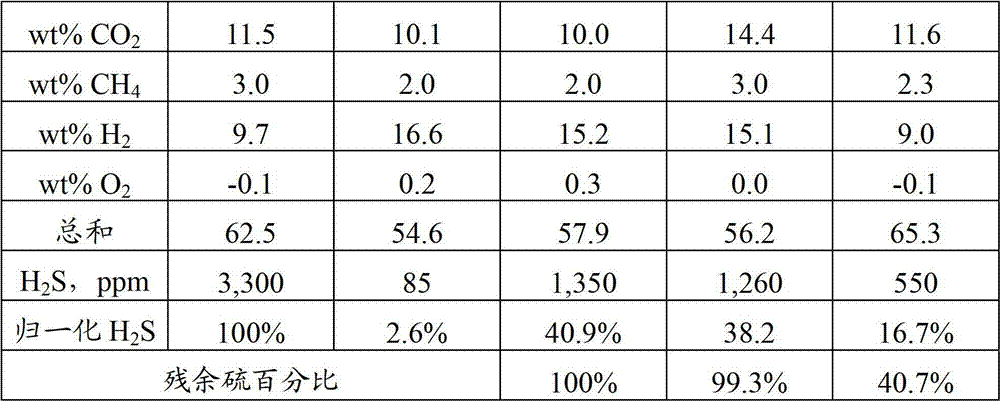
如表5所示,进行了五项不同的实验。首先使高硫原料(A)气化给出材料基准,然后对原料B进行相同的操作。接着,进行共气化试验,其中50%A和50%B均匀混合并装入气化器,并对合成气进行分析。测得合成气中H2S平均为约1,350ppmv,与原料A单独气化相比硫含量降低59%。该结果表明低硫燃料与高硫燃料共气化或共燃可有效降低各自的硫排放。As shown in Table 5, five different experiments were performed. The high-sulfur feedstock (A) is first gasified to give a material baseline, and then the same is done for feedstock B. Next, a co-gasification test was performed, in which 50% A and 50% B were homogeneously mixed and charged into the gasifier, and the syngas was analyzed. The average H 2 S in the synthesis gas is measured to be about 1,350ppmv, and the sulfur content is reduced by 59% compared with the gasification of raw material A alone. The results indicate that the co-gasification or co-firing of low-sulfur fuel and high-sulfur fuel can effectively reduce their respective sulfur emissions.
接着,在一项实验中使50%原料A与50%原料C混合,在另一项实验中使50%原料A与50%原料D混合。实验测得合成气中的H2S分别为1,260ppmv和550ppmv,代表与基准原料A相比约62%和83%的H2S产量降低,或者与不含吸附剂的情况下(即50%原料A+50%原料B)共气化相比7%和59%的降低。图4图示了各实验中硫含量的相对降低。Next, 50% of material A was mixed with 50% of material C in one experiment, and 50% of material A was mixed with 50% of material D in the other experiment. The experimentally measured H 2 S in the syngas was 1,260 ppmv and 550 ppmv, respectively, representing approximately 62% and 83% reduction in H 2 S production compared to baseline feedstock A, or compared to the case without sorbent (i.e. 50% Feedstock A + 50% Feedstock B) Co-gasification compared to 7% and 59% reduction. Figure 4 graphically illustrates the relative reduction in sulfur content in each experiment.
根据这些结果可推断出,吸附剂预先一体化的经设计原料与其他燃料例如煤、石油或天然气共气化或共燃可有效消除所述经设计燃料和煤两者产生的硫排放。加入所述经设计原料的吸附剂的适宜含量和特性可根据特定吸附剂的潜在化学反应和两种燃料的特性(即硫和氯含量)来决定。From these results it can be concluded that co-gasification or co-firing of engineered feedstocks with pre-integrated sorbents and other fuels such as coal, oil or natural gas can effectively eliminate sulfur emissions from both the engineered fuels and coal. The appropriate amount and characteristics of the sorbent to add to the engineered feedstock can be determined based on the potential chemical reactions of the particular sorbent and the characteristics of the two fuels (ie sulfur and chlorine content).
附加实施例Additional embodiments
进行了附加的一批试验,分析铁屑去除经设计原料中硫和氯的有效性。在以下实施例中使用与表1中相同的材料。按照下述参数将铁屑添加到基准原料中:1.70和0.79单位重量的Fe3O4分别与1单位重量的H2S和HCl反应(以摩尔比计,Fe/S为3/4,Fe/Cl为3/8)。根据这些反应的反应机理和铁屑的纯度,确定该实验中添加到经设计燃料原料中的铁屑的总量。结果如以下表6所示:An additional set of tests was conducted to analyze the effectiveness of iron filings in removing sulfur and chlorine from the engineered feedstock. The same materials as in Table 1 were used in the following examples. According to the following parameters, iron filings are added to the reference raw material: 1.70 and 0.79 unit weight of Fe 3 O 4 react with 1 unit weight of H 2 S and HCl respectively (in terms of molar ratio, Fe/S is 3/4, Fe/S is 3/4, Fe /Cl is 3/8). Based on the reaction mechanism of these reactions and the purity of the iron filings, the total amount of iron filings added to the engineered fuel feed stock in this experiment was determined. The results are shown in Table 6 below:
如表6所示,随着铁屑的含量增加,合成气流中硫化氢和氯化氢的浓度成比例地下降。因而,证实铁屑起到了硫和氯两者有效吸附剂的作用。As shown in Table 6, as the content of iron filings increases, the concentration of hydrogen sulfide and hydrogen chloride in the syngas stream decreases proportionally. Thus, it was confirmed that the iron filings acted as effective adsorbents for both sulfur and chlorine.
尽管对本文所述具体实施方式进行了示例和描述,但对于本领域技术人员显而易见的是在不脱离本发明构思和范围的情况下可作出各种其他改变和改进。因而所附权利要求覆盖所有落在本发明范围内的改变和改进。While particular embodiments have been illustrated and described herein, it would be obvious to those skilled in the art that various other changes and modifications can be made without departing from the spirit and scope of the invention. The appended claims therefore cover all such changes and modifications as fall within the scope of the present invention.
Claims (67)
Applications Claiming Priority (3)
| Application Number | Priority Date | Filing Date | Title |
|---|---|---|---|
| US28921709P | 2009-12-22 | 2009-12-22 | |
| US61/289,217 | 2009-12-22 | ||
| PCT/US2010/057351 WO2011078928A1 (en) | 2009-12-22 | 2010-11-19 | Sorbent containing engineered fuel feed stocks |
Publications (1)
| Publication Number | Publication Date |
|---|---|
| CN102770710A true CN102770710A (en) | 2012-11-07 |
Family
ID=43923886
Family Applications (1)
| Application Number | Title | Priority Date | Filing Date |
|---|---|---|---|
| CN2010800645800A Pending CN102770710A (en) | 2009-12-22 | 2010-11-19 | Sorbent containing engineered fuel feed stocks |
Country Status (9)
| Country | Link |
|---|---|
| US (5) | US8382862B2 (en) |
| EP (2) | EP3236153A1 (en) |
| JP (1) | JP2013515136A (en) |
| CN (1) | CN102770710A (en) |
| CA (1) | CA2790678A1 (en) |
| HR (1) | HRP20170938T1 (en) |
| MX (1) | MX2012007370A (en) |
| PL (1) | PL2516926T3 (en) |
| WO (1) | WO2011078928A1 (en) |
Cited By (4)
| Publication number | Priority date | Publication date | Assignee | Title |
|---|---|---|---|---|
| CN105339070A (en) * | 2013-03-15 | 2016-02-17 | Noxii国际有限公司 | Reducing environmental pollution and fouling when burning coal |
| CN108525639A (en) * | 2018-04-27 | 2018-09-14 | 福州大学 | The preparation method and applications of chlorine sorbing material in a kind of waste incineration |
| CN110225960A (en) * | 2017-01-24 | 2019-09-10 | 沙特阿拉伯石油公司 | The method for carrying out oxidation sweetening and sulfone management by gasification |
| CN120001352A (en) * | 2025-04-14 | 2025-05-16 | 营口三同环保科技开发有限公司 | Method for preparing high-strength activated carbon particles using waste activated carbon |
Families Citing this family (54)
| Publication number | Priority date | Publication date | Assignee | Title |
|---|---|---|---|---|
| US8349034B2 (en) * | 2008-06-26 | 2013-01-08 | Re Community Energy, Llc | Engineered fuel feed stock useful for displacement of coal in coal firing plants |
| US8444721B2 (en) | 2008-06-26 | 2013-05-21 | Re Community Energy, Llc | Engineered fuel feed stock |
| EP2321104B1 (en) | 2008-06-26 | 2013-10-09 | Re Community Energy, LLC | Method for integrated waste storage |
| EP3181665A1 (en) | 2008-06-26 | 2017-06-21 | Accordant Energy, LLC | Use of engineered fuel feed stock to simulate wood |
| US8382862B2 (en) | 2009-12-22 | 2013-02-26 | Re Community Energy, Llc | Sorbent containing engineered fuel feed stock |
| US10035960B2 (en) | 2010-09-07 | 2018-07-31 | Saudi Arabian Oil Company | Process for oxidative desulfurization and sulfone management by gasification |
| JP2014516377A (en) * | 2011-04-15 | 2014-07-10 | バイオジェニック リージェンツ エルエルシー | Method and apparatus for increasing the energy content of carbonaceous materials from pyrolysis |
| EP3690315A1 (en) * | 2011-04-22 | 2020-08-05 | Accordant Energy, LLC | A process for cogasifying and cofiring engineered fuel with coal |
| CN107513443A (en) | 2011-06-03 | 2017-12-26 | 谐和能源有限责任公司 | By the system and method for waste materials preparation process design fuel feedstocks |
| AT512330B1 (en) * | 2011-12-21 | 2013-09-15 | Commerzialbank Mattersburg Burgenland Ag | METHOD FOR GENERATING ENERGY FROM ORGANIC WASTE |
| WO2013113026A2 (en) | 2012-01-26 | 2013-08-01 | Mph Energy Llc | Mitigation of harmful combustion emissions using sorbent containing engineered fuel feedstocks |
| EP3702325A1 (en) | 2012-05-07 | 2020-09-02 | Carbon Technology Holdings, LLC | Process for producing energy |
| HRP20181987T1 (en) * | 2012-05-11 | 2019-03-08 | Accordant Energy, Llc | PROCEDURES FOR THE PRODUCTION OF DESIGNED FUEL RAW MATERIALS WITH REDUCED CHLORINE CONTENT |
| US9126204B1 (en) | 2013-01-24 | 2015-09-08 | Wm Intellectual Property Holdings L.L.C. | Process and system for producing engineered fuel |
| CA2942655A1 (en) * | 2013-03-15 | 2014-09-18 | V35A Enterprises, Llc | Production of low emission biomass fuel |
| WO2015012806A1 (en) | 2013-07-23 | 2015-01-29 | Empire Technology Development Llc | Reducing corrosion in a reactor system using fluid encasement |
| US12350648B2 (en) | 2013-10-24 | 2025-07-08 | Carbon Technology Holdings, LLC | Methods and apparatus for producing activated carbon from biomass through carbonized ash intermediates |
| US9475031B2 (en) | 2014-01-16 | 2016-10-25 | Biogenic Reagents Ventures, Llc | Carbon micro-plant |
| EP3110754B1 (en) | 2014-02-24 | 2026-04-15 | Carbon Technology Holdings, LLC | Highly mesoporous activated carbon |
| CN103897743B (en) * | 2014-03-28 | 2016-02-03 | 上海锅炉厂有限公司 | Solid fuel classification gasification-burning double bed polygenerations systeme and method |
| WO2015179199A1 (en) * | 2014-05-21 | 2015-11-26 | Georgia-Pacific LLC | Integrated recycling system and methods for use of sludge |
| CN104121596B (en) * | 2014-07-17 | 2016-04-27 | 西安热工研究院有限公司 | A kind of method alleviating slagging scorification and contamination when burning polybase metal fuel |
| WO2016065357A1 (en) | 2014-10-24 | 2016-04-28 | Biogenic Reagent Ventures, Llc | Halogenated activated carbon compositions and methods of making and using same |
| TWI687511B (en) | 2014-10-30 | 2020-03-11 | 美商艾科詹瑟斯有限公司 | Solid fuel composition formed from mixed solid waste |
| TWI695882B (en) | 2014-10-30 | 2020-06-11 | 美商艾科詹瑟斯有限公司 | System for forming a solid fuel composition from mixed solid waste |
| PT3212741T (en) | 2014-10-30 | 2021-03-12 | EcoGensus LLC | Process for forming a solid fuel composition from mixed solid waste |
| WO2016210326A1 (en) | 2015-06-24 | 2016-12-29 | Wm Intellectual Property Holdings, L.L.C. | Process for producing engineered fuel |
| FI126555B (en) | 2015-11-26 | 2017-02-15 | Valmet Technologies Oy | Biomass-based fuel adapted to reduce the chemical and / or mechanical impact of the flue gas on heat transfer surfaces, and the process for its production |
| CL2016000931A1 (en) | 2016-04-19 | 2016-11-11 | Antonio Caraball Ugarte Jose | Solid biofuel comprising lignin obtained from cattle manure and a method for obtaining it. |
| US9790703B1 (en) | 2016-08-16 | 2017-10-17 | Go Team CCR LLC | Methods of utilizing coal combustion residuals and structures constructed using such coal combustion residuals |
| US9988317B2 (en) | 2016-08-16 | 2018-06-05 | Go Team CCR LLC | Structures constructed using coal combustion materials |
| CN106635226A (en) * | 2016-08-30 | 2017-05-10 | 钟波 | Sludge and straw cooperation harmless treatment process |
| CN107557056B (en) * | 2016-10-27 | 2019-06-25 | 江苏华安科研仪器有限公司 | A kind of imitative experimental appliance |
| CN106893614B (en) * | 2017-02-08 | 2018-04-10 | 华中科技大学 | A kind of method that Combustion Source particulate matter is reduced using flyash |
| EP3366752A1 (en) * | 2017-02-28 | 2018-08-29 | L'air Liquide, Société Anonyme Pour L'Étude Et L'exploitation Des Procédés Georges Claude | Method for the production of synthesis gas by gasifying solid carbon carriers |
| WO2018218115A1 (en) * | 2017-05-26 | 2018-11-29 | Novelis Inc. | System and method for briquetting cyclone dust from decoating systems |
| US10212915B1 (en) | 2017-08-23 | 2019-02-26 | Wm. Dale Brown | System and method for automatically flushing pet urine from a litter box |
| CN109420427A (en) * | 2017-09-04 | 2019-03-05 | 淮安市水泥厂有限公司 | A kind of processing method being used for desulphurization denitration using industrial residue alkaline residue substitution lime stone |
| CN108329966A (en) * | 2018-01-19 | 2018-07-27 | 袁红英 | A kind of efficient making apparatus of honeycomb briquette |
| US10618025B2 (en) | 2018-04-04 | 2020-04-14 | EcoGensus LLC | Process vessel for forming fuel compositions and related systems and methods |
| IL319631A (en) | 2018-06-14 | 2025-05-01 | Carbon Tech Holdings Llc | Biogenic porous carbon silicon dioxide compositions and methods of making and using same |
| CN109294624B (en) * | 2018-08-31 | 2020-11-10 | 上海锅炉厂有限公司 | Garbage melting gasification coupling coal-fired power generation system and process method thereof |
| CN110484298A (en) * | 2019-08-23 | 2019-11-22 | 天津大学 | A method of using compost sheep dung vaporizing system for synthesis gas |
| CN111057602A (en) * | 2020-01-08 | 2020-04-24 | 煤科院节能技术有限公司 | A kind of biomass-based binary powder fuel and preparation method thereof |
| JP6827582B1 (en) * | 2020-04-27 | 2021-02-10 | 東北発電工業株式会社 | Solid fuel production system, solid fuel production method, and solid fuel |
| CN111996055A (en) * | 2020-07-10 | 2020-11-27 | 广西夏阳环保科技有限公司 | Composite clean coal for lime shaft kiln and preparation method thereof |
| WO2022067137A1 (en) | 2020-09-25 | 2022-03-31 | Carbon Technology Holdings, LLC | Bio-reduction of metal ores integrated with biomass pyrolysis |
| BR112023016400A2 (en) | 2021-02-18 | 2023-10-31 | Carbon Tech Holdings Llc | METALLURGICAL PRODUCTS WITH NEGATIVE CARBON |
| CN117425620A (en) | 2021-04-27 | 2024-01-19 | 卡本科技控股有限责任公司 | Biochar compositions with optimized fixed carbon and methods for their production |
| MX2024000010A (en) | 2021-07-09 | 2024-03-27 | Carbon Tech Holdings Llc | Processes for producing biocarbon pellets with high fixed-carbon content and optimized reactivity, and biocarbon pellets obtained therefrom. |
| MX2024001502A (en) | 2021-08-02 | 2024-05-15 | Carbon Tech Holdings Llc | Processes and systems for recapturing carbon from biomass pyrolysis liquids. |
| US11339337B1 (en) * | 2021-08-19 | 2022-05-24 | Aries Clean Technologies Llc | Elimination of poly- and perfluoro alkyl substances (PFAS) in a wastewater biosolids gasification process using a thermal oxidizer and hydrated lime injection |
| KR20240101647A (en) | 2021-11-12 | 2024-07-02 | 카본 테크놀로지 홀딩스, 엘엘씨 | Biocarbon composition with optimized composition parameters and process for producing the same |
| CN118109230B (en) * | 2024-04-08 | 2025-03-28 | 桂林理工大学 | Preparation method of porous geopolymer-supported zinc ferrite desulfurizer |
Citations (11)
| Publication number | Priority date | Publication date | Assignee | Title |
|---|---|---|---|---|
| US4515601A (en) * | 1982-05-03 | 1985-05-07 | Charters John E | Carbonaceous briquette |
| DE3409862A1 (en) * | 1984-03-17 | 1985-09-19 | Burkel, Wolfgang, Dr.-Ing., 8200 Rosenheim | Method for producing environmentally safe solid fuels |
| US4588568A (en) * | 1983-02-26 | 1986-05-13 | L. & C. Steinmuller Gmbh | Method of binding sulfur compounds, which result as reaction products during the combustion of sulfur-containing fuels, by addition of additives |
| EP0566419A1 (en) * | 1992-04-16 | 1993-10-20 | Cpis Limited | Method of making refuse derived fuels and fuels made by the method |
| WO2000000575A1 (en) * | 1998-06-30 | 2000-01-06 | Duquesne Energy, Inc. | Coal-based pelletized fuel composition and method of manufacturing same |
| US20050074380A1 (en) * | 2003-07-31 | 2005-04-07 | Boren Richard M. | Metal oxide processing methods and systems |
| CN1914463A (en) * | 2003-12-16 | 2007-02-14 | 先进燃烧能量系统公司 | Apparatus and method for the production of energy |
| US20080014112A1 (en) * | 2006-07-17 | 2008-01-17 | Olaf Nathan Lee | Process and apparatus for transforming waste materials into fuel |
| US20080060519A1 (en) * | 2006-09-12 | 2008-03-13 | Peter Martin Maly | Sorbents and sorbent composition for mercury removal |
| CN101360548A (en) * | 2005-12-21 | 2009-02-04 | 道格拉斯·C·科姆里 | Sorbent compositions for reducing emissions from the combustion of carbonaceous fuels |
| CN101495603A (en) * | 2006-03-23 | 2009-07-29 | 济阿冶金加工公司 | Thermal revivification gasification method for generating hydrogen and electricity |
Family Cites Families (174)
| Publication number | Priority date | Publication date | Assignee | Title |
|---|---|---|---|---|
| US3403643A (en) | 1967-04-14 | 1968-10-01 | Koppers Co Inc | Method and apparatus for incinerating combustible refuse, rubbish and miscellaneous waste organic material |
| US3650711A (en) | 1969-03-14 | 1972-03-21 | Ethyl Corp | Fuel composition |
| US3642458A (en) | 1969-08-22 | 1972-02-15 | Texaco Inc | Coke-making process and coke fuel produced by same |
| US3790091A (en) | 1971-06-07 | 1974-02-05 | Nat Recycling Inc | Solid waste separating method and classification of material |
| US3846096A (en) | 1971-06-15 | 1974-11-05 | Occidental Petroleum Corp | Gasification of carbonaceous solids |
| US3759196A (en) | 1971-12-13 | 1973-09-18 | Kinney Inc A M | Refuse disposal and heat recovery in steam boilers |
| NL7209751A (en) | 1972-07-14 | 1974-01-16 | ||
| US3950143A (en) | 1972-07-14 | 1976-04-13 | The Kingsford Company | Process for producing solid industrial fuel |
| US3905336A (en) | 1973-09-28 | 1975-09-16 | Foster Wheeler Corp | Apparatus and method for generating heat |
| US4072273A (en) | 1974-01-07 | 1978-02-07 | Southeast Sbic, Inc. | Process for dry recovery of materials from solid refuse |
| US3910775A (en) | 1974-02-22 | 1975-10-07 | Fox John M | Method and apparatus for processing refuse, sewage and/or waste material into a source of energy |
| US3961913A (en) | 1974-03-29 | 1976-06-08 | Combustion Equipment Associates, Inc. | Process for treating organic wastes and product thereof |
| US4049391A (en) | 1974-04-01 | 1977-09-20 | Black Clawson Fibreclaim, Inc. | Process for refuse disposal and heat recovery therefrom |
| US4052173A (en) | 1974-07-29 | 1977-10-04 | Dynecology Incorporated | Simultaneous gasification of coal and pyrolysis of organic solid waste materials |
| US4153514A (en) * | 1975-02-27 | 1979-05-08 | Occidental Petroleum Corporation | Pyrolysis process for solid wastes |
| US4026678A (en) | 1975-12-17 | 1977-05-31 | Guaranty Performance Co., Inc. | Process for treating municipal wastes to produce a fuel |
| US4015951A (en) | 1976-01-05 | 1977-04-05 | Gunnerman Rudolf W | Fuel pellets and method for making them from organic fibrous materials |
| US4078902A (en) | 1976-02-26 | 1978-03-14 | Acme Sales Corporation | Coke briquette |
| US4193206A (en) | 1977-03-08 | 1980-03-18 | Uop Inc. | Processes for drying sewage sludge and filtering water |
| US4152119A (en) | 1977-08-01 | 1979-05-01 | Dynecology Incorporated | Briquette comprising caking coal and municipal solid waste |
| SE423146B (en) | 1978-04-04 | 1982-04-13 | Svenska Flaektfabriken Ab | KEEP PROCESSING SOLID FUEL LIKE BARK AND OTHER WASTE WASTE |
| US4236897A (en) * | 1978-09-18 | 1980-12-02 | Johnston Ian F | Fuel pellets |
| US4230460A (en) | 1978-10-31 | 1980-10-28 | Maust Jr Edwin E | Method for enhancing the utilization of powdered coal |
| US4249471A (en) | 1979-01-29 | 1981-02-10 | Gunnerman Rudolf W | Method and apparatus for burning pelletized organic fibrous fuel |
| US4225457A (en) | 1979-02-26 | 1980-09-30 | Dynecology Incorporated | Briquette comprising caking coal and municipal solid waste |
| US4201551A (en) | 1979-03-09 | 1980-05-06 | Combustion Equipment Associates, Inc. | Embrittlement additive for treating organic materials |
| CH628837A5 (en) | 1979-03-27 | 1982-03-31 | Bema Engineering Sa | METHOD FOR SEPARATING COMPRESSION OF WASTE, APPARATUS FOR CARRYING OUT SAID METHOD, BRICK AND SLUDGE RESULTING FROM THIS PROCESS AND USE OF SAID SLUDGE. |
| US4440635A (en) | 1979-03-29 | 1984-04-03 | Haigh M. Reiniger | Process and apparatus for the recovery of cellulose fibers from paper-plastic mixtures |
| US4265636A (en) | 1979-07-23 | 1981-05-05 | Occidental Research Corporation | Use of formaldehyde as a chemical embrittling agent for waste |
| CH646992A5 (en) | 1980-02-26 | 1984-12-28 | Maurer A Ing Sa | Method for the continuous heat treatment of raw materials verkohlbarem. |
| US4308033A (en) | 1980-10-23 | 1981-12-29 | Gunnerman Rudolf W | Fuel pellet and process for making it by shaping under pressure an organic fibrous material |
| US4381718A (en) | 1980-11-17 | 1983-05-03 | Carver George P | Low emissions process and burner |
| US4529407A (en) | 1981-06-25 | 1985-07-16 | Pickering Fuel Resources, Inc. | Fuel pellets |
| DE3128560C1 (en) | 1981-07-18 | 1983-02-24 | Mannesmann Veba Umwelttechnik GmbH, 4690 Herne | Process for the preparation of the combustible fraction of household waste to be briquetted and plant for carrying out the process |
| JPS5861181A (en) * | 1981-10-08 | 1983-04-12 | Agency Of Ind Science & Technol | Method and apparatus for treating harmful component in the thermal treatment of waste |
| JPS5861181U (en) | 1981-10-22 | 1983-04-25 | アイシン精機株式会社 | Industrial sewing machine table device |
| US4395265A (en) | 1981-12-16 | 1983-07-26 | Charles Reilly | Fuel pellets |
| US4398917A (en) | 1982-03-23 | 1983-08-16 | Reilly Charles J | Process for the preparation of fuel pellets |
| US4405331A (en) | 1982-04-23 | 1983-09-20 | Acres American Incorporated | Refuse derived fuel and a process for the production thereof |
| US4476816A (en) | 1982-10-25 | 1984-10-16 | Cannon Joseph N | Staged cascade fluidized bed combustor |
| US4758244A (en) | 1983-02-17 | 1988-07-19 | University Of Melbourne | Upgrading solid fuels |
| HUT34115A (en) | 1983-05-27 | 1985-02-28 | Nehezvegyipari Kutato Intezet | Equipment and process for the continuous or semi-continuous production of aqueous and oil products containing sulfur |
| US4624417A (en) * | 1983-06-17 | 1986-11-25 | Newest, Inc. | Process for converting solid waste and sewage sludge into energy sources and separate recyclable by-products |
| US4886519A (en) | 1983-11-02 | 1989-12-12 | Petroleum Fermentations N.V. | Method for reducing sox emissions during the combustion of sulfur-containing combustible compositions |
| US4657738A (en) | 1984-04-30 | 1987-04-14 | Westinghouse Electric Corp. | Stack gas emissions control system |
| US4828577A (en) | 1984-12-03 | 1989-05-09 | Markham Jr William M | Process for converting food sludges to biomass fuels |
| US4613339A (en) | 1984-12-24 | 1986-09-23 | Gunnerman Rudolf W | Process for preparing and using sweet sorghum in a fuel product |
| DE3686727T2 (en) | 1985-05-24 | 1993-04-22 | Clerc De Bussy Le | METHOD FOR PRODUCING ROASTED WOOD, PRODUCT PRODUCED IN THIS WAY, AND THE USE THEREOF FOR GENERATING ENERGY. |
| CA1306354C (en) | 1987-08-27 | 1992-08-18 | Vincent P. Clancy | Preparation of composite fuels, with reduced sulfur emission characteristics, from oily and carbonaceous wastes |
| CA1327342C (en) | 1987-11-30 | 1994-03-01 | James Kelly Kindig | Process for beneficiating particulate solids |
| US4824441A (en) | 1987-11-30 | 1989-04-25 | Genesis Research Corporation | Method and composition for decreasing emissions of sulfur oxides and nitrogen oxides |
| IT1233848B (en) | 1988-01-21 | 1992-04-21 | Snam Progetti | PROCEDURE FOR THE PREPARATION OF A HIGH CONCENTRATION AQUEOUS COAL OR PETCOKE SUSPENSION |
| US4875905A (en) | 1988-11-14 | 1989-10-24 | Solidiwaste Technology, L.P. | Method of preparing a high heating value fuel product |
| US5562743A (en) * | 1989-06-19 | 1996-10-08 | University Of North Texas | Binder enhanced refuse derived fuel |
| DE3933374A1 (en) | 1989-10-06 | 1991-04-18 | Metallgesellschaft Ag | METHOD FOR CHARGING CHARCOAL FILTER SLUDGE |
| US5067317A (en) | 1990-02-26 | 1991-11-26 | The United States Of America As Represented By The United State Department Of Energy | Process for generating electricity in a pressurized fluidized-bed combustor system |
| US5342418A (en) | 1990-04-25 | 1994-08-30 | Jesse Albert H | Method of making pelletized fuel |
| JP3067827B2 (en) * | 1991-04-03 | 2000-07-24 | 株式会社プランド研究所 | Hybrid fuel manufacturing method |
| US5125931A (en) | 1990-09-24 | 1992-06-30 | Dynecology Incorporated | Sewage sludge disposal process and apparatus |
| US5284497A (en) | 1990-10-10 | 1994-02-08 | Alberta Oil Sands Technology And Research Authority | Desulfurization of solid carbonaceous fuels by coagglomeration with sulfur sorbents |
| US5429645A (en) | 1990-12-06 | 1995-07-04 | Benson; Peter H. | Solid fuel and process for combustion of the solid fuel |
| GB9110079D0 (en) | 1991-05-09 | 1991-07-03 | British Petroleum Co Plc | Fuel composition |
| DE69215345T2 (en) | 1991-12-30 | 1997-03-13 | Texaco Development Corp | Treatment of synthesis gas |
| US5591417A (en) | 1992-04-15 | 1997-01-07 | Mobil Oil Corporation | Removing SOx, CO and NOx from flue gases |
| US5429654A (en) | 1992-04-30 | 1995-07-04 | Exxon Research & Engineering Co. | Coated agricultural products |
| DE4231771A1 (en) | 1992-09-23 | 1994-03-24 | Bayer Ag | Process for electricity generation from plastic waste |
| US5250080A (en) | 1992-10-13 | 1993-10-05 | Corpoven, S.A. | Process for manufacturing a solid fuel |
| JPH06180104A (en) | 1992-12-11 | 1994-06-28 | Mitsui Eng & Shipbuild Co Ltd | Corrosion preventive process for heat-transfer tube in boiler apparatus |
| US5431702A (en) | 1993-03-25 | 1995-07-11 | Dynecology, Inc. | Waste conversion process and products |
| DE4303450C2 (en) | 1993-02-05 | 1997-07-03 | Rheinische Kalksteinwerke | Means for dry cleaning of exhaust gases |
| US5797972A (en) | 1993-03-25 | 1998-08-25 | Dynecology, Inc. | Sewage sludge disposal process and product |
| AU6828494A (en) | 1993-05-07 | 1994-12-12 | Nalco Fuel Tech | Process and apparatus for enhancing distribution of nox-reducing chemicals in a high-solids environment |
| US5387267A (en) | 1993-08-25 | 1995-02-07 | Modular Energy Corporation | Process and apparatus for treating heterogeneous waste to provide a homogeneous fuel |
| US20040237405A1 (en) | 1993-10-19 | 2004-12-02 | Mitsubishi Jukogyo Kabushiki Kaisha | Process for the gasification of organic materials, processes for the gasification of glass fiber reinforced plastics, and apparatus |
| US5458659A (en) * | 1993-10-20 | 1995-10-17 | Florida Power Corporation | Desulfurization of carbonaceous fuels |
| DE4336580A1 (en) | 1993-10-27 | 1995-05-04 | Krupp Koppers Gmbh | Process for treating communal plastic waste |
| US6143263A (en) | 1994-04-29 | 2000-11-07 | The Babcock & Wilcox Company | Method and system for SO2 and SO3 control by dry sorbent/reagent injection and wet scrubbing |
| US5516345A (en) | 1994-06-30 | 1996-05-14 | Iowa State University Research Foundation, Inc. | Latent heat-ballasted gasifier method |
| JP2647804B2 (en) | 1994-09-30 | 1997-08-27 | 工業技術院長 | Garbage disposal method |
| GB9512433D0 (en) | 1995-06-19 | 1995-08-23 | Geraint Rees | Agglomerates from carbonaceous fuel |
| US5643342A (en) | 1995-08-02 | 1997-07-01 | Pelletech Fuels, Inc. | Fuel pellet and method of making the fuel pellet |
| US5827488A (en) | 1996-09-06 | 1998-10-27 | Dravo Lime Company | Process for removing SO2 and NOx from a gaseous stream |
| US5888256A (en) | 1996-09-11 | 1999-03-30 | Morrison; Garrett L. | Managed composition of waste-derived fuel |
| US5755836A (en) | 1997-01-14 | 1998-05-26 | Earth Cycle, L.L.C. | Process for manufacturing a composite fire log and product resulting therefrom |
| JPH10235313A (en) * | 1997-02-28 | 1998-09-08 | Meidensha Corp | Solidification treatment method and solidified product |
| JPH10244237A (en) * | 1997-03-05 | 1998-09-14 | Meidensha Corp | Solidification treatment method and solidified product |
| US6214064B1 (en) | 1997-08-13 | 2001-04-10 | Edward E. Boss | Process for making a fuel product from coal fines and sewage sludge |
| US6780210B2 (en) | 1997-08-13 | 2004-08-24 | Edward E. Boss | Process for forming a fuel product from paper mill sludge |
| US6048374A (en) | 1997-08-18 | 2000-04-11 | Green; Alex E. S. | Process and device for pyrolysis of feedstock |
| US6152306A (en) | 1997-10-30 | 2000-11-28 | Molecular Waste Technologies | Solid waste reduction |
| US6506223B2 (en) | 1997-12-05 | 2003-01-14 | Waste Technology Transfer, Inc. | Pelletizing and briquetting of combustible organic-waste materials using binders produced by liquefaction of biomass |
| US5916826A (en) | 1997-12-05 | 1999-06-29 | Waste Technology Transfer, Inc. | Pelletizing and briquetting of coal fines using binders produced by liquefaction of biomass |
| US5916595A (en) * | 1997-12-12 | 1999-06-29 | Andrx Pharmaceutials, Inc. | HMG co-reductase inhibitor |
| IT1297030B1 (en) | 1997-12-30 | 1999-08-03 | Pirelli Ambiente S P A | SOLID COMBUSTIBLE COMPOSITION |
| US6582486B1 (en) | 1997-12-30 | 2003-06-24 | Pirelli Ambient S.P.A. | Solid combustible composition |
| US6423878B2 (en) | 1998-03-20 | 2002-07-23 | Riccardo Reverso | Process and apparatus for the controlled pyrolysis of plastic materials |
| EP1171834B8 (en) | 1998-03-24 | 2005-03-23 | Exergetic Systems, LLC | Input/loss method for determining fuel flow, chemistry, heating value and performance of a fossil-fired system |
| US6000639A (en) * | 1998-06-19 | 1999-12-14 | Hydrocarbon Technologies, Inc. | Treating municipal solid waste for producing hydrocarbon fuel products |
| WO2000000574A1 (en) | 1998-06-30 | 2000-01-06 | Duquesne Energy, Inc. | Coal-based pelletized fuel composition and method of manufacturing same |
| FI981742A0 (en) | 1998-08-12 | 1998-08-12 | Foster Wheeler Energia Oy | Liquid packaging board waste material recycling process and device for recycling liquid packaging board waste material |
| US6165238A (en) | 1999-06-14 | 2000-12-26 | Cq Inc. | Fuel pellet and method for its production |
| US6149694A (en) | 1999-06-16 | 2000-11-21 | Northwest Missouri State University | Process for using animal waste as fuel |
| EP1072671A1 (en) | 1999-07-30 | 2001-01-31 | Cam Tecnologie S.p.A. | Process for combustion of a sulphur-containing liquid fuel with reduced emission of sulphur oxides, and corresponding combustion plant |
| NL1013007C2 (en) | 1999-09-09 | 2001-03-12 | Dsm Nv | Method for manufacturing fuel granules. |
| WO2001029366A1 (en) | 1999-10-19 | 2001-04-26 | Roodenburg, Joop | Hoisting mechanism, with compensator installed in a hoisting cable system |
| KR100340087B1 (en) | 1999-12-10 | 2002-06-10 | 양종규 | A solid fuel used waste plastic and the manufacturing method of the above solid fuel |
| US6692544B1 (en) | 2000-04-12 | 2004-02-17 | Ecosystems Projects, Llc | Municipal waste briquetting system and method of filling land |
| FR2810910B1 (en) | 2000-06-28 | 2003-03-21 | Boucou Ets | PROCESS FOR RECOVERING INDUSTRIAL WASTE IN A BOILER AND SUITABLE COMPOSITION |
| KR100391121B1 (en) | 2000-12-11 | 2003-07-16 | 김현영 | Method of gasifying high molecular weight organic material and apparatus therefor |
| WO2002051969A1 (en) * | 2000-12-22 | 2002-07-04 | Cq Inc. | Fuel pellet and method for its production |
| FR2818657B1 (en) | 2000-12-26 | 2003-06-06 | Aggloct | PROCESS FOR THE PROCESSING OF ANIMAL FLOUR WITH A VIEW TO MAKING IT CONSUMABLE, PRODUCT THUS OBTAINED AND MEANS FOR IMPLEMENTING IT |
| KR20030066811A (en) | 2001-01-15 | 2003-08-09 | 타카모 인더스트리스 컴퍼니 리미티드 | Plastic Liquefying Device |
| SE520927C2 (en) | 2001-01-26 | 2003-09-16 | Vattenfall Ab | Method of operation of a heat-producing plant for combustion of chlorine-containing fuels |
| US7252691B2 (en) | 2001-03-06 | 2007-08-07 | John Philipson | Conversion of municipal solid waste to high fuel value |
| JP2003004211A (en) | 2001-04-19 | 2003-01-08 | Ebara Corp | Equipment and method for treating waste |
| CN1561381A (en) | 2001-09-28 | 2005-01-05 | 株式会社荏原制作所 | Method for reforming combustible gas, apparatus for reforming combustible gas and apparatus for gasification |
| US20030106467A1 (en) | 2001-10-18 | 2003-06-12 | Four Corners Group, Inc. | Cement, reduced-carbon ash and controlled mineral formation using sub-and supercritical high-velocity free-jet expansion into fuel-fired combustor fireballs |
| JP2003253037A (en) | 2002-02-28 | 2003-09-10 | Jfe Steel Kk | Dechlorination method for chlorine-containing synthetic resin |
| AU2002950780A0 (en) | 2002-08-12 | 2002-09-12 | Pacific Edge Holdings Pty. Ltd. | Process for gasification of low rank carbonaceous material |
| CN1224683C (en) | 2002-08-27 | 2005-10-26 | 王和勋 | Process for preparing solid fuel with high heat value and low pollution from life garbage |
| SE524069C2 (en) | 2002-10-21 | 2004-06-22 | Reimer Carlsson Med Bo Interio | Cassette, holder and method for transferring a roll of cinema film |
| US7247285B2 (en) | 2002-12-02 | 2007-07-24 | Bert Zauderer | Reduction of sulfur, nitrogen oxides and volatile trace metals from combustion in furnaces and boilers |
| US7618606B2 (en) | 2003-02-06 | 2009-11-17 | The Ohio State University | Separation of carbon dioxide (CO2) from gas mixtures |
| WO2005021686A1 (en) | 2003-08-29 | 2005-03-10 | Ebara Corporation | Recycling method and system |
| GB0325668D0 (en) | 2003-11-04 | 2003-12-10 | Dogru Murat | Intensified and minaturized gasifier with multiple air injection and catalytic bed |
| US7967877B2 (en) | 2003-11-13 | 2011-06-28 | Biomass Worldwide Group Limited | Biomass energy product and processing method |
| US7264124B2 (en) | 2003-11-17 | 2007-09-04 | Casella Waste Systems, Inc. | Systems and methods for sorting recyclables at a material recovery facility |
| JP4097618B2 (en) | 2004-03-31 | 2008-06-11 | 株式会社栗本鐵工所 | Method for producing solid fuel |
| WO2005097684A2 (en) | 2004-04-02 | 2005-10-20 | Skill Associates, Inc. | Biomass converters and processes |
| AU2005262871B2 (en) | 2004-06-28 | 2011-06-09 | Douglas C. Comrie | Reducing sulfur gas emissions resulting from the burning of carbonaceous fuels |
| US7276217B2 (en) | 2004-08-16 | 2007-10-02 | Premier Chemicals, Llc | Reduction of coal-fired combustion emissions |
| JP4284251B2 (en) | 2004-08-25 | 2009-06-24 | 新日鉄エンジニアリング株式会社 | Corrosion control method for waste power generation boiler |
| US7909895B2 (en) | 2004-11-10 | 2011-03-22 | Enertech Environmental, Inc. | Slurry dewatering and conversion of biosolids to a renewable fuel |
| US7384615B2 (en) | 2004-12-02 | 2008-06-10 | Battelle Energy Alliance, Llc | Method oil shale pollutant sorption/NOx reburning multi-pollutant control |
| US7708964B2 (en) | 2004-12-02 | 2010-05-04 | Battelle Energy Alliance, Llc | Oil shale derived pollutant control materials and methods and apparatuses for producing and utilizing the same |
| EP1669434A1 (en) | 2004-12-13 | 2006-06-14 | NedCoal Patent B.V. i/o | Method and installation for conversion into fuel of organic material originating for instance from domestic waste |
| CN1296150C (en) | 2004-12-17 | 2007-01-24 | 中材国际工程股份有限公司 | Process for treating urban house refuse using dry method cement production system |
| BRPI0519075A2 (en) | 2005-03-17 | 2008-12-23 | Nox Ii International Ltd | reduction of mercury emissions from coal burning |
| CA2601239C (en) | 2005-03-17 | 2013-07-16 | Nox Ii, Ltd. | Reducing mercury emissions from the burning of coal |
| US20060228294A1 (en) | 2005-04-12 | 2006-10-12 | Davis William H | Process and apparatus using a molten metal bath |
| US7485767B2 (en) | 2005-06-29 | 2009-02-03 | Exxonmobil Chemical Patents Inc. | Production of synthesis gas blends for conversion to methanol or Fischer-Tropsch liquids |
| US20070006526A1 (en) | 2005-07-07 | 2007-01-11 | New Energy Usa, Llc | Fuel pellet briquettes from biomass and recovered coal slurries |
| US9274099B2 (en) | 2005-07-22 | 2016-03-01 | The Board Of Trustees Of The Leland Stanford Junior University | Screening test drugs to identify their effects on cell membrane voltage-gated ion channel |
| CA2515879A1 (en) | 2005-08-05 | 2007-02-05 | Mark A. Dupuis | Densification system |
| US7468170B2 (en) | 2005-12-21 | 2008-12-23 | Douglas C Comrie | Nitrogenous sorbent for coal combustion |
| US8150776B2 (en) | 2006-01-18 | 2012-04-03 | Nox Ii, Ltd. | Methods of operating a coal burning facility |
| US7932424B2 (en) | 2006-01-26 | 2011-04-26 | Kitakyushu Foundation For The Advancement Of Industry, Science And Technology | Method for catalytically cracking waste plastics and apparatus for catalytically cracking waste plastics |
| WO2007103283A2 (en) | 2006-03-02 | 2007-09-13 | Shaw Waste Solutions, Llc | Improved steam reformation system |
| US20070261295A1 (en) | 2006-05-11 | 2007-11-15 | Tolmie Richard W | Water resistance, density, and durability of biomass fuels |
| WO2007147244A1 (en) | 2006-06-19 | 2007-12-27 | Michel Babeu | Method for manufacturing a solid fuel with waste materials |
| JP2008106270A (en) * | 2006-09-29 | 2008-05-08 | Ube Ind Ltd | Method for producing solid raw fuel |
| US8444897B2 (en) * | 2006-10-30 | 2013-05-21 | University Of Utah Research Foundation | Blending plastic and cellulose waste products for alternative uses |
| US20080110090A1 (en) * | 2006-11-15 | 2008-05-15 | C166, An Llc Registered In Florida | Gasification of fuel in a slagging gasifier |
| DK2134820T3 (en) | 2007-03-07 | 2012-01-16 | Dsm Ip Assets Bv | Process for drying and purifying a cellulosic / plastic waste particulate mixture |
| WO2008107042A2 (en) | 2007-03-07 | 2008-09-12 | Dsm Ip Assets B.V. | Improved combustibility of a waste plastic based fuel source |
| US8459466B2 (en) | 2007-05-23 | 2013-06-11 | Re Community Energy, Llc | Systems and methods for optimizing a single-stream materials recovery facility |
| CN101134922A (en) | 2007-06-26 | 2008-03-05 | 上海电力学院 | Method for making clean solid fuel from waste plastics |
| US20090020405A1 (en) | 2007-07-20 | 2009-01-22 | Foster Wheeler Energy Corporation | Method of and a plant for combusting carbonaceous fuel by using a solid oxygen carrier |
| US20090056206A1 (en) | 2007-08-28 | 2009-03-05 | Stephane Gauthier | Method for manufacture of plant biomass solid fuel |
| US20090056205A1 (en) | 2007-08-28 | 2009-03-05 | Stephane Gauthier | Plant biomass solid fuel |
| CN101215490B (en) | 2008-01-17 | 2011-03-16 | 中国矿业大学(北京) | Garbage derived fuel and preparation method thereof |
| ES2749386T3 (en) | 2008-06-09 | 2020-03-20 | Idemitsu Kosan Co | Composition for feed, and I think it includes the same |
| EP2321104B1 (en) * | 2008-06-26 | 2013-10-09 | Re Community Energy, LLC | Method for integrated waste storage |
| US8349034B2 (en) | 2008-06-26 | 2013-01-08 | Re Community Energy, Llc | Engineered fuel feed stock useful for displacement of coal in coal firing plants |
| US8444721B2 (en) | 2008-06-26 | 2013-05-21 | Re Community Energy, Llc | Engineered fuel feed stock |
| EP3181665A1 (en) | 2008-06-26 | 2017-06-21 | Accordant Energy, LLC | Use of engineered fuel feed stock to simulate wood |
| NL1035778C2 (en) | 2008-07-31 | 2009-06-03 | Qlyte Technologies B V | Waste particles mixture processing method for producing e.g. fuel, involves feeding dried cellulose/plastic waste to purification stage, and subjecting dried waste to effect of treatment phase |
| PL2307531T3 (en) | 2008-08-01 | 2012-07-31 | Subcoal Int B V | Grindable pellet |
| US20100263577A1 (en) | 2009-04-21 | 2010-10-21 | Industrial Accessories Company | Pollution abatement process for fossil fuel-fired boilers |
| US8382862B2 (en) | 2009-12-22 | 2013-02-26 | Re Community Energy, Llc | Sorbent containing engineered fuel feed stock |
| CN107513443A (en) | 2011-06-03 | 2017-12-26 | 谐和能源有限责任公司 | By the system and method for waste materials preparation process design fuel feedstocks |
| WO2013113026A2 (en) * | 2012-01-26 | 2013-08-01 | Mph Energy Llc | Mitigation of harmful combustion emissions using sorbent containing engineered fuel feedstocks |
| HRP20181987T1 (en) * | 2012-05-11 | 2019-03-08 | Accordant Energy, Llc | PROCEDURES FOR THE PRODUCTION OF DESIGNED FUEL RAW MATERIALS WITH REDUCED CHLORINE CONTENT |
| US9126204B1 (en) | 2013-01-24 | 2015-09-08 | Wm Intellectual Property Holdings L.L.C. | Process and system for producing engineered fuel |
-
2010
- 2010-11-19 US US12/949,982 patent/US8382862B2/en not_active Expired - Fee Related
- 2010-11-19 CA CA2790678A patent/CA2790678A1/en not_active Abandoned
- 2010-11-19 JP JP2012545958A patent/JP2013515136A/en active Pending
- 2010-11-19 MX MX2012007370A patent/MX2012007370A/en unknown
- 2010-11-19 HR HRP20170938TT patent/HRP20170938T1/en unknown
- 2010-11-19 CN CN2010800645800A patent/CN102770710A/en active Pending
- 2010-11-19 PL PL10839960T patent/PL2516926T3/en unknown
- 2010-11-19 EP EP17163242.5A patent/EP3236153A1/en not_active Ceased
- 2010-11-19 EP EP10839960.1A patent/EP2516926B1/en not_active Not-in-force
- 2010-11-19 WO PCT/US2010/057351 patent/WO2011078928A1/en not_active Ceased
-
2011
- 2011-12-16 US US13/329,028 patent/US8617264B2/en not_active Expired - Fee Related
-
2013
- 2013-11-21 US US14/086,662 patent/US9181508B2/en not_active Expired - Fee Related
-
2015
- 2015-09-22 US US14/861,768 patent/US9752086B2/en not_active Expired - Fee Related
-
2017
- 2017-08-04 US US15/669,797 patent/US10563144B2/en not_active Expired - Fee Related
Patent Citations (11)
| Publication number | Priority date | Publication date | Assignee | Title |
|---|---|---|---|---|
| US4515601A (en) * | 1982-05-03 | 1985-05-07 | Charters John E | Carbonaceous briquette |
| US4588568A (en) * | 1983-02-26 | 1986-05-13 | L. & C. Steinmuller Gmbh | Method of binding sulfur compounds, which result as reaction products during the combustion of sulfur-containing fuels, by addition of additives |
| DE3409862A1 (en) * | 1984-03-17 | 1985-09-19 | Burkel, Wolfgang, Dr.-Ing., 8200 Rosenheim | Method for producing environmentally safe solid fuels |
| EP0566419A1 (en) * | 1992-04-16 | 1993-10-20 | Cpis Limited | Method of making refuse derived fuels and fuels made by the method |
| WO2000000575A1 (en) * | 1998-06-30 | 2000-01-06 | Duquesne Energy, Inc. | Coal-based pelletized fuel composition and method of manufacturing same |
| US20050074380A1 (en) * | 2003-07-31 | 2005-04-07 | Boren Richard M. | Metal oxide processing methods and systems |
| CN1914463A (en) * | 2003-12-16 | 2007-02-14 | 先进燃烧能量系统公司 | Apparatus and method for the production of energy |
| CN101360548A (en) * | 2005-12-21 | 2009-02-04 | 道格拉斯·C·科姆里 | Sorbent compositions for reducing emissions from the combustion of carbonaceous fuels |
| CN101495603A (en) * | 2006-03-23 | 2009-07-29 | 济阿冶金加工公司 | Thermal revivification gasification method for generating hydrogen and electricity |
| US20080014112A1 (en) * | 2006-07-17 | 2008-01-17 | Olaf Nathan Lee | Process and apparatus for transforming waste materials into fuel |
| US20080060519A1 (en) * | 2006-09-12 | 2008-03-13 | Peter Martin Maly | Sorbents and sorbent composition for mercury removal |
Non-Patent Citations (1)
| Title |
|---|
| 孙明明: "高热值垃圾与生物质混合制取RDF及其燃烧特性研究", 《中国优秀硕士学位论文全文数据库工程科技I辑》 * |
Cited By (4)
| Publication number | Priority date | Publication date | Assignee | Title |
|---|---|---|---|---|
| CN105339070A (en) * | 2013-03-15 | 2016-02-17 | Noxii国际有限公司 | Reducing environmental pollution and fouling when burning coal |
| CN110225960A (en) * | 2017-01-24 | 2019-09-10 | 沙特阿拉伯石油公司 | The method for carrying out oxidation sweetening and sulfone management by gasification |
| CN108525639A (en) * | 2018-04-27 | 2018-09-14 | 福州大学 | The preparation method and applications of chlorine sorbing material in a kind of waste incineration |
| CN120001352A (en) * | 2025-04-14 | 2025-05-16 | 营口三同环保科技开发有限公司 | Method for preparing high-strength activated carbon particles using waste activated carbon |
Also Published As
| Publication number | Publication date |
|---|---|
| US20140157659A1 (en) | 2014-06-12 |
| US20180086995A1 (en) | 2018-03-29 |
| US9752086B2 (en) | 2017-09-05 |
| US20120210633A1 (en) | 2012-08-23 |
| EP2516926A4 (en) | 2013-11-06 |
| US9181508B2 (en) | 2015-11-10 |
| EP2516926A1 (en) | 2012-10-31 |
| US10563144B2 (en) | 2020-02-18 |
| PL2516926T3 (en) | 2017-11-30 |
| US8617264B2 (en) | 2013-12-31 |
| US8382862B2 (en) | 2013-02-26 |
| HRP20170938T1 (en) | 2017-09-22 |
| MX2012007370A (en) | 2012-10-05 |
| US20110099890A1 (en) | 2011-05-05 |
| CA2790678A1 (en) | 2011-06-30 |
| WO2011078928A1 (en) | 2011-06-30 |
| US20160108328A1 (en) | 2016-04-21 |
| EP2516926B1 (en) | 2017-03-29 |
| EP3236153A1 (en) | 2017-10-25 |
| JP2013515136A (en) | 2013-05-02 |
Similar Documents
| Publication | Publication Date | Title |
|---|---|---|
| CN102770710A (en) | Sorbent containing engineered fuel feed stocks | |
| CN104364356B (en) | Using Adsorbents Containing Engineered Fuel Feedstocks to Mitigate Harmful Combustion Emissions | |
| US8349034B2 (en) | Engineered fuel feed stock useful for displacement of coal in coal firing plants | |
| CN102076832A (en) | Engineered Fuel Raw Materials | |
| HK40006538A (en) | Engineered fuel feed stock useful for displacement of coal in coal firing plants | |
| Wolvey et al. | Case study 7: WasteGen, UK. | |
| HK1236218A (en) | Engineered fuel feed stock |
Legal Events
| Date | Code | Title | Description |
|---|---|---|---|
| C06 | Publication | ||
| PB01 | Publication | ||
| C10 | Entry into substantive examination | ||
| SE01 | Entry into force of request for substantive examination | ||
| C53 | Correction of patent of invention or patent application | ||
| CB02 | Change of applicant information |
Address after: vermont Applicant after: ACCORDANT ENERGY, LLC Address before: vermont Applicant before: ACCORDANT ENERGY, LLC Address after: vermont Applicant after: ACCORDANT ENERGY, LLC Address before: vermont Applicant before: Accordant Energy, LLC |
|
| COR | Change of bibliographic data |
Free format text: CORRECT: APPLICANT; FROM: MPH ENERGY LLC TO: XIEHE ENERGY LLC Free format text: CORRECT: APPLICANT; FROM: REGENERATION COMMUNITY ENERGY LLC TO: MPH ENERGY LLC |
|
| RJ01 | Rejection of invention patent application after publication | ||
| RJ01 | Rejection of invention patent application after publication |
Application publication date: 20121107 |