CN102917536A - Adhesion assisting agent fitted metal foil, and printed wiring board using thereof - Google Patents
Adhesion assisting agent fitted metal foil, and printed wiring board using thereof Download PDFInfo
- Publication number
- CN102917536A CN102917536A CN2012103975451A CN201210397545A CN102917536A CN 102917536 A CN102917536 A CN 102917536A CN 2012103975451 A CN2012103975451 A CN 2012103975451A CN 201210397545 A CN201210397545 A CN 201210397545A CN 102917536 A CN102917536 A CN 102917536A
- Authority
- CN
- China
- Prior art keywords
- resin
- auxiliary material
- composition
- adhesion auxiliary
- metal forming
- Prior art date
- Legal status (The legal status is an assumption and is not a legal conclusion. Google has not performed a legal analysis and makes no representation as to the accuracy of the status listed.)
- Granted
Links
Images


Classifications
-
- C—CHEMISTRY; METALLURGY
- C09—DYES; PAINTS; POLISHES; NATURAL RESINS; ADHESIVES; COMPOSITIONS NOT OTHERWISE PROVIDED FOR; APPLICATIONS OF MATERIALS NOT OTHERWISE PROVIDED FOR
- C09J—ADHESIVES; NON-MECHANICAL ASPECTS OF ADHESIVE PROCESSES IN GENERAL; ADHESIVE PROCESSES NOT PROVIDED FOR ELSEWHERE; USE OF MATERIALS AS ADHESIVES
- C09J109/00—Adhesives based on homopolymers or copolymers of conjugated diene hydrocarbons
-
- H—ELECTRICITY
- H05—ELECTRIC TECHNIQUES NOT OTHERWISE PROVIDED FOR
- H05K—PRINTED CIRCUITS; CASINGS OR CONSTRUCTIONAL DETAILS OF ELECTRIC APPARATUS; MANUFACTURE OF ASSEMBLAGES OF ELECTRICAL COMPONENTS
- H05K3/00—Apparatus or processes for manufacturing printed circuits
- H05K3/46—Manufacturing multilayer circuits
- H05K3/4644—Manufacturing multilayer circuits by building the multilayer layer by layer, i.e. build-up multilayer circuits
- H05K3/4652—Adding a circuit layer by laminating a metal foil or a preformed metal foil pattern
- H05K3/4655—Adding a circuit layer by laminating a metal foil or a preformed metal foil pattern by using a laminate characterized by the insulating layer
-
- C—CHEMISTRY; METALLURGY
- C09—DYES; PAINTS; POLISHES; NATURAL RESINS; ADHESIVES; COMPOSITIONS NOT OTHERWISE PROVIDED FOR; APPLICATIONS OF MATERIALS NOT OTHERWISE PROVIDED FOR
- C09J—ADHESIVES; NON-MECHANICAL ASPECTS OF ADHESIVE PROCESSES IN GENERAL; ADHESIVE PROCESSES NOT PROVIDED FOR ELSEWHERE; USE OF MATERIALS AS ADHESIVES
- C09J129/00—Adhesives based on homopolymers or copolymers of compounds having one or more unsaturated aliphatic radicals, each having only one carbon-to-carbon double bond, and at least one being terminated by an alcohol, ether, aldehydo, ketonic, acetal, or ketal radical; Adhesives based on hydrolysed polymers of esters of unsaturated alcohols with saturated carboxylic acids; Adhesives based on derivatives of such polymers
- C09J129/14—Homopolymers or copolymers of acetals or ketals obtained by polymerisation of unsaturated acetals or ketals or by after-treatment of polymers of unsaturated alcohols
-
- C—CHEMISTRY; METALLURGY
- C09—DYES; PAINTS; POLISHES; NATURAL RESINS; ADHESIVES; COMPOSITIONS NOT OTHERWISE PROVIDED FOR; APPLICATIONS OF MATERIALS NOT OTHERWISE PROVIDED FOR
- C09J—ADHESIVES; NON-MECHANICAL ASPECTS OF ADHESIVE PROCESSES IN GENERAL; ADHESIVE PROCESSES NOT PROVIDED FOR ELSEWHERE; USE OF MATERIALS AS ADHESIVES
- C09J151/00—Adhesives based on graft polymers in which the grafted component is obtained by reactions only involving carbon-to-carbon unsaturated bonds; Adhesives based on derivatives of such polymers
- C09J151/04—Adhesives based on graft polymers in which the grafted component is obtained by reactions only involving carbon-to-carbon unsaturated bonds; Adhesives based on derivatives of such polymers grafted on to rubbers
-
- H—ELECTRICITY
- H05—ELECTRIC TECHNIQUES NOT OTHERWISE PROVIDED FOR
- H05K—PRINTED CIRCUITS; CASINGS OR CONSTRUCTIONAL DETAILS OF ELECTRIC APPARATUS; MANUFACTURE OF ASSEMBLAGES OF ELECTRICAL COMPONENTS
- H05K1/00—Printed circuits
- H05K1/02—Details
- H05K1/09—Use of materials for the conductive, e.g. metallic pattern
-
- H—ELECTRICITY
- H05—ELECTRIC TECHNIQUES NOT OTHERWISE PROVIDED FOR
- H05K—PRINTED CIRCUITS; CASINGS OR CONSTRUCTIONAL DETAILS OF ELECTRIC APPARATUS; MANUFACTURE OF ASSEMBLAGES OF ELECTRICAL COMPONENTS
- H05K3/00—Apparatus or processes for manufacturing printed circuits
- H05K3/38—Improvement of the adhesion between the insulating substrate and the metal
- H05K3/386—Improvement of the adhesion between the insulating substrate and the metal by the use of an organic polymeric bonding layer, e.g. adhesive
-
- H—ELECTRICITY
- H05—ELECTRIC TECHNIQUES NOT OTHERWISE PROVIDED FOR
- H05K—PRINTED CIRCUITS; CASINGS OR CONSTRUCTIONAL DETAILS OF ELECTRIC APPARATUS; MANUFACTURE OF ASSEMBLAGES OF ELECTRICAL COMPONENTS
- H05K2201/00—Indexing scheme relating to printed circuits covered by H05K1/00
- H05K2201/01—Dielectrics
- H05K2201/0183—Dielectric layers
- H05K2201/0195—Dielectric or adhesive layers comprising a plurality of layers, e.g. in a multilayer structure
-
- H—ELECTRICITY
- H05—ELECTRIC TECHNIQUES NOT OTHERWISE PROVIDED FOR
- H05K—PRINTED CIRCUITS; CASINGS OR CONSTRUCTIONAL DETAILS OF ELECTRIC APPARATUS; MANUFACTURE OF ASSEMBLAGES OF ELECTRICAL COMPONENTS
- H05K2201/00—Indexing scheme relating to printed circuits covered by H05K1/00
- H05K2201/03—Conductive materials
- H05K2201/0332—Structure of the conductor
- H05K2201/0335—Layered conductors or foils
- H05K2201/0358—Resin coated copper [RCC]
-
- H—ELECTRICITY
- H05—ELECTRIC TECHNIQUES NOT OTHERWISE PROVIDED FOR
- H05K—PRINTED CIRCUITS; CASINGS OR CONSTRUCTIONAL DETAILS OF ELECTRIC APPARATUS; MANUFACTURE OF ASSEMBLAGES OF ELECTRICAL COMPONENTS
- H05K3/00—Apparatus or processes for manufacturing printed circuits
- H05K3/46—Manufacturing multilayer circuits
- H05K3/4644—Manufacturing multilayer circuits by building the multilayer layer by layer, i.e. build-up multilayer circuits
- H05K3/4652—Adding a circuit layer by laminating a metal foil or a preformed metal foil pattern
-
- Y—GENERAL TAGGING OF NEW TECHNOLOGICAL DEVELOPMENTS; GENERAL TAGGING OF CROSS-SECTIONAL TECHNOLOGIES SPANNING OVER SEVERAL SECTIONS OF THE IPC; TECHNICAL SUBJECTS COVERED BY FORMER USPC CROSS-REFERENCE ART COLLECTIONS [XRACs] AND DIGESTS
- Y10—TECHNICAL SUBJECTS COVERED BY FORMER USPC
- Y10T—TECHNICAL SUBJECTS COVERED BY FORMER US CLASSIFICATION
- Y10T428/00—Stock material or miscellaneous articles
- Y10T428/12—All metal or with adjacent metals
- Y10T428/12431—Foil or filament smaller than 6 mils
- Y10T428/12438—Composite
-
- Y—GENERAL TAGGING OF NEW TECHNOLOGICAL DEVELOPMENTS; GENERAL TAGGING OF CROSS-SECTIONAL TECHNOLOGIES SPANNING OVER SEVERAL SECTIONS OF THE IPC; TECHNICAL SUBJECTS COVERED BY FORMER USPC CROSS-REFERENCE ART COLLECTIONS [XRACs] AND DIGESTS
- Y10—TECHNICAL SUBJECTS COVERED BY FORMER USPC
- Y10T—TECHNICAL SUBJECTS COVERED BY FORMER US CLASSIFICATION
- Y10T428/00—Stock material or miscellaneous articles
- Y10T428/12—All metal or with adjacent metals
- Y10T428/12472—Microscopic interfacial wave or roughness
-
- Y—GENERAL TAGGING OF NEW TECHNOLOGICAL DEVELOPMENTS; GENERAL TAGGING OF CROSS-SECTIONAL TECHNOLOGIES SPANNING OVER SEVERAL SECTIONS OF THE IPC; TECHNICAL SUBJECTS COVERED BY FORMER USPC CROSS-REFERENCE ART COLLECTIONS [XRACs] AND DIGESTS
- Y10—TECHNICAL SUBJECTS COVERED BY FORMER USPC
- Y10T—TECHNICAL SUBJECTS COVERED BY FORMER US CLASSIFICATION
- Y10T428/00—Stock material or miscellaneous articles
- Y10T428/12—All metal or with adjacent metals
- Y10T428/12493—Composite; i.e., plural, adjacent, spatially distinct metal components [e.g., layers, joint, etc.]
- Y10T428/12535—Composite; i.e., plural, adjacent, spatially distinct metal components [e.g., layers, joint, etc.] with additional, spatially distinct nonmetal component
-
- Y—GENERAL TAGGING OF NEW TECHNOLOGICAL DEVELOPMENTS; GENERAL TAGGING OF CROSS-SECTIONAL TECHNOLOGIES SPANNING OVER SEVERAL SECTIONS OF THE IPC; TECHNICAL SUBJECTS COVERED BY FORMER USPC CROSS-REFERENCE ART COLLECTIONS [XRACs] AND DIGESTS
- Y10—TECHNICAL SUBJECTS COVERED BY FORMER USPC
- Y10T—TECHNICAL SUBJECTS COVERED BY FORMER US CLASSIFICATION
- Y10T428/00—Stock material or miscellaneous articles
- Y10T428/12—All metal or with adjacent metals
- Y10T428/12493—Composite; i.e., plural, adjacent, spatially distinct metal components [e.g., layers, joint, etc.]
- Y10T428/1266—O, S, or organic compound in metal component
- Y10T428/12667—Oxide of transition metal or Al
-
- Y—GENERAL TAGGING OF NEW TECHNOLOGICAL DEVELOPMENTS; GENERAL TAGGING OF CROSS-SECTIONAL TECHNOLOGIES SPANNING OVER SEVERAL SECTIONS OF THE IPC; TECHNICAL SUBJECTS COVERED BY FORMER USPC CROSS-REFERENCE ART COLLECTIONS [XRACs] AND DIGESTS
- Y10—TECHNICAL SUBJECTS COVERED BY FORMER USPC
- Y10T—TECHNICAL SUBJECTS COVERED BY FORMER US CLASSIFICATION
- Y10T428/00—Stock material or miscellaneous articles
- Y10T428/12—All metal or with adjacent metals
- Y10T428/12493—Composite; i.e., plural, adjacent, spatially distinct metal components [e.g., layers, joint, etc.]
- Y10T428/12687—Pb- and Sn-base components: alternative to or next to each other
- Y10T428/12694—Pb- and Sn-base components: alternative to or next to each other and next to Cu- or Fe-base component
-
- Y—GENERAL TAGGING OF NEW TECHNOLOGICAL DEVELOPMENTS; GENERAL TAGGING OF CROSS-SECTIONAL TECHNOLOGIES SPANNING OVER SEVERAL SECTIONS OF THE IPC; TECHNICAL SUBJECTS COVERED BY FORMER USPC CROSS-REFERENCE ART COLLECTIONS [XRACs] AND DIGESTS
- Y10—TECHNICAL SUBJECTS COVERED BY FORMER USPC
- Y10T—TECHNICAL SUBJECTS COVERED BY FORMER US CLASSIFICATION
- Y10T428/00—Stock material or miscellaneous articles
- Y10T428/12—All metal or with adjacent metals
- Y10T428/12493—Composite; i.e., plural, adjacent, spatially distinct metal components [e.g., layers, joint, etc.]
- Y10T428/12771—Transition metal-base component
- Y10T428/12806—Refractory [Group IVB, VB, or VIB] metal-base component
- Y10T428/12826—Group VIB metal-base component
- Y10T428/12847—Cr-base component
-
- Y—GENERAL TAGGING OF NEW TECHNOLOGICAL DEVELOPMENTS; GENERAL TAGGING OF CROSS-SECTIONAL TECHNOLOGIES SPANNING OVER SEVERAL SECTIONS OF THE IPC; TECHNICAL SUBJECTS COVERED BY FORMER USPC CROSS-REFERENCE ART COLLECTIONS [XRACs] AND DIGESTS
- Y10—TECHNICAL SUBJECTS COVERED BY FORMER USPC
- Y10T—TECHNICAL SUBJECTS COVERED BY FORMER US CLASSIFICATION
- Y10T428/00—Stock material or miscellaneous articles
- Y10T428/12—All metal or with adjacent metals
- Y10T428/12493—Composite; i.e., plural, adjacent, spatially distinct metal components [e.g., layers, joint, etc.]
- Y10T428/12771—Transition metal-base component
- Y10T428/12806—Refractory [Group IVB, VB, or VIB] metal-base component
- Y10T428/12826—Group VIB metal-base component
- Y10T428/12847—Cr-base component
- Y10T428/12854—Next to Co-, Fe-, or Ni-base component
-
- Y—GENERAL TAGGING OF NEW TECHNOLOGICAL DEVELOPMENTS; GENERAL TAGGING OF CROSS-SECTIONAL TECHNOLOGIES SPANNING OVER SEVERAL SECTIONS OF THE IPC; TECHNICAL SUBJECTS COVERED BY FORMER USPC CROSS-REFERENCE ART COLLECTIONS [XRACs] AND DIGESTS
- Y10—TECHNICAL SUBJECTS COVERED BY FORMER USPC
- Y10T—TECHNICAL SUBJECTS COVERED BY FORMER US CLASSIFICATION
- Y10T428/00—Stock material or miscellaneous articles
- Y10T428/12—All metal or with adjacent metals
- Y10T428/12493—Composite; i.e., plural, adjacent, spatially distinct metal components [e.g., layers, joint, etc.]
- Y10T428/12771—Transition metal-base component
- Y10T428/12861—Group VIII or IB metal-base component
- Y10T428/12931—Co-, Fe-, or Ni-base components, alternative to each other
-
- Y—GENERAL TAGGING OF NEW TECHNOLOGICAL DEVELOPMENTS; GENERAL TAGGING OF CROSS-SECTIONAL TECHNOLOGIES SPANNING OVER SEVERAL SECTIONS OF THE IPC; TECHNICAL SUBJECTS COVERED BY FORMER USPC CROSS-REFERENCE ART COLLECTIONS [XRACs] AND DIGESTS
- Y10—TECHNICAL SUBJECTS COVERED BY FORMER USPC
- Y10T—TECHNICAL SUBJECTS COVERED BY FORMER US CLASSIFICATION
- Y10T428/00—Stock material or miscellaneous articles
- Y10T428/28—Web or sheet containing structurally defined element or component and having an adhesive outermost layer
- Y10T428/2804—Next to metal
-
- Y—GENERAL TAGGING OF NEW TECHNOLOGICAL DEVELOPMENTS; GENERAL TAGGING OF CROSS-SECTIONAL TECHNOLOGIES SPANNING OVER SEVERAL SECTIONS OF THE IPC; TECHNICAL SUBJECTS COVERED BY FORMER USPC CROSS-REFERENCE ART COLLECTIONS [XRACs] AND DIGESTS
- Y10—TECHNICAL SUBJECTS COVERED BY FORMER USPC
- Y10T—TECHNICAL SUBJECTS COVERED BY FORMER US CLASSIFICATION
- Y10T428/00—Stock material or miscellaneous articles
- Y10T428/28—Web or sheet containing structurally defined element or component and having an adhesive outermost layer
- Y10T428/2852—Adhesive compositions
- Y10T428/287—Adhesive compositions including epoxy group or epoxy polymer
-
- Y—GENERAL TAGGING OF NEW TECHNOLOGICAL DEVELOPMENTS; GENERAL TAGGING OF CROSS-SECTIONAL TECHNOLOGIES SPANNING OVER SEVERAL SECTIONS OF THE IPC; TECHNICAL SUBJECTS COVERED BY FORMER USPC CROSS-REFERENCE ART COLLECTIONS [XRACs] AND DIGESTS
- Y10—TECHNICAL SUBJECTS COVERED BY FORMER USPC
- Y10T—TECHNICAL SUBJECTS COVERED BY FORMER US CLASSIFICATION
- Y10T428/00—Stock material or miscellaneous articles
- Y10T428/28—Web or sheet containing structurally defined element or component and having an adhesive outermost layer
- Y10T428/2852—Adhesive compositions
- Y10T428/2878—Adhesive compositions including addition polymer from unsaturated monomer
- Y10T428/2883—Adhesive compositions including addition polymer from unsaturated monomer including addition polymer of diene monomer [e.g., SBR, SIS, etc.]
-
- Y—GENERAL TAGGING OF NEW TECHNOLOGICAL DEVELOPMENTS; GENERAL TAGGING OF CROSS-SECTIONAL TECHNOLOGIES SPANNING OVER SEVERAL SECTIONS OF THE IPC; TECHNICAL SUBJECTS COVERED BY FORMER USPC CROSS-REFERENCE ART COLLECTIONS [XRACs] AND DIGESTS
- Y10—TECHNICAL SUBJECTS COVERED BY FORMER USPC
- Y10T—TECHNICAL SUBJECTS COVERED BY FORMER US CLASSIFICATION
- Y10T428/00—Stock material or miscellaneous articles
- Y10T428/28—Web or sheet containing structurally defined element or component and having an adhesive outermost layer
- Y10T428/2852—Adhesive compositions
- Y10T428/2878—Adhesive compositions including addition polymer from unsaturated monomer
- Y10T428/2887—Adhesive compositions including addition polymer from unsaturated monomer including nitrogen containing polymer [e.g., polyacrylonitrile, polymethacrylonitrile, etc.]
Landscapes
- Engineering & Computer Science (AREA)
- Microelectronics & Electronic Packaging (AREA)
- Manufacturing & Machinery (AREA)
- Chemical & Material Sciences (AREA)
- Organic Chemistry (AREA)
- Chemical Kinetics & Catalysis (AREA)
- Laminated Bodies (AREA)
- Adhesives Or Adhesive Processes (AREA)
- Manufacturing Of Printed Wiring (AREA)
Abstract
本发明是提供一种附有粘着辅助剂的金属箔,在表面的十点平均粗糙度为Rz=2.0μm以下的金属上具有厚度0.1~10μm的粘着辅助剂层,所述粘着辅助剂层由含有(A)环氧树脂及(C)环氧树脂固化剂的粘着辅助剂组合物构成,所述(A)成分选自酚醛清漆型环氧树脂及芳烷基型环氧树脂。
The present invention provides a metal foil with an adhesion auxiliary agent, which has an adhesion auxiliary agent layer with a thickness of 0.1 to 10 μm on a metal whose surface ten-point average roughness is Rz=2.0 μm or less, and the adhesion auxiliary agent layer is composed of An adhesion adjuvant composition comprising (A) an epoxy resin and (C) an epoxy resin curing agent, wherein the (A) component is selected from a novolac-type epoxy resin and an aralkyl-type epoxy resin.
Description
本发明是申请日为2005年11月10日、申请号为200580025949.6、发明名称为附有粘着辅助剂的金属箔及使用其的印刷配线板的申请的分案申请。The present invention is a divisional application of the application date of November 10, 2005, application number 200580025949.6, and the invention name is metal foil with adhesion auxiliary agent and printed wiring board using it.
发明领域field of invention
本发明涉及附有粘着辅助剂的金属箔及使用其的印刷配线板。另外,本发明涉及使用附有粘着辅助剂的金属箔的印刷配线板的制造方法。另外,本发明还涉及使用附有粘着辅助剂的金属箔的多层配线板、搭载半导体芯片的基板及半导体封装基板。The present invention relates to a metal foil with an adhesion aid and a printed wiring board using the same. Moreover, this invention relates to the manufacturing method of the printed wiring board using the metal foil with an adhesion auxiliary agent. In addition, the present invention also relates to a multilayer wiring board, a substrate on which a semiconductor chip is mounted, and a semiconductor package substrate using a metal foil with an adhesion assisting agent.
背景技术Background technique
近年,电子机器越来越要求小型化、轻量化、高速化,且进行印刷配线板的高密度化。而使用电镀的半加成法制造印刷配线板的方法也受瞩目。日本特开平10-4254中公开了在欲形成电路的树脂表面形成成为内连导通孔(Interstitial Via Hole:IVH)的孔后,经由化学粗糙化在树脂上形成凹凸,并赋予Pd催化剂,进行无电解电镀,形成图案电镀抗蚀剂,且经由图案电镀形成电路的半加成法。此方法相较于侧面蚀刻较大的减去法,可形成更微细的配线。另外,日本特开2003-158364中公开了在绝缘树脂的两面贴合5μm以下铜箔的基板材料,以降低金属箔的厚度。此方法可制作导体电路间极少短路不良,电路形成性佳的印刷配线板。日本特开平7-221444中公开了于聚酰亚胺薄膜的单面使用电子束蒸镀装置形成1μm左右的铜层,并经由粘着剂或预浸体层积于内层电路上制作给电层的方法。In recent years, electronic devices have been increasingly required to be smaller, lighter, and faster, and to increase the density of printed wiring boards. Moreover, the method of manufacturing a printed wiring board using the semi-additive method of electroplating is also attracting attention. Japanese Patent Laying-Open No. 10-4254 discloses that after forming a hole to be an interstitial via hole (Interstitial Via Hole: IVH) on the surface of the resin to be formed into a circuit, chemical roughening is used to form concavities and convexities on the resin, and a Pd catalyst is given. Electroless plating, a semi-additive method in which a pattern plating resist is formed and a circuit is formed by pattern plating. This method can form finer wiring than the subtractive method in which side etching is large. In addition, JP 2003-158364 discloses a substrate material in which copper foil of 5 μm or less is laminated on both sides of an insulating resin to reduce the thickness of the metal foil. According to this method, it is possible to produce a printed wiring board with very little short-circuit failure between conductor circuits and excellent circuit formability. Japanese Patent Laid-Open No. 7-221444 discloses that an electron beam evaporation device is used to form a copper layer of about 1 μm on one side of a polyimide film, and that it is laminated on an inner layer circuit via an adhesive or a prepreg to make a power feeding layer. Methods.
上述方法中,特开平10-4254的方法或特开2003-158364的方法,其粗糙化形状会妨碍微细配线的形成。另外,这些方法会因粗糙化形状发生电特性降低的不良现象。另外,特开平7-221444的方法未形成粗糙化形状,因此有利于微细配线的形成或电特性,但是基板本身为高价,缺乏通用性。Among the above-mentioned methods, the method of JP-A-10-4254 or JP-A-2003-158364 has a roughened shape that hinders the formation of fine wiring. In addition, these methods have a disadvantage of lowering electrical characteristics due to the roughened shape. In addition, the method of JP-A-7-221444 does not form a roughened shape, so it is advantageous for the formation of fine wiring and electrical characteristics, but the substrate itself is expensive and lacks versatility.
特开2004-025835中公开了给电层使用平滑的极薄铜箔形成电路,可形成廉价的微细配线的方法。此方法为了由绝缘层上的平滑的极薄铜箔上连接层间,因此形成IVH进行无电解电镀,形成抗蚀剂的像后,形成电路。这里形成IVH的方法有直接激光开孔法、保形(conformal)开孔法及大开窗法的3种方法。直接开孔法是激光直接照射在铜箔上形成IVH。保形开孔法是通过光刻法形成与IVH径相同大小的窗孔后,照射比窗孔更大的激光形成IVH。在铜箔上形成比IVH径更大的窗孔后,照射与IVH径相同大小的激光形成IVH。其中,特开2004-025835中记载的方法除了直接激光开孔法外,不易使用。因为通过光刻法形成窗孔时,基板端部很难形成抗蚀剂,在基板端部产生树脂剥离。平滑的树脂上无法得到化学镀铜剥离(peel),量产工序时,产生化学镀铜剥离等不良现象。或以大开窗法在铜箔上形成比IVH径更大的窗孔时,IVH的外侧产生树脂剥离。此时IVH周边也产生镀层剥离的问题。Japanese Unexamined Patent Application Publication No. 2004-025835 discloses a method in which a circuit is formed using a smooth ultra-thin copper foil for an electrical feed layer, and a method of forming inexpensive fine wiring can be obtained. In this method, in order to connect the layers on the smooth ultra-thin copper foil on the insulating layer, an IVH is formed, electroless plating is performed, and a resist image is formed to form a circuit. There are three methods for forming IVH here: direct laser opening method, conformal (conformal) opening method and large window opening method. The direct opening method is to directly irradiate the laser on the copper foil to form IVH. The conformal opening method is to form a hole with the same size as the IVH diameter by photolithography, and then irradiate a laser that is larger than the hole to form the IVH. After forming a window hole larger than the IVH diameter on the copper foil, the IVH is formed by irradiating a laser with the same size as the IVH diameter. Among them, the method described in Japanese Unexamined Patent Application Publication No. 2004-025835 is not easy to use except the direct laser drilling method. This is because it is difficult to form a resist at the edge of the substrate when the aperture is formed by photolithography, and resin peeling occurs at the edge of the substrate. Electroless copper peeling (peel) cannot be obtained on smooth resin, and defects such as chemical copper peeling may occur during mass production. Or when a window hole larger than the IVH diameter is formed on the copper foil by the large window method, resin peeling occurs outside the IVH. At this time, the problem of plating peeling also occurs around the IVH.
为了解决上述问题,期待微细配线形成或电特性、制造费用上较佳的配线板。此外,希望得到信赖性高、高频特性良好的配线板。In order to solve the above-mentioned problems, a wiring board with excellent fine wiring formation, electrical characteristics, and manufacturing cost is desired. In addition, wiring boards with high reliability and good high-frequency characteristics are desired.
发明内容Contents of the invention
本发明的一实施方式是关于一种附有粘着辅助剂的金属箔,其特征是在表面的十点平均粗糙度为Rz=2.0μm以下的金属上具有厚度0.1~10μm的粘着辅助剂层,该粘着辅助剂层是由含有(A)环氧树脂及(C)环氧树脂固化剂的粘着辅助剂组合物构成,该(A)成分选自酚醛清漆型环氧树脂及芳烷基型环氧树脂。One embodiment of the present invention relates to a metal foil with an adhesion aid, which is characterized by having an adhesion aid layer with a thickness of 0.1 to 10 μm on a metal whose surface has a ten-point average roughness of Rz=2.0 μm or less, The adhesion adjuvant layer is composed of an adhesion adjuvant composition containing (A) epoxy resin and (C) epoxy resin curing agent, and the (A) component is selected from novolak type epoxy resin and aralkyl type ring oxygen resin.
更详细是在下述(I)~(III)所记载的本发明的实施方式。In more detail, it is embodiment of this invention described in following (I)-(III).
(I)本发明的一实施方式是关于一种附有粘着辅助剂的金属箔,其特征是在表面的十点平均粗糙度为Rz=2.0μm以下的金属上具有厚度0.1~10μm的粘着辅助剂层,该粘着辅助剂层由含有(A)酚醛清漆型环氧树脂、(B)能够化学粗糙化的高分子成分、(C)环氧树脂固化剂以及(D)固化促进剂的粘着辅助剂组合物构成。(A)成分为具有联苯结构较佳。(B)成分可含有交联橡胶粒子。交联橡胶粒子例如有丙烯腈丁二烯橡胶、羧酸改性丙烯腈丁二烯橡胶、羧酸改性丙烯腈丁二烯橡胶粒子、丁二烯橡胶-丙烯酸树脂的核壳粒子。另外(B)成分可含有聚乙烯醇缩醛树脂类。聚乙烯醇缩醛树脂类例如有聚乙烯醇缩醛树脂及羧酸改性聚乙烯醇缩醛树脂。粘着辅助剂组合物中,对于(A)成分的100重量份时,(B)成分可含有0.5~25重量份。(C)成分可含有清漆型酚醛树脂,而清漆型酚醛树脂可为含有三嗪环的清漆型酚醛树脂。金属表面上不施予促进粘着力的粗糙化处理较佳。金属为经由选自锌、铬及镍及这些的氧化物中的至少一种进行防锈处理后的铜箔较佳。金属为表面经由硅烷偶合剂处理的金属较佳。本发明的一实施方式是使用附有粘着剂的金属箔所制作的印刷配线板,其特征是附有粘着辅助剂的绝缘层的粘着辅助剂层与导体电路在20℃下的拉剥离强度为0.6kN/m以上。本发明的一实施方式是使用附有粘着辅助剂的金属箔所制作,具有穿孔构造及非贯通穿孔构造中任一构造的印刷配线板,其中制作该穿孔构造及非贯通穿孔构造中任一构造时,化学粗糙化后,以化学镀铜形成衬底镀层。通过本发明,可抑制工序中的镀层剥离。(I) One embodiment of the present invention relates to a metal foil with an adhesion assisting agent, which is characterized in that an adhesion assisting agent having a thickness of 0.1 to 10 μm is provided on a metal whose surface ten-point average roughness is Rz=2.0 μm or less. agent layer, the adhesion auxiliary agent layer is composed of (A) novolac type epoxy resin, (B) polymer components capable of chemical roughening, (C) epoxy resin curing agent and (D) curing accelerator. composition composition. (A) It is preferable that a component has a biphenyl structure. The component (B) may contain crosslinked rubber particles. The cross-linked rubber particles include, for example, acrylonitrile butadiene rubber, carboxylic acid-modified acrylonitrile butadiene rubber, carboxylic acid modified acrylonitrile butadiene rubber particles, and butadiene rubber-acrylic resin core-shell particles. Moreover, (B) component may contain polyvinyl acetal resins. Examples of polyvinyl acetal resins include polyvinyl acetal resins and carboxylic acid-modified polyvinyl acetal resins. In the adhesion adjuvant composition, (B) component may contain 0.5-25 weight part with respect to 100 weight part of (A) component. (C) The component may contain a varnish-type phenolic resin, and a varnish-type phenolic resin may be a varnish-type phenolic resin containing a triazine ring. Preferably, no roughening treatment to promote adhesion is applied to the metal surface. It is preferable that the metal is a copper foil subjected to an antirust treatment of at least one selected from zinc, chromium, nickel, and oxides of these. The metal is preferably a metal whose surface has been treated with a silane coupling agent. One embodiment of the present invention is a printed wiring board manufactured using a metal foil with an adhesive, and is characterized by the tensile peel strength at 20°C between the adhesion auxiliary layer of the insulating layer with an adhesion auxiliary agent and the conductor circuit 0.6kN/m or more. One embodiment of the present invention is a printed wiring board having any one of a perforated structure and a non-through perforated structure produced using a metal foil with an adhesion auxiliary agent, wherein any one of the perforated structure and the non-through perforated structure is fabricated. During construction, after chemical roughening, electroless copper plating is used to form the substrate coating. According to the present invention, peeling of the plating layer during the process can be suppressed.
(II)本发明的一实施方式是关于一种附有粘着辅助剂的金属箔,其是在表面的十点平均粗糙度为Rz=2.0μm以下的金属箔上具有由含(A)芳烷基型环氧树脂及(C)环氧树脂固化剂的粘着辅助剂组合物构成的厚度0.1~10μm的粘着辅助剂层的附有粘着辅助剂的金属箔,该(C)成分选自具有酚性羟基的芳烷基型环氧树脂。(C)成分可进一步含有具有酚性羟基的含有三嗪环的酚醛清漆型酚树脂3~50当量%。粘着辅助剂组合物也可含有(B)可化学粗糙化的高分子成分,相对于(A)成分100重量份时,(B)成分可含有0.5~25重量份。另外,(B)成分可为丙烯腈丁二烯橡胶、羧酸改性丙烯腈丁二烯橡胶、羧酸改性丙烯腈丁二烯橡胶粒子、丁二烯橡胶-丙烯酸树脂的核壳粒子、聚乙烯醇缩醛树脂、羧酸改性聚乙醇缩醛树脂。金属箔的表面上不施予粗糙化处理较佳。金属箔为通过选自镍、锡、锌、铬、钼、钴及这些的氧化物中的至少一种施以防锈处理的铜箔较佳。可使用附有粘着剂的金属箔制作印刷配线板。(II) One embodiment of the present invention relates to a metal foil with an adhesion aid, which has a metal foil containing (A) arane on a metal foil whose surface has a ten-point average roughness of Rz = 2.0 μm or less. A metal foil with an adhesion adjuvant of an adhesion adjuvant layer with a thickness of 0.1 to 10 μm consisting of a base type epoxy resin and an adhesion adjuvant composition of (C) an epoxy resin curing agent, the (C) component is selected from the group consisting of phenolic Aralkyl type epoxy resin with permanent hydroxyl group. The component (C) may further contain a triazine ring-containing novolak-type phenol resin having a phenolic hydroxyl group in an amount of 3 to 50 equivalent %. The adhesion adjuvant composition may contain (B) a chemically roughenable polymer component, and (B) component may contain 0.5-25 weight part with respect to 100 weight part of (A) components. In addition, the component (B) may be acrylonitrile butadiene rubber, carboxylic acid modified acrylonitrile butadiene rubber, carboxylic acid modified acrylonitrile butadiene rubber particles, butadiene rubber-acrylic resin core-shell particles, Polyvinyl acetal resin, carboxylic acid modified polyalcohol acetal resin. It is preferable not to roughen the surface of the metal foil. The metal foil is preferably a copper foil subjected to an antirust treatment with at least one oxide selected from nickel, tin, zinc, chromium, molybdenum, cobalt, and these oxides. Printed wiring boards can be produced using metal foil with an adhesive.
(III)本发明的一实施方式是关于一种附有粘着辅助剂的金属箔,其在表面的十点平均粗糙度为Rz=2.0μm以下的金属上具有厚度0.1~10μm的粘着辅助剂层,且通过对以化学方式除去金属后的粘着辅助剂层表面进行化学粗糙化,能进行化学镀,该粘着辅助剂层由含有(A)环氧树脂的粘着辅助剂组合物构成,该(A)成分含有酚醛清漆型环氧树脂。该粘着辅助剂组合物含有(A)环氧树脂、(B)可化学粗糙化的高分子成分、(C)环氧树脂固化剂及(D)固化促进剂,该(A)成分为酚醛清漆型环氧树脂及橡胶改性环氧树脂较佳。另外,(A)成分的10~80重量%为橡胶改性环氧树脂较佳。(B)成分为选自丙烯腈丁二烯橡胶、羧酸改性丙烯腈丁二烯橡胶、羧酸改性丙烯腈丁二烯橡胶粒子、丁二烯橡胶-丙烯酸树脂的核壳粒子、聚乙烯醇缩醛树脂、羧酸改性聚乙烯醇缩醛树脂。粘着辅助剂组合物中,相对于(A)成分100重量份时,(B)成分可含有0.5~25重量份。(C)成分可含有清漆型酚醛树脂或含有三嗪环的清漆型酚醛树脂。未在金属箔表面施予促进粘着力的粗糙化处理较佳。金属可为通过选自镍、锡、锌、铬、钼、钴及这些氧化物中至少一种施以防锈处理的铜箔。也可以使用附有粘着辅助剂的金属箔,以一般方法制作印刷配线板。(III) One embodiment of the present invention relates to a metal foil with an adhesion aid, which has an adhesion aid layer with a thickness of 0.1 to 10 μm on a metal whose surface has a ten-point average roughness of Rz=2.0 μm or less. , and by chemically roughening the surface of the adhesion adjuvant layer after metal removal, the adhesion adjuvant layer is composed of an adhesion adjuvant composition containing (A) epoxy resin, the (A ) contains a novolak-type epoxy resin. The adhesion aid composition contains (A) epoxy resin, (B) chemical roughening polymer component, (C) epoxy resin curing agent and (D) curing accelerator, and the (A) component is novolak Type epoxy resin and rubber modified epoxy resin are preferred. In addition, 10 to 80% by weight of the component (A) is preferably a rubber-modified epoxy resin. (B) The component is selected from acrylonitrile butadiene rubber, carboxylic acid modified acrylonitrile butadiene rubber, carboxylic acid modified acrylonitrile butadiene rubber particles, butadiene rubber-acrylic resin core-shell particles, poly Vinyl acetal resin, carboxylic acid modified polyvinyl acetal resin. (B) component can contain 0.5-25 weight part with respect to 100 weight part of (A) components in an adhesion adjuvant composition. (C) A component may contain a varnish type phenolic resin or a varnish type phenolic resin containing a triazine ring. It is preferable not to roughen the surface of the metal foil to promote adhesion. The metal may be copper foil treated with antirust treatment by at least one selected from nickel, tin, zinc, chromium, molybdenum, cobalt, and these oxides. A printed wiring board can also be produced by a general method using metal foil with an adhesion auxiliary agent.
依据本发明的一实施方式时,可形成微细配线,但是也可具有与使用一般铜箔时相同的拉剥离强度,可制作吸湿耐热性优异的多层配线板。According to one embodiment of the present invention, fine wiring can be formed, but it can also have the same tensile peel strength as when using general copper foil, and a multilayer wiring board excellent in moisture absorption and heat resistance can be produced.
依据本发明的一实施方式时,可提供能形成微细配线,且有助于电特性、降低制造费用,且信赖性高,高频特性良好的配线板。According to one embodiment of the present invention, it is possible to provide a wiring board capable of forming fine wiring, contributing to electrical characteristics, reducing manufacturing costs, having high reliability, and excellent high-frequency characteristics.
本说明书所公开了的内容是涉及日本专利申请2004-326649(2004年11月10日申请)、日本专利申请2005-005130(2005年1月12日申请)及日本专利申请2005-155331(2005年5月27日申请)的主题,这些所公开了的内容整体纳入本说明书中。The content disclosed in this specification relates to Japanese patent application 2004-326649 (applied on November 10, 2004), Japanese patent application 2005-005130 (applied on January 12, 2005) and Japanese patent application 2005-155331 (applied on January 12, 2005) filed on May 27), and the disclosed content is incorporated in this specification in its entirety.
附图说明Description of drawings
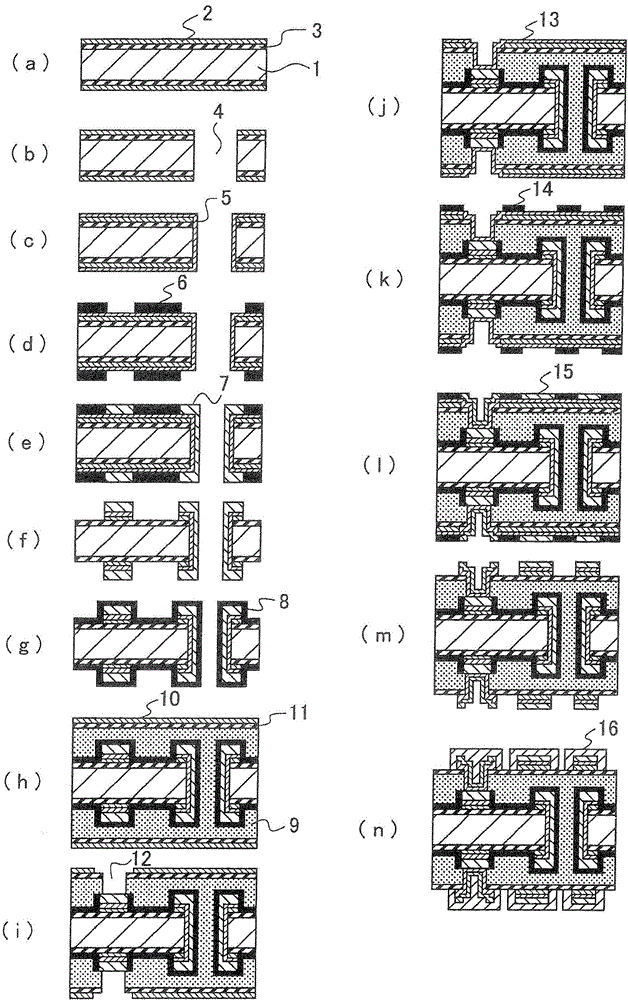
图1是表示本发明的印刷配线板的一例制造工序的剖面图。FIG. 1 is a cross-sectional view showing an example of the manufacturing process of the printed wiring board of the present invention.
图2是连接可靠性的评价用基板的剖面图。2 is a cross-sectional view of a substrate for evaluation of connection reliability.
具体实施方式Detailed ways
本发明的一实施方式是关于一种附有粘着辅助剂的金属箔,其是在表面的十点平均粗糙度为Rz=2.0μm以下的金属上具有厚度0.1~10μm的粘着辅助剂层,该粘着辅助剂层是由含有(A)环氧树脂及(C)环氧树脂固化剂的粘着辅助剂组合物构成,该(A)成分选自酚醛清漆型环氧树脂及芳烷基型环氧树脂。One embodiment of the present invention relates to a metal foil with an adhesion aid, which has an adhesion aid layer with a thickness of 0.1 to 10 μm on a metal whose surface has a ten-point average roughness of Rz=2.0 μm or less. The adhesion auxiliary agent layer is composed of an adhesion auxiliary agent composition containing (A) epoxy resin and (C) epoxy resin curing agent, and the (A) component is selected from novolak type epoxy resin and aralkyl type epoxy resin. resin.
金属箔的表面粗糙度是以JISB0601所示的10点平均粗糙度(Rz)为两面均为2.0μm以下。此为电特性上的理由。金属箔无特别限定,例如有铜箔、镍箔、铝箔等。金属箔通常使用铜箔。金属箔为铜箔时,铜箔的制造条件是当硫酸铜浴的情况时,以硫酸50~100g/L、铜30~100g/L、液温20℃~80℃、电流密度0.5~100A/dm2。若为焦磷酸铜浴时,例如焦磷酸钾100~700g/L、铜10~50g/L、液温30℃~60℃、pH8~12、电流密度1~10A/dm2。考虑铜的物性或平滑性可添加各种添加剂。金属箔通常进行被称为粗糙化处理的粗面化处理,但在本发明中未进行实质的粗糙化处理,金属箔无脚。“金属箔无脚”是指金属箔的凹凸较少。若金属箔的凹凸少时,在蚀刻之际,树脂上无电路的部分不会残留铜箔。The surface roughness of the metal foil is 2.0 μm or less on both sides as a 10-point average roughness (Rz) shown in JISB0601. This is because of the electrical characteristics. Metal foil is not particularly limited, and examples thereof include copper foil, nickel foil, aluminum foil, and the like. Copper foil is usually used as the metal foil. When the metal foil is copper foil, the manufacturing conditions of the copper foil are as follows: 50-100g/L sulfuric acid, 30-100g/L copper, 20°C-80°C liquid temperature, and 0.5-100A/ dm 2 . For copper pyrophosphate bath, for example, potassium pyrophosphate 100-700g/L, copper 10-50g/L, liquid temperature 30°C-60°C, pH 8-12, current density 1-10A/dm 2 . Various additives may be added in consideration of physical properties and smoothness of copper. Metal foil is generally subjected to roughening treatment called roughening treatment, but in the present invention, substantial roughening treatment is not performed, and the metal foil has no legs. "Metal foil without legs" means that the metal foil has few irregularities. When the metal foil has few irregularities, the copper foil will not remain on the portion of the resin where there is no circuit at the time of etching.
另外,Rz=2.0μm以下时,也可使用金属箔的未粗糙化处理的光泽面。In addition, when Rz=2.0 micrometers or less, the non-roughened glossy surface of metal foil can also be used.
金属箔的厚度无特别限定。可使用一般印刷配线板用的厚度105μm以下的金属箔。表面粗糙度Rz是两面均为2.0μm以下较佳。The thickness of the metal foil is not particularly limited. Metal foils with a thickness of 105 μm or less for general printed wiring boards can be used. The surface roughness Rz is preferably 2.0 μm or less on both sides.
欲形成微细配线时,金属箔较佳为厚度5μm以下、更佳为3.0μm以下的可剥型,且表面粗糙度Rz为两面均为2.0μm以下较佳。所谓可剥型的金属箔是指具有载体的金属箔,载体可剥离的金属箔。例如,可剥型的极薄铜箔是于厚度10~50μm的载体箔上形成成为剥离层的金属氧化物或有机物层,其上形成厚度0.3~5.0μm的金属箔来制造。金属箔的形成,若为硫酸铜浴时,例如以硫酸50~100g/L、铜30~100g/L、液温20℃~80℃、电流密度0.5~100A/dm2的条件下进行。若为焦磷酸铜浴时,以焦磷酸钾100~700g/L、铜10~50g/L、液温30℃~60℃、pH8~12、电流密度1~10A/dm2的条件进行。这种金属箔用于给电层时,如下述,配线形成性良好。也可使用具有铝载体、镍载体的可蚀刻型的铜箔取代可剥型铜箔。When forming fine wiring, the metal foil is preferably a peelable type with a thickness of 5 μm or less, more preferably 3.0 μm or less, and the surface roughness Rz is preferably 2.0 μm or less on both sides. The so-called peelable metal foil refers to a metal foil having a carrier, and a metal foil in which the carrier can be peeled off. For example, peelable ultra-thin copper foil is manufactured by forming a metal oxide or organic layer as a peeling layer on a carrier foil with a thickness of 10 to 50 μm, and forming a metal foil with a thickness of 0.3 to 5.0 μm thereon. Formation of the metal foil is carried out in a copper sulfate bath, for example, under the conditions of sulfuric acid 50-100g/L, copper 30-100g/L, liquid temperature 20°C-80°C, and current density 0.5-100A/dm 2 . If it is a copper pyrophosphate bath, it is carried out under the conditions of potassium pyrophosphate 100-700g/L, copper 10-50g/L, liquid temperature 30°C-60°C, pH 8-12, and current density 1-10A/dm 2 . When such a metal foil is used for the power feeding layer, the wiring formability is good as described below. An etchable type copper foil having an aluminum carrier, a nickel carrier can also be used instead of a peelable type copper foil.
金属箔的树脂粘着面施予防锈处理较佳。防锈处理可使用镍、锡、锌、铬、钼、钴、这些的氧化物中任一种、或这些的合金进行防锈处理。以选择其中锌及铬的至少一种进行防锈处理较佳。这些可经由溅镀或电镀、化学镀,在金属箔上形成薄膜。从费用方面考量,以电镀为佳。具体而言,对于镀层使用含有镍、锡、锌、铬、钼、钴中的一种以上的金属盐的镀层进行镀敷。由其后的可靠性等的观点来看,以进行含锌的镀敷较佳。为了使金属离子容易析出,可添加必要量的柠檬酸盐、酒石酸盐、氨基磺酸等的络合剂。镀液通常在酸性范围使用,以室温~80℃的温度下进行。镀敷通常选择电流密度0.1~10A/dm2、通电时间1~60秒、较佳为1~30秒的范围。防锈处理金属的量是依金属的种类而异,但合计量较佳为10~2000μg/dm2。防锈处理后的层若过厚时,产生蚀刻阻碍与电特性降低,若过薄时,成为与树脂的剥离强度降低的原因。It is preferable to apply antirust treatment to the resin bonding surface of the metal foil. Antirust treatment can be performed using nickel, tin, zinc, chromium, molybdenum, cobalt, any of these oxides, or these alloys. It is better to select at least one of zinc and chromium for antirust treatment. These can be formed into thin films on metal foils via sputtering or electroplating, electroless plating. Considering the cost, electroplating is better. Specifically, plating is performed using a plating layer containing one or more metal salts selected from nickel, tin, zinc, chromium, molybdenum, and cobalt. From the viewpoint of subsequent reliability and the like, it is preferable to perform plating containing zinc. In order to facilitate the precipitation of metal ions, a necessary amount of complexing agents such as citrate, tartrate, and sulfamic acid can be added. The plating solution is usually used in an acidic range, and is performed at a temperature of room temperature to 80°C. For plating, a current density of 0.1 to 10 A/dm 2 and a energization time of 1 to 60 seconds, preferably 1 to 30 seconds are selected. The amount of antirust metal varies depending on the type of metal, but the total amount is preferably 10-2000 μg/dm 2 . If the layer after antirust treatment is too thick, etching inhibition and electrical characteristics will be lowered, and if it is too thin, it will cause a decrease in peel strength with resin.
对于防锈处理后的层上实施铬酸盐处理较佳。因形成铬酸盐处理层时,可抑制与树脂的剥离强度降低。具体而言,使用含有六价铬离子的水溶液进行铬酸盐处理。铬酸盐处理可为单纯的浸渍处理,但较佳为以阴极处理进行。可在重铬酸钠0.1~50g/L、pH1~13、浴温0~60℃、电流密度0.1~5A/dm2、电解时间0.1~100秒的条件进行。也可使用铬酸或重铬酸钾取代重铬酸钠进行铬酸盐处理。It is preferable to implement chromate treatment on the antirust treated layer. When a chromate treatment layer is formed, it is possible to suppress a decrease in peel strength with resin. Specifically, chromate treatment is performed using an aqueous solution containing hexavalent chromium ions. Chromate treatment may be simple immersion treatment, but is preferably performed by cathodic treatment. It can be carried out under the conditions of sodium dichromate 0.1-50g/L, pH 1-13, bath temperature 0-60°C, current density 0.1-5A/dm 2 , and electrolysis time 0.1-100 seconds. Chromate treatment can also be performed using chromic acid or potassium dichromate instead of sodium dichromate.
金属箔的最外层再吸附硅烷偶合剂较佳。硅烷偶合剂不限下述例,例如3-缩水甘油醚氧丙基三甲氧基硅烷、2-(3,4-环氧基环己基)乙基三甲氧基硅烷等的环氧官能性硅烷、3-氨基丙基三甲氧基硅烷、N-2-(氨基乙基)-3-氨基丙基三甲氧基硅烷、N-2-(氨基乙基)-3-氨基丙基甲基二甲氧基硅烷等的氨基官能性硅烷;乙烯基三甲氧基硅烷、乙烯基苯基三甲氧基硅烷、乙烯基三(2-甲氧乙氧基)硅烷等的烯烃官能性硅烷;3-丙烯酰氧丙基三甲氧基硅烷等的丙烯基官能性硅烷;3-甲基丙烯酰氧丙基三甲氧基硅烷等的甲基丙烯基官能性硅烷;3-巯基丙基三甲氧基硅烷等的巯基官能性硅烷等。若考虑与后面涂布的粘着辅助剂的相容性时,分子内具有环氧基或氨基较佳。It is preferable that the silane coupling agent is adsorbed on the outermost layer of the metal foil. The silane coupling agent is not limited to the following examples, for example, epoxy functional silanes such as 3-glycidyl etheroxypropyltrimethoxysilane, 2-(3,4-epoxycyclohexyl)ethyltrimethoxysilane, 3-aminopropyltrimethoxysilane, N-2-(aminoethyl)-3-aminopropyltrimethoxysilane, N-2-(aminoethyl)-3-aminopropylmethyldimethoxy Amino-functional silanes such as vinyl silane; olefin-functional silanes such as vinyltrimethoxysilane, vinylphenyltrimethoxysilane, vinyltris(2-methoxyethoxy)silane; 3-acryloyloxysilane Acryl-functional silanes such as propyltrimethoxysilane; Methacryl-functional silanes such as 3-methacryloxypropyltrimethoxysilane; Mercapto-functional silanes such as 3-mercaptopropyltrimethoxysilane Sexual silane, etc. When considering the compatibility with the adhesion aid to be applied later, it is better to have an epoxy group or an amino group in the molecule.
这些可单独使用,也可混合多种使用。这些偶合剂是以0.1~15g/L的浓度溶解于水等的溶剂中,以室温~50℃的温度涂布于金属箔,或电极沈积使之吸附。这些硅烷偶合剂是与金属箔表面的防锈金属的羟基产生缩合键形成皮膜。硅烷偶合剂处理后,以加热、紫外线照射等可形成稳定的键。若加热时,以100~200℃的温度干燥2~60秒钟。若以紫外线照射时,以200~400nm、200~2500mJ/cm2的范围内进行。These may be used individually or in mixture of multiple types. These coupling agents are dissolved in solvents such as water at a concentration of 0.1 to 15 g/L, and are coated on metal foil at a temperature of room temperature to 50° C., or deposited on electrodes for adsorption. These silane coupling agents generate a condensation bond with the hydroxyl groups of the antirust metal on the surface of the metal foil to form a film. After treatment with silane coupling agent, stable bonds can be formed by heating, ultraviolet radiation, etc. If heated, dry at a temperature of 100-200°C for 2-60 seconds. When irradiating with ultraviolet rays, it is carried out in the range of 200-400nm, 200-2500mJ/cm 2 .
硅烷偶合剂处理后的铜箔上涂布以环氧树脂为必须成分的粘着辅助剂较佳。涂布的厚度较佳为0.1~10μm。未达0.1μm时,有时不具粘着補助效果,另外超过10μm时,有助于粘着力,但是会使耐热性或介电特性、持续可靠性、尺寸稳定性等层间绝缘材料所具有的特征降低,因此不理想。此处使用的层间绝缘材料是指使玻璃布基材含浸高Tg环氧树脂或聚酰亚胺树脂、氰酸酯树脂的预浸体,此乃是因为相较于层间绝缘材料,粘着辅助剂的Tg较低,热膨胀率较大,介电率较高的缘故。涂布的厚度更佳为0.1~5.0μm。在0.1~5.0μm的范围时,层间绝缘材料所具有的耐热性或介电特性等特征几乎不会降低。It is preferable to coat the copper foil treated with the silane coupling agent with an adhesion aid containing epoxy resin as an essential component. The coating thickness is preferably from 0.1 to 10 μm. When the thickness is less than 0.1 μm, there may be no adhesion support effect, and when it exceeds 10 μm, it contributes to the adhesion force, but the characteristics of interlayer insulating materials such as heat resistance, dielectric properties, continuous reliability, and dimensional stability will be degraded. reduced, so it is not ideal. The interlayer insulating material used here refers to a prepreg in which a glass cloth base material is impregnated with a high Tg epoxy resin, polyimide resin, or cyanate resin. The Tg of the agent is low, the thermal expansion rate is large, and the dielectric constant is high. The coating thickness is more preferably from 0.1 to 5.0 μm. In the range of 0.1 to 5.0 μm, characteristics such as heat resistance and dielectric properties of the interlayer insulating material hardly deteriorate.
粘着辅助剂组合物所含有的(A)环氧树脂是选自酚醛清漆型环氧树脂及芳烷基型环氧树脂。The (A) epoxy resin contained in the adhesion adjuvant composition is selected from novolak type epoxy resins and aralkyl type epoxy resins.
酚醛清漆型环氧树脂无特别限定,以具有联苯构造的酚醛清漆型环氧树脂为佳。具有联苯构造的酚醛清漆型环氧树脂是指分子中含有联苯衍生物的芳香族环的酚醛清漆型环氧树脂,例如下式(1)The novolak-type epoxy resin is not particularly limited, but a novolak-type epoxy resin having a biphenyl structure is preferable. The novolak type epoxy resin with biphenyl structure refers to the novolak type epoxy resin containing the aromatic ring of biphenyl derivatives in the molecule, such as the following formula (1)

(式中p表示1~5)所示的环氧树脂。这些可单独、或组合二种以上使用。(wherein p represents 1 to 5) the epoxy resin represented. These can be used individually or in combination of 2 or more types.
市售品例如有日本化药股份有限公司制的NC-3000S(p为平均1.7的式(1)的环氧树脂)、NC-3000S-H(p为平均2.8的式(1)的环氧树脂)。Commercially available products include, for example, NC-3000S (an epoxy resin of the formula (1) whose p is an average of 1.7) and NC-3000S-H (an epoxy resin of the formula (1) whose p is an average of 2.8) manufactured by Nippon Kayaku Co., Ltd. resin).
芳烷基型环氧树脂是以式(2)表示。此处X及Y是表示苯环、萘环、联苯结构等的芳香环,另外X及Y的芳香环的氢原子可被取代。取代基例如有甲基、乙基、丙基、苯基。q为重复单元,其数无特别限定。The aralkyl type epoxy resin is represented by formula (2). Here, X and Y represent aromatic rings such as a benzene ring, a naphthalene ring, and a biphenyl structure, and the hydrogen atoms of the aromatic rings of X and Y may be substituted. Substituents are, for example, methyl, ethyl, propyl, phenyl. q is a repeating unit, and its number is not particularly limited.

芳烷基型环氧树脂的具体例不限于下述例,例如有式3~5的化合物。Specific examples of the aralkyl type epoxy resin are not limited to the following examples, for example, there are compounds of formulas 3-5.
式3:Formula 3:

(式中,r为1~5)。(wherein, r is 1 to 5).
特别是分子中含有联苯结构等的芳香环的环氧树脂(式4):Especially epoxy resins containing aromatic rings such as biphenyl structures in the molecule (Formula 4):

(式中,s为1~5)或分子中含有萘结构的芳香环的环氧树脂(式5):(wherein, s is 1~5) or the epoxy resin (formula 5) that contains the aromatic ring of naphthalene structure in the molecule:

(式中,t为1~5),这些环氧树脂对金属箔的拉剥离强度或耐热性有益,因此有效。(In the formula, t is 1 to 5), since these epoxy resins are beneficial to the tensile peel strength and heat resistance of the metal foil, they are effective.
这些树脂可单独或混合2种以上使用。另外,使用芳烷基型环氧树脂时,在环氧树脂的总量的50重量%以下的范围内,可并用双酚A型环氧树脂、苯酚酚醛清漆型环氧树脂、橡胶改性环氧树脂等其他环氧树脂。These resins can be used individually or in mixture of 2 or more types. In addition, when using an aralkyl type epoxy resin, bisphenol A type epoxy resin, phenol novolak type epoxy resin, rubber modified ring, etc. can be used in combination within the range of 50% by weight or less of the total epoxy resin Oxygen resin and other epoxy resins.
芳烷基型环氧树脂的市售品不限于下述例,例如有三井化学股份有限公司制的EXL-3L或日本化药股份有限公司制的NC-3000S、NC-3000S-H、新日铁化学股份有限公司制的ESN-170、ESN-480。Commercially available aralkyl type epoxy resins are not limited to the following examples, for example, EXL-3L manufactured by Mitsui Chemicals Co., Ltd. or NC-3000S, NC-3000S-H, Shinichi Chemical Co., Ltd. manufactured by Nippon Kayaku Co., Ltd. ESN-170 and ESN-480 manufactured by Iron Chemical Co., Ltd.
另外,(A)成分可含有橡胶改性环氧树脂。橡胶改性环氧树脂只要是粘着剂用或涂料用的市售的制品,即可使用。Moreover, (A) component may contain a rubber-modified epoxy resin. Any commercially available rubber-modified epoxy resin may be used as long as it is used for adhesives or paints.
市售品不限于下述例,例如有大日本油墨股份有限公司制的EPICLON TSR-960或东都化成股份有限公司制的EPOTOHTO YR-102或Sumiepoxy ESC-500等。Commercially available products are not limited to the following examples, for example, Epiclon TSR-960 manufactured by Dainippon Ink Co., Ltd., EPOTOHTO YR-102 or Sumiepoxy ESC-500 manufactured by Tohto Kasei Co., Ltd., and the like.
(A)成分中可含有酚醛清漆型环氧树脂及橡胶改性环氧树脂。橡胶改性环氧树脂的含量是全环氧树脂的10~80重量%。使用橡胶改性环氧树脂时,可提高对未粗糙化处理的金属箔表面的粘着性。未达10重量%时,无法充分发挥其效果,超过80重量%时,耐热性差。30~70重量%更佳。(A) The component may contain a novolak-type epoxy resin and a rubber-modified epoxy resin. The content of the rubber-modified epoxy resin is 10-80% by weight of the total epoxy resin. Adhesion to unroughened metal foil surfaces is improved when rubber-modified epoxies are used. When it is less than 10% by weight, the effect cannot be sufficiently exhibited, and when it exceeds 80% by weight, heat resistance is poor. 30 to 70% by weight is more preferable.
另外,橡胶改性环氧树脂可使用两种以上,其总量必须在上述的重量%范围内。In addition, two or more types of rubber-modified epoxy resins can be used, and the total amount must be within the above-mentioned range of weight %.
粘着辅助剂组合物中含有(B)可化学粗糙化的高分子较佳。(B)成分例如有交联橡胶粒子及聚乙烯醇缩醛树脂类。It is preferable to contain (B) a chemically roughenable polymer in the adhesion aid composition. The component (B) includes, for example, crosslinked rubber particles and polyvinyl acetal resins.
交联橡胶粒子较佳为选自丙烯腈丁二烯橡胶粒子、羧酸改性丙烯腈丁二烯橡胶粒子、丁二烯橡胶-丙烯酸树脂的核壳粒子中的至少一种。The crosslinked rubber particles are preferably at least one selected from the group consisting of acrylonitrile butadiene rubber particles, carboxylic acid modified acrylonitrile butadiene rubber particles, and butadiene rubber-acrylic resin core-shell particles.
丙烯腈丁二烯橡胶粒子是指丙烯腈、丁二烯共聚,且于共聚阶段产生部分交联,形成粒子状的粒子。另外,其与丙烯酸、甲基丙烯酸等的羧酸一同共聚也可得到羧酸改性丙烯腈丁二烯橡胶粒子。丁二烯橡胶-丙烯酸树脂的核壳粒子是以乳化聚合使丁二烯粒子聚合,接着添加丙烯酸酯、丙烯酸等的单体,继续聚合的二阶段的聚合方法也可获得。粒子的大小可以一次平均粒径计形成为50nm~1μm。这些可单独或组合二种以上使用。Acrylonitrile butadiene rubber particles refer to copolymerization of acrylonitrile and butadiene, and partial crosslinking occurs in the copolymerization stage to form particle-like particles. In addition, carboxylic acid-modified acrylonitrile butadiene rubber particles can also be obtained by co-polymerizing with carboxylic acids such as acrylic acid and methacrylic acid. The core-shell particles of butadiene rubber-acrylic resin can also be obtained by a two-stage polymerization method in which butadiene particles are polymerized by emulsion polymerization, followed by addition of monomers such as acrylate and acrylic acid, and the polymerization is continued. The size of the particles may be 50 nm to 1 μm in terms of primary average particle diameter. These can be used individually or in combination of 2 or more types.
羧酸改性丙烯腈丁二烯橡胶粒子的市售品,不限于下述例,例如有日本合成橡胶股份有限公司制的XER-91。另外丁二烯橡胶-丙烯酸树脂的核壳粒子不限于下述例,例如有Rohm and Haas JAPAN股份有限公司制的EXL-2655或武田药品工业股份有限公司的AC-3832。Commercially available carboxylic acid-modified acrylonitrile butadiene rubber particles are not limited to the following examples, for example, there is XER-91 manufactured by Nippon Synthetic Rubber Co., Ltd. In addition, the core-shell particles of butadiene rubber-acrylic resin are not limited to the following examples, for example, EXL-2655 manufactured by Rohm and Haas JAPAN Co., Ltd. or AC-3832 manufactured by Takeda Pharmaceutical Co., Ltd.
聚乙烯醇缩醛树脂类是选自聚乙烯醇缩醛树脂及羧酸改性聚乙烯醇缩醛树脂中的至少一种较佳。The polyvinyl acetal resins are preferably at least one selected from polyvinyl acetal resins and carboxylic acid-modified polyvinyl acetal resins.
聚乙烯醇缩醛树脂类的种类、羟基量、乙酰基量无特别限定,聚合度较佳为1000~2500。在此范围内可确保耐焊热性,且清漆粘度、操作性良好。聚乙烯醇缩醛树脂的数均聚合度是可由例如其原料的聚乙酸乙烯酯的数均分子量(基于凝胶渗透色谱法的使用标准聚苯乙烯的标准曲线来测定)来决定。也可使用羧酸改性物等。The type, amount of hydroxyl groups, and amount of acetyl groups of polyvinyl acetal resins are not particularly limited, but the degree of polymerization is preferably 1000-2500. Within this range, solder heat resistance can be ensured, and varnish viscosity and workability are good. The number-average degree of polymerization of polyvinyl acetal resin can be determined, for example, from the number-average molecular weight (measured by gel permeation chromatography using a calibration curve of standard polystyrene) of polyvinyl acetate as its raw material. Carboxylic acid modified products and the like can also be used.
聚乙烯醇缩醛树脂类是不限于下述例,例如有积水化学工业(股)制的商品名,S-LEC BX-1、BX-2、BX-5、BX-55、BX-7、BH-3、BH-S、KS-3Z、KS-5、KS-5Z、KS-8、KS-23Z、电气化学工业(股)制的商品名,Denkabutyral4000-2、5000A、6000C、6000EP等。(B)成分可单独或混合2种以上使用。The polyvinyl acetal resins are not limited to the following examples, for example, there are trade names manufactured by Sekisui Chemical Co., Ltd., S-LEC BX-1, BX-2, BX-5, BX-55, BX-7 , BH-3, BH-S, KS-3Z, KS-5, KS-5Z, KS-8, KS-23Z, trade names manufactured by Denki Chemical Industry Co., Ltd., Denkabutyral4000-2, 5000A, 6000C, 6000EP, etc. . (B) The component can be used individually or in mixture of 2 or more types.
并用交联橡胶粒子及聚乙烯醇缩醛树脂类作为(B)成分时,可提高金属箔的拉剥离强度或化学粗糙化后的化学镀层的拉剥离强度。When crosslinked rubber particles and polyvinyl acetal resins are used together as the (B) component, the pull-off strength of the metal foil or the pull-off strength of the electroless plating layer after chemical roughening can be improved.
粘着辅助剂组合物中,相对于(A)成分100重量份时,(B)成分为0.5~25重量份较佳。(B)成分低于0.5重量份时,剥离强度或化学粗糙化后的化学镀的剥离强度有降低的倾向。另外超过25重量份时,耐焊热性等或绝缘可靠性有降低的倾向。特别是交联橡胶粒子及聚乙烯醇缩醛树脂分别为1重量份以上时,可提高金属箔的拉剥离强度或化学粗糙化后的化学镀层的拉剥离强度。如果未添加(B)成分,仅以偶合剂处理时,剥离强度较低。In the adhesion adjuvant composition, when (B) component is 0.5-25 weight part with respect to 100 weight part of (A) component, it is preferable. (B) When component is less than 0.5 weight part, peeling strength and the peeling strength of the electroless plating after chemical roughening tend to fall. Moreover, when it exceeds 25 weight part, there exists a tendency for a solder heat resistance etc. and insulation reliability to fall. In particular, when the cross-linked rubber particles and the polyvinyl acetal resin are each at 1 part by weight or more, the pull-off strength of the metal foil or the pull-off strength of the electroless plating layer after chemical roughening can be improved. If the component (B) is not added, the peel strength is low when it is only treated with a coupling agent.
(C)环氧树脂固化剂根据(A)成分适当选择。例如有(A)成分为酚醛清漆型环氧树脂时,(C)成分为含有清漆型酚醛树脂较佳,含三嗪环的清漆型酚醛树脂更佳。因为可提高金属箔的拉剥离强度或化学粗糙化后的化学镀层的拉剥离强度。(A)成分为芳烷基型环氧树脂时,(C)成分为含有具有酚性羟基的芳烷基型环氧树脂较佳。(C) The epoxy resin hardening agent is selected suitably according to (A) component. For example, when the component (A) is a novolak-type epoxy resin, the component (C) is preferably a novolac-type phenolic resin containing a triazine ring, and more preferably a novolac-type phenolic resin containing a triazine ring. Because it can improve the pull-off strength of the metal foil or the pull-off strength of the electroless plating layer after chemical roughening. When (A) component is an aralkyl type epoxy resin, it is preferable that (C) component is an aralkyl type epoxy resin containing a phenolic hydroxyl group.
含三嗪环的清漆型酚醛树脂是表示清漆型酚醛树脂的主链上含有三嗪环的清漆型酚醛树脂,也可为含有三嗪环的甲酚清漆型酚醛树脂。含氮量是在含有三嗪环的清漆型酚醛树脂中,较佳为10~25重量%,更佳为12~19重量%。分子中的含氮量在此范围时,介电损耗不会太大,粘着辅助剂为清漆时,溶剂中的溶解度适当,可抑制未溶解物的残留量。可使用含有三嗪环的清漆型酚醛树脂的数均分子量较佳为300~1000,更佳为500~600。这些可单独或组合2种以上使用。The triazine-ring-containing novolak-type phenolic resin means a varnish-type phenolic resin containing a triazine ring in the main chain of the varnish-type phenolic resin, and may also be a cresol novolak-type phenolic resin containing a triazine ring. The nitrogen content is preferably from 10 to 25% by weight, more preferably from 12 to 19% by weight, in the varnish-type phenolic resin containing a triazine ring. When the nitrogen content in the molecule is within this range, the dielectric loss will not be too large. When the adhesion aid is varnish, the solubility in the solvent is appropriate, and the residual amount of undissolved matter can be suppressed. The number average molecular weight of the varnish type phenolic resin which can be used containing a triazine ring is preferably 300-1000, more preferably 500-600. These can be used individually or in combination of 2 or more types.
含有三嗪环的清漆型酚醛树脂是将苯酚与醛、含有三嗪环的化合物在pH5~9的条件下反应制得。使用甲酚取代苯酚时,成为含有三嗪环的甲酚清漆型酚醛树脂。甲酚可使用邻、间、对-甲酚中任一种,而含有三嗪环的化合物可使用三聚氰胺、鸟粪胺及其衍生物、三聚氰酸及其衍生物。The varnish-type phenolic resin containing triazine rings is prepared by reacting phenol with aldehydes and compounds containing triazine rings under the condition of pH 5-9. When cresol is used instead of phenol, it becomes a cresol novolak type phenolic resin containing a triazine ring. As the cresol, any one of o-, m-, and p-cresol can be used, and as the compound containing a triazine ring, melamine, guanamine and its derivatives, cyanuric acid and its derivatives can be used.
市售品不限于下述例,例如有大日本油墨化学工业(股)制的含有三嗪环的甲酚清漆型酚醛树脂Phenolite EXB-9829(氮含量18重量%),LA-3018(氮含量18重量%)。Commercially available products are not limited to the following examples, for example, there are triazine ring-containing cresol novolak type phenolic resin Phenolite EXB-9829 (
具有酚性羟基的芳烷基型树脂是以式(6)表示。这里X及Y是表示苯环、萘环、联苯结构等的芳香环,另外X及Y的芳香环的氢原子可被取代。取代基例如有甲基、乙基、丙基、苯基。q为重复单元,其数无特别限定。The aralkyl resin having a phenolic hydroxyl group is represented by formula (6). Here, X and Y represent aromatic rings such as a benzene ring, a naphthalene ring, and a biphenyl structure, and the hydrogen atoms of the aromatic rings of X and Y may be substituted. Substituents are, for example, methyl, ethyl, propyl, phenyl. q is a repeating unit, and its number is not particularly limited.

具有酚性羟基的芳烷基型树脂的具体例不限于下述例,例如有式7~9的化合物。Specific examples of the aralkyl resin having a phenolic hydroxyl group are not limited to the following examples, for example, there are compounds of formulas 7-9.
式7:Formula 7:

(式中,r为1~5)。特别是分子中含有联苯结构等的芳香环的苯酚树脂(式8):(wherein, r is 1 to 5). In particular, phenol resins containing aromatic rings such as biphenyl structures in the molecule (formula 8):
(式中,s为1~5)或含有萘结构的芳香环的萘酚树脂(式9):(wherein, s is 1~5) or the naphthol resin (formula 9) containing the aromatic ring of naphthalene structure:

(式中,t为1~5),金属箔的拉剥离强度或耐热性优异,因此是有效的。这些树脂可单独或混合2种以上使用。另外(C)成分使用芳烷基型树脂时,在50重量%以下的范围内,可并用双酚A等二官能酚或清漆型酚醛树脂、氨基树脂等其他环氧树脂固化剂。(In the formula, t is 1 to 5), since the tensile peel strength and heat resistance of the metal foil are excellent, it is effective. These resins can be used individually or in mixture of 2 or more types. In addition, when an aralkyl type resin is used as the component (C), other epoxy resin curing agents such as difunctional phenols such as bisphenol A or novolak-type phenolic resins and amino resins may be used in combination within a range of 50% by weight or less.
具有酚性羟基的芳烷基型树脂的市售品不限于下述例,例如有三井化学股份有限公司制XLC-3L、明和化成股份有限公司制HEM-7851、新日铁化学股份有限公司制SN-170、SN-480等。Commercially available aralkyl resins having phenolic hydroxyl groups are not limited to the following examples, for example, XLC-3L manufactured by Mitsui Chemicals Co., Ltd., HEM-7851 manufactured by Meiwa Chemicals Co., Ltd., Nippon Steel Chemical Co., Ltd. SN-170, SN-480, etc.
具有上述酚性羟基的含三嗪环的清漆型酚醛树脂与上述具有酚性羟基的芳烷基型树脂并用作为(C)成分较佳。因为可提高金属箔的拉剥离强度。具有酚性羟基的含三嗪环的清漆型酚醛树脂的添加量是在环氧树脂固化剂中,为3~50当量%时,在维持耐热性的状态下,可提高金属箔的拉剥离强度。It is preferable to use together the triazine ring-containing novolac type phenolic resin which has the said phenolic hydroxyl group, and the said aralkyl type resin which has the said phenolic hydroxyl group as (C)component. Because the tensile peel strength of the metal foil can be improved. The addition amount of the varnish-type phenolic resin containing a triazine ring having a phenolic hydroxyl group is in the epoxy resin curing agent. When it is 3 to 50 equivalent%, the pulling and peeling of the metal foil can be improved while maintaining the heat resistance. strength.
(C)成分的配合量是(A)~(C)成分的重量合计中,较佳为5~19重量%,更佳为6~11重量%。The compounding quantity of (C)component is preferably 5-19 weight% in the total weight of (A)-(C)component, More preferably, it is 6-11 weight%.
另外粘着辅助剂组合物中可含有(D)反应促进剂。(D)成分可使用各种成分,但是较佳为潜在性热固化剂的各种咪唑类或BF3胺络合物。由粘着辅助剂的保存稳定性、B阶段时的操作性及耐焊热性的观点而言,以2-苯基咪唑、2-乙基-4-甲基咪唑、1-氰基乙基-2-苯基咪唑鎓偏苯三酸酯为佳。In addition, the (D) reaction accelerator may be contained in the adhesion adjuvant composition. (D) Various components can be used for the component, but various imidazoles or BF 3 amine complexes of latent thermosetting agents are preferable. From the standpoint of the storage stability of the adhesion aid, the operability at the B stage, and the solder heat resistance, 2-phenylimidazole, 2-ethyl-4-methylimidazole, 1-cyanoethyl- 2-Phenylimidazolium trimellitate is preferred.
(D)成分的配合量是相对于粘着辅助剂中的(A)环氧树脂100重量份时,含有0.1~5重量份为佳,0.3~1重量份范围更佳。在此范围内时,可得到充分的耐焊热性、良好的粘着辅助剂的保存稳定性及B阶段时的良好的操作性。The amount of the component (D) is preferably 0.1 to 5 parts by weight, more preferably 0.3 to 1 part by weight, based on 100 parts by weight of the (A) epoxy resin in the adhesion adjuvant. Within this range, sufficient solder heat resistance, good storage stability of the adhesion aid, and good handleability at the B stage can be obtained.
另外,在粘着辅助剂中为了提高阻燃性可含有(E)阻燃剂。(E)成分有溴类阻燃剂或磷类阻燃剂,其皆可使用。In addition, (E) a flame retardant may be contained in the adhesion adjuvant in order to improve flame retardancy. The component (E) includes a bromine-based flame retardant or a phosphorus-based flame retardant, and any of them can be used.
较佳为(E)成分是式(10)所示的含酚性羟基的磷化合物。It is preferable that (E) component is a phenolic hydroxyl group containing phosphorus compound represented by formula (10).

(式中,v为1时,R4为氢原子、直链状或支链状的烷基、环烷基、芳基或芳烷基,v为2时,各R4是独立的氢原子、直链状或支链状的烷基、环烷基、芳基或芳烷基,或二个R4是分别与键结的碳原子共同形成未取代或经烷基或环烷基所取代的苯环,w为2以上的自然数)表示的含酚性羟基的磷化合物。这些可单独一种或组合2种以上使用。(wherein, when v is 1, R is a hydrogen atom, linear or branched alkyl, cycloalkyl, aryl or aralkyl, and when v is 2, each R is an independent hydrogen atom , linear or branched alkyl, cycloalkyl, aryl or aralkyl, or two R 4 are respectively combined with the bonded carbon atoms to form unsubstituted or substituted by alkyl or cycloalkyl A phenolic hydroxyl-containing phosphorus compound represented by a benzene ring, w being a natural number of 2 or more. These can be used individually by 1 type or in combination of 2 or more types.
式(10)中,R4为直链状或支链状烷基时,以C1~C6烷基为佳,在环烷基时,以C6~C8环烷基为佳。在芳基时,以苯基为佳,在芳烷基时,以C7~C10芳烷基为佳。W为2较佳。式(10)中,v为2,且二个R4是分别与键结的碳原子共同形成未取代或经烷基或环烷基所取代的苯环时,以未取代或经C1~C4烷基或C6~C8环烷基所取代的苯环为佳。In formula (10), when R 4 is a linear or branched alkyl group, it is preferably a C 1 -C 6 alkyl group, and when it is a cycloalkyl group, it is preferably a C 6 -C 8 cycloalkyl group. In case of aryl group, phenyl group is preferred, and in case of aralkyl group, C 7 -C 10 aralkyl group is preferred. W is preferably 2. In formula (10), when v is 2, and the two R 4 are respectively combined with the bonded carbon atoms to form an unsubstituted or substituted benzene ring with an alkyl or cycloalkyl group, the unsubstituted or substituted C 1 to A benzene ring substituted by a C 4 alkyl group or a C 6 -C 8 cycloalkyl group is preferred.
具体而言,式(11)或式(12):Specifically, formula (11) or formula (12):

(式中,R5为氢原子、甲基、乙基、正丙基、异丙基、正丁基、异丁基、仲丁基、叔丁基或环己基)表示的磷化合物。(wherein, R 5 is a hydrogen atom, methyl, ethyl, n-propyl, isopropyl, n-butyl, isobutyl, sec-butyl, tert-butyl or cyclohexyl) a phosphorus compound represented.
特别理想的为10-(2,5-二羟基苯基)-9,10-二氢-9-氧杂-10-磷菲-10-氧化物及其衍生物。Particularly desirable are 10-(2,5-dihydroxyphenyl)-9,10-dihydro-9-oxa-10-phosphophenanthrene-10-oxide and derivatives thereof.
磷系阻燃剂的市售品不限于下述例,例如有东都化成制FX-305、三光股份有限公司制的HCA-HQ。Commercially available phosphorus flame retardants are not limited to the following examples, for example, FX-305 manufactured by Tohto Kasei and HCA-HQ manufactured by Sanko Co., Ltd. are available.
粘着辅助剂组合物中的(A)成分的主成分为酚醛清漆型环氧树脂,(E)成分为含酚性羟基的磷化合物时,(E)成分的配合量是以(A)~(D)成分的重量合计中,以磷原子换算为1.5~3.5重量%的范围较佳,1.8~2.5重量%的范围更佳。配合量若在此范围时,阻燃性为良好,绝缘可靠性优异,且固化涂膜的Tg也不会太低。When the main component of the component (A) in the adhesion aid composition is a novolak type epoxy resin, and the component (E) is a phosphorus compound containing a phenolic hydroxyl group, the compounding amount of the component (E) is in the range of (A) to ( D) The total weight of the components is preferably in the range of 1.5 to 3.5% by weight and more preferably in the range of 1.8 to 2.5% by weight in terms of phosphorus atoms. When the compounding amount is within this range, the flame retardancy is good, the insulation reliability is excellent, and the Tg of the cured coating film is not too low.
粘着辅助剂的(A)成分的主成分为芳烷基型环氧树脂时,(E)成分的配合量是(A)~(E)成分及后述的(F)无机填充剂的重量合计中,以溴原子换算为1.0~10重量%,以磷原子换算为1.0~3.5重量%的范围较佳。When the main component of component (A) of the adhesion aid is an aralkyl type epoxy resin, the compounding amount of component (E) is the total weight of components (A) to (E) and (F) inorganic filler described later Among them, the range of 1.0 to 10% by weight in terms of bromine atoms, and 1.0 to 3.5% by weight in terms of phosphorus atoms is preferable.
另外粘着辅助剂组合物中,为了提高可靠性,可含有(F)无机充填剂。In addition, the adhesion aid composition may contain (F) an inorganic filler in order to improve reliability.
(F)成分不限于下述例,例如有氧化硅、熔融氧化硅、滑石、氧化铝、氢氧化铝、硫酸钡、氢氧化钙、氧溶胶及碳酸钙。(F)成分包含为了提高分散性等的目的,将其以硅烷偶合剂等各种偶合剂进行处理的无机充填剂。这些可单独或组合二种以上使用。从介电特性或低热膨胀观点而言,以氧化硅为佳。(F) The component is not limited to the following examples, for example, there are silica, fused silica, talc, alumina, aluminum hydroxide, barium sulfate, calcium hydroxide, oxygen sol, and calcium carbonate. The component (F) contains an inorganic filler treated with various coupling agents such as a silane coupling agent for the purpose of improving dispersibility or the like. These can be used individually or in combination of 2 or more types. From the viewpoint of dielectric properties or low thermal expansion, silicon oxide is preferable.
(F)成分的配合量是(A)成分的主成分为酚醛清漆型环氧树脂时,在(A)~(E)成分的容积合计中,以5~35容积%的范围为佳,10~30容积%更佳。(A)成分的主成分为芳烷基型环氧树脂时,配合量是以5~35容积%的范围为佳,10~30容积%更佳。配合量若在此范围时,热膨胀系数与介电损耗不会变大,若在内层电路上形成绝缘层时,可得到充分的流动。若将无机充填剂分散于本发明的粘着辅助剂中时,可使用例如使用捏和机、球磨机、珠粒磨机、三辊等已知的混炼方法。The compounding quantity of (F) component is when the main component of (A) component is a novolac type epoxy resin, in the total volume volume of (A)-(E) component, it is preferable to be in the range of 5-35 volume %, 10 ~30% by volume is more preferred. When the main component of the component (A) is an aralkyl type epoxy resin, the compounding quantity is preferably in the range of 5 to 35 volume%, more preferably 10 to 30 volume%. If the compounding amount is within this range, the thermal expansion coefficient and dielectric loss will not increase, and sufficient flow can be obtained when an insulating layer is formed on the inner layer circuit. When dispersing the inorganic filler in the adhesion adjuvant of the present invention, for example, a known kneading method using a kneader, a ball mill, a bead mill, or a three-roller can be used.
另外,在粘着辅助剂组合物中,必要时可添加颜料、流平剂、消泡剂、离子捕捉剂等添加剂。In addition, additives such as pigments, leveling agents, defoamers, and ion scavengers may be added to the adhesion adjuvant composition as necessary.
如上述制作的粘着辅助剂是于溶剂中稀释作成清漆,涂布于铜箔上。溶剂不限定于下述例,例如有丙酮、甲基乙基酮、环己酮等的酮类、苯、二甲苯、甲苯等芳香族烃类、乙二醇单乙醚等的醇类、乙基乙氧基丙酸酯等的酯类、N,N-二甲基甲酰胺、N,N-二甲基乙酰胺等酰胺类。这些溶剂可单独或混合二种以上使用。溶剂相对于粘着辅助剂的使用量并无特别限定,可为以往所使用的量。The adhesion aid prepared as above is diluted in a solvent to make a varnish and coated on the copper foil. The solvent is not limited to the following examples, for example, ketones such as acetone, methyl ethyl ketone, and cyclohexanone, aromatic hydrocarbons such as benzene, xylene, and toluene, alcohols such as ethylene glycol monoethyl ether, ethyl alcohol, etc. Esters such as ethoxypropionate and amides such as N,N-dimethylformamide and N,N-dimethylacetamide. These solvents can be used alone or in combination of two or more. The usage-amount of a solvent with respect to an adhesion adjuvant is not specifically limited, The conventionally used amount may be sufficient.
将粘着辅助剂组合物或上述清漆,涂布于铜箔的单面,经半固化可形成附有粘着辅助剂的金属箔。Apply the adhesion aid composition or the above-mentioned varnish to one side of the copper foil, and semi-cure to form the metal foil with the adhesion aid.
将粘着辅助剂组合物形成清漆,以双辊筒涂布机(Comma coater)或凹板涂布机涂布于金属箔时,调整溶剂使用量,使粘着辅助剂的全固形成分成为10~30重量%较佳,也可配合薄膜形成用的设备调整份量。When forming a varnish from the adhesion aid composition and coating it on metal foil with a comma coater or a gravure coater, adjust the amount of solvent used so that the total solid content of the adhesion aid is 10 to 30 The weight % is preferable, and the amount can be adjusted according to the equipment for film formation.
使用如上述的附有粘着辅助剂的金属箔的基板是将附有粘着辅助剂的金属箔的粘着辅助剂层成为预浸体侧,然后将附有粘着辅助剂的金属箔与预浸体使用常用方法层合一体化所得。根据上述方法可形成2层的层合板。在此层合板上形成使用常用方法形成电路得到印刷配线板。The substrate using metal foil with adhesion aid as above is to use the adhesion aid layer of the metal foil with adhesion aid as the prepreg side, and then use the metal foil with adhesion aid and the prepreg It is obtained by lamination and integration by common methods. According to the method described above, a two-layer laminate can be formed. A circuit is formed on this laminate using a usual method to obtain a printed wiring board.
上述制作的层合板作为内层板时,导体电路的表面粗糙度为Rz=2.0μm以下,内层板的绝缘层的表面粗糙度为Rz=2.0μm以下,对于微细电路的形成性及电特性较佳。When the laminated board produced above is used as an inner layer board, the surface roughness of the conductor circuit is Rz = 2.0 μm or less, and the surface roughness of the insulating layer of the inner layer board is Rz = 2.0 μm or less. better.
将多层化预浸体与附有粘着辅助剂的金属箔重叠,使用常用方法多层化,形成电路可得到多层印刷配线板。上述制作的多层印刷配线板是导体电路的表面粗糙度为Rz=2.0μm以下,内层板的绝缘层的表面粗糙度为Rz=2.0μm以下,对于电特性较佳。A multilayer printed wiring board can be obtained by laminating a multilayered prepreg and a metal foil with an adhesion aid, and multilayering by a common method to form a circuit. The multilayer printed wiring board produced above has a conductor circuit with a surface roughness of Rz = 2.0 μm or less, and an insulating layer of an inner layer board with a surface roughness of Rz = 2.0 μm or less, which are preferable in terms of electrical characteristics.
使用如上述附有粘着辅助剂的金属箔的基板的制造方法如下述。附有粘着辅助剂的金属箔与预浸体使用常用方法层合一体化可得到层合板。图1(a)表示由预浸体1、金属箔2及粘着辅助剂层3所构成的层合板。The manufacturing method of the board|substrate using the metal foil with the said adhesion aid is as follows. The metal foil with the adhesion aid and the prepreg are laminated and integrated by a common method to obtain a laminated board. FIG. 1( a ) shows a laminate composed of a
以下参照图1详细说明本发明的实施方式。An embodiment of the present invention will be described in detail below with reference to FIG. 1 .
首先,制作芯基板。芯基板的制造方法在本发明中并无特别限定。本发明所述的芯基板是形成有用于制作基板的成为中间体的配线的基板。下述是芯基板上形成微细配线方法的一例。芯基板是由绝缘层与金属层所构成,制作此基板时,如图1(a)所示的在预浸体1的两侧制作具有金属箔2的层合板的方法较廉价,因此较佳。附有粘着辅助剂的金属箔的粘着辅助剂层3是配置为面向预浸体1侧。First, a core substrate is produced. The method of manufacturing the core substrate is not particularly limited in the present invention. The core substrate according to the present invention is a substrate on which wirings serving as intermediates for manufacturing substrates are formed. The following is an example of a method for forming fine wiring on a core substrate. The core substrate is composed of an insulating layer and a metal layer. When making this substrate, the method of making a laminate with metal foil 2 on both sides of the
预浸体是使基材含浸或涂布绝缘树脂组合物所形成。基材可使用各种电绝缘材料用层合板中所用的熟知基材。基材的材质不限定下述例,例如E玻璃、D玻璃、S玻璃或Q玻璃等的无机物纤维、聚酰亚胺、聚酯或四氟乙烯等的有机纤维及这些混合物等。A prepreg is formed by impregnating or coating an insulating resin composition on a base material. As the substrate, well-known substrates used in laminates for various electrical insulating materials can be used. The material of the substrate is not limited to the following examples, for example, inorganic fibers such as E glass, D glass, S glass, or Q glass, organic fibers such as polyimide, polyester, or tetrafluoroethylene, and mixtures thereof.
这些基材是具有例如织布、无纺布、粗纱、切碎纱垫、表面平整垫等的形状。基材的材质及形状是依据目的的成形物的用途或性能来选择,视需要可单独或使用二种以上的材质及形状。基材的厚度无特别限制,通常是使用0.03~0.5mm的基材。以硅烷偶合剂等进行表面处理或施以机械开纤处理后的基材从耐热性或耐湿性、加工性方面来看较佳。These substrates are in the shape of, for example, woven fabrics, nonwoven fabrics, rovings, mats of chopped yarn, mats with flat surfaces, and the like. The material and shape of the base material are selected according to the use or performance of the intended molded product. If necessary, one or more materials and shapes can be used. The thickness of the substrate is not particularly limited, but usually a substrate of 0.03 to 0.5 mm is used. A base material subjected to surface treatment with a silane coupling agent or the like or subjected to a mechanical fiber opening treatment is preferable in terms of heat resistance, moisture resistance, and processability.
绝缘树脂组合物可使用作为印刷配线板的绝缘材料用的公知惯用的树脂组合物。通常,耐热性、耐药品性良好的热固化性树脂可作为基质使用。热固化性树脂不限于下述例,例如有酚醛树脂、环氧树脂、氰酸酯树脂、马来酰亚胺树脂、异氰酸酯树脂、氰酸酯酯树脂、苯并环丁烯树脂、乙烯基树脂等。热固化性树脂可单独使用一种,或混合二种以上使用。As an insulating resin composition, the well-known and usual resin composition used as an insulating material of a printed wiring board can be used. Generally, a thermosetting resin having good heat resistance and chemical resistance is used as a matrix. The thermosetting resin is not limited to the following examples, such as phenolic resin, epoxy resin, cyanate resin, maleimide resin, isocyanate resin, cyanate ester resin, benzocyclobutene resin, vinyl resin wait. A thermosetting resin can be used individually by 1 type, or in mixture of 2 or more types.
热固化性树脂中,环氧树脂是耐热性、耐药品性、电特性优良,且较廉价,因此广泛被作为绝缘树脂使用。环氧树脂不限于下述例,例如有双酚A型环氧树脂、双酚F型环氧树脂、双酚S型环氧树脂等的双酚型环氧树脂、苯酚酚醛清漆型环氧树脂、甲酚酚醛清漆型环氧树脂、双酚A型酚醛清漆型环氧树脂等的酚醛清漆型环氧树脂、脂环式环氧树脂、脂肪族链状环氧树脂、双酚的二缩水甘油醚化物、萘二醇的二缩水甘油醚化物、酚类的二缩水甘油醚化物、醇类的二缩水甘油醚化物及这些的烷基取代体、卤化物、氢化物等。环氧树脂可单独使用一种,或可混合使用二种以上。另外,其余与此环氧树脂一起使用的固化剂只要是使环氧树脂固化的固化剂,则无限定。固化剂不限下述例,例如,多官能酚类、多官能醇类、胺类、咪唑化合物、酸酐、有机磷化合物及这些的卤化物等。这些环氧树脂固化剂可单独使用一种,或混合使用二种以上。Among thermosetting resins, epoxy resins are excellent in heat resistance, chemical resistance, and electrical characteristics, and are relatively inexpensive, so they are widely used as insulating resins. Epoxy resins are not limited to the following examples, for example, bisphenol type epoxy resins such as bisphenol A type epoxy resins, bisphenol F type epoxy resins, bisphenol S type epoxy resins, phenol novolac type epoxy resins, etc. Novolac epoxy resins such as cresol novolac epoxy resins, bisphenol A novolac epoxy resins, alicyclic epoxy resins, aliphatic chain epoxy resins, and diglycidyl bisphenols Ether compounds, diglycidyl ether compounds of naphthalene diol, diglycidyl ether compounds of phenols, diglycidyl ether compounds of alcohols, and their alkyl-substituted products, halides, hydrides, etc. One type of epoxy resin may be used alone, or two or more types may be used in combination. In addition, other curing agents used together with this epoxy resin are not limited as long as they cure the epoxy resin. The curing agent is not limited to the following examples, for example, polyfunctional phenols, polyfunctional alcohols, amines, imidazole compounds, acid anhydrides, organophosphorus compounds, and their halides. These epoxy resin curing agents may be used alone or in combination of two or more.
氰酸酯树脂是经由加热产生以三嗪环为重复单元的固化物所得的树脂。固化物的介电特性优良,因此常用于特别要求高频特性的情况等。氰酸酯化合物不限于下述例,例如有2,2-双(4-氰酰苯基)丙烷、双(4-氰酰苯基)乙烷、2,2-双(3,5-二甲基-4-氰酰苯基)甲烷、2,2-双(4-氰酰苯基)-1,1,1,3,3,3-六氟丙烷、α,α‘-双(4-氰酰苯基)-间-二异丙基苯、苯酚酚醛清漆及烷基苯酚酚醛清漆的氰酸酯酯化物等。其中,以2,2-双(4-氰酰苯基)丙烷是固化物的介电特性与固化性的平衡性特别良好,且成本低廉,故较佳,另外,氰酸酯酯化合物可单独使用一种,或混合使用二种以上。另外,此处所用的氰酸酯酯化合物可预先将一部分形成三聚物或五聚物的低聚化。对于氰酸酯树脂可添加固化催化剂或固化促进剂。固化催化剂不限于下述例,例如有锰、铁、钴、镍、铜、锌等的金属类。具体而言,可以2-乙基己酸盐、石油环烷酸盐、辛酸盐等的有机金属盐及乙酰丙酮络合物等的有机金属络合物形态使用。这些可单独使用,或混合二种以上使用。固化促进剂是使用苯酚类为佳,可使用壬基苯酚、对枯基苯酚等的单官能苯酚、或双酚A、双酚F、双酚S等的二官能酚或苯酚酚醛清漆、甲酚酚醛清漆等的多官能酚等。这些可单独使用,或混合二种以上使用。Cyanate resin is a resin obtained by heating to produce a cured product with a triazine ring as a repeating unit. The cured product has excellent dielectric properties, so it is often used when high-frequency properties are particularly required. Cyanate compounds are not limited to the following examples, such as 2,2-bis(4-cyanophenyl)propane, bis(4-cyanophenyl)ethane, 2,2-bis(3,5-bis Methyl-4-cyanophenyl)methane, 2,2-bis(4-cyanophenyl)-1,1,1,3,3,3-hexafluoropropane, α,α'-bis(4 -cyanophenyl)-m-diisopropylbenzene, cyanate esters of phenol novolaks and alkylphenol novolacs, etc. Among them, 2,2-bis(4-cyanophenyl) propane is particularly good in the balance between the dielectric properties and curability of the cured product, and the cost is low, so it is better. In addition, the cyanate ester compound can be used alone Use one kind, or mix and use two or more kinds. In addition, the cyanate ester compound used here may preliminarily oligomerize a part to form a trimer or a pentamer. For cyanate resins, curing catalysts or curing accelerators can be added. The curing catalyst is not limited to the following examples, and examples thereof include metals such as manganese, iron, cobalt, nickel, copper, and zinc. Specifically, it can be used in the form of organometallic complexes such as organic metal salts such as 2-ethylhexanoate, petroleum naphthenate, and octanoate, and acetylacetonate complexes. These can be used individually or in mixture of 2 or more types. It is better to use phenols as the curing accelerator. Monofunctional phenols such as nonylphenol and p-cumylphenol, or difunctional phenols such as bisphenol A, bisphenol F, and bisphenol S, or phenol novolaks and cresols can be used. Polyfunctional phenols such as novolaks, etc. These can be used individually or in mixture of 2 or more types.
作为绝缘材料使用的树脂组合物中,考虑介电特性、耐冲击性、薄膜加工性等,也可掺混热塑性树脂。热塑性树脂不限于下述例,例如有氟树脂、聚亚苯基醚、改性聚亚苯基醚、聚苯硫醚、聚碳酸酯、聚醚酰亚胺、聚醚醚酮、多芳酯、聚酰胺、聚酰胺酰亚胺、聚丁二烯。热塑性树脂可单独使用一种,或混合二种以上使用。In the resin composition used as an insulating material, a thermoplastic resin may be blended in consideration of dielectric properties, impact resistance, film processability, and the like. The thermoplastic resin is not limited to the following examples, such as fluorine resin, polyphenylene ether, modified polyphenylene ether, polyphenylene sulfide, polycarbonate, polyetherimide, polyether ether ketone, polyarylate , polyamide, polyamideimide, polybutadiene. The thermoplastic resins may be used alone or in combination of two or more.
在热塑性树脂中,若添加聚亚苯基醚及改性聚亚苯基醚时,可提高固化物的介电特性,因此是有效的。聚亚苯基醚及改性聚亚苯基醚不限于下述例,例如有聚(2,6-二甲基-1,4-亚苯基)醚、聚(2,6-二甲基-1,4-亚苯基)醚与聚苯乙烯的合金化聚合物、聚(2,6-二甲基-1,4-亚苯基)醚与苯乙烯-丁二烯共聚物的合金化聚合物、聚(2,6-二甲基-1,4-亚苯基)醚与苯乙烯-顺丁烯二酸酐共聚物的合金化聚合物、聚(2,6-二甲基-1,4-亚苯基)醚与聚酰胺的合金化聚合物、聚(2,6-二甲基-1,4-亚苯基)醚与苯乙烯-丁二烯-丙烯腈共聚物的合金化聚合物等。另外,为了将反应性、聚合性赋予聚亚苯基醚时,可于聚合物链终端导入氨基、环氧基、羧基、苯乙烯基、甲基丙烯基等的官能基,或于聚合物链侧链导入氨基、环氧基、羧基、苯乙烯基、甲基丙烯基等的官能基。Addition of polyphenylene ether and modified polyphenylene ether to thermoplastic resins is effective because it improves the dielectric properties of the cured product. Polyphenylene ether and modified polyphenylene ether are not limited to the following examples, such as poly(2,6-dimethyl-1,4-phenylene) ether, poly(2,6-dimethyl -Alloyed polymer of 1,4-phenylene) ether and polystyrene, alloy of poly(2,6-dimethyl-1,4-phenylene) ether and styrene-butadiene copolymer Polymers, alloyed polymers of poly(2,6-dimethyl-1,4-phenylene) ether and styrene-maleic anhydride copolymer, poly(2,6-dimethyl- Alloy polymer of 1,4-phenylene) ether and polyamide, poly(2,6-dimethyl-1,4-phenylene) ether and styrene-butadiene-acrylonitrile copolymer Alloyed polymers, etc. In addition, in order to impart reactivity and polymerizability to polyphenylene ether, functional groups such as amino groups, epoxy groups, carboxyl groups, styryl groups, and methacryl groups can be introduced into the polymer chain terminals, or functional groups such as amino groups can be introduced into the polymer chain terminals. Functional groups such as amino groups, epoxy groups, carboxyl groups, styryl groups, and methacryl groups are introduced into the side chains.
热塑性树脂中,聚酰胺酰亚胺树脂除了耐热性、耐湿性优良外,对于金属的粘着性良好,因此是理想的。聚酰胺酰亚胺的原料是使用酸性成分与胺成分。酸成分不限于下述例,例如有偏苯三酸酐、偏苯三酸酐单氯化物。胺成分不限于下述例,例如有间苯二胺、对苯二胺、4,4’-二氨基二苯醚、4,4’-二氨基二苯基甲烷、双[4-(氨基苯氧基)苯基]砜、2,2’-双[4-(4-氨基苯氧基)苯基]丙烷等。为了提高干燥性,可将聚酰胺酰亚胺树脂进行硅氧烷改性。此时,胺成分可使用硅氧烷二胺。若考虑薄膜加工性时,可使用分子量为5万以上的胺成分。Among thermoplastic resins, polyamide-imide resins are preferable because they are excellent in heat resistance and moisture resistance, and also have good adhesion to metals. The raw materials of polyamideimide are acidic components and amine components. The acid component is not limited to the following examples, for example, trimellitic anhydride and trimellitic anhydride monochloride. The amine component is not limited to the following examples, such as m-phenylenediamine, p-phenylenediamine, 4,4'-diaminodiphenyl ether, 4,4'-diaminodiphenylmethane, bis[4-(aminobenzene oxy)phenyl]sulfone, 2,2'-bis[4-(4-aminophenoxy)phenyl]propane, etc. To improve drying properties, polyamideimide resins can be modified with siloxane. In this case, siloxane diamine can be used as the amine component. In consideration of film processability, an amine component with a molecular weight of 50,000 or more can be used.
作为绝缘材料使用的树脂组合物中,可混合无机充填剂。无机充填剂不限于下述例,例如有氧化铝、氢氧化铝、氢氧化镁、粘土、滑石、三氧化锑、五氧化锑、氧化锌、熔融氧化硅、玻璃粉、石英粉、微细中空玻璃球(シラスバル一ン)等。这些无机充填剂可单独使用,或混合二种以上使用。In the resin composition used as an insulating material, an inorganic filler can be mixed. Inorganic fillers are not limited to the following examples, such as alumina, aluminum hydroxide, magnesium hydroxide, clay, talc, antimony trioxide, antimony pentoxide, zinc oxide, fused silica, glass powder, quartz powder, fine hollow glass Ball (
作为绝缘材料使用的树脂组合物也可含有有机溶剂。有机溶剂不限于下述例,例如有苯、甲苯、二甲苯、三甲基苯的芳香族烃系溶剂;丙酮、甲基乙基酮、甲基异丁基酮的酮系溶剂;四氢呋喃的醚系溶剂;异丙醇、丁醇的醇系溶剂;2-甲氧基乙醇、2-丁氧基乙醇的醚醇系溶剂;N-甲基毗咯烷酮、N,N-二甲基甲酰胺、N,N-二甲基乙酰胺的酰胺系溶剂等。制作预浸体时,清漆中的溶剂量在40~80重量%的范围为佳。另外,此时清漆的粘度是以20~100cP的范围较佳。The resin composition used as an insulating material may contain an organic solvent. Organic solvents are not limited to the following examples, for example, aromatic hydrocarbon solvents such as benzene, toluene, xylene, and trimethylbenzene; ketone solvents such as acetone, methyl ethyl ketone, and methyl isobutyl ketone; ethers of tetrahydrofuran solvents; alcohol solvents of isopropanol and butanol; ether alcohol solvents of 2-methoxyethanol and 2-butoxyethanol; N-methylpyrrolidone, N,N-dimethylformazol Amides, N,N-dimethylacetamide amide-based solvents, etc. When preparing the prepreg, the amount of solvent in the varnish is preferably in the range of 40 to 80% by weight. In addition, at this time, the viscosity of the varnish is preferably in the range of 20 to 100 cP.
作为绝缘材料使用的树脂组合物可含有阻燃剂。阻燃剂可使用公知的阻燃剂。阻燃剂不限于下述例,例如有十溴二苯醚、四溴双酚A、四溴邻苯二甲酸酐、三溴苯酚等的溴化合物、三苯基磷酸酯、三甲苯基磷酸酯、三(二甲苯)磷酸酯、甲苯基二苯基磷酸酯等的磷化合物、氢氧化镁、氢氧化铝等的金属氢氧化物、红磷及其改性物、三氧化锑、五氧化锑等的锑化合物、三聚氰胺、氰脲酸、氰脲酸三聚氰胺等的三嗪化合物。The resin composition used as an insulating material may contain a flame retardant. As the flame retardant, known flame retardants can be used. Flame retardants are not limited to the following examples, such as brominated compounds such as decabromodiphenyl ether, tetrabromobisphenol A, tetrabromophthalic anhydride, tribromophenol, triphenyl phosphate, tricresyl phosphate , phosphorus compounds such as tris(xylene) phosphate and cresyl diphenyl phosphate, metal hydroxides such as magnesium hydroxide and aluminum hydroxide, red phosphorus and its modified products, antimony trioxide, antimony pentoxide Triazine compounds such as antimony compounds such as melamine, cyanuric acid, and melamine cyanurate.
作为绝缘材料使用的树脂组合物,必要时可添加固化剂、固化促进剂、热塑性粒子、着色剂、紫外线不穿透剂、抗氧化剂、还原剂等的各种添加剂或充填剂。The resin composition used as an insulating material may contain various additives or fillers such as curing agents, curing accelerators, thermoplastic particles, colorants, UV opaque agents, antioxidants, reducing agents, etc., if necessary.
通常,树脂组合物对于基材的附着量是使基材含浸或涂布,使干燥后的预浸体的树脂含有率成为20~90重量%。然后,通常以100~200℃的温度加热干燥1~30分钟,得到半固化状态(B阶段状态)的预浸体。此预浸体通常重叠1~20片,以其两面配置金属箔的构成进行加热加压。成形条件可应用通常的层合板方法,例如可使用多段压制、多段真空压制、连续成形、高压锅成形机等。通常以温度100~250℃、压力2~100kg/cm2、加热时间0.1~5小时的范围内成形或使用真空层合装置等,在层合条件50~150℃、0.1~5MPa的条件,减压下或大气压的条件下成形。成为绝缘层的预浸体的厚度是因用途而异,通常为0.1~5.0mm的厚度。Usually, the adhesion amount of the resin composition to the substrate is such that the substrate is impregnated or coated so that the resin content of the dried prepreg becomes 20 to 90% by weight. Thereafter, it is usually heat-dried at a temperature of 100 to 200° C. for 1 to 30 minutes to obtain a prepreg in a semi-cured state (B-stage state). Usually, 1 to 20 sheets of this prepreg are stacked, and metal foils are arranged on both sides thereof, and heated and pressed. Forming conditions can be applied to a general laminate method, for example, multi-stage pressing, multi-stage vacuum pressing, continuous forming, autoclave forming machine, etc. can be used. Usually, the temperature is 100-250°C, the pressure is 2-100kg/cm 2 , and the heating time is 0.1-5 hours, or a vacuum lamination device is used. Forming under pressure or atmospheric pressure. The thickness of the prepreg used as the insulating layer varies depending on the application, but is usually 0.1 to 5.0 mm in thickness.
其次在上述层合体上形成层间连接用的贯通贯穿孔4(图1(b))。贯穿孔径为100μm以上时,适于以钻孔器加工。贯穿孔径为100μm以下时,适合以CO2或CO、准分子激光等的气体激光或YAG等的固体激光。贯穿孔径为100μm左右即可。Next, through-holes 4 for interlayer connection are formed in the laminated body ( FIG. 1( b )). When the through-hole diameter is 100 μm or more, it is suitable for machining with a drill. When the through-hole diameter is 100 μm or less, gas lasers such as CO2 or CO, excimer lasers, or solid-state lasers such as YAG are suitable. The through hole diameter may be about 100 μm.
其次,在金属箔上及贯穿孔内部赋予催化剂核(无图示)。为了催化剂核的赋予,可使用钯离子催化剂的Activator Neogant(Atotech Japan股份有限公司制、商品名)或钯胶体催化剂的HS201B(日立化成工业股份有限公司制、商品名)。赋予钯催化剂时,例如事前进行使用CLC-201(日立化成工业股份有限公司制、商品名)的调理处理。Next, catalyst cores (not shown) are provided on the metal foil and inside the through-holes. For imparting the catalyst nucleus, Activator Neogant (manufactured by Atotech Japan Co., Ltd., trade name) of palladium ion catalyst or HS201B (manufactured by Hitachi Chemical Industries, Ltd., trade name) of palladium colloid catalyst can be used. When providing a palladium catalyst, for example, conditioning treatment using CLC-201 (manufactured by Hitachi Chemical Industries, Ltd., brand name) is performed in advance.
其次,如图1(c)所示,在赋予催化剂核后的金属箔上及贯穿孔内部形成薄的化学镀层5。此化学镀敷可使用例如CUST2000(日立化学工业股份有限公司制、商品名)或CUST201(日立化成工业股份有限公司制、商品名)的市售化学镀铜。这些化学镀铜是以硫酸铜、甲醛水、络合剂、氢氧化钠为主成分。镀层的厚度只要是可进行其后的电镀的厚度即可,镀层厚度为0.1~1μm左右即可。若不必层间连接时,可省略化学镀铜。Next, as shown in FIG. 1( c ), a thin electroless plating layer 5 is formed on the metal foil provided with catalyst cores and inside the through-holes. For this electroless plating, commercially available electroless copper plating can be used, for example, CUST2000 (manufactured by Hitachi Chemical Industries, Ltd., brand name) or CUST201 (manufactured by Hitachi Chemical Industries, Ltd., brand name). These electroless copper platings are mainly composed of copper sulfate, formalin, complexing agent and sodium hydroxide. The thickness of the plating layer should just be the thickness which can perform the subsequent electroplating, and the thickness of a plating layer should just be about 0.1-1 micrometer. Electroless copper plating can be omitted if interlayer connections are not required.
其次,如图1(d)所示,进行化学镀,形成镀层抗蚀剂6。镀层抗蚀剂的厚度是与其后镀层的导体的厚度相同或更厚的膜厚较佳。镀层抗蚀剂所用的树脂,例如有PMER P-LA900PM(东京应化股份有限公司制、商品名)的液状抗蚀剂或HW-425(日立化成工业股份有限公司、商品名)、RY-3325(日立化成工业股份有限公司、商品名)等的干薄膜。于穿孔上及成为导体电路处并未形成镀层抗蚀剂。Next, as shown in FIG. 1( d ), electroless plating is performed to form a plating resist 6 . The thickness of the plating resist is preferably the same as or thicker than that of the conductor to be plated later. Resins used for plating resists include liquid resists such as PMER P-LA900PM (manufactured by Tokyo Ohka Co., Ltd., trade name), HW-425 (Hitachi Chemical Industries, Ltd., trade name), and RY-3325, for example. (Hitachi Chemical Industry Co., Ltd., trade name) and other dry films. Plating resist is not formed on the through-holes and the conductor circuits.
其次,如图1(e)所示,以电镀形成电路图案7。电镀时,通常可使用在印刷配线板中使用的硫酸铜电镀。镀层的厚度只要是可作为电路导体使用即可,以1~100μm的范围为佳,5~50μm的范围更佳。Next, as shown in FIG. 1(e), the circuit pattern 7 is formed by electroplating. For plating, copper sulfate plating generally used for printed wiring boards can be used. The thickness of the plated layer may be used as long as it can be used as a circuit conductor, and it is preferably in the range of 1 to 100 μm, more preferably in the range of 5 to 50 μm.
其次,如图1(f)所示,使用碱性剥离液或硫酸或市售的抗蚀剂剥离液剥离抗蚀剂,蚀刻除去图案部以外的铜。此时,一般以高压喷雾等进行蚀刻,但配线的微细部分无论如何总是液体交换变差。因此,铜与蚀刻液的反应优选不是扩散限速,而是反应限速。铜与蚀刻液的反应为反应限速时,即使提高扩散也不会改变蚀刻速度。即,液体交换好之处与较差之处的蚀刻速度差几乎不会产生。具体而言,可使用以过氧化氢与不合卤素元素的酸为主成分的蚀刻液。氧化剂使用过氧化氢时,以调整过氧化氢浓度可严密控制蚀刻速度。蚀刻液中混入卤素元素时,溶解反应易变成扩散限速。不含卤素的酸可使用硝酸、硫酸、有机酸等,但硫酸廉价较佳。以硫酸与过氧化氢为主成分时,各自浓度为5~300g/L、5~200g/L,从蚀刻速度、液体的稳定性方面来看较佳。Next, as shown in FIG. 1( f ), the resist is stripped using an alkaline stripper, sulfuric acid, or a commercially available resist stripper, and copper other than the pattern portion is removed by etching. At this time, etching is generally performed by high-pressure spray or the like, but liquid exchange always deteriorates in fine parts of wiring. Therefore, the reaction between copper and etching solution is preferably not diffusion-limited but reaction-limited. When the reaction between copper and etching solution is the reaction rate limit, even if the diffusion is increased, the etching rate will not be changed. That is, there is almost no difference in etching rate between a good liquid exchange and a bad liquid exchange. Specifically, an etching solution mainly composed of hydrogen peroxide and a halogen-free acid can be used. When hydrogen peroxide is used as the oxidizing agent, the etching rate can be closely controlled by adjusting the concentration of hydrogen peroxide. When halogen elements are mixed into the etchant, the dissolution reaction tends to become diffusion-limited. As the halogen-free acid, nitric acid, sulfuric acid, organic acid, etc. can be used, but sulfuric acid is preferably inexpensive. When sulfuric acid and hydrogen peroxide are used as the main components, the respective concentrations are 5-300 g/L and 5-200 g/L, which are preferable in terms of etching speed and liquid stability.
以上显示以图案电镀法制作基板的方法,但也可为减去法。根据以上所示的方法完成由二层构成的芯基板。如上制作的芯基板,其导体电路的表面粗糙度为Rz=2.0μm以下,芯基板的绝缘层的表面粗糙度为Rz=2.0以下,电特性较佳。The method of fabricating the substrate by the pattern plating method has been shown above, but a subtractive method may also be used. A core substrate composed of two layers was completed according to the method described above. The core substrate fabricated as above has a conductor circuit with a surface roughness of Rz=2.0 μm or less, and an insulating layer of the core substrate with a surface roughness of Rz=2.0 or less, and has good electrical characteristics.
如此制作的平滑的导体电路、绝缘层无投锚效果。因此,如图1(g)所示,若考虑可靠性时,形成促进粘着性的粘着辅助剂层8较佳。粘着辅助剂层的厚度较佳为0.1~10μm之间,更佳为0.1~5μm之间。粘着辅助剂层的厚度低于0.1μm时,粘着性有时不足。厚度若高于10μm时,有时会影响延伸率或介电率、介质损耗因数的各种特性。粘着辅助剂是与涂布于铜箔的树脂相同即可。The smooth conductor circuit and insulating layer produced in this way have no anchoring effect. Therefore, as shown in FIG. 1( g ), in consideration of reliability, it is preferable to form an
导体电路上以镍或铬、锡、锌、钯或这些的氧化物进行防锈处理,进行偶合剂处理后形成粘着辅助剂层时,效果较佳。进行防锈处理或偶合剂处理的方法可与铜箔上所进行的情况相同,防锈处理最好可用化学镀层进行防锈处理。The conductive circuit is treated with nickel or chromium, tin, zinc, palladium or these oxides for anti-rust treatment, and the effect is better when the adhesion auxiliary agent layer is formed after the coupling agent treatment. The method of anti-rust treatment or coupling agent treatment can be the same as that on copper foil, and the anti-rust treatment can preferably be carried out by electroless plating.
粘着辅助剂层组合物的涂膜方法是使芯基板浸渍于粘着辅助剂溶液中。浸渍前,浸渍于酸或碱、各种表面活性剂溶液中,可提高氧化层的除去或润湿性。但是处理后的导体电路的表面粗糙度Rz=2.0μm以下较佳。粘着辅助剂组合物的固形成分浓度并无特别限定,若考虑浸渍后的树脂厚度时,较佳为1%~50%的范围,更佳为3%~25%的范围。粘着辅助剂处理温度为室温即可,但液温可控制于10~50℃的范围。The coating method of the adhesion adjuvant layer composition is to immerse the core substrate in an adhesion adjuvant solution. Before impregnation, immersion in acid or alkali, various surfactant solutions can improve the removal or wettability of the oxide layer. However, the surface roughness Rz of the processed conductor circuit is preferably 2.0 μm or less. The solid content concentration of the adhesion aid composition is not particularly limited, but it is preferably in the range of 1% to 50%, more preferably in the range of 3% to 25%, considering the thickness of the resin after impregnation. The treatment temperature of the adhesion aid can be room temperature, but the liquid temperature can be controlled within the range of 10-50°C.
浸渍后以温风吹送等进行干燥。干燥温度为90℃~210℃的范围为佳,120℃~190℃的范围更佳。干燥后,残留溶剂为1%以下。残留溶剂1%以上时,最终制作的印刷配线板的可靠性降低。干燥时间是因干燥温度等而异,可为1分钟~60分钟。干燥后的树脂并未完全固化,可为半固化的B阶段状态。树脂若完全固化时,有时与其上层合的绝缘层的粘着力变弱。After dipping, dry by blowing warm air or the like. The drying temperature is preferably in the range of 90°C to 210°C, more preferably in the range of 120°C to 190°C. After drying, the residual solvent was 1% or less. When the residual solvent is 1% or more, the reliability of the printed wiring board produced finally will fall. The drying time varies depending on drying temperature and the like, but may be 1 minute to 60 minutes. The dried resin is not fully cured, and can be in a semi-cured B-stage state. When the resin is completely cured, the adhesive force of the insulating layer laminated thereon may become weak.
其次于经粘着辅助剂处理的芯基板上,如图1(h)所示,层合由绝缘层9与金属层10所构成的单面附金属箔的树脂。绝缘层9与金属层10之间可设置粘着辅助剂层11。绝缘层的厚度为10至100μm左右、较佳为20至60μm。金属箔10的厚度为0.3至35μm较适当。单面附金属箔的树脂制作所用的树脂组合物、铜箔可使用与层合板时的相同的树脂组合物、铜箔。使用科斯涂布器(kiss coater)、辊涂器、Comma涂布器等将树脂清漆涂布于金属箔上,或将薄膜状的树脂层合于金属箔上。将树脂清漆涂布于金属箔时,其后,使其加热及干燥。其条件为100~200℃的温度下,以1~30分钟较适当。加热、干燥后的树脂组合物中的残留溶剂量较佳为0.2~10%。将薄膜状的树脂层合于金属箔时,以50~150℃、0.1~5MPa的条件下,真空或大气压的条件较适当。绝缘层中添加环氧树脂可提高B阶段的与聚酰胺酰亚胺的粘着性。另外,也有将芯基板与预浸体、铜箔进行层合压制的方法。此时所用的预浸体是与芯基板同样方法制作。粘着辅助剂层与铜箔的拉剥强度是附有粘着辅助剂绝缘层与1mm宽的导体电路于20℃下的拉剥离强度为0.6kN/m以上较佳。附有粘着辅助剂绝缘层是指附着附有粘着辅助剂的金属箔的粘着辅助剂层的绝缘层,即附有粘着辅助剂的金属箔的粘着辅助剂与绝缘层相邻配置的层。150℃加热240小时后,附有粘着辅助剂绝缘层与1mm宽的导体电路于20℃的拉剥离强度为0.4kN/m以上较佳。Next, on the core substrate treated with the adhesion aid, as shown in FIG. 1( h ), a resin with metal foil on one side consisting of an insulating layer 9 and a metal layer 10 is laminated. An
其次如图1(i)所示,由金属箔之上,在层间树脂绝缘层上形成IVH12。形成IVH的方法是使用激光的方法较适当。此处可使用的激光为CO2或CO、准分子激光等的气体激光或YAG等的固体激光。CO2激光由于可轻易取得大输出功率,因此适用于

另外,于IVH形成时,可使用保形法。保形法是指以光刻法于铜箔上形成窗孔,且以大于窗孔的激光径形成IVH。以光刻法形成窗孔时,一般在基板端部不易形成抗蚀剂。因此,产生基板端部的树脂剥离的地方。此时使用粘着辅助剂组合物,可提高对于树脂剥离处(基板的端部)的镀敷性。因此,不易发生基板端部的镀层剥离等不良。In addition, conformal methods can be used when forming IVHs. The conformal method refers to forming a window hole on the copper foil by photolithography, and forming an IVH with a laser diameter larger than the window hole. When the aperture is formed by photolithography, it is generally difficult to form a resist at the edge of the substrate. Therefore, a place where the resin at the end of the substrate is peeled off occurs. In this case, the use of the adhesion adjuvant composition can improve the plating property with respect to the part where the resin is peeled off (the edge part of the board|substrate). Therefore, defects such as peeling of the plating at the edge of the substrate are less likely to occur.
也有以光刻法于铜箔上形成比IVH径更大的窗孔,以IVH径的激光形成IVH的大窗孔方法。此时使用粘着辅助剂组合物,可提高保形法中成为问题即树脂剥离的基板端部以及IVH径周边的较大窗孔部分的成为树脂剥离部分的镀敷性。因此,不易发生镀层剥离的不良现象。There is also a method of forming a window larger than the IVH diameter on the copper foil by photolithography, and forming a large window hole of the IVH with a laser of the IVH diameter. At this time, the use of the adhesion aid composition can improve the plating performance of the substrate edge where resin peeling is a problem in the conformal method and the resin peeling part of the large window around the IVH diameter. Therefore, the defect that the plating layer peels off is less likely to occur.
其次使用如高锰酸盐、铬酸盐、铬酸的氧化剂除去IVH内部的树脂残留物。其次将催化剂核赋予金属箔上及IVH内部。本发明可除去IVH内部的树脂残留物,同时使树脂剥离处粗面化。因此,可提高其后的镀敷工序的的镀敷性。Second, use an oxidizing agent such as permanganate, chromate, or chromic acid to remove resin residues inside the IVH. Next, catalyst cores are provided on the metal foil and inside the IVH. The invention can remove the resin residue inside the IVH, and at the same time roughen the peeled part of the resin. Therefore, the plating property in the subsequent plating step can be improved.
其次,如图1(j)所示,在赋予催化剂核的金属箔上及IVH内部形成薄的化学镀层13。此化学镀可使用市售的化学镀铜。市售化学镀铜不限于下述例,例如CUST2000(日立化学工业股份有限公司制、商品名)或CUST201(日立化成工业股份有限公司制、商品名)。这些化学镀铜是以硫酸铜、甲醛水、络合剂、氢氧化钠为主成分。镀层的厚度只要是可进行其后的电镀的厚度即可,镀层厚度为0.1~1μm左右即可。Next, as shown in FIG. 1(j), a thin
其次,如图1(k)所示,进行化学镀,形成镀层抗蚀剂14。镀层抗蚀剂的厚度是与其后镀层的导体的厚度相同或更厚的膜厚较佳。镀层抗蚀剂所用的树脂不限于下述例,例如有PMER P-LA900PM(东京应化股份有限公司制、商品名)的液状抗蚀剂或HW-425(日立化成工业股份有限公司、商品名)、RY-3325(日立化成工业股份有限公司、商品名)等的干薄膜。于穿孔上及成为导体电路处并未形成镀层抗蚀剂。Next, as shown in FIG. 1( k ), electroless plating is performed to form a plating resist 14 . The thickness of the plating resist is preferably the same as or thicker than that of the conductor to be plated later. The resin used for the plating resist is not limited to the following examples, for example, a liquid resist of PMER P-LA900PM (manufactured by Tokyo Ohka Co., Ltd., trade name) or HW-425 (manufactured by Hitachi Chemical Industries, Ltd., trade name) ), RY-3325 (Hitachi Chemical Industry Co., Ltd., trade name) and other dry films. Plating resist is not formed on the through-holes and the conductor circuits.
其次如图1(l)所示,以电镀形成电路图案15。电镀时,可使用通常印刷配线板所用的硫酸铜电镀。镀层的厚度只要可作为电路导体使用即可,较佳为1~100μm的范围,更佳为5~50μm的范围。Next, as shown in FIG. 1(l), a
其次使用碱性剥离液或硫酸或市售的抗蚀剂剥离液将抗蚀剂剥离。Next, the resist is stripped using an alkaline stripper, sulfuric acid, or a commercially available resist stripper.
其次使用蚀刻液除去图案部以外的铜,电路形成结束(图1(m))。这种蚀刻液较佳以10~300g/L的硫酸及10~200g/L的过氧化氢为主成分。Next, copper other than the pattern part is removed using an etchant, and the circuit formation is completed (FIG. 1(m)). The etching solution preferably contains 10-300 g/L of sulfuric acid and 10-200 g/L of hydrogen peroxide as main components.
于电路上进行化学镀金,形成镀金层16(图1(n))。镀金的方法是以SA-100(日立化成工业股份有限公司制、商品名)的活化处理液进行导体界面的活化处理,且进行NIPS-100(日立化成工业股份有限公司制、商品名)的化学镀镍1~10μm左右,并进行HGS-100(日立化成工业股份有限公司制、商品名)的取代镀金0.01~0.1μm后,进行HGS-2000(日立化成工业股份有限公司制、商品名)的化学镀金0.1~1μm左右。另外,如日本专利公报特开平11-140659所示,于化学镀镍与化学镀金之间也可进行化学镀钯。由此可更加提高连接可靠性。化学镀钯是进行PALLET(小岛化学药品股份有限公司制、商品名)等0.01~1μm左右。考虑电特性时,也可省略化学镀镍。这些组合是因制品用途而异,考虑费用、电特性、连接可靠性来决定。本发明可使用任一种手法。Electroless gold plating is performed on the circuit to form a gold plating layer 16 ( FIG. 1( n )). The method of gold plating is to activate the conductor interface with SA-100 (manufactured by Hitachi Chemical Industry Co., Ltd., trade name) activation treatment solution, and carry out NIPS-100 (manufactured by Hitachi Chemical Industry Co., Ltd., trade name) chemical Nickel plating is about 1 to 10 μm, and HGS-100 (manufactured by Hitachi Chemical Industries, Ltd., trade name) is performed instead of gold plating of 0.01 to 0.1 μm, followed by HGS-2000 (manufactured by Hitachi Chemical Industries, Ltd., trade name) Electroless gold plating is about 0.1 to 1 μm. In addition, as shown in Japanese Patent Laying-Open No. 11-140659, electroless palladium plating can also be performed between electroless nickel plating and electroless gold plating. As a result, connection reliability can be further improved. The electroless palladium plating is carried out in a thickness of about 0.01 to 1 μm such as PALLET (manufactured by Kojima Chemical Co., Ltd., trade name). Electroless nickel plating can also be omitted when electrical characteristics are considered. These combinations vary depending on the application of the product, and are determined in consideration of cost, electrical characteristics, and connection reliability. Either approach can be used in the present invention.
具体实施方式Detailed ways
(实施例I-1)(Embodiment 1-1)
制作下述所示的金属箔AI。Metal foil AI shown below was produced.
(金属箔AI)(Foil AI)
在宽510mm、厚度35μm的电解铜箔(载体铜箔)的光泽面,以下述条件连续进行镀铬,形成1.0mg/dm2厚的镀铬层(剥离层)。镀铬形成后的表面粗糙度Rz=0.5μm。表面粗糙度是依据JIS-B-0601测定。On the glossy surface of an electrolytic copper foil (carrier copper foil) having a width of 510 mm and a thickness of 35 μm, chromium plating was continuously performed under the following conditions to form a 1.0 mg/dm 2 thick chromium plating layer (peeling layer). The surface roughness after chrome plating was Rz = 0.5 μm. Surface roughness is measured based on JIS-B-0601.
镀铬条件Chrome Plating Condition
液组成:三氧化铬250g/L、硫酸2.5g/LLiquid composition: chromium trioxide 250g/L, sulfuric acid 2.5g/L
浴温:25℃Bath temperature: 25°C
阳极:铅Anode: lead
电流密度:20A/dm2 Current density: 20A/ dm2
其次,以下述所示的光泽镀敷条件进行厚度2.0μm的电镀铜。电镀铜结束后的金属箔表面粗糙度Rz=0.6μm。Next, copper electroplating with a thickness of 2.0 μm was performed under the gloss plating conditions shown below. The surface roughness of the metal foil after copper electroplating is Rz=0.6 μm.
镀硫酸铜条件Copper Sulfate Plating Conditions
液组成:硫酸铜五水合物100g/L、硫酸150g/L、氯化物离子30ppmLiquid composition: copper sulfate pentahydrate 100g/L, sulfuric acid 150g/L, chloride ion 30ppm
浴温:25℃Bath temperature: 25°C
阳极:铅Anode: lead
电流密度:10A/dm2 Current density: 10A/ dm2
其次,以下述所示的电镀进行锌防锈处理。Next, zinc antirust treatment was performed by electroplating as shown below.
液组成:锌20g/L、硫酸70g/LLiquid composition: zinc 20g/L, sulfuric acid 70g/L
浴温:40℃Bath temperature: 40°C
阳极:铅Anode: lead
电流密度:15A/dm2 Current density: 15A/ dm2
电解时间:10秒Electrolysis time: 10 seconds
其次,接着进行下述所示的铬酸盐处理。Next, the chromate treatment shown below is performed next.
液组成:铬酸5.0g/LLiquid composition: chromic acid 5.0g/L
pH:11.5pH: 11.5
浴温:55℃Bath temperature: 55°C
阳极:铅Anode: lead
浸渍时间:5秒Dipping time: 5 seconds
其次,进行下述所示的硅烷偶合剂处理。Next, the silane coupling agent treatment shown below is performed.
液组成:3-氨基丙基三甲氧基硅烷5.0g/LLiquid composition: 3-aminopropyltrimethoxysilane 5.0g/L
液温:25℃Liquid temperature: 25°C
浸渍时间:10秒Dipping time: 10 seconds
硅烷偶合剂处理后,金属箔以120℃干燥,使偶合剂吸附于金属箔表面。此时的金属箔表面粗糙度为Rz=0.6μm。After the silane coupling agent treatment, the metal foil was dried at 120° C., so that the coupling agent was adsorbed on the surface of the metal foil. The surface roughness of the metal foil at this time was Rz=0.6 μm.
作成由下述组成所构成的树脂组合物AI。树脂组合物AI是其后的步骤中作为粘着辅助剂层组合物使用。The resin composition AI which consists of the following compositions was prepared. Resin composition AI is used as an adhesion adjuvant layer composition in a subsequent step.
(树脂组合物AI)(Resin composition AI)
·具有联苯结构的酚醛清漆型环氧树脂、NC3000S-H(日本化药股份有限公司制)65重量份・65 parts by weight of novolak-type epoxy resin having a biphenyl structure, NC3000S-H (manufactured by Nippon Kayaku Co., Ltd.)
·羧酸改性丙烯腈丁二烯橡胶粒子、XER-91SE-15(JSR股份有限公司制)5重量份Carboxylic acid-modified acrylonitrile butadiene rubber particles, XER-91SE-15 (manufactured by JSR Co., Ltd.) 5 parts by weight
·羧酸改性聚乙烯醇缩醛树脂、KS-23Z(积水化学工业股份有限公司制)10重量份・Carboxylic acid modified polyvinyl acetal resin, KS-23Z (manufactured by Sekisui Chemical Co., Ltd.) 10 parts by weight
·含有三嗪环的甲酚清漆型酚醛树脂、Phenolite EXB-9829(氮含量18%、羟基当量151、大日本油墨化学工业股份有限公司制)20重量份20 parts by weight of cresyl novolac type phenolic resin containing a triazine ring, Phenolite EXB-9829 (
·咪唑衍生物化合物、1-氰乙基-2-苯基咪唑鎓偏苯三酸酯、2PZ-CNS(四国化成工业股份有限公司制)0.3重量份· Imidazole derivative compound, 1-cyanoethyl-2-phenylimidazolium trimellitate, 2PZ-CNS (manufactured by Shikoku Chemical Industry Co., Ltd.) 0.3 parts by weight
·溶剂、甲基乙基酮·Solvent, methyl ethyl ketone
制作下述所示的金属箔BI。Metal foil BI shown below was produced.
(金属箔BI)(Metal foil BI)
树脂组合物AI涂布于制得的金属箔AI的硅烷偶合剂处理面。涂布后,以160℃干燥10分钟左右,使残留溶剂成为5%以下,制作附有粘着辅助剂的金属箔的金属箔BI。涂布的树脂组合物AI的干燥后的厚度为3.0μm。The resin composition AI was coated on the silane coupling agent-treated surface of the metal foil AI obtained. After coating, it was dried at 160° C. for about 10 minutes so that the residual solvent was reduced to 5% or less, and metal foil BI of a metal foil with an adhesion aid was produced. The dried thickness of the coated resin composition AI was 3.0 μm.
其次,将日立化成工业股份有限公司制玻璃布基材高Tg环氧树脂预浸体GEA-679F(厚度0.1mm)4片与其上下涂布树脂组合物AI的面接触预浸体的状态下,层合金属箔BI。此层合物其以180℃、2.5MPa的条件下压制成形1小时,将铜箔上的载体箔拉剥制造图1(a)所示的由预浸体1、粘着辅助剂层3及金属箔2所构成的贴铜层合板。Next, in the state where four sheets of Hitachi Chemical Co., Ltd. glass cloth substrate high Tg epoxy resin prepreg GEA-679F (thickness 0.1mm) were in contact with the prepreg on the surface coated with the resin composition AI up and down, Laminated Metal Foil BI. This laminate is press-molded under the conditions of 180°C and 2.5MPa for 1 hour, and the carrier foil on the copper foil is peeled off to manufacture the
如图1(b)所示,在金属箔上以二氧化碳气体冲击激光开孔机L-500(住友重机械工业股份有限公司制、商品名)开设直径80μm的贯通穿孔4。其次,于高锰酸钾65克/升与氢氧化钠40克/升的混合水溶液中,以液温70℃浸渍20分钟除去胶渣(smear)。As shown in FIG. 1( b ), a through-hole 4 with a diameter of 80 μm was formed on the metal foil with a carbon dioxide gas impact laser drilling machine L-500 (manufactured by Sumitomo Heavy Industries, Ltd., trade name). Next, immerse in a mixed aqueous solution of potassium permanganate 65 g/L and sodium hydroxide 40 g/L at a liquid temperature of 70° C. for 20 minutes to remove smear.
其后,赋予钯催化剂HS-201B(日立化成工业股份有限公司制、商品名)后,使用CUST-201(日立化成工业,股份有限公司制、商品名),以液温25℃、30分钟的条件进行化学镀铜。由此形成如图1(c)所示的厚度0.5μm的化学镀铜层5。钯催化剂的赋予条件如表1所示。Thereafter, after the palladium catalyst HS-201B (manufactured by Hitachi Chemical Industry Co., Ltd., trade name) was given, CUST-201 (manufactured by Hitachi Chemical Industry Co., Ltd., trade name) was used, and the liquid temperature was 25° C. for 30 minutes. conditions for electroless copper plating. Thus, an electroless copper plating layer 5 having a thickness of 0.5 μm as shown in FIG. 1( c ) was formed. The conditions for imparting the palladium catalyst are shown in Table 1.
表1Table 1

如图1(d)所示,将干薄膜抗蚀剂RY-3325(日立化成工业股份有限公司、商品名)层合于化学镀层的表面。其次,将进行化学镀铜之处经由光掩模以紫外线曝光,并显影形成镀敷抗蚀剂6。As shown in FIG. 1( d ), dry film resist RY-3325 (Hitachi Chemical Industries, Ltd., trade name) was laminated on the surface of the electroless plating layer. Next, the place where the electroless copper plating is performed is exposed to ultraviolet light through a photomask, and developed to form a plating resist 6 .
如图1(e)所示,使用硫酸铜浴以液温25℃、电流密度1.0A/dm2的条件,进行电镀铜20μm左右。藉此形成最小电路导体宽/电路导体间隔(L/S)=23/17μm的电路图案7。As shown in FIG. 1( e ), electroplating copper with a thickness of about 20 μm was carried out using a copper sulfate bath under conditions of a liquid temperature of 25° C. and a current density of 1.0 A/dm 2 . Thereby, the circuit pattern 7 having the minimum circuit conductor width/circuit conductor spacing (L/S)=23/17 μm is formed.
其次如图1(f)所示,以抗蚀剂剥离液HTO(Nichigo Morton股份有限公司制、商品名)除去干薄膜。其后使用H2SO4 100g/L、H2O2 10g/L的组成的蚀刻液蚀刻除去图案部以外的铜,制作芯基板。芯基板的绝缘层的表面粗糙度Rz=0.5μm,导体电路的表面粗糙度Rz=1.2μm。表面粗糙度是依据JIS-B-0601测定。Next, as shown in FIG. 1( f ), the dry film was removed with a resist stripper HTO (manufactured by Nichigo Morton Co., Ltd., trade name). Thereafter, copper other than the pattern portion was etched and removed using an etchant having a composition of H 2 SO 4 100 g/L and H 2 O 2 10 g/L, to fabricate a core substrate. The surface roughness Rz of the insulating layer of the core substrate was 0.5 μm, and the surface roughness Rz of the conductive circuit was 1.2 μm. Surface roughness is measured based on JIS-B-0601.
其次于导体电路表面进行1μm的化学镀镍后,进行下述所示的硅烷偶合剂处理。Next, after electroless nickel plating of 1 μm was performed on the surface of the conductor circuit, the silane coupling agent treatment shown below was performed.
液组成:3-氨基丙基三甲氧基硅烷5.0g/LLiquid composition: 3-aminopropyltrimethoxysilane 5.0g/L
液温:25℃Liquid temperature: 25°C
浸渍时间:10秒Dipping time: 10 seconds
其次将基板整体浸渍于树脂组合物A的溶液中,拉起后以160℃干燥10分钟,使残留溶剂成为1%以下。藉此如图1(g)所示,将基板整体以树脂组合物AI涂覆形成粘着辅助剂层8。涂层厚度在干燥后约2μm。Next, the entire substrate was immersed in the solution of the resin composition A, pulled up, and then dried at 160° C. for 10 minutes to reduce the residual solvent to 1% or less. Thereby, as shown in FIG. 1( g ), the entire substrate is coated with the resin composition AI to form the adhesion
涂覆后的芯基板上层合0.1μm的预浸体GEA-679F(日立化成工业股份有限公司制、商品名)与金属箔BI,以180℃、2.5MPa的条件压制成形1小时,将铜箔上的载体箔拉剥。藉此制作形成如图1(h)所示的绝缘层9、粘着辅助剂层11及金属箔10的基板。A 0.1 μm prepreg GEA-679F (manufactured by Hitachi Chemical Industry Co., Ltd., trade name) and metal foil BI were laminated on the coated core substrate, and press-molded at 180° C. and 2.5 MPa for 1 hour, and the copper foil Peel off the carrier foil on the In this way, a substrate on which the insulating layer 9, the adhesion
如图1(i)所示,形成IVH。IVH的形成是通过光蚀刻法在铜箔上形成最小直径100μm的窗孔。由窗孔上以二氧化碳气体冲击激光开孔机L-500(住友重机械工业股份有限公司制、商品名)开设最小直径50μm的IVH12。接着于高锰酸钾65克/升与氢氧化钠40克/升的混合水溶液中,以液温70℃浸渍20分钟除去胶渣,同时使剥离部分的树脂表面粗面化。As shown in Figure 1(i), IVH is formed. The IVH is formed by forming a window hole with a minimum diameter of 100 μm on the copper foil by photolithography. An IVH12 with a minimum diameter of 50 μm was drilled from the window hole using a carbon dioxide gas impact laser drilling machine L-500 (manufactured by Sumitomo Heavy Industries, Ltd., trade name). Next, dip in a mixed aqueous solution of potassium permanganate 65 g/L and sodium hydroxide 40 g/L at a liquid temperature of 70°C for 20 minutes to remove scum and roughen the resin surface of the peeled part.
然后,赋予钯催化剂HS-20lB(日立化成工业股份有限公司制、商品名)。其后,使用CUST-201(日立化成工业股份有限公司制、商品名)以液温25℃、30分钟的条件下进行化学镀铜,如图1(i)所示,形成厚度0.5μm的化学镀铜层13。钯催化剂的赋予条件如表2所示。Then, palladium catalyst HS-201B (manufactured by Hitachi Chemical Industries, Ltd., brand name) was provided. Thereafter, electroless copper plating was performed using CUST-201 (manufactured by Hitachi Chemical Industries, Ltd., trade name) at a liquid temperature of 25°C for 30 minutes. As shown in FIG.
表2Table 2
如图1(k)所示,将干薄膜抗蚀剂RY-3325(日立化成工业股份有限公司、商品名)层合于化学镀层的表面。接着将进行化学镀铜之处,经由光掩模以紫外线曝光,显影形成镀敷抗蚀剂14。As shown in FIG. 1( k ), dry film resist RY-3325 (Hitachi Chemical Industries, Ltd., trade name) was laminated on the surface of the electroless plating layer. Next, the place where the electroless copper plating is performed is exposed to ultraviolet rays through a photomask, and developed to form a plating resist 14 .
如图1(l)所示,使用硫酸铜浴,以液温25℃、电流密度1.0A/dm2的条件下,进行电解镀铜20μm左右,使最小电路导体宽/电路导体间隔(L/S)=23/17μm的状态形成电路图案15。As shown in Figure 1(l), using a copper sulfate bath, under the conditions of a liquid temperature of 25°C and a current density of 1.0A/ dm2 , electrolytic copper plating of about 20 μm is carried out to make the minimum circuit conductor width/circuit conductor spacing (L/ S)=23/17 μm forms the
其次如图1(m)所示,以抗蚀剂剥离液HTO(ニチゴ一·モ一トン股份有限公司制、商品名)除去干薄膜。其后使用H2SO4 100g/L、H2O2 10g/L的组成的蚀刻液,蚀刻除去图案部以外的铜。蚀刻后的最小电路导体宽/电路导体间隔(L/S)=20/20μm。Next, as shown in FIG. 1( m ), the dry film was removed with a resist stripping solution HTO (manufactured by Nichigo Motor Co., Ltd., trade name). Thereafter, copper other than the pattern portion was etched and removed using an etchant having a composition of H 2 SO 4 100 g/L and H 2 O 2 10 g/L. The minimum circuit conductor width after etching/circuit conductor spacing (L/S)=20/20 μm.
其次如图1(n)所示,在最外层进行化学镀金,形成镀金层16。化学镀金的条件如表3所示。Next, as shown in FIG. 1( n ), electroless gold plating is performed on the outermost layer to form a gold plating layer 16 . The conditions of electroless gold plating are shown in Table 3.
表3table 3
注)Z-200(股份有限公司WorldMetal制、商品名)Note) Z-200 (manufactured by WorldMetal Co., Ltd., brand name)
SA-100(日立化成工业股份有限公司制、商品名)SA-100 (manufactured by Hitachi Chemical Industries, Ltd., brand name)
NIPS-100(日立化成工业股份有限公司制、商品名)NIPS-100 (manufactured by Hitachi Chemical Industries, Ltd., brand name)
Top Chemialloy 66(奥野药品工业股份有限公司制、商品名)Top Chemicalloy 66 (manufactured by Okuno Pharmaceutical Co., Ltd., brand name)
Pallet(小岛化学药品股份有限公司制、商品名)Pallet (manufactured by Kojima Chemical Co., Ltd., brand name)
HGS-100(日立化成工业股份有限公司制、商品名)HGS-100 (manufactured by Hitachi Chemical Industries, Ltd., brand name)
HGS-2000(日立化成工业股份有限公司制、商品名)HGS-2000 (manufactured by Hitachi Chemical Industries, Ltd., brand name)
(实施例I-2)(Embodiment 1-2)
除了实施例I-1中,制作金属箔BI时将树脂组合物AI涂布8μm厚外,其余与实施例I-1同样制作基板。In Example I-1, the substrate was produced in the same manner as in Example I-1, except that the resin composition AI was coated to a thickness of 8 μm when producing the metal foil BI.
(实施例I-3)(Embodiment 1-3)
实施例I-1中,树脂组合物AI中具有联苯结构的酚醛清漆型环氧树脂(NC3000S-H)的配合量设定为80重量份,羧酸改性丙烯腈丁二烯橡胶粒子(XER-91SE-15)的配合量设定为2重量份,羧酸改性聚乙烯醇缩醛树脂(KS-23Z)的配合量设定为5重量份,含三嗪环的甲酚清漆型酚醛树脂(Phenolite EXB-9829)的配合量设定为13重量份。其他与实施例I-1同样操作。In Example I-1, the compounding amount of the novolak type epoxy resin (NC3000S-H) having a biphenyl structure in the resin composition AI was set to 80 parts by weight, and the carboxylic acid-modified acrylonitrile butadiene rubber particles ( The compounding quantity of XER-91SE-15) was set to 2 parts by weight, the compounding quantity of carboxylic acid-modified polyvinyl acetal resin (KS-23Z) was set to 5 parts by weight, and the cresyl novolac type containing triazine ring The compounding quantity of the phenolic resin (Phenolite EXB-9829) was set to 13 parts by weight. Others operate in the same manner as in Example I-1.
(实施例I-4)(Embodiment 1-4)
使用丁二烯橡胶-丙烯酸树脂的核壳粒子EXL-2655(吴羽化学工业股份有限公司)5重量份取代实施例I-1的树脂组合物AI中的羧酸改性丙烯腈丁二烯橡胶粒子5重量份。其他与实施例I-1同样操作。Use butadiene rubber-acrylic resin core-shell particles EXL-2655 (Kuruyu Chemical Industry Co., Ltd.) 5 parts by weight to replace the carboxylic acid-modified acrylonitrile butadiene rubber in the resin composition AI of embodiment I-1 5 parts by weight of particles. Others operate in the same manner as in Example I-1.
(实施例I-5)(Embodiment 1-5)
使用苯酚酚醛清漆树脂HP-850N(日立化成工业股份有限公司制)15重量份取代实施例I-1的树脂组合物AI中的含三嗪环的甲酚清漆型酚醛树脂20重量份。其他与实施例I-1同样操作。In the resin composition AI of Example I-1, 15 parts by weight of phenol novolac resin HP-850N (manufactured by Hitachi Chemical Industries, Ltd.) was used instead of 20 parts by weight of triazine ring-containing cresol novolak type phenolic resin. Others operate in the same manner as in Example I-1.
(实施例I-6)(Embodiment 1-6)
实施例I-1中,树脂组合物AI中具有联苯结构的酚醛清漆型环氧树脂(NC3000S-H)的配合量设定为55重量份,含三嗪环的甲酚清漆型酚醛树脂(Phenolite EXB-9829)的配合量设定为15重量份,含酚性羟基的磷化合物HCA-HQ(三光股份有限公司制)15重量份。其他与实施例I-1同样操作。In Example I-1, the blending amount of the novolak type epoxy resin (NC3000S-H) having a biphenyl structure in the resin composition AI was set to 55 parts by weight, and the cresol novolac type phenolic resin containing a triazine ring ( The compounding amount of Phenolite EXB-9829) was set to 15 parts by weight, and the phosphorus compound HCA-HQ (manufactured by Sanko Co., Ltd.) containing phenolic hydroxyl group was 15 parts by weight. Others operate in the same manner as in Example I-1.
(实施例I~7)(
实施例I-6中,树脂组合物AI中再添加无机填充剂、球状氧化硅、Admafine SC-2050(股份有限公司Admatechs制)20重量份。其他与实施例I-1同样操作。In Example I-6, 20 parts by weight of inorganic filler, spherical silica, and Admafine SC-2050 (manufactured by Admatechs Co., Ltd.) were added to the resin composition AI. Others operate in the same manner as in Example I-1.
(参考例I-1)(Reference Example I-1)
除了层合金属箔AI取代实施例I-1的步骤(h)的层合金属箔BI外,其他与实施例I-1同样制作基板。Except that the laminated metal foil AI is substituted for the laminated metal foil BI in the step (h) of the embodiment I-1, other substrates are produced in the same manner as in the embodiment I-1.
(参考例I-2)(Reference Example I-2)
除了使用含有以下成分的组合物取代树脂组合物AI外,其余与实施例I-1同样制作基板。A substrate was produced in the same manner as in Example I-1, except that a composition containing the following components was used instead of the resin composition AI.
·环氧树脂EPOMIC R-301(三井化学公司制)40重量份・Epoxy resin EPOMIC R-301 (manufactured by Mitsui Chemicals Co., Ltd.) 40 parts by weight
·橡胶改性环氧树脂EPOTOHTO YR-102(东都化成公司制)20重量份・Rubber-modified epoxy resin EPOTOHTO YR-102 (manufactured by Tohto Chemical Co., Ltd.) 20 parts by weight
·聚乙烯醇缩醛树脂Denkabutyral#5000A(电气化学工业公司制)30重量份· Polyvinyl acetal resin Denkabutyral #5000A (manufactured by Denki Kagaku Kogyo Co., Ltd.) 30 parts by weight
·三聚氰胺树脂Yuban 20SB(三井东压化学公司制)10重量份(固形成分)・Melamine resin Yuban 20SB (manufactured by Mitsui Topress Chemical Co., Ltd.) 10 parts by weight (solid content)
·潜在性环氧树脂固化剂(二氰二酰胺)2重量份(以固形成分25重量%的二甲基甲酰胺溶液形式添加)2 parts by weight of latent epoxy resin curing agent (dicyandiamide) (added in the form of a dimethylformamide solution with a solid content of 25% by weight)
·固化促进剂Curezol 2E4MZ(四国化成工业股份公司制)0.5重量份Curing accelerator Curezol 2E4MZ (manufactured by Shikoku Chemical Industry Co., Ltd.) 0.5 parts by weight
·溶剂乙基甲基酮·Solvent ethyl methyl ketone
(导体拉剥离强度的测定)(Determination of conductor pull-off strength)
测定实施例I-1~I-7、参考例I-1及I-2用的评价样品的导体拉剥离强度。拉剥离是测定垂直拉剥离的强度。对于铜箔上进行化学镀铜的部分是将样品在室温下放置,测定常态的导体拉剥离强度。另外,测定以150℃加热240小时后的拉剥离强度。而直接在树脂上进行化学镀铜的部分是在室温下放置后,测定常态的导体拉剥离强度。测定通常是在20℃下进行。测定条件如表4所示。The conductor pull-off strength of the evaluation samples used in Examples I-1 to I-7 and Reference Examples I-1 and I-2 was measured. Pull peel is to measure the strength of vertical pull peel. For the part of electroless copper plating on the copper foil, the sample is placed at room temperature, and the normal conductor pull-off strength is measured. In addition, the tensile peel strength after heating at 150° C. for 240 hours was measured. The part where the electroless copper plating is directly performed on the resin is placed at room temperature, and the normal conductor pull-off strength is measured. Measurements are usually performed at 20°C. The measurement conditions are shown in Table 4.
表4导体拉剥离强度试验条件Table 4 Conductor Pull Peel Strength Test Conditions
(吸湿耐热试验)(Moisture absorption and heat resistance test)
进行实施例I-1~I-7、参考例I-1及I-2用基板及评价用样品的吸湿耐热试验。基板的试验是将各样品以121℃、湿度100%、2气压的条件处理2小时,然后浸渍于260℃的焊浴20秒,确认基板是否发生膨胀等。试验是使用平山制作所制饱和型PCT装置PC-242。The moisture absorption heat resistance test of the board|substrate and the sample for evaluation of Examples I-1-I-7, Reference Example I-1 and I-2 was performed. In the substrate test, each sample was treated at 121°C, 100% humidity, and 2 atmospheres for 2 hours, and then immersed in a solder bath at 260°C for 20 seconds to check whether the substrate swelled or not. For the test, a saturated PCT device PC-242 manufactured by Hirayama Seisakusho was used.
(连接可靠性评价)(Evaluation of connection reliability)
进行实施例I-1~I-7、参考例I-1及I-2用基板及评价用样品的连接可靠性试验。连接可靠性评价是使用图2所示的图案。图2中,17为导体电路、18为IVH及19为绝缘层。图2所示的图案规格如表5所示。连接可靠性评价是以-65℃、30分钟至125℃、30分钟为一循环,若1000循环后的电阻值变化为±10%以内即为合格。The connection reliability test of the board|substrate and the sample for evaluation of Examples I-1-I-7, Reference Example I-1 and I-2 was performed. The connection reliability evaluation was performed using the pattern shown in FIG. 2 . In FIG. 2, 17 is a conductor circuit, 18 is an IVH, and 19 is an insulating layer. The pattern specifications shown in Figure 2 are shown in Table 5. The connection reliability evaluation is based on a cycle of -65°C, 30 minutes to 125°C, 30 minutes. If the resistance value changes within ±10% after 1000 cycles, it is qualified.
表5table 5
(试验结果)(test results)
试验结果如表6所示。实施例I-1~I-7所制作的基板及评价用样品,其导体拉剥离强度高,均为0.6kN/m以上。另外,参考例I~1及I-2所得的基板及评价用样品,其导体拉剥离强度低,吸湿耐热试验后,绝缘层与导体之间产生膨胀。另外,连接可靠性也未得到良好的结果。The test results are shown in Table 6. The substrates and evaluation samples produced in Examples I-1 to I-7 had high conductor pull-off strengths of 0.6 kN/m or more. In addition, the substrates and evaluation samples obtained in Reference Examples I-1 and I-2 had low conductor pull-off strength, and swelling occurred between the insulating layer and the conductor after the moisture absorption heat resistance test. In addition, good results were not obtained for connection reliability.
表6实施例I-1~I-7及参考例I-1~I-2的试验结果The test result of table 6 embodiment I-1~I-7 and reference example I-1~I-2

(实施例II-1)(Embodiment II-1)
制作下述所示的树脂组合物AII。Resin composition AII shown below was prepared.
(树脂组合物A11)(Resin composition A11)
·芳烷基型环氧树脂、ESN-480(新日铁化学股份有限公司制)62重量份· Aralkyl type epoxy resin, ESN-480 (manufactured by Nippon Steel Chemical Co., Ltd.) 62 parts by weight
·具有酚性羟基的芳烷基型树脂、HEM-7851(明和化成股份有限公司制)30重量份30 parts by weight of aralkyl type resin having a phenolic hydroxyl group, HEM-7851 (manufactured by Meiwa Chemical Co., Ltd.)
·羧酸改性丙烯腈丁二烯橡胶粒子、XER-91SE-15(JSR股份有限公司制)8重量份Carboxylic acid-modified acrylonitrile butadiene rubber particles, XER-91SE-15 (manufactured by JSR Co., Ltd.) 8 parts by weight
·咪唑衍生物化合物、1-氰基乙基-2-苯基咪唑鎓偏苯三酸酯、2PZ-CNS(四国化成工业股份有限公司制)0.3重量份· Imidazole derivative compound, 1-cyanoethyl-2-phenylimidazolium trimellitate, 2PZ-CNS (manufactured by Shikoku Chemical Industry Co., Ltd.) 0.3 parts by weight
·溶剂、甲基乙基酮·Solvent, methyl ethyl ketone
(金属箔BII)(Metal foil BII)
将上述树脂组合物AII涂布于宽510mm、厚度18μm的电解铜箔(制品名FO-WS18:古河Circuit Foil公司制,Rz=1.2μm)的被粘着面。涂布后,以170℃干燥10分钟左右,使残留溶剂成为3%以下,制作附有粘着剂的金属箔的金属箔BII。涂布的树脂组合物AII的干燥后的厚度为3.0μm。The aforementioned resin composition AII was applied to an adherend surface of an electrodeposited copper foil having a width of 510 mm and a thickness of 18 μm (product name FO-WS18: manufactured by Furukawa Circuit Foil Co., Ltd., Rz=1.2 μm). After coating, it was dried at 170° C. for about 10 minutes to reduce the residual solvent to 3% or less, thereby producing a metal foil BII which is a metal foil with an adhesive. The dried thickness of the applied resin composition AII was 3.0 μm.
其次,将日立化成工业股份有限公司制玻璃布基材高Tg的环氧树脂预浸体GEA-679F(厚度0.1mm)4片与其上下涂布树脂组合物AII的面接触预浸体的状态下,层合金属箔BII。此层合物以180℃、2.5MPa的条件下压制成形1小时,制造贴铜层合板。Next, four sheets of GEA-679F (thickness: 0.1mm) high-Tg epoxy resin prepreg manufactured by Hitachi Chemical Co., Ltd. glass cloth base material were placed in contact with the prepreg on the upper and lower surfaces coated with the resin composition AII. , laminated metal foil BII. This laminate was press-molded under the conditions of 180° C. and 2.5 MPa for 1 hour to manufacture a copper-clad laminate.
其次,将干膜光抗蚀剂层合于贴铜层合板的表面,经由掩蔽了进行蚀刻处的光掩模,以紫外线曝光,并显影形成蚀刻抗蚀剂。Secondly, the dry film photoresist is laminated on the surface of the copper-clad laminate, exposed to ultraviolet light through a photomask that covers the etching place, and developed to form an etching resist.
形成最小电路导体宽/电路导体间隔(L/S)=30/30μm的电路图案,将抗蚀剂剥离制作内层板。芯基板的绝缘层的表面粗糙度Rz=1.2μm,导体电路的表面粗糙度Rz=1.1μm。表面粗糙度是依据JIS-B-0601测定。A circuit pattern with a minimum circuit conductor width/circuit conductor spacing (L/S)=30/30 μm was formed, and the resist was peeled off to produce an inner layer board. The surface roughness Rz of the insulating layer of the core substrate was 1.2 μm, and the surface roughness Rz of the conductive circuit was 1.1 μm. Surface roughness is measured based on JIS-B-0601.
接着,以氧化还原处理进行内层电路的粘着处理后,将玻璃布基材高Tg的环氧树脂预浸体GEA-679F(厚度0.1mm)1片与其上下涂布树脂组合物AII的面接触预浸体的状态下,层合金属箔BII。其次以180℃、2.5MPa的条件下压制成形1小时,制造贴铜多层板。然后,与内层板相同,使用蚀刻抗蚀剂制作电路图案,制作多层配线板,此为评价用样品。芯基板的绝缘层的表面粗糙度Rz=1.2μm,导体电路的表面粗糙度Rz=1.1μm。Next, after carrying out the adhesion treatment of the inner layer circuit by oxidation-reduction treatment, one piece of epoxy resin prepreg GEA-679F (thickness 0.1mm) with a high Tg of glass cloth base material is brought into contact with the upper and lower surfaces of which the resin composition AII is applied. In the state of the prepreg, the metal foil BII is laminated. Next, it was pressed and formed under the conditions of 180° C. and 2.5 MPa for 1 hour to manufacture a copper-clad multilayer board. Then, similarly to the inner layer board, a circuit pattern was produced using an etching resist to produce a multilayer wiring board, and this was a sample for evaluation. The surface roughness Rz of the insulating layer of the core substrate was 1.2 μm, and the surface roughness Rz of the conductive circuit was 1.1 μm.
(实施例II-2)(Embodiment II-2)
除了实施例II-1中,制作金属箔BII时,将树脂组合物AII涂布6μm厚外,其余与实施例II-1同样制作评价用样品。In Example II-1, a sample for evaluation was prepared in the same manner as in Example II-1, except that the resin composition AII was applied to a thickness of 6 μm when producing the metal foil BII.
(实施例II-3)(Embodiment II-3)
实施例II-1中,使用芳烷基型环氧树脂NC3000S-H(日本化药股份有限公司制)62重量份,具有酚性羟基的芳烷基型树脂SN-480(新日铁化学制)20重量份,含三嗪环的甲酚清漆型酚醛树脂LA-3018(大日本油墨股份有限公司制)10重量份。其他与实施例II-1同样操作。In embodiment II-1, use aralkyl type epoxy resin NC3000S-H (manufactured by Nippon Kayaku Co., Ltd.) 62 parts by weight, have phenolic hydroxyl aralkyl type resin SN-480 (manufactured by Nippon Steel Chemical Co., Ltd. ) 20 parts by weight, and 10 parts by weight of triazine-ring-containing cresol novolak-type phenolic resin LA-3018 (manufactured by Dainippon Ink Co., Ltd.). Other operations are the same as in Example II-1.
(实施例II-4)(Embodiment II-4)
使用丁二烯橡胶-丙烯酸树脂的核壳粒子EXL-2655(吴羽化学工业股份有限公司)8重量份取代实施例II-3的羧酸改性丙烯腈丁二烯橡胶粒子8重量份。其他与实施例II-3同样操作。Instead of 8 parts by weight of the carboxylic acid-modified acrylonitrile butadiene rubber particles of Example II-3, 8 parts by weight of butadiene rubber-acrylic resin core-shell particles EXL-2655 (Kareha Chemical Industry Co., Ltd.) was used. Others operate in the same manner as in Example II-3.
(实施例II-5)(Embodiment II-5)
实施例II-3中添加聚乙烯醇缩醛树脂KS-23Z(积水化学制)5重量份。其他与实施例II-3同样操作。In Example II-3, 5 parts by weight of polyvinyl acetal resin KS-23Z (manufactured by Sekisui Chemical Co., Ltd.) was added. Others operate in the same manner as in Example II-3.
(参考例II-1)(Reference Example II-1)
除了层合FO-WS箔18μm(古河Circuit Foil公司制)取代实施例II-1的层合金属箔AII外,其他与实施例II-1同样制作评价用样品。Samples for evaluation were produced in the same manner as in Example II-1, except that the laminated metal foil AII of Example II-1 was replaced with a laminated FO-WS foil of 18 μm (manufactured by Furukawa Circuit Foil Co., Ltd.).
(参考例II-2)(Reference Example II-2)
制作实施例II-1的树脂组合物AII时,环氧树脂使用甲酚酚醛清漆型环氧树脂N-665(大日本油墨股份公司制)60重量份,环氧树脂固化剂使用清漆型酚醛树脂HP-850N(日立化成工业股份有限公司制)30重量份外,其他与实施例II-1同样制作评价用样品。When making the resin composition AII of embodiment II-1, the epoxy resin uses 60 parts by weight of cresol novolac type epoxy resin N-665 (manufactured by Dainippon Ink Co., Ltd.), and the epoxy resin curing agent uses varnish type phenolic resin Except for 30 parts by weight of HP-850N (manufactured by Hitachi Chemical Industries, Ltd.), an evaluation sample was prepared in the same manner as in Example II-1.
(参考例II-3)(Reference Example II-3)
除了使用含有以下成分的组合物取代树脂组合物AII外,其余与实施例II-1同样操作。The procedure was the same as in Example II-1, except that the composition containing the following components was used instead of the resin composition AII.
·环氧树脂EPOMIC R-301(三井化学公司制)40重量份・Epoxy resin EPOMIC R-301 (manufactured by Mitsui Chemicals Co., Ltd.) 40 parts by weight
·橡胶改性环氧树脂EPOTOHTO YR-102(东都化成公司制)20重量份・Rubber-modified epoxy resin EPOTOHTO YR-102 (manufactured by Tohto Chemical Co., Ltd.) 20 parts by weight
·聚乙烯醇缩醛树脂Denkabutyral#5000A(电气化学工业公司制)30重量份· Polyvinyl acetal resin Denkabutyral #5000A (manufactured by Denki Kagaku Kogyo Co., Ltd.) 30 parts by weight
·三聚氰胺树脂Yuban20SB(三井东压化学公司制)10重量份(固形成分)· Melamine resin Yuban20SB (manufactured by Mitsui Topress Chemical Co., Ltd.) 10 parts by weight (solid content)
·潜在性环氧树脂固化剂(二氰二酰胺)2重量份(以固形成分25重量%的二甲基甲酰胺溶液形式添加)2 parts by weight of latent epoxy resin curing agent (dicyandiamide) (added in the form of a dimethylformamide solution with a solid content of 25% by weight)
·固化促进剂Curezol 2E4MZ(四国化成工业股份公司制)0.5重量份Curing accelerator Curezol 2E4MZ (manufactured by Shikoku Chemical Industry Co., Ltd.) 0.5 parts by weight
·溶剂乙基甲基酮·Solvent ethyl methyl ketone
(导体拉剥离强度的测定)(Determination of conductor pull-off strength)
测定实施例II-1~II-6、参考例II-1~II-3用的评价样品的导体拉剥离强度。拉剥离是测定垂直拉剥离的强度。测定通常是在20℃下进行。测定方法是依据JIS-C-6481进行。The conductor pull-off strength of the evaluation samples used in Examples II-1 to II-6 and Reference Examples II-1 to II-3 was measured. Pull peel is to measure the strength of vertical pull peel. Measurements are usually performed at 20°C. The measuring method is based on JIS-C-6481.
(吸湿耐热试验)(Moisture absorption and heat resistance test)
进行实施例II-1~II-6、参考例II-1~II-3用评价用样品的吸湿耐热试验。基板的试验是将各样品以121℃、湿度100%、2气压的条件处理2小时,然后浸渍于288℃的焊浴20秒,确认基板是否发生膨胀等。试验是使用平山制作所制饱和型PCT装置PC-242。The moisture absorption heat resistance test of the samples for evaluation of Examples II-1 to II-6 and Reference Examples II-1 to II-3 was performed. In the substrate test, each sample was treated at 121°C, 100% humidity, and 2 atmospheres for 2 hours, and then immersed in a solder bath at 288°C for 20 seconds to check whether the substrate swelled or not. For the test, a saturated PCT device PC-242 manufactured by Hirayama Seisakusho was used.
(试验结果)(test results)
试验结果如表7所示。实施例II-1~II-6所制作的评价用样品,其导体拉剥离强度高,均为0.7kN/m以上。另外,参考例II-1~II-3所得的评价用样品,其导体拉剥离强度低,吸湿耐热试验后,内层导体与绝缘层之间产生膨胀。The test results are shown in Table 7. The samples for evaluation produced in Examples II-1 to II-6 had high conductor pull-off strengths of 0.7 kN/m or more. In addition, the samples for evaluation obtained in Reference Examples II-1 to II-3 had low conductor pull-off strength, and swelling occurred between the inner layer conductor and the insulating layer after the moisture absorption heat resistance test.
表7实施例II-1~II-5及参考例II-1~II-3的试验结果The test result of table 7 embodiment II-1~II-5 and reference example II-1~II-3
(实施例III-1)(Embodiment III-1)
制作下述树脂组合物AIII。The following resin composition AIII was prepared.
(树脂组合物AIll)(resin composition AI11)
·具有联苯结构的酚醛清漆型环氧树脂、NC3000S-H(日本化药股份有限公司制)35重量份· Novolac type epoxy resin having a biphenyl structure, NC3000S-H (manufactured by Nippon Kayaku Co., Ltd.) 35 parts by weight
·橡胶改性环氧树脂EPICLON TSR-960(大日本油墨股份有限公司制)30重量份· Rubber-modified epoxy resin EPICLON TSR-960 (manufactured by Dainippon Ink Co., Ltd.) 30 parts by weight
·羧酸改性丙烯腈丁二烯橡胶粒子、XER-91SE-15(JSR股份有限公司制)5重量份Carboxylic acid-modified acrylonitrile butadiene rubber particles, XER-91SE-15 (manufactured by JSR Co., Ltd.) 5 parts by weight
·羧酸改性聚乙烯醇缩醛树脂、KS-23Z(积水化学工业股份有限公司制)10重量份・Carboxylic acid modified polyvinyl acetal resin, KS-23Z (manufactured by Sekisui Chemical Co., Ltd.) 10 parts by weight
·含有三嗪环的甲酚清漆型酚醛树脂、Phenolite LA-301(氮含量18%、羟基当量151、大日本油墨化学工业股份公司制)20重量份20 parts by weight of cresyl novolak type phenolic resin containing a triazine ring, Phenolite LA-301 (
·咪唑衍生物化合物、1-氰基乙基-2-苯基咪唑鎓偏苯三酸酯、2PZ-CNS(四国化成工业股份有限公司制)0.3重量份· Imidazole derivative compound, 1-cyanoethyl-2-phenylimidazolium trimellitate, 2PZ-CNS (manufactured by Shikoku Chemical Industry Co., Ltd.) 0.3 parts by weight
·溶剂、甲基乙基酮·Solvent, methyl ethyl ketone
(金属箔BIII)(Metal foil BIII)
将上述树脂组合物AIII涂布于宽510mm、厚度12μm的电解铜箔(制品名FO-WS12:古河Circuit Foil公司制,Rz=1.2μm)的光泽面。涂布后,以160℃干燥10分钟左右,使残留溶剂成为5%以下,制作附有粘着剂的金属箔的金属箔BIII。涂布的树脂组合物AIII的干燥后的厚度为3.0μm。The aforementioned resin composition AIII was applied to the glossy surface of an electrodeposited copper foil having a width of 510 mm and a thickness of 12 μm (product name FO-WS12: manufactured by Furukawa Circuit Foil Co., Ltd., Rz=1.2 μm). After coating, it was dried at 160° C. for about 10 minutes to reduce the residual solvent to 5% or less, thereby producing Metal Foil BIII which is a metal foil with an adhesive. The dried thickness of the coated resin composition AIII was 3.0 μm.
其次,将日立化成工业股份有限公司制玻璃布基材高Tg的环氧树脂预浸体GEA-679F(厚度0.1mm)4片与其上下涂布树脂组合物AIII的面接触预浸体的状态下,层合金属箔BIII。此层合物以180℃、2.5MPa的条件下压制成形1小时,制造贴铜层合板。Next, four sheets of GEA-679F (thickness: 0.1mm) high-Tg epoxy resin prepreg manufactured by Hitachi Chemical Co., Ltd. glass cloth base material were placed in contact with the prepreg on the upper and lower surfaces coated with the resin composition AIII. , Laminated Metal Foil BIII. This laminate was press-molded under the conditions of 180° C. and 2.5 MPa for 1 hour to manufacture a copper-clad laminate.
其次,将干膜光抗蚀剂RY-3325(日立化成工业股份公司制,商品名)层合于化学镀层的表面。经由以掩蔽了电解镀铜处的光掩模,进行紫外线曝光,并显影形成镀敷抗蚀剂。Next, a dry film photoresist RY-3325 (manufactured by Hitachi Chemical Industries, Ltd., trade name) was laminated on the surface of the electroless plating layer. Via a photomask that masks the electrolytic copper plating, UV exposure is performed and developed to form a plating resist.
形成最小电路导体宽/电路导体间隔(L/S)=20/20μm的电路图案。A circuit pattern with a minimum circuit conductor width/circuit conductor spacing (L/S)=20/20 μm was formed.
接着以抗蚀剂剥离液HTO(Nichigo Morton股份公司制、商品名)除去干薄膜。芯基板的绝缘层的表面粗糙度Rz=1.2μm,导体电路的表面粗糙度Rz=1.1μm。表面粗糙度是依据JIS-B-0601测定。Next, the dry film was removed with a resist stripper HTO (manufactured by Nichigo Morton Co., Ltd., trade name). The surface roughness Rz of the insulating layer of the core substrate was 1.2 μm, and the surface roughness Rz of the conductive circuit was 1.1 μm. Surface roughness is measured based on JIS-B-0601.
(实施例III-2)(Embodiment III-2)
除了实施例III-1中,制作金属箔BIII时将树脂组合物AIII涂布8μm厚外,其余与实施例III-1同样制作基板。In Example III-1, the substrate was produced in the same manner as in Example III-1, except that resin composition AIII was applied to a thickness of 8 μm when producing metal foil BIII.
(实施例III-3)(Embodiment III-3)
实施例III-1中,具有联苯结构的酚醛清漆型环氧树脂(NC3000S-H)的配合量设定为50重量份,橡胶改性环氧树脂(TSR-960)的配合量设定为30重量份,羧酸改性丙烯腈丁二烯橡胶粒子(XER-91SE-15)的配合量设定为2重量份,羧酸改性聚乙烯醇缩醛树脂(KS-23Z)的配合量设定为5重量份,含三嗪环的甲酚清漆型酚醛树脂(Phenolite LA-3018)的配合量设定为13重量份。其他与实施例III-1同样操作。In Example III-1, the compounding amount of the novolak type epoxy resin (NC3000S-H) having a biphenyl structure is set to 50 parts by weight, and the compounding amount of the rubber-modified epoxy resin (TSR-960) is set to 30 parts by weight, the amount of carboxylic acid-modified acrylonitrile butadiene rubber particles (XER-91SE-15) was set to 2 parts by weight, the amount of carboxylic acid-modified polyvinyl acetal resin (KS-23Z) It was set at 5 parts by weight, and the blending amount of the triazine ring-containing cresol novolak type phenolic resin (Phenolite LA-3018) was set at 13 parts by weight. Others operate in the same manner as in Example III-1.
(实施例III-4)(Embodiment III-4)
使用丁二烯橡胶-丙烯酸树脂的核壳粒子EXL-2655(吴羽化学工业股份有限公司)5重量份取代实施例III-1的羧酸改性丙烯腈丁二烯橡胶粒子5重量份。其他与实施例III-1同样操作。Instead of 5 parts by weight of the carboxylic acid-modified acrylonitrile butadiene rubber particles of Example III-1, 5 parts by weight of butadiene rubber-acrylic resin core-shell particles EXL-2655 (Kreuha Chemical Industry Co., Ltd.) was used. Others operate in the same manner as in Example III-1.
(实施例III-5)(Embodiment III-5)
除了使用苯酚酚醛清漆树脂HP-850N(日立化成工业股份有限公司制)15重量份取代实施例III-1的含三嗉环的甲酚清漆型酚醛树脂20重量份外。其他与实施例III-1同样操作。Except that 15 parts by weight of phenol novolac resin HP-850N (manufactured by Hitachi Chemical Industry Co., Ltd.) was used instead of 20 parts by weight of the cresyl novolac type phenolic resin containing three crocin rings in Example III-1. Others operate in the same manner as in Example III-1.
(参考例III-1)(Reference Example III-1)
除了层合FO-WSl2箔取代实施例III-1的层合金属箔A外,其他与实施例III-1同样制作基板。Except that the laminated metal foil A of the embodiment III-1 is replaced by the laminated FO-WS12 foil, other substrates are produced in the same manner as in the embodiment III-1.
(参考例III-2)(Reference Example III-2)
制作实施例III-1的树脂组合物AIII时,除了不使用EPICLONTSR-960,而使用NC-3000S-H65重量份外,其他与实施例III-1同样制作基板。When producing the resin composition AIII of Example III-1, except not using EPICLONTSR-960 but using NC-3000S-H65 parts by weight, the board|substrate was produced similarly to Example III-1.
(参考例III-3)(Reference Example III-3)
除了使用含有以下成分的组合物取代实施例III-1的树脂组合物AIII外,其余与实施例III-1同样制作基板。A substrate was produced in the same manner as in Example III-1, except that a composition containing the following components was used instead of the resin composition AIII in Example III-1.
·环氧树脂EPOMIC R-301(三井化学公司制)40重量份・Epoxy resin EPOMIC R-301 (manufactured by Mitsui Chemicals Co., Ltd.) 40 parts by weight
·橡胶改性环氧树脂EPOTOHTO YR-102(东都化成公司制)20重量份・Rubber-modified epoxy resin EPOTOHTO YR-102 (manufactured by Tohto Chemical Co., Ltd.) 20 parts by weight
·聚乙烯醇缩醛树脂Denkabutyral#5000A(电气化学工业公司制)30重量份· Polyvinyl acetal resin Denkabutyral #5000A (manufactured by Denki Kagaku Kogyo Co., Ltd.) 30 parts by weight
·三聚氰胺树脂Yuban20SB(三井东压化学公司制)10重量份(固形成分)· Melamine resin Yuban20SB (manufactured by Mitsui Topress Chemical Co., Ltd.) 10 parts by weight (solid content)
·潜在性环氧树脂固化剂(二氰二酰胺)2重量份(以固形成分25重量%的二甲基甲酰胺溶液的形式添加)2 parts by weight of latent epoxy resin curing agent (dicyandiamide) (added in the form of a dimethylformamide solution with a solid content of 25% by weight)
·固化促进剂Curezol 2E4MZ(四国化成工业股份公司制)0.5重量份Curing accelerator Curezol 2E4MZ (manufactured by Shikoku Chemical Industry Co., Ltd.) 0.5 parts by weight
·溶剂乙基甲基酮·Solvent ethyl methyl ketone
(导体拉剥离强度的测定)(Determination of conductor pull-off strength)
测定实施例III-1~III-6、参考例III-1~III-3用的评价样品的导体拉剥离强度。拉剥离是测定垂直拉剥离的强度。测定通常是在20℃下进行,测定方法是依据JIS-C-6481进行。The conductor pull-off strength of the evaluation samples used in Examples III-1 to III-6 and Reference Examples III-1 to III-3 was measured. Pull peel is to measure the strength of vertical pull peel. The measurement is usually performed at 20° C., and the measurement method is based on JIS-C-6481.
(吸湿耐热试验)(Moisture absorption and heat resistance test)
进行实施例III-1~III-6、参考例III-1~III-3用基板及评价用样品的吸湿耐热试验。基板的试验是将各样品以121℃、湿度100%、2气压的条件处理2小时,然后浸渍于260℃的焊浴20秒,确认基板是否发生膨胀等。试验是使用平山制作所制饱和型PCT装置PC-242。The moisture absorption heat resistance test of the board|substrate and the sample for evaluation of Examples III-1-III-6 and Reference Examples III-1-III-3 was performed. In the substrate test, each sample was treated at 121°C, 100% humidity, and 2 atmospheres for 2 hours, and then immersed in a solder bath at 260°C for 20 seconds to check whether the substrate swelled or not. For the test, a saturated PCT device PC-242 manufactured by Hirayama Seisakusho was used.
(试验结果)(test results)
试验结果如表8所示。实施例III-1-III-6所制作的基板及评价用样品,其导体拉剥离强度高,均为0.6kN/m以上。另外,参考例III-1~III-3所得的基板及评价用样品,其导体拉剥离强度低,吸湿耐热试验后,内层导体与绝缘层的间产生膨胀。连接可靠性也差。The test results are shown in Table 8. The substrates and evaluation samples produced in Examples III-1-III-6 have high conductor pull-off strengths, all of which are above 0.6 kN/m. In addition, the substrates and evaluation samples obtained in Reference Examples III-1 to III-3 had low conductor pull-off strength, and swelling occurred between the inner layer conductor and the insulating layer after the moisture absorption heat resistance test. Connection reliability is also poor.
表8实施例III-1~III-5及参考例III-1~III-3的试验结果The test result of table 8 embodiment III-1~III-5 and reference example III-1~III-3

Claims (18)
Applications Claiming Priority (7)
| Application Number | Priority Date | Filing Date | Title |
|---|---|---|---|
| JP2004-326649 | 2004-11-10 | ||
| JP2004326649 | 2004-11-10 | ||
| JP2005005130 | 2005-01-12 | ||
| JP2005-005130 | 2005-01-12 | ||
| JP2005-155331 | 2005-05-27 | ||
| JP2005155331 | 2005-05-27 | ||
| CN2005800259496A CN101002512B (en) | 2004-11-10 | 2005-11-10 | Metal foil with adhesion aid and printed wiring board using same |
Related Parent Applications (1)
| Application Number | Title | Priority Date | Filing Date |
|---|---|---|---|
| CN2005800259496A Division CN101002512B (en) | 2004-11-10 | 2005-11-10 | Metal foil with adhesion aid and printed wiring board using same |
Publications (2)
| Publication Number | Publication Date |
|---|---|
| CN102917536A true CN102917536A (en) | 2013-02-06 |
| CN102917536B CN102917536B (en) | 2016-06-22 |
Family
ID=36336541
Family Applications (2)
| Application Number | Title | Priority Date | Filing Date |
|---|---|---|---|
| CN2005800259496A Expired - Lifetime CN101002512B (en) | 2004-11-10 | 2005-11-10 | Metal foil with adhesion aid and printed wiring board using same |
| CN201210397545.1A Expired - Lifetime CN102917536B (en) | 2004-11-10 | 2005-11-10 | With the metal forming of adhesion auxiliary material and the printing distributing board using it |
Family Applications Before (1)
| Application Number | Title | Priority Date | Filing Date |
|---|---|---|---|
| CN2005800259496A Expired - Lifetime CN101002512B (en) | 2004-11-10 | 2005-11-10 | Metal foil with adhesion aid and printed wiring board using same |
Country Status (7)
| Country | Link |
|---|---|
| US (1) | US7740936B2 (en) |
| KR (1) | KR100910092B1 (en) |
| CN (2) | CN101002512B (en) |
| DE (1) | DE112005002748B4 (en) |
| MY (1) | MY143242A (en) |
| TW (2) | TWI494228B (en) |
| WO (1) | WO2006051864A1 (en) |
Families Citing this family (25)
| Publication number | Priority date | Publication date | Assignee | Title |
|---|---|---|---|---|
| JP5181086B2 (en) * | 2004-02-13 | 2013-04-10 | ヴェリフィ・エルエルシー | Method and system for calculating and reporting slumps in a transport vehicle |
| JP2006310574A (en) * | 2005-04-28 | 2006-11-09 | Nippon Kayaku Co Ltd | Double-sided flexible printed circuit board and manufacturing method thereof |
| JP5311823B2 (en) * | 2005-07-21 | 2013-10-09 | 日本化薬株式会社 | Polyamide resin, epoxy resin composition and cured product thereof |
| US20070295607A1 (en) * | 2005-11-29 | 2007-12-27 | Ajinomoto Co. Inc | Resin composition for interlayer insulating layer of multi-layer printed wiring board |
| JP5364972B2 (en) * | 2006-06-08 | 2013-12-11 | 日立化成株式会社 | Method for manufacturing printed wiring board |
| EP2146355A1 (en) | 2007-05-09 | 2010-01-20 | Hitachi Chemical Company, Ltd. | Conductor connection member, connection structure, and solar cell module |
| EP2146404A1 (en) | 2007-05-09 | 2010-01-20 | Hitachi Chemical Company, Ltd. | Method for connecting conductor, member for connecting conductor, connecting structure and solar cell module |
| JP4884298B2 (en) * | 2007-05-17 | 2012-02-29 | 日本化薬株式会社 | Copper foil with resin layer |
| US9518870B2 (en) | 2007-06-19 | 2016-12-13 | Verifi Llc | Wireless temperature sensor for concrete delivery vehicle |
| US8020431B2 (en) | 2007-06-19 | 2011-09-20 | Verifi, LLC | Method and system for calculating and reporting slump in delivery vehicles |
| KR20090119671A (en) * | 2008-05-16 | 2009-11-19 | 엘지전자 주식회사 | Flexible film and display device including same |
| WO2010050472A1 (en) * | 2008-10-29 | 2010-05-06 | 住友ベークライト株式会社 | Resin composition, resin sheet, prepreg, laminate board, multilayer printed wiring board, and semiconductor device |
| US20110259848A1 (en) * | 2008-12-26 | 2011-10-27 | Jx Nippon Mining & Metals Corporation | Rolled Copper Foil or Electrolytic Copper Foil for Electronic Circuit, and Method of Forming Electronic Circuit Using Same |
| JP5136573B2 (en) | 2009-02-24 | 2013-02-06 | 日立化成工業株式会社 | Varnish, prepreg, film with resin, metal foil-clad laminate, printed wiring board |
| US9351397B2 (en) * | 2012-01-31 | 2016-05-24 | Mitsubishi Gas Chemical Company, Inc. | Resin composition for printed wiring board material, and prepreg, resin sheet, metal foil clad laminate, and printed wiring board using same |
| WO2014192718A1 (en) * | 2013-05-31 | 2014-12-04 | 住友電気工業株式会社 | Metal-resin composite body, wiring material, and method for producing metal-resin composite body |
| US9999126B2 (en) * | 2015-01-30 | 2018-06-12 | Mitsubishi Gas Chemical Company, Inc. | Resin composition for printed wiring board, prepreg, metal foil-clad laminate, resin sheet, and printed wiring board |
| CN109644566B (en) * | 2016-08-15 | 2023-08-08 | 株式会社力森诺科 | Adhesive films for multilayer printed wiring boards |
| US10212828B1 (en) * | 2017-11-27 | 2019-02-19 | International Business Machines Corporation | Via stub elimination by disrupting plating |
| US11932785B2 (en) | 2018-03-28 | 2024-03-19 | Sekisui Chemical Co., Ltd. | Epoxy adhesive composition |
| US11877404B2 (en) | 2020-02-13 | 2024-01-16 | Averatek Corporation | Catalyzed metal foil and uses thereof |
| US12063748B2 (en) | 2020-02-13 | 2024-08-13 | Averatek Corporation | Catalyzed metal foil and uses thereof to produce electrical circuits |
| US11839024B2 (en) * | 2020-07-15 | 2023-12-05 | Dupont Electronics, Inc. | Composite and copper clad laminate made therefrom |
| CN114641194B (en) * | 2021-02-09 | 2025-04-29 | 广州方邦电子股份有限公司 | Electromagnetic shielding film and circuit board |
| JP7408010B2 (en) * | 2021-03-10 | 2024-01-04 | 三菱電機株式会社 | Manufacturing method of dissimilar material joined body, and dissimilar material joined body |
Family Cites Families (33)
| Publication number | Priority date | Publication date | Assignee | Title |
|---|---|---|---|---|
| JPS5698136A (en) | 1980-01-08 | 1981-08-07 | Kanegafuchi Chem Ind Co Ltd | Continuous manufacture of laminated substance |
| US5053280A (en) * | 1988-09-20 | 1991-10-01 | Hitachi-Chemical Co., Ltd. | Adhesive composition for printed wiring boards with acrylonitrile-butadiene rubber having carboxyl groups and 20 ppm or less metal ionic impurities; an alkyl phenol resin; an epoxy resin; palladium catalyst, and coupling agent |
| JP2877993B2 (en) * | 1991-07-23 | 1999-04-05 | イビデン株式会社 | Adhesive for wiring board, method for manufacturing printed wiring board using this adhesive, and printed wiring board |
| US5376633A (en) * | 1992-09-30 | 1994-12-27 | Lezdey; John | Method for deactivating viruses in blood component containers |
| JP2717911B2 (en) * | 1992-11-19 | 1998-02-25 | 日鉱グールド・フォイル株式会社 | Copper foil for printed circuit and manufacturing method thereof |
| US5622782A (en) * | 1993-04-27 | 1997-04-22 | Gould Inc. | Foil with adhesion promoting layer derived from silane mixture |
| JP3534194B2 (en) | 1994-01-31 | 2004-06-07 | 日立化成工業株式会社 | Manufacturing method of insulating substrate with thin metal layer |
| TW289900B (en) | 1994-04-22 | 1996-11-01 | Gould Electronics Inc | |
| US5686172A (en) | 1994-11-30 | 1997-11-11 | Mitsubishi Gas Chemical Company, Inc. | Metal-foil-clad composite ceramic board and process for the production thereof |
| JPH08193188A (en) | 1995-01-18 | 1996-07-30 | Mitsui Mining & Smelting Co Ltd | Adhesive for copper foil and copper foil with the adhesive |
| JP3560299B2 (en) * | 1996-03-13 | 2004-09-02 | 三井金属鉱業株式会社 | Multilayer printed wiring board with via holes |
| JPH104254A (en) | 1996-06-14 | 1998-01-06 | Ibiden Co Ltd | Method of manufacturing printed wiring board |
| US6251392B1 (en) * | 1997-10-20 | 2001-06-26 | Epicyte Pharmaceuticals, Inc. | Epithelial cell targeting agent |
| JPH11140659A (en) | 1997-11-05 | 1999-05-25 | Hitachi Chem Co Ltd | Substrate for mounting semiconductor and its production |
| US6565954B2 (en) * | 1998-05-14 | 2003-05-20 | Matsushita Electric Industrial Co., Ltd. | Circuit board and method of manufacturing the same |
| KR100563352B1 (en) | 1998-06-09 | 2006-03-22 | 닛토덴코 가부시키가이샤 | Epoxy resin composition for semiconductor encapsulation and semiconductor device using same |
| US6117536A (en) | 1998-09-10 | 2000-09-12 | Ga-Tek Inc. | Adhesion promoting layer for use with epoxy prepregs |
| US20020025320A1 (en) * | 1999-08-20 | 2002-02-28 | Prosper Boyaka | Sialidases as mucosal adjuvants |
| EP1170983B1 (en) | 1999-12-15 | 2009-11-18 | Panasonic Corporation | Circuit forming board and method of manufacturing circuit forming board |
| JP4844776B2 (en) * | 2000-04-07 | 2011-12-28 | ナガセケムテックス株式会社 | Electrically connectable semiconductor adhesive |
| JP2001302887A (en) * | 2000-04-25 | 2001-10-31 | Matsushita Electric Works Ltd | Epoxy resin composition, metal foil with resin, and insulating film |
| US6623844B2 (en) | 2001-02-26 | 2003-09-23 | Kyocera Corporation | Multi-layer wiring board and method of producing the same |
| JP4221290B2 (en) | 2001-07-09 | 2009-02-12 | 株式会社カネカ | Resin composition |
| JP2003034830A (en) * | 2001-07-24 | 2003-02-07 | Nippon Mining & Metals Co Ltd | Copper alloy foil for laminates |
| JP4032712B2 (en) | 2001-11-22 | 2008-01-16 | 日立化成工業株式会社 | Method for manufacturing printed wiring board |
| JP4370074B2 (en) | 2002-02-04 | 2009-11-25 | 日本電解株式会社 | Copper foil for printed wiring board and manufacturing method thereof |
| JP4241098B2 (en) * | 2002-03-05 | 2009-03-18 | 日立化成工業株式会社 | Metal-clad laminate, printed wiring board using the same, and manufacturing method thereof |
| EP1481796B1 (en) * | 2002-03-05 | 2015-08-19 | Hitachi Chemical Co., Ltd. | Metal foil with resin and metal-clad laminate, and printed wiring board using the same and method for production thereof |
| JP2003277579A (en) * | 2002-03-22 | 2003-10-02 | Nippon Kayaku Co Ltd | High heat resistant epoxy resin composition and cured product thereof |
| JP2004022917A (en) * | 2002-06-19 | 2004-01-22 | Matsushita Electric Works Ltd | Manufacturing method of multilayer wiring board and prepreg |
| JP2004075748A (en) * | 2002-08-12 | 2004-03-11 | Kyocera Chemical Corp | Flame-retardant adhesive composition, flexible copper-clad board, coverlay and adhesive film |
| US7807174B2 (en) * | 2002-11-22 | 2010-10-05 | Nexbio, Inc. | Class of therapeutic protein based molecules |
| JP4576794B2 (en) * | 2003-02-18 | 2010-11-10 | 日立化成工業株式会社 | Insulating resin composition and use thereof |
-
2005
- 2005-11-10 WO PCT/JP2005/020621 patent/WO2006051864A1/en not_active Ceased
- 2005-11-10 US US11/718,986 patent/US7740936B2/en active Active
- 2005-11-10 TW TW101147215A patent/TWI494228B/en not_active IP Right Cessation
- 2005-11-10 MY MYPI20055281A patent/MY143242A/en unknown
- 2005-11-10 CN CN2005800259496A patent/CN101002512B/en not_active Expired - Lifetime
- 2005-11-10 DE DE112005002748.1T patent/DE112005002748B4/en not_active Expired - Lifetime
- 2005-11-10 KR KR1020077012686A patent/KR100910092B1/en not_active Expired - Lifetime
- 2005-11-10 TW TW094139455A patent/TWI395668B/en not_active IP Right Cessation
- 2005-11-10 CN CN201210397545.1A patent/CN102917536B/en not_active Expired - Lifetime
Also Published As
| Publication number | Publication date |
|---|---|
| CN102917536B (en) | 2016-06-22 |
| CN101002512A (en) | 2007-07-18 |
| US20080145689A1 (en) | 2008-06-19 |
| KR100910092B1 (en) | 2009-07-30 |
| CN101002512B (en) | 2013-12-04 |
| TWI395668B (en) | 2013-05-11 |
| DE112005002748T5 (en) | 2007-09-06 |
| US7740936B2 (en) | 2010-06-22 |
| WO2006051864A1 (en) | 2006-05-18 |
| KR20070070255A (en) | 2007-07-03 |
| MY143242A (en) | 2011-04-15 |
| TWI494228B (en) | 2015-08-01 |
| TW200628311A (en) | 2006-08-16 |
| DE112005002748B4 (en) | 2024-09-26 |
| TW201313487A (en) | 2013-04-01 |
Similar Documents
| Publication | Publication Date | Title |
|---|---|---|
| CN101002512B (en) | Metal foil with adhesion aid and printed wiring board using same | |
| CN1662120B (en) | Metal foil with adhesion aid, printed circuit board and method of manufacture | |
| CN100488766C (en) | Metal foil with resin attached thereto, metal-clad laminate, printed wiring board using the same, and method for manufacturing the same | |
| CN104619889B (en) | Copper foil with carrier | |
| JP4241098B2 (en) | Metal-clad laminate, printed wiring board using the same, and manufacturing method thereof | |
| CN104584699B (en) | Copper foil with carrier | |
| CN110117799A (en) | Copper foil with carrier | |
| CN104822524B (en) | Copper foil with carrier | |
| JP4345554B2 (en) | Printed wiring board having an auxiliary adhesion layer between insulating layers and method for manufacturing the same | |
| JP5002943B2 (en) | Metal foil with adhesive aid and printed wiring board using the same | |
| JP4913328B2 (en) | Metal foil with adhesive aid and printed wiring board using the same | |
| JP2005167172A (en) | Printed wiring board and its manufacturing method | |
| JP2007001291A (en) | Metallic foil with adhesion adjuvant, printed-wiring board using the same, and manufacturing method for printed-wiring board | |
| JP4349082B2 (en) | Printed wiring board manufacturing method and printed wiring board | |
| JP2004335784A (en) | Method for manufacturing printed wiring board | |
| JP5482831B2 (en) | Metal foil with adhesion aid, printed wiring board using the same, and method for producing the same | |
| JP2009188429A (en) | Printed wiring board, and method of manufacturing the same | |
| JP2009188429A5 (en) | ||
| JP5364972B2 (en) | Method for manufacturing printed wiring board | |
| JP2005216902A (en) | Method of manufacturing printed circuit board and printed circuit board | |
| JP2008130592A (en) | Manufacturing method of printed wiring board, and manufacturing method of multilayer printed wiring board |
Legal Events
| Date | Code | Title | Description |
|---|---|---|---|
| C06 | Publication | ||
| PB01 | Publication | ||
| C10 | Entry into substantive examination | ||
| SE01 | Entry into force of request for substantive examination | ||
| CB02 | Change of applicant information |
Address after: Tokyo, Japan Applicant after: HITACHI CHEMICAL Co.,Ltd. Address before: Tokyo, Japan Applicant before: HITACHI CHEMICAL Co.,Ltd. |
|
| COR | Change of bibliographic data | ||
| C14 | Grant of patent or utility model | ||
| GR01 | Patent grant | ||
| CP01 | Change in the name or title of a patent holder |
Address after: Tokyo, Japan Patentee after: Showa electrical materials Co.,Ltd. Address before: Tokyo, Japan Patentee before: HITACHI CHEMICAL Co.,Ltd. Address after: Tokyo, Japan Patentee after: Lishennoco Co.,Ltd. Address before: Tokyo, Japan Patentee before: Showa electrical materials Co.,Ltd. |
|
| CP01 | Change in the name or title of a patent holder | ||
| CX01 | Expiry of patent term |
Granted publication date: 20160622 |
|
| CX01 | Expiry of patent term |