CN103003258A - Process for the preparation and isolation of 2-substituted tetrahydropyranols - Google Patents
Process for the preparation and isolation of 2-substituted tetrahydropyranols Download PDFInfo
- Publication number
- CN103003258A CN103003258A CN2011800284667A CN201180028466A CN103003258A CN 103003258 A CN103003258 A CN 103003258A CN 2011800284667 A CN2011800284667 A CN 2011800284667A CN 201180028466 A CN201180028466 A CN 201180028466A CN 103003258 A CN103003258 A CN 103003258A
- Authority
- CN
- China
- Prior art keywords
- column
- formula
- reaction
- feed
- tower
- Prior art date
- Legal status (The legal status is an assumption and is not a legal conclusion. Google has not performed a legal analysis and makes no representation as to the accuracy of the status listed.)
- Granted
Links
Classifications
-
- C—CHEMISTRY; METALLURGY
- C07—ORGANIC CHEMISTRY
- C07D—HETEROCYCLIC COMPOUNDS
- C07D309/00—Heterocyclic compounds containing six-membered rings having one oxygen atom as the only ring hetero atom, not condensed with other rings
- C07D309/02—Heterocyclic compounds containing six-membered rings having one oxygen atom as the only ring hetero atom, not condensed with other rings having no double bonds between ring members or between ring members and non-ring members
- C07D309/08—Heterocyclic compounds containing six-membered rings having one oxygen atom as the only ring hetero atom, not condensed with other rings having no double bonds between ring members or between ring members and non-ring members with hetero atoms or with carbon atoms having three bonds to hetero atoms with at the most one bond to halogen, e.g. ester or nitrile radicals, directly attached to ring carbon atoms
- C07D309/10—Oxygen atoms
Landscapes
- Chemical & Material Sciences (AREA)
- Organic Chemistry (AREA)
- Organic Low-Molecular-Weight Compounds And Preparation Thereof (AREA)
- Pyrane Compounds (AREA)
- Cosmetics (AREA)
- Fats And Perfumes (AREA)
Abstract
Description
本发明涉及一种通过使3-甲基丁-3-烯-1-醇(异戊烯醇)与相应的醛在强酸性阳离子交换剂存在下反应并随后在分隔壁塔中或在热耦合形式的两个蒸馏塔的互连装置中分离或蒸馏分离而制备和分离2-取代的4-羟基-4-甲基四氢吡喃醇的方法。具体而言,本发明涉及一种通过使异戊烯醇与异戊醛反应并随后在分隔壁塔中或在热耦合形式的两个蒸馏塔的互连装置中蒸馏分离而制备和分离2-异丁基-4-羟基-4-甲基四氢吡喃的相应方法。 The present invention relates to a process by reacting 3-methylbut-3-en-1-ol (prenol) with the corresponding aldehyde in the presence of a strongly acidic cation exchanger and subsequently in a dividing wall column or in a thermally coupled A method for preparing and isolating 2-substituted 4-hydroxy-4-methyltetrahydropyranol in an interconnected device of two distillation towers in the form of separation or distillation separation. In particular, the present invention relates to a process for the preparation and separation of 2- The corresponding method for isobutyl-4-hydroxy-4-methyltetrahydropyran. the
Tetrahedron Letters No.51,第4507-4508页,1970描述了3-链烯-1-醇与醛的反应及其在生产合成香料玫瑰醚和二氢玫瑰醚中的用途。在此还提到了3-甲基丁醛与异戊烯醇在酸性条件下的反应。 Tetrahedron Letters No. 51, pp. 4507-4508, 1970 describes the reaction of 3-alken-1-ols with aldehydes and their use in the production of the synthetic fragrance rose oxide and dihydrorose oxide. Also mentioned here is the reaction of 3-methylbutyraldehyde with prenol under acidic conditions. the
Chemistry of Heterocyclic Compounds,第1107-1109页,1990描述了异戊烯醇与各种醛和酮在硅胶或Al2O3存在下在无溶剂条件下缩合得到相应的二-和四氢吡喃类。此时仅在使用Al2O3时低程度得到吡喃醇类。 Chemistry of Heterocyclic Compounds, pp . 1107-1109, 1990 describes the solvent-free condensation of prenols with various aldehydes and ketones in the presence of silica gel or Al2O3 to give the corresponding di- and tetrahydropyrans . In this case pyranols are only obtained to a small extent when Al2O3 is used.
SU 825 528公开了一种通过使2-甲基丁烯-1-醇-4(异戊烯醇)与醛或酮在酸性催化剂存在下反应而制备二-和四氢吡喃类以及四氢吡喃醇的方法,其中该酸性催化剂基于异戊烯醇的量以0.0001-0.01重量%的量使用并且该反应在0-25°C的温度下在有机溶剂中进行。所述催化剂为离子交换树脂KU-2(磺化聚苯乙烯树脂)、对甲苯磺酸、硫酸、磷酸或高氯酸。例如,尤其描述了异戊烯醇与异丁醛在KU-2存在下的反应。 SU 825 528 discloses a method for preparing di- and tetrahydropyrans and tetrahydropyrans by reacting 2-methylbuten-1-ol-4 (prenol) with aldehydes or ketones in the presence of acidic catalyst A process for pyranol, wherein the acidic catalyst is used in an amount of 0.0001-0.01% by weight based on the amount of prenol and the reaction is carried out in an organic solvent at a temperature of 0-25°C. The catalyst is ion exchange resin KU-2 (sulfonated polystyrene resin), p-toluenesulfonic acid, sulfuric acid, phosphoric acid or perchloric acid. For example, inter alia, the reaction of prenol with isobutyraldehyde in the presence of KU-2 is described. the
EP 1 493 737A1公开了一种通过使相应的醛与异戊烯醇反应而制备烯属不饱和4-甲基-和4-亚甲基吡喃类以及对应的4-羟基吡喃类的混合物的方法,其中该反应在其中醛与异戊烯醇的摩尔比大于1,即醛过量使用的反应体系中引发。此外,该文献公开了随后使所述混合物脱氢而得到所需烯属不饱和吡喃类。对第一反应步骤所述的合适催化剂是无机酸,如盐酸或硫酸,但优选甲磺酸或对甲苯磺酸。 EP 1 493 737 A1 discloses a preparation of mixtures of ethylenically unsaturated 4-methyl- and 4-methylenepyrans and the corresponding 4-hydroxypyrans by reacting the corresponding aldehydes with prenol The method, wherein the reaction is initiated in a reaction system in which the molar ratio of aldehyde to prenol is greater than 1, that is, the aldehyde is used in excess. Furthermore, this document discloses the subsequent dehydrogenation of said mixture to give the desired ethylenically unsaturated pyrans. Suitable catalysts mentioned for the first reaction step are mineral acids, such as hydrochloric acid or sulfuric acid, but preferably methanesulfonic acid or p-toluenesulfonic acid. the
EP 1 516 879A1公开了一种通过使相应的醛与异戊烯醇在脱氢条件下反应而制备烯属不饱和4-甲基-和4-亚甲基吡喃类的方法,其中反应器中水的量为至多0.25重量%,而以缺乏量使用的起始化合物的转化率小于50%。适合此的所述催化剂同样为无机酸,如盐酸或硫酸,但优选甲磺酸或对甲苯磺酸。 EP 1 516 879 A1 discloses a process for the preparation of ethylenically unsaturated 4-methyl- and 4-methylenepyrans by reacting the corresponding aldehyde with prenol under dehydrogenation conditions, wherein the reactor The amount of water is at most 0.25% by weight, while the conversion of the starting compounds used in deficient amounts is less than 50%. Suitable catalysts for this are likewise mineral acids, such as hydrochloric acid or sulfuric acid, but preferably methanesulfonic acid or p-toluenesulfonic acid. the
JP 2007-154069涉及顺式-非对映体含量为70-95重量%的2-取代的4-羟基-4-甲基四氢吡喃醇。此外,该文献公开了一种通过使异戊烯醇与对应的醛在酸性催化剂的水溶液存在下反应而制备它的方法。此时该反应必须在催化剂水溶液浓度为1-10重量%下在0-100°C的温度下进行,或者在催化剂水溶液浓度在10重量%左右或更高的范围内在0-30°C的温度下进行。所述可能酸性催化剂通常也为离子交换树脂。 JP 2007-154069 relates to 2-substituted 4-hydroxy-4-methyltetrahydropyranols having a cis-diastereomeric content of 70-95% by weight. Furthermore, this document discloses a process for preparing prenol by reacting it with the corresponding aldehyde in the presence of an aqueous solution of an acidic catalyst. In this case, the reaction must be carried out at a temperature of 0 to 100°C at a concentration of an aqueous catalyst solution of 1 to 10% by weight, or at a temperature of 0 to 30°C at a concentration of an aqueous catalyst solution of about 10% by weight or higher next. The possible acidic catalysts are usually also ion exchange resins. the
为了通过蒸馏分离多组分体系,已知使用例如分隔壁塔,即具有位于顶部和底部之间的侧进料和在沿着塔的纵向延伸的进料段中的分隔装置的蒸馏塔,该分隔装置用于防止蒸气和/或冷凝液的交叉混合。然而,分隔壁塔迄今为止尚未用于分离式(I)的立体异构醇,它们通常具有低沸点差。本发明的目的是需要一种制备和分离2-取代的四氢吡喃醇的方法,使用该方法通常可以在低资金和能量要求下由粗混合物以可能的最纯形式分离具有非常低沸点差的产物。 For the separation of multicomponent systems by distillation it is known to use, for example, a dividing wall column, i.e. a distillation column with a side feed between the top and the bottom and a dividing device in the feed section extending longitudinally of the column, which Dividers are used to prevent cross-mixing of vapors and/or condensate. However, dividing wall columns have hitherto not been used for the separation of stereoisomeric alcohols of the formula (I), which generally have a low boiling point difference. The object of the present invention is the need for a process for the preparation and isolation of 2-substituted tetrahydropyranols with which they can generally be isolated in the purest possible form from crude mixtures with a very low boiling point difference at low capital and energy requirements product of. the
包括分隔壁的蒸馏塔本身是已知的且例如描述于US-A 2,271,134,US-A 4,230,533,EP-A 122 367,EP-A 126 288,EPA 133 510,Chem.Eng.Technol.10(1987)92-98;Chem.-Ing.-Techn.61(1989)No.1,16-25;Gas Separation and Purification 4(1990)109114;Process Engineering 2(1993)33-34;Trans IChemE(1994)Part A 639644和Chemical Engineering7(1997)72-76中。该分隔壁可以以固定方式整合到该塔中,例如焊入,或者以可取出方式连接在该塔中,例如插入。 Distillation columns comprising dividing walls are known per se and are described, for example, in US-A 2,271,134, US-A 4,230,533, EP-A 122 367, EP-A 126 288, EPA 133 510, Chem.Eng.Technol.10 (1987 ) 92-98; Chem.-Ing.-Techn.61 (1989) No.1, 16-25; Gas Separation and Purification 4 (1990) 109114; Process Engineering 2 (1993) 33-34; Trans IChemE (1994) Part A 639644 and Chemical Engineering 7(1997) 72-76. The dividing wall can be fixedly integrated into the column, for example welded in, or removably connected in the column, for example inserted. the
可取出的固定提供了优点,如更大的灵活性、内件对该塔的更简单填充以及低资金成本。 Removable fixings offer advantages such as greater flexibility, simpler filling of the column with internals and low capital costs. the
由该现有技术开始,本发明的目的是提供一种制备和分离2-取代的4-羟基-4-甲基四氢吡喃类,具体为2-异丁基-4-羟基-4-甲基四氢吡喃的方 法,该方法使得所需化合物尽可能可得: Starting from this prior art, it was an object of the present invention to provide a method for the preparation and isolation of 2-substituted 4-hydroxy-4-methyltetrahydropyrans, in particular 2-isobutyl-4-hydroxy-4- A method for methyltetrahydropyran that makes the desired compound as accessible as possible:
-由易得的廉价原料开始, -starting with readily available and cheap ingredients,
-使用易得的廉价试剂 -Uses readily available and inexpensive reagents
-以操作上有利的方式, - in an operationally advantageous manner,
-以工业规模, - on an industrial scale,
-以高产率, - with high yield,
-以高非对映体过量, - in high diastereomeric excess,
-必须处置的不希望副产物的最低可能形成, - the lowest possible formation of undesired by-products that must be disposed of,
-以极高的纯度,以及 - in extremely high purity, and
-具有尽可能有利的嗅觉性能。 - have as favorable an olfactory properties as possible. the
惊人的是,该目的根据本发明通过提供一种制备式(I)的2-取代的4-羟基-4-甲基四氢吡喃的方法实现: Surprisingly, this object is achieved according to the invention by providing a process for the preparation of 2-substituted 4-hydroxyl-4-methyltetrahydropyrans of formula (I):

其中基团R1为具有1-12个碳原子的直链或支化烷基或链烯基、总共具有3-12个碳原子的任选被烷基取代的环烷基或总共具有6-12个碳原子的任选被烷基和/或烷氧基取代的芳基, wherein the group R is a linear or branched alkyl or alkenyl group having 1 to 12 carbon atoms, an optionally alkyl-substituted cycloalkyl group having a total of 3 to 12 carbon atoms or a total of 6- 12 carbon atoms optionally substituted by alkyl and/or alkoxy aryl,
该方法包括使式(II)的3-甲基丁-3-烯-1-醇: The method comprises making the 3-methylbut-3-en-1-alcohol of formula (II):

与式(III)的醛反应: Reaction with aldehydes of formula (III):
R1-CHO(III), R 1 -CHO(III),
其中基团R1具有与式(I)中相同的含义,以及 wherein the group R has the same meaning as in formula (I), and
其中该反应在水存在下以及在强酸性阳离子交换剂存在下进行,然后在分隔壁塔中或在热耦合形式的至少两个蒸馏塔和一个或多个侧取出点的互连装置中在至多500毫巴的绝对操作压力下进行蒸馏分离。 wherein the reaction is carried out in the presence of water and in the presence of a strongly acidic cation exchanger, then in a dividing wall column or in an interconnection of at least two distillation columns and one or more side withdrawal points in thermally coupled form at most Distillative separation is carried out at an absolute operating pressure of 500 mbar. the
对于在香料或合成化学领域中的特殊应用,可能希望能够使用通过蒸馏以尽可能纯净或富集形式分离出的非对映体。 For special applications in the field of perfumery or synthetic chemistry it may be desirable to be able to use the diastereomers which have been separated by distillation in as pure or enriched form as possible. the
适合实施本发明方法的原料是式(II)的3-甲基丁-3-烯-1-醇(异戊烯醇): The raw material suitable for implementing the inventive method is 3-methylbut-3-en-1-ol (prenyl alcohol) of formula (II):

其易于通过已知方法由异丁烯和甲醛以任何规模得到且易于市购。对于待根据本发明使用的异戊烯醇的纯度、品级或制备方法没有特殊要求。它可以以标准工业品级和纯度在本发明方法中成功地用作原料。优选使用纯度为90重量%或更高的异戊烯醇,特别优选纯度为95-100重量%的那些,非常特别优选纯度为97-99.9重量%或甚至更优选98-99.8重量%的那些。 It is readily available on any scale from isobutene and formaldehyde by known methods and is readily available commercially. There are no particular requirements regarding the purity, grade or method of preparation of the prenol to be used according to the invention. It can be used successfully as starting material in the process of the invention in standard commercial grade and purity. Preference is given to using prenols with a purity of 90% by weight or more, particularly preferably those with a purity of 95-100% by weight, very particularly preferably those with a purity of 97-99.9% by weight or even more preferably 98-99.8% by weight. the
另一适合进行本发明方法的原料是式(III)的醛: Another suitable starting material for carrying out the process of the invention is an aldehyde of formula (III):
R1-CHO(III), R 1 -CHO(III),
其中基团R1为具有1-12个碳原子的直链或支化烷基或链烯基、总共具有3-12个碳原子的任选被烷基取代的环烷基或总共具有6-12个碳原子的任选被烷基和/或烷氧基取代的芳基。术语链烯基在这里应理解为指除了单键外还具有一个或多个,优选1-3个,特别优选1或2个,非常特别优选1个烯属双键的烃基。 wherein the group R is a linear or branched alkyl or alkenyl group having 1 to 12 carbon atoms, an optionally alkyl-substituted cycloalkyl group having a total of 3 to 12 carbon atoms or a total of 6- An aryl group of 12 carbon atoms optionally substituted by alkyl and/or alkoxy. The term alkenyl is understood here to mean a hydrocarbon radical which, in addition to a single bond, has one or more, preferably 1 to 3, particularly preferably 1 or 2, very particularly preferably 1, olefinic double bond.
烷基取代基优选应理解为指具有1-6个碳原子的那些,例如甲基、乙基、正丙基、异丙基、正丁基、仲丁基、叔丁基、正戊基或正己基,优选甲基、乙基、正丙基、异丙基、异丁基。 Alkyl substituents are preferably understood to mean those having 1 to 6 carbon atoms, for example methyl, ethyl, n-propyl, i-propyl, n-butyl, sec-butyl, tert-butyl, n-pentyl or n-hexyl, preferably methyl, ethyl, n-propyl, isopropyl, isobutyl. the
烷氧基取代基优选应理解为指具有1-6个碳原子,特别优选1-3个碳原子的那些,如甲氧基、乙氧基、正丙氧基、异丙氧基。 Alkoxy substituents are preferably understood to mean those having 1 to 6 carbon atoms, particularly preferably 1 to 3 carbon atoms, such as methoxy, ethoxy, n-propoxy, isopropoxy. the
根据本发明优选的式(III)的醛是其中基团R1为具有1-12个碳原子的直链或支化烷基或链烯基或总共具有6-12个碳原子的任选被烷基和/或烷氧基取代的芳基的那些。根据本发明,非常特别优选的式(III)的醛是其中基团R1为具有1-12个碳原子或优选1-6个碳原子的直链或支化烷基或链烯基或总共具有6个碳原子的芳基,即苯基的那些。特别优选的式(III)的醛是其中基团R1为具有1-12个碳原子,非常特别优选1-6个碳原子的直链或支化烷基或链烯基的那些。根据本发明,基团R1的优选含义因此例如为甲基、乙基、正丙基、丙基、正丁基、异丁基、正戊基、正己基、正庚基,优选甲基、乙基、正丙基、异丙基、正丁基、异丁基,非常特别优选 异丁基。作为相应地优选要根据本发明使用的式(III)的醛,可以提到下列:乙醛、戊醛(valeraldehyd)、异戊醛、戊醛(pentanal)、己醛、庚醛、苯甲醛、柠檬醛、香茅醛。非常特别优选要根据本发明使用的式(III)的醛因此为异戊醛和苯甲醛,尤其是异戊醛。 Aldehydes of formula (III) which are preferred according to the invention are those in which the radical R is a straight-chain or branched alkyl or alkenyl group having 1 to 12 carbon atoms or a total of 6 to 12 carbon atoms optionally Those with alkyl and/or alkoxy substituted aryl groups. According to the invention, very particularly preferred aldehydes of the formula (III) are those in which the radical R is a straight-chain or branched alkyl or alkenyl group having 1 to 12 carbon atoms or preferably 1 to 6 carbon atoms or a total of Aryl groups having 6 carbon atoms, ie those of phenyl. Particularly preferred aldehydes of the formula (III) are those in which the radical R 1 is a straight-chain or branched alkyl or alkenyl group having 1 to 12 carbon atoms, very particularly preferably 1 to 6 carbon atoms. According to the invention, preferred meanings of the radical R are thus, for example, methyl, ethyl, n-propyl, propyl, n-butyl, isobutyl, n-pentyl, n-hexyl, n-heptyl, preferably methyl, Ethyl, n-propyl, isopropyl, n-butyl, isobutyl, very particularly preferably isobutyl. As aldehydes of the formula (III) which are correspondingly preferably used according to the invention, mention may be made of the following: acetaldehyde, valeraldehyde, isovaleraldehyde, pentanal, hexanal, heptanal, benzaldehyde, Citral, Citronellal. Very particularly preferred aldehydes of the formula (III) to be used according to the invention are therefore isovaleraldehyde and benzaldehyde, especially isovaleraldehyde.
因此,在一个优选实施方案的范围内,本发明涉及一种制备和分离式(Ia)的2-异丁基-4-羟基-4-甲基四氢吡喃的方法: Therefore, within the scope of a preferred embodiment, the present invention relates to a process for the preparation and isolation of 2-isobutyl-4-hydroxy-4-methyltetrahydropyran of formula (Ia):

该方法包括使式(II)的3-甲基丁-3-烯-1-醇与式(IIIa)的异戊醛反应: The process comprises reacting 3-methylbut-3-en-1-ol of formula (II) with isovaleraldehyde of formula (IIIa):

其中该反应在水存在下以及在强酸性阳离子交换剂存在下反应,然后在分隔壁塔中或在热耦合形式的两个蒸馏塔和一个或多个侧取出点的互连装置中在3-200毫巴的绝对操作压力下进行分离。 Wherein the reaction is carried out in the presence of water and in the presence of a strongly acidic cation exchanger, then in a dividing wall column or in an interconnection of two distillation columns in thermally coupled form and one or more side withdrawal points in a 3- The separation is carried out at an absolute operating pressure of 200 mbar. the
在另一同样优选的实施方案范围内,本发明涉及一种制备和分离式(Ib)的2-苯基-4-羟基-4-甲基四氢吡喃的方法: Within the scope of another equally preferred embodiment, the present invention relates to a process for the preparation and isolation of 2-phenyl-4-hydroxy-4-methyltetrahydropyrans of formula (Ib):

该方法包括使式(II)的3-甲基丁-3-烯-1-醇与苯甲醛反应,其中该反应在水存在下以及在强酸性阳离子交换剂存在下进行,然后在分隔壁塔中或在热耦合形式的两个蒸馏塔和一个或多个侧取出点的互连装置中在3-200毫巴的绝对操作压力下进行蒸馏分离。 The method comprises reacting 3-methylbut-3-en-1-alcohol of formula (II) with benzaldehyde, wherein the reaction is carried out in the presence of water and in the presence of a strongly acidic cation exchanger, and then in a dividing wall column Distillative separation is carried out at an absolute operating pressure of 3-200 mbar in a thermally coupled form or in an interconnection of two distillation columns and one or more side withdrawal points. the
在每种情况下待用于本发明方法中的原料异戊烯醇和选择的式(III)的醛可以以各种定量比一起反应。因此,可以过量使用两种原料中的一种,此时选择的过量程度应在操作和经济上有利的限度内变化,但原则上可以 自由选择。按照异戊烯醇与选择的式(III)的醛根据本发明的反应的化学计量,异戊烯醇和式(III)的醛,优选异戊醛,以1:2-2:1的摩尔比使用,对应于原料之一两倍摩尔过量。在一个优选实施方案的范围内,本发明方法以使得异戊烯醇和式(III)的醛以0.7:1-2:1的摩尔比使用的方式进行。本发明方法特别优选以使得异戊烯醇和式(III)的醛以1:1-2:1的摩尔比使用的方式进行。本发明方法特别优选以使得异戊烯醇和式(III)的醛以1:1-1.5:1的摩尔比使用的方式进行。 The starting prenol and the selected aldehyde of the formula (III) to be used in each case in the process according to the invention can be reacted together in various quantitative ratios. It is therefore possible to use one of the two raw materials in excess, the degree of excess selected here varying within operationally and economically favorable limits, but in principle free to choose. According to the stoichiometry of the reaction according to the invention of prenol with selected aldehyde of formula (III), prenol and aldehyde of formula (III), preferably isovaleraldehyde, in a molar ratio of 1:2 to 2:1 used, corresponding to a two-fold molar excess of one of the starting materials. Within the scope of a preferred embodiment, the process according to the invention is carried out in such a way that prenol and aldehyde of formula (III) are used in a molar ratio of 0.7:1 to 2:1. The process according to the invention is particularly preferably carried out in such a way that prenol and aldehyde of formula (III) are used in a molar ratio of 1:1 to 2:1. The process according to the invention is particularly preferably carried out in such a way that prenol and aldehyde of formula (III) are used in a molar ratio of 1:1 to 1.5:1. the
待在本发明制备式(I)的2-取代的4-羟基-4-甲基四氢吡喃,优选制备式(Ia)的2-异丁基-4-羟基-4-甲基四氢吡喃的方法中进行的异戊烯醇与选择的式(III)的醛,优选与异戊醛的反应在水存在下进行。这意味着除了异戊烯醇、式(III)的醛和选择的强酸性阳离子交换剂外还将水加入反应混合物中。此外,反应混合物还可以包含可能由式(I)的所需工艺产物的脱水释放的少量水,该脱水可能作为不希望的次级反应发生。 2-substituted 4-hydroxyl-4-methyltetrahydropyrans to be prepared in the present invention of formula (I), preferably 2-isobutyl-4-hydroxyl-4-methyltetrahydropyrans of formula (Ia) The reaction of the prenol with the selected aldehyde of formula (III), preferably with isovaleraldehyde, carried out in the pyran process is carried out in the presence of water. This means that water is added to the reaction mixture in addition to the prenol, the aldehyde of the formula (III) and the selected strongly acidic cation exchanger. Furthermore, the reaction mixture may also contain small amounts of water which may be released by dehydration of the desired process product of formula (I), which dehydration may occur as an undesired secondary reaction. the
异戊烯醇与选择的式(III)的醛的反应通常在至少约10mol%水存在下进行,其中水的量涉及任选以缺乏量使用的原料异戊烯醇的量,或者涉及式(III)的醛,或者在两种原料等摩尔反应的情况下涉及这两种之一的定量。 The reaction of the prenol with the selected aldehyde of formula (III) is generally carried out in the presence of at least about 10 mole percent water, wherein the amount of water relates to the amount of the starting prenol optionally used in a deficient amount, or to the amount of the formula ( III) or, in the case of an equimolar reaction of the two starting materials, involves the quantification of one of the two. the
在所述值以上,水的量可以自由选择且仅由加工或成本方面限制,若限制的话,并且可以非常好地以大过量,例如以10-100倍过量或甚至更多使用。优选用选择量的水制备异戊烯醇和选择的式(III)的醛,优选异戊醛的混合物,从而使得加入的水保持溶解在异戊烯醇和选择的醛的混合物中,即不存在两相体系。 Above said value, the amount of water is freely selectable and limited only by processing or cost aspects, if any, and can very well be used in large excess, for example in a 10-100-fold excess or even more. Preference is given to preparing the mixture of prenol and selected aldehyde of formula (III), preferably isovaleraldehyde, with a selected amount of water so that the added water remains dissolved in the mixture of prenol and selected aldehyde, i.e. no two phase system. the
在本发明方法中通常使原料异戊烯醇和选择的式(III)的醛在至少25mol%,优选至少50mol%,甚至更优选至少75mol%,甚至更优选至少90mol%至约1000mol%的水存在下反应,其中水的量涉及任选以缺乏量使用的原料异戊烯醇的量,或者涉及式(III)的醛,或者在两种原料等摩尔反应的情况下涉及这两种之一的定量。 The starting prenol and the selected aldehyde of formula (III) are generally present in at least 25 mol %, preferably at least 50 mol %, even more preferably at least 75 mol %, even more preferably at least 90 mol % to about 1000 mol % of water in the process of the present invention The reaction in which the amount of water relates to the amount of the starting prenol optionally used in a deficient amount, or to the aldehyde of formula (III) or, in the case of an equimolar reaction of the two starting materials, to one of the two Quantitative. the
在一个优选实施方案的范围内,待根据本发明进行的反应的进行应使得其在至少等摩尔量的水存在下进行,其中水的量涉及任选以缺乏量使用的原料异戊烯醇的量,或者涉及式(III)的醛,或者在两种原料等摩尔反应 的情况下涉及这两种之一的定量。因此,异戊烯醇与选择的式(III)的醛根据本发明的反应优选在100-250mol%,特别优选100-230mol%,甚至更优选100-200mol%,最优选100-180mol%的水存在下进行,其中水的量涉及任选以缺乏量使用的原料异戊烯醇的量,或者涉及式(III)的醛,或者在两种原料等摩尔反应的情况下涉及这两种之一的定量。 Within the scope of a preferred embodiment, the reaction to be carried out according to the invention is carried out in such a way that it is carried out in the presence of at least an equimolar amount of water, wherein the amount of water relates to the starting prenol which is optionally used in a deficient amount. Quantification, or to the aldehyde of formula (III), or in the case of an equimolar reaction of the two starting materials, to the quantification of either of these two. Accordingly, the reaction according to the invention of prenol with selected aldehydes of formula (III) is preferably at 100-250 mol %, particularly preferably at 100-230 mol %, even more preferably at 100-200 mol %, most preferably at 100-180 mol % of water in the presence, wherein the amount of water relates to the amount of the starting prenol, which is optionally used in deficient amounts, or to the aldehyde of formula (III) or, in the case of an equimolar reaction of the two starting materials, to one of these two Quantitative. the
所述原料,即异戊烯醇和在每种情况下选择的醛以及要以上述量使用的水可以以任何所需顺序相互接触或混合。通常用选择量的水制备异戊烯醇和选择的式(III)的醛的混合物并且将该混合物用于待根据本发明进行的反应过程中。 The starting materials, ie the prenol and the aldehyde selected in each case and the water to be used in the amounts stated above, can be contacted or mixed with one another in any desired order. A mixture of prenol and selected aldehyde of formula (III) is generally prepared with a selected amount of water and used in the reaction process to be carried out according to the invention. the
待在本发明制备所需式(I)的2-取代的4-羟基-4-甲基四氢吡喃的方法中进行的异戊烯醇与选择的式(III)的醛的方法在强酸性阳离子交换剂存在下进行。在本发明范围内,术语强酸性阳离子交换剂应理解为意指那些具有强酸性基团,通常是磺酸基团的H+形式阳离子交换剂,其基质可以是凝胶状或大孔状。 The process of the prenol with the selected aldehyde of the formula (III) to be carried out in the process of the present invention for the preparation of the desired 2-substituted 4-hydroxy-4-methyltetrahydropyrans of the formula (I) in strong in the presence of an acidic cation exchanger. Within the scope of the present invention, the term strongly acidic cation exchangers is understood to mean those H + form cation exchangers having strongly acidic groups, usually sulfonic acid groups, the matrix of which may be gel-like or macroporous.
因此,本发明方法的一个优选实施方案是其中使用具有或包含磺酸基团的强酸性阳离子交换剂的实施方案。 A preferred embodiment of the process according to the invention is therefore that in which strongly acidic cation exchangers which have or contain sulfonic acid groups are used. the
强酸性阳离子交换剂尤其是H(+)形式的离子交换树脂。该类树脂的实例例如为: Strongly acidic cation exchangers are especially ion exchange resins in the H(+) form. Examples of such resins are for example:
-强酸性离子交换剂(例如Amberlyst,Amberlite,Dowex,Lewatit,Purolite,Serdolit),其基于聚苯乙烯且包含苯乙烯和二乙烯基苯的共聚物作为具有呈H(+)形式的磺酸基团的载体基质, - strongly acidic ion exchangers (eg Amberlyst, Amberlite, Dowex, Lewatit, Purolite, Serdolit) based on polystyrene and comprising copolymers of styrene and divinylbenzene as having sulfonic acid groups in the H(+) form The carrier matrix of the group,
-用磺酸基团(-SO3H)官能化的离子交换剂组。 - an ion exchanger group functionalized with sulfonic acid groups ( -SO3H ).
离子交换剂在其聚合物骨架的结构上不同且区分为凝胶状和大孔树脂。强酸性离子交换树脂通常使用盐酸和/或硫酸再生。 Ion exchangers differ in the structure of their polymer backbone and a distinction is made between gel-like and macroporous resins. Strongly acidic ion exchange resins are typically regenerated using hydrochloric and/or sulfuric acid. the


本发明方法的特别优选实施方案是其中至少一种强酸性阳离子交换剂 以H(+)形式使用的实施方案,其中该离子交换剂包含具有磺酸基团的聚合物骨架且为凝胶状或包含大孔树脂。 A particularly preferred embodiment of the process according to the invention is that in which at least one strongly acidic cation exchanger is used in the H(+) form, wherein the ion exchanger comprises a polymer backbone with sulfonic acid groups and is gel-like or Contains macroporous resin. the
本发明方法的非常特别优选实施方案是其中该离子交换剂基于具有磺酸基团的聚苯乙烯骨架或基于具有磺酸基团的全氟化离子交换树脂的那些。 Very particularly preferred embodiments of the process according to the invention are those in which the ion exchanger is based on a polystyrene backbone with sulfonic acid groups or on a perfluorinated ion exchange resin with sulfonic acid groups. the
市售强酸性阳离子交换剂以商品名 (Lanxess), (The Purolite Company), 
可以提到的根据本发明优选的强酸性阳离子交换剂例如为 K1221, 




在一个优选实施方案的范围内,待根据本发明进行的异戊烯醇与选择的式(III)的醛的反应在至少一种选自如下的强酸性阳离子交换剂存在下进行:包括 


根据本发明特别优选的强酸性阳离子交换剂是阳离子交换剂AmberlystTM 131和/或 
根据本发明非常特别优选的强酸性阳离子交换剂是AmberlystTM 131,其象其他所述阳离子交换剂一样可市购。 A very particularly preferred strongly acidic cation exchanger according to the invention is Amberlyst ™ 131, which, like the other mentioned cation exchangers, is commercially available.
为了实施异戊烯醇与式(III)的醛根据本发明的反应,使所述原料和选择量的水,优选以混合物形式,与选择的强酸性阳离子交换剂接触。要使用的阳离子交换剂的量并不重要且可以在考虑成本和加工方面在宽范围内自由选择。该反应因此可以在催化量的选择的强酸性阳离子交换剂存在下或者在大过量的选择的强酸性阳离子交换剂存在下进行。选择的阳离子交 换剂通常以约5-40重量%,优选约20-40重量%,特别优选约20-30重量%的量使用,在每种情况下基于所用异戊烯醇和式(III)的醛的总和。此时数据涉及即用阳离子交换剂,其通常用水预处理且因此可能包含至多约70重量%,优选约30-65重量%,特别优选约40-65重量%的水。因此,特别是在不连续程序的情况下,水的加入超过该量在进行本发明方法时可能不必要。 To carry out the reaction according to the invention of prenol with an aldehyde of the formula (III), the starting materials and a selected amount of water, preferably in mixture, are brought into contact with a selected strongly acidic cation exchanger. The amount of cation exchanger to be used is not critical and can be selected freely within wide limits with regard to cost and processing. The reaction can thus be carried out in the presence of a catalytic amount of the selected strongly acidic cation exchanger or in the presence of a large excess of the selected strongly acidic cation exchanger. The selected cation exchangers are generally used in an amount of about 5-40% by weight, preferably about 20-40% by weight, particularly preferably about 20-30% by weight, based in each case on the prenol used and the formula (III) The sum of the aldehydes. The data here relate to ready-to-use cation exchangers, which are usually pretreated with water and thus may contain up to about 70% by weight, preferably about 30-65% by weight, particularly preferably about 40-65% by weight, of water. Therefore, especially in the case of discontinuous procedures, the addition of water above this amount may not be necessary when carrying out the process according to the invention. the
所述强酸性阳离子交换剂可以单独或者以相互间的混合物形式用于本发明方法中。 The strongly acidic cation exchangers can be used in the process according to the invention alone or in mixtures with one another. the
需要的话,待根据本发明进行的反应还可以在在反应条件下呈惰性的溶剂,例如叔丁基甲基醚、环己烷、甲苯、己烷或二甲苯存在下进行。所述溶剂可以单独使用或者以相互间的混合物使用。在本发明方法的一个优选实施方案范围内,异戊烯醇与选择的式(III)的醛的反应在不加入有机溶剂下进行。 If desired, the reactions to be carried out according to the invention can also be carried out in the presence of solvents which are inert under the reaction conditions, for example tert-butylmethyl ether, cyclohexane, toluene, hexane or xylene. The solvents can be used individually or in admixture with one another. Within the scope of a preferred embodiment of the process according to the invention, the reaction of the prenol with the selected aldehyde of the formula (III) is carried out without addition of organic solvents. the
待根据本发明在水存在下以及在强酸性阳离子交换剂存在下进行的异戊烯醇与选择的式(III)的醛的反应通常在0-60°C,优选20-60°C,特别优选20-50°C的温度下进行,其中温度涉及反应混合物的温度。 The reaction of prenol with selected aldehydes of formula (III) to be carried out according to the invention in the presence of water and in the presence of strongly acidic cation exchangers is generally at 0-60° C., preferably 20-60° C., in particular Preference is given to working at a temperature of 20-50° C., where temperature refers to the temperature of the reaction mixture. the
需要的话,待根据本发明进行的反应可以不连续或连续进行。此时,例如在不连续情况中,该反应的进行应使得将异戊烯醇、选择的式(III)的醛和水的混合物作为初始料引入合适反应容器中并加入强酸性阳离子交换剂。然后可以在反应结束之后通过合适的分离方法,优选通过过滤或通过离心将阳离子交换剂由所得反应混合物中分离出来。其中各反应组分接触的顺序并不重要且可以根据具体的加工实施方案而变化。 The reactions to be carried out according to the invention can be carried out discontinuously or continuously, if desired. Here, for example in the discontinuous case, the reaction is carried out such that a mixture of prenol, the selected aldehyde of the formula (III) and water is introduced as initial charge into a suitable reaction vessel and a strongly acidic cation exchanger is added. The cation exchanger can then be separated off from the reaction mixture obtained after the end of the reaction by suitable separation methods, preferably by filtration or by centrifugation. The order in which the reaction components are contacted is not critical and may vary according to the particular processing embodiment. the
在一个优选实施方案的范围内,待根据本发明进行的异戊烯醇与选择的式(III)的醛的反应连续进行。为此,例如可以用水制备待反应的原料异戊烯醇和式(III)的醛的混合物并且可以使该混合物连续与强酸性阳离子交换剂接触。为此,例如可以将选择的阳离子交换剂引入合适的流动反应器如具有入口和出口的搅拌反应器或管式反应器中,并且可以将原料和水连续排入其中以及可以将反应混合物连续排出。就此而言,需要的话可以将原料和水作为单独组分或者如上所述以混合物形式引入流动反应器中。 Within the scope of a preferred embodiment, the reaction of the prenol to be carried out according to the invention with the selected aldehyde of the formula (III) is carried out continuously. For this purpose, for example, the mixture of the starting prenol to be reacted and the aldehyde of the formula (III) can be prepared with water and this mixture can be continuously contacted with a strongly acidic cation exchanger. For this purpose, for example, the selected cation exchanger can be introduced into a suitable flow reactor, such as a stirred reactor with an inlet and an outlet or a tubular reactor, and the starting materials and water can be continuously discharged into it and the reaction mixture can be continuously discharged . In this regard, the starting materials and water can, if desired, be introduced into the flow reactor as separate components or, as described above, in the form of a mixture. the
因此,本发明方法的一个优选实施方案涉及一种制备和分离式(I)的2-取代的4-羟基-4-甲基四氢吡喃的连续方法,其包括如下步骤: Therefore, a preferred embodiment of the process of the present invention relates to a continuous process for the preparation and isolation of 2-substituted 4-hydroxy-4-methyltetrahydropyrans of formula (I), comprising the following steps:
a.提供包含选择的强酸性阳离子交换剂的流动反应器; a. providing a flow reactor comprising a selected strongly acidic cation exchanger;
b.将异戊烯醇、式(III)的醛和水连续引入该流动反应器中; b. Prenol, aldehydes of formula (III) and water are continuously introduced into the flow reactor;
c.使异戊烯醇、式(III)的醛和水连续与该强酸性阳离子交换剂在该流动反应器中接触而得到包含所需2-取代的4-羟基-4-甲基四氢吡喃的反应混合物; c. Contact prenol, aldehyde of formula (III) and water successively with the strongly acidic cation exchanger in the flow reactor to obtain the desired 2-substituted 4-hydroxy-4-methyltetrahydro pyran reaction mixture;
d.由该流动反应器连续排出反应混合物,以及 d. continuous withdrawal of the reaction mixture from the flow reactor, and
e.在分隔壁塔中或在热耦合形式的两个蒸馏塔和一个或多个侧取出点的互连装置中在至多500毫巴,优选3-200毫巴的绝对操作压力下分离和/或蒸馏分离。 e. Separation and/or in a dividing wall column or in an interconnection of two distillation columns and one or more side withdrawal points in thermally coupled form at an absolute operating pressure of up to 500 mbar, preferably 3-200 mbar or distillation separation. the
本发明方法允许制备和分离式(I)的2-取代的4-羟基-4-甲基四氢吡喃,具体而言制备和分离式(I)的2-异丁基-4-羟基-4-甲基四氢吡喃。这些通常以反应混合物形式生产,该混合物除了所需目标化合物外还可以包含所用原料的残余物、所用水以及可能的话还有少量式(IVa)、(IVb)和/或(IVc)的脱水副产物: The process of the invention allows the preparation and isolation of 2-substituted 4-hydroxy-4-methyltetrahydropyrans of formula (I), in particular of 2-isobutyl-4-hydroxy- 4-Methyltetrahydropyran. These are generally produced in the form of reaction mixtures which, in addition to the desired target compound, may comprise, in addition to the desired target compound, the residues of the starting materials used, the water used and possibly small amounts of the dehydrated by-products of the formulas (IVa), (IVb) and/or (IVc) Product:
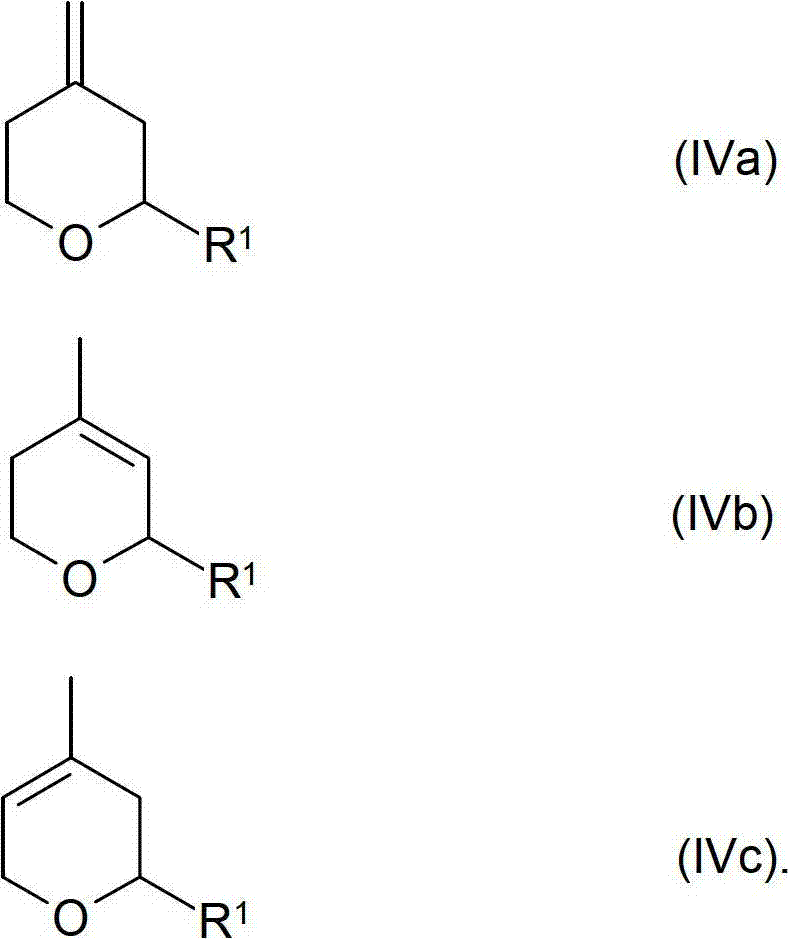
本发明方法允许以高产率和高纯度制备和分离所需式(I)的羟基吡喃类或优选式(Ia)的2-异丁基-4-羟基-4-甲基四氢吡喃类,其中不希望的式(Iva)-(IVc)的脱水产物仅少量产生,若产生的话。 The process according to the invention allows the preparation and isolation of the desired hydroxypyrans of formula (I) or preferably 2-isobutyl-4-hydroxy-4-methyltetrahydropyrans of formula (Ia) in high yield and high purity , where the undesired dehydration products of the formulas (Iva)-(IVc) are produced only in small amounts, if at all. the
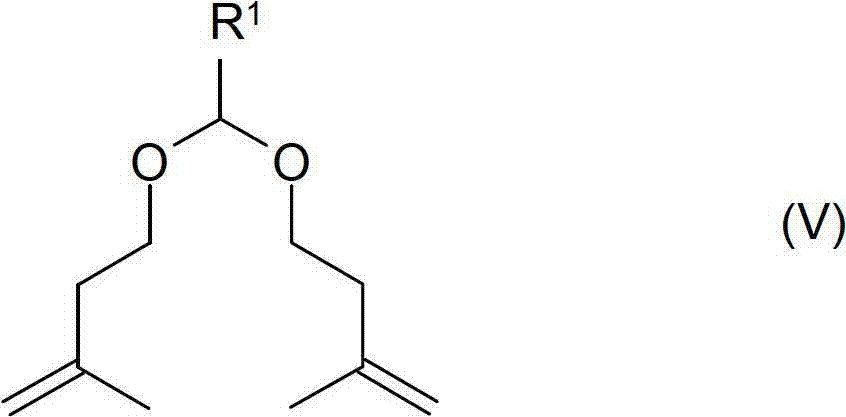
可以提到的其他可能副产物是式(V)的缩醛: Other possible by-products that may be mentioned are acetals of formula (V):
以及式(VI)的1,3-二 

其中在异戊烯醇与根据本发明优选的异戊醛反应的情况下,基团R1在每种情况下为异丁基(对应于式(Va)或(VIa)化合物)。正如未反应的起始化合物和/或过量使用的起始化合物一样,这些副产物可以有利地再次返回该反应中。 Where in the case of the reaction of prenol with isovaleraldehyde which is preferred according to the invention, the radical R 1 is in each case isobutyl (corresponding to a compound of the formula (Va) or (VIa)). These by-products can advantageously be returned to the reaction again, just like unreacted starting compounds and/or starting compounds used in excess.
根据本发明得到的反应混合物通常由约50-90重量%,常常是约60-80重量%的所需式(I)的2-取代的4-羟基-4-甲基四氢吡喃类和仅至多约20重量%,优选仅至多约15重量%,特别优选仅至多10重量%的式(IVa)-(IVc)的脱水产物构成,在每种情况下基于所得粗产物、此外还有未反应的原料和/或过量使用的原料以及还有其他所述副产物的总重量。 The reaction mixture obtained according to the invention generally consists of about 50-90% by weight, often about 60-80% by weight, of the desired 2-substituted 4-hydroxy-4-methyltetrahydropyrans of formula (I) and Only up to about 20% by weight, preferably only up to about 15% by weight, particularly preferably only up to 10% by weight, of dehydrated products of the formulas (IVa)-(IVc) constitute in each case based on the crude product obtained, furthermore The total weight of the starting materials of the reaction and/or the starting materials used in excess and also other said by-products. the
本发明方法的一个优选实施方案涉及以式(Ic)的顺式-非对映体和式(Id)的反式-非对映体的混合物形式制备和分离2-取代的4-羟基-4-甲基四氢吡喃类: A preferred embodiment of the process of the invention involves the preparation and isolation of 2-substituted 4-hydroxy-4 as a mixture of the cis-diastereomer of formula (Ic) and the trans-diastereomer of formula (Id) -Methyltetrahydropyrans:

其中式(Ic)的顺式-非对映体与式(Id)的反式-非对映体的非对映体比为 65:35-95:5,优选70:30-85:15,以及R1具有上面所给含义,尤其是优选的含义。 Wherein the diastereomer ratio of the cis-diastereomer of formula (Ic) and the trans-diastereomer of formula (Id) is 65:35-95:5, preferably 70:30-85:15, and R 1 has the meanings given above, especially the preferred meanings.
尤其对于异戊烯醇与根据本发明优选的异戊醛的反应,在本发明方法中以式(Ie)的顺式-非对映体和式(If)的反式-非对映体的混合物形式得到2-异丁基-4-羟基-4-甲基四氢吡喃: Especially for the reaction of prenol with isovaleraldehyde, which is preferred according to the invention, in the process of the invention with the cis-diastereomer of formula (Ie) and the trans-diastereomer of formula (If) 2-isobutyl-4-hydroxyl-4-methyltetrahydropyran is obtained as a mixture:

其中式(Ie)的顺式-非对映体与式(If)的反式-非对映体的非对映体比为65:35-95:5,优选70:30-85:15。考虑到它们的特定嗅觉性能,这类混合物以显著程度适合用作合成香料,例如用作生产香料组合物的具有山谷百合花香味的组分。 Wherein the diastereomer ratio of the cis-diastereomer of formula (Ie) to the trans-diastereomer of formula (If) is 65:35-95:5, preferably 70:30-85:15. On account of their specific olfactory properties, mixtures of this type are suitable to a considerable extent for use as synthetic perfumes, for example as a component for the production of perfume compositions having a lily-of-valley scent. the
本发明的目的还在于需要这样一种方法,使用该方法可以以低资金和能量要求由粗混合物分离式(I)的立体异构醇。 It is also an object of the present invention to require a process with which stereoisomeric alcohols of formula (I) can be separated from crude mixtures with low capital and energy requirements. the
根据本发明,该目的通过一种通过精馏由粗混合物分离两种式(I)的立体异构醇的方法实现,其中将该粗混合物在侧部引入进料塔中,提供至少一个与进料塔耦合的取出塔并由取出塔取出式(I)的第一醇和式(I)的第二醇,其中进料塔和取出塔的耦合使得至少在醇的取出区域中,在进料塔和取出塔之间不发生蒸气和冷凝液的交叉混合。 According to the invention, this object is achieved by a process for the separation of two stereoisomeric alcohols of formula (I) by rectification from a crude mixture which is introduced sideways into a feed column providing at least one The take-off tower coupled with the feed tower and the first alcohol of formula (I) and the second alcohol of formula (I) are taken out by the take-off tower, wherein the coupling of the feed tower and the take-off tower makes at least in the take-off region of the alcohol, in the feed tower No cross-mixing of vapor and condensate occurs between the extraction column and the take-off column. the
使进料塔和出料塔“耦合”,即结合在一起以使得可以在它们之间传质。为了避免在醇的取出区域中在进料塔和出料塔之间蒸气或冷凝液的交叉混合,将这些塔耦合以使得由进料点至取出点不存在“直线”路径,相反,由进料点至取出点的各路径包括“上行”和“下行”段(以任何所需顺序),即在这些点之间的冷凝液和/或蒸气转移基本仅可以通过蒸发/冷凝或 冷凝/蒸发发生。 The feed and discharge columns are "coupled", ie brought together so that mass transfer between them is possible. In order to avoid cross-mixing of vapor or condensate between the feed column and the discharge column in the withdrawal area of the alcohol, the columns are coupled so that there is no "straight line" path from the feed point to the withdrawal point, but instead, the Each path from the point of feed to the point of withdrawal consists of "up" and "down" sections (in any desired order), i.e. transfer of condensate and/or vapor between these points is essentially only possible by evaporation/condensation or condensation/evaporation occur. the
优选至少一种醇,尤其是第一醇和第二醇二者在取出塔的侧取出口取出。 Preferably at least one alcohol, especially both the first alcohol and the second alcohol, is withdrawn at the side withdrawal of the withdrawal column. the
该程序优选为如下一种程序,其中: The procedure is preferably the following procedure, wherein:
a)将粗混合物引入具有位于进料点之上的精馏段和位于进料点之下的汽提段的进料塔中, a) introducing the crude mixture into a feed column having a rectifying section above the feed point and a stripping section below the feed point,
b)提供与精馏段上端连通且在塔顶具有冷凝器的上部组合塔和与汽提段下端连通且在底部具有加热器的下部组合塔, b) providing the upper combined tower communicated with the upper end of the rectifying section and having a condenser at the top of the tower and the lower combined tower communicated with the lower end of the stripping section and having a heater at the bottom,
c)提供与上部组合塔和下部组合塔连通的取出塔,其具有两个相互间以一定距离排列在取出塔纵向延伸上的侧取口, c) Provide a take-off tower communicating with the upper combined tower and the lower combined tower, which has two side intakes arranged at a distance from each other on the longitudinal extension of the taken-off tower,
d)在上部侧取口取出第一醇并在下部侧取口取出第二醇,以及 d) taking out the first alcohol at the upper side port and the second alcohol at the lower side port, and
e)在上部组合塔的顶部或上部区域取出低沸点组分并在下部组合塔的底部取出高沸点组分。 e) The low boiling components are withdrawn at the top or upper region of the upper combined column and the high boiling components are withdrawn at the bottom of the lower combined column. the
进料塔、取出塔、上部组合塔和下部组合塔可以是独立的结构单元或者可以构造成组合了几个功能的蒸馏塔的部分或室。表述“连通塔”是指在它们之间存在上行蒸气以及排出冷凝液二者的转移。 The feed column, withdrawal column, upper combined column and lower combined column can be independent structural units or can be constructed as parts or chambers of a distillation column combining several functions. The expression "communicating columns" means that there is a transfer between them of both ascending vapor and withdrawing condensate. the
在一个优选实施方案中,将所谓的分隔壁塔用于蒸馏,即进料塔和取出塔设计成在每种情况下在两侧向一个组合空间敞开的分室,这些分室沿着蒸馏塔的纵向延伸段延伸并且通过分隔壁相互分隔。分隔壁可以以固定方式整合到该塔中,例如焊入,或者以可取出方式连接在该塔中,例如插入。可取出的固定提供了优点,如更大的灵活性、内件对该塔的更简单填充以及低资金成本。 In a preferred embodiment, a so-called dividing wall column is used for the distillation, that is, the feed column and the withdrawal column are designed as subchambers which are open in each case on both sides to a combined space, the subchambers running along the longitudinal direction of the distillation column The extensions extend and are separated from each other by a partition wall. The partition wall can be fixedly integrated into the column, eg welded in, or removably connected therein, eg inserted. Removable fixings offer advantages such as greater flexibility, simpler filling of the column with internals and low capital costs. the
在替换实施方案中,将热耦合塔用于蒸馏,例如具有热耦合前置塔的蒸馏塔或具有热耦合后置塔的蒸馏塔。连接有辅助塔的蒸馏塔本身是已知的且为本领域熟练技术人员所熟知。 In an alternative embodiment, a thermally coupled column is used for the distillation, such as a distillation column with a thermally coupled pre-column or a distillation column with a thermally coupled post-column. Distillation columns connected with auxiliary columns are known per se and are familiar to those skilled in the art. the
本发明方法中的立体异构醇是式(I)的醇,尤其是式(Ic)和(Id)的那些或非常特别优选式(Ie)和(If)的那些。在特别优选的实施方案中,第一醇为式(Ie)的化合物,第二醇为式(If)的化合物。相应的粗混合物例如可以在通过使组分(II)和(III)在强酸性离子交换剂存在下反应而如上所述合成在2位 取代的式(I)的四氢吡喃醇情况下制备。 Stereoisomeric alcohols in the process according to the invention are alcohols of the formula (I), especially those of the formulas (Ic) and (Id) or very particularly preferably those of the formulas (Ie) and (If). In a particularly preferred embodiment, the first alcohol is a compound of formula (Ie) and the second alcohol is a compound of formula (If). Corresponding crude mixtures can be prepared, for example, in the case of the synthesis of tetrahydropyranols of the formula (I) substituted in the 2-position as described above by reacting components (II) and (III) in the presence of strongly acidic ion exchangers . the
粗混合物通常包含15-20重量%式(If)的反式-吡喃醇,45-65重量%式(Ie)的顺式-吡喃醇,10-20重量%沸点低于第一醇的化合物,1-3重量%沸点高于第二醇的化合物;该粗混合物优选基本不含在第一和第二醇之间沸腾的化合物。 The crude mixture generally comprises 15-20% by weight of trans-pyranols of the formula (If), 45-65% by weight of cis-pyranols of the formula (Ie), 10-20% by weight of alcohols having a lower boiling point than the first alcohol Compounds, 1-3% by weight of compounds boiling higher than the second alcohol; the crude mixture is preferably substantially free of compounds boiling between the first and second alcohols. the
通过参考使用具有两个液体侧取口的分隔壁塔的优选实施方案在下文更详细地说明本发明方法。所有说明相应地适用于另外的塔排列,如热耦合塔。 The process of the invention is explained in more detail below by reference to a preferred embodiment using a dividing wall column with two liquid side draws. All statements apply correspondingly to other column arrangements, such as thermally coupled columns. the
在塔的顶部取出沸点低于第一醇的化合物的塔,尤其是上部组合塔的顶部压力优选至多400毫巴,优选3-200毫巴,特别优选3-100毫巴,非常特别优选4-60毫巴。 The top pressure of the column, in particular the upper combined column, which takes off the compound having a boiling point lower than the first alcohol at the top of the column is preferably at most 400 mbar, preferably 3-200 mbar, particularly preferably 3-100 mbar, very particularly preferably 4- 60 mbar. the
本发明方法的一个优选实施方案是其中进料塔和取出塔设计成在每种情况下在两侧向一个组合空间敞开的分室的实施方案,这些分室沿着蒸馏塔的纵向延伸段延伸并且通过分隔壁相互分隔。 A preferred embodiment of the process according to the invention is that in which the feed column and the withdrawal column are designed as subchambers which are open in each case on both sides to a combined space, which subchambers extend along the longitudinal extension of the distillation column and pass through The partition walls separate each other. the
上部组合塔、进料塔、取出塔和下部组合塔的理论塔板总和优选为30-110,尤其是40-90。 The sum of the theoretical plates of the upper combined column, feed column, take-off column and lower combined column is preferably 30-110, especially 40-90. the
优选在上部组合塔、进料塔、取出塔和下部组合塔的理论塔板之和中,上部组合塔占5-50%,尤其是15-30%,进料塔的精馏段占5-50%,尤其是15-30%,进料塔的汽提段占5-50%,尤其是15-40%,位于上部侧取口之上的取出塔部分占5-50%,尤其是15-30%,位于侧取口之间的取出塔部分占5-50%,尤其是15-30%,位于下部侧取口之下的取出塔部分占5-50%,尤其是15-40%,以及下部组合塔占5-50%,尤其是15-30%。 Preferably in the sum of the theoretical plates of the upper combined tower, the feed tower, the take-off tower and the lower combined tower, the upper combined tower accounts for 5-50%, especially 15-30%, and the rectifying section of the feed tower accounts for 5-5%. 50%, especially 15-30%, the stripping section of the feed tower accounts for 5-50%, especially 15-40%, and the take-off tower part located above the upper side-drawing port accounts for 5-50%, especially 15% -30%, 5-50%, especially 15-30%, of the take-off tower between the side draws, 5-50%, especially 15-40%, of the take-off tower below the lower side draw , and the lower combined tower accounts for 5-50%, especially 15-30%. the
优选进料塔的理论塔板之和与取出塔的理论塔板之和的比例为0.8-1.1,尤其是0.9-1.0。 Preferably, the ratio of the sum of the theoretical plates of the feed column to the sum of the theoretical plates of the withdrawal column is 0.8-1.1, especially 0.9-1.0. the
进料塔、上部组合塔、下部组合塔和取出塔优选包含分离有效内件,如塔盘,规整填料,例如片状金属或织物填料如Sulzer Meltallapak、Sulzer BX、Montz B1或Montz A3或Kühni Rhombopak,或填料的散堆床,如θ网环、腊希环、高流环或腊希塑料环(Raschig super-ring)。优选至少进料塔和/或取出塔完全或分段提供有规整填料。比表面积为100-750m2/m3, 尤其是250-500m2/m3的规整填料,优选片状金属或织物填料已经证明特别有用。它们允许高分离效率以及低压降。 The feed column, the upper combined column, the lower combined column and the take-off column preferably contain separation effective internals, such as trays, structured packings, e.g. sheet metal or textile packings such as Sulzer Meltallapak, Sulzer BX, Montz B1 or Montz A3 or Kühni Rhombopak , or a random bed of packing, such as θ mesh ring, Raschig ring, high flow ring or Raschig plastic ring (Raschig super-ring). Preferably at least the feed column and/or the withdrawal column is provided completely or in sections with structured packing. Structured packings, preferably sheet metal or textile packings, with a specific surface area of 100-750 m 2 /m 3 , especially 250-500 m 2 /m 3 , have proven particularly useful. They allow high separation efficiencies as well as low pressure drops.
本发明方法的一个优选实施方案是其中进料塔和/或取出塔完全或分段提供有规整填料或散堆填料的实施方案。 A preferred embodiment of the process according to the invention is that in which the feed column and/or the withdrawal column is provided completely or in sections with structured or random packing. the
当使用分隔壁塔时,已经证明有利的是该分隔壁设计成至少在一段上绝热,例如呈夹套形式,气体空间填充其间。分隔壁绝热的不同方案的描述可以在EP-A 640 367中找到。 When using a dividing wall column, it has proven to be advantageous if the dividing wall is designed to be insulated at least over one section, for example in the form of a jacket, in which the gas space is filled. A description of different solutions for the insulation of partition walls can be found in EP-A 640 367. the
优选以速率控制方式,例如通过借助可控制的泵输送或者经由可控制的阀在例如至少1米的足够静态进料高度以上将其引入将粗混合物引入进料塔中。有利的是提供决不能降至其以下且例如比对该装置所设计的正常值低30%的最小进料量。 The crude mixture is introduced into the feed column preferably in a rate-controlled manner, for example by delivery by means of a controllable pump or by introducing it via a controllable valve above a sufficient static feed height, for example at least 1 meter. It is advantageous to provide a minimum feed rate below which it must never fall and which is, for example, 30% below the normal value for which the plant is designed. the
有时可能有利的是事先蒸发该粗混合物并部分或完全以蒸气形式将其引入进料塔中。然后将部分预蒸发的粗混合物作为两相料流或者以一种液体料流和一种蒸气料流形式引入进料塔中。预蒸发在该粗混合物包含较大量低沸点组分时是合适的。预蒸发可以使进料塔的汽提段减负。 It may sometimes be advantageous to evaporate the crude mixture beforehand and to introduce it partly or completely in vapor form into the feed column. The partially preevaporated crude mixture is then introduced into the feed column as a two-phase stream or in the form of a liquid stream and a vapor stream. Preevaporation is suitable when the crude mixture contains relatively large amounts of low-boiling components. Preevaporation unburdens the stripping section of the feed column. the
优选以液体形式取出侧取料。优选经由取出塔中位于取出塔上端和上部侧取口之间且比取出塔的上端低优选3-8块,尤其是4-6块理论塔板的位置处的温度测量值调节第一醇的取出。取出量随着温度提高而提高,反之亦然。有利的是限制该取出以使得通入位于侧取口之间的取出塔段的冷凝液量不降至决不能降至其以下且例如比对该装置所设计的正常值低30%的最小值以下。 The side draw is preferably taken in liquid form. Preferably, the temperature measurement value at a position of 3-8 blocks, especially 4-6 theoretical plates lower than the upper end of the withdrawal tower between the upper end of the withdrawal tower and the upper side draw in the withdrawal tower is preferably adjusted for the first alcohol. take out. The amount taken out increases as the temperature increases, and vice versa. It is advantageous to limit this withdrawal so that the amount of condensate passed into the withdrawal column section located between the side draws does not fall below a minimum value which must never fall below and which is, for example, 30% lower than the normal value for which the plant is designed the following. the
本发明方法的一个优选实施方案是其中第一醇和该第二醇在分隔壁塔的侧取口以液体形式取出的实施方案。 A preferred embodiment of the process according to the invention is that in which the first alcohol and the second alcohol are withdrawn in liquid form at the side draw of the dividing wall column. the
优选经由加热器中的液面测量值调节第二醇的取出。取出的量随着液面提高而提高,反之亦然。 The removal of the second alcohol is preferably regulated via the liquid level measurement in the heater. The amount taken out increases as the liquid level increases, and vice versa. the
冷凝器的回流比优选通过上部组合塔区域中优选设置在比上端低优选3-8块,尤其是4-6块理论塔板的位置处的温度测量值调节。当然,代替回流比,还可以调节取出的馏出液量,即低沸点组分的取出,结果间接调节了回流比。 The reflux ratio of the condenser is preferably regulated by means of temperature measurements in the upper combined column region preferably set at a position lower than the upper end, preferably 3-8, especially 4-6 theoretical plates. Of course, instead of the reflux ratio, it is also possible to adjust the amount of distillate taken out, that is, the removal of low-boiling components, and as a result, the reflux ratio is indirectly adjusted. the
由底部取出高沸点组分优选经由下部组合塔区域中优选位于下端之上3-8块,尤其是4-6块理论塔板的位置处的温度测量值调节。 The withdrawal of high-boiling components from the bottom is preferably regulated via temperature measurements in the region of the lower combined column at positions preferably located 3-8, in particular 4-6 theoretical plates above the lower end. the
该加热器的加热输出适当地通过上部组合塔上端处的点和下部组合塔下端处的点之间的压力差调节。 The heating output of the heater is suitably regulated by the pressure difference between the point at the upper end of the upper combined column and the point at the lower end of the lower combined column. the
将来自下部组合塔的蒸气料流优选以0.8:1.2,尤其是0.9:1.1的比例分配在进料塔和取出塔之间。例如通过改变进料塔和取出塔的相对横截面、通过分离有效内件的选择和/或对其定尺寸和/或引入产生压降的装置如隔膜而产生特定的分配比。 The vapor stream from the lower combined column is preferably divided between the feed column and the withdrawal column in a ratio of 0.8:1.2, especially 0.9:1.1. A specific distribution ratio is produced, for example, by varying the relative cross-sections of the feed column and withdrawal column, by selecting and/or dimensioning the separating effective internals and/or introducing pressure drop-generating devices such as membranes. the
来自上部组合塔的冷凝液料流优选以0.1:1.0,尤其是0.3:0.6的比例分配在进料塔和取出塔之间。 The condensate stream from the upper combined column is preferably divided between the feed column and the withdrawal column in a ratio of 0.1:1.0, especially 0.3:0.6. the
为了在塔中某一位置取出或分配冷凝液,例如将来自上部组合塔的冷凝液分配在进料塔和取出塔之间或者取出液体侧取料,适当地将冷凝液供入设置在该塔内部或外部的收集容器中。收集容器用作泵接受器或者提供足够高的静态液面,该液面允许通过控制元件,例如阀取出或分配液体。当使用填料塔时,有利地提供收集塔盘,由该塔盘将冷凝液送至收集容器。 For withdrawing or distributing condensate at a certain point in the column, e.g. distributing condensate from the upper combined column between the feed column and the withdrawal column or withdrawing liquid side draw, the condensate feed is suitably arranged in the column into internal or external collection containers. The collection container acts as a pump receiver or provides a sufficiently high static liquid level that allows liquid to be withdrawn or dispensed via a control element, such as a valve. When a packed column is used, it is advantageous to provide a collection tray from which the condensate is sent to a collection vessel. the
在由粗混合物分离式(Ie)和(If)的醇的蒸馏提纯过程中,所得馏分除了所需化合物外应包含最低可能比例的具有更高或更低沸点的杂质。取决于预期应用,就具有更高或更低沸点的化合物的最大允许含量的技术要求是不同的。通常规定对分离问题重要的各组分,在大多数情况下为相对于所需化合物具有窄沸点差的那些或甚至以低浓度存在也特别麻烦的那些,即所谓的关键化合物,或两种或更多种关键化合物的总和。 During the distillative purification of the alcohols of the formulas (Ie) and (If) from crude mixtures, the fractions obtained should contain, besides the desired compound, the lowest possible proportion of impurities with higher or lower boiling points. Depending on the intended application, the specifications regarding the maximum permissible content of compounds with higher or lower boiling points are different. The individual components which are important for the separation problem are generally specified, in most cases those which have a narrow boiling point difference with respect to the desired compound or which are particularly troublesome even in low concentrations, the so-called key compounds, or two or The sum of many more key compounds. the
按照对沸点高于第一醇纯馏分中的第一醇(包括第二醇)的化合物浓度上的技术要求,本发明方法中优选经由来自上部组合塔的冷凝液料流的分配比而调节。当使用分隔壁塔时,这为液体在分隔壁上端的分配比。为此,在上部组合塔区域中,优选在其下端,对至少一种沸点高于第一醇的化合物的浓度获得测量值并将这些测量值用于形成对来自上部组合塔的冷凝液料流进入进料塔和取出塔的分配比的控制干预。随着具有更高沸点的化合物浓度增加,将逐渐增大比例的冷凝液送入进料塔。沸点高于第一醇的化合物在上部组合塔下端的浓度应为这些化合物在第一醇纯馏分中的最大允 许浓度值的10-80%,优选30-50%。 According to the technical requirements on the concentration of compounds having a boiling point higher than that of the first alcohol (including the second alcohol) in the pure fraction of the first alcohol, it is preferably adjusted in the process of the invention via the distribution ratio of the condensate stream from the upper combined column. When a dividing wall column is used, this is the distribution ratio of the liquid at the upper end of the dividing wall. For this purpose, in the region of the upper combined column, preferably at its lower end, measured values are obtained for the concentration of at least one compound having a boiling point higher than the first alcohol and these measured values are used to form an analysis of the condensate stream from the upper combined column The control intervention of the distribution ratio into the feed column and the take-off column. As the concentration of compounds with higher boiling points increases, an increasing proportion of the condensate is sent to the feed column. The concentration of the compound with boiling point higher than the first alcohol at the lower end of the upper combined column should be 10-80% of the maximum allowable concentration value of these compounds in the first alcohol pure fraction, preferably 30-50%. the
按照对沸点低于第二醇纯馏分中的第二醇(包括第一醇)的化合物浓度上的技术要求,在本发明方法中优选经由加热器的加热输出而调节。为此,在下部组合塔区域中,优选在其上端,对至少一种沸点低于第二醇的化合物的浓度获得测量值并将这些测量值用于形成对来自加热器加热输出的控制干预。随着具有更低沸点的化合物浓度增加,加热输出提高,反之亦然。沸点低于第二醇的化合物在下部组合塔上端的浓度应为这些化合物在第二醇纯馏分中的最大允许浓度值的10-80%,优选30-50%。 According to the technical requirements on the concentration of compounds having a boiling point lower than that of the second alcohol (including the first alcohol) in the pure fraction of the second alcohol, it is preferably adjusted in the process of the invention via the heating output of the heater. For this purpose, in the region of the lower combined column, preferably at its upper end, measured values are obtained for the concentration of at least one compound having a lower boiling point than the second alcohol and are used to form control interventions for the heating output from the heater. As the concentration of compounds with lower boiling points increases, the heating output increases and vice versa. The concentration of compounds with a boiling point lower than that of the second alcohol at the upper end of the lower combined column should be 10-80%, preferably 30-50%, of the maximum allowable concentration of these compounds in the pure fraction of the second alcohol. the
为了获得上面所讨论的关键化合物浓度的测量值,可以在相应点连续或周期性地取出气态或液态样品并研究其组成,优选通过气相色谱法研究。为了取样,优选在蒸馏塔中提供合适的取样位置,经由该取样位置可以将取样枪(lazen)引入塔中。在许多情况下,对于蒸气和/或冷凝液在蒸馏塔中某一位点的组成的充分信息也可以参考简单的温度测量,若温度特征与混合物组成的相关性是已知的或者已经事先确定了的话。 In order to obtain measurements of the concentrations of the key compounds discussed above, gaseous or liquid samples can be taken continuously or periodically at corresponding points and studied for their composition, preferably by gas chromatography. For sampling, suitable sampling points are preferably provided in the distillation column via which sampling lances (lazens) can be introduced into the column. In many cases, sufficient information on the composition of the vapor and/or condensate at a certain point in the distillation column can also be referred to simple temperature measurements, if the correlation of the temperature profile with the composition of the mixture is known or determined in advance words. the
在其中各组分以其挥发性顺序在塔顶取出的连续塔中蒸馏香料的过程中,考虑到在塔底的高停留时间,热应力可能导致产物受损和/或形成不希望的臭味载体。这可能导致所得纯产物在所要求的技术规格之外和/或不能通过嗅觉试验。本发明方法将待分离混合物的热应力降至最小且避开与此相关的缺点。 During the distillation of fragrances in continuous columns in which the components are taken overhead in the order of their volatility, thermal stresses can lead to damage to the product and/or formation of undesired odours, given the high residence time at the bottom of the column carrier. This may lead to the resulting pure product being outside the required specifications and/or failing the sniff test. The method according to the invention minimizes the thermal stress of the mixture to be separated and avoids the disadvantages associated therewith. the
热耦合蒸馏塔和分隔壁塔的各种实施方案在文献,例如DE-A-102 23971中已知。 Various embodiments of thermally coupled distillation columns and dividing wall columns are known from the literature, for example DE-A-102 23971. the
下列实施例用于说明本发明而决不限制本发明: The following examples are used to illustrate the present invention and in no way limit the present invention:
气相色谱分析根据下列方法进行: Gas chromatography analysis was carried out according to the following method:
30m DB-WAX,ID.:0.32mm,FD.:0.25μm;50°C,3°C/min至170°C,20°C/min至230°C-17min;注射器温度:200°C,检测器温度:280°C,tR=min;tR(异戊醛):4.1;tR(式(IVa)-(IVc)的二氢吡喃异构体):10.0;11.8;12.3;tR(异戊烯醇):10.6;tR(1,3-二 
所得粗产物的水含量借助Karl-Fischer滴定法测定。 The water content of the crude product obtained was determined by means of Karl-Fischer titration. the
实施例1: Example 1:
对由内径为2cm且长度为36cm的夹套玻璃管式反应器构成的设备中填充50g强酸性阳离子交换剂AmberlystTM 131。在使用前首先用水洗涤该阳离子交换剂几次,然后用甲醇洗涤一次并最后用水洗至不含甲醇。 An apparatus consisting of a jacketed glass tubular reactor with an inner diameter of 2 cm and a length of 36 cm was filled with 50 g of strongly acidic cation exchanger Amberlyst ™ 131. Before use, the cation exchanger was first washed several times with water, then once with methanol and finally with water to be free of methanol.
在室温下对该夹套玻璃反应器填充异戊醛(112.5g,1.31mol)、异戊烯醇(125g,1.45mol)和12.5g水的混合物。将反应溶液在35°C的温度下循环4小时,循环体积为490ml/h。然后将反应溶液在40°C的温度下再循环10小时,循环体积为490ml/h。夹套玻璃反应器在35-40°C的温度下操作。这得到247.2g具有下列组成的粗产物(顺式/反式-吡喃醇(Ie和If)的产率为74%): The jacketed glass reactor was filled with a mixture of isovaleraldehyde (112.5 g, 1.31 mol), prenol (125 g, 1.45 mol) and 12.5 g of water at room temperature. The reaction solution was circulated at a temperature of 35° C. for 4 hours with a circulation volume of 490 ml/h. The reaction solution was then recirculated at a temperature of 40° C. for 10 hours with a circulation volume of 490 ml/h. The jacketed glass reactor operates at a temperature of 35-40°C. This gave 247.2 g of crude product (74% yield of cis/trans-pyranols (Ie and If)) having the following composition:
异戊醛: 0.53GC重量%, Isovaleraldehyde: 0.53GC wt%,
异戊烯醇: 1.23GC重量%, Isopentenol: 1.23 GC wt%,
二氢吡喃异构体(IVa-c):8.96GC重量% Dihydropyran isomer (IVa-c): 8.96GC wt%
1,3-二 
缩醛(VIa): 0.49GC重量%, Acetal (VIa): 0.49GC wt%,
反式-吡喃醇(If): 18.34GC重量%, Trans-pyranol (If): 18.34GC wt%,
顺式-吡喃醇(Ie): 49.27GC重量%, Cis-pyranol (Ie): 49.27GC wt%,
水: 6.0% Water: 6.0%
实施例2: Example 2:
在室温下对夹套玻璃反应器填充异戊醛(77.4g,0.9mol)、异戊烯醇(86.1g,1.0mol)和8.6g水的混合物。将反应溶液在25°C的温度下循环10小时,循环体积为1.5l/h。将夹套玻璃反应器加热至25°C。这得到169.4g具有下列组成的粗产物(顺式/反式-吡喃醇(Ie和If)的产率为79%): A jacketed glass reactor was charged with a mixture of isovaleraldehyde (77.4 g, 0.9 mol), prenol (86.1 g, 1.0 mol) and 8.6 g of water at room temperature. The reaction solution was circulated at a temperature of 25° C. for 10 hours with a circulation volume of 1.5 l/h. The jacketed glass reactor was heated to 25°C. This gave 169.4 g of crude product (79% yield of cis/trans-pyranols (Ie and If)) having the following composition:
异戊醛: 0.44GC面积%, Isovaleraldehyde: 0.44 GC area%,
异戊烯醇: 3.57GC面积%, Isopentenol: 3.57 GC area %,
二氢吡喃异构体(IVa-c):9.76GC面积%, Dihydropyran isomers (IVa-c): 9.76 GC area %,
1,3-二 
缩醛(VIa): 0.99GC面积%, Acetal (VIa): 0.99 GC area%,
反式-吡喃醇(If):18.91GC重量%, Trans-pyranol (If): 18.91GC wt%,
顺式-吡喃醇(Ie):54.13GC重量%, Cis-pyranol (Ie): 54.13GC wt%,
水: 6.9% Water: 6.9%
实施例3:借助两个实验室塔蒸馏 Example 3: Distillation with the aid of two laboratory columns
第一塔由两个内径为43mm的夹套式内部镀膜且抽空的玻璃段(顶部长800mm;底部640mm)构成。内件为Montz A3-750金属片状填料。该塔的分离效率对应于约15块理论塔板。 The first column consisted of two jacketed internally coated and evacuated glass sections (top 800 mm long; bottom 640 mm) with an internal diameter of 43 mm. Internals are Montz A3-750 metal flake packing. The separation efficiency of this column corresponds to about 15 theoretical plates. the
使用油加热的实验室旋转薄膜蒸发器将该塔加热。在塔顶使用由冷却水冷却的玻璃冷凝器冷凝蒸气。为了分离顶部冷凝液的两相,引入玻璃相分离器。以液面控制方式逐出下层水相。借助回流分配器以固定的比例分配上层有机相。一部分作为顶部产物取出。另一部分置于顶部的织物填料上。 The column was heated using an oil heated laboratory rotary thin film evaporator. Vapors are condensed at the top of the column using a glass condenser cooled by cooling water. To separate the two phases of the overhead condensate, a glass phase separator was introduced. The lower aqueous phase was driven off with level control. The upper organic phase was distributed in a fixed ratio by means of a reflux distributor. A portion was taken as overhead product. The other part is placed on top of the fabric filling. the
借助测量记录系统测量塔中不同高度处的温度以及顶部压力和塔上的压降。该塔在入口和出口中具有流量计并且具有返回流量计,后者的测量值用作油恒温器的入口温度的控制参数。该控制系统确保恒定的返回速率,这也确定了恒定的压差。塔的进料在两个塔段之间进行。进料流在室温下送入。流速为995g/h。该混合物具有下列组成: The temperature at different heights in the column as well as the top pressure and the pressure drop over the column are measured with the aid of a measuring recording system. The column has flow meters in the inlet and outlet and a return flow meter, the latter measurement being used as a control parameter for the inlet temperature of the oil thermostat. This control system ensures a constant return rate, which also determines a constant differential pressure. The feeding of the column takes place between two column sections. The feed stream was fed at room temperature. The flow rate is 995g/h. The mixture has the following composition:
7.3%水(Karl-Fischer方法) 7.3% water (Karl-Fischer method)
0.79GC重量%异戊醛 0.79GC wt% isovaleraldehyde
3.2GC重量%异戊烯醇 3.2 GC weight % isopentenol
7.4GC重量%二氢吡喃异构体(IVa-c) 7.4 GC weight % dihydropyran isomers (IVa-c)
6.0GC重量%1,3-二 
0.36GC重量%缩醛(VIa) 0.36GC wt% acetal (VIa)
18.0GC重量%反式-吡喃醇(If) 18.0GC wt% trans-pyranol (If)
52.3GC重量%顺式-吡喃醇(Ie) 52.3GC wt% cis-pyranol (Ie)
该塔在50毫巴的顶部压力和270g/h的返回速率下操作。此时产生的压降为约2.5毫巴。在该塔顶部测得温度为62°C且在底部测得温度为130°C。借助平衡控制系统,将底部取出量固定为785g/h。顶部取出量为130g/h。 The column was operated at a top pressure of 50 mbar and a return rate of 270 g/h. The resulting pressure drop here is about 2.5 mbar. The temperature measured at the top of the column was 62°C and at the bottom 130°C. With the help of the balance control system, the output at the bottom is fixed at 785g/h. The top take-off is 130g/h. the
气相色谱分析根据下列方法进行: Gas chromatography analysis was carried out according to the following method:
30m DB-WAX,ID.:0.32mm,FD.:0.25μm;50°C,3°C/min至170°C,20°C/min至230°C-17min;注射器温度:200°C,检测器温度:280°C,tR=min;tR(异戊醛):4.1;tR(式(IVa)-(IVc)的二氢吡喃异构体):10.0;11.8;12.3;tR(异戊烯醇):10.6;tR(1,3-二 
在塔顶由相分离器取出的顶部料流包含: The overhead stream taken from the phase separator at the top of the column contains:
2.5%水(Karl-Fischer方法) 2.5% water (Karl-Fischer method)
4.6GC面积%异戊醛 4.6GC Area % Isovaleraldehyde
40.5GC面积%二氢吡喃异构体(IVa-c) 40.5GC Area % Dihydropyran Isomers (IVa-c)
23.9GC面积%异戊烯醇 23.9GC Area % Prenyl Alcohol
28.1GC面积%1,3-二 
在底部取出料中测得下列结果: The following results were measured in the bottom take-off:
0.03%水(Karl-Fischer方法),以及通过GC分析 0.03% water (Karl-Fischer method), and analysis by GC
3.1GC重量%二氢吡喃异构体(IVa-c) 3.1 GC weight % dihydropyran isomers (IVa-c)
2.6GC重量%1,3-二 
22.4GC重量%反式-吡喃醇(If) 22.4GC wt% trans-pyranol (If)
65.6GC重量%顺式-吡喃醇(Ie)。 65.6 GC wt% cis-pyranol (Ie). the
对顺式-和反式-吡喃醇(Ie和If)而言蒸馏收率为100%。 The distillation yield was 100% for the cis- and trans-pyranols (Ie and If). the
第二实验室塔构造成分隔壁塔。它由三个内径为43mm的夹套式内部镀膜且抽空的玻璃段构成。总长为105cm的中间塔段提供有固定焊入的由厚度为约1mm的玻璃制成的分隔壁。在该分隔壁区域中,该塔在进料侧装备有1m Montz A31000填料且在取出侧装备有0.9m Montz A31000填料。在该分隔壁之上和之下使用长50cm的玻璃段,它们各自装备有33cmSulzer DX填料。在该分隔壁区域中的分离效率为约32块理论塔板。包括该分隔壁区域的理论塔板总数为约50。 The second laboratory column was constructed as a dividing wall column. It consists of three jacketed internally coated and evacuated glass segments with an internal diameter of 43 mm. The central column section, which has a total length of 105 cm, is provided with permanently welded-in partition walls made of glass with a thickness of about 1 mm. In the region of the dividing wall, the column was equipped with 1 m of Montz A31000 packing on the feed side and 0.9 m of Montz A31000 packing on the withdrawal side. Above and below the dividing wall 50 cm long glass segments were used, each equipped with 33 cm of Sulzer DX packing. The separation efficiency in the region of this dividing wall is about 32 theoretical plates. The total number of theoretical plates including this dividing wall region is about 50. the
使用油加热的实验室旋转薄膜蒸发器加热该塔。在塔顶使用由冷却水冷却的玻璃冷凝器冷凝蒸气。 The column was heated using an oil heated laboratory rotary thin film evaporator. Vapors are condensed at the top of the column using a glass condenser cooled by cooling water. the
借助测量记录系统测量塔中不同高度处的温度以及顶部压力和塔上的压降。该塔在入口和出口中具有流量计并且具有返回流量计,后者的测量值用作油恒温器的入口温度的控制参数。该控制系统确保恒定的返回速率,这也确定了恒定的压差。在该分隔壁之上液体量在该分隔壁的进料段和取出段之间的分配借助随时间循环的旋转漏斗实现。 The temperature at different heights in the column as well as the top pressure and the pressure drop over the column are measured with the aid of a measuring recording system. The column has flow meters in the inlet and outlet and a return flow meter, the latter measurement being used as a control parameter for the inlet temperature of the oil thermostat. This control system ensures a constant return rate, which also determines a constant differential pressure. The distribution of the liquid volume above the dividing wall between the feed and withdrawal sections of the dividing wall is effected by means of a rotating funnel which circulates over time. the
进料在分隔壁段的中间高度处加入。所用进料流为来自第一塔的底部出料的混合物。进料速率为300g/h。 Feed is added at the mid-height of the dividing wall section. The feed stream used was the mixture from the bottom draw of the first column. The feed rate was 300 g/h. the
该塔在10毫巴的顶部压力和400g/h的返回速率下操作。此时产生的压降为约1.5毫巴。在该塔顶部测得温度为78°C且在底部测得温度为127°C(±0.5K)。借助平衡控制系统,将底部取出量固定为14g/h(±1g/h)并将馏出液取出量固定为26g/h(±1g/h)。因此,回流比为约15:1。 The column was operated at a top pressure of 10 mbar and a return rate of 400 g/h. The resulting pressure drop here is about 1.5 mbar. A temperature of 78°C was measured at the top of the column and 127°C (±0.5K) at the bottom. By means of a balance control system, the bottom take-off was fixed at 14 g/h (± 1 g/h) and the distillate take-off at 26 g/h (± 1 g/h). Therefore, the reflux ratio is about 15:1. the
在该分隔壁之上将该液体以1:2(进料段:取出段)的比例分配。在相对进料侧的分隔壁一侧在与进料流相同的高度处取出液体侧取料。流速固定为260g/h。 The liquid is distributed over the dividing wall in a ratio of 1:2 (feed section: withdrawal section). The liquid side draw is taken at the same height as the feed stream on the side of the dividing wall opposite the feed side. The flow rate is fixed at 260g/h. the
在侧取口得到的纯产物包含: The pure products obtained at the side-take port include:
23.3GC面积%反式-吡喃醇(If) 23.3GC area% trans-pyranol (If)
76.5GC面积%顺式-吡喃醇(Ie) 76.5GC area% cis-pyranol (Ie)
在塔顶取出的顶部料流包含: The top stream taken at the top of the tower contains:
0.25GC重量%异戊醛 0.25GC wt% isovaleraldehyde
34.9GC重量%二氢吡喃异构体(IVa-c) 34.9GC wt% dihydropyran isomers (IVa-c)
0.54GC重量%异戊烯醇 0.54GC wt% isopentenol
28.5GC重量%1,3-二 
24.6GC重量%反式-吡喃醇(If) 24.6GC wt% trans-pyranol (If)
2.1GC重量%顺式-吡喃醇(Ie) 2.1 GC wt% cis-pyranol (Ie)
在塔底取出的料流包含: The stream withdrawn at the bottom of the tower contains:
0.45GC重量%反式-吡喃醇(If) 0.45GC wt% trans-pyranol (If)
6.8GC重量%顺式-吡喃醇(Ie) 6.8 GC wt% cis-pyranol (Ie)
对顺式-和反式-吡喃醇(Ie和If)而言蒸馏收率为约90%。 Distillation yields were about 90% for cis- and trans-pyranols (Ie and If). the
实施例4: Example 4:
第一塔具有与实施例3中所用相同的结构且以相同方式操作。 The first column has the same structure as used in Example 3 and operates in the same manner. the
第二实验室塔构造成分隔壁塔。它由6个内径为43mm的夹套式内部镀膜且抽空的玻璃段构成。总长为232cm的塔段2和3(由底部计算)中提供有固定焊入的由厚度为约1mm的玻璃制成的分隔壁。在该分隔壁区域中,该塔在进料侧和取出侧装备有0.6m Sulzer DX填料。在该分隔壁之上使用两个长60cm的玻璃段和一个长30cm的玻璃段,它们装备有总共147cm Sulzer CY填料。在该分隔壁之下使用长100cm的玻璃段,其装备有64cm Sulzer CY填料。在该分隔壁区域中的分离效率为约11块理论塔板。包括该分隔壁区域的理论塔板总数为约45。 The second laboratory column was constructed as a dividing wall column. It consists of 6 jacketed internally coated and evacuated glass segments with an inner diameter of 43 mm. Column sections 2 and 3 (calculated from the bottom) having a total length of 232 cm are provided with permanently welded-in partition walls made of glass with a thickness of about 1 mm. In the region of the dividing wall, the column was equipped with 0.6 m Sulzer DX packing on the feed side and withdrawal side. Two 60 cm long glass sections and one 30 cm long glass section were used above the dividing wall, equipped with a total of 147 cm of Sulzer CY packing. Below the dividing wall a 100 cm long glass section equipped with 64 cm Sulzer CY packing was used. The separation efficiency in the region of this dividing wall is about 11 theoretical plates. The total number of theoretical plates including this dividing wall region is about 45. the
使用油加热的实验室旋转薄膜蒸发器加热该塔。在塔顶使用由恒温器冷却的玻璃冷凝器冷凝蒸气。 The column was heated using an oil heated laboratory rotary thin film evaporator. Vapors were condensed overhead using a thermostat-cooled glass condenser. the
借助测量记录系统测量塔中不同高度处的温度以及顶部压力和塔上的压降。该塔在入口和出口中具有流量计并且具有返回流量计,后者的测量值用作油恒温器的入口温度的控制参数。该控制系统确保恒定的返回速率,这也确定了恒定的压差。在该分隔壁之上液体量在该分隔壁的进料段和取出段之间的分配借助随时间循环的旋转漏斗实现。 The temperature at different heights in the column as well as the top pressure and the pressure drop over the column are measured with the aid of a measuring recording system. The column has flow meters in the inlet and outlet and a return flow meter, the latter measurement being used as a control parameter for the inlet temperature of the oil thermostat. This control system ensures a constant return rate, which also determines a constant differential pressure. The distribution of the liquid volume above the dividing wall between the feed and withdrawal sections of the dividing wall is effected by means of a rotating funnel which circulates over time. the
借助油加热的玻璃换热器将进料加热至80°C并在分隔壁段的中间高度处加入。所用进料流为来自第一塔的底部出料的混合物。进料速率为398g/h。 The feed is heated to 80°C by means of an oil-heated glass heat exchanger and introduced at the mid-height of the dividing wall section. The feed stream used was the mixture from the bottom draw of the first column. The feed rate was 398 g/h. the
该塔在10毫巴的顶部压力和874g/h的返回速率下操作。此时产生的压降为约4.5毫巴。在该塔顶部测得温度为96°C且在底部测得温度为120°C(±0.5K)。借助平衡控制系统,将底部取出量固定为32g/h(±1g/h)并将馏出液取出量固定为46g/h(±1g/h)。因此,回流比为约19:1。 The column was operated at a top pressure of 10 mbar and a return rate of 874 g/h. The resulting pressure drop here is about 4.5 mbar. A temperature of 96°C was measured at the top of the column and 120°C (±0.5K) at the bottom. By means of a balance control system, the bottom take-off was fixed at 32 g/h (± 1 g/h) and the distillate take-off at 46 g/h (± 1 g/h). Therefore, the reflux ratio is about 19:1. the
在该分隔壁之上将该液体以1:2(进料段:取出段)的比例分配。在相对进料侧的分隔壁一侧在与进料流相同的高度处取出液体侧取料。流速固定为319g/h。 The liquid is distributed over the dividing wall in a ratio of 1:2 (feed section: withdrawal section). The liquid side draw is taken at the same height as the feed stream on the side of the dividing wall opposite the feed side. The flow rate is fixed at 319g/h. the
在侧取口得到的纯产物包含: The pure products obtained at the side-take port include:
22.1GC重量%反式-吡喃醇(If) 22.1 GC weight % trans-pyranol (If)
77.0GC重量%顺式-吡喃醇(Ie) 77.0GC wt% cis-pyranol (Ie)
在塔顶取出的顶部料流包含: The top stream taken at the top of the tower contains:
24.3GC重量%二氢吡喃异构体(IVa-c) 24.3GC wt% dihydropyran isomers (IVa-c)
0.40GC重量%异戊烯醇 0.40GC wt% isopentenol
18.3GC重量%1,3-二 
45.6GC重量%反式-吡喃醇(If) 45.6GC wt% trans-pyranol (If)
4.2GC重量%顺式-吡喃醇(Ie) 4.2 GC wt% cis-pyranol (Ie)
在塔底取出的料流包含: The stream withdrawn at the bottom of the tower contains:
2.0GC面积%反式-吡喃醇(If) 2.0GC area% trans-pyranol (If)
34.0GC面积%顺式-吡喃醇(Ie) 34.0GC area% cis-pyranol (Ie)
对顺式-和反式-吡喃醇(Ie和If)而言蒸馏收率为约90%。 Distillation yields were about 90% for cis- and trans-pyranols (Ie and If). the
Claims (22)


Applications Claiming Priority (3)
| Application Number | Priority Date | Filing Date | Title |
|---|---|---|---|
| EP10165455.6 | 2010-06-10 | ||
| EP10165455 | 2010-06-10 | ||
| PCT/EP2011/059237 WO2011154330A1 (en) | 2010-06-10 | 2011-06-06 | Process for the preparation and isolation of 2-substituted tetrahydropyranols |
Related Child Applications (1)
| Application Number | Title | Priority Date | Filing Date |
|---|---|---|---|
| CN201410659112.8A Division CN104529969A (en) | 2010-06-10 | 2011-06-06 | Process for preparation and isolation of 2-substituted tetrahydropyranols |
Publications (2)
| Publication Number | Publication Date |
|---|---|
| CN103003258A true CN103003258A (en) | 2013-03-27 |
| CN103003258B CN103003258B (en) | 2014-12-10 |
Family
ID=44479381
Family Applications (2)
| Application Number | Title | Priority Date | Filing Date |
|---|---|---|---|
| CN201180028466.7A Active CN103003258B (en) | 2010-06-10 | 2011-06-06 | Process for the preparation and isolation of 2-substituted tetrahydropyranols |
| CN201410659112.8A Pending CN104529969A (en) | 2010-06-10 | 2011-06-06 | Process for preparation and isolation of 2-substituted tetrahydropyranols |
Family Applications After (1)
| Application Number | Title | Priority Date | Filing Date |
|---|---|---|---|
| CN201410659112.8A Pending CN104529969A (en) | 2010-06-10 | 2011-06-06 | Process for preparation and isolation of 2-substituted tetrahydropyranols |
Country Status (6)
| Country | Link |
|---|---|
| EP (1) | EP2580202B1 (en) |
| JP (1) | JP5769800B2 (en) |
| CN (2) | CN103003258B (en) |
| ES (1) | ES2511143T3 (en) |
| MX (1) | MX2012014204A (en) |
| WO (1) | WO2011154330A1 (en) |
Cited By (6)
| Publication number | Priority date | Publication date | Assignee | Title |
|---|---|---|---|---|
| CN106170483A (en) * | 2014-04-14 | 2016-11-30 | 巴斯夫欧洲公司 | 2 replacement 4 hydroxyl 4 methyl Pentamethylene oxide .s are prepared by the raw material comprising 2 alkyl 4,4 dimethyl 1,3 dioxanes |
| CN106232590A (en) * | 2014-04-14 | 2016-12-14 | 巴斯夫欧洲公司 | There is the preparation of 2 substituted 4 hydroxyl 4 methyl Pentamethylene oxide .s of stable aroma quality |
| CN107108547A (en) * | 2014-10-18 | 2017-08-29 | S.H.科尔卡有限公司 | The synthetic method of the higher alcohol of 2,4 two substituted-tetrahydro pyrans 4 of chiral purity and its derivative |
| CN109608426A (en) * | 2018-12-04 | 2019-04-12 | 万华化学集团股份有限公司 | A kind of method for synthesizing lily of the valley pyran by taking the waste liquid of producing citral as raw material |
| CN111039907A (en) * | 2019-11-27 | 2020-04-21 | 万华化学集团股份有限公司 | Method for preparing 2- (2-methylpropyl) -4-hydroxy-4-methyl tetrahydropyran |
| CN119930560A (en) * | 2025-01-23 | 2025-05-06 | 浙江工业大学 | A kind of synthetic method of lily of the valley pyran |
Families Citing this family (16)
| Publication number | Priority date | Publication date | Assignee | Title |
|---|---|---|---|---|
| MX2012013509A (en) * | 2010-05-27 | 2013-01-24 | Basf Se | Method for the production of tetrahydropyranols substituted in the 2-position. |
| US9139549B2 (en) | 2012-10-15 | 2015-09-22 | Basf Se | Process for the integrated preparation of 2-substituted 4-hydroxy-4-methyltetrahydropyrans and of 2-substituted 4-Methyltetrahydropyrans |
| JP6293766B2 (en) * | 2012-10-15 | 2018-03-14 | ビーエーエスエフ ソシエタス・ヨーロピアBasf Se | Process for the integrated preparation of 2-substituted 4-hydroxy-4-methyltetrahydropyran and 2-substituted 4-methyltetrahydropyran |
| ES2676411T3 (en) * | 2013-04-29 | 2018-07-19 | Basf Se | Process for the preparation of 2-substituted 4-hydroxy-4-methyl-tetrahydropyran, with recirculation |
| WO2014177486A1 (en) * | 2013-04-29 | 2014-11-06 | Basf Se | Method for producing 2-substituted 4-hydroxy-4-methyl-tetrahydropyrans in a reactor cascade |
| EP2865676A1 (en) * | 2014-04-14 | 2015-04-29 | Basf Se | Preparation of 2-substituted 4-methyl-tetrahydropyranes from starting materials containing 2-alkyl-4,4-dimethyl-1,3-dioxane |
| WO2016008904A1 (en) | 2014-07-16 | 2016-01-21 | Basf Se | METHOD FOR PURIFYING RAW γ-BUTYROLACTONE |
| JP6822948B2 (en) | 2014-09-26 | 2021-01-27 | ビーエイエスエフ・ソシエタス・エウロパエアBasf Se | Use of pure or highly isomer-enriched cis- or trans- (2-isobutyl-4-methyltetrahydropyran-4-yl) acetate as isomer |
| CN107438600B (en) | 2015-03-05 | 2021-04-13 | 巴斯夫欧洲公司 | Process for preparing tetrahydropyranyl esters |
| US10981885B2 (en) | 2016-05-31 | 2021-04-20 | Basf Se | Tetrahydropyranyl lower alkyl esters and the production of same using a ketene compound |
| BR112019017044B1 (en) | 2017-02-28 | 2023-03-28 | Basf Se | PROCESS FOR PREPARING A COMPOUND, AND USE OF A ZEOLITE MATERIAL |
| EP3665144B1 (en) | 2017-08-11 | 2023-08-02 | Basf Se | Process for recovering 3-methylbut-3-en-1-ol |
| CN108727320B (en) * | 2018-07-23 | 2021-06-01 | 陕西师范大学 | Method for catalytically synthesizing 4-chloro tetrahydropyrane compound by taking titanocene dichloride as Lewis acid and chloride ion source |
| CN119790128A (en) * | 2022-09-06 | 2025-04-08 | 西姆莱斯股份公司 | Spice mixture (III) |
| EP4731617A1 (en) * | 2023-06-20 | 2026-04-29 | Basf Se | Use of dihydropyran derivatives as aroma chemicals |
| WO2025078316A1 (en) | 2023-10-13 | 2025-04-17 | Basf Se | Process for the preparation of prenal and isovaleraldehyde |
Citations (3)
| Publication number | Priority date | Publication date | Assignee | Title |
|---|---|---|---|---|
| SU825528A1 (en) * | 1978-12-08 | 1981-04-30 | Inst Orch Khim An Armyanskoj S | Method of preparing derivatives of di-,tetrahydropyrans and tetrahydropyranones |
| DE3314395A1 (en) * | 1983-04-21 | 1984-10-25 | Basf Ag, 6700 Ludwigshafen | METHOD FOR CARRYING OUT CHEMICAL REACTIONS AND SIMULTANEOUSLY DISTILLATIVE DISASSEMBLY OF A PRODUCT MIXTURE IN MULTIPLE FRACTIONS BY MEANS OF A DISTILLATION COLUMN |
| JP2007154069A (en) * | 2005-12-06 | 2007-06-21 | T Hasegawa Co Ltd | Perfume ingredients and method for producing the same |
Family Cites Families (18)
| Publication number | Priority date | Publication date | Assignee | Title |
|---|---|---|---|---|
| US2271134A (en) | 1937-04-19 | 1942-01-27 | Tropic Aire Inc | Automobile heater and defroster |
| US4230533A (en) | 1978-06-19 | 1980-10-28 | Phillips Petroleum Company | Fractionation method and apparatus |
| DE3302525A1 (en) * | 1983-01-26 | 1984-07-26 | Basf Ag, 6700 Ludwigshafen | DISTILLATION COLUMN FOR THE DISTILLATIVE DISASSEMBLY OF AN INLET PRODUCT MULTIPLE FRACTIONS |
| DE3327952A1 (en) | 1983-08-03 | 1985-02-14 | Basf Ag, 6700 Ludwigshafen | METHOD FOR THE DISTILLATIVE DISASSEMBLY OF AN AZEOTROPIC MIXTURE MIXTURE - ANALOGUE OF AN EXTRACTIVE DISTILLATION - BY MEANS OF A DISTILLATION COLUMN |
| DE4233430A1 (en) * | 1992-10-05 | 1994-04-07 | Basf Ag | Process for the preparation of 4-hydroxymethyltetrahydropyran |
| DE4328424A1 (en) | 1993-08-24 | 1995-03-02 | Basf Ag | Distillation column for separating a liquid mixture into several pure fractions |
| DE19914966A1 (en) * | 1999-04-01 | 2000-10-05 | Basf Ag | Process for the continuous distillative separation of a higher melting substance |
| DE10100552A1 (en) * | 2001-01-09 | 2002-07-11 | Basf Ag | Process and device for working up 1,6-hexanediol, 1,5-pentanediol and caprolactone by distillation |
| JP2003080002A (en) * | 2001-09-11 | 2003-03-18 | Sumitomo Heavy Ind Ltd | Distillation apparatus and distilling method |
| DE10163335A1 (en) * | 2001-12-21 | 2003-07-10 | Basf Ag | Partition wall column with completely or partly vaporous feed and / or completely or partly vaporous side discharge |
| DE10223971A1 (en) | 2002-05-29 | 2003-12-11 | Basf Ag | Continuous isolation of alpha,beta-unsaturated aldehyde, especially citral, used as fragrance or intermediate by rectifying crude mixture in feed and discharge columns coupled to prevent cross-mixing of vapor and condensate |
| DE10236674A1 (en) * | 2002-08-09 | 2004-02-19 | Basf Ag | Recovery of isophoronediamine, useful in production of e.g. polyurethanes, comprises distillation of the crude diamine into a fraction having a cis/trans ratio of greater than 73/27 and a fraction having a cis/trans ratio of less than 66/34 |
| JP4515083B2 (en) * | 2003-07-04 | 2010-07-28 | 花王株式会社 | Process for the preparation of pyran and hydroxypyran mixtures |
| US20050004210A1 (en) | 2003-07-04 | 2005-01-06 | Kao Corporation | Process for producing a pyran compound |
| US7064221B2 (en) | 2003-09-17 | 2006-06-20 | Kao Corporation | Process for producing pyran |
| JP5168830B2 (en) * | 2006-06-30 | 2013-03-27 | 宇部興産株式会社 | Method for producing tetrahydropyran-4-one compound |
| EP2112144A1 (en) * | 2008-04-22 | 2009-10-28 | V. Mane Fils | Novel pyran derivatives, their preparation and use thereof in perfumery |
| EP2432773B1 (en) * | 2009-05-19 | 2013-08-28 | Basf Se | Process for producing 2-substituted tetrahydropyranoles |
-
2011
- 2011-06-06 ES ES11723079.7T patent/ES2511143T3/en active Active
- 2011-06-06 JP JP2013513639A patent/JP5769800B2/en active Active
- 2011-06-06 CN CN201180028466.7A patent/CN103003258B/en active Active
- 2011-06-06 CN CN201410659112.8A patent/CN104529969A/en active Pending
- 2011-06-06 MX MX2012014204A patent/MX2012014204A/en active IP Right Grant
- 2011-06-06 EP EP11723079.7A patent/EP2580202B1/en active Active
- 2011-06-06 WO PCT/EP2011/059237 patent/WO2011154330A1/en not_active Ceased
Patent Citations (3)
| Publication number | Priority date | Publication date | Assignee | Title |
|---|---|---|---|---|
| SU825528A1 (en) * | 1978-12-08 | 1981-04-30 | Inst Orch Khim An Armyanskoj S | Method of preparing derivatives of di-,tetrahydropyrans and tetrahydropyranones |
| DE3314395A1 (en) * | 1983-04-21 | 1984-10-25 | Basf Ag, 6700 Ludwigshafen | METHOD FOR CARRYING OUT CHEMICAL REACTIONS AND SIMULTANEOUSLY DISTILLATIVE DISASSEMBLY OF A PRODUCT MIXTURE IN MULTIPLE FRACTIONS BY MEANS OF A DISTILLATION COLUMN |
| JP2007154069A (en) * | 2005-12-06 | 2007-06-21 | T Hasegawa Co Ltd | Perfume ingredients and method for producing the same |
Cited By (9)
| Publication number | Priority date | Publication date | Assignee | Title |
|---|---|---|---|---|
| CN106170483A (en) * | 2014-04-14 | 2016-11-30 | 巴斯夫欧洲公司 | 2 replacement 4 hydroxyl 4 methyl Pentamethylene oxide .s are prepared by the raw material comprising 2 alkyl 4,4 dimethyl 1,3 dioxanes |
| CN106232590A (en) * | 2014-04-14 | 2016-12-14 | 巴斯夫欧洲公司 | There is the preparation of 2 substituted 4 hydroxyl 4 methyl Pentamethylene oxide .s of stable aroma quality |
| CN106170483B (en) * | 2014-04-14 | 2019-08-02 | 巴斯夫欧洲公司 | Preparation of 2-Substituted 4-Hydroxy-4-Methyl-Tetrahydropyrans from Starting Materials Containing 2-Alkyl-4,4-Dimethyl-1,3-dioxane |
| CN107108547A (en) * | 2014-10-18 | 2017-08-29 | S.H.科尔卡有限公司 | The synthetic method of the higher alcohol of 2,4 two substituted-tetrahydro pyrans 4 of chiral purity and its derivative |
| CN107108547B (en) * | 2014-10-18 | 2020-07-28 | S.H.科尔卡有限公司 | Synthetic method of 2,4-disubstituted tetrahydropyran-4-ol and its derivatives with higher chiral purity |
| CN109608426A (en) * | 2018-12-04 | 2019-04-12 | 万华化学集团股份有限公司 | A kind of method for synthesizing lily of the valley pyran by taking the waste liquid of producing citral as raw material |
| CN111039907A (en) * | 2019-11-27 | 2020-04-21 | 万华化学集团股份有限公司 | Method for preparing 2- (2-methylpropyl) -4-hydroxy-4-methyl tetrahydropyran |
| CN119930560A (en) * | 2025-01-23 | 2025-05-06 | 浙江工业大学 | A kind of synthetic method of lily of the valley pyran |
| CN119930560B (en) * | 2025-01-23 | 2025-10-14 | 浙江工业大学 | A kind of synthetic method of lily of the valley pyran |
Also Published As
| Publication number | Publication date |
|---|---|
| JP5769800B2 (en) | 2015-08-26 |
| EP2580202B1 (en) | 2014-07-30 |
| CN104529969A (en) | 2015-04-22 |
| WO2011154330A1 (en) | 2011-12-15 |
| JP2013530167A (en) | 2013-07-25 |
| ES2511143T3 (en) | 2014-10-22 |
| EP2580202A1 (en) | 2013-04-17 |
| MX2012014204A (en) | 2013-02-07 |
| CN103003258B (en) | 2014-12-10 |
Similar Documents
| Publication | Publication Date | Title |
|---|---|---|
| CN103003258B (en) | Process for the preparation and isolation of 2-substituted tetrahydropyranols | |
| US8791276B2 (en) | Process for the preparation and isolation of 2-substituted tetrahydropyranols | |
| JP5669826B2 (en) | Process for producing 2-substituted tetrahydropyranol | |
| US8829207B2 (en) | Production of cyclic acetals by reactive distillation | |
| CN102272078B (en) | Method for producing polymethylols | |
| US6175044B1 (en) | Preparation of citral | |
| US8168809B2 (en) | 2-methyl-3-(3,4-methylenedioxyphenyl)propanal, and method for production thereof | |
| US6518464B2 (en) | Continuous process for the preparation of acetals | |
| JP2006515576A (en) | Process for producing aliphatic dialdehyde monoacetal | |
| KR100924181B1 (en) | Separation of a Diacetal of Glyoxal by Means of Counter-Current Liquid-Liquid Extraction | |
| JP5416130B2 (en) | Synthesis of acrolein from glycerol | |
| US20060264678A1 (en) | Method for processing compositions containing 1,1,2,2-tetramethoxyethane and glyoxal dimethyl acetal | |
| KR100760776B1 (en) | Method for removing formaldehyde-containing acetal from polyhydric alcohol by tempering means | |
| SU810694A1 (en) | Method of preparing 4-phenyl-1,3-dioxan or 4-methyl-4-phenyl-1,3-dioxan | |
| RU2439048C1 (en) | Method of producing methylal (versions) | |
| JPS626539B2 (en) | ||
| RU2026298C1 (en) | Method of trialkylphosphites synthesis | |
| RO110490B1 (en) | Alkylglycidilethers preparation process | |
| HK1125094A1 (en) | Process for preparing alkali metal alkoxides | |
| HU193228B (en) | A method for the catalytic production of 2- (dichloromethyl) -2-methyl-13-dioxolane homobene. |
Legal Events
| Date | Code | Title | Description |
|---|---|---|---|
| C06 | Publication | ||
| PB01 | Publication | ||
| C10 | Entry into substantive examination | ||
| SE01 | Entry into force of request for substantive examination | ||
| C14 | Grant of patent or utility model | ||
| GR01 | Patent grant |