CN103201224A - Methods for improving membrane bioreactor systems - Google Patents
Methods for improving membrane bioreactor systems Download PDFInfo
- Publication number
- CN103201224A CN103201224A CN2010800701815A CN201080070181A CN103201224A CN 103201224 A CN103201224 A CN 103201224A CN 2010800701815 A CN2010800701815 A CN 2010800701815A CN 201080070181 A CN201080070181 A CN 201080070181A CN 103201224 A CN103201224 A CN 103201224A
- Authority
- CN
- China
- Prior art keywords
- water
- mixed liquor
- membrane
- soluble
- alkyl
- Prior art date
- Legal status (The legal status is an assumption and is not a legal conclusion. Google has not performed a legal analysis and makes no representation as to the accuracy of the status listed.)
- Granted
Links
Classifications
-
- B—PERFORMING OPERATIONS; TRANSPORTING
- B01—PHYSICAL OR CHEMICAL PROCESSES OR APPARATUS IN GENERAL
- B01D—SEPARATION
- B01D61/00—Processes of separation using semi-permeable membranes, e.g. dialysis, osmosis or ultrafiltration; Apparatus, accessories or auxiliary operations specially adapted therefor
- B01D61/14—Ultrafiltration; Microfiltration
- B01D61/145—Ultrafiltration
-
- C—CHEMISTRY; METALLURGY
- C02—TREATMENT OF WATER, WASTE WATER, SEWAGE, OR SLUDGE
- C02F—TREATMENT OF WATER, WASTE WATER, SEWAGE, OR SLUDGE
- C02F3/00—Biological treatment of water, waste water, or sewage
- C02F3/02—Aerobic processes
- C02F3/12—Activated sludge processes
- C02F3/1205—Particular type of activated sludge processes
-
- B—PERFORMING OPERATIONS; TRANSPORTING
- B01—PHYSICAL OR CHEMICAL PROCESSES OR APPARATUS IN GENERAL
- B01D—SEPARATION
- B01D61/00—Processes of separation using semi-permeable membranes, e.g. dialysis, osmosis or ultrafiltration; Apparatus, accessories or auxiliary operations specially adapted therefor
- B01D61/14—Ultrafiltration; Microfiltration
- B01D61/147—Microfiltration
-
- B—PERFORMING OPERATIONS; TRANSPORTING
- B01—PHYSICAL OR CHEMICAL PROCESSES OR APPARATUS IN GENERAL
- B01D—SEPARATION
- B01D61/00—Processes of separation using semi-permeable membranes, e.g. dialysis, osmosis or ultrafiltration; Apparatus, accessories or auxiliary operations specially adapted therefor
- B01D61/14—Ultrafiltration; Microfiltration
- B01D61/16—Feed pretreatment
-
- B—PERFORMING OPERATIONS; TRANSPORTING
- B01—PHYSICAL OR CHEMICAL PROCESSES OR APPARATUS IN GENERAL
- B01D—SEPARATION
- B01D63/00—Apparatus in general for separation processes using semi-permeable membranes
- B01D63/02—Hollow fibre modules
-
- B—PERFORMING OPERATIONS; TRANSPORTING
- B01—PHYSICAL OR CHEMICAL PROCESSES OR APPARATUS IN GENERAL
- B01D—SEPARATION
- B01D63/00—Apparatus in general for separation processes using semi-permeable membranes
- B01D63/08—Flat membrane modules
-
- B—PERFORMING OPERATIONS; TRANSPORTING
- B01—PHYSICAL OR CHEMICAL PROCESSES OR APPARATUS IN GENERAL
- B01D—SEPARATION
- B01D65/00—Accessories or auxiliary operations, in general, for separation processes or apparatus using semi-permeable membranes
- B01D65/08—Prevention of membrane fouling or of concentration polarisation
-
- C—CHEMISTRY; METALLURGY
- C02—TREATMENT OF WATER, WASTE WATER, SEWAGE, OR SLUDGE
- C02F—TREATMENT OF WATER, WASTE WATER, SEWAGE, OR SLUDGE
- C02F5/00—Softening water; Preventing scale; Adding scale preventatives or scale removers to water, e.g. adding sequestering agents
- C02F5/08—Treatment of water with complexing chemicals or other solubilising agents for softening, scale prevention or scale removal, e.g. adding sequestering agents
- C02F5/10—Treatment of water with complexing chemicals or other solubilising agents for softening, scale prevention or scale removal, e.g. adding sequestering agents using organic substances
- C02F5/12—Treatment of water with complexing chemicals or other solubilising agents for softening, scale prevention or scale removal, e.g. adding sequestering agents using organic substances containing nitrogen
-
- B—PERFORMING OPERATIONS; TRANSPORTING
- B01—PHYSICAL OR CHEMICAL PROCESSES OR APPARATUS IN GENERAL
- B01D—SEPARATION
- B01D2311/00—Details relating to membrane separation process operations and control
- B01D2311/04—Specific process operations in the feed stream; Feed pretreatment
-
- C—CHEMISTRY; METALLURGY
- C02—TREATMENT OF WATER, WASTE WATER, SEWAGE, OR SLUDGE
- C02F—TREATMENT OF WATER, WASTE WATER, SEWAGE, OR SLUDGE
- C02F1/00—Treatment of water, waste water, or sewage
- C02F1/52—Treatment of water, waste water, or sewage by flocculation or precipitation of suspended impurities
- C02F1/54—Treatment of water, waste water, or sewage by flocculation or precipitation of suspended impurities using organic material
- C02F1/56—Macromolecular compounds
-
- C—CHEMISTRY; METALLURGY
- C02—TREATMENT OF WATER, WASTE WATER, SEWAGE, OR SLUDGE
- C02F—TREATMENT OF WATER, WASTE WATER, SEWAGE, OR SLUDGE
- C02F3/00—Biological treatment of water, waste water, or sewage
- C02F3/02—Aerobic processes
- C02F3/12—Activated sludge processes
- C02F3/1236—Particular type of activated sludge installations
- C02F3/1268—Membrane bioreactor systems
- C02F3/1273—Submerged membrane bioreactors
-
- Y—GENERAL TAGGING OF NEW TECHNOLOGICAL DEVELOPMENTS; GENERAL TAGGING OF CROSS-SECTIONAL TECHNOLOGIES SPANNING OVER SEVERAL SECTIONS OF THE IPC; TECHNICAL SUBJECTS COVERED BY FORMER USPC CROSS-REFERENCE ART COLLECTIONS [XRACs] AND DIGESTS
- Y02—TECHNOLOGIES OR APPLICATIONS FOR MITIGATION OR ADAPTATION AGAINST CLIMATE CHANGE
- Y02W—CLIMATE CHANGE MITIGATION TECHNOLOGIES RELATED TO WASTEWATER TREATMENT OR WASTE MANAGEMENT
- Y02W10/00—Technologies for wastewater treatment
- Y02W10/10—Biological treatment of water, waste water, or sewage
Landscapes
- Engineering & Computer Science (AREA)
- Water Supply & Treatment (AREA)
- Chemical & Material Sciences (AREA)
- Chemical Kinetics & Catalysis (AREA)
- Life Sciences & Earth Sciences (AREA)
- Organic Chemistry (AREA)
- Hydrology & Water Resources (AREA)
- Environmental & Geological Engineering (AREA)
- Microbiology (AREA)
- Biodiversity & Conservation Biology (AREA)
- General Chemical & Material Sciences (AREA)
- Separation Of Suspended Particles By Flocculating Agents (AREA)
- Separation Using Semi-Permeable Membranes (AREA)
Abstract
在膜生物反应器中调节混合液的方法包括在混合液中分散处理添加剂。所述处理添加剂包括水溶性嵌段共聚物。还提供了在膜生物反应器中改进通量和使废水澄清的方法。A method for conditioning a mixed liquor in a membrane bioreactor includes dispersing a treatment additive in the mixed liquor. The treatment additive includes a water-soluble block copolymer. Also provided is a method for improving flux and clarifying wastewater in a membrane bioreactor.
Description
发明领域 field of invention
本发明涉及用于改进膜生物反应器系统的方法,更具体地,本发明涉及用于在膜生物反应器(MBR)系统中调节微生物混合液(mixed liquor)和改进通量的方法。 The present invention relates to methods for improving membrane bioreactor systems, and more particularly, the present invention relates to methods for regulating microbial mixed liquor and improving flux in membrane bioreactor (MBR) systems.
发明背景 Background of the invention
来自市政和工业设备的废水可通过在膜生物反应器(MBR)系统中生物学处理废水来澄清。在MBR中,微生物消耗在废水中溶解的有机化合物,并且膜从经处理的废水(或混合液)筛分悬浮的固体或生物质,以产生澄清的水。 Wastewater from municipal and industrial facilities can be clarified by biologically treating wastewater in membrane bioreactor (MBR) systems. In MBR, microorganisms consume dissolved organic compounds in wastewater, and membranes sieve suspended solids or biomass from treated wastewater (or mixed liquor) to produce clarified water.
澄清的水的优化的输出取决于MBR系统的效率和膜的通量。在MBR系统中微生物的生物学群落的条件和品质将影响MBR的操作和混合液的过滤性。混合液中的物质(例如细胞外聚合物质、胶态和可溶性有机物质)可沉积在膜上,堵塞膜,并引起提高的膜阻抗和降低的通量。 The optimized output of clarified water depends on the efficiency of the MBR system and the flux of the membrane. The condition and quality of the biological community of microorganisms in the MBR system will affect the operation of the MBR and the filterability of the mixed liquor. Species in the mixed liquor, such as extracellular polymeric substances, colloidal and soluble organic substances, can deposit on the membrane, clog the membrane, and cause increased membrane impedance and decreased flux.
可将无机凝结剂和惰性颗粒添加剂加入到MBR系统中,以通过凝结和絮凝胶体和其它物质来调节混合液,其降低混合液中的可溶性物质并改进过滤性和膜通量。然而,这些添加剂可需要特定的和窄的pH范围,可提高污泥浓度,由处理添加剂颗粒的磨损性引起膜磨损,或者当处理添加剂本身在膜的孔中堵塞时,引起另外的膜堵塞。 Inorganic coagulants and inert particulate additives can be added to MBR systems to condition the mixed liquor by coagulating and flocculating colloids and other species, which reduce soluble matter in the mixed liquor and improve filterability and membrane flux. However, these additives may require specific and narrow pH ranges, may increase sludge concentration, cause membrane wear from abrasiveness of the treatment additive particles, or cause additional membrane fouling when the treatment additive itself clogs in the pores of the membrane.
水溶性阳离子聚合物也可用于在MBR中调节混合液和增强膜通量。然而,对于有效处理需要大量的阳离子聚合物。需要持续的努力来开发和找到更加改进的和成本高效的水溶性处理添加剂,用于在MBR系统中调节混合液,以增强膜通量和改进MBR效率。 Water-soluble cationic polymers can also be used to regulate mixed liquor and enhance membrane flux in MBRs. However, large amounts of cationic polymer are required for effective treatment. Continued efforts are needed to develop and find more improved and cost-effective water-soluble treatment additives for mixed liquor conditioning in MBR systems to enhance membrane flux and improve MBR efficiency.
发明概述 Summary of the invention
在一个实施方案中,在膜生物反应器中调节混合液的方法包括在混合液中分散处理添加剂,其中所述处理添加剂包括水溶性嵌段共聚物。 In one embodiment, a method of conditioning mixed liquor in a membrane bioreactor includes dispersing a treatment additive in the mixed liquor, wherein the treatment additive comprises a water-soluble block copolymer.
在另一实施方案中,在膜生物反应器中改进通量的方法包括通过在混合液中分散处理添加剂来调节混合液,和使经调节的混合液通过膜,其中所述处理添加剂包括水溶性嵌段共聚物。 In another embodiment, a method of improving flux in a membrane bioreactor comprises conditioning the mixed liquor by dispersing a treatment additive in the mixed liquor, and passing the conditioned mixed liquor through a membrane, wherein the treatment additive comprises a water soluble block copolymers.
在另一实施方案中,使废水澄清的方法包括将废水加入到膜生物反应器中,通过在氧存在下向废水中加入微生物来制备混合液,通过在混合液中分散处理添加剂来调节混合液,使用膜过滤经调节的混合液,以产生澄清的废水,所述处理添加剂包括水溶性嵌段共聚物。 In another embodiment, a method of clarifying wastewater comprises feeding wastewater to a membrane bioreactor, preparing a mixed liquor by adding microorganisms to the wastewater in the presence of oxygen, conditioning the mixed liquor by dispersing a treatment additive in the mixed liquor , using a membrane to filter the conditioned mixed liquor to produce clarified wastewater, the treatment additive comprising a water-soluble block copolymer.
通过提高污泥膜通量的过滤性,减少膜清洁和降低来自与处理峰值流量相关的问题的风险,各种实施方案提供改进的MBR效率。通过允许使用较少的膜、较高的膜通量和减少的膜清洁来操作MBR,改进的效率可降低成本。 Various embodiments provide improved MBR efficiency by increasing filterability of sludge membrane flux, reducing membrane cleaning and reducing risk from problems associated with processing peak flows. Improved efficiency can reduce costs by allowing the MBR to be operated with fewer membranes, higher membrane flux, and reduced membrane cleaning.
发明详述 Detailed description of the invention
除非上下文明确说明另外的情况,否则单数形式“一个”、“一”和“该”包括复数对象。描述相同特征的所有范围的端点独立地可组合,并且包括所述端点在内。所有参考文献通过引用结合到本文中。 The singular forms "a", "an" and "the" include plural referents unless the context clearly dictates otherwise. The endpoints of all ranges describing the same feature are independently combinable and inclusive. All references are incorporated herein by reference.
与数量结合使用的修饰语“约”包括所述数值,并且具有上下文规定的含义(例如,包括与具有数量的测量相关的公差范围)。 The modifier "about" used in conjunction with a quantity is inclusive of the stated value and has the meaning dictated by the context (eg, includes the tolerance range associated with the measurement having the quantity).
“任选的”或“任选地”是指随后描述的事件或情况可能发生或者可能不发生,或者随后鉴定的材料可能存在或者可能不存在,并且该描述包括事件或情况发生或者材料存在的情况,以及事件或情况不发生或者材料不存在的情况。 "Optional" or "optionally" means that the subsequently described event or circumstance may or may not occur, or that the subsequently identified material may or may not be present, and that the description includes the event or circumstance occurring or the material being present circumstances, and the event or circumstance does not occur or the material does not exist.
“水溶性”是指描述为水溶性的化合物(例如聚合物、嵌段共聚物或单体)可溶于水或水溶液。在一个实施方案中,术语“水溶性”是指所描述的化合物、嵌段共聚物或单体在水或水溶液中完全混溶。 "Water-soluble" means that a compound (eg, a polymer, block copolymer, or monomer) described as water-soluble is soluble in water or an aqueous solution. In one embodiment, the term "water soluble" means that the described compound, block copolymer or monomer is completely miscible in water or an aqueous solution.
“水不溶性”是指描述为水不溶性的化合物(例如聚合物或单体) 在水或水溶液中不溶或者溶解性差。 "Water-insoluble" means that a compound (such as a polymer or monomer) described as water-insoluble is insoluble or poorly soluble in water or an aqueous solution.
在一个实施方案中,在膜生物反应器中调节混合液的方法包括在混合液中分散处理添加剂,其中所述处理添加剂包括水溶性嵌段共聚物。 In one embodiment, a method of conditioning mixed liquor in a membrane bioreactor includes dispersing a treatment additive in the mixed liquor, wherein the treatment additive comprises a water-soluble block copolymer.
混合液或活性污泥可为以下的混合物:废水、用于降解废水中的有机材料的微生物、衍生自细胞物类的含有机物的材料、细胞副产物或废产物或细胞碎屑。混合液可含有胶态和粒状材料(生物质或生物固体)、可溶性分子或生物聚合物,例如多糖或蛋白质。 Mixed liquor or activated sludge may be a mixture of wastewater, microorganisms used to degrade organic material in wastewater, organic-containing material derived from cellular species, cellular by-products or waste products, or cellular debris. Mixed liquors may contain colloidal and granular materials (biomass or biosolids), soluble molecules or biopolymers such as polysaccharides or proteins.
MBR系统偶联生物学废水处理和膜过滤。MBR可为任何类型的MBR系统。在一个实施方案中,MBR系统包括膜和含有微生物的生物反应器槽,其生物降解废水中的有机材料。生物反应器槽可为需氧槽或反应器,并且可包括其它类型的反应器,例如厌氧反应器、缺氧反应器或另外的需氧反应器。流入废水可泵送或重力流入生物反应器槽,在此与微生物接触,以在氧或通风存在下形成混合液。过量的活性污泥可泵送出生物反应器槽进入污泥容纳槽,以在生物反应器中保持恒定的污泥龄。氧供应或通风可通过鼓风机提供。 The MBR system couples biological wastewater treatment and membrane filtration. The MBR can be any type of MBR system. In one embodiment, an MBR system includes a membrane and a bioreactor tank containing microorganisms that biodegrade organic materials in wastewater. A bioreactor tank may be an aerobic tank or reactor, and may include other types of reactors, such as anaerobic reactors, anoxic reactors, or additional aerobic reactors. Influent wastewater can be pumped or gravity flowed into a bioreactor tank where it contacts microorganisms to form a mixed liquor in the presence of oxygen or aeration. Excess activated sludge can be pumped out of the bioreactor tank into the sludge holding tank to maintain a constant sludge age in the bioreactor. Oxygen supply or ventilation can be provided by blowers.
在一个实施方案中,将混合液通过膜过滤,从系统排放澄清的水。混合液可在压力下通过膜,或者可在真空下通过膜取出。膜模块可浸没在生物反应器槽中或包含在单独的膜槽中,废水从生物反应器槽连续泵送至该槽中。膜可为具有外壳微滤器或超滤器的空心纤维或平板(堆叠)微滤器或超滤器。膜材料可包括但不限于氯化聚乙烯(PVC)、聚偏二氟乙烯(PVDF)、聚丙烯腈(PAN)、聚砜(PSF)、聚醚砜(PES)、聚乙烯醇(PVA)、乙酸纤维素(CA)、再生纤维素(RC)以及无机物,例如金属和陶瓷。 In one embodiment, the mixed liquor is filtered through a membrane and clarified water is discharged from the system. The mixed liquor can be passed through the membrane under pressure, or it can be withdrawn through the membrane under vacuum. The membrane modules can be submerged in a bioreactor tank or contained in a separate membrane tank into which wastewater is pumped continuously from the bioreactor tank. The membranes may be hollow fiber or flat plate (stacked) microfilters or ultrafilters with housing microfilters or ultrafilters. Membrane materials may include, but are not limited to, chlorinated polyethylene (PVC), polyvinylidene fluoride (PVDF), polyacrylonitrile (PAN), polysulfone (PSF), polyethersulfone (PES), polyvinyl alcohol (PVA) , cellulose acetate (CA), regenerated cellulose (RC), and inorganic substances such as metals and ceramics.
在一个实施方案中,混合液使用处理添加剂的分散体来调节。通过凝结和絮凝混合液中的可溶性有机化合物以防止膜积垢,处理添加剂增强膜通量。处理添加剂可包括水溶性嵌段共聚物。水溶性嵌段共聚物可包括水溶性单体和水不溶性单体。嵌段共聚物可包括与得自一种或多种水溶性单体的聚合的聚合物链连接的得自疏水性或水不溶性单体的聚合的聚合链段。 In one embodiment, the mixed liquor is conditioned using a dispersion of a treatment additive. Treatment additives enhance membrane flux by coagulating and flocculating soluble organic compounds in the mixed liquor to prevent membrane fouling. Treatment additives may include water soluble block copolymers. The water-soluble block copolymer may include water-soluble monomers and water-insoluble monomers. Block copolymers may include polymerized segments derived from the polymerization of hydrophobic or water-insoluble monomers linked to polymeric chains derived from the polymerization of one or more water-soluble monomers.
在一个实施方案中,嵌段共聚物含有两个在下式中所示的链段: In one embodiment, the block copolymer contains two segments represented by the formula:
-[E]-[D]- -[E]-[D]-
其中E为得自一种或多种疏水性单体或水不溶性单体的聚合的聚合链段,D为得自一种或多种水溶性单体的聚合的聚合链段。 wherein E is a polymeric segment derived from the polymerization of one or more hydrophobic or water-insoluble monomers, and D is a polymeric segment derived from the polymerization of one or more water-soluble monomers.
疏水性聚合物为水不溶性的,并且可通过一种或多种疏水性单体的沉淀或乳液聚合技术来制备。在一个实施方案中,疏水性单体包括但不限于烷基丙烯酸酯、烷基甲基丙烯酰胺、烷基丙烯酰胺、烷基甲基丙烯酸酯、烷基苯乙烯、烯属不饱和羧酸的高级烷基酯、烯属不饱和羧酸的烷基芳基酯、烯属不饱和酰胺、乙烯基烷基化物(vinyl alkylate)(其中所述烷基具有至少8个碳原子,例如月桂酸乙烯酯和硬脂酸乙烯酯)、乙烯基烷基醚(例如十二烷基乙烯基醚和十六烷基乙烯基醚)、N-乙烯基酰胺,例如N-乙烯基和乙烯基烷基醚,和芳基烷基(例如叔丁基苯乙烯)。烯属不饱和羧酸的高级烷基酯包括但不限于丙烯酸烷基十二烷基酯、甲基丙烯酸十二烷基酯、丙烯酸十三烷基酯、甲基丙烯酸十三烷基酯、丙烯酸十八烷基酯、甲基丙烯酸十八烷基酯、马来酸酐的乙基半酯、马来酸二乙酯和衍生自具有8-20个碳原子的链烷醇与烯属不饱和羧酸(例如丙烯酸、甲基丙烯酸、马来酸酐、富马酸、衣康酸和乌头酸)的反应的其它烷基酯。烯属不饱和羧酸的烷基芳基酯包括但不限于丙烯酸壬基-α-苯基酯、甲基丙烯酸壬基-α-苯基酯、丙烯酸十二烷基-α-苯基酯和甲基丙烯酸十二烷基-α-苯基酯。烯属不饱和酰胺包括但不限于N-十八烷基丙烯酰胺、N-十八烷基甲基丙烯酰胺、N,N-二辛基丙烯酰胺和它们的类似的衍生物。 Hydrophobic polymers are water insoluble and can be prepared by precipitation or emulsion polymerization techniques of one or more hydrophobic monomers. In one embodiment, hydrophobic monomers include, but are not limited to, alkyl acrylates, alkyl methacrylamides, alkyl acrylamides, alkyl methacrylates, alkyl styrenes, ethylenically unsaturated carboxylic acids Higher alkyl esters, alkylaryl esters of ethylenically unsaturated carboxylic acids, ethylenically unsaturated amides, vinyl alkylates (wherein the alkyl group has at least 8 carbon atoms, for example vinyl laurate esters and vinyl stearate), vinyl alkyl ethers (such as dodecyl vinyl ether and hexadecyl vinyl ether), N-vinyl amides such as N-vinyl and vinyl alkyl ether , and arylalkyl (eg tert-butylstyrene). Higher alkyl esters of ethylenically unsaturated carboxylic acids include, but are not limited to, alkyl dodecyl acrylate, lauryl methacrylate, tridecyl acrylate, tridecyl methacrylate, acrylic acid Octadecyl esters, stearyl methacrylate, ethyl half esters of maleic anhydride, diethyl maleate, and ethylenically unsaturated carboxylic acids derived from alkanols having 8 to 20 carbon atoms Other alkyl esters of the reaction of acids such as acrylic acid, methacrylic acid, maleic anhydride, fumaric acid, itaconic acid and aconitic acid. Alkylaryl esters of ethylenically unsaturated carboxylic acids include, but are not limited to, nonyl-alpha-phenyl acrylate, nonyl-alpha-phenyl methacrylate, dodecyl-alpha-phenyl acrylate, and Lauryl-alpha-phenyl methacrylate. Ethylenically unsaturated amides include, but are not limited to, N-octadecyl acrylamide, N-octadecyl methacrylamide, N,N-dioctyl acrylamide, and their similar derivatives.
疏水性单体可为丙烯酸烷基酯。丙烯酸烷基酯中的烷基具有4-16个碳原子。疏水性单体也可为丙烯酸2-乙基己基酯。丙烯酸2-乙基己基酯可通过二过氧化物引发剂2,5-二氢过氧-2,5-二甲基己烷聚合,以得到聚(丙烯酸2-乙基己基酯) (PEHA)。E可为聚(丙烯酸2-乙基己基酯) (PEHA)。 The hydrophobic monomer may be an alkyl acrylate. The alkyl group in the alkyl acrylate has 4-16 carbon atoms. The hydrophobic monomer may also be 2-ethylhexyl acrylate. 2-Ethylhexyl acrylate can be polymerized by the diperoxide initiator 2,5-dihydroperoxy-2,5-dimethylhexane to give poly(2-ethylhexyl acrylate) (PEHA) . E can be poly(2-ethylhexyl acrylate) (PEHA).
在一个实施方案中,D为得自一种或多种水溶性单体的聚合的聚合链段。水溶性单体可为非离子或阳离子的。D可得自阳离子单体、非离子单体或阳离子单体和非离子单体的组合的聚合。 In one embodiment, D is a polymeric segment derived from the polymerization of one or more water soluble monomers. Water soluble monomers can be nonionic or cationic. D can be obtained from the polymerization of cationic monomers, nonionic monomers or a combination of cationic and nonionic monomers.
在一个实施方案中,D具有下式: In one embodiment, D has the formula:
-[A]x-[J]y- -[A] x -[J] y -
其中A为非离子单体,J为阳离子聚合物,x为0或正整数,和y为0或正整数。在一个实施方案中,x:y的摩尔比为约0:100-约95:5。在另一实施方案中,x:y的摩尔比为约10:90-约75:25。 Wherein A is a nonionic monomer, J is a cationic polymer, x is 0 or a positive integer, and y is 0 or a positive integer. In one embodiment, the molar ratio of x:y is from about 0:100 to about 95:5. In another embodiment, the molar ratio of x:y is from about 10:90 to about 75:25.
在一个实施方案中,非离子单体可为丙烯酰胺。A可具有下式: In one embodiment, the nonionic monomer can be acrylamide. A can have the formula:

其中R1为氢或C1-C3烷基。在一个实施方案中,R1为氢。在另一实施方案中,R1为甲基。 Wherein R 1 is hydrogen or C 1 -C 3 alkyl. In one embodiment, R1 is hydrogen. In another embodiment, R 1 is methyl.
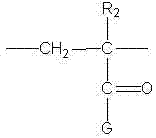
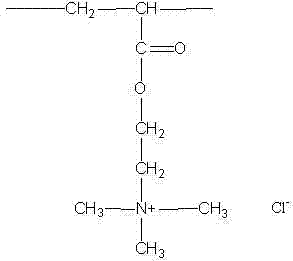
在一个实施方案中,J具有下式: In one embodiment, J has the formula:
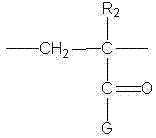
其中R2为氢或C1-C3烷基,和G为铵阳离子的盐。在一个实施方案中,R2为氢。在另一实施方案中,R2为甲基。 A salt wherein R 2 is hydrogen or C 1 -C 3 alkyl, and G is an ammonium cation. In one embodiment, R2 is hydrogen. In another embodiment, R2 is methyl.
在一个实施方案中,G为 In one embodiment, G is
--NHR3N(R4,R5,R6)+M- --NHR 3 N(R 4, R 5, R 6 ) + M -
或 or
--OR3N(R4,R5,R6)+M- --OR 3 N(R 4, R 5, R 6 ) + M -
其中R3为C1-C4直链或支链亚烷基,R4、R5和R6可相同或不同,并且为氢、C1-C4直链、取代或支链烷基、C5-C8环烷基、芳族或烷基芳族基团,M-为阴离子,例如氯离子、溴离子或甲基硫酸根或硫酸氢根。R4、R5和R6可为甲基或烯丙基,R3可为亚乙基、亚丙基或1-甲基亚乙基。G也可衍生自2-丙烯酰氧基乙基三甲基氯化铵(AETAC)、3-甲基丙烯酰胺基丙基三甲基氯化铵(MAPTAC)、2-甲基丙烯酰氧基乙基三甲基氯化铵(METAC)或二烯丙基二甲基氯化铵(DADMAC)。 Wherein R 3 is C 1 -C 4 straight chain or branched chain alkylene, R 4 , R 5 and R 6 can be the same or different, and are hydrogen, C 1 -C 4 straight chain, substituted or branched chain alkyl, C 5 -C 8 cycloalkyl, aromatic or alkylaromatic group, M- is an anion, such as chloride ion, bromide ion or methylsulfate or hydrogensulfate. R 4 , R 5 and R 6 may be methyl or allyl, and R 3 may be ethylene, propylene or 1-methylethylene. G can also be derived from 2-acryloyloxyethyltrimethylammonium chloride (AETAC), 3-methacrylamidopropyltrimethylammonium chloride (MAPTAC), 2-methacryloyloxy Ethyltrimethylammonium chloride (METAC) or diallyldimethylammonium chloride (DADMAC).
在一个实施方案中,J具有以下结构: In one embodiment, J has the structure:
。 .
嵌段共聚物可通过油包水型乳液技术来制备。这种工艺公开于美国专利号3,284,393、Re. 28,474和Re. 28,576,它们通过引用结合到本文中。所得到的共聚物也可通过在有机溶剂(例如丙酮)中沉淀来进一步分离,并干燥至粉末形式。粉末可容易地溶解于水性介质使用。 Block copolymers can be prepared by water-in-oil emulsion technology. This process is disclosed in U.S. Patent Nos. 3,284,393, Re. 28,474 and Re. 28,576, which are incorporated herein by reference. The resulting copolymer can also be further isolated by precipitation in an organic solvent such as acetone and dried to a powder form. The powder can be easily dissolved in aqueous media for use.
也可加入支化剂,例如聚乙二醇二(甲基)丙烯酸酯、亚甲基双(甲基)丙烯酰胺、N-乙烯基丙烯酰胺、烯丙基缩水甘油基醚、丙烯酸缩水甘油基酯等,条件是所得到的嵌段共聚物为水溶性的。 Branching agents can also be added, such as polyethylene glycol di(meth)acrylate, methylene bis(meth)acrylamide, N-vinyl acrylamide, allyl glycidyl ether, acrylate glycidyl esters, etc., provided that the resulting block copolymer is water soluble.
在一个实施方案中,水溶性嵌段共聚物的数均分子量在约100,000-约8,000,000范围。水溶性嵌段共聚物的数均分子量可在约500,000-约6,000,000范围。嵌段共聚物的分子量不是关键的,只要其可溶于水。 In one embodiment, the number average molecular weight of the water-soluble block copolymer ranges from about 100,000 to about 8,000,000. The number average molecular weight of the water-soluble block copolymer can range from about 500,000 to about 6,000,000. The molecular weight of the block copolymer is not critical as long as it is soluble in water.
嵌段共聚物的结构可通过常规手段证实,例如通过溶液粘度研究或C13 NMR光谱学。 The structure of the block copolymers can be confirmed by conventional means, for example by solution viscosity studies or C 13 NMR spectroscopy.
在一个实施方案中,以任何常规的方式使处理添加剂在混合液中分散,并且在与膜表面接触之前与混合液混合。处理添加剂可在膜的上游加入到混合液中。处理添加剂也可加入到生物反应器的区域中,在此区域发生强力混合或允许与混合液足够的混合时间,例如接近泵站、通风喷嘴或污泥/混合液再循环管。 In one embodiment, the treatment additive is dispersed in the mixed liquor in any conventional manner and mixed with the mixed liquor prior to contacting the membrane surface. Treatment additives can be added to the mixed liquor upstream of the membrane. Treatment additives can also be added to areas of the bioreactor where intensive mixing occurs or sufficient mixing time with the mixed liquor is allowed, such as near pumping stations, aeration nozzles, or sludge/mixed liquor recirculation lines.
处理添加剂以适于调节混合液的任何量分散。该量根据期望处理的具体的系统而变,并且可受到废水的特征的影响,此类变量例如浊度、pH、温度、流速、水量、混合液浓度和性质、悬浮的固体、絮凝物尺寸、在系统中存在的污染物的粘度和类型。处理添加剂可以约0.1 ppm体积活性聚合物-约100 ppm体积活性聚合物的量加入,基于废水的体积。处理添加剂也可以约1 ppm体积活性聚合物-约80 ppm体积活性聚合物的量加入。处理添加剂也可以约10 ppm体积活性聚合物-约50 ppm体积活性聚合物的量加入,基于废水的体积。 Treatment additives are dispersed in any amount suitable for conditioning the mixed liquor. This amount will vary depending on the specific system desired to be treated and can be influenced by the characteristics of the wastewater such as turbidity, pH, temperature, flow rate, water volume, mixed liquor concentration and nature, suspended solids, floc size, Viscosity and type of contaminants present in the system. The treatment additive may be added in an amount from about 0.1 ppm by volume active polymer to about 100 ppm by volume active polymer, based on the volume of the wastewater. Treatment additives may also be added in amounts ranging from about 1 ppm by volume active polymer to about 80 ppm by volume active polymer. Treatment additives may also be added in an amount of from about 10 ppm by volume active polymer to about 50 ppm by volume active polymer, based on the volume of the wastewater.
在另一实施方案中,处理添加剂可包括其它水溶性聚合物或无机凝结剂。另外的水溶性聚合物或无机凝结剂可单独加入到混合液中或与水溶性嵌段共聚物组合。这些另外的聚合物和凝结剂与水溶性嵌段共聚物协同作用,用于调节混合液和改进MBR系统中的通量。另外的聚合物或凝结剂可以有效降低处理添加剂的剂量同时实现类似的膜通量增强性能的量加入。在另一实施方案中,使用处理添加剂可显著降低另外的聚合物和凝结剂的量。水溶性聚合物的实例可为含丹宁的聚合物、聚二烯丙基二甲基氯化铵(聚DADMAC)、聚甲基丙烯酰氧基乙基三甲基氯化铵(聚METAC)或N,N-二甲基氨基乙基丙烯酸酯甲基氯化物(AETAC)和丙烯酰胺(AM)的共聚物。 In another embodiment, treatment additives may include other water soluble polymers or inorganic coagulants. Additional water-soluble polymers or inorganic coagulants may be added to the mixed liquor alone or in combination with the water-soluble block copolymer. These additional polymers and coagulants work synergistically with the water soluble block copolymers to regulate mixed liquor and improve flux in the MBR system. Additional polymers or coagulants can be added in amounts effective to reduce the dosage of the treatment additive while achieving similar membrane flux enhancing properties. In another embodiment, the use of treatment additives can significantly reduce the amount of additional polymer and coagulant. Examples of water-soluble polymers may be tannin-containing polymers, polydiallyldimethylammonium chloride (polyDADMAC), polymethacryloxyethyltrimethylammonium chloride (polyMETAC) Or a copolymer of N,N-dimethylaminoethylacrylate methyl chloride (AETAC) and acrylamide (AM).
在一个实施方案中,无机凝结剂可选自含有Ca、Mg、Si、Al、Fe和它们的组合的无机化合物。无机凝结剂可选自含有Al、Fe或它们的组合的无机盐或其聚合形式。在另一实施方案中,在膜生物反应器中改进通量的方法包括通过在混合液中分散处理添加剂来调节混合液,和使经调节的混合液通过膜,其中所述处理添加剂包括水溶性嵌段共聚物。 In one embodiment, the inorganic coagulant may be selected from inorganic compounds containing Ca, Mg, Si, Al, Fe, and combinations thereof. The inorganic coagulant may be selected from inorganic salts containing Al, Fe or combinations thereof or their polymerized forms. In another embodiment, a method of improving flux in a membrane bioreactor comprises conditioning the mixed liquor by dispersing a treatment additive in the mixed liquor, and passing the conditioned mixed liquor through a membrane, wherein the treatment additive comprises a water soluble block copolymers.
在一个实施方案中,混合液使用处理添加剂的分散体来调节。通过凝结和絮凝混合液中的可溶性有机化合物以防止膜积垢,处理添加剂增强膜通量。在一个实施方案中,处理添加剂包括水溶性嵌段共聚物,其如上所述。 In one embodiment, the mixed liquor is conditioned using a dispersion of a treatment additive. Treatment additives enhance membrane flux by coagulating and flocculating soluble organic compounds in the mixed liquor to prevent membrane fouling. In one embodiment, the treatment additive comprises a water soluble block copolymer, as described above.
在一个实施方案中,以任何常规的方式使处理添加剂在混合液中分散,并且在与膜表面接触之前与混合液混合。处理添加剂也可在膜的上游加入到混合液中。处理添加剂也可加入到生物反应器的区域中,在此区域发生强力混合或允许与混合液足够的混合时间,例如接近泵站、通风喷嘴或污泥/混合液再循环管。 In one embodiment, the treatment additive is dispersed in the mixed liquor in any conventional manner and mixed with the mixed liquor prior to contacting the membrane surface. Treatment additives may also be added to the mixed liquor upstream of the membrane. Treatment additives can also be added to areas of the bioreactor where intensive mixing occurs or sufficient mixing time with the mixed liquor is allowed, such as near pumping stations, aeration nozzles, or sludge/mixed liquor recirculation lines.
处理添加剂以适于调节混合液的任何量分散。该量根据期望处理的具体的系统而变,并且可受到废水的特征的影响,此类变量例如浊度、pH、温度、流速、水量、混合液浓度和性质、悬浮的固体、絮凝物尺寸、在系统中存在的污染物的粘度和类型。处理添加剂可以约0.1 ppm体积活性聚合物-约100 ppm体积活性聚合物的量加入,基于废水的体积。处理添加剂也可以约1 ppm体积活性聚合物-约80 ppm体积活性聚合物的量加入。处理添加剂也可以约10 ppm体积活性聚合物-约50 ppm体积活性聚合物的量加入,基于废水的体积。 Treatment additives are dispersed in any amount suitable for conditioning the mixed liquor. This amount will vary depending on the specific system desired to be treated and can be influenced by the characteristics of the wastewater such as turbidity, pH, temperature, flow rate, water volume, mixed liquor concentration and nature, suspended solids, floc size, Viscosity and type of contaminants present in the system. The treatment additive may be added in an amount from about 0.1 ppm by volume active polymer to about 100 ppm by volume active polymer, based on the volume of the wastewater. Treatment additives may also be added in amounts ranging from about 1 ppm by volume active polymer to about 80 ppm by volume active polymer. Treatment additives may also be added in an amount of from about 10 ppm by volume active polymer to about 50 ppm by volume active polymer, based on the volume of the wastewater.
在另一实施方案中,处理添加剂可包括如上所述的其它水溶性聚合物或无机凝结剂。 In another embodiment, the treatment additive may include other water soluble polymers or inorganic coagulants as described above.
膜生物反应器(MBR)和混合液如上所述。在一个实施方案中,将经调节的混合液通过膜过滤,从系统排放澄清的水。经调节的混合液也可在压力下通过膜,或者可在真空下通过膜取出。膜模块可浸没在生物反应器槽中或包含在单独的膜槽中,废水从生物反应器槽连续泵送至该槽中。膜可为具有外壳微滤器或超滤器的空心纤维或平板(堆叠)微滤器或超滤器。膜材料可包括但不限于氯化聚乙烯(PVC)、聚偏二氟乙烯(PVDF)、聚丙烯腈(PAN)、聚砜(PSF)、聚醚砜(PES)、聚乙烯醇(PVA)、乙酸纤维素(CA)、再生纤维素(RC)以及无机物,例如金属和陶瓷。 Membrane bioreactor (MBR) and mixed liquor are as described above. In one embodiment, the conditioned mixed liquor is filtered through a membrane and clarified water is discharged from the system. The conditioned mixture can also be passed through the membrane under pressure, or it can be withdrawn through the membrane under vacuum. The membrane modules can be submerged in a bioreactor tank or contained in a separate membrane tank into which wastewater is pumped continuously from the bioreactor tank. The membranes may be hollow fiber or flat plate (stacked) microfilters or ultrafilters with housing microfilters or ultrafilters. Membrane materials may include, but are not limited to, chlorinated polyethylene (PVC), polyvinylidene fluoride (PVDF), polyacrylonitrile (PAN), polysulfone (PSF), polyethersulfone (PES), polyvinyl alcohol (PVA) , cellulose acetate (CA), regenerated cellulose (RC), and inorganic substances such as metals and ceramics.
在另一实施方案中,使废水澄清的方法包括将废水加入到膜生物反应器中,通过在氧存在下向废水中加入微生物来制备混合液,通过在混合液中分散处理添加剂来调节混合液,使用膜过滤经调节的混合液,以产生澄清的废水,所述处理添加剂包括水溶性嵌段共聚物。 In another embodiment, a method of clarifying wastewater comprises feeding wastewater to a membrane bioreactor, preparing a mixed liquor by adding microorganisms to the wastewater in the presence of oxygen, conditioning the mixed liquor by dispersing a treatment additive in the mixed liquor , using a membrane to filter the conditioned mixed liquor to produce clarified wastewater, the treatment additive comprising a water-soluble block copolymer.
废水可得自市政和工业设备,并且可含有细胞外聚合物质和胶态和可溶性有机物质。 Wastewater can be obtained from municipal and industrial facilities and can contain extracellular polymeric matter and colloidal and soluble organic matter.
在一个实施方案中,混合液使用处理添加剂的分散体来调节。处理添加剂可包括水溶性嵌段共聚物,其如上所述。处理添加剂可以任何常规的方式在混合液中分散,并且在与膜表面接触之前与混合液混合。处理添加剂可在膜的上游加入到混合液中。处理添加剂也可加入到生物反应器的区域中,在此区域发生强力混合或允许与混合液足够的混合时间,例如接近泵站、通风喷嘴或污泥/混合液再循环管。 In one embodiment, the mixed liquor is conditioned using a dispersion of a treatment additive. Treatment additives may include water soluble block copolymers, as described above. The treatment additive may be dispersed in the mixed liquor in any conventional manner and mixed with the mixed liquor prior to contacting the membrane surface. Treatment additives can be added to the mixed liquor upstream of the membrane. Treatment additives can also be added to areas of the bioreactor where intensive mixing occurs or sufficient mixing time with the mixed liquor is allowed, such as near pumping stations, aeration nozzles, or sludge/mixed liquor recirculation lines.
处理添加剂以适于调节混合液的任何量分散。该量根据期望处理的具体的系统而变,并且可受到废水的特征的影响,此类变量例如浊度、pH、温度、流速、水量、混合液浓度和性质、悬浮的固体、絮凝物尺寸、在系统中存在的污染物的粘度和类型。处理添加剂可以约0.1 ppm体积活性聚合物-约100 ppm体积活性聚合物的量加入,基于废水的体积。处理添加剂也可以约1 ppm体积活性聚合物-约80 ppm体积活性聚合物的量加入。处理添加剂也可以约10 ppm体积活性聚合物-约50 ppm体积活性聚合物的量加入,基于废水的体积。 Treatment additives are dispersed in any amount suitable for conditioning the mixed liquor. This amount will vary depending on the specific system desired to be treated and can be influenced by the characteristics of the wastewater such as turbidity, pH, temperature, flow rate, water volume, mixed liquor concentration and nature, suspended solids, floc size, Viscosity and type of contaminants present in the system. The treatment additive may be added in an amount from about 0.1 ppm by volume active polymer to about 100 ppm by volume active polymer, based on the volume of the wastewater. Treatment additives may also be added in amounts ranging from about 1 ppm by volume active polymer to about 80 ppm by volume active polymer. Treatment additives may also be added in an amount of from about 10 ppm by volume active polymer to about 50 ppm by volume active polymer, based on the volume of the wastewater.
在另一实施方案中,处理添加剂可包括如上所述的其它水溶性聚合物或无机凝结剂。 In another embodiment, the treatment additive may include other water soluble polymers or inorganic coagulants as described above.
经调节的混合液可通过膜过滤,以筛分悬浮的固体或生物质,并且从系统排放澄清的水。经调节的混合液可在压力下通过膜,或者可在真空下通过膜取出。膜模块可浸没在生物反应器槽中或包含在单独的膜槽中,废水从生物反应器槽连续泵送至该槽中。膜可为具有外壳超滤器的空心纤维、平板(堆叠)微滤器或具有外壳微滤器的空心纤维。膜材料可包括但不限于氯化聚乙烯(PVC)、聚偏二氟乙烯(PVDF)、聚丙烯腈(PAN)、聚砜(PSF)、聚醚砜(PES)、聚乙烯醇(PVA)、乙酸纤维素(CA)、再生纤维素(RC)以及无机物,例如金属和陶瓷。 The conditioned mixed liquor can be filtered through a membrane to screen suspended solids or biomass and clear water is discharged from the system. The conditioned mixture can be passed through the membrane under pressure, or it can be withdrawn through the membrane under vacuum. The membrane modules can be submerged in a bioreactor tank or contained in a separate membrane tank into which wastewater is pumped continuously from the bioreactor tank. The membranes can be hollow fiber with housing ultrafilters, flat plate (stacked) microfilters or hollow fiber with housing microfilters. Membrane materials may include, but are not limited to, chlorinated polyethylene (PVC), polyvinylidene fluoride (PVDF), polyacrylonitrile (PAN), polysulfone (PSF), polyethersulfone (PES), polyvinyl alcohol (PVA) , cellulose acetate (CA), regenerated cellulose (RC), and inorganic substances such as metals and ceramics.
为了使本领域技术人员能更好地实践本公开,通过说明而不是限制的方式给出以下实施例。 In order to enable those skilled in the art to better practice the present disclosure, the following examples are given by way of illustration and not limitation.
实施例 Example
实施例1 Example 1
用于在实施例1-3中测试的混合液样品取自GE China Technology Center的市政废水处理设备。样品取自活性污泥再循环管线,其中MLSS浓度超过10g/L。 The mixed liquor sample that is used for testing in embodiment 1-3 is taken from the municipal wastewater treatment facility of GE China Technology Center. Samples were taken from activated sludge recirculation lines where the MLSS concentration exceeded 10 g/L.
对每一种测试样品和对照样品进行使用瓶式测试仪(Jar Tester,Phipps & BirdTM)的标准瓶测试,以确保适当混合。将混合液的四个500 ml等分试样加入到四个瓶中。将处理添加剂(聚合物A或聚合物B)快速加入到每个样品中,其量示于表1。通过向对照瓶中加入500 ml的混合液而没有加入处理添加剂,还制备对照样品。将所有样品在200 rpm下快速搅动30秒,随后以50 rpm的缓慢搅动速度搅动15分钟,以充分混合样品。 A standard jar test using a jar tester (Jar Tester, Phipps & Bird ™ ) was performed on each test sample and control sample to ensure proper mixing. Four 500 ml aliquots of the mixture were added to four bottles. The treatment additive (Polymer A or Polymer B) was quickly added to each sample in the amount indicated in Table 1. A control sample was also prepared by adding 500 ml of the mixture to a control bottle without adding treatment additives. All samples were agitated rapidly at 200 rpm for 30 seconds followed by slow agitation at 50 rpm for 15 minutes to thoroughly mix the samples.
通过时间对过滤器(TTF)测试方法,评价每一种样品(包括对照瓶)的混合液的过滤性。TTF测试方法改编自标准方法(APHA,1992),方法#2710H。将9 cm滤纸(Whatman GF/C,目录号1822 090)放置在布氏漏斗中,并湿润,以形成良好密封。将得自每一种经处理的混合液样品和对照瓶的200 ml样品加入到单独的布氏漏斗(如上制备)中。使用具有压力调节器的真空泵施加51 kPa(15英寸Hg)的真空压力。测量过滤50 ml(或者25%的初始样品体积(25%-TTF))的每一种混合液样品所需的时间并且示于表1。 The filterability of the mixture of each sample (including the control bottle) was evaluated by the time versus filter (TTF) test method. The TTF test method was adapted from the standard method (APHA, 1992), method #2710H. A 9 cm filter paper (Whatman GF/C, cat. no. 1822 090) was placed in the Buchner funnel and moistened to form a good seal. 200 ml samples from each treated mixture sample and control bottle were added to separate Buchner funnels (prepared as above). Apply a vacuum pressure of 51 kPa (15 inches Hg) using a vacuum pump with a pressure regulator. The time required to filter 50 ml (or 25% of the initial sample volume (25%-TTF)) of each mixture sample was measured and is shown in Table 1.
表1 Table 1
1聚合物A含有约38%活性物质(重量)的AETAC/AM/EHA的嵌段共聚物。其分子量在4,000,000-6,000,000范围 1 Polymer A is a block copolymer of AETAC/AM/EHA containing about 38% active matter by weight. Its molecular weight is in the range of 4,000,000-6,000,000
2聚合物B为含有约45%活性物质(重量)的另一种嵌段共聚物产品。该嵌段共聚物通过AETAC/AM/EHA的单体而聚合并且其分子量在4,000,000-6,000,000范围。AETAC/AM/EHA的单体分别是指N,N-二甲基氨基乙基丙烯酸酯甲基氯化物(AETAC)、丙烯酰胺(AM)和丙烯酸2-乙基己基酯(EHA)。 2 Polymer B is another block copolymer product containing about 45% active material by weight. The block copolymer is polymerized by AETAC/AM/EHA monomers and has a molecular weight in the range of 4,000,000-6,000,000. The monomers of AETAC/AM/EHA refer to N,N-dimethylaminoethylacrylate methyl chloride (AETAC), acrylamide (AM) and 2-ethylhexyl acrylate (EHA), respectively.
数据显示通过加入聚合物A或聚合物B的处理添加剂,均非常显著改进混合液的过滤性。 The data shows that the filterability of the mixed liquor is very significantly improved by adding either Polymer A or Polymer B treatment additives.
实施例2 Example 2
对每一种以下测试样品和对照样品进行使用瓶式测试仪(Phipps & BirdTM)的标准瓶测试,以确保适当混合。将混合液的五个500 ml等分试样加入到五个瓶中。将示于表2的处理添加剂加入到每个样品中。通过向对照瓶中加入500 ml的混合液而没有加入处理添加剂,还制备对照样品。将所有样品在200 rpm下快速搅动30秒,随后以50 rpm的缓慢搅动速度搅动15分钟,以充分混合样品。 A standard bottle test using a bottle tester (Phipps & Bird ™ ) was performed on each of the following test samples and control samples to ensure proper mixing. Five 500 ml aliquots of the mixture were added to five bottles. The treatment additives shown in Table 2 were added to each sample. A control sample was also prepared by adding 500 ml of the mixture to a control bottle without adding treatment additives. All samples were agitated rapidly at 200 rpm for 30 seconds followed by slow agitation at 50 rpm for 15 minutes to thoroughly mix the samples.
通过如实施例1中描述的TTF测试方法,评价每一种样品(包括对照瓶)的混合液的过滤性。将得自每一种经处理的混合液样品和对照瓶的200 ml样品加入到单独的布氏漏斗中。使用具有压力调节器的真空泵施加51 kPa(15英寸Hg)的真空压力。测量过滤100 ml(或者50%的初始样品体积(50%-TTF))的每一种混合液样品所需的时间并且示于表2。 The filterability of the mixed liquor of each sample (including the control bottle) was evaluated by the TTF test method as described in Example 1. 200 ml samples from each treated mixture sample and control bottle were added to separate Buchner funnels. Apply a vacuum pressure of 51 kPa (15 inches Hg) using a vacuum pump with a pressure regulator. The time required to filter 100 ml (or 50% of the initial sample volume (50%-TTF)) of each mixture sample was measured and shown in Table 2.
表2 Table 2
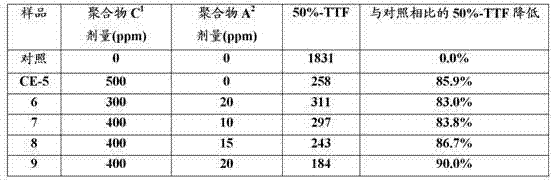
1聚合物C含有约38%活性物质(重量)的丹宁/AETAC的嵌段共聚物,其中AETAC的重量百分比为约57.5%。分子量为约75,000 1 Polymer C is a tannin/AETAC block copolymer containing about 38% actives by weight, wherein the weight percent of AETAC is about 57.5%. Molecular weight is about 75,000
2聚合物A含有约38%活性物质(重量)的AETAC/AM/EHA的嵌段共聚物。其分子量在4,000,000-6,000,000范围。 2 Polymer A A block copolymer of AETAC/AM/EHA containing about 38% actives by weight. Its molecular weight is in the range of 4,000,000-6,000,000.
数据显示具有含丹宁的聚合物的处理添加剂增强混合液样品的过滤性。借助嵌段共聚物,含丹宁的聚合物的剂量可降低,同时仍提供良好的过滤性。由于嵌段共聚物显示非常强的絮凝能力,其需要远低得多的剂量来实现相同的过滤性增强。 The data show that treatment additives with tannin-containing polymers enhance the filterability of mixed liquor samples. With block copolymers, the dosage of tannin-containing polymers can be reduced while still providing good filterability. Since block copolymers exhibit very strong flocculation capabilities, they require much lower dosages to achieve the same filterability enhancement.
实施例3 Example 3
对每一种以下测试样品和对照样品进行使用瓶式测试仪(Phipps & BirdTM)的标准瓶测试,以确保适当混合。将混合液的六个500 ml等分试样加入到六个瓶中。将示于表3的处理添加剂快速加入到每个测试样品中。通过向对照瓶中加入500 ml的混合液而没有加入处理添加剂,还制备对照样品。将所有样品在200 rpm下快速搅动30秒,随后以50 rpm的缓慢搅动速度搅动15分钟,以充分混合样品。 A standard bottle test using a bottle tester (Phipps & Bird ™ ) was performed on each of the following test samples and control samples to ensure proper mixing. Six 500 ml aliquots of the mixture were added to six vials. The treatment additives shown in Table 3 were quickly added to each test sample. A control sample was also prepared by adding 500 ml of the mixture to a control bottle without adding treatment additives. All samples were agitated rapidly at 200 rpm for 30 seconds followed by slow agitation at 50 rpm for 15 minutes to thoroughly mix the samples.
通过如实施例1中描述的TTF测试方法,评价每一种样品(包括对照瓶)的混合液的过滤性。将得自每一种经处理的混合液样品和对照瓶的200 ml样品加入到单独的布氏漏斗中。使用具有压力调节器的真空泵施加51 kPa(15英寸Hg)的真空压力。测量过滤100 ml(或者50%的初始样品体积(50%-TTF))的每一种混合液样品所需的时间并且示于表3。 The filterability of the mixed liquor of each sample (including the control bottle) was evaluated by the TTF test method as described in Example 1. 200 ml samples from each treated mixture sample and control bottle were added to separate Buchner funnels. Apply a vacuum pressure of 51 kPa (15 inches Hg) using a vacuum pump with a pressure regulator. The time required to filter 100 ml (or 50% of the initial sample volume (50%-TTF)) of each mixture sample was measured and shown in Table 3.
表3 table 3
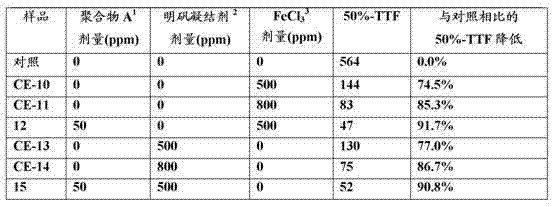
1聚合物与明矾凝结剂或FeCl3分开加入到混合液中 1 Polymer and alum coagulant or FeCl 3 are added to the mixed solution separately
2明矾凝结剂产品为含有50%活性物质的水合氯化铝含水产品(Al2(OH)5Cl)。 2 The alum coagulant product is an aqueous product of aluminum chlorohydrate (Al 2 (OH) 5 Cl) containing 50% active substance.
3FeCl3溶液使用无水FeCl3化学试剂(Sinopharm Chemical Reagent Co.,Ltd.,China)直接制备。 3 FeCl 3 solution was directly prepared using anhydrous FeCl 3 chemical reagent (Sinopharm Chemical Reagent Co., Ltd., China).
数据显示,嵌段共聚物可与明矾或基于铁的无机凝结剂一起加入,以增强混合液样品的过滤性。借助嵌段共聚物,无机凝结剂的剂量可大大降低。 The data show that block copolymers can be added with alum or iron-based inorganic coagulants to enhance the filterability of mixed liquor samples. With the help of block copolymers, the dosage of inorganic coagulants can be greatly reduced.
虽然为了说明的目的已描述了典型的实施方案,前面的描述不应认为是对此处范围的限制。因此,在不偏离本文的精神和范围的情况下,本领域技术人员可以想到各种修改、适应和替代。 While typical embodiments have been described for purposes of illustration, the foregoing description should not be considered as limiting the scope herein. Accordingly, various modifications, adaptations, and substitutions may occur to those skilled in the art without departing from the spirit and scope herein.
Claims (29)

Applications Claiming Priority (1)
| Application Number | Priority Date | Filing Date | Title |
|---|---|---|---|
| PCT/CN2010/001847 WO2012065283A1 (en) | 2010-11-18 | 2010-11-18 | Methods for improving membrane bioreactor systems |
Publications (2)
| Publication Number | Publication Date |
|---|---|
| CN103201224A true CN103201224A (en) | 2013-07-10 |
| CN103201224B CN103201224B (en) | 2015-11-25 |
Family
ID=46083467
Family Applications (1)
| Application Number | Title | Priority Date | Filing Date |
|---|---|---|---|
| CN201080070181.5A Active CN103201224B (en) | 2010-11-18 | 2010-11-18 | Methods for improving membrane bioreactor systems |
Country Status (12)
| Country | Link |
|---|---|
| US (1) | US20130220920A1 (en) |
| EP (1) | EP2640671B1 (en) |
| KR (1) | KR20130126640A (en) |
| CN (1) | CN103201224B (en) |
| AU (1) | AU2010364307B2 (en) |
| BR (1) | BR112013010470A2 (en) |
| CA (1) | CA2817377C (en) |
| DK (1) | DK2640671T3 (en) |
| ES (1) | ES2753143T3 (en) |
| HU (1) | HUE046908T2 (en) |
| MY (1) | MY164580A (en) |
| WO (1) | WO2012065283A1 (en) |
Families Citing this family (1)
| Publication number | Priority date | Publication date | Assignee | Title |
|---|---|---|---|---|
| FI130436B (en) | 2019-06-10 | 2023-08-30 | Kemira Oyj | Procedure for the removal of dissolved organic compounds from wastewater |
Citations (2)
| Publication number | Priority date | Publication date | Assignee | Title |
|---|---|---|---|---|
| CN1872734A (en) * | 2005-06-01 | 2006-12-06 | 纳尔科公司 | A method for improving flux in a membrane bioreactor |
| US20080060996A1 (en) * | 2006-09-13 | 2008-03-13 | Seong-Hoon Yoon | Method of improving membrane bioreactor performance |
Family Cites Families (9)
| Publication number | Priority date | Publication date | Assignee | Title |
|---|---|---|---|---|
| US3284393A (en) | 1959-11-04 | 1966-11-08 | Dow Chemical Co | Water-in-oil emulsion polymerization process for polymerizing watersoluble monomers |
| USRE28576E (en) | 1970-12-15 | 1975-10-21 | Process for rapid dissolving water-soluble vinyl addition polymers using water-in-oil emulsions | |
| USRE28474F1 (en) | 1970-12-15 | 1983-12-20 | Nalco Chemical Co | Process for rapidly dissolving water-soluble polymers |
| US5234604A (en) * | 1991-02-26 | 1993-08-10 | Betz Laboratories, Inc. | Water soluble block copolymers and methods of use therof |
| US5182331A (en) * | 1991-02-26 | 1993-01-26 | Betz Laboratories, Inc. | Water soluble block copolymers and methods of use thereof |
| US5368744A (en) * | 1993-08-03 | 1994-11-29 | Betz Laboratories, Inc. | Methods for treating wastewater |
| US6723245B1 (en) * | 2002-01-04 | 2004-04-20 | Nalco Company | Method of using water soluble cationic polymers in membrane biological reactors |
| US20040168980A1 (en) * | 2002-01-04 | 2004-09-02 | Musale Deepak A. | Combination polymer treatment for flux enhancement in MBR |
| US7611632B1 (en) * | 2008-11-07 | 2009-11-03 | General Electric Company | Method of conditioning mixed liquor using a tannin containing polymer |
-
2010
- 2010-11-18 US US13/119,829 patent/US20130220920A1/en not_active Abandoned
- 2010-11-18 CA CA2817377A patent/CA2817377C/en not_active Expired - Fee Related
- 2010-11-18 BR BR112013010470A patent/BR112013010470A2/en not_active Application Discontinuation
- 2010-11-18 CN CN201080070181.5A patent/CN103201224B/en active Active
- 2010-11-18 ES ES10859776T patent/ES2753143T3/en active Active
- 2010-11-18 HU HUE10859776A patent/HUE046908T2/en unknown
- 2010-11-18 KR KR1020137015547A patent/KR20130126640A/en not_active Ceased
- 2010-11-18 DK DK10859776T patent/DK2640671T3/en active
- 2010-11-18 AU AU2010364307A patent/AU2010364307B2/en active Active
- 2010-11-18 WO PCT/CN2010/001847 patent/WO2012065283A1/en not_active Ceased
- 2010-11-18 EP EP10859776.6A patent/EP2640671B1/en not_active Not-in-force
- 2010-11-18 MY MYPI2013001492A patent/MY164580A/en unknown
Patent Citations (2)
| Publication number | Priority date | Publication date | Assignee | Title |
|---|---|---|---|---|
| CN1872734A (en) * | 2005-06-01 | 2006-12-06 | 纳尔科公司 | A method for improving flux in a membrane bioreactor |
| US20080060996A1 (en) * | 2006-09-13 | 2008-03-13 | Seong-Hoon Yoon | Method of improving membrane bioreactor performance |
Also Published As
| Publication number | Publication date |
|---|---|
| EP2640671B1 (en) | 2019-08-14 |
| AU2010364307A1 (en) | 2013-06-06 |
| CN103201224B (en) | 2015-11-25 |
| WO2012065283A1 (en) | 2012-05-24 |
| MY164580A (en) | 2018-01-15 |
| KR20130126640A (en) | 2013-11-20 |
| DK2640671T3 (en) | 2019-11-18 |
| BR112013010470A2 (en) | 2016-08-02 |
| CA2817377A1 (en) | 2012-05-24 |
| US20130220920A1 (en) | 2013-08-29 |
| EP2640671A1 (en) | 2013-09-25 |
| HUE046908T2 (en) | 2020-04-28 |
| EP2640671A4 (en) | 2014-05-21 |
| CA2817377C (en) | 2017-11-07 |
| AU2010364307B2 (en) | 2016-09-08 |
| ES2753143T3 (en) | 2020-04-07 |
Similar Documents
| Publication | Publication Date | Title |
|---|---|---|
| AU2003200842B2 (en) | Method of using water soluble polymers in a membrane biological reactor | |
| CN103768947B (en) | Membrane separating method | |
| TWI388514B (en) | Method for improving flux in a membrane bioreactor | |
| Koseoglu et al. | Effects of several different flux enhancing chemicals on filterability and fouling reduction of membrane bioreactor (MBR) mixed liquors | |
| CN102272057A (en) | Method of conditioning mixed liquor using a tannin containing polymer | |
| CA2663285A1 (en) | A method of improving membrane bioreactor performance | |
| JP2019141801A (en) | Water treatment method and water treatment apparatus | |
| CN1447838A (en) | Polymeric compsns. for dewatering sewage sludges | |
| US20110203977A1 (en) | Filtration apparatus and water treatment apparatus | |
| JP6060958B2 (en) | Removal method of coloring components | |
| CN103201224B (en) | Methods for improving membrane bioreactor systems | |
| TWI589532B (en) | Methods for improving membrane bioreactor systems | |
| Dong et al. | THE EFFECT OF EPS ON MIXED LIQUOR CHARACTERISTICS AND MEMBRANE FOULING IN UCT¬ MBR PROCESS |
Legal Events
| Date | Code | Title | Description |
|---|---|---|---|
| C06 | Publication | ||
| PB01 | Publication | ||
| C10 | Entry into substantive examination | ||
| SE01 | Entry into force of request for substantive examination | ||
| C14 | Grant of patent or utility model | ||
| GR01 | Patent grant | ||
| TR01 | Transfer of patent right |
Effective date of registration: 20181229 Address after: American Minnesota Patentee after: BL Technology Co.,Ltd. Address before: American New York Patentee before: General Electric Co. |
|
| TR01 | Transfer of patent right | ||
| TR01 | Transfer of patent right |
Effective date of registration: 20191218 Address after: Plot B-C, electromechanical Industrial Park, national high tech Industrial Development Zone, Wuxi City, Jiangsu Province Patentee after: Suez water technology (Wuxi) Co.,Ltd. Address before: American Minnesota Patentee before: BL Technology Co.,Ltd. |
|
| TR01 | Transfer of patent right | ||
| CP01 | Change in the name or title of a patent holder |
Address after: 214028 plot B-C, electromechanical Industrial Park, national high tech Industrial Development Zone, Wuxi City, Jiangsu Province Patentee after: Veolia Water Technology (Wuxi) Co.,Ltd. Address before: 214028 plot B-C, electromechanical Industrial Park, national high tech Industrial Development Zone, Wuxi City, Jiangsu Province Patentee before: Suez water technology (Wuxi) Co.,Ltd. |
|
| CP01 | Change in the name or title of a patent holder |