CN103237902A - Methods and compositions for reducing the color of sugar - Google Patents
Methods and compositions for reducing the color of sugar Download PDFInfo
- Publication number
- CN103237902A CN103237902A CN2011800489845A CN201180048984A CN103237902A CN 103237902 A CN103237902 A CN 103237902A CN 2011800489845 A CN2011800489845 A CN 2011800489845A CN 201180048984 A CN201180048984 A CN 201180048984A CN 103237902 A CN103237902 A CN 103237902A
- Authority
- CN
- China
- Prior art keywords
- acid
- salts
- component
- ppm
- salt
- Prior art date
- Legal status (The legal status is an assumption and is not a legal conclusion. Google has not performed a legal analysis and makes no representation as to the accuracy of the status listed.)
- Pending
Links
Images


Classifications
-
- C—CHEMISTRY; METALLURGY
- C13—SUGAR INDUSTRY
- C13B—PRODUCTION OF SUCROSE; APPARATUS SPECIALLY ADAPTED THEREFOR
- C13B50/00—Sugar products, e.g. powdered, lump or liquid sugar; Working-up of sugar
-
- A—HUMAN NECESSITIES
- A23—FOODS OR FOODSTUFFS; TREATMENT THEREOF, NOT COVERED BY OTHER CLASSES
- A23L—FOODS, FOODSTUFFS OR NON-ALCOHOLIC BEVERAGES, NOT OTHERWISE PROVIDED FOR; PREPARATION OR TREATMENT THEREOF
- A23L5/00—Preparation or treatment of foods or foodstuffs, in general; Food or foodstuffs obtained thereby; Materials therefor
- A23L5/40—Colouring or decolouring of foods
- A23L5/49—Removing colour by chemical reaction, e.g. bleaching
-
- C—CHEMISTRY; METALLURGY
- C13—SUGAR INDUSTRY
- C13B—PRODUCTION OF SUCROSE; APPARATUS SPECIALLY ADAPTED THEREFOR
- C13B20/00—Purification of sugar juices
- C13B20/005—Purification of sugar juices using chemicals not provided for in groups C13B20/02 - C13B20/14
-
- C—CHEMISTRY; METALLURGY
- C13—SUGAR INDUSTRY
- C13B—PRODUCTION OF SUCROSE; APPARATUS SPECIALLY ADAPTED THEREFOR
- C13B20/00—Purification of sugar juices
- C13B20/08—Purification of sugar juices by oxidation or reduction
-
- C—CHEMISTRY; METALLURGY
- C13—SUGAR INDUSTRY
- C13B—PRODUCTION OF SUCROSE; APPARATUS SPECIALLY ADAPTED THEREFOR
- C13B20/00—Purification of sugar juices
- C13B20/08—Purification of sugar juices by oxidation or reduction
- C13B20/10—Purification of sugar juices by oxidation or reduction using sulfur dioxide or sulfites
Landscapes
- Chemical & Material Sciences (AREA)
- Life Sciences & Earth Sciences (AREA)
- Biochemistry (AREA)
- Organic Chemistry (AREA)
- Chemical Kinetics & Catalysis (AREA)
- Food Science & Technology (AREA)
- Engineering & Computer Science (AREA)
- Nutrition Science (AREA)
- Health & Medical Sciences (AREA)
- Polymers & Plastics (AREA)
- General Chemical & Material Sciences (AREA)
- Jellies, Jams, And Syrups (AREA)
- Saccharide Compounds (AREA)
- Detergent Compositions (AREA)
- Coloring Foods And Improving Nutritive Qualities (AREA)
- Polysaccharides And Polysaccharide Derivatives (AREA)
- Pharmaceuticals Containing Other Organic And Inorganic Compounds (AREA)
Abstract
The present invention relates to a process for reducing the color of any intermediate during the process of obtaining a sugar, a sugar and a process for preparing a light colored sugar. The invention also relates to the use of components and combinations thereof that reduce the color of sugars and/or intermediates in processes for obtaining sugars.
Description
Invention field
The present invention relates to make any intermediate in the process that obtains sugar to reduce method, the sugar of color and prepare the method for light colour sugar (low color sugar).
Any intermediate that the invention still further relates in the technology that makes sugar and/or obtain sugar reduces the component of color and the purposes of its combination.
Background of invention
Sugar can be produced with various raw materials, for example sugar-cane, sugar beet and sweet sorghum (saccharine sorghum), and for example, all there is common decolouring (color minimizing) problem in they.
In the sugared production technique based on sugar-cane, sugarcane is pulverized, the Normal juice that shredding stage produces is handled with the following step: heating, sulphiting, liming (liming), phosphorylation and decantation, other step in addition.The purpose of these steps is to alleviate the color of syrup and remove insoluble substance.
Next, syrup is concentrated in one or more vaporizers.Then, the syrup that obtains is boiled, crystallization in crystallizing pan, centrifugal, produce sugar thus.
Such just as well known to the skilled person, sugared production technique and depend on the quality of the sugarcane of pulverizing except the effect of look to a great extent.And then the sugar-cane quality is according to weather condition, soil type, sugar-cane kind, ripe level, the time span in sunburn (burning), between collecting and pulverizing, loading technology, the operational condition in transportation and sugar refinery and changing.
The factor that directly influences the saccharic amount is color.Thus, for the high-quality sugar of production light color, at production period, importantly remove color, muddiness and solid in the suspension.The quality of sugar-cane and its mutation, this depends on above-mentioned characteristic, may produce more black color, must remove this color.
Under any condition, sugar-cane has various natural pigments (pigments), and this natural pigment makes the sugar of production produce color, for example, flavonoid, it is solubility, and can not remove by common process.
In sugar-cane juice, the quantity of substance that show color very low (according to per-cent) has only about 3% non-sugared organic compound in syrup.Yet these compounds become more important, and this is owing to they clear and definite influences of color generation to syrup and final product sugar.
As mentioned above, sugared production technique comprises that some steps concentrate in the decolouring, for example, heating steps, it helps decolouring with three approach simultaneously: (a) when syrup that the heating crushing process produces, remove undesirable microorganism from this process, and therefore syrup is sterilized; (b) during sugar juice decoloring step (in decantor), when syrup is heated to above its boiling point, from juice of sugar cane, remove gas and bubble, thereby more effectively operate decantor; (c) during processing, the higher temperature of chemical reaction needs appears, for example sulphiting, it also is the step relevant with decolouring.
During the sulphiting step, sulfurous gas (SO
2) act on syrup by oxidation, make its decolouring by preventing the reaction that darkens between reducing sugar and the amino acid.
The target of liming step (pH correction) also is decolouring, and its effect by the polyelectrolyte that conversion, sterilization syrup and enhancing are batched reduces the sucrose loss.The product that is used most widely for the pH alignment technique is lime.
Decantation is the step in the syrup treating processes, and in this step, it is more obvious to decolour.In this step, decolour by mechanical effect, by removing the undissolved compound in the decantor, the syrup color becomes lighter.In order to make insoluble substance go out to present this concentration, except the liming step, must add polyelectrolyte, the input terminus at decantor adds usually, and the electrostatic repulsion forces in it and between the particle is guaranteed to solidify and flocculate thus.
People find that generally the decantation ability that lacks phosphatic sugar cane juice reduces.Thus, conventional practice is to add phosphoric acid, for example, and the phosphoric acid salt additive.Be settled out calcium phosphate crystal and color bodies.This step is called as phosphorylation.
Except above-mentioned steps, according to the quality of the sugar of producing, in order to reduce color, this technology also can increase other step, for example, and syrup air supporting (syrup flotation), magma (magma) remix and refining.
Be suspended in the lip-deep insoluble solid of mixture (removing by mechanical process) by removing from syrup, syrup air supporting can make color subtract to take off, and reduces turbidity.
In magma remix step, make the magma recycled back by continuous centrifuge, remove more mother liquor.Must be noted that in this technology, mother liquor is the compound of black, purity is minimum.
What be worth emphasizing is, in factory, syrup air supporting and magma remix are new installation to be installed, to be dropped into expense, heat energy and the electricity of goods and materials and also can reduce the technology that sugar reclaims in the factory except needs.
Purification step be used for to obtain refining and/or whiter sugar, consists essentially of three operations: (a) with the sugar dissolving, obtain liquid, heating (b) makes liquid flotation in settler, removes undesirable material and (c) recrystallization from the surface.Decolouring appears during liquid floatation step (its principle of work is identical with above-mentioned syrup air supporting principle).
High chemistry, energy and the cost of equipment of purification step influence sugared working (machining) efficiency and rentability significantly.
As mentioned above, at sugared production period, in order to make the sugar decolouring of producing, all traditional technologys and the known technology of removing foreign pigment use physical method (for example, decantation, heating and centrifugal).Employed several chemical technology, for example sulphiting and phosphorylation for example cause the mass loss during sugared production process.
In addition, chemistry and the physical method as a prior art part is not effective means.By above-mentioned decoloring method, traditional sugar refinery is not easy the crystallised sugar that the production color is 150 UI (ICUMSA unit) (unifying analytical procedure meeting (the International Commission for Uniform Methods of Sugar Analysis) by international granulated sugar determines).Sugar (being called as (VHP) sugar of high polarisation (Very High Polarization)) by these plant produced has up to 1000 UI.It must be emphasized that even obtain low sugar colour at production period, As time goes on the color of sugar crystal deepens.
Must consider that also according to sugar cane breed (it is one of factor that has the strongest influence), it is more remarkable that above-mentioned all obstacles may become in decoloration process.The sugarcane of some kinds, RB92579 for example, their productive value is very high, but produces the dark colour syrup.This color can not be effectively by above-mentioned existing technology decolouring.
Therefore, in the sugared production technique of stable yield, also need to make the method for sugar decolouring, these methods even can shorten some steps of technology, and be economically feasible.
Brief description of the present invention
The present invention includes the method that any intermediate color of the technology that makes sugar and/or obtain sugar reduces, and comprise the sugar of producing in this way, is feature with the following fact: this method comprises and adds component 3 and component 1 and/or 2 at least that wherein component is:
Component 1: at least a inhibitor of enzyme that can catalysis forms the precursor of color bodies (color bodies) or color bodies, it is the compound that makes the anthocyanogen decolouring with anthocyanogen (anthocyanins) reaction, perhaps suppresses the compound of the reaction formation of peroxidase (POD) and/or polyphenol-oxydase (PPO) enzyme;
Component 2: one or more sulphite, pyrosulfite (metabisulfites), hydrosulphite (bisulfites), hyposulfite (hydrosulfites) or sulfurous gas or its source; With
Component 3: at least a sequestrant.
The present invention also comprises the method for any intermediate of the technology of producing light color sugar and/or obtaining sugar, and comprises the sugar that this method is produced, and is feature with the following fact: be included in the step of this method, add component 3 and component 1 and/or 2 at least, as described below:
Component 1: at least a inhibitor of the enzyme that the precursor of catalytic reaction colour solid or color bodies forms, make the compound of anthocyanogen decolouring with the anthocyanogen reaction, perhaps suppress the compound that the reaction of peroxidase (POD) and/or polyphenol-oxydase (PPO) enzyme forms;
Component 2: one or more sulphite, pyrosulfite (metabisulfites), hydrosulphite (bisulfites), hyposulfite (hydrosulfites) or sulfurous gas or its source; With
-component 3: at least a sequestrant.
The present invention includes the composition that sugared color is reduced, and comprise the sugar of handling with said composition, be characterised in that: said composition comprises component 3 and component 1 and/or 2 at least, as mentioned above.
The present invention also comprises test kit, is characterised in that: in identical or different branch interval, it comprises two kinds of components in the said components 1,2 and 3 at least.
The invention still further relates to three kinds of components of the present invention, and with the component 3 of component 1 or component 2 couplings, make sugar and/or obtain the purposes that any intermediate color of the method for sugar reduces.
Brief description of drawings
Fig. 1 provides the synoptic diagram with sugar refinery of conventional sugar production technique processing plant.
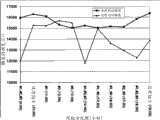
Fig. 2 provides in the sugar course of processing curve of the effect of the technology of the present invention of using component 1, some variants of 2 and 3.
Fig. 3 has shown the position (in one embodiment of the invention) of supplying with component 1-3 during sugar is processed.
Fig. 4 represents sugar beet juice is used technology of the present invention.
Fig. 5 represents molasses are used technology of the present invention.
Definition
Term " Normal juice " expression that the present invention uses is by grinding the liquid that sugarcane obtains.
Term " syrup of decantation " refers to flow through the syrup of decantation step.
The liquid that term " syrup " expression obtains after being evaporated to syrup to a certain degree at least.
Term " mother liquor of enrichment " washs the mixture that massecuite produces during being illustrated in centrifugal treating.
The mixture of discharging during the sugared centrifugation step is carried out in term " poor mother liquor " expression by centripetal force.
Term " liquid " (liquor) is illustrated in sugar soluble in water during the refining processing.
Term " magma " refers to the employed saturated sugar syrup of the sugar crystal of using as crystallization.
Term " molasses " refers to last mother liquor, and it comes from the centrifugation of the sugar substance of being made up of syrup, mother liquor and sugar crystal, compares with other mother liquor, has low relatively sucrose content, makes it can not use in technology.
Term " raw sugar " refers to carry out the sugar (even having carried out further processing) of centrifugal or similar processing.
Term " refined sugar " refers to the raw sugar made with extra care subsequently.
Term " mother liquor " is the liquid that contains crystallised sugar.
Term " obtains the intermediate of the technology of sugar " and comprise all above-mentioned terms and any other products that can obtain during the technology that obtains sugar.
Term " sugar " comprises raw sugar and refined sugar, unless show in addition.
Detailed description of the present invention
Disclosed all scopes are considered as providing support for any point within any subrange within those scopes and those scopes in the disclosure.
All sugared testing datas that the application provides are tests of carrying out with sugarcane raw sugar, unless show in addition.
According to method of the present invention, by adding component 3 and component 1 and/or 2 at least, can during sugar processing, make any intermediate and the last raw sugar color minimizing that produces of the technology of syrup or acquisition sugar, and sugared color is reduced.
Produce the raw material of sugar preferably but not limited to the sugar-cane of many different varietiess (sugarcane (
Saccharum spp)), RB92579 for example, SP791011, RB001914, RB001915, RB98710, RB951541, RB001921, VAT90212, RB991536, RB011518, RB99395, RB011541, RB011549, RB011585, RB011514, RB011553, RB863129, RB971723, RB845210, RB845210, RB813804 and SP813250.Can also use known any other source of goods of sugared production field, for example, sugar beet (
Beta ssp) and sweet sorghum (Schrock (
Sorghum bicolor)), for example can be referring to Fig. 4, it has shown the purposes of technology of the present invention in sugar beet juice, and has shown the color minimizing.Technology of the present invention be applicable to mention have a height productive value but have the sugar cane breed make syrup color decolouring problem, RB92579 sugarcane for example, and the sugar-cane kind that does not have the decolouring problem, for example SP1011.
The present invention also comprises three kinds of components of the present invention, and with the component 3 of component 1 or component 2 couplings, the purposes in any intermediate color that makes sugar and/or obtain the method for sugar reduces.
For color reduces, this component chemically reacts, and can produce syrup thus, raw sugar and refined sugar.
Colorific reason
Have various components in sugar-cane, they make syrup produce color, comprise flavonoid.Be anthocyanogen (anthocyanins) for producing the very important category flavones of color:
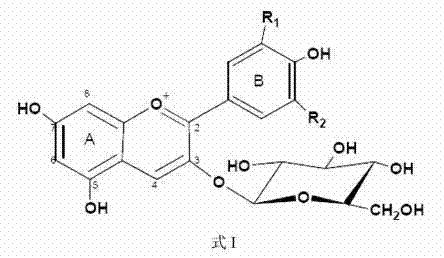
Anthocyanogen (formula I) is colorific one of the main reasons in sugared production process.The anthocyanogen molecule not only develops the color, and they can also carry out polyreaction, and this polyreaction is caused by polyphenol-oxydase (PPO) and peroxidase (POD) enzyme, forms melanochrome and some polyphenolic substances of for example strong colour developing.
With regard to modern technologies, except anthocyanogen, one of reason that develops the color during sugared production process is relevant with " impurity " in the sugar, glucose for example, and it can carry out producing the chemical reaction of hydroxymethylfurfural (HMF).For example, the polymerization of HMF can form melanoidin, and it is the compound of strong colour developing.
Explain component that the present invention adds and related principle in more detail below.
Work as M
+When=Na, R=H, M
+-O-S (=O)-the preferred compound 1 of CH (OH) R is sodium formaldehyde sulphoxylate.In this application, all testing datas are to use sodium formaldehyde sulphoxylate to obtain, except as otherwise noted.
Yet the compound in the sulfoxylic acid salt is not all effectively same.For example, V-Brite B (sodium hydrosulfite) can not provide the colour stability identical with sodium formaldehyde sulphoxylate.With polymkeric substance, lime and phosphoric acid the Normal juice of decantation in the laboratory is tested.Under the condition of component 1-3 sample is tested having and do not have.Below table 1 be the test the result.In this embodiment, the chemical reagent that uses is the sodium formaldehyde sulphoxylate of 100 ppm, Sodium Pyrosulfite (the sodium metabisulfite of 100 ppm, and indicated the V-Brite B (sodium hydrosulfite) of 100 ppm component 2) and the HEDP of 360 ppm (component 3).
Table 1
| Sample | Initial color (IU) | Color (IU) after 1 hour | Color (IU) after 2 hours |
| Unprocessed | 12,210 | 12,615 | 12,950 |
| Handle with sodium formaldehyde sulphoxylate | 11,123 | 11,004 | 11,119 |
| Handle with V-Brite B | 11,776 | 12,941 | 13,098 |
| Handle with sodium formaldehyde sulphoxylate and |
8,303 | 8,529 | 8,724 |
| Handle with V-Brite B and |
8,643 | 9,073 | 9,663 |
Can see that aspect taking off color and keeping color two, the performance of sodium formaldehyde sulphoxylate is better.In fact, in the test that only adds V-Brite B, return look (color reversion) and cause darker than the color of undressed sample.Thus, when V-Brite B (CAS NO.o 7775-14-6) and component 2 and 3 couplings, can improve, but not have sodium formaldehyde sulphoxylate effective like that.
Sodium formaldehyde sulphoxylate is effective reductive agent, and it comes work by the polymerization that suppresses anthocyanogen, and they form the polyphenol of strong colour developing.In addition, 2 and 4 interpolation sulfoxylic acid bases to anthocyanogen shown in I, can form colourless sulfonic acid structure.
In addition, component 1 is by being the decomposition that smaller units helps starch molecule with starch 1 → 4 bond rupture, the viscosity of the medium that this can reduce to use, thereby nurture crystallization.By step subsequently, keep viscosity to reduce, thereby cause more weak color.The size of starch molecule reduces to reduce with relevant viscosity, can cause more weak color, this is because the crystallization in the boiling dish improves, and the centrifugal effect of sugar can be improved, this centrifugal can from mother liquor, the separation at the sugar that makes at last of technology, thus make sugared purifying and its color is weakened.
In addition, by reducing the size of starch molecule, the turbidity that therefore this just reduce liquid causes thus and weakens look.
Component 2 is selected from sulphite, comprises pyrosulfite (metabisulfites), hydrosulphite, and sulphite and hyposulfite, for example, following compounds: Sodium Pyrosulfite (Na
2S
2O
5) (CAS No.o 7681-57-4), potassium pyrosulfite (K
2S
2O
5) (CAS NO.o 16731-55-8), calcium bisulfite (CaS partially
2O
5), inclined to one side magnesium bisulfite (MgS
2O
5), sodium bisulfite (NaHSO
3) (CAS NO.o 7631-90-5), Potassium hydrogen sulfite (KHSO
3) (CAS NO.o 7646-93-7), calcium bisulfite (Ca (HSO
3)
2), magnesium bisulfite (Mg (HSO
3)
2), S-WAT (Na
2SO
3) (CAS NO.o 7757-83-7), potassium sulfite (K
2SO
3) (CAS NO.o 10117-38-1), ammonium sulphite (NH
4)
2SO
3 (CAS NO.o 10196-04-0), magnesium sulfite (MgSO
3) (CAS NO.o 7757-88-2), calcium sulfite (CaSO
3) (CAS NO.o 10257-55-3) and V-Brite B (Na
2S
2O
4) or its mixture.Also can use sulfurous gas.Can add sulfurous gas with the form of sulphur or other source of sulfur dioxide, it can comprise the component of some or all of above-mentioned appointments.
For the production of sugar, component 2 preferably includes Sodium Pyrosulfite.All embodiment of the application carry out as component 2 with Sodium Pyrosulfite.
Under high temperature and low pH value, even component 2 is not SO
2, but it can be SO
2The source.In the present invention, in order to control SO
2Formation, preferred, the temperature when using component 2 is less than 150 ℃, or less than 105 ℃, even less than 90 ℃, or about 65 ℃.
Equally, in order to control SO
2Formation, preferred, pH value is higher than 3, for example 4-8, preferably 6-7.Although can use SO in the present invention
2, but other compound, Sodium Pyrosulfite for example is not if change SO into
2, be good compound, and thereby be better compound.For example, because add component 2 (component 2 is solids, so it is dissolved in the solvent) with liquid form, so, it can be pumped in syrup or the syrup.If it is quickly converted to SO
2, SO
2Be gas, and very fast disengaging solution, many like that effects do not had.In addition, component 2 and glucose carbonyl reaction form hydroxyl sulfoacid sodium, and it is stable material.This reaction can hinder the formation of hydroxymethylfurfural (HMF).In addition, HMF can cause the formation of melanoidin (melanoidin), and it is the dun material.Although SO
2Also can block carbonyl, but this reaction is not stable reaction, and some can be converted into sulfurous gas.Use Sodium Pyrosulfite etc. can produce more stable compound, and still less transform (if any).
Be similar to component 1, component 2 also helps to reduce the size of starch molecule, causes improvement same as described above.
According to the final color requirement to sugar, use component 2 can help to reduce even remove the SO that needs during the sulphiting
2Amount.Typically, during sulphiting, the sugarcane of pulverizing per ton adds 300-500 gram sulphur.When use is of the present invention, the sugarcane of pulverizing per ton, the quantity of sulphur can reduce to 150-220 gram sulphur.During sulphiting, by means of sulphur, the sugarcane of pulverizing per ton, the SO that forms usually
2Quantity is 200-330 gram SO
2, application of the present invention can only form 100-145 gram SO with the sugarcane of pulverizing per ton
2Combine.
Preferably, component 3 is selected from the sequestrant of phosphonate family and carboxylic acid family, can also be the part of organic phosphoric acid family; and can be the aminopolycanboxylic acid; amine, polyamines, hydroxycarboxylic acid; azanol; polyvalent alcohol, salicyclic acid derivatives, Acetyl Acetone thing; iron (II) compound, oxine and natural compounds.It can also be citric acid or its salt, or ascorbic acid or its salt, or edta salt.Some examples of component 3 comprise: aminopolycanboxylic acid and its salt, hydroxycarboxylic acid and its salt, the amino ethyl phosphonic acid (AEPN) of 2-and its salt, 2-amino-ethyl Alendronate (AEPN-sodium) for example, methyl-phosphorous acid dimethyl esters (dimethyl methylphosphonic acid, DMMP) and its salt, comprise methyl-phosphorous acid dimethyl sodium (DMMP-sodium), 1-hydroxy ethylene-1,1-di 2 ethylhexyl phosphonic acid (HEDP) and its salt, 1-hydroxy ethylene-1 for example, 1-di 2 ethylhexyl phosphonic acid list sodium, disodium or four sodium (HEDP-sodium, HEDP-Na2 and HEDP-Na4), amino three (methylene phosphonic acids) (ATMP) and its salt, amino three (methylene phosphonic acid) trisodium (ATMP-Na3) for example, ethylenediamine tetraacetic (methylene phosphonic acid) (EDTMP) and its salt ethylenediamine tetraacetic (methylene phosphonic acid) tetra-na salt (EDTMP-Na4) for example, tetramethylene-diamine four (methylene phosphonic acid) (TDTMP) and its salt tetramethylene-diamine four (methylene phosphonic acid) tetra-na salt (TDTMP-Na4) for example, hexamethylene-diamine four (methylene phosphonic acid) (HDTMP) and its salt hexamethylene-diamine four (methylene phosphonic acid) tetra-na salt (TDTMP-Na4) for example, diethylenetriamine penta (methylene phosphonic acid) (DTPMP) and its salt, phosphinylidyne butane-tricarboxylic acid (PBTC) and its salt, N-(phosphonomethyl) iminodiethanoic acid (PMIDA) and its salt is N-(phosphonomethyl) iminodiacetic acid sodium salt (PMIDA-Na) for example, 2-propyloic phosphonic acids (CEPA) and its salt is 2-propyloic phosphonic acids sodium salt (CEPA-Na) for example, 2-hydroxy phosphinylidyne formic acid (HPAA) and its salt is 2-hydroxy phosphinylidyne formic acid sodium salt (HPAA-Na) for example, amino-three-(methylene radical-phosphonic acids) (AMP) and its salt amino-three-(methylene radical-phosphonic acids) trisodium salts (AMP-Na3) for example, diethylenetriamine penta (methylene phosphonic acid) (DTMP) and its salt diethylenetriamine penta (methylene phosphonic acid) five sodium-salt (DTMP-Na5) for example, amino three (methylene phosphonic acids) (ATMP), with its salt amino three (methylene phosphonic acid) trisodium salt (ATMP-Na3) for example, ethylenediamine tetraacetic acid (EDTA) or its salt, for example disodium ethylene diamine tetraacetate (EDTA.2Na), and tetrasodium ethylenediamine tetraacetate (EDTA.4Na); Pseudoallyl phosphoric acid (IPPA) and its salt is isopropylene phosphonic acid sodium salt (IPPA-sodium) for example; Pseudoallyl phosphoric acid all or multipolymer, for example the different phosphoric acid of polyisobutylene base (isophosphoric acid) (PIPPA) and its salt, altogether-the different phosphoric acid of poly acrylic acid-poly pseudoallyl (isophosphoric acid) and its salt; Nitrilotriacetic acid(NTA) (NTA) and its salt is sodium nitrilo triacetate salt (NTA-Na) for example; (2-hydroxyethyl) ethylenediamine triacetic acid (HEDTA) and its salt is (2-hydroxyethyl) ethylenediamine triacetic acid trisodium salt (HEDTA-Na3) for example; Trimethylenedinitrilo-tertraacetic acid (PDTA) and its salt is trimethylenedinitrilo-tertraacetic acid tetra-na salt (PDTA-Na4) for example; Diethylidene-pentaacetic acid (DTPA) and its salt is diethylidene-Pentetate Pentasodium salt (DTPA-Na5) for example; Ethylidene-diamino-two (neighbour-hydroxy phenyl)-acetic acid (EDDHA) and its salt is ethylidene-diamino-two (neighbour-hydroxy phenyl)-acetic acid disodium (EDDHA-Na2) for example; Ethylidene-diamino-two (5-carboxyl-2-hydroxy phenyl)-acetic acid (EDDCHA) and its salt is ethylidene-diamino-two (5-carboxyl-2-hydroxy phenyl)-acetic acid disodium salt (EDDCHA-Na2) for example; Ethyl diamino-two (neighbour-hydroxyl-right-methyl-phenyl)-acetic acid (EDDHMA) and its salt is ethyl diamino-two (neighbour-hydroxyl-right-methyl-phenyl)-acetic acid disodium salt (EDDHMA-Na2) for example; Quadrol (EDA); Diethylenetriamine (DETA); Triethylenetetramine (TETA) (TETA); Tetraethylenepentamine (TEPA); Tartrate (At) and its salt; Citric acid (Cit) or its salt; Ascorbic acid or its salt, glyconic acid (Gluc) and its salt; Seven glyconic acids and its salt; Monoethanolamine (MEA); Diethanolamine (DEA); Trolamine (TEA); N-hydroxyethyl-ethylenediamine (Hen); N-bicine N-(2-HxG); Sorbitol Powder; Mannitol; Melampyrum; Salicylic aldehyde; Whitfield's ointment and its salt is sodium salicylate for example; 5-sulphosalicylic acid and its salt is the 5-sulfosalicylic acid sodium salt for example; Trifluoroacetylacetone (Tfa); Thenoyltrifluoroacetone (TTA); Dipyridyl (Dipi); O-phenanthroline (Phen); Oxine; Oxine (Q; Ox); Oxine-sulfonic acid; Sulfonated lignin; The cluster flavones; Soil ulmin; Algae Extract; Amino acid and its salt; The extract (Pyroligneous extract) of burnt wood; Or its mixture.
Preferably, component 3 is selected from DTMP (diethylenetriamine penta (methylene phosphonic acid)), ATMP (amino three (methylene phosphonic acids)), HEDP (1-hydroxy ethylene-1,1 di 2 ethylhexyl phosphonic acid), EDTA.2Na (disodium ethylene diamine tetraacetate), EDTA.4Na (tetrasodium ethylenediamine tetraacetate); Or its mixture.jiao
The mixture of at least two kinds of sequestrants of component 3 can be used, maybe a kind of sequestrant can be included only.Preferably, component 3 comprises HEDP.Component 3 can comprise any particular compound above one or more, for example, and any one or more sequestrant.
For fear of the reverse phenomenon of decolouring, for example the effect by PPO and POD enzyme is got back on the sugar a certain amount of color, adds this component, guarantees the light colour quality of sugar thus.The application's embodiment uses HEDP as component 3, unless otherwise indicated.
Method
Method of the present invention reduces at the color of any intermediate of the technology of sugar and acquisition sugar, and this method adds said components 3 and component 1 and/or 2 at least.
What be worth emphasizing is, the raw sugar production technique of more detailed introduction below method of the present invention is not limited to, can also the step after raw sugar production use, for example, when the sugared color of producing in step is more early shoaled, for example, previous raw sugar or the refined sugar of producing (its color is shoaled).For example, can during purification operations, component be joined in the water-soluble liquid that obtains afterwards of raw sugar.For the sake of clarity, this liquid (it is the part of refining processing) and VHP liquid glucose (it is the part of raw sugar complete processing) or " mother liquor of enrichment " and " poor mother liquor " (both belongs to the preparation of raw sugar, rather than the preparation of refined sugar) difference.In this application, the liquid that term " liquid " presents during referring to and making with extra care, unless otherwise indicated.Preferably, during refining, after this liquid of heating and before crystallization, add this component.
The invention still further relates to the sugar that uses this component, utilizes the inventive method or explained hereafter.This sugar can show the component 1,2 and/or 3 of trace.For example, with respect to the weight of sugar, component 1 can show at the most the trace formaldehyde of ten million/five (500ppb) weight, or the trace formaldehyde of 1,000,000/weight at the most.Component 2 can exist with sulphate form, for example, with respect to the weight of sugar, has the vitriol of 100-2000 ppm (or any scope within this scope) weight.It should be noted that the sulphiting during purifying sugar can also be of value to total vitriol amount.In final sugar, the scope that component 3 can exist is that about 2 ppm (with respect to the weight of the component 3 of the weight of sugar) are to about 1500 ppm, but, the present invention is supported in any sub-range within this 2 ppm-1500 ppm scope, comprise that about 6 ppm are to about 330 ppm, about 6 ppm are to about 240 ppm, about 8 ppm are to about 240 ppm, about 6 ppm are to about 150 ppm, about 3 ppm are to about 75 ppm, and about 6 ppm are to about 40 ppm, and about 3 ppm are to about 30 ppm, with about 20 ppm to about 40 ppm and about 20 ppm to about 30 ppm.Among the embodiment 7 below, in resulting sugar, the quantity of residual HEDP on average is following number of columns: use 60 ppm HEDP (residual 4.4 ppm of HEDP), use 90 ppm HEDP (residual 32.7 ppm of HEDP), use 120 ppm HEDP (residual 49.7 ppm of HEDP), use 180 ppm HEDP (residual 66.8 ppm of HEDP).Component 3 can be joined two or more different positionss, or only join a position.
For any intermediate color that makes the sugared technology of sugar and/or acquisition reduces, can add component 1,2 and/or 3 in any step of technology.This comprises the preparation syrup, prepares raw sugar and be refined sugar with former sugar refining with syrup, also has other step.Component 1,2 and/or 3 can make the effective color of syrup, raw sugar and refined sugar reduce, for example, and not only can be during the preparation syrup, add during the preparation raw sugar and during the preparation refined sugar, and preferably during these, add.
Processing method
Fig. 1 provides the general survey of using sugar refinery of conventional sugar production technique.The sugared production technique based on sugar-cane is used in this sugar refinery.Yet the present invention is not limited to this raw material, and is applicable to the processing of other raw material, for example, and sugar beet and sweet sorghum or its mixture.
For example, in the syrup or any intermediate of acquisition by the technology of the sugar of sugar-cane, sugar beet or sweet sorghum preparation, in order to produce light colour sugar, the present invention imagines two or more these components of use.
Technology of the present invention comprises: use one group of previous untapped input material, any intermediate color of the technology of sugar and/or acquisition sugar is reduced, improve the quality of the final sugar of producing, no matter it is raw sugar or refined sugar.Technology of the present invention can be avoided some extra sugared production stages, for example, and syrup air supporting, for example, because it has the ability of decolouring.Also have, the present invention can reduce or get rid of in the sulphiting step using SO
2Needs.
Sugared production technique of the present invention comprises: add component 3 and component 1 and/or component 2 at least.Thus, can use component 1 and 3,2 and 3 and 1,2 and 3 mixture.
Can add component 3 and component 1 and/or component 2 in any step of sugared production technique.
In producing raw sugar or refined sugar technology, component 3 components 1 and/or component 2 can be joined different points, comprise following point (point that also has other): grind after the sugarcane, during heating or the heating after, during sulphiting or after the sulphiting, during liming or after the liming, during phosphorylation or after the phosphorylation, during decanting or after the decantation, during evaporating or after the evaporation, during boiling or after boiling, during centrifugal or after centrifugal, during syrup air supporting or after the syrup air supporting, during the magma remix or after the magma remix, during refining.In order to evaporate syrup (no matter sugarcane juice or other syrup), can use many vaporizers miscellaneous, each vaporizer constitutes a step of technology.Vaporizer can be 1,2,3,4,5 or the vaporizer of more series connection.Preferably, use at least two vaporizers, for example four vaporizers.
Preferably, in input point adding component 3 and component 1 and/or the component 2 of any vaporizer, preferably the input point of last vaporizer thus, in order to save chemical feedstocks, can add this component of minimum possibility quantity.In other words, in order to accept component 3 and component 1 and/or component 2, the pipe of transmission syrup to last vaporizer can be changed.Component directly can be joined in the vaporizer, for example, last vaporizer (on the syrup tube opposite of leading to last vaporizer), but slave unit viewpoint, the price when joining component in the pipe that transmits syrup is cheaper.Component can also be joined the downstream of last vaporizer.
In addition the embodiment that is more preferably in, except the input point of a vaporizer in the end add component 1,2 and 3 or component 2 and 3 (namely, join in the syrup that joins last vaporizer), can also choose wantonly and add component 2 for the second time, preferably, join in the syrup that breaks away from last vaporizer.Fig. 3 has illustrated this flow process.So do be because: apply after the component 2 for the first time, some oxygen contacts may be arranged, this extra contact component 2 can cause color more shallow.
Add for the second time the target of component 2 still in order to ensure making any impurity (condition that especially depends on the raw material of use) that may be retained in the sugar between the shelf lives, can not cause the reverse phenomenon of sugar decolouring.
Can or add point by different input points or feed points, component 3 and component 1 and/or component 2 be joined in the technology, or directly join in the operating unit of technology.For example, they can be joined in the syrup that enters the vaporizer step, or join from vaporizer and be sent to the syrup of vaporizer, or join in the evaporator themself.
In one embodiment, three input points are positioned at the different step of technology.In a further preferred embodiment, input point is positioned at the same steps as of technology.In another embodiment, by single input point, three components are joined in the technology with form of mixtures, or join identical point respectively, or add at the difference of technology.
Optional, two in the component can be mixed in identical input point, for example, component 1 and 2 is added by an input point, simultaneously, individually component 3 is added in identical input point or in different input points.
Each component can add by the input point more than independently.Preferably, in technology, component 2 can have two or more input points.Also preferred, in technology, component 3 can have two or more input points.
In another preferred embodiment of the present invention, can be added to an input point many 50%, or preferred 20% component 3, remaining adds in another input point.Between different input points, ratio can be the extremely about 20:1 of about 1:20 and the extremely about 10:1 of about 1:10 and the extremely about 5:1 (in ppm) of about 1:5.
In one even the mode that is more preferably, input point at first vaporizer adds a part of component 3 (namely, join in the syrup that enters first vaporizer), in the end the input point of a vaporizer adds rest parts (that is, joining in the syrup that enters last vaporizer).Can also directly join respectively first with last vaporizer in.
This shunt adds the caused vantage of other characteristic that component 3 can produce component 3, and for example, it is the fact of scale inhibitor.This adding mode helps to purify vaporizer, reduces running cost thus.Thus, the component 3 that added before first vaporizer (namely, join in the decantation syrup that enters first vaporizer) or join component 3 in first vaporizer and can help to reduce fouling in the vaporizer, also help to make the syrup color of production to shoal simultaneously.
During this technology, can add this three components with any order.
Can be with the component 1,2 and 3 of the quantity that is enough to dull the color, or component 1 and 3, or component 2 and 3 joins in the technology.For example, the quantity of component 1 can be that about 5 ppm are to about 5000 ppm, but, the present invention is supported in any sub-range within this 5 ppm-5000 ppm scope, comprise that about 10 ppm are to about 1000 ppm, about 10 ppm are to about 750 ppm, about 20 ppm are to about 750 ppm, about 10 ppm are to about 500 ppm, about 20 ppm are to about 500 ppm, and about 20 ppm are to about 100 ppm, and about 50 ppm are to about 100 ppm, with about 25 ppm to about 75 ppm and about 20-25 ppm.These ppm numerical value are gravimetric values of component 1, and it is with respect to the volume of accepting component 1, based on mg/litre.For example, joining or obtain 1 ppm component 1 in any intermediate of syrup of technology of sugar, is to contain 1 mg component 1 in any intermediate of every liter of syrup or the technology that obtains sugar.Because the volume at the difference of technology may change, so the identical ppm numerical value of the difference of this technology can cause the different absolute quantity of employed chemical reagent.Be applicable to the component 1,2 and 3 of all uses for this explanation of ppm (that is, every ppm contains 1 mg component in the liquid that adds of every liter of component), except as otherwise noted.
The component 2 and 3 of the component 1 of top open quantity and following quantity can be joined in the raw sugar production technique or joins and obtain raw sugar and this sugar processing (for example, making with extra care) is become in the technology of the more shallow refined sugar of color.If during refining, add, this component can be joined sugar and dissolve in the liquid that obtains, and ppm is with respect to this liquid volume.This will make this liquid color reduce, in case with this liquid recrystallization, can obtain lighter sugar.
The quantity of component 2 can be about 5 ppm to 5000 ppm, but, the present invention is supported in any sub-range within this 5 ppm-5000 ppm scope, comprise that about 20 ppm are to about 1500 ppm, about 20 ppm are to about 1000 ppm, about 20 ppm are to about 750 ppm, about 20 ppm are to about 500 ppm, about 50 ppm are to about 500 ppm, about 50 ppm are to about 200 ppm, and about 50 ppm are to about 150ppm, and about 50 ppm are to about 100 ppm, about 40 ppm are to about 50 ppm and about 25 ppm to about 75 ppm.Component 2 can be joined a position, maybe it can be joined two or more positions, in each position top disclosed ppm quantity be added.Preferably, the ppm quantity that joins two different positionss approximately is identical, and but, according to ppm, ratio can be that about 1:20 is to about 20:1, for example 1:10 to 10:1 or 1:5 to 5:1.The optimum position that adds component 2 in the end before vaporizer and last vaporizer afterwards both.Have been found that this can improve the color of syrup and the sugar of producing.
The quantity of component 3 can be that about 5 ppm are to about 5000 ppm, but, the present invention is supported in any sub-range within this 5 ppm-5000 ppm scope, comprise that about 20 ppm are to about 1000 ppm, about 20 ppm are to about 720 ppm, about 25 ppm are to about 720 ppm, about 20 ppm are to about 500 ppm, about 60 ppm are to about 360 ppm, about 60 ppm are to about 180 ppm, and about 20 ppm are to about 120 ppm, and about 60 ppm are to about 120 ppm, about 50 to about 100 ppm and about 50-90 ppm.Component 3 can be joined two or more different positionss, or only join a position.
Composition
The invention still further relates to the composition that comprises component 1 and 2.For any intermediate color that makes the sugared technology of sugar and/or acquisition reduces, this composition can join in the sugar course of processing with component 3 combinations.In other words, when when a point uses component 1-3, component 1 and 2 can be used together, separately uses component 3, rather than each component is used separately.Preferably, component 1 and 2 is liquid forms, for example, and in the time of in being dissolved in suitable solvent.
The present invention provides the improvement of several respects to the known state of this area, for example, makes effectively decolouring of sugar (irrelevant with the kind of the sugar-cane that uses), and the saccharic amount is lost still less, with regard to candy output, means that commercial productivity is better.In addition, except the low-down current consumption of needs, the present invention has also improved the thermo-efficiency in sugar refinery.The additional step devices needed needn't be installed in sugar refinery, only need to install a small amount of metering pipeline and volume pump, this equipment is very simple, and is well known to those skilled in the art.
As already mentioned, the technology that the present invention solves can be used in any step of ordinary method, for example, uses in syrup, syrup or molasses, and this also constitutes advantage of the present invention.Yet, preferred, be applied to and enter first and to the syrup of any one vaporizer of last vaporizer, (can also be applied directly in the vaporizer), and/or, be applied in the syrup that breaks away from last vaporizer.Even more preferably, component 1-3 or 1 and 3 or 2 and 3 is joined (or directly joining in last vaporizer) in the syrup that enters last vaporizer, also component 2 can be joined in the syrup that breaks away from last vaporizer.
By the following example, can more be expressly understood the present invention, these embodiment just illustrate the present invention, without any restriction.
Unless show in addition, otherwise, in all embodiments, measure all colors according to the ICUMSA method.For example, detect sugared sample with ICUMSA Method GS9/1/2/3-8 (2005), measure syrup, syrup and other liquid intermediate with ICUMSA Method GS 1/3-7 (2002).Measure polarization (polarisation), Brix (Brix) and the fiber of sugarcane and bagasse with ICUMSA Method GS 5/7-1 (1994).Those skilled in the art will know that they to be reproduced, if necessary, use different ICUMSA methods.
Embodiment
Design the following example illustrates concrete practice of the present invention.Yet, it must be understood that these embodiment only are illustrative embodiment, can not produce any restriction to scope of the present invention, only be limited to those scopes that accessory claim provides.
The variation of the type of embodiment 1-component 3 is to the influence of decolorizing effect
Embodiment 1 has confirmed to use the sequestrant of various types as the possibility of component 3.Therefore, collect the syrup sample (that is, sample is taken from the syrup that is sent to last vaporizer) that obtains from the input point of last vaporizer, and detect.Under this particular case, four vaporizers are arranged, so sample is taken from the syrup that transmits between the 3rd of the sugar processing unit (plant) and the 4th vaporizer.Although think that the present invention in the operational test of actual device (namely, component 1,2 and/or 3 is joined in the device) join from device more representative in the syrup sample that removes than component 1,2 and/or 3, but the detection of the laboratory sample that provides shows, the performance of different sequestrants in laboratory sample is similar, and expects that therefore the performance when joining in the device is also similar.Undressed sample is made up of the original syrup that enters last vaporizer, does not add component.For the sample of handling, component 1 and 2 quantity keep 50 ppm constant, change the quantity of dissimilar component 3 simultaneously, and is as shown in table 2.In table 2, test is relatively to use the normalization method of the component of different quantities 3 test.Use HEDP to cause the syrup color to reduce scope 9% to 16%.Use DTMP to cause 2% to 8% color to reduce.Use ATMP to cause-1% to 13% color to reduce (depending on quantity).Use EDTA2Na to cause 15% to 24% color to reduce.Use EDTA4Na to cause 5% to 13% color to reduce.This shows that the common demonstration of various sequestrants of use can make the syrup color reduce, and therefore can use in the present invention.
Table 2
| Product 1 (ppm) | Product 2 (ppm) | HEDP(PPM) | ICUMSA @ 420nm | The % color reduces | The % color reduces (normalization method) |
| 0 | 0 | 0 | 9396 | ||
| 50 | 50 | 0 | 8442 | 10% | |
| 50 | 50 | 90 | 7655 | 19% | 9% |
| 50 | 50 | 120 | 7231 | 23% | 14% |
| 50 | 50 | 360 | 7128 | 24% | 16% |
| Product 1 (ppm) | Product 2 (ppm) | DTMP(ppm) | ICUMSA @ 420nm | The % color reduces | The % color reduces (normalization method) |
| 0 | 0 | 0 | 9396 | ||
| 50 | 50 | 0 | 8442 | 10% | |
| 50 | 50 | 90 | 8234 | 12% | 2% |
| 50 | 50 | 120 | 7985 | 15% | 5% |
| 50 | 50 | 360 | 7764 | 17% | 8% |
| Product 1 (ppm) | Product 2 (ppm) | ATMP(ppm) | ICUMSA @ 420nm | The % color reduces | The % color reduces (normalization method) |
| 0 | 0 | 0 | 7996 | ||
| 50 | 50 | 0 | 6945 | 13% | |
| 50 | 50 | 90 | 6844 | 14% | 1% |
| 50 | 50 | 120 | 7006 | 12% | -1% |
| 50 | 50 | 360 | 6019 | 25% | 13% |
| Product 1 (ppm) | Product 2 (ppm) | EDTA2Na(ppm) | ICUMSA @ 420nm | The % color reduces | The % color reduces (normalization method) |
| 0 | 0 | 0 | 7996 | ||
| 50 | 50 | 0 | 6945 | 13% | |
| 50 | 50 | 90 | 5909 | 26% | 15% |
| 50 | 50 | 120 | 5657 | 29% | 19% |
| 50 | 50 | 360 | 5307 | 34% | 24% |
| Product 1 (ppm) | Product 2 (ppm) | EDTA4Na(ppm) | ICUMSA @ 420nm | The % color reduces | The % color reduces (normalization method) |
| 0 | 0 | 0 | 7996 | ||
| 50 | 50 | 0 | 6945 | 13% | |
| 50 | 50 | 90 | 6588 | 18% | 5% |
| 50 | 50 | 120 | 6019 | 25% | 13% |
| 50 | 50 | 360 | 6056 | 24% | 13% |
Embodiment 2-analyzes using component 1,2 and 3 decolourings that obtain than using each component separately or together
In order to verify technology of the present invention to there being the needs of three components, use component 1,2 and/or 3 various combination, carry out a series of tests.
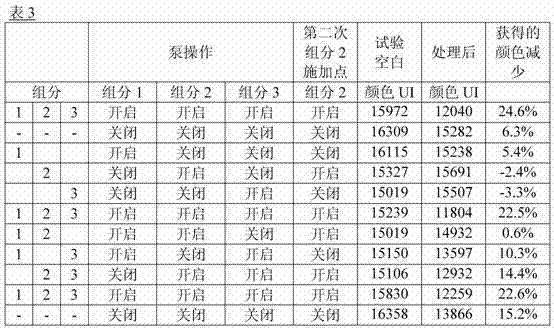
Use traditional sugared production technique, in the end the input point of a vaporizer (in this case, being the 4th vaporizer) is used component 1,2 and/or 3.In this technology, with three pumps control components 1,2 and 3 adding.In order to observe the effect that adds the component 2 of second dosage in this technology, the outlet back of a vaporizer in the end, the adding of the 4th pump control component 2.The component 1 of 50 ppm concentration (with respect to following syrup) joined in the syrup (import last vaporizer).In the #1 application point (input point of last vaporizer), add the component 2 of 50 ppm concentration, in the #2 application point (the outlet back of last vaporizer), add the component 2 of 50 ppm concentration.With respect to the input of last vaporizer, add the component 3 of 180 ppm concentration.
In continuous production processes, add after the component, obtain the transparence take off data, produce the color result (UI) that obtains.
These data are provided in the table 3, and figure in Fig. 2.In essence, before any component being joined in the syrup that enters last vaporizer, take out undressed syrup.This is baseline.Then, in the end before (the 4th) vaporizer, but in the downstream that obtains the sample place, 1-3 joins in the device with component.Component 2 can also be joined the downstream of last vaporizer.The downstream of in the end one (the 4th) vaporizer (downstream that adds component 2) obtains the color measuring data.The result of undressed syrup is compared with the result of the syrup of processing.When all pumps cut out, decolouring can be owing to the component 1 that just exists when the pump of all 3 components is opened, 2 and 3 residual component always.
As table 3 and Fig. 2 clearly show, when independent use component 1,2 and 3 the time, and do not have effect slightly variant basically, can only take off a small amount of color.Use component 1 and 2 two kind, but do not have component 3, also can not cause tangible decolouring.Use component 1+3 or component 2+3 can cause significant color to reduce.Use all three components can cause excellent color to reduce.Data based on table 3 provides clearly, add three components together and can produce the color minimizing, compare with the combination of only using a component or two components, and this color reduces much more remarkable.Yet component 3 any one component in other two components is used, and also can provide acceptable result.These results show when any one component of component 3 and other two components is used together, to have beat all good result, especially when being used in combination with other two components.
Embodiment 3-analyzes the decolorizing effect of the present invention in the different step of sugared production technique
In order to verify the applicability of the technology of the present invention during the different step of conventional sugar production technique, the applicant applies the present invention to take from each sample of the different positions of sugared production technique.
Thereby each syrup that produces of four vaporizers that use Normal juice, the syrup of decantation, described factory use, the mother liquor of enrichment and poor mother liquor and VHP liquid and molasses are tested.Above-mentioned each sample is taken from each position of sugared production technique, then they is carried out following flow process.
This flow process is following (only to be illustrated a point, but, all other point has used identical flow process): component 1 (purity 100%), 2 (33% aqueous solution) and 3 (60% aqueous solution) of 5 g, 15.15 mL and 8.33 mL are dissolved in respectively in the 100 mL water, prepare the solution of component 1,2 and 3 5% quality thus.
Then, the 3rd vaporizer from production technique obtains 12 liters of syrup (90 ℃ temperature).500 mL are joined in each beaker of some beakers, beaker quantity is equal to number of trials.Listed as table 4, according to corresponding volume, the volume of each component is joined in each beaker.Each sample is heated to boiling point (surpassing 100 ℃ temperature), left standstill then ten minutes.Each sample is changed in the 500 mL test tubes, carry out necessary mensuration, so that the colour (UI) that acquisition is explained above.
All above-mentioned points are carried out experiment according to this scheme, and the result is provided in the following table 4.Though these experimental data points are reliable like that not as plant data, they still can be used for showing the interior contrast of similar effect.
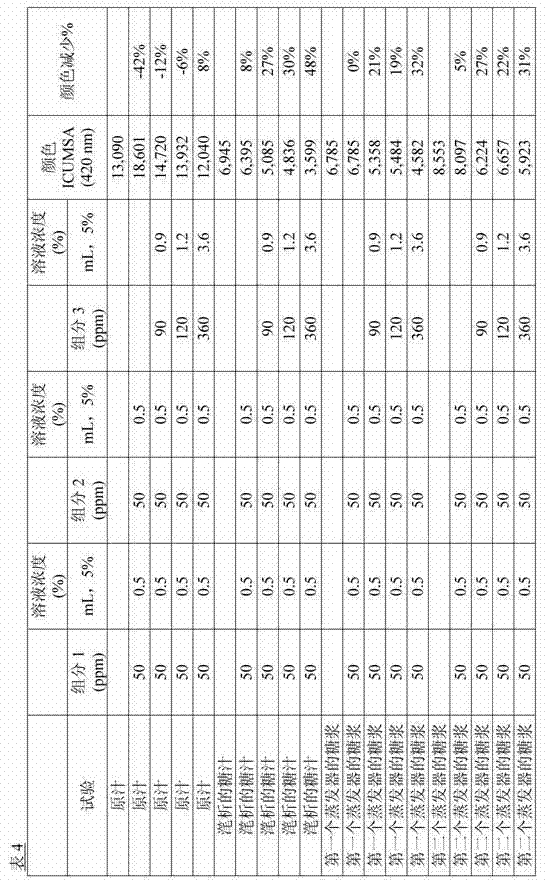
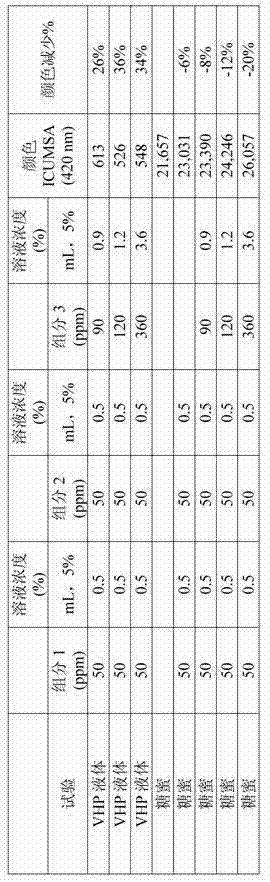
Can notice that from top table 4 technology of the present invention when as one man being applied to the various liquid of sugar complete processing, can make liquid decoloration.
Importantly, should be noted that in this method to be applied in the process of molasses that table 4 clearly illustrates that color increases along with the increase of component 3 quantity.This may be because molasses are very sticking liquid, and along with adding component of the present invention, the turbidity of solution greatly raises, and causes color measurenent to provide high scale (because they are based on the solution transparence).Yet, can estimate decolouring, as shown in Figure 5.
Each point along the conventional sugar production technique is tested, in order to verify that this technology is in the effect of the different step of this production technique.Flow process is identical with embodiment 3, and only component 1,2 and 3 concentration are respectively 100 ppm, 100 ppm and 360 ppm.These data points again with itself be comparable, needn't be comparable with the data of shop test.Yet all following data points (difference in the sugar complete processing obtains) have shown the color improvement, except the molasses.The result is provided in the following table 5:
Table 5
| Test is blank | Add component | Color reduces | |
| Color UI | Color UI | % | |
| Normal juice | 22,634 | 14,215 | 37% |
| The syrup of decantation | 7,963 | 4,261 | 46% |
| The syrup that first vaporizer flows out | 14,763 | 5,946 | 60% |
| Second syrup that vaporizer flows out | 8,030 | 4,298 | 46% |
| The 3rd syrup that vaporizer flows out | 6,281 | 4,394 | 30% |
| The 4th syrup (syrup) that vaporizer flows out | 6,319 | 4,740 | 25% |
| The mother liquor of enrichment | 8,349 | 8,188 | 2% |
| Poor mother liquor | 14,215 | 12,312 | 13% |
| VHP sugar (syrup of 45 ° of Brix) | 777 | 504 | 35% |
The numerical value that obtains clearly illustrates that technology of the present invention can be applied to above-mentioned any point of sugared production technique, causes color to reduce.
Embodiment 5
Prepare sugar according to routine techniques and according to the present invention, measure difference.This is raw sugar (that is, not refining).Standard sugar and produce with same apparatus according to the sugar that the present invention produces.Preparation standard sugar does not use component 1,2 or 3. Use component 1,2 and 3 to prepare according to sugar of the present invention.Specifically, component 1 is sodium formaldehyde sulphoxylate, and component 2 is pyrosulphite (metabisulfite) sodium, and component 3 is HEDP.Component 1-3 is applied to enter individually the syrup of the 4th (last) vaporizer.Component 2 is put in the syrup that leaves the 4th (last) vaporizer extraly.Use the component 1-3 of following quantity: component 1,50 ppm; Component 2,50 ppm (#1 application point) and 50 ppm (#2 application point), component 3 is used 180 ppm.
The goods of standard sugar have shown average 309 raw sugar ICUMSA color (at three samples of three different time tests).
According to sugar prod of the present invention, shown 13012 ICUMSA color (mean values of three tests of different time) for the undressed syrup that enters the 4th vaporizer (last vaporizer). Component 1,2 and 3 is added in the downstream that obtains test sample but entering before the 4th (last) vaporizer.After the 4th vaporizer, apply component 2 again.In the downstream that applies specifically, obtain another sample of syrup, carry out color detection, produce 9651 color (mean values of three tests of different time).Thus, the present invention shown syrup the color metal 25.8%.The sugar produced has shown 88 color (mean values of three tests carrying out three times).Thus, with respect to standard sugar, the sugared Show Color for preparing according to the present invention has reduced 71.5%.
Embodiment 6
Preparation sugar in different experiments.Flow process is identical with top embodiment 5, and only the quantity of component 1-3 is the twice of quantity among the embodiment 5, and quantity is as follows: component 1,100 ppm; Component 2,100 ppm (#1 application point) and 100 ppm (#2 application point); Component 3 is used 360 ppm.The goods of standard sugar have shown average 620 the ICUMSA color (at three samples of three different times tests) of raw sugar.
According to sugar prod of the present invention, shown 15,870 ICUMSA color (mean values of three tests of different time) for the undressed syrup that enters the 4th vaporizer (last vaporizer). Component 1,2 and 3 in the downstream that obtains test sample, but is added entering before the 4th (last) vaporizer.After the 4th vaporizer, execute the inferior component 2 that adds again.In the downstream that applies specifically, obtain another sample of syrup, carry out color detection, produce 10,910 color (mean values of three tests of different time).Thus, the present invention has shown that the syrup color has reduced 31.3%.The sugar produced has shown 191 color (mean values of three tests carrying out three times).Thus, with respect to standard sugar, the sugar for preparing according to the present invention has shown that color has reduced 69.2%.
Embodiment 7
Prepare sugar according to the present invention.In order to observe the influence to sugared color, change the quantity of component 3.The UI that does not contain the sugar of any component 1-3 is 200.Standard is in the end before (the 4th) vaporizer, is adding the syrup that obtains before the component 1-3.Final syrup is after the 4th vaporizer, adds the syrup that the downstream of component 2 obtains.The results are shown in the following table 6.
Table 6
| Product 1 (ppm) | Product 2 (ppm) | Product 3 (ppm) | Standard syrup (UI) | Syrup (finally) ICUMSA UI | Sugar ICUMSA | The syrup color reduces (%) | The sugar color reduces (%) |
| 50 | 100 | 60 | 9441 | 8379 | 65 | 11.2 | 67.5 |
| 50 | 100 | 90 | 8577 | 6734 | 90 | 21.5 | 55 |
| 50 | 100 | 120 | 8422 | 6542 | 79 | 22.3 | 60.5 |
| 50 | 100 | 180 | 6054 | 5102 | 40 | 15.7 | 80 |
As mentioned above, when using 1-3, compare with standard, all samples of the syrup of test and final sugar has shown significant improvement.
In the sugar that this embodiment obtains, the quantity of the residual HEDP of resultant sugar is following average quantity already mentioned above: use 60 ppm HEDP (residual 4.4 ppm of HEDP), use 90 ppm HEDP (residual 32.7 ppm of HEDP), use 120 ppm HEDP (residual 49.7 ppm of HEDP), use 180 ppm HEDP (residual 66.8 ppm of HEDP).
Embodiment 8
For the sugar of producing, the present invention not only causes the color more shallow than routine techniques, and As time goes on, the stability of color is higher.The influence of the darken temperature in the time of to be subjected to drying sugar, the temperature that stores the environment of sugar, moisture content of environment etc. of the sugar that stores.For present embodiment, with routine techniques with produce the sugar bag of 50 kg according to technology of the present invention.Use identical storage condition to producing with the sugar of test, for example, identical temperature (40 to 42 ℃) and uniform temp and humidity between the shelf lives when bag of same type, dry sugar.Carry out six months stability test at two different date ranges, respectively shown in following table 7 and 8.For producing sugar according to the present invention, in data shown in the table 7, the chemical reagent that uses is respectively the component 1,2 and 3 of 100 ppm, 100 ppm and 360 ppm, the input point of a vaporizer in the end, and in the end use the component 2 of 100 ppm in the ejecta of a vaporizer.For table 8, use same procedure, but the chemical reagent that uses is the component 1,2 and 3 of 50 ppm, 50 ppm and 60 ppm, uses the component 2 of 50 ppm second input point respectively.
Table 7
| Sugar according to the present invention's production | Sugar with routine techniques production | |
| Initial color | 138 UI | 340 UI |
| Final color | 149 UI | 420 UI |
| Color increases | 7.97% | 23.53% |
Table 8
| Sugar according to the present invention's production | Sugar with routine techniques production | |
| Initial color | 112 UI | 238 UI |
| Final color | 119 UI | 290 UI |
| Color increases | 6.25% | 21.85% |
Can see that from above aspect the color increase that stores sugar, the present invention also causes remarkable and beyond thought reduction, show its advantage aspect the raising colour stability.Especially, component 1 and 3 helps this stability.
At last, must emphasize, as those skilled in the art fully understand, based on the instruction that provides above, can carry out countless improvement and change to the present invention, and not exceed the listed protection domain of accessory claim.
Claims (87)
Applications Claiming Priority (3)
| Application Number | Priority Date | Filing Date | Title |
|---|---|---|---|
| US37353710P | 2010-08-13 | 2010-08-13 | |
| US61/373537 | 2010-08-13 | ||
| PCT/BR2011/000280 WO2012019266A1 (en) | 2010-08-13 | 2011-08-12 | Method and composition for reducing the color of sugar |
Publications (1)
| Publication Number | Publication Date |
|---|---|
| CN103237902A true CN103237902A (en) | 2013-08-07 |
Family
ID=44512464
Family Applications (1)
| Application Number | Title | Priority Date | Filing Date |
|---|---|---|---|
| CN2011800489845A Pending CN103237902A (en) | 2010-08-13 | 2011-08-12 | Methods and compositions for reducing the color of sugar |
Country Status (9)
| Country | Link |
|---|---|
| US (1) | US9587285B2 (en) |
| EP (1) | EP2603613B1 (en) |
| CN (1) | CN103237902A (en) |
| AR (1) | AR082680A1 (en) |
| AU (1) | AU2011288946A1 (en) |
| BR (1) | BR112013003278B1 (en) |
| CO (1) | CO6680692A2 (en) |
| MX (1) | MX339772B (en) |
| WO (1) | WO2012019266A1 (en) |
Cited By (2)
| Publication number | Priority date | Publication date | Assignee | Title |
|---|---|---|---|---|
| CN109234466A (en) * | 2018-08-20 | 2019-01-18 | 广西大学 | A method of white granulated sugar color value is reduced using anthocyanin enzyme |
| CN116098259A (en) * | 2023-01-16 | 2023-05-12 | 江南大学 | A method for inhibiting the yellowing of a colorless system containing sorbitol-glycine |
Families Citing this family (4)
| Publication number | Priority date | Publication date | Assignee | Title |
|---|---|---|---|---|
| NZ720482A (en) * | 2013-12-05 | 2020-06-26 | Buckman Laboratories Int Inc | Methods of microbiological control in beet sugar and other sugar-containing plant material processing |
| CN105478243B (en) * | 2015-11-19 | 2018-05-08 | 中国地质科学院郑州矿产综合利用研究所 | Novel inhibitor for bauxite beneficiation and using method thereof |
| CN111074012B (en) * | 2019-11-12 | 2022-11-29 | 北京化工大学 | Process system and method for sulphite sugar production |
| AR131617A1 (en) * | 2023-01-16 | 2025-04-16 | Italmatch Chemicals Spa | REDUCING SUGAR COLORING METHOD, LOW-COLOR SUGAR PRODUCTION PROCESS, COMPOSITION AND USE OF A CHELATING AGENT |
Citations (5)
| Publication number | Priority date | Publication date | Assignee | Title |
|---|---|---|---|---|
| GB174027A (en) * | 1921-01-13 | 1922-04-20 | Jan Frederik Straatman | Process for decolorising liquids |
| CN1345417A (en) * | 1999-03-01 | 2002-04-17 | Idec药物公司 | Radiolabeling kit and binding assay |
| EP1788099A2 (en) * | 1999-08-19 | 2007-05-23 | TATE & LYLE INDUSTRIES LIMITED | Sugar beet membrane filtration process |
| CN1993517A (en) * | 2005-04-08 | 2007-07-04 | 纳尔科公司 | Improved composition and processes for paper production |
| WO2009066316A1 (en) * | 2007-08-18 | 2009-05-28 | Vishnukumar Mahadeo Kulkarni | Method for manufacturing sugar from sugarcane |
Family Cites Families (7)
| Publication number | Priority date | Publication date | Assignee | Title |
|---|---|---|---|---|
| US2421380A (en) * | 1941-06-24 | 1947-06-03 | Horace S Isbell | Method of treating sugar |
| US3873694A (en) * | 1973-09-27 | 1975-03-25 | Cpc International Inc | Direct compression tabletting composition and pharmaceutical tablets produced therefrom |
| US6899907B1 (en) * | 2000-09-18 | 2005-05-31 | General Mills, Inc. | Bleach bran and bran products |
| DE10320618A1 (en) * | 2003-05-08 | 2004-11-18 | Papierfabrik Albbruck Gmbh & Co. Kg | Process for bleaching fibrous materials |
| US20060273038A1 (en) * | 2005-06-02 | 2006-12-07 | Syed Murtuza A | Chemical cleaning for membranes |
| EP1808428B1 (en) * | 2006-01-16 | 2010-12-22 | Research Institute of Petroleum Industry (RIPI) | Descaling solutions comprising EDDH |
| MX2007016295A (en) | 2007-12-18 | 2009-06-18 | Mario Alaves Bolanos | Sugar bleaching process by means of an aqueous solution. |
-
2011
- 2011-08-12 CN CN2011800489845A patent/CN103237902A/en active Pending
- 2011-08-12 AR ARP110102948A patent/AR082680A1/en unknown
- 2011-08-12 BR BR112013003278-2A patent/BR112013003278B1/en active IP Right Grant
- 2011-08-12 MX MX2013001735A patent/MX339772B/en active IP Right Grant
- 2011-08-12 EP EP11748871.8A patent/EP2603613B1/en active Active
- 2011-08-12 US US13/816,283 patent/US9587285B2/en active Active
- 2011-08-12 WO PCT/BR2011/000280 patent/WO2012019266A1/en not_active Ceased
- 2011-08-12 AU AU2011288946A patent/AU2011288946A1/en not_active Abandoned
-
2013
- 2013-03-05 CO CO13043514A patent/CO6680692A2/en not_active Application Discontinuation
Patent Citations (5)
| Publication number | Priority date | Publication date | Assignee | Title |
|---|---|---|---|---|
| GB174027A (en) * | 1921-01-13 | 1922-04-20 | Jan Frederik Straatman | Process for decolorising liquids |
| CN1345417A (en) * | 1999-03-01 | 2002-04-17 | Idec药物公司 | Radiolabeling kit and binding assay |
| EP1788099A2 (en) * | 1999-08-19 | 2007-05-23 | TATE & LYLE INDUSTRIES LIMITED | Sugar beet membrane filtration process |
| CN1993517A (en) * | 2005-04-08 | 2007-07-04 | 纳尔科公司 | Improved composition and processes for paper production |
| WO2009066316A1 (en) * | 2007-08-18 | 2009-05-28 | Vishnukumar Mahadeo Kulkarni | Method for manufacturing sugar from sugarcane |
Cited By (3)
| Publication number | Priority date | Publication date | Assignee | Title |
|---|---|---|---|---|
| CN109234466A (en) * | 2018-08-20 | 2019-01-18 | 广西大学 | A method of white granulated sugar color value is reduced using anthocyanin enzyme |
| CN116098259A (en) * | 2023-01-16 | 2023-05-12 | 江南大学 | A method for inhibiting the yellowing of a colorless system containing sorbitol-glycine |
| CN116098259B (en) * | 2023-01-16 | 2023-11-28 | 江南大学 | A method for inhibiting yellowing of colorless systems containing sorbitol-glycine |
Also Published As
| Publication number | Publication date |
|---|---|
| WO2012019266A1 (en) | 2012-02-16 |
| AR082680A1 (en) | 2012-12-26 |
| EP2603613B1 (en) | 2015-04-08 |
| CO6680692A2 (en) | 2013-05-31 |
| BR112013003278A2 (en) | 2018-07-10 |
| US20130239953A1 (en) | 2013-09-19 |
| AU2011288946A1 (en) | 2013-03-21 |
| BR112013003278A8 (en) | 2018-08-14 |
| BR112013003278B1 (en) | 2019-06-18 |
| EP2603613A1 (en) | 2013-06-19 |
| MX339772B (en) | 2016-06-09 |
| MX2013001735A (en) | 2013-10-25 |
| US9587285B2 (en) | 2017-03-07 |
Similar Documents
| Publication | Publication Date | Title |
|---|---|---|
| CN103237902A (en) | Methods and compositions for reducing the color of sugar | |
| Zhang et al. | Green production of sugar by membrane technology: How far is it from industrialization? | |
| US20120216799A1 (en) | Method for Obtaining White Sugar from Cane Juice | |
| JP5249923B2 (en) | Method for fractionating colored components from aqueous plant extracts | |
| CN101768644B (en) | Method utilizing enzyme to catalyze H2O2 to discolor sugar juice | |
| CN104388600B (en) | Sugar manufacturing technique for improving yield and reducing color value of white sugar | |
| BR102023000790A2 (en) | METHOD OF REDUCING SUGAR COLORATION, PROCESS OF PRODUCTION OF SUGAR WITH LOW COLORATION, COMPOSITION AND USE OF A CHELATING AGENT | |
| WO2024152094A1 (en) | Method for reducing the colouring of sugar, process for producing sugar with low colour, composition and use of a chelating agent | |
| WO2011065269A1 (en) | Process for production of sugar | |
| CN104086592A (en) | Preparation method of fosfomycin tromethamine | |
| BRPI1103108A2 (en) | additive and improved process applied to clarify sugarcane juice syrup for white crystal and refined sugar | |
| CA1208632A (en) | Method of recovering sucrose | |
| US7306679B1 (en) | Composition and sugar refining process | |
| CN102747168A (en) | Natural quebracho tannin sugarcane juice clarifying aid and preparation method thereof | |
| OA21265A (en) | Integrated phosphoric acid decadmization process. | |
| FR3117476A1 (en) | INTEGRATED PHOSPHORIC ACID DECADMIATION PROCESS | |
| Abdel-Razig et al. | Effect of addition of separan at different concentrations as a flocculants on quality of sugar cane juice | |
| SU1280011A1 (en) | Method of refining sugar-containing sirup | |
| US20110297331A1 (en) | Continuous Vacuum Pan | |
| CN102286573A (en) | Method for hydrolyzing dextranin in syrup with enzyme | |
| RARAJAN et al. | ESTIMATION OF CALCIUM OXIDE AND PHOSPHATE CONTENT PRESENT IN THE CANE JUICE | |
| BRPI1103113A2 (en) | composition and improved clarification process of sugarcane juice syrup for white crystal and refined sugar production | |
| SU1751217A1 (en) | Method of diffusion juice purification | |
| Wamuke Nickson | Effect of flocculant on scale formation in evaporators | |
| Muwanika | Estimation of sucrose loss due to inversion process as a result of multiple effect evaporation |
Legal Events
| Date | Code | Title | Description |
|---|---|---|---|
| C06 | Publication | ||
| PB01 | Publication | ||
| C10 | Entry into substantive examination | ||
| SE01 | Entry into force of request for substantive examination | ||
| C02 | Deemed withdrawal of patent application after publication (patent law 2001) | ||
| WD01 | Invention patent application deemed withdrawn after publication |
Application publication date: 20130807 |