CN103250099A - Norbornane-based PAC Ballast and positive-one photosensitive resin composition encompassing the PAC - Google Patents
Norbornane-based PAC Ballast and positive-one photosensitive resin composition encompassing the PAC Download PDFInfo
- Publication number
- CN103250099A CN103250099A CN201180046667XA CN201180046667A CN103250099A CN 103250099 A CN103250099 A CN 103250099A CN 201180046667X A CN201180046667X A CN 201180046667XA CN 201180046667 A CN201180046667 A CN 201180046667A CN 103250099 A CN103250099 A CN 103250099A
- Authority
- CN
- China
- Prior art keywords
- hept
- mixture
- pac
- bicyclo
- bis
- Prior art date
- Legal status (The legal status is an assumption and is not a legal conclusion. Google has not performed a legal analysis and makes no representation as to the accuracy of the status listed.)
- Granted
Links
- 0 CCC(CC1)CC(C*)*1=O Chemical compound CCC(CC1)CC(C*)*1=O 0.000 description 4
- PAQSFETTXNKWKT-UHFFFAOYSA-N CC(CC(CC1)C2)(CC12N)S Chemical compound CC(CC(CC1)C2)(CC12N)S PAQSFETTXNKWKT-UHFFFAOYSA-N 0.000 description 1
- VVMVJDLMUNFPEN-UHFFFAOYSA-N O=C(CC1C2)C2CC1C1C=CC(C(CC2C3)C3CC2=O)=CC1 Chemical compound O=C(CC1C2)C2CC1C1C=CC(C(CC2C3)C3CC2=O)=CC1 VVMVJDLMUNFPEN-UHFFFAOYSA-N 0.000 description 1
Classifications
-
- G—PHYSICS
- G03—PHOTOGRAPHY; CINEMATOGRAPHY; ANALOGOUS TECHNIQUES USING WAVES OTHER THAN OPTICAL WAVES; ELECTROGRAPHY; HOLOGRAPHY
- G03F—PHOTOMECHANICAL PRODUCTION OF TEXTURED OR PATTERNED SURFACES, e.g. FOR PRINTING, FOR PROCESSING OF SEMICONDUCTOR DEVICES; MATERIALS THEREFOR; ORIGINALS THEREFOR; APPARATUS SPECIALLY ADAPTED THEREFOR
- G03F7/00—Photomechanical, e.g. photolithographic, production of textured or patterned surfaces, e.g. printing surfaces; Materials therefor, e.g. comprising photoresists; Apparatus specially adapted therefor
- G03F7/004—Photosensitive materials
- G03F7/022—Quinonediazides
-
- C—CHEMISTRY; METALLURGY
- C07—ORGANIC CHEMISTRY
- C07C—ACYCLIC OR CARBOCYCLIC COMPOUNDS
- C07C245/00—Compounds containing chains of at least two nitrogen atoms with at least one nitrogen-to-nitrogen multiple bond
- C07C245/12—Diazo compounds, i.e. compounds having the free valencies of >N2 groups attached to the same carbon atom
-
- C—CHEMISTRY; METALLURGY
- C07—ORGANIC CHEMISTRY
- C07C—ACYCLIC OR CARBOCYCLIC COMPOUNDS
- C07C309/00—Sulfonic acids; Halides, esters, or anhydrides thereof
- C07C309/63—Esters of sulfonic acids
- C07C309/71—Esters of sulfonic acids having sulfur atoms of esterified sulfo groups bound to carbon atoms of rings other than six-membered aromatic rings
-
- C—CHEMISTRY; METALLURGY
- C07—ORGANIC CHEMISTRY
- C07C—ACYCLIC OR CARBOCYCLIC COMPOUNDS
- C07C39/00—Compounds having at least one hydroxy or O-metal group bound to a carbon atom of a six-membered aromatic ring
- C07C39/12—Compounds having at least one hydroxy or O-metal group bound to a carbon atom of a six-membered aromatic ring polycyclic with no unsaturation outside the aromatic rings
- C07C39/17—Compounds having at least one hydroxy or O-metal group bound to a carbon atom of a six-membered aromatic ring polycyclic with no unsaturation outside the aromatic rings containing other rings in addition to the six-membered aromatic rings, e.g. cyclohexylphenol
-
- C—CHEMISTRY; METALLURGY
- C07—ORGANIC CHEMISTRY
- C07C—ACYCLIC OR CARBOCYCLIC COMPOUNDS
- C07C43/00—Ethers; Compounds having groups, groups or groups
- C07C43/02—Ethers
- C07C43/03—Ethers having all ether-oxygen atoms bound to acyclic carbon atoms
- C07C43/14—Unsaturated ethers
- C07C43/178—Unsaturated ethers containing hydroxy or O-metal groups
- C07C43/1782—Unsaturated ethers containing hydroxy or O-metal groups containing six-membered aromatic rings
-
- C—CHEMISTRY; METALLURGY
- C07—ORGANIC CHEMISTRY
- C07C—ACYCLIC OR CARBOCYCLIC COMPOUNDS
- C07C43/00—Ethers; Compounds having groups, groups or groups
- C07C43/02—Ethers
- C07C43/03—Ethers having all ether-oxygen atoms bound to acyclic carbon atoms
- C07C43/14—Unsaturated ethers
- C07C43/178—Unsaturated ethers containing hydroxy or O-metal groups
- C07C43/1782—Unsaturated ethers containing hydroxy or O-metal groups containing six-membered aromatic rings
- C07C43/1783—Unsaturated ethers containing hydroxy or O-metal groups containing six-membered aromatic rings with hydroxy or -O-metal groups bound to the aromatic rings
-
- C—CHEMISTRY; METALLURGY
- C07—ORGANIC CHEMISTRY
- C07C—ACYCLIC OR CARBOCYCLIC COMPOUNDS
- C07C43/00—Ethers; Compounds having groups, groups or groups
- C07C43/02—Ethers
- C07C43/03—Ethers having all ether-oxygen atoms bound to acyclic carbon atoms
- C07C43/14—Unsaturated ethers
- C07C43/178—Unsaturated ethers containing hydroxy or O-metal groups
- C07C43/1788—Unsaturated ethers containing hydroxy or O-metal groups containing six-membered aromatic rings and other rings
-
- G—PHYSICS
- G03—PHOTOGRAPHY; CINEMATOGRAPHY; ANALOGOUS TECHNIQUES USING WAVES OTHER THAN OPTICAL WAVES; ELECTROGRAPHY; HOLOGRAPHY
- G03F—PHOTOMECHANICAL PRODUCTION OF TEXTURED OR PATTERNED SURFACES, e.g. FOR PRINTING, FOR PROCESSING OF SEMICONDUCTOR DEVICES; MATERIALS THEREFOR; ORIGINALS THEREFOR; APPARATUS SPECIALLY ADAPTED THEREFOR
- G03F7/00—Photomechanical, e.g. photolithographic, production of textured or patterned surfaces, e.g. printing surfaces; Materials therefor, e.g. comprising photoresists; Apparatus specially adapted therefor
- G03F7/004—Photosensitive materials
- G03F7/022—Quinonediazides
- G03F7/023—Macromolecular quinonediazides; Macromolecular additives, e.g. binders
-
- G—PHYSICS
- G03—PHOTOGRAPHY; CINEMATOGRAPHY; ANALOGOUS TECHNIQUES USING WAVES OTHER THAN OPTICAL WAVES; ELECTROGRAPHY; HOLOGRAPHY
- G03F—PHOTOMECHANICAL PRODUCTION OF TEXTURED OR PATTERNED SURFACES, e.g. FOR PRINTING, FOR PROCESSING OF SEMICONDUCTOR DEVICES; MATERIALS THEREFOR; ORIGINALS THEREFOR; APPARATUS SPECIALLY ADAPTED THEREFOR
- G03F7/00—Photomechanical, e.g. photolithographic, production of textured or patterned surfaces, e.g. printing surfaces; Materials therefor, e.g. comprising photoresists; Apparatus specially adapted therefor
- G03F7/004—Photosensitive materials
- G03F7/022—Quinonediazides
- G03F7/023—Macromolecular quinonediazides; Macromolecular additives, e.g. binders
- G03F7/0233—Macromolecular quinonediazides; Macromolecular additives, e.g. binders characterised by the polymeric binders or the macromolecular additives other than the macromolecular quinonediazides
-
- C—CHEMISTRY; METALLURGY
- C07—ORGANIC CHEMISTRY
- C07C—ACYCLIC OR CARBOCYCLIC COMPOUNDS
- C07C2601/00—Systems containing only non-condensed rings
- C07C2601/12—Systems containing only non-condensed rings with a six-membered ring
- C07C2601/16—Systems containing only non-condensed rings with a six-membered ring the ring being unsaturated
-
- C—CHEMISTRY; METALLURGY
- C07—ORGANIC CHEMISTRY
- C07C—ACYCLIC OR CARBOCYCLIC COMPOUNDS
- C07C2602/00—Systems containing two condensed rings
- C07C2602/02—Systems containing two condensed rings the rings having only two atoms in common
- C07C2602/04—One of the condensed rings being a six-membered aromatic ring
- C07C2602/10—One of the condensed rings being a six-membered aromatic ring the other ring being six-membered, e.g. tetraline
-
- C—CHEMISTRY; METALLURGY
- C07—ORGANIC CHEMISTRY
- C07C—ACYCLIC OR CARBOCYCLIC COMPOUNDS
- C07C2602/00—Systems containing two condensed rings
- C07C2602/02—Systems containing two condensed rings the rings having only two atoms in common
- C07C2602/14—All rings being cycloaliphatic
- C07C2602/24—All rings being cycloaliphatic the ring system containing nine carbon atoms, e.g. perhydroindane
-
- C—CHEMISTRY; METALLURGY
- C07—ORGANIC CHEMISTRY
- C07C—ACYCLIC OR CARBOCYCLIC COMPOUNDS
- C07C2603/00—Systems containing at least three condensed rings
- C07C2603/56—Ring systems containing bridged rings
- C07C2603/86—Ring systems containing bridged rings containing four rings
-
- G—PHYSICS
- G03—PHOTOGRAPHY; CINEMATOGRAPHY; ANALOGOUS TECHNIQUES USING WAVES OTHER THAN OPTICAL WAVES; ELECTROGRAPHY; HOLOGRAPHY
- G03F—PHOTOMECHANICAL PRODUCTION OF TEXTURED OR PATTERNED SURFACES, e.g. FOR PRINTING, FOR PROCESSING OF SEMICONDUCTOR DEVICES; MATERIALS THEREFOR; ORIGINALS THEREFOR; APPARATUS SPECIALLY ADAPTED THEREFOR
- G03F7/00—Photomechanical, e.g. photolithographic, production of textured or patterned surfaces, e.g. printing surfaces; Materials therefor, e.g. comprising photoresists; Apparatus specially adapted therefor
- G03F7/26—Processing photosensitive materials; Apparatus therefor
- G03F7/40—Treatment after imagewise removal, e.g. baking
Landscapes
- Chemical & Material Sciences (AREA)
- Organic Chemistry (AREA)
- Physics & Mathematics (AREA)
- General Physics & Mathematics (AREA)
- Spectroscopy & Molecular Physics (AREA)
- Organic Low-Molecular-Weight Compounds And Preparation Thereof (AREA)
- Materials For Photolithography (AREA)
- Exposure And Positioning Against Photoresist Photosensitive Materials (AREA)
Abstract
本发明的实施方案提供降冰片烷-类ballast材料,由这一ballast材料衍生的降冰片烷-类光活性化合物,和包括这一降冰片烷-类光活性化合物和PBO或PNB树脂之一的碱可溶的正色调聚合物组合物。Embodiments of the present invention provide norbornane-like ballast materials, norbornane-like photoactive compounds derived from such ballast materials, and compounds comprising such norbornane-like photoactive compounds and one of PBO or PNB resins Alkali-soluble positive tone polymer compositions.
Description
技术领域 technical field
本发明一般地涉及包括光活性化合物(PAC)的正色调光敏树脂组合物,和由它或使用它形成的结构,和更具体地,本发明涉及这种树脂组合物,它包括由降冰片烷-基ballast(NBane-类ballast)材料制造的PACs,制造这种ballast材料和PAC材料的方法,和由它或使用它形成的结构。 The present invention relates generally to positive-tone photosensitive resin compositions comprising a photoactive compound (PAC), and structures formed therefrom or using the same, and more particularly, the present invention relates to such resin compositions comprising norbornane - PACs made of ballast-based (NBane-like ballast) materials, methods of making such ballast materials and PAC materials, and structures formed from or using it. the
详细说明 Detailed description
聚酰亚胺(PI),聚苯并噁唑(PBO)和聚降冰片烯(PNB)树脂通常是在制造半导体器件中形成表面防护层或层间电介质所使用的已知的材料。为了有效地集成这些树脂到标准(normal)的半导体加工中,已发现,有利的是提供正色调水性可显影的光敏树脂组合物形式的这种树脂。按照这一方式,避免了使用光致抗蚀剂材料的单独的图案和蚀刻工艺,以形成这些树脂的构图层。 Polyimide (PI), polybenzoxazole (PBO) and polynorbornene (PNB) resins are generally known materials used to form surface protection layers or interlayer dielectrics in the manufacture of semiconductor devices. In order to efficiently integrate these resins into normal semiconductor processing, it has been found advantageous to provide such resins in the form of positive tone aqueous developable photosensitive resin compositions. In this way, a separate patterning and etching process using photoresist material to form patterned layers of these resins is avoided. the
尽管各类这种PI,PBO和PNB光敏树脂组合物是已知的,但近年来,小型化和高度集成的半导体器件对树脂组合物供应商提出了兼有较低树脂固化温度和提高的可成像性的材料的要求。 Although various such PI, PBO and PNB photosensitive resin compositions are known, in recent years, miniaturization and highly integrated semiconductor devices have proposed a combination of lower resin curing temperature and increased availability to resin composition suppliers. Requirements for imageable materials. the
已表明可通过在其内掺入光活性化合物(PAC),制造上述树脂中的光敏树脂组合物。例如,在Hiroaki Makabe的标题为″Positive photosensitive resin composition,cured layer,protecting layer,insulating layer and semiconductor device and display therewith″的美国专利No.7,781,131(′131专利)中,使用重氮醌-基PAC提供可使用碱性水溶液显影的正性光敏PBO树脂组合物。′131专利中的前述重氮醌化合物基PAC衍生于包括一个或更多个酚类部分的ballast材料,所述这些部分与1,2-萘醌-2-二叠氮基-5-磺酸,l,2-萘醌-2-二叠氮基-4- 磺酸或类似物反应。当这些PACs与例如聚苯并噁唑树脂前体,合适的铸塑溶剂,和具有醇羟基的环状化合物混合时,提供能在基底上铸塑形成薄膜的光敏树脂组合物。一当形成这样的膜,则可通过采用合适波长的光化辐射线,成像式曝光该铸塑的树脂膜,和随后除去因这种曝光变得可溶的薄膜区域,使图像显影。这一图像形成工艺是众所周知的且讨论于美国专利No.7,781,131专利中。 It has been shown that a photosensitive resin composition among the above resins can be produced by incorporating therein a photoactive compound (PAC). For example, in U.S. Patent No. 7,781,131 to Hiroaki Makabe entitled "Positive photosensitive resin composition, cured layer, protecting layer, insulating layer and semiconductor device and display therewith" (the '131 patent), the use of diazoquinone-based PACs provides A positive photosensitive PBO resin composition that can be developed with an alkaline aqueous solution. The aforementioned diazoquinone compound-based PACs in the '131 patent are derived from ballast materials that include one or more phenolic moieties combined with 1,2-naphthoquinone-2-diazido-5-sulfonic acid , l,2-Naphthoquinone-2-diazido-4-sulfonic acid or similar reaction. These PACs, when mixed with, for example, a polybenzoxazole resin precursor, a suitable casting solvent, and a cyclic compound having an alcoholic hydroxyl group, provide a photosensitive resin composition capable of being cast on a substrate to form a film. Once such a film is formed, the image can be developed by image-wise exposing the cast resin film to actinic radiation of the appropriate wavelength, and subsequently removing the regions of the film that have become soluble by such exposure. This image forming process is well known and discussed in US Patent No. 7,781,131. the
一当形成这一图像,则美国专利No.7,781,131专利公开了在固化工艺过程中,使用适合于引起这种闭环的升高的温度,通过闭环,如何使PBO树脂前体脱水,从而形成具有高耐热性的聚苯并噁唑树脂。然而,近年来显著的小型化和半导体芯片的高度集成降低了耐热性,尤其储存芯片的耐热性,并增加了对提供增加的图像分辨率和对比度的PACs的需求。关于耐热性,美国专利No.7,781,131专利提供了实施方案,所述实施方案包括能在合适地低的温度下固化,和在这种固化之后,提供优良的热稳定性的PBO树脂前体。本申请提供降冰片烷-基ballasts的实施方案,该实施方案能形成为在PBO树脂组合物内以及在合适的PNB树脂组合物内提供所需增加的图形分辨率和对比度的PAC。 Once this image is formed, U.S. Patent No. 7,781,131 discloses how to dehydrate the PBO resin precursor through ring closure during the curing process using elevated temperatures suitable to cause such loop closure to form a Heat resistant polybenzoxazole resin. However, significant miniaturization and high integration of semiconductor chips in recent years has reduced heat resistance, especially of memory chips, and increased demand for PACs that provide increased image resolution and contrast. With regard to heat resistance, US Patent No. 7,781,131 provides embodiments comprising PBO resin precursors capable of curing at suitably low temperatures, and after such curing, providing excellent thermal stability. The present application provides embodiments of norbornane-based ballasts that can be formed into PACs that provide the desired increased pattern resolution and contrast in PBO resin compositions as well as in suitable PNB resin compositions. the
更具体地,本发明的实施方案使用加氢芳基化化学,生成降冰片烷-芳基醇连接键并将降冰片烷或类似单元连接到彼此上。这些实施方案提供的苯酚降冰片烷/多环结构然后通过与下述磺酸之一或者它们各自的酰氯反应,形成其酯,从而容易转化成有用的PAC:其结构分别如下所示的1,2-萘醌-2-二叠氮基-5-磺酸,l,2-萘醌-2-二叠氮基-4-磺酸或2-重氮-4-氢磺酰基环己-3-烯酮: More specifically, embodiments of the present invention use hydroarylation chemistry to generate norbornane-aryl alcohol linkages and link norbornane or similar units to each other. The phenolic norbornane/polycyclic structures provided by these embodiments are then readily converted into useful PACs by reaction with one of the following sulfonic acids, or their respective acid chlorides, to form esters thereof: 1, 2-Naphthoquinone-2-diazido-5-sulfonic acid, 1,2-naphthoquinone-2-diazido-4-sulfonic acid or 2-diazo-4-hydrosulfonylcyclohexyl-3 -enone:

提供的一些例举的包括根据本发明的NBane-类ballast和NBane-类PAC实施方案的降冰片烷-类部分(也称为NBane-类多元醇,NBane-类芳基醇,或NBane-类ballast部分)的酚类结构。另外,还 提供制造这些结构的一些例举方法和使这些NBane-类多元醇结构反应形成前述NBane-类PAC的例举方法。这种NBane-类ballast部分包括,但不限于下述例举的结构: Some exemplary norbornane-like moieties (also known as NBane-like polyols, NBane-like aryl alcohols, or NBane-like PACs) comprising NBane-like ballasts and NBane-like PAC embodiments according to the present invention are provided. ballast part) of the phenolic structure. Additionally, some exemplary methods of making these structures and of reacting these NBane-like polyol structures to form the aforementioned NBane-like PACs are provided. Such NBane-like ballast components include, but are not limited to, the following enumerated structures:

其他NBane-类ballast部分包括,但不限于: Other NBane-like ballast sections include, but are not limited to:


其中ArOH要理解为代表取代或未取代的芳基氢氧化物(aryl hydroxide)部分(也称为芳基醇(arylol)),和对于具有超过1个ArOH的每一结构来说,要理解为这种过量的ArOHs是任选的。 where ArOH is to be understood to represent a substituted or unsubstituted aryl hydroxide moiety (also known as aryl alcohol), and for each structure having more than 1 ArOH, to be understood to be This excess of ArOHs is optional. the
尽管以下提供上述几个NBane-类芳基醇的制备方法的具体实例,但一般地,大多数合成路线始于形成芳基醇和降冰片烯酮(norbornenone),降冰片烯醛,亚苯基(降冰片酮(norbornanone)),降冰片烯-亚烷基-降冰片烯(其中亚烷基表示大于或等于2个碳的烷基链),降冰片烯-芳基(环烷基)-降冰片烯(其中芳基(环烷基)表示或者芳基或者环烷基),或降冰片烯二聚体。在这种NBane-类起始材料为醛或酮的情况下,可实现芳基醇加成到羰基键上,在每一羰基处提供二-芳基醇的结果,从而形成NBane-类芳基醇。在这种降冰片烯-类起始材料不存在羰基的情况下,可添加一个或更多个这样的羰基,和如上所述 形成NBane-类芳基醇。或替代地,可在存在的任何C=C键上,例如借助加氢芳基化反应加成芳基醇。按照这一方式,可有利地采用基本上任何数量的芳基醇取代基,形成NBane-类芳基醇,并因此不同于美国专利No.3,517,071(′071专利)的教导,该专利仅仅教导了形成二苯酚部分,其中单一碳原子共价键合到两个苯酚部分上。这一单一碳原子是在多环结构内的碳之一或不是在多环结构内,即共价键合到多环碳上的亚甲基。美国专利3,517,071专利涉及制备偕联苯酚(geminal diphenol)部分,它可用于制备具有改进的温度性能和在挥发性溶剂内溶解性的聚合物。 Although specific examples of preparation methods for several of the NBane-aryl-like alcohols described above are provided below, in general, most synthetic routes start with the formation of aryl alcohols and norbornenone (norbornenone), norbornenal, phenylene ( Norbornanone (norbornanone)), norbornene-alkylene-norbornene (wherein alkylene represents an alkyl chain of greater than or equal to 2 carbons), norbornene-aryl(cycloalkyl)-norbornene norbornene (where aryl(cycloalkyl) denotes either aryl or cycloalkyl), or norbornene dimer. In cases where such NBane-like starting materials are aldehydes or ketones, the addition of aryl alcohols to carbonyl linkages can be achieved to provide di-aryl alcohol results at each carbonyl, thereby forming NBane-like aryls alcohol. In the absence of carbonyl groups in this norbornene-like starting material, one or more such carbonyl groups can be added, and NBane-aryl-like alcohols formed as described above. Or alternatively, the aryl alcohol can be added on any C=C bond present, for example by means of a hydroarylation reaction. In this manner, substantially any number of aryl alcohol substituents can be advantageously employed to form NBane-aryl-like alcohols, and thus differ from the teaching of U.S. Patent No. 3,517,071 (the '071 patent), which only teaches A diphenol moiety is formed in which a single carbon atom is covalently bonded to two phenol moieties. This single carbon atom is either one of the carbons within the polycyclic structure or not within the polycyclic structure, ie a methylene group covalently bonded to a polycyclic carbon. US Patent 3,517,071 relates to the preparation of geminal diphenol moieties which can be used to prepare polymers with improved temperature performance and solubility in volatile solvents. the
进一步地,本发明的实施方案区别于美国专利3,517,071专利的公开内容在于,可看出NBane-类多元醇,例如PP429和PP691(以上提供了它们的结构)提供单一的芳基醇取代和联苯酚取代的亚甲基(在前者内)和两个降冰片烷结构(在后者内)二者,它们各自具有通过芳基连接基连接到彼此上的偕联苯酚取代度。关于PP429,美国专利3,517,071专利没有教导或者甚至暗示提供除了偕二芳基醇取代以外的任何芳基醇取代的方法,因此,PP429与本发明专利的教导和公开内容不同。关于PP691,尽管这一结构仅仅包括以上提及的降冰片烷的偕二芳基醇取代,但这一结构还包括与第二联苯酚取代的降冰片烷相连的芳族连接基,和因此也不同于美国专利3,517,071专利的教导与公开内容。 Further, embodiments of the present invention differ from the disclosure of U.S. Patent 3,517,071 in that it can be seen that NBane-type polyols such as PP429 and PP691 (their structures are provided above) provide a single aryl alcohol substitution and a biphenol Both a substituted methylene group (in the former) and two norbornane structures (in the latter), each with concatenated phenolic degrees of substitution attached to each other via an aryl linker. Regarding PP429, US Patent No. 3,517,071 does not teach or even suggest a method to provide any aryl alcohol substitution other than gem diaryl alcohol substitution, therefore, PP429 is different from the teaching and disclosure of the present patent. Regarding PP691, although this structure includes only the above-mentioned gem-diaryl alcohol substitution of norbornane, this structure also includes an aromatic linker attached to a second biphenol-substituted norbornane, and thus also Different from the teaching and disclosure of US Patent 3,517,071. the
要理解,此处,以上和以下所使用的提到降冰片烯-类部分,起始材料或结构是指根据以下所示的结构1的多环结构,其中m是整数0-3,Ra,Rb,Rc或Rd中的至少一个不是氢,和Re是以下定义的W或W*。进一步要理解,此处,以上和以下所使用的提到降冰片烷多元醇,ballast或PAC是指包括根据以下所示的结构2的至少一个多环结构的这一材料,其中m是针对结构1所定义的,和Ra,Rb,Rc或Rd中的至少一个是取代或未取代的芳基醇,和Re是以下定义的W或W*。 It is to be understood that references to norbornene-like moieties, starting materials or structures as used herein above and below refer to polycyclic structures according to Structure 1 shown below, wherein m is an integer 0-3, R a , at least one of R b , R c or R d is not hydrogen, and R e is W or W * as defined below. It is further to be understood that references to norbornane polyol, ballast or PAC as used herein above and below refer to this material comprising at least one polycyclic structure according to Structure 2 shown below, where m is for the structure 1, and at least one of R a , R b , R c or R d is a substituted or unsubstituted aryl alcohol, and R e is W or W * as defined below.
此外,尽管提供了由NBane-类芳基醇形成PAC的具体实例,但一般地,通过首先形成具体的NBane-类芳基醇与适量前述磺酸或其类似的酰氯之一的溶液,然后添加过量的有机胺,例如三乙胺,然后加入到这一溶液中,从而进行反应。要理解,适量磺酸或酰氯是所需量的酯形成的函数。一般地,在室温或接近室温下进行这样的反应,并得到特征在于转化成磺酸酯的多种苯酚的产物混合物。 Furthermore, although specific examples of the formation of PACs from NBane-aryl alcohols are provided, generally, by first forming a solution of the specific NBane-aryl alcohols with an appropriate amount of one of the aforementioned sulfonic acids or their analogous acid chlorides, and then adding An excess of an organic amine, such as triethylamine, is then added to this solution to effect the reaction. It is understood that the appropriate amount of sulfonic acid or acid chloride is a function of the desired amount of ester formation. Typically, such reactions are performed at or near room temperature and result in a product mixture characterized by conversion of various phenols to sulfonate esters. the
基于反应位点或者通过立体异构体,降冰片基单元被芳基醇取代可以使得生成的分子或者对称或者不对称。认为,有利的是这种NBane-类多元醇包括许多异构体,因为所形成的PAC可能在各种树脂组合物内赋予改进的溶解度。同样,降冰片烯片段的内/外-取代可导致非对映异构体的混合物,这也认为可能在本发明的光敏树脂组合物实施方案内赋予所得PAC改进的溶解度。 Substitution of norbornyl units by aryl alcohols can result in either symmetric or asymmetric molecules based on reactive site or via stereoisomers. It is considered advantageous that such NBane-like polyols include many isomers, since the resulting PACs are likely to impart improved solubility in various resin compositions. Likewise, endo/exo-substitution of norbornene moieties can result in a mixture of diastereomers, which is also believed to be possible in the photosensitive resin composition embodiments of the present invention to impart improved solubility to the resulting PAC. the
因此,本发明的NBane-类ballast实施方案包括具有或者一个降冰片烷-类结构或者大于一个降冰片烷-类结构的NBane-部分。在存在大于一个降冰片烷-类结构的情况下,这些结构通过一个或更多个共价键或者通过一个或更多个以下定义的连接基相连。此外,在存在大于一个降冰片烷-类结构的情况下,这些结构中的至少一个包括一个或更多个芳基醇取代基。 Thus, NBane-like ballast embodiments of the invention include NBane-moieties having either one norbornane-like structure or more than one norbornane-like structure. In case there is more than one norbornane-like structure, these structures are linked by one or more covalent bonds or by one or more linkers as defined below. Furthermore, where there is more than one norbornane-like structure, at least one of these structures includes one or more aryl alcohol substituents. the
在一些这样的实施方案中,每一芳基醇取代基也可包括选自卤素,C1-C6烷基,C3-C12环烷基和取代或未取代的苯基中的一个或更多个其他取代基。 In some such embodiments, each aryl alcohol substituent may also include one or more selected from the group consisting of halogen, C 1 -C 6 alkyl, C 3 -C 12 cycloalkyl, and substituted or unsubstituted phenyl Many more other substituents.
仍然进一步地,可用下述降冰片烷-类结构之一表示本发明的一些 降冰片烷-类ballast实施方案: Still further, some norbornane-like ballast embodiments of the present invention may be represented by one of the following norbornane-like structures:
其中对于每一化学式来说,每一n独立地选自整数0-3;Z表示1-4个取代或未取代的ArOH取代基(芳基醇);化学式AA中的W是或者共价键或者选自C1-C12烷基,醚或聚醚,C3-C12环烷基,芳基或烷芳基,或者一个或更多个降冰片烷-类部分中的二价连接基,在化学式BB中的W*是任选的,和若存在的话,是单价的,且可一般地描述为C1-C12烷基,醚或聚醚,C3-C12环烷基,芳基或烷芳基,或一个或更多个降冰片烷-类部分;和更特别地W*可以是-(CH2)nPh,-(CH2)sO(CH2CH20)tH,-(CH2)sOCH2C(H)(0)CH2,-(CH2)sC(H)(0)CH2,-(CH2)s0(CH2CH20)tC(0)CH3,-(CH2)s(0)CH3, 
包括在本发明的ballast实施方案内的例举的NBane-型ballast包括,但不限于:4-(5-己基双环[2.2.1]庚-2-基)-2-甲基苯酚,4-(5-己基双环[2.2.1]庚-2-基)-2-异丙基苯酚,2-环己基-4-(5-己基双环[2.2.1]庚-2-基)-5-甲基苯酚,4-(5-癸基双环[2.2.1]庚-2-基)-2-甲基苯酚,4-(5-癸基双环[2.2.1]庚-2-基)-2-异丙基苯酚,2-环己基-4-(5-癸基双环[2.2.1]庚-2-基)-5-甲基苯酚,4-(5-2,5,8,11-四oxado癸基双环[2.2.1]庚-2-基)-2-甲基苯酚,4-(5-2,5,8,11-四oxado癸基双环[2.2.1]庚-2-基)-2-异丙基苯酚, 4-(5-2,5,8,11-四oxado癸基双环[2.2.1]庚-2-基)-2-环己基-5-甲基苯酚,2-甲基-4-(5-苯基双环[2.2.1]庚-2-基)苯酚,2-异丙基-4-(5-苯基双环[2.2.1]庚-2-基)苯酚,2-环己基-4-(5-苯基双环[2.2.1]庚-2-基)苯酚,3-(5-(4-羟基-3-甲基苯基)双环[2.2.1]庚-2-基)丙酸乙酯,3-(5-(4-羟基-3-异丙基苯基)双环[2.2.1]庚-2-基)丙酸乙酯,3-(5-(3-环己基-4-羟基苯基)双环[2.2.1]庚-2-基)丙酸乙酯,4-(双环[2.2.1]庚-2-基)-2-甲基苯酚,4-(双环[2.2.1]庚-2-基)-2-异丙基苯酚,4-(5-((2-甲氧基乙氧基)甲基)双环[2.2.1]庚-2-基)-2-甲基苯酚,2-异丙基-4-(5-((2-甲氧基乙氧基)甲基)双环[2.2.1]庚-2-基)苯酚,2-环己基-4-(5-((2-甲氧基乙氧基)甲基)双环[2.2.1]庚-2-基)-5-甲基苯酚,4-(5-((2-(2-甲氧基乙氧基)乙氧基)甲基)双环[2.2.1]庚-2-基)-2-甲基苯酚,2-异丙基-4-(5-((2-(2-甲氧基乙氧基)乙氧基)甲基)双环[2.2.1]庚-2-基)苯酚,2-环己基-4-(5-((2-(2-甲氧基乙氧基)乙氧基)甲基)双环[2.2.1]庚-2-基)-5-甲基苯酚,2-甲基-4-(5-(3,3,3-三氟-2-羟基-2-(三氟甲基)丙基)双环[2.2.1]庚-2-基)苯酚,2-异丙基-4-(5-(3,3,3-三氟-2-羟基-2-(三氟甲基)丙基)双环[2.2.1]庚-2-基)苯酚,2-环己基-4-(5-(3,3,3-三氟-2-羟基-2-(三氟甲基)丙基)双环[2.2.1]庚-2-基)苯酚,4-(5-苄基双环[2.2.1]庚-2-基)-2-甲基苯酚,4-(5-苄基双环[2.2.1]庚-2-基)-2-异丙基苯酚,4-(5-(2-甲基双环[2.2.1]庚烷)双环[2.2.1]庚-2-基)-2-环己基苯酚,4-(双环[2.2.1]庚-2-基)-2-环己基苯酚,4-(5-苄基双环[2.2.1]庚-2-基)-2-甲基苯酚,4-(5-(2-甲基双环[2.2.1]庚烷)双环[2.2.1]庚-2-基)-2-异丙基苯酚,4-(5-(2-甲基双环[2.2.1]庚烷)双环[2.2.1]庚-2-基)-2-环己基苯酚,4-(十氢-l,4:5,8-二桥亚甲基萘-2-基)-2-甲基苯酚,4-(十氢-1,4:5,8-二桥亚甲基萘-2-基)-2-异丙基苯酚,4-(十氢-l,4:5,8-二桥亚甲基萘-2-基))-2-环己基苯酚,4-(5-(4-羟基苄基)双环[2.2.1]庚-2-基)-2-甲基苯酚,4-(5-(4-羟基苄基)双环[2.2.1]庚-2-基)-2,5-二甲基苯酚,2-环己基-4-(5-(甲氧基甲基)双环[2.2.1]庚-2-基)-5-甲基苯酚,4-(5-(甲氧基甲基)双环[2.2.1]庚-2-基)-2-甲基苯酚,2-甲基-4-(5-((环氧乙烷-2-基甲氧基)甲基)双环[2.2.1]庚-2-基)苯酚,2-环己基-5-甲基-4-(5-((环氧乙烷-2-基甲氧基)甲基)双环[2.2.1]庚-2-基)苯酚,2-甲基-4-(5-(6-(环氧乙 烷-2-基)己基)双环[2.2.1]庚-2-基)苯酚,2-环己基-5-甲基-4-(5-(6-(环氧乙烷-2-基)己基)双环[2.2.1]庚-2-基)苯酚,2-环己基-4-(5-(甲氧基甲基)双环[2.2.1]庚-2-基)-5-甲基苯酚,4-(5-(羟基甲基)双环[2.2.1]庚-2-基)-2-甲基苯酚,5-(5-环己基-4-羟基-2-甲基苯基)双环[2.2.1]庚-2-基)甲基乙酸酯,和(5-(4-羟基-3-甲基苯基)双环[2.2.1]庚-2-基)甲基乙酸酯。 Exemplary NBane-type ballasts for inclusion within ballast embodiments of the present invention include, but are not limited to: 4-(5-Hexylbicyclo[2.2.1]hept-2-yl)-2-methylphenol, 4- (5-Hexylbicyclo[2.2.1]hept-2-yl)-2-isopropylphenol, 2-cyclohexyl-4-(5-hexylbicyclo[2.2.1]hept-2-yl)-5- Methylphenol, 4-(5-decylbicyclo[2.2.1]hept-2-yl)-2-methylphenol, 4-(5-decylbicyclo[2.2.1]hept-2-yl)- 2-Isopropylphenol, 2-cyclohexyl-4-(5-decylbicyclo[2.2.1]hept-2-yl)-5-methylphenol, 4-(5-2,5,8,11 -Tetraoxadodecylbicyclo[2.2.1]hept-2-yl)-2-methylphenol, 4-(5-2,5,8,11-tetraoxadodecylbicyclo[2.2.1]hept-2 -yl)-2-isopropylphenol, 4-(5-2,5,8,11-tetraoxadodecylbicyclo[2.2.1]hept-2-yl)-2-cyclohexyl-5-methyl Phenol, 2-methyl-4-(5-phenylbicyclo[2.2.1]hept-2-yl)phenol, 2-isopropyl-4-(5-phenylbicyclo[2.2.1]hept-2 -yl)phenol, 2-cyclohexyl-4-(5-phenylbicyclo[2.2.1]hept-2-yl)phenol, 3-(5-(4-hydroxy-3-methylphenyl)bicyclo[ 2.2.1] Ethyl hept-2-yl)propionate, ethyl 3-(5-(4-hydroxy-3-isopropylphenyl)bicyclo[2.2.1]hept-2-yl)propionate, 3-(5-(3-cyclohexyl-4-hydroxyphenyl)bicyclo[2.2.1]hept-2-yl)ethyl propanoate, 4-(bicyclo[2.2.1]hept-2-yl)- 2-methylphenol, 4-(bicyclo[2.2.1]hept-2-yl)-2-isopropylphenol, 4-(5-((2-methoxyethoxy)methyl)bicyclo[ 2.2.1] Hept-2-yl)-2-methylphenol, 2-isopropyl-4-(5-((2-methoxyethoxy)methyl)bicyclo[2.2.1]hept- 2-yl)phenol, 2-cyclohexyl-4-(5-((2-methoxyethoxy)methyl)bicyclo[2.2.1]hept-2-yl)-5-methylphenol, 4 -(5-((2-(2-methoxyethoxy)ethoxy)methyl)bicyclo[2.2.1]hept-2-yl)-2-methylphenol,2-isopropyl- 4-(5-((2-(2-methoxyethoxy)ethoxy)methyl)bicyclo[2.2.1]hept-2-yl)phenol, 2-cyclohexyl-4-(5- ((2-(2-methoxyethoxy)ethoxy)methyl)bicyclo[2.2.1]hept-2-yl)-5-methylphenol, 2-methyl-4-(5- (3,3,3-Trifluoro-2-hydroxy-2-(trifluoromethyl)propyl)bicyclo[2.2.1]hept-2-yl)phenol, 2-isopropyl-4-(5- (3,3, 3-Trifluoro-2-hydroxy-2-(trifluoromethyl)propyl)bicyclo[2.2.1]hept-2-yl)phenol, 2-cyclohexyl-4-(5-(3,3,3 -Trifluoro-2-hydroxy-2-(trifluoromethyl)propyl)bicyclo[2.2.1]hept-2-yl)phenol, 4-(5-benzylbicyclo[2.2.1]hept-2- Base)-2-methylphenol, 4-(5-benzylbicyclo[2.2.1]hept-2-yl)-2-isopropylphenol, 4-(5-(2-methylbicyclo[2.2. 1] Heptane)bicyclo[2.2.1]hept-2-yl)-2-cyclohexylphenol, 4-(bicyclo[2.2.1]hept-2-yl)-2-cyclohexylphenol, 4-(5 -Benzylbicyclo[2.2.1]hept-2-yl)-2-methylphenol, 4-(5-(2-methylbicyclo[2.2.1]heptane)bicyclo[2.2.1]hept-2 -yl)-2-isopropylphenol, 4-(5-(2-methylbicyclo[2.2.1]heptane)bicyclo[2.2.1]hept-2-yl)-2-cyclohexylphenol, 4 -(Decahydro-1,4:5,8-Dimethanonaphthalen-2-yl)-2-methylphenol,4-(Decahydro-1,4:5,8-Dimethanonaphthalen-2-yl) Naphthalene-2-yl)-2-isopropylphenol, 4-(decahydro-1,4:5,8-dioxomethylenenaphthalen-2-yl))-2-cyclohexylphenol, 4-( 5-(4-Hydroxybenzyl)bicyclo[2.2.1]hept-2-yl)-2-methylphenol, 4-(5-(4-hydroxybenzyl)bicyclo[2.2.1]hept-2- base)-2,5-dimethylphenol, 2-cyclohexyl-4-(5-(methoxymethyl)bicyclo[2.2.1]hept-2-yl)-5-methylphenol, 4- (5-(methoxymethyl)bicyclo[2.2.1]hept-2-yl)-2-methylphenol, 2-methyl-4-(5-((oxirane-2-ylmethyl Oxy)methyl)bicyclo[2.2.1]hept-2-yl)phenol, 2-cyclohexyl-5-methyl-4-(5-((oxirane-2-ylmethoxy)methoxy Base) bicyclo[2.2.1]hept-2-yl)phenol, 2-methyl-4-(5-(6-(oxirane-2-yl)hexyl)bicyclo[2.2.1]hept-2 -yl)phenol, 2-cyclohexyl-5-methyl-4-(5-(6-(oxirane-2-yl)hexyl)bicyclo[2.2.1]hept-2-yl)phenol,2 -Cyclohexyl-4-(5-(methoxymethyl)bicyclo[2.2.1]hept-2-yl)-5-methylphenol, 4-(5-(hydroxymethyl)bicyclo[2.2.1 ]hept-2-yl)-2-methylphenol, 5-(5-cyclohexyl-4-hydroxy-2-methylphenyl)bicyclo[2.2.1]hept-2-yl)methyl acetate , and (5-(4-hydroxy-3-methylphenyl)bicyclo[2.2.1]hept-2-yl)methyl acetate. the
4,4′-(双环[2.2.1]庚-2-基亚甲基)双(2-甲基苯酚),4,4′-(双环[2.2.1]庚-2,2-二基)双(2-甲基苯酚),4,4′-(((5S)-5-苯基双环[2.2.1]庚-2-基)亚甲基)双(2-甲基苯酚),4,4′-((5S)-5-苯基双环[2.2.1]庚-2,2-二基)双(2-甲基苯酚),4,4′-((5-苯基双环[2.2.1]庚-2-基)亚甲基)双(2-异丙基-5-甲基苯酚),4-(2-(4-羟基-3-异丙基-5-甲基苯基)-5-苯基双环[2.2.1]庚-2-基)-2-异丙基-5-甲基苯酚,4,4′-((5-苯基双环[2.2.1]庚-2-基)亚甲基)双(2-环己基-5-甲基苯酚),2-环己基-4-(2-(3-环己基-4-羟基-5-甲基苯基)-5-苯基双环[2.2.1]庚-2-基)-5-甲基苯酚,4,4′-(双环[2.2.1]庚-2,5-二基)双(2-甲基苯酚),4,4′-(双环[2.2.1]庚-2,5-二基)双(2-异丙基苯酚),4,4′-(四环[6.2.1.13,6.0.2,7]十二烷-2,7-二基)双(2-甲基苯酚),4,4′-(四环[6.2.1.13,6.0.2,7]十二烷-2,7-二基)双(2-异丙基苯酚),4,4′-(双环[2.2.1]庚-2,5-二基)双(2-环己基-5-甲基苯酚),4,4′-(四环[6.2.1.13,6.0.2,7]十二烷-2,7-二基)双(2-环己基-5-甲基苯酚),4,4′-(5,5′-(2,2′-氧双(乙-2,l-二基))双(双环[2.2.1]庚-5,2-二基))双(2-环己基苯酚),4,4′-(5,5′-(2,2′,-氧双(乙-2,l-二基))双(双环[2.2.1]庚-5,2-二基))双(2-异丙基苯酚),4,4′-(5,5′-(2,2′-氧双(乙-2,l-二基))双(双环[2.2.1]庚-5,2-二基))双(2-甲基苯酚),4,4′-(5,5′-(丁-l,4-二基)双(双环[2.2.1]庚-5,2-二基))双(2-甲基苯酚),4,4′-(5,5′-(丁-1,4-二基)双(双环[2.2.1]庚-5,2-二基))双(2-异丙基苯酚),2-环己基-4-(5-(4-(5-(3-环己基-4-甲基苯基)双环[2.2.1]庚-2-基)丁基)双环[2.2.1]庚-2-基)苯酚,4,4′-(四环[6.2.1.13,6.0.2,7]十二烷-2-基亚甲基)双(2-甲基苯酚),4,4′-(四环[6.2.1.13,6.0.2,7]十二烷-2-基亚甲基)双(2-异丙基苯酚),4,4′-(四环[6.2.1.13,6.0.2,7]十二烷-2-基亚甲基)双(2-环己基-5-甲基苯酚),4,4′-(5,5′-(l,4-亚苯基)双(双环[2.2.1]庚-5,2-二基))双(2-甲基苯酚),4,4′-(5,5′-(l,4-亚苯基)双(双环[2.2.1]庚-5,2-二基))双(2-异 丙基苯酚),4,4′-(5,5′-(l,4-亚苯基)双(双环[2.2.1]庚-5,2-二基))双(2-环己基苯酚),4,4′-(5,5′-(联苯基-4,4′-二基)双(双环[2.2.1]庚-5,2-二基))双(2-甲基苯酚),4,4′-(5,5′-(联苯基-4,4′-二基)双(双环[2.2.1]庚-5,2-二基))双(2-异丙基苯酚),4,4′-(5,5′-(联苯基-4,4′-二基)双(双环[2.2.1]庚-5,2-二基))双(2-环己基苯酚),4,4′-(五环[8.2.1.14,7.02,9.08,3]十四烷-2,8-基)双(2-甲基苯酚),4,4′-(五环[8.2.1.14,7.02,9.08,3]十四烷-2,8-基)双(2-异丙基苯酚),4,4′-(五环[8.2.1.14,7.02,9.08,3]十四烷-2,8-基)双(2-环己基-5-甲基苯酚),4,4′-(十二氢-1,4:5,8-二桥亚甲基亚联苯基-2,6-二基)双(2-甲基苯酚),4,4′-(十二氢-1,4:5,8-二桥亚甲基亚联苯基-2,6-二基)双(2-异丙基苯酚),和4,4′-(十二氢-1,4:5,8-二桥亚甲基亚联苯基-2,6-二基)双(2-环己基-5-甲基苯酚)。 4,4′-(bicyclo[2.2.1]hept-2-ylmethylene)bis(2-methylphenol),4,4′-(bicyclo[2.2.1]hept-2,2-diyl )bis(2-methylphenol), 4,4′-(((5S)-5-phenylbicyclo[2.2.1]hept-2-yl)methylene)bis(2-methylphenol), 4,4′-((5S)-5-phenylbicyclo[2.2.1]hept-2,2-diyl)bis(2-methylphenol),4,4′-((5-phenylbicyclo [2.2.1] Hept-2-yl)methylene)bis(2-isopropyl-5-methylphenol),4-(2-(4-hydroxy-3-isopropyl-5-methyl Phenyl)-5-phenylbicyclo[2.2.1]hept-2-yl)-2-isopropyl-5-methylphenol, 4,4′-((5-phenylbicyclo[2.2.1] Hept-2-yl)methylene)bis(2-cyclohexyl-5-methylphenol),2-cyclohexyl-4-(2-(3-cyclohexyl-4-hydroxy-5-methylphenyl )-5-phenylbicyclo[2.2.1]hept-2-yl)-5-methylphenol, 4,4'-(bicyclo[2.2.1]hept-2,5-diyl)bis(2- methylphenol), 4,4′-(bicyclo[2.2.1]hept-2,5-diyl)bis(2-isopropylphenol), 4,4′-(tetracyclo[6.2.1.13,6.0 .2,7]dodecane-2,7-diyl)bis(2-methylphenol),4,4'-(tetracyclo[6.2.1.13,6.0.2,7]dodecane-2, 7-diyl)bis(2-isopropylphenol), 4,4′-(bicyclo[2.2.1]hept-2,5-diyl)bis(2-cyclohexyl-5-methylphenol), 4,4′-(tetracyclo[6.2.1.13,6.0.2,7]dodecane-2,7-diyl)bis(2-cyclohexyl-5-methylphenol),4,4′-( 5,5′-(2,2′-Oxybis(E-2,l-diyl))bis(bicyclo[2.2.1]hept-5,2-diyl))bis(2-cyclohexylphenol) ,4,4′-(5,5′-(2,2′,-oxybis(ethane-2,l-diyl))bis(bicyclo[2.2.1]heptan-5,2-diyl)) Bis(2-isopropylphenol), 4,4′-(5,5′-(2,2′-oxybis(ethyl-2,l-diyl))bis(bicyclo[2.2.1]heptane- 5,2-diyl))bis(2-methylphenol), 4,4′-(5,5′-(butan-l,4-diyl)bis(bicyclo[2.2.1]hept-5, 2-diyl))bis(2-methylphenol),4,4′-(5,5′-(butan-1,4-diyl)bis(bicyclo[2.2.1]hept-5,2- Diyl))bis(2-isopropylphenol), 2-cyclohexyl-4-(5-(4-(5-(3-cyclohexyl-4-methylphenyl)bicyclo[2.2.1]heptane -2-yl)butyl)bicyclo[2.2.1]hept-2-yl)phenol, 4,4'-(tetracyclo[6.2.1.13,6.0 .2,7]dodecane-2-ylmethylene)bis(2-methylphenol),4,4′-(tetracyclo[6.2.1.13,6.0.2,7]dodecane-2- Methylene)bis(2-isopropylphenol), 4,4′-(tetracyclo[6.2.1.13,6.0.2,7]dodec-2-ylmethylene)bis(2-cyclo Hexyl-5-methylphenol), 4,4′-(5,5′-(l,4-phenylene)bis(bicyclo[2.2.1]hept-5,2-diyl))bis(2 -methylphenol), 4,4′-(5,5′-(l,4-phenylene)bis(bicyclo[2.2.1]hept-5,2-diyl))bis(2-isopropyl phenylphenol), 4,4′-(5,5′-(l,4-phenylene)bis(bicyclo[2.2.1]hept-5,2-diyl))bis(2-cyclohexylphenol) ,4,4′-(5,5′-(biphenyl-4,4′-diyl)bis(bicyclo[2.2.1]hept-5,2-diyl))bis(2-methylphenol ), 4,4′-(5,5′-(biphenyl-4,4′-diyl)bis(bicyclo[2.2.1]hept-5,2-diyl))bis(2-isopropyl phenylphenol), 4,4′-(5,5′-(biphenyl-4,4′-diyl)bis(bicyclo[2.2.1]hept-5,2-diyl))bis(2- Cyclohexylphenol), 4,4′-(pentacyclo[8.2.1.14,7.02,9.08,3]tetradecane-2,8-yl)bis(2-methylphenol), 4,4′-(penta Cyclo[8.2.1.14,7.02,9.08,3]tetradecane-2,8-yl)bis(2-isopropylphenol), 4,4′-(pentacyclo[8.2.1.14,7.02,9.08,3 ]tetradecyl-2,8-yl)bis(2-cyclohexyl-5-methylphenol), 4,4′-(dodecahydro-1,4:5,8-dioxomethylene Phenyl-2,6-diyl)bis(2-methylphenol),4,4′-(dodecahydro-1,4:5,8-dimethanobiphenylene-2,6 -diyl)bis(2-isopropylphenol), and 4,4′-(dodecahydro-1,4:5,8-dimethanobiphenylene-2,6-diyl) Bis(2-cyclohexyl-5-methylphenol). the
进一步地,4,4′-((5-(4-羟基-3-甲基苯基)双环[2.2.1]庚-2-基)亚甲基)双(2-甲基苯酚),4,4′-((5-(4-羟基-3-异丙基苯基)双环[2.2.1]庚-2-基)亚甲基)双(2-异丙基苯酚),4,4′-((5-(3-环己基-4-羟基苯基)双环[2.2.1]庚-2-基)亚甲基)双(2-甲基苯酚),4,4′-((5-(4-羟基苯基)双环[2.2.1]庚-2-基)亚甲基)双(2-甲基苯酚),4,4′,4″-(双环[2.2.l]庚-2,2,5-三基)三(2-甲基苯酚),4,4′,4″-(双环[2.2.1]庚-2,2,5-三基)三(2-异丙基苯酚),4,4′-(5-(3-环己基-4-羟基苯基)双环[2.2.1]庚-2,2-二基)双(2-甲基苯酚),4,4′-(5-(4-羟基苯基)双环[2.2.1]庚-2,2-二基)双(2-甲基苯酚),5′-(5-(4-羟基苄基)双环[2.2.1]庚-2-基)-3,3″-二甲基-[l,l′:3′,1″-三联苯基]-4,4″-二醇,和5′-(5-(4-羟基苯基)双环[2.2.1]庚-2-基)-3,3″-二甲基-[1,1′:3′,1″-三联苯基]-4,4″-二醇。 Further, 4,4'-((5-(4-hydroxy-3-methylphenyl)bicyclo[2.2.1]hept-2-yl)methylene)bis(2-methylphenol),4 ,4′-((5-(4-Hydroxy-3-isopropylphenyl)bicyclo[2.2.1]hept-2-yl)methylene)bis(2-isopropylphenol),4,4 '-((5-(3-cyclohexyl-4-hydroxyphenyl)bicyclo[2.2.1]hept-2-yl)methylene)bis(2-methylphenol),4,4'-(( 5-(4-hydroxyphenyl)bicyclo[2.2.1]hept-2-yl)methylene)bis(2-methylphenol),4,4′,4″-(bicyclo[2.2.l]hept -2,2,5-triyl)tri(2-methylphenol),4,4′,4″-(bicyclo[2.2.1]hept-2,2,5-triyl)tri(2-iso Propylphenol), 4,4′-(5-(3-cyclohexyl-4-hydroxyphenyl)bicyclo[2.2.1]hept-2,2-diyl)bis(2-methylphenol),4 ,4′-(5-(4-hydroxyphenyl)bicyclo[2.2.1]hept-2,2-diyl)bis(2-methylphenol),5′-(5-(4-hydroxybenzyl )bicyclo[2.2.1]hept-2-yl)-3,3″-dimethyl-[l,l′:3′,1″-terphenyl]-4,4″-diol, and 5 ′-(5-(4-hydroxyphenyl)bicyclo[2.2.1]hept-2-yl)-3,3″-dimethyl-[1,1′:3′,1″-terphenyl] -4,4″-diol. the
和仍然进一步地,4,4′,4″,4″′-(5,5′-(l,4-亚苯基)双(双环[2.2.1]庚-5,2-二基))双(甲烷三基)四(2-甲基苯酚),4,4′,4″,4′″-(5,5′-(l,4-亚苯基)双(双环[2.2.1]庚-5,2-二基))双(甲烷三基)四(2-环己基-5-甲基苯酚),4,4,,4″,4″′-(5,5′-(l,4-亚苯基)双(双环[2.2.1]庚-5,2-二基))双(甲烷三基)四(2-异丙基苯酚),4,4′,4″,4′″-(5,5′-(l,4-亚苯基)双(双环[2.2.1]庚-5,2-二基))双(甲烷三基)四(2,5-二甲基苯酚),4,4′,4″,4″′-(5,5′-(1,4-亚苯基)双(双环[2.2.1]庚-5,2,2-三基))四(2-甲基苯酚),4,4′-(5-(4-(5-(5-环己基-4- 羟基-2-甲基苯基)-5-(3-环己基-4-羟基苯基)双环[2.2.1]庚-2-基)苯基)双环[2.2.1]庚-2,2-二基)双(2-环己基-5-甲基苯酚),4,4′,4″,4′″-(5,5′-(l,4-亚苯基)双(双环[2.2.1]庚-5,2,2-三基))四(2,5-二甲基苯酚),和5′-(5-(双(4-羟基-2,5-二甲基苯基)甲基)双环[2.2.1]庚-2-基)-3,3″-二甲基-[l,l′:3′,l″-三联苯基]-4,4″-二醇。 And still further, 4,4',4",4"'-(5,5'-(1,4-phenylene)bis(bicyclo[2.2.1]hept-5,2-diyl)) Bis(methanetriyl)tetrakis(2-methylphenol),4,4′,4″,4′″-(5,5′-(l,4-phenylene)bis(bicyclo[2.2.1] Hept-5,2-diyl))bis(methanetriyl)tetrakis(2-cyclohexyl-5-methylphenol),4,4,,4",4"'-(5,5'-(l ,4-phenylene)bis(bicyclo[2.2.1]hept-5,2-diyl)bis(methanetriyl)tetrakis(2-isopropylphenol),4,4′,4″,4 '"-(5,5'-(l,4-phenylene)bis(bicyclo[2.2.1]hept-5,2-diyl)bis(methanetriyl)tetrakis(2,5-dimethyl phenylphenol), 4,4′,4″,4″′-(5,5′-(1,4-phenylene)bis(bicyclo[2.2.1]hept-5,2,2-triyl) )Tetrakis(2-methylphenol), 4,4′-(5-(4-(5-(5-cyclohexyl-4-hydroxyl-2-methylphenyl)-5-(3-cyclohexyl- 4-hydroxyphenyl)bicyclo[2.2.1]hept-2-yl)phenyl)bicyclo[2.2.1]hept-2,2-diyl)bis(2-cyclohexyl-5-methylphenol), 4,4′,4″,4′″-(5,5′-(l,4-phenylene)bis(bicyclo[2.2.1]hept-5,2,2-triyl))tetrakis(2 , 5-dimethylphenol), and 5′-(5-(bis(4-hydroxy-2,5-dimethylphenyl)methyl)bicyclo[2.2.1]hept-2-yl)-3 ,3″-Dimethyl-[l,l′:3′,l″-terphenyl]-4,4″-diol.
在本发明的一些NBane-类ballast实施方案中,降冰片烷-类化合物包括以下所示的降冰片烷-类结构CC之一: In some NBane-like ballast embodiments of the invention, the norbornane-like compound comprises one of the norbornane-like structures CC shown below:

其中Z′表示芳基醇或如所示的共价键合的其他芳族取代基,和其中W**包括在W*的定义内,且可进一步是一种或更多种额外的芳族取代基,若存在的话,这些额外的芳族取代基共价键合到另一降冰片烷的环碳上或者共价键合到另一降冰片烷的环碳上的烷基取代基上。 wherein Z' represents an aryl alcohol or other aromatic substituent covalently bonded as indicated, and wherein W ** is included within the definition of W * and may further be one or more additional aromatic Substituents, if present, are these additional aromatic substituents covalently bonded to another norbornane ring carbon or to an alkyl substituent covalently bonded to another norbornane ring carbon.
在本发明的一些降冰片烷-类芳基醇实施方案中,每一降冰片烷-类部分用以下结构表示: In some norbornane-aryl alcohol embodiments of the invention, each norbornane-like moiety is represented by the following structure:

其中X是CH2-CH2或O之一。 wherein X is one of CH2 - CH2 or O.
在其中降冰片烷化合物用结构AA,BB或任何结构CC之一表示的本发明的一些降冰片烷-类化合物实施方案中,用Z和Z′表示的基团独立地共价键合,正如以下的结构A,B,C,D或E中的一个或更多个表示的,其中C***表示降冰片烷环中的碳原子,和Q表示独立地选自-OH,卤素,C1-C6烷基,C3-C12环烷基,芳基和烷芳基中的1-5个取代基,n为0-4,和条件是这些取代基中的至少一个是-OH,和这种芳基醇取代基的总数为奇数: In some norbornane-like compound embodiments of the invention in which the norbornane compound is represented by one of the structures AA, BB, or any of the structures CC, the groups represented by Z and Z' are independently covalently bonded, as represented by one or more of the following structures A, B, C, D or E, wherein C *** represents a carbon atom in the norbornane ring, and Q represents independently selected from -OH, halogen, C 1-5 substituents in 1 -C 6 alkyl, C 3 -C 12 cycloalkyl, aryl and alkaryl, n is 0-4, and with the proviso that at least one of these substituents is -OH , and the total number of such aryl alcohol substituents is an odd number:

在其中降冰片烷化合物用结构AA,W表示的本发明的一些降冰片烷-类化合物实施方案中,如果没有共价键合的话,则选自下述结构之一: In some norbornane-like compound embodiments of the invention wherein the norbornane compound is represented by the structure AA,W, if not covalently bonded, is selected from one of the following structures:
其中p是1-10的整数,q是1-3的整数,y为1或2,R是氢或C1-C4烷基,和A选自O,C(O),CH2,C(CH3)2,C(CF3)2或S02。 Wherein p is an integer of 1-10, q is an integer of 1-3, y is 1 or 2, R is hydrogen or C 1 -C 4 alkyl, and A is selected from O, C(O), CH 2 , C (CH 3 ) 2 , C(CF 3 ) 2 or S0 2 .
在本发明的一些降冰片烷-类化合物实施方案中,降冰片烷-类化合物选自下述部分: In some norbornane-like compound embodiments of the present invention, the norbornane-like compound is selected from the following moieties:


其中Z如上所定义,且表示或者1或者3个取代或未取代的芳基醇取代基,m为1-30,和T是或者氢或者来自链转移剂的残基。 wherein Z is as defined above and represents either 1 or 3 substituted or unsubstituted aryl alcohol substituents, m is 1-30, and T is either hydrogen or a residue from a chain transfer agent. the
在本发明的再一NBane-类ballast实施方案中,这种降冰片烷-类化合物选自下述之一: In yet another NBane-like ballast embodiment of the present invention, the norbornane-like compound is selected from one of the following:


应当意识到,根据前述美国专利No.7,781,131专利的教导,如上所述,根据本发明的NBane-型ballast实施方案的NBane-类部分转化成PACs,和使用这种PACs,形成根据本发明的光敏树脂组合物实施方案,其中这种组合物中的树脂组分,聚苯并噁唑树脂或聚降冰片烯-类树脂之一如下文所述。再进一步地,要理解,本发明的实施方案包括通过这种光敏树脂组合物实施方案形成的薄膜和结构,其中如此处所述,这种组合物引入有由NBane-类芳基醇(或NBane-类ballast)形成的PAC。 It should be appreciated that, according to the teachings of the aforementioned U.S. Patent No. 7,781,131 patent, as described above, the NBane-type moieties of the NBane-type ballast embodiments according to the present invention are converted into PACs, and the use of such PACs to form the photosensitive An embodiment of a resin composition wherein the resin component in such a composition, one of polybenzoxazole resin or polynorbornene-based resin, is as described below. Still further, it is to be understood that embodiments of the present invention include films and structures formed by such photosensitive resin composition embodiments wherein such compositions, as described herein, incorporate NBane-aryl alcohol (or NBane - PAC formed by ballast-like). the
以下更加充分地描述了根据本发明的例举的PAC实施方案,但这些实施方案包括,但不限于下述结构,其中OD是或者羟基或者磺酸酯: Exemplary PAC embodiments according to the present invention are more fully described below, but these embodiments include, but are not limited to the following structures, wherein OD is either hydroxyl or sulfonate:


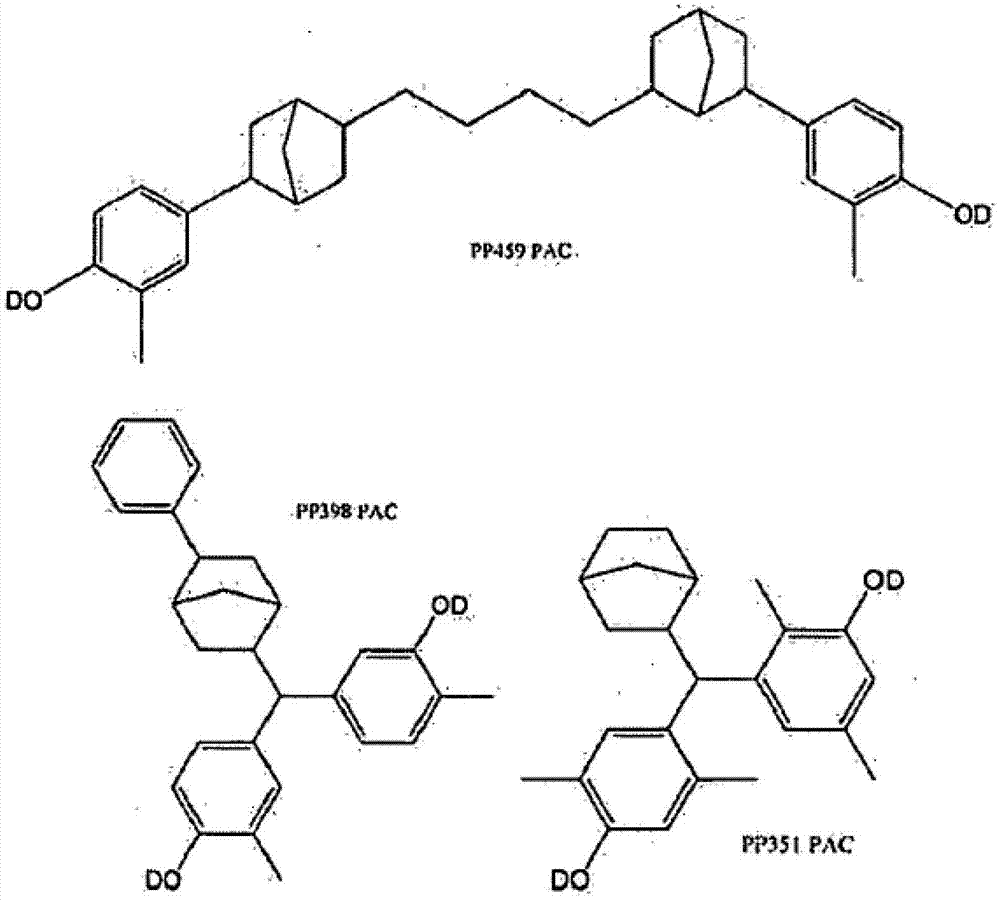
NBane-类ballast前体 NBane-like ballast precursor
提供实施例A和B,阐述可用于制备NBane-类ballast前体部分的方法。这些实例是非限定性的,仅仅起到辅助理解本发明的一些实施方案的作用。 Examples A and B are provided illustrating methods that can be used to prepare NBane-like ballast precursor moieties. These examples are non-limiting and serve only to aid in the understanding of some embodiments of the invention. the
实施例A: Example A:
5,5′-(1,4-亚苯基)双(双环[2.2.1]庚-2-酮) 5,5′-(1,4-phenylene)bis(bicyclo[2.2.1]heptan-2-one)

在氮气下,将1,4-二碘苯(60.0g,0.182mol)),(三-邻-甲苯基膦)2PdCl2(1.44g;1.83mmol),和双环[2.2.1]庚-2-烯-5-酮(59.3g,0.55mol)引入到合适尺寸和配备的反应容器内。添加DMF(600mL)到这混合物中。连续添加三乙胺(152mL,1.09mol)(温度下降到16℃)和甲酸 (98%)(34mL,0.90mol)(温度上升到34℃)到这一反应混合物中。在油浴中缓慢地加热该反应混合物到70℃。引发反应并将混合物温度升高到102℃。混合物几乎立即从黄变橙,和观察到放出气体。在70℃的温度下搅拌反应混合物过夜。在这一反应时间最后,反应混合物为黄色,和观察到存在金属钯。将炽热的反应混合物过滤通过硅胶塞(silicagel plug),和当滤液冷却时,形成白色固体。通过过滤收集这一固体(10.6g)。接下来,从这一滤液中蒸发约15%的溶剂,引起额外量的产物在室温下从溶液中沉淀(4.5g)。通过GC分析,这两种样品的纯度为99%(15.1g28%产率)。 Under nitrogen, 1,4-diiodobenzene (60.0g, 0.182mol)), (tri-o-tolylphosphine) 2 PdCl 2 (1.44g; 1.83mmol), and bicyclo[2.2.1]heptyl- 2-en-5-one (59.3 g, 0.55 mol) was introduced into an appropriately sized and equipped reaction vessel. DMF (600 mL) was added to this mixture. Triethylamine (152 mL, 1.09 mol) (temperature decreased to 16 °C) and formic acid (98%) (34 mL, 0.90 mol) (temperature increased to 34 °C) were added successively to this reaction mixture. The reaction mixture was slowly heated to 70°C in an oil bath. The reaction was initiated and the temperature of the mixture was raised to 102°C. The mixture turned from yellow to orange almost immediately, and gas evolution was observed. The reaction mixture was stirred overnight at a temperature of 70°C. At the end of this reaction time, the reaction mixture was yellow, and the presence of metallic palladium was observed. The hot reaction mixture was filtered through a silicagel plug, and when the filtrate cooled, a white solid formed. This solid (10.6g) was collected by filtration. Next, about 15% of the solvent was evaporated from this filtrate, causing an additional amount of product to precipitate from solution at room temperature (4.5 g). Both samples were 99% pure by GC analysis (15.1 g 28% yield).
实施例B: Example B:
6-苯基降冰片烷-2-甲醛和5-苯基降冰片烷-2-甲醛 6-Phenylnorbornane-2-carbaldehyde and 5-phenylnorbornane-2-carbaldehyde

在氮气下,将双(三-邻-甲苯基膦)二氯化钯(3.9g,5.0mmol))引入到合适尺寸和配备的反应容器中。添加碘代苯(117.5g,0.576mol),内-,外-降冰片烯-2-甲醛(56.3g,0.46mol),530ml二甲基甲酰胺(DMF)和三乙胺(139.1g,1.38mol)。当在11分钟内逐滴添加甲酸(53.0g,1.15mol)时,搅拌该混合物。反应温度从18℃升高到42℃。开始加热。在51℃下,开始放热反应。在反应进入回流的同时,温度在14分钟内快速攀升到104℃。反应混合物的颜色从亮黄色变为橙色到黑色。在20分钟反应时间之后的GC分析表明所有降冰片烯甲醛被消耗。将反应混合物倾倒在2500ml蒸馏水内。用3x500ml MTBE提取该含水混合物。将提取物过滤通过硅藻土垫(Celite pad),除去钯粒。用8x500ml5% 含水LiCl洗涤MTBE提取物,除去DMF。在硫酸钠上干燥MTBE溶液,过滤,并旋转蒸发,得到92.3g棕色液体,通过GC分析纯度为88.2%。NMR分析表明四个CHO信号。 Bis(tris-o-tolylphosphine)palladium dichloride (3.9 g, 5.0 mmol)) was introduced into a suitably sized and equipped reaction vessel under nitrogen. Add iodobenzene (117.5g, 0.576mol), endo-, exo-norbornene-2-carbaldehyde (56.3g, 0.46mol), 530ml dimethylformamide (DMF) and triethylamine (139.1g, 1.38 mol). The mixture was stirred when formic acid (53.0 g, 1.15 mol) was added dropwise over 11 minutes. The reaction temperature increased from 18°C to 42°C. Start heating. At 51°C, the exothermic reaction started. While the reaction was entering reflux, the temperature rapidly climbed to 104°C in 14 minutes. The color of the reaction mixture changed from bright yellow to orange to black. GC analysis after 20 minutes reaction time indicated that all norbornene formaldehyde was consumed. The reaction mixture was poured into 2500 ml of distilled water. The aqueous mixture was extracted with 3x500ml MTBE. The extract was filtered through a Celite pad to remove palladium particles. The MTBE extract was washed with 8x500ml 5% aqueous LiCl to remove DMF. The MTBE solution was dried over sodium sulfate, filtered, and rotovaped to yield 92.3 g of a brown liquid, 88.2% pure by GC analysis. NMR analysis indicated four CHO signals. the
将该油状物溶解在二氯甲烷中,并通过旋转蒸发该混合物至干,吸附到120g氧化硅上。将其干燥地负载在1280g氧化硅上并用2-2.5L部分的溶剂梯度洗脱,其中洗脱始于100%庚烷和一直到1%EtOAc/庚烷。第17-25部分(具有1%EtOAc/庚烷)得到纯度为96.5%(GC)的66g油状物。NMR分析表明仅仅三个CHO信号。通过10英寸的玻璃螺旋填充的柱子,真空蒸馏该油状物。在117.0-123.8℃(1.20-1.30Torr)下收集纯度为98.6%的8.27g的初馏物,在112.3-118.7℃(1.05-1.30Torr)下收集三个部分,总计50.91g(55%产率)。通过GC分析,纯度为99.4-99.7%。 The oil was dissolved in dichloromethane and the mixture was adsorbed onto 120 g of silica by rotary evaporating to dryness. It was loaded dry on 1280 g silica and eluted with a solvent gradient of 2-2.5 L portions starting at 100% heptane and going up to 1% EtOAc/heptane. Fractions 17-25 (with 1% EtOAc/heptane) yielded 66 g of an oil with a purity of 96.5% (GC). NMR analysis indicated only three CHO signals. The oil was vacuum distilled through a 10 inch glass spiral packed column. 8.27 g of first run with 98.6% purity were collected at 117.0-123.8°C (1.20-1.30 Torr) and three fractions were collected at 112.3-118.7°C (1.05-1.30 Torr), totaling 50.91 g (55% yield ). By GC analysis, the purity was 99.4-99.7%. the
应当理解,鉴于上述实验细节和结果,通过卤代芳基(例如,碘代苯)或卤代芳基醇(例如,BrPhOH),钯催化的加氢芳基化单取代的2-降冰片烯,例如以上的内-/外-2-NBCHO导致在上述反应流程中描绘的四个区域异构体。此处例举的苯基的加成在或者外-或内-官能团的syn-或者在外-或内-官能团的anti-处发生,但总是在双键的外-面上,结果得到所示的特定区域异构体。因此,为了控制根据本发明实施方案的降冰片烷衍生的苯酚,多酚或PAC的物理性能(即熔点或在加工溶剂和配方内的溶解度),加氢芳基化是生成具有外-芳基(或芳基醇)官能度的区域异构体混合物的有用方法。 It should be appreciated that, in view of the experimental details and results above, palladium-catalyzed hydroarylation of monosubstituted 2-norbornenes by haloaryl groups (e.g., iodobenzene) or haloaryl alcohols (e.g., BrPhOH) , for example the above endo-/exo-2-NBCHO leads to the four regioisomers depicted in the above reaction scheme. The addition of the phenyl group exemplified here takes place either at the syn- of the exo-or endo-functional group or at the anti- of the exo-or endo-functional group, but always on the exo-face of the double bond, resulting in the specific regioisomers. Thus, in order to control the physical properties (i.e., melting point or solubility in processing solvents and formulations) of norbornane-derived phenols, polyphenols, or PACs according to embodiments of the present invention, hydroarylation is the process of generating polyphenols with exo-aryl groups. A useful method for mixtures of regioisomers of (or aryl alcohol) functionality. the
降冰片烷Ballast的合成 Synthesis of Norbornane Ballast
在以下提供的实施例1-14每一个中,提供称为NBane-类ballast部分的合成路线。要理解,这些实施例是非限定性的,且作为阐述制备NBane-类ballast部分可获得的数种合成路线形式提供并辅助理解本发明的一些实施方案。 In each of Examples 1-14 provided below, a synthetic route to a moiety known as the NBane-like ballast is provided. It is to be understood that these examples are non-limiting and are provided as a form of illustration of several synthetic routes available to prepare NBane-like ballast moieties and to aid in the understanding of some embodiments of the invention. the
实施例1 Example 1
4,4′-(5-(4-(5,5-双(4-羟基-3-甲基苯基)双环[2.2.1]庚-2-基)苯基)双环[2.2.1]庚-2,2-二基)双(2-甲基苯酚)(PP691) 4,4'-(5-(4-(5,5-bis(4-hydroxy-3-methylphenyl)bicyclo[2.2.1]hept-2-yl)phenyl)bicyclo[2.2.1] Hept-2,2-diyl)bis(2-methylphenol)(PP691)

将邻-甲酚(200mL,1.93mol),5,5′-(l,4-亚苯基)双(双环[2.2.1]庚-2-酮)(15.1g;51.2mmol)和十二烷-1-硫醇(催化剂)(0.365g;1.80mmol)加入到合适尺寸和配备的反应容器中。在油浴中加热该混合物到40℃,并将氯化氢(HCl)气体鼓泡通过该反应混合物。在HCl气体存在下,在40℃下继续该反应过夜(16小时)。之后,在容器内形成粉红色沉淀,并通过终止HC1气体的流动,终止反应。添加约1升己烷到该反应混合物中,并过滤反应混合物,得到粉红色粉末(约110g)。用甲苯(500mL)提取该粉红色粉末,除去邻-甲酚,然后将该粉红色粉末溶解在二乙醚中,并使溶液流过硅胶塞。在蒸发二乙醚之后,获得红色粘稠的油状物。用己烷研制这一物质,生成粉红色沉淀,然后将其溶解在甲醇中,并用己烷和庚烷的混合物提取三次。蒸发甲醇得到37g固体产物(浅粉色),用100mL甲苯研制,通过过滤收集,然后真空干燥。通过ESI-MS和质子NMR,证实PP691形式的产物的确认。在95%的纯度下,产物PP691的产率为36.7g。 O-cresol (200mL, 1.93mol), 5,5′-(l,4-phenylene)bis(bicyclo[2.2.1]heptan-2-one) (15.1g; 51.2mmol) and dodeca Alkane-1-thiol (catalyst) (0.365 g; 1.80 mmol) was charged to an appropriately sized and equipped reaction vessel. The mixture was heated to 40 °C in an oil bath, and hydrogen chloride (HCl) gas was bubbled through the reaction mixture. The reaction was continued overnight (16 hours) at 40° C. in the presence of HCl gas. Afterwards, a pink precipitate formed in the vessel, and the reaction was terminated by stopping the flow of HCl gas. About 1 liter of hexane was added to the reaction mixture, and the reaction mixture was filtered to obtain a pink powder (about 110 g). The pink powder was extracted with toluene (500 mL) to remove o-cresol, then the pink powder was dissolved in diethyl ether and the solution was passed through a plug of silica gel. After evaporation of diethyl ether, a red viscous oil was obtained. This material was triturated with hexane to form a pink precipitate which was then dissolved in methanol and extracted three times with a mixture of hexane and heptane. Evaporation of the methanol gave 37 g of solid product (pale pink), which was triturated with 100 mL of toluene, collected by filtration, and dried in vacuo. The identification of the product as PP691 was confirmed by ESI-MS and proton NMR. The yield of product PP691 was 36.7 g at a purity of 95%. the
实施例2: Example 2:
4,4′-((5-(4-(5-(双(4-羟基-3-甲基苯基)甲基)双环[2.2.1]庚-2-基)苯基])双环[2.2.1]庚-2-基)亚甲基)双(2-甲基苯酚)(PP719) 4,4'-((5-(4-(5-(bis(4-hydroxy-3-methylphenyl)methyl)bicyclo[2.2.1]hept-2-yl)phenyl])bicyclo[ 2.2.1] Hept-2-yl) methylene) bis (2-methylphenol) (PP719)

称取1,4-二碘苯(7.51g;22.8mmol),(三-邻-甲苯基膦)2PdCl2(0.713g,0.907mmol),4,4′-(双环[2.2.1]庚-5-烯-2-基亚甲基)双(2-甲基苯酚)(21.8g;68.0mmol)和DMF(100mL),并加入到配有搅拌和回流冷凝器的合适尺寸的反应容器中,并在氮气氛围下放入。然后在搅拌下添加三乙胺(19.0mL,136mmol)和甲酸(4.40mL,117mmol)到这一混合物中。使用油浴,加热该混合物到75℃。在加热过程中,混合物从黄色变为橙色,且变得透明。反应混合物的温度因反应放热导致升高到119℃,和溶液变得较暗,且放出气体。在油浴中,在75℃下,允许该反应混合物搅拌过夜(16小时)。使得获得的反应混合物是透明黄色溶液且存在黑色的钯粒。用乙酸乙酯(100ml)稀释该反应混合物并通过硅胶塞过滤。用水洗涤滤液,并在无水硫酸镁上干燥所得有机层。用中压柱色谱法纯化粗混合物,并且洗脱溶液逐渐从100%己烷变化为100%乙酸乙酯。这一分离导致分离9.5g PP719(60%产率;95%纯度)。通过LC-MS(ESI)和质子NMR,证实PP719形式的产物的确认。 Weigh 1,4-diiodobenzene (7.51g; 22.8mmol), (tri-o-tolylphosphine) 2 PdCl 2 (0.713g, 0.907mmol), 4,4′-(bicyclo[2.2.1]heptane -5-en-2-ylmethylene)bis(2-methylphenol) (21.8 g; 68.0 mmol) and DMF (100 mL) and added to an appropriately sized reaction vessel equipped with stirring and reflux condenser , and placed under a nitrogen atmosphere. Triethylamine (19.0 mL, 136 mmol) and formic acid (4.40 mL, 117 mmol) were then added to this mixture with stirring. Using an oil bath, heat the mixture to 75°C. During heating, the mixture turned from yellow to orange and became transparent. The temperature of the reaction mixture rose to 119°C due to the reaction exotherm, and the solution became darker and gas evolved. The reaction mixture was allowed to stir overnight (16 hours) at 75°C in an oil bath. The resulting reaction mixture was a clear yellow solution with black particles of palladium present. The reaction mixture was diluted with ethyl acetate (100ml) and filtered through a plug of silica gel. The filtrate was washed with water, and the resulting organic layer was dried over anhydrous magnesium sulfate. The crude mixture was purified by medium pressure column chromatography, and the eluting solution was gradually changed from 100% hexane to 100% ethyl acetate. This separation resulted in the isolation of 9.5 g of PP719 (60% yield; 95% purity). The identification of the product as PP719 was confirmed by LC-MS (ESI) and proton NMR.
实施例3: Example 3:
4,4′-((5-(4-羟基-3-甲基苯基)双环[2.2.1]庚-2-基)亚甲基)双(2-甲基苯酚)(PP429) 4,4′-((5-(4-hydroxy-3-methylphenyl)bicyclo[2.2.1]hept-2-yl)methylene)bis(2-methylphenol)(PP429)
在氮气氛围下,将4-溴-2-甲基苯酚(4.69g,25.1mmol),(三-邻-甲苯基膦)2PdCl2(0.377g;0.480mmol),和4,4′-(双环[2.2.1]庚-5-烯-2-基亚甲基)双(2-甲基苯酚)(5.14g;16.0mmol)加入到合适尺寸和配备的反应容器中。添加DMF(80mL)到这一反应物混合物中,得到悬浮液。添加三乙胺(11.0mL,78.9mmol)和甲酸(2.30mL,60.9mmol)到这一悬浮液中,然后在油浴中加热到75℃。反应混合物从其起始橙色悬浮液变为浅黄色且变得透明。在反应过程中,反应混合物的温度升高到82℃, 并变得较暗,且非常缓慢地放出气体。在起始放热反应停止之后,在75℃下搅拌反应混合物过夜。之后,反应混合物为透明、浅黄色的溶液且具有黑色颗粒。用乙酸乙酯(80mL)稀释冷却的反应混合物,并用水(160mL)洗涤,除去DMF。在无水硫酸镁上干燥有机层。通过制备型TLC,使用己烷/乙酸乙酯混合物(50:50)作为显色剂(developer),纯化粗混合物,得到3.7g4,4′-((5-(4-羟基-3-甲基苯基)双环[2.2.1]庚-2-基)亚甲基)-双(2-甲基苯酚)(54%产率)。通过LC-MS(ESI)和质子NMR,证实PP429形式的产物的确认。 Under a nitrogen atmosphere, 4-bromo-2-methylphenol (4.69 g, 25.1 mmol), (tri-o-tolylphosphine) 2 PdCl 2 (0.377 g; 0.480 mmol), and 4,4′-( Bicyclo[2.2.1]hept-5-en-2-ylmethylene)bis(2-methylphenol) (5.14 g; 16.0 mmol) was charged to an appropriately sized and equipped reaction vessel. DMF (80 mL) was added to this reaction mixture to give a suspension. Triethylamine (11.0 mL, 78.9 mmol) and formic acid (2.30 mL, 60.9 mmol) were added to this suspension, which was then heated to 75 °C in an oil bath. The reaction mixture turned pale yellow from its initial orange suspension and became transparent. During the course of the reaction, the temperature of the reaction mixture increased to 82°C and became darker with very slow evolution of gas. After the initial exothermic reaction had ceased, the reaction mixture was stirred overnight at 75°C. Afterwards, the reaction mixture was a clear, light yellow solution with black particles. The cooled reaction mixture was diluted with ethyl acetate (80 mL) and washed with water (160 mL) to remove DMF. The organic layer was dried over anhydrous magnesium sulfate. Purification of the crude mixture by preparative TLC using a hexane/ethyl acetate mixture (50:50) as developer afforded 3.7 g of 4,4'-((5-(4-hydroxy-3-methyl phenyl)bicyclo[2.2.1]hept-2-yl)methylene)-bis(2-methylphenol) (54% yield). The identification of the product as PP429 was confirmed by LC-MS (ESI) and proton NMR.
实施例4: Example 4:
4-(双环[2.2.1]庚-2-基)-2-甲基苯酚(PP202)的合成 Synthesis of 4-(bicyclo[2.2.1]hept-2-yl)-2-methylphenol (PP202)

在氮气下,将4-溴-2-甲基苯酚(3.54g,19.0mmol),(三-邻-甲苯基膦)2PdCl2(0.291g,0.370mmol),和降冰片烯(1.62grams,17.2mmol)加入到合适尺寸和配备的反应容器中。添加DMF(70mL)到这一反应混合物中,形成悬浮液,然后添加三乙胺(5.66g,56.0mmol)和甲酸(2.20g,47.7mmol)。在添加甲酸之后,观察到变为黄色悬浮液的反应混合物的温度升高到约32℃。当在油浴中加热该混合物到75℃时,悬浮液在约72℃下变为暗色。然后在反应容器浸渍在75℃油浴内的情况下,允许反应混合物搅拌过夜。在冷却之后,反应混合物为黄色透明溶液且具有黑色颗粒。用乙酸乙酯稀释该混合物,通过硅胶塞过滤,并用水洗涤。分离有机层,并在无水硫酸镁上干燥。通过旋转蒸发汽提掉产物溶液,得到油状物。通过GC-MS分析粗产物,证实PP202,(4-(双环[2.2.1]庚-2-基)-2-甲基苯酚)(46%产率)。 Under nitrogen, 4-bromo-2-methylphenol (3.54 g, 19.0 mmol), (tri-o-tolylphosphine) 2 PdCl 2 (0.291 g, 0.370 mmol), and norbornene (1.62 grams, 17.2 mmol) into a reaction vessel of suitable size and equipment. DMF (70 mL) was added to this reaction mixture to form a suspension, followed by triethylamine (5.66 g, 56.0 mmol) and formic acid (2.20 g, 47.7 mmol). After the addition of formic acid, the temperature of the reaction mixture which turned into a yellow suspension was observed to rise to about 32°C. When the mixture was heated to 75°C in an oil bath, the suspension turned dark at about 72°C. The reaction mixture was then allowed to stir overnight with the reaction vessel immersed in a 75°C oil bath. After cooling, the reaction mixture was a yellow transparent solution with black particles. The mixture was diluted with ethyl acetate, filtered through a plug of silica gel and washed with water. The organic layer was separated and dried over anhydrous magnesium sulfate. The product solution was stripped off by rotary evaporation to give an oil. Analysis of the crude product by GC-MS confirmed PP202, (4-(bicyclo[2.2.1]hept-2-yl)-2-methylphenol) (46% yield).
实施例5: Embodiment 5:
4,4′-(双环[2.2.1]庚-25-二基)双(2-甲基苯酚)(PP308) 4,4′-(bicyclo[2.2.1]hept-25-diyl)bis(2-methylphenol)(PP308)

在氮气下,将4-溴-2-甲基苯酚(2.03g,10.8mmol),(三-邻-甲苯基膦)2PdCl2(0.0422g,0.0537mmol),和降冰片二烯(0.257g,2.79mmol)加入到合适尺寸和配备的反应容器中。添加DMF(36mL),三乙胺和甲酸至其观察变为黄色悬浮液。然后在油浴内加热该混合物到75℃。一经这样加热,则反应混合物变为黄色溶液,出现黑色颗粒,并观察到非常缓慢的气体放出。在这一温度下搅拌该反应混合物过夜。在冷却之后,用乙酸乙酯稀释该反应混合物,并用水洗涤。分离有机层,并在无水硫酸镁上干燥。通过GC-MS分析粗产物,证实PP308-2,5,(4,4′-(双环[2.2.1]庚-2,5-二基)双(2-甲基苯酚))(43%产率)。 Under nitrogen, 4-bromo-2-methylphenol (2.03g, 10.8mmol), (tri-o-tolylphosphine) 2 PdCl 2 (0.0422g, 0.0537mmol), and norbornadiene (0.257g , 2.79mmol) into a reaction vessel of suitable size and equipment. DMF (36 mL), triethylamine and formic acid were added until it was observed to become a yellow suspension. The mixture was then heated to 75°C in an oil bath. Upon such heating, the reaction mixture turned into a yellow solution, black particles appeared and a very slow evolution of gas was observed. The reaction mixture was stirred overnight at this temperature. After cooling, the reaction mixture was diluted with ethyl acetate and washed with water. The organic layer was separated and dried over anhydrous magnesium sulfate. Analysis of the crude product by GC-MS confirmed that PP308-2,5,(4,4′-(bicyclo[2.2.1]hept-2,5-diyl)bis(2-methylphenol)) (43% yield Rate).
实施例6: Embodiment 6:
4-((3-羟基-4-甲基苯基)(5-苯基双环[2.2.1]庚-2-基)甲基)-2-甲基苯酚(PP398) 4-((3-Hydroxy-4-methylphenyl)(5-phenylbicyclo[2.2.1]hept-2-yl)methyl)-2-methylphenol (PP398)
将内-,外-6-苯基降冰片烷-2-甲醛和内-,外-5-苯基降冰片烷-2-甲醛的混合物(39.87g,0.20mol)加入到合适尺寸和配备的反应容器中。添加邻-甲酚(275g,2.54mol),并在75℃油浴中加热该容器。当反应混合物达到25℃时,将1-十二烷硫醇(4.8ml)注射到反应混合物中,和当混合物温度达到50℃时,将HCl气体缓慢地鼓泡到反应混合物内。混合物立即变为粉红色,然后在10分钟内温热到约75℃,此刻取出等分液,并通过HPLC分析。分析表明所有醛类被消耗。终止HCl的添加和加热。添加总计1.8g HC1。 A mixture of endo-, exo-6-phenylnorbornane-2-carbaldehyde and endo-, exo-5-phenylnorbornane-2-carbaldehyde (39.87 g, 0.20 mol) was added to a suitably sized and equipped in the reaction vessel. o-Cresol (275 g, 2.54 mol) was added and the vessel was heated in a 75°C oil bath. When the reaction mixture reached 25 °C, 1-dodecanethiol (4.8 ml) was injected into the reaction mixture, and when the temperature of the mixture reached 50 °C, HCl gas was slowly bubbled into the reaction mixture. The mixture turned pink immediately and then warmed to about 75°C over 10 minutes, at which point an aliquot was removed and analyzed by HPLC. Analysis indicated that all aldehydes were consumed. The addition of HCl and heating was terminated. A total of 1.8 g HC1 was added. the
然后将反应混合物倾倒在1000ml蒸馏水内,和分离所得的相。用500ml二氯甲烷提取水相,并合并有机部分和用500ml部分的盐水洗涤到pH 7。在硫酸钠上干燥之后,过滤有机溶液,并通过旋转蒸发除去溶剂,获得307.2g油状物。HPLC分析表明82.4%邻-甲酚和15.1%PP398。在0.87-1.05Torr和65-75℃下旋转蒸发油状物,除去197g邻 -甲酚,并留下100.3g浅紫罗兰色糖浆状物(syrup)。HPLC分析发现32.2%邻-甲酚,64.1%PP398异构体和3.3%较高保留时间的副产物。高真空下的进一步的旋转蒸发除去约3g残留邻-甲酚。 The reaction mixture was then poured into 1000 ml of distilled water, and the resulting phases were separated. The aqueous phase was extracted with 500ml dichloromethane, and the organic fractions were combined and washed to pH 7 with 500ml fractions of brine. After drying over sodium sulfate, the organic solution was filtered and the solvent was removed by rotary evaporation to obtain 307.2 g of an oil. HPLC analysis indicated 82.4% o-cresol and 15.1% PP398. The oil was rotary evaporated at 0.87-1.05 Torr and 65-75°C, removing 197 g o-cresol and leaving 100.3 g light violet syrup. HPLC analysis found 32.2% o-cresol, 64.1% PP398 isomer and 3.3% by-products with higher retention time. Further rotary evaporation under high vacuum removed about 3 g of residual o-cresol. the
将糖浆状物溶解在向其中添加了253g二氧化硅的二氯甲烷中。然后旋转蒸发所得浆液至干。然后将干燥的二氧化硅干燥负载在1240g二氧化硅上,并用溶剂梯度洗脱,所述溶剂梯度始于100%庚烷并转到100%二氯甲烷。采用50:50二氯甲烷/庚烷,除去邻-甲酚。在100%二氯甲烷下,获得下述结合的部分: The syrup was dissolved in dichloromethane to which 253 g of silicon dioxide was added. The resulting slurry was then rotary evaporated to dryness. The dried silica was then dry loaded onto 1240 g of silica and eluted with a solvent gradient starting at 100% heptane and going to 100% dichloromethane. The o-cresol was removed using 50:50 dichloromethane/heptane. Under 100% dichloromethane, the following combined fractions were obtained:
第2部分被视为纯产物。第1和3部分与18g95.9-97.5%纯度的来自在先初馏物的物质结合,并用庚烷/二氯甲烷梯度洗脱通过800g二氧化硅。这得到额外5.74g99.1%PP398异构体。 Part 2 was considered pure product. Fractions 1 and 3 were combined with 18 g of 95.9-97.5% pure material from the previous forerunner and eluted through 800 g of silica with a gradient of heptane/dichloromethane. This gave an additional 5.74 g of the 99.1% PP398 isomer. the
实施例7: Embodiment 7:
4,4′-(双环[2.2.1]庚-2,2-二基)双(2-甲基苯酚) 4,4′-(bicyclo[2.2.1]hept-2,2-diyl)bis(2-methylphenol)

向合适尺寸和配备的反应容器中加入在10mL MeOH和1-十二烷硫醇(1.09mL,0.0045mol)内的邻-甲酚(44g,0.406mol)。加热混合物到40℃,并用滴液漏斗加入在5mL MeOH内的2-降冰片酮(5g,0.045mol)和在5mL MeOH内的邻-甲酚(5g,0.046mol)。在40℃下,在45分钟内逐滴添加邻-甲酚,同时在搅拌下引入HCl气体。在添加之后,HCl气体鼓泡另外45分钟,和观察到白色沉淀,且颜色从暗橙色变为浅粉色。在40℃下搅拌反应混合物另外17小时,GC分析表明没有起始物质2-降冰片酮。冷却混合物到室温,并使用旋转蒸发器除去 MeOH,和用50mL CH2C12洗脱。过滤白色沉淀,并用(3x50mL)CH2C12洗涤,和真空干燥6小时,得到10.5g(75%产率)白色固体形式的产物,通过HPLC分析,纯度>99.9%。1HNMR,13CNMR和MS与该结构一致。 To an appropriately sized and equipped reaction vessel was added o-cresol (44 g, 0.406 mol) in 10 mL of MeOH and 1-dodecanethiol (1.09 mL, 0.0045 mol). The mixture was heated to 40 °C and 2-norbornanone (5 g, 0.045 mol) in 5 mL MeOH and o-cresol (5 g, 0.046 mol) in 5 mL MeOH were added using a dropping funnel. At 40°C, o-cresol was added dropwise within 45 min while HCl gas was introduced under stirring. After the addition, HCl gas was bubbled for another 45 minutes, and a white precipitate was observed, changing in color from dark orange to light pink. The reaction mixture was stirred at 40°C for an additional 17 hours, GC analysis showed no starting material 2-norbornanone. The mixture was cooled to room temperature, and the MeOH was removed using a rotary evaporator, and eluted with 50 mL CH2Cl2 . The white precipitate was filtered and washed with (3x50 mL) CH2Cl2 , and dried in vacuo for 6 hours to afford 10.5 g (75% yield) of the product as a white solid, >99.9% pure by HPLC analysis. 1 HNMR, 13 CNMR and MS are consistent with this structure.
实施例8 Example 8
2-甲基-4-{6-{[2-(2-甲氧基乙氧基)-乙氧基]甲基}双环[2.2.1]庚-2-基}苯酚(P334) 2-Methyl-4-{6-{[2-(2-methoxyethoxy)-ethoxy]methyl}bicyclo[2.2.1]hept-2-yl}phenol (P334)

向合适尺寸和配备的反应容器中加入9.13g4-碘-2-甲基苯酚(IMePhOH,0.039mol),8.83g5-[2-(2-甲氧基乙氧基)乙氧基]甲基}双环[2.2.1]庚-2-烯(TONNB)(0.039mol),0.27g Pd(Ph3P)2Cl2(3.9mmol,1mol%),11.82g三乙胺(0.117mol),和60ml二甲基甲酰胺(DMF)。磁搅拌该混合物,得到橙-棕色浆液。通过移液管快速添加甲酸(4.49g,0.0975mol)。温度从19℃升高到34℃,且反应混合物变为浅橙色溶液。开始外部加热。在15分钟之后和在70℃下,GC分析表明35.1%IMePhOH,63.1%TONNB,和1.5%P334(TONNB-甲酚)的总计4种异构体。在70℃下,放热引起反应温度升高到82℃,且放出二氧化碳,和溶液变为亮黄色。在约2小时之后,反应混合物变为橄榄色,且黑色Pd颗粒沉淀。GC分析表明没有IMePhOH,1.5%TONNB,和94.2%P334(4种异构体)。然后冷却反应混合物到34℃,但然后经24分钟再加热到82℃,以确保所有IMePhOH被消耗。冷却反应到70℃,过滤通过Celite
将P334溶解在庚烷和二氯甲烷中,与38g二氧化硅混合,并通过旋转蒸发除去溶剂,直到获得干粉。将粉末装在在320g二氧化硅上,并使用100%庚烷先开始洗脱。用100%庚烷到20%EtOAc/庚烷的溶剂梯度洗脱TONNB和其他显现的杂质。用30%EtOAc/庚烷洗脱TONNB-甲酚,得到10.2g(78%产率)无色油状物。GC分析得到100%的纯度。异构体之比为35:12:43:10。数据:在DB5柱上进行GC分析:30m,0.32mm ID,0.25μm薄膜。梯度:在15℃/min下,75℃到200℃,然后在40℃/min下加热到300℃。注射器:250℃。检测仪:350℃(FID),停留时间8.244min(IMePhOH),9.199min(TONNB),14.036min,14.209min,14.555min,14.465min.(TONNB-甲酚异构体)。采用50%EtOAc/庚烷,在硅胶上TLC分析。 P334 was dissolved in heptane and dichloromethane, mixed with 38 g of silica, and the solvent was removed by rotary evaporation until a dry powder was obtained. The powder was loaded onto 320 g of silica and the elution started first with 100% heptane. TONNB and other emerging impurities were eluted with a solvent gradient from 100% heptane to 20% EtOAc/heptane. Elution of TONNB-cresol with 30% EtOAc/heptane afforded 10.2 g (78% yield) of a colorless oil. GC analysis gave 100% purity. The ratio of isomers is 35:12:43:10. Data: GC analysis on DB5 column: 30m, 0.32mm ID, 0.25μm film. Gradient: 75°C to 200°C at 15°C/min, then heating to 300°C at 40°C/min. Syringe: 250°C. Detector: 350°C (FID), residence time 8.244min (IMePhOH), 9.199min (TONNB), 14.036min, 14.209min, 14.555min, 14.465min. (TONNB-cresol isomers). TLC analysis on silica gel with 50% EtOAc/heptane. the
实施例9: Embodiment 9:
2-甲基-4-{6-壬基双环[2.2.1]庚-2-基}苯酚(P343) 2-Methyl-4-{6-nonylbicyclo[2.2.1]hept-2-yl}phenol (P343)
向合适尺寸和配备的反应容器中加入11.70g4-碘-2-甲基苯酚(IMePhOH,0.05mol),11.70g2-癸基降冰片烯(DecNB,0.05mol),0.35g Pd(Ph3P)2Cl2(5mmol,1mol%),15.15g三乙胺(0.15mol),和58ml二甲基甲酰胺。磁搅拌该混合物,得到棕褐色浆液,并通过移液管快速添加甲酸(5.75g,0.125mol)。温度从21℃升高到37℃,且反应混合物变为橙色溶液。施加外热。在56℃下,开始放热,从而引起升温到67℃且放出二氧化碳,和溶液变为黄色。在70℃下约7小时之后,猝灭样品(在1ml水内约0.5ml反应混合物),分析表明约0%IMePhOH,3.9%DecNB,和92.5%P343(4种异构体)。冷却反应混合物到47℃,过滤通过Celite
然后将P343溶解在庚烷中,与35g二氧化硅混合,并旋转蒸发浆液成干粉。将粉末负载在381g二氧化硅上,并首先用100%庚烷,然后用EtOAc/庚烷的混合物洗脱P343。在戊烷内结合数个部分,然后通过旋转蒸发除去溶剂,得到9.83g(57%)99.7%异构体之比为33:13:44:10的P343。 P343 was then dissolved in heptane, mixed with 35 g of silica, and the slurry was rotary evaporated to a dry powder. The powder was loaded onto 381 g of silica and P343 was eluted first with 100% heptane, then with a mixture of EtOAc/heptane. The fractions were combined in pentane and the solvent removed by rotary evaporation to afford 9.83 g (57%) of P343 in a 99.7% isomer ratio of 33:13:44:10. the
实施例10: Embodiment 10:
4,4′-((氧基双(乙-2,1-二基))双(双环[2.2.1]庚-5,2-二基))双(2-甲基苯酚)(PP475) 4,4′-((oxybis(ethyl-2,1-diyl))bis(bicyclo[2.2.1]hept-5,2-diyl))bis(2-methylphenol)(PP475)

向合适尺寸和配备的反应容器中加入在380mL DMF内的4-碘-2-甲基苯酚(75.7g,323mmol)。在室温下,向其中添加Pd(PPh3)4(3.56g,3.08mmol),得到浅黄色溶液。然后添加5,5′-(氧基双(乙-2,l-二基))双(双环[2.2.1]庚-2-烯)(39.8g,154mmol),100ml二甲基甲酰胺(DMF),和三乙胺(65m1,462mmol),并当在5分钟内逐滴添加甲酸(17.7g,14.5mL 385mmol)时,搅拌该混合物。反应温度从20℃上升到25℃,之后施加外热。在70℃下,开始放热反应,和温度在10分钟内快速攀升到82℃,并伴随着颜色从浅黄色变换为橙色到黑色。通过GC监控反应,和在75℃下搅拌96小时之后,等分试样的GC分析表明反应完全。允许反应混合物冷却到室温,并倾倒在2000mL蒸馏水内。用(3x1500mL)MTBE提取含水混合物,将提取物过滤通过Celite
实施例11: Example 11:
4-((3-羟基-4-甲基苯基)(5-苯基双环[2.2.1]庚-2-基)甲基)-2-甲基苯酚(PP400) 4-((3-Hydroxy-4-methylphenyl)(5-phenylbicyclo[2.2.1]hept-2-yl)methyl)-2-methylphenol (PP400)
PhNBaneCHO:将双(三-邻-甲苯基膦)氯化钯(3.9g,5.0mmol))加入到合适尺寸和配备的反应容器中。添加碘代苯(117.5g,0.576mol),内-/外-降冰片烯-2-甲醛(56.3g,0.46mol),530ml二甲基甲酰胺(DMF),和三乙胺(139.1g,1.38mol),并当在11分钟内逐滴添加甲酸(53.0g,1.15mol)时,搅拌该混合物。反应温度从18℃上升到42℃,之后施加外热。在51℃下,开始放热反应,和在反应进行回流的同时,温度在14分钟内升高到104℃。在回流过程中,反应混合物的颜色从亮黄色变为橙色到黑色,和在20分钟的反应时间之后获取的等分试样的GC分析表明所有降冰片烯甲醛被消耗。将反应混合物倾倒在2500ml蒸馏水中,并用(3x500ml)甲基叔丁基醚(MTBE)提取含水混合物。将提取物过滤通过Celite
将该油状物溶解在二氯甲烷中,并通过旋转蒸发该混合物至干,吸附在120g二氧化硅上。将其干燥地负载在1280g二氧化硅上,并用2-2.5L部分的溶剂洗脱,其梯度始于100%庚烷并达到1%EtO Ac/庚烷。第17-25部分(具有1%EtOAc/庚烷)得到66g(GC)纯度为96.5%的油状物。NMR分析表明仅仅三个CHO信号。真空蒸馏该油状物通 过10英寸的玻璃螺旋-填充的柱子。在117-124℃(1.20-1.30Torr)下收集8.27g纯度为98.6%的初馏物。在1129-119℃(1.05-1.30Torr)下收集总计50.91g(55%产率)的三个部分。通过GC分析纯度为99.4-99.7%。数据:在EC5柱子上进行GC分析:30m,0.32mm ID,0.25μm薄膜。梯度:在15°℃/min下75℃加热到200℃,然后在40℃/min下加热到300℃。注射器:250℃。检测仪:350℃(FID),停留时间:10.450和10.646分钟, The oil was dissolved in dichloromethane and the mixture was adsorbed onto 120 g of silica by rotary evaporation to dryness. It was loaded dry on 1280 g silica and eluted with 2-2.5 L portions of solvent with a gradient starting at 100% heptane and going to 1% EtO Ac/heptane. Fractions 17-25 (with 1% EtOAc/heptane) yielded 66 g (GC) of an oil with a purity of 96.5%. NMR analysis indicated only three CHO signals. The oil was vacuum distilled through a 10 inch glass spiral-packed column. 8.27 g of forerunt with a purity of 98.6% was collected at 117-124°C (1.20-1.30 Torr). Three fractions totaling 50.91 g (55% yield) were collected at 1129-119°C (1.05-1.30 Torr). Purity by GC analysis was 99.4-99.7%. Data: GC analysis on EC5 column: 30m, 0.32mm ID, 0.25μm film. Gradient: 75°C to 200°C at 15°C/min, then 300°C at 40°C/min. Syringe: 250°C. Detector: 350°C (FID), residence time: 10.450 and 10.646 minutes,
PhNBaneCH(C6H2-2,5-Me2-OH)2:向合适尺寸和配备的反应容器中加入在45mL MeOH和1-十二烷硫醇(1.3mL,5.5mmol)内的2,5-二甲基苯酚(22.6g,185mmol)。观察到轻微吸热(18℃变为5℃)。用滴液漏斗加入在10mL MeOH内的Ph-NBaneCHO(1lg,54.9mmol)和在10mL MeOH内的2,5-二甲基苯酚(11g,90mmol),然后在30分钟的时间段内,在搅拌下引入HCl气体的同时,逐滴添加该溶液。在添加过程中,反应温度上升到50℃。在添加之后,将HC1气体鼓泡另外1小时,且反应混合物从透明变为浅蓝色。在50℃下搅拌反应混合物另外3小时。GC分析表明没有起始物质Ph-NBaneCHO。冷却该混合物到室温,并在旋转蒸发下除去MeOH,得到蓝色油状物。将粗的蓝色油状物溶解在200mL EtOAc中,并用水和盐水洗涤。在硫酸钠上干燥有机相,过滤,并浓缩,得到48g蓝色油状物形式的粗产物。通过Kugelrohr蒸馏(100-120℃烘箱温度,0.1-0.4Torr高真空),进一步纯化48g粗产物,得到31.3g浅蓝色固体形式的产物。用100mL DCM研制31.3g该物质,并过滤,得到7.5g(32%产率)通过HPLC分析纯度为99.7%的产物。浓缩滤液,并得到额外26.1g粗产物,对其也进行kugelrohr蒸馏(110-150℃烘箱温度,0.6-0.8Torr高真空),得到19.3g灰白色固体形式的产物。将19.3g粗产物吸附在20g二氧化硅上,并在用庚烷/EtOAc混合物洗脱的额外120g二氧化硅上色谱分析。浓缩的纯化部分得到12.2g(52%产率)灰白色粉末形式的产物,通过HPLC分析,其纯度>99.9%。这一反应结合的产率为84%。NMR和MS与该结构一致。 PhNBaneCH( C6H2-2,5 - Me2 - OH) 2 : To an appropriately sized and equipped reaction vessel was added 2 in 45 mL of MeOH and 1-dodecanethiol (1.3 mL, 5.5 mmol), 5-Dimethylphenol (22.6 g, 185 mmol). A slight endotherm was observed (18°C to 5°C). Ph-NBaneCHO (11 g, 54.9 mmol) in 10 mL of MeOH and 2,5-dimethylphenol (11 g, 90 mmol) in 10 mL of MeOH were added using a dropping funnel, followed by stirring over a period of 30 minutes This solution was added dropwise while introducing HCl gas under the hood. During the addition, the reaction temperature rose to 50°C. After the addition, HCl gas was bubbled for another 1 hour, and the reaction mixture changed from clear to light blue. The reaction mixture was stirred at 50°C for an additional 3 hours. GC analysis showed no starting material Ph-NBaneCHO. The mixture was cooled to room temperature and the MeOH was removed under rotary evaporation to give a blue oil. The crude blue oil was dissolved in 200 mL EtOAc and washed with water and brine. The organic phase was dried over sodium sulfate, filtered and concentrated to give 48 g of crude product as a blue oil. 48 g of crude product were further purified by Kugelrohr distillation (100-120° C. oven temperature, 0.1-0.4 Torr high vacuum) to give 31.3 g of the product as a light blue solid. 31.3 g of this material were triturated with 100 mL of DCM and filtered to afford 7.5 g (32% yield) of product 99.7% pure by HPLC analysis. The filtrate was concentrated and an additional 26.1 g of crude product was obtained, which was also subjected to kugelrohr distillation (110-150°C oven temperature, 0.6-0.8 Torr high vacuum) to give 19.3 g of the product as an off-white solid. 19.3 g of crude product were adsorbed on 20 g of silica and chromatographed on an additional 120 g of silica eluting with a heptane/EtOAc mixture. The concentrated purified fractions afforded 12.2 g (52% yield) of the product as an off-white powder with a purity >99.9% by HPLC analysis. The combined yield of this reaction was 84%. NMR and MS were consistent with the structure.
实施例12: Example 12:
3-(双环[2.2.1]庚-2-基(4-羟基-2,5-二甲基苯基)甲基)-2,5-二甲基苯酚(PP350) 3-(Bicyclo[2.2.1]hept-2-yl(4-hydroxy-2,5-dimethylphenyl)methyl)-2,5-dimethylphenol (PP350)

NBCH(C6H2-2,5-Me2-OH)2向合适尺寸和配备的反应容器中加入在50mL MeOH内的KOH(4.6g,81.8mmol)。加热该混合物到65-66℃,并在66℃下添加在20mL MeOH内溶解的2,5-二甲基苯酚(20g,163.7mmol)。然后用滴液漏斗加入在10mL MeOH内的外-/内-NBCHO(10g,81.8mmol)。在缓慢地添加NBCHO溶液之后,回流该反应混合物,并通过TLC和HPLC监控。在添加醛溶液的过程中没有观察到显著的放热,和反应混合物的颜色从浅黄色变为暗棕色。通过获取等分试样,并用1N HCl溶液猝灭,和用EtOAc提取,并检测TLC/HPLC,从而周期性监控反应。在回流7天之后,所有醛被消耗,但通过TLC/HPLC观察到未反应的苯酚,和粗的LCMS表明>89%的产物且具有约10%未反应苯酚。允许反应混合物冷却到室温,并用4NHCl酸化,和用200mL CH2C12洗脱。过滤KCl沉淀,并浓缩滤液,得到33.5g棕色糊状物形式的粗产物。将33.5g粗产物溶解在500mLEtOAc中,并用水,盐水洗涤,在硫酸钠上干燥,过滤,并浓缩,得到32.7g粗产物。 NBCH( C6H2-2,5 - Me2 - OH) 2 To an appropriately sized and equipped reaction vessel was added KOH (4.6 g, 81.8 mmol) in 50 mL of MeOH. The mixture was heated to 65-66 °C, and 2,5-dimethylphenol (20 g, 163.7 mmol) dissolved in 20 mL of MeOH was added at 66 °C. Then exo-/endo-NBCHO (10 g, 81.8 mmol) in 10 mL MeOH was added using a dropping funnel. After the NBCHO solution was added slowly, the reaction mixture was refluxed and monitored by TLC and HPLC. No significant exotherm was observed during the addition of the aldehyde solution, and the color of the reaction mixture changed from light yellow to dark brown. The reaction was monitored periodically by taking an aliquot and quenching with 1 N HCl solution, and extracting with EtOAc, and monitoring TLC/HPLC. After 7 days at reflux all aldehyde was consumed but unreacted phenol was observed by TLC/HPLC and crude LCMS indicated >89% product with about 10% unreacted phenol. The reaction mixture was allowed to cool to room temperature, acidified with 4N HCl, and eluted with 200 mL CH2Cl2 . The KCl precipitate was filtered and the filtrate was concentrated to give 33.5 g of crude product as a brown paste. 33.5 g of crude product were dissolved in 500 mL of EtOAc and washed with water, brine, dried over sodium sulfate, filtered, and concentrated to give 32.7 g of crude product.
将32.7g粗产物吸附在33g二氧化硅上,并在用庚烷(1L),在庚烷内的5%EtOAc(8L),在庚烷内的7%EtOAc(10L),在庚烷内的10%EtOAc(6L),在庚烷内的12%EtOAc(4L),在庚烷内的15%EtOAc(2L)和在庚烷内的20%EtOAc(2L)洗脱的额外330g二氧化硅上色谱分析。浓缩的纯化部分得到13.2g浅黄色固体形式的产物,通过从炽热甲苯中重结晶,进一步纯化,得到10.7g(37.5%产率)产物,通过 HPLC分析,其纯度为98.7%。NMR和MS与所需的结构一致。 32.7 g of the crude product was adsorbed on 33 g of silica, and the reaction was carried out with heptane (1 L), 5% EtOAc in heptane (8 L), 7% EtOAc in heptane (10 L), in heptane 10% EtOAc (6L), 12% EtOAc in heptane (4L), 15% EtOAc in heptane (2L) and 20% EtOAc in heptane (2L) eluted an additional 330g of dioxide Chromatography on silica. The concentrated purified fractions afforded 13.2 g of the product as a pale yellow solid, which was further purified by recrystallization from hot toluene to give 10.7 g (37.5% yield) of the product, which was 98.7% pure by HPLC analysis. NMR and MS were consistent with the desired structure. the
NBaneCH(C6H2-2,5-Me2-OH)2向250mL玻璃Parr压力瓶中加入在60mL EtOAc内的10.7g(30.7mmol)NBCH(C6H2-2,5-Me2-OH)2。然后,在氮气覆盖下添加654mg(0.307mmol)10%Pd/C(50%湿)。用氮气冲刷反应混合物2次,并加入在35psi下的氢气,和在Parr摇动器上室温下搅拌3小时。用氮气冲刷反应混合物,并过滤通过celite和MgSO4的垫子。浓缩滤液,并在高真空下干燥,得到10.65g(98.9%产率)白色粉末形式的产物,通过HPLC分析,其纯度为99.4%。MS和NMR与所需的结构一致。产物的熔点为192-194℃。 NBaneCH(C 6 H 2 -2,5-Me 2 -OH) 2 To a 250 mL glass Parr pressure bottle was added 10.7 g (30.7 mmol) NBCH(C 6 H 2 -2,5-Me 2 - OH) 2 . Then, 654mg (0.307mmol) of 10%Pd/C (50% wet) was added under nitrogen blanket. The reaction mixture was flushed with nitrogen twice and hydrogen at 35 psi was added and stirred at room temperature on a Parr shaker for 3 hours. The reaction mixture was flushed with nitrogen and filtered through a pad of celite and MgSO4 . The filtrate was concentrated and dried under high vacuum to afford 10.65 g (98.9% yield) of the product as a white powder with a purity of 99.4% by HPLC analysis. MS and NMR were consistent with the desired structure. The melting point of the product is 192-194°C.
实施例13: Example 13:
4-(5-(4-(6-(4-羟基-3-甲基苯基)双环[2.2.1]庚-2-基)丁基)双环[2.2.1]庚-2-基)-2-甲基苯酚 4-(5-(4-(6-(4-hydroxy-3-methylphenyl)bicyclo[2.2.1]hept-2-yl)butyl)bicyclo[2.2.1]hept-2-yl) -2-Methylphenol

在氮气下,向合适尺寸和配备的反应容器中加入在40mL DMF内的4-碘-2-甲基苯酚(10.14g,43.3mmol),然后在室温下添加Pd(PPh3)4(477mg,0.412mmol),从而得到浅黄色溶液。然后添加NB(CH2)4NB(5g,20.6mmol),25ml二甲基甲酰胺(DMF),和三乙胺(10mL,72.2mmol)。当在5分钟内逐滴添加甲酸(2.37g,1.94mL51.6mmol)时,搅拌该混合物。反应温度从20℃升高到25℃,之后施加外热。在70℃下,开始放热反应,并且温度在10分钟内攀升到85℃。反应混合物的颜色从浅黄色变为橙色到黑色。通过GC监控反应,和在75℃下搅拌72小时之后,通过GC分析的等分试样表明反应完全。 To a suitably sized and equipped reaction vessel under nitrogen was added 4-iodo-2-methylphenol (10.14 g, 43.3 mmol) in 40 mL of DMF, followed by the addition of Pd(PPh 3 ) 4 (477 mg, 0.412mmol), thus obtaining a pale yellow solution. Then NB(CH 2 ) 4 NB (5 g, 20.6 mmol), 25 ml dimethylformamide (DMF), and triethylamine (10 mL, 72.2 mmol) were added. The mixture was stirred when formic acid (2.37 g, 1.94 mL 51.6 mmol) was added dropwise over 5 minutes. The reaction temperature was increased from 20°C to 25°C, after which external heat was applied. At 70°C, the exothermic reaction started and the temperature climbed to 85°C within 10 minutes. The color of the reaction mixture changed from light yellow to orange to black. The reaction was monitored by GC, and after stirring at 75°C for 72 hours, an aliquot analyzed by GC indicated the reaction was complete.
允许反应混合物冷却到室温,并将其倾倒在100mL蒸馏水内。用(3x300mL)MTBE提取该含水混合物,并将结合的提取物过滤通过Celite垫,除去钯颗粒。然后用水,盐水和5%含水LiCl洗涤提取物, 除去残留的DMF。然后在硫酸钠上干燥MTBE溶液,过滤,并旋转蒸发,得到13.1g棕色液体。将13.1g粗产物吸附在13g二氧化硅上,并在用庚烷/EtOAc混合物洗脱的额外130g二氧化硅上色谱分析。浓缩的纯化部分得到4.6g(49%产率)澄清粘稠油状物形式的产物,通过NMR分析,其纯度>98.0%。NMR和MS与所需的结构一致。 The reaction mixture was allowed to cool to room temperature and poured into 100 mL of distilled water. The aqueous mixture was extracted with (3x300 mL) MTBE, and the combined extracts were filtered through a pad of Celite to remove palladium particles. The extract was then washed with water, brine and 5% aqueous LiCl to remove residual DMF. The MTBE solution was then dried over sodium sulfate, filtered, and rotovaped to yield 13.1 g of a brown liquid. 13.1 g of crude product were adsorbed on 13 g of silica and chromatographed on an additional 130 g of silica eluting with a heptane/EtOAc mixture. The concentrated purified fractions afforded 4.6 g (49% yield) of the product as a clear viscous oil with a purity >98.0% by NMR analysis. NMR and MS were consistent with the desired structure. the
实施例14: Example 14:
5-(6-(2-羟基-3-甲基苯基)十氢-l,4:5,8-二桥亚甲基萘-2-基)-2-甲基苯酚(PP375) 5-(6-(2-Hydroxy-3-methylphenyl)decahydro-l,4:5,8-dimethanonaphthalen-2-yl)-2-methylphenol (PP375)

向合适尺寸和配备的反应容器中加入在13mL DMF内的4-溴-2-甲基苯酚(2.5g,13.2mmol),然后在室温下添加Pd(P(邻-甲苯基)3)2)Cl2(110.3mg,0.12mmol),从而得到浅黄色溶液。然后添加TDD(lg,6.3mmol),6ml二甲基甲酰胺(DMF),和三乙胺(2.65mL,18.95mmol)。当在5分钟内逐滴添加甲酸(727mg,0.6mL15.8mmol)时,搅拌该混合物。反应温度从20℃升高到25℃,之后施加外热。在70℃下,开始放热反应。在10分钟内温度升高到80℃,且反应混合物的颜色从浅黄色变为橙色到棕色。通过GC监控反应,和在75℃下搅拌96小时之后,通过GC分析的等分试样表明反应完全。 To an appropriately sized and equipped reaction vessel was added 4-bromo-2-methylphenol (2.5 g, 13.2 mmol) in 13 mL of DMF, followed by the addition of Pd(P(o-tolyl) 3 ) 2 ) at room temperature Cl2 (110.3 mg, 0.12 mmol), resulting in a pale yellow solution. Then TDD (1 g, 6.3 mmol), 6 ml dimethylformamide (DMF), and triethylamine (2.65 mL, 18.95 mmol) were added. The mixture was stirred when formic acid (727 mg, 0.6 mL 15.8 mmol) was added dropwise over 5 minutes. The reaction temperature was increased from 20°C to 25°C, after which external heat was applied. At 70°C, the exothermic reaction started. The temperature increased to 80°C within 10 minutes and the color of the reaction mixture changed from light yellow to orange to brown. The reaction was monitored by GC, and after stirring at 75°C for 96 hours, an aliquot analyzed by GC indicated the reaction was complete.
允许反应混合物冷却到室温并将其倾倒在50mL蒸馏水中。用MTBE提取含水混合物,和结合的提取物过滤通过Celite垫,除去钯颗粒。然后用水,盐水和5%含水LiCl洗涤MTBE提取物,除去残余的DMF。然后在硫酸钠上干燥MTBE溶液,过滤,并旋转蒸发,得到2g棕色液体。将2g粗产物吸附在2g二氧化硅上,并在用戊烷/EtOAc混合物洗脱的额外20g二氧化硅上色谱分析。浓缩的纯化部分得到600mg(25%产率)澄清粘稠油状物形式的产物,通过NMR分析,其纯度>98%。NMR和MS与所需的结构一致。 The reaction mixture was allowed to cool to room temperature and poured into 50 mL of distilled water. The aqueous mixture was extracted with MTBE, and the combined extract was filtered through a pad of Celite to remove palladium particles. The MTBE extract was then washed with water, brine and 5% aqueous LiCl to remove residual DMF. The MTBE solution was then dried over sodium sulfate, filtered, and rotovaped to yield 2 g of a brown liquid. 2 g of crude product were adsorbed on 2 g of silica and chromatographed on an additional 20 g of silica eluting with a pentane/EtOAc mixture. Concentration of the purified fractions afforded 600 mg (25% yield) of the product as a clear viscous oil, >98% pure by NMR analysis. NMR and MS were consistent with the desired structure. the
PAC合成 PAC synthesis
如前所述,通过使芳基醇与下述磺酸或它们各自的酰氯之一反应,形成其酯,通过将类似的NBane-类芳基醇部分转化成PAC形式,制备根据本发明的NBane-类PAC材料实施方案: NBanes according to the present invention are prepared by converting analogous NBane-aryl alcohol moieties into the PAC form by reacting aryl alcohols with one of the sulfonic acids or their respective acid chlorides described below to form esters thereof - PAC-like material implementation:
l,2-萘醌-2-二叠氮基-5-磺酸, l,2-Naphthoquinone-2-diazido-5-sulfonic acid,
1,2-萘醌-2-二叠氮基-4-磺酸or 1,2-Naphthoquinone-2-diazido-4-sulfonic acid or
2-重氮-4-氢磺酰基环己-3-烯酮,其结构分别如下所示: The structures of 2-diazo-4-hydrosulfonylcyclohex-3-enone are as follows:

尽管一般地,特定水平的DNQ取代的目标在于这种转化,但如以下的PAC形成实施例中阐述的,可选择试剂和反应条件。 Although in general, specific levels of DNQ substitution are targeted for this conversion, reagents and reaction conditions can be chosen as illustrated in the PAC formation examples below. the
实施例PAC-1(Q-l) Embodiment PAC-1 (Q-l)
PP691 PAC 88%目标取代 PP691 PAC 88% target replacement
向合适尺寸和配备的反应容器中加入4.75g(0.0069mol)PP691和6.50g(0.024mol)l,2-萘醌(naphoquinone)-二叠氮基-4-磺酰氯和63.75g丙酮。搅拌该混合物,产生均匀的溶液,并在连续搅拌下冷却到室温。接下来,在维持温度小于35℃的同时,缓慢地添加三乙胺/丙酮的混合物(2.69g,0.027mol三乙胺)到该溶液中。在添加三乙胺之后,搅拌该反应混合物额外3小时,之后添加0.36g(0.006mol)乙酸,猝灭该反应。在搅拌该混合物额外30分钟之后,过滤该混合物,并添加滤液到丙酮/水(4g/358g)的混合物中,和允许这一混合物搅拌额外1小时。通过过滤收集所得的沉淀,用水洗涤,然后真空干燥。获得8.1lg下式所示的PAC(PAC-1),产率81.3%。通过HPLC分析,发现PAC是13%二酯,30%三酯和42%四酯。通过高效液相色谱分析,发现所得光敏剂由15%单酯,43%二酯和36%三酯组成。通过1H-NMR分析表明预期的结构。 To a suitably sized and equipped reaction vessel were charged 4.75 g (0.0069 mol) PP691 and 6.50 g (0.024 mol) 1,2-naphoquinone-diazido-4-sulfonyl chloride and 63.75 g acetone. The mixture was stirred to produce a homogeneous solution and cooled to room temperature with continuous stirring. Next, a mixture of triethylamine/acetone (2.69 g, 0.027 mol triethylamine) was slowly added to the solution while maintaining the temperature below 35°C. After the addition of triethylamine, the reaction mixture was stirred for an additional 3 hours before the addition of 0.36 g (0.006 mol) of acetic acid quenched the reaction. After stirring the mixture for an additional 30 minutes, the mixture was filtered, and the filtrate was added to a mixture of acetone/water (4 g/358 g), and this mixture was allowed to stir for an additional 1 hour. The resulting precipitate was collected by filtration, washed with water, and dried in vacuo. 8.1 lg of PAC (PAC-1) represented by the following formula was obtained with a yield of 81.3%. By HPLC analysis, the PAC was found to be 13% diester, 30% triester and 42% tetraester. By HPLC analysis, it was found that the obtained photosensitizer consisted of 15% monoester, 43% diester and 36% triester. Analysis by 1 H-NMR indicated the expected structure.
其中D表示氢原子或下式所示的基团,其中D的重量百分数为72%,和余量是氢原子。 wherein D represents a hydrogen atom or a group represented by the following formula, wherein the weight percentage of D is 72%, and the balance is hydrogen atoms. the

实施例PAC-2(Q-2) Example PAC-2(Q-2)
PP429 PAC 88%目标取代 PP429 PAC 88% target replacement
向合适尺寸和配备的反应容器中加入2.82g(0.0066mol)PP429,4.68g(0.0174mol)l,2-萘醌-二叠氮基-4-磺酰氯和42.50g丙酮。在搅拌混合物成均匀溶液之后,在室温下,通过水浴冷却反应溶液。然后,在维持温度小于35℃的同时,缓慢地逐滴添加三乙胺/丙酮(1.94g(0.0191mol)/l.37g)的混合物。在室温下搅拌3小时之后,添加0.26g(0.0044mol)乙酸到该反应混合物中中和。在搅拌进一步30分钟之后,过滤反应混合物,并将其倾倒在纯水/乙酸(241g/2g)的混合物中。在搅拌1小时之后,收集所得沉淀,充分地用纯水洗涤并真空干燥。获得5.61g下式所示的光敏剂(PAC)(产率:85.1%,PAC-2)。通过HPLC分析,发现所得光敏剂由47%二酯和31%三酯组成。 1H-NMR分析表明了预期的结构。 To a suitably sized and equipped reaction vessel were charged 2.82 g (0.0066 mol) PP429, 4.68 g (0.0174 mol) 1,2-naphthoquinone-diazido-4-sulfonyl chloride and 42.50 g acetone. After stirring the mixture into a homogeneous solution, the reaction solution was cooled by a water bath at room temperature. Then, a mixture of triethylamine/acetone (1.94 g (0.0191 mol)/1.37 g) was slowly added dropwise while maintaining the temperature below 35°C. After stirring at room temperature for 3 hours, 0.26 g (0.0044 mol) of acetic acid was added to the reaction mixture for neutralization. After stirring for a further 30 minutes, the reaction mixture was filtered and poured into a mixture of pure water/acetic acid (241 g/2 g). After stirring for 1 hour, the resulting precipitate was collected, washed well with pure water and dried in vacuo. 5.61 g of a photosensitizer (PAC) represented by the following formula was obtained (yield: 85.1%, PAC-2). The resulting photosensitizer was found to consist of 47% diester and 31% triester by HPLC analysis. 1 H-NMR analysis indicated the expected structure.

其中D表示氢原子或实施例PAC1所示的基团,其中D的重量百分数为68%,和余量是氢原子。 Wherein D represents the group shown in hydrogen atom or embodiment PAC1, and wherein the weight percent of D is 68%, and balance is hydrogen atom. the
实施例PAC-3(Q-3) Example PAC-3(Q-3)
PP398 88%取代目标 PP398 88% replace target
向合适尺寸和配备的反应容器中加入4.50g(0.0113mol)PP398,5.35g(0.0199mol)l,2-萘醌-二叠氮基-4-磺酰氯和55.79g丙酮。在搅拌该混合物成均匀溶液之后,在室温下通过水浴冷却反应溶液。然后,在维持温度小于35℃的同时,缓慢地逐滴添加三乙胺/丙酮(2.22g (0.0219mol)/2.17g)的混合物。在室温下搅拌3小时之后,添加0.30g(0.0050mol)乙酸到该反应混合物中中和。在搅拌进一步30分钟之后,过滤反应混合物,并将其倾倒在纯水/乙酸(313g/3g)混合物中。在搅拌1小时之后,收集所得沉淀,充分地用纯水洗涤并真空干燥。获得5.24g下式所示的光敏剂(PAC)(产率:64.7%,PAC-3)。通过HPLC分析,发现所得光敏剂由22%二酯和75%三酯组成。1H-NMR分析表明了预期的结构。 To a suitably sized and equipped reaction vessel were charged 4.50 g (0.0113 mol) PP398, 5.35 g (0.0199 mol) 1,2-naphthoquinone-diazido-4-sulfonyl chloride and 55.79 g acetone. After stirring the mixture into a homogeneous solution, the reaction solution was cooled by a water bath at room temperature. Then, a mixture of triethylamine/acetone (2.22 g (0.0219 mol)/2.17 g) was slowly added dropwise while maintaining the temperature below 35°C. After stirring at room temperature for 3 hours, 0.30 g (0.0050 mol) of acetic acid was added to the reaction mixture for neutralization. After stirring for a further 30 minutes, the reaction mixture was filtered and poured into a pure water/acetic acid (313 g/3 g) mixture. After stirring for 1 hour, the resulting precipitate was collected, washed well with pure water and dried in vacuo. 5.24 g of a photosensitizer (PAC) represented by the following formula was obtained (yield: 64.7%, PAC-3). The resulting photosensitizer was found to consist of 22% diester and 75% triester by HPLC analysis. 1 H-NMR analysis indicated the expected structure.

其中D表示氢原子或实施例PAC1所示的基团,其中D的重量百分数为86%,和余量是氢原子。 Wherein D represents the group shown in hydrogen atom or embodiment PAC1, and wherein the weight percent of D is 86%, and balance is hydrogen atom. the
实施例PAC4 Example PAC4
TrisP-PA88%取代目标 TrisP-PA88% replaces target
向合适尺寸和配备的反应容器中加入4.19g(0.010mol)TrisP-PA(Honshu Chemical Industry co.),7.01g(0.026mol)l,2-萘醌-二叠氮基-4-磺酰氯和63.46g丙酮。在搅拌该混合物成均匀溶液之后,在室温下通过水浴冷却反应溶液。然后在维持温度小于35℃的同时,缓慢地逐滴添加三乙胺/丙酮的混合物(2.90g(0.029mol)/2.04g)。在室温下搅拌3小时之后,添加0.39g(0.007mol)乙酸到该反应混合物中中和。在搅拌进一步30分钟之后,过滤该反应混合物并将其倾倒在纯水/乙酸(360g/4g)的混合物中。在搅拌1小时之后,收集所得沉淀,充分地用纯水洗涤和真空干燥。获得8.95g下式所示的重氮醌化合物(PAC-4)(产率:91.0%)。通过高效液相色谱分析,发现所得光敏剂由15%单酯,43%二酯和36%三酯组成。1H-NMR分析表明了预期的结构。 Add 4.19 g (0.010 mol) TrisP-PA (Honshu Chemical Industry co.), 7.01 g (0.026 mol) 1,2-naphthoquinone-diazido-4-sulfonyl chloride and 63.46 g acetone. After stirring the mixture into a homogeneous solution, the reaction solution was cooled by a water bath at room temperature. A mixture of triethylamine/acetone (2.90 g (0.029 mol)/2.04 g) was then slowly added dropwise while maintaining the temperature below 35°C. After stirring at room temperature for 3 hours, 0.39 g (0.007 mol) of acetic acid was added to the reaction mixture for neutralization. After stirring for a further 30 minutes, the reaction mixture was filtered and poured into a mixture of pure water/acetic acid (360 g/4 g). After stirring for 1 hour, the resulting precipitate was collected, washed well with pure water and dried in vacuo. 8.95 g of a diazoquinone compound (PAC-4) represented by the following formula was obtained (yield: 91.0%). By HPLC analysis, it was found that the resulting photosensitizer consisted of 15% monoester, 43% diester and 36% triester. 1 H-NMR analysis indicated the expected structure.

其中D表示氢原子或实施例PAC1所示的基团,其中D的重量百分数为69%,和余量是氢原子。 Wherein D represents the group shown in hydrogen atom or embodiment PAC1, and wherein the weight percentage of D is 69%, and balance is hydrogen atom. the
实施例PAC5: Example PAC5:
PP415 PAC 88%目标取代 PP415 PAC 88% target replacement
向合适尺寸和配备的反应容器中加入4.06g(0.0098mol)PP415,6.94g(0.0258mol)l,2-萘醌-二叠氮基-4-磺酰氯和172.33g丙酮。在搅拌该混合物成均匀溶液之后,在室温下通过水浴冷却反应溶液。然后在维持温度小于35℃的同时,缓慢地逐滴添加三乙胺/丙酮(2.88g(0.0284mol)/13.40g)的混合物。在室温下搅拌3小时之后,添加0.39g(0.0065mol)乙酸到该反应混合物中中和。在搅拌进一步30分钟之后,过滤该反应混合物,并将其倾倒在纯水/乙酸(891g/9g)的混合物中。在搅拌1小时之后,收集所得沉淀,充分地用纯水洗涤并真空干燥。获得5.16g光敏剂PAC-4(产率:65.4%)。通过HPLC分析发现所得光敏剂由40%二酯和35%三酯组成。 To a suitably sized and equipped reaction vessel were charged 4.06 g (0.0098 mol) PP415, 6.94 g (0.0258 mol) 1,2-naphthoquinone-diazido-4-sulfonyl chloride and 172.33 g acetone. After stirring the mixture into a homogeneous solution, the reaction solution was cooled by a water bath at room temperature. A mixture of triethylamine/acetone (2.88 g (0.0284 mol)/13.40 g) was then slowly added dropwise while maintaining the temperature below 35°C. After stirring at room temperature for 3 hours, 0.39 g (0.0065 mol) of acetic acid was added to the reaction mixture for neutralization. After stirring for a further 30 minutes, the reaction mixture was filtered and poured into a mixture of pure water/acetic acid (891 g/9 g). After stirring for 1 hour, the resulting precipitate was collected, washed well with pure water and dried in vacuo. 5.16 g of photosensitizer PAC-4 were obtained (yield: 65.4%). The resulting photosensitizer was found to consist of 40% diester and 35% triester by HPLC analysis. the
实施例PAC6: Example PAC6:
PP415 PAC 67%目标取代 PP415 PAC 67% target replacement
向合适尺寸和配备的反应容器中加入PP415(17.0g;41mmol)和丙酮(860mL)。将所得浆液置于氮气覆盖下并搅拌,直到固体溶解。添加6-重氮-5,6-二氢-5-氧代-l-萘磺酰氯(22.03g;82mmol)到反应容器中,并搅拌该溶液,直到溶液均匀。将三乙胺(TEA,9.11g,90mmol)加入到滴液漏斗中,并在12分钟的时间段内以逐滴的方式加入到反应容器内。在TEA的添加过程中,没有控制反应容器的温度。 Into an appropriately sized and equipped reaction vessel was added PP415 (17.0 g; 41 mmol) and acetone (860 mL). The resulting slurry was placed under a nitrogen blanket and stirred until the solids dissolved. 6-Diazo-5,6-dihydro-5-oxo-l-naphthalenesulfonyl chloride (22.03 g; 82 mmol) was added to the reaction vessel, and the solution was stirred until the solution was uniform. Triethylamine (TEA, 9.11 g, 90 mmol) was added to the dropping funnel and added dropwise to the reaction vessel over a period of 12 minutes. During the addition of TEA, the temperature of the reaction vessel was not controlled. the
在3小时之后,在布氏漏斗上过滤该反应混合物,除去沉淀的盐,和用丙酮(100mL)洗涤收集的固体。将丙酮加入到该滤液中。采用磁搅拌器搅拌合并的有机相,并添加去离子水(8.5mL)。1小时之后,添 加冰醋酸(5ml)。在搅拌额外35分钟之后,在1小时的时间段内,添加该溶液到水(2550g)和甲醇(850g)的剧烈搅拌的混合物中。搅拌该含水溶液进一步10分钟,并通过真空过滤回收固体产物,和用去离子水(2L)洗涤。在烘箱内,在40℃下真空干燥产物24小时。获得34g(94%产率)黄色粉末。发现所得光活性化合物含有10.88%单酯,40.74%二酯和47.98%三酯。 After 3 hours, the reaction mixture was filtered on a Buchner funnel to remove precipitated salts, and the collected solids were washed with acetone (100 mL). Acetone was added to the filtrate. The combined organic phases were stirred using a magnetic stirrer, and deionized water (8.5 mL) was added. After 1 hour, glacial acetic acid (5ml) was added. After stirring for an additional 35 minutes, this solution was added to a vigorously stirred mixture of water (2550 g) and methanol (850 g) over a period of 1 hour. The aqueous solution was stirred for a further 10 minutes, and the solid product was recovered by vacuum filtration, and washed with deionized water (2 L). The product was dried under vacuum in an oven at 40°C for 24 hours. 34 g (94% yield) of yellow powder were obtained. The resulting photoactive compound was found to contain 10.88% monoester, 40.74% diester and 47.98% triester. the
实施例PAC7: Example PAC7:
PP719 PAC 88%目标取代 PP719 PAC 88% target replacement
向合适尺寸和配备的反应容器中加入3.24g(0.0045mol)PP719和4.26g(0.016mol)l,2-萘醌-二叠氮基-4-磺酰氯和43.5g丙酮。搅拌该混合物,得到均匀溶液,并在连续搅拌下冷却到室温。接下来,在维持温度小于35℃的同时,缓慢地添加三乙胺/丙酮(1.77g,0.017mol三乙胺)的混合物到该溶液中。在添加三乙胺之后,搅拌该反应混合物额外3小时,之后添加0.24g(0.004mol)乙酸,猝灭该反应。在搅拌混合物额外30分钟之后,过滤该混合物,和添加滤液到丙酮/水(2g/239g)的混合物中,并允许这一混合物搅拌额外1小时。通过过滤收集所得沉淀,用水洗涤,然后真空干燥。获得5.60g PAC,产率84%。 To a suitably sized and equipped reaction vessel were charged 3.24 g (0.0045 mol) PP719 and 4.26 g (0.016 mol) 1,2-naphthoquinone-diazido-4-sulfonyl chloride and 43.5 g acetone. The mixture was stirred to obtain a homogeneous solution and cooled to room temperature with continuous stirring. Next, a mixture of triethylamine/acetone (1.77 g, 0.017 mol triethylamine) was slowly added to the solution while maintaining the temperature below 35°C. After the addition of triethylamine, the reaction mixture was stirred for an additional 3 hours before the addition of 0.24 g (0.004 mol) of acetic acid quenched the reaction. After stirring the mixture for an additional 30 minutes, the mixture was filtered, and the filtrate was added to a mixture of acetone/water (2g/239g), and this mixture was allowed to stir for an additional 1 hour. The resulting precipitate was collected by filtration, washed with water, and dried in vacuo. 5.60 g of PAC was obtained with a yield of 84%. the
通过高效液相色谱分析(HPLC),发现PAC是15%二酯,36%三酯,和42%四酯。1H-NMR分析表明了预期的结构。 By high performance liquid chromatography (HPLC), the PAC was found to be 15% diester, 36% triester, and 42% tetraester. 1 H-NMR analysis indicated the expected structure.
实施例PAC8: Example PAC8:
PP691 PAC 88%目标取代 PP691 PAC 88% target replacement
向合适尺寸和配备的反应容器中加入4.75g(0.0069mol)PP691和6.50g(0.024mol)1,2-萘醌-二叠氮基-4-磺酰氯和63.75g丙酮。搅拌该混合物,产生均匀溶液,并在连续搅拌下冷却到室温。接下来,在维持温度小于35℃的同时,缓慢地添加三乙胺/丙酮(2.69g,0.027mol三乙胺)的混合物到该溶液中。在添加三乙胺之后,搅拌该反应混合物额外3小时,之后添加0.36g(0.006mol)乙酸,猝灭该反应。在搅拌该混合物额外30分钟之后,过滤该混合物和滤液加入到丙酮/水(4g/358g)的混合物中,并允许搅拌这一混合物额外1小时。通过过滤收集所得 沉淀,用水洗涤,然后真空干燥。获得8.1lg PAC,产率81.3%。通过HPLC分析发现PAC是13%二酯,30%三酯和42%四酯。1H-NMR分析表明了预期的结构。 To a suitably sized and equipped reaction vessel were charged 4.75 g (0.0069 mol) PP691 and 6.50 g (0.024 mol) 1,2-naphthoquinone-diazido-4-sulfonyl chloride and 63.75 g acetone. The mixture was stirred to produce a homogeneous solution and cooled to room temperature with continuous stirring. Next, a mixture of triethylamine/acetone (2.69 g, 0.027 mol triethylamine) was slowly added to the solution while maintaining the temperature below 35°C. After the addition of triethylamine, the reaction mixture was stirred for an additional 3 hours before the addition of 0.36 g (0.006 mol) of acetic acid quenched the reaction. After stirring the mixture for an additional 30 minutes, the mixture was filtered and the filtrate was added to a mixture of acetone/water (4g/358g) and this mixture was allowed to stir for an additional 1 hour. The resulting precipitate was collected by filtration, washed with water, and dried in vacuo. 8.1 lg of PAC was obtained with a yield of 81.3%. PAC was found to be 13% diester, 30% triester and 42% tetraester by HPLC analysis. 1 H-NMR analysis indicated the expected structure.
实施例PAC9: Example PAC9:
P334 PAC 100%目标取代 P334 PAC 100% target replacement

将2-重氮-l-萘酚-5-磺酰氯(8.11g,0.035mol)加入到合适尺寸和配备的反应容器中。添加60ml丙酮,并磁搅拌该混合物。将P334(NBTON-甲酚)(10.10g,0.03mol)溶解在50ml丙酮中,并加入到该反应混合物内。在20℃下,所有残留的固体溶解,得到红色溶液。采用干冰浴,冷却混合物到约-5℃,从而引起沉淀。逐滴添加三乙胺(3.33g,0.033mol)。2分钟之后,添加所有三乙胺,并且反应温度升高到-0.9℃。除去干冰浴,并允许混合物温热到环境温度。在温热过程中,允许混合物搅拌额外2.75hr,然后过滤,除去任何固体。旋转蒸发丙酮滤液成17.93g油状物。 2-Diazo-l-naphthol-5-sulfonyl chloride (8.11 g, 0.035 mol) was added to a suitably sized and equipped reaction vessel. 60 ml of acetone were added and the mixture was stirred magnetically. P334 (NBTON-cresol) (10.10 g, 0.03 mol) was dissolved in 50 ml acetone and added to the reaction mixture. At 20°C, all remaining solids dissolved to give a red solution. Using a dry ice bath, the mixture was cooled to about -5°C, causing precipitation. Triethylamine (3.33 g, 0.033 mol) was added dropwise. After 2 minutes, all of the triethylamine was added and the reaction temperature was raised to -0.9°C. The dry ice bath was removed and the mixture was allowed to warm to ambient temperature. During warming, the mixture was allowed to stir for an additional 2.75 hrs, then filtered to remove any solids. The acetone filtrate was rotovaped to 17.93 g of an oil. the
将油状物溶解在100ml MTBE内,并用130ml 10%NH4OH处理45分钟,分离,并用盐水和水洗涤MTBE相到pH8。在硫酸钠上干燥合并的有机相,过滤,并旋转蒸发成9.45g棕黄色油状物。将油产品负载在200g二氧化硅上并用100%MTBE冲刷,和在头两个500ml部分中用小量产物洗脱TONNB-甲酚。在随后的12x500ml部分内收集PAC567,旋转蒸发之后,得到14.49g红色油状物。HPLC分析表明总计纯度为96.6%的两个信号。然后将该物质再溶解在150mlEtOAc内,并用EtOAc冲刷通过200g二氧化硅。在头3x500ml部分内收集所有物质,旋转蒸发成17.4g油状物,用二氯甲烷处理并旋转蒸发到0.56Torr,得到14.44g红-橙色的油状物(85%产率)。NMR 分析表明0.9wt%EtOAc和0.6wt%CH2C12残留。HPLC分析表明在53.7%和45.9%下的两个区域异构体组分,总计99.6%P334 PAC。 The oil was dissolved in 100ml MTBE and treated with 130ml 10% NH4OH for 45 minutes, separated and the MTBE phase was washed to pH8 with brine and water. The combined organic phases were dried over sodium sulfate, filtered, and rotary evaporated to 9.45 g of a tan oil. The oil product was loaded on 200 g silica and flushed with 100% MTBE, and the TONNB-cresol was eluted with a small amount of product in the first two 500 ml fractions. PAC567 was collected in subsequent 12x500ml portions to give 14.49g of a red oil after rotary evaporation. HPLC analysis indicated two signals with a combined purity of 96.6%. This material was then redissolved in 150ml EtOAc and flushed through 200g silica with EtOAc. All material was collected in the first 3x500ml fractions, rotovaped to 17.4g oil, treated with dichloromethane and rotovaped to 0.56 Torr to give 14.44g red-orange oil (85% yield). NMR analysis indicated 0.9 wt% EtOAc and 0.6 wt% CH2C12 remained . HPLC analysis indicated two regioisomer components at 53.7% and 45.9%, totaling 99.6% P334 PAC.
实施例PAC10: Example PAC10:
P343 PAC 100%目标取代 P343 PAC 100% target replacement

将2-重氮-l-萘酚-5-磺酰氯(NAC-5)(8.48g,0.0315mol)置于配有氮气入口,滴液漏斗和热电偶套管的四颈250-ml烧瓶中。添加50ml丙酮,并磁搅拌该混合物。将DecNB-甲酚(9.83g,0.0287mol)溶解在60ml丙酮中,并加入到NAC-5/丙酮混合物内。在21℃下,所有残留的NAC-5固体溶解,得到红色溶液。冷却该混合物到0℃。逐滴添加三乙胺(3.50g,0.0347mol),从而引起立即沉淀。在3分钟之后,添加所有三乙胺,且反应温度升高到3℃。除去冰浴,并允许混合物温热到环境温度。在15分钟之后,和在18.8℃下,TLC分析(50%EtOAc/庚烷,在二氧化硅上)示出了起始物质和产物二者。在28℃下1.3小时之后,过滤反应混合物,除去3.03g沉淀的三乙基氯化铵([Et3NH]Cl)。用丙酮漂洗盐和反应烧瓶,使最终溶液体积为200ml。当添加100ml蒸馏水时,搅拌滤液,从而引起产物成油状物出来(oil out)。添加2.1ml乙酸,然后添加两个额外的100ml部分的水,但仍然保持油状物。水相的pH为3。从油状物中滗析掉水相,并用50ml,然后用4x25ml二氯甲烷提取油状物。添加二氯甲烷提取物到该油状物中,然后用2x100ml盐水洗涤所得溶液到pH3。在硫酸钠上干燥提取物,过滤,并旋转蒸发成16.77g油状物。进一步在0.51-0.9Torr下旋转蒸发油状物2.5小时,得到16.19g(98%产率)油状物。HPLC分析表明92.6%DecNBArOQ和5.7%NAC-5。 2-Diazo-l-naphthol-5-sulfonyl chloride (NAC-5) (8.48 g, 0.0315 mol) was placed in a four-necked 250-ml flask equipped with nitrogen inlet, dropping funnel and thermowell . 50 ml of acetone were added and the mixture was stirred magnetically. DecNB-cresol (9.83 g, 0.0287 mol) was dissolved in 60 ml of acetone and added to the NAC-5/acetone mixture. At 21 °C, all remaining NAC-5 solid dissolved to give a red solution. The mixture was cooled to 0°C. Triethylamine (3.50 g, 0.0347 mol) was added dropwise causing immediate precipitation. After 3 minutes, all of the triethylamine was added and the reaction temperature was raised to 3°C. The ice bath was removed and the mixture was allowed to warm to ambient temperature. After 15 minutes, and at 18.8 °C, TLC analysis (50% EtOAc/heptane on silica) showed both starting material and product. After 1.3 hours at 28°C, the reaction mixture was filtered to remove 3.03 g of precipitated triethylammonium chloride ([ Et3NH ]Cl). Rinse the salt and reaction flask with acetone to a final solution volume of 200ml. The filtrate was stirred when 100ml of distilled water was added causing the product to oil out. 2.1ml of acetic acid was added, followed by two additional 100ml portions of water, but the oil remained. The pH of the aqueous phase was 3. The aqueous phase was decanted from the oil and the oil was extracted with 50ml, then 4x25ml of dichloromethane. The dichloromethane extract was added to the oil, then the resulting solution was washed with 2x100ml brine to pH3. The extract was dried over sodium sulfate, filtered, and rotovaped to 16.77 g of an oil. The oil was further rotovaped at 0.51-0.9 Torr for 2.5 hours to afford 16.19 g (98% yield) of oil. HPLC analysis indicated 92.6% DecNBArOQ and 5.7% NAC-5.
将油状物溶解在150ml二氯甲烷中,并用100ml 10%NH4OH洗涤,除去NAC-5。在多次盐水和水洗实现pH 8之后,在硫酸钠上干 燥二氯甲烷溶液,过滤,并旋转蒸发成16.80g油状物。NMR分析表明该物质含有6.8wt%CH2Cl2和小量NAC-5。 The oil was dissolved in 150 mL of dichloromethane and washed with 100 mL of 10% NH 4 OH to remove NAC-5. After multiple brine and water washes to achieve pH 8, the dichloromethane solution was dried over sodium sulfate, filtered, and rotovaped to 16.80 g of an oil. NMR analysis indicated the material contained 6.8 wt% CH2Cl2 and a small amount of NAC-5.
将16.8g油状物溶解在具有小量庚烷的二氯甲烷中,采用150ml 10%NH4OH搅拌该溶液约1小时。在用水和盐水洗涤综合加工(workup)之后,在硫酸钠上干燥有机部分,过滤,并旋转蒸发成15.24g油状物。NMR分析发现不具有NAC-5和具有5-6wt%CH2C12。用庚烷超声化该油状物,产生黄色悬浮液,过滤,得到11.06g黄色固体。将该固体悬浮在戊烷内,超声化,和再次过滤,得到11.0g(67%产率)微细的黄色固体,mp87-88℃(油状物,没有观察到鼓泡)。HPLC分析得到99.4%的纯度。数据:在Restek Pinnacle C18,150x4.6mm上进行HPLC分析;流动相:在H20+0.1%HC02H内的甲醇。梯度:在20分钟内25%至100%,且10分钟保持在100%下;流速:1.5mL/min,在254nm(VWD)下检测。停留时间:24.113分钟。 16.8 g of the oil were dissolved in dichloromethane with a small amount of heptane and the solution was stirred with 150 ml of 10% NH4OH for about 1 hour. After washing the workup with water and brine, the organic portion was dried over sodium sulfate, filtered, and rotovaped to 15.24 g of an oil. NMR analysis found no NAC-5 and 5-6 wt % CH2Cl2 . The oil was sonicated with heptane to give a yellow suspension which was filtered to give 11.06 g of a yellow solid. The solid was suspended in pentane, sonicated, and filtered again to afford 11.0 g (67% yield) of a fine yellow solid, mp 87-88°C (oil, no bubbling observed). HPLC analysis gave a purity of 99.4%. Data: HPLC analysis on Restek Pinnacle C18, 150x4.6mm; mobile phase: methanol in H20 +0.1% HCO2H . Gradient: 25% to 100% in 20 minutes, and hold at 100% for 10 minutes; flow rate: 1.5mL/min, detection at 254nm (VWD). Dwell time: 24.113 minutes.
实施例PAC11: Embodiment PAC11:
P475 PAC 100%目标取代 P475 PAC 100% target replacement

向合适尺寸和配备的反应容器中加入在24mL丙酮内溶解的2-重氮-l-萘酚-5-磺酰氯(6.5g,24.1mmol)和在24mL丙酮内溶解的P343(C6H3-2-Me-OH)(5.7g,12.1mmol)。在搅拌15分钟之后,观察到暗橙色的溶液。冷却混合物到8℃,并用滴液漏斗加入三乙胺(3.5mL,25.3mmol)。逐滴添加三乙胺,并允许反应混合物温热到室温。室温下搅拌浆液1小时,过滤,和Et3NHCl盐,并用丙酮洗涤。浓缩滤液,并将残渣溶解在100mL EtOH+5mL丙酮内,和保持在制冷器内过夜以供结晶。 To an appropriately sized and equipped reaction vessel was added 2-diazo-l-naphthol-5-sulfonyl chloride (6.5 g, 24.1 mmol) dissolved in 24 mL of acetone and P343 (C 6 H 3 -2-Me-OH) (5.7 g, 12.1 mmol). After stirring for 15 minutes, a dark orange solution was observed. The mixture was cooled to 8°C, and triethylamine (3.5 mL, 25.3 mmol) was added using a dropping funnel. Triethylamine was added dropwise and the reaction mixture was allowed to warm to room temperature. The slurry was stirred at room temperature for 1 hour, filtered, and salted with Et3NHCl and washed with acetone. The filtrate was concentrated and the residue was dissolved in 100 mL EtOH + 5 mL acetone and kept in refrigerator overnight for crystallization.
当没有观察到晶体时,浓缩该溶液,并用40mL丙酮和0.7g(12.1mmol)冰醋酸溶解该残渣,并在室温下搅拌该溶液1小时。将该 暗棕色溶液倾倒在360mL水中并搅拌30分钟。过滤所得浅黄色的沉淀,并用水洗涤。在house真空下干燥粗产物,得到12g具有93.5%LC纯度的粗产物,和6.5%作为杂质的未反应的NAC-5。用NaHCO3水溶液处理粗产物,但观察到未反应的NAC-5没有变化。用10%K2C03水溶液处理得到97.2%的粗产物纯度和2.7%未反应的NAC-5。最后通过用10%NH4OH搅拌30分钟和用CH2Cl2提取,除去未反应的NAC-5。在硫酸钠上干燥CH2Cl2溶液,过滤,并旋转蒸发。在高真空下进一步干燥橙色蓬松的固体,得到10.5g(92.9%产率)橙色非常蓬松固体形式的产物,且HPLC纯度为98.5%。NMR和MS与所需的结构一致。数据:HPLC:柱子:Restek Pinnacle Cl8,150x4.6mm;流动相:在H20+0.1%FA内的MeOH。梯度:在20分钟内,在H2O中,5%至100%MeOH(0.1%FA),且10分钟保持在100%MeOH下;流速:1.5mL/min,运行时间:30min,在254nm(VWD)下检测;停留时间:21.82分钟。 When no crystals were observed, the solution was concentrated, and the residue was dissolved with 40 mL of acetone and 0.7 g (12.1 mmol) of glacial acetic acid, and the solution was stirred at room temperature for 1 hour. The dark brown solution was poured into 360 mL of water and stirred for 30 minutes. The resulting pale yellow precipitate was filtered and washed with water. The crude product was dried under house vacuum to give 12 g of crude product with 93.5% LC purity, and 6.5% unreacted NAC-5 as impurity. The crude product was treated with aqueous NaHCO 3 , but no change in unreacted NAC-5 was observed. Treatment with 10% aqueous K 2 CO 3 gave 97.2% purity of the crude product and 2.7% unreacted NAC-5. Unreacted NAC-5 was finally removed by stirring with 10% NH4OH for 30 minutes and extracting with CH2Cl2 . The CH2Cl2 solution was dried over sodium sulfate, filtered, and rotovaped . The orange fluffy solid was further dried under high vacuum to afford 10.5 g (92.9% yield) of the product as an orange very fluffy solid with 98.5% HPLC purity. NMR and MS were consistent with the desired structure. Data: HPLC: Column: Restek Pinnacle Cl8, 150x4.6mm; Mobile phase: MeOH in H20 +0.1%FA. Gradient: 5% to 100% MeOH (0.1% FA) in H 2 O in 20 minutes with 10 minutes hold at 100% MeOH; flow rate: 1.5 mL/min, run time: 30 min at 254 nm ( VWD) under detection; residence time: 21.82 minutes.
实施例PAC12: Example PAC12:
P308 PAC 100%目标取代 P308 PAC 100% target replacement

向合适尺寸和配备的反应容器中加入在25mL丙酮内溶解的2-重氮-l-萘酚-5-磺酰氯(7.3g,27.2mmol)和在25mL丙酮内溶解的PP308(C6H3-3-Me-OH)2(4.2g,13.6mmol)。在搅拌15分钟之后,观察到暗橙色的溶液。冷却混合物到10℃,并向滴液漏斗中加入三乙胺(4.0mL,28.6mmol)。逐滴添加三乙胺,并温热反应混合物到室温。在室温下搅拌该浆液1小时。过滤Et3NHCl盐,并用丙酮洗涤。在室温下,用1.6g(27.2mmol)冰醋酸搅拌该滤液30分钟。将该暗棕色溶液倾倒在800mL水中,并观察到黄色沉淀,和搅拌1小时。过滤浅黄色沉淀,并用水洗涤。在house真空下干燥粗产物,得到27.8g湿的粗产物,将其与前面的粗产物结合,并溶解在200mL CH2Cl2内,和用碳酸氢钠水溶 液和盐水洗涤。在硫酸钠上干燥CH2Cl2溶液,过滤并旋转蒸发。在高真空下进一步干燥橙色蓬松固体过夜,得到12.4g(95.4%产率)橙色蓬松固体形式的产物,其HPLC纯度为98.1%。NMR和MS与所需的结构一致。 To an appropriately sized and equipped reaction vessel were added 2-diazo-l-naphthol-5-sulfonyl chloride (7.3 g, 27.2 mmol) dissolved in 25 mL of acetone and PP308 (C 6 H 3 -3-Me-OH) 2 (4.2 g, 13.6 mmol). After stirring for 15 minutes, a dark orange solution was observed. Cool the mixture to 10 °C and add triethylamine (4.0 mL, 28.6 mmol) to the dropping funnel. Triethylamine was added dropwise, and the reaction mixture was warmed to room temperature. The slurry was stirred at room temperature for 1 hour. The Et3NHCl salt was filtered and washed with acetone. The filtrate was stirred with 1.6 g (27.2 mmol) of glacial acetic acid for 30 minutes at room temperature. The dark brown solution was poured into 800 mL of water, and a yellow precipitate was observed, and stirred for 1 hour. The pale yellow precipitate was filtered and washed with water. The crude product was dried under house vacuum to give 27.8 g of wet crude product which was combined with the previous crude product and dissolved in 200 mL CH2Cl2 and washed with aqueous sodium bicarbonate and brine. The CH2Cl2 solution was dried over sodium sulfate, filtered and rotovaped. The orange fluffy solid was further dried under high vacuum overnight to afford 12.4 g (95.4% yield) of the product as an orange fluffy solid with an HPLC purity of 98.1%. NMR and MS were consistent with the desired structure.
实施例PAC13: Example PAC13:
P459 PAC 100%目标取代 P459 PAC 100% target replacement

向合适尺寸和配备的反应容器中加入在20mL丙酮内溶解的2-重氮-l-萘酚-5-磺酰氯(5.4g,20.0mmol)和在20mL丙酮内溶解的PP459(4.6g,10.0mmol)。在搅拌15分钟之后,观察到暗橙色的溶液。冷却混合物到10℃,并向滴液漏斗中加入三乙胺(2.9mL,21.0mmol)。逐滴添加三乙胺,并温热反应混合物到室温。室温下搅拌浆液1小时,过滤Et3NHCl盐并用丙酮洗涤。室温下用1.2g(20.0mmol)冰醋酸搅拌滤液30分钟。将该暗棕色溶液倾倒在700mL水中,观察到黄色浑浊的溶液,和搅拌1小时。用(3x200mL)CH2C12提取浅黄色的浑浊溶液,并用碳酸氢钠水溶液和盐水洗涤。在硫酸钠上干燥CH2Cl2溶液,过滤并旋转蒸发。在高真空下进一步干燥橙色蓬松固体过夜,得到7.9g(85.0%产率)橙色蓬松固体形式的产物,其HPLC纯度为97.6%。NMR和MS与所需的结构一致。 To an appropriately sized and equipped reaction vessel were added 2-diazo-l-naphthol-5-sulfonyl chloride (5.4 g, 20.0 mmol) dissolved in 20 mL of acetone and PP459 (4.6 g, 10.0 mmol) dissolved in 20 mL of acetone mmol). After stirring for 15 minutes, a dark orange solution was observed. Cool the mixture to 10 °C and add triethylamine (2.9 mL, 21.0 mmol) to the dropping funnel. Triethylamine was added dropwise, and the reaction mixture was warmed to room temperature. The slurry was stirred at room temperature for 1 hour, and the Et3NHCl salt was filtered and washed with acetone. The filtrate was stirred with 1.2 g (20.0 mmol) of glacial acetic acid for 30 minutes at room temperature. The dark brown solution was poured into 700 mL of water, a yellow cloudy solution was observed, and stirred for 1 hour. The pale yellow cloudy solution was extracted with (3x200 mL) CH2Cl2 and washed with aqueous sodium bicarbonate and brine . The CH2Cl2 solution was dried over sodium sulfate, filtered and rotovaped. The orange fluffy solid was further dried under high vacuum overnight to afford 7.9 g (85.0% yield) of the product as an orange fluffy solid with an HPLC purity of 97.6%. NMR and MS were consistent with the desired structure.
实施例PAC14: Example PAC14:
P343 PAC 100%目标取代 P343 PAC 100% target replacement

向合适尺寸和配备的反应容器中加入在20mL丙酮内溶解的2-重氮-l-萘酚-5-磺酰氯(5.04g,18.8mmol)和在20mL丙酮内溶解的PP399(C6H2-2,5-Me2-OH)2(4.0g,9.4mmol)。在搅拌15分钟之后,观察到暗橙色溶液。冷却该混合物到10℃,并向滴液漏斗中加入三乙胺(2.74mL,18.8mmol)。逐滴添加三乙胺,并温热反应混合物到室温。室温下搅拌浆液1小时。过滤Et3NHCl盐并用丙酮洗涤。室温下用l.lg(18.8mmol)冰醋酸搅拌滤液30分钟。将该暗棕色溶液倾倒在600mL水中,观察到黄色沉淀,和搅拌1小时。过滤该浅黄色沉淀并用水洗涤。在house真空下干燥粗产物,得到28.8g湿的粗产物,将其与前面的粗产物结合,并溶解在250mL CH2Cl2内,且用碳酸氢钠水溶液和盐水洗涤。在硫酸钠上干燥CH2Cl2溶液,过滤并旋转蒸发。在高真空下进一步干燥该橙色蓬松固体过夜,得到10.2g(98.2%产率)橙色蓬松固体形式的产物,其HPLC纯度为99.35%。NMR和MS与所需的结构一致。 To an appropriately sized and equipped reaction vessel was added 2-diazo-l-naphthol-5-sulfonyl chloride (5.04 g, 18.8 mmol) dissolved in 20 mL of acetone and PP399 (C 6 H 2 -2,5-Me 2 -OH) 2 (4.0 g, 9.4 mmol). After stirring for 15 minutes, a dark orange solution was observed. The mixture was cooled to 10 °C and triethylamine (2.74 mL, 18.8 mmol) was added to the dropping funnel. Triethylamine was added dropwise, and the reaction mixture was warmed to room temperature. The slurry was stirred at room temperature for 1 hour. Et3NHCl salt was filtered and washed with acetone. The filtrate was stirred with 1.1 g (18.8 mmol) of glacial acetic acid for 30 minutes at room temperature. The dark brown solution was poured into 600 mL of water, a yellow precipitate was observed, and stirred for 1 hour. The pale yellow precipitate was filtered and washed with water. The crude product was dried under house vacuum to give 28.8 g of wet crude product which was combined with the previous crude product and dissolved in 250 mL CH2Cl2 and washed with aqueous sodium bicarbonate and brine. The CH2Cl2 solution was dried over sodium sulfate, filtered and rotovaped. The orange fluffy solid was further dried under high vacuum overnight to afford 10.2 g (98.2% yield) of the product as an orange fluffy solid with an HPLC purity of 99.35%. NMR and MS were consistent with the desired structure.
实施例PAC14: Example PAC14:
PP375 PAC 100%目标取代 PP375 PAC 100% target replacement
向合适尺寸和配备的反应容器中加入在3.5mL丙酮内溶解的2-重氮-1-萘酚-5-磺酰氯(0.86g,3.2mmol)和在3.5mL丙酮内溶解的PP375(0.6g,1.6mmol)。在搅拌15分钟之后,观察到暗橙色的溶液。冷却该混合物到10℃,并向滴液漏斗中加入三乙胺(0.5mL,3.4mmol)。逐滴添加三乙胺并温热反应混合物到室温。室温下搅拌浆液1小时。过滤Et3NHCl盐并用丙酮洗涤。室温下用0.2g(3.2mmol)冰醋酸搅拌滤液30分钟。将该暗棕色溶液倾倒在100mL水中,和观察到黄色沉淀,并搅拌1小时。过滤该浅黄色沉淀并用水洗涤。在house真空下干燥粗产物,得到28.8g湿的粗产物,将其与前面的粗产物结合,并溶解在100mL CH2Cl2内,且用碳酸氢钠水溶液和盐水洗涤。在硫酸 钠上干燥CH2Cl2溶液,过滤并旋转蒸发。在高真空下进一步干燥该橙色蓬松固体过夜,得到1.2g(89.5%产率)橙色蓬松固体形式的产物,其LC纯度为98.4%。NMR和MS与所需的结构一致。 To an appropriately sized and equipped reaction vessel were added 2-diazo-1-naphthol-5-sulfonyl chloride (0.86 g, 3.2 mmol) dissolved in 3.5 mL of acetone and PP375 (0.6 g ,1.6mmol). After stirring for 15 minutes, a dark orange solution was observed. The mixture was cooled to 10 °C and triethylamine (0.5 mL, 3.4 mmol) was added to the dropping funnel. Triethylamine was added dropwise and the reaction mixture was warmed to room temperature. The slurry was stirred at room temperature for 1 hour. Et3NHCl salt was filtered and washed with acetone. The filtrate was stirred with 0.2 g (3.2 mmol) of glacial acetic acid for 30 minutes at room temperature. The dark brown solution was poured into 100 mL of water, and a yellow precipitate was observed, and stirred for 1 hour. The pale yellow precipitate was filtered and washed with water. The crude product was dried under house vacuum to give 28.8 g of wet crude product which was combined with the previous crude product and dissolved in 100 mL CH2Cl2 and washed with aqueous sodium bicarbonate and brine. The CH2Cl2 solution was dried over sodium sulfate, filtered and rotovaped. The orange fluffy solid was further dried under high vacuum overnight to afford 1.2 g (89.5% yield) of the product as an orange fluffy solid with LC purity of 98.4%. NMR and MS were consistent with the desired structure.
实施例PAC15: Example PAC15:
PP351 PAC 100%目标取代 PP351 PAC 100% target replacement

向合适尺寸和配备的反应容器中加入在30mL丙酮内溶解的2-重氮-1-萘酚-5-磺酰氯(7.7g,28.5mmol)和在30mL丙酮内溶解的PP351(C6H2-2,5-Me2-OH)2(5g,14.2mmol)。在搅拌15分钟之后,观察到暗橙色的溶液。冷却该混合物到10℃,并向滴液漏斗中加入三乙胺(4.18mL,29.9mmol)。逐滴添加三乙胺并温热反应混合物到室温。室温下搅拌浆液1小时,过滤并用丙酮洗涤Et3NHCl盐。室温下用1.7g(28.5mmol)冰醋酸搅拌滤液30分钟。将该暗棕色溶液倾倒在900mL水中,和观察到黄色沉淀,并搅拌1小时。过滤该浅黄色沉淀并用水洗涤。在house真空下干燥粗产物,得到12g湿的粗产物,将其溶解在200ml CH2Cl2内,且用碳酸氢钠水溶液和盐水洗涤。在硫酸钠上干燥CH2Cl2溶液,过滤并旋转蒸发。在高真空下进一步干燥橙色蓬松固体过夜,得到11.5g(99.1%产率)非常蓬松的橙色固体形式的产物,其HPLC纯度为99.9%。NMR和MS与所需的结构一致。 To an appropriately sized and equipped reaction vessel were added 2-diazo-1-naphthol-5-sulfonyl chloride (7.7 g, 28.5 mmol) dissolved in 30 mL of acetone and PP351 (C 6 H 2 -2,5-Me 2 -OH) 2 (5 g, 14.2 mmol). After stirring for 15 minutes, a dark orange solution was observed. Cool the mixture to 10 °C and add triethylamine (4.18 mL, 29.9 mmol) to the dropping funnel. Triethylamine was added dropwise and the reaction mixture was warmed to room temperature. The slurry was stirred at room temperature for 1 hour, filtered and the Et3NHCl salt washed with acetone. The filtrate was stirred with 1.7 g (28.5 mmol) of glacial acetic acid for 30 minutes at room temperature. The dark brown solution was poured into 900 mL of water, and a yellow precipitate was observed, and stirred for 1 hour. The pale yellow precipitate was filtered and washed with water. The crude product was dried under house vacuum to give 12 g of wet crude product which was dissolved in 200 ml CH2Cl2 and washed with aqueous sodium bicarbonate and brine. The CH2Cl2 solution was dried over sodium sulfate, filtered and rotovaped. The orange fluffy solid was further dried under high vacuum overnight to afford 11.5 g (99.1% yield) of the product as a very fluffy orange solid with 99.9% HPLC purity. NMR and MS were consistent with the desired structure.
正色调树脂组合物 Positive tone resin composition
根据本发明的正色调光敏树脂组合物实施方案包括PBO碱-可溶树脂(A)或PNB碱-可溶树脂(A*)之一;光活性化合物(B),和合适的铸塑溶剂,其中所述(B)包括NBane-类ballast化合物,例如此处所述的那些,其中一些或所有的芳基氢氧化物基团各自被下述磺酸或其各自 的酰氯之一取代,形成其酯:l,2-萘醌-2-二叠氮基-5-磺酸,l,2-萘醌-2-二叠氮基-4-磺酸或2-重氮-4-氢磺酰基环己-3-烯酮,其结构分别如下所示: An embodiment of a positive-tone photosensitive resin composition according to the present invention includes one of PBO base-soluble resin (A) or PNB base-soluble resin (A * ); photoactive compound (B), and a suitable casting solvent, Wherein (B) includes NBane-like ballast compounds, such as those described herein, wherein some or all of the aryl hydroxide groups are each substituted with one of the following sulfonic acids or their respective acid chlorides to form their Esters: l,2-naphthoquinone-2-diazido-5-sulfonic acid, l,2-naphthoquinone-2-diazido-4-sulfonic acid or 2-diazo-4-hydrosulfonyl Cyclohex-3-enone, its structure is as follows:

有利地,已发现,由这些光敏树脂组合物实施方案制造的薄膜形成的图案的尺寸变化提供高的光敏性和高的图案分辨率二者,甚至在由其形成的薄膜的厚度大于或等于10μm的情况下。 Advantageously, it has been found that the dimensional variation of the patterns formed by films made from these photosensitive resin composition embodiments provides both high photosensitivity and high pattern resolution, even at thicknesses of films formed therefrom of greater than or equal to 10 μm in the case of. the
光敏剂(B)的含量是,但没有特别地限制到,优选1-50重量份,特别优选10-40重量份,相对于100重量份碱可溶的树脂(A)。通过设定这一光敏剂的含量在以上提及的范围内,可获得具有良好的敏感度(sensitivity)和分辨率的不具有浮渣(scum)以及在固化之前和之后图案具有小的尺寸变化的正性光敏树脂组合物。 The content of the photosensitizer (B) is, but not particularly limited to, preferably 1-50 parts by weight, particularly preferably 10-40 parts by weight, relative to 100 parts by weight of the alkali-soluble resin (A). By setting the content of this photosensitizer within the range mentioned above, good sensitivity and resolution without scum and with small dimensional changes in patterns before and after curing can be obtained positive photosensitive resin composition. the
树脂A Resin A
在此处描述的根据本发明的一些正色调的水性可显影的光敏树脂组合物实施方案中使用的碱-可溶树脂(A)包括在主链内具有苯并噁唑前体结构的树脂。从确保优良的敏感度和分辨率的角度考虑,当形成涂布层图案,和确保固化层的优良的耐热性与机械强度时,主链内具有苯并噁唑前体结构和酰亚胺结构和在主链或侧链内进一步具有羟基,羧基,醚基或酯基的树脂;主链内具有苯并噁唑前体结构和酰亚胺前体结构的树脂;和主链内具有苯并噁唑前体结构和酰胺酯结构的树脂可用作碱-可溶树脂(A)。通过下式DD,以通式形式示出了这一树脂(A),其中这一树脂包括用D1表示的第一重复单元和用D2表示的第二重复单元: The alkali-soluble resin (A) used in some positive tone aqueous developable photosensitive resin composition embodiments according to the present invention described herein includes a resin having a benzoxazole precursor structure in the main chain. From the perspective of ensuring excellent sensitivity and resolution, when forming a coating layer pattern, and ensuring excellent heat resistance and mechanical strength of the cured layer, the main chain has a benzoxazole precursor structure and imide structure and resins further having hydroxyl, carboxyl, ether or ester groups in the main chain or side chains; resins with benzoxazole precursor structures and imide precursor structures in the main chain; and benzene in the main chain Resins of an oxazole precursor structure and an amide ester structure can be used as the alkali-soluble resin (A). This resin (A) is shown in general form by the following formula DD, wherein this resin comprises a first repeating unit represented by D1 and a second repeating unit represented by D2:

这种第一和第二重复单元通常借助酰胺键键合,无规地分散在树脂(A)当中,正如所示的。 Such first and second repeating units are generally bonded via amide bonds, randomly dispersed in the resin (A), as shown. the
在化学式DD中,X和Y是有机基团,R4是选自下述中的基团:亚烷基,取代亚烷基,-O-,-S-,-SO2-,-CO-,-NHCO-,和-C(CF3)2-。R5是烷基,烷氧基,酰氧基或环烷基,和若存在两个或更多个R5基,则每一R5可以或者相同或者不同。R6表示-O-R8-基,和若存在两个或更多个R6基,则每一R6可以或者相同或者不同。R7是羟基,羧基,-O-R8-或-COO-R8-,和若存在两个或更多个R7基,则每一R7可以或者相同或者不同。R8表示具有1-15个碳原子的有机基团。每一r独立地为0-3的整数,每一t独立地为0-2的整数,每一s独立地为0-4的整数,和每一u独立地为0-4的整数。分别针对第一和第二重复单元所示的变量a和b表示在碱-可溶树脂(A)内这些重复单元的摩尔百分比,且a与b之和为100%。一般地,a是30-100%,和b是0-70%。在化学式DD中,a和b分别表示在碱-可溶树脂(A)内用化学式D1所示的结构单元和用化学式D2所示的结构单元的摩尔百分数,但不表示这些结构单元是连续的。用化学式DD所示的碱-可溶树脂(A)包括由闭环一部分苯并噁唑前体结构衍生的结构,酰胺酸酯结构,或用化学式DD所示的酰亚胺前体结构。 In formula DD, X and Y are organic groups, R4 is a group selected from the group consisting of: alkylene, substituted alkylene, -O-, -S-, -SO2- , -CO- , -NHCO-, and -C(CF 3 ) 2 -. R 5 is alkyl, alkoxy, acyloxy or cycloalkyl, and if there are two or more R 5 groups, each R 5 may be either the same or different. R 6 represents a -OR 8 - group, and if there are two or more R 6 groups, each R 6 may be either the same or different. R 7 is hydroxyl, carboxy, -OR 8 - or -COO-R 8 -, and if there are two or more R 7 groups, each R 7 may be either the same or different. R 8 represents an organic group having 1-15 carbon atoms. Each r is independently an integer of 0-3, each t is independently an integer of 0-2, each s is independently an integer of 0-4, and each u is independently an integer of 0-4. The variables a and b shown for the first and second repeating units respectively represent the mole percentages of these repeating units in the alkali-soluble resin (A), and the sum of a and b is 100%. Generally, a is 30-100%, and b is 0-70%. In the chemical formula DD, a and b respectively represent the mole percentages of the structural unit shown by the chemical formula D1 and the structural unit shown by the chemical formula D2 in the alkali-soluble resin (A), but it does not mean that these structural units are continuous . The alkali-soluble resin (A) represented by the chemical formula DD includes a structure derived from a ring-closed part of the benzoxazole precursor structure, an amic acid ester structure, or an imide precursor structure represented by the chemical formula DD.
在化学式D1的重复单元内表示R4的例举的亚烷基和取代亚烷基包括,但不限于,-CH2-,-CH(CH3)-,-C(CH3)2-,-CH(CH2CH3)-,-C(CH3)(CH2CH3)-,-C(CH2CH3)(CH2CH3)-,-CH(CH2CH2CH3)-,-C(CH3)(CH2CH2CH3)-,-CH(CH(CH3)2)-,-C(CH3)(CH(CH3)2)-,-CH(CH2CH2CH2CH3)-,-C(CH3)(CH2CH2CH2CH3)-,-CH(CH2CH(CH3)2)-,-C(CH3)(CH2CH(CH3)2)-,-CH(CH2CH2CH2CH2CH3)-,-C(CH3)(CH2CH2CH2CH2CH3)-,-CH(CH2CH2CH2CH2CH2 CH3)-,-C(CH3)(CH2CH2CH2CH2CH2CH3)-。要理解,这些基团可产生在碱性水溶液内和在合适的溶剂内均显示出充足溶解度的碱-可溶树脂(A)。 Exemplary alkylene and substituted alkylene groups representing R 4 within the repeating unit of formula D1 include, but are not limited to, -CH 2 -, -CH(CH 3 )-, -C(CH 3 ) 2 -, -CH(CH 2 CH 3 )-, -C(CH 3 )(CH 2 CH 3 )-, -C(CH 2 CH 3 )(CH 2 CH 3 )-, -CH(CH 2 CH 2 CH 3 ) -,-C(CH 3 )(CH 2 CH 2 CH 3 )-,-CH(CH(CH 3 ) 2 )-,-C(CH 3 )(CH(CH 3 ) 2 )-,-CH(CH 2 CH 2 CH 2 CH 3 )-,-C(CH 3 )(CH 2 CH 2 CH 2 CH 3 )-,-CH(CH 2 CH(CH 3 ) 2 )-,-C(CH 3 )(CH 2 CH(CH 3 ) 2 )-,-CH(CH 2 CH 2 CH 2 CH 2 CH 3 )-,-C(CH 3 )(CH 2 CH 2 CH 2 CH 2 CH 3 )-,-CH(CH 2CH2CH2CH2CH2CH3 ) - , -C ( CH3 ) ( CH2CH2CH2CH2CH2CH3 ) - . It will be appreciated that these groups result in an alkali-soluble resin (A) that exhibits sufficient solubility both in basic aqueous solutions and in suitable solvents.
在树脂(A)中,作为X取代基的-O-R8和作为Y取代基的-O-R8和-COO-R8是其中羟基或羧基被R8,一种具有1-15个碳原子的有机保护基保护的基团,其中针对R8选择的碳数通常可用于调节羟基或羧基在碱性水溶液内的溶解度。例举的保护基尤其可包括甲酰基,甲基,乙基,丙基,异丙基,叔丁基,叔丁氧基羰基,苯基,苄基,四氢呋喃基,四氢吡喃基。 In the resin (A), -OR 8 as the X substituent and -OR 8 and -COO-R 8 as the Y substituent are wherein the hydroxyl or carboxyl group is replaced by R 8 , an organic compound having 1 to 15 carbon atoms Protecting groups Protected groups where the number of carbons selected for R8 can generally be used to adjust the solubility of hydroxyl or carboxyl groups in aqueous alkaline solutions. Exemplary protecting groups may include, inter alia, formyl, methyl, ethyl, propyl, isopropyl, tert-butyl, tert-butoxycarbonyl, phenyl, benzyl, tetrahydrofuranyl, tetrahydropyranyl.
可例如通过使双(氨基苯酚),任选地二胺,和选自四羧酸二酐,偏苯三酸酐,二羧酸,二羧酸二酰氯,二羧酸衍生物,羟基二羧酸,羟基二羧酸衍生物和类似物中的化合物反应,获得树脂(A),其中所述双(氨基苯酚)是一种聚合原材料,由所述聚合原材料衍生得到由化学式D1所示的结构单元内的二胺产生的结构,所述任选地二胺是一种聚合原材料,由该聚合原材料衍生得到由化学式D2所示的结构单元内的含X的二胺产生的结构,所述化合物是一种聚合原材料,由所述聚合原材料衍生得到由化学式D1所示的结构单元和化学式D2所示的结构单元内含Y的酸产生的结构。在二羧酸的情况下,可使用事先与1-羟基-l,-2,3-苯并三唑或类似物反应的活性酯-类二羧酸衍生物,以便增加反应产率。 This can be achieved, for example, by making bis(aminophenol), optionally a diamine, and a compound selected from the group consisting of tetracarboxylic dianhydride, trimellitic anhydride, dicarboxylic acid, dicarboxylic acid diacid chloride, dicarboxylic acid derivatives, hydroxydicarboxylic acid, hydroxydicarboxylic acid Reaction of compounds in carboxylic acid derivatives and analogs to obtain resin (A), wherein said bis(aminophenol) is a polymeric raw material, derived from said polymeric raw material to obtain the bis(aminophenol) in the structural unit shown by chemical formula D1 A structure derived from an amine, said optionally diamine being a polymeric raw material from which a structure derived from an X-containing diamine in the structural unit of formula D2 is derived, said compound being a polymeric Raw material, derived from the polymeric raw material to obtain the structure produced by the structural unit represented by the chemical formula D1 and the acid containing Y in the structural unit represented by the chemical formula D2. In the case of dicarboxylic acids, active ester-like dicarboxylic acid derivatives previously reacted with 1-hydroxy-1,-2,3-benzotriazole or the like can be used in order to increase the reaction yield. the
这种PBO树脂的替代结构和细节是已知的且可发现于例如前面提及的美国专利No.7,781,131中,在此通过参考将其引入。 Alternative structures and details of such PBO resins are known and can be found, for example, in the aforementioned US Patent No. 7,781,131, which is hereby incorporated by reference. the
树脂A* Resin A *
在此处描述的根据本发明的一些其他正色调的水性可显影的光敏树脂组合物实施方案中使用的碱-可溶树脂(A*)包括主链内具有聚降冰片烯-类结构的树脂,且此处称为PNB或PNB树脂(A*)。从当形成涂布层图案时确保优良的敏感度和分辨率和确保最终的层优良的耐热性和机械强度的角度考虑,在聚合物主链内具有聚降冰片烯-类结构的树脂可用作碱-可溶树脂(A*),其中通过乙烯基加成方法,而不是ROMP 方法形成这一结构。通过下式EE,用通式示出了这一树脂(A*),其中这一树脂包括用E1表示的第一重复单元和用E2表示的第二重复单元: Alkali-soluble resins (A * ) used in some other positive tone aqueous developable photosensitive resin composition embodiments according to the invention described herein include resins having a polynorbornene-like structure within the backbone , and is referred to herein as PNB or PNB resin (A * ). From the viewpoint of ensuring excellent sensitivity and resolution when forming a coating layer pattern and ensuring excellent heat resistance and mechanical strength of the final layer, the resin having a polynorbornene-like structure in the polymer main chain can be Used as an alkali-soluble resin (A * ), where the structure is formed by the vinyl addition method, rather than the ROMP method. This resin (A * ) is shown in general formula by the following formula EE, wherein this resin comprises a first repeating unit denoted E1 and a second repeating unit denoted E2:

这种第一和第二重复单元通常借助酰胺键键合,无规地分散在树脂(A*)当中,正如所示的。针对第一和第二重复单元所示的变量a和b分别表示这些重复单元在碱-可溶树脂(A*)内的摩尔百分比,以a和b之和为100%计。然而,应当理解,并非所有的树脂(A*)具有第一和第二重复单元。相反,一些树脂(A*)是均聚物,和因此具有仅仅一类重复单元,而其他树脂(A*)具有大于两类重复单元。因此,在其中例如存在三类重复单元的情况下,将使用的变量c表示第三类重复单元的摩尔百分数,此时a,b和c之和为100%。 Such first and second repeating units are generally bonded via amide bonds, dispersed randomly throughout the resin (A * ), as shown. The variables a and b shown for the first and second repeating units respectively represent the mole percentages of these repeating units in the alkali-soluble resin (A * ), based on the sum of a and b being 100%. However, it should be understood that not all resins (A * ) have first and second repeating units. In contrast, some resins (A * ) are homopolymers, and thus have only one type of repeat unit, while other resins (A * ) have more than two types of repeat unit. Thus, where, for example, there are three types of repeat units, the variable c will be used to represent the mole percent of the third type of repeat unit, where the sum of a, b and c is 100%.
借助乙烯基加聚反应,形成根据化学式EE的以上提及的PNB树脂。这一反应借助金属催化的加成反应,导致2,3-链接的降冰片烯-类单体。合适的金属催化剂通常含Pd或Ni,和在美国专利No.6,455,650和美国专利No.6,232,417中分别公开了它们引起发生的聚合反应,其相关部分在此通过参考引入。 By means of vinyl addition polymerization, the above-mentioned PNB resin according to formula EE is formed. This reaction leads to 2,3-linked norbornene-like monomers via metal-catalyzed addition reactions. Suitable metal catalysts typically contain Pd or Ni, and the polymerization reactions they cause to occur are disclosed in US Patent No. 6,455,650 and US Patent No. 6,232,417, respectively, the relevant portions of which are hereby incorporated by reference. the
再次提到化学式EE,任何Ra,Rb,Rc,Rd,Re,Rf,Rg和Rh可以是烃基,其中这一基团可以是C1-C30烷基,芳基,芳烷基,烷芳基,链烯基,炔基,环烷基,环烯基,次烷基(alkylidenyl)或烷基甲硅烷基。代表性烷基包括,但不限于,甲基,乙基,丙基,异丙基,丁基,异 丁基,仲丁基,叔丁基,戊基,新戊基,己基,庚基,辛基,壬基和癸基。代表性烯基包括,但不限于,乙烯基,烯丙基,丁烯基,和环己烯基。代表性炔基包括,但不限于,乙炔基,1-丙炔基,2-丙炔基,1-丁炔基和2-丁炔基。代表性环烷基包括,但不限于,环戊基,环己基和环辛基取代基。代表性芳基包括,但不限于,苯基,萘基和蒽基。代表性芳烷基包括,但不限于,苄基和苯乙基。代表性次烷基包括,次甲基(methylidenyl)和次乙基(ethylidenyl)。另外,应当注意,以上提及的烃基可以被取代,也就是说,氢原子之一被C1-C10烷基,卤代烷基和全卤代烷基,芳基和环烷基取代。 Referring again to formula EE, any of R a , R b , R c , R d , R e , R f , R g and Rh may be hydrocarbyl, wherein this group may be C 1 -C 30 alkyl, aryl radical, aralkyl, alkaryl, alkenyl, alkynyl, cycloalkyl, cycloalkenyl, alkylidenyl or alkylsilyl. Representative alkyl groups include, but are not limited to, methyl, ethyl, propyl, isopropyl, butyl, isobutyl, sec-butyl, tert-butyl, pentyl, neopentyl, hexyl, heptyl, Octyl, Nonyl and Decyl. Representative alkenyl groups include, but are not limited to, vinyl, allyl, butenyl, and cyclohexenyl. Representative alkynyl groups include, but are not limited to, ethynyl, 1-propynyl, 2-propynyl, 1-butynyl, and 2-butynyl. Representative cycloalkyl groups include, but are not limited to, cyclopentyl, cyclohexyl and cyclooctyl substituents. Representative aryl groups include, but are not limited to, phenyl, naphthyl and anthracenyl. Representative aralkyl groups include, but are not limited to, benzyl and phenethyl. Representative alkylene groups include methylidenyl and ethylidenyl. In addition, it should be noted that the hydrocarbyl groups mentioned above may be substituted, that is, one of the hydrogen atoms is substituted by C 1 -C 10 alkyl, haloalkyl and perhaloalkyl, aryl and cycloalkyl.
Ra-Rh的任何一个也可以是卤代烃基,其中这一基团包括以上提及的任何烃基,其中至少一个,但小于全部烃基的氢原子被卤素(氟,氯,溴或碘)取代。另外,Ra-Rh中任何一个可以是全卤代烃基,其中这一基团包括以上提及的任何烃基,其中该烃基的所有氢原子被卤素取代。有用的全氟化取代基包括全氟苯基,全氟甲基,全氟乙基,全氟丙基,全氟丁基和全氟己基。 Any of R a -R h may also be a halogenated hydrocarbon group, wherein this group includes any of the above-mentioned hydrocarbon groups, wherein at least one, but less than all of the hydrogen atoms of the hydrocarbon group are replaced by halogen (fluorine, chlorine, bromine or iodine) replace. In addition, any of R a -R h may be a perhalohydrocarbyl group, wherein this group includes any of the above-mentioned hydrocarbyl groups, wherein all hydrogen atoms of the hydrocarbyl group are replaced by halogen. Useful perfluorinated substituents include perfluorophenyl, perfluoromethyl, perfluoroethyl, perfluoropropyl, perfluorobutyl and perfluorohexyl.
进一步地,要理解,任何一个Ra-Rh也可以是杂烃基,所述杂烃基是指任何前面描述的烃基,卤代烃基和全卤代烃基,其中碳链中的至少一个碳被N,O,S,Si或P取代。非限定性实例包括杂环芳基,例如吡咯基,呋喃基和类似基团,以及非芳族基团,例如醚,硫醚和甲硅烷基醚,醇,羧酸和酯,酮,和醛。下表中列出了制备PNB树脂(A*)用的具体、有用的单体,其中对于每一首字母缩写词来说,提供代表性的化学名: Further, it should be understood that any of R a -R h can also be a heterohydrocarbyl, and the heterohydrocarbyl refers to any of the aforementioned hydrocarbon groups, halogenated hydrocarbon groups and perhalogenated hydrocarbon groups, wherein at least one carbon in the carbon chain is replaced by N , O, S, Si or P substitution. Non-limiting examples include heterocyclic aryl groups such as pyrrolyl, furyl, and similar groups, and non-aromatic groups such as ethers, thioethers, and silyl ethers, alcohols, carboxylic acids and esters, ketones, and aldehydes . Specific, useful monomers for preparing PNB resins (A * ) are listed in the table below, where for each acronym a representative chemical name is provided:


当以合适的方式施加到合适的载体(基底)上时,首先使用根据本发明的正色调光敏树脂组合物实施方案,制造薄膜。这一基底包括,但不限于,硅晶片,陶瓷基底或铝。当施加这一基底时,使用适量的这一组合物实施方案,制造具有所需最终厚度的薄膜(例如,0.1-30μm)。施加组合物到基底上的方法的实例包括旋涂,喷涂,浸涂,印刷和辊涂。 When applied to a suitable support (substrate) in a suitable manner, a film is first produced using the positive tone photosensitive resin composition embodiment according to the present invention. Such substrates include, but are not limited to, silicon wafers, ceramic substrates or aluminum. When applying this substrate, a suitable amount of this composition embodiment is used to produce a film with the desired final thickness (eg, 0.1-30 μm). Examples of methods of applying the composition to the substrate include spin coating, spray coating, dip coating, printing and roll coating. the
在施加正色调光敏树脂组合物实施方案到基底上,形成涂布膜之后,干燥这一薄膜,除去任何残留的铸塑溶剂,并形成干燥的薄膜。尽管这一预烘烤步骤的时间和温度尤其通常是所施加的薄膜厚度、所使用的铸塑溶剂和涂布方法的函数,但通常在60-150℃的温度下20-120秒是合适的。当然,应当理解,以上提供的具体温度和时间是例举和也可使用其他时间和/或温度。 After applying the positive tone photosensitive resin composition embodiment to a substrate to form a coated film, this film is dried to remove any remaining casting solvent and form a dried film. Although the time and temperature of this pre-bake step is typically a function of the applied film thickness, the casting solvent used and the coating method, among other things, typically a temperature of 60-150°C for 20-120 seconds is suitable . Of course, it should be understood that the specific temperatures and times provided above are exemplary and other times and/or temperatures may also be used. the
一当获得干燥薄膜,则典型地将这一薄膜曝光于适量光化辐射线下。这一曝光通常通过掩模元件进行,以便薄膜的一些部分曝光于辐射线下,而其他部分未曝光。尽管光化辐射线通常是指波长在UV范 围内的辐射线,但此处这一术语要理解为还指代X-射线,电子束,和波长在可见光范围内的这一辐射线的波长。所使用的辐射线的强度及其持续时间结合定义术语“曝光剂量”,和合适的剂量尤其是制造该薄膜所使用的树脂和PAC以及薄膜厚度和薄膜内PAC浓度的函数。 Once a dry film is obtained, the film is typically exposed to a moderate amount of actinic radiation. This exposure is typically done through a masking element so that some portions of the film are exposed to radiation while other portions are not. Although actinic radiation generally refers to radiation having wavelengths in the UV range, the term here is understood to also refer to X-rays, electron beams, and wavelengths of such radiation in the visible range . The intensity of the radiation used and its duration combine to define the term "exposure dose", and the appropriate dose is inter alia a function of the resin and PAC used to make the film as well as the film thickness and the PAC concentration within the film. the
尽管图像显影通常跟随着曝光步骤,但对于本发明的一些实施方案来说,可进行后曝光烘烤(PEB),其中PEB的条件常常类似于前面讨论的预曝光烘烤。当进行图像显影时,使用含水碱性显影剂。例举的显影剂包括,但不限于,碱性化合物的水溶液,例如无机碱化合物,例如氢氧化钠,氢氧化钾,碳酸钠,硅酸钠,偏硅酸钠和氨水以及一些含水的可溶有机胺和胺盐。作为显影方法,可使用喷雾(spraying),涂胶(puddling),浸渍和施加超声波。要理解当根据本发明的成膜组合物实施方案使用DNQ取代的PAC时,与曝光区域相比,这一材料起到抑制树脂在未曝光的这些薄膜区域内溶解速度的作用。按照这一方式,形成掩模元件的正图像。 Although image development typically follows an exposure step, for some embodiments of the present invention, a post-exposure bake (PEB) may be performed, where the conditions of the PEB are often similar to the pre-exposure bake discussed above. When performing image development, an aqueous alkaline developer is used. Exemplary developers include, but are not limited to, aqueous solutions of alkaline compounds such as inorganic alkaline compounds such as sodium hydroxide, potassium hydroxide, sodium carbonate, sodium silicate, sodium metasilicate, and ammonia as well as some aqueous soluble Organic amines and amine salts. As a developing method, spraying, puddling, dipping, and application of ultrasonic waves can be used. It is understood that when a DNQ substituted PAC is used in accordance with the film forming composition embodiments of the present invention, this material acts to inhibit the rate of dissolution of the resin in the unexposed areas of the film as compared to the exposed areas. In this way, a positive image of the mask element is formed. the
接下来,漂洗通过显影方法形成的浮雕(relief)图案,除去任何残留的显影剂材料,和在使用PBO树脂(A)的情况下,加热所得构图的薄膜,“固化”该树脂。也就是说,为了形成噁唑环,酰亚胺环或酰亚胺环和噁唑环二者,于是可获得具有优良耐热性的最终图案。在使用PNB树脂(A*)的情况下,通常不需要固化步骤,因为在使用它形成成膜组合物的时刻,PNB树脂通常完全聚合。然而,对于一些PNB树脂(A*)实施方案来说,这种树脂中的一个或更多个重复单元可具有侧基,所述侧基提供在这些残留区域内发生交联反应。 Next, the relief pattern formed by the development process is rinsed to remove any residual developer material and, in the case of the PBO resin (A), the resulting patterned film is heated to "cure" the resin. That is, to form an oxazole ring, an imide ring or both an imide ring and an oxazole ring, a final pattern having excellent heat resistance can then be obtained. Where a PNB resin (A * ) is used, a curing step is generally not required since the PNB resin is usually fully polymerized at the point of use to form the film-forming composition. However, for some PNB resin (A * ) embodiments, one or more repeat units in this resin may have pendant groups that provide for crosslinking reactions to occur within these residual regions.
在需要加热步骤固化PBO树脂(A)的情况下,这一加热通常在等于或低于350℃的温度下和常常低于300℃下。在需要加热步骤诱导PNB树脂(A*)交联的情况下,这一加热通常在等于或低于300温度的温度下和常常低于250℃。关于这一加热固化或交联该树脂的方法,烘箱,热板,电炉,红外线或微波通常是这种加热的合适方式。 Where a heating step is required to cure the PBO resin (A), this heating is generally at a temperature equal to or lower than 350°C and often lower than 300°C. Where a heating step is required to induce crosslinking of the PNB resin (A * ), this heating is usually at a temperature equal to or lower than 300°C and often below 250°C. As regards the method of heat curing or crosslinking the resin, an oven, hot plate, electric oven, infrared or microwaves are usually suitable means for such heating.
由本发明的树脂组合物实施方案制造的最终制造的薄膜可用作保护薄膜或者绝缘薄膜用于微电子器件,例如半导体元件或类似物,和 还用于光电子器件,例如TFT液晶和有机EL显示器,多层电路的层间绝缘薄膜,挠性敷铜箔的板的覆盖涂层,抗焊剂(solder resist)的薄膜和液晶校准的薄膜。 The final manufactured film made by the resin composition embodiment of the present invention can be used as a protective film or an insulating film for microelectronic devices, such as semiconductor elements or the like, and also for optoelectronic devices, such as TFT liquid crystals and organic EL displays, Interlayer insulating films for multilayer circuits, covercoats for flexible copper-clad boards, films for solder resist and films for liquid crystal alignment. the
而且,本发明的微电子和光电子器件实施方案的特征在于包括前述薄膜,其中可如上所述构图这一薄膜,或者简单地覆盖曝光(blanket expose)于光化辐射线下,以便得到连续的最终的薄膜。 Furthermore, microelectronic and optoelectronic device embodiments of the present invention are characterized by comprising the aforementioned film, wherein this film can be patterned as described above, or simply blanket exposed to actinic radiation, in order to obtain a continuous final film. the
应用到半导体器件上的实例包括通过在半导体元件上形成前述正性光敏树脂组合物的固化膜获得的钝化(passivation)薄膜;通过在钝化薄膜上形成前述正性光敏树脂组合物的固化薄膜获得的保护薄膜,例如缓冲涂布膜;通过在半导体元件上形成的电路上形成前述正性光敏树脂组合物的固化薄膜获得的绝缘薄膜,例如层间绝缘薄膜;α-射线屏蔽膜;平坦薄膜;投影物(projection)(树脂柱(resin post));隔板(partition);和类似物。 Examples applied to semiconductor devices include passivation (passivation) films obtained by forming a cured film of the aforementioned positive photosensitive resin composition on a semiconductor element; Obtained protective films such as buffer coating films; insulating films obtained by forming a cured film of the aforementioned positive photosensitive resin composition on a circuit formed on a semiconductor element, such as interlayer insulating films; α-ray shielding films; flat films ; projections (resin posts); partitions; and the like. the
本发明实施方案施加到显示器件上的实例包括通过在显示元件上形成前述光敏树脂组合物的固化或最终薄膜获得的保护薄膜;用于TFT元件或滤色器的绝缘薄膜或平坦薄膜;MVA-类液晶显示器件和类似物用投影物;用于有机EL元件阴极的隔板;和类似物。将半导体器件用组合物的使用方法应用到显示器件的使用方法上,也就是说,可使用在显示元件或滤色器于其上形成的基底上,形成光敏树脂组合物的构图层的方法。尤其对于显示器件的绝缘膜或平坦薄膜来说,要求高的透明度。也可在固化光敏树脂组合物层之前,通过引入后曝光工艺,获得透明度优良的树脂层。在实践中进一步优选引入这一后曝光工艺。 Examples of the embodiment of the present invention applied to a display device include a protective film obtained by forming a cured or final film of the aforementioned photosensitive resin composition on a display element; an insulating film or a flat film for a TFT element or a color filter; MVA- Projectors for liquid crystal display devices and the like; separators for cathodes of organic EL elements; and the like. The method of using the composition for a semiconductor device is applied to the method of using a display device, that is, a method of forming a patterned layer of the photosensitive resin composition on a substrate on which a display element or a color filter is formed may be used. Especially for insulating films or flat films of display devices, high transparency is required. A resin layer with excellent transparency can also be obtained by introducing a post-exposure process before curing the photosensitive resin composition layer. Incorporating this post-exposure process is further preferred in practice. the
树脂(A)及其光评价 Resin (A) and its light evaluation
实施例树脂Al(第1和2行(row)) Embodiment resin Al (the 1st and 2 rows (row))
在氮气覆盖下,向合适尺寸和配备的反应容器中加入416.13g(0.845mol)二羧酸衍生物(活性酯)(它通过使0.845mol二苯醚-4,4′-二羧酸和1.690mol l-羟基-l,2,3-苯并三唑和329.63g(0.900mol)六氟-2,2-双(3-氨基-4-羟基苯基)丙烷和23.03g(0.100mol)双(3-氨基-4-羟基苯基) 甲烷反应而获得)。然后,添加3050g N-甲基-2-吡咯烷酮,使二羧酸衍生物溶解,并经16小时加热该反应混合物到75℃。接下来,添加50.89g(0.310mol)5-降冰片烯-2,3-二羧酸酐和200g N-甲基-2-吡咯烷酮,并在温度下搅拌该混合物额外3小时,使反应完全。 Under a blanket of nitrogen, add 416.13 g (0.845 mol) of dicarboxylic acid derivatives (active esters) to a suitable size and equipped reaction vessel (which is prepared by making 0.845 mol of diphenyl ether-4,4'-dicarboxylic acid and 1.690 mol l-hydroxy-l,2,3-benzotriazole and 329.63g (0.900mol) hexafluoro-2,2-bis(3-amino-4-hydroxyphenyl) propane and 23.03g (0.100mol) bis (3-amino-4-hydroxyphenyl) methane reaction). Then, 3050 g of N-methyl-2-pyrrolidone was added to dissolve the dicarboxylic acid derivative, and the reaction mixture was heated to 75° C. for 16 hours. Next, 50.89 g (0.310 mol) of 5-norbornene-2,3-dicarboxylic anhydride and 200 g of N-methyl-2-pyrrolidone were added, and the mixture was stirred at temperature for an additional 3 hours to complete the reaction. the
过滤该反应混合物,并将其倾倒在3:1(体积比)的水和异丙醇的混合物内。通过过滤收集所得沉淀,用水充分洗涤,并真空干燥,获得数均分子量(Mn)为9,200的聚苯并噁唑前体树脂(A-1)。 The reaction mixture was filtered and poured into a 3:1 (by volume) mixture of water and isopropanol. The resulting precipitate was collected by filtration, sufficiently washed with water, and dried in vacuum to obtain a polybenzoxazole precursor resin (A-1) having a number average molecular weight (M n ) of 9,200.
实施例树脂A2-(第3行) Example resin A2-(row 3)
在氮气覆盖下,向合适尺寸和配备的反应容器中加入378.06g(0.830mol)二羧酸衍生物(活性酯),它通过使0.498mol二苯醚-4,4′-二羧酸和0.998mol l-羟基-l,2,3-苯并三唑和0.332mol间苯二甲酸和0.664mol 1-羟基-1,2,3-苯并三唑,和146.50g(0.400mol)六氟-2,2-双(3-氨基-4-羟基苯基)丙烷,85.91g(0.300mol)4,4′-亚甲基双(2-氨基-3,6-二甲基苯酚)和69.08g(0.300mol)双(3-氨基-4-羟基苯基)甲烷反应而获得。添加2050g N-甲基-2-吡咯烷酮,使混合物溶解,并经16小时加热该混合物到75℃。接下来,添加55.81g(0.340mol)5-降冰片烯-2,3-二羧酸酐和170g N-甲基-2-吡咯烷酮,并搅拌该混合物额外3小时,使反应完全。 Under a blanket of nitrogen, add 378.06g (0.830mol) of dicarboxylic acid derivatives (active esters) to a suitable size and equipped reaction vessel, which is obtained by making 0.498mol of diphenyl ether-4,4'-dicarboxylic acid and 0.998 mol l-hydroxy-l,2,3-benzotriazole and 0.332mol isophthalic acid and 0.664mol 1-hydroxy-1,2,3-benzotriazole, and 146.50g (0.400mol) hexafluoro- 2,2-bis(3-amino-4-hydroxyphenyl)propane, 85.91g (0.300mol) 4,4'-methylenebis(2-amino-3,6-dimethylphenol) and 69.08g Obtained by reaction of (0.300 mol) bis(3-amino-4-hydroxyphenyl)methane. 2050 g of N-methyl-2-pyrrolidone was added, the mixture was dissolved and the mixture was heated to 75°C over 16 hours. Next, 55.81 g (0.340 mol) of 5-norbornene-2,3-dicarboxylic anhydride and 170 g of N-methyl-2-pyrrolidone were added, and the mixture was stirred for an additional 3 hours to complete the reaction. the
过滤该反应混合物,并将其倾倒在3:1(体积比)的水和异丙醇的混合物内。通过过滤收集所得沉淀,用水充分洗涤,并真空干燥,获得数均分子量(Mn)为9,300的聚苯并噁唑前体树脂(A-2). The reaction mixture was filtered and poured into a 3:1 (by volume) mixture of water and isopropanol. The resulting precipitate was collected by filtration, thoroughly washed with water, and dried in vacuum to obtain a polybenzoxazole precursor resin (A-2) with a number average molecular weight (M n ) of 9,300.
实施例树脂A-3(第4行) Example resin A-3 (row 4)
在氮气下,向合适尺寸和配备的反应容器中加入3,3′-二氨基二苯甲烷29.74g(0.15mol)和N-甲基-2-吡咯烷酮300g,形成其溶液。在添加4,4′-氧基二苯甲酸酐39.09g(0.126mol)之后,在室温下搅拌该反应1小时,然后在油浴中,在65℃下搅拌2小时。然后,添加二羧酸衍生物(活性酯)351.62g(0.714mol)(它通过使六氟-2,2-双(3-氨基-4-羟基苯基)丙烷311.32g(0.85mol)和二苯醚-4,4′-二羧酸(0.714mol)与1-羟基-l,2,3-苯并三唑(1.428mol)反应而获得)以及N-甲基-2-吡咯烷酮 2600g,并加热所得混合物到75℃,并搅拌16小时。随后,在添加在150g N-甲基-2-吡咯烷酮内溶解的52.53g(0.320mol)5-降冰片烯-2,3-二羧酸酐之后,进一步搅拌该混合物3小时,使反应完全。过滤反应混合物,并将其倾倒在3:1(体积比)的水和异丙醇的混合物中。通过过滤收集所得沉淀,用水充分地洗涤,和真空干燥,获得数均分子量为8100的由聚酰亚胺前体和聚苯并噁唑前体组成的共聚物树脂作为碱-可溶树脂(A-3)。 Under nitrogen, 29.74 g (0.15 mol) of 3,3′-diaminodiphenylmethane and 300 g of N-methyl-2-pyrrolidone were added to a reaction vessel of appropriate size and equipped to form a solution thereof. After adding 39.09 g (0.126 mol) of 4,4′-oxydibenzoic anhydride, the reaction was stirred at room temperature for 1 hour, and then stirred at 65° C. for 2 hours in an oil bath. Then, add dicarboxylic acid derivative (active ester) 351.62g (0.714mol) (it is by making hexafluoro-2,2-bis(3-amino-4-hydroxyphenyl) propane 311.32g (0.85mol) and di Phenyl ether-4,4'-dicarboxylic acid (0.714mol) and 1-hydroxyl-1,2,3-benzotriazole (1.428mol) react to obtain) and N-methyl-2-pyrrolidone 2600g, and The resulting mixture was heated to 75°C and stirred for 16 hours. Subsequently, after adding 52.53 g (0.320 mol) of 5-norbornene-2,3-dicarboxylic anhydride dissolved in 150 g of N-methyl-2-pyrrolidone, the mixture was further stirred for 3 hours to complete the reaction. The reaction mixture was filtered and poured into a 3:1 (by volume) mixture of water and isopropanol. The resulting precipitate was collected by filtration, washed sufficiently with water, and dried in vacuum to obtain a copolymer resin having a number average molecular weight of 8100 consisting of a polyimide precursor and a polybenzoxazole precursor as an alkali-soluble resin (A -3). the
组合物实施例PBO A-l PAC-1 Composition Example PBO A-l PAC-1
将10g合成的聚苯并噁唑前体树脂(A-l)和1.4g重氮醌化合物(它具有式(PAC-1)的结构)溶解在13gγ-丁内酯的溶剂中。将该溶液过滤通过Teflon(孔尺寸为0.2μm的过滤器),获得光敏树脂组合物。 10 g of the synthesized polybenzoxazole precursor resin (Al) and 1.4 g of a diazoquinone compound having a structure of formula (PAC-1) were dissolved in a solvent of 13 g of γ-butyrolactone. The solution was filtered through Teflon (filter with a pore size of 0.2 μm), a photosensitive resin composition was obtained.
组合物实施例PBO A-l PAC-1的光成像1 Photoimaging 1 of Composition Example PBO A-1 PAC-1
使用旋涂机,将光敏树脂组合物施加到硅晶片上,并在热板上,在120℃下预烘烤200秒,获得厚度为约13.0μm的涂布膜。使用i-线分档器(stepper)(NSR-4425i,Nikon Co.),通过掩模(具有残留图案(remnant pattern)和抽提图案(extract pattern)的测试图No.1,各自的宽度为0.88-50μm,由Toppan Printing Co.,ltd.制造),辐照在该晶片上的涂布膜,同时改变曝光剂量。然后,使用2.38%四甲基氢氧化铵的水溶液25秒,通过桨式法(paddle method),使涂布的晶片显影2次,每次除去曝光区域并用纯化水洗涤10秒。 Using a spin coater, the photosensitive resin composition was applied onto a silicon wafer, and prebaked on a hot plate at 120° C. for 200 seconds to obtain a coating film with a thickness of about 13.0 μm. Using an i-line stepper (stepper) (NSR-4425i, Nikon Co.), pass a mask (test pattern No. 1 with a remnant pattern and an extract pattern, each having a width of 0.88-50 μm, manufactured by Toppan Printing Co., Ltd.), the coating film on the wafer was irradiated while changing the exposure dose. Then, the coated wafer was developed twice by paddle method using an aqueous solution of 2.38% tetramethylammonium hydroxide for 25 seconds, each time the exposed area was removed and washed with purified water for 10 seconds. the
结果,证明在410mJ/cm2的剂量下辐照的区域处开始,形成图案,从而表明非常高的敏感度(敏感度为410mJ/cm2)。分辨率为4μm,且证明没有浮渣。在显影之后的膜厚为11.0μm。 As a result, it was confirmed that a pattern was formed starting at the region irradiated at a dose of 410 mJ/cm 2 , thereby showing a very high sensitivity (sensitivity of 410 mJ/cm 2 ). The resolution is 4 μm and the absence of scum is certified. The film thickness after development was 11.0 μm.
通过激光显微镜OPTELICS(注册商标)H1200(由Lasertec Corp.制造),在具有以上制备的图案的晶片上,在460mJ/cm2的剂量下曝光的区域内尺寸为10μm方形的图案开口的结果是,获得10.1μm的结果。然后,使用设定在320℃下的热板,进行具有图案的晶片的热处理180秒。在这一热处理之后,测量相同开口的尺寸,提供9.8μm的良好结果。 As a result of pattern openings having a size of 10 μm square in a region exposed at a dose of 460 mJ/ cm on a wafer having the pattern prepared above by a laser microscope OPTELICS (registered trademark) H1200 (manufactured by Lasertec Corp.), A result of 10.1 μm was obtained. Then, heat treatment of the patterned wafer was performed for 180 seconds using a hot plate set at 320°C. After this heat treatment, the dimensions of the same openings were measured, giving a good result of 9.8 μm.
组合物实施例PBO A-l Q-2的光成像2 Photoimaging 2 of Composition Example PBO A-1 Q-2
以与实施例1相同的方式,制备光敏树脂组合物,所不同的是使用光敏剂(Q-2)替代光敏剂(Q-l),并以与实施例1相同的方式评价。表1中示出了结果。另外,使用在490mJ/cm2的剂量下曝光的区域内为10μm方形的图案开口,进行固化之前和之后尺寸变化的评价。 In the same manner as in Example 1, a photosensitive resin composition was prepared except that a photosensitizer (Q-2) was used instead of the photosensitizer (Q1), and evaluated in the same manner as in Example 1. The results are shown in Table 1. In addition, evaluation of dimensional changes before and after curing was performed using a pattern opening of 10 μm square in the area exposed at a dose of 490 mJ/cm 2 .
组合物实施例PBO A-2Q-3的光成像3 Photoimaging 3 of Composition Example PBO A-2Q-3
以与实施例1相同的方式,制备光敏树脂组合物,所不同的是使用碱-可溶树脂(A-2)替代碱-可溶树脂(A-l)和1.5g光敏剂(Q-3)替代1.4g光敏剂(Q-l),并以与实施例1相同的方式评价。表1中示出了结果。另外,使用在480mJ/cm2的剂量下曝光的区域内为10μm方形的图案开口,进行固化之前和之后尺寸变化的评价。 In the same manner as in Example 1, a photosensitive resin composition was prepared, except that the alkali-soluble resin (A-2) was used instead of the alkali-soluble resin (Al) and 1.5g of photosensitizer (Q-3) was used instead 1.4 g of photosensitizer (Q1), and evaluated in the same manner as in Example 1. The results are shown in Table 1. In addition, evaluation of dimensional changes before and after curing was performed using a pattern opening of 10 μm square in the area exposed at a dose of 480 mJ/cm 2 .
组合物实施例PBO A-3 Q-l的光成像4 Photoimaging of Composition Example PBO A-3 Q-1 4
以与实施例1相同的方式,制备光敏树脂组合物,所不同的是使用碱-可溶树脂(A-3)替代碱-可溶树脂(A-l),和改变光敏剂(Q-l)的共混量到1.7g,并以与实施例1相同的方式评价。表1中示出了结果。另外,使用在570mJ/cm2的剂量下曝光的区域内为10μm方形的图案开口,进行固化之前和之后尺寸变化的评价。 In the same manner as in Example 1, a photosensitive resin composition was prepared, except that the alkali-soluble resin (A-3) was used instead of the alkali-soluble resin (Al), and the blending of the photosensitizer (Q1) was changed Measured to 1.7 g, and evaluated in the same manner as in Example 1. The results are shown in Table 1. In addition, evaluation of dimensional changes before and after curing was performed using a pattern opening of 10 μm square in the area exposed at a dose of 570 mJ/cm 2 .
组合物对比例1 Composition Comparative Example 1
以与实施例1相同的方式,制备光敏树脂组合物,所不同的是使用光敏剂(Q-4)替代光敏剂(Q-l),并以与实施例1相同的方式评价。表1中示出了结果。另外,使用在600mJ/cm2的剂量下曝光的区域内为10μm方形的图案开口,进行固化之前和之后尺寸变化的评价。 In the same manner as in Example 1, a photosensitive resin composition was prepared except that a photosensitizer (Q-4) was used instead of the photosensitizer (Q1), and evaluated in the same manner as in Example 1. The results are shown in Table 1. In addition, evaluation of dimensional changes before and after curing was performed using a pattern opening of 10 μm square in the area exposed at a dose of 600 mJ/cm 2 .
组合物对比例2 Composition Comparative Example 2
以与实施例3相同的方式,制备光敏树脂组合物,所不同的是使用光敏剂(Q-4)替代光敏剂(Q-3),并以与实施例1相同的方式评价。表1中示出了结果。另外,使用在620mJ/cm2的剂量下曝光的区域内为10μm方形的图案开口,进行固化之前和之后尺寸变化的评价。 In the same manner as in Example 3, a photosensitive resin composition was prepared except that a photosensitizer (Q-4) was used instead of the photosensitizer (Q-3), and evaluated in the same manner as in Example 1. The results are shown in Table 1. In addition, evaluation of dimensional changes before and after curing was performed using a pattern opening of 10 μm square in the area exposed at a dose of 620 mJ/cm 2 .
组合物对比例3 Composition Comparative Example 3
以与实施例4相同的方式,制备光敏树脂组合物,所不同的是使 用光敏剂(Q-4)替代光敏剂(Q-1),并以与实施例1相同的方式评价。表1中示出了结果。另外,使用在690mJ/cm2的剂量下曝光的区域内为10μm方形的图案开口,进行固化之前和之后尺寸变化的评价,但通过观察固化之后的图案,证明这一开口被填充且不是开放的。 In the same manner as in Example 4, a photosensitive resin composition was prepared except that a photosensitizer (Q-4) was used instead of the photosensitizer (Q-1), and evaluated in the same manner as in Example 1. The results are shown in Table 1. In addition, evaluation of dimensional change before and after curing was performed using a pattern opening of 10 μm square in the area exposed at a dose of 690 mJ/ cm2 , but by observing the pattern after curing, it was proved that this opening was filled and not open .
表1 Table 1

所有PAC为88%目标DNQ负载 88% target DNQ load for all PACs

根据表1的数据看出,与使用相同树脂,但具有事先已知的商业PAC的每一对比例相比,含本发明实施方案的NBane-类PAC的实施例1-4的树脂组合物显示出增加的光敏性,分辨率和增加的特征尺寸稳定性。 As can be seen from the data in Table 1, the resin compositions of Examples 1-4 containing the NBane-like PAC of an embodiment of the present invention show resulting in increased photosensitivity, resolution and increased feature dimensional stability. the
聚降冰片烯体系 Polynorbornene system
以下列出的光活性配方实施例证明采用例举的PNB树脂(A*)配制的根据本发明的NBane-类PAC实施方案的效用。通过所使用的具体NBane-类PAC对实施例鉴定,和每一实施例包括配制方法和成像数据二者。 The photoactive formulation examples listed below demonstrate the utility of NBane-like PAC embodiments according to the invention formulated with the exemplified PNB resin (A * ). The examples were identified by the specific NBane-like PAC used, and each example includes both formulation methods and imaging data.
光活性配方P475PAC;实施例PAC11 Photoactive formulation P475PAC; Example PAC11
将8.40g由内,外-2-(双环[2.2.1]庚-5-烯-2-基甲基)-l,l,l,3,3,3-六氟丙-2-醇(HFANB)(75mol%)和内,外-3-(双环[2.2.1]庚-5-烯-2-基)丙酸(EPENB)(25mol%)组成的加聚的降冰片烯聚合物溶解在PGMEA(14.1g)中,得到37.8wt%固体的聚合物溶液,将这一聚合物溶液过滤通过0.5μm Teflon
通过旋涂,以500rpm的第一速度10秒,然后以2500rpm的第二速度进一步30秒,施加光活性配方1到100mm Si晶片上,得到9.96μm厚度的连续聚合物薄膜。将晶片转移到热板上并在100℃下烘烤5分钟。通过经玻璃基底上的含铬金属试验图案的试验图案掩模,成像式曝光于365nm UV辐射线的1000mJ/cm2下,构图该聚合物薄膜。允许曝光的样品在环境温度下静置10分钟,然后通过使用多步涂胶和喷淋洗涤显影配方2.38%四甲基氢氧化铵(TMAH)显影剂(Shipley CD-26),使潜图案显影。在晶片上涂胶25mL CD-26的等分试样20秒,然后在200rpm下旋转晶片10秒,并用去离子水漂洗晶片。反复涂胶和喷淋显影工艺总计2次。获得间距为70μm的7μm线的最小图案分辨率。 Photoactive Formulation 1 was applied onto a 100 mm Si wafer by spin coating at a first speed of 500 rpm for 10 s, followed by a second speed of 2500 rpm for a further 30 s, resulting in a continuous polymer film of 9.96 μm thickness. Transfer the wafer to a hot plate and bake at 100 °C for 5 min. The polymer film was patterned by imagewise exposure to 1000 mJ/ cm2 of 365 nm UV radiation through a test pattern mask of a chromium-containing metal test pattern on a glass substrate. The exposed samples were allowed to stand at ambient temperature for 10 minutes before the latent pattern was developed by using a multi-step gumming and spray wash developing formulation of 2.38% tetramethylammonium hydroxide (TMAH) developer (Shipley CD-26) . Spread a 25 mL aliquot of CD-26 on the wafer for 20 s, then spin the wafer at 200 rpm for 10 s and rinse the wafer with deionized water. Repeat the gluing and spraying development process for a total of 2 times. A minimum pattern resolution of 7 μm lines with a pitch of 70 μm was obtained.
使用针对配方1描述的方法,评价引入PP308 PAC,PP459 PAC和P343 PAC作为添加剂的配方实施例2-6。下表2中列出了每一配方实施例1-6的评价数据。 Formulation Examples 2-6 incorporating PP308 PAC, PP459 PAC and P343 PAC as additives were evaluated using the method described for Formulation 1. The evaluation data for each of Formulation Examples 1-6 are listed in Table 2 below. the
使用以上列出的来自实施例PAC4的TrisP-PA PAC,生成对比例1,但其中DNQ负载为67%。这一PAC获自日本的Toyo Gosei Inc.。对于对比例2来说,使用PROM1060/PAC 889(100%DNQ官能度)。使用与实施例1-6所使用的相同PNB树脂(A*),配制这两个对比例,并使用针对配方1描述的方法评价。 Using the TrisP-PA PAC listed above from Example PAC4, Comparative Example 1 was generated, but with a DNQ loading of 67%. This PAC was obtained from Toyo Gosei Inc. of Japan. For comparative example 2, PROM1060/PAC 889 (100% DNQ functionality) was used. Using the same PNB resin (A * ) as used in Examples 1-6, these two comparative examples were formulated and evaluated using the method described for Formulation 1.
表2 Table 2


表2中看出,采用P343 PAC制造的配方就敏感度而言相当于或者好于对比例。 As can be seen in Table 2, the formulations made with P343 PAC were equal to or better than the control in terms of sensitivity. the
现在应当意识到,在其中使用本发明的NBane-类PAC实施方案的情况下,PBO树脂(A)配方显示出显著较好的成像和尺寸稳定性。关于PNB树脂(A*)配方,P343 PAC显示出相当于或好于对比例1的敏感度性能和相对于对比例2,好得多的性能,好得多的敏感度性能。 It should now be appreciated that, where the NBane-like PAC embodiments of the present invention are used, the PBO resin (A) formulation exhibits significantly better imaging and dimensional stability. Regarding the PNB resin (A * ) formulation, the P343 PAC exhibited equivalent or better sensitivity performance than Comparative Example 1 and much better performance relative to Comparative Example 2, much better sensitivity performance.
Claims (5)


Applications Claiming Priority (3)
| Application Number | Priority Date | Filing Date | Title |
|---|---|---|---|
| US38709610P | 2010-09-28 | 2010-09-28 | |
| US61/387,096 | 2010-09-28 | ||
| PCT/US2011/053793 WO2012044719A1 (en) | 2010-09-28 | 2011-09-28 | Norbornane-based pac ballast and positive-tone photosensitive resin composition encompassing the pac |
Publications (2)
| Publication Number | Publication Date |
|---|---|
| CN103250099A true CN103250099A (en) | 2013-08-14 |
| CN103250099B CN103250099B (en) | 2015-07-22 |
Family
ID=44908076
Family Applications (1)
| Application Number | Title | Priority Date | Filing Date |
|---|---|---|---|
| CN201180046667.XA Expired - Fee Related CN103250099B (en) | 2010-09-28 | 2011-09-28 | Norbornane-based PAC Ballast and positive-one photosensitive resin composition encompassing the PAC |
Country Status (6)
| Country | Link |
|---|---|
| US (2) | US8530133B2 (en) |
| EP (1) | EP2622410B1 (en) |
| JP (2) | JP5363693B1 (en) |
| KR (1) | KR20130141492A (en) |
| CN (1) | CN103250099B (en) |
| WO (1) | WO2012044719A1 (en) |
Cited By (2)
| Publication number | Priority date | Publication date | Assignee | Title |
|---|---|---|---|---|
| CN107422602A (en) * | 2016-05-24 | 2017-12-01 | 东友精细化工有限公司 | Photosensitive polymer combination and the photocuring pattern being produced from it |
| CN116102426A (en) * | 2022-11-09 | 2023-05-12 | 合肥工业大学 | A wide absorption polymerizable ketene photoinitiator and its preparation method and application |
Families Citing this family (6)
| Publication number | Priority date | Publication date | Assignee | Title |
|---|---|---|---|---|
| US8530133B2 (en) * | 2010-09-28 | 2013-09-10 | Promerus, Llc | Preparation of norbornane-based PAC ballasts |
| TWI483073B (en) * | 2014-04-02 | 2015-05-01 | Chi Mei Corp | Photosensitive resin composition, color filter and method for manufacturing the same, liquid crystal display apparatus |
| JP6702194B2 (en) * | 2014-10-24 | 2020-05-27 | 住友ベークライト株式会社 | Photosensitive adhesive composition and semiconductor device |
| US9477148B1 (en) | 2015-05-26 | 2016-10-25 | Industrial Technology Research Institute | Polymer, method for preparing the same, and a photosensitive resin composition thereof |
| KR102464728B1 (en) | 2020-04-23 | 2022-11-08 | 주식회사 나경 | Method of manufacturing blinds slate for venetian blinds having bending prevention structure and blinds slate for venetian blinds employing the same |
| WO2022181419A1 (en) * | 2021-02-26 | 2022-09-01 | 東レ株式会社 | Photosensitive resin composition, cured product, display device, organic el display device, and semiconductor device |
Citations (4)
| Publication number | Priority date | Publication date | Assignee | Title |
|---|---|---|---|---|
| JPH1144948A (en) * | 1997-07-24 | 1999-02-16 | Fuji Photo Film Co Ltd | Positive photoresist composition |
| US20060008734A1 (en) * | 2004-07-07 | 2006-01-12 | Dino Amoroso | Photosensitive dielectric resin compositions, films formed therefrom and semiconductor and display devices encompassing such films |
| CN101278234A (en) * | 2005-09-05 | 2008-10-01 | 旭化成电子材料元件株式会社 | Positive Photosensitive Resin Composition |
| US20090068584A1 (en) * | 2007-08-21 | 2009-03-12 | Sumitomo Bakelite Co., Ltd. | Positive photosensitive resin composition, cured layer, protecting layer, insulating layer and semiconductor device and display therewith |
Family Cites Families (31)
| Publication number | Priority date | Publication date | Assignee | Title |
|---|---|---|---|---|
| BE604779A (en) | 1960-06-10 | |||
| NL263103A (en) | 1961-03-30 | |||
| US3251803A (en) * | 1961-09-14 | 1966-05-17 | Eastman Kodak Co | Linear condensation polymers containing urethane and carbonate units |
| DE1300267B (en) * | 1961-09-14 | 1969-07-31 | Eastman Kodak Co | Process for the production of linear polyesters, in particular polycarbonates |
| US3517071A (en) | 1963-07-01 | 1970-06-23 | Eastman Kodak Co | Three-dimensional polycyclic bisphenol polycarbonates and polyesters |
| US3864307A (en) | 1970-01-03 | 1975-02-04 | Bayer Ag | Natural and synthetic diene polymers stabilized with cresol derivative antioxidants |
| DE2231069A1 (en) | 1972-06-24 | 1974-01-03 | Bayer Ag | Polyurethane discolouration inhibitor - is trialkylphenol pref in synergic mixt with a phosphate/phosphine or sulphide ester |
| DE2340995A1 (en) | 1973-08-14 | 1975-02-27 | Bayer Ag | PROCESS FOR THE PRODUCTION OF POLYURETHANE FOAM |
| GB1510302A (en) * | 1974-04-11 | 1978-05-10 | Mar Pha Etu Expl Marques | Terpenophenols |
| GB1504862A (en) * | 1974-04-11 | 1978-03-22 | Mar Pha Etu Expl Marques | Terpeno-phenoxyalkylamines |
| GB1548875A (en) | 1975-06-23 | 1979-07-18 | Mar Pha Etu Expl Marques | Terpnyl phen (oxy)elkyl amideines and their use in pharmaceutical compositions |
| FR2361106A2 (en) * | 1976-08-10 | 1978-03-10 | Mar Pha Etu Et Expl De Marques | NEW TERPENO-PHENOXY-ALKYLAMINES |
| FR2469405A1 (en) | 1979-11-16 | 1981-05-22 | Ugine Kuhlmann | Systemic fungicidal salicylic acid ester(s) - 3,4,5,6-tetra:hydro:pyrimidin-2-yl-methyl and 2-imidazolin-2-yl methyl esters of 5-methyl 3-norbornyl-(2) salicylic acid |
| US4397937A (en) * | 1982-02-10 | 1983-08-09 | International Business Machines Corporation | Positive resist compositions |
| DE3369842D1 (en) | 1983-05-24 | 1987-04-02 | Dow Chemical Co | Bis-(norbornyl or substituted norbornyl) derivatives of a phenol or a phenylamine, process for their preparation and compositions containing same |
| JPS6377933A (en) | 1986-09-22 | 1988-04-08 | Daicel Chem Ind Ltd | Optical polycarbonate resin molding |
| US5283374A (en) * | 1993-04-05 | 1994-02-01 | Ocg Microelectronic Materials, Inc. | Selected phenolic derivatives of 4-(4-hydroxyphenyl)-cyclohexanone and their use as sensitivity enhancers for radiation sensitive mixtures |
| EP0632003B1 (en) * | 1993-06-30 | 1998-01-14 | Fuji Photo Film Co., Ltd. | Novel phenol compounds containing methoxymethyl group or hydroxymethyl group |
| US5541033A (en) * | 1995-02-01 | 1996-07-30 | Ocg Microelectronic Materials, Inc. | Selected o-quinonediazide sulfonic acid esters of phenolic compounds and their use in radiation-sensitive compositions |
| US5571656A (en) * | 1996-02-09 | 1996-11-05 | Polroid Corporation | Multicolor diffusion transfer photographic film elements |
| US6232417B1 (en) | 1996-03-07 | 2001-05-15 | The B. F. Goodrich Company | Photoresist compositions comprising polycyclic polymers with acid labile pendant groups |
| US6153721A (en) * | 1998-02-26 | 2000-11-28 | Honeywell International Inc. | Preparation of polyindanebisphenols and polymers derived therefrom |
| EP1034196B1 (en) | 1998-10-05 | 2005-01-12 | Promerus LLC | Catalyst and methods for polymerizing cycloolefins |
| CN1829519A (en) * | 2003-07-24 | 2006-09-06 | 默克公司 | Diphenyl substituted cycloalkanes, compositions containing such compounds and methods of use |
| WO2006102007A2 (en) | 2005-03-16 | 2006-09-28 | San Diego State University Foundation | Methods for synthesizing alkylated and alkenylated quinone derivatives |
| US7241561B1 (en) | 2006-02-10 | 2007-07-10 | Carestream Health, Inc. | Photothermographic reducing agents with bicyclic or tricyclic substitution |
| DE102008059658A1 (en) * | 2008-11-28 | 2010-06-02 | Bayer Materialscience Ag | Copolycarbonates with improved surface hardness |
| JP5212988B2 (en) | 2009-03-11 | 2013-06-19 | 国立大学法人 岡山大学 | Method for producing alkylphenol |
| US8753790B2 (en) * | 2009-07-01 | 2014-06-17 | Promerus, Llc | Self-imageable film forming polymer, compositions thereof and devices and structures made therefrom |
| EP2336245A1 (en) * | 2009-12-12 | 2011-06-22 | Bayer MaterialScience AG | Polycarbonate compounds with improved surface hardness |
| US8530133B2 (en) * | 2010-09-28 | 2013-09-10 | Promerus, Llc | Preparation of norbornane-based PAC ballasts |
-
2011
- 2011-09-28 US US13/248,015 patent/US8530133B2/en not_active Expired - Fee Related
- 2011-09-28 KR KR1020137010474A patent/KR20130141492A/en not_active Withdrawn
- 2011-09-28 WO PCT/US2011/053793 patent/WO2012044719A1/en not_active Ceased
- 2011-09-28 EP EP11773589.4A patent/EP2622410B1/en not_active Not-in-force
- 2011-09-28 JP JP2013531792A patent/JP5363693B1/en not_active Expired - Fee Related
- 2011-09-28 CN CN201180046667.XA patent/CN103250099B/en not_active Expired - Fee Related
-
2013
- 2013-08-09 US US13/963,304 patent/US9261781B2/en not_active Expired - Fee Related
- 2013-08-13 JP JP2013168183A patent/JP2013253092A/en active Pending
Patent Citations (4)
| Publication number | Priority date | Publication date | Assignee | Title |
|---|---|---|---|---|
| JPH1144948A (en) * | 1997-07-24 | 1999-02-16 | Fuji Photo Film Co Ltd | Positive photoresist composition |
| US20060008734A1 (en) * | 2004-07-07 | 2006-01-12 | Dino Amoroso | Photosensitive dielectric resin compositions, films formed therefrom and semiconductor and display devices encompassing such films |
| CN101278234A (en) * | 2005-09-05 | 2008-10-01 | 旭化成电子材料元件株式会社 | Positive Photosensitive Resin Composition |
| US20090068584A1 (en) * | 2007-08-21 | 2009-03-12 | Sumitomo Bakelite Co., Ltd. | Positive photosensitive resin composition, cured layer, protecting layer, insulating layer and semiconductor device and display therewith |
Cited By (2)
| Publication number | Priority date | Publication date | Assignee | Title |
|---|---|---|---|---|
| CN107422602A (en) * | 2016-05-24 | 2017-12-01 | 东友精细化工有限公司 | Photosensitive polymer combination and the photocuring pattern being produced from it |
| CN116102426A (en) * | 2022-11-09 | 2023-05-12 | 合肥工业大学 | A wide absorption polymerizable ketene photoinitiator and its preparation method and application |
Also Published As
| Publication number | Publication date |
|---|---|
| US8530133B2 (en) | 2013-09-10 |
| US20120135352A1 (en) | 2012-05-31 |
| US20130323640A1 (en) | 2013-12-05 |
| JP2013253092A (en) | 2013-12-19 |
| JP5363693B1 (en) | 2013-12-11 |
| CN103250099B (en) | 2015-07-22 |
| KR20130141492A (en) | 2013-12-26 |
| EP2622410B1 (en) | 2014-08-20 |
| EP2622410A1 (en) | 2013-08-07 |
| US9261781B2 (en) | 2016-02-16 |
| WO2012044719A1 (en) | 2012-04-05 |
| JP2014500851A (en) | 2014-01-16 |
Similar Documents
| Publication | Publication Date | Title |
|---|---|---|
| CN103250099B (en) | Norbornane-based PAC Ballast and positive-one photosensitive resin composition encompassing the PAC | |
| JP3275075B2 (en) | Positive photoresist composition | |
| CN101535377B (en) | Bis(aminophenol) derivative, process for producing the same, polyamide resin, positive photosensitive resin compositions, protective film, interlayer dielectric, semiconductor device, and display element | |
| KR102361785B1 (en) | Compound, photoresist composition comprising same, photoresist pattern comprising same and manufacturing method of photoresist pattern | |
| KR20060071423A (en) | Compound for resist and radiation sensitive composition | |
| KR101452604B1 (en) | Light-sensitive polymer composition, method for producing pattern, and electronic component | |
| JP4623453B2 (en) | Amidophenol compounds | |
| WO2007049524A1 (en) | Positive photosensitive resin composition | |
| JP4453298B2 (en) | Photosensitive resin composition and method for forming resin layer | |
| JP4281460B2 (en) | Photosensitive resin composition and method for forming resin layer | |
| TWI460154B (en) | Preparation of norbornane-based pac ballasts | |
| TWI454457B (en) | Novel phenol compounds and positive photosensitive resin composition including the same | |
| KR100361588B1 (en) | Heat-resistant photoresist composition with polyamide precursor | |
| JP4289070B2 (en) | Alkali-soluble resin, photosensitive resin composition, and method for forming resin layer | |
| JP4341336B2 (en) | Photosensitive resin composition and method for forming resin layer | |
| JP4560247B2 (en) | Positive photosensitive resin composition | |
| CN114436910B (en) | Diazonaphthoquinone sulfonate compound, resin composition | |
| KR101860358B1 (en) | Photosensitive compound and Method of manufacturing the same, and Photosensitive composition comprising the same | |
| JP2010215594A (en) | Naphthoquinonediazide compound and amidophenol compound | |
| KR20120110896A (en) | Positive typed photosensitive composition comprising novle polyamide derivatives | |
| TW201042390A (en) | Positive photosensitive resin composition, cured layer, protecting layer, interlayer dielectric, and semiconductor device and display chip using same | |
| JPH07333843A (en) | Positive photosensitive resin composition | |
| KR20190131349A (en) | Photosensitive resin composition, photosensitive resin layer using the same and electronic device |
Legal Events
| Date | Code | Title | Description |
|---|---|---|---|
| C06 | Publication | ||
| PB01 | Publication | ||
| C10 | Entry into substantive examination | ||
| SE01 | Entry into force of request for substantive examination | ||
| C14 | Grant of patent or utility model | ||
| GR01 | Patent grant | ||
| ASS | Succession or assignment of patent right |
Owner name: SUMITOMO BAKELITE CO., LTD. Free format text: FORMER OWNER: PROMERUS LLC Effective date: 20150819 Free format text: FORMER OWNER: SUMITOMO BAKELITE CO., LTD. Effective date: 20150819 |
|
| C41 | Transfer of patent application or patent right or utility model | ||
| TR01 | Transfer of patent right |
Effective date of registration: 20150819 Address after: Tokyo, Japan Patentee after: Sumitomo Bakelite Co., Ltd. Address before: American Ohio Patentee before: Promerus LLC Patentee before: Sumitomo Bakelite Co., Ltd. |
|
| CF01 | Termination of patent right due to non-payment of annual fee |
Granted publication date: 20150722 Termination date: 20170928 |
|
| CF01 | Termination of patent right due to non-payment of annual fee |