Background technique
In the discharging from the waste steam of axial-flow turbine, for example at this waste steam in the discharging of condenser, expectation provides vapor stream as far as possible stably and makes Minimal energy loss from the accumulation of the eddy current in such stream, turbulent flow and nonuniformity.Usually the exhaust from turbine is directed in the exhaust hood, and passes the exhaust openings in the cover and enter in the condenser from this along the direction of the axis that is basically perpendicular to turbine.Expectation realizes being transited into reposefully the radial flow of exhaust hood from the axial flow of the exhaust that is arranged in turbine, and from then on is transited into the stably stream of the exhaust openings that is arranged in this cover and enters condenser.
In the formation of the effective exhaust hood that uses with such axial-flow turbine, expectation is avoided losing for the acceleration in any guiding device at this place, and realize relatively uniformly flow point cloth in the exhaust openings of exhaust hood, with for the conversion of the most efficient energy in the turbine supply with the most effective waste steam to the condenser that exhaust hood was connected.
Also expectation is passed through to realize pressure distribution relatively circumferentially uniform and radially at the pelvic outlet plane of last stage movable vane, thereby before turbine exhaust, in the last stage movable vane realization optimum efficiency of turbine.Normally, attempted reaching these results, used simultaneously the cover with short as far as possible axial length, with the axial dimension of restriction turbine row.
Diffuser generally is used for steamturbine.Effectively diffuser can improve efficient and the output of turbine.Regrettably, be present in the stream form of the complexity in such turbine and the design problem that caused by spatial constraints so that may design hardly fully effectively diffuser.Common result be flow point from, when when increasing flow area and reduce vapor (steam) velocity, this flow point is from the ability of damage spreading device completely or partially and the rising static pressure.For for the downward exhaust hood that axial steamturbine uses, from the loss of the discharging that is disposed to exhaust hood of diffuser from the top to changes in bottom.At the top, a large amount of stream must turn to 180 ° to be located on diffuser and the inner casing, turns to downwards subsequently.Therefore, the pressure that is positioned at the top is higher than the pressure that is positioned at sidepiece, and the pressure that is positioned at sidepiece is higher than the pressure that is positioned at the bottom then.
Embodiment
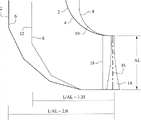
With reference to Fig. 1, the first row airflow diffuser 2 of steamturbine low pressure stage comprises entrance 18, the steam that this entrance 18 receives through the last stage movable vane 14 of turbine.Exhaust stream diffuser 2 also comprises steam guiding surface 4 and diffuser end wall 6, and these steam guiding surface 4 guiding are from the vapor stream of last stage movable vane 14 processes.The axial length L of diffuser (measuring to diffuser end wall 6 according to the center line 16 from last stage movable vane 14) is roughly 2.0 with respect to the ratio of the effective length AL of last stage movable vane 14.The center line 16 of last stage movable vane 14 is the radial line of the center of gravity of the root segment of process movable vane.
Still with reference to Fig. 1, also shown the second diffuser 8 that configuration and diffuser 2 are different.Diffuser 8 has roughly 1.35 axial length L (according to measuring from center line 16 to diffuser end wall 12) with respect to the ratio of the effective length AL of last stage movable vane 14.As shown in Figure 1, the first diffuser 2 has identical diffusion area ratio with the second diffuser 8, and it causes the second diffuser 8 to have the curvature of more precipitous steam guiding surface 10.Because higher curvature, thereby diffusion area ratio may the cause stream identical with the first diffuser of keeping the second diffuser 8 separates from steam guiding surface 10.
Diffuser 8 usefulness leak to strengthen boundary layer along the steam guiding surface 10 of diffuser 8 from the top of crossing of last stage movable vane 14, to reduce or to prevent that steam from separating from steam guiding surface 10.Reduce or prevent that steam from separating from steam guiding surface 10, improved the static pressure recovery.
The top clearance of last stage movable vane 14 can be lowered or minimize, and increases or maximization so that be positioned at the merit of the fluid (for example, steam or hot gas) of the rotation blade of turbine.Can provide the gap of certain tittle to reduce the possibility of the friction between blade and the inner casing.Last stage movable vane 14 can have in the hot radial top gap that for example approximately changes between 125 to 200 mils and for example be approximately 0.5% to 2% the leakage flow rate of circulation rate (annulus flow rate).The top clearance that should realize last stage movable vane 14 can be in addition for example approximately between 50 to 160 mils.
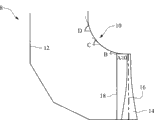
With reference to Fig. 2, the diffuser 8 that has roughly 1.5 L/AL ratio, has roughly 0.45 to 0.70 steam guiding axial length SGL (measuring according to the end from the center line 16 of last stage movable vane 14 to steam guiding surface 10) with respect to the ratio of the effective length AL of last stage movable vane 14, for example, roughly 0.55.With reference to Fig. 3, last stage movable vane 14 for example has approximately 0 ° apex angles A, and the curvature of steam guiding surface 10 can have the first angle B, this first angle B can be corresponding to the excursion of the angle of whole previous 25% warp-wise length (meridional length) of the steam guide portion from slope, movable vane top, be for example 0 ° to 18 °, for example approximately 2 °, 11 ° or 14 °.The the second angle C of curvature that is in the steam guiding surface 10 of 50% warp-wise distance can be for example 14 ° to 32 ° variation, for example approximately 20 °, 22 ° or 28 °.The third angle degree D of curvature that is in the steam guiding surface 10 of 75% warp-wise distance can be for example approximately 16 ° to 32 ° variation, for example approximately 24 °, 26 ° or 28 °.
With reference to Figure 4 and 5, turbine can comprise tilting cover 20.The curvature that last stage movable vane 14 for example has about 25 ° apex angles A and steam guiding surface 10 can have the first angle B, this first angle B can be corresponding to the excursion of the angle of whole previous 25% warp-wise length of the steam guide portion from slope, movable vane top, be for example 0 ° to 18 °, for example approximately 2 °, 11 ° or 14 °.The the second angle C of curvature that is in the steam guiding surface 10 of 50% warp-wise distance can be for example 14 ° to 32 ° variation, for example approximately 20 °, 22 ° or 28 °.The third angle degree D of curvature that is in the steam guiding surface 10 of 75% warp-wise distance can be for example approximately 16 ° to 32 ° variation, for example approximately 24 °, 26 ° or 28 °.
Although described embodiment about steamturbine, should realize diffuser and can use with gas turbine.
Although in conjunction with being considered to the most practical at present and preferred embodiment is described the present invention, but be to be understood that and the invention is not restricted to the disclosed embodiments, on the contrary, be intended to comprise main idea and interior included various modifications and the equivalent arrangements of scope of appended claim.
List of parts
2: the first row airflow diffuser
4: steam guiding surface (first row airflow diffuser)
6: diffuser end wall (first row airflow diffuser)
8: the second row airflow diffuser
10: steam guiding surface (second row airflow diffuser)
12: diffuser end wall (second row airflow diffuser)
14: last stage movable vane
16: the last stage movable vane center line
18: diffusor entry
AL: effective length
L: diffuser length
SGL: steam length of lead