CN103648917A - Adhesive-tape system for forming a tear-open strip - Google Patents
Adhesive-tape system for forming a tear-open strip Download PDFInfo
- Publication number
- CN103648917A CN103648917A CN201280033452.9A CN201280033452A CN103648917A CN 103648917 A CN103648917 A CN 103648917A CN 201280033452 A CN201280033452 A CN 201280033452A CN 103648917 A CN103648917 A CN 103648917A
- Authority
- CN
- China
- Prior art keywords
- tape
- adhesive tape
- adhesive
- film
- carton
- Prior art date
- Legal status (The legal status is an assumption and is not a legal conclusion. Google has not performed a legal analysis and makes no representation as to the accuracy of the status listed.)
- Pending
Links
Images


Classifications
-
- C—CHEMISTRY; METALLURGY
- C09—DYES; PAINTS; POLISHES; NATURAL RESINS; ADHESIVES; COMPOSITIONS NOT OTHERWISE PROVIDED FOR; APPLICATIONS OF MATERIALS NOT OTHERWISE PROVIDED FOR
- C09J—ADHESIVES; NON-MECHANICAL ASPECTS OF ADHESIVE PROCESSES IN GENERAL; ADHESIVE PROCESSES NOT PROVIDED FOR ELSEWHERE; USE OF MATERIALS AS ADHESIVES
- C09J7/00—Adhesives in the form of films or foils
- C09J7/20—Adhesives in the form of films or foils characterised by their carriers
- C09J7/29—Laminated material
-
- B—PERFORMING OPERATIONS; TRANSPORTING
- B65—CONVEYING; PACKING; STORING; HANDLING THIN OR FILAMENTARY MATERIAL
- B65D—CONTAINERS FOR STORAGE OR TRANSPORT OF ARTICLES OR MATERIALS, e.g. BAGS, BARRELS, BOTTLES, BOXES, CANS, CARTONS, CRATES, DRUMS, JARS, TANKS, HOPPERS, FORWARDING CONTAINERS; ACCESSORIES, CLOSURES, OR FITTINGS THEREFOR; PACKAGING ELEMENTS; PACKAGES
- B65D5/00—Rigid or semi-rigid containers of polygonal cross-section, e.g. boxes, cartons or trays, formed by folding or erecting one or more blanks made of paper
- B65D5/42—Details of containers or of foldable or erectable container blanks
- B65D5/56—Linings or internal coatings, e.g. pre-formed trays provided with a blow- or thermoformed layer
-
- B—PERFORMING OPERATIONS; TRANSPORTING
- B65—CONVEYING; PACKING; STORING; HANDLING THIN OR FILAMENTARY MATERIAL
- B65D—CONTAINERS FOR STORAGE OR TRANSPORT OF ARTICLES OR MATERIALS, e.g. BAGS, BARRELS, BOTTLES, BOXES, CANS, CARTONS, CRATES, DRUMS, JARS, TANKS, HOPPERS, FORWARDING CONTAINERS; ACCESSORIES, CLOSURES, OR FITTINGS THEREFOR; PACKAGING ELEMENTS; PACKAGES
- B65D5/00—Rigid or semi-rigid containers of polygonal cross-section, e.g. boxes, cartons or trays, formed by folding or erecting one or more blanks made of paper
- B65D5/42—Details of containers or of foldable or erectable container blanks
- B65D5/70—Break-in flaps, or members adapted to be torn-off, to provide pouring openings
- B65D5/708—Separate tearable flexible elements covering a discharge opening of a container, e.g. adhesive tape
-
- C—CHEMISTRY; METALLURGY
- C09—DYES; PAINTS; POLISHES; NATURAL RESINS; ADHESIVES; COMPOSITIONS NOT OTHERWISE PROVIDED FOR; APPLICATIONS OF MATERIALS NOT OTHERWISE PROVIDED FOR
- C09J—ADHESIVES; NON-MECHANICAL ASPECTS OF ADHESIVE PROCESSES IN GENERAL; ADHESIVE PROCESSES NOT PROVIDED FOR ELSEWHERE; USE OF MATERIALS AS ADHESIVES
- C09J2423/00—Presence of polyolefin
- C09J2423/006—Presence of polyolefin in the substrate
-
- Y—GENERAL TAGGING OF NEW TECHNOLOGICAL DEVELOPMENTS; GENERAL TAGGING OF CROSS-SECTIONAL TECHNOLOGIES SPANNING OVER SEVERAL SECTIONS OF THE IPC; TECHNICAL SUBJECTS COVERED BY FORMER USPC CROSS-REFERENCE ART COLLECTIONS [XRACs] AND DIGESTS
- Y10—TECHNICAL SUBJECTS COVERED BY FORMER USPC
- Y10T—TECHNICAL SUBJECTS COVERED BY FORMER US CLASSIFICATION
- Y10T428/00—Stock material or miscellaneous articles
- Y10T428/26—Web or sheet containing structurally defined element or component, the element or component having a specified physical dimension
- Y10T428/266—Web or sheet containing structurally defined element or component, the element or component having a specified physical dimension of base or substrate
-
- Y—GENERAL TAGGING OF NEW TECHNOLOGICAL DEVELOPMENTS; GENERAL TAGGING OF CROSS-SECTIONAL TECHNOLOGIES SPANNING OVER SEVERAL SECTIONS OF THE IPC; TECHNICAL SUBJECTS COVERED BY FORMER USPC CROSS-REFERENCE ART COLLECTIONS [XRACs] AND DIGESTS
- Y10—TECHNICAL SUBJECTS COVERED BY FORMER USPC
- Y10T—TECHNICAL SUBJECTS COVERED BY FORMER US CLASSIFICATION
- Y10T428/00—Stock material or miscellaneous articles
- Y10T428/28—Web or sheet containing structurally defined element or component and having an adhesive outermost layer
- Y10T428/2848—Three or more layers
Landscapes
- Engineering & Computer Science (AREA)
- Mechanical Engineering (AREA)
- Chemical & Material Sciences (AREA)
- Organic Chemistry (AREA)
- Adhesive Tapes (AREA)
- Cartons (AREA)
Abstract
本发明提供具体用于打开纸箱的胶带系统,其包括胶带A和胶带B,所述胶带A至少在一个侧面上具有粘合剂涂层并具有膜载体,其中所述膜为在胶带条的纵向上单轴取向的聚烯烃膜并且所述膜含有由烯烃聚合物和极性非烯烃聚合物制成的混合物,所述胶带B至少在一个侧面上具有粘合剂涂层并具有膜载体,其中所述胶带A和B彼此重叠地布置。
The present invention provides a tape system specifically for opening a carton, comprising tape A and tape B, tape A having an adhesive coating on at least one side and having a membrane carrier, wherein the membrane is a polyolefin film uniaxially oriented in the longitudinal direction of the tape strip and the membrane contains a mixture made of an olefin polymer and a polar non-olefin polymer, tape B having an adhesive coating on at least one side and having a membrane carrier, wherein tapes A and B are arranged overlapping each other.
Description
本发明涉及用于形成开口条(tear strip)的胶带系统。The present invention relates to adhesive tape systems for forming tear strips.
开口条是已知的,并以各种形式作为打开辅助物使用,第一用于烟盒、糖果包,和包裹在膜中的类似包装,第二用于纸板包装如洗衣洗涤剂的包。在这些应用中,使开口条以这样的方式附于该包装:为了打开,牵拉开口条并由此使包裹膜和/或纸箱在希望的点分离打开。Tear strips are known and are used in various forms as opening aids, firstly for cigarette cases, confectionery packets, and similar packages wrapped in film, and secondly for cardboard packages such as packets of laundry detergent. In these applications, the tear strip is attached to the package in such a way that, for opening, the tear strip is pulled and thereby separates the wrapping film and/or carton at the desired point.
传统上使用在一个侧面上设置有基于热熔体的粘合剂的开口条。它们例如描述在US3,187,982A、US3,311,032A,或者CA749198A中。也使用自胶粘布置的开口条。为此,使用单轴取向的载体膜,其在一个侧面上配有自粘层并在另一个侧面上配有有机硅剥离层。任选地,在两个层中的一个的下面有印刷物。为了制造压敏胶带,这种构造或者类似型式的构造可参见例如DE2104817A、US3,088,848A、US3,482,683A,或者US2,956,904A。在这些说明书中没有披露这种膜构造用于自粘开口条的用途。然而,在1973年2月的杂志“Packaging Review”的第57页提到了使用这种自粘胶带作为开口条。Open strips provided with a hotmelt-based adhesive on one side are conventionally used. They are described, for example, in US 3,187,982A, US 3,311,032A, or CA749198A. Self-adhesive arranged tear strips are also used. For this purpose, a uniaxially oriented carrier film is used which is provided with a self-adhesive layer on one side and a silicone release layer on the other side. Optionally, there is printing underneath one of the two layers. For the production of pressure-sensitive adhesive tapes, constructions of this or similar types can be found, for example, in DE2104817A, US3,088,848A, US3,482,683A, or US2,956,904A. The use of such film constructions for self-adhesive tear strips is not disclosed in these specifications. However, page 57 of the February 1973 issue of the magazine "Packaging Review" mentions the use of this self-adhesive tape as a tear strip.
DE4338524A1描述了这些自粘布置的开口条的一种具体实施方式。在其中披露了自粘开口条,其由载体膜、剥离层、远离剥离层的粘合剂层,和任选的在粘合剂层或者剥离层下面的印刷物组成。该胶带条的特征在于:载体膜由取向膜构成,剥离层和粘合剂层从水溶液、乳液,或者分散体施用,以及将剥离层、印刷油墨,和粘合剂层在机器上在一个操作中施用至比开口条宽许多倍的膜上。DE 4338524 A1 describes a specific embodiment of these self-adhesively arranged tear strips. Self-adhesive tear strips are disclosed therein, consisting of a carrier film, a release layer, an adhesive layer remote from the release layer, and optionally a print underneath the adhesive layer or the release layer. The adhesive tape is characterized in that the carrier film consists of an oriented film, the release layer and the adhesive layer are applied from an aqueous solution, emulsion, or dispersion, and the release layer, printing ink, and adhesive layer are applied on the machine in one operation Medium applied to membranes many times wider than the opening strip.
常用作膜包装的打开辅助物的是厚度为15-60μm的至少单层载体膜,其已经至少单轴取向并优选双轴取向。Commonly used as opening aids for film packaging are at least one-layer carrier films with a thickness of 15-60 μm which have been at least uniaxially and preferably biaxially oriented.
很久以来,已经将包含在加工方向上取向的聚丙烯膜的自粘开口条或者热可活化开口条用于纸板包装的撕开。它们的膜厚为50-140μm。大于85μm的膜厚用于打开特别重的纸板包装。更常见的是厚度为60至90μm的开口条。Self-adhesive tear strips or heat-activatable tear strips comprising a polypropylene film oriented in the machine direction have been used for a long time for tearing of cardboard packages. Their film thickness is 50-140 μm. Film thicknesses greater than 85 μm are used for opening particularly heavy cardboard packages. More common are split strips with a thickness of 60 to 90 μm.
对于载体,在单轴取向聚丙烯载体上的开口条经常使用特定的聚合物共混物,其在撕开性能上被优化,从而得到230-330N/mm2的加工方向拉伸强度。For the support, slit bars on uniaxially oriented polypropylene supports often use specific polymer blends that are optimized for tear properties to give machine direction tensile strengths of 230-330 N/ mm2 .
这些优选60-65μm的聚丙烯开口条在所有波纹纸板包装(包括具有微小波纹的纸板)中显示无缺陷的撕开行为。不管是否精确地在胶粘条的方向上实施撕裂,这都适用。These polypropylene tear strips, preferably 60-65 μm, show defect-free tearing behavior in all corrugated cardboard packages, including cardboard with micro-corrugations. This applies regardless of whether the tearing is carried out precisely in the direction of the adhesive strip.
“精确地在胶粘条的方向上”意味着在撕开过程中,用以下方式引导开口条:牵拉方向从不偏离由粘合在纸箱背面上的开口条主导的方向,并且其在撕开过程中作为撕裂接合点是可见的,甚至从纸箱的前面。只有在此时,在撕开过程中的开口条中才存在力的对称分布,以及在两个切割边缘上存在均匀的载荷。实际上,通常不能观察到这种理想撕裂方向。预计可偏离这种方向至多约30°。"Exactly in the direction of the adhesive strip" means that during the tearing process, the tear strip is guided in such a way that the pulling direction never deviates from the direction dominated by the tear strip glued on the back of the carton and it is During the opening process as the tear joint is visible even from the front of the carton. Only then is there a symmetrical distribution of forces in the tear strip during tearing and a uniform load on both cutting edges. In practice, such an ideal tearing direction is usually not observed. It is expected that up to about 30° may deviate from this orientation.
在开口条市场中的趋势是偏离针对撕开性能优化的膜制剂。在这种情况中,降低的撕开性能被欣然接受,以进而得到开口条在应用中改善的机器加工性能。The trend in the tear strip market is away from film formulations optimized for tear performance. In this case, a reduced tear performance is readily accepted, which in turn results in improved machinability of the tear strip in use.
例如,可降低抗冲改性剂至低于适于最佳撕开性能的量,最高至完全省略它们的点。For example, impact modifiers can be reduced below the amount appropriate for optimum tear performance, up to the point of omitting them entirely.
约1000g/m2的重型实心纸板(heavy-duty solid card)级别仅在最佳撕开方向上可完美撕开。如果偏离该方向,在条上的不对称载荷可导致在撕开操作中从条的较重加载的边缘开始撕裂。撕开的频率例如被膜中的不均匀性、膜条的切断边缘中的微缺口、纸板中的木材颗粒或者特别结实的颗粒和类似现象影响。撕裂速度也有影响。Heavy-duty solid card grades around 1000g/ m2 tear perfectly only in the optimum tear direction. If this direction is deviated, asymmetric loading on the strip can cause tearing from the more heavily loaded edge of the strip during the tearing operation. The frequency of tearing is influenced, for example, by inhomogeneities in the film, micro-nicks in the cut edges of the film strip, wood particles or particularly strong particles in the cardboard and similar phenomena. Tear speed also plays a role.
为了包装洗衣洗涤剂,在相对大的程度上使用基重为450-600g/m2的实心纸板,并在一些情况中纸板具有蜡浸渍的中间层,但是在任何情况中均设置有层合在上面的高光泽流涂的Chromolux纸的外层。使用聚丙烯开口条撕开这些纸板仅可以与上述1000g/m2实心纸板相似的不良结果实现。For packaging laundry detergents, solid paperboards with a basis weight of 450-600 g/ m2 are used to a relatively large extent, and in some cases the paperboards have a wax-impregnated middle layer, but in any case are provided with laminated Top layer of high-gloss flow-coated Chromolux paper. Tearing these boards using polypropylene tear strips can only be achieved with similar poor results to the 1000 g/ m2 solid board described above.
从EP0 269 967A1获知具有主要在一个方向上取向的载体并设置有粘合剂层的开口条,所示载体包括至少一个基层,所述基层设置有至少一个比基层坚韧的坚韧层。Known from EP 0 269 967 A1 is an opening strip with a carrier oriented mainly in one direction and provided with an adhesive layer, said carrier comprising at least one base layer provided with at least one tough layer which is tougher than the base layer.
特别优选具有主要在一个方向上取向并设置有粘合剂层的载体的开口条,所述载体包括至少一个包含聚丙烯-烯烃共聚物和/或聚丙烯/抗冲改性剂混合物的基层,这种基层设置有至少一个坚韧的含有聚丙烯的层,该层包含抗冲改性剂并比基层坚韧。Particular preference is given to opening strips with a carrier mainly oriented in one direction and provided with an adhesive layer, said carrier comprising at least one base layer comprising a polypropylene-olefin copolymer and/or a polypropylene/impact modifier mixture, This base layer is provided with at least one tough polypropylene-containing layer which contains an impact modifier and is tougher than the base layer.
在基于聚丙烯的开口条的情况中,优选使用TPP(相当于单轴取向的聚丙烯(MOPP)),因为应变必须低,甚至在高拉伸载荷下也是如此。In the case of polypropylene-based opening strips, the use of TPP (equivalent to monoaxially oriented polypropylene (MOPP)) is preferred, since the strain must be low, even under high tensile loads.
在最终应用中,高拉伸载荷第一发生在以下情况中:当打开包装时,将开口条穿过纸板或者穿过纸箱和/或膜牵拉,并意图可靠地分开这些构件。第二,当将开口条施用于包装时这种载荷也发生,因为经常以超过150m/min的速度施用。特别是在开始时,换句话说,当将开口条置于–例如–纸板上时,将最高重约15kg的卷(在贸易中通常将开口条转换成这种卷)突然并猛烈地加速。甚至在正进行中的操作中,超过8N的拉伸应力经常作用在开口条上。这排除了未取向或者双轴取向聚丙烯的使用。In the final application, high tensile loads first occur when the tear strip is pulled through the cardboard or through the carton and/or film when opening the package with the intention of reliably separating these components. Second, this load also occurs when the tear strip is applied to the package, as it is often applied at speeds in excess of 150 m/min. Especially at the beginning, in other words, when placing the shed strip on - for example - a cardboard, a roll weighing up to about 15 kg (to which shed strips are usually converted in the trade) is accelerated suddenly and violently. Even in ongoing operation, tensile stresses in excess of 8N often act on the split strips. This precludes the use of unoriented or biaxially oriented polypropylene.
如果使用不含剥离衬的TPP,则退卷(即,使组合物与载体分离)伴随着载体的分开,意味着将在加工方向上拉伸并取向的一些纤维从载体表面抽出。如果将涂布的膜幅(其比开口条宽得多)切成单独的开口条并为此目的而从储存卷退卷,则这可不利地影响转换操作。从载体本身的表面突起的纤维阻碍所述操作,或者可存在载体幅整体上的撕裂。而且,当开口条退卷时,类似的问题可发生在应用于包装的过程中。If a TPP without a release liner is used, unwinding (ie, separating the composition from the carrier) is accompanied by separation of the carrier, meaning that some of the fibers stretched and oriented in the machine direction are pulled from the surface of the carrier. If the coated film web, which is much wider than the open strip, is cut into individual open strips and unwound from a storage roll for this purpose, this can adversely affect the converting operation. Fibers protruding from the surface of the carrier itself impede the operation, or there may be tearing of the carrier web as a whole. Also, similar problems can occur during application to packaging when the tear strip is unwound.
用于容纳在单独纸箱中包装的产品的销售托盘(sales trays)通常履行两种功能。在一方面,将纸箱排列在顶部敞开的托盘中。在商店中,将这种托盘以视觉上吸引人的方式提供给顾客,其能够从托盘取出单独的纸箱。托盘的效果是,纸箱保持分组并总是处于有序的直立位置。Sales trays for containing products packaged in individual cartons generally fulfill two functions. In one aspect, cartons are arranged in open top pallets. In stores, such pallets are presented to customers in a visually appealing manner, from which individual cartons can be removed. The effect of the pallet is that the cartons remain grouped and always in an orderly upright position.
另一方面,托盘意图在从生产者或者装填者至商店的旅途上保护托盘中的纸箱。为此目的,产品被包装纸板完全包围,使用开口条将包装纸板撕开以提供内容物。除去纸箱的上部,下部用作销售托盘。Pallets, on the other hand, are intended to protect the cartons on the pallet during the journey from the producer or filler to the store. For this purpose, the product is completely surrounded by a packaging cardboard, which is torn open using tear strips to provide the contents. The upper part of the carton is removed and the lower part is used as a sales tray.
为了博得视觉上有吸引力的印象,撕裂线必须具有整洁和光滑的边缘修饰。制造纸箱的纸板不应磨损,并且撕裂也必须以最大的精度笔直地进行。在此情景中本领域技术人员称为“清晰切断”。To achieve a visually appealing impression, the tear line must have a clean and smooth edge finish. The cardboard from which the carton is made should not be frayed, and the tearing must also be done straight and with the utmost precision. Those skilled in the art refer to this scenario as "clear cut-off".
为了以产生清晰切断的方式打开纸板包装,主要有两种已有解决方案。In order to open cardboard packages in such a way as to produce a clear cut, there are mainly two existing solutions.
所谓的Adalis系统(由Adalis公司开发)包括两个胶带(引导胶带=带A和开口条=带B),其如图1中所示安装在纸箱中。纸箱包含内衬和外衬,波纹纸板以常规方式设置在所述衬之间。The so-called Adalis system (developed by the Adalis company) consists of two adhesive tapes (guide tape=tape A and opening strip=tape B), which are installed in a carton as shown in FIG. 1 . The carton comprises inner and outer liners with corrugated paperboard disposed between said liners in a conventional manner.
胶带包括载体物质,所述载体物质包含用粘合剂保持在一起的大量聚酯单丝。载体物质涂有热熔粘合剂。两个衬和波纹纸板及两个胶带在这里经过加热管道,产生图1所示的层合物。Adhesive tapes include a carrier material comprising a plurality of polyester monofilaments held together with an adhesive. The carrier substance is coated with a hot melt adhesive. Here the two liners and the corrugated cardboard and the two adhesive tapes are passed through heated pipes to produce the laminate shown in FIG. 1 .
这种系统的缺点是,使用的胶带非常厚(2×170μm),因此导致在外部可视衬上的印刷图像在运输和贮存期间在凸起点磨损受损。而且,作为制造操作的一部分,堆积大量的这些未制造的纸箱(纸箱坯)和折叠盒。由于胶带总是在纸箱坯上的相同位点施用,这导致在堆积中该位置处的厚度增加。结果,堆积变得歪斜,并且,在超过特定倾斜程度时,片材开始滑动;所得的堆积不稳定。而且,由于高厚度,对于胶带卷的给定的宽度和给定的卷尺寸,胶带的延米数比较薄胶带低得多。然而,对于波纹包装工业,经常需要运行相对长的生产活动,从而意味着必须暂停生产线以换卷或者必须在运行的生产线上拼接,一种总是与高撕裂风险相关的操作。A disadvantage of this system is that the adhesive tape used is very thick (2×170 μm), thus causing the printed image on the outer visible liner to wear out at the raised points during transport and storage. Also, large quantities of these unmanufactured cartons (carton blanks) and folding boxes are piled up as part of the manufacturing operation. Since the tape is always applied at the same point on the carton blank, this results in an increased thickness at that point in the stack. As a result, the pile becomes skewed and, beyond a certain degree of skew, the sheets begin to slide; the resulting pile is unstable. Also, due to the high thickness, for a given width of a tape roll and a given roll size, the linear meters of tape are much lower than thinner tapes. However, for the corrugated packaging industry, it is often necessary to run relatively long production campaigns, meaning that the line must be stopped for roll changes or splicing must be done on a running line, an operation always associated with a high risk of tearing.
而且,在这种纸箱的印刷期间可出现问题,因为印刷基底的不同厚度在印刷操作中产生不同的印刷状况,并且这可导致不均匀的印刷图像。Furthermore, problems can arise during printing of such cartons, since the different thicknesses of the printing substrates create different printing conditions during the printing operation, and this can lead to uneven printed images.
因此,对于具有开口条的波纹包装片材的处理者,首先有兴趣使用薄的胶带,以使这种问题不发生。Therefore, it is first of interest for processors of corrugated packaging sheets with tear strips to use thin tapes so that this problem does not occur.
一种变型方案涉及在开口条的外部边缘以上的区域中切开并因此弱化配有开口条的纸箱(称为“衬切开”)。这通过图2示出。对于这种情况,可使用厚度仅为例如90μm的开口条,其极大地避免上述问题。A variant involves cutting in the area above the outer edge of the tear strip and thus weakening the carton provided with the tear strip (referred to as "liner cut"). This is illustrated by FIG. 2 . For this case, an opening strip with a thickness of only eg 90 μm can be used, which largely avoids the above-mentioned problems.
将外衬事先沿着希望的撕裂边缘浅浅地刻痕,使得在打开时,留下清晰的撕裂边缘并在打开后产生在视觉上有吸引力的显示。这种解决方案的缺点是,对外衬的损害导致纸箱的z-向稳定性的损失。纸箱优先在受损位置破坏。这种现象使用被称为箱压缩试验的试验测量。The outer liner is pre-scored shallowly along the desired tear edge so that when opened it leaves a clear tear edge and creates a visually appealing display after opening. The disadvantage of this solution is that damage to the outer lining results in a loss of the z-direction stability of the carton. The cartons are destroyed preferentially at the damaged location. This phenomenon is measured using a test known as a box compression test.
于是,这种解决方案的结果是降低制成的纸箱的堆积性能。This solution then results in reduced stackability of the finished carton.
本发明的目的是得到超出现有技术的显著改进和提供解决方案,通过使用这种解决方案,可将纸箱撕开,并在纸箱中产生清晰的切断边缘,并且这种解决方案导致纸箱的增厚尽可能小。The object of the present invention is to obtain a significant improvement over the prior art and to provide a solution by which the carton can be torn open with a sharp cut edge in the carton and which leads to an increase in the size of the carton. as thick as possible.
这个目的通过在独立权利要求中更严密表征的胶带系统实现。从属权利要求描述本发明的有利实施方式。本发明还包括本发明胶带系统的用途,和配有所述胶带系统的纸箱。This object is achieved by an adhesive tape system which is more closely characterized in the independent claims. The dependent claims describe advantageous embodiments of the invention. The invention also includes the use of the adhesive tape system according to the invention, and a carton equipped with said adhesive tape system.
因此,本发明提供具体用于打开纸板包装的胶带系统,其包括胶带A和胶带B,所述胶带A和B彼此重叠地布置,所述胶带A在至少一个侧面上配有粘合剂涂层并具有膜载体,所述膜为在胶带条的纵向上单轴取向的聚烯烃膜,并且所述膜包含烯烃聚合物和极性非烯烃聚合物的混合物,并且胶带B在至少一个侧面上配有粘合剂涂层并具有膜载体。Accordingly, the present invention provides an adhesive tape system, in particular for opening cardboard packages, comprising an adhesive tape A and an adhesive tape B arranged one above the other, the adhesive tape A being provided on at least one side with an adhesive coating and have a film carrier, the film is a polyolefin film uniaxially oriented in the longitudinal direction of the tape strip, and the film contains a mixture of olefin polymer and polar non-olefin polymer, and the tape B is configured on at least one side Adhesive coated and has a film carrier.
本发明涵盖以下情况:胶带A和B的膜载体相同或者至少二者均包含所述的烯烃聚合物和极性非烯烃聚合物的混合物。因此,优选的是这样的实施方式:其中胶带A的膜载体和胶带B的膜载体为在胶带条的纵向上单轴取向的聚烯烃膜,并且所述膜包含烯烃聚合物和极性非烯烃聚合物的混合物,更优选地,所述两个膜载体能够相同。在这种实施方式的情况中,还优选两个胶带具有相同的宽度。The invention covers the case where the film carriers of adhesive tapes A and B are the same or at least both comprise said mixture of olefinic polymers and polar non-olefinic polymers. Therefore, preferred are embodiments in which the film carrier of Tape A and the film carrier of Tape B are polyolefin films uniaxially oriented in the longitudinal direction of the tape strip and said films comprise an olefin polymer and a polar non-olefin The mixture of polymers, more preferably, the two membrane supports can be identical. In the case of this embodiment, it is also preferred that the two adhesive tapes have the same width.
首先,下面更详细地描述胶带A的膜载体。First, the film carrier of Tape A is described in more detail below.
在胶带A的膜中,极性非烯烃聚合物在混合物中的分数优选为5-50wt%,优选为20-30wt%。In the film of tape A, the fraction of the polar non-olefinic polymer in the mixture is preferably 5-50 wt%, preferably 20-30 wt%.
为实现高拉伸强度、在10%应变时的高应力,和高撕裂蔓延耐受性,应选择牵拉操作中的条件,使得对于每个膜而言拉伸比为最大技术上可行的比率。根据本发明,加工方向拉伸比优选为至少1:4.5,更优选为至少1:6。To achieve high tensile strength, high stress at 10% strain, and high tear propagation resistance, the conditions in the drawing operation should be selected such that the draw ratio is the largest technically feasible for each film ratio. According to the invention, the machine direction stretch ratio is preferably at least 1:4.5, more preferably at least 1:6.
例如1:6的拉伸比表示,1米长的初始膜片段变成6米长的经拉伸膜片段。经常地,也将拉伸比称为在取向之前的线速度与在取向之后的线速度的比率。在这里,使用第一个定义。For example a draw ratio of 1 :6 means that a 1 meter long initial film segment becomes a 6 meter long stretched film segment. Often, the draw ratio is also referred to as the ratio of the line speed before orientation to the line speed after orientation. Here, the first definition is used.
在本发明的一个优选方案中,所述膜具有以下性质:In a preferred version of the present invention, the film has the following properties:
●加工方向拉伸强度为200N/mm2-300N/mm2,优选为220N/mm2-260N/mm2,更优选为240N/mm2,和/或The machine direction tensile strength is 200N/mm 2 -300N/mm 2 , preferably 220N/mm 2 -260N/mm 2 , more preferably 240N/mm 2 , and/or
●在10%应变时的加工方向应力为至少80N/mm2,优选至少130N/mm2,更优选至少150N/mm2。• The machine direction stress at 10% strain is at least 80 N/mm 2 , preferably at least 130 N/mm 2 , more preferably at least 150 N/mm 2 .
强度值通过以下方法计算:基于宽度的力的值除以厚度。在胶带上测定强度值的情况下,用作基础的厚度不是胶带A的总厚度,而仅为载体膜的厚度。Strength values are calculated by dividing the width-based force value by the thickness. In the case of determination of strength values on adhesive tapes, the thickness used as basis is not the total thickness of the adhesive tape A, but only the thickness of the carrier film.
如实验所示(实验构造来自Zwick,这些构造是本领域技术人员已知的),实际上不可能在横向上切断膜。在研究的样品中,膜边缘在横向上被切口损坏。然后当施加拉力时,撕裂在横向上不蔓延,而是转换到加工方向或者纵向。As shown experimentally (experimental configurations are from Zwick, these configurations are known to those skilled in the art), it is practically impossible to cut the membrane in the transverse direction. In the studied samples, the membrane edges were damaged by incisions in the transverse direction. Then when a tensile force is applied, the tear does not propagate in the transverse direction, but switches to the machine direction or the machine direction.
载体膜的厚度优选为15-200μm,更优选为30-140μm,特别优选为50-100μm。The thickness of the carrier film is preferably 15-200 μm, more preferably 30-140 μm, particularly preferably 50-100 μm.
当在重叠堆积的纸箱坯或者纸箱中由胶带引起的厚度偏差不重要时,可选择最高200μm的厚度。优选的厚度不超过140μm。A thickness of up to 200 μm can be selected when thickness deviations caused by the adhesive tape in stacked carton blanks or cartons are not important. The preferred thickness does not exceed 140 μm.
烯烃聚合物为烯烃如乙烯、丙烯,或者丁烯的均聚物或者共聚物。术语共聚物在这里应理解为包括三元共聚物。Olefin polymers are homopolymers or copolymers of olefins such as ethylene, propylene, or butene. The term copolymer is here understood to include terpolymers.
烯烃聚合物优选包含至少50wt%丙烯。The olefin polymer preferably comprises at least 50 wt% propylene.
特别适合的膜原料为市售聚丙烯均聚物或者聚丙烯共聚物,包括嵌段聚合物(抗冲聚合物)和无规聚合物。Particularly suitable film materials are commercially available polypropylene homopolymers or polypropylene copolymers, including block polymers (impact polymers) and random polymers.
所述聚合物的熔体指数必须位于适于平膜挤出的范围内。该范围应为0.3-15g/10min,优选为0.8-5g/10min(在230℃/2.16kg测量)。The melt index of the polymer must be in a range suitable for flat film extrusion. The range should be 0.3-15 g/10 min, preferably 0.8-5 g/10 min (measured at 230°C/2.16 kg).
优选地,聚丙烯在结构上主要为全同立构的。挠曲模量应为至少1000MPa,优选至少1500MPa,特别优选至少2000MPa。Preferably, the polypropylene is predominantly isotactic in structure. The flexural modulus should be at least 1000 MPa, preferably at least 1500 MPa, particularly preferably at least 2000 MPa.
极性非烯烃聚合物涵盖所有的这样的聚合物,其中Polar non-olefinic polymers encompasses all polymers in which
a)不含烯烃单体如乙烯、丙烯,或者丁烯,并且a) does not contain olefinic monomers such as ethylene, propylene, or butene, and
b)包含杂原子如硫、氮、磷,和(优选)氧作为极性组分。b) contain heteroatoms such as sulfur, nitrogen, phosphorus, and (preferably) oxygen as polar components.
极性非烯烃聚合物优选选自聚酯、聚酰胺、聚氨酯、聚甲醛、聚亚芳基硫醚,和聚亚芳基氧。特别优选半结晶聚合物。根据本发明的一个特别有利的实施方式,选择聚对苯二甲酸丁二醇酯和/或聚甲醛作为极性非烯烃聚合物。Polar non-olefinic polymers are preferably selected from polyesters, polyamides, polyurethanes, polyoxymethylenes, polyarylene sulfides, and polyarylene oxides. Particular preference is given to semicrystalline polymers. According to a particularly advantageous embodiment of the invention, polybutylene terephthalate and/or polyoxymethylene are chosen as polar non-olefinic polymers.
极性改性的聚烯烃优选选自烯烃与乙烯基酯、甲基丙烯酸,和丙烯酸的共聚物,更优选为乙烯-乙酸乙烯酯共聚物和乙烯-(甲基)丙烯酸酯共聚物和它们的酯,或者选自与不饱和有机酸的接枝聚合物,更优选为马来酸酐-接枝的聚烯烃、甲基丙烯酸-接枝的聚烯烃,或者丙烯酸-接枝的聚烯烃,在混合物中极性改性的聚烯烃的分数优选为0.2-10wt%。Polarly modified polyolefins are preferably selected from copolymers of olefins with vinyl esters, methacrylic acid, and acrylic acid, more preferably ethylene-vinyl acetate copolymers and ethylene-(meth)acrylate copolymers and their Esters, or selected from graft polymers with unsaturated organic acids, more preferably maleic anhydride-grafted polyolefins, methacrylic acid-grafted polyolefins, or acrylic acid-grafted polyolefins, in a mixture The fraction of mid-polarity modified polyolefin is preferably 0.2-10 wt%.
可将膜的聚合物以纯形式或者作为与添加剂如抗氧化剂、光稳定剂、抗粘连剂、润滑剂,和加工助剂、填料、染料、颜料、起泡剂,或者成核剂的共混物使用。The polymers of the film can be used in pure form or as a blend with additives such as antioxidants, light stabilizers, antiblocking agents, lubricants, and processing aids, fillers, dyes, pigments, blowing agents, or nucleating agents use.
用于制造膜或者使用所述膜制造的胶带A的优选操作包括以下步骤:A preferred procedure for making a film or an adhesive tape A made using said film comprises the following steps:
●将聚合物和任选的添加剂在挤出机中混合并供应至平膜模头。• The polymer and optional additives are mixed in an extruder and supplied to a flat film die.
●然后将熔融膜在被称为冷却辊的辊上受控冷却。• The molten film is then cooled in a controlled manner on rolls called chill rolls.
●在将膜幅供应至牵引装置之前,将其经由已加热的辊加热至适合的牵拉温度。• Heat the web to a suitable drawing temperature via heated rolls before feeding it to the drawing device.
●然后将膜在加工方向上短隙(short-gap)取向。• The film is then short-gap oriented in the machine direction.
●将载体膜通过涂布或者甚至事先通过共挤出配有粘合剂。• Equipping the carrier film with an adhesive by coating or even beforehand by coextrusion.
膜可为单层膜或者多层膜,优选为多层,更优选为类型ABC,其中B包含本发明混合物并且A和C全部或者主要由聚烯烃聚合物组成。通过共挤出,可防止在膜的取向期间的沉积,和在用剥离剂、底胶或者粘合剂涂布过程中的问题。The film may be a monolayer film or a multilayer film, preferably multilayer, more preferably of type ABC, where B comprises the inventive mixture and A and C consist entirely or essentially of polyolefin polymers. By coextrusion, deposition during orientation of the film, and problems during coating with release agents, primers or adhesives can be prevented.
膜可已经通过层合、压花,或者辐射处理进行改性。Films may have been modified by lamination, embossing, or radiation treatment.
膜可已经进行表面处理。这些处理例如为促粘、电晕处理、火焰处理、氟处理,或者等离子体处理,或者涂覆溶液或者分散体,或者液体的可辐射固化的材料。其它可能的涂料为印刷涂料和不粘涂料,例如以下涂料:交联有机硅、丙烯酸酯(例如,
如上所述,胶带A和B的膜载体可相同,或者至少二者可包含所述的烯烃聚合物和极性非烯烃聚合物的混合物。As noted above, the film carriers of tapes A and B may be the same, or at least both may comprise a mixture of olefinic polymers and polar non-olefinic polymers as described.
胶带B的膜载体优选包含聚乙烯、聚丙烯、单轴或者双轴取向聚丙烯、聚酯、PA、PVC,或者其它膜;特别优选MOPP。The film carrier of the adhesive tape B preferably comprises polyethylene, polypropylene, monoaxially or biaxially oriented polypropylene, polyester, PA, PVC, or other films; MOPP is particularly preferred.
胶带B的载体膜的厚度优选为15-200μm,更优选为30-140μm,特别优选为50-90μm。The thickness of the carrier film of the adhesive tape B is preferably 15-200 μm, more preferably 30-140 μm, particularly preferably 50-90 μm.
当在重叠堆积的纸箱坯或者纸箱中由胶带引起的厚度偏差不重要时,可选择最多200μm的厚度。优选不超过140μm的厚度。A thickness of up to 200 μm can be selected when thickness deviations caused by the adhesive tape in stacked blanks or cartons are not important. A thickness of not more than 140 μm is preferred.
更优选地,膜载体的拉伸强度为200N/mm2-300N/mm2,更优选220N/mm2-260N/mm2,特别优选240N/mm2,和/或拉伸能力小于35%。More preferably, the film carrier has a tensile strength of 200N/mm 2 -300N/mm 2 , more preferably 220N/mm 2 -260N/mm 2 , especially preferably 240N/mm 2 , and/or a stretchability of less than 35%.
胶带A和B可使用所有已知的粘合剂系统制造。除了基于天然或者合成橡胶的粘合剂,具体地,可使用聚丙烯酸酯粘合剂,优选为压敏丙烯酸酯热熔体粘合剂。也可使用有机硅粘合剂。Adhesive tapes A and B can be produced using all known adhesive systems. In addition to adhesives based on natural or synthetic rubber, in particular polyacrylate adhesives, preferably pressure-sensitive acrylate hotmelt adhesives, can be used. Silicone adhesives can also be used.
在胶带A和B中的粘合剂可不同。优选地,在每种情况中使用相同的粘合剂。The adhesives in tapes A and B can be different. Preferably, the same adhesive is used in each case.
粘合剂的涂覆厚度优选为18-50g/m2,更优选22-29g/m2(近似相当于18-50μm的厚度,更优选22-29μm)。The coating thickness of the adhesive is preferably 18-50 g/m 2 , more preferably 22-29 g/m 2 (approximately corresponding to a thickness of 18-50 μm, more preferably 22-29 μm).
粘合剂优选为压敏粘合剂,换句话说为这样的粘合剂:其甚至在相对弱的施加压力下允许与几乎所有基底可持久粘合,并且在使用后可基本不残留地再次从基底脱离。在室温,压敏粘合剂具有永久粘着性,从而具有足够低的粘度和高触摸粘着性,使得它甚至在轻微施加的压力下湿润相应的胶粘基底的表面。粘合剂的粘合能力来源于它的胶粘性质,再次脱离能力来源于它的内聚性质。The adhesive is preferably a pressure-sensitive adhesive, in other words an adhesive which allows a durable bond to almost all substrates even under relatively weak applied pressure and which can be reapplied substantially without residue after use. Detach from the base. At room temperature, the pressure-sensitive adhesive is permanently tacky and thus has sufficiently low viscosity and high touch tack such that it wets the surface of the corresponding adhesive substrate even under slight applied pressure. The bonding ability of an adhesive comes from its cohesive properties, and the releasability comes from its cohesive properties.
膜载体在一个或者两个侧面,优选一个侧面上涂有压敏粘合剂,所述压敏粘合剂从溶液或者分散体或者100%形式(例如,来自熔体)涂布,或者通过共挤出涂布。The film carrier is coated on one or both sides, preferably one side, with a pressure sensitive adhesive applied from solution or dispersion or in 100% form (eg from the melt) or by co- Extrusion coating.
为了优化性质,使用的自粘组合物可与一种或者多种添加剂如增粘剂(树脂)、增塑剂、填料、颜料、UV吸收剂、光稳定剂、老化抑制剂、交联剂、交联促进剂,或者弹性体共混。In order to optimize properties, the self-adhesive composition used can be combined with one or more additives such as tackifiers (resins), plasticizers, fillers, pigments, UV absorbers, light stabilizers, aging inhibitors, crosslinkers, Crosslinking accelerators, or elastomer blends.
用于共混的适合的弹性体为,例如,EPDM橡胶或者EPM橡胶、聚异丁烯、丁基橡胶、乙烯-乙酸乙烯酯、二烯的氢化嵌段共聚物(例如,通过氢化SBR、cSBR、BAN、NBR、SBS、SIS,或者IR;这种聚合物是已知的,例如,SEPS和SEBS),或者丙烯酸酯共聚物如ACM。Suitable elastomers for blending are, for example, EPDM rubber or EPM rubber, polyisobutylene, butyl rubber, ethylene-vinyl acetate, hydrogenated block copolymers of dienes (for example, by hydrogenating SBR, cSBR, BAN , NBR, SBS, SIS, or IR; such polymers are known, eg, SEPS and SEBS), or acrylate copolymers such as ACM.
增粘剂为,例如,烃树脂(例如,来自不饱和的C5或者C7单体)、萜烯酚醛树脂、来自原料如α-或者β-蒎烯的萜烯树脂、芳族树脂如茚-苯并呋喃树脂,或者苯乙烯或者α-甲基苯乙烯的树脂如松香及其衍生物,例如歧化的、二聚的,或者酯化的树脂,在这种情况中可使用二醇、丙三醇或者季戊四醇。特别适合的例如为不含烯属双键的对老化稳定的树脂,例如氢化的树脂。Tackifiers are, for example, hydrocarbon resins (e.g. from unsaturated C5 or C7 monomers), terpene phenolic resins, terpene resins from raw materials such as α- or β-pinene, aromatic resins such as indene - Benzofuran resins, or resins of styrene or α-methylstyrene such as rosin and its derivatives, such as disproportionated, dimerized, or esterified resins, in which case diols, propanes, triol or pentaerythritol. Particularly suitable are, for example, age-stable resins which do not contain ethylenic double bonds, for example hydrogenated resins.
适合的填料和颜料为,例如,炭黑、二氧化钛、碳酸钙、碳酸锌、氧化锌、硅酸盐,或者二氧化硅。Suitable fillers and pigments are, for example, carbon black, titanium dioxide, calcium carbonate, zinc carbonate, zinc oxide, silicates, or silicon dioxide.
适用于粘合剂的UV吸收剂、光稳定剂,和老化抑制剂为在本说明书中列出的用于稳定膜的那些。Suitable UV absorbers, light stabilizers, and aging inhibitors for adhesives are those listed in this specification for stabilizing films.
适合的增塑剂为,例如,脂族的、脂环族的和芳族的矿物油,邻苯二甲酸、偏苯三酸或者己二酸的二酯或者多酯,液体橡胶(例如丁腈橡胶或者聚异戊二烯橡胶),丁烯的和/或异丁烯的液体聚合物,丙烯酸酯,聚乙烯基醚,基于用于增粘树脂的原料的液体树脂和增塑剂树脂,羊毛蜡和其它蜡,或者液体有机硅。Suitable plasticizers are, for example, aliphatic, cycloaliphatic and aromatic mineral oils, diesters or polyesters of phthalic, trimellitic or adipic acid, liquid rubbers such as nitrile rubber or polyisoprene rubber), butene and/or isobutylene liquid polymers, acrylates, polyvinyl ethers, liquid resins and plasticizer resins based on raw materials for tackifying resins, wool waxes and other waxes, or liquid silicone.
交联剂为,例如,酚醛树脂或者卤化的酚醛树脂、蜜胺树脂和甲醛树脂。适合的交联促进剂为,例如,马来酰亚胺、烯丙基酯如氰尿酸三烯丙基酯,以及丙烯酸的和甲基丙烯酸的多官能酯。Crosslinking agents are, for example, phenolic or halogenated phenolic resins, melamine resins and formaldehyde resins. Suitable crosslinking accelerators are, for example, maleimides, allyl esters such as triallyl cyanurate, and polyfunctional acrylic and methacrylic esters.
一种优选的实施方式包含压敏粘合剂,其包含合成橡胶、烃树脂,和抗氧化剂。A preferred embodiment comprises a pressure sensitive adhesive comprising a synthetic rubber, a hydrocarbon resin, and an antioxidant.
粘合剂可在纵向上以条的形式以小于胶带载体膜的宽度施用。取决于具体效用,也可在载体膜上涂覆两个或者更多个粘合剂的平行条。The adhesive can be applied longitudinally in strips with a width smaller than the tape carrier film. Depending on the particular utility, two or more parallel strips of adhesive may also be applied to the carrier film.
在一个侧面上配有粘合剂的胶带A和B的自由顶面可具有剥离剂,也称为脱模剂。The free top surfaces of the adhesive tapes A and B provided on one side can have a release agent, also called a release agent.
适合的剥离剂包括基于长链烷基的表面活性剂类的剥离系统,例如苯乙烯磺基琥珀酸酯(styrene sulfosuccinates)或者磺基琥珀酰胺酸硬脂基酯,以及聚合物,其可选自聚硬脂基氨基甲酸乙烯基酯、聚乙烯亚胺硬脂基氨基甲酰胺(polyethyleneiminestearylcarbamides)、C14-C28脂肪酸的铬络合物,和硬脂基共聚物,例如在DE2845541A中所述。同样适合的是基于具有全氟化烷基的丙烯酸类聚合物、有机硅,或者氟化有机硅化合物,例如基于聚(二甲基硅氧烷)的剥离剂。特别优选地,剥离层包含基于有机硅的聚合物。这种基于有机硅的剥离活性聚合物的特别优选的实例包括聚氨酯-改性的有机硅和/或聚脲-改性的有机硅,优选有机基聚硅氧烷/聚脲/聚氨酯嵌段共聚物,更优选在EP1336683B1的实施例19中描述的那些,特别优选有机硅重量分数为70%并且酸值为30mg KOH/g的阴离子稳定化的,聚氨酯-改性的有机硅和脲-改性的有机硅。聚氨酯-改性的有机硅和/或脲-改性的有机硅的使用具有以下效果:本发明产品组合了优化的耐老化性和通用可写性,并具有优化的剥离行为。在本发明的一种优选实施方式中,剥离层包含10-20wt%,更优选13-18wt%的剥离活性组分。Suitable release agents include long chain alkyl based surfactant based release systems such as styrene sulfosuccinates or stearyl sulfosuccinamic acid, and polymers which may be selected from Polyvinyl stearyl urethanes, polyethyleneiminestearylcarbamides, chromium complexes of C 14 -C 28 fatty acids, and stearyl copolymers are described, for example, in DE 2845541A. Also suitable are release agents based on acrylic polymers with perfluorinated alkyl groups, silicones, or fluorinated silicone compounds, for example based on poly(dimethylsiloxane). Particularly preferably, the release layer comprises a silicone-based polymer. Particularly preferred examples of such silicone-based release-active polymers include polyurethane-modified silicones and/or polyurea-modified silicones, preferably organopolysiloxane/polyurea/polyurethane block copolymers compounds, more preferably those described in Example 19 of EP1336683B1, particularly preferably anion-stabilized, polyurethane-modified silicones and urea-modified of silicone. The use of polyurethane-modified silicones and/or urea-modified silicones has the effect that the products according to the invention combine optimized aging resistance and universal writability with optimized peeling behavior. In a preferred embodiment of the present invention, the release layer comprises 10-20 wt%, more preferably 13-18 wt%, of the release active component.
对于本发明,一般表达“胶带”包括所有片状结构如二维延展的膜或者膜部分、具有延展的长度和受限宽度的胶带、胶带部分等,以及最后还包括模切物或者标签。For the purposes of the present invention, the general expression "adhesive tape" includes all sheet-like structures such as two-dimensionally extended films or film parts, adhesive tapes with extended length and limited width, tape parts, etc., and finally also die-cuts or labels.
在本发明的最简单的实施方式中,将胶带A和B彼此层合,由此形成撕裂系统,其可用在膜包装、纸包装、纸板包装,或者纸箱包装上。In the simplest embodiment of the invention, the tapes A and B are laminated to each other, thereby forming a tear system that can be used on film packaging, paper packaging, cardboard packaging, or carton packaging.
下面使用一些附图更详细地阐述本发明,但是不希望由此不必要地限制本发明。The invention is explained in more detail below using some figures, without wishing to thereby unnecessarily restrict the invention.
图3a示出如何能够以任何希望的方式选择胶带彼此之间的排列。胶带1,2中的每个包含膜载体11,21,在每个膜载体上施用粘合剂12,22。Figure 3a shows how the arrangement of the adhesive tapes relative to each other can be selected in any desired way. Each of the
胶带B可通过膜载体21的无粘合剂侧层合至胶带A的粘合剂12上(左侧图)。在这种情况中,粘合剂12的未覆盖区域和胶带B的粘合剂22确保撕开系统保持在所选择的基底上。Tape B can be laminated to
然而,也可将胶带B以下面的方式层合至胶带A上:粘合剂22直接位于胶带A的粘合剂11上。However, it is also possible to laminate tape B to tape A in such a way that adhesive 22 is located directly on
在图3a中的右侧图中示出,胶带B的粘合剂22位于载体膜11的无粘合剂侧上。在这种情况中,粘合剂12确保撕开系统保持在所选择的基底上。In the right-hand illustration in FIG. 3 a , the adhesive 22 of the adhesive tape B is located on the adhesive-free side of the
图3b显示,本发明构思也涵盖以下的实施方式:其中胶带B位于胶带A上,使得载体膜11,21在边缘处齐平。FIG. 3 b shows that the inventive concept also covers embodiments in which the adhesive tape B is placed on the adhesive tape A such that the
本发明的撕开系统也在这种情况中起作用。The tearing system of the present invention also works in this case.
一种优选的实施方式是:其中将胶带B偏移地施用在胶带A上,换句话说,相对于两个胶带A和B的加工方向向内偏移。因此,为了垂直投影在胶带A的平面中,胶带B的两个长边LB1,LB2(即,在加工方向上延展的边)总是位于胶带A的两个长边LA1,LA2之间。在图3c中示出胶带的这种实施方式,并显示前述投影P。A preferred embodiment is that in which the adhesive tape B is applied offset to the adhesive tape A, in other words offset inwards with respect to the processing direction of the two adhesive tapes A and B. Thus, for a perpendicular projection in the plane of tape A, the two long sides L B1 , L B2 of tape B (i.e. the sides extending in the machine direction) always lie on the two long sides L A1 , L A2 of tape A between. Such an embodiment of the adhesive tape is shown in FIG. 3c and shows the aforementioned projection P. FIG.
在根据图3b的实施方式的情况中,一个长边LB1直接投影在胶带A的长边LA1上。这也在本发明构思内。In the case of the embodiment according to FIG. 3 b , one long side L B1 projects directly onto the long side L A1 of the adhesive tape A . This is also within the concept of the present invention.
因此,根据本发明的一种优选实施方式,将胶带A和B以下面的方式彼此重叠地放置:胶带B的两个长边LB1,LB2(即,在加工方向上延展的边)在垂直投影至胶带A的平面时位于胶带A的两个长边LA1,LA2之上或者之间,或者至少位于胶带A的两个长边LA1,LA2中的一个之上。Therefore, according to a preferred embodiment of the invention, the adhesive tapes A and B are placed on top of each other in such a way that the two long sides L B1 , L B2 of the adhesive tape B (i.e. the sides extending in the machine direction) When vertically projected to the plane of the tape A, it is located on or between the two long sides L A1 , L A2 of the tape A, or at least on one of the two long sides L A1 , L A2 of the tape A.
特别优选的是图3a中示出的实施方式,其中胶带B中心位于胶带A上,从而产生对称结构的撕开系统。Particularly preferred is the embodiment shown in Figure 3a, in which the tape B is centered on the tape A, resulting in a symmetrically structured tearing system.
图4示出如何将撕开系统施用在纸箱4的下侧上,以及图5示出纸箱4的顶面如何现出。在图5中,将施用在纸箱4的下侧上的胶带A和B用虚线示出。Figure 4 shows how the tear opening system is applied on the underside of the
而且,在图5中示出使用开口条的纸箱4的一个优选的打开可行方案。Furthermore, a preferred opening possibility of a
在纸箱4中存在刻痕(kisscut score),其产生两个抓片(grip tab)43和44。刻痕由两对呈V-形布置的双边41、42、41a,和42a组成,每对中的双边41、42、41a、42a在潜在交叉点不交叉。边41、42、41a、42a刚好冲压穿过纸箱4和胶带A。而且,连接线45(其使边缘41、42、41a、42a的端点彼此连接)刚好冲压穿过纸箱4、胶带A,和胶带B。In the
为了打开纸箱4,抓住两个抓片43,44中的一个(例如抓片43)并向上折叠。完全冲压穿透的边41a,42a产生开口条,其宽度对应于在边41a,42a的彼此接近的末端之间的距离。开口条的宽度通过平行撕裂线RL指出。当沿着箭头所示的方向牵拉抓片43时,撕开系统沿着线RL分开。这样得到的开口条由切断的纸箱4、胶带B,和分开的胶带A组成。To open the
由于所述膜的突出性质,开口条在打开期间不逐渐变细,因此开口条切断整个纸箱。Due to the protruding nature of the film, the tear strip does not taper during opening, so the tear strip cuts through the entire carton.
通过在另一抓片44上牵拉,同样沿着箭头指出的方向,产生第二开口条。By pulling on the
更优选地,撕开系统用于将两个包装(或者其它结构体),例如两个纸箱彼此临时接合。这在图6中示出。通过以下方法,使用胶带A将两个纸箱1,2彼此连接:完全遍及纸箱1和2的所有四个侧面施用胶带A,在所有情况中在边缘区域以环形围绕。胶带B(其位于胶带A上的中心处)位于胶带A下面,所以胶带B用虚线显示。More preferably, the tearing system is used to temporarily join two packages (or other structures), such as two cartons, to each other. This is shown in FIG. 6 . The two
在开口条中提供了在图5中全面描述的撕开可能性。为了分开两个纸箱,牵拉一个或者两个抓片43,44,并分开撕开系统,从而允许当撕开系统被完全切断时两个纸箱1和2分离。The tearing possibility fully described in FIG. 5 is provided in the tear strip. To separate the two cartons, one or both
在一种方案中,仅使用胶带A将两个包装或者其它物体彼此接合。In one approach, only tape A is used to join two packages or other objects to each other.
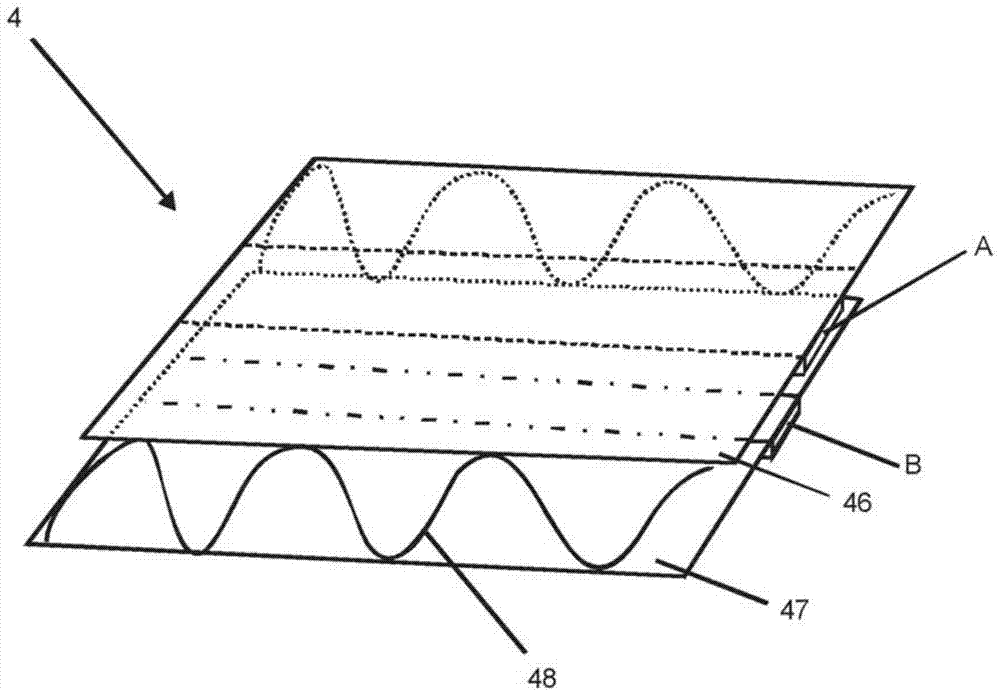
优选使用胶带系统作为纸箱4上的开口条,该纸箱4包括外衬46和内衬47,在衬46和47之间存在至少一个由纸板制成的波纹48,胶带A安装在外衬46的内侧上,并且胶带B安装在内衬47的外侧上,使得胶带B位于胶带A的下面。这种用途的示例性实施方式在图7中示出。An adhesive tape system is preferably used as the opening strip on the
在两个衬46和47之间,具有波纹48,纸箱4的不可见区域用点示出。Between the two
胶带B粘合在内衬47的外侧上,胶带B的其他线路用点和虚线指出。Tape B is glued on the outside of the
胶带A粘合在外衬46的内侧上,胶带A的进一步的路线用虚线示出。Adhesive tape A is glued on the inner side of the
图8再次示出图7中使用的本发明的撕开系统,在波纹纸板4中。波纹48在这种情况中垂直指向牵拉平面之外。胶带B粘合在内衬47的外侧上,并且胶带A粘合在外衬46的内侧上。FIG. 8 shows again the tearing system of the invention used in FIG. 7 , in
如已经在图3c中所示出的,优选的实施方式是这样的实施方式:其中将胶带B相对于胶带A偏移地施用,换句话说,相对于两个胶带A和B的加工方向向内偏移。因此,胶带B的两个长边LB1和LB2(即,在加工方向上延展的边)在垂直投影在胶带A的平面中的情况下总是位于胶带A的两个长边LA1和LA2之间,或者胶带B的一个长边LB1或者LB2位于胶带A的长边LA1和LA2之一的上面。As already shown in FIG. 3c, a preferred embodiment is one in which the adhesive tape B is applied offset relative to the adhesive tape A, in other words relative to the machine direction of the two adhesive tapes A and B. Inner offset. The two long sides L B1 and L B2 of the adhesive tape B (i.e. the sides extending in the machine direction) are therefore always located between the two long sides L A1 and Between L A2 , or one of the long sides L B1 or L B2 of the tape B lies on top of one of the long sides L A1 and L A2 of the tape A.
图3a和3b中所示的撕开系统的其它变型也可相应地变换成撕开系统的这些实施方式。Other variants of the tearing system shown in FIGS. 3a and 3b can also be correspondingly transformed into these embodiments of the tearing system.
更优选地,胶带A和胶带B以纸箱体上的自含线(self-contained line)的形式施用,或者以箱体上不同高度处的两条或者更多条自含线的形式施用。More preferably, tape A and tape B are applied as a self-contained line on the carton body, or as two or more self-contained lines at different heights on the carton body.
由胶带形成的线优选位于平行于直立箱体的底部取向的平面内。The line formed by the tape preferably lies in a plane oriented parallel to the bottom of the upright box.
所述线也可以以这样的方式围绕箱体的边角:在撕开操作后,将四面体部分从箱体的剩余部分除去。The thread can also surround the corners of the box in such a way that after the tearing operation the tetrahedral part is removed from the remainder of the box.
在本发明的一种方案中,胶带不形成自含线,而是位于纸箱的侧壁外面。如果除去撕开系统,则最后的壁保持完整并因此能够呈现铰链(hinger)功能,尤其是如果所述壁在线的延续中具有折叠的话。以此方式,形成盖子,其可经铰链折叠打开和关闭。In one version of the invention, the tape does not form a self-contained line, but is located outside the side walls of the carton. If the tearing system is removed, the last wall remains intact and is therefore able to assume a hinge function, especially if said wall has a fold in the continuation of the line. In this way, a lid is formed which can be opened and closed via hinged folding.
胶带A和胶带B优选相对于纸箱的波纹以直角施用。Tape A and Tape B are preferably applied at right angles to the corrugations of the carton.
根据另一优选实施方式,在纸箱上具有完全切断胶带A并优选切断胶带A下面的纸箱的刻痕,并且其在撕开纸箱时用作开口条的抓片。According to another preferred embodiment, there is a score on the carton which completely cuts through the tape A and preferably cuts through the carton below the tape A and which acts as a grip for the opening strip when the carton is torn open.
胶带B位于抓片下面并优选同样被刻痕切断。当抓住抓片时,所得开口条的胶带B位于抓片的下侧面上。Adhesive tape B is located under the grip tab and is preferably also cut by the score. Tape B of the resulting opening strip is on the underside of the tab when the tab is gripped.
刻痕也限定开口条的后续宽度。The score also defines the subsequent width of the opening strip.
为撕开配有本发明的胶带粘合剂的包装,优选地,将胶带B的整个宽度用于开口条,而仅将胶带A的部分区域用于开口条。For tearing packages equipped with the tape adhesive according to the invention, preferably the entire width of the tape B is used for the tear strip and only a partial area of the tape A is used for the tear strip.
胶带A的宽度优选为10-50mm,更优选为12-25mm。The width of the adhesive tape A is preferably 10-50 mm, more preferably 12-25 mm.
胶带B的宽度优选为2-10mm,更优选为3-6mm。The width of the adhesive tape B is preferably 2-10 mm, more preferably 3-6 mm.
优选地,选择用于胶带B的宽度低于胶带A的宽度,并且更具体地,比率为1:2-1:4。然而,胶带A和B的宽度相同的实施方式也是可能的。Preferably, the width chosen for tape B is lower than the width of tape A, and more specifically a ratio of 1:2-1:4. However, an embodiment in which the tapes A and B have the same width is also possible.
根据本发明的一种优选实施方式,由胶带系统形成的开口条的宽度为2-10mm,更优选为3-6mm。According to a preferred embodiment of the present invention, the width of the opening strip formed by the tape system is 2-10 mm, more preferably 3-6 mm.
可将刻痕在V-形布置中以双边的形式实施,其在潜在交叉点不接触。Scores may be implemented bilaterally in a V-shaped arrangement that do not touch at potential intersections.
更优选地,模切线连接合所述双边的另外两个末端,产生没有顶点的三角形式。这种三角形成开口条上的抓片。More preferably, a die cut line joins the other two ends of said bilateral sides, resulting in a triangular form with no vertices. This triangle forms the catch tab on the tear strip.
为了产生适合的抓片,必须将胶带A以某种形式或者其它形式在横向上切断,换句话说,与取向相反。为了限定开口条的宽度–如果开口条应位于胶带A中的中心处–需要纵向上的两个切口切断胶带A。例如,可将胶带A在两个点冲压,该两个点的连接线切入胶带A(优选地,该连接线与长边成直角布置)。如果要在胶带A的边缘区域中形成开口条,则单一切口是足够的。In order to create a suitable grip tab, the tape A must be cut in some form or other in the transverse direction, in other words, opposite the orientation. In order to define the width of the opening strip—if the opening strip is to be located centrally in the tape A—two cuts in the longitudinal direction are required to cut through the tape A. For example, tape A may be punched at two points whose connecting line cuts into tape A (preferably, the connecting line is arranged at right angles to the long sides). If a tear strip is to be formed in the edge region of the tape A, a single cut is sufficient.
以此方式,得到本发明的优选实施方式,即,其中除了其它构件之外,得自粘胶带A的开口条具有比胶带A窄的宽度。In this way, a preferred embodiment of the invention is obtained in which, among other components, the opening strip resulting from the adhesive tape A has a narrower width than the tape A.
抓片不需要一定模切。也可通过以下方法产生抓片:使用刀片,至少部分地在横向上切断胶带A,并在胶带A中在分割线处引入基本上指向加工方向上的两个缺口(notch),缺口之间的距离限定开口条的宽度。缺口和切口限定形成开口条的开端部分的抓片区域。在这种情况中,应确保胶带B同时也切断。Grab pieces do not necessarily have to be die-cut. The grip tabs can also be produced by cutting the tape A at least partially transversely with a blade and introducing two notches in the tape A at the parting line, pointing substantially in the processing direction, between which there are two notches. The distance defines the width of the opening strip. The notches and cutouts define a tab area that forms the opening portion of the tear strip. In this case, make sure that tape B is cut at the same time.
例如,所述胶带系统在波纹纸板生产期间在波纹纸板生产线上粘合。在进一步的步骤中,将在波纹纸板生产线后形成的片材进一步制成箱子。在箱子上,出于随后打开包装的目的,产生至少一个刻痕,从而允许从胶带系统拔出抓片。牵拉该抓片,并在打开过程中,形成的抓片条使位于其正上方的纸板层与箱子分离。For example, the adhesive tape system is bonded on a corrugated board production line during corrugated board production. In a further step, the sheets formed after the corrugated board line are further made into boxes. On the box, for the purpose of subsequently opening the package, at least one score is made, allowing the tab to be pulled out from the adhesive tape system. The tab is pulled and, during opening, the resulting tab strip separates the cardboard layer directly above it from the box.
本发明的构思还包括纸箱,该纸箱包括外衬和内衬,至少一个设置在所述衬之间的配有本发明的胶带系统的波纹纸板组成,胶带A施用在外衬的内侧上并且胶带B施用在内衬的外侧上,使得胶带B设置在胶带A下面。The concept of the invention also includes cartons comprising an outer liner and an inner liner, at least one corrugated cardboard arranged between said liners and equipped with an adhesive tape system according to the invention, adhesive tape A applied on the inner side of the outer liner and adhesive tape B Applied on the outside of the liner so that Tape B is positioned beneath Tape A.
尤其是在使用呈现足够的粘合强度和高粘着性的基于合成橡胶的粘合剂的情况下,胶带A在多种纸基底上显示有效的粘合。Tape A showed effective adhesion on a variety of paper substrates, especially with the use of synthetic rubber-based adhesives exhibiting sufficient bond strength and high tack.
由于特定的膜载体,从刻痕开始的撕裂在膜载体中蔓延,意料不到地,沿着平行于加工方向(x-方向)的直线方向蔓延。Due to the particular film carrier, the tear starting from the score propagates in the film carrier, unexpectedly, along a straight line parallel to the machine direction (x-direction).
另一个意外是,膜不仅没有进一步垂直取向方向进一步撕裂,而是可靠地支持膜在加工方向上的持续撕裂。这意味着,不存在在y-方向(在条的横向上)或者z-方向(限定载体方向的方向)上的逐渐变细。结果,可仅在x-方向(纵向或者加工方向)上连续撕裂。而且,除了切断波纹纸板之外,在x-方向上的连续撕裂蔓延易于手动完成。Another surprise was that instead of tearing further perpendicular to the orientation direction, the film reliably supported continued tearing of the film in the machine direction. This means that there is no taper in the y-direction (in the transverse direction of the strip) or in the z-direction (the direction defining the direction of the carrier). As a result, continuous tearing is possible only in the x-direction (longitudinal or machine direction). Also, continuous tear propagation in the x-direction is easily done manually, other than cutting the corrugated cardboard.
在横向上可能存在轻微的逐渐变细或者变宽,但是优选不超过5ppm(百万分率),基于长度。There may be slight tapering or broadening in the transverse direction, but preferably no more than 5 ppm (parts per million) based on length.
可用显著降低的材料厚度实现需要的强度,这意味着,与前述的Adalis系统相比,胶带的总体厚度可降低至多50%。这导致在印刷时较少的磨损,在纸箱堆积中改善的稳定性,并能够得到较大的胶带卷运行长度–即,可容易地运行较大的制造活动,而不会中断操作。The required strength can be achieved with significantly reduced material thickness, which means that the overall thickness of the tape can be reduced by up to 50% compared to the aforementioned Adalis system. This results in less wear while printing, improved stability in carton stacking, and enables larger tape roll run lengths - ie, larger manufacturing campaigns can be easily run without interrupting operations.
同样,特别是在使用呈现足够的粘合强度和高粘着性的基于合成橡胶的粘合剂的情况下,胶带B显示与多种纸基底的有效粘合。Also, Tape B showed effective adhesion to a variety of paper substrates, especially with a synthetic rubber-based adhesive exhibiting sufficient bond strength and high tack.
而且,膜载体具有高拉伸强度,因为胶带需要适应在打开纸箱期间的主要载荷,并且必须不撕裂。此外,载体呈现低拉伸性,更具体地,小于35%的拉伸能力,因为否则它在主导载荷下拉伸太大。Furthermore, the film carrier has a high tensile strength, since the tape needs to accommodate the major loads during opening of the carton and must not tear. Furthermore, the support exhibits low stretchability, more specifically, less than 35% stretchability, because otherwise it stretches too much under the prevailing load.
使用一些实施例更详细地阐述本发明,但是不意图以任何方式限制本发明。The invention is illustrated in more detail using some examples, which are not intended to limit the invention in any way.
具体实施方式Detailed ways
实施例Example
试验方法experiment method
测量在23±1℃和50±5%相对湿度的试验条件下进行。The measurement is carried out under the test conditions of 23±1°C and 50±5% relative humidity.
拉伸伸长性质Tensile elongation properties
在试样(100mm长和15mm宽的矩形试条)上,根据DIN EN14410:2003527-3/2/300,以300mm/min的测试速度,100mm的夹持长度,和0.3N/cm的预拉伸力测定胶带的拉伸伸长性质,为了测定数据,将试样用锋利刀片切成所需形状。On the test piece (100mm long and 15mm wide rectangular test strip), according to DIN EN14410:2003527-3/2/300, at a test speed of 300mm/min, a clamping length of 100mm, and a pre-tension of 0.3N/cm Tensile force The tensile elongation properties of the tape were measured. For the determination of the data, the specimens were cut into the desired shape with a sharp blade.
除非另有说明,在加工方向(MD)上测试拉伸伸长性质。力(拉伸强度)以N/试条宽度表示,并且断裂伸长率以%表示。必须通过五次测量在统计上确保试验结果,尤其是断裂伸长率(断裂拉伸)。Tensile elongation properties were tested in the machine direction (MD) unless otherwise stated. Force (tensile strength) is expressed in N/bar width and elongation at break in %. The test results, especially the elongation at break (tensile at break), must be statistically assured by five measurements.
剥离强度(粘合强度BS)Peel strength (adhesive strength BS)
为了测量粘合强度,将19mm宽的试条无气泡地胶粘至精细打磨(具有FEPA240级磨料的砂纸)的由不锈钢制成的板,并使用橡胶覆盖的2kg辊,以10m/min的速度在上面碾压。然后将钢板和胶带的突出端以产生180°剥离角的方式夹在拉伸测试机的端部中。将胶带从钢板以300mm/min的速度剥离。粘合强度以N/cm表示。To measure the bond strength, a 19 mm wide test strip is glued air-free to a finely ground (sandpaper with FEPA 240 grade abrasive) plate made of stainless steel with a rubber covered 2 kg roller at a speed of 10 m/min Roll on it. The steel plate and the protruding end of the tape are then clamped in the end of the tensile testing machine in such a way as to create a 180° peel angle. The adhesive tape was peeled off from the steel plate at a speed of 300mm/min. Adhesive strength is expressed in N/cm.
保持力(HP;剪切耐受时间)Holding Power (HP; Shear Resistance Time)
保持力表示对于平行作用于粘合胶带的载荷力的粘合强度。它是直到负载的胶带完全从钢板剪切脱离时所测量的时间。Holding force indicates the adhesive strength against a load force acting parallel to the adhesive tape. It is the time measured until the loaded tape is completely sheared away from the steel plate.
为测定HP值,将19mm宽的试条以得到19×20mm2粘合面积的方式胶粘至经预处理的钢板。通过夹子,将1kg重物悬挂于胶带的突出端,由此传递5.15N/1cm带宽的垂直拉伸力。For the determination of the HP values, test strips 19 mm wide were glued to pretreated steel plates in such a way that a bonded area of 19 x 20 mm2 was obtained. A 1 kg weight is suspended from the protruding end of the tape by means of clips, thereby transmitting a vertical tensile force of 5.15 N/1 cm bandwidth.
保持力的单位是分钟。在数值之前具有“>”符号的情况下,这意味着,测量在此时间后中断,因为在此时根本看不到剪切脱离。The unit of retention is minutes. In the case of a value preceded by a ">" sign, this means that the measurement was interrupted after this time, since at this point no shear detachment at all was visible.
厚度thickness
这根据DIN53370测定。This is determined according to DIN53370.
原料raw material
Dow7C06:Dow7C06:
PP嵌段共聚物,MFI1.5g/10min,无成核剂,挠曲模量1280MPa(DowChemical)PP block copolymer, MFI1.5g/10min, no nucleating agent, flexural modulus 1280MPa (DowChemical)
Bormod HD905CF:Bormod HD905CF:
PP均聚物,MFI6g/10min,挠曲模量2150MPa,含有α-成核剂(Borealis)PP homopolymer, MFI6g/10min, flexural modulus 2150MPa, containing α-nucleating agent (Borealis)
Dowlex2032:Dowlex2032:
PE-LLD,MFI2g/10min(Dow Chemical)PE-LLD,MFI2g/10min(Dow Chemical)
Stryon457:Stryon457:
PS-HI,MFI3g/10min,挠曲模量2200MPa(Dow Chemical)PS-HI, MFI3g/10min, flexural modulus 2200MPa (Dow Chemical)
EVAL G156B:EVAL G156B:
EVAL乙烯含量48mol%,MFI6.4g/10min,挠曲模量2800MPa(EVALEurope)EVAL ethylene content 48mol%, MFI6.4g/10min, flexural modulus 2800MPa (EVALEurope)
Licocene PP MA7452GR TP:Licocene PP MA7452GR TP:
PP-g-MA,接枝有马来酸酐的金属茂聚丙烯蜡(Clariant)PP-g-MA, metallocene polypropylene wax grafted with maleic anhydride (Clariant)
Hostaform C9021natural:Hostaform C9021natural:
POM,MFI8g/10min,挠曲模量2800MPa(Ticona)POM, MFI8g/10min, flexural modulus 2800MPa (Ticona)
Celanex2002-2natural:Celanex2002-2natural:
PBT,MFI20,挠曲模量2500MPa(Ticona)PBT, MFI20, flexural modulus 2500MPa (Ticona)
下面通过实施例描述本发明的胶带的有利实施方式,但是不希望不必要地限制本发明。Advantageous embodiments of the adhesive tape of the invention are described below by way of examples without wishing to restrict the invention unnecessarily.
实施例1Example 1
将原料混配并造粒。将粒料供应至单螺杆挤出机系统。胶带A的膜载体在此单螺杆挤出机系统上,使用具有柔性模唇的扁平模头,以层的形式产生,然后经历冷却辊站和单级短隙牵拉系统。The raw materials are mixed and granulated. The pellets were fed to a single screw extruder system. The film carrier for Tape A was produced in layers on this single screw extruder system using a flat die with a flexible lip and then passed through a chill roll station and a single stage short gap pulling system.
将Dow7C06、Celanex2002-2natural,和Licocene PP MA7452GR TP以15:4:1的比率混合,并挤出混合物。模头温度为230℃。设置冷却辊温度和牵引辊温度,以在牵引之前和之后使膜的结晶度最大化。拉伸比为1:5。Mix Dow7C06, Celanex2002-2natural, and Licocene PP MA7452GR TP in a ratio of 15:4:1, and extrude the mixture. The die temperature was 230°C. Chill roll temperature and pulling roll temperature were set to maximize film crystallinity before and after pulling. The draw ratio is 1:5.
膜性质:Membrane properties:

将膜涂覆在具有0.07g/m2氨基甲酸酯剥离剂的顶面上,并干燥。The film was coated on top with 0.07 g/m 2 of urethane release agent and dried.
将粘合剂混合在42wt%SIS弹性体、20wt%氢化松香的季戊四醇酯、37wt%R&B值为85℃的C5烃树脂,和1wt%
得到5N/cm的与钢的BS和大于3000分钟的剪切强度。A BS with steel of 5 N/cm and a shear strength of greater than 3000 minutes were obtained.
胶带B的膜载体为MOPP膜。The film carrier of tape B is MOPP film.
膜性质:Membrane properties:

将膜涂在具有0.05g/m2有机硅剥离剂的顶面上,并干燥。The film was coated on top with 0.05 g/m 2 of silicone release agent and dried.
将粘合剂混合在42wt%SIS弹性体、20wt%氢化松香的季戊四醇酯、37wt%R&B值为85℃的C5烃树脂,和1wt%
得到5N/cm的与钢的BS和大于3000分钟的剪切强度。A BS with steel of 5 N/cm and a shear strength of greater than 3000 minutes were obtained.
如本发明所述,根据RAL-GZ492(DUETSCHES INSTITUT FOR
撕开纸箱产生清晰的边缘并且仅轻微地损坏外衬。The tearing of the carton produced clean edges and only slightly damaged the outer liner.
实施例2Example 2
使用实施例1的胶带A的膜载体,但是宽度为15mm。The film carrier of tape A of example 1 was used, but with a width of 15 mm.
膜性质:Membrane properties:

胶带B的膜载体为MOPP膜。The film carrier of tape B is MOPP film.
膜性质:Membrane properties:

将膜涂在具有0.05g/m2有机硅剥离剂的顶面上,并干燥。The film was coated on top with 0.05 g/m 2 of silicone release agent and dried.
将粘合剂混合在42wt%SIS弹性体、20wt%氢化松香的季戊四醇酯、37wt%R&B值为85℃的C5烃树脂,和1wt%
得到5N/cm的与钢的BS和大于3000分钟的剪切强度。A BS with steel of 5 N/cm and a shear strength of greater than 3000 minutes were obtained.
如本发明所述,根据RAL-GZ492(DUETSCHES INSTITUT FORKENNZEICHNUNG E.V.),将胶带A和B施用至纸箱,所述纸箱包含1.40单波纹。As described in the present invention, according to RAL-GZ492 (DUETSCHES INSTITUT FOR KENNZEICHNUNG EV), tapes A and B were applied to cartons containing 1.40 single corrugations.
撕开纸箱产生清晰的边缘并且仅轻微地损坏外衬。The tearing of the carton produced clean edges and only slightly damaged the outer liner.
Claims (15)
Applications Claiming Priority (3)
| Application Number | Priority Date | Filing Date | Title |
|---|---|---|---|
| DE102011075313.3 | 2011-05-05 | ||
| DE102011075313A DE102011075313A1 (en) | 2011-05-05 | 2011-05-05 | Adhesive tape system for forming a tear strip |
| PCT/EP2012/055978 WO2012150099A1 (en) | 2011-05-05 | 2012-04-02 | Adhesive-tape system for forming a tear-open strip |
Publications (1)
| Publication Number | Publication Date |
|---|---|
| CN103648917A true CN103648917A (en) | 2014-03-19 |
Family
ID=45976305
Family Applications (1)
| Application Number | Title | Priority Date | Filing Date |
|---|---|---|---|
| CN201280033452.9A Pending CN103648917A (en) | 2011-05-05 | 2012-04-02 | Adhesive-tape system for forming a tear-open strip |
Country Status (7)
| Country | Link |
|---|---|
| US (1) | US9604753B2 (en) |
| EP (1) | EP2704957B1 (en) |
| JP (1) | JP2014522344A (en) |
| CN (1) | CN103648917A (en) |
| CA (1) | CA2835185A1 (en) |
| DE (1) | DE102011075313A1 (en) |
| WO (1) | WO2012150099A1 (en) |
Cited By (2)
| Publication number | Priority date | Publication date | Assignee | Title |
|---|---|---|---|---|
| CN110269534A (en) * | 2018-03-14 | 2019-09-24 | 金红叶纸业集团有限公司 | Paper core and preparation method thereof, roll web |
| CN110846778A (en) * | 2019-11-22 | 2020-02-28 | 吴江市鲲翰纺织有限公司 | Production method of nylon-polyester easy-to-tear cloth |
Families Citing this family (8)
| Publication number | Priority date | Publication date | Assignee | Title |
|---|---|---|---|---|
| DE102012106270A1 (en) * | 2012-07-12 | 2014-01-16 | Baumer Hhs Gmbh | Tear area manufacturing method for manufacturing strip-shaped tear area of product, particularly carton, involves forming tension element in strip-shaped area by coating through nozzle |
| DE102013018289B4 (en) * | 2013-10-31 | 2021-05-27 | Lohmann Gmbh & Co. Kg | Pressure-sensitive adhesive tape with a stabilizing release cover |
| EP2910477B1 (en) | 2014-02-21 | 2018-03-28 | Celanese Acetate LLC | Methods for packaging fibrous materials |
| DE102017004563A1 (en) | 2017-03-05 | 2018-09-06 | Entex Rust & Mitschke Gmbh | Degassing when extruding polymers |
| US20190031923A1 (en) | 2017-07-26 | 2019-01-31 | 3M Innovative Properties Company | Backing for adhesive tape with thermal resistance |
| US10343828B2 (en) * | 2017-12-07 | 2019-07-09 | Raymond R. Shaw | Tamper-evident forensic document mailer with dual sided access to interior compartment for receipt and subsequent return of secure evidence and supporting legal documents |
| DE102018001412A1 (en) | 2017-12-11 | 2019-06-13 | Entex Rust & Mitschke Gmbh | Degassing during the extrusion of substances, preferably plastics |
| EP4419449A1 (en) | 2021-10-21 | 2024-08-28 | Acetate International LLC | Packaged fibrous material bales comprising lower sheet |
Citations (6)
| Publication number | Priority date | Publication date | Assignee | Title |
|---|---|---|---|---|
| EP0960727A2 (en) * | 1998-05-29 | 1999-12-01 | Sumitomo Chemical Company, Limited | Laminated uniaxial oriented sheet and adhesive tape formed using same |
| JPH11349907A (en) * | 1998-06-10 | 1999-12-21 | Sumitomo Chem Co Ltd | Adhesive tape and method for producing the same |
| US6074745A (en) * | 1996-02-15 | 2000-06-13 | Speeney; Michael J. | Method of making adhesive tape with texturized adhesive coating and adhesive tape so made |
| WO2004054794A1 (en) * | 2002-12-18 | 2004-07-01 | Nippon Petrochemicals Co., Ltd. | Base cloth for pressure-sensitive adhesive tape and pressure-sensitive adhesive tape |
| US20100127062A1 (en) * | 2008-11-21 | 2010-05-27 | Tesa Se | Use of a strip of an adhesive tape to reinforce cardboard packaging particularly in the region of die-cuts, and simultaneously as a tear strip for such packaging |
| CN101978009A (en) * | 2008-01-22 | 2011-02-16 | 德莎欧洲公司 | Polyolefin film and use thereof |
Family Cites Families (17)
| Publication number | Priority date | Publication date | Assignee | Title |
|---|---|---|---|---|
| CA749198A (en) | 1966-12-27 | Union Carbide Corporation | Tear tapes and improved method therefor | |
| US2956904A (en) | 1954-11-04 | 1960-10-18 | Minnesota Mining & Mfg | Pressure-sensitive adhesive tapes |
| US3187982A (en) | 1960-07-21 | 1965-06-08 | Union Carbide Corp | Method for forming coated uniaxially oriented films and the product formed thereby |
| US3088848A (en) | 1961-03-24 | 1963-05-07 | Kendall & Co | Pressure-sensitive adhesive tape having a molecularly oriented film backing comprising a blend of high density and low density polyethylenes |
| US3311032A (en) | 1964-12-24 | 1967-03-28 | Procter & Gamble | Tear tape for plastic packaging materials |
| US3482683A (en) | 1965-10-22 | 1969-12-09 | Johnson & Johnson | Pressure sensitive tape |
| US3732122A (en) | 1970-02-03 | 1973-05-08 | Christensen V Fehrn | Pressure-sensitive adhesive tape |
| DE2845541C3 (en) | 1978-10-19 | 1981-04-02 | Beiersdorf Ag, 2000 Hamburg | Process for the production of adhesive-repellent coatings on flat, sheet or web-shaped material |
| DE8023682U1 (en) * | 1980-09-05 | 1981-12-17 | Wellpappe Wiesloch, Zweigniederlassung der Holfelder Werke GmbH & Co KG, 6908 Wiesloch | Packaging for corrugated cardboard with a tear strip |
| DE3640861A1 (en) | 1986-11-29 | 1988-06-09 | Beiersdorf Ag | Tear strips |
| CN1010330B (en) | 1986-12-02 | 1990-11-07 | 阿姆科尔有限公司 | Corrugated paper board |
| DE4338524A1 (en) | 1993-11-11 | 1995-05-18 | Wolff Walsrode Ag | Self-adhesive tear strip and process for its production |
| DE4402444C2 (en) | 1994-01-27 | 1996-08-29 | Minnesota Mining & Mfg | Tear-resistant adhesive tape based on monoaxially oriented polyethylene and its use |
| US20010000480A1 (en) * | 1998-05-28 | 2001-04-26 | 3M Innovative Properties Company | Plastic film packaging with tearable tape strip |
| DE10206123A1 (en) | 2002-02-14 | 2003-09-04 | Wacker Chemie Gmbh | Textile structures comprising organopolysiloxane / polyurea / polyurethane block copolymer |
| JP2004250026A (en) * | 2003-02-19 | 2004-09-09 | Toppan Printing Co Ltd | Easy-open packaging |
| US8986831B2 (en) * | 2011-05-24 | 2015-03-24 | H. B. Fuller Company | Pressure sensitive adhesive tear tape |
-
2011
- 2011-05-05 DE DE102011075313A patent/DE102011075313A1/en not_active Withdrawn
-
2012
- 2012-04-02 CN CN201280033452.9A patent/CN103648917A/en active Pending
- 2012-04-02 WO PCT/EP2012/055978 patent/WO2012150099A1/en not_active Ceased
- 2012-04-02 US US14/114,378 patent/US9604753B2/en not_active Expired - Fee Related
- 2012-04-02 CA CA2835185A patent/CA2835185A1/en not_active Abandoned
- 2012-04-02 JP JP2014508724A patent/JP2014522344A/en active Pending
- 2012-04-02 EP EP12715000.1A patent/EP2704957B1/en not_active Not-in-force
Patent Citations (6)
| Publication number | Priority date | Publication date | Assignee | Title |
|---|---|---|---|---|
| US6074745A (en) * | 1996-02-15 | 2000-06-13 | Speeney; Michael J. | Method of making adhesive tape with texturized adhesive coating and adhesive tape so made |
| EP0960727A2 (en) * | 1998-05-29 | 1999-12-01 | Sumitomo Chemical Company, Limited | Laminated uniaxial oriented sheet and adhesive tape formed using same |
| JPH11349907A (en) * | 1998-06-10 | 1999-12-21 | Sumitomo Chem Co Ltd | Adhesive tape and method for producing the same |
| WO2004054794A1 (en) * | 2002-12-18 | 2004-07-01 | Nippon Petrochemicals Co., Ltd. | Base cloth for pressure-sensitive adhesive tape and pressure-sensitive adhesive tape |
| CN101978009A (en) * | 2008-01-22 | 2011-02-16 | 德莎欧洲公司 | Polyolefin film and use thereof |
| US20100127062A1 (en) * | 2008-11-21 | 2010-05-27 | Tesa Se | Use of a strip of an adhesive tape to reinforce cardboard packaging particularly in the region of die-cuts, and simultaneously as a tear strip for such packaging |
Cited By (2)
| Publication number | Priority date | Publication date | Assignee | Title |
|---|---|---|---|---|
| CN110269534A (en) * | 2018-03-14 | 2019-09-24 | 金红叶纸业集团有限公司 | Paper core and preparation method thereof, roll web |
| CN110846778A (en) * | 2019-11-22 | 2020-02-28 | 吴江市鲲翰纺织有限公司 | Production method of nylon-polyester easy-to-tear cloth |
Also Published As
| Publication number | Publication date |
|---|---|
| EP2704957B1 (en) | 2018-08-08 |
| WO2012150099A1 (en) | 2012-11-08 |
| CA2835185A1 (en) | 2012-11-08 |
| JP2014522344A (en) | 2014-09-04 |
| DE102011075313A1 (en) | 2012-11-08 |
| US9604753B2 (en) | 2017-03-28 |
| US20140110465A1 (en) | 2014-04-24 |
| EP2704957A1 (en) | 2014-03-12 |
Similar Documents
| Publication | Publication Date | Title |
|---|---|---|
| CN103648917A (en) | Adhesive-tape system for forming a tear-open strip | |
| US8721814B2 (en) | Use of a strip of an adhesive tape to reinforce cardboard packaging particularly in the region of die-cuts, and simultaneously as a tear strip for such packaging | |
| CN103930504A (en) | Adhesive band system for forming a tear-off strip | |
| US8048514B2 (en) | Film made of polypropylene, use thereof, and method for the production of the film | |
| US20110014450A1 (en) | Polyolefin film and use thereof | |
| RU2616855C1 (en) | Sheet material for reforming sealed packaging | |
| JPS63152560A (en) | Unsealing strip | |
| US3076588A (en) | Peelable gummed tape | |
| CN101978011B (en) | Carrier film, especially for adhesive tapes, and use thereof | |
| CN101978010A (en) | Carrier film, especially for adhesive tapes, and use thereof | |
| JP5598334B2 (en) | Adhesive tape | |
| US20030072906A1 (en) | Adhesive tape, especially packaging tape, with an oriented thermoplastic film-based, single-sidedly adhesive-coated backing | |
| JP2020160308A (en) | Pseudo-adhesive label | |
| GB2589333A (en) | Packing case with tear strip | |
| US20240010876A1 (en) | Adhesive tape | |
| JP5225578B2 (en) | Headband label and article with the label | |
| JP7666944B2 (en) | Pseudo adhesive labels | |
| JP2004315658A (en) | Biaxially oriented polystyrene resin adhesive tape or adhesive label | |
| JP2023077240A (en) | Information labels and articles | |
| JP3619627B2 (en) | Adhesive tape |
Legal Events
| Date | Code | Title | Description |
|---|---|---|---|
| PB01 | Publication | ||
| PB01 | Publication | ||
| C10 | Entry into substantive examination | ||
| SE01 | Entry into force of request for substantive examination | ||
| CB02 | Change of applicant information |
Address after: Norderstedt Applicant after: Tesa Europe Corporation Address before: hamburg Applicant before: Tesa Europe Corporation |
|
| COR | Change of bibliographic data | ||
| RJ01 | Rejection of invention patent application after publication | ||
| RJ01 | Rejection of invention patent application after publication |
Application publication date: 20140319 |