CN103824564A - Voice enhancement method for use in voice identification process of electric wheelchair - Google Patents

Voice enhancement method for use in voice identification process of electric wheelchair Download PDF

Info

Publication number
CN103824564A
CN103824564A CN201410099003.5A CN201410099003A CN103824564A CN 103824564 A CN103824564 A CN 103824564A CN 201410099003 A CN201410099003 A CN 201410099003A CN 103824564 A CN103824564 A CN 103824564A
Authority
CN
China
Prior art keywords
noise
spectrum
electric wheelchair
formula
signal
Prior art date
Legal status (The legal status is an assumption and is not a legal conclusion. Google has not performed a legal analysis and makes no representation as to the accuracy of the status listed.)
Pending
Application number
CN201410099003.5A
Other languages
Chinese (zh)
Inventor
金会庆
宋扬
金来
章志达
魏晶
张毅
刘想德
徐晓东
Current Assignee (The listed assignees may be inaccurate. Google has not performed a legal analysis and makes no representation or warranty as to the accuracy of the list.)
SHANGHAI SHENQING INDUSTRY Co Ltd
Original Assignee
SHANGHAI SHENQING INDUSTRY Co Ltd
Priority date (The priority date is an assumption and is not a legal conclusion. Google has not performed a legal analysis and makes no representation as to the accuracy of the date listed.)
Filing date
Publication date
Application filed by SHANGHAI SHENQING INDUSTRY Co Ltd filed Critical SHANGHAI SHENQING INDUSTRY Co Ltd
Priority to CN201410099003.5A priority Critical patent/CN103824564A/en
Publication of CN103824564A publication Critical patent/CN103824564A/en
Pending legal-status Critical Current

Links

Images

Landscapes

  • Soundproofing, Sound Blocking, And Sound Damping (AREA)

Abstract

The invention relates to a voice enhancement method for use in the voice identification process of an electric wheelchair. According to the enhancement method, enhancement is performed by using a voice enhancement algorithm combining an audio masking effect and a priori signal-to-noise ratio, so that the problem of low identification rate of intelligent wheelchair robust voice identification in a noise environment is solved. The method has high generality to a specific human voice identification system. By applying the method to voice identification in an electric wheelchair voice control system, the identification rate of the system in the noise environment is increased, accurate control of the electric wheelchair is realized, and voice interaction between a user and the electric wheelchair is realized.

Description

Sound enhancement method in a kind of electric wheelchair speech recognition process
Technical field
The present invention relates to voice control field, be specifically related to the application of speech recognition technology in electric wheelchair.
Background technology
Along with the raising of social development and human civilization degree, can day by day increase the elderly, disabled person's demand for services, they need to use modern high technology to improve their quality of life and life degree of freedom.The process of world population aging is accelerated, in addition due to various traffic hazards, natural and man-made calamities and all diseases, often have every year thousands of people to lose one or more abilities (as walking, manipulative ability etc.), this social reality has promoted the application of accessible technology aspect helping the elderly, helping the disabled.Therefore, accessible technology becomes the focus of domestic and international scientific and technical personnel's research.
Accessible technology be by advanced science and technology for the elderly and physical disabilities provide effective supplementary means, make them can reintegrate society.Human-computer interaction technology is one of important research content of accessible technology.Human-computer interaction technology can be divided into two classes according to the difference that adopts control model: the first, operate finishing man-machine interaction by hardware implementation, as operating mouse, keyboard, operating rod etc.This control mode easily operates, but and be not suitable for the crowd who loses upper limbs or upper limbs and exist defect; The second, adopt mode identification technology, utilize the organ of human body self, as finishing man-machine interactions such as hand, wrist, head and brain electricity.To complete the control to electronic equipment by speech recognition, gesture identification, head movement, wrist motion, electromyographic signal and EEG signals (EEG) etc. particularly.This man-machine interaction mode has untouchable, and reciprocal process is also more directly perceived, and the scope of application is wider.Therefore, the accessible technology based on speech recognition has potential researching value and meaning.
The Research of Speech Recognition is the research of multi-door subject crossing, communication be between men the most effectively, the most direct, be also most convenient and exchange way efficiently, be the important exchange way of man-machine interaction simultaneously.Speech recognition, as the common method of man-machine interaction, has huge advantage.Most speech recognition systems all can only be used under low noise environment at present.Although voice control electric wheelchair can reach reasonable effect under quiet environment, but under noise circumstance, can not reach the requirement of expection, therefore the research of robust speech identification is the forward position of current speech Study of recognition, there is important theory and actual application value, move towards marketization application for promotion speech recognition system and have great importance.
Electric wheelchair is as a kind of walking-replacing tool, and being mainly provides service for the elderly and physical disabilities.It has merged multiple technologies, as independent navigation, keep away barrier and the technology such as man-machine interaction.Traditional electric wheelchair is to complete the control to motion by manual joystick, but and be not suitable for the user of upper limbs inconvenience, therefore crowd's scope of application is restricted.Along with scientific and technological fast development, the new control technology based on pattern-recognition is widely applied on electric wheelchair, as gesture, head movement, electromyographic signal and the BCI technology based on EEG signals etc.Electric wheelchair control based on robust speech recognition technology has brought convenience can to various disableds, makes them can participate in normal doings.Electric wheelchair, as an application platform of man-machine interaction, has merged the multiple technologies in robot research field, and prospect is widely used.
Summary of the invention
Technical matters to be solved by this invention is identified in the undesirable predicament of recognition effect under noise circumstance for existing voice, and a kind of electric wheelchair control system strengthening based on voice is provided.The present invention will be used for the speech recognition of electric wheelchair speech control system, can improve the discrimination of system under noise circumstance, has realized the accurate control to electric wheelchair, reaches the object of interactive voice between user and electric wheelchair.
In order to reach foregoing invention object, the technical scheme that patent of the present invention provides is as follows:
Sound enhancement method in a kind of electric wheelchair speech recognition process, described electric wheelchair speech recognition process includes input speech signal pre-service, characteristic parameter extraction, in the training stage, processing feature parameter is that each order word obtains a module and saves as and in template base, cognitive phase, first obtain speech parameter and generate test template, this test template mates with the reference template in template base, using referrer module best matching similarity as recognition result, it is characterized in that, described sound enhancement method comprises the steps:
The first step, carries out pre-service, point frame and fast fourier transform algorithm to the input speech signal with noise, obtains the frequency spectrum with noise voice signal;
Second step, calculates the priori signal to noise ratio (S/N ratio) of each frame band noise voice signal, obtains comparatively pure voice signal by spectrum-subtraction;
The 3rd step, by auditory masking effect calculating noise masking threshold, obtains calculating adaptive spectrum after masking by noise thresholding and subtracts coefficient;
The 4th step, composes and subtracts for the second time, obtains the frequency spectrum of clean speech signal;
The 5th step, by inverse fast fourier transform, the voice signal after being enhanced.
In the time calculating priori signal to noise ratio (S/N ratio), can represent by linear time-varying filtering device form according to spectrum-subtraction,
Figure 2014100990035100002DEST_PATH_IMAGE002
be multiplied by gain function
Figure 2014100990035100002DEST_PATH_IMAGE004
, as the formula (1):
(1)
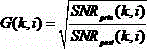
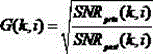
Gain function can represent by priori signal to noise ratio (S/N ratio), as the formula (2):
Figure 2014100990035100002DEST_PATH_IMAGE008
(2)
Priori signal to noise ratio (S/N ratio) in formula can be estimated to obtain by " directly judgement " method, as the formula (3):
Figure 2014100990035100002DEST_PATH_IMAGE010
(3)
In formula,
Figure 2014100990035100002DEST_PATH_IMAGE012
for:
Figure 2014100990035100002DEST_PATH_IMAGE014
(4)
In formula
Figure 2014100990035100002DEST_PATH_IMAGE016
for present frame,
Figure 2014100990035100002DEST_PATH_IMAGE018
for former frame, for the estimated result of former frame,
Figure 2014100990035100002DEST_PATH_IMAGE022
for adjustment factor, 0.8 < < 1.
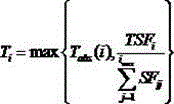
When above-mentioned the 3rd step is calculated the auditory masking threshold based on people's ear masking effect, need to first delimit critical bandwidth, this critical bandwidth is in the time that the power of tonal signal equals the power of this noise signal, the band width of the critical conditions that tonal signal is just heard by people's ear, this critical width is the constant that experiment records.
The computation process of above-mentioned auditory masking threshold is as follows: first calculate respectively the power spectrum of critical bandwidth, power spectrum and the masking by noise expansion thresholding of expansion critical bandwidth, by the masking by noise expansion thresholding calculating and the absolute thresholding comparison of human auditory system, get one of both maximums as auditory masking threshold again.
In sound enhancement method in electric wheelchair speech recognition process of the present invention, the calculating of critical bandwidth number,
Figure 2014100990035100002DEST_PATH_IMAGE024
(5)
In formula,
Figure 2014100990035100002DEST_PATH_IMAGE026
for critical bandwidth number,
Figure DEST_PATH_IMAGE028
for frequency.
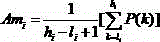
In sound enhancement method in electric wheelchair speech recognition process of the present invention, the summation of the power spectrum of voice signal in each critical bandwidth can be obtained to the power spectrum of each critical bandwidth, establish
Figure DEST_PATH_IMAGE030
for the power spectrum of signal Fast Fourier Transform (FFT), the power spectrum of each critical bandwidth is:
Figure DEST_PATH_IMAGE032
(6)
In formula, for critical bandwidth minimum frequency,
Figure DEST_PATH_IMAGE036
for critical bandwidth
Figure DEST_PATH_IMAGE016AA
maximum frequency,
Figure DEST_PATH_IMAGE016AAA
from 1 to
Figure DEST_PATH_IMAGE038
, the sample frequency of voice signal determines
Figure DEST_PATH_IMAGE038A
.
Owing to having masking effect between each critical band, and this masking effect weakens along with the increase of critical band distance.Represent the mutual masking action between critical band with a kind of extend type, so critical bandwidth power spectrum is converted to expansion critical bandwidth power spectrum.Critical bandwidth power spectrum is converted to expansion critical bandwidth power spectrum, uses spread function
Figure DEST_PATH_IMAGE040
estimate the masking effect between different critical bandwidth, as the formula (7):
Figure DEST_PATH_IMAGE042
(7)
By the be expanded power spectrum of critical bandwidth of the power spectrum of each critical bandwidth and the convolutional calculation of spread function, as the formula (8):
Figure DEST_PATH_IMAGE044
(8)
Wherein,
Figure DEST_PATH_IMAGE046
be
Figure DEST_PATH_IMAGE016AAAA
the power spectrum of individual expansion critical bandwidth.
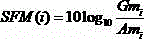
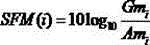
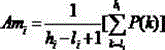
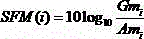
It is masking by pure tone noise and masking by noise pure tone that research shows to exist two kinds of masking by noise threshold values, in sound enhancement method in electric wheelchair speech recognition process of the present invention, determine that band noise voice signal is similar pure tone or similar noise, it is smoothly estimated (Spectral Flatness Measure, SFM) and determines by composing:
Figure DEST_PATH_IMAGE048
(9)
Wherein,
Figure DEST_PATH_IMAGE050
Figure DEST_PATH_IMAGE016AAAAA
the geometric mean of the critical broadband power of individual expansion,
Figure DEST_PATH_IMAGE016AAAAAA
the arithmetic mean of the critical broadband power of individual expansion,
(10)
Figure DEST_PATH_IMAGE056
(11)
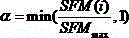
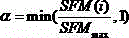
Produce parameter according to SFM
Figure DEST_PATH_IMAGE058
, this parameter shows that power spectrum is the degree of voiced sound, that is:
Figure DEST_PATH_IMAGE060
(12)
Wherein
Figure DEST_PATH_IMAGE062
, when
Figure DEST_PATH_IMAGE064
time,
Figure DEST_PATH_IMAGE066
represent it is noise completely; When
Figure DEST_PATH_IMAGE068
time,
Figure DEST_PATH_IMAGE070
represent it is pure tone completely, actual voice signal had been not exclusively both noise, was not exclusively also pure tone, so
Figure DEST_PATH_IMAGE058A
between 0 to 1.
In sound enhancement method in electric wheelchair speech recognition process of the present invention, shown in the threshold-offset expression (13) of the voiceless sound of voice spectrum and Voicing Features generation:
Figure DEST_PATH_IMAGE072
(13)
The masking by noise threshold value that can be expanded is thus:
Figure DEST_PATH_IMAGE074
(14)
The masking threshold passing threshold normalization of noise, and obtain by definitely listening threshold value to compare, as the formula (15):
Figure DEST_PATH_IMAGE076
(15)
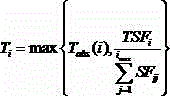
Wherein definitely listen threshold value
Figure DEST_PATH_IMAGE078
tried to achieve by nonlinear function:
Figure DEST_PATH_IMAGE080
(16)
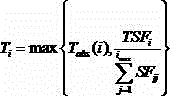
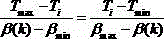
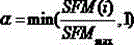
In sound enhancement method in electric wheelchair speech recognition process of the present invention, adaptive spectrum-subtraction coefficient calculations in described the 3rd step, obtains after auditory masking threshold, calculates adaptive spectrum-subtraction coefficient by following formula:
Figure DEST_PATH_IMAGE082
(17)
Figure DEST_PATH_IMAGE084
(18)
Wherein
Figure DEST_PATH_IMAGE086
for the auditory masking threshold of Bark frequency band,
Figure DEST_PATH_IMAGE088
with
Figure DEST_PATH_IMAGE090
maximal value and the minimum value of the auditory masking threshold of each frame;
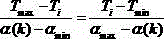
Calculate adaptive spectrum by following formula and subtract coefficient:
(19)
Figure DEST_PATH_IMAGE094
(20)
Wherein
Figure DEST_PATH_IMAGE096
,
Figure DEST_PATH_IMAGE098
,
Figure DEST_PATH_IMAGE100
with
Figure DEST_PATH_IMAGE102
, its empirical constant value for obtaining by great many of experiments;
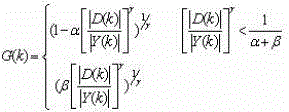
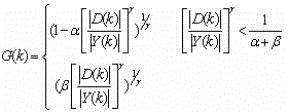
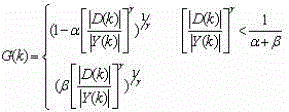
The following algorithm of gain function in formula (1) obtains:
Figure DEST_PATH_IMAGE104
(21)
Wherein
Figure DEST_PATH_IMAGE106
.
Based on technique scheme, patent of the present invention has obtained following technique effect in application:
Sound enhancement method in electric wheelchair speech recognition process of the present invention proposes corresponding robust speech recognizer at signal space and feature space, improve the discrimination of system under noise circumstance, for the speech recognition of electric wheelchair speech control system, realize the accurate control to electric wheelchair, reached the object of interactive voice between user and electric wheelchair.
Accompanying drawing explanation
Speech recognition theory diagram in sound enhancement method in Fig. 1 electric wheelchair speech recognition process of the present invention.
The schematic diagram that voice based on auditory masking effect and priori signal to noise ratio (S/N ratio) in sound enhancement method in Fig. 2 electric wheelchair speech recognition process of the present invention strengthen.
Embodiment
We do further and elaborate the electric wheelchair control system strengthening based on voice of the present invention and control method with specific embodiment by reference to the accompanying drawings below; understand composition structure of the present invention and principle of work in the hope of more cheer and bright, but can not limit the scope of the invention with this.
The object of the invention is to design an electric wheelchair speech recognition control system, this system comprises: microphone, based on microprocessor operation platform, RS-232 serial communication modular, electric wheelchair body.Microphone class is as the input of whole speech control system; Microprocessor is as the host computer of whole speech control system, for the treatment of voice signal; Wireless communication module is for the communication between host computer and slave computer; Electric wheelchair is the slave computer of speech control system, for completing corresponding control action.
As shown in Figure 1, first the voice signal of input will carry out pre-service to the principle of work of electric wheelchair speech recognition, comprises that preemphasis filtering, the windowing of voice divides frame to process and double threshold end-point detection; Secondly, voice signal is after pre-service, and next a very important ring is exactly the extraction of characteristic parameter; Then, in the training stage, characteristic parameter is carried out after certain processing, for each order word obtains a template, save as template base; At cognitive phase, voice signal obtains speech parameter through identical method, generates test template, mates, using reference template the highest matching similarity as recognition result with the reference template in template base.
As shown in Figure 2, in the time that voice are identified, first the voice signal with noise is carried out to pre-service, point frame and Fast Fourier Transform (FFT) (FFT) algorithm; Then the priori signal to noise ratio (S/N ratio) of, calculating each frame band noise voice signal obtains comparatively pure voice signal by spectrum-subtraction; Again, by auditory masking effect calculating noise masking threshold, obtain calculating adaptive spectrum after masking by noise thresholding and subtract coefficient, then compose for the second time and subtract the frequency spectrum that obtains clean speech signal; Voice signal after being finally enhanced by inverse fast fourier transform (IFFT).
In sound enhancement method of the present invention, specifically, the algorithm that above-mentioned voice strengthen process comprises following content:
Set
Figure DEST_PATH_IMAGE108
for clean speech signal,
Figure DEST_PATH_IMAGE110
for noise signal,
Figure DEST_PATH_IMAGE112
for the voice signal with noise.So, the voice signal with noise can be expressed as:
Figure DEST_PATH_IMAGE114
, through Fast Fourier Transform (FFT), result is:
Figure DEST_PATH_IMAGE116
, its power spectrum density is:
Figure DEST_PATH_IMAGE118
,
Because voice signal and noise are separate, and for the Gaussian distribution of zero-mean, so it can be reduced to:
Figure DEST_PATH_IMAGE122
,
The voice of each frame have stationarity in short-term, and it can be expressed as: ,
Figure DEST_PATH_IMAGE126
when without voice signal
Figure DEST_PATH_IMAGE128
assembly average, can obtain thus the estimation of primary speech signal:
Figure DEST_PATH_IMAGE130
, write as gain form and be:
Figure DEST_PATH_IMAGE132
,
Figure DEST_PATH_IMAGE134
, wherein
Figure DEST_PATH_IMAGE136
for posteriori SNR, it is shown below:
Figure DEST_PATH_IMAGE138
.
1. calculate priori signal to noise ratio (S/N ratio), can represent by linear time-varying filtering device form according to spectrum-subtraction,
Figure 2014100990035100002DEST_PATH_IMAGE002A
be multiplied by gain function
Figure DEST_PATH_IMAGE004A
, as the formula (1):
Figure DEST_PATH_IMAGE006A
(1)
Gain function can represent by priori signal to noise ratio (S/N ratio), as the formula (2):
Figure DEST_PATH_IMAGE008A
(2)
Priori signal to noise ratio (S/N ratio) in formula can be estimated to obtain by " Decision-Directed " method.As the formula (3).
(3)
In formula,
Figure DEST_PATH_IMAGE012A
for:
Figure DEST_PATH_IMAGE014A
(4)
In formula for present frame,
Figure DEST_PATH_IMAGE018A
for former frame,
Figure DEST_PATH_IMAGE020A
for the estimated result of former frame, for adjustment factor, generally between 0.8 ~ 1.
2. human auditory system masking effect and masking threshold calculate, and human auditory system masking effect is near a very strong voice signal, and weak voice signal will can not heard by people's ear, or sound
Figure DEST_PATH_IMAGE140
appearance can make sound
Figure DEST_PATH_IMAGE142
the phenomenon that the threshold of audibility that can be heard by people's ear increases.Therefore,
Figure DEST_PATH_IMAGE142A
masked sound,
Figure DEST_PATH_IMAGE140A
it is masking sound.Because on basilar membrane, the transmission distance of the signal that frequency is high is less than the distance of the signal transmission that frequency is low, so low frequency signal is easily sheltered high-frequency signal.
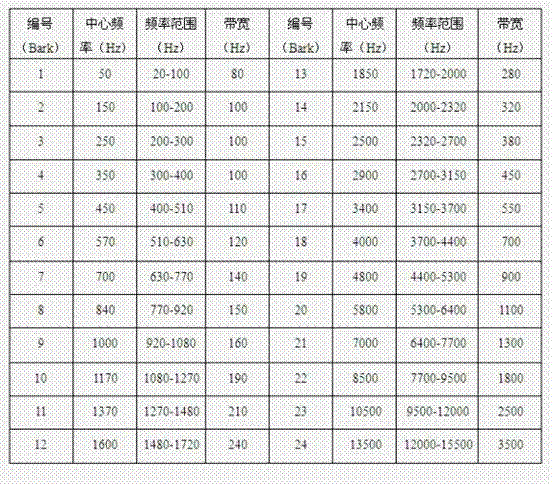
Tonal signal is perceived by the human ear the impact that is subject to noise signal, and noise signal is sheltered tonal signal.Reach and manifest better human auditory system masking effect, need to delimit critical bandwidth.There is certain frequency span and can shelter this tonal signal with the continuing noise signal of the centre frequency of tonal signal.Critical bandwidth is in the time that the power of tonal signal equals the power of this noise signal, the band width of the critical conditions that tonal signal is just heard by people's ear, and it can record by experiment.In the definition of critical bandwidth, need to define a special psychologic acoustics unit-Bark.The width of the corresponding critical bandwidth of 1Bark.Table 1 has provided centre frequency, numbering and the frequency range of 24 critical bandwidths that draw by experiment.
The calculating of auditory masking threshold need to be calculated respectively the power spectrum of critical bandwidth, power spectrum and the masking by noise expansion thresholding of expansion critical bandwidth.Finally by the masking by noise expansion thresholding calculating and the absolute thresholding comparison of human auditory system, get one of both maximums wherein as auditory masking threshold.
Critical bandwidth number that can computing voice signal according to formula (5).
(5)
In formula,
Figure 2014100990035100002DEST_PATH_IMAGE026A
for critical bandwidth number, for frequency.
The summation of the power spectrum of voice signal in each critical bandwidth can be obtained to the power spectrum of each critical bandwidth.If
Figure DEST_PATH_IMAGE030A
for the power spectrum of signal Fast Fourier Transform (FFT), the power spectrum of each critical bandwidth is:
Figure DEST_PATH_IMAGE032A
(6)
Table 1 critical bandwidth is divided table
Figure DEST_PATH_IMAGE144
In above-mentioned formula (6),
Figure DEST_PATH_IMAGE034A
for critical bandwidth
Figure DEST_PATH_IMAGE016AAAAAAAA
minimum frequency,
Figure DEST_PATH_IMAGE036A
for critical bandwidth
Figure DEST_PATH_IMAGE016AAAAAAAAA
maximum frequency, from 1 to
Figure DEST_PATH_IMAGE038AA
, the sample frequency of voice signal determines
Figure DEST_PATH_IMAGE038AAA
.
Owing to having masking effect between each critical band, and this masking effect weakens along with the increase of critical band distance.Represent the mutual masking action between critical band with a kind of extend type, so critical bandwidth power spectrum is converted to expansion critical bandwidth power spectrum.
Use spread function
Figure DEST_PATH_IMAGE040A
estimate the masking effect between different critical bandwidth, as the formula (7).
Figure DEST_PATH_IMAGE042A
(7)
By the be expanded power spectrum of critical bandwidth of the power spectrum of each critical bandwidth and the convolutional calculation of spread function, as the formula (8).
Figure DEST_PATH_IMAGE044A
(8)
Wherein,
Figure DEST_PATH_IMAGE046A
be
Figure DEST_PATH_IMAGE016AAAAAAAAAAA
the power spectrum of individual expansion critical bandwidth.
It is masking by pure tone noise and masking by noise pure tone that research shows to exist two kinds of masking by noise threshold values.In order to determine that band noise voice signal is similar pure tone or similar noise, it is smoothly estimated (Spectral Flatness Measure, SFM) and determines by composing.
Figure DEST_PATH_IMAGE048A
(9)
Wherein,
Figure DEST_PATH_IMAGE016AAAAAAAAAAAA
the geometric mean of the critical broadband power of individual expansion,
Figure DEST_PATH_IMAGE052A
Figure DEST_PATH_IMAGE016AAAAAAAAAAAAA
the arithmetic mean of the critical broadband power of individual expansion.
(10)
Figure DEST_PATH_IMAGE056A
(11)
Produce parameter according to SFM
Figure DEST_PATH_IMAGE058AA
, this parameter shows that power spectrum is the degree of voiced sound, that is:
Figure DEST_PATH_IMAGE060A
(12)
Wherein
Figure DEST_PATH_IMAGE062A
.When time,
Figure DEST_PATH_IMAGE066A
represent it is noise completely; When
Figure DEST_PATH_IMAGE068A
time,
Figure DEST_PATH_IMAGE070A
represent it is pure tone completely.Actual voice signal had been not exclusively both noise, was not exclusively also pure tone, so
Figure DEST_PATH_IMAGE058AAA
between 0 to 1.
Shown in the threshold-offset expression (13) of the voiceless sound of voice spectrum and Voicing Features generation:
Figure DEST_PATH_IMAGE072A
(13)
The masking by noise threshold value that can be expanded is thus:
Figure DEST_PATH_IMAGE074A
(14)
The masking threshold passing threshold normalization of noise, and obtain by definitely listening threshold value to compare, as the formula (15).
Figure DEST_PATH_IMAGE076A
(15)
Wherein definitely listen threshold value
Figure DEST_PATH_IMAGE078A
tried to achieve by nonlinear function:
Figure DEST_PATH_IMAGE080A
(16),
The absolute thresholding comparison of masking by noise expansion thresholding and human auditory system, gets one of both maximums wherein as auditory masking threshold.
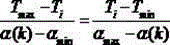
3. adaptive spectrum-subtraction coefficient calculations, obtains after auditory masking threshold, calculates adaptive spectrum-subtraction coefficient by following formula.
(17)
Figure DEST_PATH_IMAGE084A
(18)
Wherein
Figure DEST_PATH_IMAGE086A
for the auditory masking threshold of Bark frequency band,
Figure DEST_PATH_IMAGE088A
with
Figure DEST_PATH_IMAGE090A
maximal value and the minimum value of the auditory masking threshold of each frame.
Subtract coefficient by calculating adaptive spectrum, as shown in the formula:
Figure DEST_PATH_IMAGE092A
(19)
Figure DEST_PATH_IMAGE094A
(20)
Wherein
Figure DEST_PATH_IMAGE096A
,
Figure DEST_PATH_IMAGE098A
,
Figure DEST_PATH_IMAGE100A
with , the empirical value obtaining by great many of experiments.Utilize spectrum obtained above to subtract coefficient and try to achieve gain function, in substitution formula (1), power spectrum and gain that last time spectrum is obtained after subtracting are multiplied each other, and obtain pure voice signal.
Finally, the voice signal after being enhanced by inverse fast fourier transform (IFFT).
The algorithm that gain function in above-mentioned formula (1) can propose by people such as Berouti obtains, and is shown below.
Figure DEST_PATH_IMAGE104A
(21)
Wherein .
The voice of above-mentioned voice signal strengthen, the improvement of spectrum-subtraction has a variety of, as self-adaptation and auditory masking etc., and the voice enhancement algorithm that voice enhancing of the present invention is not used before by the method for priori signal to noise ratio (S/N ratio) and auditory masking combination being strengthens processing by voice enhancement algorithm of the present invention to voice signal thus.Feature extraction algorithm based on improving perception Non-uniform spectral compression is that the power spectrum of each frame voice signal or sub belt energy are compressed, and its compressibility factor is improved, and then extracts the eigenwert of voice signal by corresponding algorithm.
In operation in the recognition methods of electric wheelchair robust speech, first obtain voice signal by microphone, voice signal is carried out, after pre-service, it being carried out to voice enhancing and feature extraction, at signal space, the voice enhancement algorithm that uses auditory masking effect and priori signal to noise ratio (S/N ratio) to combine strengthens; At feature space, use the feature extraction algorithm of improvement perception Non-uniform spectral compression more accurately to extract the eigenwert of voice signal, with dynamic time warping Algorithm for Training and recognition of speech signals, voice identification result is converted to the bottom layer driving instruction of electric wheelchair, call corresponding control function, drive electric wheelchair to move according to voice signal.

Claims (10)

1. the sound enhancement method in an electric wheelchair speech recognition process, described electric wheelchair speech recognition process includes input speech signal pre-service, characteristic parameter extraction, in the training stage, processing feature parameter is that each order word obtains a module and saves as and in template base, cognitive phase, first obtain speech parameter and generate test template, this test template mates with the reference template in template base, using referrer module best matching similarity as recognition result, it is characterized in that, described sound enhancement method comprises the steps:
The first step, carries out pre-service, point frame and Fast Fourier Transform (FFT) to the input speech signal with noise, obtains the frequency spectrum with noise voice signal;
Second step, calculates the priori signal to noise ratio (S/N ratio) of each frame band noise voice signal, by spectrum-subtraction for the first time, obtains comparatively pure voice signal frequency spectrum;
The 3rd step, by auditory masking effect calculating noise masking threshold, obtains calculating adaptive spectrum after masking by noise thresholding and subtracts coefficient;
The 4th step, carries out spectrum-subtraction for the second time, obtains pure voice signal frequency spectrum;
The 5th step, by inverse fast fourier transform, the voice signal after being enhanced.
2. the sound enhancement method in a kind of electric wheelchair speech recognition process according to claim 1, is characterized in that, when calculating priori signal to noise ratio (S/N ratio) in described second step, represents, according to spectrum-subtraction by linear time-varying filtering device form
Figure 913937DEST_PATH_IMAGE002
be multiplied by gain function
Figure 831077DEST_PATH_IMAGE004
, as the formula (1):
(1)
Gain function can represent by priori signal to noise ratio (S/N ratio), as the formula (2):
Figure 566876DEST_PATH_IMAGE008
(2)
Priori signal to noise ratio (S/N ratio) in formula can be estimated to obtain by " directly judgement " method, as the formula (3):
Figure 443565DEST_PATH_IMAGE010
(3)
In formula, for:
Figure 595378DEST_PATH_IMAGE014
(4)
In formula
Figure 856595DEST_PATH_IMAGE016
for present frame,
Figure 89255DEST_PATH_IMAGE018
for former frame,
Figure 82619DEST_PATH_IMAGE020
for the estimated result of former frame,
Figure 899265DEST_PATH_IMAGE022
for adjustment factor, 0.8 <
Figure 698594DEST_PATH_IMAGE022
< 1.
3. the sound enhancement method in a kind of electric wheelchair speech recognition process according to claim 1, it is characterized in that, while calculating the auditory masking threshold based on people's ear masking effect in described the 3rd step, need first delimit critical bandwidth, this critical bandwidth is in the time that the power of tonal signal equals the power of this noise signal, the band width of the critical conditions that tonal signal is just heard by people's ear, this critical width is the constant that experiment records.
4. the sound enhancement method in a kind of electric wheelchair speech recognition process according to claim 3, it is characterized in that, the computation process of described auditory masking threshold is as follows: first calculate respectively the power spectrum of critical bandwidth, power spectrum and the masking by noise expansion thresholding of expansion critical bandwidth, by the masking by noise expansion thresholding calculating and the absolute thresholding comparison of human auditory system, get one of both maximums as auditory masking threshold again.
5. the sound enhancement method in a kind of electric wheelchair speech recognition process according to claim 4, is characterized in that, the calculating of critical bandwidth number,
Figure 221979DEST_PATH_IMAGE024
(5)
In formula, for critical bandwidth number,
Figure 955766DEST_PATH_IMAGE028
for frequency.
6. the sound enhancement method in a kind of electric wheelchair speech recognition process according to claim 5, is characterized in that, the summation of the power spectrum of voice signal in each critical bandwidth can be obtained to the power spectrum of each critical bandwidth, establishes
Figure 791741DEST_PATH_IMAGE030
for the power spectrum of signal Fast Fourier Transform (FFT), the power spectrum of each critical bandwidth is:
Figure 435212DEST_PATH_IMAGE032
(6)
In formula,
Figure 832696DEST_PATH_IMAGE034
for critical bandwidth
Figure 561617DEST_PATH_IMAGE016
minimum frequency,
Figure 640432DEST_PATH_IMAGE036
for critical bandwidth
Figure DEST_PATH_IMAGE037
maximum frequency, from 1 to
Figure DEST_PATH_IMAGE039
, the sample frequency of voice signal determines
Figure 34690DEST_PATH_IMAGE039
.
7. the sound enhancement method in a kind of electric wheelchair speech recognition process according to claim 5, is characterized in that, critical bandwidth power spectrum is converted to expansion critical bandwidth power spectrum, uses spread function
Figure DEST_PATH_IMAGE041
estimate the masking effect between different critical bandwidth, as the formula (7):
Figure DEST_PATH_IMAGE043
(7)
By the be expanded power spectrum of critical bandwidth of the power spectrum of each critical bandwidth and the convolutional calculation of spread function, as the formula (8):
Figure DEST_PATH_IMAGE045
(8)
Wherein,
Figure DEST_PATH_IMAGE047
be
Figure 673744DEST_PATH_IMAGE016
the power spectrum of individual expansion critical bandwidth.
8. the sound enhancement method in a kind of electric wheelchair speech recognition process according to claim 5, it is characterized in that, determine that band noise voice signal is similar pure tone or similar noise, it is smoothly estimated (Spectral Flatness Measure, SFM) and determines by composing:
Figure DEST_PATH_IMAGE049
(9)
Wherein,
Figure DEST_PATH_IMAGE051
Figure 179418DEST_PATH_IMAGE016
the geometric mean of the critical broadband power of individual expansion,
Figure DEST_PATH_IMAGE053
the arithmetic mean of the critical broadband power of individual expansion,
(10)
Figure DEST_PATH_IMAGE057
(11)
Produce parameter according to SFM
Figure DEST_PATH_IMAGE059
, this parameter shows that power spectrum is the degree of voiced sound, that is:
Figure DEST_PATH_IMAGE061
(12)
Wherein
Figure DEST_PATH_IMAGE063
, when
Figure DEST_PATH_IMAGE065
time, represent it is noise completely; When
Figure DEST_PATH_IMAGE069
time,
Figure DEST_PATH_IMAGE071
represent it is pure tone completely, actual voice signal had been not exclusively both noise, was not exclusively also pure tone, so
Figure 349816DEST_PATH_IMAGE072
between 0 to 1.
9. the sound enhancement method in a kind of electric wheelchair speech recognition process according to claim 8, is characterized in that,
Shown in the threshold-offset expression (13) of the voiceless sound of voice spectrum and Voicing Features generation:
Figure 787751DEST_PATH_IMAGE074
(13)
The masking by noise threshold value that can be expanded is thus:
Figure 208368DEST_PATH_IMAGE076
(14)
The masking threshold passing threshold normalization of noise, and obtain by definitely listening threshold value to compare, as the formula (15):
Figure 743255DEST_PATH_IMAGE078
(15)
Wherein definitely listen threshold value
Figure 856704DEST_PATH_IMAGE080
tried to achieve by nonlinear function:
Figure 366224DEST_PATH_IMAGE082
(16)。
10. the sound enhancement method in a kind of electric wheelchair speech recognition process according to claim 9, it is characterized in that, adaptive spectrum-subtraction coefficient calculations in described the 3rd step, obtains after auditory masking threshold, calculates adaptive spectrum-subtraction coefficient by following formula:
Figure 590532DEST_PATH_IMAGE084
(17)
(18)
Wherein for the auditory masking threshold of Bark frequency band,
Figure 473541DEST_PATH_IMAGE090
with
Figure 501539DEST_PATH_IMAGE092
maximal value and the minimum value of the auditory masking threshold of each frame;
Calculate adaptive spectrum by following formula and subtract coefficient:
Figure 745439DEST_PATH_IMAGE094
(19)
Figure 498894DEST_PATH_IMAGE096
(20)
Wherein
Figure 398717DEST_PATH_IMAGE098
,
Figure 27144DEST_PATH_IMAGE100
,
Figure 328812DEST_PATH_IMAGE102
with , its empirical constant value for obtaining by great many of experiments;
The following algorithm of gain function in formula (1) obtains:
Figure DEST_PATH_IMAGE105
(21)
Wherein
Figure DEST_PATH_IMAGE107
.
CN201410099003.5A 2014-03-17 2014-03-17 Voice enhancement method for use in voice identification process of electric wheelchair Pending CN103824564A (en)

Priority Applications (1)

Application Number Priority Date Filing Date Title
CN201410099003.5A CN103824564A (en) 2014-03-17 2014-03-17 Voice enhancement method for use in voice identification process of electric wheelchair

Applications Claiming Priority (1)

Application Number Priority Date Filing Date Title
CN201410099003.5A CN103824564A (en) 2014-03-17 2014-03-17 Voice enhancement method for use in voice identification process of electric wheelchair

Publications (1)

Publication Number Publication Date
CN103824564A true CN103824564A (en) 2014-05-28

Family

ID=50759586

Family Applications (1)

Application Number Title Priority Date Filing Date
CN201410099003.5A Pending CN103824564A (en) 2014-03-17 2014-03-17 Voice enhancement method for use in voice identification process of electric wheelchair

Country Status (1)

Country Link
CN (1) CN103824564A (en)

Cited By (10)

* Cited by examiner, † Cited by third party
Publication number Priority date Publication date Assignee Title
CN104103272A (en) * 2014-07-15 2014-10-15 无锡中星微电子有限公司 Voice recognition method and device and blue-tooth earphone
CN104538029A (en) * 2014-12-16 2015-04-22 重庆邮电大学 Robust speech recognition method and system based on speech enhancement and improved PNSC
CN105427859A (en) * 2016-01-07 2016-03-23 深圳市音加密科技有限公司 A front-end speech enhancement method for speaker recognition
CN105575403A (en) * 2015-12-25 2016-05-11 重庆邮电大学 Cross-correlation sound source positioning method with combination of auditory masking and double-ear signal frames
CN109727605A (en) * 2018-12-29 2019-05-07 苏州思必驰信息科技有限公司 Method and system for processing sound signals
CN110634500A (en) * 2019-10-14 2019-12-31 达闼科技成都有限公司 Calculation method, electronic equipment and storage medium of a priori signal-to-noise ratio
CN110855281A (en) * 2019-10-30 2020-02-28 重庆瑞坤科技发展股份有限公司 Intelligent voice recognition switch panel
CN113470697A (en) * 2021-06-24 2021-10-01 中国科学院声学研究所南海研究站 Outdoor sound acquisition and storage equipment and sound processing method
CN113808441A (en) * 2021-08-03 2021-12-17 郑州科技学院 Portable Foreign Language Word Exerciser
CN114220448A (en) * 2021-12-16 2022-03-22 游密科技(深圳)有限公司 Voice signal generation method, device, computer equipment and storage medium

Citations (1)

* Cited by examiner, † Cited by third party
Publication number Priority date Publication date Assignee Title
US20100262424A1 (en) * 2009-04-10 2010-10-14 Hai Li Method of Eliminating Background Noise and a Device Using the Same

Patent Citations (1)

* Cited by examiner, † Cited by third party
Publication number Priority date Publication date Assignee Title
US20100262424A1 (en) * 2009-04-10 2010-10-14 Hai Li Method of Eliminating Background Noise and a Device Using the Same

Non-Patent Citations (7)

* Cited by examiner, † Cited by third party
Title
万义龙 等: "一种基于几何谱减法和听觉掩蔽效应的语音增强方法", 《微电子学与计算机》 *
刘淑华: "低信噪比下的语音增强技术研究", 《中国优秀博硕士学位论文全文数据库(硕士) 信息科技辑》 *
戴亮: "非平稳噪声环境下的语音增强算法研究", 《中国优秀硕士学位论文全文数据库 信息科技辑》 *
李艳花: "基于特征提取的智能轮椅语音识别控制技术的研究与实现", 《中国优秀硕士学位论文全文数据库 信息科技辑》 *
楼侃: "基于DSP的语音信号环境噪声降噪处理技术的研究", 《中国优秀硕士学位论文全文数据库 信息科技辑》 *
沈晓东 等: "一种基于谱减的语音增强算法改进", 《软件导刊》 *
申艳红 等: "一种基于听觉掩蔽的语音增强方法", 《成都信息工程学院学报》 *

Cited By (12)

* Cited by examiner, † Cited by third party
Publication number Priority date Publication date Assignee Title
CN104103272A (en) * 2014-07-15 2014-10-15 无锡中星微电子有限公司 Voice recognition method and device and blue-tooth earphone
CN104103272B (en) * 2014-07-15 2017-10-10 无锡中感微电子股份有限公司 Audio recognition method, device and bluetooth earphone
CN104538029A (en) * 2014-12-16 2015-04-22 重庆邮电大学 Robust speech recognition method and system based on speech enhancement and improved PNSC
CN105575403A (en) * 2015-12-25 2016-05-11 重庆邮电大学 Cross-correlation sound source positioning method with combination of auditory masking and double-ear signal frames
CN105427859A (en) * 2016-01-07 2016-03-23 深圳市音加密科技有限公司 A front-end speech enhancement method for speaker recognition
CN109727605A (en) * 2018-12-29 2019-05-07 苏州思必驰信息科技有限公司 Method and system for processing sound signals
CN110634500A (en) * 2019-10-14 2019-12-31 达闼科技成都有限公司 Calculation method, electronic equipment and storage medium of a priori signal-to-noise ratio
CN110634500B (en) * 2019-10-14 2022-05-31 达闼机器人股份有限公司 A priori signal-to-noise ratio calculation method, electronic device and storage medium
CN110855281A (en) * 2019-10-30 2020-02-28 重庆瑞坤科技发展股份有限公司 Intelligent voice recognition switch panel
CN113470697A (en) * 2021-06-24 2021-10-01 中国科学院声学研究所南海研究站 Outdoor sound acquisition and storage equipment and sound processing method
CN113808441A (en) * 2021-08-03 2021-12-17 郑州科技学院 Portable Foreign Language Word Exerciser
CN114220448A (en) * 2021-12-16 2022-03-22 游密科技(深圳)有限公司 Voice signal generation method, device, computer equipment and storage medium

Similar Documents

Publication Publication Date Title
US12165670B2 (en) Systems and methods for speech separation and neural decoding of attentional selection in multi-speaker environments
CN102157156B (en) Single-channel voice enhancement method and system
Paikrao et al. Consumer personalized gesture recognition in UAV-based industry 5.0 applications
CN105741849A (en) Voice enhancement method for fusing phase estimation and human ear hearing characteristics in digital hearing aid
Rafii et al. Online REPET-SIM for real-time speech enhancement
CN103778920A (en) Speech enhancing and frequency response compensation fusion method in digital hearing-aid
CN103761974B (en) Cochlear implant
CN110739003A (en) Voice enhancement method based on multi-head self-attention mechanism
CN104810024A (en) Double-path microphone speech noise reduction treatment method and system
Koning et al. Speech onset enhancement improves intelligibility in adverse listening conditions for cochlear implant users
CN105427859A (en) A front-end speech enhancement method for speaker recognition
CN104867499A (en) Frequency-band-divided wiener filtering and de-noising method used for hearing aid and system thereof
CN103971697B (en) Sound enhancement method based on non-local mean filtering
Min et al. Mask estimate through Itakura-Saito nonnegative RPCA for speech enhancement
Lun et al. Wavelet based speech presence probability estimator for speech enhancement
Hsu et al. Spectro-temporal subband wiener filter for speech enhancement
CN104538029A (en) Robust speech recognition method and system based on speech enhancement and improved PNSC
Suresh et al. Computer-aided interpreter for hearing and speech impaired
Hsieh et al. Speech enhancement based on sparse representation under color noisy environment
Trawicki et al. Speech enhancement using Bayesian estimators of the perceptually-motivated short-time spectral amplitude (STSA) with Chi speech priors
Gao Chinese Speech Enhancement and Adaptive Recognition Technology for Complex Language Environments
Deng et al. Vision-guided speaker embedding based speech separation
Jiang et al. Using energy difference for speech separation of dual-microphone close-talk system
Mirbagheri et al. An auditory inspired multimodal framework for speech enhancement
Ayllón et al. A computationally-efficient single-channel speech enhancement algorithm for monaural hearing aids

Legal Events

Date Code Title Description
C06 Publication
PB01 Publication
C10 Entry into substantive examination

SE01 Entry into force of request for substantive examination

C53 Correction of patent of invention or patent application
CB02 Change of applicant information

Address after: 200031 Xuhui District Fuxing Road, Shanghai, building B, room 1199, No. 2106

Applicant after: Song Yang

Applicant after: Jin Huiqing

Applicant after: Shanghai Shenqing Industry Co., Ltd.

Applicant after: Jin Lai

Address before: 201203 Shanghai City Songtao road Pudong New Area Zhangjiang hi tech park, 489 block C No. 2

Applicant before: Shanghai Shenqing Industry Co., Ltd.

Applicant before: Jin Huiqing

Applicant before: Song Yang

Applicant before: Jin Lai

CB03 Change of inventor or designer information

Inventor after: Song Yang

Inventor after: Jin Huiqing

Inventor after: Jin Lai

Inventor after: Zhang Zhida

Inventor after: Wei Jing

Inventor after: Zhang Yi

Inventor after: Liu Xiangde

Inventor after: Xu Xiaodong

Inventor before: Jin Huiqing

Inventor before: Song Yang

Inventor before: Jin Lai

Inventor before: Zhang Zhida

Inventor before: Wei Jing

Inventor before: Zhang Yi

Inventor before: Liu Xiangde

Inventor before: Xu Xiaodong

COR Change of bibliographic data

Free format text: CORRECT: APPLICANT; FROM: SHENQING INDUSTRIAL CO., LTD., SHANGHAI TO: SONG YANG

Free format text: CORRECT: INVENTOR; FROM: JIN HUIQING SONG YANG JIN LAI ZHANG ZHIDA WEI JING ZHANG YI LIU XIANGDE XU XIAODONG TO: SONG YANG JIN HUIQING JIN LAI ZHANG ZHIDA WEI JING ZHANG YI LIU XIANGDE XU XIAODONG

C02 Deemed withdrawal of patent application after publication (patent law 2001)

WD01 Invention patent application deemed withdrawn after publication

Application publication date: 20140528