CN1043177A - Carry out the method for dyeing keratinous fibres and new 1,4-benzoquinones with oxyindole and quinone derivative - Google Patents
Carry out the method for dyeing keratinous fibres and new 1,4-benzoquinones with oxyindole and quinone derivative Download PDFInfo
- Publication number
- CN1043177A CN1043177A CN89109091A CN89109091A CN1043177A CN 1043177 A CN1043177 A CN 1043177A CN 89109091 A CN89109091 A CN 89109091A CN 89109091 A CN89109091 A CN 89109091A CN 1043177 A CN1043177 A CN 1043177A
- Authority
- CN
- China
- Prior art keywords
- benzoquinone
- carbon
- composition
- alkyl
- benzoquinones
- Prior art date
- Legal status (The legal status is an assumption and is not a legal conclusion. Google has not performed a legal analysis and makes no representation as to the accuracy of the status listed.)
- Pending
Links
Classifications
-
- D—TEXTILES; PAPER
- D06—TREATMENT OF TEXTILES OR THE LIKE; LAUNDERING; FLEXIBLE MATERIALS NOT OTHERWISE PROVIDED FOR
- D06P—DYEING OR PRINTING TEXTILES; DYEING LEATHER, FURS OR SOLID MACROMOLECULAR SUBSTANCES IN ANY FORM
- D06P3/00—Special processes of dyeing or printing textiles, or dyeing leather, furs, or solid macromolecular substances in any form, classified according to the material treated
- D06P3/02—Material containing basic nitrogen
-
- A—HUMAN NECESSITIES
- A61—MEDICAL OR VETERINARY SCIENCE; HYGIENE
- A61K—PREPARATIONS FOR MEDICAL, DENTAL OR TOILETRY PURPOSES
- A61K8/00—Cosmetics or similar toiletry preparations
- A61K8/18—Cosmetics or similar toiletry preparations characterised by the composition
- A61K8/30—Cosmetics or similar toiletry preparations characterised by the composition containing organic compounds
- A61K8/33—Cosmetics or similar toiletry preparations characterised by the composition containing organic compounds containing oxygen
- A61K8/34—Alcohols
- A61K8/347—Phenols
-
- A—HUMAN NECESSITIES
- A61—MEDICAL OR VETERINARY SCIENCE; HYGIENE
- A61K—PREPARATIONS FOR MEDICAL, DENTAL OR TOILETRY PURPOSES
- A61K8/00—Cosmetics or similar toiletry preparations
- A61K8/18—Cosmetics or similar toiletry preparations characterised by the composition
- A61K8/30—Cosmetics or similar toiletry preparations characterised by the composition containing organic compounds
- A61K8/33—Cosmetics or similar toiletry preparations characterised by the composition containing organic compounds containing oxygen
- A61K8/35—Ketones, e.g. benzophenone
- A61K8/355—Quinones
-
- A—HUMAN NECESSITIES
- A61—MEDICAL OR VETERINARY SCIENCE; HYGIENE
- A61K—PREPARATIONS FOR MEDICAL, DENTAL OR TOILETRY PURPOSES
- A61K8/00—Cosmetics or similar toiletry preparations
- A61K8/18—Cosmetics or similar toiletry preparations characterised by the composition
- A61K8/30—Cosmetics or similar toiletry preparations characterised by the composition containing organic compounds
- A61K8/49—Cosmetics or similar toiletry preparations characterised by the composition containing organic compounds containing heterocyclic compounds
- A61K8/4906—Cosmetics or similar toiletry preparations characterised by the composition containing organic compounds containing heterocyclic compounds with one nitrogen as the only hetero atom
- A61K8/4913—Cosmetics or similar toiletry preparations characterised by the composition containing organic compounds containing heterocyclic compounds with one nitrogen as the only hetero atom having five membered rings, e.g. pyrrolidone carboxylic acid
- A61K8/492—Cosmetics or similar toiletry preparations characterised by the composition containing organic compounds containing heterocyclic compounds with one nitrogen as the only hetero atom having five membered rings, e.g. pyrrolidone carboxylic acid having condensed rings, e.g. indol
-
- A—HUMAN NECESSITIES
- A61—MEDICAL OR VETERINARY SCIENCE; HYGIENE
- A61Q—SPECIFIC USE OF COSMETICS OR SIMILAR TOILETRY PREPARATIONS
- A61Q5/00—Preparations for care of the hair
- A61Q5/06—Preparations for styling the hair, e.g. by temporary shaping or colouring
- A61Q5/065—Preparations for temporary colouring the hair, e.g. direct dyes
Landscapes
- Health & Medical Sciences (AREA)
- Life Sciences & Earth Sciences (AREA)
- General Health & Medical Sciences (AREA)
- Veterinary Medicine (AREA)
- Public Health (AREA)
- Animal Behavior & Ethology (AREA)
- Birds (AREA)
- Epidemiology (AREA)
- Emergency Medicine (AREA)
- Engineering & Computer Science (AREA)
- Textile Engineering (AREA)
- Cosmetics (AREA)
- Coloring (AREA)
- Indole Compounds (AREA)
Abstract
Keratin fiber dyeing method, it is characterized in that on this fiber, being coated with at least a composition (A), wherein in dyeing medium, contain at least a list or dihydroxy and draw diindyl, and this composition (A) be coated with before or after be coated with at least a composition (B), wherein in dyeing medium, contain at least a quinone derivative, be selected from neighbour or 1,4-benzoquinone, neighbour or 1,4-benzoquinone list or diimine, neighbour or 1,4-benzoquinone sulfimide, α, ω-alkylidene two-1, the 4-benzoquinones, 1,2-or 1,4-naphthoquinones, 1,2-or 1,4-naphthoquinones list or diimine wherein draw difference △ E=Ei-Eq≤320mV of diindyl oxidation-reduction potential Ei and quinone derivative oxidises reduction potential Eq.
Description
The present invention relates to cutin fiber, human cutin fiber particularly as the new method of hair coloring, wherein adopts at least a quinone derivative of at least a oxyindole and coupling and new 1, the 4-benzoquinones.
Past has proposed to carry out cutin fiber with the hydroxy derivatives of indoles, the method of the dyeing of hair particularly, can be specially referring to the applicant's French Patent (FRP) n ° 1133594,1166172 and 2390158 and french patent application n ° 2536993 wherein propose with 5, the method that the 6-dihydroxy indole dyes wherein adopts metal cation to generate promoter as melanocyte.
The applicant's french patent application n ° of 2594331 described methods adopt the manganese or the bichromate of permanganate form.
But in colouring method, adopt metal cation can bring many problems, wherein will get on except that the suitable difficulty of these metal cations from hair.
Through twice processing, whether no matter wash, always can stay the metal of trace on the hair, this makes troubles in the time of can giving hair subsequent treatment such as painted or hair-waving.When using copper and manganese, be like this particularly.
In addition, the applicant has illustrated the employing indole derivatives in french patent application n ° 2593061 and 2593062, particularly 5, and the method that 6-dihydroxy indole and coupling inorganic anion, particularly iodide dye.
But in this case, must adopt inorganic oxidizer, particularly hydrogen peroxide.
Hair-dyeing method also has been described in EP-A-271186, has wherein adopted hydroxy indoxyl derivative and oxidant, as periodic acid and periodate, potassium permanganate, clorox, the potassium ferricyanide, potassium bichromate, ammonium persulfate, silver oxide, iron oxide, lead oxide, calcium sulfate and Fenton reactant.
As the object of the invention, the applicant now shockingly finds the method that the hydroxy derivatives of available indoles dyes, wherein do not adopt hydrogen peroxide, ammonia, metal cation or inorganic anion, this method is soaked into cutin fiber, particularly hair with the hydroxy derivatives of indoles, and coupling contains the composition of quinone derivative before or after it.
Particularly the applicant has found to be easy to natural hair dyed from light color and has been transferred to dark-toned various tone.
Therefore, the present invention seeks to propose cutin fiber, particularly human cutin fiber's decoration method wherein adopts the hydroxy derivatives of indoles, and adopts quinone derivative as oxidant.
Another purpose of the present invention is the many lattice device that is used for this method.
Other purpose of the present invention sees following detailed description and example.
Cutin fiber of the present invention, human cutin fiber particularly, essential characteristic as the decoration method of hair is to be coated with on this fiber with at least a composition (A), wherein in dyeing medium, contain at least a list or dihydroxy indole, and this composition (A) be coated with before and be coated with at least a composition (B) afterwards, wherein in dyeing medium, contain at least a quinone derivative, be selected from neighbour or 1,4-benzoquinone, neighbour or 1,4-benzoquinone list or diimine, neighbour or 1,4-benzoquinone sulfimide, α, ω-alkylidene is two-1,4-benzoquinones, 1,2-or 1, the 4-naphthoquinones, 1,2-or 1,4-naphthoquinones list or diimine, wherein list or dihydroxy indole and quinone derivative choose in the power consumption mensuration is determined in the time of should making in the phosphate pH7 on the glassy carbon electrode list or dihydroxy indole oxidation-reduction potential Ei and the phosphate on the mercury electrode and during with reference to calomel electrode pH7 with the definite quinone derivative hydrogen reduction gesture E of polarogarphy
qDifference △ E reach:
△E=Ei-E
q≤320mV。
Used list of the present invention or dihydroxy indole particularly as shown in the formula:
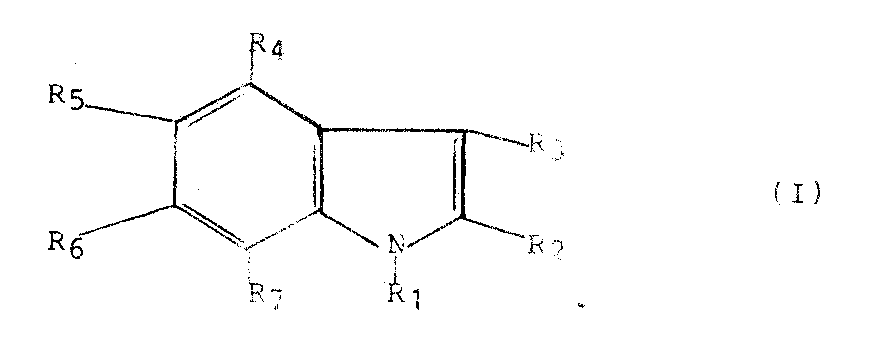
Wherein:
R
1Be hydrogen or 1-4 carbon alkyl,
R
2And R
3Identical or different, be hydrogen atom, 1-4 carbon alkyl, carboxyl, in this compound base of 1-4(, if two parts have carbon atom, carbon number only refers to alkyl or alkoxyl part, down together) the carbon alkoxy carbonyl group, 1-4 carbon hydroxyalkyl or 1-4 carbon aminoalkyl,
R
4, R
5, R
6And R
7Represent hydrogen atom independently of each other; 1-4 carbon alkyl does not replace or with the amino of one or two 1-4 carbon alkyl or hydroxyalkyl replacement, 2-6 carbon acylamino; carboxyl; 1-4 carbon carboxyalkyl, 1-4 carbon alkoxy carbonyl group ,-CONrr ' wherein r and r ' are represented hydrogen or 1-4 carbon alkyl independently of each other; halogen; 1-4 carbon hydroxyalkyl, 1-4 carbon aminoalkyl, OH or OZ; and Z is 1-20 carbon straight chain or branched-alkyl; aralkyl, formoxyl, 2-20 carbonic acyl radical; but be straight chain or branching; 3-20 carbene acyl group, but straight chain or branching ,-SiR be
11R
12R
13(the OR of ,-P(O)
8)
2, R
8OSO
2-; R
4And R
5Or R
5And R
6Or R
6And R
7Can be connected carbon atom Cheng Huan with it, wherein contain carbonyl in case of necessity, thiocarbonyl group ,=P(O) (OR
8) or=CR
9R
10, condition is R
4-R
7In have one at least for OH.
R
8And R
9Be hydrogen atom or 1-4 carbon alkyl,
R
10Be 1-4 carbon alkoxyl or single or two 1-4 carbon alkylaminos,
R
11, R
12And R
13Identical or different, be 1-4 carbon alkyl, but be straight chain or branching,
And the alkali metal of these compound correspondences, alkaline-earth metal, ammonium or amine salt.
In the following formula, 1-20 carbon straight chain or branched-alkyl specially are selected from methyl, ethyl, propyl group butyl, 16 (carbon) alkyl; Aralkyl is preferably benzyl; The 2-20 carbonic acyl radical preferentially is selected from acetyl group, propiono, bytyry, valeryl, caproyl, 14 (carbon) alkanoyl, 16 (carbon) alkanoyl; Straight chain or branching enoyl-preferentially are selected from crotonyl, oleoyl.
The present invention is special, and preferred compound especially is selected from:
The 4-hydroxyl draws piece
4-hydroxy-5-methyl oxygen base draws piece
4-hydroxyl-5-ethyoxyl draws piece
The 5-hydroxyl draws piece
2-carboxyl-5-hydroxyl draws piece
5-hydroxyl-6-methoxyl group draws piece
The 6-hydroxyl draws piece
6-hydroxyl-7-methoxyl group draws piece
5-methoxyl group-6-hydroxyl draws piece
2-carboxyl-6-hydroxyl draws piece
2-carbethoxyl group-6-hydroxyl draws piece
The 7-hydroxyl draws piece
2,3-dimethyl-7-hydroxyl-4-methoxyl group draws piece
5, the 6-dihydroxy draws piece
1-methyl-5,6-dihydroxy draw piece
2-methyl-5,6-dihydroxy draw piece
3-methyl-5,6-dihydroxy draw piece
2,3-dimethyl-5,6-dihydroxy draw piece
(5 or 6)-acetoxyl group-(6 or 5)-hydroxyl draws piece
2-carbethoxyl group-5,6-dihydroxy draw piece
2-ethyoxyl-5,6-dihydroxy draw piece
2,3-dimethyl-5-hydroxyl-6-amino draws piece
2,3-dimethyl-5-amino-6-hydroxyl draws piece.
Quinone derivative is selected from formula (II) or formula (II ') compound especially:
Wherein:
X is oxygen or NR
19,
Y is oxygen or NR
20,
R
19And R
20Identical or different, be hydrogen, halogen, 1-4 carbon alkyl, 1-4 carbon hydroxyalkyl, 1-4 carbon alkane sulfonyl or benzenesulfonyl,
R
14, R
15, R
16, R
17And R
18Represent hydrogen independently of each other, 1-4 carbon alkyl, carboxyl; 1-4 carbon alkyl-carbonyl, 1-4 carbon alkoxy carbonyl group, 1-4 carbon alkoxyl-methyl; 1-4 carbon alcoxyl sulfidomethyl, 1-4 carbon hydroxyalkyl sulfidomethyl, 1-4 carbon hydroxyalkyl sulfinyl;-CONrr ' (r and r ' represent hydrogen or 1-4 carbon alkyl independently of each other); 1-4 carbon carboxyalkyl, halogen, 1-4 carbon hydroxyalkyl; do not replace or with the amino of one or two 1-4 carbon alkyl or hydroxyalkyl replacement, 2-6 carbon acylamino-SO
3M, wherein M is a hydrogen, K or Na, sulfoxide, sulfone or sulfonamides can replace in case of necessity, or-OZ
1, Z wherein
1Can be hydrogen, 1-4 carbon alkyl, 1-4 carbon hydroxyalkyl, 1-4 carbon carboxyalkyl, phenyl and available in case of necessity 1-4 carbon alkoxyl replace, or-SZ
2, Z wherein
2Be 1-4 carbon alkyl, 1-4 carbon hydroxyalkyl, 2-4 carbon dihydroxy alkyl, 1-4 carbon carboxyalkyl,
R
14And R
15Can be connected carbon atom Cheng Huan with it:
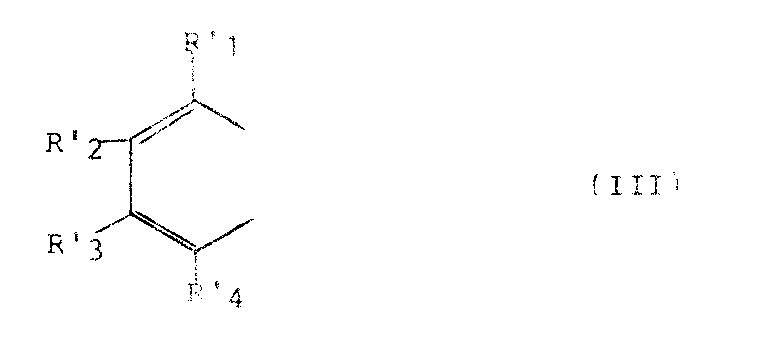
Wherein:
R
1', R '
2, R '
3And R '
4Be same as R
14, R
15, R
16R
17, R
18Do not become the ring definition.
According to the present invention, halogen preferentially is selected from fluorine, chlorine or bromine.
Another purpose of the present invention is to propose the new benzoquinones of following formula:
Wherein A is-CH
2SR or-SR, wherein R is 1-4 carbon alkyl or 1-4 carbon hydroxyalkyl; R
21Be hydrogen atom, 1-4 carbon alkyl or-SR, wherein R definition is the same, condition is that A is-CH
2During SR, R
21Be hydrogen atom,
With and at cutin fiber, as the application in the hair dyeing composition.
Preferred compound is selected from the benzoquinones of formula (II) and (II ') especially, wherein:
R
14, R
15, R
16, R
17And R
18Represent hydrogen independently of each other, 1-4 carbon low-carbon alkyl, 1-4 carbon low-carbon alkoxy, halogen, 2-6 carbon acylamino ,-SO
3M, 1-4 carbon alkoxyl-methyl, 1-4 carbon carboxyalkyl, 1-4 carbon alkoxy carbonyl group, two 1-4 carbon alkyl aminos ,-OZ
1, Z wherein
1Be 1-4 carbon carboxyalkyl, 1-4 carbon hydroxyalkyl ,-SZ
2, Z wherein
2Be 1-4 carbon hydroxyalkyl, 1-4 carbon dihydroxy alkyl, 1-4 carbon carboxyalkyl, 1-4 carbon alkyl,
X is oxygen or NR
19,
Y is oxygen or NR
20,
R
19And R
20Represent halogen or 1-4 carbon low-carbon alkyl mesyl or benzenesulfonyl independently of each other.
Used other preferred compound of the present invention is suc as formula (V) and (VI):
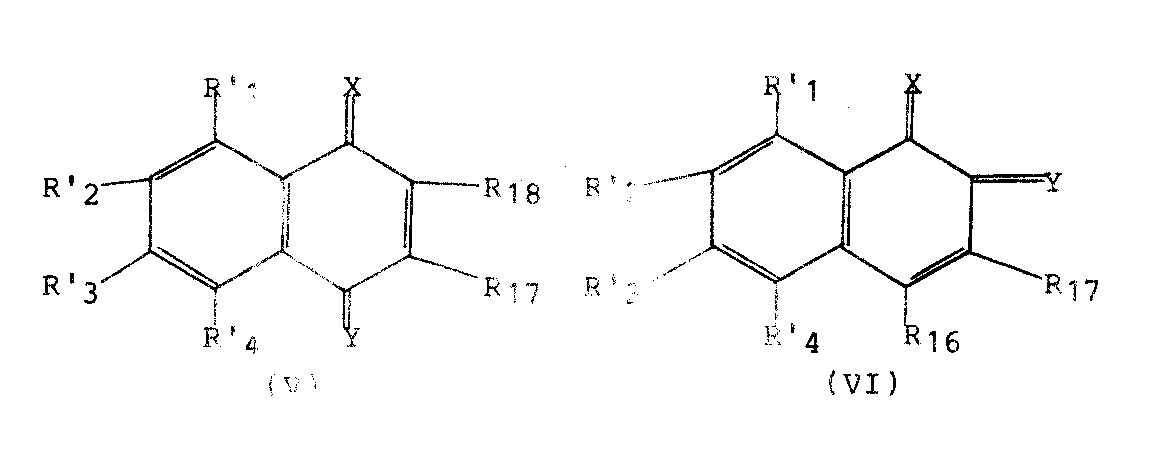
Wherein:
R '
1, R '
3, R '
3, R '
4, R
16, R
17And R
18The same to formula (II), the definition of (II ') and (III),
The same definition of X and Y.
Special preferred compound is selected from R '
1, R '
2, R '
3, R '
4, R
16R
17And R
18Be hydrogen, 1-4 carbon alkyl, 1-4 carbon alkoxyl, halogen, 2-6 carbon acylaminos or-SO
3The compound of M.
The used special preferred compound of the present invention is especially:
1, the 4-benzoquinones
2-methoxyl group-1, the 4-benzoquinones
The 2-methyl isophthalic acid, the 4-benzoquinones
2,6-dimethyl-1,4-benzoquinones
2,3,5-three chloro-6-methyl isophthalic acids, 4-benzoquinones
2-acetylaminohydroxyphenylarsonic acid 1, the 4-benzoquinones
2-acetylaminohydroxyphenylarsonic acid 3,5-dimethyl-1,4-benzoquinones
2,6-dimethyl-5-acetylaminohydroxyphenylarsonic acid 1,4-benzoquinones
2-chloro-1, the 4-benzoquinones
Tetrachloro-1, the 2-benzoquinones
2,3-dimethoxy-1,4-benzoquinones
2-β-carboxylic ethyoxyl-1, the 4-benzoquinones
2-methoxyl methyl-1, the 4-benzoquinones
2-beta-hydroxyethyl-1, the 4-benzoquinones
2-β-hydroxy ethylsuleenyl-1, the 4-benzoquinones
2,5-bis-beta-hydroxyethyl ethylmercapto group-1,4-benzoquinones
2-beta, gamma-dihydroxy rosickyite base-1, the 4-benzoquinones
2-β-carboxyethylthio-1, the 4-benzoquinones
2-carboxymethyl-1, the 4-benzoquinones
2-β-hydroxy ethylsuleenyl-6-methyl isophthalic acid, the 4-benzoquinones
2-methoxycarbonyl group-3-methoxyl group-1, the 4-benzoquinones
2-methoxycarbonyl group-1, the 4-benzoquinones
2-methyl mercapto-1, the 4-benzoquinones
2-dimethylamino-1, the 4-benzoquinones
2-acetylaminohydroxyphenylarsonic acid 5-methoxyl group-1, the 4-benzoquinones
2-(β-hydroxy ethylsuleenyl) methyl isophthalic acid, the 4-benzoquinones
The 2-(methyl mercapto) methyl isophthalic acid, the 4-benzoquinones
4,5-dimethoxy-1,2-benzoquinones
4,5-dimethyl-1,2-benzoquinones
4-methyl-5-chloro-1, the 2-benzoquinones
2,3-dimethyl-1,4-benzoquinones
2-β-hydroxy ethoxy-1, the 4-benzoquinones
N-mesyl-1,4-benzoquinones list imines
N-benzenesulfonyl-1,4-benzoquinones list imines
1, the 4-naphthoquinones
1, the 2-naphthoquinones
1,2-naphthoquinones-4-sulfonic acid
2,3-two chloro-1,4-naphthoquinones
N-2,6-three chloro-1,4-benzoquinone imine.
The preferred especially coupling mode of the present invention is with 5, and the 6-dihydroxy draws piece with 1,4-benzoquinones, 2-methyl isophthalic acid, the 4-benzoquinones, 2,6-dimethyl-1,4-benzoquinones, 2-methoxyl group-1,4-benzoquinones, 2-chloro-1,4-benzoquinones, 2,3,5-three chloro-6-methyl isophthalic acids, 4-benzoquinones, 2-acetylaminohydroxyphenylarsonic acid 1,4-benzoquinones, 2-acetylaminohydroxyphenylarsonic acid 3-methoxyl group-1,4-benzoquinones, 2,6-dimethyl-5-acetylaminohydroxyphenylarsonic acid 1,4-benzoquinones, 2,3-dimethoxy-1,4-benzoquinones, 2-methoxyl methyl-1,4-benzoquinones, 2-beta-hydroxyethyl-1,4-benzoquinones, 2-beta, gamma-dihydroxy rosickyite base-1, the 4-benzoquinones, 2-β-carboxyethylthio-1,4-benzoquinones, 2-carboxymethyl-1, the 4-benzoquinones, 1-naphthoquinones, N-2,6-three chloro-1,4-benzoquinone imine, 1, the 2-naphthoquinones, 1,2-naphthoquinones-4-sulfonic acid coupling.
Under common operating condition, the temperature that promptly 2-30 minute time for exposure and body tool generally reach, under 25-40 ℃, the concentration that used list or dihydroxy draw piece in the composition (A) is preferably 0.01-0.3mol/l.
Quinone derivative concentration should make list or dihydroxy draw piece when hair dyeing and be able to oxidation under the general condition that adopts of hair style, and preferred concentration is 0.005-1mol/l in composition (B).
The preferred 2-10 of pH of composition (A).
The preferred 2-10 of pH of composition (B).
But composition (B) is preferably used under acid pH.
Composition (A) but and (B) furnishing common type, special form, particularly furnishing for hair dyeing usefulness be the shampoo of multiviscosisty more or less, gel, forms such as emulsion, furnishing aerosol in case of necessity.
The hair dyeing medium is generally water-bearing media, can be made of the mixture of water or water and solvent, if be used for hair dyeing, then should be the cosmetic medium.
This solvent specially is selected from organic solvent, as 1-6 carbon low-carbon alcohols, and as ethanol, propyl alcohol or isopropyl alcohol, the tert-butyl alcohol, ethylene glycol, propylene glycol, glycol monoethyl ether, single ether or monobutyl ether, ethanol monoethyl ether acetate, propylene glycol and dipropylene glycol monomethyl ether, methyl lactate.
Special preferred solvent is ethanol and propylene glycol.
Consumption when solvent is used is for low-carbon alcohols 10-50% particularly, and can be higher, draws piece in list or dihydroxy.
The present composition (A) and (B) also can be present in the anhydrous solvent.This solvent is selected from above-mentioned solvent.Anhydrous medium refers to that moisture is less than 1% medium.
When being used to have hair dyed, the present composition also can contain various common cosmetic additives, particularly anion, CATION, nonionic, amphoteric surfactant or its mixture, thickener, spices, sequestering agent, film forming agent, therapeutic agent, dispersant, conditioning agent, preservative agent, opacifier, the cutin fiber swelling agent.
Be used for the composition (A) of the inventive method and/or (B) also can contain various other colouring agents that are usually used in dyeing keratinous fibres, particularly direct colouring agent, as nitrated benzene derivative, to or adjacent class oxidation colorant and be called the coupling agent or the colouring agent of it " rapides ", it is the benzene structural molecule, be suitable for the colouring agent parent that produces coloring compound, wherein in air, allow expose general less than 1 hour and when not having other various oxidant, produce coloring compound of hair by simple oxidation.
These compositions also can contain the benzoquinones that does not meet electrical potential conditions defined above, as benzoquinone imine or diimine, and naphthoquinones, naphthoquinones imines or diimine benzoquinone colouring agent.In this case, when dyeing, reach suitable tone with these colouring agents.
With regard to the usage of the inventive method, different compositions can be called among the many lattice device that is called " colouration box " or call in dyeing with among the indispensable device, comprising being used for dyeing keratinous fibres equally, Ran Fa various compositions particularly, be coated with usefulness continuously, carry out or do not carry out premix in advance.
This device particularly can comprise first lattice, wherein adorns composition (A), and second lattice, wherein adorns composition (B).Another changes embodiment is to be stored in composition (A) or composition (B) among the anhydrous solvent and the 3rd lattice are set, and wherein dress dyeing and cosmetic water-bearing media are used for composition is coated in hair.In this case, only before being coated with usefulness, just the material in the 3rd lattice is called among one of Sheng composition (A) and two lattice (B) or two lattice.
The preferred implementation method of the inventive method is that the first step is coated with composition (A), and second step was coated with composition (B).Be particularly useful for dying the people and send out, natural or dyed, scalded or do not scald, or comb straight hair, serious or slight decolouring and the hair that may scald.
In this case, the temperature that reaches in brains promptly is coated with composition (A) under 25-40 ℃, last 2-30 minute, the centre is washed the back or is not washed and can be coated with composition (B), wherein contains quinone derivative, contact 5-30 minute with hair this moment, and dyeing temperature also is 25-40 ℃.
The inventive method also can be used to change colour tone or upgrades dyeing, and this will draw with list or dihydroxy and piece carries out, and wherein uses composition (B) to be coated with many hours or many days after drawing a dyeing with list or dihydroxy again.
Also can adopt this method in the common industrial temperature, under contact time and the concentration conditions fur or wool be dyeed.
The used formula of the present invention (IV) noval chemical compound can be pressed method and make:
A) at (A) be-CH
2SR and R
21During for hydrogen (formula IV (A))
Available corresponding p-aminophenol gets these compound IV (A) through iron chloride or ferric sulfate by the oxidation of following reaction equation I.
The reaction equation I

Formula (VII) compound replaces nitrophenols with formula (IX) to be made in two steps, and wherein Y is a halogen atom, and reaction equation is as follows:
With R definition as above-mentioned formula (VIII) compound reduction get final product formula (VII) compound.The conventional reduction method can be enumerated under the temperature that is lower than 80 ℃ in alkaline medium and to reduce with sodium hydrogensulfite or add hydrogen pressure and at catalyst in water alcohol medium, carries palladium as charcoal or nickel and carries out catalytic reduction under existing.
Formula (VIII) compound can be used following formula mercaptides and the reaction of formula (IX) compound and get:
Wherein M is alkali metal or alkaline-earth metal, and R definition as above-mentioned.
Mercaptides can make effectively on the spot by following formula again:
Compound H SR also can be used as solvent.
The solvent that can be used to produce compound (VIII) also can be enumerated diox except that HSR, N, and dinethylformamide, N-Methyl pyrrolidone is used alone or as a mixture.In general, reaction temperature is lower than 100 ℃.
B) as (A) be-SR, R defines with above-mentioned, and R is hydrogen or alkyl when definition (formula (IV) compound (compound IV (B)))
Quinone compounds with formula (X) makes these compound IV (B), wherein in alcohol/aqueous solvent or in ethanol, 2mol quinone derivative and 1mol mercaptan is got these compound IV (B) by following reaction equation II reaction.
The reaction equation II
C) at (A) and R
21Be SR simultaneously, and the same compound of R (IV) when definition (compound IV (C))
Can in ethanol/water or absolute ethyl alcohol, 4mol 1,4-benzoquinone and 3mol formula RSH derivative be got these compounds by following reaction equation III reaction
The reaction equation III

IV(C)
Following example describes formula (IV) compound method for making in detail.
Preparation example 1
Produce the 2-(methyl mercapto) methyl isophthalic acid, 4-benzoquinones (formula IV (A): R=CH
3):
The 1st step:
Produce 4-amino-2-((methyl mercapto) methyl) phenol
In the 135ml aqueous solution of 16g sheet soda (NaOH), add 0.085mol(17g) 4-nitro-2-((methyl mercapto) methyl) phenol, add the 55g sodium hydrogensulfite then temperature is remained 70-75 ℃ in batches.Reinforced back 75 ℃ of stirrings 30 minutes of finishing.The product that obtains cools off after with acetate neutralization reaction medium.Wash with water again after the dehydration and drying, 96 ℃ of recrystallizations in ethanol afterwards.166 ℃ of fusing points.
The product analysis result is as follows:
C
8H
11NOS analyzes
C????H????N????O????S
Calculate 56.79 6.55 8.28 9.45 18.91
Survey 56.69 6.49 8.25 9.56 18.76
The 2nd step:
(8.45g 0.05mol) is dissolved in ethyl acetate (200ml), in the mixture of water (200ml) and concentrated hydrochloric acid (6ml) with 4-amino-2-((methyl mercapto) methyl) phenol.(16.25g is in 125ml water, 0.1mol) to add ferric chloride solution then.After 4 hours, with 4 extractions of ethyl acetate atropurpureus solution.Organic facies is with dried over sodium sulfate and be concentrated into 1/4th.Organic facies is handled with phytomelane, filters and steam solvent.Obtain tenne oil, crystallization in isopropyl ether.Obtain orange powder then:
Weight: 3g
Yield: 36%
Pf:43℃
C
8H
8O
2S analyzes:
C????H????O????S
Calculate 57.12 4.79 19.02 19.06
Survey 57.23 4.78 19.20 19.16
Preparation example 2
Produce 2-(β-hydroxy ethylsuleenyl) methyl isophthalic acid, 4-benzoquinones (or IV (A): R=CH
2CH
2OH):
The 1st step:
Produce 4-amino-2-((β-hydroxy ethylsuleenyl) methyl) phenol
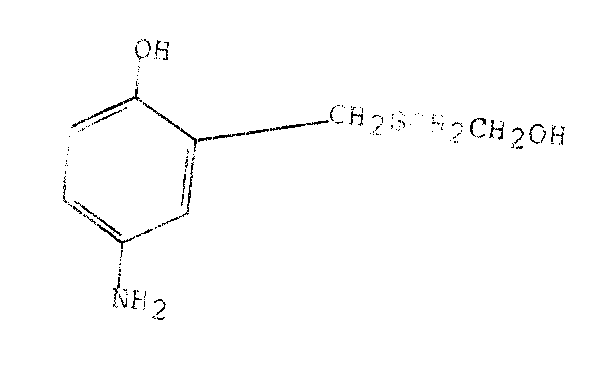
In the 135ml aqueous solution of 16g sheet soda (NaOH), add 0.085mol(19.5g) 4-nitro-2-((β-hydroxy ethylsuleenyl) methyl) phenol, add the 55g sodium hydrogensulfite then temperature is remained 70-75 ℃ in batches.Reinforced back 75 ℃ of stirrings 20 minutes of finishing, the topic that obtains shows that product precipitates, with cooling off behind the acetate neutralization reaction medium.Wash with water again after the dehydration and drying, in acetonitrile, be recrystallized afterwards.121 ℃ of fusing points.
The product analysis result is as follows:
C
9H
18NO
2S analyzes
C????H????N????O????S
Calculate 54.24 6.58 7.03 16.06 16.09
Survey 54.02 6.62 7.00 16.17 15.92
The 2nd step:
The solution of iron chloride (0.65g is in 50ml water) is added 4-amino-2-((β-hydroxy ethylsuleenyl) methyl) phenol, and (0.4g is 2mmol) in the solution.Use dichloromethane extraction immediately, organic facies is dry and concentrated.The crystallization of gained brown oil.Behind the recrystallization, obtain orange crystal in isopropyl ether/hexanes mixtures:
Weight: 0.2g
Yield: 50%
Pf:57℃
C
9H
10O
3S analyzes
C????H????O????S
Calculate 54.53 5.08 24.21 16.17
Survey 54.31 5.07 23.94 16.56
Preparation example 3
Produce 2-β-hydroxy ethylsuleenyl-1,4-benzoquinones (formula IV (B): R=CH
2CH
2OH, R
21=H):
To 1,4-benzoquinone (80g, stir in absolute ethyl alcohol 0.736mol) (500mol) suspension mixing drum nitrogen bubble condition add next time 2 mercapto ethanol (25.9ml, 0.368mol).Temperature is raised to 45 ℃ from 22 ℃ in 30 seconds, and reaction medium is even bronzing.After 15 minutes, precipitation appears.Stir again after 2 hours and filter with n ° of 4 sieves.Salmon precipitation cools off and absolute ethanol washing with 3 * 50ml.Obtain orange crystal:
Weight: 53g
Yield: 78%
Pf:108-109℃
C
8H
8O
8S analyzes
C????H????O????S
Calculate 52.16 4.38 26.06 17.41
Survey 52.03 4.34 26.28 17.25
Preparation example 4
Produce 2-hydroxy ethylsuleenyl-6-methyl isophthalic acid, 4-benzoquinones (formula IV (B): R=CH
2CH
2OH, R
21=6-CH
3):
In the nitrogen under the stirring condition, in absolute ethyl alcohol (70ml), sneak into the methyl 1,4-benzoquinone (12.2g, 0.1mol) and 2 mercapto ethanol (3.9g, 0.05mol).Temperature rises to 50 ℃.Under room temperature, stirred 2 hours again after the cooling in the ice-water bath.Solution for vacuum concentration, gained oil silica gel 60 chromatography (eluent: carrene).First part is 50/50 mixture,
1H and
13It is two kinds of products that C RMN analyzes: 2-hydroxy ethylsuleenyl-5-methyl isophthalic acid, 4-benzoquinones and 2-hydroxy ethylsuleenyl-6-methyl isophthalic acid, 4-benzoquinones.Second part is that topic is shown product:
Orange powder
Weight: 0.5g
Pf:82℃
C
9H
10O
3S analyzes
C????H????O????S
Calculate 54.53 5.08 24.21 16.17
Survey 54.33 4.94 24.38 16.05
Preparation example 5
Produce 2,5-bis-beta-hydroxyethyl ethylmercapto group-1,4-benzoquinones (formula IV (C): R=CH
2CH
2OH):
Once (3.5ml, (10.81g is in ethanolic solution 0.1mol) and stirred 1/2 hour 0.05mol) to add 1,4-benzoquinone with 2 mercapto ethanol.Add again 2 mercapto ethanol (1.75ml, 0.025mol) and stirred 2 hours.Filtering the back precipitates with absolute ethanol washing.Obtain inscribing the peony crystal that shows derivative:
Weight: 6.7g
Yield: 34%
Pf:120-122℃
C
10H
12O
4S
2Analyze
C????H????O????S
Calculate 46.14 4.65 24.58 24.63
Survey 46.11 4.69 24.68 24.29
Following limiting examples describes colouring method of the present invention in detail.
Example 1
With containing 2.5%5, what the 90/10 hydrous ethanol solution 5ml dipping 1g90% that the 6-dihydroxy draws piece bleached reaches 15 minutes from the hair tonic tuft.After sending out tuft, the flowing water flushing dewaters.With containing 2%1, the 50/50 hydrous ethanol solution dipping of 4-benzoquinones is sent out tuft and is reached 8 minutes again.After sending out tuft, the flowing water flushing has one's hair wash with 5% lauryl sulfate sodium water solution.The tuft of sending out that obtains has been dyed thick black and has been shown blue slightly.
The power consumption mensuration is determined during pH7 on the glassy carbon electrode in the phosphate list or dihydroxy draw an oxidation-reduction potential Ei=90mV.
In the phosphate during on the mercury electrode and with reference to calomel electrode PH7 with polarogarphy determine 1, the oxidation-reduction potential Eq=10mV of 4-benzoquinones.
△E=80mV
Example 2
The first step is sent out tuft with containing the 50/50 hydrous ethanol solution 5ml dipping spontaneous canescence of 1g (90% bleaches) that 2.5%4-hydroxy-5-methyl oxygen base draws piece, and dipping is 15 minutes under the room temperature.Flowing water flushing back dehydration.Second step, 50/50 hydrous ethanol solution 5ml of 4-benzoquinones flooded same tuft once more with containing 2%1.Have one's hair wash with 5% NaLS in flowing water washing back.The tuft of sending out that obtains has been dyed purple.
The oxidation-reduction potential value that is same as example 1 mensuration is as follows:
Ei=110mV????Eq=10mV
△E=100mV
Example 3
Get the spontaneous canescence of a tuft 1g (90% bleaches) hair and with containing 2.5%2-methyl-5,60/40 hydrous ethanol solution that the 6-dihydroxy draws piece was flooded 15 minutes.After sending out tuft, the flowing water washing dewaters.Use 2%1 again, 50/50 hydrous ethanol solution of 4-benzoquinones was coated with 9 minutes.After sending out tuft, the flowing water washing has one's hair wash with 5% NaLS.The tuft of sending out that obtains has been dyed pitch-dark look.
The oxidation-reduction potential value that is same as example 1 mensuration is as follows:
Ei=45mV????Eq=10mV
△E=35mV
Example 4
Make 80/20 hydrous ethanol solution that 2.5%6-hydroxyl-7-methoxyl group draws piece.This solution of 5ml is coated in 1g (canescence, 90% bleaches) on the hair tonic tuft, lasts 15 minutes.After sending out tuft, the flowing water flushing dewaters.Use 2%1 again, the 50/50 water-alcohol solution 5ml dipping of 4-benzoquinones is sent out tuft, lasts 10 minutes.Sending out the tuft flushing back that discharges water has one's hair wash with 5% NaLS.The tuft of sending out that obtains has been dyed brown.
It is as follows to be used for the oxidation-reduction potential value that example 1 records:
Ei=160mV????Eq=10mV
△E=150mV
Example 5
In 70/30 water alcohol, make and contain the solution that 2.5%5-methoxyl group-6-hydroxyl draws piece.Send out in 90% canescence that bleaches and to allow under this solution room temperature exposure 15 minutes on the tuft.Flushing back dehydration, and then be used in make in 50/50 water-alcohol solution 2%1, the colour developing of 4-benzoquinones solution.Time for exposure is 8 minutes, and flushing back hair washing is washed and dried up and dyed black.
It is as follows to be same as the oxidation-reduction potential value that example 1 records.
Ei=180mV????Eg=10mV
△E=170mV
Example 6
The 90% spontaneous canescence that bleaches is sent out tuft with containing the solution preliminary treatment 15 minutes that 2.5%5-hydroxyl-6-methoxyl group draws piece in the 60/40 water alcohol.Expose 15 minutes afterflush and dehydration, and then with 2%1 in the 50/50 water alcohol, 4-benzoquinones solution develops the color.The bath that exposes after 8 minutes, hair washing is washed and is dried up and dyed light brown.
It is as follows to be same as the oxidation-reduction potential value that example 1 records:
Ei=230mV????Eq=10mV
△E=220mV
Example 7
Send out the 2.5%7-hydroxyl that is coated with on the tuft with in the 80/20 water alcohol in the 90% spontaneous canescence that bleaches and draw a solution.The 15 minutes afterflush that expose, dehydration also is coated with containing 2%1,50/50 water-alcohol solution of 4-benzoquinones again.The washing that exposes after 15 minutes, dehydration dries up and has dyed profound purple.
It is as follows to be same as the oxidation-reduction potential value that example 1 records:
Ei=285mV????Eq=10mV
△E=275mV
Example 8
Handle canescence and send out tuft with containing 80/20 water-alcohol solution that the 2.5%6-hydroxyl draws piece.Expose and send out the tuft flushing after 15 minutes, dehydration also is coated with containing 2%1,50/50 water of 4-benzoquinones/alcohol composition again.The hair washing that exposes after 9 minutes, bath dries up and has dyed yellowish-brown.
It is as follows to be same as the oxidation-reduction potential value that example 1 records:
Ei=320mV????Eq=10mV
△E=310mV
Example 9
With containing 1%(5 or 6) 60/40 water-alcohol solution that draws piece of acetyl oxygen ethyl-(6 or 5)-hydroxyl handles 90% nothing that bleaches and gives birth to canescence and send out tuft.The 15 minutes afterflush that expose, dehydration also is coated with containing 2%1,50/50 water-alcohol solution of 4-benzoquinones again.The washing that exposes after 8 minutes, flushing, dehydration and dyed yellowish-brown.
It is as follows to be same as the oxidation-reduction potential value that example 1 records:
Ei=110mV or 270mV Eq=10mV
△ E=100mV or 260mV
Example 10
With containing 2.5%2,60/40 water-alcohol solution that 3-dimethyl-5,6-dihydroxy draw piece is with the 90% canescence hair preliminary treatment that bleaches after 15 minutes, flushing, and dehydration also is coated with containing 2%1 again, and 50/50 water-alcohol solution of 4-benzoquinones lasts 8 minutes.Other operation has been dyed brownish red with above-mentioned.
It is as follows to be same as the oxidation-reduction potential value that example 1 records:
Ei=30mV????Eq=10mV
△E=20mV
Example 11
Be coated with method and be same as example 10, adopt 4-hydroxyl-5-ethyoxyl to draw piece but draw the toner that piece spreads out.Dyed dense purple.
It is as follows to be same as the oxidation-reduction potential value that example 1 records:
Ei=110mV????Eq=10mV
△E=100mV
Example 12
Operation is with example 10, adopts 1-methyl-5, and the 6-dihydroxy draws piece has dyed the pitch-dark look of the degree of depth.
It is as follows to be same as the oxidation-reduction potential value that example 1 records:
Ei=105mV????Eq=10mV
△E=95mV
Example 13
From containing 2%2,50/50 water-alcohol solution that 3-dimethyl-4-hydroxyl-7-methoxyl group draws piece begins and operates by same way as with forming the composition that is same as example 10, has dyed brownish red.
It is as follows to be same as the oxidation-reduction potential value that example 1 records:
Ei=20mV????Eq=10mV
△E=10mV
Example 14
Be used for example 10 usefulness compositions operations, be used colouring agent be 2-methyl-5, the 6-dihydroxy draws piece.Dyed profound brown after the colour developing.
It is as follows to be same as the oxidation-reduction potential value that example 1 records:
Ei=45mV????Eq=10mV
△E=35mV
Example 15
With containing 2.5%5,80/20 water-alcohol solution that the 6-dihydroxy draws piece is handled born canescence hair.Expose after 15 minutes, flushing and dehydration, with the 2%2-methyl isophthalic acid that is dissolved in the 50/50 water alcohol, 4-benzoquinones (toluiquinone) colour developing.Bath is washed and is dyed, again rinse and dry up and dyed thick black and shown blue slightly.
It is as follows to be same as the oxidation-reduction potential value that example 1 records:
Ei=90mV????Eq=-45mV
△E=135mV
Example 16
Be same as example 15 operation and with 2,6-dimethyl-1,4-benzoquinones replacement toluiquinone has been dyed medium brown and has been shown slightly purple.
It is as follows to be same as the oxidation-reduction potential value that example 1 records:
Ei=90mV????Eq=-70mV
△E=160mV
Example 17
As example 16 operations, wherein use equivalent 2-methoxyl group-1, the 4-benzoquinones replaces toluiquinone, has dyed thick black.
It is as follows to be same as the oxidation-reduction potential value that example 1 records:
Ei=90mV????Eq=-40mV
△E=130mV
Example 18
With containing 2.5%5,50/50 hydrous ethanol solution that the 6-dihydroxy draws piece is handled 90% canescence that bleaches and is sent out tuft.Expose after 15 minutes, send out flushing, dehydration also is coated with containing 2% tetrachloro-1,50/50 water-ethanol composition of 2-benzoquinones again.Expose after 10 minutes, bath, hair washing also dries up after the flushing and has dyed Dark grey.
It is as follows to be same as the oxidation-reduction potential value that example 1 records:
Ei=90mV????Eq=-80mV
△E=170mV
Example 19
Pretreatment compositions is same as example 16, and color composition is with 2, and 6-dimethyl-5-acetylaminohydroxyphenylarsonic acid 1,4-benzoquinones are the basis.Dyed ficelle.
It is as follows to be same as the oxidation-reduction potential value that example 1 records:
Ei=90mV????Eq=-65mV
△E=155mV
Example 20
Preliminary treatment is same as example 16.Then with containing 2%1, the 50/50 water-alcohol solution colour developing of 4-naphthoquinones.The bath that exposes after 8 minutes is dyed and is washed, and washes by water and dries up.Dyed filbert.It is as follows to be same as the oxidation-reduction potential value that example 1 records:
Ei=90mV????Eq=-185mV
△E=275mV
Example 21
Operation is same as example 16, and N-2 is used in colour developing, 6-three chloro-1, and the 4-benzoquinone imine is carried out.Dyed dark brown.
It is as follows to be same as the oxidation-reduction potential value that example 1 records:
Ei=90mV????Eq≥180mV
△E≤-90mV
Example 22
With containing 2%1,50/50 water-alcohol solution of 4-benzoquinones carries out preliminary treatment earlier.Expose after 15 minutes, flushing, dehydration and with containing 2.5%5, the 80/20 water-alcohol solution pH3 that the 6-dihydroxy draws piece develops the color.The backlash in 15 minutes that exposes washing is sent out, and washes by water and dries up.The initial 90% canescence hair that bleaches has been dyed yellowish-brown.
It is as follows to be same as the oxidation-reduction potential value that example 1 records,
Ei=90mV????Eq=10mV
△E=80mV
Example 23
Composition (A)
5, the 6-dihydroxy draws a 2.5g
Ethanol 10.0g
Hydroxypropyl melon ear (tree) glue is by MEYHALL
Company sells 1.0g with merchant's name JAGUAR HP 60
Sweet alkyl ether, by SEPPIC company with merchant name
TRITON CG 110 sells concentration 60%MA 5.0g
Preservative agent 0.15g
Self PH=6.7
Water qsp 100.0g
Composition (B)
1,2-naphthoquinones 0.4g
Propylene glycol monomethyl ether 20.0g
Sodium laureth sulfate, band 2mol oxirane,
Sell 6.0g by LEVER company with merchant's name SACTIPON 8533
Nonyl powder, band 9mol oxirane is by HENKEL company
Sell 3.0g with merchant's name SINNOPAL NP 9
Self pH=3.7
Water qsp 100.0g
The 90% grey hair grooming compositions (A) that bleaches was handled 15 minutes.
Be coated with again after the flushing with composition (B), last 10 minutes.
Dry up after the flushing once more.Dyed Dark grey and shown slightly blue.
It is as follows to be same as the oxidation-reduction potential value that example 1 records:
Ei=90mV????Eq=-55mV
△E=145mV
Example 24
Composition (A) is same as example 23.
Composition (B1)
1,2-naphthoquinones 0.05g
Ethylene glycol monobutyl ether 30.0g
Self pH=3.5
Water qsp 100.0g
In 15 minutes composition (A) is applied on the 90% canescence hair that bleaches.
Be coated with then with composition (B1), last 10 minutes.
After washing and drying up, hair has been dyed the blueness of medium colourity.
It is as follows to be same as the oxidation-reduction potential value that example 1 records:
Ei=90mV????Eq=-55mV
△E=145mV
Example 25
Composition (A) is same as example 23
Composition (B2)
1,2-naphthoquinones-4-sulfonic acid potassium salt 0.9g
Ethanol 10.0g
Self pH=3.4
Water qsp 100.0g
Composition (A) is applied in 15 minutes on the 90% canescence hair that bleaches.
After the flushing, hair uses composition (B) to handle again 10 minutes.
Again after the bath washing with hair dryer.
Hair has been dyed profound natural grey.
It is as follows to be same as the oxidation-reduction potential value that example 1 records:
Ei=90mV????Eq=-20mV
△E=110mV
Example 26
Composition and preprocess method are same as example 16.Afterwards with containing 2%2-chloro-1, the 50/50 water-alcohol solution colour developing of 4-benzoquinones 10 minutes.Hair is washed and dries up in bath.
It is as follows to be same as the oxidation-reduction potential value that example 1 records:
Ei=90mV????Eq=20mV
△E=70mV
Example 27
Method is same as example 15, but with 2-β-hydroxy ethylsuleenyl-1, the 4-benzoquinones replaces toluiquinone, has dyed black.
It is as follows to be same as the oxidation-reduction potential value that example 1 records:
Ei=90mV????Eq=25mV
△E=65mV
Example 28
Method is same as example 15, but with 2,5-bis-beta-hydroxyethyl ethylmercapto group-1, the 4-benzoquinones replaces toluiquinone, has dyed dark brown.
It is as follows to be same as the oxidation-reduction potential value that example 1 records:
Ei=90mV????Eq=30mV
△E=60mV
Example 29
Method is same as example 15, but with 2-β-carboxyethylthio-1, the 4-benzoquinones replaces toluiquinone, has dyed dark brown.
It is as follows to be same as the oxidation-reduction potential value that example 1 records:
Ei=90mV????Eq=40mV
△E=50mV
Example 30
Method is same as example 15, but with 2-first sulfidomethyl-1, the 4-benzoquinones replaces toluiquinone, has dyed black.
It is as follows to be same as the oxidation-reduction potential value that example 1 records:
Ei=90mV????Eq=45mV
△E=45mV
Example 31
Method is same as example 15, but with 2-β-hydroxyl second sulfidomethyl-1, the 4-benzoquinones replaces toluiquinone, has dyed dark brown.
It is as follows to be same as the oxidation-reduction potential value that example 1 records:
Ei=90mV????Eq=55mV
△E=35mV
Example 32
Method is same as example 15, but with 2-β-carboxylic ethyoxyl-1, the 4-benzoquinones replaces toluiquinone, has dyed dark brown.
It is as follows to be same as the oxidation-reduction potential value that example 1 records:
Ei=90mV????Eq=-15mV
△E=105mV
Example 33
With containing 2.5%2,90/10 water-alcohol solution that 3-dimethyl-5-hydroxyl-6-amino draws piece is handled the 90% canescence hair that bleaches.Contact 15 minutes, bath, dehydration also is coated with containing 2%1,50/50 water-alcohol solution of 2-naphthoquinones again.Be 15 minutes contact time, washing, and dehydration has been dyed Dark grey after drying up.
It is as follows to be same as the oxidation-reduction potential value that example 1 records:
Ei=45mV????Eq=-55mV
△E=100mV
Example 34
With containing 2.5%2,90/10 water-alcohol solution that 3-dimethyl-5-amino-6-hydroxyl draws piece is handled the 90% canescence hair that bleaches.Contact 15 minutes, bath, dehydration also is coated with containing 2%1,50/50 water-alcohol solution of 4-benzoquinones again.Be 15 minutes contact time, washing, and medium brown has been dyed in dehydration after drying up.
It is as follows to be used for the oxidation-reduction potential value that example 1 records:
Ei=10mV????Eq=10mV
△E=0
Example 35
Method is same as example 2, but with 2-β-hydroxy ethylsuleenyl-6-methyl isophthalic acid, the 4-benzoquinones replaces 1, and the 4-benzoquinones has been dyed purple.
It is as follows to be same as the oxidation-reduction potential value that example 1 records:
Ei=110mV????Eq=-50mV
△E=160mV
Example 36
Method is same as example 2, but with 2-methoxyl methyl-1, the 4-benzoquinones replaces 1, and the 4-benzoquinones has been dyed dense purple.
It is as follows to be same as the oxidation-reduction potential value that example 1 records:
Ei=110mV????Eq=25mV
△E=85mV
Example 37
Method is same as example 5, but with 2-beta, gamma-dihydroxy rosickyite base-1, the 4-benzoquinones has been dyed Dark grey.
It is as follows to be same as the oxidation-reduction potential value that example 1 records:
Ei=180mV????Eq=30mV
△E=150mV
Example 38
Method is same as example 15, but with 2-β-hydroxy ethoxy-1, the 4-benzoquinones replaces toluiquinone, has dyed dark brown.
It is as follows to be same as the redox value that example 1 records:
Ei=90mV????Eq=-50mV
△E=140mV
Example 39
Method is same as example 15, but with N-mesyl-1,4-benzoquinones list imines replaces toluiquinone, has dyed dark brown.
It is as follows to be same as the oxidation-reduction potential value that example 1 records:
Ei=90mV????Eq=65mV
△E=25mV
Example 40
Method is same as example 15, but with N-benzenesulfonyl-1,4-benzoquinones list imines replaces toluiquinone, has dyed medium brown.
It is as follows to be same as the oxidation-reduction potential value that example 1 records:
Ei=90mV????Eq=60mV
△E=30mV
Claims (24)




Applications Claiming Priority (2)
| Application Number | Priority Date | Filing Date | Title |
|---|---|---|---|
| LU87403 | 1988-12-06 | ||
| LU87403A LU87403A1 (en) | 1988-12-06 | 1988-12-06 | PROCESS FOR DYEING KERATINIC FIBERS WITH A HYDROXYINDOLE, ASSOCIATED WITH A QUINON DERIVATIVE |
Publications (1)
| Publication Number | Publication Date |
|---|---|
| CN1043177A true CN1043177A (en) | 1990-06-20 |
Family
ID=19731123
Family Applications (1)
| Application Number | Title | Priority Date | Filing Date |
|---|---|---|---|
| CN89109091A Pending CN1043177A (en) | 1988-12-06 | 1989-12-06 | Carry out the method for dyeing keratinous fibres and new 1,4-benzoquinones with oxyindole and quinone derivative |
Country Status (12)
| Country | Link |
|---|---|
| US (1) | US5053053A (en) |
| EP (1) | EP0376776B1 (en) |
| JP (1) | JP2966865B2 (en) |
| KR (1) | KR900010141A (en) |
| CN (1) | CN1043177A (en) |
| AT (1) | ATE80793T1 (en) |
| CA (1) | CA2004742A1 (en) |
| DE (1) | DE68902985T2 (en) |
| GR (1) | GR3006290T3 (en) |
| LU (1) | LU87403A1 (en) |
| PT (1) | PT92486B (en) |
| ZA (1) | ZA899322B (en) |
Cited By (2)
| Publication number | Priority date | Publication date | Assignee | Title |
|---|---|---|---|---|
| CN101460137B (en) * | 2006-06-07 | 2011-04-27 | 花王株式会社 | One-pack type hair dye composition |
| CN107653273A (en) * | 2017-04-28 | 2018-02-02 | 青岛科技大学 | A kind of method of the benzoquinones of 5 alkylamino of double 2,3 dimethyl of enzyme one pot process 1,4 |
Families Citing this family (36)
| Publication number | Priority date | Publication date | Assignee | Title |
|---|---|---|---|---|
| US5354870A (en) * | 1988-09-12 | 1994-10-11 | L'oreal | Indole derivatives for dyeing keratin materials |
| US5279620A (en) * | 1988-09-12 | 1994-01-18 | L'oreal | Tinctorial compositions for keratin fibres containing precursors of oxidation colorants and indole couplers, and dyeing processes using these compositions |
| LU87338A1 (en) * | 1988-09-12 | 1990-04-06 | Oreal | USE OF INDOLE DERIVATIVES FOR DYEING KERATINIC MATERIALS, DYE COMPOSITIONS, NOVEL COMPOUNDS AND DYEING METHOD |
| FR2662713B1 (en) * | 1990-05-29 | 1994-04-08 | Oreal | PROCESS FOR DYEING KERATINIC FIBERS WITH AN AMINOINDOLE ASSOCIATED WITH A QUINON DERIVATIVE. |
| FR2662701B1 (en) * | 1990-05-31 | 1997-07-18 | Oreal | TINCTORIAL COMPOSITION BASED ON 5,6-DIHYDROXYINDOLINES AND METHOD FOR DYEING KERATINIC FIBERS. |
| FR2664305B1 (en) * | 1990-07-05 | 1992-10-09 | Oreal | PROCESS FOR DYEING KERATINIC FIBERS WITH 4-HYDROXYINDOLE DERIVATIVES WITH ACID PH AND COMPOSITIONS IMPLEMENTED. |
| FR2672210B1 (en) * | 1991-02-01 | 1993-05-21 | Oreal | PROCESS FOR DYEING KERATINIC FIBERS, ASSOCIATING ISATINE OR DERIVATIVES THEREOF WITH AN INDOLE AMINO OR AN INDOLINE AMINO, COMPOSITIONS IMPLEMENTED. |
| FR2672211B1 (en) * | 1991-02-04 | 1993-05-21 | Oreal | PROCESS FOR DYEING KERATINIC FIBERS WITH A MONO- OR DIHYDROXYINDOLE AND A NON-OXIDIZING AROMATIC CARBONYL DERIVATIVE AND DYEING AGENT. |
| FR2674431A1 (en) * | 1991-03-28 | 1992-10-02 | Oreal | PROCESS FOR DYING KERATINOUS FIBERS WITH AMINOINDOLES, PHASE ACID AND COMPOSITIONS THEREFOR. |
| US5752982A (en) * | 1991-03-28 | 1998-05-19 | L'oreal | Methods for dyeing keratinous fibers with compositions which contain aminoindole couplers, oxidation dye precursors, and oxidizing agents at acid pHs |
| US5938792A (en) * | 1991-04-18 | 1999-08-17 | L'oreal | Process for dyeing keratinous fibers with aminoindoles and oxidation dye precursors at basic Ph's and dyeing agents |
| FR2679771A1 (en) * | 1991-08-01 | 1993-02-05 | Oreal | USE FOR TEMPORARY DYING OF KERATINIC FIBERS OF AN INSOLUBLE PIGMENT OBTAINED BY OXIDIZING POLYMERIZATION OF INDOLIC DERIVATIVES. |
| US5645609A (en) * | 1991-08-01 | 1997-07-08 | L'oreal | Compositions which contain and processes which use an insoluble pigment obtained by the oxidative polymerization of indole derivatives for the temporary dyeing of keratinous fibers |
| FR2688136B1 (en) * | 1992-03-03 | 1995-06-09 | Oreal | COSMETIC COMPOSITION CONTAINING MELANIC PIGMENTS IN ASSOCIATION WITH CERTAIN TOCOPHEROLS, AND METHOD FOR PROTECTING THE SKIN, HAIR, MUCOSA AND COSMETIC COMPOSITIONS. |
| FR2688501B1 (en) * | 1992-03-13 | 1995-06-23 | Oreal | KERATIN FIBER DYEING COMPOSITIONS BASED ON MONOINDOLYL 1,4-NAPHTOQUINONES OR THEIR LEUCODERIVES, NEW MONOINDOLYL 1,4-NAPHTOQUINONES COMPOUNDS AND THEIR LEUCODERIVES. |
| FR2688502B1 (en) * | 1992-03-13 | 1994-05-27 | Oreal | 1,4-NAPHTOQUINONE OR 1,4-NAPHTALENEDIOL DI- OR TRI-INDOLYL-SUBSTITUTED COMPOUNDS, THEIR PREPARATION METHODS AND THEIR USE IN COLORING OF KERATINIC MATERIALS. |
| FR2688500B1 (en) * | 1992-03-13 | 1994-05-27 | Oreal | KERATINIC FIBER DYEING COMPOSITION BASED ON 4-MONOINDOLYL 1,2-NAPHTOQUINONES OR THEIR LEUCODERIVES, NEW 4-MONOINDOLYL 1,2-NAPHTOQUINONES COMPOUNDS AND THEIR LEUCODERIVES. |
| DE4318742A1 (en) * | 1993-06-05 | 1994-12-08 | Henkel Kgaa | Agents containing 1,2-naphthoquinone sulfone or carboxylic acid for dyeing keratin fibers |
| US5883270A (en) * | 1996-02-20 | 1999-03-16 | Wisconsin Alumni Research Foundation | 4-substituted-1, 2-naphthoquinones and their use in the inhibition of neoplastic cell growth |
| FR2752575B1 (en) * | 1996-08-23 | 1998-10-02 | Oreal | KERATINIC FIBER DYEING COMPOSITIONS CONTAINING 2-IMINOINDOLINIC DERIVATIVES, NEW DERIVATIVES, THEIR SYNTHESIS METHOD, AND DYEING METHOD |
| FR2752574B1 (en) | 1996-08-23 | 1998-10-02 | Oreal | 2-IMINO-2,3-DIHYDRO-1H-INDOLES DERIVATIVES, METHODS OF PREPARATION, USES IN COSMETICS AND DERMATOLOGY, COMPOSITIONS USING THE SAME, DYEING PROCESSES |
| FR2752578B1 (en) * | 1996-08-23 | 1998-09-25 | Oreal | 2-IMINO-2,3-DIHYDRO-1H-INDOLES DERIVATIVES, PREPARATION METHODS, USE IN COSMETICS AND COSMETIC COMPOSITIONS USING THE SAME |
| DE19653292C1 (en) * | 1996-12-20 | 1998-04-09 | Wella Ag | Non oxidative hair dyes |
| FR2760012B1 (en) * | 1997-02-26 | 2000-08-18 | Oreal | COMPOSITIONS FOR DYEING KERATINIC FIBERS CONTAINING PARA-AMINOPHENOLS, DYEING METHOD, NOVEL PARA-AMINOPHENOLS AND PREPARING METHOD THEREOF |
| US6673122B1 (en) | 1997-02-26 | 2004-01-06 | L'oréal | Compositions for dyeing keratin fibers containing para-aminophenols, dyeing process, novel para-aminophenols and process for their preparation |
| FR2782720B1 (en) | 1998-09-01 | 2001-10-12 | Oreal | USE IN HAIR DYEING OF CONDENSATES OF QUINOLINE-5,8-DIONES OR OF QUINOXALINE-5,8-DIONES AND OF PYRROLES, ANILINES OR SUBSTITUTED INDOLES |
| EP1054657B1 (en) * | 1998-12-07 | 2004-01-07 | Wella Aktiengesellschaft | Agent for coloring fibers |
| DE19932565A1 (en) * | 1999-07-13 | 2001-01-18 | Henkel Kgaa | Agent for dyeing keratin fibers |
| US6517814B2 (en) | 2001-01-09 | 2003-02-11 | Bristol-Myers Squibb Pharma Company | Macrocyclic chelants useful for metallopharmaceuticals |
| CZ20032564A3 (en) * | 2001-02-23 | 2004-09-15 | Bristol-Myers Squibb Pharma Company | Labeled macrophage scavenger receptor antagonists for imaging atherosclerosis and vulnerable plaque |
| JP4812195B2 (en) * | 2001-08-07 | 2011-11-09 | 花王株式会社 | Hair cosmetics |
| DE10148671A1 (en) * | 2001-10-02 | 2003-04-10 | Henkel Kgaa | Color stabilization of dyed keratin fibers involves pre- or post-treatment with composition containing aromatic, heteroaromatic or cycloaliphatic carbonyl compound |
| DE10328761B4 (en) * | 2002-06-25 | 2005-06-23 | Friatec Ag | Welding indicator for a welding fitting |
| JP4822312B2 (en) * | 2005-05-13 | 2011-11-24 | 学校法人慶應義塾 | Naphthoquinone derivative compounds |
| US8529145B2 (en) * | 2011-05-27 | 2013-09-10 | Hewlett-Packard Development Company, L. P. | Image forming apparatus, cutting device usable therewith and method thereof |
| JP6757567B2 (en) * | 2015-12-16 | 2020-09-23 | ヘンケルジャパン株式会社 | Hair dye |
Family Cites Families (15)
| Publication number | Priority date | Publication date | Assignee | Title |
|---|---|---|---|---|
| US3516778A (en) * | 1964-06-09 | 1970-06-23 | Clairol Inc | Naphthoquinone imine compositions and method for using the same |
| US3323801A (en) | 1965-02-24 | 1967-06-06 | Robert S Babcock | Card holder |
| US3328301A (en) * | 1965-09-23 | 1967-06-27 | Eastman Kodak Co | Antioxidants for lubricating oils |
| US4045170A (en) * | 1970-12-30 | 1977-08-30 | L'oreal | Hair dye composition containing an indoaniline |
| LU67860A1 (en) * | 1973-06-22 | 1975-03-27 | ||
| US4046786A (en) * | 1973-06-22 | 1977-09-06 | L'oreal | Indoanilines |
| US4093806A (en) * | 1973-06-22 | 1978-06-06 | L'oreal | Indoanilines |
| LU69456A1 (en) * | 1974-02-22 | 1975-12-09 | ||
| LU83807A1 (en) * | 1981-12-02 | 1983-09-01 | Oreal | USE OF BENZOQUINONES FOR THE DIRECT COLORING OF KERATINIC FIBERS |
| LU86256A1 (en) * | 1986-01-20 | 1988-01-20 | Oreal | PROCESS FOR DYEING KERATINIC FIBERS WITH 5,6-DIHYDROXYINDOLE ASSOCIATED WITH IODIDE |
| LU86346A1 (en) * | 1986-03-06 | 1987-11-11 | Oreal | TINCTORIAL COMPOSITIONS FOR KERATINIC FIBERS BASED ON INDOLE DERIVATIVES AND NOVEL COMPOUNDS |
| LU86668A1 (en) * | 1986-11-17 | 1988-06-13 | Oreal | PROCESS FOR DYEING KERATINIC FIBERS WITH INDOLE DERIVATIVES ASSOCIATED WITH IODIDE |
| LU86833A1 (en) * | 1987-04-02 | 1988-12-13 | Oreal | PROCESS FOR DYEING KERATINIC FIBERS WITH 5,6-DIHYDROXYINDOLE ASSOCIATED WITH IODIDE AND A HYDROGEN PEROXIDE COMPOSITION WITH ALKALINE PH |
| LU87113A1 (en) * | 1988-01-26 | 1989-08-30 | Oreal | KERATINIC FIBER DYEING PROCESS AND DYEING COMPOSITION USING 5,6-DIHYDROXYINDOLE, A QUINONIC AND IODIDE DYE |
| LU87338A1 (en) * | 1988-09-12 | 1990-04-06 | Oreal | USE OF INDOLE DERIVATIVES FOR DYEING KERATINIC MATERIALS, DYE COMPOSITIONS, NOVEL COMPOUNDS AND DYEING METHOD |
-
1988
- 1988-12-06 LU LU87403A patent/LU87403A1/en unknown
-
1989
- 1989-12-04 PT PT92486A patent/PT92486B/en not_active IP Right Cessation
- 1989-12-05 AT AT89403358T patent/ATE80793T1/en not_active IP Right Cessation
- 1989-12-05 EP EP89403358A patent/EP0376776B1/en not_active Expired - Lifetime
- 1989-12-05 DE DE8989403358T patent/DE68902985T2/en not_active Expired - Fee Related
- 1989-12-06 KR KR1019890018037A patent/KR900010141A/en not_active Withdrawn
- 1989-12-06 CN CN89109091A patent/CN1043177A/en active Pending
- 1989-12-06 JP JP1317400A patent/JP2966865B2/en not_active Expired - Lifetime
- 1989-12-06 CA CA002004742A patent/CA2004742A1/en not_active Abandoned
- 1989-12-06 US US07/446,544 patent/US5053053A/en not_active Expired - Fee Related
- 1989-12-06 ZA ZA899322A patent/ZA899322B/en unknown
-
1992
- 1992-11-19 GR GR920402649T patent/GR3006290T3/el unknown
Cited By (3)
| Publication number | Priority date | Publication date | Assignee | Title |
|---|---|---|---|---|
| CN101460137B (en) * | 2006-06-07 | 2011-04-27 | 花王株式会社 | One-pack type hair dye composition |
| CN107653273A (en) * | 2017-04-28 | 2018-02-02 | 青岛科技大学 | A kind of method of the benzoquinones of 5 alkylamino of double 2,3 dimethyl of enzyme one pot process 1,4 |
| CN107653273B (en) * | 2017-04-28 | 2021-03-02 | 青岛科技大学 | Method for synthesizing 2,3-dimethyl-5-alkylamino-1,4-benzoquinone by two-enzyme one-pot method |
Also Published As
| Publication number | Publication date |
|---|---|
| US5053053A (en) | 1991-10-01 |
| ZA899322B (en) | 1990-09-26 |
| ATE80793T1 (en) | 1992-10-15 |
| KR900010141A (en) | 1990-07-06 |
| JPH02259174A (en) | 1990-10-19 |
| PT92486B (en) | 1995-08-09 |
| EP0376776A3 (en) | 1990-08-16 |
| PT92486A (en) | 1990-06-29 |
| EP0376776B1 (en) | 1992-09-23 |
| DE68902985D1 (en) | 1992-10-29 |
| GR3006290T3 (en) | 1993-06-21 |
| LU87403A1 (en) | 1990-07-10 |
| DE68902985T2 (en) | 1993-02-04 |
| JP2966865B2 (en) | 1999-10-25 |
| EP0376776A2 (en) | 1990-07-04 |
| CA2004742A1 (en) | 1990-06-06 |
Similar Documents
| Publication | Publication Date | Title |
|---|---|---|
| CN87107844A (en) | Method for staining keratinous fibers with indole derivatives and iodides | |
| CN1047592C (en) | Dyeing composition containing 5,6-dihydroxyindoline as main component and method for dyeing keratinous fibers | |
| CN1250191C (en) | Stabilization of body care and household products | |
| CN1192108C (en) | Purified myceliophthora laccase and nucleic acid encoding same | |
| CN1289460C (en) | Aryl acrylate | |
| CN1189772A (en) | Keratin fiber dyeing composition containing diaminopyrazole, dyeing method, novel diaminopyrazole and preparation method thereof | |
| CN87100820A (en) | Process for dyeing keratin fibers with 5,6-dihydroxyindole combined with iodide and dyeing composition used | |
| CN1891691A (en) | Symmetrical diazo compounds, compositions comprising them, method of coloring, and device | |
| CN1800163A (en) | Dissymmetrical diazo compounds comprising 2-pyridinium group and a cationic or non-cationic linker, compositions comprising them, method for coloring, and device | |
| CN1660033A (en) | Composition for dyeing keratin fibers containing at least one diamino-N,N-dihydropyrazolone derivative | |
| CN1324882A (en) | Purified PH-neutral rhizoctonia laccase and nucleic acid for coding said laccase | |
| CN1183119A (en) | Substilisin carsberg variants having decreased adsorption and increased hydrolysis | |
| CN1151761A (en) | Subtilisin BPN' variants with lower adsorption and higher hydrolysis capacity | |
| CN1142255A (en) | Multicomponent systems for modifying, degrading or bleaching lignin, lignin-containing materials or similar substances and methods for their use | |
| CN1051669A (en) | With the method for amino indole dyeing keratinous fibres, compositions and facilities and equipments | |
| CN1085253C (en) | Method for producing trans-4-hydroxy-L-proline | |
| CN1229099C (en) | Application of reactive dyes in hair dyeing | |
| CN1108277A (en) | Water-soluble dyes capable of reacting with fibers, their preparation and use | |
| CN1067044C (en) | Novel tricyclic derivatives and process for their preparation | |
| CN1221456A (en) | α2 subunit of prolyl-4-hydroxylase, nucleic acid sequence encoding the subunit and production method thereof | |
| CN1216947C (en) | Reactive dye compounds | |
| CN1891192A (en) | Composition for dyeing keratin fibers, comprising a diamino-n,n-dihydropyrazolone compound, a coupler, and a polyol | |
| CN1293708A (en) | Haloperoxidases with altered pH profiles | |
| CN1679491A (en) | Composition comprising mixed dyes based on at least one azo-type or tri(hetero)arylmethane-type chromophore, dyeing method and mixed dyes | |
| CN1250192C (en) | 2,5-diaminopyridine oxidation color display alkali for dyeing keratin fibre |
Legal Events
| Date | Code | Title | Description |
|---|---|---|---|
| C06 | Publication | ||
| PB01 | Publication | ||
| C10 | Entry into substantive examination | ||
| SE01 | Entry into force of request for substantive examination | ||
| C01 | Deemed withdrawal of patent application (patent law 1993) | ||
| WD01 | Invention patent application deemed withdrawn after publication |