CN1048982C - Method for semi-synthesizing taxane derivatives using metal alkoxides and β-lactams - Google Patents
Method for semi-synthesizing taxane derivatives using metal alkoxides and β-lactams Download PDFInfo
- Publication number
- CN1048982C CN1048982C CN92112286A CN92112286A CN1048982C CN 1048982 C CN1048982 C CN 1048982C CN 92112286 A CN92112286 A CN 92112286A CN 92112286 A CN92112286 A CN 92112286A CN 1048982 C CN1048982 C CN 1048982C
- Authority
- CN
- China
- Prior art keywords
- acyloxy
- aryl
- hydrogen
- alkyl
- heteroaryl
- Prior art date
- Legal status (The legal status is an assumption and is not a legal conclusion. Google has not performed a legal analysis and makes no representation as to the accuracy of the status listed.)
- Expired - Fee Related
Links
- 238000000034 method Methods 0.000 title claims abstract description 39
- 150000004703 alkoxides Chemical class 0.000 title claims abstract description 38
- 229910052751 metal Inorganic materials 0.000 title claims abstract description 38
- 239000002184 metal Substances 0.000 title claims abstract description 38
- 150000003952 β-lactams Chemical class 0.000 title claims abstract description 38
- DKPFODGZWDEEBT-QFIAKTPHSA-N taxane Chemical class C([C@]1(C)CCC[C@@H](C)[C@H]1C1)C[C@H]2[C@H](C)CC[C@@H]1C2(C)C DKPFODGZWDEEBT-QFIAKTPHSA-N 0.000 title claims abstract description 17
- 238000006243 chemical reaction Methods 0.000 claims abstract description 21
- -1 ethoxyl methyl Chemical group 0.000 claims description 84
- 239000001257 hydrogen Substances 0.000 claims description 45
- 229910052739 hydrogen Inorganic materials 0.000 claims description 45
- 125000003118 aryl group Chemical group 0.000 claims description 40
- 125000000217 alkyl group Chemical group 0.000 claims description 36
- OVMSOCFBDVBLFW-VHLOTGQHSA-N 5beta,20-epoxy-1,7beta,13alpha-trihydroxy-9-oxotax-11-ene-2alpha,4alpha,10beta-triyl 4,10-diacetate 2-benzoate Chemical compound O([C@@H]1[C@@]2(C[C@H](O)C(C)=C(C2(C)C)[C@H](C([C@]2(C)[C@@H](O)C[C@H]3OC[C@]3([C@H]21)OC(C)=O)=O)OC(=O)C)O)C(=O)C1=CC=CC=C1 OVMSOCFBDVBLFW-VHLOTGQHSA-N 0.000 claims description 33
- 125000003342 alkenyl group Chemical group 0.000 claims description 29
- 125000000304 alkynyl group Chemical group 0.000 claims description 27
- 125000004423 acyloxy group Chemical group 0.000 claims description 23
- QVGXLLKOCUKJST-UHFFFAOYSA-N atomic oxygen Chemical compound [O] QVGXLLKOCUKJST-UHFFFAOYSA-N 0.000 claims description 23
- 125000001072 heteroaryl group Chemical group 0.000 claims description 23
- 239000001301 oxygen Substances 0.000 claims description 23
- 229910052760 oxygen Inorganic materials 0.000 claims description 23
- 125000002887 hydroxy group Chemical group [H]O* 0.000 claims description 22
- UFHFLCQGNIYNRP-UHFFFAOYSA-N Hydrogen Chemical class [H][H] UFHFLCQGNIYNRP-UHFFFAOYSA-N 0.000 claims description 19
- LFQSCWFLJHTTHZ-UHFFFAOYSA-N Ethanol Chemical compound CCO LFQSCWFLJHTTHZ-UHFFFAOYSA-N 0.000 claims description 11
- 125000002777 acetyl group Chemical group [H]C([H])([H])C(*)=O 0.000 claims description 8
- 125000002252 acyl group Chemical group 0.000 claims description 8
- 125000001997 phenyl group Chemical group [H]C1=C([H])C([H])=C(*)C([H])=C1[H] 0.000 claims description 8
- 125000003545 alkoxy group Chemical group 0.000 claims description 6
- 230000008569 process Effects 0.000 claims description 6
- 230000000903 blocking effect Effects 0.000 claims description 5
- 229910052744 lithium Inorganic materials 0.000 claims description 5
- 125000006239 protecting group Chemical group 0.000 claims description 5
- 125000003368 amide group Chemical group 0.000 claims description 3
- 125000005448 ethoxyethyl group Chemical group [H]C([H])([H])C([H])([H])OC([H])([H])C([H])([H])* 0.000 claims description 3
- 229910052749 magnesium Inorganic materials 0.000 claims description 3
- 229910052700 potassium Inorganic materials 0.000 claims description 3
- 229910000077 silane Inorganic materials 0.000 claims description 3
- 238000006884 silylation reaction Methods 0.000 claims description 3
- 229910052708 sodium Inorganic materials 0.000 claims description 3
- 229910052719 titanium Inorganic materials 0.000 claims description 3
- 125000000118 dimethyl group Chemical group [H]C([H])([H])* 0.000 claims description 2
- HZVOZRGWRWCICA-UHFFFAOYSA-N methanediyl Chemical compound [CH2] HZVOZRGWRWCICA-UHFFFAOYSA-N 0.000 claims description 2
- CZDYPVPMEAXLPK-UHFFFAOYSA-N tetramethylsilane Chemical compound C[Si](C)(C)C CZDYPVPMEAXLPK-UHFFFAOYSA-N 0.000 claims description 2
- ZGYICYBLPGRURT-UHFFFAOYSA-N tri(propan-2-yl)silicon Chemical compound CC(C)[Si](C(C)C)C(C)C ZGYICYBLPGRURT-UHFFFAOYSA-N 0.000 claims description 2
- 150000002431 hydrogen Chemical class 0.000 claims 11
- 125000001181 organosilyl group Chemical group [SiH3]* 0.000 claims 2
- 125000004104 aryloxy group Chemical group 0.000 claims 1
- 125000005553 heteroaryloxy group Chemical group 0.000 claims 1
- QCIWZIYBBNEPKB-UHFFFAOYSA-N tert-butyl(dimethyl)silane Chemical compound C[SiH](C)C(C)(C)C QCIWZIYBBNEPKB-UHFFFAOYSA-N 0.000 claims 1
- 229960001592 paclitaxel Drugs 0.000 abstract description 86
- 229930012538 Paclitaxel Natural products 0.000 abstract description 85
- RCINICONZNJXQF-MZXODVADSA-N taxol Chemical compound O([C@@H]1[C@@]2(C[C@@H](C(C)=C(C2(C)C)[C@H](C([C@]2(C)[C@@H](O)C[C@H]3OC[C@]3([C@H]21)OC(C)=O)=O)OC(=O)C)OC(=O)[C@H](O)[C@@H](NC(=O)C=1C=CC=CC=1)C=1C=CC=CC=1)O)C(=O)C1=CC=CC=C1 RCINICONZNJXQF-MZXODVADSA-N 0.000 abstract description 67
- 229940123237 Taxane Drugs 0.000 abstract 1
- XEKOWRVHYACXOJ-UHFFFAOYSA-N Ethyl acetate Chemical compound CCOC(C)=O XEKOWRVHYACXOJ-UHFFFAOYSA-N 0.000 description 159
- 239000000243 solution Substances 0.000 description 116
- WYURNTSHIVDZCO-UHFFFAOYSA-N Tetrahydrofuran Chemical compound C1CCOC1 WYURNTSHIVDZCO-UHFFFAOYSA-N 0.000 description 114
- VLKZOEOYAKHREP-UHFFFAOYSA-N n-Hexane Chemical compound CCCCCC VLKZOEOYAKHREP-UHFFFAOYSA-N 0.000 description 96
- 239000000203 mixture Substances 0.000 description 83
- YLQBMQCUIZJEEH-UHFFFAOYSA-N tetrahydrofuran Natural products C=1C=COC=1 YLQBMQCUIZJEEH-UHFFFAOYSA-N 0.000 description 57
- 235000019439 ethyl acetate Nutrition 0.000 description 53
- 239000007864 aqueous solution Substances 0.000 description 52
- WEVYAHXRMPXWCK-UHFFFAOYSA-N Acetonitrile Chemical compound CC#N WEVYAHXRMPXWCK-UHFFFAOYSA-N 0.000 description 51
- 150000004945 aromatic hydrocarbons Chemical class 0.000 description 44
- JUJWROOIHBZHMG-UHFFFAOYSA-N Pyridine Chemical compound C1=CC=NC=C1 JUJWROOIHBZHMG-UHFFFAOYSA-N 0.000 description 40
- OKKJLVBELUTLKV-UHFFFAOYSA-N Methanol Chemical compound OC OKKJLVBELUTLKV-UHFFFAOYSA-N 0.000 description 39
- QTBSBXVTEAMEQO-UHFFFAOYSA-N Acetic acid Chemical compound CC(O)=O QTBSBXVTEAMEQO-UHFFFAOYSA-N 0.000 description 32
- WSDQIHATCCOMLH-UHFFFAOYSA-N phenyl n-(3,5-dichlorophenyl)carbamate Chemical compound ClC1=CC(Cl)=CC(NC(=O)OC=2C=CC=CC=2)=C1 WSDQIHATCCOMLH-UHFFFAOYSA-N 0.000 description 32
- MZRVEZGGRBJDDB-UHFFFAOYSA-N N-Butyllithium Chemical compound [Li]CCCC MZRVEZGGRBJDDB-UHFFFAOYSA-N 0.000 description 30
- 238000002360 preparation method Methods 0.000 description 27
- 238000001704 evaporation Methods 0.000 description 26
- 230000008020 evaporation Effects 0.000 description 26
- 238000003818 flash chromatography Methods 0.000 description 21
- UMJSCPRVCHMLSP-UHFFFAOYSA-N pyridine Natural products COC1=CC=CN=C1 UMJSCPRVCHMLSP-UHFFFAOYSA-N 0.000 description 20
- 238000001953 recrystallisation Methods 0.000 description 19
- 238000003756 stirring Methods 0.000 description 19
- UIIMBOGNXHQVGW-UHFFFAOYSA-M Sodium bicarbonate Chemical class [Na+].OC([O-])=O UIIMBOGNXHQVGW-UHFFFAOYSA-M 0.000 description 18
- XUIMIQQOPSSXEZ-UHFFFAOYSA-N Silicon Chemical compound [Si] XUIMIQQOPSSXEZ-UHFFFAOYSA-N 0.000 description 17
- 239000012044 organic layer Substances 0.000 description 16
- 229920006395 saturated elastomer Polymers 0.000 description 16
- 125000004435 hydrogen atom Chemical class [H]* 0.000 description 15
- 229910052757 nitrogen Inorganic materials 0.000 description 14
- VYPSYNLAJGMNEJ-UHFFFAOYSA-N Silicium dioxide Chemical compound O=[Si]=O VYPSYNLAJGMNEJ-UHFFFAOYSA-N 0.000 description 13
- IJGRMHOSHXDMSA-UHFFFAOYSA-N nitrogen Substances N#N IJGRMHOSHXDMSA-UHFFFAOYSA-N 0.000 description 13
- 239000000741 silica gel Substances 0.000 description 13
- 229910002027 silica gel Inorganic materials 0.000 description 13
- 238000005160 1H NMR spectroscopy Methods 0.000 description 12
- 125000004432 carbon atom Chemical group C* 0.000 description 12
- 238000003381 deacetylation reaction Methods 0.000 description 12
- SYSQUGFVNFXIIT-UHFFFAOYSA-N n-[4-(1,3-benzoxazol-2-yl)phenyl]-4-nitrobenzenesulfonamide Chemical class C1=CC([N+](=O)[O-])=CC=C1S(=O)(=O)NC1=CC=C(C=2OC3=CC=CC=C3N=2)C=C1 SYSQUGFVNFXIIT-UHFFFAOYSA-N 0.000 description 12
- 229930014667 baccatin III Natural products 0.000 description 11
- 150000001875 compounds Chemical class 0.000 description 11
- 150000002148 esters Chemical group 0.000 description 11
- 125000003808 silyl group Chemical group [H][Si]([H])([H])[*] 0.000 description 11
- 230000008859 change Effects 0.000 description 9
- 239000002243 precursor Substances 0.000 description 9
- 239000002904 solvent Substances 0.000 description 9
- 229940063683 taxotere Drugs 0.000 description 9
- RTZKZFJDLAIYFH-UHFFFAOYSA-N Diethyl ether Chemical compound CCOCC RTZKZFJDLAIYFH-UHFFFAOYSA-N 0.000 description 8
- ZDZOTLJHXYCWBA-VCVYQWHSSA-N N-debenzoyl-N-(tert-butoxycarbonyl)-10-deacetyltaxol Chemical compound O([C@H]1[C@H]2[C@@](C([C@H](O)C3=C(C)[C@@H](OC(=O)[C@H](O)[C@@H](NC(=O)OC(C)(C)C)C=4C=CC=CC=4)C[C@]1(O)C3(C)C)=O)(C)[C@@H](O)C[C@H]1OC[C@]12OC(=O)C)C(=O)C1=CC=CC=C1 ZDZOTLJHXYCWBA-VCVYQWHSSA-N 0.000 description 8
- 239000002253 acid Substances 0.000 description 7
- 239000002585 base Substances 0.000 description 6
- 229910052799 carbon Inorganic materials 0.000 description 6
- 238000013459 approach Methods 0.000 description 5
- 125000000484 butyl group Chemical group [H]C([*])([H])C([H])([H])C([H])([H])C([H])([H])[H] 0.000 description 5
- XKRFYHLGVUSROY-UHFFFAOYSA-N Argon Chemical compound [Ar] XKRFYHLGVUSROY-UHFFFAOYSA-N 0.000 description 4
- VEXZGXHMUGYJMC-UHFFFAOYSA-N Hydrochloric acid Chemical compound Cl VEXZGXHMUGYJMC-UHFFFAOYSA-N 0.000 description 4
- 125000006242 amine protecting group Chemical group 0.000 description 4
- 230000015572 biosynthetic process Effects 0.000 description 4
- 150000001721 carbon Chemical group 0.000 description 4
- 230000000694 effects Effects 0.000 description 4
- FJKIXWOMBXYWOQ-UHFFFAOYSA-N ethenoxyethane Chemical compound CCOC=C FJKIXWOMBXYWOQ-UHFFFAOYSA-N 0.000 description 4
- 125000002496 methyl group Chemical group [H]C([H])([H])* 0.000 description 4
- 239000000047 product Substances 0.000 description 4
- 239000000126 substance Substances 0.000 description 4
- SKJSIVQEPKBFTJ-HUWILPJBSA-N taxusin Chemical compound C1[C@@H](C2(C)C)C[C@H](OC(C)=O)C(C)=C2[C@@H](OC(C)=O)[C@H](OC(C)=O)[C@]2(C)CC[C@H](OC(=O)C)C(=C)[C@@H]12 SKJSIVQEPKBFTJ-HUWILPJBSA-N 0.000 description 4
- WHXSMMKQMYFTQS-UHFFFAOYSA-N Lithium Chemical compound [Li] WHXSMMKQMYFTQS-UHFFFAOYSA-N 0.000 description 3
- HEMHJVSKTPXQMS-UHFFFAOYSA-M Sodium hydroxide Chemical compound [OH-].[Na+] HEMHJVSKTPXQMS-UHFFFAOYSA-M 0.000 description 3
- ZMANZCXQSJIPKH-UHFFFAOYSA-N Triethylamine Chemical compound CCN(CC)CC ZMANZCXQSJIPKH-UHFFFAOYSA-N 0.000 description 3
- 239000003513 alkali Substances 0.000 description 3
- 229940054066 benzamide antipsychotics Drugs 0.000 description 3
- 150000003936 benzamides Chemical class 0.000 description 3
- 125000001797 benzyl group Chemical group [H]C1=C([H])C([H])=C(C([H])=C1[H])C([H])([H])* 0.000 description 3
- 239000000460 chlorine Substances 0.000 description 3
- 229910052736 halogen Inorganic materials 0.000 description 3
- 150000002367 halogens Chemical class 0.000 description 3
- 230000004048 modification Effects 0.000 description 3
- 238000012986 modification Methods 0.000 description 3
- 125000002524 organometallic group Chemical group 0.000 description 3
- KWYUFKZDYYNOTN-UHFFFAOYSA-M potassium hydroxide Substances [OH-].[K+] KWYUFKZDYYNOTN-UHFFFAOYSA-M 0.000 description 3
- 230000004044 response Effects 0.000 description 3
- 230000005477 standard model Effects 0.000 description 3
- 238000003786 synthesis reaction Methods 0.000 description 3
- 125000001544 thienyl group Chemical group 0.000 description 3
- QRDZSRWEULKVNW-UHFFFAOYSA-N 6-hydroxy-2-oxo-1h-quinoline-4-carboxylic acid Chemical compound C1=C(O)C=C2C(C(=O)O)=CC(=O)NC2=C1 QRDZSRWEULKVNW-UHFFFAOYSA-N 0.000 description 2
- OKTJSMMVPCPJKN-UHFFFAOYSA-N Carbon Chemical compound [C] OKTJSMMVPCPJKN-UHFFFAOYSA-N 0.000 description 2
- YZGQDNOIGFBYKF-UHFFFAOYSA-N Ethoxyacetic acid Chemical compound CCOCC(O)=O YZGQDNOIGFBYKF-UHFFFAOYSA-N 0.000 description 2
- KRHYYFGTRYWZRS-UHFFFAOYSA-N Fluorane Chemical compound F KRHYYFGTRYWZRS-UHFFFAOYSA-N 0.000 description 2
- DGAQECJNVWCQMB-PUAWFVPOSA-M Ilexoside XXIX Chemical compound C[C@@H]1CC[C@@]2(CC[C@@]3(C(=CC[C@H]4[C@]3(CC[C@@H]5[C@@]4(CC[C@@H](C5(C)C)OS(=O)(=O)[O-])C)C)[C@@H]2[C@]1(C)O)C)C(=O)O[C@H]6[C@@H]([C@H]([C@@H]([C@H](O6)CO)O)O)O.[Na+] DGAQECJNVWCQMB-PUAWFVPOSA-M 0.000 description 2
- FYYHWMGAXLPEAU-UHFFFAOYSA-N Magnesium Chemical compound [Mg] FYYHWMGAXLPEAU-UHFFFAOYSA-N 0.000 description 2
- 206010028980 Neoplasm Diseases 0.000 description 2
- ZLMJMSJWJFRBEC-UHFFFAOYSA-N Potassium Chemical compound [K] ZLMJMSJWJFRBEC-UHFFFAOYSA-N 0.000 description 2
- PMZURENOXWZQFD-UHFFFAOYSA-L Sodium Sulfate Chemical compound [Na+].[Na+].[O-]S([O-])(=O)=O PMZURENOXWZQFD-UHFFFAOYSA-L 0.000 description 2
- 241000202349 Taxus brevifolia Species 0.000 description 2
- RTAQQCXQSZGOHL-UHFFFAOYSA-N Titanium Chemical compound [Ti] RTAQQCXQSZGOHL-UHFFFAOYSA-N 0.000 description 2
- 239000012346 acetyl chloride Substances 0.000 description 2
- 150000001298 alcohols Chemical class 0.000 description 2
- HSFWRNGVRCDJHI-UHFFFAOYSA-N alpha-acetylene Natural products C#C HSFWRNGVRCDJHI-UHFFFAOYSA-N 0.000 description 2
- GOPDFXUMARJJEA-UHFFFAOYSA-N amino(nitro)azanide Chemical group N[N-][N+]([O-])=O GOPDFXUMARJJEA-UHFFFAOYSA-N 0.000 description 2
- 239000002246 antineoplastic agent Substances 0.000 description 2
- 229910052786 argon Inorganic materials 0.000 description 2
- 230000008901 benefit Effects 0.000 description 2
- 125000003236 benzoyl group Chemical group [H]C1=C([H])C([H])=C(C([H])=C1[H])C(*)=O 0.000 description 2
- 230000004071 biological effect Effects 0.000 description 2
- 125000004369 butenyl group Chemical group C(=CCC)* 0.000 description 2
- 125000000480 butynyl group Chemical group [*]C#CC([H])([H])C([H])([H])[H] 0.000 description 2
- 150000001732 carboxylic acid derivatives Chemical group 0.000 description 2
- XMPZTFVPEKAKFH-UHFFFAOYSA-P ceric ammonium nitrate Chemical compound [NH4+].[NH4+].[Ce+4].[O-][N+]([O-])=O.[O-][N+]([O-])=O.[O-][N+]([O-])=O.[O-][N+]([O-])=O.[O-][N+]([O-])=O.[O-][N+]([O-])=O XMPZTFVPEKAKFH-UHFFFAOYSA-P 0.000 description 2
- 239000007795 chemical reaction product Substances 0.000 description 2
- 229910052801 chlorine Inorganic materials 0.000 description 2
- 239000012141 concentrate Substances 0.000 description 2
- 238000005859 coupling reaction Methods 0.000 description 2
- 238000010586 diagram Methods 0.000 description 2
- 125000001495 ethyl group Chemical group [H]C([H])([H])C([H])([H])* 0.000 description 2
- 125000002534 ethynyl group Chemical group [H]C#C* 0.000 description 2
- 238000000605 extraction Methods 0.000 description 2
- 125000000524 functional group Chemical group 0.000 description 2
- 125000006038 hexenyl group Chemical group 0.000 description 2
- 125000004051 hexyl group Chemical group [H]C([H])([H])C([H])([H])C([H])([H])C([H])([H])C([H])([H])C([H])([H])* 0.000 description 2
- 230000007062 hydrolysis Effects 0.000 description 2
- 238000006460 hydrolysis reaction Methods 0.000 description 2
- 150000002466 imines Chemical class 0.000 description 2
- ZCSHNCUQKCANBX-UHFFFAOYSA-N lithium diisopropylamide Chemical compound [Li+].CC(C)[N-]C(C)C ZCSHNCUQKCANBX-UHFFFAOYSA-N 0.000 description 2
- 239000011777 magnesium Substances 0.000 description 2
- 125000004184 methoxymethyl group Chemical group [H]C([H])([H])OC([H])([H])* 0.000 description 2
- XHXFXVLFKHQFAL-UHFFFAOYSA-N phosphoryl trichloride Chemical compound ClP(Cl)(Cl)=O XHXFXVLFKHQFAL-UHFFFAOYSA-N 0.000 description 2
- 239000011591 potassium Substances 0.000 description 2
- 125000004368 propenyl group Chemical group C(=CC)* 0.000 description 2
- 125000001436 propyl group Chemical group [H]C([*])([H])C([H])([H])C([H])([H])[H] 0.000 description 2
- 239000002994 raw material Substances 0.000 description 2
- 239000011734 sodium Substances 0.000 description 2
- 229910052938 sodium sulfate Inorganic materials 0.000 description 2
- 235000011152 sodium sulphate Nutrition 0.000 description 2
- 239000010936 titanium Substances 0.000 description 2
- 229910052723 transition metal Inorganic materials 0.000 description 2
- 150000003624 transition metals Chemical class 0.000 description 2
- 125000000391 vinyl group Chemical group [H]C([*])=C([H])[H] 0.000 description 2
- 229920002554 vinyl polymer Polymers 0.000 description 2
- XLYOFNOQVPJJNP-UHFFFAOYSA-N water Substances O XLYOFNOQVPJJNP-UHFFFAOYSA-N 0.000 description 2
- LDDMACCNBZAMSG-BDVNFPICSA-N (2r,3r,4s,5r)-3,4,5,6-tetrahydroxy-2-(methylamino)hexanal Chemical compound CN[C@@H](C=O)[C@@H](O)[C@H](O)[C@H](O)CO LDDMACCNBZAMSG-BDVNFPICSA-N 0.000 description 1
- DWNBOPVKNPVNQG-LURJTMIESA-N (2s)-4-hydroxy-2-(propylamino)butanoic acid Chemical compound CCCN[C@H](C(O)=O)CCO DWNBOPVKNPVNQG-LURJTMIESA-N 0.000 description 1
- MPPPKRYCTPRNTB-UHFFFAOYSA-N 1-bromobutane Chemical compound CCCCBr MPPPKRYCTPRNTB-UHFFFAOYSA-N 0.000 description 1
- 125000001637 1-naphthyl group Chemical group [H]C1=C([H])C([H])=C2C(*)=C([H])C([H])=C([H])C2=C1[H] 0.000 description 1
- GVNVAWHJIKLAGL-UHFFFAOYSA-N 2-(cyclohexen-1-yl)cyclohexan-1-one Chemical compound O=C1CCCCC1C1=CCCCC1 GVNVAWHJIKLAGL-UHFFFAOYSA-N 0.000 description 1
- 125000002941 2-furyl group Chemical group O1C([*])=C([H])C([H])=C1[H] 0.000 description 1
- 125000001622 2-naphthyl group Chemical group [H]C1=C([H])C([H])=C2C([H])=C(*)C([H])=C([H])C2=C1[H] 0.000 description 1
- 125000000175 2-thienyl group Chemical group S1C([*])=C([H])C([H])=C1[H] 0.000 description 1
- 125000004800 4-bromophenyl group Chemical group [H]C1=C([H])C(*)=C([H])C([H])=C1Br 0.000 description 1
- 125000001255 4-fluorophenyl group Chemical group [H]C1=C([H])C(*)=C([H])C([H])=C1F 0.000 description 1
- 125000004172 4-methoxyphenyl group Chemical group [H]C1=C([H])C(OC([H])([H])[H])=C([H])C([H])=C1* 0.000 description 1
- QTBSBXVTEAMEQO-UHFFFAOYSA-M Acetate Chemical compound CC([O-])=O QTBSBXVTEAMEQO-UHFFFAOYSA-M 0.000 description 1
- 229930190007 Baccatin Natural products 0.000 description 1
- FKJODVFXQRXEOL-VIFPVBQESA-N C(C)(C)(C)OC([C@@H](NCCC)CCO)=O Chemical compound C(C)(C)(C)OC([C@@H](NCCC)CCO)=O FKJODVFXQRXEOL-VIFPVBQESA-N 0.000 description 1
- GAWIXWVDTYZWAW-UHFFFAOYSA-N C[CH]O Chemical group C[CH]O GAWIXWVDTYZWAW-UHFFFAOYSA-N 0.000 description 1
- KXDHJXZQYSOELW-UHFFFAOYSA-M Carbamate Chemical compound NC([O-])=O KXDHJXZQYSOELW-UHFFFAOYSA-M 0.000 description 1
- 239000004215 Carbon black (E152) Substances 0.000 description 1
- 235000009006 Cercocarpus ledifolius Nutrition 0.000 description 1
- 241000826545 Cercocarpus montanus Species 0.000 description 1
- VEXZGXHMUGYJMC-UHFFFAOYSA-M Chloride anion Chemical compound [Cl-] VEXZGXHMUGYJMC-UHFFFAOYSA-M 0.000 description 1
- 101150065749 Churc1 gene Proteins 0.000 description 1
- OIFBSDVPJOWBCH-UHFFFAOYSA-N Diethyl carbonate Chemical compound CCOC(=O)OCC OIFBSDVPJOWBCH-UHFFFAOYSA-N 0.000 description 1
- XTHFKEDIFFGKHM-UHFFFAOYSA-N Dimethoxyethane Chemical compound COCCOC XTHFKEDIFFGKHM-UHFFFAOYSA-N 0.000 description 1
- VGGSQFUCUMXWEO-UHFFFAOYSA-N Ethene Chemical compound C=C VGGSQFUCUMXWEO-UHFFFAOYSA-N 0.000 description 1
- AFVFQIVMOAPDHO-UHFFFAOYSA-N Methanesulfonic acid Chemical compound CS(O)(=O)=O AFVFQIVMOAPDHO-UHFFFAOYSA-N 0.000 description 1
- 241001597008 Nomeidae Species 0.000 description 1
- TZRXHJWUDPFEEY-UHFFFAOYSA-N Pentaerythritol Tetranitrate Chemical compound [O-][N+](=O)OCC(CO[N+]([O-])=O)(CO[N+]([O-])=O)CO[N+]([O-])=O TZRXHJWUDPFEEY-UHFFFAOYSA-N 0.000 description 1
- 102100038239 Protein Churchill Human genes 0.000 description 1
- 241001116500 Taxus Species 0.000 description 1
- 241001116498 Taxus baccata Species 0.000 description 1
- 235000009065 Taxus cuspidata Nutrition 0.000 description 1
- DHKHKXVYLBGOIT-UHFFFAOYSA-N acetaldehyde Diethyl Acetal Natural products CCOC(C)OCC DHKHKXVYLBGOIT-UHFFFAOYSA-N 0.000 description 1
- 150000007513 acids Chemical class 0.000 description 1
- 229910052768 actinide Inorganic materials 0.000 description 1
- 150000001255 actinides Chemical class 0.000 description 1
- 150000001299 aldehydes Chemical class 0.000 description 1
- 239000000956 alloy Substances 0.000 description 1
- 229910045601 alloy Inorganic materials 0.000 description 1
- 238000005576 amination reaction Methods 0.000 description 1
- DVARTQFDIMZBAA-UHFFFAOYSA-O ammonium nitrate Chemical class [NH4+].[O-][N+]([O-])=O DVARTQFDIMZBAA-UHFFFAOYSA-O 0.000 description 1
- 230000000259 anti-tumor effect Effects 0.000 description 1
- PASDCCFISLVPSO-UHFFFAOYSA-N benzoyl chloride Chemical compound ClC(=O)C1=CC=CC=C1 PASDCCFISLVPSO-UHFFFAOYSA-N 0.000 description 1
- 229910052794 bromium Inorganic materials 0.000 description 1
- 201000011510 cancer Diseases 0.000 description 1
- 150000001722 carbon compounds Chemical class 0.000 description 1
- 230000003197 catalytic effect Effects 0.000 description 1
- 239000003153 chemical reaction reagent Substances 0.000 description 1
- 238000002512 chemotherapy Methods 0.000 description 1
- KOPOQZFJUQMUML-UHFFFAOYSA-N chlorosilane Chemical compound Cl[SiH3] KOPOQZFJUQMUML-UHFFFAOYSA-N 0.000 description 1
- 238000009833 condensation Methods 0.000 description 1
- 230000005494 condensation Effects 0.000 description 1
- 239000012043 crude product Substances 0.000 description 1
- 239000003814 drug Substances 0.000 description 1
- 230000032050 esterification Effects 0.000 description 1
- 238000005886 esterification reaction Methods 0.000 description 1
- MTZQAGJQAFMTAQ-UHFFFAOYSA-N ethyl benzoate Chemical compound CCOC(=O)C1=CC=CC=C1 MTZQAGJQAFMTAQ-UHFFFAOYSA-N 0.000 description 1
- OBNCKNCVKJNDBV-UHFFFAOYSA-N ethyl butyrate Chemical compound CCCC(=O)OCC OBNCKNCVKJNDBV-UHFFFAOYSA-N 0.000 description 1
- FKRCODPIKNYEAC-UHFFFAOYSA-N ethyl propionate Chemical compound CCOC(=O)CC FKRCODPIKNYEAC-UHFFFAOYSA-N 0.000 description 1
- 229910052731 fluorine Inorganic materials 0.000 description 1
- 125000002541 furyl group Chemical group 0.000 description 1
- 229930195733 hydrocarbon Natural products 0.000 description 1
- 150000002430 hydrocarbons Chemical class 0.000 description 1
- 230000005764 inhibitory process Effects 0.000 description 1
- KQNPFQTWMSNSAP-UHFFFAOYSA-N isobutyric acid Chemical compound CC(C)C(O)=O KQNPFQTWMSNSAP-UHFFFAOYSA-N 0.000 description 1
- 125000001449 isopropyl group Chemical group [H]C([H])([H])C([H])(*)C([H])([H])[H] 0.000 description 1
- 229910052747 lanthanoid Inorganic materials 0.000 description 1
- 150000002602 lanthanoids Chemical class 0.000 description 1
- 208000032839 leukemia Diseases 0.000 description 1
- AFRJJFRNGGLMDW-UHFFFAOYSA-N lithium amide Chemical compound [Li+].[NH2-] AFRJJFRNGGLMDW-UHFFFAOYSA-N 0.000 description 1
- NXPHGHWWQRMDIA-UHFFFAOYSA-M magnesium;carbanide;bromide Chemical compound [CH3-].[Mg+2].[Br-] NXPHGHWWQRMDIA-UHFFFAOYSA-M 0.000 description 1
- FRIJBUGBVQZNTB-UHFFFAOYSA-M magnesium;ethane;bromide Chemical compound [Mg+2].[Br-].[CH2-]C FRIJBUGBVQZNTB-UHFFFAOYSA-M 0.000 description 1
- 238000004519 manufacturing process Methods 0.000 description 1
- 238000013507 mapping Methods 0.000 description 1
- CXHHBNMLPJOKQD-UHFFFAOYSA-M methyl carbonate Chemical compound COC([O-])=O CXHHBNMLPJOKQD-UHFFFAOYSA-M 0.000 description 1
- 125000001570 methylene group Chemical group [H]C([H])([*:1])[*:2] 0.000 description 1
- 125000001624 naphthyl group Chemical group 0.000 description 1
- 150000002896 organic halogen compounds Chemical class 0.000 description 1
- 150000002900 organolithium compounds Chemical class 0.000 description 1
- 150000002901 organomagnesium compounds Chemical class 0.000 description 1
- 230000003647 oxidation Effects 0.000 description 1
- 238000007254 oxidation reaction Methods 0.000 description 1
- 125000000636 p-nitrophenyl group Chemical group [H]C1=C([H])C(=C([H])C([H])=C1*)[N+]([O-])=O 0.000 description 1
- 238000012545 processing Methods 0.000 description 1
- QQONPFPTGQHPMA-UHFFFAOYSA-N propylene Natural products CC=C QQONPFPTGQHPMA-UHFFFAOYSA-N 0.000 description 1
- 125000004805 propylene group Chemical group [H]C([H])([H])C([H])([*:1])C([H])([H])[*:2] 0.000 description 1
- 239000000376 reactant Substances 0.000 description 1
- 239000011541 reaction mixture Substances 0.000 description 1
- 238000007363 ring formation reaction Methods 0.000 description 1
- 238000000926 separation method Methods 0.000 description 1
- 229910052710 silicon Inorganic materials 0.000 description 1
- 239000010703 silicon Substances 0.000 description 1
- 241000894007 species Species 0.000 description 1
- 238000004611 spectroscopical analysis Methods 0.000 description 1
- 238000001228 spectrum Methods 0.000 description 1
- 125000001424 substituent group Chemical group 0.000 description 1
- YBBRCQOCSYXUOC-UHFFFAOYSA-N sulfuryl dichloride Chemical compound ClS(Cl)(=O)=O YBBRCQOCSYXUOC-UHFFFAOYSA-N 0.000 description 1
- 238000010189 synthetic method Methods 0.000 description 1
- 150000003505 terpenes Chemical class 0.000 description 1
- 235000007586 terpenes Nutrition 0.000 description 1
- 125000006633 tert-butoxycarbonylamino group Chemical group 0.000 description 1
- 125000005931 tert-butyloxycarbonyl group Chemical group [H]C([H])([H])C(OC(*)=O)(C([H])([H])[H])C([H])([H])[H] 0.000 description 1
- 150000003512 tertiary amines Chemical class 0.000 description 1
- 150000007970 thio esters Chemical class 0.000 description 1
- 150000003555 thioacetals Chemical class 0.000 description 1
- 230000009466 transformation Effects 0.000 description 1
- 229940070710 valerate Drugs 0.000 description 1
- NQPDZGIKBAWPEJ-UHFFFAOYSA-N valeric acid Chemical compound CCCCC(O)=O NQPDZGIKBAWPEJ-UHFFFAOYSA-N 0.000 description 1
Classifications
-
- Y—GENERAL TAGGING OF NEW TECHNOLOGICAL DEVELOPMENTS; GENERAL TAGGING OF CROSS-SECTIONAL TECHNOLOGIES SPANNING OVER SEVERAL SECTIONS OF THE IPC; TECHNICAL SUBJECTS COVERED BY FORMER USPC CROSS-REFERENCE ART COLLECTIONS [XRACs] AND DIGESTS
- Y02—TECHNOLOGIES OR APPLICATIONS FOR MITIGATION OR ADAPTATION AGAINST CLIMATE CHANGE
- Y02P—CLIMATE CHANGE MITIGATION TECHNOLOGIES IN THE PRODUCTION OR PROCESSING OF GOODS
- Y02P20/00—Technologies relating to chemical industry
- Y02P20/50—Improvements relating to the production of bulk chemicals
- Y02P20/55—Design of synthesis routes, e.g. reducing the use of auxiliary or protecting groups
Landscapes
- Pharmaceuticals Containing Other Organic And Inorganic Compounds (AREA)
- Epoxy Compounds (AREA)
- Heterocyclic Carbon Compounds Containing A Hetero Ring Having Oxygen Or Sulfur (AREA)
Abstract
一种制备紫杉烷衍生物的方法,包括:提供有二-、三-或四环紫杉烷核的金属烷氧化物,此金属烷氧化物与β-内酰胺反应生成中间体,将此中间体转化为紫杉醇。A method for preparing taxane derivatives, comprising: providing a metal alkoxide having a di-, three- or tetracyclic taxane core, reacting the metal alkoxide with a β-lactam to form an intermediate, and preparing the Intermediate conversion to paclitaxel.
Description
The application is the part continuation application of the 07/763rd, No. 805 U.S. Patent application of application on September 23rd, 1991.
The present invention relates to use metal alkoxide and beta-lactam to prepare the semisynthesis of Taxane derivative, Taxane derivative comprises taxol, taxotere (taxotere) and other biologically active derivatives.
The Taxan family of terpene, taxol is one of its member, has caused the very big interest on biology and chemical boundary.Taxol is a kind of cancer chemotherapy medicament of controlling likely, and it has wide spectrum leukemia and tumors inhibition activity.The structure of taxol is as follows:
Ac is an ethanoyl in the formula.Because this activity likely of taxol is at present in France and U.S.'s WKG working clinical trial.
The taxol that present above-mentioned clinical trial is used is that the skin by mountain mahogany (Taxus brevifollia) (Western Yew) provides.But in these poky evergreen skins, the content of taxol seldom, this causes the sizable concern of people, to find the solution the disparities between supply and demand of taxol.Therefore, chemists are attempting to seek a kind of route of synthesis likely for the preparation taxol in recent years.Up to now, the result is also very not satisfactory.
A kind of route of synthesis that has proposed is directly by the synthetic Fourth Ring of chemical substance Taxan nuclear.Holton etc. are at JACS110, have reported the synthetic method of the taxusin of the same clan (taxusin) of taxol in 6558 (1988).Although this approach makes progress,, the synthetic of final taxol may be method a kind of multistep, tediously long and that cost is high.
The semi-synthetic approach of preparation taxol relates to the of the same clan-10-deacetylation baccatin III that uses taxol, its structure such as following formula II by descriptions in JACS1105917 (1988) such as Greene:
Because 10-deacetylation baccatin III can obtain from the needle of Taxus brevifolia (Taxus baccata), so it obtains than taxol is easier.According to people's such as Greene method, by on C-10, connecting ethanoyl, and on C-13, be connected β-carboxylic acid amide esters side chain with β-acid amide carboxylic acid unit esterification through the alcohol on the C-13, III changes into taxol with the 10-deacetylation baccatin.Though the step that this approach needs relatively reduces,, the synthetic of β-acid amides carboxylic acid is that a multistep process and productive rate are low, and coupled reaction is tediously long, productive rate is also low.Yet, since Wani etc. at JACS93, pointed out in 2325 (1971) that since existing β-carboxylic acid amide esters side chain to be the needs of anti-tumor activity on the C-13 this coupled reaction is a necessary committed step in the method for the taxol biosynthesis of each imagination or its biologically active derivatives.
Recently, Colin etc. are at United States Patent (USP) 4,814, point out that the activity of the D51-7059 of general formula III is much larger than taxol (I) in 470.
 R ' represents hydrogen or ethanoyl, R " and representation hydroxy of R_, another represents tert-butoxycarbonyl amino, comprises their stereoisomeric forms in any ratio, and composition thereof.
According to the United States Patent (USP) 4,418,470 of Colin etc., the product of general formula (III) obtains by the following method, i.e. a product effect of tertiary butyl N-chloro amido sodium formiate and general formula (IV),
R ' represents ethanoyl or 2,2 in the formula, and the 2-trichloro-ethoxycarbonyl replaces 2,2 with hydrogen, the 2-trichloro-ethoxycarbonyl then.Yet Denis etc. are at United States Patent (USP) 4,924, point out in 011, this method causes a kind of necessary isolating isomer mixture, result, the product that Baccatine III that preparation general formula (IV) product is used or 10-deacetylation baccatin III can not all change into general formula (III).
For improving people's such as Colin method, Denis etc. have proposed the derivative that a kind of diverse ways prepares Baccatine III or 10-deacetylation baccatin III, and its general formula is as follows:
R ' in the formula represents hydrogen or ethanoyl, wherein, and a kind of acid of general formula (VI):
 R in the formula
1Be hydroxyl protecting group, with a kind of Taxane derivative condensation of general formula (VII),
R in the formula
1Be hydroxyl protecting group, with a kind of Taxane derivative condensation of general formula (VII),
 R in the formula
2Be a kind of ethanoyl hydroxyl protecting group, R
3Be a kind of hydroxyl protecting group, replace protecting group R with hydrogen then
1And R
3, also replace R in the time of suitably
2But this method condition is harsh relatively, transformation efficiency is low and be lower than optimum yields.
R in the formula
2Be a kind of ethanoyl hydroxyl protecting group, R
3Be a kind of hydroxyl protecting group, replace protecting group R with hydrogen then
1And R
3, also replace R in the time of suitably
2But this method condition is harsh relatively, transformation efficiency is low and be lower than optimum yields.
In taxol and other potential tumor inhibitor synthetic, the main difficulty of existence is that the method that lacks simple and feasible will provide the chemical unit of β-carboxylic acid amide esters side chain to be connected on the oxygen of C-13.Improve the productive rate of this connection, will help tumor inhibitor synthetic of the C-13 side chain of taxol and relevant series nuclear substituting group or modification with modification.Because the announcement of the method on a kind of oxygen that can effectively the chemical unit that β-carboxylic acid amide esters hand hay cutter chain is provided be connected to C-13 newly, this need be met.
Synthetic middle another main difficulty that exists of taxol is that the currently known methods that β-carboxylic acid amide esters side chain is connected to C-13 generally can not be selected in non-fully mapping.Therefore, be to obtain the diastereomer that needs in connection, side chain precursor must be made the optically-active form.Yet method of the present invention has very high cis-selectivity, therefore allows to use the racemic mixture of side chain precursor, has saved expense height and separation precursor consuming time and has become the technology of enantiomeric form separately.In addition, the inventive method is faster than the speed of response of previous method, thereby the consumption of side chain precursor reduces.
Therefore, the objective of the invention is the synthetic side chain precursor that provides for Taxane derivative; Provide a kind of method, so that a kind of intermediate that is easy to change into the Taxane derivative that needs to be provided with high relatively productive rate connection side chain precursor; And provide this method of the high cis-selectivity of a kind of tool.
According to the present invention, a kind of method for preparing taxol, taxotere and other biological activity Taxane derivative is provided, said derivant structure formula is as follows:
 In the formula: R
1For-OR
5,-SR
7, or-NR
8R
9
In the formula: R
1For-OR
5,-SR
7, or-NR
8R
9
R
2Be hydrogen, alkyl, alkenyl, alkynyl, aryl, or heteroaryl;
R
3And R
4Be respectively hydrogen, alkyl, alkenyl, alkynyl, aryl, heteroaryl, or acyl group, but R
3And R
4Can not be acyl group simultaneously;
R
5For-COR
10,-COOR
10,-COSR
10,-CONR
8R
10,-SO
2R
11, or-POR
12R
13
R
5Be hydrogen, alkyl, alkenyl, alkynyl, aryl, heteroaryl, hydroxy-protective group, or the water miscible functional group of increase Taxane derivative;
R
7Be alkyl, alkenyl, alkynyl, aryl, heteroaryl, or sulfhedryl blocking group;
R
8Be hydrogen, alkyl, alkenyl, alkynyl, aryl, or heteroaryl;
R
9Be a kind of amido protecting group,
R
10Be alkyl, alkenyl, alkynyl, aryl, or heteroaryl;
R
11Be alkyl, alkenyl, alkynyl, aryl, heteroaryl ,-OR
10, or-NR
8R
14
R
12And R
13Be respectively alkyl, alkenyl, alkynyl, aryl, heteroaryl ,-OR
10, or-NR
8R
14
R
14Be hydrogen, alkyl, alkenyl, alkynyl, aryl, or heteroaryl;
R
15And R
16Be respectively hydrogen, hydroxyl, lower alkane acyloxy, chain ene acyloxy, alkyne acyloxy, aryl acyloxy, or R
15And R
16Form oxo together;
R
17And R
18Be respectively hydrogen, or the lower alkane acyloxy, chain ene acyloxy, alkyne acyloxy, aryl acyloxy or R
17And R
18Form oxo together;
R
19And R
20Be respectively hydrogen or hydroxyl or lower alkane acyloxy, chain ene acyloxy, alkyne acyloxy, or aryl acyloxy;
R
21And R
22Be respectively hydrogen or lower alkane acyloxy, chain ene acyloxy, alkyne acyloxy, or aryl acyloxy or R
21And R
22Form oxo together;
R
24Be hydrogen or hydroxyl or lower alkane acyloxy, chain ene acyloxy, alkyne acyloxy or aryl acyloxy; Or
R
23And R
24Form oxo or methylene radical together, or
R
23And R
24Form an oxyethane ring together, or
R
23And R
22Form an oxygen fourth ring together;
R
25Be hydrogen, hydroxyl, or lower alkane acyloxy, chain ene acyloxy, the alkyne acyloxy, or aryl acyloxy or
R
26Be hydrogen, hydroxyl, or lower alkane acyloxy, chain ene acyloxy, alkyne acyloxy, or aryl acyloxy; Or R
26And R
25Form oxo together; With
R
27Be hydrogen, hydroxyl, or lower alkoxy, alkanoyloxy, chain ene acyloxy, alkyne acyloxy, or aryl acyloxy.
In a word, the present invention relates to a kind of method for preparing Taxane derivative, be characterised in that with beta-lactam (2) and two, three or a kind of metal alkoxide reaction of Fourth Ring Taxan nuclear, form one β-carboxylic acid amide esters intermediate, then this intermediate is changed into Taxane derivative.The general formula of beta-lactam (2) is as follows:
 R in the formula
1~R
5Identical with the front definition.Metal alkoxide preferably has three ring Taxan nuclears, and general formula is as follows:
R in the formula
1~R
5Identical with the front definition.Metal alkoxide preferably has three ring Taxan nuclears, and general formula is as follows:
 M is a metal in the formula, R
15~R
27With previously defined identical.Most preferred metal alkoxide is that Fourth Ring Taxan nuclear is arranged, and structural formula is as (3), wherein R
22And R
23Form an oxygen fourth ring together.
M is a metal in the formula, R
15~R
27With previously defined identical.Most preferred metal alkoxide is that Fourth Ring Taxan nuclear is arranged, and structural formula is as (3), wherein R
22And R
23Form an oxygen fourth ring together.
Other purpose of the present invention and characteristics will further embody in the back and point out.
The present invention relates to a kind of method of using beta-lactam (2) to prepare taxol, taxotere and other biological activity Taxane derivative, the structure of used beta-lactam (2) is as follows:
R in the formula
1, R
2, R
3, R
4And R
5With previously defined identical.
According to the present invention, the R of beta-lactam (2)
5Preferably-COR
10, R
10Be aryl, right-substituted-phenyl or lower alkoxy, most preferably phenyl, methoxyl group, oxyethyl group, tert.-butoxy (" tBuO "; (CH
3)
3CO-) or
 X is Cl, Br, F, CH in the formula
3O-or NO
2-.R
2And R
4Preferred hydrogen or low alkyl group, R
3Preferred aryl groups, most preferably naphthyl, phenyl,
X is Cl, Br, F, CH in the formula
3O-or NO
2-.R
2And R
4Preferred hydrogen or low alkyl group, R
3Preferred aryl groups, most preferably naphthyl, phenyl,
 Or
X is with previously defined identical in the formula, and Me is a methyl, and Ph is a phenyl.R
1Preferably-OR
6,-SP
7Or-NR
8R
9, R wherein
6, R
7And R
9Be respectively hydroxyl, sulfhedryl and amine protecting group group, R
8Be hydrogen, alkyl, alkenyl, alkynyl, aryl or heteroaryl.R
1Most preferably-OR
6, R wherein
8Be triethyl silyl (" TES "), 1-ethoxyethyl group (" EE ") or 2,2,2-trichlorine ethoxyl methyl.
Or
X is with previously defined identical in the formula, and Me is a methyl, and Ph is a phenyl.R
1Preferably-OR
6,-SP
7Or-NR
8R
9, R wherein
6, R
7And R
9Be respectively hydroxyl, sulfhedryl and amine protecting group group, R
8Be hydrogen, alkyl, alkenyl, alkynyl, aryl or heteroaryl.R
1Most preferably-OR
6, R wherein
8Be triethyl silyl (" TES "), 1-ethoxyethyl group (" EE ") or 2,2,2-trichlorine ethoxyl methyl.
The alkyl group of beta-lactam, or separately or various substituting group defined above is arranged, be preferably the low alkyl group that contains 1~6 carbon atom in the main chain, and no more than 15 carbon atoms.They can be straight or brancheds, and comprise methyl, ethyl, propyl group, sec.-propyl, butyl, isobutyl-, the tertiary butyl, aryl, hexyl etc.
The kiki alkenyl group of beta-lactam, or separately or various substituting group defined above is arranged, contain the low-grade alkenyl of 2~6 carbon atoms in the preferred main chain, and no more than 15 carbon atoms.They can be straight or brancheds, comprise vinyl, propenyl, pseudoallyl, butenyl, isobutenyl, aryl, hexenyl etc.
The alkynyl group of beta-lactam, or separately or various substituting group defined above is arranged, contain the low-grade alkynyl of 2~6 carbon atoms in the preferred main chain, and no more than 15 carbon atoms.They can be straight or brancheds, comprise ethynyl, proyl, butynyl, isobutyl alkynyl, aryl, hexin base etc.
The aryl moiety of described beta-lactam, or separately or various substituting groups are arranged, contain 6~15 carbon atoms, comprise phenyl, Alpha-Naphthyl or β naphthyl etc.Substituting group comprises hydroxyl, halogen, alkyl, aryl, alkenyl, acyl group, acyloxy, nitro, amino, amide group of chain alkoxy, protection etc.Aryl is phenyl most preferably.
As mentioned above, the R of beta-lactam (2)
1Can be-OR
6, R wherein
6Be alkyl, acyl group, ethoxyethyl group (" EE "), triethyl silyl (" TES "), 2,2,2-trichlorine ethoxyl methyl, or other hydroxy-protective group such as acetal and ether, i.e. methoxymethyl (" MOM "), benzyloxymethyl; Ester is as acetic ester; Carbonic ether, for example methyl carbonate; With alkyl and aryl-silane base, as triethyl silyl, TMS, dimethyl t-butylsilane base, dimethyl aryl-silane base, dimethyl heteroaryl silylation and tri isopropyl silane base or the like.Hydroxy-protective group and synthetic visible T.W.Greene thereof, " Protective Groups in OrganicSynthesis " (1981) of John Wiley and Sons.Selected hydroxy-protective group should be to remove easily under enough gentle condition, for example ester or other substituting group of unlikely interference taxol intermediate in the hydrochloric acid/water/ethanol of 48% hydrofluoric acid, acetonitrile, pyridine or 0.5% and/or zincic acid, acetate.But R
6Preferred triethyl silyl, 1-ethoxyethyl group or 2,2,2-trichlorine ethoxyl methyl, most preferably triethyl silyl.
As previously mentioned, R
7Can be the sulfhedryl blocking group, R
9It can be amine protecting group group.The sulfhedryl blocking group comprises half thioacetal, as 1-ethoxyethyl group and methoxymethyl, and thioesters, or thiocarbonic ester.Amine protecting group group comprises carbamate, and for example the first propylhomoserin 2,2, the 2-trichloro ethyl ester or the first propylhomoserin tert-butyl ester.Various sulfhedryls and amine protecting group group can be referring to the books of above-cited T.W.Greene.
Because beta-lactam (2) has several asymmetric carbons, one skilled in the art will appreciate that of the present invention have asymmetric carbon compound can with diastereomeric, revolve clearly outward or the form of optically-active exists.All these forms all within the scope of the invention.More particularly, the present invention includes enantiomorph, diastereomer, racemic mixture, and other mixture.
Beta-lactam (2) can be by the feedstock production that is easy to get, as illustrated among following option A and the B: option A:
 Option b:
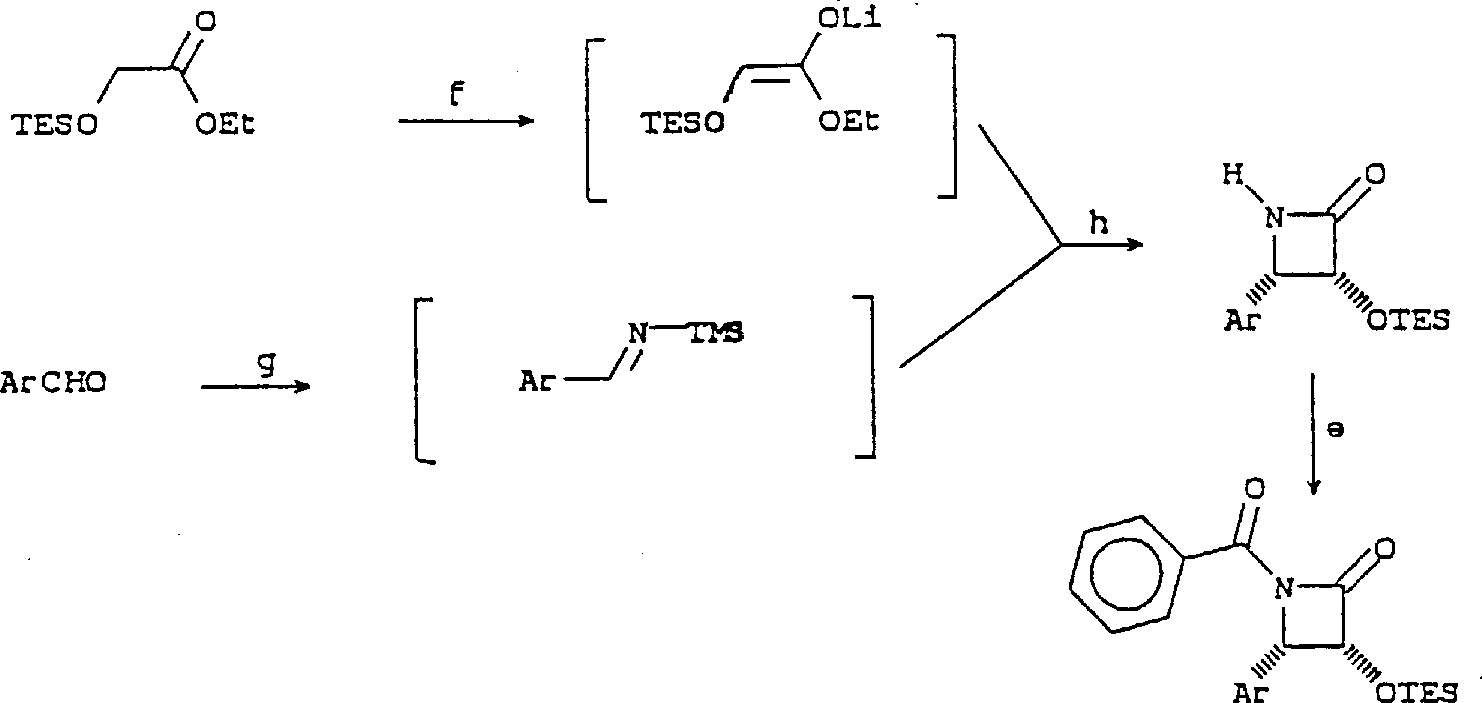 Reagent: (a) triethylamine, CH
2Cl
2, 25 ℃, 18h; (b) 4 equivalent ceric ammonium nitrates, CH
3CN ,-10 ℃, 10min; (c) KOH, THF, HA
2O, 0 ℃, 30min; (d) ethyl vinyl ether, THF, toluenesulphonic acids (catalyzer), 0 ℃, 1.5h; (e) n-Butyl Lithium, ether ,-78 ℃, 10min; Benzoyl chloride ,-78 ℃, 1h; (f) lithium diisopropylamide, THF-78 ℃ to-50 ℃; (g) lithium hexamethyl two silicon nitrine, THF-78 ℃ to 0 ℃; (h) THF ,-78 ℃ to-25 ℃, 12h.
Reagent: (a) triethylamine, CH
2Cl
2, 25 ℃, 18h; (b) 4 equivalent ceric ammonium nitrates, CH
3CN ,-10 ℃, 10min; (c) KOH, THF, HA
2O, 0 ℃, 30min; (d) ethyl vinyl ether, THF, toluenesulphonic acids (catalyzer), 0 ℃, 1.5h; (e) n-Butyl Lithium, ether ,-78 ℃, 10min; Benzoyl chloride ,-78 ℃, 1h; (f) lithium diisopropylamide, THF-78 ℃ to-50 ℃; (g) lithium hexamethyl two silicon nitrine, THF-78 ℃ to 0 ℃; (h) THF ,-78 ℃ to-25 ℃, 12h.
These raw materials all are easy to obtain.In option A, the alpha-acyloxy Acetyl Chloride 98Min. is prepared by oxyacetic acid, and imines is by aldehyde and right-anisidine preparation, in the presence of tertiary amine, and alpha-acyloxy Acetyl Chloride 98Min. and imines cyclocondensation and must 1-p-methoxyphenyl-3-acyloxy-4-aryl nitrogen heterocyclic din-2-ketone.The p-methoxyphenyl group can be by easily removing with the ceric ammonium nitrate oxidation, and the acyloxy group can hydrolysis under standard conditions well-known to those skilled in the art, and obtains 3-hydroxyl-4-aryl nitrogen heterocyclic din-2-ketone.The 3-oh group also can be protected with the blocking group of some standards, as triethyl silyl group or other trialkyl (or aryl) silylation group with the protection of 1-ethoxyethyl group.In the option b, α-triethyl silicane ethoxyacetic acid second fat is easy to preparation by oxyacetic acid.
The racemize beta-lactam by the recrystallization of corresponding 2-methoxyl group-2-(trifluoromethyl) phenylacetate, can change into pure enantiomorph before protection.Yet the reaction of connection β-carboxylic acid amide esters side chain described below has the high advantage of cis-selectivity, therefore allows to use the racemic mixture of side chain precursor.
3-(1-the triethyl silyl)-4-phenyl azetidine-2-ketone of the 3-of option A (1-ethoxy ethoxy)-4-phenyl azetidine-2-ketone and option b; under-78 ℃ or lower temperature; use a kind of alkali; preferred n-Butyl Lithium and a kind of chloride of acid, alkyl chloroformate, SULPHURYL CHLORIDE, phosphinyl chlorine or phosphoryl chloride are handled can change into beta-lactam (2).
As mentioned above, the used metal alkoxide of the inventive method has two, three or tetracyclic Taxan nuclear.The metal alkoxide that dicyclo Taxan nuclear is arranged used herein is equivalent to the compound that contains A and B ring in the structural formula (3):
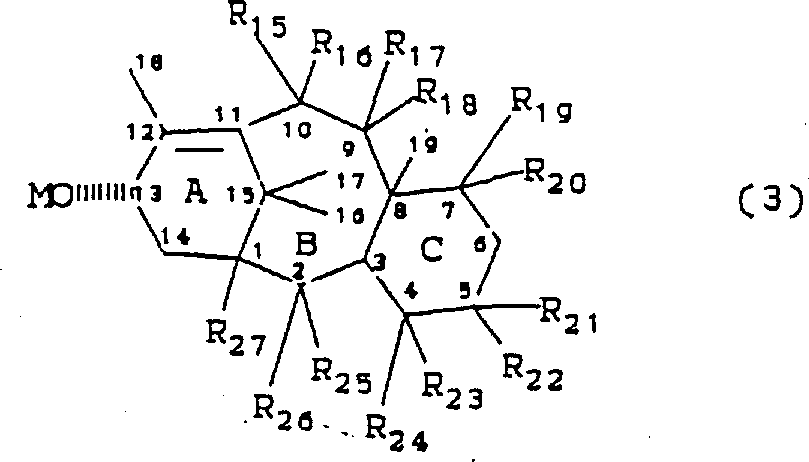 Wherein M and R
15~R
27With previously defined identical.The metal alkoxide that has three ring Taxans to examine is equivalent to the compound that contains A, B and C ring of structural formula (3).There is the metal alkoxide of Fourth Ring Taxan nuclear to be equivalent to the compound that contains A, B and C ring of structural formula (3), and R wherein
22And R
23Form oxygen fourth ring together.
Wherein M and R
15~R
27With previously defined identical.The metal alkoxide that has three ring Taxans to examine is equivalent to the compound that contains A, B and C ring of structural formula (3).There is the metal alkoxide of Fourth Ring Taxan nuclear to be equivalent to the compound that contains A, B and C ring of structural formula (3), and R wherein
22And R
23Form oxygen fourth ring together.
Used metal alkoxide preferable alloy alkoxide (3) in the inventive method.R most preferably
15For-OT
2Or-OCOCH
3R
16Be hydrogen; R
17And R
18Form oxo together; R
19For-OT
1R
20And R
21Be hydrogen; R
22And R
23Form an oxygen fourth ring together; R
24Be CH
3COO-; R
25Be PhCOO-; R
26Be hydrogen; R
27Be hydroxyl; Above-mentioned T
1And T
2Be respectively hydrogen or hydroxy-protective group.
Metal substituting group M in the metal alkoxide (3) is a kind of IA, IIA, IIIA family, group of the lanthanides or actinide elements, or a kind of transition metal, IIIA, IVA, VA or VIA metal.Preferred IA, IIA family or transition metal most preferably are lithium, magnesium, sodium, potassium or titanium.
The alkyl of metal alkoxide, or separately or have various substituting group defined above, be preferably the low alkyl group that contains 1~6 carbon atom in the main chain, and no more than 10 carbon atoms.They can be straight or brancheds, comprise methyl, ethyl, propyl group, sec.-propyl, butyl, isobutyl-, the tertiary butyl, aryl, hexyl etc.
The alkenyl of metal alkoxide, or separately or have various substituting group defined above, be preferably the low-grade alkenyl that contains 2~6 carbon atoms in the main chain, and no more than 10 carbon atoms.They can be straight or brancheds, comprise vinyl, propenyl, pseudoallyl, butenyl, isobutenyl, aryl, hexenyl etc.
The alkynyl of metal alkoxide, or separately or have various substituting group defined above, be preferably the low-grade alkynyl that contains 2~6 carbon atoms in the main chain, and no more than 10 carbon atoms.They can be straight or brancheds, comprise ethynyl, proyl, butynyl, isobutyl alkynyl, aryl, hexin base etc.
Typical alkanoyloxy comprises acetic ester, propionic ester, butyric ester, valerate, isobutyrate etc.Preferred alkanoyloxy is an acetic ester.
The aryl moiety of metal alkoxide, or separately or have various substituting groups, contain 6~10 carbon atoms, comprise phenyl, Alpha-Naphthyl or betanaphthyl etc.Substituting group comprises chain alkoxy, hydroxyl, halogen, alkyl, aryl, alkenyl, acyl group, acyloxy, nitro, amino, amide group etc.Aryl is phenyl more preferably.
Metal alkoxide (3) prepares to Fourth Ring Taxan nuclear and having monohydroxy alcohol and a kind of organometallics to react in appropriate solvent on the C-13 by having two.This alcohol is preferably the derivative of Baccatine III or 10-deacetylation baccatin III, and its structure is as follows:
 T in the formula
1Be a kind of hydroxy-protective group, Z is-OT
2, T wherein
2Be acyl group, preferred ethanoyl, or hydroxy-protective group.This alcohol most preferably is the Baccatine III through protection; particularly 7-O-triethyl silyl Baccatine III (can be by Greene etc. at JACS110; approach described in 5917 (1988) or other approach obtain) or 7,10-pair-O-triethyl silyl Baccatine III.
T in the formula
1Be a kind of hydroxy-protective group, Z is-OT
2, T wherein
2Be acyl group, preferred ethanoyl, or hydroxy-protective group.This alcohol most preferably is the Baccatine III through protection; particularly 7-O-triethyl silyl Baccatine III (can be by Greene etc. at JACS110; approach described in 5917 (1988) or other approach obtain) or 7,10-pair-O-triethyl silyl Baccatine III.
As reports such as Greene,, 10-deacetylation baccatin III can be changed into 7-O-triethyl silyl-10-deacetylation baccatin III by following reaction scheme:
 Under the top condition of report, under 23 ℃ of argon atmosphers, 10-deacetylation baccatin III and 20 equivalent (C
2H
5)
3SiCl reacted in pyridine 20 hours, and wherein the amount of pyridine is 50ml/mmol 10-deacetylation baccatin III, obtained reaction product 7-triethyl silyl-10-deacetylation baccatin III (6a), and productive rate is 84~86% behind the purifying.Then, this reaction product and 5 equivalent CH
3COCl and 25ml pyridine/mmol (6a) acetylize 48 hours under 0 ℃ of argon atmospher obtains productive rate and is 86% 7-O-triethyl silyl Baccatine III (6b).Referring to Greene etc., JACS110,5917~5918 (1988).
Under the top condition of report, under 23 ℃ of argon atmosphers, 10-deacetylation baccatin III and 20 equivalent (C
2H
5)
3SiCl reacted in pyridine 20 hours, and wherein the amount of pyridine is 50ml/mmol 10-deacetylation baccatin III, obtained reaction product 7-triethyl silyl-10-deacetylation baccatin III (6a), and productive rate is 84~86% behind the purifying.Then, this reaction product and 5 equivalent CH
3COCl and 25ml pyridine/mmol (6a) acetylize 48 hours under 0 ℃ of argon atmospher obtains productive rate and is 86% 7-O-triethyl silyl Baccatine III (6b).Referring to Greene etc., JACS110,5917~5918 (1988).
On the other hand, 7-triethyl silyl-10-deacetylation baccatin III (6a) can be with the unsettled hydroxy-protective group protection of a kind of acid on the oxygen of C-10.For example, in THF,, then handle with triethyl silyl chlorine (1.1mol equivalent) down, obtain 7 of 95% productive rate, 10-pair-O-triethyl silyl Baccatine III (6c) at 0 ℃ with n-Butyl Lithium processing (6a).And, handle (6a) with the methylsulfonic acid of excessive ethyl vinyl ether and catalytic amount, can make its productive rate change into 7-O-triethyl silyl-10-(1-ethoxyethyl group) Baccatine III (6d) with 90%.These preparation method's processes are described as follows with figure:

7-O-triethyl silyl Baccatine III (6b), 7,10-pair-O-triethyl silyl Baccatine III (6c), or 7-O-triethyl silyl-10-(1-ethoxyethyl group) Baccatine III (6d) reacts in a kind of solvent such as tetrahydrofuran (THF) (THF) with a kind of organometallics such as n-Butyl Lithium, generate metal alkoxide, it is 13-O-lithium-7-O-triethyl silyl Baccatine III (7b), 13-O-lithium-7,10-pair-O-triethyl silyl Baccatine III (7c) or 13-O-lithium-7-O-triethyl silyl-10-(1-ethoxyethyl group) Baccatine III (7d), shown in following response diagram:

Shown in following response diagram; be suitable for metal alkoxide of the present invention; derivative (7b, 7c or 7d) as 13-O-lithium-7-O-triethyl silyl Baccatine III; with beta-lactam reaction of the present invention; generate intermediate (8b, 8c or 8d), wherein the hydroxyl on the C-7 is with triethyl silyl or 1-ethoxyethyl group radical protection.
 7b-d (2) 8b-d
b,R=-COCH
3
c,R=-Si(C
2H
5)
3
d,R=-EE
Work as R
1For-OR
6, R
2And R
3Be hydrogen, R
4Be phenyl, R
5Be benzoyl, and R
6During for hydroxy-protective group such as triethyl silyl, midbody compound (8b) is easy to change into taxol.Work as R
1For-OR
6, R
2And R
3Be hydrogen, R
4Be phenyl, R
5Be tert-butoxycarbonyl, and R
6During for hydroxy-protective group such as triethyl silyl, midbody compound (8c) is easy to change into taxotere.Work as R
1For-OR
6, R
2And R
3Be hydrogen, R
4Be phenyl, R
5Be benzoyl, and R
6During for hydroxy-protective group such as triethyl silyl, midbody compound (8d) is easy to change into 10-and takes off the acetyl taxol.Under the substituent mild conditions of unlikely interference ester bond or Taxane derivative, hydrolysis triethyl silyl and 1-ethoxyethyl group group can change into midbody compound (8b, 8c and 8d) compound that needs.
By the substituting group of selecting to be fit to, i.e. the R of beta-lactam (2)
1~R
5Or the R of metal alkoxide (3)
15~R
27, other Taxane derivative can prepare at an easy rate.The preparation of other this compound illustrates in the embodiment of back.
Alcohol synthesizes to the conversion and the final of taxol of metal alkoxide, and both can carry out in same reactor.Preferably, after metal alkoxide forms, add beta-lactam in reactor.
Preferred organometallics-the n-Butyl Lithium that uses changes into the corresponding metal alkoxide with alcohol, but also can use other metal substituting group raw material, as amination di-isopropyl lithium, other lithium amide or magnesium, ethyl-magnesium-bromide, methylmagnesium-bromide, other organolithium compound, other organo-magnesium compound, organic sodium, organic titanium or organic potassium.Organometallics is easy to obtain, the preparation of perhaps available method in common, and the preparation method comprises and uses the metallic reducing Organohalogen compounds.For example, butyl bromide can react with metallic lithium in Anaesthetie Ether, obtains n-butyllithium solution, and reactive mode is as follows:
Although tetrahydrofuran (THF) (THF) is the preferred solvent of reaction mixture, other ether solvent also is fit to as glycol dimethyl ether or aromatic species solvent.Some solvents comprise some halogenated solvent and some straight chain hydrocarbon, and are too poor because of reactant solvability therein, are unaccommodated solvent.Other solvent is because other is former thereby inapplicable.For example, ester is not suitable for some organometallicss such as n-Butyl Lithium, because they are immiscible.
Though reaction scheme disclosed herein only relates to the synthetic of some D51-7059, this beta-lactam or Fourth Ring metal alkoxide still can use after modification.Therefore, the method according to this invention, except that 13-O-lithium-7-O-triethyl silyl Baccatine III, other metal alkoxide also can be used for forming the taxol intermediate.Beta-lactam and Fourth Ring metal alkoxide can take off acetyl taxol and enantiomorph and diastereomer with other taxol biosynthesis, D51-7059,10-in the preparation scope of the invention by obtaining in natural or the non-natural source.
The inventive method also has an important advantage, i.e. cis-selectivity height.Therefore, can use the racemic mixture of side chain precursor.Reduced cost owing to not needing that racemic beta-lactam is separated into pure enantiomorph.In addition, because required side chain precursor reduces, for example hanged down 60~70%, and reduce cost than former method.
If R
1For-OR
6, R
19For-OT
1, and R
6And/or T
1For increasing deliquescent functional group as-COGCOR
1, then can improve the water-soluble of formula (1) compound, wherein
G is ethene, propylene, CHCH, 1,2-hexanaphthene and 1, and the 2-penylene,
R
1=OH alkali, NR
2R
3, OR
3, SR
3, OCH
2CONR
4R
5,
OH
R
2=hydrogen, methyl
R
3=(CH
2)nNR
6R
7;(CH
2)nNR
_6R
7R
8X
1 _
n =1~3
R
4=hydrogen, contain the low alkyl group of 1~4 carbon atom
R
5=hydrogen, the low alkyl group that contains 1~4 carbon atom, benzyl, hydroxyethyl,
CH
2CO
2H, dimethylaminoethyl R
6R
7=contain low alkyl group, benzyl or the R of 1 or 2 carbon
6And R
7With
NR
6R
7Nitrogen-atoms form following ring together

R
8=contain low alkyl group, the benzyl of 1 or 2 carbon
X
1 -=halogen
Alkali=NH
3, (HOC
2H
4)
3N, N (CH
3)
3, CH
3N (C
2H
4OH)
2,
NH
2(CH
2)
6NH
2, N-methylglucosamine, NaOH, KOH.R wherein
6Or T
1For-COGCOR
1The preparation of compound in the U.S. Pat 4,942,184 of Hangwitz, explanation is arranged, the present invention is in conjunction with the reference document.
The following examples describe the present invention in detail.
Embodiment 1
By racemic beta-lactam preparation 2 '-ethoxyethyl group-7-triethyl silyl taxol, and taxol:
Under-78 ℃, (20mg, 0.028mmol) solution drips the hexane solution that 0.17ml contains 0.164M nBuLi to the 7-triethyl silyl Baccatine III in 1ml THF.After-78 ℃ of following 30min, (47.5mg, 1ml THF solution 0.14mmol) splashes in this mixture will to contain suitable-1-benzoyl-3-(1-ethoxy ethoxy)-4-phenyl azetidine-2-ketone.With this solution lentamente (more than the 1.5h) be heated to 0 ℃, stir down 1h at 0 ℃ then, and add the THF solution that 1ml contains 10%AcOH.Mixture is distributed in NaHCO
3Between saturated aqueous solution and 60/40 the ethyl acetate/hexane.The organic layer evaporation, and obtain a raffinate.Purify by flash chromatography, obtain 23mg (80%) (2 ' R, 3 ' S)-2 '-ethoxyethyl group-7-triethyl silyl taxol and 3.5mg (13%) 2 ', 3 '-Biao (2 ' S, 3 ' R)-2 '-ethoxyethyl group-7-triethyl silyl taxol.
With 5mg (2 ' R, 3 ' S)-2 '-ethoxyethyl group-7-triethyl silyl taxol sample is dissolved in the 2ml ethanol, and adds the HCl aqueous solution of 0.5ml 0.5%.Stir 30h down at 0 ℃, and dilute with the 50ml ethyl acetate.This solution concentrates through dried over sodium sulfate with the extraction of 20ml saturated sodium bicarbonate aqueous solution.Resistates is purified by flash chromatography, obtains 4.5mg (about 90%) taxol, and its each side is all identical with standard model.
With 5mg 2 ', 3 '-Biao (2 ' S, 3 ' R)-2 '-ethoxyethyl group-7-triethyl silyl taxol sample is dissolved in the 2ml ethanol, and the HCl aqueous solution of adding 0.5ml0.5%.Stir 30h down at 0 ℃, and dilute with the 50ml ethyl acetate.This solution concentrates through dried over sodium sulfate with the extraction of 20ml saturated sodium bicarbonate aqueous solution.Resistates is purified by flash chromatography, obtains 4.5mg (about 90%) 2 ', 3 '-taxol.
Embodiment 2
By racemic beta-lactam preparation 2 ', 7-(two) triethyl silyl taxol, and taxol:
(100mg, 0.143mmol) solution under-45 ℃, splash into the hexane solution of 0.087ml 1.63M nBuLi to 7-triethyl silyl Baccatine III in 1ml THF.After-45 ℃ of following 1h, will contain that suitable-1-benzoyl-(274mg, 0.715mmol) THF solution splashes in this mixture 3-triethyl silicane oxygen base-4-phenyl azetidine-2-ketone at 1ml.This solution is heated to 0 ℃, and remains on 1h under this temperature.The THF solution that adds 1ml 10%AcOH.Mixture is distributed in saturated NaHCO
3Between the aqueous solution and 60/40 the ethyl acetate/hexane.The organic layer evaporation obtains a raffinate.Purify by flash chromatography, recrystallization then, obtain 131mg (85%) (2 ' R, 3 ' S)-2 ', 7-(two) triethyl silyl taxol, and 15mg (10%) 2 ', 3 '-Biao (2 ' S, 3 ' R)-2 ', 7-(two) triethyl silyl taxol.
For the 121.3mg (0.112mmol) in 6ml acetonitrile and 0.3ml pyridine (2 ' R, 3 ' S)-2 ', the solution of 7-(two) triethyl silyl taxol is at 0 ℃ of HF aqueous solution that adds down 0.9ml 48%.This mixture is stirred 8h down at 0 ℃, stir 6h down at 25 ℃ then.Mixture is distributed between saturated sodium bicarbonate aqueous solution and the ethyl acetate.Ethyl acetate solution evaporates and obtains the 113mg raffinate, purifies by flash chromatography, and recrystallization, and obtaining 94mg (98%) taxol, its each side is all identical with standard model.
For the 5mg in 0.5ml acetonitrile and 0.03ml pyridine (2 ' R, 3 ' S)-2 ', the solution of 7-(two) triethyl silyl taxol is at 0 ℃ of HF aqueous solution that adds down 0.09ml 48%.This mixture is stirred 8h down at 0 ℃, stir 6h down at 25 ℃ then.Mixture is distributed between saturated sodium bicarbonate aqueous solution and the ethyl acetate.Ethyl acetate solution evaporates and obtains the 5mg raffinate, purifies by flash chromatography, and recrystallization, obtain 4.6mg (about 95%) 2 ', 3 '-Epitaxol.
Embodiment 3
By the beta-lactam of optically-active preparation 2 ', 7-(two) triethyl silyl taxol, and taxol:
(100mg, 0.143mmol) solution under-45 ℃, splash into the hexane solution of 0.087ml1.63M nBuLi for the 7-triethyl silyl Baccatine III in 1ml THF.After-45 ℃ of following 1h, will be in 1mlTHF (+)-suitable-1-benzoyl-(82mg, 0.215mmol) solution splashes in this mixture 3-triethyl silicane oxygen base-4-phenyl azetidine-2-ketone.This solution is heated to 0 ℃, and remains on 2h under this temperature.The THF solution that adds 1ml 10%AcOH.Mixture is distributed in saturated NaHCO
3Between the aqueous solution and 60/40 the ethyl acetate/hexane.The organic layer evaporation obtains a raffinate.Purify by flash chromatography, recrystallization then, obtain 145mg (94%) (2 ' R, 3 ' S)-2 ', 7-(two) triethyl silyl taxol.
For the 121.3mg (0.112mmol) in 6ml acetonitrile and 0.3ml pyridine (2 ' R, 3 ' S)-2 ', the solution of 7-(two) triethyl silyl taxol is at 0 ℃ of HF aqueous solution that adds down 0.9ml 48%.This mixture is stirred 8h down at 0 ℃, stir 6h down at 25 ℃ then.Mixture is distributed between saturated sodium bicarbonate aqueous solution and the ethyl acetate.Ethyl acetate solution evaporates and obtains the 113mg raffinate, purifies by flash chromatography, and recrystallization, obtaining 94mg (98%) taxol, its each side is all identical with standard model.
Embodiment 4
The preparation of taxotere.
For in 2ml THF 7,10-is two-(200mg, 0.248mmol) solution under-45 ℃, splash into the hexane solution of 0.174ml 1.63M nBuLi to the triethyl silyl Baccatine III.After-45 ℃ of following 0.5h, will be in 2ml THF suitable-1-(tert-butoxycarbonyl)-(467mg, 1.24mmol) solution splashes in this mixture 3-triethyl silicane oxygen base-4-phenyl azetidine-2-ketone.This solution is heated to 0 ℃, and remains on 1h under this temperature, add the THF solution of 1ml 10%AcOH then.Mixture is distributed in saturated NaHCO
3Between the aqueous solution and 60/40 the ethyl acetate/hexane.The organic layer evaporation obtains a raffinate.Purify by filtered through silica gel, obtain 280mg thick 2 ', 7,10-three-triethyl silyl taxotere.
For the crude product in solution of the above-mentioned reaction gained of 280mg in 12ml acetonitrile and 0.6ml pyridine, at 0 ℃ of HF aqueous solution that adds 1.8ml 48% down.This mixture is stirred 3h down at 0 ℃, stir 13h down at 25 ℃ then.It is distributed between saturated sodium bicarbonate aqueous solution and the ethyl acetate.Ethyl acetate solution evaporates and obtains a raffinate, purifies by flash chromatography, and recrystallization from methanol, and obtain 190mg (95%) taxotere.Its all analyze and spectroscopic data all with United States Patent (USP) 4,814, the taxotere of reporting in 470 is identical.
Embodiment 5
Np wherein
2For
3 '-Tuo phenyl-3 '-preparation of (2-naphthyl) taxol.
(200mg, 0.286mmol) solution under-45 ℃, splash into the hexane solution of 0.174ml1.63M nBuLi for the 7-triethyl silyl Baccatine III in 2ml THF.After-45 ℃ of following 0.5h, will be in 2ml THF suitable-1-benzoyl-(620mg, 1.43mmol) solution splashes in this mixture 3-triethyl silicane oxygen base-4-(2-naphthyl) nitrogen heterocyclic din-2-ketone.This solution is heated to 0 ℃, and remains on 1h under this temperature, add the THF solution of 1ml 10%AcOH then.Mixture is distributed in saturated NaHCO
3Between the aqueous solution and 60/40 the ethyl acetate/hexane.The organic layer evaporation obtains a raffinate.Purify by filtered through silica gel, and obtain 320mg contain (2 ' R, 3 ' S)-2 ', 7-(two) triethyl silyl-3 '-Tuo phenyl-3 '-(2-naphthyl) taxol and a small amount of (2 ' S, 3 ' R) mixture of isomers.
Mixture (320mg, 0.283mmol) solution, the HF aqueous solution of adding 2.8ml 48% under 0 ℃ for the above-mentioned reaction gained in 18ml acetonitrile and 0.93ml pyridine.This mixture is stirred 3h down at 0 ℃, stir 13h down at 25 ℃ then, again it is distributed between saturated sodium bicarbonate aqueous solution and the ethyl acetate.Ethyl acetate solution evaporation and obtain the 255mg raffinate is purified by flash chromatography, recrystallization from methanol, and obtain 166mg (64%) 3 '-Tuo phenyl-3 '-(2-naphthyl) taxol.M.p 164-165 ℃; [α]
25 Na-52.6 ° (c 0.005, CHCl
3).
1H NMR (CDCl
3, 300MHz) δ 8.14 (d, J=7.3Hz, 2H, ortho position benzoic ether), 7.96 (m, 1H, aromatic hydrocarbon), 7.90 (m, 1H, aromatic hydrocarbon), 7.85 (m, 2H, aromatic hydrocarbon), 7.76 (m, 2H, aromatic hydrocarbon), 7.60 (m, 3H, aromatic hydrocarbon), 7.52 (m, 4H, aromatic hydrocarbon), 7.41 (m, 2H, aromatic hydrocarbon), 7.01 (d, J=8.8Hz, 1H, NH), 6.27 (s, 1H, H10), 6.26 (dd, J=9.2,9.2Hz, 1H, H13), 5.97 (dd, J=8.8,2.5Hz, 1H, H3 '), 5.68 (d, J=7.1Hz, 1H, H2 β), 4.93 (m, 1H, H5), (4.92 m, 1H, H2 '), 4.39 (m, 1H, H7), 4.30 (d, J=8.5Hz, 1H, H20 α), (4.20 d, J=8.5Hz, 1H, H20 β), 3.81 (d, J=7.1Hz, 1H, H3), 3.60 (d, J=5Hz, 1H, 2 ' OH), 2.48 (m, 1H, H6 α), 2.45 (br, 1H, 7OH), 2.39 (s, 3H, 4Ac), 2.30 (m, 2H, H14), 2.24 (s, 3H, 10Ac), 1.83 (m, 1H, H6 β), 1.82 (br s, 3H, Me18), 1.68 (s, 1H, 1OH), 1.68 (3,3H, Me19), 1.24 (s, 3H, Me17), 1.14 (s, 3H, Me16).
Embodiment 5A
Np wherein
1For
3 '-Tuo phenyl-3 '-preparation of (1-naphthyl) taxol.
(200mg, 0.286mmol) solution under-45 ℃, splash into the hexane solution of 0.174ml1.63M nBuLi for the 7-triethyl silyl Baccatine III in 2ml THF.After-45 ℃ of following 0.5h, will be in 2ml THF suitable-1-benzoyl-(620mg, 1.43mmol) solution splashes in this mixture 3-triethyl silicane oxygen base-4-(1-naphthyl) nitrogen heterocyclic din-2-ketone.This solution is heated to 0 ℃, and remains on 1h under this temperature, add the THF solution of 1ml 10%AcOH then.Mixture is distributed in saturated NaHCO
3Between the aqueous solution and 60/40 the ethyl acetate/hexane.The organic layer evaporation obtains a raffinate.Purify by filtered through silica gel, obtain 325mg contain (2 ' R, 3 ' S)-2 ', 7-(two) triethyl silyl-3 '-Tuo phenyl-3 '-(1-naphthyl) taxol and a small amount of (2 ' S, 3 ' R) mixture of isomers.
(325mg, 0.287mmol) solution is at 0 ℃ of HF aqueous solution that adds 2.8ml 48% down for the mixture of giving a tongue-lashing the above-mentioned reaction gained in the pyridine at 18ml acetonitrile and 0.93ml.This mixture is stirred 3h down at 0 ℃, stir 13h down at 25 ℃ then, again it is distributed between saturated sodium bicarbonate aqueous solution and the ethyl acetate.Ethyl acetate solution evaporates and obtains the 260mg raffinate, purifies by flash chromatography, and recrystallization from methanol, and obtain 166mg (64%) 3 '-(1-naphthyl) taxol.M.p.164-165 ℃; [α]
25 Na-52.6 ° (c 0.005, CHCl
3).
1H NMR (CDCl
3, 300MHz) δ 8.11 (d, J=7.1Hz, 2H, o-benzoate), (8.11 m, 3H, aromatic hydrocarbon), 7.91 (m, 3H, aromatic hydrocarbon), 7.70 (m, 2H, ε aromatic hydrocarbon c), 7.63-7.46 (m, 7H, aromatic hydrocarbon), 6.75 (d, J=8.8Hz, 1H, NH), 6.52 (dd, J=8.8,1.6Hz, 1H, H3 '), 6.27 (s, 1H, H10), 6.27 (dd, J=9.1,9.1Hz, 1H, H13), 5.68 (d, J=7.1Hz, 1H, H2 β), 4.85 (dd, J=7.6,2.2Hz, 1H, H5), 4.97 (dd, J=1.6Hz, 1H, H2 '), 4.39 (m, 1H, H7), (4.24 d, J=8.5Hz, 1H, H20 α), 4.17 (d, J=8.5Hz, 1H, H20 β), 3.80 (d, J=7.1Hz, 1H, H3), 3.65 (br, 1H, 2 ' OH), (2.55 m, 1H, H6 α), 2.48 (br, 1H, 7OH), 2.41 (s, 3H, 4Ac), 2.38 (m, 1H, H14), 1.96 (s, 3H, 10Ac), (1.86 m, 1H, H6 β), 1.80 (br s, 3H, Me18), 1.76 (s, 1H, 1OH), 1.69 (s, 3H, Me19), 1.28 (s, 3H, Me17), 1.16 (s, 3H, Me16).
Embodiment 6
3 '-Tuo phenyl-3 '-preparation of (4-p-methoxy-phenyl) taxol.
(200mg, 0.286mmol) solution under-45 ℃, splash into the hexane solution of 0.174ml1.63M nBuLi for the 7-triethyl silyl Baccatine III in 2ml THF.After-45 ℃ of following 0.5h, will be in 2ml THF suitable-1-benzoyl-(590mg, 1.43mmol) solution splashes in this mixture 3-triethyl silicane oxygen base-4-(4-p-methoxy-phenyl) nitrogen heterocyclic din-2-ketone.This solution is heated to 0 ℃, and remains on 1h under this temperature, add the THF solution of 1ml 10%AcOH then.Mixture is distributed in saturated NaHCO
3Between the aqueous solution and 60/40 the ethyl acetate/hexane.The organic layer evaporation, and obtain a raffinate.Purify by filtered through silica gel, obtain 320mg contain (2 ' R, 3 ' S)-2 ', 7-(two) triethyl silyl-3 '-Tuo phenyl-3 '-(4-p-methoxy-phenyl) taxol and a small amount of (2 ' S, 3 ' R) mixture of isomers.
Mixture (320mg, 0.288mmol) solution, the HF aqueous solution of adding 2.8ml 48% under 0 ℃ for the above-mentioned reaction gained in 18ml acetonitrile and 0.93ml pyridine.This mixture is stirred 3h down at 0 ℃, stir 13h down at 25 ℃ then, again it is distributed between saturated sodium bicarbonate aqueous solution and the ethyl acetate.Ethyl acetate solution evaporation and obtain the 255mg raffinate is purified by flash chromatography, recrystallization from methanol, obtain 172mg (68%) 3 '-Tuo phenyl-3 '-(4-p-methoxy-phenyl) taxol.M.p.174-176 ℃; [α]
25 Na-48.86 ° (c 0.05, CHCl
3).
1H NMR (CDCl
3, 300MHz) δ 8.12 (d, J=7.1Hz, 2H, o-benzoate), 7.72 (m, 2H, aromatic hydrocarbon), 7.59 (m, 1H, aromatic hydrocarbon), 7.53-7.36 (m, 8H, aromatic hydrocarbon), 6.96 (d, J=8.8Hz, 1H, NH), (6.90 m, 2H, aromatic hydrocarbon), 6.26 (s, 1H, H10), 6.21 (dd, J=9.3,9.3Hz, 1H, H13), (5.70 dd, J=8.8,2.7Hz, 1H, H3 '), (5.66 d, J=6.8Hz, 1H, H2 β), 4.93 (dd, J=9.9,2.2Hz, 1H, H5), 4.74 (dd, J=5.5,2.7Hz, 1H, H2 '), 4.39 (m, 1H, H7), 4.29 (d, J=8.8Hz, 1H, H20 α), 4.18 (d, J=8.8Hz, 1H, H20 β), 3.78 (d, J=6.8Hz, 1H, H3), 3.78 (s, 3H, ArOMe), 3.67 (d, J=5.5Hz, 1H, 2 ' OH), 2.61 (m, 1H, H6 α), 2.50 (d, J=4.4Hz, 1H, 7OH), 2.37 (s, 3H, 4Ac), 2.31 (m, 2H, H14), 2.22 (s, 3H, 10Ac), 1.84 (m, 1H, H6 β), 1.79 (br s, 3H, Me18), 1.79 (s, 1H, 1OH), 1.67 (s, 3H, Me19), 1.22 (s, 3H, Me17), 1.13 (s, 3H, Me16).
Embodiment 6A
3 '-Tuo phenyl-3 '-preparation of (4-chloro-phenyl-) taxol.
(200mg, 0.286mmol) solution under-45 ℃, splash into the hexane solution of 0.174ml1.63M nBuLi for the 7-triethyl silyl Baccatine III in 2ml THF.After-45 ℃ of following 0.5h, will be in 2ml THF suitable-1-benzoyl-(595mg, 1.43mmol) solution splashes in this mixture 3-triethyl silicane oxygen base-4-(4-chloro-phenyl-) nitrogen heterocyclic din-2-ketone.This solution is heated to 0 ℃, and remains on 1h under this temperature, add the THF solution of 1ml 10%AcOH then.Mixture is distributed in saturated NaHCO
3Between the aqueous solution and 60/40 the ethyl acetate/hexane.Organic layer evaporation and obtain a raffinate.Purify by filtered through silica gel, obtain 320mg contain (2 ' R, 3 ' S)-2 ', 7-(two) triethyl silyl-3 '-Tuo phenyl-3 '-(4-chloro-phenyl-) taxol and a small amount of (2 ' S, 3 ' R) mixture of isomers.
Mixture (320mg, 0.287mmol) solution, the HF aqueous solution of adding 2.8ml 48% under 0 ℃ for the above-mentioned reaction gained in 18ml acetonitrile and 0.93ml pyridine.This mixture is stirred 3h down at 0 ℃, stir 13h down at 25 ℃ then, again it is distributed between saturated sodium bicarbonate aqueous solution and the ethyl acetate.Ethyl acetate solution evaporation and obtain the 255mg raffinate is purified by flash chromatography, recrystallization from methanol, obtain 158mg (62%) 3 '-Tuo phenyl-3 '-(4-chloro-phenyl-) taxol.M.p.173-175 ℃; [α]
25 Na-50.8 ° of (c0.01, CHCl
3).
1H NMR (CDCl
3, 300MHz) δ 8.13 (d, J=7.1Hz, 2H, o-benzoate
), 7.72 (d, J=8.2Hz, 2H, benzamides), 7.65-7.35 (m, 1OH, aromatic hydrocarbon), 6.97 (d, J=8.8Hz, 1H, NH), 6.27 (s, 1H, H10), 6.25 (dd, J=8.3,8.3Hz, 1H, H13), 5.78 (dd, J=8.8,2.2Hz, 1H, H3 '), 5.67 (d, J=7.1Hz, 1H, H2 β), 4.95 (dd, J=8.8,2.2Hz, 1H, H5), 4.77 (br s, 1H, H2 '), 4.40 (m, 1H, H7), 4.31 (d, J=8.2Hz, 1H, H20 α), 4.19 (d, J=8.2Hz, 1H, H20 β), 3.80 (d, J=7.1Hz, 1H, H3), 3.51 (br s, 1H, 2 ' OH), 2.54 (m, 1H, H6 α), 2.38 (s, 3H, 4Ac), 2.32 (m, 2H, H14), 2.24 (s, 3H, 10Ac), 1.85 (m, 1H, H6 β), 1.80 (br s, 3H, Me18), 1.68 (s, 3H, Me19), 1.23 (s, 3H, Me17), 1.14 (s, 3H, Me16).
Embodiment 7

3 '-Tuo phenyl-3 '-preparation of (4-bromophenyl) taxol.
(200mg, 0.286mmol) solution under-45 ℃, splash into the hexane solution of 0.174ml1.63M nBuLi for the 7-triethyl silyl Baccatine III in 2ml THF.After-45 ℃ of following 0.5h, will be in 2ml THF suitable-1-benzoyl-(660mg, 1.43mmol) solution splashes in this mixture 3-triethyl silicane oxygen base-4-(4-bromophenyl) nitrogen heterocyclic din-2-ketone.This solution is heated to 0 ℃, and remains on 1h under this temperature, add the THF solution of the AcOH of 1ml 10% then.Mixture is distributed in saturated NaHCO
3Between the aqueous solution and 60/40 the ethyl acetate/hexane.The organic layer evaporation, and obtain a raffinate.Purify by filtered through silica gel, obtain 330mg contain (2 ' R, 3 ' S)-2 ', 7-(two) triethyl silyl-3 '-Tuo phenyl-3 '-(4-bromophenyl) taxol and a small amount of (2 ' S, 3 ' R) mixture of isomers.
Mixture (330mg, 0.284mmol) solution, the HF aqueous solution of adding 2.8ml 48% under 0 ℃ for the above-mentioned reaction gained in 18ml acetonitrile and 0.93ml pyridine.This mixture is stirred 3h down at 0 ℃, stir 13h down at 25 ℃ then, again it is distributed between saturated sodium bicarbonate aqueous solution and the ethyl acetate.Ethyl acetate solution evaporation and obtain the 265mg raffinate is purified by flash chromatography, recrystallization from methanol, obtain 186mg (64%) 3 '-Tuo phenyl-3 '-(4-bromophenyl) taxol.M.p.170-172 ℃; [α]
25 Na-50.94 ° (c 0.01, CHCl
3).
1H NMR (CDCl
3, 300MHz) δ 8.12 (d, J=7.2Hz, 2H, o-benzoate), (7.71 m, 2H, aromatic hydrocarbon), 7.61 (m, 1H, aromatic hydrocarbon), 7.50-7.47 (m, 6H, aromatic hydrocarbon), 7.38 (m, 3H, aromatic hydrocarbon), 7.04 (d, J=8.8Hz, 1H, NH), 6.27 (3,1H, H10), 6.23 (dd, J=8.2,8.2Hz, 1H, H13), 5.75 (dd, J=8.8,2.2Hz, 1H, H3 '), 5.66 (d, J=7.1Hz, 1H, H2 β), 4.94 (dd, J=9.3,1.7Hz, 1H, H5), 4.75 (dd, J=2.2Hz, 1H, H2 '), 4.38 (m, 1H, H7), (4.29 d, J=8.2Hz, 1H, H20 α), 4.18 (d, J=8.2Hz, 1H, H20 β), 3.79 (d, J=7.1Hz, 1H, H3), 3.7 (br, 1H, 2 ' OH), (2.53 m, 1H, H6 α), 2.38 (br, 1H, 7OH), 2.37 (s, 3H, 4Ac), 2.30 (m, 2H, H14), 2.23 (s, 3H, 10Ac), (1.87 m, 1H, H6 β), 1.80 (br s, 3H, Me18), 1.80 (s, 1H, 1OH), 1.67 (s, 3H, Me19), 1.22 (s, 3H, Me17), 1.13 (s, 3H, Me16).
Embodiment 8

3 '-Tuo phenyl-3 '-preparation of (3, the 4-methylenedioxyphenyl) taxol.
(200mg, 0.286mmol) solution under-45 ℃, splash into the hexane solution of 0.174ml1.63M nBuLi for the 7-triethyl silyl Baccatine III in 2ml THF.After-45 ℃ of following 0.5h, will be in 2ml THF suitable-1-benzoyl-(610mg, 1.43mmol) solution splashes in this mixture 3-triethyl silicane oxygen base-4-(3, the 4-methylenedioxyphenyl) nitrogen heterocyclic din-2-ketone.This solution is heated to 0 ℃, and remains on 1h under this temperature, add the THF solution of the AcOH of 1ml 10% then.Mixture is distributed in saturated NaHCO
3Between the aqueous solution and 60/40 the ethyl acetate/hexane.Organic layer evaporation and obtain a raffinate.Purify by filtered through silica gel, obtain 320mg contain (2 ' R, 3 ' S)-2 ', 7-(two) triethyl silyl-3 '-Tuo phenyl-3 '-(3, the 4-methylenedioxyphenyl) taxol and a small amount of (2 ' S, 3 ' R) mixture of isomers.
For mixture (320mg 0.284mmol) solution of the above-mentioned reaction gained in 18ml acetonitrile and 0.93ml pyridine, at 0 ℃ of HF aqueous solution that adds 2.8ml 48% down.This mixture is stirred 3h down at 0 ℃, stir 13h down at 25 ℃ then, again it is distributed between saturated sodium bicarbonate aqueous solution and the ethyl acetate.Ethyl acetate solution evaporation and obtain the 113mg raffinate is purified by flash chromatography, recrystallization from methanol, obtain 165mg (64%) 3 '-Tuo phenyl-3 '-(3, the 4-methylenedioxyphenyl) taxol.M.p.178-180 ℃; [α]
25 Na-46.6 ° (c 0.005, CHCl
3).
1H NMR (CDCl
3, 300MHz) δ 8.14 (d, J=7.2Hz, 2H, o-benzoate
), 7.72 (m, 2H, aromatic hydrocarbon), 7.15 (m, 1H, aromatic hydrocarbon), 7.50 (m, 2H, aromatic hydrocarbon), 7.38 (m, 2H, aromatic hydrocarbon), 7.0 (m, 1H, aromatic hydrocarbon), 6.94 (m, 2H, aromatic hydrocarbon), 6.88 (d, J=9.1Hz, 1H, NH), 6.83 (m, 1H, aromatic hydrocarbon), 6.28 (s, 1H, H10), 6.23 (dd, J=9.1,9.1Hz, 1H, H13), 5.97 (s, 2H, methylene), 5.69 (dd, J=9.1,2.5Hz, 1H, H3 '), (5.68 d, J=6.9Hz, 1H, H2 β), 4.95 (dd, J=9.6,2.2Hz, 1H, H5), 4.72 (dd, J=2.5Hz, 1H, H2 '), 4.41 (m, 1H, H7), 4.31 (d, J=8.4Hz, 1H, H20 α), (4.20 d, J=8.4Hz, 1H, H20 β), 3.81 (d, J=6.9Hz, 1H, H3), 3.60 (br, 1H, 2 ' OH), 2.56 (m, 1H, H6 α), 2.43 (d, J=4.1Hz, 1H, 7OH), 2.39 (s, 3H, 4Ac), 2.31 (m, 2H, H14), 2.24 (s, 3H, 10Ac), 1.88 (m, 1H, H6 β), 1.82 (br s, 3H, Me18), 1.69 (s, 1H, 1OH), 1.68 (s, 3H, Me19), 1.24 (s, 3H, Me17), 1.15 (s, 3H, Me16).
Embodiment 9
3 '-Tuo phenyl-3 '-preparation of (3, the 4-Dimethoxyphenyl) taxol.
(200mg, 0.286mmol) solution under-45 ℃, splash into the hexane solution of 0.174ml 1.63M nBuLi for the 7-triethyl silyl Baccatine III in 2ml THF.After-45 ℃ of following 0.5h, will be in 2ml THF suitable-1-benzoyl-(630mg, 1.43mmol) solution splashes in this mixture 3-triethyl silicane oxygen base-4-(3, the 4-Dimethoxyphenyl) nitrogen heterocyclic din-2-ketone.This solution is heated to 0 ℃, and remains on 1h under this temperature, add the THF solution of the AcOH of 1ml 10% then.Mixture is distributed in saturated NaHCO
3Between the aqueous solution and 60/40 the ethyl acetate/hexane.The organic layer evaporation obtains a raffinate.Purify by filtered through silica gel, obtain 330mg contain (2 ' R, 3 ' S)-2 ', 7-(two) triethyl silyl-3 '-Tuo phenyl-3 '-(3, the 4-Dimethoxyphenyl) taxol and a small amount of (2 ' S, 3 ' R) mixture of isomers.
Mixture (330mg, 0.286mmol) solution, the HF aqueous solution of adding 2.8ml 48% under 0 ℃ for the above-mentioned reaction gained in 18ml acetonitrile and 0.93ml pyridine.This mixture is stirred 3h down at 0 ℃, stir 13h down at 25 ℃ then, and it is distributed between saturated sodium bicarbonate aqueous solution and the ethyl acetate.Ethyl acetate solution evaporation and obtain the 260mg raffinate is purified by flash chromatography, recrystallization from methanol, obtain 175mg (67%) 3 '-Tuo phenyl-3 '-(3, the 4-Dimethoxyphenyl) taxol.M.p.165-167 ℃; [α]
25 Na-42.0 ° (C 0.005, CHCl
3).
1H NMR (CDCl
3, 300MHz) δ 8.12 (d, J=8.3Hz, 2H, o-benzoate
), 7.73 (d, J=8.2Hz, 2H, adjacent benzamides), 7.65-7.35 (m, 6H, aromatic hydrocarbon), 7.1-7.0 (m, 2H, aromatic hydrocarbon), 6.94 (d, J=8.8Hz, 1H, NH), 6.88 (d, J=8.3Hz, 2H, aromatic hydrocarbon), 6.27 (s, 1H, H10), 6.21 (dd, J=9.3,9.3Hz, 1H, H13), 5.69 (m, 2H, H3, H2 β), 4.94 (dd, Hz, J=9.9,2.2Hz, 1H, H5), 4.77 (d, J=2.8Hz, 1H, H2 '), 4.39 (dd, J=11.0,6.6Hz, 1H, H7), 4.30 (d, J=8.5Hz, 1H, H20 α), 4.19 (d, J=8.5Hz, 1H, H20 β), 3.88 (s, 3H, ArOMe), 3.87 (s, 3H, ArOMe), 3.80 (d, J=7.1Hz, 1H, H3), 3.59 (d, J=4.4Hz, 1H, 2 ' OH), 2.54 (m, 1H, H6 α); 2.38 (s, 3H, 4Ac), 2.36 (m, 2H, H14 α, H14 β), 2.23 (s, 3H, 10Ac), 1.86 (m, 1H, H6 β), 1.80 (br s, 3H, Me18), 1.68 (s, 3H, Me19), 1.23 (s, 3H, Me17), 1.14 (s, 3H, Me16).
Embodiment 10

N-takes off the preparation of benzoyl-N-ethoxy carbonyl taxol.
(155mg, 0.221mmol) solution under-45 ℃, splash into the hexane solution of 0.136ml1.63M nBuLi for the 7-triethyl silyl Baccatine III in 2ml THF.After-45 ℃ of following 0.5h, will be in 2ml THF suitable-1-ethoxy carbonyl-(386mg, 1.11mmol) solution splashes in this mixture 3-triethyl silicane oxygen base-4-phenyl azetidine-2-ketone.This solution is heated to 0 ℃, and remains on 1h under this temperature, add the THF solution of the AcOH of 1ml10% then.Mixture is distributed in saturated NaHCO
3Between the aqueous solution and 60/40 the ethyl acetate/hexane.The organic layer evaporation obtains a raffinate.Purify by filtered through silica gel, and obtain 252mg contain (2 ' R, 3 ' S)-2 ', 7-(two) triethyl silyl-N-takes off benzoyl-N-ethoxy carbonyl taxol and a small amount of (2 ' S, 3 ' R) mixture of isomers.
Mixture (252mg, 0.112mmol) solution, the HF aqueous solution of adding 1.8ml 48% under 0 ℃ for the above-mentioned reaction gained in 12ml acetonitrile and 0.6ml pyridine.This mixture is stirred 3h down at 0 ℃, stir 13h down at 25 ℃ then, again it is distributed between saturated sodium bicarbonate aqueous solution and the ethyl acetate.Ethyl acetate solution evaporates and obtains the 216mg raffinate, purifies by flash chromatography, and recrystallization from methanol obtains 155mg (85%) N-and takes off benzoyl-N-ethoxy carbonyl taxol.M.p.161.5-162.5 ℃; [α]
25 Na-62.2 ° (c 0.51, CHCl
3).
1H NMR (CDCl
3, 300MHz) δ 8.12 (d, J=7.7Hz, 2H, o-benzoate
), 7.65-7.3 (m, 8H, aromatic hydrocarbon), 6.28 (m, 1H, H10) 6.27 (m, 1H, H13), 5.67 (d, J=7.1Hz, 1H, H2 β), 5.53 (d, J=9.3Hz, 1H, H3 '), 5.29 (d, J=9.3Hz, 1H, NH), 4.94 (dd, J=9.3,2.2Hz, 1H, H5), 4.64 (dd, J=5.0,2.8Hz, 1H, H2 '), 4.41 (m, 1H, H7), 4.29 (d, J=8.5Hz, 1H, H20 α), 4.17 (d, J=8.5Hz, 1H, H20 β), 4.01 (q, J=7.1Hz, 2H, COOCH
2CH
3), 3.79 (d, J=7.1Hz, 1H, H3), 3.45 (d, J=5Hz, 1H, 2 ' OH), 2.54 (m, 1H, H6 α), 2.47 (d, J=3.9Hz 1H, 7OH), 2.36 (s, 3H, 4Ac), 2.24 (s, 3H, 10Ac), 2.22 (m, 2H, H14 α, H14 β), 1.87 (m, 1H, H6 α), 1.83 (br s, 3H, Me18), 1.77 (s, 1H, 1OH), 1.68 (s, 3H, Me19), 1.27 (s, 3H, Me17), 1.15 (s, 3H, Me16), 1.14 (t, J=7.1Hz, 2H, COOCH
2CH
3).
Embodiment 11
3 '-Tuo phenyl-3 '-preparation of (4-nitrophenyl) taxol.
(200mg, 0.286mmol) solution under-45 ℃, splash into the hexane solution of 0.174ml1.63M nBuLi for the 7-triethyl silyl Baccatine III in 2ml THF.After-45 ℃ of following 0.5h, will be in 2ml THF suitable-1-benzoyl-(610mg, 1.43mmol) solution splashes in this mixture 3-triethyl silicane oxygen base-4-(4-nitrophenyl) nitrogen heterocyclic din-2-ketone.This solution is heated to 0 ℃, and remains on 1h under this temperature, add the THF solution of the AcOH of 1ml 10% then.Mixture is distributed in saturated NaHCO
3Between the aqueous solution and 60/40 the ethyl acetate/hexane.Organic layer evaporation and obtain a raffinate.Purify by filtered through silica gel, obtain 320mg contain (2 ' R, 3 ' S)-2 ', 7-(two) triethyl silyl-3 '-Tuo phenyl-3 '-(4-nitrophenyl) taxol and a small amount of (2 ' S, 3 ' R) mixture of isomers.
Mixture (320mg, 0.284mmol) solution, the HF aqueous solution of adding 2.8ml 48% under 0 ℃ for the above-mentioned reaction gained in 18ml acetonitrile and 0.93ml pyridine.This mixture is stirred 3h down at 0 ℃, stir 13h down at 25 ℃ then, again it is distributed between saturated sodium bicarbonate aqueous solution and the ethyl acetate.Ethyl acetate solution evaporation and obtain the 255mg raffinate is purified by flash chromatography, recrystallization from methanol, obtain 147mg (57%) 3 '-Tuo phenyl-3 '-(4-nitrophenyl) taxol.M.p.188-190 ℃; [α]
25 Na-63.7 ° (c 0.01, CHCl
3).
1H NMR (CDCl
3, 300MHz) δ 8.26 (d, J=8.8Hz, 2H, o-benzoate
), 8.20 (m, 2H, aromatic hydrocarbon), 7.73 (m, 4H, aromatic hydrocarbon), 7.60 (m, 1H, aromatic hydrocarbon), 7.52 (m, 4H, aromatic hydrocarbon), 7.41 (m, 1H, aromatic hydrocarbon), 7.15 (d, J=8.8Hz, 1H, NH), 6.26 (s, 1H, H10), 6.26 (dd, J=9.3,9.3Hz, 1H, H13), 5.93 (dd, J=8.8,2.8Hz, 1H, H3 '), 5.66 (d, J=6.6Hz, 1H, H2 β), 4.94 (dd, J=9.3,1.7Hz, 1H, H5), 4.82 (dd, J=3.9,2.8Hz, 1H, H2 '), 4.38 (m, 1H, H7), (4.30 d, J=8.8Hz, 1H, H20 α), 4.19 (d, J=8.8Hz, 1H, H20 β), 3.86 (d, J=3.9Hz, 1H, 2 ' OH), 3.79 (d, J=6.6Hz, 1H, H3), 2.55 (m, 1H, H6 α), 2.46 (d, J=3.8Hz, 1H, 7OH), 2.41 (s, 3H, 4Ac), 2.38 (m, 2H, H14), 2.23 (s, 3H, 10Ac), 1.82 (m.1H, H6 β), 1.80 (br s, 3H, Me18), 1.74 (s, 1H, 1OH), 1.68 (s, 3H, Me19), 1.21 (s, 3H, Me17), 1.13 (s, 3H, Me16).
Embodiment 12

3 '-Tuo phenyl-3 '-preparation of (2-furyl) taxol.
(100mg, 0.143mmol) solution under-45 ℃, splash into the hexane solution of 0.087ml1.63M nBuLi for the 7-triethyl silyl Baccatine III in 1ml THF.After-45 ℃ of following 0.5h, will be in 1ml THF suitable-1-benzoyl-(266mg, 0.715mmol) solution splashes in this mixture 3-triethyl silicane oxygen base-4-(2-furyl) nitrogen heterocyclic din-2-ketone.This solution is heated to 0 ℃, and remains on 1h under this temperature, add the THF solution of the AcOH of 1ml 10% then.Mixture is distributed in saturated NaHCO
3Between the aqueous solution and 60/40 the ethyl acetate/hexane.The organic layer evaporation obtains a raffinate.Purify by filtered through silica gel, obtain 143mg contain (2 ' R, 3 ' S)-2 ', 7-(two) triethyl silyl-3 '-Tuo phenyl-3 '-(2-furyl) taxol and a small amount of (2 ' S, 3 ' R) mixture of isomers.
For mixture (143mg) solution of the above-mentioned reaction gained in 6ml acetonitrile and 0.3ml pyridine, at 0 ℃ of HF aqueous solution that adds 0.9ml 48% down.This mixture is stirred 3h down at 0 ℃, stir 13h down at 25 ℃ then, again it is distributed between saturated sodium bicarbonate aqueous solution and the ethyl acetate.Ethyl acetate solution evaporation and obtain the 115mg raffinate is purified by flash chromatography, recrystallization from methanol, obtain 98mg (81%) 3 '-Tuo phenyl-3 '-(2-furyl) taxol.M.p.174-176 ℃; [α]
25 Na-47.8 ° (c 0.045, CHCl
3) .1H NMR (CDCl
3, 300MHz) δ 8.14 (d, J=7.0Hz, 2H, o-benzoate
), 7.74 (m, 2H, aromatic hydrocarbon), 7.51 (m, 7H, aromatic hydrocarbon), 6.86 (d, J=9.2Hz, 1H, NH), 6.40 (d, J=1.2Hz, 2H, furyl), 6.29 (s, 1H, H10), 6.24 (dd, J=9.2,9.2Hz, 1H, H13), 5.89 (dd, J=9.2,2.4Hz, 1H, H3 '), (5.69 d, J=7.0Hz, 1H, H2 β), 4.96 (dd, J=9.5,1.8Hz, 1H, H5), 4.83 (d, J=2.4Hz, 1H, H2 '), 4.42 (dd, J=10.7,6.7Hz, 1H, H7), (4.31 d, J=8.6Hz, 1H, H20 α), 4.20 (d, J=8.6Hz, 1H, H20 β), 3.83 (d, J=7.0Hz, 1H, H3), (2.56 m, 1H, H6 α), 2.43 (s, 3H, 4Ac), 2.35 (m, 2H, H14), 2.24 (s, 3H, 10Ac), (1.89 m, 1H, H6 β), 1.87 (br s, 3H, Me18), 1.87 (s, 1H, 1OH), 1.69 (s, 3H, Me19), 1.25 (s, 3H, Me17), 1.15 (s, 3H, Me16).
Embodiment 13

3 '-Tuo phenyl-3 '-preparation of (4-fluorophenyl) taxol.
(200mg, 0.286mmol) solution under-45 ℃, splash into the hexane solution of 0.174ml1.63M nBuLi for the 7-triethyl silyl Baccatine III in 2ml THF.After-45 ℃ of following 0.5h, will be in 2ml THF suitable-1-benzoyl-(570mg, 1.43mmol) solution splashes in this mixture 3-triethyl silicane oxygen base-4-(4-fluorophenyl) nitrogen heterocyclic din-2-ketone.This solution is heated to 0 ℃, and remains on 1h under this temperature, add the THF solution of the AcOH of 1ml 10% then.Mixture is distributed in saturated NaHCO
3Between the aqueous solution and 60/40 the ethyl acetate/hexane.The organic layer evaporation, and obtain a raffinate.Purify by filtered through silica gel, obtain 315mg contain (2 ' R, 3 ' S)-2 ', 7-(two) triethyl silyl-3 '-Tuo phenyl-3 '-(4-fluorophenyl) taxol and a small amount of (2 ' S, 3 ' R) mixture of isomers.
Mixture (315mg, 0.286mmol) solution, the HF aqueous solution of adding 2.8ml 48% under 0 ℃ for the above-mentioned reaction gained in 18ml acetonitrile and 0.93ml pyridine.This mixture is stirred 3h down at 0 ℃, stir 13h down at 25 ℃ then, again it is distributed between saturated sodium bicarbonate aqueous solution and the ethyl acetate.Ethyl acetate solution evaporation and obtain the 250mg raffinate is purified by flash chromatography, recrystallization from methanol, obtain 160mg (64%) 3 '-Tuo phenyl-3 '-(4-fluorophenyl) taxol.M.p.171-173 ℃; [α]
25 Na-49.0 ° (c 0.005, CHCl
3).
1H NMR (CDCl
3, 300MHz) δ 8.13 (d, J=7.5Hz, 2H, o-benzoate), 7.25 (m, 2H, aromatic hydrocarbon), 7.61 (m, 1H, aromatic hydrocarbon), 7.50 (m, 4H, aromatic hydrocarbon), 7.43 (m, 2H, aromatic hydrocarbon), 7.10 (m, 2H, aromatic hydrocarbon), 6.96 (d, J=8.7Hz, 1H, NH), 6.27 (s, 1H, H10), 6.25 (dd, J=8.7,8.7Hz, 1H, H13), 5.79 (dd, J=8.7,2.4Hz, 1H, H3 '), 5.67 (d, J=7.1Hz, 1H, H2 β), 4.45 (dd, J=7.9Hz, 1H, H5), 4.76 (dd, J=4.8,2.4Hz, 1H, H2 '), 4.39 (m, 1H, H7), (4.31 d, J=8.9Hz, 1H, H20 α), 4.20 (d, J=8.9Hz, 1H, H20 β), 3.80 (d, J=7.1Hz, 1H, H3), 3.57 (d, J=4.8Hz, 1H, 2 ' OH), 2.58 (m, 1H, H6a), 2.43 (d, J=4.3Hz, 1H, 7OH), 2.38 (s, 3H, 4Ac), 2.30 (m, 2H, H14), 2.24 (s, 3H, 10Ac), 1.85 (m, 1H, H6 β), 1.80 (br s, 3H, Me18), 1.69 (s, 1H, 1OH), 1.55 (s, 3H, Me19), 1.23 (s, 3H, Me17), 1.14 (s, 3H, Me16).
Embodiment 14
3 '-Tuo phenyl-3 '-preparation of (2-thienyl) taxol.
(100mg, 0.143mmol) solution under-45 ℃, splash into the hexane solution of 0.087ml1.63M nBuLi for the 7-triethyl silyl Baccatine III in 1ml THF.After-45 ℃ of following 0.5h, will be in 1ml THF suitable-1-(4-benzoyl)-(277mg, 0.715mmol) solution splashes in this mixture 3-triethyl silicane oxygen base-4-(2-thienyl) nitrogen heterocyclic din-2-ketone.This solution is heated to 0 ℃, and remains on 1h under this temperature, add the THF solution of the AcOH of 1ml 10% then.Mixture is distributed in saturated NaHCO
3Between the aqueous solution and 60/40 the ethyl acetate/hexane.The organic layer evaporation obtains a raffinate.Purify by filtered through silica gel, obtain 169mg contain (2 ' R, 3 ' S)-2 ', 7-(two) triethyl silyl-3 '-Tuo phenyl-3 '-(2-thienyl) taxol and a small amount of (2 ' S, 3 ' R) mixture of isomers.
For mixture (169mg) solution of the above-mentioned reaction gained in 6ml acetonitrile and 0.3ml pyridine, at 0 ℃ of HF aqueous solution that adds 0.9ml 48% down.This mixture is stirred 3h down at 0 ℃, stir 13h down at 25 ℃ then, again it is distributed between saturated sodium bicarbonate aqueous solution and the ethyl acetate.Ethyl acetate solution evaporation and obtain the 140mg raffinate is purified by flash chromatography, recrystallization from methanol, obtain 93mg (76%) 3 '-Tuo phenyl-3 '-(2-thienyl) taxol.M.p.173-175 ℃; [α]
25 Na-42.1 ° (c 0.515, CHCl
3).
1H NMR (CDCl
3, 300MHz) δ 8.14 (d, J=7.1Hz, 2H, o-benzoate
), 7.72 (d, J=8.7Hz, 2H, adjacent benzamides), 7.55-7.35 (m, 6H, aromatic hydrocarbon c), 7.31 (dd, J=5.5,1.1Hz, 1H, thienyl), 7.19 (dd, J=3.9,1.1Hz, 1H, thienyl), 7.03 (dd, J=5.5,3.9Hz, 1H, thienyl), 5.96 (d, J=8.8Hz, 1H, NH), 6.28 (s, 1H, H10), 6.24 (dd, J=8.8,7.7Hz, 1H, H13), 5.05 (dd, J=8.8,1.7Hz, 1H, H3 '), 5.68 (d, J=7.1Hz, 1H, H2), 4.95 (dd, J=9.3, L.J Hz, 1H, H5), 4.78 (d, J=2.2Hz, 1H, H2 '), 4.40 (dd, J=11.0,6.6Hz, 1H, H7), 4.31 (d, J=8.5Hz, 1H, H20 α), 4.20 (d, J=8.5Hz, 1H, H20 β), 3.81 (d, J=7.1Hz, 1H, H3), 3.72 (br s, 1H, 2 ' OH), 2.54 (m, 1H, H6 α), 2.41 (s, 3H, 4Ac), 2.37 (m, 2H, H14 α, H14 β), 2.23 (s, 3H, 10Ac), (1.88 m, 1H, H6 α), 1.82 (br s, 3H, Me18), 1.68 (s, 3H, Me19), 1.23 (s, 3H, Me17), 1.14 (s, 3H, Me16).
As seen from above, several purposes of the present invention reach.
In the case without departing from the scope of the present invention, can make various changes to above-mentioned composition and method, therefore, top description is to be used to illustrate the present invention, and is not used in restriction the present invention.
Claims (9)
1. method for preparing the following formula Taxane derivative,
In the formula: R
1For-OR
6,-SR
7, or-NR
8R
9
R
2Be hydrogen, alkyl, alkenyl, alkynyl, aryl, or heteroaryl;
R
3And R
4Be respectively hydrogen, alkyl, alkenyl, alkynyl, aryl, heteroaryl, or acyl group, but R
3And R
4Can not be acyl group simultaneously;
R
5For-COR
10,-COOR
10,-COSR
10,-CONR
8R
10,-SO
2R
11, or-POR
12R
13
R
6Be hydrogen, alkyl, alkenyl, alkynyl, aryl, heteroaryl or hydroxy-protective group;
R
7Be alkyl, alkenyl, alkynyl, aryl, heteroaryl, or sulfhedryl blocking group;
R
8Be hydrogen, alkyl, alkenyl, alkynyl, aryl, or heteroaryl;
R
9Be a kind of amido protecting group,
R
10Be alkyl, alkenyl, alkynyl, aryl, or heteroaryl;
R
11Be alkyl, alkenyl, alkynyl, aryl, heteroaryl ,-OR
10, or-NR
8R
14
R
12And R
13Be respectively alkyl, alkenyl, alkynyl, aryl, heteroaryl ,-OR
10, or-NR
8R
14
R
14Be hydrogen, alkyl, alkenyl, alkynyl, aryl, or heteroaryl;
R
15And R
16Be respectively hydrogen, hydroxyl, lower alkane acyloxy, chain ene acyloxy, alkyne acyloxy, aryl acyloxy, or R
15And R
16Form oxo together;
R
17And R
18Be respectively hydrogen, or the lower alkane acyloxy, chain ene acyloxy, alkyne acyloxy, aryl acyloxy or R
17And R
18Form oxo together;
R
19And R
20Be respectively hydrogen or hydroxyl or lower alkane acyloxy, chain ene acyloxy, alkyne acyloxy, or aryl acyloxy;
R
21And R
22Be respectively hydrogen or lower alkane acyloxy, chain ene acyloxy, alkyne acyloxy, or aryl acyloxy or R
21And R
22Form oxo together;
R
24Be hydrogen or hydroxyl or lower alkane acyloxy, chain ene acyloxy, alkyne acyloxy or aryl acyloxy; Or
R
23And R
24Form oxo or methylene radical together, or
R
23And R
24Form an oxyethane ring together, or
R
23And R
22Form an oxygen fourth ring together;
R
25Be hydrogen, hydroxyl, or lower alkane acyloxy, chain ene acyloxy, the alkyne acyloxy, or aryl acyloxy or
R
26Be hydrogen, hydroxyl, or lower alkane acyloxy, chain ene acyloxy, alkyne acyloxy, or aryl acyloxy; Or R
26And R
25Form oxo together; With
R
27Be hydrogen, hydroxyl, or lower alkoxy, alkanoyloxy, chain ene acyloxy, alkyne acyloxy, or aryl acyloxy comprise making beta-lactam and metal alkoxide reaction, this beta-lactam structural formula is as follows:

Wherein
R
1-R
5Define as above,
This alkoxide structural formula is as follows:

Wherein M is a metal, and R
15-R
27Definition as above.
2. according to the process of claim 1 wherein R
2And R
4Be hydrogen or C
1-C
6Alkyl, R
3Be aryl and R
1Be selected from-OR
6,-SR
7With-NR
8R
9, R wherein
6, R
7And R
9Be respectively hydroxyl, sulfydryl and amido protecting group, R
8Be hydrogen, alkyl, alkenyl, alkynyl, aryl or heteroaryl.
3. according to the method for claim 2, R wherein
3Be phenyl and R
1For-OR
6, R wherein
6Be hydroxyl protecting group, be selected from triethyl silyl, ethoxyethyl group or 2,2,2-trichlorine ethoxyl methyl.
4. according to the process of claim 1 wherein that metal alkoxide is the metal alkoxide of the Baccatine III of 7-protection.
5. according to the process of claim 1 wherein that the structural formula of metal alkoxide is as follows:

Wherein Z is-OCOCH
3Or-OT
2, T wherein
2Be hydroxy-protective group, M is selected from Li, Mg, Na, K and Ti, and T
1It is hydroxy-protective group.
6. according to the method for claim 5, wherein the beta-lactam structural formula is as follows:
 Or
Or

R wherein
6Be hydroxy-protective group, be selected from triethyl silyl, ethoxyethyl group, 2,2,2-trichlorine ethoxyl methyl, TMS, dimethyl-t-butylsilane base, dimethyl aryl-silane base, dimethyl heteroaryl silylation and tri isopropyl silane base.
7. the process of claim 1 wherein:
R
1For-OR
6, R wherein
6Be alkyl, alkenyl, alkynyl, aryl, heteroaryl or hydroxy-protective group;
R
2Be hydrogen, alkyl, alkenyl, alkynyl, aryl or heteroaryl;
With
R
5For-COR
10, R wherein
10Be alkyl, alkenyl, alkynyl, aryl, heteroaryl, alkoxyl group, aryloxy or heteroaryloxy.
8. according to the method for claim 7, wherein β-propionic acid amide structural formula is as follows:
 Or
Or

R wherein
6Be hydroxy-protective group.
9. according to the method for claim 7, wherein metal alkoxide is derived by alcohol, and this pure structure is as follows:
T wherein
1Be hydroxy-protective group, Z is-OT
2, T
2Be ethanoyl or hydroxy-protective group.
Applications Claiming Priority (4)
| Application Number | Priority Date | Filing Date | Title |
|---|---|---|---|
| US76380591A | 1991-09-23 | 1991-09-23 | |
| US763,805 | 1991-09-23 | ||
| US86384992A | 1992-04-06 | 1992-04-06 | |
| US863,849 | 1992-04-06 |
Publications (2)
| Publication Number | Publication Date |
|---|---|
| CN1075315A CN1075315A (en) | 1993-08-18 |
| CN1048982C true CN1048982C (en) | 2000-02-02 |
Family
ID=51348512
Family Applications (1)
| Application Number | Title | Priority Date | Filing Date |
|---|---|---|---|
| CN92112286A Expired - Fee Related CN1048982C (en) | 1991-09-23 | 1992-09-23 | Method for semi-synthesizing taxane derivatives using metal alkoxides and β-lactams |
Country Status (7)
| Country | Link |
|---|---|
| CN (1) | CN1048982C (en) |
| IL (1) | IL103191A (en) |
| MX (1) | MX9205369A (en) |
| MY (1) | MY109876A (en) |
| NZ (1) | NZ244459A (en) |
| PT (1) | PT100883B (en) |
| TW (1) | TW229204B (en) |
Families Citing this family (1)
| Publication number | Priority date | Publication date | Assignee | Title |
|---|---|---|---|---|
| CN1393438B (en) * | 2001-06-21 | 2010-11-03 | 中国医学科学院药物研究所 | Taxane derivatives and their preparation and use |
Citations (1)
| Publication number | Priority date | Publication date | Assignee | Title |
|---|---|---|---|---|
| US4942184A (en) * | 1988-03-07 | 1990-07-17 | The United States Of America As Represented By The Department Of Health And Human Services | Water soluble, antineoplastic derivatives of taxol |
-
1992
- 1992-09-16 IL IL10319192A patent/IL103191A/en not_active IP Right Cessation
- 1992-09-21 MY MYPI92001682A patent/MY109876A/en unknown
- 1992-09-21 PT PT100883A patent/PT100883B/en active IP Right Grant
- 1992-09-22 MX MX9205369A patent/MX9205369A/en unknown
- 1992-09-23 CN CN92112286A patent/CN1048982C/en not_active Expired - Fee Related
- 1992-09-23 NZ NZ244459A patent/NZ244459A/en not_active IP Right Cessation
- 1992-10-21 TW TW081108377A patent/TW229204B/zh active
Patent Citations (1)
| Publication number | Priority date | Publication date | Assignee | Title |
|---|---|---|---|---|
| US4942184A (en) * | 1988-03-07 | 1990-07-17 | The United States Of America As Represented By The Department Of Health And Human Services | Water soluble, antineoplastic derivatives of taxol |
Also Published As
| Publication number | Publication date |
|---|---|
| TW229204B (en) | 1994-09-01 |
| PT100883A (en) | 1994-02-28 |
| IL103191A (en) | 2001-07-24 |
| NZ244459A (en) | 1995-01-27 |
| PT100883B (en) | 1999-07-30 |
| MY109876A (en) | 1997-09-30 |
| MX9205369A (en) | 1993-03-01 |
| CN1075315A (en) | 1993-08-18 |
| IL103191A0 (en) | 1993-02-21 |
Similar Documents
| Publication | Publication Date | Title |
|---|---|---|
| CN1058714C (en) | Metal alkoxides | |
| CN1064958C (en) | Method for preparation of taxol | |
| CN1043528C (en) | Method for preparation of taxol using an oxazinone | |
| US5254703A (en) | Semi-synthesis of taxane derivatives using metal alkoxides and oxazinones | |
| US5336785A (en) | Method for preparation of taxol | |
| US5015744A (en) | Method for preparation of taxol using an oxazinone | |
| US5274124A (en) | Metal alkoxides | |
| JP3469237B2 (en) | Preparation of substituted isoserine esters using metal alkoxides and β-lactams | |
| CN1094401A (en) | The Taxan that furyl or thienyl carbonyl replace and contain their medicinal compositions | |
| CN1270958A (en) | Beta-lactan | |
| CN1244569C (en) | C-10 position paclitaxane derivative and its medicine composition | |
| CN101035778A (en) | Semi-synthesis of taxane intermediates and their conversion to paclitaxel and docetaxel | |
| CN1048982C (en) | Method for semi-synthesizing taxane derivatives using metal alkoxides and β-lactams | |
| CN1206412A (en) | Method for Selectively Protecting Baccatin Derivatives and Its Application in Synthesis of Taxanes |
Legal Events
| Date | Code | Title | Description |
|---|---|---|---|
| C06 | Publication | ||
| PB01 | Publication | ||
| C10 | Entry into substantive examination | ||
| SE01 | Entry into force of request for substantive examination | ||
| C14 | Grant of patent or utility model | ||
| GR01 | Patent grant | ||
| C15 | Extension of patent right duration from 15 to 20 years for appl. with date before 31.12.1992 and still valid on 11.12.2001 (patent law change 1993) | ||
| OR01 | Other related matters | ||
| C17 | Cessation of patent right | ||
| CF01 | Termination of patent right due to non-payment of annual fee |
Granted publication date: 20000202 Termination date: 20091023 |