CN1051176A - Quinolone compounds and preparation method thereof - Google Patents
Quinolone compounds and preparation method thereof Download PDFInfo
- Publication number
- CN1051176A CN1051176A CN90108658A CN90108658A CN1051176A CN 1051176 A CN1051176 A CN 1051176A CN 90108658 A CN90108658 A CN 90108658A CN 90108658 A CN90108658 A CN 90108658A CN 1051176 A CN1051176 A CN 1051176A
- Authority
- CN
- China
- Prior art keywords
- diazabicyclo
- alkene
- formula
- preparation
- suffering
- Prior art date
- Legal status (The legal status is an assumption and is not a legal conclusion. Google has not performed a legal analysis and makes no representation as to the accuracy of the status listed.)
- Pending
Links
- 238000002360 preparation method Methods 0.000 title claims abstract description 87
- 150000007660 quinolones Chemical class 0.000 title claims description 11
- 150000001875 compounds Chemical class 0.000 claims abstract description 79
- 238000000034 method Methods 0.000 claims abstract description 25
- 208000035143 Bacterial infection Diseases 0.000 claims abstract 4
- 208000022362 bacterial infectious disease Diseases 0.000 claims abstract 4
- 239000008194 pharmaceutical composition Substances 0.000 claims abstract 4
- 125000006239 protecting group Chemical group 0.000 claims description 21
- 150000003839 salts Chemical class 0.000 claims description 19
- 229910052739 hydrogen Inorganic materials 0.000 claims description 17
- 239000001257 hydrogen Substances 0.000 claims description 17
- 125000000217 alkyl group Chemical group 0.000 claims description 9
- 150000002431 hydrogen Chemical class 0.000 claims description 9
- 229910052736 halogen Inorganic materials 0.000 claims description 5
- 150000002367 halogens Chemical class 0.000 claims description 5
- 125000001207 fluorophenyl group Chemical group 0.000 claims description 4
- LISFMEBWQUVKPJ-UHFFFAOYSA-N quinolin-2-ol Chemical compound C1=CC=C2NC(=O)C=CC2=C1 LISFMEBWQUVKPJ-UHFFFAOYSA-N 0.000 claims description 4
- 125000005913 (C3-C6) cycloalkyl group Chemical group 0.000 claims description 3
- 230000000844 anti-bacterial effect Effects 0.000 claims description 3
- 150000001768 cations Chemical class 0.000 claims description 3
- 230000000694 effects Effects 0.000 claims description 3
- 125000001188 haloalkyl group Chemical group 0.000 claims description 3
- 229910052757 nitrogen Inorganic materials 0.000 claims description 3
- 239000000546 pharmaceutical excipient Substances 0.000 claims description 3
- 241001465754 Metazoa Species 0.000 claims description 2
- 125000002768 hydroxyalkyl group Chemical group 0.000 claims description 2
- 125000002924 primary amino group Chemical group [H]N([H])* 0.000 claims description 2
- 125000000391 vinyl group Chemical group [H]C([*])=C([H])[H] 0.000 claims description 2
- 229920002554 vinyl polymer Polymers 0.000 claims description 2
- 125000002485 formyl group Chemical group [H]C(*)=O 0.000 claims 2
- 150000004677 hydrates Chemical class 0.000 claims 2
- 239000003085 diluting agent Substances 0.000 claims 1
- 125000004435 hydrogen atom Chemical group [H]* 0.000 claims 1
- 208000015181 infectious disease Diseases 0.000 claims 1
- 238000006467 substitution reaction Methods 0.000 claims 1
- 239000000203 mixture Substances 0.000 abstract description 21
- -1 quinolone compound Chemical class 0.000 abstract description 15
- 239000003814 drug Substances 0.000 abstract description 3
- 229940079593 drug Drugs 0.000 abstract 1
- WEVYAHXRMPXWCK-UHFFFAOYSA-N Acetonitrile Chemical compound CC#N WEVYAHXRMPXWCK-UHFFFAOYSA-N 0.000 description 93
- OKKJLVBELUTLKV-UHFFFAOYSA-N Methanol Chemical compound OC OKKJLVBELUTLKV-UHFFFAOYSA-N 0.000 description 58
- 239000001301 oxygen Substances 0.000 description 53
- 229910052760 oxygen Inorganic materials 0.000 description 53
- DJXNJVFEFSWHLY-UHFFFAOYSA-N quinoline-3-carboxylic acid Chemical compound C1=CC=CC2=CC(C(=O)O)=CN=C21 DJXNJVFEFSWHLY-UHFFFAOYSA-N 0.000 description 48
- LFQSCWFLJHTTHZ-UHFFFAOYSA-N Ethanol Chemical compound CCO LFQSCWFLJHTTHZ-UHFFFAOYSA-N 0.000 description 38
- XLYOFNOQVPJJNP-UHFFFAOYSA-N water Substances O XLYOFNOQVPJJNP-UHFFFAOYSA-N 0.000 description 30
- 238000005160 1H NMR spectroscopy Methods 0.000 description 29
- 238000000354 decomposition reaction Methods 0.000 description 27
- VEXZGXHMUGYJMC-UHFFFAOYSA-N Hydrochloric acid Chemical class Cl VEXZGXHMUGYJMC-UHFFFAOYSA-N 0.000 description 25
- CPELXLSAUQHCOX-UHFFFAOYSA-N Hydrogen bromide Chemical compound Br CPELXLSAUQHCOX-UHFFFAOYSA-N 0.000 description 24
- ZMXDDKWLCZADIW-UHFFFAOYSA-N N,N-Dimethylformamide Chemical compound CN(C)C=O ZMXDDKWLCZADIW-UHFFFAOYSA-N 0.000 description 24
- RTZKZFJDLAIYFH-UHFFFAOYSA-N ether Substances CCOCC RTZKZFJDLAIYFH-UHFFFAOYSA-N 0.000 description 24
- BDAGIHXWWSANSR-UHFFFAOYSA-N methanoic acid Natural products OC=O BDAGIHXWWSANSR-UHFFFAOYSA-N 0.000 description 24
- 239000011541 reaction mixture Substances 0.000 description 22
- HEMHJVSKTPXQMS-UHFFFAOYSA-M Sodium hydroxide Chemical compound [OH-].[Na+] HEMHJVSKTPXQMS-UHFFFAOYSA-M 0.000 description 17
- WSFSSNUMVMOOMR-UHFFFAOYSA-N Formaldehyde Chemical compound O=C WSFSSNUMVMOOMR-UHFFFAOYSA-N 0.000 description 16
- 239000002253 acid Substances 0.000 description 16
- 238000001914 filtration Methods 0.000 description 16
- 239000002904 solvent Substances 0.000 description 16
- 238000005406 washing Methods 0.000 description 16
- BWHMMNNQKKPAPP-UHFFFAOYSA-L potassium carbonate Substances [K+].[K+].[O-]C([O-])=O BWHMMNNQKKPAPP-UHFFFAOYSA-L 0.000 description 15
- KVROVDQWRUAIID-UHFFFAOYSA-N quinoline-3-carboxylic acid;hydrochloride Chemical compound Cl.C1=CC=CC2=CC(C(=O)O)=CN=C21 KVROVDQWRUAIID-UHFFFAOYSA-N 0.000 description 15
- HEDRZPFGACZZDS-UHFFFAOYSA-N Chloroform Chemical compound ClC(Cl)Cl HEDRZPFGACZZDS-UHFFFAOYSA-N 0.000 description 14
- ISWSIDIOOBJBQZ-UHFFFAOYSA-N Phenol Chemical compound OC1=CC=CC=C1 ISWSIDIOOBJBQZ-UHFFFAOYSA-N 0.000 description 14
- 239000000243 solution Substances 0.000 description 14
- 235000011167 hydrochloric acid Nutrition 0.000 description 13
- OSWFIVFLDKOXQC-UHFFFAOYSA-N 4-(3-methoxyphenyl)aniline Chemical compound COC1=CC=CC(C=2C=CC(N)=CC=2)=C1 OSWFIVFLDKOXQC-UHFFFAOYSA-N 0.000 description 12
- KWYUFKZDYYNOTN-UHFFFAOYSA-M Potassium hydroxide Chemical compound [OH-].[K+] KWYUFKZDYYNOTN-UHFFFAOYSA-M 0.000 description 12
- 235000019253 formic acid Nutrition 0.000 description 12
- 229910000042 hydrogen bromide Inorganic materials 0.000 description 12
- 229960004756 ethanol Drugs 0.000 description 11
- YMWUJEATGCHHMB-UHFFFAOYSA-N Dichloromethane Chemical compound ClCCl YMWUJEATGCHHMB-UHFFFAOYSA-N 0.000 description 10
- IAZDPXIOMUYVGZ-UHFFFAOYSA-N Dimethylsulphoxide Chemical compound CS(C)=O IAZDPXIOMUYVGZ-UHFFFAOYSA-N 0.000 description 10
- WYURNTSHIVDZCO-UHFFFAOYSA-N Tetrahydrofuran Chemical compound C1CCOC1 WYURNTSHIVDZCO-UHFFFAOYSA-N 0.000 description 10
- 230000000845 anti-microbial effect Effects 0.000 description 10
- 239000007787 solid Substances 0.000 description 10
- KFZMGEQAYNKOFK-UHFFFAOYSA-N Isopropanol Chemical compound CC(C)O KFZMGEQAYNKOFK-UHFFFAOYSA-N 0.000 description 9
- 239000000725 suspension Substances 0.000 description 9
- QTBSBXVTEAMEQO-UHFFFAOYSA-M Acetate Chemical compound CC([O-])=O QTBSBXVTEAMEQO-UHFFFAOYSA-M 0.000 description 8
- 241000894006 Bacteria Species 0.000 description 8
- 239000003513 alkali Substances 0.000 description 8
- 239000000706 filtrate Substances 0.000 description 8
- 125000002496 methyl group Chemical group [H]C([H])([H])* 0.000 description 8
- 239000002244 precipitate Substances 0.000 description 8
- 238000010992 reflux Methods 0.000 description 8
- UFHFLCQGNIYNRP-UHFFFAOYSA-N Hydrogen Chemical compound [H][H] UFHFLCQGNIYNRP-UHFFFAOYSA-N 0.000 description 7
- KDLHZDBZIXYQEI-UHFFFAOYSA-N Palladium Chemical compound [Pd] KDLHZDBZIXYQEI-UHFFFAOYSA-N 0.000 description 7
- QTBSBXVTEAMEQO-UHFFFAOYSA-N Acetic acid Chemical compound CC(O)=O QTBSBXVTEAMEQO-UHFFFAOYSA-N 0.000 description 6
- QGZKDVFQNNGYKY-UHFFFAOYSA-N Ammonia Chemical compound N QGZKDVFQNNGYKY-UHFFFAOYSA-N 0.000 description 6
- VGGSQFUCUMXWEO-UHFFFAOYSA-N Ethene Chemical compound C=C VGGSQFUCUMXWEO-UHFFFAOYSA-N 0.000 description 6
- XEKOWRVHYACXOJ-UHFFFAOYSA-N Ethyl acetate Chemical compound CCOC(C)=O XEKOWRVHYACXOJ-UHFFFAOYSA-N 0.000 description 6
- JGFZNNIVVJXRND-UHFFFAOYSA-N N,N-Diisopropylethylamine (DIPEA) Chemical compound CCN(C(C)C)C(C)C JGFZNNIVVJXRND-UHFFFAOYSA-N 0.000 description 6
- JUJWROOIHBZHMG-UHFFFAOYSA-N Pyridine Chemical compound C1=CC=NC=C1 JUJWROOIHBZHMG-UHFFFAOYSA-N 0.000 description 6
- CDBYLPFSWZWCQE-UHFFFAOYSA-L Sodium Carbonate Chemical compound [Na+].[Na+].[O-]C([O-])=O CDBYLPFSWZWCQE-UHFFFAOYSA-L 0.000 description 6
- 150000001336 alkenes Chemical class 0.000 description 5
- 239000003242 anti bacterial agent Substances 0.000 description 5
- 125000001797 benzyl group Chemical group [H]C1=C([H])C([H])=C(C([H])=C1[H])C([H])([H])* 0.000 description 5
- 125000001495 ethyl group Chemical group [H]C([H])([H])C([H])([H])* 0.000 description 5
- 238000000605 extraction Methods 0.000 description 5
- 229910052731 fluorine Inorganic materials 0.000 description 5
- 235000015320 potassium carbonate Nutrition 0.000 description 5
- 229910000027 potassium carbonate Inorganic materials 0.000 description 5
- 235000011181 potassium carbonates Nutrition 0.000 description 5
- 229940072132 quinolone antibacterials Drugs 0.000 description 5
- YLQBMQCUIZJEEH-UHFFFAOYSA-N tetrahydrofuran Natural products C=1C=COC=1 YLQBMQCUIZJEEH-UHFFFAOYSA-N 0.000 description 5
- HJZQMXIVAIMIQA-UHFFFAOYSA-N 1-fluoro-4-oxoquinoline-3-carboxylic acid Chemical compound C1=CC=C2C(=O)C(C(=O)O)=CN(F)C2=C1 HJZQMXIVAIMIQA-UHFFFAOYSA-N 0.000 description 4
- JVQIKJMSUIMUDI-UHFFFAOYSA-N 3-pyrroline Chemical compound C1NCC=C1 JVQIKJMSUIMUDI-UHFFFAOYSA-N 0.000 description 4
- BDCRCHLSSUJXRN-UHFFFAOYSA-N C(=O)O.N1=CC(=CC2=CC=CC=C12)C(=O)O Chemical compound C(=O)O.N1=CC(=CC2=CC=CC=C12)C(=O)O BDCRCHLSSUJXRN-UHFFFAOYSA-N 0.000 description 4
- PXGOKWXKJXAPGV-UHFFFAOYSA-N Fluorine Chemical compound FF PXGOKWXKJXAPGV-UHFFFAOYSA-N 0.000 description 4
- QAOWNCQODCNURD-UHFFFAOYSA-N Sulfuric acid Chemical compound OS(O)(=O)=O QAOWNCQODCNURD-UHFFFAOYSA-N 0.000 description 4
- 239000007864 aqueous solution Substances 0.000 description 4
- 239000002585 base Substances 0.000 description 4
- 230000015572 biosynthetic process Effects 0.000 description 4
- MYSWGUAQZAJSOK-UHFFFAOYSA-N ciprofloxacin Chemical compound C12=CC(N3CCNCC3)=C(F)C=C2C(=O)C(C(=O)O)=CN1C1CC1 MYSWGUAQZAJSOK-UHFFFAOYSA-N 0.000 description 4
- 238000001816 cooling Methods 0.000 description 4
- 125000001559 cyclopropyl group Chemical group [H]C1([H])C([H])([H])C1([H])* 0.000 description 4
- 239000011737 fluorine Substances 0.000 description 4
- 238000007327 hydrogenolysis reaction Methods 0.000 description 4
- 239000012442 inert solvent Substances 0.000 description 4
- 239000007788 liquid Substances 0.000 description 4
- 229910052763 palladium Inorganic materials 0.000 description 4
- 238000001556 precipitation Methods 0.000 description 4
- 238000010898 silica gel chromatography Methods 0.000 description 4
- 239000011734 sodium Substances 0.000 description 4
- LMYRWZFENFIFIT-UHFFFAOYSA-N toluene-4-sulfonamide Chemical compound CC1=CC=C(S(N)(=O)=O)C=C1 LMYRWZFENFIFIT-UHFFFAOYSA-N 0.000 description 4
- WFDIJRYMOXRFFG-UHFFFAOYSA-N Acetic anhydride Chemical compound CC(=O)OC(C)=O WFDIJRYMOXRFFG-UHFFFAOYSA-N 0.000 description 3
- WKBOTKDWSSQWDR-UHFFFAOYSA-N Bromine atom Chemical compound [Br] WKBOTKDWSSQWDR-UHFFFAOYSA-N 0.000 description 3
- ZLMJMSJWJFRBEC-UHFFFAOYSA-N Potassium Chemical compound [K] ZLMJMSJWJFRBEC-UHFFFAOYSA-N 0.000 description 3
- UIIMBOGNXHQVGW-UHFFFAOYSA-M Sodium bicarbonate Chemical compound [Na+].OC([O-])=O UIIMBOGNXHQVGW-UHFFFAOYSA-M 0.000 description 3
- ZMANZCXQSJIPKH-UHFFFAOYSA-N Triethylamine Chemical compound CCN(CC)CC ZMANZCXQSJIPKH-UHFFFAOYSA-N 0.000 description 3
- 229910052784 alkaline earth metal Inorganic materials 0.000 description 3
- 229910021529 ammonia Inorganic materials 0.000 description 3
- 125000004391 aryl sulfonyl group Chemical group 0.000 description 3
- GDTBXPJZTBHREO-UHFFFAOYSA-N bromine Substances BrBr GDTBXPJZTBHREO-UHFFFAOYSA-N 0.000 description 3
- 229910052794 bromium Inorganic materials 0.000 description 3
- 125000000484 butyl group Chemical group [H]C([*])([H])C([H])([H])C([H])([H])C([H])([H])[H] 0.000 description 3
- 229910052799 carbon Inorganic materials 0.000 description 3
- 125000004432 carbon atom Chemical group C* 0.000 description 3
- 239000003153 chemical reaction reagent Substances 0.000 description 3
- KRKNYBCHXYNGOX-UHFFFAOYSA-N citric acid Chemical compound OC(=O)CC(O)(C(O)=O)CC(O)=O KRKNYBCHXYNGOX-UHFFFAOYSA-N 0.000 description 3
- 238000009833 condensation Methods 0.000 description 3
- 230000005494 condensation Effects 0.000 description 3
- 230000006837 decompression Effects 0.000 description 3
- 239000000284 extract Substances 0.000 description 3
- 239000007789 gas Substances 0.000 description 3
- 230000007062 hydrolysis Effects 0.000 description 3
- 238000006460 hydrolysis reaction Methods 0.000 description 3
- 229960003085 meticillin Drugs 0.000 description 3
- CFHIDWOYWUOIHU-UHFFFAOYSA-N oxomethyl Chemical compound O=[CH] CFHIDWOYWUOIHU-UHFFFAOYSA-N 0.000 description 3
- 125000003170 phenylsulfonyl group Chemical group C1(=CC=CC=C1)S(=O)(=O)* 0.000 description 3
- 229910052700 potassium Inorganic materials 0.000 description 3
- 239000011591 potassium Substances 0.000 description 3
- 239000000047 product Substances 0.000 description 3
- 238000000746 purification Methods 0.000 description 3
- UMJSCPRVCHMLSP-UHFFFAOYSA-N pyridine Natural products COC1=CC=CN=C1 UMJSCPRVCHMLSP-UHFFFAOYSA-N 0.000 description 3
- 235000017550 sodium carbonate Nutrition 0.000 description 3
- 229910000029 sodium carbonate Inorganic materials 0.000 description 3
- 125000002088 tosyl group Chemical group [H]C1=C([H])C(=C([H])C([H])=C1C([H])([H])[H])S(*)(=O)=O 0.000 description 3
- 238000001291 vacuum drying Methods 0.000 description 3
- BSKHPKMHTQYZBB-UHFFFAOYSA-N 2-methylpyridine Chemical compound CC1=CC=CC=N1 BSKHPKMHTQYZBB-UHFFFAOYSA-N 0.000 description 2
- GSDSWSVVBLHKDQ-UHFFFAOYSA-N 9-fluoro-3-methyl-10-(4-methylpiperazin-1-yl)-7-oxo-2,3-dihydro-7H-[1,4]oxazino[2,3,4-ij]quinoline-6-carboxylic acid Chemical compound FC1=CC(C(C(C(O)=O)=C2)=O)=C3N2C(C)COC3=C1N1CCN(C)CC1 GSDSWSVVBLHKDQ-UHFFFAOYSA-N 0.000 description 2
- DLFVBJFMPXGRIB-UHFFFAOYSA-N Acetamide Chemical compound CC(N)=O DLFVBJFMPXGRIB-UHFFFAOYSA-N 0.000 description 2
- QGZKDVFQNNGYKY-UHFFFAOYSA-O Ammonium Chemical compound [NH4+] QGZKDVFQNNGYKY-UHFFFAOYSA-O 0.000 description 2
- IJGRMHOSHXDMSA-UHFFFAOYSA-N Atomic nitrogen Chemical compound N#N IJGRMHOSHXDMSA-UHFFFAOYSA-N 0.000 description 2
- OYPRJOBELJOOCE-UHFFFAOYSA-N Calcium Chemical compound [Ca] OYPRJOBELJOOCE-UHFFFAOYSA-N 0.000 description 2
- ZAMOUSCENKQFHK-UHFFFAOYSA-N Chlorine atom Chemical compound [Cl] ZAMOUSCENKQFHK-UHFFFAOYSA-N 0.000 description 2
- JOYRKODLDBILNP-UHFFFAOYSA-N Ethyl urethane Chemical compound CCOC(N)=O JOYRKODLDBILNP-UHFFFAOYSA-N 0.000 description 2
- LYCAIKOWRPUZTN-UHFFFAOYSA-N Ethylene glycol Chemical compound OCCO LYCAIKOWRPUZTN-UHFFFAOYSA-N 0.000 description 2
- VZCYOOQTPOCHFL-OWOJBTEDSA-N Fumaric acid Chemical compound OC(=O)\C=C\C(O)=O VZCYOOQTPOCHFL-OWOJBTEDSA-N 0.000 description 2
- DGAQECJNVWCQMB-PUAWFVPOSA-M Ilexoside XXIX Chemical compound C[C@@H]1CC[C@@]2(CC[C@@]3(C(=CC[C@H]4[C@]3(CC[C@@H]5[C@@]4(CC[C@@H](C5(C)C)OS(=O)(=O)[O-])C)C)[C@@H]2[C@]1(C)O)C)C(=O)O[C@H]6[C@@H]([C@H]([C@@H]([C@H](O6)CO)O)O)O.[Na+] DGAQECJNVWCQMB-PUAWFVPOSA-M 0.000 description 2
- FYYHWMGAXLPEAU-UHFFFAOYSA-N Magnesium Chemical compound [Mg] FYYHWMGAXLPEAU-UHFFFAOYSA-N 0.000 description 2
- NBIIXXVUZAFLBC-UHFFFAOYSA-N Phosphoric acid Chemical compound OP(O)(O)=O NBIIXXVUZAFLBC-UHFFFAOYSA-N 0.000 description 2
- DTQVDTLACAAQTR-UHFFFAOYSA-N Trifluoroacetic acid Chemical compound OC(=O)C(F)(F)F DTQVDTLACAAQTR-UHFFFAOYSA-N 0.000 description 2
- 239000004480 active ingredient Substances 0.000 description 2
- 150000001342 alkaline earth metals Chemical class 0.000 description 2
- 150000001412 amines Chemical class 0.000 description 2
- 230000008485 antagonism Effects 0.000 description 2
- 229910052728 basic metal Inorganic materials 0.000 description 2
- 150000003818 basic metals Chemical class 0.000 description 2
- 230000003115 biocidal effect Effects 0.000 description 2
- 230000037396 body weight Effects 0.000 description 2
- 239000011575 calcium Substances 0.000 description 2
- 229910052791 calcium Inorganic materials 0.000 description 2
- 239000002775 capsule Substances 0.000 description 2
- 238000006243 chemical reaction Methods 0.000 description 2
- 239000003795 chemical substances by application Substances 0.000 description 2
- 229910052801 chlorine Inorganic materials 0.000 description 2
- 239000000460 chlorine Substances 0.000 description 2
- 229960003405 ciprofloxacin Drugs 0.000 description 2
- 239000012141 concentrate Substances 0.000 description 2
- 235000008504 concentrate Nutrition 0.000 description 2
- 238000001035 drying Methods 0.000 description 2
- 230000008676 import Effects 0.000 description 2
- HVTICUPFWKNHNG-UHFFFAOYSA-N iodoethane Chemical compound CCI HVTICUPFWKNHNG-UHFFFAOYSA-N 0.000 description 2
- JVTAAEKCZFNVCJ-UHFFFAOYSA-N lactic acid Chemical compound CC(O)C(O)=O JVTAAEKCZFNVCJ-UHFFFAOYSA-N 0.000 description 2
- 239000012280 lithium aluminium hydride Substances 0.000 description 2
- 239000011777 magnesium Substances 0.000 description 2
- 229910052749 magnesium Inorganic materials 0.000 description 2
- 238000012423 maintenance Methods 0.000 description 2
- 150000002825 nitriles Chemical group 0.000 description 2
- 229960001699 ofloxacin Drugs 0.000 description 2
- 150000007524 organic acids Chemical class 0.000 description 2
- 150000007530 organic bases Chemical class 0.000 description 2
- 229940124531 pharmaceutical excipient Drugs 0.000 description 2
- BASFCYQUMIYNBI-UHFFFAOYSA-N platinum Chemical compound [Pt] BASFCYQUMIYNBI-UHFFFAOYSA-N 0.000 description 2
- 239000002994 raw material Substances 0.000 description 2
- 238000007789 sealing Methods 0.000 description 2
- 229910052708 sodium Inorganic materials 0.000 description 2
- 125000001424 substituent group Chemical group 0.000 description 2
- 125000004765 (C1-C4) haloalkyl group Chemical group 0.000 description 1
- UEMGWPRHOOEKTA-UHFFFAOYSA-N 1,3-difluorobenzene Chemical compound FC1=CC=CC(F)=C1 UEMGWPRHOOEKTA-UHFFFAOYSA-N 0.000 description 1
- QSSXJPIWXQTSIX-UHFFFAOYSA-N 1-bromo-2-methylbenzene Chemical compound CC1=CC=CC=C1Br QSSXJPIWXQTSIX-UHFFFAOYSA-N 0.000 description 1
- 125000000022 2-aminoethyl group Chemical group [H]C([*])([H])C([H])([H])N([H])[H] 0.000 description 1
- 125000004777 2-fluoroethyl group Chemical group [H]C([H])(F)C([H])([H])* 0.000 description 1
- 125000000954 2-hydroxyethyl group Chemical group [H]C([*])([H])C([H])([H])O[H] 0.000 description 1
- XOQQVKDBGLYPGH-UHFFFAOYSA-N 2-oxo-1h-quinoline-3-carboxylic acid Chemical compound C1=CC=C2NC(=O)C(C(=O)O)=CC2=C1 XOQQVKDBGLYPGH-UHFFFAOYSA-N 0.000 description 1
- VSXMSYVKRKWKDG-UHFFFAOYSA-N 3-ethyl-1,2-oxazol-5-amine Chemical compound CCC=1C=C(N)ON=1 VSXMSYVKRKWKDG-UHFFFAOYSA-N 0.000 description 1
- 125000001255 4-fluorophenyl group Chemical group [H]C1=C([H])C(*)=C([H])C([H])=C1F 0.000 description 1
- CIWBSHSKHKDKBQ-JLAZNSOCSA-N Ascorbic acid Chemical compound OC[C@H](O)[C@H]1OC(=O)C(O)=C1O CIWBSHSKHKDKBQ-JLAZNSOCSA-N 0.000 description 1
- 125000002853 C1-C4 hydroxyalkyl group Chemical group 0.000 description 1
- CURLTUGMZLYLDI-UHFFFAOYSA-N Carbon dioxide Chemical compound O=C=O CURLTUGMZLYLDI-UHFFFAOYSA-N 0.000 description 1
- BVKZGUZCCUSVTD-UHFFFAOYSA-L Carbonate Chemical compound [O-]C([O-])=O BVKZGUZCCUSVTD-UHFFFAOYSA-L 0.000 description 1
- RGHNJXZEOKUKBD-SQOUGZDYSA-N D-gluconic acid Chemical compound OC[C@@H](O)[C@@H](O)[C@H](O)[C@@H](O)C(O)=O RGHNJXZEOKUKBD-SQOUGZDYSA-N 0.000 description 1
- RGHNJXZEOKUKBD-UHFFFAOYSA-N D-gluconic acid Natural products OCC(O)C(O)C(O)C(O)C(O)=O RGHNJXZEOKUKBD-UHFFFAOYSA-N 0.000 description 1
- QUSNBJAOOMFDIB-UHFFFAOYSA-N Ethylamine Chemical compound CCN QUSNBJAOOMFDIB-UHFFFAOYSA-N 0.000 description 1
- 241000192125 Firmicutes Species 0.000 description 1
- BDAGIHXWWSANSR-UHFFFAOYSA-M Formate Chemical compound [O-]C=O BDAGIHXWWSANSR-UHFFFAOYSA-M 0.000 description 1
- GUBGYTABKSRVRQ-QKKXKWKRSA-N Lactose Natural products OC[C@H]1O[C@@H](O[C@H]2[C@H](O)[C@@H](O)C(O)O[C@@H]2CO)[C@H](O)[C@@H](O)[C@H]1O GUBGYTABKSRVRQ-QKKXKWKRSA-N 0.000 description 1
- AFVFQIVMOAPDHO-UHFFFAOYSA-N Methanesulfonic acid Chemical compound CS(O)(=O)=O AFVFQIVMOAPDHO-UHFFFAOYSA-N 0.000 description 1
- 241001274216 Naso Species 0.000 description 1
- KYGZCKSPAKDVKC-UHFFFAOYSA-N Oxolinic acid Chemical compound C1=C2N(CC)C=C(C(O)=O)C(=O)C2=CC2=C1OCO2 KYGZCKSPAKDVKC-UHFFFAOYSA-N 0.000 description 1
- 229930182555 Penicillin Natural products 0.000 description 1
- JGSARLDLIJGVTE-MBNYWOFBSA-N Penicillin G Chemical compound N([C@H]1[C@H]2SC([C@@H](N2C1=O)C(O)=O)(C)C)C(=O)CC1=CC=CC=C1 JGSARLDLIJGVTE-MBNYWOFBSA-N 0.000 description 1
- 229920003171 Poly (ethylene oxide) Polymers 0.000 description 1
- OFOBLEOULBTSOW-UHFFFAOYSA-N Propanedioic acid Natural products OC(=O)CC(O)=O OFOBLEOULBTSOW-UHFFFAOYSA-N 0.000 description 1
- 241000589517 Pseudomonas aeruginosa Species 0.000 description 1
- 239000007868 Raney catalyst Substances 0.000 description 1
- 229910000564 Raney nickel Inorganic materials 0.000 description 1
- NPXOKRUENSOPAO-UHFFFAOYSA-N Raney nickel Chemical compound [Al].[Ni] NPXOKRUENSOPAO-UHFFFAOYSA-N 0.000 description 1
- KEAYESYHFKHZAL-UHFFFAOYSA-N Sodium Chemical compound [Na] KEAYESYHFKHZAL-UHFFFAOYSA-N 0.000 description 1
- VMHLLURERBWHNL-UHFFFAOYSA-M Sodium acetate Chemical compound [Na+].CC([O-])=O VMHLLURERBWHNL-UHFFFAOYSA-M 0.000 description 1
- 241000191967 Staphylococcus aureus Species 0.000 description 1
- 241001147691 Staphylococcus saprophyticus Species 0.000 description 1
- 229920002472 Starch Polymers 0.000 description 1
- 241000194017 Streptococcus Species 0.000 description 1
- RAHZWNYVWXNFOC-UHFFFAOYSA-N Sulphur dioxide Chemical group O=S=O RAHZWNYVWXNFOC-UHFFFAOYSA-N 0.000 description 1
- 229920001615 Tragacanth Polymers 0.000 description 1
- HCHKCACWOHOZIP-UHFFFAOYSA-N Zinc Chemical compound [Zn] HCHKCACWOHOZIP-UHFFFAOYSA-N 0.000 description 1
- HXELGNKCCDGMMN-UHFFFAOYSA-N [F].[Cl] Chemical compound [F].[Cl] HXELGNKCCDGMMN-UHFFFAOYSA-N 0.000 description 1
- 125000002777 acetyl group Chemical group [H]C([H])([H])C(*)=O 0.000 description 1
- 238000010306 acid treatment Methods 0.000 description 1
- 230000002378 acidificating effect Effects 0.000 description 1
- 238000002814 agar dilution Methods 0.000 description 1
- 230000001476 alcoholic effect Effects 0.000 description 1
- 229910052783 alkali metal Inorganic materials 0.000 description 1
- 125000004390 alkyl sulfonyl group Chemical group 0.000 description 1
- 229910000147 aluminium phosphate Inorganic materials 0.000 description 1
- 229940126575 aminoglycoside Drugs 0.000 description 1
- 150000008064 anhydrides Chemical class 0.000 description 1
- 239000000730 antalgic agent Substances 0.000 description 1
- 239000002260 anti-inflammatory agent Substances 0.000 description 1
- 239000004599 antimicrobial Substances 0.000 description 1
- 239000000305 astragalus gummifer gum Substances 0.000 description 1
- 230000001580 bacterial effect Effects 0.000 description 1
- CUBCNYWQJHBXIY-UHFFFAOYSA-N benzoic acid;2-hydroxybenzoic acid Chemical compound OC(=O)C1=CC=CC=C1.OC(=O)C1=CC=CC=C1O CUBCNYWQJHBXIY-UHFFFAOYSA-N 0.000 description 1
- KGBXLFKZBHKPEV-UHFFFAOYSA-N boric acid Chemical compound OB(O)O KGBXLFKZBHKPEV-UHFFFAOYSA-N 0.000 description 1
- 239000004327 boric acid Substances 0.000 description 1
- SXDBWCPKPHAZSM-UHFFFAOYSA-N bromic acid Chemical compound OBr(=O)=O SXDBWCPKPHAZSM-UHFFFAOYSA-N 0.000 description 1
- 125000001246 bromo group Chemical group Br* 0.000 description 1
- 239000012928 buffer substance Substances 0.000 description 1
- 235000011089 carbon dioxide Nutrition 0.000 description 1
- 229960004424 carbon dioxide Drugs 0.000 description 1
- 125000006244 carboxylic acid protecting group Chemical group 0.000 description 1
- KXZJHVJKXJLBKO-UHFFFAOYSA-N chembl1408157 Chemical compound N=1C2=CC=CC=C2C(C(=O)O)=CC=1C1=CC=C(O)C=C1 KXZJHVJKXJLBKO-UHFFFAOYSA-N 0.000 description 1
- 238000004140 cleaning Methods 0.000 description 1
- 238000003776 cleavage reaction Methods 0.000 description 1
- 125000001995 cyclobutyl group Chemical group [H]C1([H])C([H])([H])C([H])(*)C1([H])[H] 0.000 description 1
- 125000000113 cyclohexyl group Chemical group [H]C1([H])C([H])([H])C([H])([H])C([H])(*)C([H])([H])C1([H])[H] 0.000 description 1
- 125000001511 cyclopentyl group Chemical group [H]C1([H])C([H])([H])C([H])([H])C([H])(*)C1([H])[H] 0.000 description 1
- 229960000935 dehydrated alcohol Drugs 0.000 description 1
- RCFKEIREOSXLET-UHFFFAOYSA-N disulfamide Chemical compound CC1=CC(Cl)=C(S(N)(=O)=O)C=C1S(N)(=O)=O RCFKEIREOSXLET-UHFFFAOYSA-N 0.000 description 1
- 239000008298 dragée Substances 0.000 description 1
- 239000000975 dye Substances 0.000 description 1
- 238000002451 electron ionisation mass spectrometry Methods 0.000 description 1
- 239000003995 emulsifying agent Substances 0.000 description 1
- NLFBCYMMUAKCPC-KQQUZDAGSA-N ethyl (e)-3-[3-amino-2-cyano-1-[(e)-3-ethoxy-3-oxoprop-1-enyl]sulfanyl-3-oxoprop-1-enyl]sulfanylprop-2-enoate Chemical compound CCOC(=O)\C=C\SC(=C(C#N)C(N)=O)S\C=C\C(=O)OCC NLFBCYMMUAKCPC-KQQUZDAGSA-N 0.000 description 1
- FCZCIXQGZOUIDN-UHFFFAOYSA-N ethyl 2-diethoxyphosphinothioyloxyacetate Chemical compound CCOC(=O)COP(=S)(OCC)OCC FCZCIXQGZOUIDN-UHFFFAOYSA-N 0.000 description 1
- HCPOCMMGKBZWSJ-UHFFFAOYSA-N ethyl 3-hydrazinyl-3-oxopropanoate Chemical compound CCOC(=O)CC(=O)NN HCPOCMMGKBZWSJ-UHFFFAOYSA-N 0.000 description 1
- 125000006125 ethylsulfonyl group Chemical group 0.000 description 1
- 238000001704 evaporation Methods 0.000 description 1
- 230000008020 evaporation Effects 0.000 description 1
- 238000002474 experimental method Methods 0.000 description 1
- 239000012065 filter cake Substances 0.000 description 1
- 125000001153 fluoro group Chemical group F* 0.000 description 1
- 235000003599 food sweetener Nutrition 0.000 description 1
- 239000001530 fumaric acid Substances 0.000 description 1
- 229950006191 gluconic acid Drugs 0.000 description 1
- 125000005843 halogen group Chemical group 0.000 description 1
- 238000010438 heat treatment Methods 0.000 description 1
- 125000000623 heterocyclic group Chemical group 0.000 description 1
- WGCNASOHLSPBMP-UHFFFAOYSA-N hydroxyacetaldehyde Natural products OCC=O WGCNASOHLSPBMP-UHFFFAOYSA-N 0.000 description 1
- 239000005457 ice water Substances 0.000 description 1
- 229910052500 inorganic mineral Inorganic materials 0.000 description 1
- PNDPGZBMCMUPRI-UHFFFAOYSA-N iodine Chemical compound II PNDPGZBMCMUPRI-UHFFFAOYSA-N 0.000 description 1
- INQOMBQAUSQDDS-UHFFFAOYSA-N iodomethane Chemical compound IC INQOMBQAUSQDDS-UHFFFAOYSA-N 0.000 description 1
- 150000002500 ions Chemical class 0.000 description 1
- 239000004310 lactic acid Substances 0.000 description 1
- 235000014655 lactic acid Nutrition 0.000 description 1
- 239000008101 lactose Substances 0.000 description 1
- 239000000314 lubricant Substances 0.000 description 1
- VZCYOOQTPOCHFL-UPHRSURJSA-N maleic acid Chemical compound OC(=O)\C=C/C(O)=O VZCYOOQTPOCHFL-UPHRSURJSA-N 0.000 description 1
- 239000000463 material Substances 0.000 description 1
- 229940126601 medicinal product Drugs 0.000 description 1
- 125000004170 methylsulfonyl group Chemical group [H]C([H])([H])S(*)(=O)=O 0.000 description 1
- 239000011707 mineral Substances 0.000 description 1
- 235000010755 mineral Nutrition 0.000 description 1
- 150000007522 mineralic acids Chemical class 0.000 description 1
- 125000004123 n-propyl group Chemical group [H]C([H])([H])C([H])([H])C([H])([H])* 0.000 description 1
- MHWLWQUZZRMNGJ-UHFFFAOYSA-N nalidixic acid Chemical compound C1=C(C)N=C2N(CC)C=C(C(O)=O)C(=O)C2=C1 MHWLWQUZZRMNGJ-UHFFFAOYSA-N 0.000 description 1
- 229960000210 nalidixic acid Drugs 0.000 description 1
- 229920001206 natural gum Polymers 0.000 description 1
- 238000006386 neutralization reaction Methods 0.000 description 1
- 125000004433 nitrogen atom Chemical group N* 0.000 description 1
- OGJPXUAPXNRGGI-UHFFFAOYSA-N norfloxacin Chemical compound C1=C2N(CC)C=C(C(O)=O)C(=O)C2=CC(F)=C1N1CCNCC1 OGJPXUAPXNRGGI-UHFFFAOYSA-N 0.000 description 1
- 229960001180 norfloxacin Drugs 0.000 description 1
- 239000003960 organic solvent Substances 0.000 description 1
- 238000007911 parenteral administration Methods 0.000 description 1
- 229940049954 penicillin Drugs 0.000 description 1
- 239000006187 pill Substances 0.000 description 1
- 229910052697 platinum Inorganic materials 0.000 description 1
- 239000002798 polar solvent Substances 0.000 description 1
- 239000000843 powder Substances 0.000 description 1
- 108090000765 processed proteins & peptides Proteins 0.000 description 1
- 239000003306 quinoline derived antiinfective agent Substances 0.000 description 1
- 238000011946 reduction process Methods 0.000 description 1
- 238000007363 ring formation reaction Methods 0.000 description 1
- 230000007017 scission Effects 0.000 description 1
- 150000003335 secondary amines Chemical class 0.000 description 1
- 239000001632 sodium acetate Substances 0.000 description 1
- 235000017281 sodium acetate Nutrition 0.000 description 1
- 235000017557 sodium bicarbonate Nutrition 0.000 description 1
- 229910000030 sodium bicarbonate Inorganic materials 0.000 description 1
- APSBXTVYXVQYAB-UHFFFAOYSA-M sodium docusate Chemical compound [Na+].CCCCC(CC)COC(=O)CC(S([O-])(=O)=O)C(=O)OCC(CC)CCCC APSBXTVYXVQYAB-UHFFFAOYSA-M 0.000 description 1
- 239000012312 sodium hydride Substances 0.000 description 1
- 229910000104 sodium hydride Inorganic materials 0.000 description 1
- 239000012265 solid product Substances 0.000 description 1
- 238000003797 solvolysis reaction Methods 0.000 description 1
- 238000000527 sonication Methods 0.000 description 1
- 238000001228 spectrum Methods 0.000 description 1
- 239000008107 starch Substances 0.000 description 1
- 235000019698 starch Nutrition 0.000 description 1
- 238000010025 steaming Methods 0.000 description 1
- 238000003756 stirring Methods 0.000 description 1
- FDDDEECHVMSUSB-UHFFFAOYSA-N sulfanilamide Chemical compound NC1=CC=C(S(N)(=O)=O)C=C1 FDDDEECHVMSUSB-UHFFFAOYSA-N 0.000 description 1
- 229940124530 sulfonamide Drugs 0.000 description 1
- 239000006228 supernatant Substances 0.000 description 1
- 239000003765 sweetening agent Substances 0.000 description 1
- 208000024891 symptom Diseases 0.000 description 1
- 239000006188 syrup Substances 0.000 description 1
- 235000020357 syrup Nutrition 0.000 description 1
- 239000003826 tablet Substances 0.000 description 1
- 239000000454 talc Substances 0.000 description 1
- 229910052623 talc Inorganic materials 0.000 description 1
- 235000012222 talc Nutrition 0.000 description 1
- VZCYOOQTPOCHFL-UHFFFAOYSA-N trans-butenedioic acid Natural products OC(=O)C=CC(O)=O VZCYOOQTPOCHFL-UHFFFAOYSA-N 0.000 description 1
- 208000019206 urinary tract infection Diseases 0.000 description 1
- 229910052725 zinc Inorganic materials 0.000 description 1
- 239000011701 zinc Substances 0.000 description 1
- 150000003952 β-lactams Chemical class 0.000 description 1
Classifications
-
- C—CHEMISTRY; METALLURGY
- C07—ORGANIC CHEMISTRY
- C07D—HETEROCYCLIC COMPOUNDS
- C07D471/00—Heterocyclic compounds containing nitrogen atoms as the only ring hetero atoms in the condensed system, at least one ring being a six-membered ring with one nitrogen atom, not provided for by groups C07D451/00 - C07D463/00
- C07D471/02—Heterocyclic compounds containing nitrogen atoms as the only ring hetero atoms in the condensed system, at least one ring being a six-membered ring with one nitrogen atom, not provided for by groups C07D451/00 - C07D463/00 in which the condensed system contains two hetero rings
- C07D471/04—Ortho-condensed systems
-
- A—HUMAN NECESSITIES
- A61—MEDICAL OR VETERINARY SCIENCE; HYGIENE
- A61P—SPECIFIC THERAPEUTIC ACTIVITY OF CHEMICAL COMPOUNDS OR MEDICINAL PREPARATIONS
- A61P31/00—Antiinfectives, i.e. antibiotics, antiseptics, chemotherapeutics
- A61P31/04—Antibacterial agents
-
- C—CHEMISTRY; METALLURGY
- C07—ORGANIC CHEMISTRY
- C07D—HETEROCYCLIC COMPOUNDS
- C07D487/00—Heterocyclic compounds containing nitrogen atoms as the only ring hetero atoms in the condensed system, not provided for by groups C07D451/00 - C07D477/00
- C07D487/02—Heterocyclic compounds containing nitrogen atoms as the only ring hetero atoms in the condensed system, not provided for by groups C07D451/00 - C07D477/00 in which the condensed system contains two hetero rings
- C07D487/04—Ortho-condensed systems
Landscapes
- Chemical & Material Sciences (AREA)
- Organic Chemistry (AREA)
- Health & Medical Sciences (AREA)
- Chemical Kinetics & Catalysis (AREA)
- Life Sciences & Earth Sciences (AREA)
- General Chemical & Material Sciences (AREA)
- Medicinal Chemistry (AREA)
- Nuclear Medicine, Radiotherapy & Molecular Imaging (AREA)
- Communicable Diseases (AREA)
- Pharmacology & Pharmacy (AREA)
- Oncology (AREA)
- Animal Behavior & Ethology (AREA)
- General Health & Medical Sciences (AREA)
- Public Health (AREA)
- Veterinary Medicine (AREA)
- Nitrogen Condensed Heterocyclic Rings (AREA)
- Pharmaceuticals Containing Other Organic And Inorganic Compounds (AREA)
- Plural Heterocyclic Compounds (AREA)
- Nitrogen And Oxygen Or Sulfur-Condensed Heterocyclic Ring Systems (AREA)
Abstract
下式所示的喹诺酮化合物,含有这类化合物的抗 细菌感染药用组合物,制备这类化合物及其组合物的 方法以及这些化合物在制备用于治疗细菌感染的药 用组合物方面的应用。The quinolone compound shown in the following formula contains the anti- Pharmaceutical composition for bacterial infection, preparation of such compound and composition thereof method and these compounds in the preparation of medicines for the treatment of bacterial infections Applications with compositions.
Description
The present invention relates to the novel quinolone compounds shown in the following formula I
In the formula
X represents C-H, C-F or N,
Z represents hydrogen, halogen or amino,
R
1Represent hydrogen or medicinal cation,
R
2Represent C
1-4Alkyl, haloalkyl or hydroxyalkyl, vinyl, C
3-6Cycloalkyl or fluorophenyl,
R
3Represent hydrogen, low alkyl group or formyl radical,
M is integer 1-3,
N=1 or 2,
And work as R
1During for hydrogen, relate to the medicinal acid addition salt and the hydrate of above-claimed cpd.
These compounds possess the antibiotic spectrum of good anti-microbial activity and broad.The invention still further relates to their preparation method.
If in above-mentioned formula I
Z is a halogen, and it can be, for example, chlorine or fluorine are good with fluorine,
R
2Be C
1-4Alkyl, for instance, it can be methyl, ethyl, n-propyl, sec.-propyl or the tertiary butyl, is good with the ethyl or the tertiary butyl;
C
1-4Haloalkyl is good to contain 2-4 carbon atom, and halogen atom is good with fluorine, and haloalkyl is good with the 2-fluoro ethyl;
C
1-4Hydroxyalkyl is good to contain 2-4 carbon atom, and preferred substituted is the 2-hydroxyethyl;
C
3-6Cycloalkyl, it can be cyclopropyl, cyclobutyl, cyclopentyl or cyclohexyl, is good with cyclopropyl,
Fluorophenyl is good to contain 1 or 2 fluorine atom, for instance, is 4-fluorophenyl or 2,4 difluorobenzene base,
R
3Being low alkyl group, is good to contain 1-4 carbon atom, is good with methyl or ethyl especially,
R
1Being medicinal cation, it can be alkali metal cation (is good with sodium or potassium), alkaline earth metal cation (is good with calcium or magnesium) and ammonium or organic bases positively charged ion as three-or four-C
1-4Alkylammonium,
M is integer 1-3, with 1-2 be good and
N is integer 1-2, is good with 1.
As compound shown in the particularly preferred formula I, wherein X is that CF or CH, Z are hydrogen, R
1Be hydrogen, R
2Be cyclopropyl, R
3Be hydrogen or C
1-4Alkyl (is good with methyl), m and n are respectively 1.
Since introducing nalidixic acid first, the quinolone carboxylic acid antiseptic-germicide is owing to possess anti-microbial activity thereby be used to treat urinary tract infection already effectively many aerobic gram-negative bacterias.These quinolone antibacterial agents, especially norfloxacin, ciprofloxacin and ofloxacin have been widely used among the hospital of today.
Yet, because these existing quinolone antibacterial agents have higher anti-microbial activity to gram-negative bacteria, so they exist the lower shortcoming of anti-microbial activity to gram-positive bacteria such as Staphylococcus saprophyticus or streptococcus saprogenes.
On the basis of the antibiotic weak point that overcomes existing quinolone antibiotic, finished the present invention.
The quinolone antibacterial agent that the purpose of this invention is to provide a kind of and existing anti-Gram-positive and negative bacteria is compared novel quinolone compounds shown in the formula I that effectiveness is better and scope is wideer of anti-microbial activity, it is for important anti-2 clinically, and 6-Staphcillin bacterium and anti-quinolone bacterium have good antibacterial activity.
The present invention also aims to provide the method for novel quinolone compounds shown in the preparation formula I and pharmaceutical salts thereof.
The preparation method of compound shown in the formula I comprises
A1) make the step of diazabicyclo amine shown in compound shown in the general formula II and the general formula III or its acid salt condensation
X, Z, R in the formula
1And R
2As above limit, L represents leavings group,

M and n as above limit in the formula, and R represents hydrogen, low alkyl group or protecting group,
Perhaps
A2) make the step of the compound condensation shown in compound shown in the general formula II a and the formula III a

Z, X and R in the formula
2As defined above, R
' 1Represent protecting group,

In the formula R and m as defined above, X ' is a leavings group,
Thereby compound shown in the preparation general formula IV
Z, X, R, R in the formula
1, R
2, m and n as defined above, for step a2, n=1,
B) remove protecting group and
C) be determined on a case-by-case basis with low alkyl group or formyl radical replacement R=H.
For instance, leavings group L can be the halogen (is good with fluorine) such as fluorine chlorine or bromine, C
1-4Alkyl sulphonyl (is good with ethylsulfonyl) or C
1-4The alkylsulphonic acid base.
The example of leavings group X ' can be the halogen such as chlorine, bromine or iodine, is good with bromine.
If R represents protecting group; say in principle; it can be a for example known N-protected base in peptide or the beta-lactam chemistry document of prior art, and it is easy to by traditional method is that solvent decomposes (comprising hydrolysis, hydrogenolysis) or the reduction process of carrying out after condensation is removed.
The example of the protecting group that can be removed by solvolysis is aryl sulfonyl such as p-toluenesulfonyl or benzenesulfonyl, perhaps carbalkoxy such as oxyethyl group, tert.-butoxy or carbobenzoxy-(Cbz).
This subtractive process can according to currently known methods, in The suitable solvent in the presence of all example hydrochloric acids, Hydrogen bromide, sulfuric acid, acetate, trifluoroacetic acid or formic acid and so on acid or such as sodium hydroxide or potassium hydroxide, yellow soda ash or salt of wormwood, sodium acetate, carrying out in the presence of the alkali.Solvent can be a water, perhaps-necessary words-be organic solvent, and for example Individual existence or ethanol, diox or acetate to exist with this form of water formation mixture.
The example of the protecting group that can be removed by hydrogenolytic cleavage is benzyl or substituted benzyl, perhaps aryl sulfonyl such as p-toluenesulfonyl or phenyl sulfonyl.
For instance, in hydrogen stream, in inert solvent and in the presence of catalyzer such as platinum, palladium or Raney nickel or by the zinc that is in acetate or the methyl alcohol, can remove these groups according to traditional method according to the different condition that discloses in these documents.
For instance, by NaAlH
2(OCH
2CH
2OCH
3)
2Reduce and to remove protecting group such as tosyl group or benzenesulfonyl.
Because wherein R is that compound preferably prepares by the cyclization that carries out as follows shown in the formula III of protecting group
(R
*=protecting group, L '=leavings group)
So; can with the common protecting group of introducing of nitrogen-atoms preferably aryl sulfonyl such as p-toluenesulfonyl or alkyl sulphonyl such as methylsulfonyl (the two all is introduced into as sulphonamide accordingly), carbalkoxy (being introduced into) or ethanoyl (being introduced into) as ethanamide as corresponding urethanum, be good wherein with p-toluenesulfonyl.
Protecting group R ' can be the known carboxylic acid protecting group who is easy to be removed of any prior art, with can be according to the C of currently known methods as being removed under acidity or alkaline condition
1-4Alkyl is good, is good with ethyl especially.
The compound III can form salt with the inorganic or organic acid (is good with Hydrogen bromide) of all example hydrochloric acids, Hydrogen bromide, formic acid or acetate and so on.
In aforesaid method, substituent R
2With ethyl, cyclopropyl, fluorophenyl or the tertiary butyl is good.
The above-mentioned reaction a1 of the present invention suits to carry out in the inert solvent such as acetonitrile, tetrahydrofuran (THF), lower alcohol such as ethanol, chloroform, dimethyl sulfoxide (DMSO), dimethyl formamide, pyridine, picoline or water, to carry out to good in acetonitrile.
For the acid that generates during the neutralization reaction, can adopt the unhindered amina shown in the excessive general formula III.In addition, can be individually or use the carbonate or the supercarbonate of basic metal or alkaline-earth metal with the form of mixture, for example yellow soda ash or salt of wormwood, sodium bicarbonate or saleratus, organic bases, for example triethylamine, diisopropylethylamine, pyridine, picoline, especially DBU(1,8-diazabicyclo (5,4,0) 11 carbon-7-alkene).
Above-mentioned concentration process preferably carried out in wide temperature range about 1-10 hour, for instance, carried out in the scope of room temperature to 150 ℃ (reflux temperature of solvent for use).
If adopt step a2, this reaction equally can among inert solvent such as dimethyl formamide or the acetonitrile, under the condition of chamber irenine such as Anhydrous potassium carbonate existence about 1-24 hour for instance.
Can be before or after compound shown in the preparation formula IV substituent R in the compound shown in the drawing-in system I
3For instance, can introduce the monoalkylamine shown in the general formula III by aforesaid method and experiment condition.In addition, for instance, by currently known methods by for example methyl-iodide or iodoethane for example can be with shown in the alkyl drawing-in system IV, wherein R be in the compound of hydrogen as reacting in the presence of the salt of wormwood at alkali in the dimethyl formamide at inert solvent with alkylogen.For instance, can introduce methyl in about 2-6 hour by under refluxad reacting with formalin (preferably formalin about 36-37% and formic acid).Can import formyl radical by in the presence of acetic anhydride, reacting with formic acid.When R is protecting group such as benzyl or tosyl group, R
3Only after removing this protecting group, just can be introduced into.
As raw material of the present invention, compound shown in the general formula II belongs to the known content in quinolone antibacterial agent field and can be prepared according to following document: people such as J.P.sANCHEZ, J.MED.cHEM.31,983(1988), people such as (2) J.M.Domagala, J.Med.Chem.31,503(1988), (3) people such as J.Mitsumoto, J.Heterocyclic Chem.21,673(1984).
The preparation method of III a type raw material is as described below.
Await being introduced into the C of quinolone compounds shown in the formula II
7Diazabicylo amine compound shown in the general formula III on the position is as 3,7-diazabicyclo (3,3,0) suffering-1(5)-alkene or 3, and 8-diazabicyclo (4,3,0) ninth of the ten Heavenly Stems-1(6)-alkene or their acid salt are novel cpd.
For instance, can prepare this compounds according to following method:
Preparation 3,7-diazabicyclo (3,3,0) suffering-1(5)-alkene
Method A
With known four (brooethyl) ethene (reference: people such as (1) A.C.Cope, J.Am.Chem.Soc., 80,5499(1958), (2) people such as P.W.Le Quesne, J.Org.Chem., 40,142(1975)) be placed in the pipe with liquefied ammonia and alcoholic solvent of sealing and heat, obtain to be the above-claimed cpd of unhindered amina form.
Method B
With para toluene sulfonamide (or Toluidrin, urethanum or ethanamide) cyclisation four (brooethyl) ethene in the presence of alkali and polar solvent, in the presence of strong acid, heat subsequently so that remove p-toluenesulfonyl.Obtain the acid salt of above-claimed cpd.
Preparation 3,8-diazabicyclo (4,3,0) ninth of the ten Heavenly Stems-1(6)-alkene
By preparing 3 with 1 equivalent para toluene sulfonamide cyclisation four (brooethyl) ethene, 4-two brooethyls-3-tetramethyleneimine replace one of them bromine atoms with cyanide group, subsequently cyanide group are reduced to amino-ethyl.By this compound of cyclisation in the presence of alkali, 3 of preparation nitrogen protection, 8-diazabicyclo (4,3,0) ninth of the ten Heavenly Stems-1(6)-ene derivative.
After this, in the presence of acid, remove the protecting group of this compound.In addition, second protecting group (for example benzyl) is introduced into the secondary amine of this compound, optionally removes first protecting group in the presence of acid, removes second protecting group through hydrogenolysis subsequently under acidic conditions.So just, can obtain the acid salt of above-claimed cpd.When adopting alkali to handle, can obtain unhindered amina.
In the method for the invention, as mentioned above, each protecting group can for example adopt alkali or process hydrogenolysis sour or such as sodium hydroxide, potassium hydroxide such as Hydrogen bromide to remove by traditional method.Like this, the N-protected base such as tosyl group preferably phenol exist and the conditions of a few hours of refluxing under by Hydrogen bromide for example 40% Hydrogen bromide remove.
For example being used to remove, the hydrogenolysis process of benzyl can also for example adopt 10%Pd gac/hydrogen to carry out according to common methods.
The invention still further relates to medicinal acid addition salt and subsalt, subsalt can with basic metal such as sodium or potassium, ammonium, alkaline-earth metal such as calcium or magnesium, organic amine as three or tetra-allkylammonium form.For instance, can obtain these salt by handling with corresponding alkali such as sodium hydroxide or potassium hydroxide, metal-salt such as yellow soda ash or salt of wormwood.
Acid addition salt can form by suitable organic acid or mineral acid.For instance, suitable one-tenth hydrochloric acid is hydrochloric acid, sulfuric acid, phosphoric acid, acetate, citric acid, lactic acid, boric acid, propanedioic acid, Whitfield's ointment, oxysuccinic acid, toxilic acid, glyconic acid, fumaric acid, succsinic acid, xitix and methylsulfonic acid, is good with hydrochloric acid.
Can prepare above-mentioned salt by compound shown in the formula I that exists with free alkali form with the excessive acid treatment that can form single salt or disalt according to traditional method.Like this, for instance, by with 20% be in hydrochloric acid in the Virahol, with the saturated Virahol of Hcl gas or be in concentrated hydrochloric acid in the methyl alcohol and handle and can obtain hydrochloride, for instance, can obtain formate by handling with formic acid.
Compound shown in the formula I can anhydride or the form of hydrate exist, hydrate can obtain in sepn process or by traditional method.
The invention still further relates to and be used for the mankind or animal is oral or the antimicrobial compound of parenterai administration, wherein contain significant quantity as quinolone compounds or its salt, common pharmaceutical excipient or thinner shown in more than one formula I of activity combination.
Wherein active ingredient can prepare through the following steps for the medicinal compositions of compound shown in more than one formula I: mix compound and one or more pharmaceutical excipients or thinner such as weighting agent, emulsifying agent, lubricant, sweetener, dyestuff or the buffer substance shown in the formula I, subsequently this mixture is converted into suitable herbal medicinal product such as tablet, dragee, capsule, granula, pill, syrup, suspension or solution or is applicable to the suspension of parenteral administration.The common example of above-mentioned vehicle or thinner is talcum, lactose, starch, natural gum, polyoxyethylene glycol, ethanol, water and tragacanth gum.The aqeous suspension or the aqueous solution are applicable to parenteral introduction.Under the condition of no vehicle or thinner, can according to suitable form for example capsule use active compound.
The optimal dose of compound shown in the formula I is about 0.1-1.5g/ days for body weight is about the grownup of 60kg, be good with 0.2-0.8g/ days, and this dosage changes according to patient's body weight, age or symptom.Therefore, generally speaking, can use potion or multi-agent medicine, the consumption of active ingredient is about 100-750mg in every dose.
The compound that product of the present invention can also can exert an influence to infectation of bacteria with other active compound such as penicillin, aminoglycoside, a series of materials of cynnematin or other such as febrifugee, anodyne or antiphlogistic drug are combined and are used.
The following example and preparation method are used for that present invention is described, but scope of the present invention is not construed as limiting.
The preparation method
Preparation 1: preparation 3,7-two-p-toluenesulfonyl-3,7-diazabicyclo (3,3,0) suffering-1(5)-alkene
30g four (brooethyl) ethene and 30g para toluene sulfonamide are dissolved in the 400ml dimethyl formamide.Add 150g carbonic anhydride potassium (or 50% sodium hydride 17g), at room temperature it was stirred 24 hours subsequently.After this, remove wherein solvent under reduced pressure.By adding 30ml water and 100ml ethyl acetate, obtain the light yellow powdery title compound (productive rate: 50%) of 17g.
Fusing point: 250 ℃ (decomposition).
1H-NMR(DMSO-d
6,δppm):7.65(4H,d,J=8.08Hz),7.39(4H,d,J=8.08Hz),3.94(8H,s),2.40(6H,s).
EIMS:m/z418(M
+,1.3%),m/z419(M
++1,1.2%).
Preparation 2: preparation 3,7-diazabicyclo (3,3,0) suffering-1(5)-alkene two hydrobromates
60ml 48% Hydrogen bromide and 7g phenol are added the 10.8g3 that obtains as in the preparation 1, and 7-two p-toluenesulfonyls-3 are in the alkene of 7-diazabicyclo (3,3,0) suffering-1(5).Be cooled to room temperature with this mixture backflow 4 hours and with it.Isolate water by adding 100ml chloroform and 50ml water.Make its decolouring with chloroform (100ml * 4) washing water and by gac.Concentrating under reduced pressure water and with 1: 1 methyl alcohol-ether solvent washing residual solid.Obtain 5g white solid state title compound (productive rate 71%).
Fusing point: 220 ℃ (decomposition)
1H-NMR(DMSO-D
2O,δppm):4.06(8H,s).
MS:m/z110(M
+).
Preparation 3: preparation 3, the alkene of 7-diazabicyclo (3,3,0) suffering-1(5)
With 2,72g in preparation 2, obtain 3,7-diazabicyclo (3,3,0) suffering-1(5)-alkene two hydrobromates add in the 10ml10% aqueous sodium hydroxide solution.This mixture of concentrating under reduced pressure concentrates with extracted with diethyl ether subsequently for several times and with it so that remove water.Obtain 1g title compound (productive rate: 90%).
1H-NMR(D
2O,δppm):4.02(8H,s).
MS:m/z110(M
+).
Preparation 4: preparation 3,7-diazabicyclo (3,3,0) suffering-1(5)-alkene
0.7g four (brooethyl) ethene is dissolved in 10ml methyl alcohol and the 4ml liquefied ammonia, subsequently with its sealing and place 180 ℃ oil bath heating 8 hours.After treating this mixture is cooled to room temperature, make the ammonia evaporation.It is concentrated so that remove methyl alcohol.Add 10ml dehydrated alcohol and the undissolved compound of filtering.Remove ethanol under reduced pressure, in the oily resistates, add the 3ml30% potassium hydroxide aqueous solution.With tetrahydrofuran (THF) (THF, 5ml * 3) extraction solution and extraction liquid that merging obtained, dry (Na
2SO
4) obtain 60mg title compound (productive rate: 31%) after concentrating.
1H-NMR(DMSO-d
6,δppm):4.04(8H,s).
MS:m/z110(M
+).
Preparation 5: preparation N-(p-toluenesulfonyl)-3,4-two (brooethyl)-3-pyrroline
19g four (brooethyl) ethene and 9g para toluene sulfonamide are dissolved in the 220ml dimethyl formamide.Add the 30g Anhydrous potassium carbonate, at room temperature it was stirred 20 hours subsequently.After this remove solvent under reduced pressure.Add the 50ml ethyl acetate so that obtain solid product, purifying by silica gel column chromatography obtains 12g title compound (productive rate: 60%).
Fusing point: 170 ℃
1H-NMR(CDCl
3,δppm):7.69(2H,d,J=8.2Hz),7.33(2H,d,J=8.2Hz),4.00(4H,s),3.15(4H,s),2.44(s,3H).
Preparation 6: preparation N-(p-toluenesulfonyl)-the 3-(brooethyl)-the 4-(cyano methyl)-the 3-pyrroline
With the N-(p-toluenesulfonyl that obtains in the 10g preparation 5)-3,4-two (brooethyl)-3-pyrroline is dissolved in 10ml dimethyl sulfoxide (DMSO) (DMSO), is placed in the oil bath reflux subsequently 2 hours.During this period, add the 1.5g sodium cyanide in batches.Reaction mixture is cooled to room temperature and is poured in the frozen water, use methylene dichloride (200ml * 3) extraction subsequently.Combining extraction liquid, dry and it is concentrated with NaSO.By silica gel column chromatography purification resistates, obtain 5g title compound (productive rate: 57%).
Fusing point: 182 ℃
1H-NMR(CDCl
3,δppm):7.71(2H,d,J=8.2Hz),7.36(2H,d,J=8.2Hz),4.01(4H,s),3.20(2H,s),3.06(2H,s),2.45(3H,s).
Preparation 7: preparation N-(p-toluenesulfonyl)-the 3-(amino-ethyl)-the 4-(brooethyl)-the 3-pyrroline
The N-(p-toluenesulfonyls that 4g preparation 6 is obtained)-the 3-(brooethyl)-the 4-(cyano methyl)-the 3-pyrroline is dissolved in the 100ml ether.This solution added in the suspension of 1g lithium aluminum hydride (LAH) in the 20ml ether lentamente and with its reflux 3 hours.Cool off this reaction mixture with frozen water.After adding 3ml water, stirred 30 minutes and its filtration.Concentrated filtrate obtains 2g title compound (productive rate: 49%).
Fusing point: 185 ℃
1H-NMR(CDCl
3,δppm):7.84(2H,d,J=8.2Hz),7.46(2H,d,J=8.2Hz),4.20(2H,g,J=7Hz),4.06(4H,s),2.45(3H,s),2.26(2H,t,J=7Hz).
Preparation 8: preparation N
8-(p-toluenesulfonyl)-3,8-diazabicyclo (4,3,0) ninth of the ten Heavenly Stems-1(6) alkene
With the N that obtains in the 3.6g preparation 7
1-(p-toluenesulfonyl)-3-(amino-ethyl)-the 4-(brooethyl)-the 3-pyrroline is dissolved in the 30ml dimethyl formamide, and add the 5g Anhydrous potassium carbonate and at room temperature it was stirred 18 hours.This reaction mixture of concentrating under reduced pressure extracts this mixture so that remove solvent with methylene dichloride (50ml * 3).Combining extraction liquid washes with water and concentrates, and obtains 2.5g title compound (productive rate: 88%).
Fusing point: 201 ℃
1H-NMR(CDCl
3,δppm):7.80(2H,d,J=8.2Hz),7.44(2H,d,J=8.2Hz),4.05(4H,s),3.41(2H,s),2.92(2H,t,J=5.8HZ),2.44(2H,t,J=5.8Hz).
Preparation 9: preparation N
3-(benzyl)-N
8-(p-toluenesulfonyl)-3,8-diazabicyclo (4,3,0) ninth of the ten Heavenly Stems-1(6)-alkene
N with 1.8g acquisition in preparation 8
8-(p-toluenesulfonyl)-3,8-diazabicyclo (4,3,0) ninth of the ten Heavenly Stems-1(6)-alkene is dissolved in 30ml methyl alcohol.With the 6ml50% aqueous sodium hydroxide solution with the 1.5ml bromotoluene adds in this solution and at room temperature it was stirred 5 hours.This reaction mixture of concentrating under reduced pressure is so that remove methyl alcohol and extract with methylene dichloride (3ml * 3).Dry (Na
2SO
4) with concentrated, carry out drying under reduced pressure subsequently.Obtain 2g title compound (productive rate: 85%).
Fusing point: 196 ℃
1H-NMR(CDCl
3,δppm):7.80(2H,d,J=8.2Hz),7.44(2H,d,J=8.2Hz),7.28(5H,br.s),4.01(4H,s),3.56(2H,s),3.40(2H,s),2.90(2H,d,J=5.8Hz),2.22(2H,t,J=5.8Hz).
Preparation 10: preparation N
3-(benzyl)-3,8-diazabicyclo (4,3,0) ninth of the ten Heavenly Stems-1(6)-the alkene hydrobromate
N with 2g acquisition in preparation 9
3-(benzyl)-N
8-(p-toluenesulfonyl)-3,8-diazabicyclo (4,3,0) ninth of the ten Heavenly Stems-1(6)-alkene was suspended in 15ml48% Hydrogen bromide and the 1.5g phenol, with this reaction mixture refluxed 3 hours.After cooling, add 20ml water and wash this mixture with chloroform (50ml * 3).Tell water and it is decoloured with gac.Concentrating under reduced pressure water and wash resulting solid with 1: 1 methyl alcohol-ether solvent.Obtain 1.5g title compound (productive rate: 98%).
Fusing point: 205 ℃ (decomposition)
1H-NMR(CDCl
3,δppm):7.29(5H,br.s),4.00(4H,s),3.55(2H,s),3.38(2H,s),2.91(2H,d,J=5.8Hz),2.24(2H,t,J=5.8Hz).
Preparation 11: preparation 3,8-diazabicyclo (4,3,0) ninth of the ten Heavenly Stems-1(6) alkene two hydrobromates
N with 1.5g acquisition in preparation 8
8-(p-toluenesulfonyl)-3,8-diazabicyclo (4,3,0) ninth of the ten Heavenly Stems-1(6)-alkene is suspended in 15ml48% Hydrogen bromide and the 2g phenol, this mixture was refluxed 4 hours.After cooling, add 20ml water.Wash this mixture with chloroform (40ml * 3).Isolate water and it is decoloured with gac.Concentrating under reduced pressure water and with solid that 1: 1 methyl alcohol-ether solvent washing is produced.Obtain 0.9g title compound (productive rate: 98%).
Fusing point: 225-227 ℃ (decomposition)
Preparation 12: preparation 3,8-diazabicyclo (4,3,0) ninth of the ten Heavenly Stems-1(6)-alkene two hydrobromates
N with 0.7g acquisition in preparation 10
3-(benzyl)-3,8-diazabicyclo (4,3,0) ninth of the ten Heavenly Stems-1(6)-alkene hydrobromate is dissolved in the 20ml5% acetic acid aqueous solution, is suspended in 0.5g10% palladium gac in this solution and in hydrogen stream this mixture is refluxed 7 hours.The filtering solid.Concentrating under reduced pressure filtrate and it is dissolved in the 10ml48% bromic acid.This solution of concentrating under reduced pressure obtains 0.5g title compound (productive rate: 73%) once more.
Fusing point: 225-227 ℃ (decomposition)
Preparation 13: preparation 3-methyl-3,7-diazabicyclo (3,3,0) suffering-1(5)-alkene two hydrobromates
With 0.81g in preparation 2, obtain 3,7-diazabicyclo (3,3,0) suffering-1(5)-alkene two hydrobromates water-soluble (10ml).In this solution, add 35% formalin (0.3ml) and formic acid (10ml) and with its backflow 4 hours.Steam and remove solution and wash resulting solid, obtain title compound (0.81g, productive rate 94%) with Virahol (20ml) and ether (20ml).
Fusing point: 185-187 ℃ (decomposition)
Preparation 14: preparation 3-ethyl-3,7-diazabicyclo (3,3,0) suffering-1(5)-alkene two hydrobromates
0.73ml70% ethamine and Anhydrous potassium carbonate (8g) are added to by 1-p-toluenesulfonyl-3, in the solution that 4-two (brooethyl)-3-pyrroline (3.41.g) forms in acetonitrile (43ml) and at room temperature it was stirred 1 hour.
Cross filter solid and by silica gel column chromatography (CHcl
3-MeOH) purification filtrate obtains 3-ethyl-7-p-toluenesulfonyl-3,7-diazabicyclo (3,3,0) suffering-1(5)-alkene (0.95g, productive rate 39%).This compound of 0.9g is placed 20ml48% Hydrogen bromide and the hydrolysis of 1g phenol.With chloroform (30ml * 3) washing water hydrolysis products and with gac it is decoloured.Steaming desolventizes and uses washing with alcohol, obtains title compound (0.57g, productive rate: 62%).
MSm/z(rel.int.%):M
+138(32),123(20),109(60),108(100).
Embodiment
Embodiment 1: preparation 1-cyclopropyl-7-(3, and 7-diazabicyclo (3,3,0) suffering-1(5)-and alkene-3-yl)-6,8-two fluoro-1,4-dihydro-4-Oxoquinoline-3-carboxylic acid (KR-10679)
With 0.4g1-cyclopropyl-6,7,8-three fluoro-1,4-dihydro-4-oxygen quinoline-3-carboxylic acid, 0.8g3,7-diazabicyclo (3,3,0) suffering-1(5)-alkene two hydrobromates and 0.8ml1,8-diazabicyclo (5,4,0) 11 carbon-7-alkene (DBU) is suspended among the 30ml acetonitrile and in 100 ℃ oil bath this county supernatant liquid was refluxed 8 hours.This reaction mixture at room temperature placed spend the night.Filter the throw out that forms and use methanol wash.Obtain 0.35g title compound (productive rate: 67%).
Fusing point: 220-222 ℃ (decomposition)
1H-NMR(CDCl
3+CD
3COOD,δppm):8.81(1H,s),7.87(1H,dd,J=14.2,1.8Hz),4.69(4H,s),4.24(4H,s),4.01(1H,m),1.23(4H,m).
Embodiment 2: preparation 5-amino-1-cyclopropyl-7-(3, and 7-diazabicyclo (3,3,0) suffering-1(5)-and alkene-3-yl)-6,8-two fluoro-1,4-dihydro-4-oxygen quinoline-3-carboxylic acid (KR-10747)
With 0.4g5-amino-1-cyclopropyl-6,7,8-three fluoro-1,4-dihydro-4-oxygen quinoline-3-carboxylic acid, 0.8g3,7-diazabicyclo (3,3,0) suffering-1(5)-alkene two hydrobromates and 0.6ml1,8-diazabicyclo (5,4,0) 11 carbon-7-alkene (DBU) is suspended among the 40ml acetonitrile and with this suspension and places 100 ℃ oil bath to reflux 7 hours.After at room temperature keeping spending the night, filter the throw out that produces and use methanol wash.Obtain 0.3g title compound (productive rate: 57%).
Fusing point: 220-225 ℃ (decomposition)
1H-NMR(CDCl
3+CD
3COOD,δppm):8.69(1H,s),4.65(4H,s),4.24(4H,s),3.91(1H,m),1.18(4H,m).
Embodiment 3: preparation 1-cyclopropyl-7-(7-methyl-3, and 7-diazabicyclo (3,3,0) suffering-1(5)-and alkene-3-yl)-6,8-two fluoro-1,4-dihydro-4-oxygen quinoline-3-carboxylic acid hydrochloride (KR-10755)
With the 1-cyclopropyl-7-(3 of 0.1g embodiment 1 preparation, 7-diazabicyclo (3,3,0) suffering-1(5)-and alkene-3-yl)-6,8-two fluoro-1,4-dihydro-4-oxygen quinoline-3-carboxylic acid is dissolved in the mixture of being made up of 1ml36% formalin and 1.5ml formic acid.Under 120 ℃ with this reaction mixture refluxed 2 hours.Remove solvent under reduced pressure, add 1ml Virahol and 1ml20% hydrochloric acid and it was refluxed 1 hour.Remove solvent under reduced pressure and, obtain 0.082g title compound (productive rate: 78%) with methyl alcohol-ether (1: 1) washing.
Fusing point: 210-213 ℃ (decomposition)
1H-NMR(CDCl
3+CD
3COOD,δppm):8.82(1H,s),7.85(1H,d,J=14.3Hz),4.83(2H,m),4.67(4H,br.s),3.98(m,1H),3.89(2H,m),3.16(3H,s),1.24(4H,m).
Embodiment 4: preparation 1-cyclopropyl-7-(3, and 7-diazabicyclo (3,3,0) suffering-1(5)-and alkene-3-yl) 5,6,8-three fluoro-1,4-dihydro-4-oxygen quinoline-3-carboxylic acid (KR-10758)
With 0.6g1-cyclopropyl-5,6,7,8-tetrafluoro-1,4-dihydro-4-oxygen quinoline-3-carboxylic acid, 1.2g3,7-diazabicyclo (3,3,0) suffering-1(5)-alkene two hydrobromates and 1.3ml1,8-diazabicyclo (5,4,0) 11 carbon-7-alkene (DBU) is suspended among the 32ml acetonitrile and with this suspension returning 10 hours.At room temperature this reaction mixture is kept spending the night.Filter the throw out that forms and use washing with alcohol.Obtain 0.58g title compound (productive rate: 74%).
Fusing point: 226-228 ℃ (decomposition)
1H-NMR(CDCl
3+CD
3COOD,δppm):8.71(1H,s),4.68(4H,s),4.18(4H,s),4.00(1H,m),1.22(4H,m).
Embodiment 5: preparation 1-cyclopropyl-7-(7-methyl-3, and 7-diazabicyclo (3,3,0) suffering-1(5)-and alkene-3-yl)-5,6,8-three fluoro-1,4-dihydro-4-oxygen quinoline-3-carboxylic acid hydrochloride
With the 1-cyclopropyl-7-(3 of 0.15g embodiment 4 preparations, 7-diazabicyclo (3,3,0) suffering-1(5)-alkene-3-yl)-5,6,8-three fluoro-1,4-dihydro-4-oxygen quinoline-3-carboxylic acid is dissolved in the mixture of being made up of 1.2ml36% formalin and 2ml formic acid.Finish other step according to embodiment 3 subsequently, obtain 0.14g title compound (productive rate: 90%).Fusing point 230-233 ℃ (decomposition).
1H-NMR(CDCl
3+CD
3COOD,δppm):8.86(1H,s),4.73(2H,s),4.70(4H,s),4.31(2H,m),4.02(1H,m),3.19(3H,m),1.24(4H,m).
Embodiment 6: preparation 1-cyclopropyl-6-fluoro-7-(3, and 7-diazabicyclo (3,3,0) suffering-1(5)-alkene-3-yl)-4-oxygen-1,8-naphthylidene-3-carboxylic acid (KR-10797)
With 0.5g3,7-diazabicyclo (3,3,0) suffering-1(5)-alkene two hydrobromates and 0.5g1,8-diazabicyclo (5,4,0) 11 carbon-7-alkene (DBU) are suspended among the 30ml acetonitrile and with its backflow.During this period, add 0.25g1-cyclopropyl-7-ethylsulfonyl-6-fluoro-4-oxygen-1,8-naphthylidene-3-carboxylic acid in batches.Other backflow of this reaction mixture 1 hour and maintenance are at room temperature spent the night.Filter formed throw out and wash with alcohol-ether (1: 1).Obtain 0.22g title compound (productive rate: 84%)
Fusing point: 267 ℃ (decomposition)
1H-NMR(DMSO-d
6,δppm):8.87(1H,s),8.08(1H,d,J=12.5Hz),4.60(4H,s),4.21(4H,s),3.96(H,m),1.26(4H,m).
Embodiment 7: preparation 1-cyclopropyl-6, and 8-two fluoro-7-(3,8-diazabicyclo (4,3,0) ninth of the ten Heavenly Stems-1(6)-and alkene-3-yl)-1,4-dihydro-4-oxygen quinoline-3-carboxylic acid hydrobromate
With 0.3g1-cyclopropyl-6,7,8-three fluoro-1,4-dihydro-4-oxygen quinoline-3-carboxylic acid and 0.42g8-p-toluenesulfonyl-3,8-diazabicyclo ((, 3,0) ninth of the ten Heavenly Stems-1(6)-alkene is dissolved in the 20ml acetonitrile.Add 0.3ml1,8-diazabicyclo (5,4,0) 11 carbon-7-alkene (DBU) and it was refluxed 5 hours.At room temperature this reaction mixture is kept spending the night, filter the throw out that forms and it is suspended in the mixture of being made up of 20ml40% Hydrogen bromide and 1g phenol.With this suspension returning 5 hours.This reaction mixture is cooled to room temperature and with methylene dichloride (30ml * 5) with its washing.Concentrating under reduced pressure water and with alcohol-ether (1; 1) washing.Obtain 0.34g title compound (productive rate: 68%).
Fusing point: 287-291 ℃ (decomposition)
1H-NMR(CDCl
3+CD
3COOD,δppm):8.80(1H,s),7.88(1H,d,J=14Hz),4.10(4H,s),4.00(1H,m),3.40(2H,s,br),2.94(2H,t,J=5.8Hz),2.31(2H,t,J=5.8Hz),1.25(4H,m).
Embodiment 8: preparation 1-cyclopropyl-6, and 8-two fluoro-7-(3,8-diazabicyclo (4,3,0) ninth of the ten Heavenly Stems-1(6)-and alkene-8-yl)-1,4-dihydro-4-oxygen quinoline-3-carboxylic acid
With 0.3g1-cyclopropyl-6,7,8-three fluoro-1,4-dihydro-4-oxygen quinoline-3-carboxylic acid and 0.6g3-benzyl-3,8-diazabicyclo (4,3,0) ninth of the ten Heavenly Stems-1(6)-alkene hydrobromate is suspended among the 30ml acetonitrile.Add 0.6ml1,8-diazabicyclo (5,4,0) 11 carbon-7-alkene (DBU).This reaction mixture refluxed 5 hours and maintenance are at room temperature spent the night.The precipitation that filter to form and it is dissolved in the ethanolic soln of 30ml5% acetate.After adding 0.5g10% palladium gac, in hydrogen stream this reaction mixture was stirred 6 hours and filtered, concentrating under reduced pressure filtrate obtains 0.25g title compound (productive rate: 61%).Fusing point: 270 ℃ (decomposition).
1H-NMR(CDCl
3+CD
3COOD,δppm):8.84(1H,s),7.89(1H,d,J=14Hz),4.60(4H,s),4.02(1H,m),3.41(2H,s),2.94(2H,t,J=5.8Hz),2.27(2H,t,J=5.8Hz),1.27(4H,m).
Embodiment 9: preparation 1-cyclopropyl-6, and 8-two fluoro-7-(3,7-diazabicyclo (3,3,0) suffering-1(5)-and alkene-3-yl)-1,4-dihydro-4-oxygen quinoline-3-carboxylic acid hydrobromate
With 0.33g7-amino-1-cyclopropyl-6; 8-two fluoro-1; 4-dihydro-4-oxygen quinoline-3-carboxylic acid ethyl ester, 0.41gN-(p-toluenesulfonyl)-3,4-two (brooethyl)-3-pyrroline and 0.5g Anhydrous potassium carbonate are suspended in the 20ml dimethyl formamide and at room temperature this suspension were stirred 24 hours.After this add 100ml water and filter the throw out that forms.Throw out is suspended in 20ml47% Hydrogen bromide and the 0.5g phenol and with reaction mixture refluxed 5 hours.This reaction mixture is cooled to room temperature, adds 20ml water again.Repeatedly extract mixture with chloroform.Make water decolouring and with its concentrating under reduced pressure with gac.Obtain 0.3g title compound (productive rate 75%).
Fusing point: 280-282 ℃ (decomposition).
Embodiment 10: preparation 1-cyclopropyl-7-(3, and 7-diazabicyclo (3,3,0) suffering-1(5)-and alkene-3-yl)-6,8-two fluoro-1,4-dihydro-4-oxygen quinoline-3-carboxylic acid (KR-10679)
With 0.28g1-cyclopropyl-6,7,8-three fluoro-1,4-dihydro-4-oxygen quinoline-3-carboxylic acid, 0.16g3,7-diazabicyclo (3,3,0) suffering-1(5)-alkene and 0.3ml1,8-diazabicyclo (5,4,0) 11 carbon-7-alkene (DBU) is suspended in the 20ml acetonitrile and refluxed 5 hours in 100 ℃ of oil baths.At room temperature this reaction mixture is kept spending the night.Filter the throw out of formation and, obtain 0.3g title compound (productive rate: 80%) with alcohol-ether (1: 1) washing.
Fusing point: 220-223 ℃ (decomposition).
Embodiment 11: preparation 1-cyclopropyl-7-(3, and 7-diazabicyclo (3,3,0) suffering-1(5)-and alkene-3-yl)-6,8-two fluoro-1,4-dihydro-4-oxygen quinoline-3-carboxylic acid (KR-10679)
Will be by 1-cyclopropyl-6,7,8-three fluoro-1,4-dihydro-4-oxygen quinoline-3-carboxylic acid (14.7g), 3, the suspension returning that 7-diazabicyclo (3,3,0) suffering-1(5)-alkene two hydrobromates (14.1g), diisopropylethylamine (45ml) and acetonitrile (1l) are formed 5 hours.This reaction mixture is cooled to room temperature and leaches the throw out of formation, use acetonitrile (200ml) and water (200ml) to wash successively subsequently, obtain title compound (16.6g, productive rate: 85%) after the vacuum-drying.
Fusing point: 220-222 ℃ (decomposition).
Embodiment 12: preparation 1-cyclopropyl-7-(3, and 7-diazabicyclo (3,3,0) suffering-1(5)-and alkene-3-yl)-6,8-two fluoro-1,4-dihydro-4-oxygen quinoline-3-carboxylic acid formate (KR-10802)
Under reduced pressure clean the 1-cyclopropyl-7-(3 of embodiment 11 preparations, 7-diazabicyclo (3,3,0) suffering-1(5)-alkene-3-yl)-6,8-two fluoro-1,4-dihydro-4-oxygen quinoline-3-carboxylic acid (0.1g) is so that remove trace solvent, obtain title compound (0.95g, productive rate: 85%).
Fusing point: 197-200 ℃ (decomposition).
Embodiment 13: preparation 1-cyclopropyl-7-(3, and 7-diazabicyclo (3,3,0) suffering-1(5)-and alkene-3-yl)-6,8-three fluoro-1,4-dihydro-4-oxygen quinoline-3-carboxylic acid hydrochloride (KR-10777)
With the 1-cyclopropyl-7-(3 of 0.5g embodiment 11 preparations, 7-diazabicyclo (3,3,0) suffering-1(5)-and alkene-3-yl)-6,8-two fluoro-1,4-dihydro-4-oxygen quinoline-3-carboxylic acid is dissolved in concentrated hydrochloric acid (10ml) and the methyl alcohol (10ml).Filtering insolubles and concentrated filtrate use 50% ethanol (5ml) and ethanol (10ml) to wash successively to dry subsequently, obtain title compound (0.42g, productive rate: 77%).Fusing point 197-200 ℃ (decomposition).
Embodiment 14:1-cyclopropyl-7-(3,7-diazabicyclo (3,3,0) suffering-1(5)-and alkene-3-yl)-6,8-two fluoro-1,4-dihydro-4-oxygen quinoline-3-carboxylic acid hydrochloride (KR-10777)
1-cyclopropyl-7-(3 with 0.6g embodiment 11 preparations, 7-diazabicyclo (3,3,0) suffering-1(5)-alkene-3-yl)-6,8-two fluoro-1,4-dihydro-4-oxygen quinoline-3-carboxylic acid is dissolved in 2% acetate (50ml), adds concentrated hydrochloric acid (5ml) and ethanol (100ml) and places it in the ice bath, filtration is title compound (0.4g, the productive rate: 60%) of throw out shape.
Fusing point 197-201 ℃ (decomposition).
Embodiment 15: preparation 1-cyclopropyl-6-fluoro-7-(7-methyl-3, and 7-diazabicyclo (3,3,0) suffering-1(5)-alkene-3-yl)-4-oxygen-1,8-naphthylidene-3-carboxylic acid hydrochloride (KR-10816)
To by 1,8-diazabicyclo (5,4,0) adds 7-chloro-1-cyclopropyl-6-fluoro-1 in the solution that 11 carbon-7-alkene (DBU) and pyridine (40ml) are formed, 4-dihydro-4-oxygen-1,8-naphthylidene-3-carboxylic acid (2.1g) and 3,7-diazabicyclo (3,3,0) suffering-1(5)-alkene two hydrobromates (2g) and at room temperature it being stirred 1.5 hours.Filtering precipitate and with acetonitrile (20ml) washing obtains 1-cyclopropyl-6-fluoro-7-(3,7-diazabicyclo (3,3,0) suffering-1(5)-alkene-3-yl)-4-oxygen-1,8-naphthylidene-3-carboxylic acid (KR-10797,2.6g, productive rate 97%).In this compound, add 37% formalin (20ml) and 98% formic acid (20ml) and refluxed 6 hours.Decompression removes reagent and adds methyl alcohol (20ml) and concentrated hydrochloric acid (10ml) and at room temperature stirring 30 minutes, removes solvent, washs with Virahol (50ml), obtains title compound (2.5g, productive rate: 84%).Fusing point: 240-245 ℃ (decomposition).
Embodiment 16:1-cyclopropyl-7-(3,7-diazabicyclo (3,3,0) suffering-1(5)-alkene-3-yl)-6-fluoro-1,4-dihydro-4-oxygen quinoline-3-carboxylic acid
With 1-cyclopropyl-6,7-two fluoro-1,4-dihydro-4-oxygen quinoline-3-carboxylic acid (4.4g) and 3,7-diazabicyclo (3,3,0) suffering-(5)-alkene two hydrobromates (4.2g) add in the solution of diisopropylethylamine (11.6ml) and acetonitrile (120ml) and refluxed 7 hours.Filtering precipitate also uses acetonitrile (100ml), water (50ml), ethanol (50ml) and ether (50ml) to wash successively, obtains title compound (4.2g, productive rate 77%).
Fusing point: 239-242 ℃
1H-NMR(CD
3COOD,δppm):8.57(1H,s),7.82(1H,d,J=12.2Hz),7.12(1H,d,J=7.4Hz),4.52(4H,s),4.20(4H,s),3.82(1H,m),1.37(2H,m),1.20(2H,m).
Embodiment 17:1-cyclopropyl-7-(3, two (3,3, the 0) sufferings of 7-diazacyclo-1(5)-alkene-3-yl)-6-fluoro-1,4 dihydro-4-oxygen quinoline-3-carboxylic acid formate (KR-10824)
1-cyclopropyl-7-(3 with 1.6g embodiment 16 preparations, 7-diazabicyclo (3,3,0) suffering-1(5)-alkene-3-yl)-and 6-fluoro-1,4-dihydro-4-oxygen quinoline-3-carboxylic acid is dissolved in 98% formic acid (150ml), the filtering insolubles, concentrating under reduced pressure filtrate, with ethanol (30ml) and ether (30ml) washing, obtain title compound (1.7g, productive rate 94%).
Fusing point: 245-250 ℃ (decomposition)
Embodiment 18:1-cyclopropyl-7-(3,7-diazabicyclo (3,3,0) suffering-1(5)-alkene-3-yl)-6-fluoro-1,4-dihydro-4-oxygen quinoline-3-carboxylic acid hydrochloride (KR-10787)
With 1-cyclopropyl-6,7-two fluoro-1,4-dihydro-4-oxygen quinoline-3-carboxylic acid (1.07g), 3,7-diazabicyclo (3,3,0) suffering-1(5)-alkene two hydrobromates (1.08g) and 1,8-diazabicyclo (5,4,0) (DBU 2ml) is suspended in the acetonitrile (20ml) and refluxed 3 hours 11 carbon-7-alkene.After the cooling, filter the throw out of collection formation and, solid is dissolved in methyl alcohol (5ml) and concentrated hydrochloric acid (5ml) with acetonitrile and methanol wash, the filtering insolubles, concentrating under reduced pressure filtrate is used washing with alcohol, obtains title compound (0.95g, productive rate: 60%).
Fusing point: 260-263 ℃
1H-NMR(CDCl
3+CD
3COOD,δppm):9.36(1H,s),7.87(1H,d,J=12.2Hz),6.85(1H,d,J=7.4Hz),4.50(4H,s),4.27(4H,s),3.53(1H,m),1.40(2H,m),1.27(2H,m)
Embodiment 19:1-cyclopropyl-6-fluoro-7-(7-methyl-3,7-diazabicyclo (3,3,0) suffering-1(5)-and alkene-3-yl)-1,4-dihydro-4-oxygen quinoline-3-carboxylic acid hydrochloride (KR-10820)
1-cyclopropyl-7-(3 with preparation among the 1.5g embodiment 16,7-diazabicyclo (3,3,0) suffering-1(5)-alkene-3-yl)-and 6-fluoro-1,4-dihydro-4-oxygen quinoline-3-carboxylic acid is dissolved in 98% formic acid (18ml) and 37% formalin (18ml) and refluxed 5 hours.Decompression removes excessive reagent.Added in product by the saturated Virahol of Hcl gas 150ml and refluxed 1 hour.The decompression cleaning solvent is used washed with isopropyl alcohol, obtains title compound (1.48g, productive rate: 86%).
Fusing point: 260-263 ℃
1H-NMR(D
2O,δppm):8.27(1H,s),6.93(1H,d,J=13.8Hz),5.58(1H,d,J=7.3Hz),4.25(2H,br.s),3.99(4H,s),3.80(2H,br.s),3.23(1H,m),2.88(3H,s),1.12-0.89(4H,m).
Embodiment 20: preparation 1-cyclopropyl-6, and 8-two fluoro-7-(7-ethyls-3,7-diazabicyclo (3,3,0) suffering-1(5)-and alkene-3-yl)-1,4-dihydro-4-oxygen quinoline-3-carboxylic acid (KR-10831)
With 1-cyclopropyl-6,7,8-three fluoro-1,4-dihydro-4-oxygen quinoline-3-carboxylic acid (0.48g), N-ethyl-3,7-diazabicyclo (3,3,0) suffering-1(5)-alkene two hydrobromates (0.57g) and 1,8-diazabicyclo (5,4,0) (DBU 0.87ml) is dissolved in acetonitrile (20ml) and refluxing 3 hours, after the cooling to 11 carbon-7-alkene, filter the collecting precipitation thing and wash with acetonitrile (10ml) and methyl alcohol (10ml), obtain title compound (0.5g, productive rate 73%), fusing point: 188-192 ℃.
1H-NMR(CDCl
3+CD
3COOD,δppm):8.86(1H,s),7.86(1H,d,J=14.2Hz),4.82(2H,br,s),4.68(4H,s),4.30(2H,q,J=7.1Hz),3.96(1H,m),3.88(2H,br,s),1.48(3H,t,J=7.1Hz),1.27(4H,m).
Embodiment 21: preparation 7-(3, and 7-diazabicyclo (3,3,0) suffering-1(5)-and alkene-3-yl)-6,8-two fluoro-1-(4-fluorophenyls)-1,4-dihydro-4-oxygen quinoline-3-carboxylic acid (KR-10798)
With the 1-(4-fluorophenyl)-6,7,8-three fluoro-1,4-dihydro-4-oxygen quinoline-3-carboxylic acid (0.33g), 3,7-diazabicyclo (3,3,0) suffering-1(5)-alkene two hydrobromates (0.27g) and 1,8-diazabicyclo (5,4,0) (DBU 1ml) is dissolved in acetonitrile (10ml) and refluxing 4 hours to 11 carbon-7-alkene.At room temperature this reaction mixture is placed and is spent the night and leach throw out, with acetonitrile, methanol wash, obtain title compound (0.28g, productive rate: 66%), fusing point: 195-198 ℃.
1H-NMR(CDCl
3+CD
3COOD,δppm):8.55(1H,s),7.94(1H,d,J=14.3Hz),7.43(2H,m),7.25(2H,m),4.55(4H,s),4.15(4H,s).
Embodiment 22: preparation 7-(3, and 7-diazabicyclo (3,3,0) suffering-1(5)-alkene-3-yl)-1-(2, the 4-difluorophenyl)-6,8-two fluoro-1,4-dihydro-4-oxygen quinoline-3-carboxylic acid (KR-10817)
With 1-(2, the 4-difluorophenyl)-6,7,8-three fluoro-1,4-dihydro-4-oxygen quinoline-3-carboxylic acid (1,07g), 3,7-diazabicyclo (3,3,0) suffering-1(5)-alkene two hydrobromates (1g) and 1,8-diazabicyclo (5,4,0) (DBU 2ml) is dissolved in acetonitrile (30ml) and refluxing 7 hours to 11 carbon-7-alkene.At room temperature this reaction mixture is placed and spent the night and filtering precipitate, subsequently it is suspended in methyl alcohol (10ml) and carries out sonication in 30 minutes.Filter and collect insolubles, obtain title compound (1g, productive rate: 74%).
Fusing point: 231-235 ℃ (decomposition)
1H-NMR(CDCl
3+CD
3COOD,δppm):8.60(1H,s),7.96(1H,d,J=14.2Hz),7.39-7.23(3H,m),4.51(4H,s),4.14(4H,s).
Embodiment 23: preparation 1-ethyl-7-(3, and 7-diazabicyclo (3,3,0) suffering-1(5)-alkene-3-yl)-6-fluoro-1,4-dihydro-4-oxygen quinoline-3-carboxylic acid
With 7-chloro-1-ethyl-6-fluoro-1,4-dihydro-4-oxygen quinoline-3-carboxylic acid (0.27g), 3,7-diazabicyclo (3,3,0) suffering-1(5)-alkene two hydrobromates (0.31g), 1,8-diazabicyclo (5,4,0) 11 carbon-7-alkene (DBU, 0.52ml) and acetonitrile (10ml) refluxed 7 hours, at room temperature this reaction mixture is placed and spent the night and filtering precipitate, with acetonitrile, water washing, vacuum-drying, obtain title compound (0.25g, productive rate: 72%), fusing point: 229-232 ℃ (decomposition).
1H-NMR(CDCl
3+CD
3COOD,δppm):8.55(1H,s),7.85(1H,d,J=12.3Hz),7.14(1H,d,J=7.3Hz),4.54(4H,s),4.36(2H,q,J=7.1Hz),4.23(4H,s),1.46(3H,t,J=7.1Hz).
Embodiment 24: the preparation 1-tertiary butyl-7-(3, and 7-diazabicyclo (3,3,0) suffering-1(5)-and alkene-3-yl)-6,8-two fluoro-1,4-dihydro-4-oxygen quinoline-3-carboxylic acid
With the 1-tertiary butyl-6,7,8-three fluoro-1,4-dihydro-4-oxygen quinoline-3-carboxylic acid (0.32g), 3,7-diazabicyclo (3,3,0) suffering-1(5)-alkene two hydrobromates (0.3g), 1,8-diazabicyclo (5,4,0) 11 carbon-7-alkene (DBU, 0.55ml) and acetonitrile (12ml) refluxed 5 hours.Filter the collecting precipitation thing, with acetonitrile and methanol wash, obtain title compound (0.38g, productive rate: 92%), fusing point: 265-268 ℃.
1H-NMR(CDCl
3+CD
3COOD,δppm):8.57(1H,s),8.02(1H,d,J=14.2Hz),4.50(4H,s),4.17(4H,s),1.87(9H,s).
Embodiment 25: preparation 1-cyclopropyl-6, and 8-two fluoro-7-(7-ethyls-3,7-diazabicyclo (3,3,0) suffering-1(5)-and alkene-3-yl)-1,4-dihydro-4-oxygen quinoline-3-carboxylic acid
With iodoethane (0.17g) and salt of wormwood (powder, 1g) add to by 1-cyclopropyl-6,8-two fluoro-7-(3,7-diazabicyclo (3,3,0) suffering-1(5)-alkene-3-yl)-1, in the solution that 4-dihydro-4-oxygen quinoline-3-carboxylic acid (0.37g) and dimethyl formamide (30ml) are formed and at room temperature it was stirred 24 hours.Add 100ml water and filtering precipitate.By silica gel column chromatography (CHcl
3: methyl alcohol: purification filter cake acetate=6: 3: 1), obtain title compound (0.21g, productive rate: 52%), fusing point: 188-192 ℃.
Embodiment 26: preparation 1-cyclopropyl-6, and 8-two fluoro-7-(7-methyl-3,7-diazabicyclo (3,3,0) suffering-1(5)-and alkene-3-yl)-1,4-dihydro-4-oxygen quinoline-3-carboxylic acid (KR-10845)
With 1-cyclopropyl-6,7,8-three fluoro-1,4-dihydro-4-oxygen quinoline-3-carboxylic acid (0.42g), 3-methyl-3,7-diazabicyclo (3,3,0) suffering-1(5)-alkene two hydrobromates (0.47g) and 1,8-diazabicyclo (5,4,0) 11 carbon-7-alkene (DBU, 0.63g) be dissolved in acetonitrile (20ml) and refluxed 7 hours, at room temperature this reaction mixture is placed and spent the night the subsequent filtration throw out, with acetonitrile and methanol wash, obtain title compound 0.36g(productive rate: 62%).
1H-NMR(CDCl
3+CD
3COOD,δppm):8.84(1H,s),7.87(1H,dd,J=14.3,1.8Hz),4.68(4H,s),4.32(4H,s),4.01(1H,m),3.09(3H,s),1.28(2H,m),1.19(2H,m).
Embodiment 27: preparation 1-cyclopropyl-6, and 8-two fluoro-7-(7-methyl-3,7-diazabicyclo (3,3,0) suffering-1(5)-and alkene-3-yl)-1,4-dihydro-4-oxygen quinoline-3-carboxylic acid hydrochloride (KR10755)
With the 1-cyclopropyl-6 of 0.3g embodiment 26 preparations, 8-two fluoro-7-(7-methyl-3,7-diazabicyclo (3,3,0) suffering-1(5)-alkene-3-yl)-1,4-dihydro-4-oxygen quinoline-3-carboxylic acid is dissolved in the 10ml5% acetic acid aqueous solution, adds 2ml35% hydrochloric acid and 20ml ethanol subsequently.This mixture is put into ice-water bath kept 1 hour, filtering precipitate, with the ether washing, vacuum-drying obtains 0.25g title compound (productive rate: 78%).Fusing point: 210-213 ℃ (decomposition).
Embodiment 28: preparation 6, and 8-two fluoro-7-(3,7-diazabicyclo (3,3,0) suffering-1(5)-alkene-3-yl)-the 1-(2-fluoro ethyl)-1,4-dihydro-4-oxygen quinoline-3-carboxylic acid
With the 1-(2-fluoro ethyl)-6,7,8-three fluoro-1,4-dihydro-4-oxygen quinoline-3-carboxylic acid (0.29g), 3,7-diazabicyclo (3,3,0) suffering-1(5)-alkene two hydrobromates (0.33g) and 1,8-diazabicyclo (5,4,0) 11 carbon-7-alkene (DBU, 0.46g) be dissolved in acetonitrile (15ml) and refluxed 3 hours, at room temperature this reaction mixture is placed and spent the night and filters collecting precipitation thing, usefulness acetonitrile and methanol wash, obtain title compound (0.29g, productive rate: 76%).Fusing point: 241-245 ℃ (decomposition).
1H-NMR(CDCl
3+CD
3COOD,δppm):8.86(1H,s),7.88(1H,dd,J=14.2,1.8Hz),4.68(4H,s),4.50(1H,t,J=7.8Hz),4.23(4H,s),3.46(1H,t,J=7.8Hz),3.05(1H,t,J=7.8Hz),2.91(1H,t,J=7.8Hz).
Embodiment 29: preparation 7-(7-methyl-3, and 7-diazabicyclo (3,3,0) suffering-1(5)-alkene-3-yl)-1-(2, the 4-difluorophenyl)-6,8-two fluoro-1,4-dihydro-4-oxygen quinoline-3-carboxylic acid hydrochloride (KR-10819)
With the 7-(3 of embodiment 22 preparations, 7-diazabicyclo (3,3,0) suffering-1(5)-alkene-3-yl)-1-(2, the 4-difluorophenyl)-6,8-two fluoro-1,4-dihydro-4-oxygen quinoline-3-carboxylic acid (445mg) are dissolved in 10ml98% formic acid and add 2ml37% formalin.This mixture was refluxed 4 hours and under reduced pressure remove excess reagent.Formed solid is dissolved in 5ml water and filtering insolubles.4N-NaOH added to make PH=8 in the filtrate.Filtering precipitate and drying under reduced pressure are dissolved in solid in methylene dichloride (5ml) and the ethanol (1ml) subsequently, import to do Hcl gas, produce throw out, filter and use the ether washing precipitate, obtain title compound (404mg, productive rate: 88%).
Fusing point: 247-251 ℃ (decomposition).
1H-NMR(CDCl
3+CD
3OD,δppm):8.57(1H,s),7.94(1H,d,J=14.1Hz),7.42(1H,m),7.17(2H,m),4.67(4H,s),4.10(4H,s),3.20(3H,s).
Measure the anti-microbial activity of the quinolone compounds of the foregoing description preparation by agar dilution, its result is shown in table I and II.
Compare with ofloxacin with existing antiseptic-germicide such as Ciprofloxacin, quinolone compounds shown in the formula I of the present invention all possesses stronger anti-microbial activity to Gram-positive and negative bacteria.These compounds possess good anti-microbial activity equally to Pseudomonas aeruginosa.They resist 2 to having, and the streptococcus aureus of the 6-Staphcillin property of medicine (table II) can produce better effect than the bacterium that existing quinolone antibacterial agent has more anti-microbial activity and antagonism has quinolone now in antibacterial tests.

Table 2
Quinolone antagonism 2 in the test tube, the anti-microbial activity that 6-Staphcillin bacterial classification produces
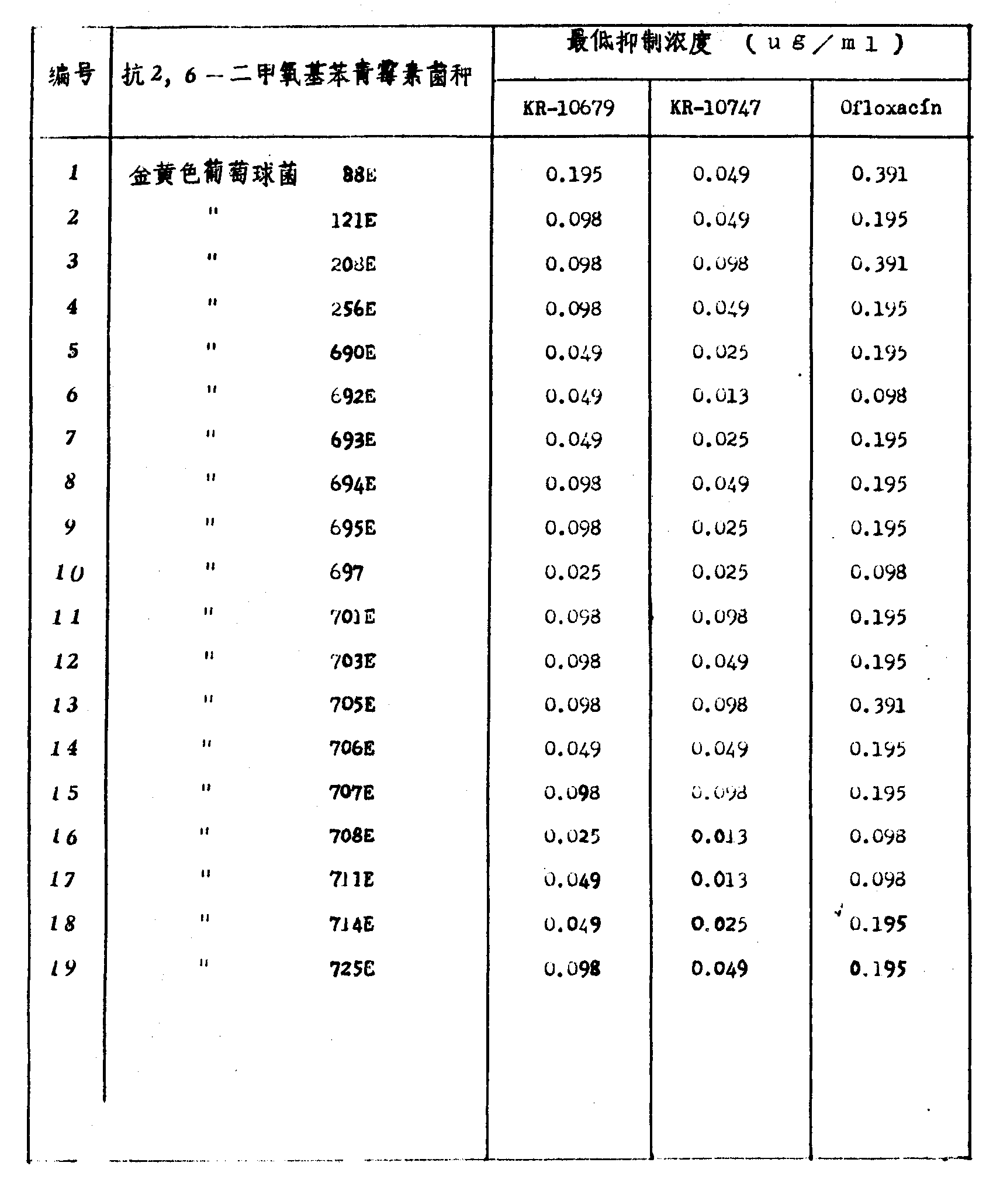
Claims (4)


Applications Claiming Priority (2)
| Application Number | Priority Date | Filing Date | Title |
|---|---|---|---|
| KR1019890015202A KR910009330B1 (en) | 1989-10-23 | 1989-10-23 | Quinoline compound having antibacterial activity and preparation method thereof |
| KR89-15202 | 1989-10-23 |
Publications (1)
| Publication Number | Publication Date |
|---|---|
| CN1051176A true CN1051176A (en) | 1991-05-08 |
Family
ID=19290919
Family Applications (1)
| Application Number | Title | Priority Date | Filing Date |
|---|---|---|---|
| CN90108658A Pending CN1051176A (en) | 1989-10-23 | 1990-10-22 | Quinolone compounds and preparation method thereof |
Country Status (19)
| Country | Link |
|---|---|
| US (1) | US5091384A (en) |
| EP (1) | EP0424850A1 (en) |
| JP (1) | JPH03193780A (en) |
| KR (1) | KR910009330B1 (en) |
| CN (1) | CN1051176A (en) |
| AU (1) | AU6486790A (en) |
| CA (1) | CA2028208A1 (en) |
| FI (1) | FI905171A7 (en) |
| HU (1) | HUT56367A (en) |
| IE (1) | IE903778A1 (en) |
| IL (1) | IL96091A0 (en) |
| IN (1) | IN171602B (en) |
| MA (1) | MA21983A1 (en) |
| MX (2) | MX22953A (en) |
| NO (1) | NO904551L (en) |
| PL (1) | PL287456A1 (en) |
| PT (1) | PT95642A (en) |
| YU (1) | YU198290A (en) |
| ZA (1) | ZA908428B (en) |
Families Citing this family (25)
| Publication number | Priority date | Publication date | Assignee | Title |
|---|---|---|---|---|
| US5252734A (en) * | 1989-04-03 | 1993-10-12 | Bayer Aktiengesellschaft | Antibacterial 5-alkylquinolonecarboxylic acids |
| DE4032560A1 (en) * | 1990-10-13 | 1992-04-16 | Bayer Ag | 7- (2,7-DIAZABICYCLO (3.3.0) OCTYL) -3-CHINOLON AND -NAPHTYRIDONCARBONIC ACID DERIVATIVES |
| DE4121214A1 (en) * | 1991-06-27 | 1993-01-14 | Bayer Ag | 7-AZAISOINDOLINYL CHINOLONE AND NAPHTHYRIDONE CARBONIC ACID DERIVATIVES |
| EP0549857A1 (en) * | 1991-12-31 | 1993-07-07 | Korea Research Institute Of Chemical Technology | Antibacterial quinolone carboxylic acid derivatives |
| CA2112165C (en) * | 1992-12-25 | 2003-04-08 | Makoto Takemura | Bicyclic amine derivatives |
| KR0148277B1 (en) * | 1993-01-18 | 1998-11-02 | 채영복 | Novel fluoroquinolone derivatives and process for the preparation thereof |
| WO1994025464A1 (en) * | 1993-04-24 | 1994-11-10 | Korea Research Institute Of Chemical Technology | Novel quinolone carboxylic acid derivatives and process for preparing the same |
| DE4339134A1 (en) * | 1993-11-16 | 1995-05-18 | Bayer Ag | 1- (2-fluorocyclopropyl) quinolone and naphthyridonecarboxylic acid derivatives |
| KR950018003A (en) * | 1993-12-09 | 1995-07-22 | 스미스클라인 비참 피엘씨 | Novel quinolone derivatives and methods for their preparation |
| DE19652239A1 (en) | 1996-12-16 | 1998-06-18 | Bayer Ag | Use of 7- (2-oxa-5,8-diazabicyclo [4.3.0] non-8-yl) -quinolone and naphthyridonecarboxylic acid derivatives for the therapy of Helicobacter pylori infections and the associated gastroduodenal diseases |
| AR095079A1 (en) | 2013-03-12 | 2015-09-16 | Hoffmann La Roche | DERIVATIVES OF OCTAHIDRO-PIRROLO [3,4-C] -PIRROL AND PIRIDINA-FENILO |
| DK3074400T3 (en) | 2013-11-26 | 2018-01-15 | Hoffmann La Roche | Octahydro-cyclobuta [1,2-c; 3,4-c '] dipyrrole derivatives as autotaxin inhibitors |
| CA2937616A1 (en) | 2014-03-26 | 2015-10-01 | F. Hoffmann-La Roche Ag | Bicyclic compounds as autotaxin (atx) and lysophosphatidic acid (lpa) production inhibitors |
| WO2016046837A1 (en) * | 2014-09-22 | 2016-03-31 | Cadila Healthcare Limited | An improved process for preparation of pyrrolo[3,4- c] pyrrole compounds and intermediates thereof |
| CA2992889A1 (en) | 2015-09-04 | 2017-03-09 | F. Hoffmann-La Roche Ag | Phenoxymethyl derivatives |
| WO2017050732A1 (en) | 2015-09-24 | 2017-03-30 | F. Hoffmann-La Roche Ag | Bicyclic compounds as atx inhibitors |
| BR112017026682A2 (en) | 2015-09-24 | 2018-08-14 | Hoffmann La Roche | new bicyclic compounds as dual action inhibitors of atx / ca |
| AU2016328436B2 (en) * | 2015-09-24 | 2020-05-14 | F. Hoffmann-La Roche Ag | New bicyclic compounds as dual ATX/CA inhibitors |
| RU2019132254A (en) | 2017-03-16 | 2021-04-16 | Ф. Хоффманн-Ля Рош Аг | HETEROCYCLIC COMPOUNDS SUITABLE AS DUAL ATX / CA INHIBITORS |
| JP7090099B2 (en) | 2017-03-16 | 2022-06-23 | エフ.ホフマン-ラ ロシュ アーゲー | A novel bicyclic compound as an ATX inhibitor |
| LT3483164T (en) | 2017-03-20 | 2020-05-11 | Forma Therapeutics, Inc. | Pyrrolopyrrole compositions as pyruvate kinase (pkr) activators |
| EP3852791B1 (en) | 2018-09-19 | 2024-07-03 | Novo Nordisk Health Care AG | Activating pyruvate kinase r |
| EP3853206B1 (en) | 2018-09-19 | 2024-04-10 | Novo Nordisk Health Care AG | Treating sickle cell disease with a pyruvate kinase r activating compound |
| HRP20251148T1 (en) | 2019-09-19 | 2025-11-21 | Novo Nordisk Health Care Ag | PREPARATIONS THAT ACTIVATE PYRUVATE KINASE R (PKR) |
| US12128035B2 (en) | 2021-03-19 | 2024-10-29 | Novo Nordisk Health Care Ag | Activating pyruvate kinase R |
Family Cites Families (4)
| Publication number | Priority date | Publication date | Assignee | Title |
|---|---|---|---|---|
| IE55898B1 (en) * | 1982-09-09 | 1991-02-14 | Warner Lambert Co | Antibacterial agents |
| WO1989005643A1 (en) * | 1987-12-18 | 1989-06-29 | Pfizer Inc. | Heterocyclic-substituted quinoline-carboxylic acids |
| JP2844079B2 (en) * | 1988-05-23 | 1999-01-06 | 塩野義製薬株式会社 | Pyridonecarboxylic acid antibacterial agent |
| JPH0262875A (en) * | 1988-05-23 | 1990-03-02 | Wakunaga Pharmaceut Co Ltd | Novel isoindoline derivative |
-
1989
- 1989-10-23 KR KR1019890015202A patent/KR910009330B1/en not_active Expired
-
1990
- 1990-09-19 IN IN743/MAS/90A patent/IN171602B/en unknown
- 1990-10-19 FI FI905171A patent/FI905171A7/en not_active Application Discontinuation
- 1990-10-19 US US07/599,225 patent/US5091384A/en not_active Expired - Fee Related
- 1990-10-20 HU HU906522A patent/HUT56367A/en unknown
- 1990-10-22 PL PL28745690A patent/PL287456A1/en unknown
- 1990-10-22 IE IE377890A patent/IE903778A1/en unknown
- 1990-10-22 JP JP2282067A patent/JPH03193780A/en active Pending
- 1990-10-22 YU YU198290A patent/YU198290A/en unknown
- 1990-10-22 PT PT95642A patent/PT95642A/en not_active Application Discontinuation
- 1990-10-22 MX MX2295390A patent/MX22953A/en unknown
- 1990-10-22 CA CA002028208A patent/CA2028208A1/en not_active Abandoned
- 1990-10-22 MA MA22253A patent/MA21983A1/en unknown
- 1990-10-22 EP EP90120240A patent/EP0424850A1/en not_active Withdrawn
- 1990-10-22 AU AU64867/90A patent/AU6486790A/en not_active Abandoned
- 1990-10-22 MX MX2295490A patent/MX22954A/en unknown
- 1990-10-22 CN CN90108658A patent/CN1051176A/en active Pending
- 1990-10-22 NO NO90904551A patent/NO904551L/en unknown
- 1990-10-22 ZA ZA908428A patent/ZA908428B/en unknown
- 1990-10-23 IL IL96091A patent/IL96091A0/en unknown
Also Published As
| Publication number | Publication date |
|---|---|
| HU906522D0 (en) | 1991-04-29 |
| PT95642A (en) | 1991-09-13 |
| FI905171A0 (en) | 1990-10-19 |
| MX22953A (en) | 1993-12-01 |
| IN171602B (en) | 1992-11-21 |
| JPH03193780A (en) | 1991-08-23 |
| NO904551D0 (en) | 1990-10-22 |
| NO904551L (en) | 1991-04-24 |
| CA2028208A1 (en) | 1991-04-24 |
| IL96091A0 (en) | 1991-07-18 |
| EP0424850A1 (en) | 1991-05-02 |
| IE903778A1 (en) | 1991-04-24 |
| ZA908428B (en) | 1992-05-27 |
| MA21983A1 (en) | 1991-07-01 |
| US5091384A (en) | 1992-02-25 |
| HUT56367A (en) | 1991-08-28 |
| FI905171A7 (en) | 1991-04-24 |
| PL287456A1 (en) | 1992-04-21 |
| KR910009330B1 (en) | 1991-11-11 |
| MX22954A (en) | 1994-01-31 |
| YU198290A (en) | 1992-09-07 |
| AU6486790A (en) | 1991-04-26 |
| KR910007931A (en) | 1991-05-30 |
Similar Documents
| Publication | Publication Date | Title |
|---|---|---|
| CN1051176A (en) | Quinolone compounds and preparation method thereof | |
| CN86106385A (en) | The bridge-type diazonium bicyclic alkyl quinolone carboxylic acid that replaces | |
| CN1058010C (en) | Novel quinoline carboxylic acid derivatives having 7-(4-aminomethyl-3-oxime) pyrrolidine substituent and processes for preparing thereof | |
| CN1174980C (en) | Imidazopyridine derivatives for inhibiting gastric acid secretion | |
| CN1061351C (en) | Intermediate diaza or oxadiaza bicyclic compounds | |
| CN100335054C (en) | Use of quinolone-and naphthyridonecarboxylic acid derivatives for the treatment of helicobacter pylori infections and gastroduodenal diseases associated therewith | |
| CN1068114A (en) | 7-azepine iso-dihydro-indole-group-quinolone and naphthyridonecarboxylic derivative | |
| CN1777602A (en) | Heterocyclyl-3-sulfonylazaindole or -azaindazole derivatives as 5-hydroxytryptamine-6 ligands | |
| CN1309385C (en) | Indolylalkylamine derivatives as 5-hydroxytryptamine-6 ligands | |
| WO1997011068A1 (en) | Novel pyridonecarboxylic acid derivatives or their salts and antibacterial agent comprising the same as the active ingredient | |
| CN1010312B (en) | The preparation method of pyridone carboxylic acid derivative | |
| CN1042632C (en) | Novel pyridone carboxylic acid derivatives | |
| CN1011587B (en) | Process for the preparation of quinolonecarboxylic acid derivatives and their use | |
| CN86100126A (en) | 6, the two replacement-1-cyclopropyl of 7--1,4 dihydro-4-oxo-1, the preparation method and the application thereof of 8-naphthyridines-3-carboxylic acid | |
| CN1114607C (en) | Carbostyril carboxylic acid derivatives | |
| CN1113064C (en) | Cis-substituted aminocyclopropane derivatives | |
| CN1232508C (en) | The cyclization method step of preparing quinolone and phthalazine | |
| CN1094405A (en) | New Carbostyril carboxylic acid derivatives and preparation method thereof | |
| CN1063747C (en) | Quinolone- and naphthyridonecarboxylic acid derivatives | |
| CN1051177A (en) | Diazabicyclic amine compound and preparation method thereof | |
| CN1041731C (en) | Pyrido[1,2,3-d,e][1,3,4]benzoxadiazine derivatives | |
| CN1183115C (en) | 5-Amino-8-methoxyquinolone carboxylic acid derivatives and its preparation method | |
| CN1777603A (en) | Substituted 2-(diaza-bicyclo-alkyl)-pyrimidinone derivatives | |
| CN100341855C (en) | 7-substituted-8-methoxy fluoroquinolone carboxylic derivatives, preparing process, preparation and use thereof | |
| CN1850823A (en) | Quinolone compound containing oximino, and its preparing method and use |
Legal Events
| Date | Code | Title | Description |
|---|---|---|---|
| C06 | Publication | ||
| PB01 | Publication | ||
| C01 | Deemed withdrawal of patent application (patent law 1993) | ||
| WD01 | Invention patent application deemed withdrawn after publication |