CN1052015C - Grafting, phase-inversion and cross-linking controlled multi-stage bulk process for making ABS graft copolymers - Google Patents
Grafting, phase-inversion and cross-linking controlled multi-stage bulk process for making ABS graft copolymers Download PDFInfo
- Publication number
- CN1052015C CN1052015C CN94112895A CN94112895A CN1052015C CN 1052015 C CN1052015 C CN 1052015C CN 94112895 A CN94112895 A CN 94112895A CN 94112895 A CN94112895 A CN 94112895A CN 1052015 C CN1052015 C CN 1052015C
- Authority
- CN
- China
- Prior art keywords
- reactor
- grafting
- rubber
- phase inversion
- polymer
- Prior art date
- Legal status (The legal status is an assumption and is not a legal conclusion. Google has not performed a legal analysis and makes no representation as to the accuracy of the status listed.)
- Expired - Fee Related
Links
Images

Classifications
-
- C—CHEMISTRY; METALLURGY
- C08—ORGANIC MACROMOLECULAR COMPOUNDS; THEIR PREPARATION OR CHEMICAL WORKING-UP; COMPOSITIONS BASED THEREON
- C08F—MACROMOLECULAR COMPOUNDS OBTAINED BY REACTIONS ONLY INVOLVING CARBON-TO-CARBON UNSATURATED BONDS
- C08F279/00—Macromolecular compounds obtained by polymerising monomers on to polymers of monomers having two or more carbon-to-carbon double bonds as defined in group C08F36/00
- C08F279/02—Macromolecular compounds obtained by polymerising monomers on to polymers of monomers having two or more carbon-to-carbon double bonds as defined in group C08F36/00 on to polymers of conjugated dienes
- C08F279/04—Vinyl aromatic monomers and nitriles as the only monomers
-
- B—PERFORMING OPERATIONS; TRANSPORTING
- B01—PHYSICAL OR CHEMICAL PROCESSES OR APPARATUS IN GENERAL
- B01J—CHEMICAL OR PHYSICAL PROCESSES, e.g. CATALYSIS OR COLLOID CHEMISTRY; THEIR RELEVANT APPARATUS
- B01J19/00—Chemical, physical or physico-chemical processes in general; Their relevant apparatus
- B01J19/18—Stationary reactors having moving elements inside
- B01J19/1862—Stationary reactors having moving elements inside placed in series
-
- C—CHEMISTRY; METALLURGY
- C08—ORGANIC MACROMOLECULAR COMPOUNDS; THEIR PREPARATION OR CHEMICAL WORKING-UP; COMPOSITIONS BASED THEREON
- C08L—COMPOSITIONS OF MACROMOLECULAR COMPOUNDS
- C08L55/00—Compositions of homopolymers or copolymers, obtained by polymerisation reactions only involving carbon-to-carbon unsaturated bonds, not provided for in groups C08L23/00 - C08L53/00
- C08L55/02—ABS [Acrylonitrile-Butadiene-Styrene] polymers
-
- B—PERFORMING OPERATIONS; TRANSPORTING
- B01—PHYSICAL OR CHEMICAL PROCESSES OR APPARATUS IN GENERAL
- B01J—CHEMICAL OR PHYSICAL PROCESSES, e.g. CATALYSIS OR COLLOID CHEMISTRY; THEIR RELEVANT APPARATUS
- B01J2219/00—Chemical, physical or physico-chemical processes in general; Their relevant apparatus
- B01J2219/00049—Controlling or regulating processes
- B01J2219/00051—Controlling the temperature
- B01J2219/00159—Controlling the temperature controlling multiple zones along the direction of flow, e.g. pre-heating and after-cooling
-
- B—PERFORMING OPERATIONS; TRANSPORTING
- B01—PHYSICAL OR CHEMICAL PROCESSES OR APPARATUS IN GENERAL
- B01J—CHEMICAL OR PHYSICAL PROCESSES, e.g. CATALYSIS OR COLLOID CHEMISTRY; THEIR RELEVANT APPARATUS
- B01J2219/00—Chemical, physical or physico-chemical processes in general; Their relevant apparatus
- B01J2219/00049—Controlling or regulating processes
- B01J2219/00168—Controlling or regulating processes controlling the viscosity
-
- B—PERFORMING OPERATIONS; TRANSPORTING
- B01—PHYSICAL OR CHEMICAL PROCESSES OR APPARATUS IN GENERAL
- B01J—CHEMICAL OR PHYSICAL PROCESSES, e.g. CATALYSIS OR COLLOID CHEMISTRY; THEIR RELEVANT APPARATUS
- B01J2219/00—Chemical, physical or physico-chemical processes in general; Their relevant apparatus
- B01J2219/00049—Controlling or regulating processes
- B01J2219/00184—Controlling or regulating processes controlling the weight of reactants in the reactor vessel
Landscapes
- Chemical & Material Sciences (AREA)
- Chemical Kinetics & Catalysis (AREA)
- Organic Chemistry (AREA)
- Health & Medical Sciences (AREA)
- Medicinal Chemistry (AREA)
- Polymers & Plastics (AREA)
- Graft Or Block Polymers (AREA)
- Polymerisation Methods In General (AREA)
Abstract
制造丙烯腈-丁二烯-苯乙烯型热塑性塑料的连续本体聚合方法。包括把包含亚乙烯基芳族单体、不饱和腈和丁二烯聚合物的液体进料加入到接枝反应器,使之预反应生成接枝橡胶连续相聚合产物。随后把接枝反应器产物加入到相转化反应器。从相转化反应器出来的第二段聚合产物加入到最终反应器,进一步聚合生成第三段聚合产物,然后再经脱挥发分而生产出最终热塑性组合物。本发明的方法提供控制和调节橡胶接枝和橡胶粒子形态方面的独特功能与灵活性。可以控制工艺条件而生产高光泽或低光泽树脂产品。
Continuous bulk polymerization process for the manufacture of acrylonitrile-butadiene-styrene type thermoplastics. This involves feeding a liquid feed comprising vinylidene aromatic monomers, unsaturated nitrile and butadiene polymers to a grafting reactor for prereaction to form a grafted rubber continuous phase polymerization product. The grafted reactor product is then fed to the phase inversion reactor. The second-stage polymerization product from the phase inversion reactor is fed into the final reactor, further polymerized to form the third-stage polymerization product, and then devolatilized to produce the final thermoplastic composition. The method of the present invention provides unique functionality and flexibility in controlling and modulating rubber grafting and rubber particle morphology. Process conditions can be controlled to produce high-gloss or low-gloss resin products.
Description
本发明涉及制备橡胶增强共聚物的方法,具体地说,涉及通过本体聚合制备接枝于橡胶基质上的单亚乙烯基芳族单体与不饱和腈类单体的橡胶改性接枝共聚物的方法。The present invention relates to the method for preparing rubber-reinforced copolymer, in particular, relates to the rubber-modified graft copolymer of monovinylidene aromatic monomer and unsaturated nitrile monomer grafted on rubber matrix by bulk polymerization Methods.
由单亚乙烯基芳族化合物,例如苯乙烯及不饱和腈类,如丙烯腈构成,并含有分散于共聚物基体中的橡胶颗粒(一般为二烯类橡胶)的橡胶改性接枝共聚物(通常称为ABS树脂)广泛应用于各种各样的工业用途,例如包装材料、冰箱衬里、汽车零件、家具、家用器具及玩具。众所周知,ABS树脂的物理性质,象韧性(即伸长和抗冲击强度的结合),不论在室温还是在较低温度下,都受在橡胶基质上接枝的苯乙烯-丙烯腈共聚物以及分散橡胶粒子的大小、组成和形态和/或该橡胶增强共聚物中橡胶基质的含量的影响。例如,为了达到众多应用场合所要求的诸物理性能的综合平衡,分散在共聚物基体中的橡胶粒子的相对尺寸必须典型地在0.5微米和5微米范围,由于橡胶颗粒的平均粒度至少为0.4微米,更典型地大于0.5微米,所以生成低光泽产品。A rubber-modified graft copolymer composed of a monovinylidene aromatic compound, such as styrene, and an unsaturated nitrile, such as acrylonitrile, and containing rubber particles (usually diene rubber) dispersed in the copolymer matrix (commonly known as ABS resin) is widely used in a wide variety of industrial applications such as packaging materials, refrigerator linings, auto parts, furniture, household appliances and toys. It is well known that the physical properties of ABS resins, such as toughness (ie, the combination of elongation and impact strength), whether at room temperature or at lower temperatures, are affected by the grafted styrene-acrylonitrile copolymer on the rubber matrix and the dispersion. The effect of the size, composition and morphology of the rubber particles and/or the content of the rubber matrix in the rubber reinforced copolymer. For example, in order to achieve the comprehensive balance of various physical properties required by many applications, the relative size of the rubber particles dispersed in the copolymer matrix must typically be in the range of 0.5 micron and 5 microns, because the average particle size of the rubber particles is at least 0.4 micron , more typically greater than 0.5 microns, so a low gloss product is produced.
在众多不同ABS本体工艺中,有两种熟知的制造方法。第一种是多区连续柱塞流方法。第二种是本体/悬浮方法。多区柱塞流本体HIPS/ABS方法最初见于美国专利2,646,418、2,694,692、2,727,884和3,243,481中,以及后来的许多其他专利中,例如美国专利4,874,815、4,785,051、4,713,420、4,640,959、4,612,348、4,387,179、4,315,083、4,254,236、4,417,030、4,277,574、4,252,911、4,239,863、4,221,883、4,187,260、3,660,535、3,243,481——所有上述专利均援引于此,做为本文参考文献。Among the many different ABS body processes, there are two well-known manufacturing methods. The first is the multi-zone continuous plug flow method. The second is the bulk/suspension approach.多区柱塞流本体HIPS/ABS方法最初见于美国专利2,646,418、2,694,692、2,727,884和3,243,481中,以及后来的许多其他专利中,例如美国专利4,874,815、4,785,051、4,713,420、4,640,959、4,612,348、4,387,179、4,315,083、4,254,236、 4,417,030, 4,277,574, 4,252,911, 4,239,863, 4,221,883, 4,187,260, 3,660,535, 3,243,481 - all of which are incorporated herein by reference.
多区柱塞流本体方法包括一系列互相衔接的聚合容器(或塔),从而提供了多个反应区。把丁二烯(BD)橡胶(立体定向)溶解于苯乙烯(ST)中,或苯乙烯/丙烯腈(ST/AN)中,然后将此橡胶溶液加入到反应体系中。聚合可由热引发或化学引发,随后反应混合物粘度将逐渐增加。在反应期间,橡胶将接枝ST/AN聚合物(接枝SAN),同时,在橡胶溶液中也不断生成本体SAN(也称之为游离SAN、基体SAN或未接枝SAN)。当达到某点,游离SAN(即未接枝SAN)无法“容纳”于橡胶溶液的单一连续相中时,就开始形成SAN相区域。此时聚合混合物成为两相体系。随着聚合反应的进行,生成了越来越多的游离SAN,而橡胶相本身开始作为粒子(橡胶相)分散在不断增长的游离SAN基体中。最后,游离SAN变成了连续相。此时,实际上形成了一种油包油乳液体系。也有一些基体SAN被包藏在橡胶粒子当中。这一阶段通常称为相转化(倒相)。相转化前意指橡胶为一连续相,且没有橡胶粒子生成;而相转化后意指基本上全部橡胶相已转化为橡胶粒子,且形成了一个连续的SAN相。在相转化以后,生成了更多基体SAN(游离SAN),而且橡胶粒子可能被接枝上更多的SAN。当达到一定的单体转化率且得到所要求的分子量分布的基体SAN时,将反应混合物在高于先前聚合的温度下“熬炼”。最后,在经过驱除残余挥发物的脱挥发分步骤之后,由造粒机得到本体ABS粒子。A multi-zone plug flow bulk process comprises a series of interconnected polymerization vessels (or columns), thereby providing multiple reaction zones. Dissolve butadiene (BD) rubber (stereospecific) in styrene (ST) or styrene/acrylonitrile (ST/AN), and then add this rubber solution into the reaction system. Polymerization can be initiated thermally or chemically, followed by a gradual increase in viscosity of the reaction mixture. During the reaction, the rubber will be grafted with ST/AN polymer (grafted SAN), while bulk SAN (also called free SAN, matrix SAN or ungrafted SAN) is also continuously formed in the rubber solution. When a point is reached where free SAN (ie, ungrafted SAN) cannot be "contained" in a single continuous phase of the rubber solution, domains of the SAN phase begin to form. At this point the polymerization mixture becomes a two-phase system. As the polymerization proceeds, more and more free SAN is formed, and the rubber phase itself begins to disperse as particles (rubber phase) in the growing free SAN matrix. Finally, free SAN becomes the continuous phase. At this point, an oil-in-oil emulsion system is actually formed. There are also some matrix SANs embedded in rubber particles. This stage is commonly referred to as phase inversion (phase inversion). Before phase inversion means that rubber is a continuous phase and no rubber particles are formed; while after phase inversion means that substantially all of the rubber phase has been converted into rubber particles and a continuous SAN phase is formed. After phase inversion, more matrix SAN (free SAN) is generated, and the rubber particles may be grafted with more SAN. When a certain monomer conversion is achieved and a matrix SAN of the desired molecular weight distribution is obtained, the reaction mixture is "cooked" at a temperature higher than that of the previous polymerization. Finally, bulk ABS granules are obtained from a granulator after a devolatilization step to drive off residual volatiles.
至于本体/悬浮方法,美国专利3,509,237、4,141,933、4,212,789、4,298,716叙述了这些工艺。把橡胶基质的单体溶液投入一个反应器,随后进行聚合使反应达到出现相转化的某一给定的固体含量。发生相转化以后,把聚合混合物转移到一个反应器中并与水/悬浮剂/表面活性剂相混合。继而,聚合反应便在此悬浮体系内完成。As for bulk/suspension methods, US Patents 3,509,237, 4,141,933, 4,212,789, 4,298,716 describe these processes. A monomer solution of the rubber matrix is fed into a reactor, followed by polymerization to a given solids content at which phase inversion occurs. After phase inversion has occurred, the polymerization mixture is transferred to a reactor and mixed with water/suspending agent/surfactant. Then, the polymerization reaction is completed in this suspension system.
此外,美国专利3,511,895描述了一种连续本体ABS方法,该方法采用“三段”反应器系统获得可控分子量分布和微胶粒尺寸,可用于生产挤压级ABS聚合物。在第一反应器内,在强烈搅拌下将橡胶溶液加入到反应混合物中,结果,在可能出现明显交联之前,在整个反应器物料中均匀地析出不连续的橡胶粒子。严格控制第一、二、三反应器内的固体含量,以便使各段分子量符合规定的范围。In addition, US Patent 3,511,895 describes a continuous bulk ABS process using a "three-stage" reactor system to obtain controlled molecular weight distribution and micelle size, which can be used to produce extrusion grade ABS polymer. In the first reactor, the rubber solution is added to the reaction mixture under vigorous agitation, so that discrete rubber particles precipitate out uniformly throughout the reactor mass before significant crosslinking can occur. Strictly control the solid content in the first, second and third reactors so that the molecular weight of each section can meet the specified range.
采用连续搅拌釜反应器的连续本体聚合方法已用于生产高抗冲击改性聚苯乙烯,其中,例如包括三步反应的工艺,其中第一步为一连续搅拌釜反应器,第二步为一连续搅拌釜反应器,而第三步为一柱塞流反应器。A continuous bulk polymerization process using a continuous stirred tank reactor has been used for the production of high impact modified polystyrene, which, for example, involves a three-step reaction process in which the first step is a continuous stirred tank reactor and the second step is A continuous stirred tank reactor, while the third stage is a plug flow reactor.
在该系统中,向第一连续搅拌釜反应器内加入渗有聚丁二烯聚合物的苯乙烯单体,在这里,苯乙烯单体将和聚丁二烯聚合物充分地反应直至相转化点,此时不连续的橡胶粒子会从聚苯乙烯和苯乙烯组成的第二相中分离出来,接着将此种经相转化的产物加入到第二连续搅拌釜反应器中,在此发生进一步单体转化,再接下去是从第二连续搅拌釜反应器出来的产物在一个柱塞流式反应器内反应以达到最终转化率。由于连续搅拌釜反应器具有优越的反应器内温控和传热能力,人们都乐于在ABS型接枝共聚物本体聚合中采用这种反应器。然而,本专利申请人发现,采用包括连续搅拌釜反应器且在其中出现相转化的第一步反应,在橡胶上达到高接枝程度之前无法生成均匀接枝的橡胶并从而导致不合要求的橡胶粒子析出。接枝不足导致产品性能差,包括抗冲击强度降低。In this system, styrene monomer impregnated with polybutadiene polymer is fed into the first continuous stirred tank reactor, where styrene monomer and polybutadiene polymer will fully react until phase inversion point, at which point discrete rubber particles separate from the second phase consisting of polystyrene and styrene, and this phase-inverted product is then fed to a second continuous stirred tank reactor where further The monomer conversion is followed by the reaction of the product from the second continuous stirred tank reactor in a plug flow reactor to achieve the final conversion. Because the continuous stirred tank reactor has superior temperature control and heat transfer capabilities in the reactor, people are willing to use this reactor in the bulk polymerization of ABS graft copolymers. However, the present applicants have found that with a first step reaction involving a continuous stirred tank reactor in which phase inversion occurs, uniformly grafted rubber cannot be produced until a high degree of grafting has been achieved on the rubber and thus results in an undesired rubber Particles are precipitated. Insufficient grafting results in poor product properties, including reduced impact strength.
而且,不同的ABS制造方法得到的最终ABS产品的性能也不同。这些性能之一乃是最终产物的表面光泽,而生产满足不同光泽度要求的ABS材料的技术开发工作至今仍是ABS工业正在努力解决的课题。Moreover, the properties of the final ABS products obtained by different ABS manufacturing methods are also different. One of these properties is the surface gloss of the final product, and the technical development of producing ABS materials that meet different gloss requirements is still a subject that the ABS industry is struggling to solve.
ABS产品的光泽部分地取决于产品制造时的模塑条件。但是在模塑条件一定的情况下,ABS材料的橡胶粒子尺寸(直径)则是光泽度的主要贡献因素。一般地说,但非必然,按乳液工艺生产的ABS料具有小尺寸(由约0.05至约0.3,微米)橡胶粒子。因此,生产高光泽度产品时常常使用乳液ABS料。另一方面,按本体工艺制成的ABS料通常具有大颗粒橡胶粒子(从约0.5至5微米)。因此,生产低光泽度产品时常常使用本体ABS料。虽然采用本体工艺也有可能生产出小颗粒,但是很难达到光泽度与抗冲性能之间的平衡。The gloss of an ABS product depends in part on the molding conditions under which the product is manufactured. However, under certain molding conditions, the rubber particle size (diameter) of the ABS material is the main contributing factor to the gloss. Generally speaking, but not necessarily, the ABS material produced by the emulsion process has small size (from about 0.05 to about 0.3, micron) rubber particles. Therefore, emulsion ABS materials are often used in the production of high-gloss products. On the other hand, ABS materials made by bulk technology usually have large rubber particles (from about 0.5 to 5 microns). Therefore, bulk ABS materials are often used in the production of low-gloss products. Although it is also possible to produce small particles using the bulk process, it is difficult to achieve a balance between gloss and impact resistance.
为谋求光泽与抗冲之间更好的平衡而结合乳液和本体ABS料提供的优点,将这两种类型的ABS料以不同比例掺混,得到双峰粒度分布。例如,美国专利3,509,237和4,713,420提出了此种技术,从而既达到高表面光泽又达到良好抗冲强度。In order to achieve a better balance between gloss and impact resistance and combine the advantages offered by emulsion and bulk ABS materials, these two types of ABS materials are blended in different proportions to obtain bimodal particle size distributions. For example, US Patent Nos. 3,509,237 and 4,713,420 suggest such techniques to achieve both high surface gloss and good impact strength.
另外,美国专利4,254,236报道了直接用本体工艺制成光泽度指标在80%-99%的双峰粒度分布ABS材料。为制备此类本体ABS,同时向反应体系加入两股进料流。其中一股进料流为含有橡胶基质、单体和单体的表层物(基体聚合物)的混合物。另外一股是橡胶基质的单体溶液。另一美国专利3,511,895描述了一种本体工艺,通过在反应混合物中使聚合丁二烯橡胶分散并以不连续的微滴析出而形成橡胶粒子,导致高光泽本体ABS。在这些工艺条件下,几乎不可能获得理想的橡胶粒子的“微胞”形态,导致抗冲强度低。又一美国专利4,421,895介绍了生产较小粒度(平均在0.5-0.7微米)橡胶粒子本体ABS的连续工艺。可是这种平均粒度对本体ABS材料来讲并非罕见,而且仍然没有小到足以产生高光泽性。但是,为生产本体方法中较小橡胶粒子,采用在相转化后加粒子分散剂的尝试已在EP 0 376 232 A2中有报道。终于使平均粒度得以降低到体积平均直径0.4微米。但是相应的光泽度值仅为89%,这只不过是常规本体ABS“低/较低”光泽度范围的上限。In addition, US Patent No. 4,254,236 reports that ABS materials with a bimodal particle size distribution with a gloss index of 80%-99% are directly produced by the bulk process. To prepare this type of bulk ABS, two feed streams are simultaneously fed to the reaction system. One of the feed streams is a mixture comprising a rubber matrix, monomer and a skin of monomer (matrix polymer). The other strand is a monomer solution for the rubber matrix. Another US Patent 3,511,895 describes a bulk process by dispersing and precipitating polymerized butadiene rubber in a reaction mixture as discrete droplets to form rubber particles, resulting in high gloss bulk ABS. Under these process conditions, it is almost impossible to obtain the ideal "cell" morphology of the rubber particles, resulting in low impact strength. Yet another US Patent 4,421,895 describes a continuous process for producing bulk ABS of rubber particles of smaller particle size (0.5-0.7 microns on average). However, this average particle size is not unusual for bulk ABS materials, and it is still not small enough to produce high gloss. However, attempts to use particle dispersants after phase inversion for the production of smaller rubber particles in the bulk process have been reported in EP 0 376 232 A2. Finally, the average particle size was reduced to a volume average diameter of 0.4 microns. But the corresponding gloss value is only 89%, which is no more than the upper end of the "low/lower" gloss range for conventional bulk ABS.
总而言之,上面介绍的当前技术尚未能仅仅通过本体方法生产出具有单峰粒度分布、平均粒度小于0.3微米(数均直径)的“细胞”形态橡胶粒子ABS材料,同时不牺牲抗冲击性能。In conclusion, the current technology presented above has not been able to produce “cellular” rubber particle ABS materials with unimodal particle size distribution and average particle size less than 0.3 μm (number average diameter) by bulk method alone, without sacrificing impact resistance.
借助本体方法合成高性能ABS聚合物,除其他许多因素外,有三方面是重要的。这三方面是,在相转化前橡胶基质上的接枝、相转化期间粒子的形成以及在本体聚合终点橡胶粒子的交联。然而,上面提到的本体ABS工艺在控制和调节接枝、相转化以及交联方面,存在不同程度的缺陷。因而,希望提供一种能生产出符合要求的橡胶形态并能最大限度地接枝从而对给定的性能指标而言允许使用最少量橡胶的连续本体聚合方法。此外,还希望提供一种既能生产低光泽度又能生产高光泽度的ABS树脂的本体方法。Among many other factors, three aspects are important for the synthesis of high-performance ABS polymers by means of bulk methods. These three aspects are, the grafting on the rubber matrix before the phase inversion, the particle formation during the phase inversion and the crosslinking of the rubber particles at the end of the bulk polymerization. However, the above-mentioned bulk ABS process has defects to varying degrees in controlling and regulating grafting, phase inversion and crosslinking. Accordingly, it would be desirable to provide a continuous bulk polymerization process which produces the desired rubber morphology and which maximizes grafting thereby allowing the use of a minimum amount of rubber for a given performance specification. Additionally, it would be desirable to provide a bulk method for producing both low gloss and high gloss ABS resins.
本发明提供一种多段本体方法,它包括使含有亚乙烯基芳族单体、不饱和腈单体以及橡胶状合成丁二烯聚合物的液态进料组合物在一柱塞流接枝反应器内反应至相转化前某一点,使由上面生成的第一段聚合产物在一连续搅拌釜反应器内反应生成相转化第二段聚合产物,再将此产物于最终反应器内进一步反应,继而脱除挥发分,生成所要求的最终产物。该方法可以生产具有微胞橡胶形态以及高光泽与高抗冲强度相结合性能的高光泽本体产物。The present invention provides a multi-stage bulk process comprising passing a liquid feed composition comprising vinylidene aromatic monomer, unsaturated nitrile monomer and rubbery synthetic butadiene polymer in a plug flow grafting reactor Internal reaction to a certain point before the phase inversion, make the first-stage polymerization product generated above react in a continuous stirred tank reactor to generate the second-stage polymerization product of phase inversion, and then further react this product in the final reactor, and then Devolatilization yielded the desired final product. The method can produce a high-gloss bulk product with microcellular rubber morphology and the combination of high gloss and high impact strength.
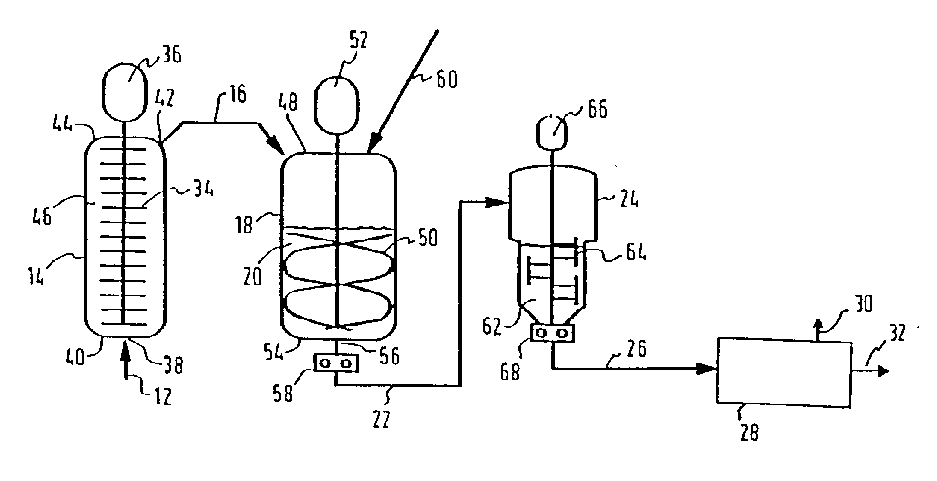
图1为按本发明方法的简图,包括柱塞流接枝反应器、连续搅拌釜相转化反应器、沸腾式柱塞流最终反应器和脱挥发分槽。Figure 1 is a schematic diagram of the process according to the invention, comprising a plug flow grafting reactor, a continuous stirred tank phase inversion reactor, a boiling plug flow final reactor and a devolatilization tank.
理论上,当本体聚合溶液达到游离SAN相体积等于接枝橡胶相体积时(等相体积点),就开始出现橡胶相转化。在此点,连续游离SAN相的生成(或分散游离SAN相的消失)与分散接枝橡胶相的生成(或连续接枝橡胶相的消失)处于平衡态。但从实际的角度而言,推动平衡朝着把接枝橡胶相转变的分散相的推动力是增加游离SAN相体积的游离SAN的聚合。只要橡胶上接枝了足量的SAN聚合物,几乎所有当前本体ABS工艺都必须经历这一时期,以便获得本体形态(微胞形态)橡胶粒子。Theoretically, when the bulk polymerization solution reaches the free SAN phase volume equal to the grafted rubber phase volume (equal volume point), the rubber phase inversion begins to occur. At this point, the formation of the continuous free SAN phase (or disappearance of the dispersed free SAN phase) is in equilibrium with the formation of the dispersed grafted rubber phase (or the disappearance of the continuous grafted rubber phase). But from a practical point of view, the driving force that drives the equilibrium towards the dispersed phase that transforms the grafted rubber phase is the polymerization of free SAN that increases the volume of the free SAN phase. Almost all current bulk ABS processes must go through this period in order to obtain bulk morphological (cellular morphological) rubber particles, as long as a sufficient amount of SAN polymer is grafted onto the rubber.
与此相反,在本发明的工艺中,不需要也不会出现相转化的“平衡”期。在接枝反应器内,溶解的橡胶首先得到充分的接枝时间以达到实际最大限度的接枝率。接着,将接枝橡胶溶液转移到聚合溶液(其中现存连续相为游离SAN的单体溶液)中。在充分搅拌条件下,在连续游离SAN相内开始形成“微胞”形态橡胶粒子。换言之,本发明开发了一种在远超过等相体积点时进行接枝橡胶相转化的新技术。因此,分别通过改变接枝反应器内接枝SAN的分子量和现存游离SAN连续相中游离SAN的分子量可以改变和控制橡胶粒子的粒度分布。所以说,本发明为控制橡胶粒子粒度提供极大的灵活性,可以生产低光泽的大粒子粒度分布的本体ABS和高光泽的小粒子粒度分布的本体ABS,二者皆具有良好抗冲性能。然而,这种灵活性难以用传统低光泽本体ABS工艺,而不牺牲抗冲性能来达到。因此,本发明在橡胶粒子生成控制技术方面,与传统本体ABS工艺相比,具有根本不同之处。In contrast, in the process of the present invention, an "equilibrium" period of phase inversion is not required and does not occur. In the grafting reactor, the dissolved rubber is first given sufficient grafting time to achieve the practical maximum grafting rate. Next, the grafted rubber solution was transferred to the polymerization solution (monomer solution in which the existing continuous phase was free SAN). Under sufficient stirring conditions, rubber particles in the form of "microcells" began to form in the continuous free SAN phase. In other words, the present invention develops a new technique for phase inversion of grafted rubber well beyond the equiphase volume point. Therefore, the particle size distribution of rubber particles can be changed and controlled by changing the molecular weight of grafted SAN in the grafting reactor and the molecular weight of free SAN in the existing free SAN continuous phase, respectively. Therefore, the present invention provides great flexibility for controlling the particle size of rubber particles, and can produce bulk ABS with low gloss and large particle size distribution and bulk ABS with high gloss and small particle size distribution, both of which have good impact resistance. However, this flexibility is difficult to achieve with traditional low-gloss bulk ABS processes without sacrificing impact resistance. Therefore, the present invention has a fundamental difference compared with the traditional bulk ABS process in terms of rubber particle generation control technology.
本发明涉及用于制造包含橡胶改性接枝共聚物和非接枝刚性聚合物(亦称为游离刚性聚合物)的热塑性聚合物组合物的连续本体聚合方法(亦称为本体聚合工艺)。产品既可具有对应于低光泽特性的大粒子粒度也可具有对应于高光泽特性的小粒子粒度。较好产品之一具有小于0.3微米的数均粒度、单峰粒度分布和“微胞”形态粒子,产品还具有高光泽、高抗冲性能。这种“微胞”形态也可以描述为球形表面的橡胶膜网络,其内部空间充填了被包藏的刚性聚合物(SAN)。而且,对这种“微胞”形态而言,在橡胶膜的两侧,即橡胶粒子的内、外两面都接枝了接枝刚性聚合物(SAN)。该方法包括,把包含乙烯基芳族单体、不饱和腈单体和溶于其中的合成丁二烯聚合物的液态进料加入到接枝反应器中,生成在二烯聚合物上接枝的接枝乙烯基芳族-不饱和腈共聚物。接枝上去的乙烯基芳族-不饱和腈共聚物的数量以及平均分子量可以进行调节和控制。同时,在相同的给定反应条件下、在接枝反应器内也生成了具有与接枝乙烯基芳族-不饱和腈共聚物分子量不相上下的非接枝乙烯基芳族-不饱和腈共聚物。该接枝反应器较好为一柱塞流形式反应器。此外,反应器条件的制定要使得在此阶段不发生相转化。从接枝反应器生产出第一段聚合产物,在此阶段的单体转化率,以进料中单体总量为基准计,为5-25%(重量)。第一段聚合产物被连续地从接枝反应器中抽出并连续地加入到相转化反应器中,该反应器较好是一个连续搅拌釜反应器,在其中发生相转化,生成相转化第二段聚合产物,其单体转化率以原始液态进料中单体总重量为基准计,为10-60%(重量)。当来自接枝反应器的第一段聚合产物与相转化反应器内的反应物料相混合时,便开始出现相转化。第二段聚合产物连续地从相转化反应器抽出并连续地加入到最终反应器中,该反应器较好是一个沸腾式柱塞流反应器,在其中产生第三段聚合产物,其单体转化率以液态进料中单体总重量为基准,为70-95%(重量)。然后连续地将第三段聚合产物抽出并连续地加入到脱挥发分槽中,以脱除挥发性物质并获得所要求的热塑性组合物。该方法能在相转化期间采用连续搅拌釜反应器来控制温度和控制传热,而且也能在相转化之前,通过使用单独的反应器达到高接枝效率从而达到高接枝度。The present invention relates to a continuous bulk polymerization process (also known as bulk polymerization process) for the manufacture of thermoplastic polymer compositions comprising rubber-modified graft copolymers and non-grafted rigid polymers (also known as free rigid polymers). The product can have both a large particle size corresponding to low gloss properties and a small particle size corresponding to high gloss properties. One of the better products has a number average particle size of less than 0.3 microns, a unimodal particle size distribution, and "micelle" morphology particles. The product also has high gloss and high impact resistance. This "micelle" morphology can also be described as a network of rubber membranes on spherical surfaces, whose internal spaces are filled with entrapped rigid polymers (SAN). Moreover, for this "cell" morphology, the grafted rigid polymer (SAN) is grafted on both sides of the rubber membrane, that is, the inner and outer sides of the rubber particles. The process comprises feeding a liquid feed comprising vinyl aromatic monomers, unsaturated nitrile monomers and a synthetic butadiene polymer dissolved therein to a grafting reactor to produce grafted on diene polymers Grafted vinyl aromatic-unsaturated nitrile copolymer. The amount and average molecular weight of the grafted vinyl aromatic-unsaturated nitrile copolymer can be adjusted and controlled. At the same time, under the same given reaction conditions, a non-grafted vinyl aromatic-unsaturated nitrile with a molecular weight comparable to that of the grafted vinyl aromatic-unsaturated nitrile copolymer was also produced in the grafting reactor. copolymer. The grafting reactor is preferably a plug flow reactor. Furthermore, the reactor conditions are designed such that phase inversion does not occur at this stage. The first stage of polymerization product is produced from the grafting reactor, and the monomer conversion at this stage is 5-25% by weight, based on the total amount of monomer in the feed. The first-stage polymerization product is continuously withdrawn from the grafting reactor and continuously fed into a phase inversion reactor, preferably a continuous stirred tank reactor, in which the phase inversion takes place to generate the phase inversion second stage. The stage polymerization product has a monomer conversion rate of 10-60% by weight based on the total weight of monomers in the original liquid feed. Phase inversion begins when the first stage polymer product from the grafting reactor is mixed with the reactants in the phase inversion reactor. The second stage polymer product is continuously withdrawn from the phase inversion reactor and fed continuously to the final reactor, preferably a boiling plug flow reactor, in which the third stage polymer product is produced, its monomer The conversion is 70-95% by weight, based on the total weight of monomers in the liquid feed. The third stage polymerization product is then continuously withdrawn and fed continuously to a devolatilization tank to remove volatiles and obtain the desired thermoplastic composition. The method enables the use of continuous stirred tank reactors for temperature control and heat transfer control during phase inversion, and also enables high grafting efficiencies and thus high degrees of grafting prior to phase inversion by using a separate reactor.
本发明提供了一种本体聚合方法,允许针对上述主题,在相应各阶段发生预定的化学反应,导致高性能产品。本发明还提供了不同品级橡胶改性接枝共聚物的灵活生产方法。所生产的材料一般地为不透明,且一般为乌光的。然而此种材料的乌光性在多数情况下比乳液ABS浅。本发明提供了用于生产低光泽和高光泽ABS材料的本体聚合方法的新技术。本方法的较好产品之一借助生成数均直径在0.3微米以下的小粒度及单峰粒度分布的微胞形态橡胶粒子,能提供高光泽和高抗冲ABS。也就是说,本发明提供了一种技术,即用本体方法生产具有与乳液法相近的粒子大小,且具有足够数量的接枝和内包乙烯基芳族一不饱和腈(SAN)聚合物的橡胶粒子,导致了本体乙烯基芳族一不饱和腈一链二烯(ABS)材料的高表面光泽和良好抗冲击性能。The present invention provides a bulk polymerization method that allows predetermined chemical reactions to take place at the respective stages for the above mentioned subjects, leading to high performance products. The invention also provides flexible production methods of different grades of rubber-modified graft copolymers. The material produced is generally opaque and generally matte. However, the matteness of this material is lighter than that of emulsion ABS in most cases. The present invention provides a new technique for bulk polymerization process for producing low gloss and high gloss ABS materials. One of the better products of this process is the ability to provide high gloss and high impact ABS by producing microcellular rubber particles with a number average diameter below 0.3 microns in small particle size and unimodal particle size distribution. That is to say, the present invention provides a technique for producing rubber with a particle size close to that of the emulsion process with a sufficient amount of grafted and encased vinyl aromatic monounsaturated nitrile (SAN) polymers by the bulk process. Particles, resulting in high surface gloss and good impact resistance of bulk vinylaromatic-unsaturated nitrile-alkadiene (ABS) materials.
一般,然而却是很重要的一点是,本发明提供了在宽范围内按需要控制粒径的技术,以生产在光泽度方面变化范围宽,且具有良好抗冲性的本体ABS。In general, but importantly, the present invention provides the technique to control particle size as desired over a wide range to produce bulk ABS with wide variation in gloss and good impact resistance.
本发明涉及制备热塑性聚合物组合物的连续本体聚合方法(如附图1示意表示的),该组合物包含单亚乙烯基芳族单体、不饱和腈单体以及任选地带或不带一种或多种其他共聚单体的橡胶改性接枝共聚物,在该方法中,由单亚乙烯基芳族单体、不饱和腈单体和溶于其中的橡胶状丁二烯聚合物以及任选地,一种溶剂构成的液体进料组合物(12),被加入到接枝反应器(14)中,在其中,液体进料的反应活性组分聚合,生成包含接枝于丁二烯聚合物上的乙烯基芳族不饱和腈的接枝丁二烯聚合物以及未接枝(游离或基体)乙烯基芳族-不饱和腈共聚物的第一段聚合产物(16)。接枝丁二烯聚合物和未接枝聚合物存在于未反应单体的溶液中(在此,接枝丁二烯聚合物为连续相),以液态进料组合物中单体总重量为基准,单体转化率为5-25%(重量)之间,较好在6-20%(重量),最好在其7-15%(重量)之间。随后,该接枝反应器产物(16)(也称之为第一段聚合产物(16))被加入相转化反应器(18)中,该反应器较好为一连续搅拌釜反应器(18),其中盛有已经相转化的反应物料(20),且其中含有由单亚乙烯基芳族单体、不饱和腈单体及其未接枝的共聚物构成的第一连续相,以及一个包含具有接枝于丁二烯聚合物上的单亚乙烯基芳族-不饱和腈共聚物的接枝共聚物不连续粒子的第二分散相。从该转化反应器(18)出来的产物为第二段聚合产物(22),该产物已经过相转化且其单体转化率,以进料液体组合物中单体总重量为基准,为10-60%(重量),较好为20-55%,而最好为30-45%。这种从相转化反应器(18)出来的第二段聚合产物(22),随后被加入到最终反应器(24)中,该反应器较好为一沸腾式柱塞流的应器(24),在其中,聚合继续进行到从最终反应器(24)出来的产物(26)以液态进料中单体总重量为基准的单体转化率为70-95%(重量)之间,较好为80-95%,而最好为85-90%。从最终反应器(24)出来的产物(26),被称之为第三段聚合产物(26),可以接着加入到脱挥发分槽(28)中,在此,从中移出残余单体(30)和残余溶剂(30),结果得到不挥发的成品热塑性聚合物组合物(32)。单体转化率的定义是,以液体进料组合物中单体总重量为基准,转化为固体的单体重量百分数,其测定方法采用未反应单体的定量蒸发,可这样计算:(总固体重减原始橡胶重量)除以进料中单体原始重量。The present invention relates to a continuous bulk polymerization process for the preparation of thermoplastic polymer compositions (schematically represented in Figure 1) comprising monovinylidene aromatic monomers, unsaturated nitrile monomers and optionally with or without a Rubber-modified graft copolymers of one or more other comonomers, in which process a monovinylidene aromatic monomer, an unsaturated nitrile monomer and a rubbery butadiene polymer dissolved therein and Optionally, a liquid feed composition (12), consisting of a solvent, is introduced into the grafting reactor (14), where the reactive components of the liquid feed are polymerized to produce Grafted butadiene polymers of vinylaromatic unsaturated nitriles on ethylene polymers and first stage polymerization products of ungrafted (free or matrix) vinylaromatic-unsaturated nitrile copolymers (16). Grafted butadiene polymer and ungrafted polymer exist in the solution of unreacted monomer (here, grafted butadiene polymer is continuous phase), with the monomer total weight in the liquid feed composition being On a basis, the monomer conversion rate is between 5-25% by weight, preferably between 6-20% by weight, most preferably between 7-15% by weight. Subsequently, the graft reactor product (16) (also referred to as the first stage polymerization product (16)) is fed into a phase inversion reactor (18), which is preferably a continuous stirred tank reactor (18 ), which holds the phase-inverted reaction mass (20), and which contains a first continuous phase consisting of monovinylidene aromatic monomers, unsaturated nitrile monomers and ungrafted copolymers thereof, and a A second dispersed phase comprising discrete particles of a graft copolymer having a monovinylidene aromatic-unsaturated nitrile copolymer grafted onto a butadiene polymer. The product that comes out from this inverting reactor (18) is the second stage polymerization product (22), and this product has been through phase inversion and its monomer conversion rate is based on the total weight of monomers in the feed liquid composition, is 10 -60% by weight, preferably 20-55%, and most preferably 30-45%. This second-stage polymer product (22) from the phase inversion reactor (18) is then fed into the final reactor (24), which is preferably a boiling plug flow reactor (24). ), wherein the polymerization is continued until the product (26) from the final reactor (24) has a monomer conversion of between 70-95% by weight, based on the total weight of the monomers in the liquid feed, compared to 80-95% is good, and 85-90% is best. The product (26) from the final reactor (24), known as the third stage polymerization product (26), can then be fed to a devolatilization tank (28), where residual monomers (30) are removed therefrom. ) and residual solvent (30), resulting in a non-volatile finished thermoplastic polymer composition (32). The definition of monomer conversion is, based on the total weight of monomers in the liquid feed composition, the percentage by weight of monomers converted into solids is determined by quantitative evaporation of unreacted monomers, which can be calculated as follows: (total solids weight minus original rubber weight) divided by the original weight of monomer in the feed.
在接枝反应器(14)中,在丁二烯基质上不仅接枝了所需数量的单亚乙烯基芳族-不饱和腈共聚物接枝部分而且它们具有所要求的分子量。通过在接枝反应器(14)(较好为一柱塞反应器(14))内接枝到出现相转化之前的某一点,就防止了未接枝或低接枝度橡胶粒子的不合要求沉淀或橡胶凝胶的生成。而且,在接枝反应器(14)中所生成的未接枝单乙烯基芳族-不饱和腈聚合物还具有与接枝丁二烯聚合物的乙烯基芳族-不饱和腈接枝部分相“匹配”的分子量。使接枝反应器(14)内的反应置于引发剂控制之下,从而提供了比未接枝单乙烯基芳族-不饱和腈(较好为苯乙烯-丙烯腈)共聚物生成速率有利的用于接枝丁二烯聚合物接枝部分的单乙烯基芳族-不饱和腈共聚物(较好为苯乙烯-丙腈共聚物)的生成速率。最后,从接枝反应器(14)出来的第一段聚合产物(16)总体粘度预期尽可能接近相转化反应器(18)内反应物(20)的粘度,正如通过接枝反应器产物和相转化反应器产物分子量分析所证实的。为制取低光泽产品,对于接枝和未接枝乙烯基芳族-不饱和腈共聚物来说,接枝反应器产物理想的重均分子量均为约150,000-250,000。对于未接枝乙烯基芳族-不饱和腈共聚物来说,相转化反应器产物理想重均分子量在约100,000-200,000之间。为制取高光泽产品,对于接枝和未接枝乙烯基芳族-不饱和腈共聚物来说,接枝反应器产物理想的重均分子量皆在约200,000-350,000范围内。对未接枝乙烯基芳族-不饱和腈共聚物来说,相转化反应器产物理想的重均分子量在约150,000-200,000之间。在按上述控制分子量的条件下,在相转化反应器内迅速,然而并非立刻或瞬间地出现接枝橡胶相转化,生成符合要求大小的橡胶粒子。In the grafting reactor (14), not only the desired number of grafted moieties of the monovinylidene aromatic-unsaturated nitrile copolymer are grafted onto the butadiene substrate but they have the desired molecular weight. By grafting within the grafting reactor (14), preferably a plunger reactor (14), to a point before phase inversion occurs, undesirable ungrafted or low-grafted rubber particles are prevented Precipitation or rubber gel formation. Moreover, the ungrafted monovinylaromatic-unsaturated nitrile polymer produced in the grafting reactor (14) also has a grafted moiety with the vinylaromatic-unsaturated nitrile grafted butadiene polymer. Phase "matched" molecular weight. The reaction in the grafting reactor (14) is placed under initiator control, thereby providing a favorable rate of formation over ungrafted monovinyl aromatic-unsaturated nitrile (preferably styrene-acrylonitrile) copolymers. The formation rate of the monovinyl aromatic-unsaturated nitrile copolymer (preferably styrene-propionitrile copolymer) used for grafting the grafted part of the butadiene polymer. Finally, the overall viscosity of the first stage polymerization product (16) exiting the grafting reactor (14) is expected to be as close as possible to the viscosity of the reactants (20) in the phase inversion reactor (18), as is achieved by the grafting reactor product and Confirmed by phase inversion reactor product molecular weight analysis. To produce low gloss products, the graft reactor product ideally has a weight average molecular weight of about 150,000-250,000 for both grafted and ungrafted vinyl aromatic-unsaturated nitrile copolymers. For ungrafted vinyl aromatic-unsaturated nitrile copolymers, the ideal weight average molecular weight of the phase inversion reactor product is between about 100,000-200,000. For high gloss products, the graft reactor product ideally has a weight average molecular weight in the range of about 200,000-350,000 for both grafted and ungrafted vinyl aromatic-unsaturated nitrile copolymers. For ungrafted vinyl aromatic-unsaturated nitrile copolymers, the ideal weight average molecular weight of the phase inversion reactor product is between about 150,000-200,000. Under the conditions of controlling the molecular weight as mentioned above, the phase inversion of the grafted rubber occurs quickly in the phase inversion reactor, but not immediately or instantaneously, and rubber particles with the required size are produced.
呈连续搅拌釜反应器(18)形式的相转化的应器(18)提供了比在相转化阶段用柱塞流反应器可能达到的更为均匀的发生相转化及生成橡胶粒子的反应条件。从理论上讲,相转化反应器提供的操作条件造成进来的接枝橡胶连续相发生相转化阶段,此时在橡胶相转化之前形成的连续未接枝乙烯基芳族-不饱和腈共聚物相之内生成微胞形态的分散橡胶。接枝反应器(14)内的反应为引发剂控制,从而提供了比未接枝苯乙烯-丙烯腈共聚物生成速率更为有利的用于接枝丁二烯聚合物的亚乙烯基芳族-不饱和腈聚合物接枝部分的亚乙烯基芳族-不饱和腈共聚物生成速率。在相转化反应器(18)内起作用的反应机理可以是热或化学引发机理,此类机理导致生成比接枝反应器(14)内所生成的共聚物的分子量低的未接枝乙烯基芳族-不饱和腈共聚物,从而有助于接枝反应器(14)的第一段聚合产物(16)与相转化反应器(18)内反应物(20)之间的粘度匹配。较好地,相转化反应器(18)的聚合温度为介于120℃和150℃之间。橡胶状的合成丁二烯聚合物可以是丁二烯均聚合物或是苯乙烯-丁二烯嵌段共聚物。对于苯乙烯-丁二烯嵌段共聚物来说,此种嵌段共聚物可能具有的优点之一是,聚苯乙烯嵌段可以起“储存”引发剂的机理,从而使接枝反应器内嵌段共聚物的接枝反应速率比丁二烯均聚物来得快。此外,为生产用于高光泽ABS的小粒度橡胶粒子,在接枝反应器内须具备另外一个重要条件。即在接枝反应器内生成的第一段聚合产物必须是比第二段聚合产物有更高重均分子量的未接枝单乙烯基芳族-不饱和腈共聚物,正如上面已提到的。The phase inversion reactor (18) in the form of a continuous stirred tank reactor (18) provides more uniform reaction conditions for the phase inversion and formation of rubber particles than is possible with a plug flow reactor during the phase inversion stage. Theoretically, the operating conditions provided by the phase inversion reactor cause the incoming grafted rubber continuous phase to undergo a phase inversion phase where the continuous ungrafted vinyl aromatic-unsaturated nitrile copolymer phase formed prior to the rubber phase inversion Dispersed rubber in the form of cells is generated within. The reaction in the grafting reactor (14) is initiator controlled, thereby providing a more favorable formation rate of vinylidene aromatic for grafting butadiene polymer than ungrafted styrene-acrylonitrile copolymer. - Vinylidene aromatic-unsaturated nitrile copolymer formation rate of the unsaturated nitrile polymer graft portion. The reaction mechanism at work in the phase inversion reactor (18) can be a thermal or chemically initiated mechanism which results in the formation of ungrafted vinyl groups having a lower molecular weight than the copolymer produced in the grafting reactor (14) Aromatic-unsaturated nitrile copolymers to facilitate viscosity matching between the first stage polymerization product (16) in the grafting reactor (14) and the reactants (20) in the phase inversion reactor (18). Preferably, the polymerization temperature in the phase inversion reactor (18) is between 120°C and 150°C. The rubbery synthetic butadiene polymer can be a butadiene homopolymer or a styrene-butadiene block copolymer. One of the possible advantages of such block copolymers for styrene-butadiene block copolymers is that the polystyrene blocks can act as a "storage" mechanism for the initiator, allowing the grafting reactor to The grafting reaction rate of block copolymer is faster than that of butadiene homopolymer. In addition, another important condition must be fulfilled in the grafting reactor in order to produce small particle size rubber particles for high-gloss ABS. That is, the first-stage polymerization product formed in the grafting reactor must be an ungrafted monovinyl aromatic-unsaturated nitrile copolymer having a higher weight-average molecular weight than the second-stage polymerization product, as mentioned above.
可用于本发明方法的亚乙烯基芳族单体的例子有:苯乙烯;α-烷基单乙烯基单芳环化合物,例如α-甲基苯乙烯、α-乙基苯乙烯、α-甲基乙烯基甲苯等等;环上取代烷基苯乙烯类,例如乙烯基甲苯、邻-乙基苯乙烯、对-乙基苯乙烯、2,4-二甲基苯乙烯等等;环上取代卤代苯乙烯类,例如邻-氯苯乙烯、对-氯苯乙烯、邻溴苯乙烯、2,4-二氯苯乙烯等等;环上烷基、环上卤素取代的苯乙烯,例如2-氯-4-甲基苯乙烯、2,6-二氯-4-甲基苯乙烯等等。如果希望的话,可以使用这些亚乙烯基芳族单体的混合物。Examples of vinylidene aromatic monomers that can be used in the process of the invention are: styrene; α-alkyl monovinyl monoaromatic compounds such as α-methylstyrene, α-ethylstyrene, α-form vinyltoluene, etc.; ring-substituted alkylstyrenes, such as vinyltoluene, o-ethylstyrene, p-ethylstyrene, 2,4-dimethylstyrene, etc.; ring-substituted Halogenated styrenes, such as o-chlorostyrene, p-chlorostyrene, o-bromostyrene, 2,4-dichlorostyrene, etc.; ring alkyl, ring halogen substituted styrene, such as 2 -Chloro-4-methylstyrene, 2,6-dichloro-4-methylstyrene and the like. Mixtures of these vinylidene aromatic monomers may be used if desired.
该亚乙烯基芳族单体是与至少一种不饱和腈单体(也称为链烯基腈单体),例如丙烯腈、甲基丙烯腈和乙基丙烯腈联合使用的。The vinylidene aromatic monomer is used in combination with at least one unsaturated nitrile monomer (also known as an alkenyl nitrile monomer), such as acrylonitrile, methacrylonitrile and ethacrylonitrile.
液体进料组合物(12)可按本发明的方法连续地进行本体聚合,生成亚乙烯基芳族-不饱和腈接枝共聚物和未接枝乙烯基芳族-不饱和腈共聚物的复合聚合物,以液体进料组合物全部重量为基准计,进料组合物(12)含有50-90%(重量)单亚乙烯基芳族单体(较好是苯乙烯)、8-48%(重量)不饱和腈单体(较好是丙烯腈)及溶于其中的2-15%(重量)丁二烯聚合物。这种复合聚合物可以由含有重量比分别为约90∶10到50∶50的单亚乙烯基芳族和不饱和腈单体的液体进料组合物生成,且上述比例较好分别为80∶20到70∶30(重量)。除要聚合的单体之外,配料中还可含有引发剂(如有需要)及其他所需的组分,例如链转移剂或分子量调节剂、稳定剂等等。Liquid feed composition (12) can carry out bulk polymerization continuously according to the method of the present invention, generates the composite of vinylidene aromatic-unsaturated nitrile graft copolymer and ungrafted vinyl aromatic-unsaturated nitrile copolymer Polymer, based on the total weight of the liquid feed composition, the feed composition (12) contains 50-90% (by weight) monovinylidene aromatic monomer (preferably styrene), 8-48% (weight) unsaturated nitrile monomer (preferably acrylonitrile) and 2-15% (weight) butadiene polymer dissolved therein. Such composite polymers may be formed from a liquid feed composition containing monovinylidene aromatic and unsaturated nitrile monomers in a weight ratio of about 90:10 to 50:50, preferably 80:50, respectively. 20 to 70:30 (by weight). In addition to the monomers to be polymerized, the formulations can also contain initiators, if required, and other desired components, such as chain transfer agents or molecular weight regulators, stabilizers, and the like.
聚合反应可以通过热单体自由基引发,但是,任何能产生自由基的引发剂均可用来实施本发明。传统的可溶性于单体的有机过氧化物引发剂,例如过氧二碳酸盐、过氧酯类、二酰基过氧化物、单过氧碳酸盐、过氧缩酮类,以及二烷基过氧化物或偶氮引发剂类均可使用。Polymerization can be initiated by thermal monomer free radicals, however, any initiator capable of generating free radicals can be used in the practice of this invention. Traditional monomer-soluble organic peroxide initiators such as peroxydicarbonates, peroxyesters, diacyl peroxides, monoperoxycarbonates, peroxyketals, and dialkyl Either peroxide or azo initiators can be used.
引发剂用量,主要取决于所使用的单体,一股为液体进料组合物的0.001-0.5%(重量),较好在0.005-0.7(重量),范围之内。The amount of the initiator mainly depends on the monomers used, and is generally within the range of 0.001-0.5% by weight, preferably 0.005-0.7% by weight, of the liquid feed composition.
众所周知,常常要求加入分子量调节剂,例如α-甲基苯乙烯二聚体、硫醇类、卤化物、萜烯类,其用量较小,约为液体进料组合物的0.001-1.0%(重量)。在液体进料组合物中,可含有2-20%稀释剂,例如乙苯、甲苯、乙基二甲苯、二乙苯或苯,以控制高转化率时的粘度同时也提供一定的分子量调节作用。此外,较好是加入较少量的抗氧化剂或稳定剂,例如传统的烷基化苯酚类。任选地,可在聚合期间或在聚合之后加入这些稳定剂液体进料组合物还可含有其他添加剂,例如增塑剂、润滑剂、着色剂以及适当的且可分散于其中的非活性预制聚合材料。As everyone knows, it is often required to add a molecular weight regulator, such as α-methylstyrene dimer, mercaptans, halides, terpenes, and its consumption is relatively small, about 0.001-1.0% (by weight) of the liquid feed composition ). In the liquid feed composition, 2-20% diluent, such as ethylbenzene, toluene, ethylxylene, diethylbenzene or benzene, can be included to control the viscosity at high conversion and also provide some molecular weight regulation . In addition, it is preferred to add lesser amounts of antioxidants or stabilizers, such as conventional alkylated phenols. Optionally, these stabilizers may be added during or after polymerization. The liquid feed composition may also contain other additives such as plasticizers, lubricants, colorants and, where appropriate, non-reactive prepolymerized polymers which may be dispersed therein. Material.
较好的合成橡胶二烯聚合物为丁二烯类聚合物(包括丁二烯类聚合物的混合物),它们可溶解于进料组合物的单体中,即任何具有一个或多个共轭1,3-二烯结构的橡胶状二烯聚合物(一种具有二级转变温度不高于0℃,较好不高于-20℃的橡胶状聚合物,按ASTM试验方法D-746-52T测定),例如丁二烯、异戊二烯、2-氯-1,3-丁二烯、1-氯-1,3-丁二烯、戊间二烯等等。此种二烯类聚合物包括共轭1,3-二烯类与至多为等量(重量)的一种或多种任何可共聚的单烯类不饱和单体例如单亚乙烯基芳族单体(例如苯乙烯;烷基苯乙烯,例如邻、间、对-甲基苯乙烯、2,4-二甲基苯乙烯、乙基苯乙烯、对-叔丁基苯乙烯等;α-甲基苯乙烯、α-乙基苯乙烯、α-甲基-对-甲基苯乙烯等:乙烯基萘等等);芳基卤单亚乙烯基芳族单体(例如邻、间、对-氯苯乙烯、2,4-二溴苯乙烯、2-甲基-4-氯苯乙烯等等):丙烯腈;甲基丙烯腈;丙烯酸烷基酯(例如丙烯酸甲酯、丙烯酸丁酯、丙烯酸2-乙基已酯等);相应的甲基丙烯酸烷基酯;丙烯酰胺类(例如丙烯酰胺、甲基丙烯酰胺、N-丁基丙烯酰胺等);不饱和酮类(例如甲基乙烯基酮、甲基异丙烯基酮等);α-烯类(例如乙烯、丙烯等);吡啶类;乙烯基酯类(例如醋酸乙烯酯、硬脂酸乙烯酯等);卤乙烯及偏卤乙烯(例如乙烯基和亚乙烯基的氯化物及溴化物等);以及类似化合物的共聚物和嵌段共聚物。Preferred synthetic rubber diene polymers are butadiene polymers (including mixtures of butadiene polymers) which are soluble in the monomers of the feed composition, i.e. any polymers having one or more conjugated 1,3-diene rubber-like diene polymer (a rubber-like polymer with a secondary transition temperature not higher than 0°C, preferably not higher than -20°C, according to ASTM test method D-746-52T Determination), such as butadiene, isoprene, 2-chloro-1,3-butadiene, 1-chloro-1,3-butadiene, piperylene and the like. Such diene polymers comprise conjugated 1,3-dienes together with up to an equal amount (by weight) of one or more of any copolymerizable monoethylenically unsaturated monomer such as monovinylidene aromatic monomer body (such as styrene; alkyl styrene, such as o-, m-, p-methylstyrene, 2,4-dimethylstyrene, ethylstyrene, p-tert-butylstyrene, etc.; α-methylstyrene aryl styrene, α-ethylstyrene, α-methyl-p-methylstyrene, etc.: vinylnaphthalene, etc.); aryl halide monovinylidene aromatic monomers (e.g. Chlorostyrene, 2,4-dibromostyrene, 2-methyl-4-chlorostyrene, etc.): acrylonitrile; methacrylonitrile; alkyl acrylates (e.g. methyl acrylate, butyl acrylate, acrylic acid 2-ethylhexyl ester, etc.); corresponding alkyl methacrylates; acrylamides (such as acrylamide, methacrylamide, N-butylacrylamide, etc.); unsaturated ketones (such as methyl vinyl ketone, methyl isopropenyl ketone, etc.); α-olefins (such as ethylene, propylene, etc.); pyridines; vinyl esters (such as vinyl acetate, vinyl stearate, etc.); vinyl halides and vinylidene halides (such as vinyl and vinylidene chlorides and bromides, etc.); and copolymers and block copolymers of similar compounds.
二烯聚合物的任何交联可能在橡胶溶解于接枝聚合反应单体中时引起麻烦。因此,进料组合物内的二烯类聚合物较好是非交联、线性聚合物。Any crosslinking of the diene polymer may cause trouble when the rubber dissolves in the graft polymerization monomer. Accordingly, the diene-based polymer in the feed composition is preferably a non-crosslinked, linear polymer.
一组较好的二烯聚合物是由1,3-丁二烯聚合生成的主体定向聚丁二烯聚合物类。这种橡胶,以橡胶总重量为基准,含有30-98%(重量)顺式异构体及70-2%(重量)反式异构体,且一般地含有至少约85%由1,4加成生成的聚丁二烯及不超过15%的1,2加成产物。该二烯聚合物的门尼(Mooney)粘度(ML-4,100℃(212°F))范围可在约20到70之间,其二级转变温度,按ASTM试验方法D-746,52T测定,为约-50℃到-105℃。最好的二烯类聚合物是苯乙烯-丁二烯嵌段共聚物和丁二烯均聚物。A preferred group of diene polymers are the host oriented polybutadiene polymers produced by the polymerization of 1,3-butadiene. Such rubber, based on the total weight of the rubber, contains 30-98% by weight of the cis isomer and 70-2% by weight of the trans isomer, and generally contains at least about 85% by weight of 1,4 Addition of polybutadiene and no more than 15% of 1,2 addition products. The Mooney viscosity (ML-4, 100°C (212°F)) of the diene polymer can range from about 20 to 70, and its secondary transition temperature, according to ASTM test method D-746,52T Measured, about -50°C to -105°C. The most preferred diene polymers are styrene-butadiene block copolymers and butadiene homopolymers.
这里所用术语工艺的第一段、第二段和第三段分别对应于接枝反应器(14)、相转化反应器(18)及最终反应器(24)。The term first stage, second stage and third stage of the process as used herein corresponds to grafting reactor (14), phase inversion reactor (18) and final reactor (24), respectively.
更详细地,工艺过程的第一段是橡胶接枝反应器(14),较好为一柱塞流式反应器(14),其中,由丁二烯聚合物(例如苯乙烯/丁二烯二嵌段聚合物)在含有交联抑制剂及分子量调节剂(例如α-甲基苯乙烯二聚体)和引发剂(例如过氧酯类)的亚乙烯基芳族单体及不饱和腈单体,较好为丙烯腈和苯乙烯单体,以及乙苯烯释剂中的溶液构成的液态进料组合物开始聚合。反应也可由热引发。可以用诸如烷基/芳基硫等链转移剂。其他非硫型链转移剂也可使用。In more detail, the first section of the process is a rubber grafting reactor (14), preferably a plug flow reactor (14), wherein, the butadiene polymer (such as styrene/butadiene Diblock polymers) in vinylidene aromatic monomers and unsaturated nitriles containing crosslinking inhibitors and molecular weight regulators (such as α-methylstyrene dimer) and initiators (such as peroxyesters) Polymerization is initiated with a liquid feed composition of monomers, preferably acrylonitrile and styrene monomers, and a solution in ethylstyrene diluent. The reaction can also be initiated thermally. Chain transfer agents such as alkyl/aryl sulfides can be used. Other non-sulfur type chain transfer agents can also be used.
严格控制接枝反应器(14)内的反应条件,以便使进料组合物内二烯聚合物在动力学上优先与苯乙烯和丙烯腈单体进行接枝反应,以生成嫁接于二烯聚合物上的苯乙烯-丙烯腈共聚物接枝部分。与此同时,尽可能防止二烯聚合物于反应过程中在接枝反应器(14)内发生导致橡胶凝胶和沉淀的交联反应。另一方面,在给定的反应条件下,在动力学上不利于液态进料组合物(12)中单体(苯乙烯和丙烯腈)共聚物生成非接枝苯乙烯-丙烯腈共聚物(也称之为游离SAN)。因此,实际上只有较低百分率的反应单体变成非接枝SAN聚合物。故而,总的来看,通过采用相转化前接枝反应器(14),较好为一柱塞流反应器(14),可以达到高接枝效率和接枝收率。Strictly control the reaction conditions in the grafting reactor (14), so that the diene polymer in the feed composition is preferentially grafted with styrene and acrylonitrile monomers in kinetics to generate grafted diene polymers Styrene-acrylonitrile copolymer grafted part on the material. At the same time, the cross-linking reaction of the diene polymer which leads to rubber gel and precipitation in the grafting reactor (14) during the reaction is prevented as much as possible. On the other hand, under the given reaction conditions, it is kinetically unfavorable for the monomer (styrene and acrylonitrile) copolymer in the liquid feed composition (12) to form non-grafted styrene-acrylonitrile copolymer ( Also known as free SAN). Therefore, only a relatively low percentage of reacted monomers actually becomes non-grafted SAN polymer. Therefore, in general, high grafting efficiency and grafting yield can be achieved by using a grafting reactor (14) before phase inversion, preferably a plug flow reactor (14).
在工艺过程的第一阶段(14),接枝后的二烯聚合物仍然被溶解在连续液相内。但是未接枝乙烯基芳族-不饱和腈聚合物将以小的非接枝乙烯基芳族-不饱和腈聚合物区域出现在二烯橡胶溶液中。在此第一阶段(接枝反应器),相转化和橡胶粒子的形成受到控制而不出现。在第一阶段聚合产物(16),即接枝二烯聚合物溶液,被连续从接枝反应器(14)抽出送到相转化反应器(18)(工艺过程的第二阶段)的同时,液态进料组合物(12)被连续地加入到接枝反应器(14)(第一段)中。接枝反应器(14)(第一段)的温度较好在约80-120℃之间,搅拌速度(由马达(36)驱动的搅拌器(34))较好在30-150转/分之间。在接枝反应器(14)内的停留时间较好为0.5到10小时。In the first stage (14) of the process, the grafted diene polymer is still dissolved in the continuous liquid phase. But the ungrafted vinyl aromatic-unsaturated nitrile polymer will appear in the diene rubber solution as small non-grafted vinyl aromatic-unsaturated nitrile polymer domains. In this first stage (grafting reactor), phase inversion and rubber particle formation are controlled and do not occur. While the first stage polymer product (16), the grafted diene polymer solution, is continuously drawn from the grafting reactor (14) to the phase inversion reactor (18) (second stage of the process), The liquid feed composition (12) is fed continuously to the grafting reactor (14) (first stage). The temperature of grafting reactor (14) (the first stage) is preferably between about 80-120 ℃, and stirring speed (stirrer (34) driven by motor (36)) is preferably at 30-150 rev/min between. The residence time in the grafting reactor (14) is preferably from 0.5 to 10 hours.
在本发明提供的接枝反应器内,其反应条件大大有利于优先生成接枝乙烯基芳族-不饱和腈聚合物(接枝共聚物的接枝SAN聚合物部分)而不利于生成未接枝乙烯基芳族-不饱和腈聚合物(未接枝SAN聚合物)。然而,随着停留时间的推移在接枝反应器内,接枝SAN数量的增加变得愈来愈少,最终趋于零。另一方面,接枝反应器内未接枝SAN聚合物的数量,由于大量乙烯基芳族和不饱和腈单体的存在而不断增加。但是,生成非接枝SAN聚合物的反应由于在接枝反应器(14)内处于不利条件,故受到控制。将存在某一时刻,此时接枝SAN聚合物部分的总量等于未接枝SAN聚合物的总量,且此时接枝率恰巧是50%(重量),而此时相应的接枝收率预期达到实际上的极大值,且如上面所述,自此后接枝收率的增长将是非常小。这一点被称做“交叉点”,超过该点接枝率不仅不再增加反而降低,且从此点后接枝收率实际保持不变。In the grafting reactor provided by the invention, its reaction conditions are conducive to preferentially generating grafted vinyl aromatic-unsaturated nitrile polymer (the grafted SAN polymer part of grafted copolymer) and are not conducive to generating ungrafted Grafted vinyl aromatic-unsaturated nitrile polymer (ungrafted SAN polymer). However, as the residence time in the grafting reactor increases, the amount of grafted SAN becomes less and less and eventually tends to zero. On the other hand, the amount of ungrafted SAN polymer in the grafting reactor was constantly increasing due to the presence of large amounts of vinyl aromatic and unsaturated nitrile monomers. However, the reaction to form non-grafted SAN polymer is controlled due to unfavorable conditions in the grafting reactor (14). There will be a time when the total amount of grafted SAN polymer fraction equals the total amount of ungrafted SAN polymer, and the grafting ratio happens to be 50% by weight, and the corresponding grafted yield The yield is expected to reach a practical maximum and, as stated above, the increase in graft yield since then will be very small. This point is called the "crossing point", beyond which the grafting rate does not increase but decreases, and the grafting yield actually remains unchanged after this point.
因此,在接枝反应器(14)内生成接枝SAN聚合物部分和非接枝SAN聚合物的聚合反应条件,较好确定操作在非常接近此“交叉点”。理论上,在该反应器内接枝率将接近于约50%(重量),且将达到接枝收率的最高值。在接枝反应器(14)内的聚合反应进行到保持不出现相转化的总固体重量。Therefore, the polymerization conditions in the graft reactor (14) to form the grafted SAN polymer fraction and the non-grafted SAN polymer are preferably determined to operate very close to this "crossover point". Theoretically, the grafting rate in this reactor will be close to about 50% by weight, and a maximum grafting yield will be reached. Polymerization in the grafting reactor (14) is carried out until the total solids weight is maintained without phase inversion.
接枝反应器(14)较好为一柱塞流式反应器(14),且此反应器尺寸的确定较好是在操作条件的流量下使停留时间在2至3小时。柱塞流式接枝反应器(14)操作于充满液体状态,且为从反应器底部(40)的进料口(38)到接枝反应器(14)顶部(44)的出料口(42)的垂直流动。为使整个接枝反应器(14)的温度曲线控制在规定值,较好划分成不同的温度控制区。较好的热媒为热油。较好是备有径向搅拌器,其/转速较好在约每分钟60转,但具体搅拌速度取决于反应器大小。The grafting reactor (14) is preferably a plug flow reactor (14), and the size of the reactor is preferably such that the residence time is 2 to 3 hours at the flow rate of the operating conditions. The plug-flow type grafting reactor (14) operates in a state full of liquid, and is from the feed port (38) at the bottom of the reactor (40) to the discharge port (44) at the top (44) of the grafting reactor (14). 42) vertical flow. In order to control the temperature curve of the whole grafting reactor (14) at a specified value, it is preferably divided into different temperature control zones. A preferred heat medium is thermal oil. Preferably, a radial stirrer is provided, and its rotation speed is preferably about 60 revolutions per minute, but the specific stirring speed depends on the size of the reactor.
将液体进料组合物(12)加入到沿竖向延伸的接枝反应器(14)(柱塞流式反应器(14))的底部(40),反应器基本上充满了液体物料(46),其中包括含单亚乙烯基芳族单体、烯键不饱和腈单体、合成丁二烯聚合物、烯释剂、在其中生成的接枝中间聚合物料(接枝丁二烯聚合物)。随着单体物料逐渐聚合,液态物(46)变得愈加粘稠。换言之,随着液体物料(46)的各部分连续地以柱塞流方式通过细长的接枝反应器(14)向前运动并受到其中的聚合温度和缓慢非湍流搅拌的作用,液体物料(46)含有逐渐增加的聚合物固体含量,而其中的单体逐渐聚合。搅拌作用足以基本上克服液态物料(46)的沟流倾向,又足以维持其非湍流特性,以便尽量抑制接枝反应器(14)内的物料返混。在接枝反应器(14)内粘稠的液态物料(46)为一沿接枝反应器(14)的连续橡胶溶液,且在接枝反应器(14)内不聚合到足以导致橡胶溶液出现相转化的程度。从接枝反应器(14)出来的第一段聚合产物(16)的单体转化率以液态进料组合物(12)内单体总重量为基准计,介于5-25%(重量)之间,较好介于总重的6-20%(重量)之间,且最好介于该总重的7-15%(重量)之间。接枝反应器(14)中的聚合温度较好在120℃以下,最好在90℃到110℃之间。A liquid feed composition (12) is added to the bottom (40) of a vertically extending grafting reactor (14) (plug flow reactor (14)), which is substantially filled with liquid material (46 ), including monovinylidene aromatic monomers, ethylenically unsaturated nitrile monomers, synthetic butadiene polymers, diluents, grafted intermediate polymer materials formed therein (grafted butadiene polymer ). As the monomer material gradually polymerizes, the liquid (46) becomes more viscous. In other words, as portions of the liquid material (46) are continuously moved forward in plug flow through the elongated grafting reactor (14) and subjected to the polymerization temperature and slow, non-turbulent agitation therein, the liquid material ( 46) Contains progressively increasing polymer solids content while the monomers therein polymerize progressively. The agitation is sufficient to substantially overcome the channeling tendency of the liquid material (46), yet sufficient to maintain its non-turbulent flow characteristics so as to minimize backmixing of the material in the grafting reactor (14). The viscous liquid material (46) in the graft reactor (14) is a continuous rubber solution along the graft reactor (14) and does not polymerize enough in the graft reactor (14) to cause the rubber solution to appear degree of phase inversion. The monomer conversion rate of the first stage polymerization product (16) coming out from the grafting reactor (14) is based on the total weight of monomers in the liquid feed composition (12), between 5-25% (weight) Between, preferably between 6-20% (weight) of the total weight, and preferably between 7-15% (weight) of the total weight. The polymerization temperature in the grafting reactor (14) is preferably below 120°C, most preferably between 90°C and 110°C.
第一段聚合产物(16)被连续地由接枝反应器(14)的出口抽出,并连续地加入到相转化反应器(18)中,该反应器较好为一沸腾式连续搅拌釜反应器(18)。聚合过程的相转化反应器(18)盛有反应物料(20),该物料已经过相转化并从而生成分散于其中的接枝二烯共聚物的不连续粒子。而且,聚合过程的相转化反应器(18)还含有一个由单体、非接枝刚性共聚物,以及任选地,溶剂组成连续的相。相转化反应器(18)把反应物料(20)充分地加热,使反应物料(20)沸腾。从中放出的蒸汽在相转化反应器(18)的顶部(48)冷凝,形成冷凝液并随后重新导入到反物料(20)中。反应物料较好地由一个用马达(52)驱动的搅拌器(50)进行充分地搅拌,使在相转化反应器内基本上处于返混状态,且更重要的是,有助于形成具有符合要求大小的橡胶粒子。在相转化反应器(18)内的单体聚合程度高到足以导致在其中出现相转化,且第二段聚合产物(22)的单体转化率(较好从相反应器底部(54)经出口(56)抽出),以液体进料组合物(12)内单体总重量为基准,介于10-60%(重量)之间。The first stage polymerization product (16) is continuously drawn out by the outlet of grafting reactor (14), and is added in the phase inversion reactor (18) continuously, and this reactor is preferably a boiling type continuous stirred tank reaction device (18). The phase inversion reactor (18) of the polymerization process contains a reaction mass (20) which has undergone phase inversion and thereby produced discrete particles of grafted diene copolymer dispersed therein. Furthermore, the phase inversion reactor (18) of the polymerization process also contains a continuous phase consisting of monomer, non-grafted rigid copolymer, and optionally, solvent. The phase inversion reactor (18) heats the reaction mass (20) sufficiently to boil the reaction mass (20). The vapor released therefrom is condensed at the top (48) of the phase inversion reactor (18), forming a condensate which is then reintroduced into the reverse feed (20). The reaction mass is preferably sufficiently agitated by an agitator (50) driven by a motor (52), so that it is substantially back mixed in the phase inversion reactor, and more importantly, helps to form Rubber particles of the required size. The degree of monomer polymerization in the phase inversion reactor (18) is high enough to cause phase inversion to occur therein, and the monomer conversion of the second stage polymerization product (22) (preferably from the bottom of the phase reactor (54) through outlet (56)) between 10-60% by weight based on the total weight of monomers in the liquid feed composition (12).
更详细地说,第二段聚合产物(22),用泵(58)连续地从相转化反应器(18)送入最终反应器(24),此处第二段聚合产物(22)的总固体含量,以第二段聚合产物(22)的总重量为基准,较好在20-55%(重量)范围内,而反应物料(20)的温度较好为120-140%℃。In more detail, the second stage polymerization product (22) is continuously sent from the phase inversion reactor (18) to the final reactor (24) with a pump (58), where the total amount of the second stage polymerization product (22) The solid content is preferably in the range of 20-55% by weight based on the total weight of the second-stage polymerization product (22), and the temperature of the reaction material (20) is preferably 120-140%°C.
相转化反应器(18)中的反应物料(20)的单体转化率比接枝反应器(14)中的高,结果来自接枝反应器(14)的产物(16)在相转化反应器(18)内立即发生单体逸出,导致橡胶相体积减少。于是流入的橡胶溶液开始出现相转化。在相转化反应器中可使用链转移剂(及任选地,其他添加剂)(60),以调节未接枝乙烯基芳族-不饱和腈共聚物的分子量,以便生成符合要求大小的橡胶粒子。而且,在此阶段还可以调整温度、总固体含量以及由搅拌引起的剪切应力。为保证相转化的完全,在相转化反应器(18)内的停留时间较好为约1-10小时。搅拌速度较好为约20-200转/分,以便提供足够的剪切应力使接枝二烯聚合物分散。The monomer conversion of the reaction mass (20) in the phase inversion reactor (18) is higher than that in the grafting reactor (14), and as a result the product (16) from the grafting reactor (14) is in the phase inversion reactor Monomer escape occurs immediately in (18), resulting in a reduction in the volume of the rubber phase. The inflowing rubber solution then begins to undergo phase inversion. A chain transfer agent (and optionally other additives) (60) may be used in the phase inversion reactor to adjust the molecular weight of the ungrafted vinyl aromatic-unsaturated nitrile copolymer to produce rubber particles of the desired size . Furthermore, temperature, total solids content, and shear stress induced by stirring can also be adjusted at this stage. In order to ensure complete phase inversion, the residence time in the phase inversion reactor (18) is preferably about 1-10 hours. The stirring speed is preferably about 20-200 rpm in order to provide sufficient shear stress to disperse the grafted diene polymer.
反应物料(20)的粘度在整个相转化反应器内比较均一,所以预期所得橡胶粒子具有较窄的粒度分布。此外,接枝SAN使橡胶粒子在反应物料(20)具有内良好稳定性以及足量的包藏在橡胶粒子内的SAN聚合物。这样,接枝反应器和相转化反应器提供了两个独立的,然而却是前、后依赖的步骤,借此可以对橡胶接枝和胶粒尺寸分别、可变地进行调节、改变和控制。这就是说,可控橡胶接枝和可控胶粒粒度乃是本发明的两个基本和重要的特点。可能获得窄粒度分布是本发明的另一重要成果。The viscosity of the reaction mass (20) is relatively uniform throughout the phase inversion reactor, so the resulting rubber particles are expected to have a narrow particle size distribution. In addition, the grafted SAN enables the rubber particles to have good stability in the reaction mass (20) and a sufficient amount of SAN polymer occluded in the rubber particles. Thus, the grafting reactor and the phase inversion reactor provide two independent, yet front- and back-dependent steps whereby rubber grafting and colloidal particle size can be individually and variably tuned, changed and controlled . That is, controllable rubber grafting and controllable colloidal particle size are two fundamental and important features of the present invention. The possibility to obtain a narrow particle size distribution is another important achievement of the present invention.
随后,将第二段聚合产物(22)连续加入到最终反应器(24)(工艺过程的第三阶段)中,该反应器盛有包含接枝共聚物、未接枝共聚物和单体的聚合物料。最终反应器(24)的聚合物料(62)较好在该方法规定的反应条件下沸腾,产生的蒸汽冷凝生成冷凝液,凝液再重新导入聚合物料(62)中。最终反应器内聚合物料(62)要充分搅拌(通过由马达(66)驱动的搅拌装置(64)),较好带有一定程度的返混,而最终反应器(24)的第三段聚合产物(26)从该反应器出口抽出。最终反应器具有足够的温度和停留时间,以便使出来的产物的单体转化率,以液体进料组合物(12)内单体总重量为基准计,在70-95%(重量)之间。第三段产物(26)(第三段聚合产物(26))从最终反应器(24)抽出,并经泵(68)加入到脱挥发槽(28)中,在其中,最终反应器产物中的挥发分(30)(主要是残留单体和溶剂)从中蒸发出来,生成本方法的最终热塑性聚合物组合物(32)。Subsequently, the second-stage polymerization product (22) is continuously fed into the final reactor (24) (the third stage of the process), which contains the grafted copolymer, ungrafted copolymer and monomers. Polymer material. The polymer material (62) in the final reactor (24) is preferably boiled under the reaction conditions specified in the method, and the generated steam is condensed to form a condensate, which is reintroduced into the polymer material (62). The polymer material (62) in the final reactor should be fully stirred (by the stirring device (64) driven by the motor (66)), preferably with a certain degree of back mixing, and the third stage polymerization of the final reactor (24) Product (26) is withdrawn from the reactor outlet. The final reactor has sufficient temperature and residence time so that the monomer conversion of the emerging product is between 70 and 95% by weight, based on the total weight of monomer in the liquid feed composition (12) . The third stage product (26) (third stage polymerization product (26)) is withdrawn from the final reactor (24) and added to the devolatilization tank (28) via the pump (68), wherein, the final reactor product The volatiles (30) (mainly residual monomers and solvents) are evaporated therefrom to produce the final thermoplastic polymer composition (32) of the process.
最终反应器(24)完成了非接枝乙烯基芳族-不饱和腈共聚物的聚合。丁二烯聚合物在最终反应器内交联生成交联二烯橡胶。控制非接枝SAN的分子量,以得到满足机械性能要求的足够高的分子量,同时又满足材料加工要求的合理粘度。在此阶段或稍后时刻,向反应混合物中加入一组用于热和氧稳定性、耐气候性和粘度改良的添加剂。最终反应器较好具有高于约150℃的聚合温度。The final reactor (24) completes the polymerization of the non-grafted vinyl aromatic-unsaturated nitrile copolymer. The butadiene polymer is crosslinked in the final reactor to form a crosslinked diene rubber. The molecular weight of non-grafted SAN is controlled to obtain a sufficiently high molecular weight to meet the requirements of mechanical properties, and at the same time meet the reasonable viscosity required by material processing. At this stage or at a later time, a set of additives for thermal and oxygen stability, weatherability and viscosity modification is added to the reaction mixture. The final reactor preferably has a polymerization temperature above about 150°C.
可通过热引发,或用过氧化物游离基引发剂进行化学引发使接枝二烯聚合物交联生成交联橡胶从而使橡胶粒子具有一定的坚固性和整体性。应该指出,在脱挥发分期间,橡胶粒子将获得额外程度的交联。可能出现不合要求的橡胶交联度。因而,在最终反应器内,应控制交联度使生成的胶粒只具有适度的交联并为脱挥发分阶段的进一步交联留出余地。总之,橡胶粒子过度的交联会给本体ABS产品带来有害影响。在最终反应器内采用较高温度(约150-180℃),以便使总单体转化率,以液体进料组合物中总重量为基准,达到约70-95%(重量),较好80-95%(重量)。最终反应器内的停留时间较好为约2-10小时,而搅拌速度较好为约5-50转/分。The grafted diene polymer can be cross-linked to form cross-linked rubber through thermal initiation or chemical initiation with a peroxide free radical initiator so that the rubber particles have certain firmness and integrity. It should be noted that during devolatilization the rubber particles will acquire an additional degree of crosslinking. An undesired degree of rubber crosslinking may occur. Therefore, in the final reactor, the degree of cross-linking should be controlled so that the resulting colloidal particles have only moderate cross-linking and leave room for further cross-linking in stages of devolatilization. In conclusion, excessive cross-linking of rubber particles can have detrimental effects on bulk ABS products. Higher temperatures (about 150-180° C.) are used in the final reactor to achieve a total monomer conversion of about 70-95% by weight, preferably 80%, based on the total weight of the liquid feed composition. -95% by weight. The residence time in the final reactor is preferably about 2-10 hours, and the stirring speed is preferably about 5-50 rpm.
用于实施本发明的进料溶液,较好由乙烯基芳族单体、烯键不饱腈、合成二烯聚合物或诸如共轭1,3-二烯的嵌段共聚物以及烯释剂制备。为防止在相转化之前发生橡胶交联反应,还可以在液体进料组合物中加入橡胶交联抑制剂。The feed solution used in the practice of the invention is preferably composed of vinyl aromatic monomers, ethylenically unsaturated nitriles, synthetic diene polymers or block copolymers such as conjugated 1,3-dienes and diluents preparation. In order to prevent the rubber crosslinking reaction before the phase inversion, a rubber crosslinking inhibitor can also be added to the liquid feed composition.
可使用的热稳定性添加剂包括抗氧剂,例如3-(3,5-二叔丁基-4-羟苯基)-丙酸十八醇酯或2,6-二叔丁基-4-甲基酚等等。在液体进料组合物中可以包括流动促进剂,例如EBS腊(N,N′-亚乙基双-(硬脂酸酰胺))等等。在液体进料组合物内可以包括诸如乙苯等稀释剂,其用量,以进料组合物总重为基准,至多为50%(重量),较好在5-30%(重量),且最好为15-25%(重量)。Thermal stability additives that can be used include antioxidants such as 3-(3,5-di-tert-butyl-4-hydroxyphenyl)-octadeyl propionate or 2,6-di-tert-butyl-4- Methylphenol and so on. Flow enhancers such as EBS wax (N,N'-ethylenebis-(stearamide)) and the like may be included in the liquid feed composition. Diluents such as ethylbenzene may be included in the liquid feed composition in an amount of up to 50% by weight, preferably 5-30% by weight, and most preferably 5-30% by weight, based on the total weight of the feed composition. Preferably it is 15-25% by weight.
实例example
实例1:采用接枝反应器的重要性Example 1: The Importance of Using a Grafting Reactor
本实例概述了在连续搅拌釜反应器(CSTR)中相转化之前,采用接枝反应器的重要性。针对本方法的实验工作,采用上述反应器系统,按实验室规模(0.908千克/小时(2磅/小时)产量)以及中试规模(56.75千克/小时(125磅/小时))做了试验。反应条件和产物机械性能列于下表。对反应器中间采样及最终ABS粒子,用不同的分析方法做了鉴定,例如光学显微镜、透射电子显微镜(TEM)、相分离、臭氧分解、GPC(凝胶渗透色谱)分子量测定、FT-IR等等。This example outlines the importance of employing a graft reactor prior to phase inversion in a continuous stirred tank reactor (CSTR). Experimental work on the method was conducted using the reactor system described above at laboratory scale (0.908 kg/hr (2 lb/hr) throughput) and at pilot scale (56.75 kg/hr (125 lb/hr)). The reaction conditions and product mechanical properties are listed in the table below. Sampling in the middle of the reactor and the final ABS particles were identified by different analytical methods, such as optical microscopy, transmission electron microscopy (TEM), phase separation, ozonolysis, GPC (gel permeation chromatography) molecular weight determination, FT-IR, etc. wait.
分析结果表明,在接枝反应器内可以调节和控制接枝收率以达到高接枝度。由于这种高接枝度,通过随后在相转化器内生成具有受控粒度的相转化物料(实质上为一种油包油稳定乳液)而获得了橡胶粒子的稳定性。该接枝反应器的存在使得最终产品ABS具有良好机械(抗冲)性能。若不在相转化反应器前使橡胶混合物接枝,最终产品ABS的机械性能便很差。The analysis results showed that the grafting yield could be adjusted and controlled in the grafting reactor to achieve a high degree of grafting. Due to this high degree of grafting, the stability of the rubber particles is obtained by the subsequent generation in the phase invertor of a phase-inverted material of controlled particle size, essentially an oil-in-oil stable emulsion. The presence of this grafting reactor results in good mechanical (impact) properties of the final product ABS. Without grafting the rubber mixture prior to the phase inversion reactor, the mechanical properties of the final product ABS are poor.
表1 Table 1
进料组合物Feed Composition
12 重量份 丁苯橡胶12 parts by weight styrene-butadiene rubber
66.0 重量份 苯乙烯66.0 parts by weight styrene
22.0 重量份 丙烯腈22.0 parts by weight acrylonitrile
20 重量份 乙苯(作为稀释剂)20 parts by weight ethylbenzene (as diluent)
表2 Table 2
反应温度及转化率
一段反应器 二段反应器 三段反应器One-stage reactor Two-stage reactor Three-stage reactor
出口温度·TS% 温度℃ TS% 温度℃ TS%Outlet temperature TS% Temperature °C TS% Temperature °C TS%
带接枝反应器 102.2 15.3 119.4 38.1 164.4 70With grafting reactor 102.2 15.3 119.4 38.1 164.4 70
不带接枝反应器 122.7 42.5 165 71Without grafting reactor 122.7 42.5 165 71
(注)TS%:总固体含量百分数(重量)(Note) TS%: percentage of total solid content (weight)
表3 table 3
反应器接枝及最终ABS机械性能 Reactor grafting and final ABS mechanical properties
接枝反应 熔体 艾佐德 落镖Grafting reaction Melt Izod Dart drop
器收率% 粘度 抗冲击 抗冲击
带接枝反应器 33% 2038 4.0 29With grafting reactor 33% 2038 4.0 29
不带接枝反应器 0% 2054 1.7 6(注):Without grafting reactor 0% 2054 1.7 6(Note):
一接枝收率%由丙酮相分离分析取得。接枝收率%的定义为:(接枝SAN重量)/(橡胶改性接枝共聚物重量)。A graft yield % was obtained by acetone phase separation analysis. The definition of graft yield % is: (graft SAN weight)/(rubber modified graft copolymer weight).
一熔体粘度按ASTM D3835方法测定。其单位为泊,测试条件:232℃(450°F)、1000/秒。- Melt viscosity is measured according to ASTM D3835 method. Its unit is poise, test conditions: 232°C (450°F), 1000/sec.
一艾佐德(Izod)抗冲击强度按ASTM D256方法A测定,单位为5.45米·千克/米(英尺·磅/英寸)。Izod (Izod) impact strength is measured according to ASTM D256 method A, and the unit is 5.45 m·kg/m (ft·lb/in).
一落镖(Falling Dart)抗冲击强度按ASTM D3039方法测定,单位为0.14米·千克(英尺·磅)。The impact strength of a falling dart (Falling Dart) is measured according to ASTM D3039, and the unit is 0.14 m·kg (ft·lb).
实例2 实例2显示了本方法的灵活性,例如易于制备平均粒度小于0.3,微米(高光泽)本体ABS,也易于制备低光泽本体ABS。Example 2 Example 2 demonstrates the flexibility of the method, such as the ease of preparation of micron (high gloss) bulk ABS with an average particle size of less than 0.3, as well as the ease of preparation of low gloss bulk ABS.
已发现ABS的光泽与粒度有关。随粒度增加,光泽趋于降低。本发明所述方法能灵活地用于生产具有相同ABS组成的高光泽和低光泽两种产品。这是通过单独控制接枝反应器和相转化反应器条件,以便在不同阶段将聚合着的SAN共聚物的分子量调整在不同数值来达到的。The gloss of ABS has been found to be related to grain size. Gloss tends to decrease with increasing particle size. The method according to the invention can be flexibly used to produce both high-gloss and low-gloss products with the same ABS composition. This is achieved by separately controlling the conditions of the grafting reactor and the phase inversion reactor so as to adjust the molecular weight of the polymerized SAN copolymer at different values at different stages.
用于生产高光泽本体丙烯腈-丁二烯-苯乙烯接枝共聚物的进料配方如下:12.5pbw(重量份数)丁苯橡胶、21.9pbw丙烯腈、65.6pbw苯乙烯、20pbw乙苯(作为稀释剂)以及0.02pbw过氧化物引发剂。The feed formulation that is used to produce high-gloss bulk acrylonitrile-butadiene-styrene graft copolymer is as follows: 12.5pbw (parts by weight) styrene-butadiene rubber, 21.9pbw acrylonitrile, 65.6pbw styrene, 20pbw ethylbenzene ( as diluent) and 0.02pbw peroxide initiator.
表4 Table 4
高光泽本体ABS的反应条件Reaction conditions for high-gloss bulk ABS
接枝反应器 相转化反应器 最终反应器Grafting Reactor Phase Inversion Reactor Final Reactor
顶部 中部 底部温度℃ 109.4 77.2 65 111.8 161.7搅拌,转/分 60 60 60 30 10总固体% 25 38The bottom temperature at the middle of the top 109.4 77.2 65 111.8 161.7 stir, turn/
(注):(Note):
一接枝反应器出口处混合物代表反应物料,其橡胶相仍为一连续相且其游离SAN为分散相。此点的橡胶基质已接枝了SAN,但相转化(生成橡胶粒子)直到混合物进入相转化反应器才出现。The mixture at the outlet of a grafting reactor represents the reaction mass, whose rubber phase is still a continuous phase and whose free SAN is a dispersed phase. The rubber matrix at this point has been grafted with SAN, but phase inversion (production of rubber particles) does not occur until the mixture enters the phase inversion reactor.
表5 table 5
接枝反应器出口分子量Grafting reactor outlet molecular weight
“高光泽”ABS “低光泽”ABS"High Gloss" ABS "Low Gloss" ABS
Mw,接枝 306,000 181,000Mw, grafted 306,000 181,000
Mw,刚性 336,000 239,000Mw, Rigidity 336,000 239,000
生产“低光泽”ABS时在接枝反应器内生成的SAN的分子量,可通过加入适宜链转移剂(例如α-甲基苯乙烯二聚体,用量为,进料配方总量的0.20份(重量))。The molecular weight of the SAN generated in the grafting reactor during the production of "low gloss" ABS can be determined by adding a suitable chain transfer agent (such as α-methylstyrene dimer in an amount of 0.20 parts ( weight)).
由于该橡胶为丁二烯-苯乙烯二嵌段共聚物,故接枝后SAN分子量(不论是数均(Mn)还是重均(Mw)分子量)均被橡胶中的苯乙烯嵌段在平均时拉低了,尤其对Mn值更是如此。但是游离SAN分子量没有被平均拉低,故非常接近接枝SAN分子量。Since the rubber is a butadiene-styrene diblock copolymer, the molecular weight of SAN after grafting (whether it is number average (Mn) or weight average (Mw) molecular weight) is determined by the styrene block in the rubber at the average Pulled down, especially for the Mn value. But the molecular weight of free SAN is not pulled down by average, so it is very close to the molecular weight of grafted SAN.
表6Table 6
高光泽ABS的光泽度、抗冲击及橡胶粒度数据 Gloss, impact resistance and rubber particle size data of high-gloss ABS
光泽度*% 抗冲击强度** 橡胶平均Gloss * % Impact Strength ** Rubber Average
60度 艾佐德 落镖 粒度*** 60 Degrees Izord Falling Dart Granularity ***
93.00 4.80 30 0.233893.00 4.80 30 0.2338
(注):(Note):
*该反射光泽数据系采用注射模塑样品获得的。*The reflective gloss data was obtained using injection molded samples.
**艾佐德(Izod)抗冲击的单位为5.45米·千克/米(英尺·磅/英寸),**The unit of Izod's impact resistance is 5.45 m kg/m (ft lb/in),
而落镖(Falling Dart)抗冲击单位为0.14米·千克(英尺·磅)。***该橡胶平均粒度直接由TEM显微照相术测定并使用计算机程The falling dart (Falling Dart) impact resistance unit is 0.14 m·kg (ft·lb). ***The rubber average particle size was determined directly by TEM microphotography and using a computer program
序进行统计计算而得。给出的橡胶粒度(直径)为数均(直径)粒度,单位为微米。obtained through statistical calculations. Rubber particle sizes (diameters) are given as number average (diameter) particle sizes in microns.
Claims (9)
Applications Claiming Priority (3)
| Application Number | Priority Date | Filing Date | Title |
|---|---|---|---|
| US165766 | 1993-12-10 | ||
| US165,766 | 1993-12-10 | ||
| US08/165,766 US5414045A (en) | 1993-12-10 | 1993-12-10 | Grafting, phase-inversion and cross-linking controlled multi-stage bulk process for making ABS graft copolymers |
Publications (2)
| Publication Number | Publication Date |
|---|---|
| CN1106827A CN1106827A (en) | 1995-08-16 |
| CN1052015C true CN1052015C (en) | 2000-05-03 |
Family
ID=22600375
Family Applications (1)
| Application Number | Title | Priority Date | Filing Date |
|---|---|---|---|
| CN94112895A Expired - Fee Related CN1052015C (en) | 1993-12-10 | 1994-12-09 | Grafting, phase-inversion and cross-linking controlled multi-stage bulk process for making ABS graft copolymers |
Country Status (9)
| Country | Link |
|---|---|
| US (2) | US5414045A (en) |
| EP (1) | EP0657479B1 (en) |
| JP (1) | JP2971351B2 (en) |
| KR (1) | KR100266112B1 (en) |
| CN (1) | CN1052015C (en) |
| CA (1) | CA2137581A1 (en) |
| DE (1) | DE69416497T2 (en) |
| ES (1) | ES2127357T3 (en) |
| TW (1) | TW267174B (en) |
Families Citing this family (65)
| Publication number | Priority date | Publication date | Assignee | Title |
|---|---|---|---|---|
| US5470915A (en) * | 1993-06-28 | 1995-11-28 | Miwon Petrochemical Corporation | ABS resins having impact resistance and low-gloss properties and processes for preparing them |
| US5552494A (en) * | 1993-12-27 | 1996-09-03 | Mitsui Toatsu Chemicals, Inc. | Quality control method for ABS-based resin and molding of the ABS-based resin |
| DE19527579A1 (en) * | 1995-07-28 | 1997-01-30 | Basf Ag | Transparent, stress-crack-resistant molding compounds with an improved toughness-rigidity ratio |
| US6391965B1 (en) | 1996-05-31 | 2002-05-21 | Mitsui Chemicals, Inc. | Production process of ABS resin, ABS resin, and ABS-polycarbonate resin composition making use of the same |
| JP2001509189A (en) * | 1997-01-24 | 2001-07-10 | ザ ダウ ケミカル カンパニー | Polymers containing highly grafted rubber |
| KR20020043764A (en) * | 2000-12-04 | 2002-06-12 | 성재갑 | Continuous process for preparation of acrylonitrile-butadiene-styrene resins having superior impact strength |
| KR20020048628A (en) * | 2000-12-18 | 2002-06-24 | 안복현 | Thermoplastic Styrene/Acrylonitrile Copolymer and Method of Preparing the Same |
| US6949607B2 (en) * | 2000-12-27 | 2005-09-27 | Techno Polymer Co., Ltd. | Thermoplastic resin composition and its molded articles |
| US6784253B2 (en) * | 2001-07-24 | 2004-08-31 | General Electric Company | Enhanced polymerization process |
| CN101104666B (en) * | 2001-07-24 | 2013-03-20 | 沙伯基础创新塑料知识产权有限公司 | Improved polymerization process |
| KR100441799B1 (en) * | 2001-10-25 | 2004-07-27 | 주식회사 엘지화학 | Methods of manufacturing rubber-toughened thermoplastic resin |
| US7799855B2 (en) * | 2001-11-12 | 2010-09-21 | Sabic Innovative Plastics Ip B.V. | Flame retardant thermoplastic polycarbonate compositions, use and method thereof |
| KR100568772B1 (en) * | 2003-10-07 | 2006-04-07 | 주식회사 엘지화학 | Method for preparing acrylonitrile-butadiene-styrene resin having high impact and high gloss |
| US7223804B2 (en) * | 2003-12-30 | 2007-05-29 | General Electric Company | Polycarbonate composition |
| US20060004154A1 (en) * | 2004-07-02 | 2006-01-05 | Derudder James L | Thermoplastic polycarbonate compositions, method of manufacture, and method of use thereof |
| US20090023871A9 (en) * | 2004-08-05 | 2009-01-22 | General Electric Company | Flame retardant thermoplastic polycarbonate compositions, method of manufacture, and method of use thereof |
| US20060030647A1 (en) * | 2004-08-05 | 2006-02-09 | Thomas Ebeling | Flame retardant thermoplastic polycarbonate compositions, use, and method of manufacture thereof |
| US7365125B2 (en) * | 2004-08-16 | 2008-04-29 | General Electric Company | Polycarbonate compositions, articles, and method of manufacture |
| KR100671135B1 (en) * | 2004-09-08 | 2007-01-17 | 주식회사 엘지화학 | Manufacturing method of high impact high gloss rubber modified styrene copolymer resin |
| US20060142486A1 (en) * | 2004-12-23 | 2006-06-29 | Derudder James L | Thermoplastic polycarbonate compositions, articles made therefrom and method of manufacture |
| US7432327B2 (en) * | 2004-12-30 | 2008-10-07 | Sabic Innovative Plastics Ip B.V. | Transparent polymeric compositions comprising polysiloxane-polycarbonate copolymer, articles made therefrom and methods of making same |
| US7498401B2 (en) * | 2005-03-03 | 2009-03-03 | Sabic Innovative Plastics Ip B.V. | Thermoplastic polycarbonate compositions, articles made therefrom and method of manufacture |
| US7087689B1 (en) * | 2005-04-27 | 2006-08-08 | Fina Technology, Inc. | Method for polymerizing styrene |
| KR100708991B1 (en) | 2005-05-19 | 2007-04-18 | 주식회사 엘지화학 | Process for preparing acrylonitrile-butadiene-styrene latex |
| CN100358944C (en) * | 2005-06-03 | 2008-01-02 | 中化国际余杭高分子材料研发设计有限公司 | A kind of plastic styrenic resin composition with good light sensitivity |
| US20070060716A1 (en) * | 2005-09-13 | 2007-03-15 | Bala Ambravaneswaran | Fatigue resistant thermoplastic composition, method of making, and articles formed therefrom |
| US20070072961A1 (en) * | 2005-09-28 | 2007-03-29 | General Electric Company | Thermoplastic polycarbonate compositions, method of manufacture, and method of use thereof |
| US20070072960A1 (en) * | 2005-09-28 | 2007-03-29 | General Electric Company | Thermoplastic polycarbonate compositions, method of manufacture, and method of use thereof |
| US7544745B2 (en) * | 2005-10-25 | 2009-06-09 | Sabic Innovative Plastics Ip B.V. | Flame retardant thermoplastic polycarbonate compositions, method of manufacture, and method of use thereof |
| US7649051B2 (en) | 2005-10-25 | 2010-01-19 | Sabic Innovative Plastics Ip B.V. | Flame retardant thermoplastic polycarbonate compositions |
| US20070135569A1 (en) * | 2005-12-14 | 2007-06-14 | General Electric Company | Thermoplastic polycarbonate compositions, method of manufacture, and method of use thereof |
| US7488774B2 (en) * | 2005-12-21 | 2009-02-10 | Fina Technology, Inc. | Reactor system for the production of high impact polystyrene |
| EP1996632A4 (en) * | 2006-03-20 | 2010-06-02 | Fina Technology | Reactor system for the production of high impact polystyrene |
| US8674007B2 (en) | 2006-07-12 | 2014-03-18 | Sabic Innovative Plastics Ip B.V. | Flame retardant and scratch resistant thermoplastic polycarbonate compositions |
| US8871865B2 (en) * | 2006-08-01 | 2014-10-28 | Sabic Global Technologies B.V. | Flame retardant thermoplastic polycarbonate compositions |
| US8030400B2 (en) * | 2006-08-01 | 2011-10-04 | Sabic Innovative Plastics Ip B.V. | Thermoplastic polycarbonate compositions with improved chemical and scratch resistance |
| KR100837092B1 (en) * | 2006-08-16 | 2008-06-12 | 제일모직주식회사 | Transparent Rubber Modified Styrene Resin and Method for Preparing the Same by Continuous Bulk Polymerization |
| EP1903064A1 (en) * | 2006-09-20 | 2008-03-26 | Ineos Europe Limited | Process for producing a polystyrene |
| CN1986635B (en) * | 2006-12-21 | 2010-05-19 | 中化国际(苏州)新材料研发有限公司 | A method for preparing extrusion grade acrylonitrile-butadiene-styrene graft copolymer by continuous bulk method |
| US8222351B2 (en) * | 2007-02-12 | 2012-07-17 | Sabic Innovative Plastics Ip B.V. | Low gloss polycarbonate compositions |
| US8222350B2 (en) * | 2007-02-12 | 2012-07-17 | Sabic Innovative Plastics Ip B.V. | Low gloss polycarbonate compositions |
| US7723428B2 (en) * | 2007-07-31 | 2010-05-25 | Sabic Innovative Plastics Ip B.V. | Polycarbonate compositions with improved molding capability |
| KR100896208B1 (en) | 2007-11-29 | 2009-05-12 | 제일모직주식회사 | Continuous production method of low gloss rubber modified resin |
| JP5581320B2 (en) * | 2008-07-10 | 2014-08-27 | サビック・イノベーティブ・プラスチックス・アイピー・ベスローテン・フェンノートシャップ | Bonding layer composition |
| CN102051034B (en) * | 2009-10-30 | 2013-04-17 | 上海普利特复合材料股份有限公司 | Polycarbonate composite with low gloss and high heat resistance |
| CN102051042B (en) * | 2009-10-30 | 2013-04-17 | 上海普利特复合材料股份有限公司 | Low-gloss and scratch-resistant nylon/acrylonitrile-butadiene-styrene resin blending material |
| US20140093712A1 (en) | 2012-09-28 | 2014-04-03 | Sabic Innovative Plastics Ip B.V. | Polycarbonate ABS Composites with Improved Electromagnetic Shielding Effectiveness |
| US9790367B2 (en) | 2013-01-11 | 2017-10-17 | Sabic Global Technologies B.V. | Polycarbonate compositions for reduced splay in combination with sustained or improved impact resistance |
| US20140206800A1 (en) | 2013-01-22 | 2014-07-24 | Sabic Innovative Plastics Ip B.V. | Thermoplastic Compositions Containing Nanoscale-Sized Particle Additives For Laser Direct Structuring And Methods For The Manufacture And Use Thereof |
| KR101811485B1 (en) | 2014-11-28 | 2017-12-21 | 주식회사 엘지화학 | Thermoplastic Resin Composition and Molded Article Thereof |
| KR101960726B1 (en) * | 2015-10-22 | 2019-03-22 | 주식회사 엘지화학 | Method for preparing of polybutadiene |
| KR101946482B1 (en) | 2015-10-22 | 2019-02-11 | 주식회사 엘지화학 | Apparatus for preparing of polybutadiene |
| CN109096444B (en) * | 2017-06-20 | 2022-10-04 | 上海华谊(集团)公司 | High-rigidity ABS (acrylonitrile-butadiene-styrene) composition and preparation method thereof |
| CN108276528A (en) * | 2017-12-27 | 2018-07-13 | 北方华锦化学工业股份有限公司 | A kind of environment protection type ABS resin and preparation method thereof |
| CN113227249B (en) | 2018-12-27 | 2024-03-15 | 株式会社钟化 | Resin compositions and their applications |
| EP3950834A4 (en) | 2019-03-28 | 2022-12-14 | Kaneka Corporation | RESIN COMPOSITION PRODUCTION METHOD AND RESIN COMPOSITION |
| JP7825421B2 (en) * | 2019-03-28 | 2026-03-06 | 株式会社カネカ | Powders and granules and their uses |
| WO2021037953A1 (en) * | 2019-08-30 | 2021-03-04 | Ineos Styrolution Group Gmbh | Abs molding material obtained by mass or solution polymerization |
| CN114341233B (en) | 2019-09-27 | 2025-02-07 | 株式会社钟化 | Powder and granular material and method for producing powder and granular material |
| CN112452258A (en) * | 2020-11-10 | 2021-03-09 | 北京科技大学 | High-efficient preparation facilities of light alloy semi-solid slurry composite stirring |
| CN113136007A (en) * | 2021-03-26 | 2021-07-20 | 林轩 | Preparation method of porous ABS graft polymer particles easy to dry |
| US20250051560A1 (en) | 2021-12-10 | 2025-02-13 | Versalis S.P.A. | Rubber-reinforced vinylaromatic (co)polymers and process for the preparation thereof |
| CN119278237A (en) | 2022-05-25 | 2025-01-07 | 高新特殊工程塑料全球技术有限公司 | Anti-drip polycarbonate composition |
| EP4532606A1 (en) | 2022-05-25 | 2025-04-09 | SHPP Global Technologies B.V. | Anti-drip polycarbonate compositions |
| CN116284585A (en) * | 2023-04-21 | 2023-06-23 | 北京鑫美格工程设计有限公司 | Control method of advanced process control system for ABS (Acrylonitrile butadiene styrene) process |
Citations (2)
| Publication number | Priority date | Publication date | Assignee | Title |
|---|---|---|---|---|
| US4713420A (en) * | 1982-05-21 | 1987-12-15 | The Dow Chemical Company | ABS compositions having trimodal rubber particle distributions |
| EP0477764A2 (en) * | 1990-09-27 | 1992-04-01 | BASF Aktiengesellschaft | Process for the preparation of ABS moldings |
Family Cites Families (27)
| Publication number | Priority date | Publication date | Assignee | Title |
|---|---|---|---|---|
| BE520039A (en) * | 1950-08-25 | |||
| US2646418A (en) * | 1951-05-25 | 1953-07-21 | Dow Chemical Co | Process for polymerizing monovinyl aromatic compounds with rubber |
| US2727884A (en) * | 1953-04-13 | 1955-12-20 | Dow Chemical Co | Process of mass polymerization in vertical unmixed strata |
| US3243481A (en) * | 1962-01-08 | 1966-03-29 | Dow Chemical Co | Process for making graft copolymers of vinyl aromatic compounds and stereospecific rubbers |
| US3509237A (en) * | 1966-03-21 | 1970-04-28 | Monsanto Co | Abs graft polyblends containing two graft polymers having different particle sizes |
| US3511895A (en) * | 1966-04-01 | 1970-05-12 | Union Carbide Corp | Polymerization process and product thereof |
| US3660535A (en) * | 1970-09-23 | 1972-05-02 | Dow Chemical Co | Process for the production of alkenyl aromatic polymers containing a reinforcing polymer therein |
| BE821434A (en) * | 1974-10-24 | 1975-02-17 | PROCESS FOR PREPARING ABS RESINS | |
| US4187260A (en) * | 1976-08-23 | 1980-02-05 | Monsanto Company | Mass polymerization process for polyblends |
| US4221883A (en) * | 1976-10-18 | 1980-09-09 | The Dow Chemical Company | Impact polymer process |
| US4212789A (en) * | 1978-08-21 | 1980-07-15 | United States Steel Corporation | Process for preparing high impact polystyrenes |
| US4254236A (en) * | 1979-03-07 | 1981-03-03 | Monsanto Company | Process for the continuous mass polymerization of polyblends having a bimodal rubber particle size |
| US4239863A (en) * | 1979-06-28 | 1980-12-16 | The Dow Chemical Company | Process for the polymerization of acrylonitrile-butadiene-styrene resins |
| US4252911A (en) * | 1979-10-17 | 1981-02-24 | Monsanto Company | Mass polymerization process for ABS polyblends |
| US4277574A (en) * | 1979-11-19 | 1981-07-07 | Monsanto Company | Process for preparing ABS polyblends |
| US4298716A (en) * | 1980-04-03 | 1981-11-03 | Monsanto Company | Styrenic tetrapolymer |
| US4315083A (en) * | 1980-05-15 | 1982-02-09 | Monsanto Company | Process for the continuous mass polymerization of polyblends |
| US4451612A (en) * | 1980-09-22 | 1984-05-29 | Mobil Oil Corporation | Continuous process for the preparation of rubber modified polymers |
| US4387179A (en) * | 1981-05-14 | 1983-06-07 | The Dow Chemical Company | Method for the preparation of alkenyl aromatic monomer nitrile copolymer reinforced with rubbery copolymer |
| US4417030A (en) * | 1981-05-20 | 1983-11-22 | Monsanto Company | Mass polymerization process for ABS polyblends |
| US4640959A (en) * | 1983-09-16 | 1987-02-03 | The Dow Chemical Company | ABS type resin having disperse particles of a rubber exhibiting a high solution viscosity and a method for its preparation |
| US4785051A (en) * | 1983-11-21 | 1988-11-15 | The Dow Chemical Company | Rubber-modified monovinylidene aromatic polymer compositions |
| US4612348A (en) * | 1984-12-13 | 1986-09-16 | The Dow Chemical Company | Rubber concentrate, polymer blends based thereon and methods for making same |
| AU594039B2 (en) * | 1985-02-01 | 1990-03-01 | Dow Chemical Company, The | ABS compositions having trimodal rubber particle distributions and process |
| DE68917447T2 (en) * | 1988-12-28 | 1995-03-30 | Mitsui Toatsu Chemicals | Continuous process for the production of rubber modified impact resistant resins. |
| JPH0714990B2 (en) * | 1990-03-02 | 1995-02-22 | 新日鐵化学株式会社 | Method for producing rubber-modified styrenic resin |
| DE4030352A1 (en) * | 1990-09-26 | 1992-04-02 | Basf Ag | METHOD FOR PRODUCING ABS MOLDS |
-
1993
- 1993-12-10 US US08/165,766 patent/US5414045A/en not_active Expired - Lifetime
-
1994
- 1994-07-16 TW TW083106494A patent/TW267174B/zh active
- 1994-11-21 EP EP94308582A patent/EP0657479B1/en not_active Expired - Lifetime
- 1994-11-21 ES ES94308582T patent/ES2127357T3/en not_active Expired - Lifetime
- 1994-11-21 DE DE69416497T patent/DE69416497T2/en not_active Expired - Fee Related
- 1994-12-05 JP JP6300055A patent/JP2971351B2/en not_active Expired - Fee Related
- 1994-12-08 CA CA002137581A patent/CA2137581A1/en not_active Abandoned
- 1994-12-09 KR KR1019940033407A patent/KR100266112B1/en not_active Expired - Fee Related
- 1994-12-09 CN CN94112895A patent/CN1052015C/en not_active Expired - Fee Related
- 1994-12-27 US US08/364,862 patent/US5569709A/en not_active Expired - Lifetime
Patent Citations (2)
| Publication number | Priority date | Publication date | Assignee | Title |
|---|---|---|---|---|
| US4713420A (en) * | 1982-05-21 | 1987-12-15 | The Dow Chemical Company | ABS compositions having trimodal rubber particle distributions |
| EP0477764A2 (en) * | 1990-09-27 | 1992-04-01 | BASF Aktiengesellschaft | Process for the preparation of ABS moldings |
Also Published As
| Publication number | Publication date |
|---|---|
| US5414045A (en) | 1995-05-09 |
| DE69416497T2 (en) | 1999-09-02 |
| EP0657479A1 (en) | 1995-06-14 |
| TW267174B (en) | 1996-01-01 |
| KR100266112B1 (en) | 2000-09-15 |
| CA2137581A1 (en) | 1995-06-11 |
| ES2127357T3 (en) | 1999-04-16 |
| CN1106827A (en) | 1995-08-16 |
| DE69416497D1 (en) | 1999-03-25 |
| EP0657479B1 (en) | 1999-02-10 |
| JP2971351B2 (en) | 1999-11-02 |
| KR950018101A (en) | 1995-07-22 |
| JPH07233204A (en) | 1995-09-05 |
| US5569709A (en) | 1996-10-29 |
Similar Documents
| Publication | Publication Date | Title |
|---|---|---|
| JP2971351B2 (en) | Multi-stage bulk process for production of ABS graft copolymer with controlled grafting, phase inversion and crosslinking | |
| CN1068607C (en) | Transparent, rubber-modified styrene resin and production process thereof | |
| JPS5818362B2 (en) | Renzoku Teki Kaiji Youji Yugohouhou | |
| US3903200A (en) | Continuous mass polymerization process for ABS polymeric polyblends | |
| EP0015752B1 (en) | A continuous mass polymerization process for the production of polyblends having a dispersed rubber phase with bimodal rubber particle size | |
| CN101058624B (en) | Method of preparing heat-resistant ABS polymer by continuous noumenon method | |
| JPH0696661B2 (en) | ABS composition and method for producing the same | |
| US4252911A (en) | Mass polymerization process for ABS polyblends | |
| US4417030A (en) | Mass polymerization process for ABS polyblends | |
| CN101296985B (en) | Low temperature initiators for improving the rubber phase volume of hips formulations | |
| US4097549A (en) | Polymer polyblend composition | |
| CA1054290A (en) | Continuous mass polymerization process for abs polymeric polyblends | |
| JPH037708A (en) | Production of rubber-modified styrene resin | |
| US6492467B1 (en) | Process for making ABS polymeric blends | |
| JPH04234414A (en) | Continuous manufacture of impact-resistant polystyrene-acrylonitrile copolymer | |
| CN1142200C (en) | High Impact Polystyrene with Polyphenylene Ether | |
| JPH0714990B2 (en) | Method for producing rubber-modified styrenic resin | |
| CN1102835A (en) | Method for continuously preparing rubber-modified styrene resin | |
| EP0096555A2 (en) | Rubber-modified thermoplastic resins and production thereof | |
| CN1430632A (en) | Monovinylidene aromatic polymers with improved toughness and rigidity and process for their preparation | |
| US4185049A (en) | Mass polymerization process for polyblends | |
| HK1045706A1 (en) | Compositions containing polycarbonate and grafted rubber having improved low-temperature toughness | |
| JP3349859B2 (en) | Thermoplastic resin composition and method for producing the same | |
| EP0015751A2 (en) | Process for the continuous production of polyblends derived from an alkenyl aromatic monomer and a diene rubber | |
| US4598124A (en) | Mass polymerization process for ABS polyblends |
Legal Events
| Date | Code | Title | Description |
|---|---|---|---|
| C06 | Publication | ||
| PB01 | Publication | ||
| C10 | Entry into substantive examination | ||
| SE01 | Entry into force of request for substantive examination | ||
| C14 | Grant of patent or utility model | ||
| GR01 | Patent grant | ||
| ASS | Succession or assignment of patent right |
Owner name: SAUDI ARABIA BASE CREATION PLASTICS IP PRIVATE CO Free format text: FORMER OWNER: GENERAL ELECTRIC CO. Effective date: 20080822 |
|
| C41 | Transfer of patent application or patent right or utility model | ||
| TR01 | Transfer of patent right |
Effective date of registration: 20080822 Address after: Holland city Aupu zoom Bergen Patentee after: Sabic Innovative Plastics IP Address before: American New York Patentee before: General Electric Company |
|
| C19 | Lapse of patent right due to non-payment of the annual fee | ||
| CF01 | Termination of patent right due to non-payment of annual fee |