CN1053801A - Process for the continuous production of polymers of carbon monoxide and one or more ethylenically unsaturated compounds - Google Patents
Process for the continuous production of polymers of carbon monoxide and one or more ethylenically unsaturated compounds Download PDFInfo
- Publication number
- CN1053801A CN1053801A CN91100512A CN91100512A CN1053801A CN 1053801 A CN1053801 A CN 1053801A CN 91100512 A CN91100512 A CN 91100512A CN 91100512 A CN91100512 A CN 91100512A CN 1053801 A CN1053801 A CN 1053801A
- Authority
- CN
- China
- Prior art keywords
- carbon monoxide
- process according
- catalyst
- component
- polymerization
- Prior art date
- Legal status (The legal status is an assumption and is not a legal conclusion. Google has not performed a legal analysis and makes no representation as to the accuracy of the status listed.)
- Pending
Links
Classifications
-
- C—CHEMISTRY; METALLURGY
- C08—ORGANIC MACROMOLECULAR COMPOUNDS; THEIR PREPARATION OR CHEMICAL WORKING-UP; COMPOSITIONS BASED THEREON
- C08F—MACROMOLECULAR COMPOUNDS OBTAINED BY REACTIONS ONLY INVOLVING CARBON-TO-CARBON UNSATURATED BONDS
- C08F210/00—Copolymers of unsaturated aliphatic hydrocarbons having only one carbon-to-carbon double bond
-
- C—CHEMISTRY; METALLURGY
- C08—ORGANIC MACROMOLECULAR COMPOUNDS; THEIR PREPARATION OR CHEMICAL WORKING-UP; COMPOSITIONS BASED THEREON
- C08G—MACROMOLECULAR COMPOUNDS OBTAINED OTHERWISE THAN BY REACTIONS ONLY INVOLVING UNSATURATED CARBON-TO-CARBON BONDS
- C08G67/00—Macromolecular compounds obtained by reactions forming in the main chain of the macromolecule a linkage containing oxygen or oxygen and carbon, not provided for in groups C08G2/00 - C08G65/00
- C08G67/02—Copolymers of carbon monoxide and aliphatic unsaturated compounds
Landscapes
- Chemical & Material Sciences (AREA)
- Health & Medical Sciences (AREA)
- Chemical Kinetics & Catalysis (AREA)
- Medicinal Chemistry (AREA)
- Polymers & Plastics (AREA)
- Organic Chemistry (AREA)
- Polyethers (AREA)
Abstract
The preparation method of the simple linear polymer of carbon monoxide and one or more alefinically unsaturated compounds.Wherein by from the unit of carbon monoxide be to continue method in succession to produce from the unit of alefinically unsaturated compounds with the simple linear polymer that alternative sequence basically forms, this method is that monomer is contacted with catalyzer in a continuous manner, and this catalyzer is made up of following material: a) .VIII family metallic compound.B). the halogenated monocarboxylate, c). contain at least two phosphorous, the ligand of nitrogen or sulphur dentate, this coordination physical efficiency and VIII family metal form title complex, every mole of VIII family metal contains and is less than 6 moles components b in the catalyst system therefor).
Description
The present invention relates to a kind of method for preparing the polymkeric substance of carbon monoxide and one or more alefinically unsaturated compounds.
The polymkeric substance that is suitable for this method is the linear polymer of carbon monoxide and one or more alefinically unsaturated compounds, and in this polymkeric substance, the unit that comes from carbon monoxide exists with alternate sequence basically with the unit that comes from alefinically unsaturated compounds.Preparing these polymkeric substance can finish with contacting based on following (a) and (b) and the catalyzer (c) made by make monomer under High Temperature High Pressure:
(a). VIII family metallic compound,
(b). the halogenated monocarboxylic acid,
(c). contain the ligand of the dentate of two phosphorous, nitrogen or sulphur at least, this ligand can form title complex with VIII family metal.
In the preparation process of above-mentioned polymkeric substance, rate of polymerization and molecular-weight average are significant.Wish on the one hand to obtain the highest as far as possible rate of polymerization, on the other hand, consider its purposes, the molecular-weight average of polymkeric substance is high more, and use value is just big more.Rate of polymerization and molecular-weight average all are subjected to the Temperature Influence that applies in the polyreaction.But temperature is opposite to rate of polymerization with to the direction that influences of molecular-weight average, and temperature of reaction increases, and other reaction conditions remains unchanged, and rate of polymerization will be increased, but the molecular-weight average of the polymkeric substance that obtains will descend.In actual applications, this, and must accept corresponding to the rate of polymerization under this temperature with regard to enough height with regard to its concrete purposes with regard to the molecular-weight average of polymkeric substance that means selected temperature of reaction and should be able to make acquisition.
The applicant is used for the process that interrupter method prepares polymkeric substance of the present invention in research with above-mentioned catalyzer and finds that the performance of catalyzer depends on the consumption of component in the catalyzer (b) with respect to component (a) to a great extent.With regard to given temperature of reaction, the consumption of used component (b) is high more in the catalyzer, and the polymerization rate that reaches is just high more, and the molecular-weight average of the corresponding polymkeric substance that obtains is also high more.The consumption of component (b) can be effective within a large range to this influence of polymerization rate and polymkeric substance molecular-weight average, reaches a maximum value when every mole of VIII family metal is with about 10 molar constituent (b) in catalyzer.When consumption is above above 10 moles/mole, continue to increase the consumption of component (b), observe polymerization rate or molecular-weight average, can't see significant increase.Consider of the favourable influence of the high consumption of component in the catalyzer (b), get used to so far preparing the catalyzer that uses wherein every mole of VIII family metal to use 10 molar constituent (b) at least in the process of polymkeric substance of the present invention always at interrupter method to the molecular-weight average of the polymkeric substance of polymerization rate and acquisition.
Find in the research process that the preparation method carried out to polymkeric substance of the present invention before the applicant that this method can reach intermittently continuously carries out.For this polymkeric substance of preparation of industrialization,, more be ready to use continuous processing rather than interrupter method owing to following reason.At first, needn't have to often interrupt (interrupter method but is like this) because of the charging and the discharging of reactor owing to producing, so the polymer output height of continuous processing.Secondly, different with interrupter method, continuous processing is characterised in that all reaction parameters keep constant substantially, and continuous processing is easy to adjust and automatization.Last point is that the variation of polymkeric substance on performance of continuous processing production is very little, and is therefore more stable than the quality of the polymkeric substance that obtains in the interrupter method production.
The applicant makes further research the method for using above-mentioned catalyzer to prepare polymkeric substance of the present invention continuously.Suppose that being equally applicable to continuous processing as the best component law of the catalyzer found in the former interrupter method prepares polymkeric substance, just in continuous processing prepares the experimentation of polymkeric substance, can successfully adopt every mole of VIII family metal to use the primary catalyst of 10 molar constituent (b) at least so.
Consider that the required catalytic amount of preparation polymkeric substance of the present invention is minimum, use high-load component (b) may not necessarily regard a shortcoming that causes that tooling cost improves as in the catalyzer.But another problem of using the catalyzer appearance with high content component (b) is exactly that a part of catalyzer can retain in the later polymkeric substance in preparation polymkeric substance of the present invention.The content of component in the polymkeric substance (b) higher may be to polymkeric substance stable unfavorable.Because the fusing point of polymkeric substance is generally higher, this may cause occurring such as problems such as variable color and degradeds when the molten state processable polymer.Although can adopt one or multi-channel cleaning step to reduce the content of component in the polymkeric substance (b), in industrial applications, be certain to significantly increase extra investment.
Study in the process that continuous processing prepares polymkeric substance of the present invention the applicant and to be surprised to find that the consumption of component in the catalyzer (b) can drop to every mole of VIII family metal significantly with below 6 moles.Therefore and the molecular-weight average of polymkeric substance can not descend, this with interrupter method in the past in observed result be diverse.With based on former interrupter method being prepared desired diverse another unexpected discovery of observed result then be, reduce to every mole of VIII family metal with below 6 moles the time when the consumption of component in the catalyzer (b), rate of polymerization but increases.
Therefore, present patent application relates to a kind of method for preparing polymkeric substance, in this method, monomer is contacted with following (a) and (b) and the catalyzer of (c) making, the linear polymer of preparation carbon monoxide and one or more alefinically unsaturated compounds, the unit that comes from carbon monoxide in this polymkeric substance is shown the alternating sequence existence greatly with the unit that comes from alefinically unsaturated compounds:
(a) a kind of VIII family metallic compound,
(b) a kind of halogenated monocarboxylic acid,
(c) contain the ligand of the dentate of two phosphorous, nitrogen or sulphur at least, this ligand can form title complex with VIII family metal;
It is every mole of VIII family metal with the component below 6 moles (b) that this catalyzer contains consumption.
In this patent application, VIII family metal is understood that it is noble ruthenium, rhodium, palladium, osmium, iridium and platinum and iron family metal iron, cobalt and nickel.What recommend in the inventive method is the catalyzer that contains the VIII family metal that is selected from palladium and nickel and cobalt.VIII family metal is best with the palladium.VIII family metal preferably is combined in the catalyzer with the form of carboxylate salt, and the form with acetate is good especially.
Be added with the halogenated monocarboxylic acid in the methods of the invention in the catalyzer of Shi Yonging as component (b).This halogenated monocarboxylic acid's Pka is with better less than 2.And preferably use fluorine to replace monocarboxylic acid.The example that can be used in this catalyzer as the compounds suitable for use of component (b) is difluoroacetic acid, difluoroacetic acid, five fluorine propionic acid and hyptafluorobutyric acids.The preferred trifluoroacetic acid that uses is as component (b).
In the catalyzer of Shi Yonging, the consumption of component (b) should be every mole of VIII family metal and is less than 6 moles in the methods of the invention.Be advisable with 0.5-5 molar constituent (b) with every mole of VIII family metal in the catalyzer, especially to use the 1-4 mole for better.
Except that component (a) with (b), the catalyzer that uses in the inventive method also should comprise the ligand of the dentate that contains two phosphorous, nitrogen or sulphur at least as component (c), and this ligand can form title complex with VIII family metal.
Can make component (c) by the ligand that the sulfur-bearing dentate cooperates with VIII family metal if use, then component (c) preferably general formula be R
1S-R-SR
1, R in the formula
1It is the alkyl of polar group replacement arbitrarily.R represents to contain at least in the bridged bond divalent organic bridge base of two carbon atoms.The example of this compounds has 1,2-two (ethylmercapto group) ethane.Suitable-1,2-two (benzylthio) ethene and 1,2-two (thiophenyl) propane.
If use the ligand that can cooperate with VIII family metal by nitrogenous dentate as component (c), then component (c) preferably general formula be

X represents to contain in the bridge organic abutment of 3 or 4 atoms in the formula, and wherein at least two is carbon atom.The example of this compounds has 2,2 '-dipyridyl and 1, the 10-phenanthroline.
Preferably use and to lean on ligand that phosphorous dentate cooperates with VIII family metal as component (c).Although contain the ligand of two above dentates, as tetradentate ligand 1,8-two (two (2-p-methoxy-phenyl) phosphino-)-2,7-two (two (2-p-methoxy-phenyl) phosphinomethyl) octane also can meet the demands, but bidentate ligand preferably.If the ligand of using this class bidentate is as component (c), then preferably general formula is (R
1)
2P-R-P(R
1)
2Compound.R and R in the formula
1Connotation the same.At this moment, particularly preferred compound is R in the formula
1For being substituted with the aryl of alkoxyl group with respect to phosphorus atom for the position, ortho position, and the represented group of R contains 3 bridge atoms.An example of this compounds is 1,3-two (two (2-p-methoxy-phenyl) phosphine) propane.
If use the ligand that can cooperate with VIII family metal by sulfur-bearing or nitrogenous dentate as component (c), then the consumption of component (c) is advisable with the 0.5-100 mole with every mole of VIII family metal, and is better with usefulness 1-50 mole especially.Can be by the phosphorated dentate during if use with ligand that VIII family metal cooperates, then consumption is advisable with the 0.5-2 mole with every mole of VIII family metal, and is better with usefulness 0.75-1.5 mole especially.
In order to improve activity of such catalysts, also can contain 1 in the catalyzer, the 4-quinone is as component (d).1,4-benzoquinones and 1, the 4-naphthoquinones is specially adapted to this purposes.1, the consumption of 4-quinone is advisable with the 5-5000 mole with every mole of VIII family metal, especially with better with the 10-1000 mole.
The present invention is used only to be comprised outside the compound and de-carbon and hydrogen that is made of carbon and hydrogen with carbon monoxide polymeric alefinically unsaturated compounds, also contains one or more heteroatomic compounds.Method of the present invention preferably is applicable to the polymkeric substance of preparation carbon monoxide and one or more ethylenically unsaturated hydrocarbons.The example of the hydrocarbon monomer that is suitable for has ethene, propylene, butene-1, hexene-1, octene-1, vinylbenzene, cyclopentenes, norbornylene and dicyclopentadiene.Method of the present invention is particularly suitable for preparing multipolymer and the preparation carbon monoxide and ethene and another ethylenically unsaturated hydrocarbons of carbon monoxide and ethene, as alpha-olefin, and the ter-polymers of propylene particularly.
The consumption of catalyst system therefor can change in very wide scope in the inventive method.Every mole of catalyst levels for the treatment of that the polymeric alefinically unsaturated compounds uses contains VIII family metal 10
-7-10
-3Mole is especially with 10
-6-10
-4Mole is advisable.
In the method for the invention, monomer contacts with catalyzer and is preferably in polymkeric substance and almost or under the condition that exists of complete insoluble thinner carries out.Rudimentary aliphatic alcohol is particularly suitable for this purposes, is advisable with methyl alcohol especially.
Preferably in two or many reactors that are connected in series, implement method of the present invention.If use placed in-line reactor then preferably use two or three reactors.
Polyreaction is preferably carried out under 25-150 ℃ of temperature and 2-150 bar pressure, especially to be advisable under 30-130 ℃ and 5-100 crust condition.The mol ratio of alefinically unsaturated compounds and carbon monoxide is preferably 10: 1 to 1: 10, is advisable with 5: 1 to 1: 5 especially.
The molecular-weight average of polymkeric substance of the present invention is high more, and its limiting viscosity is also high more.Hereinafter will use the title " intrinsic viscosity " of recommending (LVN) to replace limiting viscosity by " International Union of Pure and Applied Chemistry " (Internatio-nal Union of Puro and AppliedChemistry).In order to measure the intrinsic viscosity of polymkeric substance, between at first polymkeric substance being dissolved in four kinds of different concns-make four kinds of solution in the cresols.In viscometer, measure every kind of solution under 60 ℃ with respect to 60 ℃ down between the viscosity of a cresols.If T
0The elution time of expression meta-cresol, Tp represents the elution time of polymers soln, then by formula η rel=(Tp/To) obtain relative viscosity (η rel) value.According to formula η inh=(ln η rel)/C calculates logarithmic viscosity number (η inh), and C represents the concentration of polymkeric substance (gram) in per 100 ml solns in the formula.
Each corresponding respective concentration (C) of η inh of four kinds of polymers solns is mapped and be extrapolated to C=0, just can obtain intrinsic viscosity LVN(deciliter/gram).
Polymkeric substance of the present invention can be by any melt-processed technology such as melt-spinning, extrude with coextrusion, injection moulding and pressing mold and be processed into goods such as fiber, film, matrix material, tubing, pipeline and various complicated shapes.Can also use this polymkeric substance with powder-form or by the particle form that melt-processed technology obtains.
The inventive method has not only been improved the melt stability of polymkeric substance of the present invention, but also makes polymkeric substance have better workability in the melt-processed process.So the multipolymer that it makes some be difficult to process before the present invention becomes and can process.
Now the present invention is described with the following example.
Embodiment 1
Prepare carbon monoxide/ethylene copolymer as follows.200 ml methanol adding volume is 300 milliliters is with churned mechanically autoclave.After material is warming up to 90 ℃ in autoclave, pressurization a certain amount of ethene of feeding and carbon monoxide.Dividing potential drop up to ethene reaches 33 crust, and the dividing potential drop of carbon monoxide reaches till 22 crust.To add autoclave by the catalyst solution that following material is formed then:
23.5 ml methanol,
1.5 milliliter toluene,
0.01 the mmole acid chloride,
0.02 the mmole trifluoroacetic acid and
0.01 mmole 1,3-two (two (2-methoxyphenyl) phosphino-) propane.
Pressure in the autoclave keeps by carbon monoxide/ethene gas mixture of 1: 1 of supply.After three hours reaction mixture being cooled to room temperature ends and release polyreaction.Filter out multipolymer,, make the multipolymer of 15.9 grams with methanol wash and dry.Rate of polymerization is 5 kilograms of multipolymers/(gram palladium hour).The intrinsic viscosity LVN of this multipolymer is 0.5 deciliter/gram.
Embodiment 2
Prepare carbon monoxide/ethylene copolymer with method substantially the same manner as Example 1, but different be to contain 0.04 mmole trifluoroacetic acid rather than 0.02 mmole in the catalyst solution.Make 22.3 gram multipolymers, rate of polymerization is 7 kilograms of multipolymers/(gram palladium hour).The LVN of this multipolymer is 0.8 deciliter/gram.
Embodiment 3
Prepare carbon monoxide/ethylene copolymer with method substantially the same manner as Example 1, but following difference arranged:
A). used catalyst solution is made up of following material:
23.5 ml methanol,
1.5 milliliter toluene,
0.0055 the mmole acid chloride,
0.055 the mmole trifluoroacetic acid and
0.0066 mmole 1,3-two (two (2-methoxyphenyl) phosphino-) propane and
B) reaction times is 2 hours rather than 3 hours.
Make 18.6 gram multipolymers.Rate of polymerization is 16 kilograms of multipolymers/(gram palladium hour).The LVN of this multipolymer is 1.0 deciliter/gram.
Embodiment 4
Prepare carbon monoxide/ethylene copolymer with method substantially the same manner as Example 3, but different be that catalyst solution contains 0.11 mmole trifluoroacetic acid rather than 0.055 mmole.Make 19.8 gram multipolymers.Rate of polymerization is 17 kilograms of multipolymers/(gram palladium hour).The LVN of this multipolymer is 1.0 deciliter/gram.
Embodiment 5
Prepare carbon monoxide/ethylene copolymer with method substantially the same manner as Example 3, but different be that catalyst solution contains 0.165 mmole trifluoroacetic acid rather than 0.055 mmole.Make 17.5 gram multipolymers.Rate of polymerization is 15 kilograms of multipolymers/(gram palladium hour).The LVN of this multipolymer is 0.9 deciliter/gram.
Embodiment 6
Prepare carbon monoxide/ethylene copolymer with method substantially the same manner as Example 3, but different be that catalyst solution contains 0.33 mmole trifluoroacetic acid rather than 0.055 mmole.Make 18.7 gram multipolymers.Rate of polymerization is 16 kilograms of multipolymers/(gram palladium hour).The intrinsic viscosity LVN of multipolymer is 1.0 deciliter/gram.
Embodiment 7
Prepare carbon monoxide/ethylene/propene terpolymer by the following method.It is 300 milliliters autoclave that 125 ml methanol are added with churned mechanically volume.After material was warming up to 65 ℃ in autoclave, with a certain amount of ethene, propylene and carbon monoxide added autoclave, reached 21 crust up to the dividing potential drop of ethene, and the dividing potential drop of propylene reaches 15 crust, and the dividing potential drop of carbon monoxide reaches till 20 crust.The catalyst solution adding autoclave that will contain then, following material.
25 ml methanol,
0.01 the mmole acid chloride,
0.02 the trifluoroacetic acid of mmole and
0.012 1 of mmole, 3-two (diphenylphosphino) propane.
Pressure in the reactor keeps by carbon monoxide/mixture of ethylene of 1: 1 of supply.After 10 hours, reaction mixture is cooled to room temperature polymerization is ended and release.Filter out terpolymer, with methanol wash and dry.Make 10 gram terpolymers.Rate of polymerization is 0.9 kilogram of terpolymer/(gram palladium hour).The intrinsic viscosity LVN of this terpolymer is 0.4 deciliter/gram.
Embodiment 8
Prepare carbon monoxide/ethylene/propene terpolymer with method substantially the same manner as Example 7, but different be that catalyst solution contains 0.20 mmole trifluoroacetic acid rather than 0.02 mmole.Make 18 gram terpolymers.Rate of polymerization is 1.7 kilograms of terpolymers/(gram palladium hour).The intrinsic viscosity LVN of this terpolymer is 0.6 deciliter/gram.
Embodiment 9-12
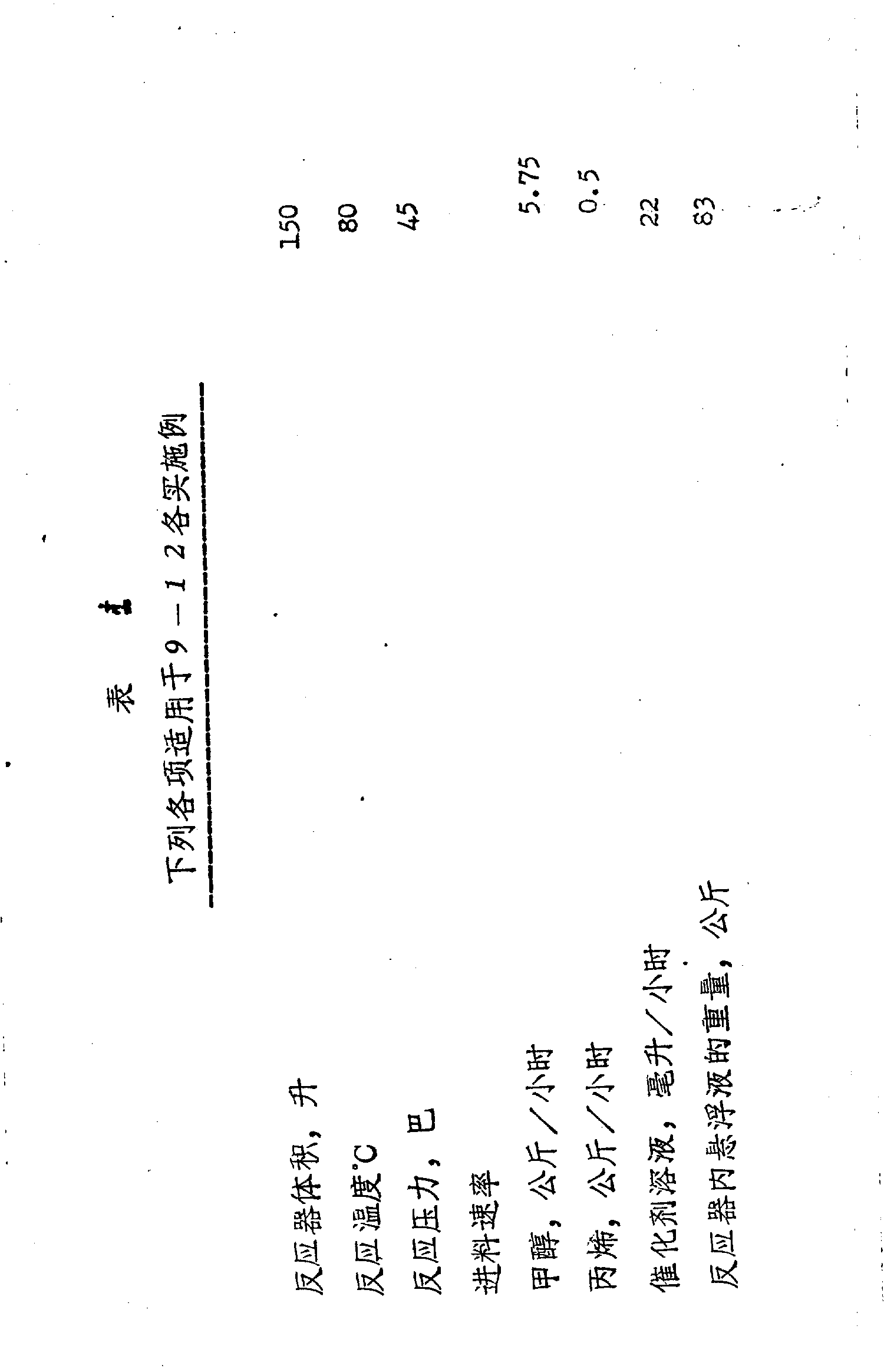
In these embodiments, use every liter of acetone to contain 1.10 gram acid chlorides by continuous processing, 2.74 grams 1,3-two (two (2-p-methoxy-phenyl) phosphino-) propane prepares carbon monoxide/ethylene/propene terpolymer with the catalyst solution of different amount trifluoroacetic acids.The reaction conditions of each embodiment and obtain the results are shown in table 1.
Embodiment 13 and 14
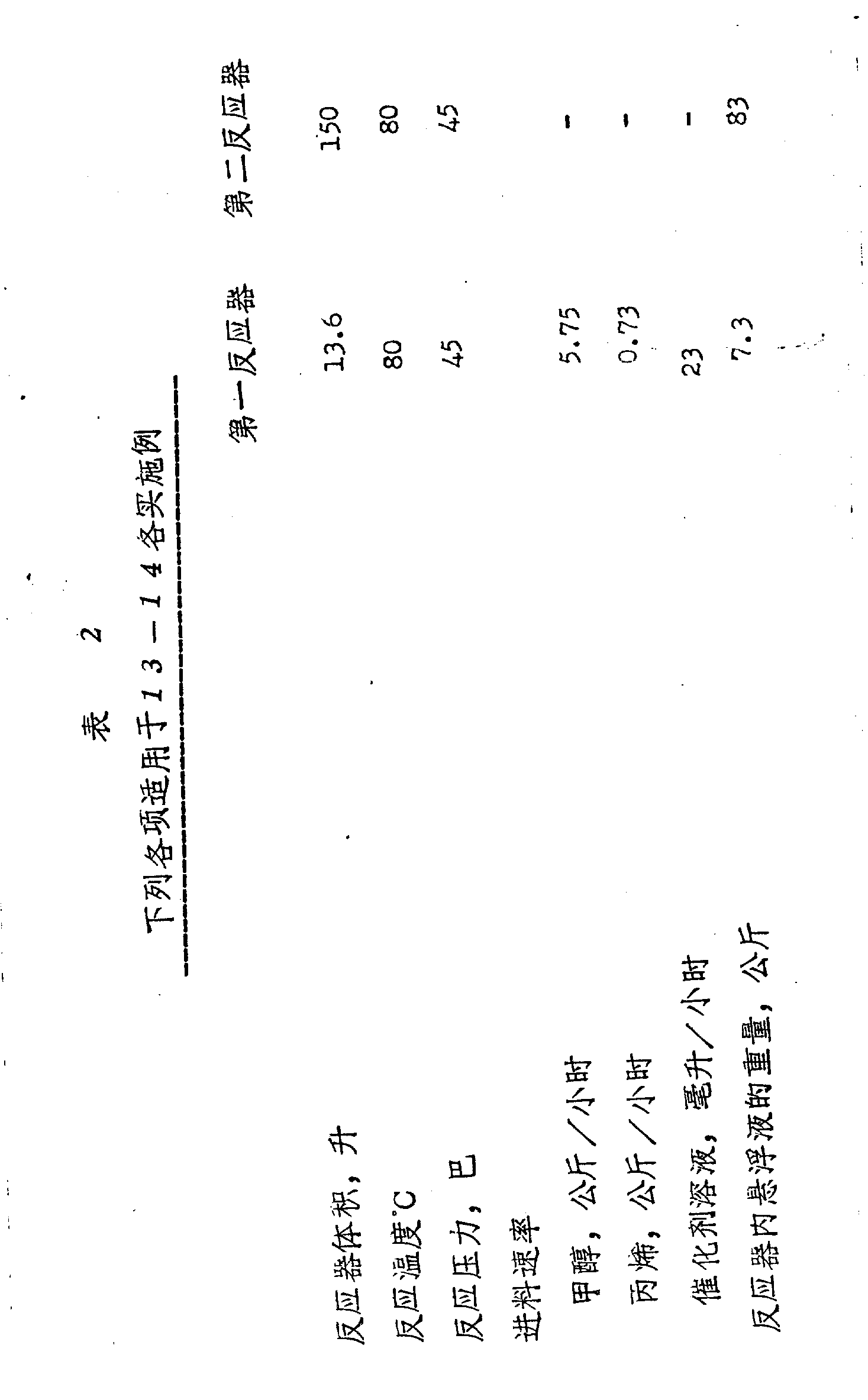
In these embodiments, in two reactors of polyphone, prepare carbon monoxide/ethylene/propene terpolymer by continuous processing.The product of first reactor and fresh feed (monomer) component mixes and adds second reactor continuously.The pressure of reactor is kept by discharging excessive unstripped gas from second reactor.Basically having identical gas phase in each reactor of these polyphones forms.The catalyst solution that uses in embodiment 13 and 14 is identical with the catalyst solution of use in embodiment 10 and 12 respectively.The reaction conditions of each embodiment and the table 2 that the results are shown in that obtains.
In embodiment 1 to 14, embodiment 11,12 and 14 requirements according to the invention.In these embodiments, polymer manufacture is to use by continuous processing to contain the catalyzer that every mole of palladium is less than 6 moles of trifluoroacetic acids and carry out.Embodiment 1 to 10 and 13 not in the scope of the invention with interior and be included in the application for patent usefulness for contrast.In embodiment 1 to 8, polymer manufacture is carried out off and on.Though polymer manufacture is to be undertaken by continuous processing in embodiment 9,10 and 13, used catalyzer contains every mole of palladium more than 6 moles trifluoroacetic acid.
By the result of comparative examples 1,2 and 3, can be clear that of the influence of the amount of halogenated monocarboxylate in the catalyzer to rate of polymerization in the batchwise polymerization and molecular-weight average.Be increased to 4 when increasing to 10 moles again when halogenated monocarboxylate amount is 2 moles by every mole of palladium, rate of polymerization is increased to 7 from 5 and increases to 16 kilograms of multipolymers/(gram palladium hour) again, and intrinsic viscosity LVN is increased to 0.8 from 0.5 and increases to 1.0 deciliter/gram again.Comparative examples 7 and, can observe the similar influence of acid amount at 8 o'clock.Acid amount is 2 moles from every mole of palladium and is increased to 20 moles and causes rate of polymerization to be increased to 1.7 kilograms of terpolymers (gram palladium hour) from 0.9 that LVN is increased to 0.6 deciliter/gram from 0.4.
With embodiment 4,5 and 6(every mole of palladium of catalyzer of implementing usefulness contain 20 respectively, 30 and 60 equimolar acids) result and embodiment 3(acid amount in implementing the catalyzer of usefulness is 10 moles of every mole of palladiums) the result contrast, can see, prepare in the polymkeric substance by interrupter method, the acid amount that every mole of palladium is used can not cause rate of polymerization or molecular-weight average that any tangible increase is arranged when being increased to greater than 10 moles.Contrast is respectively 20 and 10 moles with every mole of palladium of catalyzer acid content of the embodiment 9 of continuous processing and 10(enforcement usefulness) the result, can draw similar conclusion.
The result of embodiment 11 and 12 contrasted with the result of embodiment 10 and the result of embodiment 14 is contrasted with the result of embodiment 13, can be clear that if be less than the catalyzer of 6 moles of trifluoroacetic acids then have desirable influence with containing every mole of palladium to preparing polymkeric substance by continuous processing according to the present invention.With what expect according to the experimental result of interrupter method, promptly rate of polymerization and molecular-weight average all will descend on the contrary.Preparing in the polymkeric substance by continuous processing, acid amount is reduced to every mole of palladium and is lower than 6 moles and cause rate of polymerization to increase, and intrinsic viscosity LVN then remains unchanged.
By the 13C nuclear magnetic resonance analysis, confirmed to form by the thread-like molecule chain according to the carbon monoxide/ethylene copolymer of embodiment 1 to 6 preparation with according to the carbon monoxide/ethylene/propene terpolymer of embodiment 7 to 14 preparations, wherein on the one hand from the carbon monoxide unit, from ethylene unit or from ethene and propylene units, two aspects exist with alternate sequence on the other hand.In the terpolymer molecular chain, distribute with random fashion from the unit of ethene and propylene.

Claims (10)
Applications Claiming Priority (2)
| Application Number | Priority Date | Filing Date | Title |
|---|---|---|---|
| NL9000220 | 1990-01-30 | ||
| NL9000220 | 1990-01-30 |
Publications (1)
| Publication Number | Publication Date |
|---|---|
| CN1053801A true CN1053801A (en) | 1991-08-14 |
Family
ID=19856505
Family Applications (1)
| Application Number | Title | Priority Date | Filing Date |
|---|---|---|---|
| CN91100512A Pending CN1053801A (en) | 1990-01-30 | 1991-01-28 | Process for the continuous production of polymers of carbon monoxide and one or more ethylenically unsaturated compounds |
Country Status (11)
| Country | Link |
|---|---|
| US (1) | US5115094A (en) |
| EP (1) | EP0442555B1 (en) |
| JP (1) | JP3019223B2 (en) |
| KR (1) | KR910014412A (en) |
| CN (1) | CN1053801A (en) |
| AU (1) | AU635604B2 (en) |
| BR (1) | BR9100348A (en) |
| CA (1) | CA2035082C (en) |
| DE (1) | DE69115728T2 (en) |
| FI (1) | FI910406L (en) |
| ZA (1) | ZA91606B (en) |
Families Citing this family (7)
| Publication number | Priority date | Publication date | Assignee | Title |
|---|---|---|---|---|
| DE4036561A1 (en) * | 1990-11-16 | 1992-05-21 | Huels Chemische Werke Ag | THERMOPLASTIC MOLDING MATERIALS BASED ON POLYPHENYLENE ETHERS AND POLYAMIDES |
| US5216120A (en) * | 1991-02-26 | 1993-06-01 | Shell Oil Company | Polymerization of co/olefin with catalyst comprising palladium compound, lewis acid and bronsted acid |
| US5245123A (en) * | 1991-02-26 | 1993-09-14 | Shell Oil Company | Vapor phase polymerization of co/olefin with palladium compound, lewis acid and bidentate ligand |
| US5554777A (en) * | 1993-01-22 | 1996-09-10 | The Dow Chemical Compamy | Catalyst for the preparation of linear carbon monoxide/alpha-olefin copolymers |
| GB9307702D0 (en) * | 1993-04-14 | 1993-06-02 | Shell Int Research | Preparation of co-polymers |
| US6983502B2 (en) * | 2001-03-30 | 2006-01-10 | Boyd Flotation, Inc. | Air mattress with pillow top |
| KR100816680B1 (en) | 2006-12-28 | 2008-03-27 | 주식회사 효성 | Method of manufacturing polyketone |
Family Cites Families (10)
| Publication number | Priority date | Publication date | Assignee | Title |
|---|---|---|---|---|
| US3694412A (en) * | 1971-03-04 | 1972-09-26 | Shell Oil Co | Process for preparing interpolymers of carbon monoxide in the presence of aryl phosphine-palladium halide complex |
| EP0121965B1 (en) * | 1983-04-06 | 1989-12-27 | Shell Internationale Researchmaatschappij B.V. | Process for the preparation of polyketones |
| NL8403035A (en) * | 1984-10-05 | 1986-05-01 | Shell Int Research | PROCESS FOR PREPARING POLYKETONES. |
| IN166314B (en) * | 1985-08-29 | 1990-04-07 | Shell Int Research | |
| US4804739A (en) * | 1986-07-01 | 1989-02-14 | Shell Oil Company | Process for preparing carbon monoxide polymer with quaternary phosphonium compound bidentate ligand |
| IN171627B (en) * | 1986-08-26 | 1992-11-28 | Shell Int Research | |
| NL8602164A (en) * | 1986-08-26 | 1988-03-16 | Shell Int Research | CATALYST COMPOSITIONS. |
| AU612173B2 (en) * | 1987-08-28 | 1991-07-04 | Shell Internationale Research Maatschappij B.V. | Preparation of olefin/CO copolymers |
| CA1329858C (en) * | 1987-11-04 | 1994-05-24 | Eit Drent | Preparation of polymers of carbon monoxide |
| CA1338578C (en) * | 1988-04-29 | 1996-09-03 | Gerrit Gerardus Rosenbrand | Process for the preparation of polymers of carbon monoxide with unsaturated compounds |
-
1990
- 1990-11-14 US US07/612,372 patent/US5115094A/en not_active Expired - Fee Related
-
1991
- 1991-01-25 AU AU70002/91A patent/AU635604B2/en not_active Ceased
- 1991-01-28 ZA ZA91606A patent/ZA91606B/en unknown
- 1991-01-28 EP EP91200167A patent/EP0442555B1/en not_active Expired - Lifetime
- 1991-01-28 CA CA002035082A patent/CA2035082C/en not_active Expired - Fee Related
- 1991-01-28 KR KR1019910001396A patent/KR910014412A/en not_active Withdrawn
- 1991-01-28 DE DE69115728T patent/DE69115728T2/en not_active Expired - Fee Related
- 1991-01-28 BR BR919100348A patent/BR9100348A/en not_active Application Discontinuation
- 1991-01-28 JP JP3008542A patent/JP3019223B2/en not_active Expired - Lifetime
- 1991-01-28 FI FI910406A patent/FI910406L/en not_active Application Discontinuation
- 1991-01-28 CN CN91100512A patent/CN1053801A/en active Pending
Also Published As
| Publication number | Publication date |
|---|---|
| FI910406A7 (en) | 1991-07-31 |
| EP0442555B1 (en) | 1995-12-27 |
| KR910014412A (en) | 1991-08-31 |
| ZA91606B (en) | 1991-09-25 |
| FI910406L (en) | 1991-07-31 |
| BR9100348A (en) | 1991-10-22 |
| JPH04213324A (en) | 1992-08-04 |
| CA2035082A1 (en) | 1991-07-31 |
| JP3019223B2 (en) | 2000-03-13 |
| DE69115728T2 (en) | 1996-05-15 |
| AU635604B2 (en) | 1993-03-25 |
| EP0442555A1 (en) | 1991-08-21 |
| AU7000291A (en) | 1991-08-01 |
| US5115094A (en) | 1992-05-19 |
| CA2035082C (en) | 2002-03-26 |
| FI910406A0 (en) | 1991-01-28 |
| DE69115728D1 (en) | 1996-02-08 |
Similar Documents
| Publication | Publication Date | Title |
|---|---|---|
| CN86105214A (en) | New polymer of carbon monoxide and ethylene | |
| CN1012438B (en) | catalyst composition and olefin/carbon monoxide copolymerization method | |
| CN1010949B (en) | Polymer preparation method | |
| CN1010026B (en) | Carbon monoxide-olefin polymeric method | |
| CN87108013A (en) | New Polymers of Carbon Monoxide and α-Ethylenically Unsaturated Compounds | |
| CN1036273C (en) | Process for preparing catalyst composition and polymer | |
| CN1008102B (en) | Removal of Residual Catalyst from Ethylene/Carbon Monoxide Copolymers | |
| CN1069276A (en) | Be applicable to the catalyst composition of preparation carbon monoxide and alpha-olefinic polymer | |
| CN1053801A (en) | Process for the continuous production of polymers of carbon monoxide and one or more ethylenically unsaturated compounds | |
| CN1043138A (en) | The polymkeric substance that carbon monoxide and one or more alpha-olefins form | |
| KR100191082B1 (en) | Polymer manufacturing method | |
| CN1069497A (en) | Catalyst compositions and methods suitable for preparing polymers of carbon monoxide and ethylenically unsaturated compounds | |
| CN1036785C (en) | Catalyst compositions and their use in processes for the preparation of polymers | |
| CN87106659A (en) | Methods of making polymers | |
| CN1009370B (en) | Process for removing catalyst residues from ethylene/carbon monoxide copolymers | |
| CN87104269A (en) | New polymers | |
| CN1044469A (en) | catalyst composition | |
| CN1036272C (en) | Catalyst compositions | |
| CN1021451C (en) | Process for removing catalyst residues from olefin/carbon monoxide copolymers | |
| CN1054990A (en) | Preparation method of polymer polyketone | |
| CN1054255A (en) | Process for preparing polymers of carbon monoxide and one or more olefinically unsaturated compounds | |
| CN1090587A (en) | The preparation of the multipolymer of carbon monoxide and alefinically unsaturated compounds | |
| CN1079231A (en) | Process for the preparation of copolymers of carbon monoxide and ethylenically unsaturated compounds | |
| CN88101227A (en) | Process for removing palladium catalyst residues from copolymers of carbon monoxide and one or more ethylenically unsaturated compounds | |
| CN1044283A (en) | Catalyst composition |
Legal Events
| Date | Code | Title | Description |
|---|---|---|---|
| C06 | Publication | ||
| PB01 | Publication | ||
| C10 | Entry into substantive examination | ||
| SE01 | Entry into force of request for substantive examination | ||
| C01 | Deemed withdrawal of patent application (patent law 1993) | ||
| WD01 | Invention patent application deemed withdrawn after publication |