CN1054504C - Antibacterial antiplaque oral composition - Google Patents
Antibacterial antiplaque oral composition Download PDFInfo
- Publication number
- CN1054504C CN1054504C CN93102570A CN93102570A CN1054504C CN 1054504 C CN1054504 C CN 1054504C CN 93102570 A CN93102570 A CN 93102570A CN 93102570 A CN93102570 A CN 93102570A CN 1054504 C CN1054504 C CN 1054504C
- Authority
- CN
- China
- Prior art keywords
- dentifrice
- weight
- triclosan
- acid
- antibacterial
- Prior art date
- Legal status (The legal status is an assumption and is not a legal conclusion. Google has not performed a legal analysis and makes no representation as to the accuracy of the status listed.)
- Expired - Fee Related
Links
Classifications
-
- A—HUMAN NECESSITIES
- A61—MEDICAL OR VETERINARY SCIENCE; HYGIENE
- A61Q—SPECIFIC USE OF COSMETICS OR SIMILAR TOILETRY PREPARATIONS
- A61Q11/00—Preparations for care of the teeth, of the oral cavity or of dentures; Dentifrices, e.g. toothpastes; Mouth rinses
-
- A—HUMAN NECESSITIES
- A61—MEDICAL OR VETERINARY SCIENCE; HYGIENE
- A61K—PREPARATIONS FOR MEDICAL, DENTAL OR TOILETRY PURPOSES
- A61K8/00—Cosmetics or similar toiletry preparations
- A61K8/18—Cosmetics or similar toiletry preparations characterised by the composition
- A61K8/30—Cosmetics or similar toiletry preparations characterised by the composition containing organic compounds
- A61K8/40—Cosmetics or similar toiletry preparations characterised by the composition containing organic compounds containing nitrogen
- A61K8/42—Amides
-
- A—HUMAN NECESSITIES
- A61—MEDICAL OR VETERINARY SCIENCE; HYGIENE
- A61K—PREPARATIONS FOR MEDICAL, DENTAL OR TOILETRY PURPOSES
- A61K8/00—Cosmetics or similar toiletry preparations
- A61K8/18—Cosmetics or similar toiletry preparations characterised by the composition
- A61K8/30—Cosmetics or similar toiletry preparations characterised by the composition containing organic compounds
- A61K8/46—Cosmetics or similar toiletry preparations characterised by the composition containing organic compounds containing sulfur
- A61K8/466—Cosmetics or similar toiletry preparations characterised by the composition containing organic compounds containing sulfur containing sulfonic acid derivatives; Salts
-
- A—HUMAN NECESSITIES
- A61—MEDICAL OR VETERINARY SCIENCE; HYGIENE
- A61K—PREPARATIONS FOR MEDICAL, DENTAL OR TOILETRY PURPOSES
- A61K8/00—Cosmetics or similar toiletry preparations
- A61K8/18—Cosmetics or similar toiletry preparations characterised by the composition
- A61K8/72—Cosmetics or similar toiletry preparations characterised by the composition containing organic macromolecular compounds
- A61K8/90—Block copolymers
-
- A—HUMAN NECESSITIES
- A61—MEDICAL OR VETERINARY SCIENCE; HYGIENE
- A61P—SPECIFIC THERAPEUTIC ACTIVITY OF CHEMICAL COMPOUNDS OR MEDICINAL PREPARATIONS
- A61P1/00—Drugs for disorders of the alimentary tract or the digestive system
- A61P1/02—Stomatological preparations, e.g. drugs for caries, aphtae, periodontitis
Landscapes
- Health & Medical Sciences (AREA)
- Life Sciences & Earth Sciences (AREA)
- Veterinary Medicine (AREA)
- Animal Behavior & Ethology (AREA)
- General Health & Medical Sciences (AREA)
- Public Health (AREA)
- Epidemiology (AREA)
- Birds (AREA)
- Oral & Maxillofacial Surgery (AREA)
- Engineering & Computer Science (AREA)
- Bioinformatics & Cheminformatics (AREA)
- Chemical & Material Sciences (AREA)
- Chemical Kinetics & Catalysis (AREA)
- General Chemical & Material Sciences (AREA)
- Medicinal Chemistry (AREA)
- Nuclear Medicine, Radiotherapy & Molecular Imaging (AREA)
- Organic Chemistry (AREA)
- Pharmacology & Pharmacy (AREA)
- Cosmetics (AREA)
Abstract
本发明涉及洁牙剂,其包括0.01-5%(重量)且选自卤代二苯醚,卤代-N-水杨酸苯胺,苯甲酸酯,卤代N-碳酰苯胺及苯酚类化合物的不溶于水的非阳离子抗菌剂,0.005-4%(重量)的具有下式重复单位的聚乙烯膦酸,其平均分子量为1000-1,000,000,及能使抗菌剂溶于唾液的口用可接受赋形剂,其中该洁牙剂的pH为4.5-10。
The present invention relates to dentifrices comprising 0.01-5% by weight and selected from the group consisting of halogenated diphenyl ethers, halogenated-N-salicylic acid anilines, benzoate esters, halogenated N-carbanilides and phenols A water-insoluble non-cationic antibacterial agent of the compound, 0.005-4% (weight) of polyvinylphosphonic acid having the repeating unit of the following formula, its average molecular weight is 1000-1,000,000, and an oral soluble antibacterial agent that can dissolve in saliva Vehicles are received wherein the dentifrice has a pH of 4.5-10.
Description
本发明涉及一种抗菌的抗蚀斑口用复方洁牙剂。特别地,它涉及一种含有可有效抑制蚀斑的实质上水不溶的非阳离子抗菌剂的口用复方洁牙剂。The invention relates to an antibacterial compound toothwash for anti-plaque oral cavity. In particular, it relates to an oral combination dentifrice comprising a substantially water-insoluble non-cationic antimicrobial agent effective in inhibiting plaque.
与牙垢(一种牙齿上坚硬的钙化积沉)相反,牙蚀斑是形成于牙齿上的软沉积。与牙垢不同,蚀斑可在牙齿表面的任何部位形成,特别是在齿龈的边缘。因此,除了不雅观外,蚀斑与龈炎的发生有关。Plaque is a soft deposit that forms on teeth, as opposed to tartar (a hard, calcified deposit on teeth). Unlike tartar, plaque can form anywhere on the tooth surface, especially at the edges of the gums. Therefore, in addition to being unsightly, plaques are associated with the development of gingivitis.
因此,非常需要在口用复方中加入已知的可减少蚀斑的抗微生物剂。通常,建议采用阳离子抗菌剂。此外,Viston等人在美国专利4,022,880中描述了将一个提供锌离子的化合物(作为抗牙垢剂)与另一个可有效延缓蚀斑菌生长的抗菌剂混合的情况。各种与锌化合物合用的抗菌剂已被作了描述。这些锌化合物包括有阳离子物质,如胍,季铵化合物及非阳离子化合物,如卤代N-水杨酰苯胺和卤代羟基二苯醚。在欧洲专利申请0 161,899中,Saxtox等人对非阳离子抗菌的抗蚀斑卤代羟基二苯醚及triclosan与三水合柠檬酸锌的合用作了描述。Davis在欧洲专利申请0 271,332中也对作为牙膏成分(含有增溶剂如丙二醇)的triclosan作了描述。Therefore, there is a great need to include antimicrobial agents known to reduce plaque in oral compositions. In general, cationic antimicrobials are recommended. In addition, Viston et al. in US Pat. No. 4,022,880 describe combining a zinc ion donating compound (as an anti-tartar agent) with another antimicrobial effective in retarding the growth of plaque bacteria. Various antimicrobial agents have been described in combination with zinc compounds. These zinc compounds include cationic materials such as guanidine, quaternary ammonium compounds and non-cationic compounds such as halogenated salicylanilides and halogenated hydroxydiphenyl ethers. In European Patent Application 0 161,899, Saxtox et al. describe the combination of non-cationic antibacterial anti-plaque halogenated hydroxydiphenyl ethers and triclosan with zinc citrate trihydrate. Davis also describes triclosan as a toothpaste ingredient (containing solubilizers such as propylene glycol) in European Patent Application 0 271,332.
作为抗菌抗蚀斑剂,阳离子抗菌物质如洗必太,氯化Benzth-onium和氯化十六烷基吡啶鎓是大量调查研究的对象。然而,当它们与阴离子物质一起使用时通常不是很有效。另一方面,在口服复方中,非阳离子抗菌物质可与阴离子成分相容。Cationic antibacterial substances such as chlorhexidine, Benzth-onium chloride and cetylpyridinium chloride have been the subject of extensive investigation as antibacterial and antiplaque agents. However, they are usually not very effective when used with anionic substances. On the other hand, non-cationic antimicrobial substances are compatible with anionic components in oral combination formulations.
然而,典型的口服复方常常是多种成份的混合物,即使象湿润剂这样典型的中性物质也能影响复方的性能。However, typical oral formulations are often a mixture of ingredients, and even a typically neutral substance like a humectant can affect the performance of the formulation.
此外,即使是非阳离子抗菌剂在与通常采用的物质,如多聚磷酸酯抗牙垢剂(Gaffar等人在英国专利申请00551及Jackson等人在欧洲专利0251591中均作了描述)合用时,其效果也是有限的。通常指定的U.S.S.N.398,605(1989年8月25日登记)显示,由于加入了抗菌增强剂(AEA)(其可增强所述的抗菌剂在口腔表面的释放及保留)以及提供了合适的多聚磷酸酯及AEA的量和比例,抗蚀斑效果大大提高了。Furthermore, even non-cationic antimicrobials are less effective when combined with commonly used materials such as polyphosphate antitartar agents (Gaffar et al., UK Patent Application 00551 and Jackson et al., European Patent 0251591). is also limited. Commonly assigned U.S.S.N. 398,605 (registered August 25, 1989) shows that due to the addition of an antimicrobial enhancer (AEA) that enhances the release and retention of said antimicrobial on oral surfaces and the provision of suitable polyphosphoric acid The amount and ratio of ester and AEA greatly improved the anti-plaque effect.
本发明的优点在于它提供了一个包含有实质上水不溶性非阳离子抗菌剂及AEA的抑制蚀斑形成的口用复方,该复方含有可使所述抗菌剂溶于唾液,并达到有效抗蚀斑剂量的口用可接受的液体赋形剂。An advantage of the present invention is that it provides an oral plaque-inhibiting composition comprising a substantially water-insoluble non-cationic antibacterial agent and an AEA, the composition containing said antibacterial agent soluble in saliva, and achieving an effective anti-plaque Doses of orally acceptable liquid excipients.
本发明进一步的优点在于AEA增强了少量的,但却是有效抗蚀斑量的抗菌剂在牙齿及口腔软组织上的释放和保留。A further advantage of the present invention is that AEAs enhance the release and retention of small, but antiplaque effective amounts of antimicrobial agents on teeth and oral soft tissues.
本发明更进一步的优点在于所提供的抗蚀斑口服复方可以有效地降低龈炎的发生。A further advantage of the present invention is that the provided anti-plaque oral compound can effectively reduce the occurrence of gingivitis.
本发明其它的优点将会从下列的详细说明中显现出来。Other advantages of the present invention will appear from the following detailed description.
根据本发明的某些方面,其涉及一个含有有效抗蚀斑剂量的,实质上水不溶性非阳离子抗菌剂和约0.005~4%(重量百分比)抗菌增强剂(其可增强所述抗菌剂在口腔表面的释放和保留)以及口服可接受的赋形剂,该赋形剂可有效地使所述抗菌剂溶于唾液,并达到有效的抗蚀斑剂量,所述的口服复方实质上免去了多聚磷酸酯抗牙垢剂。According to certain aspects of the present invention, it relates to an anti-plaque amount containing an effective anti-plaque amount, a substantially water-insoluble non-cationic antibacterial agent and about 0.005 to 4% (percentage by weight) antibacterial enhancer (which can enhance the antibacterial agent on the surface of the oral cavity) release and retention) and an orally acceptable vehicle that is effective to dissolve the antiseptic in saliva and achieve an effective antiplaque dose, the oral combination substantially eliminates the need for multiple Polyphosphate antitartar agent.
典型的,特别是从抗蚀斑效果、安全及配方等考虑出发,较理想的水不溶性非阳离子抗菌剂例子有:Typical examples of ideal water-insoluble non-cationic antibacterial agents are:
卤代二苯醚 Halogenated diphenyl ethers
2′,4,4′-三氯-2-羟基-二苯醚(Triclosan)2′,4,4′-Trichloro-2-hydroxy-diphenyl ether (Triclosan)
2,2′-二羟基-5,5′-二溴-二苯醚2,2'-Dihydroxy-5,5'-dibromo-diphenyl ether
卤代N-水杨酰苯胺类 Halogenated N-salicylanilides
4′,5-二溴N-水杨酰苯胺4′,5-Dibromo-N-salicylanilide
3,4′,5-三氯N-水杨酰苯胺3,4′,5-Trichloro-N-salicylanilide
3,4′,5-三溴N-水杨酰苯胺3,4′,5-Tribromo-N-salicylanilide
2,3,3′,5-四氯N-水杨酰苯胺2,3,3′,5-Tetrachloro-N-salicylicanilide
3,3,3′,5-四氯N-水杨酰苯胺3,3,3′,5-Tetrachloro-N-salicylicanilide
3,5-二溴-3′-三氟甲基N-水杨酰苯胺3,5-Dibromo-3′-trifluoromethyl N-salicylicanilide
5-正辛基-3′-三氟甲基N-水杨酰苯胺5-n-octyl-3′-trifluoromethyl N-salicylanilide
3,5-二溴-4′-三氟甲基N-水杨酰苯胺3,5-Dibromo-4′-trifluoromethyl N-salicylicanilide
3,5-二溴-3′-三氟甲基N-水杨酰苯胺(Flurop-hene)3,5-Dibromo-3′-trifluoromethyl N-salicylicanilide (Flurop-hene)
苯甲酸酯类 Parabens
甲基-对羟基苯甲酸酯Methyl-paraben
乙基-对羟基苯甲酸酯Ethyl-paraben
丙基-对羟基苯甲酸酯Propyl-paraben
丁基-对羟基苯甲酸酯Butyl-paraben
卤代N-碳酰苯胺类 Halogenated N-carbanilides
3,4,4′-三氯N-碳酰苯胺3,4,4'-Trichloro-N-carbanilide
3-三氟甲基-4,4 ′-二氯N-碳酰苯胺3-Trifluoromethyl-4,4'-dichloro-N-carbanilide
3,3,4′-三氯N-碳酰苯胺3,3,4′-Trichloro-N-carbanilide
苯酚类化合物(包括苯酚和它的同系物,单和聚烷基及芳香卤代(如F,Cl,Br,I)苯酚,间苯二酚和儿茶酚及它们的衍生物,以及双酚化合物)Phenolic compounds (including phenol and its homologues, mono- and polyalkylated and aromatic halogenated (such as F, Cl, Br, I) phenols, resorcinol and catechol and their derivatives, and bisphenols compound)
苯酚和它的同系物类Phenol and its homologues
苯酚phenol
2甲基 -苯酚2-methyl -phenol
3甲基 -苯酚3-methyl -phenol
4甲基 -苯酚4-methyl -phenol
4乙基 -苯酚4-ethyl -phenol
2,4-二甲基 -苯酚2,4-Dimethyl -phenol
2,5-二甲基 -苯酚2,5-Dimethyl -phenol
3,4-二甲基 -苯酚3,4-Dimethyl -phenol
2,6-二甲基 -苯酚2,6-Dimethyl -phenol
4-正丙基 -苯酚4-n-Propyl -phenol
4-正丁基 -苯酚4-n-Butyl -phenol
4-正戊基 -苯酚4-n-Pentyl -phenol
4-叔戊基 -苯酚4-tert-amyl -phenol
4-正己基 -苯酚4-n-hexyl -phenol
4-正庚基 -苯酚4-n-heptyl -phenol
2-甲氧基-4-(2-丙烯基) -苯酚(丁子香酚)2-Methoxy-4-(2-propenyl) -phenol (eugenol)
2-异丙基-5-甲基 -苯酚(百里酚)2-Isopropyl-5-methyl -phenol (thymol)
单和聚烷基及芳烷基卤代苯酚类 Mono- and polyalkyl and aralkyl halogenated phenols
甲基 -对氯苯酚Methyl -p-Chlorophenol
乙基 -对氯苯酚Ethyl -p-Chlorophenol
正丙基 -对氯苯酚n-Propyl -p-Chlorophenol
正丁基 -对氯苯酚n-Butyl -p-Chlorophenol
正戊基 -对氯苯酚n-Pentyl -p-Chlorophenol
仲戊基 -对氯苯酚Sec-Amyl -4-Chlorophenol
正己基 -对氯苯酚n-Hexyl -p-Chlorophenol
环己基 -对氯苯酚Cyclohexyl - p-Chlorophenol
正庚基 -对氯苯酚n-Heptyl -p-Chlorophenol
正辛基 -对氯苯酚n-Octyl -p-Chlorophenol
邻氯苯酚o-Chlorophenol
甲基 -邻氯苯酚Methyl - o-Chlorophenol
乙基 -邻氯苯酚Ethyl - o-Chlorophenol
正丙基 -邻氯苯酚n-Propyl - o-Chlorophenol
正丁基 -邻氯苯酚n-Butyl - o-Chlorophenol
正戊基 -邻氯苯酚n-Pentyl - o-Chlorophenol
叔戊基 -邻氯苯酚tert-amyl -o-chlorophenol
正己基 -邻氯苯酚n-Hexyl -o-Chlorophenol
正庚基 -邻氯苯酚n-heptyl -o-chlorophenol
对氯苯酚p-Chlorophenol
邻苄基 -对氯苯酚o-Benzyl -4-Chlorophenol
邻苄基-间甲基 -对氯苯酚o-benzyl-m-methyl -p-chlorophenol
邻苄基-间,间二甲基 -对氯苯酚o-benzyl-m-, m-dimethyl - p-chlorophenol
邻苯乙基 -对氯苯酚o-Phenylethyl - p-Chlorophenol
邻苯乙基-间甲基 -对氯苯酚o-Phenyl-m-methyl -p-Chlorophenol
3-甲基 -对氯苯酚3-Methyl -p-Chlorophenol
3,5-二甲基 -对氯苯酚3,5-Dimethyl -p-Chlorophenol
6-乙基-3-甲基 -对氯苯酚6-Ethyl-3-methyl -p-Chlorophenol
6-正丙基-3-甲基 -对氯苯酚6-n-Propyl-3-methyl -p-Chlorophenol
6-异丙基-3-甲基 -对氯苯酚6-Isopropyl-3-methyl -p-Chlorophenol
2-乙基-3,5-二甲基 -对氯苯酚2-Ethyl-3,5-dimethyl -4-chlorophenol
6-仲丁基-3-甲基 -对氯苯酚6-sec-butyl-3-methyl -p-Chlorophenol
2-异丙基-3,5-二甲基 -对氯苯酚2-Isopropyl-3,5-dimethyl -4-chlorophenol
6-二乙基甲基-3-甲基 -对氯苯酚6-Diethylmethyl-3-methyl -4-chlorophenol
6-异丙基-2-乙基-3-甲基 -对氯苯酚6-Isopropyl-2-ethyl-3-methyl -4-chlorophenol
2-仲戊基-3,5-二甲基 -对氯苯酚2-sec-pentyl-3,5-dimethyl -4-chlorophenol
2-二乙基甲基-3,5-二甲基 -对氯苯酚2-Diethylmethyl-3,5-dimethyl -p-chlorophenol
6-仲辛基-3-甲基 -对氯苯酚6-sec-octyl-3-methyl - p-chlorophenol
对溴苯酚p-Bromophenol
甲基 -对溴苯酚Methyl -4-bromophenol
乙基 -对溴苯酚Ethyl -p-Bromophenol
正丙基 -对溴苯酚n-Propyl -p-Bromophenol
正丁基 -对溴苯酚n-Butyl -p-Bromophenol
正戊基 -对溴苯酚n-Pentyl -p-Bromophenol
仲戊基 -对溴苯酚S-Amyl -p-Bromophenol
正己基 -对溴苯酚n-Hexyl -p-Bromophenol
环己基 -对溴苯酚Cyclohexyl - p-Bromophenol
邻溴苯酚o-Bromophenol
叔戊基 -邻溴苯酚tert-amyl -o-bromophenol
正己基 -邻溴苯酚n-Hexyl -o-Bromophenol
正丙基-间,间二甲基 -邻溴苯酚n-propyl-m-, m-dimethyl -o-bromophenol
2-苯基苯酚2-Phenylphenol
4-氯-2-甲基苯酚4-Chloro-2-methylphenol
4-氯-3-甲基苯酚4-chloro-3-methylphenol
4-氯-3,5-二甲基苯酚4-chloro-3,5-dimethylphenol
2,4-二氯-3,5-二甲基苯酚2,4-dichloro-3,5-dimethylphenol
3,4,5,6-四溴-2-甲基苯酚3,4,5,6-Tetrabromo-2-methylphenol
5-甲基-2-戊基苯酚5-Methyl-2-pentylphenol
4-异丙基-3-甲基苯酚4-isopropyl-3-methylphenol
5-氯-2-羟基二苯基甲烷5-Chloro-2-hydroxydiphenylmethane
间苯二酚及其衍生物类Resorcinol and its derivatives
间苯二酚Resorcinol
甲基 -间苯二酚Methyl - Resorcinol
乙基 -间苯二酚Ethyl - Resorcinol
正丙基 -间苯二酚n-Propyl - Resorcinol
正丁基 -间苯二酚n-Butyl - Resorcinol
正戊基 -间苯二酚n-Pentyl -Resorcinol
正己基 -间苯二酚n-Hexyl -Resorcinol
正庚基 -间苯二酚n-Heptyl -Resorcinol
正辛基 -间苯二酚n-octyl -resorcinol
正壬基 -间苯二酚n-Nonyl -Resorcinol
苯基 -间苯二酚Phenyl - Resorcinol
苄基 -间苯二酚Benzyl -Resorcinol
苯乙基 -间苯二酚Phenylethyl - Resorcinol
苯丙基 -间苯二酚Phenylpropyl - Resorcinol
对氯苄基 -间苯二酚4-chlorobenzyl -resorcinol
5-氯 -2,4-二羟基二苯基甲烷5-chloro -2,4-dihydroxydiphenylmethane
4′-氯 -2,4-二羟基二苯基甲烷4′-Chloro-2,4-dihydroxydiphenylmethane
5-溴 -2,4-二羟基二苯基甲烷5-Bromo-2,4-dihydroxydiphenylmethane
4″-溴 -2,4-二羟基二苯基甲烷4″-Bromo-2,4-Dihydroxydiphenylmethane
双酚化合物类 Bisphenols
双酚ABisphenol A
2,2′-亚甲基双(4-氯苯酚)2,2′-Methylenebis(4-chlorophenol)
2,2′-亚甲基双(3,4,6-三氯苯酚)(双三氯酚)2,2′-Methylenebis(3,4,6-trichlorophenol) (bistrichlorophenol)
2,2′-亚甲基双(4-氯-6-溴苯酚)2,2′-Methylene bis(4-chloro-6-bromophenol)
双(2-羟基-3,5-二氯苯基)硫化物Bis(2-hydroxy-3,5-dichlorophenyl)sulfide
双(2-羟基-5-氯苄基)硫化物Bis(2-hydroxy-5-chlorobenzyl)sulfide
存在于口用复方中的非阳离子抗菌剂的有效抗蚀斑剂量,对于洁牙剂来说,典型的约为0.01%~5%(重量百分比,下同),较好的约为0.03%~1%,更好的约为0.25%~0.5%或约0.25%~小于0.5%,最好的约为0.25%~0.35%,如约0.3%;对于漱口液或液体洁牙剂来说,较好的约为0.03%~0.3%,最好的约为0.03%~0.1%。抗菌剂是实质上水不溶的,其含义是在25℃下,它在水中的溶解度约小于1%(重量百分比),甚至约小于0.1%。The effective anti-plaque dose of the non-cationic antibacterial agent present in the oral compound is typically about 0.01% to 5% (percentage by weight, the same below) for dentifrices, preferably about 0.03% to 5%. 1%, more preferably about 0.25% to 0.5% or about 0.25% to less than 0.5%, most preferably about 0.25% to 0.35%, such as about 0.3%; for mouthwash or liquid dentifrice, relatively It is preferably about 0.03% to 0.3%, and the most preferable is about 0.03% to 0.1%. The antimicrobial agent is substantially water insoluble, meaning that it has a solubility in water of less than about 1% by weight, even less than about 0.1% at 25°C.
较好的卤代二苯醚是triclosan。较好的酚类化合物有苯酚,百里酚,丁子香酚,己基间苯二酚和2,2′-亚甲基双(4-氯-6-溴代苯酚)。最好的抗菌抗蚀斑化合物是triclosan。作为一种与抗牙垢剂(其可提供锌离子)合用的抗菌剂,Triclosan在上述的美国专利4,022,880中已被透露,此外德国专利3532860描述了它与铜化合物合用的情况。欧洲专利0278744中则描述了它与含有钾离子源的牙齿脱敏剂合用的情况。在洁牙剂中triclosan也被作为抗蚀斑剂透露出来,前者经配方含有片状液晶表面活性剂相,其含有小于6nm的层状空间,并可任意地含有锌盐(Lame等发表于欧洲专利申请0161898号);同时在洁牙剂中可含有三水合柠檬酸锌(Saxtox等发表于欧洲专利申请0161899号)。A preferred halogenated diphenyl ether is triclosan. Preferred phenolic compounds are phenol, thymol, eugenol, hexylresorcinol and 2,2'-methylenebis(4-chloro-6-bromophenol). The best antibacterial antiplaque compound is triclosan. Triclosan is disclosed in the aforementioned US Patent 4,022,880 as an antimicrobial agent in combination with an antitartar agent which provides zinc ions, and German Patent 3532860 describes its use in combination with copper compounds. European patent 0278744 describes its use in combination with tooth desensitizers containing a source of potassium ions. Triclosan has also been revealed as an antiplaque agent in dentifrices, the former being formulated with a lamellar liquid crystalline surfactant phase containing lamellar spaces smaller than 6 nm, optionally containing zinc salts (Lame et al. Patent application No. 0161898); Simultaneously, zinc citrate trihydrate may be contained in the dentifrice (Saxtox et al. published in European Patent Application No. 0161899).
口服复方中所采用的,可获得有效增强作用的抗菌增强剂(AEA)(其可增加上述抗菌剂在口腔表面的释放和保留)的用量在约0.005%~约4%范围内,较好的为约0.1%~约3%,更好的为约0.5%~约2.5%(均为重量百分比)。Adopted in the oral compound, the antibacterial enhancer (AEA) (it can increase the release and retention of above-mentioned antibacterial agent on the surface of the oral cavity) that can obtain effective enhancement effect is in the range of about 0.005%~about 4%, preferably It is about 0.1% to about 3%, more preferably about 0.5% to about 2.5% (both are percentages by weight).
AEA可以是单一化合物,较好的是可聚合的单体,更好的是聚合物,后一个术语完全是同属的,例如其包括低聚物,高聚物,两种或多种单体的共聚物,离子交联聚合物,嵌段共聚物,接枝共聚物,交联聚合物及共聚物等等。AEA可以是天然的,也可以是合成的,其可为水不溶性或最好是水(唾液)溶性或可溶胀的(可水合的,水凝胶成形)。它的平均分子量约为100~1,000,000,较好的约为1,000~1,000,000,更好的约为2,000或2,500~250,000或500,000。AEA may be a single compound, preferably a polymerizable monomer, more preferably a polymer, the latter term being entirely generic, for example it includes oligomers, polymers, combinations of two or more monomers Copolymers, ionomers, block copolymers, graft copolymers, crosslinked polymers and copolymers, etc. AEAs can be natural or synthetic, they can be water insoluble or preferably water (saliva) soluble or swellable (hydratable, hydrogel forming). Its average molecular weight is about 100 to 1,000,000, preferably about 1,000 to 1,000,000, more preferably about 2,000 or 2,500 to 250,000 or 500,000.
通常,AEA至少含有一个释放增强基团,其较好的是酸性的,如磺酸,磷酸,或者更好的为磷酸或羧酸以及它们的盐类,例如碱金属盐或铵盐。AEA还至少含有一个有机的保留增强基团,更好的是含有一个既具释放增强,又具保留增强基团的多元性,后一个组最好具有下列通式-(X)n-R,其X为O,N,S,SO,SO2,P,PO或Si等,R为疏水性的烷基,链烯基,酰基,芳基,烷芳基,芳烷基,杂环基或它们的惰性取代衍生物,n为0或1或更多(1以上)。上述的“惰性取代衍生物”是指那些通常为非亲水性的R上的取代物,它们对所期望的AEA的功能(即增强抗菌剂在口腔表面的释放和保留)没有显著的干扰,这类取代物有Cl,Br,I及羰基等。下列表格将说明这种保留增强组。n X -(X)nRO … 甲基,乙基,丙基,丁基,异丙基,叔丁基,Usually, the AEA contains at least one release-enhancing group, which is preferably acidic, such as sulfonic acid, phosphoric acid, or more preferably phosphoric acid or carboxylic acid and their salts, such as alkali metal or ammonium salts. AEA also contains at least one organic retention-enhancing group, and preferably contains a plurality of both release-enhancing and retention-enhancing groups. The latter group preferably has the following general formula -(X) n -R, Its X is O, N, S, SO, SO 2 , P, PO or Si, etc., R is a hydrophobic alkyl, alkenyl, acyl, aryl, alkaryl, aralkyl, heterocyclic or In their inert substituted derivatives, n is 0 or 1 or more (1 or more). The above-mentioned "inert substituted derivatives" refer to those substituents on R that are generally non-hydrophilic, and they have no significant interference with the desired AEA function (i.e., enhancing the release and retention of antibacterial agents on oral surfaces), Such substituents include Cl, Br, I and carbonyl. The following table will describe this retention enhancement group. n X -(X) n RO … methyl, ethyl, propyl, butyl, isopropyl, tert-butyl,
环己基,烯丙基,苄基,苯基,氯代苯基,二 Cyclohexyl, Allyl, Benzyl, Phenyl, Chlorophenyl, Di
甲苯基,吡啶基,呋喃基,乙酰基,苯甲酰基 Cresyl, Pyridyl, Furanyl, Acetyl, Benzoyl
丁酰基,对苯二酚基等。1 O 乙氧基,苄氧基,硫代乙酰氧基,苯氧基,羰Butyryl, Hydroquinone, etc. 1 O O Ethoxy, Benzyloxy, Thioacetoxy, Phenoxy, Carbonyl
乙氧基,羰苄氧基等。Ethoxy, carbobenzyloxy, etc.
N 乙基氨基,二乙基氨基,丙基氨基,苄基氨基 N Ethylamino, Diethylamino, Propylamino, Benzylamino
苯甲酰胺基,苯乙酰胺基等。
S 硫代丁基,硫代异丁基,硫代烯丙基,硫代苄S S Thiobutyl, Thioisobutyl, Thioallyl, Thiobenzyl
基,硫代苯基,硫代丙酰基,苯基硫代乙酰基Syl, Thiophenyl, Thiopropionyl, Phenylthioacetyl
硫代苯甲酰基等。
SO 丁基亚磺酰基,烯丙基亚磺酰基,苄基亚磺酰 SO Butylsulfinyl, Allylsulfinyl, Benzylsulfinyl
基,苯基亚磺酰基等。group, phenylsulfinyl group, etc.
SO2 丁基磺酰基,烯丙基磺酰基,苄基磺酰基,苯SO 2 Butylsulfonyl, Allylsulfonyl, Benzylsulfonyl, Benzene
基磺酰基等。Sulfonyl, etc.
P 二乙基膦基,乙基乙烯基膦基,甲基烯丙基膦P P Diethylphosphino, Ethylvinylphosphino, Methallylphosphino
基,乙基苄基膦基,乙基苯基膦基等。
PO 二乙基膦氧基,乙基乙烯基膦氧基,甲基烯丙 PO
基膦氧基,甲基苄基膦氧基,甲基苯基膦氧基 ,
等。 wait.
Si 三甲基甲硅烷基,二甲基丁基甲硅烷基,二甲 Sitrimethylsilyl , dimethylbutylsilyl, dimethyl
基苄基甲硅烷基,二甲基乙烯基甲硅烷基,二
甲基烯丙基甲硅烷基等。 Methallyl silyl, etc.
当此处应用时,释放增强基团是指这样一种东西,它连接或实质上以粘着、粘聚或者以其他方式结合AEA(载有抗菌剂),并将其带到口腔(例如牙和牙龈)表面,从而在这些表面释放出抗菌剂。通常有机保留增强基团是疏水性的,它连接或以其它结合方式使抗菌剂与AEA相连接,从而提高了抗菌剂相对于AEA的保留,并间接地提高了抗菌剂在口腔表面的保留。在某些情况下,抗菌剂与AEA的连接是通AEA的物理诱捕作用实现的,特别是当AEA为一交联聚合物时,它的结构内在地为这样一种诱捕提供了场所。高分子量的存在及交联聚合物中多交联基团的存在,更进一步提高了交联AEA聚合物对抗菌剂的物理诱捕。As used herein, a release-enhancing group refers to something that attaches or substantially adheres, cohesively or otherwise binds an AEA (loaded with an antimicrobial agent) and brings it to the oral cavity (e.g. teeth and gingiva) surfaces, thereby releasing antimicrobial agents on these surfaces. Usually the organic retention enhancing group is hydrophobic, which links or otherwise binds the antimicrobial agent to the AEA, thereby improving the retention of the antimicrobial agent relative to the AEA and indirectly improving the retention of the antimicrobial agent on the oral surface. In some cases, the linking of the antimicrobial agent to the AEA is achieved through physical entrapment by the AEA, particularly when the AEA is a cross-linked polymer whose structure inherently provides a site for such entrapment. The presence of high molecular weight and multiple crosslinking groups in the crosslinked polymer further improves the physical trapping of the crosslinked AEA polymer to antibacterial agents.
较好地,AEA为一链上或主干上含有重复性组成单位(较好的情况是每个单位至少含有一个碳原子)的阴离子聚合物,并且直接地或间接地含有至少一个悬空的单价释放增强基团及一个悬空的保留增加基团,它们成双地或相邻地或以不很可取的结合方式与链上的原子(最好是碳原子)相连。次于较好的情况是,聚合物可含有释放增强基团和/或保留增强基团和/或其他双价原子,或者是顶替碳原子或除碳原子而外的聚合物链中作为环节的基团,或者作为交联部分的基团。Preferably, AEA is an anionic polymer containing repeating constituent units (preferably each unit contains at least one carbon atom) on a chain or backbone, and directly or indirectly contains at least one suspended monovalent release Enhancer groups and a dangling retention-enhancing group are attached to chain atoms (preferably carbon atoms) in pairs or adjacently or in a less desirable combination. Less preferred is that the polymer may contain release-enhancing groups and/or retention-enhancing groups and/or other divalent atoms, or as links in the polymer chain in place of or in addition to carbon atoms. group, or as a crosslinking moiety.
人们将会明白,此处所列举的任何不含释放增强基团及保留增强基团的AEA的实例及说明,均需用通常已知的方法对其进行化学修饰,获得较好的,含有上述两种基团,或者最好兼有两种基团的AEA。对于较好的聚合AEA来说,为了最大限度地提高抗菌剂的真实性及其在口腔表面的释放,满意的情况是聚合链或主干(含有酸性释放增强基团)上重复性单位的组成至少为聚合物的10%,较好地,至少为50%,更好地至少为80%~95%或100%(重量百分比)。It will be understood that any of the examples and descriptions of AEAs listed herein that do not contain release-enhancing groups and retention-enhancing groups require chemical modification using commonly known methods to obtain better, A group, or preferably AEA with both groups. For the preferred polymeric AEAs, in order to maximize the authenticity of the antimicrobial agent and its release on oral surfaces, it is desirable that the composition of repeating units on the polymeric chain or backbone (containing acidic release-enhancing groups) be at least It is 10% of the polymer, preferably at least 50%, more preferably at least 80% to 95% or 100% (percentage by weight).
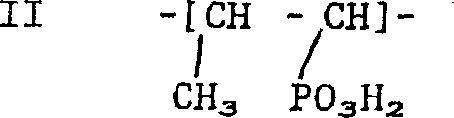
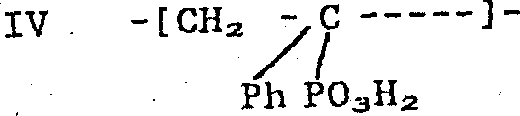
根据本发明的优选实例,AEA包含一个含有重复组成单位的聚合物,该重复组成单位中的一个或多个膦酸释放增强基团是与聚合物链上的一个或多个碳原子相连的。这类AEA的例子为聚(乙烯膦酸),含有具如下通式的重复组成单位:
此处所采用的较好的含膦酸的AEA为聚(β-苯乙烯膦酸),其重复组成单位的通式为: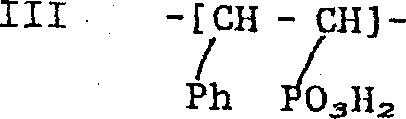
通常,这些苯乙烯膦酸聚合物及它们与其它惰性烯键不饱和单体的共聚物的分子量约为2,000~30,000,较好的为2,500~10,000。这里的“惰性”单体对于任何共聚物(作为AEA在这里被采用)预期的功能没有明显的干扰。Generally, these styrene phosphonic acid polymers and their copolymers with other inert ethylenically unsaturated monomers have a molecular weight of from about 2,000 to 30,000, preferably from 2,500 to 10,000. The "inert" monomers herein do not significantly interfere with the intended function of any copolymer (used here as AEA).
其它含膦酸的聚合物包括有,膦酸化乙烯,其具有下列重复组成单位:Other phosphonic acid-containing polymers include, phosphonated ethylene, which has the following repeating units:
V -[(CH2)14CHPO3H2]n-其中,n可为一个整数或使聚合物的分子量达到约3,000的值;聚(丁烯-4,4-二膦酸)钠,其具有下列重复组成单位:
基于本发明的一个方面,口用复方含有一种口用上可接受的赋形剂和一种有效剂量的实质上水不溶性非阳离子抗菌剂,以及具有平均分子量约为1,000~1,000,000的抗菌增强剂,并至少含有一个释放增强基团及一个有机保留增加基团,该药剂含有上述基团。而这些基团不含有或实质上不含有水溶性合成阴离子线性聚合物,聚羧酸碱金属盐或铵盐,这些盐类的分子量约为1,000~1,000,000。According to one aspect of the present invention, the oral composition contains an orally acceptable excipient and an effective dose of a substantially water-insoluble non-cationic antibacterial agent, and an antibacterial enhancer with an average molecular weight of about 1,000-1,000,000 , and contain at least one release-enhancing group and one organic retention-enhancing group, and the medicament contains the above-mentioned groups. These groups are free or substantially free of water-soluble synthetic anionic linear polymers, alkali metal polycarboxylates or ammonium salts, these salts having a molecular weight of about 1,000-1,000,000.
根据本发明另一个较好的实例,AEA可以含有合成阴离子聚羧酸酯。正如Gaffar等人在美国专利4,627,977中所公开的那样,尽管具有分子量约为1,000~1,000,000(较好的为30,000~500,000)的合成阴离子聚合物聚羧酸酯在本发明中未被采用和聚磷酸酯抗牙垢剂一起共同作用,但却被用作使抗牙垢作用完善的碱性磷酸酯酶(具有线性分子的脱水磷酸盐类)的抑制剂。实际上,英国专利申请2200551中就已将聚合的聚羧酸酯作为含有线性分子的脱水磷酸盐类及实质上水不溶非阳离子抗菌剂的口服配方中的任意成份作过公开。进一步观察本发明的上下文会看出,当与另一种成份(即线性脱水聚磷酯)共同作用情况下,聚合的聚羧酸酯与之共同作用的成分不存在时,这类聚羧酸酯对提高非离子抗菌剂及抗蚀斑剂在口腔表面的释放及保留有显著的效果。例如,当与聚合的聚羧酸酯共同作用的成份尤其为非阳离子抗菌剂时。According to another preferred embodiment of the present invention, the AEA may contain a synthetic anionic polycarboxylate. As disclosed in U.S. Patent 4,627,977 by Gaffar et al., although synthetic anionic polymer polycarboxylates having a molecular weight of about 1,000 to 1,000,000 (preferably 30,000 to 500,000) are not used in the present invention and polyphosphoric acid Ester antitartar agents work together, but are used as inhibitors of alkaline phosphatases (dehydrated phosphates with linear molecules) that perfect the antitartar action. In fact, British Patent Application 2200551 discloses polymeric polycarboxylates as optional ingredients in oral formulations containing linear molecules of anhydrophosphates and substantially water-insoluble non-cationic antiseptics. A closer look at the context of the present invention will show that such polycarboxylates can be used in the absence of the ingredients with which the polymeric polycarboxylates are co-acted in the presence of another ingredient (i.e., a linear dehydrated polyphosphoryl ester). Esters have a significant effect on enhancing the release and retention of nonionic antimicrobials and antiplaque agents on oral surfaces. For example, when the co-acting ingredient with the polymeric polycarboxylate is especially a non-cationic antimicrobial agent.
合成阴离子聚合物聚羧酸酯及其带有各种杀菌剂、锌和镁的复合物已被作为抗牙垢剂本身,在许多先前的专利中作了公开,例如,Shedlovsky在美国专利3,429,963中;Gaffar在美国专利4,152,420中;Dichter等人在美国专利3,956,480中;Gaffar在美国专利4,138,477中;Gaffar等人在美国专利4,183,914中等等。应该明白,当含有或经修饰使之含有保留增强基团时,在这些专利中公开的合成阴离子聚合物聚羧酸酯在复方中是有效的,从中参考本发明的这些方法和这些公开内容,在一定程度上被具体化了。Synthetic anionic polymer polycarboxylates and their complexes with various bactericides, zinc and magnesium have been disclosed as antitartar agents themselves in a number of previous patents, e.g. Shedlovsky in U.S. Patent 3,429,963; Gaffar in US Patent 4,152,420; Dichter et al in US Patent 3,956,480; Gaffar in US Patent 4,138,477; Gaffar et al in US Patent 4,183,914 and others. It should be understood that the synthetic anionic polymeric polycarboxylates disclosed in these patents are effective in combination when containing or modified to contain retention enhancing groups, from which reference is made to these methods and these disclosures of the present invention, Reified to a certain extent.
这里所应用的合成阴离子聚合物聚羧酸酯是通常熟知的,常用的是其游离酸的形式,或较好的为部分的、更好的为全部的中性水溶性碱金属(例如,钾,最好是钠)或铵盐类。较好的比例为1∶4~4∶1的马来酸酐或酸与其它可聚合的烯键不饱和单体的共聚物,较好的为甲基乙烯基醚/马来酸酐,其分子量(M.W.)约为30,000~1,000,000,最好为30,000~500,000。这些共聚物以Gantrez作为商品名可在市场购得,如AN139(M.W.500,000),AN119(M.W.250,000);较好的是GAF公司出品,药用等级的S-97(M.W.)70,000。The synthetic anionic polymeric polycarboxylates used herein are generally well known, usually in the form of their free acids, or preferably partly, more preferably fully, of a neutral water-soluble alkali metal (e.g., potassium , preferably sodium) or ammonium salts. A preferred ratio of 1:4 to 4:1 is a copolymer of maleic anhydride or acid and other polymerizable ethylenically unsaturated monomers, preferably methyl vinyl ether/maleic anhydride, and its molecular weight ( M.W.) is about 30,000 to 1,000,000, preferably 30,000 to 500,000. These copolymers are commercially available under the trade name of Gantrez, such as AN139 (M.W. 500,000), AN119 (M.W. 250,000); preferably S-97 (M.W.) 70,000 of pharmaceutical grade produced by GAF Company.
其它含有或经修饰使之含有保留增强基团的AEA有效聚合的聚羧酸酯,包括那些在上述美国专利3,956,480中公开的,如1∶1的马来酸酐与丙烯酸乙酯,异丁烯酸羟乙基酯,N-乙烯基-α-吡咯烷酮或乙烯的共聚物,后一种以Monsanto EMANO.1103(M.W.10,000)及EMA61级,作为商品名可购得。上述聚羧酸酯还包括丙烯酸与甲基或羟乙基异丁烯酸甲酯或羟乙基酯丙烯酸甲酯或乙酯,异丁酯,异丁基乙烯基醚或N-乙烯基-α-吡咯烷酮的共聚物。Other AEA-effectively polymerized polycarboxylates containing or modified to contain retention enhancing groups include those disclosed in the aforementioned U.S. Patent No. 3,956,480, such as a 1:1 ratio of maleic anhydride to ethyl acrylate, hydroxyethyl methacrylate Ethyl esters, N-vinyl-alpha-pyrrolidone or copolymers of ethylene, the latter being commercially available under the trade names Monsanto EMANO. 1103 (M.W. 10,000) and EMA 61 grade. The aforementioned polycarboxylates also include acrylic acid with methyl or hydroxyethyl methacrylate or hydroxyethyl acrylate, methyl or ethyl acrylate, isobutyl ester, isobutyl vinyl ether or N-vinyl-alpha-pyrrolidone of copolymers.
其它在上述美国专利4,138,477和4,183,914中公开的含有或经修饰使之含有保留增强基团的有效聚合的聚羧酸酯,包括马来酸酐与苯乙烯,异丁烯或乙基乙烯基醚,聚丙烯酸,聚亚甲基丁二酸,聚马来酸的共聚物,及分子量低至1,000的磺基丙烯酸低聚物,以Uniroyal ND-2为商品名,可购得。Other effective polymeric polycarboxylates disclosed in the aforementioned U.S. Patent Nos. 4,138,477 and 4,183,914 containing or modified to contain retention enhancing groups include maleic anhydride with styrene, isobutylene or ethyl vinyl ether, polyacrylic acid, Copolymers of polymethylene succinic acid, polymaleic acid, and sulfoacrylic acid oligomers with molecular weights as low as 1,000 are commercially available under the tradename Uniroyal ND-2.
通常认为合适的是含有可聚合的烯键或乙烯基不饱和羧酸的保留增强基团,这类羧酸含有活泼碳-碳烯键的双键,由于这些C=C在单体分子中或处于相对于羧基的α-β位,或为终端亚甲基基团的一部分,因此它们很容易起到发生聚合反应的作用。这类酸的例子有:丙烯酸,异丁烯酸,异戊烯酸,α-氯代丙烯酸,巴豆酸,β-丙烯丙酸,山梨酸,α-氯代山梨酸,肉桂酸,β-苯乙烯基丙烯酸,粘康酸,衣康酸,柠康酸,中康酸,戊烯二酸,乌头酸,α-苯基丙烯酸,2-苄基丙烯酸,2-环己基丙烯酸,当归酸,繖形酸,富马酸,马来酸以及酸酐。其它可与这类羧酸单体共聚的烯键单体,包括乙酸乙烯酯,氯化乙烯,马来酸二甲酯等等。共聚物中含有足够的羧酸盐基团以供水溶。Retention-enhancing groups containing polymerizable ethylenic or ethylenically unsaturated carboxylic acids containing active carbon-carbon olefinic double bonds are generally considered suitable due to the presence of these C=C in the monomer molecule or In the α-β position relative to the carboxyl group, or as part of the terminal methylene group, they can easily play the role of polymerization reaction. Examples of such acids are: acrylic acid, methacrylic acid, isopentenic acid, α-chloroacrylic acid, crotonic acid, β-acrylic acid, sorbic acid, α-chlorosorbic acid, cinnamic acid, β-styryl Acrylic acid, muconic acid, itaconic acid, citraconic acid, mesaconic acid, glutaconic acid, aconitic acid, alpha-phenylacrylic acid, 2-benzylacrylic acid, 2-cyclohexylacrylic acid, angelicalic acid, umbelliferic acid acid, fumaric acid, maleic acid and anhydride. Other ethylenic monomers copolymerizable with such carboxylic acid monomers include vinyl acetate, vinyl chloride, dimethyl maleate, and the like. The copolymer contains sufficient carboxylate groups for water solubility.
另外,此处另一个有用的,作为牙膏成份公开的,所谓羧乙烯基聚合物,Chown等人在美国专利3,980,767;Reberts等人在美国专利3,935,306;Perla等人在美国专利3,919,409;Harrison在美国专利3,911,904及Colodney等人在美国专利3,711,604中均对其作了公开。它们在商业上可购得,例如,B.F.Goodrich公司的Car-bopol 934,940及941(注册商标)。这些产品主要由胶态的水溶性聚丙烯酸聚合物组成,该聚合物是以约0.75%~2.0%的聚烯丙基蔗糖或聚烯丙基季戊四醇(作为交联剂)交联着的,这种交联结构及交联键通过疏水性和/或对抗菌剂的物理捕获等作用提供了所需的保留增强作用。多聚视有机物质或多或少有某些相似,作为与小于0.2%的二乙烯基乙二醇交联的聚丙烯酸,其低比例及低分子量和/或该交联剂的疏水性,倾向于提供很少或完全不提供保留增强作用。2,5-二甲基-1,5-己二烯可举作为一个较有效的保留增强交联剂的例子。In addition, another useful herein, disclosed as a toothpaste ingredient, are so-called carboxyvinyl polymers, Chown et al. in U.S. Patent 3,980,767; Reberts et al. in U.S. Patent 3,935,306; Perla et al. in U.S. Patent 3,919,409; Harrison in U.S. Patent 3,911,904 and in US Patent 3,711,604 by Colodney et al. They are commercially available, for example, Car-bopol 934, 940 and 941 (registered trademark) of B.F. Goodrich Company. These products consist primarily of colloidal water-soluble polyacrylic acid polymers cross-linked with about 0.75% to 2.0% polyallyl sucrose or polyallyl pentaerythritol as a cross-linking agent, which This cross-linked structure and cross-links provide the required retention enhancement through hydrophobicity and/or physical trapping of antimicrobial agents. Polymeric organic substances are more or less similar, as polyacrylic acid crosslinked with less than 0.2% divinyl glycol, its low proportion and low molecular weight and/or the hydrophobicity of the crosslinker, tends to to provide little or no retention enhancement. 2,5-Dimethyl-1,5-hexadiene can be cited as an example of a more effective retention enhancing crosslinker.
合成阴离子聚合的聚羧酸酯的成份,主要为任意含有卤素或含氧取代物以及所存在的与酯、醚和羧基等基团相键合的碳氢化合物,并以含量约为0.05%~4%,较好地为0.05%~3%,更好地为0.1%~2%时被应用于已配制好的复方中。The components of synthetic anionic polymerized polycarboxylates are mainly any hydrocarbons that contain halogen or oxygen-containing substituents and existing groups bonded to esters, ethers, and carboxyl groups, and the content is about 0.05%~ 4%, preferably 0.05% to 3%, more preferably 0.1% to 2%, is used in the prepared compound.
AEA也可以包括含有保留增强基团的天然阴离子聚合的聚羧酸酯。缺乏上述定义的释放增强和/或保留增强基团的羧甲基纤维素。其它连接剂及胶膜形成剂作为AEA是无效的。AEAs may also include natural anionic polymeric polycarboxylates containing retention enhancing groups. Carboxymethylcellulose lacking release-enhancing and/or retention-enhancing groups as defined above. Other linking agents and film forming agents are not effective as AEA.
作为说明含有次磷酸和/或磺酸释放增强基团的AEA的例子,将会提及含有单位或基团的聚合物和共聚物,这些单位或基团是由乙烯基或烯丙基次磷酸和/或磺酸(根据需要,1或2(或3)位上的碳原子被有机保留增强基团所取代)的聚合物衍生而来,例如,具有上述定义的通式-(X)n-RO可采用这些单体的混合物,也可采用它们具有一个或多个惰性可聚合烯键不饱和单体的共聚物,如上述的关于那些有效的合成阴离子聚合的聚羧酸酯。正如会注意,在这些及其它有效的AEA中,通常仅有一个酸性释放增强基团是与聚合物主干或其分枝上所任何特定的碳原子或其它原子相连的。含有或经修饰使之含有侧基的释放增强基团及保留增强基团的聚硅氧烷也可作为AEA在此应用。作为有效的AEA的例子将是含有或经修饰使之含有释放和保留增强基团的离子聚合物。Kirk Othmer Encyc-lopeclia of Chemical Technology(第三版,补充卷,John Wiley & Sons公司,版权所有,1984)一书中546~573页上描述了离子交联聚合物,该描述是通过参考文献被编入的。这里作为有效的AEA的例子是(假设它们含有或经修饰使之含有保留增强基团)聚酯,聚亚胺酯及合成的和天然的聚酰胺(包括蛋白质和蛋白质物质,如胶原蛋白,聚精氨酸和其它聚合氨基酸)。As examples illustrating AEAs containing hypophosphorous acid and/or sulfonic acid release enhancing groups, mention will be made of polymers and copolymers containing units or groups composed of vinyl or allyl hypophosphorous acid and/or sulfonic acid (as required, the carbon atom in the 1 or 2 (or 3) position is replaced by an organic retention enhancing group), for example, the general formula -(X) n having the above definition - RO can be employed as mixtures of these monomers, or as copolymers thereof with one or more inert polymerizable ethylenically unsaturated monomers, such as those described above with respect to those effective synthetic anionically polymerized polycarboxylates. As will be noted, in these and other useful AEAs, generally only one acid release enhancing group is attached to any particular carbon or other atom on the polymer backbone or its branches. Silicones containing or modified to contain pendant release-enhancing groups and retention-enhancing groups are also useful as AEAs herein. Examples of effective AEAs would be ionic polymers containing or modified to contain release and retention enhancing groups. Ionomers are described on pages 546-573 of Kirk Othmer Encyc-lopeclia of Chemical Technology (Third Edition, Supplementary Volume, Copyright John Wiley & Sons Company, 1984), which description is incorporated by reference programmed. Examples of effective AEAs here are (assuming they contain or are modified to contain retention enhancing groups) polyesters, polyurethanes and synthetic and natural polyamides (including proteins and proteinaceous substances such as collagen, poly arginine and other polymeric amino acids).
在本发明中,平均分子量大约为1,000至1,000,000的AEA含有至少一个释放增强基团,且至少含有一个有机保留增强基团,含有上述基团的所述试剂不含或基本上不含水溶性的合成阴离子线性聚合物聚羧酸的碱金属或铵盐,其分子量约为1,000至1,000,000。In the present invention, AEA having an average molecular weight of about 1,000 to 1,000,000 contains at least one release-enhancing group and at least one organic retention-enhancing group, and the reagents containing the above groups are free or substantially free of water-soluble synthetic Anionic linear polymeric alkali metal or ammonium salts of polycarboxylic acids having a molecular weight of about 1,000 to 1,000,000.
在本发明中,较好的口用配方为含有约0.3%(重量比)抗菌剂(如triclosan)及含有约1.5~2%(重量比)聚羧酸酯作为AEA。In the present invention, a preferred oral formulation contains about 0.3% by weight of an antibacterial agent such as triclosan and contains about 1.5-2% by weight of polycarboxylate as AEA.
和理论无关,据信AEA,特别是聚合性AEA一般为阴离子膜形成物质,并可以想象把它放在牙齿表面,并在该表面形成连续的膜,从而阻止细菌向牙齿附着。可能是非阳离子抗菌剂与AEA形成复合物,或其它连接形式,从而在牙齿表面形成了复合物的膜或类似的膜。AEA的成膜性及其促进抗菌剂在牙齿表面释放和保留的特性,看来是由于AEA造成牙齿表面不适宜细菌积聚,特别是因为抗菌剂直接的抑菌作用,从而控制了细菌的生长。因此,通过1)促进释放,2)在牙齿表面长期保留,3)阻止细菌附着于牙齿表面等三种作用模式的结合,使本口用配方在减少蚀斑方面更加有效。在牙床及其附近的口腔软组织上达到了相似的抗蚀斑效果。Without wishing to be bound by theory, it is believed that AEAs, particularly polymeric AEAs, are generally anionic film formers and could conceivably be placed on the tooth surface and form a continuous film on the surface, thereby preventing bacterial attachment to the tooth. It is possible that the non-cationic antibacterial agent forms a complex with AEA, or other forms of attachment, thereby forming a film of the complex or the like on the tooth surface. The film-forming properties of AEA and its ability to promote the release and retention of antimicrobials on the tooth surface appear to be due to the fact that AEAs cause bacterial accumulation on tooth surfaces that are not suitable, especially because of the direct bacteriostatic effect of the antimicrobial, thereby controlling bacterial growth. Therefore, the oral formulation is more effective in reducing plaque through the combination of 1) promoting release, 2) long-term retention on the tooth surface, and 3) preventing bacterial attachment to the tooth surface. Similar anti-plaque effects were achieved on the gums and the adjacent oral soft tissues.
根据本发明,口用可接受的赋形剂有效地使基本上不溶于水的非阳离子抗菌剂溶解在唾液中,达到抗蚀斑有效的剂量。According to the present invention, the orally acceptable vehicle is effective to dissolve the substantially water-insoluble non-cationic antimicrobial agent in saliva in an antiplaque effective dose.
在口用制剂中,口用可接受的赋形剂包括有湿润剂存在的水相。在凝胶洁牙剂中,典型地含有重量为5~30%的硅质磨光剂,水的典型含量为至少3%(重量比),一般大约为3~35%,湿润剂最好为甘油和/或山梨醇,典型的总量为大约口用凝胶洁牙剂配方的6.5~75%或80%(重量比)。对山梨醇情况的查询,可把它作为典型的,商业可购得70%的水溶液。In oral formulations, the orally acceptable excipient comprises an aqueous phase in the presence of a wetting agent. In gel dentifrices, typically 5-30% by weight of silicon polishing agent is present, water is typically at least 3% by weight, generally about 3-35%, and the humectant is preferably Glycerin and/or sorbitol, typically in total amounts of about 6.5-75% or 80% by weight of the oral gel dentifrice formulation. For inquiries about sorbitol, use it as a typical, commercially available 70% aqueous solution.
当抗菌剂含量大约为0.25~0.35%(重量比)时,虽然可任意地让增溶剂存在,但是凝胶洁牙剂并不要求在口用赋形剂中加进另外成分作为抗菌剂的增溶剂。当抗菌剂含量低于约0.25%(重量比)时,例如大约为0.01~0.25%(重量比),则应该有增溶剂存在,以保证抗菌剂在唾液中有足够的溶解度,从而有抗蚀斑效应。当抗菌剂含量高于0.35%时(重量比)比如为大约0.35~0.5%或更多,为5%,就应该有增溶剂存在,否则大量的抗菌剂不能溶解。When the antibacterial agent content is about 0.25-0.35% (weight ratio), although the solubilizer can be optionally present, the gel dentifrice does not require additional ingredients to be added to the oral vehicle as a solubilizer for the antibacterial agent. solvent. When the antibacterial agent content is lower than about 0.25% (weight ratio), for example about 0.01~0.25% (weight ratio), then there should be a solubilizing agent to exist to ensure that the antibacterial agent has sufficient solubility in saliva, thereby there is corrosion resistance. spot effect. When the antibacterial agent content is higher than 0.35% (weight ratio), such as about 0.35-0.5% or more, 5%, there should be a solubilizer, otherwise a large amount of antibacterial agent cannot be dissolved.
当口用配方为含有约30~75%(重量比)牙科可接受的磨光剂时,也可任意地让此类增溶剂存在。Such solubilizing agents may also optionally be present when the oral formulation contains from about 30 to about 75% by weight of a dentally acceptable polishing agent.
当口用配方为漱口液或液体洁牙剂时,口用赋形剂中至少包括表面活性剂,调味油或无毒醇,它们当中每一种均协助溶解抗菌剂。再者,这些增溶剂的存在也是任意选择的。When the oral formulation is a mouthwash or liquid dentifrice, the oral excipients include at least a surfactant, a flavor oil or a non-toxic alcohol, each of which assists in dissolving the antimicrobial agent. Again, the presence of these solubilizers is also optional.
在本发明的口用配方中存在的增溶剂,其典型的含量大约0.5~20%(重量比),当基本上水不溶性非阳离子抗菌剂的含量低时(约0.3%),则小到大约0.5%左右(重量比)的增溶剂就足够了。当有大量抗菌剂,如至少有0.5%左右(重量比)存在时,而且特别当也有大约5~30%(重量比)的硅质磨光剂存在时,则至少需要约5%的(重量比)增溶剂,典型地为大约20%或更高(重量比)。值得注意的是,大约有5%(重量比)的增溶剂存在时,洁牙剂也许有分为固液两相的趋势。Solubilizers present in the oral formulations of the present invention are typically present in an amount of about 0.5 to 20% by weight, and when the level of substantially water-insoluble non-cationic antiseptic is low (about 0.3%), then as little as about About 0.5% (weight ratio) of solubilizing agent is sufficient. When there is a large amount of antimicrobial agent, such as at least about 0.5% (weight ratio) to exist, and especially when there is also about 5 to 30% (weight ratio) of silicon polishing agent to exist, then at least about 5% (weight ratio) is required. ratio) solubilizing agent, typically about 20% or higher (weight ratio). It is worth noting that in the presence of about 5% by weight solubilizer, the dentifrice may have a tendency to separate into solid and liquid phases.
所存在的或可能存在的,使抗菌剂增溶于唾液中的增溶剂可掺入水性湿润的赋形剂中。这种增溶剂包括湿润性聚醇,如丙二醇,二丙二醇和己二醇,溶纤剂如甲基溶纤剂和乙基溶纤剂,植物油及直链至少含约12个碳原子的蜡,如橄榄油,蓖麻油和凡士林;还有酯类如乙酸戊醇,乙酸乙酯和苯甲酸苄酯。此处所用的“丙二醇”包括1,2-丙二醇和1,3-丙二醇。应该避免用大量聚乙二醇,特别是分子量为600或更大的聚乙二醇,这是因为聚乙二醇有抑制非阳离子抗菌剂的抗菌活性的效应。例如,当聚乙二醇(PEG)600与triclosan以1∶25的重量比存在时,抗菌剂triclosan的活性降低到没有聚乙二醇存在的1/16(即降低了16倍)。Solubilizers that are or may be present to solubilize the antimicrobial agent in saliva can be incorporated into the aqueous moist vehicle. Such solubilizers include wetting polyalcohols such as propylene glycol, dipropylene glycol and hexylene glycol, cellosolves such as methyl cellosolve and ethyl cellosolve, vegetable oils and linear waxes containing at least about 12 carbon atoms such as olive oil, castor oil, and petrolatum; and esters such as amyl alcohol acetate, ethyl acetate, and benzyl benzoate. "Propanediol" as used herein includes 1,2-propanediol and 1,3-propanediol. The use of large amounts of polyethylene glycol, especially polyethylene glycol with a molecular weight of 600 or greater, should be avoided because of the effect of polyethylene glycol on inhibiting the antibacterial activity of non-cationic antibacterial agents. For example, when polyethylene glycol (PEG) 600 and triclosan are present at a weight ratio of 1:25, the activity of the antibacterial agent triclosan is reduced to 1/16 of that without the presence of polyethylene glycol (ie, a 16-fold reduction).
根据本发明,口用配方的洁牙剂实质上可以为凝胶态,如凝胶洁牙剂。此种凝胶口用制剂含有硅类牙用磨光物质,较好的磨光物质包括结晶硅石,其颗粒粒径大约至5微米,平均粒径大约为1.1微米,表面积大约为50,000cm2/gm,还有硅胶或胶体硅及复杂的无定型碱金属硅铝酸盐。Orally formulated dentifrices according to the present invention may be gel-like in nature, such as gel dentifrices. Such gel oral formulations contain a silicon dental polishing substance, preferably polishing substances including crystalline silica, having a particle size of about 5 microns, an average particle size of about 1.1 microns, and a surface area of about 50,000 cm2 / gm, as well as silica gel or colloidal silicon and complex amorphous alkali metal aluminosilicates.
当采用透明或不透明的凝胶时,胶体硅类的磨光剂是特别有用的,例如,以SYIOID商标出售的Syloid 72及Syloid 74,或以SANTOCEL商标出售的Santocel 100或碱金属硅铝酸盐复合物(即,在其基质中结合了氧化铝的硅石)。它们之所以特别有用,是因为由凝胶样结构组成的,并且它们的折射率接近于洁牙剂中常用的凝胶剂一液体(包括水和/或湿润剂)系统的折射率。Polishing agents of the colloidal silicon type, such as Syloid 72 and Syloid 74 sold under the trademark SYIOID, or Santocel 100 or alkali metal aluminosilicates sold under the trademark SANTOCEL, are particularly useful when using transparent or opaque gels. Composite (ie, silica with alumina incorporated in its matrix). They are particularly useful because they consist of a gel-like structure and their refractive index is close to that of gel-liquid (including water and/or humectant) systems commonly used in dentifrices.
在口用配方的洁牙剂,如牙膏或凝胶配方中,磨光物质通常的浓度(以重量计)约为5%至大约30%。In oral formulations of dentifrices, such as toothpaste or gel formulations, abrasive substances are typically present at a concentration (by weight) of about 5% to about 30%.
在本发明中,当口服制剂为洁牙剂时,则有口用可接受的赋形剂,包括含有湿润剂的水相,该湿润剂较好的是甘油和/或山梨醇,其中水量典型地为大约15~35%或40%(按重量计),甘油和/或山梨醇含量典型地为大约20~75%(按重量计),更典型地为大约25~60%(重量比)(均以口服型洁牙剂为基准),需提到一点:所指山梨醇是指典型的,商业上可供应的70%的水溶液。In the present invention, when the oral preparation is a dentifrice, there are orally acceptable excipients, including an aqueous phase containing a wetting agent, preferably glycerin and/or sorbitol, wherein the amount of water is typically Typically about 15-35% or 40% (by weight), the glycerol and/or sorbitol content is typically about 20-75% (by weight), more typically about 25-60% (by weight) (both are based on oral dentifrices), and one thing needs to be mentioned: the sorbitol referred to refers to a typical, commercially available 70% aqueous solution.
在本发明中,该口用洁牙剂配方实质上可为糊状的,如牙膏,尽管当采用硅质磨光剂时它可能为凝胶状的(通常并非如此,因为该硅质磨光剂典型用量不超过30%(w/w))。该口用配方的洁牙剂的赋形剂含有牙科上可接受的磨光剂,例如水不溶性磨光剂偏磷酸钠,偏磷酸钾,磷酸三钙,二水合磷酸二钙,无水磷酸二钙,碳酸钙,硅酸铝,水合氧化铝,硅石,皂土及上述化合物之间的混合物或这些化合物与硬磨光材料的混合物。硬磨光材料系指:煅烧的氧化铝及硅酸锆,在美国专利3,070,510(1962年12月15日发布)中描述的颗粒型热固树脂类物质,如蜜胺-苯酚及脲-甲醛及交联的环氧聚合物和聚酯类。较好的磨光材料包括不溶性偏磷酸钠,磷酸二钙及水合氧化铝。In the present invention, the oral dentifrice formulation may be pasty in nature, such as toothpaste, although it may be gel-like when a silicon polish is used (which is usually not the case because the silicon polish The typical dosage of the agent does not exceed 30% (w/w)). The excipients of this oral formulation dentifrice contain dentally acceptable polishing agents such as water insoluble polishing agents sodium metaphosphate, potassium metaphosphate, tricalcium phosphate, dicalcium phosphate dihydrate, dicalcium phosphate anhydrous Calcium, calcium carbonate, aluminum silicate, hydrated alumina, silica, bentonite and mixtures of the above compounds or mixtures of these compounds and hard polishing materials. Hard polishing material means: calcined alumina and zirconium silicate, particulate thermosetting resinous materials such as melamine-phenol and urea-formaldehyde and Cross-linked epoxy polymers and polyesters. Preferred polishing materials include insoluble sodium metaphosphate, dicalcium phosphate and hydrated alumina.
许多所谓的“水不溶性”磨光物质为阴离子性的、也包含小量可溶性物。因而,可以按《Thorpe氏应用化学辞典》9卷,510-511页(第四版)所述任何合适的方法,去制备不溶性偏磷酸钠以Madrell氏盐和Kurrol氏盐而闻名的不溶性偏磷酸钠的两种形态,是适宜的材料的又一实例。由于这些偏磷酸盐在水中的溶解度十分微小,故被称为不溶性偏磷酸盐(IMP)。有少量的可溶性磷酸盐类物质作为杂质存在,通常所占的百分比很小,如为4%(以重量计)。如果需要,可用水洗涤,使可溶性磷酸盐物质的量减少或消除(确信该物质包含了就不溶性偏磷酸盐来说为可溶性的三偏磷酸钠。不溶性偏磷酸碱金属盐典型地以其粉末状颗粒应用,粒径大于37微米的不得多于总体物质的1%。Many so-called "water-insoluble" polishing materials are anionic and also contain small amounts of soluble materials. Thus, insoluble sodium metaphosphate known as Madrell's salt and Kurrol's salt can be prepared by any suitable method as described in "Thorpe's Dictionary of Applied Chemistry" vol. 9, pages 510-511 (fourth edition). Sodium, in its two forms, is yet another example of a suitable material. Because these metaphosphates have very little solubility in water, they are called insoluble metaphosphates (IMP). A small amount of soluble phosphate species exists as an impurity, usually in a small percentage, such as 4% by weight. If necessary, the amount of soluble phosphate material can be reduced or eliminated by washing with water (make sure the material contains sodium trimetaphosphate which is soluble for the insoluble metaphosphate. Insoluble alkali metal metaphosphate is typically available in its powder form For particle applications, no more than 1% of the total substance with a particle size greater than 37 microns.
水合氧化铝基本上是非离子性磨光材料的一个实例。典型地,其粒径小,即至少大约85%颗粒小于20微米,归类为三水铝(矿)(α-三水合氧化铝),通常以化学式AL2O3.3H2O或Al(OH)3表示。三水铝的平均粒度一般为大约6~9微米。典型的规格等级有如下粒径分布:Hydrated alumina is basically an example of a nonionic polishing material. Typically, its particle size is small, i.e., at least about 85% of its particles are smaller than 20 microns, and it is classified as gibbsite (alpha-alumina trihydrate), usually with the chemical formula AL 2 O 3 .3H 2 O or Al( OH) 3 said. Aluminum trihydrate generally has an average particle size of about 6 to 9 microns. Typical specification grades have the following particle size distributions:
微米 百分比Micron Percentage
<30 94-99
<20 85-93
<l0 56-67
<5 28-40
在膏糊或凝胶配方中一般含有约30%~75%的磨光材料(以重量计)。Paste or gel formulations typically contain about 30% to 75% buffing material (by weight).
牙膏或牙膏类洁牙剂以及凝胶洁牙剂中典型地含有大约0.1~10%比例的天然或合成的增稠剂或胶凝剂,更好的比例为大约0.5~5%。一个合适的增稠剂为合成的胶体镁、碱金属硅酸盐的复合粘土,例如像由Laporte工业有限公司销售的Laponite(如CP,SP2002,D)可以买到。对Laponite D进行的分析表明,按重量计大约为58.00%SiO2,25.40%MgO,3.05%Na2O,0.98%Li2O,及一些水和痕量金属。它的自身真实比例为2.53,其表观体积密度为1.0(g/ml,湿气为8%时)。Toothpaste or toothpaste-like dentifrices and gel dentifrices typically contain natural or synthetic thickening or gelling agents in a proportion of about 0.1-10%, more preferably about 0.5-5%. A suitable thickener is a synthetic colloidal magnesium, alkali metal silicate complex clay, for example commercially available as Laponite sold by Laporte Industries Ltd. (eg CP, SP2002, D). Analysis performed on Laponite D showed approximately 58.00% SiO2 , 25.40% MgO, 3.05% Na2O , 0.98% Li2O , and some water and trace metals by weight. Its true proportion to itself is 2.53, and its apparent bulk density is 1.0 (g/ml, when moisture is 8%).
其它合适的增稠剂或胶凝剂或稠化剂包括爱尔兰苔藓,Iota-Carragllnan,黄著胶,淀粉,聚乙烯吡咯烷酮,羟丙基乙基纤维素,羟丁基甲基纤维素,羟丙基甲基纤维素,羟乙基纤维素(例如可购得的Natrosol),羧甲基纤维素钠,以及特别当硅质磨光剂存在时,包括胶体硅石,如那些可购得的,像精细生产的Syloid244或Sylodent 15。Other suitable thickening or gelling or thickening agents include Irish moss, Iota-Carragllnan, tragacanth, starch, polyvinylpyrrolidone, hydroxypropyl ethyl cellulose, hydroxybutyl methyl cellulose, hypromellose hydroxyethyl cellulose, hydroxyethyl cellulose (such as Natrosol commercially available), sodium carboxymethyl cellulose, and especially when siliceous polishing agents are present, including colloidal silica, such as those commercially available, like Fine Produce Syloid244 or Sylodent 15.
在本发明中当口用配方为漱口剂或液体洁牙剂时,其性状实质上为液体,特别在漱口剂中的赋形剂为典型的水-醇混合液。一般水与醇的重量比在大约1∶1至20∶1的范围内,较好地为大约3∶1至10∶1,更好地为大约4∶1至6∶1。在此类制剂中水-醇混合液总量的典型范围是从大约7.0%至大约99.9%(重量比)。醇为无毒性醇,如乙醇或异丙醇。像甘油及山梨醇等湿润剂可按10~30%(重量比)的量存在。液体洁牙剂典型地含有约50~85%的水,可能含有约0.5~20%(重量比)的无毒醇及还可能含有约10~40%的湿润剂,如像甘油和/或山梨醇。所指山梨醇为典型的,商业上可得的70%水溶液。乙醇是较好的无毒醇。就像所认为调味油能协助溶解水不溶性非阳离子抗菌剂一样,乙醇也能起此作用。In the present invention, when the oral formulation is a mouthwash or a liquid dentifrice, its properties are essentially liquid, especially the excipient in the mouthwash is a typical water-alcohol mixture. Typically the weight ratio of water to alcohol is in the range of about 1:1 to 20:1, preferably about 3:1 to 10:1, more preferably about 4:1 to 6:1. A typical range of the total amount of water-alcohol mixture in such formulations is from about 7.0% to about 99.9% by weight. Alcohol is a non-toxic alcohol such as ethanol or isopropanol. Humectants like glycerin and sorbitol may be present in an amount of 10-30% by weight. Liquid dentifrices typically contain about 50-85% water, may contain about 0.5-20% (by weight) non-toxic alcohol and may also contain about 10-40% humectants such as glycerin and/or sorbitol alcohol. Sorbitol is referred to as a typical, commercially available 70% aqueous solution. Ethanol is the preferred non-toxic alcohol. Just as flavor oils are thought to assist in dissolving water-insoluble non-cationic antimicrobials, so can ethanol.
像所指出的那样,非阳离子抗菌剂实质上为水不溶性的。然而,在本发明中可以相信,AEA,如聚羟酸酯(存在于漱口剂及液体洁牙剂中),有机表面活性剂,调味油或无毒醇能帮助溶解抗菌剂并协助它达到牙床软口腔组织上或附近以及达到牙齿表面。在口用洁牙剂配方中作为任选成份,有机表面活性剂和/或调味油也能协助溶解抗菌剂。As noted, non-cationic antimicrobials are substantially water insoluble. However, in the present invention it is believed that AEAs such as polyhydroxyesters (found in mouthwashes and liquid dentifrices), organic surfactants, flavored oils or non-toxic alcohols can help dissolve the antimicrobial and assist it to achieve On or near the soft oral tissues of the gums and to the surface of the teeth. As optional ingredients in oral dentifrice formulations, organic surfactants and/or flavored oils can also assist in dissolving the antimicrobial agent.
在本发明的配方中,也采用有机表面活性剂以达到增加预防作用,并协助抗蚀斑抗菌剂完全彻底地分散在口腔中,并且使此配方更化妆品化。有机表面活性物质最好为阴离子性,非离子性或两性的,并最好将其用作清洁物质的表面活性剂,以赋予本配方清洁和起泡沫的性质。阴离子表面活性剂合适的例子为高脂肪酸单甘油酯单硫酸盐的水溶性盐类,如氢化椰子油酸单甘油酯单硫酸的钠盐;高烷基硫酸盐,如十二烷基硫酸盐;烷基芳基磺酸盐,如十二烷基苯磺酸钠;高烷基硫代乙酸盐;1,2-二羟基丙烷硫酸盐的高脂肪酸酯,以及低级酯肪氨基羧酸化合物的饱和高级脂肪酰基酰胺,如在脂肪酸上,烷基或酰基上有12~16个碳原子的那些化合物,等等。最后提到的酰胺的例子为N-十二酰肌氨酸,及N-十二酰,N-十四酰或N-十六酰肌氨酸的钠,钾及乙醇胺盐类,它们实质上不应该含有肥皂或相似的高脂肪油类物质。在本发明的口用配方中采用这些肌氨酸类化合物具有特殊的优点,这是由于除了在酸性溶液中这些物质能发挥作用以减少牙珐琅质的溶解以外,它们还对口腔中酸的形成(由于糖类降解所致)有持续且显著的抑制作用。水溶性非离子表面活性剂的例子为环氧乙烷与各种含活性氢化合物的缩合物,与此反应的含氢化合物有长的疏水链(例如,有12至20个碳原子的脂肪链),该缩合物含有亲水性聚氧乙烯片断部分,如聚环氧乙烷与脂肪酸,脂肪醇,脂肪酰胺,多羟基醇(如脱水单硬脂酸山梨醇)及聚丙烯氧化物(例如Pluronic物质)的缩合产物。In the formulations of the present invention, organic surfactants are also employed to achieve increased prophylaxis and to assist in the complete and thorough dispersion of the antiplaque antimicrobial in the oral cavity and to make the formulation more cosmetic. Organic surface active materials are preferably anionic, nonionic or amphoteric and are preferably used as surfactants in the cleansing materials to impart cleansing and lathering properties to the present formulations. Suitable examples of anionic surfactants are water-soluble salts of high fatty acid monoglyceride monosulfate, such as the sodium salt of hydrogenated cocomonoglyceride monosulfate; high alkyl sulfates, such as lauryl sulfate; Alkylaryl sulfonates, such as sodium dodecylbenzenesulfonate; higher alkyl thioacetates; higher fatty acid esters of 1,2-dihydroxypropane sulfate, and lower fatty aminocarboxylic acid compounds Saturated higher fatty acylamides, such as those compounds with 12 to 16 carbon atoms in the alkyl or acyl groups of fatty acids, and the like. Examples of the last-mentioned amides are N-lauroyl sarcosine, and the sodium, potassium and ethanolamine salts of N-lauroyl, N-tetradecyl or N-paletanoyl sarcosine, which are essentially Should not contain soap or similar fatty oily substances. The use of these sarcosine compounds in the oral formulations of the present invention is of particular advantage because, in addition to their ability to act in acidic solutions to reduce the dissolution of tooth enamel, they also contribute to the formation of acid in the oral cavity ( due to carbohydrate degradation) has a sustained and significant inhibitory effect. Examples of water-soluble nonionic surfactants are the condensation products of ethylene oxide with various active hydrogen-containing compounds with long hydrophobic chains (for example, aliphatic chains with 12 to 20 carbon atoms ), the condensates contain hydrophilic polyoxyethylene moieties, such as polyethylene oxide and fatty acids, fatty alcohols, fatty amides, polyhydric alcohols (such as sorbitol monostearate) and polypropylene oxides (such as Pluronic substances) condensation products.
表面活性剂典型含量为大约0.5~5%(重量比),较好地为大约1~2.5%。Typical levels of surfactant are about 0.5-5% by weight, preferably about 1-2.5%.
当口用配方为液体洁牙剂时,所述天然或合成增稠剂或胶化剂的典型含量比例为大约0.1~10%,较好地为大约0.5~5%。When the oral formulation is a liquid dentifrice, the natural or synthetic thickener or gelling agent is typically present in an amount of about 0.1-10%, preferably about 0.5-5%.
一般讲,液体洁牙剂中不含磨光剂。然而,根据美国专利3,506,757的描述(Salzmann为申请人),在液体洁牙剂中可采用大约0.3~2.0%(重量比)的多糖作为悬浮剂及增稠剂,该多糖含有甘露糖,葡萄糖,葡糖醛酸钾及乙酰基片断部分(比例大致为2∶1∶1∶1),分子量超过1百万。在该液体洁牙剂中还可含有大约10~20%的磨光物质,例如水合氧化铝,二水合磷酸二钙,焦磷酸钙,不溶性偏磷酸钙,无水性磷酸二钙,碳酸钙,碳酸镁,氧化镁,硅石及其混合物,等等。Typically, liquid dentifrices do not contain abrasives. Yet, according to the description of U.S. Patent 3,506,757 (Salzmann is applicant), can adopt the polysaccharide of about 0.3~2.0% (weight ratio) as suspending agent and thickening agent in liquid dentifrice, this polysaccharide contains mannose, glucose, Potassium glucuronate and acetyl moiety (approximately 2:1:1:1 ratio), molecular weight over 1 million. The liquid dentifrice may also contain about 10-20% of abrasive substances such as hydrated alumina, dicalcium phosphate dihydrate, calcium pyrophosphate, insoluble calcium metaphosphate, anhydrous dicalcium phosphate, calcium carbonate, carbonic acid Magnesium, magnesium oxide, silica and mixtures thereof, etc.
未受理论的约束,因而本发明取得了优势。据信,含水性湿润剂赋形剂被增溶于流动相中表面活性剂胶束内(如洁牙剂配方中存在有胶化剂及磨光剂,则它们不包括在内)。洁牙剂的流动相溶液可被唾液稀释,唾液能使Triclosan沉淀出来。因而,即使发现在缺乏特殊的Triclosan、增溶剂的情况下。当Triclosan的量为大约0.25~0.35%(重量比),且有像聚羧酸酯之类的AEA存在时,在牙床的软组织上有足够量的Triclosan存在,去发挥其良好的抗蚀斑效应。本文描述的其它非水溶性非阳离子抗菌剂得到了同样的重视。Without being bound by theory, the present invention thus achieves advantages. It is believed that the aqueous humectant excipients are solubilized within the surfactant micelles in the mobile phase (gelling and polishing agents are excluded if present in the dentifrice formulation). The mobile phase solution of the dentifrice can be diluted by saliva, which can precipitate Triclosan. Thus, even found in the absence of specific Triclosan, solubilizers. When the amount of Triclosan is about 0.25-0.35% (weight ratio), and there is AEA such as polycarboxylate, there is a sufficient amount of Triclosan on the soft tissue of the gums to exert its good anti-plaque effect . Other water-insoluble non-cationic antimicrobial agents described herein receive the same attention.
在口用配方的洁牙剂中还可含有氟离子源或能提供氟的成份作为抗龋剂,其含量应达到能提供大约25ppm至5000ppm的氟离子。这些化合物可为水微溶性或完全水溶性的。它们的特性为在水中释放氟离子且不与口用配方中的其它化合物发生不良反应。这些物质中包括无机氟化物盐,如可溶性碱金属,碱土金属盐,例如氟化钠,氟化钾,氟化铵,氟化钙,铜的氟化物如氟化亚铜,氟化锌,氟化钡,氟硅酸钠,氟硅酸铵,氟锆酸钠,氟锆酸铵,单氟磷酸钠,单及双氟磷酸铵及焦磷酸钙钠。较好地为碱金属及锡的氟化物,例如氟化钠及氟化亚锡,单氟磷酸钠(MFP)及它们的混合物。Orally formulated dentifrices may also contain a source of fluoride ions or a fluoride-providing ingredient as an anti-caries agent in such an amount as to provide about 25 ppm to 5000 ppm of fluoride ions. These compounds may be slightly or completely water soluble. They are characterized by releasing fluoride ions in water and do not react adversely with other compounds in oral formulations. Included among these substances are inorganic fluoride salts such as soluble alkali metals, alkaline earth metal salts such as sodium fluoride, potassium fluoride, ammonium fluoride, calcium fluoride, copper fluorides such as cuprous fluoride, zinc fluoride, fluoride Barium Chloride, Sodium Fluorosilicate, Ammonium Fluosilicate, Sodium Fluozirconate, Ammonium Fluozirconate, Sodium Monofluorophosphate, Ammonium Mono- and Difluorophosphate, and Sodium Calcium Pyrophosphate. Preferred are alkali metal and tin fluorides such as sodium fluoride and stannous fluoride, sodium monofluorophosphate (MFP) and mixtures thereof.
供氟化合物的含量某种程度上取决于化合物的类型,其溶解度,及口服制剂的类型,但它必须为无毒剂量,在制剂中一般为大约0.0005至大约3.0%。在洁牙剂制剂中,如牙用凝胶中,能释放出大约5,000ppm氟离子的此类化合物的含量(在制剂成品中的重量比)可考虑为满意的量。可以采用这些化合物的合适的最小量,但是最好用足够的化合物的释放出大约300~2,000ppm氟离子,更好的为释放出大约800~1,500ppm氟离子。The amount of fluoride-donating compound depends somewhat on the type of compound, its solubility, and the type of oral formulation, but it must be in a non-toxic amount, typically about 0.0005 to about 3.0% in the formulation. In dentifrice formulations, such as dental gels, levels of such compounds which release about 5,000 ppm of fluoride ions (by weight in the finished formulation) are considered satisfactory. Suitable minimum amounts of these compounds may be used, but preferably enough of the compound is used to liberate about 300-2,000 ppm fluoride ions, more preferably about 800-1,500 ppm fluoride ions.
在碱金属氟化物例子中,此类成份典型含量大约到2%左右(以重量计),以制剂的重量为基准,较好地在大约0.05%至1%的范围内。在单氟磷酸钠例于中,该化合物可含有大量0.1~3%,更典型地为大约0.76%。In the case of alkali metal fluorides, such ingredients typically comprise about 2% by weight, preferably in the range of about 0.05% to 1% by weight of the formulation. In the case of sodium monofluorophosphate, this compound may contain amounts of 0.1 to 3%, more typically about 0.76%.
常规上将这类口用制剂经合适的标记包装后再进行出售及分销,这一点是可以理解的。因而通常将洁牙凝胶注入到可挤压的管子中,典型的为铝,有衬里的铅及塑料管;或其它挤压式,抽吸式或压力式调配器中,以此将内容物计量。上述包装容器外有标签说明,此商品的实质为洁牙凝胶或类似的成份。It is understandable that such oral formulations are routinely packaged with appropriate labels for sale and distribution. The dentifrice gel is thus usually injected into squeezable tubes, typically aluminum, lined lead and plastic tubes; or other squeeze, suction or pressure dispensers, whereby the contents measure. The label on the outside of the above packaging container states that the substance of this product is tooth cleaning gel or similar ingredients.
在本发明的口用配方中可以掺入各种其它物质如漂白剂,防腐剂,硅酮,叶绿素类化合物和/或氨合物质如尿素,磷酸二铵以及它们的混合物。当这些辅助剂存在时,它们在制剂中的含量实质上不能对预期的性质和特点产生不良影响。应避免大量的锌,镁及其它金属盐以及通常是易溶的,且会与本发明中的活性剂成份结合的物质的存在。Various other substances such as bleaching agents, preservatives, silicones, chlorophyll compounds and/or ammonium substances such as urea, diammonium phosphate and mixtures thereof may be incorporated in the oral formulations of the present invention. When such adjuvants are present, they should be present in the formulation in such an amount that such adjuvants should not adversely affect the desired properties and characteristics. The presence of large amounts of salts of zinc, magnesium and other metals, which are generally soluble and which bind the active ingredients of the invention, should be avoided.
任何合适的调味或甜味剂均可被采用,合适的调味成份的实例为调味油,如留兰香油,薄荷油,冬青油,黄樟油,丁香油,洋苏叶油,桉树油,majoram,桂皮油,柠檬油及桔子油和水杨酸甲酯。合适的甜味剂包括蔗糖,乳糖,麦芽糖,木糖醇,仙客来钠,紫苏油,AMP(天冬氨酰苯基丙氨酸甲酯),糖精等等。合适的调味剂和甜味剂可为单独或一起存在于制剂中,占大约0.1~5%左右。另处,与表面活性剂相同,确信调味油与表面活性剂一起,或者甚至没有表面活性剂时,能协助溶解抗菌剂。Any suitable flavoring or sweetening agent may be used. Examples of suitable flavoring ingredients are flavoring oils such as spearmint, peppermint, wintergreen, sassafras, clove, sage, eucalyptus, majoram , cinnamon oil, lemon and orange oils and methyl salicylate. Suitable sweeteners include sucrose, lactose, maltose, xylitol, sodium cyclamen, perilla oil, AMP (aspartyl phenylalanine methyl ester), saccharin, and the like. Suitable flavoring and sweetening agents may be present alone or together in the preparation at about 0.1-5%. Also, as with surfactants, it is believed that flavor oils, together with surfactants, or even without surfactants, can assist in dissolving antimicrobial agents.
在较好地实践本发明时,最好将本发明中口用配方有规律地应用于牙齿珐琅质及口腔软组织上,特别在牙床上或附近。时间为每天或每2天或每3天,或最好每天1~3次,pH值为大约4.5至大约9或10,一般在5.5~8左右,较好为6~8左右,最好为6.5~7.5左右,持续至少2周到8周或持续一生。即使在pH值低于5时,牙齿珐琅质未脱钙或遭其它破坏。可用酸(如柠檬酸或苯甲酸)或碱(如氢氧化钠)或缓冲液(柠檬酸钠,苯甲酸钠,碳酸钠或碳酸氢钠,磷酸氢二钠,磷酸二氢钠等)来控制酸碱度。In best practice of the present invention, it is preferred that the oral formulations of the present invention be applied regularly to the tooth enamel and oral soft tissues, particularly on or near the gums. The time is every day or every 2 days or every 3 days, or preferably 1-3 times a day, the pH value is about 4.5 to about 9 or 10, generally about 5.5-8, preferably about 6-8, most preferably Around 6.5 to 7.5, lasting for at least 2 weeks to 8 weeks or for a lifetime. Even at pH values below 5, tooth enamel was not decalcified or otherwise damaged. Acids (such as citric acid or benzoic acid) or bases (such as sodium hydroxide) or buffers (sodium citrate, sodium benzoate, sodium carbonate or bicarbonate, disodium hydrogen phosphate, sodium dihydrogen phosphate, etc.) can be used to control pH .
可将本发明中的配方加入于锭剂,口香糖或其它产品中合用,例如可将其拌入热的胶状基质中,或将其包在胶状基质的外表面。可以作为例证说明的如节路顿胶,乳胶,乙烯基树脂等,如果需要时,可与常规的增塑剂或软化剂,糖或其它的甜味剂或碳水化合物如葡萄糖,山梨醇等合用。The formulation of the present invention can be added to lozenges, chewing gum or other products for combined use, for example, it can be stirred into a hot jelly base, or wrapped on the outer surface of the jelly base. Can be exemplified as jelutong gum, latex, vinyl, etc., if desired, with conventional plasticizers or softeners, sugar or other sweeteners or carbohydrates such as dextrose, sorbitol, etc. .
用下列实例进一步说明本发明的实质,但是,并非对本发明加以限制。除非另有说明,在本文及所附的“权利要求”中所涉及的所有数量及比例均以重量计。The essence of the present invention is further illustrated with the following examples, however, the present invention is not limited. All amounts and ratios referred to herein and in the appended "claims" are by weight unless otherwise stated.
实例1 Example 1
制备下列洁牙剂:Prepare the following dentifrices:
组分Components
A BA B
甘油 10.00 -Glycerin 10.00 -
丙二醇 - 10.00Propylene Glycol - 10.00
山梨醇(70%) 25.00 25.00Sorbitol (70%) 25.00 25.00
Iota carrageenan 0.60 0.60Iota carrageenan 0.60 0.60
Gantrez S-97 2.00 2.00Gantrez S-97 2.00 2.00
糖精钠 0.40 0.40Sodium saccharin 0.40 0.40
氟化钠 0.243 0.243Sodium fluoride 0.243 0.243
氢氧化钠(50%) 1.00 1.00Sodium Hydroxide (50%) 1.00 1.00
二氧化钛 0.50 0.50Titanium dioxide 0.50 0.50
硅石磨光剂(Zeodent113) 20.00 20.00Silica polishing agent (Zeodent113) 20.00 20.00
硅石增稠剂(Sylox15) 5.50 5.50Silica thickener (Sylox15) 5.50 5.50
十二烷基硫酸钠 2.00 2.00Sodium Lauryl Sulfate 2.00 2.00
水 31.507 31.507Water 31.507 31.507
Triclosan 0.30 0.30Triclosan 0.30 0.30
调味油 0.95 0.95Seasoning oil 0.95 0.95
同含有对Triclosan的特殊增溶剂的洁牙剂B基本上一样。上述的洁牙剂A将Triclosan释放到牙齿及软牙床组织上,换言之,在本发明中的洁牙剂无需特殊增溶剂就可以显效。而且,在相应的洁牙剂中,没有Gantrez聚羧酸酯,则很难将Triclosan释放出来。Basically the same as Dentifrice B which contains a special solubilizer for Triclosan. The above-mentioned dentifrice A releases Triclosan to the teeth and soft gum tissue. In other words, the dentifrice of the present invention can be effective without special solubilizing agent. Furthermore, without Gantrez polycarboxylate in the corresponding dentifrice, it is difficult to release Triclosan.
在上述实例中,也可通过置换(某些成份)而得到改良的结果,即用此处所描述的其它抗菌剂,例如苯酚,百里酚,丁子香酚及2,2′-亚甲基双(4-氯-6-溴苯酚)来代替triclosan;和/或用其它的AEA代替Gantrez,如1∶1的马来酐与丙烯酸乙酯的共聚物、硫代丙烯酸低聚物,聚羧乙烯Carbopols(例如934)及α或β苯乙烯膦酸单体的聚合物以及这些单体之间或与其它的烯键不饱和的可聚合的单体,如乙烯磷酸构成的共聚物。In the above examples, improved results can also be obtained by substitution (of some ingredients) with other antimicrobial agents described here, such as phenol, thymol, eugenol and 2,2'-methylenebis (4-chloro-6-bromophenol) in place of triclosan; and/or other AEAs in place of Gantrez, such as 1:1 copolymer of maleic anhydride and ethyl acrylate, thioacrylic acid oligomers, carbopol Polymers of Carbopols (eg 934) and alpha or beta styrene phosphonic acid monomers and copolymers between these monomers or with other ethylenically unsaturated polymerizable monomers such as vinylphosphonic acid.
实例2 Example 2
按实例1所述实验步骤,对下列液相洁牙剂溶液测试包被于羟基磷灰石(HA)盘上唾液中triclosan的吸收和保留情况,得出如下结果:According to the experimental procedure described in example 1, the absorption and retention of triclosan in the saliva on the hydroxyapatite (HA) dish are tested for the following liquid phase dentifrice solution, and the following results are obtained:
成分 组分 Components _
A B C D A B C D
山梨醇(70%溶液) 30.0 30.0 30.0 30.0Sorbitol (70% solution) 30.0 30.0 30.0 30.0
甘油 9.5 9.5 9.5 9.5Glycerin 9.5 9.5 9.5 9.5
丙二醇 0.5 0.5 0.5 0.5Propylene Glycol 0.5 0.5 0.5 0.5
SLS 0.243 0.243 0.243 0.243SLS 0.243 0.243 0.243 0.243
调味油 0.95 0.95 0.95 0.95Seasoning oil 0.95 0.95 0.95 0.95
Triclosan 0.3 0.3 0.3 0.3Triclosan 0.3 0.3 0.3 0.3
水 56.507 54.507 54.507 54.507Water 56.507 54.507 54.507 54.507
聚(β-苯乙烯膦酸) 2.0Poly(β-styrenephosphonic acid) 2.0
聚(α-苯乙烯膦酸) 2.0Poly(alpha-styrenephosphonic acid) 2.0
聚乙烯醇 2.0 polyvinyl alcohol 2.0
用NaoH调pH至6,Adjust the pH to 6 with NaoH,
5,在唾液包被上5. On the saliva coating
吸收的Triclosan 31.0 174.0 86.0 36.0Absorbed Triclosan 31.0 174.0 86.0 36.0
微克数micrograms
在唾液包被的HA盘上On saliva-coated HA discs
Triclosan的保Triclosan Paul
留量Allowance
最初 183.0Initially 183.0
30分钟后 136.030 minutes later 136.0
1小时后 105.01 hour later 105.0
3小时后 83.03 hours later 83.0
上述结果表明,含有聚乙烯醇的溶液(D)(不是下文的AEA)产生的triclosan吸收值仅为36.0。与没有添加剂的对照溶液(A)的吸收值31.0十分相似。相反,含有聚(α-苯乙烯膦酸)的溶液(C)吸收值为86.0,为溶液(A)和(D)的二倍;并且含有聚(β-苯乙烯膦酸)的溶液(B)的吸收值为溶液(A)和(D)的五倍,进一步说明邻位取代的释放增强基团产生更优越的结果。上述结果还表明在一段时间后,triclosan在HA盘中的保留值是令人惊奇般地好,该结果是从含有聚(β-苯乙烯膦酸)(分子量约为3,000至10,000)的溶液B中获得的。The above results show that the solution (D) containing polyvinyl alcohol (not AEA hereinafter) produces a triclosan absorption value of only 36.0. Very similar to the absorbance value of 31.0 for the control solution (A) without additive. In contrast, the solution (C) containing poly(α-styrenephosphonic acid) had an absorption value of 86.0, twice that of solutions (A) and (D); and the solution (B) containing poly(β-styrenephosphonic acid) ) has an absorption value five times that of solutions (A) and (D), further illustrating that ortho-substituted release-enhancing groups yield superior results. The above results also show that the retention of triclosan in the HA disc is surprisingly good after a period of time from solution B containing poly(β-styrenephosphonic acid) (molecular weight approximately 3,000 to 10,000). obtained from.
实例3Example 3
在体外实验中,评价了合成的阴离子线性聚羧酸酯对非水溶性,非阳离子性抗菌剂在牙齿表面的吸收,保留及释放的效应,体外是指在唾液包被的羟基磷灰石(得自孟山都公司)盘上以及在片状脱落的颊上皮细胞上。该体外的评估与体内的释放及在口腔表面的保留是相关的。In in vitro experiments, the effect of synthetic anionic linear polycarboxylates on the absorption, retention and release of water-insoluble, non-cationic antibacterial agents on tooth surfaces was evaluated. In vitro refers to the effect of hydroxyapatite ( from Monsanto) on dishes and on exfoliated buccal epithelial cells. This in vitro assessment correlates with in vivo release and retention on oral surfaces.
为了在唾液包被的羟基磷灰石盘上进行抗菌剂释放实验,将得自孟山都公司的羟基磷灰石(HA)用蒸溜水洗涤,真空过滤收集,并在37℃下干燥过夜。将干燥的HA用研钵和杵磨成粉末,将150.00mg HA放入溴化钾片冲模槽中压缩(Barnes Ana-lytical,Stanford,CT.),或在10,000磅下压榨6分钟,在Carver实验室压力机上进行。将所得的13mm盘置于Thermolyne炉中,在800℃下熔结4小时。经类薄膜(Parafilm)刺激的纯唾液收集于冰冷的玻璃烧杯中,在4℃和15,000xg(即乘重力)下离心15分钟,使唾液澄清。在4℃搅拌下用紫外光照射样品1小时,将澄清的唾液灭菌。在聚乙烯试管中用无菌水将每一个熔结盘水合化,然后除去水,换上2ml唾液。该盘于37℃水浴中保温培养过夜(需不断振摇),形成唾液薄膜。经此处理后,除去唾液,并用1.00ml含有抗菌剂Triclo-san的洁牙剂的液相溶液处理该盘,并在水浴中连续振摇下,于37℃保温。30分钟后,将此盘转移到一个新试管中,加入5ml水,随后用旋涡器(Vortex)轻轻地摇动此盘。然后,将此盘转移到新试管中,并重复洗涤步骤二次。最后小心地将该盘转移到新试管中,要避免同时带入任何液体。然后,向盘子中加入1.00ml甲醇,并用Vortex剧烈振摇。将样品在室温放置30分钟,以便把吸收的Triclosan提取到甲醇中,而后将甲醇吸取出来并在Beckman微量离心机11上离心澄清(转速10,000转/分)5分钟。之后,将甲醇移至HPLC(高效液相色谱)仪的瓶内测定抗菌剂。所有实验均用三份样品。For antimicrobial agent release experiments on saliva-coated hydroxyapatite discs, hydroxyapatite (HA) from Monsanto was washed with distilled water, collected by vacuum filtration, and dried overnight at 37°C. The dried HA was ground into a powder with a mortar and pestle, and 150.00 mg of HA was compressed in a potassium bromide tablet die groove (Barnes Ana-lytical, Stanford, CT.), or pressed at 10,000 lbs for 6 min at Carver Performed on a laboratory press. The resulting 13mm disk was placed in a Thermolyne furnace and sintered at 800°C for 4 hours. Pure saliva stimulated by Parafilm was collected in an ice-cold glass beaker and centrifuged at 4°C and 15,000xg (ie by gravity) for 15 minutes to clarify the saliva. The clarified saliva was sterilized by irradiating the sample with UV light for 1 h at 4°C with agitation. Hydrate each sintered disc with sterile water in a polyethylene tube, then remove the water and replace with 2 ml of saliva. The plate was incubated overnight in a water bath at 37°C (constant shaking was required) to form a saliva film. After this treatment, the saliva was removed, and the dish was treated with 1.00 ml of a liquid phase solution of a dentifrice containing the antibacterial agent Triclo-san and incubated at 37°C in a water bath with continuous shaking. After 30 minutes, the disk was transferred to a new test tube, 5 ml of water was added, and the disk was shaken gently with a vortex (Vortex). Then, transfer the disc to a new tube and repeat the washing step twice. Finally, carefully transfer the plate to a new tube, avoiding any liquid at the same time. Then, 1.00 ml methanol was added to the plate and shaken vigorously with a Vortex. The samples were left at room temperature for 30 minutes to extract the absorbed Triclosan into methanol, which was then aspirated and clarified by centrifugation in a Beckman microcentrifuge 11 (10,000 rpm) for 5 minutes. Afterwards, methanol was moved to the bottle of HPLC (high performance liquid chromatography) instrument to measure the antibacterial agent. All experiments used triplicate samples.
为了测试抗菌剂在唾液包被的HA盘上的保留值,如上述方法将唾液包被的HA盘用洁牙剂浆液处理。在37℃保温30分钟后,将HA盘从洁牙剂浆液中转移出,用水洗涤二次,而后在经类薄膜刺激的人的纯唾液(已经离心澄清)中再培养。在37℃,在不同时间内恒定地震摇,将HA盘从唾液中取出,用HPLC的分析方法测定在盘上保留的抗菌剂(Triclosan)的量及释放到唾液中的量。To test the retention of antimicrobial agents on saliva-coated HA discs, saliva-coated HA discs were treated with dentifrice slurry as described above. After incubation at 37°C for 30 minutes, the HA discs were removed from the dentifrice slurry, washed twice with water, and re-incubated in pure human saliva stimulated by membrane-like saliva (centrifuged to clarify). The HA disk was taken out from the saliva under constant shaking at 37° C. for different periods of time, and the amount of antibacterial agent (Triclosan) retained on the disk and released into the saliva was determined by HPLC analysis.
为了测定抗菌剂在颊上皮细胞上的释放,测量释放是为了测定从洁牙剂产品中向柔软的口腔组织中释放抗菌剂的PVM/MA效应,用木质敷料器梗轻轻刮口腔粘膜来收集颊上皮细胞,将细胞悬浮于RSS缓冲液中(50nM Nacl,1.1nM Cacl2,及0.6nMKH2PO4,pH7.0),用血球细胞计计数为5-6×10⁵细胞/毫升,用之前保存在冰里。在37℃水浴中,预培养的5ml细胞悬浮液中,加入0.5ml的抗菌剂溶液并在37℃培养。在培养混合液中的抗菌剂至少要稀释10倍,以便降低表面活性剂的浓度及防止表面活性剂对细胞膜的破坏。培养30分钟后,在Beckman微量离心机11上离心收集该细胞,(转速为5,000转/分,时间为5分钟)。所收集的球状的细胞用RSS缓冲液洗三次,并用1.5ml甲醇处理,将样品剧烈混合,用HPLC方法分析抗菌剂。For the determination of antimicrobial release on the buccal epithelium, release was measured to determine the PVM/MA effect of antimicrobial release from dentifrice products into soft oral tissues, collected by gently scraping the oral mucosa with a wooden applicator stem For buccal epithelial cells, the cells were suspended in RSS buffer (50nM Nacl, 1.1nM Cacl 2 , and 0.6nM KH 2 PO 4 , pH 7.0), counted to 5-6×10 5 cells/ml with a hemocytometer, and Keep in ice before. In a 37°C water bath, 0.5ml of antibacterial agent solution was added to the pre-cultured 5ml cell suspension and cultured at 37°C. The antibacterial agent in the culture mixture should be diluted at least 10 times in order to reduce the concentration of the surfactant and prevent the damage of the surfactant to the cell membrane. After incubation for 30 minutes, the cells were collected by centrifugation in a Beckman microcentrifuge 11 (5,000 rpm for 5 minutes). The collected spheroids were washed three times with RSS buffer and treated with 1.5 ml of methanol. The samples were mixed vigorously and analyzed by HPLC for antibacterial agents.
制备具有以下配方的洁牙剂:Prepare a dentifrice with the following formula:
组份 Component
A B丙二醇(1,2) 10.00 10.00Iota Carrageenan 0.75 0.75Gantrez S-97 - 2.00二氧化钛 0.50 0.50山梨醇(70%) 30.00 30.00氟化钠 0.332 0.332糖精钠 0.40 0.40硅石增稠剂(Sylo- 3.00 3.00dent 15)硅石磨光剂(Zeo-dent 113) 20.00 20.00Triclosan 0.20 0.20十二烷基硫酸钠 2.00 2.00调味油 0.95 0.95乙醇 1.00 1.00水 (加至)100.00(加至)100.00 A B Propylene Glycol (1,2) 10.00 10.00Iota Carrageenan 0.75 0.75Gantrez S-97-2.00 Titanium Dioxide 0.50 0.50 Sorbitol (70%) 30.00 30.00 Sodium Fluoride 0.332 0.332 Sodium Saccharin 0.40 0.40 Silica Thickener (Sylo- 350dent 3.0 ) Silica Polishing Agent (Zeo-dent 113) 20.00 20.00 Triclosan 0.20 0.20 Sodium Lauryl Sulfate 2.00 2.00 Flavor Oil 0.95 0.95 Ethanol 1.00 1.00 Water (Add To) 100.00 (Add To) 100.00
当含有聚合的聚羧酸酯(Gantrez S-97)及不含它时,在唾液包被的HA盘及在颊上皮细胞上triclosan的吸收值列于下列表-1中:The absorption values of triclosan on saliva-coated HA discs and on buccal epithelial cells with polymeric polycarboxylate (Gantrez S-97) and without it are listed in Table-1 below:
表-1洁牙剂 在唾液包被盘上 微克×105 Table-1 Dental cleaning agent on the saliva-coated plate micrograms × 10 5
Triclosan的 颊上皮细胞Buccal epithelial cells of Triclosan
吸收值(微克)A 25.0 38.0B 54.0 96.0Absorption value (microgram) A 25.0 38.0B 54.0 96.0
此结果说明Gantrez物质(洁牙剂B中含有)大大地增加了triclosan在唾液包被HA盘及在片状脱落的颊上皮细胞上的吸收和释放。The results indicated that Gantrez substance (contained in dentifrice B) greatly increased the absorption and release of triclosan on saliva-coated HA discs and on exfoliated buccal epithelial cells.
当洁牙剂中triclosan含量为0.30时,有类似的结果。Similar results were obtained when the content of triclosan in the dentifrice was 0.30.
实例4 Example 4
在用唾液包被的羟基磷灰石(HA)盘及片状剥落的颊上皮细胞实验中,对洁牙剂B,B′与C,C′进行了比较。与上述实例1中不同,上述的洁牙剂B含有2.00%的Gantrez S-97及0.20%triclosan,10.00%丙二醇及2.00%十二烷基硫酸钠;洁牙剂B′的配方除含0.30%triclosan之外,均与B的相同;与商业上可购买到的洁牙剂C比较,其含有水合氧化铝磨光剂,且(a)含0.2%triclosan,(b)无Gantrez物质,(c)无丙二醇,(d)0.5%柠檬酸锌,(e)2.5%表面活性剂,(f)单氟磷酸钠及水合氧化铝磨光剂;洁牙剂C′的配方如下所示,与商品洁牙剂C的相似,只有0.30%tric-losan的含量为除外:Dentifrices B, B' were compared with C, C' in experiments with saliva-coated hydroxyapatite (HA) discs and exfoliated buccal epithelial cells. Unlike in Example 1 above, the above-mentioned dentifrice B contains 2.00% Gantrez S-97 and 0.20% triclosan, 10.00% propylene glycol and 2.00% sodium lauryl sulfate; the formulation of dentifrice B' contains 0.30% Except for triclosan, all the same as B; compared with commercially available dentifrice C, which contains hydrated alumina polishing agent, and (a) contains 0.2% triclosan, (b) has no Gantrez substances, (c ) without propylene glycol, (d) 0.5% zinc citrate, (e) 2.5% surfactant, (f) sodium monofluorophosphate and hydrated alumina polishing agent; Dentifrice C is similar, except for the 0.30% tric-losan content:
洁牙剂C′ Dentifrice C'
% %
山梨醇 27.00Sorbitol 27.00
羧甲基纤维素钠 0.80Sodium Carboxymethyl Cellulose 0.80
单氟磷酸钠 0.85Sodium monofluorophosphate 0.85
柠檬酸锌 0.50Zinc citrate 0.50
糖精钠 0.18Sodium saccharin 0.18
水 16.47Water 16.47
水合氧化铝磨光剂 50.00Hydrated alumina polishing agent 50.00
乙醇 0.20Ethanol 0.20
十二烷基硫酸钠 1.875Sodium lauryl sulfate 1.875
十二烷基苯磺酸钠 0.625Sodium dodecylbenzenesulfonate 0.625
Triclosan 0.30Triclosan 0.30
调味剂 1.20Flavoring agent 1.20
由于在洁牙剂C及C′中表面活性剂总含量为2.50%,比洁牙剂B及B′中的2.00%多,所以C及C′中有更多的表面活性剂以利溶解triclosan。然而,在硅质磨光剂类洁牙剂B及B′中存在的丙二醇(在水合铝磨光剂类洁牙剂C及C′中没有)保证了triclosan的溶解达到最佳程度。Since the total surfactant content in dentifrice C and C' is 2.50%, which is more than 2.00% in dentifrice B and B', there are more surfactants in C and C' to facilitate the dissolution of triclosan . However, the presence of propylene glycol in siliceous polish-type dentifrices B and B' (which was absent in aluminum hydrate polish-type dentifrices C and C') ensured an optimum dissolution of triclosan.
就在唾液包被的羟基磷灰石盘上及在片状脱落的颊上皮细胞上triclosan的吸收而言,洁牙剂B和B′(含有丙二醇及Gant-rez)优于洁牙剂C和C′,见下列表-2所示:Dentifrices B and B' (containing propylene glycol and Gant-rez) were superior to dentifrices C and C', see Table-2 below:
表-2 Table 2
Triclosan的释放 Release of Triclosan
对唾液包被的 对颊上皮细胞Opposite buccal epithelial cells coated with saliva
羟磷灰石盘 微克×106 Hydroxyapatite plate μg×10 6
(微克) 上皮细胞洁牙剂(micrograms) Epithelial cell dentifrice
B 41.1 101.6B 41.1 101.6
B′ 77.4 142.0B′ 77.4 142.0
C 20.4 61.0C 20.4 61.0
C′ 42.6 100.0C′ 42.6 100.0
另外,用50%的洁牙剂B′(0.3%Triclosan;Gan-trez;丙二醇)浆液进行实验,测定一段时间内triclosan在唾液包被的羟基磷灰石盘上的保留值,该实验表现出triclosan的保留水平相当高,见表-3所示。Additionally, experiments with a 50% dentifrice B' (0.3% Triclosan; Gan-trez; propylene glycol) slurry to determine the retention of triclosan on saliva-coated hydroxyapatite discs over time showed that The retention level of triclosan is quite high, as shown in Table-3.
表-3 table 3
从洁牙剂浆液中Triclosan吸附的保留值 Retention of Triclosan adsorption from dentifrice slurries
时间(分) 保留值(微克/盘) Time (minutes) Reserved value (μg/dish)
0 700 70
30 6030 60
60 7060 70
120 65120 65
180 57180 57
240 59240 59
这些结果表明含有Triclosan,Gantrez物质及丙二醇的洁牙剂,能够促进Triclosan在口腔内牙齿表面及软表面释放及保留,因而改善了抗蚀斑及抗菌效应。These results indicate that dentifrices containing Triclosan, Gantrez substances, and propylene glycol can promote the release and retention of Triclosan on tooth surfaces and soft surfaces in the oral cavity, thereby improving the antiplaque and antibacterial effects.
实例5 Example 5
为进行比较而制备了下列的配方a及b:The following formulations a and b were prepared for comparison:
洁牙剂 Dental cleanser
a b a b
%甘油 10.00 -丙二醇 - 10.00Iota Carrageenan 0.60 0.60山梨醇(70%) 25.00 25.00糖精钠 0.40 0.40氟化钠 0.243 0.243二氧化钛 0.50 0.50Gantrez S-97 2.00 2.00水 29.157 29.157NaoH(50%) 2.00 2.00Zeodent113(硅 20.00 20.00石磨光剂)Sylodent15(硅 5.50 5.50石增稠剂)调味剂 1.10 1.10Triclosan 0.50 0.50十二烷基硫酸钠 2.00 2.00乙醇 1.00 1.00 %甘油10.00 -丙二醇- 10.00Iota Carrageenan 0.60 0.60山梨醇(70%) 25.00 25.00糖精钠0.40 0.40氟化钠0.243 0.243二氧化钛0.50 0.50Gantrez S-97 2.00 2.00水29.157 29.157NaoH(50%) 2.00 2.00Zeodent113(硅20.00 20.00 Stone Polishing Agent) Sylodent 15 (Silicon 5.50 5.50 Stone Thickener) Flavor 1.10 1.10 Triclosan 0.50 0.50 Sodium Lauryl Sulfate 2.00 2.00 Ethanol 1.00 1.00
配方a为含有Gantrez聚羧酸酯,0.5%Triclosan作为抗菌抗蚀斑剂,且无增溶剂的洁牙剂。在配方b中含有增溶剂丙二醇。Formulation a is a dentifrice containing Gantrez polycarboxylate, 0.5% Triclosan as an antibacterial and antiplaque agent, and no solubilizer. The solubilizer propylene glycol is contained in formulation b.
在颊上皮细胞上释放Triclosan时,配方a极差,而配方b效果很明显。Formulation a was very poor in releasing Triclosan on the buccal epithelium, whereas formulation b was very effective.
上述结果表现了释放Triclosan很出色的洁牙剂。The above results show a dentifrice excellent in releasing Triclosan.
实例6 Example 6
按照Addy,Wilis及Moran在J.Clin,Perio,1983,Vol 10,P.89~99中所述的方法,对一组自愿者进行了“内部”研究,以评价特定的洁牙剂对蚀斑再生长的影响。洁牙剂试验包括一组不含Triclosan(i)的安慰剂对照组及一个洁牙剂组。根据本发明,该洁牙剂含有0.3%Triclosan,10%丙二醇(代替3%聚乙二醇600),2%Gantrez S-97,丙二醇的湿润剂以及山梨醇(ii)。洁牙剂的配方如下:An "in-house" study was conducted on a group of volunteers to evaluate specific dentifrices against erosion following the method described by Addy, Wilis, and Moran in J. Clin, Perio, 1983, Vol 10, P. 89-99. effect on plaque regrowth. The dentifrice trial included a placebo control group without Triclosan(i) and a dentifrice group. According to the present invention, the dentifrice contains 0.3% Triclosan, 10% propylene glycol (instead of 3% polyethylene glycol 600), 2% Gantrez S-97, humectant of propylene glycol and sorbitol (ii). The formulation of the dentifrice is as follows:
组分 components
(i) (ii) (i) (ii)
% %
安慰剂 发明聚乙二醇600 3.00 -甘油 25.00 -丙二醇 - 10.00山梨醇(70%) 41.617 25.00羧甲基纤维素钠 0.35 -Iota Carrageenan - 0.60苯甲酸钠 0.50 -糖精钠 0.20 0.40氟化钠 0.243 0.243硅石磨光剂(Zeodent113) 18.00 20.00硅石增稠剂(Sylox15) 5.50 5.50水 3.00 28.757Gantrez S-97 - 2.00Triclosan - 0.30二氧化钛 0.50 0.50十二烷基硫酸钠 1.20 2.50调味剂 0.89 1.10乙醇 1.00NaoH(50%) 2.00 Placebo Invention Macrogol 600 3.00 - Glycerin 25.00 - Propylene Glycol - 10.00 Sorbitol (70%) 41.617 25.00 Sodium Carboxymethylcellulose 0.35 - Iota Carrageenan - 0.60 Sodium Benzoate 0.50 - Sodium Saccharin 0.20 0.40 Sodium Fluoride 0.243 0.243 Silica Polishing agent (Zeodent113) 18.00 20.00 Silica thickener (Sylox15) 5.50 5.50 Water 3.00 28.757 Gantrez S-97-2.00 Triclosan-0.30 Titanium dioxide 0.50 0.50 Sodium lauryl sulfate 1.20 2.50 Flavoring agent 0.89 1.10 Ethanol 1.00% NaoH ) 2.00
有关自愿者牙齿蚀斑的减少,与安慰剂组(i)相比,发明组(ii)明显减少了20%。Regarding the reduction of dental plaque of the volunteers, compared with the placebo group (i), the inventive group (ii) had a significant reduction of 20%.
由于在牙膏(ii)中,较少量的丙二醇也能溶解0.3%的Triclosan,因此,当丙二醇的量减至0.5%、而山梨醇的量升至39.5%时,也会得到相类似的结果。同样,其它的增溶剂,如双丙二醇,己二醇,甲基2-乙氧基乙醇,乙基-2-乙氧基乙醇,橄榄油,蓖麻油,矿脂,乙酸戊酯,乙酸乙酯,三硬脂酸甘油酯及苯甲酸苄酯,替代了丙二醇后,也能有效地把Triclosan释放到口腔软组织上。而且,当丙二醇或其它增溶剂从含有0.3%Tric-losan的牙膏(ii)中删除后,仍会得到相类似的结果。Since in toothpaste (ii) a smaller amount of propylene glycol can also dissolve 0.3% Triclosan, similar results will be obtained when the amount of propylene glycol is reduced to 0.5% and the amount of sorbitol is increased to 39.5% . Likewise, other solubilizers such as dipropylene glycol, hexanediol, methyl 2-ethoxyethanol, ethyl-2-ethoxyethanol, olive oil, castor oil, petrolatum, amyl acetate, ethyl acetate , glyceryl tristearate and benzyl benzoate, after replacing propylene glycol, can also effectively release Triclosan to oral soft tissues. Also, similar results were obtained when propylene glycol or other solubilizers were removed from toothpaste (ii) containing 0.3% Tric-losan.
实例7 Example 7
制备下列本发明的洁牙剂:The following dentifrices of the present invention were prepared:
组分 components
A B甘油 - 20.00丙二醇 10.00 0.50山梨醇(70%) 25.00 19.50羧甲基纤维素钠 - 1.10Iota Carrageenan 0.600 -糖精钠 0.40 0.30氟化钠 0.243 0.243硅石磨光剂(Zeodent113) 20.00 20.00硅石增稠剂(Sylox15) 5.50 3.00水 28.757 15.307Gantrez S-97 2.00 2.00Triclosan 0.50 0.30二氧化钛 0.50 0.50十二烷基硫酸钠 2.50 2.00调味剂 1.10 0.95乙醇 1.00 -氢氧化钠(50%) 2.00 1.60 A B Glycerin - 20.00 Propylene Glycol 10.00 0.50 Sorbitol (70%) 25.00 19.50 Sodium Carboxymethyl Cellulose - 1.10 Iota Carrageenan 0.600 - Sodium Saccharin 0.40 0.30 Sodium Fluoride 0.243 0.243 Silica Polishing Agent (Zeodent 113) 20.00 20.00 Silica Thickener (Sylox15) 5.50 3.00 Water 28.757 15.307 Gantrez S-97 2.00 2.00 Triclosan 0.50 0.30 Titanium Dioxide 0.50 0.50 Sodium Lauryl Sulfate 2.50 2.00 Flavoring Agent 1.10 0.95 Ethanol 1.00 - Sodium Hydroxide (50%) 2.00 1.60
在上述实例中,替换某些成份可得到改良的结果,如用其它抗菌剂如苯酚,百里酚,丁子香酚及2,2′-亚甲基双(4-氯-6-溴苯酚)代替Triclosan;和/或用其它AEA代替Gantrez,例如1∶1的马来酐与丙烯酸乙酯的共聚物,硫代丙烯酸的低聚物,聚羧乙烯(Carbopols)例如934,α或β-苯乙烯膦酸单体的聚合物或这些苯乙烯膦酸单体之间的共聚物,或者这些苯乙烯膦酸单体与其它的烯键不饱和可聚合单体,如乙烯膦酸构成的共聚物。In the above examples, improved results could be obtained by substituting some ingredients, such as other antibacterial agents such as phenol, thymol, eugenol and 2,2'-methylenebis(4-chloro-6-bromophenol) Substitute Triclosan; and/or replace Gantrez with other AEAs such as 1:1 copolymer of maleic anhydride and ethyl acrylate, oligomers of thioacrylic acid, Carbopols such as 934, alpha or beta-benzene Polymers of vinylphosphonic acid monomers or copolymers of these styrenephosphonic acid monomers, or copolymers of these styrenephosphonic acid monomers and other ethylenically unsaturated polymerizable monomers, such as vinylphosphonic acid .
实例8 Example 8
制备下列洁牙剂:Prepare the following dentifrices:
组份 Component
A B Cα-三水合氧化铝 48.00 48.00 48.00丙二醇 - 0.50 0.50山梨醇(70%) 21.70 21.70 21.70Gantrez S-97 15.00 15.00 -(13%溶液)GantrezS-97(粉末) - - 2.00十二烷基硫酸钠 2.00 2.13 2.13糖精钠 0.30 0.30 0.30氢氧化钠(50%) 1.20 1.20 1.20调味剂 0.95 0.95 0.95爱尔兰苔藓 1.00 - -羧甲基纤维素钠 - 1.00 1.00单氟磷酸钠 0.76 0.76 0.76二氧化钛 - 0.50 0.50Triclosan 0.30 0.30 0.30水 加至100.00 加至100.00 加至100.00 A B C Alpha-Alumina Trihydrate 48.00 48.00 48.00 Propylene Glycol - 0.50 0.50 Sorbitol (70%) 21.70 21.70 21.70 Gantrez S-97 15.00 15.00 - (13% solution) Gantrez S-97 (powder) - - 2.00 Lauryl Sodium Sulfate 2.00 2.13 2.13 Sodium Saccharin 0.30 0.30 0.30 Sodium Hydroxide (50%) 1.20 1.20 1.20 Flavoring 0.95 0.95 0.95 Irish Moss 1.00 - Sodium Carboxymethyl Cellulose - 1.00 1.00 Sodium Monofluorophosphate 0.76 0.76 0.76 Titanium Dioxide - 0.50 0. Triclosan 0.30 0.30 0.30 Add water to 100.00 Add to 100.00 Add to 100.00
与相应的无Gantrez聚羧酸酯的洁牙剂相比较,上述洁牙剂更有效地将triclosan释放到牙齿及牙床的软组织区域中。The above dentifrices released triclosan more effectively into the soft tissue areas of the teeth and gums than the corresponding dentifrices without Gantrez polycarboxylate.
实例9 Example 9
制备下列洁牙剂:Prepare the following dentifrices:
组份甘油 22.00 10.00山梨醇(70%) - 17.00羧甲基纤维素钠 1.00 1.00Gantrez S-97 2.00 2.00糖精钠 0.20 0.20苯甲酸钠 0.50 0.50单氟磷酸钠 0.76 0.76二水合磷酸二钙 48.76 48.76Triclosan 0.30 0.30十二烷基硫酸钠 1.20 1.20调味剂 0.89 0.89水 加至100.00 加至100.00Plagonin 22.00 10.00 Sycanol (70 %) -17.00 carboxymethyl cellulose sodium 1.00 1.00Gantrez S-97 2.00 2.00 Sodium 0.20 0.20 sodium benzoate 0.50 0.50 Sodium 0.76 0.76 dihydrophex phosphate 48.76triclosan 0.30 0.30 sodium dulate sulfate 1.20 1.20 seasoning 0.89 0.89 water adds to 100.00 to 100.00
与相应的无Gantrez聚羧酸酯的洁牙剂相比较,上述洁牙剂更有效地将Triclosan释放到唾液包被的羟基磷灰石盘中。The above dentifrices released Triclosan more effectively into the saliva-coated hydroxyapatite discs than the corresponding dentifrices without Gantrez polycarboxylate.
实例10 Example 10
制备下列抗蚀斑洁牙剂:Prepare the following antiplaque dentifrices:
组份 Component
甘油 15.00Glycerin 15.00
丙二醇 2.00Propylene Glycol 2.00
羧甲基纤维素钠 1.50Sodium Carboxymethyl Cellulose 1.50
水 24.93Water 24.93
乙烯基甲基醚/马来酐共聚物 4.76Vinyl methyl ether/maleic anhydride copolymer 4.76
(42%溶液)(42% solution)
单氟磷酸钠 0.76Sodium monofluorophosphate 0.76
糖精钠 0.30Sodium saccharin 0.30
不溶性偏磷酸钠 47.00Insoluble sodium metaphosphate 47.00
二氧化钛 0.50Titanium dioxide 0.50
十二烷基硫酸钠 2.00Sodium Lauryl Sulfate 2.00
Triclosan 0.30Triclosan 0.30
调味剂 0.95Flavoring agent 0.95
在上述实例中,作某些替换后仍能达到改良的结果,可用苯酚,2,2′-亚甲基双(4-氯-6-溴苯酚),丁子香酚,百里酚中的某一个替换Triclosan;和/或用其它的AEA替换Gantrez如用聚羧乙烯(Carbopols)(例如934)。或分子量在3,000至10,000范围内的苯乙烯膦酸聚合物,如聚(β-苯乙烯膦酸);乙烯膦酸与β-苯乙烯膦酸的共聚物,以及聚(α-苯乙烯膦酸)或硫代丙烯酸齐聚物,或马来酐与丙烯酸乙酯的1∶1共聚物。In the above example, improved results can still be achieved after some substitutions, such as phenol, 2,2'-methylenebis(4-chloro-6-bromophenol), eugenol, thymol, etc. One for Triclosan; and/or another AEA for Gantrez such as Carbopols (eg 934). or polymers of styrenephosphonic acid with a molecular weight in the range of 3,000 to 10,000, such as poly(β-styrenephosphonic acid); copolymers of vinylphosphonic acid and β-styrenephosphonic acid, and poly(α-styrenephosphonic acid ) or thioacrylic acid oligomer, or a 1:1 copolymer of maleic anhydride and ethyl acrylate.
实例11 Example 11
含Triclosan的洁牙剂流动相成份 ……组分%W/W……Mobile phase composition of dentifrice containing Triclosan ... Component %W/W...
A B山梨醇(70%) 53.33 40.00水 40.48 39.15Gantrez S(15%) ---- 13.33NaOH(50%) 1.33糖精 0.40 0.40氟化钠 0.32 0.32调味油 1.47 1.47十二烷基硫酸钠 3.33 3.33Triclosan 0.67 0.67 A B Sorbitol (70%) 53.33 40.00 Water 40.48 39.15 Gantrez S (15%) ---- 13.33 NaOH (50%) 1.33 Saccharin 0.40 0.40 Sodium Fluoride 0.32 0.32 Seasoning Oil 1.47 1.47 Sodium Lauryl Sulfate 3.33 3.33 Triclosan 0.67 0.67
上述成份的浓度为1.33%洁牙剂的浓度,反映了25%浓度的磨蚀剂,在构成完整的洁牙剂时要用此磨蚀剂。The concentration of the above ingredients is that of a 1.33% dentifrice, which reflects the 25% concentration of the abrasive which is used in making up the complete dentifrice.
测试了上述指定配方的洁牙剂流动相中Triclosan在唾液包被的HA盘上的吸收情况,结果见下表:The absorption of Triclosan in the dentifrice mobile phase of the above specified formula was tested on the saliva-coated HA disk, and the results are shown in the following table:
表 surface
唾液包被的羟基磷灰石盘从稀释及未稀释的洁牙剂流动相中吸收Triclosan。Saliva-coated hydroxyapatite disks absorb Triclosan from diluted and undiluted dentifrice mobile phases.
A B%Triclosan 0.67 0.67离子强度(M/L)(讨算值) 0.375 ----PH 8.7 7.6Triclosan的吸收(ug/盘) 55 122未稀释 A B %Triclosan 0.67 0.67 Ionic strength (M/L) (calculated value) 0.375 ----PH 8.7 7.6 Triclosan absorption (ug/plate) 55 122 undiluted
上述结果表明,含有Gantrez的B配方中Triclosan的吸收值,比不含Gantrez的A配方的值要增大2倍有余。The above results show that the absorption value of Triclosan in formula B containing Gantrez is more than 2 times that of formula A without Gantrez.
实例12 Example 12
1∶1洁牙剂/水浆液的清液里Triclosan的浓度以及HA从此上清液中吸收Triclosan的值。含0.5%Triclosan 1∶1浆液上清液中 Triclosan2.5%十二烷基硫酸 Triclosan的 吸收值钠的洁牙剂 浓度(ug/ml) pg/盘25%水合硅石+1.5% 1,650 52Gantrez S-9750%氧化铝+1.5%Gantrez S-97 1,905 74The concentration of Triclosan in the supernatant of 1:1 dentifrice/water slurry and the uptake of Triclosan by HA from this supernatant. 0.5% Triclosan 1:1 Serum Supernatant Triclosan 2.5% Lauryl Sulfate Absorbance of Triclosan Sodium Dentifrice Concentration (ug/ml) pg/disc 25% Hydrated Silica + 1.5% 1,650 52Gantrez S- 9750% alumina + 1.5% Gantrez S-97 1,905 74
将上述洁牙剂的1∶1洁牙剂/水浆液的上清液,作triclo-san浓度及唾液包被的HA盘对triclosan吸收值的测定。结果表明,用50%氧化铝研磨剂在1∶1的稀释条件下,增加了Triclosan的实际量(从1,650上升为1,905),而且导致triclosan吸收值实质上的增加(从52上升为74)。The supernatant of the 1:1 dentifrice/water slurry of the above-mentioned dentifrice was used as the triclo-san concentration and the triclosan absorption value of the saliva-coated HA disc. The results showed that a 1:1 dilution with 50% alumina abrasive increased the actual amount of Triclosan (from 1,650 to 1,905) and resulted in a substantial increase in triclosan absorption (from 52 to 74).
实例13Example 13
下列漱口剂通过增加triclosan在口腔表面的吸收及保留而有效地减少了蚀斑。The following mouthwashes were effective in reducing plaque by increasing the absorption and retention of triclosan on oral surfaces.
组份 Component
A B C D EGantrez S-97 0.24 0.25 0.25 0.25 0.25甘油 15.00 10.00 15.00 10.00 15.00乙醇 - - 12.50 12.50 -丙二醇 - 5.00 - 5.00 -Pluronic F108- 2.00(聚氧乙烯/聚氧丙烯块状共聚物)十二烷基硫酸钠 - - 0.20 0.20 0.20Triclosan 0.10 0.10 0.06 0.06 0.03调味油 0.40 0.40 0.40 0.40 0.40水 全部加至100.00 A B C D E Gantrez S-97 0.24 0.25 0.25 0.25 0.25 Glycerin 15.00 10.00 15.00 10.00 15.00 Ethanol - - 12.50 12.50 - Propylene Glycol - 5.00 - 5.00 - Pluronic F108 - 2.00 (polyoxyethylene/polyoxypropylene block copolymer) Ten Sodium Dialkyl Sulfate - - 0.20 0.20 0.20 Triclosan 0.10 0.10 0.06 0.06 0.03 Seasoning Oil 0.40 0.40 0.40 0.40 0.40 Water all to 100.00
实例14Example 14
下列液态洁牙剂通过增加triclosan在口腔表面的吸收及保留,也能有效地减少蚀斑:The following liquid dentifrices were also effective in reducing plaque by increasing the absorption and retention of triclosan on oral surfaces:
组分Components
A B C甘油 20.0 20.0 -Gantrez S-97 0.3 0.3 0.3高分子量多糖分子中含有甘露糖,葡萄糖,葡糖醛酸钾和乙酰基部分,近似克分子比为2∶1∶1∶1 0.8 - 1.0苯甲酸钠 0.5 0.5 0.5糖精钠 0.5 0.5 0.5水 61.3 73.1 71.6十二烷基硫酸钠 3.0 3.0 3.0不溶性偏磷酸钠 10.0 - 10.0无水磷酸二钙 1.0 - 2.5调味油 2.5 2.5 2.5乙醇 - - 10.0Triclosan 0.1 0.1 0.1 A B C Glycerol 20.0 20.0 -Gantrez S-97 0.3 0.3 0.3 High molecular weight polysaccharide molecule contains mannose, glucose, potassium glucuronate and acetyl moieties in an approximate molar ratio of 2:1:1:1 0.8 - 1.0 Sodium Benzoate 0.5 0.5 0.5 Sodium Saccharin 0.5 0.5 0.5 Water 61.3 73.1 71.6 Sodium Lauryl Sulfate 3.0 3.0 3.0 Insoluble Sodium Metaphosphate 10.0 - 10.0 Anhydrous Dicalcium Phosphate 1.0 - 2.5 Flavor Oil 2.5 2.5 2.5 Ethanol - - 10.0 Triclosan 0.1 0.1 0.1
在上述实例中,作某些替换后仍能达到改良的结果,用苯酚,2,2′-亚甲基双(4-氯-6-溴苯酚),丁子香酚,百里酚中某一个替换Triclosan,和/或,用其它AEA替换Gantrez,如聚羧乙烯(Carbopols)(例如934)或苯乙烯膦酸聚合物(分子量3,000~10,000)如聚(β-苯乙烯膦酸),乙烯膦酸与β-苯乙烯膦酸的共聚物,以及聚(α-苯乙烯膦酸),或硫代丙烯酸低聚物,或马来酐与丙烯酸乙酯1∶1的共聚物。In the above example, improved results can still be achieved with some substitutions, either phenol, 2,2'-methylenebis(4-chloro-6-bromophenol), eugenol, or thymol Replace Triclosan, and/or, replace Gantrez with other AEAs such as Carbopols (e.g. 934) or styrene phosphonic acid polymers (molecular weight 3,000-10,000) such as poly(β-styrene phosphonic acid), vinylphosphonic acid Copolymers of acid with β-styrenephosphonic acid, and poly(α-styrenephosphonic acid), or oligomers of thioacrylic acid, or 1:1 copolymers of maleic anhydride and ethyl acrylate.
在本发明中,对一些较好的具体实例已作了描述。对本领域技术熟练的专家来说是显而易见的修饰和改良,也将包括在本专利申请的范围内以及所属的权利要求范围内。In the present invention, some preferred specific examples have been described. Modifications and improvements that are obvious to experts skilled in the art will also be included within the scope of this patent application and within the scope of the appended claims.
Claims (10)

Priority Applications (8)
| Application Number | Priority Date | Filing Date | Title |
|---|---|---|---|
| CN93102570A CN1054504C (en) | 1993-03-15 | 1993-03-15 | Antibacterial antiplaque oral composition |
| US08/075,255 US5275805A (en) | 1993-03-15 | 1993-06-11 | Oral composition containing salicylanilide antibacterial agent |
| AU63213/94A AU6321394A (en) | 1993-03-15 | 1994-05-19 | Oral composition containing salicylanilide antibacterial agent |
| ZA943836A ZA943836B (en) | 1993-03-15 | 1994-06-01 | Oral composition containing salicylanilide antibacterial agent |
| EP94250146A EP0628302A3 (en) | 1993-03-15 | 1994-06-08 | Oral composition containing salicylanilide antibacterial agent. |
| CA002125542A CA2125542A1 (en) | 1993-03-15 | 1994-06-09 | Oral composition containing salicylanilide antibacterial agent |
| PH48421A PH30185A (en) | 1993-03-15 | 1994-06-10 | Oral composition containing salicylanilide antibacterial agent |
| JP6130682A JPH0748238A (en) | 1993-03-15 | 1994-06-13 | Oral composition containing salicylanilide antibacterial agent |
Applications Claiming Priority (2)
| Application Number | Priority Date | Filing Date | Title |
|---|---|---|---|
| CN93102570A CN1054504C (en) | 1993-03-15 | 1993-03-15 | Antibacterial antiplaque oral composition |
| US08/075,255 US5275805A (en) | 1993-03-15 | 1993-06-11 | Oral composition containing salicylanilide antibacterial agent |
Related Parent Applications (1)
| Application Number | Title | Priority Date | Filing Date |
|---|---|---|---|
| CN89109648A Division CN1048867C (en) | 1988-12-29 | 1989-12-28 | Dental cleanser |
Publications (2)
| Publication Number | Publication Date |
|---|---|
| CN1081366A CN1081366A (en) | 1994-02-02 |
| CN1054504C true CN1054504C (en) | 2000-07-19 |
Family
ID=36782299
Family Applications (1)
| Application Number | Title | Priority Date | Filing Date |
|---|---|---|---|
| CN93102570A Expired - Fee Related CN1054504C (en) | 1993-03-15 | 1993-03-15 | Antibacterial antiplaque oral composition |
Country Status (8)
| Country | Link |
|---|---|
| US (1) | US5275805A (en) |
| EP (1) | EP0628302A3 (en) |
| JP (1) | JPH0748238A (en) |
| CN (1) | CN1054504C (en) |
| AU (1) | AU6321394A (en) |
| CA (1) | CA2125542A1 (en) |
| PH (1) | PH30185A (en) |
| ZA (1) | ZA943836B (en) |
Families Citing this family (20)
| Publication number | Priority date | Publication date | Assignee | Title |
|---|---|---|---|---|
| US5578294A (en) * | 1994-05-13 | 1996-11-26 | The Procter & Gamble Company | Oral compositions |
| US5631301A (en) * | 1994-09-27 | 1997-05-20 | Virotex Corporation | Topical antibiotic composition providing optimal moisture environment |
| US5905092A (en) * | 1994-09-27 | 1999-05-18 | Virotex Corporation Reel/Frame | Topical antibiotic composition providing optimal moisture environment for rapid wound healing that reduces skin contraction |
| US5762917A (en) * | 1994-09-27 | 1998-06-09 | Virotex Corporation | Method and composition for cleansing wounds with minimal cytotoxicity for minimal scarring |
| US5849271A (en) * | 1995-06-07 | 1998-12-15 | The Procter & Gamble Company | Oral compositions |
| US5690911A (en) * | 1996-06-07 | 1997-11-25 | Colgate Palmolive Company | Oral composition containing a mixed surfactant system for promoting antibacterial compound uptake on dental tissue |
| CN100374110C (en) * | 1998-04-21 | 2008-03-12 | 瑞克尔科感染公司 | Topical formulations containing poloxamers and other microbicides, and applicators |
| US5968480A (en) * | 1998-07-09 | 1999-10-19 | Colgate Palmolive Company | Oral composition exhibiting enhanced antiplaque efficacy |
| US6180089B1 (en) * | 1999-01-21 | 2001-01-30 | Colgate-Palmolive Company | Dual component dentinal desensitizing dentifrice |
| EP1040819B1 (en) | 1999-03-12 | 2005-09-28 | Pfizer Products Inc. | Oral compositions comprising a potassium salt for reducing dental nerve and dentin sensitivity |
| US6361761B1 (en) * | 2000-04-05 | 2002-03-26 | Colgate Palmolive Company | Foamable dental fluoride composition |
| US7465295B2 (en) | 2000-10-20 | 2008-12-16 | Bergeron Michel G | Applicator for the delivery of topical formulations into mucosal cavities |
| US20050048007A1 (en) * | 2000-11-02 | 2005-03-03 | Inobys Ltd. | Plaque reducing composition |
| GB2386066A (en) | 2002-02-28 | 2003-09-10 | Norbrook Lab Ltd | Long-acting parasiticidal composition with improved bioavailability comprising a salicylanilide, a further anti-parasitic compound & a polymeric species |
| GB2386067A (en) * | 2002-02-28 | 2003-09-10 | Norbrook Lab Ltd | Long-acting parasiticidal composition with improved bioavailability comprising an avermectin or milbemycin, plus a salicylanilide & a polymeric species |
| EP2049137A4 (en) * | 2006-08-08 | 2013-05-01 | Univ California | SALICYLANILIDES ENHANCE ORAL ADMINISTRATION OF THERAPEUTIC PEPTIDES |
| US8802060B2 (en) | 2007-10-01 | 2014-08-12 | Colgate-Palmolive Company | Foamable fluoride oral care composition |
| AU2008349846B2 (en) * | 2008-02-08 | 2012-05-31 | Colgate-Palmolive Company | Arginine salts and their uses for the treatment of illnesses in the oral cavity |
| SG11201402551YA (en) * | 2011-12-16 | 2014-08-28 | Colgate Palmolive Co | Color changing compositions |
| US20170348213A1 (en) * | 2014-12-24 | 2017-12-07 | Colgate-Palmolive Company | Oral Care Composition |
Citations (4)
| Publication number | Priority date | Publication date | Assignee | Title |
|---|---|---|---|---|
| GB1318809A (en) * | 1970-12-08 | 1973-05-31 | Knapsack Ag | Production of 1-phenyl-vinyl phosphonic acid |
| US4022880A (en) * | 1973-09-26 | 1977-05-10 | Lever Brothers Company | Anticalculus composition |
| EP0220890A2 (en) * | 1985-10-22 | 1987-05-06 | Beecham Group Plc | Oral hygiene composition |
| GB2200551A (en) * | 1987-01-30 | 1988-08-10 | Colgate Palmolive Co | Antibacterial antiplaque, anticalculus oral composition |
Family Cites Families (17)
| Publication number | Priority date | Publication date | Assignee | Title |
|---|---|---|---|---|
| CH506292A (en) * | 1968-03-25 | 1971-04-30 | Muehlemann Hans R Dr Prof | Salicylanilide-contg anticaries prepara- - tions |
| CH506291A (en) * | 1968-03-25 | 1971-04-30 | Muehlemann Hans R Dr Prof | Salicylanilide-contg anticaries prepara- - tions |
| US4323466A (en) * | 1970-09-15 | 1982-04-06 | Lever Brothers Company | Germicide |
| US3762859A (en) * | 1971-03-15 | 1973-10-02 | Colgate Palmolive Co | Enhancing the apparent whiteness of fabrics by applying an effective amount of an alkali and heat stable water soluble disazo blue dyestuff fabric softening and detergent composition therefor |
| US3897548A (en) * | 1973-04-09 | 1975-07-29 | Indiana University Foundation | Oral compositions for retarding the formation of dental plaque and methods of utilization thereof |
| US4100269A (en) * | 1973-06-28 | 1978-07-11 | Lever Brothers Company | Anticalculus dentifrice |
| US4205061A (en) * | 1978-07-14 | 1980-05-27 | Johnson & Johnson | Oral antimicrobial compositions |
| US4239631A (en) * | 1979-12-11 | 1980-12-16 | Finetex Incorporated | Cationic surfactant compositions compatible with anionic surfactants |
| US4358466A (en) * | 1980-04-11 | 1982-11-09 | The Dow Chemical Company | Freezer to microwave oven bag |
| US4975217A (en) * | 1981-07-20 | 1990-12-04 | Kimberly-Clark Corporation | Virucidal composition, the method of use and the product therefor |
| GB8411731D0 (en) * | 1984-05-09 | 1984-06-13 | Unilever Plc | Oral compositions |
| US4939132A (en) * | 1985-04-15 | 1990-07-03 | The Research Foundation Of State University Of New York | Novel 5-alkylsulfonylsalicylanilides and microbiocidal compositions for controlling the growth of microorganisms |
| US5192530A (en) * | 1987-01-30 | 1993-03-09 | Colgate-Palmolive Company | Antibacterial antiplaque oral composition |
| US4828849A (en) * | 1988-01-14 | 1989-05-09 | Warner-Lambert Company | Surfactant inhibition of dental plaque |
| US5167951A (en) * | 1988-12-29 | 1992-12-01 | Colgate-Palmolive Company | Article comprising a dispensing container that includes solid polymeric material in contact with an antiplaque oral composition with which it is compatible |
| US5135738A (en) * | 1988-12-29 | 1992-08-04 | Colgate-Palmolive Company | Article comprising a dispensing container of polymeric material in contact with an antiplaque oral composition with which it is compatible |
| US5219887A (en) * | 1991-06-07 | 1993-06-15 | Minnesota Mining And Manufacturing Company | Disinfecting shampoo composition for animals |
-
1993
- 1993-03-15 CN CN93102570A patent/CN1054504C/en not_active Expired - Fee Related
- 1993-06-11 US US08/075,255 patent/US5275805A/en not_active Expired - Fee Related
-
1994
- 1994-05-19 AU AU63213/94A patent/AU6321394A/en not_active Abandoned
- 1994-06-01 ZA ZA943836A patent/ZA943836B/en unknown
- 1994-06-08 EP EP94250146A patent/EP0628302A3/en not_active Withdrawn
- 1994-06-09 CA CA002125542A patent/CA2125542A1/en not_active Abandoned
- 1994-06-10 PH PH48421A patent/PH30185A/en unknown
- 1994-06-13 JP JP6130682A patent/JPH0748238A/en active Pending
Patent Citations (4)
| Publication number | Priority date | Publication date | Assignee | Title |
|---|---|---|---|---|
| GB1318809A (en) * | 1970-12-08 | 1973-05-31 | Knapsack Ag | Production of 1-phenyl-vinyl phosphonic acid |
| US4022880A (en) * | 1973-09-26 | 1977-05-10 | Lever Brothers Company | Anticalculus composition |
| EP0220890A2 (en) * | 1985-10-22 | 1987-05-06 | Beecham Group Plc | Oral hygiene composition |
| GB2200551A (en) * | 1987-01-30 | 1988-08-10 | Colgate Palmolive Co | Antibacterial antiplaque, anticalculus oral composition |
Also Published As
| Publication number | Publication date |
|---|---|
| EP0628302A3 (en) | 1994-12-28 |
| JPH0748238A (en) | 1995-02-21 |
| ZA943836B (en) | 1995-12-01 |
| CA2125542A1 (en) | 1994-12-12 |
| EP0628302A2 (en) | 1994-12-14 |
| US5275805A (en) | 1994-01-04 |
| CN1081366A (en) | 1994-02-02 |
| AU6321394A (en) | 1994-12-15 |
| PH30185A (en) | 1997-01-21 |
Similar Documents
| Publication | Publication Date | Title |
|---|---|---|
| CN1044047A (en) | Antiplaque Antibacterial Oral Compound | |
| CN1095586A (en) | oral composition | |
| CN1071110C (en) | Antibacterial antiplaque, anticalculus oral composition | |
| CN100350894C (en) | Oral care compositions comprising dicarboxy functionalized polyorganosiloxanes | |
| CN1222270C (en) | Oral compositions | |
| CN1081366A (en) | Antibacterial antiplaque oral composition | |
| CN1045533C (en) | Continuous process for making a non-newtonian paste or cream like material | |
| CN1154471C (en) | Methods of reducing astringency of stannous in dentifrice compositions | |
| CN1200685C (en) | stannous oral composition | |
| CN103987371B (en) | Oral care compositions | |
| CN1062653A (en) | Antitartar Oral Formula | |
| CN1105235A (en) | Oral compositions for plaque and gingivitis | |
| US20030124065A1 (en) | Oral compositions providng enhanced overall cleaning | |
| CN1034667A (en) | The compositions of control tartar | |
| EP4034077A1 (en) | Oral care composition with ammonium alkyl sulfonate or carbonate components for treating caries | |
| CN1126432A (en) | Oral composition comprising a non-cationic bactericide and a bicarbonate salt for the treatment of dental plaque and gingivitis | |
| FR2729050A1 (en) | Synergistic compsn. with microbicidal properties | |
| US20210121380A1 (en) | Amino Acid Containing Oral Care Composition for Treating Caries By Reducing Lactic Acid Release in Oral Biofilms | |
| TW201130518A (en) | Non-aqueous, single tube dentifrice whitening compositions, methods of use and manufacture thereof | |
| US20110236859A1 (en) | Oral care composition containing oxidase enzyme | |
| EP3866934A1 (en) | Acyl-n-methylglucamide containing oral care composition for treating caries by reducing lactic acid release in oral biofilms | |
| CN1245985C (en) | Compositions containing ascorbyl phosphate | |
| BE1007179A4 (en) | COMPOSITION USE ORAL Antiplaque ANTIBACTERIAL AND METHOD OF USE. | |
| EP3962444A1 (en) | Quaternary ammonium alkyl component containing oral care composition for treating caries | |
| CA2006703C (en) | Antibacterial anti-plaque oral composition |
Legal Events
| Date | Code | Title | Description |
|---|---|---|---|
| C10 | Entry into substantive examination | ||
| SE01 | Entry into force of request for substantive examination | ||
| C06 | Publication | ||
| PB01 | Publication | ||
| C14 | Grant of patent or utility model | ||
| GR01 | Patent grant | ||
| C19 | Lapse of patent right due to non-payment of the annual fee | ||
| CF01 | Termination of patent right due to non-payment of annual fee |