CN1056836C - 3,5-disubstituted and 3,4,5-trisubstituted 2-isoxazolines and isoxazoles, process for preparing same and their use as medicaments - Google Patents
3,5-disubstituted and 3,4,5-trisubstituted 2-isoxazolines and isoxazoles, process for preparing same and their use as medicaments Download PDFInfo
- Publication number
- CN1056836C CN1056836C CN95192004A CN95192004A CN1056836C CN 1056836 C CN1056836 C CN 1056836C CN 95192004 A CN95192004 A CN 95192004A CN 95192004 A CN95192004 A CN 95192004A CN 1056836 C CN1056836 C CN 1056836C
- Authority
- CN
- China
- Prior art keywords
- formula
- alkyl
- group
- acid
- hydrogen atom
- Prior art date
- Legal status (The legal status is an assumption and is not a legal conclusion. Google has not performed a legal analysis and makes no representation as to the accuracy of the status listed.)
- Expired - Fee Related
Links
Classifications
-
- C—CHEMISTRY; METALLURGY
- C07—ORGANIC CHEMISTRY
- C07C—ACYCLIC OR CARBOCYCLIC COMPOUNDS
- C07C205/00—Compounds containing nitro groups bound to a carbon skeleton
- C07C205/49—Compounds containing nitro groups bound to a carbon skeleton the carbon skeleton being further substituted by carboxyl groups
- C07C205/50—Compounds containing nitro groups bound to a carbon skeleton the carbon skeleton being further substituted by carboxyl groups having nitro groups and carboxyl groups bound to acyclic carbon atoms of the carbon skeleton
- C07C205/51—Compounds containing nitro groups bound to a carbon skeleton the carbon skeleton being further substituted by carboxyl groups having nitro groups and carboxyl groups bound to acyclic carbon atoms of the carbon skeleton the carbon skeleton being saturated
-
- A—HUMAN NECESSITIES
- A61—MEDICAL OR VETERINARY SCIENCE; HYGIENE
- A61K—PREPARATIONS FOR MEDICAL, DENTAL OR TOILETRY PURPOSES
- A61K31/00—Medicinal preparations containing organic active ingredients
- A61K31/33—Heterocyclic compounds
- A61K31/395—Heterocyclic compounds having nitrogen as a ring hetero atom, e.g. guanethidine or rifamycins
- A61K31/41—Heterocyclic compounds having nitrogen as a ring hetero atom, e.g. guanethidine or rifamycins having five-membered rings with two or more ring hetero atoms, at least one of which being nitrogen, e.g. tetrazole
- A61K31/42—Oxazoles
-
- A—HUMAN NECESSITIES
- A61—MEDICAL OR VETERINARY SCIENCE; HYGIENE
- A61P—SPECIFIC THERAPEUTIC ACTIVITY OF CHEMICAL COMPOUNDS OR MEDICINAL PREPARATIONS
- A61P11/00—Drugs for disorders of the respiratory system
-
- A—HUMAN NECESSITIES
- A61—MEDICAL OR VETERINARY SCIENCE; HYGIENE
- A61P—SPECIFIC THERAPEUTIC ACTIVITY OF CHEMICAL COMPOUNDS OR MEDICINAL PREPARATIONS
- A61P29/00—Non-central analgesic, antipyretic or antiinflammatory agents, e.g. antirheumatic agents; Non-steroidal antiinflammatory drugs [NSAID]
-
- A—HUMAN NECESSITIES
- A61—MEDICAL OR VETERINARY SCIENCE; HYGIENE
- A61P—SPECIFIC THERAPEUTIC ACTIVITY OF CHEMICAL COMPOUNDS OR MEDICINAL PREPARATIONS
- A61P37/00—Drugs for immunological or allergic disorders
-
- C—CHEMISTRY; METALLURGY
- C07—ORGANIC CHEMISTRY
- C07D—HETEROCYCLIC COMPOUNDS
- C07D261/00—Heterocyclic compounds containing 1,2-oxazole or hydrogenated 1,2-oxazole rings
- C07D261/02—Heterocyclic compounds containing 1,2-oxazole or hydrogenated 1,2-oxazole rings not condensed with other rings
- C07D261/04—Heterocyclic compounds containing 1,2-oxazole or hydrogenated 1,2-oxazole rings not condensed with other rings having one double bond between ring members or between a ring member and a non-ring member
-
- C—CHEMISTRY; METALLURGY
- C07—ORGANIC CHEMISTRY
- C07D—HETEROCYCLIC COMPOUNDS
- C07D261/00—Heterocyclic compounds containing 1,2-oxazole or hydrogenated 1,2-oxazole rings
- C07D261/02—Heterocyclic compounds containing 1,2-oxazole or hydrogenated 1,2-oxazole rings not condensed with other rings
- C07D261/06—Heterocyclic compounds containing 1,2-oxazole or hydrogenated 1,2-oxazole rings not condensed with other rings having two or more double bonds between ring members or between ring members and non-ring members
- C07D261/08—Heterocyclic compounds containing 1,2-oxazole or hydrogenated 1,2-oxazole rings not condensed with other rings having two or more double bonds between ring members or between ring members and non-ring members with only hydrogen atoms, hydrocarbon or substituted hydrocarbon radicals, directly attached to ring carbon atoms
-
- C—CHEMISTRY; METALLURGY
- C07—ORGANIC CHEMISTRY
- C07D—HETEROCYCLIC COMPOUNDS
- C07D261/00—Heterocyclic compounds containing 1,2-oxazole or hydrogenated 1,2-oxazole rings
- C07D261/20—Heterocyclic compounds containing 1,2-oxazole or hydrogenated 1,2-oxazole rings condensed with carbocyclic rings or ring systems
-
- C—CHEMISTRY; METALLURGY
- C07—ORGANIC CHEMISTRY
- C07D—HETEROCYCLIC COMPOUNDS
- C07D413/00—Heterocyclic compounds containing two or more hetero rings, at least one ring having nitrogen and oxygen atoms as the only ring hetero atoms
- C07D413/02—Heterocyclic compounds containing two or more hetero rings, at least one ring having nitrogen and oxygen atoms as the only ring hetero atoms containing two hetero rings
- C07D413/04—Heterocyclic compounds containing two or more hetero rings, at least one ring having nitrogen and oxygen atoms as the only ring hetero atoms containing two hetero rings directly linked by a ring-member-to-ring-member bond
-
- C—CHEMISTRY; METALLURGY
- C07—ORGANIC CHEMISTRY
- C07D—HETEROCYCLIC COMPOUNDS
- C07D413/00—Heterocyclic compounds containing two or more hetero rings, at least one ring having nitrogen and oxygen atoms as the only ring hetero atoms
- C07D413/02—Heterocyclic compounds containing two or more hetero rings, at least one ring having nitrogen and oxygen atoms as the only ring hetero atoms containing two hetero rings
- C07D413/12—Heterocyclic compounds containing two or more hetero rings, at least one ring having nitrogen and oxygen atoms as the only ring hetero atoms containing two hetero rings linked by a chain containing hetero atoms as chain links
-
- C—CHEMISTRY; METALLURGY
- C07—ORGANIC CHEMISTRY
- C07D—HETEROCYCLIC COMPOUNDS
- C07D417/00—Heterocyclic compounds containing two or more hetero rings, at least one ring having nitrogen and sulfur atoms as the only ring hetero atoms, not provided for by group C07D415/00
- C07D417/02—Heterocyclic compounds containing two or more hetero rings, at least one ring having nitrogen and sulfur atoms as the only ring hetero atoms, not provided for by group C07D415/00 containing two hetero rings
- C07D417/04—Heterocyclic compounds containing two or more hetero rings, at least one ring having nitrogen and sulfur atoms as the only ring hetero atoms, not provided for by group C07D415/00 containing two hetero rings directly linked by a ring-member-to-ring-member bond
-
- C—CHEMISTRY; METALLURGY
- C07—ORGANIC CHEMISTRY
- C07F—ACYCLIC, CARBOCYCLIC OR HETEROCYCLIC COMPOUNDS CONTAINING ELEMENTS OTHER THAN CARBON, HYDROGEN, HALOGEN, OXYGEN, NITROGEN, SULFUR, SELENIUM OR TELLURIUM
- C07F9/00—Compounds containing elements of Groups 5 or 15 of the Periodic Table
- C07F9/02—Phosphorus compounds
- C07F9/547—Heterocyclic compounds, e.g. containing phosphorus as a ring hetero atom
- C07F9/6527—Heterocyclic compounds, e.g. containing phosphorus as a ring hetero atom having nitrogen and oxygen atoms as the only ring hetero atoms
- C07F9/653—Five-membered rings
Landscapes
- Chemical & Material Sciences (AREA)
- Organic Chemistry (AREA)
- Health & Medical Sciences (AREA)
- General Health & Medical Sciences (AREA)
- Life Sciences & Earth Sciences (AREA)
- Pharmacology & Pharmacy (AREA)
- Veterinary Medicine (AREA)
- Public Health (AREA)
- Animal Behavior & Ethology (AREA)
- Medicinal Chemistry (AREA)
- General Chemical & Material Sciences (AREA)
- Nuclear Medicine, Radiotherapy & Molecular Imaging (AREA)
- Chemical Kinetics & Catalysis (AREA)
- Molecular Biology (AREA)
- Bioinformatics & Cheminformatics (AREA)
- Engineering & Computer Science (AREA)
- Biochemistry (AREA)
- Pain & Pain Management (AREA)
- Rheumatology (AREA)
- Pulmonology (AREA)
- Immunology (AREA)
- Epidemiology (AREA)
- Heterocyclic Carbon Compounds Containing A Hetero Ring Having Nitrogen And Oxygen As The Only Ring Hetero Atoms (AREA)
- Pharmaceuticals Containing Other Organic And Inorganic Compounds (AREA)
- Plural Heterocyclic Compounds (AREA)
Abstract
A compound having the formula (I), a physiologically tolerable salt of the compound having the formula (I) and/or a steroisomeric form of the compound having the formula (I), in which one residue R1 or R2 stands for the formula (II), are suitable for preparing medicaments for the therapy of inflammations, asthma, rheumatoid diseases and auto-immune diseases.
Description
The present invention relates to be used to prevent and/or treat inflammation, asthma, the medicine of rheumatism and autoimmune disease.
Non-ly stay pure antiinflammatory drugs, for example the multiple hot binding mode of acetylsalicylic acid and indoles is known.Its basis is that inhibition cyclooxygenase, this enzyme are present in many cells, and its produces the prostaglandin(PG) that promotes inflammation.
Also known this type of cox-2 inhibitors can be used to rheumatism treatment (EP245825).
Yet simultaneously also very clear, except its disagreeable effect, prostaglandin(PG) also can produce the cytoprotective character that needs, for example in thrombocyte, in gastroduodenal and kidney.Because this reason, all cox-2 inhibitors all bring disagreeable side effect, as prolonging the bleeding time, produce stomach ulcer and suppress renal function.
Given this, can advantageously not suppress prostaglandin(PG), and form the inflammatory mediator that suppresses strong especially by blocking it, white corpuscle born of the same parents triolefin and cytokine, as interleukin 1 α and interleukin 1 β, the material classification of oxygen base and proteolytic enzyme.
Have now found that formula I compound is gone up substantially and do not suppressed cyclooxygenase, and suppress leukotrienes from white cell, cytokine, oxygen base and proteolytic enzyme also prove in test asthma, the plus effect in autoimmune disease and the rheumatism model.
The present invention relates to formula I compound
 And/or the stereoisomeric forms in any ratio of the pharmacology of formula I compound tolerance salt and/or formula I compound; In this text, radicals R
1Or R
2In a meaning with formula II
And/or the stereoisomeric forms in any ratio of the pharmacology of formula I compound tolerance salt and/or formula I compound; In this text, radicals R
1Or R
2In a meaning with formula II
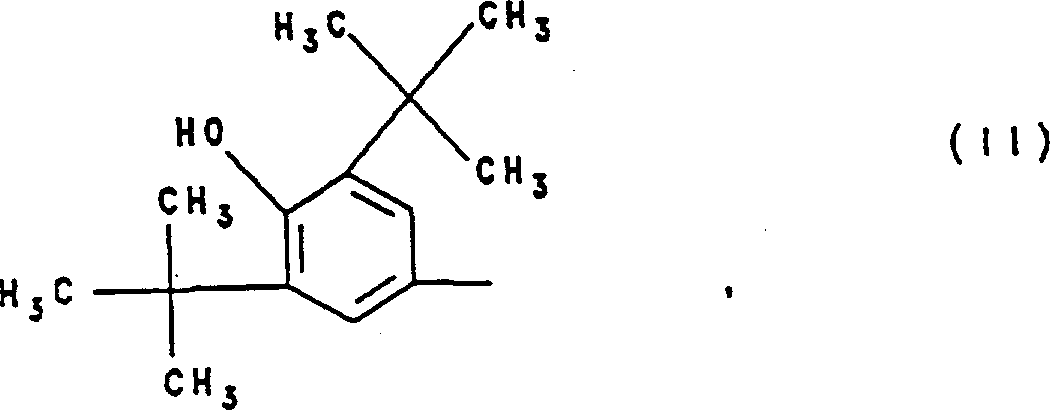 And radicals R
1Or R
2In another have following meaning: a) pyridyl, b) thienyl, c) thiazolyl, d) group of formula III
And radicals R
1Or R
2In another have following meaning: a) pyridyl, b) thienyl, c) thiazolyl, d) group of formula III
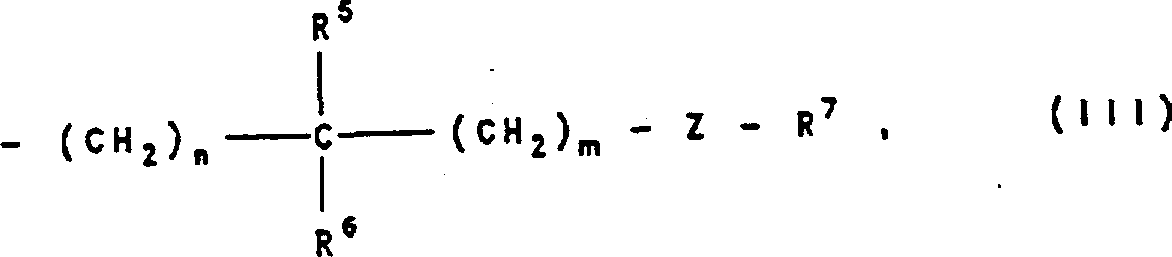 Wherein n is a numeral 0,1,2,3,4,5 or 6, and m is a numeral 0,1,2,3 or 4, and z is 1)-O-, or
2)-and NH-, R
5And R
6Be independently of one another
1) hydrogen atom,
2) (C
1-C
4) alkyl,
3) (C
2-C
4) thiazolinyl,
4) (C
2-C
4) alkynyl,
5) phenyl, or
6) OH, and R
7Be 1) hydrogen atom,
2) amino-acid residue,
3) trifyl,
4)-O-P(O)(OH)
2,
5) with phenyl or (C
1-C
6) alkyl one-or two-esterification-O-P (O) is (OH)
2, or
6) group of formula IV
Wherein O is a numeral 0 or 1, and R wherein
9And R
10Following meaning is arranged independently of one another: 1) hydrogen atom, or 2) (C
1-C
4) alkyl, and R
11For
1)OH,
2)-O-(C
1-C
4) alkyl,
3) (C
1-C
20) alkyl,
4) (C
1-C
20) alkyl, independently of one another by
4.1-COOH,
4.2-OH,
4.3 the O-ethanoyl, or
4.4=O
One or many replaces,
5)-COOH,
6)-COO-(C
1-C
4) alkyl-,
7) N-glycyl,
8) N-glycyl-(C
1-C
4) alkyl ester,
9) N-(C
1-C
4)-alkyl hydroxy amino,
10) N-(1H-tetrazolium-5-yl) amino,
11) 5-methyl-isoxazole-4-base,
12) 1-cyano-2-hydroxy--1-propenyl,
13) phenyl,
14) phenyl is replaced by following formula group one or many
14.1 (C
1-C
4) alkyl-NR
12R
13R wherein
12And R
13Have following meaning independently of one another:
1) hydrogen atom,
2) (C
1-C
4) alkyl,
3) phenyl-(C
1-C
2)-alkyl,
4) R
12And R
13With the nitrogen-atoms that connects them form five-to seven-element heterocycle, this heterocycle is unsubstituted or by (C
1-C
4) alkyl replaces one to three time, this substituent carbon atom can be by sulphur, and oxygen or nitrogen-atoms replace, or
5) amino-acid residue, or
R
6And R
7Mutual bond connected, and be 1 to 3 CH together
2Group,
E) group of formula V
-Q
1-CO-R
8(V)
Q wherein
1Be
1)-(CH
2) m-, wherein m is a numeral 0,1,2,3 or 4, or
2)-CH=CH-and
R
8Be 1) hydrogen atom,
2) (C
1-C
4) alkyl,
3)OH,
4)-O-(C
1-C
4) alkyl-
5)NH
2,
6) N-(1H-tetrazolium-5-yl) amino, or
7) N-(3,5-dimethyl-4-hydroxybenzyl) amino, or
F) group of formula VI
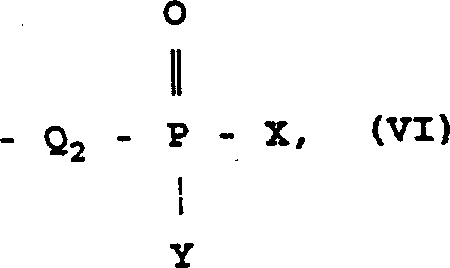
Q wherein
2Be
1)-(CH
2) m-, wherein m is a numeral 0,1,2,3 or 4, or
2)-CH=CH-and
X and Y are independently of one another
1) (C
1-C
4) alkyl,
2)-O-(C
1-C
4) alkyl, or
3) OH ... A ... be to exist or non-existent pair of key, its restriction is two keys and radicals R
4There is not R simultaneously
4Be 1) hydrogen atom, or
2) (C
1-C
6)-alkyl, or R
2And R
4Form the aliphatic series ring of forming by 3,4 or 5 carbon atoms with the carbon atom that connects them, and R
3Be 1) hydrogen atom
2) hydroxyl-(C
1-C
4) alkyl, or
3) hydroxyl-(C
1-C
4) alkyl.
Formula I compound can optical isomer, diastereomer or racemic modification, or its mixture is present in the medicine.The alkyl of design or alkyloyl can straight or branched form exist.
For purposes of the invention, five-to seven-former heterocycle be, for example, pyrroles, pyridine, azatropylidene, thiazole, isothiazole, oxazole, isoxazole, pyrazoles, imidazoles, thiazine, 1,2-oxazine, 1,3-oxazine, morpholine, pyridazine, pyrimidine, pyrazine, 1,2-sulphur azatropylidene, 1,3-sulphur azatropylidene, 1,4-sulphur azatropylidene, 1,2-oxygen azatropylidene, 1,3-oxygen azatropylidene, 1,4-oxygen azatropylidene, 1,2-diaza , 1,3-diaza , 1, the variant that 4-diaza or its are partially or completely saturated.Should mention tetramethyleneimine especially, piperidines, morpholine, piperazine, N methyl piperazine or pyridine.
Term " amino acid " is understood that stereoisomeric forms in any ratio, for example the D of following compound and L shaped formula:
L-asparagine, a word used in person's names propylhomoserin, arginine, aspartic acid; glutamine, L-glutamic acid, tryptophane, Beta-alanine; Methionin, proline(Pro), glycine, γ-An Jidingsuan; N ε-ethanoyl Methionin, N δ-ornithine, N γ-ethanoyl DAB, N α-ethanoyl DAB; Histidine, Isoleucine, leucine, phenylalanine; Serine, halfcystine, Threonine, L-Ala and tyrosine.L-amino acid is preferred.Amino-acid residue is from amino acid derived accordingly.Amino acid whose title is abridged with customary way.Amino-acid residue by amido linkage be connected to-NH-last or by ester bond be connected to-O-on.
Following amino-acid residue is preferred: Gly, Ala, Phe, Ser, Thr, Val, β-Ala, γ-An Jidingsuan, Asp, Glu, Gln, N ε-ethanoyl Methionin, N δ-ethanoyl ornithine, N α-ethanoyl DAB, Lys or tyr.
The pharmacology tolerance salt of preferred formula I compound and/or formula I compound and/or the stereoisomeric forms in any ratio of formula I compound, wherein R
1Or R
2In a meaning with formula II, and R
1Or R
2In another have following meaning: a) 2-pyridyl, b) 4-pyridyl, c) thiene-3-yl-, d) 2-thiazolyl, the e) group of formula III,
Wherein n is a numeral 0,1,2,3 or 4, and m is a numeral 0 or 1, and z is 1)-O-, or
2)-N-, or R
5And R
6Be independently of one another
1) hydrogen atom,
2) (C
1-C
2) alkyl,
3) phenyl, or
4) OH, or R
6And R
7Interconnectionly form methylene radical together, or R
7Be 1) hydrogen atom,
2) trifyl,
3) amino acid based Gly, Phe, Ala, Lys, Tyr, or Ser, or
4) group of formula IV
Wherein O is a numeral 0 or 1,
R
9And R
10Be independently of one another
1) hydrogen atom, or
2) methyl,
R
11Be:
1)OH,
2)-O-(C
1-C
4)-alkyl,
3) (C
1-C
18) alkyl,
4) replaced one or many by following groups independently of each other,
4.1-COOH,
4.2 OH, or
4.3 the O-ethanoyl,
5)-COOH,
6)-COO-(C
1-C
4)-alkyl,
7) N-glycyl,
8) N-glycyl-(C
1-C
4) alkyl ester,
9) N-methyl hydroxyl amino,
10) N-(1H-tetrazolium-5-yl) amino,
11) 5-methyl-isoxazole-4-base,
12) 1-cyano-2-hydroxy--1-propenyl,
13) by 13.1 4-(4-morpholino) methyl substituted phenyl once, the f) group of formula V,
Q wherein
1Be
1)-(CH
2) m-, wherein m is a numeral 0,1, or 2, or
2)-CH=CH-, and R
8Be 1) hydrogen atom,
2) methyl,
3)OH
4)-O-(C
1-C
2)-alkyl,
5) amino,
6) N-(1H-tetrazolium-5-yl) amino, or
7) N-3,5-dimethyl-4-hydroxybenzyl, or g) group of formula VI, wherein Q
2Be
1)-(CH
2) m-, wherein m is a numeral 0,1, or 2, or
2)-and CH=CH-, X and Y are independently of each other
1) methyl,
2)-O-(C
1-C
2)-alkyl, or
3) OH ... A ... be to exist or non-existent pair of key, its restriction is two keys and R
4Group can not exist simultaneously, R
4For
1) hydrogen atom, or
2) (C
1-C
2)-alkyl, or R
2And R
4Form alicyclic ring with the carbon atom that they connected, R with 3,4 or 5 carbon atoms
3For
1) hydrogen atom,
2) methyl, or
3) methylol.
Particularly preferably be the stereoisomeric forms in any ratio of the physiological tolerance salt and/or the formula I compound of formula I compound and/or formula I compound, wherein radicals R
1Or R
2One of have the meaning of formula II, and R
1Or R
2In another have following meaning: a) 2-pyridyl, b) 4-pyridyl, c) thiene-3-yl-, d) 2-thiazolyl, the e) group of formula III,
Wherein n is a numeral 0,1,2,3 or 4, and m is a numeral 0 or 1,
Z is 1)-O-, or
2)-NH-, or R
5And R
6Be independently of one another
1) hydrogen atom,
2) (C
1-C
2) alkyl,
3) phenyl, or R
6And R
7Interconnectionly form methylene radical together, or R
7Be 1) hydrogen atom,
2) trifyl,
3) amino acid based Gly, Lys, or Phe, or
4) group of formula IV
Wherein O is a numeral 0 or 1,
R
9And R
10Be independently of one another
1) hydrogen atom, or
2) methyl,
R
11Be:
1)OH,
2)-O-methyl or O-ethyl,
3) (C
1-C
18) alkyl,
4) replaced one or many by following groups independently of each other
(C
1-C
6) alkyl,
4.1-COOH,
4.2 OH, or
4.3 the O-ethanoyl,
5)-COOH,
6)-COO-(C
1-C
2)-alkyl,
7) N-glycyl,
8) N-glycyl-(C
1-C
2) alkyl ester,
9) N-methyl hydroxyl amino,
10) N-(1H-tetrazolium-5-yl) amino,
11) 5-methyl isoxzzole-4-base, or
12) 1-cyano-2-hydroxy--1-propenyl, the f) group of formula V,
Q wherein
1Be
1)-(CH
2) m-, wherein m is a numeral 0,1, or 2, or
2)-CH=CH-, and
R
8Be
1) hydrogen atom,
2) methyl,
3)OH
4)-the O-methyl,
5) amino,
6) N-(1H-tetrazolium-5-yl) amino, or
7) N-3,5-dimethyl-4-hydroxybenzyl, or g) group of formula VI, wherein Q
2Be
1)-(CH
2) m-, wherein m is a numeral 0, or 2, or
2)-CH=CH-
X and Y are independently of each other
1) methyl
2)-O-(C
1-C
2)-alkyl, or
3) OH ... A ... be to exist or non-existent pair of key, its restriction is two keys and R
4Group can not exist simultaneously, R
4Be 1) hydrogen atom, or
2) methyl, or R
2And R
4Form with the carbon atom that they connected and to have 3,4, or the alicyclic ring of 5 carbon atoms, R
3Be 1) hydrogen atom, or
2) methylol.
The compound of listing in table 1 with structural formula is very preferred.
The present invention also relates to the method for the physiological tolerance salt of the stereoisomeric forms in any ratio of the 2-isoxazoline Huo isoxazole of preparation formula I and/or formula I compound and/or formula I compound; wherein a) primary nitro-compounds is converted into the itrile oxides of correspondence with the triethylamine of isocyanic ester and catalytic amount; or be converted into corresponding itrile oxides with the different hydroxyl oxime acyl chlorides that organic or inorganic alkali will obtain by the aldoxime of chlorination correspondence; this itrile oxides that obtains as intermediate not purified with the alkene or the alkyne reaction that suitably replace; carry out 1; 3-two polar ring additions; form the 2-isoxazoline Huo isoxazole of formula I; if desired; the product that produces is by crystallization or chromatogram purification; or b) according to a) or o) carboxylicesters of formula I of preparation; or by method h) or k) the extra ester group of introducing; be hydrolyzed to carboxylic acid; or c) according to method a) or o) alkyl carboxylates of formula I of preparation is converted into corresponding acid amides with primary amine that suitably replaces or secondary amine; or d) according to a) or o) phospho acid one alkyl ester or the dialkyl alkylphosphonate of formula I of preparation be hydrolyzed to phosphonic acid half-ester; phosphonic acids or phospho acid; or e) according to b) carboxylic acid that obtains at first is converted into the activatory acid derivative; this derivative is used pure esterification subsequently; or be converted into corresponding acid amides with primary amine or secondary amine; or be converted into corresponding oxyamide with the alkylating azanol of N-; or f) a) in method; b); h); e); o) or g) N-protected base that obtain or that carry or O-protecting group are eliminated in the middle of in; or the carboxylic acid that is introduced into; phospho acid; phosphonic acids or phosphoric acid ester are by corresponding hydrolysis; obtain formula I compound; or g) according to method f) or o) obtain; and the compound with free amine group is by being converted into corresponding urea derivatives with isocyanate reaction; or by being converted into corresponding amide with the reaction of the amino acid of activatory carboxylic acid derivative or N-protected; or by being converted into corresponding sulphonamide with the SULPHURYL CHLORIDE reaction; or h) a) according to method; o) or f) obtain; compound with free alcohol radical is by being converted into corresponding urea alkane with isocyanate reaction; or be converted into corresponding ester by reacting with the amino acid derivative that on carboxyl, is activated and can further have the carboxylic acid derivative of functional group or a corresponding N-protection; or be converted into corresponding 3-oxobutanoic acid esters with dienone; or by being converted into corresponding ether with halogenated compound such as alpha-halogenated carboxylic acids reaction; or i) a) according to method, o) or f) obtain, the compound with uncle or secondary alcohol groups is oxidized to corresponding aldehydes or ketones; or k) according to method i) carbonyl compound of preparation is by being converted into the Ba Dousuan derivative with the reaction of alkali and dialkyl phosphine acyl acetic acid ester; or by being converted into trans accordingly-2-(dialkoxy phosphono) ethenyl derivatives, or l) with tetraalkyl methylene biphosphonic acid esters reaction the epoxy group(ing) of during cycloaddition, introducing be converted into corresponding 1, the 2-glycol; or m) according to method g) preparation; the acid amides that contains the 3H-isoxazole ring is converted into 2-cyano-3-hydroxy crotonamide by carrying out open loop with alkaline purification, or n) a)-m) prepare according to method; since its chemical structure and the formula I compound that exists with enantiomeric form by with the acid or the alkali salify of enantiomer-pure; chromatography on chiral stationary phase, or with the compound of chirality enantiomer-pure such as amino acid derived, the separately diastereomer that obtains like this; eliminate the auxiliary base of chirality; be split as pure enantiomorph, or o) the diastereoisomeric mixture of 2-isoxazoline by the formula I that obtains with chirality or the cycloaddition of racemize alkene is split as pure diastereomer by silica gel column chromatography, or p) the formula I compound that a)-o) prepares according to method can be separated with free form; or if desired; when acid or base exist, be converted into physiological tolerance salt, or q) according to method h) preparation; the compound that has other functional group such as halogenated methyl is used uncle or secondary amino group alkylation, or uses pure esterification.
From formula I compound, comprise that it can carry out by the salifiable stereoisomerism formation of shape preparation physiological tolerance salt in a manner known way.Carboxylic acid, phosphonic acids and phospho acid, and phosphonic acid half-ester, with alkaline reagents such as oxyhydroxide, carbonate, supercarbonate or alkoxide, and ammonia or organic, alkali is Trimethylamine 99 for example, triethylamine or thanomin, and basic aminoacids, for example Methionin, ornithine or arginine form stable an alkali metal salt, the ammonium salt of alkaline earth salt or non-imposed replacement.As at R
1Or R
2The formula I compound that basic group is arranged in the group, also available strong acid prepares stable acid salt.No matter mineral acid or organic acid, example hydrochloric acid, Hydrogen bromide, sulfuric acid, phosphoric acid, methylsulfonic acid, Phenylsulfonic acid, to methylsulphonic acid, the 4-bromo-benzene sulfonic acid, cyclohexyl amido sulfonic acid, trifluoromethanesulfonic acid, acetate, oxalic acid, tartrate or trifluoroacetic acid all are suitable for this purpose.
As 1, the preparation and the conversion of the itrile oxides of 3-two polar ring addition starting compounds are described in nearest feature article (K.P.G.Torsell:Nitrile Oxides, Nitrones and Nitronates in Organic Synthesis, VCH Vertags-gesellschaft, Weinheim, 1988) in.Different hydroxyl oxime carboxylic acid halides as precursor can be according to the currently known methods of document, by the corresponding aldoxime of halogenation, or under the situation of chlorine oxyimino group acetic ester, obtain (G.S.S kinner from the glycine alkyl ester through diazotization reaction, J.Am.Chem.Soc.64 (1924), 731).If t-butyl hypochlorate is used to the chlorination aldoxime, do not need to separate corresponding different hydroxyl oxime acyl chlorides.Also the nitro-compound that can be used is known from document in some cases, or by the preparation of the method for known its principle of document, for example, 4-nitro butyric ester or the Nitromethane 99Min. of base catalysis catalytic by oxide compound and the addition of acrylic acid derivative obtain (D.W.Chasar, Synthesis 1982,841-42; N.Ono, Synthesis 1984,226-227).
Can be significantly increased from the known output of document, generally show as being formed on to a great extent of diadduct that is difficult to by product separately and pass through with 1,8-diazabicyclo (5.4.0) 11 carbon-7-alkene (DBU) reacts with particular form as alkali and prevents.
As parent material, the overwhelming majority is known and also can buy from document as the alkene of the non-imposed replacement of reactant or alkyne derivatives.Suitable guidance provides in an embodiment.The production of easy oligomeric itrile oxides advantageously separates without any intermediate in the presence of olefinic or acetylene series reactant, and " on the spot " carries out.When they when nitro-compound is produced according to the method for Mukaiyama, aromatic isocyanate, for example phenylcarbimide or two isocyanato-benzene are optimized for dehydration.In the case, can be advantageously at aprotic solvent or to reactant inert partitioning agent, as ethyl acetate, dimethyl formamide, N,N-DIMETHYLACETAMIDE, dialkyl ether, tetrahydrofuran (THF), halohydrocarbon, for example methylene dichloride, chloroform or ethylene dichloride, hydrocarbon is as hexane, hexanaphthene, benzene carries out in the aromatic substance of toluene or other replacement, and the mixture of above-mentioned solvent also is suitable.Organic or inorganic, alkali such as tertiary amine, alkaline carbonate or alkali metal hydroxide are used to produce itrile oxides from different hydroxyl oxime carboxylic acid halides.In the case, when organic bases was used, reaction was preferably in aliphatic series or the aromatic hydrocarbon or the aliphatic series of above-mentioned non-imposed chloro, and carry out in the cyclic ether, and, when mineral alkali is used, reaction also can for example be carried out in ethyl acetate/water or the methylene dichloride/water at the two-phase solvent mixture.The preparation of itrile oxides and cycloaddition are generally-20 ℃ to+80 ℃ temperature, yet preferred 0 ° to+40 ℃ is carried out.
Be entrained in the cycloaddition, or the side by further reaction or the corresponding more carboxylic acid of alkyl ester hydrolysis introduced subsequently are usually with can equimolar amount or the alkali aqueous solution of excessive use, in the aqueous solution, perhaps, if starting compound is insoluble in water, realize that in water/ORGANIC SOLVENT MIXTURES water/alcohol mixture has been proved to be has special value.
Substituent R in general formula I
1Or R
2In the amine brought into; alcohol or carboxylic acid protecting group's cracking is carried out according to known method on chemistry of peptides usually, under the situation of the preferred tertbutyloxycarbonyl that uses, and acid the elimination; be preferred for example with pure dissolved hydrochloric acid or trifluoroacetic acid, and preferably cracking under alkaline condition of lower alkyl esters.
Phosphonic acid ester and phosphinate to the conversion of corresponding free acid under acidic conditions, preferably in anhydrous medium, realize, for example in organic acid such as acetate, use Hydrogen bromide, or in aprotic solvent, realize that with trimethylammonium bromo silicomethane or trimethylammonium iodo silicomethane halohydrocarbon preferably is employed.In the case, 0 ° to 50 ℃ is selected as temperature of reaction really to carry out under mild conditions except that cracking.Phosphonic acid half-ester prepares by phosphonic acid diester is carried out alkaline hydrolysis usually.
At R
1Or R
2In have a free carboxy acid functional group formula I compound at carboxyl suitably after the activation, can be with known method itself with uncle or secondary amine, alkylating azanol of also available N-or 5-amino tetrazole are converted into corresponding amide.
At R
1Or R
2In have free alcohol or an amine functional group formula I compound can be converted into corresponding ester or acid amides with activatory carboxylic acid derivative such as carboxylic acid halides or acid anhydrides.Corresponding ester or acid amides also can obtain from the amino acid of N-protected.In the case, be advantageously used in the activated amino acid composition by the known method of chemistry of peptides, for example, hydroxybenzotriazole/dicyclohexylcarbodiimide method (W.K ning, R.Geiger, Chem.Ber, 103 (1970), 2034-2040) or with propyl phosphonous acid acid anhydride (PPA) activate, also can use hydrochloric ether, as dimethyl formamide, as solvent (except that aliphatic series and cyclic ether).Tertiary amine, as triethylamine, N-ethylmorpholine or pyridine are preferably as auxiliary alkali.Be reflected at-10 ℃ to+50 ℃, preferably carry out 0 ℃ to+20 ℃ temperature range.
As for the acyl derivative that exists with protected form need be free amido functional group or carboxylic acid functional form, and the corresponding protection base can be single or remove together by the method for narration in the above.
In addition, at R
1Or R
2In have free alcohol or an amine functional group formula I compound can be urethane derivant or urea derivatives by the isocyanate conversion that adds suitable replacement.Add relevantly with isocyanic ester, or can be converted into corresponding carboxylic acid as mentioned above as the ester group that additional functionality is introduced into.
Compound with free uncle or secondary alcohol functions can be oxidized to corresponding aldehydes or ketones with dimethyl sulfone and oxalyl chloride simply by being called the method for " Swern oxidation ".In the case, the oxidative degradation of the oxidation of side reaction such as phenol ring or 2-isoxazoline ring can be avoided by suitably reacting at low temperature.Carbonyl compound available bases that obtains like this and CH-acidic cpd as dialkyl phosphine acyl acetic acid alkyl ester or tetraalkyl methylene biphosphonic acid esters, carry out condensation and are converted into the reaction alkene of corresponding replacement.
As for the formula I compound that exists with diastereo-isomerism or enantiomerism form, with they mixtures in selection is synthetic, they are split as the means that pure stereoisomers both can pass through chromatography on chirality or achirality carrier, also can be by optically active alkali or acid are realized as the diastereo-isomerism salt classification crystallization that auxiliary substance forms for the racemic compound of formula I.Generally exist by thin-layer chromatography or column chromatography fractionation with racemic form; the example of suitable chiral stationary phase that has the enantiomer of asymmetric (atom)-isoxazolines in the 5-position has silica-gel carrier (so-called Pickle phase) and macromolecule carbon hydrate, for example tri acetyl cellulose of modification.After suitably deriving, known as those skilled in the art, the vapor-phase chromatography on chiral stationary phase also can be used for the purpose analyzed.For the resolution of racemic carboxylic acid, the enantiomer of phosphonic acids and phospho acid, the different optically active alkali that generally can buy of deliquescent diastereomeric salts, for example, (-)-nicotine, (+)-and (-)-phenyl-ethyl amine, quinoline alkali, L-Methionin or L-and D-arginine form, and difficult composition is separated as solid, easily molten diastereomer is told from mother liquor, and pure enantiomer is separated from the diastereomeric salt that obtains by this way.
The racemic compound that contains the formula I of base such as amino can be used the identical mode of principle, with optically active acid as (+)-camphor-10-sulfonic acid, D-and L-tartrate, D-and L-lactic acid or (+) and (-) amygdalic acid are converted into pure enantiomer.The amino acid that contains the enantiomer-pure of the also available suitable activation of chipal compounds of alcohol or amine functional group or non-imposed N-protected is converted into corresponding ester or acid amides; or on the contrary; chiral carboxylic acids can be converted into acid amides with the amino acid of the enantiomer-pure of carboxy protective, or is converted into corresponding chiral ester with the hydroxycarboxylic acid such as the lactic acid of enantiomer-pure.Amino-acid residue or the alcohol radical introduced in the enantiomer-pure form can be used for analysing the branch isomer then, by crystallization or go up chromatography mutually in suitable stationary and split now to be the isomer of diastereomer, to eliminate the chiral molecules part that has once more with suitable method then.
The present invention also relates to medicine, the effective ingredient that it is characterized in that the physiological tolerance salt of the stereoisomeric forms in any ratio of at least a formula I compound and/or formula I compound and/or formula I compound, add medicinal and vehicle physiological tolerance, adjuvant and/or active compound and auxiliary substance.But according to medicine intravenously, parenteral, part, rectum or oral administration of the present invention.
Medicine according to the present invention is preferably suitable for preventing and/or treating asthma, inflammation and autoimmune disease.
These comprise, for example, muscle, joint or GI acute and chronic inflammation, allergy respiratory tract disease, psoriasis or autoimmune disease, for example the whole body lupus erythematosus (SLE), type ii diabetes, myasthenia gravis, Sj gren ' s syndromes, dermatomyositis, scleroderma or multiple sclerosis (MS).
The present invention also relates to prepare the method for medicine of the present invention, if the vehicle of wherein at least a formula I compound and medicinal and physiological tolerance and suitable further has suitable active compound, adjuvant or auxiliary substance are made into the suitable form of administration together.
The example of solid that preparation is suitable or liquid medicine form has granula, pulvis, coated tablet, tablet, (little) capsule, suppository, syrup, juice, suspension, emulsion, the preparation of drops or injection liquid and slowly-releasing active compound is in the preparation that forms, adjuvant commonly used, as carrier substance, disintegrating agent, caking agent, Drug coating, swelling agent, antiseize paste, lubricant, seasonings, sweeting agent and solubilizing agent are used.The example of auxiliary substance commonly used that can be referred has magnesiumcarbonate, titanium dioxide, lactose, mannitol and other sugar, talcum, milk proteins, gelatin, starch, Mierocrystalline cellulose and derivative thereof, animal and plant oil, as haddock liver oil, sunflower seed oil, peanut oil or sesame oil, polyoxyethylene glycol and solvent, for example, aqua sterilisa and monobasic or polyvalent alcohol, for example glycerine.
With dose unit preparation and administration, per unit contains the formula I compound of the present invention of prescribed dose as active ingredient to pharmaceutical preparation by preferably.In the situation of solid dosage unit, as tablet, capsule, coated tablet or suppository, this dosage can be up to about 1000mg, yet preferably, about 50 to 300mg, and in the situation with the solution of ampoule form, up to about 300mg, yet preferably about 10 to 100mg.
According to the activity of formula I compound in humans and animals, about 50 to 3000mg active compounds, under case of oral administration, per daily dose preferably about 150 is to 1000mg, under the situation of intravenous administration, about 50 to 1000mg, and preferred about 100 to 300mg, and per daily dose is decided to be the adult harmful person of the about 70kg of treatment body weight.Yet, also be suitable for higher or lower per daily dose administration sometimes.Per daily dose both can the single dosage unit form also can several smaller dose units, or give the dosage that divides again at interval at fixed.At last, its physiological tolerance salt of formula I compound and/or (if suitable) also can be prepared, when preparation said medicine form of medication; with other suitable activity compound, for example blood flow promotes material, platelet aggregation inhibitor; anticoagulant; calcium antagonist, anti-platelet agents, lipidemia agent; neuroprotective; pain killer, tranquilizer, antidepressive; anti-inflammatory agent; anti-pharyngalgia agent, cardiotonic drug, anti-arrhythmic agents; diuretic(s); hypotensive agent comprises receptor blocking agent and calcium blockers, and plasma expander and other vascular treatment agent are prepared together.
The structural formula of following preparation embodiment, with fusing point and
1The H-NMR data are listed in the table 1 together.If stereoisomeric forms in any ratio exists, relative configuration provides with structural formula.The δ value of following NMR spectrum provides with ppm.
Embodiment 13-(4-hydroxyl-3,5-di-tert-butyl-phenyl)-5-methylol-2-isoxazoline is 3-(4-hydroxyl-3,5-di-t-butyl) benzaldoxime a)
(pp.55ff), known method prepares from 3-(4-hydroxyl-3,5-di-t-butyl) phenyl aldehyde this oxime for Houben-Weyl:Meth.d.Org.Chem. (Methods ofOrganic Chemistry), Vel.X/4 with document.B) with 1 of itrile oxides, 3-two polar loop additions
The aldoxime that 24.9g (0.1mol) is prepared in a) is dissolved in the 250ml methylene dichloride, drips 12.0g (0.11mol) t-butyl hypochlorate under cooling, in case be added dropwise to complete, mixture at room temperature stirred 45 minutes.Add after 11.6g (0.2mol) vinyl carbinol, slowly dropping (in 6 hours) is dissolved in 16.7ml (0.12mol) triethylamine in the 150ml methylene dichloride.Water, rare citric acid and NaCl solution washing, dried over sodium sulfate and concentrating under reduced pressure are spent the night in the mixture stirring.By obtaining product with crystalline form from methyl tertiary butyl ether/sherwood oil crystallization.Output: 13.1g
Embodiment described in the table 1 in the back: 2,5,8,9,10,11,12,13,14,15,16,17,18,19,20,21,22,23,24,25,26,27,28,29,30,31,32,35,44,48,66,67,68,69,78,79 and 80 are similar to the itrile oxides and corresponding alkene or alkynes cycloaddition preparation of embodiment 1 by preparation on the spot.
Under the situation of crude product, it shows as oily matter at first, silica gel column chromatography, and with methyl tertiary butyl ether/sherwood oil or ethyl acetate/petroleum ether mixture wash-out, and subsequent crystallisation, also be proved to be valuable.
About listing in embodiment synthetic characteristic in the table 1:
About embodiment 2):
Synthesizing in EP0220573 of alkene structure component narrated.
About embodiment 8):
3-vinyl thiophene: CAS No.13679-64-6
About embodiment 11):
To the methyl acrylate cycloaddition.At room temperature be converted into acid amides with excessive saturated ammonia methanol solution.
About embodiment 14):
To N-(3,5-dimethyl-4-hydroxybenzyl) MAAm (synthetic being described among the DE3820699).
About embodiment 15):
Belong to non-stereoselectivity cycloaddition, product shows as non-enantiomer mixture.
About embodiment 16 and 17):
With red to the related racemize of divinyl-oxide compound cycloaddition or/Soviet Union's formula non-enantiomer mixture is split as diastereomer by the means of silica gel chromatography, with 9: 1 wash-outs of petrol ether/ethyl acetate, and subsequent crystallisation (embodiment 16: racemize erythro form isomer, embodiment 17: racemize Soviet Union formula isomer).
About embodiment 18-20):
Be split as diastereomer by racemize erythro form/Soviet Union's formula diastereo-isomerism mixture (embodiment 18) by silica gel chromatography to 1-butylene-3-alcohol cycloaddition, (embodiment 19: racemize erythro form isomer, embodiment 20: racemize Soviet Union formula isomer) with 5: 1 wash-outs of sherwood oil/methyl tertiary butyl ether.
About embodiment 21-22):
Be split as diastereomer by racemize erythro form/Soviet Union's formula non-enantiomer mixture by silica gel chromatography to 1-butylene-3-alcohol acetic ester cycloaddition, (embodiment 21: racemize erythro form isomer, embodiment 22: racemize Soviet Union formula isomer) with 19: 1 wash-outs of petrol ether/ethyl acetate.
About embodiment 23):
Carry out cycloaddition with tert-butyl acrylate.The trifluoroacetic acid cancellation under the room temperature in methylene dichloride of tertiary butyl ester group.After concentrating, can be from methyl tertiary butyl ether/sherwood oil crystallized product.
About embodiment 35):
The synthetic of alkene structure component is described among the EP0220573.
About embodiment 48):
Carry out cycloaddition with N-tertbutyloxycarbonyl propargyl amine.The N-protected group is eliminated with trifluoroacetic acid subsequently.Crystalline form that can trifluoroacetate obtains product from methyl alcohol/methyl tertiary butyl ether.Free alkali is by extracting from rare NaOH aqueous solution with methylene dichloride, and dry and concentrated organic layer obtains.
About embodiment 78):
With 6-heptene-2, the 4-glycol carries out cycloaddition.Be defined as the pure product of isomery by with methyl tertiary butyl ether/sherwood oil silica gel column chromatography by the NMR spectrum, repeat crystallization from above-mentioned solvent subsequently and obtain.
About embodiment 79 and 80):
Be similar to embodiment 1) with excessive 1,6-heptadiene-4-alcohol carries out cycloaddition.By (gradient 6: 1-2: 1) means of silica gel column chromatography are split as diastereomer with the petrol ether/ethyl acetate mixture.Differentiate Soviet Union's formula/erythro form isomer with NMR spectrum intangibility.
Embodiment 32-(3-(4-hydroxyl-3,5-di-tert-butyl-phenyl)-2-isoxazoline-5-ylmethoxy) methylpropanoic acid
The product of 4.0g (0.095mol) embodiment 2 is dissolved in the 80ml methyl alcohol, adds the 25ml1N NaOH aqueous solution; In case (monitoring with TLC) finished in hydrolysis, mixture 25ml 1N Hcl acidifying.Sedimentary product is filtered, and washing is also dry.Output: 3.0g
Embodiment 4N-(3-(4-hydroxyl-3,5-di-tert-butyl-phenyl)-2-isoxazole-5-base methoxycarbonyl) glycine a) and isocyanate reaction
The product of 5.5g (0.018mol) embodiment 1 is dissolved in the 5ml methylene dichloride, adds 3.2g (0.025mol) isocyanato-ethyl acetate and about 4 triethylamines, mixture is under agitation in 50-60 ℃ of heating.In case (monitoring with TLC) finished in reaction, mixture is concentrated and with methyl tertiary butyl ether/sherwood oil silica gel column chromatography.Output: the hydrolysis of ethyl fat 7.2g oily product b)
7.2g product a) is as embodiment 3) described in, the 1N NaOH hydrolysis with excessive after the acidifying, separates with crystalline form.Output 4.56g
Embodiment 63-(4-hydroxyl-3,5-di-tert-butyl-phenyl)-2-isoxazole pouring-5-base phosphonic acids
5.0g (0.013mol) product of embodiment 5 is in room temperature 33% solution-treated of about 100ml HBr in glacial acetic acid, up to react completely (monitoring with TLC).Concentrating back residue and methyl tertiary butyl ether fully stirs.Output: 3.15g.
Embodiment 73-(4-hydroxyl-3,5-di-tert-butyl-phenyl)-2-isoxazoline-5-base phosphonic acids methyl ester
5.0g (0.013mol) product of embodiment 5 at room temperature is dissolved in the 100ml methyl alcohol.Add 30ml 1N NaOH, mixture is stirred 15 hours (monitoring with TLC).After the acidifying (1NHCl), use dichloromethane extraction, then water and saturated nacl aqueous solution washing, dry and concentrated.Resistates is crystallization from methyl tertiary butyl ether/sherwood oil.Output: 3.4g.
Embodiment 21 and 22 (another is synthetic) 1-(3-(4-hydroxyl-3,5-di-tert-butyl-phenyl)-2-isoxazoline-5-yl) ethylhexoate (being respectively erythro form or Soviet Union's formula isomer)
The product of 2.5g (0.008mol) embodiment 19 or 20 is dissolved in 100ml methylene dichloride and the 6ml pyridine.After adding the 125mg 4-dimethylaminopyridine, at ice-cooled 1.35ml (0.024mol) Acetyl Chloride 98Min. that is dissolved in the 10ml methylene dichloride that drips down; In case (monitoring with TLC) finished in reaction, with the mixture water, aqueous potassium hydrogen sulfate and water washing, dry and concentrated.Residual oily matter is from methyl tertiary butyl ether/sherwood oil crystallization.
Embodiment 33 (1-(3-(4-hydroxyl-3,5-di-tert-butyl-phenyl) isoxazole-5-base)-1-methyl ethoxy) ethyl acetate
In protective gas, ice-cooled following, the product that is dissolved in 10.0g (0.03mol) embodiment 29 in the 40ml anhydrous dimethyl formamide is added dropwise in the suspension of 1.06g (0.044mol) sodium hydride in the 30ml anhydrous dimethyl formamide.Through other after 30 minutes, 10.8g (0.044mol) bromoethyl acetate that is dissolved in the 30ml anhydrous dimethyl formamide is added dropwise in the mixture under cooling not, and mixture is then by restir 4 hours.Reaction mixture is introduced in the ice then, uses ethyl acetate extraction.Washing, dry and concentrated.The oily resistates is from the sherwood oil crystallization.Productive rate: 6.8g.
Embodiment 34 (1-(3-(4-hydroxyl-3,5-di-tert-butyl-phenyl) isoxazole-5-base)-1-methyl ethoxy) acetate
3.7g (0.009mol) product similar embodiment 3 hydrolysis of embodiment 33.Output: 2.9g.
Embodiment 362-(3-(4-hydroxyl-3,5-di-tert-butyl-phenyl) isoxazole-5-base methoxyl group)-2 Methylpropionic acid
9.5g (0.023mol) product type of embodiment 35 is similar to embodiment 3 hydrolysis.Output: 6.6g.
The different hydroxyl oxime of embodiment 37N-methyl acyl group-2-((3-(4-hydroxyl-3,5-di-tert-butyl-phenyl) isoxazole-5-base methoxyl group) 2 Methylpropionic acid ester
4.0g (0.01mol) product type of embodiment 36 is similar to the method for document (EP0199151), derives with oxalyl chloride and N-methyl hydroxylamine.Product is from the methyl tertiary butyl ether crystallization.Output: 2.7g.
Embodiment 382-(3-(4-hydroxyl-3,5-di-tert-butyl-phenyl) isoxazole-5-base methoxyl group)-N-(1H-tetrazolium-5-yl) isobutyramide
6.0g (0.015mol) product type of embodiment 36 method that is similar to document (J.Org.Chem., 34 (1969), 2766-2767) is derived with 1.25g (0.015mol) the 5-amino tetrazole in 1.7ml (0.015mol) silicon tetrachloride and the anhydrous pyridine.Product is from methyl tertiary butyl ether/sherwood oil crystallization.Output: 3.9g.
Embodiment 39N-(3-(4-hydroxyl-3,5-di-tert-butyl-phenyl) isoxazole-5-base carbometoxyl) glycine ethyl ester
14.0g (0.046mol) product type of embodiment 24 is similar to embodiment 4a) reaction.Residual oily matter 1: 4 silica gel column chromatography purifying of methyl tertiary butyl ether/sherwood oil.Output: 16.4g.Embodiment 40N-(3-(4-hydroxyl-3,5-di-tert-butyl-phenyl) isoxazole-5-base methoxycarbonyl) glycine
7.1g (0.06mol) product type of embodiment 39 is similar to embodiment 3 hydrolysis.Productive rate: 4.1g.
Embodiment 41N-(3-(4-hydroxyl-3, the 5-di-tert-butyl-phenyl) isoxazole-5-base third oxygen carbonyl) glycine ethyl ester
8.0g (0.024mol) product type of embodiment 26 is similar to embodiment 4a) reaction.Residual oily matter is from methyl tertiary butyl ether/sherwood oil crystallization purifying.Output: 6.1g.Embodiment 42N-(3-(4-hydroxyl-3, the 5-di-tert-butyl-phenyl) isoxazole-5-base third oxygen carbonyl) glycine
4.0g (0.0089mol) product similar embodiment 3 hydrolysis of embodiment 41.Output: 2.8g.
Embodiment 43N-(2-(4-hydroxyl-3,5-di-tert-butyl-phenyl) isoxazole-5-base ethoxycarbonyl) glycine
6.25g the product type of embodiment 25 is similar to embodiment 4a) reaction.Residual product type is similar to embodiment 3 hydrolysis, and uses the methyl tertiary butyl ether silica gel column chromatography, and finally from methyl tertiary butyl ether/sherwood oil crystallization purifying.Output: 3.8g.Embodiment 453-(4-hydroxyl-3,5-di-tert-butyl-phenyl) isoxazole-5-base propionic acid
4.3g (0.011mol) product of embodiment 44 is similar to embodiment 3 hydrolysis.Output: 3.0g.Embodiment 463-(3-(4-hydroxyl-3,5-di-tert-butyl-phenyl) isoxazole-5-base)-N-(1H-tetrazolium-5-yl) propionic acid amide
7.0g (0.02mol) product of embodiment 45 is similar to embodiment 38 with the 5-amino tetrazole in silicon tetrachloride and the anhydrous pyridine and derives.Product is from methyl tertiary butyl ether/sherwood oil crystallization.Productive rate: 6.5g.(4-hydroxyl-3,5-di-tert-butyl-phenyl) isoxazole-5-base vinylformic acid a) Swern oxidation form aldehyde to embodiment 473-
In-60 ℃ and protective gas, 25.4g (0.2mol) oxalyl chloride is at first introduced in the 250ml anhydrous methylene chloride, drip 31.2ml (0.044mol) methyl-sulphoxide that is dissolved in the 20ml anhydrous methylene chloride then.After 30 minutes, in-50 ℃ and 45 minutes, drip the product that is dissolved in 30.3g (0.1mol) embodiment 24 in 200ml anhydrous methylene chloride/20ml dimethyl formamide, mixture stirred 20 minutes subsequently.Add after 55.6ml (0.4mol) triethylamine, remove cryostat, mixture is subsequently stirring at room 1 hour, water, and rare aqueous citric acid solution and NaCl solution washing, dry and concentrate.Residual oily matter 1: 9 silica gel column chromatography of methyl tertiary butyl ether/sherwood oil, and from the sherwood oil crystallization.Output: 16.4g.B) alkylene
Under 0 ℃ and protective gas, 0.77g (0.032mol) sodium hydride is at first introduced in the 40ml anhydrous tetrahydro furan, 8 drip 5.05g (0.024mol) the diethyl phosphino-methyl acetate that is dissolved in the 50ml anhydrous tetrahydro furan then, the suspension of generation stirred 1 hour at 0 ℃ subsequently; Drip 4.8g (0.016mol) the embodiment 47a be dissolved in the 50ml anhydrous tetrahydro furan then) product, mixture is restir 2 hours subsequently, pour in the frozen water, with dichloromethane extraction several times, washing, dry and concentrate.Product is from methyl tertiary butyl ether/sherwood oil crystallization.Output: 4.2g.C) hydrolysis
3.7g product type (0.01mol) embodiment 47b) is similar to embodiment 3 hydrolysis.Output: 3.3g.
Embodiment 49N-(3-(4-hydroxyl-3,5-di-tert-butyl-phenyl) isoxzzole-5-ylmethyl) fluoroform sulphonamide
Under ice-cooled, the alkali form that is dissolved in 3.6g (0.012mol) embodiment 48 products in the 50ml anhydrous methylene chloride is at first introduced, and adds 3.95g (0.014mol) trifluoromethanesulfanhydride anhydride subsequently, and 2.2ml (0.017mol) N-ethylmorpholine; Mixture stirs subsequently and spends the night, water, and rare aqueous citric acid solution and NaCl solution washing, dry and concentrated.Residual oily matter 3: 1 silica gel column chromatographies of methyl tertiary butyl ether/sherwood oil, and from methyl tertiary butyl ether/sherwood oil crystallization purifying.Output: 2.1g.The amino ethyl oxalate of embodiment 50N-(3-(4-hydroxyl-3,5-di-tert-butyl-phenyl) isoxzzole-5-ylmethyl)
Under ice-cooled; 9.1g (0.03mol) the alkali form of the product of embodiment 48, in anhydrous tetrahydro furan, with 3.9ml (0.035mol) (chloroformyl) ethyl formate and 9.7ml (0.07mol) triethylamine to be similar to document (J.Med.Chem.; 34 (1991), 600) method acidylate.After adding frozen water, use ethyl acetate extraction, water, rare aqueous citric acid solution and NaCl solution washing, then dry and concentrated.Residual oily matter is from methyl tertiary butyl ether/sherwood oil crystallization.Output: 9.1g.The amino oxalic acid of embodiment 51N-(3-(4-hydroxyl-3,5-di-tert-butyl-phenyl) isoxzzole-5-ylmethyl)
5.0g (0.012mol) product type of embodiment 50 is similar to embodiment 4b) hydrolysis.The product that shows as oily matter is by using dichloromethane extraction, water and NaCl solution washing, dry and concentrating and separating.Residual non-crystalline product is from methyl tertiary butyl ether/sherwood oil crystallization.Output: 3.4g.Embodiment 525-methyl isoxzzole-4-formic acid (3-4-hydroxyl-3,4-di-tert-butyl-phenyl) isoxzzole-5-ylmethyl) acid amides
Under ice-cooled, 5.0g (0.0165mol) the alkali form of embodiment 48 products and 2.2ml (0.017mol) N-ethylmorpholine are at first introduced in the 80ml anhydrous tetrahydro furan, drip 2.5g (0.017mol) the 5-methyl isothiazole-3-base formyl chloride that is dissolved in the 10ml tetrahydrofuran (THF) then; Mixture was stirring at room 5 hours.Add frozen water and with behind the dichloromethane extraction, water, rare aqueous citric acid solution and NaCl solution washing, then dry and concentrate.The oily matter that obtains is with 1: 1 silica gel column chromatography purifying of methyl tertiary butyl ether/sherwood oil and from the sherwood oil crystallization.Output: 4.9g.Embodiment 532-cyano-3-hydroxy but-2-ene formic acid (3-(4-hydroxyl-3,5-di-tert-butyl-phenyl) isoxazole-5-base methyl) acid amides
The product of 4.0g (0.01mol) embodiment 52 is dissolved in the 50ml anhydrous tetrahydro furan, at the ice-cooled 20ml 1N NaOH that adds down; In case (by the TLC monitoring) finished in reaction, mixture is used dichloromethane extraction with 22ml 1N Hcl acidifying; Then washing, dry and concentrated.Residue is from methyl tertiary butyl ether/sherwood oil crystallization.Output: 3.3g.
Embodiment 54 (3-(3-(4-hydroxyl-3,5-di-tert-butyl-phenyl) isoxazole-5-base methyl) urea groups) ethyl acetate
At 50-60 ℃, stir down, the alkali form of 14.2g (0.047mol) embodiment 48 products heats with 6.5g (0.05mol) isocyanato-ethyl acetate.In case (monitoring with TLC) finished in reaction, mixture is concentrated, and from methyl tertiary butyl ether/sherwood oil crystallization.Output: 11.3g.
(3-(4-hydroxyl-3,5-di-tert-butyl-phenyl) isoxazole-5-base methyl) amide hydrochloride is a) with N-tertbutyloxycarbonyl phenylalanine acidylate for embodiment 55L-phenylalanyl-N-
5.3g (0.02mol) N-tertbutyloxycarbonyl phenylalanine is dissolved in the 100ml anhydrous tetrahydro furan, adds 4.5g (0.022mol) dicyclohexylcarbodiimide and 3.1g (0.02mol) I-hydroxybenzotriazole hydrate, mixture is stirred about 45 minutes.The urea that is settled out is leached.After adding 2.3ml (0.018mmol) N-ethylmorpholine, drip the product that is dissolved in 6.25g (0.015mol) embodiment 48 in the 50ml tetrahydrofuran (THF).After 4 hours, add ethyl acetate, with 0.1N HCl and saturated NaCl solution washing, dry and concentrated.Crude product is further purified by silica gel chromatography (methyl tertiary butyl ether).Output: the product oily matter of 8.9g N-tertbutyloxycarbonyl protection.B) eliminate protecting group
Handle by the trifluoroacetic acid (25ml) in methylene dichloride (150ml), concentrate and evaporation several times, add the hydrochloric acid in the ether after, then fully stir elimination protecting group, and be converted into hydrochloride with sherwood oil.The non-crystalline hydrochloride of output: 6.3g.
Embodiment 56 (3-(3-(4-hydroxyl-3,5-di-tert-butyl-phenyl) isoxazole-5-base methyl) urea groups) acetate
6.5g (0.015mol) product type of embodiment 54 is similar to embodiment 3 hydrolysis.Output: 5.7g
Embodiment 572-(3-(4-hydroxyl-3,5-di-tert-butyl-phenyl) isoxazole-5-base) vinyl phosphonic diethyl phthalate
Be reflected in the anhydrous tetrahydro furan, method with document (J.Med.Chem., 32 (1989), 2171), from 6.4g (0.021mol) embodiment 47a) product, 6.25ml (0.025mol) tetraethyl methylenediphosphonate and 9.6ml (0.024mol) .5M butyl lithium solution carry out.After reaction was finished, reaction mixture was introduced in the frozen water, with dichloromethane extraction several times; Washing, dry and concentrated.Product is from methyl tertiary butyl ether/sherwood oil crystallization.Output: 7.9g.
Embodiment 582-(3-(4-hydroxyl-3,5-di-tert-butyl-phenyl) isoxazole-5-base) vinyl phosphonate
Under protective gas and room temperature, the product of 4.0g (0.009mol) embodiment 57 is stirred with 3.9ml (0.03mol) trimethylammonium bromo silicomethane in the 300ml anhydrous methylene chloride, finish (by the TLC monitoring) until reaction.Add after the 0.5ml water, mixture is concentrated; Residuum is handled in methyl alcohol several times and concentrating under reduced pressure.Oily matter and methyl tertiary butyl ether stir until keeping crystalline residue.Output: 3.0g.
Embodiment 593-(4-hydroxyl-3,5-di-tert-butyl-phenyl)-5-Yi Xian isoxazole
5.0g (0.016mol) product type of embodiment 28 is similar to embodiment 47a) carry out the Swern oxidation.Output: 3.88g.
Embodiment 603-(4-pyridyl)-5-(4-hydroxyl-3,5-di-tert-butyl-phenyl)-2-isoxazoline a) 2,6-di-t-butyl-4-vinylphenol
The synthetic of alkene is known: (P.Grosso, O.Vogl:J.Macromol.Sci.Chem., A23 (1986), 1041-1056).B) as the different hydroxyl oxime acyl chlorides of itrile oxides precursor
The different hydroxyl oxime of 4-pyridyl acyl chlorides passes through the chlorination of Pyridine-4-Carboxaldehyde oxime is prepared with the method (Bull.Soc.Chim.France (1962), 2215) that is similar to document.C) cycloaddition
11.6g product (0.05mol) product a) and 9.7g (0.05mol) embodiment 60b) is at first introduced in the 500ml methylene dichloride, drips 20.9ml (0.15mol) triethylamine that is dissolved in the 200ml methylene dichloride then in 6 hours.Handle as embodiment 1.Output: 13.1g.
Embodiment 613-(2-thiazolyl)-5-(4-hydroxyl-3,5-di-tert-butyl-phenyl)-2-isoxazoline
(the preparation: A.Dondoni of 5g (0.039mol) 2-thiazolyl formoxime, Synthesis (1987), 998-1001) as described in the embodiment 1, with t-butyl hypochlorate chlorination in methylene dichloride/dimethyl formamide (1: 1), add 16.3g (0.07mol) embodiment 60a then) alkene, and carry out cycloaddition according to embodiment 1.Residual oil is with 1: 2 silica gel column chromatography of methyl tertiary butyl ether/sherwood oil and from methyl alcohol/less water crystallization purifying.Output: 6.4g.
Embodiment 623-carboxyl-5-(4-hydroxyl-3,5-di-tert-butyl-phenyl)-2-isoxazoline is a) as the different hydroxyl oxime acyl chlorides of itrile oxides precursor
Chlorine oxyimino group ethyl acetate prepares from glycine ethyl ester by the method for document (G.S.S kinner, J.Am.Chem.Soc., 46 (1924), 731).B) with the cycloaddition of ethoxycarbonyl itrile oxides
To be dissolved in 4.55g (0.03mol) the embodiment 62a in the 80ml methylene dichloride) product in 6 hours, be added drop-wise to 4.65g (0.02mol) embodiment 60a) alkene and the solution of 5.6ml (0.04mol) triethylamine in the 100ml methylene dichloride in.Handle according to embodiment 1.Output: 4.8g.C) hydrolysis of ethyl ester
Being similar to embodiment 3 is hydrolyzed and handles.From embodiment 62b) 6.0g (0.017mol) product obtain the 3.55g crystalline carboxylic acid.
For the cycloaddition step of following embodiment 63 and 65, nitro butyric acid structure component with the mutation of Mukaiyama method (J.Am.Chem.Soc., 82 (1960), 5339-5342) dewater with isocyanic ester.The route of synthesis that carries out from acrylic acid derivative and Nitromethane 99Min. to the derivative that can not obtain with commodity and below the described derivative of nitro tert-butyl acetate be representational.When the vinylphosphonate of corresponding replacement and vinyl phosphonate were used, this method also can be used for the derivative of 4-nitro propyl group phospho acid and 4-nitro propyl phosphonous acid.
Embodiment 635-(4-hydroxyl-3,5-di-tert-butyl-phenyl)-2-isoxazoline-3-base propionic acid is the nitro tert-butyl acetate a)
Bathing under warm 70 ℃, 537ml (3.7mol) tert-butyl acrylate is added dropwise at first in the solution of the 2.0l Nitromethane 99Min. introduced and 7ml 1.8-diazabicyclo (5.4.0) 11 carbon-7-alkene (DBU), because trace vinylformic acid and the pH that may descend remains unchanged by adding an amount of DBU.Thermopositive reaction is stopped back (rising to 90 ℃), and mixture was cooled 60 minutes, used dilute hydrochloric acid and water washing then several times, dry and concentrating under reduced pressure, and the pale red brown oil of residual 660g is further purified by distillation (bp5:90 ℃).
Following nitro-compound prepares with identical approach: the dimethyl of 3-nitro propyl phosphonous acid and diethyl ester (carrying out from vinylphosphonate), 3-nitro propyl group-P-methyl phosphinicacid ethyl ester (vinyl-P-methyl phosphinicacid ethyl ester carries out).B) cycloaddition
Under 50 ℃, 7.0g (0.03mol) embodiment 60a) alkene is at first introduced in the 80ml toluene that has 0.5ml triethylamine and 6.4g (0.04mol) two isocyanic acid phenylene esters.7.6g (0.04mol) 4-nitro tert-butyl acetate and the 0.2ml triethylamine described in a) is dissolved in the 80ml toluene, and drips in 5 hours.Mixture is in stirred overnight at room temperature; The urea that is settled out suction filtration then comes out, and uses washed with dichloromethane.After concentrating, the oily crude product of reservation is by silica gel chromatography (eluent: purifying sherwood oil/methyl tertbutyl ether mixture).C) eliminate carboxyl-protecting group
5g (0.012mol) b) product is at room temperature handled with the 20ml trifluoroacetic acid in the 80ml methylene dichloride, until react completely (about 3 hours).After concentrating, residuum and methyl tertiary butyl ether fully stir, and obtain the 3.6g crystalline product.
Embodiment 645-(4-hydroxyl-3,5-di-t-butyl) phenyl-2-isoxazoline-3-propionic acid N-(1H-tetrazolium-5-yl) acid amides
5.0g (0.15mol) product of embodiment 63 is derived in anhydrous pyridine with silicon tetrachloride and 5-amino tetrazole according to embodiment 38.Product is from methyl tertiary butyl ether/sherwood oil crystallization.Output: 3.5g.
Embodiment 65 (2-(5-(4-hydroxyl-3,5-di-tert-butyl-phenyl)-2-isoxazoline-3-yl) ethyl) methyl phospho acid
Cyclisation is carried out from 3-nitro propyl group-P-methyl phosphinicacid ethyl ester according to embodiment 63.The phospho acid ester group is according to embodiment 7 cracking under alkaline condition.
(3-(4-hydroxyl-3,5-di-tert-butyl-phenyl) isoxazole-5-base) ethyl ester hydrochloride is a) with N-tertbutyloxycarbonyl phenylalanine acidylate for embodiment 70L-phenylalanine-1-
2.65g (0.01mol) N-tertbutyloxycarbonyl phenylalanine is dissolved in the 50ml anhydrous tetrahydro furan, add 1.53g (0.01mol) I-hydroxybenzotriazole hydrate and 2.27g (0.011mol) dicyclohexylcarbodiimide then, mixture is stirred about 45 minutes.Add after the 0.12g 4-dimethylaminopyridine, the product that is dissolved in 3.17g (0.01mol) the embodiment 2g in the 25ml tetrahydrofuran (THF) is dripped.After 2 hours, following processing: add ethyl acetate, use 0.1N NaOH, 0.1N HCl and saturated NaCl solution washing, dry and concentrated.Crude product is further purified by silica gel chromatography (sherwood oil/methyl tertiary butyl ether 5: 1).Output: the product of 3.15g N-tertbutyloxycarbonyl protection.B) eliminate protecting group
Eliminate protecting group by usefulness nitrilotriacetic (10ml) in methylene dichloride (50ml), and be converted into hydrochloride, concentrate, evaporation behind the Hcl in the adding ether, is then fully stirred with methyl tertiary butyl ether/sherwood oil several times.Output: 2.2g.
(3-(4-hydroxyl-3,5-di-tert-butyl-phenyl) isoxazole-5-base) ethyl ester hydrochloride a) is eliminated protecting group for embodiment 71 and 72L-phenylalanine-1-
3.0g product embodiment 70a) is handled with trifluoroacetic acid (being similar to embodiment 70b).Output: 2.8g crude product.B) split isomer
Crude product is by being split as diastereomer several times with 1: 10 silica gel column chromatography of methylene dichloride/methyl tertiary butyl ether in the presence of 1% triethylamine.Output: 0.7-0.8g oily product in all cases, be appointed as isomer A (higher R below
fBe worth) and B (low R
fValue).The purity of being measured by HPLC is in all cases greater than 95%.Two kinds of isomer are all as embodiment 70b) as described in be converted into hydrochloride.Can be from methylene dichloride/various isomer of methyl tertiary butyl ether crystallization.Embodiment 71 (isomer A): (α)
D 20=+56.1 ° of (C=1, ethanolic soln) embodiment 72 (isomer B): (α)
D 20=-30.8 ° (C=1, ethanolic soln)
Embodiment 73L-phenylalanine-1-(3-(4-hydroxyl-3,5-di-tert-butyl-phenyl)-2-isoxazoline-5-yl) ethyl ester hydrochloride is a) with N-tertbutyloxycarbonyl phenylalanine acidylate
Synthetic according to embodiment 70a) carry out from the product (the red or isomer of racemize) of 3.2g (0.01mol) embodiment 19.Output: the product of 3.5g N-tertbutyloxycarbonyl phenylalanine protection.B) eliminate protecting group
Protecting group is similar to embodiment 70b) cracking.Output: 2.6g isomer mixture (being summed up as the use of racemize isoxazoline).
Embodiment 74 and 75L-phenylalanine-1-(3-(4-hydroxyl-3,5-di-tert-butyl-phenyl) isoxazoline-5-yl) ethyl ester hydrochloride a) splits isomer
2.5g product embodiment 73a) is analysed and is split as diastereomer by repeat big drying adhesive layer at 5: 1 with sherwood oil/methyl tertiary butyl ether.Output: in all cases, 0.6-0.7g oily product is appointed as isomer A (higher R below
fBe worth) and B (low R
fValue).The purity of measuring by HPLC in various situations greater than 95%.B) eliminate protecting group
Two kinds of isomer are as embodiment 70b) as described in elimination protecting group and be converted into hydrochloride.Embodiment 74 (isomer A): (α)
D 20=+31.6 ° of (C=1, ethanolic soln) embodiment 75 (isomer B): (α)
D 20=-59.7 ° (C=1, ethanolic soln)
Embodiment 76 glycine-1-(3-(4-hydroxyl-3,5-di-tert-butyl-phenyl) isoxzzole-5-yl) ethyl ester hydrochloride
Synthetic according to embodiment 70, carry out from the product of 2.1g (0.012mol) N-BOC-glycine and 3.2g (0.01mol) embodiment 28.The elimination protecting group also is converted into after the hydrochloride, obtains the amorphous solid product from methyl tertiary butyl ether/sherwood oil.Output: 2.6g
Embodiment 77 glycine-1-(3-(4-hydroxyl-3,5-di-tert-butyl-phenyl)-2-isoxazoline-5-yl) ethyl ester hydrochloride
Synthetic according to embodiment 70, carry out from the product (the red or isomer of racemize) of 2.1g (0.012mol) N-BOC-glycine and 3.2g (0.01mol) embodiment 19.After eliminating protecting group and being converted into hydrochloride, basic ether/sherwood oil obtains the amorphous solid product under the methyl-tert.Output: 2.3g.
Embodiment 811-(3-(4-hydroxyl-3,5-di-tert-butyl-phenyl)-2-isoxazoline-5-yl) ethyl n-Hexadecane acid esters (red or isomer)
The product of 3.2g (0.01mol) embodiment 19 is dissolved in the 60ml tetrahydrofuran (THF).After adding 125mg 4-dimethylaminopyridine and 3.05ml (0.024mol) N-ethylmorpholine, at ice-cooled 5.5g (0.02mol) the n-Hexadecane acyl chlorides that is dissolved in the 30ml tetrahydrofuran (THF) that drips down; After reaction is finished (monitoring) with TLC, with the mixture water, aqueous potassium hydrogen sulfate and water washing, dry and concentrated.Residual oily matter sherwood oil/methyl tertiary butyl ether silica gel chromatography purifying.Output: 1.9g
Embodiment 82 2-O-ethanoyl-L-tartrate-N-(3-(4-hydroxyl-3,5-di-tert-butyl-phenyl) isoxzzole-5-yl) methyl nitrosourea
4.2g (0.01mol) product of embodiment 48 is at first introduced in the 250ml tetrahydrofuran (THF) with 0.12g 4-dimethylaminopyridine and 4.5ml (0.035mol) N-ethylmorpholine; in room temperature with under stirring, drip 3.3g (0.015mol) (+)-two-O-ethanoyl-L-winestone acid anhydrides that is dissolved in the 60ml tetrahydrofuran (THF) in 0.5 hour.After 4 hours, add 50ml 1N Hcl, 500ml water and 500ml ethyl acetate under the room temperature; After being separated, behind water and the saturated NaCl solution washing, then dry and concentrated.Residuum methyl tertiary butyl ether silica gel column chromatography is subsequently from methyl tertiary butyl ether/sherwood oil crystallization.Output: 4.9g: (α)
D 20=-1.4 ° (C=1, ethanolic soln)
Embodiment 83N-((3-(4-hydroxyl-3,5-di-tert-butyl-phenyl) isoxzzole-5-yl) methyl)-L-tartrate acid amides
The product of 1.56g (0.03mol) embodiment 82 is dissolved in the 200ml methyl alcohol, adds 0.84g (0.06mol) levigated salt of wormwood.Mixture is stirred and spends the night, and uses the aqueous citric acid solution acidifying, with ethyl acetate extraction several times.The oily matter that keeps after the dry also evaporation concentration is by crystallization.Output: 1.25g: (α)
D 20=+21.5 ° (C=1, ethanolic soln)
Embodiment 841-(3-(4-hydroxyl-3,5-di-tert-butyl-phenyl)-2-isoxazoline-5-yl) ethyl 3-oxobutanoic acid esters
Under ice-cooled, the product of 1.6g embodiment 19 is dissolved in the 80ml anhydrous tetrahydro furan with about 15mg 4-dimethylaminopyridine, and drips 0.46ml (0.006mol) diketene that is dissolved in the 15ml tetrahydrofuran (THF).After 1 hour, ice bath is taken away, mixture at room temperature stirs and spends the night.After mixture concentrated, residuum was handled in water/ethyl acetate, and organic phase is dried and concentrates.Afterwards, from methyl tertiary butyl ether/sherwood oil crystallization.Output: 1.05g pale yellow crystals.
Embodiment 851-(3-(4-hydroxyl-3,5-di-tert-butyl-phenyl)-2-isoxazoline-5-yl) di(2-ethylhexyl)phosphate phenylester
3.2g (0.01mol) product of embodiment 19 is dissolved in the 60ml anhydrous tetrahydro furan with 0.12g 4-dimethylaminopyridine and 1.4ml (11mmol) N-ethylmorpholine, drips 2.95g (11mmol) the chlorination phosphoric acid diphenyl that is dissolved in the 10ml tetrahydrofuran (THF) in room temperature.After 4 hours, add aqueous citric acid solution and ethyl acetate, organic phase is dried and concentrates, and residuum is by crystallization.Output: 4.7g crystalline product.
Embodiment 86 and 871-(3-(4-hydroxyl-3,5-di-tert-butyl-phenyl)-2-isoxazoline-5-yl) ethyl 4-(4-morpholino) tolyl acid ester hydrochloride, 86: erythro form and 87: Soviet Union's formula isomer is 4-chloromethylbenzene formyl radical fourth-3-alkene-2-base ester a)
7.2g (0.1mol) racemize 1-butylene-3-alcohol and 20.5g (0.108mol) 4-chloromethyl benzoic acid chlorides, 14g (0.11mol) N-ethylmorpholine and 1.2g 4-dimethylaminopyridine stirred 24 hours in the 200ml anhydrous tetrahydro furan together.After adding methylene dichloride and aqueous citric acid solution, be separated, organic phase washes with water, and is dry and concentrated.Use the sherwood oil lixiviate, the starlet precipitated solid is by removing by filter.After concentrating, product is separated into oily matter.B) response class is similar to embodiment 1), from 7.5g (0.03mol) aldoxime and 7.6g (0.034mol) embodiment 86a) product carry out.Begin to be further purified by silica gel chromatography (petrol ether/ethyl acetate 9: 1) for the crude product of oily matter.Output: 3.7g racemize erythro form/Soviet Union's formula isomer mixture.C) with the morpholine reaction
With 3.6g (7.6mmol) b) product be dissolved in acetone, add 1.3ml (0.015mol) morpholine and 0.27g (1.6mmol) potassiumiodide, mixture was stirring at room 2 days.After concentrating, resistates is water-soluble/ethyl acetate in, organic phase washes with water, and is dry and concentrate.The 4g product remains non-enantiomer mixture (ratios of the isomers is about 60: 40).D) isomer splits
With c) crude product be dissolved in about 200ml methyl tertiary butyl ether, and add 5 moles of ethanol hydrochloric acid of 8ml and about 30ml methylene dichloride.Sedimentary hydrochloride is separated and from the Virahol crystallization, and the erythro form diastereomer at first crystallizes out; This diastereomer is then by from the enrichment of Virahol recrystallize being diastereomer ratio>95: 5.Output: 0.75g.
Also can be separated into Soviet Union's formula diastereomer from the accumulative mother liquor by repeating crystallization.
Embodiment 88L-tyrosine-based 1-(3-(3, the 5-di-tert-butyl-hydroxy phenyl)-2-isoxazoline-5-yl) ethyl ester, racemize 5,5 '-erythro form isomer mixture a) is used N, O-two tertbutyloxycarbonyls-L-tyrosine acidylate
With 7.6g (0.02mol) N, O-two tertbutyloxycarbonyls-L-tyrosine is dissolved in the 100ml anhydrous tetrahydro furan, adds 2.7g (0.02mol) I-hydroxybenzotriazole and 4.5g (0.022mol) dicyclohexylcarbodiimide; Mixture is stir about 45 minutes then, and sedimentary urea removes by filter.After adding 2.3ml (0.018mol) N-ethylmorpholine and 0.24g (0.002mol) dimethyl aminopyridine, drip the product that is dissolved in 4.8g (0.015mol) embodiment 19 in the 80ml tetrahydrofuran (THF).After the mixture stirring at room 24 hours, handle by adding ethyl acetate, with 0.1N NaOH and 0.1N HCl and saturated NaCl solution washing, drying also concentrates.Crude product is further purified with silica gel chromatography (methyl tertiary butyl ether/sherwood oil).Output: the product oily matter of 10.5 N-tertbutyloxycarbonyls protection.B) eliminate protecting group
Be similar to embodiment 70b) the elimination protecting group.After alkali is released, be further purified by silica gel chromatography (methyl tertiary butyl ether/methylene chloride, 10: 9: 1).Output: 1.6g amorphous solid.
Embodiment 893-(3, the 5-di-tert-butyl-hydroxy phenyl)-5-(1, the 2-dihydroxy ethyl)-2-Bing oxazoline, racemize erythro form isomer
The product of 2.9g embodiment 16 is dissolved in 50ml dioxan and the 10ml water, adds 0.75ml 70% high chloro acid solution then, mixture was stirring at room 18 hours.After adding 20ml 5% aqueous sodium carbonate and 150ml water, mixture ethyl acetate re-extract, organic phase is washed, and is dry and concentrated.By obtaining product with pure form from methyl tertiary butyl ether/sherwood oil crystallization.Output: 1.3g.
Embodiment 903-(3, the 5-di-tert-butyl-hydroxy phenyl)-5-(1, the 2-dihydroxy ethyl)-2-isoxazoline, racemize Soviet Union formula isomer
Be similar to embodiment 89, finish from the product of 2.4g embodiment 17.Output: 1.25g crystalline product.
Embodiment 911-(3-(4-hydroxyl-3,5-di-tert-butyl-phenyl)-2-isoxazoline-5-yl) ethyl 4-(4-methylpiperazine-1-ylmethyl two hydrobromates, erythro form isomer)
Being similar to embodiment 86 finishes.Diastereomer passes through the fractional crystallization enrichment in step b).In step c), N methyl piperazine is used to replace morpholine.The hydrobromate post precipitation is at isomer enrichment>95% of step d).Output: 1.9g erythro form product obtains from 4.7g step b) product.Table 1


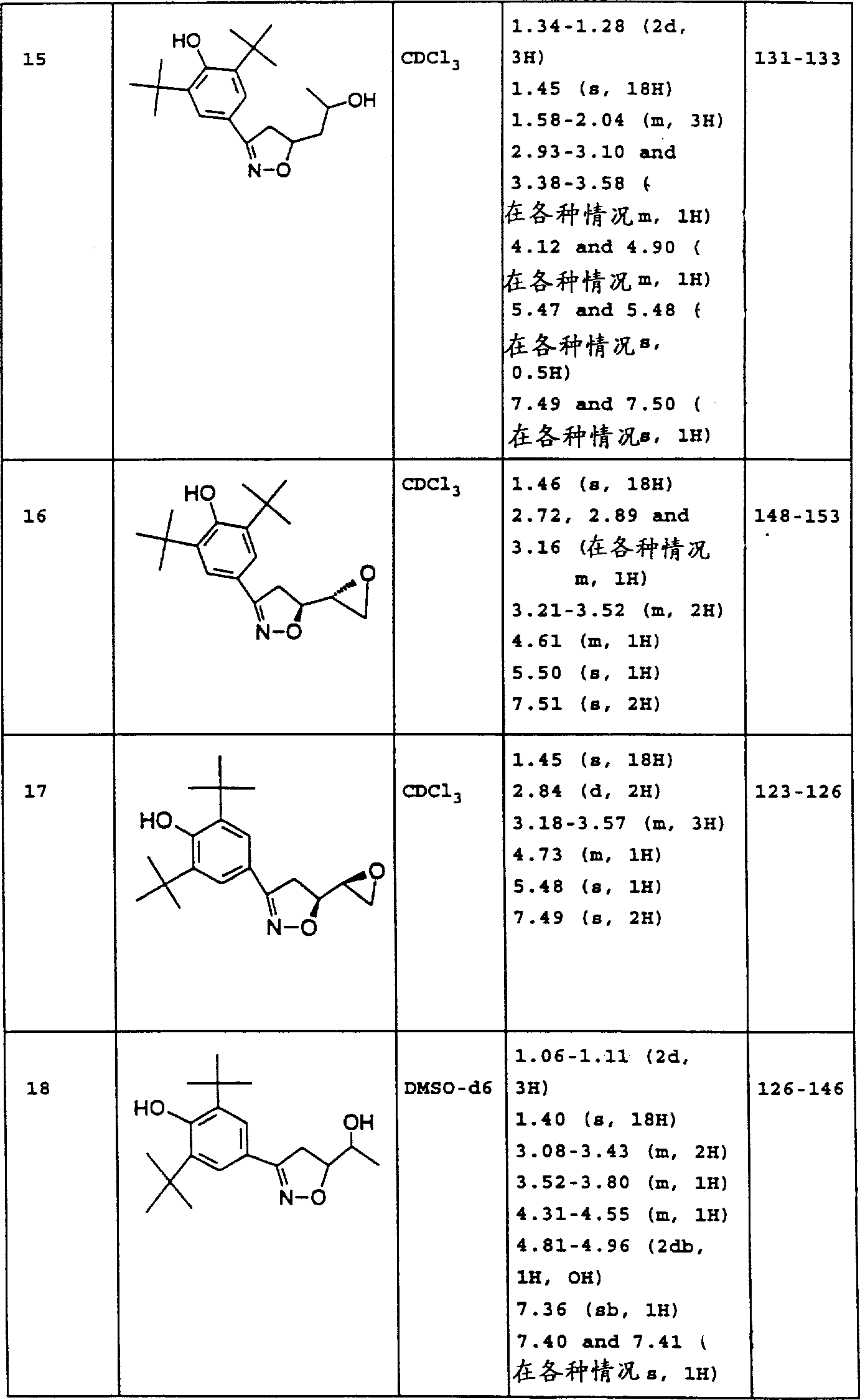


 Pharmacological testing
In order to characterize its valuable anti-inflammatory, resist asthma and immuno-modulating properties and high tolerance degree, formula I compound is verified in following experimental test, and these tests are considered to be particularly suitable for assessing the quality that this class has the active compound effects of wind resistance temperature.
Separate polycrystalline nuclear leukocyte (PMNL) testing 1 and 2 from people's peripheral blood, the 10ml human blood is with 10ml HBSS (Serva) dilution, and with 15mlLymphoprep (Dr, Molter GmbH, Heidelburg) place mat.Sample then 400 * g (per minute 1600 changes, and Minifuge 2, Heraeus, Osterode) centrifugation is 25 minutes.This has caused the formation three-phase: the superiors are made up of blood plasma and thrombocyte, and intermediate phase is Lymphoprep.The white ring of being made up of monocyte is present between the two-phase.Orlop is made up of red corpuscle, and it is covered by a PMNL white layer.The superiors' phase, and Lymphoprep removes with syringe carefully with the white ring.(mw:485000, Sigma is Deisenhofen) in 3% dextran at PM16 in 15ml by redispersion carefully for the settling that keeps.Suspension was placed 1 hour in room temperature then.During this period, red corpuscle deposits and PMNL is retained in the supernatant liquid.Remove supernatant liquid, with isopyknic approximately PM16 dilution, 400 * g centrifugation 15 minutes.If the PMNL settling is seriously stain by cell, then need to carry out hypotonic dissolution.For this reason, the settling resuspending is in 750 μ l water.After lucky 15 seconds, suspension is with about 7ml PM16 dilution, 400 * g centrifugation 10 minutes.If desired, this dissolving repeats once again.By other method, with PMNL settling resuspending in suitable media.Test 1 discharges proteolytic activity
250 μ l PMNL (510
6Individual cell/ml contains the PBS of 7.5mM glucose) cultivated 20 minutes with 1 μ l substances at 37 ℃.Add 1 μ l cytochalasin B (5 μ g/ml test mixture) then, mixture was cultivated 5 minutes at 37 ℃ again.Add 1 μ l tissue necrosis factor alpha (TNF, 30ng/ml test mixture) afterwards, continue to cultivate 5 minutes.Discharge and begin with 1 μ l fMLP (10nmol/l test mixture).At 37 ℃ after 60 minutes, reaction is lower than 0 ℃ and stops by sample is cooled to.With the sample centrifugation, supernatant liquid is removed and is freezing then.Cytochalasin B and fMLP are dissolved in DMSO, and TNF dilutes with damping fluid.50 μ l supernatant liquids and 175 μ l buffered soln (100nM HEPES, pH7.5; 500mM NaCl) in the microtiter plate of 96-hole, mixes.Add 25 μ l substrates (methoxyl group succinyl-L-Ala-L-Ala-L-Pro-L-Val-p-Nitroaniline), 0,5, after 10,15,30 and 60 minutes, the delustring of measuring each hole at 405nm.Test 2, the release of oxygen base
PMNL is by resuspending (510
6Individual cell/ml) replenishes 7.5mM glucose in Dulbecco ' s PBS.Care should be used to ground guarantees that PMNL does not contain red corpuscle.100 μ lPMNL, 700 μ l PBS+ glucose and 100 μ l cytochrome C (9.38mg/ml PBS+ glucose) mix in half little pond.100 μ l PMNL, 500 μ l PBS+ glucose, 100 μ l cytochalasin Bs (110
-6Mol), 100 μ l TNF (0.05ng) and 100 μ l cytochrome C (9.38mg/ml PBS+ glucose) are mixed for the oxygen evolution of fMLP-inductive.In double beam photometer (Perkin-Blmer 552 S) in the 550nm wavelength measurement.Useful range is a 0-1 delustring unit.Xiao Chi is by temperature equilibrium to 37 ℃.Also contain 10 μ l SOD (6mg SOD/ml PBS+ glucose) with reference to Xiao Chi.The pre-cultivation after 5 minutes, reaction begins with 100 μ l inductors.Reaction is with 110
-7MolfMLP begins.Test 3 forms LTB by white cell
4
The separation of white cell:
The 40ml human blood mixes with 8ml 6% dextran solution (dextran mw:480000 is in PM16).After following 1 hour of the room temperature, the supernatant liquid of being made up of white cell is removed, with equal-volume PM16 dilution, 300 * g (1600rpm) centrifugation 15 minutes.Settling resuspending subsequently after cell count is measured, is adjusted to 10 in CoulterCounter in about 5-6ml PM16
7Individual cell/ml.
Test mixture comprises the 0.24ml cell suspending liquid, 0.03ml 20mM CaCl
2/ 5mM MgCl
2With 5 μ l substances., react after 15 minutes 37 ℃ of pre-cultivations with 0.03ml A23187/ gsh (100 μ g A23187/ml; 15.4 μ g gsh/ml) beginning.After 37 ℃ are down cultivated 5 minutes, immediately sample is chilled to below 0 ℃ and stops.After 2 minutes, supernatant liquid is removed and the chromatogram check in Eppendorf Centrifuge (0 ℃) centrifugation.High pressure liquid chromatography (HPLC): the HPLC instrument comprises Kratos pump (Spectro-flow400), the automatic BT7041 sample injector of refrigerative (Biotronik) with 75 μ l sample loops, Nucleosil C18 post (100*3mm, 5 μ m Chrompack particles), UV detector (Kratos) Spectroflow 757 (wavelength: 280nm, useful range: 0.1AUFS, time constant: 0.5S) with Spectra Physics totalizing instrument (SP4270).Eluent (725ml methyl alcohol, 275ml water and 0.1ml acetate) is with 0.7ml/ minute flow applications, the about 100bar of pressure.
Annotate: before the beginning actual measurement, measure other control sample and be found to be useful.During operation, the useful range that has been set can be examined and change, if necessary.Before cell cultures in special test concentration (for example: 10
-5M) the experiment with measuring material is extremely important in PM16, because substances may be hidden LTB
4The peak.If this is true, must select lower concentration.Test 4, stimulating cytokine discharges
From the human blood separating monocytic cell
With the 10ml human blood of 1ml 3.8% sodium citrate solution stabilization with 10ml PM16 (Seva, Heichelberg) dilution and with 15ml Lymphoprep (Dr.MolterGmbH, Heidelberg) place mat.Sample at room temperature 400 * g (1600rpm, Minifuge 2, Heraeus, Osterode) centrifugation is 40 minutes.Monocyte is visible as the white rings thing at Lymphoprep/ blood plasma interface.This ring takes out carefully with syringe, with isopyknic PM16 dilution, 400 * g centrifugation 10 minutes.(Eggenstein) wash for+300mg/l L-glutamine, Gibco by (Wallis, 1986) with about 10ml RPMI1640 for settling.Afterwards, cell density measures and transfers to 5 with Coulter Counter JT (Coulter Diagnostics) in about 1ml RPMI1640 (+300mg/l L-glutamine+25mM HEPES+100 μ g/ml Streptomycin sulphate+100 μ g/ml penicillin) with the cell resuspending
*10
6Individual/ml.Typically, cell is made up of 90% lymphocyte and 10% monocyte.
230 μ l monocytes are at 37 ℃; 5%CO
2, with 10 μ l substances (10 μ MDMSO/ water, 1/10) and 10 μ l lipopolysaccharides (LPS; 500 μ g are dissolved among the 1ml DMSO and dilute with water 1/10 before beginning test; Available from Salmonella abortus equi, Sigma Deisonhofen) cultivates 20-22 hour (under the situation of IL-6 5 hours).Sample was chilled to 0 ℃ in ice bath, in Sigma whizzer (2 minutes; 2000rpm) go up centrifugation.The aliquots containig of supernatant liquid is measured with Elisa (Biermann, Bad Nauheim).Abbreviation IL represents interleukin-and TNF represents tumor necrosis factor alpha.Test the platelet aggregation of 5 cyclooxygenase-dependences
Platelet rich plasma (PRP): in order to suppress hemopexis, human blood is handled with 3.8% sodium citrate solution of its volume 1/10.105 * g centrifugation 20 minutes, supernatant liquid (PRP) was removed then then.200 μ l PRP assemble in meter (BioData) pre-cultivate 10 minute with 30 μ l substances at PAP4 at 37 ℃.Substances is dissolved in organic solvent and uses buffered soln (50mM TisHCl, pH8.0; 90mM NaCl) dilution.Assemble and cause with 20 μ l inductors.Between the accumulative phase, stir with 800rpm.Eicosatetraenoic acid (5mg/ml) is as inductor.
The result of test 1 to 3 is summarised in the table 2.The value unit of display in the table is the substances concentration of μ m, and in addition, residual activity is to measure based on the percentage ratio that is decided to be 100% contrast.Interleukin-indicates in test 4 in addition.Table 2
| Embodiment | Test 1 | Test 2 | Test 3 | Test 4 | Test 5 |
| 1 | 10μM 92 | 10μM 93 | |||
| 3 | 100μM 98 | ||||
| 5 | 100μM 98 | ||||
| 7 | 100μM 95 | ||||
| 8 | 10μM 15 1μM 93 | 100μM 91 | |||
| 9 | 100μM 64 | 10μM 0 1μM 59 | IL-1 10μM 73 IL-6 10μM 93 TNFα 10μM 63 | 100μM 92 | |
| 10 | 10μM 20 1μM 89 | TNFα 10μM 78 | 100μM 98 | ||
| 13 | 100μM 20 10μM 77 | 25μM 22 10μM 65 | 10μM 98 | ||
| 14 | 10μM 100 | ||||
| 18 | IL-1α 100μM 36 10μM 89 | ||||
| 19 | 100μM 20 10μM 78 | 10μM 94 | 10μM 100 | ||
| 20 | 10μM 100 | ||||
| 24 | IL-1 10μM 86 | 10μM 94 | |||
| 25 | 10μM 29 1μM 85 | IL-1α 10μM 62 ILβ 10μM 93 TNFα 10μM 82 | 10μM 86 | ||
| 26 | TNFα 10μM 88 | 10μM 94 | |||
| 27 | 100μM 97 |
| Embodiment | Test 1 | Test 2 | Test 3 | Test 4 | Test 5 |
| 28 | 10μM 59 1μM 97 | 25μM 8 10μM 60 | 10μM 0 1μM 14 | IL-1α 10μM 93 | 10μM 93 |
| 31 | 100μM 100 | ||||
| 32 | 100μM 34 10μM 72 1μM 84 | ||||
| 34 | 100μM 98 | ||||
| 35 | IL-1α 10μM 84 | 100μM 94 | |||
| 36 | 10μM 93 | 100μM 87 | |||
| 38 | IL-1α 1μM 9 IL-1β 1μM 85 | 100μM 90 | |||
| 39 | 100μM 98 | ||||
| 41 | 100μM 78 | 50μM 36 5μM 75 | 10μM 13 | TNFα 10μM 89 | 100μM 95 |
| 43 | 10μM 93 | 100μM 99 | |||
| 44 | 10μM 99 | ||||
| 45 | 100μM 98 | ||||
| 46 | IL-1α 1μM 77 IL-1β 1μM 85 TNFα 10μM 79 | 100μM 90 | |||
| 47 | 100μM 17 10μM 38 1μM 85 | IL-1α 10μM 72 1μM 89 TNFα 10μM 64 | |||
| 49 | 100μM 19 10μM 23 1μM 88 | 50μM 12 5μM 80 | 10μM 0 1μM 90 | IL-6 1μM 91 TNFα 10μM 91 |
| Embodiment | Test 1 | Test 2 | Test 3 | Test 4 | Test 5 |
| 57 | 100μM 99 | ||||
| 58 | 100μM 99 | ||||
| 59 | 100μM 35 10μM 61 1μM 91 | 10μM 48 1μM 135 | |||
| 60 | 10μM 88 | ||||
| 61 | 100μM 80 | 10μM 3 | IL-1α 1μM 94 TNFα 10μM 68 | 100μM 94 | |
| 63 | 100μM 66 10μM 88 | 50μM 79 | 10μM 91 | IL-1α 10μM 75 IL-1β 10μM 77 | |
| 64 | 100μM 72 10μM 96 | IL-1 10μM 68 1μM 85 IL-1 10μM 82 | 100μM 97 | ||
| 70 | 10μM 22 | ||||
| 71 | 10μM 42 1μM 79 | 25μM 97 | |||
| 72 | 10μM 51 1μM 82 | 25μM 100 | |||
| 73 | 10μM 9 1μM 100 | 25μM 100 | |||
| 74 | 10μM 64 | 25μM 95 | |||
| 75 | 10μM 49 1μM 89 | 25μM 98 | |||
| 76 | 100μM 9 10μM 68 | 25μM 99 | |||
| 77 | 100μM 30 10μM 74 | 25μM 100 | |||
| 78 | 50μM 94 | ||||
| 79 | 100μM 96 |
| Embodiment | Test 1 | Test 2 | Test 3 | Test 4 | Test 5 |
| 80 | 50μM 97 | ||||
| 81 | 100μM 100 | ||||
| 82 | 100μM 93 | ||||
| 85 | 100μM 94 |
This table embodiment 9) explain:
64% proteolytic activity (test 1) is adding 100 μ l inhibitory substance embodiment 9) dilution afterwards.When not having inhibitory substance, can be released corresponding to 100% proteolytic activity.
The result: compound according to the present invention is active as inflammation inhibitor because they in the human leukocytes system as the release of proteolytic activity (test 1) and active oxygen (testing 2), and leukotrienes B
4The inhibitor of synthetic (test 3) shows the biological activity that can experience.Various cytokines also are suppressed from the release of monocyte (test 4) in people's system.Especially, compound does not have restraining effect to the human blood platelets system (test 5) of cyclooxygenase-dependence.Therefore, can estimate can not produce and to return the undesirable side effect (prolonging the bleeding time, gastroenteritic ulcer and renal toxicity) that is fixed in cyclooxygenase and suppresses.
Test 6: the arthritis test in auxiliary/arthritis model
Wistar-Lewis is that male rat (Mollegaard/Denmark) is used as experimental animal.Body weight is between 160g to 200g.With 0.1ml Freund ' s auxiliary (the heavy white Valelinum Liquidum Merch of=every ml, Darmstadt 6mg Mycobacterium butyricum suspension, Difco Lab./Detroit, Mich.USA) Subplantar is expelled to the tail root, at the 10th to 14 day that tests, cause immunopathogenesis process and chronic inflammatory diseases, particularly sacroiliitis and periarthritis illness form, at other position of health (secondary lesion).Animal is used available from Altrogge, and the standard food Altromin-R of Lage arbitrarily feeds, and supplies with tap water.Finish from the 14th day of experiment to experiment, but animal by every kg give as the 60mg moral of pain killer because of.From that day of auxiliary administration, every day (totally 17 days) with substances with CMC suspension, with volume injected 1ml/100g body weight oral administration.At first day and the 18th day of experiment, the volume and the body weight of every rear solid end were measured.Compare with untreated control group, the reduction of the long-pending increase aspect of corpus unguis is as active standard, and two pawls are by average.The result is summarized in the table 3.
Test 8: suppress tumor cell proliferation
Tumor cell line 20-10-5S (hybridoma cell line is provided by ATCC (U.S. typical case culture collection), and it produces anti-mouse T cell antibody) is used to the anti-hyperplasia character of determination test material.Cell is at 37 ℃ and 5%CO
2, under the condition of serum-free at GC medium (cell growth medium=IScove-ATL (+white protein+siderophilin+lipoid); Available from Vitromex, Vilshofen) the middle cultivation.Have only the cell of logarithmic phase to be used to test mixture.Substances is with various concentration (from 1 to 50 μ m), with 4 * 10
3The 20-10-5S cell sucks round bottom droplet plate (medium cumulative volume 200 μ l) together.Cultivate and answered (37 ℃ and 5%CO in 48 hours
2), (=0.25 μ Ci/ test mixture, specific activity 23Ci/mM) is added in the plate the tritium-labeled thymidine of 25 μ l.During subsequently 16 hours, the thymidine of radioactivity mark is impregnated among the DNA of grown cell.Sample suction strainer on glass fiber filter leaches, and the radioactivity that mixes is measured with β counter (available from the Beta Plate System 1205 of Wallac).Based on the radioactivity that mixes, IC
50Value (50% inhibition concentration) with over against comparing and calculated according to (test mixture that does not have substances), and be summarized in the table 3.
Table 3
<mean less than
| Embodiment | Test 6 | Test 6 | Test 7 | Test 8 |
| Dosage (mg/kg) | Corpus unguis amasss (% inhibition) | ED 50 (mg/kg) | IC 50 (μM) | |
| 1 | 50 | 70 | 10-50i.d. | 5-10 |
| 3 | 10 | |||
| 4 | 30 | |||
| 5 | <10i.d. | |||
| 6 | About 50i.d. | |||
| 7 | 10-30i.d. | |||
| 8 | 50 | 67 | About 10i.d. | <5 |
| 9 | About 50i.d. | |||
| 11 | <5 | |||
| 12 | 50 | 82 | 10 | |
| 13 | 50 | 84 | About 50i.d. | 6.10 |
| 14 | 10-50i.d. | |||
| 15 | 50 | 60 | 8-15 | |
| 16 | 30 | |||
| 17 | 8-15 | |||
| 18 | 5-10 | |||
| 19 | 25 | 85 | <5 | |
| 20 | 25 | 67 | About 50i.d. | <5 |
| 22 | 50 | 74 | ||
| 24 | 50 | 43 | <5 | |
| 25 | 50 | 44 | 3-10i.d. | <5 |
| 26 | <5 | |||
| 27 | 50 | 71 | <5 | |
| 28 | 50 | 74 | <5 | |
| 29 | <5 | |||
| 30 | 50 | 63 | 5-10 |
| Embodiment | Test 6 | Test 6 | Test 7 | Test 8 |
| Dosage (mg/kg) | Corpus unguis amasss (% inhibition) | ED 50 (mg/kg) | IC 50 (μM) | |
| 33 | <5 | |||
| 37 | <5 | |||
| 39 | 30 | |||
| 40 | 1-3i.d. | <5 | ||
| 41 | <5 | |||
| 42 | 5-10 | |||
| 44 | 5-10 | |||
| 45 | 5-10 | |||
| 47 | 10-50i.d. | 5-10 | ||
| 48 | 50 | 60 | 10-50i.d. | 5-10 |
| 49 | About 50i.d. | 5-10 | ||
| 52 | 3-10i.d. | <5 | ||
| 53 | 25 | 48 | 10-50i.d. | 8-10 |
| 54 | 1-3i.d. | 5-10 | ||
| 55 | 50 | 47 | <5 | |
| 56 | About 50i.d. | |||
| 57 | <5 | |||
| 59 | 1-3i.d. | 30 | ||
| 66 | 25 | 59 | <5 | |
| 67 | 50 | 53 | <5 | |
| 69 | 50 | 83 | 5-10 | |
| 70 | 25 | 59 | 5 | |
| 71 | 25 | 66 | 5-10 | |
| 72 | 25 | 60 | 5-10 | |
| 73 | 50 | 73 | ||
| 74 | 25 | 60 | 5-10 | |
| 75 | 25 | 76 | 5-10 |
| Embodiment | Test 6 | Test 6 | Test 7 | Test 8 |
| Dosage (mg/kg) | Corpus unguis amasss (% inhibition) | ED 50 (mg/kg) | IC 50 (μM) | |
| 76 | 50 | 70 | 20 | |
| 77 | 50 | 82 | 20 | |
| 78 | 5-10 | |||
| 79 | 5-10 | |||
| 80 | 5-10 | |||
| 81 | 50 | 67 | ||
| 83 | 50 | 39 | ||
| 84 | 25 | 49 | ||
| 85 | <5 | |||
| 86 | 20 | 70 | <5 | |
| 87 | 20 | 50 | <5 | |
| 88 | 10 | |||
| 89 | 50 | 36 | 20 | |
| 90 | 50 | 36 | 30 |
Claims (6)
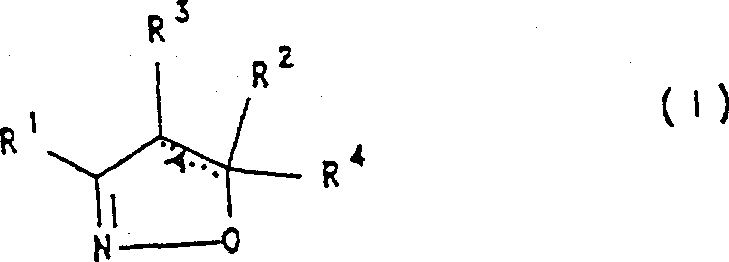
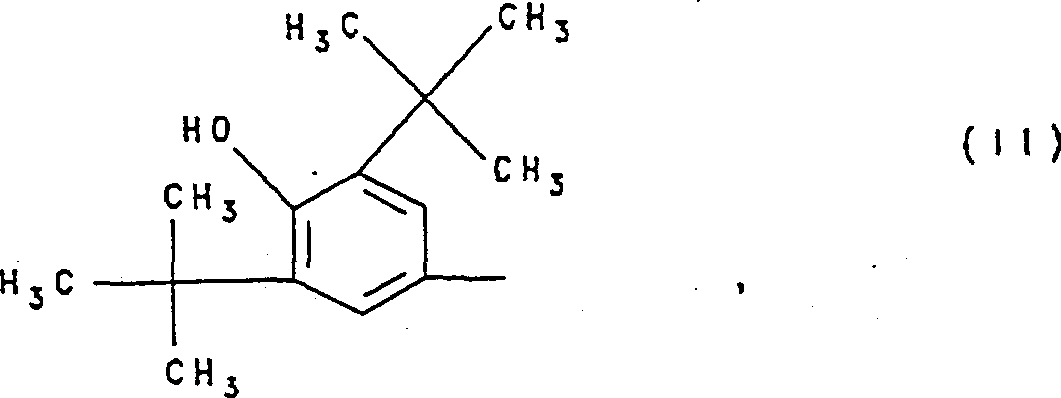
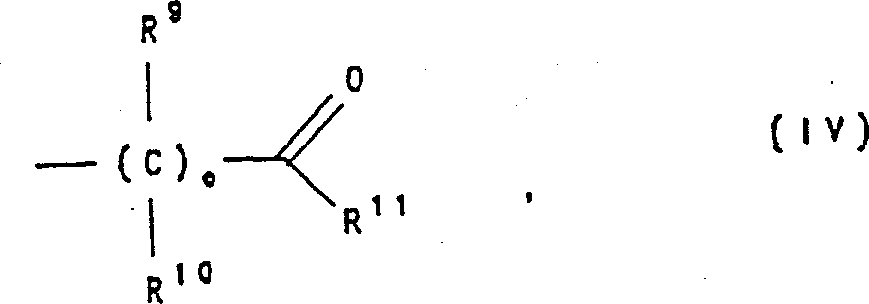
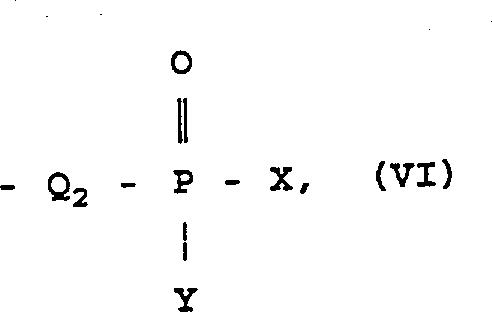
Applications Claiming Priority (2)
| Application Number | Priority Date | Filing Date | Title |
|---|---|---|---|
| DE4408084A DE4408084A1 (en) | 1994-03-10 | 1994-03-10 | 3,5-disubstituted and 3,4,5-trisubstituted 2-isoxazolines and isoxazoles, processes for their preparation and their use as medicaments |
| DEP4408084.0 | 1994-03-10 |
Publications (2)
| Publication Number | Publication Date |
|---|---|
| CN1143956A CN1143956A (en) | 1997-02-26 |
| CN1056836C true CN1056836C (en) | 2000-09-27 |
Family
ID=6512412
Family Applications (1)
| Application Number | Title | Priority Date | Filing Date |
|---|---|---|---|
| CN95192004A Expired - Fee Related CN1056836C (en) | 1994-03-10 | 1995-03-03 | 3,5-disubstituted and 3,4,5-trisubstituted 2-isoxazolines and isoxazoles, process for preparing same and their use as medicaments |
Country Status (17)
| Country | Link |
|---|---|
| US (1) | US5814627A (en) |
| EP (1) | EP0749429B1 (en) |
| JP (1) | JPH09509951A (en) |
| KR (1) | KR100330798B1 (en) |
| CN (1) | CN1056836C (en) |
| AT (1) | ATE181733T1 (en) |
| AU (1) | AU684914B2 (en) |
| CA (1) | CA2185004A1 (en) |
| DE (2) | DE4408084A1 (en) |
| DK (1) | DK0749429T3 (en) |
| ES (1) | ES2135046T3 (en) |
| FI (1) | FI963508L (en) |
| GR (1) | GR3031266T3 (en) |
| HU (1) | HU225499B1 (en) |
| NO (1) | NO306723B1 (en) |
| TW (1) | TW419469B (en) |
| WO (1) | WO1995024397A1 (en) |
Families Citing this family (23)
| Publication number | Priority date | Publication date | Assignee | Title |
|---|---|---|---|---|
| US5510361A (en) * | 1994-10-20 | 1996-04-23 | The Procter & Gamble Company | Di-tert-butylphenol compounds with heterocyclic moiety, useful as anti-inflammatory agents |
| AR029304A1 (en) * | 1998-06-26 | 2003-06-25 | Daiichi Seiyaku Co | DERIVATIVES OF SUBSTITUTED PROPIONILE, PHARMACEUTICAL PRODUCT, USE FOR THE MANUFACTURE OF A PHARMACEUTICAL COMPOSITION FOR THE PREVENTION AND / OR TREATMENT OF HYPERCHOLESTEROLEMIA, HYPERLIPEMIA OR ARTERIOESCLEROSIS, PHARMACEUTICAL COMPOSITION AND COMPOSITE COMPOSITION |
| USRE39708E1 (en) | 1998-08-07 | 2007-06-26 | Chiron Corporation | Estrogen receptor modulators |
| WO2000007996A2 (en) | 1998-08-07 | 2000-02-17 | Chiron Corporation | Pyrazoles as estrogen receptor modulators |
| EP1102755B1 (en) | 1998-08-07 | 2006-01-04 | Chiron Corporation | Substituted isoxazole derivatives as estrogen receptor modulators |
| CA2346396C (en) | 1998-10-09 | 2009-04-28 | Janssen Pharmaceutica N.V. | 4,5-dihydro-isoxazole derivatives and their pharmaceutical use |
| BR0013551A (en) * | 1999-08-13 | 2003-06-17 | Vertex Pharma | Inhibitors of cjun (jnk) n-terminal kinases and other protein kinases |
| US6579880B2 (en) | 2000-06-06 | 2003-06-17 | Ortho-Mcneil Pharmaceutical, Inc. | Isoxazoles and oxadiazoles as anti-inflammatory inhibitors of IL-8 |
| EP1340749A4 (en) | 2000-11-17 | 2007-09-05 | Takeda Pharmaceutical | isoxazole |
| MY151199A (en) | 2001-11-02 | 2014-04-30 | Rigel Pharmaceuticals Inc | Substituted diphenyl heterocycles useful for treating hcv infection |
| HRP20050168A2 (en) | 2002-08-23 | 2005-10-31 | Rigel Pharmaceuticals | Pyridyl substituted heterocycles useful for treating or preventing hcv infection |
| US7326790B2 (en) * | 2003-05-02 | 2008-02-05 | Rigel Pharmaceuticals, Inc. | Diphenylisoxazole compounds and hydro isomers thereof |
| US7115642B2 (en) | 2003-05-02 | 2006-10-03 | Rigel Pharmaceuticals, Inc. | Substituted diphenyl isoxazoles, pyrazoles and oxadiazoles useful for treating HCV infection |
| US7220745B2 (en) | 2003-05-15 | 2007-05-22 | Rigel Pharmaceuticals | Heterocyclic compounds useful to treat HCV |
| WO2005034952A2 (en) * | 2003-10-07 | 2005-04-21 | The Feinstein Institute For Medical Research | Isoxazole and isothiazole compounds useful in the treatment of inflammation |
| WO2005049065A2 (en) * | 2003-11-19 | 2005-06-02 | Rigel Pharmaceuticals, Inc. | Synergistic combinations of dihaloacetamide with interferon or ribavirin for treatment hcv infections |
| US7514434B2 (en) | 2004-02-23 | 2009-04-07 | Rigel Pharmaceuticals, Inc. | Heterocyclic compounds having an oxadiazole moiety and hydro isomers thereof |
| AU2005219788B2 (en) | 2004-03-05 | 2010-06-03 | Nissan Chemical Corporation | Isoxazoline-substituted benzamide compound and noxious organism control agent |
| JP2007530582A (en) * | 2004-03-26 | 2007-11-01 | ライジェル ファーマシューティカルズ, インコーポレイテッド | Heterocyclic antiviral compounds containing metabolizable moieties and uses thereof |
| JP2008540425A (en) * | 2005-05-02 | 2008-11-20 | ライジェル ファーマシューティカルズ, インコーポレイテッド | Heterocyclic antiviral compounds containing metabolizable moieties and uses thereof |
| DK2921493T3 (en) * | 2011-12-27 | 2017-11-27 | Bayer Ip Gmbh | HETEROARYLPIPERIDINE AND ¿PIPERAZINE DERIVATIVES |
| BR122015019867A2 (en) | 2013-01-14 | 2019-08-27 | Kraton Polymers Us Llc | process for preparing an amino functionalized block copolymer |
| AR132248A1 (en) * | 2023-03-29 | 2025-06-11 | Merck Sharp & Dohme Llc | IL4I1 INHIBITORS AND METHODS OF THEIR USE |
Citations (3)
| Publication number | Priority date | Publication date | Assignee | Title |
|---|---|---|---|---|
| JPS58148858A (en) * | 1982-02-26 | 1983-09-05 | Yamanouchi Pharmaceut Co Ltd | 3,5-di-tert-4-hydroxyphenyl-substituted heterocyclic compound |
| EP0245825A1 (en) * | 1986-05-09 | 1987-11-19 | Warner-Lambert Company | Styryl pyrazoles, isoxazoles and analogs thereof having activity as 5-lipoxy-genase inhibitors and pharmaceutical compositions containing them |
| EP0449223A1 (en) * | 1990-03-27 | 1991-10-02 | Warner-Lambert Company | 3,5-di-tertiary-butyl-4-hydroxyphenyl thiazolyl, oxa-zolyl, and imidazolyl methanones and related compounds as antiinflammatory agents |
Family Cites Families (1)
| Publication number | Priority date | Publication date | Assignee | Title |
|---|---|---|---|---|
| US5510361A (en) * | 1994-10-20 | 1996-04-23 | The Procter & Gamble Company | Di-tert-butylphenol compounds with heterocyclic moiety, useful as anti-inflammatory agents |
-
1994
- 1994-03-10 DE DE4408084A patent/DE4408084A1/en not_active Withdrawn
- 1994-09-16 TW TW83108551A patent/TW419469B/en active
-
1995
- 1995-02-22 FI FI963508A patent/FI963508L/en not_active IP Right Cessation
- 1995-03-03 AT AT95912197T patent/ATE181733T1/en not_active IP Right Cessation
- 1995-03-03 CA CA002185004A patent/CA2185004A1/en not_active Abandoned
- 1995-03-03 HU HU9602458A patent/HU225499B1/en not_active IP Right Cessation
- 1995-03-03 DK DK95912197T patent/DK0749429T3/en active
- 1995-03-03 JP JP7523212A patent/JPH09509951A/en not_active Ceased
- 1995-03-03 CN CN95192004A patent/CN1056836C/en not_active Expired - Fee Related
- 1995-03-03 AU AU19481/95A patent/AU684914B2/en not_active Ceased
- 1995-03-03 KR KR1019960704985A patent/KR100330798B1/en not_active Expired - Fee Related
- 1995-03-03 DE DE59506310T patent/DE59506310D1/en not_active Expired - Lifetime
- 1995-03-03 EP EP95912197A patent/EP0749429B1/en not_active Expired - Lifetime
- 1995-03-03 WO PCT/EP1995/000784 patent/WO1995024397A1/en not_active Ceased
- 1995-03-03 US US08/704,743 patent/US5814627A/en not_active Expired - Lifetime
- 1995-03-03 ES ES95912197T patent/ES2135046T3/en not_active Expired - Lifetime
-
1996
- 1996-08-26 NO NO963560A patent/NO306723B1/en unknown
-
1999
- 1999-09-22 GR GR990402364T patent/GR3031266T3/en unknown
Patent Citations (3)
| Publication number | Priority date | Publication date | Assignee | Title |
|---|---|---|---|---|
| JPS58148858A (en) * | 1982-02-26 | 1983-09-05 | Yamanouchi Pharmaceut Co Ltd | 3,5-di-tert-4-hydroxyphenyl-substituted heterocyclic compound |
| EP0245825A1 (en) * | 1986-05-09 | 1987-11-19 | Warner-Lambert Company | Styryl pyrazoles, isoxazoles and analogs thereof having activity as 5-lipoxy-genase inhibitors and pharmaceutical compositions containing them |
| EP0449223A1 (en) * | 1990-03-27 | 1991-10-02 | Warner-Lambert Company | 3,5-di-tertiary-butyl-4-hydroxyphenyl thiazolyl, oxa-zolyl, and imidazolyl methanones and related compounds as antiinflammatory agents |
Also Published As
| Publication number | Publication date |
|---|---|
| DE4408084A1 (en) | 1995-09-14 |
| ATE181733T1 (en) | 1999-07-15 |
| TW419469B (en) | 2001-01-21 |
| JPH09509951A (en) | 1997-10-07 |
| NO963560L (en) | 1996-08-26 |
| WO1995024397A1 (en) | 1995-09-14 |
| KR100330798B1 (en) | 2002-10-11 |
| FI963508A0 (en) | 1996-09-06 |
| CN1143956A (en) | 1997-02-26 |
| HUT76481A (en) | 1997-09-29 |
| NO306723B1 (en) | 1999-12-13 |
| EP0749429A1 (en) | 1996-12-27 |
| US5814627A (en) | 1998-09-29 |
| FI963508A7 (en) | 1996-09-06 |
| ES2135046T3 (en) | 1999-10-16 |
| AU1948195A (en) | 1995-09-25 |
| KR970701703A (en) | 1997-04-12 |
| DE59506310D1 (en) | 1999-08-05 |
| DK0749429T3 (en) | 2000-01-10 |
| CA2185004A1 (en) | 1995-09-14 |
| FI963508L (en) | 1996-09-06 |
| HU9602458D0 (en) | 1996-11-28 |
| HU225499B1 (en) | 2007-01-29 |
| EP0749429B1 (en) | 1999-06-30 |
| AU684914B2 (en) | 1998-01-08 |
| GR3031266T3 (en) | 1999-12-31 |
Similar Documents
| Publication | Publication Date | Title |
|---|---|---|
| CN1056836C (en) | 3,5-disubstituted and 3,4,5-trisubstituted 2-isoxazolines and isoxazoles, process for preparing same and their use as medicaments | |
| CN1051074C (en) | Isoxazole-4-carboxamides and hydroxyalkylidenecyanoacetamides pharmaceuticals containing these compounds and their use | |
| CN1177830C (en) | Benzoheterocycles and their use as MEK inhibitors | |
| CN1036920C (en) | Heterocyclic carbonic acid derivatives | |
| CN1314683C (en) | Indole derivatives or benzimidazole derivatives for modulating IKB kinase | |
| CN1323203A (en) | FC receptor modulators and uses thereof | |
| CN1017049B (en) | Process for preparing 5,6-dihydro-2-(substituted phenyl) 1,2,4 triazine-3,5(2h,4h)-diones | |
| HK1041887A1 (en) | Fused pyrazolyl compounds, a composition comprising the same, and the use of the same | |
| CN1055182A (en) | N-(pyrrolo-" 2,3-d " pyrimidin-3-yl acyl group)-glutamic acid derivatives | |
| CN1108257A (en) | Phenyl-cyclohexanecarboxylic acid derivatives substituted on the heterocycle | |
| CN1055537A (en) | 3, two replacement-2-different azoles alkane of 5-and different azoles, its preparation method contain the preparation and the application thereof of this composition | |
| CN1053065A (en) | Azaoxindole Derivatives | |
| CN1209368C (en) | Novel acetamide derivative and use thereof | |
| CN1022322C (en) | Fused pyrazole 3-oxo-propionitrile derivatives | |
| CN1349542A (en) | Heterocyclic compounds, intermediates thereof and elastase inhibitors | |
| HK1041686A1 (en) | N-arylsulfonyl amino acid omega amedes | |
| CN1918148A (en) | Substituted benzimidazoles and their use for inducing apoptosis | |
| CN1191241C (en) | Pyridazinylphenylhydrazone for anticongestive heart failure | |
| CN1079469A (en) | Preparation method with thiazole derivative of antiulcer activity and Histamine Receptors antagonistic action | |
| CN1275951C (en) | Novel benzothiazine derivatives, their preparation and use | |
| CN88103413A (en) | pyran compound | |
| CN1816543A (en) | Indole derivatives with apoptosis-inducing effect | |
| CN1330075A (en) | Endothelin antagon | |
| CN1188402C (en) | Piperazinone derivatives and their applications | |
| CN1028531C (en) | 1-oxa-2-oxo-8-azaspiro [4,5] decane derivatives, pharmaceutical compositions containing them and process for preparing same |
Legal Events
| Date | Code | Title | Description |
|---|---|---|---|
| C06 | Publication | ||
| PB01 | Publication | ||
| C10 | Entry into substantive examination | ||
| SE01 | Entry into force of request for substantive examination | ||
| C10 | Entry into substantive examination | ||
| SE01 | Entry into force of request for substantive examination | ||
| C14 | Grant of patent or utility model | ||
| GR01 | Patent grant | ||
| C53 | Correction of patent of invention or patent application | ||
| COR | Change of bibliographic data |
Free format text: CORRECT: PATENTEE; FROM: HOECHST AKTIENGESELLSCHAFT (DE) TO: AVENTIS PHARMACY (GERMANY)INTERNATIONAL CO., LTD. |
|
| CP01 | Change in the name or title of a patent holder |
Patentee after: Awentis Medicines Deutschland GmbH Patentee before: Hechester JSC |
|
| C19 | Lapse of patent right due to non-payment of the annual fee | ||
| CF01 | Termination of patent right due to non-payment of annual fee |