CN1056859C - Composition for low-specific gravity urethane-base plastic lens, lens prepared therefrom, and process for preparing lens - Google Patents
Composition for low-specific gravity urethane-base plastic lens, lens prepared therefrom, and process for preparing lens Download PDFInfo
- Publication number
- CN1056859C CN1056859C CN95114844A CN95114844A CN1056859C CN 1056859 C CN1056859 C CN 1056859C CN 95114844 A CN95114844 A CN 95114844A CN 95114844 A CN95114844 A CN 95114844A CN 1056859 C CN1056859 C CN 1056859C
- Authority
- CN
- China
- Prior art keywords
- diisocyanate
- composition
- bis
- specific gravity
- plastic lens
- Prior art date
- Legal status (The legal status is an assumption and is not a legal conclusion. Google has not performed a legal analysis and makes no representation as to the accuracy of the status listed.)
- Expired - Lifetime
Links
Classifications
-
- C—CHEMISTRY; METALLURGY
- C08—ORGANIC MACROMOLECULAR COMPOUNDS; THEIR PREPARATION OR CHEMICAL WORKING-UP; COMPOSITIONS BASED THEREON
- C08G—MACROMOLECULAR COMPOUNDS OBTAINED OTHERWISE THAN BY REACTIONS ONLY INVOLVING UNSATURATED CARBON-TO-CARBON BONDS
- C08G18/00—Polymeric products of isocyanates or isothiocyanates
- C08G18/06—Polymeric products of isocyanates or isothiocyanates with compounds having active hydrogen
- C08G18/28—Polymeric products of isocyanates or isothiocyanates with compounds having active hydrogen characterised by the compounds used containing active hydrogen
- C08G18/30—Low-molecular-weight compounds
- C08G18/38—Low-molecular-weight compounds having heteroatoms other than oxygen
-
- C—CHEMISTRY; METALLURGY
- C08—ORGANIC MACROMOLECULAR COMPOUNDS; THEIR PREPARATION OR CHEMICAL WORKING-UP; COMPOSITIONS BASED THEREON
- C08G—MACROMOLECULAR COMPOUNDS OBTAINED OTHERWISE THAN BY REACTIONS ONLY INVOLVING UNSATURATED CARBON-TO-CARBON BONDS
- C08G18/00—Polymeric products of isocyanates or isothiocyanates
- C08G18/06—Polymeric products of isocyanates or isothiocyanates with compounds having active hydrogen
- C08G18/28—Polymeric products of isocyanates or isothiocyanates with compounds having active hydrogen characterised by the compounds used containing active hydrogen
- C08G18/30—Low-molecular-weight compounds
- C08G18/38—Low-molecular-weight compounds having heteroatoms other than oxygen
- C08G18/3855—Low-molecular-weight compounds having heteroatoms other than oxygen having sulfur
- C08G18/3876—Low-molecular-weight compounds having heteroatoms other than oxygen having sulfur containing mercapto groups
-
- C—CHEMISTRY; METALLURGY
- C08—ORGANIC MACROMOLECULAR COMPOUNDS; THEIR PREPARATION OR CHEMICAL WORKING-UP; COMPOSITIONS BASED THEREON
- C08G—MACROMOLECULAR COMPOUNDS OBTAINED OTHERWISE THAN BY REACTIONS ONLY INVOLVING UNSATURATED CARBON-TO-CARBON BONDS
- C08G18/00—Polymeric products of isocyanates or isothiocyanates
- C08G18/06—Polymeric products of isocyanates or isothiocyanates with compounds having active hydrogen
- C08G18/28—Polymeric products of isocyanates or isothiocyanates with compounds having active hydrogen characterised by the compounds used containing active hydrogen
- C08G18/30—Low-molecular-weight compounds
- C08G18/32—Polyhydroxy compounds; Polyamines; Hydroxyamines
- C08G18/3203—Polyhydroxy compounds
-
- C—CHEMISTRY; METALLURGY
- C08—ORGANIC MACROMOLECULAR COMPOUNDS; THEIR PREPARATION OR CHEMICAL WORKING-UP; COMPOSITIONS BASED THEREON
- C08G—MACROMOLECULAR COMPOUNDS OBTAINED OTHERWISE THAN BY REACTIONS ONLY INVOLVING UNSATURATED CARBON-TO-CARBON BONDS
- C08G18/00—Polymeric products of isocyanates or isothiocyanates
- C08G18/06—Polymeric products of isocyanates or isothiocyanates with compounds having active hydrogen
- C08G18/28—Polymeric products of isocyanates or isothiocyanates with compounds having active hydrogen characterised by the compounds used containing active hydrogen
- C08G18/30—Low-molecular-weight compounds
- C08G18/38—Low-molecular-weight compounds having heteroatoms other than oxygen
- C08G18/3855—Low-molecular-weight compounds having heteroatoms other than oxygen having sulfur
- C08G18/3863—Low-molecular-weight compounds having heteroatoms other than oxygen having sulfur containing groups having sulfur atoms between two carbon atoms, the sulfur atoms being directly linked to carbon atoms or other sulfur atoms
-
- C—CHEMISTRY; METALLURGY
- C08—ORGANIC MACROMOLECULAR COMPOUNDS; THEIR PREPARATION OR CHEMICAL WORKING-UP; COMPOSITIONS BASED THEREON
- C08G—MACROMOLECULAR COMPOUNDS OBTAINED OTHERWISE THAN BY REACTIONS ONLY INVOLVING UNSATURATED CARBON-TO-CARBON BONDS
- C08G18/00—Polymeric products of isocyanates or isothiocyanates
- C08G18/06—Polymeric products of isocyanates or isothiocyanates with compounds having active hydrogen
- C08G18/70—Polymeric products of isocyanates or isothiocyanates with compounds having active hydrogen characterised by the isocyanates or isothiocyanates used
-
- G—PHYSICS
- G02—OPTICS
- G02B—OPTICAL ELEMENTS, SYSTEMS OR APPARATUS
- G02B1/00—Optical elements characterised by the material of which they are made; Optical coatings for optical elements
- G02B1/04—Optical elements characterised by the material of which they are made; Optical coatings for optical elements made of organic materials, e.g. plastics
-
- G—PHYSICS
- G02—OPTICS
- G02B—OPTICAL ELEMENTS, SYSTEMS OR APPARATUS
- G02B1/00—Optical elements characterised by the material of which they are made; Optical coatings for optical elements
- G02B1/04—Optical elements characterised by the material of which they are made; Optical coatings for optical elements made of organic materials, e.g. plastics
- G02B1/041—Lenses
Landscapes
- Chemical & Material Sciences (AREA)
- Health & Medical Sciences (AREA)
- Chemical Kinetics & Catalysis (AREA)
- Medicinal Chemistry (AREA)
- Polymers & Plastics (AREA)
- Organic Chemistry (AREA)
- Physics & Mathematics (AREA)
- General Physics & Mathematics (AREA)
- Optics & Photonics (AREA)
- Polyurethanes Or Polyureas (AREA)
Abstract
本发明涉及用于低比重聚氨酯基塑料透镜的组合物,它包括满足下式(1)的异(硫)氰酸酯化合物和活泼氢化合物(式(1)中符号意义见说明书),涉及制备低比重聚氨酯基塑料透镜的方法,包括将组合物混合并然后加热使之硬化的步骤,还涉及用所述制备方法得到的塑料透镜,其比重低达1.22或更小。
The present invention relates to the composition that is used for low specific gravity polyurethane-based plastic lens, and it comprises the iso(thio)cyanate compound and the active hydrogen compound that satisfy following formula (1) (see description for symbol meaning in formula (1), relate to preparation A method for a low specific gravity polyurethane-based plastic lens comprising the steps of mixing a composition and then heating to harden it, and also relates to a plastic lens obtained by said preparation method, which has a specific gravity as low as 1.22 or less.
Description
本发明涉及具有各种光学透镜例如用于眼镜的透镜所需的良好光学性能和极佳耐冲击性的低比重聚氨酯基塑料透镜,还涉及制备透镜的方法。The present invention relates to a low-specific-gravity polyurethane-based plastic lens having good optical properties and excellent impact resistance required for various optical lenses such as lenses for eyeglasses, and also relates to a method for producing the lens.
近年来,塑料透镜由于与无机透镜相比重量轻且不易破裂,而且也可被染色,因而被广泛地用作眼镜和摄影机的透镜之类的光学元件材料。现今,作为已广泛用于这些目的的树脂,有一类产品是通过二甘醇双二烯丙基碳酸酯(以后称作“D.A.C”)的自由基聚合得到的。该树脂有一些特点,例如具有极佳的耐冲击性、染色性和切削和抛光的可加工性等,而且重量轻。In recent years, plastic lenses have been widely used as optical element materials such as eyeglasses and camera lenses because they are lighter and less prone to breakage than inorganic lenses, and can also be dyed. Nowadays, as resins that have been widely used for these purposes, there is a product obtained by radical polymerization of diethylene glycol bis-diallyl carbonate (hereinafter referred to as "D.A.C"). This resin has features such as excellent impact resistance, dyeability, and workability in cutting and polishing, etc., and is light in weight.
然而,与玻璃透镜(nd=1.52)相比,该树脂的折光指数低达nd=1.50,因而,为达到与玻璃透镜相当的光学性能,必须增加透镜中心厚度、边缘厚度和曲度。因而,这种树脂的透镜不可避免地整体变厚。相应地,人们已需要与D.A.C相比性能优越,而且折光指数高于无机透镜的塑料透镜。However, the resin has a low refractive index of nd = 1.50 compared to glass lenses ( nd = 1.52), and thus, to achieve optical performance comparable to glass lenses, lens center thickness, edge thickness, and curvature must be increased. Therefore, the lens of this resin inevitably becomes thicker overall. Accordingly, there has been a demand for a plastic lens that is superior in performance compared to a DAC and has a higher refractive index than an inorganic lens.
已知聚氨酯塑料透镜是满足这些要求的透镜。至于这种聚氨酯透镜,本发明人已建议采用由二异氰酸二甲苯酯化合物和多元硫醇化合物的聚合物制得的聚氨酯透镜,例如见日本专利申请公开第63-46213(46213/1988)号,而且这种聚氨酯透镜现已广泛用作光学透镜例如用于眼镜的透镜。Polyurethane plastic lenses are known as lenses meeting these requirements. As for such a polyurethane lens, the present inventors have proposed to use a polyurethane lens made of a polymer of a diisocyanate xylyl compound and a polythiol compound, see, for example, Japanese Patent Application Laid-Open No. 63-46213 (46213/1988) No., and such polyurethane lenses have been widely used as optical lenses such as lenses for eyeglasses.
然而,近来除了上述物理性能外,还要求透镜比重的减小,对于这个进一步的要求,本发明者已建议采用由异佛尔酮二异氰酸酯(以后缩写为“IPDi”)和1,2-二(2-巯基乙硫基)-3-巯基丙烷(以后称作“GST”)制得的聚氨酯基塑料透镜,见日本专利申请公开第2-270859(270859/1990)号。However, recently, in addition to the above-mentioned physical properties, a reduction in the specific gravity of the lens is also required, and for this further requirement, the present inventors have proposed the use of isophorone diisocyanate (hereinafter abbreviated as "IPDi") and 1,2-di Polyurethane-based plastic lenses made of (2-mercaptoethylthio)-3-mercaptopropane (hereinafter referred to as "GST") are described in Japanese Patent Application Laid-Open No. 2-270859 (270859/1990).
由IPDi和GST制得的塑料透镜的比重为1.23,其比重远低于常规聚氨酯基塑料透镜。然而,该塑料透镜仍不足以满足比重进一步减小的要求。The specific gravity of the plastic lens made by IPDi and GST is 1.23, which is much lower than that of conventional polyurethane-based plastic lens. However, this plastic lens is still insufficient to meet the requirement of further reduction in specific gravity.
因而,人们更强烈地希望开发出具有更小比重的聚氨酯基塑料透镜。Therefore, it has been more strongly desired to develop polyurethane-based plastic lenses having a smaller specific gravity.
本发明的一个目的是通过减小塑料透镜的比重提供具有极佳的光学性能的低比重聚氨酯基塑料透镜。An object of the present invention is to provide a low specific gravity polyurethane-based plastic lens having excellent optical properties by reducing the specific gravity of the plastic lens.
本发明的另一个目的是提供用于聚氨酯基塑料透镜的组合物,所述组合物可用于制得该低比重聚氨酯基塑料透镜。Another object of the present invention is to provide a composition for a polyurethane-based plastic lens, which can be used to prepare the low-specific-gravity polyurethane-based plastic lens.
而本发明的再一个目的是提供通过使用该组合物制备塑料透镜的方法。Yet another object of the present invention is to provide a method for preparing a plastic lens by using the composition.
为实现上述目的,本发明者进行了深入的研究,结果发现使用下列方法便可令人惊奇地得到具有极佳光学性能和不大于1.22的低比重的聚氨酯基塑料透镜。因而,本发明得以实现。As a result of intensive research by the present inventors to achieve the above object, it was found that a polyurethane-based plastic lens having excellent optical properties and a low specific gravity of not more than 1.22 can surprisingly be obtained using the following method. Thus, the present invention is realized.
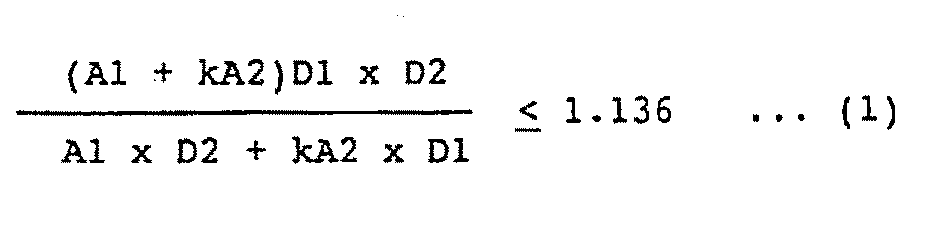
也就是说,本发明的第一方面涉及用于低比重聚氨酯基塑料透镜的组合物,所述组合物包括异(硫)氰酸酯化合物和活泼氢化合物,其选择应使它们满足式(1):
其中
A1-M:异(硫)氰酸酯化合物的分子量,A1-M: molecular weight of iso(thio)cyanate compound,
A1-N:异(硫)氰酸酯化合物的官能团数目,
A2-M:活泼氢化合物的分子量,A2-M: Molecular weight of active hydrogen compound,
A2-N:活泼氢化合物的官能团数目,A2-N: the number of functional groups of active hydrogen compounds,
D1=异(硫)氰酸酯化合物的比重,D1=specific gravity of iso(thio)cyanate compound,
D2=活泼氢化合物的比重,
本发明的第二方面涉及制备低比重聚氨酯基树脂塑料透镜的方法,包括将组合物混合并随后加热使之硬化的步骤。A second aspect of the present invention relates to a method of producing a low specific gravity polyurethane-based resin plastic lens comprising the steps of mixing the composition and then heating it to harden it.
本发明的第三个方面涉及采用本制备方法得到的塑料透镜。The third aspect of the present invention relates to the plastic lens obtained by the preparation method.
上述异(硫)氰酸酯化合物和活泼氢化合物可分别以其两种或更多种的混合物的状态使用,在此情况下,A1、D1、A2和D2是各混合物的加权平均值。The above-mentioned iso(thio)cyanate compound and active hydrogen compound may be used respectively in the state of a mixture of two or more thereof, and in this case, A1, D1, A2 and D2 are weighted averages of the respective mixtures.
下面将详述本发明。The present invention will be described in detail below.
用于本发明透镜的组合物包括一种或多种选自异氰酸酯化合物和可具有异氰酸酯基的异硫氰酸酯化合物的异(硫)氰酸酯化合物,以及一种或多种选自羟基化合物和可具有羟基的巯基化合物的活泼氢化合物。The composition used for the lens of the present invention includes one or more iso(thio)cyanate compounds selected from isocyanate compounds and isothiocyanate compounds that may have isocyanate groups, and one or more iso(thio)cyanate compounds selected from hydroxy compounds and an active hydrogen compound of a mercapto compound which may have a hydroxyl group.
可用在本发明中的异(硫)氰酸酯化合物的实例包括单异(硫)氰酸酯化合物和多异(硫)氰酸酯化合物。Examples of the iso(thio)cyanate compound usable in the present invention include monoiso(thio)cyanate compounds and polyiso(thio)cyanate compounds.
单异(硫)氰酸酯化合物的典型实例包括单异氰酸酯类如异氰酸苯酯、异氰酸丁酯和异氰酸环己酯,单异硫氰酸酯类例如异硫氰酸苯酯、异硫氰酸丁酯和异硫氰酸环己酯。此外,也可使用这些化合物被囟素例如氯和溴、烷基、烷氧基和硝基取代得到的化合物。它们可单独使用,也可两种或更多种合用。Typical examples of monoiso(thio)cyanate compounds include monoisocyanates such as phenyl isocyanate, butyl isocyanate, and cyclohexyl isocyanate, monoisothiocyanates such as phenyl isothiocyanate , butyl isothiocyanate and cyclohexyl isothiocyanate. In addition, compounds obtained by substituting these compounds with halogens such as chlorine and bromine, alkyl groups, alkoxy groups and nitro groups can also be used. They may be used alone or in combination of two or more.
多异氰酸酯化合物的实例包括:脂族多异氰酸酯例如:1,2-亚乙基二异氰酸酯、1,3-亚丙基二异氰酸酯、1,4-亚丁基二异氰酸酯、1,6-亚己基二异氰酸酯、1,8-亚辛基二异氰酸酯、1,9-亚壬基二异氰酸酯、2,2′-二甲基戊烷二异氰酸酯、2,2,4-三甲基己烷二异氰酸酯、1,10-亚癸基二异氰酸酯、丁烯二异氰酸酯、1,3-丁二烯-1,4-二异氰酸酯、2,4,4-三甲基-(1,6-亚己基)二异氰酸酯、1.6,11-十一烷三异氰酸酯、1,3,6-(1,6-亚己基)三异氰酸酯、1,8-二异氰酸根合-4-异氰酸根合甲基辛烷、2,5,7-三甲基-1,8-二异氰酸根合-5-异氰酸根合甲基辛烷、碳酸二(异氰酸根合乙酯)、二(异氰酸根合乙基)醚、1,4-丁二醇二丙基醚-ω,ω′-二异氰酸酯、赖氨酸二异氰酸根合甲酯、赖氨酸三异氰酸酯、2,6-二异氰酸根合己酸2-异氰酸根合乙酯、2,6-二异氰酸根合己酸2-异氰酸根合丙酯、二异氰酸二甲苯酯、二(异氰酸根合乙基)苯、二(异氰酸根合丙基)苯、α,α,α′,α′-四甲基亚二甲苯基二异氰酸酯、二(异氰酸根合丁基)苯、二(异氰酸根合甲基)萘、二(异氰酸根合甲基)二苯醚、邻苯二甲酸二(异氰酸根合乙酯)、1,3,5-三甲苯三异氰酸酯和2,6-二(异氰酸根合甲基)呋喃;脂环族多异氰酸酯例如异佛尔酮二异氰酸酯、二(异氰酸根合甲基)环己烷、二环己基甲烷二异氰酸酯、环己烷二异氰酸酯、甲基环己烷二异氰酸酯、二环己基二甲基甲烷二异氰酸酯、2,2′-二甲基二环己基甲烷二异氰酸酯、二(4-异氰酸根合正亚丁基)季戊四醇、二聚酸二异氰酸酯(dimeracid diisocyanate)、2-异氰酸根合甲基-3-(3-异氰酸根合丙基)-5-异氰酸根合甲基-二环[2.2.1]-庚烷、2-异氰酸根合甲基-3-(3-异氰酸根合丙基)-6-异氰酸根合甲基-二环[2.2.1]-庚烷、2-异氰酸根合甲基-2-(3-异氰酸根合丙基)-5-异氰酸根合甲基-二环[2.2.1]-庚烷、2-异氰酸根合甲基-2-(3-异氰酸根合丙基)-6-异氰酸根合甲基-二环[2.2.1]-庚烷、2-异氰酸根合甲基-3-(3-异氰酸根合丙基)-6-(2-异氰酸根合乙基)-二环[2.2.1]-庚烷、2-异氰酸根合甲基-3-(3-异氰酸根合丙基)-6-(2-异氰酸根合乙基)-二环[2.2.1]-庚烷、2-异氰酸根合甲基-2-(3-异氰酸根合丙基)-5-(2-异氰酸根合乙基)-二环[2.2.1]-庚烷和2-异氰酸根合甲基-2-(3-异氰酸根合丙基)-6-(2-异氰酸根合乙基)-二环[2.2.1]-庚烷;芳族多异氰酸酯类例如苯二异氰酸酯、甲苯二异氰酸酯、乙苯二异氰酸酯、异丙苯二异氰酸酯、二甲苯二异氰酸酯、二乙苯二异氰酸酯、二异丙苯二异氰酸酯、三甲苯三异氰酸酯、苯三异氰酸酯、萘二异氰酸酯、甲基萘二异氰酸酯、联苯二异氰酸酯、联甲苯胺二异氰酸酯、4,4′-二苯基甲烷二异氰酸酯、3,3′-二甲基二苯基甲烷-4,4′-二异氰酸酯、联苄-4,4′-二异氰酸酯、二(异氰酸根合苯基)乙烯、3,3′-二甲氧基联苯-4,4′-二异氰酸酯、三苯基甲烷三异氰酸酯、聚合MDI、萘三异氰酸酯、二苯基甲烷-2,4,4′-三异氰酸酯、3-甲基二苯基甲烷-4,6,4′-三异氰酸酯、4-甲基-二苯基甲烷-3,5,2′,4′,6′-五异氰酸酯、苯基异氰酸根合甲基异氰酸酯、苯基异氰酸根合乙基乙基异氰酸酯、四氢化萘二异氰酸酯、六氢苯二异氰酸酯、六氢化二苯基甲烷-4,4′-二异氰酸酯、二苯醚二异氰酸酯、乙二醇二苯基醚二异氰酸酯、1,3-丙二醇二苯基醚二异氰酸酯、二苯酮二异氰酸酯、二甘醇二苯基醚二异氰酸酯、氧芴二异氰酸酯、咔唑二异氰酸酯、乙基咔唑二异氰酸酯和二氯咔唑二异氰酸酯;含硫脂族异氰酸酯例如硫二乙基二异氰酸酯、硫二丙基二异氰酸酯、硫二己基二异氰酸酯、二甲基砜二异氰酸酯、亚二硫基二甲基二异氰酸酯、亚二硫基二乙基二异氰酸酯、亚二硫基二丙基二异氰酸酯和二环己基硫醚-4,4′-二异氰酸酯;芳族硫醚异氰酸酯例如二苯硫醚-2,4′-二异氰酸酯、二苯硫醚-4,4′-二异氰酸酯、3,3′-二甲氧基-4,4′-二异氰酸根合苄基硫醚、二(4-异氰酸根合甲基苯)硫醚和4,4′-甲氧基苯硫代乙二醇-3,3′-二异氰酸酯;芳族二硫化物异氰酸酯例如二苯二硫-4,4′-二异氰酸酯、2,2′二甲基二苯二硫-5,5′-二异氰酸酯、3,3′-二甲基二苯二硫-5,5′-二异氰酸酯、3,3′-二甲基二苯二硫-6,6′-二异氰酸酯、4,4′-二甲基二苯二硫-5,5′-二异氰酸酯、3,3′-二甲氧基二苯二硫-4,4′-二异氰酸酯和4,4′-二甲氧基二苯二硫-3,3′-二异氰酸酯;芳族砜异氰酸酯例如二苯基砜-4,4′-二异氰酸酯、二苯基砜-3,3′-二异氰酸酯、联苯胺砜-4,4′-二异氰酸酯、二苯甲基砜-4,4′-二异氰酸酯、4-甲基二苯甲基砜-2,4′-二异氰酸酯、4,4′-二甲氧基二苯基砜-3,3′-二异氰酸酯、3,3′-二甲氧基-4,4′-二异氰酸酯基二苄基砜、4,4′-二甲基二苯基砜-3,3′-二异氰酸酯、4,4′-二叔丁基二苯基砜-3,3′-二异氰酸酯、4,4′-二甲氧基苯乙基二砜-3,3′-二异氰酸酯和4,4′-二氯二苯基砜-3,3′-二异氰酸酯;磺化异氰酸酯例如:4-甲基-3-异氰酸根合苯磺酰基-4′-异氰酸根合苯酚酯和4-甲氧基-3-异氰酸根合苯磺酰基-4′-异氰酸根合苯酚酯;芳族磺酰胺例如N-(4-甲基-3-异氰酸根合苯磺酰基)苯胺-3′-甲基-4′-异氰酸酯、二苯磺酰基-乙二胺-4,4′-二异氰酸酯、4,4′-甲氧基苯磺酰基-乙二胺-3,3′-二异氰酸酯和N-(4-甲基-3-异氰酸根合苯磺酰基)苯胺-4-甲基-3′-异氰酸酯;含硫杂环化合物例如噻吩-2,5-二异氰酸酯、噻吩-2,5-二异氰酸根合甲基、1,4-二噻烷-2,5-二异氰酸酯、4,5-二(异氰酸根合甲基)-1,3-二硫戊环、二(异氰酸根合甲基)四氢噻吩和2,5-二(异氰酸根合甲基)-1,4-二噻烷。Examples of polyisocyanate compounds include: aliphatic polyisocyanates such as: 1,2-ethylene diisocyanate, 1,3-propylene diisocyanate, 1,4-butylene diisocyanate, 1,6-hexylene diisocyanate , 1,8-octylene diisocyanate, 1,9-nonylene diisocyanate, 2,2'-dimethylpentane diisocyanate, 2,2,4-trimethylhexane diisocyanate, 1, 10-decylene diisocyanate, butylene diisocyanate, 1,3-butadiene-1,4-diisocyanate, 2,4,4-trimethyl-(1,6-hexylene) diisocyanate, 1.6 , 11-undecane triisocyanate, 1,3,6-(1,6-hexamethylene) triisocyanate, 1,8-diisocyanato-4-isocyanatomethyloctane, 2,5 , 7-trimethyl-1,8-diisocyanato-5-isocyanatomethyloctane, bis(isocyanatoethyl) carbonate, bis(isocyanatoethyl) ether, 1,4-Butanediol dipropyl ether-ω,ω′-diisocyanate, lysine diisocyanatomethyl ester, lysine triisocyanate, 2,6-diisocyanatohexanoic acid 2- Ethyl isocyanate, 2-isocyanatopropyl 2,6-diisocyanatohexanoate, xylyl diisocyanate, bis(isocyanatoethyl)benzene, bis(isocyanato Atopropyl) benzene, α, α, α′, α′-tetramethylxylylene diisocyanate, bis(isocyanatobutyl)benzene, bis(isocyanatomethyl)naphthalene, di (isocyanatomethyl)diphenyl ether, bis(isocyanatoethyl)phthalate, 1,3,5-trimethylbenzene triisocyanate and 2,6-bis(isocyanatomethyl) Furan; cycloaliphatic polyisocyanates such as isophorone diisocyanate, bis(isocyanatomethyl)cyclohexane, dicyclohexylmethane diisocyanate, cyclohexane diisocyanate, methylcyclohexane diisocyanate, Cyclohexyldimethylmethane diisocyanate, 2,2'-dimethyldicyclohexylmethane diisocyanate, bis (4-isocyanato-n-butylene) pentaerythritol, dimeracid diisocyanate (dimeracid diisocyanate), 2- Isocyanatomethyl-3-(3-isocyanatopropyl)-5-isocyanatomethyl-bicyclo[2.2.1]-heptane, 2-isocyanatomethyl-3 -(3-isocyanatopropyl)-6-isocyanatomethyl-bicyclo[2.2.1]-heptane, 2-isocyanatomethyl-2-(3-isocyanato Propyl)-5-isocyanatomethyl-bicyclo[2.2.1]-heptane, 2-isocyanatomethyl-2-(3-isocyanatopropyl)-6-isocyanato Atomethyl-bicyclo[2.2.1]-heptane, 2-isocyanatomethyl-3-(3-isocyanatopropyl)-6-(2-isocyanatoethyl) -bicyclo[2.2.1]-heptane, 2-isocyanatomethyl-3-(3-isocyanatopropyl)-6-(2-isocyanatoethyl)-bicyclo[ 2.2.1]-Heptane, 2-isocyanatomethyl-2-(3-isocyanatopropyl)-5-(2-isocyanatoethyl)-bicyclo[2.2.1] - heptane and 2-isocyanatomethyl-2-(3-isocyanatopropyl)-6-(2-isocyanatoethyl)-bicyclo[2.2.1]-heptane; Aromatic polyisocyanates such as phenylene diisocyanate, toluene diisocyanate, ethylbenzene diisocyanate, cumene diisocyanate, xylene diisocyanate, diethylbenzene diisocyanate, diisopropylbenzene diisocyanate, trimethylbenzene triisocyanate, benzene triisocyanate Isocyanate, naphthalene diisocyanate, methylnaphthalene diisocyanate, biphenyl diisocyanate, benzylidine diisocyanate, 4,4'-diphenylmethane diisocyanate, 3,3'-dimethyldiphenylmethane-4, 4'-diisocyanate, bibenzyl-4,4'-diisocyanate, bis(isocyanatophenyl)ethylene, 3,3'-dimethoxybiphenyl-4,4'-diisocyanate, triphenyl Methyl methane triisocyanate, polymeric MDI, naphthalene triisocyanate, diphenylmethane-2,4,4'-triisocyanate, 3-methyldiphenylmethane-4,6,4'-triisocyanate, 4-methyl -Diphenylmethane-3,5,2',4',6'-pentaisocyanate, phenylisocyanatomethyl isocyanate, phenylisocyanatoethylethylisocyanate, tetralin diisocyanate, Hexahydrophenylene diisocyanate, hexahydrodiphenylmethane-4,4'-diisocyanate, diphenyl ether diisocyanate, ethylene glycol diphenyl ether diisocyanate, 1,3-propanediol diphenyl ether diisocyanate, di Benzophenone diisocyanate, diethylene glycol diphenyl ether diisocyanate, oxyfluorene diisocyanate, carbazole diisocyanate, ethylcarbazole diisocyanate and dichlorocarbazole diisocyanate; sulfur-containing aliphatic isocyanates such as sulfur diethyl diisocyanate Isocyanate, sulfur dipropyl diisocyanate, sulfur dihexyl diisocyanate, dimethyl sulfone diisocyanate, dithiol dimethyl diisocyanate, dithiol diethyl diisocyanate, dithiol dipropyl diisocyanate Isocyanates and dicyclohexyl sulfide-4,4'-diisocyanate; aromatic thioether isocyanates such as diphenyl sulfide-2,4'-diisocyanate, diphenyl sulfide-4,4'-diisocyanate, 3, 3′-Dimethoxy-4,4′-diisocyanatobenzyl sulfide, bis(4-isocyanatomethylphenyl)sulfide and 4,4′-methoxyphenylthioethyl Diol-3,3'-diisocyanate; aromatic disulfide isocyanate such as diphenyldithio-4,4'-diisocyanate, 2,2'dimethyldiphenyldithio-5,5'-diisocyanate , 3,3'-dimethyldiphenyldithio-5,5'-diisocyanate, 3,3'-dimethyldiphenyldithio-6,6'-diisocyanate, 4,4'-dimethyl Diphenyldithio-5,5'-diisocyanate, 3,3'-dimethoxydiphenyldithio-4,4'-diisocyanate and 4,4'-dimethoxydiphenyldithio- 3,3′-Diisocyanate; Aromatic sulfone isocyanate such as diphenylsulfone-4,4′-diisocyanate, diphenylsulfone-3,3′-diisocyanate, benzidinesulfone-4,4′-diisocyanate , benzhydrylsulfone-4,4'-diisocyanate, 4-methylbenzhydrylsulfone-2,4'-diisocyanate, 4,4'-dimethoxydiphenylsulfone-3,3 '-Diisocyanate, 3,3'-dimethoxy-4,4'-diisocyanatodibenzylsulfone, 4,4'-dimethyldiphenylsulfone-3,3'-diisocyanate, 4 , 4'-di-tert-butyldiphenylsulfone-3,3'-diisocyanate, 4,4'-dimethoxyphenethyldisulfone-3,3'-diisocyanate and 4,4'-di Chlorodiphenylsulfone-3,3′-diisocyanate; sulfonated isocyanates such as: 4-methyl-3-isocyanatobenzenesulfonyl-4′-isocyanatophenolate and 4-methoxy- 3-Isocyanatobenzenesulfonyl-4′-isocyanatophenolate; aromatic sulfonamides such as N-(4-methyl-3-isocyanatobenzenesulfonyl)aniline-3′-methyl -4'-isocyanate, diphenylsulfonyl-ethylenediamine-4,4'-diisocyanate, 4,4'-methoxybenzenesulfonyl-ethylenediamine-3,3'-diisocyanate and N-( 4-methyl-3-isocyanatobenzenesulfonyl)aniline-4-methyl-3'-isocyanate; sulfur-containing heterocyclic compounds such as thiophene-2,5-diisocyanate, thiophene-2,5-diisocyanate Cyanatomethyl, 1,4-dithiane-2,5-diisocyanate, 4,5-bis(isocyanatomethyl)-1,3-dithiolane, bis(isocyanato Methyl)tetrahydrothiophene and 2,5-bis(isocyanatomethyl)-1,4-dithiane.
此外,也可使用上述化合物被卤素例如氯和溴、烷基、烷氧基和硝基取代所得到的化合物,用多元醇改性的其预聚物型化合物,用碳化二亚胺、脲和缩二脲改性的上述化合物及其二聚和三聚反应产物。In addition, compounds obtained by substituting the above-mentioned compounds with halogens such as chlorine and bromine, alkyl groups, alkoxy groups and nitro groups, their prepolymer type compounds modified with polyhydric alcohols, carbodiimide, urea and Biuret-modified above-mentioned compounds and dimerization and trimerization reaction products thereof.
可用于本发明的多异硫氰酸酯化合物在一个分子中具有两个或更多个-NCS基团,并且除了异硫氰酸酯基团外,还可含有另外的硫原子。The polyisothiocyanate compound usable in the present invention has two or more -NCS groups in one molecule, and may contain additional sulfur atoms in addition to the isothiocyanate groups.
多异硫氰酸酯化合物的典型实例包括:脂族异硫氰酸酯例如1,2-二异硫氰酸根合乙烷、1,3-二异硫氰酸根合丙烷、1,4-二异硫氰酸根合丁烷、1,6-二异硫氰酸根合己烷和对苯二异亚丙基二异硫氰酸酯;脂环族异硫氰酸酯例如环己烷二异硫氰酸酯;芳族异硫氰酸酯例如1,2-二异硫氰酸根合苯、1,3-二异硫氰酸根合苯、1,4-二异硫氰酸根合苯、2,4-二异硫氰酸根合甲苯、2,5-二异硫氰酸根合间二甲苯、4,4′-二异硫氰酸根合-1,1′-联苯、1,1′-亚甲基二(4-异硫氰酸根合苯)、1,1′-亚甲基二(4-异硫氰酸根合-2-甲基苯)、1,1′-亚甲基二(4-异硫氰酸根合-3-甲基苯)、1,1′-(1,2-乙烷二基)二(4-异硫氰酸根合苯)、4,4′-二异硫氰酸根合二苯酮、4,4′-二异硫氰酸根合-3,3′-二甲基二苯酮、N-苯甲酰苯胺-3,4′-二异硫氰酸酯、二苯醚-4,4′-二异硫氰酸酯和二苯基胺-4,4′-二异硫氰酸酯;含杂环的异硫氰酸酯例如2,4,6-三异硫氰酸根合-1,3,5-三嗪;和羰基异硫氰酸酯例如己二酰二异硫氰酸酯、壬二酰二异硫氰酸酯、羰基二异硫氰酸酯(carbonic diiso-thiocyanate)、1,3-苯二羰基二异硫氰酸酯、1,4-苯二羰基二异硫氰酸酯和(2,2′-联吡啶)-4,4′-二羰基二异硫氰酸酯。Typical examples of polyisothiocyanate compounds include: aliphatic isothiocyanates such as 1,2-diisothiocyanatoethane, 1,3-diisothiocyanatopropane, 1,4-diisothiocyanatopropane, Butane isothiocyanato, 1,6-diisothiocyanatohexane, and p-phenylene diisopropylidene diisothiocyanate; cycloaliphatic isothiocyanates such as cyclohexanediisothiocyanate Cyanates; aromatic isothiocyanates such as 1,2-diisothiocyanatobenzene, 1,3-diisothiocyanatobenzene, 1,4-diisothiocyanatobenzene, 2, 4-diisothiocyanatotoluene, 2,5-diisothiocyanato-m-xylene, 4,4'-diisothiocyanato-1,1'-biphenyl, 1,1'- Methylbis(4-isothiocyanatobenzene), 1,1'-methylenebis(4-isothiocyanato-2-methylbenzene), 1,1'-methylenebis(4 -isothiocyanato-3-methylbenzene), 1,1'-(1,2-ethanediyl)bis(4-isothiocyanatobenzene), 4,4'-diisothiocyanate Acidobenzophenone, 4,4'-diisothiocyanato-3,3'-dimethylbenzophenone, N-benzanilide-3,4'-diisothiocyanate, di Diphenylene ether-4,4'-diisothiocyanate and diphenylamine-4,4'-diisothiocyanate; heterocyclic isothiocyanates such as 2,4,6-triisothiocyanate thiocyanato-1,3,5-triazine; and carbonyl isothiocyanates such as adipyl diisothiocyanate, azelayl diisothiocyanate, carbonyl diisothiocyanate ( carbonic diiso-thiocyanate), 1,3-benzenedicarbonyl diisothiocyanate, 1,4-benzenedicarbonyl diisothiocyanate and (2,2′-bipyridine)-4,4′-bis Carbonyl diisothiocyanate.
可用作本发明的原料的除了具有异硫氰酸酯基外还具有一个或多个硫原子的二官能或多官能多异硫氰酸酯的实例包括:含硫脂族异硫氰酸酯例如硫二(3-异硫氰酸根合丙烷)、硫二(2-异硫氰酸根合乙烷)和联硫基二(2-异硫氰酸根合乙烷);含硫芳族异硫氰酸酯例如1-异硫氰酸根合-4-[(2-异硫氰酸根合)磺酰基]苯、硫二(4-异硫氰酸根合苯)、磺酰基二(4-异硫氰酸根合苯)、亚磺酰基二(4-异硫氰酸根合苯)、联硫基二(4-异硫氰酸根合苯)、4-异硫氰酸根合-1-[(4-异硫氰酸根合苯基)磺酰基]-2-甲氧基苯,4-甲基-3-异硫氰酸根合苯磺酰基-4′-异硫氰酸根合苯酯和N-(4-甲基-3-异硫氰酸根合苯磺酰基)苯胺-3′-甲基-4′-异硫氰酸酯;含硫杂环化合物例如噻吩酮(thiophenone)-2,5-二异硫氰酸酯和1,4-二噻烷-2,5-二异硫氰酸酯。Examples of difunctional or polyfunctional polyisothiocyanates having one or more sulfur atoms in addition to isothiocyanate groups that can be used as a raw material in the present invention include: sulfur-containing aliphatic isothiocyanates For example, thiobis(3-isothiocyanatopropane), thiobis(2-isothiocyanatoethane) and dithiobis(2-isothiocyanatoethane); sulfur-containing aromatic isothio Cyanates such as 1-isothiocyanato-4-[(2-isothiocyanato)sulfonyl]benzene, thiobis(4-isothiocyanatobenzene), sulfonylbis(4-isothiocyanato) cyanatobenzene), sulfinyl bis(4-isothiocyanatobenzene), dithiobis(4-isothiocyanatobenzene), 4-isothiocyanato-1-[(4- isothiocyanatophenyl)sulfonyl]-2-methoxybenzene, 4-methyl-3-isothiocyanatobenzenesulfonyl-4′-isothiocyanatophenyl ester and N-(4 -Methyl-3-isothiocyanatobenzenesulfonyl)aniline-3'-methyl-4'-isothiocyanate; sulfur-containing heterocyclic compounds such as thiophenone (thiophenone)-2,5-diiso Thiocyanate and 1,4-dithiane-2,5-diisothiocyanate.
此外,也可使用上述多异硫氰酸酯化合物被卤素例如氯和溴、烷基、烷氧基和硝基取代所得到的化合物,用多元醇改性的其预聚物型化合物,用碳化二亚胺、脲和缩二脲改性的上述化合物及其二聚和三聚反应产物。In addition, compounds obtained by substituting the above-mentioned polyisothiocyanate compounds with halogens such as chlorine and bromine, alkyl groups, alkoxy groups, and nitro groups, their prepolymer type compounds modified with polyols, and carbonized Diimine, urea and biuret modified compounds of the above and dimerization and trimerization reaction products thereof.
可用作本发明原料的具有异氰酸酯基的异硫氰酸酯化合物的实例包括:脂族和脂环族化合物例如1-异氰酸根合-3-异硫氰酸根合丙烷、1-异氰酸根合-5-异硫氰酸根合戊烷、1-异氰酸根合-6-异硫氰酸根合己烷、异氰酸根合羰基异硫氰酸酯和1-异氰酸根合-4-异硫氰酸根合环己烷;芳族化合物例如1-异氰酸根合-4-异硫氰酸根合苯和4-甲基-3-异氰酸根合-1-异硫氰酸根合苯;杂环化合物例如2-异氰酸根合-4,5-二异硫氰酸根合-1,3,5-三嗪;和除了异硫氰酸根合基团外还含一个或多个硫原子的化合物例如:4-异氰酸根合-4′-异硫氰酸根合二苯硫和2-异氰酸根合-2′-异硫氰酸根合二乙基二硫。Examples of isothiocyanate compounds having an isocyanate group usable as a raw material in the present invention include: aliphatic and alicyclic compounds such as 1-isocyanato-3-isothiocyanatopropane, 1-isocyanato 5-isothiocyanatopentane, 1-isocyanato-6-isothiocyanatohexane, isocyanatocarbonyl isothiocyanate and 1-isocyanato-4-isocyanato Thiocyanatocyclohexane; aromatic compounds such as 1-isocyanato-4-isothiocyanatobenzene and 4-methyl-3-isocyanato-1-isothiocyanatobenzene; hetero Cyclic compounds such as 2-isocyanato-4,5-diisothiocyanato-1,3,5-triazine; and compounds containing one or more sulfur atoms in addition to the isothiocyanato group For example: 4-isocyanato-4'-isothiocyanatodiphenylsulfide and 2-isocyanato-2'-isothiocyanatodiethyldisulfide.
此外,也可使用上述化合物被卤素例如氯和溴、烷基、烷氧基和硝基取代所得到的化合物,用多元醇改性的其预聚物型化合物,用碳化二亚胺、脲和缩二脲改性的上述化合物及其二聚和三聚反应产物。In addition, compounds obtained by substituting the above-mentioned compounds with halogens such as chlorine and bromine, alkyl groups, alkoxy groups and nitro groups, their prepolymer type compounds modified with polyhydric alcohols, carbodiimide, urea and Biuret-modified above-mentioned compounds and dimerization and trimerization reaction products thereof.
在这些异(硫)氰酸酯化合物中,特别优选异佛尔酮二异氰酸酯、二环己基甲烷二异氰酸酯、三甲基(1,6-亚己基)二异氰酸酯、1,6-亚己基二异氰酸酯、α,α,α′,α′-四甲基亚二甲苯基二异氰酸酯和用缩二脲改性的及三聚的这些异氰酸酯。这些优选化合物的使用通常导致理想的结果。Among these iso(thio)cyanate compounds, isophorone diisocyanate, dicyclohexylmethane diisocyanate, trimethyl(1,6-hexamethylene)diisocyanate, 1,6-hexamethylene diisocyanate, and , α, α, α', α'-tetramethylxylylene diisocyanate and these isocyanates modified with biurets and trimerized. The use of these preferred compounds generally leads to desirable results.
这些异(硫)氰酸酯化合物可单独使用,或两种或更多种结合使用。These iso(thio)cyanate compounds may be used alone or in combination of two or more.
可用在本发明中的活泼氢化合物的实例如下:Examples of active hydrogen compounds usable in the present invention are as follows:
羟基化合物的实例包括醇例如甲醇、乙醇、异丙醇、丁醇、苄醇、苯酚、苯基苯酚、乙氧基乙醇;甲氧基丙醇、乙氧基丙醇;脂族多元醇例如乙二醇、二甘醇、三甘醇、四甘醇、丙二醇、二丙二醇、丁二醇、新戊二醇、甘油、三羟甲基乙烷、三羟甲基丙烷、丁三醇、1,2-甲基苷、季戊四醇、二季戊四醇、三季戊四醇、山梨醇、赤藓醇、苏糖醇、核糖醇醇、阿拉伯糖醇(arabinitol)、木糖醇、蒜糖醇、甘露糖醇、半乳糖醇、艾杜糖醇、1,2-乙二醇、肌醇、己三醇、三甘油、双甘油、三乙二醇、聚乙二醇、三(2-羟乙基)异氰脲酸酯、环丁二醇、环戊二醇、环己二醇、环庚二醇、环辛二醇、环己二甲醇、羟丙基环己醇、三环[5.2.1.0.2.6]癸烷二甲醇、二环[4.3.0]-壬二醇、二环己二醇、三环[5.3.1.1)十二烷二醇、二环[4.3.0]壬二甲醇、三环[5.3.1.1]十二烷二乙醇、羟丙基三环[5.3.1.1]十二烷醇、螺[3.4]辛二醇、丁基环己二醇、1,1′-二环己基己基二醇、环己二醇、multitol和乳糖醇;芳族多羟基化合物例如二羟基萘、三羟基萘、四羟基萘、二羟基苯、苯三酚、联苯四酚、焦棓酚、(羟基萘)焦棓酚、三羟基菲、双酚A、双酚F、二羟甲基苯、二(2-羟基乙氧基)苯、双酚A-双(2-羟基乙基醚)、四溴代双酚A和四溴代双酚A-二(2-羟基乙基醚);卤代多羟基化合物例如二溴代新戊二醇;高分子量多羟基化合物例如环氧树脂;上述多羟基化合物与有机酸的缩合反应产物,所述有机酸例如为草酸、谷氨酸、己二酸、乙酸、丙酸、环己烷羧酸、β-氧代环己烷丙酸、二聚酸、邻苯二甲酸、间苯二甲酸、水杨酸、3-溴丙酸、2-溴乙二醇、二羧基环己烷、1,2,4,5-苯甲酸、丁烷四羧酸和溴代邻苯二甲酸;上述多羟基化合物与烯化氧例如氧化乙烯和氧化丙烯的加成反应产物;亚烷基多胺和烯化氧例如氧化乙烯和氧化丙烯的加成反应产物;含硫原子的多羟基化合物例如二[4-(羟基乙氧基)苯基]硫、二[4-(2-羟基丙氧基)苯基]硫、二[4-(2,3-二羟基丙氧基)苯基]硫、二[4-(4-羟基环己氧基)苯基]硫、二[2-甲基-4-(羟基乙氧基)-6-丁基苯基]硫以及通过向这些化合物上加成平均每个羟基3或少于3mol的氧化乙烯和/或氧化丙烯得到的化合物、二(2-羟乙基)硫、1,2-二(2-羟乙基巯基)乙烷、二(2-羟乙基)二硫、1,4-二噻烷-2,5-二醇、二(2,3-二羟基丙基)硫、四(4-羟基-2-硫杂丁基)甲烷、二(4-羟基苯基)砜(商品名双酚S)、四溴化双酚S、四甲基双酚S、4,4′-硫代二(6-叔丁基-3-甲基苯酚)、3,6-二硫杂辛烷-1,8-二醇和1,3-二(2-羟基乙硫基乙基)环己烷。Examples of hydroxyl compounds include alcohols such as methanol, ethanol, isopropanol, butanol, benzyl alcohol, phenol, phenylphenol, ethoxyethanol; methoxypropanol, ethoxypropanol; aliphatic polyols such as ethyl alcohol; Glycol, Diethylene Glycol, Triethylene Glycol, Tetraethylene Glycol, Propylene Glycol, Dipropylene Glycol, Butylene Glycol, Neopentyl Glycol, Glycerin, Trimethylolethane, Trimethylolpropane, Butanetriol, 1, 2-Methylglycoside, pentaerythritol, dipentaerythritol, tripentaerythritol, sorbitol, erythritol, threitol, ribitol, arabinitol, xylitol, allicitol, mannitol, galactose Alcohol, iditol, 1,2-ethylene glycol, inositol, hexanetriol, triglycerin, diglycerin, triethylene glycol, polyethylene glycol, tris(2-hydroxyethyl)isocyanurate Esters, cyclobutanediol, cyclopentanediol, cyclohexanediol, cycloheptanediol, cyclooctanediol, cyclohexanedimethanol, hydroxypropylcyclohexanol, tricyclo[5.2.1.0.2.6]decane Dimethanol, bicyclo[4.3.0]-nonanediol, dicyclohexanediol, tricyclo[5.3.1.1) dodecanediol, bicyclo[4.3.0]nonanediol, tricyclo[5.3. 1.1] Dodecanediethanol, hydroxypropyltricyclo[5.3.1.1]dodecanol, spiro[3.4]octanediol, butylcyclohexanediol, 1,1′-dicyclohexylhexyldiol, cyclohexane Diols, multitols, and lactitols; aromatic polyols such as dihydroxynaphthalene, trihydroxynaphthalene, tetrahydroxynaphthalene, dihydroxybenzene, glucinol, bipyrogallol, pyrogallol, (hydroxynaphthalene)pyrogallol , trihydroxyphenanthrene, bisphenol A, bisphenol F, dimethylolbenzene, bis(2-hydroxyethoxy)benzene, bisphenol A-bis(2-hydroxyethyl ether), tetrabromobisphenol A and tetrabromobisphenol A-bis(2-hydroxyethyl ether); halogenated polyols such as dibromoneopentyl glycol; high molecular weight polyols such as epoxy resins; combinations of the above polyols with organic acids Condensation reaction products such as oxalic acid, glutamic acid, adipic acid, acetic acid, propionic acid, cyclohexanecarboxylic acid, β-oxocyclohexanepropionic acid, dimer acid, phthalic acid, Isophthalic acid, salicylic acid, 3-bromopropionic acid, 2-bromoethylene glycol, dicarboxycyclohexane, 1,2,4,5-benzoic acid, butane tetracarboxylic acid, and bromophthalic acid Formic acid; addition reaction products of the above polyols with alkylene oxides such as ethylene oxide and propylene oxide; addition reaction products of alkylene polyamines with alkylene oxides such as ethylene oxide and propylene oxide; polyols containing sulfur atoms For example bis[4-(hydroxyethoxy)phenyl]sulfur, bis[4-(2-hydroxypropoxy)phenyl]sulfur, bis[4-(2,3-dihydroxypropoxy)phenyl ]sulfur, bis[4-(4-hydroxycyclohexyloxy)phenyl]sulfur, bis[2-methyl-4-(hydroxyethoxy)-6-butylphenyl]sulfur and by adding to these compounds Compounds obtained by addition of ethylene oxide and/or propylene oxide with an average of 3 or less mol per hydroxyl group, bis(2-hydroxyethyl)sulfur, 1,2-bis(2-hydroxyethylmercapto)ethane, Bis(2-hydroxyethyl)disulfide, 1,4-dithiane-2,5-diol, bis(2,3-dihydroxypropyl)thio, tetrakis(4-hydroxy-2-thietidine Base) methane, bis(4-hydroxyphenyl)sulfone (trade name bisphenol S), tetrabrominated bisphenol S, tetramethylbisphenol S, 4,4'-thiobis(6-tert-butyl- 3-methylphenol), 3,6-dithiaoctane-1,8-diol and 1,3-bis(2-hydroxyethylthioethyl)cyclohexane.
巯基化合物的实例包括单硫醇例如甲硫醇、乙硫醇、苯硫酚和苄硫醇;脂族或脂环族多元硫醇例如甲二硫醇、1,2-乙二硫醇、1,1-丙二硫醇、1,2-丙二硫醇、1,3-丙二硫醇、2,2-丙二硫醇、1,6-己二硫醇、1,2,3-丙三硫醇、四(巯基甲基)甲烷、1,1-环己二硫醇、1,2-环己二硫醇、2,2-二甲基丙烷-1,3-二硫醇、3,4-二甲氧基丁烷-1,2-二硫醇、3.6-二氧杂辛烷-1,8-二硫醇、2-甲基环己烷-2,3-二硫醇、二环[2.2.1]庚-外-顺-2,3-二硫醇、1,1-二(巯基甲基)环己烷、硫羟苹果酸二(2-巯基乙酯)、2,3-二巯基琥珀酸(2-巯基乙酯)、2,3-二巯基-1-丙醇(2-巯基乙酸酯)、2,3-二巯基-1-丙醇(3-巯基乙酸酯)、二甘醇二(2-巯基乙酸酯)、二甘醇二(3-巯基丙酸酯)、1,2-二巯基丙基甲基醚、2,3-二巯基丙基甲基醚、2,2-二(巯基甲基)-1,3-丙二硫醇、二(2-巯基乙基)醚、乙二醇二(2-巯基乙酸酯)、乙二醇二(3-巯基丙酸酯)、三羟甲基丙烷三(2-巯基乙酸酯)、三羟甲基丙烷三(3-巯基丙酸酯)、季戊四醇四(2-巯基乙酸酯)、季戊四醇四(3-巯基丙酸酯)和1,2-二(2-巯基乙硫基)-3-巯基丙烷;芳族多元硫酚例如1,2-二巯基苯、1,3-二巯基苯、1,4-二巯基苯、1,2-二(巯基甲基)苯、1,3-二(巯基甲基)苯、1,4-二(巯基甲基)苯、1,2-二(巯基乙基)苯、1,3-二(巯基乙基)苯、1,4-二(巯基乙基)苯、1,2-二(巯基亚甲基氧基)苯、1,3-二(巯基亚甲基氧基)苯、1,4-二(巯基亚甲基氧基)苯、1,2-二[巯基(1,2-亚乙基)氧基]苯、1,3-二[巯基(1,2-亚乙基)氧基]苯、1,4-二[巯基(1,2-亚乙基)氧基]苯、1,2,3-三巯基苯、1,2,4-三巯基苯、1,3,5-三巯基苯、1,2,3-三(巯基甲基)苯、1,2,4-三(巯基甲基)苯、1,3,5-三(巯基甲基)苯、1,2,3-三(巯基乙基)苯、1,2,4-三(巯基乙基)苯、1,3,5-三(巯基乙基)苯、1,2,3-三(巯基亚甲基氧基)苯、1,2,4-三(巯基亚甲基氧基)苯、1,3,5-三(巯基亚甲基氧基)苯、1,2,3-三[巯基(1,2-亚乙基)氧基]苯、1,2,4-三[巯基(1,2-亚乙基)氧基]苯、1,3,5-三[巯基(1,2-亚乙基)氧基]苯、1,2,3,4-四巯基苯、1,2,3,5-四巯基苯、1,2,4,5-四巯基苯、1,2,3,4-四(巯基甲基)苯、1,2,3,5-四(巯基甲基)苯、1,2,4,5-四(巯基甲基)苯、1,2,3,4-四(巯基乙基)苯、1,2,3,5-四(巯基乙基)苯、1,2,4,5-四(巯基乙基)苯、1,2,3,4-四(巯基乙基)苯、1,2,3,5-四(巯基亚甲基氧基)苯、1,2,4,5-四(巯基亚甲基氧基)苯、1,2,3,4-四[巯基(1,2-亚乙基)氧基]苯、1,2,3,5-四[巯基(1,2-亚乙基)氧基]苯、1,2,4,5-四[巯基(1,2-亚乙基)氧基]苯、2,2′-二巯基联苯、4,4′-二巯基联苯、4,4′-二巯基联苄、2,5-甲苯二硫酚、3,4-甲苯二硫酚、1,4-萘二硫酚、1,5-萘二硫酚、2,6-萘二硫酚、2,7-萘二硫酚、2,4-二甲基苯-1,3-二硫酚、4,5-二甲基苯-1,3-二硫酚、9,10-蒽二甲硫醇、1,3-二(对甲氧基苯基)丙烷-2,2-二硫醇、1,3-二苯基丙烷-2,2-二硫醇、苯基甲烷-1,1-二硫醇和2,4-二(对巯基苯基)戊烷;卤素取代的芳族多元硫醇即氯取代的和溴取代多元硫醇例如2,5-二氯苯-1,3-二硫酚、1,3-二(对氯苯基)丙烷-2,2-二硫醇、3,4,5-三溴-1,2-二巯基苯和2,3,4,6-四氯-1,5-二(巯基甲基)苯;含杂环的多元硫醇例如2-甲基氨基-4,6-二硫醇-均三嗪、2-乙基氨基-4,6-二硫醇-均三嗪、2-氨基-4,6-二硫醇-均三嗪、2-吗啉代-4,6-二硫醇-均三嗪、2-环己基氨基-4,6-二硫醇-均三嗪、2-甲氧基-4,6-二硫醇-均三嗪;2-苯氧基-4,6-二硫醇-均三嗪、2-硫代苯氧基-4,6-二硫醇-均三嗪和2-硫代丁氧基-4,6-二硫醇-均三嗪;除了巯基外还含有硫原子的芳族多元硫醇例如1,2-二(巯基甲硫基)苯、1,3-二(巯基甲硫基)苯、1,4-二(巯基甲硫基)苯、1,2-二(巯基乙硫基)、1,3-二(巯基乙硫基)苯、1,4-二(巯基乙硫基)苯、1,2,3-三(巯基甲硫基)苯、1,2,4-三(巯基甲硫基)苯、1,3,5-三(巯基甲硫基)苯、1,2,3-三(巯基乙硫基)苯、1,2,4-三(巯基乙硫基)苯、1,3,5-三(巯基乙硫基)苯、1,2,3,4-四(巯基甲硫基)苯、1,2,3,5-四(巯基甲硫基)苯、1,2,4,5-四(巯基乙硫基)苯、1,2,3,4-四(巯基乙硫基)苯、1,2,3,5-四(巯基乙硫基)苯、1,2,4,5-四(巯基乙硫基)苯、二(4-巯基苯基)硫及它们的烷基化物;除了巯基外还具有一个或多个硫原子的脂族多元硫醇例如二(巯基甲基)硫、二(巯基乙基)硫、二(巯基丙基)硫、二(巯基甲硫基)甲烷、二(2-巯基乙硫基)甲烷、二(3-巯基丙硫基)甲烷、1,2-二(巯基甲硫基)乙烷、1,2-二(2-巯基乙硫基)乙烷、1,2-二(3-巯基丙硫基)乙烷、1,3-二(巯基甲硫基)丙烷、1,3-二(2-巯基乙硫基)丙烷、1,3-二(3-巯基丙硫基)丙烷、1,2-二(2-巯基乙硫基)-3-巯基丙烷、2-巯基乙硫基-1,3-丙二硫醇、1,2,3-三(巯基甲硫基)丙烷、1,2,3-三(2-巯基乙硫基)丙烷、1,2,3-三(3-巯基丙硫基)丙烷、四(巯基甲硫基甲基)甲烷、四(2-巯基乙硫基甲基)甲烷、四(3-巯基丙硫基甲基)甲烷、二(2,3-二巯基丙基)硫、2,5-二巯基-1,4-二噻烷、二(巯基甲基)二硫、二(巯基乙基)二硫、二(巯基丙基)二硫、它们的巯基乙酸酯或巯基丙酸酯、羟甲基硫二(2-巯基乙酸酯)、羟甲基硫二(3-巯基丙酸酯)、羟乙基硫(2-巯基乙酸酯)、羟乙基硫二(3-巯基丙酸酯)、羟丙基硫二(2-巯基乙酸酯)、羟丙基硫二(3-巯基丙酸酯)、羟甲基二硫二(2-巯基乙酸酯)、羟甲基二硫二(3-巯基丙酸酯)、羟乙基二硫二(2-巯基乙酸酯)、羟乙基二硫二(3-巯基丙酸酯)、羟丙基二硫二(2-巯基乙酸酯)、羟丙基二硫二(3-巯基丙酸酯)、2-巯基乙基醚二(2-巯基乙酸酯)、2-巯基乙基醚二(3-巯基丙酸酯)、1,4-二噻烷-2,5-二醇二(2-巯基乙酸酯)、1,4-二噻烷-2,5-二醇二(3-巯基丙酸酯)、巯基乙酸二(2-巯基乙酯)、亚硫基二丙酸二(2-巯基乙酯)、4,4-亚硫基二丁酸二(2-巯基乙酯)、亚二硫基二乙酸二(2-巯基乙酯)、亚二硫基二丙酸二(2-巯基乙酯)、4,4-亚二硫基二丁酸二(2-巯基乙酯)、亚硫基二乙酸二(2,3-二巯基丙酯)、亚硫基二丙酸二(2,3-二巯基丙酯)、亚二硫基乙酸二(2,3-二巯基丙酯)和亚二硫基二丙酸(2,3-二巯基丙酯)和除了具有巯基外还具有一个或多个硫原子的杂环化合物例如3,4-噻吩二硫醇、2,5-二(巯基甲基)四氢噻吩、二(巯基甲基)-1,3-二硫戊环、2,5-二巯基-1,3,4-噻二唑、2,5-二巯基-1,4-二噻烷和2,5-二巯基甲基-1,4-二噻烷。Examples of mercapto compounds include monothiols such as methanethiol, ethanethiol, benzenethiol, and benzylthiol; aliphatic or cycloaliphatic polythiols such as methanedithiol, 1,2-ethanedithiol, 1 , 1-propanedithiol, 1,2-propanedithiol, 1,3-propanedithiol, 2,2-propanedithiol, 1,6-hexanedithiol, 1,2,3- Glycerol, tetrakis(mercaptomethyl)methane, 1,1-cyclohexanedithiol, 1,2-cyclohexanedithiol, 2,2-dimethylpropane-1,3-dithiol, 3,4-Dimethoxybutane-1,2-dithiol, 3.6-dioxa-octane-1,8-dithiol, 2-methylcyclohexane-2,3-dithiol , Bicyclo[2.2.1]heptane-exo-cis-2,3-dithiol, 1,1-bis(mercaptomethyl)cyclohexane, bis(2-mercaptoethyl) thiomalate, 2 , 3-dimercaptosuccinic acid (2-mercaptoethyl ester), 2,3-dimercapto-1-propanol (2-mercaptoacetate), 2,3-dimercapto-1-propanol (3-mercapto acetate), diethylene glycol bis(2-mercaptoacetate), diethylene glycol bis(3-mercaptopropionate), 1,2-dimercaptopropyl methyl ether, 2,3-dimercaptopropyl Methyl ether, 2,2-bis(mercaptomethyl)-1,3-propanedithiol, bis(2-mercaptoethyl)ether, ethylene glycol bis(2-mercaptoacetate), ethylene dithiol Alcohol bis(3-mercaptopropionate), trimethylolpropane tris(2-mercaptoacetate), trimethylolpropane tris(3-mercaptopropionate), pentaerythritol tetrakis(2-mercaptoacetate) ), pentaerythritol tetrakis(3-mercaptopropionate) and 1,2-bis(2-mercaptoethylthio)-3-mercaptopropane; aromatic polythiophenols such as 1,2-dimercaptobenzene, 1,3- Dimercaptobenzene, 1,4-dimercaptobenzene, 1,2-bis(mercaptomethyl)benzene, 1,3-bis(mercaptomethyl)benzene, 1,4-bis(mercaptomethyl)benzene, 1, 2-bis(mercaptoethyl)benzene, 1,3-bis(mercaptoethyl)benzene, 1,4-bis(mercaptoethyl)benzene, 1,2-bis(mercaptomethyleneoxy)benzene, 1 , 3-bis(mercaptomethyleneoxy)benzene, 1,4-bis(mercaptomethyleneoxy)benzene, 1,2-bis[mercapto(1,2-ethylidene)oxy]benzene, 1,3-bis[mercapto(1,2-ethylene)oxy]benzene, 1,4-bis[mercapto(1,2-ethylene)oxy]benzene, 1,2,3-trimercapto Benzene, 1,2,4-trimercaptobenzene, 1,3,5-trimercaptobenzene, 1,2,3-tris(mercaptomethyl)benzene, 1,2,4-tris(mercaptomethyl)benzene, 1,3,5-tri(mercaptomethyl)benzene, 1,2,3-tri(mercaptoethyl)benzene, 1,2,4-tri(mercaptoethyl)benzene, 1,3,5-tri( Mercaptoethyl) benzene, 1,2,3-tris(mercaptomethyleneoxy)benzene, 1,2,4-tris(mercaptomethyleneoxy)benzene, 1,3,5-tris(mercaptomethyleneoxy) Methyloxy)benzene, 1,2,3-tris[mercapto(1,2-ethylene)oxy]benzene, 1,2,4-tris[mercapto(1,2-ethylene)oxy ]benzene, 1,3,5-tris[mercapto(1,2-ethylene)oxy]benzene, 1,2,3,4-tetramercaptobenzene, 1,2,3,5-tetramercaptobenzene, 1,2,4,5-tetramercaptobenzene, 1,2,3,4-tetrakis(mercaptomethyl)benzene, 1,2,3,5-tetrakis(mercaptomethyl)benzene, 1,2,4, 5-tetrakis(mercaptomethyl)benzene, 1,2,3,4-tetrakis(mercaptoethyl)benzene, 1,2,3,5-tetrakis(mercaptoethyl)benzene, 1,2,4,5- Tetrakis(mercaptoethyl)benzene, 1,2,3,4-tetrakis(mercaptoethyl)benzene, 1,2,3,5-tetrakis(mercaptomethyleneoxy)benzene, 1,2,4,5 -Tetrakis(mercaptomethyleneoxy)benzene, 1,2,3,4-tetrakis[mercapto(1,2-ethylidene)oxy]benzene, 1,2,3,5-tetrakis[mercapto(1 , 2-ethylidene)oxy]benzene, 1,2,4,5-tetrakis[mercapto(1,2-ethylene)oxy]benzene, 2,2′-dimercaptobiphenyl, 4,4 '-dimercaptobiphenyl, 4,4'-dimercaptobibenzyl, 2,5-cresyl dithiol, 3,4-cresyl dithiol, 1,4-naphthalene dithiol, 1,5-naphthalene dithiol Thiol, 2,6-naphthalenedithiol, 2,7-naphthalenedithiol, 2,4-dimethylbenzene-1,3-dithiol, 4,5-dimethylbenzene-1,3 -dithiol, 9,10-anthracene dimethyl mercaptan, 1,3-bis(p-methoxyphenyl)propane-2,2-dithiol, 1,3-diphenylpropane-2,2 - dithiol, phenylmethane-1,1-dithiol and 2,4-bis(p-mercaptophenyl)pentane; halogen-substituted aromatic polythiols, i.e. chlorine-substituted and bromo-substituted polythiols such as 2 , 5-dichlorobenzene-1,3-dithiol, 1,3-bis(p-chlorophenyl)propane-2,2-dithiol, 3,4,5-tribromo-1,2-bis Mercaptobenzene and 2,3,4,6-tetrachloro-1,5-di(mercaptomethyl)benzene; heterocyclic polythiols such as 2-methylamino-4,6-dithiol-s-tri oxazine, 2-ethylamino-4,6-dithiol-s-triazine, 2-amino-4,6-dithiol-s-triazine, 2-morpholino-4,6-dithiol- s-triazine, 2-cyclohexylamino-4,6-dithiol-s-triazine, 2-methoxy-4,6-dithiol-s-triazine; 2-phenoxy-4,6- Dithiol-s-triazine, 2-thiophenoxy-4,6-dithiol-s-triazine and 2-thiobutoxy-4,6-dithiol-s-triazine; except mercapto Aromatic polythiols containing sulfur atoms such as 1,2-bis(mercaptomethylthio)benzene, 1,3-bis(mercaptomethylthio)benzene, 1,4-bis(mercaptomethylthio)benzene , 1,2-bis(mercaptoethylthio), 1,3-bis(mercaptoethylthio)benzene, 1,4-bis(mercaptoethylthio)benzene, 1,2,3-three(mercaptomethylthio) Base) benzene, 1,2,4-tris(mercaptomethylthio)benzene, 1,3,5-tris(mercaptomethylthio)benzene, 1,2,3-tris(mercaptoethylthio)benzene, 1 , 2,4-tris(mercaptoethylthio)benzene, 1,3,5-tris(mercaptoethylthio)benzene, 1,2,3,4-tetrakis(mercaptomethylthio)benzene, 1,2, 3,5-tetrakis(mercaptomethylthio)benzene, 1,2,4,5-tetrakis(mercaptoethylthio)benzene, 1,2,3,4-tetrakis(mercaptoethylthio)benzene, 1,2 , 3,5-Tetrakis(mercaptoethylthio)benzene, 1,2,4,5-tetrakis(mercaptoethylthio)benzene, bis(4-mercaptophenyl)sulfur and their alkylates; other than mercapto Aliphatic polythiols also having one or more sulfur atoms such as bis(mercaptomethyl)sulfur, bis(mercaptoethyl)sulfur, bis(mercaptopropyl)sulfur, bis(mercaptomethylthio)methane, bis(mercaptomethylthio)methane, 2-mercaptoethylthio)methane, bis(3-mercaptopropylthio)methane, 1,2-bis(mercaptomethylthio)ethane, 1,2-bis(2-mercaptoethylthio)ethane, 1,2-bis(3-mercaptopropylthio)ethane, 1,3-bis(mercaptomethylthio)propane, 1,3-bis(2-mercaptoethylthio)propane, 1,3-bis( 3-Mercaptopropylthio)propane, 1,2-bis(2-mercaptoethylthio)-3-mercaptopropane, 2-mercaptoethylthio-1,3-propanedithiol, 1,2,3- Tris(mercaptomethylthio)propane, 1,2,3-tris(2-mercaptoethylthio)propane, 1,2,3-tris(3-mercaptopropylthio)propane, tetrakis(mercaptomethylthiomethyl) base) methane, tetrakis(2-mercaptoethylthiomethyl)methane, tetrakis(3-mercaptopropylthiomethyl)methane, bis(2,3-dimercaptopropyl)sulfur, 2,5-dimercapto- 1,4-dithiane, di(mercaptomethyl)disulfide, di(mercaptoethyl)disulfide, di(mercaptopropyl)disulfide, their thioglycolate or mercaptopropionate, methylol Thiobis(2-mercaptoacetate), Hydroxymethylthiobis(3-mercaptopropionate), Hydroxyethylthiobis(2-mercaptoacetate), Hydroxyethylthiobis(3-mercaptopropionate) ), Hydroxypropylthiobis(2-mercaptoacetate), Hydroxypropylthiobis(3-mercaptopropionate), Hydroxymethyldithiobis(2-mercaptoacetate), Hydroxymethyldisulfide Bis(3-mercaptopropionate), hydroxyethyldithiobis(2-mercaptoacetate), hydroxyethyldithiobis(3-mercaptopropionate), hydroxypropyldithiobis(2-mercapto Acetate), Hydroxypropyl Disulfide Bis(3-Mercaptopropionate), 2-Mercaptoethyl Ether Bis(2-Mercaptoacetate), 2-Mercaptoethyl Ether Bis(3-Mercaptopropionate) ), 1,4-dithiane-2,5-diol bis(2-mercaptoacetate), 1,4-dithiane-2,5-diol bis(3-mercaptopropionate), Di(2-mercaptoethyl) thioglycolate, bis(2-mercaptoethyl) thiodipropionate, bis(2-mercaptoethyl) 4,4-thiodibutyrate, bis(2-mercaptoethyl) disulfide Di(2-mercaptoethyl) acetate, bis(2-mercaptoethyl) dithiodipropionate, bis(2-mercaptoethyl) 4,4-dithiodibutyrate, bis(2-mercaptoethyl) disulfide Bis(2,3-dimercaptopropyl) acetate, bis(2,3-dimercaptopropyl) thiodipropionate, bis(2,3-dimercaptopropyl)dithioacetate and bis(2,3-dimercaptopropyl) Thiodipropionic acid (2,3-dimercaptopropyl ester) and heterocyclic compounds having one or more sulfur atoms in addition to mercapto groups such as 3,4-thiophenedithiol, 2,5-bis(mercaptomethyl base) tetrahydrothiophene, bis(mercaptomethyl)-1,3-dithiolane, 2,5-dimercapto-1,3,4-thiadiazole, 2,5-dimercapto-1,4- Dithiane and 2,5-dimercaptomethyl-1,4-dithiane.
具有一个或多个羟基的巯基化合物的实例包括:2-巯基乙醇、3-巯基-1,2-丙二醇、甘油二(巯基乙酸酯)、1-羟基-4-巯基环己烷、2,4-二巯基苯酚、2-巯基氢醌、4-巯基苯酚、1,3-二巯基-2-丙醇、2,3-二巯基-1-丙醇、1,2-二巯基-1,3-丁二醇、季戊四醇三(3-巯基丙酸酯)、季戊四醇一(3-巯基丙酸酯)、季戊四醇二(3-巯基丙酸酯)、季戊四醇三(巯基乙酸酯)、季戊四醇四(3-巯基丙酸酯)、羟甲基三(巯基乙硫基甲基)甲烷、1-羟基乙硫基-3-巯基乙硫基苯、4-羟基-4′-巯基二苯砜、2-(2-巯基乙硫基)乙醇、二羟基乙基硫一(3-巯基丙酸酯)、二巯基乙烷一(水杨酸酯)和羟基乙硫基甲基-三(巯基乙硫基)甲烷。Examples of mercapto compounds having one or more hydroxyl groups include: 2-mercaptoethanol, 3-mercapto-1,2-propanediol, glycerol bis(mercaptoacetate), 1-hydroxy-4-mercaptocyclohexane, 2, 4-dimercaptophenol, 2-mercaptohydroquinone, 4-mercaptophenol, 1,3-dimercapto-2-propanol, 2,3-dimercapto-1-propanol, 1,2-dimercapto-1, 3-Butanediol, Pentaerythritol Tris(3-Mercaptopropionate), Pentaerythritol Mono(3-Mercaptopropionate), Pentaerythritol Di(3-Mercaptopropionate), Pentaerythritol Tris(3-Mercaptopropionate), Pentaerythritol Tetra (3-mercaptopropionate), hydroxymethyltris(mercaptoethylthiomethyl)methane, 1-hydroxyethylthio-3-mercaptoethylthiobenzene, 4-hydroxy-4′-mercaptodiphenylsulfone, 2-(2-Mercaptoethylthio)ethanol, dihydroxyethylthio-(3-mercaptopropionate), dimercaptoethane-(salicylate) and hydroxyethylthiomethyl-tris(mercaptoethane) Sulfuryl)methane.
此外,也可使用这些活泼氢化合物被卤素例如氯和溴取代得到的化合物。In addition, compounds obtained by substituting these active hydrogen compounds with halogens such as chlorine and bromine can also be used.
这些活泼氢化合物中,特别优选甘油、硫甘油、二硫甘油、三硫甘油、3,6-二氧杂辛烷-1,8-二硫醇、二(2-巯基乙基)硫、亚二甲苯基二硫醇、三羟甲基丙烷三(3-巯基丙酸酯)、乙二醇二(3-巯基丙酸酯)和丁二醇二(3-巯基丙酸酯),因为使用这些化合物常能得到较好的结果。Among these active hydrogen compounds, glycerol, thioglycerol, dithioglycerol, trithioglycerol, 3,6-dioxaoctane-1,8-dithiol, bis(2-mercaptoethyl)sulfur, sulfide Xylyl dithiol, trimethylolpropane tris(3-mercaptopropionate), ethylene glycol bis(3-mercaptopropionate), and butanediol bis(3-mercaptopropionate), because of the use of These compounds often give better results.
这些活泼氢化合物可单独使用或两种或更多种结合使用。These active hydrogen compounds may be used alone or in combination of two or more.
至于活泼氢化合物与异(硫)氰酸酯化合物的混合比,(SH+OH)/(NCO+NCS)的摩尔比优选在0.9-1.1范围内。As for the mixing ratio of the active hydrogen compound to the iso(thio)cyanate compound, the molar ratio of (SH+OH)/(NCO+NCS) is preferably in the range of 0.9-1.1.
如果混合比小于0.9或大于1.1,则不能得到低比重树脂,且某些时候还会不利地损害树脂的耐热性。If the mixing ratio is less than 0.9 or greater than 1.1, a low specific gravity resin cannot be obtained, and sometimes the heat resistance of the resin is disadvantageously impaired.
在本发明的塑料透镜中,将聚氨酯树脂用作原料,它含有异(硫)氰酸根合基团和活泼氢基团的氨基甲酸酯键作为主要键。但不言自明,除了氨基甲酸酯键外,聚氨酯树脂也可根据塑料透镜的使用目的而含有脲基甲酸酯键、脲键、硫脲键、缩二脲键等。In the plastic lens of the present invention, a polyurethane resin containing a urethane bond of an iso(thio)cyanato group and an active hydrogen group as a main bond is used as a raw material. However, it goes without saying that the polyurethane resin may contain an allophanate bond, a urea bond, a thiourea bond, a biuret bond, or the like in addition to a urethane bond, depending on the purpose of use of the plastic lens.
例如,异氰酸根合基团可进一步与氨基甲酸酯键反应,或者异硫氰酸根合基团可进一步与二硫代氨基甲酸酯键反应以增加交联密度,这常会导致较好的结果。在此情况下,反应温度升至100℃或更高,并使用大量的异氰酸酯成分或异硫氰酸酯成分。另外,胺可部分用作附加成分以利用脲键或缩二脲键。在使用这种除了能与异(硫)氰酸酯化合物反应的活泼氢化合物之外的原料时,需要特别注意变色点。For example, isocyanato groups can be further reacted with urethane linkages, or isothiocyanato groups can be further reacted with dithiourethane linkages to increase crosslink density, often resulting in better result. In this case, the reaction temperature is raised to 100°C or higher, and a large amount of isocyanate component or isothiocyanate component is used. In addition, amines may be partially used as additional components to utilize urea bonds or biuret bonds. When using such a raw material other than the active hydrogen compound which can react with the iso(thio)cyanate compound, it is necessary to pay special attention to the point of discoloration.
而且,为了将树脂改性,可混入烯烃化合物,环氧化合物等。Also, for the purpose of modifying the resin, an olefin compound, an epoxy compound, etc. may be mixed.
所述烯烃化合物的实例包括甲基丙烯酸甲酯、苯乙烯、二乙烯基苯、5-乙烯基二环[2.2.1]庚-2-烯、二甘醇双二烯丙基碳酸酯、二环戊二烯、邻苯二甲酸二烯丙酯、异氰脲酸三烯丙酯、甲基丙烯酸烯丙酯、甘油二烯丙醚、双酚A二(甲基丙烯酰氧基乙基)、甘油二甲基丙烯酸酯、丁二烯、异戊二烯和3-异丙烯基-α,α-二甲基苄基异氰酸酯。Examples of the olefin compound include methyl methacrylate, styrene, divinylbenzene, 5-vinylbicyclo[2.2.1]hept-2-ene, diethylene glycol bisdiallyl carbonate, di Cyclopentadiene, diallyl phthalate, triallyl isocyanurate, allyl methacrylate, glycerin diallyl ether, bisphenol A bis(methacryloyloxyethyl) , glycerol dimethacrylate, butadiene, isoprene and 3-isopropenyl-α,α-dimethylbenzyl isocyanate.
环氧化合物的实例包括乙烯基环己烯二氧化物、2-(3,4-环氧环己基-5,5-螺-3,4-环氧)环己烷-间二氧杂环己烷、己二酸二(3,4-环氧环己酯)、1,2-环氧-对乙烯基环己烯、3,4-环氧环己烷羧酸3,4-环氧环己基甲酯、异氰脲酸三缩水甘油酯、双酚A二缩水甘油醚、氢化双酚A二缩水甘油醚、双酚F二缩水甘油醚、氢化双酚F二缩水甘油醚、N,N,N′,N′-四缩水甘油基二氨基二苯基甲烷,N,N,N′,N′-四缩水甘油基亚二甲苯基二胺、N,N,N′,N′-四缩水甘油基二氨基二环己基甲烷、N,N,N′,N′-四缩水甘油基异佛尔酮二胺、N,N-二缩水甘油基苯胺、N,N,-二缩水甘油基环己胺、三羟甲基丙烷三缩水甘油醚、邻苯二甲酸二缩水甘油酯和六氢邻苯二甲酸二缩水甘油酯。Examples of epoxy compounds include vinylcyclohexene dioxide, 2-(3,4-epoxycyclohexyl-5,5-spiro-3,4-epoxy)cyclohexane-dioxane Alkane, bis(3,4-epoxycyclohexyl) adipate, 1,2-epoxy-p-vinylcyclohexene, 3,4-epoxycyclohexane carboxylic acid 3,4-epoxy ring Hexyl methyl ester, triglycidyl isocyanurate, bisphenol A diglycidyl ether, hydrogenated bisphenol A diglycidyl ether, bisphenol F diglycidyl ether, hydrogenated bisphenol F diglycidyl ether, N, N , N', N'-tetraglycidyl diaminodiphenylmethane, N, N, N', N'-tetraglycidyl xylylenediamine, N, N, N', N'-tetraglycidyl Glycidyldiaminodicyclohexylmethane, N,N,N',N'-tetraglycidylisophoronediamine, N,N-diglycidylaniline, N,N,-diglycidyl Cyclohexylamine, trimethylolpropane triglycidyl ether, diglycidyl phthalate, and diglycidyl hexahydrophthalate.
此外,也可使用上述改性剂被囟素例如氯和溴、烷基、烷氧基和硝基取代得到的以及改性成预聚物型的改性剂。In addition, modifiers obtained by substituting the above-mentioned modifiers with halogens such as chlorine and bromine, alkyl groups, alkoxy groups and nitro groups and modified into prepolymer types can also be used.
在已知的模塑方法中,可按照使用目的,加入各种添加剂,添加剂的实例包括:内部脱模剂、增链剂、交联剂、光稳定剂、紫外光吸收剂、抗氧化剂、油溶染料和填充剂。In the known molding method, various additives can be added according to the purpose of use. Examples of additives include: internal mold release agent, chain extender, crosslinking agent, light stabilizer, ultraviolet light absorber, antioxidant, oil Solvent dyes and fillers.
为将反应速度调节至理想水平,可适当加入已加的聚氨酯反应催化剂、自由基聚合催化剂、环氧树脂固化催化剂、环氧树脂固化剂等。In order to adjust the reaction speed to an ideal level, the added polyurethane reaction catalyst, free radical polymerization catalyst, epoxy resin curing catalyst, epoxy resin curing agent, etc. can be added appropriately.
本发明的透镜通常可通过浇铸聚合制得,具体方法是:将满足式(1)要求的组合的异(硫)氰酸酯化合物和活泼氢化合物混合,然后如果必要的话通过适当方法从混合物中除去气泡。然后,将混合物倾入模中,接着进行聚合反应,一般同时将反应体系从0-50℃的低温缓慢加热至100-180℃的高温。在此情况下,为在聚合后方便脱模,可在模中进行已知的脱模处理。The lens of the present invention can usually be obtained by casting polymerization by mixing a combined iso(thio)cyanate compound and an active hydrogen compound satisfying the requirements of formula (1), and then removing the compound from the mixture by an appropriate method if necessary. Remove air bubbles. Then, the mixture is poured into a mold, followed by polymerization, generally while slowly heating the reaction system from a low temperature of 0-50°C to a high temperature of 100-180°C. In this case, known mold release treatment may be performed in the mold in order to facilitate mold release after polymerization.
这样得到的本发明的聚氨酯树脂是无色且透明的,比重低达1.22或更小,具有高的折光指数和低分散性,因而,该树脂适于用作光学元件例如用于眼镜和摄影机的透镜,上光材料,用于涂料组分及添加剂的材料。此外,为防止反射,提高硬度,改进耐磨性和耐化学性,赋予防雾性能和舒适感等,由本发明的聚氨酯树脂制得的透镜如必要的话可进行物理或化学处理,例如表面抛光、抗静电处理、硬涂处理、无反射涂布处理、染色处理或发朦处理。The polyurethane resin of the present invention thus obtained is colorless and transparent, has a specific gravity as low as 1.22 or less, has a high refractive index and low dispersion, and thus, the resin is suitable for use as optical elements such as glasses and video cameras. Lenses, glazing materials, materials for coating components and additives. In addition, in order to prevent reflection, increase hardness, improve abrasion resistance and chemical resistance, impart anti-fog performance and comfort, etc., the lens made of the polyurethane resin of the present invention may be subjected to physical or chemical treatment, such as surface polishing, Antistatic treatment, hard coating treatment, non-reflective coating treatment, dyeing treatment or haze treatment.
下面本发明将参照实施例和比较例进行详细描述。所得透镜的折光指数、阿贝值、比重和外观如下评价:Hereinafter, the present invention will be described in detail with reference to Examples and Comparative Examples. The refractive index, Abbe number, specific gravity and appearance of the resulting lens were evaluated as follows:
折光指数和阿贝值使用Pulfrich折射仪在20℃测得。Refractive index and Abbe number are measured at 20°C using a Pulfrich refractometer.
比重用Archimedes方法测得。The specific gravity was measured by the Archimedes method.
外观由肉眼观察。实施例1The appearance was observed with the naked eye. Example 1
首先,将46.6份(0.210mol)异佛尔酮二异氰酸酯(以后简称为“IPDi”)、8.0份(0.074mol)硫甘油(以后简称为“TG”)、12.0份(0.078mol)二(2-巯基乙基)硫(以后简称为“MES”)和0.4%(重量)(基于总混合物计)的二氯化二丁基锡混合,然后从混合物中除去气泡得到均匀溶液。然后,将这样得到的溶液倾入包含经脱模处理的玻璃模具和垫片的模中。然后,用24小时时间将模缓慢由30℃加热到130℃,使之硬化,在聚合完全后,将模冷却,并从模中取出透镜。First, 46.6 parts (0.210mol) of isophorone diisocyanate (hereinafter referred to as "IPDi"), 8.0 parts (0.074mol) of thioglycerol (hereinafter referred to as "TG"), 12.0 parts (0.078mol) of bis(2 -Mercaptoethyl)sulfur (hereinafter abbreviated as "MES") and 0.4% by weight (based on the total mixture) of dibutyltin dichloride were mixed, and then bubbles were removed from the mixture to obtain a homogeneous solution. Then, the solution thus obtained was poured into a mold comprising a release-treated glass mold and a spacer. Then, the mold was slowly heated from 30°C to 130°C over 24 hours to harden it, and after the polymerization was complete, the mold was cooled and the lens was taken out from the mold.
这样得到的透镜是无色透明的,折光指数nd=1.545,阿贝值vd=46,比重d=1.17。The lens thus obtained is colorless and transparent, with a refractive index n d =1.545, an Abbe number v d =46, and a specific gravity d=1.17.
式(1)中K值为0.900,而且,组合物的式(1)计算值为1.105,小于1.136。这些结果也见表1。实施例2-28和比较例1-7The value of K in the formula (1) is 0.900, and the calculated value of the formula (1) of the composition is 1.105, which is less than 1.136. These results are also shown in Table 1. Examples 2-28 and Comparative Examples 1-7
采用与实施例1相同的方法制得聚氨酯基塑料透镜。实施例的结果见表1,比较例的结果见表2。The same method as in Example 1 was used to prepare a polyurethane-based plastic lens. The results of the examples are shown in Table 1, and the results of the comparative examples are shown in Table 2.
表1(I)Table 1(I)
式(1)中 式(1)的In formula (1) of formula (1)
组成 k值 计算值 比重实施例 (重量比) nd vd 外观1 IPDi 46.6 0.900 1.105 1.545 46 1.17 无色透明Composition k value Calculated value Specific gravity example (weight ratio) n d v d Appearance1 IPDi 46.6 0.900 1.105 1.545 46 1.17 Colorless and transparent
TG 8.0TG 8.0
MES 12.02 IPDi 42.0 0.999 1.108 1.550 45 1.17 无色透明MES 12.02 IPDi 42.0 0.999 1.108 1.550 45 1.17 Colorless and transparent
TG 8.0TG 8.0
MES 12.03 IPDi 38.1 1.10 1.111 1.555 44 1.18 无色透明MES 12.03 IPDi 38.1 1.10 1.111 1.555 44 1.18 Colorless and transparent
TG 8.0TG 8.0
MES 12.04 IPDi 53.0 0.978 1.106 1.563 44 1.18 无色透明MES 12.04 IPDi 53.0 0.978 1.106 1.563 44 1.18 Colorless and transparent
TG 7.0TG 7.0
MES 21.05 IPDi 44.0 0.973 1.127 1.533 47 1.19 无色透明MES 21.05 IPDi 44.0 0.973 1.127 1.533 47 1.19 Colorless and transparent
TG 9.0TG 9.0
TMP 18.0TMP 18.0
表1(II)Table 1(II)
式(1)中In formula (1)
式(1)的 计算值The calculated value of formula (1)
组成 k值 比重实施例 (重量比) nd vd 外观6 IPDi 45.1 0.979 1.098 1.533 47 1.19 无色透明Composition k value Specific gravity example (weight ratio) n d v d Appearance6 IPDi 45.1 0.979 1.098 1.533 47 1.19 Colorless and transparent
TG 8.0TG 8.0
DOM 16.07 IPDi 40.0 0.995 1.094 1.545 45 1.19 无色透明DOM 16.07 IPDi 40.0 0.995 1.094 1.545 45 1.19 Colorless and transparent
TG 5.0TG 5.0
DOM 20.08 IPDi 35.1 0.992 1.100 1.550 45 1.19 无色透明DOM 20.08 IPDi 35.1 0.992 1.100 1.550 45 1.19 Colorless and transparent
TG 5.0TG 5.0
DOM 10.0DOM 10.0
MES 5.09 IPDi 40.0 0.993 1.109 1.553 45 1.18 无色透明MES 5.09 IPDi 40.0 0.993 1.109 1.553 45 1.18 Colorless and transparent
G 5.0G 5.0
MES 15.010 HMDi 68.8 0.985 1.105 1.548 47 1.18 无色透明MES 15.010 HMDi 68.8 0.985 1.105 1.548 47 1.18 Colorless and transparent
TG 10.4TG 10.4
DOM 20.8DOM 20.8
表1(III)Table 1(III)
式(1)中In formula (1)
式(1)的Equation (1)
组成 k值 计算值 比重实施例 (重量比) (1) (1) nd vd 外观11 HMDi 70.0 0.994 1.107 1.546 47 1.18 无色透明Composition k value Calculated value Specific gravity example (weight ratio) (1) (1) n d v d Appearance 11 HMDi 70.0 0.994 1.107 1.546 47 1.18 Colorless and transparent
TG 12.0TG 12.0
DOM 18.012 HMDi 72.0 0.987 1.108 1.543 48 1.17 无色透明DOM 18.012 HMDi 72.0 0.987 1.108 1.543 48 1.17 Colorless and transparent
TG 14.0TG 14.0
DOM 14.013 HMDi 53.1 0.987 1.114 1.567 45 1.20 无色透明DOM 14.013 HMDi 53.1 0.987 1.114 1.567 45 1.20 Colorless and transparent
TG 6.0TG 6.0
MES 18.014 HMDi 55.0 1.01 1.116 1.565 45 1.20 无色透明MES 18.014 HMDi 55.0 1.01 1.116 1.565 45 1.20 Colorless and transparent
G 5.0G 5.0
MES 20.015 IPDi 40.0 1.00 1.132 1.542 45 1.22 无色透明MES 20.015 IPDi 40.0 1.00 1.132 1.542 45 1.22 Colorless and transparent
TMP 47.816 HMDi 40.0 1.00 1.135 1.548 47 1.21 无色透明TMP 47.816 HMDi 40.0 1.00 1.135 1.548 47 1.21 Colorless and transparent
TMP 40.5TMP 40.5
表1(IV)Table 1 (IV)
式(1)的Equation (1)
式(1)中In formula (1)
组成 k值 计算值 比重实施例 (重量比) (1) (1) nd vd 外观17 IPDi 40.8 1.00 1.132 1.543 45 1.22 无色透明Composition k value Calculated value Specific gravity example (weight ratio) (1) (1) n d v d Appearance 17 IPDi 40.8 1.00 1.132 1.543 45 1.22 Colorless and transparent
HDi 4.1HDi 4.1
TMP 55.118 IPDi 37.2 1.00 1.133 1.543 45 1.22 无色透明TMP 55.118 IPDi 37.2 1.00 1.133 1.543 45 1.22 Colorless and transparent
TMP 40.0TMP 40.0
EGTP 4.019 IPDi 36.8 1.00 1.131 1.542 45 1.22 无色透明EGTP 4.019 IPDi 36.8 1.00 1.131 1.542 45 1.22 Colorless and transparent
TMP 40.0TMP 40.0
BDTP 4.020 TMDi 51.0 0.995 1.068 1.546 46 1.19 无色透明 BDTP 4.020 TMDi 51.0 0.995 1.068 1.546 46 1.19 Colorless and transparent
DTG 20.021 TMDi 45.0 0.999 1.076 1.570 42 1.19 无色透明DTG 20.021 TMDi 45.0 0.999 1.076 1.570 42 1.19 Colorless and transparent
TTG 20.022 TMDi 48.4 1.00 1.115 1.592 39 1.22 无色透明TTG 20.022 TMDi 48.4 1.00 1.115 1.592 39 1.22 Colorless and transparent
GST 40.0GST 40.0
表1(V)Table 1 (V)
式(1)的Equation (1)
式(1)中In formula (1)
组成 k值 计算值 比重实施例 (重量比) nd vd 外观23 HDi 54.0 0.999 1.114 1.581 41 1.21 无色透明Composition k value Calculated value Specific gravity example (weight ratio) n d v d Appearance 23 HDi 54.0 0.999 1.114 1.581 41 1.21 Colorless and transparent
TTG 30.024 TMXDi 74.0 0.995 1.100 1.602 34 1.21 无色透明TTG 30.024 TMXDi 74.0 0.995 1.100 1.602 34 1.21 Colorless and transparent
TTG 10.0TTG 10.0
MES 30.025 HDI 缩二脲 MES 30.025 HDI Biuret
101.6 1.00 1.121 1.558 42 1.20 无色透明
EDT 30.026 HDI 三聚体EDT 30.026 HDI trimer
107.1 1.00 1.121 1.556 44 1.20 无色透明
EDT 30.027 IPDi 66.5 1.00 1.099 1.590 39 1.19 无色透明EDT 30.027 IPDi 66.5 1.00 1.099 1.590 39 1.19 Colorless and transparent
TG 3.0TG 3.0
XDT 43.928 HMDi 78.5 1.00 1.101 1.592 39 1.19 无色透明XDT 43.928 HMDi 78.5 1.00 1.101 1.592 39 1.19 Colorless and transparent
TG 3.0TG 3.0
XDT 43.9XDT 43.9
表2 Table 2
式(1)的Equation (1)
式(1)中比较例 组成 k值 计算值 比重
(重量比) nd vd 外观1 IPDi 56.9 0.900 1.137 1.587 42 1.23 无色透明(weight ratio) n d v d Appearance1 IPDi 56.9 0.900 1.137 1.587 42 1.23 Colorless and transparent
GST 40.02 IPDi 51.2 1.00 1.143 1.592 41 1.23 无色透明GST 40.02 IPDi 51.2 1.00 1.143 1.592 41 1.23 Colorless and transparent
GST 40.03 IPDi 46.5 1.10 1.147 1.597 40 1.24 无色透明GST 40.03 IPDi 46.5 1.10 1.147 1.597 40 1.24 Colorless and transparent
GST 40.04 HMDi 42.9 1.00 1.169 1.550 46 1.24 无色透明GST 40.04 HMDi 42.9 1.00 1.169 1.550 46 1.24 Colorless and transparent
PEMP 40.05 IPDi 45.5 1.00 1.169 1.546 45 1.24 无色透明PEMP 40.05 IPDi 45.5 1.00 1.169 1.546 45 1.24 Colorless and transparent
PEMP 50.06 XDi 40.0 1.00 1.249 1.594 36 1.34 无色透明PEMP 50.06 XDi 40.0 1.00 1.249 1.594 36 1.34 Colorless and transparent
PEMP 51.97 XDi 43.3 1.00 1.232 1.660 32 1.35 无色透明PEMP 51.97 XDi 43.3 1.00 1.232 1.660 32 1.35 Colorless and transparent
GST 40.0IPDi:异佛尔酮二异氰酸酯HMDi:二环己基甲烷-4,4′-二异氰酸酯HDi:1,6-亚己基二异氰酸酯TMDi:三甲基-1,6-亚己基二异氰酸酯TMXDi:α,α,α′,α′-四甲基亚二甲苯基二异氰酸酯XDi:二异氰酸二甲苯酯G:甘油TG:硫甘油DTG:二硫甘油TTG:三硫甘油MES:二(2-巯基乙基)硫TMP:三羟甲基丙烷三(3-巯基丙酸酯)DOM:3,6-二氧杂辛烷-1,8-二硫醇EGTP:乙二醇二(3-巯基丙酸酯)BDTP:丁二醇二(3-巯基丙酸酯)PEMP:季戊四醇四(3-巯基丙酸酯)GST:1,2-二(2-巯基乙硫基)-3-丙硫醇EDT:1,2-乙二硫醇XDT:二甲苯二硫醇GST 40.0IPDi: Isophorone diisocyanate HMDi: Dicyclohexylmethane-4,4′-diisocyanate HDi: 1,6-hexamethylene diisocyanate TMDi: Trimethyl-1,6-hexamethylene diisocyanate TMXDi: α, α, α′, α′-tetramethylxylylene diisocyanate XDi: xylyl diisocyanate G: glycerol TG: thioglycerol DTG: dithioglycerol TTG: trithioglycerol MES: di(2 -Mercaptoethyl)sulfur TMP: Trimethylolpropane tris(3-mercaptopropionate) DOM: 3,6-dioxa-octane-1,8-dithiol EGTP: Ethylene glycol bis(3- Mercaptopropionate) BDTP: Butanediol bis(3-mercaptopropionate) PEMP: Pentaerythritol tetrakis(3-mercaptopropionate) GST: 1,2-bis(2-mercaptoethylthio)-3-propane Thiol EDT: 1,2-ethanedithiol XDT: xylenedithiol
很显然,上述实施例和比较例表明,由上述方法得到的聚氨酯基塑料透镜具有极佳的光学性能,和低达1.22或更小的比重。因而,根据本发明,可得到与常规聚氨酯基塑料透镜相比比重低得多的塑料透镜。Apparently, the above examples and comparative examples show that the polyurethane-based plastic lens obtained by the above method has excellent optical properties and a specific gravity as low as 1.22 or less. Thus, according to the present invention, a plastic lens having a much lower specific gravity than conventional polyurethane-based plastic lenses can be obtained.
Claims (9)

Applications Claiming Priority (3)
| Application Number | Priority Date | Filing Date | Title |
|---|---|---|---|
| JP068479/1994 | 1994-04-06 | ||
| JP068479/94 | 1994-04-06 | ||
| JP6847994 | 1994-04-06 |
Publications (2)
| Publication Number | Publication Date |
|---|---|
| CN1112136A CN1112136A (en) | 1995-11-22 |
| CN1056859C true CN1056859C (en) | 2000-09-27 |
Family
ID=13374871
Family Applications (1)
| Application Number | Title | Priority Date | Filing Date |
|---|---|---|---|
| CN95114844A Expired - Lifetime CN1056859C (en) | 1994-04-06 | 1995-04-06 | Composition for low-specific gravity urethane-base plastic lens, lens prepared therefrom, and process for preparing lens |
Country Status (5)
| Country | Link |
|---|---|
| EP (1) | EP0676428B1 (en) |
| KR (1) | KR100191066B1 (en) |
| CN (1) | CN1056859C (en) |
| DE (1) | DE69507657T2 (en) |
| TW (1) | TW272982B (en) |
Cited By (1)
| Publication number | Priority date | Publication date | Assignee | Title |
|---|---|---|---|---|
| CN102639585A (en) * | 2009-12-01 | 2012-08-15 | 关西涂料株式会社 | Chipping-resistant coating composition |
Families Citing this family (8)
| Publication number | Priority date | Publication date | Assignee | Title |
|---|---|---|---|---|
| US5679756A (en) * | 1995-12-22 | 1997-10-21 | Optima Inc. | Optical thermoplastic thiourethane-urethane copolymers |
| US7470500B2 (en) | 2005-07-19 | 2008-12-30 | Az Electronic Materials Usa Corp. | Organic bottom antireflective polymer compositions |
| DE102010031683A1 (en) * | 2010-07-20 | 2012-01-26 | Bayer Materialscience Ag | polyisocyanate |
| ITMI20112102A1 (en) * | 2011-11-18 | 2013-05-19 | Acomon Ag | POLYMERIZABLE COMPOSITION, OPTICAL ARTICLE OBTAINED FROM THE SAME AND METHOD FOR THE PRODUCTION OF THAT OPTICAL ITEM |
| EP2801586B1 (en) | 2013-05-07 | 2016-04-13 | Bruno Bock Chemische Fabrik GmbH & Co. KG | Casting resin on a polythiourethane basis with high tensile strength and low specific weight |
| JP6791546B2 (en) * | 2013-09-30 | 2020-11-25 | ホヤ レンズ タイランド リミテッドHOYA Lens Thailand Ltd | Transparent plastic substrate and plastic lens |
| JP6324286B2 (en) * | 2014-09-30 | 2018-05-16 | ホヤ レンズ タイランド リミテッドHOYA Lens Thailand Ltd | Polymerizable composition, transparent resin, optical material, plastic lens and method for producing transparent resin |
| CN112442064A (en) * | 2019-09-02 | 2021-03-05 | 郯城博化化工科技有限公司 | Synthesis and application method of internal release agent for polyurethane lens |
Citations (7)
| Publication number | Priority date | Publication date | Assignee | Title |
|---|---|---|---|---|
| US4689387A (en) * | 1984-03-23 | 1987-08-25 | Mitsui Toatsu Chemicals, Incorporated | S-alkyl thiocarbamate base lens resin |
| EP0235743A1 (en) * | 1986-03-01 | 1987-09-09 | MITSUI TOATSU CHEMICALS, Inc. | High-refractivity plastic lens resin |
| EP0378895A1 (en) * | 1988-12-22 | 1990-07-25 | MITSUI TOATSU CHEMICALS, Inc. | A mercapto compound, a high refractive index resin and lens and a process for preparing them |
| JPH02275901A (en) * | 1989-01-31 | 1990-11-09 | Hoya Corp | High-refractive index plastic lens |
| EP0408459A1 (en) * | 1989-07-13 | 1991-01-16 | ESSILOR INTERNATIONAL Compagnie Générale d'Optique | Polythiourethane-based polymer compositions suitable for the fabrication of organic glasses |
| EP0506315A2 (en) * | 1991-03-25 | 1992-09-30 | MITSUI TOATSU CHEMICALS, Inc. | Optical urethane resins and plastic lenses comprising the same |
| EP0586091A2 (en) * | 1992-08-26 | 1994-03-09 | MITSUI TOATSU CHEMICALS, Inc. | High refractive index plastic lens and composition therefor |
-
1995
- 1995-03-29 EP EP95302123A patent/EP0676428B1/en not_active Expired - Lifetime
- 1995-03-29 DE DE69507657T patent/DE69507657T2/en not_active Expired - Lifetime
- 1995-04-04 KR KR1019950007779A patent/KR100191066B1/en not_active Expired - Lifetime
- 1995-04-06 TW TW084103234A patent/TW272982B/zh active
- 1995-04-06 CN CN95114844A patent/CN1056859C/en not_active Expired - Lifetime
Patent Citations (8)
| Publication number | Priority date | Publication date | Assignee | Title |
|---|---|---|---|---|
| US4689387A (en) * | 1984-03-23 | 1987-08-25 | Mitsui Toatsu Chemicals, Incorporated | S-alkyl thiocarbamate base lens resin |
| US4689387B1 (en) * | 1984-03-23 | 1996-04-30 | Mitsui Toatsu Chemicals | S-alkyl thiocarbamate base lens resin |
| EP0235743A1 (en) * | 1986-03-01 | 1987-09-09 | MITSUI TOATSU CHEMICALS, Inc. | High-refractivity plastic lens resin |
| EP0378895A1 (en) * | 1988-12-22 | 1990-07-25 | MITSUI TOATSU CHEMICALS, Inc. | A mercapto compound, a high refractive index resin and lens and a process for preparing them |
| JPH02275901A (en) * | 1989-01-31 | 1990-11-09 | Hoya Corp | High-refractive index plastic lens |
| EP0408459A1 (en) * | 1989-07-13 | 1991-01-16 | ESSILOR INTERNATIONAL Compagnie Générale d'Optique | Polythiourethane-based polymer compositions suitable for the fabrication of organic glasses |
| EP0506315A2 (en) * | 1991-03-25 | 1992-09-30 | MITSUI TOATSU CHEMICALS, Inc. | Optical urethane resins and plastic lenses comprising the same |
| EP0586091A2 (en) * | 1992-08-26 | 1994-03-09 | MITSUI TOATSU CHEMICALS, Inc. | High refractive index plastic lens and composition therefor |
Cited By (2)
| Publication number | Priority date | Publication date | Assignee | Title |
|---|---|---|---|---|
| CN102639585A (en) * | 2009-12-01 | 2012-08-15 | 关西涂料株式会社 | Chipping-resistant coating composition |
| CN102639585B (en) * | 2009-12-01 | 2014-08-27 | 关西涂料株式会社 | Chipping-resistant coating composition |
Also Published As
| Publication number | Publication date |
|---|---|
| DE69507657T2 (en) | 1999-09-30 |
| TW272982B (en) | 1996-03-21 |
| CN1112136A (en) | 1995-11-22 |
| EP0676428A1 (en) | 1995-10-11 |
| EP0676428B1 (en) | 1999-02-03 |
| DE69507657D1 (en) | 1999-03-18 |
| KR100191066B1 (en) | 1999-06-15 |
| KR950029288A (en) | 1995-11-22 |
Similar Documents
| Publication | Publication Date | Title |
|---|---|---|
| JP3444682B2 (en) | Novel polythiol and sulfur-containing urethane-based plastic lens using it | |
| CN1092211C (en) | Preparation method of plastic lens containing high refractive index resin | |
| KR930006918B1 (en) | Resin for urethane lens, lens made of resin and manufacturing method thereof | |
| CN1119195A (en) | Composition for urethane-base plastic lens, urethane-base plastic lens obtained from the composition and process for the production of the plastic lens | |
| HK1007049B (en) | Polythiol, process for producing same, sulfur-containing urethane-base resin prepared from the polythiol, process for producing the resin, and lens | |
| CN107614487A (en) | Manufacture method, polymerizable composition, polymerizable composition, resin, optical material and the lens of pentaerythrite mercapto-carboxylic ester | |
| JP3155925B2 (en) | Polysulfide resin composition, resin and optical material comprising the resin | |
| CN1930203A (en) | Polyurethane polymerizable composition and method for producing optical resin composed of same | |
| JPH08208794A (en) | Method for manufacturing sulfur-containing urethane plastic lens | |
| CN1112136A (en) | Low specific gravity polyurethane-based plastic lens and preparation method thereof | |
| JPH0733851A (en) | Polyurethane resin for optical material | |
| JPH07324118A (en) | Low specific gravity urethane-based plastic lens composition, lens obtained therefrom, lens resin, and methods for producing the same | |
| JP2614427B2 (en) | Urethane lens | |
| JP4804135B2 (en) | Manufacturing method of plastic lens for spectacles that can be manufactured with high productivity | |
| JP4431856B2 (en) | New polythiol compounds | |
| JPH0478801A (en) | Production of lens | |
| JP2854944B2 (en) | Isocyanate compound and sulfur-containing urethane resin and lens using the same | |
| JP3263162B2 (en) | Sulfur-containing phosphate ester type internal release agent | |
| JPH0892345A (en) | Method for producing thermosetting polyurethane resin-based molded article | |
| JP2004285359A (en) | Urethane resin for optical materials | |
| JP3656664B2 (en) | Manufacturing method of plastic lens | |
| JP2871039B2 (en) | Isocyanate compound and sulfur-containing urethane resin and lens using the same | |
| CN1029425C (en) | Preparation method of high refractive index plastic lens and plastic lens prepared by the method | |
| JPH05307101A (en) | Production of lens made of polyurethane resin | |
| JP4598916B2 (en) | Method for producing polythiol and polythiol obtained thereby |
Legal Events
| Date | Code | Title | Description |
|---|---|---|---|
| C06 | Publication | ||
| PB01 | Publication | ||
| C10 | Entry into substantive examination | ||
| SE01 | Entry into force of request for substantive examination | ||
| C53 | Correction of patent for invention or patent application | ||
| CB02 | Change of applicant information |
Applicant after: Mitsui Chemical Industry Co., Ltd. Applicant before: Mitsui Toatsu Chem. Inc. |
|
| COR | Change of bibliographic data |
Free format text: CORRECT: APPLICANT; FROM: MITSUI TOATSU CHEMICALS, LTD. TO: MITSUI CHEMICALS, INC. |
|
| C14 | Grant of patent or utility model | ||
| GR01 | Patent grant | ||
| C17 | Cessation of patent right | ||
| CX01 | Expiry of patent term |
Expiration termination date: 20150406 Granted publication date: 20000927 |